CN111291663B - Method for quickly segmenting video target object by using space-time information - Google Patents
Method for quickly segmenting video target object by using space-time information Download PDFInfo
- Publication number
- CN111291663B CN111291663B CN202010073352.5A CN202010073352A CN111291663B CN 111291663 B CN111291663 B CN 111291663B CN 202010073352 A CN202010073352 A CN 202010073352A CN 111291663 B CN111291663 B CN 111291663B
- Authority
- CN
- China
- Prior art keywords
- frame
- rnn
- neural network
- video
- information
- Prior art date
- Legal status (The legal status is an assumption and is not a legal conclusion. Google has not performed a legal analysis and makes no representation as to the accuracy of the status listed.)
- Active
Links
Images


Classifications
-
- G—PHYSICS
- G06—COMPUTING OR CALCULATING; COUNTING
- G06V—IMAGE OR VIDEO RECOGNITION OR UNDERSTANDING
- G06V20/00—Scenes; Scene-specific elements
- G06V20/40—Scenes; Scene-specific elements in video content
- G06V20/41—Higher-level, semantic clustering, classification or understanding of video scenes, e.g. detection, labelling or Markovian modelling of sport events or news items
-
- G—PHYSICS
- G06—COMPUTING OR CALCULATING; COUNTING
- G06N—COMPUTING ARRANGEMENTS BASED ON SPECIFIC COMPUTATIONAL MODELS
- G06N3/00—Computing arrangements based on biological models
- G06N3/02—Neural networks
- G06N3/04—Architecture, e.g. interconnection topology
- G06N3/045—Combinations of networks
-
- G—PHYSICS
- G06—COMPUTING OR CALCULATING; COUNTING
- G06N—COMPUTING ARRANGEMENTS BASED ON SPECIFIC COMPUTATIONAL MODELS
- G06N3/00—Computing arrangements based on biological models
- G06N3/02—Neural networks
- G06N3/08—Learning methods
-
- G—PHYSICS
- G06—COMPUTING OR CALCULATING; COUNTING
- G06V—IMAGE OR VIDEO RECOGNITION OR UNDERSTANDING
- G06V10/00—Arrangements for image or video recognition or understanding
- G06V10/20—Image preprocessing
- G06V10/26—Segmentation of patterns in the image field; Cutting or merging of image elements to establish the pattern region, e.g. clustering-based techniques; Detection of occlusion
- G06V10/267—Segmentation of patterns in the image field; Cutting or merging of image elements to establish the pattern region, e.g. clustering-based techniques; Detection of occlusion by performing operations on regions, e.g. growing, shrinking or watersheds
-
- G—PHYSICS
- G06—COMPUTING OR CALCULATING; COUNTING
- G06V—IMAGE OR VIDEO RECOGNITION OR UNDERSTANDING
- G06V20/00—Scenes; Scene-specific elements
- G06V20/40—Scenes; Scene-specific elements in video content
- G06V20/46—Extracting features or characteristics from the video content, e.g. video fingerprints, representative shots or key frames
-
- Y—GENERAL TAGGING OF NEW TECHNOLOGICAL DEVELOPMENTS; GENERAL TAGGING OF CROSS-SECTIONAL TECHNOLOGIES SPANNING OVER SEVERAL SECTIONS OF THE IPC; TECHNICAL SUBJECTS COVERED BY FORMER USPC CROSS-REFERENCE ART COLLECTIONS [XRACs] AND DIGESTS
- Y02—TECHNOLOGIES OR APPLICATIONS FOR MITIGATION OR ADAPTATION AGAINST CLIMATE CHANGE
- Y02T—CLIMATE CHANGE MITIGATION TECHNOLOGIES RELATED TO TRANSPORTATION
- Y02T10/00—Road transport of goods or passengers
- Y02T10/10—Internal combustion engine [ICE] based vehicles
- Y02T10/40—Engine management systems
Landscapes
- Engineering & Computer Science (AREA)
- Theoretical Computer Science (AREA)
- Physics & Mathematics (AREA)
- General Physics & Mathematics (AREA)
- Computational Linguistics (AREA)
- Multimedia (AREA)
- Software Systems (AREA)
- Health & Medical Sciences (AREA)
- Biomedical Technology (AREA)
- Biophysics (AREA)
- Artificial Intelligence (AREA)
- Data Mining & Analysis (AREA)
- Evolutionary Computation (AREA)
- General Health & Medical Sciences (AREA)
- Molecular Biology (AREA)
- Computing Systems (AREA)
- General Engineering & Computer Science (AREA)
- Mathematical Physics (AREA)
- Life Sciences & Earth Sciences (AREA)
- Image Analysis (AREA)
Abstract
The invention discloses a rapid video target object segmentation method utilizing space-time information, which comprises the following steps: establishing a neural network system, namely a deep convolutional neural network CNN at the forefront part, and performing basic feature extraction on the image to obtain a feature map corresponding to each frame; connecting a cyclic neural network RNN, wherein the cyclic neural network RNN is used for fully utilizing information contained in the correlation of each frame space of the video and information contained in the time correlation of each frame of the video, extracting the implicit information into the characteristics, and thus obtaining a new characteristic diagram of the video, wherein the new characteristic diagram corresponds to each frame and contains space-time information; and connecting a neural network layer for performing two-classification, and performing two-classification on the feature map to obtain a foreground part and a background part, so as to realize the target object segmentation of each frame of the video.
Description
Technical Field
The invention belongs to the technical field of computer vision, and particularly relates to a rapid video target object segmentation method utilizing space-time information.
Background
Video object segmentation is a common task in the field of computer vision today, and plays a very important role in our daily lives. For a scene, how to separate our desired object from the background is the first step in many computer vision tasks.
In video, however, the segmentation task is not very simple due to the presence of displacements, deformations, occlusions, etc. of the object, and many recent works use optical flow to simulate pixel consistency over time to achieve smoothness. However, optical flow labeling is a difficult task, requires a lot of manpower, and optical flow estimation is very difficult, so the result of optical flow estimation tends to be less accurate. The few methods that utilize spatio-temporal information have very late capabilities to extract implicit information, and the extracted information is very barren.
Disclosure of Invention
The invention aims to overcome the defects and shortcomings of the prior art and provide a rapid video target object segmentation method utilizing space-time information, so that the video target object segmentation is rapid and accurate.
In order to achieve the above purpose, the present invention adopts the following technical scheme:
a rapid video target object segmentation method using space-time information comprises the following steps:
establishing a neural network system, namely a deep convolutional neural network CNN at the forefront part, and performing basic feature extraction on the image to obtain a feature map corresponding to each frame;
connecting a cyclic neural network RNN, wherein the cyclic neural network RNN is used for fully utilizing information contained in the correlation of each frame space of the video and information contained in the time correlation of each frame of the video, extracting the implicit information into the characteristics, and thus obtaining a new characteristic diagram of the video, wherein the new characteristic diagram corresponds to each frame and contains space-time information;
and connecting a neural network layer for performing two-classification, and performing two-classification on the feature map to obtain a foreground part and a background part, so as to realize the target object segmentation of each frame of the video.
As a preferred technical solution, before the step of connecting a recurrent neural network RNN, the method further comprises the following steps:
establishing an undirected cyclic information propagation graph, which can be approximately a set G of 4 directional information propagation graphs u ={G se ,G sw ,G ne ,G nw }。
As a preferable technical scheme, on the basis of an undirected cyclic information propagation diagram, the formulation of the cyclic neural network RNN is expressed as follows:


wherein ,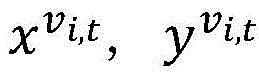 each representing a pixel v in the feature map of the t-th frame i,t Input and output features of corresponding connected vertices in RNN, < >>
 Representing a pixel v in the feature map of the t-th frame i,t In the corresponding hidden layer state in the RNN, K represents the propagation parameter in the RNN in the time direction, K d Representing propagation parameters in the spatial direction of the RNN, U d ,V d Is a parameter for converting the input features and hidden layer features, b d C is the bias parameter, ">
 Representing a collection of vertices that make up the local propagation map, f is an activation function.
As a preferred technical scheme, the method further comprises the following steps:
in the undirected cyclic information propagation graph, adjacent nodes in each direction in the original space are connected, and instead, every N-1 nodes in each direction are connected, namely, the propagation distance in the space is expanded from an original unit to N units.
As a preferred technical scheme, the method further comprises the following steps:
training parameters of a CNN network and an RNN network model, selecting foreground points in part of key frames as a key point set A, foreground points in part of ordinary frames as a positive sample point set P, and background points in part of ordinary frames as a negative sample point set N, and training and optimizing the parameters in the network model by using the following loss functions:

wherein, F () is a feature extracted and output after the corresponding point passes through CNN and RNN in the network, and α is a parameter for avoiding denominator being 0.
As a preferable technical scheme, when the feature map is classified into two categories, the method further comprises the following steps:
according to the new target object segmentation task and the video, the connection parameter adaptation adjustment is carried out on the last two classification layers of the frame by using labels given by the first frame of the new problem, and the following optimization problem is solved in a formalization way, so that a parameter adjustment result is obtained:

L(W 1 )=L + (W 1 )+λ 0 L - (W 1 )
wherein W1 To adapt the two classification layer parameters of the parameter adjustment, and
and the positive and negative sample points are restored in the first frame for two restoration losses, respectively. X is X + and X- Representing the extracted features of the positive and negative samples in the first frame, Y + and Y- Respectively represent the corresponding one-bit valid coding form lambda 0 Contribution ratio lambda for controlling two reduction losses 1 Is a regularization parameter.
As a preferred technical scheme, the method further comprises the following steps:
after the segmentation result of each frame is obtained, according to the result of the previous frame, the connection parameter adaptation adjustment is carried out on the last two classification layers of the frame through solving the following optimization problems, so that the segmentation accuracy is improved on line:

L(W t )=L + (W t )+λ 0 L _ (W t )
W t =W t-1 +ΔW
wherein Wt In order to continuously adapt to the parameters of the two classification layers after the adjustment of the t-th frame, L + (W t) and L_ (W t ) For two reduction losses, respectively corresponding to a positive sample point and a negative sample point in the t-th frame optimal segmentation result, parameter difference range, alpha, for controlling on-line learning 2 Is a regularized term parameter.
Compared with the prior art, the invention has the following advantages and beneficial effects:
1. in the process of training the model and classifying the new target, only the original labels and the original information of the pictures are needed, other labels are not needed, the labor time is saved, and the expansibility is strong.
2. The invention fully utilizes the spatial information contained in each frame in the video, extracts the local spatial features through the conventional convolutional neural network CNN, establishes the spatial propagation information flow in the convolutional neural network, and can extract the deep information contained in the space and integrate the deep information into the feature vector.
3. The invention fully utilizes the information of each frame of the video on the time level, and can extract the deep information contained in time and integrate the deep information into the feature vector by adding the time information propagation connection on the basis of the space propagation information flow of the cyclic neural network.
4. According to the invention, the network parameters are adaptively updated according to the first frame label of the new segmentation task, so that the segmentation effect of different new tasks can be improved.
5. According to the method and the device, in the process of dividing the target task, the network parameters are updated on line in real time according to the result of the frame which is divided currently, so that the dividing effect is further improved.
6. In the process of adjusting parameters aiming at a new task, the invention adjusts the parameters of the last two classification layers, has low parameter quantity and high speed; meanwhile, experiments show that the time occupied by the proposed space-time circulation network in the segmentation process is also very short. Namely, the method has good target segmentation effect and high speed, and can achieve good balance between the target segmentation effect and the high speed.
7. Experiments prove that the method has better segmentation effect than other algorithm effects on the targets which are difficult to segment and have the conditions of shielding, deformation, rapid movement and the like in the video.
Drawings
In order to more clearly illustrate the technical solutions of the embodiments of the present application, the drawings that are needed in the embodiments will be briefly described below, it being understood that the following drawings only illustrate some embodiments of the present application and therefore should not be considered limiting the scope, and that other related drawings may be obtained according to these drawings without inventive effort for a person skilled in the art.
FIG. 1 is a flow chart of a method of rapid video object segmentation utilizing temporal and spatial information in accordance with the present invention;
FIG. 2 is a schematic diagram of the architecture of the neural network system of the present invention;
FIG. 3 is a diagram of undirected cyclic information propagation of the present invention;
FIG. 4 is a schematic diagram of a space-time propagating RNN connection according to the present invention;
fig. 5 is a schematic diagram of the present invention extending the propagation distance in space from an original unit to N units.
Detailed Description
The present invention will be described in further detail with reference to examples and drawings, but embodiments of the present invention are not limited thereto.
Examples
As shown in fig. 1 and 2, the method for quickly dividing a video target object by using spatio-temporal information in this embodiment includes the following steps:
s1, establishing a neural network system, namely a deep convolutional neural network CNN at the forefront part, and performing basic feature extraction on an image to obtain a feature map corresponding to each frame;
s2, connecting a cyclic neural network RNN, wherein the cyclic neural network RNN is used for fully utilizing information contained in the correlation of each frame space of the video and information contained in the time correlation of each frame of the video, and extracting the hidden information into the characteristics so as to obtain a new characteristic diagram of the video corresponding to each frame and containing space-time information;
and S3, connecting a neural network layer for performing secondary classification, and performing secondary classification on the feature map to obtain a foreground part and a background part, so that the target object segmentation of each frame of the video is realized.
Further, according to the illustration of FIG. 3, a undirected cyclic information propagation graph is established, such a propagation graph may be approximated as a collection G of 4 directional information propagation graphs u ={G se ,G sw ,G ne ,G nw }。
Taking one propagation direction as an example and adding time to the connection, a space-time propagation RNN connection diagram as shown in fig. 4 can be obtained.
On this basis, the RNN model is formulated as follows


wherein , each representing a pixel v in the feature map of the t-th frame i,t Input and output features of corresponding connected vertices in RNN, < >>
 Representing a pixel v in the feature map of the t-th frame i,t In the corresponding hidden layer state in the RNN, K represents the propagation parameter in the RNN in the time direction, K d Representing propagation parameters in the spatial direction of the RNN, U d ,V d Is a parameter for converting the input features and hidden layer features, b d C is the bias parameter, ">
 Representing a collection of vertices that make up the local propagation map, f is an activation function.
Alternatively, since propagation over a long distance may lead to attenuation of the propagation content, the propagation distance in space may be extended from the original one unit to N units on the basis of the scheme of the present embodiment, as shown in fig. 5. The optimization scheme does not affect the previous network framework.
Further, in the training process of the model parameters, foreground points in part of the key frames are selected as a key point set A, foreground points in part of the ordinary frames are selected as a positive sample point set P, and background points in part of the ordinary frames are selected as a negative sample point set N. Training and optimizing parameters in the proposed network model by using the following loss functions:

wherein, F () is a feature extracted and output after the corresponding point passes through CNN and RNN in the network, and α is a parameter for avoiding denominator being 0.
Furthermore, according to the new target object segmentation task and the video, the connection parameters of the last two classification layers of the frame are adaptively adjusted by using labels given by the first frame of the new problem. Formalizing to solve the following optimization problem to obtain a parameter adjustment result:

L(W 1 )=L + (W 1 )+λ 0 L - (W 1 )
wherein W1 To adapt the two classification layer parameters of the parameter adjustment, and
and the positive and negative sample points are restored in the first frame for two restoration losses, respectively. X is X + and X- Representing the extracted features of the positive (foreground) and negative (background) samples in the first frame, Y + and Y- Respectively represent the corresponding one-bit valid (one-hot) coding form, lambda 0 Contribution ratio lambda for controlling two reduction losses 1 Is a regularization parameter.
Further, after the segmentation result of each frame is obtained, according to the result of the previous frame, the connection parameter adaptation adjustment is performed on the last two classification layers of the frame through solving the following optimization problem, so that the segmentation accuracy is improved online:

L(W t )=L + (W t )+λ 0 L - (W t )
W t =W t-1 +ΔW
wherein Wt To adjust and adapt after the t-th frame, the current need is continuedTwo-class layer parameters, L, of continuous adaptation parameter adjustment + (W t) and L_ (W t ) For two reduction losses, respectively corresponding to a positive sample point and a negative sample point in the t-th frame optimal segmentation result, parameter difference range, alpha, for controlling on-line learning 2 Is a regularized term parameter.
Through the above steps of the present embodiment, the result of the video that needs to be segmented can be output quickly.
The above examples are preferred embodiments of the present invention, but the embodiments of the present invention are not limited to the above examples, and any other changes, modifications, substitutions, combinations, and simplifications that do not depart from the spirit and principle of the present invention should be made in the equivalent manner, and the embodiments are included in the protection scope of the present invention.
Claims (4)
1. A rapid video object segmentation method using spatio-temporal information, comprising the steps of:
establishing a neural network system, namely a deep convolutional neural network CNN at the forefront part, and performing basic feature extraction on the image to obtain a feature map corresponding to each frame;
connecting a cyclic neural network RNN, wherein the cyclic neural network RNN is used for fully utilizing information contained in the correlation of each frame space of the video and information contained in the time correlation of each frame of the video, extracting the implicit information into the characteristics, and thus obtaining a new characteristic diagram of the video, wherein the new characteristic diagram corresponds to each frame and contains space-time information;
connecting a neural network layer for carrying out secondary classification, and carrying out secondary classification on the feature map to obtain a foreground part and a background part, thereby realizing the segmentation of the target object of each frame of the video;
before the step of connecting a recurrent neural network RNN, further comprising the steps of:
establishing an undirected cyclic information propagation graph, wherein the undirected cyclic information propagation graph can be used forApproximately 4 sets G of directional information propagation maps u ={G se ,G sw ,G ne ,G nw };
On the basis of an undirected cyclic information propagation graph, the formulation of the cyclic neural network RNN is expressed as follows:

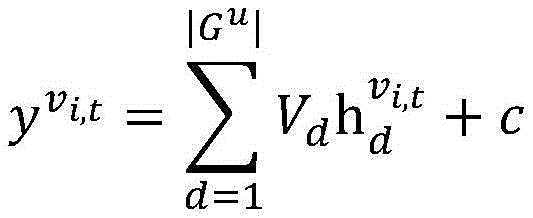
wherein , each representing a pixel v in the feature map of the t-th frame i,t Input and output features of corresponding connected vertices in RNN, < >>
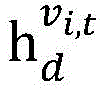 Representing a pixel v in the feature map of the t-th frame i,t In the corresponding hidden layer state in the RNN, K represents the propagation parameter in the RNN in the time direction, K d Representing propagation parameters in the spatial direction of the RNN, U d ,V d Is a parameter for converting the input features and hidden layer features, b d C is the bias parameter, ">
 Representing a collection of vertices that make up the local propagation map, f being an activation function;
in the undirected cyclic information propagation graph, adjacent nodes in each direction in the original space are connected, and instead, every N-1 nodes in each direction are connected, namely, the propagation distance in the space is expanded from an original unit to N units.
2. The method for rapid video object segmentation using spatio-temporal information of claim 1, further comprising the steps of:
training parameters of a CNN network and an RNN network model, selecting foreground points in part of key frames as a key point set A, foreground points in part of ordinary frames as a positive sample point set P, and background points in part of ordinary frames as a negative sample point set N, and training and optimizing the parameters in the network model by using the following loss functions:
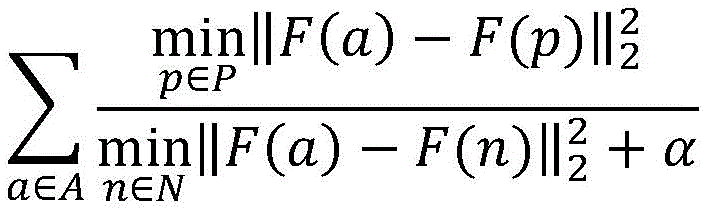
wherein, F () is a feature extracted and output after the corresponding point passes through CNN and RNN in the network, and α is a parameter for avoiding denominator being 0.
3. The method for rapid video object segmentation using spatio-temporal information according to claim 1, further comprising the steps of, when performing a two-classification of feature maps:
according to the new target object segmentation task and the video, the connection parameter adaptation adjustment is carried out on the last two classification layers of the frame by using labels given by the first frame of the new problem, and the following optimization problem is solved in a formalization way, so that a parameter adjustment result is obtained:

L(W 1 )=L + (W 1 )+λ 0 L - (W 1 )
wherein W1 To adapt the two classification layer parameters of the parameter adjustment, and
and for two reduction losses to correspond to the positive and negative sample points, X, in the first frame + and X- Representing extracted features of positive and negative samples, respectively, in a first frame,Y + and Y- Respectively represent the corresponding one-bit valid coding form lambda 0 Contribution ratio lambda for controlling two reduction losses 1 Is a regularization parameter.
4. The method for rapid video object segmentation using spatio-temporal information of claim 1, further comprising the steps of:
after the segmentation result of each frame is obtained, according to the result of the previous frame, the connection parameter adaptation adjustment is carried out on the last two classification layers of the frame through solving the following optimization problems, so that the segmentation accuracy is improved on line:

L(W t )=L + (W t )+λ 0 L - (W t )
W t =W t-1 +ΔW
wherein Wt In order to continuously adapt to the parameters of the two classification layers after the adjustment of the t-th frame, L + (W t) and L- (W t ) For two reduction losses, respectively corresponding to a positive sample point and a negative sample point in the t-th frame optimal segmentation result,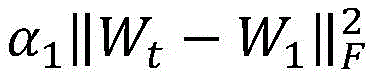 parameter difference range, alpha, for controlling on-line learning 2 Is a regularized term parameter.
Priority Applications (1)
| Application Number | Priority Date | Filing Date | Title |
|---|---|---|---|
| CN202010073352.5A CN111291663B (en) | 2020-01-22 | 2020-01-22 | Method for quickly segmenting video target object by using space-time information |
Applications Claiming Priority (1)
| Application Number | Priority Date | Filing Date | Title |
|---|---|---|---|
| CN202010073352.5A CN111291663B (en) | 2020-01-22 | 2020-01-22 | Method for quickly segmenting video target object by using space-time information |
Publications (2)
| Publication Number | Publication Date |
|---|---|
| CN111291663A CN111291663A (en) | 2020-06-16 |
| CN111291663B true CN111291663B (en) | 2023-06-20 |
Family
ID=71030710
Family Applications (1)
| Application Number | Title | Priority Date | Filing Date |
|---|---|---|---|
| CN202010073352.5A Active CN111291663B (en) | 2020-01-22 | 2020-01-22 | Method for quickly segmenting video target object by using space-time information |
Country Status (1)
| Country | Link |
|---|---|
| CN (1) | CN111291663B (en) |
Families Citing this family (3)
| Publication number | Priority date | Publication date | Assignee | Title |
|---|---|---|---|---|
| CN112598049B (en) * | 2020-12-18 | 2021-12-03 | 上海大学 | Target detection method for infrared image of buried object based on deep learning |
| EP4047553A1 (en) * | 2021-02-19 | 2022-08-24 | Aptiv Technologies Limited | Motion compensation and refinement in recurrent neural networks |
| US12205299B2 (en) * | 2021-08-06 | 2025-01-21 | Lemon Inc. | Video matting |
Citations (6)
| Publication number | Priority date | Publication date | Assignee | Title |
|---|---|---|---|---|
| CN105898111A (en) * | 2016-05-06 | 2016-08-24 | 西安理工大学 | Video defogging method based on spectral clustering |
| CN108364068A (en) * | 2018-01-05 | 2018-08-03 | 华南师范大学 | Deep learning neural network construction method based on digraph and robot system |
| CN110147763A (en) * | 2019-05-20 | 2019-08-20 | 哈尔滨工业大学 | Video Semantic Segmentation Method Based on Convolutional Neural Network |
| CN110163873A (en) * | 2019-05-20 | 2019-08-23 | 长沙理工大学 | A kind of bilateral video object dividing method and system |
| CN110222595A (en) * | 2019-05-20 | 2019-09-10 | 中国科学院大学 | A kind of video object dividing method based on space-time convolutional neural networks |
| CN110413844A (en) * | 2019-05-24 | 2019-11-05 | 浙江工业大学 | Dynamic link prediction technique based on space-time attention depth model |
-
2020
- 2020-01-22 CN CN202010073352.5A patent/CN111291663B/en active Active
Patent Citations (6)
| Publication number | Priority date | Publication date | Assignee | Title |
|---|---|---|---|---|
| CN105898111A (en) * | 2016-05-06 | 2016-08-24 | 西安理工大学 | Video defogging method based on spectral clustering |
| CN108364068A (en) * | 2018-01-05 | 2018-08-03 | 华南师范大学 | Deep learning neural network construction method based on digraph and robot system |
| CN110147763A (en) * | 2019-05-20 | 2019-08-20 | 哈尔滨工业大学 | Video Semantic Segmentation Method Based on Convolutional Neural Network |
| CN110163873A (en) * | 2019-05-20 | 2019-08-23 | 长沙理工大学 | A kind of bilateral video object dividing method and system |
| CN110222595A (en) * | 2019-05-20 | 2019-09-10 | 中国科学院大学 | A kind of video object dividing method based on space-time convolutional neural networks |
| CN110413844A (en) * | 2019-05-24 | 2019-11-05 | 浙江工业大学 | Dynamic link prediction technique based on space-time attention depth model |
Also Published As
| Publication number | Publication date |
|---|---|
| CN111291663A (en) | 2020-06-16 |
Similar Documents
| Publication | Publication Date | Title |
|---|---|---|
| CN111368846B (en) | Road ponding identification method based on boundary semantic segmentation | |
| CN114037938B (en) | NFL-Net-based low-illumination target detection method | |
| CN112233129B (en) | Deep learning-based parallel multi-scale attention mechanism semantic segmentation method and device | |
| CN112561946B (en) | A dynamic target detection method | |
| CN110321937B (en) | Motion human body tracking method combining fast-RCNN with Kalman filtering | |
| CN106296728A (en) | A kind of Segmentation of Moving Object method in unrestricted scene based on full convolutional network | |
| CN111291663B (en) | Method for quickly segmenting video target object by using space-time information | |
| CN114627269B (en) | A virtual reality security monitoring platform based on deep learning target detection | |
| CN111160407A (en) | Deep learning target detection method and system | |
| CN114926760A (en) | Video saliency target detection system and method based on space-time convolution neural network | |
| CN115082778B (en) | Multi-branch learning-based homestead identification method and system | |
| CN111310593A (en) | Ultra-fast lane line detection method based on structure perception | |
| CN119478161B (en) | Character expression driving method, device, storage medium and computer equipment | |
| CN114529894A (en) | Rapid scene text detection method fusing hole convolution | |
| CN119152453B (en) | Infrared expressway foreign matter detection method based on Mamba framework | |
| CN116681976A (en) | A Progressive Feature Fusion Method for Infrared Small Target Detection | |
| CN115205518A (en) | Target detection method and system based on YOLO v5s network structure | |
| Ye et al. | SNR-prior guided trajectory-aware transformer for low-light video enhancement | |
| CN120656137A (en) | Haze environment vehicle target detection system and method based on improved YOLO11 | |
| CN112200840A (en) | Moving object detection system in visible light and infrared image combination | |
| CN116188555B (en) | A monocular indoor depth estimation algorithm based on deep networks and motion information | |
| CN109033969B (en) | Infrared target detection method based on Bayesian saliency map calculation model | |
| CN116152699A (en) | Real-time moving target detection method for hydropower plant video monitoring system | |
| Zhao et al. | Low-Illumination Lane Detection by Fusion of Multi-light Information | |
| CN118172390B (en) | Target tracking method based on deep learning |
Legal Events
| Date | Code | Title | Description |
|---|---|---|---|
| PB01 | Publication | ||
| PB01 | Publication | ||
| SE01 | Entry into force of request for substantive examination | ||
| SE01 | Entry into force of request for substantive examination | ||
| GR01 | Patent grant | ||
| GR01 | Patent grant |