Disclosure of Invention
One of the objectives of the present invention is to overcome the above disadvantages, and to provide a balanced random puncturing method for two-sided type physical layer network coding under a fading channel, which combines the physical layer network coding constructed by two-sided type low-density parity check codes with the puncturing method under the fading channel to form two-sided type physical layer network coding with excellent code rate capable of adaptive adjustment, and the code word performance gain is obvious.
In order to solve the technical problem, the invention provides a balanced random puncturing method for network coding of two-side type physical layers under a fading channel, which comprises the following steps:
step 1, calculating the length NP of the code word needing to be deleted, wherein the calculation formula is as follows:
where K is the information bit length of the codeword, RtA target code rate for the codeword; roFor the original code rate of the codeword, the calculation formula is as follows:
wherein, the vector d is the degree condition of different kinds of edges connected with variable nodes, the vector m is the degree condition of different kinds of edges connected with check nodes, and mumA ratio of the number of check nodes having a degree of expression of m to the code length, vdThe ratio of the number of variable nodes with the expression degree type of d to the code length;
step 2, calculating the lengths of code words of the source point A and the source point B which need to be deleted respectively;
step 3, calculating the length L of the code word to be deleted
oI.e. the original total length of the codeword, the calculation formula is:
where K is the information bit length of the codeword, R
oIs the original code rate of the code word;
and 4, setting an initial value pRarray of the signal received by the relay R as:
pRarray[n]=bpsk(pYarrayA[n])×h1r+bpsk(pYarrayB[n]) X h2r + NoiseSttdDev x rand _ gaussian (), where n is 0 or more and less than LoH1R is the fading factor of the fading channel at source point a, h2R is the fading factor of the fading channel at source point B, pYarrayA is the code word sent from source point a to relay R, pYarrayB is the code word sent from source point B to relay R, rand _ gaussian () is a function that generates gaussian random noise, bpsk () is the bpsk modulation functionThe calculation formula is as follows:
noises stdev is a noise variance function, and the calculation formula is as follows:
where SNR is the signal-to-noise ratio, R
tA target code rate for the codeword;
step 5, carrying out balanced random puncturing operation on the code words of the source point A;
and 6, carrying out balanced random puncturing operation on the code words of the source point B.
Further, the calculating the code word length that the source point a and the source point B need to be punctured respectively includes the following steps:
step 21, the constraint conditions to be met when the code words of the source point a and the source point B are punctured are set as follows:
and NP
A=NP
BWherein NP is the length of the code word to be deleted, NP
AThe length of the codeword to be punctured for the source point A, NP
BRepresenting the length of code word needing to be deleted at the source point B;
step 22, calculating according to the constraint conditions to obtain the lengths of the code words of the source point a and the source point B which need to be punctured respectively as follows: NPA=NPB=NP。
Further, the "performing balanced random puncturing operation on the code word of the source point a" includes the following steps:
step 51, initializing the parameter jA to 0;
step 52, initializing the value placeA [ jA ] of the punctured codeword flag bit placeA in the source point a to 0;
step 53, judging if jA<LoWherein L isoFor the codeword length to be punctured, then jA equals jA +1, and go to step52, continuing the execution, otherwise, jumping to a step 54 to continue the execution;
step 54, initializing a punctured code word counter iA to 0, and setting a punctured position parameter nA in the source point a to 0;
step 55, randomly generating a puncturing position parameter nA, wherein the calculation formula is as follows: nA ═ rand ()% LoWherein rand () represents a function for generating a random number,% represents a remainder operation;
step 56, judging that if the placeA [ nA ] ═ 0 indicates that the first codeword nA in the source point a is not deleted, making the placeA [ nA ] ═ 1, and skipping to step 57 to continue execution; otherwise, it indicates that the nth codeword in the source point a has been punctured, and then it is necessary to jump to step 55 to reselect the puncturing position parameter;
and step 57, after the n < th > code word in the source point a is deleted, updating the n < th > signal pRarray [ nA ] received by the relay R, wherein the calculation formula is as follows:
pRarray[nA]=bpsk(pYarrayB[nA])×h2r+NoiseStdDev×rand_gaussian(),
wherein h2R is the fading factor of the fading channel of source point B, pYarrayB is the codeword sent by source point B to relay R, rand _ gaussian () is the function generating gaussian random noise, bpsk () is the bpsk modulation function, and the calculation formula is as follows:
noises stdev is a noise variance function, and the calculation formula is as follows:
where SNR is the signal-to-noise ratio, R
tA target code rate for the codeword;
step 58, judging if iA<NPAIf yes, iA is equal to iA +1, and the process jumps to step 55 to continue execution, otherwise, the operation of balanced random puncturing of the source point a codeword is ended.
Further, the "performing balanced random puncturing operation on the code word of the source point B" includes the following steps:
step 61, initializing the parameter jB to be 0;
step 62, initializing the value placeB [ jB ] of the punctured codeword flag bit placeB in the source point B to 0;
step 63, judging if jB<LoWherein L isoIf the length of the codeword to be punctured is, jB is jB +1, and the process proceeds to step 62, otherwise, the process proceeds to step 64;
step 64, initializing a punctured code word counter iB as 0, and setting a punctured position parameter nB as 0 in the source point B;
step 65, randomly generating a puncturing position parameter nB, wherein the calculation formula is as follows: nB ═ rand ()% LoWherein rand () represents a function of generating a random number; % represents the remainder operation;
step 66, judging that if the placeB [ nB ] ═ 0 indicates that the nth code word in the source point B is not punctured, making the placeB [ nB ] ═ 1 and skipping to step 67 to continue execution; otherwise, if the placeB [ nB ] is 1, which indicates that the nth codeword in the source point B has been punctured, jumping to step 65 to regenerate the puncturing position parameter nB;
step 67, judging that if placeA [ nB ] ═ 1, it means that at the same position nB, the code words of source point a and source point B are both punctured, and updating the nB-th signal pRarray received by relay R to pRarray [ nB ] ═ 0; otherwise, updating the Nth signal pRarray [ nB ] received by the relay R as:
pRarray [ nB ] ═ bpsk (pxarraya [ nB ]) × h1r + noisestdev × rand _ gaussian (), among others. h1R represents the fading factor of the fading channel of source point a, pYarrayA represents the codeword sent by source point a to relay R, rand _ gaussian () represents the function that generates gaussian random noise, bpsk () represents the bpsk modulation function, and the formula is as follows:
noises tddev represents a noise variance, which is calculated as follows:
where SNR is the signal-to-noise ratio, R
tA target code rate for the codeword;
step 68, judge if iB<NPBIf yes, iB is equal to iB +1, and the process jumps to step 65 to continue execution, otherwise, the balanced random puncturing operation of the source B codeword is ended.
Compared with the prior art, the technical scheme of the invention has the beneficial effects that:
1. the invention designs a puncturing scheme of two-side type physical layer network coding under a fading channel from a brand-new view angle, and combines the physical layer network coding constructed by two-side type low-density parity check codes and a puncturing method aiming at the fading channel to form the two-side type physical layer network coding with excellent performance and self-adaptive adjustment of code rate.
2. The two-side type physical layer network coding designed by the invention has good performance advantages, and compared with a non-equilibrium random puncturing method and a CLS puncturing method, the code word performance gain designed by the invention is obvious.
Detailed Description
The technical solutions in the embodiments of the present invention will be clearly and completely described below with reference to the drawings in the embodiments of the present invention, and it is obvious that the described embodiments are only a part of the embodiments of the present invention, and not all of the embodiments. All other embodiments, which can be derived by a person skilled in the art from the embodiments given herein without making any creative effort, shall fall within the protection scope of the present invention.
Referring to fig. 1, it is a flowchart of steps of an equalized random puncturing method for two-sided physical layer network coding under a fading channel according to the present invention, including the following steps:
step 1, calculating the length NP of the code word needing to be deleted, wherein the calculation formula is as follows:
where K is the information bit length of the code word, RtA target code rate for the codeword; roFor the original code rate of the codeword, the calculation formula is as follows:
where vector d is the degree of the edge of the different kind connected to the variable node, vector m is the degree of the edge of the different kind connected to the check node, μmAnd the ratio of the number of the check nodes with the expression degree type of m to the code length. V isdAnd the ratio of the number of variable nodes with the expression degree type of d to the code length.
Step 2, calculating the code word length of the source point A and the source point B which need to be deleted respectively, comprising the following steps:
step 21, in the two-side type physical layer network coding system model under the fading channel, if the length of the punctured code word required in
step 1 is to be satisfied, the constraint condition needs to be satisfied:
wherein NP is the length of code word to be deleted, NP
AThe length of the codeword to be punctured for the source point A, NP
BRepresenting the length of code word needing to be deleted at the source point B; in addition, because the invention adopts the mode of balanced puncturing to process, the length of the code word needing to be deleted is required to be distributed between the source point A and the source point B in a balanced way, namely, the puncturing quantity of the source point A and the source point B is consistent, and therefore, the invention also has a constraint condition NP
A=NP
B。
Step 22, according to the two constraint conditions, the lengths of the code words that the source point a and the source point B respectively need to be punctured are calculated as follows: NPA=NPB=NP。
Step 3, calculating the length L of the code word to be deleted
oThe calculation formula is as follows:
where K is the length of the codeword information bits, R
oIs the original code rate of the codeword. Here, L
oOr as the original overall length of the codeword. In the technical scheme of the invention, two-side low-density parity check codes are adopted at the source point A and the source point B for channel coding, and the original total length L of the code word
oIs simply related to T
2The length of the variable node to which the class edge is connected.
Step 4, when the code words of the source point A and the source point B are not deleted, calculating the initial value of the signal received by the relay R as pRarray, wherein the calculation mode is as follows:
pRarray[n]=bpsk(pYarrayA[n])×h1r+bpsk(pYarrayB[n])×h2r+NoiseStdDev×rand_gaussian() Wherein n is 0 or more and less than LoH1R is the fading factor of the source point a fading channel, h2R is the fading factor of the source point B fading channel, pxarraya is the code word sent by the source point a to the relay R, pxarrayb is the code word sent by the source point B to the relay R, rand _ gaussian () is the function generating gaussian random noise, bpsk () is the bpsk modulation function, and the calculation formula is as follows:
noises stdev is a noise variance function, and the calculation formula is as follows:
where SNR is the signal-to-noise ratio, R
tIs the target code rate of the codeword.
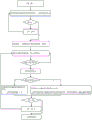
Step 5, carrying out balanced random puncturing operation on the code words of the source point A; referring to fig. 2, it is a flowchart of the operation steps of performing balanced random puncturing on the code word of the source point a according to the present invention, and the method includes the following steps:
step 51, initializing the parameter jA to 0;
step 52, initializing the value placeA [ jA ] of the punctured codeword flag bit placeA in the source point a to 0; the placeA here may be an array, and when placeA [ jA ] ═ 0, it indicates that the jA-th codeword in the source point a is not punctured; when placeA [ jA ] ═ 1, it indicates that the jA-th codeword in the source point a is punctured;
step 53, judging if jA<LoWherein L isoIf the length of the codeword to be punctured is, then jA equals jA +1, and the process proceeds to step 52, otherwise, the process proceeds to step 54; completing initialization operation of the placeA array from step 51 to step 53, and initializing each flag bit to 0;
step 54, initializing a punctured code word counter iA to 0, and setting a punctured position parameter nA in the source point a to 0;
step 55, randomly generating a puncturing position parameter nA, wherein the calculation formula is as follows: nA ═ rand ()% LoWherein rand () represents generationFunction of random number,% represents the operation of solving for the remainder;
step 56, judging that if the placeA [ nA ] ═ 0 indicates that the first codeword nA in the source point a is not deleted, setting the placeA [ nA ] ═ 1, identifying that the codeword is deleted, and jumping to step 57 to continue execution; otherwise, the method indicates that the nth code word in the source point A has been punctured by the previous step, and then the method jumps to step 55 to reselect the puncturing position parameter nA;
and step 57, after the n < th > code word in the source point a is deleted, updating the n < th > signal pRarray [ nA ] received by the relay R, wherein the calculation formula is as follows:
pRarray[nA]=bpsk(pYarrayB[nA])×h2r+NoiseStdDev×rand_gaussian(),
wherein h2R is the fading factor of the fading channel of source point B, pYarrayB is the codeword sent by source point B to relay R, rand _ gaussian () is the function generating gaussian random noise, bpsk () is the bpsk modulation function, and the calculation formula is as follows:
noises stdev is a noise variance function, and the calculation formula is as follows:
where SNR is the signal-to-noise ratio, R
tA target code rate for the codeword;
step 58, judging if iA<NPAIt means that the number of deletions at the source point A has not reached NPAIf yes, executing iA +1, and jumping to step 55 to continue execution, otherwise, when iA equals NPAAnd when the code word is deleted, ending the balanced random deletion operation of the code word A of the source point, and entering the subsequent step.
And 6, carrying out balanced random puncturing operation on the code words of the source point B. Referring to fig. 3, it is a flowchart of the operation steps of performing balanced random puncturing on the code word of the source point B according to the present invention, and the method includes the following steps:
step 61, initializing the parameter jB to be 0;
step 62, initializing the value placeB [ jB ] of the punctured codeword flag bit placeB in the source point B to 0; similarly, the placeB may be an array, and if the placeB [ jB ] ═ 0, it indicates that the jB-th codeword in the source point B is not punctured; otherwise, the jB-th code word in the source point B is deleted;
step 63, judging if jB<LoWherein L isoIf the length of the codeword to be punctured is, jB is jB +1, and the process proceeds to step 62, otherwise, the process proceeds to step 64; initializing the placeB array in steps 61 to 63, and setting 0 in each flag bit;
step 64, initializing a punctured code word counter iB as 0, and setting a punctured position parameter nB as 0 in the source point B;
step 65, randomly generating a puncturing position parameter nB, wherein the calculation formula is as follows: nB ═ rand ()% LoWherein rand () represents a function for generating a random number,% represents a remainder operation;
step 66, judging that if the placeB [ nB ] ═ 0 indicates that the nth code word in the source point B has not been punctured, setting the placeB [ nB ] ═ 1, identifying that the code word has been punctured, and skipping to step 67 to continue execution; otherwise, if the current placeB [ nB ] is 1, which indicates that the nth codeword in the source point B has been punctured, jumping to step 65 to regenerate the puncturing position parameter nB;
step 67, judging that if placeA [ nB ] ═ 1, it means that at the same position nB, the code words of source point a and source point B are both punctured, and updating the nB-th signal pRarray received by relay R to pRarray [ nB ] ═ 0; otherwise, updating the Nth signal pRarray [ nB ] received by the relay R as:
pRarray [ nB ] ═ bpsk (pxarraya [ nB ]) × h1r + noisestdev × rand _ gaussian (), among others. h1R represents the fading factor of the fading channel of source point a, pYarrayA represents the codeword sent by source point a to relay R, rand _ gaussian () represents the function that generates gaussian random noise, bpsk () represents the bpsk modulation function, and the formula is as follows:
noises tddev represents a noise variance, which is calculated as follows:
where SNR is the signal-to-noise ratio, R
tA target code rate for the codeword;
step 68, judge if iB<NPBIt means that the number of deletions at the source point A has not reached NPBIf yes, executing iB-iB +1, and jumping to step 65 to continue executing, otherwise, ending the balanced random puncturing operation of the source point B codeword.
For convenience of understanding, as shown in fig. 4, a model of a two-sided type physical layer network coding system under a fading channel is provided, and it can be seen from the figure that a source point a and a source point B respectively adopt two-sided type low-density parity check codes to perform codeword coding, and after being processed by the balanced random puncturing method described in the present application, the codewords are respectively sent to a relay R through a fading channel after being modulated by BPSK, so that data communication interaction between the source point a and the source point B is realized.
The present invention is further explained by a specific embodiment, in which a source point a and a source point B respectively send information to a relay R, and a parameter table of two-side type low density parity check codes used for information encoding is as follows:
as can be seen from the above parameter table, the two-edge ldpc code includes two variable nodes and one check node, where the vector d: ═ d1,d2) Representing the degree of different kinds of edges connected to variable nodes, the number of values of the vector d representing the number of kinds of edges in the code word, where the first value d1Representing a first class of edges T connected to nodes of a variable1Degree of (d)2Representing edges T of a second type connected to nodes of a variable2Degree of (c). From the parameter table, the number of the vector d is 2, so that the vector is a two-sided low density parity check code. Vector m ═ m1,m2) Representing degree cases of different kinds of edges connected to check nodes, vector b: ═ b0,b1) The parameter table indicates that the variable point passing through the channel is punctured by b ═ 1,0, and indicates that the code word has a fading channel by b ═ 0, 1. In addition, μ in the parameter tablemA ratio of the number of check nodes having a degree of expression of m to the code length, vdAnd the ratio of the number of variable nodes with the expression degree type of d to the code length.
The invention relates to a balanced random puncturing method for two-side type physical layer network coding under a fading channel, which comprises the following steps:
step 1, calculating the length of the code word needing to be punctured.
The original code rate R of the code word can be known from the parameter tableoComprises the following steps:
where vector d is the degree of the edge of the different kind connected to the variable node, vector m is the degree of the edge of the different kind connected to the check node, μmA ratio of the number of check nodes having a degree of representation m to the code length vdAnd the ratio of the number of variable nodes with the expression degree type of d to the code length.
Assuming that the information bit length of the codeword is K512, the target code rate of the codeword is Rt0.4, from the original code rate RoTo target code rate of RtThen, the length NP of the codeword to be deleted is:
and 2, calculating the lengths of the code words which are required to be deleted by the source point A and the source point B respectively.
Step 21, when the code words of the source point a and the source point B are set to be punctured, the following constraint conditions need to be satisfied:
meanwhile, because the method of the present invention needs to distribute the length of the code word to be deleted evenly between the source point a and the source point B, that is, the number of the deletions of the source point a and the source point B is consistent, the method includes: NP
A=NP
BWherein, NP is
AIndicating the length of the code word that the source point A needs to puncture, NP
BIndicating the length of the codeword that source point B needs to puncture.
Step 22, according to the constraint conditions, the lengths of the code words to be punctured at the source point a and the source point B can be calculated as follows: NP (N-P)A=NPB=256。
Step 3, calculating the length L of the code word to be deleted
oThe calculation formula is as follows:
here, L
oOr as the original overall length of the codeword. In the technical scheme of the invention, two-side low-density parity check codes are adopted at the source point A and the source point B for channel coding, and the original total length L of the code word
oIs simply related to T
2The length of the variable node to which the class edge is connected.
Step 4, when the code words in the source point A and the source point B are not deleted, setting an initial value pRarray of a signal received by the relay R as:
pRarray [ n ] ═ bpsk (pYarrayA [ n ]) × h1r + bpsk (pYarrayB [ n ]) × h2r + NoiseSttdDev × rand _ gaussian (), where n is an integer between 0 and less than 1536, h1r is the fading factor of the fading channel at Source Point A, h2r is the fading factor of the fading channel at Source Point B,
noises tddev represents a noise variance, which is calculated as follows:
wherein SNR represents a signal-to-noise ratio; pYarrayA represents the codeword sent by source point a to relay R, pYarrayB represents the codeword sent by source point B to relay R, rand _ gaussian () represents the function that generates gaussian random noise, bpsk () represents the bpsk modulation function, the specific formula of which is as follows:
step 5, performing balanced random puncturing operation at the source point A, comprising the following steps:
step 51, setting the parameter jA to be 0;
step 52, initializing the value of the erasure code word flag bit placeA in the source point a as follows: placeA [ jA ] ═ 0, where placeA [ jA ] ═ 0 indicates that the jth codeword in source point a is not punctured;
step 53, if the jA is less than 1536, executing the jA to jA +1, and jumping to step 52 to continue executing; when jA is 1536, indicating that the placeA is completely and initially completed, jumping to step 54 to continue execution;
step 54, setting the punctured code word counter iA to 0, and setting the punctured position parameter nA in the source point a to 0;
step 55, randomly generating a puncturing position parameter nA: nA ═ rand ()% 1536 where rand () represents a function that generates a random number; % represents the remainder operation;
step 56, judging that if the placeA [ nA ] ═ 0 indicates that the first codeword in the source point a has not been deleted, setting the placeA [ nA ] ═ 1, and skipping to step 57 to continue execution; otherwise, it indicates that the nth codeword in the source point a has been punctured, and jumps to step 55 to reselect the puncturing position parameter.
And 57, updating the nA signal pRarray [ nA ] received by the relay R after the deletion as follows:
pRarray[nA]=bpsk(pYarrayB[nA]) X h2r + noises stdev x rand _ gaussian (), where h2r denotes the fading factor of the source point B fading channel and noises stdev denotes the noise variance, which is calculated as follows:
wherein SNR represents a signal-to-noise ratio; pYarrayB represents the codeword sent by source B to relay R, rand _ gaussian () represents the function that generates gaussian random noise, bpsk () represents the bpsk modulation function, which has the following concrete formula:
step 58, if the iA is less than 256, executing iA to iA +1, and jumping to step 55 to continue executing; otherwise, ending the balanced random deletion operation at the source point A and continuing the next step.
Step 6, performing balanced random puncturing operation at the source point B, comprising the following steps:
step 61, initializing the parameter jB to be 0;
step 62, initializing the value of the erasure code word flag bit placeB in the source point B as follows: placeB [ jB ] ═ 0;
step 63, if jB <1536, executing jB as jB +1, and proceeding to step 62 to continue executing; otherwise, indicating that the placeB has been completely initialized, and jumping to step 64 to continue execution;
step 64, initializing a punctured code word counter iB as 0, and setting nB of a puncturing position parameter of a code word of a source point B as 0;
step 65, randomly generating a puncturing position parameter nB: nB ═ rand ()% 1536 where rand () represents a function that generates a random number; % represents the remainder operation;
step 66, judging that if the placeB [ nB ] ═ 0 indicates that the nth code word in the source point B has not been deleted, setting the placeB [ nB ] ═ 1; otherwise, if placeB [ nB ] ═ 1, it means that the nth codeword in source point B has been punctured, and it is necessary to jump to step 65 to reselect a random number;
step 67, determining that if placeA [ nB ] ═ 1, it indicates that at the same position nB, the code words of source point a and source point B are both punctured, and at this time, the nB-th signal pRarray received by the update relay R is: (iv) pRarray [ nB ] ═ 0; otherwise, updating the Nth signal pRarray [ nB ] received by the relay R as:
pRarray[nB]=bpsk(pYarrayA[nB]) X h1r + noises stdev x rand _ gaussian (), where h1r represents the fading factor of the source point a fading channel and noises stdev represents the noise variance, which is calculated as follows:
wherein SNR represents a signal-to-noise ratio; pYarrayA represents the codeword sent by source point a to relay R, rand _ gaussian () represents the function that generates gaussian random noise, bpsk () represents the bpsk modulation function, which has the following concrete formula:
step 68, if it is judged that iB is less than 256, executing iB ═ iB +1, and jumping to step 65 to continue executing; otherwise, ending the balanced random puncturing operation at the source point B.
For the above embodiments, the present application adopts four different values of h1r and h2r shown in the following table to verify the performance gain effect of the codeword designed by the method of the present invention.
Referring to fig. 5, it is shown that the embodiment of the present invention applies the balanced random puncturing method (NP) when h1r is 1.0 and h2r is 1.0A=NPB256) and using an unbalanced random puncturing method (NP)A≠NPB) R, where K is 512, Rt0.4. As can be seen from the figure, in the two-side physical layer network coding system model under the fading channel, BER is 10-6Compared with the code word designed by the non-equilibrium random puncturing method, the code word designed by the invention has obvious performance advantage, the minimum performance gain is about 0.5dB, and the maximum performance gain is about 3.8 dB.
Referring to fig. 6, the above embodiment is shown that the balanced random puncturing method (NP) of the present invention is adopted when h1r is 1.2 and h2r is 0.8A=NPB256) and using an unbalanced random puncturing method (NP)A≠NPB) Graph of BER performance comparison of (1), wherein K is 512,Rt0.4. As can be seen from the figure, in the two-side physical layer network coding system model under the fading channel, BER is 10-5Compared with the code word designed by the non-equilibrium random puncturing method, the code word designed by the invention has obvious performance advantage, the minimum performance gain is about 1dB, and the maximum performance gain is about 5 dB.
Referring to fig. 7, the above embodiment is shown that the balanced random puncturing method (NP) of the present invention is adopted when h1r is 1.4 and h2r is 0.6A=NPB256) and using an unbalanced random puncturing method (NP)A≠NPB) Graph of BER performance comparison of (1), wherein K is 512, Rt0.4. As can be seen from the figure, in the two-side physical layer network coding system model under the fading channel, BER is 10-4Compared with the code word designed by the non-equilibrium random puncturing method, the code word designed by the invention has obvious performance advantage, the minimum performance gain is about 1dB, and the maximum performance gain is more than 8 dB.
Referring to fig. 8, the above embodiment is shown that the balanced random puncturing method (NP) of the present invention is adopted when h1r is 1.5 and h2r is 0.5A=NPB256) and using an unbalanced random puncturing method (NP)A≠NPB) Graph of BER performance comparison of (1), wherein K is 512, Rt0.4. As can be seen from the figure, in the two-side physical layer network coding system model under the fading channel, BER is 10-4Compared with the code word designed by the non-equilibrium random puncturing method, the code word designed by the invention has obvious performance advantage, the minimum performance gain is about 3dB, and the maximum performance gain is more than 8 dB.
Fig. 9 shows a BER performance comparison chart between the balanced random puncturing method and the CLS puncturing method according to the present invention when h1R is 1.2 and h2R is 0.8, where K is 512 and R is 0.8t0.4. As can be seen from the figure, the CLS puncturing algorithm with excellent gaussian channel performance is not completely suitable for fading channels. In the two-side physical layer network coding system model under the fading channel, BER is 10-5Then, the code word designed by the invention and the code word designed by the CLS puncturing method with excellent performance under Gaussian channel are inputCompared with the prior art, the code word designed by the invention has obvious performance advantage, and the performance gain is about 5 dB.
As shown in FIG. 10, the value at R is showntRespectively 0.4, 0.5, 0.6, and h1r is 1.2, and h2r is 0.8, the balanced random puncturing method of the present invention (NP) is employedA=NPB) Wherein K is 512. It can be seen from the figure that the balanced random puncturing method of the present invention can realize the self-adaptive adjustment between multiple code rates in the two-sided type physical layer network coding system model under the fading channel.
The above embodiments are merely illustrative of the technical solutions of the present invention, and the present invention is not limited to the above embodiments, and any modifications or alterations according to the principles of the present invention should be within the protection scope of the present invention.