CN110412552B - Interference sample self-adaptive selection side lobe cancellation method - Google Patents
Interference sample self-adaptive selection side lobe cancellation method Download PDFInfo
- Publication number
- CN110412552B CN110412552B CN201910657747.7A CN201910657747A CN110412552B CN 110412552 B CN110412552 B CN 110412552B CN 201910657747 A CN201910657747 A CN 201910657747A CN 110412552 B CN110412552 B CN 110412552B
- Authority
- CN
- China
- Prior art keywords
- side lobe
- interference
- cancellation
- window
- data
- Prior art date
- Legal status (The legal status is an assumption and is not a legal conclusion. Google has not performed a legal analysis and makes no representation as to the accuracy of the status listed.)
- Active
Links
- 238000000034 method Methods 0.000 title claims abstract description 16
- 238000004364 calculation method Methods 0.000 claims description 7
- 239000011159 matrix material Substances 0.000 claims description 6
- 230000001629 suppression Effects 0.000 abstract description 5
- 230000007547 defect Effects 0.000 abstract description 2
- 238000001514 detection method Methods 0.000 abstract description 2
- 238000002592 echocardiography Methods 0.000 abstract 1
- 230000011218 segmentation Effects 0.000 description 2
- 230000003044 adaptive effect Effects 0.000 description 1
- 230000009286 beneficial effect Effects 0.000 description 1
- 238000010586 diagram Methods 0.000 description 1
- 238000005516 engineering process Methods 0.000 description 1
- 230000010363 phase shift Effects 0.000 description 1
Images


Classifications
-
- G—PHYSICS
- G01—MEASURING; TESTING
- G01S—RADIO DIRECTION-FINDING; RADIO NAVIGATION; DETERMINING DISTANCE OR VELOCITY BY USE OF RADIO WAVES; LOCATING OR PRESENCE-DETECTING BY USE OF THE REFLECTION OR RERADIATION OF RADIO WAVES; ANALOGOUS ARRANGEMENTS USING OTHER WAVES
- G01S13/00—Systems using the reflection or reradiation of radio waves, e.g. radar systems; Analogous systems using reflection or reradiation of waves whose nature or wavelength is irrelevant or unspecified
- G01S13/02—Systems using reflection of radio waves, e.g. primary radar systems; Analogous systems
- G01S13/04—Systems determining presence of a target
-
- G—PHYSICS
- G01—MEASURING; TESTING
- G01S—RADIO DIRECTION-FINDING; RADIO NAVIGATION; DETERMINING DISTANCE OR VELOCITY BY USE OF RADIO WAVES; LOCATING OR PRESENCE-DETECTING BY USE OF THE REFLECTION OR RERADIATION OF RADIO WAVES; ANALOGOUS ARRANGEMENTS USING OTHER WAVES
- G01S7/00—Details of systems according to groups G01S13/00, G01S15/00, G01S17/00
- G01S7/02—Details of systems according to groups G01S13/00, G01S15/00, G01S17/00 of systems according to group G01S13/00
- G01S7/023—Interference mitigation, e.g. reducing or avoiding non-intentional interference with other HF-transmitters, base station transmitters for mobile communication or other radar systems, e.g. using electro-magnetic interference [EMI] reduction techniques
-
- G—PHYSICS
- G01—MEASURING; TESTING
- G01S—RADIO DIRECTION-FINDING; RADIO NAVIGATION; DETERMINING DISTANCE OR VELOCITY BY USE OF RADIO WAVES; LOCATING OR PRESENCE-DETECTING BY USE OF THE REFLECTION OR RERADIATION OF RADIO WAVES; ANALOGOUS ARRANGEMENTS USING OTHER WAVES
- G01S7/00—Details of systems according to groups G01S13/00, G01S15/00, G01S17/00
- G01S7/02—Details of systems according to groups G01S13/00, G01S15/00, G01S17/00 of systems according to group G01S13/00
- G01S7/41—Details of systems according to groups G01S13/00, G01S15/00, G01S17/00 of systems according to group G01S13/00 using analysis of echo signal for target characterisation; Target signature; Target cross-section
- G01S7/411—Identification of targets based on measurements of radar reflectivity
Landscapes
- Engineering & Computer Science (AREA)
- Radar, Positioning & Navigation (AREA)
- Remote Sensing (AREA)
- Computer Networks & Wireless Communication (AREA)
- Physics & Mathematics (AREA)
- General Physics & Mathematics (AREA)
- Radar Systems Or Details Thereof (AREA)
Abstract
The invention relates to a side lobe cancellation method for self-adaptive selection of interference samples. Aiming at the defects that the radar is difficult to realize the automatic switch of the side lobe cancellation and the problem that pure interference data is difficult to obtain and the cancellation weight is calculated, the method for the side lobe cancellation by self-adaptive selection of the interference samples is provided by segmenting data echoes of a main channel and an auxiliary channel into a plurality of sample windows and comparing cross correlation coefficients and power ratios between the main channel and the auxiliary channel in each window. The method can realize the automatic detection of the presence or absence of the side lobe interference and the self-adaptive selection of the interference sample. The method comprises the following specific steps: segmenting data into a plurality of sample windows; judging whether the data of the main channel and the auxiliary channel exceeds a threshold; calculating cancellation parameters of the side lobes in the window; sliding the window to judge whether all the sample windows are traversed; side lobe interference judgment, side lobe cancellation processing and the like. The invention can effectively improve the automation degree of radar side lobe interference suppression, reduce the probability of starting side lobe cancellation when no interference exists, and improve the target discovery probability in a complex electromagnetic environment.
Description
Technical Field
The invention relates to a suppression type side lobe interference suppression method.
Background
The side lobe cancellation is a common radar active interference resisting technology, a main lobe of a radar receiving antenna is narrow, gain is high, and directivity is strong, so that the probability of entering of active interference signals from the main lobe of the radar receiving antenna is small, the side lobe of the radar antenna is wide, and the interference signals easily enter a radar receiver from the side lobe of the receiving antenna. In order to suppress interference, the main antenna side lobe gain is usually low, but when the radar is in a strong active interference environment, the interference signal may drown out the target signal, thereby causing the radar to not work properly.
Side lobe cancellation is to suppress directional interference entering through the main antenna side lobe direction using the interference signal received by the auxiliary antenna. The main lobe of the auxiliary antenna is very wide, the gain is equivalent to the average side lobe of the main antenna, and the auxiliary antenna is a weak-directivity or non-directivity antenna. When side lobe interference exists, the amplitude of the interference signal received by the main antenna is equivalent to that of the interference signal received by the auxiliary antenna, and because the spatial positions of the antennas are different, a fixed phase shift caused by a wave path difference exists between the phases of the received interference signals. The weighting coefficient of the auxiliary antenna can be obtained by using the interference signal received by each antenna through a certain self-adaptive algorithm. After the auxiliary antenna is weighted and summed, the interference signal received by the main antenna is subtracted, so that the interference output power of the main channel is minimum, and the aim of side lobe interference cancellation is achieved.
Side lobe cancellation can effectively suppress side lobe continuous wave interference signals, however, when side lobe interference does not exist, noise power in a main antenna channel can be improved by adopting side lobe cancellation processing, so that target detection probability is reduced, and at the moment, the side lobe cancellation processing is automatically closed. Meanwhile, when the side lobe cancellation value is calculated, if a data sample for calculating the cancellation value is a target echo, a zero point is formed at a target direction in a main antenna directional diagram, a target cancellation phenomenon occurs, and a target signal-to-noise ratio in a main channel is greatly reduced, so that the radar cannot normally detect a target.
Disclosure of Invention
The invention aims to overcome the defects that a radar is difficult to realize a self-adaptive switch of a side lobe cancellation function and the problem that a pure side lobe interference data sample for calculating a cancellation value is difficult to accurately obtain.
In order to achieve the purpose of the invention, the invention provides a side lobe cancellation method for adaptively selecting interference samples, which comprises the following steps:
s1 data segmentation into multiple sample windows: the main and auxiliary channel echo data are respectively segmented into a plurality of sample windows, and the count of the auxiliary lobe interference sample window is initialized to 0;
s2, judging whether the main channel data and the auxiliary channel data exceed a threshold: and calculating the cross-correlation coefficient between the main channel and the auxiliary channel in the sample window and the power ratio of the auxiliary channel to the main channel, and judging whether the cross-correlation coefficient exceeds the threshold. If both results exceed the threshold, pure side lobe interference data exists in the sample window, and the step S3 is carried out; otherwise, go to step S4;
s3, calculating a side lobe cancellation parameter in a window: adding 1 to the count of the interference sample window, and calculating a covariance matrix between auxiliary channels in the window and a main and auxiliary channel cross-correlation vector;
s4, judging whether all sample windows are traversed by sliding windows: judging whether the main lobe interference data discrimination and the side lobe cancellation parameter calculation in all the sample windows are finished or not; if yes, go to step S5; if not, selecting the main and auxiliary channel data of the next sample window, and turning to the step S2;
s5, side lobe interference judgment and side lobe cancellation processing: judging the value of the side lobe interference sample window count; if the number of the side lobes is zero, side lobe interference is avoided, and side lobe cancellation processing is not performed; if not, calculating the interference cancellation value by using the obtained side lobe cancellation parameters in each window, and performing side lobe cancellation processing.
The invention has the beneficial effects that: by adopting the method, the degree of automation of the single-radar side lobe interference suppression is effectively improved by adopting the side lobe cancellation method of the interference sample self-adaptive selection, the probability of starting side lobe cancellation processing when no interference exists is reduced, and the target discovery probability of the radar in a complex electromagnetic environment is improved.
Drawings
Fig. 1 is a flowchart of a side lobe cancellation method for adaptive selection of interference samples. Wherein: S1-S5 in the figure correspond to the S1-S5 processes, respectively, as described in the summary of the invention.
Fig. 2 is a specific implementation method of each step in fig. 1. Wherein k represents the number of statistical side lobe interference sample windows, T 1 Representing the threshold of the cross-correlation coefficient of the primary and secondary channels, T 2 Representing the auxiliary channel to main channel power ratio threshold, R k Represents the covariance matrix R of the auxiliary channel in the k side lobe interference sample window k ,r k And representing the cross-correlation vector between the main channel and the auxiliary channel in the kth side lobe interference sample window.
Detailed Description
The implementation process and the software flow are shown in fig. 2, and are specifically described as the following processes:
s1 data segmentation into multiple sample windows: the main and auxiliary channel echo data are respectively segmented into a plurality of sample windows, and the count of the side lobe interference sample window is initialized to 0.
Assuming that the radar has 1 main channel and P auxiliary channels, the length of echo data of the main channel and the auxiliary channels is N, the data is divided into M sample windows, and the length of the sample window is L, the main channel data in each sample window is represented as L × 1 dimensional vector d = [ d ] 1 ,d 2 ,...,d L ] T The auxiliary channel data is represented as a dimension P × L matrix x = [ x ] 1 ,...,x p ,...,x P ] T Wherein x is p Represents the data vector within the p-th auxiliary channel sample window and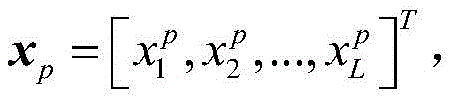 the side lobe interference sample window count k is initialized to 0.
S2, judging whether the main and auxiliary channel data exceed a threshold: and calculating the cross-correlation coefficient between the main channel and the auxiliary channel in the sample window and the power ratio of the auxiliary channel to the main channel, and judging whether the cross-correlation coefficient exceeds the threshold. If both results exceed the threshold, pure side lobe interference data exists in the sample window, and the step S3 is carried out; otherwise, go to step S4.
Taking a data vector in an auxiliary channel sample window Calculating the ratio of the main channel cross correlation coefficient rho to the auxiliary channel cross correlation coefficient gamma power:


let the threshold of cross-correlation coefficient be T 1 And the power ratio threshold is T 2 If rho is more than or equal to T 1 And gamma is not less than T 2 Then go to step S3; otherwise, go to step S4.
S3, calculating a side lobe cancellation parameter in the window: counting the window of interference samples and adding 1, and calculating the P multiplied by P dimensional covariance matrix R among all auxiliary channels in the window k And a P multiplied by 1 dimensional cross-correlation vector r between the main channel and the auxiliary channel k The corresponding calculation method is as follows:
k=k+1 (3)
R k =E{xx H } (4)
r k =E{xd H } (5)
s4, sliding window judgment whether all sample windows are traversed: and judging whether the main lobe interference data discrimination and the side lobe cancellation parameter calculation in all the sample windows are finished or not.
And if the main lobe interference data discrimination and the side lobe cancellation parameter calculation in all the sample windows are finished, the step S5 is executed.
And if the judgment of the main and auxiliary lobe interference data in the sample window and the calculation of the auxiliary lobe cancellation parameter are not finished, taking the main and auxiliary channel data in the next sample window, and turning to the step S2.
S5, side lobe interference judgment and side lobe cancellation processing: and judging the value of the side lobe interference sample window count.
If the side lobe interference sample window count k is zero, no side lobe interference exists, and side lobe cancellation processing is not performed;
if the side lobe interference sample window count k is not zero, calculating an interference cancellation weight value by using the obtained side lobe cancellation parameters in each window, and performing side lobe cancellation processing.
Calculating the final P multiplied by P dimensional covariance matrix R between the auxiliary channels by using the side lobe cancellation parameters in each window obtained in the step S3 xx And the P multiplied by 1 dimension cross correlation vector r between the main channel and the auxiliary channel xd The corresponding calculation method is as follows:


further obtaining a P × 1 dimension side lobe cancellation weight vector and calculating as follows:

and finally, using the auxiliary channel data to cancel the main channel data to obtain an Nx 1-dimensional target echo vector Y after side lobe interference suppression:
Y=D-w H X (9)
wherein D is Nx1 dimension main channel echo data, and X is PxN dimension auxiliary channel echo data.
Claims (1)
1. A side lobe cancellation method for self-adaptive selection of interference samples is characterized by comprising the following steps:
s1 data is segmented into a plurality of sample windows: the main and auxiliary channel echo data are respectively segmented into a plurality of sample windows, and the count of the side lobe interference sample windows is initialized to 0;
s2, judging whether the main channel data and the auxiliary channel data exceed a threshold: calculating the cross-correlation coefficient between the main channel and the auxiliary channel in the sample window and the power ratio of the auxiliary channel to the main channel, and judging whether the cross-correlation coefficient exceeds a threshold or not; if both results exceed the threshold, pure side lobe interference data exists in the sample window, and the step S3 is carried out; otherwise, go to step S4;
s3, calculating a side lobe cancellation parameter in a window: adding 1 to the count of the interference sample window, and calculating a covariance matrix between auxiliary channels in the window and a main and auxiliary channel cross-correlation vector;
s4, sliding window judgment whether all sample windows are traversed: judging whether the main lobe interference data discrimination and the side lobe cancellation parameter calculation in all the sample windows are finished or not; if yes, go to step S5; if not, selecting the main and auxiliary channel data of the next sample window, and turning to the step S2;
s5, side lobe interference judgment and side lobe cancellation processing: judging the value of the side lobe interference sample window count; if the number of the pilot signal is zero, no side lobe interference exists, and side lobe cancellation processing is not performed; if not, calculating the interference cancellation value by using the obtained side lobe cancellation parameters in each window, and performing side lobe cancellation processing.
Priority Applications (1)
| Application Number | Priority Date | Filing Date | Title |
|---|---|---|---|
| CN201910657747.7A CN110412552B (en) | 2019-07-20 | 2019-07-20 | Interference sample self-adaptive selection side lobe cancellation method |
Applications Claiming Priority (1)
| Application Number | Priority Date | Filing Date | Title |
|---|---|---|---|
| CN201910657747.7A CN110412552B (en) | 2019-07-20 | 2019-07-20 | Interference sample self-adaptive selection side lobe cancellation method |
Publications (2)
| Publication Number | Publication Date |
|---|---|
| CN110412552A CN110412552A (en) | 2019-11-05 |
| CN110412552B true CN110412552B (en) | 2023-02-17 |
Family
ID=68362241
Family Applications (1)
| Application Number | Title | Priority Date | Filing Date |
|---|---|---|---|
| CN201910657747.7A Active CN110412552B (en) | 2019-07-20 | 2019-07-20 | Interference sample self-adaptive selection side lobe cancellation method |
Country Status (1)
| Country | Link |
|---|---|
| CN (1) | CN110412552B (en) |
Families Citing this family (8)
| Publication number | Priority date | Publication date | Assignee | Title |
|---|---|---|---|---|
| CN111736119B (en) * | 2020-06-05 | 2024-01-30 | 西安电子科技大学 | Design method for anti-interference treatment of phased array radar |
| CN112162245B (en) * | 2020-09-29 | 2021-06-15 | 中国船舶重工集团公司第七二四研究所 | Radar broadband interference identification method based on time-frequency power spectrum projection |
| CN113030875B (en) * | 2021-04-07 | 2022-10-04 | 北京无线电测量研究所 | Azimuth rotation radar side lobe interference cancellation method based on sliding window weight changing value |
| CN113466803B (en) * | 2021-07-02 | 2024-09-06 | 中国船舶集团有限公司第七二四研究所 | Radar main lobe false target interference rejection method based on corrected cross-correlation coefficient |
| CN113691479B (en) * | 2021-07-15 | 2023-05-23 | 中国电子科技集团公司第二十九研究所 | Method and device for eliminating side lobe influence of signal and readable storage medium |
| CN114063021B (en) * | 2021-10-24 | 2025-06-13 | 西安电子工程研究所 | An Adaptive Cancellation Method for Sidelobe Sweep Frequency Interference |
| CN115201767A (en) * | 2022-05-18 | 2022-10-18 | 中国人民解放军63961部队 | Side lobe cancellation method for smart interference |
| CN115097394A (en) * | 2022-05-25 | 2022-09-23 | 安徽博微长安电子有限公司 | A Method for Selecting Sidelobe Cancellation Interference Samples |
Citations (9)
| Publication number | Priority date | Publication date | Assignee | Title |
|---|---|---|---|---|
| US6121914A (en) * | 1975-07-17 | 2000-09-19 | Lockheed Martin Corporation | Sidelobe canceller with correlation signal weight sampling during transient |
| CN105259542A (en) * | 2015-11-13 | 2016-01-20 | 河海大学 | Improved radar sidelobe interference method |
| CN105652246A (en) * | 2015-12-29 | 2016-06-08 | 河海大学 | Main lobe interference resisting method of radar based on blind source separation |
| CN105785330A (en) * | 2016-03-02 | 2016-07-20 | 河海大学 | Cognitive minor lobe interference suppression method |
| CN106980110A (en) * | 2017-02-16 | 2017-07-25 | 武汉滨湖电子有限责任公司 | A kind of sidelobe cancellation method of adaptive confrontation active pressing jamming containing multipath |
| CN107561502A (en) * | 2017-08-15 | 2018-01-09 | 武汉大学 | A kind of portable high frequency groundwave radar Radio frequency interference suppressing method |
| CN107561511A (en) * | 2017-07-27 | 2018-01-09 | 中国船舶重工集团公司第七二四研究所 | A kind of disturbance restraining method based on sidelobe cancellation |
| CN108152796A (en) * | 2017-12-01 | 2018-06-12 | 北京理工大学 | A kind of main lobe based on grey-kalman filtering moves interference elimination method |
| CN109507643A (en) * | 2018-11-01 | 2019-03-22 | 南京邮电大学 | The method of null-broadening in sidelobe cancellation |
-
2019
- 2019-07-20 CN CN201910657747.7A patent/CN110412552B/en active Active
Patent Citations (9)
| Publication number | Priority date | Publication date | Assignee | Title |
|---|---|---|---|---|
| US6121914A (en) * | 1975-07-17 | 2000-09-19 | Lockheed Martin Corporation | Sidelobe canceller with correlation signal weight sampling during transient |
| CN105259542A (en) * | 2015-11-13 | 2016-01-20 | 河海大学 | Improved radar sidelobe interference method |
| CN105652246A (en) * | 2015-12-29 | 2016-06-08 | 河海大学 | Main lobe interference resisting method of radar based on blind source separation |
| CN105785330A (en) * | 2016-03-02 | 2016-07-20 | 河海大学 | Cognitive minor lobe interference suppression method |
| CN106980110A (en) * | 2017-02-16 | 2017-07-25 | 武汉滨湖电子有限责任公司 | A kind of sidelobe cancellation method of adaptive confrontation active pressing jamming containing multipath |
| CN107561511A (en) * | 2017-07-27 | 2018-01-09 | 中国船舶重工集团公司第七二四研究所 | A kind of disturbance restraining method based on sidelobe cancellation |
| CN107561502A (en) * | 2017-08-15 | 2018-01-09 | 武汉大学 | A kind of portable high frequency groundwave radar Radio frequency interference suppressing method |
| CN108152796A (en) * | 2017-12-01 | 2018-06-12 | 北京理工大学 | A kind of main lobe based on grey-kalman filtering moves interference elimination method |
| CN109507643A (en) * | 2018-11-01 | 2019-03-22 | 南京邮电大学 | The method of null-broadening in sidelobe cancellation |
Also Published As
| Publication number | Publication date |
|---|---|
| CN110412552A (en) | 2019-11-05 |
Similar Documents
| Publication | Publication Date | Title |
|---|---|---|
| CN110412552B (en) | Interference sample self-adaptive selection side lobe cancellation method | |
| CN107561512B (en) | Polarization cancellation method for pulse Doppler radar compression-resistant system towing interference | |
| CN109444820B (en) | Method for detecting target after interference suppression of multi-channel radar when clutter and interference coexist | |
| CN112612005B (en) | Anti-mainlobe jamming method of radar based on deep learning | |
| CN101226236A (en) | Adaptive interference suppression method for sky-wave over-the-horizon radar based on sidelobe constraints | |
| CN101881822B (en) | Method for inhibiting same frequency interference of shared-spectrum radars | |
| CN106842140B (en) | A kind of main lobe interference suppression method based on difference beam dimensionality reduction | |
| CN112763984A (en) | A Radar Adaptive Sidelobe Cancellation Algorithm | |
| CN110764069B (en) | Sparse recovery STAP color loading method based on knowledge assistance | |
| CN106680784A (en) | Self-adaptive wave beam formation method | |
| CN110988831A (en) | Parameter adjustable detector for signal mismatch in clutter and interference coexistence environment | |
| CN112835000B (en) | Self-adaptive detection method under non-uniform clutter and interference condition | |
| CN114879226B (en) | A satellite navigation array anti-interference method based on intelligent perception | |
| CN105510887A (en) | Method for inhibiting active suppressing jamming to airborne radar under clutter background | |
| CN112558015A (en) | Method and system for interference suppression before self-adaptive detection in complex electromagnetic environment | |
| CN113419219A (en) | Outer radiation source radar same frequency interference cascade cancellation method based on spatial domain feature cognition | |
| CN111090089A (en) | A spatiotemporal adaptive detection method based on two types of auxiliary data | |
| CN111796242A (en) | Improved block sparse Bayesian anti-interference method based on power characteristic value extraction | |
| CN118033577A (en) | Frequency division orthogonal FDA-MIMO radar non-uniform clutter suppression method, device and electronic equipment | |
| CN110927693B (en) | Pulse compression method combining matched filtering with sparse inversion | |
| CN108152796A (en) | A kind of main lobe based on grey-kalman filtering moves interference elimination method | |
| CN113466805A (en) | Multi-base radar anti-interference method based on space power characteristic domain | |
| CN113341381A (en) | Full-automatic anti-radar side lobe interference system | |
| CN109239678B (en) | A portable high-frequency ground wave radar radio frequency interference suppression method | |
| CN112327305A (en) | Rapid frequency domain broadband MVDR sonar wave beam forming method |
Legal Events
| Date | Code | Title | Description |
|---|---|---|---|
| PB01 | Publication | ||
| PB01 | Publication | ||
| SE01 | Entry into force of request for substantive examination | ||
| SE01 | Entry into force of request for substantive examination | ||
| GR01 | Patent grant | ||
| GR01 | Patent grant |