CN110020552B - A cross-component tainted data stream splicing method for Android applications based on finite state automata - Google Patents
A cross-component tainted data stream splicing method for Android applications based on finite state automata Download PDFInfo
- Publication number
- CN110020552B CN110020552B CN201910278560.6A CN201910278560A CN110020552B CN 110020552 B CN110020552 B CN 110020552B CN 201910278560 A CN201910278560 A CN 201910278560A CN 110020552 B CN110020552 B CN 110020552B
- Authority
- CN
- China
- Prior art keywords
- data stream
- flow
- tainted
- taint
- state
- Prior art date
- Legal status (The legal status is an assumption and is not a legal conclusion. Google has not performed a legal analysis and makes no representation as to the accuracy of the status listed.)
- Active
Links
Images


Classifications
-
- G—PHYSICS
- G06—COMPUTING OR CALCULATING; COUNTING
- G06F—ELECTRIC DIGITAL DATA PROCESSING
- G06F21/00—Security arrangements for protecting computers, components thereof, programs or data against unauthorised activity
- G06F21/60—Protecting data
- G06F21/62—Protecting access to data via a platform, e.g. using keys or access control rules
- G06F21/6218—Protecting access to data via a platform, e.g. using keys or access control rules to a system of files or objects, e.g. local or distributed file system or database
- G06F21/6245—Protecting personal data, e.g. for financial or medical purposes
- G06F21/6263—Protecting personal data, e.g. for financial or medical purposes during internet communication, e.g. revealing personal data from cookies
Landscapes
- Engineering & Computer Science (AREA)
- Health & Medical Sciences (AREA)
- Bioethics (AREA)
- General Health & Medical Sciences (AREA)
- Theoretical Computer Science (AREA)
- Computer Hardware Design (AREA)
- Databases & Information Systems (AREA)
- Computer Security & Cryptography (AREA)
- Software Systems (AREA)
- Physics & Mathematics (AREA)
- General Engineering & Computer Science (AREA)
- General Physics & Mathematics (AREA)
- Medical Informatics (AREA)
- Stored Programmes (AREA)
- Mobile Radio Communication Systems (AREA)
Abstract
本发明提出了一种基于有限状态自动机的Android应用跨组件污点数据流拼接方法,首先提取Android应用的组件间的调用关系与组件内的污点数据流,然后依据污点数据流的Source点与Sink点进行分类,组成污点数据流序列集,最后建立有限自动机模型,判断各污点数据流序列能否进行拼接,对能够进行拼接的污点数据流序列,拼接形成跨组件污点数据流,获得Android应用跨组件污点数据流集。本发明所提出的跨组件污点数据流拼接方法,能得到正确的Android应用跨组件污点数据流,且能减少空间开销。
The invention proposes a cross-component tainted data stream splicing method for Android applications based on finite state automata. First, the calling relationship between the components of the Android application and the tainted data stream in the components are extracted, and then the source point and the sink of the tainted data stream are extracted according to the source point of the tainted data stream. Classify the points to form a taint data stream sequence set, and finally establish a finite automaton model to determine whether each taint data stream sequence can be spliced, splicing the taint data stream sequences that can be spliced to form a cross-component taint data stream, and obtain an Android application A set of tainted data flows across components. The cross-component taint data stream splicing method proposed by the present invention can obtain the correct Android application cross-component taint data stream, and can reduce the space overhead.
Description
技术领域technical field
本发明涉及移动端安全领域,特别是一种基于有限状态自动机的Android应用跨组件污点数据流拼接方法。The invention relates to the field of mobile terminal security, in particular to a method for splicing cross-component taint data streams of Android applications based on finite state automata.
背景技术Background technique
随着移动互联网技术的发展以及移动端智能设备的普及,移动互联网在生活中逐渐占据了重要的地位。移动端智能设备存储了大量用户隐私信息,随之而来的隐私泄露问题逐渐被人们所关注。With the development of mobile Internet technology and the popularization of mobile smart devices, mobile Internet has gradually occupied an important position in life. Mobile smart devices store a large amount of user privacy information, and the ensuing privacy leakage problem has gradually attracted people's attention.
污点数据流分析是一种用来获取相关数据沿着程序执行路径流动的程序信息分析技术。污点数据流分析是常见的分析程序中数据传播的一种方法,通过对程序中的敏感数据进行污点标记,利用数据流分析技术跟踪标记的数据在程序中的传播,来检测程序中是否存在安全隐患问题。污点数据流分析在Android应用的安全漏洞检测、污点数据泄露检测等安全方面具有广泛应用。Tainted data flow analysis is a program information analysis technique used to obtain relevant data flowing along the program execution path. Tainted data flow analysis is a common method of analyzing data propagation in a program. By marking sensitive data in the program with taint, and using data flow analysis technology to track the spread of the marked data in the program, it can detect whether there is security in the program. Hidden problem. Tainted data flow analysis has a wide range of applications in the security aspects of Android application security vulnerability detection, tainted data leakage detection and so on.
现有Android应用的污点数据流分析按照技术大致可以分为两个方向:动态污点数据流分析,静态污点数据流分析。由于动态污点数据流分析的实现与Android平台的版本有关,不同的设备生产商对自己生产的设备会进行不同程度的定制,Android系统自身也在不断发展,这使得动态分析在兼容性方面的局限性较大。静态污点数据流分析则无需考虑Android环境的问题,具有较好的兼容性。The taint data flow analysis of existing Android applications can be roughly divided into two directions according to the technology: dynamic taint data flow analysis and static taint data flow analysis. Since the implementation of dynamic taint data flow analysis is related to the version of the Android platform, different device manufacturers will customize their own devices to varying degrees, and the Android system itself is also constantly developing, which makes dynamic analysis limited in terms of compatibility. Sex is greater. Static taint data flow analysis does not need to consider the Android environment and has better compatibility.
Android应用具有跨组件通信的特性,会发生多个组件联合泄露数据等安全问题,因此有必要对应用内跨组件污点数据流进行分析。现有的分析方法首先拼接出整体组件调用图,再在整体组件调用图上进行组件间的污点数据流分析,得到跨组件污点数据流。该方法需要先拼接出整体组件调用图,而整体组件调用图所需的存储空间大。因此,有必要设计一种能够解决该问题的跨组件污点数据流获取方法。Android applications have the characteristics of cross-component communication, and security issues such as joint data leakage of multiple components may occur. Therefore, it is necessary to analyze the cross-component taint data flow in the application. The existing analysis method first splices out the overall component call graph, and then analyzes the taint data flow between components on the overall component call graph to obtain the cross-component taint data flow. This method needs to splicing out the overall component call graph first, and the overall component call graph requires a large storage space. Therefore, it is necessary to design a cross-component tainted data flow acquisition method that can solve this problem.
发明内容SUMMARY OF THE INVENTION
本发明所解决的技术问题,针对现有技术的不足,提供一种跨组件污点数据流拼接方法,通过组件间的调用关系和组件内的污点数据流获得跨组件污点数据流,能减少空间开销。The technical problem solved by the present invention, aiming at the deficiencies of the prior art, provides a cross-component tainted data stream splicing method, which obtains the cross-component tainted data stream through the calling relationship between the components and the tainted data stream within the component, which can reduce the space overhead. .
本发明的技术解决方案如下:The technical solution of the present invention is as follows:
一种基于有限状态自动机的Android应用跨组件污点数据流拼接方法,包括以下步骤:A method for splicing cross-component taint data streams of Android applications based on finite state automata, comprising the following steps:
步骤1:提取Android应用的组件调用参数,确定组件间调用关系;并提取Android应用组件内的污点数据流,存储其相关信息;Step 1: extract the component calling parameters of the Android application, determine the calling relationship between the components; and extract the taint data flow in the Android application component, and store its related information;
步骤2:依据污点数据流的Source点与Sink点情况,对Android应用组件内的污点数据流进行分类;Step 2: Classify the taint data stream in the Android application component according to the source point and sink point of the taint data stream;
步骤3:将分类后的污点数据流,按照组件间调用关系,组成多条污点数据流序列,由所有污点数据流序列组成污点数据流序列集;Step 3: The classified taint data streams are formed into multiple taint data stream sequences according to the calling relationship between components, and all taint data stream sequences form a taint data stream sequence set;
步骤4:建立污点数据流拼接自动机模型;将上述污点数据流序列集中的各条污点数据流序列分别输入污点数据流拼接自动机模型进行处理,判断能否进行拼接;Step 4: establish a splicing automaton model of tainted data stream; input each tainted data stream sequence in the above tainted data stream sequence set into the splicing automaton model of tainted data stream respectively for processing, and judge whether the splicing can be performed;
步骤5:分别对每条能够拼接的污点数据流序列,将其中的污点数据流按顺序拼接,形成跨组件污点数据流;由所有跨组件污点数据流组成跨组件污点数据流集。Step 5: For each splicable tainted data stream sequence, splicing the tainted data streams in sequence to form a cross-component tainted data stream; all cross-component tainted data streams form a cross-component tainted data stream set.
进一步地,所述步骤1中,自定义结构体flow用于存储污点数据流的相关信息,结构体flow包括组件名、Source点、Sink点、读取键集Kg、存放键集Kp、和映射表f;其中组件名表示污点数据流所在组件,Source点表示污点数据流的入点,Sink点表示污点数据流的出点;读取键集Kg表示污点数据流中读取Intent中数据的键的集合;存放键集Kp表示污点数据流中于Intent存放数据的键的集合;映射表f用于表示读取键集Kg和存放键集Kp之间的元素的对应关系;若Kg中的元素g1与Kp中的元素p对应同一个数据,则g1的对应关系为g1:{g1,p},其中{g1,p}为g1映射后的元素集合;若Kg中的元素g2与Kp中的任何元素都没有对应关系,即集合Kp中不存在与g2对应同一个数据的元素,则g2的对应关系为g2:{g2}。Further, in the
进一步地,所述步骤2中,依据污点数据流的Source点与Sink点情况,将Android应用组件内的污点数据流分为N、S、D和M四种类型,具体如下:Further, in the
N类型污点数据流的source点为直接获取敏感数据的API,sink点为直接发送敏感数据的API;The source point of the N-type tainted data stream is the API that directly obtains sensitive data, and the sink point is the API that directly sends sensitive data;
S类型污点数据流的source点为直接获取敏感数据的API,sink点为组件调用API;The source point of the S-type taint data stream is the API for directly obtaining sensitive data, and the sink point is the component calling API;
D类型污点数据流的source点为组件调用API,sink点为直接发送敏感数据的API;The source point of the D-type taint data stream is the component calling API, and the sink point is the API that directly sends sensitive data;
M类型污点数据流的source点为组件调用API,sink点为组件调用API。The source point of the M-type taint data stream is the component calling API, and the sink point is the component calling API.
进一步地,所述步骤3中,污点数据流序列有两种形式;Further, in the
1)包含2条污点数据流,表示为flow1,flow2,其中flow1为S类型污点数据流、flow2为D类型污点数据流,且flow1和flow2所在组件满足组件调用关系;1) Contains 2 tainted data streams, represented as flow 1 and flow 2 , where flow 1 is an S-type tainted data stream, flow 2 is a D-type tainted data stream, and the components where flow 1 and flow 2 are located satisfy the component calling relationship;
2)包含3条以上污点数据流,表示为flow1,...,flowi,...,flown,其中1<i<n,n≥3,flow1为S类型污点数据流,flow2~flown-1为M类型污点数据流,flown为D类型污点数据流,且两条相邻的污点数据流flowj-1和flowj所在组件满足组件调用关系,其中2≤j≤n。2) Contains more than 3 tainted data flows, expressed as flow 1 , ..., flow i , ..., flow n , where 1<i<n, n≥3, flow 1 is an S-type tainted data flow, flow 2 ~flow n-1 is an M-type tainted data flow, flow n is a D-type tainted data flow, and the components where the two adjacent tainted data flows flow j-1 and flow j are located satisfy the component calling relationship, where 2≤j≤ n.
进一步地,所述步骤4中,污点数据流拼接自动机模型的状态包括:Further, in the
state0:自动机初始态,此时自动机内没有污点数据流;state 0 : the initial state of the automaton, there is no tainted data flow in the automaton at this time;
state1:自动机拼接状态;state 1 : automaton splicing state;
state2:自动机拼接终止态;state 2 : automaton splicing termination state;
state3:自动机错误终止态;state 3 : automaton error termination state;
所述步骤4中,将污点数据流序列集中的每条污点数据流序列分别输入污点数据流拼接自动机模型进行处理,判断各条污点数据流序列能够进行拼接的方法为:In the
步骤4.1:自动机进入state0态,等待输入污点数据流序列,设置当前污点数据流c为空;Step 4.1: The automaton enters the state 0 state, waits for the input taint data stream sequence, and sets the current taint data stream c to be empty;
步骤4.2:输入一个污点数据流序列,并读入其中的第一条污点数据流;若读入的污点数据流是S类型污点数据流,则保存当前污点数据流c为读入的S类型污点数据流,自动机状态转换为state1,转步骤4.3;否则,自动机状态转换为state3,转步骤4.5;Step 4.2: Input a tainted data stream sequence, and read the first tainted data stream in it; if the read tainted data stream is an S-type tainted data stream, save the current tainted data stream c as the read S-type tainted data stream Data flow, the state of the automaton is converted to state 1 , go to step 4.3; otherwise, the state of the automaton is converted to state 3 , go to step 4.5;
步骤4.3:从输入的污点数据流序列中读入下一条污点数据流flowi;Step 4.3: Read the next tainted data stream flow i from the input tainted data stream sequence;
(1)若读入的污点数据流flowi为M类型污点数据流,则将当前污点数据流c的组件名改为flowi的组件名,将当前污点数据流c的Sink点改为flowi的Sink点,将当前污点数据流c的存放键集Kp中与flowi的读取键集Kg中相同的元素,按照flowi的映射表中该元素的对应关系,改为映射后的元素,自动机状态仍为state1,转步骤4.3继续读入下一条污点数据流;(1) If the read taint data stream flow i is an M-type taint data stream, change the component name of the current taint data stream c to the component name of flow i , and change the sink point of the current taint data stream c to flow i Sink point, change the same element in the storage key set Kp of the current taint data stream c and the read key set Kg of flow i into the mapped element according to the corresponding relationship of the element in the mapping table of flow i , The state of the automaton is still state 1 , go to step 4.3 to continue reading the next tainted data stream;
(2)若读入的污点数据流flowi为D类型污点数据流,且当前污点数据流c的存放键集Kp与flowi的读取键集Kg的交集非空,则将当前污点数据流c的组件名改为flowi的组件名、Sink点改为flowi的Sink点、存放键集Kg改为空,自动机状态转换为state2,转步骤4.4,否则,自动机状态转换为state3,转步骤4.5;(2) If the read taint data stream flow i is a D-type taint data stream, and the intersection of the storage key set Kp of the current taint data stream c and the read key set Kg of flow i is not empty, then the current taint data stream The component name of c is changed to the component name of flow i , the sink point is changed to the sink point of flow i , the storage key set Kg is changed to empty, the state of the automaton is converted to state 2 , go to step 4.4, otherwise, the state of the automaton is converted to state 3 , go to step 4.5;
(3)若读入的污点数据流为其它类型污点数据流,自动机状态转换为state3;(3) If the read-in tainted data stream is another type of tainted data stream, the state of the automaton is converted to state 3 ;
步骤4.4:输出当前污点数据流序列能够拼接的信息;Step 4.4: Output the information that the current taint data stream sequence can be spliced;
步骤4.5:输出当前污点数据流序列不能拼接的信息。Step 4.5: Output the information that the current taint data stream sequence cannot be spliced.
有益效果:Beneficial effects:
本发明提出了一种跨组件污点数据流拼接方法,采用“分而治之”的思想,先逐个分析每个组件调用图中的污点数据流,得到组件内的污点数据流,然后将组件内污点数据流按组件调用关系和数据关系进行拼接,形成跨组件污点数据流。本发明能得到正确的Android应用跨组件污点数据流,且相比现有的分析方法,能减少空间开销,同时还具有扩展性。The invention proposes a cross-component tainted data stream splicing method, which adopts the idea of "divide and conquer", first analyzes the tainted data stream in the call graph of each component one by one, obtains the tainted data stream in the component, and then combines the tainted data stream in the component Splicing according to component calling relationship and data relationship to form cross-component tainted data flow. The invention can obtain the correct Android application cross-component taint data flow, and compared with the existing analysis method, the space overhead can be reduced, and the expansibility is also provided.
附图说明Description of drawings
图1为组件内污点数据流分类示意图;Figure 1 is a schematic diagram of the classification of taint data flow in a component;
图2为污点数据流序列示意图;Figure 2 is a schematic diagram of a taint data flow sequence;
图3为污点数据流拼接自动机模型图;Fig. 3 is the model diagram of the splicing automaton of tainted data stream;
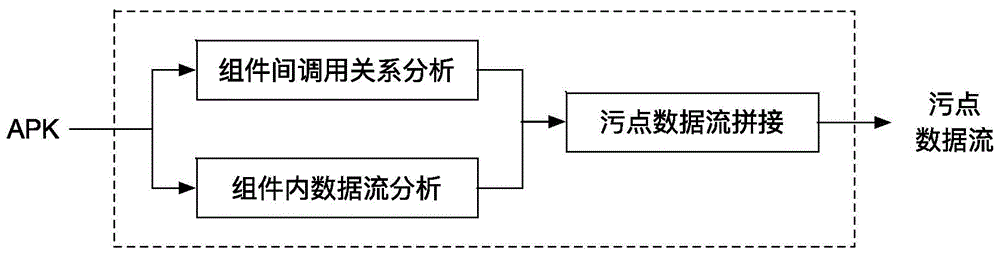
图4为跨组件污点数据流拼接方法分析框架图;Fig. 4 is the analysis frame diagram of cross-component taint data stream splicing method;
图5为市场应用内存占用对比图。Figure 5 is a comparison diagram of the memory usage of market applications.
具体实施方式Detailed ways
以下将结合附图和具体实施例对本发明做进一步详细说明:The present invention will be described in further detail below in conjunction with the accompanying drawings and specific embodiments:
实施例1:Example 1:
本实施例说明上述方法的具体步骤。This embodiment illustrates the specific steps of the above method.
图4是本发明一种基于有限状态自动机的Android应用跨组件污点数据流拼接方法分析框架图,具体步骤如下:Fig. 4 is a kind of analysis frame diagram of Android application cross-component taint data stream splicing method based on finite state automata of the present invention, and the concrete steps are as follows:
步骤1:提取Android应用的组件调用参数,确定组件间调用关系,并将组件内污点数据流相关信息存入自定义结构体flow中;Step 1: Extract the component calling parameters of the Android application, determine the calling relationship between components, and store the information about the taint data flow in the component into the custom structure flow;
步骤1.1:从Android应用中提取各个组件的Intent与Intent Filter参数,通过匹配Intent与Intent Filter,来确定组件间的调用关系。Step 1.1: Extract the Intent and Intent Filter parameters of each component from the Android application, and determine the calling relationship between components by matching the Intent and Intent Filter.
使用现有工具IC3分析出Android应用内组件调用的Intent和Intent Filter的参数,根据Android官方文档,将源组件的Intent与目标组件的Intent Filer匹配,从而确定组件间的调用关系。Use the existing tool IC3 to analyze the parameters of the Intent and Intent Filter called by the components in the Android application. According to the official Android document, match the Intent of the source component with the Intent Filer of the target component to determine the calling relationship between components.
步骤1.2:从Android应用中提取组件内的污点数据流,将提取到的污点数据流相关信息存入自定义结构体flow中;Step 1.2: Extract the taint data flow in the component from the Android application, and store the extracted taint data flow related information in the custom structure flow;
自定义的结构体定义为:The custom structure is defined as:

其中,comp表示污点数据流所在组件,source表示污点数据流的入点,sink表示污点数据流的出点。Among them, comp represents the component where the tainted data stream is located, source represents the in-point of the tainted data stream, and sink represents the out-point of the tainted data stream.
集合Kg表示污点数据流中读取Intent中数据的键的集合,键由污点数据流中的getExtra()中的参数提取而来,提取到的这一类键构成集合Kg。The set Kg represents the set of keys for reading the data in the Intent in the tainted data stream. The keys are extracted from the parameters in getExtra() in the tainted data stream, and the extracted keys form the set Kg.
集合Kp表示污点数据流中于Intent存放数据的键的集合,键由污点数据流中的putExtra()中的第一个参数提取而来,提取到的这一类键构成集合Kp。The set Kp represents the set of keys that store data in the Intent in the tainted data stream. The key is extracted from the first parameter in putExtra() in the tainted data stream, and the extracted keys form the set Kp.
映射表用于表示集合Kg和集合Kp之间的元素的对应关系;若集合Kg中的元素g1与集合Kp中的元素p对应同一个数据,则g1的映射表为g1:{g1,p};若集合Kg中的元素g2与集合Kp中的任何元素都没有对应关系(集合Kp中不存在与g2对应同一个数据的元素),则g2的对应关系为g2:{g2};此时的映射表为{g1:{g1,p},{g2:{g2}}。The mapping table is used to represent the correspondence between elements in the set Kg and the set Kp; if the element g1 in the set Kg corresponds to the same data as the element p in the set Kp, the mapping table of g1 is g1:{g1,p} ; If the element g2 in the set Kg has no corresponding relationship with any element in the set Kp (there is no element corresponding to the same data as g2 in the set Kp), then the corresponding relationship of g2 is g2:{g2}; The mapping table is {g1:{g1,p},{g2:{g2}}.
本实施例中,分析得到应用Firstapp.apk的调用关系如下:In this embodiment, the calling relationship of the application Firstapp.apk is obtained by analysis as follows:
Firstapp.apk应用有5个组件,分别是com.example.Firstapp.Comp1、com.example.Firstapp.Comp2、com.example.Firstapp.Comp3、com.example.Firstapp.Comp4、com.example.Firstapp.Comp5。其中,The Firstapp.apk application has 5 components, namely com.example.Firstapp.Comp1, com.example.Firstapp.Comp2, com.example.Firstapp.Comp3, com.example.Firstapp.Comp4, com.example.Firstapp.Comp5 . in,
com.example.Firstapp.Comp1调用com.example.Firstapp.Comp3,com.example.Firstapp.Comp3调用com.example.Firstapp.Comp4,记为com.example.Firstapp.Comp1->com.example.Firstapp.Comp3->com.example.Firstapp.Comp4;com.example.Firstapp.Comp1 calls com.example.Firstapp.Comp3, com.example.Firstapp.Comp3 calls com.example.Firstapp.Comp4, recorded as com.example.Firstapp.Comp1->com.example.Firstapp.Comp3 ->com.example.Firstapp.Comp4;
com.example.Firstapp.Comp2调用com.example.Firstapp.Comp5,记为com.example.Firstapp.Comp2->com.example.Firstapp.Comp5。com.example.Firstapp.Comp2 calls com.example.Firstapp.Comp5, recorded as com.example.Firstapp.Comp2->com.example.Firstapp.Comp5.
Firstapp.apk中有7条污点数据流,如下:There are 7 tainted data streams in Firstapp.apk, as follows:
flow1{com.example.Firstapp.Comp1,getDeviceId(),d(java.lang.String,java.lang.String),{},{},{}};flow1{com.example.Firstapp.Comp1,getDeviceId(),d(java.lang.String,java.lang.String),{},{},{}};
flow2{com.example.Firstapp.Comp1,getDeviceId(),startActivity(android.content.Intent),{},{"str1"},{}};flow2{com.example.Firstapp.Comp1,getDeviceId(),startActivity(android.content.Intent),{},{"str1"},{}};
flow3{com.example.Firstapp.Comp2,getLatitude(),sendBroadcast(android.content.Intent),{},{},{}};flow3{com.example.Firstapp.Comp2,getLatitude(),sendBroadcast(android.content.Intent),{},{},{}};
flow4{com.example.Firstapp.Comp4,getIntent(),write(byte[]),{"str1"},{},{}};flow4{com.example.Firstapp.Comp4,getIntent(),write(byte[]),{"str1"},{},{}};
flow5{com.example.Firstapp.Comp3,getIntent(),d(java.lang.String,java.lang.String),{"str3"},{},{}};flow5{com.example.Firstapp.Comp3,getIntent(),d(java.lang.String,java.lang.String),{"str3"},{},{}};
flow6{com.example.Firstapp.Comp3,getIntent(),startActivity(android.content.Intent),{"str4"},{"str2"},{"str4":{"str4","str2"}}};flow6{com.example.Firstapp.Comp3,getIntent(),startActivity(android.content.Intent),{"str4"},{"str2"},{"str4":{"str4","str2"}} };
flow7{com.example.Firstapp.Comp5,getIntent(),sendBroadcast(android.content.Intent),{},{},{}};flow7{com.example.Firstapp.Comp5,getIntent(),sendBroadcast(android.content.Intent),{},{},{}};
步骤2:依据污点数据流的Source点与Sink点情况,对组件内污点数据流进行分类;Step 2: Classify the taint data stream in the component according to the source point and sink point of the taint data stream;
使用组件内污点数据流分析工具FlowDroid分析出组件内的污点数据流,以定义好的结构体存储,并依据污点数据流的Source点和Sink点情况,将组件内的污点数据流进行分类,分成N、S、D、M四类。,如图1所示。其中Use FlowDroid, an analysis tool for taint data flow in components, to analyze the taint data flow in the component, store it in a defined structure, and classify the taint data flow in the component according to the source point and sink point of the taint data flow. N, S, D, M four categories. ,As shown in Figure 1. in
source点为直接获取敏感数据的API,sink点为直接发送敏感数据的API的污点数据流为N类型污点数据流,该类型污点数据流中,读取键集Kg为空、存放键集Kp为空、映射关系f为空;The source point is an API that directly obtains sensitive data, and the sink point is an API that directly sends sensitive data. The tainted data stream is an N-type tainted data stream. In this type of tainted data stream, the read key set Kg is empty, and the storage key set Kp is Empty, the mapping relationship f is empty;
source点为直接获取敏感数据的API,sink点为组件调用API的污点数据流为S类型污点数据流,该类型污点数据流中,读取键集Kg为空、存放键集Kp非空、映射关系f为空;The source point is the API that directly obtains sensitive data, and the sink point is the tainted data stream that the component calls the API. The tainted data stream is S-type tainted data stream. In this type of tainted data stream, the read key set Kg is empty, the storage key set Kp is not empty, and the mapping relation f is empty;
source点为组件调用API,sink点为直接发送敏感数据的API的污点数据流为D类型污点数据流,该类型污点数据流中,读取键集Kg非空、存放键集Kp为空、映射关系f为空;The source point is the component calling API, and the sink point is the API that directly sends sensitive data. The tainted data stream is a D-type tainted data stream. In this type of tainted data stream, the read key set Kg is not empty, the storage key set Kp is empty, and the mapping relation f is empty;
source点为组件调用API,sink点为组件调用API的污点数据流为M类型污点数据流,该类型污点数据流中,读取键集Kg、存放键集Kp和映射关系f要么全空,要么全部非空;The source point is the component calling API, the sink point is the component calling API tainted data stream is M type tainted data stream, in this type of tainted data stream, the read key set Kg, the storage key set Kp and the mapping relationship for are either all empty, or all non-empty;
本实施例中,应用myapp.apk中的组件内污点数据流分类情况为:In this embodiment, the classification of the taint data flow in the component in the application myapp.apk is:
N类型污点数据流有flow1;N-type taint data flow has flow1;
S类型污点数据流有flow2、flow3;S-type taint data flow has flow2, flow3;
D类型污点数据流有flow4、flow5;D-type taint data flow has flow4, flow5;
M类型污点数据流有flow6、flow7;M-type taint data flow has flow6, flow7;
步骤3:将分类后的污点数据流按组件间调用关系组成污点数据流序列集;Step 3: The classified taint data flow is formed into a taint data flow sequence set according to the calling relationship between components;
污点数据流序列有两种形式;There are two forms of tainted data stream sequences;
1)包含2条污点数据流,表示为flow1,flow2,其中flow1为S类型污点数据流、flow2为D类型污点数据流,且flow1和flow2所在组件满足组件调用关系;1) Contains 2 tainted data streams, represented as flow 1 and flow 2 , where flow 1 is an S-type tainted data stream, flow 2 is a D-type tainted data stream, and the components where flow 1 and flow 2 are located satisfy the component calling relationship;
2)包含3条以上污点数据流,表示为flow1,...,flowi..,.,flown,其中1<i<n,n≥3,flow1为S类型污点数据流、flow2~flown-1为M类型污点数据流、flown为D类型污点数据流,且两条相邻的污点数据流flowj-1和flowj所在组件满足组件调用关系,其中2≤j≤n。如图2所示。2) Contains more than 3 tainted data flows, expressed as flow 1 , . . . , flow i .. , . 2 ~flow n - 1 is an M-type tainted data flow, flow n is a D-type tainted data flow, and the components where the two adjacent tainted data flows flow j - 1 and flow j are located satisfy the component calling relationship, where 2≤j≤ n. as shown in
将分类后的污点数据流,按照组件调用关系,组成污点数据流序列,将污点数据流序列组成污点数据流序列集。The classified taint data stream is formed into a taint data stream sequence according to the component calling relationship, and the taint data stream sequence is formed into a taint data stream sequence set.
本实施例中,在应用Firstapp.apk中由组件调用关系得到两条跨组件污点数据流:In this embodiment, two cross-component taint data streams are obtained from the component calling relationship in the application Firstapp.apk:
(1)由com.example.Firstapp.Comp1->com.example.Firstapp.Comp3->com.example.Firstapp.Comp4,可知污点数据流序列为flow2-flow6-flow4;(1) From com.example.Firstapp.Comp1->com.example.Firstapp.Comp3->com.example.Firstapp.Comp4, it can be seen that the tainted data flow sequence is flow2-flow6-flow4;
(2)com.example.Firstapp.Comp2->com.example.Firstapp.Comp5,得到flow2-flow5;(2) com.example.Firstapp.Comp2->com.example.Firstapp.Comp5, get flow2-flow5;
从而,得到污点数据流序列集合为:{flow2-flow6-flow4,flow2-flow5}。Thus, the set of tainted data flow sequences is obtained as: {flow2-flow6-flow4, flow2-flow5}.
步骤4:建立污点数据流拼接自动机模型,将上述污点数据流序列集合中的污点数据流序列依次输入污点数据流拼接自动机进行处理,从而获得跨组件污点数据流集;Step 4: establishing a taint data stream splicing automaton model, and sequentially inputting the taint data stream sequences in the above taint data stream sequence set into the taint data stream splicing automaton for processing, thereby obtaining a cross-component taint data stream set;
污点数据流拼接自动机模型包含四个状态,分别是:The tainted data stream splicing automaton model contains four states, namely:
state0:自动机初始态,此时自动机内没有污点数据流;state 0 : the initial state of the automaton, there is no tainted data flow in the automaton at this time;
state1:自动机内的当前污点数据流为S类型污点数据流时的状态;state 1 : the state when the current tainted data stream in the automaton is an S-type tainted data stream;
state2:自动机内的当前污点数据流为N类型污点数据流时的状态,为自动机拼接终止态;state 2 : the state when the current tainted data stream in the automaton is an N-type tainted data stream, which is the termination state of the automaton splicing;
state3:自动机错误终止态。state 3 : The automaton error termination state.
步骤4.1:自动机进入state0态,等待输入污点数据流序列,设置当前污点数据流c为空;Step 4.1: The automaton enters the state 0 state, waits for the input taint data stream sequence, and sets the current taint data stream c to be empty;
步骤4.2:自动机状态为state0时,从输入的污点数据流序列中读入第一条污点数据流。若读入的污点数据流是S类型污点数据流,保存当前污点数据流c为读入的S类型污点数据流,状态转换为state1;否则,自动机转换为state3;Step 4.2: When the state of the automaton is state 0 , read the first tainted data stream from the input tainted data stream sequence. If the read tainted data stream is an S-type tainted data stream, save the current tainted data stream c as the read S-type tainted data stream, and the state is converted to state 1 ; otherwise, the automaton is converted to state 3 ;
步骤4.3:自动机状态为state1时,从输入的污点数据流序列中读入下一条污点数据流。Step 4.3: When the state of the automaton is state 1 , read the next tainted data stream from the input tainted data stream sequence.
(1)若读入的污点数据流是M类型污点数据流,则将当前污点数据流c的组件名改为读入M类型污点数据流的组件名,Sink点改为读入M类型污点数据流的Sink点、存放键集Kp中与M类型数据的读取键集相同的元素改为映射后的元素,状态自转为state1;(1) If the read taint data stream is an M-type taint data stream, change the component name of the current taint data stream c to the component name of the read-in M-type taint data stream, and the sink point to read the M-type taint data The elements in the sink point of the stream and the storage key set Kp that are the same as the read key set of the M type data are changed to the mapped elements, and the state is rotated to state 1 ;
(2)若读入的污点数据流为D类型污点数据流,假如自动机当前污点数据流c的集合Kp与读入D类型污点数据流集合Kg的交集非空,则将当前污点数据流c的组件名改为读入D类型污点数据流的组件名、Sink点改为读入D类型污点数据流的Sink点、存放键集Kp改为空,状态转换为state2;否则,状态转换为state3;(2) If the read tainted data stream is a D-type tainted data stream, and if the intersection of the set Kp of the current tainted data stream c of the automaton and the read-in D-type tainted data stream set Kg is not empty, then the current tainted data stream c The component name is changed to the component name that reads the D-type taint data stream, the sink point is changed to the sink point that reads the D-type taint data stream, the storage key set Kp is changed to empty, and the state is converted to state 2 ; otherwise, the state is converted to state 3 ;
(3)若读入的污点数据流为其它类型污点数据流,自动机转换为state3;(3) If the read-in tainted data stream is another type of tainted data stream, the automaton is converted to state 3 ;
步骤4.4:若自动机状态为state2,输出当前污点数据流序列能够拼接的信息,且当前污点数据流c中存储有拼接形成的跨组件污点数据流的source点和sink点,自动机运行结束;Step 4.4: If the state of the automaton is state 2 , output the information that the current taint data stream sequence can be spliced, and the current taint data stream c stores the source and sink points of the cross-component taint data stream formed by splicing, and the automaton operation ends. ;
步骤4.5:若自动机状态为state3,输出当前污点数据流序列不能拼接的信息,自动机运行结束;Step 4.5: If the state of the automaton is state 3 , output the information that the current taint data stream sequence cannot be spliced, and the automaton operation ends;
重复步骤4.1至步骤4.5,直到污点数据流序列集处理完成。Repeat steps 4.1 to 4.5 until the tainted data stream sequence set processing is complete.
将应用Firstapp.apk的污点数据流序列集为{flow2-flow6-flow4,flow2-flow5},依次输入污点数据流拼接自动机。Set the tainted data flow sequence set of the application Firstapp.apk as {flow2-flow6-flow4, flow2-flow5}, and input the tainted data flow splicing automaton in turn.
1、自动机进入state0态,等待输入污点数据流序列flow2-flow6-flow4,设置当前污点数据流c为空;1. The automaton enters state 0 , waits for the input taint data flow sequence flow2-flow6-flow4, and sets the current taint data flow c to be empty;
2、自动机状态为state0,输入污点数据流序列flow2-flow6-flow4,从中读出第一条污点数据流flow2。因为flow2为S类型污点数据流,则将自动机状态转换为state1,保存当前污点数据流c为2. The state of the automaton is state 0 , input the tainted data flow sequence flow2-flow6-flow4, and read the first tainted data flow flow2 from it. Because flow2 is a S-type tainted data flow, the state of the automaton is converted to state 1 , and the current tainted data flow c is saved as
{com.example.Firstapp.Comp1,getDeviceId(),startActivity(android.content.Intent),{},{"str1"},{}};{com.example.Firstapp.Comp1,getDeviceId(),startActivity(android.content.Intent),{},{"str1"},{}};
3、自动机状态为state1,从输入的污点数据流序列flow2-flow6-flow4中读入下一条污点数据流flow6。因为flow6为M类型污点数据流,将当前污点数据流c改为{com.example.Firstapp.Comp3,getDeviceId(),startActivity(android.content.Intent),{},{"str1"},{}},状态自转为state1;3. The state of the automaton is state 1 , and the next tainted data flow flow6 is read from the input tainted data flow sequence flow2-flow6-flow4. Because flow6 is an M-type tainted data flow, change the current tainted data flow c to {com.example.Firstapp.Comp3,getDeviceId(),startActivity(android.content.Intent),{},{"str1"},{} }, the state auto-rotates to state 1 ;
4、自动机状态为state1,从输入的污点数据流序列flow2-flow6-flow4中读入下一条污点数据流flow4。因为flow4是D类型污点数据流,且c.Kp与flow4.Kg的交集为{"str1"},将当前污点数据流c改为{com.4. The state of the automaton is state 1 , and the next tainted data flow flow4 is read from the input tainted data flow sequence flow2-flow6-flow4. Because flow4 is a D-type tainted data flow, and the intersection of c.Kp and flow4.Kg is {"str1"}, change the current tainted data flow c to {com.
example.Firstapp.Comp4,getDeviceId(),write(byte[]),{},{},{}},状态转换为state2;example.Firstapp.Comp4,getDeviceId(),write(byte[]),{},{},{}}, the state is converted to state 2 ;
5、输出当前污点数据流5. Output the current taint data stream
c{com.example.Firstapp.Comp3,getDeviceId(),write(byte[]),{},{},{}},自动机结束对序列flow2-flow6-flow4处理。c{com.example.Firstapp.Comp3,getDeviceId(),write(byte[]),{},{},{}}, the automaton finishes processing the sequence flow2-flow6-flow4.
6、自动机进入state0态,等待输入污点数据流序列flow2-flow5,设置当前污点数据流c为空;6. The automaton enters the state 0 state, waits for the input taint data flow sequence flow2-flow5, and sets the current taint data flow c to be empty;
7、自动机状态为state0,输入污点数据流序列flow2-flow5,读入一条污点数据流flow2。flow2是S类型污点数据流,将自动机状态转换为state1,保存当前污点数据流c为{com.example.7. The state of the automaton is state 0 , input the tainted data flow sequence flow2-flow5, and read a tainted data flow flow2. flow2 is a S-type tainted data flow, which converts the state of the automaton to state 1 and saves the current tainted data flow c as {com.example.
Firstapp.Comp1,getDeviceId(),startActivity(android.content.Intent),{},{"str1"},{}};Firstapp.Comp1,getDeviceId(),startActivity(android.content.Intent),{},{"str1"},{}};
8、自动机状态为state1,输入污点数据流序列flow2-flow5中读入一条污点数据流flow5。flow5是D类型污点数据流,c.Kp与flow5.Kg的交集为空,自动机转换为state3;8. The state of the automaton is state 1 , and a tainted data flow flow5 is read into the tainted data flow sequence flow2-flow5. flow5 is a D-type tainted data flow, the intersection of c.Kp and flow5.Kg is empty, and the automaton is converted to state 3 ;
9、自动机状态为state3,输出当前污点数据流序列不能拼接的信息。9. The state of the automaton is state 3 , and the information that the current taint data stream sequence cannot be spliced is output.
最终获得Firstapp.apk中的跨组件污点数据流集为{{com.example.Firstapp.Comp3,getDeviceId(),write(byte[]),{},{},{}}}。Finally, the cross-component tainted data flow set in Firstapp.apk is {{com.example.Firstapp.Comp3,getDeviceId(),write(byte[]),{},{},{}}}.
实施例2:Example 2:
本实施例说明上述方法的正确性。This embodiment illustrates the correctness of the above method.
测试环境:CPU为Intel Core i7-7700处理器,内存8GB,搭载Ubuntu16.04TLS的64位操作系统上进行实验。Test environment: The CPU is Intel Core i7-7700 processor, the memory is 8GB, and the experiment is carried out on a 64-bit operating system equipped with Ubuntu16.04TLS.
测试样例:16个来自开源样例集DroidBench2.0中的跨组件通信应用。其中DroidBench2.0是公开的一个涵盖多种污点数据流测试的Android应用样例集。Test samples: 16 cross-component communication applications from the open source sample set DroidBench2.0. Among them, DroidBench2.0 is a public Android application sample set covering various taint data flow tests.
测试对照工具:IccTA。IccTA是近年提出的,针对Android应用的跨组件污点数据流隐私检测常用工具。Test control tool: IccTA. IccTA is proposed in recent years and is a common tool for privacy detection of cross-component tainted data flow in Android applications.
首先对这16个样例进行人工分析,得到它们真实的污点数据流情况。然后使用IccTA和本发明对这16个样例进行测试。测试数据如表1所示。Firstly, the 16 samples are manually analyzed to obtain their real tainted data flow. These 16 samples were then tested using IccTA and the present invention. The test data are shown in Table 1.
表1在DroidBench上的测试结果(单位:条)Table 1 Test results on DroidBench (unit: bar)


从表中可以发现,本发明的测试结果与IccTA一致,能得到跨组件污点数据流的概率约为76.9%。但与IccTA一样,由于采用的Intent提取工具的不精确导致测试中存在一定的误报与漏报。It can be found from the table that the test results of the present invention are consistent with IccTA, and the probability of obtaining a cross-component tainted data flow is about 76.9%. However, like IccTA, there are certain false positives and false negatives in the test due to the inaccuracy of the Intent extraction tool used.
实施例3:Example 3:
本实施例说明上述方法的有益效果。This embodiment illustrates the beneficial effects of the above method.
使用2016年安软应用市场随机下载的100个市场应用与IccTA进行对比,内存对比结果如图5。图中横坐标表示应用编号,纵坐标表示每个应用在测试时占用的内存空间大小。Use 100 market applications randomly downloaded from the Ansoft application market in 2016 to compare with IccTA, and the memory comparison results are shown in Figure 5. The abscissa in the figure represents the application number, and the ordinate represents the memory space occupied by each application during testing.
由图可以看出,采用本发明测试应用时占用的内存空间比IccTA小。通过分析100个应用的内存空间大小,采用本发明测试应用时所占用的内存空间比IccTA内存平均减少约64.47%。As can be seen from the figure, the memory space occupied by the test application of the present invention is smaller than that of IccTA. By analyzing the size of the memory space of 100 applications, the memory space occupied by the testing application of the present invention is reduced by an average of about 64.47% compared with the IccTA memory.
Claims (4)
Priority Applications (1)
| Application Number | Priority Date | Filing Date | Title |
|---|---|---|---|
| CN201910278560.6A CN110020552B (en) | 2019-04-09 | 2019-04-09 | A cross-component tainted data stream splicing method for Android applications based on finite state automata |
Applications Claiming Priority (1)
| Application Number | Priority Date | Filing Date | Title |
|---|---|---|---|
| CN201910278560.6A CN110020552B (en) | 2019-04-09 | 2019-04-09 | A cross-component tainted data stream splicing method for Android applications based on finite state automata |
Publications (2)
| Publication Number | Publication Date |
|---|---|
| CN110020552A CN110020552A (en) | 2019-07-16 |
| CN110020552B true CN110020552B (en) | 2021-02-26 |
Family
ID=67190733
Family Applications (1)
| Application Number | Title | Priority Date | Filing Date |
|---|---|---|---|
| CN201910278560.6A Active CN110020552B (en) | 2019-04-09 | 2019-04-09 | A cross-component tainted data stream splicing method for Android applications based on finite state automata |
Country Status (1)
| Country | Link |
|---|---|
| CN (1) | CN110020552B (en) |
Families Citing this family (1)
| Publication number | Priority date | Publication date | Assignee | Title |
|---|---|---|---|---|
| CN110414222B (en) * | 2019-06-18 | 2020-08-14 | 北京邮电大学 | A method and device for detecting application privacy leakage problem based on component association |
Citations (3)
| Publication number | Priority date | Publication date | Assignee | Title |
|---|---|---|---|---|
| CN106570399A (en) * | 2016-09-30 | 2017-04-19 | 西北大学 | Method for detecting privacy leakage across app components |
| CN106940773A (en) * | 2017-01-10 | 2017-07-11 | 西安电子科技大学 | Privacy compromise Hole Detection confirmation method based on static stain data analysis |
| US10049222B1 (en) * | 2014-09-23 | 2018-08-14 | Amazon Technologies, Inc. | Establishing application trust levels using taint propagation |
-
2019
- 2019-04-09 CN CN201910278560.6A patent/CN110020552B/en active Active
Patent Citations (3)
| Publication number | Priority date | Publication date | Assignee | Title |
|---|---|---|---|---|
| US10049222B1 (en) * | 2014-09-23 | 2018-08-14 | Amazon Technologies, Inc. | Establishing application trust levels using taint propagation |
| CN106570399A (en) * | 2016-09-30 | 2017-04-19 | 西北大学 | Method for detecting privacy leakage across app components |
| CN106940773A (en) * | 2017-01-10 | 2017-07-11 | 西安电子科技大学 | Privacy compromise Hole Detection confirmation method based on static stain data analysis |
Non-Patent Citations (1)
| Title |
|---|
| 基于ICC的Android恶意程序检测方法;郭帆 等;《江西师范大学学报》;20190331;第43卷(第2期);第149-150页 * |
Also Published As
| Publication number | Publication date |
|---|---|
| CN110020552A (en) | 2019-07-16 |
Similar Documents
| Publication | Publication Date | Title |
|---|---|---|
| CN108763928B (en) | An open source software vulnerability analysis method, device and storage medium | |
| US8479188B2 (en) | Binary code change vulnerability prioritization | |
| US20130117855A1 (en) | Apparatus for automatically inspecting security of applications and method thereof | |
| US10025694B1 (en) | Monitoring activity of software development kits using stack trace analysis | |
| CN114969760B (en) | Vulnerability detection method and device, computer readable medium and electronic device | |
| US20230141948A1 (en) | Analysis and Testing of Embedded Code | |
| CN108416216A (en) | leak detection method, device and computing device | |
| CN113672919A (en) | Risk detection method, device and equipment based on small program dynamic and static analysis | |
| CN115114587A (en) | Automatic identification method, system, device and storage medium for counterfeit applet | |
| CN108446572A (en) | A kind of privacy authority management method based on service granularity | |
| US11989291B2 (en) | System, method, and apparatus for software verification | |
| CN111428236A (en) | Malicious software detection method, device, equipment and readable medium | |
| CN110287722B (en) | Sensitive Permission Extraction Method for Privacy Policy Check in iOS Application | |
| CN105793864A (en) | System and method of detecting malicious multimedia files | |
| CN110020552B (en) | A cross-component tainted data stream splicing method for Android applications based on finite state automata | |
| CN114154153A (en) | Malicious code detection method and device, electronic equipment and storage medium | |
| WO2023067668A1 (en) | Analysis function addition method, analysis function addition device, and analysis function addition program | |
| CN113901463A (en) | Concept drift-oriented interpretable Android malicious software detection method | |
| CN117215725A (en) | Script generation method, device, electronic device and storage medium | |
| US20240129329A1 (en) | Method and apparatus for testing a malware detection machine learning model | |
| US9064042B2 (en) | Instrumenting computer program code by merging template and target code methods | |
| CN114006838A (en) | Testing method and system of flow control equipment | |
| CN102789417A (en) | Program detecting system and method based on directional symbol execution on mobile intelligent terminal | |
| CN107451050A (en) | Function acquisition methods and device, server | |
| CN115422543B (en) | Vulnerability detection method based on applet framework |
Legal Events
| Date | Code | Title | Description |
|---|---|---|---|
| PB01 | Publication | ||
| PB01 | Publication | ||
| SE01 | Entry into force of request for substantive examination | ||
| SE01 | Entry into force of request for substantive examination | ||
| GR01 | Patent grant | ||
| GR01 | Patent grant |