Disclosure of Invention
The SSTD measuring method, the SSTD measuring device and the user equipment provided by the invention can ensure that the UE can acquire the SSTD information of the NR cell.
In a first aspect, the present invention provides a method of performing an SSTD measurement, comprising:
when the UE carries out SSTD measurement on an NR cell, judging whether a measurement gap is needed or not;
when the measurement gap is needed, according to the current configuration of the measurement gap, the SSTD measurement is carried out by using the currently configured measurement gap, the SSTD measurement is carried out in the sleep time of discontinuous reception, the SSTD measurement is carried out by using the spontaneous measurement gap, or the SSTD measurement is carried out by using the measurement gap obtained after the request is carried out to the base station.
Optionally, the selecting, according to a situation of a currently configured measurement gap, to perform the SSTD measurement in a sleep time of discontinuous reception, to perform the SSTD measurement using a spontaneous measurement gap, to perform the SSTD measurement using a measurement gap obtained after a request is made to a base station, or to perform the SSTD measurement using the currently configured measurement gap includes: and if the measurement gap is configured currently, the SSTD measurement is carried out by using the currently configured measurement gap.
Optionally, the selecting, according to the current configuration of the measurement gap, the SSTD measurement in the sleep time of the discontinuous reception, the SSTD measurement using the spontaneous measurement gap, the SSTD measurement using the measurement gap obtained after the request to the base station, or the SSTD measurement using the currently configured measurement gap includes: if no measurement gap is configured currently or the measurement gap is configured currently but the SSTD measurement is performed by using the currently configured measurement gap, the synchronization signal block of the target cell cannot be acquired, and the base station configures discontinuous reception for the UE, and performs the SSTD measurement at the sleep time of the discontinuous reception.
Optionally, the selecting, according to a situation of a currently configured measurement gap, to perform the SSTD measurement in a sleep time of discontinuous reception, to perform the SSTD measurement using a spontaneous measurement gap, to perform the SSTD measurement using a measurement gap obtained after a request is made to a base station, or to perform the SSTD measurement using the currently configured measurement gap includes: and if the measurement gap is not configured currently or the measurement gap is configured currently but the SSTD measurement is carried out by using the currently configured measurement gap, the synchronous signal block of the target cell cannot be obtained, and the SSTD measurement is carried out by using the spontaneous measurement gap.
Optionally, the performing SSTD measurements using spontaneous measurement gaps comprises: the spontaneous measurement gap is utilized for SSTD measurement after receiving an indication from a base station that spontaneous measurement gaps can be utilized for SSTD measurement.
Optionally, the selecting, according to a situation of a currently configured measurement gap, to perform the SSTD measurement in a sleep time of discontinuous reception, to perform the SSTD measurement using a spontaneous measurement gap, to perform the SSTD measurement using a measurement gap obtained after a request is made to a base station, or to perform the SSTD measurement using the currently configured measurement gap includes: if no measurement gap is configured currently and SSTD measurement is performed in the discontinuous reception sleep time or the spontaneous measurement gap is utilized to perform SSTD measurement, the synchronization signal block of the target cell cannot be acquired, or if no measurement gap is configured currently and the base station does not configure discontinuous reception for the UE, the synchronization signal block of the target cell cannot be acquired at the moment, the measurement gap is requested to the base station, and the SSTD measurement is performed according to the measurement gap configured by the base station.
Optionally, the selecting, according to a situation of a currently configured measurement gap, to perform the SSTD measurement in a sleep time of discontinuous reception, to perform the SSTD measurement using a spontaneous measurement gap, to perform the SSTD measurement using a measurement gap obtained after a request is made to a base station, or to perform the SSTD measurement using the currently configured measurement gap includes: if the measurement gap is configured at present but the SSTD measurement is carried out by using the currently configured measurement gap, the synchronous signal block of the target cell can not be obtained, and the SSTD measurement is carried out in the discontinuous reception sleep time or the SSTD measurement is carried out by using the spontaneous measurement gap, the synchronous signal block of the target cell can not be obtained, the measurement gap is requested to the base station, and the SSTD measurement is carried out according to the measurement gap configured by the base station.
Optionally, the measurement gap is requested from the base station with a suggested one or more measurement gap periods and/or measurement gap offset values.
In a second aspect, the present invention provides an apparatus for performing SSTD measurements, comprising:
a judging unit, configured to judge whether a measurement gap is needed when the UE performs SSTD measurement on the NR cell;
and the measurement unit is used for selecting to use the currently configured measurement gap to carry out SSTD measurement, SSTD measurement in the discontinuous reception sleep time, SSTD measurement by using the spontaneous measurement gap or SSTD measurement by using the measurement gap obtained after the request to the base station according to the condition of the currently configured measurement gap when the measurement gap is judged to be needed.
Optionally, the measurement unit is configured to perform SSTD measurement using the currently configured measurement gap if the measurement gap is currently configured.
Optionally, the measurement unit is configured to, if no measurement gap is currently configured or a measurement gap is currently configured but the synchronization signal block of the target cell cannot be obtained by performing the SSTD measurement using the currently configured measurement gap, and the base station configures discontinuous reception for the UE, and performs the SSTD measurement during a sleep time of the discontinuous reception.
Optionally, the measurement unit is configured to perform the SSTD measurement using the spontaneous measurement gap if no measurement gap is currently configured or a measurement gap is currently configured but the synchronization signal block of the target cell cannot be acquired by performing the SSTD measurement using the currently configured measurement gap.
Optionally, the measurement unit is configured to perform the SSTD measurement using the autonomous measurement gap after receiving the base station indication that the SSTD measurement can be performed using the autonomous measurement gap.
Optionally, the measurement unit is configured to, if no measurement gap is currently configured and the SSTD measurement is performed in a discontinuous reception sleep time or the SSTD measurement is performed using a spontaneous measurement gap, not obtain the synchronization signal block of the target cell, or if no measurement gap is currently configured and the base station does not configure discontinuous reception for the UE, not obtain the synchronization signal block of the target cell, request the measurement gap from the base station, and perform the SSTD measurement according to the measurement gap configured by the base station.
Optionally, the measurement unit is configured to request the measurement gap from the base station and perform the SSTD measurement according to the measurement gap configured by the base station if the measurement gap is currently configured but the SSTD measurement performed by using the currently configured measurement gap cannot acquire the synchronization signal block of the target cell and the SSTD measurement performed during the sleep time of the discontinuous reception or the SSTD measurement performed by using the spontaneous measurement gap cannot acquire the synchronization signal block of the target cell.
Optionally, the measurement gap is requested from the base station with a suggested one or more measurement gap periods and/or measurement gap offset values.
In a third aspect, the present invention provides a user equipment comprising the above apparatus for performing SSTD measurement.
According to the SSTD measuring method, the SSTD measuring device and the user equipment provided by the embodiment of the invention, when the UE needs to measure the SSTD of the NR cell, according to the condition of the current measurement gap, the SSTD measurement is carried out by selecting the currently configured measurement gap, the SSTD measurement is carried out in the discontinuous reception sleep time, the SSTD measurement is carried out by using the spontaneous measurement gap or the SSTD measurement is carried out by using the measurement gap obtained after the request to the base station, so that the UE can be ensured to obtain the SSTD information of the NR cell.
Detailed Description
In order to make the objects, technical solutions and advantages of the embodiments of the present invention clearer, the technical solutions in the embodiments of the present invention will be clearly and completely described below with reference to the drawings in the embodiments of the present invention, and it is obvious that the described embodiments are only a part of the embodiments of the present invention, and not all of the embodiments. All other embodiments, which can be derived by a person skilled in the art from the embodiments given herein without making any creative effort, shall fall within the protection scope of the present invention.
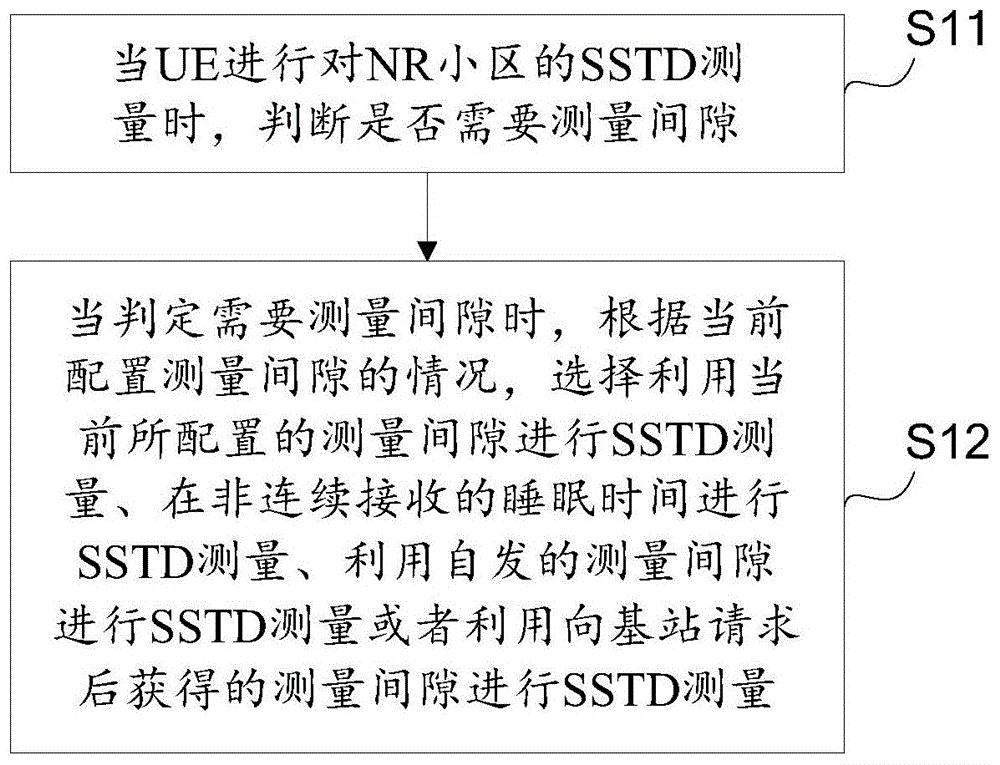
An embodiment of the present invention provides a method for performing SSTD measurement, as shown in fig. 1, the method including:
s11, when the UE performs SSTD measurement on the NR cell, it is determined whether a measurement gap is needed.
And S12, when the need of measuring the gap is judged, according to the current situation of configuring the measuring gap, selecting to use the currently configured measuring gap to carry out SSTD measurement, SSTD measurement in the sleep time of discontinuous reception, SSTD measurement by using the spontaneous measuring gap or SSTD measurement by using the measuring gap obtained after the request to the base station.
According to the SSTD measuring method provided by the embodiment of the invention, when the UE needs to measure the SSTD of the NR cell, according to the condition of the current measurement gap, the SSTD measurement is carried out by using the current measurement gap, the SSTD measurement is carried out in the discontinuous reception sleep time, the SSTD measurement is carried out by using the spontaneous measurement gap or the SSTD measurement is carried out by using the measurement gap obtained after the request to the base station, so that the UE can be ensured to obtain the SSTD information of the NR cell.
The method of the present invention for performing SSTD measurement is described in detail below.
When a UE makes SSTD measurements on NR cells, measurement gaps are needed in certain situations, including but not limited to:
the serving cell is an LTE cell;
the target cell and the NR serving cell are different in frequency;
the target cell is co-frequency with the NR serving cell, but the numerology (parameter configuration) is different.
When the UE performs SSTD measurement on the NR cell, if a measurement gap is needed but no measurement gap is currently configured, the following method may be adopted:
(1) if the base station configures DRX (Discontinuous Reception) for the UE, the UE performs SSTD measurement during sleep time of Discontinuous Reception.
(2) The UE performs SSTD measurement using the spontaneous measurement gap.
In addition, in order to control the UE, the base station may configure a parameter through an RRC (Radio resource control) signaling to indicate whether the UE may use the autonomous measurement gap for the SSTD measurement, and when the UE receives the parameter configured by the base station and indicates that the UE may use the autonomous measurement gap for the SSTD measurement, the UE uses the autonomous measurement gap for the SSTD measurement.
(3) If the UE performs the SSTD measurement in the sleep time of the discontinuous reception or the UE performs the SSTD measurement using the autonomous measurement gap or cannot acquire the SSB of the target cell (for example, cannot receive a signal), or the base station does not configure the discontinuous reception for the UE, and cannot acquire the synchronization signal block of the target cell at this time, the UE requests the measurement gap from the base station through an RRC signaling, and the UE may further provide one or more suggested measurement gap periods and/or measurement gap offset values, so that the base station configures an appropriate measurement gap. After receiving the request of the UE, the base station may configure a suitable measurement gap for the UE, and after receiving the suitable measurement gap configured by the base station, the UE performs the SSTD measurement by using the measurement gap.
When the UE performs SSTD measurement on the NR cell, if a measurement gap is needed and the measurement gap is currently configured, the following method may be used:
(1) the UE makes SSTD measurements using the currently configured measurement gaps.
(2) If the SSTD measurement performed by the UE using the currently configured measurement gap cannot acquire the SSB (synchronization signal block) of the target cell, and the base station configures discontinuous reception for the UE, the UE performs the SSTD measurement during the sleep time of the discontinuous reception; alternatively, the UE may also make measurements with spontaneous measurement gaps.
The specific implementation process of the UE performing measurement using the spontaneous measurement gap may refer to the method (2) when the measurement gap is not configured, and is not described herein again.
(3) If the UE cannot acquire the synchronization signal block of the target cell even when performing the SSTD measurement in the discontinuous reception sleep time or performing the SSTD measurement using the spontaneous measurement gap, and possibly the measurement time window is not appropriate, the UE requests the base station for a new measurement gap, and the specific implementation process may refer to the method (3) in which the measurement gap is not configured, which is not described herein again.
An embodiment of the present invention further provides a device for performing SSTD measurement, as shown in fig. 2, the device includes:
a judging unit 11, configured to judge whether a measurement gap is needed when the UE performs an SSTD measurement on an NR cell;
and a measurement unit 12, configured to, when it is determined that a measurement gap is required, select, according to a situation of a currently configured measurement gap, to perform the SSTD measurement using the currently configured measurement gap, perform the SSTD measurement during a sleep time of discontinuous reception, perform the SSTD measurement using an autonomous measurement gap, or perform the SSTD measurement using a measurement gap obtained after a request to the base station.
According to the SSTD measurement device provided by the embodiment of the invention, when the UE needs to measure the SSTD of the NR cell, according to the condition of the current measurement gap, the SSTD measurement is carried out by using the current measurement gap, the SSTD measurement is carried out in the discontinuous reception sleep time, the SSTD measurement is carried out by using the spontaneous measurement gap, or the SSTD measurement is carried out by using the measurement gap obtained after the request to the base station, so that the UE can be ensured to obtain the SSTD information of the NR cell.
Optionally, the measurement unit 12 is configured to perform SSTD measurement using the currently configured measurement gap if the measurement gap is currently configured.
Optionally, the measurement unit 12 is configured to, if no measurement gap is currently configured or a measurement gap is currently configured but the synchronization signal block of the target cell cannot be obtained by performing the SSTD measurement using the currently configured measurement gap, and the base station configures discontinuous reception for the UE, and performs the SSTD measurement during a sleep time of the discontinuous reception.
Optionally, the measurement unit 12 is configured to perform the SSTD measurement by using the spontaneous measurement gap if no measurement gap is currently configured or a measurement gap is currently configured but the synchronization signal block of the target cell cannot be acquired by performing the SSTD measurement by using the currently configured measurement gap.
Optionally, the measurement unit 12 is configured to perform the SSTD measurement using the autonomous measurement gap after receiving the base station indication that the SSTD measurement can be performed using the autonomous measurement gap.
Optionally, the measurement unit 12 is configured to, if no measurement gap is currently configured and the SSTD measurement is performed in the discontinuous reception sleep time or the SSTD measurement is performed using the spontaneous measurement gap, not obtain the synchronization signal block of the target cell, or if no measurement gap is currently configured and the base station does not configure discontinuous reception for the UE, not obtain the synchronization signal block of the target cell, request the measurement gap from the base station, and perform the SSTD measurement according to the measurement gap configured by the base station.
Optionally, the measurement unit 12 is configured to, if a measurement gap is currently configured but the synchronization signal block of the target cell cannot be obtained by performing the SSTD measurement using the currently configured measurement gap, and the SSTD measurement is performed during a sleep time of discontinuous reception or the synchronization signal block of the target cell cannot be obtained by performing the SSTD measurement using a spontaneous measurement gap, request the measurement gap from the base station, and perform the SSTD measurement according to the measurement gap configured by the base station.
Optionally, the measurement gap is requested from the base station with a suggested one or more measurement gap periods and/or measurement gap offset values.
The apparatus of this embodiment may be configured to implement the technical solutions of the above method embodiments, and the implementation principles and technical effects are similar, which are not described herein again.
The embodiment of the invention also provides the user equipment which comprises the SSTD measuring device.
It will be understood by those skilled in the art that all or part of the processes of the methods of the embodiments described above can be implemented by a computer program, which can be stored in a computer-readable storage medium, and when executed, can include the processes of the embodiments of the methods described above. The storage medium may be a magnetic disk, an optical disk, a Read-Only Memory (ROM), a Random Access Memory (RAM), or the like.
The above description is only for the specific embodiments of the present invention, but the scope of the present invention is not limited thereto, and any changes or substitutions that can be easily conceived by those skilled in the art within the technical scope of the present invention are also within the scope of the present invention. Therefore, the protection scope of the present invention should be subject to the protection scope of the claims.