Multi-model fusion-based expressway ramp running time prediction method
Technical Field
The invention relates to the technical field of machine learning, in particular to a method for predicting the running time of a high-speed ramp based on multi-model fusion.
Background
The travel time of the road section can intuitively reflect the degree of road congestion. The ramp driving time is used as an important evaluation index of the quality of the ramp control strategy, and the ramp driving time is reasonably predicted, so that scientific data support can be provided for ramp control. The prediction of the travel time is various at present, for example, the parameter model comprises an artificial neural network model and a Kalman filtering model, which all need a large number of calibration parameters. There are also non-parametric models such as the historical averaging method, the KNN algorithm, and the non-parametric regression model, which are widely used because their mechanisms are simple and do not require setting a large number of parameters. The driving time of the ramp belongs to a short-time travel, for the prediction of the short-time travel time, a plurality of methods based on data driving are provided, KNN is common, and a plurality of people perform some improvements on the basis of KNN to predict the short-time travel time, such as an improved K neighbor model of Zhang L and the like for short-term traffic flow prediction, and an improved PSO-LSSVM-based expressway short-time travel time prediction of Liuweiming and the like. Of course, there are other models for short-term travel time prediction, such as SVM-based urban expressway travel time prediction studies.
Disclosure of Invention
Technical problem to be solved
Aiming at the problems that the existing single prediction model is complex in parameter setting, poor in stability of prediction effect and not strong in generalization capability, the invention provides a method for predicting the running time of a high-speed ramp based on multi-model fusion.
(II) technical scheme
In order to achieve the purpose, the invention adopts the main technical scheme that:
s1, obtaining historical travel time data, and directly mapping the historical travel time data to obtain a first prediction result SWL0;
S2, obtaining multiple second prediction results SWL by using multiple weak learners trained in advancei;
S3, utilizing the first prediction result SWL0Screening the plurality of second preliminary results SWLiObtaining a prediction set SWL comprising a plurality of weak learner modelsj;
S4, utilizing prediction set SWLjObtaining a strong learner model SLM by two weak learner models with minimum mean absolute error percentage error, and predicting a set SWLjRemoving the two selected weak learner models, adding the strong learner model SLM serving as a new weak learner model to the prediction set SWL, and updating the strong learner model and the prediction set SWLj;
And S5, repeatedly executing the step S4 until the strong learner model SLM is not updated any more, and using the last updated strong learner model SLM as a prediction model of the high-speed ramp driving time.
Optionally, between steps S2 and S3, further comprising: calculating the mean absolute percentage error MAPE of the first prediction result using equation one0And for each of said second predicted outcomesMean absolute percent error MAPEi;
The formula I is as follows:
wherein R represents the number of routes of the test data, T represents the number of time periods of the test data, drtMean travel time, p, representing r-route t time periodrtRepresenting a predicted travel time representing the r-way t time period.
Optionally, in S3, a prediction set SWL containing a plurality of weak learner modelsjThe mean absolute percentage error MAPE of each weak learner model in (a)jAre all less than MAPE0。
Optionally, step S4 further includes: obtaining a prediction set SWL using formula twojAnd updating the prediction set SWL according to the formula IIIj;
The formula II is as follows: WLj(i=1,2,...,J)=MAPEj;
The formula III is as follows: SWLj=(j,WLj),j=1,2,...,J;
Wherein J represents the number of machine learning models used in the model, J represents the corresponding weak learner, MAPEjThe mean absolute error percentage error of the jth model is shown.
Optionally, the method for constructing the strong learner model SLM using the two weak learner models in step S4 includes:
a1, adjusting the weight ratio of each weak learner at a preset iteration rate v to obtain strong learner models with various weight ratios;
a2, obtaining the average absolute error percentage error of the strong learner model of each weight ratio, and taking the corresponding strong learner model with the minimum average absolute error percentage error as the final strong learner model SLM.
Optionally, the plurality of pre-trained weak learner models includes at least two of XGBoost, LightGBM, SVM, linear regression, and KNN.
Optionally, step S1 is preceded by obtaining a plurality of weak learners trained in advance using the steps of:
b1, acquiring a plurality of sample sets by using a self-help sampling method aiming at the training sample set;
b2, carrying out data processing on each sample sampling set to obtain a training sample suitable for each learning model;
and B3, training a corresponding learning model by using the training samples and obtaining a plurality of weak learners which are trained in advance.
(III) advantageous effects
The invention has the beneficial effects that: the method provides a new idea for the form time prediction of the expressway ramps, and the obtained strong learner model has strong generalization capability, is relatively stable in prediction results aiming at different types of data, and has better robustness; the method enables the finally obtained model to have better accuracy through multiple times of adjustment and fusion of the weight ratio of the machine learning model, provides accurate prediction data for prediction of actual high-speed ramp running time, and has better practicability.
Drawings
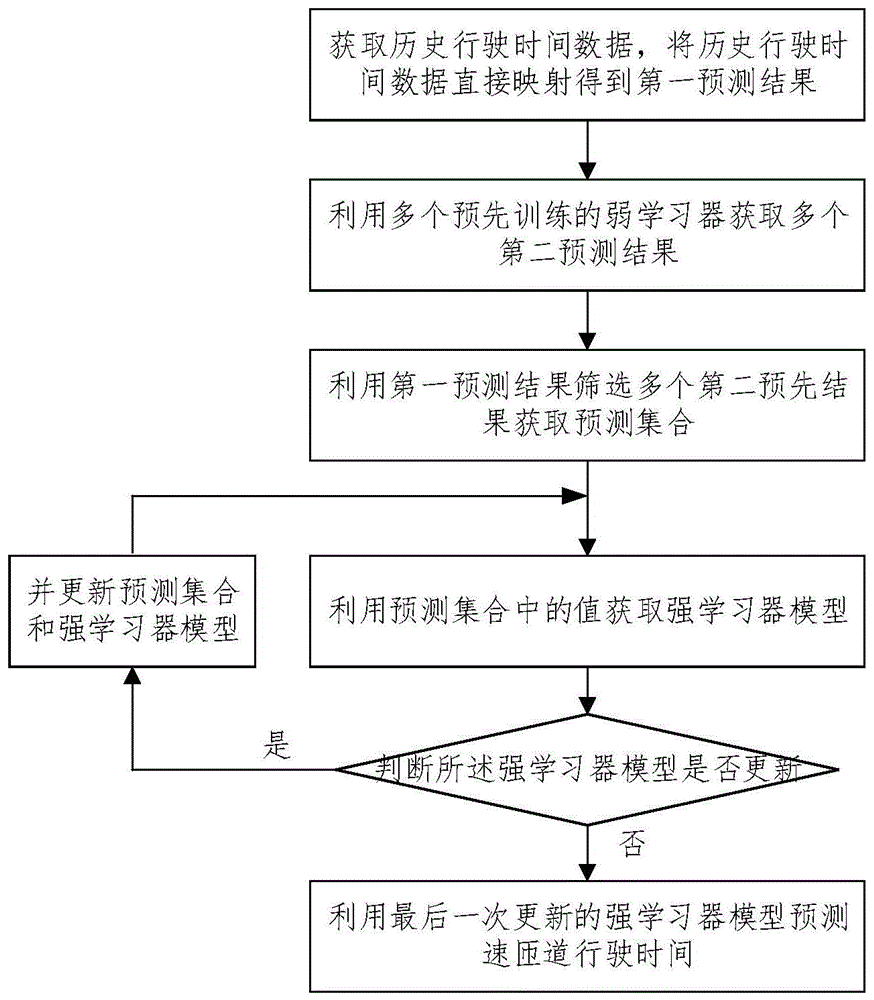
Fig. 1 is a flowchart of a method for predicting the travel time of a highway on a ramp based on multi-model fusion, according to an embodiment of the present invention;
FIG. 2 is a schematic diagram of a fusion strategy for providing energy according to an embodiment of the present invention;
FIG. 3 is a diagram illustrating the effect of each model during model selection according to an embodiment of the present invention;
FIG. 4 is a diagram illustrating model scale selection during fusion according to an embodiment of the present invention;
fig. 5 is a diagram of a test effect of the application fusion model according to an embodiment of the present invention.
Detailed Description
For the purpose of better explaining the present invention and to facilitate understanding, the present invention will be described in detail by way of specific embodiments with reference to the accompanying drawings.
Examples
As shown in fig. 1, the present embodiment provides a method for predicting the travel time of an expressway on a ramp based on multi-model fusion, which specifically includes:
as shown in fig. 2, a plurality of weak learners trained in advance are obtained by the following steps:
b1, acquiring a plurality of sample sets by using a self-help sampling method aiming at the training sample set;
b2, carrying out data processing on each sample sampling set to obtain a training sample suitable for each learning model;
and B3, training a corresponding learning model by using the training samples and obtaining a plurality of weak learners which are trained in advance.
For example, the XGBoost (hereinafter referred to as Xgb), LightGBM, SVM, Linear regression (Linear regression), and KNN are selected as a plurality of weak learner models trained in advance.
S1, obtaining historical travel time data, and directly mapping the historical travel time data to obtain a first prediction result SWL0;
For example, Direct mapping (Direct mapping) is to use historical data directly as prediction data, i.e. to use the average travel time of intersection a to toll station 1 from 6 o ' clock to 8 o ' clock as the average travel time of intersection a to toll station 1 from 8 o ' clock.
S2, obtaining multiple second prediction results SWL by using multiple weak learners trained in advancei(ii) a Preferably, between steps S2 and S3, further comprising: calculating a mean absolute percentage error MAPE of the first prediction result using equation 10And the mean absolute percentage error MAPE of each of said second predictorsi;
wherein R represents the number of routes of the test data, T represents the number of time periods of the test data, drtMean travel time, p, representing r-route t time periodrtRepresenting a predicted travel time representing the r-way t time period. S3, utilizing the first prediction result SWL0Screening the plurality of second preliminary results SWLiObtaining a prediction set SWL comprising a plurality of weak learner modelsj;
Specifically, for example, in S3, the prediction set SWL including a plurality of weak learner modelsjThe mean absolute percentage error MAPE of each weak learner model in (a)jAre all less than MAPE0。
For example, the prediction result obtained by direct mapping is used as a comparison base stone, and the model is retained only when the MAPE value of the measurement result of the weak learner is smaller than the MAPE value of the prediction result obtained by direct mapping, that is, when the single model is better than the result, whether the model is incorporated into the model fusion is considered; as shown in fig. 3, the MAPE of the SVM learner and the XGBoost learner only is smaller than the MAPE value of the prediction result obtained by direct mapping.
S4, utilizing prediction set SWLjObtaining a strong learner model SLM by two weak learner models with minimum mean absolute error percentage error, and predicting a set SWLjRemoving the two selected weak learner models, adding the strong learner model SLM serving as a new weak learner model to the prediction set SWL, and updating the strong learner model and the prediction set SWLj;
Specifically, for example, the prediction set SWL is obtained by using formula 2jAnd updating the prediction set SWL according to formula 3j;
Equation 2: WLj(i=1,2,...,J)=MAPEj;
Equation 3: SWLj=(j,WLj),j=1,2,...,J;
Wherein J represents the number of machine learning models used in the model, J represents the corresponding weak learner, MAPEjThe mean absolute error percentage error of the jth model is shown.
For example, in this embodiment, the strong learner model is predicted by the SVM learner and the XGBoost learner, and the strong learner model is used as a new weak learner and is fused with the weak learning with the smallest MAPE value in the remaining weak learning again to update the strong learner model.
The method of constructing the strong learner model SLM using the two weak learner models in step S4 includes:
a1, adjusting the weight ratio of each weak learner at a preset iteration rate v to obtain strong learner models with various weight ratios;
and A2, acquiring the average absolute error percentage error of the strong learner model of each weight ratio, and taking the corresponding strong learner model with the minimum average absolute error percentage error as the final strong learner model. Specifically, as shown in fig. 4, in the present embodiment, the weight ratio between the XGBoost model and the SVM model is adjusted with 0.1 as the iteration rate;
and S5, repeatedly executing the step S4 until the strong learner model SLM is not updated any more, and using the last updated strong learner model SLM as a prediction model of the high-speed ramp driving time.
For example, in the embodiment, the XGboost and the SVM perform fusion prediction on the driving time of the high-speed ramp, the ratio of the XGboost is 7, the ratio of the SVM is 3, and the final prediction result is obtained by multiplying the result predicted by the XGboost model by 0.7 and multiplying the result predicted by the SVM by 0.3; the finally obtained model has better accuracy through multiple times of adjustment and fusion of the weight ratio of the machine learning model, provides accurate prediction data for prediction of actual high-speed ramp running time, and has better practicability.
Simulation embodiment
As shown in fig. 5, in this embodiment, the strong learner model constructed in the above embodiment and the weak learners are selected to predict the test data respectively, and a prediction result of each method is obtained, and it can be seen from the result that for the test data and the training data, the prediction effects exhibited by the SVM learner and the XGBoost are different, and under different data conditions, the single model may not be the same optimally, but the fused model has a better effect than the single model, and in summary, the model fusion can enhance the generalization ability of the prediction model, and can also enhance the prediction accuracy to some extent.
Finally, it should be noted that: the above-mentioned embodiments are only used for illustrating the technical solution of the present invention, and not for limiting the same; although the present invention has been described in detail with reference to the foregoing embodiments, it will be understood by those of ordinary skill in the art that: the technical solutions described in the foregoing embodiments may still be modified, or some or all of the technical features may be equivalently replaced; and the modifications or the substitutions do not make the essence of the corresponding technical solutions depart from the scope of the technical solutions of the embodiments of the present invention.