CN109523552B - 3D object detection method based on view cone point cloud - Google Patents

3D object detection method based on view cone point cloud Download PDF

Info

Publication number
CN109523552B
CN109523552B CN201811245343.9A CN201811245343A CN109523552B CN 109523552 B CN109523552 B CN 109523552B CN 201811245343 A CN201811245343 A CN 201811245343A CN 109523552 B CN109523552 B CN 109523552B
Authority
CN
China
Prior art keywords
point cloud
dimensional
bounding box
network
point
Prior art date
Legal status (The legal status is an assumption and is not a legal conclusion. Google has not performed a legal analysis and makes no representation as to the accuracy of the status listed.)
Expired - Fee Related
Application number
CN201811245343.9A
Other languages
Chinese (zh)
Other versions
CN109523552A (en
Inventor
沈大勇
王晓
刘胜
胡加媛
王杰
翟天亨
Current Assignee (The listed assignees may be inaccurate. Google has not performed a legal analysis and makes no representation or warranty as to the accuracy of the list.)
Qingdao Academy Of Intelligent Industries
Original Assignee
Qingdao Academy Of Intelligent Industries
Priority date (The priority date is an assumption and is not a legal conclusion. Google has not performed a legal analysis and makes no representation as to the accuracy of the date listed.)
Filing date
Publication date
Application filed by Qingdao Academy Of Intelligent Industries filed Critical Qingdao Academy Of Intelligent Industries
Priority to CN201811245343.9A priority Critical patent/CN109523552B/en
Publication of CN109523552A publication Critical patent/CN109523552A/en
Application granted granted Critical
Publication of CN109523552B publication Critical patent/CN109523552B/en
Expired - Fee Related legal-status Critical Current
Anticipated expiration legal-status Critical

Links

Images

Classifications

    • GPHYSICS
    • G06COMPUTING OR CALCULATING; COUNTING
    • G06TIMAGE DATA PROCESSING OR GENERATION, IN GENERAL
    • G06T7/00Image analysis
    • G06T7/10Segmentation; Edge detection
    • GPHYSICS
    • G06COMPUTING OR CALCULATING; COUNTING
    • G06NCOMPUTING ARRANGEMENTS BASED ON SPECIFIC COMPUTATIONAL MODELS
    • G06N3/00Computing arrangements based on biological models
    • G06N3/02Neural networks
    • G06N3/08Learning methods
    • GPHYSICS
    • G06COMPUTING OR CALCULATING; COUNTING
    • G06TIMAGE DATA PROCESSING OR GENERATION, IN GENERAL
    • G06T7/00Image analysis
    • G06T7/50Depth or shape recovery
    • GPHYSICS
    • G06COMPUTING OR CALCULATING; COUNTING
    • G06TIMAGE DATA PROCESSING OR GENERATION, IN GENERAL
    • G06T7/00Image analysis
    • G06T7/90Determination of colour characteristics
    • GPHYSICS
    • G06COMPUTING OR CALCULATING; COUNTING
    • G06VIMAGE OR VIDEO RECOGNITION OR UNDERSTANDING
    • G06V20/00Scenes; Scene-specific elements
    • G06V20/60Type of objects
    • G06V20/64Three-dimensional objects

Landscapes

  • Engineering & Computer Science (AREA)
  • Physics & Mathematics (AREA)
  • Theoretical Computer Science (AREA)
  • General Physics & Mathematics (AREA)
  • Computer Vision & Pattern Recognition (AREA)
  • Biophysics (AREA)
  • Data Mining & Analysis (AREA)
  • Life Sciences & Earth Sciences (AREA)
  • Artificial Intelligence (AREA)
  • Biomedical Technology (AREA)
  • Multimedia (AREA)
  • Computational Linguistics (AREA)
  • Health & Medical Sciences (AREA)
  • Evolutionary Computation (AREA)
  • General Health & Medical Sciences (AREA)
  • Molecular Biology (AREA)
  • Computing Systems (AREA)
  • General Engineering & Computer Science (AREA)
  • Mathematical Physics (AREA)
  • Software Systems (AREA)
  • Image Analysis (AREA)

Abstract

本发明公开了一种基于视锥点云的三维物体检测方法,采集RGB图像和点云图像并进行标注,获取标注后的RGB图像数据集和点云图像数据集,将数据集作为训练样本和测试样本。主要由三个网络组成:基于二维物体检测的视锥点云抽取网络、基于Point net三维物体实例分割网络以及基于偏移残差的三维包围盒回归网络。三个网络依次训练,前一个网络的训练输出作为下一个网络的输入。设置各神经网络模型的超参数,通过Tensorflow训练三维物体检测网络模型,当代价损失函数减少到理想程度且训练达到所要求的最大迭代次数时,生成训练模型;将点云图像数据集输入至训练完毕的模型中,输出三维物体检测结果。本发明比现有三维物体检测方法更完善、难度更高。

Figure 201811245343

The invention discloses a three-dimensional object detection method based on view cone point cloud, which collects RGB images and point cloud images and marks them, obtains marked RGB image data sets and point cloud image data sets, and uses the data sets as training samples and point cloud images. test sample. It is mainly composed of three networks: a frustum point cloud extraction network based on 2D object detection, a 3D object instance segmentation network based on Point net, and a 3D bounding box regression network based on offset residuals. The three networks are trained sequentially, and the training output of the previous network is used as the input of the next network. Set the hyperparameters of each neural network model and train the 3D object detection network model through Tensorflow. When the cost loss function is reduced to an ideal level and the training reaches the required maximum number of iterations, the training model is generated; the point cloud image data set is input to the training In the completed model, the 3D object detection results are output. Compared with the existing three-dimensional object detection method, the present invention is more complete and more difficult.

Figure 201811245343

Description

Three-dimensional object detection method based on viewing cone point cloud
Technical Field
The invention relates to the technical field of pattern recognition, machine learning and computer vision, in particular to a three-dimensional object detection method based on a viewing cone point cloud.
Background
Three-dimensional object detection is an important research field of pattern recognition and computer vision, and simultaneously is a core problem for solving a plurality of high-level vision tasks, and the research of object detection lays a foundation for solving the high-level vision tasks (such as behavior recognition, scene understanding and the like). It has wide application in people's daily life and industrial production, such as: intelligent video surveillance, unmanned driving, intelligent robots, intelligent traffic, augmented reality, and the like.
In the last few years, with the development of two-dimensional object detection methods and the popularization of depth cameras, three-dimensional object detection technology has also been developed dramatically. The three-dimensional object detection obtains three-dimensional information of an object by identifying and positioning the three-dimensional object, and outputs a three-dimensional bounding box of the object to represent the position of the object in the real world. The three-dimensional bounding box is formed by the sizes l, w and h of the three-dimensional bounding box and the coordinate c of the central pointx、cy、czAnd the angles of orientation yaw, roll, pitch. Where yaw, roll, pitch are the rotation angles of the predefined pose with respect to each category. In the existing research work, the degree of freedom of a three-dimensional bounding box of unmanned three-dimensional object detection and scene understanding three-dimensional object detection of indoor environment is only 7 (l, w, h, c)x、cy、czYaw) because they only consider that objects in the vehicle and indoor environment are only heading angle yaw, and not pitch and roll. However, in the field of logistics picking and loading and unloading which we are studying, we must consider the exact attitude of the object to achieve the expected effect, so we need to consider the pitch angle pitch and roll angle roll of the object and output a three-dimensional object bounding box with 9 degrees of freedom.
Disclosure of Invention
In order to solve the technical problems, the invention provides a three-dimensional object detection method based on a viewing cone point cloud so as to achieve the purposes of more complete detection and higher difficulty.
In order to achieve the purpose, the technical scheme of the invention is as follows:
the three-dimensional object detection method based on the viewing cone point cloud comprises the following steps:
the method comprises the following steps: labeling the RGB image and the point cloud image, acquiring a labeled RGB image data set and a point cloud image data set, and taking the RGB image data set and the point cloud image data set as a training sample and a test sample of a three-dimensional object detection network model based on the viewing cone point cloud;
step two: constructing a viewing cone point cloud extraction network based on two-dimensional object detection, taking an RGB image data set as the input of the viewing cone point cloud extraction network based on the two-dimensional object detection, detecting an object by using RGB information so as to obtain a two-dimensional bounding box of the object of interest, and then obtaining viewing cone point cloud data corresponding to the detected two-dimensional object through the aligned and registered RGB image and a depth image;
step three: constructing a Point net-based three-dimensional object example segmentation network, taking the viewing cone Point cloud data obtained in the step two as the input of the Point net-based three-dimensional object example segmentation network, and performing binary example segmentation on the object by using the Point net network to obtain object Point cloud data after the example segmentation;
step four: building a three-dimensional bounding box regression network based on offset residual errors, using the point cloud data of the object obtained in the third step after the example segmentation as the input of the three-dimensional bounding box regression network based on the offset residual errors, and obtaining eight vertexes corresponding to the three-dimensional bounding box of the object by calculating the offset between the eight vertexes of the three-dimensional bounding box of the regression object and the actual value of the eight vertexes of the three-dimensional bounding box of the regression object, thereby obtaining the three-dimensional bounding box of the regression object;
step five: inputting the RGB image data set and the point cloud image data set into the trained three-dimensional object detection network model in the step four, and outputting a three-dimensional object detection result.
In the scheme, the RGB image data set and the point cloud image data set in the first step comprise a real data set and a virtual data set, wherein the real data set is obtained by collecting RGB images and depth images of different categories in a laboratory site environment by using a plurality of depth cameras; the virtual data set is an RGB map and a depth map which are generated manually by using a Blender tool and are used for different scenes and different varieties under different weather conditions.
In the foregoing solution, in the first step, the constructing of the real data set further includes: aligning and registering the RGB image and the depth image to obtain required point cloud data; labeling the RGB image by using a LabelImg and labeling the point cloud data by using a Labelfusion tool; the construction of the virtual data set also comprises the calculation of a depth map and the automatic annotation process of the data set.
In the above scheme, in the second step, the construction method of the viewing cone point cloud extraction network based on two-dimensional object detection is as follows:
a) extracting picture features through a Feature extraction network to form Feature maps of the whole picture;
b) the RPN takes the entire picture Feature Map as input and outputs a series of rectangular candidate areas;
c) performing pooling operation on the region of interest by using Fast-RCNN, and classifying and regressing through a full-connection layer to obtain a final detection result;
d) and obtaining the viewing cone point cloud of the corresponding object by using the result of the two-dimensional object detection and the aligned RGB image and depth image.
In the above scheme, in the third step, the construction method of the three-dimensional object instance segmentation network based on Point net is as follows:
a) using a Point Net network model as a feature extraction model, using a Point cloud image obtained by registering and aligning an RGB (red, green and blue) image and a depth image as input, firstly performing T-Net operation to realize alignment of Point cloud features, and obtaining global features of each Point with dimension of 2048 through seven MLP layers, wherein after the fifth MLP operation, performing T-Net transformation on obtained local features with dimension of 128, and then performing maximum pooling operation on a n multiplied by 2048 feature matrix to obtain the global features of the image;
b) taking the result of each layer of MLP in a) as a local feature corresponding to each point in the viewing cone point cloud, connecting the local feature with n copies of the global feature obtained in a) and a one-hot vector obtained by using two-dimensional object detection to obtain an example segmentation result through 3 layers of MLP, and obtaining point cloud data of an object which is interested by the user;
the loss function of the network segmented based on the Pointnet three-dimensional object example is as follows:
Figure BDA0001840394010000031
wherein
Figure BDA0001840394010000032
Representing the probability of being predicted as an object of interest,
Figure BDA0001840394010000033
representing the probability of prediction as background.
In the above scheme, in the fourth step, the method for constructing the regression network of the three-dimensional bounding box based on the offset residual error comprises:
a) and (3) utilizing the Point cloud data of the segmented object obtained in the third step, obtaining the local characteristic and the global characteristic of each Point through a characteristic extraction network A based on the Point net, and outputting two different branch operations after obtaining the global characteristic: the first branch is a three-dimensional bounding box regression network B based on offset residual errors, the second branch is a network C for directly regressing eight vertexes of the three-dimensional bounding box, and then output results of the branches are compared;
b) the first branch is to connect the global features and the local features obtained by the feature extraction network A and the prior knowledge one-hot vector obtained by the detection of the two-dimensional object, and then output the offset value of 8 vertexes of the ith point prediction bounding box in the point cloud relative to the coordinates of the ith point through the operation of 5 layers of MLP layers
Figure BDA0001840394010000034
And the score p of the three-dimensional bounding box predicted by the ith pointiSelecting a three-dimensional bounding box with the highest predicted score from all the points as the output of the network; and then calculating to obtain eight vertex coordinates C of the predicted three-dimensional bounding box through the real value and the offsetiThe calculation method is as follows:
Figure BDA0001840394010000035
c) the second branch is that the global features obtained by the feature extraction network A are directly connected with the prior knowledge one-hot vector obtained by two-dimensional detection, and eight predicted vertex coordinates of the three-dimensional bounding box are obtained as the output of the network through 3 MLP layer operations;
the loss function of the three-dimensional bounding box regression network B based on the offset residuals is:
Figure BDA0001840394010000036
where m is the number of instance segmentation point clouds; offset _ ratioiThe offset distance ratio of the bounding box predicted by the ith point, namely the ratio of the offset distance between the predicted vertex and the real vertex to the diagonal length of the real bounding box, is calculated by the following steps:
Figure BDA0001840394010000037
Lconfthe method is used for predicting the confidence loss of the bounding box and comprises the following steps:
Figure BDA0001840394010000041
where m is the number of instance segmentation point clouds, cpredRepresenting the confidence of the predicted three-dimensional bounding box of the object, cgtRepresenting the confidence of the true three-dimensional bounding box of the object.
The penalty function for a network C that directly regresses the eight vertices of the three-dimensional bounding box is:
Lreg=offset_ratio。
through the technical scheme, the method for detecting the three-dimensional object based on the cone point cloud acquires and labels the RGB image and the point cloud image, acquires the labeled RGB image data set and the point cloud image data set, and takes the data sets as the training sample and the test sample of the neural network model for detecting the three-dimensional object based on the cone point cloud. The three-dimensional object detection network model based on the view cone point cloud mainly comprises three networks: the method comprises a viewing cone Point cloud extraction network based on two-dimensional object detection, a three-dimensional object instance segmentation network based on Point net and a three-dimensional bounding box regression network based on offset residual errors. The three networks are trained in sequence, and the training output of the previous network is used as the input of the next network. Setting the hyper-parameters of each neural network model, training the three-dimensional object detection network model through Tensorflow, and generating a training model when the cost loss function is reduced to an ideal degree and the training reaches the required maximum iteration times; and inputting the point cloud image data set into the trained model, and outputting a three-dimensional object detection result. Compared with the existing three-dimensional object detection method, the method is more perfect and more difficult.
Drawings
In order to more clearly illustrate the embodiments of the present invention or the technical solutions in the prior art, the drawings used in the description of the embodiments or the prior art will be briefly described below.
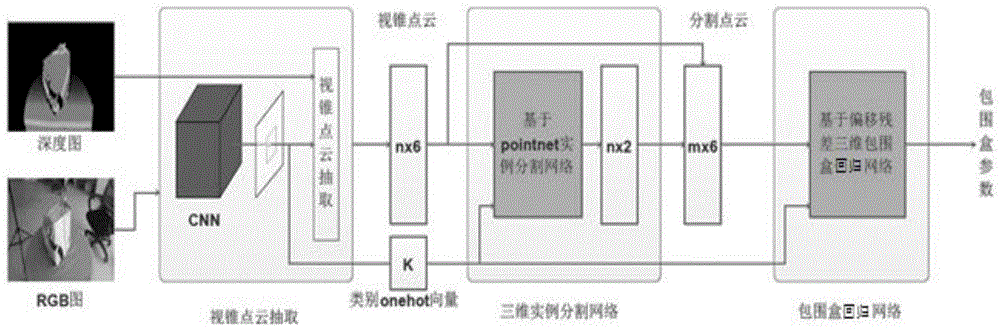
FIG. 1 is a diagram of a three-dimensional object detection network architecture based on a view cone point cloud;
FIG. 2 is a view cone point cloud extraction network structure diagram based on two-dimensional object detection;
FIG. 3 is a diagram of a partitioned network structure based on an example of a three-dimensional object of Point net;
FIG. 4 is a graph of a three-dimensional bounding box regression network structure based on offset residuals;
fig. 5 is a display of a segmentation result of a three-dimensional object example based on Point net in this embodiment;
fig. 6 is a result display of the three-dimensional object detection method based on the viewing-cone point cloud in the present embodiment.
Detailed Description
The technical solution in the embodiments of the present invention will be clearly and completely described below with reference to the accompanying drawings in the embodiments of the present invention.
In the present invention, an RGB map refers to an image represented by red (R), green (G), and blue (B) parameter values, which are obtained by varying three color channels of red (R), green (G), and blue (B) and superimposing them on each other to obtain various colors; a depth map is an image or image channel containing information about the distance of the surface of a scene object from a viewpoint, similar to a grayscale image, except that each pixel value of the depth map is the actual distance of the sensor from the object. Usually, the RGB image and the Depth image are registered, so that there is a one-to-one correspondence between pixel points, and the point cloud image refers to an image obtained after the RGB image and the Depth image are aligned and registered.
As shown in fig. 1, the three-dimensional object detection network model based on the viewing cone Point cloud includes three sub-networks of a viewing cone Point cloud extraction network based on two-dimensional object detection, a three-dimensional object instance segmentation network based on Point net, and a three-dimensional bounding box regression network based on offset residual. The specific detection method comprises the following steps:
the method comprises the following steps: labeling the RGB image and the point cloud image, acquiring a labeled RGB image data set and a point cloud data set, and taking the data sets as a training sample and a test sample of a three-dimensional object detection network model based on the viewing cone point cloud;
step two: constructing a viewing cone point cloud extraction network based on two-dimensional object detection, as shown in fig. 2, taking an RGB image data set as input of the viewing cone point cloud extraction network for two-dimensional object detection, detecting an object by utilizing rich RGB information so as to obtain a two-dimensional bounding box of the object of interest, and obtaining a viewing cone point cloud corresponding to the detected two-dimensional object through an aligned and registered RGB image and a depth image;
step three: constructing a Point net-based three-dimensional object example segmentation network, as shown in fig. 3, taking the viewing cone Point cloud data obtained in the step two as the input of the Point net-based three-dimensional object example segmentation network, and performing binary example segmentation on the object by using the Point net network to obtain object Point cloud data after the example segmentation;
step four: constructing a three-dimensional bounding box regression network based on offset residual errors, as shown in fig. 4, taking the point cloud data of the object obtained by the third step after example segmentation as the input of the three-dimensional bounding box regression network based on offset residual errors, selecting a three-dimensional bounding box with the highest score according to the offset values of 8 vertexes of the bounding box predicted by each point in the regression point cloud relative to the coordinates of the point and the scores of the three-dimensional bounding box predicted by the point, and calculating to obtain eight vertexes corresponding to the 9-freedom three-dimensional bounding box of the object so as to obtain the three-dimensional bounding box of the object;
step five: and inputting the RGB image data set and the point cloud image data set into the trained three-dimensional object detection network model, and outputting a three-dimensional object detection result.
In an embodiment of the method for detecting a three-dimensional object based on a viewing point cloud, the data set in the first step includes two parts, namely a real data set and a virtual data set. The real data set is used for collecting RGB (red, green and blue) images and depth images of different categories in a laboratory site environment by utilizing multiple depth cameras such as optical Astra Pro and Intel SR300 in an Olympic ratio, the data set comprises four categories of boxes, file bags, plastic package packages and woven bags, and the data set comprises two sorting scenes of ground piles and goods shelves. The virtual data set is formed by utilizing a Blender tool to manually generate RGB (red, green, blue) images and depth maps of different sorting scenes and different categories under different weather, the data set comprises four categories of boxes, file bags, plastic package packages and woven bags, and four sorting scenes of sorting baskets, ground piles, factories and goods shelves, and the three sorting scenes comprise two kinds of weather of sunny days and foggy days. The first acquisition method adopts a manual labeling mode to obtain labeling information, label the RGB image by using LabelImg and label the point cloud data by using a Labelfusion tool; the labeling information of the second method is implemented programmatically.
The training samples in the first step of this embodiment include 14151 RGB images in the labeled real data set, 36497 RGB images in the labeled virtual data set, and the testing samples include 1633 RGB images in the real data set; the training samples in the second step three of this embodiment include 1116 point cloud images in the labeled real data set and 9000 point cloud images in the labeled virtual data set, and the training set, the verification set and the test set are randomly divided into the real data set and the virtual data set according to the ratio of 8:1: 1.
In an embodiment of the method for detecting a three-dimensional object based on a viewing-cone point cloud as described above, the step one of the real data set further includes aligning and registering the RGB image and the depth image to obtain the required point cloud data. The virtual data set also comprises a depth map calculation process and a data set automatic labeling process.
In an embodiment of the method for detecting a three-dimensional object based on a viewing cone point cloud as described above, the method for constructing the viewing cone point cloud extraction network (as shown in fig. 2) based on two-dimensional object detection in the second step is as follows:
a) extracting picture features through a Feature extraction network such as VGG16, ResNet-X and the like to form a Feature Map of the whole picture;
b) the RPN takes the entire picture Feature Map as input and outputs a series of rectangular candidate areas;
c) performing pooling operation on the region of interest by using Fast-RCNN, and classifying and regressing through a full-connection layer to obtain a final detection result;
d) and obtaining the viewing cone point cloud of the corresponding object by using the result of the two-dimensional object detection and the aligned RGB image and depth image.
In an embodiment of the above method for detecting a three-dimensional object based on a viewing-cone Point cloud, a method for constructing a three-dimensional object example segmentation network based on Point net (as shown in fig. 3) in step three includes:
a) the method comprises the steps of using a Point Net network model as a feature extraction model, using a Point cloud image obtained by registering and aligning an RGB (red, green and blue) image and a depth image as input, firstly performing T-Net operation to realize alignment of Point cloud features, and obtaining global features with the dimension of each Point of 2048 through seven MLP (multilayer perceptron) layers, wherein after the fifth MLP operation, performing T-Net transformation on obtained local features with the dimension of 128. Obtaining a global feature with dimension of each point being 2048 through seven MLP (multilayer perceptron) layers, and then obtaining the global feature of the image by adopting maximum pooling operation on the n multiplied by 2048 feature matrix;
b) and (3) regarding the result of each layer of MLP in the step a) as a local feature corresponding to each point in the view cone point cloud, connecting the local feature with the n copied global features obtained in the step a) and a one-hot vector obtained by using the prior knowledge of the two-dimensional detection result, and obtaining an example segmentation result through 3 layers of MLP layers to obtain point cloud data of the object which is interested by the user.
The loss function of the segmented network based on the Point net three-dimensional object example is as follows:
Figure BDA0001840394010000071
wherein
Figure BDA0001840394010000072
Representing the probability of being predicted as an object of interest,
Figure BDA0001840394010000073
representing the probability of prediction as background.
In the fourth step of the method for detecting a three-dimensional object based on a viewing-cone point cloud, a method for constructing a three-dimensional bounding box regression network (as shown in fig. 4) based on offset residuals includes:
a) and (3) utilizing the Point cloud data of the segmented object obtained in the third step, obtaining the local characteristic and the global characteristic of each Point through a characteristic extraction network A based on the Point net, and outputting two different branch operations after obtaining the global characteristic: the first branch is a three-dimensional bounding box regression network B based on offset residual errors, the second branch is a network C for directly regressing eight vertexes of the three-dimensional bounding box, and output results of the two branches are compared;
b) the first branch is to connect the global features and the local features obtained by the feature extraction network A and the prior knowledge one-hot vector obtained by the detection of the two-dimensional object, and then output the offset value of 8 vertexes of the ith point prediction bounding box in the point cloud relative to the coordinates of the ith point through the operation of 5 layers of MLP layers
Figure BDA0001840394010000074
And the score p of the three-dimensional bounding box predicted by the ith pointiSelecting a three-dimensional bounding box with the highest predicted score from all the points as the output of the network; and then calculating to obtain eight vertex coordinates C of the predicted three-dimensional bounding box through the real value and the offsetiThe calculation method is as follows:
Figure BDA0001840394010000075
c) the second branch is that the global features obtained by the feature extraction network A are directly connected with the prior knowledge one-hot vector obtained by two-dimensional detection, and eight predicted vertex coordinates of the three-dimensional bounding box are obtained as the output of the network through 3 MLP layer operations;
the loss function of the three-dimensional bounding box regression network B based on the offset residuals is:
Figure BDA0001840394010000076
where m is the number of instance segmentation point clouds; offset _ ratioiThe offset distance ratio of the bounding box predicted by the ith point, namely the ratio of the offset distance between the predicted vertex and the real vertex to the diagonal length of the real bounding box, is calculated by the following steps:
Figure BDA0001840394010000077
Lconfthe method is used for predicting the confidence loss of the bounding box and comprises the following steps:
Figure BDA0001840394010000078
where m is the number of instance segmentation point clouds, cpredRepresenting the confidence of the predicted three-dimensional bounding box of the object, cgtRepresenting the confidence of the true three-dimensional bounding box of the object.
The penalty function for a network C that directly regresses the eight vertices of the three-dimensional bounding box is:
Lreg=offset_ratio。
in an embodiment of the RGB-D three-dimensional object detection method based on deep learning, the method for training the two-dimensional object detection convolutional neural network model by Caffe2 in the second step is: the network model is initialized using the classification model pre-trained with the ImageNet dataset and trained with the real dataset. The initial learning rate is set to be 0.02, the maximum iteration number is 80k, the initial learning rate and the maximum iteration number are respectively decreased by 0.1 time at 30k and 40k, the batch size is 2 pictures, and the weight attenuation rate is 0.0005;
in an embodiment of the RGB-D three-dimensional object detection method based on deep learning, the method for training the three-dimensional object detection neural network model by the tensrflow in the third step is as follows: and (3) using a Point net network pre-training neural network model to initialize parameters for the three-dimensional object detection neural network.
In an embodiment of the RGB-D three-dimensional object detection method based on deep learning, the three-dimensional bounding box regression network model method based on offset residual error through TensorFlow training in the fourth step is: and (3) using a Point net network pre-training neural network model to initialize parameters for the three-dimensional object detection neural network.
In the third and fourth steps of this embodiment, a random gradient descent training model with a momentum parameter of 0.9 is used, and the data amount of each batch is 64. The experiment adopts a changed learning rate for learning, the initialized learning rate is 0.0002, the learning rate of 70 ten thousand data per training (i.e. about 10 cycles (epoch)) is reduced to 0.7 time of the original data due to the larger data volume of a artificially generated virtual training set, the learning rate of 20 ten thousand data per training (i.e. about 20 cycles (epoch)) is reduced to 0.7 time of the original data per training due to the about 1 ten thousand data volume of a really acquired data set, and the learning rate stops reducing when the learning rate is less than 0.00001 in the two cases. The experiment used an early-stop strategy, trained for 200 cycles (epoch). In order to reduce the influence of model initialization on the results, the experiment was trained 5 times for each experiment under different initializations, and the accuracy average of the test was taken as the final result of the model.
In the method for detecting three-dimensional objects based on the viewing-cone point cloud, we adopt three ways to form our training data in the training stage. The first is that all training data sets are real data sets, the second is that the real data sets and virtual data sets are mixed and then trained, and the third is that after a network model is trained on the virtual data sets, the real data sets are trained by the network model for network tuning.
As shown in fig. 5, which is a diagram of a segmentation result of a three-dimensional object instance in a real data set test set in this embodiment, where a bounding box is a labeled 3D bounding box, gray points represent point cloud data of an object of interest, and black points represent background objects, it can be seen that a point cloud instance segmentation network based on point net can segment view cone point cloud data well.
As shown in table 1, in a "training set" column in the figure, Real indicates that all used training data are Real data, Syn + Real indicates that the used training data set is a data set obtained by mixing a Real data set and a virtual data set, Syn + Real Adapted indicates that a network model is obtained by training a network model in a virtual data set to obtain neural network parameters, then the Real data set is used to optimize the neural network, and Syn indicates that all used training data are virtual data sets; the Real dataset in the "test set" column represents using the Real dataset as the test set and the Syn dataset represents using the virtual dataset as the test set. As can be seen from the figure, the average test accuracy of the Point cloud example segmentation network based on the Point net in the real data set can reach about 87%.
TABLE 1 mean accuracy of segmented networks based on Point net three-dimensional object instances
Figure BDA0001840394010000091
Fig. 6 is a diagram showing a result of the method for detecting a three-dimensional object based on a view cone point cloud in the present embodiment, wherein a first row represents a 2D label bounding box in a view cone point cloud extraction network based on two-dimensional object detection; the second line is a three-dimensional object detection result graph based on the viewing cone point cloud, wherein the bounding box is a three-dimensional bounding box of the object detected by the three-dimensional object; the third row is the 3D annotation bounding box in the three-dimensional object detection network based on the viewing cone point cloud.
As shown in table 2, for the three-dimensional object detection category and accuracy of the test sample in this embodiment, Real in a column of "training data" in the table indicates that all the used training data are Real data sets, Syn + Real indicates that the used training data sets are data sets obtained by mixing Real data sets and virtual data sets, and Syn + Real Adapted indicates that the network model is obtained by training the virtual data sets to obtain neural network parameters and then optimizing the neural network with the Real data sets.
Table 2 three-dimensional object detection category and accuracy of the test sample in this embodiment
Figure BDA0001840394010000092
As can be seen from the table, in terms of the average accuracy of regression, except that the accuracy of the direct regression of the class of the plastic package is about 1% higher than that of the regression based on the offset residual, the average accuracy of regression of the other classes is higher than that of the direct regression based on the offset residual model, and in general, the average accuracy of the regression based on the offset residual is about 2.02% higher than that of the mean accuracy of the direct regression, which indicates that the regression based on the offset residual is better than the direct regression. Because the network output of the model of the direct regression bounding box is 8 vertex coordinates of the direct regression bounding box, the size difference of the object regressed by the model is large, so that the direct regression has great difficulty and the regression effect is poor.
The previous description of the disclosed embodiments is provided to enable any person skilled in the art to make or use the present invention. Various modifications to these embodiments will be readily apparent to those skilled in the art, and the generic principles defined herein may be applied to other embodiments without departing from the spirit or scope of the invention. Thus, the present invention is not intended to be limited to the embodiments shown herein but is to be accorded the widest scope consistent with the principles and novel features disclosed herein.

Claims (5)

1. The method for detecting the three-dimensional object based on the view cone point cloud is characterized by comprising the following steps of:
the method comprises the following steps: labeling the RGB image and the point cloud image, acquiring a labeled RGB image data set and a point cloud image data set, and taking the RGB image data set and the point cloud image data set as a training sample and a test sample of a three-dimensional object detection network model based on the viewing cone point cloud;
step two: constructing a viewing cone point cloud extraction network based on two-dimensional object detection, taking an RGB image data set as the input of the viewing cone point cloud extraction network based on the two-dimensional object detection, detecting an object by using RGB information so as to obtain a two-dimensional bounding box of the object of interest, and then obtaining viewing cone point cloud data corresponding to the detected two-dimensional object through the aligned and registered RGB image and a depth image;
step three: constructing a Point net-based three-dimensional object example segmentation network, taking the viewing cone Point cloud data obtained in the step two as the input of the Point net-based three-dimensional object example segmentation network, and performing binary example segmentation on the object by using the Point net network to obtain object Point cloud data after the example segmentation;
step four: constructing a three-dimensional bounding box regression network based on offset residual errors, using the point cloud data of the object obtained in the step three after the example segmentation as the input of the three-dimensional bounding box regression network based on the offset residual errors, and obtaining eight vertexes corresponding to the 9-freedom three-dimensional bounding box of the object by calculating the offset between the eight vertexes of the three-dimensional bounding box of the regression object and the true value of the eight vertexes of the three-dimensional bounding box of the regression object, thereby obtaining the three-dimensional bounding box of the regression network;
step five: inputting the RGB image data set and the point cloud image data set into the trained three-dimensional object detection network model in the step four, and outputting a three-dimensional object detection result;
the construction method of the three-dimensional bounding box regression network based on the offset residual error comprises the following steps:
a) and (3) utilizing the Point cloud data of the segmented object obtained in the third step, obtaining the local characteristic and the global characteristic of each Point through a characteristic extraction network A based on the Point net, and outputting two different branch operations after obtaining the global characteristic: the first branch is a three-dimensional bounding box regression network B based on offset residual errors, the second branch is a network C for directly regressing eight vertexes of the three-dimensional bounding box, and then output results of the branches are compared;
b) the first branch is to connect the global features and the local features obtained by the feature extraction network A and the prior knowledge one-hot vector obtained by the detection of the two-dimensional object, and then output the offset value of 8 vertexes of the ith point prediction bounding box in the point cloud relative to the coordinates of the ith point through the operation of 5 layers of MLP layers
Figure FDA0003072469610000011
And the score P of the three-dimensional bounding box predicted by the ith pointiSelecting a three-dimensional bounding box with the highest predicted score from all the points as the output of the network; and then calculating to obtain eight vertex coordinates C of the predicted three-dimensional bounding box through the real value and the offsetiThe calculation method is as follows:
Figure FDA0003072469610000012
c) the second branch is that the global features obtained by the feature extraction network A are directly connected with the prior knowledge one-hot vector obtained by two-dimensional detection, and eight predicted vertex coordinates of the three-dimensional bounding box are obtained as the output of the network through 3 MLP layer operations;
the loss function of the three-dimensional bounding box regression network B based on the offset residuals is:
Figure FDA0003072469610000021
where m is the number of instance segmentation point clouds; offset _ ratioiThe offset distance ratio of the bounding box predicted by the ith point, namely the ratio of the offset distance between the predicted vertex and the real vertex to the diagonal length of the real bounding box, is calculated by the following steps:
Figure FDA0003072469610000022
Lconfthe method is used for predicting the confidence loss of the bounding box and comprises the following steps:
Figure FDA0003072469610000023
where m is the number of instance segmentation point clouds, cpredRepresenting the confidence of the predicted three-dimensional bounding box of the object, cgtRepresenting the confidence of the real three-dimensional bounding box of the object;
the penalty function for a network C that directly regresses the eight vertices of the three-dimensional bounding box is:
Lreg=offset_ratio。
2. the method for detecting three-dimensional objects based on the viewing cone point cloud of claim 1, wherein the RGB image dataset and the point cloud image dataset in the first step each include a real dataset and a virtual dataset, and the real dataset is an RGB image and a depth image of different categories collected by a plurality of depth cameras in a laboratory field environment; the virtual data set is an RGB map and a depth map which are generated manually by using a Blender tool and are used for different scenes and different varieties under different weather conditions.
3. The method for detecting three-dimensional objects based on the point cloud of viewing cones as claimed in claim 2, wherein the constructing of the real data set in the first step further comprises: aligning and registering the RGB image and the depth image to obtain required point cloud data; labeling the RGB image by using a LabelImg and labeling the point cloud data by using a Labelfusion tool; the construction of the virtual data set also comprises the calculation of a depth map and the automatic annotation process of the data set.
4. The method for detecting a three-dimensional object based on a viewing cone point cloud according to claim 1, wherein in the second step, the method for constructing the viewing cone point cloud extraction network based on two-dimensional object detection comprises:
a) extracting picture features through a Feature extraction network to form Feature maps of the whole picture;
b) the RPN takes the entire picture Feature Map as input and outputs a series of rectangular candidate areas;
c) performing pooling operation on the region of interest by using Fast-RCNN, and classifying and regressing through a full-connection layer to obtain a final detection result;
d) and obtaining the viewing cone point cloud of the corresponding object by using the result of the two-dimensional object detection and the aligned RGB image and depth image.
5. The method for detecting three-dimensional objects based on the Point cloud of viewing cones according to claim 1, wherein in the third step, the method for constructing the three-dimensional object instance segmentation network based on the Point net comprises the following steps:
a) using a Point Net network model as a feature extraction model, using a Point cloud image obtained by registering and aligning an RGB (red, green and blue) image and a depth image as input, firstly performing T-Net operation to realize alignment of Point cloud features, and obtaining global features of each Point with dimension of 2048 through seven MLP layers, wherein after the fifth MLP operation, performing T-Net transformation on obtained local features with dimension of 128, and then performing maximum pooling operation on a n multiplied by 2048 feature matrix to obtain the global features of the image;
b) taking the result of each layer of MLP in a) as a local feature corresponding to each point in the viewing cone point cloud, connecting the local feature with n copies of the global feature obtained in a) and a one-hot vector obtained by using two-dimensional object detection to obtain an example segmentation result through 3 layers of MLP, and obtaining point cloud data of an object which is interested by the user;
the loss function of the network segmented based on the Pointnet three-dimensional object example is as follows:
Figure FDA0003072469610000031
wherein
Figure FDA0003072469610000032
Representing the probability of being predicted as an object of interest,
Figure FDA0003072469610000033
representing the probability of prediction as background.
CN201811245343.9A 2018-10-24 2018-10-24 3D object detection method based on view cone point cloud Expired - Fee Related CN109523552B (en)

Priority Applications (1)

Application Number Priority Date Filing Date Title
CN201811245343.9A CN109523552B (en) 2018-10-24 2018-10-24 3D object detection method based on view cone point cloud

Applications Claiming Priority (1)

Application Number Priority Date Filing Date Title
CN201811245343.9A CN109523552B (en) 2018-10-24 2018-10-24 3D object detection method based on view cone point cloud

Publications (2)

Publication Number Publication Date
CN109523552A CN109523552A (en) 2019-03-26
CN109523552B true CN109523552B (en) 2021-11-02

Family

ID=65773537

Family Applications (1)

Application Number Title Priority Date Filing Date
CN201811245343.9A Expired - Fee Related CN109523552B (en) 2018-10-24 2018-10-24 3D object detection method based on view cone point cloud

Country Status (1)

Country Link
CN (1) CN109523552B (en)

Families Citing this family (47)

* Cited by examiner, † Cited by third party
Publication number Priority date Publication date Assignee Title
CN110032962B (en) * 2019-04-03 2022-07-08 腾讯科技(深圳)有限公司 Object detection method, device, network equipment and storage medium
CN110059608B (en) * 2019-04-11 2021-07-06 腾讯科技(深圳)有限公司 Object detection method, device, electronic device and storage medium
CN110135289A (en) * 2019-04-28 2019-08-16 北京天地玛珂电液控制系统有限公司 A kind of underground coal mine intelligent use cloud service platform based on deep learning
CN110080326B (en) * 2019-04-29 2021-11-16 北京拓疆者智能科技有限公司 Unloading method, controller, excavator, electronic equipment and storage medium
CN110136181B (en) * 2019-05-17 2021-08-20 百度在线网络技术(北京)有限公司 Method and apparatus for generating information
CN110222626B (en) * 2019-06-03 2021-05-28 宁波智能装备研究院有限公司 Unmanned scene point cloud target labeling method based on deep learning algorithm
CN110340738B (en) * 2019-06-21 2020-05-22 武汉理工大学 PCA-based accurate calibration method for robot wire-drawing high-speed rail body-in-white workpiece
CN110287873B (en) * 2019-06-25 2021-06-29 清华大学深圳研究生院 Non-cooperative target pose measurement method and system based on deep neural network and terminal equipment
CN110310373B (en) * 2019-06-28 2023-12-12 京东方科技集团股份有限公司 Image processing method for augmented reality device and augmented reality device
CN110298345A (en) * 2019-07-05 2019-10-01 福州大学 A kind of area-of-interest automatic marking method of medical images data sets
CN110390302A (en) * 2019-07-24 2019-10-29 厦门大学 A three-dimensional object detection method
CN110472534A (en) * 2019-07-31 2019-11-19 厦门理工学院 3D object detection method, device, equipment and storage medium based on RGB-D data
CN110633640A (en) * 2019-08-13 2019-12-31 杭州电子科技大学 Optimize PointNet's recognition method for complex scenes
CN110660062B (en) * 2019-08-31 2022-10-18 南京理工大学 Point cloud instance segmentation method and system based on PointNet
CN110689008A (en) * 2019-09-17 2020-01-14 大连理工大学 Monocular image-oriented three-dimensional object detection method based on three-dimensional reconstruction
JP2022548532A (en) 2019-09-23 2022-11-21 カヌー テクノロジーズ インク Fractional slot electric motor with coil elements with rectangular cross section
CN110866969B (en) * 2019-10-18 2022-06-14 西北工业大学 Engine blade reconstruction method based on neural network and point cloud registration
CN110909623B (en) * 2019-10-31 2022-10-04 南京邮电大学 Three-dimensional target detection method and three-dimensional target detector
CN111079523B (en) * 2019-11-05 2024-05-14 北京迈格威科技有限公司 Object detection method, device, computer equipment and storage medium
CN111079545A (en) * 2019-11-21 2020-04-28 上海工程技术大学 Three-dimensional target detection method and system based on image restoration
TWI759651B (en) 2019-11-21 2022-04-01 財團法人工業技術研究院 Object recognition system based on machine learning and method thereof
CN111062423B (en) * 2019-11-29 2022-04-26 中国矿业大学 Point cloud classification method of point cloud graph neural network based on self-adaptive feature fusion
CN110992337A (en) * 2019-11-29 2020-04-10 添维信息科技(天津)有限公司 Container damage detection method and system
CN111223120B (en) * 2019-12-10 2023-08-04 南京理工大学 Point cloud semantic segmentation method
CN111210515A (en) * 2019-12-30 2020-05-29 成都赫尔墨斯科技股份有限公司 Airborne synthetic vision system based on terrain real-time rendering
CN111145174B (en) * 2020-01-02 2022-08-09 南京邮电大学 3D target detection method for point cloud screening based on image semantic features
CN111274927A (en) * 2020-01-17 2020-06-12 北京三快在线科技有限公司 Training data generation method and device, electronic equipment and storage medium
CN113496160B (en) * 2020-03-20 2023-07-11 百度在线网络技术(北京)有限公司 Three-dimensional object detection method, device, electronic device and storage medium
CN111507222B (en) * 2020-04-09 2023-07-07 中山大学 A framework for 3D object detection based on multi-source data knowledge transfer
CN111709269B (en) * 2020-04-24 2022-11-15 中国科学院软件研究所 A method and device for hand segmentation based on two-dimensional joint information in a depth image
CN111783580B (en) * 2020-06-19 2022-11-15 宁波智能装备研究院有限公司 Pedestrian identification method based on human leg detection
CN112257605B (en) * 2020-10-23 2021-07-23 中国科学院自动化研究所 3D target detection method, system and device based on self-labeled training samples
CN114691111B (en) * 2020-12-28 2025-03-11 北京三快在线科技有限公司 Code recognition model training method and device based on visualization
CN114693865B (en) * 2020-12-29 2025-09-12 深圳引望智能技术有限公司 Data processing method and related device
CN112926461B (en) * 2021-02-26 2024-04-19 商汤集团有限公司 Neural network training, driving control method and device
CN112949463B (en) * 2021-02-26 2023-08-04 长安大学 Method and system for establishing and detecting aggregate grading rapid detection model
CN113298781B (en) * 2021-05-24 2022-09-16 南京邮电大学 Mars surface three-dimensional terrain detection method based on image and point cloud fusion
CN114387202B (en) * 2021-06-25 2023-05-02 南京交通职业技术学院 3D target detection method based on vehicle endpoint cloud and image fusion
CN113627478A (en) * 2021-07-08 2021-11-09 深圳市优必选科技股份有限公司 Target detection method, target detection device and robot
CN113807448B (en) * 2021-09-23 2025-05-09 广州极飞科技股份有限公司 Point cloud data segmentation model training method, device, storage medium and electronic device
CN114155434A (en) * 2021-12-02 2022-03-08 深圳亿嘉和科技研发有限公司 Method and device for target detection of electric robot based on deep learning
CN114648698A (en) * 2022-03-22 2022-06-21 大连大学 Improved 3D target detection system based on PointPillars
CN115367626B (en) * 2022-08-30 2025-07-25 陕煤集团神木柠条塔矿业有限公司 Autonomous control system and control method of mining pipe grabbing machine
CN116503418B (en) * 2023-06-30 2023-09-01 贵州大学 Crop three-dimensional target detection method under complex scene
CN116778262B (en) * 2023-08-21 2023-11-10 江苏源驶科技有限公司 Three-dimensional target detection method and system based on virtual point cloud
CN117315092B (en) * 2023-10-08 2024-05-14 玩出梦想(上海)科技有限公司 Automatic labeling method and data processing equipment
CN119540495B (en) * 2025-01-21 2025-08-01 国网江苏省电力有限公司苏州供电分公司 Cable well image data processing method and system based on slam equipment

Citations (3)

* Cited by examiner, † Cited by third party
Publication number Priority date Publication date Assignee Title
CN108257139A (en) * 2018-02-26 2018-07-06 中国科学院大学 RGB-D three-dimension object detection methods based on deep learning
CN108460779A (en) * 2018-02-12 2018-08-28 浙江大学 A method for image vision positioning of mobile robot in dynamic environment
CN108520535A (en) * 2018-03-26 2018-09-11 天津大学 Object Classification Method Based on Depth Restoration Information

Family Cites Families (1)

* Cited by examiner, † Cited by third party
Publication number Priority date Publication date Assignee Title
CN107679562B (en) * 2017-09-20 2021-01-19 北京航空航天大学 Analysis processing method and device for three-dimensional model

Patent Citations (3)

* Cited by examiner, † Cited by third party
Publication number Priority date Publication date Assignee Title
CN108460779A (en) * 2018-02-12 2018-08-28 浙江大学 A method for image vision positioning of mobile robot in dynamic environment
CN108257139A (en) * 2018-02-26 2018-07-06 中国科学院大学 RGB-D three-dimension object detection methods based on deep learning
CN108520535A (en) * 2018-03-26 2018-09-11 天津大学 Object Classification Method Based on Depth Restoration Information

Non-Patent Citations (1)

* Cited by examiner, † Cited by third party
Title
Frustum PointNets for 3D Object Detection from RGB-D Data;Charles R. Qi et al.;《arXiv》;20171122;第1-15页 *

Also Published As

Publication number Publication date
CN109523552A (en) 2019-03-26

Similar Documents

Publication Publication Date Title
CN109523552B (en) 3D object detection method based on view cone point cloud
CN109816725B (en) Monocular camera object pose estimation method and device based on deep learning
CN109829476B (en) End-to-end three-dimensional object detection method based on YOLO
CN108665496B (en) An end-to-end semantic instant localization and mapping method based on deep learning
CN108647585B (en) A traffic identifier detection method based on multi-scale recurrent attention network
US10346720B2 (en) Rotation variant object detection in Deep Learning
CN113435282B (en) Unmanned aerial vehicle image ear recognition method based on deep learning
CN114202672A (en) A small object detection method based on attention mechanism
CN104134071B (en) A kind of deformable part model object detecting method based on color description
CN109446970A (en) A kind of Intelligent Mobile Robot road scene recognition methods based on deep learning
CN110599537A (en) Mask R-CNN-based unmanned aerial vehicle image building area calculation method and system
CN110276269A (en) A kind of Remote Sensing Target detection method based on attention mechanism
CN109190508A (en) A kind of multi-cam data fusion method based on space coordinates
CN106650827A (en) Human body posture estimation method and system based on structure guidance deep learning
Budvytis et al. Large scale joint semantic re-localisation and scene understanding via globally unique instance coordinate regression
CN113420776B (en) Multi-side joint detection article classification method based on model fusion
Wang et al. Recent advances in 3D object detection based on RGB-D: A survey
CN115035251A (en) Bridge deck vehicle real-time tracking method based on domain-enhanced synthetic data set
CN108133235A (en) A kind of pedestrian detection method based on neural network Analysis On Multi-scale Features figure
Zelener et al. Cnn-based object segmentation in urban lidar with missing points
CN105574545B (en) The semantic cutting method of street environment image various visual angles and device
CN113160315A (en) Semantic environment map representation method based on dual quadric surface mathematical model
CN114358133B (en) Method for detecting looped frames based on semantic-assisted binocular vision SLAM
CN117635579A (en) Product surface defect detection method based on multi-standard image defect classification
CN115100531A (en) Unmanned aerial vehicle vision-based illegal construction inspection and measurement method and system

Legal Events

Date Code Title Description
PB01 Publication
PB01 Publication
SE01 Entry into force of request for substantive examination
GR01 Patent grant
GR01 Patent grant
CF01 Termination of patent right due to non-payment of annual fee

Granted publication date: 20211102

CF01 Termination of patent right due to non-payment of annual fee