Detailed Description
The present invention is based, at least in part, on the following surprising findings: DEG/ENaC ion channels play a role in regulating food intake in mammals, and inhibition of DEG/ENaC ion channels can control appetite and thereby cause weight loss in mammals.
Thus, in one aspect, the invention provides methods of modulating or controlling appetite by administering DEG/ENaC receptor modulators. In one embodiment, appetite suppression may be used to induce reduced food intake and/or weight loss. In another embodiment, appetite may be stimulated to induce an increase in food intake and/or body weight. In one embodiment, the modulator is administered before or during, preferably before, a meal. In another embodiment, the modulator is administered 5 minutes to 3 hours before food consumption, e.g., 5-30 minutes before food consumption. In some embodiments, the modulator induces fat loss in the subject.
In another aspect, the invention provides methods of treating an appetite disorder or a metabolic disorder condition in an individual in need thereof by administering a DEG/ENaC receptor modulator. In one embodiment, the individual suffers from an appetite disorder, such as binge or anorexia. In another embodiment, the subject has or is at risk of having an appetite or metabolic disorder (e.g., obesity and/or obesity-related disorders), or is at risk of such a disorder. In one embodiment, the modulator may induce weight loss and/or fat loss by suppressing appetite in an individual, preferably an individual suffering from obesity and obesity-related disorders. In one embodiment, the modulator may stimulate appetite to induce a desired weight gain in an individual, preferably an individual with a low urge to eat.
In another aspect, the invention provides screening methods for identifying novel agents useful for appetite regulation and/or weight management, or for treating appetite disorders or metabolic disorder conditions, such as obesity and/or obesity-related conditions, based on the ability of the agent to modulate the DEG/ENaC receptor.
In yet another aspect, the invention relates to pharmaceutical compositions comprising a DEG/ENaC receptor modulator and a pharmaceutically acceptable carrier, which compositions may be used for the modulation of appetite or the control of body weight, or for the treatment of appetite disorders, obesity and/or obesity-related disorders.
Defining:
the articles "a" and "an" are used herein to refer to one or to more than one (i.e., to at least one or to one) of the grammatical object of the article. For example, "a DEG/ENaC protein" refers to a DEG/ENaC protein or one or more DEG/ENaC proteins.
As used herein, the words "comprise," "comprising," and "contain" are to be construed as inclusive and not exclusive. Also, the term "comprising" should be interpreted as inclusive, unless such interpretation is explicitly prohibited in the context. Similarly, the term "exemplary", particularly when a list of examples is listed thereafter, is merely exemplary and illustrative, and should not be deemed exclusive or complete.
The term "about" is understood by one of ordinary skill in the art and may vary to some extent depending on the context in which it is used. Preferably, the term "about" is intended to encompass variations of 20% above and below the numerical value, more preferably 10%.
"overweight" is defined as, for example, an adult having a BMI between 25 and 30.
"body mass index" or "BMI" refers to the ratio of body weight (kg) divided by height (meters) squared.
"obesity" is a condition in which the natural energy reserve stored in the adipose tissue of animals (particularly humans and other mammals) is increased to a degree associated with certain health conditions or increased mortality. "obese" is defined as, for example, an adult having a BMI greater than 30.
The term "treatment", as used herein, is defined as: applying or administering a therapeutic agent, i.e., a compound useful in the present invention, e.g., a DEG/ENaC receptor modulator, e.g., amiloride, an analog or derivative thereof, alone or in combination with other substances, e.g., pharmaceutically acceptable carriers or adjuvants, to an individual; or applying or administering a therapeutic agent to an isolated tissue or cell engineered or derived from the individual (e.g., for diagnostic or ex vivo applications) in an effort to cure, restore health, alleviate, slow, alter, correct, ameliorate, or affect a condition being treated, such as an appetite disorder, overweight/obesity, or obesity-related condition.
As used herein, the term "patient" or "individual" refers to a human or non-human animal. Non-human animals include, for example, ovine, bovine, porcine, canine, feline and murine mammals. Preferably, the patient or individual is a mammal, more preferably a human.
DEG/ENaC ion channel
Mammalian members of the DEG/ENaC superfamily include epithelial sodium channels (ENaCs) and acid-sensitive ion channels (ASICs). The term "DEG/ENaC" as used herein means mammalian DEG/ENaC members ENaCs and ASICs, unless otherwise defined herein.
ENaCs are sodium channels and participate in salt homeostasis. The ENaC family consists of four genes, SCNN1A, SCNN1B, SCNN1G and SCNN1D, encoding one of the four ENaC subunits, respectively, subunit α (human amino acid sequence database entries, NP _001029.1 GI: 4506815 for isoform 1; NP _001153048.1 GI: 227430289 for isoform 2; NP _001153047.1 GI: 227430287 for isoform 3), subunit β (NP _000327.2 GI: 124301196), subunit γ (NP _001030.2 GI: 42476333) and subunit δ (NP _001123885.2 GI: 315259090). The gene of SCNN1D was not found in the mouse genome.
ASICs are proton-gated, nonselective cation channels that are widely expressed in neurons of the mammalian central and peripheral nervous systems. The ASIC family has been found to include different ASIC subunits: ASIC1, which has isoforms ASIC1a (human amino acid sequence database entries NP _ 064423.2G 1: 21536351) and ASIC1b (NP _ 001086.2G 1: 21536349) (also referred to as ASIC α or BNaC2 α and ASIC β or BNaC2 β, respectively); ASIC2, which has isoforms ASIC2a (NP _ 899233.1G 1: 34452695) and ASIC2b (NPJ 301085.2G 1: 9998944) (also known as MDEG1, BNaCI α or BNC1 and MDEG2 or BNaCI β, respectively); ASIC3(NPJD04760.1 GI: 4757710) (also known as DRASIC or TNaC); ASIC4 (NP-898843.1 GI: 33942102) (also known as SPASIC); and ASIC5 (NP-059115.1 GI: 74753059) (also known as BLINaC or hINaC, or BASIC).
ENaCs assemble heteromultimers consisting of alpha (or delta), beta, and gamma subunits. Functional ASICs are thought to be composed of identical or different subunits (homo-and heteromultimers). The resolved structure of chicken ASIC1 was revealed as a homotrimer consisting of three identical subunits. In DRG neurons, native ASICs are reported to be heteromultimeric. (Israel Hanukoglu and Aaron Hanukoglu, Gene 579(2016)95-132)
In one aspect, the methods and compositions of the invention are useful for modulating the activity of DEG/ENaC ion channels. In some embodiments, the DEG/ENaC ion channel consists of at least one subunit belonging to the mammalian DEG/ENaC family. In some embodiments, the ion channel is comprised of three subunits selected from the group consisting of α ENaC, β ENaC, γ ENaC, δ ENaC, ASIC1a, ASIC1b, ASIC2a, ASIC2b, ASIC3, ASIC4, and ASIC 5. In certain embodiments, the DEG/ENaC ion channel is a heteromultimeric ENaC protein composed of ENaC α, β, γ, and δ subunits. In certain embodiments, the DEG/ENaC ion channel is an ASIC protein consisting of three subunits selected from the group consisting of ASIC1a, ASIC1b, ASIC2a, ASIC2b, ASIC3, ASIC4, and ASIC 5.
In another embodiment, the DEG/ENaC ion channel is amiloride sensitive. The ENaCs and the ASIC form an amiloride sensitive ion channel. In some embodiments, the methods of the invention comprise modulating the activity of an ENaC receptor and/or an ASIC receptor, more preferably modulating the activity of one or more DEG/ENaC ion channels in the gastrointestinal tract of an individual mammal. In another embodiment, the methods of the invention comprise modulating the activity of at least one DEG/ENaC protein selected from α ENaC, β ENaC, γ ENaC, ASIC1, ASIC2, ASIC3, ASIC4, and ASIC 5.
DEG/ENaC modulators
As used herein, a modulator of a mammalian DEG/ENaC family member is an agent that modulates (including increases or decreases) the activity of one or more members of the mammalian DEG/ENaC family, such as, for example, α ENaC, β ENaC, γ ENaC, δ ENaC, ASIC1a, ASIC1b, ASIC2a, ASIC2b, ASIC3, ASIC4, and ASIC 5. In some examples, a modulator (activator or inhibitor) may alter (increase or decrease) the channel activity of one or more members, for example, altering the ability of a member to pass sodium ion flux through the cell membrane (into and/or out of the cell).
The modulator can be a compound (small molecule less than about 10kDa, peptide, nucleic acid, lipid, etc.), a complex of two or more compounds, and/or a mixture, etc. Modulators also include naturally occurring and synthetic ligands, antagonists, agonists, peptides, cyclic peptides, nucleic acids, antibodies, antisense molecules, siRNA, ribozymes, small organic molecules, and the like. In one embodiment, the modulator interacts with the DEG/ENaC receptor. In another embodiment, the modulator modulates the expression level of DEG/ENaC receptors, preferably ENaC receptors and/or ASIC receptors, in a cell, preferably a gastrointestinal tract cell. In another embodiment, the modulator increases or decreases transcription or translation of the DEG/ENaC receptor. In another embodiment, the modulator is selected from, for example, catalytic and inhibitory oligonucleotide molecules targeting a gene encoding the DEG/ENaC receptor, and inhibitors of DEG/ENaC receptor transcription or translation, such as antisense molecules, sirnas, or ribozymes.
As used herein, "activators" and "inhibitors" of DEG/ENaC ion channels refer to activating or inhibiting molecules. An "inhibitor" is a compound; it may, for example, partially, substantially or completely block the activity of DEG/ENaC protein, reduce, prevent, delay activation of DEG/ENaC protein, inactivate, desensitize, or down regulate the activity or expression of DEG/ENaC protein, e.g., an antagonist or blocker. An "activator" is a compound, e.g., an agonist, that increases, opens, activates, promotes, enhances activation of, sensitizes, agonizes, or upregulates the activity or expression of a DEG/ENaC protein.
In some embodiments, the DEG/ENaC modulator is an inhibitor capable of inhibiting both ENaC channels and ASIC channels, e.g., amiloride or an amiloride analog. In some embodiments, the modulator may be specific for ENaCs or ASIC. For example, compound A-317567 specifically inhibited ASIC proteins. In some embodiments, the modulator may be specific for within one DEG/ENaC family. For example, if the inhibitor is a specific inhibitor within the ASIC family, the ASIC inhibitor may have the ability to inhibit one or more ASICs (e.g., ASIC1a only, or ASIC1a plus ASIC1b only), but substantially exclude inhibition of other ASIC members. For example, PcTx1 is a specific inhibitor targeting ASIC1 a.
DEG/ENaC inhibitors
In one embodiment, the DEG/ENac inhibitors of the present invention interact with DEG/ENac ion channels, more preferably with one or more DEG/ENac ion channels in the gastrointestinal tract. In further embodiments, the suppression results in a decrease in appetite and/or body weight.
In some embodiments, the inhibitors of the invention target the aforementioned amiloride-sensitive DEG/ENaC ion channels and compete with amiloride as inhibitors. In a preferred embodiment, the DEG/ENac inhibitor is amiloride or an amiloride analogue, such as benzamil. In one embodiment, amiloride is used in the methods and compositions of the invention. In one embodiment, benzamil is used in the methods and compositions of the present invention.
Aminorilid, 3, 5-diamino-6-chloro-N- (diaminomethylene) pyrazine-2-carboxamide, is a non-specific blocker of ENaCs and ASICs for IC of ENaC alpha beta gamma50Value of about 0.1 μ M for IC of ASIC50The value is about 10-100. mu.M.
Amiloride has the following structural formula:
amiloride may be in any suitable non-ionic form or ionic form (i.e., salt form).
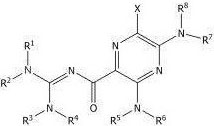
The term "amiloride analogue" as used herein refers to any structural analogue of amiloride, more specifically a chemical compound structurally related to amiloride and differing from amiloride by substitution at one or more positions. In some embodiments, the amiloride analog is a compound having the following structural formula:
wherein X is halogen, such as fluorine, chlorine or bromine. In some casesIn embodiments, X is chlorine. Amino substituent R1To R8May be independently selected from H, alkyl having 1-12 carbons, aralkyl having 7-13 carbons, aryl or heteroaryl. If the substituent R is1To R8Is alkyl or aralkyl, the alkyl portion of each alkyl or aralkyl substituent may optionally and independently be further substituted one or more times with a substituent selected from: halogen, hydroxy, alkoxy having 1 to 6 carbons, aryl, heteroaryl, amino, alkylamino having 1 to 6 carbons, dialkylamino having 2 to 12 carbons, carboxylic acid, or an ester formally derived from a carboxylic acid and an alcohol having 1 to 6 carbons. If the substituent R is1To R8Is aryl, aralkyl or heteroaryl, the aromatic moiety of each aryl, aralkyl or heteroaryl substituent may independently be further substituted one or more times with a substituent selected from: halogen, alkyl having 1-6 carbons, amino, alkylamino having 1-6 carbons, dialkylamino having 2-12 carbons, carboxylic acid, or an ester formally derived from a carboxylic acid and an alcohol having 1-6 carbons. In some embodiments, the substituent R1To R8Each of which is independently selected from H, alkyl and aralkyl groups having 1-6 carbons, each of which may be further substituted as described above.
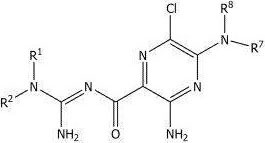
In some embodiments, the amiloride analog is a compound having the following structural formula:
wherein R is1,R2,R7And R8Independently H, an alkyl group having 1 to 6 carbons, or an aralkyl group having 7 to 13 carbons.
In other embodiments, the inhibitors of the invention comprise an amiloride analog or a pharmaceutically acceptable salt thereof. In a related embodiment, the amiloride analog is selected from the group consisting of benzamil, phenmil,5- (N-ethyl-N-isobutyl) -amiloride (EIPA), biprid, KB-R7943,5- (N-methyl-N-isobutyl) amiloride, 5- (N, N-hexamethylene) amiloride, and 5- (N, N-dimethyl) amiloride hydrochloride. In another related embodiment, the amiloride analog is benzamil. In another related embodiment, the amiloride analog is a methylated analog of benzamil. In another related embodiment, the amiloride analogue comprises a ring formed on a guanidino group. In another related embodiment, the amiloride analog comprises an acylguanidine group. In another related embodiment, the amiloride analog comprises a water solubilizing group formed on the guanidino group, wherein the water solubilizing group is N, N-dimethylamino or a glycosyl.
In some embodiments, as described above, the inhibitors of the invention target amiloride-sensitive DEG/ENaC proteins and compete with amiloride as a blocking agent. Known blocking agents include triamterene, phenamil, benzamil and derivatives thereof, particularly 3',4' -dichlorobenzamil; 2',4' -dimethyl benzamil; 5- (N-ethyl-N-isopropyl) amiloride; and 5- (N-methyl-N-isobutyl) amiloride. Additional amiloride analogues and derivatives include compounds described in the following references: thomas R. et al, J.Membrane biol.105,1-21 (1988); WO 2012035158; WO 2009074575; WO 2011028740; WO 2009150137; WO 2011079087; and WO2008135557, each of which is specifically incorporated herein by reference.
In some embodiments, the subject is a human, and the amiloride, amiloride analog or pharmaceutically acceptable salt thereof is administered at a dose of 0.01-3mg/kg body weight/day in the human. In some embodiments, the subject is a rodent, e.g., a mouse, and the amiloride, amiloride analog, or pharmaceutically acceptable salt thereof is administered at a dose of about 0.1-40 mg/kg/day, e.g., 0.12-37 mg/kg/day.
In some embodiments, an ENaC inhibitor is used in the methods or compositions of the present invention. The ENaC inhibitor can be any agent and/or composition capable of substantially reducing (including eliminating) the activity of at least one ENaC protein. An example of a known ENaC blocking agent is triamterene, which specifically blocks gamma ENaC, and is a potassium sparing diuretic. Other examples of ENaC blockers include P301, P365, P321, P552-02, P1037, GS-9411/P680, developed by Parion Sciences: (https://clinicaltrials.gov(ii) a http:// www.parion.com/pipeline/p-1037-pullsingle-disease /). GS-9411/P680 from Parion Sciences/Gilead has entered phase I clinical trials as an inhalation formulation for the treatment of cystic fiber (O' Riordan TG et al, Journal of Aerosol Medicine and Pullmary Drug Delivery 2014,27(3): 200-8). When applied to the eye, P301 and P365 increase tear volume (William R. Thelin, et al., J Ocul Pharmacol Ther.2012Aug; 28(4): 433-438); p321 was in phase II clinical trial with chronic dry eye (http:// www.parion.com/pipeline/P-321-dry-eye /). Another example of an ENaC blocking agent is NVP-QBE170 from Novartis. NVP-QBE170 is a dimeric amiloride derivative that shows potent and selective ENaC blockade both in vitro and in vivo. Its efficacy is similar to P552-02 from part Science, but when tested in the guinea pig TPD model, has a significantly increased safety window in terms of hyperkalemia over existing ENaC blockers. Both P552-02 and NVP-QBE170 are amiloride analogues (K J Coote, et al, Br J Pharmacol.2015Jun; 172(11):2814-26.) having the following chemical structures:
in some embodiments, ASIC inhibitors are used in the methods or compositions of the present invention. Examples of known ASIC blockers include amiloride, A-317567, A-317567 analogues and aromatic diamidines.
A-317567(CAS Regis. # 371217-32-2 from Abbott Laboratories) is a small molecule non-amiloride ASIC blocker having the following structural formula.
The compound has peripheral activity and can induce ASICs in rat DRG neurons (in vitro) with 1.8-15 times higher potency than amiloride. The analgesic effect of A-317567 has been tested in the CFA model of chronic inflammatory pain.
Scott D.Kuduk et al (ACS Chem Neurosci.2010Jan 20; 1(1):19-24) reported that A-317567 analogues, in particular the compounds '10 a' and '10 b' (about 3 fold), had greater potency than A-317567:
aromatic diamidines are synthetic small molecules that bind to the minor groove of DNA. They have been used clinically to treat protozoal or fungal infectious diseases. Several antiprotozoal diarylamidines, 4', 6-diamidino-2-phenylindole (DAPI), diamazene, hydroxysteributadine (hsb) and pentamidine, exhibit potent ASIC blocking activity in vitro. (Chen X, et al, neuropharmacology.2010Jun; 58(7): 1045-53; Xuanmao Chen, et al, Eur J Pharmacol.2010Dec 1; 648(1-3):15-23)
In addition, some toxin peptides are known to be ASIC modulators. Examples of ASIC targeted inhibitory toxins include spider toxin Psalmotoxin1(PcTx1), anemonin APETx2, and snake toxin mambalagin-1-3. These ASIC targeted inhibitory toxins, when injected in mice (PcTx1,0.46mg i.t. or 23 mg/kg; mambalagins, 2.2mg i.t. and i.c.v. or 110 mg/kg; APETx2,1.8mg intraplantar; 0.9mg intravenous; 2.7mg i.t. or 135mg/kg), did not cause excitotoxicity, convulsions, seizures, motor paralysis and ataxia (A.Baron et al.Toxicon 75((2013) 187-204)).
PcTx1 of the spider Psalmopoeus cambridge inhibits both homopolymer ASIC1a and heteromer ASIC1a/2b with nanomolar potency. The peptide has the sequence
The toxin peptide may be used as part of the venom from the species Nephila langerhans without substantial purification, or may be purified from the venom, or may be chemically synthesized, or may be biosynthesized from engineered organisms, and the like. In addition, derivatives of PcTX1 may be used in accordance with the present invention. The PcTX1 derivative is a peptide having a chemical structure formally related to PcTX1 and differs from PcTX1 by one or more amino acid substitutions, deletions, and/or insertions. Derivatives of PcTX1 are described, for example, in U.S. patent application 20080242588 and WO/2015/026339.
DEG/ENaC activator
In one embodiment, the modulator used in the methods of the invention is a DEG/ENaC activator that enhances the activity of DEG/ENaC receptors to cause an increase in appetite and/or body weight. In another embodiment, the DEG/ENaC activator is selected from DEG/ENaC stimulating small molecules, peptides and mimetics thereof. In another embodiment, the DEG/ENac activator is selected from the group consisting of compounds S3969, N-trimethyl-2- ((4-methyl-1H-indol-3-yl) thio) pentanoyl) oxy) ethylammonium iodide, and N- (2-hydroxyethyl) -4-methyl-2- ((4-methyl-1H-indol-3-yl) thio) pentanamide (from genomyx Inc.), q, AP301 and any analogues or derivatives thereof, and any combination.
Compound S3969, [ N- (2-hydroxyethyl) -4-methyl-2- (4-methyl-1H-indol-3-ylthio) ] pentanamide]Is a small molecule activator of human ENaC. Recently compound S3969 was reported to reversibly stimulate human ENaC in heterologous cell expression systems. The compound acts on ENaC to increase the channel opening rate and apparent affinity (EC)50) Was 1 mM. See, e.g., Stephan Kellenberger and Laurent Schild, International of basic and clinical pharmacology, XCI.structure, function, and pharmacology of acid-sensing and the epitopic Na + channel, J Clin Pharmacol; 54(3) 341-350. doi 10.1002/jcph.203.
AP301 is an ENaC activator (Stephan Kellenberger and Laurent Schild, supra). It is a human TNF- α derived peptide (. about.2 kD) consisting of 17 natural amino acids. The cyclic peptide was shown to activate ENaC by increasing its patency rate in heterologous expression systems. Pulmonary administration of the TIP peptide has been shown to substantially reduce lung permeability edema in a variety of pathophysiological conditions in a variety of small animal models of Acute Lung Injury (ALI). Amiloride sensitive Na + flux (via ENaC) was increased approximately 9-fold, 13-fold and 16-fold in rat, dog and pig AEC type II cells in the presence of AP301, respectively, over baseline conditions. AP301 is currently undergoing inhalation clinical trials.
The synthetic compound 2-guanidine-4-methyl quinazoline (GMQ) is another activator for ASIC (Stephan Kellenberger and Laurent Schild, supra primers):
compound GMQ induced sustained ASIC3 currents and induced pain related behavior.
Injection of an ASIC activator, Mit-toxin (MitTx) of Dezhou coral snake venom, in the paw of mice, caused painful behavior, while destruction of ASIC1a resulted in a reduction in pain (Bohlen CJ et al, (2011), Nature 479: 410-.
Treatment of
Appetite is present in all higher life forms and is used to regulate sufficient energy intake to maintain metabolic needs. Abnormal appetite may lead to malnutrition or overweight and metabolic disorders, such as obesity and related problems. Health risks associated with obesity include heart disease and stroke; high blood pressure and high cholesterol; diabetes mellitus; cancers, such as colon cancer, breast cancer (postmenopausal), endometrial (lining of the uterus) cancer, kidney and esophagus cancer; gallbladder diseases and gallstones; osteoarthritis; gout; respiratory problems such as sleep apnea (a person temporarily stopping breathing while sleeping) and asthma.
The present inventors propose methods and compositions for controlling appetite and body weight in an individual by demonstrating that DEG/ENaC ion channels can be pharmacologically targeted to induce reduced food intake and weight loss. The methods and compositions of the present invention avoid the side effects associated with current weight control compounds (e.g., anti-obesity drugs that act directly on the brain).
In some embodiments, the methods and compositions are useful for treating appetite disorders and related diseases, metabolic disorders or conditions, including overweight, obesity and obesity-related conditions, such as type 2 diabetes, hypertension, cardiovascular disease and combinations thereof.
In some embodiments, the methods and compositions can induce appetite suppression in an individual. In one embodiment, the individual has excessive appetite. In yet another embodiment, the subject is obese and/or overweight. In yet another embodiment, the subject has an obesity-related disorder. In yet another embodiment, the subject would benefit from a reduction in food intake resulting from inhibition of the DEG/ENaC ion channel, e.g., to maintain a desired weight or achieve a desired weight loss and fat reduction.
In some embodiments, the methods and compositions can induce appetite stimulation in an individual. In one embodiment, the individual suffers from anorexia and/or weight loss associated with a condition such as cancer. In another embodiment, the subject would benefit from increased food intake caused by activation of the DEG/ENaC ion channel, e.g., to achieve a desired weight gain.
In one embodiment, the subject may be a human or mammalian subject that has overweight or obesity, or an obesity-related disorder, and/or has a significant likelihood of developing obesity or an obesity-related disorder. Suitable exemplary animals include any animal, such as rodents (mice, rats, etc.), dogs, cats, sheep, goats, non-human primates, and the like. The animal may be treated for its own purposes, for example, for veterinary use (e.g., treatment of pets). Alternatively, the animal may provide an animal model, such as an obesity model, to facilitate testing of the drug candidate for human use, such as to determine the efficacy, efficacy window, side effects, etc., of the drug candidate.
Administration of
As used herein, with respect to a drug or drug candidate and an individual, the terms "administering" or "administering" refer to administering or applying the drug or drug candidate to the individual such that the drug or drug candidate may exert its biologically active effect on the individual. Thus, administering the drug may include delivering the drug to the subject by any suitable route, including, for example, injection, swallowing, inhalation, topical administration, or any combination thereof. The injection may be, for example, subcutaneous, intradermal, intravenous, intraarterial, intrathecal, epidural, subdural, intraventricular (i.e., into the brain), intraocular, intraperitoneal, intrasynovial, or any combination thereof. The injection may be through a needle, for example, or a needleless injector may be used. The swallowing can be performed by a liquid preparation, a capsule, a tablet, or the like. Inhalation (or topical application to the body epithelium) may be by an inhaler, nebulizer, or the like, and may involve a spray or particles/droplets of any suitable size, e.g., configured or sized for delivery to epithelial cells such as the nose, mouth, pharynx, larynx, or lung. Topical administration may include placing the drug on the epithelial layer for transepithelial uptake. Exemplary epithelial topical applications may include external application to the skin or a wound thereof (i.e., placement directly on the epidermis, dermis, subcutaneous tissue or exposed wound tissue, etc.). Other exemplary epithelia that may be used for topical administration may include rectal, vaginal, urethral, buccal, nasal or ocular epithelia, or any combination thereof. Topical application is facilitated by formulating the drug as an ointment and/or by placing the drug on a skin patch.
In some embodiments, the compositions of the present invention are administered by a route selected from the group consisting of: oral, topical, sublingual, buccal, intranasal, rectal and intravenous. In some embodiments, the amiloride or amiloride analog is administered orally or intravenously.
A therapeutically effective amount of a modulator (e.g., inhibitor) may be administered. As used herein, the terms "effective amount," "pharmaceutically effective amount," and "therapeutically effective amount" refer to a non-toxic but sufficient amount of an agent to provide a desired biological result. The result may be a reduction and/or alleviation of the signs, symptoms or causes of a disease, or any other desired alteration of a biological system, for example, a reduction in weight in an overweight or obese individual. In any event, an appropriate therapeutic amount can be determined by one of ordinary skill in the art using routine experimentation. For example, an effective amount of oral amiloride as a DEG/ENaC modulator for an adult human of about 75kg body weight may be about 0.75-250 mg/day.
The administration regimen may affect the constitution of the effective amount. Several divided or staggered doses may be administered daily or sequentially, or the doses may be continuously infused or may be bolus injected. The dosage of the therapeutic agent may be proportionally increased or decreased depending on the urgency of the therapeutic or prophylactic situation.
For administration of the compositions of the present invention to a subject, preferably a mammal, more preferably a human, known methods can be used at dosages and for times effective to produce the desired weight management (e.g., weight loss in an overweight or obese subject). The effective amount of the therapeutic compound required to achieve the desired effect will vary depending on such factors as the age, sex, and weight of the individual. Dosage regimens may be adjusted to provide the optimum therapeutic response. For example, several divided doses may be administered daily, or the dose may be reduced proportionally to the exigencies of the therapeutic situation. One of ordinary skill in the art will be able to study the relevant factors and determine an effective amount of a therapeutic compound without undue experimentation.
In some embodiments, the subject is a human. In some embodiments, the modulator is amiloride, an amiloride analogue or salt thereof and is administered in a daily dose (in single or multiple dose form) in the following ranges: 0.01-30mg/kg body weight, 0.01-10mg/kg body weight, 0.01-5mg/kg body weight, 0.01-3mg/kg body weight, 0.01-2mg/kg body weight, 0.01-1mg/kg body weight, 0.01-0.3mg/kg body weight, 0.01-0.1mg/kg body weight, 0.01-0.03mg/kg body weight, 0.03-30mg/kg body weight, 0.03-10mg/kg body weight, 0.03-5mg/kg body weight, 0.03-3mg/kg body weight, 0.03-1mg/kg body weight, 0.03-0.3mg/kg body weight, 0.03-0.1mg/kg body weight, 0.1-30mg/kg body weight, 0.1-10mg/kg body weight, 0.1-3mg/kg body weight, 0.1-1mg/kg body weight, 0.1-0.3mg/kg body weight, 0.3-30mg/kg body weight, 0.3-10mg/kg body weight, 0.3-3mg/kg body weight, 0.3-1mg/kg body weight, 1-30mg/kg body weight, 1-10mg/kg body weight, 1-3mg/kg body weight, 3-30mg/kg body weight, 3-10mg/kg body weight or 10-30mg/kg body weight. In one embodiment, the amiloride analog is selected from the group consisting of benzamil, phenamil, EIPA, bipridil, KB-R7943,5- (N-methyl-N-isobutyl) -amiloride, 5- (N, N-hexamethylene) -amiloride, 5- (N, N-dimethyl) amiloride hydrochloride, P552-02, and NVP-QBE 170.
In other embodiments, the modulator is amiloride, an amiloride analog or salt thereof and is formulated for administration as a single dose of the pharmaceutical composition in a dosage range of 0.1 to 1000 mg/dose, 0.1 to 300 mg/dose, 0.1 to 100 mg/dose, 0.1 to 30 mg/dose, 0.1 to 10 mg/dose, 0.1 to 3 mg/dose, 0.1 to 1 mg/dose, 0.1 to 0.3 mg/dose, 0.3 to 1000 mg/dose, 0.3 to 500 mg/dose, 0.3 to 300 mg/dose, 0.3 to 100 mg/dose, 0.3 to 30 mg/dose, 0.3 to 10 mg/dose, 0.3 to 3 mg/dose, 0.3 to 1 mg/dose, 1 to 1000 mg/dose, 1 to 300 mg/dose, 1 to 100 mg/dose, 1-30 mg/dose, 1-10 mg/dose, 1-3 mg/dose, 3-1000 mg/dose, 3-300 mg/dose, 3-100 mg/dose, 3-30 mg/dose, 3-10 mg/dose, 10-1000 mg/dose, 10-300 mg/dose, 10-100 mg/dose, 10-30 mg/dose, 30-1000 mg/dose, 30-300 mg/dose, 30-100 mg/dose, 100-1000 mg/dose, 100-300 mg/dose, or 300-1000 mg/dose. In one embodiment, the amiloride analog is selected from the group consisting of benzamil, phenamil, EIPA, bipridil, KB-R7943,5- (N-methyl-N-isobutyl) -amiloride, 5- (N, N-hexamethylene) -amiloride, 5- (N, N-dimethyl) amiloride hydrochloride, P552-02, and NVP-QBE 170. In some embodiments, the amiloride or amiloride analog is formulated for intravenous injection or oral administration.
In a preferred embodiment, the modulator according to the invention is administered before or during a meal, preferably 5 minutes to 3 hours, e.g. 15 minutes, before the meal.
Pharmaceutical composition
Another aspect of the present application relates to pharmaceutical compositions for modulating appetite or for treating appetite disorders and related diseases, metabolic disorders or conditions, such as overweight, obesity or obesity related conditions. The pharmaceutical compositions comprise an effective amount of a DEG/ENaC modulator and a pharmaceutically acceptable carrier. In some embodiments, the pharmaceutical composition comprises an amiloride analog or a pharmaceutically acceptable salt thereof, wherein the amiloride analog is selected from the group consisting of benzamil, phenamil, EIPA, bepridil, KB-R7943,5- (N-methyl-N-isobutyl) -amiloride, 5- (N, N-hexamethylene) -amiloride, 5- (N, N-dimethyl) amiloride hydrochloride, P552-02, and NVP-QBE 170.
Modulators, e.g., inhibitors, according to the present invention may be administered to an individual in any suitable form, in any suitable composition. In some examples, the modulator may be in the form of a pharmaceutically acceptable salt.
The term "pharmaceutical composition" as used herein refers to a mixture of at least one compound useful in the present invention and a pharmaceutically acceptable carrier, as the case may be. The pharmaceutical composition facilitates administration of the compound to a patient.
As used herein, the term "pharmaceutically acceptable carrier" refers to a pharmaceutically acceptable material, composition or vehicle, such as a liquid or solid filler, stabilizer, dispersant, suspending agent, diluent, excipient, thickener, solvent or encapsulating material, involved in carrying or transporting a compound useful in the present invention within or to a patient so that it may perform its intended function. Typically, such constructs may be carried to, or transported from, one organ or portion of the body to another organ or portion of the body. Each carrier must be "acceptable" in the sense of being compatible with the other ingredients of the formulation, including the compounds useful in the present invention, and not injurious to the patient. Some examples of materials that can be used as pharmaceutically acceptable carriers include: sugars such as lactose, glucose and sucrose; starches, such as corn starch and potato starch; cellulose and its derivatives, such as sodium carboxymethyl cellulose, ethyl cellulose and cellulose acetate; powdered gum tragacanth; malt; gelatin; talc; excipients, such as cocoa butter and suppository waxes; oils such as peanut oil, cottonseed oil, safflower oil, sesame oil, olive oil, corn oil and soybean oil; glycols, such as propylene glycol; polyols such as glycerol, sorbitol, mannitol and polyethylene glycol; esters, such as ethyl oleate and ethyl laurate; agar; buffering agents such as magnesium hydroxide and aluminum hydroxide; a surfactant; alginic acid; pyrogen-free water; isotonic saline; ringer's solution; ethanol; phosphate buffer; and other non-toxic compatible materials used in pharmaceutical formulations. As used herein, "pharmaceutically acceptable carrier" also includes any and all coatings, antibacterial and antifungal agents, and absorption delaying agents, and the like, that are compatible with the activity of the compounds of the present invention and that are physiologically acceptable to a patient. Supplementary active compounds may also be incorporated into the compositions. The "pharmaceutically acceptable carrier" may further include pharmaceutically acceptable salts of the compounds useful in the present invention. Other ingredients that may be included in the Pharmaceutical compositions of the present invention are known in the art and are described, for example, in Remington's Pharmaceutical Sciences (Genaro, ed., Mack Publishing co., 1985, Easton, PA), which is incorporated herein by reference.
In some embodiments, the pharmaceutical composition is formulated for oral administration. In other embodiments, the pharmaceutical composition comprises amiloride and/or an amiloride analog formulated for oral administration. For oral use, particularly suitable are tablets, dragees, liquids, drops, suppositories or capsules, caplets and gel caps. Compositions for oral use may be prepared according to any method known to the art, and such compositions may contain one or more agents selected from inert, non-toxic pharmaceutical excipients suitable for the manufacture of tablets. Such excipients include, for example, inert diluents such as lactose; granulating and disintegrating agents such as corn starch; binders such as starch; and lubricating agents such as magnesium stearate. Tablets may be uncoated or they may be coated by known techniques for aesthetics or to delay release of the active ingredient. Formulations for oral use may also be presented as hard gelatin capsules wherein the active ingredient is mixed with an inert diluent.
In some embodiments, the pharmaceutical composition is formulated for intravenous injection. In other embodiments, the pharmaceutical composition comprises amiloride and/or an amiloride analog formulated for intravenous injection. Pharmaceutical compositions suitable for injectable use include sterile aqueous solutions (where water soluble) or dispersions and sterile powders for the extemporaneous preparation of sterile injectable solutions or dispersions. For intravenous administration, suitable carriers include physiological saline, bacteriostatic water, Cremophor ELTM(BASF, Parsippany, NJ), or fluids to the extent of ease of injection. Injectable compositions must be stable under the conditions of manufacture and storage and must be protected from contamination by microorganisms such as bacteria and fungi. The carrier can be a solvent or dispersion medium containing, for example, water, ethanol, polyol (for example, glycerol, propylene glycol, and liquid polyethylene glycol, and the like), and suitable mixtures thereof. For example, by using a coating such as lecithin, by maintaining a desired particle size in the case of a dispersion, and by using a tableA surfactant to maintain proper fluidity. Prevention of the action of microorganisms can be achieved by various antibacterial and antifungal agents, for example, parabens, chlorobutanol, phenol, ascorbic acid, thimerosal, and the like. In many cases, it will be preferable to include isotonic agents, for example, sugars, polyalcohols such as mannitol, sorbitol, sodium chloride in the composition. Prolonged absorption of the injectable compositions can be brought about by including in the composition an agent which delays absorption, for example, aluminum monostearate and gelatin.
Sterile injectable solutions can be prepared by incorporating the required amount of amiloride and/or amiloride analogue in an appropriate solvent followed by filter sterilization. Generally, dispersions are prepared by incorporating the active compound into a sterile vehicle which contains a basic dispersion medium and the required other ingredients from those enumerated above. In the case of sterile powders for the preparation of sterile injectable solutions, the preferred methods of preparation are vacuum drying and freeze-drying which yields a powder containing the active ingredient plus any additional desired ingredient from a previously sterile-filtered solution thereof.
Screening method
In another aspect, the invention provides a method of identifying novel agents useful for modulating appetite or treating conditions of appetite or metabolic disorders, in particular obesity or an overweight or obesity-related condition, wherein the identification is based on the ability of the agent to modulate, e.g., inhibit or stimulate, DEG/ENaC receptors.
In one embodiment, the present invention provides a method for screening for an agent capable of modulating food intake or appetite and/or controlling body weight, the method comprising the steps of:
-providing an assay for determining modulation of expression or activity of a DEG/ENaC receptor;
-introducing a compound suspected of being a DEG/ENaC modulator into the assay; and
-determining whether an adjustment of DEG/ENaC has occurred,
wherein a compound that modulates the expression or activity level of a DEG/ENaC ion channel is a candidate agent for modulating food intake or appetite or controlling body weight.
In a further embodiment, the method comprises the steps of:
(i) contacting the agent with a DEG/ENaC receptor, and
(ii) detecting any change in the DEG/ENaC receptor activity.
Candidate compounds
The compounds tested as modulators of ENaC and/or ASIC proteins may be small organic molecules or biological entities, such as proteins, e.g. antibodies or peptides, sugars, nucleic acids, e.g. polynucleotides, oligonucleotides, siRNA, antisense oligonucleotides or ribozymes, lipids, fatty acids etc., which may be tested for their ability to modulate DEG/ENaC ion channel activity. The test compound may be in the form of a library of test compounds, such as a combinatorial library or a randomized library, which may provide sufficient diversity. Conventionally, new chemical entities with useful properties can be generated by identifying a test compound (referred to as a "lead compound") with some desired property or activity (e.g., inhibitory activity), followed by generating variants of the lead compound, and assessing the properties and activity of the variant compounds. Typically, High Throughput Screening (HTS) methods are used for this analysis. Typically, the test compounds may be small organic molecules and peptides. In one embodiment, the compound is an amiloride analog.
Determination test
Various assays, including in vitro and in vivo assays, including cell-based models, can be used to assess modulation of the activity or expression of DEG/ENaC proteins. See, e.g., U.S. patent 9244081 (describing screening methods for ENaC modulators) and U.S. patent application 20080242588 (describing screening methods for ASIC modulators). See also Andrew j.hirsh et al, j.med.chem.2006,49, 4098-; dube et al, Pain 117(2005) 88-96 (describing in vitro and in vivo characterization of ASIC blockers). These documents are incorporated herein by reference.
The screening can involve any suitable assay system suitable for measuring the interaction between the DEG/ENaC protein and a candidate modulator (e.g., inhibitor). Exemplary assay test systems can include biochemical assays (e.g., binding assay tests) performed using, for example, cells grown in culture ("cultured cells") and/or using organisms.
In some embodiments, such assay assays for detecting modulators, e.g., inhibitors and activators, include, for example, expressing ENaC and/or ASIC proteins in cells, cell extracts, or cell membranes in vitro, applying putative modulator compounds, and then determining a functional effect on the activity of the proteins.
In some embodiments, a high throughput binding assay is performed in which the DEG/ENaC protein is contacted with a potential modulator and incubated for a suitable time. As noted above, a variety of modulators may be used, including small organic molecules, peptides, antibodies and DEG/ENaC ligand analogs.
A variety of assays are available for identifying the binding of DEG/ENaC to the modulator, including labeled protein-protein binding assays, electrophoretic mobility changes, immunoassay assays, enzymatic assays, such as phosphorylation assays, and the like. In some cases, binding of a candidate modulator is determined by using a competitive binding assay, wherein interference with binding of a known ligand is measured in the presence of a potential modulator. Ligands of the DEG/ENaC family are known. Further, amiloride is known to inhibit the function of ENaC and ASICs. In such assay assays, DEG/ENaC proteins such as ENaC and ASIC proteins can be first bound to known ligands and then the desired compound, i.e., a putative activator or inhibitor, added. After washing the DEG/ENaC protein, interference with binding of potential modulators or known ligands is determined. Typically, potential modulators or known ligands are labeled.
Methods for determining ion channel function include, for example, patch clamp techniques, two-electrode voltage clamping, whole cell current measurement, and fluorescence imaging techniques and ion flux determination assays using ion-sensitive fluorescent dyes, such as radiolabel ion flux determination or ion flux determination. In some embodiments, candidate compounds may be tested in short-circuit current (Isc) assays, for example in KJCoote et al, Br J pharmacol.2015jun; 172(11) 2814-26. In some embodiments, compounds that modulate ASIC activity can be tested in the presence of the composition and an acid in a whole cell patch clamp mode, as described, for example, in g.r. dube et al, Pain 117(2005) 88-96.
In some embodiments, a cell-based assay test system is used to measure the effect of each candidate modulator (e.g., inhibitor) on ion flux (e.g., sodium ion flux or acid sensitive ion flux) in a cell. In some embodiments, the ion flux is sodium flux. For example, sodium flux can be measured by assessing uptake of radiolabeled sodium. In some embodiments, the assay test system uses cells expressing DEG/ENaC family members (e.g., ENaC α β γ, ASIC1a or ASIC2a), or two or more different cells expressing two or more different DEG/ENaC family members (e.g., ENaC α β γ and ASIC family member (s)), for determining the selective effect of each modulator (e.g., inhibitor) on these family members. The cells may express the members of each family endogenously or by introducing foreign nucleic acids. In some examples, the assay test system can measure ion flux by electrophysiological means (e.g., by patch clamping), using ion-or membrane potential sensitive dyes (e.g., sodium sensitive dyes), or by gene-based reporter systems, particularly reporter systems that are sensitive to changes in membrane potential and/or intracellular ion (e.g., sodium) concentration. The assay test system may be used to test the selective and/or specific inhibition of DEG/ENaC family members, in particular ENaC ion channels and ASIC ion channels expressed in the gastrointestinal tract of a mammal (e.g., a human).
In some embodiments of the screening method, any cell expressing an ENaC receptor and/or an ASIC receptor, including, for example, cells in the gastrointestinal tract, such as enteroendocrine cells, can be measured in the presence or absence of a test compound to detect modulation of its function.
Samples or assays comprising ENaC and/or ASIC proteins treated with a potential modulator can be compared to control samples without the modulator to check the extent of modulation. Control samples (not treated with the modulator) can be assigned a relative protein activity value of 100%. In one embodiment, the ENaC or ASIC is inhibited, wherein the activity value is about 80%, preferably 50%, more preferably 25-0% relative to a control. In another embodiment, the ENaC or ASIC is activated, wherein the activity value is 110%, more preferably 150%, more preferably 200-500% relative to the control (which is not treated with the activator) (i.e., the activity value is 2-to 5-fold higher relative to the control), more preferably 1000-3000%.
Compounds identified in vitro assays (e.g., cell-based assay assays), and biologically acceptable derivatives thereof, can be further tested in food intake or weight control assays, using, for example, normal or obese mouse models, to confirm their effect on food intake or weight control.
It is to be understood that for the values and ranges provided herein, all values and ranges encompassed by those values and ranges are within the scope of the invention. Further, all values falling within these ranges, including integer or fractional increments, and upper or lower limits of the numerical ranges, are also contemplated by this application.
All patents, patent applications, publications, technical and/or academic articles, and other references cited or mentioned herein are incorporated by reference in their entirety to the extent allowed by law.
Examples
The invention will now be described with reference to the following examples. These examples are provided for illustrative purposes only, and the present invention is not limited to these examples, but encompasses all variations that are apparent based on the teachings provided herein.
Example 1
Food intake regulation in fruit flies
Previous studies in drosophila have shown that the mechanosensory ion channel PPK1 is expressed in posterior intestinal neurons (pers) and plays a role in the regulation of food intake.
First, intestinal nerve projections were studied in drosophila by immunohistochemistry using the following antibodies and fluorescent markers using four previously characterized Gal4 drosophila lines: rabbit anti-GFP antibodies (ab 290; 1: 1000; Abcam, Cambridge, UK), Alexa Fluor 488 goat anti-rabbit IgG (H + L) (A11034; 1: 800; Life Technologies, Gaithersburg, Md., USA), mAb22C10(development Studies hybrid Bank, University of Iowa), and Alexa Fluor 633 phalloidin (A22284; 1: 250; Life Technologies). mAb22C10 is a microtubule-associated protein that is highly expressed in axons and therefore can be labeled to show axon morphology.
mCD8 was driven using PPK1-Gal4 GFP, examining the expression of PPK1 (a member of the DEG/ENaC superfamily) in the gastrointestinal tract (GI) of Drosophila.
For three-dimensional modeling of the posterior intestinal neuronal region, a series of z-stack confocal images were taken from intestinal samples immunostained with mAb22C10 and Alexa Fluor 633 phalloidin, and then transformed into a model using Imaris. All images were acquired using Zeiss LSM510 and analyzed using Imaris (Bitplane, Zurich, Switzerland).
The results showed that posterior intestinal neurons (PENs) were tightly packed around the muscles of the intestinal tract (FIG. 2A, PENs: green; muscle: red); and PPK1 ion channel was present on PEN (fig. 2B).
Next, the effect of PPK1 deficiency and pharmacological inhibition on food intake was examined in drosophila. Briefly, Drosophila was reared at 18 ℃. Capillary feeding assays were performed on 2-day-old males in groups of 4 at 29 ℃ for 24 hours as described (Ja et al, 2007, Proceedings of the National Academy of Sciences of USA 104: 8253-8256). The diet was 5% yeast extract and 5% sucrose solution. For inhibition experiments, male yw Drosophila was provided with food-100 mM sucrose supplemented with 10mM benzamil or DMSO-using benzamil (DEG/ENaC ion channel antagonist).
PPK 1-deficient drosophila had increased food intake (fig. 2C). Consistent with these results, inhibition of PPK1 by benzamil also resulted in increased food consumption by drosophila (fig. 2D).
Example 2
Members of the DEG/ENaC superfamily in vertebrates have low sequence similarity to homologues in invertebrates and constitute distinct families. In mammals, there are two DEG/ENaC families, epithelial sodium channels (ENaCs) and acid-sensitive ion channels (ASICs). The ENaC family includes four ENaC homologs, ENaC α, β, γ, and δ. The ASIC family includes ASCI homologues, ASCI1a, ASCI1b, ASIC2a, ASIC2b, ASIC3, ASIC4 and ASIC 5.
The following experiment was performed to investigate whether the DEG/ENaC ion channel plays a role in food intake in mammals.
2.1. Expression of DEG/ENaC genes in the gastrointestinal tract of mice
Stomach, jejunum and colon were dissected from 8 week old C57B6 male mice. RNA was extracted using TRI reagent (invitrogen) and cDNA was prepared using PrimeScript kit (Takara). 10ng of RNA was used for each PCR reaction.
For RT-PCR, the following primers were used:
αENaC:F:5’-ACCTGTCGTTTCAACCAGGC
R:5’-TCCAGGCATGGAAGACATCCAG
βENaC:F:5’-GGCCCAGGCTACACCTACA
R:5’-AGCAGCGTAAGCAGGAACC
ASIC1:F:5’-ATGCTTCTCTCGTGCCACTTCC
R:5’-TGGCCCGAGTTGAATGTGTAGC
ASIC2:F:5’-GCCCGCACAACTTCTCCTC
R:5’-GGCAGGTACTCATCTTGCTGAA
ASIC3:F:5’-TTCGCTACTATGGGGAGTTCC
R:5’-GCCATGTCAAAAGTCGGACTG
ASIC5:F:5’-CTGCCATCTCCAACTGACCG
R:5’-CACCAAGAGCGAGACAGAGC
the DEG/ENaC genes tested, including α ENaC, β ENaC, ASIC1, ASIC2, ASIC3, ASIC5, were expressed in the stomach, jejunum and colon of mice (fig. 3). It is speculated that mammals may have enteric neurons similar to PEN in the Drosophila gut, which regulates food intake through the activity of the DEG/ENaC ion channels present thereon.
2.2. Inhibition of the effects of DEG/ENaC ion channels on food intake
Amiloride is a known non-selective inhibitor of the DEG/ENaC ion channel and blocks ENaCs and ASCI. This compound was first described by Cragoe et al in 1967 (U.S. patent 3,313,813; 1967, 4, 11; assigned to Merck co., Inc.). The compounds have been used as antihypertensive agents, potassium sparing diuretics, and for the treatment of hypertension and congestive heart failure. In hypertensive patients, amiloride inhibits sodium reabsorption in the kidney by binding to amiloride-sensitive sodium channels. This can facilitate the removal of sodium and water from the body, but does not consume potassium.
In the following experiments, amiloride was used to antagonize the DEG/ENaC ion channel in mice.
2.3 inhibition of short-term food intake by amiloride in Normal mice
13-week-old C57BL6 female and male mice were individually housed for 2 weeks prior to the experiment. Mice were not fed and starved from 8am to 6 pm. Amiloride was then administered by oral gavage or intraperitoneal injection at a dose of 1,10 or 100 μmoles/kg body weight (229.6 μ g,2.296mg, or 22.96mg/kg body weight; n ═ 3 animals per concentration), or vehicle (distilled water for oral gavage, saline for ip injection). The administration volume was 10ml/kg body weight. After 15 minutes, mice were provided with normal solid food (chow) and food consumption at the indicated time points was measured. For data points, P values were calculated using t-test (unpaired, 2-tailed). P <0.05, p <0.01, p < 0.001.
The results are shown in fig. 5. Both oral and intraperitoneal administration of amiloride inhibited short-term food intake in mice.
2.4 weight loss and fat loss by amiloride in an obese mouse model
LepR 8 weeks old was used in the experimentsPBFemale mice. LepRPBThe mouse is an obese model mouse, which carries a leptin receptor gene mutation. 20 mice were randomly divided into two groups. Treatment group mice were given amiloride 6 times a week by oral gavage at late afternoon prior to nighttime feeding. Amiloride was dissolved in DMSO and diluted in sterile water. The amiloride is administered at a dose of 4.1 mg/kg/day on days 1-14 and 12.3 mg/kg/day on days 15-35. The injection volume was 10 ml/kg. Control mice received 82. mu.l DMSO/kg/day in sterile water. Body weight was measured. Body weight change compared to body weight on day 14 was analyzed.
FIG. 6 shows amiloride vs LepRPBEffects of weight changes in obese mice. Leptin receptor mutant mice fed amiloride showed significant weight loss compared to control mice fed DMSO. This data demonstrates that amiloride has an effect of inducing weight loss.
2.5 characterization of mice weight loss induced by amiloride
To characterize the nature of the weight loss induced by amiloride, changes in the body composition (including fat, lean tissue and body fluid) of the mice were determined by a Bruker Minispec LF50NMR instrument, according to the manufacturer's instructions, before and after 5 weeks drug administration.
The results are shown in fig. 7. Mice fed amiloride and vehicle DMSO had a reduction in fat/lean ratio, percent body fat and percent body fluid. However, amiloride resulted in a more significant reduction in fat/lean tissue ratio and body fat percentage. There was no significant difference in the percentage reduction of body fluid in mice fed amiloride compared to mice fed control DMSO. These data indicate that the weight loss caused by amiloride is due to a reduction in fat rather than a reduction in body fluid.
2.6 inhibition of short-term food intake by Benzamil in Normal mice
To further determine whether weight loss in mice fed amiloride was due to inhibition of the DEG/ENaC ion channel, the amiloride analog Benzamil was used in short-term food intake experiments. Benzamil is a more potent, highly specific, long-acting DEG/ENaC ion channel antagonist.
15-week-old C57BL6 female mice were individually housed for 2 weeks prior to the experiment. Mice were not fed and starved from 8am to 6 pm. Then, Benzamil (Benzamil hydrochloride hydrate) was administered by intraperitoneal injection at 0.01-10. mu. mole/kg body weight (3.5621. mu.g-3.5621 mg/kg body weight), or saline was administered. The administration volume was 10ml/kg body weight. After 15 minutes, mice were provided with normal solid food (chow) and food consumption at the indicated time points was measured.
The results are shown in fig. 8. Similar to amiloride, benzamil inhibited short-term food intake in mice.
In summary, the data support the notion that DEG/ENaC ion channels play a role in regulating food intake in mammals. However, unlike the weight gain effect observed when inhibiting its homolog PPK1 in drosophila (example 1), DEG/ENaC inhibition induced weight loss in mammals, which surprisingly could be attributed primarily to body fat reduction.