CN109389552B - Image super-resolution algorithm based on context-dependent multitask deep learning - Google Patents
Image super-resolution algorithm based on context-dependent multitask deep learning Download PDFInfo
- Publication number
- CN109389552B CN109389552B CN201710652936.6A CN201710652936A CN109389552B CN 109389552 B CN109389552 B CN 109389552B CN 201710652936 A CN201710652936 A CN 201710652936A CN 109389552 B CN109389552 B CN 109389552B
- Authority
- CN
- China
- Prior art keywords
- image
- resolution
- network
- edge
- residual
- Prior art date
- Legal status (The legal status is an assumption and is not a legal conclusion. Google has not performed a legal analysis and makes no representation as to the accuracy of the status listed.)
- Expired - Fee Related
Links
Images


Classifications
-
- G—PHYSICS
- G06—COMPUTING OR CALCULATING; COUNTING
- G06T—IMAGE DATA PROCESSING OR GENERATION, IN GENERAL
- G06T3/00—Geometric image transformations in the plane of the image
- G06T3/40—Scaling of whole images or parts thereof, e.g. expanding or contracting
- G06T3/4053—Scaling of whole images or parts thereof, e.g. expanding or contracting based on super-resolution, i.e. the output image resolution being higher than the sensor resolution
Landscapes
- Physics & Mathematics (AREA)
- General Physics & Mathematics (AREA)
- Engineering & Computer Science (AREA)
- Theoretical Computer Science (AREA)
- Image Analysis (AREA)
- Image Processing (AREA)
Abstract
本发明提供一种基于上下文相关多任务深度学习的图像超分辨算法,该算法设计了三个深度神经网络,分别用于捕捉图像的基本信息、主要边缘信息和微小细节信息,然后在一个多任务学习的框架中对这些神经网络进行上下文相关连接与统一训练。给定输入的低分辨率图像,训练好的神经网络将分别输出基本图像、主要边缘图像和微小细节图像,最终的高分辨率图像由基本图像和微小细节图像融合而成;该算法可以仅用静态低分辨率(LR)图像为输入,恢复出高分辨率(HR)的图像。并且,所恢复出来的HR图像的结构得到了很好的保持,能尽可能多地恢复出理想HR图像中的结构信息。
The present invention provides an image super-resolution algorithm based on context-dependent multi-task deep learning. The algorithm designs three deep neural networks, which are respectively used to capture the basic information, main edge information and tiny detail information of the image, and then in a multi-task These neural networks are context-sensitively connected and uniformly trained in a learning framework. Given the input low-resolution image, the trained neural network will output the basic image, the main edge image and the small detail image respectively, and the final high-resolution image is fused from the basic image and the small detail image; the algorithm can only use A static low-resolution (LR) image is taken as input, and a high-resolution (HR) image is recovered. Moreover, the structure of the recovered HR image is well preserved, and as much structural information as possible in the ideal HR image can be recovered.
Description
技术领域technical field
本发明涉及数字图像处理领域,更具体地,涉及一种基于上下文相关多任务深度学习的图像超分辨算法。The present invention relates to the field of digital image processing, and more specifically, relates to an image super-resolution algorithm based on context-dependent multi-task deep learning.
背景技术Background technique
图像超分辨是一种通过计算的方式让图像的分辨率得到提升的技术,可以广泛用于视频监控和医学影像分析等领域。单幅图像超分辨算法要解决的问题是,当输入只有单幅图像时,如何提升图像的分辨率。这个问题是图像处理领域中的一个基本问题,也是一个必要问题。Image super-resolution is a technology that improves the resolution of images by computing, and can be widely used in video surveillance and medical image analysis. The problem to be solved by the single image super-resolution algorithm is how to improve the resolution of the image when the input is only a single image. This problem is a fundamental problem in the field of image processing, and it is also a necessary problem.
传统的解决方案可以划分为基于重建的算法、基于样例的方法和基于插值的方法。基于重建的方法是把高分辨率(HR)图像和低分辨率(LR)图像之间的关系用一个作用于全图的卷积核进行建模,在给的卷积核估计值的情况下通过求解逆问题得到清晰的HR图像。然而,这些方法通常会由于卷积核估计的不准确而造成HR图像中的环状瑕疵。基于样例的方法想通过引入图像自身或者外部图像中的图像块作为样例,实现了在高放大倍数情况下的图像超分辨。此类方法在图像恢复时需要利用图像块之间的相似信息,当LR图像中不存在足够的相似图像块时,极有可能会由于图像块的不相似而引入一些不必要的虚假细节。基于插值的方法通过精细设计的插值核函数来提升图像的分辨率。然而,无论是预先定义的核函数(例如双线性插值)还是自适应的核函数,都难以应对图像内容的多种变化。当图像的结构与核函数的定义不一致的时候,会造成图像结构的模糊。Traditional solutions can be divided into reconstruction-based algorithms, sample-based methods, and interpolation-based methods. The reconstruction-based method is to model the relationship between the high-resolution (HR) image and the low-resolution (LR) image with a convolution kernel that acts on the entire image, given the estimated value of the convolution kernel A clear HR image is obtained by solving the inverse problem. However, these methods usually cause ring artifacts in HR images due to inaccurate estimation of convolution kernels. The example-based method achieves image super-resolution under high magnification by introducing the image itself or the image block in the external image as a sample. Such methods need to utilize similar information between image blocks in image restoration. When there are not enough similar image blocks in the LR image, it is very likely that some unnecessary false details will be introduced due to the dissimilarity of the image blocks. Interpolation-based methods improve image resolution through carefully designed interpolation kernel functions. However, whether it is a predefined kernel function (such as bilinear interpolation) or an adaptive kernel function, it is difficult to cope with multiple changes in image content. When the structure of the image is inconsistent with the definition of the kernel function, the image structure will be blurred.
近年来,由于深度学习在各种计算机视觉任务重的巨大成功,人们开始将深度神经网络用于图像超分辨问题中。一种常见的做法就是利用全卷积网络建立LR图像和HR图像之间的映射关系,以最小化网络输出图像和真实的HR图像之间的均方误差为目标来训练神经网络。此类方法虽然在图像超分辨的质量上获得了较大的提升,但是也会产生一些结构不一致的瑕疵。其主要原因是以均方误差最小化为代价函数的神经网络难以捕捉人类视觉系统中更敏感的结构变化。近期的图像超分辨算法试图通过引入基于特征的感知误差函数来缓解这一问题,然而此类方法虽然在超分辨图像上得到了更高的视觉感知质量,但是也会引入一些不真实的图像细节。In recent years, due to the great success of deep learning in various computer vision tasks, people have begun to use deep neural networks for image super-resolution problems. A common practice is to use a fully convolutional network to establish a mapping relationship between LR images and HR images, and train the neural network with the goal of minimizing the mean square error between the network output image and the real HR image. Although such methods have greatly improved the quality of image super-resolution, they will also produce some structurally inconsistent defects. The main reason is that the neural network whose cost function is to minimize the mean square error is difficult to capture the more sensitive structural changes in the human visual system. Recent image super-resolution algorithms try to alleviate this problem by introducing feature-based perceptual error functions. However, although such methods achieve higher visual perception quality on super-resolution images, they also introduce some unreal image details. .
发明内容Contents of the invention
本发明提供一种基于上下文相关多任务深度学习的图像超分辨算法,该算法可实现用静态低分辨率(LR)图像为输入,恢复出高分辨率(HR)的图像。The present invention provides an image super-resolution algorithm based on context-dependent multi-task deep learning. The algorithm can use a static low-resolution (LR) image as an input to recover a high-resolution (HR) image.
为了达到上述技术效果,本发明的技术方案如下:In order to achieve the above-mentioned technical effect, the technical scheme of the present invention is as follows:
一种基于上下文相关多任务深度学习的图像超分辨算法,包括以下步骤:An image super-resolution algorithm based on context-dependent multi-task deep learning, comprising the following steps:
S1:收集图像数据;S1: collecting image data;
S2:建立神经网络模型;S2: Establish a neural network model;
S3:利用收集图像数据对所建立的神经网络模型进行训练;S3: using the collected image data to train the established neural network model;
S4:将训练好的神经网络处理静态低分辨率图像即得到高分辨率的图像。S4: Process the trained neural network on static low-resolution images to obtain high-resolution images.
进一步地,所述步骤S1中收集的图像数据训练数据包括高分辨率的图像、该高分辨率的图像对应的边缘图像和其对应的静态低分辨率图像;其中,高分辨率的图像对应的边缘图像是二值图像,由边缘检测算法给出或由人工标记给出;边缘图像中值为0的像素表示非边缘,值为1的像素表示边缘。Further, the image data training data collected in the step S1 includes a high-resolution image, an edge image corresponding to the high-resolution image, and a corresponding static low-resolution image; wherein, the high-resolution image corresponds to The edge image is a binary image, which is given by the edge detection algorithm or given by manual marking; the pixels with a value of 0 in the edge image represent non-edges, and the pixels with a value of 1 represent edges.
进一步地,所述步骤S2的神经网络模型包括三个部分组成;第一个部分由4个卷积层组成,其滤波器数量逐层提高,用于提取图像的多尺度特征;第二部分由一个第一反卷积层和两个第一卷积层组成,其中第一反卷积层用于将特征图进行自适应的插值,第一卷积层用于输出期望的特征图和初步的高分辨率的图像;第三部分是由一个第二反卷积层和两个第二卷积层组成,其中第二反卷积层用于将特征图进行自适应的插值,第二卷积层用于输出残差图。Further, the neural network model in step S2 consists of three parts; the first part consists of 4 convolutional layers, the number of filters of which is increased layer by layer, and is used to extract multi-scale features of the image; the second part consists of A first deconvolution layer and two first convolution layers, where the first deconvolution layer is used for adaptive interpolation of the feature map, and the first convolution layer is used to output the desired feature map and preliminary High-resolution image; the third part is composed of a second deconvolution layer and two second convolution layers, where the second deconvolution layer is used for adaptive interpolation of the feature map, and the second convolution layer is used to output the residual map.
进一步地,所述步骤S3的过程如下:Further, the process of step S3 is as follows:
S31:从图像数据中筛选出低分辨率图像,高分辨率图像,边缘图像;S31: filter out low-resolution images, high-resolution images, and edge images from the image data;
S32:将低分辨率图像输入基本图像估计网络和边缘估计网络,得到对应的超分辨后的图像结果和边缘图像;S32: Input the low-resolution image into the basic image estimation network and the edge estimation network, and obtain the corresponding super-resolved image result and edge image;
S33:将网络输出的结果和高分辨率图像与手工标注边缘图像进行计算,并利用计算结果更新网络的参数;S33: Calculate the result output by the network and the high-resolution image and the manually marked edge image, and use the calculation result to update the parameters of the network;
S34:当基本图像估计网络和边缘估计网络收敛以后,将参数固定;S34: After the basic image estimation network and the edge estimation network converge, fix the parameters;
S35:利用基本图像估计网络估计残差图,并作为残差估计网络的目标更新残差估计网络参数;S35: Utilize the basic image estimation network to estimate the residual image, and use it as the target of the residual estimation network to update the parameters of the residual estimation network;
S36:当残差估计网络收敛以后,将参数固定;S36: After the residual estimation network converges, fix the parameters;
S37:将残差网络输出与基本图像估计网络输出融合,得到高分辨率图像。S37: Fusing the output of the residual network and the output of the basic image estimation network to obtain a high-resolution image.
进一步地,所述步骤S 4中将训练好的神经网络用于处理新的输入静态低分辨率图像时,输入的静态低分辨率图像先经过图像裁剪或者下采样预处理操作,使得输入的静态低分辨率图像的分辨率与网络训练时所采用的LR图像分辨率一致;新输入的静态低分辨率图像输入训练好的神经网络之后,经过卷积和加权平均等各种操作,会输出高分辨率的边缘图、初步的高分辨率的图像和高分辨率的图像的残差图,其中初步的高分辨率的图像和高分辨率的图像的残差图通过线性叠加的方式进行融合,得到最终的高分辨率的图像。Further, when the trained neural network is used to process the new input static low-resolution image in the step S4, the input static low-resolution image first undergoes image cropping or down-sampling preprocessing operations, so that the input static low-resolution image The resolution of the low-resolution image is consistent with the resolution of the LR image used in network training; after the newly input static low-resolution image is input into the trained neural network, after various operations such as convolution and weighted average, it will output a high The resolution edge map, the preliminary high-resolution image and the residual map of the high-resolution image, wherein the preliminary high-resolution image and the residual map of the high-resolution image are fused by linear superposition, Get the final high-resolution image.
与现有技术相比,本发明技术方案的有益效果是:Compared with the prior art, the beneficial effects of the technical solution of the present invention are:
本发明设计了三个深度神经网络,分别用于捕捉图像的基本信息、主要边缘信息和微小细节信息,然后在一个多任务学习的框架中对这些神经网络进行上下文相关连接与统一训练。给定输入的低分辨率图像,训练好的神经网络将分别输出基本图像、主要边缘图像和微小细节图像,最终的高分辨率图像由基本图像和微小细节图像融合而成;该算法可以仅用静态低分辨率(LR)图像为输入,恢复出高分辨率(HR)的图像。并且,所恢复出来的HR图像的结构得到了很好的保持,能尽可能多地恢复出理想HR图像中的结构信息。The present invention designs three deep neural networks, which are respectively used to capture the basic information, main edge information and tiny detail information of the image, and then perform context-dependent connection and unified training on these neural networks in a multi-task learning framework. Given the input low-resolution image, the trained neural network will output the basic image, the main edge image and the small detail image respectively, and the final high-resolution image is fused from the basic image and the small detail image; the algorithm can only use A static low-resolution (LR) image is taken as input, and a high-resolution (HR) image is recovered. Moreover, the structure of the recovered HR image is well preserved, and as much structural information as possible in the ideal HR image can be recovered.
附图说明Description of drawings
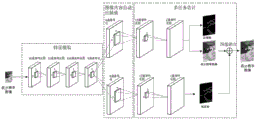
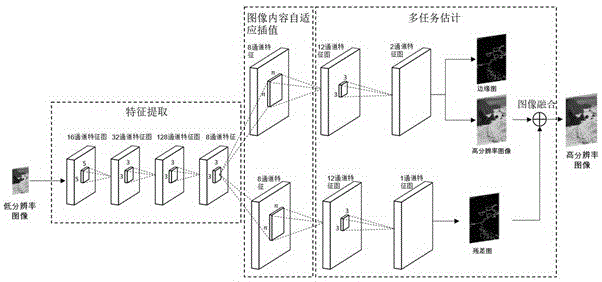
图1为本发明实施例中神经网络结构示意图;Fig. 1 is the neural network structure schematic diagram in the embodiment of the present invention;
图2为本发明和SRCNN、SCN、ShCNN方法在“蝴蝶”图像上的超分辨视觉效果对比;Fig. 2 is the super-resolution visual effect comparison of the present invention and SRCNN, SCN, ShCNN method on "butterfly" image;
其中,图2(a)位SRCNN算法的效果图,图2(b)为SCN算法的效果图,图2(c)为ShCNN算法的效果图,图2(d)为本发明算法的效果图,图2(e)为理想效果图。Wherein, Fig. 2 (a) is the effect diagram of SRCNN algorithm, Fig. 2 (b) is the effect diagram of SCN algorithm, Fig. 2 (c) is the effect diagram of ShCNN algorithm, Fig. 2 (d) is the effect diagram of the algorithm of the present invention , Figure 2(e) is the ideal rendering.
具体实施方式Detailed ways
附图仅用于示例性说明,不能理解为对本专利的限制;The accompanying drawings are for illustrative purposes only and cannot be construed as limiting the patent;
为了更好说明本实施例,附图某些部件会有省略、放大或缩小,并不代表实际产品的尺寸;In order to better illustrate this embodiment, some parts in the drawings will be omitted, enlarged or reduced, and do not represent the size of the actual product;
对于本领域技术人员来说,附图中某些公知结构及其说明可能省略是可以理解的。For those skilled in the art, it is understandable that some well-known structures and descriptions thereof may be omitted in the drawings.
下面结合附图和实施例对本发明的技术方案做进一步的说明。The technical solutions of the present invention will be further described below in conjunction with the accompanying drawings and embodiments.
实施例1Example 1
一种用于静态图像超分辨的上下文相关多任务深度学习方法,包括以下步骤:A context-dependent multi-task deep learning method for static image super-resolution, comprising the following steps:
S1:收集图像数据;S1: collecting image data;
S2:建立神经网络模型;S2: Establish a neural network model;
S3:利用收集图像数据对所建立的神经网络模型进行训练;S3: using the collected image data to train the established neural network model;
S4:将训练好的神经网络处理静态低分辨率图像即得到高分辨率的图像。S4: Process the trained neural network on static low-resolution images to obtain high-resolution images.
步骤S1中,训练数据由三部分组成,即HR图像、HR图像对应的边缘图像和HR图像对应的LR图像。其中,HR图像对应的边缘图像是二值图像,可以由边缘检测算法给出,也可以由人工标记给出。边缘图像中值为0的像素表示非边缘,值为1的像素表示边缘。假设LR图像的分辨率是h×w,HR图像的分辨率是H×W,则训练好的网络只可用于将分辨率为h×w的输入LR图像的分辨率提升至H×W。In step S1, the training data consists of three parts, namely HR images, edge images corresponding to the HR images, and LR images corresponding to the HR images. Wherein, the edge image corresponding to the HR image is a binary image, which can be given by an edge detection algorithm, or can be given by manual marking. Pixels with a value of 0 in the edge image represent non-edges, and pixels with a value of 1 represent edges. Assuming that the resolution of the LR image is h×w and the resolution of the HR image is H×W, the trained network can only be used to increase the resolution of the input LR image with the resolution of h×w to H×W.
进一步地,所述步骤S2中,神经网络模型的总体结构如附图1所示,主要由三个部分组成。第一个部分由4个卷积层组成,其滤波器数量逐层底层,主要用于提取图像的多尺度特征;第二部分由一个反卷积层和两个卷积层组成,其中反卷积层用于将特征图进行自适应的插值,卷积层用于输出期望的特征图和初步的HR图;第三部分也是由一个反卷积层和两个卷积层组成,其中反卷积层用于将特征图进行自适应的插值,卷积层用于输出残差图。第二部分的网络同时输出边缘图和初步的HR图,这样的设计可以在初步的HR图加入上下文相关的边缘信息,有助于获得保持边缘结构的初步HR图。而第三部分残差上下文相关网络(RCN)的目标是输出初步HR图与理想HR图之间的残差,所得到的残差将与初步的HR图进行融合,得到最终的HR图。由于所设计的神经网络有多个输出,因此可以称之为一个多任务的神经网络。以将128×128的输入LR图像分辨率提升至370×370为例,各层网络的具体设置如下表所示。注意,当输入和输出图像分辨率改变时,只需要修改反卷积层的步长(stride)即可。Further, in the step S2, the overall structure of the neural network model is mainly composed of three parts as shown in Fig. 1 . The first part consists of 4 convolutional layers, and the number of filters is layer by layer, which is mainly used to extract the multi-scale features of the image; the second part consists of a deconvolution layer and two convolutional layers, where the deconvolution The convolutional layer is used to adaptively interpolate the feature map, and the convolutional layer is used to output the desired feature map and the preliminary HR map; the third part is also composed of a deconvolution layer and two convolutional layers, where the deconvolution The product layer is used to adaptively interpolate the feature map, and the convolutional layer is used to output the residual map. The second part of the network outputs the edge map and the preliminary HR map at the same time. This design can add context-related edge information to the preliminary HR map, which helps to obtain a preliminary HR map that maintains the edge structure. The goal of the third part, the Residual Context Correlation Network (RCN), is to output the residual between the preliminary HR map and the ideal HR map, and the obtained residual will be fused with the preliminary HR map to obtain the final HR map. Since the designed neural network has multiple outputs, it can be called a multi-task neural network. Taking the 128×128 input LR image resolution as an example to 370×370, the specific settings of each layer network are shown in the table below. Note that only the stride of the deconvolution layer needs to be modified when the input and output image resolutions are changed.
表1:所提神经网络各层的参数设置Table 1: Parameter settings of each layer of the proposed neural network
步骤S3中,利用S1中的训练数据对所建立的神经网络模型进行训练的伪代码如下:In step S3, the pseudo code for training the established neural network model using the training data in S1 is as follows:
用W来表示所设计网络的所有参数。由于网络结构的特性,我们可以将其划分为四个不重叠的部分分别进行更新,即W={Ws,Wh,Wb,Wd},其中Ws是反卷积层的参数,用于内容自适应的图像插值,Wd代表RCN的网络参数,Wh代表用于产生初步HR图的网络参数,Wb代表用于产生边缘图的网络参数,fh(·)表示用网络重建初步HR图的非线性过程,fb(·)表示用网络产生边缘图的非线性过程,fd(·)表示用网络产生初步HR图和理想HR图之间的残差的过程。算法的参数T为正整数,用于控制从训练集中随机选取子集的次数。Use W to represent all parameters of the designed network. Due to the characteristics of the network structure, we can divide it into four non-overlapping parts and update them separately, that is, W={Ws,Wh,Wb,Wd}, where Ws is the parameter of the deconvolution layer for content adaptation , Wd represents the network parameters of RCN, W h represents the network parameters used to generate the preliminary HR map, W b represents the network parameters used to generate the edge map, f h ( ) represents the non- The linear process, f b ( ) represents the nonlinear process of using the network to generate the edge map, and f d ( ) represents the process of using the network to generate the residual between the preliminary HR map and the ideal HR map. The parameter T of the algorithm is a positive integer, which is used to control the number of random selection of subsets from the training set.
步骤S4中,将训练好的神经网络用于处理新的输入LR图像时,要求输入的LR图像要先经过图像裁剪或者下采样等预处理操作,使得输入的LR图像分辨率与网络训练时所采用的LR图像分辨率一致。LR图像输入本发明所设计的神经网络之后,经过卷积和加权平均等各种操作,会输出HR边缘图Ib=fb(Ws,Wb,I'l i)、初步的HR图像Ih=fh(Ws,Wh,I'l i)和HR残差图Id=fd(Ws,Wd,I'l i),其中Ih和Id将通过线性叠加的方式进行融合,得到最终的HR图像。In step S4, when the trained neural network is used to process a new input LR image, the input LR image is required to undergo preprocessing operations such as image cropping or down-sampling, so that the resolution of the input LR image is the same as that used during network training. The resolution of the LR images used is the same. After the LR image is input into the neural network designed by the present invention, after various operations such as convolution and weighted average, it will output the HR edge map I b = f b (W s , W b , I' l i ), the preliminary HR image I h = f h (W s ,W h ,I' l i ) and HR residual map I d =f d (W s ,W d ,I' l i ), where I h and I d will be superimposed by linear The method is fused to obtain the final HR image.
以将低分辨率的图像放大3倍为例,并和其他代表性的基于深度神经网络的方法(包括SRCNN、SCN和ShCNN)在标准数据集BSD500、Set5和Set14上进行对比:Take the low-resolution image enlarged by 3 times as an example, and compare it with other representative deep neural network-based methods (including SRCNN, SCN and ShCNN) on the standard data sets BSD500, Set5 and Set14:
1)、将包含500幅图像的BSD500数据集划分为包含300幅图像的训练集BSD300和包含200幅图像的测试集BSD200,将BSD200中的HR图像进行尺度为1/3的下采样,得到对应的LR图像。200幅LR图像、200幅HR图像和对应的200张HR边缘图共同构成了训练数据集。注意其他方法可能不需要HR边缘图作为训练数据。1) Divide the BSD500 dataset containing 500 images into a training set BSD300 containing 300 images and a test set BSD200 containing 200 images, and downsample the HR images in BSD200 to a scale of 1/3 to obtain the corresponding LR image. 200 LR images, 200 HR images and corresponding 200 HR edge maps constitute the training dataset. Note that other methods may not require HR edge maps as training data.
2)、利用上述训练样本,在所提的上下文相关多任务学习框架下对所提的深度神经网络进行训练,网络参数设计如表1所示。2) Using the above training samples, the proposed deep neural network is trained under the proposed context-sensitive multi-task learning framework, and the network parameters are designed as shown in Table 1.
3)、利用训练好的网络,根据步骤S4对输入的图像进行超分辨实验,分别在Set5、Set14和BSD200数据集上的平均量化结果如表2所示,视觉对比效果如附图2所示。3), using the trained network, according to step S4 to perform super-resolution experiments on the input image, the average quantization results on the Set5, Set14 and BSD200 data sets are shown in Table 2, and the visual comparison effect is shown in Figure 2 .
相同或相似的标号对应相同或相似的部件;The same or similar reference numerals correspond to the same or similar components;
附图中描述位置关系的用于仅用于示例性说明,不能理解为对本专利的限制;The positional relationship described in the drawings is only for illustrative purposes and cannot be construed as a limitation to this patent;
显然,本发明的上述实施例仅仅是为清楚地说明本发明所作的举例,而并非是对本发明的实施方式的限定。对于所属领域的普通技术人员来说,在上述说明的基础上还可以做出其它不同形式的变化或变动。这里无需也无法对所有的实施方式予以穷举。凡在本发明的精神和原则之内所作的任何修改、等同替换和改进等,均应包含在本发明权利要求的保护范围之内。Apparently, the above-mentioned embodiments of the present invention are only examples for clearly illustrating the present invention, rather than limiting the implementation of the present invention. For those of ordinary skill in the art, other changes or changes in different forms can be made on the basis of the above description. It is not necessary and impossible to exhaustively list all the implementation manners here. All modifications, equivalent replacements and improvements made within the spirit and principles of the present invention shall be included within the protection scope of the claims of the present invention.
Claims (3)
Priority Applications (1)
| Application Number | Priority Date | Filing Date | Title |
|---|---|---|---|
| CN201710652936.6A CN109389552B (en) | 2017-08-02 | 2017-08-02 | Image super-resolution algorithm based on context-dependent multitask deep learning |
Applications Claiming Priority (1)
| Application Number | Priority Date | Filing Date | Title |
|---|---|---|---|
| CN201710652936.6A CN109389552B (en) | 2017-08-02 | 2017-08-02 | Image super-resolution algorithm based on context-dependent multitask deep learning |
Publications (2)
| Publication Number | Publication Date |
|---|---|
| CN109389552A CN109389552A (en) | 2019-02-26 |
| CN109389552B true CN109389552B (en) | 2023-03-28 |
Family
ID=65412127
Family Applications (1)
| Application Number | Title | Priority Date | Filing Date |
|---|---|---|---|
| CN201710652936.6A Expired - Fee Related CN109389552B (en) | 2017-08-02 | 2017-08-02 | Image super-resolution algorithm based on context-dependent multitask deep learning |
Country Status (1)
| Country | Link |
|---|---|
| CN (1) | CN109389552B (en) |
Families Citing this family (27)
| Publication number | Priority date | Publication date | Assignee | Title |
|---|---|---|---|---|
| WO2018125928A1 (en) | 2016-12-29 | 2018-07-05 | DeepScale, Inc. | Multi-channel sensor simulation for autonomous control systems |
| WO2018176000A1 (en) | 2017-03-23 | 2018-09-27 | DeepScale, Inc. | Data synthesis for autonomous control systems |
| US10671349B2 (en) | 2017-07-24 | 2020-06-02 | Tesla, Inc. | Accelerated mathematical engine |
| US11893393B2 (en) | 2017-07-24 | 2024-02-06 | Tesla, Inc. | Computational array microprocessor system with hardware arbiter managing memory requests |
| US11157441B2 (en) | 2017-07-24 | 2021-10-26 | Tesla, Inc. | Computational array microprocessor system using non-consecutive data formatting |
| US11409692B2 (en) | 2017-07-24 | 2022-08-09 | Tesla, Inc. | Vector computational unit |
| US12307350B2 (en) | 2018-01-04 | 2025-05-20 | Tesla, Inc. | Systems and methods for hardware-based pooling |
| US11561791B2 (en) | 2018-02-01 | 2023-01-24 | Tesla, Inc. | Vector computational unit receiving data elements in parallel from a last row of a computational array |
| US11215999B2 (en) | 2018-06-20 | 2022-01-04 | Tesla, Inc. | Data pipeline and deep learning system for autonomous driving |
| US11361457B2 (en) | 2018-07-20 | 2022-06-14 | Tesla, Inc. | Annotation cross-labeling for autonomous control systems |
| US11636333B2 (en) | 2018-07-26 | 2023-04-25 | Tesla, Inc. | Optimizing neural network structures for embedded systems |
| US11562231B2 (en) | 2018-09-03 | 2023-01-24 | Tesla, Inc. | Neural networks for embedded devices |
| WO2020077117A1 (en) | 2018-10-11 | 2020-04-16 | Tesla, Inc. | Systems and methods for training machine models with augmented data |
| US11196678B2 (en) | 2018-10-25 | 2021-12-07 | Tesla, Inc. | QOS manager for system on a chip communications |
| US11816585B2 (en) | 2018-12-03 | 2023-11-14 | Tesla, Inc. | Machine learning models operating at different frequencies for autonomous vehicles |
| US11537811B2 (en) | 2018-12-04 | 2022-12-27 | Tesla, Inc. | Enhanced object detection for autonomous vehicles based on field view |
| US11610117B2 (en) | 2018-12-27 | 2023-03-21 | Tesla, Inc. | System and method for adapting a neural network model on a hardware platform |
| US10997461B2 (en) | 2019-02-01 | 2021-05-04 | Tesla, Inc. | Generating ground truth for machine learning from time series elements |
| US11150664B2 (en) | 2019-02-01 | 2021-10-19 | Tesla, Inc. | Predicting three-dimensional features for autonomous driving |
| US11567514B2 (en) | 2019-02-11 | 2023-01-31 | Tesla, Inc. | Autonomous and user controlled vehicle summon to a target |
| US10956755B2 (en) | 2019-02-19 | 2021-03-23 | Tesla, Inc. | Estimating object properties using visual image data |
| WO2020231016A1 (en) | 2019-05-16 | 2020-11-19 | Samsung Electronics Co., Ltd. | Image optimization method, apparatus, device and storage medium |
| CN110852947B (en) * | 2019-10-30 | 2021-07-20 | 浙江大学 | A super-resolution method for infrared images based on edge sharpening |
| CN111260558B (en) * | 2020-01-22 | 2021-10-22 | 武汉大学 | A variable magnification image super-resolution network model |
| WO2023023265A1 (en) | 2021-08-19 | 2023-02-23 | Tesla, Inc. | Vision-based system training with simulated content |
| US12462575B2 (en) | 2021-08-19 | 2025-11-04 | Tesla, Inc. | Vision-based machine learning model for autonomous driving with adjustable virtual camera |
| US12623691B2 (en) | 2022-05-20 | 2026-05-12 | Tesla, Inc. | Fail-safe corrective actions based on vision information for autonomous vehicles |
Family Cites Families (7)
| Publication number | Priority date | Publication date | Assignee | Title |
|---|---|---|---|---|
| US7187811B2 (en) * | 2003-03-18 | 2007-03-06 | Advanced & Wise Technology Corp. | Method for image resolution enhancement |
| JP4317587B2 (en) * | 2007-08-07 | 2009-08-19 | パナソニック株式会社 | IMAGING PROCESSING DEVICE, IMAGING DEVICE, IMAGE PROCESSING METHOD, AND COMPUTER PROGRAM |
| JP2010272109A (en) * | 2009-04-20 | 2010-12-02 | Fujifilm Corp | Image processing system, image processing method, and program |
| CN103729826B (en) * | 2013-12-23 | 2018-05-29 | 安徽理工大学 | A kind of image interpolation method based on Rough Set Reduction |
| JP6467221B2 (en) * | 2014-12-22 | 2019-02-06 | キヤノン株式会社 | Image processing apparatus and method |
| CN106709875B (en) * | 2016-12-30 | 2020-02-18 | 北京工业大学 | A Compressed Low-Resolution Image Restoration Method Based on Joint Deep Network |
| CN106683067B (en) * | 2017-01-20 | 2020-06-23 | 福建帝视信息科技有限公司 | A deep learning super-resolution reconstruction method based on residual sub-images |
-
2017
- 2017-08-02 CN CN201710652936.6A patent/CN109389552B/en not_active Expired - Fee Related
Also Published As
| Publication number | Publication date |
|---|---|
| CN109389552A (en) | 2019-02-26 |
Similar Documents
| Publication | Publication Date | Title |
|---|---|---|
| CN110120011B (en) | A video super-resolution method based on convolutional neural network and mixed resolution | |
| CN112215755B (en) | A method for image super-resolution reconstruction based on back-projection attention network | |
| CN112419150B (en) | Image super-resolution reconstruction method of arbitrary multiple based on bilateral upsampling network | |
| CN109389552A (en) | A kind of Image Super-resolution based on context-sensitive multitask deep learning | |
| CN112801904B (en) | Hybrid degraded image enhancement method based on convolutional neural network | |
| Deng et al. | Efficient test-time adaptation for super-resolution with second-order degradation and reconstruction | |
| CN113724134A (en) | A Blind Super-Resolution Reconstruction Method for Aerial Images Based on Residual Distillation Network | |
| CN107358575A (en) | A kind of single image super resolution ratio reconstruction method based on depth residual error network | |
| CN115345791A (en) | Infrared image deblurring algorithm based on attention mechanism residual error network model | |
| CN107133923B (en) | Fuzzy image non-blind deblurring method based on adaptive gradient sparse model | |
| JP2013518336A (en) | Method and system for generating an output image with increased pixel resolution from an input image | |
| CN116523790B (en) | SAR image denoising optimization method, system and storage medium | |
| CN110276389B (en) | Mine mobile inspection image reconstruction method based on edge correction | |
| CN106169174B (en) | A method for image enlargement | |
| CN111476745A (en) | Multi-branch network and method for motion blur super-resolution | |
| CN104036468B (en) | Single-frame image super-resolution reconstruction method based on the insertion of pre-amplification non-negative neighborhood | |
| CN111667410A (en) | Image resolution enhancement method, device and electronic device | |
| CN115867933A (en) | Computer-implemented method, computer program product and system for processing images | |
| CN115511733A (en) | Image degradation modeling method, neural network training method and device | |
| CN116091312B (en) | A method for joint enhancement and super-resolution reconstruction of low-contrast images | |
| CN113920014A (en) | A neural network-based joint trilateral filter for depth map super-resolution reconstruction | |
| CN117788297A (en) | A method of depth image enhancement based on super-resolution | |
| CN107146202B (en) | A Blind Image Deblurring Method Based on L0 Regularization and Blur Kernel Post-processing | |
| CN108830792A (en) | A kind of image super-resolution method using multiclass dictionary | |
| CN115482161A (en) | An image filtering method and system based on cyclic sampling |
Legal Events
| Date | Code | Title | Description |
|---|---|---|---|
| PB01 | Publication | ||
| PB01 | Publication | ||
| SE01 | Entry into force of request for substantive examination | ||
| SE01 | Entry into force of request for substantive examination | ||
| GR01 | Patent grant | ||
| GR01 | Patent grant | ||
| CF01 | Termination of patent right due to non-payment of annual fee | ||
| CF01 | Termination of patent right due to non-payment of annual fee |
Granted publication date: 20230328 |