CN108564652B - High-precision three-dimensional reconstruction method, system and equipment for efficiently utilizing memory - Google Patents
High-precision three-dimensional reconstruction method, system and equipment for efficiently utilizing memory Download PDFInfo
- Publication number
- CN108564652B CN108564652B CN201810200698.XA CN201810200698A CN108564652B CN 108564652 B CN108564652 B CN 108564652B CN 201810200698 A CN201810200698 A CN 201810200698A CN 108564652 B CN108564652 B CN 108564652B
- Authority
- CN
- China
- Prior art keywords
- depth
- pixel
- depth image
- dimensional
- plane
- Prior art date
- Legal status (The legal status is an assumption and is not a legal conclusion. Google has not performed a legal analysis and makes no representation as to the accuracy of the status listed.)
- Active
Links
Images


Classifications
-
- G—PHYSICS
- G06—COMPUTING OR CALCULATING; COUNTING
- G06T—IMAGE DATA PROCESSING OR GENERATION, IN GENERAL
- G06T17/00—Three-dimensional [3D] modelling for computer graphics
-
- G—PHYSICS
- G06—COMPUTING OR CALCULATING; COUNTING
- G06T—IMAGE DATA PROCESSING OR GENERATION, IN GENERAL
- G06T5/00—Image enhancement or restoration
- G06T5/70—Denoising; Smoothing
Landscapes
- Physics & Mathematics (AREA)
- Engineering & Computer Science (AREA)
- General Physics & Mathematics (AREA)
- Theoretical Computer Science (AREA)
- Computer Graphics (AREA)
- Geometry (AREA)
- Software Systems (AREA)
- Image Generation (AREA)
- Image Processing (AREA)
- Image Analysis (AREA)
Abstract
本发明涉及计算机视觉领域的三维重建方法,具体涉及一种高效利用内存的高精度三维重建方法与系统及设备,旨在降低内存占用。本发明的高精度三维重建方法,包括:获取一帧当前的深度图像,计算各像素对应的相机坐标系下的三维点和法向量、深度噪声的标准差和深度梯度;基于深度梯度检测深度图中的平面信息,并基于平面信息对深度图降噪;通过ICP算法配准当前的深度图和三维模型在前一帧视角下的深度图,计算相机姿态;分配实际表面附近的体素并通过哈希表检索已分配的体素,之后将深度图融合到TSDF模型中;将融合得到的体数据在特定相机姿态下进行光线投影得到表面点云。本方法能够生成高精度的重建模型,同时节省内存占用。
The invention relates to a three-dimensional reconstruction method in the field of computer vision, in particular to a high-precision three-dimensional reconstruction method, system and device that efficiently utilizes memory, aiming at reducing memory occupation. The high-precision three-dimensional reconstruction method of the present invention includes: acquiring a frame of a current depth image, calculating the three-dimensional point and normal vector in the camera coordinate system corresponding to each pixel, the standard deviation of the depth noise and the depth gradient; detecting the depth map based on the depth gradient and denoise the depth map based on the plane information; register the current depth map and the depth map of the 3D model in the previous frame through the ICP algorithm, and calculate the camera pose; assign voxels near the actual surface and pass The hash table retrieves the assigned voxels, and then the depth map is fused into the TSDF model; the fused volume data is ray projected under a specific camera pose to obtain a surface point cloud. This method can generate high-precision reconstruction models while saving memory usage.
Description
技术领域technical field
本发明涉及计算机视觉领域的三维重建方法,具体涉及一种高效利用内存的高精度三维重建方法与系统及设备。The invention relates to a three-dimensional reconstruction method in the field of computer vision, in particular to a high-precision three-dimensional reconstruction method, system and device that efficiently utilizes memory.
背景技术Background technique
对小型物体或者大型场景的高精度三维扫描是机器人及增强现实应用的关键环节。近些年伴随着例如Microsoft Kinect的深度传感器及CPU、GPU等处理设备的发展,三维扫描技术取得了长足的进步。学者们提出了许多能够在线处理的三维重建方法。其中,KinectFusion是一个以深度图作为输入,能够实时生成高精度稠密三维模型的有代表性的方法。这种方法将深度图融合进一个体数据中,这种体数据融合的方式具有计算高效而且算法简单的优势。High-precision 3D scanning of small objects or large scenes is a key link in robotics and augmented reality applications. In recent years, with the development of depth sensors such as Microsoft Kinect and processing equipment such as CPU and GPU, 3D scanning technology has made great progress. Scholars have proposed many 3D reconstruction methods that can be processed online. Among them, KinectFusion is a representative method that takes depth map as input and can generate high-precision dense 3D models in real time. This method fuses the depth map into a volume data, which has the advantages of computational efficiency and simple algorithm.
尽管KinectFusion具有许多优点,但是它在体数据表示及相机跟踪方面也有一些缺点。体数据表示方法需要较高的内存占用,并且体数据是预先定义的,这就意味着内存占用随整个扫描空间的增加而增加,而不是随被扫描的表面区域的增加而增加。同时KinectFusion的相机跟踪存在漂移累积问题。之前学者提出了许多方法来克服这些问题,Kintinuous通过动态改变体数据的方式减少内存占用,其他的方法只分配实际表面附近的体素并采用八叉树或哈希表检索这些已分配的体素。为了减小漂移累积的问题,一些学者利用其他的传感器比如彩色相机。DVO通过最小化RGB-D及ICP组合代价函数的方式估计相机姿态。其他的学者借助线特征或者平面特征来提高姿态估计的准确性和鲁棒性。Although KinectFusion has many advantages, it also has some disadvantages in volume data representation and camera tracking. The volume data representation method requires a high memory footprint, and the volume data is predefined, which means that the memory footprint increases with the overall scan space, not with the surface area being scanned. At the same time, there is a drift accumulation problem in the camera tracking of KinectFusion. Previous scholars have proposed many methods to overcome these problems. Kintinuous reduces the memory footprint by dynamically changing the volume data. Other methods only allocate voxels near the actual surface and use octrees or hash tables to retrieve these allocated voxels. . In order to reduce the problem of drift accumulation, some scholars use other sensors such as color cameras. DVO estimates the camera pose by minimizing the combined cost function of RGB-D and ICP. Other scholars use line features or plane features to improve the accuracy and robustness of pose estimation.
上述方法尽管能够提高相机跟踪精度和模型重建精度,但它们没能解决许多分配的体素对应于深度噪声的问题。这些占用浪费了许多内存资源,也限制了在内存资源有限的设备上的应用。Although the above methods can improve camera tracking accuracy and model reconstruction accuracy, they fail to address the problem that many assigned voxels correspond to depth noise. These take up a lot of memory resources and also limit the application on devices with limited memory resources.
发明内容SUMMARY OF THE INVENTION
为了解决现有技术中的上述问题,本发明提出了一种高效利用内存的高精度三维重建方法与系统及设备,实现了在内存资源有限的设备上进行高精度三维重建。In order to solve the above problems in the prior art, the present invention proposes a high-precision three-dimensional reconstruction method, system and device that efficiently utilizes memory, and realizes high-precision three-dimensional reconstruction on devices with limited memory resources.
本发明的一方面,提出一种高效利用内存的高精度三维重建方法,包括以下步骤:In one aspect of the present invention, a high-precision three-dimensional reconstruction method for efficiently utilizing memory is proposed, comprising the following steps:
步骤S1,获取一幅当前的深度图像,计算所述当前的深度图像中各像素在相机坐标系下的三维点坐标和法向量;并计算各像素的深度噪声的标准差和深度梯度;Step S1, obtain a current depth image, calculate the three-dimensional point coordinates and normal vector of each pixel in the camera coordinate system in the current depth image; and calculate the standard deviation and depth gradient of the depth noise of each pixel;
步骤S2,根据各像素对应的所述三维点坐标和法向量,以及所述深度噪声的标准差和所述深度梯度,对所述当前的深度图像进行降噪处理;Step S2, performing noise reduction processing on the current depth image according to the three-dimensional point coordinates and normal vector corresponding to each pixel, as well as the standard deviation of the depth noise and the depth gradient;
步骤S3,通过ICP算法配准所述当前的深度图像和对三维模型在前一帧视角下进行光线投影生成的深度图,计算出所述当前的深度图像对应的相机姿态;Step S3, by registering the current depth image with the ICP algorithm and the depth map generated by ray projection of the three-dimensional model under the previous frame of view, and calculating the camera posture corresponding to the current depth image;
步骤S4,基于TSDF算法,根据所述当前的深度图像对应的相机姿态,以及各像素对应的所述三维点坐标和法向量、所述深度噪声的标准差,将所述当前的深度图像融合到当前的三维模型中;Step S4, based on the TSDF algorithm, according to the camera pose corresponding to the current depth image, the three-dimensional point coordinates and normal vector corresponding to each pixel, and the standard deviation of the depth noise, fuse the current depth image into In the current 3D model;
步骤S5,基于光线投影算法从当前的三维模型中抽取表面点集,并根据所述表面点集进行场景渲染;所述表面点集还用于计算下一帧深度图像对应的相机姿态。Step S5, extracting a surface point set from the current three-dimensional model based on a ray projection algorithm, and performing scene rendering according to the surface point set; the surface point set is also used to calculate the camera pose corresponding to the next frame of depth image.
优选地,步骤S2中“根据各像素对应的所述三维点坐标和法向量,以及所述深度噪声的标准差和所述深度梯度,对所述当前的深度图像进行降噪处理”,进一步包括:Preferably, in step S2, “denoise the current depth image according to the three-dimensional point coordinates and normal vector corresponding to each pixel, as well as the standard deviation of the depth noise and the depth gradient”, further comprising: :
步骤S21,根据各像素点的所述深度梯度,检测局部平面,并将所述局部平面合并到全局平面;Step S21, detecting a local plane according to the depth gradient of each pixel, and merging the local plane into the global plane;
步骤S22,根据各像素对应的所述三维点坐标和法向量,以及所述深度噪声的标准差,计算各像素对应的射线与其对应的全局平面之间的交点,从而对所述当前的深度图像进行降噪处理;Step S22, according to the three-dimensional point coordinates and the normal vector corresponding to each pixel, and the standard deviation of the depth noise, calculate the intersection point between the ray corresponding to each pixel and the corresponding global plane, so as to measure the current depth image. perform noise reduction processing;
优选地,步骤S21中“根据各像素点的所述深度梯度,检测局部平面,并将所述局部平面合并到全局平面”,进一步包括:Preferably, in step S21, "detecting a local plane according to the depth gradient of each pixel, and merging the local plane into a global plane", further comprising:
步骤S211,将所述当前的深度图像平均分成大小为W×W的多个子窗口,根据各像素点的所述深度梯度,计算每一个子窗口中像素的平均梯度;Step S211, the current depth image is evenly divided into multiple sub-windows of size W×W, and the average gradient of pixels in each sub-window is calculated according to the depth gradient of each pixel;
步骤S212,对每一个子窗口,判断其中各像素点的所述深度梯度与该子窗口中像素的所述平均梯度之差是否小于预设的梯度差阈值,若是,则将该像素点对应的三维点加入局部平面的内点集;Step S212, for each sub-window, determine whether the difference between the depth gradient of each pixel and the average gradient of the pixels in the sub-window is less than a preset gradient difference threshold; 3D points are added to the interior point set of the local plane;
步骤S213,若所述局部平面的内点集中内点数大于预设的点数阈值,则进行局部平面的拟合;Step S213, if the number of inner points in the inner point set of the local plane is greater than a preset threshold of the number of points, perform the fitting of the local plane;
步骤S214,若拟合得到的局部平面π与全局平面πj的法向距离与欧拉距离分别满足下列预设的条件:Step S214, if the normal distance and Euler distance of the local plane π and the global plane π j obtained by fitting satisfy the following preset conditions respectively:

|p·nj+dj|<ψ|p·n j +d j |<ψ
则合并局部平面π与全局平面πj的内点集,并根据合并后的内点集重新拟合全局平面;否则,将局部平面π添加为一个全局平面;Then merge the interior point sets of the local plane π and the global plane π j , and refit the global plane according to the merged interior point set; otherwise, add the local plane π as a global plane;
其中,n、nj分别为平面π与全局平面πj的法向量;p为平面π上任一三维点;dj为平面πj到坐标原点的距离;
优选地,步骤S22中“根据各像素对应的所述三维点坐标和法向量,以及所述深度噪声的标准差,计算各像素对应的射线与其对应的全局平面之间的交点,从而对所述当前的深度图像进行降噪处理”,具体为:Preferably, in step S22 "according to the three-dimensional point coordinates and normal vector corresponding to each pixel, and the standard deviation of the depth noise, calculate the intersection point between the ray corresponding to each pixel and its corresponding global plane, so that the The current depth image is denoised", specifically:
判断所述当前的深度图像中像素u对应的三维点v(u)与全局平面πj之间是否满足条件:Determine whether the condition is satisfied between the three-dimensional point v(u) corresponding to the pixel u in the current depth image and the global plane π j :
|v(u)·nj+dj|<ε(u)|v(u)·n j +d j |<ε(u)
若是,则将像素u的深度值优化为其对应的射线与全局平面之间的交点的深度;If so, optimize the depth value of pixel u to the depth of the intersection between its corresponding ray and the global plane;
其中,距离阈值ε(u)由深度噪声自适应确定:where the distance threshold ε(u) is adaptively determined by the depth noise:
ε(u)=βσ(u)ε(u)=βσ(u)
β为权重系数;σ(u)为像素u的深度噪声标准差。β is the weight coefficient; σ(u) is the depth noise standard deviation of pixel u.
优选地,步骤S4中“基于TSDF算法,根据所述当前的深度图像对应的相机姿态,以及各像素对应的所述三维点坐标和法向量、所述深度噪声的标准差,将所述当前的深度图像融合到当前的三维模型中”,进一步包括:Preferably, in step S4 "based on the TSDF algorithm, according to the camera pose corresponding to the current depth image, the three-dimensional point coordinates and normal vector corresponding to each pixel, and the standard deviation of the depth noise, the current depth Depth image fusion into the current 3D model", further including:
步骤S41,对所述当前的深度图像中每一个像素u对应的深度值d(u),判断d(u)是否大于L,且对应的三维点v(u)不在全局平面上;若是,则不分配像素u对应的体素块;否则,构建d(u)±μ的线段并分配该线段上的体素块;Step S41, for the depth value d(u) corresponding to each pixel u in the current depth image, determine whether d(u) is greater than L, and the corresponding three-dimensional point v(u) is not on the global plane; if so, then Do not assign the voxel block corresponding to the pixel u; otherwise, construct a line segment of d(u)±μ and assign the voxel block on the line segment;
其中,L为深度阈值,μ为TSDF截断距离;Among them, L is the depth threshold, μ is the TSDF cutoff distance;
步骤S42,将所分配的体素块存储在堆空间中,并构建稀疏哈希表用于索引;Step S42, storing the allocated voxel block in the heap space, and constructing a sparse hash table for indexing;
其中,体素块的哈希值通过下式计算:Among them, the hash value of the voxel block is calculated by the following formula:

(bx,by,bz)为体素块的整数坐标;(p1,p2,p3)为素数,p1=73856093,p2=19349669,p3=83492791;K为哈希表所能存储的最大数目;mod和分别为取余和异或操作符;(b x , by , b z ) are the integer coordinates of the voxel block; (p 1 , p 2 , p 3 ) are prime numbers, p1=73856093, p2=19349669, p3=83492791; K is the hash table maximum number of stores; mod and are the remainder and XOR operators, respectively;
步骤S43,计算各体素对应的SDF值:Step S43, calculate the SDF value corresponding to each voxel:
sdfi=di(u)-v(z)(u)sdf i =d i (u)-v (z) (u)
其中,di(u)为i时刻采集的深度图像上像素u对应的深度值;v(z)(u)为像素u对应的三维点v(u)的z分量;Wherein, d i (u) is the depth value corresponding to pixel u on the depth image collected at time i; v (z) (u) is the z component of the three-dimensional point v(u) corresponding to pixel u;
步骤S44,若sdfi>-μ,则计算各体素对应的TSDF值:Step S44, if sdf i >-μ, calculate the TSDF value corresponding to each voxel:
从而将所述当前的深度图像融合到TSDF表示的三维模型中;Thereby, the current depth image is fused into the three-dimensional model represented by the TSDF;
其中,wi-1为i-1时刻该体素被观察到的次数。Among them, w i-1 is the number of times the voxel is observed at time i-1.
优选地,步骤S1中,在“获取一幅当前的深度图像”之后,“计算所述当前的深度图像中各像素在相机坐标系下的三维点坐标和法向量”之前,还包括:Preferably, in step S1, after "acquiring a current depth image", before "calculating the three-dimensional point coordinates and normal vector of each pixel in the current depth image in the camera coordinate system", it also includes:
对所述当前的深度图像进行双边滤波。Perform bilateral filtering on the current depth image.
优选地,所述阈值L由所述深度噪声的标准差及所述TSDF截断距离确定;对于Microsoft Kinect传感器设置L=3560mm,对于Occipital Structure Sensor传感器设置L=2580mm。Preferably, the threshold L is determined by the standard deviation of the depth noise and the TSDF cutoff distance; L=3560mm for the Microsoft Kinect sensor, and L=2580mm for the Occipital Structure Sensor.
优选地,步骤S214中,阈值
优选地,所述子窗口大小W用来确定局部平面的大小,若图像分辨率越大则选取的W也越大。Preferably, the sub-window size W is used to determine the size of the local plane, and if the image resolution is larger, the selected W is also larger.
本发明的另一方面,提出一种存储设备,其存储有程序,所述程序适于由处理器加载并执行,以实现上面所述的高效利用内存的高精度三维重建方法。In another aspect of the present invention, a storage device is provided, which stores a program, and the program is adapted to be loaded and executed by a processor, so as to realize the above-mentioned high-precision three-dimensional reconstruction method using memory efficiently.
本发明的第三方面,提出一种处理设备,包括:处理器和存储器;In a third aspect of the present invention, a processing device is provided, comprising: a processor and a memory;
所述处理器,适于执行程序;the processor, adapted to execute a program;
所述存储器,适于存储该程序;the memory adapted to store the program;
所述程序适于由所述处理器加载并执行,以实现上面所述的高效利用内存的高精度三维重建方法。The program is adapted to be loaded and executed by the processor to implement the memory-efficient high-precision three-dimensional reconstruction method described above.
本发明的第四方面,提出一种高效利用内存的高精度三维重建系统,包括:深度图像转换模块、平面区域检测及降噪模块、相机跟踪模块、体数据融合模块、三维渲染模块;In a fourth aspect of the present invention, a high-precision three-dimensional reconstruction system that efficiently utilizes memory is proposed, including: a depth image conversion module, a plane area detection and noise reduction module, a camera tracking module, a volume data fusion module, and a three-dimensional rendering module;
所述深度图像转换模块,配置为:获取一幅当前的深度图像,计算所述当前的深度图像中各像素在相机坐标系下的三维点坐标和法向量;并计算各像素的深度噪声的标准差和深度梯度;The depth image conversion module is configured to: obtain a current depth image, calculate the three-dimensional point coordinates and normal vectors of each pixel in the current depth image in the camera coordinate system; and calculate the standard of the depth noise of each pixel difference and depth gradient;
所述平面区域检测及降噪模块,配置为:根据各像素对应的所述三维点坐标和法向量,以及所述深度噪声的标准差和所述深度梯度,对所述当前的深度图像进行降噪处理;The plane area detection and noise reduction module is configured to: reduce the current depth image according to the three-dimensional point coordinates and normal vector corresponding to each pixel, as well as the standard deviation of the depth noise and the depth gradient. noise processing;
所述相机跟踪模块,配置为:通过ICP算法配准所述当前的深度图像和对三维模型在前一帧视角下进行光线投影生成的深度图,计算出所述当前的深度图像对应的相机姿态;The camera tracking module is configured to: register the current depth image through the ICP algorithm and the depth map generated by performing ray projection on the three-dimensional model in the previous frame of view, and calculate the camera pose corresponding to the current depth image. ;
所述体数据融合模块,配置为:基于TSDF算法,根据所述当前的深度图像对应的相机姿态,以及各像素对应的所述三维点坐标和法向量、所述深度噪声的标准差,将所述当前的深度图像融合到当前的三维模型中;The volume data fusion module is configured to: based on the TSDF algorithm, according to the camera pose corresponding to the current depth image, the three-dimensional point coordinates and normal vector corresponding to each pixel, and the standard deviation of the depth noise, The current depth image is fused into the current 3D model;
所述三维渲染模块,配置为:基于光线投影算法从当前的三维模型中抽取表面点集,并根据所述表面点集进行场景渲染;所述表面点集还用于计算下一帧深度图像对应的相机姿态。The three-dimensional rendering module is configured to: extract a surface point set from the current three-dimensional model based on a ray projection algorithm, and perform scene rendering according to the surface point set; the surface point set is also used to calculate the depth image corresponding to the next frame camera pose.
本发明的有益效果:Beneficial effects of the present invention:
本发明所提出的高效利用内存的高精度三维重建方法,能够基于深度梯度检测深度图中的平面并根据检测的平面信息对深度图降噪,之后根据平面信息分配体素并将深度图融合入TSDF模型中,而且在分配体素时,只分配实际表面附件的体素。本方法计算复杂度低,最终得到的三维模型合理可靠,有效降低了内存占用,能够用于内存资源有限的设备上的高精度三维重建。The high-precision three-dimensional reconstruction method using memory efficiently proposed by the present invention can detect the plane in the depth map based on the depth gradient, denoise the depth map according to the detected plane information, and then allocate voxels according to the plane information and fuse the depth map into the depth map. In the TSDF model, and when assigning voxels, only assign voxels that are close to the actual surface. The method has low computational complexity, the finally obtained three-dimensional model is reasonable and reliable, effectively reduces the memory occupation, and can be used for high-precision three-dimensional reconstruction on devices with limited memory resources.
附图说明Description of drawings
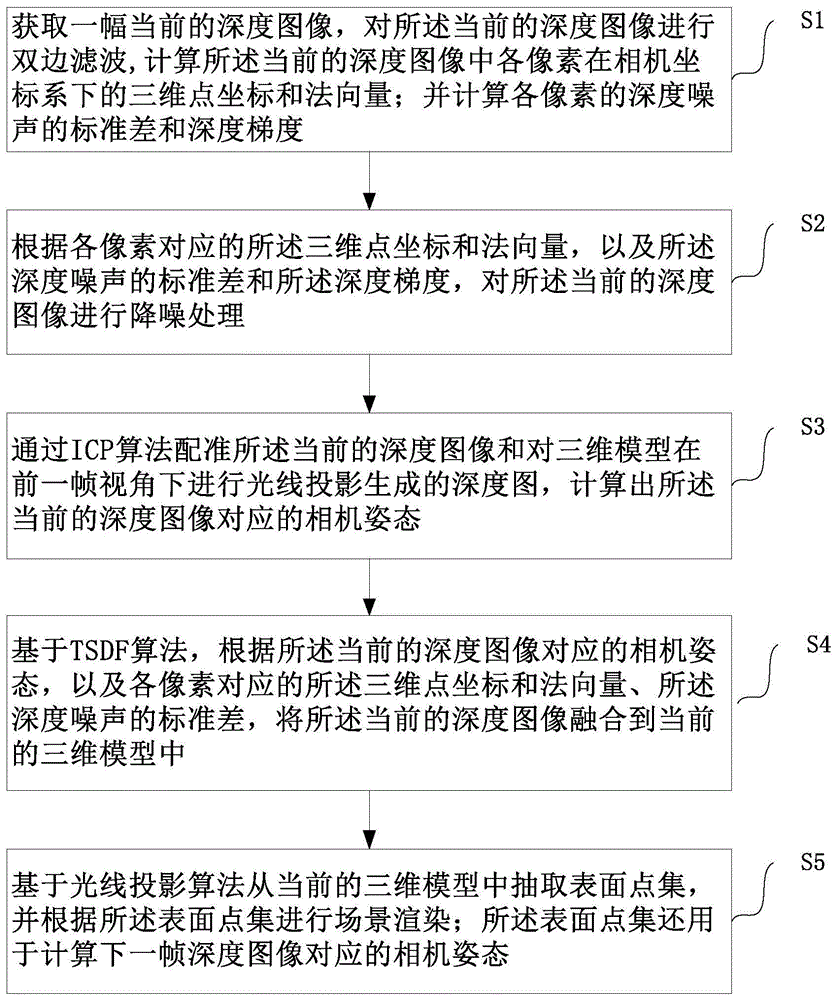
图1是本发明的高效利用内存的高精度三维重建方法实施例的流程示意图;1 is a schematic flowchart of an embodiment of a high-precision three-dimensional reconstruction method for efficiently utilizing memory according to the present invention;
图2是本发明的高效利用内存的高精度三维重建方法实施例中深度图像降噪示意图;2 is a schematic diagram of depth image noise reduction in an embodiment of a high-precision three-dimensional reconstruction method for efficiently utilizing memory according to the present invention;
图3(a)-(d)是本发明的高效利用内存的高精度三维重建方法实施例在Office数据集下输出的稠密三维模型的示意图;3(a)-(d) are schematic diagrams of a dense 3D model output under the Office data set according to an embodiment of the high-precision 3D reconstruction method for efficiently utilizing memory according to the present invention;
其中,图3(a)左右两侧分别是Office1序列彩色图、深度图;图3(b)左右两侧分别是InfiniTAMv2算法重建结果和本实施例方法重建结果;图3(c)左右两侧分别是Office2序列彩色图、深度图;图3(d)左右两侧分别是InfiniTAMv2算法重建结果和本实施例方法重建结果。Among them, the left and right sides of Fig. 3(a) are the color map and depth map of the Office1 sequence respectively; the left and right sides of Fig. 3(b) are the reconstruction results of the InfiniTAMv2 algorithm and the reconstruction results of the method in this embodiment respectively; the left and right sides of Fig. 3(c) The color map and the depth map of the Office2 sequence are respectively; the left and right sides of Fig. 3(d) are the reconstruction result of the InfiniTAMv2 algorithm and the reconstruction result of the method of this embodiment, respectively.
图4是本发明的高效利用内存的高精度三维重建方法实施例与InfiniTAMv2方法的内存占用比较示意图;4 is a schematic diagram illustrating the comparison of memory occupation between an embodiment of a high-precision three-dimensional reconstruction method for efficiently utilizing memory of the present invention and the InfiniTAMv2 method;
图5是本发明的高效利用内存的高精度三维重建系统实施例的构成示意图。FIG. 5 is a schematic structural diagram of an embodiment of a high-precision three-dimensional reconstruction system that efficiently utilizes memory according to the present invention.
具体实施方式Detailed ways
下面参照附图来描述本发明的优选实施方式。本领域技术人员应当理解的是,这些实施方式仅用于解释本发明的技术原理,并非旨在限制本发明的保护范围。Preferred embodiments of the present invention are described below with reference to the accompanying drawings. It should be understood by those skilled in the art that these embodiments are only used to explain the technical principle of the present invention, and are not intended to limit the protection scope of the present invention.
消费级的深度传感器采集到的深度图包含较大噪声,深度噪声受与被扫描的表面的距离及夹角影响。更进一步说,深度噪声的标准差相对于深度值粗略的成二次方关系。此外,人造室内场景包含许多的平面区域,这些平面区域易于被检测及建模。这些特性有助于对深度图降噪并节省内存占用。本发明是为了实现在内存资源有限的设备上的高精度三维重建而设计的。The depth map collected by consumer-grade depth sensors contains relatively large noise, and the depth noise is affected by the distance and angle to the surface being scanned. Furthermore, the standard deviation of the depth noise is roughly quadratic with respect to the depth value. Furthermore, artificial indoor scenes contain many planar regions that are easy to detect and model. These features help denoise the depth map and save memory usage. The present invention is designed to realize high-precision three-dimensional reconstruction on devices with limited memory resources.
图1是本发明的高效利用内存的高精度三维重建方法实施例的流程示意图。如图1所示,本实施例的高精度三维重建方法包括以下步骤:FIG. 1 is a schematic flowchart of an embodiment of a high-precision three-dimensional reconstruction method using memory efficiently according to the present invention. As shown in FIG. 1 , the high-precision three-dimensional reconstruction method of this embodiment includes the following steps:
在步骤S1中,获取一幅当前的深度图像,对所述当前的深度图像进行双边滤波,计算所述当前的深度图像中各像素在相机坐标系下的三维点坐标和法向量;并计算各像素的深度噪声的标准差和深度梯度。In step S1, a current depth image is obtained, bilateral filtering is performed on the current depth image, and the three-dimensional point coordinates and normal vectors of each pixel in the current depth image under the camera coordinate system are calculated; The standard deviation and depth gradient of the pixel's depth noise.
在步骤S2中,根据各像素对应的所述三维点坐标和法向量,以及所述深度噪声的标准差和所述深度梯度,对所述当前的深度图像进行降噪处理。该步骤可以进一步包括步骤S21-S22:In step S2, noise reduction processing is performed on the current depth image according to the three-dimensional point coordinates and normal vector corresponding to each pixel, as well as the standard deviation of the depth noise and the depth gradient. This step may further include steps S21-S22:
在步骤S21中,根据各像素点的所述深度梯度,检测局部平面,并将所述局部平面合并到全局平面。该步骤又可以进一步包括步骤S211-S224:In step S21, a local plane is detected according to the depth gradient of each pixel, and the local plane is merged into a global plane. This step may further include steps S211-S224:
在步骤S211中,将所述当前的深度图像平均分成大小为W×W的多个子窗口,根据各像素点的所述深度梯度,计算每一个子窗口中像素的平均梯度。In step S211, the current depth image is evenly divided into multiple sub-windows of size W×W, and the average gradient of pixels in each sub-window is calculated according to the depth gradient of each pixel point.
子窗口边长W用来确定局部平面的大小,若图像分辨率越大则选取的W也越大。本实施例中对分辨率为320×240的深度图设置W=20,对分辨率为640×480的深度图设置W=40。The side length W of the sub-window is used to determine the size of the local plane. If the image resolution is larger, the W selected is larger. In this embodiment, W=20 is set for the depth map with a resolution of 320×240, and W=40 is set for the depth map with a resolution of 640×480.
在步骤S212中,对每一个子窗口,判断其中各像素点的所述深度梯度与该子窗口中像素的所述平均梯度之差是否小于预设的梯度差阈值θ(u),若是,就认为其对应的三维点为平面上的内点,则将该像素点对应的三维点加入局部平面的内点集。In step S212, for each sub-window, determine whether the difference between the depth gradient of each pixel and the average gradient of the pixels in the sub-window is less than a preset gradient difference threshold θ(u), if so, then It is considered that the corresponding three-dimensional point is an interior point on the plane, and the three-dimensional point corresponding to the pixel point is added to the interior point set of the local plane.
其中,θ(u)=ασ(u);α为权重,本实施例中设置为3;σ(u)为像素u的深度噪声标准差。Wherein, θ(u)=ασ(u); α is the weight, which is set to 3 in this embodiment; σ(u) is the standard deviation of the depth noise of the pixel u.
在步骤S213中,若所述局部平面的内点集中内点数大于预设的点数阈值N,则进行局部平面的拟合。In step S213, if the number of inner points in the inner point set of the local plane is greater than a preset number of points threshold N, the fitting of the local plane is performed.
本实施例中采用最小二乘拟合平面,内点的平均值作为平面上的三维点pπ。N设置为窗口内有效像素数目乘以一个比例,设置该比例为0.5来产生较多的局部平面。平面表示为π=(nx,ny,nz,px,py,pz)T,其中nπ=(nx,ny,nz)T是单位平面法向,pπ=(px,py,pz)T是平面上三维点,平面到坐标原点的距离为d=-nπ·pπ。In this embodiment, the least squares fitting plane is adopted, and the average value of the interior points is used as the three-dimensional point p π on the plane. N is set to the number of effective pixels in the window multiplied by a ratio, which is set to 0.5 to generate more local planes. The plane is denoted as π=(n x , ny , nz , p x , py , p z ) T , where n π = (n x , ny , nz ) T is the unit plane normal, p π = (p x , p y , p z ) T is a three-dimensional point on a plane, and the distance from the plane to the coordinate origin is d=-n π ·p π .
在步骤S214中,若拟合得到的局部平面π与全局平面πj的法向距离与欧拉距离分别满足公式(1)、(2)所示的预设条件:In step S214, if the normal distance and Euler distance of the local plane π and the global plane π j obtained by fitting satisfy the preset conditions shown in formulas (1) and (2) respectively:

|p·nj+dj|<ψ (2)|p·n j +d j |<ψ (2)
则合并局部平面π与全局平面πj的内点集,并根据合并后的内点集重新拟合全局平面;否则,将局部平面π添加为一个全局平面;Then merge the interior point sets of the local plane π and the global plane π j , and refit the global plane according to the merged interior point set; otherwise, add the local plane π as a global plane;
其中,n、nj分别为平面π与全局平面πj的法向量;p为平面π上任一三维点;dj为平面πj到坐标原点的距离;


在步骤S22中,根据各像素对应的所述三维点坐标和法向量,以及所述深度噪声的标准差,计算各像素对应的射线与其对应的全局平面之间的交点,从而对所述当前的深度图像进行降噪处理。具体为:In step S22, according to the three-dimensional point coordinates and normal vector corresponding to each pixel, and the standard deviation of the depth noise, the intersection point between the ray corresponding to each pixel and the corresponding global plane is calculated, so as to determine the current The depth image is denoised. Specifically:
判断所述当前的深度图像中像素u对应的三维点v(u)与全局平面πj之间是否满足公式(3)所示的条件:Determine whether the condition shown in formula (3) is satisfied between the three-dimensional point v(u) corresponding to the pixel u in the current depth image and the global plane π j :
|v(u)·nj+dj|<ε(u) (3)|v(u)·n j +d j |<ε(u) (3)
若是,则将像素u的深度值优化为其对应的射线与全局平面之间的交点的深度,由此减少深度图像噪声;If so, optimize the depth value of pixel u to the depth of the intersection between its corresponding ray and the global plane, thereby reducing depth image noise;
其中,距离阈值ε(u)由深度噪声自适应确定,如公式(4)所示:Among them, the distance threshold ε(u) is adaptively determined by the depth noise, as shown in formula (4):
ε(u)=βσ(u) (4)ε(u)=βσ(u) (4)
β为权重系数,本实施例中设置为3;σ(u)为像素u的深度噪声标准差。β is a weight coefficient, which is set to 3 in this embodiment; σ(u) is the depth noise standard deviation of pixel u.
图2是本发明的高效利用内存的高精度三维重建方法实施例中深度图像降噪示意图。如图2所示,曲线表示被扫描表面的一部分,直线表示拟合该部分表面的平面。将叉号所示位置像素点的深度值由点b的深度值更改为点a的深度值来对深度图降噪。FIG. 2 is a schematic diagram of depth image noise reduction in an embodiment of a high-precision three-dimensional reconstruction method using memory efficiently according to the present invention. As shown in Figure 2, the curved line represents a part of the scanned surface, and the straight line represents the plane that fits the part of the surface. Change the depth value of the pixel at the position indicated by the cross from the depth value of point b to the depth value of point a to denoise the depth map.
在步骤S3中,通过ICP算法配准所述当前的深度图像和对三维模型在前一帧视角下进行光线投影生成的深度图,计算出所述当前的深度图像对应的相机姿态。In step S3, the current depth image is registered with the ICP algorithm and the depth map generated by ray projection of the three-dimensional model in the previous frame of view is used to calculate the camera pose corresponding to the current depth image.
在步骤S4中,基于TSDF算法,根据所述当前的深度图像对应的相机姿态,以及各像素对应的所述三维点坐标和法向量、所述深度噪声的标准差,将所述当前的深度图像融合到当前的三维模型中。该步骤可以进一步包括步骤S41-S44:In step S4, based on the TSDF algorithm, according to the camera pose corresponding to the current depth image, the three-dimensional point coordinates and normal vector corresponding to each pixel, and the standard deviation of the depth noise, the current depth image Fusion into the current 3D model. This step may further include steps S41-S44:
在步骤S41中,对所述当前的深度图像中每一个像素u对应的深度值d(u),判断d(u)是否大于L,且对应的三维点v(u)不在全局平面上;若是,则不分配像素u对应的体素块,通过这种方式节省由噪声占用的内存,并保持场景中的平面信息;否则,构建d(u)±μ的线段并分配该线段上的体素块。In step S41, for the depth value d(u) corresponding to each pixel u in the current depth image, determine whether d(u) is greater than L, and the corresponding three-dimensional point v(u) is not on the global plane; , the voxel block corresponding to the pixel u is not allocated, in this way, the memory occupied by noise is saved and the plane information in the scene is maintained; otherwise, a line segment of d(u)±μ is constructed and the voxels on the line segment are allocated piece.
通过上述方法,我们分配并更新实际表面附近的体素块,每个体素块包含M×M×M个体素。With the above method, we assign and update voxel blocks near the actual surface, each voxel block contains M×M×M voxels.
其中,L为深度阈值,μ为TSDF截断距离。阈值L由所述深度噪声的标准差及所述TSDF截断距离确定;对于Microsoft Kinect传感器设置L=3560mm,对于OccipitalStructure Sensor传感器设置L=2580mm。where L is the depth threshold and μ is the TSDF cutoff distance. The threshold value L is determined by the standard deviation of the depth noise and the TSDF cutoff distance; set L=3560mm for the Microsoft Kinect sensor and L=2580mm for the OccipitalStructure Sensor sensor.
在步骤S42中,将所分配的体素块存储在堆空间中,并构建稀疏哈希表用于索引。In step S42, the allocated voxel blocks are stored in the heap space, and a sparse hash table is constructed for indexing.
其中,体素块的哈希值通过公式(5)计算:Among them, the hash value of the voxel block is calculated by formula (5):

(bx,by,bz)为体素块的整数坐标;(p1,p2,p3)为非常大的素数,本实施例中p1=73856093,p2=19349669,p3=83492791;K为哈希表所能存储的最大数目;mod和分别为取余和异或操作符。(b x , by , b z ) are integer coordinates of the voxel block; (p 1 , p 2 , p 3 ) are very large prime numbers, in this embodiment, p1=73856093, p2=19349669, p3=83492791; K is the maximum number that the hash table can store; mod and are the remainder and exclusive-or operators, respectively.
在步骤S43中,计算各体素对应的SDF值,如公式(6)所示:In step S43, the SDF value corresponding to each voxel is calculated, as shown in formula (6):
sdfi=di(u)-v(z)(u) (6)sdf i =d i (u)-v (z) (u) (6)
其中,di(u)为i时刻采集的深度图像上像素u对应的深度值;v(z)(u)为像素u对应的三维点v(u)的z分量。Among them, d i (u) is the depth value corresponding to the pixel u on the depth image collected at time i; v (z) (u) is the z component of the three-dimensional point v(u) corresponding to the pixel u.
在步骤S44中,若sdfi>-μ,则计算各体素对应的TSDF值,如公式(7)所示:In step S44, if sdfi >-μ, the TSDF value corresponding to each voxel is calculated, as shown in formula (7):

从而将所述当前的深度图像融合到TSDF表示的三维模型中。Thus, the current depth image is fused into the three-dimensional model represented by the TSDF.
其中,wi-1是i-1时刻该体素被观察到的次数,如果v(u)在平面上,设置wi-1=3;其他情况设置wi-1=1。Among them, w i-1 is the number of times the voxel is observed at time i-1. If v(u) is on the plane, set w i-1 =3; otherwise, set w i-1 =1.
在步骤S5中,基于光线投影算法从当前的三维模型中抽取表面点集,并根据所述表面点集进行场景渲染;所述表面点集还用于计算下一帧深度图像对应的相机姿态。In step S5, a surface point set is extracted from the current three-dimensional model based on a ray projection algorithm, and scene rendering is performed according to the surface point set; the surface point set is also used to calculate the camera pose corresponding to the next frame of depth image.
图3(a)-(d)是本发明的高效利用内存的高精度三维重建方法实施例在Office数据集下输出的稠密三维模型的示意图。其中,图3(a)左右两侧分别是Office1序列彩色图、深度图;图3(b)左右两侧分别是InfiniTAMv2算法重建结果和本实施例方法重建结果;图3(c)左右两侧分别是Office2序列彩色图、深度图;图3(d)左右两侧分别是InfiniTAMv2算法重建结果和本实施例方法重建结果。对比上述图中圆圈标出的部分可以看出,本发明生成的三维模型噪声更小,准确度更高。3(a)-(d) are schematic diagrams of a dense 3D model output by an embodiment of the memory-efficient high-precision 3D reconstruction method of the present invention under the Office data set. Among them, the left and right sides of Fig. 3(a) are the color map and depth map of the Office1 sequence respectively; the left and right sides of Fig. 3(b) are the reconstruction results of the InfiniTAMv2 algorithm and the reconstruction results of the method in this embodiment respectively; the left and right sides of Fig. 3(c) The color map and the depth map of the Office2 sequence are respectively; the left and right sides of Fig. 3(d) are the reconstruction result of the InfiniTAMv2 algorithm and the reconstruction result of the method of this embodiment, respectively. Comparing the parts marked with circles in the above figures, it can be seen that the three-dimensional model generated by the present invention has lower noise and higher accuracy.
本发明方法与InfiniTAMv2内存占用比较如图4所示,横坐标表示深度图序列,纵坐标表示内存占用,黑色柱子表示InfiniTAMv2内存占用,浅灰色柱子表示本发明的内存占用。本发明的方法在ICL-NUIM living room数据集上能够节省10%的内存占用,在Office数据集上能够节省30%的内存占用。Figure 4 shows a comparison of the memory occupation of the method of the present invention and InfiniTAMv2, the abscissa represents the depth map sequence, the ordinate represents the memory occupation, the black column represents the InfiniTAMv2 memory occupation, and the light gray column represents the memory occupation of the present invention. The method of the invention can save 10% of the memory occupancy on the ICL-NUIM living room data set, and can save 30% of the memory occupancy on the Office data set.
与现有技术相比,本发明能够充分借助场景中的平面信息进行高精度、高效率的稠密三维重建。本发明通过多种类型的数据实验,比如公开数据集、使用OccipitalStructure Sensor采集的数据集等证明了它的高效率和高精度。本发明主要针对解决许多分配的体素对应于深度噪声的问题,利用深度图像中的平面信息对深度图像降噪并分配相应的体素,从而减少内存占用并得到高精度的三维模型。本发明适合用于内存资源有限的设备上的高精度三维重建。Compared with the prior art, the present invention can fully utilize the plane information in the scene to perform dense three-dimensional reconstruction with high precision and high efficiency. The present invention proves its high efficiency and high precision through various types of data experiments, such as public data sets, data sets collected by using OccipitalStructure Sensor, and the like. The present invention is mainly aimed at solving the problem that many allocated voxels correspond to depth noise, uses plane information in the depth image to denoise the depth image and allocates corresponding voxels, thereby reducing memory occupation and obtaining a high-precision three-dimensional model. The present invention is suitable for high-precision three-dimensional reconstruction on devices with limited memory resources.
本发明的一种存储设备的实施例,其存储有程序,所述程序适于由处理器加载并执行,以实现上面所述的高效利用内存的高精度三维重建方法。An embodiment of a storage device of the present invention stores a program, and the program is adapted to be loaded and executed by a processor, so as to realize the above-mentioned high-precision three-dimensional reconstruction method using memory efficiently.
本发明的一种处理设备的实施例,包括:处理器和存储器;An embodiment of a processing device of the present invention includes: a processor and a memory;
所述处理器,适于执行程序;所述存储器,适于存储该程序;所述程序适于由所述处理器加载并执行,以实现上面所述的高效利用内存的高精度三维重建方法。The processor is adapted to execute a program; the memory is adapted to store the program; the program is adapted to be loaded and executed by the processor, so as to realize the high-precision three-dimensional reconstruction method using memory efficiently.
图5是本发明的一种高效利用内存的高精度三维重建系统实施例的构成示意图。如图5所示,本实施例的高精度三维重建系统100包括:深度图像转换模块110、平面区域检测及降噪模块120、相机跟踪模块130、体数据融合模块140、三维渲染模块150。FIG. 5 is a schematic structural diagram of an embodiment of a high-precision three-dimensional reconstruction system that efficiently utilizes memory according to the present invention. As shown in FIG. 5 , the high-precision 3D reconstruction system 100 of this embodiment includes: a depth
所述深度图像转换模块110,配置为:获取一幅当前的深度图像,计算所述当前的深度图像中各像素在相机坐标系下的三维点坐标和法向量;并计算各像素的深度噪声的标准差和深度梯度;The depth
所述平面区域检测及降噪模块120,配置为:根据各像素对应的所述三维点坐标和法向量,以及所述深度噪声的标准差和所述深度梯度,对所述当前的深度图像进行降噪处理;The plane area detection and noise reduction module 120 is configured to: according to the three-dimensional point coordinates and normal vector corresponding to each pixel, as well as the standard deviation of the depth noise and the depth gradient, perform the current depth image. Noise reduction processing;
所述相机跟踪模块130,配置为:通过ICP算法配准所述当前的深度图像和对三维模型在前一帧视角下进行光线投影生成的深度图,计算出所述当前的深度图像对应的相机姿态;The
所述体数据融合模块140,配置为:基于TSDF算法,根据所述当前的深度图像对应的相机姿态,以及各像素对应的所述三维点坐标和法向量、所述深度噪声的标准差,将所述当前的深度图像融合到当前的三维模型中;The volume data fusion module 140 is configured to: based on the TSDF algorithm, according to the camera pose corresponding to the current depth image, the three-dimensional point coordinates and normal vector corresponding to each pixel, and the standard deviation of the depth noise, The current depth image is fused into the current three-dimensional model;
所述三维渲染模块150,配置为:基于光线投影算法从当前的三维模型中抽取表面点集,并根据所述表面点集进行场景渲染;所述表面点集还用于计算下一帧深度图像对应的相机姿态。The three-dimensional rendering module 150 is configured to: extract a surface point set from the current three-dimensional model based on a ray projection algorithm, and perform scene rendering according to the surface point set; the surface point set is also used to calculate the depth image of the next frame The corresponding camera pose.
上述各模块的具体工作情况,可分别参看本文中关于步骤S1-S5及其展开的描述,此处不再赘述。For the specific working conditions of the above-mentioned modules, please refer to the descriptions of steps S1-S5 and their development in this document, which will not be repeated here.
本领域技术人员应该能够意识到,结合本文中所公开的实施例描述的各示例的方法步骤和模块,能够以电子硬件、计算机软件或者二者的结合来实现,为了清楚地说明电子硬件和软件的可互换性,在上述说明中已经按照功能一般性地描述了各示例的组成及步骤。这些功能究竟以电子硬件还是软件方式来执行,取决于技术方案的特定应用和设计约束条件。本领域技术人员可以对每个特定的应用来使用不同方法来实现所描述的功能,但是这种实现不应认为超出本发明的范围。Those skilled in the art should be aware that the method steps and modules of each example described in conjunction with the embodiments disclosed herein can be implemented in electronic hardware, computer software, or a combination of the two, in order to clearly illustrate the electronic hardware and software In the above description, the components and steps of each example have been generally described according to their functions. Whether these functions are performed in electronic hardware or software depends on the specific application and design constraints of the technical solution. Skilled artisans may use different methods of implementing the described functionality for each particular application, but such implementations should not be considered beyond the scope of the present invention.
至此,已经结合附图所示的优选实施方式描述了本发明的技术方案,但是,本领域技术人员容易理解的是,本发明的保护范围显然不局限于这些具体实施方式。在不偏离本发明的原理的前提下,本领域技术人员可以对相关技术特征做出等同的更改或替换,这些更改或替换之后的技术方案都将落入本发明的保护范围之内。So far, the technical solutions of the present invention have been described with reference to the preferred embodiments shown in the accompanying drawings, however, those skilled in the art can easily understand that the protection scope of the present invention is obviously not limited to these specific embodiments. Without departing from the principle of the present invention, those skilled in the art can make equivalent changes or substitutions to the relevant technical features, and the technical solutions after these changes or substitutions will fall within the protection scope of the present invention.
Claims (12)


Priority Applications (1)
| Application Number | Priority Date | Filing Date | Title |
|---|---|---|---|
| CN201810200698.XA CN108564652B (en) | 2018-03-12 | 2018-03-12 | High-precision three-dimensional reconstruction method, system and equipment for efficiently utilizing memory |
Applications Claiming Priority (1)
| Application Number | Priority Date | Filing Date | Title |
|---|---|---|---|
| CN201810200698.XA CN108564652B (en) | 2018-03-12 | 2018-03-12 | High-precision three-dimensional reconstruction method, system and equipment for efficiently utilizing memory |
Publications (2)
| Publication Number | Publication Date |
|---|---|
| CN108564652A CN108564652A (en) | 2018-09-21 |
| CN108564652B true CN108564652B (en) | 2020-02-14 |
Family
ID=63531678
Family Applications (1)
| Application Number | Title | Priority Date | Filing Date |
|---|---|---|---|
| CN201810200698.XA Active CN108564652B (en) | 2018-03-12 | 2018-03-12 | High-precision three-dimensional reconstruction method, system and equipment for efficiently utilizing memory |
Country Status (1)
| Country | Link |
|---|---|
| CN (1) | CN108564652B (en) |
Families Citing this family (14)
| Publication number | Priority date | Publication date | Assignee | Title |
|---|---|---|---|---|
| CN109903372B (en) * | 2019-01-28 | 2021-03-23 | 中国科学院自动化研究所 | Depth map super-resolution completion method and high-quality 3D reconstruction method and system |
| CN110120090B (en) * | 2019-04-01 | 2020-09-25 | 贝壳找房(北京)科技有限公司 | Three-dimensional panoramic model construction method and device and readable storage medium |
| CN110310362A (en) * | 2019-06-24 | 2019-10-08 | 中国科学院自动化研究所 | High dynamic scene three-dimensional reconstruction method, system based on depth map and IMU |
| CN110599535A (en) * | 2019-08-05 | 2019-12-20 | 清华大学 | High-resolution human body real-time dynamic reconstruction method and device based on hash table |
| WO2021061335A1 (en) | 2019-09-23 | 2021-04-01 | Boston Scientific Scimed, Inc. | System and method for endoscopic video enhancement, quantitation and surgical guidance |
| CN110874864B (en) * | 2019-10-25 | 2022-01-14 | 奥比中光科技集团股份有限公司 | Method, device, electronic equipment and system for obtaining three-dimensional model of object |
| US11158119B2 (en) * | 2020-01-09 | 2021-10-26 | Qualcomm Incorporated | Systems and methods for reconstructing a three-dimensional object |
| CN113837952B (en) * | 2020-06-24 | 2025-01-17 | 影石创新科技股份有限公司 | Three-dimensional point cloud denoising method, device, computer-readable storage medium and electronic device based on normal vector |
| CN112258627B (en) * | 2020-09-18 | 2023-09-15 | 中国科学院计算技术研究所 | A local fault three-dimensional reconstruction system |
| CN113139465A (en) * | 2021-04-23 | 2021-07-20 | 北京华捷艾米科技有限公司 | Face recognition method and device |
| CN113538694B (en) * | 2021-07-06 | 2025-03-21 | 海信视像科技股份有限公司 | A plane reconstruction method and display device |
| CN115170715A (en) * | 2022-06-29 | 2022-10-11 | 先临三维科技股份有限公司 | Image rendering method and device, electronic equipment and medium |
| CN115952139B (en) * | 2023-03-14 | 2023-06-30 | 武汉芯云道数据科技有限公司 | Multi-frame three-dimensional image processing method and system for mobile equipment |
| CN116721231B (en) * | 2023-05-17 | 2026-05-08 | 武汉大学 | Scalable Scene 3D Reconstruction Method and System Based on UAV Airborne Positioning |
Citations (2)
| Publication number | Priority date | Publication date | Assignee | Title |
|---|---|---|---|---|
| CN106289181A (en) * | 2015-05-22 | 2017-01-04 | 北京雷动云合智能技术有限公司 | A kind of real-time SLAM method that view-based access control model is measured |
| CN106803267A (en) * | 2017-01-10 | 2017-06-06 | 西安电子科技大学 | Indoor scene three-dimensional rebuilding method based on Kinect |
-
2018
- 2018-03-12 CN CN201810200698.XA patent/CN108564652B/en active Active
Patent Citations (2)
| Publication number | Priority date | Publication date | Assignee | Title |
|---|---|---|---|---|
| CN106289181A (en) * | 2015-05-22 | 2017-01-04 | 北京雷动云合智能技术有限公司 | A kind of real-time SLAM method that view-based access control model is measured |
| CN106803267A (en) * | 2017-01-10 | 2017-06-06 | 西安电子科技大学 | Indoor scene three-dimensional rebuilding method based on Kinect |
Non-Patent Citations (3)
| Title |
|---|
| Modeling Kinect Sensor Noise for Improved 3D Reconstruction and Tracking;Chuong V. Nguyen et al.;《2012 Second Joint 3DIM/3DPVT Conference: 3D Imaging, Modeling, Processing, Visualization & Transmission》;20121231;全文 * |
| Real-time High Resolution Fusion of Depth Maps on GPU;Dmitry S. Trifonov;《Arxiv》;20131202;全文 * |
| 一种改进的KinectFusion三维重构算法;朱笑笑 等;《机器人》;20140331;第36卷(第2期);全文 * |
Also Published As
| Publication number | Publication date |
|---|---|
| CN108564652A (en) | 2018-09-21 |
Similar Documents
| Publication | Publication Date | Title |
|---|---|---|
| CN108564652A (en) | Efficiently utilize the high-precision three-dimensional method for reconstructing of memory and system and equipment | |
| CN110276829B (en) | Three-dimensional representation by multi-scale voxel hash processing | |
| CN109118542B (en) | Calibration method, device, equipment and storage medium between laser radar and camera | |
| US12211162B2 (en) | Method for 3D reconstruction, apparatus, system, and storage medium | |
| US9426444B2 (en) | Depth measurement quality enhancement | |
| US8743114B2 (en) | Methods and systems to determine conservative view cell occlusion | |
| WO2018119889A1 (en) | Three-dimensional scene positioning method and device | |
| TW201616451A (en) | System and method for selecting point clouds using a free selection tool | |
| JP2023527438A (en) | Geometry Recognition Augmented Reality Effect Using Real-time Depth Map | |
| CN111639147B (en) | Map compression method, system and computer readable storage medium | |
| CN110375765B (en) | Visual odometer method, system and storage medium based on direct method | |
| EP4614443A1 (en) | Data processing method and apparatus, device, and storage medium | |
| CN116543381B (en) | Monocular three-dimensional target detection post-processing method and device and electronic equipment | |
| CN113129352A (en) | Sparse light field reconstruction method and device | |
| EP3756163A1 (en) | Methods, devices, and computer program products for gradient based depth reconstructions with robust statistics | |
| CN105516579A (en) | Image processing method and device and electronic equipment | |
| CN110207702A (en) | The method and device of target positioning | |
| WO2022237026A1 (en) | Plane information detection method and system | |
| CN104851127A (en) | Interaction-based building point cloud model texture mapping method and device | |
| US9563937B2 (en) | High-resolution image generation apparatus, high-resolution image generation method, and high-resolution image generation program | |
| JP7262530B2 (en) | Location information generation method, related device and computer program product | |
| JP2022064506A (en) | Image processing device, image processing method, and program | |
| CN107170007B (en) | Image device with image defocusing function and method for generating defocused image | |
| CN119399019B (en) | Multi-angle projection method, device, equipment and storage medium | |
| Kim et al. | Real-time stereo matching using extended binary weighted aggregation |
Legal Events
| Date | Code | Title | Description |
|---|---|---|---|
| PB01 | Publication | ||
| PB01 | Publication | ||
| SE01 | Entry into force of request for substantive examination | ||
| SE01 | Entry into force of request for substantive examination | ||
| GR01 | Patent grant | ||
| GR01 | Patent grant | ||
| CB03 | Change of inventor or designer information | ||
| CB03 | Change of inventor or designer information |
Inventor after: Gao Wei Inventor after: Liu Yangdong Inventor after: Hu Zhanyi Inventor before: Liu Yangdong Inventor before: Gao Wei Inventor before: Hu Zhanyi |