CN108564249B - Confidence peak shaving benefit evaluation method for distribution network considering the randomness of distributed photovoltaics - Google Patents

Confidence peak shaving benefit evaluation method for distribution network considering the randomness of distributed photovoltaics Download PDF

Info

Publication number
CN108564249B
CN108564249B CN201810183200.3A CN201810183200A CN108564249B CN 108564249 B CN108564249 B CN 108564249B CN 201810183200 A CN201810183200 A CN 201810183200A CN 108564249 B CN108564249 B CN 108564249B
Authority
CN
China
Prior art keywords
node
confidence
peak clipping
distribution network
daily
Prior art date
Legal status (The legal status is an assumption and is not a legal conclusion. Google has not performed a legal analysis and makes no representation as to the accuracy of the status listed.)
Active
Application number
CN201810183200.3A
Other languages
Chinese (zh)
Other versions
CN108564249A (en
Inventor
周俊煌
张勇军
Current Assignee (The listed assignees may be inaccurate. Google has not performed a legal analysis and makes no representation or warranty as to the accuracy of the list.)
South China University of Technology SCUT
Original Assignee
South China University of Technology SCUT
Priority date (The priority date is an assumption and is not a legal conclusion. Google has not performed a legal analysis and makes no representation as to the accuracy of the date listed.)
Filing date
Publication date
Application filed by South China University of Technology SCUT filed Critical South China University of Technology SCUT
Priority to CN201810183200.3A priority Critical patent/CN108564249B/en
Publication of CN108564249A publication Critical patent/CN108564249A/en
Application granted granted Critical
Publication of CN108564249B publication Critical patent/CN108564249B/en
Active legal-status Critical Current
Anticipated expiration legal-status Critical

Links

Images

Classifications

    • GPHYSICS
    • G06COMPUTING OR CALCULATING; COUNTING
    • G06QINFORMATION AND COMMUNICATION TECHNOLOGY [ICT] SPECIALLY ADAPTED FOR ADMINISTRATIVE, COMMERCIAL, FINANCIAL, MANAGERIAL OR SUPERVISORY PURPOSES; SYSTEMS OR METHODS SPECIALLY ADAPTED FOR ADMINISTRATIVE, COMMERCIAL, FINANCIAL, MANAGERIAL OR SUPERVISORY PURPOSES, NOT OTHERWISE PROVIDED FOR
    • G06Q10/00Administration; Management
    • G06Q10/06Resources, workflows, human or project management; Enterprise or organisation planning; Enterprise or organisation modelling
    • G06Q10/063Operations research, analysis or management
    • G06Q10/0639Performance analysis of employees; Performance analysis of enterprise or organisation operations
    • G06Q10/06393Score-carding, benchmarking or key performance indicator [KPI] analysis
    • GPHYSICS
    • G06COMPUTING OR CALCULATING; COUNTING
    • G06QINFORMATION AND COMMUNICATION TECHNOLOGY [ICT] SPECIALLY ADAPTED FOR ADMINISTRATIVE, COMMERCIAL, FINANCIAL, MANAGERIAL OR SUPERVISORY PURPOSES; SYSTEMS OR METHODS SPECIALLY ADAPTED FOR ADMINISTRATIVE, COMMERCIAL, FINANCIAL, MANAGERIAL OR SUPERVISORY PURPOSES, NOT OTHERWISE PROVIDED FOR
    • G06Q50/00Information and communication technology [ICT] specially adapted for implementation of business processes of specific business sectors, e.g. utilities or tourism
    • G06Q50/06Energy or water supply

Landscapes

  • Business, Economics & Management (AREA)
  • Human Resources & Organizations (AREA)
  • Engineering & Computer Science (AREA)
  • Economics (AREA)
  • Strategic Management (AREA)
  • Entrepreneurship & Innovation (AREA)
  • Health & Medical Sciences (AREA)
  • Educational Administration (AREA)
  • Marketing (AREA)
  • Development Economics (AREA)
  • Theoretical Computer Science (AREA)
  • Tourism & Hospitality (AREA)
  • Physics & Mathematics (AREA)
  • General Business, Economics & Management (AREA)
  • General Physics & Mathematics (AREA)
  • Public Health (AREA)
  • Primary Health Care (AREA)
  • Water Supply & Treatment (AREA)
  • General Health & Medical Sciences (AREA)
  • Game Theory and Decision Science (AREA)
  • Operations Research (AREA)
  • Quality & Reliability (AREA)
  • Photovoltaic Devices (AREA)
  • Supply And Distribution Of Alternating Current (AREA)

Abstract

本发明提供计及分布式光伏随机性的配电网置信削峰效益评估方法,包括如下步骤:(1)获取配电网的网架参数、负荷模型和光伏出力模型;(2)获取分布式光伏接入的节点编号和节点容量;(3)采用蒙特卡洛法抽样模拟各节点的日负荷曲线和光伏出力曲线;(4)计算各节点的置信日削峰度;(5)建立同时计及变电站、线路和配变三类设备削峰效益的概率评估模型;(6)对配电网的置信日削峰效益期望进行评估。本发明提出了一种计及分布式光伏随机性的配电网置信削峰效益评估方法,可用于对含分布式光伏的配电网进行概率性地削峰效益评估,评估模型还能有效地辨识出分布式光伏以不同位置和不同电压等级接入对配网削峰效益的影响差异。

Figure 201810183200

The present invention provides a distribution network confidence peak shaving benefit evaluation method that takes into account the randomness of distributed photovoltaics, including the following steps: (1) obtaining grid parameters, load models and photovoltaic output models of the distribution network; (2) obtaining distributed The node number and node capacity of photovoltaic access; (3) Use Monte Carlo method to sample and simulate the daily load curve and photovoltaic output curve of each node; (4) Calculate the confidence daily kurtosis of each node; (5) Establish a simultaneous calculation method. and probabilistic evaluation model of peak shaving benefit of substation, line and distribution transformer; (6) Evaluate the confidence daily peak shaving benefit expectation of distribution network. The invention proposes a confidence peak shaving benefit evaluation method for a distribution network considering the randomness of distributed photovoltaics, which can be used for probabilistic peak shaving benefit evaluation of a distribution network containing distributed photovoltaics, and the evaluation model can also effectively Identify the difference in the impact of distributed photovoltaic access at different locations and voltage levels on the peak shaving benefit of the distribution network.

Figure 201810183200

Description

Power distribution network confidence peak clipping benefit evaluation method considering distributed photovoltaic randomness
Technical Field
The invention relates to the field of peak clipping benefit evaluation methods of power distribution networks, in particular to a probability evaluation method considering distributed photovoltaic randomness.
Background
In the related research of distribution network optimization planning and optimization operation, the peak clipping benefit index of the distribution network is often used as an important component in a total income objective function of a power grid side. The permeability of the distributed photovoltaic as a clean power supply to be connected into a distribution network is increased day by day, but the output of the distributed photovoltaic is influenced by uncertain factors such as illumination and the like, so that the distributed photovoltaic has strong randomness. Therefore, deterministic peak clipping benefit evaluation on a distribution network with distributed photovoltaic is not appropriate.
At present, the influence of the randomness of distributed photovoltaic on an evaluation result is not basically considered by a peak clipping benefit evaluation model of a distribution network, meanwhile, the evaluation calculation model is rough, or only the peak clipping benefit of a transformer substation is considered by neglecting the peak clipping benefit of a line and a distribution transformer, or the average peak clipping benefit of the distribution transformer, the line and the transformer substation is adopted for calculation, and the value of the average peak clipping benefit of different distribution networks is difficult to determine.
In summary, the existing distribution network peak clipping benefit evaluation model and method need further improvement.
Disclosure of Invention
The invention aims to improve an evaluation model of peak clipping benefits of a distribution network, and aims to provide a peak clipping benefit evaluation method with higher identification capability for different positions and voltage levels of a distributed photovoltaic access distribution network on the basis of considering distributed photovoltaic randomness.
The invention provides a method for evaluating the belief peak clipping benefit of a power distribution network considering distributed photovoltaic randomness, which comprises the following steps of:
(1) acquiring grid frame parameters, a load model and a photovoltaic output model of the power distribution network, wherein the grid frame parameters comprise line impedance of the power distribution network and impedance of each distribution transformer; the load model is a load probability model considering load prediction errors; the photovoltaic output model is a photovoltaic output probability model considering photovoltaic output volatility, time sequence and weather type prediction errors;
(2) obtaining node number and access capacity of distributed photovoltaic access
Figure BDA0001589506280000021
φiFor the set of numbers of the distributed photovoltaic access nodes,
Figure BDA0001589506280000022
the method comprises the steps of collecting access capacity of distributed photovoltaic corresponding nodes;
(3) sampling and simulating a daily load curve and a photovoltaic output curve of each node by adopting a Monte Carlo method according to the load model and the photovoltaic output model, and subtracting the daily load curve and the photovoltaic output curve to obtain an equivalent load curve sample of each node;
(4) calculating the confidence daily kurtosis of each node according to the equivalent load curve sample and the original load curve sample;
(5) calculating the peak clipping benefits of the unit peak clipping amounts of the transformer substation, the line and the distribution transformer, establishing a probability evaluation model which simultaneously takes into account the total peak clipping benefits of the transformer substation, the line and the distribution transformer, and calculating the confidence day peak clipping benefits of the distribution network;
(6) and (5) repeating the steps (3) to (5), evaluating the confidence day peak clipping benefits of the power distribution network under different weather types, and then evaluating the expectation of the confidence day peak clipping benefits of the power distribution network by considering the occurrence probability of different weather types.
In the above power distribution network confidence peak clipping benefit evaluation method taking distributed photovoltaic randomness into account, the node confidence peak clipping degree is the maximum value of the node daily peak clipping degree under a set confidence level, and the calculation method of the confidence peak clipping degree of each node is as follows:
(1) confidence daily kurtosis X for nodes i on low-voltage side and high-voltage side of distribution transformerD,iThe calculation formula is as follows:
Figure BDA0001589506280000023
in the formula: α represents the confidence of the setting; f. ofi(x) Representing a probability density function of the daily peak clipping degree x of the transmission power of the i node under the consideration of photovoltaic output fluctuation and load prediction error; xiIs a and fi(x) Corresponding probability distribution function Fi(x) The value of the independent variable is determined under the condition that the function value is set alpha confidence coefficient.
(2) Confidence daily kurtosis X for distribution network head end nodeD0The calculation method includes the steps of firstly, calculating eight-order semiinvariable of each node according to equivalent load curve samples of each node under the condition of photovoltaic access, secondly, obtaining probability density functions of the sending power of the head end node under each section of the whole day through a probability power flow calculation method based on the semiinvariable method, thirdly, obtaining a sending power curve of the head end node under a confidence day by giving a confidence coefficient according to the probability density functions of the sending power of the head end node under each section of the whole day, and marking the maximum value of the curve as S0.max.pvAnd finally, repeating the steps of the first step and the third step to calculate a power transmission curve under the confidence day without considering the photovoltaic access, and recording the maximum value as S0.maxThen XD0=S0.max-S0.max.pv
In the above power distribution network confidence peak clipping benefit evaluation method considering distributed photovoltaic randomness, the substation peak clipping benefit B is considered at the same timeSPeak reduction benefit of circuitBLAnd peak clipping efficiency of distribution transformer BTDistribution network total peak clipping benefit B of three types of equipmentPCThe probability evaluation model of (1) is:
BPC=BT+BL+BS (2)
wherein:
Figure BDA0001589506280000031
in the formula: alpha is alphaiThe value of the i node is a logic variable, and the i node represents that the value is 1 when the i node is a distribution transformer 0.4kV low-voltage side bus and 0 when the i node is a distribution transformer 10kV high-voltage side bus; diThe peak clipping benefit of the distribution transformer of the unit peak clipping amount of the i node (the unit is yuan/kW); rT、RSEqual annual value coefficients of distribution transformer and substation investment are respectively obtained; xD,iRepresenting the confidence daily kurtosis (in kW) of the node i; n is a radical ofdThe number of grid-connected points is distributed photovoltaic; cLMCC,iRepresenting the annual value of the node marginal capacity cost of the node i, wherein the value is approximate to the annual value (unit is yuan/kW) of the circuit peak clipping benefit of each node unit peak clipping amount; s0The peak clipping benefit (unit is yuan/kW) of the transformer substation for the unit peak clipping amount of the line head end node; xD0And (4) the confidence daily kurtosis of the head end node of the line is obtained.
Distribution network confidence daily peak clipping benefit expectation
Figure BDA0001589506280000041
The calculation method of (2) is as follows:
Figure BDA0001589506280000042
in the formula: b isPC,jRepresenting the peak clipping benefit of the confidence day under the jth weather type; pjRepresenting the probability of occurrence of the jth generalized weather type in a period; n is the number of generalized weather types.
Compared with the prior art, the invention has the beneficial effects that:
(1) by considering the influences of prediction errors of loads and weather types and randomness of photovoltaic output on peak clipping benefits of the distribution network, the peak clipping benefits of the distribution network under a certain confidence level can be given, and the probability evaluation model is more practical;
(2) the established distribution network peak clipping benefit probability evaluation model can effectively identify the influence difference of distributed photovoltaics accessed at different positions and different voltage levels on the peak clipping benefit of the distribution network by considering the peak clipping benefits of three types of equipment, namely a transformer substation, a line and a distribution transformer, and can be effectively used in the location and volume planning research of the distributed photovoltaics.
Drawings
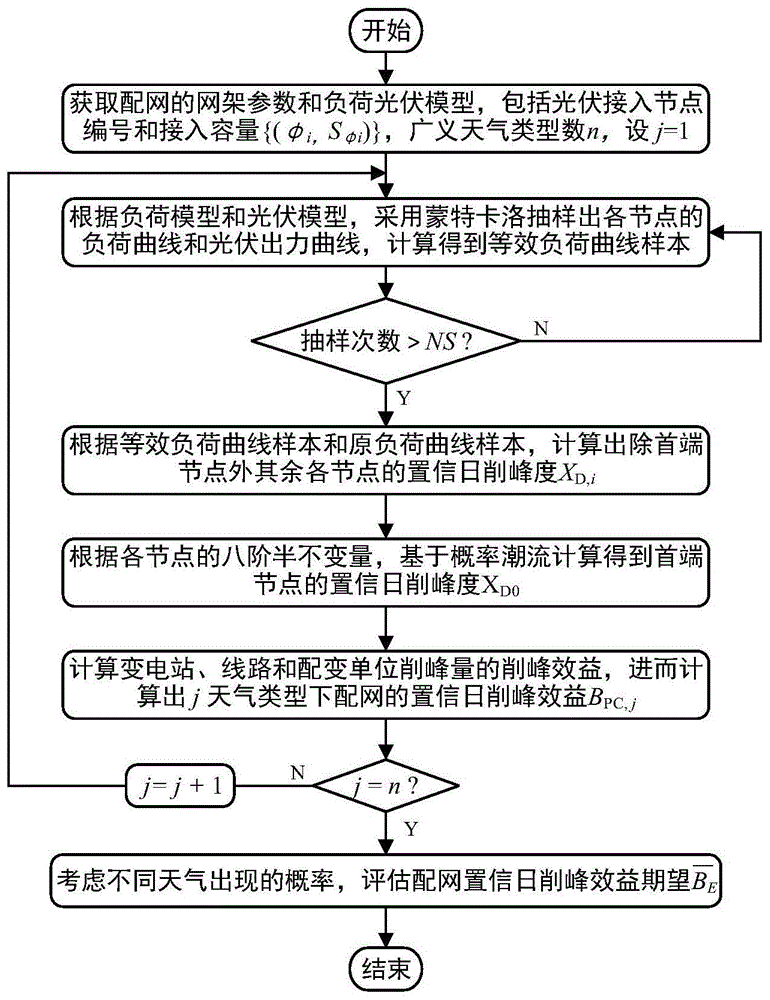
Fig. 1 is a schematic flow chart of a power distribution network confidence peak clipping benefit evaluation method considering distributed photovoltaic randomness, provided by the invention.
Fig. 2 is a schematic diagram of a 10kV distribution network line topology.
Fig. 3 is a graph of load curves for different load types in a distribution network.
Detailed Description
The following detailed description of the embodiments of the present invention is provided in conjunction with the accompanying drawings and examples, and it is to be understood that those skilled in the art can understand or implement the present invention without specific details (such as the symbols in fig. 2).
Fig. 1 reflects a specific process of a power distribution network confidence peak clipping benefit evaluation method considering distributed photovoltaic randomness, and includes the following steps:
(1) acquiring grid frame parameters, a load model and a photovoltaic output model of the power distribution network, wherein the grid frame parameters comprise line impedance of the power distribution network and impedance of each distribution transformer; the load model is a load probability model considering load prediction errors; the photovoltaic output model is a photovoltaic output probability model considering photovoltaic output volatility, time sequence and weather type prediction errors;
(2) obtaining node number and access capacity of distributed photovoltaic access
Figure BDA0001589506280000051
φiFor the set of numbers of the distributed photovoltaic access nodes,
Figure BDA0001589506280000052
the method comprises the steps of collecting access capacity of distributed photovoltaic corresponding nodes;
(3) sampling and simulating a daily load curve and a photovoltaic output curve of each node by adopting a Monte Carlo method according to the load model and the photovoltaic output model, and subtracting the daily load curve and the photovoltaic output curve to obtain an equivalent load curve sample of each node;
(4) calculating the confidence daily kurtosis of each node according to the equivalent load curve sample and the original load curve sample;
(5) calculating the peak clipping benefits of the unit peak clipping amounts of the transformer substation, the line and the distribution transformer, establishing a probability evaluation model which simultaneously takes into account the total peak clipping benefits of the transformer substation, the line and the distribution transformer, and calculating the confidence day peak clipping benefits of the distribution network;
(6) and (5) repeating the steps (3) to (5), evaluating the confidence day peak clipping benefits of the power distribution network under different weather types, and then evaluating the expectation of the confidence day peak clipping benefits of the power distribution network by considering the occurrence probability of different weather types.
The following is an actual calculation example of the method, evaluation calculation is performed by taking a certain 10kV distribution network line as an example, and a topological structure of the distribution network is shown in fig. 2.
(1) The method comprises the steps of obtaining grid parameters of a power distribution network as shown in figure 2, wherein a trunk line type is LGJ-240, a branch line type is LGJ-120, line parameters are shown in table 1, the length of each branch is given in the figure, each node load takes 96 sections throughout the day, the maximum value of an active load throughout the day is 60% of distribution transformation capacity, a load power factor is 0.95, the prediction error of a load output model is 5%, the probability of a distribution network area in sunny days is 12.8%, the probability of cloudy days is 50.4%, and the probability of changing weather is 36.8%;
TABLE 1 line parameters
Figure BDA0001589506280000061
(2) The node numbers and access capacities of the obtained distributed photovoltaic access are shown in table 2, wherein scene 1 is that the photovoltaic is in an industrial load area 1 (shown in fig. 2) of the 10kV bus access distribution network tail end, the load types of the nodes in other areas are comprehensive loads, and the shapes of the industrial loads and the comprehensive load curves are shown in fig. 3. In addition, scenes 2 and 3 are set as comparison groups to respectively perform peak clipping benefit evaluation, and the evaluation step is described below by taking a scene 1 in sunny weather as an example.
Table 2 photovoltaic access information in different scenes
Figure BDA0001589506280000062
(3) According to the load model and the photovoltaic output model, sampling is carried out 10000 times by adopting a Monte Carlo method, a daily load curve and a photovoltaic output curve of each node are simulated, and the difference between the daily load curve and the photovoltaic output curve is obtained to obtain 10000 equivalent load curve samples of each node.
(4) According to the equivalent load curve sample and the original load curve sample, the confidence coefficient is 0.9, and the confidence daily kurtosis of each node in sunny weather is calculated and is shown in table 3.
TABLE 3 node confidence day Peak clipping
Figure BDA0001589506280000063
(5) And calculating the peak clipping benefits of the distribution network in a confidence day under sunny weather according to the probability evaluation model of the peak clipping benefits of the distribution network.
(5-1) calculating the peak clipping benefits of the substation and distribution unit peak clipping quantities, wherein the result is shown in table 4, and the calculation formula of the equal-year value coefficient is as follows:
Figure BDA0001589506280000071
in the formula, eta represents the conversion rate, 8% is taken, T is the return on investment age of the equipment, and the value is shown in Table 4.
TABLE 4 Peak clipping benefit per unit peak clipping amount of each equipment
Figure BDA0001589506280000072
(5-2) calculating the node marginal capacity cost of each node, wherein the value of the node marginal capacity cost is approximate to the line peak clipping benefit of each node per peak clipping amount, and the result is shown in a table 5:
TABLE 5 line clipping benefits in units of clipping
Figure BDA0001589506280000073
(5-3) calculating the confidence day peak clipping benefits of the distribution network in sunny weather, wherein the result is shown in the 1 st line of the scene 1 in the table 6:
TABLE 6 line clipping benefits in units of clipping
Figure BDA0001589506280000074
(6) Repeating the steps (3) to (5) to calculate the confidence day peak clipping benefits of the distribution network under different weather types, wherein the results are shown in the lines 2 and 3 of the scene 1 in the table 6, then calculating the confidence day peak clipping benefit expectation of the distribution network by considering the probability of the different weather types, and the calculation result is shown in the line 4 of the scene 1 in the table 6.
In order to further embody the beneficial effects of the invention, a scene 2 and a scene 3 are added and compared with the scene 1 respectively, wherein the scene 2 is that the photovoltaic is accessed into the industrial load area 2 in the middle of the distribution network at the 10kV bus, the scene 3 is that the photovoltaic is accessed into the industrial load area 1 at the tail end of the distribution network at the 0.4kV bus, the photovoltaic access information under different scenes is shown in table 2 and fig. 2, and the evaluation result is shown in table 6.
As can be seen from table 6, the difference of the confidence peak clipping benefits of the distribution network including the distributed photovoltaic power under different weather types is large, the peak clipping benefit in a sunny day is about 3 times that in a cloudy day, and the peak clipping benefit in a changed weather is about 2 times that in a cloudy day; according to the scene 1 and the scene 2, the peak clipping benefit of the tail end of the distributed photovoltaic access distribution network with the same capacity is larger than that of the middle part of the access distribution network, and the proportion of the peak clipping benefit in the aspects of distribution and transformation and the total peak clipping benefit is gradually increased and can reach about 60% at most as the photovoltaic access position is closer to the tail end of the line, so that the peak clipping benefit in the aspects of the line and the transformation cannot be ignored particularly when the tail end of the photovoltaic access line is connected; according to scenes 1 and 3, the peak clipping benefit of a distributed photovoltaic bus with the same capacity accessed to the same area is increased by about 50% compared with the peak clipping benefit of a distributed photovoltaic bus with the same capacity accessed to a 10kV bus; in conclusion, the evaluation model of the invention considers the peak clipping benefits in the distribution transformer and line aspects, and has the identification capability on the access of the distributed photovoltaic at different positions and voltage levels in the distribution network total peak clipping benefits aspect.
The above embodiments are preferred embodiments of the present invention, but the present invention is not limited to the above embodiments, and any other modifications, substitutions, combinations, and simplifications which do not depart from the spirit and principle of the present invention should be construed as equivalents and are intended to be included in the scope of the present invention.

Claims (1)

1. The method for evaluating the confidence peak clipping benefit of the power distribution network considering the randomness of the distributed photovoltaic is characterized by comprising the following steps of:
(1) acquiring grid frame parameters, a load model and a photovoltaic output model of the power distribution network, wherein the grid frame parameters comprise line impedance of the power distribution network and impedance of each distribution transformer; the load model is a load probability model considering load prediction errors; the photovoltaic output model is a photovoltaic output probability model considering photovoltaic output volatility, time sequence and weather type prediction errors;
(2) obtaining node number and access capacity of distributed photovoltaic access
Figure FDA0003405178170000011
φiFor the set of numbers of the distributed photovoltaic access nodes,
Figure FDA0003405178170000012
the method comprises the steps of collecting access capacity of distributed photovoltaic corresponding nodes;
(3) sampling and simulating a daily load curve and a photovoltaic output curve of each node by adopting a Monte Carlo method according to the load model and the photovoltaic output model, and subtracting the daily load curve and the photovoltaic output curve to obtain an equivalent load curve sample of each node;
(4) calculating the confidence daily kurtosis of each node according to the equivalent load curve sample and the original load curve sample;
the calculation method of the confidence daily kurtosis of each node is as follows:
(4.1) firstly defining the node confidence daily kurtosis as the maximum value of the node daily kurtosis under the set confidence level;
(4.2) confidence daily kurtosis X for nodes i on low-pressure side and high-pressure side of distribution transformerD,iThe calculation formula is as follows:
Figure FDA0003405178170000013
in the formula: α represents the confidence of the setting; f. ofi(x) Representing a probability density function of the daily peak clipping degree x of the transmission power of the i node under the consideration of photovoltaic output fluctuation and load prediction error; xiIs a and fi(x) Corresponding probability distribution function Fi(x) The value of the independent variable determined under the condition that the function value is set alpha confidence coefficient;
(4.3) confidence daily kurtosis X for head end node of power distribution networkD0The calculation method includes the steps of firstly, calculating eight-order semiinvariable of each node according to equivalent load curve samples of each node under the condition of photovoltaic access, secondly, obtaining probability density functions of the sending power of a head end node under each section of the whole day through a probability power flow calculation method based on the semiinvariable method, thirdly, obtaining a sending power curve of the head end node under a confidence day by giving a confidence coefficient according to the probability density functions of the sending power of the head end node under each section of the whole day, and marking the maximum value of the power curve as S0.max.pvAnd finally, repeating the steps of the first step and the third step to calculate a power transmission curve under the confidence day without considering the photovoltaic access, and recording the maximum value as S0.maxThen XD0=S0.max-S0.max.pv
(5) Calculating the peak clipping benefits of the unit peak clipping quantities of the transformer substation, the circuit and the distribution transformer, establishing a probability evaluation model considering the total peak clipping benefits of the transformer substation, the circuit and the distribution transformer, and calculating the confidence day peak clipping benefits of the power distribution network;
step (5) established while considering substation peak clipping benefit BSPeak reduction benefit of line BLAnd peak clipping efficiency of distribution transformer BTTotal peak clipping benefit B of power distribution network of three types of equipmentPCThe probability evaluation model of (1) is:
BPC=BT+BL+BS (2)
wherein:
Figure FDA0003405178170000021
in the formula: alpha is alphaiThe value of the i node is a logic variable, and the i node represents that the value is 1 when the i node is a distribution transformer 0.4kV low-voltage side bus and 0 when the i node is a distribution transformer 10kV high-voltage side bus; diThe peak clipping benefit of the distribution transformer of the unit peak clipping amount of the i node is obtained; rT、RSEqual annual value coefficients of distribution transformer and substation investment are respectively obtained; xD,iRepresenting the confidence daily kurtosis of the node i; n is a radical ofdThe number of grid-connected points is distributed photovoltaic; cLMCC,iRepresenting the node marginal capacity cost of the node i, wherein the value of the node marginal capacity cost is approximate to the line peak clipping benefit of each node unit peak clipping amount; s0The transformer substation peak clipping benefit of unit peak clipping amount of the line head end node is obtained; xD0The confidence daily kurtosis of the node at the head end of the line is obtained;
(6) repeating the steps (3) to (5), evaluating the confidence day peak clipping benefits of the power distribution network under different weather types, and then evaluating the expectation of the confidence day peak clipping benefits of the power distribution network by considering the occurrence probability of different weather types;
the power distribution network confidence daily peak clipping benefit expectation
Figure FDA0003405178170000031
The calculation method of (2) is as follows:
Figure FDA0003405178170000032
in the formula: b isPC,jRepresenting the peak clipping benefit of the confidence day under the jth weather type; pjRepresenting the probability of occurrence of the jth generalized weather type in a period; n is the number of generalized weather types.
CN201810183200.3A 2018-03-06 2018-03-06 Confidence peak shaving benefit evaluation method for distribution network considering the randomness of distributed photovoltaics Active CN108564249B (en)

Priority Applications (1)

Application Number Priority Date Filing Date Title
CN201810183200.3A CN108564249B (en) 2018-03-06 2018-03-06 Confidence peak shaving benefit evaluation method for distribution network considering the randomness of distributed photovoltaics

Applications Claiming Priority (1)

Application Number Priority Date Filing Date Title
CN201810183200.3A CN108564249B (en) 2018-03-06 2018-03-06 Confidence peak shaving benefit evaluation method for distribution network considering the randomness of distributed photovoltaics

Publications (2)

Publication Number Publication Date
CN108564249A CN108564249A (en) 2018-09-21
CN108564249B true CN108564249B (en) 2022-02-15

Family

ID=63531400

Family Applications (1)

Application Number Title Priority Date Filing Date
CN201810183200.3A Active CN108564249B (en) 2018-03-06 2018-03-06 Confidence peak shaving benefit evaluation method for distribution network considering the randomness of distributed photovoltaics

Country Status (1)

Country Link
CN (1) CN108564249B (en)

Families Citing this family (1)

* Cited by examiner, † Cited by third party
Publication number Priority date Publication date Assignee Title
CN113158566B (en) * 2021-04-21 2023-08-15 内蒙古电力(集团)有限责任公司乌兰察布供电分公司 User ordered power utilization control method, system and medium based on demand side

Citations (4)

* Cited by examiner, † Cited by third party
Publication number Priority date Publication date Assignee Title
WO2008131446A2 (en) * 2007-04-23 2008-10-30 Scrutiny, Inc. Computing infrastructure
CN103199554A (en) * 2013-03-15 2013-07-10 国家电网公司 Method for achieving power grid light storage system capacity configuration and optimization distribution
CN103353979A (en) * 2013-05-31 2013-10-16 国家电网公司 Optimization method for locating and sizing of distributed power
CN103793612A (en) * 2014-02-18 2014-05-14 广西大学 Electric power system power network planning method suitable for taking wind power random characteristic into account

Patent Citations (4)

* Cited by examiner, † Cited by third party
Publication number Priority date Publication date Assignee Title
WO2008131446A2 (en) * 2007-04-23 2008-10-30 Scrutiny, Inc. Computing infrastructure
CN103199554A (en) * 2013-03-15 2013-07-10 国家电网公司 Method for achieving power grid light storage system capacity configuration and optimization distribution
CN103353979A (en) * 2013-05-31 2013-10-16 国家电网公司 Optimization method for locating and sizing of distributed power
CN103793612A (en) * 2014-02-18 2014-05-14 广西大学 Electric power system power network planning method suitable for taking wind power random characteristic into account

Non-Patent Citations (1)

* Cited by examiner, † Cited by third party
Title
主动配电网下分布式能源系统规划运行及效益评价研究;彭丽霖;《华北电力大学博士学位论文》;20181101;第24-59页 *

Also Published As

Publication number Publication date
CN108564249A (en) 2018-09-21

Similar Documents

Publication Publication Date Title
CN114742283B (en) Medium-voltage line loop closing current estimation and risk assessment method based on deep learning network
CN103117546B (en) A kind of Ultrashort-term slide prediction method for wind power
CN107276067B (en) An optimization method for tie switch configuration in distribution network considering load characteristics
CN106532778B (en) A method for calculating the maximum access capacity of distributed photovoltaic grid-connected
CN107612016B (en) Planning method of distributed power supply in power distribution network based on maximum voltage correlation entropy
CN106682763B (en) A power load optimization forecasting method for a large number of sample data
CN105260952A (en) Markov chain Monte Carlo method-based photovoltaic power station reliability evaluation method
CN107994582B (en) Method and system for reconfiguration of distribution network with distributed power sources
CN117455033B (en) Double-section type comprehensive energy system optimization method based on information fusion
CN107609774A (en) A Photovoltaic Power Prediction Method Optimizing Wavelet Neural Network Based on Thinking Evolutionary Algorithm
CN116404701A (en) A Probabilistic Evaluation Method of Distribution Network Considering High-Dimensional Random Quantities on Both Sides of Source and Load
CN116596129A (en) Electric vehicle charging station short-term load prediction model construction method
CN110797865B (en) Data-driven power supply weak link identification method and system
CN105207255B (en) A kind of power system peak regulation computational methods suitable for wind power output
CN101976834B (en) Sparse matrix method-based network topology analysis method for power system
CN114221334A (en) Rapid state estimation method based on graph neural network
CN110968073B (en) Double-layer tracing identification method for commutation failure reasons of HVDC system
CN108564249B (en) Confidence peak shaving benefit evaluation method for distribution network considering the randomness of distributed photovoltaics
CN107301499B (en) Distribution feeder statistical line loss rate data cleaning method based on AMI data
CN117649070A (en) A distribution network grid planning method considering investment and operation costs and photovoltaic consumption
CN116760112A (en) A data-driven distributed photovoltaic distribution network limit capacity planning method
CN107959287B (en) Method for constructing two-voltage-level power grid growth evolution model
CN110739691A (en) power grid branch fault prediction method and device
CN108510164B (en) An online generation method of the external network equivalent model of the designated area in the power system
CN106372440A (en) Method and device for estimating self-adaptive robust state of distribution network through parallel computation

Legal Events

Date Code Title Description
PB01 Publication
PB01 Publication
SE01 Entry into force of request for substantive examination
GR01 Patent grant
GR01 Patent grant