Disclosure of Invention
The invention provides a data transmission method and a data transmission device, which can improve the reliability of communication on the basis of no extra time delay overhead.
In a first aspect, the data transmission method provided by the present invention includes: user equipment acquires user data to be sent, and performs channel coding on the user data to be sent to obtain N groups of coded data; performing codebook mapping on each group of coded data in the N groups of coded data by adopting a codebook to obtain N groups of data subjected to codebook mapping, wherein the codebooks adopted by the coded data of different groups occupy codebooks with different nonzero physical REs, the nonzero physical REs refer to the situation that the waveform of the mapped data mapped on the physical REs is nonzero, and N is a positive integer greater than or equal to 2; and the user equipment sends the data after the mapping of the N groups of codebooks to the base station. The data mapped by the N codebooks are mapped to different non-zero physical REs, so that codebook diversity of the data mapped by the N groups of codebooks in the transmission process is ensured, mutual interference of user data information to be sent is avoided on the basis of no extra time delay overhead, the codebook diversity is utilized to the maximum extent, and the communication reliability is improved.
With reference to the first aspect, in a first implementation manner of the first aspect, N groups of codebook-mapped data are allocated to K antennas for transmission, where the antennas allocated to each group of codebook-mapped data in the N groups of codebook-mapped data are different, and K is a positive integer greater than or equal to N, so that the data mapped by each group of codebooks are transmitted through different antennas; when K is equal to N, distributing the data after mapping the N groups of codebooks to K antennas for transmission, wherein the data after mapping the codebooks correspond to the antennas one by one; when K is greater than N, data mapped by a certain set of codebooks may be transmitted exclusively over multiple antennas at the same time. The data after the mapping of the N groups of codebooks are respectively distributed to different antennas and transmitted through different antennas, so that the space diversity brought by different antenna space positions of the data after the mapping of each group of codebooks is ensured, the joint utilization of the antenna space and the codebook diversity can be realized, and the reliability improvement brought by the two is fully utilized.
With reference to the first aspect and the first implementation manner of the first aspect, in a second implementation manner of the first aspect, the codebook that uses a codebook for codebook mapping includes: a SCMA codebook, an IGMA codebook or a PDMA codebook. By adopting different codebooks to carry out codebook mapping on the N groups of coded data, the reliability of codebook diversity can be improved.
With reference to the first aspect to the second implementation manner of the first aspect, in a third implementation manner of the first aspect, the user equipment performs channel coding on user data to be sent by using M channel encoders to obtain N groups of coded data, where M is a positive integer less than or equal to N. The channel coding of the user data to be transmitted generates a plurality of coded data, so that more coded data can be generated by adopting equal or less coders.
With reference to the third implementation manner of the first aspect, in a fourth implementation manner of the first aspect, M is equal to N, and M channel encoders perform channel encoding on user data to be transmitted by using M encoding manners, so as to obtain N groups of different encoded data. By adopting each channel encoder to encode in different encoding modes, encoding diversity is realized, the maximum encoding gain of at least one group of encoded data in N groups of completely different encoded data is ensured, the different channel encoding can bring the encoding gain, and the space and codebook diversity are combined to enhance the communication reliability.
With reference to the third implementation manner of the first aspect, in a fifth implementation manner of the first aspect, M is smaller than N, user data to be transmitted is encoded by using the same encoding manner through at least one channel encoder of the M channel encoders, data encoded by using the same encoding manner is divided into at least two groups, and finally N groups of encoded data are obtained. The embodiment of the invention adopts the coding mode with the largest coding gain to carry out channel coding on the user data to be sent in M channel coders, and divides the coded data into at least two groups to realize coding diversity, thereby ensuring that the coding gain of N groups of coded data is the largest.
With reference to the third implementation manner of the first aspect, in a sixth implementation manner of the first aspect, M is less than N, different portions of the user data to be transmitted are encoded by using the same encoding manner through at least one of the M channel encoders to obtain N sets of encoded data, and different portions of the user data to be transmitted are encoded by using the same encoding manner through at least one of the channel encoders to implement coding diversity, so that it is ensured that coding gain of at least one set of encoded data in the obtained N sets of encoded data is maximum, and at the same time, more encoded data can be generated by using fewer channel encoders.
With reference to the first aspect to the sixth implementation manner of the first aspect, in a seventh implementation manner of the first aspect, before the user equipment acquires user data to be sent, the user equipment receives a resource configuration message sent by the base station, where the resource configuration message includes codebook pairs that occupy different non-zero physical REs. The method comprises the steps of configuring codebook pairs occupying non-zero physical REs which are different from each other in a resource configuration message, and determining a plurality of codebooks occupying non-zero physical REs which are different from each other in physical resources.
With reference to the first aspect to the sixth implementation manner of the first aspect, in an eighth implementation manner of the first aspect, before the user equipment acquires user data to be sent, the user equipment receives a resource configuration message sent by the base station, where the resource configuration message includes a channel coding manner, a codebook pair occupying non-zero physical REs and an antenna resource mapping manner, where the codebook pair and the antenna resource mapping manner are different from each other. The method comprises the steps of configuring codebook pairs occupying non-zero physical REs which are different from each other in a resource configuration message, and determining a plurality of codebooks occupying non-zero physical REs which are different from each other in physical resources.
With reference to the first aspect to the sixth implementation manner of the first aspect, in a ninth implementation manner of the first aspect, before the user equipment acquires user data to be sent, the user equipment sends a resource configuration message to the base station, where the resource configuration message includes codebook pairs that occupy different non-zero physical REs. The method comprises the steps of configuring codebook pairs occupying non-zero physical REs which are different from each other in a resource configuration message, and determining a plurality of codebooks occupying non-zero physical REs which are different from each other in physical resources.
With reference to the first aspect to the sixth implementation manner of the first aspect, in a tenth implementation manner of the first aspect, before the user equipment acquires user data to be sent, the user equipment sends a resource configuration message to the base station, where the resource configuration message includes a channel coding manner, a codebook pair occupying non-zero physical REs and an antenna resource mapping manner, where the codebook pair and the antenna resource mapping manner are different from each other. The method comprises the steps of configuring codebook pairs occupying non-zero physical REs which are different from each other in a resource configuration message, and determining a plurality of codebooks occupying non-zero physical REs which are different from each other in physical resources.
With reference to the first aspect to the tenth implementation manner of the first aspect, in an eleventh implementation manner of the first aspect, in an interaction process between the user equipment and the base station, a method for determining a high-reliability communication scheme is that the user equipment sends a high-reliability communication request to the base station in an SR in a PUCCH, and simultaneously proposes a specific high-reliability communication scheme and a corresponding air interface resource request to the base station in a PUCCH Format X in combination with a current CQI.
With reference to the first aspect to the tenth implementation manner of the first aspect, in a twelfth implementation manner of the first aspect, N different codebooks are used for codebook mapping, and codebook pairs occupying non-zero physical REs and different from each other are allocated according to a preset rule when user data sharing the same RE is of the same communication reliability level; when the user data sharing the same RE are not all in the same communication reliability level, the user data can be distributed in a mode of randomly selecting different codebook combinations occupying non-zero physical REs. The method and the device realize that a proper certain group or a certain codebook is selected for communication with different reliability levels from a plurality of different codebooks which occupy different non-zero physical REs by distributing the codebook pairs which occupy different non-zero physical REs according to a preset rule or randomly, thereby improving the reliability of the system.
In a second aspect, the present invention provides a data transmission method, including: and the base station performs joint demodulation and decoding on the data after the mapping of the N groups of codebooks from the received signals. The data after the mapping of the N groups of codebooks are subjected to joint demodulation and decoding, so that the reliable receiving of the user data is realized, and the communication reliability is improved.
With reference to the second aspect, in a first implementation manner of the second aspect, after decoding the N sets of codebook-mapped data channels, the set of codebook-mapped data bits for obtaining the ACK flag is output as decoding of user data, otherwise, an optional set is output. The data mapped by N groups of codebooks are uniformly decoded, and the data mapped by the codebooks checked by the check information is preferentially output, so that the reliable receiving of the user data is realized, and the communication reliability is improved.
With reference to the second aspect, in a second implementation manner of the second aspect, after the N sets of codebook-mapped data are decoded through multiple access, the output LLR information is combined, and then decoded by a channel decoder, and the combined data bits are output as a decoding of user data. The data mapped by all codebooks are merged, decoded and output, so that the reliable receiving of the user data is realized, and the communication reliability is improved.
With reference to the second aspect, in a third implementation manner of the second aspect, after N groups of data channels are decoded, if an ACK identifier is obtained, the data bits mapped by the group of codebooks where the ACK identifier is obtained are output as a decoding of user data, otherwise, after N groups of data channels are subjected to multi-access decoding, the output LLR information is combined, and then the combined data bits are decoded by a channel decoder, and the combined data bits are output as a decoding of user data. By preferentially outputting the data after the codebook mapping which passes the verification information verification, when all the data after the codebook mapping do not pass the verification, LLR merging decoding output is carried out on all the data after the codebook mapping, reliable receiving of user data is realized, and communication reliability is improved.
With reference to the second aspect to the third implementation manner of the second aspect, in a fourth implementation manner of the second aspect, before the base station receives data after mapping of N sets of codebooks sent by the user equipment, the base station sends a resource configuration message to the user equipment, where the resource configuration message includes a channel coding manner, a codebook pair occupying non-zero physical REs and an antenna resource mapping manner, where the codebook pair and the antenna resource mapping manner are different from each other. The method comprises the steps of configuring codebook pairs occupying non-zero physical REs which are different from each other in a resource configuration message, and determining a plurality of codebooks occupying non-zero physical REs which are different from each other in physical resources.
With reference to the second aspect to the third implementation manner of the second aspect, in a fifth implementation manner of the second aspect, before the base station receives data after mapping of N sets of codebooks transmitted by the user equipment, the base station receives a resource configuration message sent by the user equipment, where the resource configuration message includes a channel coding manner, a codebook pair occupying non-zero physical REs and an antenna resource mapping manner, where the codebook pair and the antenna resource mapping manner are different from each other. The method comprises the steps of configuring codebook pairs occupying non-zero physical REs which are different from each other in a resource configuration message, and determining a plurality of codebooks occupying non-zero physical REs which are different from each other in physical resources.
With reference to the second aspect to the fifth implementation manner of the second aspect, in a sixth implementation manner of the second aspect, in an interaction process between the user equipment and the base station, a method for determining a high-reliability communication scheme is that the base station specifies the high-reliability communication scheme to the user equipment according to a requirement of the user equipment on reliability, a current CQI, and a current physical resource allocation condition in a DCI Format X in a PDCCH or an ePDCCH, the DCI Format X employs α bits to characterize a channel coding manner, β bits to characterize codebook pairs occupying non-zero physical REs and different from each other, and γ bits to characterize an antenna resource mapping manner.
In a third aspect, the present invention provides a user equipment, including: the device comprises a receiving module, an encoding module, a mapping module and a sending module, wherein the receiving module, the encoding module, the mapping module and the sending module are respectively connected in sequence; the receiving module is used for acquiring user data to be sent; the coding module is used for carrying out channel coding on user data to be sent to obtain N groups of coded data; the mapping module is used for performing codebook mapping on each group of coded data in the N groups of coded data by adopting a codebook to obtain N groups of data after codebook mapping, wherein codebooks adopted by different groups of coded data occupy codebooks with different nonzero physical REs, the nonzero physical REs are codebooks with different nonzero physical REs, waveforms of the mapped data mapped on the physical REs are nonzero, and N is a positive integer greater than or equal to 2; and the sending module is used for sending the data after the mapping of the N groups of codebooks to the base station. The data mapped by the N codebooks are mapped to different non-zero physical REs, so that codebook diversity of the data mapped by the N groups of codebooks in the transmission process is ensured, mutual interference of user data information to be sent is avoided on the basis of no extra time delay overhead, the codebook diversity is utilized to the maximum extent, and the communication reliability is improved.
With reference to the third aspect, in a first implementation manner of the third aspect, the sending module allocates N groups of codebook-mapped data to K antennas for transmission, where the antennas allocated to each group of codebook-mapped data in the N groups of codebook-mapped data are different, and K is a positive integer greater than or equal to N, so that the data mapped by each group of codebooks are transmitted through different antennas; when K is equal to N, distributing the data after mapping the N groups of codebooks to K antennas for transmission, wherein the data after mapping the codebooks correspond to the antennas one by one; when K is greater than N, data mapped by a certain set of codebooks may be transmitted exclusively over multiple antennas at the same time. The data after the mapping of the N groups of codebooks are respectively distributed to different antennas and transmitted through different antennas, so that the space diversity brought by different antenna space positions of the data after the mapping of each group of codebooks is ensured, the joint utilization of the antenna space and the codebook diversity can be realized, and the reliability improvement brought by the two is fully utilized.
With reference to the third aspect and the first implementation manner of the third aspect, in a second implementation manner of the third aspect, the codebook that uses a codebook for codebook mapping includes: a SCMA codebook, an IGMA codebook or a PDMA codebook. By adopting different codebooks to carry out codebook mapping on the N groups of coded data, the reliability of codebook diversity can be improved.
With reference to the third aspect to the second implementation manner of the third aspect, in a third implementation manner of the third aspect, the coding module performs channel coding on user data to be sent by using M channel coders to obtain N groups of coded data, where M is a positive integer less than or equal to N. The channel coding of the user data to be transmitted generates a plurality of coded data, so that more coded data can be generated by adopting equal or less coders.
With reference to the third implementation manner of the third aspect, in a fourth implementation manner of the third aspect, M is equal to N, and the coding module performs channel coding on the user data to be transmitted by using M coding manners through M channel encoders to obtain N groups of different coded data. By adopting each channel encoder to encode in different encoding modes, encoding diversity is realized, the maximum encoding gain of at least one group of encoded data in N groups of completely different encoded data is ensured, the different channel encoding can bring the encoding gain, and the space and codebook diversity are combined to enhance the communication reliability.
With reference to the third implementation manner of the third aspect, in a fifth implementation manner of the third aspect, M is smaller than N, the encoding module encodes user data to be transmitted by using the same encoding manner through at least one channel encoder of the M channel encoders, divides the data encoded by using the same encoding manner into at least two groups, and finally obtains N groups of encoded data. The embodiment of the invention adopts the coding mode with the largest coding gain to carry out channel coding on the user data to be sent in M channel coders, and divides the coded data into at least two groups to realize coding diversity, thereby ensuring that the coding gain of N groups of coded data is the largest.
With reference to the third implementation manner of the third aspect, in a sixth implementation manner of the third aspect, M is less than N, the coding module codes different portions of the user data to be transmitted in the same coding manner through at least one channel encoder of the M channel encoders to obtain N sets of coded data, and codes different portions of the user data to be transmitted in the same coding manner through at least one channel encoder to implement coding diversity, so that it can be ensured that coding gain of at least one set of coded data in the obtained N sets of coded data is maximum, and at the same time, more coded data can be generated by fewer channel encoders.
With reference to the third aspect to the sixth implementation manner of the third aspect, in a seventh implementation manner of the third aspect, before the receiving module acquires user data to be sent, the receiving module receives a resource configuration message sent by the base station, where the resource configuration message includes codebook pairs that occupy different non-zero physical REs. The method comprises the steps of configuring codebook pairs occupying non-zero physical REs which are different from each other in a resource configuration message, and determining a plurality of codebooks occupying non-zero physical REs which are different from each other in physical resources.
With reference to the third aspect to the sixth implementation manner of the third aspect, in an eighth implementation manner of the third aspect, before the receiving module acquires user data to be sent, the receiving module receives a resource configuration message sent by a base station, where the resource configuration message includes a channel coding manner, a codebook pair occupying non-zero physical REs and an antenna resource mapping manner, where the codebook pair and the antenna resource mapping manner are different from each other. The method comprises the steps of configuring codebook pairs occupying non-zero physical REs which are different from each other in a resource configuration message, and determining a plurality of codebooks occupying non-zero physical REs which are different from each other in physical resources.
With reference to the third aspect to the sixth implementation manner of the third aspect, in a ninth implementation manner of the third aspect, before the receiving module acquires user data to be sent, the sending module sends a resource configuration message to the base station, where the resource configuration message includes codebook pairs that occupy different non-zero physical REs. The method comprises the steps of configuring codebook pairs occupying non-zero physical REs which are different from each other in a resource configuration message, and determining a plurality of codebooks occupying non-zero physical REs which are different from each other in physical resources.
With reference to the third aspect to the sixth implementation manner of the third aspect, in a tenth implementation manner of the third aspect, before the receiving module acquires user data to be transmitted, the transmitting module transmits a resource configuration message to the base station, where the resource configuration message includes a channel coding manner, a codebook pair occupying non-zero physical REs and an antenna resource mapping manner, where the codebook pair and the antenna resource mapping manner are different from each other. The method comprises the steps of configuring codebook pairs occupying non-zero physical REs which are different from each other in a resource configuration message, and determining a plurality of codebooks occupying non-zero physical REs which are different from each other in physical resources.
With reference to the third to tenth implementation manners of the third aspect, in an eleventh implementation manner of the third aspect, in an interaction process between the user equipment and the base station, a method for determining a high-reliability communication scheme is that the user equipment sends a high-reliability communication request to the base station in an SR in a PUCCH, and proposes a specific high-reliability communication scheme and a corresponding air interface resource request to the base station in the PUCCH Format X in combination with a current CQI.
With reference to the third aspect to the tenth implementation manner of the third aspect, in a twelfth implementation manner of the third aspect, N different codebooks are used for codebook mapping, and codebook pairs occupying non-zero physical REs that are different from each other are allocated according to a preset rule when user data sharing the same RE is of the same communication reliability level; when the user data sharing the same RE are not all in the same communication reliability level, the user data can be distributed in a mode of randomly selecting different codebook combinations occupying non-zero physical REs. The method and the device realize that a proper certain group or a certain codebook is selected for communication with different reliability levels from a plurality of different codebooks which occupy different non-zero physical REs by distributing the codebook pairs which occupy different non-zero physical REs according to a preset rule or randomly, thereby improving the reliability of the system.
In a fourth aspect, the present invention provides a base station, including: the receiving module is connected with the decoding module; the receiving module is used for receiving the data after the mapping of the N groups of codebooks sent by the user equipment; the decoding module is used for demodulating and decoding the data after the mapping of the N groups of codebooks. The data after the mapping of the N groups of codebooks are subjected to joint demodulation and decoding, so that the reliable receiving of the user data is realized, and the communication reliability is improved.
With reference to the fourth aspect, in a first implementation manner of the fourth aspect, after the decoding module decodes the N sets of codebook-mapped data channels, the decoding module outputs the set of codebook-mapped data bits for obtaining the ACK flag as the decoding of the user data, otherwise, selects one of the sets as the output. The data mapped by N groups of codebooks are uniformly decoded, and the data mapped by the codebooks checked by the check information is preferentially output, so that the reliable receiving of the user data is realized, and the communication reliability is improved.
With reference to the fourth aspect, in a second implementation manner of the fourth aspect, the decoding module combines the output LLR information after the N sets of codebook-mapped data are decoded through multiple access, then decodes the LLR information through the channel decoder, and outputs the combined data bits as the decoding of the user data. The data mapped by all codebooks are merged, decoded and output, so that the reliable receiving of the user data is realized, and the communication reliability is improved.
With reference to the fourth aspect, in a third implementation manner of the fourth aspect, after decoding N groups of data channels, if an ACK identifier is obtained, the decoding module outputs data bits mapped by the group of codebooks where the ACK identifier is obtained as decoding of user data, otherwise, after multi-access decoding of the N groups of data, merges the output LLR information, then decodes the LLR information through a channel decoder, and outputs the merged data bits as decoding of the user data. By preferentially outputting the data after the codebook mapping which passes the verification information verification, when all the data after the codebook mapping do not pass the verification, LLR merging decoding output is carried out on all the data after the codebook mapping, reliable receiving of user data is realized, and communication reliability is improved.
With reference to the fourth aspect to the third implementation manner of the fourth aspect, in a fourth implementation manner of the fourth aspect, the base station further includes a sending module, where before the receiving module receives data after mapping of N groups of codebooks sent by the user equipment, the sending module sends a resource configuration message to the user equipment, and the resource configuration message includes codebook pairs occupying non-zero physical REs and different from each other. The method comprises the steps of configuring codebook pairs occupying non-zero physical REs which are different from each other in a resource configuration message, and determining a plurality of codebooks occupying non-zero physical REs which are different from each other in physical resources.
With reference to the fourth aspect to the third implementation manner of the fourth aspect, in a fifth implementation manner of the fourth aspect, the base station further includes a sending module, where before the receiving module receives data after mapping of N groups of codebooks sent by the user equipment, the sending module sends a resource configuration message to the user equipment, and the resource configuration message includes a channel coding manner, a codebook pair occupying non-zero physical REs and an antenna resource mapping manner that are different from each other. The method comprises the steps of configuring codebook pairs occupying non-zero physical REs which are different from each other in a resource configuration message, and determining a plurality of codebooks occupying non-zero physical REs which are different from each other in physical resources.
With reference to the fourth aspect to the third implementation manner of the fourth aspect, in a sixth implementation manner of the fourth aspect, before the receiving module receives the data after the N sets of codebooks are mapped, the receiving module receives a resource configuration message sent by the user equipment, where the resource configuration message includes codebook pairs occupying nonzero physical REs and different from each other. The method comprises the steps of configuring codebook pairs occupying non-zero physical REs which are different from each other in a resource configuration message, and determining a plurality of codebooks occupying non-zero physical REs which are different from each other in physical resources.
With reference to the fourth aspect to the third implementation manner of the fourth aspect, in a seventh implementation manner of the fourth aspect, before the receiving module receives the data after mapping the N groups of codebooks transmitted by the user equipment, the receiving module receives a resource configuration message sent by the user equipment, where the resource configuration message includes a channel coding manner, a codebook pair occupying non-zero physical REs and an antenna resource mapping manner, where the codebook pair and the antenna resource mapping manner are different from each other. The method comprises the steps of configuring codebook pairs occupying non-zero physical REs which are different from each other in a resource configuration message, and determining a plurality of codebooks occupying non-zero physical REs which are different from each other in physical resources.
With reference to the seventh implementation manner of the fourth aspect to the fourth aspect, in an eighth implementation manner of the fourth aspect, in an interaction process between the ue and the base station, a method for determining a high-reliability communication scheme is that the base station assigns the high-reliability communication scheme to the ue in a DCI Format X in a PDCCH or an ePDCCH according to a requirement of the ue for reliability, a current CQI, and a current physical resource allocation condition, where the DCI Format X employs α bits to characterize a channel coding manner, β bits to characterize a codebook pair occupying non-zero physical REs and different from each other, and γ bits to characterize an antenna resource mapping manner.
In a fifth aspect, the present invention provides a user equipment, including: the processor is respectively connected with the receiver and the transmitter; the receiver is used for acquiring user data to be sent; the processor is used for carrying out channel coding on user data to be sent to obtain N groups of coded data; performing codebook mapping on each group of coded data in the N groups of coded data by adopting a codebook to obtain N groups of data subjected to codebook mapping, wherein the codebooks adopted by the coded data of different groups occupy codebooks with different nonzero physical REs, the nonzero physical REs refer to the situation that the waveform of the mapped data mapped on the physical REs is nonzero, and N is a positive integer greater than or equal to 2; and the transmitter is used for transmitting the data after the mapping of the N groups of codebooks to the base station. The data mapped by the N codebooks are mapped to different non-zero physical REs, so that codebook diversity of the data mapped by the N groups of codebooks in the transmission process is ensured, mutual interference of user data information to be sent is avoided on the basis of no extra time delay overhead, the codebook diversity is utilized to the maximum extent, and the communication reliability is improved.
With reference to the fifth aspect, in a first implementation manner of the fifth aspect, a transmitter allocates N groups of codebook-mapped data to K antennas for transmission, where the antennas allocated to each group of codebook-mapped data in the N groups of codebook-mapped data are different, and K is a positive integer greater than or equal to N, so that the data mapped by each group of codebooks are transmitted through different antennas; when K is equal to N, distributing the data after mapping the N groups of codebooks to K antennas for transmission, wherein the data after mapping the codebooks correspond to the antennas one by one; when K is greater than N, data mapped by a certain set of codebooks may be transmitted exclusively over multiple antennas at the same time. The data after the mapping of the N groups of codebooks are respectively distributed to different antennas and transmitted through different antennas, so that the space diversity brought by different antenna space positions of the data after the mapping of each group of codebooks is ensured, the joint utilization of the antenna space and the codebook diversity can be realized, and the reliability improvement brought by the two is fully utilized.
With reference to the fifth aspect and the first implementation manner of the fifth aspect, in a second implementation manner of the fifth aspect, the codebook that uses a codebook for codebook mapping includes: a SCMA codebook, an IGMA codebook or a PDMA codebook. By adopting different codebooks to carry out codebook mapping on the N groups of coded data, the reliability of codebook diversity can be improved.
With reference to the fifth aspect to the second implementation manner of the fifth aspect, in a third implementation manner of the fifth aspect, the processor performs channel coding on user data to be sent by using M channel encoders to obtain N groups of coded data, where M is a positive integer less than or equal to N. The channel coding of the user data to be transmitted generates a plurality of coded data, so that more coded data can be generated by adopting equal or less coders.
With reference to the third implementation manner of the fifth aspect, in a fourth implementation manner of the fifth aspect, M is equal to N, and the processor performs channel coding on user data to be transmitted by using M channel encoders through M coding manners, so as to obtain N sets of different coded data. By adopting each channel encoder to encode in different encoding modes, encoding diversity is realized, the maximum encoding gain of at least one group of encoded data in N groups of completely different encoded data is ensured, the different channel encoding can bring the encoding gain, and the space and codebook diversity are combined to enhance the communication reliability.
With reference to the third implementation manner of the fifth aspect, in a fifth implementation manner of the fifth aspect, M is less than N, the processor encodes user data to be transmitted by using the same encoding manner through at least one channel encoder of the M channel encoders, divides the data encoded by using the same encoding manner into at least two groups, and finally obtains N groups of encoded data. The embodiment of the invention adopts the coding mode with the largest coding gain to carry out channel coding on the user data to be sent in M channel coders, and divides the coded data into at least two groups to realize coding diversity, thereby ensuring that the coding gain of N groups of coded data is the largest.
With reference to the third implementation manner of the fifth aspect, in a sixth implementation manner of the fifth aspect, M is less than N, the processor encodes different portions of the user data to be transmitted by using the same encoding manner through at least one channel encoder of the M channel encoders to obtain N sets of encoded data, and encodes different portions of the user data to be transmitted by using the same encoding manner through at least one channel encoder to implement coding diversity, so that it is ensured that coding gain of at least one set of encoded data in the obtained N sets of encoded data is maximum, and at the same time, more encoded data can be generated by using fewer channel encoders.
With reference to the fifth aspect to the sixth implementation manner of the fifth aspect, in a seventh implementation manner of the fifth aspect, before the receiver acquires user data to be transmitted, the receiver receives a resource configuration message sent by the base station, where the resource configuration message includes codebook pairs that occupy different non-zero physical REs. The method comprises the steps of configuring codebook pairs occupying non-zero physical REs which are different from each other in a resource configuration message, and determining a plurality of codebooks occupying non-zero physical REs which are different from each other in physical resources.
With reference to the fifth aspect to the sixth implementation manner of the fifth aspect, in an eighth implementation manner of the fifth aspect, before the receiver acquires user data to be transmitted, the receiver receives a resource configuration message sent by the base station, where the resource configuration message includes a channel coding manner, a codebook pair occupying non-zero physical REs and an antenna resource mapping manner, where the codebook pair and the antenna resource mapping manner are different from each other. The method comprises the steps of configuring codebook pairs occupying non-zero physical REs which are different from each other in a resource configuration message, and determining a plurality of codebooks occupying non-zero physical REs which are different from each other in physical resources.
With reference to the fifth aspect to the sixth implementation manner of the fifth aspect, in a ninth implementation manner of the fifth aspect, before the receiver acquires user data to be transmitted, the transmitter transmits a resource configuration message to the base station, where the resource configuration message includes codebook pairs that occupy different non-zero physical REs. The method comprises the steps of configuring codebook pairs occupying non-zero physical REs which are different from each other in a resource configuration message, and determining a plurality of codebooks occupying non-zero physical REs which are different from each other in physical resources.
With reference to the fifth aspect to the sixth implementation manner of the fifth aspect, in a tenth implementation manner of the fifth aspect, before the receiver acquires user data to be transmitted, the transmitter transmits a resource configuration message to the base station, where the resource configuration message includes a channel coding manner, a codebook pair occupying non-zero physical REs and an antenna resource mapping manner, where the codebook pair and the antenna resource mapping manner are different from each other. The method comprises the steps of configuring codebook pairs occupying non-zero physical REs which are different from each other in a resource configuration message, and determining a plurality of codebooks occupying non-zero physical REs which are different from each other in physical resources.
With reference to the fifth aspect to the tenth implementation manner of the fifth aspect, in an eleventh implementation manner of the fifth aspect, in an interaction process between the user equipment and the base station, a method for determining a high-reliability communication scheme is that the user equipment sends a high-reliability communication request to the base station in an SR in a PUCCH, and simultaneously proposes a specific high-reliability communication scheme and a corresponding air interface resource request to the base station in the PUCCH Format X in combination with a current CQI.
With reference to the fifth to tenth implementation manners of the fifth aspect, in a twelfth implementation manner of the fifth aspect, N different codebooks are used for codebook mapping, and codebook pairs occupying non-zero physical REs and different from each other are allocated according to a preset rule when user data sharing the same RE is of the same communication reliability level; when the user data sharing the same RE are not all in the same communication reliability level, the user data can be distributed in a mode of randomly selecting different codebook combinations occupying non-zero physical REs. The method and the device realize that a proper certain group or a certain codebook is selected for communication with different reliability levels from a plurality of different codebooks which occupy different non-zero physical REs by distributing the codebook pairs which occupy different non-zero physical REs according to a preset rule or randomly, thereby improving the reliability of the system.
In a sixth aspect, the present invention provides a base station, including: the processor is connected with the receiver; the receiver is used for receiving the data after the mapping of the N groups of codebooks sent by the user equipment, and the processor is used for demodulating and decoding the data after the mapping of the N groups of codebooks. The data after the mapping of the N groups of codebooks are subjected to joint demodulation and decoding, so that the reliable receiving of the user data is realized, and the communication reliability is improved.
With reference to the sixth aspect, in a first implementation manner of the sixth aspect, after decoding the N sets of codebook-mapped data channels, the processor outputs the set of codebook-mapped data bits for obtaining the ACK flag as decoding of the user data, otherwise, outputs an optional set. The data mapped by N groups of codebooks are uniformly decoded, and the data mapped by the codebooks checked by the check information is preferentially output, so that the reliable receiving of the user data is realized, and the communication reliability is improved.
With reference to the sixth aspect, in a second implementation manner of the sixth aspect, after the N sets of codebook-mapped data are decoded through multiple access, the processor combines the output LLR information, then decodes the LLR information through the channel decoder, and outputs the combined data bits as the decoding of the user data. The data mapped by all codebooks are merged, decoded and output, so that the reliable receiving of the user data is realized, and the communication reliability is improved.
With reference to the sixth aspect, in a third implementation manner of the sixth aspect, after decoding N groups of data channels, if an ACK identifier is obtained, the processor outputs data bits mapped by the group of codebooks where the ACK identifier is obtained as decoding of user data, otherwise, after performing multiple access decoding on the N groups of data, the processor combines the output LLR information, then decodes the LLR information by using a channel decoder, and outputs the combined data bits as decoding of the user data. By preferentially outputting the data after the codebook mapping which passes the verification information verification, when all the data after the codebook mapping do not pass the verification, LLR merging decoding output is carried out on all the data after the codebook mapping, reliable receiving of user data is realized, and communication reliability is improved.
With reference to the sixth aspect to the third implementation manner of the sixth aspect, in a fourth implementation manner of the sixth aspect, the base station further includes a transmitter, where before the receiver receives data after mapping of N groups of codebooks sent by the user equipment, the transmitter sends a resource configuration message to the user equipment, and the resource configuration message includes codebook pairs occupying non-zero physical REs and different from each other. The method comprises the steps of configuring codebook pairs occupying non-zero physical REs which are different from each other in a resource configuration message, and determining a plurality of codebooks occupying non-zero physical REs which are different from each other in physical resources.
With reference to the sixth aspect to the third implementation manner of the sixth aspect, in a fifth implementation manner of the sixth aspect, the base station further includes a transmitter, where before the receiver receives data after mapping of N groups of codebooks sent by the user equipment, the transmitter sends a resource configuration message to the user equipment, and the resource configuration message includes a channel coding manner, a codebook pair occupying non-zero physical REs and an antenna resource mapping manner, which are different from each other. The method comprises the steps of configuring codebook pairs occupying non-zero physical REs which are different from each other in a resource configuration message, and determining a plurality of codebooks occupying non-zero physical REs which are different from each other in physical resources.
With reference to the sixth aspect to the third implementation manner of the sixth aspect, in a sixth implementation manner of the sixth aspect, before the receiver receives data after mapping of N groups of codebooks transmitted by the user equipment, the receiver receives a resource configuration message sent by the user equipment, where the resource configuration message includes codebook pairs occupying non-zero physical REs and different from each other. The method comprises the steps of configuring codebook pairs occupying non-zero physical REs which are different from each other in a resource configuration message, and determining a plurality of codebooks occupying non-zero physical REs which are different from each other in physical resources.
With reference to the sixth aspect to the third implementation manner of the sixth aspect, in a seventh implementation manner of the sixth aspect, before the receiver receives data after mapping of N groups of codebooks transmitted by the user equipment, the receiver receives a resource configuration message sent by the user equipment, where the resource configuration message includes a channel coding manner, a codebook pair occupying non-zero physical REs and an antenna resource mapping manner, where the codebook pair and the antenna resource mapping manner are different from each other. The method comprises the steps of configuring codebook pairs occupying non-zero physical REs which are different from each other in a resource configuration message, and determining a plurality of codebooks occupying non-zero physical REs which are different from each other in physical resources.
With reference to the seventh implementation manners of the sixth aspect to the sixth aspect, in an eighth implementation manner of the sixth aspect, in an interaction process between the ue and the base station, a method for determining a high-reliability communication scheme is that the base station assigns the high-reliability communication scheme to the ue through a DCI Format X in a PDCCH or an ePDCCH according to a requirement of the ue for reliability, a current CQI, and a current physical resource allocation condition, where the DCI Format X represents a channel coding manner with α bits, β bits represent mutually different codebook pairs occupying non-zero physical REs, and γ bits represent an antenna resource mapping manner, and the plurality of mutually different codebooks occupying the mutually different non-zero physical REs are configured in the DCI Format X in the PDCCH or the ePDCCH, so as to determine the plurality of mutually different codebooks occupying the mutually different non-zero physical REs from the physical resources.
According to the data transmission method and device provided by the invention, after channel coding is carried out on user data to be transmitted, N codebooks occupying non-zero physical REs and different codebooks are adopted for carrying out codebook mapping to obtain N groups of data after codebook mapping, and the data after N codebooks are mapped to different non-zero physical REs, so that codebook diversity of the data after N groups of codebooks are mapped in the transmission process is ensured, mutual interference of user data information to be transmitted is avoided on the basis of no extra time delay overhead, the codebook diversity is utilized to the maximum extent, and the communication reliability is improved.
Detailed Description
In order to make the objects, technical solutions and advantages of the embodiments of the present invention clearer, the technical solutions in the embodiments of the present invention will be clearly and completely described below with reference to the drawings in the embodiments of the present invention, and it is obvious that the described embodiments are some, but not all, embodiments of the present invention. All other embodiments, which can be derived by a person skilled in the art from the embodiments given herein without making any creative effort, shall fall within the protection scope of the present invention.
Fig. 1 is a diagram of a communication system architecture according to an embodiment of the present invention. As shown in fig. 1, the communication system mainly includes a base station and a user equipment, the base station is a form of radio station, and the main function of the base station is to provide wireless coverage, and the coverage area of the base station can cover one or more user equipments, so as to realize wireless signal transmission between the wired communication network and the wireless user terminals. The user terminal is a device located at the outermost periphery of the network in the communication network, and the user terminal may be a mobile phone, a notebook computer, a tablet computer, or other devices, and is not limited to the mobile phone in fig. 1. When the base station communicates with the user terminal, the user equipment may send information to the base station, that is, the user equipment may send information to be sent, such as a voice call to be sent, user data, or data service information, to the base station through a wireless channel, and the base station receives the information through an antenna; the base station may also send information to the user equipment, that is, the base station may send information to be sent, such as a voice call to be sent, user data, or data service information, the base station sends the data to be sent through an antenna, and the user terminal receives a radio wave sent by the antenna through a wireless channel and performs signal mediation. It should be noted that other parts included in the communication system, such as the core network, are the same as the existing communication system, and the description of the present invention is omitted here.
In the prior art, the high-reliability communication of the communication system is realized in the communication system by the access technology of OFDMA time-frequency resources, the base station performs HARQ merging according to the transmission of UE on different TTIs at the front and the back, and in the technical scheme of the application, a plurality of groups of coded data after the same user data is coded are subjected to codebook mapping by adopting a plurality of codebooks with different occupied non-zero physical Resource Elements (REs), wherein the adopted non-zero physical REs refer to the non-zero waveforms for mapping the mapped data on the physical Resource Elements (REs), so that the limited RE resources are fully utilized, and the communication reliability is effectively enhanced on the basis of not increasing the delay overhead.
In order to ensure high reliability of data transmission in a Communication system, it is necessary to determine which high Reliable Communication (URC) scheme is used in the process of interaction between a base station and a user equipment before data transmission. Fig. 2 is a signaling interaction diagram for determining a high-reliability communication scheme according to an embodiment of the present invention, and as shown in fig. 2, the method for determining a high-reliability communication scheme includes:
s201: the base station transmits broadcast information to the UE. The UE receives the broadcast information. Alternatively, the base station may send Broadcast information to the UE through a Physical Broadcast Channel (PBCH). Specifically, a PBCH broadcast Master Information Block (MIB) includes a downlink system bandwidth, a PHICH structure, and the highest 8 bits of a system frame number.
S202: the UE sends a high-reliability communication Request to a base station in a Scheduling Request (SR) of a Physical Uplink Control Channel (PUCCH). The base station receives the high-reliability communication request. Specifically, the uplink scheduling request includes a high-reliability communication request, where the high-reliability communication request is a specific request provided for an application scenario of high-reliability communication, and is equivalent to an additional parameter configured for the high-reliability communication scenario. The high-reliability communication request is that the UE informs the base station of indication information that high-reliability communication is required to be performed, and requests the base station to allocate air interface resources supporting the high-reliability communication according to a high-reliability communication requirement level and a current Channel Quality Indicator (CQI) or to perform the high-reliability communication according to the air interface resources applied in the PUCCH Format X.
S203: the base station specifies a high-reliability communication scheme in DCI Format X in PDCCH or ePDCCH. The base station sends out high-reliability communication grade and current channel quality indicator according to the UE in the SR
The method comprises the steps that (CQI) and the current empty port resource allocation condition, Downlink Control Information (DCI) Format X (Format X) in a Physical Downlink Control Channel (PDCCH) or an Enhanced Physical Downlink Control Channel (ePDCCH) appoints a high-reliability communication scheme to UE, wherein the high-reliability communication level sent by the UE in the SR can be divided into 1-16 levels, the SR is characterized by 0000-1111, the empty port comprises wireless communication Physical layer configuration Information such as a Channel coding mode, a multi-access mode and the like, the current CQI is consistent with an LTE system in the prior art, and the X indicates a DCI Format defined in the X in the standard, a Channel coding mode with α bits is adopted in the DCI Format X, a codebook β bits is used for indicating an orthogonal antenna mapping mode to receive the high-reliability communication scheme.
Fig. 3 is a signaling interaction diagram for determining a high-reliability communication scheme according to another embodiment of the present invention, and as shown in fig. 3, the method for determining a high-reliability communication scheme includes the following steps:
s301: the base station transmits broadcast information to the UE. The UE receives the broadcast information. Optionally, the base station may send Broadcast information to the UE through a Physical Broadcast Channel (PBCH). Specifically, a PBCH broadcast Master Information Block (MIB) includes a downlink system bandwidth, a PHICH structure, and the highest 8 bits of a system frame number.
S302: the UE sends a high-reliability communication request to the base station in SR in PUCCH, and simultaneously proposes a specific high-reliability communication scheme to the base station in PUCCH format X by combining with the current CQI, and the UE arranges the high-reliability communication scheme with the complexity from high to low according to the current CQI from high to low to compensate the reliability fading introduced by the poor channel quality, thereby meeting the requirement of corresponding high-reliability grade. Here, the reliability level may be defined as a block error rate (BLER for short) of <10-n in a unit time, where n is a positive integer, and the larger n is, the higher the reliability level is. One PUCCH can be classified into multiple formats according to carried information, and X denotes an xth Format to be defined in a standard. The base station receives the high-reliability communication request.
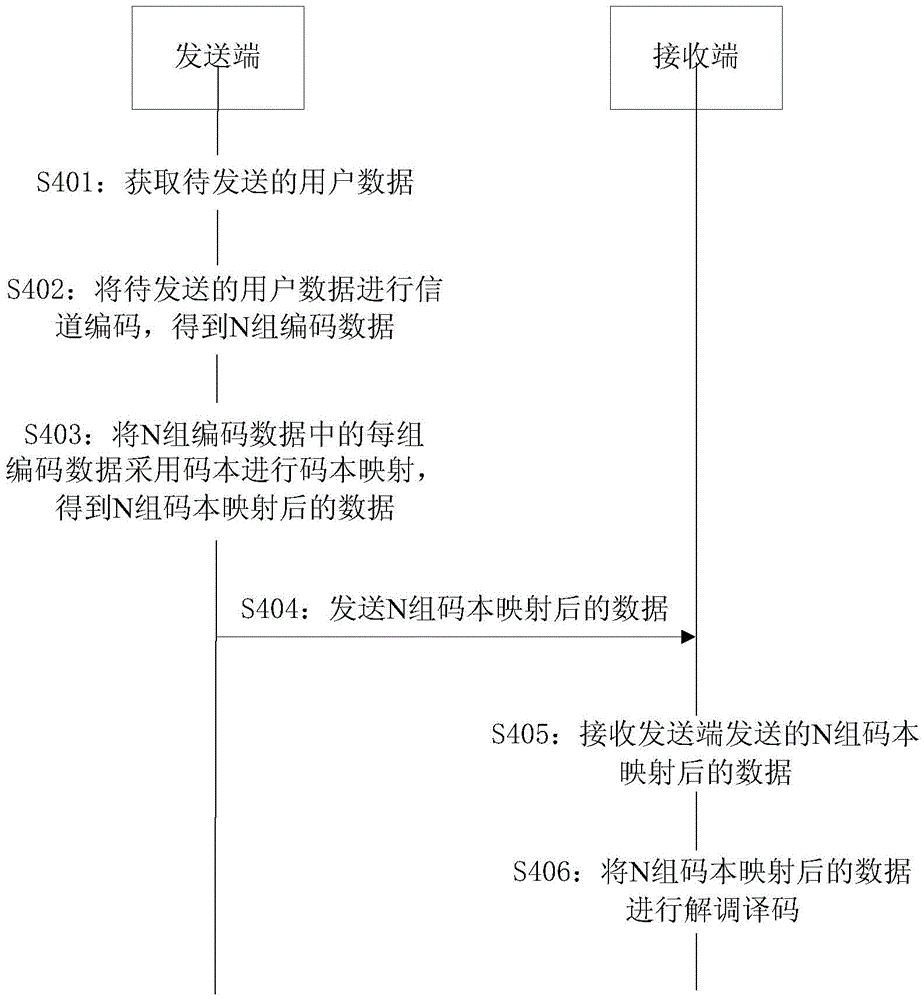
Fig. 4 is a signaling interaction diagram of a data transmission method according to an embodiment of the present invention. As shown in fig. 4, a data transmission method provided in an embodiment of the present invention includes:
s401: the sending end obtains user data to be sent.
Specifically, the sending end in the embodiment of the present invention may be a user equipment or a base station. When the sending end is the user equipment, the user data to be sent obtained by the sending end can be the same user data to be sent; when the sending end is a base station, the user data to be sent obtained by the sending end may be multiple user data to be sent. That is, the user equipment may send user data to be sent to the base station; or the base station may send a plurality of user data to be sent to the user equipment. The embodiment of the present invention mainly uses UE as a transmitting end and a base station as a receiving end for illustration, and the embodiment of the present invention takes the user data to be transmitted as the same user data for illustration, and the user data to be transmitted is the same way and principle of implementing each of a plurality of user data and the same user data, which is not illustrated herein.
S402: the sending end carries out channel coding on user data to be sent to obtain N groups of coded data.
Specifically, user data to be transmitted is channel coded to generate a plurality of coded data. The embodiment of the invention can carry out channel coding on the user data to be sent by adopting M channel coders to obtain N groups of coded data, wherein M is a positive integer less than or equal to N.
Further, in S402, the sending end performs channel coding on the user data to be sent by using M channel encoders, and obtaining N sets of coded data can be implemented by the following three ways:
the first implementation mode comprises the following steps: and M is equal to N, and M channel encoders adopt M encoding modes to perform channel encoding on user data to be transmitted to obtain N groups of different encoded data.
Specifically, M channel encoders are used for simultaneously encoding user data to be transmitted, each channel encoder uses a different encoding method, so that N groups of different encoded data can be generated, the channel encoding gain is increased, and the reliability is enhanced, at this time, M is equal to N. For example, user data to be transmitted is encoded using three channel encoders, wherein one channel encoder is used to encode using Polar codes to obtain a set of encoded data. A channel encoder is used to encode with a Turbo code to obtain a set of encoded data. The TBCC code is used for coding by a channel coder to obtain a group of coded data. That is, three different encoding modes, namely Polar code, Turbo code and TBCC code, are respectively adopted for user data to be transmitted to obtain three sets of completely different encoded data. Because different coding gains can be brought by adopting different channel coding modes, under the condition that the coding gain of different coding modes is not determined, the embodiment of the invention adopts M coding modes to carry out channel coding on user data to be sent by M channel coders, thereby realizing coding diversity and ensuring that the coding gain of at least one group of coding data in N groups of completely different coding data is maximum.
It should be noted that, in the embodiment of the present invention, the coding method and principle of Polar code, Turbo code and TBCC code are the same as those of Polar code, Turbo code and TBCC code in the prior art, and no further description is given in the embodiment of the present invention.
The second implementation mode comprises the following steps: and M is less than N, encoding the user data to be transmitted by adopting the same encoding mode through at least one channel encoder in the M channel encoders, and dividing the data encoded by adopting the same encoding mode into at least two groups to obtain N groups of encoded data.
Specifically, M channel encoders are used for simultaneously encoding user data to be transmitted, and at least one channel encoder encodes the user data to be transmitted in the same encoding mode, so that N sets of encoded data can be generated, and at this time, M is smaller than N. For example, user data to be sent is encoded by using two channel encoders, one of the two channel encoders encodes the user data to be sent by using Polar codes, and the encoded data is divided into two groups to obtain two groups of encoded data; encoding user data to be transmitted by using another channel encoder and adopting a Turbo code to obtain a group of encoded data; that is, the user data to be transmitted respectively adopts two different coding modes of Polar code and Turbo code to obtain three groups of coded data. Because different channel coding modes can bring different coding gains, under the condition of determining the coding gain of the coding mode, the coding mode with the largest coding gain is selected.
The third implementation mode comprises the following steps: and M is smaller than N, and different parts of the user data to be transmitted are coded by at least one channel coder in the M channel coders in the same coding mode to obtain N groups of coded data.
Specifically, M channel encoders are used for simultaneously encoding user data to be transmitted, and at least one channel encoder encodes different portions of the user data to be transmitted in the same encoding mode, so that N groups of incompletely identical encoded data can be generated, and at this time, M is smaller than N. For example, the user data to be transmitted may be divided into two parts, a and B, and encoded by using two channel encoders, where one channel encoder is used to encode the user data to be transmitted by using Polar code to obtain a set of encoded data; respectively coding the part A and the part B of user data to be sent by using a channel coder by adopting Turbo codes to obtain two groups of coded data; that is, the user data to be transmitted respectively adopts two different coding modes of Polar code and Turbo code to obtain three groups of coded data. Because different coding gains can be brought by adopting different channel coding modes, under the condition that the coding gain sizes of different coding modes are not determined, the embodiment of the invention adopts the same coding mode to code different parts of user data to be transmitted by at least one channel coder in M channel coders, thereby realizing coding diversity, ensuring that the coding gain of at least one group of coded data in N groups of coded data is maximum, and simultaneously realizing that more coded data are generated by adopting fewer channel coders.
It should be noted that, in the embodiment of the present invention, channel coding is performed on user data to be sent by using M channel encoders to obtain N groups of coded data, which is not limited to the above three implementation manners, and channel coding may be performed on user data to be sent by using M channel encoders, where M is equal to N, and each channel encoder uses the same coding manner to obtain N groups of completely same coded data. Or M channel encoders may be used for user data to be transmitted, where M is equal to N, and K encoding manners are used for the M channel encoders, where K is smaller than M, to obtain N groups of encoded data.
S403: and the sending end performs codebook mapping on each group of coded data in the N groups of coded data by adopting a codebook to obtain the data after the N groups of codebooks are mapped.
The codebooks adopted by the different groups of encoded data are codebooks that occupy different nonzero physical Resource Elements (REs), the nonzero physical RE is a codebook that maps the mapped data on the physical RE, and N is a positive integer greater than or equal to 2.
The RE is the smallest resource unit in the LTE physical resources (time-frequency domain resources).
Specifically, after user data to be transmitted is channel coded, each set of coded data in N sets of coded data is mapped by using codebooks occupying non-zero physical Resources (REs) different from each other, that is, the N sets of coded data are transmitted after being codebook-mapped by using codebooks composed of N codebooks occupying non-zero physical Resources (REs) different from each other. In the embodiment of the present invention, the codebooks occupying the non-zero physical Resources (REs) that are different from each other may be defined as orthogonal codebooks, and a codebook pair composed of N codebooks occupying the non-zero physical Resources (REs) that are different from each other may be defined as an orthogonal codebook pair. The data mapped by the N codebooks are mapped to different non-zero physical REs, thereby ensuring the codebook diversity of the data mapped by the N groups of codebooks in the transmission process. Since different REs exist in different subcarriers in the same time slot, and there is a certain difference in the channels between different subcarriers (this difference is particularly significant in a frequency selective fading channel), the data after N sets of codebook mapping will utilize the codebook diversity introduced by the subcarrier frequency in the transmission process.
In the embodiment of the invention, each group of coded data information in N groups of coded data is mapped to different subcarriers by using codebooks with different non-zero physical Resources (REs), so that the information of the same user data to be sent is not superposed on the same subcarrier, HARQ (hybrid automatic repeat request) combination is not required to be carried out on transmission on different TTIs (transmission time intervals) at the front and the back, the mutual interference of the same user data information is avoided on the basis of no extra time delay overhead, the codebook diversity is utilized to the maximum extent, and the communication reliability is improved.
Further, in S403, since the ue and the base station in the embodiment of the present invention need to determine N codebooks occupying non-zero physical REs in physical resources, which are different from each other. The embodiment of the invention can determine N codebooks which occupy different nonzero physical REs of the same user data through the following two implementation modes:
the first implementation mode comprises the following steps: before S401, the sending end receives a resource configuration message sent by the receiving end, where the resource configuration message includes a codebook pair occupying non-zero physical REs and different from each other. Optionally, the resource configuration message further includes a channel coding mode and/or an antenna resource mapping mode.
Correspondingly, the receiving end sends a resource configuration message to the sending end, and the resource configuration message comprises mutually different codebook pairs occupying non-zero physical REs. Optionally, the resource configuration message further includes a channel coding mode and/or an antenna resource mapping mode.
Specifically, when a receiving end designates a high-reliability communication scheme to a transmitting end, it may indicate what kind of air interface resources the transmitting end adopts by sending a resource configuration message, where the air interface resources include a sparse codebook pair and may also include antenna resources and/or channel coding groups, and the like, the transmitting end schedules the air interface resources to execute the URC scheme according to the URC scheme indicated by the receiving end, and the receiving end executes a corresponding sparse codebook, channel coding and antenna resource mapping according to the URC scheme planned by the receiving end. The different codebook pairs occupying non-zero physical REs in the resource configuration message may be specific different codebook pairs occupying non-zero physical REs determined by the receiving end for the transmitting end according to the requirement of the transmitting end for reliability, CQI and the current physical resource allocation condition when user data sharing the same RE are of the same communication reliability level, or may be a group of different codebook pairs occupying non-zero physical REs determined randomly from multiple groups of different codebook pairs occupying non-zero physical REs when the user data sharing the same RE are not of the same communication reliability level. The embodiment of the invention can define codebook pairs composed of N codebooks occupying non-zero physical Resources (REs) different from each other as orthogonal codebook pairs, for example, three codebook pairs occupying non-zero physical Resources (REs) different from each other are included in physical resources, and are hereinafter referred to as orthogonal codebook pairs, which are respectively marked as an orthogonal codebook pair 1, an orthogonal codebook pair 2 and an orthogonal codebook pair 3, a receiving end can determine that a transmitting end needs to adopt the orthogonal codebook pair 1 to map according to the requirement of the transmitting end on reliability, CQI and the current physical resource distribution condition, the orthogonal codebook pair 1 is transmitted to the transmitting end through a resource configuration message, or an orthogonal codebook pair can be randomly selected from the orthogonal codebook pair 1, the orthogonal codebook pair 2 and the orthogonal codebook pair 3, and any one orthogonal codebook pair is transmitted to the transmitting end through the resource configuration message. In addition, there is also a case that three orthogonal codebooks are in a group of orthogonal codebook pairs in the physical resource, which are respectively marked as orthogonal codebook 1, orthogonal codebook 2 and orthogonal codebook 3, and the transmitting end only needs to map through two orthogonal codebooks, at this time, the receiving end can determine that the transmitting end needs to map through the orthogonal codebook pair composed of orthogonal codebook 1 and orthogonal codebook 2 according to the requirement of the transmitting end on reliability, CQI and the current physical resource allocation condition, and send the orthogonal codebook 1 and orthogonal codebook 2 to the transmitting end through the resource allocation message, or randomly select one orthogonal codebook pair from three orthogonal codebook pairs composed of orthogonal codebook 1 and orthogonal codebook 2, orthogonal codebook 1 and orthogonal codebook 3, And any one orthogonal codebook pair consisting of the orthogonal codebook 2 and the orthogonal codebook 3 is sent to the sending end through the resource configuration message.
It should be noted that the resource configuration message sent by the receiving end may be an indication message sent separately, or may be an indication message carried in DCI Format X in PDCCH or ePDCCH, where DCI Format X in PDCCH or ePDCCH includes α bits characterizing channel coding mode, β bits characterizing orthogonal codebook pair, and γ bits characterizing antenna resource mapping mode.
The second implementation mode comprises the following steps: before S401, the transmitting end transmits a resource configuration message to the receiving end, where the resource configuration message includes codebook pairs occupying non-zero physical REs and different from each other. Optionally, the resource configuration message further includes a channel coding mode and/or an antenna resource mapping mode. Correspondingly, the receiving end receives a resource configuration message sent by the sending end, and the resource configuration message comprises codebook pairs which occupy different nonzero physical REs. Optionally, the resource configuration message further includes a channel coding mode and/or an antenna resource mapping mode.
Specifically, when a sending end proposes a specific high-reliability communication scheme to a receiving end, the sending end may indicate what kind of air interface resources the receiving end schedules by sending a resource configuration message, where the air interface resources include a sparse codebook pair and may also include antenna resources and/or channel coding groups, and the receiving end starts corresponding air interface resources to execute the URC scheme according to the URC scheme requested by the sending end, and the receiving end executes corresponding sparse codebook, channel coding and antenna resource mapping according to the URC scheme requested by the sending end. The orthogonal codebook pair in the resource configuration message may be a specific orthogonal codebook pair determined by the transmitting end according to the requirement of the transmitting end on reliability, the CQI and the current physical resource allocation condition, or may be a group of orthogonal codebook pairs randomly determined by the transmitting end from a plurality of groups of orthogonal codebook pairs. For example, three sets of orthogonal codebook pairs are respectively marked as an orthogonal codebook pair 1, an orthogonal codebook pair 2 and an orthogonal codebook pair 3 in the physical resource, the transmitting end can determine that the orthogonal codebook pair 1 needs to be mapped according to the reliability requirement of the transmitting end, the CQI and the current physical resource allocation condition, and transmit the orthogonal codebook pair 1 to the receiving end through the resource configuration message, or randomly select one orthogonal codebook pair from the orthogonal codebook pair 1, the orthogonal codebook pair 2 and the orthogonal codebook pair 3, and transmit any one orthogonal codebook pair to the receiving end through the resource configuration message. In addition, there is also a case that three orthogonal codebooks are in a group of orthogonal codebook pairs in the physical resource, which are respectively marked as orthogonal codebook 1, orthogonal codebook 2 and orthogonal codebook 3, and the transmitting end only needs to map through two orthogonal codebooks, at this time, the transmitting end can determine that the orthogonal codebook pair formed by the orthogonal codebook 1 and the orthogonal codebook 2 needs to be adopted for mapping according to the requirement of the transmitting end on reliability, CQI and the current physical resource distribution condition, and send the orthogonal codebook 1 and the orthogonal codebook 2 to the receiving end through the resource configuration message, or randomly select one orthogonal codebook pair from three orthogonal codebook pairs formed by the orthogonal codebook 1 and the orthogonal codebook 2, the orthogonal codebook 1 and the orthogonal codebook 3, and the orthogonal codebook 2 and the orthogonal codebook 3, and send any one orthogonal codebook pair formed by the orthogonal codebook 1 and the orthogonal codebook 2, the orthogonal codebook 1 and the orthogonal codebook 3 to the receiving end through the resource configuration message And (4) an end.
It should be noted that the resource configuration message sent by the sending end may be a separately sent indication message, or may be an indication message carried in a PUCCH Format X, where the PUCCH Format X includes α bits to characterize a channel coding scheme, β bits to characterize an orthogonal codebook pair, and γ bits to characterize an antenna resource mapping scheme.
Further, in S403, the codebook for codebook mapping using a codebook includes: sparse Code Multiple Access (SCMA) codebooks, interleaved-Grid Multiple Access (IGMA) codebooks, or Pattern Multiple Access (PDMA) codebooks.
Specifically, fig. 5 is a schematic diagram of a transmitting end according to an embodiment of the present invention. As shown in fig. 5, the embodiment of the present invention is described by taking, but not limited to, the data after generating two sets of codebook maps as an example, and the embodiment of the present invention is described by taking, but not limited to, the SCMA codebook as an example. SCMA is a sparse code space based access technique. The corresponding relationship between each data Layer (Layer) and each RE can be represented by a Factor Graph (Factor Graph), in fig. 5, a Function Node (FN) represents the RE, a Variable Node (VN) represents an SCMA data Layer, the SCMA maps data to a plurality of REs through sparse spreading, the mapping relationship between the data and the RE is determined by a codebook and is represented by a connection line between the VN and the FN, and the codebook determines the modulation mode and the spreading mode of the coded information bits in a multidimensional space. The sparse codebook has low density spreading characteristics that will only have non-zero element mapping over no more than half of the REs. The sparse nature of the codebook space allows SCMA to overlay different SCMA data layers on the same RE and to detect in a near-optimal manner. As shown in fig. 5, a transmitting end acquires three user data to be transmitted, namely, UE1, UE2, and UE3, taking UE1 as an example, after channel coding is performed on the data to be transmitted of UE1, two sets of coded data are generated and respectively correspond to VN1 and VN2, an SCMA maps the data on VN1 to REs corresponding to FN2 and FN4 respectively through sparse spreading, and maps the data on VN2 to REs corresponding to FN1 and FN3 respectively. Since SCMA can overlay a data layer (Overloading) much larger than a given number of orthogonal REs, SCMA can provide more user data access than OFDMA at the same number of REs, or more reliable transmission at the same number of user data.
S404: and the sending end sends the data after the N groups of codebooks are mapped to the receiving end.
Specifically, the data after channel coding is mapped by N groups of codebooks that occupy different non-zero physical REs and are mapped can be distributed to antennas for transmission, and the N codebooks that occupy different non-zero physical REs ensure that the data after each group of codebooks is mapped fully utilizes codebook diversity in the transmission process, thereby improving the communication reliability.
Further, in S404, the sending end allocates N sets of codebook-mapped data to K antennas for transmission, where the antennas allocated to each set of codebook-mapped data in the N sets of codebook-mapped data are different, and K is a positive integer greater than or equal to N, so that each set of codebook-mapped data is transmitted through different antennas.
Specifically, in the embodiment of the present invention, N sets of codebook-mapped data obtained by mapping channel-coded data with N different codebooks occupying non-zero physical REs are transmitted on different antenna resources, so that each set of codebook-mapped data is transmitted through different antennas, thereby ensuring that each set of codebook-mapped data utilizes space diversity brought by different antenna spatial positions. Meanwhile, data after N groups of code books are mapped are distributed to K antennas for transmission, and when K is larger than or equal to N, the space diversity effect can be achieved, and the reliability is improved. In the embodiment of the present invention, the transmission of the data after the mapping of the N groups of codebooks on different antenna resources may be implemented by the following two implementation manners: one implementation is to allocate N sets of codebook mapped data to K antennas for transmission, where the codebook mapped data corresponds to the antennas one to one, and at this time, N is equal to K. That is, a set of codebook-mapped data is transmitted through one antenna. Another implementation manner is that N groups of codebook mapped data are distributed to K antennas for transmission, and each group of codebook mapped data may correspond to multiple antennas, where N is less than K. That is, at least one group of codebook mapped data of the N groups of codebook mapped data can monopolize multiple antennas for transmission.
It should be noted that, in the embodiment of the present invention, transmitting the data after mapping the N groups of codebooks is not limited to the two implementation manners described above, and the data after mapping the N groups of codebooks may also be transmitted through one antenna. However, with this implementation, the spatial diversity characteristic is not fully utilized, and the improvement in reliability can be limited.
The embodiment of the invention jointly utilizes the space diversity characteristic of multiple antennas and the codebook diversity characteristic of codebooks which occupy different nonzero physical REs, improves the reliability of communication on the basis of no extra overhead, and increases the descending speed of a Block error Rate (BLER) curve rising along with a Signal-to-Noise Ratio (SNR).
For example, fig. 6 is a schematic diagram of a principle for generating two sets of codebook-mapped data according to an embodiment of the present invention, as shown in fig. 6, a transmitting end obtains three user data to be transmitted, namely UE1, UE2, and UE3, taking UE1 as an example, the data to be transmitted of UE1 is encoded by a channel encoder to generate two sets of encoded data, the two sets of encoded data are mapped by two sparse codebooks occupying non-zero physical REs and different from each other, respectively, through codebook 1 and codebook 2, to generate two sets of codebook-mapped data, the two sets of codebook-mapped data are allocated to antenna H1 for transmission, and in fig. 6, the codebooks occupying non-zero physical REs and different from each other are used for codebook mapping, so that the data mapped by each codebook is fully utilized in the transmission process, and the communication reliability is improved.
Fig. 7 is a schematic diagram of a principle of generating two sets of codebook-mapped data according to the second embodiment of the present invention, as shown in fig. 7, a transmitting end obtains three user data to be transmitted, namely UE1, UE2, and UE3, taking UE1 as an example, the data to be transmitted of UE1 is encoded by a channel encoder to generate two sets of encoded data, the two sets of encoded data are mapped by two sparse codebooks, which occupy different non-zero physical REs, of codebook 1 and codebook 2, respectively, to generate two sets of codebook-mapped data, and it is ensured that the codebook-mapped data fully utilizes codebook diversity in a transmission process. The data mapped by the two groups of codebooks are respectively distributed to antennas H1 and H2 for transmission, that is, the data mapped by one group of codebooks corresponds to one antenna for transmission and is transmitted on different antenna resources, so that the space diversity brought by the spatial positions of different antennas of the data mapped by each codebook is ensured. In fig. 7, the antenna space and codebook diversity are jointly utilized, and the reliability improvement brought by the antenna space and codebook diversity is fully utilized.
Fig. 8 is a schematic diagram illustrating a principle of generating three sets of codebook mapped data according to an embodiment of the present invention. Fig. 9 is a schematic diagram of codebook coefficient characteristics of UEs occupying non-zero physical REs and different from each other under triple multiplexing according to an embodiment of the present invention. As shown in fig. 8 and 9, a transmitting end obtains eight user data to be transmitted from UE1 and UE2 … … UE8, taking UE1 as an example, after the data to be transmitted from UE1 is encoded by one channel encoder, three sets of encoded data are generated, where, in fig. 8 and 9, the data to be transmitted from UE1 is illustrated by being encoded by one channel encoder, but not limited thereto, the data to be transmitted from UE1 may also be encoded by two or three channel encoders, the three sets of encoded data are respectively mapped by three sparse codebooks of codebook 1, codebook 2 and codebook 3 that occupy different non-zero physical REs, and three sets of data after codebook mapping are generated, so as to bring codebook diversity for transmission of the data after three sets of codebooks are mapped; when each user data utilizes the codebooks with the three different occupied nonzero physical REs to perform high-reliability transmission, 8 user data can be simultaneously superposed on 8 REs, and the distribution of the sparse codebook pairs with the different occupied nonzero physical REs and the subcarriers where the codebooks map the REs can be as shown in FIG. 9; the data mapped by the three groups of codebooks are respectively distributed to antennas H1, H2 and H3 to be transmitted, namely the data mapped by one group of codebooks is transmitted corresponding to one antenna, the data mapped by each codebook mapped by the sparse codebooks occupying non-zero physical REs which are different from each other are transmitted through three different antennas, and space diversity is brought to the data transmission mapped by the codebooks. The joint use of the triple orthogonal codebook and the triple antenna in fig. 9 results in enhanced highly reliable transmission.
Fig. 10 is a schematic diagram of a principle of generating three groups of codebook-mapped data according to the second embodiment of the present invention, as shown in fig. 10, a transmitting end obtains eight user data to be transmitted, namely, UE1 and UE2 … … UE8, and takes UE1 as an example, after the data to be transmitted of UE1 is encoded by three channel encoders using three channel encoders, three groups of encoded data are generated, and the three groups of encoded data are mapped by three sparse codebooks, which occupy different non-zero physical REs, of codebook 1, codebook 2 and codebook 3, respectively, so as to generate three groups of codebook-mapped data, which brings codebook diversity to transmission of the data mapped by the three groups of codebooks; and then three antenna resources of H1, H2 and H3 are selected for transmission. The different channel coding in fig. 10 can bring coding gain, and the coding gain is combined with the spatial and codebook diversity to enhance the communication reliability.
It should be noted that TX in fig. 6 to 10 denotes a transmitter, RX denotes a receiver, and BS denotes a base station. In the embodiment of the present invention, two groups of data mapped by codebooks and three groups of data mapped by codebooks are taken as examples for explanation, and the implementation manner and principle of N groups of data mapped by codebooks are the same as those of two groups of data mapped by codebooks and three groups of data mapped by codebooks, and the embodiment of the present invention is not described again. In fig. 6 to 8 and 10, the different graphs show different modulated information in the data after each group of codebook mapping.
Fig. 11 is a diagram of performance analysis of a highly reliable communication scheme provided by an embodiment of the present invention. As shown in fig. 11, taking the case that a single UE occupies data mapped by codebooks with different nonzero physical REs and 3 UEs multiplex 4 REs simultaneously as an example, under an Extended Pedestrian a channel model (EPA), 10 is adopted for the reliability of generating the same data copy by using a Turbo code with a code rate of 1/3 and a UE motion speed of 1.2 kilometers per hour (km/h)6The sub-frames are statistically analyzed and the results are plotted in fig. 11. In fig. 11, line 1 is a performance curve without using the high-reliability communication scheme, line 2 is a performance curve with the same user data using two different non-occupied non-zero physical RE codebooks (with the same RE mapping), and line 3 is a performance curve with the same user data using two different non-occupied non-zero physical RE codebooksLine 4 is a performance curve of the same user data transmitted by using the two antennas to transmit the data mapped by the different codebooks with non-occupied non-zero physical REs, and line 5 is a performance curve of the same user data transmitted by using the space and codebook diversity at the same time. As can be seen from the simulation results, when codebook diversity is not adopted, the descending slope of the BLER curve along with the increase of SNR is not changed; when codebook diversity is introduced, the BLER curve is accelerated down, but the improved performance is limited; when space diversity is adopted, the BLER curve is accelerated to descend; when the joint space and the codebook are graded, the improvement on the BLER performance is far larger than the superposition of the improvement of the two methods, and a BLER curve presents an accelerated descent state.
S405: and the receiving end receives the data after the mapping of the N groups of codebooks sent by the sending end.
Specifically, the receiving end receives N sets of codebook mapped data from the received signal.
S406: and the receiving end demodulates and decodes the data mapped by the N groups of codebooks.
Specifically, when the receiving end receives the data after mapping the N sets of codebooks of the same user data, information is extracted from the corresponding resources and reliable decoding is performed according to the instruction of the sending end or the URC scheme requested by the receiving end. Fig. 12 is a schematic diagram of a principle of a receiving end according to an embodiment of the present invention, as shown in fig. 12, after obtaining Log Likelihood ratios (Log Likelihood ratios, LLRs for short) of data information after mapping of each set of codebooks, the high-reliability receiving end performs LLR merging, performs channel decoding respectively, outputs according to Cyclic Redundancy Check (CRC) Check results, and performs CRC Check and LLR merging jointly to determine whether CRC Check is passed or not, and then determines whether LLR merging decoding is used or not.
Further, in S406, as shown in fig. 12, the receiving end demodulates and decodes the data mapped by the N sets of codebooks by the following three implementation manners:
the first implementation mode comprises the following steps: respectively decoding the data mapped by the N groups of codebooks by a decoder to obtain channel decoding data of the N groups of codebooks; judging whether the channel decoding data of one group of codebooks in the channel decoding data of the N groups of codebooks passes the check information check; if so, taking the channel decoding data of a group of codebooks which passes the verification of the verification information as a channel decoding result; if not, taking the channel decoding data of any group of codebooks in the channel decoding data of the N groups of codebooks as a channel decoding result.
Specifically, as in the URC a scheme in fig. 12, the multiple access decoding output LLRs of the data mapped by each group of codebooks are decoded by different channel decoders, and the output of the ACK flag is preferentially selected as the decoding output. That is, after decoding the data channels after N sets of codebook mapping, the set of codebook mapped data bits for obtaining the ACK flag is output as the decoding of the user data, otherwise, one set is selected as the output.
The second implementation mode comprises the following steps: and combining the soft information output by the multi-access decoding of the data after the mapping of the N groups of codebooks, carrying out channel decoding on the combined soft information, and taking the channel decoding data of the combined soft information as a channel decoding result.
Specifically, as in the URC B scheme in fig. 12, soft information of data multiple access decoding after all N groups of codebooks are mapped is obtained and then merged, channel decoding is performed together, and the result is output. That is, after the data mapped by the N groups of codebooks is decoded by multiple access, the output soft information is merged, then decoded by a channel decoder, and the merged data bits are output as the decoding of the user data.
The third implementation mode comprises the following steps: respectively decoding the data mapped by the N groups of codebooks by a decoder to obtain channel decoding data of the N groups of codebooks; judging whether the channel decoding data of one group of codebooks in the channel decoding data of the N groups of codebooks passes the check information check; if so, taking the channel decoding data of a group of codebooks which passes the verification of the verification information as a channel decoding result; if not, combining the soft information output by the multi-access decoding after the mapping of the N groups of codebooks, carrying out channel decoding on the combined soft information, and taking the channel decoding data of the combined soft information as the co-channel decoding result.
Specifically, as in the URC C scheme in fig. 12, the multiple access decoding output LLRs of the data mapped by each group of codebooks are separately channel decoded, and if ACK, the result is output, and if NAK, the soft information is combined and then channel decoded. That is, after the data channel after N sets of codebook mapping is decoded, if the ACK flag is obtained, the data bit after the set of codebook mapping that the ACK flag is obtained is output as the decoding of the user data, otherwise, after the data after N sets of codebook mapping is decoded by multiple access, the output soft information is merged, and then the channel decoding of the merged soft information is output as the decoding of the user data.
In the embodiment of the present invention, in the first implementation manner and the third implementation manner, a derivative joint demodulation decoding method is that in an iterative process of channel decoding, soft information (such as LLR) is output by channel decoding of N sets of codebook-mapped data, and is crossly fed back to a channel decoder of the N sets of codebook-mapped data, and the soft information is used as a decoding prior probability of channel decoding to perform Hybrid Inner iteration (HIL for short); the first implementation manner, the second implementation manner, and the third implementation manner relate to a derivation joint demodulation decoding method, in which after channel decoding is completed, N sets of channel decoding output LLRs are cross-fed back to the N sets of multi-access decoders, and Hybrid external iteration (HOL for short) is performed as decoding prior probability of the multi-access decoders.
It should be noted that the processing flow of the receiving end decoding method is not limited to the above three types, and the derived high-reliability receiving end can be obtained by combining with HIL or HOL in fig. 12.
According to the data transmission method provided by the embodiment of the invention, after channel coding is carried out on user data to be transmitted, N codebooks occupying non-zero physical REs and different codebooks are adopted for carrying out codebook mapping to obtain N groups of data after codebook mapping, and the data after N codebooks are mapped to different non-zero physical REs, so that codebook diversity of the data after N groups of codebooks are ensured in the transmission process, mutual interference of the same user data information is avoided on the basis of no extra time delay overhead, the codebook diversity is utilized to the maximum extent, and the communication reliability is improved. Meanwhile, the data after the mapping of the N groups of codebooks are respectively distributed to different antennas and transmitted through different antennas, so that the space diversity brought by different antenna space positions of the data after the mapping of each group of codebooks is ensured, the joint utilization of the antenna space and the codebook diversity can be realized, and the reliability improvement brought by the two is fully utilized. And performing channel coding on user data to be transmitted by adopting M channel coders to obtain N groups of coded data, wherein M is a positive integer less than or equal to N, different channel codes can bring coding gain, and the space and codebook diversity combination coding gain is utilized to enhance the communication reliability.
Fig. 13 is a schematic structural diagram of a user equipment according to an embodiment of the present invention. As shown in fig. 13, the user equipment provided in the embodiment of the present invention includes: the device comprises a receiving module 1301, an encoding module 1302, a mapping module 1303 and a sending module 1304, wherein the receiving module 1301, the encoding module 1302, the mapping module 1303 and the sending module 1304 are connected in sequence respectively.
A receiving module 1301, configured to obtain user data to be sent.
The encoding module 1302 is configured to perform channel encoding on user data to be transmitted to obtain N groups of encoded data.
The mapping module 1303 is configured to perform codebook mapping on each set of encoded data in the N sets of encoded data by using a codebook to obtain N sets of data after codebook mapping, where codebooks used for different sets of encoded data occupy different non-zero physical REs, where the non-zero physical REs refer to waveforms obtained by mapping the mapped data on the physical REs, and N is a positive integer greater than or equal to 2.
A sending module 1304, configured to send the data after the N groups of codebooks are mapped to the base station.
The user equipment provided in the embodiment of the present invention is used for executing the technical scheme of the sending end of the method embodiment shown in fig. 4, and the implementation principle and the technical effect are similar, which are not described herein again.
Further, in the embodiment shown in fig. 13, the sending module 1304 is specifically configured to: distributing the data after the mapping of N groups of codebooks to K antennas for transmission, wherein the antennas distributed to the data after the mapping of each group of codebooks in the data after the mapping of the N groups of codebooks are different, and K is a positive integer which is more than or equal to N, so that the data after the mapping of each group of codebooks are transmitted through different antennas.
Further, in the embodiment shown in fig. 13, the codebook that the mapping module 1303 uses the codebook for codebook mapping includes: a SCMA codebook, an IGMA codebook or a PDMA codebook.
Further, in the embodiment shown in fig. 13, the encoding module 1302 is specifically configured to: and performing channel coding on user data to be sent by adopting M channel encoders to obtain N groups of coded data, wherein M is a positive integer less than or equal to N.
Further, in the embodiment shown in fig. 13, M is equal to N, and the encoding module 1302 is specifically configured to: and performing channel coding on user data to be transmitted by adopting M coding modes through M channel coders to obtain N groups of different coded data.
Further, in the embodiment shown in fig. 13, M is smaller than N, and the encoding module 1302 is specifically configured to: and encoding the user data to be transmitted by adopting the same encoding mode through at least one channel encoder in the M channel encoders, and dividing the encoded data into at least two groups to obtain N groups of encoded data.
Further, in the embodiment shown in fig. 13, the receiving module 1301 is further configured to receive a resource configuration message sent by the base station, where the resource configuration message includes codebook pairs occupying non-zero physical REs that are different from each other. Optionally, the resource configuration message further includes a channel coding mode and/or an antenna resource mapping mode.
Further, in the embodiment shown in fig. 13, the sending module 1304 is further configured to send a resource configuration message to the base station, where the resource configuration message includes codebook pairs occupying non-zero physical REs that are different from each other. Optionally, the resource configuration message further includes a channel coding mode and/or an antenna resource mapping mode.
Fig. 14 is a schematic structural diagram of a base station according to an embodiment of the present invention. As shown in fig. 14, a base station provided in an embodiment of the present invention includes: the receiving module 1401 is connected with the decoding module 1402, and the receiving module 1401 is connected with the decoding module 1402.
A receiving module 1401, configured to receive N groups of codebook-mapped data sent by a user equipment, where the N groups of codebook-mapped data are data obtained by codebook-mapping each group of encoded data in the N groups of encoded data, where codebooks used for different groups of encoded data occupy different non-zero physical REs, where the non-zero physical RE is a codebook where waveforms of the mapped data on the physical REs are non-zero, and N is a positive integer greater than or equal to 2.
The decoding module 1402 is configured to demodulate and decode the data mapped by the N sets of codebooks.
The user equipment provided in the embodiment of the present invention is used for executing the technical solution of the receiving end in the embodiment of the method shown in fig. 4, and the implementation principle and the technical effect are similar, which are not described herein again.
Further, in the embodiment shown in fig. 14, the decoding module 1402 is specifically configured to: respectively decoding the data mapped by the N groups of codebooks by a decoder to obtain channel decoding data of the N groups of codebooks; judging whether the channel decoding data of one group of codebooks in the channel decoding data of the N groups of codebooks passes the check information check; if so, taking the channel decoding data of a group of codebooks which passes the verification of the verification information as a channel decoding result; if not, taking the channel decoding data of any group of codebooks in the channel decoding data of the N groups of codebooks as a channel decoding result.
Further, in the embodiment shown in fig. 14, the decoding module 1402 is specifically configured to: and combining the soft information after the data decoding of the N groups of codebook mapping, carrying out channel decoding on the combined soft information, and taking the channel decoding data of the combined soft information as a channel decoding result.
Further, in the embodiment shown in fig. 14, the decoding module 1402 is specifically configured to: respectively decoding the data mapped by the N groups of codebooks by a decoder to obtain channel decoding data of the N groups of codebooks; judging whether the channel decoding data of one group of codebooks in the channel decoding data of the N groups of codebooks passes the check information check; if so, taking the channel decoding data of a group of codebooks which passes the verification of the verification information as a channel decoding result; if not, combining the soft information after the data decoding of the N groups of codebook mapping, carrying out channel decoding on the combined soft information, and taking the channel decoding data of the combined soft information as a channel decoding result.
Further, in the embodiment shown in fig. 14, the base station further includes: a sending module 1403, wherein the sending module 1403 is connected to the decoding module 1402.
A sending module 1403, configured to send a resource configuration message to the user equipment, where the resource configuration message includes codebook pairs occupying non-zero physical REs that are different from each other. Optionally, the resource configuration message further includes a channel coding mode and/or an antenna resource mapping mode.
Further, in the embodiment shown in fig. 14, the receiving module 1401 is further configured to receive a resource configuration message sent by the sending end, where the resource configuration message includes codebook pairs occupying non-zero physical REs that are different from each other. Optionally, the resource configuration message further includes a channel coding mode and/or an antenna resource mapping mode.
Fig. 15 is a schematic structural diagram of a user equipment according to a second embodiment of the present invention. As shown in fig. 15, the user equipment provided in the embodiment of the present invention includes: a receiver 1501, a processor 1502 and a transmitter 1503, the processor 1502 being coupled to the receiver 1501 and the transmitter 1503, respectively.
The receiver 1501 is configured to obtain user data to be transmitted. The transmitter 1503 is configured to transmit the N groups of codebook-mapped data to the base station.
The processor 1502 may be a general-purpose processor 1502, and includes a Central Processing Unit (CPU) 1502, a Network Processor (NP) 1502, and the like; the Digital Signal processor 1502(Digital Signal Processing, DSP for short), an Application specific integrated Circuit (ASIC for short), a Field Programmable Gate Array (FPGA for short), or other Programmable logic devices may also be used.
Where the processor 1502 is a CPU, the user device may also include memory for storing programs. In particular, the program may include program code including computer operating instructions. The memory may include a Random Access Memory (RAM) and may also include a non-volatile memory (non-volatile memory), such as at least one disk memory. When the user equipment is operating, the processor 1502 communicates with the memory, and the processor 1502 invokes instructions stored in the memory to perform the following operations:
carrying out channel coding on user data to be sent to obtain N groups of coded data; and carrying out codebook mapping on each group of coded data in the N groups of coded data by adopting a codebook to obtain N groups of data subjected to codebook mapping, wherein the codebooks adopted by the coded data of different groups occupy codebooks with different nonzero physical REs, the nonzero physical RE refers to the fact that the waveform of the mapped data mapped on the physical RE is nonzero, and N is a positive integer greater than or equal to 2.
The transmitter 1503 is specifically configured to: distributing the data after the mapping of N groups of codebooks to K antennas for transmission, wherein the antennas distributed to the data after the mapping of each group of codebooks in the data after the mapping of the N groups of codebooks are different, and K is a positive integer which is more than or equal to N, so that the data after the mapping of each group of codebooks are transmitted through different antennas.
The codebook for codebook mapping by the processor 1502 includes: a SCMA codebook, an IGMA codebook or a PDMA codebook.
The processor 1502 is further configured to perform the following operations:
and performing channel coding on user data to be sent by adopting M channel encoders to obtain N groups of coded data, wherein M is a positive integer less than or equal to N.
Where M is equal to N, the processor 1502 is further configured to:
and performing channel coding on user data to be transmitted by adopting M coding modes through M channel coders to obtain N groups of different coded data.
Where M is less than N, the processor 1502 is further configured to:
and encoding the user data to be transmitted by adopting the same encoding mode through at least one channel encoder in the M channel encoders, and dividing the encoded data into at least two groups to obtain N groups of encoded data.
Wherein, the receiver 1501 is further configured to: and receiving a resource configuration message sent by the base station, wherein the resource configuration message comprises codebook pairs which occupy different nonzero physical REs. Optionally, the resource configuration message further includes a channel coding mode and/or an antenna resource mapping mode. Wherein the transmitter 1503 is further configured to: and sending a resource configuration message to the base station, wherein the resource configuration message comprises codebook pairs which occupy different nonzero physical REs. Optionally, the resource configuration message further includes a channel coding mode and/or an antenna resource mapping mode.
The user equipment provided in the embodiment of the present invention is used for executing the technical scheme of the sending end of the method embodiment shown in fig. 4, and the implementation principle and the technical effect are similar, which are not described herein again.
Fig. 16 is a schematic structural diagram of a base station according to a second embodiment of the present invention. As shown in fig. 16, a base station provided in an embodiment of the present invention includes: a receiver 1601 and a processor 1602, the processor 1602 is coupled to the receiver 1601.
The receiver 1601 is configured to receive N sets of codebook-mapped data sent by the ue, where the N sets of codebook-mapped data are data obtained by codebook-mapping each set of encoded data in the N sets of encoded data, where codebooks used for different sets of encoded data occupy different non-zero physical REs, where the non-zero physical RE is a codebook that occupies different non-zero physical REs, where a waveform of the mapped data mapped on the physical RE is non-zero, and N is a positive integer greater than or equal to 2.
The processor 1602 may be a general-purpose processor 1602, and includes a Central Processing Unit (CPU) 1602, a Network Processor (NP) 1602, and the like; the device may also be a Digital Signal processor 1602(Digital Signal Processing, DSP for short), an Application specific integrated Circuit (ASIC for short), a Field Programmable Gate Array (FPGA for short), or other Programmable logic devices.
Where the processor 1602 is a CPU, the base station may also include memory for storing programs. In particular, the program may include program code including computer operating instructions. The memory may include a Random Access Memory (RAM) and may also include a non-volatile memory (non-volatile memory), such as at least one disk memory. When the base station is operating, the processor 1602 communicates with the memory, and the processor 1602 invokes instructions stored in the memory to perform the following operations:
and demodulating and decoding the data after the mapping of the N groups of codebooks.
Wherein the processor 1602 is further configured to perform the following operations:
respectively decoding the data mapped by the N groups of codebooks by a decoder to obtain channel decoding data of the N groups of codebooks;
judging whether the channel decoding data of one group of codebooks in the channel decoding data of the N groups of codebooks passes the check information check;
if so, taking the channel decoding data of a group of codebooks which passes the verification of the verification information as a channel decoding result;
if not, taking the channel decoding data of any group of codebooks in the channel decoding data of the N groups of codebooks as a channel decoding result.
Wherein the processor 1602 is further configured to perform the following operations:
and combining the soft information after the data decoding of the N groups of codebook mapping, carrying out channel decoding on the combined soft information, and taking the channel decoding data of the combined soft information as a channel decoding result.
Wherein the processor 1602 is further configured to perform the following operations:
respectively decoding the data mapped by the N groups of codebooks by a decoder to obtain channel decoding data of the N groups of codebooks;
judging whether the channel decoding data of one group of codebooks in the channel decoding data of the N groups of codebooks passes the check information check;
if so, taking the channel decoding data of a group of codebooks which passes the verification of the verification information as a channel decoding result;
if not, combining the soft information after decoding the data mapped by the N groups of codebooks, carrying out channel decoding on the combined soft information, and taking the channel decoding data of the combined soft information as a channel decoding result.
Wherein the receiver 1601 is further configured to:
and receiving a resource configuration message sent by the user equipment, wherein the resource configuration message comprises codebook pairs occupying non-zero physical REs and different from each other. Optionally, the resource configuration message further includes a channel coding mode and/or an antenna resource mapping mode.
Further, in the embodiment shown in fig. 16, the base station further includes: a transmitter 1603, the transmitter 1603 is connected to the processor 1602, and the transmitter 1603 is configured to transmit a resource configuration message to the user equipment, where the resource configuration message includes codebook pairs occupying non-zero physical REs that are different from each other. Optionally, the resource configuration message further includes a channel coding mode and/or an antenna resource mapping mode.
The user equipment provided in the embodiment of the present invention is used for executing the technical solution of the receiving end in the embodiment of the method shown in fig. 4, and the implementation principle and the technical effect are similar, which are not described herein again.
Finally, it should be noted that: the above embodiments are only used to illustrate the technical solution of the present invention, and not to limit the same; while the invention has been described in detail and with reference to the foregoing embodiments, it will be understood by those skilled in the art that: the technical solutions described in the foregoing embodiments may still be modified, or some or all of the technical features may be equivalently replaced; and the modifications or the substitutions do not make the essence of the corresponding technical solutions depart from the scope of the technical solutions of the embodiments of the present invention.