Detailed Description
The "annotation behavior" herein refers to a behavior of actively expressing the content of a multimedia movie through the interactive system of the present invention when a user views the multimedia movie. By way of example, including but not limited to: when a user is watching a multimedia film, the user may touch the multimedia film with a mouse at any position of the multimedia film, directly touch the multimedia film with a hand (when the display has a touch screen), input the multimedia film through gestures on an electronic device connected to the interactive system of the present invention, input the multimedia film through sound on an electronic device connected to the interactive system of the present invention, or a combination thereof.
The "timestamp" herein refers to the playing time of the multimedia movie in each specific time unit. The time stamp should correspond to at least one picture in the multimedia movie. In a practical case, the time stamp is equal to the playing time of the multimedia movie.
The "index tag" herein refers to a tag that records related information for comparing the labeled information and matching related interaction information in the database. The related information recorded in the tag may include, but is not limited to: a time information corresponding to the time stamp of the multimedia data, a position information corresponding to at least a position in the frame of the multimedia data, a behavior information corresponding to the information including but not limited to: the method comprises the following steps that a user slides track information and/or touch pressing information of a touch screen on an electronic device, and/or sound information received by a sound receiver on the electronic device.
The term "touching" as used herein refers to touching (or clicking) an object in the multimedia data playing content on the display when the user is viewing the multimedia data, or dragging a cursor to touch an object in the multimedia data playing content, or dragging an object to another space, and then controlling the object with a keyboard, or touching a button by scanning an eyeball to fix a frame, or the like.
Hereinafter, the present invention will be described in detail by explaining various embodiments of the invention with the aid of the accompanying drawings. The inventive concept may, however, be embodied in many different forms and should not be construed as limited to the exemplary embodiments set forth herein. Moreover, in the drawings, like reference numerals may be used to designate like elements.
Example one
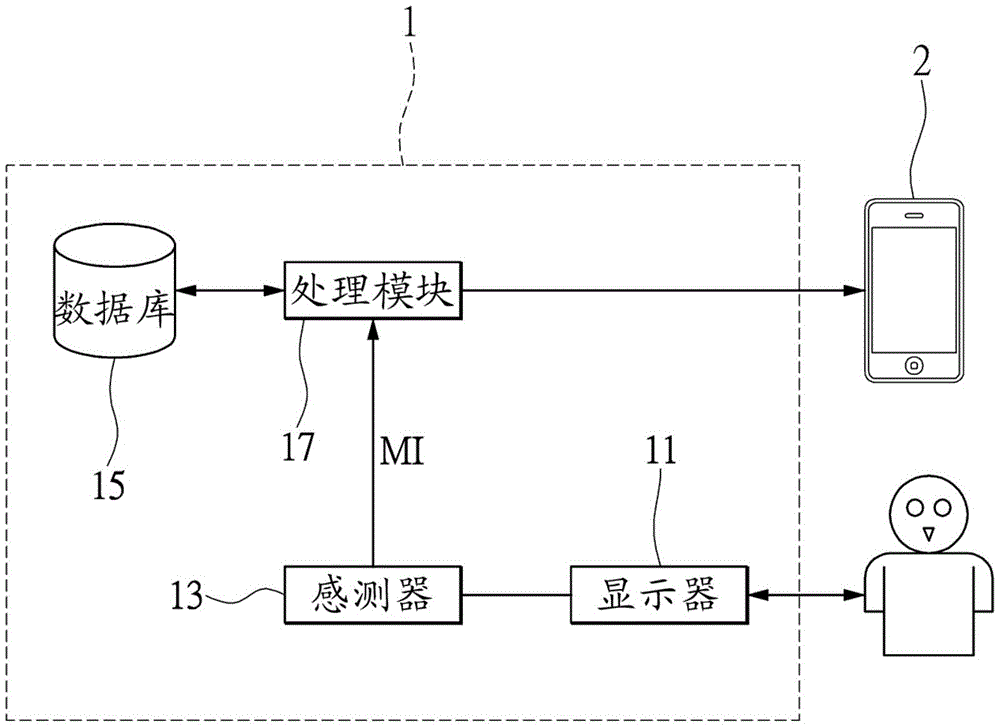
Fig. 1 is a functional block diagram of an interactive system according to a first embodiment of the present invention. As shown in fig. 1, the interactive system 1 includes a display 11, a sensor 13, a database 15, and a processing module 17. All the above elements can be realized by a pure hardware circuit, or realized by a hardware circuit and firmware or software, and in summary, the present invention is not limited to the specific implementation manner of the interactive system 1. In addition, the above components may be integrated or separately arranged, and the invention is not limited thereto. It should be noted that the above components may also be used for data transmission in a wired or wireless manner, and the invention is not limited thereto.
In detail, in the present embodiment, the display 11 is used for playing multimedia data for a user to watch, wherein the multimedia data may be various types of movie contents (e.g., a movie, an idol, a drama, or even pictures in a continuous carousel, etc.) or playing formats (e.g., RMVB, MPEG, AVI, WMV, MKV, etc.), and in summary, the present invention does not limit the types of the multimedia data. In addition, the display 11 may be a touch-sensitive or non-touch-sensitive display, and the present invention is not limited thereto, and those skilled in the art can design the display according to actual needs or applications.
Then, the sensor 13 is connected to the display 11, and the sensor 13 is used to obtain a label information of the user when viewing the multimedia data, wherein the label information includes a timestamp and a label position corresponding to the multimedia data. The database 15 is used for storing a plurality of interactive information associated with the multimedia data, wherein each interactive information corresponds to a plurality of index tags, and each index tag comprises a timestamp and a label position corresponding to the multimedia data. Finally, the processing module 17 is used for searching the index tags in the database 15 according to the label information obtained by the sensor 13, and when one of the index tags matches the label information, the processing module 17 outputs the content of the interaction information corresponding to the index tag to the electronic device 2.
Specifically, when the user views the multimedia data through the display 11, if the sensor 13 senses that the user performs a specific action, which may be touching an object in the content of the multimedia data played on the display 11 or dragging a cursor to touch an object in the content of the multimedia data, the sensor 13 records a timestamp corresponding to the multimedia data. Therefore, as will be understood by those skilled in the art from the foregoing description, the term "mark position" means that the object touched (or clicked) by the user when the specific action occurs corresponds to the position of the multimedia data in the content.
For example, fig. 2A is a schematic view illustrating an operation state of a display in an interactive system according to a first embodiment of the present invention, and fig. 2B is a schematic view illustrating annotation information according to the first embodiment of the present invention. It should be noted that the following description is only for convenience of illustration and is not intended to limit the invention. In addition, the components in fig. 2A and 2B similar to those in fig. 1 are denoted by similar reference numerals and have the same functions, so the details thereof are not described herein again.
As shown in fig. 2A and 2B, the display 11 may be a touch panel on a tablet computer and is being used to play a movie with a total length of 120 minutes (i.e. indicating a total length of 7200 seconds). At this time, when the user watching the movie is interested in the object appearing in the movie due to the influence of the content played by the user, the user can intuitively touch the object displayed on the display 11 with the finger 21. Then, when the sensor 13 senses that the finger 21 touches the display 11, the sensor 13 records the timestamp T of the current playing time of the movie. Taking fig. 2A as an example, if the finger 21 touches the car 23 on the video frame at the 57 th minute (i.e. 3420 th second) of the movie, the timestamp T in the annotation information MI acquired by the sensor 13 is denoted as 3420. It should be noted that the standard unit(s) of recording of the timestamp T in the above description is only for illustration and is not intended to limit the present invention, and those skilled in the art can design the timestamp T according to actual needs or applications.
On the other hand, as will be understood by those skilled in the art from the above description, the marking position V of the marking information MI in fig. 2B represents the position of the vehicle 23 corresponding to the 57 th minute video frame of the movie. In short, the position of the object on each video frame of the display 11 can be represented in a grid coordinate manner. Therefore, the sensor 13 of the present invention can further perform a grid measurement (grid measure) algorithm on the multimedia data to calculate the mark position V in the mark information MI.
Fig. 2C is a schematic diagram of a grid method measurement algorithm according to a first embodiment of the present invention. Referring to fig. 2C, and with reference to fig. 1, 2A and 2B, for the sake of understanding, elements in fig. 2C that are similar to those in fig. 2A are labeled with similar reference numerals, and therefore, the details thereof are not described in detail herein. For example, the video frame of the 57 th minute of the movie is first divided into a plurality of grids with fixed size WxL, wherein the range of the grids covering the car 23 is defined as the object block 230. Then, it can be clearly found that the position of the finger 21 touching the 57 th minute video frame of the movie apparently falls within the target block 230. Therefore, the labeled position V obtained by the sensor 13 can be represented as all grids in the target block 230. It should be noted that the design manner of the grid-based measurement algorithm of the above embodiments is not intended to limit the invention. The design of the grid method measurement algorithm can be performed by one skilled in the art according to actual needs or applications, and the invention does not limit the detailed design manner of the grid method measurement algorithm. In addition, similarly, even if the user touches the cart 23 of the video frame at the 57 th minute of the movie by dragging the cursor, the sensor 13 of the present invention can clearly determine that the marked position V obtained by the sensor 13 is also represented as all the grids in the target block 230 if the touched position of the cursor also falls into the target block 230.
It should be noted that, in the above-mentioned grid method measurement algorithm, the present invention does not limit the size of each grid (e.g., W and L) to be a fixed size. In short, the size of the grid can be determined according to the size of the object on each video frame. For example, the video frame at the 57 th minute of the movie appears as a close-up of the car 23, so the video frame at the 57 th minute of the movie can be segmented with a larger size grid.
Fig. 2D is a schematic diagram of another operating state of a display in an interactive system according to a first embodiment of the invention, and fig. 2E is a schematic diagram of another grid method measurement algorithm according to the first embodiment of the invention. As shown in fig. 2D and 2E, since the video frame at the 83 th minute (i.e. 4980 th second) of the movie is scaled down, the video frame at the 83 th minute of the movie can be divided by grids with smaller sizes (e.g. W 'and L') instead, so that the sensor 13 can calculate the appropriate labeling position V (e.g. all grids in the target block 250 in fig. 2E) for the object (e.g. the watch 25 in fig. 2E) presented with smaller scale.
Therefore, as can be understood by those skilled in the art from the above, in the interactive system 1 according to the first embodiment of the present invention, any object (e.g., a commodity, a scene, a person, etc.) represented in the multimedia data can effectively define the suitable labeling position V by using the above-mentioned mesh.
On the other hand, the user may also be interested in the background music in the multimedia data, and therefore, the interactive system 1 according to the first embodiment of the present invention further considers establishing a suitable annotation position V for the non-physical object. Fig. 2F is a schematic diagram of an operation state of a display in another interactive system according to an embodiment of the invention, and fig. 2G is a schematic diagram of another grid method measurement algorithm according to an embodiment of the invention. Wherein like elements in fig. 2G and fig. 2A are designated by like reference numerals and are not described in detail herein.
As shown in fig. 2F and 2G, for example, the broadcaster may create a music icon 27 on the top right of the video frame at 108 th minute (i.e., 6480 th second) of the movie. Therefore, when the user is interested in the background music in the 108 th minute video frame of the movie, the user can directly touch the music icon 27 appearing on the display 11 with the finger 21, so that the timestamp T in the annotation information MI acquired by the sensor 13 is 6480, and the annotation position V is represented as all the grids in the target block 270.
To sum up, when the user is interested in an object appearing in the playing multimedia data, the user can intuitively perform a specific action (e.g. touching or cursor touching) on the object to perform a selection operation on the object, and the sensor 13 records the second time and the grid position of the object appearing in the multimedia data. Furthermore, the interactive system 1 of the present invention can further provide the interactive information associated with the object to the user in real time to satisfy the expectation of the user's active requirement.
From the above description, it can be understood by those skilled in the art that the interaction information stored in the database 15 represents further related information content of the object of interest to the user. Therefore, the interactive information is at least one of a commodity, a prop, a scene, a character, a dialog and background music in the playing content associated with the multimedia data. If fig. 2A is taken as an example, the interaction information stored in the database 15 may be information related to the type of the vehicle 23, such as the brand, the displacement, the maximum horsepower, the transmission system or the built-in equipment; in addition, as shown in fig. 2F, the interaction information stored in the library 15 may be related to the background music represented by the music icon 27, such as the song, the singer, the writer, or the composer.
In addition, the interactive system 1 of the present invention can further cooperate with the seller to allow the user to directly contact with the seller through the interactive information, thereby timely grasping the shopping mind of the user and enhancing the possibility of purchasing the object. In summary, the present invention is not limited to the detailed description in the interactive information, and one skilled in the art can design the interactive information according to actual needs or applications.
On the other hand, it can be understood by those skilled in the art that the index tag of each interaction information stored in the database 15 represents the time and the position of the object appearing in the multimedia data. In addition, since each object may repeatedly appear in the multimedia data, each interactive message may have a plurality of index tags. Taking fig. 2A and 2F as an example, wherein the cars 23 are both shown in the video frames at the 57 th and 108 th minutes of the movie, and the positions of the cars 23 in the video frames at both time points may be different, so that the interaction information stored in the database 15 related to the cars 23 should have two completely different sets of index tags, wherein the time stamp of one set of index tags is 3420 and the time stamps are labeled as all grids in the target block 230, and the time stamp of the other set of index tags is 6480 and the time stamps are labeled as all grids in the target block 230.
In other words, the two sets of index tags correspond to the same interactive information (car 23), so that the interactive system 1 of the present invention can effectively provide the correct interactive information associated with the car 23 to the user no matter the user is interested in the car 23 at the 57 th or 108 th minute of the movie. Therefore, before the display 11 plays the multimedia data, the broadcaster should calculate the position of the object at each playing time in the multimedia data by using the same grid method measurement algorithm as the sensor 13, so as to effectively create the index tag of each interactive information in the database 15. In summary, the present invention does not limit the detailed implementation of the database 15 by the broadcaster, and one skilled in the art can design the database according to actual needs or applications.
Therefore, as can be understood by those skilled in the art from the above description, the term "the processing module 17 is used to search the index tag in the database 15 according to the label information obtained by the sensor 13" in fig. 1 can be represented as a search method using a look-up table. Specifically, the processing module 17 can be any central processing unit with sufficient computing power, which analyzes the received annotation information MI, searches the index tag in the database 15 to find the index tag that can completely match the timestamp T and the annotation position V in the annotation information MI, and outputs the content of the interaction information corresponding to the found index tag to the electronic device 2. In summary, the above-mentioned table lookup method is only used for example and is not intended to limit the present invention, and one skilled in the art can design the search pattern in the processing module according to actual needs or applications. In addition, the electronic device 2 may be a mobile communication device, a desktop computer, a notebook computer, etc., and the invention is not limited thereto. In this way, while the user is viewing the multimedia data through the display 11, the user can obtain the related interaction information of the interested object through other electronic devices 2 nearby.
Besides, according to the above descriptions, a person skilled in the art can also generalize other specific implementations of the interactive system 1. For example, fig. 3 is a functional block diagram of an electronic device of an interactive system according to a first embodiment of the present invention. Wherein the same elements in fig. 3 as in fig. 1 are denoted by the same reference numerals and have the same functions, and therefore, the details thereof will not be described herein. Briefly, as shown in fig. 3, the display 11, the sensor 13 and the processing module 17 can be integrated into the same electronic device 2, and the database 15 is located outside the electronic device 2. Therefore, the user can not only view the multimedia data directly through the display 11 on the electronic device 2, but also obtain the relevant interaction information of the object of interest by the processing module 17 in the electronic device 2. It should be noted that the implementation manner of the electronic device is only for illustration and is not intended to limit the invention.
For another example, if the processing module 17 searches the database 15 and cannot find any index tag that can match the annotation information MI, the processing module 17 may output an error command to the electronic device 2 to notify the user that the interactive system 1 cannot find the interactive information associated with the object. It is noted that this type of situation occurs, often because the object may be less common and lack relevant information, thus resulting in the broadcaster not having the appropriate interactive information for the object. In view of this, in the interactive system 1 according to the embodiment of the invention, when all the index tags do not conform to the annotation information, the processing module 17 may not only output an error instruction to the electronic device 2, but also the processing module 17 may enable the electronic device 2 to be connected to the cloud community web interface through the internet. The cloud community web interface may be made by a broadcaster or other cloud operators, and the present invention is not limited thereto. In summary, the main spirit of the cloud community web interface is to provide a platform of network chat room for users or system owners to edit and discuss.
For example, when the user is interested in a specific product appearing in the multimedia data but the processing module 17 cannot find the relevant interaction information corresponding to the specific product in the database 15, the user can further go through the processing module 17 to connect to the cloud community web interface and issue relevant problems related to the specific product on the cloud community web interface. Similarly, when other users or even owners find that the user is interested in the specific product on the cloud community web interface, the other users or the owners can also issue articles on the cloud community web interface for the problem of the specific product, so as to assist the user to obtain the related information of the interested object.
To further explain the operation process of the interactive system, the present invention further provides a first embodiment of the interactive method. Fig. 4 is a flowchart illustrating an interaction method according to a first embodiment of the invention. The method described in this example can be implemented in the interactive system 1 shown in fig. 1, and therefore please refer to fig. 1 for understanding. The detailed process flow is as described in the foregoing embodiments, and will not be described in detail herein.
As shown in fig. 4, first, in step S401, multimedia data is played using the display 11 to be provided for the user to view. Next, in step S403, the annotation information MI corresponding to the time stamp T and the annotation position V in the multimedia data is obtained by the sensor 13 when the user views the multimedia data. Next, in step S405, the processing module 17 searches the index tag in the database 15 according to the tag information MI obtained by the sensor 13, and determines whether there is an index tag matching the tag information MI. Finally, in step S407, when one of the index tags matches the tag information MI, the processing module 17 is utilized to output the content of the interaction information corresponding to the index tag to the at least one electronic device 2.
On the other hand, as mentioned above, in step S409, when all the index tags do not conform to the annotation information MI, the processing module 17 is utilized to output an error instruction to the electronic apparatus 2, and further, the electronic apparatus 2 is connected to the cloud community web interface through the internet. However, the above is only one detailed implementation of the interaction method, and it is not intended to limit the present invention.
Example two
Fig. 5 is a functional block diagram of an interactive system according to a second embodiment of the present invention. As shown in fig. 5, the interactive system 3 includes a database 33, a display 35, at least one sensor 315 and a processing module 37, in the embodiment, the sensor 315 is disposed in the electronic device 31, and the display 35 is not a display (not shown) disposed on the electronic device 31, and it should be noted that, in fig. 5, the sensor 315 and the electronic device 31 are terms, which means that the electronic device 31 is a term of one of the electronic devices 31a, 31b and 31 c; the sensor 315 is a name of one of the sensor 315a, the sensor 315b, and the sensor 315c, and the name is used to conveniently represent the connection and transmission relationship among the display 35, the database 33, and the sensor 315 disposed in the electronic device 31, and is not used to represent all electronic devices or all sensors, so the structure and operation process of the interactive system 3 are described below, and the names of the sensor 315 and the electronic device 31 are used. All the above elements can be realized by a pure hardware circuit, or by a hardware circuit and firmware or software, and in summary, the present invention is not limited to the specific implementation manner of the interactive system 3. In addition, the above components may be integrated or separately arranged, and the invention is not limited thereto. It should be noted that the above components may also be used for data transmission in a wired or wireless manner, and the invention is not limited thereto. After the interactive system 3 is connected, the display 35 and the sensor 315 can be synchronized by the display 35 transmitting information related to multimedia data (e.g., a timestamp, a file name, or a total timestamp of the multimedia data) to the sensor 315, so that the sensor 315 obtains a plurality of timestamps related to the multimedia data, and the synchronization between the display 35 and the sensor 315 is performed in this way, and the invention is not limited in this way.
In detail, in the present embodiment, the display 35 is used for playing multimedia data composed of a plurality of video frames, wherein the multimedia data can be various types of movies (e.g., movies, dramas, art programs, or continuously carousel pictures), or playing formats (e.g., RMVB, MPEG, AVI, WMV, or MKV), or sources (e.g., reading from an optical disc, transmitting from a multimedia provider, reading from a film, etc.), and in summary, the present invention is not limited to the type and implementation of the multimedia data.
Next, the at least one sensor 315 is configured to detect a tagging behavior of the at least one user while viewing the multimedia data, and record at least one tagging time corresponding to the sensed tagging behavior as a timestamp. The database 33 is used for storing a plurality of interactive information and corresponding index tags associated with each video frame, wherein the interactive information may be various types of information (e.g., merchandise information, prop information, scene information, character information, dialog information, music information, or remark information), and each interactive information corresponds to at least one index tag, and the index tag may be clicked in different manners (e.g., one click, one double click, or two clicks, two or more clicks within a certain time period), or a sliding track (e.g., a straight line from top to bottom, a straight line from left to right, a curved line, a circular line, a rectangular line, etc.); or different pressing modes (for example, pressing the left button of the mouse more than once within a certain time, or pressing different keys on the keyboard aiming at different interactive information); or different shaking (rocking) modes (e.g., shaking the gyroscope more than once in a certain time); or different sound information (for example, the sound receiver can determine different index tags by receiving different sound information), and in summary, the invention is not limited to the type of interactive information and the specific implementation of the index tags. In other words, the category of the interactive information is classified according to the index tag. Therefore, according to the above description, those skilled in the art can also understand that the above index tag can be designed and transformed according to the actual needs or applications.
Finally, the processing module 37 searches the timestamp corresponding to each video frame according to the labeled time to find out at least one video frame corresponding to the labeled time, and compares the labeled behavior with the index tags of each interaction information of the video frames found in the database 33, thereby outputting the interaction information content corresponding to the index tag corresponding to the labeled behavior to the electronic device 31.
Specifically, when the sensor 315 senses the behavior marked on the sensor 315 by the user while the user is viewing the multimedia data through the display 33, the sensor 315 obtains the marked behavior and records at least one timestamp corresponding to the marked behavior as the marking time. The processing module 37 searches the timestamp corresponding to each video frame according to the annotated time to find out at least one video frame that matches the annotated time, and compares the plurality of index tags of each interaction information of the video frames in the database 33 according to the annotated behavior, thereby outputting the interaction information content corresponding to the index tag that matches the annotated behavior to the electronic device 31. The labeling behavior of the user on the sensor 315 may be clicking in different manners (e.g., clicking once, double clicking once, or clicking twice, double clicking twice or more than two times within a certain time period, etc.) or sliding tracks (e.g., a straight line from top to bottom, a straight line from left to right, a curved line, a circular line, a rectangular line, etc.); or different pressing modes (for example, pressing the left button of the mouse more than once within a certain time, or pressing different keys on the keyboard aiming at different interactive information); or different shaking (rocking) modes (e.g., causing the gyroscope to sense that the user is shaking more than once within a certain time period); or different voice messages (e.g., the voice receiver can determine different marked behaviors by receiving different voice messages), and the invention is not limited to the specific implementation of the marked behaviors. Therefore, those skilled in the art should appreciate that the above-described labeled acts can be designed and varied according to actual needs or applications.
For example, please refer to fig. 6A, fig. 7B and fig. 8A together, in which fig. 6A is a schematic diagram of an operating state of an interactive system according to a second embodiment of the present invention at 3000 seconds, fig. 7A and fig. 7B are schematic diagrams of a sensor according to the second embodiment of the present invention acquiring a user annotation behavior, and fig. 8A is a schematic diagram of an index tag of a video image stored in a database at 3000 seconds according to the second embodiment of the present invention and corresponding interactive information content. It should be noted that the following description is only for convenience of illustration and is not intended to limit the invention. In addition, components in fig. 6A, 7B and 8A similar to those in fig. 5 are denoted by similar reference numerals and have the same functions, so the details thereof are not described herein again.
As shown in fig. 6A, the display 45 may be a liquid crystal display and is used for playing a movie with a total length of 180 minutes, wherein the display 45 may also be a touch-sensitive or non-touch-sensitive display device or a projection display device, and the present invention is not limited thereto, and those skilled in the art can design the display according to actual needs or applications.
Referring to fig. 7A and 7B, the sensor 515 may be combined with the electronic device 51, wherein the sensor 515 may be a touch panel, a camera, a mechanical press, a gyroscope, a sound receiver, or an IOT (Internet of Things) device. The electronic device 51 may be a mobile communication device (e.g., a mobile phone, a tablet computer, a personal digital assistant, etc.), a wearable device (e.g., a watch, a bracelet, etc.), or an embedded device (e.g., an embedded device embedded in an article such as a chair or a table), and in summary, the embodiments of the invention are not limited to the specific implementation of the sensor and the electronic device. At this time, when the user watching the movie is interested in the objects appearing in the movie due to the content played by the user, the user can leave the marked behavior on the sensor 515 by using the finger 53. Then, when the sensor 515 detects the marking action generated by the finger 53, the sensor 515 records the current marking time corresponding to the movie. Taking fig. 6A, 7A and 7B as an example, if the finger 53 leaves a touch once annotation on the sensor 515, the type of the person in the video frame of the 50 th minute (3000 th second) of the movie can be corresponded to, and the sensor 515 acquires the annotation as a touch once and the annotation time is 3000 th second; if the finger 53 leaves a top-down sliding track on the sensor 515, which corresponds to the category of the product in the video frame of the 50 th minute (3000 th second) of the movie, the sensor 515 obtains a top-down sliding track and a marking time of 3000 th second. In other words, while the same display 45 plays the movie, different users may have different tagging behaviors according to the interest generated in different object categories, and taking fig. 6A as an example, a user using the electronic device 41a may generate a tagging behavior corresponding to a character category, a user using the electronic device 41b may generate a tagging behavior corresponding to an article category, a user using the electronic device 41c may generate a tagging behavior corresponding to a music category, and so on. It should be noted that the standard unit(s) of recording of the time stamp in the above description is for illustrative purposes only and is not intended to limit the present invention, and one skilled in the art can design the time stamp according to actual needs or applications. Therefore, according to the above contents, different users can obtain different labeling behaviors and labeling times from the sensor when having interests in different object types in the movie.
Referring to fig. 5 and fig. 8A, the processing module 37 searches the timestamp corresponding to each video frame according to the annotated time to find at least one video frame corresponding to the annotated time, and compares the annotated behavior with the index tag of each interactive information of the video frames in the database 33, thereby outputting a content of a plurality of interactive information corresponding to the annotated behavior to the electronic device 31. If the marked behavior is a touch, the user can correspond to the character index tag 613 and output the interactive information content 65 of the character; if the marked behavior is a sliding track from top to bottom, the marked behavior corresponds to the article index tag 611, and then the interactive information content 63 of the article (including the interactive information content 631 of the handbag, the interactive information content 633 of the fashion, the interactive information content 635 of the high-heeled shoes, and the interactive information content 637 of the car) is output.
Therefore, according to the above descriptions, it should be understood by those skilled in the art that in the interactive system according to the second embodiment of the present invention, any object (for example, a commodity, a scene, a person, or the like) presented in the multimedia data can effectively use the index tag corresponding to the tagging behavior to determine what kind of object the user is interested in, and further provide information about the object related to the interested kind.
On the other hand, the user may start watching from the middle of the multimedia data play. Therefore, the interactive system according to the second embodiment of the present invention further considers that the above situation may occur, and the interactive information in the database further includes remark information for the user to know. For example, referring to fig. 6A and 8A, if the user using the electronic device 41a starts to watch a movie played by the display 45, the movie has been played for 3000 seconds, and the user wants to quickly know the story background of the movie, a curve marking behavior can be generated on the sensor of the electronic device 41a, and the marking time when the marking behavior is sensed is recorded as 3000 seconds. Then, the processing module 37 searches the timestamp corresponding to each video frame according to the annotation time to find out at least one video frame that matches the annotation time, and compares the annotation behavior with the index tag of each interactive information of the video frames in the database 60, so as to obtain the remark information index tag 615, and outputs the interactive information content 67 of the remark information to the electronic device 41a, so that the user can quickly know the story outline of the movie. In addition, even if the information that the user wants to know does not appear in the current video frame, the user can associate with the information through the objects appearing in the current video frame, for example, the car 47 appearing in the movie frame in fig. 6A may be a car in the 1950 s, but the user using the electronic device 41b wants to know which movies still include the car 47 in that year, a curved marking behavior can be left on the sensor 515 of the electronic device 41b, and the user can know which movies still include the car 47 in the 1950 s by the above-mentioned manner. In other words, as long as the information content associated with the video frame or the information content associated with the movie to a certain extent is stored in the interactive information content 67 of the remark information (for example, when there is a purple forbidden city in the frame, the remark information can tell the user that the movie story is probably in the heading, or when the user cannot watch the movie from the beginning and wants to know the story of the movie, the remark information can also provide the story background of the movie for the user to know quickly), and the interactive information content of the remark information is not limited in the embodiments of the present invention.
From the above, it can be understood by those skilled in the art that the interaction information stored in the database 60 is further related information content represented as the object category of interest to the user. Therefore, the interactive information is the information of the commodities, props, scenes, characters, dialogues, music or notes in the playing content associated with the multimedia data. If fig. 6A and fig. 8A are taken as examples, the interactive information content 637 of the automobiles stored in the database 60 may be information about the types of the automobiles 47, such as brand, displacement, maximum horsepower, year of factory, equipment installed in the interior or a transmission system; the interactive information content 631 may also be a handbag, such as a brand, designer, etc.
In addition, the interactive system of the second embodiment of the invention can further cooperate with the seller, so that the user can directly contact with the seller through the interactive information, and the shopping psychology of the user can be grasped timely and the possibility of purchasing the object can be improved. In general, the detailed description in the interactive information is not limited by the present invention, and one skilled in the art can design the interactive information according to actual needs or applications.
On the other hand, it can be understood by those skilled in the art that the index tag of each interaction information stored in the database can correspond to the generated tagging behavior of the user when the object appears in the multimedia data. In addition, since there may be multiple objects in the same video frame that are in the same category, there may be multiple situations in the category of the object in the video frame corresponding to each set of annotation time and annotation action. To illustrate with the example of fig. 6A and 8A, the video image shows a woman 43 and a car 47, and the woman 43 simultaneously wears a handbag 431 and a suit 433 and a high-heeled shoe 435, and if the user makes an annotation about interest in a commodity, it is possible to correspond to the handbag 431, the suit 433, the high-heeled shoe 435, or the car 47 of the video image. In other words, when more than two objects of the same category appear in the same video image and the user generates the tagging behavior and the tagging time corresponding to the category on the sensor, the index tag of the category in the database 60 corresponds to the tagging time and the tagging behavior, and all the interaction information corresponding to the category is output. In view of this, the interactive system of the second embodiment of the invention further includes an intelligent module 38 for adjusting an output sequence of the interactive information and/or deleting and/or adding at least one of the interactive information according to a preference analysis result of the user. The preference analysis result may be a past consumption record of the user, a viewing record of the interested object, preference information filled in when the user registers, or a special pillar behavior combination generated by the user on the sensor, and the like, which is not limited in the embodiments of the present invention. In other words, when the contents of more than two interactive information of the same category are output simultaneously, the contents can be sorted or deleted according to the preference analysis result of the user, so that the more interesting the user is, the earlier the contents of the interactive information are sorted, and the user can watch the interesting contents of the interactive information more quickly.
On the other hand, the sensor can also be divided into a plurality of touch blocks, and different touch blocks are used for representing the labeling behaviors corresponding to different object types, wherein the touch blocks represent repeatability and new objects. By means of the different touch blocks, the intelligent module can judge whether the user generates the labeling behavior corresponding to the object when the user generates the labeling behavior on the sensor, and accordingly the intelligent module can better judge the object which the user is interested in. For example, please refer to fig. 6A, fig. 6B, fig. 7C, fig. 8A and fig. 8B together, in which fig. 6B is a schematic view of an operation state of the interactive system of the second embodiment of the present invention in the 5520 seconds, fig. 7C is a schematic view of another sensor of the second embodiment of the present invention acquiring the user annotation behavior, and fig. 8B is a schematic view of an index tag of a second video frame stored in the database in the 5520 seconds and corresponding interactive information content of the second embodiment of the present invention. Fig. 6A shows the car 47 and the woman 43 at 3000 th second, and fig. 6B shows only the woman 43 at 92 th minute (5520 th second). If the user touches the merchandise touch block 553 of the sensor 515 of fig. 7C once at the 3000 th second, then touches the repeated touch block 555 once at the 5520 th second after the merchandise touch block 553, and then the intelligent module can determine that the merchandise interested in the 3000 th second is not the car 47 but the handbag 431, the ocean-type garment 433, or the high-heeled shoe 435 on the woman 43 with both video pictures appearing instead of the car 47 according to the twice labeling behaviors of the user and the second repeated labeling behaviors, the interactive information content 631 of the handbag, the interactive information content 633 of the ocean-type garment, and the interactive information content 635 of the high-heeled shoe can be output from the database 60.
Conversely, if the user touches the merchandise touch block 553 of the sensor 515 of fig. 7C once at the 3000 th second, touches the merchandise touch block 553 once at the 5520 th second, and touches the new object touch block 557 once again, the smart module may determine that the user is interested in the car 47 at the 3000 th second, and is interested in the fashion clothing 433, the handbag 431, or the high-heeled shoe 435 on the woman 43 at the 5520 th second. In summary, the intelligent module can determine whether the object of the user interest category appears repeatedly according to the labeling behavior of the user twice or more and whether the repeated labeling behavior or the new object labeling behavior is attached, so that the user can generate the repeated labeling behavior when the object of interest appears repeatedly, and the intelligent module can more accurately determine the object of the user interest category according to the repeated labeling behavior.
On the other hand, the electronic device can be used to control the playing content of the display. For example, referring to fig. 5, the content played by the display 35 can be operated by the electronic device 31. For example, the content played by the display 35 may be several tv channel contents provided by a cable television provider, and the user may switch and select the tv channel contents by using the electronic device 31; alternatively, the content played by the display 35 may be stored in the database 33, and the electronic device 31 may control the display 35 to play the content stored in the database 33. In summary, the embodiments of the present invention do not limit the playback source of the display and the control manner of the electronic device controlling the display.
Alternatively, the electronic device may be an embedded device, for example, the electronic device may be embedded in a sofa seat or a table. When the user views the multimedia data played by the display, the marking behavior of the interested object can be generated on the electronic device embedded in the sofa seat or the desk, and the embodiment of the invention does not limit the article combined with the embedded device.
On the other hand, the sensor is disposed on the electronic device, and the electronic device does not include a display for playing the multimedia data. And when the processing module searches each video image in the database and the plurality of associated index tags according to the marked time and the marked behavior in sequence to find a certain video image which accords with the marked time, and further outputs the content of the interactive information of which each index tag accords with the marked behavior in the video image to the electronic device, wherein the electronic device receiving the content of the interactive information can be another electronic device. In other words, the sensing device for generating the labeled time and the labeled behavior is disposed on the first electronic device, and the second electronic device is utilized to receive the content of the interactive information. In summary, the embodiments of the present invention do not limit the implementation of the electronic device for receiving the interactive information content.
To further explain the operation flow of the interactive system, the present invention further provides a second embodiment of the interactive method. Fig. 9 is a flowchart illustrating a method for interacting information according to an embodiment of the present invention. The interaction method described in this embodiment can be implemented in the interaction system 3 shown in fig. 5, so please refer to fig. 5 for understanding. The detailed process flow is as described in the foregoing embodiments, and will not be described in detail herein.
As shown in fig. 9, first, in step S501, a connection between the display 35, the sensor 315 and the database 33 is established. And, in step S503, the display 35 and the sensor 315 are synchronized. Next, in step S505, the multimedia data is played by using the display 35 and provided to the user for viewing. Next, in step S507, the sensor 315 is used to obtain the annotation behavior and annotation time of the user when viewing the multimedia data. Then, in step S509, the processing module 37 searches the time stamp corresponding to the video frame in the database 33 according to the marked time obtained by the sensor 315 to find the video frame corresponding to the marked time. In step S511, the processing module 37 compares the annotation behavior obtained by the sensor 315 with the index tag corresponding to each interaction information of the video frame found in the database 33 to determine whether any index tag matches the annotation behavior. Finally, in step S513, when one of the index tags matches the annotation behavior, the processing module 37 is used to output the content of the interaction information corresponding to the index tag to the electronic device 31.
On the other hand, in step S515, if there is no timestamp of the video frame corresponding to the marked action or all the index tags cannot correspond to the marked action, the processing module 37 outputs an error command to the electronic device 31. However, the above is only one detailed implementation of the interaction method, and it is not intended to limit the present invention.
Another embodiment of the present invention provides an interactive system for providing a user with a possibility of generating interest in an object in a performance activity while viewing the performance activity, and therefore, the user may want to know information about the object in the performance activity. Referring to fig. 10, fig. 10 is a functional block diagram of an interactive system according to a third embodiment of the present invention, in which the interactive system 7 includes a database 73, a camera 75, at least one sensor 715 and a processing module 77, the sensor 715 is disposed in the electronic device 71, and the electronic device 71 does not include the camera 75, it should be noted that the sensor 715 and the electronic device 71 in fig. 10 are terms, which means that the electronic device 71 is a term of one of the electronic device 71a, the electronic device 71b and the electronic device 71 c; and the sensor 715 is a substitute for one of the sensor 715a, the sensor 715b, and the sensor 715c, and the substitute is used to conveniently represent the connection and transmission relationship among the camera 75, the database 73, and the sensor 715 arranged in the electronic device 71, and is not used to represent all electronic devices or all sensors, so the following description of the structure and operation process of the interactive system 7 is the same when the names of the sensor 715 and the electronic device 71 are used. All the above elements can be realized by a pure hardware circuit, or by a hardware circuit and firmware or software, and in summary, the present invention does not limit the specific implementation manner of the interactive system 7. In addition, the above components may be integrated or separately arranged, and the invention is not limited thereto. It should be noted that the above-mentioned elements may also transmit data through a wired or wireless manner, and the invention is not limited thereto. After the interactive system 7 is connected, the camera 75 and the sensor 715 may be synchronized by the camera 75 transmitting information related to the recording of the multimedia data (e.g., the start time, the file name, or the total recording time of the multimedia data) to the sensor 715, so that the sensor 715 obtains a plurality of timestamps related to the multimedia data, and the synchronization between the camera 75 and the sensor 715 is performed in this way, and the invention is not limited in this way.
In detail, the camera 75 is used to record the performance activities, store the performance activities as multimedia data composed of a plurality of video frames, wherein each of the plurality of video frames corresponds to a time stamp in the multimedia data, and store the multimedia data in the database 73. Where the performance activity may be various types of performance activities (e.g., a merchandise display activity, a song performance activity, a dance performance activity, a theatrical performance activity, a phase performance activity, or an all-purpose show performance activity, etc.), in general, embodiments of the invention are not limited to the types of performance activities.
Next, the at least one sensor 715 is used to obtain a labeled behavior of the at least one user during the performance-watching activity, and record at least one timestamp corresponding to the obtained labeled behavior as a labeled time. The database 73 is configured to store a plurality of interactive information and corresponding index tags associated with each video frame, where the interactive information may be various types of information (e.g., merchandise information, prop information, scene information, character information, dialog information, music information, or remark information), and each interactive information corresponds to at least one index tag, and the index tag may be clicked in different manners (e.g., one click, one double click, or two or more clicks within a certain time), or a sliding track (e.g., a top-to-bottom straight line, a left-to-right straight line, a curved line, a ring-shaped line, a rectangular line, etc.); or different pressing modes (for example, pressing the left button of the mouse more than once within a certain time, or pressing different keys on the keyboard aiming at different interactive information); or different shaking (rocking) modes (e.g., shaking the gyroscope more than once in a certain time); or different sound information (for example, the sound receiver can determine different index tags by receiving different sound information), and in summary, the invention is not limited to the type of interactive information and the specific implementation of the index tags. In other words, the category of the interactive information is classified according to the index tag. Therefore, it can be understood by those skilled in the art that the above-mentioned index tag can be designed and transformed according to the actual requirement or application.
Finally, the processing module 77 searches the timestamp of each video frame according to the annotated time to find at least one video frame that matches the annotated time, and compares the plurality of index tags of each piece of interaction information of the video frames in the database 73 according to the annotated behavior, thereby outputting the interaction information content corresponding to the index tag that matches the annotated behavior to the electronic device 71.
Specifically, when the sensor 715 senses the marked behavior of the user on the sensor 715 while the user is watching the performance activity, the sensor 715, in addition to acquiring the marked behavior, records at least a timestamp of the current multimedia data as the marked time. The interactive system 7 searches the timestamp corresponding to each video frame according to the annotated time to find out at least one video frame that matches the annotated time, and compares the annotated behavior with the index tags of each piece of interactive information in the video frames in the database 73, so as to output the interactive information content corresponding to the index tags that match the annotated behavior to the electronic device 71. The labeling behavior of the user on the sensor 715 may be clicking in different ways (e.g., clicking once, double clicking once, or clicking twice, double clicking twice or more than two times within a certain time period), or sliding tracks (e.g., a straight line from top to bottom, a straight line from left to right, a curve, a ring line, a rectangular line, etc.); or different pressing modes (for example, pressing the left button of the mouse more than once within a certain time, or pressing different keys on the keyboard aiming at different interactive information); or different shaking (rocking) modes (e.g., causing the gyroscope to sense that the user is shaking more than once within a certain time period); or different voice messages (e.g., the voice receiver can determine different marked behaviors by receiving different voice messages), and the invention is not limited to the specific implementation of the marked behaviors. Therefore, those skilled in the art should appreciate that the above-described labeled acts can be designed and varied according to actual needs or applications.
EXAMPLE III
Fig. 11A is a schematic view of another interactive system according to the third embodiment of the present invention in a 3000 th second operating state. It should be noted that the following description is only for convenience of illustration and is not intended to limit the invention. In addition, components in fig. 11A, 7B and 8A similar to those in fig. 10 are denoted by similar reference numerals and have the same functions, so the details thereof are not described herein again.
Referring to fig. 11A, the camera 75 can be a video camera and is being used to record a total performance activity of 180 minutes and store the performance activity as a multimedia data composed of a plurality of video frames. The camera 75 can also be a camera on a mobile device or a handheld camera, and the invention is not limited thereto, and those skilled in the art can design the camera according to actual needs or applications.
Referring to fig. 7A and 7B, the sensor 515 may be combined with the electronic device 51, wherein the sensor 515 may be a touch panel, a camera, a mechanical press, a gyroscope, a sound receiver, or an IOT (Internet of Things) device. The electronic device 51 may be a mobile communication device (e.g., a mobile phone, a tablet computer, a personal digital assistant, etc.), a wearable device (e.g., a watch, a bracelet, etc.), or an embedded device (e.g., an embedded device embedded in an article such as a chair or a table), and in summary, the embodiments of the invention are not limited to the specific implementation of the sensor and the electronic device. At this time, when the user viewing the performance activity is interested in the objects appearing in the performance activity due to the content of the performance activity, the user can leave the marked behavior on the sensor 515 by using the finger 53. The sensor 515 then records the current annotation time corresponding to the performance activity when the sensor 515 senses the annotated behavior produced by the finger 53. Taking fig. 11A, 7A and 7B as an example, if the finger 53 leaves a touch once annotation on the sensor 515, the touch once annotation corresponds to the people category in the video frame of the 50 th minute (3000 th second) of the multimedia data, and the sensor 515 acquires the annotation as a touch once and the annotation time is 3000 th second; if the finger 53 leaves a top-down sliding track on the sensor 515 for labeling corresponding to the commodity category in the video frame of the 50 th minute (3000 th second) of the multimedia data, the sensor 515 obtains a top-down sliding track and a labeling time of 3000 th second. In other words, while watching the performance activity, different users may have different annotation behaviors according to interest in different object categories, and taking fig. 11A as an example, a user using the electronic device 81A may generate annotation behaviors corresponding to a category of characters, a user using the electronic device 81b may generate annotation behaviors corresponding to a category of articles, a user using the electronic device 81c may generate annotation behaviors corresponding to a category of music, and so on. It should be noted that the standard unit(s) of recording of the time stamp in the above description is for illustrative purposes only and is not intended to limit the present invention, and one skilled in the art can design the time stamp according to actual needs or applications. Therefore, according to the above contents, different users can obtain different labeling behaviors and labeling times from the sensor when having interests in different object types in the movie.
Then, referring to fig. 10 and fig. 8A, the processing module searches the timestamp corresponding to each video frame according to the annotated time to find at least one video frame that matches the annotated time, and compares the annotated behavior with the index tag of each interactive information of the video frames in the database 73, so as to output a content of a plurality of interactive information that matches the annotated behavior to the electronic device 71. If the marked behavior is a touch, the user can correspond to the character index tag 613 and output the interactive information content 65 of the character; if the marked behavior is a sliding track from top to bottom, the marked behavior corresponds to the article index tag 611, and then the interactive information content 63 of the article (including the interactive information content 631 of the handbag, the interactive information content 633 of the fashion, the interactive information content 635 of the high-heeled shoes, and the interactive information content 637 of the car) is output.
Therefore, according to the above disclosure, it should be understood by those skilled in the art that in the interactive system according to the embodiment of the present invention, any object (for example, a commodity, a scene, a person, or the like) presented in the multimedia data can effectively use the index tag corresponding to the tagging behavior to determine what kind of object the user is interested in, and further provide information about the object related to the interested kind.
On the other hand, even if the information that the user wants to know does not appear in the current video frame, but can be associated with the object appearing in the current video frame, referring to fig. 11A and fig. 8A, for example, the car 85 that appears in the performance activities may be a car home that was produced in the year 2000 of the public yuan, but the user using the electronic device 81b wants to know which performance activities will appear in the car 85 again, so that a curved marking behavior can be left on the sensor of the electronic device 81b, and the user can know which performance activities are expected to appear in the car 85 by the above manner. In other words, as long as the information content associated with the video frame to a certain extent or the information content associated with the movie is stored in the interactive information content 67 of the memo information (for example, when there is a forbidden city in the performance, the memo information can tell the user that the story of the performance is probably occurring in the heading), and the interactive information content of the memo information is not limited by the embodiment of the present invention.
Based on the above teachings, one of ordinary skill in the art will appreciate that the interaction information stored in the database 60 is further related to the information content of the object category in which the user is interested. Therefore, the interactive information is the information of the commodities, props, scenes, characters, dialogues, music or notes in the playing content associated with the multimedia data. The interactive information content 637 of the automobile stored in the database 60 may be information about the type of the automobile 85, such as brand, displacement, maximum horsepower, year of delivery, equipment installed in the cabin, or transmission system; the interactive information content 631 may also be a handbag, such as a brand, designer, etc.
In addition, the interactive system of the third embodiment of the invention can further cooperate with the seller, so that the user can directly contact with the seller through the interactive information, and the shopping psychology of the user can be grasped timely and the possibility of purchasing the object can be improved. In general, the detailed description in the interactive information is not limited by the present invention, and one skilled in the art can design the interactive information according to actual needs or applications.
On the other hand, it can be understood by those skilled in the art that the index tag of each interaction information stored in the database can correspond to the generated tagging behavior of the user when the object appears in the multimedia data. In addition, since there may be multiple objects in the same video frame that are in the same category, there may be multiple situations in the category of the object in the video frame corresponding to each set of annotation time and annotation action. To illustrate with the example of fig. 11A and 8A, the performance shows a female character 83 and a car 85, and the female character 83 simultaneously wears a handbag 831 and a suit 833 and a high-heeled shoes 835, and if the user makes an annotation about interest in a commercial product, the handbag 831, suit 833, high-heeled shoes 835 or car 85 may correspond to the video picture. In other words, when more than two objects of the same category appear in the same video image and the user generates the tagging behavior and the tagging time corresponding to the category on the sensor, the index tag of the category in the database 60 corresponds to the tagging time and the tagging behavior, and all the interaction information corresponding to the category is output. In view of this, the interactive system of the third embodiment of the present invention further includes an intelligent module (not shown in the figure) for adjusting an output sequence of the interactive information and/or deleting and/or adding at least one of the interactive information according to a preference analysis result of the user. The preference analysis result may be a past consumption record of the user, a viewing record of the interested object, preference information filled in when the user registers, or a special pillar behavior combination generated by the user on the sensor, and the like, which is not limited in the embodiments of the present invention. In other words, when the contents of more than two interactive information of the same category are output simultaneously, the contents can be sorted or deleted according to the preference analysis result of the user, so that the more interesting the user is, the earlier the contents of the interactive information are sorted, and the user can watch the interesting contents of the interactive information more quickly.
On the other hand, the sensor can also be divided into a plurality of touch blocks, and different touch blocks are used for representing the labeling behaviors corresponding to different object types, wherein the touch blocks represent repeatability and new objects. By means of the different touch blocks, the intelligent module can judge whether the user generates the labeling behavior corresponding to the object when the user generates the labeling behavior on the sensor, and accordingly the intelligent module can better judge the object which the user is interested in. For example, please refer to fig. 11A, fig. 11B, fig. 7C, fig. 8A, and fig. 8B simultaneously, and fig. 11B is a schematic diagram of an operation state of the interactive system of the third embodiment of the present invention in the 5520 th second. Fig. 11A shows car 85 and female character 83 at 3000 seconds of performance activity, and fig. 11B shows only female character 83 at 92 minutes (5520 seconds) of performance activity. If the user touches the merchandise touch block 553 of the sensor 515 of fig. 7C once at the 3000 th second, then touches the merchandise touch block 553 once at the 5520 th second, and touches the repeat touch block 555 once again, then the intelligent module can determine, according to the two labeling behaviors of the user and the other repetitive labeling behavior at the second time, that the merchandise that the user is interested in at the 3000 th second is not the car 85, but the handbag 831, the jersey 833 or the high-heeled shoe 835 on the female character 83 that appears at the time of both performance activities, and then the interactive information content 631 of the handbag, the jersey 633 and the interactive information content 635 of the high-heeled shoe can be output from the database 60.
Conversely, if the user touches the merchandise touch block 553 of the sensor 515 of fig. 7C once at the 3000 th second, touches the merchandise touch block 553 once at the 5520 th second, and touches the new object touch block 557 once again, the intelligent module can determine that the user is interested in the car 85 at the 3000 th second, and is interested in the fashion suit 833, the handbag 831, or the high-heeled shoe 835 on the woman 83 at the 5520 th second. In summary, the intelligent module can determine whether the object of the user interest category appears repeatedly according to the labeling behavior of the user twice or more and whether the repeated labeling behavior or the new object labeling behavior is attached, so that the user can generate the repeated labeling behavior when the object of interest appears repeatedly, and the intelligent module can more accurately determine the object of the user interest category according to the repeated labeling behavior.
Alternatively, the electronic device may be an embedded device, for example, the electronic device may be embedded in a sofa seat or a table. The user can generate the marked behavior of the interested object on the electronic device embedded in the sofa seat or the desk when watching the performance activity, and the embodiment of the invention does not limit the article combined with the embedded device.
On the other hand, the sensor is disposed on the electronic device, and the electronic device does not include a camera for recording the performance activities. And when the processing module searches each video image in the database and the plurality of associated index tags according to the marked time and the marked behavior in sequence to find a certain video image which accords with the marked time, and further outputs the content of the interactive information of which each index tag accords with the marked behavior in the video image to the electronic device, wherein the electronic device receiving the content of the interactive information can be another electronic device. In other words, the sensing device for generating the labeled time and the labeled behavior is disposed on the first electronic device, and the second electronic device is utilized to receive the content of the interactive information. In summary, the embodiments of the present invention do not limit the implementation of the electronic device for receiving the interactive information content.
To further explain the operation flow of the interactive system, the invention further provides three implementation modes of the interactive method. Fig. 12 is a flowchart illustrating a method for three-step interaction information according to an embodiment of the present invention. The interaction method described in this embodiment can be implemented in the interaction system 7 shown in fig. 10, so please refer to fig. 10 for understanding. The detailed process flow is as described in the foregoing embodiments, and will not be described in detail herein.
As shown in fig. 12, first, in step S801, a connection between the camera 75, the sensor 715, and the database 73 is established. And, in step S803, the camera 75 and the sensor 715 are synchronized. Next, in step S805, while the user is watching the performance activity, recording is performed with the camera 75 and stored as multimedia data. Next, in step S807, the sensor 715 is used to obtain the annotation behavior and annotation time of the user when viewing the multimedia data. Then, in step S809, the processing module 77 searches the time stamp corresponding to the video frame in the database 73 according to the marked time obtained by the sensor 715 to find out the video frame corresponding to the marked time. Next, in step S811, the processing module 77 is used to compare the labeled behavior obtained by the sensor 715 with the index tag corresponding to each interaction information of the video frame in the database 73, so as to determine whether any index tag matches the labeled behavior. Finally, in step S813, when one of the index tags matches the annotation behavior, the processing module 77 is utilized to output the content of the interaction information corresponding to the index tag to the electronic device 71.
On the other hand, in step S815, when the time stamp of the corresponding video frame cannot be found or all the index tags cannot correspond to the annotation behavior, the processing module 77 outputs an error command to the electronic device 71. However, the above is only one detailed implementation of the interaction method, and it is not intended to limit the present invention.
In summary, the interactive system and the method thereof provided by an embodiment of the present invention can provide the user with the relevant interactive information related to the object in real time according to the selection operation performed by the user on the object in the playing content of the multimedia data while the user views the multimedia data, thereby efficiently satisfying the expectation of the active requirement of the user. The interactive system and the method thereof provided by another embodiment of the present invention can also provide the related interactive information of the object to be understood by each user quickly and in real time by finding the video frame meeting the annotation time and then finding the content of the interactive information corresponding to the index tag meeting the annotation behavior in the video frame according to the annotation behavior and the annotation time generated by the operation of the different users on the respective sensors for the object types in the playing content of the multimedia data under the condition that the multiple users simultaneously view the multimedia data, thereby efficiently meeting the expectation of each user's active requirement, and performing the operation of the sensors when each user plays the multimedia data does not affect other users viewing the multimedia data.
The above description is only an example of the present invention, and is not intended to limit the scope of the claims.