Background
Apps currently running on iOS systems typically report call stack information to the server when a crash occurs after the crash occurs (i.e., the application flashes back). The reported call stack information is a symbolic address information, for example, in the form of appName 0x 000094040 x4000+21508, but what the user wishes to see is, for example, [ SeckilliListViewControlcollectionView: cellForItemAtIndexPath: a symbolized visualization statement in the form of (in appName) (SeckillitViewController. m: 470), through which the user can clearly know which line of which function specifically has a problem, and if the entire symbolic address call stack is symbolized as such a visualization statement, the call stack appears very clear and the code call logic is clear, thereby greatly helping to locate the crash cause and repair.
Currently, apple provides a symbolization tool, which is a command line tool that uses the following commands: atom-arch < architecture > -o < symbol table file path > -1<0x program base address > <0x statement address >. The tool may assist a user in symbolizing symbolic addresses into visualized code call statements. However, the atom has a very fatal disadvantage that the execution speed is very slow, when a user analyzes a crashed call stack, especially for a crashed call stack of a large company, the data volume of one day is often hundreds of thousands of lines of call stack statements, and each statement parsing needs to call the atom, which takes a very long time and is very inefficient.
In addition to the atoms, the following symbolization tools currently exist: python, lipo, symmologicate, and the like. Python is an object-oriented interpreted computer programming language that is commonly used to rapidly generate prototypes for programs. The lipo can look up the architecture supported by the symbol table.
However, the tools on the market are relatively simple, for example, the ats or symmologicate can only symbolize the call statement belonging to its app according to the symbolic address call stack. Therefore, in the course of implementing the present invention, the inventors have found that these solutions present at least the following technical drawbacks: first, these tools do not symbolize system calls in the call stack, but only call the app part of themselves. If the system call can be symbolized, a complete call stack can be provided, and a developer can be effectively helped to know the context environment and the function call sequence when the crash happens, so that the problem is more conveniently positioned. Secondly, these tools do not have batch symbolization processing tools for a large number of symbolic address call stacks, that is, there is no tool that can input a large number of symbolic address call stacks at a time and then output all symbolization results at a time after all parsing is completed. For example, the ats supports resolving crashed addresses of a symbol table only one at a time, and symmologicate can also resolve a symbol call stack file only one at a time. Finally, these tools are inefficient, and the atom and symbol do not cache the results of the symbolization, which does not increase the speed when mass data is symbolized.
Disclosure of Invention
In view of the above, the present disclosure provides a method and apparatus for symbolizing an iOS symbolic call statement.
One aspect of the present disclosure provides a method for symbolizing an iOS symbolic call statement, comprising: receiving an iOS symbol calling statement to be symbolized and associated log information; distributing the iOS symbolic call statement to a plurality of processes; and for each process, processing each iOS symbolic call statement corresponding to the process according to the iOS symbolic call statement and associated log information to obtain a symbolized result corresponding to the iOS symbolic call statement, and recording the symbolized result into a symbolized result list.
According to an embodiment of the present disclosure, processing each iOS symbol call statement corresponding to the process according to the iOS symbol call statement and associated log information to obtain a symbolization result corresponding to the iOS symbol call statement comprises: acquiring a calling library name, a system version, a first equipment architecture, a calling statement offset address and a calling statement base address corresponding to the iOS symbolic calling statement according to the iOS symbolic calling statement and associated log information; searching a symbolized result corresponding to the iOS symbolic call statement in a cache according to the call library name, the first equipment architecture and the call statement offset address; if a corresponding symbolization result is found, determining the found symbolization result as the symbolization result corresponding to the iOS symbol call statement.
According to an embodiment of the present disclosure, processing each iOS symbolic call statement corresponding to the process according to the iOS symbolic call statement and associated log information to obtain a tokenized result corresponding to the iOS symbolic call statement further comprises: if the corresponding symbolization result is not found, obtaining a symbolic mapping table address according to the calling library name, the system version and the first equipment architecture; obtaining a second device architecture according to the symbol mapping table address and the first device architecture; symbolizing the iOS symbolic call statement by using a symbolization statement according to the symbolic mapping table address, the second equipment architecture, the call statement base address and the call statement offset address to obtain a symbolized result; and storing the obtained tokenized result in the cache in association with the call library name, the first device architecture, and the call statement offset address.
According to an embodiment of the present disclosure, the tokenized statement is an atoms statement or a symbolate statement.
According to an embodiment of the present disclosure, obtaining a second device architecture from the symbol mapping table address and the first device architecture comprises: executing a lipo-info command on the address of the symbol mapping table to obtain a device architecture list supported by the symbol mapping table; determining whether the first device architecture is present in the device architecture list; and if the first device architecture is not present in the device architecture list, determining a device architecture in the device architecture list that is lower in version than the first device architecture as the second device architecture.
According to an embodiment of the present disclosure, obtaining a second device architecture according to the symbol mapping table address and the first device architecture further comprises: determining the first device architecture as the second device architecture if the first device architecture is present in the device architecture list.
According to an embodiment of the present disclosure, obtaining a symbol mapping table address according to the calling library name, the system version, and the first device architecture includes: searching a symbol mapping table address by using a pre-established symbol mapping table dictionary according to the calling library name, the system version and the first equipment system architecture; when the address of the symbol mapping table is not found, changing the system version into another system version; and obtaining a symbol mapping table address according to the calling library name, the changed system version and the first equipment system architecture.
According to an embodiment of the present disclosure, obtaining a symbol mapping table address according to the calling library name, the changed another system version, and the first device architecture is performed using a fuzzy matching method.
Another aspect of the disclosure provides an apparatus for symbolizing an iOS symbolic call statement, comprising: a receiving module configured to receive an iOS symbolic call statement to be symbolized and associated log information; an allocation module configured to allocate the iOS symbolic call statement to a plurality of processes; and a processing module configured to, for each process, process each iOS symbolic call statement corresponding to the process according to the iOS symbolic call statement and associated log information to obtain a symbolized result corresponding to the iOS symbolic call statement, and record the symbolized result into a symbolized result list.
According to an embodiment of the disclosure, the processing module is further configured to: acquiring a calling library name, a system version, a first equipment architecture, a calling statement offset address and a calling statement base address corresponding to the iOS symbolic calling statement according to the iOS symbolic calling statement and associated log information; searching a symbolized result corresponding to the iOS symbolic call statement in a cache according to the call library name, the first equipment architecture and the call statement offset address; if a corresponding symbolization result is found, determining the found symbolization result as the symbolization result corresponding to the iOS symbol call statement.
According to an embodiment of the disclosure, the processing module is further configured to: if the corresponding symbolization result is not found, obtaining a symbolic mapping table address according to the calling library name, the system version and the first equipment architecture; obtaining a second device architecture according to the symbol mapping table address and the first device architecture; symbolizing the iOS symbolic call statement by using a symbolization statement according to the symbolic mapping table address, the second equipment architecture, the call statement base address and the call statement offset address to obtain a symbolized result; and storing the obtained tokenized result in the cache in association with the call library name, the first device architecture, and the call statement offset address.
According to an embodiment of the present disclosure, the tokenized statement is an atoms statement or a symbolate statement.
According to an embodiment of the disclosure, the processing module is further configured to: executing a lipo-info command on the address of the symbol mapping table to obtain a device architecture list supported by the symbol mapping table; determining whether the first device architecture is present in the device architecture list; and if the first device architecture is not present in the device architecture list, determining a device architecture in the device architecture list that is lower in version than the first device architecture as the second device architecture.
According to an embodiment of the disclosure, the processing module is further configured to: determining the first device architecture as the second device architecture if the first device architecture is present in the device architecture list.
According to an embodiment of the disclosure, the processing module is further configured to: searching a symbol mapping table address by using a pre-established symbol mapping table dictionary according to the calling library name, the system version and the first equipment system architecture; when the address of the symbol mapping table is not found, changing the system version into another system version; and obtaining a symbol mapping table address according to the calling library name, the changed system version and the first equipment system architecture.
According to an embodiment of the present disclosure, obtaining a symbol mapping table address according to the calling library name, the changed another system version, and the first device architecture is performed using a fuzzy matching method.
Another aspect of the disclosure provides a computer-readable storage medium having stored thereon executable instructions that, when executed by a processor, cause the processor to perform the method as described above.
Another aspect of the present disclosure provides a server for symbolizing an iOS symbolic call statement, comprising: one or more processors; storage means for storing one or more programs which, when executed by the one or more processors, cause the one or more processors to carry out the method as described above.
According to the embodiment of the disclosure, through refined symbol table file management, fuzzy matching algorithm, symbolization cache and multi-process concurrence, the problems that a system call cannot be symbolized and a large number of symbol call statements cannot be processed quickly can be at least partially solved, and therefore the technical effects that complete symbolization of a whole call stack is realized to help developers to better position the problem, the symbol address call stack is processed in batches (very suitable for symbolizing large batches of crash data), an obtained symbolization result list is cached to help next analysis to be quickly symbolized, and symbolization efficiency is greatly improved (efficiency is improved by more than 50 times, and efficiency improvement is more obvious along with increase of operation times) can be realized.
Detailed Description
Hereinafter, embodiments of the present disclosure will be described with reference to the accompanying drawings. It should be understood that the description is illustrative only and is not intended to limit the scope of the present disclosure. Moreover, in the following description, descriptions of well-known structures and techniques are omitted so as to not unnecessarily obscure the concepts of the present disclosure.
The terminology used herein is for the purpose of describing particular embodiments only and is not intended to be limiting of the disclosure. The words "a", "an" and "the" and the like as used herein are also intended to include the meanings of "a plurality" and "the" unless the context clearly dictates otherwise. Furthermore, the terms "comprises," "comprising," and the like, as used herein, specify the presence of stated features, steps, operations, and/or components, but do not preclude the presence or addition of one or more other features, steps, operations, or components.
All terms (including technical and scientific terms) used herein have the same meaning as commonly understood by one of ordinary skill in the art unless otherwise defined. It is noted that the terms used herein should be interpreted as having a meaning that is consistent with the context of this specification and should not be interpreted in an idealized or overly formal sense.
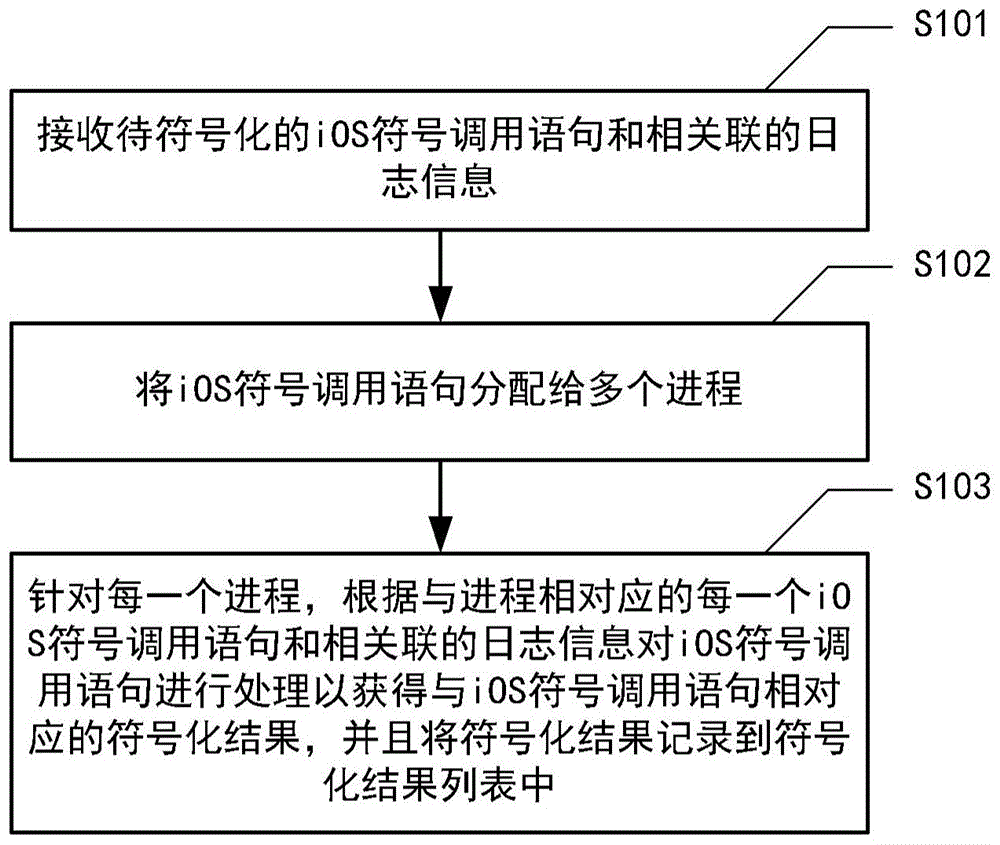
Fig. 1 schematically shows a flow diagram of a method 100 for symbolizing an iOS symbolic call statement according to an embodiment of the present disclosure.
As shown in fig. 1, the method includes receiving an iOS symbolic call statement to be symbolized and associated log information in operation S101. The iOS symbol call statement to be symbolized may be received in the form of a file, for example, a plurality of iOS symbol call statement files, each file including a plurality of iOS symbol call statements. The iOS symbolic call statement may identify a call library name, a call statement base address, and a call statement offset address, and the log information may include a system version and a first device architecture associated with the iOS symbolic call statement.
Then, in operation S102, an iOS symbolic call statement is allocated to a plurality of processes in the process pool. The number of concurrent processes in the process pool may be the same as the number of CPU cores. When the iOS symbolic call statement is received in the form of a file, one iOS symbolic call statement file may be allocated for each process.
In operation S103, for each process, the iOS symbol call statement is processed according to each iOS symbol call statement corresponding to the process and associated log information to obtain a symbolized result corresponding to the iOS symbol call statement, and the symbolized result is recorded into a symbolized result list. After the tokenization results for all iOS symbolic call statements are obtained, the list of tokenization results may be output to the hard disk for persistence. Furthermore, after the symbolization results for all iOS symbol call statements are obtained, symbol map table file unmatching information indicating information and number of iOS symbol call statements or files for which no matched or fuzzy matched symbol map file can be found, symbol map table file fuzzy matching information indicating information and number of iOS symbol call statements or files for which a fuzzy matched symbol map file is found, and statistics indicating number of symbolized iOS symbol call statements or files, number of non-symbolized iOS symbol call statements or files, and the like may be output.
Before performing operation S103, the persistent symbolic result list in the hard disk may be read out to the cache. In addition, before performing operation S103, the validity of the file may also be checked, and operation S103 is performed only when the file is valid. Operation S103 will be described in detail below with reference to fig. 2.
Operation S103 includes obtaining a call library name, a system version, a first device architecture, a call statement offset address, and a call statement base address corresponding to the iOS symbolic call statement from the iOS symbolic call statement and associated log information in operation S201.
Then, in operation S202, a tokenized result corresponding to the iOS symbolic call statement is looked up in a cache according to the call library name, the first device architecture and the call statement offset address.
In operation S203, it is determined whether a corresponding symbolized result is found.
If a corresponding symbolization result is found, the found symbolization result is determined as a symbolization result corresponding to the iOS symbol call statement in operation S204.
If no corresponding symbolization result is found, a symbol mapping table address is obtained according to the calling library name, the system version, and the first device architecture in operation S205.
In operation S206, a second device architecture is obtained according to the symbol mapping table address and the first device architecture.
In operation S207, the iOS symbolic call statement is tokenized with a tokenization statement according to the symbolic mapping table address, the second device architecture, the call statement base address, and the call statement offset address to obtain a tokenized result. The tokenized sentences may be atoms sentences or symbolicate sentences.
In operation S208, the obtained tokenized result is stored in a cache in association with the call library name, the first device architecture, and the call statement offset address.
Operation S206 may include: executing a lipo-info command on the address of the symbol mapping table to obtain a device architecture list supported by the symbol mapping table; determining whether the first device architecture is present in a device architecture list; and if the first device architecture does not exist in the device architecture list, determining a device architecture in the device architecture list that is lower than a version of the first device architecture as the second device architecture. For example, the highest version of the device architecture in the device architecture list that is lower than the version of the first device architecture may be determined as the second device architecture. Alternatively, if the first device architecture is present in the device architecture list, the first device architecture is determined to be the second device architecture.
Operation S205 may include: searching a symbol mapping table address by using a pre-established symbol mapping table dictionary according to the calling library name, the system version and the first equipment system architecture; when the address of the symbol mapping table is found, the found address of the symbol mapping table is used as the address of the symbol mapping table to be obtained; when the address of the symbol mapping table is not found, changing the system version into another system version; and obtaining the symbolic mapping table address according to the calling library name, the changed other system version and the first equipment architecture.
The symbol mapping table dictionary is pre-established in the following way: all symbol map files under a designated symbol map folder on the hard disk are scanned and the device architecture, system version and calling library name associated with the symbol map file are stored in association with the symbol map file address in the symbol map dictionary. In one example, the symbol table folder may include four subfolders, respectively [ arm64 ], [ arm 7 ], [ arm 7s ], and [ self ]. Each subfolder in turn corresponds to a specific dictionary. And the system symbol mapping table file and the program symbol mapping table file are sequentially stored in the first three folders according to different system architectures. The naming of each file is according to the library name system version. The program symbol mapping table file packaged by the user himself is stored in the self folder according to the program name _ version.
Obtaining the symbol mapping table address from the calling library name, the changed other system version, and the first device architecture may be performed using a fuzzy matching method. Specifically, for a specific system architecture, changing a current system version into another system version, searching a symbol mapping table address by using a pre-established symbol mapping table dictionary according to a calling library name, the changed another system version and the first equipment system architecture, and when the symbol mapping table address is searched, taking the searched symbol mapping table address as the symbol mapping table address to be obtained; when a symbol mapping table address is not found, the current system version may continue to be changed until a symbol mapping table address to be obtained is found. Alternatively, the number of changes (e.g., 6 times) and the manner of change (e.g., decrease system version, increase system version, etc.) of the system version may also be preset, and when the system version is continuously changed a predetermined number of times and still fails to find the symbol map table address, the process ends and returns a null value to indicate that a matching symbol map table file cannot be found. In the process of performing fuzzy algorithm matching, if a matched symbol mapping table file is successfully found, the mapping relation and the count of fuzzy matching need to be recorded. If a matching symbol mapping table file is not successfully found, then the file and count that failed to match are also recorded.
According to the embodiment of the disclosure, through refined symbol table file management, fuzzy matching algorithm, symbolization cache and multi-process concurrence, the problems that a system call cannot be symbolized and a large number of symbol call statements cannot be processed quickly can be at least partially solved, and therefore the technical effects that complete symbolization of a whole call stack is realized to help developers to better position the problem, the symbol address call stack is processed in batches (very suitable for symbolizing large batches of crash data), an obtained symbolization result list is cached to help next analysis to be quickly symbolized, and symbolization efficiency is greatly improved (efficiency is improved by more than 50 times, and efficiency improvement is more obvious along with increase of operation times) can be realized.
Fig. 3 schematically shows a block diagram of an apparatus 300 for symbolizing an iOS symbolic call statement according to an embodiment of the present disclosure.
As shown in fig. 3, the apparatus 300 may include a receiving module 310, an assigning module 320, and a processing module 330.
The receiving module 310 may be configured to receive an iOS symbolic call statement to be tokenized and associated log information.
The assignment module 320 may be configured to assign the iOS symbolic call statement to a plurality of processes.
The processing module 330 may be configured to, for each process, process each iOS symbolic call statement corresponding to the process according to the iOS symbolic call statement and associated log information to obtain a symbolized result corresponding to the iOS symbolic call statement, and record the symbolized result into a list of symbolized results.
The processing module 330 may be further configured to: acquiring a calling library name, a system version, a first equipment architecture, a calling statement offset address and a calling statement base address corresponding to the iOS symbolic calling statement according to the iOS symbolic calling statement and the associated log information; searching a symbolized result corresponding to the iOS symbolic call statement in a cache according to the call library name, the first equipment architecture and the call statement offset address; if a corresponding symbolization result is found, the found symbolization result is determined as the symbolization result corresponding to the iOS symbolic call statement.
The processing module 330 may be further configured to: if the corresponding symbolization result is not found, obtaining a symbolic mapping table address according to the calling library name, the system version and the first equipment architecture; obtaining a second device architecture according to the symbol mapping table address and the first device architecture; symbolizing the iOS symbolic call statement by using a symbolization statement according to the symbolic mapping table address, the second equipment architecture, the call statement base address and the call statement offset address to obtain a symbolized result; and storing the obtained tokenized result in a cache in association with the call library name, the first device architecture, and the call statement offset address. The tokenized sentences may be atoms sentences or symbolicate sentences.
The processing module 330 may be further configured to: executing a lipo-info command on the address of the symbol mapping table to obtain a device architecture list supported by the symbol mapping table; determining whether the first device architecture is present in a device architecture list; and if the first device architecture does not exist in the device architecture list, determining a device architecture in the device architecture list that is lower than a version of the first device architecture as the second device architecture.
The processing module 330 may be further configured to: if the first device architecture is present in the device architecture list, the first device architecture is determined to be the second device architecture.
The processing module 330 may be further configured to: searching a symbol mapping table address by using a pre-established symbol mapping table dictionary according to the calling library name, the system version and the first equipment system architecture; when the address of the symbol mapping table is not found, changing the system version into another system version; and obtaining the symbolic mapping table address according to the calling library name, the changed other system version and the first equipment architecture. Obtaining the symbol mapping table address from the calling library name, the changed other system version, and the first device architecture is performed using a fuzzy matching method.
The apparatus corresponds to the method 100. The above detailed description and explanation of the method 100 is equally applicable to the apparatus and will not be repeated here.
According to the embodiment of the disclosure, through refined symbol table file management, fuzzy matching algorithm, symbolization cache and multi-process concurrence, the problems that a system call cannot be symbolized and a large number of symbol call statements cannot be processed quickly can be at least partially solved, and therefore the technical effects that complete symbolization of a whole call stack is realized to help developers to better position the problem, the symbol address call stack is processed in batches (very suitable for symbolizing large batches of crash data), an obtained symbolization result list is cached to help next analysis to be quickly symbolized, and symbolization efficiency is greatly improved (efficiency is improved by more than 50 times, and efficiency improvement is more obvious along with increase of operation times) can be realized.
FIG. 4 illustrates an exemplary system architecture 400 for a method and apparatus for symbolizing an iOS symbolic call statement to which embodiments of the present disclosure may be applied.
As shown in fig. 4, the system architecture 400 may include terminal devices 401, 402, 403, a network 404, and a server 405. The network 404 serves as a medium for providing communication links between the terminal devices 401, 402, 403 and the server 405. Network 404 may include various types of connections, such as wire, wireless communication links, or fiber optic cables, to name a few.
A user may use terminal devices 401, 402, 403 to interact with a server 405 over a network 404 to receive or send messages or the like. The terminal devices 401, 402, 403 may have installed thereon various communication client applications, such as shopping-like applications, web browser applications, search-like applications, instant messaging tools, mailbox clients, social platform software, etc. (by way of example only).
The terminal devices 401, 402, 403 may be various electronic devices having a display screen and supporting web browsing, including but not limited to smart phones, tablet computers, laptop portable computers, desktop computers, and the like.
The server 405 may be a server providing various services, such as a background management server (for example only) providing support for shopping websites browsed by users using the terminal devices 401, 402, 403. The backend management server may analyze and perform other processing on the received data such as the product information query request, and feed back a processing result (for example, target push information, product information — just an example) to the terminal device.
It should be noted that the method for symbolizing the iOS symbolic call statement provided in the embodiment of the present application is generally executed by the server 405, and accordingly, the means for symbolizing the iOS symbolic call statement is generally disposed in the server 405.
It should be understood that the number of terminal devices, networks, and servers in fig. 4 is merely illustrative. There may be any number of terminal devices, networks, and servers, as desired for implementation.
Referring now to FIG. 5, shown is a block diagram of a computer system 500 suitable for use in implementing a terminal device of an embodiment of the present disclosure. The computer system illustrated in FIG. 5 is only one example and should not impose any limitations on the scope of use or functionality of embodiments of the disclosure.
As shown in fig. 5, the computer system 500 includes a Central Processing Unit (CPU)501 that can perform various appropriate actions and processes according to a program stored in a Read Only Memory (ROM)502 or a program loaded from a storage section 508 into a Random Access Memory (RAM) 503. In the RAM 503, various programs and data necessary for the operation of the system 500 are also stored. The CPU 501, ROM 502, and RAM 503 are connected to each other via a bus 504. An input/output (I/O) interface 505 is also connected to bus 504.
The following components are connected to the I/O interface 505: an input portion 506 including a keyboard, a mouse, and the like; an output portion 507 including a display such as a Cathode Ray Tube (CRT), a Liquid Crystal Display (LCD), and the like, and a speaker; a storage portion 508 including a hard disk and the like; and a communication section 509 including a network interface card such as a LAN card, a modem, or the like. The communication section 509 performs communication processing via a network such as the internet. The driver 510 is also connected to the I/O interface 505 as necessary. A removable medium 511 such as a magnetic disk, an optical disk, a magneto-optical disk, a semiconductor memory, or the like is mounted on the drive 510 as necessary, so that a computer program read out therefrom is mounted into the storage section 508 as necessary.
In particular, according to an embodiment of the present disclosure, the processes described above with reference to the flowcharts may be implemented as computer software programs. For example, embodiments of the present disclosure include a computer program product comprising a computer program embodied on a computer readable medium, the computer program comprising program code for performing the method illustrated in the flow chart. In such an embodiment, the computer program may be downloaded and installed from a network through the communication section 509, and/or installed from the removable medium 511. The above-described functions defined in the system of the present disclosure are executed when the computer program is executed by the Central Processing Unit (CPU) 501.
It should be noted that the computer readable medium described herein can be a computer readable signal medium or a computer readable storage medium or any combination of the two. A computer readable storage medium may be, for example, but not limited to, an electronic, magnetic, optical, electromagnetic, infrared, or semiconductor system, apparatus, or device, or any combination of the foregoing. More specific examples of the computer readable storage medium may include, but are not limited to: an electrical connection having one or more wires, a portable computer diskette, a hard disk, a Random Access Memory (RAM), a read-only memory (ROM), an erasable programmable read-only memory (EPROM or flash memory), an optical fiber, a portable compact disc read-only memory (CD-ROM), an optical storage device, a magnetic storage device, or any suitable combination of the foregoing. In the present application, a computer readable storage medium may be any tangible medium that can contain, or store a program for use by or in connection with an instruction execution system, apparatus, or device. In this application, however, a computer readable signal medium may include a propagated data signal with computer readable program code embodied therein, for example, in baseband or as part of a carrier wave. Such a propagated data signal may take many forms, including, but not limited to, electro-magnetic, optical, or any suitable combination thereof. A computer readable signal medium may also be any computer readable medium that is not a computer readable storage medium and that can communicate, propagate, or transport a program for use by or in connection with an instruction execution system, apparatus, or device. Program code embodied on a computer readable medium may be transmitted using any appropriate medium, including but not limited to: wireless, wire, fiber optic cable, RF, etc., or any suitable combination of the foregoing.
As another aspect, the present application also provides a computer-readable medium, which may be contained in the apparatus described in the above embodiments; or may be separate and not incorporated into the device. The computer readable medium carries one or more programs which, when executed by a device, cause the device to perform a method for symbolizing an iOS symbolic call statement according to an embodiment of the present disclosure.
The flowchart and block diagrams in the figures illustrate the architecture, functionality, and operation of possible implementations of systems, methods and computer program products according to various embodiments of the present application. In this regard, each block in the flowchart or block diagrams may represent a module, segment, or portion of code, which comprises one or more executable instructions for implementing the specified logical function(s). It should also be noted that, in some alternative implementations, the functions noted in the block may occur out of the order noted in the figures. For example, two blocks shown in succession may, in fact, be executed substantially concurrently, or the blocks may sometimes be executed in the reverse order, depending upon the functionality involved. It will also be noted that each block of the block diagrams or flowchart illustration, and combinations of blocks in the block diagrams or flowchart illustration, can be implemented by special purpose hardware-based systems which perform the specified functions or acts, or combinations of special purpose hardware and computer instructions.