CN107151663B - An immobilized bacterial agent for oil pollution remediation prepared by using kelp slag - Google Patents
An immobilized bacterial agent for oil pollution remediation prepared by using kelp slag Download PDFInfo
- Publication number
- CN107151663B CN107151663B CN201710520470.4A CN201710520470A CN107151663B CN 107151663 B CN107151663 B CN 107151663B CN 201710520470 A CN201710520470 A CN 201710520470A CN 107151663 B CN107151663 B CN 107151663B
- Authority
- CN
- China
- Prior art keywords
- immobilized
- kelp
- oil
- kaolin
- slag
- Prior art date
- Legal status (The legal status is an assumption and is not a legal conclusion. Google has not performed a legal analysis and makes no representation as to the accuracy of the status listed.)
- Active
Links
Images


Classifications
-
- C—CHEMISTRY; METALLURGY
- C12—BIOCHEMISTRY; BEER; SPIRITS; WINE; VINEGAR; MICROBIOLOGY; ENZYMOLOGY; MUTATION OR GENETIC ENGINEERING
- C12N—MICROORGANISMS OR ENZYMES; COMPOSITIONS THEREOF; PROPAGATING, PRESERVING, OR MAINTAINING MICROORGANISMS; MUTATION OR GENETIC ENGINEERING; CULTURE MEDIA
- C12N11/00—Carrier-bound or immobilised enzymes; Carrier-bound or immobilised microbial cells; Preparation thereof
- C12N11/02—Enzymes or microbial cells immobilised on or in an organic carrier
-
- C—CHEMISTRY; METALLURGY
- C02—TREATMENT OF WATER, WASTE WATER, SEWAGE, OR SLUDGE
- C02F—TREATMENT OF WATER, WASTE WATER, SEWAGE, OR SLUDGE
- C02F3/00—Biological treatment of water, waste water, or sewage
- C02F3/34—Biological treatment of water, waste water, or sewage characterised by the microorganisms used
- C02F3/343—Biological treatment of water, waste water, or sewage characterised by the microorganisms used for digestion of grease, fat, oil
-
- C—CHEMISTRY; METALLURGY
- C12—BIOCHEMISTRY; BEER; SPIRITS; WINE; VINEGAR; MICROBIOLOGY; ENZYMOLOGY; MUTATION OR GENETIC ENGINEERING
- C12N—MICROORGANISMS OR ENZYMES; COMPOSITIONS THEREOF; PROPAGATING, PRESERVING, OR MAINTAINING MICROORGANISMS; MUTATION OR GENETIC ENGINEERING; CULTURE MEDIA
- C12N11/00—Carrier-bound or immobilised enzymes; Carrier-bound or immobilised microbial cells; Preparation thereof
- C12N11/02—Enzymes or microbial cells immobilised on or in an organic carrier
- C12N11/10—Enzymes or microbial cells immobilised on or in an organic carrier the carrier being a carbohydrate
-
- C—CHEMISTRY; METALLURGY
- C12—BIOCHEMISTRY; BEER; SPIRITS; WINE; VINEGAR; MICROBIOLOGY; ENZYMOLOGY; MUTATION OR GENETIC ENGINEERING
- C12N—MICROORGANISMS OR ENZYMES; COMPOSITIONS THEREOF; PROPAGATING, PRESERVING, OR MAINTAINING MICROORGANISMS; MUTATION OR GENETIC ENGINEERING; CULTURE MEDIA
- C12N11/00—Carrier-bound or immobilised enzymes; Carrier-bound or immobilised microbial cells; Preparation thereof
- C12N11/14—Enzymes or microbial cells immobilised on or in an inorganic carrier
-
- C—CHEMISTRY; METALLURGY
- C02—TREATMENT OF WATER, WASTE WATER, SEWAGE, OR SLUDGE
- C02F—TREATMENT OF WATER, WASTE WATER, SEWAGE, OR SLUDGE
- C02F2103/00—Nature of the water, waste water, sewage or sludge to be treated
- C02F2103/08—Seawater, e.g. for desalination
Landscapes
- Life Sciences & Earth Sciences (AREA)
- Chemical & Material Sciences (AREA)
- Organic Chemistry (AREA)
- Health & Medical Sciences (AREA)
- Engineering & Computer Science (AREA)
- Wood Science & Technology (AREA)
- Bioinformatics & Cheminformatics (AREA)
- Zoology (AREA)
- Genetics & Genomics (AREA)
- Microbiology (AREA)
- Biochemistry (AREA)
- Biotechnology (AREA)
- Biomedical Technology (AREA)
- General Engineering & Computer Science (AREA)
- General Health & Medical Sciences (AREA)
- Oil, Petroleum & Natural Gas (AREA)
- Molecular Biology (AREA)
- Inorganic Chemistry (AREA)
- Biodiversity & Conservation Biology (AREA)
- Hydrology & Water Resources (AREA)
- Environmental & Geological Engineering (AREA)
- Water Supply & Treatment (AREA)
- Immobilizing And Processing Of Enzymes And Microorganisms (AREA)
- Micro-Organisms Or Cultivation Processes Thereof (AREA)
Abstract
本发明的目的是提供一种用于海洋溢油污染沉积物的生物修复固定化菌剂,所使用的固定化材料包含有海带渣、高岭土和胶黏剂。本发明提供的海带渣材料既可以吸附石油烃,又可以作为固定化材料包埋石油降解菌,这样一方面海带渣通过主动吸附石油烃,将其作为碳源供石油降解菌利用,另一方面,固定化的石油降解菌在海带渣基质内受到保护,能长期定殖于受污染的区域,并加快石油污染的生物降解。
The purpose of the present invention is to provide a bioremediation immobilized bacterial agent for marine oil spill contaminated sediments, and the immobilized material used contains kelp slag, kaolin and adhesive. The kelp slag material provided by the present invention can not only adsorb petroleum hydrocarbons, but also can be used as an immobilized material to embed petroleum degrading bacteria. In this way, on the one hand, the kelp slag can be used as a carbon source for the petroleum degrading bacteria to utilize by actively adsorbing petroleum hydrocarbons, and on the other hand , the immobilized oil-degrading bacteria are protected in the kelp residue matrix, can colonize the polluted area for a long time, and accelerate the biodegradation of oil pollution.
Description
技术领域technical field
本发明属于石油及石油产品污染环境的生物修复技术领域,具体涉及一种 利用海带渣制备的用于石油污染修复的固定化菌剂。The invention belongs to the technical field of bioremediation of petroleum and petroleum product polluted environments, and in particular relates to an immobilized bacterial agent for petroleum pollution restoration prepared by utilizing kelp slag.
背景技术Background technique
近年来,随着人类对海洋石油资源的开采和海上石油产品的运输,海洋溢 油事故频繁发生,造成了严重的生态环境破坏和经济损失。因此,寻找一种友 好且低成本的溢油清除策略是当前海洋环境治理急需解决的问题。目前,已有 众多不同方式用于缓解和清除溢油污染。其中传统的物理化学方法主要针对海 面溢油的快速处置,但在实际应用中,常常清理不完全或引起污染物形式的转 化,特别是消油剂的使用,容易产生次生污染,所以只能用于海面溢油的早期 处置。而对于沉入海底和漂移至岸滩的溢油污染,通过物理和化学的方式根本 无法有效处理。生物修复技术是利用环境中本身存在的具有石油降解能力的微 生物,通过生物刺激或增强的方式对油污进行降解,达到修复环境的目的。生 物修复不仅对油污清除彻底,环保性也高于物理化学方法,所以越来越多的学 者倾向于采用微生物修复的方法进行油污处理。特别是当溢油污染物沉积在海 底或岸滩,生物修复技术显得更为重要。然而直接添加石油降解微生物的方式, 在风、浪、流的作用下,很难让这些细菌定殖在石油污染区,无法持续发挥生 物降解作用。In recent years, with the exploitation of marine oil resources and the transportation of marine oil products, marine oil spill accidents have occurred frequently, causing serious ecological environment damage and economic losses. Therefore, finding a friendly and low-cost oil spill removal strategy is an urgent problem to be solved in current marine environmental governance. There are many different ways to mitigate and clean up oil spill pollution. Among them, the traditional physical and chemical methods are mainly aimed at the rapid disposal of oil spills on the sea surface. However, in practical applications, the cleaning is often incomplete or the transformation of pollutant forms is often caused, especially the use of dispersants, which are prone to secondary pollution. For early disposal of oil spills on the sea surface. For the oil spill pollution that sinks to the seabed and drifts to the shore, physical and chemical means cannot effectively deal with it. Bioremediation technology is to use microorganisms with oil-degrading ability existing in the environment to degrade oil pollution through biological stimulation or enhancement, so as to achieve the purpose of restoring the environment. Bioremediation not only removes oil pollution completely, but also is more environmentally friendly than physical and chemical methods, so more and more scholars tend to use microbial remediation methods for oil pollution treatment. Especially when oil spill pollutants are deposited on the seabed or on the shore, bioremediation technology is more important. However, by directly adding oil-degrading microorganisms, under the action of wind, waves and currents, it is difficult for these bacteria to colonize the oil-contaminated areas and cannot continue to play a role in biodegradation.
微生物固定化技术是从20世纪60年代开始迅速发展起来的一项新技术, 自从70年代起,该技术就已开始应用于水处理行业,它能将高密度的细胞定位 于限定的区域,避免菌体流失,提高细菌环境适应性,使其保持活性并可反复 利用,可以优化生物修复的效果。应用固定化菌剂修复石油污染的近岸底质, 能够克服海水冲刷、营养盐水平、溶解氧、温度等自然环境因素的影响,并且 一次施用固定化菌剂,菌体利用污染物作为能源和结构物质,通过生理代谢, 持续降解污染物,相比液体菌剂需多次施用更具有成本优势。Microbial immobilization technology is a new technology that has developed rapidly since the 1960s. Since the 1970s, this technology has been used in the water treatment industry. It can locate high-density cells in a limited area and avoid The loss of bacterial cells improves the environmental adaptability of bacteria, keeps them active and can be reused, and can optimize the effect of bioremediation. The application of immobilized bacterial agents to repair oil-contaminated coastal sediments can overcome the influence of natural environment factors such as seawater scouring, nutrient levels, dissolved oxygen, and temperature. Structural substances, through physiological metabolism, continuously degrade pollutants, and have more cost advantages than liquid inoculants that require multiple applications.
传统的固定化载体材料分为无机材料、高分子合成材料、天然有机材料等。 其中无机材料无污染,但获取成本高;高分子合成材料,机械强度高,但不易 降解,成本高;天然有机材料成本低,易降解。因此,选择一种易获取、可降 解、成本低的固定化载体材料,是石油降解微生物固定化技术广泛应用于海洋 底质溢油污染生物修复的技术前提。Traditional immobilized carrier materials are divided into inorganic materials, polymer synthetic materials, natural organic materials, etc. Among them, inorganic materials are non-polluting, but the cost is high; polymer synthetic materials have high mechanical strength, but are not easy to degrade, and the cost is high; natural organic materials have low cost and are easy to degrade. Therefore, the selection of an immobilized carrier material that is easy to obtain, degradable, and low-cost is the technical prerequisite for the wide application of oil-degrading microbial immobilization technology in the bioremediation of marine bottom oil spill pollution.
发明内容SUMMARY OF THE INVENTION
本发明的目的是提供一种用于海洋溢油污染沉积物的生物修复固定化菌 剂,有效解决生物修复中施加的液体菌剂易受海流、温度、营养盐等环境条件 影响的问题。The object of the present invention is to provide a bioremediation immobilized bacterial agent for marine oil spill polluted sediments, which effectively solves the problem that the liquid bacterial agent applied in bioremediation is easily affected by environmental conditions such as ocean currents, temperature, and nutrients.
本发明首先提供海带渣材料在制备固定化菌剂中的应用,所述的固定化菌 剂用于处理海洋近岸溢油污染的沉积物;The present invention first provides the application of kelp slag material in the preparation of immobilized microbial inoculants, and the immobilized microbial inoculum is used to treat the sediments polluted by marine near-shore oil spills;
本发明再一个方面提供一种用于制备固定化菌剂的固定化材料,包含有海 带渣、高岭土和胶黏剂;Yet another aspect of the present invention provides an immobilized material for preparing an immobilized bacterial agent, comprising kelp slag, kaolin and an adhesive;
所述的胶黏剂为褐藻酸钠、卡拉胶、明胶、羟甲基纤维素钠中的任一种, 优选为褐藻酸钠;Described sizing agent is any in sodium alginate, carrageenan, gelatin, sodium hydroxymethyl cellulose, preferably sodium alginate;
其中海带渣、高岭土的质量比为9~5:1~5;Among them, the mass ratio of kelp slag and kaolin is 9~5:1~5;
作为实施例的优选,其中海带渣与高岭土的质量比为7:3;Preferred as an embodiment, wherein the mass ratio of kelp slag and kaolin is 7:3;
作为实施例的优选,其中海藻酸钠的含量为固定化材料总质量的 0.5%~1.5%;Preferably as an embodiment, the content of sodium alginate is 0.5% to 1.5% of the total mass of the immobilized material;
本发明所提供的固定化材料用于制备固定化菌剂;The immobilized material provided by the present invention is used to prepare an immobilized bacterial agent;
所述的固定化菌剂用于处理海洋近岸溢油污染沉积物;The immobilized bacterial agent is used for the treatment of marine near-shore oil spill polluted sediments;
上述的固定化菌剂的一种具体制备方法如下:A kind of concrete preparation method of above-mentioned immobilized bacterial agent is as follows:
向海带渣中添加能降解石油烃降解菌的发酵菌液,搅拌均匀后,在30~45℃ 烘培干燥,再加入高岭土搅拌均匀;加入海藻酸钠溶液搅拌均匀,将搅拌好的 全部样品缓慢投入制粒机,将制得的颗粒收集,于30~45℃低温烘干制得固定化 菌剂。Add fermented bacteria liquid capable of degrading petroleum hydrocarbon degrading bacteria to the kelp slag, stir evenly, bake and dry at 30-45℃, then add kaolin and stir evenly; add sodium alginate solution and stir evenly, stir all the samples slowly Put into a granulator, collect the obtained granules, and dry them at a low temperature of 30-45°C to obtain an immobilized bacterial agent.
本发明提供的海带渣材料既可以吸附石油烃,又可以作为固定化材料包埋 石油降解菌,这样一方面海带渣通过主动吸附石油烃,将其作为碳源供石油降 解菌利用,另一方面,固定化的石油降解菌在海带渣基质内受到保护,能长期 定殖于受污染的区域,并加快石油污染的生物降解。The kelp slag material provided by the present invention can not only adsorb petroleum hydrocarbons, but also can be used as an immobilized material to embed petroleum-degrading bacteria. In this way, on the one hand, the kelp slag can be used as a carbon source for the petroleum-degrading bacteria to utilize by actively adsorbing petroleum hydrocarbons, and on the other hand , the immobilized oil-degrading bacteria are protected in the kelp residue matrix, can colonize the polluted area for a long time, and accelerate the biodegradation of oil pollution.
附图说明Description of drawings
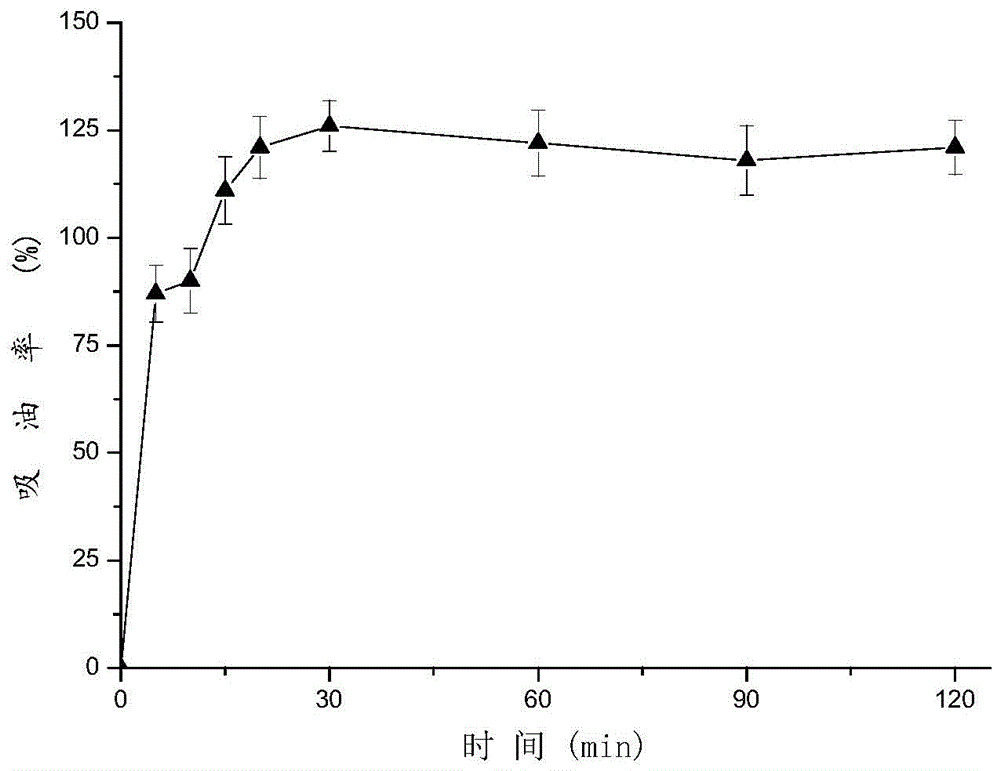
图1海带渣对柴油吸附率图;Fig. 1 is a graph of the adsorption rate of kelp slag to diesel oil;
图2:不同高岭土配比的原料制粒的物理特性图;Figure 2: Physical properties diagram of raw material granulation with different kaolin ratios;
图3:不同胶黏剂的处理条件下溶失率比较图;Figure 3: Comparison of dissolution rate under different adhesive treatment conditions;
图4:海藻酸钠固定化颗粒海水浸泡溶失率图;Figure 4: The dissolution rate of sodium alginate immobilized particles in seawater soaking;
图5:固定化菌剂样品照片图;Figure 5: Photo of the immobilized bacterial agent sample;
图6:固定化菌剂石油降解率图,其中a,b,c:当字母不相同时,表示两两相 比,石油降解率数值差异极显著,P<0.01。Figure 6: The oil degradation rate diagram of immobilized bacterial agent, in which a, b, c: when the letters are different, it means that the numerical difference of the oil degradation rate is extremely significant, P<0.01.
具体实施方式Detailed ways
在对岸滩溢油的生物修复实际应用中,目前主要采用喷洒液体石油降解菌 剂来促进石油污染物的降解,而在海洋环境中,这种方式往往造成石油降解菌 的流失,大大降低降解效果;利用固定化技术对细菌进行固定,可以避免菌体 流失,提高降解效果,然而现有的固定化材料一方面不具有价格优势,一方面 环境友好性差。申请人选择将海带渣来制备固定化菌剂,不仅变废为宝,还能 提高溢油生物修复的效果。但在使用过程中发现,海带渣制备的固定化颗粒密 度轻,固型性不好,水溶失率高,申请人对固定化材料进行了复配,通过配比 的优选组合,最终获得了本发明。In the practical application of bioremediation of oil spills on the shore, the spraying of liquid petroleum degrading bacteria is mainly used to promote the degradation of petroleum pollutants. In the marine environment, this method often causes the loss of petroleum degrading bacteria and greatly reduces the degradation effect. ; Using immobilization technology to immobilize bacteria can avoid the loss of bacteria and improve the degradation effect. However, the existing immobilization materials have no price advantage on the one hand, and poor environmental friendliness on the other hand. The applicant chooses to use kelp slag to prepare immobilized bacterial agent, which not only turns waste into treasure, but also improves the effect of oil spill bioremediation. However, in the process of use, it was found that the immobilized particles prepared from kelp slag had light density, poor solidity, and high water loss rate. The applicant compounded the immobilized materials, and finally obtained this invention.
实施例1固定化材料的筛选及制备方法的优化Example 1 Screening of immobilized materials and optimization of preparation methods
对固定化菌剂的密度、固型性、吸附率及溶失率指标进行筛选,最终确定 最佳的固定化颗粒的组分及制备方法。The density, solidity, adsorption rate and dissolution rate of the immobilized bacterial agent were screened, and the optimal components and preparation method of the immobilized particles were finally determined.
其中使用的仪器如下:恒温培养摇床:THZ-100型,上海一恒科学仪器公 司;电热恒温鼓风干燥箱:上海一恒科学仪器公司;电子天平:BSA224S-CW, Sartorius公司;大型微生物发酵罐:30L,120L,上海国强;120A型两相3kw制 粒机:领航农业机械公司;气相色谱质谱仪(GC/MS):6890N-5973N型,Agilent 公司;The instruments used are as follows: constant temperature culture shaker: THZ-100, Shanghai Yiheng Scientific Instrument Company; electric heating constant temperature blast drying oven: Shanghai Yiheng Scientific Instrument Company; electronic balance: BSA224S-CW, Sartorius Company; large-scale microbial fermentation Tank: 30L, 120L, Shanghai Guoqiang; 120A two-phase 3kw granulator: Linghang Agricultural Machinery Company; Gas Chromatography Mass Spectrometer (GC/MS): 6890N-5973N, Agilent Company;
海带渣是海带工业,特别是褐藻酸钠生产过程中产生的比例最大的固体废 料。使用时将海带渣经水洗后,200~400℃高温烘干,粉碎机磨碎,过50目筛并 收集。其主要成分中粗纤维含量为10%左右,蛋白质8%左右,多糖6%左右,含 钙2%左右,其次还含有少量脂肪、碘和无机盐。Kelp slag is the largest proportion of solid waste produced in the kelp industry, especially in the production of sodium alginate. When in use, the kelp slag is washed with water, dried at a high temperature of 200-400°C, ground with a pulverizer, passed through a 50-mesh sieve and collected. Its main components are about 10% crude fiber, about 8% protein, about 6% polysaccharide, about 2% calcium, and also contain a small amount of fat, iodine and inorganic salts.
申请人筛选后使用高岭土与海带渣一起来制备固定化材料,并通过筛选高 岭土、海带渣与胶黏剂的具体组分配比来获得最佳的溶失率。After screening, the applicant used kaolin and kelp slag to prepare the immobilized material, and obtained the best dissolution rate by screening the specific component ratio of kaolin, kelp slag and adhesive.
本发明的固定化菌的具体制备方法如下:The concrete preparation method of immobilized bacteria of the present invention is as follows:
一、降解菌及培养基1. Degrading bacteria and culture medium
本实施所使用的石油烃降解菌为Bacillus sp.E3,购买自中国普通微生物菌种保藏管理中心,菌种保藏号为CGMCC NO.1.16125The petroleum hydrocarbon degrading bacteria used in this implementation is Bacillus sp.E3, which was purchased from the China General Microorganism Culture Collection and Management Center, and the culture collection number is CGMCC NO.1.16125
ONR7a培养基配方如下:一种模拟天然海水的培养基,主要用于石油培养 基配制。主要成分如下:每L含22.79g NaCl、11.18g MgCl2·6H2O、3.98g Na2SO4、 1.46g CaCl2·2H2O、1.30g TAPSO、0.72g KCl,灭菌前添加2mL溶液Ⅰ,之后121℃, 灭菌15min;使用时按浓度比例添加溶液Ⅱ和溶液Ⅲ。The formula of ONR7a medium is as follows: a medium that simulates natural seawater and is mainly used for the preparation of petroleum medium. The main components are as follows: each L contains 22.79g NaCl, 11.18g MgCl 2 ·6H 2 O, 3.98g Na 2 SO 4 , 1.46g CaCl 2 ·2H 2 O, 1.30g TAPSO, 0.72g KCl, add 2mL solution before sterilization I, then sterilize at 121°C for 15 minutes; add solution II and solution III according to the concentration ratio during use.
溶液Ⅰ(500x,培养基配制时加入):Solution I (500x, added during medium preparation):

溶液Ⅱ(50x,高压灭菌后加入):Solution II (50x, added after autoclaving):

溶液Ⅲ(1000x,0.22μm滤膜过滤除菌):Solution III (1000x, 0.22μm filter sterilization):
组分 容量(g/L)Component Capacity (g/L)
FeSO4·2H2O 2.8FeSO 4 ·2H 2 O 2.8
溶液Ⅰ、溶液Ⅱ均需要121℃高压蒸汽灭菌15min;溶液Ⅲ则需要用0.22μm 滤膜除菌。Both solution I and solution II need to be sterilized by high pressure steam at 121°C for 15 minutes; solution III needs to be sterilized with a 0.22 μm filter membrane.
石油培养基:100mL ONR7a中添加1g原油(1%)。Petroleum medium: 1 g of crude oil (1%) was added to 100 mL of ONR7a.
2216E培养基:每L含蛋白胨5g,酵母膏1g,磷酸高铁0.01g,陈海水1L, 调节pH7.6-7.8,之后121℃,灭菌15min,用于扩大培养菌液。2216E medium: each L contains 5g peptone, 1g yeast extract, 0.01g high iron phosphate, 1L old seawater, adjust pH to 7.6-7.8, and then sterilize at 121°C for 15min to expand the bacterial culture.
二、固定化菌剂的包埋制粒条件优化2. Optimization of the embedding and granulation conditions of the immobilized bacterial agent
采用制粒机加工方法,将石油降解菌液、海带渣、配重剂、胶黏剂等混合 均匀后压制成包埋固定化石油降解菌剂。为了满足海洋沉积物石油污染处理的 要求,我们对固定化菌剂的密度、固型性及溶失率指标进行考察,以确定最佳 的固定化颗粒的制备技术。Using the granulator processing method, the oil-degrading bacteria liquid, kelp residue, weighting agent, adhesive, etc. are mixed uniformly and then pressed into an embedded and immobilized petroleum-degrading bacteria agent. In order to meet the requirements of marine sediment oil pollution treatment, we investigated the density, solidity and dissolution rate of the immobilized bacterial agent to determine the best immobilized particle preparation technology.
(1)固定化菌剂配重比例的研究(1) Study on the weight ratio of immobilized bacterial agents
为了让微生物固定化菌剂能在海水介质中下沉,需增加固定化菌剂的密度, 本专利选取了高岭土作为固定化菌剂的配重剂,选择了不同配比的海带渣来制 粒,制粒过程中添加30~50%的液体培养基作为固定化菌液。之后将制得的颗粒 放入含有海水的三角瓶中,在摇床上150rmp摇动处理24h,通过计算不同颗粒的 密度及溶失率(公式2)来评价颗粒的成型效果。配比实验设计表如下表所示。In order to allow the immobilized microorganisms to sink in the seawater medium, it is necessary to increase the density of the immobilized inoculants. In this patent, kaolin is selected as the weighting agent of the immobilized inoculants, and kelp residues of different proportions are selected for granulation. , 30-50% of liquid culture medium is added as immobilized bacteria liquid during granulation process. Afterwards, the prepared granules were put into a conical flask containing seawater, shaken at 150 rmp on a shaking table for 24 h, and the forming effect of the granules was evaluated by calculating the density and dissolution rate of different granules (Formula 2). The proportioning experimental design table is shown in the following table.
表1配重剂配比测试设计表Table 1 Weighting agent proportioning test design table

溶失率测定公式:Determination formula of dissolution rate:

式中,m为随机挑选颗粒的总质量,md为浸泡处理d天后收集的成型颗粒烘 干后的质量。In the formula, m is the total mass of randomly selected particles, and m d is the mass of the shaped particles collected after soaking for d days after drying.
(2)胶黏剂及浓度的选择(2) Selection of adhesive and concentration
在上述实验基础上,选择最合适的海带渣与高岭土的配比,为了进一步增 强固定化颗粒的成型稳定性,在制粒过程中分别添加褐藻酸钠、卡拉胶、明胶、 羟甲基纤维素钠四种胶黏剂水溶液,胶黏剂的添加量为原料总质量的 0.5%~1.5%。随机挑取制得的10粒固定化菌剂分别浸泡在数只盛有50ml海水的锥 形瓶中,并在放入后1-12天区间取出每个锥形瓶中的颗粒,烘干挑选出成型颗粒 称重并按公式(2)测定固定化菌剂的溶失率。通过比较四种胶黏剂制备的固定 化菌剂的溶失率,选取最合适的胶黏剂制备固定化颗粒,放入海水中,延长浸 泡时间至90天,按上述方法测定其不同时间段的溶失率。On the basis of the above experiments, the most suitable ratio of kelp slag and kaolin was selected. In order to further enhance the molding stability of the immobilized particles, sodium alginate, carrageenan, gelatin, and hydroxymethyl cellulose were added respectively during the granulation process. Sodium four kinds of adhesive aqueous solutions, the amount of adhesive added is 0.5% to 1.5% of the total mass of the raw materials. 10 immobilized bacterial agents were randomly selected and soaked in several conical flasks containing 50ml of seawater, and the particles in each conical flask were taken out in the interval of 1-12 days after being placed, dried and selected. The shaped particles were weighed and the dissolution rate of the immobilized bacterial agent was determined according to formula (2). By comparing the dissolution and loss rates of the immobilized bacterial agents prepared by the four types of adhesives, the most suitable adhesives were selected to prepare immobilized particles, placed in seawater, the soaking time was extended to 90 days, and the different time periods were measured according to the above method dissolution rate.
3)固定化菌剂的制备工艺3) Preparation technology of immobilized bacterial agent
步骤一:菌液制备Step 1: Preparation of bacterial solution
取–80℃甘油管藏的上述菌株E3于2216E培养基中活化并扩大培养至 OD630≈(1.2~2.3)×109CFU/mL];接种于30L发酵罐中,25℃恒温培养,2-3d后 制得所需菌液。The above strain E3 stored in glycerol at –80°C was activated in 2216E medium and expanded to OD630≈(1.2~2.3)×10 9 CFU/mL]; inoculated in a 30L fermenter, cultured at a constant temperature of 25°C, and 2- The required bacterial liquid was obtained after 3d.
步骤二:固定化过程Step 2: Immobilization Process
以质量比1:1的比例向海带渣中添加菌液,充分搅匀,在30~45℃烘培至 干。加入适量高岭土,使之与海带渣质量比为3:7,搅拌均匀;加入上述原料 总质量0.5%~1.5%的海藻酸钠溶液搅拌均匀,使其水含量为50%~70%。Add bacterial liquid to the kelp residue in a mass ratio of 1:1, stir well, and bake at 30-45°C until dry. Add an appropriate amount of kaolin to make it and the kelp slag mass ratio of 3:7, stir evenly; add the sodium alginate solution of 0.5% to 1.5% of the total mass of the above raw materials and stir to make its
步骤三:制粒与烘干Step 3: Granulation and drying
将搅拌好的全部样品缓慢投入制粒机,待出粒均匀后,可加大原料添加量。 将制得的颗粒收集,于烘箱中30~45℃低温烘干制得固定化菌剂,密封后低温 4℃保存。Slowly put all the mixed samples into the granulator, and after the granulation is uniform, the amount of raw materials added can be increased. The obtained granules were collected, dried at a low temperature of 30-45°C in an oven to obtain an immobilized bacterial agent, sealed and stored at a low temperature of 4°C.
石油降解实验:将上述所制得的固定化菌剂接入石油培养基中,研究其石 油降解特性。以添加含等量菌体的菌液为阳性对照,以未添加固定化菌剂和菌 液的石油培养基为空白对照。上述每种处理设3个平行,在150r/min,20℃, 避光的条件下分别培养21d。Petroleum degradation experiment: The immobilized bacterial agent prepared above was inserted into a petroleum medium to study its petroleum degradation characteristics. The bacterial liquid containing the same amount of bacterial cells was added as a positive control, and the petroleum medium without immobilized bacterial agent and bacterial liquid was used as a blank control. For each of the above treatments, three parallels were set, and the cells were cultured for 21 d at 150 r/min, 20° C., and protected from light.
石油降解率测定方法:降解21d后,用50mL CH2Cl2分三次倒入三角瓶中萃 取培养液中残余石油。取20mL CH2Cl2相萃取液转移到尖底烧瓶中,40℃减 压浓缩,氮气吹干,按照公式(3)计算降解率。Determination method of petroleum degradation rate: after 21 days of degradation, pour 50 mL of CH 2 Cl 2 into a triangular flask three times to extract the residual petroleum in the culture medium.

式中,m0为最初加入培养基中的石油重量;m1为石油培养基萃取后残留油 样重量。In the formula, m 0 is the weight of the oil initially added to the medium; m 1 is the weight of the residual oil sample after the extraction of the oil medium.
海带渣柴油吸附能力测试:Kelp slag diesel adsorption capacity test:
取数个100ml锥形瓶,分别加入50ml过滤海水和1ml柴油(0.85g),取0.3g 海带渣于锥形瓶内后将锥形瓶放置于摇床上,分别在0min、5min、10min、15min、 20min、30min、60min、120min时取出,用塞住脱脂棉(0.03g)的漏斗过滤并 获得滤液。使用20ml正己烷分两次萃取滤液,氮吹,定量剩余柴油质量,按照 公式(1)计算海带渣的柴油吸附率。以上实验每组做三个平行。Take several 100ml conical flasks, add 50ml filtered seawater and 1ml diesel oil (0.85g) respectively, take 0.3g of kelp slag in the conical flask and place the conical flask on the shaker, respectively at 0min, 5min, 10min, 15min , 20min, 30min, 60min, 120min, take out, filter with a funnel plugged with absorbent cotton (0.03g) and obtain a filtrate. Use 20ml of n-hexane to extract the filtrate twice, blow with nitrogen, quantify the remaining diesel quality, and calculate the diesel adsorption rate of the kelp residue according to formula (1). The above experiments were carried out in three parallels for each group.

m0为模拟体系中添加的柴油含量,ma为模拟体系中海带渣的质量,mb为经 萃取后剩余柴油的质量,mc为阴性对照实验中脱脂棉的吸油量。m 0 is the content of diesel added in the simulated system, m a is the mass of kelp residue in the simulated system, m b is the mass of remaining diesel after extraction, and m c is the oil absorption of absorbent cotton in the negative control experiment.
在本实施例中通过向装有50ml灭菌海水的三角瓶中加入1ml柴油,来模拟 海上浮油污染环境。在加入海带渣材料后,我们从不同时间点取出材料,对柴 油吸附量进行检测,研究海带渣的动态柴油吸附过程,并分析海带渣的最大柴 油吸附能力。In this example, by adding 1 ml of diesel oil to the Erlenmeyer flask containing 50 ml of sterilized seawater, the environment of marine oil slick pollution was simulated. After adding the kelp slag material, we took out the material from different time points, tested the diesel adsorption capacity, studied the dynamic diesel adsorption process of the kelp slag, and analyzed the maximum diesel adsorption capacity of the kelp slag.
海带渣的吸油率在0-20min时间段内缓慢上升,并于30min左右达到最大, 吸油率为128%,随着时间延长,吸油率基本稳定在该水平不变,这说明海带渣 中的纤维素成分可在短时间内吸附超过自身重量的柴油。The oil absorption rate of kelp slag rises slowly in the time period of 0-20min, and reaches the maximum at about 30min. The oil absorption rate is 128%. With the extension of time, the oil absorption rate is basically stable at this level, which indicates that the fibers in the kelp slag The vegetarian component can absorb diesel oil that exceeds its own weight in a short time.
三、固定化颗粒植物载体的特性改良3. Characteristics improvement of immobilized particulate plant carrier
1)配重剂添加比例1) The proportion of weighting agent added
为了增强制得颗粒的密度和降低颗粒的溶失率,选取了高岭土来配合海带 渣。从图2中可以看到,当高岭土含量从10%增加到30%时,制备得到的海带 渣-高岭土复合颗粒的密度也迅速增加到1.47g/cm3,而颗粒的海水溶失率则迅速 下降至8%左右。而当高岭土的含量继续增加,颗粒密度的增加幅度和海水溶失 率的下降幅度都很小。所以,综合考虑到颗粒的固定化效果和其下沉性能,当 添加的海带渣与高岭土的质量比7:3时,所制得的颗粒具有较大的密度和较低 的溶失率,也保证足够大的海带渣添加量,以获得较好的油污吸附性能和菌体 吸附率。In order to enhance the density of the obtained particles and reduce the dissolution rate of the particles, kaolin was selected to be combined with the kelp slag. It can be seen from Figure 2 that when the kaolin content increases from 10% to 30%, the density of the prepared kelp slag-kaolin composite particles also increases rapidly to 1.47 g/cm 3 , while the seawater dissolution rate of the particles increases rapidly down to around 8%. However, when the content of kaolin continued to increase, the increase of particle density and the decrease of seawater dissolution rate were very small. Therefore, considering the immobilization effect of the particles and their sinking performance, when the mass ratio of kelp slag and kaolin is 7:3, the obtained particles have a larger density and a lower dissolution rate, and also Make sure to add enough kelp slag to obtain better oil pollution adsorption performance and bacterial adsorption rate.
2)胶黏剂选择结果2) Adhesive selection results
为了进一步降低海带渣-高岭土复合颗粒在海水介质中长时间浸泡的溶失 率,考察了四种有机高分子材料:褐藻酸钠、卡拉胶、明胶、羟甲基纤维素钠 作为胶黏剂制备的颗粒,在12天海水浸泡实验中的溶失率。实验结果如图3所 示,相同的含量条件下,以海藻酸钠为胶黏剂制备的固定化颗粒,其海水浸泡 12天的溶失率小于15%,而其他三种则均高于15%。In order to further reduce the dissolution rate of kelp slag-kaolin composite particles soaked in seawater for a long time, four kinds of organic polymer materials were investigated: sodium alginate, carrageenan, gelatin, sodium hydroxymethyl cellulose, prepared as adhesives. The dissolution rate of the particles in the 12-day seawater immersion experiment. The experimental results are shown in Figure 3. Under the same content conditions, the immobilized particles prepared with sodium alginate as the adhesive have a dissolution loss rate of less than 15% after 12 days of seawater immersion, while the other three are higher than 15%. %.
以上结果表明,海藻酸钠作为胶黏剂所制得颗粒的耐水性较好,初步满足 了在海水中长期浸泡的要求。以海藻酸钠为胶黏剂制备固定化颗粒,在进行为 期90天的海水浸泡实验中,也表现出较好的实验结果(图4),整个海水浸泡期 间,固定化颗粒的溶失率不超过23%,证实用海藻酸钠作为胶黏剂制备的固定 化颗粒可以满足在海水环境中长期存在的要求。The above results show that the water resistance of the granules prepared by sodium alginate as an adhesive is better, which preliminarily meets the requirements of long-term immersion in seawater. The immobilized particles were prepared with sodium alginate as the adhesive, and the 90-day seawater immersion experiment also showed good experimental results (Figure 4). During the whole seawater immersion period, the dissolution loss rate of the immobilized particles was not More than 23%, it is confirmed that the immobilized particles prepared with sodium alginate as the adhesive can meet the requirement of long-term existence in seawater environment.
实施例2Example 2
以最优原料配比条件来固定石油降解细菌,首先将700g海带渣和700ml菌 液,充分搅匀,在30~45℃烘培至干;然后加入300g高岭土,搅拌均匀;将5~15g 海藻酸钠溶解于500~700ml水中,与上述原料混合,搅拌均匀,缓慢投入制粒机, 将制得的颗粒收集,于烘箱中30~45℃低温烘干制得固定化菌剂,成品如图5所 示,菌剂为直径为1cm,高为2~3cm的白褐色圆柱形颗粒。To fix the oil-degrading bacteria with the optimal ratio of raw materials, first mix 700g of kelp residue and 700ml of bacterial liquid, fully stir, and bake at 30-45°C until dry; then add 300g of kaolin and stir evenly; add 5-15g of seaweed Sodium is dissolved in 500-700ml of water, mixed with the above-mentioned raw materials, stirred evenly, slowly put into a granulator, the obtained granules are collected, and dried in an oven at a low temperature of 30-45°C to obtain an immobilized bacterial agent. The finished product is shown in the figure. 5, the bacterial agent is a white-brown cylindrical particle with a diameter of 1 cm and a height of 2-3 cm.
将含等量石油降解菌的液体菌剂和固定化菌剂添加至石油培养基中,经过 21d的降解实验,通过重量法测定固定化菌剂、液体菌剂和自然风化(阴性对 照)的石油降解率。结果如图6所示,与自然风化(11.0%)和液体菌剂(31.0%) 相比,固定化菌剂的石油降解率有了显著提高(P<0.01),分别提高了接近40% 和18%,而液体菌液相对于自然风化,石油降解率仅提高近20%。这说明采用海 带渣的细菌固定化技术可为细菌降解提供合适的生存空间,减弱外界复杂环境 对菌体的干扰,保持菌体的活性,使得石油降解能力明显提高。The liquid microbial inoculum and the immobilized microbial inoculum containing the same amount of petroleum degrading bacteria were added to the petroleum medium, and after 21d of degradation experiments, the immobilized microbial inoculum, the liquid microbial inoculum and the natural weathered (negative control) oil were determined gravimetrically. Degradation rate. The results are shown in Figure 6. Compared with natural weathering (11.0%) and liquid inoculants (31.0%), the oil degradation rate of immobilized inoculants was significantly improved (P < 0.01), which were increased by nearly 40% and 40%, respectively. 18%, while the oil degradation rate was only increased by nearly 20% in liquid bacterial liquid compared to natural weathering. This shows that the bacterial immobilization technology using kelp residue can provide a suitable living space for bacterial degradation, reduce the interference of the external complex environment on the bacterial cells, maintain the activity of the bacterial cells, and significantly improve the oil degradation ability.
Claims (2)
Priority Applications (1)
| Application Number | Priority Date | Filing Date | Title |
|---|---|---|---|
| CN201710520470.4A CN107151663B (en) | 2017-06-30 | 2017-06-30 | An immobilized bacterial agent for oil pollution remediation prepared by using kelp slag |
Applications Claiming Priority (1)
| Application Number | Priority Date | Filing Date | Title |
|---|---|---|---|
| CN201710520470.4A CN107151663B (en) | 2017-06-30 | 2017-06-30 | An immobilized bacterial agent for oil pollution remediation prepared by using kelp slag |
Publications (2)
| Publication Number | Publication Date |
|---|---|
| CN107151663A CN107151663A (en) | 2017-09-12 |
| CN107151663B true CN107151663B (en) | 2020-12-04 |
Family
ID=59795542
Family Applications (1)
| Application Number | Title | Priority Date | Filing Date |
|---|---|---|---|
| CN201710520470.4A Active CN107151663B (en) | 2017-06-30 | 2017-06-30 | An immobilized bacterial agent for oil pollution remediation prepared by using kelp slag |
Country Status (1)
| Country | Link |
|---|---|
| CN (1) | CN107151663B (en) |
Families Citing this family (4)
| Publication number | Priority date | Publication date | Assignee | Title |
|---|---|---|---|---|
| CN108624530B (en) | 2018-05-15 | 2020-02-07 | 中国环境科学研究院 | Immobilized microbial inoculum for in-situ remediation of polluted sediments, preparation method and application thereof |
| CN109174030A (en) * | 2018-10-10 | 2019-01-11 | 广西科学院 | A kind of petroleum improvement modified montmorillonoid complex microorganism cleanser |
| CN111439905B (en) * | 2020-04-24 | 2022-08-26 | 好当家集团有限公司 | Preparation method of apostichopus japonicus culture pond bottom material modifier |
| CN112980450B (en) * | 2021-02-05 | 2022-09-27 | 北京沃太斯环保科技发展有限公司 | Activating agent for in-situ remediation of deep polluted soil microorganisms and application thereof |
Family Cites Families (6)
| Publication number | Priority date | Publication date | Assignee | Title |
|---|---|---|---|---|
| US6780631B2 (en) * | 2001-11-12 | 2004-08-24 | John J. Renaker, Jr. | Method and apparatus for decomposition of oil |
| CN103114085B (en) * | 2013-01-18 | 2015-10-21 | 西安建筑科技大学 | The method of SRB in the preparation of SRB biostats and crude oil for inhibiting |
| CN104646411B (en) * | 2013-11-20 | 2017-07-14 | 沈阳工业大学 | Restorative procedure of the Immobilized Bacillus Sp to carbofuran contaminated soil |
| CN104357435A (en) * | 2014-10-31 | 2015-02-18 | 国家海洋局第一海洋研究所 | Immobilized bacteria agent for biologically repairing spilled oil-polluted shore |
| CN104593349B (en) * | 2015-01-14 | 2018-06-22 | 华南理工大学 | A kind of GY2B degradation bacterias immobilized spherule and preparation method and application |
| CN105238774A (en) * | 2015-11-12 | 2016-01-13 | 大连海洋大学 | Synthesis carrier of oil degrading bacteria with different buoyancies and preparation method |
-
2017
- 2017-06-30 CN CN201710520470.4A patent/CN107151663B/en active Active
Also Published As
| Publication number | Publication date |
|---|---|
| CN107151663A (en) | 2017-09-12 |
Similar Documents
| Publication | Publication Date | Title |
|---|---|---|
| US11993527B2 (en) | Immobilized microbial agent for in situ restoration of contaminated sediments, preparation method and application thereof | |
| CN108611292B (en) | Preparation method and application of cold-resistant ammonia oxidizing bacteria immobilized biochar ball | |
| CN107151663B (en) | An immobilized bacterial agent for oil pollution remediation prepared by using kelp slag | |
| CN102604924A (en) | Offshore oil degrading microbial inoculum and preparation method thereof | |
| CN102432111B (en) | A method for improving the removal effect of oil pollution in seawater | |
| CN111088246A (en) | Biochar immobilized naphthalene degrading microbial inoculum and preparation method and application thereof | |
| CN108130299B (en) | A Microbial Strain Degrading Petroleum Hydrocarbons and Combined Restorative Agent | |
| CN113215009A (en) | Composite immobilized microbial agent and preparation method and application thereof | |
| CN105695444A (en) | Immobilized microbial inoculant for ship repairing and building sewage treatment, and preparation method and application thereof | |
| CN105483114A (en) | Microbial immobilization loofah sponge as well as preparation method and application thereof | |
| CN109095614A (en) | The biological floating bed and its matrix and preparation method prepared by biomass carbon source | |
| CN113943580A (en) | A kind of adsorption and degradation dual function soil remediation material and its preparation and application | |
| CN109679871A (en) | A kind of method of PAM-SA immobilized microorganism degradation oily waste water | |
| CN116875586B (en) | Preparation method and application of oleophylic and hydrophobic high-activity microorganism-loaded composite cellulose/luffa aerogel | |
| CN103923904A (en) | Preparation method for immobilized microbe oil-spill repairing agent | |
| CN103923905A (en) | Preparation method for immobilized microbe oil-spill repairing agent | |
| CN114045279B (en) | A high-efficiency compound bacterial agent for marine oil degradation | |
| CN104140962B (en) | A kind of process for fixation of oil degradation flora | |
| CN105936901A (en) | A kind of immobilized bacterial agent and its preparation method and application | |
| CN101665783A (en) | Method for preparing degradant of Venetian acinetobacter tetradecane by semisolid fermentation method based on using bagasse as immobilized carrier | |
| CN115353210B (en) | Application of bacillus pumilus LZP02 in treatment of pig raising wastewater | |
| CN111235141A (en) | A kind of humic acid modified biomass power plant ash and its preparation method and application | |
| CN115058413A (en) | A kind of immobilization technology of petroleum degrading bacteria | |
| CN104450591B (en) | A kind of false Huang single-ascospore strain KYLI 01 and its culture and application | |
| Zhou et al. | In situ remediation of eutrophic Wolong Lake sediments using novel PVA-SA-biochar and PVA-SA-zeolite embedded immobilized indigenous microorganisms: a pilot study |
Legal Events
| Date | Code | Title | Description |
|---|---|---|---|
| PB01 | Publication | ||
| PB01 | Publication | ||
| SE01 | Entry into force of request for substantive examination | ||
| SE01 | Entry into force of request for substantive examination | ||
| CB02 | Change of applicant information |
Address after: Xianxialing Road, hi tech Industrial Park, Laoshan District, Qingdao City, Shandong Province Applicant after: FIRST INSTITUTE OF OCEANOGRAPHY, MNR Address before: Laoshan District xianxialing road 266061 Shandong city of Qingdao province No. 6 Applicant before: THE FIRST INSTITUTE OF OCEANOGRAPHY |
|
| CB02 | Change of applicant information | ||
| GR01 | Patent grant | ||
| GR01 | Patent grant |