CN1069467C - Layer 2 protocol for the random access channel and the access response channel - Google Patents
Layer 2 protocol for the random access channel and the access response channel Download PDFInfo
- Publication number
- CN1069467C CN1069467C CN94190190A CN94190190A CN1069467C CN 1069467 C CN1069467 C CN 1069467C CN 94190190 A CN94190190 A CN 94190190A CN 94190190 A CN94190190 A CN 94190190A CN 1069467 C CN1069467 C CN 1069467C
- Authority
- CN
- China
- Prior art keywords
- frame
- message
- layer
- transmission method
- mobile radio
- Prior art date
- Legal status (The legal status is an assumption and is not a legal conclusion. Google has not performed a legal analysis and makes no representation as to the accuracy of the status listed.)
- Expired - Lifetime
Links
Images


Classifications
-
- H—ELECTRICITY
- H04—ELECTRIC COMMUNICATION TECHNIQUE
- H04J—MULTIPLEX COMMUNICATION
- H04J3/00—Time-division multiplex systems
- H04J3/02—Details
- H04J3/12—Arrangements providing for calling or supervisory signals
-
- H—ELECTRICITY
- H04—ELECTRIC COMMUNICATION TECHNIQUE
- H04W—WIRELESS COMMUNICATION NETWORKS
- H04W74/00—Wireless channel access
- H04W74/08—Non-scheduled access, e.g. ALOHA
- H04W74/0866—Non-scheduled access, e.g. ALOHA using a dedicated channel for access
-
- H—ELECTRICITY
- H04—ELECTRIC COMMUNICATION TECHNIQUE
- H04W—WIRELESS COMMUNICATION NETWORKS
- H04W28/00—Network traffic management; Network resource management
- H04W28/02—Traffic management, e.g. flow control or congestion control
- H04W28/10—Flow control between communication endpoints
Landscapes
- Engineering & Computer Science (AREA)
- Computer Networks & Wireless Communication (AREA)
- Signal Processing (AREA)
- Mobile Radio Communication Systems (AREA)
- Communication Control (AREA)
Abstract
一种用以在多个移动站和一个蜂窝式转换系统之间传输消息的方法,通过使两个不同的层3信息(32,34)的信息在由一信道脉冲串载送的特有层2帧(50)中传输,改善了信道脉冲串容量。第一个层3消息(32)的结束和第二个层3消息(34)的开始被标记于信息组(28)的结束,该信息组用来限定包含于数据信息组序列中的层3消息的信息。

A method for transmitting messages between mobile stations and a cellular switching system by having two different layer 3 messages (32, 34) in a unique layer 2 message carried by a channel burst Transmission in frame (50) improves channel burst capacity. The end of the first layer 3 message (32) and the start of the second layer 3 message (34) are marked at the end of the field (28) which defines the layer 3 contained in the sequence of data fields message information.
Description
发明领域field of invention
本发明涉及一种用以在多个移动站与一中央转换系统之间传送消息的方法,更详细地说是涉及一种利用更有效率的通信联络规程通过蜂窝式电话系统的空中接口(air interface)传送这些消息的方法。The present invention relates to a method for transmitting messages between a plurality of mobile stations and a central switching system, and more particularly to a method for utilizing more efficient communication procedures over the air interface (air interface) of a cellular telephone system. interface) method to transmit these messages.
发明背景Background of the invention
在典型的陆上线路系统中,远程站与控制中心之间用铜或光纤线路相连接,一般来说,这些线路在数据通过能力和性能完善性方面要优于蜂窝式电话系统的空中接口。其结果,对管理陆上线路系统的任何选择的通信链路规程所需的经常管理的节省成为次要的问题。In a typical landline system, the remote station is connected to the control center by copper or fiber optic lines, which are generally superior to the air interface of the cellular telephone system in terms of data throughput and performance integrity. As a result, saving on the overhead required to manage any selected communication link protocol for the landline system becomes a secondary concern.
在蜂窝式电话系统中,为了使移动站与蜂窝式转换系统(CSS)进行通信,需要一空中接口通信链路规程。这些通信链路规程用来发出和接收蜂窝式电话呼叫。可供蜂窝式电话使用的电磁波频谱是有限的,且被划分成称为信道的频段。各信道在共用或专用的基础上用作通信链路。当各信道在共用的基础上用作通信链路时,各个移动站可听取或争用同一信道。在争用信道的情况下,每一共用信道可被多个争取在限定的时间内专用该信道的移动站使用。另一方面,当各个信道在专用的基础上用作通信链路时,单一的移动站(只要其需要)被安排为专用该信道。In a cellular telephone system, in order for a mobile station to communicate with a cellular switching system (CSS), an air interface communication link protocol is required. These communication link procedures are used to place and receive cellular telephone calls. The electromagnetic wave spectrum available to cellular phones is finite and divided into frequency bands called channels. Each channel is used as a communication link on a shared or dedicated basis. When the channels are used as communication links on a shared basis, individual mobile stations can listen to or contend for the same channel. In the event of contention for a channel, each shared channel may be used by multiple mobile stations seeking exclusive use of that channel for a limited time. On the other hand, when individual channels are used as communication links on a dedicated basis, a single mobile station (as long as it needs it) is scheduled to use that channel exclusively.
由于在蜂窝式电话环境中一个信道处于共用状态下,一单个信息所负担的数据流通能力和性能完善性一般会减少,选择一个有效率的空中接口规程作为通信链路的基础就变得头等重要了。Since the data throughput and performance integrity of a single message are generally reduced when a channel is shared in a cellular telephone environment, it becomes paramount to select an efficient air interface protocol as the basis for the communication link up.
在通信产业中,通信链路规程通常称为层2规程,而它的功能包括界定或制定更高层次的信息。传统的比特填充和标记字符的层2规程制定机构现在被公用于陆上线路网络以制定更高层次的消息,这些消息被称为层3消息。这些层3消息可在移动站中的各同等实体与蜂窝式转换系统之间发送。空中接口规程作为通信链路的基础变变得头等重要了。In the communications industry, communication link procedures are often referred to as
在通信产业中,通信链路规程通常称为层2规程,而它的功能包括界定或制定更高层次的信息。传统的比特填充和标记字符的层2规程制定机构现在被公用于陆上线路网络以制定更高层次的消息,这些消息被称为层3消息。这些层3消息可在移动站中的各同等实体与蜂窝式转换系统之间发送。In the communications industry, communication link procedures are often referred to as
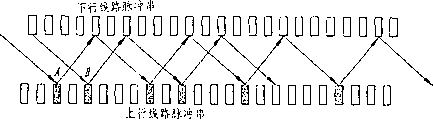
移动站与蜂窝式转换系统之间的通信将参照图1和2而予以描叙。图1表示多个层3消息11、层2帧13和信道脉冲串15。信道脉冲串15是发生在移动站与CSS之间的最短或最小的发送事件。在图1中,虽然信道脉冲串按时间分开,但它们是无必要分开的。也就是说,当一个信道脉冲串刚结束,下一个信道脉冲串就可开始。一个信道脉冲15包括一个完整的层2帧以及其他校正信息,例如误差。每个层2帧分成多个不同的信息组。其中一个信息组是数据信息组,具有有限长度,至少包含一部分层3消息11。由于层3信息的长度按包含在该层3信息的信息量变化,而以传送单一个层3消息时可能需要多个层2帧。结果,因为信道脉冲串与层2帧之间存在一一相应关系时,所以可能需要多个信道脉冲串来传送一个完整的层3消息。当需要多个信道脉冲串来传送一个层3消息时,这多个脉冲串通常不是连续的脉冲串。由于脉冲的接收、处理和对所接收脉冲的应答都需要时间,所以用以传送层3消息的脉冲以图2所示的交错排列的形式被发送。图2中,路径A表示一移动站A与CSS之间的通信。在该实例中,移动站A使用每第六个上行链路(移动站至CSS的方向)信道脉冲串以传送一个层3消息至CSS。其结果,在移动站A使用不同的相关上行链路脉冲串以传送层3消息的过程中,其他移动站,例如移动站B,也能将层3消息送到CSS。Communication between a mobile station and a cellular switching system will be described with reference to FIGS. 1 and 2. FIG. FIG. 1 shows a plurality of layer 3 messages 11 ,
在以蜂窝式电话系统为基础的时分多址联接(TDMA)中,固有的信道编码格式已被提出来作为达成基础的层2帧限定功能的手段,而且是消除上述比特填充和标记字符的传统层2成帧机构的有效方法。这些TDMA信道可用于专用或共用的基出上。这些TDMA信道基本上是一传输单元即脉冲串序列,其中每一脉冲串具一固定的信息载送能力。结果,每一脉冲串通常只载送层3消息的一部分。当TDMA信道以共用基础使用时,它可被认为是数字控制信道,其中,当发送层3信息至蜂窝式转换系统(在上行链路)时多个移动站或者争取它们自己的使用,或者共同地听取CSS以试图接收它们所要的可能的层3消息(在下行链路)。在上行链路方向,多个移动站在竞争的基出上试图与蜂窝式转换系统通信,同时多个移动站听取蜂窝式转换系统于下行链路方向发出的层3消息。然而,附加的层2流通特性的提高仍然是希望有的,因为不论上行链路即随机联接信道(RACH)和下行链路即联接应答信道(ARCH)在任何给定时刻都可能有多个不同的层3消息等待处理。In time-division multiple access (TDMA) based cellular telephone systems, an inherent channel coding format has been proposed as a means of achieving the
在已知的系统中,任何给定的层3消息必须使用发送该整个层3消息所需的那么多TDMA信道脉冲串来载送。用以发送不同层3消息的最后一个TDMA信道脉冲串可能没有充分利用其容量,因为层3消息的最后部分可能没有占据全部的数据段。在这些系统中,没有采取任何措施使任何待处理的层3消息在数据段的剩余容量中发送。其结果,每当有另外一个独立的不同的层3消息已处于可传送的状态,同时,上一个发送的层3消息能够在任何一个给定的TDMA信道脉冲串内完成的时候,现有的系统便浪费了许多可供使用的TDMA信道脉冲串容量。In known systems, any given layer 3 message must be carried using as many TDMA channel bursts as are required to transmit the entire layer 3 message. The last TDMA channel burst used to send a different layer 3 message may not have fully utilized its capacity because the last part of the layer 3 message may not occupy the entire data segment. In these systems, no provision is made for any pending layer 3 messages to be sent within the remaining capacity of the data segment. As a result, each time a separate, distinct Layer 3 message becomes available for transmission, while the last transmitted Layer 3 message can be completed within any given TDMA channel burst, the existing The system wastes much of the available TDMA channel burst capacity.
发明综述Summary of invention
为此,需要一种传送方法,以改善了信息脉冲串容量的方式将消息在移动站与蜂窝式转换系统之间传送,因此,本发明的目的在于,提供一种在移动站与蜂窝式转换系统之间传送消息的方法,在该系统中,一个给出的信道脉冲串包含的信息属于分立的不同的层3消息。For this reason, there is a need for a method of transmitting messages between a mobile station and a cellular switching system in a manner that improves the information burst capacity. A method of transferring messages between systems in which a given channel burst contains information belonging to separate and distinct Layer 3 messages.
因此,本发明的一个方面是提供一种在移动站与蜂窝式转换系统之间传送消息的方法,该方法使用了在一信道脉串中所载送的层2规程帧的概念,其中,该帧首先被区分为多个信息组。然后在一帧型式信息组标识帧的型式。第一个层3消息的结尾和第二个层3消息的开始被标识于一信息组的结尾,该信息组用以界定包含于一连续的数据信息组中的层3消息的各个部分。最后,该层2帧通过上行键路或下行链路的信道脉冲串予以传送。Accordingly, an aspect of the present invention is to provide a method of communicating messages between a mobile station and a cellular switching system using the concept of
下面将参照本发明的较佳实施例对本发明进行较详细的说明,这些实施例只作为例子并显示于附图中。The invention will be described in more detail below with reference to preferred embodiments of the invention, which are shown by way of example only in the accompanying drawings.
图1显示了在一通信系统中的多个层3消息、层2帧和信道脉冲串;Figure 1 shows a plurality of layer 3 messages,
图2以信道脉冲串的形式显示了移动站与蜂窝转换系统之间的通信路径;Figure 2 shows the communication path between the mobile station and the cellular switching system in the form of channel bursts;
图3显示了本发明的一实施例中的开始帧;Figure 3 shows a start frame in an embodiment of the present invention;
图4显示了本发明的一实施例中的中间帧;Figure 4 shows an intermediate frame in an embodiment of the present invention;
图5显示了本发明的一实施例中的结束帧;Fig. 5 shows the end frame in an embodiment of the present invention;
图6显示了本发明的一实施例中的专用层2帧;Figure 6 shows a
图7显示了本发明的一实施例中的共用层2帧。Fig. 7 shows a
本发明的详细描述Detailed description of the invention
虽然以下的描述是在时分多址联结蜂窝式转换系统的范围内,但本领域的技术人员将会明白,本发明可适用于其他数字通信应用场合,例如码分多址联接(CDMA)。Although the following description is in the context of TDMA cellular switching systems, those skilled in the art will appreciate that the present invention is applicable to other digital communication applications, such as Code Division Multiple Access (CDMA).
在本实施例中,本发明的层2协议由四个不同型式的层2帧组成,即开始帧、中间帧、结束帧和延长帧。这些不同型式的层2帧适宜于在蜂窝式电话系统中传送层3信息。为了便于说明,以下的描述假设了一个如EIA/TIA IS-54B中所述的快速关联控制信道(FACCH)的TDMA信道脉冲串结构,但本发明并不限于此。所述的快速关联控制信道是一发信号信道,用以在蜂窝式转换系统与移动站之间传送控制和管理信息。在本实施例中,快速关联控制信道的结构使得在每个TDMA信道脉冲串中有65信息载送或负载比特可供使用。In this embodiment, the
在一个蜂窝式系统中,可以同时有多个移动站准备好与蜂窝式转换系统通信。但是,每一上行链路只有一个移动站能与CSS进行通信。其结果,那些已准备好传送的移动站竞争获取可用的上行链路信道脉冲串(争用过程),其中只有一个移动站会获准联接到(赢取一竞争过程)可用的上行链路信道脉冲串序列。如果一个移动站被强制地在竞争的基础上传送,每个层3消息在试图联接CSS时都有等待处理的时间,导致增大的通过量延迟,系统通过量性能将会劣化。然而,本发明提供了一种手段,通过指示来自一个移动站的分立的且是不同的层3信息的逻辑上的关联或连接来避免多重竞争。在本发明中,一旦某一移动站赢取了一个竞争过程,即准许与CSS联接,它就可利用这一联接机构将全部准备好传送的分立且不同的层3消息发送。这使系统具有较好的通过量性能,即,减少了在竞争基础上的与CSS的联接量。本发明还通过以较少的信道脉冲串载送多个层3消息,即任何给定信道脉冲串可包含来自两个不同层3消息的信息。In a cellular system, multiple mobile stations may be ready to communicate with the cellular switching system at the same time. However, only one mobile station per uplink can communicate with the CSS. As a result, those mobile stations that are ready to transmit compete for available uplink channel bursts (the contention process), where only one mobile station will be allowed to attach to (win a contention process) an available uplink channel burst string sequence. If a mobile station is forced to transmit on a contention basis, each layer 3 message will have to wait for processing time while attempting to connect to the CSS, resulting in increased throughput delay and system throughput performance will be degraded. However, the present invention provides a means to avoid multiple contentions by indicating the logical association or connection of separate and distinct layer 3 information from a mobile station. In the present invention, once a mobile station wins a contention process, ie, is permitted to associate with the CSS, it can use this association mechanism to send separate and distinct layer 3 messages all ready for transmission. This gives the system better throughput performance, ie, reduces the number of joins to CSS on a contention basis. The invention also allows for the carrying of multiple layer 3 messages in fewer channel bursts, ie any given channel burst may contain information from two different layer 3 messages.
每个层2帧分成多个信息组,这些信息组是,一个附加脉冲串指示信息组,一个数据信息组,一个消息结束信息组,一个帧型信息组,一个帧型变更信息组,一个初始/重复信息组,和一个反转信息组。下面将参照附图对各个信息组予以说明。Each
图3显示了本发明的一个实施例中的开始帧。帧10被分成四个信息组:帧型信息组12;初始/重复信息组14;数据信息组16;和CRC(循环冗余码校验)信息组18。由于层3消息可能长于单个的层2帧,可能需要多个层2帧来传送一个层3消息。其结果,帧型信息组12把帧型标识为开始帧、中间帧和结束帧,或延长帧。在该实施例中,帧型信息组12占据了信道脉冲串有效负载的2毕特。帧型信息组12是开始帧10的第一个信息组,这样,每个信道脉冲串的首2毕特标识了帧型,其中00表示开始帧,01表示中间帧,10表示结束帧,而11表示延长帧。开始帧型用于多脉冲串层3消息传送的初始脉冲。Figure 3 shows a start frame in one embodiment of the present invention. The
开始帧10的下一个是1毕特的初始/重复信息组14。传送脉冲串有时会被错误地接收。结果,一个传送脉冲串可能须要再发送。为了使CSS正常地操作,必须识别所接收到的脉冲串是一个初始传送脉冲串还是一个重复传送脉冲串。而该初始/重复信息组14即指出一个信道脉冲串是第一次传送或是重复传送。例如在初始/重复信息组14中的“0”表示信道脉冲串第一次被发送,而初始/重复信息组14中的“1”则表示信道脉冲串被再次发送。Next to the
数据信息组16构成了开始帧10的主要部分。数据信息组16包含了待传送的层3信息的一部分。最后,开始帧包括一个用来检测误差的循环冗余码校验(CRC)信息组18。蜂窝式转换系统用这个循环冗余码校验信息组18来决定是否有任何上行链路信道脉冲串被错误地接收。采用CRC信息组以判定错误检测的方法是本领域众所周知的,故不再说明。The data field 16 forms the main part of the
图4表示本发明的一实施例中的一个中间帧20,该中间帧用于多脉冲串层3消息传送的中间信道脉冲串。中间帧20包括帧型信息组12,初始/重复信息组14,数据信息组16和一个CRC信息组18,这些信息组已配合图3在上面作了说明。该中间帧附加有一个反转信息组22以提供所需的报文头对准,以便每当余下的层3消息中的信息长于45比特时保持一个清楚而一致的从中间帧至结束帧的过渡点。反转信息组之被加到中间帧,是为了避免当余下46比特的层3消息待传送时将发生的不希望有的传送状况。如果没有这个反转信息组,所有余下的46比特的数据将会于一个中间帧中发送,而其后的结束帧将包含一个空数据信息组。这一难于处理状况通过在中间帧附加一个反转信息组而得以避免,这样,余下46比特中的45比特在一个中间帧被传送,而最后的1比特则于结束帧被传送。Figure 4 shows an
图5显示了本发明的一实施例的结束帧30。该结束帧30用来传送多脉冲串层3消息的最后一脉冲串。结束帧30包括帧型信息组12,初始/重复组信息组14,数据信息组16和CRC信息组18,这些信息组已结合图3说明过。然而,该结束帧也包括一个附加脉冲串指示器信息组24,以提供消息连接的明白指示,因为附加脉冲指示器指出共用同一上行链路过程的属于一分立且不同的层3信息的一个附加脉冲是否在等待处理。当用于下行链路信道时,该附加脉冲串指示器信息组24也提供消息连接的明白指示。如果附加脉冲串指示器信息组24指示有一个附加上行链路信道脉冲串正待处理,蜂窝式转换系统将继续工作,就象初始的层3消息仍在传送一样。这保证了余下的连接层3消息共用了初始的上行链路联结过程,从而不须经受另外的竞争。Figure 5 shows an
第四个帧型,即延长帧,显示于图6和7中。在图6中,显示了本发明一实施例的专用层2帧40。该专用层2帧是当层3消息可以在单一个的信道脉冲串中全体被传送时使用的。也就是说,在本实施例中,整个层3消息可载送于对数据信息组提供的46比特内。专用层2帧包括帧型信息组12,数据信息组16和CRC信息组18,这些信息组已于上结合图3说明过。然而,层2帧也包括帧型变更信息组26,其中“0”表示专用层2帧,而“1”表示共用的层2帧。A fourth frame type, the extended frame, is shown in FIGS. 6 and 7 . In FIG. 6, a
图7显示了一个共用的2帧,每当第一个层3消息结束而在数据信息组有可供使用的附加空间,且另外的一个分立及不同的层3消息已准备传送时,便使用该共同层2帧50。当共用层2帧用于上行链路方向时,信道脉冲串的共用基本上提供了层3消息连接的隐含指示。可是,当共用层2帧用于下行链路方向时,信道脉冲串的共用并不提供层3信息连接的隐含指示。也就是说,在上行链路方向,图7所示的两个消息32和34必须来自同一移动站;而在下行方向,发自蜂窝式转换系统的两个消息可供给两个不同的移动站。其结果,当一个层3消息在数据信息组之中途部分结束时,可应用的信道脉冲串容量就不会浪费。共用层2帧50含有一帧型信息组16、初始/重复信息组14、数据信息组16和CRC信息组18,这些信息组已于上面结合图3说明过,另外还有一个在上面结合图6说明过的帧型变更信息组26。如图7所示,为了提供层3消息的限定的信息,在共用层2帧中附加了一个消息结束信息组28。也就是说,消息结束信息组28指示,在数据信息组中第一个层3消息32在什么地方结束和第二个层3消息34在什么地方开始。其结果,接收端(CSS或一个或多个移动站)可辨别这两个层3信息。Figure 7 shows a common 2-frame that is used whenever the first Layer 3 message ends and additional space is available in the data field, and a separate and distinct Layer 3 message is ready for transmission. The
由于在一个信道上可有多个移动站争取的相同联接机会,必须有一个方法以辨别各个移动站。在本发明的一个实施例中,由于部分或全部地载送层3消息的第一TDMA信道脉冲串在竞争基础上由一移动站发送至蜂窝式转换系统时,都含有发信移动站的特有信息。含有这种称为部分回声的特有信息使蜂窝式转换系统在正确地收到第一信道脉冲串后,对竞争移动站提供部分回声反馈,以清楚显示哪一个移动站的第一信道脉冲串已被正确接收。Since there can be multiple mobile stations competing for the same connection opportunity on a channel, there must be a way to distinguish individual mobile stations. In one embodiment of the present invention, since the first TDMA channel burst carrying layer 3 messages partially or completely is sent by a mobile station to the cellular switching system on a contention basis, it contains the unique characteristics of the originating mobile station. information. The inclusion of this unique information, called a partial echo, enables the cellular switching system to provide partial echo feedback to competing mobiles after the first channel burst has been correctly received to clearly show which mobile's first channel burst has been received. is received correctly.
虽然描述并图示了本发明的一个特别的实施例,应该明白,本发明并不限于此,因为本领域的技术人员可作各种修改。本申请主张任何修改都包括在所公开和要求的本发明的精神和范围内。While a particular embodiment of the invention has been described and illustrated, it is to be understood that the invention is not limited thereto since various modifications may be made by those skilled in the art. This application claims that any modifications are included within the spirit and scope of the invention as disclosed and claimed.
Claims (21)
Applications Claiming Priority (2)
| Application Number | Priority Date | Filing Date | Title |
|---|---|---|---|
| US4745293A | 1993-04-19 | 1993-04-19 | |
| US08/047,452 | 1993-04-19 |
Publications (2)
| Publication Number | Publication Date |
|---|---|
| CN1106987A CN1106987A (en) | 1995-08-16 |
| CN1069467C true CN1069467C (en) | 2001-08-08 |
Family
ID=21949064
Family Applications (1)
| Application Number | Title | Priority Date | Filing Date |
|---|---|---|---|
| CN94190190A Expired - Lifetime CN1069467C (en) | 1993-04-19 | 1994-04-19 | Layer 2 protocol for the random access channel and the access response channel |
Country Status (13)
| Country | Link |
|---|---|
| US (1) | US5610917A (en) |
| KR (1) | KR100328196B1 (en) |
| CN (1) | CN1069467C (en) |
| AU (1) | AU677669B2 (en) |
| BR (1) | BR9405140A (en) |
| CA (1) | CA2138256C (en) |
| GB (1) | GB2283644B (en) |
| NZ (1) | NZ266282A (en) |
| RU (1) | RU2144734C1 (en) |
| SE (1) | SE516740C2 (en) |
| SG (1) | SG52397A1 (en) |
| TW (1) | TW234224B (en) |
| WO (1) | WO1994024786A1 (en) |
Families Citing this family (11)
| Publication number | Priority date | Publication date | Assignee | Title |
|---|---|---|---|---|
| JP2919293B2 (en) * | 1995-03-02 | 1999-07-12 | 日本電気株式会社 | Packet communication method |
| US5802057A (en) * | 1995-12-01 | 1998-09-01 | Apple Computer, Inc. | Fly-by serial bus arbitration |
| US5912920A (en) * | 1997-03-27 | 1999-06-15 | Marchok; Daniel J. | Point-to multipoint digital communications system facilitating use of a reduced complexity receiver at each of the multipoint sites |
| KR100290862B1 (en) * | 1998-04-02 | 2001-07-12 | 구자홍 | Slot Structure for Transmitting Packet Data and Method of Transmitting Packet Comprising the Slots in Mobile Communication Systems |
| WO2000016435A2 (en) * | 1998-09-14 | 2000-03-23 | Samsung Electronics Co., Ltd. | Method for processing data to be transmitted over common channel |
| US6597680B1 (en) | 1998-11-16 | 2003-07-22 | Telefonaktiebolaget Lm Ericsson (Publ) | Packet traffic channel reassignment |
| US6859465B1 (en) * | 1999-11-22 | 2005-02-22 | Telefonaktiebolaget Lm Ericsson (Publ) | Method and apparatus for constant throughput rate adaptation |
| US6539030B1 (en) * | 2000-02-07 | 2003-03-25 | Qualcomm Incorporated | Method and apparatus for providing configurable layers and protocols in a communications system |
| GB2386299B (en) * | 2002-03-09 | 2004-08-11 | Motorola Inc | A method to classify and structure a multimedia message |
| KR100629775B1 (en) * | 2002-04-15 | 2006-09-28 | 노키아 코포레이션 | RP logic layer of the communication station |
| US20090219916A1 (en) * | 2008-02-29 | 2009-09-03 | Motorola, Inc. | Method to scan for critical transmissions while transmitting on a conventional time division multiple access channel |
Citations (3)
| Publication number | Priority date | Publication date | Assignee | Title |
|---|---|---|---|---|
| US5010547A (en) * | 1989-07-10 | 1991-04-23 | Motorola, Inc. | Multiple messaging using a single selective call address |
| US5012469A (en) * | 1988-07-29 | 1991-04-30 | Karamvir Sardana | Adaptive hybrid multiple access protocols |
| US5050166A (en) * | 1987-03-17 | 1991-09-17 | Antonio Cantoni | Transfer of messages in a multiplexed system |
Family Cites Families (16)
| Publication number | Priority date | Publication date | Assignee | Title |
|---|---|---|---|---|
| GB2144310A (en) * | 1983-08-01 | 1985-02-27 | Philips Electronic Associated | Multiple-access communications system |
| US4578815A (en) * | 1983-12-07 | 1986-03-25 | Motorola, Inc. | Wide area coverage radio communication system and method |
| US4577316A (en) * | 1984-02-13 | 1986-03-18 | Rca Corporation | Synchronization system for a regenerative subtransponder satellite communication system |
| SU1254588A1 (en) * | 1985-04-08 | 1986-08-30 | Предприятие П/Я М-5308 | Radio communication device |
| DE3523238A1 (en) * | 1985-06-28 | 1987-01-02 | Siemens Ag | METHOD FOR TRANSMITTING DIGITAL SIGNALS |
| FR2584884B1 (en) * | 1985-07-09 | 1987-10-09 | Trt Telecom Radio Electr | FREE CHANNEL SEARCHING METHOD AND DEVICE FOR A MOBILE RADIO SYSTEM |
| JP2582369B2 (en) * | 1987-05-13 | 1997-02-19 | 日本電気株式会社 | Roaming registration / cancellation method |
| US4905234A (en) * | 1987-06-03 | 1990-02-27 | General Electric Company | Apparatus and method for transmitting digital data over a radio communications channel |
| US4992783A (en) * | 1988-04-04 | 1991-02-12 | Motorola, Inc. | Method and apparatus for controlling access to a communication system |
| US4977589A (en) * | 1988-11-25 | 1990-12-11 | Motorola, Inc. | Signalling and control protocol for a communication system |
| US5220562A (en) * | 1989-05-12 | 1993-06-15 | Hitachi, Ltd. | Bridge apparatus and a communication system between networks using the bridge apparatus |
| GB2236454A (en) * | 1989-09-01 | 1991-04-03 | Philips Electronic Associated | Communications system for radio telephones |
| JP2646852B2 (en) * | 1989-12-04 | 1997-08-27 | モトローラ・インコーポレイテッド | Packet handling method |
| US5166929A (en) * | 1990-06-18 | 1992-11-24 | Northern Telecom Limited | Multiple access protocol |
| SE468031B (en) * | 1991-02-28 | 1992-10-19 | Ericsson Telefon Ab L M | PROCEDURES TO RECEIVE FROM A MOBILE STATION TO A RURAL MOBILE RADIO SYSTEM |
| US5235592A (en) * | 1991-08-13 | 1993-08-10 | International Business Machines Corporation | Dynamic switch protocols on a shared medium network |
-
1994
- 1994-04-11 TW TW083103138A patent/TW234224B/zh not_active IP Right Cessation
- 1994-04-19 KR KR1019940704673A patent/KR100328196B1/en not_active Expired - Lifetime
- 1994-04-19 WO PCT/US1994/004290 patent/WO1994024786A1/en not_active Ceased
- 1994-04-19 RU RU94046329A patent/RU2144734C1/en active
- 1994-04-19 BR BR9405140-2A patent/BR9405140A/en not_active IP Right Cessation
- 1994-04-19 AU AU67705/94A patent/AU677669B2/en not_active Expired
- 1994-04-19 NZ NZ266282A patent/NZ266282A/en not_active IP Right Cessation
- 1994-04-19 CN CN94190190A patent/CN1069467C/en not_active Expired - Lifetime
- 1994-04-19 GB GB9423960A patent/GB2283644B/en not_active Expired - Lifetime
- 1994-04-19 CA CA002138256A patent/CA2138256C/en not_active Expired - Lifetime
- 1994-04-19 SG SG1996003979A patent/SG52397A1/en unknown
- 1994-12-07 SE SE9404256A patent/SE516740C2/en not_active IP Right Cessation
-
1995
- 1995-06-07 US US08/477,574 patent/US5610917A/en not_active Expired - Lifetime
Patent Citations (3)
| Publication number | Priority date | Publication date | Assignee | Title |
|---|---|---|---|---|
| US5050166A (en) * | 1987-03-17 | 1991-09-17 | Antonio Cantoni | Transfer of messages in a multiplexed system |
| US5012469A (en) * | 1988-07-29 | 1991-04-30 | Karamvir Sardana | Adaptive hybrid multiple access protocols |
| US5010547A (en) * | 1989-07-10 | 1991-04-23 | Motorola, Inc. | Multiple messaging using a single selective call address |
Also Published As
| Publication number | Publication date |
|---|---|
| AU6770594A (en) | 1994-11-08 |
| US5610917A (en) | 1997-03-11 |
| WO1994024786A1 (en) | 1994-10-27 |
| KR100328196B1 (en) | 2002-07-02 |
| GB9423960D0 (en) | 1995-02-15 |
| CA2138256C (en) | 2004-07-06 |
| GB2283644B (en) | 1998-06-17 |
| AU677669B2 (en) | 1997-05-01 |
| SG52397A1 (en) | 1998-09-28 |
| KR950702363A (en) | 1995-06-19 |
| GB2283644A (en) | 1995-05-10 |
| NZ266282A (en) | 1997-07-27 |
| SE516740C2 (en) | 2002-02-26 |
| TW234224B (en) | 1994-11-01 |
| RU2144734C1 (en) | 2000-01-20 |
| SE9404256D0 (en) | 1994-12-07 |
| BR9405140A (en) | 1999-08-31 |
| SE9404256L (en) | 1995-02-20 |
| CA2138256A1 (en) | 1994-10-27 |
| CN1106987A (en) | 1995-08-16 |
Similar Documents
| Publication | Publication Date | Title |
|---|---|---|
| CN1099182C (en) | Data Transmission System Using Sliding Window Data Flow Control | |
| CN1139225C (en) | Data segmentation method in telecommunication system and telecommunication system thereof | |
| CN100359839C (en) | Ways to minimize feedback responses in an auto-repeat request protocol | |
| CN1079628C (en) | Method for packet data transmission in a mobile radio communication network | |
| US7804855B2 (en) | Method and system for exploiting spare link bandwidth in a multilane communication channel | |
| CN1069467C (en) | Layer 2 protocol for the random access channel and the access response channel | |
| US20060139201A1 (en) | Radio packet communication method | |
| US7639687B1 (en) | Encoding scheme with arbitrary control symbol placement | |
| CN1165602A (en) | Transmission control method and communication system between multiple base stations and corresponding base stations | |
| CN102781040A (en) | Concatenated frame structure for data transmission | |
| KR20130045788A (en) | Method and system for multiplexing data streaming in audio/video networks | |
| CN1143569C (en) | Transmission of useful data in communication systems by wireless communication between communicators on the basis of a predetermined air interface protocol, in particular methods of transmission of voice data and/or packet data of the DECT-system | |
| US7468976B2 (en) | Efficiency improvement for shared communications networks | |
| WO2022227640A1 (en) | Data processing method for flexible ethernet, and related apparatus | |
| WO2000060797A3 (en) | Selective repeat arq with efficient utilization of bitmaps | |
| US20080019389A1 (en) | Multiple Channels and Flow Control Over a 10 Gigabit/Second Interface | |
| CN1457618A (en) | Radio communication system | |
| WO2025055797A1 (en) | Data retransmission method, apparatus, and system | |
| KR20010082712A (en) | Mobile radio telecommunication system with real-time video service | |
| CN1238626A (en) | Bandwidth Control in a Packet-Based Data System | |
| CN1697556A (en) | Method for transferring status report | |
| US7251767B2 (en) | Method for correcting errors in a packet-oriented data transmission | |
| GB2319145A (en) | A method for transmitting messages | |
| NZ314886A (en) | Layer 2 protocol for random access and access response channels | |
| SE523977C2 (en) | Error checking at Wlan |
Legal Events
| Date | Code | Title | Description |
|---|---|---|---|
| C06 | Publication | ||
| PB01 | Publication | ||
| C10 | Entry into substantive examination | ||
| SE01 | Entry into force of request for substantive examination | ||
| C14 | Grant of patent or utility model | ||
| GR01 | Patent grant | ||
| C17 | Cessation of patent right | ||
| CX01 | Expiry of patent term |
Expiration termination date: 20140419 Granted publication date: 20010808 |