Disclosure of Invention
The invention aims to provide an accurate and effective water quality image classification method.
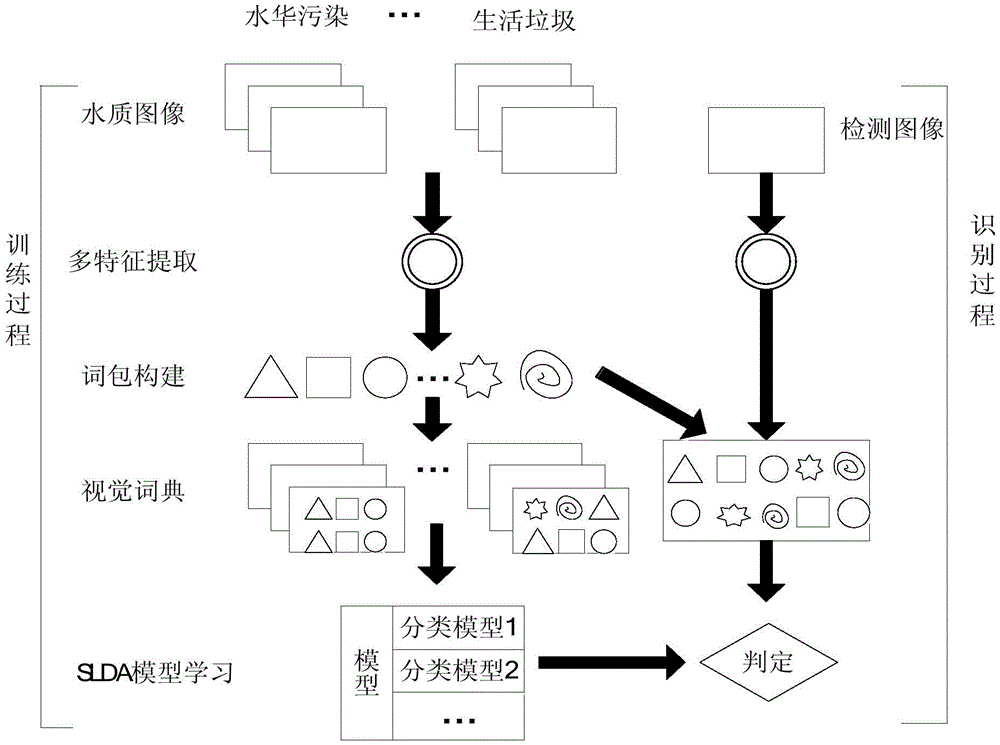
The technical scheme adopted by the invention for solving the technical problems is as follows: a water quality image classification method uses a multi-feature fusion word package to classify water quality images, and specifically comprises the following steps:
① collecting water quality images, marking water quality image category labels to indicate which category the training images belong to in the five images of normal, water bloom pollution, water hyacinth pollution, factory pollution and domestic garbage pollution;
②, detecting key points of the water quality image by using an image pyramid, extracting direction gradient histograms and color features of the key points in the water quality image, and fusing the extracted direction gradient histograms and the color features into a feature vector describing the current key points;
③, learning a visual dictionary by using a Dirichlet mixture model, and encoding each key point feature vector generated by an image to generate an image word packet, wherein the specific process is as follows:
setting the posterior probability of the model as
K is 1000, which is taken as the number of categories to which each key point may belong, N is the number of samples, q is the number of samples
γk(V
k) Is a parameter of gamma
k,1,γ
k,2Beta distribution of (V)
kIs the random variable of the distribution, which is a real-valued random number;
is a parameter of
In which
Is a 35-dimensional column vector, a
kIs a real value, B
kIs a 35 x 35 matrix, I is a 35 x 35 identity matrix,
is the random variable of the distribution, and two random vectors are respectively taken, one is a 35-dimensional column vector, and the other is a 35 x 35 matrix;
is a parameter of
Is preferably a polynomial distribution of (a) and (b),
represents the nth sampleProbability of belonging to the 1 st of the 1000 classes, z
nIs the random variable of the distribution, which is a real-valued integer random number;
③ -1, taking the class number K as an initialization class number, giving an initialization model parameter lambda, taking four parameters of Gaussian Wirsatt distribution as the lambda, respectively taking a
mean parameter 0 and a variance matrix as well as a unit matrix I of 35 x 35, taking a degree of freedom parameter as a key point characteristic dimension D, taking a value of 35, taking a scale matrix as well as the unit matrix I of 35 x 35 and randomly initializing the parameters
Representing the probability that each sample belongs to K classes, the total probability adding to 1;
③ -2, for each keypoint in the training sample, it is characterized by XiCalculating beta distribution parameters and conjugate distribution parameters in posterior probability
Wherein D is the characteristic dimension of the key point, the value is 35,
representing the posterior probability, gamma, that the ith sample belongs to the k class
k,1,γ
k,2Is the posterior probability q (V)
k,θ
k *,z
n) Middle beta distribution
Two parameters of a
k,
B
kI represents q (V)
k,θ
k *,z
n) Middle gauss witxate distribution
Wherein, I is an identity matrix, k is taken from 1 to 1000, α is a model parameter, and the value is 0.001;
③ -3, for each sample, calculating the probability that the sample corresponds to each category according to the following formula:
wherein
The values of (A) are as follows:
d is a characteristic dimension of the key point, the value is 35, e is a natural base number, pi is a circumferential rate constant, psi () is a second derivative of a gamma function,
is a parameter of
The gaussian distribution of (a) contains two parameters, namely a mean vector and a variance matrix;
③ -4, Observation
If the value is not changed, the operation is stoppedStopping updating, otherwise, switching to ③ -2 for recalculation, and when the updating is stopped, remembering the variation posterior probability parameter gamma at the moment
k,1,γ
k,2,
For all the corresponding N samples, estimating the categories of the N samples by using a Dirichlet mixed model, recording different category numbers as H, and recording the H different categories as a visual dictionary;
③ -5, feature X for each keypoint
iUsing gamma obtained by training
k,1,γ
k,2,
Estimating a feature X
iPosterior probability belonging to each category:
③ -6, finding the current key point characteristic XiVisual words w belonging to a visual dictionaryiThe estimation formula is as follows:
in this encoding, the result is found so that
The maximum k value is taken as the current key point characteristic X
iVisual words w in a visual dictionary
iIt is taken as the current key point feature X
iThe visual word to which it belongs;
③ -7, for each water quality image, firstly obtaining all key points by using an image pyramid, then obtaining 35-dimensional feature vectors of each key point, repeating the steps ③ -5 and ③ -6 to obtain which visual word of the dictionary all the key points belong to, and forming a visual word packet of the water quality image;
④, training the supervised topic model by using the image word packet and the class label to obtain supervised topic model parameters, and using the trained supervised topic model in the subsequent classification task;
⑤, using the water quality image to be classified as the input image, extracting the features of the input image according to the method of step ②, quantizing the feature into word packets, and classifying the input image by using the trained supervised topic model obtained in step ④ to obtain the class of the input image.
The specific process of the step ① is as follows:
① -1, collecting water surface images by a high-definition video camera or a camera, and dividing the collected water quality images into 5 types, wherein the types are normal, water bloom pollution, water hyacinth pollution, factory pollution and domestic garbage pollution;
① -2, primarily processing the collected water quality images, removing images containing people and ships, and dividing polluted areas of the water quality images with two or more types of pollution to be used as a plurality of training images;
① -3, using an image scaling method to resize the image to a 400 x 400 size image;
① -4, giving training labels to 5-class water quality images, wherein a normal label is 1, a water bloom pollution label is 2, a water hyacinth pollution label is 3, a factory pollution discharge label is 4, and a household garbage pollution label is 5.
The specific process of the step ② is as follows:
② -1, using an image pyramid to mark key points of the water quality image;
② -2, calculating R, G, B color channel color mean values of all pixel points in a 24 × 24 neighborhood window taking the current key point as the center;
② -3, converting the 256 color channels into 64 color channels, and recording the value obtained by mapping the color mean value of the c color channel to the 64 color space as block
c,
Wherein c is not less than 1 and not more than 3, c is an R color channel when c is 1, G is a c color channel when c is 2, B is a c color channel when c is 3, block represents a color mean value of the c color channel, color
mRepresenting the m-th color in a 64-color space, m is more than or equal to 1 and less than or equal to 64, the symbol "| | |" is a Euclidean distance solving symbol,
the expression is taken to make | | | block-color
mTaking the minimum color as the color value of the current channel, wherein the three channels form three color characteristics;
② -4, normalizing the color space of the input image by using a Gamma correction method;
② -5, differentiating the 24 x 24 pixel area where the current key point is located into 16 cells, 6 x 6 pixels/cell, and calculating the gradient direction of each pixel in the single cell
And gradient size
Wherein x and y represent the coordinates of the pixel point, f (x, y) represents the gray values of the pixel in x and y, and the gradient histogram of each cell is counted to form the description of each cell; and forming a block by using the cells of 4 × 4, and connecting the features of all the cells in the block in series to obtain the directional gradient histogram feature description of the key point.
The specific processes of the steps ④ and ⑤ are as follows:
④ -1, inputting a visual word packet of each image, recording the visual word packet as r and recording the visual word packet as C according to a corresponding water quality image category label;
④ -2, in the supervised theme model, learning by using a variation method to obtain a trained supervised theme model;
⑤ -1, performing characteristic extraction on the water quality image acquired by the cameraObtaining the feature X of each key point of the imageiThe feature vector of (2);
⑤ -2, feature X for each keypointiEstimate XiProbability of belonging to each category:
wherein
The values of (A) are as follows:
then calculating the current key point characteristic XiVisual words w belonging to a visual dictionaryiThe estimation formula is as follows:
for all key point characteristics X of the current water quality imageiCalculating the visual word w to which it belongsiThen forming an image word packet;
⑤ -3, substituting the image word packet of the water quality image into the trained supervised theme model to obtain the category label.
Compared with the prior art, the invention has the advantages that:
1) the method firstly adopts the Gaussian pyramid to detect the extreme points in the image, thus being beneficial to eliminating redundant pixels in the image characteristics and improving the identification precision;
2) when the visual dictionary is established, the Dirichlet mixed model is used for generating the water quality image visual dictionary, compared with the traditional model with determined size in the traditional visual dictionary learning, the algorithm can automatically estimate the number of the visual dictionaries, and is favorable for eliminating the correlation and redundancy among visual words in the visual dictionary;
3) when in recognition, the visual dictionary is utilized to firstly obtain an image visual word packet model, then the supervised topic model is trained, and the model is introduced to enable the water quality image recognition framework to describe random factors in the water quality image in a statistical angle and describe various characteristics of the water quality image in a semantic level, so that the water quality image recognition rate is improved.
Detailed Description
The invention is described in further detail below with reference to the accompanying examples.
A water quality image classification method uses a multi-feature fusion word package to classify water quality images, and specifically comprises the following steps:
① -1, adopting a high-definition camera or a camera to respectively acquire M times of images of a normal water surface, a water bloom polluted water surface, a water hyacinth polluted water surface, a factory pollution water surface and a household garbage polluted water surface to obtain M water quality images of each water surface, dividing the acquired water quality images into 5 types, namely normal water quality images, water bloom pollution images, water hyacinth pollution images, factory pollution and household garbage pollution images, judging the normal water surface, the water bloom polluted water surface, the water hyacinth polluted water surface, the factory pollution water surface and the household garbage polluted water surface through human eyes during image acquisition, preferably acquiring each water quality image in a plurality of different places, wherein the number M of acquired images is more than or equal to 100, so that the robustness of the water quality image classification method can be effectively improved, and on the basis, the larger M is the better.
① -2, primarily processing the collected water quality images, removing images containing people and ships, and dividing polluted areas of the water quality images with two or more types of pollution to be used as a plurality of training images;
① -3, adjusting the size of all the obtained water quality images by using the existing image scaling method to make the size of all the water quality images consistent, wherein the pixels of the images are 400 × 400;
① -4, giving training labels to 5-class water quality images, wherein a normal label is 1, a water bloom pollution label is 2, a water hyacinth pollution label is 3, a factory pollution discharge label is 4, and a household garbage pollution label is 5;
② -1, calibrating the key points of the water quality image by using an image pyramid to obtain the position information of each key point in each water quality image, wherein a schematic diagram of extracting the position information of the key points by using a Gaussian pyramid is shown in FIG. 2;
② -2, calculating R, G, B color channel color mean values of all pixel points in a 24 × 24 neighborhood window taking the current key point as the center;
② -3, converting the 256 color channels into 64 color channels, and recording the value obtained by mapping the color mean value of the c color channel to the 64 color space as block
c,
Wherein c is not less than 1 and not more than 3, c is an R color channel when c is 1, G is a c color channel when c is 2, B is a c color channel when c is 3, block represents a color mean value of the c color channel, color
mRepresenting the m-th color in a 64-color space, m is more than or equal to 1 and less than or equal to 64, the symbol "| | |" is a Euclidean distance solving symbol,
the expression is taken to make | | | block-color
mTaking the minimum color as the color value of the current channel, wherein the three channels form three color characteristics;
② -4, normalizing the color space of the input image by using a Gamma correction method;
② -5, differentiating the 24 x 24 pixel region where the current key point is located into 16cell, 6 × 6 pixels/cell, calculating gradient direction of each pixel in the single cell
And gradient size
Wherein x and y represent the coordinates of the pixel point, f (x, y) represents the gray values of the pixel in x and y, and the gradient histogram of each cell is counted to form the description of each cell; forming 4 × 4 adjacent cells into a block, and connecting the features of all the cells in the block in series to obtain the feature description of the directional gradient histogram of the key point;
setting the posterior probability of the model as
The value of K is 1000, which is taken as the number of categories to which each keypoint may belong, N is the number of samples,
is a parameter of gamma
k,1,γ
k,2Beta distribution of (V)
kIs the random variable of the distribution, which is a real-valued random number;
is a parameter of
In which
Is a 35-dimensional column vector, a
kIs a real value, B
kIs a 35 x 35 matrix, I is a 35 x 35 identity matrix,
is the random variable of the distribution, and two random vectors are respectively taken, one is a 35-dimensional column vector, and the other is a 35 x 35 matrix;
is a parameter of
Is preferably a polynomial distribution of (a) and (b),
denotes the probability that the nth sample belongs to the 1 st of the 1000 classes, z
nIs the random variable of the distribution, which is a real-valued integer random number;
③ -1, taking the class number K as an initialization class number, giving an initialization model parameter lambda, taking four parameters of Gaussian Wirsatt distribution as the lambda, respectively taking a
mean parameter 0 and a variance matrix as well as a unit matrix I of 35 x 35, taking a degree of freedom parameter as a key point characteristic dimension D, taking a value of 35, taking a scale matrix as well as the unit matrix I of 35 x 35 and randomly initializing the parameters
Representing the probability that each sample belongs to K classes, the total probability adding to 1;
③ -2, for each keypoint in the training sample, it is characterized by XiCalculating beta distribution parameters and conjugate distribution parameters in posterior probability
Wherein D is the characteristic dimension of the key point, the value is 35,
representing the posterior probability, gamma, that the ith sample belongs to the k class
k,1,γ
k,2Is the posterior probability q (V)
k,θ
k *,z
n) Middle beta distribution
Two parameters of a
k,
B
kI represents q (V)
k,θ
k *,z
n) Middle gauss witxate distribution
Wherein, I is an identity matrix, k is taken from 1 to 1000, α is a model parameter, and the value is 0.001;
③ -3, for each sample, calculating the probability that the sample corresponds to each category according to the following formula:
wherein
The values of (A) are as follows:
d is a characteristic dimension of the key point, the value is 35, e is a natural base number, pi is a circumferential rate constant, psi () is a second derivative of a gamma function,
is a parameter of
The gaussian distribution of (a) contains two parameters, namely a mean vector and a variance matrix;
③ -4, Observation
If the value is not changed, the updating is stopped, otherwise, the calculation is switched to ③ -2 for recalculation, and when the updating is stopped, the variation posterior probability parameter gamma at the moment is memorized
k,1,γ
k,2,
For all the corresponding N samples, estimating the categories of the N samples by using a Dirichlet mixed model, recording different category numbers as H, and recording the H different categories as a visual dictionary;
③ -5, feature X for each keypoint
iUsing gamma obtained by training
k,1,γ
k,2,
Estimating a feature X
iPosterior probability belonging to each category:
③ -6, finding the current key point characteristic XiVisual words w belonging to a visual dictionaryiThe estimation formula is as follows:
in this encoding, the result is found so that
Maximum k valueUsing it as current key point feature X
iVisual words w in a visual dictionary
iIt is taken as the current key point feature X
iThe visual word to which it belongs;
③ -7, for each water quality image, firstly obtaining all key points by using an image pyramid, then obtaining 35-dimensional feature vectors of each key point, repeating the steps ③ -5 and ③ -6 to obtain which visual word of the dictionary all the key points belong to, and forming a visual word packet of the water quality image;
④ -1, inputting a visual word packet of each image, recording the visual word packet as r and recording the visual word packet as C according to a corresponding water quality image category label;
④ -2, in the supervised theme model, learning by using a variation method to obtain the supervised theme model;
⑤ -1, extracting the characteristics of the water quality image collected by the camera to obtain the characteristic X of each key point of the imageiThe feature vector of (2);
⑤ -2, feature X for each keypointiEstimate XiProbability of belonging to each category:
wherein
The values of (A) are as follows:
then calculating the current key point characteristic XiVisual words w belonging to a visual dictionaryiThe estimation formula is as follows:
for all key point characteristics X of the current water quality imageiCalculating the visual word w to which it belongsiThen formForming an image word packet;
⑤ -3, substituting the image word packet of the water quality image into the trained supervised theme model to obtain the category label.
In the above embodiments, the supervised topic model and how to obtain the trained supervised topic model through the variation method learning adopt the method in the prior art "Wang C, Blei D, Li F. Simultaneous image classification and identification [ C ]// IEEE Conference on Computer Vision & Pattern recognition.2009:1903 1910.").