CN1044373C - Polypropylene injection mold object - Google Patents
Polypropylene injection mold object Download PDFInfo
- Publication number
- CN1044373C CN1044373C CN93109404A CN93109404A CN1044373C CN 1044373 C CN1044373 C CN 1044373C CN 93109404 A CN93109404 A CN 93109404A CN 93109404 A CN93109404 A CN 93109404A CN 1044373 C CN1044373 C CN 1044373C
- Authority
- CN
- China
- Prior art keywords
- methyl
- catalyst component
- butene
- titanium
- tert
- Prior art date
- Legal status (The legal status is an assumption and is not a legal conclusion. Google has not performed a legal analysis and makes no representation as to the accuracy of the status listed.)
- Expired - Fee Related
Links
Classifications
-
- B—PERFORMING OPERATIONS; TRANSPORTING
- B01—PHYSICAL OR CHEMICAL PROCESSES OR APPARATUS IN GENERAL
- B01J—CHEMICAL OR PHYSICAL PROCESSES, e.g. CATALYSIS OR COLLOID CHEMISTRY; THEIR RELEVANT APPARATUS
- B01J31/00—Catalysts comprising hydrides, coordination complexes or organic compounds
- B01J31/26—Catalysts comprising hydrides, coordination complexes or organic compounds containing in addition, inorganic metal compounds not provided for in groups B01J31/02 - B01J31/24
- B01J31/38—Catalysts comprising hydrides, coordination complexes or organic compounds containing in addition, inorganic metal compounds not provided for in groups B01J31/02 - B01J31/24 of titanium, zirconium or hafnium
-
- C—CHEMISTRY; METALLURGY
- C08—ORGANIC MACROMOLECULAR COMPOUNDS; THEIR PREPARATION OR CHEMICAL WORKING-UP; COMPOSITIONS BASED THEREON
- C08F—MACROMOLECULAR COMPOUNDS OBTAINED BY REACTIONS ONLY INVOLVING CARBON-TO-CARBON UNSATURATED BONDS
- C08F10/00—Homopolymers and copolymers of unsaturated aliphatic hydrocarbons having only one carbon-to-carbon double bond
-
- C—CHEMISTRY; METALLURGY
- C08—ORGANIC MACROMOLECULAR COMPOUNDS; THEIR PREPARATION OR CHEMICAL WORKING-UP; COMPOSITIONS BASED THEREON
- C08J—WORKING-UP; GENERAL PROCESSES OF COMPOUNDING; AFTER-TREATMENT NOT COVERED BY SUBCLASSES C08B, C08C, C08F, C08G or C08H
- C08J5/00—Manufacture of articles or shaped materials containing macromolecular substances
- C08J5/18—Manufacture of films or sheets
-
- C—CHEMISTRY; METALLURGY
- C08—ORGANIC MACROMOLECULAR COMPOUNDS; THEIR PREPARATION OR CHEMICAL WORKING-UP; COMPOSITIONS BASED THEREON
- C08J—WORKING-UP; GENERAL PROCESSES OF COMPOUNDING; AFTER-TREATMENT NOT COVERED BY SUBCLASSES C08B, C08C, C08F, C08G or C08H
- C08J2323/00—Characterised by the use of homopolymers or copolymers of unsaturated aliphatic hydrocarbons having only one carbon-to-carbon double bond; Derivatives of such polymers
- C08J2323/02—Characterised by the use of homopolymers or copolymers of unsaturated aliphatic hydrocarbons having only one carbon-to-carbon double bond; Derivatives of such polymers not modified by chemical after treatment
- C08J2323/10—Homopolymers or copolymers of propene
- C08J2323/14—Copolymers of propene
-
- C—CHEMISTRY; METALLURGY
- C08—ORGANIC MACROMOLECULAR COMPOUNDS; THEIR PREPARATION OR CHEMICAL WORKING-UP; COMPOSITIONS BASED THEREON
- C08L—COMPOSITIONS OF MACROMOLECULAR COMPOUNDS
- C08L23/00—Compositions of homopolymers or copolymers of unsaturated aliphatic hydrocarbons having only one carbon-to-carbon double bond; Compositions of derivatives of such polymers
- C08L23/02—Compositions of homopolymers or copolymers of unsaturated aliphatic hydrocarbons having only one carbon-to-carbon double bond; Compositions of derivatives of such polymers not modified by chemical after-treatment
- C08L23/10—Homopolymers or copolymers of propene
- C08L23/14—Copolymers of propene
- C08L23/142—Copolymers of propene at least partially crystalline copolymers of propene with other olefins
-
- Y—GENERAL TAGGING OF NEW TECHNOLOGICAL DEVELOPMENTS; GENERAL TAGGING OF CROSS-SECTIONAL TECHNOLOGIES SPANNING OVER SEVERAL SECTIONS OF THE IPC; TECHNICAL SUBJECTS COVERED BY FORMER USPC CROSS-REFERENCE ART COLLECTIONS [XRACs] AND DIGESTS
- Y10—TECHNICAL SUBJECTS COVERED BY FORMER USPC
- Y10S—TECHNICAL SUBJECTS COVERED BY FORMER USPC CROSS-REFERENCE ART COLLECTIONS [XRACs] AND DIGESTS
- Y10S526/00—Synthetic resins or natural rubbers -- part of the class 520 series
- Y10S526/904—Monomer polymerized in presence of transition metal containing catalyst at least part of which is supported on a polymer, e.g. prepolymerized catalysts
Landscapes
- Chemical & Material Sciences (AREA)
- Chemical Kinetics & Catalysis (AREA)
- Organic Chemistry (AREA)
- Engineering & Computer Science (AREA)
- Health & Medical Sciences (AREA)
- Medicinal Chemistry (AREA)
- Polymers & Plastics (AREA)
- Manufacturing & Machinery (AREA)
- Materials Engineering (AREA)
- Inorganic Chemistry (AREA)
- Transition And Organic Metals Composition Catalysts For Addition Polymerization (AREA)
- Addition Polymer Or Copolymer, Post-Treatments, Or Chemical Modifications (AREA)
Abstract
Description
本发明涉及一种聚丙烯的注塑制品。更准确地说,本发明涉及能高产率地生产聚烯烃的烯烃聚合催化剂,由聚烯烃制得模制品具有极好的能见度特性和透明度,同时具有良好性能;催化剂组分和在该催化剂的存在下聚合烯烃制备这种聚烯烃的方法,以及由聚烯烃制造的薄膜及注塑制品。The invention relates to an injection molded product of polypropylene. More precisely, the present invention relates to olefin polymerization catalysts capable of producing polyolefins with high yields, molded articles made of polyolefins having excellent visibility characteristics and transparency, while having good performance; catalyst components and the presence of the catalyst A method for preparing such polyolefins by polymerizing olefins, as well as films and injection molded articles made of polyolefins.
关于生产含有必要成分镁、钛、卤素和电子给体的固体钛催化剂组分已有许多建议,众所周知,在至少含有3个碳原子的α-烯烃聚合过程中使用这种固体钛催化剂组分,可以得到高产率高有规立构聚合物。There have been many proposals for the production of solid titanium catalyst components containing the essential components magnesium, titanium, halogen and electron donors, and it is known to use such solid titanium catalyst components in the polymerization of alpha-olefins containing at least 3 carbon atoms, High yields and high stereoregular polymers can be obtained.
而且,人们知道,在用含上述固体钛催化剂组分和有机铝化合物的催化剂组分组成的烯烃聚合催化剂组分制备丙烯系列聚合物时,通过在烯烃聚合催化剂组分上预聚合3-甲基-1-丁烯,可以得到具有极好能见度特性的丙烯系列聚合物。据推测,当3-甲基-1-丁烯在烯烃聚合催化剂组分上预聚合时,聚(3-甲基-1-丁烯)在丙烯系列聚合物中起到了聚合物成核剂的作用,使聚丙烯的球晶大小减小,因此,提高了所得丙烯系列聚合物的能见度特性。Furthermore, it is known that, when a propylene series polymer is prepared from an olefin polymerization catalyst component composed of a catalyst component containing the above-mentioned solid titanium catalyst component and an organoaluminum compound, by prepolymerizing 3-methyl -1-Butene, a propylene series polymer having excellent visibility characteristics can be obtained. It is speculated that poly(3-methyl-1-butene) functions as a polymer nucleating agent in propylene series polymers when 3-methyl-1-butene is prepolymerized on the olefin polymerization catalyst component The effect is to reduce the spherulite size of polypropylene, thus improving the visibility characteristics of the obtained propylene series polymers.
然而,当使用上述烯烃聚合催化剂组分预聚合3-甲基-1-丁烯后,主聚合丙烯或丙烯与另-种α-烯烃时,存在下述问题,即所得丙烯系列聚合物的一部分颗粒有时会被损坏,这就导致最终形成聚合物粉末。However, when propylene or propylene and another α-olefin are mainly polymerized after prepolymerizing 3-methyl-1-butene using the above-mentioned olefin polymerization catalyst component, there is a problem that a part of the obtained propylene series polymer Particles are sometimes damaged, which leads to the final formation of polymer powder.
另外,由于颗粒大小不均,使上述所得的丙烯系列聚合物的表观堆积密度较小。In addition, the apparent bulk density of the propylene series polymer obtained above is low due to uneven particle size.
本发明的一个目的是提供能生产具有极好能见度特性和良好颗粒性的聚烯烃的烯烃聚合催化剂,特别是提供作为本发明上述催化剂的一个组分的含有镁、钛、卤素和铝并经过3-甲基-1-丁烯和2~5个碳原子的直链α-烯烃连续预聚合的催化剂组分,以及提供制备本发明上述催化剂组分的方法;在本发明上述催化剂的存在下聚合或共聚合烯烃高产率地制备一种聚烯烃,这种聚烯烃在模塑制品如薄膜和注塑制品中具有极好的能见度特性和透明度,具有良好的颗粒性并且表观密度大,从而提供用具有极好的能见度特性和透明度和良好颗粒性的聚烯烃制备的注塑制品。An object of the present invention is to provide olefin polymerization catalysts capable of producing polyolefins having excellent visibility characteristics and good granularity, in particular to provide as a component of the above-mentioned catalysts of the present invention containing magnesium, titanium, halogen and aluminum and passing through 3 -catalyst component for the continuous prepolymerization of methyl-1-butene and straight-chain α-olefins with 2 to 5 carbon atoms, and a method for preparing the above-mentioned catalyst component of the present invention; polymerization in the presence of the above-mentioned catalyst of the present invention or copolymerize olefins to produce a polyolefin in high yield, which has excellent visibility characteristics and transparency in molded articles such as film and injection molded articles, has good granularity and high apparent density, thus providing Injection molded articles made of polyolefin with excellent visibility properties and transparency and good graininess.
本发明的其它目的和优点将通过以下描述来阐明。Other objects and advantages of the present invention will be clarified by the following description.
根据本发明,上述目的和优点可以通过经预聚合处理的烯烃聚合催化剂而获得,该烯烃聚合催化剂是通过烯烃聚合催化剂组分(X)用一种含2~5个碳原子的直链α-烯烃和3-甲基-1-丁烯进行相继的预聚合处理,对每克聚合催化剂组分(X)的固体部分分别含有0.1至300克的2~5个碳原子直链α-烯烃聚合单元和0.1至100克的3-甲基-1-丁烯聚合单元而生成,烯烃聚合催化剂组分(X)由下列成分形成:According to the present invention, the above objects and advantages can be obtained by prepolymerizing the olefin polymerization catalyst by using a straight chain α- Olefins and 3-methyl-1-butene are subjected to successive prepolymerization treatments, and each gram of the solid portion of the polymerization catalyst component (X) contains 0.1 to 300 grams of 2 to 5 carbon atom linear α-olefin polymerization Unit and 0.1 to 100 grams of 3-methyl-1-butene polymerized units are generated, and the olefin polymerization catalyst component (X) is formed from the following components:
(A)含有镁、钛、卤素和电子给体作为必要成分的固体钛催化剂成分,(A) a solid titanium catalyst component containing magnesium, titanium, halogen and an electron donor as essential components,
(B)有机铝化合物催化剂成分,和如果需要,(B) an organoaluminum compound catalyst component, and if desired,
(C)电子给体。(C) Electron donor.
按照本发明,上述烯烃聚合催化剂组分可以由(1)制备:According to the present invention, the above-mentioned olefin polymerization catalyst component can be prepared by (1):
(1)首先用烯烃催化剂组分(X)进行预聚合2~5个碳原子直链α-烯烃,其量对每克聚合催化剂组分(X)的固体部分为0.1至300克;然后再预聚合3-甲基-1-丁烯,其量对每克聚合催化剂组分(X)的固体部分为0.1至100克,也可以由(2)制备(1) at first carry out prepolymerization 2~5 carbon atom straight-chain α-olefins with olefin catalyst component (X), its amount is 0.1 to 300 gram to the solid part of per gram polymerization catalyst component (X); Then Prepolymerized 3-methyl-1-butene in an amount of 0.1 to 100 g per gram of solid portion of the polymerization catalyst component (X), which can also be prepared by (2)
(2)首先用聚合催化剂组分(X)的固体部分预聚合3-甲基-1-丁烯,其量对每克聚合催化剂组分(X)的固体部分为0.1至100克;然后预聚合2至5个碳原子的直链α-烯烃,其量对每克该聚合催化剂组分(X)的固体部分为0.1至300克。(2) At first prepolymerize 3-methyl-1-butene with the solid portion of the polymerization catalyst component (X) in an amount of 0.1 to 100 g per gram of the solid portion of the polymerization catalyst component (X); then prepolymerize A linear α-olefin of 2 to 5 carbon atoms is polymerized in an amount of 0.1 to 300 g per gram of the solid portion of the polymerization catalyst component (X).
显然,在本发明中的术语“聚合”除了表示均聚以外,有时还表示共聚;术语“聚合物”除表示均聚物以外,还包括共聚物。Apparently, the term "polymerization" in the present invention sometimes means copolymerization in addition to homopolymerization; the term "polymer" also includes copolymers in addition to homopolymerization.
本发明的烯烃聚合催化剂组分可以通过烯烃聚合催化剂组分(X)用含2~5个碳原子的直链α-烯烃和3-甲基-1-丁烯按照(1)或(2)相继进行预聚合处理而制备,烯烃聚合催化剂组分(X)由下列组分生成。The olefin polymerization catalyst component of the present invention can use straight-chain α-olefin and 3-methyl-1-butene containing 2 to 5 carbon atoms according to (1) or (2) by olefin polymerization catalyst component (X) Prepared by sequentially performing prepolymerization treatments, the olefin polymerization catalyst component (X) is produced from the following components.
(A)含镁、钛、卤素和电子给体作必要成分的固体钛催化剂成分,(A) a solid titanium catalyst component containing magnesium, titanium, halogen and an electron donor as essential components,
(B)有机铝化合物催化剂成分,和如果需要,(B) an organoaluminum compound catalyst component, and if desired,
(C)电子给体。(C) Electron donor.
在本发明的烯烃聚合催化剂组分中,每克聚合催化剂组分(X)的固体部分含0.1至300克的2至5个碳原子的直链α-烯烃聚合单元,优选的为0.1至100克,更优选的为1至50克;每克聚合催化剂组分(X)的固体部分含3-甲基-1-丁烯聚合单元的量为0.1至100克,优选为1至50克,更优选为2至50克。In the olefin polymerization catalyst component of the present invention, 0.1 to 300 g of linear α-olefin polymer units of 2 to 5 carbon atoms are contained per gram of the solid portion of the polymerization catalyst component (X), preferably 0.1 to 100 gram, more preferably 1 to 50 grams; the amount of 3-methyl-1-butene polymerized units per gram of the solid part of the polymerization catalyst component (X) is 0.1 to 100 grams, preferably 1 to 50 grams, More preferably, it is 2 to 50 grams.
本发明的烯烃聚合催化剂由以下组分形成,(Ⅰ)本发明上述烯烃聚合催化剂组分(以后也称为预聚合催化剂),(Ⅱ)有机铝化合物,如果需要的话,和(Ⅲ)电子给体,如果需要的话。The olefin polymerization catalyst of the present invention is formed from the following components, (I) the above-mentioned olefin polymerization catalyst component of the present invention (hereinafter also referred to as a prepolymerization catalyst), (II) an organoaluminum compound, if necessary, and (III) an electron donor body, if desired.
构成上述预聚合催化剂组分和烯烃聚合催化剂的各个成分分述如下。The respective components constituting the above-mentioned prepolymerization catalyst component and olefin polymerization catalyst are described below.
正如所述的那样,预聚合催化剂组分可以通过用烯烃聚合催化剂组分(X)预聚合某种烯烃来制备,组分(X)是由固体钛催化剂成分(A),有机铝化合物催化剂成分(B)和如果需要,电子给体(C)来形成。As stated, the prepolymerized catalyst component can be prepared by prepolymerizing a certain olefin with the olefin polymerization catalyst component (X), which is composed of solid titanium catalyst component (A), organoaluminum compound catalyst component (B) and, if desired, an electron donor (C) to form.
本发明所用的固体钛催化剂成分(A)是含镁、钛、卤素和电子给体作为必要成分的高活性催化剂成分。The solid titanium catalyst component (A) used in the present invention is a highly active catalyst component containing magnesium, titanium, halogen and an electron donor as essential components.
这种固体钛催化剂成分(A)可以通过分别将镁化合物、钛化合物和电子给体按已提及的以下方法接触来制备。This solid titanium catalyst component (A) can be prepared by separately contacting a magnesium compound, a titanium compound and an electron donor in the following manner as already mentioned.
四价钛化合物属于上述的这种钛化合物,用式Ti(OR)gX4-g表示,其中R代表烃基,x代表卤素原子,0≤g≤4。钛化合物的具体例子包括四卤化钛,如TiCl4,TiBr4和TiI4;烷氧基三卤化钛如Ti(OCH3)Cl3,Ti(OC2H5)Cl3,Ti(on-C4H9)Cl3,Ti(OC2H5)Br3和Ti(Oiso-C4H9)Br3;二烷氧基二卤化钛如Ti(OCH3)2Cl2,Ti(OC2H5)2Cl2,Ti(On-C4H9)2Cl2和Ti(OC2H5)2Br2;三烷氧基单卤化钛如Ti(OCH3)3Cl,Ti(OC2H5)3Cl,Ti(on-C4H9)3Cl和Ti(OC2H5)3Br;和四烷氧基钛如Ti(OCH3)4,Ti(OC2H5)4,Ti(on-C4H8)4,Ti(Oiso-C4H9)4和Ti(O2-乙基己基)4。Tetravalent titanium compounds belong to the above-mentioned titanium compounds, represented by the formula Ti(OR)gX4-g, wherein R represents a hydrocarbon group, x represents a halogen atom, and 0≤g≤4. Specific examples of titanium compounds include titanium tetrahalides such as TiCl 4 , TiBr 4 and TiI 4 ; alkoxy titanium trihalides such as Ti(OCH 3 )Cl 3 , Ti(OC 2 H 5 )Cl 3 , Ti(on-C 4 H 9 )Cl 3 , Ti(OC 2 H 5 )Br 3 and Ti(Oiso-C 4 H 9 )Br 3 ; dialkoxytitanium dihalides such as Ti(OCH 3 ) 2 Cl 2 , Ti(OC 2 H 5 ) 2 Cl 2 , Ti(On-C 4 H 9 ) 2 Cl 2 and Ti(OC 2 H 5 ) 2 Br 2 ; trialkoxy titanium monohalides such as Ti(OCH 3 ) 3 Cl,Ti(OC 2 H 5 ) 3 Cl, Ti(on-C 4 H 9 ) 3 Cl and Ti(OC 2 H 5 ) 3 Br; and titanium tetraalkoxides such as Ti(OCH 3 ) 4 , Ti(OC 2 H 5 ) 4 , Ti(on-C 4 H 8 ) 4 , Ti(Oiso-C 4 H 9 ) 4 and Ti(O2-ethylhexyl) 4 .
在这些化合物中优选使用含卤素的钛化合物,特别是四卤化钛,更特别的是四氯化钛。这些钛化合物可以单独使用,也可以两个或多个结合起来使用。它们可以用烃化合物或卤代烃化合物来稀释。Among these compounds, preference is given to using halogen-containing titanium compounds, especially titanium tetrahalides, more particularly titanium tetrachloride. These titanium compounds may be used alone or in combination of two or more. They can be diluted with hydrocarbon compounds or halogenated hydrocarbon compounds.
至于镁化合物,任何具有还原性和没有还原性的镁化合物都可以使用。As for the magnesium compound, any reducing and non-reducing magnesium compounds can be used.
用来制备固体钛催化剂组分的镁化合物可能是如具有还原性的镁化合物和没有还原性的镁。The magnesium compound used to prepare the solid titanium catalyst component may be, for example, a reducing magnesium compound and a non-reducing magnesium.
具有还原性的镁化合物可以是,如含有镁-碳键或镁-氢键的镁化合物。具有还原性的镁化合物的具体例子包括二甲基镁、二乙基镁、二丙基镁、二丁基镁、二戊基镁、二己基镁、二癸基镁、癸基丁基镁、乙基氯化镁、丙基氯化镁、丁基氯化镁、己基氯化镁、戊基氯化镁、丁基乙氧基镁、乙基丁基镁和丁基卤化镁。这些镁化合物可以单独使用,或者与后述的有机铝化合物形成配合物而使用。这些镁化合物可以是液体或固体。The reducing magnesium compound may be, for example, a magnesium compound containing a magnesium-carbon bond or a magnesium-hydrogen bond. Specific examples of reducing magnesium compounds include dimethylmagnesium, diethylmagnesium, dipropylmagnesium, dibutylmagnesium, dipentylmagnesium, dihexylmagnesium, didecylmagnesium, decylbutylmagnesium, Ethyl magnesium chloride, propyl magnesium chloride, butyl magnesium chloride, hexyl magnesium chloride, amyl magnesium chloride, butyl ethoxy magnesium, ethyl butyl magnesium and butyl magnesium halide. These magnesium compounds may be used alone or in complexes with organoaluminum compounds described later. These magnesium compounds can be liquid or solid.
没有还原性的镁化合物的具体例子包括卤化镁如氯化镁、溴化镁、碘化镁和氟化镁;烷氧基卤化镁如甲氧基氯化镁、乙氧基氯化镁、异丙氧基氯化镁、丁氧基氯化镁和辛氧基氯化镁;芳氧基卤化镁如苯氧基氯化镁和甲基苯氧基氯化镁;烷氧基镁如乙氧基镁、异丙氧基镁、丁氧基镁、正辛氧基镁和2-乙基己氧基镁;芳氧基镁如苯氧基镁和二甲基苯氧基镁;镁的羧酸盐类如月桂酸镁和硬脂酸镁。Specific examples of non-reducing magnesium compounds include magnesium halides such as magnesium chloride, magnesium bromide, magnesium iodide and magnesium fluoride; alkoxymagnesium halides such as methoxymagnesium chloride, ethoxymagnesium chloride, isopropoxymagnesium chloride, butyl Magnesium oxychloride and octyloxymagnesium chloride; aryloxymagnesium halides such as phenoxymagnesium chloride and methylphenoxymagnesium chloride; alkoxymagnesium such as ethoxymagnesium, isopropoxymagnesium, butoxymagnesium, n-octylmagnesium oxymagnesium and 2-ethylhexyloxymagnesium; aryloxymagnesium such as phenoxymagnesium and dimethylphenoxymagnesium; magnesium carboxylates such as magnesium laurate and magnesium stearate.
没有还原性的镁化合物可以从有还原性的镁化合物衍生而得,这种衍生是通过诸如将具有还原性的镁化合物与一种化合物如聚硅氧烷化合物、含卤素的硅烷化合物、含卤素的铝化合物、酯或醇相接触而产生的。Non-reducing magnesium compounds can be derived from reducing magnesium compounds by, for example, combining a reducing magnesium compound with a compound such as a polysiloxane compound, a halogen-containing silane compound, a halogen-containing It is produced by contacting aluminum compounds, esters or alcohols.
而且,如上所述的镁化合物可以与另一种金属或该金属与另一种金属化合物的混合物、或是这些化合物的混合物形成的配合物或复合物都可应用于本发明。Furthermore, complexes or complexes in which the above-mentioned magnesium compound may be formed with another metal or a mixture of the metal and another metal compound, or a mixture of these compounds are applicable to the present invention.
在本发明中,没有还原性镁化合物是优选的,特别优选的是含卤素的镁化合物。尤其是氯化镁,烷氧基氯化镁和芳氧基氯化镁特别适宜。In the present invention, no reducing magnesium compounds are preferred, and halogen-containing magnesium compounds are particularly preferred. In particular magnesium chloride, alkoxymagnesium chloride and aryloxymagnesium chloride are particularly suitable.
此外,作为电子给体,可优选使用多元羧酸酯,特别是具有由如下式表示的骨架的化合物: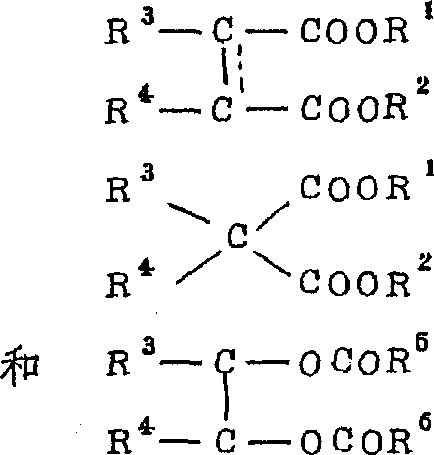

R1至R5的取代烃基的例子是含有杂原子如N,O和S的取代基,如-C-O-C-,-COOR,-COOH,-OH,-SO3H,-C-N-C-和-NH2的烃基。Examples of substituted hydrocarbon groups for R1 to R5 are substituents containing heteroatoms such as N, O and S, such as -COC-, -COOR, -COOH, -OH, -SO 3 H, -CNC- and -NH 2 of hydrocarbon groups.
其中优选为二羧酸二酯,而且其中的R1和R2至少有一个是含有至少两个碳原子的烷基。Among them, dicarboxylic acid diesters are preferred, and at least one of R1 and R2 is an alkyl group containing at least two carbon atoms.
多元羧酸酯的具体例子包括脂肪族多元羧酸酯如丁二酸二乙酯、丁二酸二丁酯、甲基丁二酸二乙酯、α-甲基戊二酸二异丁酯、丙二酸二丁酯、甲基丙二酸二乙酯、乙基丙二酸二乙酯、异丙基丙二酸二乙酯、丁基丙二酸二乙酯、苯基丙二酸二乙酯、二乙基丙二酸二乙酯、烯丙基丙二酸二乙酯、二异丁基丙二酸二乙酯、二正丁基丙二酸二乙酯、马来酸二甲酯、马来酸单辛酯、马来酸二异辛酯、马来酸二异丁酯、丁基马来酸二异丁酯、丁基马来酸二乙酯、β-甲基戊二酸二异丙酯、乙基丁二酸二烯丙酯、富马酸二-2-乙基己酯、衣康酸二乙酯、衣康酸二异丁酯、柠康酸二异辛酯和柠康酸二甲酯;脂环多元酸酯类如1,2-环己二酸二乙酯、1,2-环己二酸二异丁酯、四氢邻苯二甲酸二乙酯、和nadic acid二乙基酯;芳香族多元羧酸酯类如邻苯二甲酸单乙酯、邻苯二甲酸二甲酯、邻苯二甲酸甲基乙基酯、邻苯二甲酸单异丁酯、邻苯二甲酸正丁酯、邻苯二甲酸二乙酯、邻苯二甲酸乙基异丁酯、邻苯二甲酸乙基正丁酯、邻苯二甲酸二正丙酯、邻苯二甲酸二异丙酯、邻苯二甲酸二正丁酯、邻苯二甲酸二异丁酯、邻苯二甲酸二正庚酯、邻苯二甲酸二-2-乙基己基酯、邻苯二甲酸二癸酯、邻苯三甲酸苄基丁基酯、邻苯二甲酸二苯基酯、萘二酸二乙酯、萘二酸二丁酯、偏苯三酸三乙酯和偏苯三酸二丁酯;杂环多元羧酸酯如3,4-呋喃二羧酸酯。Specific examples of polycarboxylic acid esters include aliphatic polycarboxylic acid esters such as diethyl succinate, dibutyl succinate, diethyl methyl succinate, diisobutyl α-methylglutarate, Dibutyl malonate, diethyl methylmalonate, diethyl ethylmalonate, diethyl isopropylmalonate, diethyl butylmalonate, diphenylmalonate Ethyl ester, diethyl diethylmalonate, diethyl allylmalonate, diethyl diisobutylmalonate, diethyl di-n-butylmalonate, dimethyl maleate ester, monooctyl maleate, diisooctyl maleate, diisobutyl maleate, butyl diisobutyl maleate, butyl diethyl maleate, β-methyl pentadiene Diisopropyl Ethyl Succinate, Diallyl Ethyl Succinate, Di-2-Ethylhexyl Fumarate, Diethyl Itaconate, Diisobutyl Itaconate, Diisooctyl Citrate and dimethyl citraconic acid; alicyclic polybasic acid esters such as 1,2-diethyl cycloadipate, 1,2-diisobutyl cycloadipate, diethyl tetrahydrophthalate, and nadic acid diethyl ester; aromatic polycarboxylic acid esters such as monoethyl phthalate, dimethyl phthalate, methyl ethyl phthalate, monoisobutyl phthalate , n-butyl phthalate, diethyl phthalate, ethyl isobutyl phthalate, ethyl n-butyl phthalate, di-n-propyl phthalate, phthalic acid Diisopropyl phthalate, di-n-butyl phthalate, diisobutyl phthalate, di-n-heptyl phthalate, di-2-ethylhexyl phthalate, di-phthalate Decyl esters, benzylbutyl phthalate, diphenyl phthalate, diethyl naphthalate, dibutyl naphthalate, triethyl trimellitate, and dibutyl trimellitate Esters; heterocyclic polycarboxylates such as 3,4-furandicarboxylate.
多元羧酸酯的其它例子包括长链二羧酸酯如己二酸二乙酯、己二酸二异丁酯、癸二酸二异丙酯、癸二酸二正丁酯、癸二酸二正辛酯和癸二酸二-2-乙基己基酯。Other examples of polycarboxylates include long chain dicarboxylates such as diethyl adipate, diisobutyl adipate, diisopropyl sebacate, di-n-butyl sebacate, diisobutyl sebacate, n-octyl ester and di-2-ethylhexyl sebacate.
在这些多元羧酸酯中,具有上述通式骨架的化合物是优选的,更优选的是邻苯二甲酸、马来酸或取代的丙二酸与含有至少两个碳原子的醇形成的酯,邻苯二甲酸与含有至少两个碳原子的醇形成的二酯是特别优选的。Among these polycarboxylic acid esters, compounds having the skeleton of the above-mentioned general formula are preferred, more preferably esters of phthalic acid, maleic acid or substituted malonic acid and alcohols containing at least two carbon atoms, Diesters of phthalic acid with alcohols containing at least two carbon atoms are particularly preferred.
这些多元羧酸酯不一定在一开始就以多元羧酸酯形式存在,可以任选地在制备固体钛催化剂组分(A)阶段中由能够转化为这些多元羧酸酯的化合物而生成。These polycarboxylic acid esters do not necessarily exist in the form of polycarboxylic acid esters from the beginning, and may optionally be formed from compounds capable of being converted into these polycarboxylic acid esters in the stage of preparing the solid titanium catalyst component (A).
除多元羧酸酯外,能用于制备固体钛催化剂(A)的电子给体适用的是下面叙述的醇类、胺类、酰胺类、醚类、酮类、腈类、膦类、
在本发明中,固体钛催化剂组分(A)可以经上述镁化合物(或金属镁)、电子给体和钛化合物的相互接触而制备。由镁化合物、钛化合物和电子给体制备高活性钛催化剂组分的已知方法可以用于制备固体钛催化剂组分(A)。上述化合物可以在另一种反应试剂如硅、磷或铝的存在下进行接触。In the present invention, the solid titanium catalyst component (A) can be prepared by contacting the above-mentioned magnesium compound (or metal magnesium), the electron donor and the titanium compound with each other. Known methods for preparing highly active titanium catalyst components from magnesium compounds, titanium compounds and electron donors can be used to prepare solid titanium catalyst components (A). The above compounds may be contacted in the presence of another reagent such as silicon, phosphorus or aluminum.
(1)一种方法,其中镁化合物和钛化合物,或钛化合物和镁化合物与电子绐体的配合物在液相中反应。该反应可以在粉碎剂等等的存在下进行。化合物为固体时,可以在反应前粉碎。而且,每一成分可以在反应前用电子给体和/或一种反应助剂如有机铝化合物或含卤素的硅化合物进行预处理。上述电子给体在该方法中至少使用一次。(1) A method in which a magnesium compound and a titanium compound, or a complex of a titanium compound and a magnesium compound with an electron body, are reacted in a liquid phase. This reaction can be performed in the presence of a pulverizer and the like. When the compound is solid, it may be pulverized before the reaction. Furthermore, each component may be pretreated prior to reaction with an electron donor and/or a reaction aid such as an organoaluminum compound or a halogen-containing silicon compound. The electron donors described above are used at least once in the process.
(2)一种方法,其中没有还原性的液体镁化合物和液体钛化合物在电子给体存在下反应,沉淀出固体钛复合物。(2) A method wherein a non-reducible liquid magnesium compound and a liquid titanium compound react in the presence of an electron donor to precipitate a solid titanium complex.
(3)一种方法,其中由(2)获得的反应产物进一步与钛化合物反应。(3) A method wherein the reaction product obtained from (2) is further reacted with a titanium compound.
(4)一种方法,其中由(1)或(2)获得的反应产物进一步与电子给体和钛化合物反应。(4) A method wherein the reaction product obtained by (1) or (2) is further reacted with an electron donor and a titanium compound.
(5)一种方法,其中镁化合物或镁化合物与电子给体的配合物在钛化合物的存在下进行粉碎,所得的固体产物用卤素、卤素化合物或芳香烃处理。在该方法中,镁化合物或它与电子给体的配合物也可以在粉碎剂等存在下进行粉碎。任选地,镁化合物或镁化合物与电子给体的配合物在钛化合物存在下粉碎,先用一种反应助剂进行预处理,然后再用卤素处理等。反应助剂可以是有机铝化合物或含卤素的硅化合物。在本方法中至少使用一次电子给体。(5) A method wherein a magnesium compound or a complex of a magnesium compound and an electron donor is pulverized in the presence of a titanium compound, and the resulting solid product is treated with a halogen, a halogen compound or an aromatic hydrocarbon. In this method, the magnesium compound or its complex with an electron donor may also be pulverized in the presence of a pulverizing agent or the like. Optionally, the magnesium compound or the complex of the magnesium compound and the electron donor is comminuted in the presence of the titanium compound, pretreated with a reaction aid, then treated with a halogen, etc. The reaction aid may be an organoaluminum compound or a halogen-containing silicon compound. The electron donor is used at least once in the process.
(6)一种方法,其中用卤素、卤化物或芳香烃处理由(1)至(4)得到的产物。(6) A method wherein the product obtained from (1) to (4) is treated with a halogen, a halide or an aromatic hydrocarbon.
(7)一种方法,其中将通过金属氧化物、二烃基镁和含卤素的醇相接触而获得的产物与电子给体和钛化合物相接触。(7) A method wherein a product obtained by contacting a metal oxide, dihydrocarbylmagnesium and a halogen-containing alcohol is brought into contact with an electron donor and a titanium compound.
(8)一种方法,其中镁化合物如镁的有机酸盐、烷氧基镁或芳氧基镁与电子给体、钛化合物和/或含卤素的烃反应。(8) A method wherein a magnesium compound such as an organic acid salt of magnesium, alkoxymagnesium or aryloxymagnesium is reacted with an electron donor, a titanium compound and/or a halogen-containing hydrocarbon.
(9)一种方法,其中在烃溶液中的催化剂组分至少含有镁化合物、烷氧基钛和/或电子给体如醇或醚,且与钛化合物和/或含卤素化合物如含卤素的硅化合物反应,在该方法的任何一步中,如上述的邻苯二甲酸二酯那样的电子给体可以同存。(9) A method wherein the catalyst component in the hydrocarbon solution contains at least a magnesium compound, an alkoxytitanium and/or an electron donor such as alcohol or ether, and is combined with a titanium compound and/or a halogen-containing compound such as a halogen-containing In any step of the silicon compound reaction, an electron donor such as the above-mentioned phthalic acid diester may coexist.
在上述(1)至(9)制备固体钛催化剂组分(A)的方法中,在制备催化剂时使用液体卤化钛的方法中,和在其后或期间使用卤代烃的方法中,优选使用钛化合物。In the above-mentioned methods (1) to (9) for preparing the solid titanium catalyst component (A), in the method of using a liquid titanium halide in the preparation of the catalyst, and in the method of using a halogenated hydrocarbon thereafter or during it, preferably using Titanium compounds.
制备固体钛催化剂组分(A)时所用成分的量可以随制备方法的不同而变化。例如对每摩尔镁化合物,使用约0.01至5摩尔,优选为0.05至2摩尔的电子给体和约0.01至500摩尔,优选为约0.05至300摩尔的钛化合物。The amounts of ingredients used in the preparation of the solid titanium catalyst component (A) may vary depending on the preparation method. For example, about 0.01 to 5 moles, preferably about 0.05 to 2 moles of electron donor and about 0.01 to 500 moles, preferably about 0.05 to 300 moles of titanium compound are used per mole of magnesium compound.
如此得到的固体钛催化剂组分(A)含有必要的成分镁、钛、卤素和电子给体。The solid titanium catalyst component (A) thus obtained contains the essential ingredients of magnesium, titanium, halogen and electron donor.
在固体钛催化剂组分(A)中,卤素/钛的原子比约为4至200,优选为约5至100;电子给体/钛的摩尔比约为0.1至10,优选约为0.2至6;镁/钛的原子比约为1至100,优选约为2至50。In the solid titanium catalyst component (A), the atomic ratio of halogen/titanium is about 4 to 200, preferably about 5 to 100; the molar ratio of electron donor/titanium is about 0.1 to 10, preferably about 0.2 to 6 the atomic ratio of magnesium/titanium is about 1 to 100, preferably about 2 to 50.
在所得的固体钛催化剂组分(A)中包含的卤化镁的晶体大小比市售的卤化镁小,且其比表面通常至少约为50米2/克,优选约为60至1000米2/克,更优选约为100至800米2/克。由于上述各成分结合在一起,构成了固体钛催化剂组分(A)的整体结构,因此,固体钛催化剂组分(A)的组成不会因用己烷洗涤而发生大的变化。The crystal size of the magnesium halide contained in the obtained solid titanium catalyst component (A) is smaller than that of commercially available magnesium halides, and its specific surface is usually at least about 50 m 2 /g, preferably about 60 to 1000 m 2 /g. g, more preferably about 100 to 800 m2 /g. Since the above-mentioned components are combined to form the overall structure of the solid titanium catalyst component (A), the composition of the solid titanium catalyst component (A) will not change greatly due to washing with hexane.
固体钛催化剂组分(A)可以单独使用。如果需要,也可以经无机或有机化合物如硅化合物、铝化合物或聚烯烃稀释后再使用。当使用了这种稀释剂时,甚至当其比上述组分(A)的比表面小时,都能显示出很高的催化活性。The solid titanium catalyst component (A) may be used alone. If desired, it can also be diluted with inorganic or organic compounds such as silicon compounds, aluminum compounds or polyolefins before use. When such a diluent is used, even when it has a smaller specific surface than the above-mentioned component (A), high catalytic activity can be exhibited.
适用于本发明的制备高活性催化剂组分的方法在下列日本公开专利中有所叙述:Processes for preparing highly active catalyst components suitable for use in the present invention are described in the following Japanese laid-open patents:
108385/1975,126590/1975,20297/1976,108385/1975, 126590/1975, 20297/1976,
28189/1976,64586/1976,92885/1976,28189/1976, 64586/1976, 92885/1976,
136625/1976,87489/1977,100596/1977,136625/1976, 87489/1977, 100596/1977,
147688/1977,104593/1977,2580/1978,147688/1977, 104593/1977, 2580/1978,
40093/1978,40094/1978,43094/1978,40093/1978, 40094/1978, 43094/1978,
135102/1980,135103/1980,152710/1980,135102/1980, 135103/1980, 152710/1980,
811/1981,11908/1981,18606/1981,811/1981, 11908/1981, 18606/1981,
83006/1983,138705/1977,138706/1983,83006/1983, 138705/1977, 138706/1983,
138707/1983,138708/1983,138709/1983,138707/1983, 138708/1983, 138709/1983,
138710/1983,138715/1983,23404/1985,138710/1983, 138715/1983, 23404/1985,
21109/1986,37802/1986和37803/1986。21109/1986, 37802/1986 and 37803/1986.
在分子中至少含有一个铝-碳键的化合物可以用作作为催化剂组分(B)的有机铝化合物,其实例为下述通式(Ⅰ)和(Ⅱ)的化合物Compounds containing at least one aluminum-carbon bond in the molecule can be used as organoaluminum compounds as the catalyst component (B), examples of which are compounds of the following general formulas (I) and (II)
(Ⅰ)通式为Rm 7Al(OR8)nHpXq 1的有机铝化合物,通式中,R7和R8可以相同或不同,每一个代表含1至15个碳原子的烃基,优选含1至4个碳原子;x1代表卤素原子,0<m≤3,0≤n<3,0≤p<3,0≤q<3,m+n+p+q=3。(I) The general formula is an organoaluminum compound of R m 7 Al(OR 8 ) n H p X q 1. In the general formula, R 7 and R 8 may be the same or different, and each represents an organoaluminum compound containing 1 to 15 carbon atoms. Hydrocarbyl, preferably containing 1 to 4 carbon atoms; x 1 represents a halogen atom, 0<m≤3, 0≤n<3, 0≤p<3, 0≤q<3, m+n+p+q=3 .
(Ⅱ)铝与Ⅰ族金属形成的配合的烷基化物,其通式为:M1AlR4 7,其中M1代表Li,Na或K,和R7如上所定义。(II) A complex alkylate of aluminum with a Group I metal having the general formula: M 1 AlR 4 7 , wherein M 1 represents Li, Na or K, and R 7 is as defined above.
通式(Ⅰ)的有机铝化合物的例子如下:Examples of organoaluminum compounds of general formula (I) are as follows:
通式为Rm 7Al(OR8)3-m的化合物,其中R7,R8和m如前所定义,m优选的值为1.5≤m≤3。A compound of general formula R m 7 Al(OR 8 ) 3-m , wherein R 7 , R 8 and m are as defined above, and the preferred value of m is 1.5≤m≤3.
通式为Rm 7AlXa-m的化合物,其中R7,x和m如前所定义,m优选的值为0<m<3。A compound of the general formula R m 7 AlX am , wherein R 7 , x and m are as defined above, and the preferred value of m is 0<m<3.
通式为Rm 7AlH3-m的化合物,其中R7和m如前定义,m优选的值为2≤m<3。A compound of the general formula R m 7 AlH 3-m , wherein R 7 and m are as defined above, and the preferred value of m is 2≤m<3.
通式为Rm7Al(OR8)nXq的化合物,其中R7,R8,m,n和q如上所定义。A compound of general formula Rm 7 Al(OR 8 ) n X q , wherein R 7 , R 8 , m, n and q are as defined above.
属于(Ⅰ)的有机铝化合物的具体例子包括三烷基铝如三乙基铝和三丁基铝;三链烯基铝如三异戊二烯基铝;二烷基铝烷氧基化物如二乙基乙氧基铝和二丁基丁氧基铝;烷基铝倍半烷氧基化物如乙基倍半乙氧基铝和丁基倍半丁氧基铝;具有平均组成为R7 2.5Al(OR8)0.5的部分烷氧基化烷基铝;二烷基卤化铝如二乙基氯化铝,二丁基氯化铝和二乙基溴化铝;烷基倍半卤化铝如乙基倍半氯化铝,丁基倍半氯化铝和乙基倍半溴化铝;部分卤代的烷基铝,如烷基二卤化铝如乙基二氯化铝,丙基二氯化铝和丁基二溴化铝;二烷基氢化铝如二乙基氢化铝和二丁基氢化铝;其它部分氢化的烷基铝,如烷基二氢化铝如乙基二氢化铝和丙基二氢化铝;和部分烷氧基化的和卤化的烷基铝如乙基乙氧基氯化铝,丁基丁氧基氯化铝和乙基乙氧基溴化铝。Specific examples of organoaluminum compounds belonging to (I) include trialkylaluminum such as triethylaluminum and tributylaluminum; trialenylaluminum such as triprenylaluminum; dialkylaluminum alkoxides such as Diethyl aluminum ethoxide and dibutyl aluminum butoxide; alkyl aluminum sesquialkoxylates such as ethyl aluminum sesquiethoxide and butyl aluminum sesquibutoxide; having an average composition R7 2.5 Al(OR 8 ) Partial alkoxylated aluminum alkyls of 0.5 ; dialkylaluminum halides such as diethylaluminum chloride, dibutylaluminum chloride and diethylaluminum bromide; alkylaluminum sesquihalides Such as ethyl aluminum sesquichloride, butyl aluminum sesquichloride and ethyl aluminum sesquibromide; partially halogenated alkyl aluminum, such as alkyl aluminum dihalides such as ethyl aluminum dichloride, propyl di Aluminum chloride and butylaluminum dibromide; dialkylaluminum hydrides such as diethylaluminum hydride and dibutylaluminum hydride; other partially hydrogenated alkylaluminums such as alkylaluminum dihydrides such as ethylaluminum hydride and Propyl aluminum dihydride; and partially alkoxylated and halogenated alkyl aluminum such as ethyl ethoxy aluminum chloride, butyl butoxy aluminum chloride and ethyl ethoxy aluminum bromide.
与(Ⅰ)相似的有机铝化合物,其中两个或多个铝原子通过氧或氮原子连接起来。实例是(C2H5)2AlOAl(C2H5)2,(C4H9)2AlOAl(C4H9)2, 和甲基铝噁烷。An organoaluminum compound similar to (I), wherein two or more aluminum atoms are linked via oxygen or nitrogen atoms. Examples are (C 2 H 5 ) 2 AlOAl(C 2 H 5 ) 2 , (C 4 H 9 ) 2 AlOAl(C 4 H 9 ) 2 , and methylaluminoxane.
属于(Ⅱ)的化合物的实例是LiAl(C2H5)4和LiAl(C7H15)4。Examples of compounds belonging to (II) are LiAl(C 2 H 5 ) 4 and LiAl(C 7 H 15 ) 4 .
在这些铝化合物中,优选的是三烷基铝和由两个或多个上述铝化合物结合到一起得到的烷基铝。Among these aluminum compounds, preferred are trialkylaluminums and alkylaluminums obtained by bonding two or more of the aforementioned aluminum compounds.
在制备本发明的烯烃聚合物催化剂组分过程中,如果需要可以使用电子给体(C)。这种电子给体(C)的实例包括含氧的电子给体如醇、酚、酮、醛、羧酸、有机或无机酸酯、醚、酰胺酸酐和烷氧基硅烷;含氮电子给体如氨、胺、腈和异氰酸酯;上述多元羧酸酯等。In the preparation of the olefin polymer catalyst component of the present invention, an electron donor (C) may be used if necessary. Examples of such electron donors (C) include oxygen-containing electron donors such as alcohols, phenols, ketones, aldehydes, carboxylic acids, organic or inorganic acid esters, ethers, amic acid anhydrides, and alkoxysilanes; nitrogen-containing electron donors Such as ammonia, amine, nitrile and isocyanate; the above-mentioned polycarboxylic acid ester, etc.
电子给体(C)的具体例子包括含1至18个碳原子的醇如甲醇、乙醇、丙醇、戊醇、己醇、辛醇、十二烷醇、十八烷醇、油醇、苯甲醇、苯基乙基醇、对异丙基苯甲醇、异丙醇和对异丙基苯甲醇;含6至20个碳原子的酚,任选地含有较低级烷基的酚如苯酚、甲苯酚、二甲苯酚、乙苯酚、丙苯酚、壬基苯酚、对异丙苯甲基苯酚和萘酚;含有3至15个碳原子的酮如丙酮、甲乙酮、甲基异丁基酮、苯乙酮、二苯酮、苯醌;含2至15个碳原子的醛如乙醛、丙醛、辛醛、苯甲醛、甲苯甲醛和萘甲醛;含有2至30个碳原子的有机酸酯如甲酸甲酯、乙酸甲酯、乙酸乙酯、乙酸乙烯酯、乙酸丙酯、乙酸辛酯、乙酸环己酯、丙酸乙酯、丁酸甲酯、戊酸乙酯、氯代乙酸甲酯、二氯代乙酸乙酯、甲基丙烯酸甲酯、丁烯酸乙酯、环己酸乙酯、苯甲酸甲酯、苯甲酸乙酯、苯甲酸丙酯、苯甲酸丁酯、苯甲酸辛酯、苯甲酸环己酯、苯甲酸苯酯、苯甲酸苄基酯、甲苯甲酸甲酯、甲苯甲酸乙酯、甲苯甲酸戊酯、乙苯甲酸乙酯、对甲氧基苯甲酸甲酯(methylanisurate)、马来酸正丁酯、甲基丙二酸二异丁酯、环己二酸二正己酯、diethyl nadate、四氢邻苯二甲酸二异丙酯、邻苯二甲酸二乙酯、邻苯二甲酸二异丁酯、邻苯二甲酸二正丁酯、邻苯二甲酸二-2-乙基己酯、γ-丁内酯、δ-戊内酯、香豆素、2-苯并〔C〕呋喃酮、碳酸乙烯酯;含有2至15个碳原子的酰氯如乙酰氯、苯甲酰氯、甲苯甲酰氯、对甲氧基苯甲酰氯;含有2至20个碳原子的醚和二醚,如甲醚、乙醚、异丙醚、丁醚、戊醚、四氢呋喃、苯甲醚、二苯醚和对-烷环氧化物;酰胺如乙酰胺、苯甲酰胺和甲苯甲酰胺;胺如甲胺、乙胺、二乙胺、三丁基胺、哌啶、三苄基胺、苯胺、吡啶、甲基吡啶、四亚甲基二胺;腈如乙腈、苄腈、甲苯基腈;酸酐如乙酸酐、邻苯二甲酸酐和苯甲酸酐等。Specific examples of the electron donor (C) include alcohols having 1 to 18 carbon atoms such as methanol, ethanol, propanol, pentanol, hexanol, octanol, dodecanol, stearyl alcohol, oleyl alcohol, benzene Methanol, phenylethyl alcohol, p-cumyl alcohol, isopropanol and p-cymenyl alcohol; phenols containing from 6 to 20 carbon atoms, optionally containing lower alkyl groups such as phenol, methyl Phenol, xylenol, ethylphenol, propyphenol, nonylphenol, p-cumylmethylphenol and naphthol; ketones containing 3 to 15 carbon atoms such as acetone, methyl ethyl ketone, methyl isobutyl ketone, phenylethyl ketone Ketones, benzophenones, benzoquinones; aldehydes containing 2 to 15 carbon atoms such as acetaldehyde, propionaldehyde, octanal, benzaldehyde, tolualdehyde and naphthaldehyde; organic acid esters containing 2 to 30 carbon atoms such as formic acid Methyl acetate, methyl acetate, ethyl acetate, vinyl acetate, propyl acetate, octyl acetate, cyclohexyl acetate, ethyl propionate, methyl butyrate, ethyl valerate, methyl chloroacetate, di Ethyl Chloroacetate, Methyl Methacrylate, Ethyl Crotate, Ethyl Cyclohexanoate, Methyl Benzoate, Ethyl Benzoate, Propyl Benzoate, Butyl Benzoate, Octyl Benzoate, Benzene Cyclohexyl formate, phenyl benzoate, benzyl benzoate, methyl toluate, ethyl toluate, amyl toluate, ethyl ethyl benzoate, methyl p-methoxybenzoate (methylanisurate), horse n-butyl maleate, diisobutyl methylmalonate, di-n-hexyl cycloadipate, diethyl nadate, diisopropyl tetrahydrophthalate, diethyl phthalate, phthalic acid Diisobutyl ester, di-n-butyl phthalate, di-2-ethylhexyl phthalate, γ-butyrolactone, δ-valerolactone, coumarin, 2-benzo[C] Furanone, ethylene carbonate; acid chlorides containing 2 to 15 carbon atoms such as acetyl chloride, benzoyl chloride, toluoyl chloride, p-methoxybenzoyl chloride; ethers and diethers containing 2 to 20 carbon atoms such as Methyl ether, diethyl ether, isopropyl ether, butyl ether, pentyl ether, tetrahydrofuran, anisole, diphenyl ether, and p-menthyl epoxides; amides such as acetamide, benzamide, and toluamide; amines such as methylamine , ethylamine, diethylamine, tributylamine, piperidine, tribenzylamine, aniline, pyridine, picoline, tetramethylenediamine; nitriles such as acetonitrile, benzonitrile, tolylonitrile; acid anhydrides such as ethyl anhydride, phthalic anhydride and benzoic anhydride, etc.
具有以下通式(Ⅰa)的有机硅化合物也可用作电子给体(C):Organosilicon compounds of the general formula (Ia) can also be used as electron donors (C):
Rr 0Si(OR10)4-r (Ⅰa)其中R9和R10为烃基、0<r<4。R r 0 S i (OR 10 ) 4-r (Ia) wherein R 9 and R 10 are hydrocarbon groups, 0<r<4.
通式(Ⅰa)的有机硅化合物的具体例子包括三甲基甲氧基硅烷、三甲基乙氧基硅烷、二甲基二甲氧基硅烷、二甲基二乙氧基硅烷、二异丙基二甲氧基硅烷、叔丁基甲基二甲氧基硅烷、叔丁基甲基二乙氧基硅烷、叔戊基甲基二乙氧基硅烷、二苯基二甲氧基硅烷、苯基甲基二甲氧基硅烷、二苯基二乙氧基硅烷、双-邻甲苯基二甲氧基硅烷、双-间甲苯基二甲氧基硅烷、双-对甲苯基二甲氧基硅烷、双-对甲苯基二乙氧基硅烷、双-乙基苯基二甲氧基硅烷、二环己基二甲氧基硅烷、环己基甲基二甲氧基硅烷、环己基甲基二乙氧基硅烷、乙基三甲氧基硅烷、乙基三乙氧基硅烷、乙烯基三甲氧基硅烷、甲基三甲氧基硅烷、正丙基三乙氧基硅烷、癸基三甲氧基硅烷、癸基三乙氧基硅烷、苯基三甲氧基硅烷、γ-氯丙基三甲氧基硅烷、甲基甲苯乙氧基硅烷、乙基三乙氧基硅烷、乙烯基三乙氧基硅烷、叔-丁基三乙氧基硅烷、正丁基三乙氧基硅烷、异丁基三甲氧基硅烷、苯基三乙氧基硅烷、γ-氨丙基三乙氧基硅烷、三乙氧基氯硅烷、乙基三异丙氧基硅烷、乙烯基三丁氧基硅烷、环己基三甲氧基硅烷、环己基三乙氧基硅烷、2-降冰片基三甲氧基硅烷、2-降冰片基三乙氧基硅烷、2-降冰片基甲基二甲氧基硅烷、硅酸乙酯、硅酸丁酯、三甲基苯氧基硅烷、甲基三烯丙氧基硅烷、乙烯基三(β-甲氧基-乙氧基)硅烷、乙烯基三乙酰氧基硅烷、二甲基四乙氧基二硅氧烷、等。Specific examples of organosilicon compounds of the general formula (Ia) include trimethylmethoxysilane, trimethylethoxysilane, dimethyldimethoxysilane, dimethyldiethoxysilane, diisopropyl Dimethoxysilane, tert-butylmethyldimethoxysilane, tert-butylmethyldiethoxysilane, tert-amylmethyldiethoxysilane, diphenyldimethoxysilane, phenylmethyldiethoxysilane Methoxysilane, diphenyldiethoxysilane, bis-o-tolyldimethoxysilane, bis-m-tolyldimethoxysilane, bis-p-tolyldimethoxysilane, bis-p Tolyldiethoxysilane, bis-ethylphenyldimethoxysilane, dicyclohexyldimethoxysilane, cyclohexylmethyldimethoxysilane, cyclohexylmethyldiethoxysilane, ethyl Nyltrimethoxysilane, Ethyltriethoxysilane, Vinyltrimethoxysilane, Methyltrimethoxysilane, n-Propyltriethoxysilane, Decyltrimethoxysilane, Decyltriethoxy Silane, Phenyltrimethoxysilane, Gamma-Chloropropyltrimethoxysilane, Methyltolylethoxysilane, Ethyltriethoxysilane, Vinyltriethoxysilane, Tert-Butyltriethoxysilane N-butylsilane, n-butyltriethoxysilane, isobutyltrimethoxysilane, phenyltriethoxysilane, γ-aminopropyltriethoxysilane, triethoxychlorosilane, ethyltriiso Propoxysilane, Vinyltributoxysilane, Cyclohexyltrimethoxysilane, Cyclohexyltriethoxysilane, 2-Norbornyltrimethoxysilane, 2-Norbornyltriethoxysilane, 2 -Norbornylmethyldimethoxysilane, ethyl silicate, butyl silicate, trimethylphenoxysilane, methyltriallyloxysilane, vinyltris(β-methoxy-ethyl oxy)silane, vinyltriacetoxysilane, dimethyltetraethoxydisiloxane, and the like.
在以上化合物中,优选的是三甲基甲氧基硅烷、乙基三乙氧基硅烷、正丙基三乙氧基硅烷、叔丁基三乙氧基硅烷、乙烯基三乙氧基硅烷、苯基三乙氧基硅烷、乙烯基三丁氧基硅烷、二苯基二甲氧基硅烷、苯基甲基二甲氧基硅烷、双-对甲苯基二甲氧基硅烷、对甲苯基甲基二甲氧基硅烷、二环己基二甲氧基硅烷、环己基甲基二甲氧基硅烷、2-降冰片基三乙氧基硅烷、2-降冰片基甲基二甲氧基硅烷和二苯基二乙氧基硅烷。Among the above compounds, preferred are trimethylmethoxysilane, ethyltriethoxysilane, n-propyltriethoxysilane, tert-butyltriethoxysilane, vinyltriethoxysilane, Phenyltriethoxysilane, vinyltributoxysilane, diphenyldimethoxysilane, phenylmethyldimethoxysilane, bis-p-tolyldimethoxysilane, p-tolylmethylsilane Dimethoxysilane, Dicyclohexyldimethoxysilane, Cyclohexylmethyldimethoxysilane, 2-Norbornyltriethoxysilane, 2-Norbornylmethyldimethoxysilane and Diphenyldiethoxysilane.
而且,具有如下通式(Ⅱa)的有机硅化合物也可用作电子给体(C):Furthermore, organosilicon compounds having the following general formula (IIa) can also be used as electron donors (C):
SiR 11Rs 12(OR13)3-s (Ⅱa)Si R 11 R s 12 (OR 13 ) 3-s (Ⅱa)
其中R11是环戊基或带有一个烷基的环戊基,R12是从由烷基、环戊基和带有烷基的环戊基构成的一组基团中选取,R13是烃基,S是0≤S≤2的数。Wherein R 11 is a cyclopentyl group or a cyclopentyl group with an alkyl group, R 12 is selected from a group consisting of an alkyl group, a cyclopentyl group and a cyclopentyl group with an alkyl group, and R 13 is Hydrocarbyl, S is a number of 0≤S≤2.
如上定义,上述通式中的R11是环戊基或带有烷基的环戊基,R11的实例包括如2-甲基环戊基、3-甲基环戊基、2-乙基环戊基和2,3-二甲基环戊基。As defined above, R in the general formula above is a cyclopentyl group or a cyclopentyl group with an alkyl group, examples of R include 2-methylcyclopentyl, 3-methylcyclopentyl, 2 - ethyl Cyclopentyl and 2,3-dimethylcyclopentyl.
而且,通式(Ⅱa)的R12是烷基、环戊基或带有一个烷基的环戊基,R12的实例包括如甲基、乙基、丙基、异丙基、丁基和己基,和环戊基和烷基取代的环戊基,如R11的实例。Moreover, R 12 of the general formula (IIa) is an alkyl group, a cyclopentyl group or a cyclopentyl group with an alkyl group, and examples of R 12 include methyl, ethyl, propyl, isopropyl, butyl and Hexyl, and cyclopentyl and alkyl substituted cyclopentyl, as examples for R 11 .
而且,通式(Ⅱa)的R13是烃基,R13的实例包括如烷基、环烷基、芳基和芳烃基之类烃基。Furthermore, R 13 of the general formula (IIa) is a hydrocarbon group, and examples of R 13 include hydrocarbon groups such as alkyl, cycloalkyl, aryl and aromatic hydrocarbon groups.
在有机硅化合物中,优选使用其中R11为环戊基,R12为烷基或环戊基、R13为烷基特别是甲基或乙基的有机硅化合物。Among organosilicon compounds, preference is given to using organosilicon compounds in which R 11 is cyclopentyl, R 12 is alkyl or cyclopentyl, R 13 is alkyl, especially methyl or ethyl.
有机硅化合物的具体例子包括三烷氧基硅烷如环戊基三甲氧基硅烷,2-甲基环戊基三甲氧基硅烷,2,3-二甲基环戊基三甲氧基硅烷和环戊基三乙氧基硅烷;二烷氧基硅烷如二环戊基二乙氧基硅烷、双(2-甲基环戊基)二甲氧基硅烷、双(2,3-二甲基环戊基)二甲氧基硅烷和二环戊基二乙氧基硅烷;单烷氧基硅烷如三环戊基甲氧基硅烷、三环戊基乙氧基硅烷、二环戊基甲基甲氧、基硅烷、二环戊基乙基甲氧基硅烷、二环戊基甲基乙氧基硅烷、环戊基二甲基甲氧基硅烷、环戊基二乙基甲氧基硅烷和环戊基二甲基乙氧基硅烷,等。Specific examples of organosilicon compounds include trialkoxysilanes such as cyclopentyltrimethoxysilane, 2-methylcyclopentyltrimethoxysilane, 2,3-dimethylcyclopentyltrimethoxysilane and cyclopentyltrimethoxysilane triethoxysilane; dialkoxysilanes such as dicyclopentyldiethoxysilane, bis(2-methylcyclopentyl)dimethoxysilane, bis(2,3-dimethylcyclopentyl) base) dimethoxysilane and dicyclopentyldiethoxysilane; monoalkoxysilanes such as tricyclopentylmethoxysilane, tricyclopentylethoxysilane, dicyclopentylmethylmethoxy , Dimethylsilane, Dicyclopentylethylmethoxysilane, Dicyclopentylmethylethoxysilane, Cyclopentyldimethylmethoxysilane, Cyclopentyldiethylmethoxysilane and Cyclopentyl Dimethylethoxysilane, etc.
作为电子给体(C),优选为上述有机羧酸酯和有机硅化合物,特别优选是有机硅化合物。As the electron donor (C), the above-mentioned organic carboxylates and organosilicon compounds are preferred, and organosilicon compounds are particularly preferred.
本发明的预聚合催化剂组分(Ⅰ)是通过将烯烃聚合催化剂组分(X)用2至5个碳原子的直链α-烯烃和3-甲基-1-丁烯相继进行预聚合处理而制备的,组分(X)是由上述固体钛催化剂组分(A)、有机铝化合物催化剂组分(B)和如果需要电子给体(C)生成的。如上所述,预聚合处理或者是先用2至5个碳原子的直链α-烯烃,然后用3-甲基-1-丁烯处理,或者是先用3-甲基-1-丁烯、然后用2至5个碳原子的直链α-烯烃处理。The prepolymerization catalyst component (I) of the present invention is to carry out prepolymerization treatment successively by olefin polymerization catalyst component (X) with 2 to 5 carbon atom straight-chain α-olefins and 3-methyl-1-butene Instead, component (X) is produced from the above solid titanium catalyst component (A), organoaluminum compound catalyst component (B) and, if necessary, electron donor (C). As mentioned above, the prepolymerization treatment is either first with a linear alpha-olefin of 2 to 5 carbon atoms and then treated with 3-methyl-1-butene, or first with 3-methyl-1-butene , followed by treatment with a linear alpha-olefin of 2 to 5 carbon atoms.
在以上两种预聚合处理的任何一种方法中,对于每克聚合催化剂组分(X)的固体部分、含2至5个碳原子的直链α-烯烃的用量为0.1至300克,优选为1至100克,特别优选为1至50克;对于每克聚合催化剂组分(X)的固体部分,3-甲基-1-丁烯的用量为0.1至100克,优选为1至50克,特别优选为2至50克。In any one of the above two prepolymerization treatments, the amount of linear α-olefins having 2 to 5 carbon atoms is 0.1 to 300 grams per gram of the solid portion of the polymerization catalyst component (X), preferably 1 to 100 grams, particularly preferably 1 to 50 grams; for each gram of solid portion of the polymerization catalyst component (X), the amount of 3-methyl-1-butene is 0.1 to 100 grams, preferably 1 to 50 grams, particularly preferably 2 to 50 grams.
含2至5个碳原子的直链α-烯烃的具体例子包括乙烯、丙烯、正丁烯-1和正戊烯-1。Specific examples of linear α-olefins having 2 to 5 carbon atoms include ethylene, propylene, n-butene-1 and n-pentene-1.
在预聚合中,所用催化剂的浓度比以后的主要聚合体系中使用的催化剂浓度可以高许多。In the prepolymerization, the concentration of catalyst used can be much higher than that used in the subsequent main polymerization system.
在预聚合中最好使固体钛催化剂组分(A)的浓度范围为:每升后述的不活泼烃溶剂中通常含约0.01至200毫摩尔、优选为约0.1至100毫摩尔,特别优选为1至50毫摩尔的钛。In the prepolymerization, it is preferable to make the concentration range of the solid titanium catalyst component (A) be: usually about 0.01 to 200 millimoles per liter of the inert hydrocarbon solvent described later, preferably about 0.1 to 100 millimoles, particularly preferably 1 to 50 mmoles of titanium.
有机铝催化剂组分(B)的用量应使每克固体钛催化剂组分(A)生成0.1至500克,优选为0.3至300克的聚合物。对每摩尔的固体钛催化剂组分(A)中的钛原子、组分(B)需要量通常为约0.1至500摩尔,优选为约1至100摩尔。The organoaluminum catalyst component (B) is used in an amount such that 0.1 to 500 g, preferably 0.3 to 300 g of polymer is formed per gram of solid titanium catalyst component (A). The required amount of the component (B) is generally about 0.1 to 500 moles, preferably about 1 to 100 moles, per mole of titanium atoms in the solid titanium catalyst component (A).
根据需要,可以使用电子给体(C),其用量对每摩尔的固体钛催化剂组分(A)中的钛原子优选为0.1至100摩尔,更优选为1至50摩尔,特别优选为1至10摩尔。According to need, the electron donor (C) can be used in an amount of preferably 0.1 to 100 moles, more preferably 1 to 50 moles, particularly preferably 1 to 100 moles per mole of titanium atoms in the solid titanium catalyst component (A). 10 moles.
预聚合最好是在温和的条件下于惰性烃介质中加入烯烃和上述催化剂组分进行。The prepolymerization is preferably carried out in an inert hydrocarbon medium by adding the olefin and the above catalyst components under mild conditions.
所用的惰性烃介质的实例包括脂肪烃如丙烷、丁烷、戊烷、己烷、庚烷、辛烷、癸烷、十二烷和煤油;脂环烃如环戊烷、环己烷和甲基环戊烷;芳香烃如苯、甲苯、二甲苯;和卤代烃如氯乙烯和氯苯;及其它们的混合物等。在这些惰性烃介质中,脂肪烃是特别优选的。也可以用单体本身作为溶剂或在基本上无溶剂的状态下的预聚合单体。Examples of the inert hydrocarbon medium used include aliphatic hydrocarbons such as propane, butane, pentane, hexane, heptane, octane, decane, dodecane and kerosene; alicyclic hydrocarbons such as cyclopentane, cyclohexane and methane; Cyclopentane; aromatic hydrocarbons such as benzene, toluene, xylene; and halogenated hydrocarbons such as vinyl chloride and chlorobenzene; and their mixtures, etc. Among these inert hydrocarbon media, aliphatic hydrocarbons are particularly preferred. It is also possible to use the monomer itself as a solvent or to prepolymerize the monomer in a substantially solvent-free state.
预聚合的反应温度应使所得聚合物基本上不溶于惰性烃介质中,通常,反应温度为约-20至+100℃,优选为约-20至+80℃,更优选为0至40℃。The reaction temperature of the prepolymerization should make the obtained polymer substantially insoluble in the inert hydrocarbon medium, usually, the reaction temperature is about -20 to +100°C, preferably about -20 to +80°C, more preferably 0 to 40°C.
在预聚合中可以使用诸如氢之类的分子量控制剂。分子量控制剂的用量最好使预聚合所得聚合物的特性粘度〔η〕至少约0.2分升/克,优选约0.5至10分升/克(于135℃在+氢化萘中测量)。A molecular weight control agent such as hydrogen may be used in the prepolymerization. The molecular weight control agent is preferably used in an amount such that the intrinsic viscosity [η] of the polymer obtained by the prepolymerization is at least about 0.2 dl/g, preferably about 0.5 to 10 dl/g (measured in +hydronaphthalene at 135°C).
预聚合可以是间歇式或连续式进行。而且,间歇和连续的方法可以结合起来使用。例如,可以用3-甲基-1-丁烯进行间歇式的预聚合处理,然后用含2至5个碳原子的直链α-烯烃进行连续的预聚合处理。Prepolymerization can be performed batchwise or continuously. Also, batch and continuous methods can be used in combination. For example, 3-methyl-1-butene may be used for batch prepolymerization followed by continuous prepolymerization with linear α-olefins having 2 to 5 carbon atoms.
通过将烯烃聚合催化剂组分(X)进行预聚合处理,无论是先用含2至5个碳原子的直链α-烯烃然后用3-甲基-1-丁烯,还是先用3-甲基-1-丁烯然后用含2至5个碳原子的直链α-烯烃,由含2至5个碳原子的直链α-烯烃聚合单元和3-甲基-1-丁烯聚合单元所组成的聚合物组分便在烯烃聚合催化剂组分(X)上形成。By subjecting the olefin polymerization catalyst component (X) to prepolymerization, either with a linear α-olefin containing 2 to 5 carbon atoms and then with 3-methyl-1-butene, or with 3-methyl The base-1-butene is then used as a linear α-olefin containing 2 to 5 carbon atoms, and is composed of a linear α-olefin polymer unit containing 2 to 5 carbon atoms and a 3-methyl-1-butene polymerized unit The composed polymer component is formed on the olefin polymerization catalyst component (X).
按照本发明,类似地提出了由下列组分形成的烯烃聚合催化剂:According to the present invention, olefin polymerization catalysts formed from the following components are similarly proposed:
(Ⅰ)由上述预聚合处理得到的本发明的烯烃聚合催化剂组分,(I) the olefin polymerization catalyst component of the present invention obtained by the above-mentioned prepolymerization treatment,
(Ⅱ)如果需要,有机铝化合物催化剂组分,和(II) if desired, the organoaluminum compound catalyst component, and
(Ⅲ)如果需要、电子给体。(III) If necessary, an electron donor.
此处的有机铝化合物组分(Ⅱ),可以使用与制备预聚合催化剂组分时相同的有机铝化合物。而且,也可类似地使用与制备预聚合催化剂组分时所用的电子给体相同的化合物作为电子给体(Ⅲ)。As the organoaluminum compound component (II) here, the same organoaluminum compounds as those used in the preparation of the prepolymerized catalyst component can be used. Furthermore, the same compound as the electron donor used in the preparation of the prepolymerized catalyst component can also be similarly used as the electron donor (III).
然而,这并不意味着必须使用制备预聚合催化剂组分时所用的相同的化合物来分别作为有机铝化合物催化剂组分(Ⅱ)和电子给体(Ⅲ)。However, this does not mean that the same compounds used in the preparation of the prepolymerized catalyst component must be used as the organoaluminum compound catalyst component (II) and the electron donor (III), respectively.
根据本发明,还提出了在本发明的烯烃聚合催化剂的存在下聚合和共聚合烯烃的聚合方法。According to the present invention, there is also proposed a polymerization process for polymerizing and copolymerizing olefins in the presence of the olefin polymerization catalyst of the present invention.
在这种主要聚合中所用烯烃的实例包括含3至20个碳原子的烯烃如丙烯、1-丁烯、4-甲基-1-戊烯和1-辛烯。在本发明的方法中,这些烯烃可以单独使用,或结合起来使用。本发明的一个优选实例中是丙烯或1-丁烯进行均聚、或是以丙烯或1-丁烯为主要成分的混合烯烃进行共聚。当使用混合烯烃时,作为主要成分的丙烯或1-丁烯的含量通常至少为50摩尔%,优选为至少为70摩尔%。当用混合烯烃进行共聚合时,可以使用乙烯作为共聚单体。Examples of olefins used in this main polymerization include olefins having 3 to 20 carbon atoms such as propylene, 1-butene, 4-methyl-1-pentene and 1-octene. In the process of the present invention, these olefins may be used alone or in combination. A preferred example of the present invention is homopolymerization of propylene or 1-butene, or copolymerization of mixed olefins mainly composed of propylene or 1-butene. When mixed olefins are used, the content of propylene or 1-butene as the main component is usually at least 50 mol%, preferably at least 70 mol%. When copolymerizing with mixed olefins, ethylene can be used as a comonomer.
在这些烯烃进行均聚或共聚中,也可以使用如共轭二烯或非共轭二烯之类的多不饱和化合物作为一种共聚单体。In the homopolymerization or copolymerization of these olefins, a polyunsaturated compound such as a conjugated diene or a non-conjugated diene may also be used as a comonomer.
在本发明的聚合方法中,烯烃的主要聚合通常是在液相或气相中进行的。In the polymerization process of the present invention, the main polymerization of olefins is usually carried out in liquid or gas phase.
当主要聚合是以淤浆反应方式进行时,上面所说的惰性烃可以用作反应溶剂。另外,在反应温度下为液体的烯烃也可以任选用作反应溶剂。When the main polymerization is carried out as a slurry reaction, the above-mentioned inert hydrocarbons can be used as the reaction solvent. In addition, olefins which are liquid at the reaction temperature may also optionally be used as the reaction solvent.
在本发明的聚合方法中,由预聚合得到的烯烃聚合催化剂组分(2)的用量以聚合反应区域的每升体积的Ti原子计,通常为约0.001至0.5毫摩尔,优选约为0.005至0.1毫摩尔。有机铝化合物催化剂组分(Ⅱ)的用量为:在聚合反应体系中,对于每摩尔的烯烃聚合催化剂组分中的钛原子、有机铝化合物催化剂组分中的金属原子的量,通常为约1至2,000摩尔,优选约5至500摩尔。而且,电子给体(Ⅲ)的用量对于每摩尔的有机铝化合物催化剂组分(Ⅱ)的金属原子,通常为约0.001至10摩尔,优选约0.01至2摩尔,特别优选约为0.05至1摩尔。In the polymerization method of the present invention, the amount of the olefin polymerization catalyst component (2) obtained by prepolymerization is usually about 0.001 to 0.5 mmol, preferably about 0.005 to 0.1 mmol. The amount of organoaluminum compound catalyst component (II) used is: in the polymerization reaction system, for the amount of titanium atoms in the olefin polymerization catalyst component per mole, the amount of metal atoms in the organoaluminum compound catalyst component, usually about 1 to 2,000 moles, preferably about 5 to 500 moles. Also, the electron donor (III) is used in an amount of usually about 0.001 to 10 moles, preferably about 0.01 to 2 moles, particularly preferably about 0.05 to 1 mole, per mole of metal atoms of the organoaluminum compound catalyst component (II). .
在主要聚合反应时使用氢可以控制所得聚合物的分子量,并使所得聚合物具有高的熔流速度,此时,在本发明聚合过程中,所得聚合物的有规立构指数和催化剂的活性并不下降。The use of hydrogen in the main polymerization reaction can control the molecular weight of the resulting polymer and make the resulting polymer have a high melt flow rate. At this time, in the polymerization process of the present invention, the stereoregular index of the resulting polymer and the activity of the catalyst does not fall.
在本发明中烯烃的聚合温度最好约为20至200℃,优选约为50至100℃,聚合压力最好为大气压至100公斤/厘米2,优选为约2至50公斤/厘米2。主要聚合可以是间歇的,半连续的或连续的。聚合反应也可以在不同的反应条件下采用两步或多步进行。In the present invention, the polymerization temperature of the olefin is preferably about 20 to 200°C, preferably about 50 to 100°C, and the polymerization pressure is preferably about 2 to 50 kg/ cm2 at atmospheric pressure to 100 kg/ cm2 . Primary polymerizations can be batch, semi-continuous or continuous. The polymerization reaction can also be carried out in two or more steps under different reaction conditions.
由本发明方法制得的烯烃聚合物可以是均聚物,无规共聚物或嵌段共聚物。烯烃聚合物中3-甲基-1-丁烯聚合单元的含量通常为10至10,000重量·PPm,优选为100至3,000重量·PPm,更优选为100至1,000重量·PPm。The olefin polymers produced by the process of the present invention may be homopolymers, random copolymers or block copolymers. The content of 3-methyl-1-butene polymerized units in the olefin polymer is usually 10 to 10,000 wt·PPm, preferably 100 to 3,000 wt·PPm, more preferably 100 to 1,000 wt·PPm.
当按照上述方法进行丙烯聚合或丙烯与另一种α-烯烃进行共聚合时,无论是采用经预聚合处理后含有3-甲基-1-丁烯聚合单元和含有2至5个碳原子的直链α-烯烃聚合单元的本发明烯烃聚合催化剂组分、有机铝化合物(Ⅱ)(如果需要)和电子给体(Ⅲ)(如果需要)形成本发明烯烃聚合催化剂,都能制得具有极好的能见度,良好性能和大的表观堆积密度的丙烯系列聚合物。When carrying out the polymerization of propylene or the copolymerization of propylene with another α-olefin according to the above-mentioned method, no matter whether it is prepolymerized and contains 3-methyl-1-butene polymerized units and contains 2 to 5 carbon atoms The olefin polymerization catalyst component of the present invention of the linear α-olefin polymerization unit, the organoaluminum compound (II) (if necessary) and the electron donor (III) (if necessary) to form the olefin polymerization catalyst of the present invention can be obtained with extremely Propylene series polymer with good visibility, good performance and high apparent bulk density.
这就是说,当采用本发明制备的烯烃聚合催化剂组分进行丙烯聚合或丙烯与另一种α-烯烃的共聚合时,存在于生成的丙烯系列聚合物中的、由3-甲基-1-丁烯聚合单元和合2至5个碳原子的直链α-烯烃聚合单元构成的聚合组分使得丙烯系列聚合物的球晶大小变小,因此,使所得的丙烯系列聚合物具有极好的能见度。而且,用经预聚合后含3-甲基-1-丁烯聚合单元和含2至5个碳原子的直链α-烯烃聚合单元的烯烃聚合催化剂组分制备的丙烯系列聚合物,比用只含有预聚合的3-甲基-1-丁烯的烯烃聚合催化剂组分制备的丙烯系列聚合物的颗粒更少被损坏,这可能抑制了聚合物细粉的形成,因而所得丙烯系列聚合物具有更高的表观堆积密度。That is to say, when the olefin polymerization catalyst component prepared by the present invention is used to carry out propylene polymerization or the copolymerization of propylene and another α-olefin, the propylene series polymers produced by 3-methyl-1 - The polymerization component composed of butene polymerized units and linear α-olefin polymerized units having 2 to 5 carbon atoms makes the spherulite size of the propylene series polymer smaller, therefore, the obtained propylene series polymer has excellent properties visibility. Moreover, the propylene series polymer prepared by the olefin polymerization catalyst component containing 3-methyl-1-butene polymerization unit and the linear α-olefin polymerization unit containing 2 to 5 carbon atoms after prepolymerization is more effective than the propylene series polymer prepared by Only the particles of the propylene series polymer prepared by the olefin polymerization catalyst component of pre-polymerized 3-methyl-1-butene are damaged less, which may have suppressed the formation of polymer fine powder, thus the obtained propylene series polymer Has a higher apparent bulk density.
而且,在本发明中,以烯烃聚合催化剂组分(X)的单元量为基础的具有有规立构的聚合物产率很高,这就有可能使催化剂残余物的含量相对减少,特别是聚合物中卤素的含量。结果,这不仅会省去从聚合物中除去催化剂的步骤,而且,当用所得的烯烃聚合物制备模塑制品时,会有效地抑制金属模具出现的生锈问题。Moreover, in the present invention, the yield of a stereoregular polymer based on the unit amount of the olefin polymerization catalyst component (X) is high, which makes it possible to relatively reduce the content of the catalyst residue, especially in the polymerization content of halogens in the substance. As a result, this not only omits the step of removing the catalyst from the polymer, but also effectively suppresses the problem of rusting of metal molds when the resulting olefin polymer is used to produce molded articles.
根据本发明,还提供了未拉伸的聚丙烯薄膜,它是在3-甲基-1-丁烯聚合单元含量为10至10,000重量·PPm的按上述方法制备的本发明烯烃聚合催化剂存在下,通过聚合丙烯而制备的,拉伸薄膜是通过拉伸未拉伸薄膜制备的,注塑制品是由聚丙烯制备的。According to the present invention, there is also provided an unstretched polypropylene film in the presence of the olefin polymerization catalyst of the present invention prepared as described above having a 3-methyl-1-butene polymerized unit content of 10 to 10,000 wt.ppm , are prepared by polymerizing propylene, stretched films are prepared by stretching unstretched films, and injection molded articles are prepared from polypropylene.
这些产品按下述顺序叙述。These products are described in the following order.
未拉伸的薄膜可以通过用已知的成型方法如挤压成型或注塑成型将上述聚丙烯(以后称含3-甲基-1-丁烯聚合单元的组合物)制成薄膜。The unstretched film can be formed into a film by forming the above-mentioned polypropylene (hereinafter referred to as a composition containing 3-methyl-1-butene polymerized units) by a known forming method such as extrusion molding or injection molding.
成型温度至少应使含3-甲基-1-丁烯聚合单元的组合物为熔融状态,最好将该组合物加热至通常为190至300℃进行成型,优选为210至280℃。The molding temperature should be at least such that the composition containing 3-methyl-1-butene polymerized units is in a molten state, and it is preferable to heat the composition to a temperature of usually 190 to 300°C, preferably 210 to 280°C.
由此成型的本发明未拉伸薄膜的厚度通常为10微米至0.3毫米,优选为20微米至0.2毫米。The thus formed unstretched film of the present invention has a thickness of usually 10 µm to 0.3 mm, preferably 20 µm to 0.2 mm.
在通常的组分中,仅仅是将聚(3-甲基-1-丁烯)、聚丙烯等混合起来,以及组分中包含3-甲基-1-丁烯聚合物、聚(3-甲基-1-丁烯)、聚丙烯等,这种聚合都不象在上述含3-甲基-1-丁烯聚合单元的组合物中那样,两种组分没有均匀混合到分子的水平。用这种通常的组分制备具有高透明度的未拉伸薄膜是非常困难的。In the usual components, only poly(3-methyl-1-butene), polypropylene, etc. are mixed together, and the components include 3-methyl-1-butene polymer, poly(3- Methyl-1-butene), polypropylene, etc., neither of these polymers is homogeneously mixed to the molecular level as in the above compositions containing polymerized units of 3-methyl-1-butene . It is very difficult to prepare an unstretched film with high transparency using such conventional components.
据推测,本发明使用上述3-甲基-1-丁烯聚合组分,使丙烯系列聚合物的球晶大小减小,同时,丙烯聚合单元的结晶速度加速,因此,所得未拉伸薄膜的透明度增加了。这就是说,可能是由于使用了含3-甲基-1-丁烯聚合单元的组合物,减小了丙烯系列聚合物的球晶大小和显著地提高了结晶速度,因此,获得了本发明的具有高透明度的未拉伸薄膜。It is speculated that the present invention uses the above-mentioned 3-methyl-1-butene polymerization component to reduce the spherulite size of the propylene series polymer, and at the same time, accelerate the crystallization rate of the propylene polymerization unit, therefore, the obtained unstretched film Transparency has been increased. That is to say, it may be due to the use of a composition containing 3-methyl-1-butene polymerized units, which reduces the size of spherulites of propylene series polymers and significantly improves the crystallization speed, therefore, the present invention is obtained unstretched film with high transparency.
本发明未拉伸薄膜具有上述厚度,因此它包括了象薄片一样的薄膜。The unstretched film of the present invention has the above-mentioned thickness, so it includes a film like a sheet.
由于含3-甲基-1-丁烯聚合单元的组合物中含有上述用量的作为聚合物晶核的3-甲基-1-丁烯聚合单元,因此它的结晶速度快。因而,通过使用这种紧密组分,可能缩短成型周期。Since the composition containing 3-methyl-1-butene polymerized units contains the above-mentioned amount of 3-methyl-1-butene polymerized units as polymer crystal nuclei, its crystallization speed is fast. Thus, by using such compact components, it is possible to shorten the molding cycle.
本发明的拉伸薄膜可以通过至少沿纵向和横向的单向拉伸未拉伸薄膜来制备。因此,本发明的拉伸薄膜包括了单轴向拉伸和双轴向拉伸的薄膜。The stretched film of the present invention can be produced by unidirectionally stretching an unstretched film at least in the longitudinal and transverse directions. Therefore, the stretched film of the present invention includes uniaxially stretched and biaxially stretched films.
上述未拉伸薄膜的拉伸温度最好通常为130至200℃,优选为140至190℃。当本发明的拉伸薄膜是双轴向拉伸膜时,在上述的条件下其拉伸的程度通常为20至70倍,优选为40至60倍,对于单轴向拉伸的薄膜,在上述条件下其拉伸的程度通常为2至10倍,优选为2至6倍。The stretching temperature of the above-mentioned unstretched film is preferably usually 130 to 200°C, preferably 140 to 190°C. When the stretched film of the present invention is a biaxially stretched film, its stretching degree under the above-mentioned conditions is usually 20 to 70 times, preferably 40 to 60 times. The degree of stretching under the above conditions is usually 2 to 10 times, preferably 2 to 6 times.
此外,除了按上述方法拉伸所得的未拉伸薄膜制得双轴向或单轴向拉伸薄膜以外,也可以通过吹胀的方法制备本发明拉伸薄膜,该方法是将熔融状态下的含3-甲基-1-丁烯聚合单元的组合物拉伸,同时吹入一种气体如空气。在这种情况下,拉伸的程度通常是4至50倍,优选为9至16倍。In addition, in addition to stretching the unstretched film obtained by the above-mentioned method to obtain a biaxially or uniaxially stretched film, the stretched film of the present invention can also be prepared by the inflation method, which is to prepare the stretched film in the molten state A composition containing polymerized units of 3-methyl-1-butene is stretched while blowing a gas such as air. In this case, the degree of stretching is usually 4 to 50 times, preferably 9 to 16 times.
如此得到的本发明拉伸薄膜尤其是能见度特性优异。据推测,这可能是由于在该组合物中含有3-甲基-1-丁烯聚合单元,它使丙烯系列聚合物的球晶大小变小,同时使聚丙烯的结晶速度较快。The thus-obtained stretched film of the present invention is especially excellent in visibility properties. It is presumed that this may be due to the presence of 3-methyl-1-butene polymerized units in the composition, which makes the spherulite size of the propylene series polymer smaller and at the same time makes the crystallization speed of polypropylene faster.
由于本发明的含3-甲基-1-丁烯聚合单元的组合物具有快的结晶速度,这就使制备拉伸薄膜的周期缩短了。Since the composition of the present invention containing polymerized units of 3-methyl-1-butene has a fast crystallization rate, the cycle time for producing stretched films is shortened.
本发明的注塑制品可以通过将含3-甲基-1-丁烯聚合单元的组合物加热到成型温度下进行注塑,该温度至少应使组合物为熔融状态,温度通常为190至300℃,优选为210至280℃。The injection molded article of the present invention can be injection molded by heating the composition containing 3-methyl-1-butene polymerized units to the molding temperature, which should at least make the composition in a molten state, and the temperature is usually 190 to 300 ° C, Preferably it is 210 to 280°C.
如上所述,因为本发明上述含有3-甲基-1-丁烯聚合单元的组合物具有极快的结晶速度,所以,由它制备的本发明注塑制品具有高的透明度。As described above, since the above-mentioned composition containing 3-methyl-1-butene polymerized units of the present invention has an extremely fast crystallization rate, the injection molded article of the present invention prepared therefrom has high transparency.
在本发明的上述组合物中可以配合各种稳定剂,制备本发明的上述未拉伸薄膜、拉伸薄膜和注塑制品。Various stabilizers may be added to the above-mentioned composition of the present invention to prepare the above-mentioned unstretched film, stretched film and injection-molded article of the present invention.
由于优选配合酚类稳定剂,这样可以制得具有极好耐热性、热稳定性和透明度的薄膜和注塑产品,更优选的是配合酚类和有机亚磷酸酯这两种稳定剂,这样可以制得具有特别优异的耐热性、热稳定性和透明度的薄膜和注塑制品。Due to the preferred combination of phenolic stabilizers, films and injection molded products with excellent heat resistance, thermal stability and transparency can be obtained, and it is more preferred to use two kinds of stabilizers, phenolic and organic phosphite, so that Films and injection molded articles with particularly excellent heat resistance, thermal stability and transparency are produced.
而且,当配合较高级脂肪酸金属盐时,树脂在成型过程中的热稳定性提高了,可塑横性得到改进,同时,抑制了由于催化剂所释放的卤素气体导致的在模机表面上和内部生锈和腐蚀的麻烦。优选的是将上述酚类稳定剂和/或有机亚磷酸酯稳定剂与较高级脂肪酸金属盐同时使用,这是因为使所得的薄膜和注塑制品在可塑模性、透明度和耐热性方面获得了极好的协合效应。Moreover, when a higher fatty acid metal salt is used, the thermal stability of the resin during the molding process is improved, and the plasticity is improved. At the same time, the halogen gas released by the catalyst is suppressed. trouble with rust and corrosion. It is preferable to use the above-mentioned phenolic stabilizers and/or organic phosphite stabilizers together with metal salts of higher fatty acids, because the resulting films and injection molded articles are improved in terms of moldability, transparency and heat resistance. Excellent synergy.
酚类稳定剂的具体例子包括:2,6-二-叔丁基-4-甲基苯酚,2,6-二-叔丁基-4-乙基苯酚,2,6-二环己基-4-甲基苯酚,2,6-二异丙基-4-乙基苯酚,2,6-二叔戊基-4-甲基苯酚,2,6-二叔辛基-4-正丙基苯酚,2,6-二环己基-4-正辛基苯酚,2-异丙基-4-甲基-6-叔丁基苯酚,2-叔丁基-2-乙基-6-叔辛基苯酚,2-异丁基-4-乙基-5-叔己基苯酚,2-环己基-4-正丁基-6-异丙基苯酚,苯乙烯改性的混合甲酚,外消旋-α-生育酚,叔丁基氢醌,2,2'-亚甲基双(4-甲基-6-叔丁基苯酚),4,4'-亚丁基双(3-甲基-6-叔丁基苯酚),4,4'-硫代双(3-甲基-6-叔丁基苯酚),4,4'-硫代双(4-甲基-6-叔丁基苯酚),4,4'-亚甲基双(2,6-二叔丁基苯酚),2,2'-亚甲基双〔6-(1-甲基环己基)-对甲酚〕,2,2'-亚乙基双(4,6-二叔丁基苯酚),2,2'-亚丁基双(2-叔丁基-4-甲基苯酚),1,1,3-三(2-甲基-4-羟基-5-叔丁基苯基)丁烷,三乙二醇双〔3-(3-叔丁基-5-甲基-4-羟基苯基)丙酸酯〕,1,6-己二醇双〔3-(3,5-二叔丁基-4-羟基苯基)丙酸酯〕,2,2-硫代二亚乙基双〔3-(3,5-二叔丁基-4,4-羟基苯基)丙酸酯〕,N,N'-六亚甲基双(3,5-二叔丁基-4,4-羟基-苯丙酰胺),3,5-二叔丁基-4-羟基苄基磷酸二乙基酯,1,3,5-三(2,6-二甲基-3-羟基-4-叔丁基苄基)异氰酸酯,1,3,5-三〔(3,5-二叔丁基-4-羟基苯基)丙酰-氧乙基〕异氰酸酯,三(4-叔丁基-2,6-二甲基-3-羟基苄基)异氰酸酯,2,4-双(正辛基硫)-6-(4-羟基-3,5-二叔丁基苯胺基)-1,3,5-三嗪,四〔亚甲基-3-(3,5-二叔丁基-4-羟基苯基)丙酸酯〕甲烷,双(3,5-二叔丁基-4-羟基苄基磷酸乙基)钙,双(3,5-二叔丁基-4-羟基苄基磷酸乙基)镍,双〔3,3-双(3-叔丁基-4-羟基苯基)丁酸〕乙二醇酯,N,N'-双〔3-(3,5-二叔丁基-4-羟基苯基)丙酰〕肼,2,2'-乙二酰氨基双〔乙基-3-(3,5-二叔丁基-4-羟基苯基)丙酸酯〕,双-〔2-叔丁基-4-甲基-6-(3-叔丁基-5-甲基-2-羟基-苄基)苯基〕对苯二甲酸酯,1,3,5-三甲基-2,4,6-三(3,5-二叔丁基-4-羟基苄基)苯,3,9-双〔1,1-二甲基-2-(β-(3-叔丁基-4-羟基-5-甲基苯基)丙酰氧)乙基〕-2,4,8,10-四(oxaspino)-〔5,5〕十一烷,2,2-双〔4-(2-(3,5-二叔丁基-4-羟基-苯丙酰基氧基))乙氧基苯基〕丙烷,β-(3,5-二叔丁基-4-羟苯基)丙酸烷基酯,等。Specific examples of phenolic stabilizers include: 2,6-di-tert-butyl-4-methylphenol, 2,6-di-tert-butyl-4-ethylphenol, 2,6-dicyclohexyl-4 -Methylphenol, 2,6-diisopropyl-4-ethylphenol, 2,6-di-tert-amyl-4-methylphenol, 2,6-di-tert-octyl-4-n-propylphenol , 2,6-dicyclohexyl-4-n-octylphenol, 2-isopropyl-4-methyl-6-tert-butylphenol, 2-tert-butyl-2-ethyl-6-tert-octyl Phenol, 2-isobutyl-4-ethyl-5-tert-hexylphenol, 2-cyclohexyl-4-n-butyl-6-isopropylphenol, styrene-modified mixed cresols, rac- α-tocopherol, tert-butylhydroquinone, 2,2'-methylenebis(4-methyl-6-tert-butylphenol), 4,4'-butylenebis(3-methyl-6-tert-butyl phenylphenol), 4,4'-thiobis(3-methyl-6-tert-butylphenol),4,4'-thiobis(4-methyl-6-tert-butylphenol),4, 4'-Methylenebis(2,6-di-tert-butylphenol),2,2'-Methylenebis[6-(1-methylcyclohexyl)-p-cresol],2,2'- Ethylenebis(4,6-di-tert-butylphenol), 2,2'-butylenebis(2-tert-butyl-4-methylphenol), 1,1,3-tri(2-methylphenol) -4-Hydroxy-5-tert-butylphenyl)butane, triethylene glycol bis[3-(3-tert-butyl-5-methyl-4-hydroxyphenyl)propionate], 1,6 -Hexanediol bis[3-(3,5-di-tert-butyl-4-hydroxyphenyl)propionate], 2,2-thiodiethylenebis[3-(3,5-di-tert Butyl-4,4-hydroxyphenyl)propionate], N,N'-hexamethylene bis(3,5-di-tert-butyl-4,4-hydroxy-phenylpropionamide),3,5 -diethyl-di-tert-butyl-4-hydroxybenzyl phosphate, 1,3,5-tris(2,6-dimethyl-3-hydroxy-4-tert-butylbenzyl)isocyanate, 1,3 ,5-tris[(3,5-di-tert-butyl-4-hydroxyphenyl)propionyl-oxyethyl]isocyanate, tris(4-tert-butyl-2,6-dimethyl-3-hydroxybenzyl base) isocyanate, 2,4-bis(n-octylthio)-6-(4-hydroxy-3,5-di-tert-butylanilino)-1,3,5-triazine, tetrakis[methylene- 3-(3,5-di-tert-butyl-4-hydroxyphenyl)propionate]methane, bis(3,5-di-tert-butyl-4-hydroxybenzyl ethyl phosphate) calcium, bis(3, 5-di-tert-butyl-4-hydroxybenzyl ethyl)nickel phosphate, bis[3,3-bis(3-tert-butyl-4-hydroxyphenyl)butanoic acid]ethylene glycol ester, N,N' -Bis[3-(3,5-di-tert-butyl-4-hydroxyphenyl)propionyl]hydrazine, 2,2'-oxalylaminobis[ethyl-3-(3,5-di-tert-butyl Base-4-hydroxyphenyl) propionate], bis-[2-tert-butyl-4-methyl-6-(3-tert-butyl-5-methyl-2-hydroxy-benzyl)phenyl ] terephthalate, 1,3,5-trimethyl-2,4,6-tris(3,5-di-tert-butyl-4-hydroxybenzyl)benzene, 3,9-bis[1 ,1-Dimethyl-2-(β-(3-tert-butyl-4-hydroxy-5-methylphenyl)propionyloxy)ethyl]-2,4,8,10-tetra(oxaspino) -[5,5]undecane, 2,2-bis[4-(2-(3,5-di-tert-butyl-4-hydroxy-phenylpropionyloxy))ethoxyphenyl]propane, Alkyl β-(3,5-di-tert-butyl-4-hydroxyphenyl)propionate, etc.
当β-(3,5-二叔丁基-4-羟基苯基)丙酸烷基酯用作酚类稳定剂时,特别优选使用具有18或更少碳原子的烷基酯。When alkyl β-(3,5-di-tert-butyl-4-hydroxyphenyl)propionate is used as a phenolic stabilizer, it is particularly preferred to use an alkyl ester having 18 or fewer carbon atoms.
而且,优选使用具有如下分子结构的酚类稳定剂:或
在上面分子式中,R18代表氢原子或具有1至6个碳原子的烷基,R14和R15各自代表具有1至6个碳原子的烷基,R16代表具有1至6个碳原子的烷基或具有1至6个碳原子的烷氧基,和R17代表具有1至22个碳原子的烷基或下列结构之-:
(其中t和u为t+u=3和u=0,1,2或3的数)(其中R21代表:和
其中,优选使用2,6-二叔丁基-4-甲基-对甲酚,十八烷酰-β-(4-羟基-3,5-二叔丁基苯酚)丙酸酯,2,2'-亚乙基双(3,6-二叔丁基苯酚)和四〔亚甲基-3-(3,5-二叔丁基-4-羟基苯基)丙酸酯〕甲烷。Among them, preferably use 2,6-di-tert-butyl-4-methyl-p-cresol, octadecanoyl-β-(4-hydroxyl-3,5-di-tert-butylphenol) propionate, 2, 2'-Ethylenebis(3,6-di-tert-butylphenol) and tetrakis[methylene-3-(3,5-di-tert-butyl-4-hydroxyphenyl)propionate]methane.
这些酚类稳定剂可以单独使用,或以其混合物形式使用。These phenolic stabilizers may be used alone or as a mixture thereof.
亚磷酸酯稳定剂的实例包括:亚磷酸三辛酯,亚磷酸三-十二烷基酯,亚磷酸三-十三烷基酯,亚磷酸三异癸基酯,亚磷酸苯基二异辛基酯,亚磷酸苯基二异癸基酯,亚磷酸苯基二(十三烷基)酯,亚磷酸二苯基异辛酯,亚磷酸二苯基异癸基酯,亚磷酸二苯基十三烷基酯,亚磷酸三苯基酯,亚磷酸三(壬基苯基)酯,亚磷酸三(2,4-二叔丁基苯基)酯,亚磷酸三(丁氧基乙基)酯,四(十三烷基)-4,4'-亚丁基双(3-甲基-6-叔丁基苯酚)二亚磷酸酯,4,4'-异亚丙基-二苯酚烷基亚磷酸酯(其中烷基约含12至15个碳原子),4,4'-异亚丙基双(2-叔丁基苯酚)-二(壬基苯基)亚磷酸酯,四(十三烷基)-1,1,3-三(2-甲基-5-叔丁基-4-羟基苯基)丁烷二亚磷酸酯,四(十三烷基)-4,4'-亚丁基双(3-甲基-6-叔丁基苯酚)二亚磷酸酯,三(3,5-二叔丁基-4-羟基苯基)亚磷酸酯,氢化4,4'-异亚丙基二苯酚多亚磷酸酯,双(辛基苯基)双〔4,4'-亚丁基双(3-甲基-6-叔丁基苯酚)〕,1,6-己二醇二亚磷酸酯,六(十三烷基)-1,1,3-三(2-甲基-4-羟基-5-叔丁基苯酚)二亚磷酸酯,三〔4,4'-异亚丙基双(2-叔丁基苯酚)〕亚磷酸酯,三(1,3-二硬脂酰氧基异丙基)亚磷酸酯,9,10-二氢-9-磷菲-10-氧化物,四(2,4-二叔丁基苯基)-4,4'-亚联苯基二亚磷酸酯,等。Examples of phosphite stabilizers include: trioctyl phosphite, tridodecyl phosphite, tritridecyl phosphite, triisodecyl phosphite, phenyl diisooctyl phosphite Diisodecyl Phosphite, Phenyl Diisodecyl Phosphite, Diphenyl Diisodecyl Phosphite, Diphenyl Isooctyl Phosphite, Diphenyl Isodecyl Phosphite, Diphenyl Phosphite Tridecyl, triphenyl phosphite, tris(nonylphenyl) phosphite, tris(2,4-di-tert-butylphenyl) phosphite, tris(butoxyethyl) phosphite ) ester, tetrakis(tridecyl)-4,4'-butylenebis(3-methyl-6-tert-butylphenol) diphosphite, 4,4'-isopropylidene-diphenol alkane phosphite (wherein the alkyl group contains about 12 to 15 carbon atoms), 4,4'-isopropylidene bis(2-tert-butylphenol)-bis(nonylphenyl)phosphite, tetra( Tridecyl)-1,1,3-tris(2-methyl-5-tert-butyl-4-hydroxyphenyl)butane diphosphite, tetrakis(tridecyl)-4,4' - Butylene bis(3-methyl-6-tert-butylphenol) diphosphite, tris(3,5-di-tert-butyl-4-hydroxyphenyl) phosphite, hydrogenated 4,4'-iso Propylene diphenol polyphosphite, bis(octylphenyl) bis[4,4'-butylene bis(3-methyl-6-tert-butylphenol)], 1,6-hexanediol di Phosphite, hexa(tridecyl)-1,1,3-tris(2-methyl-4-hydroxy-5-tert-butylphenol) diphosphite, tris[4,4'-isophosphite Propylbis(2-tert-butylphenol)]phosphite, tris(1,3-distearoyloxyisopropyl)phosphite, 9,10-dihydro-9-phosphophenanthrene-10- oxides, tetrakis(2,4-di-tert-butylphenyl)-4,4'-biphenylene diphosphite, etc.
其中,亚磷酸三(2,4-二叔丁基苯基)酯,亚磷酸三(壬基苯基)酯,和四(2,4-二叔丁基苯基)-4,4'-亚联苯基二亚磷酸酯是特别优选的。Among them, tris(2,4-di-tert-butylphenyl)phosphite, tris(nonylphenyl)phosphite, and tetrakis(2,4-di-tert-butylphenyl)-4,4'- Biphenylene diphosphites are particularly preferred.
而且,也可以使用下列结构式的亚磷酸酯型稳定剂,它们是由季戊四醇衍生的:
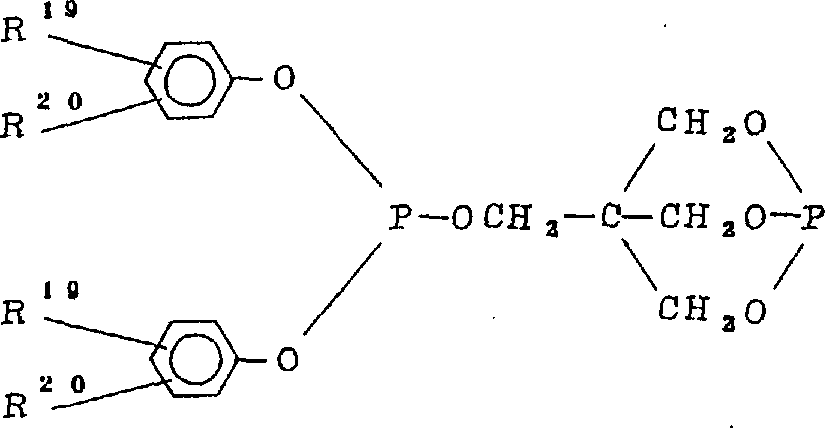
有机亚磷酸酯稳定剂可以单独使用,或结合起来使用。Organic phosphite stabilizers can be used alone or in combination.
较高级脂肪酸金属盐的实例包括:含12至40个碳原子的饱和或不饱和羧酸的碱金属,碱土金属和其它金属的盐类。而且,含12至40个碳原子的饱和或不饱和羧酸可以带有如羟基的取代基。含12至40个碳原子的饱和或不饱和羧酸的具体例子包括较高级脂肪酸如硬脂酸,油酸、月桂酸、癸酸、花生四烯酸、棕榈酸、山萮酸、12-羟基硬脂酸和褐煤酸。此外,可能提及的与这些较高级脂肪酸反应形成盐的金属包括碱土金属如镁、钙和钡,碱金属如钠、钾和锂、镉、锌、铝等。Examples of metal salts of higher fatty acids include alkali metal, alkaline earth metal and other metal salts of saturated or unsaturated carboxylic acids having 12 to 40 carbon atoms. Furthermore, saturated or unsaturated carboxylic acids having 12 to 40 carbon atoms may have substituents such as hydroxyl groups. Specific examples of saturated or unsaturated carboxylic acids having 12 to 40 carbon atoms include higher fatty acids such as stearic acid, oleic acid, lauric acid, capric acid, arachidonic acid, palmitic acid, behenic acid, 12-hydroxy Stearic acid and montanic acid. In addition, metals which may be mentioned to form salts upon reaction with these higher fatty acids include alkaline earth metals such as magnesium, calcium and barium, alkali metals such as sodium, potassium and lithium, cadmium, zinc, aluminum and the like.
较高级脂肪酸盐的具体例子包括硬脂酸镁,月桂酸镁,棕榈酸镁,硬脂酸钙,油酸钙,月桂酸钙,硬脂酸钡,油酸钡,月桂酸钡,花生四烯酸钡,芝麻油酸钡(barium benenate),硬脂酸锌,油酸锌,月桂酸锌,硬脂酸锂,硬脂酸钠,棕榈酸钠,月桂酸钠,硬脂酸钾,月桂酸钾,12-羟基硬脂酸钙,褐煤酸钠,褐煤酸钙,褐煤酸锌等。Specific examples of higher fatty acid salts include magnesium stearate, magnesium laurate, magnesium palmitate, calcium stearate, calcium oleate, calcium laurate, barium stearate, barium oleate, barium laurate, peanut tetra Barium enoate, barium benenate, zinc stearate, zinc oleate, zinc laurate, lithium stearate, sodium stearate, sodium palmitate, sodium laurate, potassium stearate, lauric acid Potassium, calcium 12-hydroxystearate, sodium montanate, calcium montanate, zinc montanate, etc.
在这些较高级脂肪酸金属盐中,含12至35个碳原子的饱和脂肪酸锌盐是特别优选的。Among these metal salts of higher fatty acids, zinc salts of saturated fatty acids having 12 to 35 carbon atoms are particularly preferred.
这些较高级脂肪酸金属盐可以单独使用或结合起来使用。These metal salts of higher fatty acids may be used alone or in combination.
酚类稳定剂的配合率为0.01至10重量·%,优选为0.02至0.5重量·%,特别优选为0.03至0.2重量·%;有机亚磷酸酯的配合率为0.01至1.0重量·%,优选为0.02至0.5重量·%,特别优选为0.01至0.2重量·%;较高级脂肪酸金属盐的配合率为0.01至1.0重量·%,优选为0.02至0.5重量·%,特别优选为0.03至0.2重量·%(以上分别以成型材料树脂为基准的)。The compounding ratio of phenolic stabilizer is 0.01 to 10 weight %, preferably 0.02 to 0.5 weight %, especially preferably 0.03 to 0.2 weight %; the compounding rate of organic phosphite is 0.01 to 1.0 weight %, preferably 0.02 to 0.5% by weight, particularly preferably 0.01 to 0.2% by weight; the blending ratio of higher fatty acid metal salts is 0.01 to 1.0% by weight, preferably 0.02 to 0.5% by weight, particularly preferably 0.03 to 0.2% by weight ·% (the above are based on the molding material resin).
下面用实施例更详细地阐述本发明,但并不限制本发明。The following examples illustrate the present invention in more detail, but do not limit the present invention.
实施例1Example 1
制备钛催化剂组分(A) Preparation of titanium catalyst component (A)
将无水氯化镁(7.14公斤),37.5升癸烷和35.1升2-乙基己基醇在140℃加热反应4小时,形成均匀溶液。于该溶液中加入1.67公斤的苯酐,在130℃将混合物搅拌1小时,使苯酐溶于均匀溶液中。Anhydrous magnesium chloride (7.14 kg), 37.5 liters of decane and 35.1 liters of 2-ethylhexyl alcohol were heated at 140°C for 4 hours to form a homogeneous solution. 1.67 kg of phthalic anhydride was added to the solution, and the mixture was stirred at 130° C. for 1 hour to dissolve the phthalic anhydride in the uniform solution.
将所得均匀溶液冷至室温,并在-20℃,3个小时内滴加到200升四氯化钛中。加完后,在4个小时内将该混合溶液的温度升至110℃,温度达到110℃时,加入5.03升邻苯二甲酸二异丁基酯。The resulting homogeneous solution was cooled to room temperature, and added dropwise to 200 liters of titanium tetrachloride at -20°C over 3 hours. After the addition, the temperature of the mixed solution was raised to 110° C. within 4 hours, and when the temperature reached 110° C., 5.03 liters of diisobutyl phthalate was added.
在该温度下将混合物搅拌2小时,反应2小时后,趁热过滤收集固体部分,使其再悬浮于275升四氯化钛中。使悬浮液在110℃加热反应2小时。The mixture was stirred at this temperature for 2 hours, and after reacting for 2 hours, the solid portion was collected by filtration while hot and resuspended in 275 liters of titanium tetrachloride. The suspension was reacted by heating at 110°C for 2 hours.
反应完后,趁热过滤收集固体部分,用己烷洗涤直至洗出液中检测不到游离的钛化合物。After the reaction, the solid part was collected by filtration while hot, and washed with hexane until no free titanium compound was detected in the eluate.
由上述方法合成的固体钛催化剂组分(A)为己烷淤浆,将一部分该催化剂干燥,干燥后的催化剂经过分析表明其含有2.4重量·%钛,59重量·%氯,18重量·%镁和11.6重量·%邻苯二甲酸二异丁酯。The solid titanium catalyst component (A) synthesized by the above method is a hexane slurry, and a part of the catalyst is dried, and the analysis of the dried catalyst shows that it contains 2.4 wt.% titanium, 59 wt.% chlorine, 18 wt.% Magnesium and 11.6 wt.% diisobutyl phthalate.
预聚合Pre-aggregation
于用氮气清洗过的反应器中加入纯化的己烷(100升)、3摩尔三乙基铝和1摩尔(以钛原子计)钛催化剂组分(A)。将该悬浮液的温度维持在15至20℃,并在搅拌下以2130Nl/小时的速度的丙烯通入其中达1.5小时。丙烯供料完成之后,将反应器封闭,让残留的丙烯聚合30分钟,加入7摩尔的三乙基铝、5摩尔的三甲基甲氧基硅烷和5.9公斤3-甲基-1-丁烯,在30℃将该混合物搅拌混合3个小时,预聚合3-甲基-1-丁烯。预聚完毕后,用纯化的己烷适当地洗涤所得聚合物。聚合物的分析表明:丙烯的预聚合量为2.8克/克催化剂,3-甲基-1-丁烯为2.4克/克催化剂。Purified hexane (100 liters), 3 moles of triethylaluminum and 1 mole (in terms of titanium atoms) of the titanium catalyst component (A) were charged into a reactor purged with nitrogen. The temperature of the suspension was maintained at 15 to 20°C, and propylene was passed thereinto with stirring at a rate of 2130 Nl/hour for 1.5 hours. After the propylene feed is complete, the reactor is closed, the residual propylene is allowed to polymerize for 30 minutes, and 7 moles of triethylaluminum, 5 moles of trimethylmethoxysilane and 5.9 kg of 3-methyl-1-butene are added , and the mixture was stirred and mixed at 30°C for 3 hours to prepolymerize 3-methyl-1-butene. After the prepolymerization was completed, the resulting polymer was suitably washed with purified hexane. Analysis of the polymers showed a prepolymerization level of 2.8 g/g catalyst for propylene and 2.4 g/g catalyst for 3-methyl-1-butene.
聚合Aggregation
在250升聚合反应器中连续进行丙烯均聚。聚合压力和聚合温度分别控制为8公斤/厘米2·表压和70℃,将催化剂化合物即18毫摩尔/小时的三乙基铝,1.8毫摩尔/小时的二环己基二甲氧基硅烷和0.24毫摩尔/小时的钛催化剂组分(A)上预聚合了丙烯和3-甲基-1-丁烯的预聚合催化剂(以钛原子计)向反应器连续供料。将所得的聚丙烯连续出料。Homopolymerization of propylene was carried out continuously in a 250 liter polymerization reactor. Polymerization pressure and polymerization temperature are respectively controlled to be 8 kilograms/ centimeter Gage pressure and 70 ℃, the triethylaluminum that catalyst compound is 18 mmol/hour, the dicyclohexyldimethoxysilane of 1.8 mmol/hour and 0.24 mmol/hr of a prepolymerized catalyst (in terms of titanium atoms) prepolymerized with propylene and 3-methyl-1-butene on the titanium catalyst component (A) was continuously fed to the reactor. The resulting polypropylene is continuously discharged.
聚丙烯的生成速率平均约为10公斤/小时,聚丙烯中聚(3-甲基-1-丁烯)的含量为140重量·PPm。The production rate of polypropylene was about 10 kg/hour on average, and the content of poly(3-methyl-1-butene) in the polypropylene was 140 wt·PPm.
生产双轴拉伸薄膜Production of Biaxially Stretched Films
将100分重量的含聚(3-甲基-1-丁烯)的所得聚丙烯与0.1分重量的硬脂酸钙,0.1分重量的BHT(2,6-二叔丁基羟基甲苯)和0.1分重量的Irgano×1010(由Ciba-Geigy生产的一种抗氧剂;四〔亚甲基-3-(3',5'-二叔丁基羟基苯基)丙酸酯〕甲烷)作为稳定剂在Henschel混合器中进行混合,然后,在220℃的捏和温度下于机筒直径为65毫米的挤压机中进行造粒。100 parts by weight of the resulting polypropylene containing poly(3-methyl-1-butene) with 0.1 parts by weight of calcium stearate, 0.1 parts by weight of BHT (2,6-di-tert-butylhydroxytoluene) and 0.1 minutes by weight of Irgano×1010 (an antioxidant produced by Ciba-Geigy; tetrakis [methylene-3-(3', 5'-di-tert-butylhydroxyphenyl) propionate] methane) as The stabilizers were mixed in a Henschel mixer and then granulated in an extruder with a barrel diameter of 65 mm at a kneading temperature of 220°C.
所得粒子在280℃用机筒直径为90毫米的压片压出机,在30℃用冷辊压成1.5毫米厚的薄片。用拉幅机型串联双轴拉伸装置将得到的薄片在145℃纵向拉伸5倍,然后在170℃于拉幅机中横向拉伸10倍,得到厚度约为30微米的双轴拉伸薄膜。The obtained pellets were pressed into a 1.5 mm thick sheet at 280°C using a tablet extruder with a barrel diameter of 90 mm and at 30°C with a chill roll. The obtained sheet was stretched 5 times in the longitudinal direction at 145°C with a tenter-type biaxial stretching device, and then stretched 10 times in the transverse direction in a tenter at 170°C to obtain a biaxially stretched sheet with a thickness of about 30 microns. film.
薄膜的评价Evaluation of film
实施例1和2和比较例1和2所得的薄膜用下述评价方法进行评价。The films obtained in Examples 1 and 2 and Comparative Examples 1 and 2 were evaluated by the following evaluation methods.
(1)用肉眼观察的方法评价能见度(1) Evaluate the visibility with the naked eye
将五层厚度均为30微米的薄膜叠合在一起,观看透过这些薄膜的萤光灯的光亮,按5级评价其能见度感觉,其中5为良好,1为坏的。Five layers of films with a thickness of 30 microns are stacked together, and the light of fluorescent lamps passing through these films is observed, and the visibility is evaluated on a scale of 5, wherein 5 is good and 1 is bad.
(2)光散射指数(LSI)(2) Light Scattering Index (LSI)
用Toyo Seiki有限公司制造的LSI测试器测量。Measured with an LSI tester manufactured by Toyo Seiki Co., Ltd.
(3)浊度:按ASTMD 1003方法进行测量。(3) Turbidity: Measured according to ASTMD 1003 method.
(4)球晶的直径(4) Diameter of spherulite
用立体显微镜(×100)测量双轴拉伸之前薄片横截面中球晶的直径。The diameter of spherulites in the cross-section of the flakes before biaxial stretching was measured with a stereomicroscope (×100).
由于薄片中球晶的大小较小,双轴拉伸薄膜有助于有较好的能见度。因此球晶的直径可以用作衡量获得良好能见度特性的薄膜的标志。Biaxially stretched films contribute to better visibility due to the smaller size of spherulites in the flakes. The diameter of the spherulites can therefore be used as an indicator of a film for which good visibility properties are obtained.
测试结果列于表1。The test results are listed in Table 1.
实施例2Example 2
预聚合Pre-aggregation
于氮气清洗过的反应器中加入纯化的己烷(100升),10摩尔三乙基铝,10摩尔三甲基甲氧基硅烷,1摩尔(以钛原子计)钛催化剂组分(A)和10公斤3-甲基-1-丁烯。将所得的悬浮液在20℃搅拌3小时,预聚合3-甲基-1-丁烯。分析结果表明,3-甲基-1-丁烯的预聚合量为3.9克/克催化剂。停止搅拌,沉淀固体部分,除去上层清液。用己烷洗涤两次该固体,将总体积调至120升,加入3摩尔三乙基铝,然后以2130NL/小时的速度供给丙烯1.5小时,进行丙烯预聚合。预聚合温度维持在15至20℃。加完丙烯后,将反应器封闭,让残余的丙烯聚合30分钟,用己烷洗涤所得聚合物两次。分析结果表明,丙烯预聚合量为2.7克/克催化剂。Add purified hexane (100 liters), 10 moles of triethylaluminum, 10 moles of trimethylmethoxysilane, 1 mole (calculated as titanium atoms) of titanium catalyst component (A) in the reactor cleaned by nitrogen and 10 kg of 3-methyl-1-butene. The resulting suspension was stirred at 20°C for 3 hours to prepolymerize 3-methyl-1-butene. As a result of the analysis, the prepolymerized amount of 3-methyl-1-butene was 3.9 g/g catalyst. Stirring was stopped, the solid part was precipitated, and the supernatant was removed. The solid was washed twice with hexane, the total volume was adjusted to 120 liters, 3 moles of triethylaluminum was added, and then propylene was supplied at a rate of 2130 NL/hour for 1.5 hours to perform propylene prepolymerization. The prepolymerization temperature was maintained at 15 to 20°C. After the addition of propylene was complete, the reactor was closed, the residual propylene was allowed to polymerize for 30 minutes, and the resulting polymer was washed twice with hexane. As a result of the analysis, the prepolymerized amount of propylene was 2.7 g/g catalyst.
聚合Aggregation
按实施例1相同的方法进行丙烯聚合。结果是在形成的聚丙烯中含有220PPm聚(3-甲基-1-丁烯)。按实施例1相同的方法制备薄膜并进行评价。Propylene polymerization was carried out in the same manner as in Example 1. The result was 220 ppm poly(3-methyl-1-butene) in the formed polypropylene. Films were prepared and evaluated in the same manner as in Example 1.
结果表示于表1。The results are shown in Table 1.
对比例1和2Comparative example 1 and 2
重复实施例1和2的步骤,所不同的是不通入丙烯,省去了丙烯预聚合。结果示于表1。The steps of Examples 1 and 2 were repeated, except that propylene was not fed in, and the prepolymerization of propylene was omitted. The results are shown in Table 1.
表1
*:由于聚合困难,不可能得到制备薄膜所需的聚合物。*: Due to difficulty in polymerization, it was not possible to obtain the polymer required for the preparation of the film.
实施例3Example 3
预聚合Pre-aggregation
于氮气清洗过的反应器中加入纯化己烷(100升),10摩尔的三乙基铝,10摩尔的三甲基甲氧基硅烷,1摩尔(以钛原子计)钛催化剂组分(A)和20公斤3-甲基-1-丁烯。在20℃将所得的悬浮液搅拌5小时,进行3-甲基-1-丁烯的预聚合。分析结果表明,3-甲基-1-丁烯预聚合量为7.2克/克催化剂。停止搅拌,使固体部分沉淀,除去上层清液。用己烷洗涤固体两次,将总体积调至120升,加入3摩尔的三乙基铝,然后以2130NL/小时的速度供给丙烯1.5小时,进行丙烯预聚合,预聚合温度维持在15至20℃。供完丙烯后,将反应器封闭,让残余的丙烯聚合30分钟,用己烷将得到的聚合物洗涤两次。分析结果表明,丙烯聚合单元的预聚合量为2.7克/克催化剂。Add purified hexane (100 liters), 10 moles of triethylaluminum, 10 moles of trimethylmethoxysilane, 1 mole (calculated as titanium atoms) of titanium catalyst component (A ) and 20 kg of 3-methyl-1-butene. The resulting suspension was stirred at 20°C for 5 hours to conduct prepolymerization of 3-methyl-1-butene. As a result of the analysis, the prepolymerized amount of 3-methyl-1-butene was 7.2 g/g catalyst. Stirring was stopped, the solid portion was allowed to settle, and the supernatant was removed. Wash the solid twice with hexane, adjust the total volume to 120 liters, add 3 moles of triethylaluminum, and then supply propylene at a rate of 2130 NL/hour for 1.5 hours to carry out propylene prepolymerization, and the prepolymerization temperature is maintained at 15 to 20 ℃. After the supply of propylene was complete, the reactor was closed, the residual propylene was allowed to polymerize for 30 minutes, and the resulting polymer was washed twice with hexane. As a result of the analysis, the prepolymerized amount of propylene polymerized units was 2.7 g/g catalyst.
聚合Aggregation
按实施例1中相同的“聚合”方法,以约10公斤/小时的平均生成速率制得聚合物。聚丙烯中3-甲基-1-丁烯聚合单元的含量为410重量ppm,MFR为6.4克/10分钟。By the same "polymerization" method as in Example 1, a polymer was obtained at an average production rate of about 10 kg/hr. The content of 3-methyl-1-butene polymerized units in the polypropylene was 410 ppm by weight, and the MFR was 6.4 g/10 minutes.
实施例4和5Example 4 and 5
通过调整实施例3中停留时间,改变生成聚丙烯的速度(以固体催化剂为基准)制得分别含有200重量ppm3-甲基-1-丁烯聚合单元(实施例4)和含有630重量ppm(实施例5)3-甲基-1-丁烯聚合单元的聚丙烯。By adjusting the residence time in embodiment 3, change the speed of generating polypropylene (based on solid catalyst) to make respectively containing 200 weight ppm 3-methyl-1-butene polymerization unit (embodiment 4) and containing 630 weight ppm ( Example 5) Polypropylene of polymerized units of 3-methyl-1-butene.
制备未拉伸薄膜Preparation of unstretched film
在Henschel混合器中,将100分重量所得的含3-甲基-1-丁烯聚合物单元的组合物与0.1分重量的硬脂酸钙,0.1分重量的Irgano×1010〔Ciba-Geigy生产的抗氧剂;四〔亚甲基-3-(3',5'-叔丁基羟基苯基)丙酸酯〕甲烷),0.1分重量的芥酰胺稳定剂和0.1分重量的二氧化硅(Fuji-DaVison化学有限公司生产的SyLOID244)相混合,然后用机筒直径为65毫米的挤压机在捏和温度为220℃下将其造粒。In a Henschel mixer, 100 parts by weight of the resulting composition containing 3-methyl-1-butene polymer units and 0.1 parts by weight of calcium stearate, 0.1 parts by weight of Irgano × 1010 [Ciba-Geigy production Antioxidant; tetrakis [methylene-3-(3',5'-tert-butylhydroxyphenyl) propionate] methane), 0.1 parts by weight of erucamide stabilizer and 0.1 parts by weight of silicon dioxide ( SyLOID244® produced by Fuji-DaVison Chemical Co., Ltd.) were mixed, and then granulated at a kneading temperature of 220°C using an extruder having a barrel diameter of 65 mm.
在240℃,用机筒直径为65毫米的T-模头成膜装置将所得颗粒挤压,然后用冷辊在30℃冷却,得到未拉伸薄膜,其厚度为25微米。The resulting pellets were extruded at 240°C with a T-die film-forming apparatus having a cylinder diameter of 65 mm, and then cooled at 30°C with a chill roll to obtain an unstretched film having a thickness of 25 µm.
用下面的评价方法测量和评价该薄膜的特性,结果列于表2。The properties of the film were measured and evaluated by the following evaluation methods, and the results are shown in Table 2.
实施例6和7Example 6 and 7
用与实施例3相同的预聚合催化剂,在70℃,5公斤/厘米2·表压的条件下进行丙烯和乙烯的无规共聚。在所得的共聚物中,乙烯的含量为3.0%(重量)和3.2%(重量),3-甲基-1-丁烯聚合单元的含量为410重量PPm和220重量PPm。按实施例4相同方法得到未拉伸薄膜,其性能列于表2。Using the same prepolymerized catalyst as in Example 3, random copolymerization of propylene and ethylene was carried out at 70°C and 5 kg/cm²g. In the obtained copolymer, the content of ethylene was 3.0% by weight and 3.2% by weight, and the content of polymerized units of 3-methyl-1-butene was 410 ppm by weight and 220 ppm by weight. The unstretched film was obtained in the same manner as in Example 4, and its properties are listed in Table 2.
对比例3和4Comparative Examples 3 and 4
在实施例3和4中仅丙烯进行预聚合,没有3-甲基-1-丁烯的预聚合。用如此制得的预聚合催化剂进行聚合。In Examples 3 and 4 only propylene was prepolymerized without prepolymerization of 3-methyl-1-butene. Polymerization was carried out using the prepolymerized catalyst thus prepared.
实施例3至7和对比例3和4的薄膜的评价方法Evaluation method of the films of Examples 3 to 7 and Comparative Examples 3 and 4
(1)用肉眼观察法评价能见度特性(1) Evaluation of visibility characteristics by visual observation
将五层厚度均为25微米的薄膜叠在一起,观看透过这些薄膜的萤光灯的光亮,用5个等级评价其能见度感觉,其中5为良好,1为坏的。Five layers of films with a thickness of 25 microns are stacked together, and the light of fluorescent lamps passing through these films is observed, and the visibility feeling is evaluated on a 5-point scale, wherein 5 is good and 1 is bad.
(2)光散射指数(LSI)和(3)浊度:按实施例1同样的方法测量。(2) Light Scattering Index (LSI) and (3) Turbidity: Measured in the same manner as in Example 1.
(4)球晶的直径:用立体显微镜(×100)测量薄片横截面中的球晶的直径。(4) Diameter of spherulites: The diameter of spherulites in the cross-section of the slice was measured with a stereomicroscope (×100).
由于球晶的大小较小,薄膜的能见度特性会变得更好。因此,球晶的直径可作衡量获得良好能见度的薄膜的标志。Due to the smaller size of the spherulites, the visibility properties of the film become better. Therefore, the diameter of the spherulites can be used as a measure to obtain a good visibility film.
(5)扬氏模量(5) Young's modulus
按照JIS K6781方法,用(Instron)张力测试器在50毫米/分的拉伸速度下测量薄膜横向的扬氏模量。According to the JIS K6781 method, the Young's modulus in the transverse direction of the film was measured with an (Instron) tensile tester at a tensile speed of 50 mm/min.
实施例8Example 8
聚合Aggregation
在250升聚合釜中连续进行丙烯和乙烯的无规聚合。聚合压力和聚合温度分别控制在5公斤/厘米2·表压和70℃。将催化剂组分,即16毫摩尔/小时的三乙基铝,1.6毫摩尔/小时的二环己基二甲氧基硅烷和0.24毫摩尔/小时(按钛原子计算)连续向反应器供料,调节供给氢气和乙烯的量应使得气相中氢气/丙烯比约为0.07摩尔/摩尔,乙烯/丙烯约为0.03摩尔/摩尔。Random polymerization of propylene and ethylene was carried out continuously in a 250-liter polymerization tank. The polymerization pressure and polymerization temperature were controlled at 5 kg/ cm2 ·gauge pressure and 70°C, respectively. The catalyst components, i.e. 16 mmol/h of triethylaluminum, 1.6 mmol/h of dicyclohexyldimethoxysilane and 0.24 mmol/h (calculated as titanium atoms) were continuously fed to the reactor, The amounts of hydrogen and ethylene supplied were adjusted so that the hydrogen/propylene ratio in the gas phase was about 0.07 mol/mol and the ethylene/propylene ratio was about 0.03 mol/mol.
所得聚丙烯的生成速率平均约为6公斤/小时。The resulting polypropylene was produced at an average rate of about 6 kg/hour.
所得聚丙烯的MHR为7.0克/10分钟,聚丙烯中乙烯含量为4.7摩尔%,3-甲基-1-丁烯聚合单元的含量为600重量ppm。The MHR of the obtained polypropylene was 7.0 g/10 minutes, the ethylene content in the polypropylene was 4.7 mol%, and the content of 3-methyl-1-butene polymerized units was 600 wtppm.
制备注塑制品Preparation of injection molded products
在Henschel混合器中,将100分重量的所得含3-甲基-1-丁烯聚合单元的组合物与0.1分重量的硬脂酸钙和0.1分重In a Henschel mixer, 100 parts by weight of the resulting composition containing polymerized units of 3-methyl-1-butene was mixed with 0.1 parts by weight of calcium stearate and 0.1 parts by weight of
表2
用直径为30毫米的注塑机在树脂温度为220℃,注塑模头温度为50℃将所得颗粒进行注塑,制得2毫米厚的方片。The obtained pellets were injection-molded with an injection molding machine having a diameter of 30 mm at a resin temperature of 220° C. and an injection mold temperature of 50° C. to obtain square sheets with a thickness of 2 mm.
按以下的评价方法测量和评价方片特性。The properties of the squares were measured and evaluated according to the following evaluation methods.
结果示于表3。The results are shown in Table 3.
评价方片的方法
(1)浊度:按ASTMD 1003测量。(1) Turbidity: Measured according to ASTMD 1003.
(2)起始弯曲弹性模量(2) Initial flexural modulus of elasticity
按JIS K6781的方法,在拉伸速度为50毫米/分钟的条件下,用(Instron)张力测试器测量薄膜横向的扬氏模量。According to the method of JIS K6781, the Young's modulus in the transverse direction of the film was measured with an (Instron) tensile tester under the condition of a tensile speed of 50 mm/min.
实施例9和10Example 9 and 10
通过调整实施例1的停留时间,改变聚丙烯的生成速率(以固体催化剂为基础),制得3-甲基-1-丁烯聚合单元含量分别为210重量ppm(实施例9)和420重量ppm(实施例10)的聚丙烯。By adjusting the residence time of Example 1, changing the generation rate of polypropylene (based on the solid catalyst), the obtained 3-methyl-1-butene polymerized unit content is respectively 210 weight ppm (embodiment 9) and 420 weight ppm ppm (Example 10) of polypropylene.
对比例5Comparative example 5
重复实施例8的步骤,不同的是,预聚合催化剂的制备是仅用3摩尔三乙基铝和1摩尔(以钛原子计)钛催化剂组分(A)进行预聚合丙烯。The steps of Example 8 were repeated, except that the prepolymerization catalyst was prepared by only using 3 moles of triethylaluminum and 1 mole (calculated as titanium atoms) of the titanium catalyst component (A) to prepolymerize propylene.
表3
Claims (1)
Applications Claiming Priority (4)
| Application Number | Priority Date | Filing Date | Title |
|---|---|---|---|
| JP231213/88 | 1988-09-14 | ||
| JP23121388 | 1988-09-14 | ||
| JP23121488 | 1988-09-14 | ||
| JP231214/88 | 1988-09-14 |
Related Parent Applications (1)
| Application Number | Title | Priority Date | Filing Date |
|---|---|---|---|
| CN89108191A Division CN1043649C (en) | 1988-09-14 | 1989-09-13 | Olefin Polymerization Catalyst and Its Application |
Publications (2)
| Publication Number | Publication Date |
|---|---|
| CN1085225A CN1085225A (en) | 1994-04-13 |
| CN1044373C true CN1044373C (en) | 1999-07-28 |
Family
ID=26529751
Family Applications (7)
| Application Number | Title | Priority Date | Filing Date |
|---|---|---|---|
| CN89108191A Expired - Fee Related CN1043649C (en) | 1988-09-14 | 1989-09-13 | Olefin Polymerization Catalyst and Its Application |
| CN93109404A Expired - Fee Related CN1044373C (en) | 1988-09-14 | 1993-07-31 | Polypropylene injection mold object |
| CN93109192A Pending CN1084180A (en) | 1988-09-14 | 1993-07-31 | A kind of olefin polymerization catalyst components of handling through prepolymerization |
| CN93109194A Expired - Fee Related CN1044126C (en) | 1988-09-14 | 1993-07-31 | Stretched polypropylene film |
| CN93109193A Expired - Fee Related CN1044125C (en) | 1988-09-14 | 1993-07-31 | An unstretched polypropylene film |
| CN94104844A Expired - Fee Related CN1043899C (en) | 1988-09-14 | 1994-04-28 | Olefin Polymerization Catalyst and Its Application |
| CN94104901A Expired - Fee Related CN1033590C (en) | 1988-09-14 | 1994-04-28 | Olefin Polymerization Catalyst |
Family Applications Before (1)
| Application Number | Title | Priority Date | Filing Date |
|---|---|---|---|
| CN89108191A Expired - Fee Related CN1043649C (en) | 1988-09-14 | 1989-09-13 | Olefin Polymerization Catalyst and Its Application |
Family Applications After (5)
| Application Number | Title | Priority Date | Filing Date |
|---|---|---|---|
| CN93109192A Pending CN1084180A (en) | 1988-09-14 | 1993-07-31 | A kind of olefin polymerization catalyst components of handling through prepolymerization |
| CN93109194A Expired - Fee Related CN1044126C (en) | 1988-09-14 | 1993-07-31 | Stretched polypropylene film |
| CN93109193A Expired - Fee Related CN1044125C (en) | 1988-09-14 | 1993-07-31 | An unstretched polypropylene film |
| CN94104844A Expired - Fee Related CN1043899C (en) | 1988-09-14 | 1994-04-28 | Olefin Polymerization Catalyst and Its Application |
| CN94104901A Expired - Fee Related CN1033590C (en) | 1988-09-14 | 1994-04-28 | Olefin Polymerization Catalyst |
Country Status (7)
| Country | Link |
|---|---|
| US (1) | US5015612A (en) |
| EP (1) | EP0360497B1 (en) |
| JP (1) | JP2788012B2 (en) |
| KR (1) | KR920007040B1 (en) |
| CN (7) | CN1043649C (en) |
| CA (1) | CA1336594C (en) |
| DE (1) | DE68912996T2 (en) |
Families Citing this family (22)
| Publication number | Priority date | Publication date | Assignee | Title |
|---|---|---|---|---|
| KR900016267A (en) * | 1989-04-25 | 1990-11-13 | 노기 사다오 | Titanium trichloride composition for the production of olefin polymers and process for the preparation thereof |
| US5247032A (en) * | 1989-12-29 | 1993-09-21 | Mitsui Petrochemical Industries, Ltd. | Solid catalyst components for olefin polymerization and processes for the polymerization of olefin using same |
| US5234880A (en) * | 1990-10-11 | 1993-08-10 | Paxon Polymer Company, L.P. | Polyolefin catalysts and method of preparing an olefin polymer |
| FI90083C (en) * | 1990-12-20 | 1993-12-27 | Neste Oy | FOER OLEFINPOLYMERISATION AVSETT STEREOSPECIFIKT KATALYSATORSYSTEM |
| DE69311194T2 (en) * | 1992-04-03 | 1997-09-18 | Toho Titanium Co Ltd | Process for the preparation of polyolefins with a broad molecular weight distribution |
| WO1994007926A1 (en) * | 1992-09-25 | 1994-04-14 | Shell Oil Company | Process for polymerizing alpha-olefin |
| JP3156213B2 (en) * | 1993-02-23 | 2001-04-16 | 日石三菱株式会社 | Method for producing polyolefin |
| US6284857B1 (en) * | 1993-07-22 | 2001-09-04 | Mitsui Chemical, Inc. | Propylene polymer, propylene block copolymer, process for preparing said polymer and said block copolymer, and propylene polymer composition |
| US6201079B1 (en) * | 1995-09-29 | 2001-03-13 | Bp Amoco Corporation | Propylene polymer resin made from a high activity catalyst having a broad thermal processing window and articles made therefrom |
| EP0855408B1 (en) * | 1995-10-11 | 2001-12-12 | Mitsui Chemicals, Inc. | Process for the preparation of solid titanium catalyst component for the polymerization of olefins and process for the production of polyolefins |
| ATE335014T1 (en) | 1999-04-15 | 2006-08-15 | Basell Poliolefine Srl | COMPONENTS AND CATALYSTS FOR OLEFIN POLYMERIZATION |
| FI991057A0 (en) * | 1999-05-07 | 1999-05-07 | Borealis As | High stiffness propylene polymers and process for their preparation |
| WO2002044220A1 (en) * | 2000-11-29 | 2002-06-06 | Reliance Industries Limited | A lower a-alkene polymerisation heterogeneous solid catalyst |
| US7276463B2 (en) * | 2002-09-11 | 2007-10-02 | Japan Polypropylene Corporation | Polymerization catalyst for α-olefins and process for production of α-olefin polymers therewith |
| US7776979B2 (en) * | 2007-01-26 | 2010-08-17 | Lg Chem, Ltd. | Prepolymerized catalyst for olefin polymerization, process for polymerizing olefin by using the catalyst and polyolefin produced by the process |
| RU2553475C2 (en) | 2008-12-31 | 2015-06-20 | У.Р.Грейс эед Ко.-Конн. | Production of substituted phenylene aromatic diesters |
| SG172447A1 (en) | 2008-12-31 | 2011-08-29 | Dow Global Technologies Llc | Procatalyst composition with substituted 1,2-phenylene aromatic diester internal donor and method |
| US8378045B2 (en) * | 2008-12-31 | 2013-02-19 | Dow Global Technologies Llc | Thermoformed article with high stiffness and good optics |
| CN101824108B (en) * | 2009-03-04 | 2012-03-07 | 中国石油天然气股份有限公司 | Ziegler-Natta catalyst |
| BR112014011174A2 (en) * | 2011-12-22 | 2017-05-02 | Petróleo Brasileiro S A - Petrobras | alumina supported catalyst for use in olefin polymerization and method of preparation thereof |
| WO2013138900A1 (en) * | 2012-03-19 | 2013-09-26 | Orbite Aluminae Inc. | Processes for recovering rare earth elements and rare metals |
| CN113248637B (en) * | 2021-04-20 | 2022-07-26 | 国家能源集团宁夏煤业有限责任公司 | External electron donor compound, olefin polymerization catalyst and application thereof, polyolefin and preparation method thereof |
Family Cites Families (10)
| Publication number | Priority date | Publication date | Assignee | Title |
|---|---|---|---|---|
| US4295991A (en) * | 1978-09-26 | 1981-10-20 | Exxon Research & Engineering Co. | Titanium trichloride catalyst component and the process for the production thereof |
| JPS6042806B2 (en) * | 1979-12-26 | 1985-09-25 | 日石三菱株式会社 | Copolymer manufacturing method |
| JPS5759902A (en) * | 1980-09-29 | 1982-04-10 | Chisso Corp | Preparation of alpha-olefinic polymer |
| JPH0735410B2 (en) * | 1986-01-31 | 1995-04-19 | 三菱油化株式会社 | Catalyst for stereoregular polymerization of olefins |
| KR920000173B1 (en) * | 1986-10-09 | 1992-01-09 | 미쓰이세끼유 가가꾸고오교오 가부시끼가이샤 | Low-crystalline propylene random copolymer composition, preparation method thereof and polypropylene composite laminate |
| JPH0830095B2 (en) * | 1987-11-10 | 1996-03-27 | 三菱化学株式会社 | Process for producing olefin polymer |
| JP2590180B2 (en) * | 1988-02-25 | 1997-03-12 | 三菱化学株式会社 | Method for producing propylene polymer |
| JPH0791332B2 (en) * | 1988-06-09 | 1995-10-04 | チッソ株式会社 | Method for producing titanium catalyst component for olefin polymerization |
| US4871705A (en) * | 1988-06-16 | 1989-10-03 | Exxon Chemical Patents Inc. | Process for production of a high molecular weight ethylene a-olefin elastomer with a metallocene alumoxane catalyst |
| JP2554538B2 (en) * | 1989-04-06 | 1996-11-13 | チッソ株式会社 | Method for producing polypropylene |
-
1989
- 1989-09-12 KR KR1019890013293A patent/KR920007040B1/en not_active Expired
- 1989-09-13 CN CN89108191A patent/CN1043649C/en not_active Expired - Fee Related
- 1989-09-13 CA CA000611172A patent/CA1336594C/en not_active Expired - Fee Related
- 1989-09-14 DE DE68912996T patent/DE68912996T2/en not_active Expired - Fee Related
- 1989-09-14 US US07/407,437 patent/US5015612A/en not_active Expired - Lifetime
- 1989-09-14 EP EP89309351A patent/EP0360497B1/en not_active Expired - Lifetime
- 1989-09-14 JP JP1238562A patent/JP2788012B2/en not_active Expired - Lifetime
-
1993
- 1993-07-31 CN CN93109404A patent/CN1044373C/en not_active Expired - Fee Related
- 1993-07-31 CN CN93109192A patent/CN1084180A/en active Pending
- 1993-07-31 CN CN93109194A patent/CN1044126C/en not_active Expired - Fee Related
- 1993-07-31 CN CN93109193A patent/CN1044125C/en not_active Expired - Fee Related
-
1994
- 1994-04-28 CN CN94104844A patent/CN1043899C/en not_active Expired - Fee Related
- 1994-04-28 CN CN94104901A patent/CN1033590C/en not_active Expired - Fee Related
Also Published As
| Publication number | Publication date |
|---|---|
| US5015612A (en) | 1991-05-14 |
| DE68912996D1 (en) | 1994-03-24 |
| JP2788012B2 (en) | 1998-08-20 |
| CN1084187A (en) | 1994-03-23 |
| DE68912996T2 (en) | 1994-07-21 |
| CN1101353A (en) | 1995-04-12 |
| CN1044125C (en) | 1999-07-14 |
| CN1084180A (en) | 1994-03-23 |
| CN1084186A (en) | 1994-03-23 |
| CN1097769A (en) | 1995-01-25 |
| CN1033590C (en) | 1996-12-18 |
| EP0360497A2 (en) | 1990-03-28 |
| CN1043649C (en) | 1999-06-16 |
| CN1043899C (en) | 1999-06-30 |
| JPH03163110A (en) | 1991-07-15 |
| KR900004405A (en) | 1990-04-12 |
| CN1085225A (en) | 1994-04-13 |
| KR920007040B1 (en) | 1992-08-24 |
| CN1041162A (en) | 1990-04-11 |
| CN1044126C (en) | 1999-07-14 |
| EP0360497A3 (en) | 1991-07-31 |
| CA1336594C (en) | 1995-08-08 |
| EP0360497B1 (en) | 1994-02-09 |
Similar Documents
| Publication | Publication Date | Title |
|---|---|---|
| CN1044373C (en) | Polypropylene injection mold object | |
| CN1026116C (en) | Production method of polypropylene | |
| CN1021229C (en) | Olefin polymerization catalyst and olefin polymerization method | |
| CN1261461C (en) | (Cycloalkyl)methylsilanes as External Donors for Polyolefin Catalysts | |
| CN1100069C (en) | Propylene polymer and its preparation method | |
| CN1038685C (en) | Solid catalysts and components thereof for olefin polymerization | |
| CN1106409C (en) | Process for preparing polypropylene | |
| CN1053199C (en) | Preparation method of olefin polymer and olefin polymerization catalyst | |
| CN1115360C (en) | Improved propylene polymers for oriented films | |
| CN1993384A (en) | Olefin polymerization catalyst and method of polymerization using the catalyst | |
| CN1227288C (en) | Propylene polymer composition with improved impact strength and excellent optical properties | |
| CN1080271C (en) | Ethylene/α-olefin copolymer and film made from it | |
| CN1498231A (en) | Propylene polymers for films | |
| CN1163519C (en) | Solid Titanium Catalyst Components and Its Application in Olefin Polymerization Catalysts | |
| CN1423664A (en) | Semi-crystalline propylene polymer composition for preparing biaxially stretched polypropylene film | |
| CN1106425C (en) | Polypropylene composition and its production method | |
| CN1798803A (en) | Polypropylene resin composition | |
| CN1082059A (en) | Be used for the catalyst system polymerization process of alpha-olefin stereospecific polymerization and the polymkeric substance that obtains | |
| CN1175003C (en) | α-olefin polymer and α-olefin polymerization catalyst | |
| CN1265692A (en) | Olefin (CO) polymer composition | |
| CN1176984C (en) | polyolefin resin modifier, polyolefin resin composition and oriented polyolefin film | |
| JPH09104729A (en) | Propylene block copolymer, its production and propylene resin composition containing the copolymer | |
| CN1132858C (en) | Solid titanium catalyst component for olefin pkymerization, process for preparing the same, olefin pdymerization catalyst contanining catalyst component and olefin polyrnerization process using...... | |
| CN1043144A (en) | Modified polyolefin particles and preparation method thereof | |
| JP2883356B2 (en) | Composition containing 3-methyl-1-butene polymer unit |
Legal Events
| Date | Code | Title | Description |
|---|---|---|---|
| C10 | Entry into substantive examination | ||
| SE01 | Entry into force of request for substantive examination | ||
| C06 | Publication | ||
| PB01 | Publication | ||
| C14 | Grant of patent or utility model | ||
| GR01 | Patent grant | ||
| C19 | Lapse of patent right due to non-payment of the annual fee | ||
| CF01 | Termination of patent right due to non-payment of annual fee |