CN101968552B - X-ray wavelength dispersion and diffraction based hazardous article detection method - Google Patents
X-ray wavelength dispersion and diffraction based hazardous article detection method Download PDFInfo
- Publication number
- CN101968552B CN101968552B CN201010293785.8A CN201010293785A CN101968552B CN 101968552 B CN101968552 B CN 101968552B CN 201010293785 A CN201010293785 A CN 201010293785A CN 101968552 B CN101968552 B CN 101968552B
- Authority
- CN
- China
- Prior art keywords
- diffraction
- ray
- detection
- wavelength dispersion
- slit
- Prior art date
- Legal status (The legal status is an assumption and is not a legal conclusion. Google has not performed a legal analysis and makes no representation as to the accuracy of the status listed.)
- Expired - Fee Related
Links
Images


Landscapes
- Analysing Materials By The Use Of Radiation (AREA)
Abstract
一种X射线应用技术领域的基于X射线波长色散衍射危险品检测方法,采用在样品出射面设置截限狭缝和用Mo或Ag靶特征辐射X射线透射式波长色散衍射方法进行在线检测,反射式X射线波长色散衍射方法作现场鉴定。本发明能检测小包的危险品,能最终判断危险品是何种爆炸物、何种毒品;直接检测厚度几~十几cm,因检测部位是包裹小尺寸处,所以实际待测物体尺更大些;通过透射式X射线波长色散衍射的在线检查和反射式X射线波长色散现场鉴定,能完全正确无误地判断待测物体属何种物质,还能把包装物与危险品分开。这是其它任何非衍射方法办不到的,无可比拟的。
A dangerous goods detection method based on X-ray wavelength dispersion diffraction in the field of X-ray application technology, which adopts a cut-off slit on the sample exit surface and uses Mo or Ag target characteristic radiation X-ray transmission wavelength dispersion diffraction method for online detection, reflection Formula X-ray wavelength dispersive diffraction method for on-site identification. The invention can detect dangerous goods in small packages, and can finally judge what kind of explosives and drugs the dangerous goods are; directly detect the thickness of several to more than ten centimeters, and because the detection part is the small size of the package, the actual size of the object to be tested is larger Some; through the on-line inspection of transmission X-ray wavelength dispersion diffraction and the on-site identification of reflection X-ray wavelength dispersion, it can completely and accurately determine what kind of substance the object to be tested is, and it can also separate the packaging from dangerous goods. This is unmatched by any other non-diffraction method.
Description
技术领域 technical field
本发明涉及的是一种X射线应用技术领域的方法,具体是一种基于X射线波长色散衍射危险品检测方法。The invention relates to a method in the field of X-ray application technology, in particular to a method for detecting dangerous goods based on X-ray wavelength dispersion diffraction.
背景技术 Background technique
直至当前,在机场、车站、码头、海关及公共场所、政府保卫部门的安全检查仍都使用X射线透视装置,依据物件投影像的形状、衬度(对比度)细节的经验,以及是否有雷管之类的引爆装置来判断待测物体件是否属爆炸(危险)可疑物品。新发展的X射线计算机化的层析照相术(简称CT)的应用,图像较直接透视要清晰得多,但仍仅对金属件灵敏,不能判定待测物体体是什么毒品和什么炸药?如果用衍射方法就有可能解决这个问题。一般的X射线衍射分析多采用对称反射式衍射方法,必须取样到X射线衍射检测室作检测分析。这就提出超厚样品的透射X射线衍射和现场或在线(in situ)检测鉴定问题。Until now, X-ray fluoroscopy devices are still used in airports, stations, docks, customs and public places, and government security inspections, based on the shape of the projected image of the object, the experience of contrast (contrast) details, and whether there is a detonator. A similar detonating device is used to judge whether the object to be tested is an explosive (dangerous) suspicious item. The application of the newly developed X-ray computerized tomography (abbreviated as CT), the image is much clearer than the direct perspective, but it is still only sensitive to metal parts, and it is impossible to determine what drug and explosive the object to be tested is? It is possible to solve this problem if the diffraction method is used. The general X-ray diffraction analysis mostly adopts the symmetrical reflection diffraction method, and samples must be taken to the X-ray diffraction detection room for detection and analysis. This raises the problem of transmission X-ray diffraction and on-site or on-line (in situ) detection and identification of ultra-thick samples.
经过对现有技术的检索发现,仅在分析化学(Anal.Chem.)1995,67(5):164A~189A上发表《探测隐蔽爆炸物》(Detecting Hidden Explosives)一文提到用X射线衍射探测爆炸物的可能性。在此及以后未有这方面的报道。现有的透视方法,虽然能从影像上判断是否是危险品,但不能监定是何种物质。After searching the prior art, it was found that the article "Detecting Hidden Explosives" (Detecting Hidden Explosives) published on Analytical Chemistry (Anal.Chem.) 1995, 67(5): 164A~189A mentioned the use of X-ray diffraction to detect Possibility of explosives. There is no such report here or later. Although the existing fluoroscopy method can judge whether it is a dangerous product from the image, it cannot determine what kind of substance it is.
发明内容 Contents of the invention
本发明针对现有技术存在的上述不足,提供一种基于X射线波长色散衍射危险品检测方法,采用在样品出射面设置截限狭缝和用Mo或Ag靶特征辐射X射线透射式波长色散衍射方法进行在线检测,反射式X射线波长色散衍射方法作现场鉴定。Aiming at the above-mentioned deficiencies in the prior art, the present invention provides a method for detecting dangerous goods based on X-ray wavelength dispersion diffraction, which adopts a cut-off slit on the sample exit surface and uses Mo or Ag target characteristic radiation X-ray transmission type wavelength dispersion diffraction The method was used for on-line detection, and the reflective X-ray wavelength dispersive diffraction method was used for on-site identification.
本发明是通过以下技术方案实现的,本发明包括以下步骤:The present invention is achieved through the following technical solutions, and the present invention comprises the following steps:
第一步、用现行的X射线透视检查获得待检测物体的投影像,通过目测判断待测物是否危险品;The first step is to use the current X-ray fluoroscopy to obtain the projection image of the object to be inspected, and judge whether the object to be inspected is dangerous by visual inspection;
第二步、取出疑似危险品的待测物体置于衍射装置的两侧对待检测物进行X射线波长色散衍射检测,实现对危险品的在线检测和现场鉴定。The second step is to take out the suspected dangerous goods and place them on both sides of the diffraction device for X-ray wavelength dispersion diffraction detection to realize the online detection and on-site identification of dangerous goods.
所述的衍射装置包括:X射线源、光阑组件、截限狭缝、高能探测器及数据记录系统,其中:X射线源位于待测物体的前方,光阑组件位于X射线源和待测物体之间,截限狭缝紧贴在待测物体后面,高能探测器位于待测物体后衍射线方向的滑车上,数据记录系统与高能探测器相连接以接收检测信号。The diffraction device includes: an X-ray source, an aperture assembly, a cut-off slit, a high-energy detector and a data recording system, wherein: the X-ray source is located in front of the object to be measured, and the aperture assembly is located between the X-ray source and the object to be measured. Between the objects, the cut-off slit is close to the back of the object to be measured, the high-energy detector is located on the pulley in the direction of the diffraction line behind the object to be measured, and the data recording system is connected with the high-energy detector to receive the detection signal.
所述的波长色散衍射是指:(1)在衍射装置的进行待测物的透射式波长色散衍射的在线检测;(2)从待测物取出少量样品,在衍射装置的进行样品的反射式波长色散衍射的现场鉴定。Described wavelength dispersive diffraction refers to: (1) carry out the on-line detection of the transmission type wavelength dispersive diffraction of test object in diffraction device; In situ characterization of wavelength dispersive diffraction.
所述的X射线源是指最大工作电压为60kV的Mo或Ag靶的特征X射线线谱,输出电流40mA或更高。The X-ray source refers to the characteristic X-ray line spectrum of the Mo or Ag target with a maximum working voltage of 60kV and an output current of 40mA or higher.
所述的光阑组件包括Soller光阑和发散狭缝,其中:Soller光阑位于发散狭缝前。The diaphragm assembly includes a Soller diaphragm and a diverging slit, wherein: the Soller diaphragm is located in front of the diverging slit.
所述的截限狭缝采用单层厚度为0.2mm的铅箔或双层层叠的厚度为0.1mm的钽箔制成,其中:截限狭缝的宽度A小于等于入射X射线束的宽度,截限狭缝的厚度为a,其满足
第三步、将用Ag或Mo靶获得的衍射谱2θ-I进行数据处理和检索匹配,实现危险品检测。The third step is to perform data processing and retrieval matching on the diffraction spectrum 2θ-I obtained with the Ag or Mo target, so as to realize the detection of dangerous goods.
所述的数据处理是,把使用MoKa或AgKa辐射波长色散衍射检测所获得的2θAg,Mo-I谱,快速按2d sinθAg,Mo=λAg,Mo公式换算成d-I谱,然后用2dsinθCu=1.54056
所述的检索匹配是指:把检测获得2θCu-I谱对照标准衍射谱数据库进行检索匹配,得到待检测物和样品为何种炸药或毒品的鉴定结果。The retrieval matching refers to: searching and matching the detected 2θ Cu -I spectrum against the standard diffraction spectrum database to obtain the identification result of the substance to be detected and what kind of explosive or drug the sample is.
本发明可检测物体的厚度通过以下方式计算得到:The thickness of the detectable object of the present invention is calculated by the following method:
其中:μm’ρ分别为待测物体的质量吸收系数和密度,而μm为待测物体的质量吸收系数μm=ωiμmi,其中ωi、μmi分别为待测物体中第i种元素的质量分数和质量吸收系数。比如:Among them: μ m 'ρ is the mass absorption coefficient and density of the object to be measured, and μ m is the mass absorption coefficient of the object to be measured μ m = ω i μ mi , where ω i and μ mi are the first The mass fraction and mass absorption coefficient of i elements. for example:
可知,透射式波长色散衍射方法能检测的厚度为100.98/0.7,38.4/0.7,51.7/0.7,即144.2,54.8,73.8mm,可见能检测的厚度几~十几厘米。其中0.7是振装密度/大块材料的实测密度的比值。It can be seen that the thickness that can be detected by the transmission wavelength dispersion diffraction method is 100.98/0.7, 38.4/0.7, 51.7/0.7, that is, 144.2, 54.8, 73.8mm, and it can be seen that the thickness that can be detected is several to ten centimeters. where 0.7 is the ratio of vibration density/measured density of the bulk material.
本发明与现有技术相比,用X射线作安全检查的方法有最常用的基于吸收衬度成像的透视法、透射式波长色散和透射式能量色散(发明者的另一专利)三种方法。X射线透视成像法只能从图像的形状、衬度判断是否是危险物,不能鉴定出其属何种爆炸物或毒品。能检查枪支、匕首等金属凶器。用测定待测物体成分的方法一般也难最后判断所属物质,特别是炸药、有机物等。Compared with the prior art, the present invention uses X-rays as security inspection methods, including the most commonly used perspective method based on absorption contrast imaging, transmission wavelength dispersion and transmission energy dispersion (another patent of the inventor) . X-ray fluoroscopy can only judge whether it is a dangerous object from the shape and contrast of the image, but cannot identify what kind of explosive or drug it belongs to. Can inspect guns, daggers and other metal weapons. It is generally difficult to finally determine the substance to be determined by the method of determining the composition of the object to be measured, especially explosives, organic substances, etc.
本发明的优点包括:Advantages of the present invention include:
(1)能检测小包的危险品,能最终判断危险品是何种毒品、何种爆炸物;(1) It can detect dangerous goods in small packages, and can finally determine what kind of drugs and explosives the dangerous goods are;
(2)直接检测厚度几~十几cm,因检测部位是包裹小尺寸处,所以实际待测物体尺度更大些。(2) Directly detect the thickness of several to ten centimeters, because the detection part is the small size of the package, so the actual scale of the object to be measured is larger.
(3)通过透射式X射线波长色散衍射的在线检查和反射式X射线波长色散现场鉴定,能完全正确无误地判断待测物体属何种物质,还能把包装物与危险品分开。这是其它任何非衍射方法办不到的,无可比拟的。(3) Through the on-line inspection of transmission X-ray wavelength dispersion diffraction and on-site identification of reflection X-ray wavelength dispersion, it can completely and accurately determine what kind of substance the object to be tested belongs to, and can also separate the packaging from dangerous goods. This is unmatched by any other non-diffraction method.
附图说明 Description of drawings
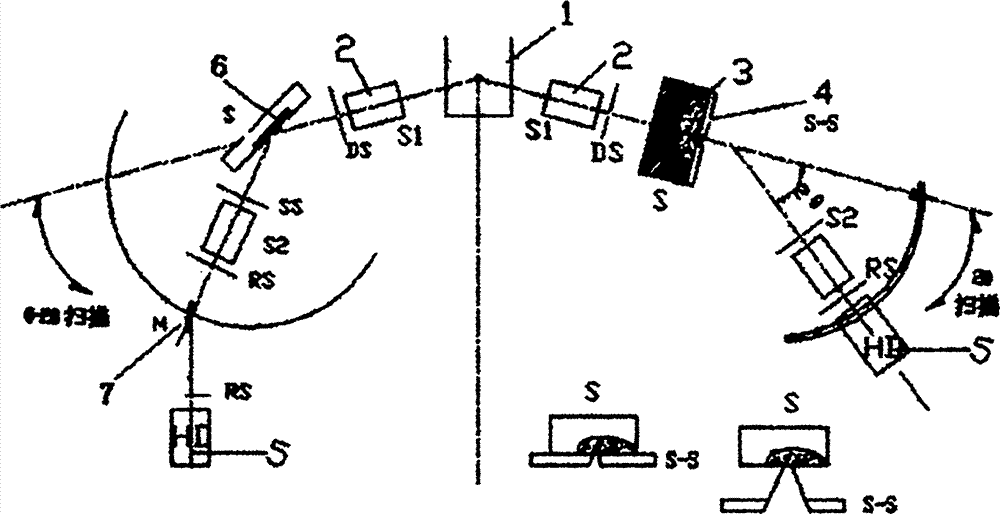
图1为毒品/炸药在线(右)检测和现场(左)鉴定的检测布置示意图;Fig. 1 is a schematic diagram of the detection layout of online (right) detection and on-site (left) identification of drugs/explosives;
图中:1X射线源(Ag或Mo靶)、2光阑组件、3待测物体、4截限狭缝S-S、5高能(矩阵)探测器及数据记录系统。6从待测物中取得的样品、7晶体单色器In the figure: 1 X-ray source (Ag or Mo target), 2 aperture assembly, 3 object to be measured, 4 cut-off slit S-S, 5 high-energy (matrix) detector and data recording system. 6 samples obtained from the analyte, 7 crystal monochromator
图2为截限狭缝的结构设计;Fig. 2 is the structural design of cut-off slit;
图中:(a)档板材料为铅;(b)档板材料为钽。In the figure: (a) the baffle material is lead; (b) the baffle material is tantalum.
图3为厚度为3.0mm的萘(C10H8)样品(CuKa辐射)的透射衍射检测花样;Fig. 3 is the transmission diffraction detection pattern of a naphthalene (C 10 H 8 ) sample (CuK a radiation) with a thickness of 3.0 mm;
图中:(a)加截限狭缝;(b)不加截限狭缝。In the figure: (a) with cut-off slit; (b) without cut-off slit.
图4为厚度为3.0mm的硝酸铵样品(CuKa辐射)的透射衍射检测花样;Fig. 4 is the transmission diffraction detection pattern of the ammonium nitrate sample ( CuKα radiation) that thickness is 3.0mm;
图中:(a)加截限狭缝;(b)不加截限狭缝。In the figure: (a) with cut-off slit; (b) without cut-off slit.
图5为厚度为3.0mm的食用葡萄糖样品(CuKa辐射)的透射衍射检测花样;Fig. 5 is the transmission diffraction detection pattern of the edible glucose sample ( CuKα radiation) that thickness is 3.0mm;
图中:(a)不加截限狭缝;(b)加截限狭缝;(c)通常的对称反射式扫描花样。In the figure: (a) without cut-off slit; (b) with cut-off slit; (c) usual symmetrical reflective scanning pattern.
具体实施方式 Detailed ways
下面对本发明的实施例作详细说明,本实施例在以本发明技术方案为前提下进行实施,给出了详细的实施方式和具体的操作过程,但本发明的保护范围不限于下述的实施例。The following is a detailed description of the embodiments of the present invention. This embodiment is implemented on the premise of the technical solution of the present invention, and detailed implementation methods and specific operating procedures are provided, but the protection scope of the present invention is not limited to the following implementation example.
本实施例包括以下步骤:This embodiment includes the following steps:
第一步、用现行的X射线透视检查获得待检测物体的投影像,通过目测判断待测物是否危险品;The first step is to use the current X-ray fluoroscopy to obtain the projection image of the object to be inspected, and judge whether the object to be inspected is dangerous by visual inspection;
第二步、取出疑似危险品的待测物体置于衍射装置的两侧对待检测物进行X射线波长色散衍射检测,实现对危险品的在线检测和现场鉴定。The second step is to take out the suspected dangerous goods and place them on both sides of the diffraction device for X-ray wavelength dispersion diffraction detection to realize the online detection and on-site identification of dangerous goods.
如图1所示,所述的衍射装置包括:X射线源1、光阑组件2、截限狭缝4、高能探测器及数据记录系统5,其中:X射线源1位于待测物体3的前方,光阑组件2位于X射线源1和待测物体3之间,截限狭缝4紧贴在待测物体3后面,高能探测器及数据记录系统5位于待测物体后衍射线方向的滑车上,其中:数据记录系统与高能探测器相连接以接收检测信号。As shown in Figure 1, the diffraction device includes:
所述的波长色散衍射是指:(1)在衍射装置的进行待测物的透射式波长色散衍射的在线检测;(2)从待测物取出少量样品,在衍射装置的进行样品的反射式波长色散衍射的现场鉴定。Described wavelength dispersive diffraction refers to: (1) carry out the on-line detection of the transmission type wavelength dispersive diffraction of test object in diffraction device; In situ characterization of wavelength dispersive diffraction.
所述的X射线源是指最大工作电压为60kV的Mo或Ag靶的特征X射线线谱,输出电流40mA或更高。The X-ray source refers to the characteristic X-ray line spectrum of the Mo or Ag target with a maximum working voltage of 60kV and an output current of 40mA or higher.
所述的光阑组件包括Soller光阑和发散狭缝,其中:Soller光阑位于发散狭缝前。The diaphragm assembly includes a Soller diaphragm and a diverging slit, wherein: the Soller diaphragm is located in front of the diverging slit.
如图2所示,所述的截限狭缝采用单层厚度为0.2mm的铅箔或双层层叠的厚度为0.1mm的钽箔制成,其中:截限狭缝的宽度A小于等于入射X射线束的宽度,截限狭缝的厚度为a,其满足 As shown in Figure 2, the cut-off slit is made of a single-layer lead foil with a thickness of 0.2mm or a double-layered tantalum foil with a thickness of 0.1mm, wherein: the width A of the cut-off slit is less than or equal to the incident The width of the X-ray beam, the thickness of the cut-off slit is a, which satisfies
第三步、将用Ag或Mo靶获得的衍射谱2θ-I进行数据处理和检索匹配,实现危险品检测。The third step is to perform data processing and retrieval matching on the diffraction spectrum 2θ-I obtained with the Ag or Mo target, so as to realize the detection of dangerous goods.
所述的数据处理是,把使用MoKa或AgKa辐射波长色散衍射检测所获得的2θAg,Mo-I谱,快速按2dsinθAg,mo=λAg,mo公式换算成d-I谱,然后用2dsinθcu=1.54056
所述的检索匹配是指:把检测获得2θCu-I谱对照标准衍射谱数据库进行检索匹配,得到待检测物和样品为何种炸药或毒品的鉴定结果。The retrieval matching refers to: searching and matching the detected 2θ Cu -I spectrum against the standard diffraction spectrum database to obtain the identification result of the substance to be detected and what kind of explosive or drug the sample is.
检测结果1
如图3所示,是厚度为3.0mm的萘(C10H8)样品,CuKa的透射衍检测图谱,曲线(a)加截限狭缝;曲线(b)不加截限狭缝。明显可见不加截限狭缝时透射式波长色散衍射的衍射线的严重宽化/分裂和严重重叠,已无法分辨一条一条的衍射线,而加上截限狭缝后的透射式衍射的衍射花样与通常用的对称式反射衍射的衍射图谱基本上一致,可以用于鉴定物质。如换成Mo和Ag靶,可检测厚度分别为65.9~94.1mm和101.1~144.3mm。As shown in Figure 3, it is the transmission diffraction detection spectrum of CuK a for a naphthalene (C 10 H 8 ) sample with a thickness of 3.0 mm, curve (a) with a cut-off slit; curve (b) without a cut-off slit. It can be clearly seen that the diffraction lines of the transmission wavelength dispersion diffraction are severely broadened/split and overlapped when the cut-off slit is not added, and the diffraction lines cannot be distinguished one by one. The pattern is basically consistent with the diffraction pattern of the commonly used symmetrical reflection diffraction, which can be used to identify substances. If it is replaced by Mo and Ag targets, the detectable thicknesses are 65.9~94.1mm and 101.1~144.3mm respectively.
检测结果2Test result 2
如图4所示,是厚度为3.0mm的硝酸铵(NH4NO3)样品,CuKa的透射衍射检测图谱,曲线(a)加截限狭缝;曲线(b)不加截限狭缝。明显可见不加截限狭缝时透射式衍射的衍射线的严重宽化、分裂和严重重叠,已无法分辨一条一条的衍射线,而加上截限狭缝后的透射式波长色散衍射的衍射图谱与通常用的对称式反射衍射的衍射图谱基本上一致,可以用于鉴定物质。如换成Mo和Ag靶,可检测厚度分别为27.8~39.7mm和40.95~58.5mm。As shown in Figure 4, it is a sample of ammonium nitrate (NH 4 NO 3 ) with a thickness of 3.0 mm, the transmission diffraction detection spectrum of CuK a , curve (a) with a cut-off slit; curve (b) without a cut-off slit . It can be clearly seen that the diffraction lines of transmission diffraction without a cut-off slit are severely broadened, split and overlapped, and it is no longer possible to distinguish one by one diffraction line, while the diffraction of transmission-type wavelength dispersion diffraction with a cut-off slit is The spectrum is basically consistent with the diffraction pattern of the commonly used symmetrical reflection diffraction, which can be used to identify substances. If it is replaced by Mo and Ag targets, the detectable thicknesses are 27.8-39.7mm and 40.95-58.5mm respectively.
检测结果3Test result 3
如图5所示,是厚度为3.0mm的食用葡萄糖(C6H12O6.H2O)样品,CuKa的透射衍射检测花样,曲线(a)加截限狭缝;曲线(b)不加截限狭缝。明显可见不加截限狭缝时透射式波长色散衍射的衍射线的严重宽化、分裂和重叠,已无法分辨一条一条的衍射线,而加上截限狭缝后的透射式衍射的衍射花样与通常用的对称式反射衍射的衍射花样(c)基本上一致,可以用于鉴定物质。如换成Mo和Ag靶,可检测厚度分别为30.53~43.6mm和51.48~73.5mm。As shown in Figure 5, it is the edible glucose (C 6 H 12 O 6 .H 2 O) sample with a thickness of 3.0 mm, the transmission diffraction detection pattern of CuK a , curve (a) plus cut-off slit; curve (b) No cut-off slit is added. It can be clearly seen that the diffraction lines of transmission wavelength dispersion diffraction are seriously broadened, split and overlapped when no cut-off slit is added, and the diffraction lines cannot be distinguished one by one, but the diffraction pattern of transmission diffraction with cut-off slit It is basically consistent with the commonly used symmetrical reflection diffraction diffraction pattern (c), and can be used to identify substances. If it is replaced by Mo and Ag targets, the detectable thicknesses are 30.53-43.6mm and 51.48-73.5mm respectively.
将上述三个实例加截限狭缝所得的花样,用Jade程序自动检索结果与实际检测物完全一致。这说明波长色散衍射方法完全能正确无误检测和判定待检测物是何种毒品、何种炸药和何种物质。这是透视成像方法无法比拟的。The patterns obtained by adding cut-off slits in the above three examples, and the automatic retrieval results of the Jade program are completely consistent with the actual detection objects. This shows that the wavelength dispersion diffraction method can detect and determine exactly what kind of drug, what kind of explosive and what kind of substance the substance to be detected is. This is unmatched by perspective imaging methods.
Claims (3)


Priority Applications (1)
| Application Number | Priority Date | Filing Date | Title |
|---|---|---|---|
| CN201010293785.8A CN101968552B (en) | 2010-09-27 | 2010-09-27 | X-ray wavelength dispersion and diffraction based hazardous article detection method |
Applications Claiming Priority (1)
| Application Number | Priority Date | Filing Date | Title |
|---|---|---|---|
| CN201010293785.8A CN101968552B (en) | 2010-09-27 | 2010-09-27 | X-ray wavelength dispersion and diffraction based hazardous article detection method |
Publications (2)
| Publication Number | Publication Date |
|---|---|
| CN101968552A CN101968552A (en) | 2011-02-09 |
| CN101968552B true CN101968552B (en) | 2013-01-09 |
Family
ID=43547735
Family Applications (1)
| Application Number | Title | Priority Date | Filing Date |
|---|---|---|---|
| CN201010293785.8A Expired - Fee Related CN101968552B (en) | 2010-09-27 | 2010-09-27 | X-ray wavelength dispersion and diffraction based hazardous article detection method |
Country Status (1)
| Country | Link |
|---|---|
| CN (1) | CN101968552B (en) |
Families Citing this family (2)
| Publication number | Priority date | Publication date | Assignee | Title |
|---|---|---|---|---|
| CN107991333A (en) * | 2017-12-27 | 2018-05-04 | 吴俊逸 | A kind of method of copper content in rapid semi-quantitative detection blind sample of fireworks and firecrackers pyrotechnic composition |
| CN109187606B (en) * | 2018-08-13 | 2020-06-02 | 同济大学 | A compound contraband intelligent precision detection equipment and detection method |
Citations (5)
| Publication number | Priority date | Publication date | Assignee | Title |
|---|---|---|---|---|
| EP0262834A2 (en) * | 1986-10-01 | 1988-04-06 | Ovonic Synthetic Materials Company, Inc. | X-Ray focusing/electron gun combination |
| CN1313507A (en) * | 2000-03-10 | 2001-09-19 | 中国科学院高能物理研究所 | Device for metering reflectivity of synchronously radiating X rays from multi-layer membrane |
| US7092485B2 (en) * | 2003-05-27 | 2006-08-15 | Control Screening, Llc | X-ray inspection system for detecting explosives and other contraband |
| CN201034952Y (en) * | 2007-04-28 | 2008-03-12 | 天津中泽科技有限公司 | Detecting analyzer of complex displacement type continuous reading analyse RoHS dictate trace elements |
| CN101286620A (en) * | 2008-05-12 | 2008-10-15 | 浙江大学 | Monolithic integrated mode-hop-free wavelength-tunable semiconductor laser |
Family Cites Families (3)
| Publication number | Priority date | Publication date | Assignee | Title |
|---|---|---|---|---|
| JPH11304728A (en) * | 1998-04-23 | 1999-11-05 | Hitachi Ltd | X-ray measurement device |
| US20060104414A1 (en) * | 2002-01-30 | 2006-05-18 | Mayo William E | Combinatorial contraband detection using energy dispersive x-ray diffraction |
| US7317513B2 (en) * | 2004-07-15 | 2008-01-08 | Mitutoyo Corporation | Absolute distance measuring device |
-
2010
- 2010-09-27 CN CN201010293785.8A patent/CN101968552B/en not_active Expired - Fee Related
Patent Citations (5)
| Publication number | Priority date | Publication date | Assignee | Title |
|---|---|---|---|---|
| EP0262834A2 (en) * | 1986-10-01 | 1988-04-06 | Ovonic Synthetic Materials Company, Inc. | X-Ray focusing/electron gun combination |
| CN1313507A (en) * | 2000-03-10 | 2001-09-19 | 中国科学院高能物理研究所 | Device for metering reflectivity of synchronously radiating X rays from multi-layer membrane |
| US7092485B2 (en) * | 2003-05-27 | 2006-08-15 | Control Screening, Llc | X-ray inspection system for detecting explosives and other contraband |
| CN201034952Y (en) * | 2007-04-28 | 2008-03-12 | 天津中泽科技有限公司 | Detecting analyzer of complex displacement type continuous reading analyse RoHS dictate trace elements |
| CN101286620A (en) * | 2008-05-12 | 2008-10-15 | 浙江大学 | Monolithic integrated mode-hop-free wavelength-tunable semiconductor laser |
Non-Patent Citations (1)
| Title |
|---|
| JP特开平11-304728A 1999.11.05 |
Also Published As
| Publication number | Publication date |
|---|---|
| CN101968552A (en) | 2011-02-09 |
Similar Documents
| Publication | Publication Date | Title |
|---|---|---|
| US7092485B2 (en) | X-ray inspection system for detecting explosives and other contraband | |
| Buffler | Contraband detection with fast neutrons | |
| EP0396618B1 (en) | Neutron scatter method and apparatus for the noninvasive interrogation of objects | |
| WO2006056132A1 (en) | Security inspection method for liquid by radiation source and its device | |
| CN106233160B (en) | Discrimination of low atomic weight materials using scattering and stopping of cosmic ray electrons and muons | |
| Pesente et al. | Detection of hidden explosives by using tagged neutron beams with sub-nanosecond time resolution | |
| CN101788507B (en) | Spectral analysis method | |
| JP2012515916A5 (en) | ||
| US20060133566A1 (en) | Method and apparatus for liquid safety-detection by backscatter with a radiation source | |
| US5440136A (en) | Anisotropic neutron scatter method and apparatus | |
| NZ237767A (en) | Luggage scanning by fast neutrons and gamma radiation | |
| EP2677304B1 (en) | Method and device for identifying unknown substances in an object | |
| CN104956211A (en) | Method and device for performing an X-ray fluorescence analysis | |
| Li et al. | Determination of selenium in biological samples with an energy-dispersive X-ray fluorescence spectrometer | |
| CN101968552A (en) | X-ray wavelength dispersion and diffraction based hazardous article detection method | |
| CN109632854B (en) | Massive uranium ore multi-element online X fluorescence analyzer with double detection structures | |
| KR101305300B1 (en) | Millimeter wave search system and unified search method for freight and passenger using the system | |
| CN101968454B (en) | X-ray energy dispersion and diffraction based hazardous article detection method | |
| Kolkoori et al. | High energy X-ray imaging technology for the detection of dangerous materials in air freight containers | |
| Szilágyi et al. | Development of an X-ray fluorescence spectrometric method for the analysis of atmospheric aerosol samples | |
| CN116593513A (en) | Methods, systems and media for identifying complex matrix minerals based on X-ray fluorescence | |
| CN102133106B (en) | Method for conducting fast and automatic nondestructive testing (NDT) to heroin hidden in human body | |
| CN114235786B (en) | Method for judging chromium element content in plastic by laser-induced breakdown spectroscopy with internal standard-standard sample superposition | |
| NL2026338B1 (en) | Material analysis method and system | |
| CN2752760Y (en) | Apparatus for making safety detection for liquid utilizing radioactive source |
Legal Events
| Date | Code | Title | Description |
|---|---|---|---|
| C06 | Publication | ||
| PB01 | Publication | ||
| C10 | Entry into substantive examination | ||
| SE01 | Entry into force of request for substantive examination | ||
| C14 | Grant of patent or utility model | ||
| GR01 | Patent grant | ||
| CF01 | Termination of patent right due to non-payment of annual fee |
Granted publication date: 20130109 Termination date: 20150927 |
|
| EXPY | Termination of patent right or utility model |