CN101478564B - Adaptive hierarchical transmission structure design method for P2P stream media network - Google Patents
Adaptive hierarchical transmission structure design method for P2P stream media network Download PDFInfo
- Publication number
- CN101478564B CN101478564B CN2008102365531A CN200810236553A CN101478564B CN 101478564 B CN101478564 B CN 101478564B CN 2008102365531 A CN2008102365531 A CN 2008102365531A CN 200810236553 A CN200810236553 A CN 200810236553A CN 101478564 B CN101478564 B CN 101478564B
- Authority
- CN
- China
- Prior art keywords
- node
- level
- peer
- server
- cache
- Prior art date
- Legal status (The legal status is an assumption and is not a legal conclusion. Google has not performed a legal analysis and makes no representation as to the accuracy of the status listed.)
- Expired - Fee Related
Links
Images


Landscapes
- Information Transfer Between Computers (AREA)
- Data Exchanges In Wide-Area Networks (AREA)
Abstract
本发明公开了一种P2P流媒体网络自适应分级传输结构设计方法,该方法采用视频文件不同码率分层技术对流媒体进行分层,根据可提取的层数分割为独立的文件;采用索引服务器实现节点(Peer)管理,聚类,等级初始化和共享服务等;通过节点(Peer)选择算法选取网络中的优良节点(Peer);采用缓存(Buffer)索引管理技术实现异构节点(Peer)之间的上传和下载服务,并使不同码率的数据在内存中易于管理。节点(Peer)既可以是客户端也可以是服务器,这样可以充分利用节点(Peer)之间的资源,大大减少服务器的负载,以更好的质量实现流媒体的实时传输。能满足流媒体网络传输服务和用户节点(Peer)的实时需求。
The invention discloses a method for designing a P2P streaming media network self-adaptive hierarchical transmission structure. The method adopts the layering technology of different code rates of video files to layer the streaming media, and divides the files into independent files according to the number of extractable layers; adopts an index server Realize node (Peer) management, clustering, level initialization and shared services, etc.; use node (Peer) selection algorithm to select excellent nodes (Peer) in the network; use cache (Buffer) index management technology to realize heterogeneous nodes (Peer) between upload and download services, and make data with different bit rates easy to manage in memory. A node (Peer) can be both a client and a server, which can make full use of resources between nodes (Peer), greatly reduce the load on the server, and achieve real-time transmission of streaming media with better quality. It can meet the real-time requirements of streaming media network transmission services and user nodes (Peer).
Description
技术领域 technical field
本发明属于网络传输领域,具体涉及到网络流媒体在异构IP网络中P2P(Peer-to-Peer)实时、自适应分级传输结构设计方法。The invention belongs to the field of network transmission, and in particular relates to a P2P (Peer-to-Peer) real-time, adaptive hierarchical transmission structure design method in a heterogeneous IP network.
背景技术 Background technique
P2P分布式网络传输结构改变了传统流媒体传输播放方式-Client/Server集中式网络模式,充分利用了客户端之间的闲置存储资源,平衡了流媒体网络媒体服务器的负载,增加了所支持客户数目、实时性和整个流媒体直播或点播传输网络负载均衡性。The P2P distributed network transmission structure has changed the traditional streaming media transmission and playback mode - Client/Server centralized network mode, which makes full use of idle storage resources between clients, balances the load of streaming media network media servers, and increases the number of supported customers Quantity, real-time and load balancing of the entire live streaming or on-demand transmission network.
传统的P2P传输技术往往被用来传输文件,或者传输统一分辨率的同一视频,然而,这种统一视频的传输并不能满足用户的需求。首先,不同网络带宽和不同终端的用户对视频的要求不一样,其次,带宽的波动性和不稳定性要求系统能够自适应的调整自己所传输视频数据的码率来与之相适应,为此,可伸缩编解码和多描述编码的研究解决了编解码的问题,然而,在传输方面,面对可伸缩系统的多层数据和多描述的多路视频传输要求,如何利用现有网络,结合P2P技术,实现多层文件或者多路数据的并行、完整、高效、自适应传输成为目前传输系统的突出问题。Traditional P2P transmission technologies are often used to transmit files, or to transmit the same video with a uniform resolution, however, this unified video transmission cannot meet the needs of users. First of all, users with different network bandwidths and different terminals have different requirements for video. Secondly, the fluctuation and instability of bandwidth require the system to adaptively adjust the bit rate of the video data it transmits to adapt to it. , the research on scalable codec and multi-description coding solves the problem of codec, however, in terms of transmission, in the face of multi-layer data and multi-description multi-channel video transmission requirements of scalable systems, how to use the existing network, combine P2P technology, realizing parallel, complete, efficient and adaptive transmission of multi-layer files or multi-channel data has become a prominent problem in the current transmission system.
发明内容 Contents of the invention
本发明的目的在于克服上述现有技术的缺点,提供一种P2P流媒体网络自适应分级传输结构设计方法,该方法能自适应的确定异构IP网络中的网络异构情况和终端异构情况,从而确定特定节点的等级并在网络状况波动时支持动态变化,按照等级传输特定码率的数据。The purpose of the present invention is to overcome the above-mentioned shortcoming of prior art, provide a kind of P2P flow media network self-adaptive hierarchical transmission structure design method, this method can self-adaptively determine the network heterogeneity situation and the terminal heterogeneity situation in the heterogeneous IP network , so as to determine the level of a specific node and support dynamic changes when the network conditions fluctuate, and transmit data at a specific code rate according to the level.
本发明的目的是通过以下技术方案来解决的:The purpose of the present invention is solved by the following technical solutions:
这种P2P流媒体网络自适应分级传输结构设计方法,包括下列步骤:This P2P streaming media network adaptive hierarchical transmission structure design method comprises the following steps:
新连入的节点由服务器决定其初始等级,服务器会自适应的根据节点的网络状况和终端类型来指定等级,并将该等级返回到节点;每一个节点都拥有自己的等级,节点按照自己的等级请求并下载和共享特定码率的视频数据,服务器会记录节点的等级和缓存信息;服务器通过节点聚类技术将观看相同节目的节点分类;The initial level of the newly connected node is determined by the server, and the server will adaptively specify the level according to the network status and terminal type of the node, and return the level to the node; each node has its own level, and the node according to its own level The level requests and downloads and shares video data with a specific bit rate, and the server will record the level and cache information of the node; the server will classify the nodes watching the same program through node clustering technology;
获得初始等级的节点按照所得到的等级向从服务器查询,服务器依据服务器节点资源选择策略选取资源节点,并返回到请求节点,请求节点从返回的资源节点中根据客户端节点资源选择策略选择节点进行下载,然后请求下载与其等级对应码率的流媒体内容,采用多级数据并存于缓存中的部分文件索引管理技术实现数据的分级管理,当节点缓存中的数据达到播放条件时开始解码并播放;The nodes that obtain the initial level query the slave server according to the obtained level. The server selects resource nodes according to the server node resource selection strategy and returns to the requesting node. The requesting node selects nodes from the returned resource nodes according to the client node resource selection strategy. Download, and then request to download streaming media content with a code rate corresponding to its level, and use part of the file index management technology that stores multi-level data in the cache to implement hierarchical management of data. When the data in the node cache meets the playback conditions, it starts to decode and play;
所述客户端节点资源选择策略如下:The client node resource selection strategy is as follows:
1)距请求节点的网络距离近;1) The network distance from the requesting node is short;
2)网络延迟小;2) The network delay is small;
所述的服务器节点资源选择策略如下:The server node resource selection strategy is as follows:
1)节点内存中存在请求节点要求的视频数据;1) There is video data required by the requesting node in the node memory;
2)节点的等级符合请求节点的等级要求;2) The level of the node meets the level requirements of the requesting node;
3)上传速度没有达到最大限度;3) The upload speed does not reach the maximum;
节点的等级可以动态变化,在运行一段时间后,服务器会统计各节点网络负荷情况,确定该节点是否仍然可以按照初始等级运行,判断方法为:如果节点带宽达到饱和,而且可以刚好下载到合适的码流,则保持原等级;如果其带宽有剩余则可以提高等级;如果带宽达到饱和,且仍不能下载到完整的数据,则等级要下降,对不符合初始等级要求的节点,则动态修改其等级,等级变化后的节点将根据新的等级来下载对应码率的视频数据。The level of the node can be changed dynamically. After running for a period of time, the server will count the network load of each node to determine whether the node can still run according to the initial level. code stream, the original level will be maintained; if the bandwidth is left, the level can be increased; if the bandwidth is saturated and the complete data cannot be downloaded, the level will be lowered, and the nodes that do not meet the requirements of the initial level will be dynamically modified. Level, the node after the level change will download the video data corresponding to the bit rate according to the new level.
对于不同等级的节点,对其下载速度进行自适应控制,节点等级越高,在固定的时间间隔内,其下载的数据量越大,即它的平均下载速度越快。For nodes of different levels, the download speed is adaptively controlled. The higher the node level, the greater the amount of data it downloads within a fixed time interval, that is, the faster its average download speed.
所述的多级数据并存于缓存中的部分文件索引管理技术是:在节点的缓存中采用多级数据并存于缓存中的部分文件索引管理技术实现分级数据的管理,视频数据在缓存中以部分文件为存储单位,每一个部分文件都包含两个索引标签,一个是该部分文件在原始视频数据中的实际部分文件索引值;另一个是该部分文件在缓存中的部分文件索引值,在该节点进行下载和上传的过程中,不断进行着实际部分文件值和在缓存中索引值的转换。The partial file index management technology in which multi-level data coexists in the cache is: in the cache of nodes, the partial file index management technology in which multi-level data coexists in the cache is used to realize the management of hierarchical data, and the video data is stored in the cache as part The file is the storage unit, and each partial file contains two index tags, one is the actual partial file index value of the partial file in the original video data; the other is the partial file index value of the partial file in the cache, in the In the process of downloading and uploading, the node is constantly converting the actual part of the file value and the index value in the cache.
本发明是一种流媒体在异构IP网络下Peer-to-Peer(P2P)实时、分级自适应传输体系结构的设计方案。通过流媒体码流分层(不同码率数据分层),资源节点(Peer)选择算法,客户端缓存(Buffer)索引管理技术管理缓存(Buffer)中的数据提供下载服务,经过下载后,将分层数据合成,解码成特定码率视频后播放,可以实现基于P2P的异构网络的流媒体实时分布式分级传输需求,从而减少服务器负载,提高码流传输质量,满足用户的需求。The invention is a design scheme of Peer-to-Peer (P2P) real-time and hierarchical self-adaptive transmission system structure of streaming media under heterogeneous IP network. Through streaming media stream layering (different code rate data layering), resource node (Peer) selection algorithm, client cache (Buffer) index management technology to manage data in the buffer (Buffer) to provide download services, after downloading, will Layered data synthesis, decoded into a specific bit rate video and then played, can realize the real-time distributed hierarchical transmission requirements of streaming media based on P2P heterogeneous network, thereby reducing server load, improving bit stream transmission quality, and meeting user needs.
附图说明 Description of drawings
图1是本发明的资源节点(Peer)选择算法流程框图;Fig. 1 is a resource node (Peer) selection algorithm flowchart of the present invention;
图2是本发明的可伸缩流媒体码流不同码率分级文件划分结构示意图;Fig. 2 is a schematic diagram of the hierarchical file division structure of different code rates of the scalable streaming media code stream of the present invention;
图3是本发明的节点(Peer)缓存(Buffer)及索引管理示意图;Fig. 3 is a node (Peer) cache (Buffer) and index management schematic diagram of the present invention;
其中:(a)是初始化的缓存(Buffer);(b)是正在下载中的缓存(Buffer);(c)是缓存(Buffer)的索引管理。Among them: (a) is the initialized cache (Buffer); (b) is the cache (Buffer) being downloaded; (c) is the index management of the cache (Buffer).
图4是本发明的节点(Peer)等级划分以及动态变化过程示意图;Fig. 4 is a schematic diagram of node (Peer) grade division and dynamic change process of the present invention;
图5是不同等级节点(Peer)的下载速率示意图。FIG. 5 is a schematic diagram of download rates of nodes (Peers) at different levels.
具体实施方式 Detailed ways
本发明提供的流媒体在异构IP网络下实时、分级传输的Peer-to-Peer体系结构设计方法,可以实现流媒体在P2P异构网络的实时传输,满足流媒体传输网络服务和用户的需求,具体包括:The Peer-to-Peer architecture design method for real-time and hierarchical transmission of streaming media under a heterogeneous IP network provided by the present invention can realize real-time transmission of streaming media in a P2P heterogeneous network and meet the needs of streaming media transmission network services and users , including:
一、通过“可伸缩流媒体数据文件分层”技术,实现可伸缩码流的层次划分;所述“可伸缩流媒体数据文件分层”技术为:采用可伸缩编码技术,对视频进行编码,得到可以按照不同的时间、空间、分辨率和质量来分层提取的码流,按照其支持的层次,经过码率分配等处理,得到独立的多层数据文件,一个视频支持几层提取,就会有几个文件。这些文件独立并行存储和传输。One, through the "scalable streaming media data file layering" technology, realize the hierarchical division of the scalable code stream; the "scalable streaming media data file layering" technology is: adopt scalable coding technology to encode the video, Obtain code streams that can be layered and extracted according to different time, space, resolution, and quality. According to the supported layers, after bit rate allocation and other processing, independent multi-layer data files are obtained. A video supports several layers of extraction. There will be several files. These files are stored and transferred independently and in parallel.
二、通过“可查询中心式服务器的P2P架构”技术实现Peer管理和Peer等级划分、动态变化等操作;所述“可查询中心式服务器的P2P架构”技术为:服务器负责新连入节点(Peer)初始等级的确定以及等级的动态更改,同时,服务器存储节目信息和节点(Peer)的信息,包括节点(Peer)的IP地址、端口和缓存(Buffer)信息;并且每个节点(Peer)都要定时给服务器发送状态信息包。2. Realize operations such as Peer management, peer classification, and dynamic changes through the "P2P architecture that can query the central server" technology; the "P2P architecture that can query the central server" technology is: the server is responsible for the newly connected ) determination of the initial level and the dynamic change of the level, at the same time, the server stores program information and node (Peer) information, including the node (Peer) IP address, port and cache (Buffer) information; and each node (Peer) It is necessary to send status information packets to the server regularly.
三、通过“Peer Buffer索引管理”技术,实现用户Peer之间的下载和上传服务以及Buffer的管理;所述“Peer Buffer索引管理”技术为:在节点(Peer)的缓存(Buffer)中采用多级数据并存于缓存(Buffer)中的部分文件(Part)索引管理技术实现分级数据的管理,视频数据在缓存(Buffer)中以部分文件(Part)为存储单位,每一个部分文件(Part)都包含两个索引标签(Index),一个是该部分文件(Part)在原始视频数据中的实际部分文件(Part)索引值;另一个是该部分文件(Part)在缓存(Buffer)中的部分文件(Part)索引值,在该节点(Peer)进行下载和上传的过程中,不断进行着实际部分文件(Part)值和在缓存(Buffer)中索引值的转换。3. Through the "Peer Buffer Index Management" technology, the download and upload services between the user Peers and the management of Buffer are realized; the "Peer Buffer Index Management" technology is: multiple The part file (Part) index management technology that stores level data in the cache (Buffer) realizes the management of hierarchical data. The video data in the cache (Buffer) uses a part file (Part) as the storage unit, and each part file (Part) Contains two index tags (Index), one is the actual part file (Part) index value of the part file (Part) in the original video data; the other is the part file (Part) of the part file (Part) in the cache (Buffer) (Part) index value, in the process of downloading and uploading of the node (Peer), the conversion between the actual part of the file (Part) value and the index value in the cache (Buffer) is constantly carried out.
四、通过“资源节点选择算法”技术,实现优良节点的选择;所述“资源节点选择算法”技术为:包括客户端节点(Peer)资源选择策略和服务器节点(Peer)资源选择策略。4. Realize the selection of excellent nodes through the "resource node selection algorithm" technology; the "resource node selection algorithm" technology is: including client node (Peer) resource selection strategy and server node (Peer) resource selection strategy.
其中客户端节点(Peer)资源选择策略具体如下:The client node (Peer) resource selection strategy is as follows:
1)距请求节点(Peer)的网络距离近,即要下载的节点(Peer)资源距离请求节点(Peer)的网络距离要近;1) The network distance from the requesting node (Peer) is short, that is, the node (Peer) resource to be downloaded is close to the network distance from the requesting node (Peer);
2)网络延迟小,即要下载的节点(Peer)资源到请求节点(Peer)的网络延迟小,也是对在选择较好网络状况的网络。2) The network delay is small, that is, the network delay from the node (Peer) resources to be downloaded to the requesting node (Peer) is small, and it is also a network with better network conditions.
上述的服务器节点(Peer)资源选择策略具体如下:The above server node (Peer) resource selection strategy is as follows:
1)节点(Peer)内存中存在请求节点(Peer)要求的视频数据;1) There is video data required by the requesting node (Peer) in the node (Peer) memory;
2)节点(Peer)的等级符合请求节点(Peer)的等级要求;2) The level of the node (Peer) meets the level requirements of the requesting node (Peer);
3)上传速度没有达到最大限度。3) The upload speed is not maxed out.
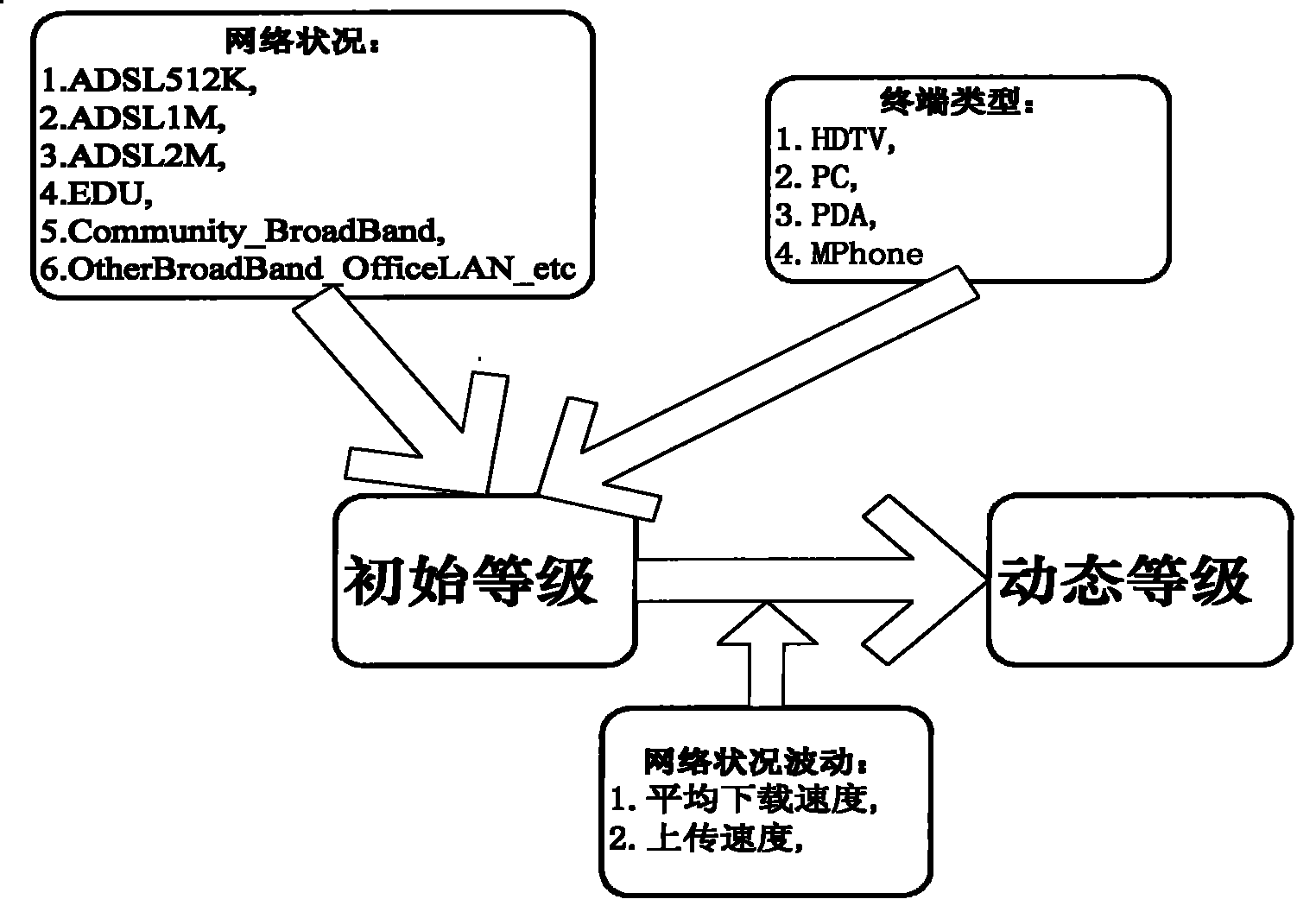
五、通过“节点等级划分”技术,实现节点等级的初始化和动态变化过程;所述“节点等级划分”技术为:不同的节点(Peer),服务器会自适应的根据节点(Peer)的网络状况和终端类型来指定其等级,并将该等级返回到节点(Peer);每一个节点(Peer)都拥有自己的等级,节点(Peer)按照自己的等级请求并下载和共享特定码率的视频数据,服务器会记录节点(Peer)的等级和缓存(Buffer)信息;服务器通过节点(Peer)聚类技术将观看相同节目的节点(Peer)分类;节点(Peer)的等级可以动态变化,在运行一段时间后,服务器会统计各节点(Peer)网络负荷情况,确定该节点(Peer)是否仍然可以按照初始等级运行,判断方法为:如果节点(Peer)带宽达到饱和,而且可以刚好下载到合适的码流,则保持原等级;如果其带宽有剩余则可以提高等级;如果带宽达到饱和,且仍不能下载到完整的数据,则等级要下降,对不符合初始等级要求的节点(Peer),则动态修改其等级,等级变化后的节点(Peer)将根据新的等级来下载对应码率的视频数据;等级的划分和视频所支持的视频数据层数相关,节点(Peer)的等级越高,所需数据量越大,获得视频质量也越高。5. Through the "node level division" technology, the initialization and dynamic change process of the node level is realized; the "node level division" technology is: different nodes (Peer), the server will adapt to the network status of the node (Peer) and terminal type to specify its level, and return the level to the node (Peer); each node (Peer) has its own level, and the node (Peer) requests and downloads and shares video data of a specific bit rate according to its own level , the server will record the level of the node (Peer) and cache (Buffer) information; the server will use the node (Peer) clustering technology to classify the nodes (Peer) watching the same program; the level of the node (Peer) can be changed dynamically. After a period of time, the server will count the network load of each node (Peer) to determine whether the node (Peer) can still run according to the initial level. The judgment method is: if the node (Peer) bandwidth is saturated, and the appropriate code If there is any bandwidth left, the level can be increased; if the bandwidth is saturated and the complete data cannot be downloaded, the level will be lowered, and for nodes (Peers) that do not meet the requirements of the initial level, dynamic Modify its level, the node (Peer) after the level change will download the video data of the corresponding code rate according to the new level; the division of the level is related to the number of video data layers supported by the video, the higher the level of the node (Peer), the The larger the amount of data required, the higher the quality of the obtained video.
获得等级的节点按照所得到的等级向从服务器查询,服务器依据服务器节点资源选择策略选取资源节点,并返回到请求节点,请求节点从返回的资源节点中根据客户端节点资源选择策略选择节点进行下载,然后请求下载与其等级对应码率的流媒体内容,采用多级数据并存于缓存中的部分文件索引管理技术实现数据的分级管理,当节点缓存中的数据达到播放条件时开始解码并播放;The node that has obtained the level queries the slave server according to the obtained level, the server selects the resource node according to the server node resource selection strategy, and returns to the requesting node, and the requesting node selects a node from the returned resource nodes according to the client node resource selection strategy to download , and then request to download streaming media content with a code rate corresponding to its level, and use part of the file index management technology that stores multi-level data in the cache to implement hierarchical management of data. When the data in the node cache meets the playback conditions, it starts to decode and play;
六、通过“Peer下载速率控制”技术,实现网络流量控制。所述“Peer下载速率控制”技术为:不同等级的节点(Peer)下载的整体平均速度不同,等级越高,其下载的数据量越大,其平均下载速度越快。这是通过控制不同等级的节点(Peer)在相同的下载间隔内下载的部分文件(Part)数量不同而实现的,这样能够保证网络状况较好的节点(Peer)能得到较大的数据量。6. Realize network traffic control through "Peer download rate control" technology. The "Peer download rate control" technology is as follows: the overall average download speed of nodes (Peer) of different grades is different, the higher the grade, the larger the amount of data downloaded, and the faster the average download speed. This is achieved by controlling the number of partial files (Part) downloaded by different levels of nodes (Peer) in the same download interval, so as to ensure that nodes (Peer) with better network conditions can obtain a larger amount of data.
下面结合附图对本发明做进一步详细描述:The present invention is described in further detail below in conjunction with accompanying drawing:
图1是本发明的资源节点(Peer)选择算法流程框图,即基于P2P的流媒体网络自适应分级传输系统资源节点选择流程图。经过五步选择,可以选出有请求数据并且网络条件最好的节点(Peer)作为源节点,进而从这些节点(Peer)下载数据。这五步是:FIG. 1 is a block diagram of a resource node (Peer) selection algorithm of the present invention, that is, a flow chart of resource node selection in a P2P-based streaming media network adaptive hierarchical transmission system. After five steps of selection, the nodes (Peers) with the requested data and the best network conditions can be selected as source nodes, and then data can be downloaded from these nodes (Peers). These five steps are:
(1).判断节点(Peer)内存中是否存在请求节点(Peer)要求的视频数据,这里指的是满足有所需数据的要求,如果满足,则开始进行资源节点(Peer)选择算法;(1). Judging whether there is video data required by the requesting node (Peer) in the memory of the node (Peer), which refers to meeting the requirements of the required data, and if it is satisfied, the resource node (Peer) selection algorithm is started;
(2).判断节点(Peer)的等级是否符合请求节点(Peer)的等级要求,比如,4级的节点(Peer)向2级节点(Peer)请求4层数据,则这个2级的节点(Peer)不符合等级的要求,如果是符合等级要求的,则继续下一步,否则结束;(2). Determine whether the level of the node (Peer) meets the level requirements of the requesting node (Peer). For example, if the
(3).判断上传速度是否超过限制,没有超过限制,继续下一步,否则结束;当一个节点(Peer)给多个其他节点(Peer)上传时有可能上传速度很快,为了保证每个节点(Peer)的性能不应因为上传速度太快而受到影响,必须对最大上传速度进行限制,本发明的对最大上传速度并不要求一个固定的阈值,而是要根据节点(Peer)的性能变化定;(3). Judging whether the upload speed exceeds the limit, if it does not exceed the limit, continue to the next step, otherwise end; when a node (Peer) uploads to multiple other nodes (Peer), the upload speed may be very fast, in order to ensure that each node (Peer) performance should not be affected because the upload speed is too fast, the maximum upload speed must be limited, the present invention does not require a fixed threshold to the maximum upload speed, but will be changed according to the performance of the node (Peer) Certainly;
(4).判断是否符合距离要求,如果符合,则继续下一步,否则结束;这里的距离是指网络距离,网络距离近可以在很大程度上保证较好的连接质量和较快的传输速度,可以使用如下的计算公式来计算网络距离:(4). Judging whether the distance requirement is met, if so, continue to the next step, otherwise end; the distance here refers to the network distance, and the short network distance can largely guarantee better connection quality and faster transmission speed , you can use the following calculation formula to calculate the network distance:
设两台主机的IP地址分别为:A1,B1,C1,D1和A2,B2,C2,D2,则计算公式为:Suppose the IP addresses of the two hosts are: A 1 , B 1 , C 1 , D 1 and A 2 , B 2 , C 2 , D 2 , then the calculation formula is:
其中,d为网络距离;α,β,γ,λ为不同的权值(程序中分别为5000、2000、1000、100);在A段,取值较大,如α的取值将大于β的取值,这样可以拉大距离,计算出的距离小于规定的距离时认为达到距离要求;Among them, d is the network distance; α, β, γ, and λ are different weights (5000, 2000, 1000, 100 in the program); in section A, the value is larger, such as the value of α will be greater than β The value of , so that the distance can be increased, and the calculated distance is considered to meet the distance requirement when it is less than the specified distance;
(5).判断是否符合延迟要求,是则继续,否则结束;这里使用Ping的方法来得到节点之间的延迟,Ping属于ICMP协议,向目标主机发送四次Ping包,当接收到返回包后,计算延迟,取四次延迟的平均值作为最终的延迟值,小于阈值者则满足延迟要求,此时可以确定为源节点(Peer)。(5). Judging whether the delay requirement is met, if yes, continue, otherwise end; here use the Ping method to obtain the delay between nodes, Ping belongs to the ICMP protocol, send four Ping packets to the target host, when the return packet is received , calculate the delay, take the average of the four delays as the final delay value, and those that are less than the threshold meet the delay requirement, and can be determined as the source node (Peer) at this time.
其中以上步骤(1)~(3)是在服务器(server)处判断,(4)和(5)是在节点(Peer)处判断。The above steps (1)-(3) are judged at the server (server), and (4) and (5) are judged at the node (Peer).
在图2中,给出了可伸缩流媒体码流不同码率分级文件划分结构示意图。编码之后的数据经过Transcode按照码流增长提取出不同层次的数据,分别存储在不同的文件中。In Fig. 2, a schematic diagram of the hierarchical file division structure of the scalable streaming media code stream with different code rates is given. The encoded data is extracted by Transcode according to the growth of the code stream to extract data of different levels, which are stored in different files.
图3是本发明的节点(Peer)缓存(Buffer)及索引管理示意图,其中(a)是初始化的缓存(Buffer);(b)是正在下载中的缓存(Buffer);(c)是缓存(Buffer)的索引管理示意图。Fig. 3 is a node (Peer) cache (Buffer) and index management schematic diagram of the present invention, wherein (a) is the cache (Buffer) of initialization; (b) is the cache (Buffer) being downloaded; (c) is the cache ( Buffer) index management diagram.
缓存(Buffer)存放一定数目的部分文件(Part),并且只有当完整的部分文件(Part)下载完后才可以共享,记录已下载和已播放的部分文件(Part)及其块文件(Block),并计算所需要下载的部分文件(Part)及其块文件(Block)。节点(Peer)之间根据各自的需求,相互查找其所需求的部分文件(Part),以块文件(Block)为最小单位进行下载和共享服务。The cache (Buffer) stores a certain number of partial files (Part), and can only be shared after the complete partial file (Part) is downloaded, and records the downloaded and played partial files (Part) and their block files (Block) , and calculate the part files (Part) and block files (Block) that need to be downloaded. Nodes (Peers) search each other for the parts they need according to their own needs, and use the block file (Block) as the smallest unit to download and share services.
缓存(Buffer)的索引管理,每个部分文件(Part)拥有两套不同的索引标签(index),其一是该部分文件(Part)在原始视频数据中的实际部分文件(Part)索引值;其二是该部分文件(Part)在缓存(Buffer)中的部分文件(Part)索引值。在该节点(Peer)进行下载和上传的过程中,不断进行着实际部分文件(Part)值和在缓存(Buffer)中索引值的转换。其中转换公式列举如下:Buffer index management, each part file (Part) has two different sets of index tags (index), one of which is the actual part file (Part) index value of the part file (Part) in the original video data; The second is the partial file (Part) index value of the partial file (Part) in the cache (Buffer). In the process of downloading and uploading by the node (Peer), the conversion between the actual part file (Part) value and the index value in the cache (Buffer) is constantly carried out. The conversion formulas are as follows:
actualindex=realindex×selfrank+datalayer-1actualindex=realindex×selfrank+datalayer-1
realindex=actualindex/selfrankrealindex=actualindex/selfrank
其中,actualindex为部分文件(Part)在原始视频数据中的实际部分文件(Part)索引值,realindex为该部分文件(Part)在缓存(Buffer)中的部分文件(Part)索引值,datalayer表示该部分文件(part)的层数,selfrank为该节点(Peer)的等级。Among them, actualindex is the actual partial file (Part) index value of the partial file (Part) in the original video data, realindex is the partial file (Part) index value of the partial file (Part) in the cache (Buffer), and datalayer represents the The number of layers of a part file (part), selfrank is the level of the node (Peer).
图4是本发明的节点(Peer)等级划分以及动态变化过程示意图。服务器通过节点(Peer)的网络连接情况和终端类型确定节点(Peer)的初始等级,在下载上传过程中,通过统计其平均下载和上传速度来动态更改节点(Peer)的等级。达到网络资源的使用和节点(Peer)观看效果的最佳平衡。Fig. 4 is a schematic diagram of the node (Peer) grade division and dynamic change process in the present invention. The server determines the initial level of the node (Peer) through the network connection of the node (Peer) and the terminal type. During the download and upload process, the level of the node (Peer) is dynamically changed by counting its average download and upload speed. To achieve the best balance between the use of network resources and the viewing effect of nodes (Peer).
图5显示了对不同等级节点(Peer)的下载速率进行控制的原理,不同等级的节点(Peer)下载的整体平均速度不同,等级越高,其下载的数据量越大,其平均下载速度越快。这是通过控制不同等级的节点(Peer)在相同的下载间隔内下载的部分文件(Part)数量不同而实现的,这样能够保证网络状况较好的节点(Peer)能得到较大的数据量。Figure 5 shows the principle of controlling the download rate of different levels of nodes (Peer). The overall average download speed of different levels of nodes (Peer) is different. The higher the level, the greater the amount of data downloaded and the higher the average download speed. quick. This is achieved by controlling the number of partial files (Part) downloaded by different levels of nodes (Peer) in the same download interval, so as to ensure that nodes (Peer) with better network conditions can obtain a larger amount of data.
综上所述,本发明提供了一种视频流媒体码流可分级自适应传输系统统一框架,能自适应的确定异构IP网络中的网络异构情况和终端异构情况,从而确定特定节点的等级并在网络状况波动时支持动态变化,并按照等级传输特定码率的数据。本发明使不同码率的视频数据在内存中易于管理,节点(Peer)既可以是客户端也可以是服务器,这样可以充分利用节点(Peer)之间的资源,大大减少服务器的负载,以更好的质量实现流媒体的实时传输。能满足流媒体网络传输服务和用户节点(Peer)的实时需求。该传输系统统一框架所传输的内容能适应数字流媒体,包括可伸缩流媒体、多描述流媒体和传统非可伸缩流媒体。To sum up, the present invention provides a unified frame of video streaming media code stream scalable adaptive transmission system, which can adaptively determine the network heterogeneity and terminal heterogeneity in the heterogeneous IP network, so as to determine the specific node It supports dynamic changes when network conditions fluctuate, and transmits data at a specific bit rate according to the level. The present invention makes the video data of different code rates easy to manage in the memory, and the node (Peer) can be a client or a server, so that the resources between the nodes (Peer) can be fully utilized, the load of the server is greatly reduced, and the Good quality enables real-time transmission of streaming media. It can meet the real-time requirements of streaming media network transmission services and user nodes (Peer). The content transmitted by the unified framework of the transmission system can adapt to digital streaming media, including scalable streaming media, multiple description streaming media and traditional non-scalable streaming media.
Claims (4)
Priority Applications (1)
| Application Number | Priority Date | Filing Date | Title |
|---|---|---|---|
| CN2008102365531A CN101478564B (en) | 2008-12-31 | 2008-12-31 | Adaptive hierarchical transmission structure design method for P2P stream media network |
Applications Claiming Priority (1)
| Application Number | Priority Date | Filing Date | Title |
|---|---|---|---|
| CN2008102365531A CN101478564B (en) | 2008-12-31 | 2008-12-31 | Adaptive hierarchical transmission structure design method for P2P stream media network |
Publications (2)
| Publication Number | Publication Date |
|---|---|
| CN101478564A CN101478564A (en) | 2009-07-08 |
| CN101478564B true CN101478564B (en) | 2012-01-04 |
Family
ID=40839194
Family Applications (1)
| Application Number | Title | Priority Date | Filing Date |
|---|---|---|---|
| CN2008102365531A Expired - Fee Related CN101478564B (en) | 2008-12-31 | 2008-12-31 | Adaptive hierarchical transmission structure design method for P2P stream media network |
Country Status (1)
| Country | Link |
|---|---|
| CN (1) | CN101478564B (en) |
Families Citing this family (26)
| Publication number | Priority date | Publication date | Assignee | Title |
|---|---|---|---|---|
| CN101945082B (en) * | 2009-07-09 | 2014-08-13 | 联想(北京)有限公司 | Method for automatically adjusting network downloading speed and network downloading equipment thereof |
| CN101609471B (en) * | 2009-07-24 | 2011-05-11 | 中兴通讯股份有限公司 | Embedded webpage analytic method and web browser |
| CN101800621B (en) * | 2010-01-12 | 2013-07-10 | 腾讯科技(深圳)有限公司 | Method and device for limiting uploading speed |
| CN102148747A (en) * | 2010-07-20 | 2011-08-10 | 华为软件技术有限公司 | Media stream transmission method and device |
| CN102158767B (en) * | 2010-09-30 | 2012-11-07 | 大连理工大学 | Scalable-coding-based peer to peer live media streaming system |
| CN102457564A (en) * | 2010-10-28 | 2012-05-16 | 华为技术有限公司 | Real-time streaming media download method and system for peer-to-peer network |
| CN102014301A (en) * | 2010-11-26 | 2011-04-13 | 优视科技有限公司 | Video playing method, system and server |
| CN102088620B (en) * | 2010-12-01 | 2014-06-18 | 中兴通讯股份有限公司南京分公司 | Method for downloading media file in content distribution network and client |
| CN102075792B (en) * | 2010-12-23 | 2013-01-02 | 华为技术有限公司 | Video file playing method and system, user equipment and server equipment |
| CN102123303B (en) * | 2011-03-25 | 2012-10-24 | 天脉聚源(北京)传媒科技有限公司 | Audio/video file playing method and system as well as transmission control device |
| CN102149005A (en) * | 2011-04-29 | 2011-08-10 | 四川长虹电器股份有限公司 | Self-adaptive method for controlling network video quality |
| CN102611915A (en) * | 2012-03-15 | 2012-07-25 | 华为技术有限公司 | Video startup method, device and system |
| CN102821316A (en) * | 2012-05-14 | 2012-12-12 | 南京邮电大学 | Improved video on demand (VOD) transmission method based on peer-to-peer computing core algorithm |
| US20140337505A1 (en) * | 2013-05-08 | 2014-11-13 | Htc Corporation | Method for data transmission and corresponding electronic device |
| CN104320424B (en) * | 2014-11-20 | 2017-06-16 | 三星电子(中国)研发中心 | A kind of Streaming Media burst method for down loading and device |
| US20160191594A1 (en) * | 2014-12-24 | 2016-06-30 | Intel Corporation | Context aware streaming media technologies, devices, systems, and methods utilizing the same |
| CN105072159B (en) * | 2015-07-17 | 2018-09-18 | 杭州施强教育科技有限公司 | A kind of node administration list structure in P2P networkings and its management method |
| CN106681794B (en) * | 2016-12-07 | 2020-04-10 | 长春市三昧动漫设计有限公司 | Interest behavior based distributed virtual environment cache management method |
| CN107105338A (en) * | 2017-03-17 | 2017-08-29 | 深圳市先河系统技术有限公司 | The method and terminal asked for display image, video and response to network |
| CN107295070B (en) * | 2017-05-31 | 2019-10-29 | 上海交通大学 | The distributed coding caching laying method and system of file size isomery |
| CN109587531A (en) * | 2017-09-28 | 2019-04-05 | 华为技术有限公司 | Video transmission method, apparatus and system |
| CN110224861A (en) * | 2019-05-17 | 2019-09-10 | 天津大学 | The implementation method of adaptive dynamic heterogeneous network selection policies based on study |
| CN114079803A (en) * | 2020-08-21 | 2022-02-22 | 上海昊骇信息科技有限公司 | Music live broadcast method and system based on virtual reality |
| CN114125572B (en) * | 2021-11-22 | 2022-06-03 | 江苏经贸职业技术学院 | Video data distribution and storage system based on P2P |
| CN114500665A (en) * | 2021-12-28 | 2022-05-13 | 炫彩互动网络科技有限公司 | File fragmentation downloading method, equipment and storage medium adaptive to network environment |
| CN116743719A (en) * | 2022-03-04 | 2023-09-12 | 腾讯科技(深圳)有限公司 | Streaming media processing method, device, terminal equipment and storage medium |
Citations (3)
| Publication number | Priority date | Publication date | Assignee | Title |
|---|---|---|---|---|
| CN101056403A (en) * | 2007-04-28 | 2007-10-17 | 西安交通大学 | Design method of P2P network transmission system architecture with the telescopic video coding |
| CN101060621A (en) * | 2007-04-28 | 2007-10-24 | 西安交通大学 | A method for the design of easy-to-manage real-time stream media P2P network transmission system |
| CN101123609A (en) * | 2007-09-10 | 2008-02-13 | 北京航空航天大学 | Resource Level Adaptive Search Method |
-
2008
- 2008-12-31 CN CN2008102365531A patent/CN101478564B/en not_active Expired - Fee Related
Patent Citations (3)
| Publication number | Priority date | Publication date | Assignee | Title |
|---|---|---|---|---|
| CN101056403A (en) * | 2007-04-28 | 2007-10-17 | 西安交通大学 | Design method of P2P network transmission system architecture with the telescopic video coding |
| CN101060621A (en) * | 2007-04-28 | 2007-10-24 | 西安交通大学 | A method for the design of easy-to-manage real-time stream media P2P network transmission system |
| CN101123609A (en) * | 2007-09-10 | 2008-02-13 | 北京航空航天大学 | Resource Level Adaptive Search Method |
Also Published As
| Publication number | Publication date |
|---|---|
| CN101478564A (en) | 2009-07-08 |
Similar Documents
| Publication | Publication Date | Title |
|---|---|---|
| CN101478564B (en) | Adaptive hierarchical transmission structure design method for P2P stream media network | |
| Suh et al. | Push-to-peer video-on-demand system: Design and evaluation | |
| US9497035B2 (en) | Method, device, and system for playing media based on P2P | |
| CN101355522B (en) | Control method and system for media server | |
| CN101997890A (en) | A P2P streaming media download method, system and device | |
| CN105763896A (en) | Multi-user dynamic self-adapting video code rate allocation system | |
| CN101383853B (en) | Direct-link node number controlling method and network entity device | |
| CN101282231A (en) | A Live Streaming Model of FBStream Based on P2P Network | |
| CN102158767A (en) | Scalable-coding-based peer to peer live media streaming system | |
| KR101252947B1 (en) | Method and apparatus for push-pull hybrid streaming adaptive to video chunk distribution | |
| Ding et al. | Peer-to-peer video-on-demand with scalable video coding | |
| CN102497389A (en) | Big umbrella caching algorithm-based stream media coordination caching management method and system for IPTV | |
| CN111447506A (en) | Streaming media content placement method based on delay and cost balance in cloud edge environment | |
| CN102821316A (en) | Improved video on demand (VOD) transmission method based on peer-to-peer computing core algorithm | |
| CN101626400B (en) | Compensation method of P2P music on-demand system | |
| Biskupski et al. | High-bandwidth mesh-based overlay multicast in heterogeneous environments. | |
| CN111262886A (en) | A peer-to-peer network adaptive streaming media on-demand system and service quality assurance method | |
| CN101304405B (en) | A method of P2P streaming media transmission based on SVC | |
| Yu et al. | Self-adaptive schedule mechanism for peer-to-peer multi-rate live streaming system | |
| Xiao et al. | Toward systematical data scheduling for layered streaming in peer-to-peer networks: Can we go farther? | |
| Ozcan et al. | Multipath transmission aware ABR algorithm for SVC HAS | |
| CN107018181A (en) | P2P network establishing methods based on flow medium live system | |
| Chen et al. | FBSA: A self-adjustable multi-source data scheduling algorithm for P2P media streaming | |
| CN101325686B (en) | Method for implementing living broadcast service of down-pulling type equity network | |
| Yang et al. | Hybrid unicast and multicast video streaming using H. 264 SVC and FLUTE for set-top box users |
Legal Events
| Date | Code | Title | Description |
|---|---|---|---|
| C06 | Publication | ||
| PB01 | Publication | ||
| C10 | Entry into substantive examination | ||
| SE01 | Entry into force of request for substantive examination | ||
| C14 | Grant of patent or utility model | ||
| GR01 | Patent grant | ||
| CF01 | Termination of patent right due to non-payment of annual fee |
Granted publication date: 20120104 Termination date: 20141231 |
|
| EXPY | Termination of patent right or utility model |