CN100438503C - A way to choose a path - Google Patents
A way to choose a path Download PDFInfo
- Publication number
- CN100438503C CN100438503C CNB2005101359826A CN200510135982A CN100438503C CN 100438503 C CN100438503 C CN 100438503C CN B2005101359826 A CNB2005101359826 A CN B2005101359826A CN 200510135982 A CN200510135982 A CN 200510135982A CN 100438503 C CN100438503 C CN 100438503C
- Authority
- CN
- China
- Prior art keywords
- link
- path
- lsps
- links
- preempted
- Prior art date
- Legal status (The legal status is an assumption and is not a legal conclusion. Google has not performed a legal analysis and makes no representation as to the accuracy of the status listed.)
- Expired - Fee Related
Links
Images


Landscapes
- Data Exchanges In Wide-Area Networks (AREA)
Abstract
本发明公开了一种选择路径的方法,包括以下步骤:A、起始路由器判断是否存在不需要抢占其他LSP的路径,如果存在,则执行步骤B;否则,执行步骤C;B、在不需要抢占其他LSP的路径中选择一条路径,并结束本流程;C、在需要抢占其他LSP的路径中选择等效抢占LSP数量最少的链路所在的路径。利用本发明,解决了低优先级LSP频繁被建立与抢占,低优先级LSP的流量也频繁被中断的问题,大大提高了网络的稳定性。同时,也避免了在不需要抢占其他LSP中的链路时发生抢占,使整个网络的流量分布趋于均衡,大大提高了整个网络中链路的利用率。
The invention discloses a method for selecting a path, which includes the following steps: A. The initial router judges whether there is a path that does not need to preempt other LSPs, and if it exists, executes step B; otherwise, executes step C; B. Select a path among the paths that preempt other LSPs, and end this process; C. Select the path where the link with the least number of equivalent preempted LSPs is located among the paths that need to preempt other LSPs. The present invention solves the problems that low-priority LSPs are frequently established and preempted, and the flow of low-priority LSPs is also frequently interrupted, thereby greatly improving the stability of the network. At the same time, it also avoids preemption when there is no need to preempt links in other LSPs, so that the traffic distribution of the entire network tends to be balanced, and the utilization rate of links in the entire network is greatly improved.
Description
技术领域 technical field
本发明涉及通信技术中多协议标签交换流量控制,尤其涉及一种选择路径的方法。The invention relates to multi-protocol label switching flow control in communication technology, in particular to a method for selecting a path.
背景技术 Background technique
依照传统互联网络协议中关于链路状态的内部路由网关协议(IGP),通信网络中路由器采用最短路径优先(SPF)算法选择最短的路径作为路由,不考虑路径的带宽因素。在最短路径处于拥塞状态时,即使其他次优路径处于空闲状态,路由器也不会选择空闲的次优路径作为路由,致使通信网络中网络流量的分布极不均衡。According to the Internal Routing Gateway Protocol (IGP) on the link state in the traditional internet protocol, the routers in the communication network use the shortest path first (SPF) algorithm to select the shortest path as the route, regardless of the bandwidth factor of the path. When the shortest path is congested, even if other suboptimal paths are idle, the router will not choose the idle suboptimal path as the route, resulting in extremely unbalanced distribution of network traffic in the communication network.
多协议标签交换流量工程(MPLS TE)关注通信网络整体性能的优化,综合考虑路径的带宽因素,在通信网络的各条路径上均衡分布网络流量。运营商利用MPLS TE可以精确控制流量流经的路径,从而可以避开拥塞的节点,解决一部分路径过载,另一部路径空闲的问题,使运营商提供的网络资源得以充分利用,通信网络的整体性能得以优化。Multi-Protocol Label Switching Traffic Engineering (MPLS TE) focuses on the optimization of the overall performance of the communication network, comprehensively considers the bandwidth factor of the path, and distributes network traffic evenly on each path of the communication network. Operators can use MPLS TE to precisely control the path of traffic flow, so as to avoid congested nodes, solve the problem that some paths are overloaded and other paths are idle, so that the network resources provided by operators can be fully utilized, and the overall communication network Performance is optimized.
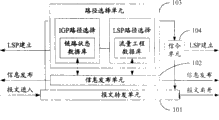
MPLS TE的上述功能是由MPLS TE结构实现的。如图1所示,图1为MPLSTE结构示意图。MPLS TE结构主要包括4个基本组成单元:报文转发单元101、信息发布单元102、路径选择单元103和信令单元104。The above functions of MPLS TE are realized by the structure of MPLS TE. As shown in FIG. 1, FIG. 1 is a schematic diagram of an MPLSTE structure. The MPLS TE structure mainly includes four basic components:
其中,报文转发单元101用于引导IP包流沿预先确定的路径通过网络。所述预先确定的路径是基于标签确定的,被称作标签交换路径(LSP),即业务流量从起始路由器按一定方向流向目的路由器的路径。由于LSP的是基于标签确定的,并不为通过现有IGP协议选择的到达目的路由器的最短路径所制约,所以可以避免起始路由器选择自身与目的路由器之间的最短路径作为路由。Wherein, the
信息发布单元102用于发布链路状态信息、网络拓扑信息和网络负载信息。MPLS TE在计算约束路径时需要一些有关网络拓扑和网络负载的信息,例如最大链路带宽、最大可预留带宽、当前预留带宽、当前带宽使用和链接属性等,这些信息是通过对现有IGP协议进行扩展来发布的。在对现有IGP协议进行扩展时,一般是在中间系统到中间系统(IS-IS)协议中引入新的类型长度值(TLV),或者在开放最短路径优先(OSPF)协议中引入新的链路状态通告(LSA)。MPLSTE的路由器通过一个特殊的流量工程数据库(TEDB)对网络拓扑信息和网络负载信息进行管理。TEDB用于计算LSP通过物理网络时的约束路径,与用于计算LSP通过物理网络时最短路径的IGP链接状态数据库相互独立。The
路径选择单元103用于根据TEDB中的网络拓扑信息和网络负载信息,采用约束最短路径优先(CSPF)算法计算满足约束条件的路径。CSPF是一种改进的最短路径优先算法,在计算通过网络的最短路径时将特定的约束条件也考虑进去,首先在当前网络拓扑结构中删除不满足约束条件的节点和链路,然后再根据SPF算法计算最短路径。这里,特定的约束条件主要包括带宽需求,最大跳转数,和管理策略需求等。The
信令单元104用于动态地建立LSP。信令单元动态地建立LSP可以避免逐跳配置的麻烦。普通的不带约束的LSP可以通过标签分发协议(LDP)来建立,而带约束的LSP可以通过约束标签分发协议(CR-LDP)或者资源预留协议流量工程(RSVP TE)来建立。The
如图2所示,图2为采用MPLS TE中的CSPF算法选择路径的示意图。假定所有带宽为1G的链路的路由量度值(Metric)都相同,所有带宽为155M的链路的Metric也都相同,且已经建立了路由器R1到R5优先级为0的高优先级LSP1:R1→R2→R5,LSP1占用的带宽为155M,还建立了路由器R3到R6优先级为2的低优先级LSP2:R3→R2→R6,LSP2占用的带宽也为155M。As shown in Figure 2, Figure 2 is a schematic diagram of path selection using the CSPF algorithm in MPLS TE. Assume that the routing metric value (Metric) of all links with a bandwidth of 1G is the same, and the Metrics of all links with a bandwidth of 155M are also the same, and a high-priority LSP1 with a priority of 0 for routers R1 to R5 has been established: R1 →R2→R5, the bandwidth occupied by LSP1 is 155M, and a low-priority LSP2 with a priority of 2 from routers R3 to R6 is also established: R3→R2→R6, the bandwidth occupied by LSP2 is also 155M.
当路由器R2与R5之间链路发生故障时,LSP1的头端路由器R1采用MPLSTE中的CSPF算法将LSP1重建为:R1→R2→R6→R5。由于路由器R2与R6之间链路的带宽只有155M,因此LSP2中路由器R2与R6之间的链路被新建的LSP1抢占,LSP2的头端路由器R3采用MPLS TE中的CSPF算法将LSP2重建为:R3→R4→R5→R6。这样,LSP2中路由器R2与R6之间的链路被抢占,LSP2需要重建,LSP2上的流量也被迫中断,网络因此而变得不稳定。When the link between routers R2 and R5 fails, the headend router R1 of LSP1 uses the CSPF algorithm in MPLSTE to rebuild LSP1 as follows: R1→R2→R6→R5. Since the bandwidth of the link between routers R2 and R6 is only 155M, the link between routers R2 and R6 in LSP2 is preempted by the new LSP1, and the head-end router R3 of LSP2 uses the CSPF algorithm in MPLS TE to rebuild LSP2 as follows: R3→R4→R5→R6. In this way, the link between routers R2 and R6 in LSP2 is preempted, LSP2 needs to be rebuilt, and the traffic on LSP2 is forced to be interrupted, so the network becomes unstable.
虽然采用MPLS-TE中的CSPF算法选择路径可以在一定程度上解决网络流量分布不均衡的问题,但是由于MPLS-TE中的CSPF算法忽视了选择路径时是否需要抢占其他LSP中的链路以及抢占其他LSP中链路的数量,被抢占的LSP又可能去抢占其他更低优先级LSP中的链路,所以采用MPLS-TE中的CSPF算法选择路径经常会带来以下问题:Although using the CSPF algorithm in MPLS-TE to select paths can solve the problem of unbalanced network traffic distribution to a certain extent, the CSPF algorithm in MPLS-TE ignores whether it is necessary to preempt links in other LSPs and preempt links when selecting paths. Depending on the number of links in other LSPs, the preempted LSP may preempt links in other lower-priority LSPs. Therefore, using the CSPF algorithm in MPLS-TE to select paths often brings the following problems:
1、在不需要抢占其他LSP中的链路时发生了抢占,导致整个网络中链路的利用率降低;1. Preemption occurs when there is no need to preempt links in other LSPs, resulting in a decrease in the utilization of links in the entire network;
2、在需要抢占其他LSP中的链路时抢占链路的数量不是最少,被抢占LSP的优先级不是最低,被抢占的LSP再去抢占其他更低优先级LSP中的链路,低优先级LSP频繁被建立与抢占,低优先级LSP的流量也频繁被中断,导致网络动荡和不稳定。2. When it is necessary to preempt links in other LSPs, the number of preempted links is not the least, and the priority of the preempted LSP is not the lowest. The preempted LSP then preempts the links in other lower priority LSPs, and the low priority LSPs are frequently established and preempted, and the traffic of low-priority LSPs is also frequently interrupted, resulting in network turbulence and instability.
发明内容 Contents of the invention
有鉴于此,本发明的主要目的在于提供一种选择路径的方法,以提高链路的利用率和网络的稳定性。In view of this, the main purpose of the present invention is to provide a method for selecting a path so as to improve link utilization and network stability.
为达到上述目的,本发明提供了一种选择路径的方法,包括以下步骤:To achieve the above object, the present invention provides a method for selecting a path, comprising the following steps:
A、起始路由器判断是否存在不需要抢占其他标签交换路径LSP的路径,如果存在,则执行步骤B;否则,执行步骤C;A. The initial router judges whether there is a path that does not need to preempt other label switching path LSPs, if it exists, then execute step B; otherwise, execute step C;
B、在不需要抢占其他LSP的路径中选择一条路径,并结束本流程;B. Select a path among paths that do not need to preempt other LSPs, and end this process;
C、在需要抢占其他LSP的路径中选择等效抢占LSP数量最少的链路所在的路径。C. Among the paths that need to preempt other LSPs, select the path where the link with the least number of equivalent preempted LSPs is located.
上述方案中,步骤A中所述判断是否存在不需要抢占其他LSP的路径为:起始路由器判断自身与目的路由器之间是否至少存在一条全部链路上可用带宽资源都能够满足新业务流量需要的路径。In the above scheme, judging whether there is a path that does not need to preempt other LSPs as described in step A is: the originating router judges whether there is at least one available bandwidth resource on all links between itself and the destination router that can meet the needs of new service traffic. path.
上述方案中,步骤B中所述在不需要抢占其他LSP的路径中选择一条路径包括:在不需要抢占其他LSP的路径中选择一条链路利用率最低的路径。In the above solution, selecting a path among the paths that do not need to preempt other LSPs in step B includes: selecting a path with the lowest link utilization among the paths that do not need to preempt other LSPs.
上述方案中,所述在不需要抢占其他LSP的路径中选择一条链路利用率最低的路径包括:In the above scheme, the selection of a path with the lowest link utilization rate among the paths that do not need to preempt other LSPs includes:
B1、在每条不需要抢占其他LSP的路径中选择一条指标最差的链路,所述指标最差的链路为链路负载率F(link(uv))最大的链路,所述F(link(uv))=(SB+UB(uv))/RB(uv),其中,RB(uv)表示链路link(uv)上的预留总带宽,UB(uv)表示链路link(uv)上的已经被占用的总带宽,SB表示新建LSP所需的带宽;B1. Select a link with the worst index in each path that does not need to preempt other LSPs, the link with the worst index is the link with the largest link load rate F(link(uv)), and the F (link(uv))=(SB+UB(uv))/RB(uv), where RB(uv) represents the total reserved bandwidth on the link link(uv), and UB(uv) represents the link link( The total bandwidth already occupied on uv), SB represents the bandwidth required for the new LSP;
B2、将选择的指标最差的链路构成一个集合,在指标最差的链路构成的集合中选择一条指标最优的链路,所述指标最优的链路为所述指标最差的链路构成的集合中F(link(uv))最小的链路;B2. The selected links with the worst indicators form a set, and a link with the best indicator is selected in the set of links with the worst indicators, and the link with the best indicator is the link with the worst indicator. The link with the smallest F(link(uv)) in the set of links;
B3、将选择的指标最优的链路作为链路利用率最低的链路,选择该链路所在的路径。B3. The selected link with the best index is taken as the link with the lowest link utilization rate, and the path where the link is located is selected.
上述方案中,步骤B1中所述F(link(uv))值最大的链路同时存在多条,该方法进一步包括:计算并比较F(link(uv))值最大链路的(RB-SB-UB)值,选择(RB-SB-UB)值最小的链路作为指标最差的链路。In the above scheme, there are multiple links with the largest F(link(uv)) value in step B1, and the method further includes: calculating and comparing the (RB-SB) of the link with the largest F(link(uv)) value -UB) value, select the link with the smallest (RB-SB-UB) value as the link with the worst index.
上述方案中,所述(RB-SB-UB)值最小的链路同时存在多条,该方法进一步包括:在所述多条(RB-SB-UB)值最小的链路中,随机选择一条链路作为指标最差的链路。In the above scheme, there are multiple links with the smallest (RB-SB-UB) value at the same time, and the method further includes: randomly selecting one of the links with the smallest (RB-SB-UB) value link as the link with the worst index.
上述方案中,所述步骤B2中F(link(uv))值最小的链路同时存在多条,该方法进一步包括:计算并比较F(link(uv))值最小链路的(RB-SB-UB)值,选择(RB-SB-UB)值最大的链路作为指标最优的链路。In the above scheme, there are multiple links with the smallest F(link(uv)) value in the step B2, and the method further includes: calculating and comparing the (RB-SB) of the link with the smallest F(link(uv)) value -UB) value, select the link with the largest (RB-SB-UB) value as the link with the best index.
上述方案中,所述(RB-SB-UB)值最大的链路同时存在多条,该方法进一步包括:在所述多条(RB-SB-UB)值最大链路所属的路径中,分别剔除各自包含的所述(RB-SB-UB)值大的链路,并再次执行步骤B1和B2,直至选择出一条指标最优的链路。In the above solution, there are multiple links with the largest (RB-SB-UB) value at the same time, and the method further includes: in the paths to which the multiple (RB-SB-UB) value largest links belong, respectively Eliminate the links each containing a large (RB-SB-UB) value, and perform steps B1 and B2 again until a link with the best index is selected.
上述方案中,所述在剔除各自包含的所述(RB-SB-UB)值大的链路的过程中,某条路径中的链路被全部剔除,步骤B3中选择的路径为所述链路被全部剔除的路径。In the above scheme, in the process of removing the links with large values of (RB-SB-UB) included in each, all links in a certain path are eliminated, and the path selected in step B3 is the link of the link The path from which all paths are culled.
上述方案中,步骤B中所述在不需要抢占其他LSP的路径中选择一条路径包括:在不需要抢占其他LSP的路径中选择一条链路数量最少的路径。In the above solution, selecting a path among the paths that do not need to preempt other LSPs in step B includes: selecting a path with the least number of links among the paths that do not need to preempt other LSPs.
上述方案中,所述在不需要抢占其他LSP的路径中选择一条链路数量最少的路径包括:In the above scheme, the selection of a path with the least number of links among the paths that do not need to preempt other LSPs includes:
B1′、在不需要抢占其他LSP的路径中计算每条路径所包含链路的数量;B1', calculating the number of links included in each path in paths that do not need to preempt other LSPs;
B2′、比较计算出的每条路径所包含链路的数量,选择链路数量最少的路径。B2'. Comparing the calculated number of links contained in each path, and selecting the path with the least number of links.
上述方案中,步骤B2′中所述链路数量最少的路径同时存在多条,该方法进一步包括:将链路数量最少的路径构成一个集合,假设P(path(u))=F(link(u1))+F(link(u2))+...F(link(un)),其中F(link(uv))=(SB+UB(uv))/RB(uv),根据公式P(path(u))=F(link(u1))+F(link(u2))+...F(link(un))计算该集合中每条路径的P(path(u))值,选择P(path(u))值最小的路径。In the above scheme, there are multiple paths with the least number of links described in step B2' at the same time, the method further includes: forming a set of paths with the least number of links, assuming P(path(u))=F(link( u1))+F(link(u2))+...F(link(un)), where F(link(uv))=(SB+UB(uv))/RB(uv), according to the formula P( path(u))=F(link(u1))+F(link(u2))+...F(link(un)) Calculate the P(path(u)) value of each path in the set, select The path with the smallest P(path(u)) value.
上述方案中,所述P(path(u))值最小的路径同时存在多条,该方法进一步包括:在所述多条P(path(u))值最小的路径中随机选择一条路径。In the above solution, there are multiple paths with the smallest P(path(u)) value at the same time, and the method further includes: randomly selecting a path among the plurality of paths with the smallest P(path(u)) value.
上述方案中,所述步骤C包括:In the above scheme, the step C includes:
C1、对内部路由网关协议IGP进行扩展,在每条需要抢占其他LSP的路径中选择一条指标最差的链路,所述指标最差的链路为等效抢占LSP数量E(link(uv))最大的链路;C1, expand the internal routing gateway protocol IGP, select a link with the worst index in each path that needs to preempt other LSPs, and the link with the worst index is equivalent to preempting the number of LSPs E(link(uv) ) the largest link;
C2、将选择的指标最差的链路构成一个集合,在指标最差的链路构成的集合中选择一条指标最优的链路,所述指标最优的链路为所述指标最差的链路构成的集合中E(link(uv))值最小的链路;C2. The selected links with the worst indicators form a set, and a link with the best indicator is selected in the set formed by the links with the worst indicators, and the link with the best indicator is the link with the worst indicator. The link with the smallest E(link(uv)) value in the set of links;
C3、将选择的指标最优的链路作为等效抢占LSP数量最少的链路,选择该链路所在的路径。C3. The selected link with the best index is used as the link with the least number of equivalently preempted LSPs, and the path where the link is located is selected.
上述方案中,所述路径为点到点的单播路径,所述步骤C1包括:In the above solution, the path is a point-to-point unicast path, and the step C1 includes:
C11、在IGP的中间系统到中间系统IS-IS协议中引入新的类型长度值TLV,或者在IGP的开放最短路径优先OSPF协议中引入新的链路状态通告LSA,在新引入的TLV或LSA中存放每条链路上LSP的数量、优先级别和带宽级别信息;C11. Introduce a new type length value TLV in the IGP intermediate system to intermediate system IS-IS protocol, or introduce a new link state advertisement LSA in the IGP open shortest path first OSPF protocol, and use the newly introduced TLV or LSA store the number, priority and bandwidth level information of LSPs on each link;
C12、假设E(link(uv))与LSP(uvrt)之间的关系式,其中E(link(uv))表示某条链路上等效抢占LSP的数量,LSP(uvrt)表示路径u上第v条链路的优先级别为r带宽级别为t的LSP被抢占的数量;将每条链路上LSP的数量、优先级别和带宽级别信息代入所述E(link(uv))与LSP(uvrt)之间的关系式,计算每条链路的E(link(uv))值;C12. Assume the relationship between E(link(uv)) and LSP(uvrt), where E(link(uv)) represents the number of equivalent preempted LSPs on a link, and LSP(uvrt) represents the path u The priority level of the vth link is the preempted quantity of the LSP whose r bandwidth level is t; the quantity, priority level and bandwidth level information of LSPs on each link are substituted into the E(link(uv)) and LSP( uvrt) to calculate the E(link(uv)) value of each link;
C13、在每条需要抢占其他LSP的路径中比较每条链路E(link(uv))值的大小,将E(link(uv))值最大的链路作为该路径中指标最差的链路。C13. Compare the E(link(uv)) value of each link in each path that needs to preempt other LSPs, and use the link with the largest E(link(uv)) value as the link with the worst index in the path road.
上述方案中,所述路径为点到多点的组播路径,所述步骤C1包括:In the above scheme, the path is a point-to-multipoint multicast path, and the step C1 includes:
C11′、在IGP的IS-IS协议中引入新的TLV,或者在IGP的OSPF协议中引入新的LSA,在新引入的TLV或LSA中存放每条链路上LSP的数量、优先级别、带宽级别和组播组地址信息;C11', introduce a new TLV in the IS-IS protocol of IGP, or introduce a new LSA in the OSPF protocol of IGP, store the quantity, priority level and bandwidth of LSP on each link in the newly introduced TLV or LSA Level and multicast group address information;
C12′、假设E(link(uv))与LSP(uvrt)之间的关系式,其中E(link(uv))表示某条链路上等效抢占LSP的数量,LSP(uvrt)=LSPs(uvrt)+LSPM1(uvrt)+LSPM2(uvrt)+...+LSPMn(uvrt),LSPs(uvrt)表示路径u上第v条链路的优先级别为r带宽级别为t的单播LSP被抢占的数量,LSPMn(uvrt)表示路径u上第v条链路的优先级别为r带宽级别为t的组播路径n被抢占的数量;将每条链路上LSP的数量、优先级别、带宽级别和组播组地址信息代入所述E(link(uv))与LSP(uvrt)之间的关系式,计算每条链路的E(link(uv))值;C12', assuming the relationship between E(link(uv)) and LSP(uvrt), wherein E(link(uv)) represents the number of equivalent preempted LSPs on a certain link, LSP(uvrt)=LSPs( uvrt)+LSPM1(uvrt)+LSPM2(uvrt)+...+LSPMn(uvrt), LSPs(uvrt) indicates that the unicast LSP with the priority level r of the vth link on the path u and the bandwidth level t is preempted LSPMn(uvrt) represents the number of multicast path n preempted by the priority level of the v link on the path u and the bandwidth level t of the multicast path n; and the multicast group address information are substituted into the relational expression between the E (link (uv)) and the LSP (uvrt), calculate the E (link (uv)) value of each link;
C13′、在每条需要抢占其他LSP的路径中比较每条链路E(link(uv))值的大小,将E(link(uv))值最大的链路作为该路径中指标最差的链路。C13', compare the size of each link E(link(uv)) value in each path that needs to preempt other LSPs, and use the link with the largest E(link(uv)) value as the worst index in this path link.
上述方案中,步骤C1中所述E(link(uv))值最大的链路同时存在多条,该方法进一步包括:计算并比较同时存在的多条E(link(uv))值最大的链路上所有被抢占的LSP数量的总和,选择所有被抢占LSP数量总和最大的链路作为指标最差的链路。In the above scheme, there are multiple links with the largest E(link(uv)) value in step C1, and the method further includes: calculating and comparing the chains with the largest E(link(uv)) value that exist at the same time The total number of all preempted LSPs on the road, and the link with the largest sum of all preempted LSPs is selected as the link with the worst index.
上述方案中,所述被抢占的LSP数量的总和最大的链路同时存在多条,该方法进一步包括:在所述多条被抢占的LSP数量的总和最大的链路中随机选择一条链路作为指标最差的链路。In the above scheme, there are multiple links with the largest sum of the preempted LSPs at the same time, and the method further includes: randomly selecting a link among the plurality of preempted LSPs with the largest sum as the link The link with the worst metrics.
上述方案中,所述步骤C2中E(link(uv))值最小的链路同时存在多条,该方法进一步包括:计算并比较多条E(link(uv))值最小链路被抢占LSP数量总和的大小,选择一条被抢占LSP数量总和最小的链路作为指标最优的链路。In the above scheme, there are multiple links with the smallest E(link(uv)) value in the step C2, and the method further includes: calculating and comparing the preempted LSPs of multiple links with the smallest E(link(uv)) value The size of the sum of the numbers, select a link with the smallest sum of the number of preempted LSPs as the link with the best index.
上述方案中,所述被抢占的LSP数量的总和最小的链路同时存在多条,该方法进一步包括:在多条被抢占的LSP数量的总和最小链路所属的路径中,分别剔除各自包含的所述被抢占的LSP数量的总和最小的链路,并再次执行步骤C1和C2,直至选择出一条指标最优的链路。In the above solution, multiple links with the smallest sum of the number of preempted LSPs exist at the same time, and the method further includes: in the paths to which the sum of the number of preempted LSPs belongs to the smallest link, respectively remove the links contained in each The link with the smallest sum of the number of preempted LSPs is executed again until a link with the best index is selected.
上述方案中,所述在剔除各自包含的所述被抢占的LSP数量的总和最小的链路的过程中,某条路径中的链路被全部剔除,步骤C3中选择的路径为所述链路被全部剔除的路径。In the above scheme, in the process of eliminating the links with the smallest sum of the preempted LSP numbers included in each, all links in a certain path are eliminated, and the path selected in step C3 is the link All paths to be eliminated.
因此,本发明提供的这种选择路径的方法,通过判断是否存在示需要抢占其他LSP的路径,如果存在,则起始路由器选择不需要抢占其他LSP的路径中的路径;否则,起始路由器在需要抢占其他LSP的路径中选择等效抢占LSP数量最少的链路所在的路径。Therefore, this method for selecting a path provided by the present invention, by judging whether there is a path that needs to preempt other LSPs, if it exists, the initial router selects a path that does not need to preempt other LSPs; Among the paths that need to preempt other LSPs, the path where the link with the least number of equivalent preempted LSPs is selected is selected.
利用本发明,在不需要抢占其他LSP中的链路时,起始路由器选择不需要抢占其他LSP的路径中的路径,避免了在不需要抢占其他LSP中的链路时发生抢占。因此,本发明一方面提高了整个网络的稳定性,另一方面也使整个网络的流量分布趋于均衡,大大提高了整个网络中链路的利用率。另外,在不需要抢占其他LSP中的链路时,路由器进一步选择不需要抢占的LSP中链路利用率最低的路径,或者进一步选择不需要抢占其他LSP中链路数量最少的路径,进一步使整个网络的流量分布趋于均衡,并且进一步提高了整个网络中链路的利用率和整个网络的稳定性。With the present invention, when the links in other LSPs do not need to be preempted, the initial router selects the path in the paths that do not need to preempt other LSPs, thereby avoiding preemption when the links in other LSPs do not need to be preempted. Therefore, on the one hand, the present invention improves the stability of the entire network, on the other hand, it also makes the flow distribution of the entire network tend to be balanced, and greatly improves the utilization rate of links in the entire network. In addition, when there is no need to preempt links in other LSPs, the router further selects the path with the lowest link utilization in the LSPs that do not need preemption, or further selects the path that does not need to preempt the links in other LSPs with the least number of links. The traffic distribution of the network tends to be balanced, and the utilization rate of links in the entire network and the stability of the entire network are further improved.
利用本发明,在需要抢占其他LSP中的链路时,对于选择点到点的单播路径,综合考虑了被抢占的LSP优先级别和被抢占LSP中被抢占的链路数量两方面的因素;对于选择点到多点的组播路径,不但综合考虑了被抢占的LSP优先级别和抢占链路上抢占LSP数量两方面的因素,而且还考虑了抢占链路所处组播路径在抢占链路下游所拥有的分支链路的数量,以及抢占链路是否与已建立的属于同一组播路径的链路发生重合两方面的因素。这样一来,使被抢占的LSP不可能再去抢占其他LSP中的链路,解决了低优先级LSP频繁被建立与抢占,低优先级LSP的流量也频繁被中断的问题,所以本发明大大提高了网络的稳定性。Utilizing the present invention, when it is necessary to preempt links in other LSPs, for selecting a point-to-point unicast path, two factors, the priority level of the preempted LSP and the number of preempted links in the preempted LSP, are considered comprehensively; For selecting a point-to-multipoint multicast path, not only the priority level of the preempted LSP and the number of preempted LSPs on the preempted link are comprehensively considered, but also the multicast path on the preempted link is considered. The number of branch links owned by the downstream and whether the preempted link overlaps with the established link belonging to the same multicast path. In this way, it is impossible for the preempted LSP to preempt the links in other LSPs, which solves the problem that low priority LSPs are frequently established and preempted, and the traffic of low priority LSPs is also frequently interrupted. Improved network stability.
附图说明 Description of drawings
图1为MPLS TE结构示意图;Figure 1 is a schematic diagram of MPLS TE structure;
图2为采用MPLS TE中的CSPF算法选择路径的示意图;Figure 2 is a schematic diagram of path selection using the CSPF algorithm in MPLS TE;
图3为本发明选择路径总体技术方案的实现流程图;Fig. 3 is the realization flowchart of the overall technical scheme of path selection in the present invention;
图4为单播情况下选择等效抢占LSP数量最少的链路所在路径的示意图;Figure 4 is a schematic diagram of selecting the path where the link with the least number of equivalent preempted LSPs is selected under the unicast situation;
图5为组播情况下选择等效抢占LSP数量最少的链路所在路径的示意图;Fig. 5 is the synoptic diagram of selecting the path where the link with the least number of LSPs is equivalently preempted under the multicast situation;
图6为本发明选择等效抢占LSP数量最少链路所在路径的方法流程图;Fig. 6 is the flow chart of the method for selecting equivalently preempting the path where the least number of LSPs are located in the present invention;
图7为本发明在不需要抢占其他LSP的路径中选择链路利用率最低的路径的方法流程图;Fig. 7 is the flow chart of the method for selecting the path with the lowest link utilization rate among the paths that do not need to preempt other LSPs in the present invention;
图8为本发明在不需要抢占其他LSP的路径中选择链路数量最少的路径的方法流程图。FIG. 8 is a flow chart of the method for selecting the path with the least number of links among the paths that do not need to preempt other LSPs according to the present invention.
具体实施万式Specific implementation
为使本发明的目的、技术方案和优点更加清楚明白,以下举实施例,并参照附图,对本发明进一步详细说明。In order to make the object, technical solution and advantages of the present invention clearer, the following examples are given and the present invention is further described in detail with reference to the accompanying drawings.
本发明的核心内容是:通过判断是否存在不需要抢占其他LSP的路径,如果存在,则起始路由器选择不需要抢占其他LSP的路径中的路径;否则,起始路由器在需要抢占其他LSP的路径中选择等效抢占LSP数量最少的链路所在的路径。The core content of the present invention is: by judging whether there is a path that does not need to preempt other LSPs, if it exists, the initial router selects a path that does not need to preempt other LSP paths; otherwise, the initial router selects a path that does not need to preempt other LSPs Select the path where the link with the least number of equivalent preempted LSPs is located.
如图3所示,图3为本发明选择路径总体技术方案的实现流程图,该方法包括以下步骤:As shown in Figure 3, Figure 3 is a flow chart of the implementation of the overall technical solution for path selection in the present invention, and the method includes the following steps:
步骤301:起始路由器判断是否存在不需要抢占其他LSP的路径,如果存在,则执行步骤302;否则,执行步骤303;Step 301: the initial router judges whether there is a path that does not need to preempt other LSPs, and if so, executes
步骤302:选择不需要抢占其他LSP的路径中的路径,并结束本流程;Step 302: Select a path among the paths that do not need to preempt other LSPs, and end this process;
步骤303:在需要抢占其他LSP的路径中选择等效抢占LSP数量最少的链路所在的路径。Step 303: Select the path where the link with the least number of equivalent preempted LSPs is located among the paths that need to preempt other LSPs.
上述步骤301判断是否存在不需要抢占其他LSP的路径,是起始路由器判断自身与目的路由器之间是否至少存在一条全部链路上可用带宽资源都能够满足新业务流量需要的路径,如果是,则存在不需要抢占其他LSP的路径,起始路由器也不需要抢占其他LSP中的链路;否则,不存在不需要抢占其他LSP的路径,起始路由器需要抢占其他LSP中的链路。The above-mentioned
即如果在起始路由器与目的路由器之间至少存在一条路径,该路径中每条链路上可用的带宽资源都能够满足新业务流量的需要,则起始路由器判定在起始路由器与目的路由器之间存在不需要抢占其他LSP的路径。如果在起始路由器与目的路由器之间不存在如下所述的一条路径,该路径中每条链路上可用的带宽资源都能够满足新业务流量的需要,则起始路由器判定在起始路由器与目的路由器之间不存在不需要抢占其他LSP的路径。That is, if there is at least one path between the originating router and the destination router, and the bandwidth resources available on each link in the path can meet the needs of new service traffic, then the originating router determines that there is a gap between the originating router and the destination router. There are paths that do not need to preempt other LSPs. If there is no path as described below between the originating router and the destination router, and the bandwidth resources available on each link in the path can meet the needs of new service traffic, the originating router determines that the path between the originating router and the destination router There is no path between destination routers that does not need to preempt other LSPs.
在上述步骤302中,为了使网络流量分布趋于均衡,并提高整个网络中链路的利用率,在存在不需要抢占其他LSP的路径时,起始路由器在不需要抢占其他LSP的路径中选择一条路径。另外,作为本发明技术方案的优化,为使网络流量分布更加趋于均衡,并进一步提高整个网络中链路的利用率,在存在不需要抢占其他LSP的路径时,起始路由器在不需要抢占其他LSP的路径中选择一条链路利用率最低的路径,或者选择一条链路数量最少的路径。In the
由于LSP一般有0、1、...、7等八个优先级别,且优先级从0到7依次递减,优先级别高的LSP中的链路被抢占以后,将会抢占其他优先级别比自身低的LSP中的链路,引起网络的动荡和不稳定。因此,为使起始路由器在抢占其他LSP中的链路后,被抢占的LSP不再去抢占其他的LSP,降低对整个网络稳定性的影响,提高网络的稳定性,起始路由器应优先选择优先级别最低的LSP中的链路来抢占。Since LSPs generally have eight priority levels such as 0, 1, ..., 7, etc., and the priority levels decrease in order from 0 to 7, after a link in a high-priority LSP is preempted, it will preempt other priority levels than itself. Links in low LSPs cause network turbulence and instability. Therefore, after the originating router preempts links in other LSPs, the preempted LSP will no longer preempt other LSPs, reduce the impact on the stability of the entire network, and improve network stability. The link in the LSP with the lowest priority is preempted.
由于在不同的LSP中起始路由器需要抢占的链路的数量可能是不同的,每条被抢占链路又可能同时属于多条LSP,起始路由器需要抢占的链路所属LSP的数量越多,抢占LSP的数量也就越多,进而对整个网络稳定性的影响也就越大。因此,为降低对整个网络稳定性的影响,提高网络的稳定性,起始路由器还应该优先选择抢占链路上抢占LSP数量最少的链路所在的路径来抢占。Since the number of links that the initial router needs to preempt may be different in different LSPs, and each preempted link may belong to multiple LSPs at the same time, the more the number of links that the initial router needs to preempt belongs to. The more the number of preempted LSPs, the greater the impact on the stability of the entire network. Therefore, in order to reduce the influence on the stability of the entire network and improve the stability of the network, the initial router should also preferentially select the path where the link with the least number of preempted LSPs on the preempted link is preempted.
上述步骤303在需要抢占其他LSP的路径中选择等效抢占LSP数量最少的链路所在的路径时,对于选择点到点的单播路径,需要综合考虑上述被抢占的LSP优先级别和抢占链路上抢占LSP数量两方面的因素。对于选择点到多点的组播路径,不但需要综合考虑上述被抢占的LSP优先级别和抢占链路上抢占LSP数量两方面的因素,而且还需要考虑以下两方面的因素:When the
一、抢占链路所处组播路径在抢占链路下游所拥有的分支链路的数量。1. The number of branch links downstream of the preempted link owned by the multicast path where the preempted link is located.
如果在某个链路的某个优先级别某个带宽级别上存在有多条LSP,且算法已经计算出只需抢占一部分LSP,则对于组播路径起始路由器应优先选择在抢占链路下游拥有分支链路数量最少的组播路径来抢占;对于单播路径,由于下游拥有分支链路数量为0,所以可以随便抢占一条。If there are multiple LSPs at a certain priority level and a certain bandwidth level of a link, and the algorithm has calculated that only a part of the LSPs need to be preempted, the starting router of the multicast path should preferentially select the The multicast path with the least number of branch links is preempted; for the unicast path, since the downstream has 0 branch links, one can be preempted at will.
对于组播路径,由于选择抢占链路所处的组播路径后,该组播路径下游分支链路上的业务也将被迫终断,所以,如果抢占链路所处组播路径在抢占链路下游所拥有的分支链路的数量越多,则业务被迫终断的链路也将越多,这样对整个网络稳定性的影响也将越严重。因此,为降低对整个网络稳定性的影响,提高网络的稳定性,起始路由器应优先选择在抢占链路下游拥有分支链路数量最少的组播路径来抢占。For a multicast path, after selecting the multicast path where the preemptive link is located, the service on the branch link downstream of the multicast path will also be forced to be terminated. Therefore, if the multicast path where the preemptive link is located The more branch links the road downstream has, the more links the service will be interrupted, and the more serious the impact on the stability of the entire network will be. Therefore, in order to reduce the impact on the stability of the entire network and improve the stability of the network, the originating router should preferentially select the multicast path with the least number of branch links downstream of the preempted link to preempt.
二、抢占链路是否与已建立的属于同一组播路径的链路发生重合。2. Whether the preempted link overlaps with an established link belonging to the same multicast path.
如果抢占链路与已建立的属于同一组播路径的链路发生重合,则可以直接接收重合链路传输的组播数据,重合链路上抢占LSP数量为0,即在重合链路并没有发生抢占。因此,起始路由器应该优先选择抢占链路与已建立的属于同一组播路径的链路发生重合的组播路径。If the preempted link overlaps with an established link that belongs to the same multicast path, the multicast data transmitted by the overlapped link can be directly received, and the number of preempted LSPs on the overlapped link is 0, that is, no occurrence occurs on the overlapped link. seize. Therefore, the initial router should preferentially select the multicast path whose preempted link overlaps with the established link belonging to the same multicast path.
链路上等效抢占LSP的数量可以通过E(link(uv))与LSP(uvrt)之间的关系式计算得出,E(link(uv))与LSP(uvrt)之间的关系式如下:The number of equivalent preempted LSPs on the link can be calculated by the relationship between E(link(uv)) and LSP(uvrt), and the relationship between E(link(uv)) and LSP(uvrt) is as follows :
E(link(uv))=(1/127)(LSP(uv71)/(1+2+...+2^(t-1))+...+LSP(uv7t)*2^(t-1)/(1+2+...+2^(t-1)))E(link(uv))=(1/127)(LSP(uv71)/(1+2+...+2^(t-1))+...+LSP(uv7t)*2^(t -1)/(1+2+...+2^(t-1)))
+(2/127)(LSP(uv61)/(1+2+...+2^(t-1))+...+LSP(uv6t)*2^(t-1)/(1+2+...+2^(t-1)))+(2/127)(LSP(uv61)/(1+2+...+2^(t-1))+...+LSP(uv6t)*2^(t-1)/(1+ 2+...+2^(t-1)))
+...+...
+(64/127)(LSP(uv11)/(1+2+...+2^(t-1))+...+LSP(uv1t)*2^(t-1)/(1+2+...+2^(t-1)))+(64/127)(LSP(uv11)/(1+2+...+2^(t-1))+...+LSP(uv1t)*2^(t-1)/(1+ 2+...+2^(t-1)))
其中,E(link(uv))表示某条链路上等效抢占LSP的数量,对于选择点到点的单播路径,LSP(uvrt)表示路径u上第v条链路的优先级别为r带宽级别为t的LSP被抢占的数量;对于选择点到多点的组播路径,LSP(uvrt)=LSPs(uvrt)+LSPM1(uvrt)+LSPM2(uvrt)+...+LSPMn(uvrt),其中,LSPs(uvrt)表示路径u上第v条链路的优先级别为r带宽级别为t的单播LSP被抢占的数量,LSPMn(uvrt)表示路径u上第v条链路的优先级别为r带宽级别为t的组播路径n被抢占的数量。Among them, E(link(uv)) represents the number of equivalent preempted LSPs on a certain link. For a point-to-point unicast path, LSP(uvrt) represents the priority level of link v on path u is r The number of preempted LSPs with a bandwidth level of t; for a point-to-multipoint multicast path, LSP(uvrt)=LSPs(uvrt)+LSPM1(uvrt)+LSPM2(uvrt)+...+LSPMn(uvrt) , where LSPs(uvrt) represents the number of preempted unicast LSPs with the priority level r of the vth link on the path u and the bandwidth level t, and LSPMn(uvrt) represents the priority level of the vth link on the path u r is the preempted number of multicast path n with bandwidth class t.
以下结合单播和组播两种情况,详细说明起始路由器在需要抢占其他LSP的路径中选择等效抢占LSP数量最少的链路所在的路径。Combining the two cases of unicast and multicast, the origin router selects the path where the link with the least number of equivalent preempted LSPs is located among the paths that need to preempt other LSPs.
一、对于选择点到点的单播路径,选择抢占链路上等效抢占LSP数量最少的链路所在的路径。1. For selecting a point-to-point unicast path, select the path where the link with the least number of equivalent preempted LSPs on the preempted link is located.
如图4所示,图4为单播情况下选择等效抢占LSP数量最少的链路所在路径的示意图。假设存在有路径1:A→B→E→C和路径2:A→D→E→C两条路径,以下分别对路径1和路径2进行考察:As shown in FIG. 4 , FIG. 4 is a schematic diagram of selecting the path where the link with the least number of equivalent preempted LSPs is selected in the case of unicast. Assuming that there are two paths: path 1: A→B→E→C and path 2: A→D→E→C, the following will examine path 1 and path 2 respectively:
对于路径1而言,假设路径1中链路AB和EC需要从其他LSP中抢占,且链路AB同属于3条LSP,其中1条为优先级别为1带宽级别为3的LSP,另外2条为优先级别为3带宽级别为2的LSP,被抢占的LSP共有1K、2K和4K三种带宽级别,则根据上述单播情况下E(link(uv))与LSP(uvrt)之间的关系式可以计算得出链路AB上等效抢占LSP的数量为:E(link(uv))=(64/127)(2^(3-1)/(1+2+4))+(16/127)((2^(2-1)+2^(2-1))/(1+2+4))=0.36。For path 1, assume that link AB and EC in path 1 need to preempt from other LSPs, and link AB belongs to three LSPs, one of which is an LSP with priority level 1 and bandwidth level 3, and the other two It is an LSP with a priority level of 3 and a bandwidth level of 2. The preempted LSP has three bandwidth levels of 1K, 2K, and 4K. According to the relationship between E(link(uv)) and LSP(uvrt) in the above unicast situation The formula can calculate the number of equivalent preempted LSPs on link AB: E(link(uv))=(64/127)(2^(3-1)/(1+2+4))+(16 /127)((2^(2-1)+2^(2-1))/(1+2+4))=0.36.
假设链路EC同时属于2条LSP,其中一条为优先级别为2带宽级别为3的LSP,另外一条为优先级别为3带宽级别为2的LSP,则根据上述单播情况下E(link(uv))与LSP(uvrt)之间的关系式可以计算得出链路EC上等效抢占LSP的数量为:E(link(uv))=(32/127)(2^(3-1)/(1+2+4))+(16/127)((2^(2-1))/(1+2+4))=0.18。Assuming that link EC belongs to two LSPs at the same time, one of which is an LSP with priority 2 and bandwidth 3, and the other is an LSP with priority 3 and bandwidth 2, then according to the above unicast situation E(link(uv The relationship between )) and LSP(uvrt) can be calculated to obtain the number of equivalent preempted LSPs on the link EC: E(link(uv))=(32/127)(2^(3-1)/ (1+2+4))+(16/127)((2^(2-1))/(1+2+4))=0.18.
比较计算得出的E(link(uv))值,选择E(link(uv))值较大的链路,即在路径1中选择的链路为AB。Compare the calculated E(link(uv)) values, and select the link with a larger E(link(uv)) value, that is, the link selected in path 1 is AB.
对于路径2而言,假设在路径2中链路AD、DE和EC都需要从其他LSP中抢占,根据各链路所属LSP及上述E(link(uv))与LSP(uvrt)之间的关系式分别计算链路AD、DE和EC的E(link(uv))值,然后比较链路AD、DE和EC的E(link(uv))值,选择E(link(uv))值最大的链路。在本实施例中假设在路径2中选择的链路为DE。For path 2, assuming that links AD, DE and EC all need to be preempted from other LSPs in path 2, according to the LSP to which each link belongs and the relationship between E(link(uv)) and LSP(uvrt) Calculate the E(link(uv)) values of links AD, DE and EC respectively, then compare the E(link(uv)) values of links AD, DE and EC, and select the one with the largest E(link(uv)) value link. In this embodiment, it is assumed that the link selected in path 2 is DE.
对上述路径1和路径2都选择出E(link(uv))值最大,即指标最差的链路以后,再次在选择出的链路中比较各链路的E(link(uv))值,选择E(link(uv))值最小的链路所在的路径。在本实施例中,即在路径1中选择链路AB和在路径2中选择链路DE以后,再次比较链路AB和DE的E(link(uv))值,选择链路EC和DE中E(link(uv))值较小的链路所在的路径。After selecting the link with the largest E(link(uv)) value for both the above path 1 and path 2, that is, the link with the worst index, compare the E(link(uv)) value of each link among the selected links again , select the path where the link with the smallest value of E(link(uv)) is located. In this embodiment, after link AB is selected in path 1 and link DE is selected in path 2, the E(link(uv)) values of links AB and DE are compared again, and the link EC and DE are selected. The path where the link with the smaller value of E(link(uv)) is located.
根据上述方式针对点到点的单播路径选择出的抢占链路上等效抢占LSP数量最少的链路所在的路径,即为综合考虑了被抢占的LSP优先级别和抢占链路上抢占LSP数量两方面因素的路径。According to the above method, the path where the link with the least number of preempted LSPs on the preempted link is selected for the point-to-point unicast path, that is, the priority level of the preempted LSP and the number of preempted LSPs on the preempted link are comprehensively considered. path of two factors.
在针对点到点的单播路径选择抢占链路上等效抢占LSP数量最少的链路所在的路径时,利用了链路上LSP的数量、优先级别和带宽级别信息,该信息在现有的IGP协议中并没有公布。因此,为了使路由器在需要抢占其他LSP中的链路时,能够根据链路上LSP的数量、优先级别和带宽级别信息、选择等效抢占LSP数量最少的链路所在的路径,本发明进一步对MPLS TE结构中的信息发布单元的功能进行增强,对现有的IGP协议进行扩展,用于发布链路上LSP的数量、优先级别和带宽级别信息。When selecting a path for a point-to-point unicast path that has the least number of equivalently preempted LSPs on the preempted link, the information on the number, priority, and bandwidth level of LSPs on the link is used. This information is in the existing It is not published in the IGP agreement. Therefore, in order to enable the router to preempt links in other LSPs, according to the number of LSPs on the links, priority levels and bandwidth level information, select the path where the link with the least number of equivalent LSPs is preempted, the present invention further The function of the information release unit in the MPLS TE structure is enhanced, and the existing IGP protocol is extended to release the number, priority level and bandwidth level information of LSPs on the link.
在对现有IGP协议进行扩展时,由于IGP协议主要包括IS-IS协议和OSPF协议,所以一般是在IS-IS协议中引入新的TLV,或者在OSPF协议中引入新的LSA,在新引入的TLV或LSA中存放链路上LSP的数量、优先级别和带宽级别信息。When extending the existing IGP protocol, since the IGP protocol mainly includes the IS-IS protocol and the OSPF protocol, it is generally to introduce a new TLV into the IS-IS protocol, or introduce a new LSA into the OSPF protocol, and introduce The TLV or LSA stores the number, priority and bandwidth level information of LSPs on the link.
二、对于选择点到多点的组播路径,选择抢占链路上等效抢占LSP数量最少的链路所在的路径。2. For selecting a point-to-multipoint multicast path, select the path where the link with the least number of equivalent preempted LSPs on the preempted link is located.
如图5所示,图5为组播情况下选择等效抢占LSP数量最少的链路所在路径的示意图。假设有6个标记交换路由器(LSR):LSR1、LSR2、LSR3、LSR4、LSR5和LSR6,链路1、链路2和链路5上的带宽为16M,链路3、链路4和链路6的带宽为32M,且已经建立了如下4条优先级别为r带宽级别为t组播路径:As shown in FIG. 5 , FIG. 5 is a schematic diagram of selecting the path where the link with the least number of equivalent preempted LSPs is selected in the case of multicasting. Suppose there are 6 label switching routers (LSR): LSR1, LSR2, LSR3, LSR4, LSR5 and LSR6, the bandwidth on link 1, link 2 and link 5 is 16M, link 3, link 4 and link The bandwidth of 6 is 32M, and the following four multicast paths with priority r and bandwidth t have been established:
LSP1:LSR1→LSR2→LSR4,组播组地址为D1,占用带宽为16M,如图中“-”所示路径;LSP1: LSR1→LSR2→LSR4, the multicast group address is D1, and the occupied bandwidth is 16M, as shown by "-" in the figure;
LSP2:LSR1→LSR3→LSR6,组播组地址为D2,占用带宽为16M,如图中“---”所示路径;LSP2: LSR1→LSR3→LSR6, the multicast group address is D2, and the occupied bandwidth is 16M, as shown by "---" in the figure;
LSP3:
LSP4:LSR2→LSR5,单播LSP,占用带宽为16M,如图中“---”所示路径。LSP4: LSR2→LSR5, unicast LSP, occupying a bandwidth of 16M, as indicated by "---" in the figure.
现在LSR5想要加入组播组地址为D1的组播,所需带宽为16M,LSR1根据TED中保存的信息找到两条都需要抢占链路的候选路径LSP5和LSP6,其中LSP5:LSR1→LSR2→LSR5,如图中“——”所示路径;LSP6:LSR1→LSR3→LSR5,如图中“---”所示路径。以下分别对LSP5和LSP6进行考察:Now LSR5 wants to join the multicast with multicast group address D1, and the required bandwidth is 16M. LSR1 finds two candidate paths LSP5 and LSP6 that both need to preempt the link according to the information saved in TED, where LSP5: LSR1→LSR2→ LSR5, the path indicated by "—" in the figure; LSP6: LSR1→LSR3→LSR5, the path indicated by "---" in the figure. The following are the inspections of LSP5 and LSP6 respectively:
对于LSP5而言,LSP5由链路1和链路2构成,由于链路1属于组播组地址D1、是一个已建好的可以共用的链路,所以,在链路1上不发生抢占。由于链路2的带宽为16M,链路2上有一个占用带宽为16M的单播LSP4,所以,需要抢占LSP4中的链路2。因此,在LSP5中链路2为指标最差的链路。For LSP5, LSP5 is composed of link 1 and link 2. Since link 1 belongs to multicast group address D1 and is an established link that can be shared, no preemption occurs on link 1. Since the bandwidth of link 2 is 16M, and there is a unicast LSP4 occupying a bandwidth of 16M on link 2, it is necessary to preempt link 2 in LSP4. Therefore, link 2 is the link with the worst index in LSP5.
对于LSP6而言,LSP6由链路3和链路4构成,由于链路4的带宽为32M,链路4被路径LSP3占用了16M,剩余的可用带宽为32-16=16M,能够满足LSR5加入组播组地址为D1的组播的带宽需求,所以,在链路4上不发生抢占。由于链路3的带宽为32M,链路3被路径LSP2和LSP3分别占用了16M,剩余的可用带宽为0,所以,需要抢占LSP2或LSP3中的链路3。For LSP6, LSP6 is composed of link 3 and link 4. Since the bandwidth of link 4 is 32M, link 4 is occupied by path LSP3 for 16M, and the remaining available bandwidth is 32-16=16M, which can satisfy LSR5 joining The multicast group address is the bandwidth requirement of the multicast of D1, so there is no preemption on link 4. Since the link 3 has a bandwidth of 32M, 16M is occupied by the paths LSP2 and LSP3 respectively, and the remaining available bandwidth is 0, so link 3 in LSP2 or LSP3 needs to be preempted.
在选择抢占LSP2或LSP3时,由于LSP2在链路3的下游有1个分支节点LSR6,LSP3在链路3的下游有2个分支节点LSR5和LSR6,如果抢占LSP2中的链路3,则等效抢占链路的数量为2=1(链路3本身)+1(链路3的下游链路6);如果抢占LSP3中的链路3,则等效抢占链路的数量为3=1(链路3本身)+2(链路3的下游链路5和链路6)。因此,为了尽量减少抢占对组播下游链路造成的影响,选择抢占LSP2中的链路3。当然,此时已确定在LSP6中链路3为指标最差的链路。When choosing to preempt LSP2 or LSP3, since LSP2 has a branch node LSR6 downstream of link 3, and LSP3 has two branch nodes LSR5 and LSR6 downstream of link 3, if link 3 in LSP2 is preempted, then wait The number of effectively preempted links is 2=1 (link 3 itself)+1 (downstream link 6 of link 3); if link 3 in LSP3 is preempted, the number of equivalent preempted links is 3=1 (Link 3 itself) + 2 (Link 5 and Link 6 downstream of Link 3). Therefore, in order to minimize the impact of preemption on the multicast downstream link, link 3 in LSP2 is selected to be preempted. Of course, link 3 has been determined to be the link with the worst index in LSP6 at this time.
对上述LSP5和LSP6都选择出指标最差的链路后,再次在选择出的链路中比较各链路的E(link(uv))值,选择E(link(uv))值最小的链路所在的路径。After selecting the link with the worst index for both LSP5 and LSP6 above, compare the E(link(uv)) value of each link among the selected links again, and select the link with the smallest E(link(uv)) value The path where the road is located.
对于链路2和链路3,由于链路2需要抢占一个占用带宽为16M的单播LSP,其等效抢占链路的数量为1;而链路3需要抢占一个组播路径LSP2,其等效抢占链路的数量为2,所以,选择等效抢占链路的数量少的链路所在的路径,即选择链路2所在的路径LSP4来抢占。For link 2 and link 3, since link 2 needs to preempt a unicast LSP with a bandwidth of 16M, the equivalent number of preempted links is 1; while link 3 needs to preempt a multicast path LSP2, etc. The number of effective preemption links is 2, so the path where the link with the least number of equivalent preemption links is selected, that is, the path LSP4 where link 2 is located is selected for preemption.
根据上述方式针对点到多点的组播路径选择出的抢占链路上等效抢占LSP数量最少的链路所在的路径,不但综合考虑了被抢占的LSP优先级别和抢占链路上抢占LSP数量两方面的因素,而且考虑了抢占链路所处组播路径在抢占链路下游所拥有的分支链路的数量,以及抢占链路是否与已建立的属于同一组播路径的链路发生重合两方面的因素。According to the above method, the path where the link with the least number of preempted LSPs on the preempted link is selected for the point-to-multipoint multicast path takes into account not only the priority level of the preempted LSP and the number of preempted LSPs on the preempted link Two factors are considered, and the number of branch links owned by the multicast path downstream of the preempted link is taken into account, as well as whether the preempted link overlaps with the established links belonging to the same multicast path. aspect factors.
在上述针对点到多点的组播路径选择抢占链路上等效抢占LSP数量最少的链路所在的路径时,除了增加发布链路上LSP的数量、优先级别和带宽级别信息,还需要增加发布链路上每条LSP对应的组播组地址信息。链路上每条LSP对应的组播组地址信息,也被存放在对现有IGP协议进行扩展时在IS-IS协议中引入新的TLV,或者在OSPF协议中引入新的LSA中。When the above-mentioned point-to-multipoint multicast path selects the path where the link with the least number of preempted LSPs on the preempted link is located, in addition to increasing the number, priority and bandwidth level information of the LSP on the released link, it is also necessary to increase Publish the multicast group address information corresponding to each LSP on the link. The multicast group address information corresponding to each LSP on the link is also stored in the new TLV introduced into the IS-IS protocol when extending the existing IGP protocol, or the new LSA introduced into the OSPF protocol.
此时,信息发布组件公布的信息增多,各节点流量工程数据库(TED)为维护这些公布的信息需要耗费更多的内存。为了减少内存的消耗,本发明定义了允许链路上组播LSP的最大个数N,由N来限制信息发布的数量和TED中表项的规模。在选择候选路径时,N作为一个约束条件,当链路上组播LSP的个数大于等于N时,该链路所在的候选路径将直接被剔除。At this time, the information published by the information publishing component increases, and the traffic engineering database (TED) of each node needs to consume more memory to maintain the published information. In order to reduce memory consumption, the present invention defines the maximum number N of multicast LSPs allowed on the link, and N is used to limit the number of information releases and the scale of entries in the TED. When selecting a candidate path, N is used as a constraint condition. When the number of multicast LSPs on the link is greater than or equal to N, the candidate path where the link is located will be directly eliminated.
该另外,定义允许链路上组播LSP的最大个数N还可以自然地分散网络中业务流量,使网络中的业务分散,满足流量工程的特点和需求。In addition, defining the maximum number N of multicast LSPs allowed on the link can also naturally disperse the service flow in the network, so that the service in the network can be dispersed to meet the characteristics and requirements of traffic engineering.
为了能够更加清楚地说明本发明提供的这种选择路径的方法,以下结合具体的实施例并参照附图,分别对在需要抢占时起始路由器选择路径的方法,以及在不需要抢占时起始路由器选择路径的方法进行详细说明。In order to more clearly illustrate the method for selecting a path provided by the present invention, the method for selecting a path for a starting router when preemption is required and the method for starting a router when preempting is not required will be described below in conjunction with specific embodiments and with reference to the accompanying drawings. The method for the router to select the path will be described in detail.
假设系统允许最多有t个带宽级别,t越大带宽值越高。假设满足约束的所有路径为path(1)、path(2)、...、path(u)、...、path(g),path(u)包括v条链路,分别为link(u1)、link(u2)、...、link(uv),其中1<=u<=g,且t、u、v和g均为自然数。假设RB(uv)表示链路link(uv)上的预留总带宽,UB(uv)表示链路link(uv)上的已经被占用的总带宽,SB表示新建LSP所需的带宽。Assuming that the system allows at most t bandwidth levels, the larger t is, the higher the bandwidth value will be. Assume that all paths satisfying the constraints are path(1), path(2), ..., path(u), ..., path(g), and path(u) includes v links, respectively link(u1 ), link(u2), ..., link(uv), wherein 1<=u<=g, and t, u, v and g are all natural numbers. Assume that RB(uv) represents the total reserved bandwidth on the link link(uv), UB(uv) represents the total bandwidth already occupied on the link link(uv), and SB represents the bandwidth required by the new LSP.
如图6所示,图6为本发明选择等效抢占LSP数量最少链路所在路径的方法流程图,该方法包括以下步骤:As shown in Figure 6, Figure 6 is a flow chart of a method for selecting equivalently preempting the path where the link with the least number of LSPs is selected for the present invention, and the method includes the following steps:
步骤601:根据LSP的优先级别和带宽级别确定需要抢占其他LSP的路径。Step 601: Determine the path that needs to preempt other LSPs according to the priority level and bandwidth level of the LSP.
对于点到点的单播路径,具体确定需要抢占其他LSP的路径的方法如下:假设单播情况下E(link(uv))与LSP(uvrt)之间的关系式为:For a point-to-point unicast path, the specific method for determining the path that needs to preempt other LSPs is as follows: Assuming that the relationship between E(link(uv)) and LSP(uvrt) is:
E(link(uv))=(1/127)(LSP(uv71)/(1+2+...+2^(t-1))+...+LSP(uv7t)*2^(t-1)/(1+2+...+2^(t-1)))E(link(uv))=(1/127)(LSP(uv71)/(1+2+...+2^(t-1))+...+LSP(uv7t)*2^(t -1)/(1+2+...+2^(t-1)))
+(2/127)(LSP(uv61)/(1+2+...+2^(t-1))+...+LSP(uv6t)*2^(t-1)/(1+2+...+2^(t-1)))+(2/127)(LSP(uv61)/(1+2+...+2^(t-1))+...+LSP(uv6t)*2^(t-1)/(1+ 2+...+2^(t-1)))
+...+...
+(64/127)(LSP(uv11)/(1+2+...+2^(t-1))+...+LSP(uv1t)*2^(t-1)/(1+2+...+2^(t-1)))+(64/127)(LSP(uv11)/(1+2+...+2^(t-1))+...+LSP(uv1t)*2^(t-1)/(1+ 2+...+2^(t-1)))
其中,E(link(uv))表示某条链路上等效抢占LSP的数量,LSP(uvrt)表示路径u上第v条链路的优先级别为r带宽级别为t的LSP被抢占的数量。Among them, E(link(uv)) represents the number of equivalently preempted LSPs on a certain link, and LSP(uvrt) represents the number of preempted LSPs whose priority level is r and bandwidth level is t on the vth link on the path u .
1)、首先对所有LSP依照用于带宽资源抢占的优先级,分别对各优先级中的所有LSP按占用带宽的大小排序,形成如下式表示的数量关系:1), at first according to the priority that is used for bandwidth resource preemption to all LSPs, all LSPs in each priority are sorted according to the size of occupied bandwidth respectively, form the quantitative relationship represented by the following formula:
Wi=WLSPi1+WLSPi2+WLSPi3+......+WLSPin,Wi=WLSPi1+WLSPi2+WLSPi3+...+WLSPin,
WLSPi1>=WLSPi2>=WLSPi3......>=WLSPin,WLSPi1>=WLSPi2>=WLSPi3...>=WLSPin,
其中,Wi表示优先级i中所有LSP占用的带宽和,WLSPi1、WLSPi2、WLSPi3、......、WLSPin表示优先级i中各LSP占用的带宽,执行抢占LSP的带宽需求为PW=SB-(RB-UB),n为优先级i中含有的总的LSP数量。Among them, Wi represents the sum of bandwidth occupied by all LSPs in priority i, WLSPi1, WLSPi2, WLSPi3, ..., WLSPin represent the bandwidth occupied by each LSP in priority i, and the bandwidth requirement for executing preemptive LSP is PW=SB -(RB-UB), n is the total number of LSPs contained in priority i.
2)、找出一个最大的j,使得W7+W6+......Wj>=PW,其中j大于等于k,k为能抢占的最高的优先级别;如果未能找到j,执行步骤7);否则,继续执行步骤3);2) Find a maximum j such that W7+W6+...Wj>=PW, where j is greater than or equal to k, and k is the highest priority level that can be preempted; if j cannot be found, go to step 7 ); otherwise, proceed to step 3);
3)、如果W7+W6+......Wj=PW,则优先级7直至优先级j中所有的LSP都被抢占,并执行步骤7);否则,假设PWj=PW-(W7+W6+......+W(j+1)),得到j的伪代码算法如下:3), if W7+W6+...Wj=PW, then all LSPs in priority level 7 up to priority level j are preempted, and step 7) is performed; otherwise, assume that PWj=PW-(W7+W6+ ......+W(j+1)), the pseudocode algorithm to get j is as follows:
sum=0;sum=0;
for(i=7;i>=0;i--)for(i=7; i>=0; i--)
{{
sum=sum+Wi;sum=sum+Wi;
if(sum>=PW)if(sum>=PW)
{{
j=i;j = i;
算法完成;The algorithm is completed;
}}
}}
4)、在优先级j中选择要抢占的LSP。4). Select the LSP to be preempted in priority j.
找出一个最小的m,使得WLSPj1+WLSPj2+......+WLSPjm>=PWj,如果WLSPj1+WLSPj2+......+WLSPjm=PWj,则优先级7直至优先级j+1中所有的LSP和优先级j中的LSP WLSPj1、WLSPj2......WLSPjm被抢占,执行步骤7);否则,在优先级i中,选择m条LSP,使得这m条LSP占用的带宽之和是其他任意m条占用的带宽之和大于PWj值中的最小值,记录该最小值为FWs;如果FWs=PWj,则优先级7直至优先级j+1中所有的LSP和优先级j中的上述m条LSP被抢占,执行步骤7);否则,上述m条LSP被抢占。Find a minimum m such that WLSPj1+WLSPj2+......+WLSPjm>=PWj, if WLSPj1+WLSPj2+......+WLSPjm=PWj, then priority 7 up to priority j+1 LSPs in priority j and LSPs WLSPj1, WLSPj2...WLSPjm in priority j are preempted, go to step 7); otherwise, in priority i, select m LSPs, so that the sum of bandwidth occupied by these m LSPs If the sum of the bandwidth occupied by other arbitrary m lines is greater than the minimum value in PWj value, record the minimum value as FWs; if FWs=PWj, then all LSPs in priority 7 to priority j+1 and all LSPs in priority j If the above m LSPs are preempted, go to step 7); otherwise, the above m LSPs are preempted.
假设FW=FWs-PWj,N=j+1,得到m的伪代码算法如下:Assuming FW=FWs-PWj, N=j+1, the pseudocode algorithm for obtaining m is as follows:
sum=0;sum=0;
for(i=1;i<=n;i++)for(i=1; i<=n; i++)
{{
sum=sum+WLSPji;sum=sum+WLSPji;
if(sum>=PWj)if(sum>=PWj)
{{
m=i;m = i;
算法完成;The algorithm is completed;
}}
}}
5)、在优先级N中选择要抢占的LSP。5) Select the LSP to be preempted in priority N.
找出一个最小的q,使得WLSP(j+1)n+WLSP(j+1)(n-1)+......+WLSP(j+1)q<=FW。如果不能得到q,则优先级j+1中的所有LSP都被抢占,转入4);否则,如果WLSP(j+1)n+WLSP(j+1)(n-1)+......+WLSP(j+1)q=FW,则优先级7直至j+2中的所有LSP和优先级j+1中占用带宽为WLSP(j+1)1、WLSP(j+1)2、......、WLSP(j+1)(q-1)的LSP被抢占,执行步骤7);否则,在优先级N中,选择q条LSP,使得这q条LSP占用的带宽之和是其他任意q条占用的带宽之和小于FW值的LSP中的带宽和最大,并记录最大值为FWr;在优先级N中除这q条LSP外,其它所有LSP都被抢占。Find a minimum q such that WLSP(j+1)n+WLSP(j+1)(n-1)+...+WLSP(j+1)q<=FW. If q cannot be obtained, all LSPs in priority j+1 are preempted, and turn to 4); otherwise, if WLSP(j+1)n+WLSP(j+1)(n-1)+... ...+WLSP(j+1)q=FW, then all LSPs in priority 7 up to j+2 and the occupied bandwidth in priority j+1 are WLSP(j+1)1, WLSP(j+1) 2, ..., the LSP of WLSP(j+1)(q-1) is preempted, execute step 7); otherwise, in priority N, select q LSPs, so that the q LSPs occupied The sum of the bandwidth is the maximum bandwidth of any other q LSPs whose occupied bandwidth is smaller than the FW value, and the maximum value is recorded as FWr; in priority N, all other LSPs are preempted except for these q LSPs.
假设FW=FW-Fwr,得到j的伪代码算法如下:Assuming FW=FW-Fwr, the pseudocode algorithm for obtaining j is as follows:
if(WLSP(j+1)n>FW)if(WLSP(j+1)n>FW)
{{
得不到q值,退出;If the q value cannot be obtained, exit;
}}
q=n;q=n;
sum=WLSP(j+1)n;sum=WLSP(j+1)n;
for(j=n-1;i>=0;i--)for(j=n-1; i>=0; i--)
{{
sum=sum+WLSP(j+1)i;sum=sum+WLSP(j+1)i;
if(sum>PW)if(sum>PW)
{{
q值已确定,算法完成;The q value has been determined and the algorithm is completed;
}}
elseelse
{{
q=i;q=i;
}}
}}
6)、N=N+1。若N<=7,执行步骤2);否则,执行步骤7)。6), N=N+1. If N<=7, execute step 2); otherwise, execute step 7).
7)、结束。7), end.
对于点到点的单播路径,根据上述算法可以确定需要抢占其他LSP的路径。但是,对于点到多点的组播路径应结合以下规则来确定需要抢占其他LSP的路径。具体规则如下:For a point-to-point unicast path, the path that needs to preempt other LSPs can be determined according to the above algorithm. However, for a point-to-multipoint multicast path, the following rules should be combined to determine the path that needs to preempt other LSPs. The specific rules are as follows:
如果在某个链路某个优先级别某个带宽级别的LSP中,只抢占LSP中的部分链路,则这条LSP与其他LSP相比在抢占链路数据流下游所拥有分支链路的数量最少。对于点到点的单播路径,可以认为其抢占链路数据流下游所拥有分支链路的数量为0,所以单播链路就不用考虑这一点。这样做的目的是尽量避免拥有较多分支的组播LSP被抢占,因为它的重新建立无疑会给网络带来更大不稳定性。If only part of the links in the LSP are preempted in an LSP with a certain priority level and a certain bandwidth level on a link, the number of branch links that this LSP has downstream of the preempted link data flow compared with other LSPs least. For a point-to-point unicast path, it can be considered that the number of branch links downstream of the preempted link data flow is 0, so the unicast link does not need to consider this point. The purpose of doing this is to avoid the preemption of the multicast LSP with many branches as much as possible, because its re-establishment will undoubtedly bring greater instability to the network.
步骤602:对IGP协议进行扩展。Step 602: Extend the IGP protocol.
在对IGP协议进行扩展时,一般是在IS-IS协议中引入新的TLV,或者在OSPF协议中引入新的LSA。When extending the IGP protocol, a new TLV is generally introduced into the IS-IS protocol, or a new LSA is introduced into the OSPF protocol.
对于点到点的单播路径,在新引入的TLV或LSA中存放链路上LSP的数量、优先级别和带宽级别信息。对于点到多点的组播路径,在新引入的TLV或LSA中不但存放链路上LSP的数量、优先级别和带宽级别信息,而且存放链路上每条LSP对应的组播组地址信息。For a point-to-point unicast path, the newly introduced TLV or LSA stores the information on the number, priority and bandwidth of LSPs on the link. For a point-to-multipoint multicast path, the newly introduced TLV or LSA not only stores the number, priority and bandwidth level information of LSPs on the link, but also stores the multicast group address information corresponding to each LSP on the link.
步骤603:在每条需要抢占其他LSP的路径中选择一条指标最差的链路。Step 603: Select a link with the worst index in each path that needs to preempt other LSPs.
对于点到点的单播路径,将增加的链路上LSP的数量、优先级别和带宽级别信息代入上述单播情况下E(link(uv))与LSP(uvrt)之间的关系式,计算每条路径上每条链路的E(link(uv))值,比较每条链路E(link(uv))值的大小,选择每条路径中E(link(uv))值最大的链路作为指标最差的链路;其中E(link(uv))表示某条链路上等效抢占LSP的数量,LSP(uvrt)表示路径u上第v条链路的优先级别为r带宽级别为t的LSP被抢占的数量。For a point-to-point unicast path, substitute the information on the number, priority and bandwidth level of LSPs on the increased link into the relationship between E(link(uv)) and LSP(uvrt) in the above unicast situation, and calculate The E(link(uv)) value of each link on each path, compare the E(link(uv)) value of each link, and select the link with the largest E(link(uv)) value in each path The path is taken as the link with the worst index; where E(link(uv)) indicates the number of equivalently preempted LSPs on a certain link, and LSP(uvrt) indicates that the priority level of link v on path u is r bandwidth level The number of preempted LSPs for t.
对于点到多点的组播路径,将增加的链路上LSP的数量、优先级别和带宽级别信息和组播组地址信息代入上述组播情况下E(link(uv))与LSP(uvrt)之间的关系式,计算每条路径上每条链路的E(link(uv))值,比较每条链路E(link(uv))值的大小,选择每条路径中E(link(uv))值最大的链路作为指标最差的链路;其中,LSP(uvrt)=LSPs(uvrt)+LSPM1(uvrt)+LSPM2(uvrt)+...+LSPMn(uvrt),其中,LSPs(uvrt)表示路径u上第v条链路的优先级别为r带宽级别为t的单播LSP被抢占的数量,LSPMn(uvrt)表示路径u上第v条链路的优先级别为r带宽级别为t的组播路径n被抢占的数量。For the point-to-multipoint multicast path, the number of LSPs on the increased link, the priority level and bandwidth level information and the multicast group address information are substituted into E(link(uv)) and LSP(uvrt) in the above multicast situation Calculate the E(link(uv)) value of each link on each path, compare the E(link(uv)) value of each link, and select E(link(uv)) in each path The link with the largest uv)) value is regarded as the link with the worst index; among them, LSP(uvrt)=LSPs(uvrt)+LSPM1(uvrt)+LSPM2(uvrt)+...+LSPMn(uvrt), among them, LSPs (uvrt) indicates the number of preempted unicast LSPs whose priority level is r and bandwidth level t on the vth link on the path u, and LSPMn(uvrt) indicates that the priority level of the vth link on the path u is r bandwidth level The number of preempted multicast path n for t.
在比较每条链路E(link(uv))值大小的过程中,如果所述每条路径中E(link(uv))值最大的链路同时存在多条,则计算并比较同时存在的多条E(link(uv))值最大的链路上所有被抢占的LSP数量的总和,选择所有被抢占LSP数量总和最大的链路作为指标最差的链路。In the process of comparing the E(link(uv)) value of each link, if there are multiple links with the largest E(link(uv)) value in each path, calculate and compare the simultaneously existing The sum of the number of all preempted LSPs on multiple links with the largest E(link(uv)) value, and the link with the largest sum of the number of preempted LSPs is selected as the link with the worst index.
在比较同时存在的多条E(link(uv))值最大的链路上所有被抢占的LSP数量总和的过程中,如果所述被抢占的LSP数量的总和最大的链路同时存在多条,则在所述多条被抢占的LSP数量的总和最大的链路中随机选择一条链路作为指标最差的链路。In the process of comparing the sum of the total number of all preempted LSPs on multiple links with the largest E(link(uv)) value that exists at the same time, if there are multiple links with the largest sum of the number of preempted LSPs at the same time, Then randomly select a link among the multiple links with the largest total number of preempted LSPs as the link with the worst index.
步骤604:将选择的指标最差的链路构成一个集合,在指标最差链路构成的集合中选择一条指标最优的链路。Step 604: The selected links with the worst indicators form a set, and a link with the best indicator is selected from the set of links with the worst indicators.
在从指标最差链路构成的集合中选择出指标最优的链路的过程中,首先计算并比较指标最差链路构成的集合中每条链路的E(link(uv))值,选择E(link(uv))值最小的链路作为指标最优的链路;In the process of selecting the link with the best indicator from the set of links with the worst indicators, first calculate and compare the E(link(uv)) value of each link in the set of links with the worst indicators, Select the link with the smallest E(link(uv)) value as the link with the best index;
在选择E(link(uv))值最小链路的过程中,如果同时存在多条E(link(uv))值最小的链路,则计算并比较同时存在的多条E(link(uv))值最小的链路上所有被抢占的LSP数量的总和,选择所有被抢占LSP数量总和最小的链路作为指标最优的链路;In the process of selecting the link with the smallest E(link(uv)) value, if there are multiple links with the smallest E(link(uv)) value at the same time, calculate and compare the multiple E(link(uv)) ) is the sum of all preempted LSPs on the link with the smallest value, and selects the link with the smallest sum of all preempted LSPs as the link with the best index;
在比较同时存在的多条E(link(uv))值最大的链路上所有被抢占的LSP数量总和的过程中,如果所述被抢占的LSP数量的总和最小的链路同时存在有多条,则在多条被抢占的LSP数量的总和最小链路所属的路径中,分别剔除各自包含的所述被抢占的LSP数量的总和最小的链路,并再次执行步骤603和604,直至选择出一条指标最优的链路;如果所述被抢占的LSP数量的总和最小的链路只有一条,则选择该链路作为指标最优的链路。In the process of comparing the sum of all the preempted LSP numbers on the links with the largest E(link(uv)) values that exist at the same time, if there are multiple links with the smallest sum of the preempted LSP numbers , then among the paths to which the sum of the number of preempted LSPs is the smallest, the links with the smallest sum of the number of preempted LSPs included in each path are respectively removed, and steps 603 and 604 are performed again until the selected A link with the best index; if there is only one link with the smallest sum of the number of preempted LSPs, this link is selected as the link with the best index.
步骤605:将选择的指标最优的链路作为等效抢占LSP数量最少的链路,选择该链路所在的路径。Step 605: The selected link with the best index is used as the link with the least number of equivalent preempted LSPs, and the path where the link is located is selected.
另外,在步骤604中,如果在剔除各自包含的所述被抢占的LSP数量的总和最小的链路的过程中,某条路径中的链路被全部剔除,则选择该条路径。In addition, in
假设所有满足约束的路径有g’条,g’条路径分别为path(1’)、path(2’)、...、path(u’)、...、path(g’),path(u’)包括v’条链路,分别为link(u’1’)、link(u’2’)、...、link(u’v’),其中,1’<=u’<=g’,且u’、v’和g’都为自然数。假设F(link(u’v’))=(SB+UB(u’v’))/RB(u’v’),其中,RB(u’v’)表示链路link(u’v’)上的预留总带宽,UB(u’v’)表示链路link(u’v’)上的已经被占用的总带宽,SB表示新建LSP所需的带宽。Assume that there are g' paths that satisfy the constraints, and the g' paths are path(1'), path(2'), ..., path(u'), ..., path(g'), path (u') includes v' links, which are link(u'1'), link(u'2'), ..., link(u'v'), where 1'<=u'< =g', and u', v' and g' are all natural numbers. Suppose F(link(u'v'))=(SB+UB(u'v'))/RB(u'v'), where RB(u'v') means link link(u'v' ), UB(u'v') represents the total bandwidth already occupied on the link link(u'v'), and SB represents the bandwidth required by the new LSP.
如图7所示,图7为本发明在不需要抢占其他LSP的路径中选择链路利用率最低的路径的方法流程图,该方法包括以下步骤:As shown in Figure 7, Figure 7 is a flow chart of the method for selecting the path with the lowest link utilization rate among the paths that do not need to preempt other LSPs in the present invention, and the method includes the following steps:
步骤701:在每条不需要抢占其他LSP的路径中选择一条指标最差的链路。Step 701: Select a link with the worst index in each path that does not need to preempt other LSPs.
在选择每条路径中指标最差的链路的过程中,对于每条路径中的每条链路,根据上述关系式F(link(u’v’))=(SB+UB(u’v’))/RB(u’v’),计算每条路径上每条链路的F(link(u’v’))值,比较每条链路F(link(u’v’))的大小,选择F(link(u’v’))值最大的链路作为指标最差的链路;In the process of selecting the link with the worst index in each path, for each link in each path, according to the above relation F(link(u'v'))=(SB+UB(u'v '))/RB(u'v'), calculate the F(link(u'v')) value of each link on each path, and compare the F(link(u'v')) value of each link Size, select the link with the largest F(link(u'v')) value as the link with the worst index;
在比较每条链路F(link(u’v’))值大小的过程中,如果所述每条路径中F(link(u’v’))值最大的链路同时存在多条,则计算并比较F(link(u’v’))值最大链路的(RB-SB-UB)值,选择(RB-SB-UB)值最小的链路作为指标最差的链路;In the process of comparing the F(link(u'v')) value of each link, if there are multiple links with the largest F(link(u'v')) value in each path, then Calculate and compare the (RB-SB-UB) value of the link with the largest F(link(u'v')) value, and select the link with the smallest (RB-SB-UB) value as the link with the worst index;
在比较F(link(u’v’))值最大链路(RB-SB-UB)值的过程中,如果所述(RB-SB-UB)值最小的链路同时存在多条,则在所述多条(RB-SB-UB)值最小的链路中随机选择一条链路作为指标最差的链路。In the process of comparing the maximum link (RB-SB-UB) value of the F(link(u'v')) value, if there are multiple links with the smallest (RB-SB-UB) value at the same time, then in Randomly select a link among the multiple links with the smallest (RB-SB-UB) value as the link with the worst index.
步骤702:将选择的指标最差的链路构成一个集合,在指标最差链路构成的集合中选择一条指标最优的链路。Step 702: Form a set of selected links with the worst indicators, and select a link with the best indicator from the set of links with the worst indicators.
在从指标最差链路构成的集合中选择出指标最优的链路的过程中,首先计算并比较指标最差链路构成的集合中每条链路的F(link(u’v’))值,选择F(link(u’v’))值最小的链路作为指标最优的链路;In the process of selecting the link with the best indicator from the set of links with the worst indicators, first calculate and compare the F(link(u'v') of each link in the set of links with the worst indicators ) value, select the link with the smallest F(link(u'v')) value as the link with the best index;
在选择F(link(u’v’))值最小链路的过程中,如果存在多条链路指标值都一样优的情况,则计算并比较同时存在的多条F(link(u’v’))值最小的链路的(RB-SB-UB)值,选择(RB-SB-UB)值最大的链路作为指标最优的链路;In the process of selecting the link with the smallest F(link(u'v')) value, if there are multiple links with the same excellent index value, calculate and compare the multiple F(link(u'v') ')) value of the link with the smallest (RB-SB-UB) value, select the link with the largest (RB-SB-UB) value as the link with the best index;
在选择(RB-SB-UB)值最大链路的过程中,如果所述(RB-SB-UB)值最大的链路同时存在多条,则在多条(RB-SB-UB)值最大链路所属的路径中,分别剔除各自包含的所述(RB-SB-UB)值大的链路,并再次执行步骤701和702,直至选择出一条指标最优的链路;如果所述(RB-SB-UB)值最大的链路只有一条,则选择该链路作为指标最优的链路。In the process of selecting the link with the largest (RB-SB-UB) value, if there are multiple links with the largest (RB-SB-UB) value at the same time, the link with the largest (RB-SB-UB) value In the paths to which the links belong, the links with the (RB-SB-UB) values included in them are respectively eliminated, and steps 701 and 702 are performed again until a link with the best index is selected; if the ( If there is only one link with the largest value of RB-SB-UB), this link is selected as the link with the best index.
步骤703:将选择的指标最优的链路作为链路利用率最低的链路,选择该链路所在的路径。Step 703: Use the selected link with the best index as the link with the lowest link utilization rate, and select the path where the link is located.
另外,在步骤702中,如果在剔除各自包含的所述(RB-SB-UB)值大的链路的过程中,某条路径中的链路被全部剔除,则选择该条路径。In addition, in
在不需要抢占其他LSP时,利用基于图7所示的在不需要抢占其他LSP的路径中选择链路利用率最低的路径的方法,虽然可以达到本发明提高链路利用率和网络稳定性的目的,但是,该方法忽视了下面这样一种情况:When other LSPs do not need to be preempted, the method of selecting the path with the lowest link utilization rate in the paths that do not need to preempt other LSPs shown in Figure 7 is used, although the present invention can achieve the improvement of link utilization rate and network stability. purpose, however, the method ignores the following case:
例如,现有两条满足约束条件的不需要抢占其他LSP中链路的候选路径path(1)、path(2),这两条路径都能够为需要建立的路径提供足够的带宽。其中,path(1)有10条链路,最低的链路利用率为10%;path(2)有2条链路,最低的链路利用率为20%。现在要建立一条带宽10M的LSP,按照图7所示的方法,由于path(1)中最低的链路利用率小于path(2)中最低的链路利用率,所以选择path(1)这条路径。但是,如果选择path(1)这条路径,则要分配10M×10的总带宽,而选择path(2)这条路径,只要分配10M×2的总带宽就可以了,显然选择path(2)分配的总带宽要小得多,选择path(2)也更为合理。For example, there are two candidate paths path(1) and path(2) that satisfy the constraints and do not need to preempt links in other LSPs, and both paths can provide sufficient bandwidth for the path to be established. Among them, path (1) has 10 links, and the lowest link utilization rate is 10%; path (2) has 2 links, and the lowest link utilization rate is 20%. Now to establish an LSP with a bandwidth of 10M, according to the method shown in Figure 7, since the lowest link utilization rate in path (1) is less than the lowest link utilization rate in path (2), choose path (1) path. However, if you choose path(1), you need to allocate a total bandwidth of 10M×10, and if you choose path(2), you only need to allocate a total bandwidth of 10M×2. Obviously, choose path(2) The total bandwidth allocated is much smaller, and it is more reasonable to choose path(2).
基于上述分析,在不需要抢占其他LSP时,本发明提供了另外一种选择不需要抢占其他LSP的方法。如图8所示,图8为本发明在不需要抢占其他LSP的路径中选择链路数量最少的路径的方法流程图,该方法包括以下步骤:Based on the above analysis, when other LSPs do not need to be preempted, the present invention provides another method for selecting other LSPs that do not need to be preempted. As shown in Figure 8, Figure 8 is a flow chart of the method for selecting the path with the least number of links among the paths that do not need to preempt other LSPs in the present invention, the method includes the following steps:
步骤801:在不需要抢占其他LSP的路径中计算每条路径所包含链路的数量。Step 801: Calculate the number of links included in each path among paths that do not need to preempt other LSPs.
步骤802:根据计算出的每条路径所包含的链路的数量,判断链路数量最少的路径是否只有1条,如果是,则执行步骤803;否则,执行步骤804。Step 802: According to the calculated number of links included in each path, determine whether there is only one path with the least number of links, if yes, perform
步骤803:选择链路数量最少的路径,结束本流程。Step 803: Select the path with the least number of links, and end this process.
步骤804:如果链路数量最少的路径同时存在有多条,则将链路数量最少的路径构成一个集合,假设F(link(uv))=(SB+UB(uv))/RB(uv),其中,RB(uv)表示链路link(uv)上的预留总带宽,UB(uv)表示链路link(uv)上的已经被占用的总带宽,SB表示新建LSP所需的带宽,根据公式P(path(u))=F(link(u1))+F(link(u2))+...F(link(un))计算该集合中每条路径的P(path(u))值,判断P(path(u))值最小的路径是否只有1条,如果是,则执行步骤805;否则,执行步骤806。Step 804: If there are multiple paths with the least number of links at the same time, then form a set of paths with the fewest number of links, assuming F(link(uv))=(SB+UB(uv))/RB(uv) , where RB(uv) represents the reserved total bandwidth on the link link(uv), UB(uv) represents the already occupied total bandwidth on the link link(uv), and SB represents the bandwidth required for creating a new LSP, Calculate P(path(u) for each path in the set according to the formula P(path(u))=F(link(u1))+F(link(u2))+...F(link(un)) ) value, determine whether there is only one path with the smallest P(path(u)) value, if yes, execute
步骤805:选择P(path(u))值最小的路径,结束本流程;Step 805: Select the path with the smallest P(path(u)) value, and end this process;
步骤806:在多条P(path(u))值最小的路径中随机选择一条路径。Step 806: Randomly select a path among multiple paths with the smallest P(path(u)) value.
在本发明图8所示的实施例中,为了能够迅速选择出链路数量最少的路径,可以在步骤801与步骤802之间进一步定义一个用户对链路数量的容忍度G。假设步骤801计算出的每条路径所包含的链路的数量由小到大的顺序依次为:N1、N2、......、Nm,其中m为路径的数量,从这m条路径中剔除n条路径后,剩余的j条路径都满足G≥Nj/N1。其中m、n、j都为自然数,且n+j=m。利用定义的用户对链路数量的容忍度G,可以首先在不需要抢占其他LSP中链路的路径中剔除这样的路径:该路径中链路数量与最小链路数量的比值大于链路数量的容忍度G的路径,使步骤802在选择链路数量最少的路径时,选择的范围减小,更容易选择出链路数量最少的路径。这样的技术方案与本发明提供的技术方案在思路上是一致的,应包含在本发明的保护范围之内。In the embodiment shown in FIG. 8 of the present invention, in order to quickly select the path with the least number of links, a user tolerance G for the number of links may be further defined between step 801 and
另外,在本发明图8所示的实施例中,为了能够更加迅速地选择出链路数量最少的路径,还可以在步骤801与步骤802之间,或者在利用定义的用户对链路数量的容忍度G剔除链路数量大于链路数量的容忍度G的路径后,进一步对不需要抢占其他LSP中链路的路径计算该路径中每条链路负载率F(link(uv))的值,其中F(link(uv))=(SB+UB(uv))/RB(uv),然后定义一个用户对链路负载率的容忍度H,利用链路负载率的容忍度H剔除链路负载率大于链路负载率的容忍度H的路径,使步骤802在选择链路数量最少的路径时,选择的范围减小,更容易选择出链路数量最少的路径。这样的技术方案与本发明提供的技术方案在思路上是一致的,应包含在本发明的保护范围之内。In addition, in the embodiment shown in FIG. 8 of the present invention, in order to select the path with the least number of links more quickly, between step 801 and step 802, or between
以上所述的具体实施例,对本发明的目的、技术方案和有益效果进行了进一步详细说明,所应理解的是,以上所述仅为本发明的具体实施例而已,并不用于限制本发明,凡在本发明的精神和原则之内,所做的任何修改、等同替换、改进等,均应包含在本发明的保护范围之内。The specific embodiments described above have further described the purpose, technical solutions and beneficial effects of the present invention in detail. It should be understood that the above descriptions are only specific embodiments of the present invention and are not intended to limit the present invention. Any modifications, equivalent replacements, improvements, etc. made within the spirit and principles of the present invention shall be included within the protection scope of the present invention.
Claims (21)
Priority Applications (1)
| Application Number | Priority Date | Filing Date | Title |
|---|---|---|---|
| CNB2005101359826A CN100438503C (en) | 2005-10-26 | 2005-12-29 | A way to choose a path |
Applications Claiming Priority (3)
| Application Number | Priority Date | Filing Date | Title |
|---|---|---|---|
| CN200510116664.5 | 2005-10-26 | ||
| CN200510116664 | 2005-10-26 | ||
| CNB2005101359826A CN100438503C (en) | 2005-10-26 | 2005-12-29 | A way to choose a path |
Publications (2)
| Publication Number | Publication Date |
|---|---|
| CN1859298A CN1859298A (en) | 2006-11-08 |
| CN100438503C true CN100438503C (en) | 2008-11-26 |
Family
ID=37298162
Family Applications (1)
| Application Number | Title | Priority Date | Filing Date |
|---|---|---|---|
| CNB2005101359826A Expired - Fee Related CN100438503C (en) | 2005-10-26 | 2005-12-29 | A way to choose a path |
Country Status (1)
| Country | Link |
|---|---|
| CN (1) | CN100438503C (en) |
Families Citing this family (8)
| Publication number | Priority date | Publication date | Assignee | Title |
|---|---|---|---|---|
| CN101207555B (en) * | 2006-12-18 | 2010-07-14 | 中兴通讯股份有限公司 | A method for automatic clearing of overload bits during routing black hole avoidance |
| US8179801B2 (en) * | 2009-06-09 | 2012-05-15 | Cisco Technology, Inc. | Routing-based proximity for communication networks |
| CN102469019B (en) * | 2010-11-18 | 2015-04-01 | 中兴通讯股份有限公司 | Device and method for allocating aggregated link bandwidth in packet-switched network |
| CN102480411A (en) * | 2010-11-23 | 2012-05-30 | 中兴通讯股份有限公司 | Reservation method and system for protected bandwidth resources |
| CN103346979B (en) * | 2013-06-21 | 2017-02-08 | 杭州华三通信技术有限公司 | Flow distribution method and equipment in SPBM network |
| CN104980368A (en) * | 2014-04-03 | 2015-10-14 | 杭州华三通信技术有限公司 | Bandwidth guarantee method and apparatus in software defined network (SDN) |
| CN104270313B (en) * | 2014-09-29 | 2017-05-17 | 清华大学 | Method for adjusting utilization rate of network link |
| CN106603407B (en) * | 2015-10-16 | 2020-10-27 | 中兴通讯股份有限公司 | Multicast address transmission method and device |
Citations (4)
| Publication number | Priority date | Publication date | Assignee | Title |
|---|---|---|---|---|
| CN1319983A (en) * | 2000-03-24 | 2001-10-31 | 日本电气株式会社 | Communication quality guaranteed internet telephone system and route creation method |
| CN1466339A (en) * | 2002-06-24 | 2004-01-07 | ��Ϊ��������˾ | Multiprotocol Label Switching Flow Control Bandwidth Resource Preemption Method |
| EP1395003A2 (en) * | 2002-08-30 | 2004-03-03 | Alcatel | Constraint-based shortest path first method for dynamically switched optical transport networks |
| CN1523834A (en) * | 2003-02-20 | 2004-08-25 | ��Ϊ��������˾ | IP Network Service Quality Assurance Method and System |
-
2005
- 2005-12-29 CN CNB2005101359826A patent/CN100438503C/en not_active Expired - Fee Related
Patent Citations (4)
| Publication number | Priority date | Publication date | Assignee | Title |
|---|---|---|---|---|
| CN1319983A (en) * | 2000-03-24 | 2001-10-31 | 日本电气株式会社 | Communication quality guaranteed internet telephone system and route creation method |
| CN1466339A (en) * | 2002-06-24 | 2004-01-07 | ��Ϊ��������˾ | Multiprotocol Label Switching Flow Control Bandwidth Resource Preemption Method |
| EP1395003A2 (en) * | 2002-08-30 | 2004-03-03 | Alcatel | Constraint-based shortest path first method for dynamically switched optical transport networks |
| CN1523834A (en) * | 2003-02-20 | 2004-08-25 | ��Ϊ��������˾ | IP Network Service Quality Assurance Method and System |
Also Published As
| Publication number | Publication date |
|---|---|
| CN1859298A (en) | 2006-11-08 |
Similar Documents
| Publication | Publication Date | Title |
|---|---|---|
| CN101447929B (en) | Traffic routing method, router and communication system | |
| US8325706B2 (en) | Hierarchical segmented label switched paths | |
| CN103379042B (en) | The equal cost multipath of weights | |
| JP3900195B2 (en) | Multicast transfer route setting method and multicast label switching method for realizing the same | |
| KR100411134B1 (en) | MPLS based Multicast Routing Protocol Method | |
| US9923798B1 (en) | Dynamic load balancing of network traffic on a multi-path label switched path using resource reservation protocol with traffic engineering | |
| US9253097B1 (en) | Selective label switched path re-routing | |
| US7660254B2 (en) | Optimization of distributed tunnel rerouting in a computer network with coordinated head-end node path computation | |
| US7693055B2 (en) | Optimization of distributed tunnel rerouting in a computer network with intermediate node feedback | |
| CN101406023B (en) | Method and system for implementing multi-protocol label switching network differential service flux engineering | |
| CN102119517B (en) | System and method for multi-topology support | |
| CN100596102C (en) | Method for establishing label switched path of minimized path preemption cost | |
| CN111684768A (en) | Segment Routing Traffic Engineering Based on Link Utilization | |
| CN108924054A (en) | A multi-priority cross-domain resource reservation integration service guarantee method | |
| CN108989210B (en) | A policy-based tunnel selection method and software-defined network controller | |
| CN103416028B (en) | System and method for announcing composite link in gateway protocol internally and/or Interior Gateway Protocol traffic engineering | |
| CN101841487A (en) | Configuration method for aggregating link service flow and packet switching device | |
| US20090316583A1 (en) | Method and apparatus for calculating mpls traffic engineering paths | |
| CN102355421B (en) | Method for handling LSP (Label Switched Path) network congestion, device and system | |
| CN101150491B (en) | An Optimization Method for Multicast Tree in Multiprotocol Label Switching Network | |
| CN101022449B (en) | Method and system for establishing bypass LSP and node equipment | |
| CN1859298A (en) | Path selecting method | |
| CN1889581B (en) | Realization method of dynamic routing between bearer control layer equipment | |
| CN102316008B (en) | Method and device for optimizing resources | |
| CN101262434A (en) | Method for setting multicast transmission path and multicast label switching method for realizing the method |
Legal Events
| Date | Code | Title | Description |
|---|---|---|---|
| C06 | Publication | ||
| PB01 | Publication | ||
| C10 | Entry into substantive examination | ||
| SE01 | Entry into force of request for substantive examination | ||
| C14 | Grant of patent or utility model | ||
| GR01 | Patent grant | ||
| CF01 | Termination of patent right due to non-payment of annual fee |
Granted publication date: 20081126 Termination date: 20171229 |
|
| CF01 | Termination of patent right due to non-payment of annual fee |