BR112013030552B1 - Immunogenic composition, in vitro method for producing said immunogenic composition and use thereof to prevent or inhibit a malarial infection or to treat an existing malarial infection - Google Patents
Immunogenic composition, in vitro method for producing said immunogenic composition and use thereof to prevent or inhibit a malarial infection or to treat an existing malarial infection Download PDFInfo
- Publication number
- BR112013030552B1 BR112013030552B1 BR112013030552-5A BR112013030552A BR112013030552B1 BR 112013030552 B1 BR112013030552 B1 BR 112013030552B1 BR 112013030552 A BR112013030552 A BR 112013030552A BR 112013030552 B1 BR112013030552 B1 BR 112013030552B1
- Authority
- BR
- Brazil
- Prior art keywords
- immunogenic composition
- parasites
- malaria
- blood
- fact
- Prior art date
Links
Images

Classifications
-
- A—HUMAN NECESSITIES
- A61—MEDICAL OR VETERINARY SCIENCE; HYGIENE
- A61K—PREPARATIONS FOR MEDICAL, DENTAL OR TOILETRY PURPOSES
- A61K39/00—Medicinal preparations containing antigens or antibodies
- A61K39/002—Protozoa antigens
- A61K39/015—Hemosporidia antigens, e.g. Plasmodium antigens
-
- A—HUMAN NECESSITIES
- A61—MEDICAL OR VETERINARY SCIENCE; HYGIENE
- A61P—SPECIFIC THERAPEUTIC ACTIVITY OF CHEMICAL COMPOUNDS OR MEDICINAL PREPARATIONS
- A61P33/00—Antiparasitic agents
- A61P33/02—Antiprotozoals, e.g. for leishmaniasis, trichomoniasis, toxoplasmosis
- A61P33/06—Antimalarials
-
- C—CHEMISTRY; METALLURGY
- C07—ORGANIC CHEMISTRY
- C07K—PEPTIDES
- C07K14/00—Peptides having more than 20 amino acids; Gastrins; Somatostatins; Melanotropins; Derivatives thereof
- C07K14/435—Peptides having more than 20 amino acids; Gastrins; Somatostatins; Melanotropins; Derivatives thereof from animals; from humans
- C07K14/44—Peptides having more than 20 amino acids; Gastrins; Somatostatins; Melanotropins; Derivatives thereof from animals; from humans from protozoa
- C07K14/445—Plasmodium
-
- A—HUMAN NECESSITIES
- A61—MEDICAL OR VETERINARY SCIENCE; HYGIENE
- A61K—PREPARATIONS FOR MEDICAL, DENTAL OR TOILETRY PURPOSES
- A61K39/00—Medicinal preparations containing antigens or antibodies
- A61K2039/51—Medicinal preparations containing antigens or antibodies comprising whole cells, viruses or DNA/RNA
- A61K2039/52—Bacterial cells; Fungal cells; Protozoal cells
- A61K2039/522—Bacterial cells; Fungal cells; Protozoal cells avirulent or attenuated
-
- Y—GENERAL TAGGING OF NEW TECHNOLOGICAL DEVELOPMENTS; GENERAL TAGGING OF CROSS-SECTIONAL TECHNOLOGIES SPANNING OVER SEVERAL SECTIONS OF THE IPC; TECHNICAL SUBJECTS COVERED BY FORMER USPC CROSS-REFERENCE ART COLLECTIONS [XRACs] AND DIGESTS
- Y02—TECHNOLOGIES OR APPLICATIONS FOR MITIGATION OR ADAPTATION AGAINST CLIMATE CHANGE
- Y02A—TECHNOLOGIES FOR ADAPTATION TO CLIMATE CHANGE
- Y02A50/00—TECHNOLOGIES FOR ADAPTATION TO CLIMATE CHANGE in human health protection, e.g. against extreme weather
- Y02A50/30—Against vector-borne diseases, e.g. mosquito-borne, fly-borne, tick-borne or waterborne diseases whose impact is exacerbated by climate change
Landscapes
- Health & Medical Sciences (AREA)
- Life Sciences & Earth Sciences (AREA)
- Chemical & Material Sciences (AREA)
- Tropical Medicine & Parasitology (AREA)
- Medicinal Chemistry (AREA)
- General Health & Medical Sciences (AREA)
- Organic Chemistry (AREA)
- Veterinary Medicine (AREA)
- Pharmacology & Pharmacy (AREA)
- Animal Behavior & Ethology (AREA)
- Public Health (AREA)
- Epidemiology (AREA)
- Microbiology (AREA)
- Mycology (AREA)
- Immunology (AREA)
- Biochemistry (AREA)
- Biophysics (AREA)
- Proteomics, Peptides & Aminoacids (AREA)
- Toxicology (AREA)
- Zoology (AREA)
- Gastroenterology & Hepatology (AREA)
- Molecular Biology (AREA)
- Genetics & Genomics (AREA)
- Nuclear Medicine, Radiotherapy & Molecular Imaging (AREA)
- Chemical Kinetics & Catalysis (AREA)
- General Chemical & Material Sciences (AREA)
- Medicines Containing Antibodies Or Antigens For Use As Internal Diagnostic Agents (AREA)
- Pharmaceuticals Containing Other Organic And Inorganic Compounds (AREA)
- Medicines That Contain Protein Lipid Enzymes And Other Medicines (AREA)
Abstract
MÉTODO PARA PRODUÇÃO DE UMA COMPOSIÇÃO IMUNOGÊNICA , COMPOSIÇÃO IMUNOGÊNICA E USO DA DITA COMPOSIÇÃO IMUNOGÊNICA. A presente invenção se refere a uma composição imunogênica para uso como uma vacina contra a malária na fase sanguínea, a um método de produção da composição imunogênica e a um método para o tratamento da malária . A composição imunogênica inclui merozoítos isolados ou purificados, ou células vermelhas do sangue infectadas com merozoítos, tratadas com centanamycin ou tafuramycin A. A composição imunogênica não inclui um adjuvante. Uma dose única da composição imunogênica é suficiente para proteger um animal contra infecção por malária subsequente pelo mesmo isolado, cepa ou espécies de Plasmodium utilizados na composição imunogênica, ou por um ou mais isolados, cepas ou espécies heterólogos de Plasmodium .METHOD FOR PRODUCTION OF AN IMMUNOGENIC COMPOSITION, IMMUNOGENIC COMPOSITION AND USE OF SAID IMMUNOGENIC COMPOSITION. The present invention relates to an immunogenic composition for use as a vaccine against blood phase malaria, a method of producing the immunogenic composition and a method of treating malaria. The immunogenic composition includes isolated or purified merozoites, or merozoite-infected red blood cells treated with centanamycin or tafuramycin A. The immunogenic composition does not include an adjuvant. A single dose of the immunogenic composition is sufficient to protect an animal against subsequent malaria infection by the same Plasmodium isolate, strain or species used in the immunogenic composition, or by one or more heterologous Plasmodium isolates, strains or species.
Description
[001]A presente invenção refere-se à malária. Mais particularmente, esta invenção se refere ao uso de merozoítos da malária quimicamente atenuados como vacina contra malária na fase sanguínea.[001] The present invention relates to malaria. More particularly, this invention relates to the use of chemically attenuated malarial merozoites as a vaccine against blood stage malaria.
[002]Uma vacina eficaz contra a malária representará uma aquisição sustentável e econômica às intervenções atualmente disponíveis para o controle da malária. Vacinas contra a malária têm sido experimentadas contra as diferentes fases da infecção pela malária, tipicamente denominadas "fase de esporozoíto", "fase hepática" e "fase sanguínea". A fase hepática ocorre, quando os esporozoítos infectam os hepatócitos do hospedeiro, multiplicando-se assexuadamente e assintomaticamente por um período de 8-30 dias. Uma vez instalados no fígado, esses organismos se diferenciam em milhares de merozoítos que, após a ruptura de suas células hospedeiras, escapam para o sangue e infectam as células vermelhas sanguíneas, inici-ando assim a fase eritrocítica ou "fase sanguínea" do ciclo de vida. No interior das células vermelhas do sangue, os parasitas continuam se multiplicando, mais uma vez assexuadamente, periodicamente deixando seus hospedeiros para invadir novas células vermelhas do sangue. Ocorrem vários destes ciclos de amplificação. Desse modo, descrições clássicas de ondas de febre surgidas das ondas simultâneas dos merozoítos que escapam e infectam as células vermelhas do sangue.[002]An effective malaria vaccine will represent a sustainable and cost-effective buy-in to currently available interventions for malaria control. Malaria vaccines have been tried against different stages of malaria infection, typically called "sporozoite stage", "liver stage" and "blood stage". The hepatic phase occurs when sporozoites infect host hepatocytes, multiplying asexually and asymptomatically for a period of 8-30 days. Once installed in the liver, these organisms differentiate into thousands of merozoites which, after rupturing their host cells, escape into the blood and infect red blood cells, thus initiating the erythrocytic phase or "blood phase" of the life cycle. life. Inside the red blood cells, the parasites continue to multiply, once again asexually, periodically leaving their hosts to invade new red blood cells. Several such amplification cycles occur. Thus, classical descriptions of waves of fever arising from simultaneous waves of merozoites escaping and infecting red blood cells.
[003]Vacinas para a fase sanguínea assexuada têm sido dirigidas à redução do crescimento e multiplicação do parasita no sangue e, portanto, a ocorrência ou severidade dos sintomas. Essas vacinas deveriam reduzir a morbidade e a mortali- dade em decorrência da malária nos grupos mais suscetíveis (por exemplo, crianças pequenas e mulheres grávidas) habitando áreas endêmicas para a malária.[003] Vaccines for the asexual blood stage have been directed at reducing the growth and multiplication of the parasite in the blood and therefore the occurrence or severity of symptoms. These vaccines should reduce malaria morbidity and mortality in the most susceptible groups (eg, young children and pregnant women) living in malaria-endemic areas.
[004]Uma abordagem é testar vacinas de subunidade recombinante contra a malária na fase sanguínea, mas até o momento nenhuma das vacinas candidatas de subunidade para a fase sanguínea evoluiu além dos testes de Fase III.[004]One approach is to test blood-phase recombinant subunit malaria vaccines, but to date none of the blood-phase subunit vaccine candidates have evolved beyond Phase III trials.
[005]Uma abordagem alternativa tem sido o uso de parasitas da fase sanguínea total (por exemplo, merozoítos). Parasitas totais da fase sanguínea foram administrados pela primeira vez a em 1948 quando Freund empenhou-se no desenvolvimento de uma vacina do parasita total. Ao longo dos 30 anos seguintes foram conduzidos mais de 12 estudos separados em macacos (resumidos em McCarthy e Good, 2010) até que os antígenos da malária foram clonados pela primeira fez em 1983, o que levou à era do paradigma da subunidade. A estratégia do parasita total foi abandonada pelo desenvolvimento da vacina na fase sanguínea, porque se acreditava que números altíssimos de parasitas (5x10⁷ - 1010) seriam necessários, tor-nando impossível preparar esse tipo de vacina em escala no sangue humano. O único adjuvante considerado útil era o adjuvante completo de Freund, incompatível com o ser humano.[005] An alternative approach has been the use of whole blood phase parasites (eg merozoites). Whole blood stage parasites were first administered to in 1948 when Freund set out to develop a whole parasite vaccine. Over the next 30 years, more than 12 separate studies were conducted in monkeys (summarized in McCarthy and Good, 2010) until malaria antigens were first cloned in 1983, ushering in the era of the subunit paradigm. The whole parasite strategy was abandoned for blood phase vaccine development, because it was believed that very high numbers of parasites (5x10⁷ - 1010) would be needed, making it impossible to prepare this type of vaccine at scale in human blood. The only adjuvant found to be useful was Freund's complete adjuvant, which is incompatible with humans.
[006]Mais recentemente, foram efetuadas tentativas na abordagem do "parasita completo de baixa dose" que pode ser caracterizada da seguinte maneira: (i) pretende induzir uma resposta imune celular (célula T), contrariamente a uma resposta do anticorpo; (ii) doses baixíssimas dos parasitas não são apenas suficientes, mas essenciais para manter as baixas doses; e (iii) a imunidade heteróloga é induzida porque presumivelmente determinantes antigênicos-alvos das células T são altamente conservados entre cepas e espécies de Plasmodium (Pinzon-Charry et al, 2010), eliminando um dos principais impedimentos das vacinas de subunidades que buscam induzir anticorpos dirigidos às proteínas da superfície de célula vermelha infectada ou merozoíto polimórfico. Ademais, doses muito baixas dos parasitas su- plantam o impedimento logístico de obter sangue em volume suficiente para a preparação de uma vacina em escala ou a necessidade de encontrar uma maneira de promover o crescimento dos parasitas em cultura axênica. Os dois fatores cruciais da dose do parasita e da resposta imune celular estão, na verdade, em estreita correlação. Para induzir uma vigorosa resposta imune celular é importante utilizar apenas uma baixa dose de parasitas (Elliott et al, 2005).[006] More recently, attempts have been made to approach the "low-dose complete parasite" which can be characterized as follows: (i) it seeks to induce a cellular (T cell) immune response, as opposed to an antibody response; (ii) very low doses of the parasites are not only sufficient, but essential to maintain low doses; and (iii) heterologous immunity is induced because presumably T-cell target antigenic determinants are highly conserved across Plasmodium strains and species (Pinzon-Charry et al, 2010), eliminating one of the main impediments of subunit vaccines that seek to induce antibodies. directed to infected red cell surface proteins or polymorphic merozoite. Furthermore, very low doses of the parasites overcome the logistical impediment of obtaining blood in sufficient volume for the preparation of a vaccine at scale or the need to find a way to promote the growth of the parasites in axenic culture. The two crucial factors of parasite dose and cellular immune response are actually closely correlated. To induce a vigorous cellular immune response it is important to use only a low dose of parasites (Elliott et al, 2005).
[007]Três estudos relatam que humanos ou camundongos foram imunizados com doses baixíssimas de parasitas totais - dois nos quais os vacinados receberam uma dose baixíssima de células vermelhas vivas infectadas (com suspensão da infecção pelos fármacos bem antes que os parasitas fossem visualizados no sangue por microscopia; Elliott et al, 2005; Pombo et al, 2002), e o outro em que camundongos foram imunizados com 100-1000 células vermelhas infectadas mortas misturadas com CpG e Alum para a imunização primária (Pinzon-Charry et al, 2010). Tanto em humanos quanto em camundongos, as respostas imunes foram caracterizadas pela forte resposta proliferativa in vitro aos parasitas das células T CD4+ +/- CD8+, secreção de Y-interferon e indução da sintase do óxido nítrico nas células mononu- cleares do sangue periférico. Anticorpos específicos do parasita não foram induzidos, ou foram induzidos em níveis muito baixos. Células T de memória (“central” e “efetora”) foram induzidas. Sugeriu-se que as células T de memória induzidas terão especificidade para antígenos internos do parasita e que serão altamente conservados, já que não estão sujeitos à pressão seletiva imune das células B e anticorpo. Esse foi o caso para o principal antígeno alvo da célula T de Plasmodium falciparum até então identificado, a enzima de salvamento da purina, HGXPRT (Makobongo et al, 2003) onde a imunidade pareceu ser mediada exclusivamente pelas células T.[007]Three studies report that humans or mice were immunized with very low doses of total parasites - two in which vaccinates received a very low dose of infected live red cells (with suspension of infection by the drugs well before the parasites were visualized in the blood by microscopy; Elliott et al, 2005; Pombo et al, 2002), and the other in which mice were immunized with 100-1000 infected dead red cells mixed with CpG and Alum for the primary immunization (Pinzon-Charry et al, 2010). In both humans and mice, immune responses were characterized by a strong in vitro proliferative response to CD4+ +/- CD8+ T cell parasites, Y-interferon secretion and induction of nitric oxide synthase in peripheral blood mononuclear cells. Parasite-specific antibodies were not induced, or were induced at very low levels. Memory T cells ("central" and "effector") were induced. It has been suggested that the induced memory T cells will have specificity for internal parasite antigens and that they will be highly conserved as they are not subject to selective immune pressure from B cells and antibody. This was the case for the main target antigen of the Plasmodium falciparum T cell hitherto identified, the purine rescue enzyme, HGXPRT (Makobongo et al, 2003) where immunity appeared to be mediated exclusively by T cells.
[008]A exigência para o salvamento do nucleotídeo da purina pelos parasitas da malária na fase sanguínea tem sido explorada através da produção de parasitas da malária geneticamente atenuados desprovidos de um gene funcional codificador do transportador do nucleotídeo da purina 1 (Pyntl-), que, com a administração a camundongos conferiu imunidade estéril contra a infecção por malária subsequente (Ahmed et al., 2010; Publicação Internacional 2008/094183). No entanto, a aplicabilidade desta abordagem aos humanos é questionável devido à possibilidade de seleção do "surto" genético após a administração a humanos.[008] The requirement for purine nucleotide salvage by malaria parasites in the blood stage has been explored through the production of genetically attenuated malaria parasites lacking a functional gene encoding the purine nucleotide transporter 1 (Pyntl-), which , with administration to mice conferred sterile immunity against subsequent malaria infection (Ahmed et al., 2010; International Publication 2008/094183). However, the applicability of this approach to humans is questionable due to the possibility of selecting the genetic "outbreak" after administration to humans.
[009]A presente invenção reconhece que as preparações para a vacina do parasita da malária total até o momento consistiram em uma infecção viva (seguida de cuidados medicamentosos antes de a parasitemia tornar-se evidente e sintomática) ou uma preparação de congelamento/descongelamento requerendo que CpG e alum sejam eficazes. Nenhuma destas modalidades de entrega é adequada ao uso humano. Ademais, o uso de parasitas da malária totais geneticamente atenuados em humanos é obstruído por questões de segurança. No entanto, surpreende que o tratamento de merozoítos ou células vermelhas do sangue infectadas com merozoí- tos, junto com agentes de ligação ao DNA, como a tafuramicina A ou centanamicina, ou análogos ou derivados dessas substâncias, atenue suficientemente os merozoí- tos para permitir a administração de merozoítos ou células vermelhas do sangue infectadas para fins de imunização contra malária. Causa ainda mais surpresa que esta imunização é eficaz como dose única na ausência de adjuvante. Outro benefício inesperado é que os merozoítos tratados de um isolado, cepa ou espécie de malária particular de Plasmodium imunizarão contra a infecção por isolados, cepas e espécies heterólogos de Plasmodium.[009] The present invention recognizes that total malaria parasite vaccine preparations to date have consisted of either a live infection (followed by medical care before parasitemia becomes evident and symptomatic) or a freeze/thaw preparation requiring that CpG and alum are effective. None of these delivery modalities is suitable for human use. Furthermore, the use of genetically attenuated total malaria parasites in humans is hampered by safety concerns. However, it is surprising that treatment of merozoites or red blood cells infected with merozoites, together with DNA-binding agents such as tafuramycin A or centanamycin, or analogues or derivatives of these substances, attenuates the merozoites sufficiently to allow the administration of merozoites or infected red blood cells for purposes of immunization against malaria. It is even more surprising that this immunization is effective as a single dose in the absence of adjuvant. Another unexpected benefit is that merozoites treated from a particular Plasmodium malaria isolate, strain or species will immunize against infection by heterologous Plasmodium isolates, strains and species.
[0010]Portanto, a invenção é largamente dirigida a uma composição de vacina que compreende parasitas da malária na fase sanguínea, totais, quimicamente atenuados, preferencialmente na ausência de adjuvante.[0010] Therefore, the invention is largely directed to a vaccine composition comprising whole, chemically attenuated blood stage malaria parasites, preferably in the absence of adjuvant.
[0011]Uma modalidade preferencial inclui a administração de uma dose baixa de parasitas da malária na fase sanguínea atenuados, tanto como células verme- lhas do sangue infectadas por parasita quanto como parasitas purificados na fase sanguínea na ausência de adjuvante. Ainda mais preferencialmente, uma única baixa dose dos parasitas da malária na fase sanguínea atenuados ou células vermelhas do sangue infectadas é suficiente para imunizar a infecção por malária subsequente.[0011] A preferred embodiment includes the administration of a low dose of attenuated blood-phase malaria parasites, either as parasite-infected red blood cells or as purified blood-phase parasites in the absence of adjuvant. Even more preferably, a single low dose of the attenuated blood stage malaria parasites or infected red blood cells is sufficient to immunize subsequent malarial infection.
[0012]Preferencialmente, as células vermelhas do sangue infectadas por parasita são células intactas.[0012] Preferably, parasite-infected red blood cells are intact cells.
[0013]Em um aspecto, a invenção fornece um método de produção de uma composição imunogênica que inclui a etapa de tratar parasitas da malária na fase sanguínea ou células vermelhas do sangue infectadas com os ditos parasitas da malária na fase sanguínea com centanamicina, tafuramicina A ou análogo ou derivado dessas substâncias, para produzir deste modo a composição imunogênica.[0013] In one aspect, the invention provides a method of producing an immunogenic composition which includes the step of treating blood stage malaria parasites or red blood cells infected with said blood stage malaria parasites with centanamycin, tafuramycin A or analog or derivative of such substances, to thereby produce the immunogenic composition.
[0014]Por conveniência, o método elimina a etapa de inclusão de um adjuvante.[0014]For convenience, the method eliminates the step of adding an adjuvant.
[0015]Em outro aspecto, a invenção fornece uma composição imunogênica que compreende parasitas da malária na fase sanguínea ou células vermelhas do sangue infectadas com os ditos parasitas da malária na fase sanguínea que foram tratados com centanamicina, tafuramicina A ou análogo ou derivado dessas substâncias; e um carreador, diluente ou excipiente imunologicamente aceitável.[0015]In another aspect, the invention provides an immunogenic composition comprising blood stage malaria parasites or red blood cells infected with said blood stage malaria parasites that have been treated with centanamycin, tafuramycin A or an analogue or derivative of these substances ; and an immunologically acceptable carrier, diluent or excipient.
[0016]Por conveniência, a composição imunogênica não inclui um adjuvante.[0016]For convenience, the immunogenic composition does not include an adjuvant.
[0017]Em outro aspecto ainda, a invenção fornece uma composição imuno- gênica para uso no tratamento ou prevenção da malária, a dita composição imuno- gênica compreendendo parasitas da malária na fase sanguínea ou células vermelhas do sangue infectadas com os ditos parasitas da malária na fase sanguínea que foram tratados com centanamicina, tafuramicina A ou análogo ou derivado dessas substâncias; e um carreador, diluente ou excipiente imunologicamente aceitável.[0017] In yet another aspect, the invention provides an immunogenic composition for use in the treatment or prevention of malaria, said immunogenic composition comprising blood stage malaria parasites or red blood cells infected with said malaria parasites in the blood phase that have been treated with centanamycin, tafuramycin A or an analogue or derivative of these substances; and an immunologically acceptable carrier, diluent or excipient.
[0018]Por conveniência, a composição imunogênica não inclui um adjuvante.[0018]For convenience, the immunogenic composition does not include an adjuvant.
[0019]Em outro aspecto ainda, a invenção fornece um método para o tratamento ou prevenção da malária, o dito método incluindo a etapa de administrar a composição imunogênica do aspecto antes mencionado a um animal para deste modo evitar ou inibir a infecção por malária ou tratar uma infecção por malária existente no dito animal.[0019] In yet another aspect, the invention provides a method for treating or preventing malaria, said method including the step of administering the immunogenic composition of the aforementioned aspect to an animal to thereby prevent or inhibit malaria infection or treat an existing malaria infection in said animal.
[0020]Preferencialmente, o método inclui administrar uma dose única da dita composição imunogênica para deste modo evitar ou inibir infecção por malária ou tratar uma infecção por malária existente no dito animal.[0020] Preferably, the method includes administering a single dose of said immunogenic composition to thereby prevent or inhibit malarial infection or treat an existing malarial infection in said animal.
[0021]Por conveniência, o método não inclui a administração de um adjuvante.[0021]For convenience, the method does not include administration of an adjuvant.
[0022]Tipicamente, os parasitas da malária na fase sanguínea ou células vermelhas do sangue infectadas com os ditos parasitas da malária na fase sanguínea são uma “dose baixa” de parasitas da malária na fase sanguínea.[0022]Typically, blood stage malaria parasites or red blood cells infected with said blood stage malaria parasites are a “low dose” blood stage malaria parasites.
[0023]Tipicamente, de acordo com os aspectos mencionados, os parasitas da malária na fase sanguínea incluem, ou são, merozoítos, esquizontes, anéis ou trofozoítos, muito embora sem limitar-se aos citados.[0023] Typically, in accordance with the aspects mentioned, malaria parasites in the blood stage include, or are, merozoites, schizonts, rings or trophozoites, although not limited to those mentioned.
[0024]Preferencialmente, o animal dos aspectos mencionados é o ser humano.[0024] Preferably, the animal of the mentioned aspects is the human being.
[0025]Ao longo deste relatório descritivo, a menos que o contexto determine de outra forma, as palavras "compreendem", "compreende" e "que compreende" serão entendidas de forma a incluir um número inteiro informado ou grupo de números inteiros, porém não excluindo qualquer outro número inteiro ou grupo de números inteiros.[0025] Throughout this specification, unless the context dictates otherwise, the words "comprise", "comprises" and "comprises" will be understood to include a reported integer or group of integers, however not excluding any other integer or group of integers.
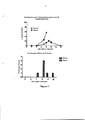
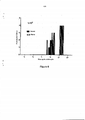
[0026]Figura 1: camundongos A/J foram vacinados com 5 doses de 104 RBCs parasitadas por P. chabaudi (pRBC). Os parasitas foram atenuados in vitro utilizando centanamicina a 2 μM por 40 minutos. pRBC foram então lavadas abun- dantemente antes de administradas aos camundongos. Os camundongos foram infectados com P. chabaudi (105 pRBC/camundongo - iv) 21 dias após a vacinação final. Os dados no painel superior representam a parasitemia média de 5 camundongos por grupo +/- SEM. Todos os camundongos não expostos (naive) sucumbiram ou eliminado por eutanásia no 8° dia. Os dados no painel inferior mostram as pontuações clínicas, onde 0 representa ausência de sinais de sofrimento.[0026]Figure 1: A/J mice were vaccinated with 5 doses of 104 RBCs parasitized by P. chabaudi (pRBC). The parasites were attenuated in vitro using centanamycin at 2 μM for 40 minutes. pRBC were then washed thoroughly before being administered to the mice. Mice were infected with P. chabaudi (105 pRBC/mouse - iv) 21 days after the final vaccination. The data in the top panel represents the mean parasitaemia of 5 mice per group +/- SEM. All unexposed (naive) mice succumbed or euthanized on
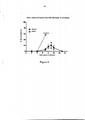
[0027]Figura 2: camundongos A/J foram vacinados com uma dose única de 104 pRBC de P. chabaudi. Os parasitas foram atenuados in vitro utilizando centana- micina a 2 μM por 40 minutos. pRBC foram então lavadas abundantemente antes de administradas aos camundongos. Os camundongos foram infectados com P. cha- baudi (105 pRBC/camundongo - iv) 35 dias após a vacinação final. Os dados representam a parasitemia média de 5 camundongos por grupo +/- SEM. Todos os camundongos não expostos (naive) sucumbiram ou foram eliminados por eutanásia no 8° dia.[0027]Figure 2: A/J mice were vaccinated with a single dose of 104 pRBC of P. chabaudi. The parasites were attenuated in vitro using centanamycin at 2 μM for 40 minutes. pRBC were then washed thoroughly before being administered to the mice. Mice were infected with P. chabaudi (105 pRBC/mouse - iv) 35 days after the final vaccination. Data represent the mean parasitaemia of 5 mice per group +/- SEM. All unexposed (naive) mice succumbed or were euthanized on
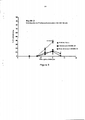
[0028]Figura 3: camundongos A/J foram vacinados com 3 doses ou uma dose única de 104 RBCs parasitadas por P. chabaudi. Os parasitas foram atenuados in vitro utilizando centanamicina a 200 nM por 40 minutos. pRBC foram então lavadas abundantemente antes de administradas aos camundongos. Os camundongos foram infectados com P. chabaudi (105 pRBC/camundongo -iv) 21 dias após a vacinação final. Os dados representam a parasitemia média de 5 camundongos por grupo +/- SEM. todos os camundongos naive sucumbiram ou foram eliminados por eutanásia no 9° dia.[0028]Figure 3: A/J mice were vaccinated with 3 doses or a single dose of 104 RBCs parasitized by P. chabaudi. The parasites were attenuated in vitro using centanamycin at 200 nM for 40 minutes. pRBC were then washed thoroughly before being administered to the mice. Mice were infected with P. chabaudi (105 pRBC/mouse -iv) 21 days after the final vaccination. Data represent the mean parasitaemia of 5 mice per group +/- SEM. all naive mice succumbed or were euthanized on
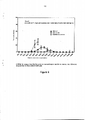
[0029]Figura 4: camundongos A/J foram vacinados com 3 doses (cada dose com intervalo de uma semana) de 104, 105 ou 106 pRBC de P. chabaudi. Os parasitas foram atenuados in vitro utilizando centanamicina a 2μM por 40 minutos. pRBC foram então lavadas abundantemente antes de administradas aos camundongos. Os camundongos foram infectados com P. chabaudi (105 pRBC/camundongo - iv) 14 dias após a vacinação final representam a parasitemia média de 5 camundongos por grupo +/- SEM. todos os camundongos naive sucumbiram ou foram eliminados por eutanásia no 9° dia.[0029]Figure 4: A/J mice were vaccinated with 3 doses (each dose one week apart) of 104, 105 or 106 P. chabaudi pRBC. The parasites were attenuated in vitro using 2μM centanamycin for 40 minutes. pRBC were then washed thoroughly before being administered to the mice. Mice were infected with P. chabaudi (10 5 pRBC/mouse - iv) 14 days after the final vaccination represent the average parasitemia of 5 mice per group +/- SEM. all naive mice succumbed or were euthanized on
[0030]A Figura 5: camundongos A/J foram vacinados com uma dose única de 107 RBCs parasitadas por P. chabaudi. Os parasitas foram atenuados in vitro utilizando centanamicina a 2μM ou 200nM por 40 minutos. pRBC foram então lavadas abundantemente antes de administradas aos camundongos. Os camundongos foram infectados com P. chabaudi (105 pRBC/camundongo -iv) 14 dias após a vacinação final. Os dados representam a parasitemia média de 5 camundongos por grupo +/- SEM. #500 μl de sangue foram extraídos dos camundongos imunizados no 42° dia pós-inoculação e transferidos aos camundongos repórter naive. Não foram detectados parasitas por microscopia 14 dias antes da infecção.[0030]Figure 5: A/J mice were vaccinated with a single dose of 107 RBCs parasitized by P. chabaudi. The parasites were attenuated in vitro using centanamycin at 2μM or 200nM for 40 minutes. pRBC were then washed thoroughly before being administered to the mice. Mice were infected with P. chabaudi (105 pRBC/mouse -iv) 14 days after the final vaccination. Data represent the mean parasitaemia of 5 mice per group +/- SEM. #500 μl of blood was drawn from mice immunized on
[0031]A Figura 6: Dados da Pontuação Clínica.[0031]Figure 6: Clinical Score Data.
[0032]0-4 pontos camundongos exibindo dois ou mais pontos na Categoria 2 por 2 dias consecutivos são selecionados.[0032]0-4 points Mice exhibiting two or more points in
[0033]Categoria 1: Normal (0) Aparência saudável Leve: (1) Ativo, responsivo, Pelo ligeiramente eriçado. (2) Pelo eriçado, movimentos lentos, respostas lentas.[0033]Category 1: Normal (0) Healthy Appearance Light: (1) Active, Responsive, Hair slightly bristled. (2) Stiff hair, slow movements, slow responses.
[0034]Categoria 2: Moderado: (3) Pelo eriçado, inativo, não responsivo. Severo: (4) Pelo opaco, imóvel, palour, carga parasitária alta, hematúria.[0034]Category 2: Moderate: (3) Hair bristled, inactive, unresponsive. Severe: (4) Dull, motionless, palour, high parasite load, hematuria.
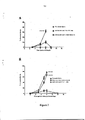
[0035]Figura 7: Comparação da vacina de pRBC preparada utilizando centa- namicina (composto da fórmula III) ou um análogo, TH-III-149, também conhecido como tafuramicina A (composto da fórmula II). Os dois compostos foram utilizados na concentração de 2μM e pRBC foram incubadas por 40 minutos a 37°C antes que os compostos fossem lavados das células três vezes. Os camundongos A/J imuni- zados com células vermelhas do sangue parasitadas por P. chabaudi atenuadas com centanamicina ou tafuramicina A (TH-III-149) (pRBC; fases de anel) foram submetidas a: (A) infecção homóloga com 105 parasitas de P. chabaudi; ou (B) infecção heteróloga com 104 parasitas de P. vinckei.[0035] Figure 7: Comparison of pRBC vaccine prepared using centanamycin (compound of formula III) or an analogue, TH-III-149, also known as tafuramycin A (compound of formula II). The two compounds were used at a concentration of 2μM and pRBC were incubated for 40 minutes at 37°C before the compounds were washed from the cells three times. A/J mice immunized with red blood cells parasitized by P. chabaudi attenuated with centanamycin or tafuramycin A (TH-III-149) (pRBC; ring phases) were subjected to: (A) homologous infection with 105 parasites from P. chabaudi; or (B) heterologous infection with 104 P. vinckei parasites.
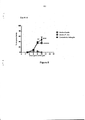
[0036]Figura 8: Condição para que as membranas da RBC permaneçam intactas para eficácia da vacina. Os camundongos foram imunizados com uma única injeção intravenosa de: 106 células vermelhas do sangue parasitadas na fase de anel de P. chabaudi intactas (pRBC) que foram atenuadas por incubação em centa- namicina 2μM (composto da fórmula III) por 40 minutos; ou 106 pRBC na fase de anel de P. chabaudi que foram atenuadas in vitro por incubação em centanamicina 2μM (composto da fórmula III) por 40 minutos e então submetidas à lise em água destilada. Os camundongos foram infectados 2 semanas depois da imunização com 105 pRBC de P. chabaudi.[0036]Figure 8: Condition for RBC membranes to remain intact for vaccine efficacy. Mice were immunized with a single intravenous injection of: 106 intact P. chabaudi ring-stage parasitized red blood cells (pRBC) that were attenuated by incubation in 2μM centanamycin (compound of formula III) for 40 minutes; or 106 pRBC in the ring phase of P. chabaudi that were attenuated in vitro by incubation in 2μM centanamycin (compound of formula III) for 40 minutes and then subjected to lysis in distilled water. Mice were infected 2 weeks after immunization with 10 5 pRBC from P. chabaudi.
[0037]A presente invenção é confirmada, pelo menos parcialmente, na descoberta de que uma única dose baixa de parasitas da malária na fase sanguínea tratados com centanamicina ou tafuramicina A (por exemplo, merozoítos, esquizon- tes, anéis ou trofozoítos, sem limitar-se aos citados) ou de células vermelhas do sangue infectadas com os mesmos, imunizam efetivamente contra a infecção por malária subsequente na ausência de adjuvante. Ademais, merozoítos de um isolado, cepa ou espécie particular da malária tratados com centanamicina ou tafuramicina A, imunizarão contra a infecção através de isolados, cepas e espécies heterólogos da malária. Um atributo particular da invenção é que a imunização com células vermelhas do sangue parasitadas (pRBC) tratadas de acordo com a invenção são ideais quando utilizam pRBCs intactas.[0037] The present invention is confirmed, at least partially, in the finding that a single low dose of blood stage malaria parasites treated with centanamycin or tafuramycin A (e.g. merozoites, schizonts, rings or trophozoites, without limiting the aforementioned) or red blood cells infected with the same, effectively immunize against subsequent malaria infection in the absence of adjuvant. Furthermore, merozoites of a particular malaria isolate, strain or species treated with centanamycin or tafuramycin A will immunize against infection through heterologous malaria isolates, strains and species. A particular attribute of the invention is that immunizations with parasitized red blood cells (pRBCs) treated in accordance with the invention are ideal when using intact pRBCs.
[0038]Por conseguinte, em um aspecto preferencial, a invenção fornece um método de produção de uma composição imunogênica que inclui a etapa de tratar parasitas da malária na fase sanguínea isolados ou purificados ou células vermelhas do sangue infectadas com os ditos parasitas da malária na fase sanguínea com cen- tanamicina, tafuramicina A ou análogo ou derivado dessas substâncias, para produzir desse modo a dita composição imunogênica.[0038] Therefore, in a preferred aspect, the invention provides a method of producing an immunogenic composition which includes the step of treating isolated or purified blood stage malaria parasites or red blood cells infected with said malaria parasites in the blood stage. blood phase with centanamycin, tafuramycin A or analogue or derivative of these substances, to thereby produce said immunogenic composition.
[0039]Em outro aspecto preferencial, a invenção fornece uma composição imunogênica que compreende uma dose baixa de parasitas da malária na fase sanguínea isolados ou purificados ou células vermelhas do sangue infectadas com os ditos parasitas da malária na fase sanguínea que foram tratados com centanamicina, tafuramicina A ou análogo ou derivado dessas substâncias, a dita composição excluindo adjuvante.[0039] In another preferred aspect, the invention provides an immunogenic composition comprising a low dose of isolated or purified blood stage malaria parasites or red blood cells infected with said blood stage malaria parasites that have been treated with centanamycin, tafuramycin A or analogue or derivative of these substances, said composition excluding adjuvant.
[0040]Em mais um aspecto preferencial, a invenção fornece uma composição imunogênica para evitar ou tratar a malária, a dita composição imunogênica compreendendo uma dose baixa de parasitas da malária na fase sanguínea isolados ou purificados ou células vermelhas do sangue infectadas com os ditos parasitas da malária na fase sanguínea que foram tratados com centanamicina, tafuramicina A ou análogo ou derivado dessas substâncias, a dita composição excluindo adjuvante.[0040] In a further preferred aspect, the invention provides an immunogenic composition for preventing or treating malaria, said immunogenic composition comprising a low dose of isolated or purified blood stage malaria parasites or red blood cells infected with said parasites of malaria in the blood stage which have been treated with centanamycin, tafuramycin A or analogue or derivative of these substances, said composition excluding adjuvant.
[0041]Em outro aspecto preferencial, a invenção fornece um método para o tratamento ou prevenção da malária, o dito método incluindo a etapa de administrar a composição imunogênica do aspecto citado a um animal para deste modo evitar ou inibir a infecção por malária ou tratar uma infecção por malária existente no dito animal, o dito método excluindo a administração do adjuvante.[0041] In another preferred aspect, the invention provides a method for treating or preventing malaria, said method including the step of administering the immunogenic composition of the recited aspect to an animal to thereby prevent or inhibit malaria infection or treat a malarial infection existing in said animal, said method excluding administration of the adjuvant.
[0042]Tipicamente, os parasitas da malária na fase sanguínea são, ou incluem, merozoítos esquizontes, anéis ou trofozoítos, no entanto, sem limitar-se aos citados. Por exemplo, os parasitas da malária na fase sanguínea podem ser merozoí- tos purificados ou um mistura de merozoítos isolados e outros parasitas da malária na fase sanguínea, tais como esquizontes, anéis e ou trofozoítos.[0042] Typically, malaria parasites in the blood stage are, or include, schizont merozoites, rings or trophozoites, however, without being limited to the aforementioned. For example, blood stage malaria parasites can be purified merozoites or a mixture of isolated merozoites and other blood stage malaria parasites, such as schizonts, rings and/or trophozoites.
[0043]É interessante perceber a partir do exposto que uma modalidade da invenção se refere a um tratamento in vitro dos parasitas da malária na fase sanguínea isolados ou purificados, tais como merozoítos ou células vermelhas do sangue infectadas com parasitas na fase sanguínea (por exemplo, merozoítos, esquizontes, anéis ou trofozoítos, no entanto, sem limitar-se aos citados), com centanamicina, tafuramicina A ou um análogo ou derivado da centanamicina ou tafuramicina A. Este tratamento é eficaz na atenuação química dos parasitas da malária na fase sanguínea (por exemplo, merozoítos, esquizontes, anéis ou trofozoítos, no entanto, sem limitar-se aos citados) sem matar o parasita, por exemplo, inibindo a replicação do parasita. Tipicamente, os parasitas da malária na fase sanguínea atenuados não são capazes de proliferar, ou essa capacidade é limitada, depois da atenuação através do tratamento com centanamicina ou tafuramicina A.[0043] It is interesting to understand from the foregoing that an embodiment of the invention relates to an in vitro treatment of isolated or purified blood stage malaria parasites, such as merozoites or red blood cells infected with blood stage parasites (e.g. , merozoites, schizonts, rings or trophozoites, but not limited to those mentioned above), with centanamycin, tafuramycin A or an analogue or derivative of centanamycin or tafuramycin A. This treatment is effective in chemically attenuating malaria parasites in the blood stage (e.g. merozoites, schizonts, rings or trophozoites, but not limited to the above) without killing the parasite, for example by inhibiting the parasite's replication. Typically, attenuated blood stage malaria parasites are not able to proliferate, or this ability is limited, after attenuation by treatment with centanamycin or tafuramycin A.
[0044]A centanamicina é um agente alquilante e de ligação ao DNA aquiral sintetizada logicamente a partir da (+)-duocarmicina SA que é desprovida de um es- tereocentro. A centanamicina é ligada covalentemente à adenina-N3 no motivo da sequência de DNA (A/T)AAA.[0044] Centanamycin is an achiral DNA-binding and alkylating agent logically synthesized from (+)-duocarmycin SA which is devoid of a stereocenter. Centanamycin is covalently linked to adenine-N3 in the DNA sequence motif (A/T)AAA.
[0045]A tafuramicina A é um agente alquilante e de ligação ao DNA sintetizada logicamente a partir das duocarmicinas que compreende um estereocentro.[0045]Tafuramycin A is an alkylating and DNA-binding agent logically synthesized from duocarmycins that comprises a stereocenter.
[0046]Por "análogos ou derivados da centanamicina ou tafuramicina A” entende-se qualquer molécula com afinidades estruturais à centanamicina ou tafurami- cina A que exiba ligação às sequências de nucleotídeo contendo AT para induzir, desta maneira, danos ao DNA.[0046]By "analogs or derivatives of centanamycin or tafuramycin A" is meant any molecule with structural affinities to centanamycin or tafuramycin A that exhibits binding to AT-containing nucleotide sequences to thereby induce DNA damage.
[0047]Centanamicina, tafuramicina A, análogos ou derivados, inclusive análogos e derivados racêmicos, quirais e aquirais da duocarmicina e CC-1065, isôme- ros, sais ou solvatos racêmicos, quirais e aquirais dessas substâncias também são estão descritos nos documentos WO2002/030894, WO2008/050140, WO2009/064908, Howard et al., 2002 e Purnell et al., 2006, Chavda et al., 2010 e Patente dos Estados Unidos 6660742. Cita-se particularmente os análogos seco-iso- ciclopropilfurano[2,3-e]indolina-TMI (TH-III-149 ou tafuramicina A) e seco- ciclopropiltetrahidrofurano[2,3-f]quinolina-TMI (TH-III-151 ou tafuramicina B) de CC1065 e as duocarmicinas como descritas em Howard et al., 2002, supra e Purnell et al., 2006, supra.[0047]Centanamycin, tafuramycin A, analogues or derivatives, including racemic, chiral and achiral analogues and derivatives of duocarmycin and CC-1065, racemic, chiral and achiral isomers, salts or solvates of these substances are also described in WO2002/ 030894, WO2008/050140, WO2009/064908, Howard et al., 2002 and Purnell et al., 2006, Chavda et al., 2010 and US Patent 6660742. Particular mention is made of the seco-iso-cyclopropylfuran analogues[2 ,3-e]indoline-TMI (TH-III-149 or tafuramycin A) and seco-cyclopropyltetrahydrofuran[2,3-f]quinoline-TMI (TH-III-151 or tafuramycin B) from CC1065 and the duocarmycins as described in Howard et al., 2002, supra and Purnell et al., 2006, supra.
[0048]O seco-hidroxi-aza-CBI-TMI aquiral, um composto seco- ciclopropilpirido[e]indolona (CPyl), é um exemplo de um análogo da centanamicina como descrito em Chavda et al., 2010, supra. Os análogos 5-metil-furano racêmicos e quirais da tafuramicina A são descritos em Purnell et al., 2006, supra.[0048]Achiral seco-hydroxy-aza-CBI-TMI, a seco-cyclopropylpyrido[e]indolone (CPyl) compound, is an example of a centanamycin analogue as described in Chavda et al., 2010, supra. Racemic and chiral 5-methyl-furan analogs of tafuramycin A are described in Purnell et al., 2006, supra.
[0049]Em uma modalidade preferencial, a centanamicina, tafuramicina A ou o análogo ou derivado é um composto da fórmula I:

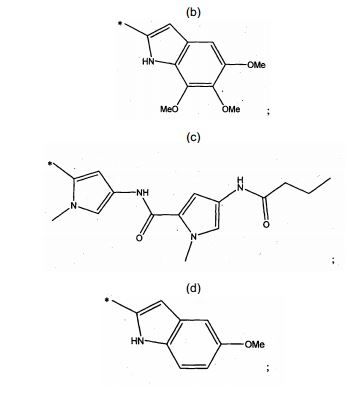
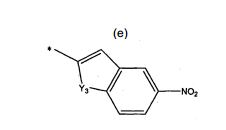
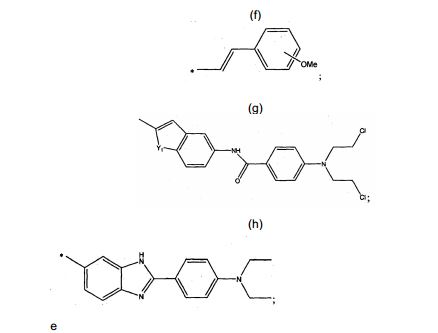
[0050]Em uma modalidade particular do composto da fórmula I: Preferencialmente, R1 é OH. Preferencialmente, R2 e R3 juntos formam um anel de furano. Preferencialmente, Y é -CH- e forma um anel de cinco membros com R4. Preferencialmente, X é selecionado entre cloro, bromo, iodo, mesilato, tosila- to, tio, amônio, alquilsulfoxil. Mais preferencialmente, X é selecionado entre cloro, bromo, iodo, mesilato e tosilato. Ainda mais preferencialmente, X é cloro. Preferencialmente, R4 é um grupo -CH2- ligado a Y para formar uma estrutura de anel com cinco membros. Preferencialmente, R5 é: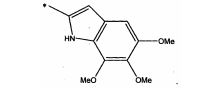
[0051]Uma forma preferencial desta modalidade é um composto da fórmula II (tafuramicina A):
[0052]Em outra modalidade do composto da fórmula I: Preferencialmente, R1 é NH2. Preferencialmente, R2 e R3 juntos formam um anel de benzeno. Preferencialmente, Y é -CH-. Preferencialmente, X é selecionado entre cloro, bromo, iodo, mesilato, tosila- to, tio, amônio, alquilsulfonil C1-6 e alquilsulfoxil C1-6. Mais preferencialmente, X é selecionado entre cloro, bromo, iodo, mesilato e tosilato. Ainda mais preferencialmente, X é cloro. Preferencialmente, R4 é H ou alquila C1-6. Preferencialmente R5 é
[0053]Uma forma preferencial desta modalidade é um composto da fórmula III (centanamicina):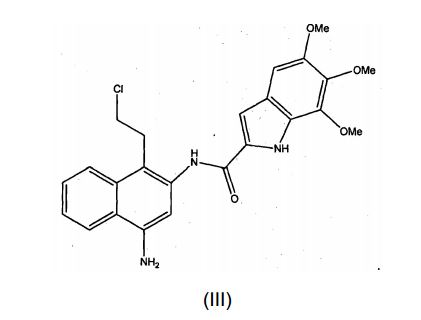
[0054]Em outra modalidade do composto da fórmula I; Preferencialmente, R1 é OH. Preferencialmente, R2 e R3 juntos formam um anel de piridina opcionalmente substituído por com alquila C1-6. Preferencialmente, Y é -CH-. Preferencialmente, X é selecionado entre cloro, bromo, iodo, mesilato, tosila- to, tio, amônio, alquilsulfonil C1-6 e alquilsulfoxil C1-6. Mais preferencialmente, X é selecionado entre cloro, bromo, iodo, mesilato e tosilato. Ainda mais preferencialmente, X é cloro. Preferencialmente, R4 é H ou alquila C1-6. Preferencialmente, R5 é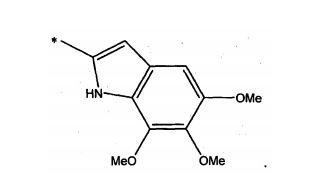
[0055]Uma forma preferencial desta modalidade é um composto da fórmula IV (AS-VIII- 104):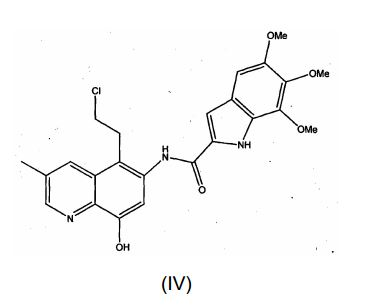
[0056]Concentrações típicas, embora não limitantes de centanamicina, tafu- ramicina A ou análogos ou derivados para o tratamento de parasitas da malária na fase sanguínea estão na faixa de 0,01 a 10 μM. Preferencialmente, a concentração é inferior a 5μM, mais preferencialmente inferior a 2μM ou na faixa de cerca de 0,1-1 μM ou cerca de 0,2μM. A duração do tratamento pode estar na faixa de 1 minuto a 12 horas, preferencialmente 10 minutos a 4 horas ou mais preferencialmente por cerca de 0,5, 1, 1,5 ou 2 horas.[0056]Typical but not limiting concentrations of centanamycin, tafuramycin A or analogues or derivatives for the treatment of blood stage malaria parasites are in the range of 0.01 to 10 μM. Preferably, the concentration is less than 5μM, more preferably less than 2μM or in the range of about 0.1-1 μM or about 0.2μM. The duration of treatment may be in the range of 1 minute to 12 hours, preferably 10 minutes to 4 hours or more preferably for about 0.5, 1, 1.5 or 2 hours.
[0057]Os parasitas da malária na fase sanguínea tratados com centanamici- na ou tafuramicina A podem ser utilizados na preparação da composição imunogêni- ca como preparação do parasita isolado, purificado ou parcialmente purificado, ou os parasitas da malária na fase sanguínea tratados com centanamicina ou tafuramicina A podem ser utilizados para infectar as células vermelhas do sangue, que são então utilizadas na preparação da composição imunogênica. Como opção, as células vermelhas do sangue infectadas com parasitas da malária na fase sanguínea podem ser tratadas com centanamicina e então utilizadas para preparar a composição imu- nogênica.[0057]The blood stage malaria parasites treated with centanamycin or tafuramycin A can be used in the preparation of the immunogenic composition as a preparation of the isolated, purified or partially purified parasite, or the blood stage malaria parasites treated with centanamycin or tafuramycin A can be used to infect red blood cells, which are then used in preparing the immunogenic composition. As an option, red blood cells infected with malaria parasites in the blood stage can be treated with centanamycin and then used to prepare the immunogenic composition.
[0058]Neste contexto, entende-se por "isolado" o material (por exemplo, parasitas da malária na fase sanguínea) que tenha sido removido de seu estado natural ou senão submetidos à manipulação humana. O material isolado pode estar substancialmente ou essencialmente livre de componentes que normalmente o acompanham em seu estado natural, ou pode ser manipulado para permanecer em estado artificial junto com componentes que normalmente o acompanham em seu estado natural. O material isolado (por exemplo, parasitas na fase sanguínea, tais como merozoítos, esquizontes, trofozoítos ou anéis) pode estar na forma purificada ou parcialmente purificada.[0058]In this context, "isolated" means material (eg malaria parasites in the blood phase) that has been removed from its natural state or otherwise subjected to human manipulation. The isolated material can be substantially or essentially free of components that normally accompany it in its natural state, or it can be manipulated to remain in an artificial state together with components that normally accompany it in its natural state. Isolated material (e.g. blood phase parasites such as merozoites, schizonts, trophozoites or rings) may be in purified or partially purified form.
[0059]Como antes descrito, um atributo preferencial da presente invenção é que a composição imunogênica compreende uma dose baixa de parasitas da malária na fase sanguínea, a saber, merozoítos esquizontes, trofozoítos ou anéis.[0059] As described above, a preferred attribute of the present invention is that the immunogenic composition comprises a low dose of blood stage malaria parasites, namely schizont merozoites, trophozoites or rings.
[0060]Por "dose baixa" no contexto de parasitas da malária na fase sanguínea (como merozoítos, esquizontes, anéis ou trofozoítos, no entanto, sem limitar-se aos citados) significa uma dose administrada em que a densidade resultante do parasita é suficientemente baixa para não permitir sua detecção no esfregaço do sangue. Em relação à malária, a baixa dose é tipicamente mencionada como uma infecção subpatente. Uma baixa dose é, por conveniência, capaz de induzir a resposta de uma célula T quando administrada a um animal. Preferencialmente, a resposta imune é caracterizada por induzir a resposta de uma célula T e preferencialmente não induzir as células B a produzirem níveis detectáveis, ou somente baixos níveis, de anticorpos. Um baixo nível de produção de anticorpo preferencialmente se refere a um nível em que não seria suficiente proteger o animal contra o parasita da malária.[0060]By "low dose" in the context of blood stage malaria parasites (such as merozoites, schizonts, rings or trophozoites, however, not limited to the foregoing) means a dose administered where the resulting density of the parasite is sufficiently low to not allow detection on blood smear. In relation to malaria, low dose is typically referred to as a subpatent infection. A low dose is, for convenience, capable of inducing a T cell response when administered to an animal. Preferably, the immune response is characterized by inducing a T cell response and preferably not inducing B cells to produce detectable levels, or only low levels, of antibodies. A low level of antibody production preferably refers to a level at which it would not be sufficient to protect the animal against the malaria parasite.
[0061]A dose baixa pode estar na forma de células vermelhas do sangue infectadas por parasita (pRBC). As pRBC podem ser administradas como células intactas ou como lisato. Preferencialmente, as pRBC estão na forma intacta.[0061]The low dose may be in the form of parasite-infected red blood cells (pRBC). pRBCs can be administered as intact cells or as a lysate. Preferably, the pRBCs are in intact form.
[0062]As pRBC podem ser obtidas a partir do sangue de um animal infectado pelo parasita antes do tratamento com centanamicina ou tafuramicina A. Como alternativa, para produzir pRBCs in vitro, células vermelhas do sangue não infectadas podem ser obtidas de um animal e então infectadas in vitro com, parasitas da malária na fase sanguínea pré-tratados com centanamicina ou tafuramicina A, ou com parasitas da malária na fase sanguínea não tratados para que as pRBC sejam Posteriormente tratadas com centanamicina ou tafuramicina A, e assim atingir a pRBC em baixa dose.[0062]pRBCs can be obtained from the blood of a parasite-infected animal prior to treatment with centanamycin or tafuramycin A. Alternatively, to produce pRBCs in vitro, uninfected red blood cells can be obtained from an animal and then infected in vitro with blood stage malaria parasites pretreated with centanamycin or tafuramycin A, or with untreated blood stage malaria parasites so that the pRBCs are further treated with centanamycin or tafuramycin A, and thus reach the low pRBC dose.
[0063]Uma baixa dose típica é no máximo de 107 pRBC por exemplo, incluindo 106, 105, 104, 103, 102 ou 10 pRBC. As faixas preferenciais para a baixa dose incluem 101-106, 101-105, 101-104, 101-103, 101-103, 102-106, 102-105, 102-104, 102103, 103-106,103-105,103-104,104-106, 104-105 pRBC per dose.[0063] A typical low dose is a maximum of 107 pRBC for example, including 106, 105, 104, 103, 102 or 10 pRBC. Preferred low dose ranges include 101-106, 101-105, 101-104, 101-103, 101-103, 102-106, 102-105, 102-104, 102103, 103-106,103-105,103-104,104- 106, 104-105 pRBC per dose.
[0064]Em outra modalidade, a dose baixa pode estar na forma de parasitas da malária na fase sanguínea purificados, como merozoítos purificados ou uma mistura de merozoítos e esquizontes, por exemplo. Uma baixa dose preferencialmente é de não mais que 107 parasitas da malária na fase sanguínea isolados ou purificados, inclusive 106, 105, 104, 103, 102 ou 10 parasitas da malária na fase sanguínea. Faixas preferenciais de baixa dose incluem 101-106, 101-105, 101-104, 101-103, 101-103, 102-106, 102-105, 102-104, 102-103, 103-106,103-105,103-104,104-106, 104-105 parasitas na fase sanguínea isolados ou purificados por dose.[0064]In another embodiment, the low dose may be in the form of purified blood stage malaria parasites, such as purified merozoites or a mixture of merozoites and schizonts, for example. A low dose preferably is no more than 107 isolated or purified blood phase malaria parasites, including 106, 105, 104, 103, 102 or 10 blood phase malaria parasites. Low dose preferred ranges include 101-106, 101-105, 101-104, 101-103, 101-103, 102-106, 102-105, 102-104, 102-103, 103-106,103-105,103-104,104- 106, 104-105 isolated or purified blood phase parasites per dose.
[0065]Como aqui utilizado, "malária" inclui todas as formas da doença causada pelos protistas protozoários do gênero Plasmodium.[0065] As used herein, "malaria" includes all forms of the disease caused by protozoan protists of the genus Plasmodium.
[0066]O gênero "Plasmodium" inclui as espécies Plasmodium falciparum, Plasmodium vivax, Plasmodium malariae, Plasmodium ovale, Plasmodium knowlesi, Plasmodium berghei, Plasmodium yoelii, Plasmodium chabaudi e Plasmodium vin- ckei. Nas modalidades relevantes à malária em humanos, a espécie Plasmodium causadora são tipicamente Plasmodium falciparum e Plasmodium vivax. Por conve- niência, para o tratamento de humanos a composição imunogênica e o método de tratamento profilático e terapêutico da malária compreende uma ou mais cepas ou isolados de Plasmodium falciparum e/ou Plasmodium vivax tratados com centanami- cina ou tafuramicina.[0066]The genus "Plasmodium" includes the species Plasmodium falciparum, Plasmodium vivax, Plasmodium malariae, Plasmodium ovale, Plasmodium knowlesi, Plasmodium berghei, Plasmodium yoelii, Plasmodium chabaudi and Plasmodium vinckei. In modalities relevant to human malaria, the causative Plasmodium species are typically Plasmodium falciparum and Plasmodium vivax. For convenience, for the treatment of humans the immunogenic composition and the method of prophylactic and therapeutic treatment of malaria comprises one or more strains or isolates of Plasmodium falciparum and/or Plasmodium vivax treated with centanamycin or tafuramycin.
[0067]Uma vantagem preferencial esperada da presente invenção é que os parasitas da malária na fase sanguínea tratados com centanamicina ou tafuramicina A de um isolado, cepa ou espécie particular de Plasmodium, pela administração a um animal, imunizarão contra a infecção por isolados, cepas e ou espécies heterólo- gas de Plasmodium. Por patógeno "heterólogo" entende-se patógenos relacionados que podem ser diferentes cepas ou variantes de uma mesma espécie ou de uma espécie relacionada. Um exemplo de diferentes cepas de uma mesma espécie é P. c. chabaudi AS e P. c. chabaudi CB. Heterólogo também pode ser referir a espécies relacionadas, por exemplo, P. falciparum e P. vivax.[0067] A preferred advantage expected of the present invention is that blood phase malaria parasites treated with centanamycin or tafuramycin A of a particular Plasmodium isolate, strain or species, by administration to an animal, will immunize against infection by isolates, strains or and or heterologous species of Plasmodium. By "heterologous" pathogen is meant related pathogens which may be different strains or variants of the same or related species. An example of different strains of the same species is P. c. chabaudi AS and P. c. chabaudi CB. Heterologous can also refer to related species, for example P. falciparum and P. vivax.
[0068]A partir do exposto, é interessante observar que outra vantagem preferencial da presente invenção é que a composição imunogênica elimina a necessidade de adjuvante, seja como componente da composição imunogênica seja quando administrado junto com a composição imunogênica. Por "adjuvante" entenda-se um agente que auxilia, aumenta ou senão facilita a elicitação de uma resposta imune por um antígeno. Exemplos não limitantes dos adjuvantes excluídos incluem, adjuvante de Freund, hidróxido de alumínio (alum), fosfato de alumínio, esqualeno, IL-12, CpG-oligonucleotídeo, Montanide ISA720, imiquimod, SBAS2, SBAS4, MF59, MPL, Quil A, QS21 e lSCOMs.[0068]From the foregoing, it is interesting to note that another preferred advantage of the present invention is that the immunogenic composition eliminates the need for adjuvant, either as a component of the immunogenic composition or when administered together with the immunogenic composition. By "adjuvant" is meant an agent that assists, enhances, or otherwise facilitates the elicitation of an immune response by an antigen. Non-limiting examples of excluded adjuvants include, Freund's adjuvant, aluminum hydroxide (alum), aluminum phosphate, squalene, IL-12, CpG-oligonucleotide, Montanide ISA720, imiquimod, SBAS2, SBAS4, MF59, MPL, Quil A, QS21 and lSCOMs.
[0069]Embora preferível que o adjuvante esteja ausente da composição imunogênica, seria interessante que outros componentes, tais como carreadores, diluentes e/ou excipientes imunologicamente aceitáveis pudessem ser incluídos. Tipicamente, esses incluem cargas sólidas ou líquidas, diluentes ou substâncias en- capsulantes que podem ser seguramente utilizadas na administração sistêmica. De- pendendo da via administração particular, carreadores, diluentes e/ou excipientes podem ser selecionados entre um grupo formado por açúcares, amidos, celulose e seus derivados, malte, gelatina, talco, sulfato de cálcio, óleos vegetais, óleos sintéticos, polióis, ácido algínico, solução salina isotônica, água livre de pirogênio, agentes umectantes ou emulsionáveis, agentes de volume, revestimentos, aglutinantes, cargas, desintegrantes, lubrificantes e agentes tamponadores do pH (por exemplo, tampões fosfato) no entanto, sem limitar-se aos citados. A composição imunogênica e o método de tratamento profilático e terapêutico da malária podem ser administrados a um animal em qualquer uma ou mais formas de dosagem as quais incluem comprimidos, dispersões, suspensões, soluções injetáveis, xaropes, troches, cápsulas, supositórios, aerossóis, adesivos transdérmicos e outros do gênero.[0069]Although it is preferable for the adjuvant to be absent from the immunogenic composition, it would be interesting if other components, such as immunologically acceptable carriers, diluents and/or excipients, could be included. Typically these include solid or liquid fillers, diluents or encapsulating substances that can be safely used in systemic administration. Depending on the particular route of administration, carriers, diluents and/or excipients can be selected from a group consisting of sugars, starches, cellulose and its derivatives, malt, gelatin, talc, calcium sulfate, vegetable oils, synthetic oils, polyols, alginic acid, isotonic saline, pyrogen-free water, wetting or emulsifying agents, bulking agents, coatings, binders, fillers, disintegrants, lubricants and pH buffering agents (e.g. phosphate buffers) however, not limited to cited. The immunogenic composition and method of prophylactic and therapeutic treatment of malaria can be administered to an animal in any one or more dosage forms which include tablets, dispersions, suspensions, injectable solutions, syrups, troches, capsules, suppositories, aerosols, patches. transdermals and the like.
[0070]Por conveniência, a composição imunogênica e o método de prevenção ou tratamento da malária são eficazes contra a malária na fase sanguínea. A malária na fase sanguínea é uma fase onde o parasita da malária (por exemplo, me- rozoíto) acessa os eritrócitos. Na fase de esquizonte do sangue, o parasita se divide inúmeras vezes para produzir novos merozoítos, que abandonam as células vermelhas do sangue e se deslocam através da corrente sanguínea para invadir novas células vermelhas do sangue. Para o paciente, a malária na fase sanguínea é tipicamente caracterizada por ondas sucessivas de febre surgidas de ondas simultâneas de merozoítos escapando e infectando as células vermelhas do sangue.[0070]For convenience, the immunogenic composition and the method of preventing or treating malaria are effective against blood stage malaria. Blood stage malaria is a stage where the malaria parasite (eg, merozoite) accesses erythrocytes. In the blood schizont stage, the parasite divides numerous times to produce new merozoites, which leave red blood cells and travel through the bloodstream to invade new red blood cells. For the patient, blood stage malaria is typically characterized by successive waves of fever arising from simultaneous waves of merozoites escaping and infecting red blood cells.
[0071]A composição imunogênica e o método de prevenção ou tratamento da malária podem elicitar uma resposta imune que é caracterizada como uma resposta mediada pela célula T CD4+ (inclusive respostas mediadas unicamente pela célula T CD4+ e respostas mediadas pela mistura de célula T CD4+ e CD8+), tipicamente com pouca ou nenhuma resposta do anticorpo. Preferencialmente, a composição imunogênica e/ou o método imunizam o animal para prevenir, inibir ou senão proteger o animal contra a infecção por malária subsequente. Preferencialmen- te, uma dose única da composição imunogênica impede, inibe ou senão protege o animal contra a infecção por malária subsequente.[0071]The immunogenic composition and method of preventing or treating malaria can elicit an immune response that is characterized as a CD4+ T cell-mediated response (including CD4+ T cell-only mediated responses and responses mediated by the mixture of CD4+ T cell and CD8+), typically with little or no antibody response. Preferably, the immunogenic composition and/or method immunizes the animal to prevent, inhibit or otherwise protect the animal against subsequent malarial infection. Preferably, a single dose of the immunogenic composition prevents, inhibits or otherwise protects the animal against subsequent malarial infection.
[0072]Como aqui utilizado "animal” se refere a qualquer animal suscetível à infecção por um parasita da malária, particularmente mamíferos, e preferencialmente humanos.[0072] As used herein "animal" refers to any animal susceptible to infection by a malaria parasite, particularly mammals, and preferably humans.
[0073]Para que as modalidades preferenciais possam ser detalhadamente descritas e colocadas em prática, são mencionados os seguintes Exemplos não limi- tantes. Exemplos Métodos[0073]So that the preferred embodiments can be described in detail and put into practice, the following non-limiting Examples are mentioned. Examples Methods
[0074]Camundongos passagem foram sacrificados por inalação de CO2 e os parasitas recolhidos por punção cardíaca em tubos de coleta de EDTA. Esfregaços finos do sangue foram realizados para determinar a parasitemia.[0074]Passover mice were sacrificed by CO2 inhalation and the parasites collected by cardiac puncture into EDTA collection tubes. Thin blood smears were performed to determine parasitemia.
[0075]O sangue foi diluído até 10 mL em IMDM livre de soro (meio de Dul- beccos modificado por Iscoves). O sangue sempre foi diluído a 10% do hematócrito.[0075]The blood was diluted to 10 mL in serum-free IMDM (Iscoves modified Dulbeccos medium). Blood was always diluted to 10% of the hematocrit.
[0076]Tafuramicina A ou centanamicina foi diluída a partir do estoque 2 mM (em solução P.E.T.) até 20 μM em meio. A diluição do estoque 2 mM até 20 μM em meio foi necessária já que a solução P.E.T causava lise das células vermelhas do sangue. Para o tratamento 200 nM das células vermelhas do sangue, 50 μl da solução 20 μM foram adicionados por 5 mL de sangue. Para o tratamento 2 μM das células vermelhas do sangue, 500 μl da solução 20 μM foram adicionados por 5 mL de sangue.[0076]Tafuramycin A or centanamycin was diluted from 2 mM stock (in P.E.T. solution) to 20 μM in medium. Dilution of the 2 mM stock to 20 μM in medium was necessary as the P.E.T solution caused lysis of red blood cells. For the 200 nM treatment of red blood cells, 50 μl of the 20 μM solution was added per 5 ml of blood. For the 2 μM treatment of red blood cells, 500 μl of the 20 μM solution was added per 5 ml of blood.
[0077]As células vermelhas do sangue parasitadas (pRBC) tratadas foram lavadas uma vez com meio e uma vez com PBS antes da diluição a 5x10⁷, 5x10⁶, 5x10⁵ ou 5x10⁴ mL em cloreto de sódio 0,9%.[0077] The treated parasitized red blood cells (pRBC) were washed once with medium and once with PBS before dilution to 5x10⁷, 5x10⁶, 5x10⁵ or 5x10⁴ mL in 0.9% sodium chloride.
[0078]Cinco camundongos por tratamento receberam 200 μl de imunização intravenosa cinco vezes com uma semana de intervalor. O número final de pRBC tratadas administradas por camundongo foram 107, 106, 105 ou 104, como exigia cada experimento.[0078]Five mice per treatment received 200 μl of intravenous immunization five times with one week apart. The final number of treated pRBCs administered per mouse was 107, 106, 105 or 104, as required by each experiment.
[0079]Esfregaços de sangue foram realizados a cada 2 dias e a parasitemia registrada. Resultados[0079]Blood smears were taken every 2 days and parasitemia recorded. Results
[0080]Os dados na Figura 1 mostram que a exposição dos camundongos às pRBC atenuadas com centanamicina de P. chabaudi induz a imunidade à infecção virulenta. Neste estudo as pRBC foram tratadas por 30 min in vitro com centanamici- na 2 μM (AS-I-145, composto da fórmula III) e os camundongos receberam 5 doses da vacina i.v. (cada dose com intervalo de 1 semana), cada dose contendo 104 parasitas. Os camundongos foram então infectados com 105 pRBC WT homólogos e a parasitemia acompanhada. Este experimento foi repetido diversas vezes com constatações similares. Nós observamos que 3 doses da vacina funcionam efetivamente e que até mesmo uma única dose da vacina induz a proteção em grande parte dos animais, como mostra a Figura 2.[0080] The data in Figure 1 show that exposure of mice to centanamycin-attenuated pRBC from P. chabaudi induces immunity to virulent infection. In this study, pRBCs were treated for 30 min in vitro with 2 μM centanamycin (AS-I-145, compound of formula III) and mice received 5 doses of the vaccine i.v. (each
[0081]A Figura 3 mostra uma comparação dos camundongos efetivamente vacinados com 3 doses ou com uma dose única de 104 pRBC de P. chabaudi tratada com centanamicina200 nM.[0081]Figure 3 shows a comparison of mice effectively vaccinated with 3 doses or with a single dose of 104 pRBC from P. chabaudi treated with 200 nM centanamycin.
[0082]A Figura 4 mostra uma comparação dos camundongos vacinados com 3 doses de 104 105 ou 106 pRBC de P. chabaudi. Os parasitas foram atenuados in vitro utilizando centanamicina a 2μM por 30 minutos. Embora a parasitemia tenha sido mais baixa para os camundongos imunizados com 106 P. chabaudi (por exemplo, no 9° dia após a infecção), cada camundongo imunizado com 104 105 ou 106 P. chabaudi mostraram baixa ou ausência de parasitemia no 11° dia após a infecção.[0082] Figure 4 shows a comparison of mice vaccinated with 3 doses of 104 105 or 106 pRBC of P. chabaudi. The parasites were attenuated in vitro using 2μM centanamycin for 30 minutes. Although parasitemia was lower for mice immunized with 106 P. chabaudi (eg, on
[0083]Com referência à Figura 5, os camundongos foram vacinados com uma dose única de 107 pRBC de P. chabaudi atenuadas in vitro utilizando centana- micina a 2 μM ou 200 nM por 30 minutos. Os camundongos imunizados com 107 pRBC de P. chabaudi atenuadas utilizando centanamicina 200 nM desenvolveram parasitemia mais significativa no 8° e 9° dias após a infecção do que os camundongos tratados com parasitas atenuados com centanamicina 2 μM. Possivelmente, a razão para isso é que a subsequente replicação do DNA "dilui" efetivamente o volume de centanamicina ligada ao DNA por parasita. No entanto, no 13° dia após inoculação, os camundongos tratados com 107 pRBC de P. chabaudi atenuadas utilizando centanamicina 200 nM haviam mostrado recuperação em grau similar aos camundongos tratados com parasitas atenuados com centanamicina 2 μM.[0083]Referring to Figure 5, mice were vaccinated with a single dose of 107 pRBC from P. chabaudi attenuated in vitro using centanamycin at 2 μM or 200 nM for 30 minutes. Mice immunized with 10 7 P. chabaudi pRBC attenuated using 200 nM centanamycin developed more significant parasitaemia at 8 and 9 days post-infection than mice treated with parasites attenuated with 2 μM centanamycin. Possibly the reason for this is that subsequent DNA replication effectively "dilutes" the volume of DNA-bound centanamycin per parasite. However, by day 13 after inoculation, mice treated with 10 7 P. chabaudi pRBC attenuated using 200 nM centanamycin had shown recovery to a similar degree to mice treated with parasites attenuated with 2 μM centanamycin.
[0084]Neste experimento, 500 μl de sangue foram extraídos dos camundongos imunizados no 42° dia pós-inoculação e transferidos aos camundongos repórteres naives. Não foram detectados parasitas por microscopia 14 dias antes da infecção.[0084] In this experiment, 500 μl of blood was extracted from mice immunized on the 42nd day post-inoculation and transferred to naive reporter mice. No parasites were detected by
[0085]Fazendo neste momento referência à Figura 6, os dados da pontuação clínica em seguida à imunização com parasitas tratados com 106 centanamicina e infecção mostram que os camundongos foram protegidos não somente da morte e da elevada parasitemia como também dos sintomas. Este resultado foi surpreendente à luz de um relato anterior (Hirunpetcharat et al., 1999) mostrando que, embora as células T possam limitar o crescimento parasitário, elas também podem ser causadoras de doença e morte. Acreditava-se que um subproduto da resposta inflamatória da T célula que estava matava os parasitas fosse uma resposta anti-hospedeiro que adoecia os camundongos. Desse modo, é importante notar que depois da vacinação de acordo com a presente invenção, o crescimento do parasita é limitado, mas os camundongos não adoecem.[0085] Referring now to Figure 6, the clinical score data following immunization with centanamycin-treated parasites and infection show that the mice were protected not only from death and high parasitaemia but also from symptoms. This result was surprising in light of a previous report (Hirunpetcharat et al., 1999) showing that while T cells can limit parasitic growth, they can also cause disease and death. A byproduct of the inflammatory T cell response that was killing the parasites was believed to be an anti-host response that sickened the mice. Thus, it is important to note that after vaccination according to the present invention, the growth of the parasite is limited, but the mice do not become sick.
[0086]Conduzimos ainda experimentos para comparar a vacina preparada utilizando a centanamicina (composto da fórmula III) ou TH-III-149, também conhecida como tafuramicina A (composto da fórmula II)[0086]We also conducted experiments to compare the vaccine prepared using centanamycin (compound of formula III) or TH-III-149, also known as tafuramycin A (compound of formula II)
[0087]Camundongos AJ (5 por grupo, fêmeas) foram imunizados por via in- travenosa com 3 doses de 106 células vermelhas do sangue parasitadas por P. cha- baudi (pRBC; fases de anel) atenuadas tanto com centanamicina quanto com tafu- ramicina A (composto da fórmula II). Ambos os compostos foram utilizados na con-centração de 2 μM e as pRBC foram incubadas por 40 minutos a 37°C antes que os compostos fossem lavados das células três vezes. Cada imunização foi administrada com intervalo de 2 semanas e os camundongos foram então infectados com 105 P. chabaudi ou 104 P. vinckei. As pRBC e a densidade do parasita no sangue foram acompanhadas utilizando esfregaços finos corados com Diff Quick. Números mais baixos de P. vinckei foram utilizados porque este parasita é mais virulento que P. chabaudi.[0087]AJ mice (5 per group, females) were immunized intravenously with 3 doses of 106 P. chabaudi-parasitized red blood cells (pRBC; ring phases) attenuated with both centanamycin and tafu- ramicin A (compound of formula II). Both compounds were used at a concentration of 2 μM and the pRBCs were incubated for 40 minutes at 37°C before the compounds were washed from the cells three times. Each immunization was administered 2 weeks apart and the mice were then infected with either 105 P. chabaudi or 104 P. vinckei. pRBC and blood parasite density were followed using thin smears stained with Diff Quick. Lower numbers of P. vinckei were used because this parasite is more virulent than P. chabaudi.
[0088]Os dados nas Figuras 7A e B respectivamente mostram os resultados da infecção homóloga e heteróloga. Os dados mostram a proteção quase completa contra a infecção homóloga e proteção bastante significativa contra a infecção hete- róloga quando a vacina foi produzida utilizando tafuramicina A (composto da fórmula II). A proteção contra a infecção homóloga foi menor, e contra a infecção heteróloga foi ainda menos eficaz quando a vacina foi produzida com centanamicina para P. vinckei, uma espécie particularmente virulenta do parasita. Cabe ressaltar que os dados para tafuramicina A, a infecção com P. vinckei foi ainda mais impressionante, salvo por 1 camundongo em que a densidade de pico do parasita foi de aproximadamente 20%. Contudo, no 12° dia, todos os animais haviam se recuperado completamente.[0088] The data in Figures 7A and B respectively show the results of homologous and heterologous infection. The data show almost complete protection against homologous infection and quite significant protection against heterologous infection when the vaccine was produced using tafuramycin A (compound of formula II). Protection against homologous infection was less, and against heterologous infection it was even less effective when the vaccine was produced with centanamycin for P. vinckei, a particularly virulent species of the parasite. It should be noted that the data for tafuramycin A, infection with P. vinckei was even more impressive, except for 1 mouse in which the peak density of the parasite was approximately 20%. However, on the 12th day, all animals had fully recovered.
[0089]Os experimentos com infecção heteróloga também foram realizados com tratamento de AS-VIII-104 (composto da fórmula IV), que mostrou comportamento similar ao da centanamicina (não mostrado).[0089]Experiments with heterologous infection were also performed with treatment of AS-VIII-104 (compound of formula IV), which showed similar behavior to centanamycin (not shown).
[0090]Em outros experimentos, realizou-se a comparação das células vermelhas do sangue tratadas lisadas versus intactas. Os camundongos foram imunizados com uma única injeção intravenosa de: (i) 106 parasitas na fase de anel de P. chabaudi (em células vermelhas) que foram atenuados in vitro por incubação em centanamicina 2μM por 40 minutos; ou (ii) 106 parasitas na fase de anel de P. cha- baudi (em células vermelhas) que foram atenuados in vitro por incubação em cen- tanamicina 2μM por 40 minutos e em seguida submetidas à lise em água destilada por 2 minutos depois da adição de um volume igual de 2xPBS para restaurar a iso- tonicidade da preparação. Os camundongos foram infectados 2 semanas depois da imunização com 105 pRBC de P. chabaudi.[0090]In other experiments, a comparison of treated lysed versus intact red blood cells was performed. Mice were immunized with a single intravenous injection of: (i) 106 ring-stage parasites of P. chabaudi (in red cells) that were attenuated in vitro by incubation in 2μM centanamycin for 40 minutes; or (ii) 106 ring-phase parasites of P. chabaudi (in red cells) that were attenuated in vitro by incubation in 2μM centanamycin for 40 minutes and then subjected to lysis in distilled water for 2 minutes after addition of an equal volume of 2xPBS to restore the isotonicity of the preparation. Mice were infected 2 weeks after immunization with 10 5 pRBC from P. chabaudi.
[0091]Os resultados são mostrados na Figura 8 e indicam que pRBC intactas são uma vacina ligeiramente mais eficaz que as pRBC lisadas, mostrando parasitemia bastante baixa no 10° dia em comparação às pRBC lisadas.[0091]The results are shown in Figure 8 and indicate that intact pRBC is a slightly more effective vaccine than lysed pRBC, showing very low parasitaemia at
[0092]Ao longo de todo o relatório descritivo, o objetivo foi descrever as modalidades preferenciais da invenção sem limitá-la a uma modalidade qualquer ou coleção específica de atributos. Diversas alterações e modificações podem ser realizadas nas modalidades descritas e ilustradas sem desviar da presente invenção.[0092] Throughout the descriptive report, the objective was to describe the preferred embodiments of the invention without limiting it to any one modality or specific collection of attributes. Various changes and modifications may be made to the described and illustrated embodiments without departing from the present invention.
[0093]A divulgação de cada patente e documento científico, programa de computador e algoritmo mencionados neste relatório descritivo é incorporadas por meio de citação em sua totalidade. Referências Ahmed, S. I. et al, Cellular Microbiology, 12: 930-938, 2010 Boger, D. Publicação Internacional WO2009/064908 Chavda, S. et al, Bioorganic & Med. Chem. 18:5016-5024, 2010 Elliott, S,.R. et al, Infect. Immun. 73:2478, 2005 Hirunpetcharat et ai, Parasite. Immunol. 21:319-329, 1999 Howard, T.T. et al, Bioorganic & Med. Chem. 10:2941-2952, 2002 Lee, M. Publicação Internacional WO2002/030894 Lee, M. et al. Publicação Internacional WO2008/050140 Lee, M. Patente dos Estados Unidos 6660742 McCarthy, J. e Good, M.F. Hum. Vaccine 6:114, 2010 Makobongo, M. et al, Proc. Natl. Acad. Sci. USA 100:2628, 2003 Mamoun, C. B. Publicação Internacional 2008/094183 Pinzon-Charry, A. et al. , J. Clin. Invest. 120:2967, 2010 Pombo, DJ. et al, Lancet 360:610, 2002 Purcell, L.A. et ai, Infect. Immun. 76:1193, 2008a Purcell, L.A. et al, Vaccine. 26:4880, 2008b Purnell B, et al., Med Chem. 2: 139, 2006 Sato, A. et al, J. Med. Chem 48:3903, 2005 5[0093]Disclosure of each patent and scientific document, computer program and algorithm mentioned in this specification is incorporated by citation in its entirety. References Ahmed, S.I. et al, Cellular Microbiology, 12: 930-938, 2010 Boger, D. International Publication WO2009/064908 Chavda, S. et al, Bioorganic & Med. Chem. 18:5016-5024, 2010 Elliott, S.R. et al, Infect. Immun. 73:2478, 2005 Hirunpetcharat et al, Parasite. Immunol. 21:319-329, 1999 Howard, T.T. et al, Bioorganic & Med. Chem. 10:2941-2952, 2002 Lee, M. International Publication WO2002/030894 Lee, M. et al. International Publication WO2008/050140 Lee, M. US Patent 6660742 McCarthy, J. and Good, M.F. Hmm. Vaccine 6:114, 2010 Makobongo, M. et al, Proc. natl. academy Sci. USA 100:2628, 2003 Mamoun, C.B. International Publication 2008/094183 Pinzon-Charry, A. et al. , J. Clin. Invest. 120:2967, 2010 Pombo, DJ. et al, Lancet 360:610, 2002 Purcell, L.A. et al., Infect. Immun. 76:1193, 2008a Purcell, L.A. et al, Vaccine. 26:4880, 2008b Purnell B, et al., Med Chem. 2: 139, 2006 Sato, A. et al, J. Med. Chem 48:3903, 2005 5
Claims (21)
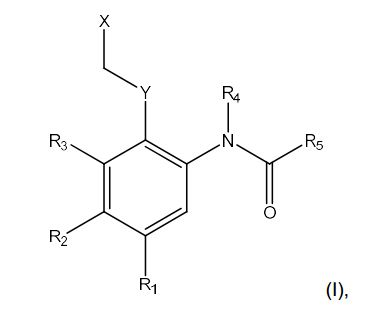
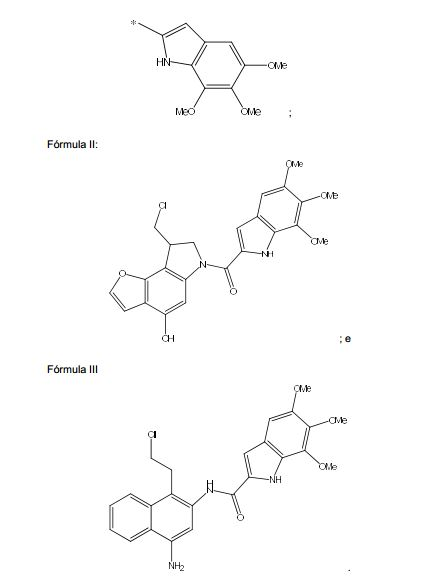
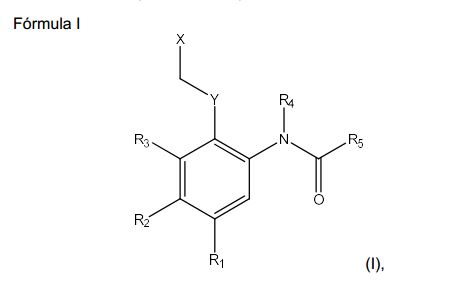

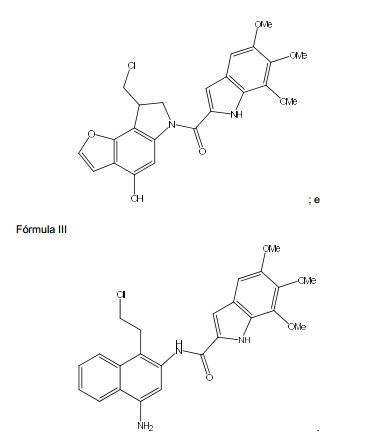
Applications Claiming Priority (7)
| Application Number | Priority Date | Filing Date | Title |
|---|---|---|---|
| US201161490761P | 2011-05-27 | 2011-05-27 | |
| US61/490,761 | 2011-05-27 | ||
| NL2007292 | 2011-08-23 | ||
| NL2007292A NL2007292C2 (en) | 2011-05-27 | 2011-08-23 | Blood stage malaria vaccine. |
| US201261617435P | 2012-03-29 | 2012-03-29 | |
| US61/617,435 | 2012-03-29 | ||
| PCT/AU2012/000594 WO2012162731A1 (en) | 2011-05-27 | 2012-05-28 | Blood stage malaria vaccine |
Publications (2)
| Publication Number | Publication Date |
|---|---|
| BR112013030552A2 BR112013030552A2 (en) | 2017-08-08 |
| BR112013030552B1 true BR112013030552B1 (en) | 2022-03-15 |
Family
ID=44872564
Family Applications (1)
| Application Number | Title | Priority Date | Filing Date |
|---|---|---|---|
| BR112013030552-5A BR112013030552B1 (en) | 2011-05-27 | 2012-05-28 | Immunogenic composition, in vitro method for producing said immunogenic composition and use thereof to prevent or inhibit a malarial infection or to treat an existing malarial infection |
Country Status (10)
| Country | Link |
|---|---|
| US (1) | US9539316B2 (en) |
| EP (1) | EP2714075B1 (en) |
| CN (1) | CN103874506B (en) |
| AU (1) | AU2012262653B2 (en) |
| BR (1) | BR112013030552B1 (en) |
| CA (1) | CA2837222C (en) |
| MX (1) | MX344544B (en) |
| NL (1) | NL2007292C2 (en) |
| WO (1) | WO2012162731A1 (en) |
| ZA (1) | ZA201308840B (en) |
Families Citing this family (7)
| Publication number | Priority date | Publication date | Assignee | Title |
|---|---|---|---|---|
| WO2015013739A1 (en) * | 2013-07-29 | 2015-02-05 | Griffith University | Attenuated babesia vaccine |
| NL2016067B1 (en) * | 2016-01-07 | 2017-07-13 | Univ Griffith | Liposomal malaria vaccine. |
| AU2016422906A1 (en) | 2016-09-16 | 2019-04-11 | Griffith University | Vaccine comprising drug and parasite administration |
| GB2587951B (en) * | 2018-04-26 | 2023-03-08 | Cas Lamvac Guangzhou Biomedical Tech Co Ltd | Attenuation system and use thereof |
| WO2022093729A1 (en) * | 2020-10-27 | 2022-05-05 | Rutgers, The State University Of New Jersey | Replication-defective vaccines and uses thereof |
| WO2022236370A1 (en) * | 2021-05-11 | 2022-11-17 | Griffith University | Immunogenic composition |
| WO2023036249A1 (en) * | 2021-09-09 | 2023-03-16 | 清华大学 | Immunogenic composition, and preparation method therefor and use thereof |
Family Cites Families (2)
| Publication number | Priority date | Publication date | Assignee | Title |
|---|---|---|---|---|
| US20050208078A1 (en) * | 2003-11-20 | 2005-09-22 | Hoffman Stephen L | Methods for the prevention of malaria |
| WO2008050140A2 (en) | 2006-10-27 | 2008-05-02 | Spirogen Limited | Compounds for treatment of parasitic infection |
-
2011
- 2011-08-23 NL NL2007292A patent/NL2007292C2/en not_active IP Right Cessation
-
2012
- 2012-05-28 MX MX2013013811A patent/MX344544B/en active IP Right Grant
- 2012-05-28 US US14/122,701 patent/US9539316B2/en not_active Expired - Fee Related
- 2012-05-28 AU AU2012262653A patent/AU2012262653B2/en not_active Ceased
- 2012-05-28 WO PCT/AU2012/000594 patent/WO2012162731A1/en not_active Ceased
- 2012-05-28 EP EP12793152.5A patent/EP2714075B1/en active Active
- 2012-05-28 CA CA2837222A patent/CA2837222C/en active Active
- 2012-05-28 CN CN201280036771.5A patent/CN103874506B/en not_active Expired - Fee Related
- 2012-05-28 BR BR112013030552-5A patent/BR112013030552B1/en not_active IP Right Cessation
-
2013
- 2013-11-25 ZA ZA2013/08840A patent/ZA201308840B/en unknown
Also Published As
| Publication number | Publication date |
|---|---|
| CN103874506A (en) | 2014-06-18 |
| NL2007292C2 (en) | 2013-02-27 |
| US20140186402A1 (en) | 2014-07-03 |
| US9539316B2 (en) | 2017-01-10 |
| AU2012262653B2 (en) | 2017-04-27 |
| ZA201308840B (en) | 2015-01-28 |
| EP2714075A4 (en) | 2015-01-07 |
| CA2837222C (en) | 2019-09-10 |
| CA2837222A1 (en) | 2012-12-06 |
| MX344544B (en) | 2016-12-19 |
| CN103874506B (en) | 2017-07-14 |
| BR112013030552A2 (en) | 2017-08-08 |
| HK1199199A1 (en) | 2015-06-26 |
| MX2013013811A (en) | 2014-07-11 |
| EP2714075B1 (en) | 2016-11-16 |
| WO2012162731A1 (en) | 2012-12-06 |
| EP2714075A1 (en) | 2014-04-09 |
Similar Documents
| Publication | Publication Date | Title |
|---|---|---|
| Vaughan et al. | Genetically engineered, attenuated whole-cell vaccine approaches for malaria | |
| Gradoni | An update on antileishmanial vaccine candidates and prospects for a canine Leishmania vaccine | |
| De et al. | Progress towards the development of a P. vivax vaccine | |
| AU2012262653B2 (en) | Blood stage malaria vaccine | |
| PT1802336E (en) | Malaria prime/boost vaccines | |
| Hassert et al. | Memory CD8+ T cell‐mediated protection against liver‐stage malaria | |
| AU2012262653A1 (en) | Blood stage malaria vaccine | |
| Haolla et al. | Strain-specific protective immunity following vaccination against experimental Trypanosoma cruzi infection | |
| US20140154289A1 (en) | Attenuated plasmodium with deactivated hmgb2 gene, as vaccine | |
| Etefia et al. | Malaria vaccine development: challenges and prospects | |
| US8128921B2 (en) | Use of conditional plasmodium strains lacking nutrient transporters in malaria vaccination | |
| Todryk et al. | Building better T‐cell‐inducing malaria vaccines | |
| US20190381159A1 (en) | Doubly attenuated late liver stage malaria parasites and related compositions and methods | |
| PT91238A (en) | SALMONELLA STRAIN TRANSFORMED CAPABLE OF EXPRESSING HETEROLOGICAL GENES AND RECOMBINANT VACCINE PREPARATION PROCESS | |
| Kristoff | Malaria stage-specific vaccine candidates | |
| HK1199199B (en) | Blood stage malaria vaccine | |
| CN104302313B (en) | Rodent plasmodium parasite as the malaria vaccine platform of overall organism | |
| Laurens et al. | Malaria Vaccines | |
| US11013791B2 (en) | NYVAC-based plasmodium malaria vaccine | |
| Aminu et al. | Optimizing Blood-Stage Vaccines: Essential Tools in Malaria Eradication Strategies | |
| US20120321661A1 (en) | Recombinant Measles Virus Useful as a Bivalent Vaccine Against Measles and Malarial Infections | |
| Abaza | Spotlights on new publications | |
| ES2431613T3 (en) | Recombinant virus-based malaria vaccines | |
| Jiang et al. | Transgenic Plasmodium that expresses HIV-1 Gag elicits immunity and protects mice against vaccinia virus-gag and malarial parasites | |
| Chen et al. | Tropical and travelassociated diseases |
Legal Events
| Date | Code | Title | Description |
|---|---|---|---|
| B07D | Technical examination (opinion) related to article 229 of industrial property law [chapter 7.4 patent gazette] | ||
| B06F | Objections, documents and/or translations needed after an examination request according [chapter 6.6 patent gazette] | ||
| B07E | Notification of approval relating to section 229 industrial property law [chapter 7.5 patent gazette] |
Free format text: NOTIFICACAO DE ANUENCIA RELACIONADA COM O ART 229 DA LPI |
|
| B06U | Preliminary requirement: requests with searches performed by other patent offices: procedure suspended [chapter 6.21 patent gazette] | ||
| B06A | Patent application procedure suspended [chapter 6.1 patent gazette] | ||
| B06A | Patent application procedure suspended [chapter 6.1 patent gazette] | ||
| B09A | Decision: intention to grant [chapter 9.1 patent gazette] | ||
| B16A | Patent or certificate of addition of invention granted [chapter 16.1 patent gazette] |
Free format text: PRAZO DE VALIDADE: 20 (VINTE) ANOS CONTADOS A PARTIR DE 28/05/2012, OBSERVADAS AS CONDICOES LEGAIS. |
|
| B21F | Lapse acc. art. 78, item iv - on non-payment of the annual fees in time |
Free format text: REFERENTE A 13A ANUIDADE. |
|
| B24J | Lapse because of non-payment of annual fees (definitively: art 78 iv lpi, resolution 113/2013 art. 12) |
Free format text: EM VIRTUDE DA EXTINCAO PUBLICADA NA RPI 2829 DE 25-03-2025 E CONSIDERANDO AUSENCIA DE MANIFESTACAO DENTRO DOS PRAZOS LEGAIS, INFORMO QUE CABE SER MANTIDA A EXTINCAO DA PATENTE E SEUS CERTIFICADOS, CONFORME O DISPOSTO NO ARTIGO 12, DA RESOLUCAO 113/2013. |