WO2025147677A1 - Preparation of psma-targeted radiopharmaceutical - Google Patents
Preparation of psma-targeted radiopharmaceutical Download PDFInfo
- Publication number
- WO2025147677A1 WO2025147677A1 PCT/US2025/010329 US2025010329W WO2025147677A1 WO 2025147677 A1 WO2025147677 A1 WO 2025147677A1 US 2025010329 W US2025010329 W US 2025010329W WO 2025147677 A1 WO2025147677 A1 WO 2025147677A1
- Authority
- WO
- WIPO (PCT)
- Prior art keywords
- formula
- compound
- coupling
- psma
- solvent
- Prior art date
- Legal status (The legal status is an assumption and is not a legal conclusion. Google has not performed a legal analysis and makes no representation as to the accuracy of the status listed.)
- Pending
Links
Classifications
-
- A—HUMAN NECESSITIES
- A61—MEDICAL OR VETERINARY SCIENCE; HYGIENE
- A61K—PREPARATIONS FOR MEDICAL, DENTAL OR TOILETRY PURPOSES
- A61K51/00—Preparations containing radioactive substances for use in therapy or testing in vivo
- A61K51/02—Preparations containing radioactive substances for use in therapy or testing in vivo characterised by the carrier, i.e. characterised by the agent or material covalently linked or complexing the radioactive nucleus
- A61K51/04—Organic compounds
- A61K51/08—Peptides, e.g. proteins, carriers being peptides, polyamino acids, proteins
- A61K51/088—Peptides, e.g. proteins, carriers being peptides, polyamino acids, proteins conjugates with carriers being peptides, polyamino acids or proteins
-
- A—HUMAN NECESSITIES
- A61—MEDICAL OR VETERINARY SCIENCE; HYGIENE
- A61K—PREPARATIONS FOR MEDICAL, DENTAL OR TOILETRY PURPOSES
- A61K51/00—Preparations containing radioactive substances for use in therapy or testing in vivo
- A61K51/02—Preparations containing radioactive substances for use in therapy or testing in vivo characterised by the carrier, i.e. characterised by the agent or material covalently linked or complexing the radioactive nucleus
- A61K51/04—Organic compounds
- A61K51/0402—Organic compounds carboxylic acid carriers, fatty acids
-
- A—HUMAN NECESSITIES
- A61—MEDICAL OR VETERINARY SCIENCE; HYGIENE
- A61K—PREPARATIONS FOR MEDICAL, DENTAL OR TOILETRY PURPOSES
- A61K51/00—Preparations containing radioactive substances for use in therapy or testing in vivo
- A61K51/02—Preparations containing radioactive substances for use in therapy or testing in vivo characterised by the carrier, i.e. characterised by the agent or material covalently linked or complexing the radioactive nucleus
- A61K51/04—Organic compounds
- A61K51/0497—Organic compounds conjugates with a carrier being an organic compounds
-
- A—HUMAN NECESSITIES
- A61—MEDICAL OR VETERINARY SCIENCE; HYGIENE
- A61P—SPECIFIC THERAPEUTIC ACTIVITY OF CHEMICAL COMPOUNDS OR MEDICINAL PREPARATIONS
- A61P35/00—Antineoplastic agents
-
- C—CHEMISTRY; METALLURGY
- C07—ORGANIC CHEMISTRY
- C07K—PEPTIDES
- C07K7/00—Peptides having 5 to 20 amino acids in a fully defined sequence; Derivatives thereof
- C07K7/02—Linear peptides containing at least one abnormal peptide link
Definitions
- Radiopharmaceutical formulations and methods of treatment are provided, including for treatment of cancer.
- Radiopharmaceuticals have been used for a variety of therapeutic and diagnostic indications.
- radiolabeled molecules have been useful to treat various malignant tumors, including prostate cancer.
- Prostate cancer is a common and lethal disease that can recur after initial treatment: Prostate cancer is the most common cancer among men in the US and the second leading cause of cancer-related death. About one-third of patients who receive curative treatment (radiation therapy or radical prostatectomy) will experience rising levels of pro state- specific antigen (PSA), a biomarker of prostate cancer, indicating biochemical recurrence (BCR).
- PSA pro state- specific antigen
- BCR biochemical recurrence
- PSMA-PET imaging has enabled the identification of oligometastatic hormone- sensitive prostate cancer (OmHSPC): OmHSPC is a disease state with few (usually 5 or fewer) metastatic lesions that can be detected by imaging.
- PSMA-PET is a new imaging modality that uses a radiotracer that binds to prostate-specific membrane antigen (PSMA), a protein that is overexpressed in most prostate cancer cells.
- PSMA-PET can detect lesions that are not visible on conventional imaging and has led to a stage migration from BCR to OmHSPC.
- ADT Androgen deprivation therapy
- ADT is the standard of care for hormone-sensitive prostate cancer, but has serious side effects and limited efficacy: ADT is a systemic therapy that suppresses the androgen pathway, which is essential for the growth of prostate cancer cells. ADT is used for both BCR and OmHSPC, but it has many adverse effects on the quality of life and long-term health of patients, such as sexual dysfunction, metabolic complications, osteoporosis, and cardiovascular disease. Moreover, most patients will eventually develop resistance to ADT and progress to castration-resistant prostate cancer (CRPC), which has a poor prognosis.
- CRPC castration-resistant prostate cancer
- ARPIs Androgen receptor pathway inhibitors
- ARPIs are oral agents that target the androgen receptor or its ligands and have been approved for the treatment of CRPC in recent years. ARPIs have improved the survival and quality of life of patients with CRPC, but they are not without side effects, such as fatigue, rash, and hypertension. Moreover, most patients will develop resistance to ARPIs within a few years and require further treatment options.
- a novel treatment paradigm that has recently seen its first approval within the prostate cancer treatment space is the use of a theranostic pair of radioligands to select, and then treat, patients with overexpression of PSMA. This unique treatment approach leverages the expression pattern of this target within prostate cancer to deliver damaging radiation directly to cancer cells throughout the body.
- an R isomer-enriched compound i.e. a compound that is substantially enriched with the R isomer of the * carbon depicted in Formula A-2) of the following Formula A-2-R is provided in high chemical purity:
- an S isomer-enriched compound i.e. a compound that is substantially enriched with the S isomer of the * carbon depicted in Formula A-2) of the following Formula A-2-S is provided in high chemical purity:
- a compound of the above Formula A-3-R is also referred to herein as 225 Ac PSMA- 62.
- a compound of Formula A-3-R i.c. 225 Ac PSMA-62
- PSMA-62 shown as Formula A-l below
- PSMA-62 is also sometimes referred to herein as PSMA-62 (shown as Formula A-l below) and preferably is in high purity (e.g. greater than 90% chemical purity).
- an S isomer-enriched compound i.e. a compound that is substantially enriched with the S isomer of the * carbon depicted in Formula A-3) of the following Formula A-3-S is provided in high chemical purity:
- the structures containing a chelated metal are not representative of the exact binding mode of each of the metals; rather, they are intended to illustrate where the metal is chelated.
- 225 Ac is believed to bind as follows: where the squiggly line is the point of attachment of the chelator to the rest of the molecule.
- methods and uses are provided for diagnosing and/or monitoring a disorder or disorder including cancer as disclosed herein.
- these methods and uses may comprise administering to a subject such as a human patient a radioimaging agent.
- the radioimaging agent is a PSMA-targeted radioimaging and may include e.g. 68 Ga-PSMA-l 1 and 18 F-DCFPyl.
- the radioimaging agent also may include a radiolabeled compound as disclosed herein, such as a compound of Formula A-2.
- the radioimaging may be a compound as disclosed herein suitably complexed with 68 Ga, e.g. 68 Ga -PSMA-62.
- the radioimaging agent such as a compound disclosed herein may be administered to the subject and the subject monitored.
- the protocol may include allowing time for the radioimaging agent such as 68 Ga -PSMA-62 to bind to tissue of the subject and then monitoring the subject (particularly, extracorporeally), for example by positron emission tomography (PET).
- PET positron emission tomography
- a radiopharmaceutical agent as disclosed herein such as 225 Ac-PSMA-62 may be administered to treat the identified disease, including metastatic Castration-Resistant Prostate Cancer (mCRPC) and biochemically recurrent (BCR) prostate cancer.
- mCRPC metastatic Castration-Resistant Prostate Cancer
- BCR biochemically recurrent
- a radiopharmaceutical agent as disclosed herein such as 225 Ac-PSMA-62 may be administered to treat the identified disease, including metastatic Castration-Resistant Prostate Cancer (mCRPC) and/or oligometastatic hormone- sensitive prostate cancer.
- mCRPC metastatic Castration-Resistant Prostate Cancer
- OmHSPC oligometastatic hormone- sensitive prostate cancer.
- preferred radioimaging agents include PSMA-targeted agents such as 68 Ga -PSMA-11 and 18 F-DCFPyl or a radiopharmaceutical agent as disclosed herein, particularly complexed with a radioisotope of 68 Ga, such as compound of the following Formula B- 11 :
- an R isomer-enriched compound i.e. a compound that is substantially enriched with the R isomer of the * carbon depicted in Formula B-l 1
- a treatment method including a diagnostic or monitoring method:
- methods for treating a subject suffering from prostate cancer comprising: a) identifying a subject exhibiting prostate cancer progression during or after treatment with other cancer therapy, such as administration with one or more androgen receptor inhibitor agents and a taxane chemotherapy and a maximum of 3 prior systemic therapy regimens in the cancer setting; b) administering to the identified subject an effective amount of a radiopharmaceutical as disclosed herein, including 225 Ac PSMA-62.
- the patient has read, understood, and signed the written informed consent form(s);
- Criteria specific for patients with mCRPC a. Previously received treatment for their underlying disease and have exhausted all satisfactory or available approved treatment options; b. Progressive mCRPC at the time of consent based on at least 1 of the following criteria:
- Serum/plasma PSA progression defined as increase in PSA greater than 25% and >2 ng/mL above nadir, with a confirmatory PSA test at least 1 week later ;
- PSA progression defined as rising PSA values at a minimum of 1-week intervals with the last result being at least 1.0 ng/mL
- Soft-tissue progression defined as an increase ⁇ 20% in the sum of the diameter (SOD) (short axis for nodal lesions and long axis for non-nodal lesions) of all target lesions based on the smallest SOD since treatment started or the appearance of one or more new lesions; and/or
- Criteria specific for patients with BCR a. The patient's primary tumor must have been previously treated with surgery and/or definitive radiation. Prior salvage treatments (radiation or surgery) to the prostate bed or pelvis are allowed; b. Biochemical recurrence after primary therapy. Patients without any prior ADT, or those with prior ADT having recovered testosterone to within the normal range - defined as ⁇ 5.2 nmol/L ( ⁇ 150 ng/dL) - must meet one or more of the following thresholds for BCR:
- PSA prostate specific antigen
- PSMA targeted agents which are approved by the respective health authority, may be used as per standard of care (diagnostic protocols) for each institution; d. No indication for urgent or emergent radiation; e. Patient has not received any form of prostate-cancer directed therapy since undergoing screening PSMA scan.
- Criteria specific for patients with OmHSPC a. PSA recurrence after radical prostatectomy (RP) or definitive radiation therapy (RT) with or without adjuvant/salvage local therapy (radiation or surgery), with or without (neo)adjuvant ADT
- PSMA_PET PSMA_PET positive lesions identified outside the prostate bed or remaining gland.
- one or more of any of the above inclusion criteria suitably may be presented on a label, or instructions for use or otherwise associated with a kit or pharmaceutical composition or other delivery package, system or presentation of a radiopharmaceutical agent as discussed herein, including 225 Ac PSMA-62.
- the present methods of treatment and therapeutic uses may exclude subjects with one or more of the following identified characteristics (exclusion criteria):
- Patient has any concurrent severe and/or uncontrolled medical conditions that could increase the patient's risk for toxicity while on the study or that could confound discrimination between disease- and study treatment-related toxicities;
- Criteria specific for patients with mCRPC a. Patient has received any therapeutic systemic radionuclides (e.g., radium- 223, rhenium-186, strontium-89), or therapeutic radioligands (e.g., Lu-177-PSMA) within 5 half- lives of starting the study treatment, b. Patients currently receiving systemic anti-cancer therapy, with the exception of ADT with or without ARPI. However, patients may be included in the study if they stop all prohibited anti-cancer therapy, prior to receiving the first dose of investigational study drug, c. Patient has initiated therapy with, or switch to, an alternative ARPI since PSMA- PET scan used for eligibility. Patients already receiving an ARPI may continue treatment with the same ARPI during study, d.
- systemic radionuclides e.g., radium- 223, rhenium-186, strontium-89
- therapeutic radioligands e.g., Lu-177-PSMA
- CNS metastases Patients with a history of central nervous system (CNS) metastases must have received therapy (surgery, radiotherapy, gamma knife) and be neurologically stable, and not receiving corticosteroids for the purposes of maintaining neurologic integrity. Patients with epidural disease, canal disease, and prior cord involvement are eligible if those areas have been treated and are stable. For patients with parenchymal CNS metastasis (or a history of CNS metastasis), baseline and subsequent radiological imaging must include evaluation of the brain.
- Criteria specific for patients with BCR a. Any prior cytotoxic chemotherapy; b. Prior treatment with therapeutic systemic radionuclides (e.g., radium-223, rhenium- 186, strontium-89), or therapeutic radioligands (e.g. Lu-177-PSMA); c. Prior immuno-therapy or adoptive T-Cell Therapy (e.g. CAR-T therapy, TCR therapy, etc.); d. Prior poly ADP ribose polymerase (PARP) inhibitor for prostate cancer; e. Patient has received any systemic anti-cancer therapy for prostate cancer with the exception of limited course of ADT for management of localized disease; f. Presence of any liver metastases; g. Use of opioids for cancer-related pain ⁇ 30 days prior to screening; h. Known presence of central nervous system metastases.
- PARP Prior poly ADP ribose polymerase
- Criteria specific for patients with OmHSPC a. Patient has received any systemic anti-cancer therapy for prostate cancer with the exception of (neo)adjuvant ADT for management of localized disease b. Presence of any liver metastases c. Known presence of central nervous system metastases. d. Patient had PSA progression in the context of castrate level of testosterone .
- one or more of any of the above exclusion criteria suitably may be presented on a label, or instructions for use or otherwise associated with a kit or pharmaceutical composition or other delivery package, system or presentation of a radiopharmaceutical agent as discussed herein, including 225 Ac PSMA-62.
- compounds of Formulae A-2, A-2-R, A-2-S, A-3, A-3-R and/or A-3-S are provided in purities of more than 90%, or more than 91%, 92%, 93%, 94%, 95%, 96%, 97%, 98%, 99% or 99.5%.
- purity levels can be defined as chemical purity and may be determined by chromatography particularly by UHPLC.
- a chemical impurity as referred to herein may or may not contain a radioisotope such as actinium- 225 or lutetium- 177 or a degradation species thereof.
- a chemical impurity may be referred to herein as being one or more compounds or compositions that do not contain a radioisotope such as actinium-225 or lutetium- 177 or a degradation species thereof.
- compounds of any of Formulae A-2, A-2-R, A-2-S, A-3, A-3-R and/or A-3-S are provided in the substantial absence of a structural (including a constitutional isomer and/or stereoisomer (e.g. diastereoisomer)) impurity.
- structural impurity refers to an impurity that may have the same or substantially or essentially the same (e.g.
- HPLC high-performance liquid chromatography
- Agilent 1290/6460 Triple Quad LC/MS system with a UV detector using Waters XBridge BEH Phenyl Column, 4.6 x 150 mm, 3.5 um; gradient elution system utilized mobile phase A (0.05% TFA in HPLC Grade water, pH 2.02) and mobile phase B (ACN); gradient can be performed with a flow rate of 1.0 mL/min starting with 85% A and 15% B; and increased to 76% A and 24% B over 20 mins; then increased to 64% A and 36% B over 4 mins, followed by return of gradient parameters to the initial starting conditions.
- a “structural impurity” as referred to herein in reference to a compound of any of Formulae A-l, A-2 or A-3 has been characterized as having a retention time (peak) in the region of 13.6 to 14.2 minutes, or 13.8 to 14.0 minutes and particularly 13.9 minutes (exemplified by the chromatogram of Example 4 below and FIG.
- Figure 6 shows an HPLC chromatogram of Example 5 which follows.
- the term “optically enriched” denotes the presence of one or more non-racemic stereoisomeric centers in a molecule, wherein the configuration of at least one stereoisomeric center has a predominance of one stereoisomeric configuration (R or S).
- one stereoisomeric center in a molecule typically a carbon atom, may have greater than 50 weight % (based on total weight of the compound) of its attached atoms spatially arranged in the (R) configuration.
- more than 50 weight % (based on total weight of the compound) may be spatially arranged in the (S) configuration.
- the molecule, or its stereoisomeric center is substantially optically enriched, and even more preferably is substantially cnantiomcrically pure.
- the compound is “substantially enantiomerically pure”, that is, at least about 97.5 weight % (based on total weight of the compound), more preferably about 99 weight % (based on total weight of the compound), even more preferably about 99.5 weight % (based on total weight of the compound) of one stereoisomeric configuration predominates.
- the term “substantially pure” means sufficiently homogeneous to appeal’ free of readily detectable impurities as determined by standard analytical methods, such as thin layer chromatography (TLC), gel electrophoresis, high performance liquid chromatography (HPLC), nuclear magnetic resonance (NMR), and mass spectrometry (MS); or sufficiently pure such that further purification would not delectably alter the physical and chemical properties, or biological and pharmacological properties, such as enzymatic and biological activities, of the substance.
- TLC thin layer chromatography
- HPLC high performance liquid chromatography
- NMR nuclear magnetic resonance
- MS mass spectrometry
- substantially pure refers to a collection of molecules, wherein at least about 55%, about 60%, about 65%, about 70%, about 75%, about 80%, about 85%, about 90%, about 95%, about 97%, about 98%, about 98.5%, about 99%, about 99.5% or about 99.9% or greater of the molecules are a single compound, including a racemic mixture or a single stereoisomer thereof, as determined by standard analytical methods.
- the compounds disclosed herein are optically enriched.
- the compounds disclosed herein, such as for example, compounds of Formula A-l or Formula Y are substantially optically enriched.
- the compounds disclosed herein, such as for example, compounds of Formula A-l or Formula Y are substantially pure.
- Formula Y uses R-DOTAGA chelator group, but there is likely to be at least a little of the S- DOTAGA chelator group present.
- pharmaceutically acceptable carrier refers to a chemical compound that facilitates the delivery or incorporation of a compound or therapeutic agent into cells or tissues.
- composition refers to a mixture of a compound disclosed herein with other chemical components, such as diluents or additional carriers.
- the pharmaceutical composition facilitates administration of the compound to an organism.
- coupling agent refers to compounds that facilitate the formation of an amide bond. Coupling agents may contain phosphorous in the molecule or counterion, or they may be phosphorous free.
- phosphorous containing coupling agents include, but are not limited to (7-Azabenzotriazol-l-yloxy)tripyrrolidinophosphonium hexalluorophosphate (PyAOP), benzotriazolyloxy-tris[pyrrolidino]-phosphonium hexafluorophosphate (PyBOP), bromo tripyrrolidinophosphonium hexafluorophosphate (PyBroP), hexafluorophosphate azabenzotriazole tetramethyl uronium (HATU), hexafluorophosphate benzotriazole tetramethyl uronium (HBTU), and 3- (diethoxyphosphoryloxy)-l,2,3-benzotriazin-4(3H)-one (DEPBT).
- PyAOP (7-Azabenzotriazol-l-yloxy)tripyrrolidinophosphonium hexalluorophosphate
- PyBOP
- Examples of coupling agents that do not contain phosphorous include l-Ethyl-3-(3- dimethylaminopropyl)carbodiimide (EDCI), l-Hydroxy-7-azabenzotriazole (HO AT), or ethyl cyano(hydroxyimino)acetate (oxyma), diisopropylcarbodiimide (DIC), and dicyclohexylcarbodiimide (DCI).
- EDCI l-Ethyl-3-(3- dimethylaminopropyl)carbodiimide
- HO AT l-Hydroxy-7-azabenzotriazole
- ethyl cyano(hydroxyimino)acetate oxyma
- DIC diisopropylcarbodiimide
- DCI dicyclohexylcarbodiimide
- other compounds are present in the coupling reaction, such as a base, and preferably, a nitrogen containing base.
- nitrogen containing bases examples include N,N-diisopropylethylamine (Hunig’s base) and triethylamine.
- a preferred coupling agent is PyAOP in combination with N,N-diisopropylethylamine.
- a variety of different solvents may be used in the coupling reactions described herein. Polar, aprotic solvents are commonly used. Examples of suitable solvents include chloroform, dichloromcthanc, and dimethylformamide (DMF). DMF is a preferred solvent for the couplings disclosed herein. The solvents used in the coupling reaction are referred to as “coupling solvents.”
- a variety of acids can be used in the hydrolysis reactions described herein. The acid must be able to cleave the group to be cleaved. Examples of suitable acids include strong acids that can be used in the hydrolysis reactions described herein. Suitable acids include trifluoroacetic acid, hydrochloric acid, or para-toluene sulfonic acid. Other strong acids known in the art are also suitable.
- hydrolysis solvent The solvents used in the hydrolysis reaction are referred to as “hydrolysis solvent.” Hydrolysis solvents are independently selected at each occurrence. Common solvents are water. Other co- solvents may be used, if desired.
- the solvent may contain additional additives, such as triisopropylsilane or dithio threitol. In some preferred embodiments, the solvent is water that contains both triisopropylsilane (TIS) and dithiothreitol (DTT).
- TIS triisopropylsilane
- DTT dithiothreitol
- amine protecting group refers to any group known in the art of solid state peptide synthesis to protect an amine from an undesired reaction. An amine protecting group should be able to be selectively removed, when in the present of other protecting groups. Amine protecting gropus are independently selected at each occurrence.
- amine protecting groups include 9-fluorenylmethoxycarbonyl (Fmoc), benzyl, tert- butoxycarbonyl (Boc), benzyl chloroformate, trityl, 4-chlorotrityl, 4-methyltrityl (Mtt), N- [l-(4,4-dimethyl-2,6-dioxocyclohex-l-ylidene)ethyl] (Dde), and l-(4,4-Dimethyl-2,6-dioxocyclohex-l-ylidene)-3-methylbutyl (ivDde), where the squiggly line is the point of attachment.
- Fmoc and 4-methyltrityl are two preferred amine protecting groups.
- amine protecting group The exact conditions needed to remove an amine protecting group depend on the protecting group.
- a base such as cyclohexylamine, ethanolamine, piperidine, piperazine, triethylamine, or N,N-diisopropylethylamine in a polar, aprotic solvent.
- Bases used to remove a protecting group are referred to as “amine deprotecting base.”
- Amine deprotecting bases are independently selected at each occurrence.
- suitable solvents include dimethylformamide (DMF), dichloromethane, toluene, or N-methyl-2-pyrrolidone (NMP).
- a preferred solvent is DMF or CH2CI2. More preferred is DMF.
- amine deprotection solvent or “amine deprotecting solvent.”
- the amine deprotecting solvent or amine deprotection solvent is independently selected at each occurrence.
- a preferred method of removing an Fmoc group is it treat it with piperidine in DMF.
- a preferred reagent for removing a 4-methyltrityl group is hexafluoro-2-isopropanol.
- Carboxyl protecting groups include allyl, benzyl, tBu, and bcnzhydryl.
- a preferred carboxyl protecting group is tBu or allyl.
- Carboxyl protecting groups are independently selected at each occurrence.
- a preferred method of removing an allyl, carboxyl protecting group is to use a Pd containing compound.
- a preferred Pd containing compound is Pd(PPh3)4.
- the compound used to remove the carboxyl protecting group is referred to as a “carboxyl deprotecting agent.”
- the carboxyl deprotecting agent is independently selected at each occurrence.
- a nucleophile is commonly present. Examples of suitable nucleophiles include 1,3- dimethylbarbituric acid and triphenylphosphine. The nucleophile is independently selected at each occurrence.
- a preferred nucleophile is 1,3- dimethylbarbituric acid.
- a preferred way to remove an allyl, carboxyl protecting group is to use Pd(PPh3)4 in dichloromethane and dimethyl formamide, in the presence of 1,3- dimethylbarbituric acid.
- the tBu protecting group may be removed using methods known in the art, such as hydrolysis.
- the tBu group or groups are removed using a strong acid in a solvent comprising water.
- the solvents used for a carboxyl deprotection include at least one of water, dichloromethane, dimethylformamide, tetrahydrofuran, or ethanol.
- Preferred solvents include at least one of water, dichloromcthanc and dimethylformamide . These solvents arc referred to as “carboxyl deprotecting solvent.”
- the carboxyl deprotection solvent is independently selected at each occurrence.
- Oxygen protecting groups include methyl, t-butyl, and t-butyldimethylsilyl groups. A preferred oxygen protecting group is t-butyl, which is also identified as “tBu,” herein. Oxygen protecting groups are independently selected at each occurrence.
- the exact conditions needed to remove an oxygen protecting group depend on the protecting group.
- a preferred method of removing a t-butyl oxygen protecting group is to use strong acid.
- a preferred strong acid is TFA.
- the compound used to remove the oxygen protecting group is referred to as an “oxygen deprotecting agent.”
- the oxygen deprotecting agent is independently selected at each occurrence.
- a cation scavenger is commonly present. Examples of suitable cation scavengers include triisopropylsilane (TIS) and DTT. The cation scavenger is independently selected at each occurrence.
- a preferred cation scavenger is triisopropylsilane.
- Cleaving the compounds disclosed herein from the solid support may be accomplished using TFA in water in the presence of DTT.
- all tBu groups are removed, when the compound is cleaved from the solid support. This can be accomplished using the TFA cleavage cocktail (3 mL; 95% TFA, 5% H2O, 25 mg/mL DTT).
- solid support refers to resins that are used during solid phase synthesis. Examples include Wang resins, which are of polystyrene cross-linked with divinylbenzene.
- a related aspect provides a compound of the following Formula A-l, wherein the compound has a chemical purity of more than 90%, more than 95%, more than 98% or more than 99%, including no more than 10, 9, 8, 7, 6, 5, 4, 3, 2, or 1 % of one or more structural impurities (including a structural impurity of any of Formulae B-l, B-l-R, B-l-S, B-2, B-2- R, B-2-S, B-3, B-3-R, and B-3-S as set forth above):
- a radiopharmaceutical agent which is a complex of the compound of Formula A-l with one or more of radioisotope atoms.
- the agent has a purity or chiral purity of more than 90%, more than 95%, more than 98%, or more than 99%.
- Exemplary radioisotopes include 47 Sc, 51 Cr, 57 Co, 58 Co, 59 Fe, 67 Cu, 67 Ga, 68 Ga, 71 Ge, 72 As, 72 Se, 77 As, 77 Br, 81 Rb, 88 Y, 90 Y, 97 Ru, "mTc, 100 Pd, 101 mRh, 103 Pb, 105 Rh, 109 Pd, ”’Ag, ”’ln, ” 3 In, 119 Sb, 121 Sn, 127 Cs, 128 Ba, 129 Cs, 131 Cs, 131 I, 139 La, 140 La, 142 Pr, 143 Pr, 149 Pm, 1 51 EU, 153 EU, 153 Sm, 159 Gr, 161 Tb, 165 Dy, 166 Ho, 169 Eu, 175 Yb, 177 Lu, 186 Re, 188 Re, 189 Re, 191 Os, , 93 Pt, 194 Ir, 197 Hg
- the radioisotope is 67 Cu, 177 Lu, 212 Bi, 161 Tb, 212 Pb, 223 Ra or 225 Ac. In certain embodiments, the radioisotope is 177 Lu, 225 Ac, 21 ’At, 67 Cu, 161 Tb, 67 Ga, 68 Ga, or TIT Pb. In certain embodiments, the radioisotope is Ac. In certain embodiments, the radioisotope is 68 Ga. In certain embodiments, the radioisotope is 177 Lu. [0129] The present radiopharmaceutical agents, i.e.
- a compound of the above formulae can be provided that is complexed or chelated with a radioisotope compound typically with heating and agitation in a solvent or solvent mixture for a time sufficient to result in incorporation of the radioisotope compound with a compound of A-2, A-2-R, A-2-S, A-3, A-3-R and/or A-3-S without a radioisotope previously chelated therewith.
- a compound of Formula A-3-R ( 225 Ac-PSMA-62)
- the following protocol can be utilized: Ac-225 (e.g. using a reagent of ( 225 Ac)C13 is prepared in 0.1 M HC1 and added to a vial, followed by reaction buffer, 1 M NaOH for pH adjustment and finally the PSMA-62 precursor (compound of Formula A-3-R without Ac- 225 complexed therewith).
- the reaction buffer suitably may be prepared by dissolving 1878 mg Sodium Ascorbate and 924 mg Ammonium Acetate in 10 mL Sterile Water for Injection (SWFI).
- SWFI Sterile Water for Injection
- Other formulations suitably can be effective reaction buffers.
- Preferred reaction buffers may comprise one or more ascorbate compounds.
- the reaction mixture as prepared comprises 10 MBq/mL Ac-225, sodium ascorbate (32 mg/mL), ascorbic acid (0.73 mg/mL), PSMA-62 (214 pg/mL) at a pH of 5.5.
- the reaction mixture is heated for a time and temperature sufficient and with agitation (e.g. shaking of the reaction vessel) for the Ac- 225 to effectively complex with the PSMA-62 molecule, for example to achieve greater than 90, 95 or 98% radioisotope incorporation.
- reaction mixture is agitated and heated to 90 °C for 30 minutes before being diluted with formulation buffer containing 0.1 mg/mL DTPA in PBS to a final pH of 6.5 and product ( 225 Ac -PSMA-62) RAC of 1 MBq/mL.
- 225 Ac can be made using methods known in the art.
- the two most important production routes for production of 225 Ac are separation from the natural decay of 229 Th obtained from waste stockpiles containing 233 U and irradiation of 232 Th with high-energy protons (>70 MeV).
- thorium can be an impurity in the chelated compound.
- at least one of 229 Th and 232 Th can be an impurity in the 225 Ac.
- Another method of forming 225 Ac involves the irradiation of Ra-226 using medium energy protons and photons.
- An exemplary preferred radiolabeling protocol to provide a compound of Formula A-3-R (225Ac-PSMA-62) is also set forth in Example 4 which follows.
- An exemplary preferred radiolabeling protocol to provide a compound of Formula B-l-R ( 68 Ga -PSMA-62) is set forth in Example 9 which follows.
- pharmaceutical compositions also referred to as a formulation or pharmaceutical formulation
- pharmaceutical formulations are provided of a compound of any of Formulae A-2, A-2-R, A-2-S, A-3, A-3-R and/or A-3-S above and one or more pharmaceutically acceptable carriers.
- the pharmaceutical composition is free of radiochemical impurities in an amount of not more than 5, 4, 3.5, 3, 2.5, 2, 1.5, 1 or 0.5 weight% based on total weight of the pharmaceutical composition, such as may be determined by radiometric detection (including HPLC radiometric detection), where the composition is maintained at e.g. 2-8 oC and such purity levels are exhibited for 3, 4 or 5 days or more following preparation of the composition.
- radiometric detection including HPLC radiometric detection
- the pharmaceutical composition is free of chemical impurities in an amount of not more than 5, 4, 3, 2, 1 or 0.5 weight % based on total weight of the pharmaceutical composition, such as may be determined by chromatography or other method including HPLC, ultra-high performance liquid chromatography (UHPLC) or HPLC/UV analysis, where the composition is maintained at 30°C or less and such purity levels are exhibited for 3, 4 or 5 days or more following preparation of the composition.
- a pharmaceutical composition is provided that comprises a radiopharmaceutical agent as disclosed herein and one or more pharmaceutically acceptable carriers.
- these methods and uses may comprise administering to a subject such as a human patient a radioimaging compound, including a PSMA-targeted agent.
- PSMA-targeted agents may include e.g. 68 Ga -PSMA-11, 18 F-DCFPyl or a radiopharmaceutical agent as disclosed herein, particularly an agent complexed with 68 Ga.
- 68 Ga -PSMA-62 is a preferred radioimaging agent.
- the protocol may include allowing time (e.g.
- radiopharmaceutical such as 68 Ga -PSMA-11, 18 F-DCFPyl, or 68 Ga - PSMA-62 to bind to tissue of the subject and then monitoring the subject (extracorporeally), particularly by positron emission tomography (PET) or other system such as single-photon emission computed tomography (SPECT). Based on the assessment from the extracorporeal monitoring, the patient then may be further treated, particularly selected for treatment with one or more radiopharmaceutical compounds as disclosed herein, including 225 Ac PSMA-62.
- a radiopharmaceutical agent i.e.
- a compound of any of Formulae A-2, A-2-R, A-2-S, A-3, A-3-R and/or A-3-S) is provided to treat cancers, including prostate cancer, for example and/or biochemically recurrent (BCR) prostate cancer , non-metastatic prostate cancer and metastatic prostate cancer, including hormone sensitive prostate cancer, castration resistant prostate cancer (CRPC) and drug-resistant prostate cancer, such as anti-androgen drug (e.g., enzalutamide) resistant prostate cancer, and/or oligometastatic hormone-sensitive prostate cancer (OmHSPC).
- BCR biochemically recurrent
- non-metastatic prostate cancer and metastatic prostate cancer including hormone sensitive prostate cancer, castration resistant prostate cancer (CRPC) and drug-resistant prostate cancer, such as anti-androgen drug (e.g., enzalutamide) resistant prostate cancer, and/or oligometastatic hormone-sensitive prostate cancer (OmHSPC).
- BCR biochemically recurrent
- the a radiopharmaceutical agent can be administered to a subject such as a human in an amount effective to treat the cancer (e.g., reduction of tumor size), such as at a dose of from about 0.001 MBq to about 100 MBq, from 0.01 MBq to about 100 MBq, or from 0.1 MBq to about 100 MBq be suitably administered from a unit dose in a vial or a syringe or as a bulk solution in a vial or a syringe prepared from a cold-kit at a local or central nuclear pharmacy or through cGMP central manufacturing.
- a dose of from about 0.001 MBq to about 100 MBq, from 0.01 MBq to about 100 MBq, or from 0.1 MBq to about 100 MBq be suitably administered from a unit dose in a vial or a syringe or as a bulk solution in a vial or a syringe prepared from a cold-kit at a local or central
- an administered dose within a range of 0.1 to 100 MBq/mL may be preferred.
- the radioactive concentration (RAC) nonlimiting examples include from 0.001 MBq/mL to 100 MBq/mL, from 0.01 MBq/mL to 50 MBq/mL, and 0.01 MBq/mL to 33 MBq/mL.
- the dose size ranges from about 1 to 20 or from 3 to 10 mL.
- a radioisotope other than Ac-225 such as Lu-177 higher doses may be suitable, e.g. a dose of 10 GBq or 20 GBq or more.
- doses may be administered as described in the below table.
- the subject is suffering from prostate cancer such as one or more of castration- sensitive prostate cancer, castration-resistant prostate cancer, metastatic castration-resistant prostate cancer, advanced stage prostate cancer, drug-resistant prostate cancer such as anti-androgen-resistant prostate cancer (e.g., enzalutamide-resistant prostate cancer, abiraterone-resistant prostate cancer, bicalutamide-resistant prostate cancer), docetaxel-resistant prostate cancer, PARP resistant prostate cancer, radium chloride resistant prostate cancer, AR-V7-induced drug-resistant prostate cancer such as AR-V7-induced enzalutamide-resistant prostate cancer, AKRlC3-induced drug-resistant prostate cancer such as AKRlC3-induced enzalutamide-resistant prostate cancer, oligometastatic hormone- sensitive prostate cancer, and combinations thereof.
- prostate cancer such as one or more of castration- sensitive prostate cancer, castration-resistant prostate cancer, metastatic castration-resistant prostate cancer, advanced stage prostate cancer, drug-resistant prostate cancer such as anti-androgen-resistant prostate cancer
- the subject is a human suffering from oligometastatic hormone- sensitive prostate cancer, and an effective amount of a radiopharmaceutical agent as disclosed herein is administered to the subject to treat the prostate cancer.
- the subject is a human suffering from metastatic castration-resistant prostate cancer and an effective amount of a radiopharmaceutical agent is administered to the subject to treat the prostate cancer.
- the effective amount of a radiopharmaceutical agent administered to a patient will generally be determined by considering the patient record. However, the effective amount suitably may be within a range of about 0.1 GBq to 100 GBq per dose, for example where the radiopharmaceutical agent comprises Lu- 177. Further a dose selected from 1.5 MBq to 13.8 MBq may be selected. For example, 1.5 MBq. For example, 2.3 MBq. For example, 3.0 MBq. For example, 4.6 MBq. For example, 6 MBq. For example, 9 MBq. For example, 9.2 MBq. For example, 13.8 MBq.
- an administered dose within a range of 0.1 to 100 MBq/mL may be preferred.
- the dose can be administered from a unit dose in a vial or a syringe or as a bulk solution in a vial or a syringe prepared from a cold-kit at a local or central nuclear pharmacy or through cGMP central manufacturing.
- the treatment may involve more than one administration of an effective amount of a radiopharmaceutical agent.
- the present compounds also may include at least one non-radioactive, non-toxic carrier metals.
- the carrier metal may be selected from Bi and Fe.
- the non-radioactive carrier metal can be one which enables MRI imaging (for example Fe) or X-ray contrast imaging (for example Bi).
- earner metals include the trivalent bismuth, which additionally provides X-ray contrast in the microspheres, so that they can be imaged in CT.
- the present compounds also may be utilized as imaging agents, for example in image-guided surgery.
- a compound as disclosed herein can be administered to a subject in an amount sufficient to become preferentially localized in target tissue of surgery, with the surgeon being able to detect the presence or absence of the imaging agent during the surgical procedure.
- a radiopharmaceutical agent as disclosed herein suitably may be administered to a subject in conjunction or combination with one or more other therapeutic agents, particularly one or more other chemotherapeutic agents.
- a subject may receive treatment with a radiopharmaceutical agent as disclosed herein in combination with a regime that can include chemotherapy such as docetaxel; cisplatin; gemcitabine; cisplatin/gemcitabine; cabazitaxel; mitoxantrone; estramustine phosphate; one or more antiandrogens such as one or more LHRH agonists, such as leuprolide and goserelin, or antagonists (e.g.
- chemotherapy such as docetaxel; cisplatin; gemcitabine; cisplatin/gemcitabine; cabazitaxel; mitoxantrone; estramustine phosphate; one or more antiandrogens such as one or more LHRH agonists, such as leuprolide and goserelin, or antagonists (e.g.
- one or more antiandrogens such as flutamide, nilutamide, bicalutamide, cyproterone, abiraterone, enzalutamide, darolutamide and apalutamide
- one or more PARP inhibitors such as rucaparib or niraparib, particularly for a subject suffering from prostate cancer including metastatic castration resistant prostate cancer.
- a subject may receive treatment with a radiopharmaceutical agent as disclosed herein in combination with an immunotherapy regime which may include adoptive cell therapies or adoptive immunotherapy.
- a radiopharmaceutical agent as disclosed herein may be administered in combination with immune effector cells (e.g., T cells, NK cells) engineered to express a Chimeric Antigen Receptor (e.g. CAR T-cell therapy), including to treat a cancer or a disease associated with expression of a tumor antigen.
- immune effector cells e.g., T cells, NK cells
- Chimeric Antigen Receptor e.g. CAR T-cell therapy
- a radiopharmaceutical agent as disclosed herein also may be administered in combination with other immune-based therapies such as sipuleucel-T (Provenge) or other immune-boosting approaches including antibody treatments.
- a radiopharmaceutical agent as disclosed herein may be administered in combination with one or more monoclonal antibodies such as pembrolizumab (Keytruda), ipilimumab (Yervoy) and/or nivolumab (Opdivo) for treating a patient suffering from cancer, particularly prostate cancer.
- the term “in combination” in the context of the administration of a therapy to a subject refers to the use of more than one therapy for therapeutic benefit.
- the term “in combination” in the context of the administration can also refer to the prophylactic use of a therapy to a subject when used with at least one additional therapy.
- the use of the term “in combination” does not restrict the order in which the therapies (e.g., a first and second therapy) are administered to a subject.
- a therapy can be administered prior to (e.g., 1 minute, 5 minutes, 15 minutes, 30 minutes, 45 minutes, 1 hour, 2 hours, 4 hours, 6 hours, 12 hours, 24 hours, 48 hours, 72 hours, 96 hours, 1 week, 2 weeks, 3 weeks, 4 weeks, 5 weeks, 6 weeks, 8 weeks, or 12 weeks before), concomitantly with, or subsequent to (e.g., 1 minute, 5 minutes, 15 minutes, 30 minutes, 45 minutes, 1 hour, 2 hours, 4 hours, 6 hours, 12 hours, 24 hours, 48 hours, 72 hours, 96 hours, 1 week, 2 weeks, 3 weeks, 4 weeks, 5 weeks, 6 weeks, 8 weeks, or 12 weeks after) the administration of a second therapy to a subject in need of treatment as disclosed herein.
- the therapies are administered to a subject in a sequence and within a time interval such that the therapies can act together.
- the therapies are administered to a subject in a sequence and within a time interval such that they provide an increased benefit than if they were administered otherwise. Any additional therapy can be administered in any order with the other additional therapy.
- Radiopharmaceuticals and Kits are also provided, including cold kits where a radiopharmaceutical agent as disclosed herein can be prepared shortly before administration such as in a medical facility, for example a hospital laboratory or nuclear pharmacy.
- a compound may be provided in a vial or other container in lyophilized or other form separate from a radioisotope such as Ac-225 or Lu- 177 or other radioisotope.
- the compound of and the radioisotope are reacted at the medical facility to provide the radiopharmaceutical agent of Formulae A-2, A-2-R, A-2-S, A-3, A-3-R and/or A-3-S which then can be promptly administered to a patient.
- packaged preparations or products of a radiopharmaceutical agent are also provided.
- a packaged preparation may comprise 1) a radiopharmaceutical agent such as a compound of Formulae A-2, A-2-R, A-2-S, A-3, A-3-R and/or A-3-S complexed with a radioisotope 2) instructions for using the radiopharmaceutical agent for treating a cancer such as prostate cancer.
- the packaged preparation will comprise a therapeutically effective amount of the radiopharmaceutical agent.
- the total administered activity of 225 Ac PSMA-62 suitably may be 1.5 - 13.8 MBq ( ⁇ 10%), every 6 weeks for 4 cycles for patients with mCRPC or every 8 weeks for 2 cycles for patients with BCR prostate cancer or OmHSPC.
- Fmoc-amino acid analogs were purchased from Chem- Impex, AstaTech or Iris Biotech: Fmoc-Asp-D-Oall (AstaTech, Cat# Fl 1941), Fmoc-D- Om(Dde)-OH (Chem-Impex, Cat# 30521), Fmoc-D-Lys(OtBu)-OH (Iris Biotech, Cat# FAA4690), Fmoc-D-Ala(2-naph)-OH (AstaTech, Cat# F12304), Fmoc-D-Tyr(OtBu)-OH (Chem-Impex, Cat# 02465), Fmoc-Phe(4-NHBoc)-OH (Chem-Impex, Cat# 03755).
- SP-1 2-CTC-resin loading: 2-CTC-resin (1.43 mmol/g) is loaded with Fmoc-AA- OH (1.5 eq.) in anhydrous dichloromethane (DCM) with N,N-Diisopropylethylamine (DIPEA) (4.5 eq.) at room temperature (RT) for 2 hrs. The remaining trityl chloride is capped by addition of 2 mL/g methanol (MeOH) for 15 min. After that, the resin is filtered and thoroughly washed with DCM (2x), with dimethylformamide (DMF) (2x) and MeOH (2x), respectively and stored under vacuum overnight. The loading is determined using weight difference.
- DCM dichloromethane
- DIPEA N,N-Diisopropylethylamine
- SP-2 Peptide synthesis via TBTU/HOBt coupling: A solution of Fmoc-AA-OH (2.0 eq.), N,N,N’,N’-Tetramethyl-O-(benzotriazol-l-yl)uronium tetrafluoroborate (TBTU) (2.0 eq .), N-Hydroxybenzotriazole (HOBt) (2.0 eq.), DIPEA (4.5 eq.) in DMF (8 mL/g resin) was added to the resin-bound free amine peptide and shaken for 2 h at RT and washed with DMF (6x). After completion of the reaction, the resin was washed with DMF (6x).
- SP-3 On-resin Fmoc-deprotection: The resin-bound Fmoc-protected peptide was treated with 20% piperidine in DMF (v/v) for 5 min and a second time for 15 min.
- SP-4 On-resin Dde-deprotection: The N-(l-(4,4-dimethyl-2,6- dioxocyclohexylidene)-ethyl) (Dde) protected peptide (1.0 eq.) was dissolved in a solution of 2.0% hydrazine monohydrate (N2H4 H2O) in DMF (v/v). After 15 min, the resin-loaded peptide was washed with DMF (6x).
- the resin-loaded peptide was treated with a solution containing NH2OH HCI (630 mg), imidazole (460 mg), DCM (0.5 ml), DMF (0.5 ml) and N-methyl-2-pyrrolidone (NMP) (2.5 mL) for 3 hrs. at RT. Afterwards, the resin-loaded peptide was washed with DMF (6x).
- SP-5 On-resin Allyl ester deprotection: The O-Allyl-protecting group was removed from the resin-bound peptide using a solution of DCM (6.0 mL) containing triisopropylsilane (TIPS) (50.0 eq.) and tetrakis(triphenylphosphine)palladium(0) (Pd(PPh3)4) (0.3 eq.). The resin was treated with this solution for 1.5 h at RT. Finally, the resin was washed with DCM (3x) to remove the Pd(PPh3)4.
- TIPS triisopropylsilane
- Pd(PPh3)4 tetrakis(triphenylphosphine)palladium(0)
- SP-6.1 A) Peptide cleavage from the resin with preservation of sidechain protecting groups: The fully protected, resin-bound peptide was dissolved in a mixture of 20 DCM/trifluoroethanol (TFE)/acetic acid (AcOH) (6/3/1; v/v/v) and shaken for 30 min. The solution was filtered off and the resin was dissolved in another cleavage solution for another 30 min. The fractions were combined, and the solvent was concentrated in vacuo and the residue was purified by semi-preparative HPLC, then lyophilized to give the pure protected peptide.
- TFE trifluoroethanol
- AcOH acetic acid
- SP-6.2 B) Peptide cleavage from the resin with concurrent deprotection of all acid labile protecting groups: The fully protected, resin-bound peptide was dissolved in a mixture of TFA/TIPS/water (4:4:1; v/v/v) and shaken for 2 hrs. The filtrate was concentrated in vacuo and the residue was purified by semi-preparative HPLC, then lyophilized to give the pure peptide.
- TMA was coupled using TMA (2.0 eq.), HOBt (1.5 eq.), TBTU (1.5 eq.) and DIPEA (10 eq.) in DMF. The reaction was allowed to shake for 8 hrs at RT. After conjugation of TMA, the peptide was cleaved from the resin with a mixture of TFA/TIPS/Water (50:3:3). The reaction was allowed to shake for 48 hrs at RT and then was filtered off.
- TFA Cleavage and Precipitation Cleavage and global deprotection of the compound from the resin was performed with TFA/ H2O/TIS for 15 hours.
- Stage 1 purification was performed on the crude, dissolved in NH4HCO3/H2O.
- the product was eluted with a gradient of 2-20% CAN in 0.1 M NH4HCO3/H2O while monitoring the eluent by UV at 254 nm.
- the product eluted around 6% CAN. All fractions were acidified with neat TFA, and fractions containing the product at ⁇ 94% purity were pooled and subjected to RP-HPLC stage 2.
- Stage 2 purification was performed with a gradient of 5-25% of CAN in 0.1% TFA/H2O, and the product was observed eluting between 17-20% CAN.
- the fractions, containing the product at ⁇ 95% purity, were pooled, filtered, shell-frozen, and lyophilized to produce the product as the TFA salt in the form of a dry powder.
- Example 3 Purity analysis of PSMA-62 produced by convergent synthesis
- the PSMA-62 compound (Formula A-3-R) produced by the method of Example 1 above was evaluated as follows:
- Ac-225 (as AcCL) was prepared in 0.1 M HO and added to a vial, followed by addition to the vial of reaction buffer and then PSMA-62 (Formula A- 1 as prepared in Example 2 above).
- the reaction mixture comprised 14 MBq/mL Ac-225, sodium ascorbate (32 mg/mL), ammonium acetate (15 mg/mL), PSMA-62 (293 pg/mL) at a pH of 5.5.
- reaction was heated to 90 °C for 15 minutes with shaking (500 rpm) before being quenched with formulation buffer of DTPA (0.1 mg/mL) and sodium ascorbate (30 mg/mL) in sterile filtered water, a final pH of 4.5 - 6.5 and product RAC of 2 MBq/mL.
- formulation buffer of DTPA 0.1 mg/mL
- sodium ascorbate 30 mg/mL
- the purity of the compound (Sample) was assessed as follows.
- LCMS method was performed using Agilent 1290/6460 Triple Quad LC/MS system with a UV detector (monitoring at 210 nm) using Waters Xbridge BEH Phenyl Column, 4.6 x 150 mm, 3.5 pm (IID 19898).
- the gradient elution system utilized mobile phase A (0.05% TFA in HPLC Grade water, pH 2.02) and mobile phase B (CAN).
- 225 Ac PSMA-62 formulation for injection, intravenous are prepared with the following formulation components and amounts thereof as set forth in the following Table 3.
- the 225 Ac PSMA-62 can be prepared as in Examples 2 and 4 above:
- EOS End of Synthesis
- a single dose vial containing 1-5 single doses (based on the patient’s body surface area (BSA) and current dose level (DL)).
- An 225 Ac PSMA-62 formulation for injection can be prepared as follows:
- Reaction Buffer* (0.4 mL) is transferred into the 10 mL reaction vial.
- PSMA-62 precursor solution PSMA-62 in 0.04N HC1 (0.55 mL) is added into the reaction vial.
- reaction vial is heated at 90 ⁇ 2°C for 15 ⁇ 1 minutes with shaking at 500 rpm.
- the sterilizing filters are rinsed with 6.1 mL of Formulation Buffer** to ensure all contents are recovered, and then transferred into the 30 mL DP bulk vial.
- the thus prepared formulation with high purity 225 Ac PSMA-62 can be stored at room temperature or lower temperatures until administration to a patient.
- the Formulation buffer used in the above protocol is prepared by mixing 596 mg Sodium Ascorbate with 2.3 mL DTPA Solution (prepared by dissolving 23 mg of DTPA in 23 mL of Sterile Water for Injection (SWFI)) and 17.7 mL SWFI.
- SWFI Sterile Water for Injection
- An alternative formulation buffer that can be suitably utilized in the above protocol can be prepared as follows: mixing 596 mg Sodium Ascorbate with 2.3 mg DTPA and 20 mL SWFI.
- a human male patient is selected for treatment after being diagnosed with metastatic castration-resistant prostate cancer (such as manifested by progression of the disease despite surgical or chemical castration) who has progressed following other treatment and meets other eligibility criteria, including e.g. for PSMA PET positive with an existing PSMA imaging agent.
- 225 Ac PSMA-62 having a chemical purity in excess of 90% (chemical purity as determined by UHPLC and the 225 Ac PSMA-62 suitably prepared as in Examples 2, 4 and 7 above) in a sterile aqueous solution is administered to the patient by intravenous injection.
- the dosing regimen may include receive a single dose of 225 Ac PSMA-62 on Day 1 of each 6-week cycle for up to 4 cycles.
- 68 Ga -PSMA 62 can be suitably prepared as follows.
- 68 Gallium (iThema LABS) is provided as 1.2 mL 0.6 M HC1. 1 mL of that 68 Ga composition is transferred to a reaction vial, and a reaction buffer (600 pL) added to obtain a pH of 4.5.
- PSMA-62 (unchelated) solution (200 pL) is added, and the reaction vial heated at 90 °C for 10 minutes. After the end of the heating, the labeling solution is loaded into the Cl 8 cartridge to isolate the formed 68 Ga -PSMA 62.
- the C18 cartridge is rinsed with saline (a total of 8 mL including 2 mL used to rinse the reaction vial).
- the 68 Ga -PSMA 62 is eluted from the C18 with purification eluent (3:1 mixture of formulation buffer and ethanol) and formulation buffer (1 :1 mixture of 2.5M NaOAc and 0.9% NaCl) and filtered through a 0.22 pm filter into the final DP vial.
- This Example shows inter alia patient-specific dosimetry for the application of 225Ac-PSMA-62 in patients diagnosed with metastatic castration-resistant prostate cancer.
- IV intravenous
- SPECT/CT acquisitions on the Mediso AnyScan gamma camera were performed on one patient, covering two fields of view to encompass the salivary glands and kidneys.
- the bio-distribution of the reconstructed images was compared between 68 Ga -PSMA-62 and 225 AC-PSMA-62 since only 4 MBq of 225 Ac-PSMA-62 was administered, which is half of the routinely administered amount of 225 Ac for radioligand therapies of patients with mCRPC.
- Results The lesion bio-distribution observed in the 225 Ac-PSMA-62 qualitative data is comparable to those of the 68 Ga -PSMA-62 results. See the human patient images at Figure 4.
- the target-to-non-target indication was comparable between the two isotopes (i.e. between 68 Ga -PSMA-62 and 225 Ac-PSMA-62), even though smaller lesions might not be vividly observed with 68 Ga -PSMA-62.
- Example 11 Intraindividual comparison of 68 Ga -PSMA-62 and 68 Ga -68 PMSA-
- the pilot clinical study of this Example presents an intraindividual comparison to evaluate tracer-specific characteristics of 68 Ga -PSMA-62 versus 68 Ga -PSMA-11.
- Seven human male patients with metastatic castration-resistant prostate cancer (mCRPC) who were referred for possible radioligand therapy underwent 68 Ga -PSMA-62 and 68 Ga -PSMA-11 PET/CT within 10 days. All patients received similar activities of about 185 MBq of 68 Ga - PSMA-62 and 68 Ga -PSMA-11 and were imaged on the same PET/CT scanner using the same reconstruction algorithm. Normal organ biodistribution and tumor uptake were quantified using SUVmax.
- mCRPC metastatic castration-resistant prostate cancer
- PSMA-avid lesions in the prostate were identified in the local tumor, lymph node metastases, visceral metastases, and bone metastases in all 7 patients. No statistical significance could be observed when comparing the SUVmax of 68 Ga -PSMA-62 and 68 Ga - PSMA-11 for local tumor, lymph node metastases, visceral metastases, and bone metastases. With regal’d to normal organs, 68 Ga -PSMA-62 had lower uptake in parotid glands both visually and semi-quantitatively.
- Bilateral parotid gland uptake on 68 Ga -PSMA-62 PET/CT images demonstrated (SUVmax: Mean 9.06; Median 8.76 and Range 4.19-21.51) compared to 68 Ga -PSMA-11 PET/CT images (SUVmax: Mean 16.35; Median 14.81 and Range 8.06- 33.86).
- 68 Ga -PSMA-62 PET/CT images also showed superior tumor: salivary gland ratio compared to 68 Ga -PSMA-11 PET/CT images: (Mean 20.44; Median 12.6 and Range 2.68- 68.06) vs (Mean 5.21 Median 3.28 and Range 1.35-12.76), respectively.
- This Example demonstrated inter alia that 68 Ga -PSMA-62 is comparable to 68 Ga - PSMA-11 in identifying prostate cancer lesions in patients with mCRPC. In addition, 68 Ga -PSMA-62 has significantly lower salivary gland uptake relative to 68 Ga -PSMA-11. This preliminary clinical data with 68 Ga -PSMA-62 is encouraging and indicates that therapy with 225Ac-PSMA-62 may lead to reduced incidence and severity of xerostomia relative to currently available PSMA directed radioligands.
- Procedure 1 Synthesis of PSMA-62 Unchelated Peptide wherein is a solid support.
- the Fmoc group was removed using two 20% piperidine in DMF (280 mL) washes.
- the resin was washed with DMF (6 X 190 mL) and then treated with a solution of Fmoc-D-2-Nal-OH (10.5 g, 24 mmol), ethyl cyano(hydroxyamino)acetate (3.4 g, 23.93 mmol), and diisopropylcarbodiimide (4 mL, 39.68 mmol) in DMF (23 mL). After coupling for about 3.5 h, the vessel was drained under reduced pressure and washed with DMF (3 X 190 mL) to give the title compound.
- the resin was washed with DMF (6 X 190 mL) and then treated with Fmoc-D-Tyr(tBu)-OH (11.0 g, 23.93 mmol), ethyl cyano(hydroxyamino)acetate (3.4 g, 23.93 mmol), and diisopropylcarbodiimide (4 mL, 39.68 mmol) in DMF (23 mL). After coupling for about 11.5 h, the vessel was drained under reduced pressure and washed with DMF (3 X 190 mL) to give the title compound.
- the resin was washed with DMF (6 X 190 mL) and then treated with Fmoc-Phe(4-NHBoc)-OH (12.0 g, 23.88 mmol), ethyl cyano(hydroxyamino)acetate (3.4 g, 23.93 mmol), and diisopropylcarbodiimide (4 mL, 39.68 mmol) in DMF (23 mL). After coupling for about 7.5 h, the vessel was drained under reduced pressure and washed with DMF (3 X 190 mL) to give the title compound.
- the resin was washed with DMF (6 X 190 mL) and then treated with (R)-DOTAGA(tBu)4-OH (16.8 g, 23.97 mmol), PyAOP (12.5 g, 23.97 mmol), and DIEA (9 mL, 51.67 mmol) in DMF (69 mL). After coupling for about 3.5 h, the vessel was drained under reduced pressure and washed with DMF (3 X 190 mL) to give the title compound.
- the resin was washed with DCM (4 X 190 mL) followed by washes with 10% DIEA in DMF (2 X 280 mL) for neutralization.
- the resin was washed with DMF (2 X 190 mL) to give the title compound.
- the resin was washed with DMF (6 X 190 mL) and then treated with Fmoc-D-Asp(OAll)-OH (9.4 g, 23.77 mmol), PyAOP (12.5 g, 23.97 mmol), and DIEA (9 mL, 51.67 mmol) in DMF (23 mL). After coupling for about 14 h, the vessel was drained under reduced pressure and washed with DMF (3 X 190 mL) to give the title compound.
- the resin was washed with DMF (6 X 190 mL) and then treated with TMA(tBu)2 (7.7 g, 23.77 mmol), PyAOP (12.5 g, 23.88 mmol), and DIEA (9 mL, 51.67 mmol) in DMF (23 mL). After coupling for about 17.75 h, the vessel was drained under reduced pressure and washed with DMF (3 X 190 mL) to give the title compound.
- the allyl group removal was started by treating the resin with tetrakis(triphenylphosphine)palladium(0) (1.4 g, 1.21 mmol) in DCM (100 mL). After about 6 min, treated the reaction with 1,3-dimethylbarbituric acid (18.7 g, 119.76 mmol) in DMF (100 mL), wrapped the reaction vessel in Al foil and allowed to react for about 16.75 h. The foil was removed and the resin washed with DCM (4 X 190 mL). The pH of the resin was neutralized with 5% DIEA in DMF (280 mL) and the resin washed with DMF (2 X 190 mL) to give the title compound.
- the resin was treated with Fmoc-D-Orn-OtBu hydrochloride (10.7 g, 23.94 mmol), PyAOP (12.5 g, 23.88 mmol), and DIEA (13 mL, 74.63 mmol) in DMF (69 mL). After coupling for about 22.75 h, the vessel was drained under reduced pressure and washed with DMF (3 X 190 mL) to give the title compound.
- the vessel was drained under reduced pressure and the resin washed with DMF (4 X 190 mL) and two washes with 5 g/L of sodium diethylthiocarbamate (1.04 g) in DMF (190 mL) to give the title compound after drying.
- Example 1 (3S,7S,12R,19R,26R,29R,32R,35S,40R)-35-(4- Aminobenzyl)- 19-(3, 5- dicarboxybenzamido)-32-(4-hydroxybenzyl)-29-(naphthalen-2-ylmethyl)- 5,10,17,20,28,31,34,37-octaoxo-40-(4,7,10-tris(carboxymethyl)-l,4,7,10- tetraazacyclododecan-l-yl)-4,6,l l,16,21,27,30,33,36-nonaazatetracontane-l,3,7,12,26,40- hexacarboxylic acid
- the crude PSMA-62 (Formula A-l) from the cleavage and global deprotection step was purified by a two-step preparative reversed-phase HPLC procedure on Cl 8 derivatized silica. The purification was performed on a 5 cm NovaSep column packed with 300 g of Daisogel SP-120-10-ODS-RPS C18 Media. The elution from the column was monitored by UV at 254 nm and the fractions obtained were analyzed by an in-process RP-HPLC method.
- Step 1 purification by preparative reversed-phase chromatography (RPC1) [0238]
- the crude peptide was dissolved in 0.84 M aqueous ammonium bicarbonate (NH4HCO3) and filtered through a new or dedicated high-density polyethylene (HDPE) fritted funnel.
- the column was equilibrated with 3 column volumes (CVs) of 2% ACN in 0.1 M NH4HCO3 (6L).
- the product was eluted using a gradient of 2% to 20% ACN in 0.1 M NH4HCO3 for 120 min. All fractions were immediately acidified with neat TFA to avoid decomposition of the peptide and fractions containing the product at ⁇ 94% purity were pooled and subjected to a second reversed-phase purification.
- Step 2 purification by preparative reversed-phase chromatography (RPC2) [0239] Pooled fractions from the first reversed-phase purification were diluted 1 :2 with water and loaded onto the same NovaSep column but equilibrated with 10% ACN in 0.1% aqueous TFA. The peptide was eluted using a gradient of 10% ACN to 30% ACN in 0.1% aqueous TFA over 120 min. Fractions containing the product at ⁇ 95% purity were pooled, filtered, shell-frozen, and lyophilized to produce the product as the TFA salt in the form of a dry powder. Final Lyophilization
- Embodiment 1 A pharmaceutical composition comprising a compound of the following Formulae A-2: wherein Z is a radioactive agent, including a chelated radioactive cation, and the compound has a chemical purity of greater than 90%.
- Embodiment 2 A pharmaceutical composition comprising a compound of the following Formula A-2-R:
- Embodiment 3 A pharmaceutical composition comprising a compound of the following
- Embodiment 4 A pharmaceutical composition comprising an effective amount of a compound of the following Formula A-3:
- Embodiment 5 A pharmaceutical composition comprising an effective amount of a compound of the following Formula A-3-R:
- A-3-R having a chemical purity of greater than 90%.
- Embodiment 6 A pharmaceutical composition comprising an effective amount of a compound of the following Formula A-3-S:
- Embodiment 7 A pharmaceutical composition of any one of embodiments 1 to 6 wherein the compound has a chemical purity of 96% or more.
- Embodiment 8 A pharmaceutical composition of any one of embodiments 1 to 7 wherein the compound has a chemical purity of 98% or more.
- Embodiment 9 A pharmaceutical composition of any one of embodiments 1 to 8 wherein the compound has less than 10% of one or more structural impurities.
- Embodiment 10 A pharmaceutical composition of any one of embodiments 1 to 9 wherein the compound has less than 5% of one or more structural impurities.
- Embodiment 11 A pharmaceutical composition of any one of embodiments 1 to 10 wherein the compound has less than 10% of an impurity comprising at least one compound of the following Formulae B-l, B-2 and B-3.
- Embodiment 12 A pharmaceutical composition of any one of embodiments 1 to 11 wherein the compound has less than 10% of an impurity comprising at least one compound of the following Formulae B-l-R, B-2-R and B-3-R:
- Embodiment 13 A pharmaceutical composition of any one of embodiments 1 to 11 wherein the compound has less than 10% of an impurity comprising at least one compound of the following Formulae B-l-S, B-2-S and B-3-S:
- Embodiment 14 A pharmaceutical composition of any one of embodiments 1 to 13 wherein the compound has less than 10% of one or more impurities having a retention time within 2 minutes of the peak the compound as assessed by high-performance liquid chromatography .
- Embodiment 15 A pharmaceutical composition of any one of embodiments 1 to 13 wherein the compound has less than 5% of one or more impurities having a retention time within 2 minutes of the peak the compound as assessed by high-performance liquid chromatography .
- Embodiment 16 A pharmaceutical composition of any one of embodiments 1, 2 or 7-15 wherein Z is 177 Lu, 225 Ac, 211 At, 67 Cu, 161 Tb, 67 Ga, 203 Pb, 223 Ra and/or 212 Pb.
- Embodiment 17 A pharmaceutical composition of any one of embodiments 1 or 7- 15 wherein Z is 225 Ac.
- Embodiment 18 A pharmaceutical composition of any one of embodiments 1, 2 or 7-15 wherein Z is 177 Lu.
- Embodiment 19 A pharmaceutical composition of any one of embodiments 1 to 18 wherein the composition comprises one or more stabilizer compounds.
- Embodiment 20 A pharmaceutical composition of any one of embodiments 1 to 19 wherein the composition comprises one or more ascorbate compounds.
- Embodiment 21 A pharmaceutical composition of embodiment 20 wherein the one or more ascorbate compounds are present in an amount of 10 to 40 mg/mL of the composition.
- Embodiment 22 A pharmaceutical composition of any one of embodiments 1 to 21 wherein the composition is formulated as an aqueous composition.
- Embodiment 23 A method for treating a subject suffering from metastatic Castration Resistant Prostate Cancer (mCRPC), comprising: administering to the subject an effective amount of a compound of the following Formulae
- Embodiment 24 A method for treating a subject suffering from biochemically recurrent (BCR) prostate cancer, comprising: administering to the subject an effective amount of a compound of the following Formulae A-2:
- Embodiment 25 A method for treating a subject suffering from oligometastatic hormone- sensitive prostate cancer (OmHSPC), comprising: administering to the subject an effective amount of a compound of the following Formulae A-2: wherein Z is a radioactive agent, including a chelated radioactive cation.
- OmHSPC oligometastatic hormone- sensitive prostate cancer
- Embodiment 26 A method of any one of embodiments 23 to 25 wherein an effective amount of a compound of the following Formula A-2-R is administered to the subject:
- A-2-R wherein Z is a radioactive agent is a radioactive agent
- Embodiment 27 A method of any one of embodiments 23 to 25 wherein an effective amount of a compound of the following Formula A-2-R is administered to the subject:
- Embodiment 28 A method of any one of embodiments 23 to 25 wherein an effective amount of a compound of the following Formula A-3 is administered to the subject:
- Embodiment 29 A method of any one of embodiments 23 to 25 wherein an effective amount of a compound of the following Formula A-3-R is administered to the subject:
- Embodiment 30 A method of any one of embodiments 23 to 25 wherein an effective amount of a compound of the following Formula A-3-S is administered to the subject: A-3-S.
- Embodiment 31 A method of any one of embodiments 23 to 30 wherein the administered compound has a chemical purity in excess of 90%.
- Embodiment 32 A method of any one of embodiments 23 to 31 wherein the administered compound has a chemical purity in excess of 95%.
- Embodiment 33 A method of any one of embodiments 23 to 32 wherein the administered compound has a chemical purity in excess of 98 %.
- Embodiment 34 A method of any one of embodiments 23 to 33 wherein the compound has less than 10% of one or more structural impurities.
- Embodiment 35 A method of any one of embodiments 22 to 34 wherein the compound has less than 5% of one or more structural impurities.
- Embodiment 36 A method of any one of embodiments 22 to 35 wherein the compound has less than 10% of an impurity comprising at least one compound of the following Formulae B-l, B-2 and B-3.
- Embodiment 37 A method of any one of embodiments 23 to 36 wherein the compound has less than 10% of an impurity comprising at least one compound of the following Formulae B-l-R, B-2-R and B-3-R.
- Embodiment 38 The method of any one of embodiments 23 to 37 wherein an aqueous formulation comprising the compound is administered to the subject.
- Embodiment 39 The method of embodiment 38 wherein the formulation comprises one or more stabilizer compounds.
- Embodiment 40 The method of embodiments 38 or 39 wherein the formulation comprises one or more ascorbate compounds.
- Embodiment 41 A method for treating a subject suffering from cancer, comprising: [0281] administering to the subject an effective amount of a pharmaceutical composition of any one of embodiments 1 to 22.
- Embodiment 42 The method of embodiment 41 wherein the subject is suffering from prostate cancer.
- Embodiment 43 A method for treating a subject suffering from metastatic Castration Resistant Prostate Cancer (mCRPC), comprising:
- Embodiment 44 A method for treating a subject suffering from biochemically recurrent (BCR) prostate cancer, comprising: administering to the subject an effective amount of a pharmaceutical composition of any one of embodiments 1 to 22.
- Embodiment 45 A method for treating a subject suffering from oligometastatic hormone- sensitive prostate cancer, comprising: administering to the subject an effective amount of a pharmaceutical composition of any one of embodiments 1 to 22.
- Embodiment 46 A method of any one of embodiments 23 to 45 wherein the subject is assessed for and identified as exhibiting high or elevated prostate specific membrane antigen (PSMA) expression relative to a healthy subject.
- PSMA prostate specific membrane antigen
- Embodiment 47 The method of embodiment 46 wherein the compound or composition is administered to the identified subject.
- Embodiment 48 The method of any one of embodiments 23 to 47 wherein the subject is assessed by imaging prior to administration of the compound or composition.
- Embodiment 49 The method of any one of embodiments 23 to 48 wherein the subject is suffering from metastatic castration-resistant prostate cancer (mCRPC) with prostate-specific membrane antigen (PSMA)-avid lesions.
- mCRPC metastatic castration-resistant prostate cancer
- PSMA prostate-specific membrane antigen
- Embodiment 50 The method of any one of embodiments 23 to 49 wherein the subject is suffering from biochemically recurrent prostate cancer (BCR) with prostate-specific membrane antigen (PSMA)-avid lesions.
- BCR biochemically recurrent prostate cancer
- PSMA prostate-specific membrane antigen
- Embodiment 51 The method of any one of embodiments 23 to 50 wherein the subject is suffering from oligometastatic hormone-sensitive prostate cancer (OmHSPC) with prostate-specific membrane antigen (PSMA)-avid lesions.
- OmHSPC oligometastatic hormone-sensitive prostate cancer
- PSMA prostate-specific membrane antigen
- Embodiment 52 The method of embodiment 23 to 51 wherein the subject has been treated with one or more other cancer therapies before being administered the compound or composition.
- Embodiment 53 The method of embodiment 23 to 52 wherein the subject has with one or more androgen reception inhibitor agents before being administered the compound or composition.
- Embodiment 54 A method of treating a subject, comprising: administering to the patient a compound of Formulae A-2:
- Embodiment 55 The method of embodiment 52 wherein the compound is 68 Ga - PSMA-62.
- Embodiment 56 The method of embodiment 54 or 55 wherein the compound is detected extracorporeally.
- Embodiment 57 The method of any one of embodiments 54 to 56 wherein the compound is detected by PET.
- Embodiment 58 The method of any one of embodiments 54 to 57 wherein 225 Ac - PSMA-62 is administered to the subject after detecting the compound.
- Embodiment 59 A composition comprising the compound of Formula A-l
- Embodiment 60 The composition of embodiment 59, wherein the compound of Formula A-l is at least 95 wt% of the composition.
- Embodiment 61 The composition of embodiment 59, wherein the compound of Formula A-l is at least 96 wt% of the composition.
- Embodiment 62 A composition comprising the compound of Formula A-2-R
- Z is a radioactive agent, including a chelated radioactive cation and Z1 is absent or a radioactive cation, including a chelated radioactive cation, wherein Z and Z1 may be the same or different.
- Embodiment 63 The composition according to embodiment 62, wherein the compound of Formula A-2-R is at least 95 wt% of the composition.
- Embodiment 64 The composition according to embodiment 63, wherein Z is selected from the group consisting of 47 Sc, 51 Cr, 57 Co, 58 Co, 59 Fe, 67 Cu, 67 Ga, 68 Ga, 71 Ge, 72 As, 72 Se, 77 As, 77 Br, 81 Rb, 88 Y, 90 Y, 97 Ru, " m Tc, 100 Pd, 101m Rh, 103 Pb, 105 Rh, 109 Pd, n i Ag, in In, 113 In, 119 Sb, 121 Sn, 127 Cs, 128 Ba, 129 Cs, 131 Cs, 131 I, 139 La, 140 La, 142 Pr, 143 Pr, 149 Pm, 151 Eu, 153 EU, 153 Sm, 159 Gr, 161 Tb, 165 Dy
- Embodiment 65 The composition according to embodiment 63, wherein Z is selected from the group consisting of 177 Lu, 225 Ac, 211 At, 67 Cu, 161 Tb, 67 Ga, 68 Ga, 203 Pb, 223 Ra and 212 Pb.
- Embodiment 66 The composition according to embodiment 62 or 63, wherein Z is 225 Ac.
- Embodiment 67 The composition according to any one of embodiments 62, 63, 64, 65, or 66, wherein Z1 is absent.
- Embodiment 68 The composition according to any one of embodiments 62, 63, 64, 65, or 66, wherein Z1 is the same as Z.
- Embodiment 69 A purified compound of Formula A- 1 or a pharmaceutically acceptable salt thereof, wherein the R-DOTAGA group of the formula.
- Embodiment 70 A purified compound of the formula: or a pharmaceutically acceptable salt thereof, wherein the S-DOTAGA group of the formula is at least 95% the S-cnantiomcr.
- Embodiment 71 A purified compound of the formula:
- Embodiment 72 A purified compound of Formula A- 1 , or a pharmaceutically acceptable salt thereof, wherein the R-DOTAGA group of the formula is at least 95% the R-enantiomer, and wherein the compound of Formula A-l contains less than about 3 wt% of the beta-isomer of the formula:
- Embodiment 73 A compound of Formula A-l, obtainable by reacting a compound of the formula
- Embodiment 74 The compound according to embodiment 73, wherein the acid comprises acetic acid, trifluoroacetic acid, p-toluenesulfonic acid, HC1, H2SO4, methanesulfonic acid, or trifluoromethanesulfonic acid.
- Embodiment 75 The compound according to either embodiment 73 or 74, wherein the hydrolysis solvent comprises water.
- Embodiment 76 The compound according to embodiment 74, wherein the hydrolysis solvent comprises water and triisopropylsilane.
- Embodiment 77 The compound according to embodiment 74, wherein the hydrolysis solvent comprises water and dithio threitol. In a further embodiment, the hydrolysis solvent comprises water, dithiothreitol and triisopropylsilane.
- Embodiment 78 A method of preparing a compound of Formula X or a pharmaceutically acceptable salt thereof,
- Embodiment 79 The method of embodiment 78, wherein the compound of Formula X is treated with an acid in a hydrolysis solvent, to form the compound of Formula A-l
- Embodiment 80 The method of embodiment 78 or 79, wherein the solid support comprises polystyrene cross-linked with divinylbenzene.
- Embodiment 81 The method of embodiments 78-80, wherein the coupling of the compound of Formula Y and Formula Z comprises combining the compound of Formula Y and Formula Z with a coupling agent, in a coupling solvent.
- Embodiment 82 The method of embodiment 81, wherein the coupling agent comprises a phosphorous.
- Embodiment 83 The method of embodiment 81 or 82, wherein the coupling agent is selected from the group consisting of (7-Azabenzotriazol-l- yloxy)tripyrrolidinophosphonium hexafluorophosphate (PyAOP), benzotriazolyloxy- tris[pyrrolidino]-phosphonium hexafluorophosphate (PyBOP),
- Bromotripyrrolidinophosphonium hexafluorophosphate (PyBroP), hexafluorophosphate azabenzotriazole tetramethyl uronium (HATU), hexafluorophosphate benzotriazole tetramethyl uronium (HBTU), and 3-(diethoxyphosphoryloxy)-l,2,3-benzotriazin-4(3H)-one (DEPBT).
- Embodiment 84 The method of embodiment 81, wherein the coupling agent comprises l-Ethyl-3-(3-dimethylaminopropyl)carbodiimide (EDCI), l-Hydroxy-7- azabenzotriazole (HOAT), or ethyl cyano(hydroxyimino)acetate (oxyma), diisopropylcarbodiimide (DIC), or dicyclohexylcarbodiimide (DCI).
- EDCI l-Ethyl-3-(3-dimethylaminopropyl)carbodiimide
- HOAT l-Hydroxy-7- azabenzotriazole
- ethyl cyano(hydroxyimino)acetate oxyma
- diisopropylcarbodiimide DIC
- DCI dicyclohexylcarbodiimide
- Embodiment 85 The method of embodiments 81-84, where the coupling solvent comprises dichloromethane or dimethylformamide.
- Embodiment 86 The method of embodiments 78-85, of Formula Y and Formula Z further comprises a base
- Embodiment 87 The method of embodiment 86, wherein the base comprises triethylamine or diisopropylethylamine.
- Embodiment 88 The method of any one of embodiments 79-87, wherein the acid comprises at least one of trifluoroacetic acid, hydrochloric acid, or para-toluene sulfonic acid and the solvent comprises water.
- Embodiment 89 The method of embodiment 88, wherein the hydrolysis solvent further comprises at least one of triisopropylsilane or dithio threitol.
- Embodiment 90 The method of any one of embodiments 79-89, wherein the acid comprises trifluoroacetic acid and the hydrolysis solvent comprises water.
- Embodiment 91 The method of embodiment 79-89, wherein the acid comprises trifluoroacetic acid and the hydrolysis solvent comprises water, triisopropylsilane and dithiothreitol, and wherein the coupling agent comprises PyAOP, the coupling solvent comprises dimethylformamide, and the coupling further comprises a base that is N,N- diisopropylethylamine.
- Embodiment 92 The method according to any one of embodiments 79-91, wherein the compound of Formula A-2-R, or a pharmaceutically acceptable salt thereof, is prepared by treating Formula A- 1 with a radioactive cation to form a compound of Formula A-2-R where Z is a radioactive cation.
- Embodiment 93 The method according to embodiment 92, wherein Z is selected from the group consisting of 47 Sc, 51 Cr, 57 Co, 58 Co, 59 Fe, 67 Cu, 67 Ga, 68 Ga, 71 Ge, 72 As, 72 Se, 77 AS, 77 Br, 81 Rb, 88 Y, 90 Y, 97 RU, " m Tc, 100 Pd, 101m Rh, 103 Pb, 105 Rh, 109 Pd, u l Ag, U 1 ln, 113 In, 119 Sb, 121 Sn, 127 Cs, 128 Ba, 129 Cs, 131 Cs, 131 I, 139 La, 140 La, 142 Pr, 143 Pr, 149 Pm, 151 Eu, 153 Eu, 153 Sm, 159 Gr, 161 Tb, 165 Dy, 166 Ho, 169 Eu, 175 Yb, 177 Lu, 186 Re, 188 Re, 189 Re, 191 Os,
- Embodiment 94 The method according to embodiment 92 wherein Z is selected from the group consisting of 177 Lu, 225 Ac, 211 At, 67 Cu, 161 Tb, 67 Ga, 68 Ga, 203 Pb, 223 Ra and 212 Pb.
- Embodiment 95 The method according to any one of embodiments 92-94, wherein Z is 225 Ac.
- Embodiment 96 The method of embodiment 95, wherein treating Formula A-l with a radioactive cation comprises combining a solution comprising 225 AcCh in aqueous HC1, an aqueous buffer comprising sodium ascorbate and ammonium acetate, and Formula A-l.
- Embodiment 97 The method according to any one of embodiments 78-91, wherein the compound of Formula Y is prepared by deprotecting a compound of Formula Y2:
- Embodiment 98 The method of embodiment 97, wherein PG is selected from fluorenylmethoxycarbonyl (Fmoc), benzyl (Bn) and benzyloxycarbonyl (Cbz).
- Embodiment 99 The method of embodiment 97, wherein PG is fluorenylmethoxycarbonyl (Fmoc), and the deprotection of Formula Y2 comprises treating Y2 with a base in an amine deprotection solvent.
- Embodiment 100 The method of embodiment 99, wherein the base is selected from the group consisting of cyclohexylamine, ethanolamine, piperidine, piperazine, triethylamine, and N,N-diisopropylethylamine. and the amine deprotection solvent comprises at least one of dimethformamide (DMF), dichloromethane, toluene, or N-methyl- 2-pyrrolidone (NMP).
- DMF dimethformamide
- NMP N-methyl- 2-pyrrolidone
- Embodiment 101 The method according to embodiment 99, wherein the base comprises piperidine and the amine deprotection solvent comprises dimethylformamide.
- Embodiment 102 The method according to any one of embodiments 97-101, wherein the compound of Formula Y2 is prepared by coupling the compound of Formula Y3
- PG is an amine protecting group.
- One preferred PG group is Fmoc.
- Embodiment 103 The method of embodiment 102, wherein the coupling occurs in the presence of a coupling agent, in a coupling solvent.
- Embodiment 104 The method of embodiment 103, wherein the coupling agent comprises a phosphorous.
- Embodiment 105 The method of embodiment 104, wherein the coupling agent is selected from the group consisting of (7-Azabenzotriazol-l- yloxy)tripyrrolidinophosphonium hexafluorophosphate (PyAOP), benzotriazolyloxy- tris[pyrrolidino]-phosphonium hexafluorophosphate (PyBOP), Bromotripyrrolidinophosphonium hexafluorophosphate (PyBroP), hexafluorophosphate azabenzotriazole tetramethyl uranium (HATU), hexafluorophosphate benzotriazole tetramethyl uranium (HBTU), and 3-(diethoxyphosphoryloxy)-l,2,3-benzotriazin-4(3H)-one (DEPBT
- Embodiment 106 The method of embodiment 103, wherein the coupling agent comprises l-Ethyl-3-(3-dimethylaminopropyl)carbodiimide (EDCI), l-Hydroxy-7- azabenzotriazole (HOAT), or ethyl cyano(hydroxyimino)acetate (oxyma), diisopropylcarbodiimide (DIC), or dicyclohexylcarbodiimide (DCI).
- EDCI l-Ethyl-3-(3-dimethylaminopropyl)carbodiimide
- HOAT l-Hydroxy-7- azabenzotriazole
- ethyl cyano(hydroxyimino)acetate oxyma
- diisopropylcarbodiimide DIC
- DCI dicyclohexylcarbodiimide
- Embodiment 107 The method of embodiments 103-106, where the coupling solvent comprises dichloromethane or dimethylformamide.
- Embodiment 108 The method of embodiments 103-107, wherein the coupling of the compound of Formula Y3 and PG-D-Orn-OtBu further comprises a base.
- PG is Fmoc.
- PG-D-Om-OtBu is tert-butyl (R)-2-((((9H-fluoren-9-yl)methoxy)carbonyl)amino)-5-aminopentanoate.
- Embodiment 109 The method of embodiment 108, wherein the base comprises triethylamine or diisopropylethylamine.
- Embodiment 110 The method of any one of embodiments 102-109, wherein the compound of Formula Y3 is prepared by deprotecting a compound of Formula Y4 Formula Y4 wherein PG2 is a protecting group, and wherein the deprotection occurs in the presence of a carboxyl deprotecting agent and a carboxyl deprotecting solvent.
- Embodiment 111 The method of embodiment 110, wherein PG2 is selected from the group consisting of allyl, benzyl, and benzhydryl.
- Embodiment 112. The method of embodiments 110 or 111, wherein the carboxyl deprotecting solvent comprises at least one of dichloromethane, dimethylformamide, tetrahydrofuran, or ethanol.
- Embodiment 113 The method of any one of embodiments 110-112, wherein the carboxyl deprotecting solvent comprises dichloromethane and dimethylformamide.
- Embodiment 114 The method of any one of embodiments 110-113, wherein PG2 is allyl and the carboxyl deprotecting agent comprises Pd.
- Embodiment 115 The method of any one of embodiments 110-114, wherein PG2 is allyl and the carboxyl deprotecting agent comprises Pd(PPh3)4.
- Embodiment 116 The method of embodiments 110-113, wherein PG2 is allyl and the carboxyl deprotecting agent comprises Pd(PPh3)4 and the deprotection further comprises a nucleophile.
- Embodiment 117 The method of embodiment 116, wherein the nucleophile is selected from the group consisting of 1,3- dimethylbarbituric acid and triphenylphosphine.
- Embodiment 118 The method of any one of embodiments 110-117, wherein the compound of Formula Y4 is prepared by coupling the compound of Formula Y5 with Formula Y 5
- Embodiment 119 The method of embodiment 118, wherein the coupling agent is selected from the group consisting of (7-Azabenzotriazol-l- yloxy)tripyrrolidinophosphonium hexafluorophosphate (PyAOP), benzotriazolyloxy- tris[pyrrolidino]-phosphonium hexafluorophosphate (PyBOP), Bromotripyrrolidinophosphonium hexafluorophosphate (PyBroP), hexafluorophosphate azabenzotriazole tetramethyl uranium (HATU), hexafluorophosphate benzotriazole tetramethyl uranium (HBTU), and 3-(diethoxyphosphoryloxy)-l,2,3-benzotriazin-4(3H)-one (DEPBT).
- the coupling agent is selected from the group consisting of (7-Azabenzotriazol-l- yloxy)tripyrrol
- Embodiment 120 The method of embodiment 118, wherein the coupling agent comprises l-Ethyl-3-(3-dimethylaminopropyl)carbodiimide (EDCI), l-Hydroxy-7- azabenzotriazole (HOAT), or ethyl cyano(hydroxyimino)acetate (oxyma), diisopropylcarbodiimide (DIC), or dicyclohexylcarbodiimide (DCI).
- EDCI l-Ethyl-3-(3-dimethylaminopropyl)carbodiimide
- HOAT l-Hydroxy-7- azabenzotriazole
- ethyl cyano(hydroxyimino)acetate oxyma
- diisopropylcarbodiimide DIC
- DCI dicyclohexylcarbodiimide
- Embodiment 121 The method of embodiments 118-120, where the coupling solvent comprises dichloromethane or dimethylformamide.
- Embodiment 122 The method of embodiments 118-121, wherein the coupling of the compound of Formula Y5 and 3,5-bis(tert-butoxycarbonyl)benzoic acid further comprises a base.
- Embodiment 123 The method of embodiment 122, wherein the base comprises triethylamine or diisopropylethylamine.
- Embodiment 124 The method of embodiments 118-123, where the compound of Formula Y5 was made by deprotecting the compound of Formula Y6
- Embodiment 125 The method of embodiment 124, wherein PG3 is selected from fluorenylmethoxycarbonyl (Fmoc), benzyl and benzyl chloroformate.
- Embodiment 126 The method of embodiment 124, wherein PG is fluorenylmethoxycarbonyl (Fmoc), and the deprotection of Formula Y6 comprises treating Y6 with an amine deprotecting agent base in an amine deprotecting solvent.
- PG fluorenylmethoxycarbonyl
- Embodiment 127 The method of embodiment 126, wherein the amine deprotecting base is selected from the group consisting of cyclohexylamine, ethanolamine, piperidine, piperazine, triethylamine, and N,N-diisopropylethylamine. and the amine deprotecting solvent comprises at least one of dimethformamide, dichloromethane, toluene, or N-methyl- 2-pyrrolidone (NMP).
- NMP N-methyl- 2-pyrrolidone
- Embodiment 128 The method according to embodiment 126, wherein the amine deprotecting base comprises piperidine and the amine deprotecting solvent comprises dimethylformamide .
- Embodiment 129 The method of any one of embodiments 124-128, wherein the compound of Formula Y6 is prepare by coupling the compound of Formula Y7
- Embodiment 130 The method of embodiment 129, wherein the coupling agent is selected from the group consisting of (7-Azabenzotriazol-l- yloxy)tripyrrolidinophosphonium hexafluorophosphate (PyAOP), benzotriazolyloxy- tris[pyrrolidino]-phosphonium hexafluorophosphate (PyBOP), Bromotripyrrolidinophosphonium hexafluorophosphate (PyBroP), hexafluorophosphate azabenzotriazole tetramethyl uronium (HATU), hexafluorophosphate benzotriazole tetramethyl uronium (HBTU), and 3-(diethoxyphosphoryloxy)-l,2,3-benzotriazin-4(3H)-one (DEPBT).
- the coupling agent is selected from the group consisting of (7-Azabenzotriazol-l- yloxy)tripyrroli
- Embodiment 131 The method of embodiment 129, wherein the coupling agent comprises l-Ethyl-3-(3-dimethylaminopropyl)carbodiimide (EDCI), l-Hydroxy-7- azabenzotriazole (HOAT), or ethyl cyano(hydroxyimino)acetate (oxyma), diisopropylcarbodiimide (DIC), or dicyclohexylcarbodiimide (DCI).
- EDCI l-Ethyl-3-(3-dimethylaminopropyl)carbodiimide
- HOAT l-Hydroxy-7- azabenzotriazole
- ethyl cyano(hydroxyimino)acetate oxyma
- diisopropylcarbodiimide DIC
- DCI dicyclohexylcarbodiimide
- Embodiment 132 The method of embodiments 129-131, where the coupling solvent comprises dichloromethane or dimethylformamide.
- Embodiment 133 The method of embodiments 129-132, wherein the coupling of the compound of Formula Y7 and Fmoc-D-Asp(OAll)-OH acid further comprises a base.
- Embodiment 134 The method of embodiment 133, wherein the base comprises triethylamine or diisopropylethylamine.
- Embodiment 135. The method of embodiments 129-134, wherein the compound of Formula Y7 was made by deprotecting the compound of Formula Y8
- Embodiment 136 The method of embodiment 135, wherein PG4 is 4-methyl trityl,
- Embodiment 137 The method of embodiment 135, wherein PG4 is 4-methyl trityl and the deprotecting agent comprises hexafluoro-2-isopropanol, hydroxylamine, or hydrazine.
- Embodiment 138 The method of embodiment 135, wherein PG4 is 4-methyl trityl and the amine deprotecting agent is hexafluoro-2-isopropanol.
- Embodiment 139 The method of embodiments 135-138 wherein the compound of Formula Y8 was prepared by coupling the compound of Formula Y9
- Embodiment 140 The method of embodiment 139, wherein the coupling agent is selected from the group consisting of (7-Azabenzotriazol-l- yloxy)tripyrrolidinophosphonium hexafluorophosphate (PyAOP), benzotriazolyloxy- tris[pyrrolidino]-phosphonium hexafluorophosphate (PyBOP), Bromotripyrrolidinophosphonium hexafluorophosphate (PyBroP), hexafluorophosphate azabenzotriazole tetramethyl uronium (HATU), hexafluorophosphate benzotriazole tetramethyl uronium (HBTU), and 3-(diethoxyphosphoryloxy)-l,2,3-benzotriazin-4(3H)-one (DEPBT).
- the coupling agent is selected from the group consisting of (7-Azabenzotriazol-l- yloxy)tripyrroli
- Embodiment 141 The method of embodiment 139, wherein the coupling agent comprises l-Ethyl-3-(3-dimethylaminopropyl)carbodiimide (EDCI), l-Hydroxy-7- azabenzotriazole (HOAT), or ethyl cyano(hydroxyimino)acetate (oxyma), diisopropylcarbodiimide (DIC), or dicyclohexylcarbodiimide (DCI).
- EDCI l-Ethyl-3-(3-dimethylaminopropyl)carbodiimide
- HOAT l-Hydroxy-7- azabenzotriazole
- ethyl cyano(hydroxyimino)acetate oxyma
- diisopropylcarbodiimide DIC
- DCI dicyclohexylcarbodiimide
- Embodiment 142 The method of embodiments 139-141, where the coupling solvent comprises dichloromethane or dimethylformamide.
- Embodiment 143 The method of embodiments 139-142, wherein the coupling of the compound of Formula Y7 and Fmoc-D-Asp(OAll)-OH acid further comprises a base.
- Embodiment 144 The method of embodiment 143, wherein the base comprises triethylamine or diisopropylethylamine.
- Embodiment 145 A compound of the formula: and pharmaceutically acceptable salts thereof.
- Embodiment 146 The compound according to embodiment 145 that is
- Embodiment 147 The compound according to embodiment 145 that is or pharmaceutically acceptable salts thereof.
- Embodiment 147 A method of preparing a compound of Formula V
- PG10 is a carboxyl or oxygen protecting group
- PG11 is an amine protecting group.
- all occurrences of PG 10 carry the same definition, such as for example, tBu.
- each occurrence of PG10 is independently selected from the carboxyl and oxygen protecting groups described herein. The coupling may be performed using the methods and reagents described herein.
- Embodiment 148 The method of embodiment 147, wherein the compounds of Formula V is hydrolyzed to form the compound of the formula:
- the hydrolysis conditions depend on the identity of the PG10 group. If PG10 is a hydrolysable group, then the hydrolysis conditions described herein may be used.
- Embodiment 149 The method of embodiment 147, wherein the compounds of Formula V is deprotected to form a compound of the formula:
- the deprotection conditions used in this transformation depend on the identity of the PG 10 and PG11 groups. For example, if PG11 is an Fmoc group, then PG11 may be removed using the methods disclosed herein. Then, if PG 10 is tBu or another hydrolysable group, then the tBu groups and the resin may be removed using the hydrolysis methods disclosed herein.
Landscapes
- Health & Medical Sciences (AREA)
- Life Sciences & Earth Sciences (AREA)
- Chemical & Material Sciences (AREA)
- General Health & Medical Sciences (AREA)
- Proteomics, Peptides & Aminoacids (AREA)
- Medicinal Chemistry (AREA)
- Veterinary Medicine (AREA)
- Pharmacology & Pharmacy (AREA)
- Public Health (AREA)
- Animal Behavior & Ethology (AREA)
- Optics & Photonics (AREA)
- Epidemiology (AREA)
- Physics & Mathematics (AREA)
- Organic Chemistry (AREA)
- Biophysics (AREA)
- Genetics & Genomics (AREA)
- Molecular Biology (AREA)
- Biochemistry (AREA)
- Chemical Kinetics & Catalysis (AREA)
- General Chemical & Material Sciences (AREA)
- Nuclear Medicine, Radiotherapy & Molecular Imaging (AREA)
- Medicines That Contain Protein Lipid Enzymes And Other Medicines (AREA)
- Low-Molecular Organic Synthesis Reactions Using Catalysts (AREA)
- Peptides Or Proteins (AREA)
- Medicines Containing Antibodies Or Antigens For Use As Internal Diagnostic Agents (AREA)
Abstract
Methods of preparing the compound of the formula: or pharmaceutically acceptable salts thereof, wherein Z1 is absent or a radioactive cation, are disclosed herein. Radiopharmaceutical formulations and methods of treatment are provided, including methods for treating cancer.
Description
PREPARATION OF PSMA-TARGETED RADIOPHARMACEUTICAL
FIELD
[0001] Radiopharmaceutical formulations and methods of treatment are provided, including for treatment of cancer.
BACKGROUND
[0002] Radiopharmaceuticals have been used for a variety of therapeutic and diagnostic indications. Among others, radiolabeled molecules have been useful to treat various malignant tumors, including prostate cancer.
[0003] Prostate cancer is a common and lethal disease that can recur after initial treatment: Prostate cancer is the most common cancer among men in the US and the second leading cause of cancer-related death. About one-third of patients who receive curative treatment (radiation therapy or radical prostatectomy) will experience rising levels of pro state- specific antigen (PSA), a biomarker of prostate cancer, indicating biochemical recurrence (BCR). [0004] PSMA-PET imaging has enabled the identification of oligometastatic hormone- sensitive prostate cancer (OmHSPC): OmHSPC is a disease state with few (usually 5 or fewer) metastatic lesions that can be detected by imaging. PSMA-PET is a new imaging modality that uses a radiotracer that binds to prostate-specific membrane antigen (PSMA), a protein that is overexpressed in most prostate cancer cells. PSMA-PET can detect lesions that are not visible on conventional imaging and has led to a stage migration from BCR to OmHSPC.
[0005] Androgen deprivation therapy (ADT) is the standard of care for hormone-sensitive prostate cancer, but has serious side effects and limited efficacy: ADT is a systemic therapy that suppresses the androgen pathway, which is essential for the growth of prostate cancer cells. ADT is used for both BCR and OmHSPC, but it has many adverse effects on the quality of life and long-term health of patients, such as sexual dysfunction, metabolic complications, osteoporosis, and cardiovascular disease. Moreover, most patients will
eventually develop resistance to ADT and progress to castration-resistant prostate cancer (CRPC), which has a poor prognosis.
[0006] Androgen receptor pathway inhibitors (ARPIs) are a new class of drugs that have shown efficacy in CRPC but are not curative: ARPIs are oral agents that target the androgen receptor or its ligands and have been approved for the treatment of CRPC in recent years. ARPIs have improved the survival and quality of life of patients with CRPC, but they are not without side effects, such as fatigue, rash, and hypertension. Moreover, most patients will develop resistance to ARPIs within a few years and require further treatment options. [0007] A novel treatment paradigm that has recently seen its first approval within the prostate cancer treatment space is the use of a theranostic pair of radioligands to select, and then treat, patients with overexpression of PSMA. This unique treatment approach leverages the expression pattern of this target within prostate cancer to deliver damaging radiation directly to cancer cells throughout the body.
[0008] Additionally, production of these pharmaceutical agents presents various challenges, including with respect to their yield and purity. For compounds with multiple chiral centers which require long synthesis routes, not only is the yield reduced over the multiple-step scheme, the purity is often compromised. Further, the configuration of a chiral center may be reversed in peptide synthesis, resulting in two or more product isomers. These undesirable isomers can lead to poor stability and shortened shelf-life as well as decreased therapeutic effect.
SUMMARY
[0009] We now provide formulations that comprise a compound of the following Formulae A-2 in high chemical purity:

[0010] We also have now demonstrated in human subjects therapeutic use of the compounds disclosed herein, including human patients suffering from prostate cancer. [0011] In a preferred aspect, an R isomer-enriched compound (i.e. a compound that is substantially enriched with the R isomer of the * carbon depicted in Formula A-2) of the following Formula A-2-R is provided in high chemical purity:

A-2-R wherein Z is a radioactive agent, including a chelated radioactive cation.
[0012] In a preferred aspect, an S isomer-enriched compound (i.e. a compound that is substantially enriched with the S isomer of the * carbon depicted in Formula A-2) of the following Formula A-2-S is provided in high chemical purity:

A-2-S wherein Z is a radioactive agent, including a chelated radioactive cation.
[0013] In a particular aspect, a compound of Formulae A-3 is provided in high chemical purity:

[0014] In a preferred aspect, an R isomer-enriched compound (i.e. a compound that is substantially enriched with the R isomer of the * carbon depicted in Formula A-3) of the following Formula A-3-R is provided in high chemical purity:

A-3-R.
[0015] A compound of the above Formula A-3-R is also referred to herein as 225 Ac PSMA- 62. Preferably, a compound of Formula A-3-R (i.c. 225 Ac PSMA-62) is used in a formulation or treatment method in high purity (e.g. greater than 90% chemical purity). A compound of the above Formula A-3-R but without Ac-225 or other radioisotope chelated therewith is also sometimes referred to herein as PSMA-62 (shown as Formula A-l below) and preferably is in high purity (e.g. greater than 90% chemical purity).
[0016] In a preferred aspect, an S isomer-enriched compound (i.e. a compound that is substantially enriched with the S isomer of the * carbon depicted in Formula A-3) of the following Formula A-3-S is provided in high chemical purity:
 [0017] The structures containing a chelated metal are not representative of the exact binding mode of each of the metals; rather, they are intended to illustrate where the metal is chelated. For example, 225 Ac is believed to bind as follows:
 where the squiggly line is the point of attachment of the chelator to the rest of the molecule.
[0018] In aspects, methods and uses are provided for diagnosing and/or monitoring a disorder or disorder including cancer as disclosed herein. In one aspect, these methods and uses may comprise administering to a subject such as a human patient a radioimaging agent. In aspects, suitably the radioimaging agent is a PSMA-targeted radioimaging and may include e.g. 68Ga-PSMA-l 1 and 18F-DCFPyl. The radioimaging agent also may include a radiolabeled compound as disclosed herein, such as a compound of Formula A-2. In aspects, the radioimaging may be a compound as disclosed herein suitably complexed with 68Ga, e.g. 68Ga -PSMA-62. The radioimaging agent such as a compound disclosed herein may be administered to the subject and the subject monitored. The protocol may include allowing time for the radioimaging agent such as 68Ga -PSMA-62 to bind to tissue of the subject and then monitoring the subject (particularly, extracorporeally), for example by positron emission tomography (PET). Thereafter, based on the results of that diagnosing protocol, a radiopharmaceutical agent as disclosed herein such as 225Ac-PSMA-62 may be administered to treat the identified disease, including metastatic Castration-Resistant Prostate Cancer (mCRPC) and biochemically recurrent (BCR) prostate cancer. Also thereafter, based on the results of that diagnosing protocol, a radiopharmaceutical agent as disclosed herein such as 225Ac-PSMA-62 may be administered to treat the identified disease, including metastatic Castration-Resistant Prostate Cancer (mCRPC) and/or oligometastatic hormone- sensitive prostate cancer. (OmHSPC)
[0019] In such diagnostic/monitoring methods and uses preferred radioimaging agents include PSMA-targeted agents such as 68Ga -PSMA-11 and 18F-DCFPyl or a radiopharmaceutical agent as disclosed herein, particularly complexed with a radioisotope of 68Ga, such as compound of the following Formula B- 11 :

B-l l.
[0020] In a preferred aspect, an R isomer-enriched compound (i.e. a compound that is substantially enriched with the R isomer of the * carbon depicted in Formula B-l 1) may be used in a treatment method as disclosed herein, including a diagnostic or monitoring method:

B-l l-R.
[0021] A compound of the above Formula B-l 1-R is also referred to herein as 68Ga- PSMA-62 or B-l 1-R. Preferably, a compound of Formula B-l 1-R (i.e. as 68Ga-PSMA-62) is used in a formulation or treatment method (including a diagnostic or monitoring method) in high purity (e.g. greater than 90% chemical purity).
[0022] In a preferred aspect, an S isomer-enriched compound of the following Formula B- 11-S (i.e. a compound that is substantially enriched with the S isomer of the * carbon depicted in Formula B-l 1) may be used in a treatment method as disclosed herein, including a diagnostic or monitoring method:

B-ll-S
[0023] In one aspect, a subject is identified for treatment by PSMA-imaging, including PSMA-PET.
[0024] In preferred aspects, the present compositions are administered to subjects that have been identified as exhibiting a PSMA-positive disease or symptoms thereof, such as may be exhibited by overexpression of PSMA in prostate cancer.
[0025] In certain aspects, the subject is suffering from a prostate specific membrane antigen (PSMA) expressing cancer.
[0026] In one aspect, the subject is suffering from or suspected as suffering from prostate cancer.
[0027] In one aspect, the subject is suffering from or suspected as suffering from metastatic castration-resistant prostate cancer (mCRPC). In additional aspects, the subject is
suffering from metastatic castration-resistant prostate cancer (mCRPC) with prostate- specific membrane antigen (PSMA)-avid lesions.
[0028] In one aspect, the subject is suffering from or suspected as suffering from biochemically recurrent (BCR) prostate cancer.
[0029] In one aspect, the subject is suffering from or suspected as suffering from oligometastatic hormone- sensitive prostate cancer (OmHSPC). In additional aspects, the subject is suffering from oligometastatic hormone-sensitive prostate cancer (OmHSPC) with prostate-specific membrane antigen (PSMA)-avid lesions.
[0030] In certain aspects, the subject may be assessed for and/or identified as exhibiting high or elevated prostate specific membrane antigen (PSMA) expression relative to a healthy subject and the identified subject with elevated PSMA activity is administered a radiopharmaceutical compound as disclosed herein, including 225 Ac PSMA-62.
[0031] In certain aspects, the present methods and uses include imaging or other assessment of the subject’s cancer, including an assessment of PSMA expression. That assessment suitably may occur before administering a radiopharmaceutical compound as disclosed herein, including 225 Ac PSMA-62. The cancer assessment preferably includes imaging, for example, SPECT or PET imaging, or immunohistochemistry (H4C) or fluorescence in situ hybridization (FISH) imaging. An imaging agent such as an 18F, 68Ga or 64Cu agents can be administered to the subject to facilitate the cancer analysis.
[0032] In one aspect, a subject is identified for treatment for mCRPC where the subject exhibits at least one PSMA-PET positive lesion for prostate cancer. In a certain aspect, the subject also may be determined to be PSMA positive per the following criteria: i) all solid organ metastases (e.g. lung, adrenal glands, etc.) ≥10 mm in short axis must be PSMA-PET positive; ii) all lymph nodes that measure ≥ 25 mm in short axis on anatomic imaging must be PSMA-PET positive; and iii) all bone metastases with soft tissue component ≥ 10 mm in short axis are PSMA-PET positive.
[0033] In one aspect, a subject is identified for treatment for BCR prostate cancer where the subject exhibits 1-5 or more positive lesions outside the prostate bed or remaining glands.
[0034] In another aspect, a subject is identified for treatment for OmHSPC where the subject exhibits 1-5 or more positive lesions outside the prostate bed or remaining glands. [0035] In one aspect, a subject is identified for treatment where the subject exhibits a PSMA expression standard uptake value of 1) SUVmax>15 at one site of disease and/or 2) SUVmax≥10 at all measurable disease sites.
[0036] In another aspect, a subject is identified for treatment where the subject exhibits at least 1 positive lesion SUVmax>10.
[0037] For patients being treated for mCRPC, preferred dosages may include a single dose of 225 Ac PSMA-62 on Day 1 of each 6-week cycle, for a total of 4 cycles.
[0038] For patients being treated for mCRPC, preferred dosages may include a single dose of 225 Ac PSMA-62 on Day 1 of each 6-week cycle.
[0039] For patients being treated for mCRPC, preferred dosages may include one or more doses (such as two, three, or four) of 225 Ac PSMA-62 on Day 1 during a treatment cycle (for example a 2-week cycle, a 3-week cycle, a 4-week cycle, a 5-week cycle, a 6-week cycle, a 7-week cycle, an 8-week cycle, a 9-week cycle, a 10-week cycle, an 11-week cycle, or a 12- week cycle.).
[0040] For patients being treated for BCR prostate cancer, preferred dosages may include a single dose of 225 Ac PSMA-62 on Day 1 of each 8-week cycle, for a total of 2 cycles.
[0041] For patients being treated for BCR prostate cancer, preferred dosages may include a single dose of 225 Ac PSMA-62 on Day 1 of each 8-week cycle.
[0042] For patients being treated for BCR prostate cancer, preferred dosages may include one or more doses (such as two, three, or four) of 225 Ac PSMA-62 on Day 1 during a treatment cycle (for example a 2-week cycle, a 3-week cycle, a 4-week cycle, a 5-week cycle, a 6-week cycle, a 7-week cycle, an 8-week cycle, a 9-week cycle, a 10-week cycle, an 11-week cycle, or a 12-week cycle.).
[0043] For patients being treated for OmHSPC, preferred dosages my include a single dose of 225 Ac PSMA-62 on Day 1 of each 8-week cycle, for a total of 2 cycles.
[0044] For patients being treated for OmHSPC, preferred dosages my include a single dose of 225 Ac PSMA-62 on Day 1 of each 8-week cycle.
[0045] For patients being treated for OmHSPC, preferred dosages may include one or more doses (such as two, three, or four) of 225 Ac PSMA-62 on Day 1 during a treatment cycle (for example a 2-week cycle, a 3-week cycle, a 4-week cycle, a 5-week cycle, a 6-week cycle, a 7-week cycle, an 8-week cycle, a 9-week cycle, a 10-week cycle, an 11-week cycle, or a 12- week cycle.).
[0046] In certain aspects, the subject’s first treatment for cancer will be of a radiopharmaceutical as disclosed herein, including 225 Ac PSMA-62.
[0047] In other aspects, the subject will have received treatment with one or more other cancer therapies before being administered a radiopharmaceutical as disclosed herein, including 225 Ac PSMA-62. For instance, the subject may have undergone a surgical procedure before being administered a radiopharmaceutical as disclosed herein, including 225 Ac PSMA-62. The subject may have received other chemotherapy before being administered a radiopharmaceutical as disclosed herein, including 225 Ac PSMA-62.
[0048] In one aspect, the subject may have received treatment with one or more androgen reception inhibitor agents before being administered a radiopharmaceutical as disclosed herein, including 225 Ac PSMA-62. In an aspect, the subject may be chemotherapy-naive before treatment with one or more androgen receptor inhibitor agents and being administered a radiopharmaceutical as disclosed herein, including 225 Ac PSMA-62.
[0049] In one aspect, the subject has mCRPC and may have received treatment with one or more androgen receptor inhibitor and/or androgen receptor pathway inhibitor agents and received taxane chemotherapy (or ineligible/refused); and received a maximum of 3 prior systemic therapy regiments in the mCRPC setting before being administered a radiopharmaceutical as disclosed herein, including 225 Ac PSMA-62.
[0050] In one aspect, the subject has prostate cancer and biochemical recurrence after definitive surgery or radiation therapy, with 1-5 PSMA-positive lesions and has not yet initiated lifelong hormone therapy.
[0051] In one aspect, the subject has OmHSPC and biochemical recurrence after definitive surgery or radiation therapy, with 1-5 PSMA-positive lesions and has not yet initiated lifelong hormone therapy.
[0052] The present radiopharmaceutical formulations (pharmaceutical compositions) are suitable aqueous compositions that comprise one or more radiopharmaceutical agents as discussed herein, including 225 Ac PSMA-62.
[0053] In aspects, the pharmaceutical composition may be formulated for intravenous administration.
[0054] The present pharmaceutical compositions suitably may comprise one or more added agents such as one or more stabilizer compounds that may inhibit or prevent degradation of a prepared formulation.
[0055] In one aspect, the present pharmaceutical compositions may comprise one or more ascorbate compounds, for example one or more ascorbate compounds in an amount of 10 to 50 mg/mL of the aqueous pharmaceutical composition, or one or more ascorbate compounds in an amount of 20 to 40 mg/mL, or 24-26 mg/mL of the aqueous pharmaceutical composition.
[0056] In one aspect, the present pharmaceutical compositions may further include a sequestering agent, for example added after formation of a radiopharmaceutical compound suitable to remove uncomplexed radionuclide. Suitable sequestering agents may include for example diethylentriaminepentaacetic acid (DTP A) or a salt thereof, suitably in an amount to result in a concentration of from 0.01 to 0.50 mg/mL of the aqueous formulation.
[0057] Methods are also provided for treating a subject suffering from cancer, comprising: a) administering to the subject a therapeutically effective amounts of one or more androgen receptor inhibitor agents; b) identifying the subject as exhibiting cancer progression following administering the one or more androgen reception inhibitor agents; and thereafter c) administering to the identified subject an effective amount of a radiopharmaceutical as disclosed herein, including 225 Ac PSMA-62.
[0058] Methods are also provided for treating a subject suffering from cancer, comprising: a) administering to the subject a therapeutically effective amount of one or more androgen receptor inhibitor agents and a taxane chemotherapy and a maximum of 3 prior systemic therapy regimens in the cancer setting; b) identifying the subject as exhibiting cancer progression following administering the one or more androgen receptor inhibitor agents; and
thereafter c) administering to the identified subject an effective amount of a radiopharmaceutical as disclosed herein, including 225 Ac PSMA-62.
[0059] In further aspects, methods are provided for treating a subject suffering from prostate cancer, comprising; a) identifying a subject exhibiting prostate cancer progression during or after treatment with other cancer therapy, such as administration with one or more androgen receptor inhibitor agents; b) administering to the identified subject an effective amount of a radiopharmaceutical as disclosed herein, including 225 Ac PSMA-62.
[0060] In further aspects, methods are provided for treating a subject suffering from prostate cancer, comprising: a) identifying a subject exhibiting prostate cancer progression during or after treatment with other cancer therapy, such as administration with one or more androgen receptor inhibitor agents and a taxane chemotherapy and a maximum of 3 prior systemic therapy regimens in the cancer setting; b) administering to the identified subject an effective amount of a radiopharmaceutical as disclosed herein, including 225 Ac PSMA-62. [0061] In one aspect of the above methods, the subject has exhibited cancer progression during treatment with one or more of abiraterone, enzalutamide, apalutamide, darolutamide, cimetidine, orteronel, galeterone, seviteronel, topilutamide, bicalutamide, fluamide and/or nilutamide. In a further aspect, the subject has exhibited cancer progression during treatment with abiraterone, enzalutamide, apalutamide and/or darolutamide.
[0062] In a further aspect, a subject is identified for treatment where the subject has an elevated prostate specific antigen (PSA) level, for example a PSA level of 3 ng/mL, 4 ng/mL, 5 ng/mL or 6 ng/mL or higher. In certain embodiments, administration of one or more androgen receptor inhibitor agents is terminated before administering a radiopharmaceutical as disclosed herein, including 225 Ac PSMA-62.
[0063] In certain aspects, the present methods of treatment and therapeutic uses may include subjects with one or more of the following identified characteristics (inclusion criteria):
1. Male patients of a certain age, such as at least 18 or 21 year's of age;
2. Female patients of a certain age, such as at least 18 or 21 year's of age.
3. Histological, pathological, and/or cytological confirmation of adenocarcinoma of the prostate;
4. Adequate organ function (bone marrow reserve, liver function, renal function);
5. Patients with human immunodeficiency virus who are healthy and have a low risk of acquired immunodeficiency syndrome-related outcomes;
6. Patients that are willing and able to comply with all study or therapy requirements and treatments (including 225 Ac PSMA-62) as well as the timing and nature of required assessments;
7. ECOG performance status 0 to 2;
8. ECOG performance status 0 to 1;
9. Life expectancy of at least 6 months per investigator judgement;
10. Patients and their female partner(s) of childbearing potential must agree to use two acceptable forms of contraception, one of which must be a barrier method during the study and for 21 weeks after last study drug administration.
11. The patient has read, understood, and signed the written informed consent form(s);
12. Criteria specific for patients with mCRPC: a. Previously received treatment for their underlying disease and have exhausted all satisfactory or available approved treatment options; b. Progressive mCRPC at the time of consent based on at least 1 of the following criteria:
• Serum/plasma PSA progression defined as increase in PSA greater than 25% and >2 ng/mL above nadir, with a confirmatory PSA test at least 1 week later
;• PSA progression defined as rising PSA values at a minimum of 1-week intervals with the last result being at least 1.0 ng/mL
• Soft-tissue progression defined as an increase ≥20% in the sum of the diameter (SOD) (short axis for nodal lesions and long axis for non-nodal lesions) of all target lesions based on the smallest SOD since treatment started or the appearance of one or more new lesions; and/or
• Progression of bone disease defined as the appearance of one or more new lesions by bone scan; c. Positive PSMA-PET within 90 days of enrolment; note that either [Ga-68] or [F-18] PSMA targeted agents, approved for commercial use, may be used as per diagnostic standard of care; d. Castrate circulating testosterone levels (< 1 .74 nmol/L or <50 ng/ dL).
13. Criteria specific for patients with BCR: a. The patient's primary tumor must have been previously treated with surgery and/or definitive radiation. Prior salvage treatments (radiation or surgery) to the prostate bed or pelvis are allowed; b. Biochemical recurrence after primary therapy. Patients without any prior ADT, or those with prior ADT having recovered testosterone to within the normal range - defined as ≥5.2 nmol/L ( ≥150 ng/dL) - must meet one or more of the following thresholds for BCR:
• Patients with prior radical prostatectomy, with or without definitive radiation treatment must have a prostate specific antigen (PSA) ≥ 0.2ng/mL OR,
• Patients who received only definitive radiation for treatment of their pri mary tumor must have a PSA of ≥ 2 ng/mL above nadir,
c. Positive PSMA-PET within 90 days of enrolment. Either [Ga-68] or [F- 18] PSMA targeted agents, which are approved by the respective health authority, may be used as per standard of care (diagnostic protocols) for each institution; d. No indication for urgent or emergent radiation; e. Patient has not received any form of prostate-cancer directed therapy since undergoing screening PSMA scan.
14. Criteria specific for patients with OmHSPC: a. PSA recurrence after radical prostatectomy (RP) or definitive radiation therapy (RT) with or without adjuvant/salvage local therapy (radiation or surgery), with or without (neo)adjuvant ADT
• PSA ≥ 0.2 ng/mL for patients with prior RP +/- RT, or
• PSA ≥ 0.2 ng/mL above nadir for patients with only prior RT b. 1-5 PSMA_PET positive lesions identified outside the prostate bed or remaining gland.
[0064] In aspects, one or more of any of the above inclusion criteria suitably may be presented on a label, or instructions for use or otherwise associated with a kit or pharmaceutical composition or other delivery package, system or presentation of a radiopharmaceutical agent as discussed herein, including 225 Ac PSMA-62.
[0065] In certain aspects, the present methods of treatment and therapeutic uses may exclude subjects with one or more of the following identified characteristics (exclusion criteria):
Exclusion Criteria:
1. Patients with neuroendocrine or small cell carcinoma of the prostate;
2. Major surgery <30 days prior to stall of study treatment;
3. Patient has received any other investigational therapeutic agents within 4 weeks or 5 half-lives (whichever is shorter) of starting the study treatment;
4. Evidence of ongoing and untreated urinary tract obstruction;
5. History of grade 4 myelosuppression lasting > 7 days, or grade 3 myelosuppression requiring more than 6 weeks recovery;
6. Patients receiving medications which are known to cause xerostomia or xerophthalmia (e.g. Darafenicin) are excluded if they are not on stable doses for at least 4 weeks prior to screening;
7. Existing Grade 1 dry mouth (xerostomia) or symptomatic Grade 1 dry eye (xerophthalmia) for any reason;
8. Contraindications to the use of planned [Ac-225] -PSMA-62 therapy, including but not limited to hypersensitivity to [Ac-225] -PSMA-62 excipients;
9. Has a known history of other malignancy within the last 5 years. Except: malignancies that were treated curatively and have not recurred within 2 years prior to study treatment; completely resected basal cell and squamous cell skin cancers; any malignancy considered to be indolent and that has never required therapy; and completely resected carcinoma in situ of any type;
10. Patient has any concurrent severe and/or uncontrolled medical conditions that could increase the patient's risk for toxicity while on the study or that could confound discrimination between disease- and study treatment-related toxicities;
11. Serious psychological, familial, sociological, or geographical condition that might hamper compliance with the study protocol and follow-up schedule;
12. Symptomatic cord compression, or clinical or radiologic findings indicative of impending cord compression;
13. Inability to lie flat during or tolerate PET/CT or MRI;
14. History of Torsades de Pointes or congenital prolonged QT syndrome;
15. Concurrent serious (as determined by the investigator) medical conditions;
16. Criteria specific for patients with mCRPC: a. Patient has received any therapeutic systemic radionuclides (e.g., radium- 223, rhenium-186, strontium-89), or therapeutic radioligands (e.g., Lu-177-PSMA) within 5 half- lives of starting the study treatment, b. Patients currently receiving systemic anti-cancer therapy, with the exception of ADT with or without ARPI. However, patients may be included in the study if they stop all prohibited anti-cancer therapy, prior to receiving the first dose of investigational study drug, c. Patient has initiated therapy with, or switch to, an alternative ARPI since PSMA- PET scan used for eligibility. Patients already receiving an ARPI may continue treatment with the same ARPI during study, d. Patients with a history of central nervous system (CNS) metastases must have received therapy (surgery, radiotherapy, gamma knife) and be neurologically stable, and not receiving corticosteroids for the purposes of maintaining neurologic integrity. Patients with epidural disease, canal disease, and prior cord involvement are eligible if those areas have been treated and are stable. For patients with parenchymal CNS metastasis (or a history of CNS metastasis), baseline and subsequent radiological imaging must include evaluation of the brain.
17. Criteria specific for patients with BCR: a. Any prior cytotoxic chemotherapy; b. Prior treatment with therapeutic systemic radionuclides (e.g., radium-223, rhenium- 186, strontium-89), or therapeutic radioligands (e.g. Lu-177-PSMA);
c. Prior immuno-therapy or adoptive T-Cell Therapy (e.g. CAR-T therapy, TCR therapy, etc.); d. Prior poly ADP ribose polymerase (PARP) inhibitor for prostate cancer; e. Patient has received any systemic anti-cancer therapy for prostate cancer with the exception of limited course of ADT for management of localized disease; f. Presence of any liver metastases; g. Use of opioids for cancer-related pain < 30 days prior to screening; h. Known presence of central nervous system metastases.
18. Criteria specific for patients with OmHSPC: a. Patient has received any systemic anti-cancer therapy for prostate cancer with the exception of (neo)adjuvant ADT for management of localized disease b. Presence of any liver metastases c. Known presence of central nervous system metastases. d. Patient had PSA progression in the context of castrate level of testosterone .
[0066] In aspects, one or more of any of the above exclusion criteria suitably may be presented on a label, or instructions for use or otherwise associated with a kit or pharmaceutical composition or other delivery package, system or presentation of a radiopharmaceutical agent as discussed herein, including 225 Ac PSMA-62.
[0067] In aspects, compounds of Formulae A-2, A-2-R, A-2-S, A-3, A-3-R and/or A-3-S are provided in purities of more than 90%, or more than 91%, 92%, 93%, 94%, 95%, 96%, 97%, 98%, 99% or 99.5%. Such purity levels can be defined as chemical purity and may be determined by chromatography particularly by UHPLC. As understood, a chemical impurity as referred to herein may or may not contain a radioisotope such as actinium- 225 or lutetium- 177 or a degradation species thereof. In certain aspects, a chemical impurity may
be referred to herein as being one or more compounds or compositions that do not contain a radioisotope such as actinium-225 or lutetium- 177 or a degradation species thereof.
[0068] In certain aspects, compounds of any of Formulae A-2, A-2-R, A-2-S, A-3, A-3-R and/or A-3-S are provided in the substantial absence of a structural (including a constitutional isomer and/or stereoisomer (e.g. diastereoisomer)) impurity. The term structural impurity refers to an impurity that may have the same or substantially or essentially the same (e.g. at least 80, 85, 90, 95, 96, 97, 98 or 99 percent) molecular weight and composition (structure) as a specified compound of Formulae A-2, A-2-R, A-2-S, A-3, A-3-R and/or A-3-S, and where the impurity may have a difference in connectivity or stereochemical configuration between one or more atoms relative to the specified compound.
[0069] In one aspect, a “structural impurity” as referred to herein in reference to a compound having a retention time (peak) within, up to or less than 4, 3, 2.8, 2.6, 2.4, 2.2, 2.0, 1.8, 1.6, 1.4, 1.2, 1.0, 0.8, 0.6. 0.4, 0.2 or 0.1 minutes of the peak the desired compound of Formula A by high-performance liquid chromatography (HPLC, including UHPLC), particularly an Agilent 1290/6460 Triple Quad LC/MS system with a UV detector using Waters XBridge BEH Phenyl Column, 4.6 x 150 mm, 3.5 um; gradient elution system utilized mobile phase A (0.05% TFA in HPLC Grade water, pH 2.02) and mobile phase B (ACN); gradient can be performed with a flow rate of 1.0 mL/min starting with 85% A and 15% B; and increased to 76% A and 24% B over 20 mins; then increased to 64% A and 36% B over 4 mins, followed by return of gradient parameters to the initial starting conditions. [0070] In a particular aspect, a “structural impurity” as referred to herein in reference to a compound of any of Formulae A-l, A-2 or A-3 has been characterized as having a retention time (peak) in the region of 13.6 to 14.2 minutes, or 13.8 to 14.0 minutes and particularly 13.9 minutes (exemplified by the chromatogram of Example 4 below and FIG. 3) by high- performance liquid chromatography (HPLC), particularly an Agilent 1290/6460 Triple Quad LC/MS system with a UV detector (monitoring at 210 nm) using Waters XBridge BEH Phenyl Column, 4.6 x 150 mm, 3.5 um; gradient elution system utilized mobile phase A (0.05% TFA in HPLC Grade water, pH 2.02) and mobile phase B (ACN); gradient can be performed with a flow rate of 1.0 mL/min starting with 85% A and 15% B; and increased to
76% A and 24% B over 20 mins; then increased to 64% A and 36% B over 4 mins, followed by return of gradient parameters to the initial starting conditions.
[0071] In certain aspects, one or more structural impurities are present with the specified compound of Formulae A-2, A-2-R, A-2-S, A-3, A-3-R and/or A-3-S in an amount of less 10%, 9%, 8%, 7%, 6%, 5%, 4.0%, 3.8%, 3.6%, 3.4%, 3.2%, 3.0%, 2.8%, 2.6%, 2.4%, 2.2%, 2.0%, 1.0% or 0.5% or less as e.g. determined by HPLC including UHPLC and/or mass spectroscopy. Such % values of one or more structural impurities as referred to herein in the case of HPLC including UHPLC analysis can reference the % of the total area of the chromatograph (also may be referred to as radiochemical purity). Such % values of one or more structural impurity as referred to herein also may be weight % based on total weight of the specified compound of the specified compound of Formulae A-2, A-2-R, A-2-S, A-3, A- 3-R and/or A-3-S.
[0072] In some embodiments, a structural impurity that may be associated with a compound of any of Formulae A-2, A-2-R, A-2-S, A-3, A-3-R and/or A-3-S (and present in an amount of less than 10 %) may include one, two, three or more of compounds of the following formulae B-l, B-l-R, B-l-S, B-2, B-2-R, B-2-S, B-3, B-3-R, and B-3-S. In some embodiments, a structural impurity that may be associated with a compound of any of Formulae B-l 1, B-l 1-R, and/or B-l 1-S (and present in an amount of less than 10 %) may include one, two, three or more of compounds of the following formulae B-l, B-l-R, B-l-S, B-2, B-2-R, B-2-S, B-3, B-3-R, and B-3-S. In aspects, a structural impurity that may be associated with a compound of any of Formulae A-2, A-2-R, or A-2-S (and present in an amount of less than 10%, 9%, 8%, 7%, 6%, 5%, 4.0%, 3.8%, 3.6%, 3.4%, 3.2%, 3.0%, 2.8%, 2.6%, 2.4%, 2.2%, 2.0%, 1.0% or 0.5% or less as e.g. determined by HPLC including under conditions specified above) may include one, two, three or more of compounds of the following formulae B-l, B-2 or B-3.


B-3-S.
[0073] In some embodiments, in a compound of any of Formulae A-2, A-2-R, A-2-S, A- 3, A-3-R and/or A-3-S, the amount of such impurity B-l, B-2 and B-3 is less than 10, 9, 8, 7, 6, 5, 4, 3, 2 or 1%, as may be determined by chromatography, particularly UHPLC, including under conditions as specified above. Such purity levels (i.e. more than 90% chemical purity and/or substantial absence of impurity such as a structural impurity) of compounds of any of Formulae A-2, A-2-R, A-2-S, A-3, A-3-R and/or A-3-S can be provided by the reaction product of the syntheses disclosed herein (see Examples 1 and 2) and formulation of such reaction product without further treatment (particularly purification) step such as chromatography. Thus, significantly, in certain aspects, the compound reaction product can be directly formulated and packaged (for example, stored in a sealed vial or IV bag) following synthesis at such high purity levels without the need for a purification (e.g. chromatography) or other treatment step to remove impurities.
[0074] In some embodiments, after release of a compound as disclosed herein from resin in accordance with these syntheses as disclosed herein particularly Examples I and 2 which follow, without additional steps of purification, the compound’s structural impurity content is determined e.g. by UHPLC to be less than 10%, less than 9, 8, 7, 6 or 5%, less than 4, 3 or 2%, or less than 1% based on total amount or weight of the compound sample. As discussed herein, such percent presence of structural impurity content or absence thereof can be suitably determined by HPLC including UHPLC and/or mass spectroscopy.
[0075] In a further aspect, compounds of Formulae A-2, A-2-R and A-2-S are provided complexed or chelated with a radioisotope, e.g., 177Lu, 225 Ac, 211At, 64Cu, 67Cu, 161Tb, 67 Ga,
68Ga, 203Pb, 223Ra and/or 212Pb. In a particular aspect, a compound of Formula A-2, A-2-R and A-2-S is complexed with 225 Ac, 68Ga or 177Lu. In one preferred aspect, a compound of Formula A-2, A-2-R and A-2-S is complexed with 225 Ac.
[0076] Methods of treatment are also provided including to treat a subject suffering from a cell proliferative disease or disorder, particularly a cancer by administering to the subject an effective amount of a compound as disclosed herein, include a compound of Formulae A-2, A-2-R, A-2-S, A-3, A-3-R and/or A-3-S.
[0077] In particular, the present compounds and compositions may be used to treat a subject suffering from prostate cancer, including metastatic castration-resistant prostate cancer (such as may be manifested by progression of the disease despite prior surgical or chemical castration) and/or biochemically recurrent (BCR) prostate cancer and/or oligometastatic hormone- sensitive prostate cancer (OmHSPC).
[0078] Uses of the present compounds and compositions to treat a patient (such as a human) suffering from cancer are also provided.
[0079] In aspects, a subject being treated with a radiopharmaceutical agent as disclosed herein may be evaluated by one or more of the following outcome measures:
1. Treatment emergent adverse events (TEAEs) and dose limiting toxicities (DLTs) for 225 Ac PSMA-62 [e.g. Time Frame: From first dose of study drug through end of treatment (-16 - 24 weeks)];
2. Changes in laboratory values, vital signs, and physical exams following treatment with 225 Ac PSMA-62 [e.g. Time Frame: From first dose of study drug through -5 years];
3. Time to initiation of any life-long ADT or hormonal therapies [e.g. Time Frame: From first dose of ding through -5 years];
4. Objective Response Rate (ORR); mCRPC only: Preliminary efficacy assessment based on the Response Evaluation Criteria in Solid Tumors (RECIST 1.1) (soft tissue) and Prostate Cancer Working Group 3 (PCWG3) criteria (bone) [e.g.: Time Frame: From first dose of study drug until disease progression (up to approximately 3 years)];
5. Absorbed dose estimates (Gy) in normal organs: Evaluation of the biodistribution and radiation dosimetry of 225 Ac PSMA-62 to normal organs [e.g. Time Frame: From first dose of study drug through end of treatment (e.g. -16 - 24 weeks)];
6. PSA decline from baseline: to determine the effect of 225 Ac PSMA-62 on prostate-specific antigen (PSA) kinetics [e.g. Time Frame: From first dose of study drug through efficacy follow-up period (up to approximately 3 years)];
7. Change from baseline in PRO-CTCAE Questionnaire scores: To determine the effect of [Ac-225]-PSMA-62 on patient reported outcomes (PROs) related to symptomatic adverse events.
[0080] In a further aspect, kits are provided that contain a compound or composition as disclosed herein. In such a kit, in one aspect, a compound, e.g. a compound of A-2, A-2-R, A-2-S, A-3, A-3-R and/or A-3-S without the radioisotope chelated therewith may be provided in a vial or other container in lyophilized or other form separate from a radioisotope such as with 177Lu, 225 Ac, 21 'At, MCu, 67Cu, 161Tb, 67Ga, 68Ga, 203Pb, 223Ra and/or 212Pb. In this aspect, the compound of A-2, A-2-R, A-2-S, A-3, A-3-R and/or A-3-S without the radioisotope chelated therewith and the radioisotope may be reacted in a medical facility to provide the complexed radiopharmaceutical agent and then administered to a patient. Such kits including cold kits may comprise components such as, for example, one or more buffering agents such as an acetate compound and/or one or more radioprotectants or stabilizer agents.
[0081] In a yet further aspect, packaged preparations or products of a radiopharmaceutical compound or composition are provided. A packaged preparation may comprise a compound of A-2, A-2-R, A-2-S, A-3, A-3-R and/or A-3-S and optionally 2) instructions for using the radiopharmaceutical compound or composition for treating a cancer such as prostate cancer. Preferably, the packaged preparation will comprise a therapeutically effective amount of the radiopharmaceutical compound or composition. The instructions suitably may be in written form, including as a packaging label. The radiopharmaceutical compound or composition suitably may be contained within a lead vessel or other container that is within further packaging that may include product identification, instructions for use or other information. [0082] In further aspects, treatment kits are provided. In a preferred aspect, a kit may comprise a) a pharmaceutical preparation of a radiopharmaceutical compound as disclosed herein, including 225 Ac PSMA-62 e.g. suitable for intravenous administration to a patient, and in an amount sufficient to provide effective therapy; and b) a package insert containing
instructions for use of the agent in the treatment of a subject exhibiting cancer particularly prostate cancer, including metastatic castration-resistant prostate cancer (mCRPC) and/or biochemically recurrent (BCR) prostate cancer and/or OmHSPC.
[0083] In a further preferred aspect, a kit may comprise a) a pharmaceutical preparation of a radiopharmaceutical compound as disclosed herein, including 225 Ac PSMA-62 e.g. suitable for intravenous administration to a patient, and in an amount sufficient to provide effective therapy; and b) a package insert containing instructions for use of the agent in the treatment of a subject exhibiting cancer particularly prostate cancer, including pro state- specific membrane antigen (PSMA)-positive metastatic castration-resistant prostate cancer (mCRPC) and/or biochemically recurrent (BCR) prostate cancer and/or OmHSPC.
[0084] In another aspect, disclosed herein are methods of making the compound of Formula A- 1 or a pharmaceutically acceptable salt thereof,

Formula A- 1 the method comprising coupling a compound of Formula Y

Formula Y wherein is a solid support, with a compound of Formula Z

Formula Z to form a compound of Formula X:
 Formula X then treating the compound of Formula X with an acid in a hydrolysis solvent, to form the compound of Formula A-l. The treating of the compound of Formula X with an acid in a hydrolysis solvent to form the compound of Formula A-l may occur in the same reaction vessel as the coupling reaction, i.e., a one pot reaction, or stepwise, i.e., in a separate reaction vessel.
[0085] In another aspect, disclosed herein are compounds of the formula:
 and pharmaceutically acceptable salts thereof.
[0086] In still another aspect, disclosed herein are methods of preparing the compound of the formula:
 or pharmaceutically acceptable salts thereof, wherein Z1 is absent or a radioactive cation.
[0087] In yet another aspect, disclosed herein are methods of preparing compounds of the formula:
or pharmaceutically acceptable salts thereof, wherein Z1 is absent or a radioactive cation.
[0087] In yet another aspect, disclosed herein are methods of preparing compounds of the formula:
 or pharmaceutically acceptable salts thereof, wherein R25 is a chelator as described in Figure
1 or Figure 3, wherein the method comprises coupling a compound of the formula:
 with the free acid form of a chelator group of Figure 1 or Figure 3, the method comprising using a coupling agent in the presence of a solvent.
In another aspect, disclosed herein are methods of preparing the compound of
with the free acid form of a chelator group of Figure 1 or Figure 3, the method comprising using a coupling agent in the presence of a solvent.
In another aspect, disclosed herein are methods of preparing the compound of
Formula M:

Formula M or pharmaceutically acceptable salts thereof, wherein R25 is a chelator as described in Figure
1 or Figure 3, wherein the method comprises coupling a compound of the formula:
 with Formula Z

Formula Z in the presence of a coupling agent and a coupling solvent, as these terms are defined herein.
In a further embodiment, the compound of Formula M is hydrolyzed using methods described herein to prepare a compound of the formula:

[0088] Other aspects and embodiments of the invention are disclosed herein.
BRIEF DESCRIPTION OF THE DRAWINGS
[0089] The patent or application file contains at least one drawing executed in color.
Copies of this patent or patent application publication with color drawings will be provided by the Office upon request and payment of the necessary fee.
[0090] Figure 1 illustrates chelating groups that can be used in the compounds and methods disclosed herein.
[0091] Figure 2 illustrates chelator groups that can be used with various isotopes.
[0092] Figure 3 illustrates chelating groups that can be used in the compounds and methods disclosed herein.
[0093] Figure 4 describes one way to prepare the compound of Formula A- 1.
[0094] Figure 5 lists the steps that can be used to prepare the compound of Formula A-l.
[0095] Figure 6 shows an HPLC chromatogram of Example 5 which follows.
[0096] Figure 7 shows the imaging results of Example 10 which follows. In the left panel, the PET/CT image is shown on the human patient following administration of 68Ga -PSMA- 62. In the right panel, the SPECT/CT image is shown on the human patient following administration of 223 Ac PSMA-62.
DETAILED DESCRIPTION
[0097] We now provide for the first time, formulations of compounds of Formula A-2, A- 2-R, A-2-S, A-3, A-3-R and/or A-3-S without the radioisotope chelated therewith at high chemical purity levels (e.g. greater than 90% cformulatihemical purity) as well as at least the substantial absence of structural impurities.
[0098] While the following text may reference or exemplify specific embodiments of a compound or a method relating to the production of the compound, it is not intended to limit the scope of the compound or method to such particular reference or examples. Various modifications may be made by those skilled in the ait, in view of practical and economic considerations, such as the specific substituents of the compounds and the reagents and solvents for synthesis of the compound.
[0099] The articles “a” and “an” as used herein refer to “one or more” or “at least one,” unless otherwise indicated. That is, reference to any element or component of an embodiment by the indefinite article “a” or “an” does not exclude the possibility that more than one element or component is present.
[0100] The term “about” as used herein refers to the referenced numeric indication plus or minus 10% of that referenced numeric indication. In some embodiments, “about” refers to the referenced numeric indication plus or minus 5% of that referenced numeric indication.
[0101] The term “chelate” or “chelating agent” are used interchangeably herein and refer to a molecule, often an organic one, and often a Lewis base, having two or more unshared electron pairs available for donation to a metal ion. The metal ion is usually coordinated by two or more electron pairs to the chelating agent. The terms, “bidentate chelating agent”, “tridentate chelating agent”, and “tetradentate chelating agent” refer to chelating agents having, respectively, two, three, and four electron pairs readily available for simultaneous donation to a metal ion coordinated by the chelating agent. Usually, the electron pairs of a chelating agent forms coordinate bonds with a single metal ion; however, in certain examples, a chelating agent may form coordinate bonds with more than one metal ion, with a variety of binding modes being possible.
[0102] The term “purity” as used herein refers to the amount of a particular compound over the total amounts of all isomers having the same formula as the particular compound. The purity can be determined with HPLC, UHPLC or NMR.
[0103] The term “chiral purity” as used herein refers to the purity of a particular compound over the total amounts of particular compound plus its enantiomer or all diastereomers of the particular compound.
[0104] As used herein, the term “optically enriched” denotes the presence of one or more non-racemic stereoisomeric centers in a molecule, wherein the configuration of at least one stereoisomeric center has a predominance of one stereoisomeric configuration (R or S). For example, one stereoisomeric center in a molecule, typically a carbon atom, may have greater than 50 weight % (based on total weight of the compound) of its attached atoms spatially arranged in the (R) configuration. Alternatively, more than 50 weight % (based on total weight of the compound) may be spatially arranged in the (S) configuration. More preferably the molecule, or its stereoisomeric center, is substantially optically enriched, and even more preferably is substantially cnantiomcrically pure.
[0105] As used herein, the term “substantially optically enriched”, when referring to a stereoisomer or stereoisomeric center, denotes that at least about 60 weight % (based on
total weight of the compound), preferably about 70 weight % (based on total weight of the compound), more preferably about 80 weight % (based on total weight of the compound), still more preferably about 90 weight % (based on total weight of the compound) of one stereoisomer or one stereoisomeric center configuration predominates in the mixture, with at least about 95 weight % (based on total weight of the compound) of one stereoisomer or one stereoisomeric center configuration being even more preferred. In some preferred embodiments, the compound is “substantially enantiomerically pure”, that is, at least about 97.5 weight % (based on total weight of the compound), more preferably about 99 weight % (based on total weight of the compound), even more preferably about 99.5 weight % (based on total weight of the compound) of one stereoisomeric configuration predominates.
[0106] As used herein, the term “substantially pure” means sufficiently homogeneous to appeal’ free of readily detectable impurities as determined by standard analytical methods, such as thin layer chromatography (TLC), gel electrophoresis, high performance liquid chromatography (HPLC), nuclear magnetic resonance (NMR), and mass spectrometry (MS); or sufficiently pure such that further purification would not delectably alter the physical and chemical properties, or biological and pharmacological properties, such as enzymatic and biological activities, of the substance. In certain embodiments, “substantially pure” refers to a collection of molecules, wherein at least about 55%, about 60%, about 65%, about 70%, about 75%, about 80%, about 85%, about 90%, about 95%, about 97%, about 98%, about 98.5%, about 99%, about 99.5% or about 99.9% or greater of the molecules are a single compound, including a racemic mixture or a single stereoisomer thereof, as determined by standard analytical methods.
[0107] In an embodiment, the compounds disclosed herein, such as for example, compounds of Formula A-l or Formula Y, are optically enriched. In another embodiment, the compounds disclosed herein, such as for example, compounds of Formula A-l or Formula Y, are substantially optically enriched. In another embodiment, the compounds disclosed herein, such as for example, compounds of Formula A-l or Formula Y, are substantially pure.
[0108] While it is preferred that the compounds disclosed herein are single epimers at each individual chiral center, it is often the case that the other epimer is present. For example,
Formula Y uses R-DOTAGA chelator group, but there is likely to be at least a little of the S- DOTAGA chelator group present.
[0109] The term “pharmaceutically acceptable carrier” refers to a chemical compound that facilitates the delivery or incorporation of a compound or therapeutic agent into cells or tissues.
[0110] The term “pharmaceutical composition” refers to a mixture of a compound disclosed herein with other chemical components, such as diluents or additional carriers. The pharmaceutical composition facilitates administration of the compound to an organism. [0111] The term “coupling agent” refers to compounds that facilitate the formation of an amide bond. Coupling agents may contain phosphorous in the molecule or counterion, or they may be phosphorous free. Examples of phosphorous containing coupling agents include, but are not limited to (7-Azabenzotriazol-l-yloxy)tripyrrolidinophosphonium hexalluorophosphate (PyAOP), benzotriazolyloxy-tris[pyrrolidino]-phosphonium hexafluorophosphate (PyBOP), bromo tripyrrolidinophosphonium hexafluorophosphate (PyBroP), hexafluorophosphate azabenzotriazole tetramethyl uronium (HATU), hexafluorophosphate benzotriazole tetramethyl uronium (HBTU), and 3- (diethoxyphosphoryloxy)-l,2,3-benzotriazin-4(3H)-one (DEPBT). Examples of coupling agents that do not contain phosphorous include l-Ethyl-3-(3- dimethylaminopropyl)carbodiimide (EDCI), l-Hydroxy-7-azabenzotriazole (HO AT), or ethyl cyano(hydroxyimino)acetate (oxyma), diisopropylcarbodiimide (DIC), and dicyclohexylcarbodiimide (DCI). In some embodiments, a mixture of two or more coupling agents may be used. In other embodiments, other compounds are present in the coupling reaction, such as a base, and preferably, a nitrogen containing base. Examples of nitrogen containing bases include N,N-diisopropylethylamine (Hunig’s base) and triethylamine. A preferred coupling agent is PyAOP in combination with N,N-diisopropylethylamine.
[0112] A variety of different solvents may be used in the coupling reactions described herein. Polar, aprotic solvents are commonly used. Examples of suitable solvents include chloroform, dichloromcthanc, and dimethylformamide (DMF). DMF is a preferred solvent for the couplings disclosed herein. The solvents used in the coupling reaction are referred to as “coupling solvents.”
[0113] A variety of acids can be used in the hydrolysis reactions described herein. The acid must be able to cleave the group to be cleaved. Examples of suitable acids include strong acids that can be used in the hydrolysis reactions described herein. Suitable acids include trifluoroacetic acid, hydrochloric acid, or para-toluene sulfonic acid. Other strong acids known in the art are also suitable.
[0114] The solvents used in the hydrolysis reaction are referred to as “hydrolysis solvent.” Hydrolysis solvents are independently selected at each occurrence. Common solvents are water. Other co- solvents may be used, if desired. The solvent may contain additional additives, such as triisopropylsilane or dithio threitol. In some preferred embodiments, the solvent is water that contains both triisopropylsilane (TIS) and dithiothreitol (DTT).
[0115] The term “amine protecting group” refers to any group known in the art of solid state peptide synthesis to protect an amine from an undesired reaction. An amine protecting group should be able to be selectively removed, when in the present of other protecting groups. Amine protecting gropus are independently selected at each occurrence. Examples of amine protecting groups include 9-fluorenylmethoxycarbonyl (Fmoc), benzyl, tert- butoxycarbonyl (Boc), benzyl chloroformate, trityl, 4-chlorotrityl, 4-methyltrityl (Mtt), N- [l-(4,4-dimethyl-2,6-dioxocyclohex-l-ylidene)ethyl] (Dde),
 and l-(4,4-Dimethyl-2,6-dioxocyclohex-l-ylidene)-3-methylbutyl (ivDde), where the squiggly line is the point of attachment. Fmoc and 4-methyltrityl are two preferred amine protecting groups.
[0116] The exact conditions needed to remove an amine protecting group depend on the protecting group. For example, to remove an Fmoc group, a base, such as cyclohexylamine, ethanolamine, piperidine, piperazine, triethylamine, or N,N-diisopropylethylamine in a
polar, aprotic solvent. Bases used to remove a protecting group are referred to as “amine deprotecting base.” Amine deprotecting bases are independently selected at each occurrence. Examples of suitable solvents include dimethylformamide (DMF), dichloromethane, toluene, or N-methyl-2-pyrrolidone (NMP). A preferred solvent is DMF or CH2CI2. More preferred is DMF. Such solvents are referred to as “amine deprotection solvent” or “amine deprotecting solvent.” The amine deprotecting solvent or amine deprotection solvent is independently selected at each occurrence. A preferred method of removing an Fmoc group is it treat it with piperidine in DMF. A preferred reagent for removing a 4-methyltrityl group is hexafluoro-2-isopropanol.
[0117] Carboxyl protecting groups include allyl, benzyl, tBu, and bcnzhydryl. A preferred carboxyl protecting group is tBu or allyl. Carboxyl protecting groups are independently selected at each occurrence.
[0118] The exact conditions needed to remove a carboxyl protecting group depend on the protecting group. A preferred method of removing an allyl, carboxyl protecting group is to use a Pd containing compound. A preferred Pd containing compound is Pd(PPh3)4. The compound used to remove the carboxyl protecting group is referred to as a “carboxyl deprotecting agent.” The carboxyl deprotecting agent is independently selected at each occurrence. When removing an allyl protecting group, a nucleophile is commonly present. Examples of suitable nucleophiles include 1,3- dimethylbarbituric acid and triphenylphosphine. The nucleophile is independently selected at each occurrence. A preferred nucleophile is 1,3- dimethylbarbituric acid. A preferred way to remove an allyl, carboxyl protecting group is to use Pd(PPh3)4 in dichloromethane and dimethyl formamide, in the presence of 1,3- dimethylbarbituric acid. The tBu protecting group may be removed using methods known in the art, such as hydrolysis. In one embodiment, the tBu group or groups are removed using a strong acid in a solvent comprising water.
[0119] The solvents used for a carboxyl deprotection include at least one of water, dichloromethane, dimethylformamide, tetrahydrofuran, or ethanol. Preferred solvents include at least one of water, dichloromcthanc and dimethylformamide . These solvents arc referred to as “carboxyl deprotecting solvent.” The carboxyl deprotection solvent is independently selected at each occurrence.
[0120] Oxygen protecting groups include methyl, t-butyl, and t-butyldimethylsilyl groups. A preferred oxygen protecting group is t-butyl, which is also identified as “tBu,” herein. Oxygen protecting groups are independently selected at each occurrence.
[0121] The exact conditions needed to remove an oxygen protecting group depend on the protecting group. A preferred method of removing a t-butyl oxygen protecting group is to use strong acid. A preferred strong acid is TFA. The compound used to remove the oxygen protecting group is referred to as an “oxygen deprotecting agent.” The oxygen deprotecting agent is independently selected at each occurrence. When removing an oxygen protecting group, a cation scavenger is commonly present. Examples of suitable cation scavengers include triisopropylsilane (TIS) and DTT. The cation scavenger is independently selected at each occurrence. A preferred cation scavenger is triisopropylsilane.
[0122] Cleaving the compounds disclosed herein from the solid support, such as a Wang resin, may be accomplished using TFA in water in the presence of DTT. In one preferred embodiment, all tBu groups are removed, when the compound is cleaved from the solid support. This can be accomplished using the TFA cleavage cocktail (3 mL; 95% TFA, 5% H2O, 25 mg/mL DTT).
[0123] All solvents disclosed herein may be used in a combination of two or more solvents, if desired.
[0124] The term “solid support” refers to resins that are used during solid phase synthesis. Examples include Wang resins, which are of polystyrene cross-linked with divinylbenzene. [0125] A related aspect provides a compound of the following Formula A-l, wherein the compound has a chemical purity of more than 90%, more than 95%, more than 98% or more than 99%, including no more than 10, 9, 8, 7, 6, 5, 4, 3, 2, or 1 % of one or more structural impurities (including a structural impurity of any of Formulae B-l, B-l-R, B-l-S, B-2, B-2- R, B-2-S, B-3, B-3-R, and B-3-S as set forth above):

A-l.
[0126] The above compound of Formula A-l is also referred to herein as PSMA-62.
[0127] In another aspect, a radiopharmaceutical agent is provided which is a complex of the compound of Formula A-l with one or more of radioisotope atoms. In some embodiments, the agent has a purity or chiral purity of more than 90%, more than 95%, more than 98%, or more than 99%.
[0128] Exemplary radioisotopes include 47Sc, 51Cr, 57Co, 58Co, 59Fe, 67Cu, 67Ga, 68Ga, 71Ge, 72 As, 72Se, 77 As, 77Br, 81Rb, 88Y, 90Y, 97Ru, "mTc, 100Pd, 101mRh, 103Pb, 105Rh, 109Pd, ”’Ag, ”’ln, ”3In, 119Sb, 121Sn, 127Cs, 128Ba, 129Cs, 131Cs, 131I, 139La, 140La, 142Pr, 143Pr, 149Pm, 151EU, 153EU, 153Sm, 159Gr, 161Tb, 165Dy, 166Ho, 169Eu, 175Yb, 177Lu, 186Re, 188Re, 189Re, 191Os, , 93Pt, 194Ir, 197Hg, 198 Au, 199 Ag, ’"Au, 2O,T1, 203Pb, 2”At, 212Bi, 2, 2Pb, 2 l3Bi, 225 Ac and 227Th. In certain embodiments, the radioisotope is 67Cu, 177Lu, 212Bi, 161Tb, 212Pb, 223Ra or 225 Ac. In certain embodiments, the radioisotope is 177Lu, 225 Ac, 21 ’At, 67 Cu, 161Tb, 67Ga, 68Ga, or TIT Pb. In certain

 embodiments, the radioisotope is Ac. In certain embodiments, the radioisotope is 68Ga. In certain embodiments, the radioisotope is 177Lu. [0129] The present radiopharmaceutical agents, i.e. compound of any of the Formulae A- 2, A-2-R, A-2-S, A-3, A-3-R and/or A-3-S, can be readily prepared. Preferred syntheses are set forth in the Examples which follow which can provide high purity compound with low levels, if any, structural impurities as disclosed herein.
[0130] Radiolabeling. A compound of the above formulae can be provided that is complexed or chelated with a radioisotope compound typically with heating and agitation in a solvent or solvent mixture for a time sufficient to result in incorporation of the
radioisotope compound with a compound of A-2, A-2-R, A-2-S, A-3, A-3-R and/or A-3-S without a radioisotope previously chelated therewith.
[0131] In particular, for preparation of a compound of Formula A-3-R (225Ac-PSMA-62), the following protocol can be utilized: Ac-225 (e.g. using a reagent of (225Ac)C13 is prepared in 0.1 M HC1 and added to a vial, followed by reaction buffer, 1 M NaOH for pH adjustment and finally the PSMA-62 precursor (compound of Formula A-3-R without Ac- 225 complexed therewith). The reaction buffer suitably may be prepared by dissolving 1878 mg Sodium Ascorbate and 924 mg Ammonium Acetate in 10 mL Sterile Water for Injection (SWFI). Other formulations suitably can be effective reaction buffers. Preferred reaction buffers may comprise one or more ascorbate compounds. The reaction mixture as prepared comprises 10 MBq/mL Ac-225, sodium ascorbate (32 mg/mL), ascorbic acid (0.73 mg/mL), PSMA-62 (214 pg/mL) at a pH of 5.5. The reaction mixture is heated for a time and temperature sufficient and with agitation (e.g. shaking of the reaction vessel) for the Ac- 225 to effectively complex with the PSMA-62 molecule, for example to achieve greater than 90, 95 or 98% radioisotope incorporation. In one protocol, the reaction mixture is agitated and heated to 90 °C for 30 minutes before being diluted with formulation buffer containing 0.1 mg/mL DTPA in PBS to a final pH of 6.5 and product (225Ac -PSMA-62) RAC of 1 MBq/mL.
[0132] 225 Ac can be made using methods known in the art. The two most important production routes for production of 225 Ac are separation from the natural decay of 229Th obtained from waste stockpiles containing 233U and irradiation of 232Th with high-energy protons (>70 MeV). As a result of the methods of preparing 225 Ac, thorium can be an impurity in the chelated compound. More specifically, at least one of 229Th and 232Th can be an impurity in the 225 Ac.
[0133] Another method of forming 225 Ac involves the irradiation of Ra-226 using medium energy protons and photons.
[0134] An exemplary preferred radiolabeling protocol to provide a compound of Formula A-3-R (225Ac-PSMA-62) is also set forth in Example 4 which follows. An exemplary preferred radiolabeling protocol to provide a compound of Formula B-l-R (68Ga -PSMA-62) is set forth in Example 9 which follows.
[0135] As discussed, pharmaceutical compositions (also referred to as a formulation or pharmaceutical formulation) are provided of a compound of any of Formulae A-2, A-2-R, A-2-S, A-3, A-3-R and/or A-3-S above and one or more pharmaceutically acceptable carriers. In some embodiments, the pharmaceutical composition is free of radiochemical impurities in an amount of not more than 5, 4, 3.5, 3, 2.5, 2, 1.5, 1 or 0.5 weight% based on total weight of the pharmaceutical composition, such as may be determined by radiometric detection (including HPLC radiometric detection), where the composition is maintained at e.g. 2-8 oC and such purity levels are exhibited for 3, 4 or 5 days or more following preparation of the composition.
[0136] In some embodiments, the pharmaceutical composition is free of chemical impurities in an amount of not more than 5, 4, 3, 2, 1 or 0.5 weight % based on total weight of the pharmaceutical composition, such as may be determined by chromatography or other method including HPLC, ultra-high performance liquid chromatography (UHPLC) or HPLC/UV analysis, where the composition is maintained at 30°C or less and such purity levels are exhibited for 3, 4 or 5 days or more following preparation of the composition. [0137] In another aspect, a pharmaceutical composition is provided that comprises a radiopharmaceutical agent as disclosed herein and one or more pharmaceutically acceptable carriers.
Methods of Treatment
[0138] As discussed above, methods and uses are provided for diagnosing and/or monitoring a disorder including cancer as disclosed herein. In one aspect, these methods and uses may comprise administering to a subject such as a human patient a radioimaging compound, including a PSMA-targeted agent. PSMA-targeted agents may include e.g. 68Ga -PSMA-11, 18F-DCFPyl or a radiopharmaceutical agent as disclosed herein, particularly an agent complexed with 68Ga. In one aspect, 68Ga -PSMA-62 is a preferred radioimaging agent. The protocol may include allowing time (e.g. at least or up to 5, 10, 15, 20, 30, 40, 50 or 60 minutes) for the radiopharmaceutical such as 68Ga -PSMA-11, 18F-DCFPyl, or 68Ga - PSMA-62 to bind to tissue of the subject and then monitoring the subject (extracorporeally), particularly by positron emission tomography (PET) or other system such as single-photon
emission computed tomography (SPECT). Based on the assessment from the extracorporeal monitoring, the patient then may be further treated, particularly selected for treatment with one or more radiopharmaceutical compounds as disclosed herein, including 225 Ac PSMA-62. [0139] As discussed, use of a radiopharmaceutical agent (i.e. a compound of any of Formulae A-2, A-2-R, A-2-S, A-3, A-3-R and/or A-3-S) is provided to treat cancers, including prostate cancer, for example and/or biochemically recurrent (BCR) prostate cancer , non-metastatic prostate cancer and metastatic prostate cancer, including hormone sensitive prostate cancer, castration resistant prostate cancer (CRPC) and drug-resistant prostate cancer, such as anti-androgen drug (e.g., enzalutamide) resistant prostate cancer, and/or oligometastatic hormone-sensitive prostate cancer (OmHSPC).
[0140] In such methods, the a radiopharmaceutical agent can be administered to a subject such as a human in an amount effective to treat the cancer (e.g., reduction of tumor size), such as at a dose of from about 0.001 MBq to about 100 MBq, from 0.01 MBq to about 100 MBq, or from 0.1 MBq to about 100 MBq be suitably administered from a unit dose in a vial or a syringe or as a bulk solution in a vial or a syringe prepared from a cold-kit at a local or central nuclear pharmacy or through cGMP central manufacturing. For a compound as disclosed herein that contains a radioisotope of Ac-225, an administered dose within a range of 0.1 to 100 MBq/mL may be preferred. In some embodiments, for the radioactive concentration (RAC), nonlimiting examples include from 0.001 MBq/mL to 100 MBq/mL, from 0.01 MBq/mL to 50 MBq/mL, and 0.01 MBq/mL to 33 MBq/mL. In some embodiments, the dose size ranges from about 1 to 20 or from 3 to 10 mL. For a compound as disclosed herein that contains a radioisotope other than Ac-225 such as Lu-177 higher doses may be suitable, e.g. a dose of 10 GBq or 20 GBq or more.
[0141] In certain embodiments doses may be administered as described in the below table.

Minimum and maximum doses are baaed on BSAs of l.S m4 and 2.3 m4, respectively.
[0142] In certain embodiments, the subject is suffering from prostate cancer such as one or more of castration- sensitive prostate cancer, castration-resistant prostate cancer, metastatic castration-resistant prostate cancer, advanced stage prostate cancer, drug-resistant prostate cancer such as anti-androgen-resistant prostate cancer (e.g., enzalutamide-resistant prostate cancer, abiraterone-resistant prostate cancer, bicalutamide-resistant prostate cancer), docetaxel-resistant prostate cancer, PARP resistant prostate cancer, radium chloride resistant prostate cancer, AR-V7-induced drug-resistant prostate cancer such as AR-V7-induced enzalutamide-resistant prostate cancer, AKRlC3-induced drug-resistant prostate cancer such as AKRlC3-induced enzalutamide-resistant prostate cancer, oligometastatic hormone- sensitive prostate cancer, and combinations thereof.
[0143] In additional particular embodiments, the subject is a human suffering from oligometastatic hormone- sensitive prostate cancer, and an effective amount of a radiopharmaceutical agent as disclosed herein is administered to the subject to treat the prostate cancer.
[0144] In further particular embodiments, the subject is a human suffering from metastatic castration-resistant prostate cancer and an effective amount of a radiopharmaceutical agent is administered to the subject to treat the prostate cancer.
[0145] The effective amount of a radiopharmaceutical agent administered to a patient will generally be determined by considering the patient record. However, the effective amount suitably may be within a range of about 0.1 GBq to 100 GBq per dose, for example where the radiopharmaceutical agent comprises Lu- 177. Further a dose selected from 1.5 MBq to 13.8 MBq may be selected. For example, 1.5 MBq. For example, 2.3 MBq. For example, 3.0 MBq. For example, 4.6 MBq. For example, 6 MBq. For example, 9 MBq. For example, 9.2 MBq. For example, 13.8 MBq. For a compound as disclosed herein that contains a radioisotope of Ac-225, an administered dose within a range of 0.1 to 100 MBq/mL may be preferred. The dose can be administered from a unit dose in a vial or a syringe or as a bulk solution in a vial or a syringe prepared from a cold-kit at a local or central nuclear pharmacy or through cGMP central manufacturing.
[0146] If necessary or desirable, the treatment may involve more than one administration of an effective amount of a radiopharmaceutical agent.
[0147] The present compounds also may include at least one non-radioactive, non-toxic carrier metals. For example, the carrier metal may be selected from Bi and Fe. For instance, the non-radioactive carrier metal can be one which enables MRI imaging (for example Fe) or X-ray contrast imaging (for example Bi). Further examples of earner metals include the trivalent bismuth, which additionally provides X-ray contrast in the microspheres, so that they can be imaged in CT.
[0148] The present compounds also may be utilized as imaging agents, for example in image-guided surgery. For instance, a compound as disclosed herein can be administered to a subject in an amount sufficient to become preferentially localized in target tissue of surgery, with the surgeon being able to detect the presence or absence of the imaging agent during the surgical procedure.
Combination Therapy
[0149] A radiopharmaceutical agent as disclosed herein suitably may be administered to a subject in conjunction or combination with one or more other therapeutic agents, particularly one or more other chemotherapeutic agents.
[0150] In one aspect, a subject may receive treatment with a radiopharmaceutical agent as disclosed herein in combination with a regime that can include chemotherapy such as docetaxel; cisplatin; gemcitabine; cisplatin/gemcitabine; cabazitaxel; mitoxantrone; estramustine phosphate; one or more antiandrogens such as one or more LHRH agonists, such as leuprolide and goserelin, or antagonists (e.g. firmagon and relugolyx); one or more antiandrogens such as flutamide, nilutamide, bicalutamide, cyproterone, abiraterone, enzalutamide, darolutamide and apalutamide; one or more PARP inhibitors such as rucaparib or niraparib, particularly for a subject suffering from prostate cancer including metastatic castration resistant prostate cancer.
[0151] In additional aspects, a subject may receive treatment with a radiopharmaceutical agent as disclosed herein in combination with an immunotherapy regime which may include adoptive cell therapies or adoptive immunotherapy.
[0152] For example, to treat a patient suffering from cancer, a radiopharmaceutical agent as disclosed herein may be administered in combination with immune effector cells (e.g., T
cells, NK cells) engineered to express a Chimeric Antigen Receptor (e.g. CAR T-cell therapy), including to treat a cancer or a disease associated with expression of a tumor antigen.
[0153] For a patient suffering from cancer including prostate cancer, a radiopharmaceutical agent as disclosed herein also may be administered in combination with other immune-based therapies such as sipuleucel-T (Provenge) or other immune-boosting approaches including antibody treatments. For instance, a radiopharmaceutical agent as disclosed herein may be administered in combination with one or more monoclonal antibodies such as pembrolizumab (Keytruda), ipilimumab (Yervoy) and/or nivolumab (Opdivo) for treating a patient suffering from cancer, particularly prostate cancer.
[0154] As used herein, the term “in combination” in the context of the administration of a therapy to a subject refers to the use of more than one therapy for therapeutic benefit. The term “in combination” in the context of the administration can also refer to the prophylactic use of a therapy to a subject when used with at least one additional therapy. The use of the term “in combination” does not restrict the order in which the therapies (e.g., a first and second therapy) are administered to a subject. A therapy can be administered prior to (e.g., 1 minute, 5 minutes, 15 minutes, 30 minutes, 45 minutes, 1 hour, 2 hours, 4 hours, 6 hours, 12 hours, 24 hours, 48 hours, 72 hours, 96 hours, 1 week, 2 weeks, 3 weeks, 4 weeks, 5 weeks, 6 weeks, 8 weeks, or 12 weeks before), concomitantly with, or subsequent to (e.g., 1 minute, 5 minutes, 15 minutes, 30 minutes, 45 minutes, 1 hour, 2 hours, 4 hours, 6 hours, 12 hours, 24 hours, 48 hours, 72 hours, 96 hours, 1 week, 2 weeks, 3 weeks, 4 weeks, 5 weeks, 6 weeks, 8 weeks, or 12 weeks after) the administration of a second therapy to a subject in need of treatment as disclosed herein. The therapies are administered to a subject in a sequence and within a time interval such that the therapies can act together. In a particular embodiment, the therapies are administered to a subject in a sequence and within a time interval such that they provide an increased benefit than if they were administered otherwise. Any additional therapy can be administered in any order with the other additional therapy.
Packaged Radiopharmaceuticals and Kits
[0155] As discussed above, treatment kits are also provided, including cold kits where a radiopharmaceutical agent as disclosed herein can be prepared shortly before administration such as in a medical facility, for example a hospital laboratory or nuclear pharmacy. In such a kit, a compound may be provided in a vial or other container in lyophilized or other form separate from a radioisotope such as Ac-225 or Lu- 177 or other radioisotope. The compound of and the radioisotope are reacted at the medical facility to provide the radiopharmaceutical agent of Formulae A-2, A-2-R, A-2-S, A-3, A-3-R and/or A-3-S which then can be promptly administered to a patient.
[0156] In a further aspect, packaged preparations or products of a radiopharmaceutical agent are also provided. A packaged preparation may comprise 1) a radiopharmaceutical agent such as a compound of Formulae A-2, A-2-R, A-2-S, A-3, A-3-R and/or A-3-S complexed with a radioisotope 2) instructions for using the radiopharmaceutical agent for treating a cancer such as prostate cancer. Preferably, the packaged preparation will comprise a therapeutically effective amount of the radiopharmaceutical agent.
[0157] In certain exemplary packaged preparations or products, a radiopharmaceutical agent suitably can be packaged in suitable containers labeled, for example, for use as a therapy to treat a subject suffering from prostate cancer. The containers can include the radiopharmaceutical agent in an aqueous formulation optionally with one or more stabilizers or buffering agents. The system can include a container (e.g., a vial or the like) containing the radiopharmaceutical agent. In addition, an article of manufacture or kit further may include, for example, packaging materials, instructions for use, syringes, delivery devices, for treating the targeted condition, such as prostate cancer or other cancer.
[0158] A packaged system or product may also include a legend (e.g., a printed label or insert or other medium (e.g., an audio or video file) describing the product’s use). The legend can be associated with the container (e.g., affixed to the container) and can describe the manner in which the compositions therein should be administered (e.g., the frequency and route of administration), indications therefor, and other uses as also discussed above. The compositions can be ready for administration (e.g., present in dose-appropriate units), and may include one or more additional pharmaceutically acceptable adjuvants, carriers or other diluents.
[0159] In certain aspects, a radiopharmaceutical as disclosed herein, including 225 Ac PSMA-62 may be stored and supplied in a suitable container particularly a glass container such as a vial e.g. a type I glass vial capped e.g. with a septum and aluminum crimp. As discussed, an 225 Ac PSMA-62 composition is suitably formulated as an aqueous formulation with one or more excipients such as one or more of ammonium acetate, sodium ascorbate, hydrochloric acid, and diethylenetriamine pentaacetic acid (DTPA) which excipients may be present in concentrations commonly used in IV radiopharmaceuticals. The radiopharmaceutical may be suitably shipped in container to maintain a temperature of 2- 8°C. The container suitably may be lead-shielded.
[0160] At a clinical site, the radiopharmaceutical is suitably maintained at reduced temperature before use, e.g. the radiopharmaceutical may be at 2-8 °C in a lead pot at the clinical site. Preferably the radiopharmaceutical is administered to a patient within 5 days, including within 4, 3 or 2 days, after preparation of the radiopharmaceutical such as 225 Ac PSMA-62.
[0161] In certain aspects, patient dosing of a radiopharmaceutical as disclosed herein such as 225 Ac PSMA-62 may be based on patient body surface area (BSA). Dosage based on patient body surface area (BSA) may be suitably calculated using the Du Bois formula (BSA = 0.007184 * Height0725 * Weight0425) (Du Bois and DuBois, 1989, Nutrition, 5: 303-11). The total administered activity of 225 Ac PSMA-62 suitably may be 1.5 - 13.8 MBq (±10%), every 6 weeks for 4 cycles for patients with mCRPC or every 8 weeks for 2 cycles for patients with BCR prostate cancer or OmHSPC. Preferred dosages may also include one or more doses (such as two, three, or four) of 225 Ac PSMA-62 on Day 1 during a treatment cycle (for example a 2-week cycle, a 3-week cycle, a 4-week cycle, a 5-week cycle, a 6- week cycle, a 7-week cycle, an 8-week cycle, a 9-week cycle, a 10-week cycle, an 11-week cycle, or a 12-week cycle.). Further a dose may be selected from 1.5 MBq to 13.8 MBq. For example, 1.5 MBq. For example, 2.3 MBq. For example, 3.0 MBq. For example, 4.6 MBq. For example, 6 MBq. For example, 9 MBq. For example, 9.2 MBq. For example, 13.8 MBq. A radiopharmaceutical as disclosed herein such as a 225 Ac PSMA-62 injection is suitably administered intravenously at a volume up to 10 mL. The dose suitably is not diluted prior to intravenous administration and suitably is administered intravenously into an
upper extremity vein, antecubital vein preferred. Patients may be encouraged to drink fluids and void regularly on the day of the administration, both prior to, and following administration.
[0162] All references cited herein are incorporated herein by reference in their entireties. The following non-limiting examples are illustrative.
Examples
Example 1
[0163] General information-. The Fmoc-amino acid analogs were purchased from Chem- Impex, AstaTech or Iris Biotech: Fmoc-Asp-D-Oall (AstaTech, Cat# Fl 1941), Fmoc-D- Om(Dde)-OH (Chem-Impex, Cat# 30521), Fmoc-D-Lys(OtBu)-OH (Iris Biotech, Cat# FAA4690), Fmoc-D-Ala(2-naph)-OH (AstaTech, Cat# F12304), Fmoc-D-Tyr(OtBu)-OH (Chem-Impex, Cat# 02465), Fmoc-Phe(4-NHBoc)-OH (Chem-Impex, Cat# 03755). The 2- chlorotrityl chloride (2-CTC) resin was purchased from Chem-Impex, Cat# 12996, initial loading: 1.43 mmol/g. All necessary solvents and other organic reagents were purchased from Sigma- Aldrich. Solid phase synthesis of the peptides was carried out by manual operation using an IKA KS 130 Basic shaker. Preparative RP-HPLC of the peptides was achieved on Varian semi-preparative system with a Discovery C18 569226-U RP-HPLC column. The mobile phase for the semi-preparative HPLC was typically made by mixing water (0.1% TFA) with acetonitrile in gradient concentration. Mass spectra and HPLC retention times were recorded on Hewlett Packard HP LC/MSD system with UV detector (monitoring at 215 nm), using an ZORBAX Eclipse Plus Cl 8 RP-HPLC column (4.6 x 50 mm, 1.8 pm) or Thermo LTQXL LC/MS system with UV detector (monitoring at 215 nm, 254 nm), using an Agilent 3OOSB-C8 RP-HPLC column (4.6 x 100 mm, 3.5 pm) with solvent gradient A) water (0.1% TFA) and B) acetonitrile at the rate of 0.5 mL/min. Unless otherwise noted, all HPLC retention times are given for an eluent gradient 2% B for the first 3 min, then from 2% to 98% B over 6 min, which was maintained for the next 6 min. D-Om is (2R)-2,5-diaminopentanoic acid.
(1) Synthesis protocols (SP)
[0164] SP-1: 2-CTC-resin loading: 2-CTC-resin (1.43 mmol/g) is loaded with Fmoc-AA- OH (1.5 eq.) in anhydrous dichloromethane (DCM) with N,N-Diisopropylethylamine (DIPEA) (4.5 eq.) at room temperature (RT) for 2 hrs. The remaining trityl chloride is capped by addition of 2 mL/g methanol (MeOH) for 15 min. After that, the resin is filtered and thoroughly washed with DCM (2x), with dimethylformamide (DMF) (2x) and MeOH (2x), respectively and stored under vacuum overnight. The loading is determined using weight difference.
[0165] SP-2: Peptide synthesis via TBTU/HOBt coupling: A solution of Fmoc-AA-OH (2.0 eq.), N,N,N’,N’-Tetramethyl-O-(benzotriazol-l-yl)uronium tetrafluoroborate (TBTU) (2.0 eq .), N-Hydroxybenzotriazole (HOBt) (2.0 eq.), DIPEA (4.5 eq.) in DMF (8 mL/g resin) was added to the resin-bound free amine peptide and shaken for 2 h at RT and washed with DMF (6x). After completion of the reaction, the resin was washed with DMF (6x).
[0166] SP-3: On-resin Fmoc-deprotection: The resin-bound Fmoc-protected peptide was treated with 20% piperidine in DMF (v/v) for 5 min and a second time for 15 min.
Afterwards, the resin was washed thoroughly with DMF (8x).
[0167] SP-4: On-resin Dde-deprotection: The N-(l-(4,4-dimethyl-2,6- dioxocyclohexylidene)-ethyl) (Dde) protected peptide (1.0 eq.) was dissolved in a solution of 2.0% hydrazine monohydrate (N2H4 H2O) in DMF (v/v). After 15 min, the resin-loaded peptide was washed with DMF (6x). If Fmoc- and Dde-protecting groups were present and only Dde-deprotection was necessary, the resin-loaded peptide was treated with a solution containing NH2OH HCI (630 mg), imidazole (460 mg), DCM (0.5 ml), DMF (0.5 ml) and N-methyl-2-pyrrolidone (NMP) (2.5 mL) for 3 hrs. at RT. Afterwards, the resin-loaded peptide was washed with DMF (6x).
[0168] SP-5: On-resin Allyl ester deprotection: The O-Allyl-protecting group was removed from the resin-bound peptide using a solution of DCM (6.0 mL) containing triisopropylsilane (TIPS) (50.0 eq.) and tetrakis(triphenylphosphine)palladium(0)
(Pd(PPh3)4) (0.3 eq.). The resin was treated with this solution for 1.5 h at RT. Finally, the resin was washed with DCM (3x) to remove the Pd(PPh3)4.
[0169] SP-6.1: A) Peptide cleavage from the resin with preservation of sidechain protecting groups: The fully protected, resin-bound peptide was dissolved in a mixture of 20 DCM/trifluoroethanol (TFE)/acetic acid (AcOH) (6/3/1; v/v/v) and shaken for 30 min. The solution was filtered off and the resin was dissolved in another cleavage solution for another 30 min. The fractions were combined, and the solvent was concentrated in vacuo and the residue was purified by semi-preparative HPLC, then lyophilized to give the pure protected peptide.
[0170] SP-6.2: B) Peptide cleavage from the resin with concurrent deprotection of all acid labile protecting groups: The fully protected, resin-bound peptide was dissolved in a mixture of TFA/TIPS/water (4:4:1; v/v/v) and shaken for 2 hrs. The filtrate was concentrated in vacuo and the residue was purified by semi-preparative HPLC, then lyophilized to give the pure peptide.
[0171] (2) Synthesis of (R)-tert-Bu4-DOTAGA. (R)-tert-Bu4-DOTAGA is commercially available or can be readily prepared according to chemistry schemes known in the art.
[0172] (3) Synthesis of the Building Block I-7a (Dde-D-Asp-[Fmoc-Phe(4-NHBoc)-D- Tyr(OtBu)-D-Ala(2-naph)-D-Lys-OtBu]):
[0173] Synthesis of an example compound of L7a (Dde-D-Asp-[Fmoc-Phe(4-NHBoc)-D- Tyr(OtBu)-D-Ala(2-naph)-D-Lys-OtBu]): Fmoc-D-Lys-OtBu/PyBroP/DCM/DIPEA was used. No Significant Amount (<0.5%) of Racemization/Isomerization was observed with chiral HPLC.
Synthetic Scheme of an intermediate L7a.

[0174] 2-Cl-Trt-Resin was used to conjugate the Asp side chain carboxylic acid. This bulky resin may prevent the possible racemization and isomerization on the Asp moiety during coupling reaction. Moreover, even there was some Aspartimide formed, the Aspartimide can be washed away from the resin given the mechanism for Aspartimide formation would cleave the resin-amino acid or peptide bond. Moreover, PyBroP+DIPEA in DCM was used here for the coupling reaction. In comparison with "TBTU+HOBt+DIPEA in DMF", the conditions of the "PyBroP+DIPEA in DCM" gave much cleaner product and may greatly reduce the racemization and isomerization.
[0175] The initial resin loading with Fmoc-D-Asp-OAll was performed as described in SP- 1. The amino group was Fmoc-deprotected according to SP-3 and re-protected with Dde-OH (2.0 eq.) and DIPEA (4.0 eq.) in DMF at RT. The reaction was allowed to shake overnight.
Afterwards, Allyl-deprotection of O-Asp was achieved applying SP-5 and the free carboxylic acid of Asp was coupled with Fmoc-D-Lys-OtBu-HCl according to SP-2 except used 2.0 eq. of Fmoc-D-Lys-OtBu.HCl (instead of 1.5 eq.), 2.0 eq. of PyBroP (Aldrich, Cat# 18565) (instead of TBTU/HOBt) and 4.0 eq. of DIPEA in DCM (instead of DMF). After removal of the Fmoc according to SP-3, the next steps included the repetitive conjugation with Fmoc-D-Ala(2-naph)-OH, Fmoc-D-Tyr(OtBu)-OH and Fmoc-L-Phe(4-NHBoc)-OH according to SP-2. At the last, the peptide was cleaved from the resin according to SP-6.1 (method A), the crude product was purified via semi-preparative RP-HPLC to give pure I- 11a (60% overall yield on the loading Fmoc-D-Asp(2-ClTrt-Resin)-Oall at 1 mmol scale) as a white powder. LC-MS (ESI+) m/z (rel intensity): 1382.5 ([M + H]+, 100); tr = 11.06 min. [0176] Conditions: The mass spectra and HPLC retention times were recorded on a Thermo LTQXL LC/MS system with UV detector (monitoring at 215 nm, 254 nm), using an Agilent 3OOSB-C8 RP-HPLC column (4.6 x 100 mm, 3.5 pm) with solvent gradient A) water (0.1% TFA) and B) acetonitrile at the rate of 0.5 ml/min. Eluent gradient was 5% B for the first 3 minutes, then from 5% to 98% B over 6 minutes, which was maintained for the next 5 minutes (0-3 min: 5% B; 3-9 min: 5-98% B; 9-15 min: 98% B).
(4) Synthesis of the Building Block 1-1 la.
[0177] To a dichloromethane solution (150 mL) of L-glutamate-di-tert-butyl hydrochloride (AstaTech, Cat#34103, 3.9 g, 13.2 mmol) was added pyridine (3.0 mL). The mixture was cooled to -10°C, and to it was added a solution of triphosgene (2.58 g, 9 mmol, 0.67 eq) in dichloromethane (15 mL). The mixture was stirred at -10°C for 2 h under an argon atmosphere, then 0.1 M HC1 aq. Was added, and the whole was extracted with dichloromethane. The organic solution was washed with saturated brine, dried over sodium sulfate, and evaporated under reduced pressure to afford 3.8 g of ditBuGlu-NCO which was redissolved into dichloromethane (150 mL). H-Glu(Obzl)-OtBu.HCl ((AstaTech, Cat#34691, 4.5 g) and DIPEA (10 mL) were added. The mixture was stirred at room temperature overnight, then 0.1 M HC1 aq. (150 mL) was added. The organic phase was separated, and washed with aq. NaHCO3, saturated brine, dried over sodium sulfate, and evaporated. The residue was purified by silica gel flash column chromatography (n-
hexane/ethyl acetate) to afford Bzl protected compound which was added to a suspension solution of 10% Pd-C (1.0 g) in methanol (150 ml). The mixture was degassed under reduced pressure and placed under H2 (50 psi). The mixture was stirred at room temperature for 2 hrs. until the reaction was complete. The catalyst was then removed by filtration through Celite. The filtrate was concentrated in vacuo to complete dryness to give the compound as a white powder (5.8 g, 90%). LC-MS (ESI+) m/z (rel intensity): 488.8 ([M + H]+, 100); tr = 10.3 min.
[0178] Conditions: The mass spectra and HPLC retention times were recorded on a Hewlett Packard HP LC/MSD system with UV detector (monitoring at 215/254 nm), using an ZORBAX Eclipse Plus C18 RP-HPLC column (4.6 x 50 mm, 1.8 pm) with solvent gradient A) water (0.1% TFA) and B) acetonitrile at the rate of 0.5 ml/min. Eluent gradient was 2% B for the first 3 minutes, then from 2% to 98% B over 6 minutes, which was maintained for the next 5 minutes (0-3 min: 2% B; 3-9 min: 2-98% B; 9-15 min: 98% B).
(5) Synthesis of compound A-l.
[0179] In the following convergent route, the intermediate building block I-7a was used. Meanwhile PyBroP/DCM/DIPEA was also used to minimize the potential racemization and isomerization. After a standard preparative HPLC purification process, pure target compound was obtained. There was No Significant Amount (<0.5%) of Racemization/Isomerization observed.
[0180] Synthesis of an example compound of Formula A- 1

[0181] The initial resin loading with Fmoc-D-Orn(Dde)-OH was performed as described in SP-1. After Fmoc -deprotection according to SP-3, the Building Block I-l la (1.5 eq.) was coupled to D-Orn(Dde) according to SP-2. In the next step, the Dde-protecting group was cleaved according to SP-4 and the free amino group treated with the Building Block I-7a (Dde-D-Asp-[Fmoc-Phe(4-NHBoc)-D-Tyr(OtBu)-D-Ala(2-naph)-D-Lys-OtBu]) according to SP-2 except used 2.0 eq. of the Block I-7a (instead of 1.5 eq.), 2.0 eq. of PyBroP (Aldrich, Cat# 18565) (instead of TBTU/HOBt) and 4.0 eq. of DIPEA in DCM (instead of DMF). After removal of the Fmoc at the N-terminal Fmoc-L-Phe(4-NHBoc)-OH according to SP-3, the free amino group was conjugated with (R)-tert-Bu4-DOTAGA according to SP- 2 but used 2.0 eq. of (R)-tert-Bu4-DOTAGA (instead of 1.5 eq.), 2.0 eq. of PyBOP (instead of TBTU/HOBt) and 4.5 eq. of DIPEA in 5: 1 (v/v) of DCM/DMF (instead of DMF). In order to conjugate TMA to D-Asp, the Dde-deprotection was achieved applying SP-4 to afford the free amino group. TMA was coupled using TMA (2.0 eq.), HOBt (1.5 eq.), TBTU (1.5 eq.) and DIPEA (10 eq.) in DMF. The reaction was allowed to shake for 8 hrs at RT. After conjugation of TMA, the peptide was cleaved from the resin with a mixture of
TFA/TIPS/Water (50:3:3). The reaction was allowed to shake for 48 hrs at RT and then was filtered off. The filtrate was concentrated in vacuo and the residue was purified via semi- preparative RP-HPLC to give pure compound (13% overall yield based on the loading Fmoc-D-Om(Dde)-2-ClTrt-Resin at 0.1 mmol scale) as a white powder. LC-MS (ESI+) m/z (rel intensity): 1852.6: ([M + H]+, 17), 1234.8 (20), 926.4 (100), 618.1 (35); tr = 16.16 min. TMA is 3,5-bis(tert-butoxycarbonyl)benzoic acid.
[0182] Conditions: The mass spectra and HPLC retention times were recorded on an Agilent 1290 HPLC /6460 Triple Quad LC/MS system with UV detector (monitoring at 215 nm, 254 nm), using a XBridge BEH Phenyl Column (130A, 4.6 x 150 mm, 3.5 pm) with solvent gradient A) water (0.1% TFA in HPLC Grade water, pH 2.02) and B) acetonitrile (0.08% TFA in ACN) at the rate of 1.0 ml/min stalling with 85% A and 15% B; and was increased to 76% A and 24% B over 20 mins; Then increased to 64% A and 36% B over 4 mins Finally, the gradient parameters returned to the initial starting conditions (0-20 min: 15-24% B; 20-24 min: 24-36% B). The data were analyzed using Chemstation Software from Agilent.
Example 2
[0183] As illustrated in the Figures, a linear solid phase synthesis scheme was used to prepare compound of Formula A- 1. The compound was obtained in a chiral purity of more than 98%.
[0184] Specifically, as shown in Figure 2, after the preparation of Fmoc-D-Lys(Mtt)-Wang resin (0.50 meq/g loading), couplings of D-2-napthylalanine through 4-(Boc-amino)- phenylalanine were performed with DIC/Oxyma in DMF. All subsequent couplings from (R)-DOTA-GA(tBu)4 on were performed with PyAOP/DIEA. Table 1 below illustrates the synthesis steps. Mtt is 4-methyl trityl.
[0185] Following the coupling of (R)-DOTA-GA(tBu)4, D-Lys(Mtt) side chain was deprotected with HFIP/DCM. Fmoc-D-Asp(OAll)-OH was then coupled to the D-Lysine side chain using PyAOP/DIEA as activators, followed by 1,3,5-benzenetricarboxylic acid di-
tBu ester. Removal of the D-Asp side chain allylic ester protection was performed using Pd(PPh3)4/l,3- dimethylbarbituric acid (DMBA) in DMF/DCM. Coupling of Fmoc-D-Orn- OtBu followed by HO-yGlu(OtBu)-CO-Glu(OtBu)-OtBu completed the sequence with PyAOP/DIEA. HFIP is hexafluoro-2-propanol.
Table 1. Synthesis Steps



[0186] Pd scavenging was performed by treatment with a solution of DEDTC/DMF.
[0187] TFA Cleavage and Precipitation. Cleavage and global deprotection of the compound from the resin was performed with TFA/ H2O/TIS for 15 hours.
[0188] The TFA cleavage solution was concentrated and cooled on a dry ice bath to which cold MTBE (-78 °C) was added slowly. The solution was allowed to homogenize, and additional MTBE was added. The resulting precipitate was filtered, resulting in >75% crude peptide purity.
Table 2. Summary of Crude Yields

[0189] HPLC Purification. Purification of the crude peptide was performed on a NovaSep column packed with Daisogel-SP-120-10-ODS-RPS C18 media. The column was equilibrated with the starting gradient conditions.
[0190] Stage 1 purification was performed on the crude, dissolved in NH4HCO3/H2O. The product was eluted with a gradient of 2-20% CAN in 0.1 M NH4HCO3/H2O while monitoring the eluent by UV at 254 nm. The product eluted around 6% CAN. All fractions were acidified with neat TFA, and fractions containing the product at ≥94% purity were pooled and subjected to RP-HPLC stage 2.
[0191] Stage 2 purification was performed with a gradient of 5-25% of CAN in 0.1% TFA/H2O, and the product was observed eluting between 17-20% CAN. The fractions, containing the product at ≥95% purity, were pooled, filtered, shell-frozen, and lyophilized to produce the product as the TFA salt in the form of a dry powder.
[0192] In total, 10.1 g of the second lot crude product was subjected to purification to produce 4.60 g of purified material. 97.4% purity. Theoretical yield for the 11.50 mmol synthesis: 21.29 g. Theoretical yield for 10.09 g of 23.457 g produced crude: 9.16 g %Yield: 50.2%.
Example 3: Purity analysis of PSMA-62 produced by convergent synthesis
[0193] The PSMA-62 compound (Formula A-3-R) produced by the method of Example 1 above was evaluated as follows:
[0194] Purity by HPLC: Conditions: The mass spectra and HPLC retention times were recorded on an Agilent 1290 HPLC /6460 Triple Quad LC/MS system with UV detector (monitoring at 215 nm, 254 nm), using a Xbridge BEH Phenyl Column (130A, 4.6 x 150 mm, 3.5 pm) with solvent gradient A) water (0.1% TEA in HPLC Grade water, pH 2.02) and B) acetonitrile (0.08% TFA in CAN) at the rate of 1.0 ml/min starting with 85% A and 15% B; and was increased to 76% A and 24% B over 20 mins; then increased to 64% A and 36% B over 4 mins. Finally, the gradient parameters returned to the initial starting conditions (0-20 min: 15-24% B; 20-24 min: 24-36% B). The data were analyzed using Chemstation Software from Agilent.
[0195] The LC/MS spectrum” Calc. MW, 1851; the peak at 16.11 min was observed, 1852.4: ([M + H]+, 15), 1235.1 (2/3 of M, 25), 926.5 (1/2 of M, 100), 618.3 (1/3 of M, 40).
Example 4: Synthesis of the Ac-225/PSMA-62 complex (radiolabeling).
[0196] Ac-225 (as AcCL) was prepared in 0.1 M HO and added to a vial, followed by addition to the vial of reaction buffer and then PSMA-62 (Formula A- 1 as prepared in Example 2 above). The reaction mixture comprised 14 MBq/mL Ac-225, sodium ascorbate (32 mg/mL), ammonium acetate (15 mg/mL), PSMA-62 (293 pg/mL) at a pH of 5.5. The reaction was heated to 90 °C for 15 minutes with shaking (500 rpm) before being quenched with formulation buffer of DTPA (0.1 mg/mL) and sodium ascorbate (30 mg/mL) in sterile filtered water, a final pH of 4.5 - 6.5 and product RAC of 2 MBq/mL.
Example 5: Compound purity analysis and identification of structural impurity
[0197] A PSMA-62 compound as prepared as generally described for PSMA-62 in Example 1 of PCT/EP2018/084399. The purity of the compound (Sample) was assessed as follows. Sample solvent: DMSO: Water (1:10); Inj. Vol.: 20 uL. LCMS method was performed using Agilent 1290/6460 Triple Quad LC/MS system with a UV detector
(monitoring at 210 nm) using Waters Xbridge BEH Phenyl Column, 4.6 x 150 mm, 3.5 pm (IID 19898). The gradient elution system utilized mobile phase A (0.05% TFA in HPLC Grade water, pH 2.02) and mobile phase B (CAN). Gradient was performed with a flow rate of 1.0 mL/min starting with 85% A and 15% B; and was increased to 76% A and 24% B over 20 mins; then increased to 64% A and 36% B over 4 mins. Finally, the gradient parameters returned to the initial starting conditions. The data were analyzed using Chemstation Software from Agilent. Figure 3 is the resulting HPLC chromatograph showing an impurity at 13.9 minutes and the compound of Formula A-3 at 14.4 minutes.
Example 6: Formulation preparation
[0198] Preferred batches of 225 Ac PSMA-62 formulation for injection, intravenous are prepared with the following formulation components and amounts thereof as set forth in the following Table 3. The 225 Ac PSMA-62 can be prepared as in Examples 2 and 4 above:
Table 3: Components of 225 Ac PSMA-62 Injection


’At End of Synthesis (EOS) includes 225Ac PSMA-62, PSMA-62, and metal PSMA-62 complexes; based on nominal 687.5 pg peptide input into the process.
3 A single dose vial containing 1-5 single doses (based on the patient’s body surface area (BSA) and current dose level (DL)).
Example 7 : Formulation preparation
[0199] An 225 Ac PSMA-62 formulation for injection can be prepared as follows:
225AcC13 in 0.1N HC1 solution (1.4 mL) is transferred into the 10 mL reaction vial.
1. The Reaction Buffer* (0.4 mL) is transferred into the 10 mL reaction vial.
2. The PSMA-62 precursor solution (PSMA-62 in 0.04N HC1) (0.55 mL) is added into the reaction vial.
3. Using a pre-heated heater/shaker, the reaction vial is heated at 90±2°C for 15±1 minutes with shaking at 500 rpm.
4. Once radiolabeling is complete, the entire solution is filtered through 2 x 0.22 pm in- line sterilizing filters into a 30 mL DP bulk vial.
5. 10 mL of Formulation Buffer** is added into the reaction vial and the contents are thoroughly mixed and the entire rinse is filtered through 2 x 0.22 pm in-line sterilizing filters into a 30 mL drug product (DP) bulk vial.
6. The sterilizing filters are rinsed with 6.1 mL of Formulation Buffer** to ensure all contents are recovered, and then transferred into the 30 mL DP bulk vial.
7. To ensure all contents are recovered, air is pushed through the sterilizing filters in to the 30 mL DP bulk vial. The thus prepared formulation with high purity 225 Ac PSMA-62 can be stored at room temperature or lower temperatures until administration to a patient.
*Reaction Buffer Preparation: Prepared by dissolving 1878 mg Sodium Ascorbate and 924 mg Ammonium Acetate in 10 mL Sterile Water for Injection (SWFI)
**Formulation Buffer Preparation: The Formulation buffer used in the above protocol is prepared by mixing 596 mg Sodium Ascorbate with 2.3 mL DTPA Solution (prepared by dissolving 23 mg of DTPA in 23 mL of Sterile Water for Injection (SWFI)) and 17.7 mL SWFI.
[0200] An alternative formulation buffer that can be suitably utilized in the above protocol can be prepared as follows: mixing 596 mg Sodium Ascorbate with 2.3 mg DTPA and 20 mL SWFI.
Example 8: Treatment protocol
[0201] A human male patient is selected for treatment after being diagnosed with metastatic castration-resistant prostate cancer (such as manifested by progression of the disease despite surgical or chemical castration) who has progressed following other treatment and meets other eligibility criteria, including e.g. for PSMA PET positive with an existing PSMA imaging agent. 225 Ac PSMA-62 having a chemical purity in excess of 90%
(chemical purity as determined by UHPLC and the 225 Ac PSMA-62 suitably prepared as in Examples 2, 4 and 7 above) in a sterile aqueous solution is administered to the patient by intravenous injection. The dosing regimen may include receive a single dose of 225 Ac PSMA-62 on Day 1 of each 6-week cycle for up to 4 cycles.
Example 9: Synthesis of 68Ga-PSMA 62
[0202] 68Ga -PSMA 62 can be suitably prepared as follows. 68Gallium (iThema LABS) is provided as 1.2 mL 0.6 M HC1. 1 mL of that 68Ga composition is transferred to a reaction vial, and a reaction buffer (600 pL) added to obtain a pH of 4.5. PSMA-62 (unchelated) solution (200 pL) is added, and the reaction vial heated at 90 °C for 10 minutes. After the end of the heating, the labeling solution is loaded into the Cl 8 cartridge to isolate the formed 68Ga -PSMA 62. The C18 cartridge is rinsed with saline (a total of 8 mL including 2 mL used to rinse the reaction vial). Finally, the 68Ga -PSMA 62 is eluted from the C18 with purification eluent (3:1 mixture of formulation buffer and ethanol) and formulation buffer (1 :1 mixture of 2.5M NaOAc and 0.9% NaCl) and filtered through a 0.22 pm filter into the final DP vial.
Example 10: Treatment of mCRPC patient
[0203] This Example shows inter alia patient-specific dosimetry for the application of 225Ac-PSMA-62 in patients diagnosed with metastatic castration-resistant prostate cancer. Seven male human patients diagnosed with mCRPC, exhibiting disease progression following at least one prior standard therapy, underwent 68Ga -PSMA-62 PET/CT imaging to confirm eligibility for 225Ac-PSMA-62 treatment. All seven patient received an intravenous (IV) injection of 225Ac-PSMA-62 at 4 MBq during the first cycle. SPECT/CT acquisitions on the Mediso AnyScan gamma camera were performed on one patient, covering two fields of view to encompass the salivary glands and kidneys. Three primary energy windows at 440 keV, 218.20 keV, and 92.0 keV with window widths of 20%, 20%, and 25%, respectively, were obtained as separate images. Imaging sessions took place at 3 ± 1 hours, 24 ± 3 hours, and 144 ± 24 hours post-administration. For the 3 and 24-hour images, 120 projections at 60 projections per head were acquired to a 128x128 matrix at 30s
per projection. The 144-hour acquisition involved 45s per projection. Reconstruction utilized ordered ordered-subset expectation-maximization reconstruction algorithms with effective source scatter estimation scatter correction, CT-based attenuation correction, full collimator detector response, and cross-talks between all isotopes in the 225 Ac decay chain. The bio-distribution of the reconstructed images was compared between 68Ga -PSMA-62 and 225AC-PSMA-62 since only 4 MBq of 225Ac-PSMA-62 was administered, which is half of the routinely administered amount of 225 Ac for radioligand therapies of patients with mCRPC.
[0204] Results: The lesion bio-distribution observed in the 225Ac-PSMA-62 qualitative data is comparable to those of the 68Ga -PSMA-62 results. See the human patient images at Figure 4. The target-to-non-target indication was comparable between the two isotopes (i.e. between 68Ga -PSMA-62 and 225Ac-PSMA-62), even though smaller lesions might not be vividly observed with 68Ga -PSMA-62.
[0205] Conclusion: This in-human study demonstrates that SPECT/CT imaging of 225 Ac - PSMA-62 at a lower activity of 4MBq is feasible. The dosimetric analysis using 225 Ac - PSMA-62 at 4 MBq are possible. Further trials may include variable 225Ac-PSMA-62 activities and frequency of administration.
Example 11 : Intraindividual comparison of 68Ga -PSMA-62 and 68Ga -68 PMSA-
11 PET/CT in patients with mCRPC
[0206] The pilot clinical study of this Example presents an intraindividual comparison to evaluate tracer-specific characteristics of 68Ga -PSMA-62 versus 68Ga -PSMA-11. Seven human male patients with metastatic castration-resistant prostate cancer (mCRPC) who were referred for possible radioligand therapy underwent 68Ga -PSMA-62 and 68Ga -PSMA-11 PET/CT within 10 days. All patients received similar activities of about 185 MBq of 68Ga - PSMA-62 and 68Ga -PSMA-11 and were imaged on the same PET/CT scanner using the same reconstruction algorithm. Normal organ biodistribution and tumor uptake were quantified using SUVmax.
[0207] PSMA-avid lesions in the prostate were identified in the local tumor, lymph node metastases, visceral metastases, and bone metastases in all 7 patients. No statistical
significance could be observed when comparing the SUVmax of 68Ga -PSMA-62 and 68Ga - PSMA-11 for local tumor, lymph node metastases, visceral metastases, and bone metastases. With regal’d to normal organs, 68Ga -PSMA-62 had lower uptake in parotid glands both visually and semi-quantitatively. Bilateral parotid gland uptake on 68Ga -PSMA-62 PET/CT images demonstrated (SUVmax: Mean 9.06; Median 8.76 and Range 4.19-21.51) compared to 68Ga -PSMA-11 PET/CT images (SUVmax: Mean 16.35; Median 14.81 and Range 8.06- 33.86). 68Ga -PSMA-62 PET/CT images also showed superior tumor: salivary gland ratio compared to 68Ga -PSMA-11 PET/CT images: (Mean 20.44; Median 12.6 and Range 2.68- 68.06) vs (Mean 5.21 Median 3.28 and Range 1.35-12.76), respectively.
[0208] This Example demonstrated inter alia that 68Ga -PSMA-62 is comparable to 68Ga - PSMA-11 in identifying prostate cancer lesions in patients with mCRPC. In addition, 68Ga -PSMA-62 has significantly lower salivary gland uptake relative to 68Ga -PSMA-11. This preliminary clinical data with 68Ga -PSMA-62 is encouraging and indicates that therapy with 225Ac-PSMA-62 may lead to reduced incidence and severity of xerostomia relative to currently available PSMA directed radioligands.
Example 11
[0209] Procedure 1: Synthesis of PSMA-62 Unchelated Peptide wherein
 is a solid support.
Fmoc Mtt


[0210] Preparation 1: (9H-Fluoren-9-yl)methyl ((R)-l-(((R)-6-((diphenyl(p- tolyl)methyl)amino)-l-( V-oxidaneyl)-l-oxohexan-2-yl)amino)-3-(naphthalen-2-yl)-l- oxopropan-2-yl)carbamate
 [0211] Fmoc-D-Lys(Mtt) Wang resin (23 g, 0.52 meq/g, 11.96 mmol) was transferred to a 1 L reaction vessel. The resin was washed with DMF (190 mL) for 10 min. The Fmoc group was removed using two 20% piperidine in DMF (280 mL) washes. The resin was washed with DMF (6 X 190 mL) and then treated with a solution of Fmoc-D-2-Nal-OH (10.5 g, 24 mmol), ethyl cyano(hydroxyamino)acetate (3.4 g, 23.93 mmol), and diisopropylcarbodiimide (4 mL, 39.68 mmol) in DMF (23 mL). After coupling for about 3.5 h, the vessel was drained under reduced pressure and washed with DMF (3 X 190 mL) to give the title compound.
[0212] Preparation 2: (9H-fluoren-9-yl)methyl ((R)-3-(4-(tert-butoxy)phenyl)-l-(((R)-l-
(((R)-6-((diphenyl(p-tolyl)methyl)amino)-l-( X1-oxidaneyl)-l-oxohexan-2-yl)amino)-3-
(naphthalen-2-yl)-l-oxopropan-2-yl)amino)-l-oxopropan-2-yl)carbamate

[0213] Resin containing (9H-fluoren-9-yl)methyl ((R)-l-(((R)-6-((diphenyl(p- tolyl)mcthyl)amino)-l-( V-oxidancyl)-l-oxohcxan-2-yl)amino)-3-(naphthalcn-2-yl)-l- oxopropan-2-yl)carbamate (11.96 mmol) was washed with DMF (1 X 190 mL) and the Fmoc group removed using two 20% piperidine in DMF (280 mL) washes. The resin was washed with DMF (6 X 190 mL) and then treated with Fmoc-D-Tyr(tBu)-OH (11.0 g, 23.93 mmol), ethyl cyano(hydroxyamino)acetate (3.4 g, 23.93 mmol), and diisopropylcarbodiimide (4 mL, 39.68 mmol) in DMF (23 mL). After coupling for about 11.5 h, the vessel was drained under reduced pressure and washed with DMF (3 X 190 mL) to give the title compound.
[0214] Preparation 3: tert-Butyl (4-((7R,10R,13R,16S)-16-((((9H-fluoren-9- yl)methoxy)carbonyl)amino)-7-(( 2i1-oxidaneyl)carbonyl)-13-(4-(tert-butoxy)benzyl)-10-
(naphthalen-2-y lmethyl)-9, 12, 15-trioxo- 1 , 1 -diphenyl- 1 -(p-tolyl)-2,8 , 11 , 14- tetraazaheptadecan-17-yl)phenyl)carbamate

[0215] Resin containing (9H-fluoren-9-yl)methyl ((R)-3-(4-(tert-butoxy)phenyl)-l-(((R)-l- (((R)-6-((diphenyl(p-tolyl)methyl)amino)-l-( A1-oxidaneyl)-l-oxohexan-2-yl)amino)-3- (naphthalen-2-yl)-l -oxopropan-2-yl)amino)-l-oxopropan-2-yl)carbamate (1 1 96 mmol) was washed with DMF (I X 190 mL) and the Fmoc group removed using two 20% piperidine in DMF (280 mL) washes. The resin was washed with DMF (6 X 190 mL) and then treated with Fmoc-Phe(4-NHBoc)-OH (12.0 g, 23.88 mmol), ethyl cyano(hydroxyamino)acetate (3.4 g, 23.93 mmol), and diisopropylcarbodiimide (4 mL, 39.68 mmol) in DMF (23 mL). After coupling for about 7.5 h, the vessel was drained under reduced pressure and washed with DMF (3 X 190 mL) to give the title compound.
[0216] Preparation 4: Tri-tert-butyl 2,2’,2”-(10-((7R,10R,L3R,16S,21R)-7-(( X1- oxidaneyl)carbonyl)-13-(4-(tert-butoxy)benzyl)-16-(4-((tert-butoxycarbonyl)amino)benzyl)- 24,24-dimethyl-10-(naphthalen-2-ylmethyl)-9,12,15,18,22-pentaoxo-l,l-diphenyl-l-(p- tolyl)-23-oxa-2,8 , 11 , 14, 17 -pentaazapentaco san-21 -y 1)- 1,4,7 , 10-tetraazacyclododecane- 1 ,4,7-triyl)triacetate

[0217] Resin containing tert-butyl (4-((7R,10R,13R,16S)-16-((((9H-fluoren-9- yl)methoxy)carbonyl)amino)-7-(( X1-oxidaneyl)carbonyl)-13-(4-(tert-butoxy)benzyl)-10- (naphthalcn-2-y lmcthyl)-9, 12, 15-trioxo- 1 , 1 -diphenyl- 1 -(p-tolyl)-2,8 , 11 , 14- tetraazaheptadecan-17-yl)phenyl)carbamate (11.96 mmol) was washed with DMF (1 X 190 mL) and the Fmoc group removed using two 20% piperidine in DMF (280 mL) washes. The resin was washed with DMF (6 X 190 mL) and then treated with (R)-DOTAGA(tBu)4-OH (16.8 g, 23.97 mmol), PyAOP (12.5 g, 23.97 mmol), and DIEA (9 mL, 51.67 mmol) in DMF (69 mL). After coupling for about 3.5 h, the vessel was drained under reduced pressure and washed with DMF (3 X 190 mL) to give the title compound.
[0218] Preparation 5: Tri-tert-butyl 2,2’,2”-(10-((5R,10S,13R,16R,19R)-19-(( X1- oxidaneyl)carbonyl)-23-amino-13-(4-(tert-butoxy)benzyl)-10-(4-((tert- butoxycarbonyl)amino)benzyl)-2,2-dimethyl-16-(naphthalen-2-ylmethyl)-4, 8, 11,14,17- pentaoxo-3-oxa-9, 12, 15,18-tetraazatricosan-5-yl)- 1,4,7, 10-tetraazacyclododecane- 1,4,7- triyl)triacetate

[0219] Resin containing tri-tert-butyl 2,2',2"-(10-((7R,10R,13R,16S,21R)-7-(( X1- oxidaneyl)carbonyl)-13-(4-(tert-butoxy)benzyl)-16-(4-((tert-butoxycarbonyl)amino)benzyl)-
24,24-dimethyl-10-(naphthalen-2-ylmethyl)-9,12,15,18,22-pentaoxo-l,l-diphenyl-l-(p- tolyl)-23-oxa-2,8 , 11 , 14, 17 -pentaazapentaco san-21 -y 1)- 1 ,4,7 , 10-tetraazacyclododecane- l,4,7-triyl)triacetate (11.96 mmol) was washed with DCM (2 X 190 mL) and the Mtt group removed using two 40% hexalluoroisopropanol in DCM (2 X 280 mL) washes. The resin was washed with DCM (4 X 190 mL) followed by washes with 10% DIEA in DMF (2 X 280 mL) for neutralization. The resin was washed with DMF (2 X 190 mL) to give the title compound.
[0220] A sample of this resin was removed, washed with IPA (3X), and dried. The dried resin was treated with a TFA cleavage cocktail (3 mL; 95% TFA, 5% H2O, 25 mg/mL DTT) and shaken for 1.25 h at rt. The resin was removed by filtration and the crude peptide precipitated with chilled MTBE (25 mL). The precipitated peptide was centrifuged and the supernatant decanted. The pellet was washed with chilled MTBE (25 mL), dried under nitrogen, and capped using a mixture of 25% acetic anhydride and 10% DIEA in DMF to give the capped peptide that was analyzed by MS. Molecular weight of R-DOTAGA(tBu)4- Phe(4-NH2)-D-Tyr-D-2-Nal-D-Lys-NH2 is 1392.72. ES/MS m/z: 1393.7 (M+H).
[0221] Preparation 6: 1-Allyl 25-(tert-butyl) (3R,10R,13R,16R,19S,24R)-3-((((9H-fluoren-
9-yl)methoxy)carbonyl)amino)-10-(( X1-oxidaneyl)carbonyl)-16-(4-(teri-butoxy)benzyl)-19-
(4-((tert-butoxycarbonyl)amino)benzyl)- 13-(naphthalen-2-ylmethyl)-4, 12, 15, 18,21 - pentaoxo-24-(4,7, 10-tris(2-(tert-butoxy)-2-oxoethyl)- 1 ,4,7, 10-tetraazacyclododecan- 1 -yl)- 5,11 , 14, 17,20-pentaazapentacosanedioate
 [0222] Resin containing tri-teit-butyl 2,2',2"-(10-((5R,10S,13R,16R,19R)-19-(( X1- oxidaneyl)carbonyl)-23-amino-13-(4-(tert-butoxy)benzyl)-10-(4-((tert- butoxycarbonyl)amino)benzyl)-2,2-dimethyl-16-(naphthalen-2-ylmethyl)-4, 8, 11,14,17- pentaoxo-3-oxa-9, 12, 15,18-tetraazatricosan-5-yl)- 1,4,7, 10-tetraazacyclododecane- 1,4,7- triyl)triacetate (11.96 mmol) was washed with DMF (1 X 190 mL) and the Fmoc group removed using two 20% piperidine in DMF (280 mL) washes. The resin was washed with DMF (6 X 190 mL) and then treated with Fmoc-D-Asp(OAll)-OH (9.4 g, 23.77 mmol), PyAOP (12.5 g, 23.97 mmol), and DIEA (9 mL, 51.67 mmol) in DMF (23 mL). After coupling for about 14 h, the vessel was drained under reduced pressure and washed with DMF (3 X 190 mL) to give the title compound.
[0223] Preparation 7: Di-tert-butyl 5-(((5R,10S,13R,16R,19R,26R)-19-(( A1- oxidaneyl)carbonyl)-13-(4-(tert-butoxy)benzyl)-10-(4-((tert-butoxycarbonyl)amino)benzyl)- 2,2-dimethyl-16-(naphthalen-2-ylmethyl)-4,8,l 1,14, 17,25, 28-heptaoxo-5-(4, 7,10- tris(2-(tert- butoxy )-2-oxoethyl)- 1 ,4,7, 10-tetraazacyclododecan- 1 -yl)-3,29-dioxa-9, 12,15, 18,24- pentaazadotriacont-31 -en-26-yl)carbamoyl)isophthalate

[0224] Resin containing 1 -allyl 25-(tert-butyl) (3R,10R,13R,16R,19S,24R)-3-((((9H- fluoren-9-yl)methoxy)carbonyl)amino)-10-(( X1-oxidaneyl)carbonyl)-16-(4-(tert- butoxy)benzyl)-19-(4-((tert-butoxycarbonyl)amino)benzyl)-13-(naphthalen-2-ylmethyl)-
4,12,15,18,21-pentaoxo-24-(4,7,10-tris(2-(tert-butoxy)-2-oxoethyl)-l,4,7,10- tetraazacyclododecan-l-yl)-5,l l,14,17,20-pentaazapentacosanedioate (11.96 mmol) was washed with DMF (I X 190 mL) and the Fmoc group removed using two 10% piperidine
(28 mL) / 0.5 M ethyl cyano(hydroxyamino)acetate (19.9 g) in DMF (252 mL; 280 mL total volume) washes. The resin was washed with DMF (6 X 190 mL) and then treated with TMA(tBu)2 (7.7 g, 23.77 mmol), PyAOP (12.5 g, 23.88 mmol), and DIEA (9 mL, 51.67 mmol) in DMF (23 mL). After coupling for about 17.75 h, the vessel was drained under reduced pressure and washed with DMF (3 X 190 mL) to give the title compound.
[0225] A sample of the resin before the TMA was coupled onto the peptide was removed, washed with IPA (3X), and dried. The dried resin was treated with a TFA cleavage cocktail (3 mL; 95% TFA, 5% H2O, 25 mg/mL DTT) and shaken chilled for 1.5 h at rt. The resin was removed by filtration and the crude peptide precipitated with MTBE (25 mL). The precipitated peptide was centrifuged and the supernatant decanted. The pellet was washed with chilled MTBE (25 mL), dried under nitrogen, and analyzed by MS. Molecular weight of R-DOTAGA(tBu)4-Phe(4-NH2)-D-Tyr-D-2-Nal-D-Lys{D-Asp[OAll]} is 1505.84. ES/MS m/r. 1506 (M+H).
[0226] A sample of the resin after the TMA was coupled onto the peptide was removed, washed with IPA (3X), and dried. The dried resin was treated with a TFA cleavage cocktail (3 mL; 95% TFA, 5% H2O, 25 mg/mL DTT) and shaken for 1.5 h at rt. The resin was removed by filtration and the crude peptide precipitated with chilled MTBE (25 mL). The precipitated peptide was centrifuged and the supernatant decanted. The pellet was washed with chilled MTBE (25 mL), dried under nitrogen, and analyzed by MS. Molecular weight of (R)-DOTAGA(tBu)4-Phe(4-NH2)-D-Tyr-D-2-Nal-D-Lys{TMA-D-Asp[OAll] } is 1697.97. ES/MS m/v 1698.5 (M+H).
[0227] Preparation 8: (5R,10S,13R,16R,19R,26R)-19-(( X1-Oxidaneyl)carbonyl)-26-(3,5- bis(tert-butoxycarbonyl)benzamido)-13-(4-(tert-butoxy)benzyl)-10-(4-((tert- butoxycarbonyl)amino)benzyl)-2,2-dimethyl-16-(naphthalen-2-ylmethyl)-4, 8, 11,14,17,25- hexaoxo-5-(4,7,10-tris(2-(tert-butoxy)-2-oxoethyl)-l,4,7,10-tetraazacyclododecan-l-yl)-3- oxa-9, 12,15,18 ,24-pentaazaoctacosan-28 -oic acid

[0228] The resin containing di-tert-butyl 5-(((5R,10S,13R,16R,19R,26R)-19-(( X1- oxidaneyl)carbonyl)-13-(4-(tert-butoxy)benzyl)-10-(4-((tert-butoxycarbonyl)amino)benzyl)- 2,2-dimethyl-16-(naphthalen-2-ylmethyl)-4,8,l l,14,17,25,28-heptaoxo-5-(4,7,10-tris(2-(tert- butoxy )-2-oxoethyl)- 1 ,4,7 , 10-tetraazacyclododecan- 1 -y 1) -3 ,29-dioxa-9, 12,15,18 ,24- pentaazadotriacont-31-en-26-yl)carbamoyl)isophthalate (11.96 mmol) was washed with DCM (2 X 190 mL). The allyl group removal was started by treating the resin with tetrakis(triphenylphosphine)palladium(0) (1.4 g, 1.21 mmol) in DCM (100 mL). After about 6 min, treated the reaction with 1,3-dimethylbarbituric acid (18.7 g, 119.76 mmol) in DMF (100 mL), wrapped the reaction vessel in Al foil and allowed to react for about 16.75 h. The foil was removed and the resin washed with DCM (4 X 190 mL). The pH of the resin was neutralized with 5% DIEA in DMF (280 mL) and the resin washed with DMF (2 X 190 mL) to give the title compound.
[0229] A sample of the resin after allyl group deprotection was removed, washed with IPA (3X), and dried. The dried resin was treated with a TFA cleavage cocktail (3 mL; 95% TFA, 5% H2O, 25 mg/mL DTT) and shaken chilled for 1.5 h at rt. The resin was removed by filtration and the crude peptide precipitated with chilled MTBE (25 mL). The precipitated peptide was centrifuged and the supernatant decanted. The pellet was washed with chilled MTBE (25 mL), dried under nitrogen, and analyzed by MS. Exact mass of R- DOTAGA(tBu)4-Phe(4-NH2)-D-Tyr-D-2-Nal-D-Lys{D-Asp[OH] } is 1657.82. ES/MS m/z 1658.7 (M+H).
[0230] Preparation 9: Di-teit-butyl 5-(((5R,12R,19R,22R,25R,28S,33R)-19-(( V- oxidaneyl)carbonyl)-25-(4-(tert-butoxy)benzyl)-5-(tert-butoxycarbonyl)-28-(4-((tert- butoxycarbonyl)amino)benzyl)-l-(9H-fluoren-9-yl)-36,36-dimethyl-22-(naphthalen-2- ylmethyl)-3,10,13,21,24,27,30,34-octaoxo-33-(4,7,10-tris(2-(tert-butoxy)-2-oxoethyl)- l,4,7,10-tetraazacyclododecan-l-yl)-2,35-dioxa-4,9,14,20,23,26,29- heptaazaheptatriacontan-12-yl)carbamoyl)isophthalate

[0231] The resin containing (5R,10S,13R,16R,19R,26R)-19-(( k'-oxidaneyl)carbonyl)-26- (3,5-bis(tert-butoxycarbonyl)benzamido)-13-(4-(tert-butoxy)benzyl)-10-(4-((tert- butoxycarbonyl)amino)benzyl)-2,2-dimethyl-16-(naphthalen-2-ylmethyl)-4, 8, 11,14,17,25- hexaoxo-5-(4,7,10-tris(2-(tert-butoxy)-2-oxoethyl)-l,4,7,10-tetraazacyclododecan-l-yl)-3- oxa-9,12,15,18,24-pentaazaoctacosan-28-oic acid (11.96 mmol) was washed with DMF (I X 190 mL). The resin was treated with Fmoc-D-Orn-OtBu hydrochloride (10.7 g, 23.94 mmol), PyAOP (12.5 g, 23.88 mmol), and DIEA (13 mL, 74.63 mmol) in DMF (69 mL). After coupling for about 22.75 h, the vessel was drained under reduced pressure and washed with DMF (3 X 190 mL) to give the title compound.
[0232] A sample of the reside after the D-Orn was coupled onto the peptide was removed, washed with IPA (3X), and dried. The dried resin was treated with a TFA cleavage cocktail (3 mL; 95% TFA, 5% H2O, 25 mg/mL DTT) and shaken for 1.5 h at rt. The resin was removed by filtration and the crude peptide precipitated with chilled MTBE (25 mL). The precipitated peptide was centrifuged and the supernatant decanted. The pellet was washed with chilled MTBE (25 mL), dried under nitrogen, and analyzed by MS. Molecular weight of R-DOTAGA(tBu)4-Phe(4-NH2)-D-Tyr-D-2-Nal-D-Lys{TMA-D-Asp[dD-Om-OH] } is 1773. ES/MS m/z 887.2 ((M+2H)/2).
[0233] Preparation 10: Penta-tert-butyl (3S,7S,12R,19R,26R,29R,32R,35S,40R)-26-(( X1- oxidaneyl)carbonyl)-19-(3,5-bis(tert-butoxycarbonyl)benzamido)-32-(4-(tert- butoxy)benzyl)-35-(4-((tert-butoxycarbonyl)amino)benzyl)-29-(naphthalen-2-ylmethyl)- 5,10,17,20,28,31,34,37-octaoxo-40-(4,7,10-tris(2-(tert-butoxy)-2-oxoethyl)-l,4,7,10- tetraazacyclododecan- 1 -yl)-4,6, 11,16,21 ,27,30,33,36-nonaazatetracontane- 1 ,3,7, 12,40- pentacarboxylate [(R)-DOTAGA(tBu)-Phe(4-NHBoc)-D-Tyr(tBu)-D-Nal-D-Lys{TMA-D- Asp[5D -Orn-OtBufyGlu (tBu)-CO-Glu(tBu)-OtBu] }-Wang resin]

[0234] The resin containing di-tert-butyl 5-(((5R,12R,19R,22R,25R,28S,33R)-19-(( X1- oxidaneyl)carbonyl)-25-(4-(tert-butoxy)benzyl)-5-(tert-butoxycarbonyl)-28-(4-((tert- butoxycarbonyl)amino)benzyl)-l-(9H-fluoren-9-yl)-36,36-dimethyl-22-(naphthalen-2- ylmethyl)-3,10,13,21,24,27,30,34-octaoxo-33-(4,7,10-tris(2-(tert-butoxy)-2-oxoethyl)- 1 ,4,7, 10-tetraazacyclododecan- 1 -yl)-2,35-dioxa-4, 9, 14,20,23,26,29- heptaazaheptatriacontan-12-yl)carbamoyl)isophthalate (11.96 mmol) was washed with DMF (1 X 190 mL) and the Fmoc group removed using two 20% piperidine in DMF (280 mL) washes. The resin was washed with DMF (6 X 190 mL) and treated with (S)-5-(tert-butoxy)- 4-(3-((S)-l,5-di-tert-butoxy-l,5-dioxopentan-2-yl)ureido)-5-oxopentanoic acid (11.7 g, 23.95 mmol, abbreviated as (tBuO)EuE(OtBu)2 elsewhere), PyAOP (12.5 g, 23.88 mmol), and DIEA (9 mL, 51.67 mmol) in DMF (69 mL). After coupling for about 16 h, the vessel was drained under reduced pressure and the resin washed with DMF (4 X 190 mL) and two washes with 5 g/L of sodium diethylthiocarbamate (1.04 g) in DMF (190 mL) to give the title compound after drying.
[0235] Example 1: (3S,7S,12R,19R,26R,29R,32R,35S,40R)-35-(4- Aminobenzyl)- 19-(3, 5- dicarboxybenzamido)-32-(4-hydroxybenzyl)-29-(naphthalen-2-ylmethyl)- 5,10,17,20,28,31,34,37-octaoxo-40-(4,7,10-tris(carboxymethyl)-l,4,7,10- tetraazacyclododecan-l-yl)-4,6,l l,16,21,27,30,33,36-nonaazatetracontane-l,3,7,12,26,40- hexacarboxylic acid

[0236] The resin containing penta-tert-butyl (3S,7S,12R,19R,26R,29R,32R,35S,40R)-26-
(( A1-oxidaneyl)carbonyl)-19-(3,5-bis(tert-butoxycarbonyl)benzamido)-32-(4-(tert- butoxy )benzyl)-35-(4-((tert-butoxycarbonyl)amino)benzyl)-29-(naphthalen-2-ylmethyl)- 5,10,17,20,28,31,34,37-octaoxo-40-(4,7,10-tris(2-(tert-butoxy)-2-oxoethyl)-l,4,7,10- tetraazacyclododecan- 1 -yl) -4,6 , 11,16,21 ,27,30,33,36-nonaazatetracontane- 1 ,3,7, 12,40- pentacarboxylate (23.66 g) was carefully added to the peptide cleavage solution (prepared by mixing TFA (230 mL), water (2.5%; 6 mL), triisopropylsilane (2.5%; 6 mL), and dithiothreitol (0.025 g/mL; 6 g)) that had been cooled to -10 °C to 0 °C and stirred for 10 min. After addition of the resin, the cooling bath was removed and allowed to stir for about 17.75 h. The reaction was filtered through a HDPE fritted funnel and the resin washed with TFA (2 X 24 mL). The filtrate was concentrated under reduced pressure to 120 mL and transferred to a 2L Erlenmeyer flask. The concentration flask was washed with 10 mL of TFA and added to the Erlenmeyer flask. The stirred peptide solution was cooled to 2 °C in an ice bath and slowly treated with chilled MTBE (960 mL; -18 °C). The ice bath was removed and the reaction stirred for 35 min and then allowed to settle for 60 min. Decanted about 450 mL solvent and then removed the deprotected peptide via filtration through a
glass fritted funnel (600 mL) and washed the product with MTBE (2 X 192 mL). The crude material was allowed to dry under vacuum to give the crude peptide (11.86 g, 83%). ESI/MS (m/z): 926 ([M+2H]/2).
Purification of Crude PSMA-62:
[0237] The crude PSMA-62 (Formula A-l) from the cleavage and global deprotection step was purified by a two-step preparative reversed-phase HPLC procedure on Cl 8 derivatized silica. The purification was performed on a 5 cm NovaSep column packed with 300 g of Daisogel SP-120-10-ODS-RPS C18 Media. The elution from the column was monitored by UV at 254 nm and the fractions obtained were analyzed by an in-process RP-HPLC method.
Step 1 purification by preparative reversed-phase chromatography (RPC1) [0238] In the first stage, the crude peptide was dissolved in 0.84 M aqueous ammonium bicarbonate (NH4HCO3) and filtered through a new or dedicated high-density polyethylene (HDPE) fritted funnel. The column was equilibrated with 3 column volumes (CVs) of 2% ACN in 0.1 M NH4HCO3 (6L). The product was eluted using a gradient of 2% to 20% ACN in 0.1 M NH4HCO3 for 120 min. All fractions were immediately acidified with neat TFA to avoid decomposition of the peptide and fractions containing the product at ≥94% purity were pooled and subjected to a second reversed-phase purification.
Step 2 purification by preparative reversed-phase chromatography (RPC2) [0239] Pooled fractions from the first reversed-phase purification were diluted 1 :2 with water and loaded onto the same NovaSep column but equilibrated with 10% ACN in 0.1% aqueous TFA. The peptide was eluted using a gradient of 10% ACN to 30% ACN in 0.1% aqueous TFA over 120 min. Fractions containing the product at ≥95% purity were pooled, filtered, shell-frozen, and lyophilized to produce the product as the TFA salt in the form of a dry powder.
Final Lyophilization
[0240] Lyophilized lots from the second reversed-phase purification were reconstituted in 1% TFA/10% ACN/89% water. The solubilized peptide was then homogenized and filtered through a 0.2 pm polyvinylidene (PVDF) filter, distributed into lyophilization flasks (<300 mL per flask), shell frozen using solid CCh/isopropanol refrigerant, and lyophilized at < - 60 °C, < 500 mTorr for 48 to 168 h.
Embodiments
[0241] Embodiment 1. A pharmaceutical composition comprising a compound of the following Formulae A-2:
 wherein Z is a radioactive agent, including a chelated radioactive cation, and the compound has a chemical purity of greater than 90%.
[0242] Embodiment 2. A pharmaceutical composition comprising a compound of the following Formula A-2-R:

A-2-R wherein Z is a radioactive agent, and the compound having a chemical purity of greater than 90%.
Embodiment 3. A pharmaceutical composition comprising a compound of the following
Formula A-2-S:

A-2-S wherein Z is a radioactive agent, and the compound having a chemical purity of greater than 90%.
[0243] Embodiment 4. A pharmaceutical composition comprising an effective amount of a compound of the following Formula A-3:

[0244] Embodiment 5. A pharmaceutical composition comprising an effective amount of a compound of the following Formula A-3-R:

A-3-R having a chemical purity of greater than 90%.
[0245] Embodiment 6. A pharmaceutical composition comprising an effective amount of a compound of the following Formula A-3-S:

A-3-S having a chemical purity of greater than 90%.
[0246] Embodiment 7. A pharmaceutical composition of any one of embodiments 1 to 6 wherein the compound has a chemical purity of 96% or more.
[0247] Embodiment 8. A pharmaceutical composition of any one of embodiments 1 to 7 wherein the compound has a chemical purity of 98% or more.
[0248] Embodiment 9. A pharmaceutical composition of any one of embodiments 1 to 8 wherein the compound has less than 10% of one or more structural impurities.
[0249] Embodiment 10. A pharmaceutical composition of any one of embodiments 1 to 9 wherein the compound has less than 5% of one or more structural impurities.
[0250] Embodiment 11. A pharmaceutical composition of any one of embodiments 1 to 10 wherein the compound has less than 10% of an impurity comprising at least one compound of the following Formulae B-l, B-2 and B-3.

B-l

B-3.
[0251] Embodiment 12. A pharmaceutical composition of any one of embodiments 1 to 11 wherein the compound has less than 10% of an impurity comprising at least one compound of the following Formulae B-l-R, B-2-R and B-3-R:


B-3-R.
[0252] Embodiment 13. A pharmaceutical composition of any one of embodiments 1 to 11 wherein the compound has less than 10% of an impurity comprising at least one compound of the following Formulae B-l-S, B-2-S and B-3-S:


B-3-S.
[0253] Embodiment 14. A pharmaceutical composition of any one of embodiments 1 to 13 wherein the compound has less than 10% of one or more impurities having a retention time within 2 minutes of the peak the compound as assessed by high-performance liquid chromatography .
[0254] Embodiment 15. A pharmaceutical composition of any one of embodiments 1 to 13 wherein the compound has less than 5% of one or more impurities having a retention time within 2 minutes of the peak the compound as assessed by high-performance liquid chromatography .
[0255] Embodiment 16. A pharmaceutical composition of any one of embodiments 1, 2 or 7-15 wherein Z is 177Lu, 225 Ac, 211At, 67Cu, 161Tb, 67Ga, 203Pb, 223Ra and/or 212Pb.
[0256] Embodiment 17. A pharmaceutical composition of any one of embodiments 1 or 7- 15 wherein Z is 225 Ac.
[0257] Embodiment 18. A pharmaceutical composition of any one of embodiments 1, 2 or 7-15 wherein Z is 177Lu.
[0258] Embodiment 19. A pharmaceutical composition of any one of embodiments 1 to 18 wherein the composition comprises one or more stabilizer compounds.
[0259] Embodiment 20. A pharmaceutical composition of any one of embodiments 1 to 19 wherein the composition comprises one or more ascorbate compounds.
[0260] Embodiment 21. A pharmaceutical composition of embodiment 20 wherein the one or more ascorbate compounds are present in an amount of 10 to 40 mg/mL of the composition.
[0261] Embodiment 22. A pharmaceutical composition of any one of embodiments 1 to 21 wherein the composition is formulated as an aqueous composition.
[0262] Embodiment 23. A method for treating a subject suffering from metastatic Castration Resistant Prostate Cancer (mCRPC), comprising: administering to the subject an effective amount of a compound of the following Formulae
A-2:

A-2 wherein Z is a radioactive agent, including a chelated radioactive cation.
[0263] Embodiment 24. A method for treating a subject suffering from biochemically recurrent (BCR) prostate cancer, comprising: administering to the subject an effective amount of a compound of the following Formulae A-2:
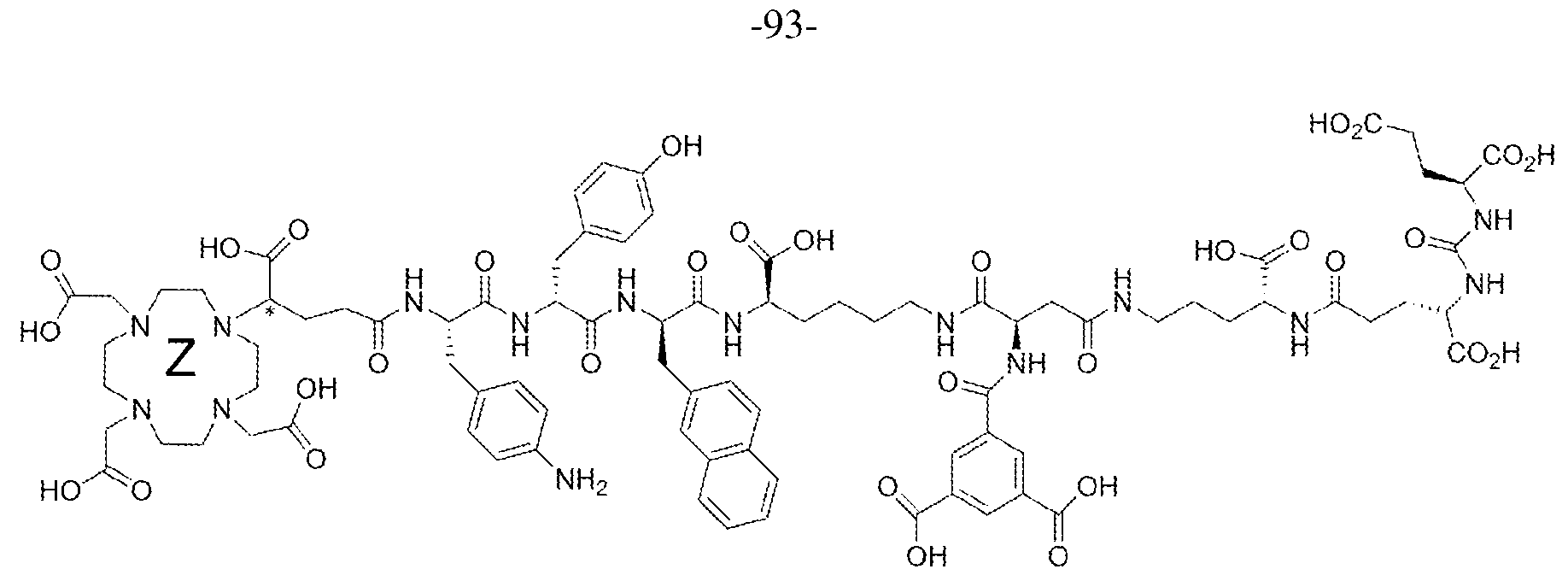
A-2 wherein Z is a radioactive agent, including a chelated radioactive cation.
[0264] Embodiment 25. A method for treating a subject suffering from oligometastatic hormone- sensitive prostate cancer (OmHSPC), comprising: administering to the subject an effective amount of a compound of the following Formulae A-2:
 wherein Z is a radioactive agent, including a chelated radioactive cation.
[0265] Embodiment 26. A method of any one of embodiments 23 to 25 wherein an effective amount of a compound of the following Formula A-2-R is administered to the subject:

A-2-R wherein Z is a radioactive agent.
[0266] Embodiment 27. A method of any one of embodiments 23 to 25 wherein an effective amount of a compound of the following Formula A-2-R is administered to the subject:

A-2-S wherein Z is a radioactive agent.
[0267] Embodiment 28. A method of any one of embodiments 23 to 25 wherein an effective amount of a compound of the following Formula A-3 is administered to the subject:

[0268] Embodiment 29. A method of any one of embodiments 23 to 25 wherein an effective amount of a compound of the following Formula A-3-R is administered to the subject:

[0269] Embodiment 30. A method of any one of embodiments 23 to 25 wherein an effective amount of a compound of the following Formula A-3-S is administered to the subject:
 A-3-S.
[0270] Embodiment 31. A method of any one of embodiments 23 to 30 wherein the administered compound has a chemical purity in excess of 90%.
[0271] Embodiment 32. A method of any one of embodiments 23 to 31 wherein the administered compound has a chemical purity in excess of 95%.
[0272] Embodiment 33. A method of any one of embodiments 23 to 32 wherein the administered compound has a chemical purity in excess of 98 %.
[0273] Embodiment 34. A method of any one of embodiments 23 to 33 wherein the compound has less than 10% of one or more structural impurities.
[0274] Embodiment 35. A method of any one of embodiments 22 to 34 wherein the compound has less than 5% of one or more structural impurities.
[0275] Embodiment 36. A method of any one of embodiments 22 to 35 wherein the compound has less than 10% of an impurity comprising at least one compound of the following Formulae B-l, B-2 and B-3.

B-2

B-3.
[0276] Embodiment 37. A method of any one of embodiments 23 to 36 wherein the compound has less than 10% of an impurity comprising at least one compound of the following Formulae B-l-R, B-2-R and B-3-R.

B-2-R

B-3-R.
[0277] Embodiment 38. The method of any one of embodiments 23 to 37 wherein an aqueous formulation comprising the compound is administered to the subject.
[0278] Embodiment 39. The method of embodiment 38 wherein the formulation comprises one or more stabilizer compounds.
[0279] Embodiment 40. The method of embodiments 38 or 39 wherein the formulation comprises one or more ascorbate compounds.
[0280] Embodiment 41. A method for treating a subject suffering from cancer, comprising: [0281] administering to the subject an effective amount of a pharmaceutical composition of any one of embodiments 1 to 22.
[0282] Embodiment 42. The method of embodiment 41 wherein the subject is suffering from prostate cancer.
[0283] Embodiment 43. A method for treating a subject suffering from metastatic Castration Resistant Prostate Cancer (mCRPC), comprising:
[0284] administering to the subject an effective amount of a pharmaceutical composition of any one of embodiments 1 to 22.
[0285] Embodiment 44. A method for treating a subject suffering from biochemically recurrent (BCR) prostate cancer, comprising: administering to the subject an effective amount of a pharmaceutical composition of any one of embodiments 1 to 22.
[0286] Embodiment 45. A method for treating a subject suffering from oligometastatic hormone- sensitive prostate cancer, comprising:
administering to the subject an effective amount of a pharmaceutical composition of any one of embodiments 1 to 22.
[0287] Embodiment 46. A method of any one of embodiments 23 to 45 wherein the subject is assessed for and identified as exhibiting high or elevated prostate specific membrane antigen (PSMA) expression relative to a healthy subject.
[0288] Embodiment 47. The method of embodiment 46 wherein the compound or composition is administered to the identified subject.
[0289] Embodiment 48. The method of any one of embodiments 23 to 47 wherein the subject is assessed by imaging prior to administration of the compound or composition. [0290] Embodiment 49. The method of any one of embodiments 23 to 48 wherein the subject is suffering from metastatic castration-resistant prostate cancer (mCRPC) with prostate-specific membrane antigen (PSMA)-avid lesions.
[0291] Embodiment 50. The method of any one of embodiments 23 to 49 wherein the subject is suffering from biochemically recurrent prostate cancer (BCR) with prostate- specific membrane antigen (PSMA)-avid lesions.
[0292] Embodiment 51. The method of any one of embodiments 23 to 50 wherein the subject is suffering from oligometastatic hormone-sensitive prostate cancer (OmHSPC) with prostate-specific membrane antigen (PSMA)-avid lesions.
[0293] Embodiment 52. The method of embodiment 23 to 51 wherein the subject has been treated with one or more other cancer therapies before being administered the compound or composition.
[0294] Embodiment 53. The method of embodiment 23 to 52 wherein the subject has with one or more androgen reception inhibitor agents before being administered the compound or composition.
[0295] Embodiment 54. A method of treating a subject, comprising: administering to the patient a compound of Formulae A-2:

A-2. wherein Z is a radioactive agent; and detecting the compound of Formulae A-2 in the subject.
[0296] Embodiment 55. The method of embodiment 52 wherein the compound is 68Ga - PSMA-62.
[0297] Embodiment 56. The method of embodiment 54 or 55 wherein the compound is detected extracorporeally.
[0298] Embodiment 57. The method of any one of embodiments 54 to 56 wherein the compound is detected by PET.
[0299] Embodiment 58. The method of any one of embodiments 54 to 57 wherein 225 Ac - PSMA-62 is administered to the subject after detecting the compound.
[0300] Embodiment 59. A composition comprising the compound of Formula A-l


[0301] Embodiment 60. The composition of embodiment 59, wherein the compound of Formula A-l is at least 95 wt% of the composition.
[0302] Embodiment 61. The composition of embodiment 59, wherein the compound of Formula A-l is at least 96 wt% of the composition.
[0303] Embodiment 62. A composition comprising the compound of Formula A-2-R


[0304] Embodiment 63. The composition according to embodiment 62, wherein the compound of Formula A-2-R is at least 95 wt% of the composition.
[0305] Embodiment 64. The composition according to embodiment 63, wherein Z is selected from the group consisting of 47Sc, 51Cr, 57Co, 58Co, 59Fe, 67Cu, 67 Ga, 68Ga, 71Ge, 72As, 72Se, 77 As, 77Br, 81Rb, 88Y, 90Y, 97Ru, "mTc, 100Pd, 101mRh, 103Pb, 105Rh, 109Pd, n iAg, inIn, 113In, 119Sb, 121Sn, 127Cs, 128Ba, 129Cs, 131Cs, 131I, 139La, 140La, 142Pr, 143Pr, 149Pm, 151Eu, 153EU, 153Sm, 159Gr, 161Tb, 165Dy, 166Ho, 169Eu, 175Yb, 177Lu, 186Re, 188Re, 189Re, 191Os, 193Pt, 194Ir, 197Hg, 198AU, 199 Ag, 199 Au, 2O1T1, 203Pb, 211 At, 212Bi, 212Pb, 213Bi, 225 Ac and 227Th.
[0306] Embodiment 65. The composition according to embodiment 63, wherein Z is selected from the group consisting of 177Lu, 225 Ac, 211At, 67 Cu, 161Tb, 67 Ga, 68Ga, 203Pb, 223Ra and 212Pb.
[0307] Embodiment 66. The composition according to embodiment 62 or 63, wherein Z is 225 Ac.
[0308] Embodiment 67. The composition according to any one of embodiments 62, 63, 64, 65, or 66, wherein Z1 is absent.
[0309] Embodiment 68. The composition according to any one of embodiments 62, 63, 64, 65, or 66, wherein Z1 is the same as Z.
[0310] Embodiment 69. A purified compound of Formula A- 1
 or a pharmaceutically acceptable salt thereof, wherein the R-DOTAGA group of the formula.

[0311] Embodiment 70. A purified compound of the formula:
 or a pharmaceutically acceptable salt thereof, wherein the S-DOTAGA group of the formula
 is at least 95% the S-cnantiomcr.
[0312] Embodiment 71. A purified compound of the formula:

[0313] Embodiment 72. A purified compound of Formula A- 1 ,
 or a pharmaceutically acceptable salt thereof, wherein the R-DOTAGA group of the formula
 is at least 95% the R-enantiomer, and wherein the compound of Formula A-l contains less than about 3 wt% of the beta-isomer of the formula:
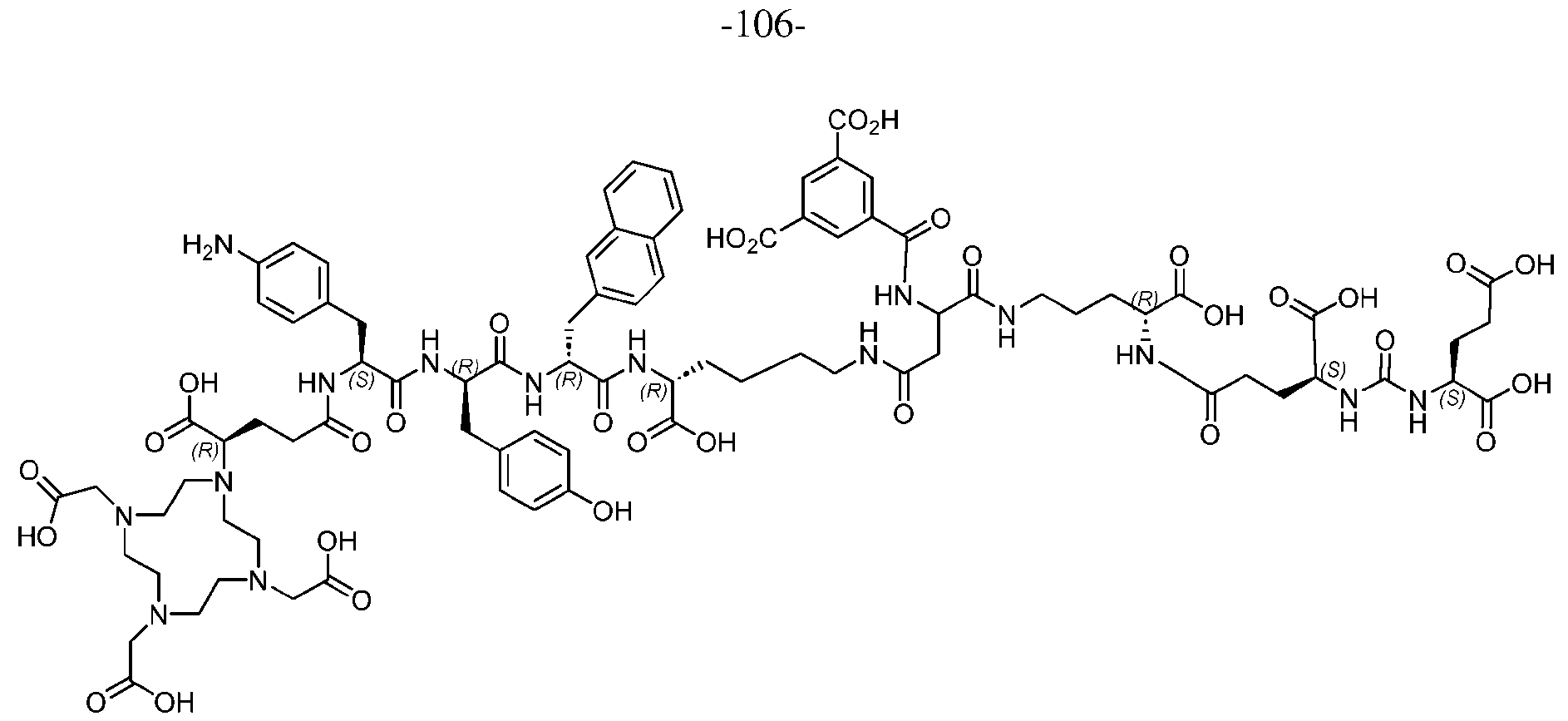
[0314] Embodiment 73. A compound of Formula A-l,
 obtainable by reacting a compound of the formula

[0315] Embodiment 74. The compound according to embodiment 73, wherein the acid comprises acetic acid, trifluoroacetic acid, p-toluenesulfonic acid, HC1, H2SO4, methanesulfonic acid, or trifluoromethanesulfonic acid.
[0316] Embodiment 75. The compound according to either embodiment 73 or 74, wherein the hydrolysis solvent comprises water.
[0317] Embodiment 76. The compound according to embodiment 74, wherein the hydrolysis solvent comprises water and triisopropylsilane.
[0318] Embodiment 77. The compound according to embodiment 74, wherein the hydrolysis solvent comprises water and dithio threitol. In a further embodiment, the hydrolysis solvent comprises water, dithiothreitol and triisopropylsilane.
[0319] Embodiment 78. A method of preparing a compound of Formula X or a pharmaceutically acceptable salt thereof,

Formula X the method comprising coupling a compound of Formula Y

Formula Y wherein is a solid support, with a compound of Formula Z

Formula Z to form a compound of Formula X.
Embodiment 79. The method of embodiment 78, wherein the compound of Formula X is treated with an acid in a hydrolysis solvent, to form the compound of Formula A-l

Formula A- 1.
[0320] Embodiment 80 The method of embodiment 78 or 79, wherein the solid support comprises polystyrene cross-linked with divinylbenzene.
[0321] Embodiment 81. The method of embodiments 78-80, wherein the coupling of the compound of Formula Y and Formula Z comprises combining the compound of Formula Y and Formula Z with a coupling agent, in a coupling solvent.
[0322] Embodiment 82. The method of embodiment 81, wherein the coupling agent comprises a phosphorous.
[0323] Embodiment 83. The method of embodiment 81 or 82, wherein the coupling agent is selected from the group consisting of (7-Azabenzotriazol-l- yloxy)tripyrrolidinophosphonium hexafluorophosphate (PyAOP), benzotriazolyloxy- tris[pyrrolidino]-phosphonium hexafluorophosphate (PyBOP),
Bromotripyrrolidinophosphonium hexafluorophosphate (PyBroP), hexafluorophosphate azabenzotriazole tetramethyl uronium (HATU), hexafluorophosphate benzotriazole tetramethyl uronium (HBTU), and 3-(diethoxyphosphoryloxy)-l,2,3-benzotriazin-4(3H)-one (DEPBT).
[0324] Embodiment 84. The method of embodiment 81, wherein the coupling agent comprises l-Ethyl-3-(3-dimethylaminopropyl)carbodiimide (EDCI), l-Hydroxy-7- azabenzotriazole (HOAT), or ethyl cyano(hydroxyimino)acetate (oxyma), diisopropylcarbodiimide (DIC), or dicyclohexylcarbodiimide (DCI).
[0325] Embodiment 85. The method of embodiments 81-84, where the coupling solvent comprises dichloromethane or dimethylformamide.
[0326] Embodiment 86. The method of embodiments 78-85, of Formula Y and Formula Z further comprises a base
[0327] Embodiment 87. The method of embodiment 86, wherein the base comprises triethylamine or diisopropylethylamine.
[0328] Embodiment 88. The method of any one of embodiments 79-87, wherein the acid comprises at least one of trifluoroacetic acid, hydrochloric acid, or para-toluene sulfonic acid and the solvent comprises water.
[0329] Embodiment 89. The method of embodiment 88, wherein the hydrolysis solvent further comprises at least one of triisopropylsilane or dithio threitol.
[0330] Embodiment 90. The method of any one of embodiments 79-89, wherein the acid comprises trifluoroacetic acid and the hydrolysis solvent comprises water.
[0331] Embodiment 91. The method of embodiment 79-89, wherein the acid comprises trifluoroacetic acid and the hydrolysis solvent comprises water, triisopropylsilane and dithiothreitol, and wherein the coupling agent comprises PyAOP, the coupling solvent
comprises dimethylformamide, and the coupling further comprises a base that is N,N- diisopropylethylamine.
[0332] Embodiment 92. The method according to any one of embodiments 79-91, wherein the compound of Formula A-2-R, or a pharmaceutically acceptable salt thereof, is prepared by treating Formula A- 1 with a radioactive cation to form a compound of Formula A-2-R
 where Z is a radioactive cation.
[0333] Embodiment 93. The method according to embodiment 92, wherein Z is selected from the group consisting of 47Sc, 51Cr, 57Co, 58Co, 59Fe, 67 Cu, 67 Ga, 68Ga, 71Ge, 72 As, 72Se, 77AS, 77Br, 81Rb, 88Y, 90Y, 97RU, "mTc, 100Pd, 101mRh, 103Pb, 105Rh, 109Pd, u lAg, U 1ln, 113In, 119Sb, 121Sn, 127Cs, 128Ba, 129Cs, 131Cs, 131I, 139La, 140La, 142Pr, 143Pr, 149Pm, 151Eu, 153Eu, 153Sm, 159Gr, 161Tb, 165Dy, 166Ho, 169Eu, 175Yb, 177Lu, 186Re, 188Re, 189Re, 191Os, 193Pt, 194Ir, 197Hg, 198 Au, 199 Ag, 199 Au, 2O1T1, 203Pb, 211 At, 212Bi, 212Pb, 213Bi, 225 Ac and 227Th.
[0334] Embodiment 94. The method according to embodiment 92 wherein Z is selected from the group consisting of 177Lu, 225 Ac, 211 At, 67 Cu, 161Tb, 67Ga, 68Ga, 203Pb, 223Ra and 212Pb.
[0335] Embodiment 95. The method according to any one of embodiments 92-94, wherein Z is 225 Ac.
[0336] Embodiment 96. The method of embodiment 95, wherein treating Formula A-l with a radioactive cation comprises combining a solution comprising 225AcCh in aqueous HC1, an aqueous buffer comprising sodium ascorbate and ammonium acetate, and Formula A-l.
[0337] Embodiment 97. The method according to any one of embodiments 78-91, wherein the compound of Formula Y
 is prepared by deprotecting a compound of Formula Y2:

Formula Y2 where PG is an amine protecting group.
[0338] Embodiment 98. The method of embodiment 97, wherein PG is selected from fluorenylmethoxycarbonyl (Fmoc), benzyl (Bn) and benzyloxycarbonyl (Cbz).
[0339] Embodiment 99. The method of embodiment 97, wherein PG is fluorenylmethoxycarbonyl (Fmoc), and the deprotection of Formula Y2 comprises treating Y2 with a base in an amine deprotection solvent.
[0340] Embodiment 100. The method of embodiment 99, wherein the base is selected from the group consisting of cyclohexylamine, ethanolamine, piperidine, piperazine, triethylamine, and N,N-diisopropylethylamine. and the amine deprotection solvent comprises at least one of dimethformamide (DMF), dichloromethane, toluene, or N-methyl- 2-pyrrolidone (NMP).
[0341] Embodiment 101. The method according to embodiment 99, wherein the base comprises piperidine and the amine deprotection solvent comprises dimethylformamide. [0342] Embodiment 102. The method according to any one of embodiments 97-101, wherein the compound of Formula Y2 is prepared by coupling the compound of Formula Y3

Formula Y3 with PG-D-Orn-OtBu, wherein PG is an amine protecting group. One preferred PG group is Fmoc.
[0343] Embodiment 103. The method of embodiment 102, wherein the coupling occurs in the presence of a coupling agent, in a coupling solvent.
[0344] Embodiment 104. The method of embodiment 103, wherein the coupling agent comprises a phosphorous.
[0345] Embodiment 105. The method of embodiment 104, wherein the coupling agent is selected from the group consisting of (7-Azabenzotriazol-l- yloxy)tripyrrolidinophosphonium hexafluorophosphate (PyAOP), benzotriazolyloxy- tris[pyrrolidino]-phosphonium hexafluorophosphate (PyBOP), Bromotripyrrolidinophosphonium hexafluorophosphate (PyBroP), hexafluorophosphate azabenzotriazole tetramethyl uranium (HATU), hexafluorophosphate benzotriazole tetramethyl uranium (HBTU), and 3-(diethoxyphosphoryloxy)-l,2,3-benzotriazin-4(3H)-one (DEPBT).
[0346] Embodiment 106. The method of embodiment 103, wherein the coupling agent comprises l-Ethyl-3-(3-dimethylaminopropyl)carbodiimide (EDCI), l-Hydroxy-7- azabenzotriazole (HOAT), or ethyl cyano(hydroxyimino)acetate (oxyma), diisopropylcarbodiimide (DIC), or dicyclohexylcarbodiimide (DCI).
[0347] Embodiment 107. The method of embodiments 103-106, where the coupling solvent comprises dichloromethane or dimethylformamide.
[0348] Embodiment 108. The method of embodiments 103-107, wherein the coupling of the compound of Formula Y3 and PG-D-Orn-OtBu further comprises a base. In one preferred embodiment, PG is Fmoc. When PG is Fmoc, then PG-D-Om-OtBu is tert-butyl (R)-2-((((9H-fluoren-9-yl)methoxy)carbonyl)amino)-5-aminopentanoate.
[0349] Embodiment 109. The method of embodiment 108, wherein the base comprises triethylamine or diisopropylethylamine.
[0350] Embodiment 110. The method of any one of embodiments 102-109, wherein the compound of Formula Y3 is prepared by deprotecting a compound of Formula Y4
 Formula Y4 wherein PG2 is a protecting group, and wherein the deprotection occurs in the presence of a carboxyl deprotecting agent and a carboxyl deprotecting solvent.
[0351] Embodiment 111. The method of embodiment 110, wherein PG2 is selected from the group consisting of allyl, benzyl, and benzhydryl.
[0352] Embodiment 112. The method of embodiments 110 or 111, wherein the carboxyl deprotecting solvent comprises at least one of dichloromethane, dimethylformamide, tetrahydrofuran, or ethanol.
[0353] Embodiment 113. The method of any one of embodiments 110-112, wherein the carboxyl deprotecting solvent comprises dichloromethane and dimethylformamide.
[0354] Embodiment 114. The method of any one of embodiments 110-113, wherein PG2 is allyl and the carboxyl deprotecting agent comprises Pd.
[0355] Embodiment 115. The method of any one of embodiments 110-114, wherein PG2 is allyl and the carboxyl deprotecting agent comprises Pd(PPh3)4.
[0356] Embodiment 116. The method of embodiments 110-113, wherein PG2 is allyl and the carboxyl deprotecting agent comprises Pd(PPh3)4 and the deprotection further comprises a nucleophile.
[0357] Embodiment 117. The method of embodiment 116, wherein the nucleophile is selected from the group consisting of 1,3- dimethylbarbituric acid and triphenylphosphine.
[0358] Embodiment 118. The method of any one of embodiments 110-117, wherein the compound of Formula Y4 is prepared by coupling the compound of Formula Y5 with
 Formula Y 5
3,5-bis(tert-butoxycarbonyl)benzoic acid, in the presence of a coupling agent in a coupling solvent.
[0359] Embodiment 119. The method of embodiment 118, wherein the coupling agent is selected from the group consisting of (7-Azabenzotriazol-l- yloxy)tripyrrolidinophosphonium hexafluorophosphate (PyAOP), benzotriazolyloxy- tris[pyrrolidino]-phosphonium hexafluorophosphate (PyBOP), Bromotripyrrolidinophosphonium hexafluorophosphate (PyBroP), hexafluorophosphate azabenzotriazole tetramethyl uranium (HATU), hexafluorophosphate benzotriazole tetramethyl uranium (HBTU), and 3-(diethoxyphosphoryloxy)-l,2,3-benzotriazin-4(3H)-one (DEPBT).
[0360] Embodiment 120. The method of embodiment 118, wherein the coupling agent comprises l-Ethyl-3-(3-dimethylaminopropyl)carbodiimide (EDCI), l-Hydroxy-7- azabenzotriazole (HOAT), or ethyl cyano(hydroxyimino)acetate (oxyma), diisopropylcarbodiimide (DIC), or dicyclohexylcarbodiimide (DCI).
[0361] Embodiment 121. The method of embodiments 118-120, where the coupling solvent comprises dichloromethane or dimethylformamide.
[0362] Embodiment 122. The method of embodiments 118-121, wherein the coupling of the compound of Formula Y5 and 3,5-bis(tert-butoxycarbonyl)benzoic acid further comprises a base.
[0363] Embodiment 123. The method of embodiment 122, wherein the base comprises triethylamine or diisopropylethylamine.
[0364] Embodiment 124. The method of embodiments 118-123, where the compound of Formula Y5 was made by deprotecting the compound of Formula Y6

Formula Y6 wherein PG3 is an amine protecting group, and wherein the deprotection occurs in the presence of an amine deprotecting agent and an amine deprotecting solvent.
[0365] Embodiment 125. The method of embodiment 124, wherein PG3 is selected from fluorenylmethoxycarbonyl (Fmoc), benzyl and benzyl chloroformate.
[0366] Embodiment 126. The method of embodiment 124, wherein PG is fluorenylmethoxycarbonyl (Fmoc), and the deprotection of Formula Y6 comprises treating Y6 with an amine deprotecting agent base in an amine deprotecting solvent.
[0367] Embodiment 127. The method of embodiment 126, wherein the amine deprotecting base is selected from the group consisting of cyclohexylamine, ethanolamine, piperidine, piperazine, triethylamine, and N,N-diisopropylethylamine. and the amine deprotecting solvent comprises at least one of dimethformamide, dichloromethane, toluene, or N-methyl- 2-pyrrolidone (NMP).
[0368] Embodiment 128. The method according to embodiment 126, wherein the amine deprotecting base comprises piperidine and the amine deprotecting solvent comprises dimethylformamide .
[0369] Embodiment 129. The method of any one of embodiments 124-128, wherein the compound of Formula Y6 is prepare by coupling the compound of Formula Y7

Formula Y7 with PG3-D-Asp(O-PG2)-OH, in the presence of a coupling agent in a coupling solvent, wherein PG2 and PG3 are different.
[0370] Embodiment 130. The method of embodiment 129, wherein the coupling agent is selected from the group consisting of (7-Azabenzotriazol-l- yloxy)tripyrrolidinophosphonium hexafluorophosphate (PyAOP), benzotriazolyloxy- tris[pyrrolidino]-phosphonium hexafluorophosphate (PyBOP), Bromotripyrrolidinophosphonium hexafluorophosphate (PyBroP), hexafluorophosphate azabenzotriazole tetramethyl uronium (HATU), hexafluorophosphate benzotriazole tetramethyl uronium (HBTU), and 3-(diethoxyphosphoryloxy)-l,2,3-benzotriazin-4(3H)-one (DEPBT).
[0371] Embodiment 131. The method of embodiment 129, wherein the coupling agent comprises l-Ethyl-3-(3-dimethylaminopropyl)carbodiimide (EDCI), l-Hydroxy-7- azabenzotriazole (HOAT), or ethyl cyano(hydroxyimino)acetate (oxyma), diisopropylcarbodiimide (DIC), or dicyclohexylcarbodiimide (DCI).
[0372] Embodiment 132. The method of embodiments 129-131, where the coupling solvent comprises dichloromethane or dimethylformamide.
[0373] Embodiment 133. The method of embodiments 129-132, wherein the coupling of the compound of Formula Y7 and Fmoc-D-Asp(OAll)-OH acid further comprises a base.
[0374] Embodiment 134. The method of embodiment 133, wherein the base comprises triethylamine or diisopropylethylamine.
[0375] Embodiment 135. The method of embodiments 129-134, wherein the compound of Formula Y7 was made by deprotecting the compound of Formula Y8

Formula Y8 wherein PG4 is an amine protecting group, and wherein the deprotection occurs in the presence of an amine deprotecting agent.
Embodiment 136. The method of embodiment 135, wherein PG4 is 4-methyl trityl,

4-methoxy trityl, MeDmb EtDmb ivDmb
N-[l-(4,4-dimethyl-2,6-dioxocyclohex-l-ylidene)ethyl] (Dde), or l-(4,4-Dimethyl-2,6- dioxocyclohex-l-ylidene)-3-methylbutyl (ivDde).
[0376] Embodiment 137. The method of embodiment 135, wherein PG4 is 4-methyl trityl and the deprotecting agent comprises hexafluoro-2-isopropanol, hydroxylamine, or hydrazine.
[0377] Embodiment 138. The method of embodiment 135, wherein PG4 is 4-methyl trityl and the amine deprotecting agent is hexafluoro-2-isopropanol.
[0378] Embodiment 139. The method of embodiments 135-138 wherein the compound of Formula Y8 was prepared by coupling the compound of Formula Y9

Formula Y9 and (R)-tBu4-DOTAGA, where and (R)-tBu4-DOTAGA has the formula:
 in the presence of a coupling agent in a coupling solvent.
[0379] Embodiment 140. The method of embodiment 139, wherein the coupling agent is selected from the group consisting of (7-Azabenzotriazol-l- yloxy)tripyrrolidinophosphonium hexafluorophosphate (PyAOP), benzotriazolyloxy- tris[pyrrolidino]-phosphonium hexafluorophosphate (PyBOP), Bromotripyrrolidinophosphonium hexafluorophosphate (PyBroP), hexafluorophosphate azabenzotriazole tetramethyl uronium (HATU), hexafluorophosphate benzotriazole tetramethyl uronium (HBTU), and 3-(diethoxyphosphoryloxy)-l,2,3-benzotriazin-4(3H)-one (DEPBT).
[0380] Embodiment 141. The method of embodiment 139, wherein the coupling agent comprises l-Ethyl-3-(3-dimethylaminopropyl)carbodiimide (EDCI), l-Hydroxy-7- azabenzotriazole (HOAT), or ethyl cyano(hydroxyimino)acetate (oxyma), diisopropylcarbodiimide (DIC), or dicyclohexylcarbodiimide (DCI).
[0381] Embodiment 142. The method of embodiments 139-141, where the coupling solvent comprises dichloromethane or dimethylformamide.
[0382] Embodiment 143. The method of embodiments 139-142, wherein the coupling of the compound of Formula Y7 and Fmoc-D-Asp(OAll)-OH acid further comprises a base.
[0383] Embodiment 144. The method of embodiment 143, wherein the base comprises triethylamine or diisopropylethylamine.
[0384] Embodiment 145. A compound of the formula:
 and pharmaceutically acceptable salts thereof.
[0385] Embodiment 146. The compound according to embodiment 145 that is

[0386] Embodiment 147. The compound according to embodiment 145 that is
 or pharmaceutically acceptable salts thereof.
[0387] Embodiment 147. A method of preparing a compound of Formula V

Formula V comprising coupling a compound of Formula T
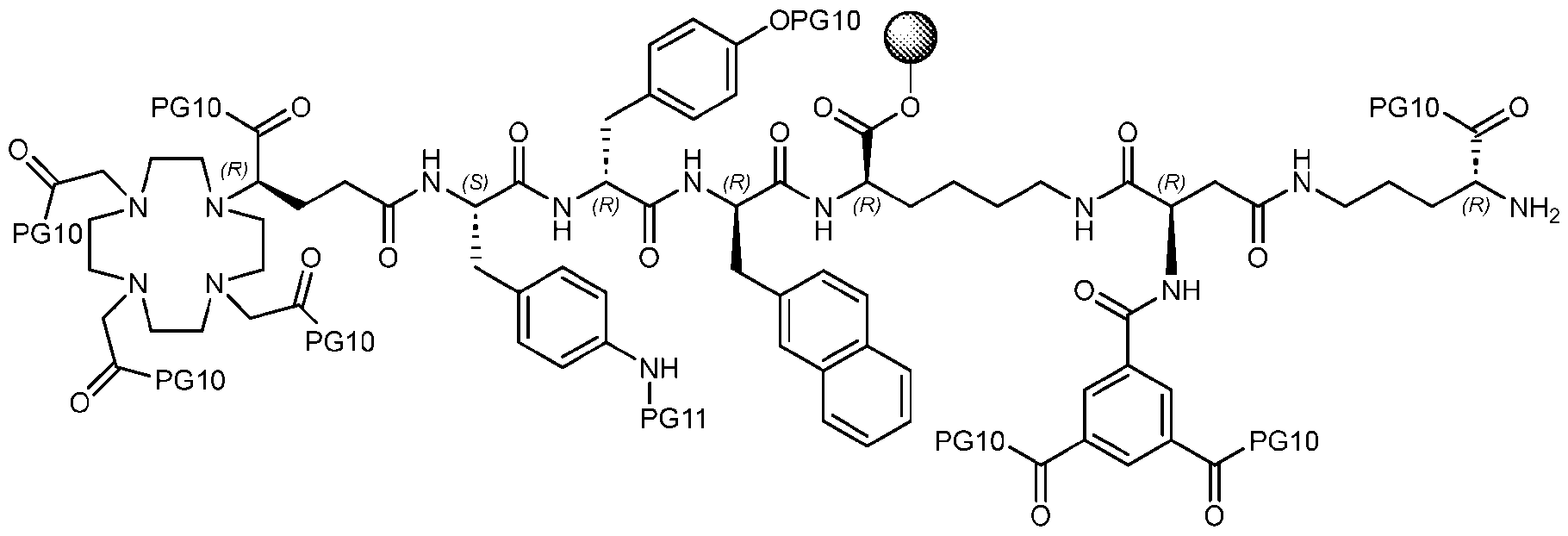
Formula T. with a compound of Formula Z1

Formula Zl,
wherein PG10 is a carboxyl or oxygen protecting group, and PG11 is an amine protecting group. In one embodiment, all occurrences of PG 10 carry the same definition, such as for example, tBu. In another embodiment, each occurrence of PG10 is independently selected from the carboxyl and oxygen protecting groups described herein. The coupling may be performed using the methods and reagents described herein.
[0388] Embodiment 148. The method of embodiment 147, wherein the compounds of Formula V is hydrolyzed to form the compound of the formula:

The hydrolysis conditions depend on the identity of the PG10 group. If PG10 is a hydrolysable group, then the hydrolysis conditions described herein may be used.
[0389] Embodiment 149. The method of embodiment 147, wherein the compounds of Formula V is deprotected to form a compound of the formula:
 The deprotection conditions used in this transformation depend on the identity of the PG 10 and PG11 groups. For example, if PG11 is an Fmoc group, then PG11 may be removed using the methods disclosed herein. Then, if PG 10 is tBu or another hydrolysable group, then the tBu groups and the resin may be removed using the hydrolysis methods disclosed herein.
[0390] It will be appreciated by persons skilled in the art that the inventions described herein are not limited to what has been particularly shown and described. Rather, the scope of the invention is defined by the claims which follow. It should further be understood that the above description is only representative of illustrative examples of embodiments. The description has not attempted to exhaustively enumerate all possible variations. The alternate embodiments may not have been presented for a specific component of a composition, or a step of the method, and may result from a different combination of described constituents, or that other undescribed alternate embodiments may be available for a formulation, kit or method, is not to be considered a disclaimer of those alternate embodiments. It will be appreciated that many of those undescribed embodiments are within the literal scope of the following claims, and others are equivalent.
Claims
1. A method of preparing a compound of Formula X, or a pharmaceutically acceptable salt thereof,

Formula X the method comprising coupling a compound of Formula Y

Formula Y wherein W' is a solid support, with a compound of Formula Z

Formula Z to form a compound of Formula X:

Formula X.
2. The method of claim 1, wherein the compound of Formula X is treated with an acid in a hydrolysis solvent, to form the compound of Formula A-l

Formula A- 1.
3. The method of claim 1 or 2, wherein the solid support comprises polystyrene cross- linked with divinylbenzene.
4. The method of claims 1 -3, wherein the coupling of the compound of Formula Y and Formula Z comprises combining the compound of Formula Y and Formula Z with a coupling agent, in a coupling solvent.
5. The method of claim 4, wherein the coupling agent comprises a phosphorous.
6. The method of claim 4 or 5, wherein the coupling agent is selected from the group consisting of (7-Azabenzotriazol-l-yloxy)tripyrrolidinophosphonium hexafluorophosphate (PyAOP), benzotriazolyloxy-tris[pyrrolidino]-phosphonium hexafluorophosphate (PyBOP), Bromotripyrrolidinophosphonium hexafluorophosphate (PyBroP), hexafluorophosphate azabenzotriazole tetramethyl uronium (HATU), hexafluorophosphate benzotriazole
tetramethyl uronium (HBTU), and 3-(diethoxyphosphoryloxy)-l,2,3-benzotriazin-4(3H)- one (DEPBT).
7. The method of claim 4, wherein the coupling agent comprises l-Ethyl-3-(3- dimethylaminopropyl)carbodiimide (EDCI), l-Hydroxy-7-azabenzotriazole (HO AT), or ethyl cyano(hydroxyimino)acetate (oxyma), diisopropylcarbodiimide (DIC), or dicyclohexylcarbodiimide (DCI).
8. The method of claims 4-7, where the coupling solvent comprises dichloro methane or dimethylformamide .
9. The method of claims 1-8, wherein the coupling of the compound of Formula Y and Formula Z further comprises a base.
10. The method of claim 9, wherein the base comprises triethylamine or diisopropylethylamine.
11. The method of any one of claims 2-10, wherein the acid comprises at least one of trifluoroacetic acid, hydrochloric acid, or para-toluene sulfonic acid and the hydrolysis solvent comprises water.
12. The method of claim 11, wherein the hydrolysis solvent further comprises at least one of triisopropylsilane or dithiothreitol.
13. The method of any one of claims 2-12, wherein the acid comprises trifluoroacetic acid and the hydrolysis solvent comprises water.
14. The method of claim 2-12, wherein the acid comprises trifluoroacetic acid and the hydrolysis solvent comprises water, triisopropylsilane and dithiothreitol, and wherein the coupling agent comprises PyAOP, the coupling solvent comprises dimethylformamide, and the coupling further comprises a base that is N,N-diisopropylethylamine.
15. The method according to any one of claims 2-14, wherein the compound of Formula A-2-R, or a pharmaceutically acceptable salt thereof, is prepared by treating Formula A-l with a radioactive cation to form a compound of Formula A-2-R
 where Z is a radioactive cation.
16. The method according to claim 15, wherein Z is selected from the group consisting of 47Sc, 51Cr, 57Co, 58Co, 59Fe, 67Cu, 67Ga, 68Ga, 71Ge, 72 As, 72Se, 77As, 77Br, 81Rb, 88Y, 90Y, 97RU, "mTc, 100Pd, 101mRh, 103Pb, 105Rh, 109Pd, mAg, mIn, 113In, 119Sb, 121Sn, 127Cs, 128Ba, 129Cs, 131Cs, 131I, 139La, 140La, 142Pr, 143Pr, 149Pm, 151Eu, 153Eu, 153Sm, 159Gr, 161Tb, 165Dy,
166HO, 169EU, 175Yb, 177LU, 186Re, 188Re, 189Re, 1910s, 193Pt, 194Ir, 197Hg, 198 Au, 199 Ag, 199 Au, 2°IT1, 203Pb, 211 At, 212Bi, 212Pb, 213Bi, 225 Ac and 227Th.
17. The method according to claim 15 wherein Z is selected from the group consisting of 177LU, 225 AC, 211 At, 67 Cu, 161Tb, 67Ga, 68Ga, 203Pb, 223Ra and 212Pb.
18. The method according to any one of claims 15-17, wherein Z is 225 Ac.
19. The method of claim 18, wherein treating Formula A-l with a radioactive cation comprises combining a solution comprising 225AcCh in aqueous HC1, an aqueous buffer comprising sodium ascorbate and ammonium acetate, and Formula A- 1.
20. The method according to any one of claims 1-14, wherein the compound of Formula
Y

Formula Y is prepared by deprotecting a compound of Formula Y2:

Formula Y2 where PG is an amine protecting group.
21. The method of claim 20, wherein PG is selected from fluorenylmethoxycarbonyl (Fmoc), benzyl (Bn) and benzyloxycarbonyl (Cbz).
22. The method of claim 20, wherein PG is fluorenylmethoxycarbonyl (Fmoc), and the deprotection of Formula Y2 comprises treating Y2 with a base in an amine deprotection solvent.
23. The method of claim 22, wherein the base is selected from the group consisting of cyclohexylamine, ethanolamine, piperidine, piperazine, triethylamine, and N,N- diisopropylethylamine. and the amine deprotection solvent comprises at least one of dimethformamide (DMF), dichloromethane, toluene, or N-methyl-2-pyrrolidone (NMP).
24. The method according to claim 22, wherein the base comprises piperidine and the amine deprotection solvent comprises dimethylformamide.
25. The method according to any one of claims 20-24, wherein the compound of Formula Y2 is prepared by coupling the compound of Formula Y3

Formula Y3 with PG-D-Orn-OtBu, wherein PG is an amine protecting group.
26. The method of claim 25, wherein the coupling occurs in the presence of a coupling agent, in a coupling solvent.
27. The method of claim 26, wherein the coupling agent comprises a phosphorous.
28. The method of claim 27, wherein the coupling agent is selected from the group consisting of (7-Azabenzotriazol-l-yloxy)tripyrrolidinophosphonium hexafluorophosphate (PyAOP), benzotriazolyloxy-tris[pyrrolidino]-phosphonium hexafluorophosphate (PyBOP), Bromotripyrrolidinophosphonium hexafluorophosphate (PyBroP), hexafluorophosphate azabenzotriazole tetramethyl uranium (HATU), hexafluorophosphate benzotriazole tetramethyl uranium (HBTU), and 3-(diethoxyphosphoryloxy)-l,2,3-benzotriazin-4(3H)-one (DEPBT).
29. The method of claim 26, wherein the coupling agent comprises l-Ethyl-3-(3- dimethylaminopropyl)carbodiimide (EDCI), l-Hydroxy-7-azabenzotriazole (HO AT), or ethyl cyano(hydroxyimino)acetate (oxyma), diisopropylcarbodiimide (D1C), or dicyclohexylcarbodiimide (DCI).
30. The method of claims 26-29, where the coupling solvent comprises dichloromethane or dimethylformamide.
31. The method of claims 25-29, wherein the coupling of the compound of Formula Y3 and PG-D-Om-OtBu further comprises a base.
32. The method of claim 31, wherein the base comprises triethylamine or diisopropylethylamine.
33. The method of any one of claims 25-32, wherein the compound of Formula Y3 is prepared by deprotecting a compound of Formula Y4

Formula Y4 wherein PG2 is a protecting group, and wherein the deprotection occurs in the presence of a carboxyl deprotecting agent and a carboxyl deprotecting solvent.
34. The method of claim 33, wherein PG2 is selected from the group consisting of allyl, benzyl, and benzhydryl.
35. The method of claims 33 or 34, wherein the carboxyl deprotecting solvent comprises at least one of dichloromethane, dimethylformamide, tetrahydrofuran, or ethanol.
36. The method of any one of claims 33-35, wherein the carboxyl deprotecting solvent comprises dichloromethane and dimethylformamide.
37. The method of any one of claims 33-36, wherein PG2 is allyl and the carboxyl deprotecting agent comprises Pd.
38. The method of any one of claims 33-37, wherein PG2 is allyl and the carboxyl deprotecting agent comprises Pd(PPh3)4.
39. The method of claims 33-36, wherein PG2 is allyl and the carboxyl deprotecting agent comprises Pd(PPh3)4 and the deprotection further comprises a nucleophile.
40. The method of claim 39, wherein the nucleophile is selected from the group consisting of 1,3- dimethylbarbituric acid and triphenylphosphine.
41. The method of any one of claims 33-40, wherein the compound of Formula Y4 is prepared by coupling the compound of Formula Y 5 with

Formula Y 5
3,5-bis(tert-butoxycarbonyl)benzoic acid, in the presence of a coupling agent in a coupling solvent.
42. The method of claim 41, wherein the coupling agent is selected from the group consisting of (7-Azabenzotriazol-l-yloxy)tripyrrolidinophosphonium hexafluorophosphate
(PyAOP), benzotriazolyloxy-tris[pyri’olidino]-phosphonium hexafluorophosphate (PyBOP), Bromotripyrrolidinophosphonium hexafluorophosphate (PyBroP), hexafluorophosphate azabenzotriazole tetramethyl uronium (HATU), hexafluorophosphate benzotriazole tetramethyl uronium (HBTU), and 3-(diethoxyphosphoryloxy)-l,2,3-benzotriazin-4(3H)-one (DEPBT).
43. The method of claim 41, wherein the coupling agent comprises l-Ethyl-3-(3- dimethylaminopropyl)carbodiimide (EDCI), l-Hydroxy-7-azabenzotriazole (HO AT), or ethyl cyano(hydroxyimino)acetate (oxyma), diisopropylcarbodiimide (DIC), or dicyclohexylcarbodiimide (DCI).
44. The method of claims 41 -43, where the coupling solvent comprises dichloromethane or dimethylformamide .
45. The method of claims 41-44, wherein the coupling of the compound of Formula Y5 and 3,5-bis(tert-butoxycarbonyl)benzoic acid further comprises a base.
46. The method of claim 45, wherein the base comprises triethylamine or dii sopropy lethy lamine .
Applications Claiming Priority (8)
| Application Number | Priority Date | Filing Date | Title |
|---|---|---|---|
| US202463618240P | 2024-01-05 | 2024-01-05 | |
| US202463618254P | 2024-01-05 | 2024-01-05 | |
| US63/618,254 | 2024-01-05 | ||
| US63/618,240 | 2024-01-05 | ||
| US202463621063P | 2024-01-15 | 2024-01-15 | |
| US63/621,063 | 2024-01-15 | ||
| US202463680294P | 2024-08-07 | 2024-08-07 | |
| US63/680,294 | 2024-08-07 |
Publications (1)
| Publication Number | Publication Date |
|---|---|
| WO2025147677A1 true WO2025147677A1 (en) | 2025-07-10 |
Family
ID=94432651
Family Applications (1)
| Application Number | Title | Priority Date | Filing Date |
|---|---|---|---|
| PCT/US2025/010329 Pending WO2025147677A1 (en) | 2024-01-05 | 2025-01-03 | Preparation of psma-targeted radiopharmaceutical |
Country Status (2)
| Country | Link |
|---|---|
| JP (1) | JP7854076B2 (en) |
| WO (1) | WO2025147677A1 (en) |
Citations (1)
| Publication number | Priority date | Publication date | Assignee | Title |
|---|---|---|---|---|
| WO2019115547A1 (en) * | 2017-12-11 | 2019-06-20 | Technische Universität München | Psma ligands for imaging and endoradiotherapy |
Family Cites Families (1)
| Publication number | Priority date | Publication date | Assignee | Title |
|---|---|---|---|---|
| US20220211883A1 (en) * | 2020-12-17 | 2022-07-07 | Trustees Of Tufts College | Fap-activated radiotheranostics and uses related thereto |
-
2025
- 2025-01-03 WO PCT/US2025/010329 patent/WO2025147677A1/en active Pending
- 2025-01-06 JP JP2025001973A patent/JP7854076B2/en active Active
Patent Citations (1)
| Publication number | Priority date | Publication date | Assignee | Title |
|---|---|---|---|---|
| WO2019115547A1 (en) * | 2017-12-11 | 2019-06-20 | Technische Universität München | Psma ligands for imaging and endoradiotherapy |
Non-Patent Citations (1)
| Title |
|---|
| DU BOISDUBOIS, NUTRITION, vol. 5, 1989, pages 303 - 11 |
Also Published As
| Publication number | Publication date |
|---|---|
| TW202544005A (en) | 2025-11-16 |
| JP7854076B2 (en) | 2026-04-30 |
| JP2025107168A (en) | 2025-07-17 |
Similar Documents
| Publication | Publication Date | Title |
|---|---|---|
| JP6576828B2 (en) | Neurotensin receptor ligand | |
| EP3689892B1 (en) | Radioactive drug | |
| EP4537851A1 (en) | Trifunctional compound and use thereof | |
| JPH11513977A (en) | Radiometal binding analogs of luteinizing hormone-releasing hormone | |
| EP3268337B1 (en) | Methods and kits for preparing radionuclide complexes | |
| JP7773679B1 (en) | Compounds targeting SSTR2, and methods for their preparation and use | |
| JP7651785B2 (en) | Cleaved Evans Blue modified fibroblast activation protein inhibitor and its preparation method and application | |
| CA3171753A1 (en) | Stable formulations for radionuclide complexes | |
| WO2026040780A1 (en) | Glutamate urea compound, preparation method therefor and use thereof, nuclide targeting probe, preparation method therefor and use thereof, and pharmaceutical composition | |
| CN107308466B (en) | Polypeptide with tumor blood vessel targeting property, molecular probe, preparation method and application thereof | |
| US9180214B1 (en) | Gonadotropin-releasing hormone receptor-targeting peptides and their use to treat and diagnose cancer | |
| JP7854076B2 (en) | Radiopharmaceutical Compositions and Methods | |
| JP5481673B2 (en) | Radiolabeled drug | |
| TWI922130B (en) | Radiopharmaceutical compositions and methods | |
| KR20250016195A (en) | Prostate-specific membrane antigen (PSMA) ligand | |
| WO2022233768A1 (en) | Precursor and radiotracer for neuroendocrine theranostics | |
| JP5604680B2 (en) | Radiolabeled drug | |
| JP2023536261A (en) | Gallium-Labeled Gastrin Analogues and Use in Imaging Methods for CCKB Receptor-Positive Tumors or Cancers | |
| RU2852530C2 (en) | Sstr2-targeted compound, sstr2-targeted compound labeled with radionuclide, and their application | |
| RU2841304C2 (en) | Fibroblast activation protein inhibitor, modified by truncated blue evans, method for preparation and use thereof | |
| WO2025113628A1 (en) | Sstr receptor targeting radio compounds and uses thereof | |
| JP2005538966A (en) | Labeled somatostatin homolog skeleton cyclized by metal complex formation | |
| HK40127574A (en) | Radiopharmaceuticals | |
| WO2024051794A1 (en) | Radionuclide-drug conjugate and pharmaceutical composition and use thereof | |
| CA3258869A1 (en) | Zwitterionic compounds and uses thereof |
Legal Events
| Date | Code | Title | Description |
|---|---|---|---|
| 121 | Ep: the epo has been informed by wipo that ep was designated in this application |
Ref document number: 25702675 Country of ref document: EP Kind code of ref document: A1 |