WO2025147405A1 - Acetoacetoxy functionalized polyalkylene glycols and uses thereof - Google Patents
Acetoacetoxy functionalized polyalkylene glycols and uses thereof Download PDFInfo
- Publication number
- WO2025147405A1 WO2025147405A1 PCT/US2024/061333 US2024061333W WO2025147405A1 WO 2025147405 A1 WO2025147405 A1 WO 2025147405A1 US 2024061333 W US2024061333 W US 2024061333W WO 2025147405 A1 WO2025147405 A1 WO 2025147405A1
- Authority
- WO
- WIPO (PCT)
- Prior art keywords
- coating composition
- composition
- crosslinking agent
- base coating
- water
- Prior art date
- Legal status (The legal status is an assumption and is not a legal conclusion. Google has not performed a legal analysis and makes no representation as to the accuracy of the status listed.)
- Pending
Links
Classifications
-
- C—CHEMISTRY; METALLURGY
- C07—ORGANIC CHEMISTRY
- C07C—ACYCLIC OR CARBOCYCLIC COMPOUNDS
- C07C69/00—Esters of carboxylic acids; Esters of carbonic or haloformic acids
- C07C69/66—Esters of carboxylic acids having esterified carboxylic groups bound to acyclic carbon atoms and having any of the groups OH, O—metal, —CHO, keto, ether, acyloxy, groups, groups, or in the acid moiety
- C07C69/67—Esters of carboxylic acids having esterified carboxylic groups bound to acyclic carbon atoms and having any of the groups OH, O—metal, —CHO, keto, ether, acyloxy, groups, groups, or in the acid moiety of saturated acids
- C07C69/716—Esters of keto-carboxylic acids or aldehydo-carboxylic acids
- C07C69/72—Acetoacetic acid esters
-
- C—CHEMISTRY; METALLURGY
- C08—ORGANIC MACROMOLECULAR COMPOUNDS; THEIR PREPARATION OR CHEMICAL WORKING-UP; COMPOSITIONS BASED THEREON
- C08G—MACROMOLECULAR COMPOUNDS OBTAINED OTHERWISE THAN BY REACTIONS ONLY INVOLVING UNSATURATED CARBON-TO-CARBON BONDS
- C08G65/00—Macromolecular compounds obtained by reactions forming an ether link in the main chain of the macromolecule
- C08G65/02—Macromolecular compounds obtained by reactions forming an ether link in the main chain of the macromolecule from cyclic ethers by opening of the heterocyclic ring
- C08G65/26—Macromolecular compounds obtained by reactions forming an ether link in the main chain of the macromolecule from cyclic ethers by opening of the heterocyclic ring from cyclic ethers and other compounds
- C08G65/2603—Macromolecular compounds obtained by reactions forming an ether link in the main chain of the macromolecule from cyclic ethers by opening of the heterocyclic ring from cyclic ethers and other compounds the other compounds containing oxygen
- C08G65/2615—Macromolecular compounds obtained by reactions forming an ether link in the main chain of the macromolecule from cyclic ethers by opening of the heterocyclic ring from cyclic ethers and other compounds the other compounds containing oxygen the other compounds containing carboxylic acid, ester or anhydride groups
-
- C—CHEMISTRY; METALLURGY
- C08—ORGANIC MACROMOLECULAR COMPOUNDS; THEIR PREPARATION OR CHEMICAL WORKING-UP; COMPOSITIONS BASED THEREON
- C08L—COMPOSITIONS OF MACROMOLECULAR COMPOUNDS
- C08L71/00—Compositions of polyethers obtained by reactions forming an ether link in the main chain; Compositions of derivatives of such polymers
- C08L71/02—Polyalkylene oxides
-
- C—CHEMISTRY; METALLURGY
- C09—DYES; PAINTS; POLISHES; NATURAL RESINS; ADHESIVES; COMPOSITIONS NOT OTHERWISE PROVIDED FOR; APPLICATIONS OF MATERIALS NOT OTHERWISE PROVIDED FOR
- C09D—COATING COMPOSITIONS, e.g. PAINTS, VARNISHES OR LACQUERS; FILLING PASTES; CHEMICAL PAINT OR INK REMOVERS; INKS; CORRECTING FLUIDS; WOODSTAINS; PASTES OR SOLIDS FOR COLOURING OR PRINTING; USE OF MATERIALS THEREFOR
- C09D171/00—Coating compositions based on polyethers obtained by reactions forming an ether link in the main chain; Coating compositions based on derivatives of such polymers
- C09D171/02—Polyalkylene oxides
Definitions
- the present disclosure relates to a crosslinking agent formed from a polyalkylene glycol functionalized with at least one acetoacetoxy (AcAc) group, and its use in colorant compositions, paint or stain compositions, or coating compositions.
- a crosslinking agent formed from a polyalkylene glycol functionalized with at least one acetoacetoxy (AcAc) group, and its use in colorant compositions, paint or stain compositions, or coating compositions.
- Latex paints and coatings are often used to protect a surface from corrosion, oxidation or other types of deterioration and to provide decorative effects.
- Water-borne, or latex paints and coatings typically include a film-forming latex binder, water, pigment and other additives.
- Latex paints and coatings are popular consumer paints, as they are easy to apply, are usually easy to clean up, nonflammable, generally lack a disagreeable odor and can be used on both interior and exterior surfaces.
- Latex paints and coatings can be tinted during manufacturing or at the point of sale using a colorant, which is a suspension of one or more pigments in a carrier, together with one or more additives to stably disperse the pigment in the paint or coating.
- PEG in water-borne colorants, PEG can provide humectant and anti-freeze properties.
- Water-borne colorants are typically added at the point-of-sale via a tinter machine.
- a tinter adds one or more colorants from an array of usually 8 to 12 colorants, each colorant having a distinct combination of pigments. Between uses of the tinter, it is possible that remaining amounts of colorant in the machine may dry. Commonly occurring at the tip of the tinter, this phenomena is known as “tip dry,” and can result in clogging of the tinter or, if the resulting dried colorant releases, undesirable addition of agglomerated pigment into a base paint or coating.
- (meth)acrylic acid includes either or both of acrylic acid and methacrylic acid
- (meth)acrylate includes either or both of an acrylate and a methacrylate.
- free of is used herein, such phrases are not intended to preclude the presence of trace amounts of the pertinent structure or compound which may be present but were not intentionally used, e.g., due to the presence of environmental contaminants.
- compositions that comprises ‘a’ component can be interpreted to mean that the composition includes ‘one or more’ of that class of component.
- the term 'or' is generally employed in its usual sense including “and/or unless the content clearly dictates otherwise.
- the term “and/or” means one or all of the listed elements or a combination of any two or more of the listed elements.
- the present invention relates to a crosslinking agent for use in a colorant composition, paint composition, stain composition, or coating composition
- a crosslinking agent for use in a colorant composition, paint composition, stain composition, or coating composition
- a polyalkylene glycol including at least one acetoacetoxy group wherein the polyalkylene glycol is composed of alkyloxy groups obtained from interpolymerized ethylene oxide groups, interpolymerized propylene oxide groups, or combinations thereof.
- the polyalkylene glycol is endcapped on at least one end by one or more acetoacetoxy groups.
- the polyalkylene glycol is endcapped on both ends by acetoacetoxy groups.
- the crosslinking agent of the present disclosure can be prepared by any desired method.
- One method for preparing the crosslinking agent comprises transesterifying an acetoacetoxy ester with the polyalkylene glycol. This provides an end-capped, reactive polyalkylene glycol, which can be mono- or di -functional, depending on the synthesis conditions and ratios of reactants used.
- the acetoacetoxy ester used can be any ester, including, but not limited to, methyl-acetoacetate, ethyl -acetoacetate, propyl-acetoacetate, butyl-acetoacetate (n-butyl, s-butyl, or t-butyl esters), etc.
- the resulting acetoacetoxy functional polyalkylene glycol has reactive functionality. Without being bound by theory, it is believed that the acetoacetoxy groups can react by UV- catalyzed oxidative crosslinking with unsaturated fatty acids and Michael addition reactions with aldehydes to crosslinking acetoacetate groups into the polymer matrix during coalescence of a base paint or stain. In addition, acetoacetoxy-containing molecules readily react with amines and hydrazides to create crosslinked matrices. Such cross-linking into the polymer matrix of an applied coating avoids migration of the polyalkylene glycol to the surface of a dried coating film. The resultant coating film displays an improvement in durability and integrity in terms of increased film hardness, decreased block and tack, decreased dirt pick up in exterior applications, and a decrease in surfactant leaching, compared to coating films comprising traditional polyalkylene glycols.
- the resulting crosslinking agent can be used as (i) a reactive humectant in colorants, particularly water-borne colorants; (ii) a reactive coalescent in paints and coatings, particularly water-borne paints and coatings; and (iii) a reactive float in paints and coatings, particularly water-borne paints and coatings; and (iv) as a non-lapping additive in wood stains.
- Colorants containing the crosslinking agent are particularly suitable for use as colorants for point-of-sale tinting of architectural water-borne and solvent-borne paints and stains.
- the paints and stains containing the crosslinking agent as a coalescent, float, or nonlapping additive are particularly useful as architectural water-borne paints and stains.
- the crosslinking agent has a mole ratio of acetoacetoxy groups to alkyloxy groups of from 1 :4 to 1 : 10, preferably 1 :4 to 1 :8, more preferably 1 :5 to 1 :7.
- the polyalkylene glycol is a polyethylene glycol and has a Mw of 400-1000. In other preferred embodiments of the present disclosure crosslinking agent, the polyalkylene glycol is a polypropylene glycol and has a Mw of 500-2000.
- the crosslinking agent of the present disclosure is preferably configured to be added to a colorant composition or a coating composition, or added directly or indirectly to a surface of a base coating composition, for example as an anti-skinning agent in a container of the base coating composition, for example as part of an anti-skinning layer in a container of the base coating composition.
- the crosslinking additive can be configured to be added to a water-based stain composition as an anti-lapping additive.
- the crosslinking agent of the present disclosure can be used in a variety of uses in the paint and coatings industry, including, but not limited to, as a reactive humectant in a colorant composition, as a reactive float in an anti-skinning layer in a container containing a base coating composition, and as a reactive coalescent in a paint or coating.
- the present disclosure relates to a colorant composition
- a colorant composition comprising an aqueous carrier, one or more pigments or dyes and the crosslinking agent of the present disclosure in an amount of 5 wt.% to 20 wt.% of the total components of the colorant composition.
- the crosslinking agent may be present in an amount of at least 10 or at least 15 wt.% and/or less than 17 wt.% or less than 12 wt.% of the total components of the colorant composition.
- Colorant compositions of the present disclosure do not form a film when applied to a substrate and cured and thus, if any polymeric binder is present in the colorant composition, the binder is present in less than a film-forming amount.
- the amount of binder necessary to form a film varies by colorant, in some aspects, the colorant compositions will have less than 10 wt.%, less than 5 wt.%, less than 2 wt.%, less than 1 wt.%, or less than 0.5 wt.% of a binder contained therein.
- the colorant composition may include no intentionally added polymeric binder.
- the polymeric binder may be any polymeric binder used in an architectural paint or stain as disclosed herein.
- the system can accordingly be used with just the water-only colorants when it is desired to tint a water-borne paint or stain, and can be used with such colorants together with an appropriate amount of the synergist when it is desired to tint a solvent-borne paint or stain.
- the ingredients e.g., surfactants, siccatives, optional dispersing agents and optional cosolvents
- the ingredients e.g., surfactants, siccatives, optional dispersing agents and optional cosolvents
- the pigment or dye used can be any conventional pigment or dye used in the paint or coating industry.
- the pigment is a member selected from the group consisting of titanium dioxide white, carbon black, lampblack, black iron oxide, red iron oxide, transparent red oxide, yellow iron oxide, transparent yellow oxide, brown iron oxide (a blend of red and yellow oxide with black), umber, phthalocyanine green, phthalocyanine blue, organic reds (including, but not limited to, naphthol red, quinacridone red and toluidine red), DPP red, quinacridone magenta, quinacridone violet, carbazole violet, DNA orange, DPP orange, organic yellows (such as monoazo yellow), bismuth vanadate yellow, and combinations thereof.
- the colorant composition may include further additives such as one or more preservatives, humectants, biocides, fillers, defoamers, pH control agents, thickeners, anti-settling agents, and mixtures or combinations thereof, as disclosed in U.S. Published Patent Application US 2017/0174924 Al, which is incorporated by reference.
- the colorant composition is configured such that it has less than 50 g/L VOC, preferably less than 30 g/L VOC, more preferably less than 10 g/L VOC, still more preferably less than 5 g/L VOC, and most preferably essentially zero VOC.
- the present disclosure relates to a system for reducing skinning of a base coating composition in a container, the base coating composition including at least a film-forming polymeric binder, an aqueous carrier, a pigment, and one or more coating additives; and disposed on a top surface of the base coating composition in the container, an anti-skinning layer comprising the present disclosure crosslinking agent.
- Water-based coating compositions such as paints are often distributed in cans, pails, vats, or other closed containers.
- water may evaporate and condense on the sides or top of the container due to a temperature differential between the container, the coating composition therein, and headspace within the container.
- This temperature differential can result in skinning— the generation of a polymeric skin on the surface of the wet-state coating composition.
- a skin may grow to as much as 1/2 cm in depth or more, and may splash or stick to the lid or sides of the distribution container and thereafter become mixed with the fluid coating composition.
- Skinning is undesirable for multiple reasons.
- agglomeration from skins can cause spray application equipment to clog or may appear as non-uniform bumps on a surface coated with the coating composition.
- spray application equipment Typically appearing as either dried coating composition or globules in the coating composition, skins also may be perceived adversely by customers expecting a fully uniform coating composition upon opening the container.
- a float layer on top of a coating composition, such as water, a polyalkylene glycol such as ethylene glycol, propylene glycol, diethylene glycol or combinations thereof, polyethylene glycol, or glycerin, or a mix of the foregoing with water and surfactant.
- a water-only float layer may be adequate in some circumstances, a water-only float is insufficient to prevent in-container skinning for all coating compositions.
- a float that includes a polyalkylene glycol can be useful towards reducing skinning that occurs during product distribution.
- polyalkylene glycols tend to resist evaporation of the base coating composition into the container headspace and thereby thwart the evaporation/condensation cycle believed to contribute to skinning during distribution and storage.
- the float prior to use/application by an end-user, the float is mixed with the base coating composition, and as a result, any polyalkylene glycols used as a float can impact the coalescence of the coating composition when applied or otherwise make the coating softer and less resistant to wear.
- crosslinking agent of the present disclosure may provide the same or improved resistance to skinning during distribution and storage.
- crosslinking agent of the present disclosure when utilized as a float component, upon mixture into the base coating composition, crosslinking of the polyalkylene glycol with the polymeric binder can provide improved coalescence, anti-blocking, and other properties in the cured coating.
- the anti-skinning layer of the present invention includes a alkylene glycol, such as a ethylene glycol, propylene glycol, or glycerin, with or without water, and also the crosslinking agent of the present disclosure.
- the crosslinking agent of the present disclosure may be at least 0.1, 0.5, 1, 2, 5, 10, 25, 50, or more wt.% of the anti-skinning layer.
- the anti-skinning layer is preferably present in an amount of from at least 1 mL/gallon container, more preferably at least 10 mL/gallon container, still more preferably at least 20 mL/gallon container, and most preferably at least 40 mL/gallon container, to at most 500 mL/gallon container, more preferably at most 70 mL/gallon container, most preferably at most 50 mL/gallon container.
- the anti-skinning layer may be composed of at least 10 wt.%, at least 20 wt.%, at least 30 wt.%, at least 50 wt.% or at least 75 wt.% of the crosslinking agent of the present disclosure.
- Other components of the anti-skinning layer may include water, an alkylene glycol such as ethylene glycol or propylene glycol, diethylene glycol, a polyethylene glycol, glyercin, or combinations thereof.
- the crosslinking agent of the present disclosure is useful in association with a base coating composition.
- the crosslinking agent may be used in a colorant composition as disclosed herein to tint a base coating composition.
- the crosslinking agent may be used as an anti-skinning layer as part of an anti-skinning system for a base coating composition.
- the crosslinking agent may be used as an additive in a base coating composition.
- the crosslinking agent as disclosed herein may optionally be added as an additive to the base coating composition.
- the crosslinking agent may be present in an amount of at least 0.1, 0.5, 1.0, 1.5, or 2 wt.% based on the total components of the base coating composition and/or at most 5, 4, 3, 2, or 1 wt.% based on the total components of the base coating composition.
- crosslinking agent of the present disclosure provides for improved low temperature coalescence, reduced anti -blocking, and durability of coatings resulting from coating compositions that include the crosslinking agent of the present disclosure.
- the film-forming polymeric binder may include any suitable polymer.
- the polymeric binder Prior to addition to a coating composition, may have the form of a latex, may be dispersed in the carrier liquid (e.g., in an emulsion stabilized colloidally or using a surfactant), or present as a solute in the carrier liquid (e.g., in a solution polymer).
- the polymeric binder may be a water-borne polyurethane dispersion, or a (meth)acrylate, acetate (e.g., ethyl ene-vinyl acetate), styrene-acrylic, or vinyl acrylic latex.
- a latex polymer may be formed from reactants including methyl acrylate, ethyl acrylate, propyl acrylate, butyl acrylate, 2-ethylhexyl acrylate, methyl methacrylate, ethyl methacrylate, propyl methacrylate, 2-ethylhexyl methacrylate, hydroxyethyl acrylate, hydroxyethyl methacrylate, hydroxybutyl acrylate, hydroxybutyl methacrylate, glycidyl methacrylate, 4-hydroxybutyl acrylate glycidyl ether, 2-(acetoacetoxy)ethyl methacrylate (AAEM), diacetone acrylamide (DAAM), acrylamide, methacrylamide, methylol (meth)acrylamide, styrene, a-methyl styrene, vinyl toluene, vinyl acetate, vinyl propionate, allyl meth
- the reactants that form the polymeric binder also include an ethylenically unsaturated polar component.
- the ethylenically unsaturated polar component may include an ethylenically unsaturated monomer including at least one alcohol group, an ethylenically unsaturated ionic monomer, an at least partially neutralized ethylenically unsaturated ionic monomer, or the like.
- the at least partially neutralized ethylenically unsaturated ionic monomer may be a salt form of the ethylenically unsaturated ionic monomer, and the salt form may be formed prior to, during, or after reaction of the ethylenically unsaturated ionic monomer with the other monomers in the reactants to form the latex copolymer.
- the ethylenically unsaturated polar monomer may include an acid- or anhydride-functional ethylenically unsaturated monomer or an at least partially neutralized acid- or anhydride-functional ethylenically unsaturated monomer.
- the ethylenically unsaturated polar monomer may include acrylic acid, methacrylic acid, crotonic acid, fumaric acid, maleic acid, 2-methyl maleic acid, itaconic acid, 2-methyl itaconic acid, anhydride variants thereof, at least partially neutralized variants thereof, or combinations thereof.
- the polymeric binder may be comprised of a polyurethane dispersion, or a urethane-modified acrylic polymer dispersion.
- the carrier is aqueous. That is, more than 50% of the carrier is aqueous such that the base coating composition is a water-borne coating composition.
- the base coating compositions of the present disclosure may also optionally include one or more opacifying pigments.
- One or more pigments may be incorporated separately as a particle, in a slurry, or as a particle-polymer complex.
- the pigment is titanium dioxide, which may comprise anatase titanium dioxide, rutile titanium dioxide, Brookite titanium dioxide, or mixtures thereof with or without other pigments.
- the rutile titanium dioxide is surface treated with an inorganic oxide, such as silica (SiO2), alumina, zirconia, or combinations thereof.
- iron oxide may be used as a pigment.
- the opacifying pigments such as titanium dioxide
- exemplary commercially available titanium dioxide particles and those provided in slurry or dry forms e.g., KRONOSTM 1071, 2020, 2044, 2090, 2101, 2102, 2131, 2160, 2210, 2310, 4102, 4310 and 4311 from Kronos, Inc., TIONATM 595 and.596i from Millennium Specialty Chemicals Inc. TIPURETM TS- 6200, R-706, R-741, R-746, R-900, R-902+, R 931 and R-960 from E.
- the base coating compositions disclosed herein may include about 10 to about 30 weight percent of pigment, about 15 to about 20 weight percent, or about 18 to about 25 weight percent of pigment based on the toal amount of components in the coating composition.
- the waterborne coating compositions herein may include a pigment present in an amount of about 3 to about 60 PVC, preferably about 10 to about 50 PVC, and more preferably, about 20 to about 45 PVC. The amount of pigment may vary depending on the application.
- the PVC of architectural exterior coatings may be about 10 to about 50
- the PVC of masonary coatings may be about 10 to about 40
- the PVC of a water-based metal coating may be about 10 to about 40
- the PVC of stains may be about 10 to about 40
- extra while formulations may contains more PVC, such as about 20 to about 45.
- the base coating composition may include one or more additives such as coalescents, rheology modifiers, surface active-agent, fillers, extenders, biocides, and UV stabilizers, in amounts and concentrations known to those skilled in the art.
- additives such as coalescents, rheology modifiers, surface active-agent, fillers, extenders, biocides, and UV stabilizers, in amounts and concentrations known to those skilled in the art.
- all additives and the latex binder of the coating composition are selected such that the coating composition will have less than 150 g/L VOC, preferably less than 100 g/L VOC, and even more preferably less than 50 g/L VOC.
- One or more optional coalescents can optionally be used to facilitate film formation.
- Coalescents suitable for use in the aqueous coating compositions will be known to persons having ordinary skill in the art or can be determined using standard methods.
- Exemplary coalescents include glycol ethers such those sold under the trade names as EastmanTM EP, EastmanTM DM, EastmanTM DE, EastmanTM DP, EastmanTM DB and EastmanTM PM from Eastman Chemical Company, Kingsport, Tennessee, and ester alcohols such as those sold under the trade names TexanolTM ester alcohol from Eastman Chemical Company.
- the optional coalescent may be a low VOC coalescent such as is described in U.S. Pat. No. 6,762,230 B2.
- the base coating composition may include one or more surfactants or emulsifiers.
- suitable nonionic emulsifiers include tert-octylphenoxy ethylpoly (39)- ethoxyethanol, dodecyloxypoly(10)ethoxyethanol, nonylphenoxyethyl- poly(40)ethoxyethanol, polyethylene glycol 2000 monooleate, ethoxylated castor oil, fluorinated alkyl esters and alkoxylates, polyoxyethylene (20) sorbitan monolaurate, sucrose monococoate, di(2 -butyl) phenoxypoly(20)ethoxy ethanol, hydroxyethylcellulosepolybutyl acrylate graft copolymer, dimethyl silicone polyalkylene oxide graft copolymer, polyethylene oxide)poly(butyl acrylate) block copolymer, block copolymers of propylene oxide and ethylene oxide, 2,4,7
- anionic emulsifiers include sodium lauryl sulfate, sodium dodecylbenzenesulfonate, potassium stearate, sodium dioctyl sulfosuccinate, sodium dodecyldiphenyloxide disulfonate, nonylphenoxyethylpoly(l)ethoxy ethyl sulfate ammonium salt, sodium styrene sulfonate, sodium dodecyl allyl sulfosuccinate, linseed oil fatty acid, sodium, potassium, or ammonium salts of phosphate esters of ethoxylated nonylphenol or tridecyl alcohol, sodium octoxynol-3- sulfonate, sodium cocoyl sarcocinate, sodium l-alkoxy-2-hydroxypropyl sulfonate, sodium alpha-olefin (C14-C16)sulfonate
- Suitable rheology modifiers are described in U.S. Published Patent Application 2020/0291249.
- Thickeners may include hydroxyethyl cellulose (HEC), xanthan gum, alginates, guar gum, and other cellulose derivatives.
- Other rheology agents include waterborne clay; a hydrophobically modified alkali-swellable emulsion (HASE); or an associative thickener such as a hydrophobically enhanced urethane (HEUR), a polyether polyol (PEPO), or a hydrophobically modified ethoxylated aminoplast thickener (HEAT).
- HASE hydrophobically modified alkali-swellable emulsion
- HEAT hydrophobically enhanced urethane
- PEPO polyether polyol
- HEAT hydrophobically modified ethoxylated aminoplast thickener
- rheology modifiers include waterborne clays include, for example, a magnesium aluminum phyllosilicate such as attapulgite ((Mg,Al)2Si40io(OH) 4(H2O)), hectorite (Nao.3(Mg,Li)3Si40io(OH)2), an organically modified hectorite, a synthetic hectorite, or the like. Examples are available under the trade designations MIN-U-GEL® 400 from Active Minerals International, LLC, Sparks, Maryland; and ATTAGEL® 40 and ATTAGEL® 50 from BASF SE, Ludwigshafen, Germany.
- a magnesium aluminum phyllosilicate such as attapulgite ((Mg,Al)2Si40io(OH) 4(H2O)
- hectorite Nao.3(Mg,Li)3Si40io(OH)2
- organically modified hectorite a synthetic hectorite, or
- Example HASE rheology modifiers include those available under the trade designations Aery solTM TT-935 from Dow Chemical Company, Midland, Michigan; POLYPHOBE® TR-116 from Arkema Inc., King of Prussia, Pennsylvania; RheotechTM 3800 from Arkema Inc., King of Prussia, Pennsylvania; PolyphobeTM PP 102 from Arkema Inc., King of Prussia, Pennsylvania; Rheolate® 1 from Elementis Specialties, Inc., East Windsor, New Jersey; ACRYSOLTM ASE-60 from Dow Chemical Company, Midland, Michigan; ACRYSOLTM TT-615, from Dow Chemical Company, Midland, Michigan; AcrysolTM DR- 300, from Dow Chemical Company, Midland, Michigan; PolyphobeTM TR-117 from Arkema Inc., King of Prussia, Pennsylvania; and AcrysolTM RM-5 from Dow Chemical Company, Midland, Michigan.
- the rheology modifier may be an associative thickener.
- Example associative thickeners include those available under the trade designations AcrysolTM RM-2020 NPR from Dow Chemical Company, Midland, Michigan; AcrysolTM SCT-275 from Dow Chemical Company, Midland, Michigan; AcrysolTM RM-825 from Dow Chemical Company, Midland, Michigan; AcrysolTM RM-8W from Dow Chemical Company, Midland, Michigan; AcrysolTM RM-12W from Dow Chemical Company, Midland, Michigan; RHEOLATE® 350 from Elementis Specialties, Inc., East Windsor, New Jersey; AcrysolTM NHS-310 from Ashland, Inc., Covington, Kentucky; AquaflowTM NHS-350 from Ashland, Inc., Covington, Kentucky; Optiflo® L100 from Byk GmbH, Wesel, Germany; Optiflo® H3300 VF from Byk GmbH, Wesel, Germany; and Optiflo® H370 from Byk GmbH, Wesel, Germany.
- a surface-active agent may also be present as part of the base coating composition.
- the surface-active agent may modify affect dispersion of the rheology agent in the aqueous coating composition, modify the interaction of the coating composition with the substrate or with a prior applied coating, or both.
- the surface-active agent affects qualities of the aqueous coating composition including how the aqueous coating composition is handled, how it spreads across the surface of the substrate, and how it bonds to the substrate.
- the surface-active agent can modify the ability of the aqueous coating composition to wet a substrate and also may be referred to as a wetting agent.
- Surface-active agents may also provide leveling, defoaming, or flow control properties, and the like.
- the surface-active agent may be a defoamer.
- the aqueous coating composition may include a single surface-active agent, or multiple surface-active agents, e.g., a first surface-active agent and a second defoamer.
- the aqueous coating composition may include an optional filler or inert ingredient.
- Fillers or inert ingredients extend, lower the cost of, alter the appearance of, or provide desirable characteristics to the aqueous coating composition before and after curing.
- Fillers and inert ingredients suitable for use in the aqueous coating composition will be known to persons having ordinary skill in the art or can be determined using standard methods.
- Some suitable fillers or inert ingredients include, for example, clay, glass beads, calcium carbonate, talc, silicas, feldspar, mica, barytes, ceramic microspheres, calcium metasilicates, organic fillers, and the like.
- UV stabilizers may include encapsulated hydroxyphenyl -tri azine compositions and other compounds known to persons having ordinary skill in the art, for example, TinuvinTM 477DW, commercially available from BASF Corporation.
- Desirable performance characteristics of the coating include chemical resistance, abrasion resistance, hardness, gloss, reflectivity, appearance, or combinations of these characteristics, and other similar characteristics.
- the composition may include abrasion resistance promoting adjuvants such as silica or aluminum oxide (e.g., sol gel processed aluminum oxide).
- the base coating composition before or after tinting with a colorant composition, may be used to coat substrates, e.g., as a primer coat, a topcoat, or a combination primer coat and topcoat.
- the tinted coating composition may be used to coat architectural materials, including brick, concrete, stucco, wood, gypsum board, drywall, Hardieboard, and the like.
- the tinted coating composition may be used to coat other materials, such as metals or alloys used in automobiles or other machines, polymeric materials, or the like.
- the tinted coating composition may be applied by any suitable method, including roller, brush, or air spray.
- the tinted coating composition may be cured by allowing the coating composition to dry under ambient condi ctions, or by application of heat, UV, or chemical crosslinking.
- the base coating composition of these tinted coated compositions have a VOC level of 250 g/L or less, 150 g/L of less, 100 g/L or less, 50 g/L or less, 25 g/L or less, 10 g/L or less, 5 g/L or less, or in certain embodiments essentially zero VOC.
- the base coating composition is essentially free of an alkyl phenol ethoxylate.
- the base coating composition can contain benzophenone, or can be essentially free of benzophenone, depending on the desired end use.
- the present disclosure further relates to a coated substrate which has been coated using a base coating composition that includes the crosslinking agent disclosed herein; or the system for reducing skinning described above, after the based coating composition and antiskinning layer have been thoroughly and uniformly mixed; or a tinted coating composition of the present disclosure consisting of a base coating composition tinted with a colorant composition comprising the crosslinking agent disclosed herein, as described above.
- Such a coated substrate of embodiments of the present disclosure comprises a substrate, having applied to at least a surface thereof either (i) a coating formed from the system for reducing skinning after it has been uniformly mixed, or (ii) a coating formed from the tinted coating composition, or (iii) a base coating composition that includes the crosslinking agent as disclosed herein. Once the coating has been applied to the surface of the substrate, the applied coating is cured to yield a cured coating.
- the curing can be performed by any conventional method for curing of such coating compositions, and is preferably performed for 12 hours, more preferably for 18 hours, most preferably for 24 hours at room temperature.
- the cured coating comprises a crosslinked matrix of chemical bonds formed via the acetoacetoxy groups present in the composition.
- the chemical bonds can be (i) via the acetoacetoxy groups present in the crosslinking agent itself, (ii) via both the acetoacetoxy groups present in the crosslinking agent and acetoacetoxy groups polymerized in the polymeric latex binder, or (iii) via both the acetoacetoxy groups present in the crosslinking agent and structural units derived from interpolymerization of acetoacetoxy ethyl methacarylate monomer, or (iv) via bonds between the acetoacetoxy groups present in the crosslinking agent and structure amine units otherwise present in the coating composition.
- the reactive crosslinking agent of the present disclosure also can be included in a wood stain as a non-lapping additive.
- Wood stains are often employed as coatings on wood floors in housing, offices, and other architectural applications. Bare wood is stained with a wood stain to alter the color prior to application of a clearcoat. Lapping is a visual defect that occurs when applying stain to large sections of a wood substrate in sections. It results in a darker color in areas where one stained section overlaps with another. Lapping often results from pigment particles interacting strongly with water-based polymers or from one section of stained substrate partially drying or before application of a successive, partially overlapping section. Lifting is a phenomena that occurs can when a clear topcoat is applied on an underlying wood stain that is not completely dry, or when the woodstain or topcoat is water/solvent sensitive. Lapping and lifting properties often vary inversely, making it difficult to formulate compositions that address both needs.
- US 2022/0282108 Al discloses a woodstain composition in which a polyethylene glycol having a molecular weight between 600 and 1000 Da +- 10% can be used with a water-based hydrophobic polymer to improve the lapping resistance of the woodstain.
- a polyethylene glycol having a molecular weight between 600 and 1000 Da +- 10% can be used with a water-based hydrophobic polymer to improve the lapping resistance of the woodstain.
- inclusion of the reactive, crosslinking polyalkylene glycol of the present disclosure in such a woodstain may improve the lapping and lifting resistance of woodstains.
- the crosslinkable polyalkylene glycol may slow drying, thus, preventing lapping.
- crosslinking between the crosslinkable polyalkylene glycol and other polymeric components may resist lifting through bonds formed with the polymeric matrix or other amine-containing components of the stain.
- stains including the crosslinking agent of the present disclosure may exhibit improved durability, abrasion resistance, and other mechanical properties.
- woodstain that comprises the crosslinking agent of the present disclosure.
- Representative formulation ranges are as follows:
- Woodstain Component Concentration range (wt. %)
- Polymeric binders useful in the woodstain include acrylic latexes, vinyl acrylic latexes, styrene acrylic latexes, polyurethane dispersions, and mixtures thereof as further disclosed herein.
- Thickeners include rheology modifiers disclosed herein.
- the amine component of the woodstain is useful to activate the rheology modifier and includes dimethylethanolamine , monoethylethanolamine , trimethylethanolamine , morpholine , and / or ammonia.
- Suitable biocides include those disclosed herein association with base coating compositions, and colorant compositions include those disclosed herein.
- LTC Low Temperature Coalescence
- a coating composition usually a paint
- LTC may be evaluated by first cooling a Penopac panel, 1 available from Leneta Company, Inc. of Mahwah, NJ, a 4 mil drawdown bar, and 50 g of paint in a refrigerator at 40°F (4.5°C) for at least 4 hours.
- the paint is drawn down on the Penopac panel using the 4 mil drawdown bar and the coated panel is immediately returned to the refrigerator, after which the coated panel is allowed to cure in the 40°F (4.5°C) refrigerator for 48 hours.
- Sealed and unsealed areas of the coated panel are then separately examined under a microscope for cracking and assessed according to the following scale:
- Block Resistance is the degree to which a cured coating resists sticking to itself after application. Block Resistance may be evaluated according to ASTM D4946-89 (2017). Face-to-face specimins of sealed paper test charts coated with 6 mils of coating applied by drawdown blade are cured for 24 hours, 3-days, or 7-days (c8uring time noted in the test results) in a room conditioned between 65 °F -85°F (18-29.5°C) at 40- 60% Rh. The cured coatings are placed face-to-face with a No. 8 stopper on top and a 1000 g
- a Penopac chart includes sealed and unsealed areas. Sealed areas have a clear, impervious topcoat which prevents coating penetration. Unsealed areas have a semi-porous clay paper coating. weight on top of the stopper, resulting in a pressure of 127 g/cm 3 on the specimens. After 30 minutes, the stoppers and weights are removed and the samples allowed to condition in the conditioned room for 30 minutes, after which the specimins are peeled and graded according to the ratings below:
- Surfactant leaching is a phenomena wherein the surface of an applied latex paint is stained by leaching of water-soluble materials, such as surfactants, when contacted by water after application.
- Surfactant leaching may be measured by ASTM D7190-10 (Reapproved 2023).
- ASTM D7190-10 Reapproved 2023.
- a paint is applied to a wet film thickness of 5 to 10 mils and is allowed to dry for 4 hours at ambient conditions.
- the painted panel is divided into four parts, and a row of four droplets of water are applied to the top of a panel and allowed to rest for 10 minutes. Thereafter the water droplets are removed by lifting the panel and allowing the droplets to run off the panel. Water droplets are applied and allowed to stand, and removed according to the same process after 1 and 4 days.
- Each panel is visibly assessed and rated as follows immediately and after an overnight (O/N) dry:
- Whether a composition includes a film-forming amount of binder can be assessed by drying a thin film of the composition on a substrate, then washing the dried composition with an aqueous solvent such as water. A composition that includes less than a film-forming amount of binder will wash away with the solvent.
- a further crosslinking agent was prepared using the same reaction, by reacting PEG 600 with t-butyl acetoacetate in toluene solvent to prepare a di-AcAc PEG 600.
- FIG. 1 shows the 13 C NMR spectrum of the resulting di-AcAc PEG 600 product taken in ⁇ /-chloroform (CDCh) as the NMR sample solvent.
- the abbreviations used in Figure 1 represent the following compounds exisitng in the sample:
- R PEG600 with un-reacted OH groups.
- CDCL3 ⁇ /-chloroform
- Example 2 Colorant Compositions Including Ac Ac-Functional PEG
- Colorants of the present disclosure were prepared and tested for viscosity, block resistance and surfactant leaching.
- Each of a yellow oxide, black, and magenta pigment were prepared having the following general formulations:
- Table 1 Formulations for Yellow Oxide, Black, and Magenta Colorant Compositions
- Viscosities of the colorants including AcAc-modified humectants of the present disclosure were comparable to those using an unmodified PEG 400 as humectant.
- Example 3 Architectural Paints Tinted with Colorants Containing AcAc-Functionalized Humectants of Present Disclosure
- Block resistance of architectural base paints tinted with colorants containing the AcAc-functionalized PEG humectants of the present disclosure were prepared. The samples were then tested for blocking resistance in architectural paints in accordance with ASTM D4946-89 (2017).
- Colorant samples were prepared according to the formulations shown in Table 1 above and humectants added in an amount of 15.09 grams to the yellow oxide formulations; 6.11 g to the black formulations, and 10.93 g to the magenta formulations.
- Table 7 Blocking Resistance Results for Tinted HGTV Home by Sherwin-Williams, Everlast Semi-Gloss Exterior Latex Tinted with Colorants of Present Disclosure
- colorants including AcAc-modified PEGs of the present disclosure provided comparable or improved block resistance and surfactant leaching resistance compared to control. In no instances were AcAc-modified PEGs of the present disclosure incompatible with colorant compositions or provided undesirable effects on viscosity, block resistance, or surfactant leaching.
- crosslinking agent of the present disclosure as a float in a system for reducing skinning in a container of paint or coating was tested.
- Samples 1 and 2 were negative and positive controls, respectively. Sample 1 included no coalescent. Sample 2 included conventional PEG 400 as a coalescent. The remaining experimental samples, 3-6, utilized Ac Ac-modified PEG embodiments of the present disclosure.
- Attagel 50 attapulgite clay thickener from BASF.
- the use of the crosslinking agent of embodiments of the present disclosure as either a humectant in the colorant or as a coalescent agent in the paint provide improved block resistance rating compared to not using the present disclosure crosslinking agent. Even if only used in one of the colorant composition or base paint, the resulting block resistance rating is significantly improved compared to the use of PEG400 as a humectant in colorant or a coalescent in base paint, or to not being present in either component. Further, when used in both the colorant and the paint, the resulting product has consistently good block resistance.
- Embodiment 1 A crosslinking agent for use in a water-borne colorant composition, paint composition, or coating composition comprising: a polyalkylene glycol including at least one acetoacetoxy group, wherein the glycol has an Mw of 400 to 3000, and wherein the polyalkylene glycol is composed of interpolymerized ethylene oxide groups, interpolymerized propylene oxide groups, or combinations thereof.
Landscapes
- Chemical & Material Sciences (AREA)
- Organic Chemistry (AREA)
- Chemical Kinetics & Catalysis (AREA)
- Health & Medical Sciences (AREA)
- Medicinal Chemistry (AREA)
- Polymers & Plastics (AREA)
- Life Sciences & Earth Sciences (AREA)
- Engineering & Computer Science (AREA)
- Materials Engineering (AREA)
- Wood Science & Technology (AREA)
- Paints Or Removers (AREA)
Abstract
A crosslinking agent for use in a colorant composition, paint composition, or coating composition is provided, where the crosslinking agent contains a polyalkylene glycol including at least one acetoacetoxy group, wherein the glycol has an Mw of 400 to 3000, along with colorant compositions, base coating compositions, tinted coating compositions, systems for reducing skinning in a base coating composition, stain compositions, and coated substrates using the crosslinking agent.
Description
ACETOACETOXY FUNCTIONALIZED POLYALKYLENE GLYCOLS AND USES THEREOF
FIELD OF THE INVENTION
[0001] The present disclosure relates to a crosslinking agent formed from a polyalkylene glycol functionalized with at least one acetoacetoxy (AcAc) group, and its use in colorant compositions, paint or stain compositions, or coating compositions.
DESCRIPTION OF THE RELATED ART
[0002] Architectural paints and coatings are often used to protect a surface from corrosion, oxidation or other types of deterioration and to provide decorative effects. Water-borne, or latex paints and coatings, typically include a film-forming latex binder, water, pigment and other additives. Latex paints and coatings are popular consumer paints, as they are easy to apply, are usually easy to clean up, nonflammable, generally lack a disagreeable odor and can be used on both interior and exterior surfaces. Latex paints and coatings can be tinted during manufacturing or at the point of sale using a colorant, which is a suspension of one or more pigments in a carrier, together with one or more additives to stably disperse the pigment in the paint or coating.
[0003] Polyethylene glycol (PEG) has historically been used in the formulation of waterborne paints, coatings, and colorants for a variety of uses.
[0004] For example, in water-borne colorants, PEG can provide humectant and anti-freeze properties. Water-borne colorants are typically added at the point-of-sale via a tinter machine. A tinter adds one or more colorants from an array of usually 8 to 12 colorants, each colorant having a distinct combination of pigments. Between uses of the tinter, it is possible that remaining amounts of colorant in the machine may dry. Commonly occurring at the tip of the tinter, this phenomena is known as “tip dry,” and can result in clogging of the tinter or, if the resulting dried colorant releases, undesirable addition of agglomerated pigment into a base paint or coating. As a non-volatile liquid at room temperature, PEG encourages the colorant to stay in the liquid state once the water evaporates, which provides resistance to tip-dry in point-of-sale tint machines. PEG provides freeze-thaw resistance in colorants as well, improving low temperature stability during distribution.
[0005] In water-borne paints and coatings, PEG can provide improved open-time and coalescence properties. Since PEG is less-volatile than water, addition of PEG to water-borne paints and coatings can increase the amount of time a can of paint or coating may be open
before in-can surface drying occurs. Once applied to a substrate, such as a wall, post, door, or other architectural structure, PEG can assist in film coalescence by helping to soften the latex particles, allowing for better flow and leveling prior to coalescence. The coalescence effects of PEG are especially noted during low temperature coalescence, because PEG can resist evaporation of the composition prior to freezing.
[0006] In water-borne paints and coatings, PEG can also be used to resist skinning during storage and distribution, a phenomenon usually occurring during storage and distribution wherein evaporation of the liquid surface can coalesce into a skin. Used as a float, PEG added on top of the bulk liquid coating in a closed container can help to resist surface evaporation and improve resistance to skin formation.
[0007] In water-borne stains, PEG can be included to prevent lapping. Lapping is a visual defect that occurs when applying stain to large sections of a wood substrate in sections. It results in a darker color in areas where one stained section overlaps with another. Lapping often results from pigment particles interacting strongly with water-based polymers.
[0008] Despite these benefits, the inclusion of PEG in a formulation can also cause negative impacts on final paint and coating film durability. Once the paint or coating is tinted, mixed, applied to a substrate, and allowed to dry, PEG-containing coatings can have lower scrubs and greater tendency for dirt pick-up. PEG also can migrate to the surface of a dried coating film and can decrease film hardness. PEG can cause an increase in block and tack during application, and cause an increase in surfactant leaching, to name a few.
[0009] Accordingly, a solution is needed to address these negative impacts of PEG in finished coatings, while retaining some of the positive benefits of PEG.
SUMMARY
[0010] Disclosed is a crosslinking agent for use in colorant, stain, paint, or coating compositions, which results in one or more of improved block resistance, improved surfactant leaching performance, improved low temperature coalescence properties, improved properties when used as a float for anti-skinning purposes, or when used in colorants, improved viscosity performance.
[0011] The crosslinking agent of the present disclosure is a polyalkylene glycol including at least one acetoacetoxy group, wherein the glycol has an Mw of 400 to 3000, and wherein the polyalkylene glycol is composed of alkyloxy groups obtained from interpolymerized ethylene oxide groups, interpolymerized propylene oxide groups, or combinations thereof. The crosslinking agent is end-capped at one end or both ends by one of more acetoacetoxy functional groups.
[0012] The crosslinking agent of the present disclosure maybe prepared by reaction of a methyl acetoacetate, ethyl acetoacetate, or t-butyl acetoacetate with a polyethylene glycol having a molecular weight between 300 and 750 or polypropylene glycol having a molecular weight between 500 and 3000, or combinations thereof.
[0013] Crosslinking agents of the present disclosure may be used as a crosslinking humectant in colorant compositions, as a coalescent in paint or coating compositions, as a non-lapping additive in stain compositions, or as a skinning-resistant float on a paint or coating composition. The foregoing summary may be combined with one or more optional aspects. These and other aspects of the present disclosure are more fully described in the Detailed Description herein.
BRIEF DESCRIPTION OF THE DRAWINGS
[0014] FIG. 1 provides a graphical depiction of the 13C NMR spectrum of a di-AcAc ester of poly(ethylene glycol) (PEG600) as an embodiment of the crosslinking agent of the present disclosure.
DETAILED DESCRIPTION
[0015] The above summary of the present disclosure is not intended to describe each disclosed embodiment or every implementation of the present disclosure. The description that follows more particularly exemplifies illustrative embodiments. In several places throughout the application, guidance is provided through lists of examples, which examples can be used in various combinations. In each instance, the recited list serves only as a representative group and should not be interpreted as an exclusive list.
[0016] The term “binder” as used herein means a natural or synthetic polymer suitable for use in a coating composition that in sufficient amounts forms a film when applied to a substrate and cured. Typical binders for architectural coating applications include acrylic polymers with or without alkyd or urethane modifications, vinyl acrylic polymers, polyurethane dispersions, and mixtures thereof.
[0017] The terms “coating composition” refers to a composition that is applied onto a substrate as a protective layer, an aesthetic layer, or both, and may increase the durability or extend the useful life of the resulting product. Paints, stains, clearcoats, and sealants are varieties of coating compositions, but the term coating composition as used herein is not so limited.
[0018] The term “paint” means a coating composition including pigment and binder which when applied to form a thin (e.g., 100 pm) wet thickness coating film on a freshly-sanded
smooth wood surface, will when dried hide or substantially hide the wood grain and will present a new surface with its own appearance.
[0019] The term “stain” means a coating composition including binder which when applied to form a thin (e.g., 100 pm) wet thickness coating film on a freshly-sanded smooth wood surface, will when dried not hide both the wood grain and its texture. When a semitransparent stain is applied to wood, the wood grain and its texture normally both remain noticeable, whereas when a solid color (viz., opaque) stain is applied the grain normally becomes hidden while the texture normally remains noticeable. A stain typically will soak into a wood or other porous substrate (e.g., concrete) to a much greater extent than will a paint.
[0020] The term "pigment" includes both colored, dispersible solid particulate materials and colored dispersible or soluble dye materials, wherein the material imparts visually noticeable color to a base paint or stain when about 5 wt. % (in the case of a colored, dispersible solid particulate) or about 0.05 wt. % (in the case of a colored, dispersible or soluble dye) of the material is added to (e.g., dispensed into) the base paint or stain. The presence or absence of visually noticeable color may be assessed by preparing drawdown samples of the base paint or stain with and without the pigment, casting such samples as 25 pm dry thickness coated films over the white part of a BYK-Gardner No. PA-2811 opacity drawdown chart (from BYK-Gardner USA) or comparable chart, and examining the coated films under normal overhead interior illumination.
[0021] The term “on” as in “disposed on” encompasses an arrangement in which the material is directly on top of the subject as well as arrangement in which the material is indirectly on top of the subject, as when one or more intermediate layers are present.
[0022] Unless otherwise indicated, the term “polymer” includes both homopolymers and copolymers (i.e., polymers of two or more different monomers).
[0023] The term “headspace” when used with respect to a base paint or stain in an openable container refers to an unfilled small portion of the total container volume (for example, about 1 percent to about 33 percent, and in some embodiments about 1 percent to about 15 percent of the total container volume).
[0024] A “latex” polymer means a dispersion or emulsion of polymer particles formed in the presence of water and one or more dispersing or emulsifying agents (e.g., a surfactant, alkali- soluble polymer, or mixtures thereof) whose presence is required to form the dispersion or emulsion. The dispersing or emulsifying agent is typically separate from the polymer after
polymer formation. In some examples, a reactive dispersing or emulsifying agent may become part of the polymer particles as they are formed.
[0025] The terms "architectural paints" and "architectural stains" respectively mean paints and stains for use on interior or exterior building or construction surfaces, e.g., walls, trim, floors, decks, railings, ceilings, roofs (including metal roofing, shingles and tiles), roadways, sidewalks, etc.
[0026] The term "base paint or stain" means a water-borne or solvent-borne paint or stain product packaged in a largely but incompletely filled point-of-sale container with a volume of about 0.2 to 20 L equipped with an openable and recloseable lid, cap or other closure, and which may be used as is but normally will be tinted at the point-of-sale by adding one or more colorants to the paint or stain product in its container, and stirring, shaking or otherwise mixing the container contents to disperse the colorant throughout the base paint or stain product.
[0027] The term "colorant" means a composition that can be added to (e.g., dispensed into) a point-of sale container whose interior volume is largely ( e.g., two thirds of the container volume or more) but not completely already filled with a base paint or stain so as to alter the hue or lightness of such base paint or stain, and which contains pigment or dye, a surface treatment (e.g., a surfactant or dissolution aid) and an optional vehicle but is substantially free of binder.
[0028] The term "liquid" when used to describe a material that can exist in several different phases refers to the phase occupied by that material at room temperature (23° C) and 1 atm. [0029] The term "solid" when used to describe a material that can exist in several different phases refers to the phase occupied by that material at room temperature (23° C) and 1 atm. [0030] The term "water-borne" when used in respect to a paint, stain or colorant means that the major liquid vehicle or carrier for the paint, stain or colorant is water.
[0031] The term "solvent-borne" when used in respect to a paint, stain or colorant means that the major liquid vehicle or carrier for the paint, stain or colorant is a nonaqueous solvent or mixture of nonaqueous solvents.
[0032] The term “surfactant” means a chemical compound that decreases the surface tension or interfacial tension between two liquids, a liquid and a gas, or a liquid and a solid. Surfactants may function as emulsifiers, wetting agents, detergents, foaming agents, or dispersants.
[0033] The term “dispersant” means a substance that is added to a suspension of particles in a liquid to prevent them from settling or clumping.
[0034] The term "siccative" means an additive dispersible within an air-oxidizable solvent- borne base paint or stain that accelerates the curing time of alkyd materials contained within the base paint or stain. Without being bound by theory, such siccatives are believed to accelerate such curing time by catalyzing the free-radical autoxidation of conjugated double bonds contained therein when exposed to air.
[0035] The term "siccative-free" when used in the context of a siccative-free synergist or base paint or stain means a representative component formulated without including a siccative. In some embodiments, a siccative-free composition may be the same as a composition that is substantially free of siccative materials.
[0036] The term “(meth)acrylic acid” includes either or both of acrylic acid and methacrylic acid, and the term “(meth)acrylate” includes either or both of an acrylate and a methacrylate. [0037] The term “free of,” “do not contain,” “does not contain,” “does not include any” and similar phrases are used herein, such phrases are not intended to preclude the presence of trace amounts of the pertinent structure or compound which may be present but were not intentionally used, e.g., due to the presence of environmental contaminants.
[0038] The term "substantially free of when used with respect to an ingredient or composition means that the referenced ingredient or composition contains less than 0.1 wt.% of the recited component. The term "completely free" of a particular compound means that the recited material or composition contains less than 100 parts per million (ppm) of the compound.
[0039] The term "primarily or exclusively", when used with respect to the amount of ingredients in a synergist, means in the case of the word "primarily" that the named ingredient or ingredients represent at least 50 wt. % of the ingredients in such synergist, excluding any solvent or other carrier (e.g., water) that may be present in the synergist. In some embodiments the named ingredient or ingredients may represent at least 60 wt. %, at least 70 wt. %, at least 80 wt. % or at least 90 wt. % of the ingredients in such synergist, excluding such solvent or other carrier. In the case of the word "exclusively", the synergist consists essentially of or consists of such named ingredients, excluding such solvent or other carrier.
[0040] The term “essentially free of’ means that a composition does not include any of the identified compound as a component intentionally added to the composition.
[0041] The terms “comprises” and variations thereof do not have a limiting meaning where these terms appear in the description and claims. Such terms will be understood to imply the inclusion of a stated step or element or group of steps or elements but not the exclusion of
any other step or element or group of steps or elements. By “consisting of’ is meant including, and limited to, whatever follows the phrase “consisting of.” Thus, the phrase “consisting of’ indicates that the listed elements are required or mandatory, and that no other elements may be present. By “consisting essentially of’ is meant including any elements listed after the phrase, and limited to other elements that do not interfere with or contribute to the activity or action specified in the disclosure for the listed elements. Thus, the phrase “consisting essentially of’ indicates that the listed elements are required or mandatory, but that other elements are optional and may or may not be present depending upon whether or not they materially affect the activity or action of the listed elements.
[0042] The words “preferred” and “preferably” refer to embodiments of the disclosure that may afford certain benefits, under certain circumstances. However, other embodiments may also be preferred, under the same or other circumstances. Furthermore, the recitation of one or more preferred embodiments does not imply that other embodiments are not useful, and is not intended to exclude other embodiments from the scope of the disclosure.
[0043] As used herein, “a” “an,” “the “at least one, and "one or more” are used interchangeably. Thus, for example, a composition that comprises ‘a’ component can be interpreted to mean that the composition includes ‘one or more’ of that class of component. As used herein, the term 'or' is generally employed in its usual sense including “and/or unless the content clearly dictates otherwise. The term “and/or” means one or all of the listed elements or a combination of any two or more of the listed elements.
[0044] Also herein, the recitations of numerical ranges by end points include all numbers subsumed within that range as well as the endpoints (e.g., 1 to 5 includes 1, 1.5, 2, 2.75, 3, 3.80, 4, 5, etc.). Herein, the statement “up to a number (e.g., “up to 50) includes that number (e.g., 50).
[0045] Numerical limits are approximate and may vary based on the amount of usual error in measurement typical in the art for measurement of the identified component.
Crosslinking Agent
[0046] In certain embodiments, the present invention relates to a crosslinking agent for use in a colorant composition, paint composition, stain composition, or coating composition comprising a polyalkylene glycol including at least one acetoacetoxy group, wherein the polyalkylene glycol is composed of alkyloxy groups obtained from interpolymerized ethylene oxide groups, interpolymerized propylene oxide groups, or combinations thereof. In some embodiments, the polyalkylene glycol is endcapped on at least one end by one or more
acetoacetoxy groups. Preferably, the polyalkylene glycol is endcapped on both ends by acetoacetoxy groups.
[0047] The crosslinking agent of the present disclosure can be prepared by any desired method. One method for preparing the crosslinking agent comprises transesterifying an acetoacetoxy ester with the polyalkylene glycol. This provides an end-capped, reactive polyalkylene glycol, which can be mono- or di -functional, depending on the synthesis conditions and ratios of reactants used. The acetoacetoxy ester used can be any ester, including, but not limited to, methyl-acetoacetate, ethyl -acetoacetate, propyl-acetoacetate, butyl-acetoacetate (n-butyl, s-butyl, or t-butyl esters), etc.
[0048] The resulting acetoacetoxy functional polyalkylene glycol has reactive functionality. Without being bound by theory, it is believed that the acetoacetoxy groups can react by UV- catalyzed oxidative crosslinking with unsaturated fatty acids and Michael addition reactions with aldehydes to crosslinking acetoacetate groups into the polymer matrix during coalescence of a base paint or stain. In addition, acetoacetoxy-containing molecules readily react with amines and hydrazides to create crosslinked matrices. Such cross-linking into the polymer matrix of an applied coating avoids migration of the polyalkylene glycol to the surface of a dried coating film. The resultant coating film displays an improvement in durability and integrity in terms of increased film hardness, decreased block and tack, decreased dirt pick up in exterior applications, and a decrease in surfactant leaching, compared to coating films comprising traditional polyalkylene glycols.
[0049] The resulting crosslinking agent can be used as (i) a reactive humectant in colorants, particularly water-borne colorants; (ii) a reactive coalescent in paints and coatings, particularly water-borne paints and coatings; and (iii) a reactive float in paints and coatings, particularly water-borne paints and coatings; and (iv) as a non-lapping additive in wood stains. Colorants containing the crosslinking agent are particularly suitable for use as colorants for point-of-sale tinting of architectural water-borne and solvent-borne paints and stains. The paints and stains containing the crosslinking agent as a coalescent, float, or nonlapping additive are particularly useful as architectural water-borne paints and stains.
[0050] In the crosslinking agent of some embodiments of the present disclosure, the crosslinking agent has a mole ratio of acetoacetoxy groups to alkyloxy groups of from 1 :4 to 1 : 10, preferably 1 :4 to 1 :8, more preferably 1 :5 to 1 :7.
[0051] In some embodiments of the present disclosure, the crosslinking agent comprises the reaction product of reacting an alkyl acetoacetate, including, but not limited to, methyl acetoacetate, ethyl acetoacetate, or t-butyl acetoacetate, with a polyethylene glycol having a
molecular weight between 300 and 750 or a polypropylene glycol having a molecular weight between 500 and 3000, or combinations thereof. In certain embodiments, the crosslinking agent of the present disclosure has the formula (I):
R1 (CH2CH2O)n (CH2CH3CHO)m R2 (I) wherein
 and wherein m is an integer of 0 or greater and n is an integer greater than 0, such that the crosslinking agent has a Mw of from 400-3000, and wherein a mole ratio of interpolymerized ethylene oxide groups to interpolymerized propylene oxide groups is at least 3:2. In preferred embodiments, the crosslinking agent has the above formula (I), where both R1 and R2 are

[0052] In other embodiments, the polyalkylene glycol is a copolymer of ethylene glycol and propylene glycol and has a Mw of 1400-3000 and a mole ratio of interpolymerized ethylene oxide groups to interpolymerized propylene oxide groups of 3:2 to 4:5.
[0053] In some preferred embodiments of the crosslinking agent of the present disclosure, the polyalkylene glycol is a polyethylene glycol and has a Mw of 400-1000. In other preferred embodiments of the present disclosure crosslinking agent, the polyalkylene glycol is a polypropylene glycol and has a Mw of 500-2000.
[0054] The crosslinking agent of the present disclosure is preferably configured to be added to a colorant composition or a coating composition, or added directly or indirectly to a surface of a base coating composition, for example as an anti-skinning agent in a container of the base coating composition, for example as part of an anti-skinning layer in a container of the base coating composition. Or, the crosslinking additive can be configured to be added to a water-based stain composition as an anti-lapping additive.
[0055] The crosslinking agent of the present disclosure can be used in a variety of uses in the paint and coatings industry, including, but not limited to, as a reactive humectant in a colorant composition, as a reactive float in an anti-skinning layer in a container containing a base coating composition, and as a reactive coalescent in a paint or coating.
Colorant Composition
[0056] In certain embodiments, the present disclosure relates to a colorant composition comprising an aqueous carrier, one or more pigments or dyes and the crosslinking agent of the present disclosure in an amount of 5 wt.% to 20 wt.% of the total components of the colorant composition. In some embodiments, the crosslinking agent may be present in an amount of at least 10 or at least 15 wt.% and/or less than 17 wt.% or less than 12 wt.% of the total components of the colorant composition.
[0057] Colorant compositions of the present disclosure do not form a film when applied to a substrate and cured and thus, if any polymeric binder is present in the colorant composition, the binder is present in less than a film-forming amount. Although the amount of binder necessary to form a film varies by colorant, in some aspects, the colorant compositions will have less than 10 wt.%, less than 5 wt.%, less than 2 wt.%, less than 1 wt.%, or less than 0.5 wt.% of a binder contained therein. In some embodiments, the colorant composition may include no intentionally added polymeric binder. The polymeric binder may be any polymeric binder used in an architectural paint or stain as disclosed herein.
Tinting Base Paints or Stains
[0058] Colorant compositions of the present disclosure are configured for tinting a base coating composition. In certain embodiments of the present disclosure the base coating composition can be a paint. In other embodiments of the present disclosure, the base coating composition can be a stain.
[0059] The tinted coating composition of such embodiments comprises a base coating composition comprising at least a film-forming polymeric latex binder, an aqueous carrier, a pigment, and one or more coating composition additives as further disclosed herein; and the colorant composition of embodiments of the present disclosure as described above added the base coating composition in an amount of at most 20 fl. oz. / gallon base coating composition, preferably at most 12 fl. oz / gallon base coating composition, or most preferably at most 4 fl. oz. / gallon base coating composition. In such tinted coating compositions, the one or more pigments or dyes in the colorant composition are each preferably uniformally dispersed in the coating composition.
[0060] Colorant compositions of the present invention may be water-only colorants or universal colorants. A skilled paint tinting technician would regard a water-only colorant as being a non-universal colorant, and would regard a universal colorant as a single composition able to tint both water-based, latex paints and coatings, and solvent-based, alkyd paints and coatings without undesirable viscosity drop and without the use of a synergist.
[0061] In certain embodiments, the colorant composition of the present disclosure is a universal colorant that can be used to tint both water-based base paints and stains and solventbased base paints and stains. Exemplar universal colorant compositions are described, for instance, in United States Patent 8,242,206 B2 and Published PCT Application WO 2023/250,065 Al, each of which is incorporated by reference herein.
[0062] In certain embodiments, the colorant composition of the present disclosure is a water- only colorant composition and requires use of a synergist to tint solvent-based, alkyd paints and coatings. The synergist may be a liquid, powdered solid, or a dispersible solid object such as a compressed pill or tablet. The synergist may be introduced into a solvent-borne base paint or stain in a variety of ways, and may be introduced before, together with, or (less preferably) after introduction of one or more water-only colorants into such solvent-borne base paint or stain. In one embodiment, the synergist may be supplied in a cartridge, canister or other standard container of the type normally used for liquid colorants, disposed in one of the tinting machine dispenser slots normally reserved for a colorant, and dispensed into the base paint or stain using the tinting machine metering circuit. In another embodiment, the synergist may be dispensed into a solvent-borne base paint or stain using a separate, "bolt-on" dispensing system. Such a bolt-on system optionally may have lower precision than a tinting machine colorant metering circuit, as the amount of synergist to be employed does not need to be controlled as precisely as the colorant amount. In yet another embodiment, an in-store technician may separately add the synergist at the point-of-sale to a solvent-borne paint or stain (for example as a pill, tablet, sachet or other dispersible or dissolvable pouch, or as a pour-in powdered product). In a further embodiment, a paint or stain manufacturer may add or include the synergist to or in a base paint or stain at a factory, warehouse or other nonretail site prior to delivery to a point-of-sale retail, wholesale or combined retail/wholesale outlet. The system can accordingly be used with just the water-only colorants when it is desired to tint a water-borne paint or stain, and can be used with such colorants together with an appropriate amount of the synergist when it is desired to tint a solvent-borne paint or stain. [0063] Because the synergist only needs to be used for tinting solvent-borne paints or stains, the ingredients (e.g., surfactants, siccatives, optional dispersing agents and optional cosolvents) in the synergist may be chosen to optimize the performance of the tinted solvent- borne paint or stain alone, and without regard to their potential impact on water-borne paint or stain performance. The use of a synergist with a water-only colorant is described, for example, in U.S. Patent 10,933,389 and U.S. Patent 10,934,151, the relevant contents of each of which are incorporated herein by reference.
Aqueous carrier
[0064] In certain embodiments of the colorant composition of the present disclosure, the carrier is aqueous. That is, more than 50% of the carrier is aqueous. In certain embodiments, the colorant composition of the present disclosure is a universal colorant composition. Pigments or Dyes
[0065] In such a colorant composition, the pigment or dye used can be any conventional pigment or dye used in the paint or coating industry. In certain embodiments, the pigment is a member selected from the group consisting of titanium dioxide white, carbon black, lampblack, black iron oxide, red iron oxide, transparent red oxide, yellow iron oxide, transparent yellow oxide, brown iron oxide (a blend of red and yellow oxide with black), umber, phthalocyanine green, phthalocyanine blue, organic reds (including, but not limited to, naphthol red, quinacridone red and toluidine red), DPP red, quinacridone magenta, quinacridone violet, carbazole violet, DNA orange, DPP orange, organic yellows (such as monoazo yellow), bismuth vanadate yellow, and combinations thereof.
[0066] In the colorant compositions of embodiments of the present disclosure, the one or more pigments or dyes are collectively present in the colorant composition at a total concentration of at least 10 wt.%, preferably at least 25 wt.%, or more preferably at least 50 wt.% based on the total weight of colorant composition components.
Other Additives
[0067] In certain embodiments, the colorant composition may include further additives such as one or more preservatives, humectants, biocides, fillers, defoamers, pH control agents, thickeners, anti-settling agents, and mixtures or combinations thereof, as disclosed in U.S. Published Patent Application US 2017/0174924 Al, which is incorporated by reference. [0068] In embodiments of the colorant composition of the present disclosure, the colorant composition is configured such that it has less than 50 g/L VOC, preferably less than 30 g/L VOC, more preferably less than 10 g/L VOC, still more preferably less than 5 g/L VOC, and most preferably essentially zero VOC. Further, in embodiments of the colorant composition of the present disclosure, the colorant composition is formulated to be essentially free of alkyl phenol ethoxylates, or “APEOs” which are understood to be a class of nonionic surfactants, consisting of branched-chain alkylphenols, which have been reacted with ethylene oxide, producing an ethoxylate chain. In other embodiments, the colorant composition of the present disclosure is formulated to be essentially free of benzophenone.
Anti-Skinning Agent
[0069] In certain embodiments, the present disclosure relates to a system for reducing skinning of a base coating composition in a container, the base coating composition including at least a film-forming polymeric binder, an aqueous carrier, a pigment, and one or more coating additives; and disposed on a top surface of the base coating composition in the container, an anti-skinning layer comprising the present disclosure crosslinking agent.
[0070] Water-based coating compositions such as paints are often distributed in cans, pails, vats, or other closed containers. During distribution or storage, water may evaporate and condense on the sides or top of the container due to a temperature differential between the container, the coating composition therein, and headspace within the container. This temperature differential can result in skinning— the generation of a polymeric skin on the surface of the wet-state coating composition. During distribution or storage, a skin may grow to as much as 1/2 cm in depth or more, and may splash or stick to the lid or sides of the distribution container and thereafter become mixed with the fluid coating composition.
[0071] Skinning is undesirable for multiple reasons. When a container of coating composition is used, agglomeration from skins can cause spray application equipment to clog or may appear as non-uniform bumps on a surface coated with the coating composition. Typically appearing as either dried coating composition or globules in the coating composition, skins also may be perceived adversely by customers expecting a fully uniform coating composition upon opening the container.
[0072] Mechanical solutions for skinning, such as filtering a coating composition after distribution but prior to use, are undesirable due to the increased required effort, time cost, and capital cost, associated with such solutions.
[0073] Existing solutions for reducing skinning in the coating composition include addition of a float layer on top of a coating composition, such as water, a polyalkylene glycol such as ethylene glycol, propylene glycol, diethylene glycol or combinations thereof, polyethylene glycol, or glycerin, or a mix of the foregoing with water and surfactant. Although inclusion of a water-only float layer may be adequate in some circumstances, a water-only float is insufficient to prevent in-container skinning for all coating compositions.
[0074] Use of a float that includes a polyalkylene glycol can be useful towards reducing skinning that occurs during product distribution. As a humectant, polyalkylene glycols tend to resist evaporation of the base coating composition into the container headspace and thereby thwart the evaporation/condensation cycle believed to contribute to skinning during distribution and storage. However, prior to use/application by an end-user, the float is mixed with the base coating composition, and as a result, any polyalkylene glycols used as a float
can impact the coalescence of the coating composition when applied or otherwise make the coating softer and less resistant to wear.
[0075] While not wishing to be bound by theory, it is believed that inclusion of the crosslinking agent of the present disclosure in the float layer may provide the same or improved resistance to skinning during distribution and storage. In contrast to the use of conventional alkylene or polyalkylene glycols as a component of a float, when the crosslinking agent of the present disclosure is utilized as a float component, upon mixture into the base coating composition, crosslinking of the polyalkylene glycol with the polymeric binder can provide improved coalescence, anti-blocking, and other properties in the cured coating.
[0076] The anti-skinning layer of the present invention includes a alkylene glycol, such as a ethylene glycol, propylene glycol, or glycerin, with or without water, and also the crosslinking agent of the present disclosure. The crosslinking agent of the present disclosure may be at least 0.1, 0.5, 1, 2, 5, 10, 25, 50, or more wt.% of the anti-skinning layer.
[0077] In embodiments of the system for reducing skinning of the present disclosure, the anti-skinning layer is preferably present in an amount of from at least 1 mL/gallon container, more preferably at least 10 mL/gallon container, still more preferably at least 20 mL/gallon container, and most preferably at least 40 mL/gallon container, to at most 500 mL/gallon container, more preferably at most 70 mL/gallon container, most preferably at most 50 mL/gallon container. In some embodiments, the anti-skinning layer may be composed of at least 10 wt.%, at least 20 wt.%, at least 30 wt.%, at least 50 wt.% or at least 75 wt.% of the crosslinking agent of the present disclosure. Other components of the anti-skinning layer may include water, an alkylene glycol such as ethylene glycol or propylene glycol, diethylene glycol, a polyethylene glycol, glyercin, or combinations thereof.
Base Coating Composition
[0078] The crosslinking agent of the present disclosure is useful in association with a base coating composition. By way of example, the crosslinking agent may be used in a colorant composition as disclosed herein to tint a base coating composition. Or, the crosslinking agent may be used as an anti-skinning layer as part of an anti-skinning system for a base coating composition. Or, the crosslinking agent may be used as an additive in a base coating composition.
[0079] Base coating compositions of the present disclosure include at least a film-forming polymeric binder, a carrier, a pigment, and one or more coating additives.
Crosslinking Agent
[0080] The crosslinking agent as disclosed herein may optionally be added as an additive to the base coating composition. The crosslinking agent may be present in an amount of at least 0.1, 0.5, 1.0, 1.5, or 2 wt.% based on the total components of the base coating composition and/or at most 5, 4, 3, 2, or 1 wt.% based on the total components of the base coating composition.
[0081] It is believed that inclusion of a crosslinking agent of the present disclosure provides for improved low temperature coalescence, reduced anti -blocking, and durability of coatings resulting from coating compositions that include the crosslinking agent of the present disclosure.
Film-forming polymeric binder
[0082] The film-forming polymeric binder may include any suitable polymer. Prior to addition to a coating composition, the polymeric binder may have the form of a latex, may be dispersed in the carrier liquid (e.g., in an emulsion stabilized colloidally or using a surfactant), or present as a solute in the carrier liquid (e.g., in a solution polymer).
[0083] In some approaches, the polymeric binder may be a water-borne polyurethane dispersion, or a (meth)acrylate, acetate (e.g., ethyl ene-vinyl acetate), styrene-acrylic, or vinyl acrylic latex.
[0084] A latex polymer may be formed from reactants including methyl acrylate, ethyl acrylate, propyl acrylate, butyl acrylate, 2-ethylhexyl acrylate, methyl methacrylate, ethyl methacrylate, propyl methacrylate, 2-ethylhexyl methacrylate, hydroxyethyl acrylate, hydroxyethyl methacrylate, hydroxybutyl acrylate, hydroxybutyl methacrylate, glycidyl methacrylate, 4-hydroxybutyl acrylate glycidyl ether, 2-(acetoacetoxy)ethyl methacrylate (AAEM), diacetone acrylamide (DAAM), acrylamide, methacrylamide, methylol (meth)acrylamide, styrene, a-methyl styrene, vinyl toluene, vinyl acetate, vinyl propionate, allyl methacrylate, and mixtures thereof. Some preferred monomers include styrene, methyl methacrylate, methacrylic acid, butyl acrylate, butyl methacrylate, and the like.
[0085] In some examples, the reactants that form the polymeric binder also include an ethylenically unsaturated polar component. For example, the ethylenically unsaturated polar component may include an ethylenically unsaturated monomer including at least one alcohol group, an ethylenically unsaturated ionic monomer, an at least partially neutralized ethylenically unsaturated ionic monomer, or the like. The at least partially neutralized ethylenically unsaturated ionic monomer may be a salt form of the ethylenically unsaturated ionic monomer, and the salt form may be formed prior to, during, or after reaction of the
ethylenically unsaturated ionic monomer with the other monomers in the reactants to form the latex copolymer.
[0086] In some examples, the ethylenically unsaturated polar monomer may include an acid- or anhydride-functional ethylenically unsaturated monomer or an at least partially neutralized acid- or anhydride-functional ethylenically unsaturated monomer. For example, the ethylenically unsaturated polar monomer may include acrylic acid, methacrylic acid, crotonic acid, fumaric acid, maleic acid, 2-methyl maleic acid, itaconic acid, 2-methyl itaconic acid, anhydride variants thereof, at least partially neutralized variants thereof, or combinations thereof.
[0087] In some embodiments, the polymeric binder may be comprised of a polyurethane dispersion, or a urethane-modified acrylic polymer dispersion.
[0088] Carrier
[0089] In certain embodiments of the base coating composition of the present disclosure, the carrier is aqueous. That is, more than 50% of the carrier is aqueous such that the base coating composition is a water-borne coating composition.
[0090] Pigment
[0091] The base coating compositions of the present disclosure may also optionally include one or more opacifying pigments. One or more pigments may be incorporated separately as a particle, in a slurry, or as a particle-polymer complex. In some approaches, the pigment is titanium dioxide, which may comprise anatase titanium dioxide, rutile titanium dioxide, Brookite titanium dioxide, or mixtures thereof with or without other pigments. In some approaches, the rutile titanium dioxide is surface treated with an inorganic oxide, such as silica (SiO2), alumina, zirconia, or combinations thereof. In some approaches, iron oxide may be used as a pigment. Generally, the opacifying pigments, such as titanium dioxide, have a particle size less than a micron, such as about 0.2 to about 0.3 microns in diameter and provided in powder form, or in an aqueous slurry. Exemplary commercially available titanium dioxide particles and those provided in slurry or dry forms, e.g., KRONOS™ 1071, 2020, 2044, 2090, 2101, 2102, 2131, 2160, 2210, 2310, 4102, 4310 and 4311 from Kronos, Inc., TIONA™ 595 and.596i from Millennium Specialty Chemicals Inc. TIPURETM TS- 6200, R-706, R-741, R-746, R-900, R-902+, R 931 and R-960 from E. I. duPont de Nemours and Company, TRONOX™ CR-813, CR 15 813S, CR-826, CR-826S, CR-828, CR-834 and CR-880 from Tronox Corporation, and products from other suppliers including Bluestar New Chemical Materials Co., Ltd., Hebei Chuanghui Chemicals Co., Ltd., Henan Billions Chemicals Co., Ltd., Ishihara Sangyo Kaisha, Ltd., Nanjing Hengsiman Chemical Co., Ltd.,
Pangang Titanium Industry Co., Ltd., Qingdao Gracecorp Co., Ltd., Sakai Chemical Industry Co., Ltd., Shanghai Yuejiang 20 Titanium Chemical Manufacturer Co., Ltd., Shijiazhuang Kelichuangxin Chemicals Co., Ltd. and Xuzhou Zhonglian Chemical Technology Co., Ltd. and mixtures thereof.
[0092] In some approaches, the base coating compositions disclosed herein may include about 10 to about 30 weight percent of pigment, about 15 to about 20 weight percent, or about 18 to about 25 weight percent of pigment based on the toal amount of components in the coating composition. In other approaches, the waterborne coating compositions herein may include a pigment present in an amount of about 3 to about 60 PVC, preferably about 10 to about 50 PVC, and more preferably, about 20 to about 45 PVC. The amount of pigment may vary depending on the application. For instance, the PVC of architectural exterior coatings may be about 10 to about 50, the PVC of masonary coatings may be about 10 to about 40, the PVC of a water-based metal coating may be about 10 to about 40, the PVC of stains may be about 10 to about 40, and extra while formulations may contains more PVC, such as about 20 to about 45.
[0093] Additives
[0094] The base coating composition may include one or more additives such as coalescents, rheology modifiers, surface active-agent, fillers, extenders, biocides, and UV stabilizers, in amounts and concentrations known to those skilled in the art.
[0095] Preferably all additives and the latex binder of the coating composition are selected such that the coating composition will have less than 150 g/L VOC, preferably less than 100 g/L VOC, and even more preferably less than 50 g/L VOC.
[0096] One or more optional coalescents can optionally be used to facilitate film formation. Coalescents suitable for use in the aqueous coating compositions will be known to persons having ordinary skill in the art or can be determined using standard methods. Exemplary coalescents include glycol ethers such those sold under the trade names as Eastman™ EP, Eastman™ DM, Eastman™ DE, Eastman™ DP, Eastman™ DB and Eastman™ PM from Eastman Chemical Company, Kingsport, Tennessee, and ester alcohols such as those sold under the trade names Texanol™ ester alcohol from Eastman Chemical Company. The optional coalescent may be a low VOC coalescent such as is described in U.S. Pat. No. 6,762,230 B2.
[0097] The base coating composition may include one or more surfactants or emulsifiers. Examples of suitable nonionic emulsifiers include tert-octylphenoxy ethylpoly (39)- ethoxyethanol, dodecyloxypoly(10)ethoxyethanol, nonylphenoxyethyl-
poly(40)ethoxyethanol, polyethylene glycol 2000 monooleate, ethoxylated castor oil, fluorinated alkyl esters and alkoxylates, polyoxyethylene (20) sorbitan monolaurate, sucrose monococoate, di(2 -butyl) phenoxypoly(20)ethoxy ethanol, hydroxyethylcellulosepolybutyl acrylate graft copolymer, dimethyl silicone polyalkylene oxide graft copolymer, polyethylene oxide)poly(butyl acrylate) block copolymer, block copolymers of propylene oxide and ethylene oxide, 2,4,7,9-tetramethyl-5-decyne-4,7-diol ethoxylated with ethylene oxide, N-polyoxyethylene(20)lauramide, N-lauryl-N-polyoxyethylene(3)amine and poly(10)ethylene glycol dodecyl thioether. Examples of suitable anionic emulsifiers include sodium lauryl sulfate, sodium dodecylbenzenesulfonate, potassium stearate, sodium dioctyl sulfosuccinate, sodium dodecyldiphenyloxide disulfonate, nonylphenoxyethylpoly(l)ethoxy ethyl sulfate ammonium salt, sodium styrene sulfonate, sodium dodecyl allyl sulfosuccinate, linseed oil fatty acid, sodium, potassium, or ammonium salts of phosphate esters of ethoxylated nonylphenol or tridecyl alcohol, sodium octoxynol-3- sulfonate, sodium cocoyl sarcocinate, sodium l-alkoxy-2-hydroxypropyl sulfonate, sodium alpha-olefin (C14-C16)sulfonate, sulfates of hydroxy alkanols, tetrasodium N-(l,2-dicarboxy ethyl)-N-octadecylsulfosuccinamate, disodium N-octadecylsulfosuccinamate, disodium alkylamido poly-ethoxy sulfosuccinate, disodium ethoxylated nonylphenol half ester of sulfosuccinic acid and the sodium salt of tert-octylphenoxyethoxypoly(39)ethoxy ethyl sulfate [0098] The base coating composition may also include one or more rheology modifiers to yield a coating composition with appropriate low, medium, and high shear flow characteristics.
[0099] Suitable rheology modifiers are described in U.S. Published Patent Application 2020/0291249. Thickeners may include hydroxyethyl cellulose (HEC), xanthan gum, alginates, guar gum, and other cellulose derivatives. Other rheology agents include waterborne clay; a hydrophobically modified alkali-swellable emulsion (HASE); or an associative thickener such as a hydrophobically enhanced urethane (HEUR), a polyether polyol (PEPO), or a hydrophobically modified ethoxylated aminoplast thickener (HEAT). [00100] Other rheology modifiers include waterborne clays include, for example, a magnesium aluminum phyllosilicate such as attapulgite ((Mg,Al)2Si40io(OH) 4(H2O)), hectorite (Nao.3(Mg,Li)3Si40io(OH)2), an organically modified hectorite, a synthetic hectorite, or the like. Examples are available under the trade designations MIN-U-GEL® 400 from Active Minerals International, LLC, Sparks, Maryland; and ATTAGEL® 40 and ATTAGEL® 50 from BASF SE, Ludwigshafen, Germany.
[00101] Example HASE rheology modifiers include those available under the trade designations Aery sol™ TT-935 from Dow Chemical Company, Midland, Michigan; POLYPHOBE® TR-116 from Arkema Inc., King of Prussia, Pennsylvania; Rheotech™ 3800 from Arkema Inc., King of Prussia, Pennsylvania; Polyphobe™ PP 102 from Arkema Inc., King of Prussia, Pennsylvania; Rheolate® 1 from Elementis Specialties, Inc., East Windsor, New Jersey; ACRYSOLTM ASE-60 from Dow Chemical Company, Midland, Michigan; ACRYSOLTM TT-615, from Dow Chemical Company, Midland, Michigan; Acrysol™ DR- 300, from Dow Chemical Company, Midland, Michigan; Polyphobe™ TR-117 from Arkema Inc., King of Prussia, Pennsylvania; and Acrysol™ RM-5 from Dow Chemical Company, Midland, Michigan.
[00102] The rheology modifier may be an associative thickener. Example associative thickeners include those available under the trade designations Acrysol™ RM-2020 NPR from Dow Chemical Company, Midland, Michigan; Acrysol™ SCT-275 from Dow Chemical Company, Midland, Michigan; Acrysol™ RM-825 from Dow Chemical Company, Midland, Michigan; Acrysol™ RM-8W from Dow Chemical Company, Midland, Michigan; Acrysol™ RM-12W from Dow Chemical Company, Midland, Michigan; RHEOLATE® 350 from Elementis Specialties, Inc., East Windsor, New Jersey; Acrysol™ NHS-310 from Ashland, Inc., Covington, Kentucky; Aquaflow™ NHS-350 from Ashland, Inc., Covington, Kentucky; Optiflo® L100 from Byk GmbH, Wesel, Germany; Optiflo® H3300 VF from Byk GmbH, Wesel, Germany; and Optiflo® H370 from Byk GmbH, Wesel, Germany.
[00103] A surface-active agent (e.g., surfactant) may also be present as part of the base coating composition. The surface-active agent may modify affect dispersion of the rheology agent in the aqueous coating composition, modify the interaction of the coating composition with the substrate or with a prior applied coating, or both. The surface-active agent affects qualities of the aqueous coating composition including how the aqueous coating composition is handled, how it spreads across the surface of the substrate, and how it bonds to the substrate. The surface-active agent can modify the ability of the aqueous coating composition to wet a substrate and also may be referred to as a wetting agent. Surface-active agents may also provide leveling, defoaming, or flow control properties, and the like. If the aqueous coating composition includes a surface-active agent, the surface-active agent is preferably present in an amount of less than 5 wt. %, based on the total weight of the aqueous coating composition. Surface-active agents suitable for use in the coating composition will be known to persons having ordinary skill in the art or can be determined using standard methods. Some suitable surface-active agents include those available under the trade
designations Strodex™ KK-95H, Strodex™ PLF 100, Strodex™ PKOVOC, Strodex™ LFK70, Strodex™ SEK50D and Dextrol™ OC50 from Dexter Chemical L.L.C., Bronx, New York; Hydroplat™ 100, Hydroplat™ 140, Hydroplat™ 44, Hydroplat™ 5040 and Hydroplat™ 3204 from Cognis Corporation, Cincinnati, Ohio; Lipolin™ A, DISPERS™ 660C, DISPERS™ 715W and DISPERS™ 750W from Degussa Corporation, Parsippany, New Jersey.; Byk™ 156, Byk™ 2001 and ANTI-TERRATM 207 from Byk Chemie, Wallingford, Connecticut; Dispex™ A40, Dispex™ N40, Dispex™ R50, Dispex™ G40, Dispex™ GA40, Efka™ 1500, Efka™ 1501, Efka™ 1502, Efka™ 1503, Efka™ 3034, Efka™ 3522, Efka™ 3580, Efka™ 3772, Efka™ 4500, Efka™ 4510, Efka™ 4520, Efka™ 4530, Efka™ 4540, Efka™ 4550, Efka™ 4560, Efka™ 4570, Efka™ 6220, Efka™ 6225, Efka™ 6230 and Efka™ 6525 from Ciba Specialty Chemicals, Tarrytown, New York; Surfynol™ CT-111, Surfynol™ CT-121, Surfynol™ CT-131, Surfynol™ CT-211, Surfynol™ CT 231, Surfynol™ CT- 136, Surfynol™ CT-151, Surfynol™ CT-171, Surfynol™ CT-234, Carbowet™ DC-01, Surfynol™ 104, Surfynol™ PSA-336, Surfynol™ 420, Surfynol™ 440, Envirogem™ AD-01 and Envirogem™ AE01 from Air Products & Chemicals, Inc., Allentown, Pennsylvania.; Tamol™ 1124, Tamol™ 850, Tamol™ 681, Tamol™ 731 and Tamol™ SG-1 from Rohm and Haas Co., Philadelphia, Pennsylvania; Igepal™ CO-210, Igepal™ CO-430, Igepal™ CO-630, Igepal™ CO-730, and Igepal™ CO- 890 from Rhodia Inc., Cranbury, New Jersey; T-DET™ and T-MULZ™ products from Harcros Chemicals Inc., Kansas City, Kansas; polydimethylsiloxane surface-active agents (such as those available under the trade designations SIL WET™ L-760 and SIL WET™ L- 7622 from OSI Specialties, South Charleston, West Virginia, or Byk™ 306 from Byk- Chemie) and fluorinated surface-active agents (such as that commercially available as Fluorad™ FC-430 from 3M Co., St. Paul, Minnesota). Preferably, the surfactant is free of alkylphenol ethoxylates (APEO).
[00104] In some examples, the surface-active agent may be a defoamer. The aqueous coating composition may include a single surface-active agent, or multiple surface-active agents, e.g., a first surface-active agent and a second defoamer. Some suitable defoamers include those sold under the trade names Byk™ 018, Byk™ 019, Byk™ 020, Byk™ 022, Byk™ 025, Byk™ 032, Byk™ 033, Byk™ 034, Byk™ 038, Byk™ 040, Byk™ 051, Byk™ 060, Byk™ 070, Byk™ 077 and Byk™ 500 from Byk Chemie; Surfynol™ DF-695, Surfynol™ DF-75, Surfynol™ DF-62, Surfynol™ DF-40 and Surfynol™ DF-110D from Air Products & Chemicals, Inc.; DEEFO™ 3010A, DEEFO™ 2020E/50, DEEFO™ 215, DEEFO™ 806-102 and AGITAN™ 3 IBP from Munzing Chemie GmbH, Heilbronn,
Germany; Efka™ 2526, Efka™ 2527 and Efka™ 2550 from Ciba Specialty Chemicals; Foamax™ 8050, Foamax™ 1488, Foamax™ 7447, Foamax™ 800, Foamax™ 1495 and Foamax™ 810 from Degussa Corp.; Foamaster™ 714, Foamaster™ A410, Foamaster™ 111, Foamaster™ 333, Foamaster™ 306, Foamaster™ SA-3, Foamaster™ AP, Dehydrant™ 1620, Dehydrant™ 1923 and Dehydrant™ 671 from Cognis Corp.
[00105] In some examples, the aqueous coating composition may include an optional filler or inert ingredient. Fillers or inert ingredients extend, lower the cost of, alter the appearance of, or provide desirable characteristics to the aqueous coating composition before and after curing. Fillers and inert ingredients suitable for use in the aqueous coating composition will be known to persons having ordinary skill in the art or can be determined using standard methods. Some suitable fillers or inert ingredients include, for example, clay, glass beads, calcium carbonate, talc, silicas, feldspar, mica, barytes, ceramic microspheres, calcium metasilicates, organic fillers, and the like.
[00106] In certain applications it may also be desirable to include a biocide as one of the additives, to provide wet-state and/or dry-film preservation. Suitable wet-state biocides are known in the art and include isothiazolines such as 2-methyl-4-isothiazolin-3-one (MIT), 5- chloro-2-methyl-4-isothiazolin-3one (CMIT), benz-isothiazolinone (BIT), butylbenz- isothiazolinone (BBIT), and dichlorooctylisothiazolinone (DCOIT), methyl-benzlmidazole-2- yl carbamate, 3-iodo-2-propynyl-butyl carbamate (IPBC), propi conazole, zinc pyrithione, sodium pyrithione, and zinc oxide. Some suitable biocides or fungicides include those sold under the trade names Rozone™ 2000, Busan™ 1292 and Busan™ 1440 from Buckman Laboratories, Memphis, Tennessee; Polyphase™ 663 and Polyphase™ 678 from Troy Chemical Corp., Florham Park, New Jersey; and Kathon™LX from Rohm and Haas Co. [00107] In certain applications it may also be desirable to include an optional UV stabilizer as an additive. UV stabilizers may include encapsulated hydroxyphenyl -tri azine compositions and other compounds known to persons having ordinary skill in the art, for example, Tinuvin™ 477DW, commercially available from BASF Corporation.
[00108] Other additives that can be used are those that modify properties of the base coating composition as it is stored, handled, or applied, and at other or subsequent stages. Waxes, flatting agents, mar and abrasion additives, and other similar performance enhancing additives may be employed as needed in amounts effective to upgrade the performance of the cured coating and the aqueous coating composition. Some suitable wax emulsions to improve coating physical performance include those sold under the trade names Michem™ Emulsions 32535, 21030, 61335, 80939M and 7173MOD from Michelman, Inc. Cincinnati,
Ohio and Chemcor™ 20N35, 43A40, 950C25 and 10N30 from ChemCor of Chester, New York. Desirable performance characteristics of the coating include chemical resistance, abrasion resistance, hardness, gloss, reflectivity, appearance, or combinations of these characteristics, and other similar characteristics. For example, the composition may include abrasion resistance promoting adjuvants such as silica or aluminum oxide (e.g., sol gel processed aluminum oxide).
[00109] Other optional additives for use in the tinted coating compositions herein are described in Koleske et al., Paint and Coatings Industry, April, 2003, pages 12-86. Some performance enhancing additives that may optionally be employed include coalescing solvent(s), dispersants, amines, preservatives, biocides, mildewcides, fungicides, glycols, pigments, colorants, dyes, heat stabilizers, leveling agents, anti-cratering agents, curing indicators, plasticizers, fillers, sedimentation inhibitors, ultraviolet-light absorbers, optical brighteners, and the like to modify properties of the aqueous coating composition.
[00110] The base coating composition, before or after tinting with a colorant composition, may be used to coat substrates, e.g., as a primer coat, a topcoat, or a combination primer coat and topcoat. For example, the tinted coating composition may be used to coat architectural materials, including brick, concrete, stucco, wood, gypsum board, drywall, Hardieboard, and the like. As other examples, the tinted coating composition may be used to coat other materials, such as metals or alloys used in automobiles or other machines, polymeric materials, or the like. The tinted coating composition may be applied by any suitable method, including roller, brush, or air spray. The tinted coating composition may be cured by allowing the coating composition to dry under ambient condi ctions, or by application of heat, UV, or chemical crosslinking.
Properties of Base Coating Composition
[00111] In order to meet the needs of consumers and protect the environment, the base coating composition of these tinted coated compositions have a VOC level of 250 g/L or less, 150 g/L of less, 100 g/L or less, 50 g/L or less, 25 g/L or less, 10 g/L or less, 5 g/L or less, or in certain embodiments essentially zero VOC. Further, in certain embodiments, the base coating composition is essentially free of an alkyl phenol ethoxylate. In still further embodiments, the base coating composition can contain benzophenone, or can be essentially free of benzophenone, depending on the desired end use.
[00112] The base coating composition of the tinted coating compositions of embodiments of the present disclosure can have any desired finish, including, but not limited to, having a 60°
gloss of at most 5 (flat), or 5-10 (matte), or 20-35 (eggshell), or 35-70 (semi-gloss), or 70-85 (gloss), or above 85 (high gloss).
Coated Substrate
[00113] The present disclosure further relates to a coated substrate which has been coated using a base coating composition that includes the crosslinking agent disclosed herein; or the system for reducing skinning described above, after the based coating composition and antiskinning layer have been thoroughly and uniformly mixed; or a tinted coating composition of the present disclosure consisting of a base coating composition tinted with a colorant composition comprising the crosslinking agent disclosed herein, as described above. Such a coated substrate of embodiments of the present disclosure comprises a substrate, having applied to at least a surface thereof either (i) a coating formed from the system for reducing skinning after it has been uniformly mixed, or (ii) a coating formed from the tinted coating composition, or (iii) a base coating composition that includes the crosslinking agent as disclosed herein. Once the coating has been applied to the surface of the substrate, the applied coating is cured to yield a cured coating.
[00114] The curing can be performed by any conventional method for curing of such coating compositions, and is preferably performed for 12 hours, more preferably for 18 hours, most preferably for 24 hours at room temperature.
[00115] Once cured, the cured coating comprises a crosslinked matrix of chemical bonds formed via the acetoacetoxy groups present in the composition. The chemical bonds can be (i) via the acetoacetoxy groups present in the crosslinking agent itself, (ii) via both the acetoacetoxy groups present in the crosslinking agent and acetoacetoxy groups polymerized in the polymeric latex binder, or (iii) via both the acetoacetoxy groups present in the crosslinking agent and structural units derived from interpolymerization of acetoacetoxy ethyl methacarylate monomer, or (iv) via bonds between the acetoacetoxy groups present in the crosslinking agent and structure amine units otherwise present in the coating composition. Non-lapping Water-based Wood Stain
[00116] The reactive crosslinking agent of the present disclosure also can be included in a wood stain as a non-lapping additive.
[00117] Wood stains are often employed as coatings on wood floors in housing, offices, and other architectural applications. Bare wood is stained with a wood stain to alter the color prior to application of a clearcoat. Lapping is a visual defect that occurs when applying stain to large sections of a wood substrate in sections. It results in a darker color in areas where one stained section overlaps with another. Lapping often results from pigment particles
interacting strongly with water-based polymers or from one section of stained substrate partially drying or before application of a successive, partially overlapping section. Lifting is a phenomena that occurs can when a clear topcoat is applied on an underlying wood stain that is not completely dry, or when the woodstain or topcoat is water/solvent sensitive. Lapping and lifting properties often vary inversely, making it difficult to formulate compositions that address both needs.
[00118] US 2022/0282108 Al discloses a woodstain composition in which a polyethylene glycol having a molecular weight between 600 and 1000 Da +- 10% can be used with a water-based hydrophobic polymer to improve the lapping resistance of the woodstain. [00119] Without being bound by theory, it is believed that inclusion of the reactive, crosslinking polyalkylene glycol of the present disclosure in such a woodstain may improve the lapping and lifting resistance of woodstains. In particular, the crosslinkable polyalkylene glycol may slow drying, thus, preventing lapping. Further, upon partial curing, crosslinking between the crosslinkable polyalkylene glycol and other polymeric components may resist lifting through bonds formed with the polymeric matrix or other amine-containing components of the stain. Further, stains including the crosslinking agent of the present disclosure may exhibit improved durability, abrasion resistance, and other mechanical properties.
[00120] Accordingly, also disclosed is a woodstain that comprises the crosslinking agent of the present disclosure. Representative formulation ranges are as follows:
Woodstain Component Concentration range (wt. %)
Water 40-50
Polymeric Binder 10-20 (solids)
Acetoacetoxy Polyalkylene 15-35 glycol
Thickener 0.2- 1.0
Amine 0.2-0.5
Defoamer 0.2-0.5
Biocides 0.05-0.1
Colorant Compositions 2-5
[00121] Polymeric binders useful in the woodstain include acrylic latexes, vinyl acrylic latexes, styrene acrylic latexes, polyurethane dispersions, and mixtures thereof as further
disclosed herein. Thickeners include rheology modifiers disclosed herein. The amine component of the woodstain is useful to activate the rheology modifier and includes dimethylethanolamine , monoethylethanolamine , trimethylethanolamine , morpholine , and / or ammonia. Suitable biocides include those disclosed herein association with base coating compositions, and colorant compositions include those disclosed herein.
[00122] Having generally described this disclosure, a further understanding can be obtained by reference to certain specific examples which are provided herein for purposes of illustra-tion only and are not intended to be limiting unless otherwise specified.
TEST METHODS
[00123] Low Temperature Coalescence (“LTC”) is the ability of a coating composition, usually a paint, to coalesce into a film at temperatures near freezing, usually below 40°F. LTC may be evaluated by first cooling a Penopac panel,1 available from Leneta Company, Inc. of Mahwah, NJ, a 4 mil drawdown bar, and 50 g of paint in a refrigerator at 40°F (4.5°C) for at least 4 hours. The paint is drawn down on the Penopac panel using the 4 mil drawdown bar and the coated panel is immediately returned to the refrigerator, after which the coated panel is allowed to cure in the 40°F (4.5°C) refrigerator for 48 hours. Sealed and unsealed areas of the coated panel are then separately examined under a microscope for cracking and assessed according to the following scale:

[00124] Block Resistance, or Blocking Resistance, is the degree to which a cured coating resists sticking to itself after application. Block Resistance may be evaluated according to ASTM D4946-89 (2017). Face-to-face specimins of sealed paper test charts coated with 6 mils of coating applied by drawdown blade are cured for 24 hours, 3-days, or 7-days (c8uring time noted in the test results) in a room conditioned between 65 °F -85°F (18-29.5°C) at 40- 60% Rh. The cured coatings are placed face-to-face with a No. 8 stopper on top and a 1000 g
1 A Penopac chart includes sealed and unsealed areas. Sealed areas have a clear, impervious topcoat which prevents coating penetration. Unsealed areas have a semi-porous clay paper coating.
weight on top of the stopper, resulting in a pressure of 127 g/cm3 on the specimens. After 30 minutes, the stoppers and weights are removed and the samples allowed to condition in the conditioned room for 30 minutes, after which the specimins are peeled and graded according to the ratings below:

[00125] Surfactant leaching is a phenomena wherein the surface of an applied latex paint is stained by leaching of water-soluble materials, such as surfactants, when contacted by water after application. Surfactant leaching may be measured by ASTM D7190-10 (Reapproved 2023). In the ASTM method, a paint is applied to a wet film thickness of 5 to 10 mils and is allowed to dry for 4 hours at ambient conditions. The painted panel is divided into four parts, and a row of four droplets of water are applied to the top of a panel and allowed to rest for 10 minutes. Thereafter the water droplets are removed by lifting the panel and allowing the droplets to run off the panel. Water droplets are applied and allowed to stand, and removed according to the same process after 1 and 4 days. Each panel is visibly assessed and rated as follows immediately and after an overnight (O/N) dry:

[00126] Whether a composition includes a film-forming amount of binder can be assessed by drying a thin film of the composition on a substrate, then washing the dried composition with an aqueous solvent such as water. A composition that includes less than a film-forming amount of binder will wash away with the solvent.
EXAMPLES
Example 1 : Preparation of AcAc-Functionalized Polylalkylene glycols [00127] Various exemplary functionalized polyalkylene glycols were prepared as follows: The desired starting polyethylene glycol (PEG) was mixed with t-butyl acetoacetate (tBuAcAc) and a solvent, preferably toluene, and heated in the presence of butylated hydroxy toluene and triphenyl phosphite. The resulting reacted mixture was then distilled to recover the AcAc-functionallized PEG compounds ( 1 )-(4), with remaining toluene removed by vacuum rotary evaporation: [00128]
(1) Starting from PEG 350 monomethyl ether, the product obtained was a monofunctionalized AcAc PEG 350 monomethyl ether (1).


[00129] Starting from PEG 400, the product obtained was a monofunctionalized mono- AcAc PEG 400 (2).

[00130] Starting from PEG 400, the product obtained was a difunctionalized di-AcAc PEG
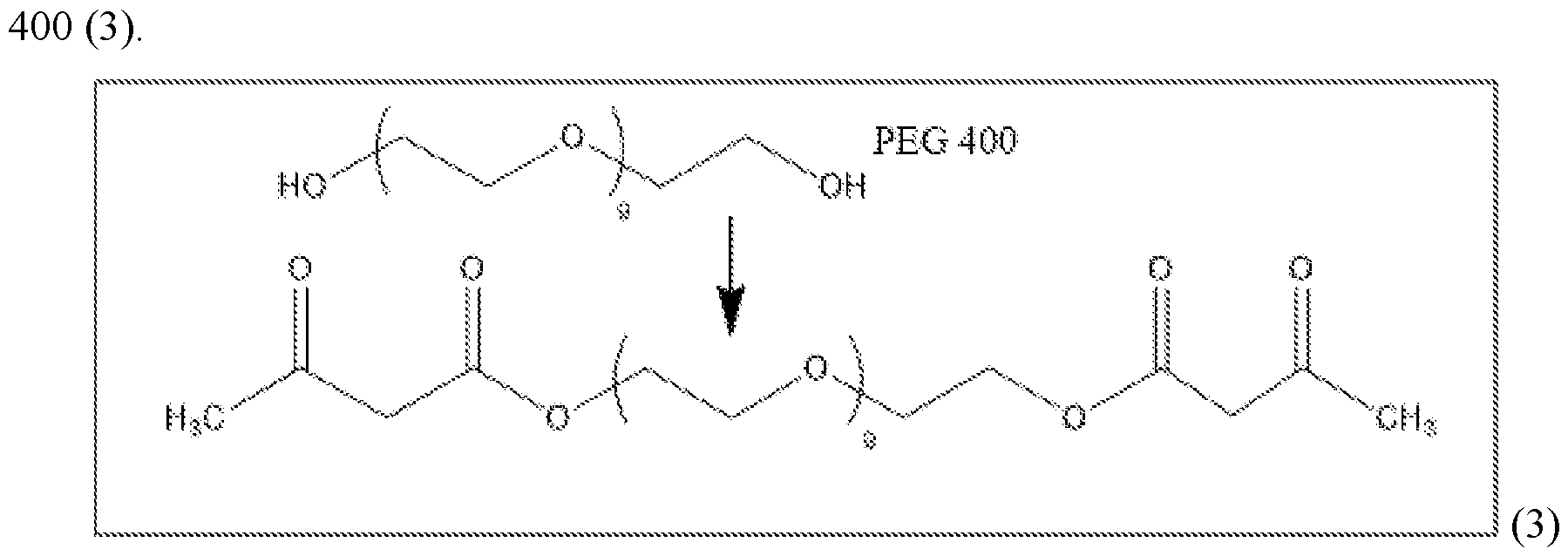 [00131] Starting from PEG 600, the product obtained was a monofunctionalized mono-AcAc PEG 600

[00132] A further crosslinking agent was prepared using the same reaction, by reacting PEG 600 with t-butyl acetoacetate in toluene solvent to prepare a di-AcAc PEG 600.
[00133] FIG. 1 shows the 13C NMR spectrum of the resulting di-AcAc PEG 600 product taken in ^/-chloroform (CDCh) as the NMR sample solvent. The abbreviations used in Figure 1 represent the following compounds exisitng in the sample:
R = PEG600 with un-reacted OH groups.
P = the PE600DiAcAc adduct products.
T = toluene (solvent) tBAcAc = tert-Butyl Acetoacetate tBuOH = tert-Butanol
CDCL3 = ^/-chloroform
[00134] The 13C NMR data concludes:
Converted hydroxyl groups : Unconverted hydroxyl groups = 95.6 : 4.4 (mole ratio) Reacted AcAc-esters : Un-reacted t-butylacetoacetate = 80.0 : 20.0 (mole ratio)
Thus the NMR data show that the desired di-AcAc PEG 600 product was formed in good yield.
Example 2: Colorant Compositions Including Ac Ac-Functional PEG
[00135] Colorants of the present disclosure were prepared and tested for viscosity, block resistance and surfactant leaching. Each of a yellow oxide, black, and magenta pigment were prepared having the following general formulations:
Table 1: Formulations for Yellow Oxide, Black, and Magenta Colorant Compositions


[00136] To each of the yellow oxide, black, and magenta formulations shown above, PEG400 as a control or AcAc-modified polyethylene glycols were added in an amount of 15.09 grams to the yellow oxide formulations; 6.11 g to the black formulations, and 10.93 g to the magenta formulations. The viscosities of each were measured and the results provided in Table 2.
Table 2: Colorant Composition Viscosity

[00137] Viscosities of the colorants including AcAc-modified humectants of the present disclosure were comparable to those using an unmodified PEG 400 as humectant.
Example 3 : Architectural Paints Tinted with Colorants Containing AcAc-Functionalized Humectants of Present Disclosure
[00138] Block resistance of architectural base paints tinted with colorants containing the AcAc-functionalized PEG humectants of the present disclosure were prepared. The samples were then tested for blocking resistance in architectural paints in accordance with ASTM D4946-89 (2017).
[00139] Colorant samples were prepared according to the formulations shown in Table 1 above and humectants added in an amount of 15.09 grams to the yellow oxide formulations; 6.11 g to the black formulations, and 10.93 g to the magenta formulations.
Table 3: Colorant Samples for Example 3.
[00140] The following table shows the test bases and colorant levels used in the block resistance testing:
Table 4: Test Base and Colorant Fill Amounts for Example 3.

[00141] The block resistance test results for a 7-day average are shown in the following table:
Table 5: Blocking Resistance Results for HGTV Home by Sherwin-Williams, Showcase
Semi-Gloss Exterior Latex Tinted with Colorants of Present Disclosure

[00142] The results show that when used to tint paints, colorants of the present disclosure including the mono-AcAc PEG 400, di -Ac Ac PEG 400, and mono Ac Ac PEG 600, in particular, provided improved block resistance compared to use of unmodified PEG when
2 Boldface type indicates improved block resistance and surfactant leaching performance compared to control.
used to tint HGTV Home by Sherwin-Williams, Showcase Semi-Gloss Exterior Latex, Base C.
[00143]
Table 6: Blocking Resistance Results for Dutch Boy Cabinet, Door, & Trim Gloss Interior/Exterior Latex Tinted with Colorants of Present Disclosure

[00144] The results show that when used to tint paints, colorants of the present disclosure including the mono-AcAc PEG 400, di-AcAc PEG 400, and mono AcAc PEG 600, in particular, provided improved block resistance compared to use of unmodified PEG when used to tint Dutch Boy Cabinet, Door, & Trim Gloss Interior/Exterior Latex. In some instances, Acc PEG 350 MME provided superior block resistance compared to control use of PEG400 in colorant compositions.
[00145]
Table 7: Blocking Resistance Results for Tinted HGTV Home by Sherwin-Williams, Everlast Semi-Gloss Exterior Latex Tinted with Colorants of Present Disclosure

[00146] The results show that when used to tint paints, some AcAc-modified PEG included colorants of the present disclosure provided improved block resistance compared to use of unmodified PEG when used to tint HGTV Home by Sherwin-Williams, Everlast Semi-Gloss Exterior Latex.
[00147]
Table 8: Blocking Resistance Results for Tinted Valspar Signature Semi-Gloss Interior
Latex Tinted with Colorants of Present Disclosure

3 Improved block resistance compared to control is shown in boldface.
4 Improved block resistance compared to control is shown in boldface.

[00148] The results show that when used to tint paints, some AcAc-modified PEG included colorants of the present disclosure provided improved block resistance compared to use of unmodified PEG when used to tint Valspar Signature Semi -Gloss Interior Latex, Mono AcAc PEG 400, diAcAc PEG 400, and monoAcAc PEG 600, provided superior results when black and magenta colorants are used as tints, in particular.
[00149] The same colorants were also tested for surfactant leaching under ASTM D7190-10 (2015).
[00150] The following table shows the surfactant leaching results obtained for tinting HGTV Home by Sherwin-Williams, Showcase Semi-Gloss Exterior Latex, Base C.
Table 9: Surfactant Leaching Results


[00151] The data shows that yellow oxide and black colorants including AcAc modified PEG humectants of the present disclosure provided better 28-day block resistance compared to convention PEG 400. Block resistance at other time measurements and magenta colorant measurements showed comparable block resistance compared to control.
[00152] The same test was performed tinting base paint Dutch Boy Cabinet, Door, & Trim Gloss Interior/Exterior Latex, Base 4.
Table 10: Surfactant Leaching Results

[00153] The data shows that when used to tint paint, colorants comprising AcAc-modifed PEG as in the present disclosure show comparable resistance to surfactant leaching in most instances compared to colorants including conventional PEG as a humectant. However, 28- day initial surfactant leaching was improved when tinting with yellow oxide colorants that included the AcAc modified PEG of the present disclosure.
[00154] The same test was performed tinting base paint Everlast Semi-Gloss Exterior Latex.
Table 11: Surfactant Leaching Results


[00155] The data shows that when used to tint base paint Everlast Semi-Gloss Exterior Latex, colorants comprising AcAc-modifed PEG as in the present disclosure show similar resistance to surfactant leaching compared to colorants including conventional PEG as a humectant.
Table 12: Surfactant Leaching Results
 [00156] The data shows that paints tinted using colorants including Ac Ac-functional PEG shows equal surfactant leaching compared to paints tinted using colorants including PEG without AcAc-functionality. However, di-AcAc modified PEG 400 showed improved surfactant leaching resistance following 28 days.
[00157] Overall, colorants including AcAc-modified PEGs of the present disclosure provided comparable or improved block resistance and surfactant leaching resistance compared to control. In no instances were AcAc-modified PEGs of the present disclosure incompatible with colorant compositions or provided undesirable effects on viscosity, block resistance, or surfactant leaching.
Example 3: Anti-Skinning Float on Paints and Coatings
[00158] The use of the crosslinking agent of the present disclosure as a float in a system for reducing skinning in a container of paint or coating was tested.
[00159] The floats shown in Table 10 below were added as a float on top of a filled ’A pint jar of Dutch Boy Cabinet, Door, & Trim Gloss IntZExt base 4 base paint. The crosslinking agent was added in an amount to make the agent 5% by weight of the base paint in the jar.
Table 13: Anti-Skinning Samples

[00160] It is noted that sample 1 was a negative control and did not include any float, whereas sample 2 was a positive control using a conventional PEG 400 additive as float. Samples 3-6 were the same AcAc modified PEG’s as used in the above noted examples. [00161] The float was added to ’A pint cans of a cabinet, door, and trim gloss interior/exterior latex paint, specifically Dutch Boy Cabinet, Door & Trim Gloss Interior/Exterior Paint, Base
4, available from The Sherwin-Williams Company, Cleveland, OH.
[00162] The initial total weight of the can and paint were recorded and the float added to the top of the base paint in an amount to make the float 5 wt.% of the total contents of the can. The samples were placed with no lid in a Therm otron for 1 hour at 120°F and 29% relative humidity. After one hour bake time, the final total weight of the can, paint and float additive
were recorded, and the can inspected for the formation of a skin layer on the paint contained therein. The results of this test are shown in the table below:
Table 14: Anti-Skinning Results

[00163] These same samples were then shaken to mix the float with the base paint and assessed for 28 day block resistance according to ASTM D4946-89 (2017). The results of the block resistance testing are shown in the following table (using the same rating scale as described above):
Table 15: Block Resistance Results Using Modified PEGs as Anti-Skinning Agent

[00164] As shown, the use of the present disclosure crosslinking agent as a float provided improved overall performance in combination of anti-skinning properties and 28 day block resistance rating compared to the absence of a float or the use of PEG only as the float. Example 4: Use as a Coalescent in Paint
[00165] Next, a set of paints were prepared using the crosslinking agents of the present disclosure as coalescents. A base latex paint including the ingredients below was prepared.
Table 16: Latex Paint Composition


[00166] To make the base paint, the grind ingredients were mixed in high speed dispersion for 15 minutes. Then the pre-thin ingredients were added and mixed in low-shear mixing for 15 minutes. Finally, the coalescents of the present disclosure as shown in Table 14 below were added to the base paint mixture.
Table 17: Coalescents Used in Example 4.

[00167] Samples 1 and 2 were negative and positive controls, respectively. Sample 1 included no coalescent. Sample 2 included conventional PEG 400 as a coalescent. The remaining experimental samples, 3-6, utilized Ac Ac-modified PEG embodiments of the present disclosure.
5 Promex 20D from Prom Biocides
6 Tamol 165A from Dow Chemicals, Inc.
7 Surfynol 104A from Evonik.
8 Byk 024 from BYK-Chemie GmbH
9 Nicron® 574 from Imerys Performance Additives
10 Attagel 50, attapulgite clay thickener from BASF.
11 Ammonium hydroxide
12 A proprietary single stage, all-acrylic water-borne latex having approximately 50% solids by weight, from Engineered Polymer Solutions, Marengo, Illinois.
13 Optiflo 100 from BYK-Chemie GmbH
[00168] The coalescents of Table 14 were mixed in the paint in an amount of 1.21 Wt. % based on the total components of the paint. A Low Temperature Coalescence test was performed according to the test method disclosed herein. LTC on sealed and unsealed areas of the test panel was measured and evaluated in accordance with the test method disclosed herein. The results are provided below.
Table 18: Low Temperature Coalescence Results Using 1.21 Wt. % Coalescent.

[00169] The data shows that the experimental di-AcAc- modified PEG400 (Sample 6) performed better than the non-modified PEG400 (Control Sample 2). The other experimental coalescents performed equivalently to control PEG 400.
[00170] These samples were then tested in duplicate for 28 day block resistance in accordance with ASTM D4946-89 (2017) (the block resistance rating scale is provided in earlier examples above). The results are shown in the following table:
Table 19: Block Resistance Test Results Using 1.21 Wt. % Coalescent.

[00171] Mono AcAc PEG400, di AcAc PEG400. and mono AcAc PEG600 provided superior block resistance compared to control PEG400.
[00172] A separate assessment of LTC and Blocking Resistance was performed at a higher amount of coalescent. More specifically, the crosslinking agents of samples 2 (PEG), and 3-6 (AcAc modified PEGs) were mixed in the paint formulation of Table 16 at a level of 2 Wt. % based on the total components of the base paint. Low Temperature Coalescence and duplicate Blocking Resistance tests were performed. The results of these test are reported for samples 2a, 4a, 5a, 6a, and 7a in the following tables:
Table 20: Low Temperature Coalescence Results Using 2 Wt. % Coalescent.

Table 21: Block Resistance Using 2 Wt. % Coalescent
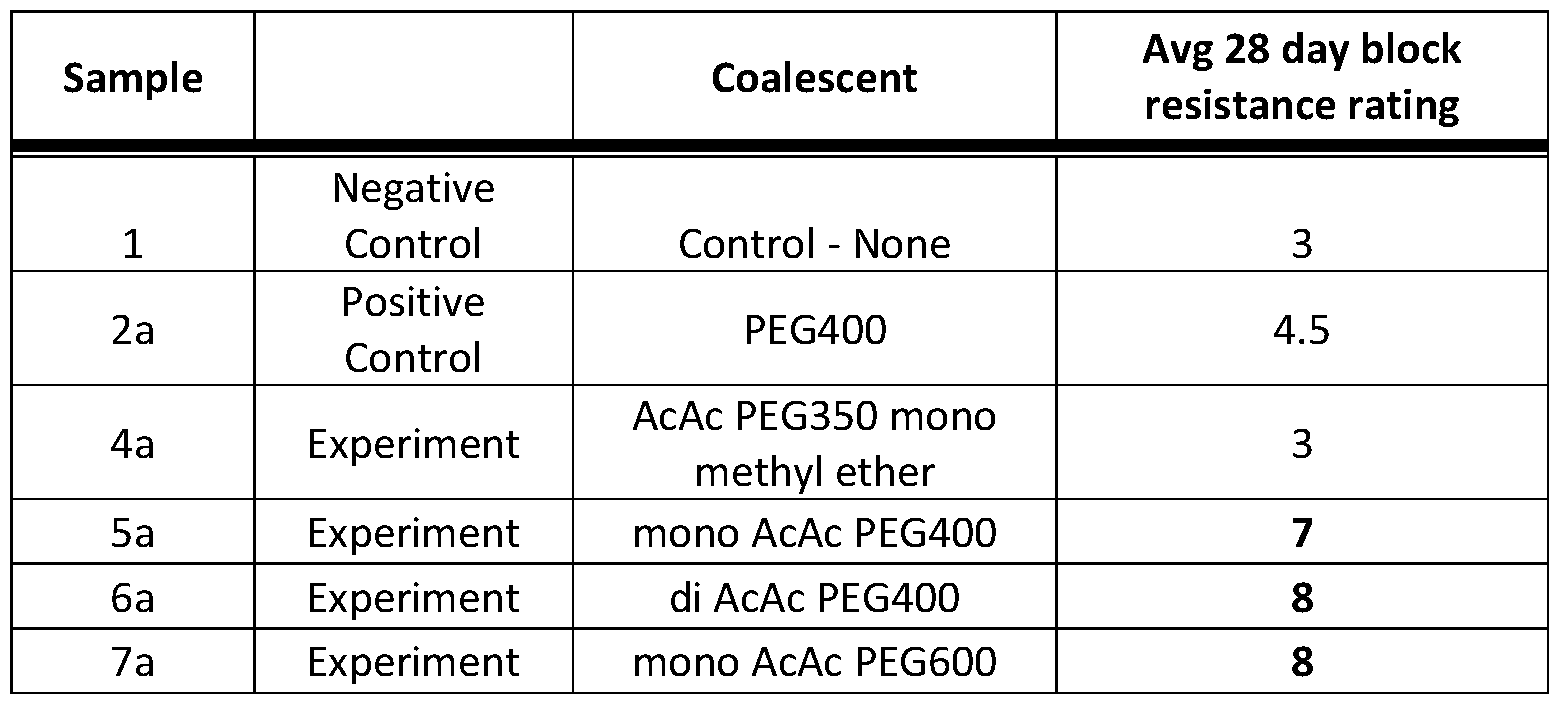
[00173] The data shows that each of the AcAc modified PEGs (samples 3a, 4a, 5a, 6a) provided better low temperature coalescence compared to the positive control (sample 2a) [00174] The data shows that nearly all of the AcAc-modified PEGs (Samples 5a, 6a, 7a) provided better block resistance than the PEG 400 control, Sample 2a.
Example 5: Colorant Including AcAc-Functional PEG as Humectant Used to Tint Paint Containing Ac Ac-Functional PEG Included as Coalescent in Base Paint or Stain [00175] Lastly, samples were prepared to show the combined impact of using the crosslinking agents of the present disclosure as a coalescent agent in a paint combined with the use of a crosslinking agent of the present disclosure as a humectant in a colorant used to
color that paint. Without being bound by theory, it is believed that the AcAc functionalities present in a colorant composition will crosslink with AcAc functionalities present in a base paint or stain, providing improved block resistance.
[00176] The following samples were prepared using the base paint formula disclosed above in Table 16, tinted with the yellow oxide colorant compositions disclosed above in Table 1.
[00177] The samples were tested for 28 day block resistance in accordance with ASTM D4946-89 (2017) using the same rating scale as detailed above. The results are shown in the following table:
Table 22: Block Resistance of Base Paints Including Modified-PEG Tinted with Colorants Including Modified-PEG

[00178] As shown, the use of the crosslinking agent of embodiments of the present disclosure as either a humectant in the colorant or as a coalescent agent in the paint provide improved block resistance rating compared to not using the present disclosure crosslinking agent. Even if only used in one of the colorant composition or base paint, the resulting block resistance rating is significantly improved compared to the use of PEG400 as a humectant in colorant or a coalescent in base paint, or to not being present in either component. Further, when used in both the colorant and the paint, the resulting product has consistently good block resistance.
LIST OF EXEMPLARY EMBODIMENTS
[00179] The following are exemplary embodiments of the present disclosure. Persons of ordinary skill in the art will recognize that the subject matter disclosed herein may comprise fewer features than illustrated in any individual embodiment described. The embodiments described herein are not intended to be an exhaustive presentation of the ways in which the various features of the disclosed subject matter may be combined. Accordingly, the embodiments are not mutually exclusive combinations of features, but rather can comprise a combination of different individual features selected from individual embodiments.
Moreover, elements disclosed with respect to one embodiment can be implemented in other embodiments even when not described in such embodiments, unless otherwise noted.
[00180] Embodiment 1 : A crosslinking agent for use in a water-borne colorant composition, paint composition, or coating composition comprising: a polyalkylene glycol including at least one acetoacetoxy group, wherein the glycol has an Mw of 400 to 3000, and wherein the polyalkylene glycol is composed of interpolymerized ethylene oxide groups, interpolymerized propylene oxide groups, or combinations thereof.
[00181] Embodiment 2: The crosslinking agent of Embodiment 1, wherein the polyalkylene glycol is endcapped on one end by one or more acetoacetoxy groups.
[00182] Embodiment 3: The crosslinking agent of Embodiment 1, wherein the polyalkylene glycol is endcapped on both ends by acetoacetoxy groups. [00183] Embodiment 4: The crosslinking agent of any one of Embodiments 1 to 3, wherein a mole ratio of acetoacetoxy groups to alkyloxy groups is from 1 :4 to 1 : 10. [00184] Embodiment 5: A crosslinking agent for use in a water-borne colorant composition, paint composition, or coating composition comprising: the reaction product of reacting methyl acetoacetate, ethyl acetoacetate, or t-butyl acetoacetate with a polyethylene glycol having a molecular weight between 300 and 750 or a polypropylene glycol having a molecular weight between 500 and 3000, or combinations thereof.
[00185] Embodiment 6: A crosslinking agent for use in a water-borne colorant composition, paint composition, or coating composition having a formula (I):
R1 (CH2CH2O)n (CH2CH3CHO)m R2 (I) wherein
 wherein m is an integer of 0 or greater and n is an integer greater than 0, such that the crosslinking agent has a Mw of from 400-3000, and wherein a mole ratio of interpolymerized ethylene oxide groups to interpolymerized propylene oxide groups is at least 3:2.
[00186] Embodiment 7: The crosslinking agent of Embodiment 6,
wherein

[00187] Embodiment 8: The crosslinking agent of any one of Embodiments 6 to 7, wherein the polyalkylene glycol is a copolymer of ethylene glycol and propylene glycol and has a Mw of 1400-3000 and a mole ratio of interpolymerized ethylene oxide groups to interpolymerized propylene oxide groups of 3:2 to 4:5.
[00188] Embodiment 9: The crosslinking agent of any one of the preceding Embodiments: wherein the polyalkylene glycol is a polyethylene glycol and has a Mw of 400-1000.
[00189] Embodiment 10: The crosslinking agent of any one of the preceding Embodiments: wherein the polyalkylene glycol is a polypropylene glycol and has a Mw of 500-2000. [00190] Embodiment 11 : The crosslinking agent of any one of the preceding Embodiments, wherein the crosslinking agent is configured to be added to a colorant composition, a coating composition, or added directly or indirectly to a surface of a base coating composition.
[00191] Embodiment 12: A water-borne colorant composition comprising an aqueous carrier, one or more pigments or dyes, and less than a film-forming amount of polymeric binder, and the crosslinking agent of any one of the preceding Embodiments present in an amount of 5 wt.% to 20 wt.% of the total components of the colorant composition. wherein the colorant composition is configured for tinting a base coating composition. [00192] Embodiment 13: The water-borne colorant composition of Embodiment 12, wherein the pigment is a member selected from the group consisting of titanium dioxide white, carbon black, lampblack, black iron oxide, red iron oxide, transparent red oxide, yellow iron oxide, transparent yellow oxide, brown iron oxide, umber, phthalocyanine green, phthalocyanine blue, organic reds, DPP red, quinacridone magenta, quinacridone violet, carbazole violet, DNA orange, DPP orange, organic yellows, bismuth vanadate yellow, and combinations thereof.
[00193] Embodiment 14: The water-borne colorant composition of any one of Embodiments 12-13, wherein the base coating composition is a paint.
[00194] Embodiment 15: The colorant composition of any one of Embodiments 12-13, wherein the base coating composition is a stain.
[00195] Embodiment 16: The water-borne colorant composition of any one of Embodiments 12-15, wherein the colorant composition has less than 50 g/L VOC, less than 30 g/L VOC, less than 10 g/L VOC, less than 5 g/L VOC, or essentially zero VOC.
[00196] Embodiment 17: The water-borne colorant composition of any one of Embodiments 12-16, wherein the colorant composition is essentially free of alkyl phenol ethoxylates.
[00197] Embodiment 18: The water-borne colorant composition of any one of Embodiments 12-17, wherein the colorant composition is essentially free of benzophenone.
[00198] Embodiment 19: The water-borne colorant composition of any one of Embodiments 12-18, wherein the colorant composition further comprises a preservative, humectant, biocide, filler, defoamer, pH control agent, thickener, or anti-settling agent.
[00199] Embodiment 20: The water-borne colorant composition of any one of Embodiments 12-19, wherein the one or more pigments or dyes are collectively present in the colorant composition at a total concentration of at least 10 wt.%, at least 25 wt.%, or at least 50 wt.% based on the total weight of colorant composition components.
[00200] Embodiment 21 : The water-borne colorant composition of any one of Embodiments 12-20, wherein the carrier is aqueous.
[00201] Embodiment 22: The water-borne colorant composition of any one of Embodiments 12-21, wherein the colorant composition is a universal colorant composition.
[00202] Embodiment 23: The water-borne colorant composition of any one of Embodiments 12-21, wherein the colorant composition is a water-only colorant composition and requires use of a synergist to tint solvent-based, alkyd paints and coatings.
[00203] Embodiment 24: A base coating composition comprising a film-forming polymeric binder, a carrier, a pigment, and one or more coating additives, and the crosslinking agent of any one of claims 1-11.
[00204] Embodiment 25: The base coating composition of Embodiment 24, wherein the crosslinking agent is present in an amount of at least 0.1, 0.5, 1.0, 1.5, or 2 wt.% of the total components of the base coating composition.
[00205] Embodiment 26: The base coating composition of any one of Embodiments 24 or 25, wherein the crosslinking agent is present in an amount and/or at most 5, 4, 3, 2, or 1 wt.% of the total components of the base coating composition.
[00206] Embodiment 27: A system for reducing skinning of a base coating composition in a container, the base coating composition including at least a film-forming polymeric latex binder, an aqueous carrier, a pigment, and one or more coating additives; and disposed on a top surface of the base coating composition in the container, an anti-skinning layer comprising the crosslinking agent of any of Embodiments 1 to 10, the anti-skinning layer being present in an amount of from at least 1 mL/gallon container to at most 500 mL/gallon container.
[00207] Embodiment 28: The system of Embodiment 27, wherein the crosslinking agent is present in the anti-skinning layer in an amount of at least 0.1, 0.5, 1, 2, 5, 10, 25, and/or 50 wt.% of the anti-skinning layer.
[00208] Embodiment 29: The system of any one of Embodiments 27-28, wherein the base coating composition is a paint.
[00209] Embodiment 30: The system of any one of Embodiments 27=28, wherein the base coating composition is a stain.
[00210] Embodiment 31 : The system of any of Embodiments 27-30, wherein the base coating composition is essentially free of benzophenone.
[00211] Embodiment 32: The system of any one of Embodiments 27-30, wherein the base coating composition includes benzophenone.
[00212] Embodiment 33: A base coating composition comprising at least a film-forming polymeric binder, an aqueous carrier, a pigment, and one or more coating additives; and the crosslinking agent of any one of Embodiments 1-11 present in an amount of at least 0.1, 0.5, 1.0, 1.5, or 2 wt.% based on the total components and at most 5, 4, 3, 2, or 1 wt.% based on the total components of the base coating composition.
[00213] Embodiment 34: A tinted coating composition comprising: a base coating composition comprising at least a film-forming polymeric latex binder, an aqueous carrier, a pigment, and one or more coating additives; and the colorant composition of any one of Embodiments 12-23 added to the base coating composition in an amount of at most 20 fl. oz. / gallon base coating composition wherein the one or more pigments or dyes in the colorant composition are each uniformly dispersed in the coating composition.
[00214] Embodiment 35: The tinted coating composition of Embodiment 34 or the base coating composition of Embodiment 33, wherein the base coating composition has a VOC level of 250 g/L or less, 150 g/L of less, 100 g/L or less, 50 g/L or less, 25 g/L or less, 10 g/L or less, 5 g/L or less, or essentially zero VOC.
[00215] Embodiment 36: The tinted coating composition of any of Embodiments 34 or 35, or the base coating composition of any one of Embodiments 33 or 35, wherein the base coating composition are essentially free of an alkyl phenol ethoxylate.
[00216] Embodiment 37: The tinted coating composition of any of Embodiments 34-36, or the base coating composition of any one of Embodiments 33 or 35-36, wherein the base coating composition is essentially free of benzophenone.
[00217] Embodiment 38: The tinted coating composition of any one of Embodiments 34-36, or the base coating composition of any one of Embodiments 33 or 35-36, wherein the base coating composition includes benzophenone.
[00218] Embodiment 39: The tinted coating composition of any one of Embodiments 34-38, or the base coating composition of any one of Embodiments 33 or 35-38, wherein the base coating composition has a 60° gloss of at most 5 (flat), or 5-10 (matte), or 20-35 (eggshell), or 35-70 (semi -gloss), or 70-85 (gloss), or above 85 (high gloss).
[00219] Embodiment 40: The tinted coating composition of any one of Embodiments 34-38, or the base coating composition of any one of Embodiments 33 or 35-39, wherein the film-forming polymeric binder of the base coating composition includes interpolymerized acetoacetoxy ethyl methacrylate monomer.
[00220] Embodiment 41 : A stain composition comprising:
10 - 20 wt.% polymeric binder solids based on the total components of the stain;
40 - 50 wt.% water-based carrier based on the total components of the stain;
15 - 35 wt.% polyalkylene glycol including the crosslinking agent of any one of Embodiments 1-11, based on the total components of the stain;
0.2 - 1.0 wt.% thickener based on the total components of the stain;
0.2 - 0.5 wt.% amine based on the total components of the stain;
0.2 - 0.5 wt.% defoamer based on the total components of the stain;
0.05 - 1 wt.% biocide based on the total components of the stain;
[00221] Embodiment 42: A coated substrate comprising: a substrate, and
the system of any one of Embodiments 27 to 32, wherein the base coating composition and anti-skinning layer are uniformly mixed, or the tinted coating composition of any one of Embodiments 34-40, or the base coating composition of any one of Embodiments 33 or 35- 40, or the stain composition of Embodiment 41, applied to the substrate and cured to yield a cured coating.
[00222] Embodiment 43: The coated substrate of Embodiment 42, wherein the cured coating comprises a crosslinked matrix of chemical bonds between acetoacetoxy groups.
[00223] Embodiment 44: The coated substrate of Embodiment 43, wherein the chemical bonds are via acetoacetoxy groups present in the crosslinking agent. [00224] Embodiment 45: The coated substrate of one of Embodiments 43-44, wherein the chemical bonds are via both the acetoacetoxy groups present in the crosslinking agent and acetoacetoxy groups polymerized in the polymeric binder.
[00225] Embodiment 46: The coated substrate of one of Embodiments 44-45, wherein the chemical bonds are via both the acetoacetoxy groups present in the crosslinking agent and structural units derived from interpolymerization of acetoacetoxy ethyl methacrylate monomer.
[00226] As will be understood by persons having ordinary skill in the art, numerous modifications and variations of the present invention are possible in light of the above teachings.
Claims
1. A crosslinking agent for use in a water-borne colorant composition, paint composition, or coating composition comprising: a polyalkylene glycol including at least one acetoacetoxy group, wherein the glycol has an Mw of 400 to 3000, and wherein the polyalkylene glycol is composed of interpolymerized ethylene oxide groups, interpolymerized propylene oxide groups, or combinations thereof.
2. The crosslinking agent of claim 1, wherein the polyalkylene glycol is endcapped on one end by one or more acetoacetoxy groups.
3. The crosslinking agent of claim 1, wherein the polyalkylene glycol is endcapped on both ends by acetoacetoxy groups.
4. The crosslinking agent of any one of claims 1 to 3, wherein a mole ratio of acetoacetoxy groups to alkyloxy groups is from 1 :4 to 1 : 10.
5. A crosslinking agent for use in a water-borne colorant composition, paint composition, or coating composition comprising: the reaction product of reacting methyl acetoacetate, ethyl acetoacetate, or t-butyl acetoacetate with a polyethylene glycol having a molecular weight between 300 and 750 or a polypropylene glycol having a molecular weight between 500 and 3000, or combinations thereof.
6. A crosslinking agent for use in a colorant composition, paint composition, or coating composition having a formula (I):
R1 (CH2CH2O)n (CH2CH3CHO)m R2 (I)
wherein
 wherein m is an integer of 0 or greater and n is an integer greater than 0, such that the crosslinking agent has a Mw of from 400-3000, and wherein a mole ratio of interpolymerized ethylene oxide groups to interpolymerized propylene oxide groups is at least 3:2.
7. The crosslinking agent of claim 6, wherein

8. The crosslinking agent of any one of claims 6 to 7, wherein the polyalkylene glycol is a copolymer of ethylene glycol and propylene glycol and has a Mw of 1400-3000 and a mole ratio of interpolymerized ethylene oxide groups to interpolymerized propylene oxide groups of 3:2 to 4:5.
9. The crosslinking agent of any one of the preceding claims, wherein the polyalkylene glycol is a polyethylene glycol and has a Mw of 400-1000.
10. The crosslinking agent of any one of the preceding claims, wherein the polyalkylene glycol is a polypropylene glycol and has a Mw of 500-2000.
11. The crosslinking agent of any one of the preceding claims, wherein the crosslinking agent is configured to be added to a colorant composition, a coating composition, or added directly or indirectly to a surface of a base coating composition.
12. A water-borne colorant composition comprising an aqueous carrier, one or more pigments or dyes, and less than a film-forming amount of polymeric binder, and the crosslinking agent of any one of the preceding claims present in an amount of 5 wt.% to 20 wt.% of the total components of the colorant composition.
wherein the colorant composition is configured for tinting architectural base paints or stains.
13. The water-borne colorant composition of claim 12, wherein the pigment is selected from the group consisting of titanium dioxide white, carbon black, lampblack, black iron oxide, red iron oxide, transparent red oxide, yellow iron oxide, transparent yellow oxide, brown iron oxide, umber, phthalocyanine green, phthalocyanine blue, organic reds, DPP red, quinacridone magenta, quinacridone violet, carbazole violet, DNA orange, DPP orange, organic yellows, bismuth vanadate yellow, and combinations thereof.
14. The water-borne colorant composition of any one of claims 12-13, wherein the base coating composition is an architectural paint.
15. The water-borne colorant composition of any one of claims 12-13, wherein the base coating composition is an architectural stain.
16. The water-borne colorant composition of any one of claims 12-15, wherein the colorant composition has less than 50 g/L VOC, less than 30 g/L VOC, less than 10 g/L VOC, less than 5 g/L VOC, or essentially zero VOC.
17. The water-borne colorant composition of any one of claims 12-16, wherein the colorant composition is essentially free of alkyl phenol ethoxylates.
18. The water-borne colorant composition of any one of claims 12-17, wherein the colorant composition is essentially free of benzophenone.
19. The water-borne colorant composition of any one of claims 12-18, wherein the colorant composition further comprises a preservative, humectant, biocide, filler, defoamer, pH control agent, thickener, or anti-settling agent.
20. The water-borne colorant composition of any one of claims 12-19,
wherein the one or more pigments or dyes are collectively present in the colorant composition at a total concentration of at least 10 wt.%, at least 25 wt.%, or at least 50 wt.% based on the total weight of colorant composition components.
21. The water-borne colorant composition of any one of claims 12-20, wherein the carrier is aqueous.
22. The water-borne colorant composition of any one of claims 12-21, wherein the colorant composition is a universal colorant composition.
23. The water-borne colorant composition of any one of claims 12-21, wherein the colorant composition is a water-only colorant composition and requires use of a synergist to tint solvent-based, alkyd base paints and coatings.
24. A base coating composition comprising a film-forming polymeric binder, a carrier, a pigment, and one or more coating additives, and the crosslinking agent of any one of claims 1-11.
25. The base coating composition of claim 24, wherein the crosslinking agent is present in an amount of at least 0.1, 0.5, 1.0, 1.5, or 2 wt.% of the total components of the base coating composition.
26. The base coating composition of claim 24 or 25, wherein the crosslinking agent is present in an amount and/or at most 5, 4, 3, 2, or 1 wt.% of the total components of the base coating composition.
27. A system for reducing skinning of a water-borne base coating composition in a container, the base coating composition including at least a film-forming polymeric latex binder, an aqueous carrier, a pigment, and one or more coating additives; and disposed on a top surface of the base coating composition in the container, an antiskinning layer comprising the crosslinking agent of any of claims 1 to 10, the anti-
skinning layer being present in an amount of from at least 1 mL/gallon container to at most 500 mL/gallon container.
28. The system of claim 27, wherein the crosslinking agent is present in the anti-skinning layer in an amount of at least 0.1, 0.5, 1, 2, 5, 10, 25, and/or 50 wt.% of the antiskinning layer.
29. The system of any one of claims 27-28, wherein the base coating composition is a paint.
30. The system of any one of claims 27-28, wherein the base coating composition is a stain.
31. The system of any of claims 27-30, wherein the base coating composition is essentially free of benzophenone.
32. The system of any one of claims 27-30, wherein the base coating composition includes benzophenone.
33. A base coating composition comprising at least a film-forming polymeric binder, an aqueous carrier, a pigment, and one or more coating additives; and the crosslinking agent of any one of claims 1-11 present in an amount of at least 0.1, 0.5, 1.0, 1.5, or 2 wt.% based on the total components and at most 5, 4, 3, 2, or 1 wt.% based on the total components of the base coating composition.
34. A tinted water-borne coating composition comprising: a water-borne base coating composition comprising at least a film-forming polymeric latex binder, an aqueous carrier, a pigment, and one or more coating additives; and the colorant composition of any one of claims 12-23 added to the base coating composition in an amount of at most 20 fl. oz. / gallon base coating composition wherein the one or more pigments or dyes in the colorant composition are each uniformly dispersed in the coating composition.
35. The tinted water-borne coating composition of claim 34 or the base coating composition of claim 33, wherein the base coating composition has a VOC level of 250 g/L or less, 150 g/L of less, 100 g/L or less, 50 g/L or less, 25 g/L or less, 10 g/L or less, 5 g/L or less, or essentially zero VOC.
36. The tinted water-borne coating composition of claim 34 or 35, or the base coating composition of claim 33 or 35, wherein the base coating composition are essentially free of an alkyl phenol ethoxylate.
37. The tinted water-borne coating composition of any one of claims 34-36 or the base coating composition of any one of claims 33 or 35-36, wherein the base coating composition is essentially free of benzophenone.
38. The tinted water-borne coating composition of any one of claims 34-36, or the base coating composition of any one of claims 33 or 35-36, wherein the base coating composition includes benzophenone.
39. The tinted water-borne coating composition of any one of claims 34-38 or the base coating composition of any one of claims 35-39, wherein the base coating composition has a 60° gloss of at most 5 (flat), or 5-10 (matte), or 20-35 (eggshell), or 35-70 (semi -gloss), or 70-85 (gloss), or above 85 (high gloss).
40. The tinted water-borne coating composition of any one of claims 34-38, or the base coating composition of any one of claims 33 or 35-39 wherein the film-forming polymeric latex binder of the base coating composition includes interpolymerized acetoacetoxy ethyl methacrylate monomer.
41. A stain composition comprising:
10 - 20 wt.% polymeric binder solids based on the total components of the stain;
40 - 50 wt.% water-based carrier based on the total components of the stain;
15 - 35 wt.% polyalkylene glycol including the crosslinking agent of any one of claims 1 to 11, based on the total components of the stain;
0.2 - 1.0 wt.% thickener based on the total components of the stain;
0.2 - 0.5 wt.% amine based on the total components of the stain;
0.2 - 0.5 wt.% defoamer based on the total components of the stain;
0.05 - 1 wt.% biocide based on the total components of the stain;
42. A coated substrate comprising: a substrate the system of any one of claims 24 to 29, wherein the base coating composition and anti-skinning layer are uniformly mixed, or the tinted coating composition of any one of claims 30-36, or the stain composition of claim 37, applied to the substrate and cured to yield a cured coating.
43. The coated substrate of claim 42, wherein the cured coating comprises a crosslinked matrix of chemical bonds between acetoacetoxy groups.
44. The coated substrate of claim 43, wherein the chemical bonds are via acetoacetoxy groups present in the crosslinking agent.
45. The coated substrate of one of claims 32-44, wherein the chemical bonds are via both the acetoacetoxy groups present in the crosslinking agent and acetoacetoxy groups polymerized in the polymeric latex binder.
46. The coated substrate of one of claims 42-45,
wherein the chemical bonds are via both the acetoacetoxy groups present in the crosslinking agent and structural units derived from interpolymerization of acetoacetoxy ethyl methacrylate monomer.
Applications Claiming Priority (2)
| Application Number | Priority Date | Filing Date | Title |
|---|---|---|---|
| US202463617965P | 2024-01-05 | 2024-01-05 | |
| US63/617,965 | 2024-01-05 |
Publications (1)
| Publication Number | Publication Date |
|---|---|
| WO2025147405A1 true WO2025147405A1 (en) | 2025-07-10 |
Family
ID=96300687
Family Applications (1)
| Application Number | Title | Priority Date | Filing Date |
|---|---|---|---|
| PCT/US2024/061333 Pending WO2025147405A1 (en) | 2024-01-05 | 2024-12-20 | Acetoacetoxy functionalized polyalkylene glycols and uses thereof |
Country Status (1)
| Country | Link |
|---|---|
| WO (1) | WO2025147405A1 (en) |
Citations (5)
| Publication number | Priority date | Publication date | Assignee | Title |
|---|---|---|---|---|
| US5021537A (en) * | 1990-04-27 | 1991-06-04 | Shell Oil Company | Polyacetoacetate-containing epoxy resin compositions |
| US5426148A (en) * | 1992-12-18 | 1995-06-20 | Tremco, Inc. | Fast-curling, high strength, two-part sealants using acetoacetate-amine cure chemistry |
| US20180079851A1 (en) * | 2004-12-17 | 2018-03-22 | Valspar Sourcing, Inc. | Aqueous coating compositions containing acetoacetyl-functional polymers, coatings, and methods |
| US20220185762A1 (en) * | 2019-04-03 | 2022-06-16 | Lonza Solutions Ag | Method for Preparation of Acetoacetylated Polyols |
| WO2022200415A1 (en) * | 2021-03-24 | 2022-09-29 | Croda International Plc | Coatings, adhesives and elastomers utilising acetoacetate end-capped polyol derived from thermoplastic polyesters |
-
2024
- 2024-12-20 WO PCT/US2024/061333 patent/WO2025147405A1/en active Pending
Patent Citations (5)
| Publication number | Priority date | Publication date | Assignee | Title |
|---|---|---|---|---|
| US5021537A (en) * | 1990-04-27 | 1991-06-04 | Shell Oil Company | Polyacetoacetate-containing epoxy resin compositions |
| US5426148A (en) * | 1992-12-18 | 1995-06-20 | Tremco, Inc. | Fast-curling, high strength, two-part sealants using acetoacetate-amine cure chemistry |
| US20180079851A1 (en) * | 2004-12-17 | 2018-03-22 | Valspar Sourcing, Inc. | Aqueous coating compositions containing acetoacetyl-functional polymers, coatings, and methods |
| US20220185762A1 (en) * | 2019-04-03 | 2022-06-16 | Lonza Solutions Ag | Method for Preparation of Acetoacetylated Polyols |
| WO2022200415A1 (en) * | 2021-03-24 | 2022-09-29 | Croda International Plc | Coatings, adhesives and elastomers utilising acetoacetate end-capped polyol derived from thermoplastic polyesters |
Similar Documents
| Publication | Publication Date | Title |
|---|---|---|
| US12209198B2 (en) | Latex polymer with improved washability and block resistance | |
| US20110318494A1 (en) | Coalescent for aqueous compositions | |
| EP1003819B1 (en) | The use of surfactants as plasticizers to reduce volatile organic compounds in water-based polymer coating compositions | |
| AU2017425706B2 (en) | Aqueous coating composition | |
| EP3775058A1 (en) | Coating compositions for polymeric roofing materials | |
| CN113748178B (en) | Aqueous coating composition containing xanthan gum-based rheology package | |
| US11649361B2 (en) | Stain-blocking polymers, primers, kits, and methods | |
| US20250289966A1 (en) | Aqueous coating compositions including solvent systems for low temperature storage and application | |
| WO2025147405A1 (en) | Acetoacetoxy functionalized polyalkylene glycols and uses thereof | |
| EP3820952A1 (en) | Coating compositions for bituminous materials | |
| US11939488B2 (en) | Aqueous coating compositions for abatement of airborne pollutants | |
| CA3071325C (en) | Aqueous coating composition | |
| WO2023173051A1 (en) | Systems and methods to reduce skinning of coating compositions |
Legal Events
| Date | Code | Title | Description |
|---|---|---|---|
| 121 | Ep: the epo has been informed by wipo that ep was designated in this application |
Ref document number: 24915283 Country of ref document: EP Kind code of ref document: A1 |