WO2025147337A1 - Polysilanes, methods for their preparation, and the use thereof in coating compositions - Google Patents
Polysilanes, methods for their preparation, and the use thereof in coating compositions Download PDFInfo
- Publication number
- WO2025147337A1 WO2025147337A1 PCT/US2024/057392 US2024057392W WO2025147337A1 WO 2025147337 A1 WO2025147337 A1 WO 2025147337A1 US 2024057392 W US2024057392 W US 2024057392W WO 2025147337 A1 WO2025147337 A1 WO 2025147337A1
- Authority
- WO
- WIPO (PCT)
- Prior art keywords
- group
- different
- temperatures
- less
- same
- Prior art date
- Legal status (The legal status is an assumption and is not a legal conclusion. Google has not performed a legal analysis and makes no representation as to the accuracy of the status listed.)
- Pending
Links
Classifications
-
- C—CHEMISTRY; METALLURGY
- C07—ORGANIC CHEMISTRY
- C07F—ACYCLIC, CARBOCYCLIC OR HETEROCYCLIC COMPOUNDS CONTAINING ELEMENTS OTHER THAN CARBON, HYDROGEN, HALOGEN, OXYGEN, NITROGEN, SULFUR, SELENIUM OR TELLURIUM
- C07F7/00—Compounds containing elements of Groups 4 or 14 of the Periodic Table
- C07F7/02—Silicon compounds
- C07F7/08—Compounds having one or more C—Si linkages
- C07F7/18—Compounds having one or more C—Si linkages as well as one or more C—O—Si linkages
- C07F7/1804—Compounds having Si-O-C linkages
-
- C—CHEMISTRY; METALLURGY
- C08—ORGANIC MACROMOLECULAR COMPOUNDS; THEIR PREPARATION OR CHEMICAL WORKING-UP; COMPOSITIONS BASED THEREON
- C08G—MACROMOLECULAR COMPOUNDS OBTAINED OTHERWISE THAN BY REACTIONS ONLY INVOLVING UNSATURATED CARBON-TO-CARBON BONDS
- C08G18/00—Polymeric products of isocyanates or isothiocyanates
- C08G18/06—Polymeric products of isocyanates or isothiocyanates with compounds having active hydrogen
- C08G18/08—Processes
- C08G18/16—Catalysts
- C08G18/22—Catalysts containing metal compounds
- C08G18/24—Catalysts containing metal compounds of tin
- C08G18/244—Catalysts containing metal compounds of tin tin salts of carboxylic acids
- C08G18/246—Catalysts containing metal compounds of tin tin salts of carboxylic acids containing also tin-carbon bonds
-
- C—CHEMISTRY; METALLURGY
- C08—ORGANIC MACROMOLECULAR COMPOUNDS; THEIR PREPARATION OR CHEMICAL WORKING-UP; COMPOSITIONS BASED THEREON
- C08G—MACROMOLECULAR COMPOUNDS OBTAINED OTHERWISE THAN BY REACTIONS ONLY INVOLVING UNSATURATED CARBON-TO-CARBON BONDS
- C08G18/00—Polymeric products of isocyanates or isothiocyanates
- C08G18/06—Polymeric products of isocyanates or isothiocyanates with compounds having active hydrogen
- C08G18/28—Polymeric products of isocyanates or isothiocyanates with compounds having active hydrogen characterised by the compounds used containing active hydrogen
- C08G18/30—Low-molecular-weight compounds
- C08G18/38—Low-molecular-weight compounds having heteroatoms other than oxygen
- C08G18/3819—Low-molecular-weight compounds having heteroatoms other than oxygen having nitrogen
- C08G18/3821—Carboxylic acids; Esters thereof with monohydroxyl compounds
-
- C—CHEMISTRY; METALLURGY
- C08—ORGANIC MACROMOLECULAR COMPOUNDS; THEIR PREPARATION OR CHEMICAL WORKING-UP; COMPOSITIONS BASED THEREON
- C08G—MACROMOLECULAR COMPOUNDS OBTAINED OTHERWISE THAN BY REACTIONS ONLY INVOLVING UNSATURATED CARBON-TO-CARBON BONDS
- C08G18/00—Polymeric products of isocyanates or isothiocyanates
- C08G18/06—Polymeric products of isocyanates or isothiocyanates with compounds having active hydrogen
- C08G18/28—Polymeric products of isocyanates or isothiocyanates with compounds having active hydrogen characterised by the compounds used containing active hydrogen
- C08G18/40—High-molecular-weight compounds
- C08G18/48—Polyethers
- C08G18/4825—Polyethers containing two hydroxy groups
-
- C—CHEMISTRY; METALLURGY
- C08—ORGANIC MACROMOLECULAR COMPOUNDS; THEIR PREPARATION OR CHEMICAL WORKING-UP; COMPOSITIONS BASED THEREON
- C08G—MACROMOLECULAR COMPOUNDS OBTAINED OTHERWISE THAN BY REACTIONS ONLY INVOLVING UNSATURATED CARBON-TO-CARBON BONDS
- C08G18/00—Polymeric products of isocyanates or isothiocyanates
- C08G18/06—Polymeric products of isocyanates or isothiocyanates with compounds having active hydrogen
- C08G18/28—Polymeric products of isocyanates or isothiocyanates with compounds having active hydrogen characterised by the compounds used containing active hydrogen
- C08G18/40—High-molecular-weight compounds
- C08G18/48—Polyethers
- C08G18/4833—Polyethers containing oxyethylene units
- C08G18/4837—Polyethers containing oxyethylene units and other oxyalkylene units
- C08G18/4845—Polyethers containing oxyethylene units and other oxyalkylene units containing oxypropylene or higher oxyalkylene end groups
-
- C—CHEMISTRY; METALLURGY
- C08—ORGANIC MACROMOLECULAR COMPOUNDS; THEIR PREPARATION OR CHEMICAL WORKING-UP; COMPOSITIONS BASED THEREON
- C08G—MACROMOLECULAR COMPOUNDS OBTAINED OTHERWISE THAN BY REACTIONS ONLY INVOLVING UNSATURATED CARBON-TO-CARBON BONDS
- C08G18/00—Polymeric products of isocyanates or isothiocyanates
- C08G18/06—Polymeric products of isocyanates or isothiocyanates with compounds having active hydrogen
- C08G18/70—Polymeric products of isocyanates or isothiocyanates with compounds having active hydrogen characterised by the isocyanates or isothiocyanates used
- C08G18/71—Monoisocyanates or monoisothiocyanates
- C08G18/718—Monoisocyanates or monoisothiocyanates containing silicon
-
- C—CHEMISTRY; METALLURGY
- C08—ORGANIC MACROMOLECULAR COMPOUNDS; THEIR PREPARATION OR CHEMICAL WORKING-UP; COMPOSITIONS BASED THEREON
- C08G—MACROMOLECULAR COMPOUNDS OBTAINED OTHERWISE THAN BY REACTIONS ONLY INVOLVING UNSATURATED CARBON-TO-CARBON BONDS
- C08G18/00—Polymeric products of isocyanates or isothiocyanates
- C08G18/06—Polymeric products of isocyanates or isothiocyanates with compounds having active hydrogen
- C08G18/70—Polymeric products of isocyanates or isothiocyanates with compounds having active hydrogen characterised by the isocyanates or isothiocyanates used
- C08G18/72—Polyisocyanates or polyisothiocyanates
- C08G18/74—Polyisocyanates or polyisothiocyanates cyclic
- C08G18/76—Polyisocyanates or polyisothiocyanates cyclic aromatic
- C08G18/7614—Polyisocyanates or polyisothiocyanates cyclic aromatic containing only one aromatic ring
- C08G18/7621—Polyisocyanates or polyisothiocyanates cyclic aromatic containing only one aromatic ring being toluene diisocyanate including isomer mixtures
-
- C—CHEMISTRY; METALLURGY
- C08—ORGANIC MACROMOLECULAR COMPOUNDS; THEIR PREPARATION OR CHEMICAL WORKING-UP; COMPOSITIONS BASED THEREON
- C08G—MACROMOLECULAR COMPOUNDS OBTAINED OTHERWISE THAN BY REACTIONS ONLY INVOLVING UNSATURATED CARBON-TO-CARBON BONDS
- C08G18/00—Polymeric products of isocyanates or isothiocyanates
- C08G18/06—Polymeric products of isocyanates or isothiocyanates with compounds having active hydrogen
- C08G18/70—Polymeric products of isocyanates or isothiocyanates with compounds having active hydrogen characterised by the isocyanates or isothiocyanates used
- C08G18/81—Unsaturated isocyanates or isothiocyanates
- C08G18/8108—Unsaturated isocyanates or isothiocyanates having only one isocyanate or isothiocyanate group
-
- C—CHEMISTRY; METALLURGY
- C08—ORGANIC MACROMOLECULAR COMPOUNDS; THEIR PREPARATION OR CHEMICAL WORKING-UP; COMPOSITIONS BASED THEREON
- C08G—MACROMOLECULAR COMPOUNDS OBTAINED OTHERWISE THAN BY REACTIONS ONLY INVOLVING UNSATURATED CARBON-TO-CARBON BONDS
- C08G18/00—Polymeric products of isocyanates or isothiocyanates
- C08G18/06—Polymeric products of isocyanates or isothiocyanates with compounds having active hydrogen
- C08G18/70—Polymeric products of isocyanates or isothiocyanates with compounds having active hydrogen characterised by the isocyanates or isothiocyanates used
- C08G18/81—Unsaturated isocyanates or isothiocyanates
- C08G18/8108—Unsaturated isocyanates or isothiocyanates having only one isocyanate or isothiocyanate group
- C08G18/8116—Unsaturated isocyanates or isothiocyanates having only one isocyanate or isothiocyanate group esters of acrylic or alkylacrylic acid having only one isocyanate or isothiocyanate group
-
- C—CHEMISTRY; METALLURGY
- C08—ORGANIC MACROMOLECULAR COMPOUNDS; THEIR PREPARATION OR CHEMICAL WORKING-UP; COMPOSITIONS BASED THEREON
- C08G—MACROMOLECULAR COMPOUNDS OBTAINED OTHERWISE THAN BY REACTIONS ONLY INVOLVING UNSATURATED CARBON-TO-CARBON BONDS
- C08G77/00—Macromolecular compounds obtained by reactions forming a linkage containing silicon with or without sulfur, nitrogen, oxygen or carbon in the main chain of the macromolecule
- C08G77/60—Macromolecular compounds obtained by reactions forming a linkage containing silicon with or without sulfur, nitrogen, oxygen or carbon in the main chain of the macromolecule in which all the silicon atoms are connected by linkages other than oxygen atoms
-
- C—CHEMISTRY; METALLURGY
- C09—DYES; PAINTS; POLISHES; NATURAL RESINS; ADHESIVES; COMPOSITIONS NOT OTHERWISE PROVIDED FOR; APPLICATIONS OF MATERIALS NOT OTHERWISE PROVIDED FOR
- C09D—COATING COMPOSITIONS, e.g. PAINTS, VARNISHES OR LACQUERS; FILLING PASTES; CHEMICAL PAINT OR INK REMOVERS; INKS; CORRECTING FLUIDS; WOODSTAINS; PASTES OR SOLIDS FOR COLOURING OR PRINTING; USE OF MATERIALS THEREFOR
- C09D175/00—Coating compositions based on polyureas or polyurethanes; Coating compositions based on derivatives of such polymers
- C09D175/02—Polyureas
-
- C—CHEMISTRY; METALLURGY
- C09—DYES; PAINTS; POLISHES; NATURAL RESINS; ADHESIVES; COMPOSITIONS NOT OTHERWISE PROVIDED FOR; APPLICATIONS OF MATERIALS NOT OTHERWISE PROVIDED FOR
- C09D—COATING COMPOSITIONS, e.g. PAINTS, VARNISHES OR LACQUERS; FILLING PASTES; CHEMICAL PAINT OR INK REMOVERS; INKS; CORRECTING FLUIDS; WOODSTAINS; PASTES OR SOLIDS FOR COLOURING OR PRINTING; USE OF MATERIALS THEREFOR
- C09D175/00—Coating compositions based on polyureas or polyurethanes; Coating compositions based on derivatives of such polymers
- C09D175/04—Polyurethanes
- C09D175/14—Polyurethanes having carbon-to-carbon unsaturated bonds
- C09D175/16—Polyurethanes having carbon-to-carbon unsaturated bonds having terminal carbon-to-carbon unsaturated bonds
Definitions
- This specification relates to polysilane compounds that can function as adhesion promoting compounds. This specification also relates to methods for producing such compounds, as well as to the use of such compounds in, for example, coating compositions.
- polysilane compounds comprise: (a) at least two moieties of the structure ( 1):
- any numerical range recited in this specification is intended to include all sub-ranges of the same numerical precision subsumed within the recited range.
- a range of " 1.0 to 10.0" is intended to include all sub-ranges between (and including) the recited minimum value of 1.0 and the recited maximum value of 10.0, that is, having a minimum value equal to or greater than 1.0 and a maximum value equal to or less than 10.0, such as, for example, 2.4 to 7.6.
- Any maximum numerical limitation recited in this specification is intended to include all lower numerical limitations subsumed therein and any minimum numerical limitation recited in this specification is intended to include all higher numerical limitations subsumed therein.
- polysilane compounds of this specification include: (a) at least two moieties of the structure (1):
- each X represents an alkoxy group or an organic group that is inert towards isocyanate groups at temperatures of 100°C or less, with the proviso that at least one X represents an alkoxy group.
- the phrase that a group is "inert towards isocyanate groups at temperatures of 100°C or less" means that tire group is inert towards isocyanate groups at such temperatures when, as is depicted in the various structures illustrated herein, the group is covalently attached to another atom in the structure being discussed.
- Zerevitinov-active hydrogens are not inert towards isocyanate groups at such temperatures and, as such, any organic group described in this specification as being inert towards isocyanate groups at such temperatures does not include a Zerevitinov- active hydrogen (Zerevitinov-active hydrogen is defined in Rompp's Chemical Dictionary (Rommp Chemie Lexikon), 10th ed., Georg Thieme Verlag Stuttgart, 1996). Generally, groups with Zerevitinov-active hydrogen are understood in the art to mean hydroxyl (OH), amino (NHx), and thiol (SH) groups.
- R 1 in structures (2) and (3) which may be the same or different, represents an alkyl group, such as an alkyl group having 1 to 9 or 1 to 4 carbon atoms, such as where R 1 in structures (2) and (3), which may be tire same or different, represents a methyl group, an ethyl group, a propyl group or a butyl group
- R 2 in structures (2) and (3) which may be tire same or different, represents a hydrogen, or an alkyl group, such as an alkyl group having 1 to 9 or 1 to 4 carbon atoms, such as where R 2 in structures (2) and (3), which may be the same or different, represents a methyl group, an ethyl group, a propyl group or a butyl group.
- each X in structure (1) represents an identical or different alkyl, acyloxy, or alkoxy group, such as an identical or different alkyl, acyloxy, or alkoxyl group having 1 to 9 or 1 to 4 carbon atoms, with the proviso that at least one X represents an alkoxy group, such as where at least two X's represent an alkoxy, such as methoxy, ethoxy, or propyloxy, group, or where each X represents an alkoxy, such as methoxy, ethoxy, or propyloxy group.
- Y in structure (1) comprises a linear or branched alkylene radical with 1 to 8 carbon atoms, such as a linear alkylene radical having 2 to 4 or, in some cases 3, carbon atoms, or a branched alkylene radical with 5 to 6 carbon atoms.
- the polysilane compound further comprises: (c) a segment of the structure: in which G is O, S, or NR in which R represents hydrogen or an organic group that is inert to isocyanate groups at temperatures of 100°C or less , and each " - • " represents a linkage to another portion of the poly silane compound.
- the polysilane compound has 1 to 4 such segments.
- any of the poly silane compounds described in this specification (such as any of the polysilanes including a moiety of the structure (3)) comprise a moiety of tire structure 3A: in which X, Y, R 1 , R 2 and " - • " are each as described above with respect to structures (l)-(3).
- the polysilane canpound has 1 to 4 such moieties of structure 3A.
- any of the poly silane compounds described in this specification is any of the poly silane compounds described in this specification.
- polysilane compounds such as any of the polysilanes that include a moiety of the structure (3)
- the polysilane compound has only one moiety of the structure 3B: in which X, Y, R 1 , R 2 and " - • " are each as described above with respect to structures (l)-(3).
- any of the poly silane compounds described in this specification include the proviso that the polysilane compound has only one moiety of the structure 2A:
- the polysilane compound has only one moiety of the structure 2B: in which X, Y, and " • " are each as described above with respect to structures (l)-(3) and R° is not hydrogen. More specifically, in some implementations, the moiety of the structure 2B has the structure 2B(i):
- each R 3 in structure (4) which may be the same or different, represents an alkyl group, such as an alkyl group having 1 to 9 or 1 to 4 carbon atoms, such as where each R 3 , which may be the same or different, represents a methyl group, an ethyl group, a propyl group or a butyl group.
- each X 1 in structure (4) represents an identical or different alkyl, acyloxy, or alkoxy group, such as an identical or different alkyl, acyloxy, or alkoxyl group having 1 to 9 or 1 to 4 carbon atoms, with tire proviso that at least one X 1 represents an alkoxy group, such as where at least two X b s represent an alkoxy, such as methoxy, ethoxy, or propyloxy, group, or where each X 1 represents an alkoxy, such as methoxy, ethoxy, or propyloxy group.
- the poly silane compound of this specification has the structure (8):
- each Y 1 which may be the same or different, represents a linear or branched linking group comprising 1 or more carbon atoms
- each Y 2 which may be the same or different, represents a group of the structure represents a linkage to Y 1 and represents a linkage to N
- G is O, S, or NR in which R is hydrogen or an organic group that is inert to isocyanate groups at temperatures of 100°C or less
- Z represents an organic group that is inert towards isocyanate groups at temperatures of 100°C or less, such as a hydrocarbon or a hydrocarbon with oxygen in structure
- each p which may be the same or different, is 0 or 1
- each R 3 which may be die same or different, represents an organic group that is inert towards isocyanate groups at temperatures of 100°C or less
- each R 4 which may be the same or different, each represent hydrogen or an organic group that is iner
- each Y 1 in structure (8) which may be the same or different, comprises a linear or branched alkylene radical with 1 to 8 carbon atoms, such as a linear alkylene radical with 2 to 4 or, in some cases 3, carbon atoms, or a branched alkylene radical with 5 to 6 carbon atoms.
- Z is: may be the same or different, has a value of 1 to 10, provided that the structure has a molecular weight of 200 to 1500; in which each " - • " represents a linkage to another portion of fee polysilane compound.
- fee polysilane compound of this specification has fee structure (9): wherein R 3 , R 4 , X 1 , Y 1 , Y 2 , Z, m, n, and p are each as described above with reference to structure (8).
- each Y 1 which may be the same or different, represents a linear or branched linking group comprising 1 or more carbon atoms
- each Y 2 which may be the same or different, represents a group of the structure represents a linkage to Y 1 and z represents a linkage to N
- G is O, S, or NR in which R is hydrogen or an organic group that is inert to isocyanate groups at temperatures of 100°C or less
- Z represents an organic group that is inert towards isocyanate groups at temperatures of 100°C or less, such as a hydrocarbon group that optionally contains isocyanate-inert oxygen, nitrogen, sulfur, or a combination thereof
- each p which may be the same or different, is 0 or 1
- each R 3 which may be the same or different, represents an organic group that is inert towards isocyanate groups at temperatures of 100°C or less
- each R 4 which may be the
- each R 3 in structure (10), which may be the same or different, represents an alkyl group, such as an alkyl group having 1 to 9 or 1 to 4 carbon atoms, such as where each R 3 , which may be the same or different, represents a methyl group, an ethyl group, a propyl group or a butyl group.
- each Y 1 in structure (10), which may be the same or different, comprises a linear or branched alkylene radical having 1 to 8 carbon atoms, such as a linear alkylene radical having 2 to 4 or, in some cases 3, carbon atoms, or a branched alkylene radical having 5 to 6 carbon atoms.
- Z is: may be the same or different, has a value of 1 to 10, provided that the structure has a molecular weight of 200 to 1500;
- each " - • " represents a linkage to another portion of the polysilane compound.
- the polysilane compound of this specification has die structure
- the poly silane compounds of this specification are the reaction product of reactants comprising: (a) a polyisocyanate, such as a diisocyanate; and (b) an aspartate silane.
- the aspartate silane has the structure: in which each R 15 and each X 4 , which may be the same or different, represents an organic group that is inert with respect to isocyanate groups at temperatures of 100°C or less, with the proviso that at least one X 4 represents an alkoxy group, Y 4 represents a linear or branched linking group comprising 1 or more carbon atoms, and each R 15b , which may be the same or different, represents hydrogen or an organic group which is inert towards isocyanate groups at temperatures of 100°C or less.
- the foregoing aspartate silane may comprise a reaction product of reactants comprising: (i) an aminoalkyl alkoxysilane of tire formula fumaric acid ester of the formula represent identical or different organic groups which are isocyanate-inert below 100°C, such as where R 16 and R 17 represent identical or different alkyl groups having 1 to 4 carbon atoms, each R 18 , which may be the same or different, represents hydrogen or an organic group which is isocyanate-inert below 100°C each X 5 represents identical or different organic groups which are isocyanate-inert below 100°C, with the proviso that at least one X 5 is an alkoxy group, such as where each X s represents an identical or different alkyl or alkoxy group having 1 to 4 carbon atoms, with the proviso that at least one X 5 is an alkoxy group, and n is an integer having a value of 2 to 4, such as 3.
- suitable aminoalkyl alkoxysilanes include, without limitation, 2- aminoethyl-dimethylmethoxysilane, 3-aminopropyl-trimethoxysilane, 3-aminopropyl-triethoxysilane, 3- aminopropyl -methyl -diethoxysilane, or a mixture of any two or more thereof.
- maleic or fumaric acid esters include, without limitation, maleic acid dimethyl ester, maleic acid diethyl ester, maleic acid di-n-butyl ester, fumaric acid dimethyl ester, fumaric acid diethyl ester, fumaric acid di-n-butyl ester, or a mixture of any two or more thereof.
- the reaction of the maleic or fumaric acid ester with the aminoalkyl alkoxysilane may be carried out within a temperature range of, for example, 0°C to 100°C.
- the quantity of acid ester and aminoalkyl alkoxysilane may be chosen so that the starting compounds are used in a molar ratio of acid ester to aminoalkyl alkoxysilane of 0.8 to 1.2: 1, such as 1.0 to 1.2: 1 or, in some cases, 1.01 to 1.2: 1.
- the reaction may be carried out with or without a solvent, such as dioxane.
- Suitable polyisocyanates for reaction with the aspartate silane to produce the certain embodiments of the polysilane compound of this specification can be represented by the structure: m n , in which Z represents an organic group, in some cases a divalent organic group, that is inert towards isocyanate groups at temperatures of 100°C or less, such as a hydrocarbon group that optionally contains isocyanate-inert oxygen, nitrogen, sulfur, or a combination thereof and that includes a Ci to Cis alkylene group or a Cs-Ce cycloalkylene group, and m and n, which may be tire same or different, are each an integer having a value of 1 to 5, such as 1 to 3, or 1.
- m+n is 2 to 10, such as 2 to 4, or 2.
- Z in the foregoing polyisocyanate structure is: in which each XI, X2, X3 and X4, which may be the same or different, has a value of 1 to 10, provided that the structure has a molecular weight of 200 to 1500; in which each " " represents a linkage to another portion of the polyisocyanate.
- polyisocyanates for reaction with the aspartate silane include, without limitation, 2,4-tolylene diisocyanate, 2,6-tolylene diisocyanate, 1,3-xylylene diisocyanate, 1,4- xylylene diisocyanate, 1,5-naphthalene diisocyanate, m-phenylene diisocyanate, p-phenylene diisocyanate, 3,3'-dimethyl-4,4'-diphenylmethane diisocyanate, 4,4'-diphenylmethane diisocyanate, 3,3 '-dimethylphenylene diisocyanate, 4,4'-biphenylene diisocyanate, 1,6-hexane diisocyanate, isophorone diisocyanate, methylenebis(4-cyclohexylisocyanate), 2,2,4-trimethylhexamethylene diisocyanate, bis(2-isocyanato-
- the reaction of the polyisocyanate and the aspartate silane to produce the poly silane compound of certain embodiments of this specification may, if desired, be carried out in the presence of a catalyst.
- Suitable catalysts include, without limitation, an organic metal catalyst, an amine catalyst, or a combination thereof, such as where the catalyst comprises a copper compound, such as copper naphthenate, a cobalt compound, such as cobalt naphthenate, a zinc canpound, such as zinc naphthenate, a bismuth compound, such as bismuth neodecanoate, a tin compound, such as di-n-butyl tin dilaurate, triethylamine, triethylenediamine, l,4-diazacyclo[2.2.2]octane (DABCO), dimethylethanolamine (DMEA), or a combination of any two or more of the foregoing.
- DABCO dimethylethanolamine
- the reaction takes place at a temperature of 10 to 120°C or 25 to 100°C.
- the reactants are employed in relative amounts to provide a molar ratio of isocyanate-reactive groups to isocyanate groups of at least 1:1, such as more than 1 to less than 1.5.
- the resulting polysilane compound comprises an aspartate group from the aspartate silane, as is depicted, for example, by structure (4) described earlier.
- the resulting aspartate group-containing polysilane compound is subjected to further processing to convert the aspartate group to a hydantoin group, wherein such conversion is carried out optionally in the presence of a catalyst, such as a Bronsted acids, a carboxylic acid, a sulfonic acid, a phenol, or a mixture of any two or more thereof, at a reaction temperature of 0 to 200°C, 70 to 130°C, 90 to 120°C, or 100 to 120°C.
- a catalyst such as a Bronsted acids, a carboxylic acid, a sulfonic acid, a phenol, or a mixture of any two or more thereof, at a reaction temperature of 0 to 200°C, 70 to 130°C, 90 to 120°C, or 100 to 120°C.
- the resulting polysilane compound comprises a hydantoin group, as is depicted, for example, by structure (5) described earlier.
- this specification also relates to methods for making a polysilane compound.
- the method comprises reacting a polyisocyanate with an aspartate silane, optionally in the presence of a catalyst, to produce a polysilane compound comprising an aspartate group.
- the aspartate silane has the structure: in which each R 17 , which may be the same or different, represents an organic group that is inert with respect to isocyanate groups at temperatures of 100°C or less, each X 6 represents an alkoxy group or an oiganic group that is inert with respect to isocyanate groups at temperatures of 100°C or less, with the proviso that at least one X 6 represents an alkoxy group, and Y 5 represents an organic group that is inert with respect to isocyanate groups at temperatures of 100°C or less.
- the method further comprises converting the aspartate group to a hydantoin group, wherein such conversion is carried out optionally in the presence of a catalyst, to produce a polysilane compound comprising a hydantoin group.
- the poly silane compound of this specification canprises the reaction product of reactants canprising: (a) an aspartate silane; and (b) isocyanate-functional silane.
- suitable aspartate silanes include, without limitation, those described earlier with respect to reaction with a polyisocyanate.
- Suitable isocyanate-functional silanes for reaction with the aspartate silane include, without limitation, those of the structure: in which Y 1 represents a linear or branched linking group comprising 1 or more carbon atoms, such as where Y 1 comprises a linear or branched alkylene radical having 1 to 8 carbon atoms, such as a linear alkylene radical having 2 to 4 or, in some cases, 3 carbon atoms, or a branched alkylene radical having 5 to 6 carbon atoms, (ii) Y 2 represents a group of the structure: represents a linkage to Y 1 and z represents a linkage to N, and in which G is 0, S, or NR in which R is hydrogen or an organic group that is inert to isocyanate groups at temperatures of 100°C or less, Z represents an organic group that is inert towards isocyanate groups at temperatures of 100°C or less, such as a hydrocarbon group that optionally contains isocyanate-inert oxygen, nitrogen, sulfur, or a combination
- the reaction of the isocyanate-functional silane and the aspartate silane to produce the polysilane compound of certain embodiments of this specification may, if desired, be carried out in the presence of a catalyst.
- Suitable catalysts include, without limitation, an organic metal catalyst, an amine catalyst, or a combination thereof, such as where the catalyst comprises a copper compound, such as copper naphthenate, a cobalt compound, such as cobalt naphthenate, a zinc compound, such as zinc naphthenate, a bismuth compound, such as bismuth neodecanoate, a tin compound, such as di-n-butyl tin dilaurate, triethylamine, triethylenediamine, l,4-diazacyclo[2.2.2]octane (DABCO), dimethylethanolamine (DMEA), or a combination of any two or more of the foregoing.
- DABCO dimethylethanolamine
- the reaction takes place at a temperature of 10 to 120°C or 25 to 100°C.
- the reactants are employed in relative amounts to provide a molar ratio of isocyanate-reactive groups to isocyanate groups of at least 1:1, such as more than 1 to less than 1.5.
- the resulting polysilane compound comprises an aspartate group from the aspartate silane, as is depicted, for example, by structure (6) described earlier.
- the resulting aspartate group-containing polysilane compound is subjected to further processing to convert the aspartate group to a hydantoin group, wherein such conversion is carried out optionally in the presence of a catalyst, such as a Bronsted acids, a carboxylic acid, a sulfonic acid, a phenol, or a mixture of any two or more thereof, at a reaction temperature of 0 to 200°C, 70 to 130°C, 90 to 120°C, or 100 to 120°C.
- a catalyst such as a Bronsted acids, a carboxylic acid, a sulfonic acid, a phenol, or a mixture of any two or more thereof, at a reaction temperature of 0 to 200°C, 70 to 130°C, 90 to 120°C, or 100 to 120°C.
- the resulting polysilane compoimd comprises a hydantoin group, as is depicted, for example, by structure (7) described earlier.
- this specification also relates to methods for making a polysilane compound that comprise reacting (a) an aspartate silane as described above; and (b) an isocyanate-functional silane as described above, optionally in foe presence of a catalyst, to produce a polysilane compound comprising an aspartate group.
- foe method further comprises converting foe aspartate group to a hydantoin group, wherein such conversion is carried out optionally in foe presence of a catalyst, to produce a polysilane compound comprising a hydantoin group.
- foe polysilane compound of this specification comprises foe reaction product of reactants comprising: (a) a primary amine-containing aspartate and/or a polyaspartate; and (b) isocyanate-functional silane.
- suitable isocyanate-functional silanes include, without limitation, those described earlier with respect to reaction with aspartate silane.
- the primary amine-containing aspartate and/or a polyaspartate suitable for use in preparing such polysilane compounds are represented by foe structure:
- Z 1 represents a hydrocarbon group (in some cases a divalent hydrocarbon group), which may optionally be substituted with oxygen, nitrogen, sulfur, or a combination thereof
- R 18 and R 19 which may be die same or different, represents an organic group that is inert towards isocyanate groups at temperatures of 100°C or less, such as where R 18 and R 19 represent the same or different alkyl group, such as an alkyl group having 1 to 9 or 1 to 4 carbon atoms, such as where R 18 and R 19 , which may be the same or different, are each a methyl group, an ethyl group, a propyl group or a butyl group, R 2 ” and R 21 , which may be the same or different, each represent hydrogen or an organic group that is inert to isocyanate groups at temperatures of 100°C or less, and m and n, which may be the same or different, are each an integer having a value of 0 to 4, with the proviso that m+n is at least 2.
- the primary amine-containing aspartates can be prepared by reacting a primary polyamine corresponding to the formula: (NH’) m Z 1 (NH2) n , in which Z 1 is a hydrocarbon group that optionally contains isocyanate-inert oxygen, nitrogen, sulfur, or a combination thereof, and m+n is an integer with a value of at least 2, such as 2 to 4, with a maleic or fumaric acid ester of the formula (with both isomers as represented by wavy bonds): which each R 22 , which may be the same or different, represents an oiganic groups that is inert towards isocyanate groups at temperatures of 100°C or less and each R 23 , which may be the same or different, represents hydrogen or an oiganic groups that is inert towards isocyanate groups at temperatures of 100°C or less.
- suitable primary polyamines include, without limitation, ethylenediamine, 1,2 -diaminopropane, 1,3-diaminopropane, 1,2-diaminobutane, 1,3-diaminobutane, 1,4- diaminobutane, 1,5 -diaminopentane, 1,6-diaminohexane, 1,7-diaminoheptane, 1,8-diaminooctane, 2,5- diamino-2,5-dimethylhexane, 2,2,4-and/or 2,4,4-trimethyl-l,6-diaminohexane, 1,11 -diaminoundecane, 1,12- diaminododecane, bis-(3-aminopropyl) ether, l,2-bis-(3-aminopropyloxy)ethane, l,3-bis-(3-aminoa
- maleic or fumaric acid esters include, without limitation, dimethyl, diethyl and di-n-butyl esters of maleic acid and fumaric acid and the corresponding maleic or fumaric acid esters substituted by methyl in the 2- and/or 3-position.
- the preparation of the primary amine-containing aspartate and/or polyaspartate amine from the above mentioned starting materials may be carried out, for example, at a temperature of -20°C to 100°C using the starting materials in proportions such that 0.8+m/n to 1.2+m/h, such as 1+m/n, primary amino group is present for each olefinic double bond, wherein m and n are as defined above with respect to the formula of the primary polyamine.
- the reaction may be carried out solvent-free or in the presence of suitable solvents such as methanol, ethanol, propanol, dioxane and mixtures of such solvents.
- the reaction may optionally be carried out in the presence of a catalyst such as an organic metal catalyst where the catalyst comprises a copper canpound, such as copper naphthenate, a cobalt compound, such as cobalt naphthenate, a zinc compound, such as zinc naphthenate, a bismuth compound, such as bismuth neodecanoate, a tin compound, such as di-n-butyl tin dilaurate or a combination of any two or more of the foregoing.
- a catalyst such as an organic metal catalyst where the catalyst comprises a copper canpound, such as copper naphthenate, a cobalt compound, such as cobalt naphthenate, a zinc compound, such as zinc naphthenate, a bismuth compound, such as bismuth neodecanoate, a tin compound, such as di-n-butyl tin dilaurate or a combination of any two or more of the foregoing.
- reaction of the primary amine-containing aspartate and/or polyaspartate and the isocyanate-functional silane to produce the polysilane compound of certain embodiments of this specification may, if desired, be carried out in the presence of a catalyst.
- Suitable catalysts include, without limitation, an organic metal catalyst, an amine catalyst, or a combination thereof, such as where the catalyst comprises a copper canpound, such as copper naphthenate, a cobalt compound, such as cobalt naphthenate, a zinc compound, such as zinc naphthenate, a bismuth compound, such as bismuth neodecanoate, a tin compound, such as di-n-butyl tin dilaurate, triethylamine, triethylenediamine, l,4-diazacyclo[2.2.2]octane (DABCO), dimethylethanolamine (DMEA), or a combination of any two or more of the foregoing.
- a copper canpound such as copper naphthenate
- a cobalt compound such as cobalt naphthenate
- a zinc compound such as zinc naphthenate
- a bismuth compound such as bismuth neodecanoate
- this specification also relates to methods for making a polysilane compound that comprise reacting (a) a primary amine-containing aspartate as described above; and (b) an isocyanate- functional silane as described above, optionally in the presence of a catalyst, to produce a polysilane compound comprising an aspartate group.
- the method further comprises converting the aspartate group to a hydantoin group, wherein such conversion is carried out optionally in the presence of a catalyst, to produce a polysilane compound comprising a hydantoin group.
- thermosetting refers to resins in which, upon curing or crosslinking, the polymer chains are joined together by covalent bonds, such that, once cured, the resin does not melt upon heating and is insoluble in solvents.
- thermoplastic resins include polymers that are not joined by covalent bonds and can undergo liquid flow upon heating.
- the components that form die coating composition can be combined and mixed in a liquid medium prior to applying the coating composition to a substrate to form a coating.
- the components can be combined and mixed in an organic solvent.
- organic solvent is present in an amount of more than 50 weight %, based on total weight of the liquid medium.
- suitable organic solvent include, without limitation, glycols, glycol ether alcohols, alcohols, ketones, glycol diethers, esters, and diesters, as well as aromatic and aliphatic hydrocarbons.
- polystyrene resin examples include polyether polyols, polyester polyols, polycarbonate polyols, polycaprolactone polyols, acrylic polyols, and mixtures of any two or more thereof.
- the backbone of the urethane acrylate oligomer comprises a compound derived from a polypropylene glycol (PPG).
- PPG polypropylene glycol
- a compound derived from a polypropylene glycol includes an endcapped PPG, such as an EO-endcapped PPG.
- combinations of two or more ion- polymerizable cyclic compounds include, without limitation, combinations for producing a binary copolymer, such as tetrahydrofuran and 2-methyltetrahydrofuran, tetrahydrofuran and 3 -methyltetrahydrofuran, and tetrahydrofuran and ethylene oxide; and combinations for producing a ternary copolymer such as a combination of tetrahydrofuran, 2-methyltetrahydrofuran, and ethylene oxide, a combination of tetrahydrofuran, butene- 1 -oxide, and ethylene oxide, and the like.
- the ring-opening copolymers of these ion- polymerizable cyclic compounds may be either random copolymers or block copolymers.
- Suitable polycarbonate polyols include, without limitation, polycarbonates of polytctrahydrofuran, poly(hcxancdiol carbonate), poly(nonancdiol carbonate), poly(3-mcthyl-l,5- pentamethylene carbonate), and mixtures of any two or more thereof.
- Suitable polycaprolactone diols include, without limitation, those having a melting point of 0°C or higher that are obtained by reacting e-caprolactone and a diol compound.
- Suitable diol compounds include, without limitation, ethylene glycol, polyethylene glycol, polypropylene glycol, polypropylene glycol, tetramethylene glycol, polytetramethylene glycol, 1,2-polybutylene glycol, 1,6-hexanediol, neopentyl glycol, 1,4-cyclohcxancdimcthanol, 1,4 -butanediol, and mixtures of any two or more thereof.
- polystyrene resin examples include, without limitation, ethylene glycol, 1,4-butanediol, 1,5- pentanediol, 1,6-hexanediol, polyoxyethylene bisphenol A ether, polyoxypropylene bisphenol A ether, polyoxyethylene bisphenol F ether, polyoxypropylene bisphenol F ether, and mixtures of any two or more thereof.
- these other polyols have an alkylene oxide structure in the molecule, such as polyols containing polytetramethylene glycol and copolymer glycols of butylene oxide and ethylene oxide.
- the number average molecular weight derived from the hydroxyl number of the polyol is 50 to 15,000 g/mol, such as 1,000 to 8,000 g/mol.
- Suitable polyisocyanates for preparing the urethane (meth)acrylate oligomer include, without limitation, 2,4-tolylene diisocyanate, 2,6-tolylene diisocyanate, 1,3-xylylene diisocyanate, 1,4-xylylene diisocyanate, 1,5-naphthalene diisocyanate, m-phenylene diisocyanate, p-phenylene diisocyanate, 3,3'- dimethyl-4,4'-diphenylmethane diisocyanate, 4.4'-diphenylmethane diisocyanate, 3,3'-dimefoylphenylene diisocyanate, 4,4'-biphenylene diisocyanate, 1,6-hexane diisocyanate, isophorone diisocyanate, mefoylenebis(4-cyclohexylisocyanate), 2,2,4-trimefoylhexamefo
- (meth)acrylate oligomer include, without limitation, (meth)acrylates derived from (meth)acrylic acid and epoxy and (meth)acrylates comprising alkylene oxides, such as, in particular, 2-hydroxy ethyl (meth)acrylate, 2-hydroxypropylacrylate and 2-hydroxy-3-oxyphenyl(meth)acrylate.
- foe ratio of polyol, polyisocyanate, and hydroxyl group-containing (mefo)acrylate is, in some implementations, determined so that 0.1 to 0.9 equivalents of a hydroxyl group included in the hydroxyl group-containing (mcfo)acrylatc and 1.0 to 1.5 equivalents of total hydroxyl groups present from foe polyol and foe hydroxyl group-containing (meth)acrylate are used for one equivalent of isocyanate group included in foe polyisocyanate.
- a urethanization catalyst is present during the reaction of foe foregoing three components.
- Suitable such catalysts include, for example, copper naphthenate, cobalt naphthenate, zinc naphthenate, di-n-butyl tin dilaurate, bismuth neodecanoate, triefoylamine, triethylenediamine-2 - mcfoyltricthylcncaminc, as well as mixtures of any two or more thereof.
- the urethanization catalyst is used in an amount of 0.01 to 1% by weight, based on foe total weight of foe reactants. In some cases, foe reaction is carried out at a temperature of 10 to 90°C, such as 30 to 80°C.
- oligomers that can be used in embodiments of foe radiation curable compositions of this specification include polyester (meth)acrylates, epoxy (meth)aciylates, polyamide (meth)acrylates, siloxane polymers having a (meth)acryloyloxy group, reactive polymers obtained by reacting (meth)acrylic acid and a copolymer of glycidyl methacrylate and other polymerizable compounds, as well as mixtures of any two or more thereof.
- the oligomer comprises a bisphenol A based acrylate oligomer, such as alkoxylated bisphenol-A -diacrylates and diglycidyl-bisphenol-A -diacrylates.
- unsaturated carboxylic acids are acrylic acid, methacrylic acid, cratonic acid, itaconic acid, cinnamic acid, unsaturated fatty acids such as linolenic acid or oleic acid.
- Suitable polyols are aromatic, aliphatic and cycloaliphatic polyols.
- Aromatic polyols are typically hydroquinone, 4,4'-dihydroxydiphenyl, 2,2-bis(4- hydroxyphenyl)propane, as well as novolacs and cresols.
- Polyepoxides include those based on the cited polyols, for instance on the aromatic polyols and epichlorohydrin.
- One or more of the aforementioned ethylenically unsaturated oligomers can be employed in compositions according to the present invention in any suitable amount and may be chosen singly or in combination of one or more of the types enumerated herein.
- the ethylenically unsaturated oligomer is present in an amount of 5 to 95% by weight, 10 to 90% by weight, 10 to 80% by weight, 30 to 95% by weight, 30 to 90% by weight, 65 to 95% by weight, or 50 to 80% by weight, based on the total weight of solids in the radiation curable canposition.
- the radiation curable coating composition comprises a reactive diluent compound comprising one or more ethylenically unsaturated groups.
- a reactive diluent compound comprising one or more ethylenically unsaturated groups.
- examples of such compounds include those containing one double bard, such as alkyl or hydroxyalkyl (meth)acrylates, suitable examples of which include, without limitation, methyl, ethyl, butyl, 2-cthylhcxyl and 2-hydroxycthyl acrylate, isobomyl acrylate, methyl and ethyl methacrylate, lauryl-acrylate, ethoxylated nonyl-phenol acrylate, phenoxyethyl (meth)acrylate, diethylene-glycol-ethyl-hexyl acylate (DEGEHA), acrylonitrile, acrylamide, methacrylamide, N-substituted (meth)acrylamides, vinyl esters,
- reactive diluent compounds that contain more than one double bond are ethylene glycol diacrylate, propylene glycol diacrylate, neopentyl glycol diacrylate, hexamethylene glycol diacrylate, bisphenol A diacrylate, 4,4'-bis(2-acryloyloxyethoxy)diphenylpropane, trimethylolpropane triacrylate, pentaerythritol triacrylate and tetraacrylate, vinyl acrylate, divinyl benzene, divinyl succinate, diallyl phthalate, triallyl phosphate, triallyl isocyanurate, tris(2-acryloylethyl)isocyanurate, and mixtures of any two or more thereof.
- reactive diluent compound is present in an amount of 5 to 90% by weight, 10 to 90% by weight, 10 to 80% by weight, 10 to 60% by weight, 10 to 40% by weight, or 10 to 30% by weight, based on the total weight of solids in the radiation curable composition.
- Rso is C2-C10 alkyl, cyclohexyl or phenyl which is unsubstituted or is substituted by 1 to 4 C1-C4 alkyl, Cl or Br.
- Rso is Ca-Cg alkyl, cyclohexyl or phenyl which is unsubstituted or is substituted in the 2-, 3-, 4- or 2,5-positions by C1-C4 alkyl.
- Rso is C4-C12 alkyl or cyclohcxyl
- Rsi and R52 arc each independently of the other Ci-Cg alkyl or Ci-Cg alkoxy
- R53 is hydrogen or Ci-Cg alkyl.
- the radiation curable compositions of this specification have a total silane content (determined as described in the Examples section of this specification) of up to 10 mmol, such as 1 to 10 mmol, 1 to 8 mmol, or 2 to 6 mmol, per 100 gram of the radiation curable composition. Also, in some implementations, the radiation curable compositions of this specification have a total content of urea+urethane (determined as described in the Examples section of this specification) of 20 to 200 mmol, such as 30 to 150 mmol, or, in some cases 40 to 100 mmol, per 100 gram of the radiation curable composition.
- a cured coating deposited from the coating composition exhibits a peel strength of at least 40 gram-force/inch ("gfrin"), or at least 55 gfrin, when measured at least 7 days after as described in the Examples section of this specification.
- gfrin gram-force/inch
- a cured coating deposited from the coating composition exhibits an elongation at break of at least 35 %, such as at least 50%, when measured as described in the Examples section of this specification.
- the coating compositions of this specification are configured to possess a viscosity of at least >0.1 Pascal seconds (Pa-s), at least 0.2, at least 0.5, at least 1 Pa-s, and/or less than 15 Pa-s, less than 12 Pa-s, or less than 10 Pa-s, or 1 to 15 Pa-s, 2 to 12 Pa-s, or 3 to 10 Pa-s, wherein viscosity is measured at 25 °C and a shear rate of 50 s-1.
- Pa-s 0.1 Pascal seconds
- tins specification relates to a method for coating an optical fiber.
- Such methods comprise providing a glass optical fiber, such as by drawing a glass optical fiber through a draw tower; applying a primary coating composition onto the surface of the glass optical fiber; optionally, imparting a dose of UV light sufficient to at least partially cure said primary coating composition; applying a secondary coating composition to the primary coating composition; exposing the secondary coating composition to at least one radiation source capable of emitting ultraviolet radiation to affect curing of said secondary coating composition and, optionally, said primary coating composition.
- the primary coating composition and/or the secondar coating composition is a composition of tire type described in this specification.
- this specification also relates to coated optical fibers, the coated optical fiber comprising a glass core and a cladding layer in contact with and surrounding said glass core; and a coating portion, said coating portion further including a primary coating layer in contact with said cladding layer; and a secondary coating layer in contact with and surrounding said primary coating layer.
- the primary coating layer and/or the secondary coating layer is a cured product of a coating composition of the type described in this specification.
- the optical fiber comprises a core, a cladding, a primary coating contacting the outer annular cladding region, and a secondary coating.
- tire core comprises pure silica glass (SiCh) or silica glass with one or more dopants that increase the index of refraction of the glass core relative to pure, undoped silica glass.
- dopants include, without limitation, GeO 2 , AI2O3, P2O5, TiCh, ZrO 2 , NlfcO?, Ta 2 Os, and/or combinations thereof.
- the cladding layer may comprise pure silica glass (SiO 2 ), silica glass with one or more dopants which increase the index of refraction (e.g., GeO 2 , AI2O3, P2O5, T1O2, ZrO 2 , Nb 2 O5 and/or T ⁇ Os), such as when the cladding is “up-doped,” or silica glass with a dopant which decreases the index of refraction, such as fluorine, such as when the inner cladding is “down-doped”, so long as tire maximum relative refractive index [A1MAX] of the core is greater than the maximum relative refractive index [A4MAX] of the cladding.
- SiO 2 pure silica glass
- silica glass with one or more dopants which increase the index of refraction e.g., GeO 2 , AI2O3, P2O5, T1O2, ZrO 2 , Nb 2 O5 and/or T ⁇ Os
- the cladding is pure silica glass.
- the primary coating has an in situ (or on fiber) tensile modulus of less than 5 Mpa, less than 2 Mpa, less than 1.5 Mpa, or less than 1.0 Mpa. Methods for describing in-situ modulus are well-known in the art and are described in, inter alia, US 7,171,103 and US 6,961,508, which are incorporated herein by reference.
- the cured primary coating has an in-situ glass transition temperature of less than -10°C, less than -35 °C, less than -40 °C, less than -45 °C, and in other embodiments not more than -50 °C.
- a primary coating with a low in-situ modulus reduces fee microbending which is fee coupling mechanism between fee modes propagating in fee fiber.
- a low in-situ glass transition temperature ensures that fee in-situ modulus of fee primary coating will remain low even when fee fiber is deployed in very cold environments.
- the primary coating typically has a thickness in fee range of 20 to 50 pm (e.g., about 25 or
- the secondary coating is in contact wife and surrounds fee primary coating.
- the secondary coating is, for example, fee polymerization product of a coating composition whose molecules become highly crosslinked when polymerized.
- the secondary coating may possess an in-situ tensile modulus of greater than 800 Mpa, greater than 1110 Mpa, greater than 1300 Mpa, greater than 1400 Mpa, or, in some cases, greater than 1500 Mpa.
- fee secondary coating has a high in- situ modulus (e.g., greater than about 800 Mpa at 25°C) and a high Tg (e.g., greater than about 50°C).
- fee in-situ secondary modulus is from 1000 Mpa to 8000 Mpa, such as 1200 Mpa to 5000 Mpa or 1500 Mpa to 3000 Mpa.
- the in-situ Tg of fee secondary coating is, in some embodiments, from 50°C to 120°C or, in some cases, 50°C to 100°C.
- fee secondary coating has a thickness of no more than 40 pm, such as 20 to 40 pm, or, in sone cases, 20 to 30 pm.
- Suitable outer (or secondary) coating materials are also described in, for example, U.S. Patent Nos. 4,962,992 and 5,104,433, each of which being incorporated herein by reference.
- high modulus coatings have also been obtained using low oligomer content coating systems, as described in U.S. Patent No. 6,775,451 and U.S. Patent No. 6,689,463, each of which being incorporated herein by reference.
- suitable arc high modulus coating produced using non-reactive oligomer components as described in U.S. Patent Application Publication. No. US 2007/0100039 Al, which is incorporated herein by reference.
- the secondary coating may also include an ink, as is well known in fee art and, in such cases, may be referred to as a "colored secondary- coating.”
- the coated optical fiber may, if desired, comprise one or more additional layers disposed on fee secondary layer, such as a standalone "ink” layer applied and cured separately from fee secondary coating.
- additional layers disposed on fee secondary layer, such as a standalone "ink” layer applied and cured separately from fee secondary coating.
- any optical fiber type may be used in embodiments of inventions described herein.
- the coated optical fiber possesses a mode-field diameter from 8 to 10 pm at a wavelength of 1310 run, a mode-field diameter from 9 to 13 pm at a wavelength of 1550 run, and/or an effective area of 20 to 200 pm 2 .
- Such fibers may be single mode and/or large-effective area fibers, given the expected demand for coating processes for these fibers that utilize higher line or processing speeds.
- other fiber types, such as multimode fibers may be used as well.
- this specification also relates to an optical fiber cable, wherein the optical fiber comprises at least one optical fiber as described herein, and/or wherein the optical fiber is the cured product of a coating composition as described herein.
- a polysilane compound comprising: (a) at least two moieties of the structure (1):
- each X which may be tire same or different, represents an alkoxy group or an organic group that is inert towards isocyanate groups at temperatures of 100°C or less, with the proviso that at least one X represents an alkoxy group
- each R 1 which may be the same or different, represents an organic group that is inert to isocyanate groups at temperatures of 100°C or less
- each R 2 which may be the same or different, each represent hydrogen or an organic group that is inert to isocyanate groups at temperatures of 100°C or less
- " • " represents a linkage to another portion of the polysilane compound.
- R 1 in structures (2) and (3) which may be the same or different, represents an alkyl group, such as an alkyl group having 1 to 9 or 1 to 4 carbon atoms, such as where R 1 in structures (2) and (3), which may be the same or different, represents a methyl group, an ethyl group, a propyl group or a butyl group, and R 2 in structures (2) and (3), which may be the same or different, represents a hydrogen, or an alkyl group, such as an alkyl group having 1 to 9 or 1 to 4 carbon atoms, such as where R 2 in structures (2) and (3), which may be the same or different, represents a methyl group, an ethyl group, a propyl group or a butyl group.
- each X in structure (1) represents an identical or different alkyl, acyloxy, or alkoxy group, such as an identical or different alkyl, acyloxy, or alkoxyl group having 1 to 9 or 1 to 4 carbon atoms, with the proviso that at least one X represents an alkoxy group, such as where at least two X's represent an alkoxy, such as methoxy, ethoxy-, or propyloxy, group, or where each X represents an alkoxy, such as methoxy, ethoxy, or propyloxy group.
- Clause 6 The polysilane composition of one of clause 1 to clause 5, such as where the polysilane compound comprises a moiety of the structure (3), with the proviso that the polysilane compound comprises a moiety of the structure 3A: ( ) in which X, Y, R 1 , R 2 and " - • " are each as described in clause 1 with respect to structures (l)-(3), such as where the polysilane compound has 1 to 4 moieties of structure 3A.
- Clause 7 The polysilane compound of one of clause 1 to clause 5, such as where the polysilane compound comprises a moiety of the structure (3), with the proviso that the polysilane compound has only one moiety of the structure 3B: in which X, Y, R 1 , R 2 and " - • " are each as described in clause 1 with respect to structures (l)-(3).
- Clause 10 The polysilane compound of one of clause 1 to clause 9, wherein the polysilane compound has a molecular weight, calculated from the molecular formula of the poly silane compound, of 400 to less than 2000 g/mol, such as 400 to 1000 g/mol.
- each Y 1 which may be the same or different, represents a linear or branched linking group comprising 1 or more carbon atoms
- each R 3 which may be the same or different, represents an organic group that is inert towards isocyanate groups at temperatures of 100°C or less
- each R 4 which may be the same or different, each represent hydrogen or an organic group that is inert to isocyanate groups at temperatures of 100°C or less
- each X 1 which may be the same or different, represents an alkoxy group or an organic group that is inert towards isocyanate groups at temperatures of 100°C or less, with the proviso that at least one X 1 represents an alkoxy group
- Z represents an organic group, in some cases a divalent organic group, that is inert towards isocyanate groups at temperatures of 100°C or less, such as a hydro
- each R 3 in structure (4) which may be the same or different, represents an alkyl group, such as an alkyl group having 1 to 9 or 1 to 4 carbon atoms, such as where each R 3 , which may be the same or different, represents a methyl group, an ethyl group, a propyl group or a butyl group.
- each X 1 in structure (4) represents an identical or different alkyl, acyloxy, or alkoxy group, such as an identical or different alkyl, acyloxy, or alkoxyl group having 1 to 9 or 1 to 4 carbon atoms, with the proviso that at least one X 1 represents an alkoxy group, such as where at least two X n s represent an alkoxy, such as methoxy, ethoxy, or propyloxy, group, or where each X 1 represents an alkoxy, such as methoxy, ethoxy, or propyloxy group.
- each Y 1 in structure (4) which may be the same or different, comprises a linear or branched alkylene radical having 1 to 8 carbon atoms, such as a linear alkylene radical having 2 to 4 or, in some cases 3, carbon atoms, or a branched alkylene radical having 5 to 6 carbon atoms.
- each " • " represents a linkage to another portion of the polysilane compound.
- each Y 1 which may be the same or different, represents a linear or branched linking group comprising 1 or more carbon atoms
- each R 3 which may be the same or different, represents an organic group that is inert towards isocyanate groups at temperatures of 100°C or less
- each R 4 which may be the same or different, each represent hydrogen or an organic group that is inert to isocyanate groups at temperatures of 100°C or less
- each X 1 which may be the same or different, represents an alkoxy group or an organic group that is inert towards isocyanate groups at temperatures of 100°C or less, with the proviso that at least one X 1 represents an alkoxy group
- (v) Z represents an organic group, in some cases a di
- each X 1 in structure (5) represents an identical or different alkyl, acyloxy, or alkoxy group, such as an identical or different alky-1, acyloxy, or alkoxyl group having 1 to 9 or 1 to 4 carbon atoms, with the proviso that at least one X 1 represents an alkoxy group, such as where at least two X"s represent an alkoxy, such as methoxy, ethoxy, or propyloxy, group, or where each X 1 represents an alkoxy, such as methoxy, ethoxy, or propyloxy group.
- each Y 1 in structure (5) which may be the same or different, comprises a linear or branched alkylene radical having 1 to 8 carbon atoms, such as a linear alkylene radical having 2 to 4 or, in some cases 3, carbon atoms, or a branched alkylene radical having 5 to 6 carbon atoms.
- each XI, X2, X3 and X4 which may be the same or different, has a value of 1 to 10, provided that the structure has a molecular weight of 200 to 1500;
- each Y 1 which may be the same or different, represents a linear or branched linking group comprising 1 or more carbon atoms
- Y 2 represents a group of the structure: represents a linkage to N, and in which G is O, S, or NR in which R is hydrogen or an organic group that is inert to isocyanate groups at temperatures of 100°C or less
- Z represents anorganic group that is inert towards isocyanate groups at temperatures of 100°C or less, such as a hydrocarbon group that optionally contains isocyanate-inert oxygen, nitrogen, sulfur, or a combination thereof
- each R 3 which may be the same or different
- each R 3 in structure (6) which may be the same or different, represents an alkyl group, such as an alkyl group having 1 to 9 or 1 to 4 carbon atoms, such as where each R 3 in structure (6), which may be the same or different, represents an alkyl group, such as an alkyl group having 1 to 9 or 1 to 4 carbon atoms, such as each R 3 in structure (6), which may be the same or different, represents a methyl group, an ethyl group, a propyl group or a butyl group.
- each X 1 in structure (6) represents an identical or different alkyl acyloxy or alkoxy group such as an identical or different alkyl, acyloxy, or alkoxyl group having 1 to 9 or 1 to 4 carbon atoms, with the proviso that at least one X 1 represents an alkoxy group, such as where at least two X n s represent an alkoxy, such as methoxy, ethoxy, or propyloxy, group, or where each X 1 represents an alkoxy, such as methoxy, ethoxy, or propyloxy group.
- each Y 1 in structure (6) which may be the same or different, comprises a linear or branched alkylene radical having 1 to 8 carbon atoms, such as a linear alkylene radical having 2 to 4 or, in some cases 3, carbon atoms, or a branched alkylene radical having 5 to 6 carbon atoms.
- the poly silane compound of one of clause 21 to clause 24, wherein Z in structure (6) is: may be the same or different, has a value of 1 to 10, provided that the structure has a molecular weight of 200 to 1500; o. ,N. in which each " - • " represents a linkage to another portion of the polysilane compound.
- each Y 1 which may be the same or different, represents a linear or branched linking group comprising 1 or more carbon atoms
- Y 2 represents a group of the structure: represents a linkage to N, and in which G is 0, S, or NR in which R is hydrogen or an organic group that is inert to isocyanate groups at temperatures of 100°C or less
- Z represents an organic group that is inert towards isocyanate groups at temperatures of 100°C or less, such as a hydrocarbon group that optionally contains isocyanate-inert oxygen, nitrogen, sulfur, or a combination thereof
- each R 3 which may be the same or different, represents an organic group that is inert to isocyanate groups at temperatures of 100°
- each R 3 in structure (7) which may be the same or different, represents an alkyl group, such as an alkyl group having 1 to 9 or 1 to 4 carbon atoms, such as where each R 3 in structure (7), which may be the same or different, represents an alkyl group, such as an alkyl group having 1 to 9 or 1 to 4 carbon atoms, such as each R 3 in structure (7), which may be the same or different, represents a methyl group, an ethyl group, a propyl group or a butyl group.
- each X 1 in structure (7) represents an identical or different alkyl, acyloxy, or alkoxy group, such as an identical or different alkyl, acyloxy, or alkoxyl group having 1 to 9 or 1 to 4 carbon atoms, with the proviso that at least one X 1 represents an alkoxy group, such as where at least two X*'s represent an alkoxy, such as methoxy, ethoxy, or propyloxy, group, or where each X 1 represents an alkoxy, such as methoxy, ethoxy, or propyloxy group.
- each Y 1 in structure (7) which may be the same or different, comprises a linear or branched alkylene radical having 1 to 8 carbon atoms, such as a linear alkylene radical having 2 to 4 or, in some cases 3, carbon atoms, or a branched alkylene radical having 5 to 6 carbon atoms.
- the structure may be the same or different, has a value of 1 to 10, provided that the structure has a molecular weight of 200 to 1500;
- each " - • " represents a linkage to another portion of the polysilane compound.
- each Y 1 which may be the same or different, represents a linear or branched linking group comprising 1 or more carbon atoms
- each Y 2 which may be the same or different, represents a group of
- G 'N - Z the structure: H , in which ® represents a linkage to Y 1 and z represents a linkage to N, and in which G is O, S, or NR in which R is hydrogen or an organic group that is inert to isocyanate groups at temperatures of 100°C or less, Z represents an organic group that is inert towards isocyanate groups at temperatures of 100°C or less, such as a hydrocarbon group that optionally contains isocyanate-inert oxygen, nitrogen, sulfur, or a combination thereof, (iii) each p, which may be the same or different, is 0 or 1, (iv) each R 3 , which may be the same or different, represents an organic group that is inert towards isocyanate groups at temperatures of 100°C or less, (v) each R 4 , which may be the same or different, each represent hydrogen or an organic group that is inert to isocyanate groups at temperatures of 100°C or less, (vi) each X 1 , which may be the same or
- each R 3 in structure (8) which may be the same or different, represents an alkyl group, such as an alkyl group having 1 to 9 or 1 to 4 carbon atoms, such as where each R 3 , which may be the same or different, represents a methyl group, an ethyl group, a propyl group or a butyl group.
- each X 1 in structure (8) represents an identical or different alkyl, acyloxy, or alkoxy group, such as an identical or different alkyl, acyloxy, or alkoxyl group having 1 to 9 or 1 to 4 carbon atoms, with the proviso that at least one X 1 represents an alkoxy group, such as where at least two X n s represent an alkoxy, such as methoxy, ethoxy, or propyloxy, group, or where each X 1 represents an alkoxy, such as methoxy, ethoxy, or propyloxy group.
- each Y 1 in structure (8) which may be the same or different, comprises a linear or branched alkylene radical having 1 to 8 carbon atoms, such as a linear alkylene radical having 2 to 4 or, in some cases 3, carbon atoms, or a branched alkylene radical having 5 to 6 carbon atoms.
- the structure may be the same or different, has a value of 1 to 10, provided that the structure has a molecular weight of 200 to 1500;
- each " - • " represents a linkage to another portion of the polysilane compound.
- each Y 1 which may be the same or different, represents a linear or branched Unking group comprising 1 or more carbon atoms
- each Y 2 which may be the same or different, represents a group of the structure: represents a linkage to Y 1 and represents a linkage to N, and in which G is O, S, or NR in which R is hydrogen or an organic group that is inert to isocyanate groups at temperatures of 100°C or less
- Z represents an organic group that is inert towards isocyanate groups at temperatures of 100°C or less, such as a hydrocarbon group that optionally contains isocyanate-inert oxygen, nitrogen, sulfur, or a combination thereof
- each p which may be the same or different, is 0 or 1
- each p which may be the same or different, is 0 or 1
- the structure may be the same or different, has a value of 1 to 10, provided that the structure has a molecular weight of 200 to 1500;
- each X 1 in structure (10) represents an identical or different alkyl, acyloxy, or alkoxy group, such as an identical or different alkyl, acyloxy, or alkoxyl group having 1 to 9 or 1 to 4 carbon atoms, with the proviso that at least one X 1 represents an alkoxy group, such as where at least two X n s represent an alkoxy, such as methoxy, ethoxy, or propyloxy, group, or where each X 1 represents an alkoxy, such as methoxy, ethoxy, or propyloxy group.
- each Y 1 in structure (10) which may be the same or different, comprises a linear or branched alkylene radical having 1 to 8 carbon atoms, such as a linear alkylene radical having 2 to 4 or, in some cases 3, carbon atoms, or a branched alkylene radical having 5 to 6 carbon atoms.
- the polysilane compound of one of clause 41 to clause 44, wherein Z in structure (10) is: may be the same or different, has a value of 1 to 10, provided that the structure has a molecular weight of 200 to 1500;
- each Y 1 in structure (11), which may be the same or different, comprises a linear or branched alkylene radical having 1 to 8 carbon atoms, such as a linear alkylene radical having 2 to 4 or, in some cases 3, carbon atoms, or a branched alkylene radical having 5 to 6 carbon atoms.
- each XI, X2, X3 and X4 which may be the same or different, has a value of 1 to 10, provided that the structure has a molecular weight of 200 to 1500;
- each " - • " represents a linkage to another portion of the polysilane compound.
- a polysilane compound (or the polysilane compound of one of clause 1 to clause 50) comprising a reaction product of reactants comprising: (a) a polyisocyanate, such as a diisocyanate; and (b) an aspartate silane having the structure: in which each R 15 and each X 4 , which may be the same or different, represents an organic group that is inert with respect to isocyanate groups at temperatures of 100°C or less, with the proviso that at least one X 4 represents an alkoxy group, Y 4 represents a linear or branched linking group comprising 1 or more carbon atoms, and each R 15b , which may be the same or different, represents hydrogen or an organic group which is inert towards isocyanate groups at temperatures of 100°C or less, such as where the polysilane compound has a molecular weight, calculated from the molecular formula of the polysilane compound, of 400 to less than 2000 g/mol, such as 400 to 1000
- Clause 52 The polysilane compound of clause 51, wherein the aspartate silane comprises a reaction product of reactants canprising: (i) an aminoalkyl alkoxysilane of the formula
- R 16 and R 17 represent identical or different organic groups which are isocyanate-inert below 100°C, such as where R 16 and R 17 represent identical or different alkyl groups having 1 to 4 carbon atoms, each R”, which may be the same or different, represents hydrogen or an organic group which is isocyanate-inert below 100°C each X 5 represents identical or different organic groups which are isocyanate-inert below 100°C, with the proviso that at least one X 5 is an alkoxy group, such as where each X 5 represents an identical or different alkyl or alkoxy group having 1 to 4 carbon atoms, with the proviso that at least one X 5 is an alkoxy group, and n is an integer having a value of 2 to 4, such as 3.
- aminoalkyl alkoxysilane comprises 2-aminoethyl-dimethylmethoxysilane, 3-aminopropyl-trimethoxysilane, 3-aminopropyl- triethoxysilane, 3-aminopropyl-methyl-diethoxysilane, or a mixture of any two or more thereof.
- Clause 54 The polysilane compound of clause 52 or clause 53, wherein the maleic or fumaric acid esters comprises maleic acid dimethyl ester, maleic acid diethyl ester, maleic acid di-n-butyl ester, fumaric acid dimethyl ester, fumaric acid diethyl ester, fumaric acid di-n-butyl ester, or a mixture of any two or more thereof.
- Clause 55 The polysilane compound of one of clause 52 to clause 54, wherein the maleic or fumaric acid ester and the aminoalkyl alkoxysilane are present in a molar ratio of acid ester to aminoalkyl alkoxysilane of 0.8 to 1.2:1, 1.0 to 1.2:1 or 1.01 to 1.2:1.
- Clause 56 The polysilane compound of one of clause 51 to clause 55, wherein the polyisocyanate has the structure , in which Z represents an organic group, in some cases a divalent organic group, that is inert towards isocyanate groups at temperatures of 100°C or less, such as a hydrocarbon group that includes a Ci to CH alkylene group or a Cs-Ce cycloalkylene group, and m and n, which may be the same or different, are each an integer having a value of 1 to 5, such as 1 to 3, or 1, such as where m+n is 2 to 10, such as 2 to 4, or 2, and such as where Z in the foregoing polyisocyanate structure is:
- the structure may be the same or different, has a value of 1 to 10, provided that the structure has a molecular weight of 200 to 1500;
- each represents a linkage to another portion of the polyisocyanate.
- Clause 57 The polysilane compound of one of clause 51 to clause 56, wherein the polyisocyanate comprises 2,4-tolylene diisocyanate, 2,6-tolylene diisocyanate, 1,3-xylylene diisocyanate, 1,4- xylylene diisocyanate, 1,5-naphthalene diisocyanate, m-phenylene diisocyanate, p-phenylene diisocyanate, 3,3'-dimethyl-4,4'-diphenylmethane diisocyanate, 4,4'-diphenylmethane diisocyanate, 3,3 '-dimethylphenylene diisocyanate, 4,4'-biphenylene diisocyanate, 1,6-hexane diisocyanate, isophorone diisocyanate, methylenebis(4-cyclohexylisocyanate),
- Clause 58 The method of clause 57, wherein the optional catalyst comprises an organic metal catalyst, an amine catalyst, or a combination thereof, such as where the catalyst comprises a copper compound, such as copper naphthenate, a cobalt compound, such as cobalt naphthenate, a zinc compound, such as zinc naphthenate, a bismuth compound, such as bismuth neodecanoate, a tin compound, such as di-n- butyl tin dilaurate, triethylamine, triethylenediamine, DABCO, DMEA, or a combination of any two or more of the foregoing.
- the catalyst comprises a copper compound, such as copper naphthenate, a cobalt compound, such as cobalt naphthenate, a zinc compound, such as zinc naphthenate, a bismuth compound, such as bismuth neodecanoate, a tin compound, such as di-n- buty
- Clause 59 The method of clause 57 or clause 58, wherein the reaction takes place at a temperature of 10 to 120°C or 25 to 100°C.
- Clause 60 The method of one of clause 57 to clause 59, wherein the polyisocyanate and the aspartate silane are used in relative amounts to provide a molar ratio of isocyanate-reactive groups to isocyanate groups of at least 1:1, such as more than 1: 1 to less than 1.5:1.
- Clause 61 The method of one of clause 57 to clause 60, further comprising converting at least some of the aspartate groups to a hydantoin group, wherein such conversion is carried out optionally in the presence of a catalyst, such as a Bronsted acids, a carboxylic acid, a sulfonic acid, a phenol, or a mixture of any two or more thereof, at a reaction temperature of 0 to 200°C, 70 to 130°C, 75 to 105°C, 80° to 100°C, 90 to 120°C, or 100 to 120°C.
- a catalyst such as a Bronsted acids, a carboxylic acid, a sulfonic acid, a phenol, or a mixture of any two or more thereof, at a reaction temperature of 0 to 200°C, 70 to 130°C, 75 to 105°C, 80° to 100°C, 90 to 120°C, or 100 to 120°C.
- a polysilanc compound (or the polysilanc compound of one of clause 1 to clause 50) comprising a reaction product of reactants comprising: (a) an aspartate silane; and (b) isocyanate- functional silane, wherein (1) the aspartate silane has the structure: in which (i) each R 15 and each X 4 , which may be the same or different, represents an organic group that is inert with respect to isocyanate groups at temperatures of 100°C or less, with the proviso that at least one X 4 represents an alkoxy group, (ii) Y 4 represents a linear or branched linking group comprising 1 or more carbon atoms, and (iii) each R 15b , which may be foe same or different, represents hydrogen or an organic group which is inert towards isocyanate groups at temperatures of 100°C or less, and (2) foe isocyanate-functional silane has the structure: , in which (i) Y 1 represents a linear or
- Clause 64 The polysilane compound of clause 63, wherein the aminoalkyl alkoxysilane comprises 2-aminoethyl-dimethylmethoxysilane, 3-aminopropyl-trimethoxysilane, 3-aminopropyl- triethoxysilane, 3-aminopropyl-methyl-diethoxysilane, or a mixture of any two or more thereof.
- Clause 65 The polysilane compound of clause 63 or clause 64, wherein the maleic or fumaric acid esters comprises maleic acid dimethyl ester, maleic acid diethyl ester, maleic acid di-n-butyl ester, fumaric acid dimethyl ester, fumaric acid diethyl ester, fumaric acid di-n-butyl ester, or a mixture of any two or more thereof.
- Clause 66 The polysilane compound of one of clause 63 to clause 65, wherein the maleic or fumaric acid ester and the aminoalkyl alkoxysilane are present in a molar ratio of acid ester to aminoalkyl alkoxysilane of 0.8 to 1.2:1, 1.0 to 1.2:1 or 1.01 to 1.2: l.s include, without limitation, those described earlier with respect to reaction with a polyisocyanate.
- Clause 67 The polysilane compound of one of clause 62 to clause 66, wherein at least two X n s represent an alkoxy, such as methoxy, ethoxy, or propyloxy, group, or where each X 1 represents an alkoxy, such as methoxy, ethoxy, or propyloxy group.
- Clause 70 The polysilane compound of one of clause 68 or clause 69, wherein the polyisocyanate comprises 2,4-tolylene diisocyanate, 2,6-tolylene diisocyanate, 1,3-xylylene diisocyanate, 1,4- xylylene diisocyanate, 1,5-naphthalene diisocyanate, m-phenylene diisocyanate, p-phenylene diisocyanate, 3,3'-dimethyl-4,4'-diphenylmethane diisocyanate, 4,4'-diphenylmethane diisocyanate, 3,3 '-dimethylphenylene diisocyanate, 4,4'-biphenylene diisocyanate, 1,6-hexane diisocyanate, isophorone diisocyanate, methylenebis(4-cyclohexylisocyanate), 2,2,4-trimethylhexamethylene diisocyanate, bis(
- a method for making the polysilane canpound of one of clause 62 to clause 70, comprising reacting the aspartate silane with die isocyanate-functional silane, optionally in the presence of a catalyst, to produce a polysilane compound comprising an aspartate group.
- Clause 72 The method of clause 71, wherein the optional catalyst comprises an organic metal catalyst, an amine catalyst, or a combination thereof, such as where the catalyst comprises a copper compound, such as copper naphthenate, a cobalt compound, such as cobalt naphthenate, a zinc compound, such as zinc naphthenate, a bismuth compound, such as bismuth neodecanoate, a tin compound, such as di-n- butyl tin dilaurate, triethylamine, triethylenediamine, DABCO, DMEA, or a combination of any two or more of the foregoing.
- the catalyst comprises a copper compound, such as copper naphthenate, a cobalt compound, such as cobalt naphthenate, a zinc compound, such as zinc naphthenate, a bismuth compound, such as bismuth neodecanoate, a tin compound, such as di-n- butyl
- Clause 73 The method of clause 71 or clause 72, wherein the reaction takes place at a temperature of 10 to 120°C or 25 to 100°C.
- Clause 74 The method of one of clause 71 to clause 73, wherein the aspartate silane and the isocyanate-functional silane are used in relative amounts to provide a molar ratio of isocyanate-reactive groups to isocyanate groups of at least 1:1, such as more than 1: 1 to less than 1.5:1.
- Clause 75 The method of one of clause 71 to clause 74, further comprising converting at least some of the aspartate groups to a hydantoin group, wherein such conversion is carried out optionally in the presence of a catalyst, such as a Bronsted acids, a carboxylic acid, a sulfonic acid, a phenol, or a mixture of any two or more thereof, at a reaction temperature of 0 to 200°C, 70 to 130°C, 75 to 105°C, 80° to 100°C, 90 to 120°C, or 100 to 120°C.
- a catalyst such as a Bronsted acids, a carboxylic acid, a sulfonic acid, a phenol, or a mixture of any two or more thereof, at a reaction temperature of 0 to 200°C, 70 to 130°C, 75 to 105°C, 80° to 100°C, 90 to 120°C, or 100 to 120°C.
- a polysilane compound (or the polysilane compound of one of clause 1 to clause 50) comprising a reaction product of reactants comprising: (a) a primary amine-containing aspartate and/or a polyaspartate; and (b) isocyanate-functional silane, wherein (1) the isocyanate-functional silane has the structure: , in which (i) Y 1 represents a linear or branched linking group comprising 1 or more carbon atoms, such as where Y 1 comprises a linear or branched alkylene radical having 1 to 8 carbon atoms, such as a linear alkylene radical having 2 to 4 or, in some cases, 3 carbon atoms, or a branched alkylene radical having 5 to 6 carbon atoms, (ii) Y 2 represents a group of the structure: represents a linkage to N, and in which G is O, S, or NR in which R is hydrogen or an organic group that is inert to isocyanate groups at temperatures
- Clause 78 The polysilane compound of clause 77, wherein the primary polyamine comprises ethylenediamine, 1,2-diaminopropane, 1,3-diaminopropane, 1,2-diaminobutane, 1,3-diaminobutane, 1,4- diaminobutane, 1,5-diaminopentane, 1,6-diaminohexane, 1,7-diaminoheptane, 1,8-diaminooctane, 2,5- diamino-2,5-dimethylhexane, 2, 2,4-and/or 2,4,4-trimethyl-l,6-diaminohexane, 1,11 -diaminoundecane, 1,12- diaminododecane, bis-(3-aminopropyl) ether, l,2-bis-(3-aminopropyloxy)ethane, l,3
- Clause 80 The polysilane compound of one of clause 76 to clause 79, wherein the isocyanate-functional silane comprises 3-isocyanatopropyl-methyldimethoxysilane, 3-isocyanatopropyl- trimcthoxysilanc, 3-isocyanatopropyl-tricthoxysilanc, arcaction product of an active hydrogcn-containing silane, such as a hydroxyl, thiol, primary amine, or secondary amine functional silane, and a polyisocyanate, in which the reaction product is an isocyanate-functional silane containing a urethane, thiourethane, urea, or aspartic urea group, or a mixture of any two or more of any of the foregoing isocyanate-functional silanes.
- Clause 81 The polysilane compound of clause 80, wherein tire polyisocyanate has the
- x has a value of 3 to 19;
- each XI, X2, X3 and X4, which may be the same or different, has a value of 1 to 10, provided that the structure has a molecular weight of 200 to 1500;
- each " • " represents a linkage to another portion of the polyisocyanate.
- Clause 82 The polysilane compound of one of clause 80 or clause 81, wherein the polyisocyanate comprises 2,4-tolylene diisocyanate, 2,6-tolylene diisocyanate, 1,3-xylylene diisocyanate, 1,4- xylylene diisocyanate, 1,5-naphthalene diisocyanate, m-phenylene diisocyanate, p-phenylene diisocyanate, 3,3'-dimethyl-4,4'-diphenylmethane diisocyanate, 4,4'-diphenylmethane diisocyanate, 3,3 '-dimethylphenylene diisocyanate, 4,4'-biphenylene diisocyanate, 1,6-hexane diisocyanate, isophorone diisocyanate, methylenebis(4-cyclohexylisocyanate), 2,2,4-trimethylhexamethylene diisocyanate, bis(
- a method for making the polysilane canpound of one of clause 76 to clause 82, comprising reacting the primary amine-containing aspartate and/or a polyaspartate with the isocyanate- functional silane, optionally in the presence of a catalyst, to produce a polysilane compound comprising an aspartate group.
- the optional catalyst comprises an organic metal catalyst, an amine catalyst, or a combination thereof, such as where the catalyst comprises a copper compound, such as copper naphthenate, a cobalt compound, such as cobalt naphthenate, a zinc compound, such as zinc naphthenate, a bismuth compound, such as bismuth neodecanoate, a tin compound, such as di-n- butyl tin dilaurate, triethylamine, triethylenediamine, DABCO, DMEA, or a combination of any two or more of the foregoing.
- the catalyst comprises a copper compound, such as copper naphthenate, a cobalt compound, such as cobalt naphthenate, a zinc compound, such as zinc naphthenate, a bismuth compound, such as bismuth neodecanoate, a tin compound, such as di-n- butyl tin dilaurate, trieth
- Clause 85 The method of clause 83 or clause 84, wherein the reaction takes place at a temperature of 10 to 120°C or 25 to 100°C.
- Clause 86 The method of one of clause 83 to clause 85, wherein the primary amine- containing aspartate and/or a polyaspartate with the isocyanate-functional silane are used in relative amounts to provide a molar ratio of isocyanate-reactive groups to isocyanate groups of at least 1:1, such as more than 1:1 to less than 1.5:1.
- Clause 87 The method of one of clause 83 to clause 86, further comprising converting at least some of the aspartate groups to a hydantoin group, wherein such conversion is carried out optionally in the presence of a catalyst, such as a Bronsted acids, a carboxylic acid, a sulfonic acid, a phenol, or a mixture of any two or more thereof, at a reaction temperature of 0 to 200°C, 70 to 130°C, 75 to 105°C, 80° to 100°C, 90 to 120°C, or 100 to 120°C.
- a catalyst such as a Bronsted acids, a carboxylic acid, a sulfonic acid, a phenol, or a mixture of any two or more thereof, at a reaction temperature of 0 to 200°C, 70 to 130°C, 75 to 105°C, 80° to 100°C, 90 to 120°C, or 100 to 120°C.
- a polysilane compound (or the polysilane compound of one of clause 1 to clause 50) comprising a reaction product of reactants comprising: (a) isocyanate-functional silane having the structure: , in which (i) Y 1 represents a linear or branched linking group comprising 1 or more carbon atoms, such as where Y 1 comprises a linear or branched alkylene radical having 1 to 8 carbon atoms, such as a linear alkylene radical having 2 to 4 or, in some cases, 3 carbon atoms, or a branched alkylene radical having 5 to 6 carbon atoms, (ii) Y 2 represents a group of the structure: represents a linkage to N, and in which G is O, S, or NR in which R is hydrogen or an organic group that is inert to isocyanate groups at temperatures of 100°C or less, Z represents an organic group that is inert towards isocyanate groups at temperatures of 100°C or less, such as a hydrocarbon
- Clause 117 The composition of one of clause 114 to clause 116, wherein the photoinitiator is present in an amount of 0.1 to 10 % by weight, such as 0.1 to 5 % by weight, or, in some cases, 1 to 5 % by weight, based on the total weight of the radiation curable composition.
- each X which may be the same or different, represents an alkoxy group or an organic group that is inert towards isocyanate groups at temperatures of 100°C or less, with the proviso that at least one X represents an alkoxy group
- R 1 and R 2 which may be the same or different, each represent an organic group that is inert to isocyanate groups at temperatures of 100°C or less
- R 3 and R 4 which may be the same or different, each represent hydrogen or an organic group that is inert to isocyanate groups at temperatures of 100°C or less
- each " - • " represents a linkage to another portion of the ethylenically unsaturated silane.
- Clause 124 A substrate at least partially coated with a cured coating of clause 123, such as where the substrate comprises an optical fiber.
- Clause 126 The substrate of clause 124 or clause 125, wherein the cured coating has a tensile modulus of less than less than 5 MPa, less than 2 MPa, less than 1.5 MPa, or less than 1.0 MPa.
- Clause 127 The substrate of any one of clause 124 to clause 126, wherein the cured coating exhibits a peel strength of at least 40 gf/in, or at least 55 gf/in, when measured at least 7 days after as described in the Examples section of this specification.
- Clause 128 The substrate of any one of clause 124 to clause 127, wherein the cured coating exhibits an elongation at break of at least 35 %, such as at least 50%, when measured as described in the Examples section of this specification.
- a method for coating an optical fiber comprising: (a) providing a glass optical fiber, such as by drawing a glass optical fiber through a draw tower; (b) applying a primary coating composition onto the surface of the glass optical fiber; (c) optionally, imparting a dose of UV light sufficient to at least partially cure said primary coating composition; (d) applying a secondary coating composition to the primary coating composition; (e) exposing the secondary coating composition to at least one radiation source capable of emitting ultraviolet radiation to affect curing of said secondary coating composition and, optionally, said primary coating composition, wherein the primary coating composition and/or the secondar coating composition comprises a composition of any one of clause 100 to clause 122.
- a coated optical fiber comprising: (a) a glass core and a cladding layer in contact with and surrounding said glass core; and (b) a coating portion at least partially coating the cladding layer, the coating portion comprising: (i) a primary coating layer in contact with said cladding layer; and (ii) a secondary coating layer in contact with and surrounding said primary coating layer, wherein the primary coating layer and/or the secondary coating layer is a cured product of a composition of any one of clause 100 to clause 122.
- Clause 134 The coated optical fiber of one of clause 130 to clause 131, wherein the coated optical fiber possesses a mode-field diameter from 8 to 10 pm at a wavelength of 1310 nm, a mode-field diameter from 9 to 13 pm at a wavelength of 1550 nm, and/or an effective area of 20 to 200 pm 2 .
- IPDA 149 g, 0.87 mol
- Diethyl maleate 152 g, 0.88 mol
- foe mixture was stirred for 2 hours and allowed to warm up to 20-25 °C to yield foe final product mixture comprising a structure (A) as a viscous liquid.
- the product was then available to be used in subsequent formulation without further purification.
- the structure (A) appears below:
- the Instron Tensile Tester Model 4442 was setup with a 21b load cell, 20 psi pneumatic grips, and 10.00’Ymin crosshead speed for testing.
- the cured film per plate was cut into 4 strips were cut using a scalpel and 1.00” wide steel bar, placing a 6” cut on either side of the bar with a V*” gap between cut specimens. To minimize die effects of minor sample defects, sample specimens are cut parallel to the direction in which the drawdown of the cured film was prepared.
- Tabic 4D shows screening of new aspartate polysilanc in formulations 16-18 compared to three commercially available polysilane formulation 13-15, all consisting of an 80:20 molar ratio mixture of monofunctional acrylated silane TMPSA to polysilane at a silane loading of 2 mmol/lOOg.
- ME-03 contains the aspartate group on the inside of both urea linkages
- ME-04 contains one aspartate silane
- ME-05 contains two aspartate silanes.
- coatings produced using the commercial polysilane exhibited similar wet and dry adhesion results to the control formulation 5 without any polysilane adhesion promoter.
- coatings produced using the aspartate polysilane adhesion promoters in formulations 16-18 exhibited significantly increased wet and dry adhesion results compared to all four controls.
Landscapes
- Chemical & Material Sciences (AREA)
- Organic Chemistry (AREA)
- Health & Medical Sciences (AREA)
- Chemical Kinetics & Catalysis (AREA)
- Medicinal Chemistry (AREA)
- Polymers & Plastics (AREA)
- Life Sciences & Earth Sciences (AREA)
- Engineering & Computer Science (AREA)
- Materials Engineering (AREA)
- Wood Science & Technology (AREA)
- Silicon Polymers (AREA)
- Paints Or Removers (AREA)
- Surface Treatment Of Glass Fibres Or Filaments (AREA)
Abstract
Polysilane compounds that contain an aspartate group and/or a hydantoin group are described. Also disclosed are methods for producing and using such compounds, such as their use in coating compositions, such as coating compositions suitable for application to optical glass fiber substrates.
Description
POLYSILANES, METHODS FOR THEIR PREPARATION, AND THE USE THEREOF IN COATING COMPOSITIONS
FIELD
[0001] This specification relates to polysilane compounds that can function as adhesion promoting compounds. This specification also relates to methods for producing such compounds, as well as to the use of such compounds in, for example, coating compositions.
BACKGROUND
[0002] Organosilancs of the general formula R — Si(OR’)3, where R is an organic radical and R1 is an alkyl radical, such as a methyl or ethyl radical, have diverse uses, including, for example, in coating compositions as adhesion promoters, surface modifiers, release agents, rheology-improving agents, crosslinking agents and hydrophobicizing agents. Such alkoxysilanes can adhere tightly to non-porous surfaces such as glass, polymer or metal, likely by hydrolytic reactions with water molecules at the glass or metal surfaces to form siloxane ( — Si — O — Si — ) bonds. As a result, efforts are continuously made to improve the performance of organosilancs, often to improve the adhesion promoting characteristics thereof. [0003] In view of the foregoing, it would be highly desirable to provide alkoxysilane-containing adhesion promoting compounds that can be readily and efficiently synthesized and that exhibit significantly improved adhesion improved performance relative to other adhesion promoters, including other alkoxysilane- containing adhesion promoters.
SUMMARY
[0004] In some respects, this specification relates to polysilane compounds. The polysilane compounds comprise: (a) at least two moieties of the structure ( 1):
(bl) a moiety of the structure (2):
(b2) a moiety of the structure (3):
(3); or
(b3) a combination of a moiety of the structure (2) and a moiety of the structure (3), in which (i) Y represents a linear or branched linking group comprising 1 or more carbon atoms, (ii) each X, which may be the same or different, represents an alkoxy group or an organic group that is inert towards isocyanate groups at temperatures of 100°C or less, with the proviso that at least one X represents an alkoxy group, (iii) each R1 may be the same or different, represents an organic group that is inert to isocyanate groups at temperatures of 100°C or less; (iv) each R2 may be the same or different, represents hydrogen or an organic group that is inert to isocyanate groups at temperatures of 100°C or less; and (v) " - • " represents a linkage to another portion of the polysilane compound.
[0005] This specification also relates to methods for producing such polysilane compounds, compositions, such as a coating compositions, that include such polysilanc compounds, and substrates that arc at least partially coated with a coating deposited from such coating compositions.
[0006] Various implementations are described and illustrated in this specification to provide an overall understanding of the structure, function, properties, and use of the disclosed inventions. It is understood that the various implementations described and illustrated in this specification are non-limiting and non-exhaustive. Thus, the invention is not limited by the description of the various non-limiting and non- exhaustive implementations disclosed in this specification. The features and characteristics described in connection with various implementations may be combined with the features and characteristics of other implementations. Such modifications and variations are intended to be included within the scope of this specification. As such, the claims may be amended to recite any features or characteristics expressly or inherently described in, or otherwise expressly or inherently supported by, this specification. Further, Applicants) reserve the right to amend the claims to affirmatively disclaim features or characteristics that may be present in the prior art. Therefore, any such amendments comply with the requirements of 35 U.S.C. § 112 and 35 U.S.C. § 132(a). The various implementations disclosed and described in this specification can comprise, consist of, or consist essentially of the features and characteristics as variously described herein.
[0007] Any patent, publication, or other disclosure material identified herein is incorporated by reference into this specification in its entirety unless otherwise indicated, but only to the extent that the incorporated material does not conflict with existing definitions, statements, or other disclosure material expressly set forth in this specification. As such, and to the extent necessary, the express disclosure as set forth in this specification supersedes any conflicting material incorporated by reference herein. Any material, or portion thereof, that is said to be incorporated by reference into this specification, but which conflicts with existing definitions, statements, or other disclosure material set forth herein, is only incorporated to the extent that no conflict arises between that incorporated material and the existing disclosure material. Applicants) reserves the right to amend this specification to expressly recite any subject matter, or portion thereof, incorporated by reference herein.
[0008] In this specification, other than where otherwise indicated, all numerical parameters are to be understood as being prefaced and modified in all instances by the term "about", in which the numerical parameters possess the inherent variability characteristic of the underlying measurement techniques used to determine the numerical value of the parameter. At the very least, and not as an attempt to limit the application of the doctrine of equivalents to the scope of the claims, each numerical parameter described in the present description should at least be construed in light of the number of reported significant digits and by applying ordinary rounding techniques.
[0009] Also, any numerical range recited in this specification is intended to include all sub-ranges of the same numerical precision subsumed within the recited range. For example, a range of " 1.0 to 10.0" is intended to include all sub-ranges between (and including) the recited minimum value of 1.0 and the recited maximum value of 10.0, that is, having a minimum value equal to or greater than 1.0 and a maximum value equal to or less than 10.0, such as, for example, 2.4 to 7.6. Any maximum numerical limitation recited in this specification is intended to include all lower numerical limitations subsumed therein and any minimum numerical limitation recited in this specification is intended to include all higher numerical limitations subsumed therein. Accordingly, Applicants) reserves the right to amend this specification, including the claims, to expressly recite any sub-range subsumed within the ranges expressly recited herein. All such ranges are intended to be inherently described in this specification such that amending to expressly recite any such sub-ranges would comply with tire requirements of 35 U.S.C. § 112 and 35 U.S.C. § 132(a).
[0010] The grammatical articles "one", "a", "an", and "the", as used in this specification, include "at least one" or "one or more", unless otherwise expressly indicated. Thus, the articles are used in this specification to refer to one or more than one (i.c., to "at least one") of the grammatical objects of the article. [0011] Throughout tins specification "Si" refers to silicon, "H" refers to hydrogen, "N" refers to nitrogen, "O" refers to oxygen, and "S" refers to sulfur.
[0012] As indicated, certain implementations of the present specification relate to poly silane compounds. In some implementations the polysilane compounds of this specification have a molecular
weight, calculated from the molecular formula of the polysilane compound, of 400 to less than 2000 g/mol, such as 400 to 1000 g/mol. The polysilane compound comprises at least two. in some cases exactly two, alkoxysilane ("SifXh") groups.
[0013] More specifically, the polysilane compounds of this specification include: (a) at least two moieties of the structure (1):

(b 1 ) a moiety of the structure (2):

(b2) a moiety of the structure (3):

(b3) a combination of a moiety of the structure (2) and a moiety of the structure (3), in which (i) Y represents a linear or branched linking group comprising 1 or more carbon atoms, (ii) each X, which may be the same or different, represents an alkoxy group or an organic group that is inert towards isocyanate groups at temperatures of 100°C or less, with the proviso that at least one X represents an alkoxy group, (iii) each R1 may be the same or different, represents an organic group that is inert to isocyanate groups at temperatures of 100°C or less; (iv) each R2 may be the same or different, represents hydrogen or an organic group that is inert to isocyanate groups at temperatures of 100°C or less; and (v) * - • " represents a linkage to another portion of the poly silane compound, such as where the polysilane compound has a molecular weight, calculated from the molecular formula of the polysilane compound, of 400 to less
than 2000 g/mol, such as 400 to 1000 g/mol. In some implementations, the polysilane compound has 1 to 4, such as 1 to 2 moieties of the structure (2), and/or 1 to 4, such as 1 to 2, moieties of the structure (3).
[0014] As indicated, each X, which may be the same or different, represents an alkoxy group or an organic group that is inert towards isocyanate groups at temperatures of 100°C or less, with the proviso that at least one X represents an alkoxy group. As used herein, the phrase that a group is "inert towards isocyanate groups at temperatures of 100°C or less" means that tire group is inert towards isocyanate groups at such temperatures when, as is depicted in the various structures illustrated herein, the group is covalently attached to another atom in the structure being discussed. As will be appreciated, Zerevitinov-active hydrogens are not inert towards isocyanate groups at such temperatures and, as such, any organic group described in this specification as being inert towards isocyanate groups at such temperatures does not include a Zerevitinov- active hydrogen (Zerevitinov-active hydrogen is defined in Rompp's Chemical Dictionary (Rommp Chemie Lexikon), 10th ed., Georg Thieme Verlag Stuttgart, 1996). Generally, groups with Zerevitinov-active hydrogen are understood in the art to mean hydroxyl (OH), amino (NHx), and thiol (SH) groups.
[0015] In some implementations, R1 in structures (2) and (3), which may be the same or different, represents an alkyl group, such as an alkyl group having 1 to 9 or 1 to 4 carbon atoms, such as where R1 in structures (2) and (3), which may be tire same or different, represents a methyl group, an ethyl group, a propyl group or a butyl group, and R2 in structures (2) and (3), which may be tire same or different, represents a hydrogen, or an alkyl group, such as an alkyl group having 1 to 9 or 1 to 4 carbon atoms, such as where R2 in structures (2) and (3), which may be the same or different, represents a methyl group, an ethyl group, a propyl group or a butyl group. Moreover, in some implementations, each X in structure (1) represents an identical or different alkyl, acyloxy, or alkoxy group, such as an identical or different alkyl, acyloxy, or alkoxyl group having 1 to 9 or 1 to 4 carbon atoms, with the proviso that at least one X represents an alkoxy group, such as where at least two X's represent an alkoxy, such as methoxy, ethoxy, or propyloxy, group, or where each X represents an alkoxy, such as methoxy, ethoxy, or propyloxy group. In addition, in some cases, Y in structure (1) comprises a linear or branched alkylene radical with 1 to 8 carbon atoms, such as a linear alkylene radical having 2 to 4 or, in some cases 3, carbon atoms, or a branched alkylene radical with 5 to 6 carbon atoms.
[0016] In addition, in some embodiments of any of poly silane compounds described in this specification, the polysilane compound further comprises: (c) a segment of the structure:
 in which G is O, S, or NR in which R represents hydrogen or an organic group that is inert to isocyanate groups at temperatures of 100°C or less , and each " - • " represents a linkage
to another portion of the poly silane compound. In some embodiments, the polysilane compound has 1 to 4 such segments.
in which G is O, S, or NR in which R represents hydrogen or an organic group that is inert to isocyanate groups at temperatures of 100°C or less , and each " - • " represents a linkage
to another portion of the poly silane compound. In some embodiments, the polysilane compound has 1 to 4 such segments.
[0017] In some implementations, any of the poly silane compounds described in this specification (such as any of the polysilanes including a moiety of the structure (3)) comprise a moiety of tire structure 3A:
 in which X, Y, R1, R2 and " - • " are each as described above with respect to structures (l)-(3). In some embodiments, the polysilane canpound has 1 to 4 such moieties of structure 3A.
[0018] In some implementations, any of the poly silane compounds described in this specification
(such as any of the polysilanes that include a moiety of the structure (3)) include the proviso that the polysilane compound has only one moiety of the structure 3B:
 in which X, Y, R1, R2 and " - • " are each as described above with respect to structures (l)-(3).
[0019] In some implementations, any of the poly silane compounds described in this specification (such as any of the polysilanes that include a moiety of the structure (2)) include the proviso that the polysilane compound has only one moiety of the structure 2A:
,Y-
(X)3Si N' 'N H H ,R2
,0
R2 OR1
O “OR1 (2A) in which X, Y, R1, R2 and " - • " are each as described above with respect to structures (l)-(3).
[0020] In some implementations, any of the polysilane compounds described in this specification
(such as any of the poly silanes that include a moiety of the structure (2)) include the proviso that the polysilane compound has only one moiety of the structure 2B:
 in which X, Y, and " • " are each as described above with respect to structures (l)-(3) and R° is not hydrogen. More specifically, in some implementations, the moiety of the structure 2B has the structure 2B(i):
O
'N' 'N' Si(X)3 H
H
R2
,O
R2-
OR1
O ‘OR1 (2B(i)) in which X, Y, R1, R2 and " - • " are each as described above with respect to structures (l)-(3).
[0021] In some implementations, file poly silane compound of this specification has the structure (4):
 in which (i) each Y1, which may be the same or different, represents a linear or branched linking group comprising 1 or more carbon atoms, (ii) each R3, which may be the same or different, represents an organic group that is inert towards isocyanate groups at temperatures of 100°C or less, (iii) each R4, which may be the same or different, each represent hydrogen or an organic group that is inert to isocyanate groups at temperatures of 100°C or less, (iv) each X1, which may be the same or different, represents an alkoxy group or an organic group that is inert towards isocyanate groups at temperatures of 100°C or less, with the proviso that at least one X1 represents an alkoxy group, (v) Z represents an organic group, in some cases a divalent organic group, that is inert towards isocyanate groups at temperatures of 100°C or less, such as a hydrocarbon group that optionally contains isocyanate-inert oxygen, nitrogen, sulfur or a combination thereof and that includes a Ci to Cis alkylene group or a Cs-Ce cycloalkylene group, and (vi) m and n, which may be the same or different, are each an integer having a value of 1 to 5, such as 1 to 3, or 1. In some implementations, m+n is 2 to 10, such as 2 to 4, or 2.
[0022] In addition, in some implementations of the poly silane compound represented by structure (4), each R3 in structure (4), which may be the same or different, represents an alkyl group, such as an alkyl group having 1 to 9 or 1 to 4 carbon atoms, such as where each R3, which may be the same or different, represents a methyl group, an ethyl group, a propyl group or a butyl group. Moreover, in some embodiments, each X1 in structure (4) represents an identical or different alkyl, acyloxy, or alkoxy group, such as an identical or different alkyl, acyloxy, or alkoxyl group having 1 to 9 or 1 to 4 carbon atoms, with tire proviso that at least one X1 represents an alkoxy group, such as where at least two Xbs represent an alkoxy, such as methoxy, ethoxy, or propyloxy, group, or where each X1 represents an alkoxy, such as methoxy, ethoxy, or propyloxy group. In addition, in some cases, each Y1 in structure (4), which may be the same or different, comprises a linear or branched alkylene radical with 1 to 8 carbon atoms, such as a linear alkylene radical having 2 to 4 or, in some cases 3, carbon atoms, or a branched alkylene radical with 5 to 6 carbon atoms. [0023] In some implementations of the polysilane compound represented by structure (4), Z is:


[0024] In other implementations, the polysilane compound of this specification has the structure (5):
 wherein R3, R4, Y1, X1, Z, m, and n are each as described above with reference to structure (4).
[0025] In yet other implementations, the poly silane compound of this specification has the structure
(6):
 wherein: (i) each Y1, which may be the same or different, represents a linear or branched linking group comprising 1 or more carbon atoms, (ii) Y2 represents a group of the structure:
 represents a linkage to N, and in which G is O, S, or NR in which R is hydrogen or an organic group that is inert to isocyanate groups at temperatures of 100°C or less, Z represents an organic group that is inert towards isocyanate groups at temperatures of 100°C or less, such as a hydrocarbon or a hydrocarbon wife oxygen in structure, (iii) p is 0 or 1, (iv) each R3, which may be fee same or different, represents an organic group that is inert to isocyanate groups at temperatures of 100°C or less; (v) each R4, which may be fee same or different, represents hydrogen or an organic group that is inert to isocyanate groups at temperatures of 100°C or less; and (vi) each X1, which may be fee same or different, represents an alkoxy group or an organic group that is inert towards isocyanate groups at temperatures of 100°C or less, wife fee proviso feat at least one X1 represents an alkoxy group.
[0026] In some implementations of fee polysilane compound represented by structure (6), each R3 in structure (6), which may be fee same or different, represents an alkyl group, such as an alkyl group having 1 to 9 or 1 to 4 carbon atoms, such as where each R3 in structure (6), which may be fee same or different, represents an alkyl group, such as an alkyl group having 1 to 9 or 1 to 4 carbon atoms, such as each R3 in structure (6), which may be fee same or different, represents a methyl group, an ethyl group, a propyl group or a butyl group. Moreover, in some implementations, each X1 in structure (6) represents an identical or different alkyl, acyloxy, or alkoxy group, such as an identical or different alkyl, acyloxy, or alkoxyl group having 1 to 9 or 1 to 4 carbon atoms, wife fee proviso that at least one X1 represents an alkoxy group, such as where at least two Xbs represent an alkoxy, such as methoxy, ethoxy, or propyloxy, group, or where each X1 represents an alkoxy, such as methoxy, ethoxy, or propyloxy group. In addition, in some implementations, each Y1 in structure (6), which may be fee same or different comprises a linear or branched alkylene radical
having 1 to 8 carbon atoms, such as a linear alkylene radical having 2 to 4 or, in some cases 3, carbon atoms, or a branched alkylene radical having 5 to 6 carbon atoms.
[0027] In some implementations of the polysilane compound represented by structure (6), Z is:
 may be the same or different, has a value of 1 to 10, provided that the structure has a molecular weight of 200 to 1500;


 in which each " • " represents a linkage to another portion of the polysilane compound.
[00281 In other further implementations, the polysilane compound of this specification has the structure (7):
 wherein R3, R4, X1, Y1, Y2, and p are each as described above with reference to structure (6).
[0029] In still other implementations, the poly silane compound of this specification has the structure (8):


(8), each R3 in structure (8), which may be the same or different, represents an alkyl group, such as an alkyl group having 1 to 9 or 1 to 4 carbon atoms, such as where each R3, which may be the same or different, represents a methyl group, an ethyl group, a propyl group or a butyl group. Moreover, in some implementations, each X1 in structure (8) represents an identical or different alkyl, acyloxy, or alkoxy group,
such as an identical or different alkyl, acyloxy, or alkoxyl group having 1 to 9 or 1 to 4 carbon atoms, with the proviso that at least one X1 represents an alkoxy group, such as where at least two X"s represent an alkoxy, such as methoxy, ethoxy, or propyloxy, group, or where each X1 represents an alkoxy, such as methoxy, ethoxy, or propyloxy group. In addition, in some cases, each Y1 in structure (8), which may be the same or different, comprises a linear or branched alkylene radical with 1 to 8 carbon atoms, such as a linear alkylene radical with 2 to 4 or, in some cases 3, carbon atoms, or a branched alkylene radical with 5 to 6 carbon atoms. [0031] In some implementations of the polysilane compound represented by structure (8), Z is:
 may be the same or different, has a value of 1 to 10, provided that the structure has a molecular weight of 200 to 1500;


 in which each " - • " represents a linkage to another portion of fee polysilane compound.
[0032] In still further implementations, fee polysilane compound of this specification has fee structure (9):
 wherein R3, R4, X1, Y1, Y2, Z, m, n, and p are each as described above with reference to structure (8).
[0033] In other implementations, fee poly silane compound of this specification has fee structure
(10):


[0034] In addition, in some implementations of the poly silane compound represented by structure
(10), each R3 in structure (10), which may be the same or different, represents an alkyl group, such as an alkyl group having 1 to 9 or 1 to 4 carbon atoms, such as where each R3, which may be the same or different, represents a methyl group, an ethyl group, a propyl group or a butyl group. Moreover, in some implementations, each X1 in structure (10) represents an identical or different alkyl, acyloxy, or alkoxy group, such as an identical or different alkyl, acyloxy, or alkoxyl group having 1 to 9 or 1 to 4 carbon atoms, with the proviso that at least one X1 represents an alkoxy group, such as where at least two X"s represent an alkoxy,
such as methoxy, ethoxy, or propyloxy, group, or where each X1 represents an alkoxy, such as methoxy, ethoxy, or propyloxy group. In addition, in some implementations, each Y1 in structure (10), which may be the same or different, comprises a linear or branched alkylene radical having 1 to 8 carbon atoms, such as a linear alkylene radical having 2 to 4 or, in some cases 3, carbon atoms, or a branched alkylene radical having 5 to 6 carbon atoms.
[0035] In some implementations of the polysilane compound represented by structure (10), Z is:
 may be the same or different, has a value of 1 to 10, provided that the structure has a molecular weight of 200 to 1500;


[00361 In yet other implementations, the polysilane compound of this specification has die structure
(H):
 in which R3, R4, X1, Y1, Y2, Z, m, n, and p are each as described above with reference to structure (10).
[0037] Some implementations of the poly silane compounds of this specification are the reaction product of reactants comprising: (a) a polyisocyanate, such as a diisocyanate; and (b) an aspartate silane. In these implementations, the aspartate silane has the structure:
 in which each R15 and each X4, which may be the same or different, represents an organic group that is inert with respect to isocyanate groups at temperatures of 100°C or less, with the proviso that at least one X4 represents an alkoxy group, Y4 represents a linear or branched linking group comprising 1 or more carbon atoms, and each R15b, which may be the same or different, represents hydrogen or an organic group which is inert towards isocyanate groups at temperatures of 100°C or less.
[0038] The foregoing aspartate silane may comprise a reaction product of reactants comprising: (i) an aminoalkyl alkoxysilane of tire formula
 fumaric acid ester of the formula
 represent identical or different organic groups which are isocyanate-inert below 100°C, such as where R16 and R17 represent identical or different alkyl groups having 1 to 4 carbon atoms, each R18, which may be the same or different, represents hydrogen or an organic group which is isocyanate-inert below 100°C each X5 represents identical or different organic groups which are isocyanate-inert below 100°C, with the proviso that at least one X5 is an alkoxy group, such as where each Xs represents an identical or different alkyl or alkoxy group having 1 to 4 carbon atoms, with the proviso that at least one X5 is an alkoxy group, and n is an integer having a value of 2 to 4, such as 3.
[0039] Specific examples of suitable aminoalkyl alkoxysilanes include, without limitation, 2- aminoethyl-dimethylmethoxysilane, 3-aminopropyl-trimethoxysilane, 3-aminopropyl-triethoxysilane, 3- aminopropyl -methyl -diethoxysilane, or a mixture of any two or more thereof. Specific examples of suitable maleic or fumaric acid esters include, without limitation, maleic acid dimethyl ester, maleic acid diethyl ester, maleic acid di-n-butyl ester, fumaric acid dimethyl ester, fumaric acid diethyl ester, fumaric acid di-n-butyl ester, or a mixture of any two or more thereof.
[0040] The reaction of the maleic or fumaric acid ester with the aminoalkyl alkoxysilane may be carried out within a temperature range of, for example, 0°C to 100°C. The quantity of acid ester and aminoalkyl alkoxysilane may be chosen so that the starting compounds are used in a molar ratio of acid ester to aminoalkyl alkoxysilane of 0.8 to 1.2: 1, such as 1.0 to 1.2: 1 or, in some cases, 1.01 to 1.2: 1. The reaction may be carried out with or without a solvent, such as dioxane. The reaction may, of course, be carried out with mixtures of different 3-aminoalkyl alkoxysilanes and mixtures of fumaric and/or maleic acid esters.
[0041] Suitable polyisocyanates for reaction with the aspartate silane to produce the certain embodiments of the polysilane compound of this specification can be represented by the structure: m n , in which Z represents an organic group, in some cases a divalent organic group, that is inert towards isocyanate groups at temperatures of 100°C or less, such as a hydrocarbon group that optionally contains isocyanate-inert oxygen, nitrogen, sulfur, or a combination thereof and that includes a Ci to Cis alkylene group or a Cs-Ce cycloalkylene group, and m and n, which may be tire same or different, are each an integer having a value of 1 to 5, such as 1 to 3, or 1. In some implementations, m+n is 2 to 10, such as 2 to 4, or 2. In some cases, Z in the foregoing polyisocyanate structure is:
 in which each XI, X2, X3 and X4, which
 may be the same or different, has a value of 1 to 10, provided that the structure has a molecular weight of 200 to 1500;

 in which each " " represents a linkage to another portion of the polyisocyanate.
[0042] Specific examples of suitable polyisocyanates for reaction with the aspartate silane include, without limitation, 2,4-tolylene diisocyanate, 2,6-tolylene diisocyanate, 1,3-xylylene diisocyanate, 1,4- xylylene diisocyanate, 1,5-naphthalene diisocyanate, m-phenylene diisocyanate, p-phenylene diisocyanate, 3,3'-dimethyl-4,4'-diphenylmethane diisocyanate, 4,4'-diphenylmethane diisocyanate, 3,3 '-dimethylphenylene diisocyanate, 4,4'-biphenylene diisocyanate, 1,6-hexane diisocyanate, isophorone diisocyanate, methylenebis(4-cyclohexylisocyanate), 2,2,4-trimethylhexamethylene diisocyanate, bis(2-isocyanato- ethyl)fumarate, 6-isopropyl-l,3-phenyl diisocyanate, 4-diphenylpropane diisocyanate, hydrogenated diphenylmethane diisocyanate, hydrogenated xylylene diisocyanate, tetramethyl xylylene diisocyanate, lysine isocyanate, hexamethylene diisocyanate trimers (commercially available as Desmodur® N3300A from Covestro), triphenylmethane-4,4',4"-triisocyanate (such as is commercially available as Desmodur® RE from Covestro), hexamethylene diisocyanate trimers (such as is commercially available as Desmodur® N3200 from Covestro), aromatic polyisocyanates based on toluene diisocyanate (such as is commercially available as Desmodur® IL BA from Covestro), polyisocyanurates of toluene diisocyanate (such as is commercially available as Desmodur® RC from Covestro), as well as combinations of any two or more thereof.
[0043] The reaction of the polyisocyanate and the aspartate silane to produce the poly silane compound of certain embodiments of this specification may, if desired, be carried out in the presence of a catalyst. Suitable catalysts include, without limitation, an organic metal catalyst, an amine catalyst, or a combination thereof, such as where the catalyst comprises a copper compound, such as copper naphthenate, a cobalt compound, such as cobalt naphthenate, a zinc canpound, such as zinc naphthenate, a bismuth compound, such as bismuth neodecanoate, a tin compound, such as di-n-butyl tin dilaurate, triethylamine, triethylenediamine, l,4-diazacyclo[2.2.2]octane (DABCO), dimethylethanolamine (DMEA), or a combination of any two or more of the foregoing. In some implementations, the reaction takes place at a temperature of 10 to 120°C or 25 to 100°C. In addition, in some implementations, the reactants are employed in relative amounts to provide a molar ratio of isocyanate-reactive groups to isocyanate groups of at least 1:1, such as more than 1 to less than 1.5. The resulting polysilane compound comprises an aspartate group from the aspartate silane, as is depicted, for example, by structure (4) described earlier.
[0044] In some implementations, the resulting aspartate group-containing polysilane compound is subjected to further processing to convert the aspartate group to a hydantoin group, wherein such conversion is carried out optionally in the presence of a catalyst, such as a Bronsted acids, a carboxylic acid, a sulfonic acid, a phenol, or a mixture of any two or more thereof, at a reaction temperature of 0 to 200°C, 70 to 130°C, 90 to 120°C, or 100 to 120°C. The resulting polysilane compound comprises a hydantoin group, as is depicted, for example, by structure (5) described earlier.
[0045] As a result, this specification also relates to methods for making a polysilane compound. The method comprises reacting a polyisocyanate with an aspartate silane, optionally in the presence of a catalyst, to produce a polysilane compound comprising an aspartate group. In these methods, the aspartate silane has the structure:
 in which each R17, which may be the same or different, represents an organic group that is inert with respect to isocyanate groups at temperatures of 100°C or less, each X6 represents an alkoxy group or an oiganic group that is inert with respect to isocyanate groups at temperatures of 100°C or less, with the proviso that at least one X6 represents an alkoxy group, and Y5 represents an organic group that is inert with respect to isocyanate groups at temperatures of 100°C or less. In some implementations, the method further comprises converting the aspartate group to a hydantoin group, wherein such conversion is carried out optionally in the presence of a catalyst, to produce a polysilane compound comprising a hydantoin group.
[0046] In other implementations, the poly silane compound of this specification canprises the reaction product of reactants canprising: (a) an aspartate silane; and (b) isocyanate-functional silane. In these implementations, suitable aspartate silanes include, without limitation, those described earlier with respect to reaction with a polyisocyanate. Suitable isocyanate-functional silanes for reaction with the aspartate silane include, without limitation, those of the structure:
in which each R17, which may be the same or different, represents an organic group that is inert with respect to isocyanate groups at temperatures of 100°C or less, each X6 represents an alkoxy group or an oiganic group that is inert with respect to isocyanate groups at temperatures of 100°C or less, with the proviso that at least one X6 represents an alkoxy group, and Y5 represents an organic group that is inert with respect to isocyanate groups at temperatures of 100°C or less. In some implementations, the method further comprises converting the aspartate group to a hydantoin group, wherein such conversion is carried out optionally in the presence of a catalyst, to produce a polysilane compound comprising a hydantoin group.
[0046] In other implementations, the poly silane compound of this specification canprises the reaction product of reactants canprising: (a) an aspartate silane; and (b) isocyanate-functional silane. In these implementations, suitable aspartate silanes include, without limitation, those described earlier with respect to reaction with a polyisocyanate. Suitable isocyanate-functional silanes for reaction with the aspartate silane include, without limitation, those of the structure:
 in which Y1 represents a linear or branched linking group comprising 1 or more carbon atoms, such as where Y1 comprises a linear or branched alkylene radical having 1 to 8 carbon atoms, such as a linear alkylene radical having 2 to 4 or, in some cases, 3 carbon atoms, or a branched alkylene radical having 5 to 6 carbon atoms, (ii) Y2 represents a group of the structure:
 represents a linkage to Y1 and z represents a linkage to N, and in which G is 0, S, or NR in which R is hydrogen or an organic group that is inert to isocyanate groups at temperatures of 100°C or less, Z represents an organic group that is inert towards isocyanate groups at temperatures of 100°C or less, such as a hydrocarbon group that optionally contains isocyanate-inert oxygen, nitrogen, sulfur, or a combination thereof, (iii) p is 0 or 1, and (iv) each X1, which may be the same or different, represents an alkoxy group or an organic group that is inert towards isocyanate groups at temperatures of 100°C or less, with the proviso that at least one X1 represents an alkoxy group, such as where each X1 represents an identical or different alkyl, acyloxy, or alkoxy group, such as an identical or different alkyl, acyloxy, or alkoxyl group having 1 to 9 or 1 to 4 carbon atoms, with the proviso that at least one X1 represents an alkoxy group, such as where at least two X"s represent an alkoxy, such as methoxy, ethoxy, or propyloxy, group, or where each X1 represents an alkoxy, such as methoxy, ethoxy, or propyloxy group.
[0047] Specific examples of suitable isocyanate-functional silanes include, without limitation, 3- isocyanatopropyl-methyldimethoxysilane, 3-isocyanatopropyl-trimethoxysilane, 3-isocyanatopropyl- triethoxysilane, a reaction product of an active hydrogen-containing silane, such as a hydroxyl, thiol, primary amine, or secondary amine functional silane, and a polyisocyanate, such as any of the polyisocyanates mentioned above, so as to provide an isocyanate-functional silane containing a urethane, thiourethane, urea, or, in some cases aspartic urea group, as well as mixtures of any two or more of any of the foregoing isocyanate-functional silanes.
[0048] The reaction of the isocyanate-functional silane and the aspartate silane to produce the polysilane compound of certain embodiments of this specification may, if desired, be carried out in the presence of a catalyst. Suitable catalysts include, without limitation, an organic metal catalyst, an amine
catalyst, or a combination thereof, such as where the catalyst comprises a copper compound, such as copper naphthenate, a cobalt compound, such as cobalt naphthenate, a zinc compound, such as zinc naphthenate, a bismuth compound, such as bismuth neodecanoate, a tin compound, such as di-n-butyl tin dilaurate, triethylamine, triethylenediamine, l,4-diazacyclo[2.2.2]octane (DABCO), dimethylethanolamine (DMEA), or a combination of any two or more of the foregoing. In some implementations, the reaction takes place at a temperature of 10 to 120°C or 25 to 100°C. In addition, in some implementations, the reactants are employed in relative amounts to provide a molar ratio of isocyanate-reactive groups to isocyanate groups of at least 1:1, such as more than 1 to less than 1.5. The resulting polysilane compound comprises an aspartate group from the aspartate silane, as is depicted, for example, by structure (6) described earlier.
[0049] In some implementations, the resulting aspartate group-containing polysilane compound is subjected to further processing to convert the aspartate group to a hydantoin group, wherein such conversion is carried out optionally in the presence of a catalyst, such as a Bronsted acids, a carboxylic acid, a sulfonic acid, a phenol, or a mixture of any two or more thereof, at a reaction temperature of 0 to 200°C, 70 to 130°C, 90 to 120°C, or 100 to 120°C. The resulting polysilane compoimd comprises a hydantoin group, as is depicted, for example, by structure (7) described earlier.
[0050] As a result, this specification also relates to methods for making a polysilane compound that comprise reacting (a) an aspartate silane as described above; and (b) an isocyanate-functional silane as described above, optionally in foe presence of a catalyst, to produce a polysilane compound comprising an aspartate group. In some implementations, foe method further comprises converting foe aspartate group to a hydantoin group, wherein such conversion is carried out optionally in foe presence of a catalyst, to produce a polysilane compound comprising a hydantoin group.
[0051] In yet other implementations, foe polysilane compound of this specification comprises foe reaction product of reactants comprising: (a) a primary amine-containing aspartate and/or a polyaspartate; and (b) isocyanate-functional silane. In these implementations, suitable isocyanate-functional silanes include, without limitation, those described earlier with respect to reaction with aspartate silane.
[0052] The primary amine-containing aspartate and/or a polyaspartate suitable for use in preparing such polysilane compounds are represented by foe structure:

[0053] The primary amine-containing aspartates can be prepared by reacting a primary polyamine corresponding to the formula: (NH’)mZ1(NH2)n, in which Z1 is a hydrocarbon group that optionally contains isocyanate-inert oxygen, nitrogen, sulfur, or a combination thereof, and m+n is an integer with a value of at least 2, such as 2 to 4, with a maleic or fumaric acid ester of the formula (with both isomers as represented by wavy bonds):
 which each R22, which may be the same or different, represents an oiganic groups that is inert towards isocyanate groups at temperatures of 100°C or less and each R23, which may be the same or different, represents hydrogen or an oiganic groups that is inert towards isocyanate groups at temperatures of 100°C or less.
[0054] Specific examples of suitable primary polyamines include, without limitation, ethylenediamine, 1,2 -diaminopropane, 1,3-diaminopropane, 1,2-diaminobutane, 1,3-diaminobutane, 1,4- diaminobutane, 1,5 -diaminopentane, 1,6-diaminohexane, 1,7-diaminoheptane, 1,8-diaminooctane, 2,5- diamino-2,5-dimethylhexane, 2,2,4-and/or 2,4,4-trimethyl-l,6-diaminohexane, 1,11 -diaminoundecane, 1,12-
diaminododecane, bis-(3-aminopropyl) ether, l,2-bis-(3-aminopropyloxy)ethane, l,3-bis-(3-aminopropyloxy)- 2,2'-dimethylpropane, 1,2-bisaminocyclohexane, 1,3-bisaminocyclohexane, 1,4-bisaminocyclohexane, 1,3- bisaminomethylcyclohexane, 1,4-bisaminomethylcyclohexane, 1,3-bisaminoethylcyclohexane, 1,4- bisaminoethylcyclohexane, 1,3-bisaminopropylcyclohexane, 1,4-bisaminopropylcyclohexane, hydrogenated 4,4'-diaminodiphenylmethane, l-amino-3,3,5-trimethyl-5-aminomethyl-cyclohexane, 2,4-and/or 2,6- hexahydrotoluylene diamine, 2,4'-and/or 4,4'-diamino-dicyclohexyl methane, 3,3'-dimethyl-4,4'-diamino- dicyclohexyl methane, propane-1, 2, 3 -triamine, pentane-l,3,5-triamine, benzene-l,3,5-triamine, isophoronediamine, menthanediamine, 1,4-bisaminopropylpiperazine, o-phenylenediamine, m- phenylenediamine, p-phenylenediamine, 2,4-tolylenediamine, 2,6-tolylenediamine, 2,4-toluenediamine, 2,4 - and/or 4,4'-diaminodiphenyl methane, m-aminobenzylamine, 4-chloro-o-phenylenediamine, tetrachloro-p- xylylenediamine, 4-methoxy-6-methyl-m-phenylenediamine, m-xylylenediamine, p-xylylenediamine, 1,5- naphthalenediamine, 2,6-naphthalenediamine, benzidine, 4,4'-bis(o-toluidine), dianisidine, 4,4'- diaminodiphenylmethane, 2,2-(4,4'-diaminodiphenyl)propane, 4,4'-diaminodiphenyl ether, 4,4'-thiodianiline, 4,4'-diaminodiphenylsulfone, 4,4'-diaminoditolylsulfone, methylenebis(o-chloroaniline), 3,9-bis(3- aminopropyl) 2,4,8, 10-tetraoxaspiro[5,5]imdecane, diethylenetriamine, iminobispropylamine, methyliminobispropylamine, bis(hexamethylene)triamine, triethylenetetramine, tetraethylenepentamine, pentaethylenehexamine, l,4-bis(aminoethylpiperazine), l,4-bis(aminopropylpiperazine), 2,6-diaminopyridine, and bis(3,4-diaminophenyl)sulfone, relatively high molecular weight polyether polyamines containing aliphatically bound primary amino groups (such as the JEFFAMINE® products commercially available from Huntsman Corp.), and combinations of any two or more of any of the foregoing.
[0055] Specific examples of suitable maleic or fumaric acid esters include, without limitation, dimethyl, diethyl and di-n-butyl esters of maleic acid and fumaric acid and the corresponding maleic or fumaric acid esters substituted by methyl in the 2- and/or 3-position.
[0056] The preparation of the primary amine-containing aspartate and/or polyaspartate amine from the above mentioned starting materials may be carried out, for example, at a temperature of -20°C to 100°C using the starting materials in proportions such that 0.8+m/n to 1.2+m/h, such as 1+m/n, primary amino group is present for each olefinic double bond, wherein m and n are as defined above with respect to the formula of the primary polyamine. The reaction may be carried out solvent-free or in the presence of suitable solvents such as methanol, ethanol, propanol, dioxane and mixtures of such solvents. The reaction may optionally be carried out in the presence of a catalyst such as an organic metal catalyst where the catalyst comprises a copper canpound, such as copper naphthenate, a cobalt compound, such as cobalt naphthenate, a zinc compound, such as zinc naphthenate, a bismuth compound, such as bismuth neodecanoate, a tin compound, such as di-n-butyl tin dilaurate or a combination of any two or more of the foregoing.
[0057] The reaction of the primary amine-containing aspartate and/or polyaspartate and the isocyanate-functional silane to produce the polysilane compound of certain embodiments of this specification
may, if desired, be carried out in the presence of a catalyst. Suitable catalysts include, without limitation, an organic metal catalyst, an amine catalyst, or a combination thereof, such as where the catalyst comprises a copper canpound, such as copper naphthenate, a cobalt compound, such as cobalt naphthenate, a zinc compound, such as zinc naphthenate, a bismuth compound, such as bismuth neodecanoate, a tin compound, such as di-n-butyl tin dilaurate, triethylamine, triethylenediamine, l,4-diazacyclo[2.2.2]octane (DABCO), dimethylethanolamine (DMEA), or a combination of any two or more of the foregoing. In some implementations, the reaction takes place at a temperature of 10 to 120°C or 25 to 100°C. In addition, in some cases, the reactants are employed in relative amounts to provide a molar ratio of isocyanate-reactive groups to isocyanate groups of at least 1:1, such as more than 1 to less than 1.5. The resulting polysilane compound comprises an aspartate group, as is depicted, for example, by structure (8) described earlier.
[0058] In some implementations, the resulting aspartate group-containing polysilane compound is subjected to further processing to convert the aspartate group to a hydantoin group, wherein such conversion is carried out optionally in die presence of a catalyst, such as a Bronsted acids, a carboxylic acid, a sulfonic acid, a phenol, or a mixture of any two or more thereof, at a reaction temperature of 0 to 200°C, 70 to 130°C, 90 to 120°C, or 100 to 120°C. The resulting polysilane compound comprises a hydantoin group, as is depicted, for example, by structure (9) described earlier.
[0059] As a result, this specification also relates to methods for making a polysilane compound that comprise reacting (a) a primary amine-containing aspartate as described above; and (b) an isocyanate- functional silane as described above, optionally in the presence of a catalyst, to produce a polysilane compound comprising an aspartate group. In some implementations, the method further comprises converting the aspartate group to a hydantoin group, wherein such conversion is carried out optionally in the presence of a catalyst, to produce a polysilane compound comprising a hydantoin group.
[0060] In still other implementations, the polysilane compound of this specification comprises the reaction product of reactants canprising: (a) isocyanate-functional silane, such as any of the isocyanate- functional silanes described earlier with respect to reaction with aspartate silane; and (b) a polyaspartatc of the structure (12):
 in which (i) each R3, which may be the same or different, represents an oiganic group that is inert towards isocyanate groups at temperatures of 100°C or less, (ii) each R4, which may be the same or different, each represent hydrogen or an oiganic group that is inert to isocyanate groups at temperatures of 100°C or less, (iii) Z represents an organic group, in some cases a divalent oiganic group, that is inert towards isocyanate groups at temperatures of 100°C or less, such as a hydrocarbon group that optionally contains isocyanate-inert oxygen, nitrogen, sulfur, or a combination thereof and that includes a Ci to Cis alky lene group or a Cs-Ce cycloalkylene group, and (iv) m+n is 2 to 10, such as 2 to 4, or 2. In some cases, each R3 in the foregoing polyaspartate structure, which may be the same or different, represents an alkyl group, such as an alkyl group having 1 to 9 or 1 to 4 carbon atoms, such as where each R3, which may be the same or different, represents a methyl group, an ethyl group, a propyl group or a butyl group.
[0061] The foregoing polyaspartates can be prepared by reacting a primary polyamine corresponding to the formula: (NHz)mZ1(NH2)n, in which Z1 is a hydrocarbon group that optionally contains isocyanate-inert oxygen, nitrogen, sulfur, or a combination thereof, and m+n is an integer with a value of at least 2, such as 2 to 4, with a maleic or fumaric acid ester of the formula (with both isomers as represented by D22
O.
O o
R22
X)' R23 wavy bonds): R23 , in which each R22, which may be the same or different, represents an oiganic groups that is inert towards isocyanate groups at temperatures of 100°C or less and each R23, which may be the same or different, represents hydrogen or an oiganic groups that is inert towards isocyanate groups at temperatures of 100°C or less.
[0062] Specific examples of suitable primary polyamines include, without limitation, ethylenediamine, 1,2-diaminopropane, 1,3-diaminopropane, 1,2-diaminobutane, 1,3-diaminobutane, 1,4- diaminobutane, 1,5-diaminopentane, 1,6-diaminohexane, 1,7-diaminoheptane, 1,8-diaminooctane, 2,5- diamino-2,5-dimethylhexane, 2,2,4-and/or 2,4,4-trimethyl-l,6-diaminohexane, 1,11 -diaminoundecane, 1,12- diaminododecane, bis-(3-aminopropyl) ether, l,2-bis-(3-aminopropyloxy)ethane, l,3-bis-(3-aminopropyloxy)- 2,2'-dimethylpropane, 1,2-bisaminocyclohexane, 1,3-bisaminocyclohexane, 1,4-bisaminocyclohexane, 1,3- bisaminomethylcyclohexane, 1,4-bisaminomethylcyclohexane, 1,3-bisaminoethylcyclohexane, 1,4- bisaminoethylcyclohexane, 1,3-bisaminopropylcyclohexane, 1,4-bisaminopropylcyclohexane, hydrogenated 4,4'-diaminodiphenylmethane, l-amino-3,3,5-trimethyl-5-aminomethyl-cyclohexane, 2,4-and/or 2,6- hexahydrotoluylene diamine, 2,4'-and/or 4,4'-diamino-dicyclohexyl methane, 3,3'-dimethyl-4,4'-diamino- dicyclohexyl methane, propane-1, 2, 3 -triamine, pentane- 1,3, 5-triamine, benzene-l,3,5-triamine,
isophoronediamine, menthanediamine, 1,4-bisaminopropylpiperazine, o-phenylenediamine, m- phenylenediamine, p-phenylenediamine, 2,4-tolylenediamine, 2,6-tolylenediamine, 2,4-toluenediamine, 2,4'- and/or 4,4'-diaminodiphenyl methane, m-aminobenzylamine, 4-chloro-o-phenylenediamine, tetrachloro-p- xylylenediamine, 4-methoxy-6-methyl-m-phenylenediamine, m-xylylenediamine, p-xylylenediamine, 1,5- naphthalenediamine, 2,6-naphthalenediamine, benzidine, 4,4'-bis(o-toluidine), dianisidine, 4,4'- diaminodiphenyhnethane, 2,2-(4,4'-diaminodiphenyl)propane, 4,4'-diaminodiphenyl ether, 4,4'-thiodianiline, 4,4'-diaminodiphenylsulfone, 4,4'-diaminoditolylsulfone, methylenebis(o-chloroaniline), 3,9-bis(3- aminopropyl) 2,4,8, 10-tetraoxaspiro[5,5]undecane, diethylenetriamine, iminobispropylamine, methyliminobispropylamine, bis(hexamethylene)triamine, triethylenetetramine, tetraethylenepentamine, pentaethylenehexamine, l,4-bis(aminoethylpiperazine), l,4-bis(aminopropylpiperazine), 2,6-diaminopyridine, and bis(3,4-diaminophenyl)sulfone, relatively high molecular weight polyether polyamines containing aliphatically bound primary amino groups (such as the JEFFAMINE® products commercially available from Huntsman Corp.), and combinations of any two or more of any of the foregoing.
[0063] Specific examples of suitable maleic or fumaric acid esters include, without limitation, dimethyl, diethyl and di-n-butyl esters of maleic acid and fumaric acid and the corresponding maleic or fumaric acid esters substituted by methyl in the 2- and/or 3-position.
[0064] The preparation of the polyaspartate from die above mentioned starting materials may be carried out, for example, at a temperature of -20°C to 100°C using die starting materials in proportions such that 0.8 to 1.2, such as 1, primary amino group is present for each olefinic double bond. The reaction may be carried out solvent-free or in the presence of suitable solvents such as methanol, ethanol, propanol, dioxane and mixtures of such solvents. The reaction may optionally be carried out in the presence of a catalyst such as an organic metal catalyst where the catalyst comprises a copper compound, such as copper naphthenate, a cobalt compound, such as cobalt naphthenate, a zinc compound, such as zinc naphthenate, a bismuth compound, such as bismuth neodecanoate, a tin compound, such as di-n-butyl tin dilaurate or a combination of any two or more of the foregoing.
[0065] The reaction of the polyaspartate and the isocyanate-functional silane to produce the polysilane compound of certain embodiments of this specification may, if desired, be carried out in the presence of a catalyst. Suitable catalysts include, without limitation, an organic metal catalyst, an amine catalyst, or a combination thereof, such as where the catalyst comprises a copper compound, such as copper naphthenate, a cobalt compound, such as cobalt naphthenate, a zinc compound, such as zinc naphthenate, a bismuth compound, such as bismuth ncodccanoatc, a tin compound, such as di-n-butyl tin dilauratc, triethylamine, triethylenediamine, l,4-diazacyclo[2.2.2]octane (DABCO), dimethylethanolamine (DMEA), or a combination of any two or more of the foregoing. In some implementations, the reaction takes place at a temperature of 10 to 120°C or 25 to 100°C. In addition, in some implementations, the reactants are employed in relative amounts to provide a molar ratio of isocyanate reactive groups to isocyanate groups of at least 1:1,
such as more than 1 to less than 1.5. The resulting polysilane compound comprises an aspartate group, as is depicted, for example, by structure (10) described earlier.
[0066] In some implementations, the resulting aspartate group-containing polysilane compound is subjected to further processing to convert the aspartate group to a hydantoin group, wherein such conversion is carried out optionally in the presence of a catalyst, such as a Bronsted acids, a carboxylic acid, a sulfonic acid, a phenol, or a mixture of any two or more thereof, at a reaction temperature of 0 to 200°C, 70 to 130°C, 90 to 120°C, or 100 to 120°C. The resulting polysilane compound comprises a hydantoin group, as is depicted, for example, by structure (11) described earlier.
[0067] As a result, this specification also relates to methods for making a polysilane compound that comprise reacting (a) a polyaspartate as described above; and (b) an isocyanate-functional silane as described above, optionally in the presence of a catalyst, to produce a polysilane compound comprising an aspartate group. In some implementations, the method further comprises converting the aspartate group to a hydantoin group, wherein such conversion is carried out optionally in the presence of a catalyst, to produce a polysilane compound comprising a hydantoin group.
[0068] This specification also relates to use of the various polysilane compounds described above. More particular, in some respects, this specification relates to the use of such compounds in, for example, coating compositions. Such coating composition can, of course, include any of a variety of additional components. For example, in some implementations, such coating composition may include other components that function to increase the adhesion of a resulting coating to a substrate. Such components may be included as a component of the coating composition described herein or, alternatively, may be applied to the substrate prior to applying a coating composition of this specification to the substrate. Examples of such adhesion promoters include, without limitation, other silane-group containing compounds, epoxy functional compounds, thiol functional compounds, and ethylenically unsaturated compounds, including combinations and mixtures of any two or more thereof. Specific examples of such adhesion promoters are alkoxysilanes, such as 3-mcthacryloxypropyltrimcthoxysilanc, 3-glycidyloxypropyltrimcthoxysilanc vinyltrimcthoxysilanc, vinyltriethoxysilane, 3-mercaptopropyltriethoxysilane, and combination of any two or more thereof.
[0069] In some implementations, such adhesion promoting compounds can react with other components in the coating composition to thereby form a portion of the film-forming binder of the coating composition.
[0070] The coating compositions of this specification comprise a film-forming material, such as any of a variety of thermoplastic and/or thermosetting resins. As used herein, "thermosetting” refers to resins in which, upon curing or crosslinking, the polymer chains are joined together by covalent bonds, such that, once cured, the resin does not melt upon heating and is insoluble in solvents. On the other hand, "thermoplastic" resins include polymers that are not joined by covalent bonds and can undergo liquid flow upon heating.
[0071] Any of a variety of film-forming resins may be present in the coating compositions of this specification, including, without limitation, any of a variety of polyurethanes, polyesters, polyethers, polycarbonates, polyamides, polysiloxanes, epoxy resins, vinyl resins, (meth)acrylate polymers, as well as copolymers and mixtures of any two or more thereof.
[0072] In some implementations, tire film-forming resin (such as any of those previously listed) that includes reactive functional groups, such as, without limitation, hydroxyl group, isocyanate groups (which may be blocked), carboxylic acid groups, amine groups, epoxide groups, alkoxy groups, thiol groups, amide groups, urea groups, among others, includes combinations and mixtures of any two or more thereof. In such implementations, the coating composition may also include a curing agent, i.e., a crosslinker, that includes reactive functional groups that are reactive with the reactive functional groups present on the film-forming resin. In other cases, however tire film-forming resin has functional groups that are reactive with themselves and, as a result, the film-former resin is self-crosslinking. As used herein, the "crosslinker” or "curing agent" is a molecule comprising two or more functional groups that are reactive with other functional groups and which are capable of linking two or more compounds or polymer molecules through chemical bonds.
[0073] The coating composition of the present invention can be cured at ambient conditions, with heat, or with other means such as actinic radiation, which refers to electromagnetic radiation that can initiate chemical reactions and include, without limitation, visible light, ultraviolet (LTV) light, X-ray, infrared (IR), and gamma radiation.
[0074] The coating compositions of this specification can include any of a variety of other components including, without limitation, plasticizers, surface conditioners, pigments, dyes, fillers, antioxidants, light stabilizers, UV light absorbers and stabilizers, surfactants, flow and surface control agents, thixotropic agents, organic solvents, reactive diluents, reaction inhibitors, and corrosion-inhibitors.
[0075] The components that form die coating composition can be combined and mixed in a liquid medium prior to applying the coating composition to a substrate to form a coating. For example, in some implementations, the components can be combined and mixed in an organic solvent. In some implementations, organic solvent is present in an amount of more than 50 weight %, based on total weight of the liquid medium. Specific examples of suitable organic solvent include, without limitation, glycols, glycol ether alcohols, alcohols, ketones, glycol diethers, esters, and diesters, as well as aromatic and aliphatic hydrocarbons. In other implementations, however, the liquid medium may comprise predominantly water, i.e., the liquid medium comprises more than 50 weight % water, more than 60 weight % water, or more than 70 weight % water, or more than 80 weight % water, or more than 90 weight % water, or more than 95 weight % water, or 100 weight % water, based on the total weight of the liquid medium.
[0076] In some implementations, one or more of the components that form tire coating composition can be stored separately, prior to mixing the components together to form the coating composition. After mixing, the coating composition can be applied to any of a wide variety' of substrates such as metallic and
non-metallic substrates, such as those constructed of polymeric materials, wood, veneer, particle board, medium density fiberboard, cement, stone, glass, paper, cardboard, textiles, leather, including composites and other combinations of any two or more thereof.
[0077] In some case, the coating composition can be applied to a substrate as a one coating layer along with additional coating layers to form a multi-layer coating system. For example, the coating compositions of this specification may be applied to a substrate as a primer layer and one or more addition can be applied thereover as, for example, a basecoat and/or a topcoat. As used herein, a “primer” refers to an undercoating that functions to prepare a substrate surface for application of a protective or decorative coating system. A “basecoat” refers to a coating deposited onto a primer and/or directly onto a substrate, and which include colorants to provide a visual effect, and which may be overcoated with a protective and decorative topcoat. These additional coating layers can be formed from a coating composition that includes a filmforming resin that is fire same or different from the primer layer.
[0078] The coating compositions of this specification can be applied to any of a variety of articles or components, such as automobiles and automotive components, industrial substrates, aircraft and aircraft components, marine substrates and components, storage tanks, windmills, nuclear plants, padcaging substrates, wood flooring and furniture, apparel, electronic components, , glass and transparencies, sports equipment, and buildings, among many others.
[0079] In some implementations, however, the coating compositions of this specification may be embodied as a radiation curable coating compositions, including such a composition that may be particularly suitable for application to optical glass fiber substrates. In particular, the polysilane compounds described in this specification are currently believed to be particularly beneficial functioning as an adhesion promoting compound in such compositions. In fact, it has been surprisingly observed that at least some embodiments of such polysilane compounds, while being readily and efficiently synthesized, can result in cured coatings exhibiting drastically improved adhesion performance relative to similar coatings that utilize other adhesion promoters, including adhesion promoters conventionally used in radiation curable coating compositions suitable for application to optical glass fiber substrates.
[0080] Some particular aspects of this specification, therefore, relate to radiation curable coating composition that comprise a polysilane compound as described above, such as where such polysilane compound is present is an amount of 0.01 to 99% by weight, 0.1 to 20% by weight, 1 to 50% by weight, 5 to 30% by weight, 40 to 70% by weight, 60 to 80% by- weight, 65 to 99% by weight, or 0.01 to 20 % by weight, based on the total weight of the radiation curable coating composition. In these implementations, the radiation curable coating composition includes one or more compounds having radiation-curable groups, such as where such radiation-curable compounds are present in an amount of up to, for example, 90% by weight, 75% by weight, or 70% by weight, based on the total weight of the radiation curable coating canposition. Examples of such radiation-curable compounds are oligomers and polymers including, without limitation,
polyether (meth)aciylates, polyester (meth)acrylates, urethane (meth)acrylates, epoxy (meth)acrylates, and the known reactive diluents from radiation curing (cf. Rompp Lexikon Chemie, p. 491, 10th Ed. 1998, Georg- Thieme-Veriag, Stuttgart).
[0081] More specifically, in some implementations, such radiation curable coating compositions comprises an ethylenically unsaturated oligomer. As used herein, "oligomer" means a molecule of intermediate relative molecular mass, the structure of which comprises a plurality of units derived, actually or conceptually, from molecules of lower relative molecular mass. In some implementations, the reactive oligomers described in this specification have a number average molecular weight (Mn) of 1000 g/mol to 35,000 g/mol, 1000 g/mol to 30,000 g/mol, 1000 g/mol to 25,000 g/mol, 1000 g/mol to 20,000 g/mol, 2,200 to 10,000 g/mol, or 2,200 to 5,500 g/mol, as measured by size exclusion chromatography (SEC). The ethylenically unsaturated oligomers comprises at least one ethylenically unsaturated group, in some case, 2 or more ethylenically unsaturated groups, per molecule.
[0082] In some implementations, the ethylenically unsaturated oligomer comprises a urethane (meth)acrylate oligomer, comprising a (meth)acrylate group, urethane groups and a backbone, such as where the backbone is derived from a polyol which has been reacted with an isocyanate, such as a polyisocyanate, such as a diisocyanate, and a hydroxyl group-containing (meth)acrylate. As used in this specification "(meth)acrylate" encompasses acrylates and methacrylates.
[0083] Examples of suitable polyols are, without limitation, polyether polyols, polyester polyols, polycarbonate polyols, polycaprolactone polyols, acrylic polyols, and mixtures of any two or more thereof. In some embodiments, the backbone of the urethane acrylate oligomer comprises a compound derived from a polypropylene glycol (PPG). As used herein, a compound derived from a polypropylene glycol includes an endcapped PPG, such as an EO-endcapped PPG. There are no specific limitations to the manner of polymerization of the structural units in these polyols. Each of random polymerization, block polymerization, or graft polymerization is acceptable.
[0084] As used herein, a block copolymer means a portion of an oligomer or polymer, comprising many constitutional units, wherein at least one constitutional unit comprises a feature that is not present in adjacent portions. As used herein, mono-, di-, and tri-block copolymers refer to the average amount of a particular block present in the oligomer. In some embodiments, the particular block refers to a polyether block, which is derived from one or more of the polyols, such as polyether polyols, described elsewhere herein. In some embodiments, the block to which a mono-, di-, and/or tri-block copolymer refers is a polycthcr block which is derived from one or more of the polyols described elsewhere herein. In an embodiment, a monoblock copolymer is a copolymer having only an average of around 1, or from about 0.9 to less than 1.5 units of a particular block, such as a polyether block. In another embodiment, a diblock copolymer may be described as a copolymer having an average of around 2, or from at least 1.5 to less than 2.5 units of a particular block, such as a polyether block and in still another embodiment, a triblock
copolymer may be described as a copolymer having an average of around 3, or from at least 2.5 to less than 3.5 units of a particular block, such as a polyether block. The number of polyether units in a given oligomer may be determined by die number of polyether polyol molecules utilized in the synthesis of a single oligomer. [0085] Suitable polyether polyols include, without limitation, polyethylene glycol, polypropylene glycol, polypropylene glycol-ethylene glycol copolymer, polytetramethylene glycol, polyhexamethylene glycol, polyheptamethylene glycol, polydecamethylene glycol, and polyether diols obtained by ring-opening copolymerization of two or more ion-polymerizable cyclic compounds, such as cyclic ethers, including, without limitation, ethylene oxide, isobutene oxide, tetrahydrofuran, 2-methyltetrahydrofuran, 3- methyltetrahydrofuran, dioxane, trioxane, tetraoxane, cyclohexene oxide, styrene oxide, epichlorohydrin, isoprene monoxide, vinyl oxetane, vinyl tetrahydrofuran, vinyl cyclohexene oxide, phenyl glycidyl ether, butyl glycidyl ether, and glycidyl benzoate. Specific examples of combinations of two or more ion- polymerizable cyclic compounds include, without limitation, combinations for producing a binary copolymer, such as tetrahydrofuran and 2-methyltetrahydrofuran, tetrahydrofuran and 3 -methyltetrahydrofuran, and tetrahydrofuran and ethylene oxide; and combinations for producing a ternary copolymer such as a combination of tetrahydrofuran, 2-methyltetrahydrofuran, and ethylene oxide, a combination of tetrahydrofuran, butene- 1 -oxide, and ethylene oxide, and the like. The ring-opening copolymers of these ion- polymerizable cyclic compounds may be either random copolymers or block copolymers.
[0086] Suitable polyester diols include, without limitation, those obtained by reacting a polyhydric alcohol and apolybasic acid. Suitable polyhydric alcohols include, without limitation, ethylene glycol, polyethylene glycol, tetramethylene glycol, polytetramethylene glycol, 1,6-hexanediol, 3-methyl-l,5- pentanediol, 1,9-nonanediol, 2 -methyl- 1,8 -octanediol, and mixtures of any two or more thereof. Suitable polybasic acids include, without limitation, phthalic acid, dimer acid, isophthalic acid, terephthalic acid, maleic acid, fumaric acid, adipic acid, sebasic acid, and mixtures of any two or more thereof.
[0087] Suitable polycarbonate polyols include, without limitation, polycarbonates of polytctrahydrofuran, poly(hcxancdiol carbonate), poly(nonancdiol carbonate), poly(3-mcthyl-l,5- pentamethylene carbonate), and mixtures of any two or more thereof.
[0088] Suitable polycaprolactone diols include, without limitation, those having a melting point of 0°C or higher that are obtained by reacting e-caprolactone and a diol compound. Suitable diol compounds include, without limitation, ethylene glycol, polyethylene glycol, polypropylene glycol, polypropylene glycol, tetramethylene glycol, polytetramethylene glycol, 1,2-polybutylene glycol, 1,6-hexanediol, neopentyl glycol, 1,4-cyclohcxancdimcthanol, 1,4 -butanediol, and mixtures of any two or more thereof.
[0089] Other suitable polyols include, without limitation, ethylene glycol, 1,4-butanediol, 1,5- pentanediol, 1,6-hexanediol, polyoxyethylene bisphenol A ether, polyoxypropylene bisphenol A ether, polyoxyethylene bisphenol F ether, polyoxypropylene bisphenol F ether, and mixtures of any two or more
thereof. In some embodiments, these other polyols have an alkylene oxide structure in the molecule, such as polyols containing polytetramethylene glycol and copolymer glycols of butylene oxide and ethylene oxide. [0090] In some implementations, the number average molecular weight derived from the hydroxyl number of the polyol is 50 to 15,000 g/mol, such as 1,000 to 8,000 g/mol.
[0091] Suitable polyisocyanates for preparing the urethane (meth)acrylate oligomer include, without limitation, 2,4-tolylene diisocyanate, 2,6-tolylene diisocyanate, 1,3-xylylene diisocyanate, 1,4-xylylene diisocyanate, 1,5-naphthalene diisocyanate, m-phenylene diisocyanate, p-phenylene diisocyanate, 3,3'- dimethyl-4,4'-diphenylmethane diisocyanate, 4.4'-diphenylmethane diisocyanate, 3,3'-dimefoylphenylene diisocyanate, 4,4'-biphenylene diisocyanate, 1,6-hexane diisocyanate, isophorone diisocyanate, mefoylenebis(4-cyclohexylisocyanate), 2,2,4-trimefoylhexamefoylene diisocyanate, bis(2-isocyanato- efoyl)fumarate, 6-isopropyl-l,3-phenyl diisocyanate, 4-diphenylpropane diisocyanate, hydrogenated diphenylmethane diisocyanate, hydrogenated xylylene diisocyanate, tetramethyl xylylene diisocyanate, lysine isocyanate, hexamethylene diisocyanate trimers (commercially available as Desmodur® N3300A from Covestro), triphenylmethane-4,4,,4"-triisocyanate (such as is commercially available as Desmodur® RE fiom Covestro), hexamethylene diisocyanate trimers (such as is commercially available as Desmodur® N3200 from Covestro), aromatic polyisocyanates based on toluene diisocyanate (such as is commercially available as Desmodur® IL BA from Covestro), polyisocyanurates of toluene diisocyanate (such as is commercially available as Desmodur® RC from Covestro), as well as combinations of any two or more thereof.
[0092] Suitable hydroxyl group-containing (meth)acrylates for use in preparing the urethane
(meth)acrylate oligomer, include, without limitation, (meth)acrylates derived from (meth)acrylic acid and epoxy and (meth)acrylates comprising alkylene oxides, such as, in particular, 2-hydroxy ethyl (meth)acrylate, 2-hydroxypropylacrylate and 2-hydroxy-3-oxyphenyl(meth)acrylate.
[0093] To prepare foe urethane (meth)acrylate oligomer, foe ratio of polyol, polyisocyanate, and hydroxyl group-containing (mefo)acrylate is, in some implementations, determined so that 0.1 to 0.9 equivalents of a hydroxyl group included in the hydroxyl group-containing (mcfo)acrylatc and 1.0 to 1.5 equivalents of total hydroxyl groups present from foe polyol and foe hydroxyl group-containing (meth)acrylate are used for one equivalent of isocyanate group included in foe polyisocyanate.
[0094] In some embodiments, a urethanization catalyst is present during the reaction of foe foregoing three components. Suitable such catalysts include, for example, copper naphthenate, cobalt naphthenate, zinc naphthenate, di-n-butyl tin dilaurate, bismuth neodecanoate, triefoylamine, triethylenediamine-2 - mcfoyltricthylcncaminc, as well as mixtures of any two or more thereof. In some implementations, the urethanization catalyst is used in an amount of 0.01 to 1% by weight, based on foe total weight of foe reactants. In some cases, foe reaction is carried out at a temperature of 10 to 90°C, such as 30 to 80°C.
[0095] In addition to, or in lieu of, foe previously described urethane (mefo)acrylate, other ethylenically unsaturated oligomers that can be used in embodiments of foe radiation curable compositions of
this specification include polyester (meth)acrylates, epoxy (meth)aciylates, polyamide (meth)acrylates, siloxane polymers having a (meth)acryloyloxy group, reactive polymers obtained by reacting (meth)acrylic acid and a copolymer of glycidyl methacrylate and other polymerizable compounds, as well as mixtures of any two or more thereof. In some implementations, the oligomer comprises a bisphenol A based acrylate oligomer, such as alkoxylated bisphenol-A -diacrylates and diglycidyl-bisphenol-A -diacrylates.
[0096] In some implementations, the oligomer may canprise an unsaturated urethane-free oligomer, such as an unsaturated urethane-free polyester acrylate oligomer and/or an unsaturated urethane-free alkyd acrylate oligomer. Examples of such oligomeric unsaturated compounds are acrylated epoxy resins, acrylated polyethers, and acrylated polyesters. Further examples of unsaturated oligomers are unsaturated polyester resins, such as those prepared from maleic acid, phthalic acid and one or more diols and which have molecular weights of greater than about 500. Unsaturated oligomers of this type are also known as prepolymers. Typical examples of unsaturated compounds are esters of ethylenically unsaturated carboxylic acids and polyols or polyepoxides, and polymers containing ethylenically unsaturated groups in the chain or in side groups, including unsaturated polyesters, polyamides and copolymers thereof, polybutadiene and butadiene copolymers, polyisoprene and isoprene copolymers, polymers and copolymers containing (meth)acrylic groups in side-chains, as well as mixtures of one or more than one such polymer. Illustrative examples of unsaturated carboxylic acids are acrylic acid, methacrylic acid, cratonic acid, itaconic acid, cinnamic acid, unsaturated fatty acids such as linolenic acid or oleic acid. Suitable polyols are aromatic, aliphatic and cycloaliphatic polyols. Aromatic polyols are typically hydroquinone, 4,4'-dihydroxydiphenyl, 2,2-bis(4- hydroxyphenyl)propane, as well as novolacs and cresols. Polyepoxides include those based on the cited polyols, for instance on the aromatic polyols and epichlorohydrin.
[0097] One or more of the aforementioned ethylenically unsaturated oligomers can be employed in compositions according to the present invention in any suitable amount and may be chosen singly or in combination of one or more of the types enumerated herein. In some implementations, the ethylenically unsaturated oligomer is present in an amount of 5 to 95% by weight, 10 to 90% by weight, 10 to 80% by weight, 30 to 95% by weight, 30 to 90% by weight, 65 to 95% by weight, or 50 to 80% by weight, based on the total weight of solids in the radiation curable canposition.
[0098] In addition, in some implementations, the radiation curable coating composition comprises a reactive diluent compound comprising one or more ethylenically unsaturated groups. Examples of such compounds include those containing one double bard, such as alkyl or hydroxyalkyl (meth)acrylates, suitable examples of which include, without limitation, methyl, ethyl, butyl, 2-cthylhcxyl and 2-hydroxycthyl acrylate, isobomyl acrylate, methyl and ethyl methacrylate, lauryl-acrylate, ethoxylated nonyl-phenol acrylate, phenoxyethyl (meth)acrylate, diethylene-glycol-ethyl-hexyl acylate (DEGEHA), acrylonitrile, acrylamide, methacrylamide, N-substituted (meth)acrylamides, vinyl esters, such as vinyl acetate, styrene, alkylstyrenes, halostyrenes, N-vinylpyrrolidone, N-vinyl caprolactam vinyl chloride vinylidene chloride, and mixtures of
any two or more thereof. Examples of such reactive diluent compounds that contain more than one double bond are ethylene glycol diacrylate, propylene glycol diacrylate, neopentyl glycol diacrylate, hexamethylene glycol diacrylate, bisphenol A diacrylate, 4,4'-bis(2-acryloyloxyethoxy)diphenylpropane, trimethylolpropane triacrylate, pentaerythritol triacrylate and tetraacrylate, vinyl acrylate, divinyl benzene, divinyl succinate, diallyl phthalate, triallyl phosphate, triallyl isocyanurate, tris(2-acryloylethyl)isocyanurate, and mixtures of any two or more thereof.
[0099] In some embodiments, reactive diluent compound is present in an amount of 5 to 90% by weight, 10 to 90% by weight, 10 to 80% by weight, 10 to 60% by weight, 10 to 40% by weight, or 10 to 30% by weight, based on the total weight of solids in the radiation curable composition.
[0100] In some implementations, tire radiation curable compositions of this specification include a free-radical photoinitiator. More specifically, in some cases, the free-radical photoinitiator comprises an acylphosphine oxide, such as a bisacylphosphine oxide (BAPO) and/or monoacylphosphine oxide (MAPO), an a-hydroxy ketone, or a mixture of any two or more thereof. In some implementations, the sum of the amount of poly silane compound and photoinitiator is 1 to 99% by weight, based on the total weight of solids in the radiation curable composition.
[0101] In some embodiments, the photoinitiator comprises a bisacylphosphine oxide having the structure:
 in which wherein Rso is C1-C12 alkyl, cyclohexyl or phenyl, which is unsubstituted or is substituted by 1 to 4 halogen atoms, or Ci-Cg alkyl; R51 and R52 are each independently of the other Ci-Cg alkyl or Ci-Cg alkoxy; R53 is hydrogen or Ci-Cg alkyl; and RM is hydrogen or methyl. For example, in some implementations, Rso is C2-C10 alkyl, cyclohexyl or phenyl which is unsubstituted or is substituted by 1 to 4 C1-C4 alkyl, Cl or Br. In another embodiment, Rso is Ca-Cg alkyl, cyclohexyl or phenyl which is unsubstituted or is substituted in the 2-, 3-, 4- or 2,5-positions by C1-C4 alkyl. In some cases, Rso is C4-C12 alkyl or cyclohcxyl, Rsi and R52 arc each independently of the other Ci-Cg alkyl or Ci-Cg alkoxy and R53 is hydrogen or Ci-Cg alkyl. In some embodiments, Rsi and R52 are C1-C4 alkyl or C1-C4 alkoxy and R« is hydrogen or C1-C4 alkyl. Another embodiment is where Rsi and R52 are methyl or methoxy and R53 is hydrogen or methyl, such as where Rsi, R52 and R53 are methyl. Still another embodiment is where R R and R are methyl and R54 is hydrogen. In
yet other embodiments, Rso is Ca-Cs alkyl, such as where Rsi and R52 are methoxy, R53 and R54 are hydrogen and Rso is isooctyl. In some cases, Rso is isobutyl or phenyl. Specific examples of suitable bisacylphosphine oxides include, without limitation, bis(2,4,6-trimethylbenzoyl)-phenylphosphine oxide, bis(2,4,6- trimethylbenzoyl)-(2,4-bis-pentyloxyphenyl)phosphine oxide, or a mixture thereof.
in which wherein Rso is C1-C12 alkyl, cyclohexyl or phenyl, which is unsubstituted or is substituted by 1 to 4 halogen atoms, or Ci-Cg alkyl; R51 and R52 are each independently of the other Ci-Cg alkyl or Ci-Cg alkoxy; R53 is hydrogen or Ci-Cg alkyl; and RM is hydrogen or methyl. For example, in some implementations, Rso is C2-C10 alkyl, cyclohexyl or phenyl which is unsubstituted or is substituted by 1 to 4 C1-C4 alkyl, Cl or Br. In another embodiment, Rso is Ca-Cg alkyl, cyclohexyl or phenyl which is unsubstituted or is substituted in the 2-, 3-, 4- or 2,5-positions by C1-C4 alkyl. In some cases, Rso is C4-C12 alkyl or cyclohcxyl, Rsi and R52 arc each independently of the other Ci-Cg alkyl or Ci-Cg alkoxy and R53 is hydrogen or Ci-Cg alkyl. In some embodiments, Rsi and R52 are C1-C4 alkyl or C1-C4 alkoxy and R« is hydrogen or C1-C4 alkyl. Another embodiment is where Rsi and R52 are methyl or methoxy and R53 is hydrogen or methyl, such as where Rsi, R52 and R53 are methyl. Still another embodiment is where R R and R are methyl and R54 is hydrogen. In
yet other embodiments, Rso is Ca-Cs alkyl, such as where Rsi and R52 are methoxy, R53 and R54 are hydrogen and Rso is isooctyl. In some cases, Rso is isobutyl or phenyl. Specific examples of suitable bisacylphosphine oxides include, without limitation, bis(2,4,6-trimethylbenzoyl)-phenylphosphine oxide, bis(2,4,6- trimethylbenzoyl)-(2,4-bis-pentyloxyphenyl)phosphine oxide, or a mixture thereof.
[0102] Specific examples of suitable photoinitiator blends include, without limitation, those disclosed in U.S. Pat. Nos. 6,020,528 and 7,169,826. In some implementations, the photoinitiator blends comprises mixture of bis(2,4,6-trimethylbenzoyl)phenylphosphine oxide (CAS #162881-26-7) and 2,4,6,- trimethylbenzoylethoxyphenylphosphine oxide (CAS #84434-11-7) in a ratio by weight of, for example, 1:11 to 1:7. In other implementations, the photoinitiator blend comprises a mixture of bis(2,4,6- trimethylbenzoyl)phenylphosphine oxide, 2, 4, 6, -trimethylbenzoylethoxyphenylphosphine oxide and 2- hydroxy-2-methyl-l -phenyl- 1 -propanone (CAS #7473-98-5) in a weight ratios of, for example, 3: 1 : 15 to 4: 1 : 16. In another embodiments, the photoinitiator blend comprises a mixture of bis(2,4,6- trimethylbenzoyl)phenylphosphine oxide and 2-hydroxy-2-methyl-l-phenyl-l-propanone in a weight ratio of, for example, 1:3 to 1:5.
[0103] Other suitable photoinitiators include, without limitation, other mono- or bisacylphosphinoxides, such as diphenyl-2,4,6-trimethylbenzoylphosphine oxide and bis(2,6- dimethoxybenzoyl)-2,4,4-trimethylpentylphosphineoxide; a-hydroxyketones, such as 1- hydroxycyclohexylphenylketone and 2-hydroxy-l-[4-(2-hydroxyethoxy)phenyl]-2-methyl-l -propanone; o- aminoketones, such as 2-methyl-l-[4-(methylthio)phenyl]-2-(4-morpholinyl)-l-propanone, 2-benzyl-2- (dimethylamino)- 1 -[4-(4-morpholinyl)phenyl] - 1 -butanone, 2-(4-methylbenzyl-2-(dimethylamino)- 1 -[4-(4- morpholinyl)phenyl]-l-butanone and 2-benzyl-2-(dimethylamino)-l-[3,4-dimethoxyphenyl]-l-butanone; benzophenones, such as benzophenone, 2,4,6-trimethylbenzophenone, 4-methylbenzophenone, 2- methylbenzophenone, 2-methoxycarbonylbenzophenone, 4,4'-bis(chloromethyl)-benzophenone, 4- chlorobenzophenone, 4-phenylbenzophenone, 4,4'-bis(dimethylamino)-benzophenone, 4,4'- bis(dicthylamino)bcnzophcnonc, mcthyl2-bcnzoylbcnzoatc, 3,3'-dimcthyl-4-mcthoxybcnzophcnonc, 4-(4- methylphenylthio)benzophenone, 2,4,6-trimethyl-4'-phenyl-benzophenone and 3-methyl-4 '-phenylbenzophenone; ketal compounds, such as 2,2-dimethoxy-l,2-diphenyl-ethanone; and compoundic or dimeric phenylglyoxylic acid esters, such as methylphenylglyoxylic acid ester, 5,5'-oxo- di(ethyleneoxydicarbonylphenyl) and 1,2 -(benzoyl carboxy)ethane, or a mixture of any two or more thereof. [0104] Still other suitable photoinitiators include, without limitation, oxime esters as disclosed in U.S. Pat. No. 6,596,445. Also suitable arc phenyl glyoxalatcs, such as arc disclosed in U.S. Pat. No. 6,048,660 and germanium-based photoinitiators as disclosed in Dalton Trans. 2021, 50, 12392-12398.
[0105] In some implementations, the free-radical photoinitiator is present in an amount of 0.1 to 10 % by weight, such as 0.1 to 5 % by weight, or, in some cases, 1 to 5 % by weight, based on the total weight of the radiation curable composition.
[0106] Photoinitiators suitable for use in the radiation curable compositions of this specification are also described in United States Patent Application Publication No. US 2021/0088720 Al at [0080]-[0128], the cited portion of which being incorporated herein by reference.
[0107] As will be appreciated, the radiation curable compositions of this specification may include any of a variety of further components, including any of a variety of various additives that may enable the composition to achieve certain desirable characteristics such as improved shelflife, improved coating oxidative and hydrolytic stability, improved cure speed, additional coating functional performance, and the like. For example, in some implementations, the radiation curable compositions of this specification may include one or more of a photosensitizer, a radiation cure amine synergist, a UV absorber, an antioxidant, a UV stabilizer, a light stabilizer, a filler material, a chain transfer tinol compound, a surface active compound, a viscosity modifier, an additional addition promoter, a water scavenger such as tetraethyl orthosilicate (TEOS) and orthoformate, oxygen quencher or a functional material including pigments, dyes, photochromic dyes, laser dyes, liquid crystals, light emitting materials, nano materials, quantum dots, fluorescent materials, dichroic dyes, antistatic materials, refractive index modifier and bioactive materials, among others. Some suitable additives are described in United States Patent Application Publication No. US 2021/0088720 Al at [0122]-[0134], the cited portion of which being incorporated herein by reference.
[0108] The radiation curable compositions of this specification may comprise an adhesion promoter that is different from the polysilane compound described earlier in this specification. Suitable adhesion promoters include silane coupling agents (different from the previously described polysilane compounds), such as hydrolysable silane compounds which contain a mercapto group and/or a plurality of alkoxy groups, such as those described in United States Patent Application Publication No. US 2002/0013383 Al, the relevant portions of which being incorporated herein by reference. Specific examples of such adhesion promoters are gamma-mercaptopropyltrimethoxysilane, trimethoxysiliylpropyl acrylate, 3- trimetoxysilylpropane-1 -thiol, and mixtures of any two or more thereof. In some implementations, the radiation curable composition may include an cthylcnically unsaturated silane, such as those comprising: (a) a moiety of the structure (1):
(b)(1) a moiety of the structure (2):
 (b)(2) a moiety of the structure (

(b)(3) a combination of a moiety of the structure (2) and a moiety of the structure (3), in which (i) Y represents a linear or branched linking group comprising 1 or more carbon atoms, (ii) each X, which may be the same or different, represents an alkoxy group or an organic group that is inert towards isocyanate groups at temperatures of 100°C or less, with the proviso that at least one X represents an alkoxy group, (iii) R1 and R2, which may be the same or different, each represent an organic group that is inert to isocyanate groups at temperatures of 100°C or less; (iv) R3 and R4, which may be the same or different, each represent hydrogen or an organic group that is inert to isocyanate groups at temperatures of 100°C or less; and (v) each " - • " represents a linkage to another portion of the ethylenically unsaturated silane. Such ethylenically unsaturated silanes, as well the preparation thereof, are described in the U.S. Provisional Patent Application entitled ETHYLENICALLY UNSATURATED COMPOUNDS, METHODS FOR THEIR PREPARATION, AND THE USE THEREOF IN COATING COMPOSITIONS, which is filed concurrently herewith and is incorporated herein by reference.
[0109] In some embodiments, the radiation curable compositions of this specification have a total silane content (determined as described in the Examples section of this specification) of up to 10 mmol, such as 1 to 10 mmol, 1 to 8 mmol, or 2 to 6 mmol, per 100 gram of the radiation curable composition. Also, in some implementations, the radiation curable compositions of this specification have a total content of urea+urethane (determined as described in the Examples section of this specification) of 20 to 200 mmol, such as 30 to 150 mmol, or, in some cases 40 to 100 mmol, per 100 gram of the radiation curable composition.
[0110] Further, in some embodiments, a cured coating deposited from the coating composition exhibits a peel strength of at least 40 gram-force/inch ("gfrin"), or at least 55 gfrin, when measured at least 7 days after as described in the Examples section of this specification. In addition, in some embodiments, a cured coating deposited from the coating composition exhibits an elongation at break of at least 35 %, such as at least 50%, when measured as described in the Examples section of this specification.
[0111] In addition, in some embodiments, the coating compositions of this specification are configured to possess a viscosity of at least >0.1 Pascal seconds (Pa-s), at least 0.2, at least 0.5, at least 1 Pa-s, and/or less than 15 Pa-s, less than 12 Pa-s, or less than 10 Pa-s, or 1 to 15 Pa-s, 2 to 12 Pa-s, or 3 to 10 Pa-s, wherein viscosity is measured at 25 °C and a shear rate of 50 s-1.
[0112] As should be appreciated, in some respects, tins specification relates to a method for coating an optical fiber. Such methods comprise providing a glass optical fiber, such as by drawing a glass optical fiber through a draw tower; applying a primary coating composition onto the surface of the glass optical fiber; optionally, imparting a dose of UV light sufficient to at least partially cure said primary coating composition; applying a secondary coating composition to the primary coating composition; exposing the secondary coating composition to at least one radiation source capable of emitting ultraviolet radiation to affect curing of said secondary coating composition and, optionally, said primary coating composition. In these methods, the primary coating composition and/or the secondar coating composition is a composition of tire type described in this specification.
[0113] As should also be appreciated, this specification also relates to coated optical fibers, the coated optical fiber comprising a glass core and a cladding layer in contact with and surrounding said glass core; and a coating portion, said coating portion further including a primary coating layer in contact with said cladding layer; and a secondary coating layer in contact with and surrounding said primary coating layer. According to this aspect, the primary coating layer and/or the secondary coating layer is a cured product of a coating composition of the type described in this specification. In some cases, the optical fiber comprises a core, a cladding, a primary coating contacting the outer annular cladding region, and a secondary coating. According to some of these embodiments, tire core comprises pure silica glass (SiCh) or silica glass with one or more dopants that increase the index of refraction of the glass core relative to pure, undoped silica glass. Suitable such dopants include, without limitation, GeO2, AI2O3, P2O5, TiCh, ZrO2, NlfcO?, Ta2Os, and/or combinations thereof. The cladding layer may comprise pure silica glass (SiO2), silica glass with one or more dopants which increase the index of refraction (e.g., GeO2, AI2O3, P2O5, T1O2, ZrO2, Nb2O5 and/or T^Os), such as when the cladding is “up-doped,” or silica glass with a dopant which decreases the index of refraction, such as fluorine, such as when the inner cladding is “down-doped”, so long as tire maximum relative refractive index [A1MAX] of the core is greater than the maximum relative refractive index [A4MAX] of the cladding. According to one embodiment, the cladding is pure silica glass. According to sone of these embodiments, the primary coating has an in situ (or on fiber) tensile modulus of less than 5 Mpa, less than 2
Mpa, less than 1.5 Mpa, or less than 1.0 Mpa. Methods for describing in-situ modulus are well-known in the art and are described in, inter alia, US 7,171,103 and US 6,961,508, which are incorporated herein by reference. In an embodiment, the cured primary coating has an in-situ glass transition temperature of less than -10°C, less than -35 °C, less than -40 °C, less than -45 °C, and in other embodiments not more than -50 °C. A primary coating with a low in-situ modulus reduces fee microbending which is fee coupling mechanism between fee modes propagating in fee fiber. A low in-situ glass transition temperature ensures that fee in-situ modulus of fee primary coating will remain low even when fee fiber is deployed in very cold environments. [0114] The primary coating typically has a thickness in fee range of 20 to 50 pm (e.g., about 25 or
32.5 pm), thinner thickness in fee range of 15 to 25 pm for 200 pm fibers. In other embodiments, fee primary coating has a thickness feat is no more than 40 pm, such as 20 to about 40 pm, or, in some cases, 20 to 30 pm. [0115] The secondary coating is in contact wife and surrounds fee primary coating. The secondary coating is, for example, fee polymerization product of a coating composition whose molecules become highly crosslinked when polymerized. The secondary coating, according to an embodiment, may possess an in-situ tensile modulus of greater than 800 Mpa, greater than 1110 Mpa, greater than 1300 Mpa, greater than 1400 Mpa, or, in some cases, greater than 1500 Mpa. In some embodiments, fee secondary coating has a high in- situ modulus (e.g., greater than about 800 Mpa at 25°C) and a high Tg (e.g., greater than about 50°C). In some cases, fee in-situ secondary modulus is from 1000 Mpa to 8000 Mpa, such as 1200 Mpa to 5000 Mpa or 1500 Mpa to 3000 Mpa. The in-situ Tg of fee secondary coating is, in some embodiments, from 50°C to 120°C or, in some cases, 50°C to 100°C. Moreover, in some embodiments, fee secondary coating has a thickness of no more than 40 pm, such as 20 to 40 pm, or, in sone cases, 20 to 30 pm.
[0116] Suitable outer (or secondary) coating materials, as well as considerations related to selection of these materials, are also described in, for example, U.S. Patent Nos. 4,962,992 and 5,104,433, each of which being incorporated herein by reference. As an alternative to these, high modulus coatings have also been obtained using low oligomer content coating systems, as described in U.S. Patent No. 6,775,451 and U.S. Patent No. 6,689,463, each of which being incorporated herein by reference. Also suitable arc high modulus coating produced using non-reactive oligomer components, as described in U.S. Patent Application Publication. No. US 2007/0100039 Al, which is incorporated herein by reference. The secondary coating may also include an ink, as is well known in fee art and, in such cases, may be referred to as a "colored secondary- coating."
[0117] The coated optical fiber may, if desired, comprise one or more additional layers disposed on fee secondary layer, such as a standalone "ink" layer applied and cured separately from fee secondary coating. [0118] It is known in fee art how to formulate typical optical fiber coating for primary and secondary coatings for fiber as described above, as well as for ink and matrix materials for curing using broadband UV lamps. A good discussion of this technology and associated chemistry and test methods can be found in
sections 4.6 to the end of chapter 4 in the textbook, "Specialty Optical Fibers Handbook" by A. Mendez and T.F. Morse, © Elsevier Inc. 2007, published by Elsevier.
[0119] Any optical fiber type may be used in embodiments of inventions described herein. In some implementations, however, the coated optical fiber possesses a mode-field diameter from 8 to 10 pm at a wavelength of 1310 run, a mode-field diameter from 9 to 13 pm at a wavelength of 1550 run, and/or an effective area of 20 to 200 pm2. Such fibers may be single mode and/or large-effective area fibers, given the expected demand for coating processes for these fibers that utilize higher line or processing speeds. However, other fiber types, such as multimode fibers, may be used as well.
[0120] As should also be appreciated, this specification also relates to an optical fiber cable, wherein the optical fiber comprises at least one optical fiber as described herein, and/or wherein the optical fiber is the cured product of a coating composition as described herein.
[0121] Various aspects of the subject matter described herein are set out in the following numbered clauses:
[0122] Clause 1. A polysilane compound comprising: (a) at least two moieties of the structure (1):

(bl) a moiety of the structure (2):
(b2) a moiety of the structure (3)

(b3) a combination of a moiety of the structure (2) and a moiety of the structure (3),
in which (i) Y represents a linear or branched linking group comprising 1 or more carbon atoms, (ii) each X, which may be tire same or different, represents an alkoxy group or an organic group that is inert towards isocyanate groups at temperatures of 100°C or less, with the proviso that at least one X represents an alkoxy group, (iii) each R1, which may be the same or different, represents an organic group that is inert to isocyanate groups at temperatures of 100°C or less; (iv) each R2, which may be the same or different, each represent hydrogen or an organic group that is inert to isocyanate groups at temperatures of 100°C or less; and (v) " • " represents a linkage to another portion of the polysilane compound.
[0123] Clause 2. The polysilane compound of clause 1, wherein R1 in structures (2) and (3), which may be the same or different, represents an alkyl group, such as an alkyl group having 1 to 9 or 1 to 4 carbon atoms, such as where R1 in structures (2) and (3), which may be the same or different, represents a methyl group, an ethyl group, a propyl group or a butyl group, and R2 in structures (2) and (3), which may be the same or different, represents a hydrogen, or an alkyl group, such as an alkyl group having 1 to 9 or 1 to 4 carbon atoms, such as where R2 in structures (2) and (3), which may be the same or different, represents a methyl group, an ethyl group, a propyl group or a butyl group.
[0124] Clause 3. The polysilane compound of clause 1 or clause 2, wherein each X in structure (1) represents an identical or different alkyl, acyloxy, or alkoxy group, such as an identical or different alkyl, acyloxy, or alkoxyl group having 1 to 9 or 1 to 4 carbon atoms, with the proviso that at least one X represents an alkoxy group, such as where at least two X's represent an alkoxy, such as methoxy, ethoxy-, or propyloxy, group, or where each X represents an alkoxy, such as methoxy, ethoxy, or propyloxy group.
[0125] Clause 4. The poly silane compound of one of clause 1 to clause 3, wherein Y in structure (1) comprises a linear or branched alkylene radical having 1 to 8 carbon atoms, such as a linear alkylene radical having 2 to 4 or, in some cases 3, carbon atoms, or a branched alkylene radical having 5 to 6 carbon atoms. [0126] Clause 5. The polysilane compound of one of clause 1 to clause 4, wherein the polysilane compound further comprises: (c) a segment of tire structure: in which G is O, S,
 or NR, in which R represents hydrogen or an organic group that is inert to isocyanate groups at temperatures of 100°C or less , and each " • " represents a linkage to another portion of the polysilane compound, such as where the polysilane compound comprises 1 to 4 such segments.
[0127] Clause 6. The polysilane composition of one of clause 1 to clause 5, such as where the polysilane compound comprises a moiety of the structure (3), with the proviso that the polysilane compound comprises a moiety of the structure 3A:
 ( ) in which X, Y, R1, R2 and " - • " are each as described in clause 1 with respect to structures (l)-(3), such as where the polysilane compound has 1 to 4 moieties of structure 3A.
[0128] Clause 7. The polysilane compound of one of clause 1 to clause 5, such as where the polysilane compound comprises a moiety of the structure (3), with the proviso that the polysilane compound has only one moiety of the structure 3B:
 in which X, Y, R1, R2 and " - • " are each as described in clause 1 with respect to structures (l)-(3).
[0129] Clause 8. The polysilane compound of one of clause 1 to clause 5, such as where the polysilane compound comprises a moiety of the structure (2), with the proviso that the polysilane compound has only one moiety of the structure 2A:
 in which X, Y, R1, R2 and " • " are each as described in clause 1 with respect to structures (l)-(3).
[0130] Clause 9. The polysilane compound of one of clause 1 to clause 5, such as where the polysilane compound comprises a moiety of the structure (2), with the proviso that the polysilane compound has only one moiety of the structure 2B:
in which X, Y, R1, R2 and " • " are each as described in clause 1 with respect to structures (l)-(3).
[0130] Clause 9. The polysilane compound of one of clause 1 to clause 5, such as where the polysilane compound comprises a moiety of the structure (2), with the proviso that the polysilane compound has only one moiety of the structure 2B:
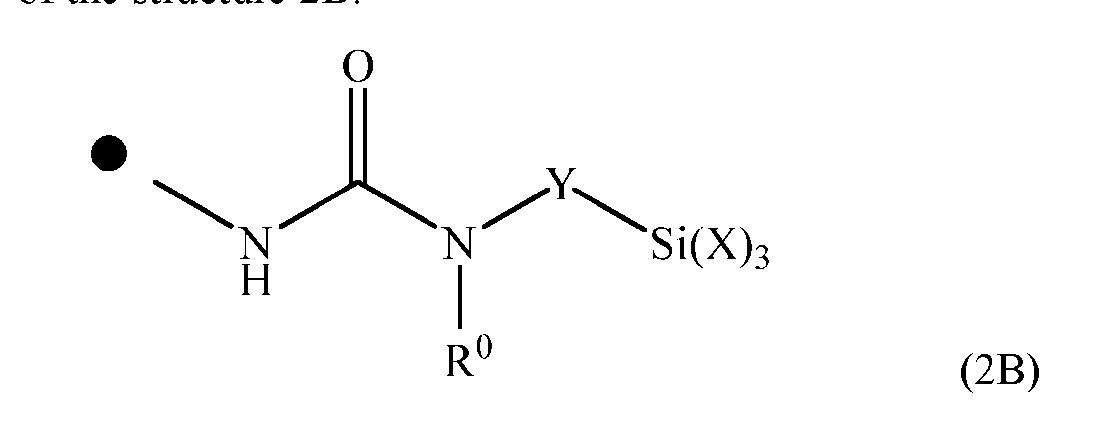 in which X, Y, and " • " are each as described in clause 1 respect to structures ( l)-(3) and R° is not hydrogen, such as where the moiety of the structure 2B has the structure 2B(i):
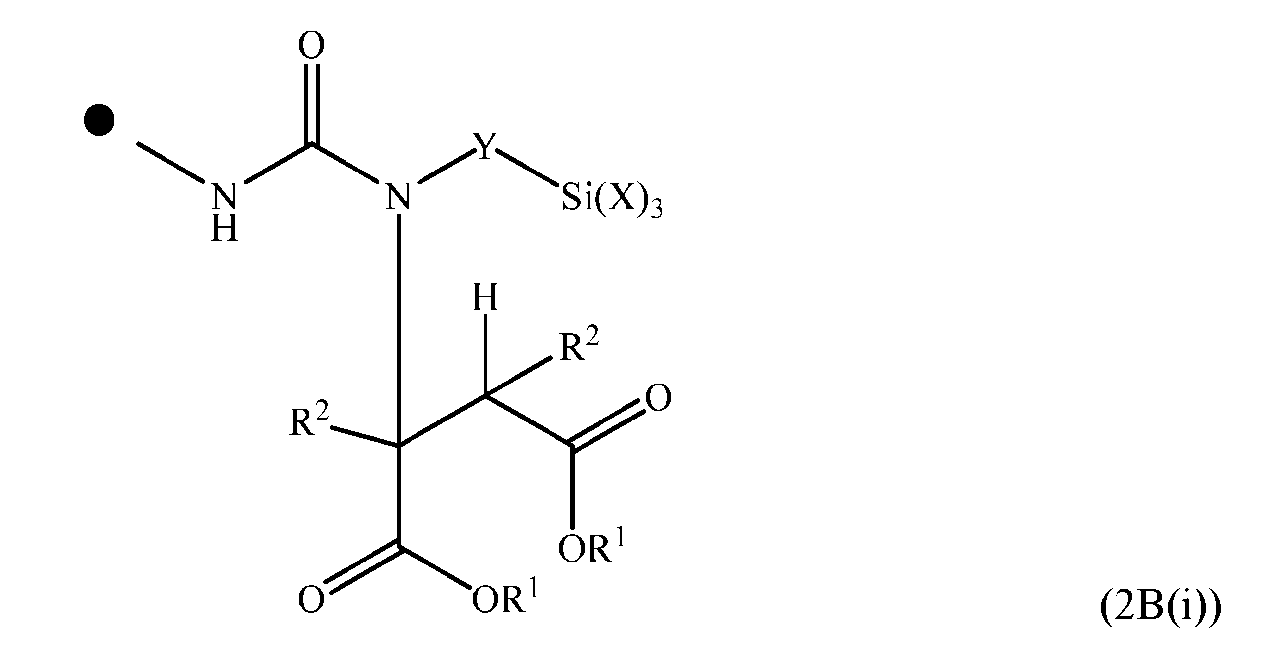 in which X, Y, R1, R2 and " - • " are each as described in clause 1 with respect to structures (l)-(3).
[0131] Clause 10. The polysilane compound of one of clause 1 to clause 9, wherein the polysilane compound has a molecular weight, calculated from the molecular formula of the poly silane compound, of 400 to less than 2000 g/mol, such as 400 to 1000 g/mol.
[0132] Clause 11. A poly silane compound (or the poly silane compound of one of clause 1 to clause
5 and clause 10), wherein the polysilane compound has the structure (4):
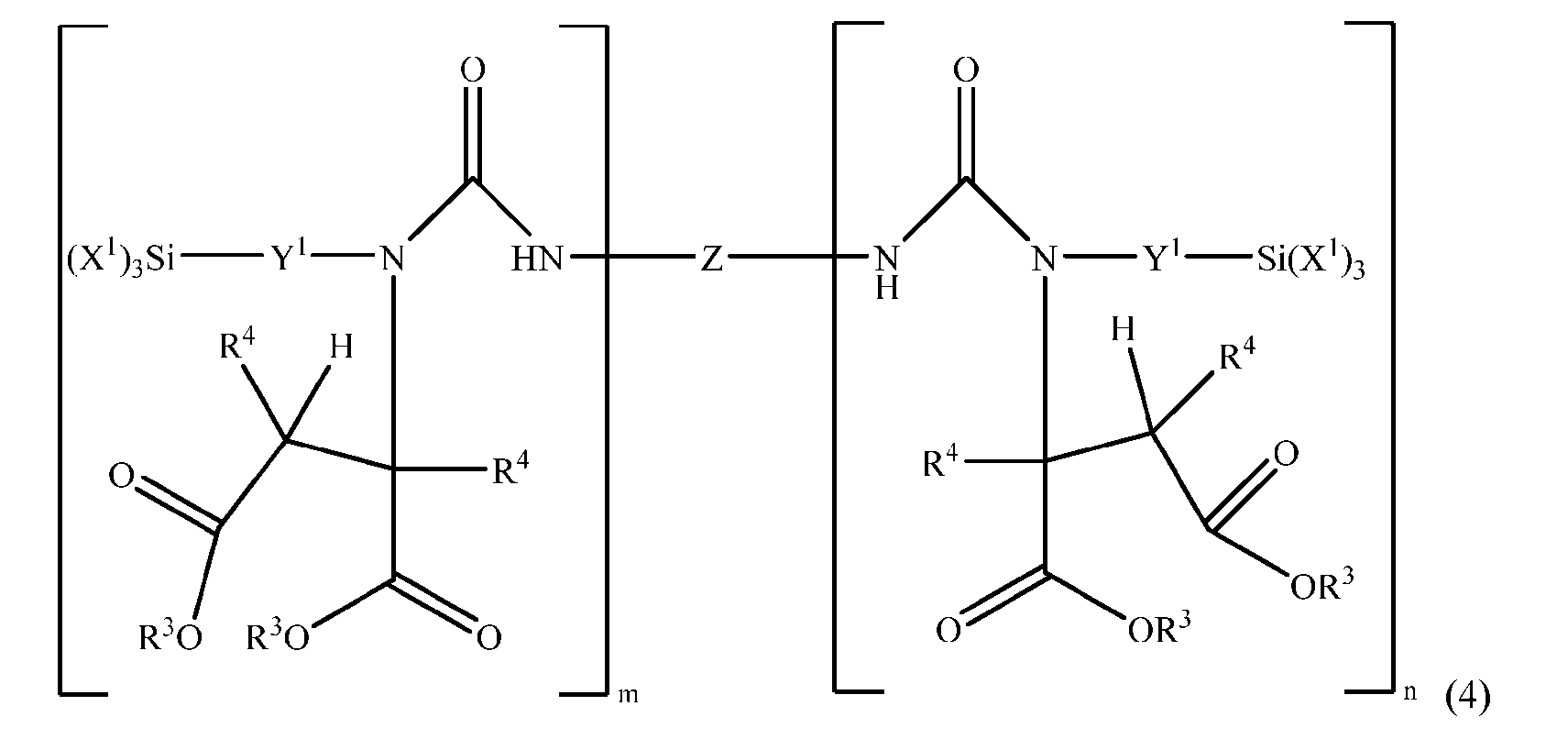 in which (i) each Y1, which may be the same or different, represents a linear or branched linking group comprising 1 or more carbon atoms, (ii) each R3, which may be the same or different, represents an organic group that is inert towards isocyanate groups at temperatures of 100°C or less, (iii) each R4, which may be the same or different, each represent hydrogen or an organic group that is inert to isocyanate groups at temperatures of 100°C or less, (iv) each X1, which may be the same or different, represents an alkoxy group or an organic group that is inert towards isocyanate groups at temperatures of 100°C or less, with the proviso that at least one X1 represents an alkoxy group, (v) Z represents an organic group, in some cases a divalent organic group, that is inert towards isocyanate groups at temperatures of 100°C or less, such as a hydrocarbon group that optionally contains isocyanate-inert oxygen, nitrogen, sulfur, or a combination thereof and that includes a Ci to Cis alkylene group or a Cs-Ce cycloalkylene group, and (vi) m and n, which may be the same or different, are each an integer having a value of 1 to 5, such as 1 to 3, or 1, such as where m+n is 2 to 10, such as 2 to 4, or 2, such as where the polysilane compound has a molecular weight, calculated from the molecular formula of the polysilane compound, of 400 to less than 2000 g/mol, such as 400 to 1000 g/mol.
[0133] Clause 12. The polysilane compound of clause 11, wherein each R3 in structure (4), which may be the same or different, represents an alkyl group, such as an alkyl group having 1 to 9 or 1 to 4 carbon atoms, such as where each R3, which may be the same or different, represents a methyl group, an ethyl group, a propyl group or a butyl group.
[0134] Clause 13. The polysilane compound of clause 11 or clause 12, wherein each X1 in structure (4) represents an identical or different alkyl, acyloxy, or alkoxy group, such as an identical or different alkyl, acyloxy, or alkoxyl group having 1 to 9 or 1 to 4 carbon atoms, with the proviso that at least one X1 represents an alkoxy group, such as where at least two Xns represent an alkoxy, such as methoxy, ethoxy, or propyloxy, group, or where each X1 represents an alkoxy, such as methoxy, ethoxy, or propyloxy group.
[0135] Clause 14. The polysilane compound of one of clause 11 to clause 13, wherein each Y1 in structure (4), which may be the same or different, comprises a linear or branched alkylene radical having 1 to 8 carbon atoms, such as a linear alkylene radical having 2 to 4 or, in some cases 3, carbon atoms, or a branched alkylene radical having 5 to 6 carbon atoms.
[0136] Clause 15. The polysilane compound of one of clause 11 to clause 14, wherein Z in structure (4) is:


[0137] Clause 162. A polysilane compound (or the polysilane compound of one of clause 1 to clause 5 and clause 10), wherein the polysilane compound has the structure (5):
 in which (i) each Y1, which may be the same or different, represents a linear or branched linking group comprising 1 or more carbon atoms, (ii) each R3, which may be the same or different, represents an organic group that is inert towards isocyanate groups at temperatures of 100°C or less, (iii) each R4, which may be the same or different, each represent hydrogen or an organic group that is inert to isocyanate groups at temperatures of 100°C or less, (iv) each X1, which may be the same or different, represents an alkoxy group or an organic group that is inert towards isocyanate groups at temperatures of 100°C or less, with the proviso that at least one X1 represents an alkoxy group, (v) Z represents an organic group, in some cases a divalent organic
group, that is inert towards isocyanate groups at temperatures of 100°C or less, such as a hydrocarbon group, which may optionally be substituted with oxygen, nitrogen, sulfur or a combination thereof and that includes a Ci to Cis alkylene group or a Cs-Ce cycloalkylene group, and (vi) m and n, which may be the same or different, are each an integer having a value of 1 to 5, such as 1 to 3, or 1, such as where m+n is 2 to 10, such as 2 to 4, or 2, such as where the polysilane compound has a molecular weight, calculated from the molecular formula of the polysilane compound, of 400 to less than 2000 g/mol, such as 400 to 1000 g/mol.
in which (i) each Y1, which may be the same or different, represents a linear or branched linking group comprising 1 or more carbon atoms, (ii) each R3, which may be the same or different, represents an organic group that is inert towards isocyanate groups at temperatures of 100°C or less, (iii) each R4, which may be the same or different, each represent hydrogen or an organic group that is inert to isocyanate groups at temperatures of 100°C or less, (iv) each X1, which may be the same or different, represents an alkoxy group or an organic group that is inert towards isocyanate groups at temperatures of 100°C or less, with the proviso that at least one X1 represents an alkoxy group, (v) Z represents an organic group, in some cases a divalent organic
group, that is inert towards isocyanate groups at temperatures of 100°C or less, such as a hydrocarbon group, which may optionally be substituted with oxygen, nitrogen, sulfur or a combination thereof and that includes a Ci to Cis alkylene group or a Cs-Ce cycloalkylene group, and (vi) m and n, which may be the same or different, are each an integer having a value of 1 to 5, such as 1 to 3, or 1, such as where m+n is 2 to 10, such as 2 to 4, or 2, such as where the polysilane compound has a molecular weight, calculated from the molecular formula of the polysilane compound, of 400 to less than 2000 g/mol, such as 400 to 1000 g/mol.
[0138] Clause 17. The polysilane compound of clause 16, wherein each R3 in structure (5), which may be the same or different, represents an alkyl group, such as an alkyl group having 1 to 9 or 1 to 4 carbon atoms, such as where each R3, which may be the same or different, represents a methyl group, an ethyl group, a propyl group or a butyl group.
[0139] Clause 18. The polysilane compound of clause 16 or clause 17, wherein each X1 in structure (5) represents an identical or different alkyl, acyloxy, or alkoxy group, such as an identical or different alky-1, acyloxy, or alkoxyl group having 1 to 9 or 1 to 4 carbon atoms, with the proviso that at least one X1 represents an alkoxy group, such as where at least two X"s represent an alkoxy, such as methoxy, ethoxy, or propyloxy, group, or where each X1 represents an alkoxy, such as methoxy, ethoxy, or propyloxy group.
[0140] Clause 19. The polysilane compound of one of clause 16 to clause 18, wherein each Y1 in structure (5), which may be the same or different, comprises a linear or branched alkylene radical having 1 to 8 carbon atoms, such as a linear alkylene radical having 2 to 4 or, in some cases 3, carbon atoms, or a branched alkylene radical having 5 to 6 carbon atoms.
[0141] Clause 20. The polysilane compound of one of clause 16 to clause 19, wherein Z in structure (5) is:


[0143] Clause 22. The polysilane compound of clause 21, wherein each R3 in structure (6), which may be the same or different, represents an alkyl group, such as an alkyl group having 1 to 9 or 1 to 4 carbon atoms, such as where each R3 in structure (6), which may be the same or different, represents an alkyl group, such as an alkyl group having 1 to 9 or 1 to 4 carbon atoms, such as each R3 in structure (6), which may be the same or different, represents a methyl group, an ethyl group, a propyl group or a butyl group.
[0144] Clause 23. The polysilane compound of clause 21 or clause 22, wherein each X1 in structure (6) represents an identical or different alkyl acyloxy or alkoxy group such as an identical or different alkyl,
acyloxy, or alkoxyl group having 1 to 9 or 1 to 4 carbon atoms, with the proviso that at least one X1 represents an alkoxy group, such as where at least two Xns represent an alkoxy, such as methoxy, ethoxy, or propyloxy, group, or where each X1 represents an alkoxy, such as methoxy, ethoxy, or propyloxy group.
[0145] Clause 24. The polysilane compound of one of clause 21 to clause 23, wherein each Y1 in structure (6), which may be the same or different, comprises a linear or branched alkylene radical having 1 to 8 carbon atoms, such as a linear alkylene radical having 2 to 4 or, in some cases 3, carbon atoms, or a branched alkylene radical having 5 to 6 carbon atoms.
[0146] Clause 25. The poly silane compound of one of clause 21 to clause 24, wherein Z in structure (6) is:
 may be the same or different, has a value of 1 to 10, provided that the structure has a molecular weight of 200 to 1500;

 o. ,N. in which each " - • " represents a linkage to another portion of the polysilane compound.
[0147] Clause 26. A polysilane compound (or the polysilane compound of one of clause 1 to clause 5 and clause 10), wherein the polysilane compound has the structure (7):
 wherein: (i) each Y1, which may be the same or different, represents a linear or branched linking group comprising 1 or more carbon atoms, (ii) Y2 represents a group of the structure:
 represents a linkage to N, and in which G is 0, S, or NR in which R is hydrogen or an organic group that is inert to isocyanate groups at temperatures of 100°C or less, Z represents an organic group that is inert towards isocyanate groups at temperatures of 100°C or less, such as a hydrocarbon group that optionally contains isocyanate-inert oxygen, nitrogen, sulfur, or a combination thereof, (iii) p is 0 or 1, (iv) each R3, which may be the same or different, represents an organic group that is inert to isocyanate groups at temperatures of 100°C or less; (v) each R4, which may be tire same or different, represents hydrogen or an organic group that is inert to isocyanate groups at temperatures of 100°C or less; and (vi) each X1, which may be the same or different, represents an alkoxy group or an organic group that is inert towards isocyanate groups at temperatures of 100°C or less, with the proviso that at least one X1 represents an alkoxy group, such as where the polysilane compound has a molecular weight, calculated from the molecular formula of the poly silane compound, of 400 to less than 2000 g/mol, such as 400 to 1000 g/mol.
[0148] Clause 27. The polysilane compound of clause 26, wherein each R3 in structure (7), which may be the same or different, represents an alkyl group, such as an alkyl group having 1 to 9 or 1 to 4 carbon atoms, such as where each R3 in structure (7), which may be the same or different, represents an alkyl group, such as an alkyl group having 1 to 9 or 1 to 4 carbon atoms, such as each R3 in structure (7), which may be the same or different, represents a methyl group, an ethyl group, a propyl group or a butyl group.
[0149] Clause 28. The poly silane compound of clause 26 or clause 27, wherein each X1 in structure (7) represents an identical or different alkyl, acyloxy, or alkoxy group, such as an identical or different alkyl, acyloxy, or alkoxyl group having 1 to 9 or 1 to 4 carbon atoms, with the proviso that at least one X1 represents an alkoxy group, such as where at least two X*'s represent an alkoxy, such as methoxy, ethoxy, or propyloxy, group, or where each X1 represents an alkoxy, such as methoxy, ethoxy, or propyloxy group.
[0150] Clause 29. The polysilane compound of one of clause 26 to clause 28, wherein each Y1 in structure (7), which may be the same or different, comprises a linear or branched alkylene radical having 1 to 8 carbon atoms, such as a linear alkylene radical having 2 to 4 or, in some cases 3, carbon atoms, or a branched alkylene radical having 5 to 6 carbon atoms.
[0151] Clause 30. The polysilane compound of one of clause 26 to clause 29, wherein Z in structure (7) is:


[0152] Clause 31. A polysilane compound (or the polysilane compound of one of clause 1 to clause 5 and clause 10), wherein the polysilane compound has the structure (8):
 in which: (i) each Y1, which may be the same or different, represents a linear or branched linking group comprising 1 or more carbon atoms, (ii) each Y2, which may be the same or different, represents a group of
O
G 'N - Z the structure: H , in which ® represents a linkage to Y1 and z represents a linkage to N, and in which G is O, S, or NR in which R is hydrogen or an organic group that is inert to isocyanate groups at temperatures of 100°C or less, Z represents an organic group that is
inert towards isocyanate groups at temperatures of 100°C or less, such as a hydrocarbon group that optionally contains isocyanate-inert oxygen, nitrogen, sulfur, or a combination thereof, (iii) each p, which may be the same or different, is 0 or 1, (iv) each R3, which may be the same or different, represents an organic group that is inert towards isocyanate groups at temperatures of 100°C or less, (v) each R4, which may be the same or different, each represent hydrogen or an organic group that is inert to isocyanate groups at temperatures of 100°C or less, (vi) each X1, which may be the same or different, represents an alkoxy group or an organic group that is inert towards isocyanate groups at temperatures of 100°C or less, with the proviso that at least one X1 represents an alkoxy group, (vii) Z represents an organic group, in some cases a divalent organic group, that is inert towards isocyanate groups at temperatures of 100°C or less, such as a hydrocarbon group that includes a Ci to Cis alkylene group or a Cs-Ce cycloalkylene group, and (vii) m and n, which may be the same or different, are each an integer having a value of 1 to 5, such as 1 to 3, or 1, such as where m+n is 2 to 10, such as 2 to 4, or 2, such as where the polysilane compound has a molecular weight, calculated from the molecular formula of the polysilane compound, of 400 to less than 2000 g/mol, such as 400 to 1000 g/mol. [0153] Clause 32. The polysilane compound of clause 31, wherein each R3 in structure (8), which may be the same or different, represents an alkyl group, such as an alkyl group having 1 to 9 or 1 to 4 carbon atoms, such as where each R3, which may be the same or different, represents a methyl group, an ethyl group, a propyl group or a butyl group.
[0154] Clause 33. The polysilane compound of clause 31 or clause 32, wherein each X1 in structure (8) represents an identical or different alkyl, acyloxy, or alkoxy group, such as an identical or different alkyl, acyloxy, or alkoxyl group having 1 to 9 or 1 to 4 carbon atoms, with the proviso that at least one X1 represents an alkoxy group, such as where at least two Xns represent an alkoxy, such as methoxy, ethoxy, or propyloxy, group, or where each X1 represents an alkoxy, such as methoxy, ethoxy, or propyloxy group.
[0155] Clause 34. The polysilane compound of one of clause 31 to clause 33, wherein each Y1 in structure (8), which may be the same or different, comprises a linear or branched alkylene radical having 1 to 8 carbon atoms, such as a linear alkylene radical having 2 to 4 or, in some cases 3, carbon atoms, or a branched alkylene radical having 5 to 6 carbon atoms.
[0156] Clause 35. The polysilane compound of one of clause 31 to clause 34, wherein Z in structure (8) is:


[0157] Clause 36. A polysilane compound (or the polysilane compound of one of clause 1 to clause 5 and clause 10), wherein the polysilane compound has the structure (9):
 in which: (i) each Y1, which may be the same or different, represents a linear or branched Unking group comprising 1 or more carbon atoms, (ii) each Y2, which may be the same or different, represents a group of the structure: represents a linkage to Y1 and

 represents a linkage to N, and in which G is O, S, or NR in which R is hydrogen or an organic group that is inert to isocyanate groups at temperatures of 100°C or less, Z represents an organic group that is inert towards isocyanate groups at temperatures of 100°C or less, such as a hydrocarbon group that optionally
contains isocyanate-inert oxygen, nitrogen, sulfur, or a combination thereof, (iii) each p, which may be the same or different, is 0 or 1, (iv) each R3, which may be the same or different, represents an organic group that is inert towards isocyanate groups at temperatures of 100°C or less, (v) each R4, which may be the same or different, each represent hydrogen or an organic group that is inert to isocyanate groups at temperatures of 100°C or less, (vi) each X1, which may be the same or different, represents an alkoxy group or an organic group that is inert towards isocyanate groups at temperatures of 100°C or less, with the proviso that at least one X1 represents an alkoxy group, (vii) Z represents an organic group, in some cases a divalent organic group, that is inert towards isocyanate groups at temperatures of 100°C or less, such as a hydrocarbon group that includes a Ci to Cis alkylene group or a Cs-Ce cycloalkylene group, and (vii) m and n, which may be the same or different, are each an integer having a value of 1 to 5, such as 1 to 3, or 1, such as where m+n is 2 to 10, such as 2 to 4, or 2, such as where the polysilane compound has a molecular weight, calculated from the molecular formula of the polysilane compound, of 400 to less than 2000 g/mol, such as 400 to 1000 g/mol. [0158] Clause 37. The polysilane compound of clause 36, wherein each R3 in structure (9), which may be the same or different, represents an alkyl group, such as an alkyl group having 1 to 9 or 1 to 4 carbon atoms, such as where each R3, which may be the same or different, represents a methyl group, an ethyl group, a propyl group or a butyl group.
represents a linkage to N, and in which G is O, S, or NR in which R is hydrogen or an organic group that is inert to isocyanate groups at temperatures of 100°C or less, Z represents an organic group that is inert towards isocyanate groups at temperatures of 100°C or less, such as a hydrocarbon group that optionally
contains isocyanate-inert oxygen, nitrogen, sulfur, or a combination thereof, (iii) each p, which may be the same or different, is 0 or 1, (iv) each R3, which may be the same or different, represents an organic group that is inert towards isocyanate groups at temperatures of 100°C or less, (v) each R4, which may be the same or different, each represent hydrogen or an organic group that is inert to isocyanate groups at temperatures of 100°C or less, (vi) each X1, which may be the same or different, represents an alkoxy group or an organic group that is inert towards isocyanate groups at temperatures of 100°C or less, with the proviso that at least one X1 represents an alkoxy group, (vii) Z represents an organic group, in some cases a divalent organic group, that is inert towards isocyanate groups at temperatures of 100°C or less, such as a hydrocarbon group that includes a Ci to Cis alkylene group or a Cs-Ce cycloalkylene group, and (vii) m and n, which may be the same or different, are each an integer having a value of 1 to 5, such as 1 to 3, or 1, such as where m+n is 2 to 10, such as 2 to 4, or 2, such as where the polysilane compound has a molecular weight, calculated from the molecular formula of the polysilane compound, of 400 to less than 2000 g/mol, such as 400 to 1000 g/mol. [0158] Clause 37. The polysilane compound of clause 36, wherein each R3 in structure (9), which may be the same or different, represents an alkyl group, such as an alkyl group having 1 to 9 or 1 to 4 carbon atoms, such as where each R3, which may be the same or different, represents a methyl group, an ethyl group, a propyl group or a butyl group.
[0159] Clause 38. The polysilane compound of clause 36 or clause 37, wherein each X1 in structure (9) represents an identical or different alkyl, acyloxy, or alkoxy group, such as an identical or different alky-1, acyloxy, or alkoxyl group having 1 to 9 or 1 to 4 carbon atoms, with the proviso that at least one X1 represents an alkoxy group, such as where at least two Xns represent an alkoxy, such as methoxy, ethoxy, or propyloxy, group, or where each X1 represents an alkoxy, such as methoxy, ethoxy, or propyloxy group.
[0160] Clause 39. The polysilane compound of one of clause 36 to clause 38, wherein each Y1 in structure (9), which may be the same or different, comprises a linear or branched alkylene radical having 1 to 8 carbon atoms, such as a linear alkylene radical having 2 to 4 or, in some cases 3, carbon atoms, or a branched alkylene radical having 5 to 6 carbon atoms.
[0161] Clause 40. The poly silane compound of one of clause 36 to clause 39, wherein Z in structure (9) is:


[0163] Clause 42. The polysilane compound of clause 41, wherein each R3 in structure (10), which may be the same or different, represents an alkyl group, such as an alkyl group having 1 to 9 or 1 to 4 carbon atoms, such as where each R3, which may be the same or different, represents a methyl group, an ethyl group, a propyl group or a butyl group.
[0164] Clause 43. The polysilane compound of clause 41 or clause 42, wherein each X1 in structure (10) represents an identical or different alkyl, acyloxy, or alkoxy group, such as an identical or different alkyl, acyloxy, or alkoxyl group having 1 to 9 or 1 to 4 carbon atoms, with the proviso that at least one X1 represents an alkoxy group, such as where at least two Xns represent an alkoxy, such as methoxy, ethoxy, or propyloxy, group, or where each X1 represents an alkoxy, such as methoxy, ethoxy, or propyloxy group.
[0165] Clause 44. The polysilane compound of one of clause 41 to clause 43, wherein each Y1 in structure (10), which may be the same or different, comprises a linear or branched alkylene radical having 1 to 8 carbon atoms, such as a linear alkylene radical having 2 to 4 or, in some cases 3, carbon atoms, or a branched alkylene radical having 5 to 6 carbon atoms.
[0166] Clause 45. The polysilane compound of one of clause 41 to clause 44, wherein Z in structure (10) is:
 may be the same or different, has a value of 1 to 10, provided that the structure has a molecular weight of 200 to 1500;


[0167] Clause 46. A polysilane compound (or the polysilane compound of one of clause 1 to clause 5 and clause 10), wherein the polysilane compound has the structure (11):
 wherein (i) each Y1, which may be the same or different, represents a linear or branched linking group comprising 1 or more carbon atoms, (ii) each Y2, which may be the same or different, represents a group of
the structure
wherein (i) each Y1, which may be the same or different, represents a linear or branched linking group comprising 1 or more carbon atoms, (ii) each Y2, which may be the same or different, represents a group of
the structure
 represents a linkage to Y1 and
 represents a linkage to N, and in which G is 0, S, or NR in which R is hydrogen or an organic group that is inert to isocyanate groups at temperatures of 100°C or less, Z represents an organic group that is inert towards isocyanate groups at temperatures of 100°C or less, such as a hydrocarbon group that optionally contains isocyanate-inert oxygen, nitrogen, sulfur, or a combination thereof, (iii) each p, which may be the same or different, is 0 or 1, (iv) each R3, which may be the same or different, represents an organic group that is inert towards isocyanate groups at temperatures of 100°C or less, (v) each R4, which may be the same or different, each represent hydrogen or an organic group that is inert to isocyanate groups at temperatures of 100°C or less, (vi) each X1, which may be the same or different, represents an alkoxy group or an organic group that is inert towards isocyanate groups at temperatures of 100°C or less, with the proviso that at least one X1 represents an alkoxy group, (vii) Z represents an organic group, in some cases a divalent organic group, that is inert towards isocyanate groups at temperatures of 100°C or less, such as a hydrocarbon group that includes a Ci to Cn alkylene group or a Cs-Ce cycloalkylene group, and (vii) m+n is 2 to 10, such as 2 to 4, or 2, such as where the polysilane compound has a molecular weight, calculated from the molecular formula of the polysilane compound, of 400 to less than 2000 g/mol, such as 400 to 1000 g/mol. [0168] Clause 47. The polysilane compound of clause 46, wherein each R3 in structure (11), which may be the same or different, represents an alkyl group, such as an alkyl group having 1 to 9 or 1 to 4 carbon atoms, such as where each R3, which may be the same or different, represents a methyl group, an ethyl group, a propyl group or a butyl group.
[0169] Clause 48. The polysilane compound of clause 46 or clause 47, wherein each X1 in structure (11) represents an identical or different alkyl, acyloxy, or alkoxy group, such as an identical or different alkyl, acyloxy, or alkoxyl group having 1 to 9 or 1 to 4 carbon atoms, with the proviso that at least one X1 represents an alkoxy group, such as where at least two Xns represent an alkoxy, such as methoxy, ethoxy, or propyloxy, group, or where each X1 represents an alkoxy, such as methoxy, ethoxy, or propyloxy group.
[0170] Clause 49. The polysilane compound of one of clause 46 to clause 48, wherein each Y1 in structure (11), which may be the same or different, comprises a linear or branched alkylene radical having 1 to 8 carbon atoms, such as a linear alkylene radical having 2 to 4 or, in some cases 3, carbon atoms, or a branched alkylene radical having 5 to 6 carbon atoms.
[0171] Clause 50. The polysilane compound of one of clause 46 to clause 49, wherein Z in structure (11) is:
07
•X
, in which x has a value of 3 to 19; e (CH2)X1
C2H5 (or H) , in which each XI, X2, X3 and X4, which may be the same or different, has a value of 1 to 10, provided that the structure has a molecular weight of 200 to 1500;


[0172] Clause 51. A polysilane compound (or the polysilane compound of one of clause 1 to clause 50) comprising a reaction product of reactants comprising: (a) a polyisocyanate, such as a diisocyanate; and (b) an aspartate silane having the structure:
 in which each R15 and each X4, which may be the same or different, represents an organic group that is inert with respect to isocyanate groups at temperatures of 100°C or less, with the proviso that at least one X4 represents an alkoxy group, Y4 represents a linear or branched linking group comprising 1 or more carbon atoms, and each R15b, which may be the same or different, represents hydrogen or an organic group which is inert towards isocyanate groups at temperatures of 100°C or less, such as where the polysilane compound has a molecular weight, calculated from the molecular formula of the polysilane compound, of 400 to less than 2000 g/mol, such as 400 to 1000 g/mol.
[0173] Clause 52. The polysilane compound of clause 51, wherein the aspartate silane comprises a reaction product of reactants canprising: (i) an aminoalkyl alkoxysilane of the formula
H2N - (CH2)n 1 Si(X )3 , a maiejc or fumaric acid ester of the formula
in which R16 and R17 represent identical or different organic
 groups which are isocyanate-inert below 100°C, such as where R16 and R17 represent identical or different alkyl groups having 1 to 4 carbon atoms, each R”, which may be the same or different, represents hydrogen or an organic group which is isocyanate-inert below 100°C each X5 represents identical or different organic groups which are isocyanate-inert below 100°C, with the proviso that at least one X5 is an alkoxy group, such as where each X5 represents an identical or different alkyl or alkoxy group having 1 to 4 carbon atoms, with the proviso that at least one X5 is an alkoxy group, and n is an integer having a value of 2 to 4, such as 3. [0174] Clause 53. The polysilane compound of clause 52, wherein the aminoalkyl alkoxysilane comprises 2-aminoethyl-dimethylmethoxysilane, 3-aminopropyl-trimethoxysilane, 3-aminopropyl- triethoxysilane, 3-aminopropyl-methyl-diethoxysilane, or a mixture of any two or more thereof.
[0175] Clause 54. The polysilane compound of clause 52 or clause 53, wherein the maleic or fumaric acid esters comprises maleic acid dimethyl ester, maleic acid diethyl ester, maleic acid di-n-butyl ester, fumaric acid dimethyl ester, fumaric acid diethyl ester, fumaric acid di-n-butyl ester, or a mixture of any two or more thereof.
[0176] Clause 55. The polysilane compound of one of clause 52 to clause 54, wherein the maleic or fumaric acid ester and the aminoalkyl alkoxysilane are present in a molar ratio of acid ester to aminoalkyl alkoxysilane of 0.8 to 1.2:1, 1.0 to 1.2:1 or 1.01 to 1.2:1.
[0177] Clause 56. The polysilane compound of one of clause 51 to clause 55, wherein the polyisocyanate has the structure
 , in which Z represents an organic group, in some cases a divalent organic group, that is inert towards isocyanate groups at temperatures of 100°C or less, such as a hydrocarbon group that includes a Ci to CH alkylene group or a Cs-Ce cycloalkylene group, and m and n, which may be the same or different, are each an integer having a value of 1 to 5, such as 1 to 3, or 1, such as where m+n is 2 to 10, such as 2 to 4, or 2, and such as where Z in the foregoing polyisocyanate structure is:


[0179] Clause 57. A method for making the polysilane canpound of one of clause 51 to clause 52, comprising reacting the polyisocyanate with the aspartate silane, optionally in the presence of a catalyst, to produce a polysilane compound comprising an aspartate group.
[0180] Clause 58. The method of clause 57, wherein the optional catalyst comprises an organic metal catalyst, an amine catalyst, or a combination thereof, such as where the catalyst comprises a copper compound, such as copper naphthenate, a cobalt compound, such as cobalt naphthenate, a zinc compound, such as zinc naphthenate, a bismuth compound, such as bismuth neodecanoate, a tin compound, such as di-n- butyl tin dilaurate, triethylamine, triethylenediamine, DABCO, DMEA, or a combination of any two or more of the foregoing.
[0181] Clause 59. The method of clause 57 or clause 58, wherein the reaction takes place at a temperature of 10 to 120°C or 25 to 100°C.
[0182] Clause 60. The method of one of clause 57 to clause 59, wherein the polyisocyanate and the aspartate silane are used in relative amounts to provide a molar ratio of isocyanate-reactive groups to isocyanate groups of at least 1:1, such as more than 1: 1 to less than 1.5:1.
[0183] Clause 61. The method of one of clause 57 to clause 60, further comprising converting at least some of the aspartate groups to a hydantoin group, wherein such conversion is carried out optionally in the presence of a catalyst, such as a Bronsted acids, a carboxylic acid, a sulfonic acid, a phenol, or a mixture of any two or more thereof, at a reaction temperature of 0 to 200°C, 70 to 130°C, 75 to 105°C, 80° to 100°C, 90 to 120°C, or 100 to 120°C.
[0184] Clause 62. A polysilanc compound (or the polysilanc compound of one of clause 1 to clause 50) comprising a reaction product of reactants comprising: (a) an aspartate silane; and (b) isocyanate- functional silane, wherein (1) the aspartate silane has the structure:
 in which (i) each R15 and each X4, which may be the same or different, represents an organic group that is inert with respect to isocyanate groups at temperatures of 100°C or less, with the proviso that at least one X4 represents an alkoxy group, (ii) Y4 represents a linear or branched linking group comprising 1 or more carbon atoms, and (iii) each R15b, which may be foe same or different, represents hydrogen or an organic group which is inert towards isocyanate groups at temperatures of 100°C or less, and (2) foe isocyanate-functional silane has the structure:
 , in which (i) Y1 represents a linear or branched linking group comprising 1 or more carbon atoms, such as where Y1 comprises a linear or branched alkylene radical having 1 to 8 carbon atoms, such as a linear alkylene radical having 2 to 4 or, in some cases, 3 carbon atoms, or a branched alkylene radical having 5 to 6 carbon atoms, (ii) Y2 represents a group of the structure:
 represents a linkage to N, and in which G is 0, S, or NR in which R is hydrogen or an organic group that is inert to isocyanate groups at temperatures of 100°C or less, Z represents anorganic group that is inert towards isocyanate groups at temperatures of 100°C or less, such as a hydrocarbon group that optionally contains isocyanate-inert oxygen, nitrogen, sulfur, or a combination thereof, (iii) p is 0 or 1, and (iv) each X1, which may be the same or different, represents an alkoxy group or an organic group that is inert towards isocyanate groups at temperatures of 100°C or less, with the proviso that at least one X1 represents an alkoxy group, such as where each X1 represents an identical or different alkyl, acyloxy, or alkoxy group, such as an identical or different alkyl, acyloxy, or alkoxyl group having 1 to 9 or 1 to 4 carbon atoms, with tire proviso that at least one X1 represents an alkoxy group, such as where the polysilane compound has a molecular weight, calculated from the molecular formula of the polysilane compound, of 400 to less than 2000 g/mol, such as 400 to 1000 g/mol.
[0185] Clause 63. The polysilanc compound of clause 62, wherein the aspartate silane comprises a reaction product of reactants canprising: (i) an aminoalkyl alkoxysilane of the formula
 or fumaric acid ester of the formula
in which R16 and R17 represent identical or different organic
or fumaric acid ester of the formula
in which R16 and R17 represent identical or different organic
 groups which are isocyanate-inert below 100°C, such as where R16 and R17 represent identical or different alkyl groups having 1 to 4 carbon atoms, each R”, which may be the same or different, represents hydrogen or an organic group which is isocyanate-inert below 100°C each X5 represents identical or different organic groups which are isocyanate-inert below 100°C, with the proviso that at least one X5 is an alkoxy group, such as where each X5 represents an identical or different alkyl or alkoxy group having 1 to 4 carbon atoms, with the proviso that at least one X5 is an alkoxy group, and n is an integer having a value of 2 to 4, such as 3. [0186] Clause 64. The polysilane compound of clause 63, wherein the aminoalkyl alkoxysilane comprises 2-aminoethyl-dimethylmethoxysilane, 3-aminopropyl-trimethoxysilane, 3-aminopropyl- triethoxysilane, 3-aminopropyl-methyl-diethoxysilane, or a mixture of any two or more thereof.
[0187] Clause 65. The polysilane compound of clause 63 or clause 64, wherein the maleic or fumaric acid esters comprises maleic acid dimethyl ester, maleic acid diethyl ester, maleic acid di-n-butyl ester, fumaric acid dimethyl ester, fumaric acid diethyl ester, fumaric acid di-n-butyl ester, or a mixture of any two or more thereof.
[0188] Clause 66. The polysilane compound of one of clause 63 to clause 65, wherein the maleic or fumaric acid ester and the aminoalkyl alkoxysilane are present in a molar ratio of acid ester to aminoalkyl alkoxysilane of 0.8 to 1.2:1, 1.0 to 1.2:1 or 1.01 to 1.2: l.s include, without limitation, those described earlier with respect to reaction with a polyisocyanate.
[0189] Clause 67. The polysilane compound of one of clause 62 to clause 66, wherein at least two Xns represent an alkoxy, such as methoxy, ethoxy, or propyloxy, group, or where each X1 represents an alkoxy, such as methoxy, ethoxy, or propyloxy group.
[0190] Clause 68. The poly silane compound of one of clause 62 to clause 67, wherein the isocyanate-functional silane comprises 3-isocyanatopropyl-methyldimethoxysilane, 3-isocyanatopropyl- trimethoxysilane, 3-isocyanatopropyl-triethoxysilane, a reaction product of an active hydrogen-containing silane, such as a hydroxyl, thiol, primary amine, or secondary amine functional silane, and a polyisocyanate, in which the reaction product is an isocyanate-functional silane containing a urethane, thiourcthanc, urea, or aspartic urea group, or a mixture of any two or more of any of the foregoing isocyanate-functional silanes. [0191] Clause 69. The poly silane compound of clause 68, wherein the polyisocyanate has the structure:
 , in which Z represents an organic group, in some cases a divalent organic group, that is inert towards isocyanate groups at temperatures of 100°C or less, such as a hydrocarbon group, which may optionally be substituted oxygen, nitrogen, sulfur, or a combination thereof, and that includes a Ci to Cis alkylene group or a Cs-Cs cycloalkylene group, and m and n, which may be tire same or different, are
each an integer having a value of 1 to 5, such as 1 to 3, or 1, such as where m+n is 2 to 10, such as 2 to 4, or 2, and such as where Z in the foregoing polyisocyanate structure is:
, in which Z represents an organic group, in some cases a divalent organic group, that is inert towards isocyanate groups at temperatures of 100°C or less, such as a hydrocarbon group, which may optionally be substituted oxygen, nitrogen, sulfur, or a combination thereof, and that includes a Ci to Cis alkylene group or a Cs-Cs cycloalkylene group, and m and n, which may be tire same or different, are
each an integer having a value of 1 to 5, such as 1 to 3, or 1, such as where m+n is 2 to 10, such as 2 to 4, or 2, and such as where Z in the foregoing polyisocyanate structure is:
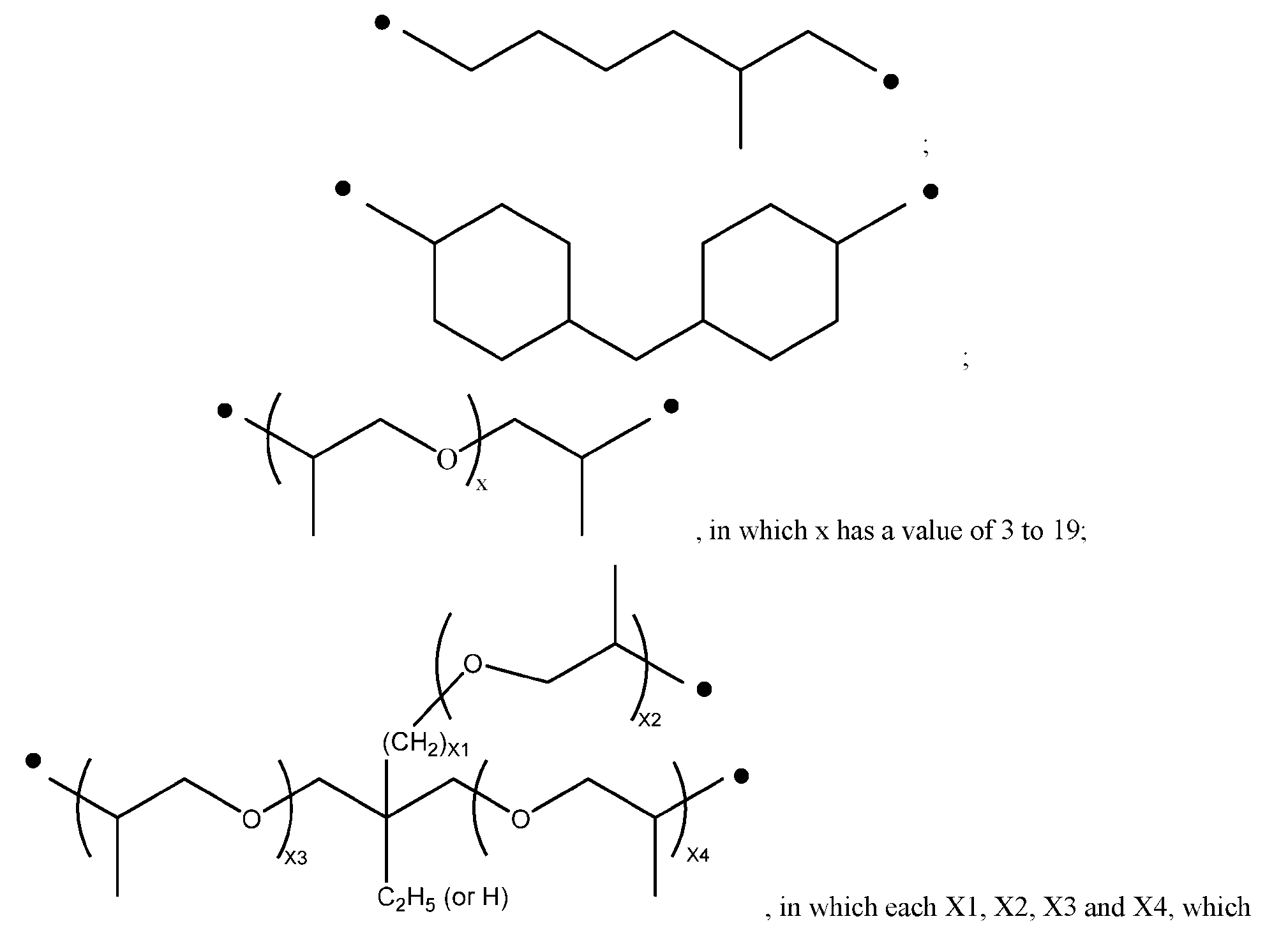 may be the same or different, has a value of 1 to 10, provided that the structure has a molecular weight of 200 to 1500;


 in which each " • " represents a linkage to another portion of the polyisocyanate.
[0192] Clause 70. The polysilane compound of one of clause 68 or clause 69, wherein the polyisocyanate comprises 2,4-tolylene diisocyanate, 2,6-tolylene diisocyanate, 1,3-xylylene diisocyanate, 1,4- xylylene diisocyanate, 1,5-naphthalene diisocyanate, m-phenylene diisocyanate, p-phenylene diisocyanate, 3,3'-dimethyl-4,4'-diphenylmethane diisocyanate, 4,4'-diphenylmethane diisocyanate, 3,3 '-dimethylphenylene diisocyanate, 4,4'-biphenylene diisocyanate, 1,6-hexane diisocyanate, isophorone diisocyanate, methylenebis(4-cyclohexylisocyanate), 2,2,4-trimethylhexamethylene diisocyanate, bis(2-isocyanato- ethyl)fumarate, 6-isopropyl-l,3-phenyl diisocyanate, 4-diphenylpropane diisocyanate, hydrogenated diphenylmethane diisocyanate, hydrogenated xylylene diisocyanate, tetramethyl xylylene diisocyanate, lysine isocyanate, a hexamethylene diisocyanate trimer, triphenylmethane-4,4l,4"-triisocyanate, a hexamethylene diisocyanate trimer, an aromatic polyisocyanate based on toluene diisocyanate, a polyisocyanurate of toluene diisocyanate, or a combination of any two or more thereof.
[0193] Clause 71. A method for making the polysilane canpound of one of clause 62 to clause 70, comprising reacting the aspartate silane with die isocyanate-functional silane, optionally in the presence of a catalyst, to produce a polysilane compound comprising an aspartate group.
[0194] Clause 72. The method of clause 71, wherein the optional catalyst comprises an organic metal catalyst, an amine catalyst, or a combination thereof, such as where the catalyst comprises a copper compound, such as copper naphthenate, a cobalt compound, such as cobalt naphthenate, a zinc compound, such as zinc naphthenate, a bismuth compound, such as bismuth neodecanoate, a tin compound, such as di-n-
butyl tin dilaurate, triethylamine, triethylenediamine, DABCO, DMEA, or a combination of any two or more of the foregoing.
[0195] Clause 73. The method of clause 71 or clause 72, wherein the reaction takes place at a temperature of 10 to 120°C or 25 to 100°C.
[0196] Clause 74. The method of one of clause 71 to clause 73, wherein the aspartate silane and the isocyanate-functional silane are used in relative amounts to provide a molar ratio of isocyanate-reactive groups to isocyanate groups of at least 1:1, such as more than 1: 1 to less than 1.5:1.
[0197] Clause 75. The method of one of clause 71 to clause 74, further comprising converting at least some of the aspartate groups to a hydantoin group, wherein such conversion is carried out optionally in the presence of a catalyst, such as a Bronsted acids, a carboxylic acid, a sulfonic acid, a phenol, or a mixture of any two or more thereof, at a reaction temperature of 0 to 200°C, 70 to 130°C, 75 to 105°C, 80° to 100°C, 90 to 120°C, or 100 to 120°C.
[0198] Clause 76. A polysilane compound (or the polysilane compound of one of clause 1 to clause 50) comprising a reaction product of reactants comprising: (a) a primary amine-containing aspartate and/or a polyaspartate; and (b) isocyanate-functional silane, wherein (1) the isocyanate-functional silane has the structure:
 , in which (i) Y1 represents a linear or branched linking group comprising 1 or more carbon atoms, such as where Y1 comprises a linear or branched alkylene radical having 1 to 8 carbon atoms, such as a linear alkylene radical having 2 to 4 or, in some cases, 3 carbon atoms, or a branched alkylene radical having 5 to 6 carbon atoms, (ii) Y2 represents a group of the structure:
 represents a linkage to N, and in which G is O, S, or NR in which R is hydrogen or an organic group that is inert to isocyanate groups at temperatures of 100°C or less, Z represents an organic group that is inert towards isocyanate groups at temperatures of 100°C or less, such as a hydrocarbon group that optionally contains isocyanate-inert oxygen, nitrogen, sulfur, or a combination thereof, (iii) p is 0 or 1, and (iv) each X1, which may be the same or different, represents an alkoxy group or an organic group that is inert towards isocyanate groups at temperatures of 100°C or less, with the proviso that at least one X1 represents an alkoxy group, such as where each X1 represents an identical or different alkyl, acyloxy, or alkoxy group, such as an identical or different alkyl, acyloxy, or alkoxyl group having 1 to 9 or 1 to 4 carbon atoms, with tire proviso that at least one X1 represents an alkoxy group, and (2) the primary amine-containing aspartate and/or a polyaspartate suitable for use in preparing such polysilane compounds are represented by the structure:
 in which Z1 represents a hydrocarbon group (in some cases a divalent hydrocarbon group) that optionally contains isocyanate-inert oxygen, nitrogen, sulfur, or a combination thereof, and R18 and R19, which may be the same or different, represents an organic group that is inert towards isocyanate groups at temperatures of 100°C or less, such as where R18 and R19 represent the same or different alkyl group, such as an alkyl group having 1 to 9 or 1 to 4 carbon atoms, such as where R18 and R19, which may be the same or different, are each a methyl group, an ethyl group, a propyl group or a butyl group, R20 and R21, which may be the same or different, each represent hydrogen or an organic group that is inert to isocyanate groups at temperatures of 100°C or less, and m and n, which may be tire same or different, are each an integer having a value of 0 to 4, with tire proviso that m+n is at least 2, such as where the polysilane compound has a molecular weight, calculated from the molecular formula of the polysilane compound, of 400 to less than 2000 g/mol, such as 400 to 1000 g/mol.
[0199] Clause 77. The polysilane compound of clause 76, wherein the primary amine-containing aspartate comprises a reaction product of (a) a primary polyamine of the formula: (NHz)n>Z1(NH2)n, in which Z1 is a hydrocarbon group (ins some cases a divalent hydrocarbon group) that is optionally be substituted with oxygen, nitrogen, sulfur, or a combination thereof, and m+n is an integer with a value of at least 2, such as 2 to 4, and (b) a maleic or fumaric acid ester of the formula (with both isomers as represented by wavy bonds):
 which each R22, which may be the same or different, represents an organic groups that is inert towards isocyanate groups at temperatures of 100°C or less and each R23, which may be the same or different, represents hydrogen or an organic groups that is inert towards isocyanate groups at temperatures of 100°C or less.
[0200] Clause 78. The polysilane compound of clause 77, wherein the primary polyamine comprises ethylenediamine, 1,2-diaminopropane, 1,3-diaminopropane, 1,2-diaminobutane, 1,3-diaminobutane, 1,4- diaminobutane, 1,5-diaminopentane, 1,6-diaminohexane, 1,7-diaminoheptane, 1,8-diaminooctane, 2,5- diamino-2,5-dimethylhexane, 2, 2,4-and/or 2,4,4-trimethyl-l,6-diaminohexane, 1,11 -diaminoundecane, 1,12- diaminododecane, bis-(3-aminopropyl) ether, l,2-bis-(3-aminopropyloxy)ethane, l,3-bis-(3-aminopropyloxy)- 2,2'-dimethylpropane, 1,2-bisaminocyclohexane, 1,3-bisaminocyclohexane, 1,4-bisaminocyclohexane, 1,3- bisaminomethylcyclohexane, 1,4-bisaminomethylcyclohexane, 1,3-bisaminoethylcyclohexane, 1,4- bisaminoethylcyclohexane, 1,3-bisaminopropylcyclohexane, 1,4-bisaminopropylcyclohexane, hydrogenated 4,4'-diaminodiphenylmethane, l-amino-3,3,5-trimethyl-5-aminomethyl-cyclohexane, 2,4-and/or 2,6- hexahydrotoluylene diamine, 2,4'-and/or 4,4'-diamino-dicyclohexyl methane, 3,3'-dimethyl-4,4'-diamino- dicyclohexyl methane, propane- 1,2, 3 -triamine, pentane-l,3,5-triamine, benzene-l,3,5-triamine, isophoronediamine, menthanediamine, 1,4-bisaminopropylpiperazine, o-phenylenediamine, m- phenylenediamine, p-phenylenediamine, 2,4-tolylenediamine, 2,6-tolylenediamine, 2,4-toluenediamine, 2,4 - and/or 4,4'-diaminodiphenyl methane, m-aminobenzylamine, 4-chloro-o-phenylenediamine, tetrachloro-p- xylylenediamine, 4-methoxy-6-methyl-m-phenylenediamine, m-xylylenediamine, p-xylylenediamine, 1,5- naphthalenediamine, 2,6-naphthalenediamine, benzidine, 4,4'-bis(o-toluidine), dianisidine, 4,4'- diaminodiphenylmethane, 2,2-(4,4'-diaminodiphenyl)propane, 4,4'-diaminodiphenyl ether, 4,4'4hiodianiline, 4,4'-diaminodiphenylsulfone, 4,4'-diaminoditolylsulfone, methylenebis(o-chloroaniline), 3,9-bis(3- aminopropyl) 2,4,8, 10-tetraoxaspiro[5,5]undecane, diethylenetriamine, iminobispropylamine, methyliminobispropylamine, bis(hexamethylene)triamine, triethylenetetramine, tetraethylenepentamine, pentaethylenehexamine, l,4-bis(aminoethylpiperazine), l,4-bis(aminopropylpiperazine), 2,6-diaminopyridine, and bis(3,4-diaminophenyl)sulfone, relatively high molecular weight polyether polyamines containing aliphatically bound primary amino groups (such as the JEFF AMINE® products commercially available from Huntsman Corp.), and combinations of any two or more of any of the foregoing.
which each R22, which may be the same or different, represents an organic groups that is inert towards isocyanate groups at temperatures of 100°C or less and each R23, which may be the same or different, represents hydrogen or an organic groups that is inert towards isocyanate groups at temperatures of 100°C or less.
[0200] Clause 78. The polysilane compound of clause 77, wherein the primary polyamine comprises ethylenediamine, 1,2-diaminopropane, 1,3-diaminopropane, 1,2-diaminobutane, 1,3-diaminobutane, 1,4- diaminobutane, 1,5-diaminopentane, 1,6-diaminohexane, 1,7-diaminoheptane, 1,8-diaminooctane, 2,5- diamino-2,5-dimethylhexane, 2, 2,4-and/or 2,4,4-trimethyl-l,6-diaminohexane, 1,11 -diaminoundecane, 1,12- diaminododecane, bis-(3-aminopropyl) ether, l,2-bis-(3-aminopropyloxy)ethane, l,3-bis-(3-aminopropyloxy)- 2,2'-dimethylpropane, 1,2-bisaminocyclohexane, 1,3-bisaminocyclohexane, 1,4-bisaminocyclohexane, 1,3- bisaminomethylcyclohexane, 1,4-bisaminomethylcyclohexane, 1,3-bisaminoethylcyclohexane, 1,4- bisaminoethylcyclohexane, 1,3-bisaminopropylcyclohexane, 1,4-bisaminopropylcyclohexane, hydrogenated 4,4'-diaminodiphenylmethane, l-amino-3,3,5-trimethyl-5-aminomethyl-cyclohexane, 2,4-and/or 2,6- hexahydrotoluylene diamine, 2,4'-and/or 4,4'-diamino-dicyclohexyl methane, 3,3'-dimethyl-4,4'-diamino- dicyclohexyl methane, propane- 1,2, 3 -triamine, pentane-l,3,5-triamine, benzene-l,3,5-triamine, isophoronediamine, menthanediamine, 1,4-bisaminopropylpiperazine, o-phenylenediamine, m- phenylenediamine, p-phenylenediamine, 2,4-tolylenediamine, 2,6-tolylenediamine, 2,4-toluenediamine, 2,4 - and/or 4,4'-diaminodiphenyl methane, m-aminobenzylamine, 4-chloro-o-phenylenediamine, tetrachloro-p- xylylenediamine, 4-methoxy-6-methyl-m-phenylenediamine, m-xylylenediamine, p-xylylenediamine, 1,5- naphthalenediamine, 2,6-naphthalenediamine, benzidine, 4,4'-bis(o-toluidine), dianisidine, 4,4'- diaminodiphenylmethane, 2,2-(4,4'-diaminodiphenyl)propane, 4,4'-diaminodiphenyl ether, 4,4'4hiodianiline, 4,4'-diaminodiphenylsulfone, 4,4'-diaminoditolylsulfone, methylenebis(o-chloroaniline), 3,9-bis(3- aminopropyl) 2,4,8, 10-tetraoxaspiro[5,5]undecane, diethylenetriamine, iminobispropylamine, methyliminobispropylamine, bis(hexamethylene)triamine, triethylenetetramine, tetraethylenepentamine, pentaethylenehexamine, l,4-bis(aminoethylpiperazine), l,4-bis(aminopropylpiperazine), 2,6-diaminopyridine, and bis(3,4-diaminophenyl)sulfone, relatively high molecular weight polyether polyamines containing aliphatically bound primary amino groups (such as the JEFF AMINE® products commercially available from Huntsman Corp.), and combinations of any two or more of any of the foregoing.
[0201] Clause 79. The polysilanc compound of clause 77 or clause 78, wherein the maleic or fumaric acid ester comprises maleic acid dimethyl ester, maleic acid diethyl ester, maleic acid di-n-butyl ester, fumaric acid dimethyl ester, fumaric acid diethyl ester, fumaric acid di-n-butyl ester, or a mixture of any two or more thereof.
[0202] Clause 80. The polysilane compound of one of clause 76 to clause 79, wherein the isocyanate-functional silane comprises 3-isocyanatopropyl-methyldimethoxysilane, 3-isocyanatopropyl- trimcthoxysilanc, 3-isocyanatopropyl-tricthoxysilanc, arcaction product of an active hydrogcn-containing silane, such as a hydroxyl, thiol, primary amine, or secondary amine functional silane, and a polyisocyanate, in which the reaction product is an isocyanate-functional silane containing a urethane, thiourethane, urea, or aspartic urea group, or a mixture of any two or more of any of the foregoing isocyanate-functional silanes.
[0203] Clause 81. The polysilane compound of clause 80, wherein tire polyisocyanate has the
OCN - Z — I- NCO structure: • mm I J n , in which Z represents an organic group, in some cases a divalent organic group, that is inert towards isocyanate groups at temperatures of 100°C or less, such as a hydrocarbon group that includes a Ci to Cis alkylene group or a CS-CG cycloalkylene group, and m and n, which may be the same or different, are each an integer having a value of 1 to 5, such as 1 to 3, or 1, such as where m+n is 2 to 10, such as 2 to 4, or 2, and such as where Z in the foregoing polyisocyanate structure is:
0 1 •X
, in which x has a value of 3 to 19;
 , in which each XI, X2, X3 and X4, which may be the same or different, has a value of 1 to 10, provided that the structure has a molecular weight of 200 to 1500;

[0204] Clause 82. The polysilane compound of one of clause 80 or clause 81, wherein the polyisocyanate comprises 2,4-tolylene diisocyanate, 2,6-tolylene diisocyanate, 1,3-xylylene diisocyanate, 1,4- xylylene diisocyanate, 1,5-naphthalene diisocyanate, m-phenylene diisocyanate, p-phenylene diisocyanate, 3,3'-dimethyl-4,4'-diphenylmethane diisocyanate, 4,4'-diphenylmethane diisocyanate, 3,3 '-dimethylphenylene diisocyanate, 4,4'-biphenylene diisocyanate, 1,6-hexane diisocyanate, isophorone diisocyanate, methylenebis(4-cyclohexylisocyanate), 2,2,4-trimethylhexamethylene diisocyanate, bis(2-isocyanato- ethyl)fumarate, 6-isopropyl-l,3-phenyl diisocyanate, 4-diphenylpropane diisocyanate, hydrogenated diphenylmethane diisocyanate, hydrogenated xylylene diisocyanate, tetramethyl xylylene diisocyanate, lysine isocyanate, a hexamethylene diisocyanate trimer, triphenylmethane-4,4l,4"-triisocyanate, a hexamethylene diisocyanate trimer, an aromatic polyisocyanate based on toluene diisocyanate, a polyisocyanurate of toluene diisocyanate, or a combination of any two or more thereof.
[0205] Clause 83. A method for making the polysilane canpound of one of clause 76 to clause 82, comprising reacting the primary amine-containing aspartate and/or a polyaspartate with the isocyanate- functional silane, optionally in the presence of a catalyst, to produce a polysilane compound comprising an aspartate group.
[0206] Clause 84. The method of clause 83, wherein the optional catalyst comprises an organic metal catalyst, an amine catalyst, or a combination thereof, such as where the catalyst comprises a copper compound, such as copper naphthenate, a cobalt compound, such as cobalt naphthenate, a zinc compound, such as zinc naphthenate, a bismuth compound, such as bismuth neodecanoate, a tin compound, such as di-n-
butyl tin dilaurate, triethylamine, triethylenediamine, DABCO, DMEA, or a combination of any two or more of the foregoing.
[0207] Clause 85. The method of clause 83 or clause 84, wherein the reaction takes place at a temperature of 10 to 120°C or 25 to 100°C.
[0208] Clause 86. The method of one of clause 83 to clause 85, wherein the primary amine- containing aspartate and/or a polyaspartate with the isocyanate-functional silane are used in relative amounts to provide a molar ratio of isocyanate-reactive groups to isocyanate groups of at least 1:1, such as more than 1:1 to less than 1.5:1.
[0209] Clause 87. The method of one of clause 83 to clause 86, further comprising converting at least some of the aspartate groups to a hydantoin group, wherein such conversion is carried out optionally in the presence of a catalyst, such as a Bronsted acids, a carboxylic acid, a sulfonic acid, a phenol, or a mixture of any two or more thereof, at a reaction temperature of 0 to 200°C, 70 to 130°C, 75 to 105°C, 80° to 100°C, 90 to 120°C, or 100 to 120°C.
[0210] Clause 88. A polysilane compound (or the polysilane compound of one of clause 1 to clause 50) comprising a reaction product of reactants comprising: (a) isocyanate-functional silane having the structure: , in which (i) Y1 represents a linear or branched linking group
 comprising 1 or more carbon atoms, such as where Y1 comprises a linear or branched alkylene radical having 1 to 8 carbon atoms, such as a linear alkylene radical having 2 to 4 or, in some cases, 3 carbon atoms, or a branched alkylene radical having 5 to 6 carbon atoms, (ii) Y2 represents a group of the structure:
 represents a linkage to N, and in which G is O, S, or NR in which R is hydrogen or an organic group that is inert to isocyanate groups at temperatures of 100°C or less, Z represents an organic group that is inert towards isocyanate groups at temperatures of 100°C or less, such as a hydrocarbon groupthat optionally contains isocyanate-inert oxygen, nitrogen, sulfur, or a combination thereof, (iii) p is 0 or 1, and (iv) each X1, which may be the same or different, represents an alkoxy group or an organic group that is inert towards isocyanate groups at temperatures of 100°C or less, with the proviso that at least one X1 represents an alkoxy group, such as where each X1 represents an identical or different alkyl, acyloxy, or alkoxy group, such as an identical or different alkyl, acyloxy, or alkoxyl group having 1 to 9 or 1 to 4 carbon atoms, with tire proviso that at least
one X1 represents an alkoxy group; and (b) a polyaspartate of the structure
 which (i) each R3, which may be the same or different, represents an organic group that is inert towards isocyanate groups at temperatures of 100°C or less, (ii) each R4, which may be the same or different, each represent hydrogen or an organic group that is inert to isocyanate groups at temperatures of 100°C or less, (iii) Z represents an organic group, in some cases a divalent organic group, that is inert towards isocyanate groups at temperatures of 100°C or less, such as a hydrocarbon group that includes a Ci to Cis alkylene group or a Cs-Ce cycloalkylene group, and (iv) m+n is 2 to 10, such as 2 to 4, or 2, such as where each R3, which may be the same or different, represents an alkyl group, such as an alkyl group having 1 to 9 or 1 to 4 carbon atoms, such as where each R3, which may be the same or different, represents a methyl group, an ethyl group, a propyl group or a butyl group, such as where the polysilane compound has a molecular weight, calculated from tire molecular formula of the polysilane compound, of 400 to less than 2000 g/mol, such as 400 to 1000 g/mol.
[0211] Clause 89. The polysilane compound of clause 88, wherein the isocyanate-functional silane comprises 3-isocyanatopropyl-methyldimethoxysilane, 3-isocyanatopropyl-trimethoxysilane, 3- isocyanatopropyl-triethoxysilane, a reaction product of an active hydrogen-containing silane, such as a hydroxyl, thiol, primary- amine, or secondary amine functional silane, and a polyisocyanate, in which the reaction product is an isocyanate-functional silane containing a urethane, thiourethane, urea, or aspartic urea group, or a mixture of any two or more of any of the foregoing isocyanate-functional silanes.
[0212] Clause 90. The polysilane compound of clause 89, wherein the polyisocyanate has the structure
 in which Z represents an organic group, in some cases a divalent organic group, that is inert towards isocyanate groups at temperatures of 100°C or less, such as a hydrocarbon group that includes a Ci to Cis alkylene group or a Cs-Ce cycloalkylene group, and m and n, which may be the same or different, are each an integer having a value of 1 to 5, such as 1 to 3, or 1, such as where m+n is 2 to 10, such as 2 to 4, or 2, and such as where Z in the foregoing polyisocyanate structure is:


[0213] Clause 91. The polysilane compound of one of clause 89 or clause 90, wherein the polyisocyanate comprises 2,4-tolylene diisocyanate, 2,6-tolylene diisocyanate, 1,3-xylylene diisocyanate, 1,4- xylylene diisocyanate, 1,5-naphthalene diisocyanate, m-phenylene diisocyanate, p-phenylene diisocyanate, 3,3'-dimethyl-4,4'-diphenylmethane diisocyanate, 4,4'-diphenylmethane diisocyanate, 3,3 '-dimethylphenylene diisocyanate, 4,4'-biphenylene diisocyanate, 1,6-hexane diisocyanate, isophorone diisocyanate, methylenebis(4-cyclohexylisocyanate), 2,2,4-trimethylhexamethylene diisocyanate, bis(2-isocyanato- ethyl)fumarate, 6-isopropyl-l,3-phenyl diisocyanate, 4-diphenylpropane diisocyanate, hydrogenated diphenylmethane diisocyanate, hydrogenated xylylene diisocyanate, tetramethyl xylylene diisocyanate, lysine isocyanate, hexamethylene diisocyanate trimers (such as is commercially available as Desmodur® N3300A from Covestro), triphenylmethane-4,4',4"-triisocyanate (such as is commercially available as Desmodur® RE from Covestro), hexamethylene diisocyanate trimers (such as is commercially available as Desmodur® N3200 from Covestro), aromatic polyisocyanates based on toluene diisocyanate (such as is commercially available as Desmodur® IL BA from Covestro), polyisocyanurates of toluene diisocyanate (such as is commercially available as Desmodur® RC from Covestro), or a combination of any two or more thereof.
[0214] Clause 92. The polysilane compound of one of clause 88 to clause 91, wherein the polyaspartate is a reaction product of a primary polyamine of the formula: (NHzJmZ’^HjJn, in which Z1 is a hydrocarbon group that optionally contains isocyanate-inert oxygen, nitrogen, sulfur, or a combination thereof, and m+n is an integer with a value of at least 2, such as 2 to 4, and (b) a maleic or fumaric acid ester
of the formula (with both isomers as represented by wavy bonds):
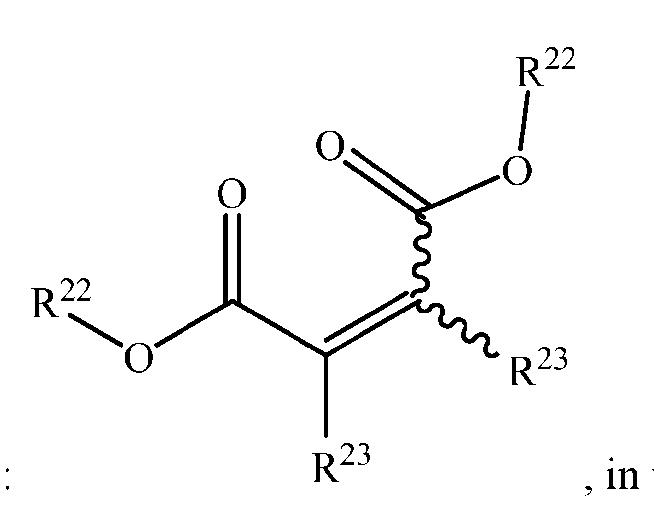 which each R22, which may be the same or different, represents an organic groups that is inert towards isocyanate groups at temperatures of 100°C or less and each R23, which may be the same or different, represents hydrogen or an organic groups that is inert towards isocyanate groups at temperatures of 100°C or less.
[0215] Clause 93. The poly silane compound of clause 92, wherein the primary polyamine comprises ethylenediamine, 1,2 -diaminopropane, 1,3-diaminopropane, 1,2-diaminobutane, 1,3-diaminobutane, 1,4- diaminobutane, 1,5 -diaminopentane, 1,6-diaminohexane, 1,7-diaminoheptane, 1,8-diaminooctane, 2,5- diamino-2,5-dimethylhexane, 2,2,4-and/or 2,4,4-trimethyl-l,6-diaminohexane, 1,11 -diaminoundecane, 1,12- diaminododccanc, bis-(3-aminopropyl) ether, l,2-bis-(3-ammopropyloxy)cthanc, l,3-bis-(3-aminopropyloxy)- 2,2'-dimethylpropane, 1,2-bisaminocyclohexane, 1,3-bisaminocyclohexane, 1,4-bisaminocyclohexane, 1,3- bisaminomethylcyclohexane, 1,4-bisaminomethylcyclohexane, 1,3-bisaminoethylcyclohexane, 1,4- bisaminoethylcyclohexane, 1,3-bisaminopropylcyclohexane, 1,4-bisaminopropylcyclohexane, hydrogenated 4,4'-diaminodiphenylmethane, l-amino-3,3,5-trimethyl-5-aminomethyl-cyclohexane, 2,4-and/or 2,6- hexahydrotoluylene diamine, 2,4'-and/or 4,4'-diamino-dicyclohexyl methane, 3,3'-dimethyl-4,4'-diamino- dicyclohexyl methane, propane-1, 2, 3 -triamine, pentane-l,3,5-triamine, benzene-l,3,5-triamine, isophoronediamine, menthanediamine, 1,4-bisaminopropylpiperazine, o-phenylenediamine, m- phenylenediamine, p-phenylenediamine, 2,4-tolylenediamine, 2,6-tolylenediamine, 2,4-toluenediamine, 2,4 - and/or 4,4'-diaminodiphenyl methane, m-aminobenzylamine, 4-chloro-o-phenylenediamine, tetrachloro-p- xylylenediamine, 4-methoxy-6-methyl-m-phenylenediamine, m-xylylenediamine, p-xylylenediamine, 1,5- naphthalenediamine, 2,6-naphthalenediamine, benzidine, 4,4'-bis(o-toluidine), dianisidine, 4,4'- diaminodiphenylmethane, 2,2-(4,4'-diaminodiphenyl)propane, 4,4'-diaminodiphenyl ether, 4,4'-thiodianiline, 4,4'-diaminodiphenylsulfone, 4,4'-diaminoditolylsulfone, methylenebis(o-chloroaniline), 3,9-bis(3- aminopropyl) 2,4,8, 10-tetraoxaspiro[5,5]undecane, diethylenetriamine, iminobispropylamine, methyliminobispropylamine, bis(hexamethylene)triamine, triethylenetetramine, tetraethylenepentamine, pentaethylenehexamine, l,4-bis(aminoethylpiperazine), l,4-bis(aminopropylpiperazine), 2,6-diaminopyridine, and bis(3,4-diaminophenyl)sulfbne, relatively high molecular weight polyether polyamines containing aliphatically bound primary amino groups (such as the JEFFAMINE® products commercially available from Huntsman Corp.), and combinations of any two or more of any of the foregoing.
[0216] Clause 94. The polysilane compound of clause 92 or clause 93, wherein the maleic or fumaric acid ester comprises maleic acid dimethyl ester, maleic acid diethyl ester, maleic acid di-n-butyl ester, fumaric acid dimethyl ester, fumaric acid diethyl ester, fumaric acid di-n-butyl ester, or a mixture of any two or more thereof.
[0217] Clause 95. A method for making the polysilane canpound of one of clause 88 to clause 94, comprising reacting the isocyanate-functional silane and the polyaspartate, optionally in the presence of a catalyst, to produce a polysilane compound comprising an aspartate group.
[0218] Clause 96. The method of clause 95, wherein the optional catalyst comprises an organic metal catalyst, an amine catalyst, or a combination thereof, such as where the catalyst comprises a copper compound, such as copper naphthenate, a cobalt compound, such as cobalt naphthenate, a zinc compound, such as zinc naphthenate, a bismuth compound, such as bismuth neodecanoate, a tin compound, such as di-n- butyl tin dilaurate, triethylamine, triethylenediamine, DABCO, DMEA, or a combination of any two or more of the foregoing.
[0219] Clause 97. The method of clause 95 or clause 96, wherein the reaction takes place at a temperature of 10 to 120°C or 25 to 100°C.
[0220] Clause 98. The method of one of clause 95 to clause 97, wherein the primary amine- containing aspartate and/or a polyaspartate with the isocyanate-functional silane are used in relative amounts to provide a molar ratio of isocyanate-reactive groups to isocyanate groups of at least 1:1, such as more than 1:1 to less than 1.5:1.
[0221] Clause 99. The method of one of clause 95 to clause 98, further comprising converting at least some of the aspartate groups to a hydantoin group, wherein such conversion is carried out optionally in the presence of a catalyst, such as a Bronsted acids, a carboxylic acid, a sulfonic acid, a phenol, or a mixture of any two or more thereof, at a reaction temperature of 0 to 200°C, 70 to 130°C, 75 to 105°C, 80° to 100°C, 90 to 120°C, or 100 to 120°C.
[0222] Clause 100. A composition, such as a radiation curable composition, comprising: (a) polysilane compound of any one of clause 1 to clause 56, clause 62 to clause 70, clause 76 to clause 82, or clause 88 to clause 94, or (b) a polysilane compound produced by the method of any of clause 57 to clause 61, clause 71 to clause 75, clause 83 to clause 87, or clause 95 to clause 99.
[0223] Clause 101. The composition of clause 100, wherein the polysilane compound is present is an amount of 0.01 to 99% by weight, 0.1 to 20% by weight, 1 to 50% by weight, 5 to 30% by weight, 40 to 70% by weight, 60 to 80% by weight, 65 to 99% by weight, or 0.01 to 20 % by weight, based on the total weight solids in the composition.
[0224] Clause 102. The composition of clause 100 or clause 101, wherein the composition further comprises (b) an ethylenically unsaturated oligomer, such as an ethylenically unsaturated oligomer having a number average molecular weight (Mn) of 1000 g/mol to 35 000 g/mol 1000 g/mol to 30,000 g/mol, 1000
g/mol to 25,000 g/mol, 1000 g/mol to 20,000 g/mol, 2,200 to 10,000 g/mol, or 2,200 to 5,500 g/mol, as measured by size exclusion chromatography (SEC).
[0225] Clause 103. The composition of clause 102, wherein the ethylenically unsaturated oligomer comprises a urethane (meth)acrylate oligomer, comprising a (meth)acrylate group, a urethane group and a backbone, such as where the backbone is a reaction product of: (1) a polyol, such as a diol, (2) a polyisocyanate, such as a diisocyanate, and (3) a hydroxyl group-containing (meth)acrylate.
[0226] Clause 104. The composition of clause 103, wherein the polyol comprises a polyether polyol, a polyester polyol, a polycarbonate polyol, a polycaprolactone polyol, an acrylic polyol, or a mixture of any two or more thereof, such as where the polyol comprises a polypropylene glycol.
[0227] Clause 105. The composition of clause 103 or clause 104, wherein the number average molecular weight derived from the hydroxyl number of the polyol is 50 to 15,000 g/mol or 1,000 to 8,000 g/mol.
[0228] Clause 106. The composition of one of clause 103 to clause 105 wherein the polyisocyanate used to prepare the urethane acrylate oligomer comprises 2,4-tolylene diisocyanate, 2,6-tolylene diisocyanate, 1,3-xylylene diisocyanate, 1,4-xylylene diisocyanate, 1,5-naphthalene diisocyanate, m-phenylene diisocyanate, p-phenylene diisocyanate, 3,3'-dimethyl-4,4'-diphenylmethane diisocyanate, 4,4'- diphenylmethane diisocyanate, 3,3 '-dimethylphenylene diisocyanate, 4,4'-biphenylene diisocyanate, 1,6- hexane diisocyanate, isophorone diisocyanate, methylenebis(4-cyclohexylisocyanate), 2,2,4- trimethylhexamethylene diisocyanate, bis(2-isocyanato-ethyl)fumarate, 6-isopropyl- 1,3 -phenyl diisocyanate, 4-diphenylpropane diisocyanate, hydrogenated diphenylmethane diisocyanate, hydrogenated xylylene diisocyanate, tetramethyl xylylene diisocyanate, lysine isocyanate, hexamethylene diisocyanate trimers (such as is commercially available as Desmodur® N3300A fiom Covestro), triphenylmethane-4,4',4"-triisocyanate (such as is commercially available as Desmodur® RE from Covestro), hexamethylene diisocyanate trimers (such as is commercially available as Desmodur® N3200 from Covestro), aromatic polyisocyanates based on toluene diisocyanate (such as is commercially available as Desmodur® IL BA from Covestro), polyisocyanurates of toluene diisocyanate (such as is commercially available as Desmodur® RC fiom Covestro), as well as combinations of any two or more thereof.
[0229] Clause 107. The composition of one of clause 103 to clause 106, wherein the hydroxyl group-containing (meth)acrylate used to prepare the methane (meth)acrylate oligomer comprises a (meth)acrylate derived fiom (meth)acrylic acid and/or an epoxy- (meth)acrylate comprising an alkylene oxide, such as 2-hydroxy ethyl(meth)acrylate, 2 -hydroxypropylacrylate and 2-hydroxy-3-oxyphenyl(meth)acrylate. [0230] Clause 108. The composition of one of clause 103 to clause 107, wherein the polyol, the polyisocyanate, and the hydroxyl group-containing (meth)acrylate used to prepare the urethane (meth)acrylate oligomer are used in relative amounts such that 0.1 to 0.9 equivalents of a hydroxyl group included in tire
hydroxyl group-containing (meth)acrylate and 1.0 to 1.5 equivalents of total hydroxyl groups present from the polyol and the hydroxyl group-containing (meth)acrylate are used for one equivalent of isocyanate group included in the polyisocyanate.
[0231] Clause 109. The composition of one of clause 102 to clause 108, wherein the ethylenically unsaturated oligomer is present in an amount of 5 to 95% by weight, 10 to 90% by weight, 10 to 80% by weight, 30 to 95% by weight, 30 to 90% by weight, 65 to 95% by weight, or 50 to 80% by weight, based on the total weight of solids in the composition.
[0232] Clause 110. The composition of one of clause 100 to clause 109, wherein the composition further comprises (c) a reactive diluent compound comprising one or more ethylenically unsaturated groups. [0233] Clause 111. The composition of clause 110, wherein the reactive diluent comprises one double bond, such as an alkyl or hydroxyalkyl (meth)acrylate, such as methyl (meth)acrylate, ethyl (meth)acrylate, butyl (meth)acrylate, 2 -ethylhexyl (meth)acrylate, 2 -hydroxyethyl (meth)acrylate, isobomyl (meth)acrylate, lauryl (meth)acrylate, ethoxylated nonyl-phenol (meth)acrylate, phenoxyethyl (meth)acrylate, diethylene-glycol-ethyl-hexyl acylate (DEGEHA), acrylonitrile, acrylamide, methacrylamide, an N- substituted (meth)acrylamide, a vinyl ester (such as vinyl acetate), styrene, an alkylstyrene, a halostyrene, aN- vinylpyrrolidone, a N-vinyl caprolactam, a vinyl chloride, a vinylidene chloride, or a mixture of any two or more thereof.
[0234] Clause 112. The composition of clause 111, wherein the reactive diluent comprises more than one double bond, such as ethylene glycol di(meth)acrylate, propylene glycol di(meth)acrylate, neopentyl glycol di(meth)acrylate, hexamethylene glycol di(meth)acrylate, bisphenol A di(meth)acrylate, 4,4'-bis(2- acryloyloxyethoxy)diphenylpropane, trimethylolpropane tri(meth)acrylate, pentaerythritol tri(meth)acrylate, pentaerythritol tetra(meth)acrylate, vinyl (meth)acrylate, divinyl benzene, divinyl succinate, diallyl phthalate, triallyl phosphate, triallyl isocyanurate, tris(2-acryloylethyl)isocyanurate, or a mixture of any two or more thereof.
[0235] Clause 113. The composition of any one of clause 110 to clause 112, wherein the reactive diluent is present in an amount of 5 to 90% by weight, 10 to 90% by weight, 10 to 80% by weight, or, in some cases, 10 to 60% by weight, 10 to 40% by weight, or 10 to 30% by weight, based on the total weight of solids in the composition.
[0236] Clause 114. The composition of any one of clause 100 to clause 113, wherein the composition further comprises (d) a photoinitiator, such as where the sum of the amount of polysilane compound and photoinitiator is 1 to 99% by weight, based on the total weight of solids in the composition. [0237] Clause 115. The composition of clause 114, wherein the photoinitiator comprises an acylphosphine oxide, such as a bisacylphosphine oxide (BAPO) and/or a monoacylphosphine oxide (MAPO), an a-hydroxy ketone, or a mixture of any two or more thereof.
[0238] Clause 116. The composition of clause 115, wherein the photoinitiator comprises a bisacylphosphine oxide having the structure:
 in which wherein R50 is C1-C12 alkyl, cyclohexyl or phenyl, which is unsubstituted or is substituted by 1 to 4 halogen atoms, or Ci-Cs alkyl; R51 and R52 are each independently of the other Ci-Cs alkyl or Ci-Cs alkoxy; R53 is hydrogen or Ci-Cs alkyl; and R54 is hydrogen or methyl, such as where the bisacylphosphinc oxide comprises bis(2,4,6-trimethylbenzoyl)-phenylphosphine oxide, bis(2,4,6-trimethylbenzoyl)-(2,4-bis- pentyloxyphenyl)phosphine oxide, or a mixture thereof.
[0239] Clause 117. The composition of one of clause 114 to clause 116, wherein the photoinitiator is present in an amount of 0.1 to 10 % by weight, such as 0.1 to 5 % by weight, or, in some cases, 1 to 5 % by weight, based on the total weight of the radiation curable composition.
[0240] Clause 118. The composition of one of clause 100 to clause 117, wherein the composition further canprises (e) gamma-mercaptopropyltrimethoxysilane, trimethoxysiliylpropyl acrylate, 3- trimetoxysilylpropane-1 -thiol, an ethylenically unsaturated silane comprising: (a) a moiety of the structure (1):

(bl) a moiety of the structure (2):

(b2) a moiety of the structure (3):

(b3) a combination of a moiety of the structure (2) and a moiety of the structure (3), in which (i) Y represents a linear or branched linking group comprising 1 or more carbon atoms, (ii) each X, which may be the same or different, represents an alkoxy group or an organic group that is inert towards isocyanate groups at temperatures of 100°C or less, with the proviso that at least one X represents an alkoxy group, (iii) R1 and R2, which may be the same or different, each represent an organic group that is inert to isocyanate groups at temperatures of 100°C or less; (iv) R3 and R4, which may be the same or different, each represent hydrogen or an organic group that is inert to isocyanate groups at temperatures of 100°C or less; and (v) each " - • " represents a linkage to another portion of the ethylenically unsaturated silane.
[0241] Clause 119. The composition of one of clause 100 to clause 118, wherein the composition has a total silane content (determined as described in the Examples section of this specification) of up to 10 mmol, such as 1 to 10 mmol, 1 to 8 mmol, or, in some cases 2 to 6 mmol, per 100 gram of the radiation curable composition and/or the composition has a total content of urea+urethane (determined as described in the Examples section of this specification) of 20 to 200 mmol, such as 30 to 150 mmol, or, in some cases 40 to 100 mmol, per 100 gram of the composition.
[0242] Clause 120. The composition of one of clause 100 to claim 119, wherein the composition further canprises an additive that comprises a photosensitizer, a radiation cure amine synergist, a UV absorber, an antioxidant, a UV stabilizer, a thermo stabilizer, an adhesion promoter, a filler material, attain transfer thiol compound, a surface active compound, a viscosity modifier, an additional addition promoter, a water scavenger, such as TEOS and orthoformate, an oxygen quencher or a functional material, such as pigments, dyes, photochromic dyes, laser dyes, liquid crystals, light emitting materials, nano materials, quantum dots, fluorescent materials, dichroic dyes, antistatic materials, refractive index modifier and bioactive materials.
[0243] Clause 121. The composition of one of clause 100 to clause 120, wherein the composition further canprises organic solvent.
[0244] Clause 122. The composition of one of clause 100 to clause 121, wherein the composition has a viscosity of at least >0.1 Pascal seconds (Pa-s), at least 0.2, at least 0.5, at least 1 Pa-s, and/or less than 15 Pa-s, less than 12 Pa-s, or less than 10 Pa-s, or 1 to 15 Pa-s, 2 to 12 Pa-s, or 3 to 10 Pa-s, wherein viscosity is measured at 25 °C and a shear rate of 2500 s-1.
[0245] Clause 123. A cured coating formed from the canposition of one of clause 100 to clause
122.
[0246] Clause 124. A substrate at least partially coated with a cured coating of clause 123, such as where the substrate comprises an optical fiber.
[0247] Clause 125. The substrate of clause 124, further comprising a secondary coating in contact with and surrounding the cured coating and, optionally, an ink layer disposed on the secondary coating.
[0248] Clause 126. The substrate of clause 124 or clause 125, wherein the cured coating has a tensile modulus of less than less than 5 MPa, less than 2 MPa, less than 1.5 MPa, or less than 1.0 MPa.
[0249] Clause 127. The substrate of any one of clause 124 to clause 126, wherein the cured coating exhibits a peel strength of at least 40 gf/in, or at least 55 gf/in, when measured at least 7 days after as described in the Examples section of this specification.
[0250] Clause 128. The substrate of any one of clause 124 to clause 127, wherein the cured coating exhibits an elongation at break of at least 35 %, such as at least 50%, when measured as described in the Examples section of this specification.
[0251] Clause 129. A method for coating an optical fiber comprising: (a) providing a glass optical fiber, such as by drawing a glass optical fiber through a draw tower; (b) applying a primary coating composition onto the surface of the glass optical fiber; (c) optionally, imparting a dose of UV light sufficient to at least partially cure said primary coating composition; (d) applying a secondary coating composition to the primary coating composition; (e) exposing the secondary coating composition to at least one radiation source capable of emitting ultraviolet radiation to affect curing of said secondary coating composition and, optionally, said primary coating composition, wherein the primary coating composition and/or the secondar coating composition comprises a composition of any one of clause 100 to clause 122.
[0252] Clause 130. A coated optical fiber comprising: (a) a glass core and a cladding layer in contact with and surrounding said glass core; and (b) a coating portion at least partially coating the cladding layer, the coating portion comprising: (i) a primary coating layer in contact with said cladding layer; and (ii) a secondary coating layer in contact with and surrounding said primary coating layer, wherein the primary coating layer and/or the secondary coating layer is a cured product of a composition of any one of clause 100 to clause 122.
[0253] Clause 131. The coated optical fiber of clause 130, wherein die core comprises pure silica glass (SiCfe) or silica glass with one or more dopants, such as where the dopants comprise GeOz, AI2O3, P2O5, TiCh, Z1O2, NbzOs, Ta2Os, or a combination of any two or more thereof.
[0254] Clause 132. The method of clause 129 or tire coated optical fiber of clause 130 or clause 131, wherein the cured primary coating has an in-situ glass transition temperature of less than -35°C, less than -40°C, less than -45°C, or not more than -50°C, and/or the cured primary coating has a thickness of 20 to 50 pm, 20 to 40 pm, 20 to 30 pm, 25 or 32 5 pm or 15 to 25 pm
[0255] Clause 133. The method of clause 129 or clause 132 or the coated optical fiber of one of clause 130 to clause 131, wherein the secondary coating exhibits an in-situ tensile modulus of greater than 800 MPa, greater than 1110 MPa, greater than 1300 MPa, greater than 1400 MPa, or greater than 1500 MPa, 1000 MPa to 8000 MPa, 1200 MPa to 5000 MPa, or 1500 MPa to 3000 MPa, and/or an in-situ Tg of 50°C to 120°C or 50°C to 100°C, and/or a thickness of no more than 40 pm, 20 to 40 pm, or 20 to 30 pm.
[0256] Clause 134. The coated optical fiber of one of clause 130 to clause 131, wherein the coated optical fiber possesses a mode-field diameter from 8 to 10 pm at a wavelength of 1310 nm, a mode-field diameter from 9 to 13 pm at a wavelength of 1550 nm, and/or an effective area of 20 to 200 pm2.
[0257] The non-limiting and non-exhaustive examples that follow are intended to further describe various non-limiting and non-exhaustive implementations without restricting the scope of the implementations described in this specification.
EXAMPLES
Table 1 - Materials Used


[0258] Many materials used herein were made resulting in a mixture having a statistical distribution of molecular weight that can be easily recognized by those skilled in the art. The structures in this section, and elsewhere herein, only show the designed averaged, or "ideal" structure, unless otherwise noted.
Example 1: Synthesis of Mono -aspartic Precursor
[0259] IPDA (149 g, 0.87 mol) was added to a four-necked flask (1000 mL), purged with dry air, and cooled to 5 °C using an ice bath. Diethyl maleate (152 g, 0.88 mol) was then added dropwise, keeping foe mixture below 10 °C. Upon addition foe mixture was stirred for 2 hours and allowed to warm up to 20-25 °C to yield foe final product mixture comprising a structure (A) as a viscous liquid. The product was then available to be used in subsequent formulation without further purification. The structure (A) appears below:

Example 2: Synthesis of Tri-aspartic Precursor
[0260] Jeffamine T-403 (240 g, 0.5 mol) and BHT (0.5g, 1000 ppm) was added to a four-necked flask (1000 mL) and purged with dry air. Diethyl maleate (260 g, 1.5 mol) was then added dropwise. Upon addition the mixture was stirred for 6 hours and stored for 6 months to yield foe final product mixture comprising a structure (B) as a viscous liquid. The product was then available to be used in subsequent formulation without further purification. The structure (B) appears below:

Example 3: Synthesis of Silane Precursor
[0261] KBM-903 ( 182 g, 1 mol) was placed in a four-necked flask (500 ml) and then cooled down to
0-5 °C (ice bath) under nitrogen before the addition of diethyl maleate (175 g, 1 mol) dropwise. The resulting mixture was then stirred at 0-10 °C for 3 hours to yield the final product mixture comprising a structure (C) as a viscous liquid. The product was then available to be used in subsequent formulation without further purification. The structure (C) appears below:

Examole 4: Synthesis of Ethylenically Unsaturated Silane Monomer (ME-OD
[0262] To create ME-01, the silane precursor of Example 3 (70.2 g, 0.2 mol) was placed in a four necked flask (250 ml) and purged with a gaseous mixture consisting of air and nitrogen in a 3: 1 ratio by volume. Then DBTDL (0.06 g, 600 ppm), BHT (0.10 g, 1000 ppm), and AOI (28.6 g, 0.20 mol) were each added sequentially. While still under the purge of the 3: 1 air/nitrogen mixture, the reaction mixture was further stirred at 70 °C for another 2-4 hours to yield the final product mixture comprising a structure (D) as a viscous liquid. The product was then available to be used in subsequent formulation without furflier purification. The structure (D) appears below:

Example 5: Synthesis of Polvsilane Compound (ME-02)
[0263] To create ME-02, TMSPI (55g, 0.27 mol) was placed in a four-necked flask (500 ml), purged with dry air, and stirred. The mono-aspartic precursor of Example 1 (45g, 0.13 mol) was then added dropwise, keeping the temperature below 45°C. The resulting mixture was then stirred at 60 °C for 4 horns to yield the final product mixture comprising a structure (E) as a viscous liquid. The product was then available to be used in subsequent formulation without further purification. The structure (E) appears below:

Example 6: Synthesis of Polysilane Compound (ME-03)
[0264] To create ME-03, NH-1723LF (117g, 0.2 mol) was placed in a four-necked flask (500 ml), pinged with dry air, and stirred. TMSPI (83g, 0.4 mol) was then added and the resulting mixture was stirred at 60°C for 16 hours. The mixture was then stirred at 70°C for 12 hours to yield the final product mixture comprising a structure (F) as a viscous liquid. The product was then available to be used in subsequent formulation without further purification. The structure (F) appears below:

Example 7: Synthesis of Polysilane Compound (ME-04)
[0265] To create ME-04, TDI (29g, 0.2 mol) was placed in a four-necked flask (500 ml), purged with dry air, and stirred. The silane precursor of Example 3 (59g, 0.2 mol) was then added dropwise, keeping the
temperature below 45°C. The resulting mixture was then stirred for 1 hour. TMSPI (34g, 0.2 mol) and PPG 725 (128g, 0.2 mol) were then added to the mixture and stirred at 20-25°C for 15 minutes. DBTDL (0.2g, 600 ppm) was then added and the resulting mixture was then stirred at 60°C for 2 hours to yield the final product mixture comprising a structure (G) as a viscous liquid. The product was then available to be used in subsequent formulation without further purification. The structure (G) appears below:

Examole 8: Synthesis of Polvsilane Compound (ME-05)
[0266] To create ME-05, TDI (38g, 0.2 mol) and PPG 725 (84g, 0.1 mol) were placed in a fournecked flask (500 ml), purged with dry air, and stirred for 15 minutes. DBTDL (0.12g, 600 ppm) was then added with active cooling and stirred at 70°C for 1 hour. The silane precursor of Example 3 (77g, 0.2 mol) was then added to the mixture and stirred at 60°C for 1 hour to yield the final product mixture comprising a structure (H) as a viscous liquid. The product was then available to be used in subsequent formulation without further purification. The structure (H) appears below:

Example 9: Synthesis of Polysilane Compound (ME-06)
[0267] To create ME-06, ME-03 (100g) was placed in a four-necked flask (500 ml) and purged with dry air. The resulting mixture was then heated to 70-80°C before the addition of acrylic acid (1g, 1%). The resulting mixture was then stirred at 85°C for 1-2 hours to yield the final product mixture comprising a structure (I) as a viscous liquid. The product was then available to be used in subsequent formulation without further purification. The structure (I) appears below:

Example 10: Synthesis of Polysilane Compound (ME-07)
[0268] To create ME-07, ME-04 ( 128g) was placed in a four-necked flask (500 ml) and purged with dry air. The resulting mixture was then heated to 70-80°C before the addition of acrylic acid (1.2g, 1%). The resulting mixture was then stirred at 85°C for 8 hours to yield the final product mixture comprising a structure (J) as a viscous liquid. The product was then available to be used in subsequent formulation without further purification. The structure (J) appears below:

Example 11: Synthesis of Polysilane Compound (ME-08)
[0269] To create ME-08, ME-05 (145g) was placed in a four-necked flask (500 ml) and purged with dry air. The resulting mixture was then heated to 70-80°C before the addition of acrylic acid (1.5g, 1%). The resulting mixture was then stirred at 85°C for 5-6 hours to yield the final product mixture comprising a structure (K) as a viscous liquid. The product was then available to be used in subsequent formulation without further purification. The structure (K) appears below:
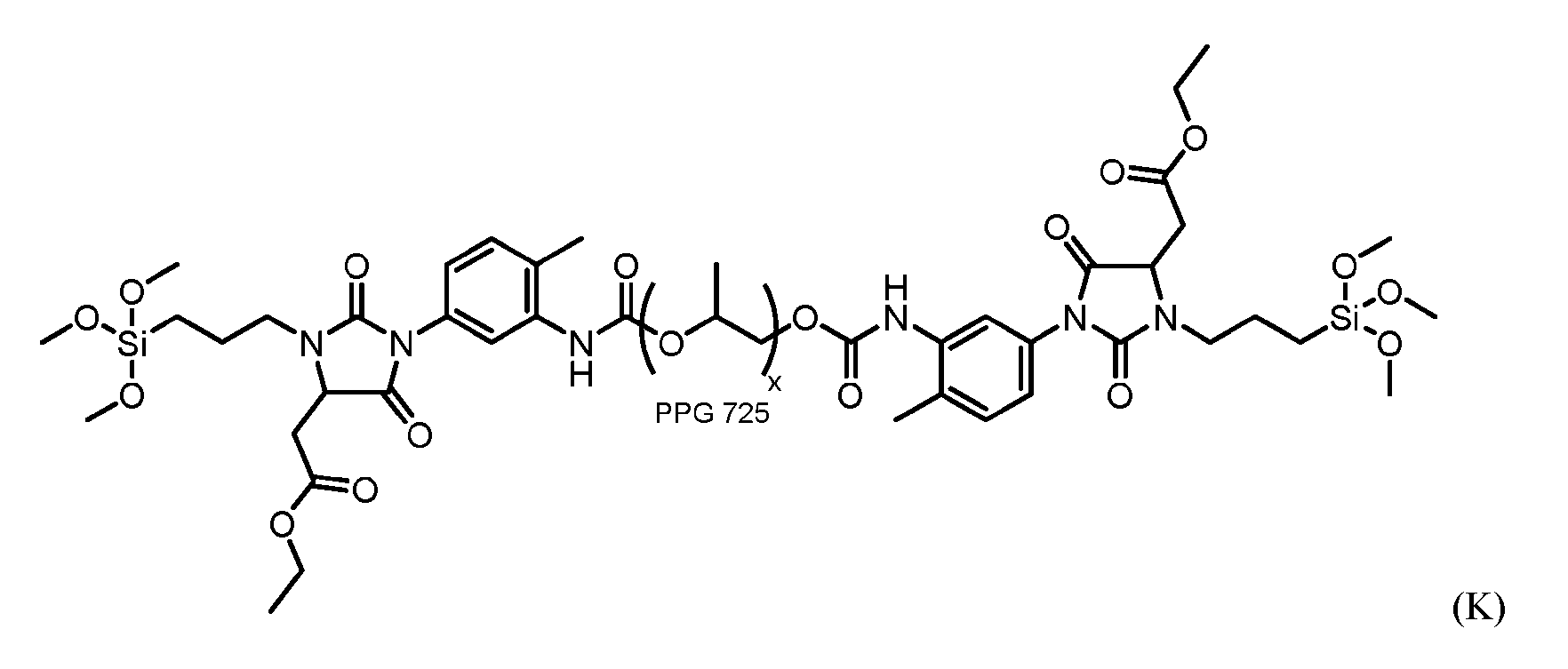
Example 12: Synthesis of Polysilane Compound (ME-09)
[0270] To create ME-09, tri-aspartic precursor of example 2 (124g, 0.12 mol) was placed in a fournecked flask (500 ml) and purged with dry air. TMSPI (77g, 0.38 mol) was then added and the resulting mixture was stirred at 70°C for 12-14 hours to yield the final product mixture comprising a structure (L) as a viscous liquid. The product was then available to be used in subsequent formulation without further purification. The structure (L) appears below:

Example 13: Synthesis of Oligomer 1
[0271 ] To create Oligomer 1 , a mixture of PPG 4000 (3474 g, 0.9 mol), TDI (313 g, 1.8 mol), and
BHT (1000 ppm) was placed in a four-necked flask (5000 ml) and purged with dry air. The resulting mixture was then stirred at 20-25°C for 15 mins before the addition of mixture of DBTDL (400 ppm). The resulting mixture was then stirred without external heat for 15 minutes, then stirred at 60°C for 1-2 hours. Then HEA
(208 g, 1.8 mol) was added. While still under the purge of dry air, the reaction mixture was stirred at 85°C for another 1-2 hours to yield the final product mixture comprising a structure (M) as a viscous liquid. The product was then available to be used in subsequent formulation without further purification. The structure (E) appears below:

Example 14: Synthesis of Oligomer 2
[0272] To create Oligomer 2, a mixture of PPG 4000 (74.3 kg, 19.1 mol), HEA (2.2 kg, 19.1 mol), BHT (1000 ppm), acrylic acid (40g, 0.56 mol), TDI (3.3 kg, 19.1 mol), and DBTDL (800 ppm) were added sequentially to a batch reactor (180 L). The resulting mixture was then stirred at 70°C for 2-4 hours to yield the final product mixture comprising a structure (N) as a viscous liquid. The product was then available to be used in subsequent formulation without further purification. The structure (N) appears below:

Example 15: Synthesis of Oligomer 3
[0273] To create Oligomer 3, a mixture of TDI (7.22g, 0.04 mol) and BHT (0.10g, 1000 ppm) was placed in a four-necked flask (250 ml) and then purged with a gaseous mixture consisting of air and nitrogen in a 3: 1 ratio by volume. The resulting mixture was then stirred at 20-25°C for 10 mins before the addition of mixture of DBTDL (0.03g, 300 ppm), HEA (2.40g, 0.02 mol) and the silane precursor of Example 3 (7.28g, 0.02 mol). The resulting mixture was then stirred at 60°C for 1 to 2 hours. Then, DBTDL (0.03g, 300 ppm) and PPG 4000 (82.9g, 0.02 mol) were added sequentially. While still under the purge of the 3: 1 air/nitrogen mixture, the reaction mixture was further stirred at 85°C for another 2 hours to yield the final product mixture with an average structure (O) as a viscous liquid. The product was then available to be used in subsequent formulation without further purification. The structure (O) appears below:

Table 2 - Reactants for ME -01 to ME-09 (in mole ratios)

Table 3 - Reactants for Oligomers 1-3 (in mole ratios)

[0274] The synthesis of the polysilanes above which may be considered as part of an aspartate silane component are expected to be useful in a composition for coating an optical fiber, such as a primary coating composition for coating an optical fiber. To exhibit this further, a subset of these polysilanes was used to create a variety of compositions, which were formulated and evaluated as described below. Such compositions below are formulated alongside appropriate controls utilizing select oligomers described above which may or may not contain additional silane functionality or additional aspartate functionality.
Formulations 1-38
[0275] Each of the formulations described in Tables 4A-4I was prepared by mixing a 100g sample in a 100 ml mixing cup suitable for use with a SpeedMixer™. Specifically, the oligomer and monomer components, not including silane containing oligomer and/or monomer, were mixed in addition to the other components as specified in Tables 4A-4I below. Upon addition to the cup, the cup was closed and mixed in a SpeedMixer ™ DAC150FVZ at 3000 RPM for 3 minutes. After this, the mixing operation was stopped, and the resulting mixture was transferred to a suitable receptacle and then heated to 60 °C in an oven and maintained at this temperature for about 6 hours to ensure complete dissolution of all components. The sample was then removed from the oven and mixed again for three additional minutes in the SpeedMixer again via the same method, after which the silane containing monomer was added, resulting in 100 g total. Finally, the mixture was mixed again for an additional 3 minutes in the SpeedMixer again via the same method.
[0276] These formulations were next characterized according to their respective total silane content and total urea + urethane content per the methodology described below. Then, all formulations were tested according to the methods described below to determine their peel strength, elongation percentage, film modulus, toughness, tensile strength, and viscosity. Unless otherwise shown, values for total silane content are rounded to one decimal place and values for the urea + urethane content are rounded to the nearest whole number. Film modulus, toughness, and tensile strength values, meanwhile, have been rounded to two decimal places. Viscosity is presented to the nearest one centipoise unit. Finally, elongation percentage values are presented as rounded to the nearest 1%. Values for each of these measured characteristics are reported in Tables 4A-4I below.
[0277] The "Total Silane" for a given canposition was determined by first calculating the amount of moles of silane groups (in which "silane groups" refers to groups of the structure Si(X)s, in which X represents an alkoxy group or an organic group that is inert towards isocyanate groups at temperatures of 100°C or less, with the proviso that at least one X represents an alkoxy group) in each silane containing component (Y) in accordance with the following expression:
 where Wt = the amount by weight of the respective component Y relative to 100g of the total associated composition; N = the number of silane groups present in one molecule of component Y; and MW is the theoretical molecular mass of component Y (in g/mol). The total silane content is reported in units of mmol/lOOg. The theoretical molecular mass values for the reactants used in creating the monomers and oligomers (including the silane containing monomers, polysilanes, and oligomers) of the formulations herein are reported in Tables 2-3.
[0278] Then, the value for total silane for the entire composition was calculated by adding up the values of moles of silane groups for each silane-containing component according to the following expression:

[0279] The values for total silane herein are reported in units of mmol/100g. The values for total silane may be optionally expresses in units of mol/lOOg by dividing the summed value by 1000, although unless specifically noted, the values herein are not reported in this fashion. For clarity, where "equivalents" or "milliequivalents" is specified herein, unless otherwise noted, the value is to be interpreted in reference to 100g of the composition with which it is associated. Total silane values for each formulation are presented in Table 4A-4I below.
[0280] It should be noted that if the complete recipe of a composition is not known ex ante, the equivalents of silane moieties may be determined analytically via any suitable method as will be appreciated by the skilled artisan to which this invention applies, such as via size exclusion chromatography (SEC), infrared spectroscopy, HPLC, GC, MALDI-TOF mass spectrometry, or nuclear magnetic resonance (NMR) methods.
[0281 ] Values for the urea + urethane content is determined via die same method as that prescribed for "Total Silane" above, except for the feet that instead of assessing silane groups or silane containing components, total isocyanate groups thar are reacted with an isocyanate-reactive compound were counted. [0282] Viscosity was measured using Anton Paar Rheolab QC. The instrument was set up for the Z3 and Z4 system, both of which were used. Samples for using the Z3 system were weighed out in the amount of 14.7g ± 0.2g and loaded into a disposable aluminum cup, while those for the Z4 system had a mass of 3 ,5g ± 0.2g. The sample in the cup was examined and if upon visual inspection it was determined to contain bubbles, the sample and cup were either subjected to centrifugation or allowed to sit long enough so that the bubbles would escape from the bulk of the liquid. Bubbles appearing at the top surface of the liquid were considered to be acceptable. Next, the bob was gently loaded into tire liquid in the measuring cup, after which the cup and bob were installed in the instrument. Viscosities were run at 25°C ± 0.1°C and 55°C ± 0.1°C with a five- minute equilibration period to ensure the temperature was constant and at a shear rate of 50 sec"1. Ten readings at each temperature were recorded and the reported results represent the average viscosity values of ten different readings. The values were recorded as expressed in millipascal seconds (mPa-s) and a shear rate of 50 s'1 unless otherwise specified.
[0283] To create films such that various physical properties could be tested, each sample was cured under a constant flow of nitrogen gas with a 1 J/cnr UV-dose of Conveyor Fusion Unit Model DRS-10/12 QN, 600W UV-lamp system having as lamps 1600M radiator (600 W/inch which equals 240 W/cm, and thus, in total 600 W) fitted with R500 reflector, one with a H bulb and one with a D bulb UV lamp, of which the D- bulb was used to cure the samples. The UV-dose was then measured with an International Light IL390 radiometer. Then, individual test strips having a width of approximately 1.27 cm (0.5 inches ±1/32”) and a
length of approximately 12.7 cm (5 inches ± 1/8”) were then cut from the film. The exact thickness of each specimen was measured with a calibrated micrometer.
[0284] The method for determining segment modulus as used herein is described in paragraphs [0132]-[0133] and [0135] of EP2089333B1, the cited portions of which being hereby incorporated by reference, except that cured films were conditioned for at least 24 hours prior to testing. The tensile properties (tensile strength, percent elongation at break, and segment modulus) were determined with an MTS Criterion ™ Model 43.104 with respect to test strips of a cured film of each sample having a 3-mil thickness as prepared per the "Film Sample Preparation" procedure described above. Due to these relatively soft coatings (e.g., those with a modulus of less than about 10 MPa), the coating was drawn down and cured on a glass plate and the individual specimens cut from the glass plate with a scalpel after applying a thin layer of talc. A 0.9 kg (2-lb) load cell was used in an Instron 4442 Tensile Tester, and die modulus was calculated at 2.5% elongation with a least-squares fit of the stress-strain plot. Cured films were conditioned at 23.0°C ± 0.1 °C and 50.0% ± 0.5% relative humidity for 16 to 24 hours prior to testing. For testing specimens, tire gage length was 5.1 cm (2-inches), and the crosshead speed was 25.4 mm/min. All testing was performed at a temperature of 23.0°C ± 0.1°C and a relative humidity of 50.0% ± 0.5%. All measurements were determined from die average of at least six test specimens. Values for tensile strength were determined as the highest stress bom by the sample before break. Values for toughness were determined as the total area under the stress-strain curve. [0285] Adhesive properties were determined with an Instron Tensile Tester Model 4442 using test strips of a cured film of each sample having a 3-mil thickness as prepared per the "Film Sample Preparation" procedure described above. The Instron Tensile Tester Model 4442 was setup with a 21b load cell, 20 psi pneumatic grips, and 10.00’Ymin crosshead speed for testing. The cured film per plate was cut into 4 strips were cut using a scalpel and 1.00” wide steel bar, placing a 6” cut on either side of the bar with a V*” gap between cut specimens. To minimize die effects of minor sample defects, sample specimens are cut parallel to the direction in which the drawdown of the cured film was prepared.
[0286] The cured film cut into four strips was then conditioned for 7 days at 23 ,0°C ± 2.0°C and 50% ± 5% RH. After the 7 days, two alternating strips ( 1st and 3rd or 2nd and 4*) were tested for dry adhesion. A thin layer of talc was applied using a cotton-tipped applicator to reduce blocking dining the adhesion test. A clip attached to braided nylon string was run through a pulley with the nylon string clamped into the upper jaw of the Instron testing instrument. The first strip was peeled back from the glass plate about one inch and place horizontally on the table with the peeled-back end of the specimen facing away from the pulley. The binder clip was attached to the pcclcd-back end of the specimen and allowed to lay flat on the sample. The plate was pulled to put tension on the braided nylon string until the load on the Instron reads positive, at which point the software method was started and continued until the average force value became relatively constant. The test is terminated by clicking on the stop button in the software or loosening the tension on the string. This was repeated for two plates and reported values are the average of the plateau force for four samples run.
Following testing the dry adhesion, the plate (containing unused strips) is then put in a humidity chamber at 23.0°C ± 2.0°C and 95% ± 5% RH humidity for 24 hours. After removal from the humidity chamber, a polyethylene water slurry is applied to the strips using a synthetic foam brush to prevent drying, and the wet adhesion is measured following the same instrument method for dry adhesion outlined above. This was repeated for two plates and reported values are the average of the plateau force for four samples run.
Table 4A - Formulations 1-6 All amounts listed in parts by weight

* Formulations 1, 2 and 5 arc comparative examples
[0287] For all silane containing formulations other than comparative formulation 1 in Table 4A, total silane content in each formulation was controlled at same silicone atom level of 2 mmol per 100 grams of formulation. With the use of ME-02, the improvement in adhesion was studied by both dry peel strength test and wet peel strength test. Three control formulations (formulations 1, 2 and 5) were used as comparative examples. Comparative formulation 1 had no adhesion promoter in mixture. Comparative formulation 2 had adhesion promoter ME-01, and comparative formulation 5 had a commercially available adhesion promoter acrylated silane TMPSA.
[0288] Both comparative formulations 2 and 5 that contained an adhesion promoter showed better peel strength than comparative formulation 1. To increase adhesion further based on formulations 2 and 5 without increasing silicone atom level and changing mechanical properties is much desired in fiber optical application. [0289] With the invention of new poly silane adhesion promoters, ME-02 was used as the only adhesion promoter in formulation 3. ME-02 was also used in a mixture of adhesion promoters in formulation 4 and 6. To formulate formulation 4 and 6, only 20 mol% of the adhesion promoters in formulation 2 and 5 was replaced by ME-02 respectively. [0290] The coating from Formulation 3, using only ME-02 as the adhesion promoter, exhibited improved dry and wet peel strength compared to the control Formulation 1. Surprisingly, without having a UV curable functionality, ME-02 in formulation 3 performed even better than the commercially available acrylated silane TMPSA as in Formulation 5. This unexpected result makes the polysilane adhesion promoter valuable to be used alone as an addition promoter in UV curable coatings. Additionally, coatings fam Formulations 4 and 6, containing an 80:20 molar ratio mixture of monofunctional acrylated silane TMPSA with ME-02, can be seen to also have improved dry and wet peel strength compared to the coatings from Formulation 2 and 5 containing only monofunctional acrylated silane TMPSA at the same total silane content. Table 4B - Formulations 7-9. Aspartate polysilane screening. Amounts are in parts by weight
 [0291] Table 4B shows screening of aspartate polysilane adhesion promoters at a silane loading of 2 mmol/lOOg compared to the control formulation 5 containing commercially available acrylated silane TMPSA. ME-03 contains the aspartate group on the inside of both urea linkages, while ME-04 contains one aspartate silane and ME-05 contains two aspartate silanes. Unexpectedly again, all the polysilane adhesion promoters performed better than the commercially available acrylated silane TMPSA in formulation 5 despite not having a UV curable functionality.
Table 4C - Formulations 10-12. Hydantoin polysilane screening. Amounts are in parts by weight

[0292] Table 4C shows screening of new hydantoin polysilanes at a silane loading of 2 mmol/lOOg compared to tire control formulation 5 containing commercially available acrylated silane TMPSA. ME-06 and ME-08 contain two hydantoin silane moieties while ME-07 contains only one hydantoin silane moiety. Unexpectedly again, coatings produced using the polysilane adhesion promoters performed better than the commercially available acrylated silane TMPSA in formulation 5 despite not having a UV curable functionality. Compared to coatings produced with the non-hydantoin polysilanes in Table 4B, the coatings produced with hydantoin polysilanes of Table 4C appeared to provide enhanced wet and dry adhesion.
Table 4D - Formulations 13-18. aspartate polysilane screening. Amounts are in parts by weight


[0293] Tabic 4D shows screening of new aspartate polysilanc in formulations 16-18 compared to three commercially available polysilane formulation 13-15, all consisting of an 80:20 molar ratio mixture of monofunctional acrylated silane TMPSA to polysilane at a silane loading of 2 mmol/lOOg. ME-03 contains the aspartate group on the inside of both urea linkages, while ME-04 contains one aspartate silane and ME-05 contains two aspartate silanes. As shown in formulations 13-15, coatings produced using the commercial polysilane exhibited similar wet and dry adhesion results to the control formulation 5 without any polysilane adhesion promoter. However and unexpectedly, coatings produced using the aspartate polysilane adhesion promoters in formulations 16-18 exhibited significantly increased wet and dry adhesion results compared to all four controls.
Table 4E - Formulations 19-21. Hydantoin polysilane screening. Amounts are in parts by weight


[0294] Table 4E shows screening of hydantoin polysilanes in formulations 19-21 compared to three commercially available polysilane formulations 13-15, all consisting of an 80:20 molar ratio mixture of monofunctional acrylated silane TMPSA to polysilane at a silane loading of 2 mmol/lOOg. ME-06 and ME-08 contain two hydantoin silane moieties while ME-07 contains only one hydantoin silane moiety. As shown in formulations 13-15, coatings produced using the commercial polysilane exhibited similar adhesion results to the control formulation 5 without any polysilane adhesion promoter. However and unexpectedly, coatings produced using the hydantoin polysilane adhesion promoters in formulations 19-21 exhibited increased wet and dry adhesion results compared to all four controls.
Table 4F - Formulations 22-26. Amounts are in parts by weight


[0295] Tabic 4F shows screening of aspartate polysilanc, formulations 23-24, and hydantoin polysilane, formulations 25-26, aspartate silane in formulations consisting of an 80:20 molar ratio mixture of monofunctional acrylate aspartate silane monomer 1 to polysilane at a silane loading of 2 mmol/lOOg.
Compared to the control formulation 22 consisting of only monomer 1, coatings produced using the aspartate and hydantoin polysilane once again unexpectedly exhibited increased adhesion. Additionally, coatings produced using the hydantoin polysilane of formulations 25-26 had higher wet and dry adhesions compared to coatings produced using die aspartate polysilane of formulations 23-35.
Table 4G - Formulations 27-29. Aspartate polysilane ladder study with acrylated silane TMPSA. Amounts are in parts by weight


[0296] Table 4G shows a ladder study of aspartate polysilane ME-03 at increasing mole ratios with acrylated silane TMPSA, from 0 to 1. Compared to the control formulation 5 consisting of only acrylated silane TMPSA, the addition of ME-03 did not appear to increase the adhesion at mole ratios less than 0.1. However, as the mole ratio was further increased, coatings produced using the aspartate polysilane ME-03 exhibited enhanced wet and dry adhesion at mole ratios greater than 0.1. This was unexpected as ME-03 does not contain any UV curable functional group.
Table 4H - Formulations 30-33. Aspartate polysilane ladder study with ME-01. Amounts in parts by weight

[0297] Tabic 4H shows a ladder study of aspartate polysilanc ME-03 at increasing mole ratios with acrylate aspartate silane ME-01, from 0 to 1. Compared to the control formulation 22 consisting of only ME- 01, the addition of ME-03 up to mole ratios of 0.4 appeared to improve both the wet and dry adhesion. This was unexpected as ME-03 does not contain any LTV curable functional group and represents a different regime than Table 4F when used with acrylated silane TMPSA.
Table 41- Formulations 34-38. Aspartate polysilane screening. Amounts are in parts by weight

[0298] Table 41 shows additional aspartate polysilane screening. A trifunctional aspartate silane was synthesized represented by ME-09 demonstrated in formulation FE-34. Compared to the control formulation FE-01, the addition of the trifunctional aspartate silane ME-09 to formulation FE-34 resulted in an increase in both tire wet and dry adhesion. This was unexpected as ME-09 does not contain any UV curable functional group. Additionally, when used in conjunction with a monofunctional acrylate silane adhesion promoter in FE-35 and FE-37 at a 0.33 equivalents ratio (EQ ratio in table), coatings produced with the ME-09 exhibited further increased wet and dry adhesion compared to the controls FE-05 and FE-36 containing only monofunctional acrylate silane adhesion promoters. FE-05 and FE-35 utilize acrylated silane TMPSA as the monofunctional acrylate silane adhesion promoter while FE-36 and FE-37 utilized Oligomer 3 as the monofunctional acrylate silane adhesion promoter. In addition to ME-09, coatings produced using ME-03 also demonstrated an increase in the wet and dry adhesion when added to Oligomer 3 in FE-38 compared to the control FE-36. These aspartate polysilane adhesion promoters produced coatings with further increased adhesion with either monomeric or oligomeric monofunctional acrylate silane adhesion promoters.
[0299] In any group of formulations being compared in Tables 4A-4I, the major formulation composition difference was only in the small amount of silane adhesion promoters. Such change in formulation did not appear to have much impact on mechanical properties and viscosity.
[0300] Although the invention has been described in detail in the foregoing for tire purpose of illustration, it is to be understood that such detail is solely for that purpose and that variations can be made therein by those skilled in the art without departing from the spirit and scope of the invention except as it may be limited by the claims.
Claims
1. A radiation curable composition canprising:
0) polysilane compound comprising: (a) at least two moieties of the structure (1):

(b3) a combination of a moiety of the structure (2) and a moiety of the structure (3), in which (i) Y represents a linear or branched linking group comprising 1 or more carbon atoms, (ii) each X, which may be tire same or different, represents an alkoxy group or an organic group that is inert towards isocyanate groups at temperatures of 100°C or less, with the proviso that at least one X represents an alkoxy group, (iii) each R1, which may be the same or different, represents an organic group that is inert to isocyanate groups at temperatures of 100°C or less; (iv) each R2, which may be the same or different, each represent hydrogen or an organic group that is inert to isocyanate groups at temperatures of 100°C or less; and (v) " • " represents a linkage to another portion of the poly silane compound; and
(II) a free-radical photoinitiator.
2. The radiation curable composition of claim 1, wherein the sum of the amount of poly silane compound (I) and photoinitiator (II) is 1 to 99% by weight, based on the total weight of solids in the radiation curable composition.
3. The radiation curable composition of claim 1, wherein each R2 is hydrogen.
4. The radiation curable composition of claim 1, wherein the polysilane compound further comprises:
(c) a segment of the structure:
 in which G is O, S, or NR in which R represents hydrogen or an organic group that is inert to isocyanate groups at temperatures of 100°C or less, and each " • " represents a linkage to another portion of the polysilane compound.
5. The radiation curable composition of claim 1, wherein the polysilane compound has the structure (4):
 in which (i) each Y1, which may be the same or different, represents a linear or branched linking group comprising 1 or more carbon atoms, (ii) each R3, which may be the same or different, represents an organic group that is inert towards isocyanate groups at temperatures of 100°C or less, (iii) each R4, which may be the same or different, each represent hydrogen or an organic group that is inert to isocyanate groups at temperatures of 100°C or less, (iv) each X1, which may be the same or different, represents an alkoxy group or an organic group that is inert towards isocyanate groups at temperatures of I00°C or less, with the proviso that at least one X1 represents an alkoxy group, (v) Z represents an organic group that is inert towards isocyanate
groups at temperatures of 100°C or less, and (vi) m and n, which may be the same or different, are each an integer having a value of 1 to 5, such as 1 to 3, or 1.
in which (i) each Y1, which may be the same or different, represents a linear or branched linking group comprising 1 or more carbon atoms, (ii) each R3, which may be the same or different, represents an organic group that is inert towards isocyanate groups at temperatures of 100°C or less, (iii) each R4, which may be the same or different, each represent hydrogen or an organic group that is inert to isocyanate groups at temperatures of 100°C or less, (iv) each X1, which may be the same or different, represents an alkoxy group or an organic group that is inert towards isocyanate groups at temperatures of I00°C or less, with the proviso that at least one X1 represents an alkoxy group, (v) Z represents an organic group that is inert towards isocyanate
groups at temperatures of 100°C or less, and (vi) m and n, which may be the same or different, are each an integer having a value of 1 to 5, such as 1 to 3, or 1.
6. The radiation curable composition of claim 1, wherein the polysilane compound has the structure (5):
 in which (i) each Y1, which may be the same or different, represents a linear or branched linking group comprising 1 or more carbon atoms, (ii) each R3, which may be the same or different, represents an organic group that is inert towards isocyanate groups at temperatures of 100°C or less, (iii) each R4, which may be the same or different, each represent hydrogen or an organic group that is inert to isocyanate groups at temperatures of 100°C or less, (iv) each X1, which may be the same or different, represents an alkoxy group or an organic group that is inert towards isocyanate groups at temperatures of 100°C or less, with the proviso that at least one X1 represents an alkoxy group, (v) Z represents an organic group that is inert towards isocyanate groups at temperatures of 100°C or less, and (vi) m and n, which may be the same or different, are each an integer having a value of 1 to 5, such as 1 to 3, or 1.
7. The radiation curable composition of claim 1, wherein the polysilane compound has the structure (6):
 wherein: (i) each Y1, which may be the same or different, represents a linear or branched linking group comprising 1 or more carbon atoms, (ii) Y2 represents a group of the structure:
 represents a linkage to N, and in which G is O, S, or NR in which R is hydrogen or an organic group that is inert to isocyanate groups at temperatures of 100°C or less, Z represents anorganic group that is inert towards isocyanate groups at temperatures of 100°C or less, such as a hydrocarbon group that optionally contains isocyanate-inert oxygen, nitrogen, sulfur, or a combination thereof, (iii) p is 0 or 1, (iv) each R3, which may be the same or different, represents an organic group that is inert to isocyanate groups at temperatures of 100°C or less; (v) each R4, which may be tire same or different, represents hydrogen or an organic group that is inert to isocyanate groups at temperatures of 100°C or less; and (vi) each X1, which may be the same or different, represents an alkoxy group or an organic group that is inert towards isocyanate groups at temperatures of 100°C or less, with the proviso that at least one X1 represents an alkoxy group.
8. The radiation curable composition of claim 1, wherein the polysilane compound has the structure (7):

 wherein: (i) each Y1, which may be the same or different, represents a linear or branched linking group comprising 1 or more carbon atoms, (ii) Y2 represents a group of the structure:
 represents a linkage to N, and in which G is 0, S, or NR in which R is hydrogen or an organic group that is inert to isocyanate groups at temperatures of 100°C or less, Z represents anorganic group that is inert towards isocyanate groups at temperatures of 100°C or less, such as a hydrocarbon group that optionally contains
isocyanate-inert oxygen, nitrogen, sulfur, or a combination thereof, (iii) p is 0 or 1, (iv) each R3, which may be the same or different, represents an organic group that is inert to isocyanate groups at temperatures of 100°C or less; (v) each R4, which may be die same or different, represents hydrogen or an organic group that is inert to isocyanate groups at temperatures of 100°C or less; and (vi) each X1, which may be the same or different, represents an alkoxy group or an organic group that is inert towards isocyanate groups at temperatures of 100°C or less, with the proviso that at least one X1 represents an alkoxy group.
represents a linkage to N, and in which G is 0, S, or NR in which R is hydrogen or an organic group that is inert to isocyanate groups at temperatures of 100°C or less, Z represents anorganic group that is inert towards isocyanate groups at temperatures of 100°C or less, such as a hydrocarbon group that optionally contains
isocyanate-inert oxygen, nitrogen, sulfur, or a combination thereof, (iii) p is 0 or 1, (iv) each R3, which may be the same or different, represents an organic group that is inert to isocyanate groups at temperatures of 100°C or less; (v) each R4, which may be die same or different, represents hydrogen or an organic group that is inert to isocyanate groups at temperatures of 100°C or less; and (vi) each X1, which may be the same or different, represents an alkoxy group or an organic group that is inert towards isocyanate groups at temperatures of 100°C or less, with the proviso that at least one X1 represents an alkoxy group.
9. The radiation curable composition of claim 1, wherein the polysilane compound has the structure (8):
 in which: (i) each Y1, which may be the same or different, represents a linear or branched linking group comprising 1 or more carbon atoms, (ii) each Y2, which may be the same or different, represents a group of the structure: represents a linkage to Y1 and

 represents a linkage to N, and in which G is O, S, or NR in which R is hydrogen or an organic group that is inert to isocyanate groups at temperatures of 100°C or less, Z represents an organic group that is inert towards isocyanate groups at temperatures of 100°C or less, such as a hydrocarbon group that optionally contains isocyanate-inert oxygen, nitrogen, sulfur, or a combination thereof, (iii) each p, which may be the same or different, is 0 or 1, (iv) each R3, which may be the same or different, represents an organic group that is inert towards isocyanate groups at temperatures of 100°C or less, (v) each R4, which may be the same or different, each represent hydrogen or an organic group that is inert to isocyanate groups at temperatures of 100°C or less, (vi) each X1, which may be the same or different, represents an alkoxy group or an organic group that is inert towards isocyanate groups at temperatures of 100°C or less, with the proviso that at least one X1 represents an alkoxy group, (vii) Z represents an organic group that is inert towards isocyanate groups
at temperatures of 100°C or less, and (vii) m and n, which may be the same or different, are each an integer having a value of 1 to 5, such as 1 to 3, or 1.
represents a linkage to N, and in which G is O, S, or NR in which R is hydrogen or an organic group that is inert to isocyanate groups at temperatures of 100°C or less, Z represents an organic group that is inert towards isocyanate groups at temperatures of 100°C or less, such as a hydrocarbon group that optionally contains isocyanate-inert oxygen, nitrogen, sulfur, or a combination thereof, (iii) each p, which may be the same or different, is 0 or 1, (iv) each R3, which may be the same or different, represents an organic group that is inert towards isocyanate groups at temperatures of 100°C or less, (v) each R4, which may be the same or different, each represent hydrogen or an organic group that is inert to isocyanate groups at temperatures of 100°C or less, (vi) each X1, which may be the same or different, represents an alkoxy group or an organic group that is inert towards isocyanate groups at temperatures of 100°C or less, with the proviso that at least one X1 represents an alkoxy group, (vii) Z represents an organic group that is inert towards isocyanate groups
at temperatures of 100°C or less, and (vii) m and n, which may be the same or different, are each an integer having a value of 1 to 5, such as 1 to 3, or 1.
10. The radiation curable composition of claim 1, wherein the polysilane compound has the structure (9):
 in which: (i) each Y1, which may be the same or different, represents a linear or branched linking group comprising 1 or more carbon atoms, (ii) each Y2, which may be the same or different, represents a group of the structure:
 represents a linkage to Y’ and
 represents a linkage to N, and in which G is O, S, or NR in which R is hydrogen or an organic group that is inert to isocyanate groups at temperatures of 100°C or less, Z represents an organic group that is inert towards isocyanate groups at temperatures of 100°C or less, such as a hydrocarbon group that optionally contains isocyanate-inert oxygen, nitrogen, sulfur, or a combination thereof, (iii) each p, which may be the same or different, is 0 or 1, (iv) each R3, which may be the same or different, represents an organic group that is inert towards isocyanate groups at temperatures of 100°C or less, (v) each R4, which may be the same or different, each represent hydrogen or an organic group that is inert to isocyanate groups at temperatures of 100°C or less, (vi) each X1, which may be the same or different, represents an alkoxy group or an organic group that is inert towards isocyanate groups at temperatures of 100°C or less, with the proviso that at least one X1 represents an alkoxy group, (vii) Z represents an organic group that is inert towards isocyanate groups at temperatures of 100°C or less, and (vii) m and n, which may be tire same or different, are each an integer having a value of 1 to 5, such as 1 to 3, or 1.
11. The radiation curable composition of claim 1, wherein the poly silane compound has the structure
(10):


12. The radiation curable composition of claim 1, wherein the polysilane compound has the structure
(H):


13. The radiation curable composition of claim 1, wherein the polysilane compound (I) is present is an amount of 0.01 to 99% by weight, 0.1 to 20% by weight, 1 to 50% by weight, 5 to 30% by weight, 40 to 70% by weight, 60 to 80% by weight, 65 to 99% by weight, or 0.01 to 20 % by weight, based on the total weight of solids in tire composition.
14. The radiation curable composition of claim 13, further comprising:
(b) an ethylenically unsaturated oligomer.
15. The radiation curable composition of claim 14, wherein the ethylenically unsaturated oligomer comprises a urethane (meth)acrylate oligomer comprising a reaction product of reactants comprising: (1) a polyol, (2) an polyisocyanate, and (3) a hydroxyl group-containing (meth)acrylate.
16. The radiation curable composition of claim 15, wherein the polyol comprises a diol and the polyisocyanate comprises a diisocyanate.
17. The radiation curable composition of claim 15, wherein the urethane (meth)acrylate oligomer is present in an amount of 30 to 95% by weight or 65 to 95% by weight, based on the total weight of solids in the composition.
18. The radiation curable composition of claim 17, further comprising:
(c) a reactive diluent compound comprising one or more ethylenically unsaturated groups, wherein the reactive diluent compound is present in an amount of 5 to 90% by weight, based on the total weight of solids in the composition.
19. A cured coating formed from the radiation curable composition of claim 1.
20. A substrate at least partially coated with the cured coating of claim 19, where the substrate comprises an optical fiber.
21. A method for coating an optical fiber comprising:
(a) providing a glass optical fiber,
(b) applying a primary coating composition onto a surface of the glass optical fiber,
(c) optionally, imparting a dose of UV light sufficient to at least partially cure said primary coating composition;
(d) applying a secondary coating composition to the primary coating composition; and
(e) exposing the secondary coating composition to at least one radiation source capable of emitting ultraviolet radiation to affect curing of said secondary coating composition and, optionally, said primary coating composition,
wherein the primary coating composition and/or die secondary coating composition comprises the radiation curable composition of claim 1.
22. A coated optical fiber comprising:
(a) a glass core and a cladding layer in contact with and surrounding said glass core; and
(b) a coating portion at least partially coating the cladding layer, die coating portion comprising:
(i) a primary coating layer in contact with said cladding layer, and
(ii) a secondary coating layer in contact with and surrounding said primary coating layer, wherein die primary coating layer and/or the secondary coating layer is the cured coating of claim 19.
23. The radiation curable composition of claim 1, with the proviso that the polysilane compound (I) comprises a moiety of the structure 3A:
 in which X, Y, R1, R2 and " - • " are each as described with respect to structures (l)-(3), such as where the polysilane compound has 1 to 4 such moieties of structure 3 A.
24. That radiation curable composition of claim 1, with the proviso that the polysilane compound (I) has only one moiety of the structure 3B: in which X, Y, R1, R2 and are each as described with respect to structures ( l)-(3).

25. The radiation curable composition of claim 1, with the proviso that the polysilane compound (I) has only one moiety of the structure 2A:
 in which X, Y, R1, R2 and 11 • " are each as described with respect to structures (l)-(3).
26. The radiation curable composition of claim 1, with the proviso that the poly silane compound (I) has only one moiety of the structure 2B:
 in which X, Y, and " • " are each as described with respect to structures (l)-(3) and R° is not hydrogen.
27. The radiation curable composition of claim 26, wherein the moiety of the structure 2B has the structure 2B(i):
 (2B(i)) in which X, Y, R1, R2 and 11 • " are each as described with respect to structures (l)-(3).
28. A polysilane compound comprising:
(a) at least two moieties of the structure (1):
• - Y - Si(X)3
(i);
(bl) a moiety of tire structure (2):

(b2) a moiety of tire structure (3):

(b3) a combination of a moiety of the structure (2) and a moiety of the structure (3), with the proviso that tire polysilane compound has only one moiety of the structure 2A:
 in which (i) Y represents a linear or branched linking group comprising 1 or more carbon atoms, (ii) each X, which may be the same or different, represents an alkoxy group or an organic group that is inert
towards isocyanate groups at temperatures of 100°C or less, with the proviso that at least one X represents an alkoxy group, (iii) each R1 may be the same or different, represents an organic group that is inert to isocyanate groups at temperatures of 100°C or less; (iv) each R2 may be the same or different, represents hydrogen or an organic group that is inert to isocyanate groups at temperatures of 100°C or less; and (v) " - • " represents a linkage to another portion of the polysilane compound.
in which (i) Y represents a linear or branched linking group comprising 1 or more carbon atoms, (ii) each X, which may be the same or different, represents an alkoxy group or an organic group that is inert
towards isocyanate groups at temperatures of 100°C or less, with the proviso that at least one X represents an alkoxy group, (iii) each R1 may be the same or different, represents an organic group that is inert to isocyanate groups at temperatures of 100°C or less; (iv) each R2 may be the same or different, represents hydrogen or an organic group that is inert to isocyanate groups at temperatures of 100°C or less; and (v) " - • " represents a linkage to another portion of the polysilane compound.
29. A polysilane compound comprising:
(a) at least two moieties of the structure (1):

(bl) a moiety of the structure (2): O

(b2) a moiety of the structure (3):

(b3) a combination of a moiety of the structure (2) and a moiety of the structure (3), with the proviso that tire polysilane compound has only one moiety of the structure 2B:
 in which (i) Y represents a linear or branched linking group comprising 1 or more carbon atoms, (ii) each X, which may be tire same or different, represents an alkoxy group or an organic group that is inert towards isocyanate groups at temperatures of 100°C or less, with the proviso that at least one X represents an alkoxy group, (iii) R° is not hydrogen, (iv) each R1 may be the same or different, represents an organic group that is inert to isocyanate groups at temperatures of 100°C or less; (v) each R2 may be the same or different, represents hydrogen or an organic group that is inert to isocyanate groups at temperatures of 100°C or less; and (vi) " • 11 represents a linkage to another portion of the polysilane canpound.
30. The polysilane compound of claim 29, wherein the moiety of the structure 2B has the structure 2B(i):

31. A polysilane compound comprising:
(a) at least two moieties of the structure (1):

(bl) a moiety of tire structure (2):

(b2) a moiety of the structure (3):

(b3) a combination of a moiety of the structure (2) and a moiety of the structure (3), with the proviso that at least one of the moieties of the structure (1) is a moiety of the structure 3A:
 in which (i) Y represents a linear or branched linking group comprising 1 or more carbon atoms, (ii) each X, which may be the same or different, represents an alkoxy group or an organic group that is inert towards isocyanate groups at temperatures of 100°C or less, with the proviso that at least one X represents an alkoxy group, (iii) each R1 may be the same or different, represents an organic group that is inert to isocyanate groups at temperatures of 100°C or less; (iv) each R2 may be the same or different, represents hydrogen or an organic group that is inert to isocyanate groups at temperatures of 100°C or less; and (v) * - • " represents a linkage to another portion of the polysilane compound.
32. A polysilane compound comprising:
(a) at least two moieties of the structure (1):

(bl) a moiety of tire structure (2):

(b2) a moiety of the structure (3):

(b3) a combination of a moiety of the structure (2) and a moiety of the structure (3), with the proviso that the polysilane compound has only one moiety of the structure 3B:
 in which (i) Y represents a linear or branched linking group comprising 1 or more carbon atoms, (ii) each X, which may be the same or different, represents an alkoxy group or an organic group that is inert towards isocyanate groups at temperatures of 100°C or less, with the proviso that at least one X represents an alkoxy group, (iii) each R1 may be the same or different, represents an organic group that is inert to isocyanate groups at temperatures of 100°C or less; (iv) each R2 may be the same or different, represents hydrogen or an organic group that is inert to isocyanate groups at temperatures of 100°C or less; and (v)
 represents a linkage to another portion of the polysilane compound.
Applications Claiming Priority (4)
| Application Number | Priority Date | Filing Date | Title |
|---|---|---|---|
| US202463616868P | 2024-01-02 | 2024-01-02 | |
| US63/616,868 | 2024-01-02 | ||
| EP24172513.4 | 2024-04-25 | ||
| EP24172513 | 2024-04-25 |
Publications (1)
| Publication Number | Publication Date |
|---|---|
| WO2025147337A1 true WO2025147337A1 (en) | 2025-07-10 |
Family
ID=93853070
Family Applications (1)
| Application Number | Title | Priority Date | Filing Date |
|---|---|---|---|
| PCT/US2024/057392 Pending WO2025147337A1 (en) | 2024-01-02 | 2024-11-26 | Polysilanes, methods for their preparation, and the use thereof in coating compositions |
Country Status (2)
| Country | Link |
|---|---|
| TW (1) | TW202600570A (en) |
| WO (1) | WO2025147337A1 (en) |
Citations (21)
| Publication number | Priority date | Publication date | Assignee | Title |
|---|---|---|---|---|
| US4962992A (en) | 1989-05-15 | 1990-10-16 | At&T Bell Laboratories | Optical transmission media and methods of making same |
| US5104433A (en) | 1989-05-15 | 1992-04-14 | At&T Bell Laboratories | Method of making optical fiber |
| EP0913402A1 (en) * | 1997-10-20 | 1999-05-06 | Bayer Ag | Compounds containing alkoxysilane groups and hydantoin groups |
| US6020528A (en) | 1996-03-04 | 2000-02-01 | Ciba Specialty Chemicals Corporation | Alkylphenylbisacylphosphine oxides and photoinitiator mixtures |
| US6048660A (en) | 1997-01-30 | 2000-04-11 | Ciba Specialty Chemicals Corporation | Non-volatile phenylglyoxalic esters |
| US20020013383A1 (en) | 1996-05-07 | 2002-01-31 | Chawla Chander P. | Radiation-curable fiber optic materials having reduced moisture content |
| WO2002051954A2 (en) * | 2000-12-22 | 2002-07-04 | Bayer Corporation | Two-component coating compositions containing silane adhesion promoters |
| US6596445B1 (en) | 1998-06-26 | 2003-07-22 | Ciba Specialty Chemicals Corporation | O-acyloxime photoinitiators |
| US6689463B2 (en) | 2001-12-18 | 2004-02-10 | Corning Incorporated | Secondary coating composition for optical fibers |
| US6775451B1 (en) | 1999-12-30 | 2004-08-10 | Corning Incorporated | Secondary coating composition for optical fibers |
| US6961508B2 (en) | 2002-04-24 | 2005-11-01 | Dsm Ip Assets B.V. | Coated optical fibers |
| US7169826B2 (en) | 2003-08-29 | 2007-01-30 | Ciba Specialty Chemicals Corporation | Optical fiber coatings |
| US20070100039A1 (en) | 2005-10-27 | 2007-05-03 | Hancock Robert R Jr | Non-reactive additives for fiber coatings |
| EP2089333B1 (en) | 2006-12-14 | 2011-02-16 | DSM IP Assets B.V. | D1363 bt radiation curable primary coatings on optical fiber |
| WO2014137694A1 (en) * | 2013-03-04 | 2014-09-12 | The Government Of The United States Of America, As Represented By The Secretary Of The Navy | Silane end capped substituted urea resins and coatings thereof |
| US20160230042A1 (en) * | 2013-03-04 | 2016-08-11 | The Government Of The United States Of America, As Represented By The Secretary Of The Navy | Silane end capped substituted urea resins and coatings thereof |
| WO2016146474A1 (en) * | 2015-03-17 | 2016-09-22 | Covestro Deutschland Ag | Silane groups containing polyisocyanates based on 1,5-diisocyanatopentane |
| EP3209739B1 (en) * | 2014-10-22 | 2019-06-19 | The Government of the United States of America as represented by the Secretary of the Navy | Two-component siloxane-based coatings containing polymers with urea linkages and terminal alkoxysilanes |
| EP3613786A1 (en) * | 2018-08-21 | 2020-02-26 | Covestro Deutschland AG | Drying agent for moisture-curable compositions |
| US20210088720A1 (en) | 2017-06-02 | 2021-03-25 | Dsm Ip Assets B.V. | Thermally resistant radiation curable coatings for optical fiber |
| WO2023019304A1 (en) * | 2021-08-16 | 2023-02-23 | A & I Coatings Group Pty Ltd | A high performance isocyanate free polyurethane resin coating |
-
2024
- 2024-11-26 WO PCT/US2024/057392 patent/WO2025147337A1/en active Pending
- 2024-12-30 TW TW113151457A patent/TW202600570A/en unknown
Patent Citations (23)
| Publication number | Priority date | Publication date | Assignee | Title |
|---|---|---|---|---|
| US4962992A (en) | 1989-05-15 | 1990-10-16 | At&T Bell Laboratories | Optical transmission media and methods of making same |
| US5104433A (en) | 1989-05-15 | 1992-04-14 | At&T Bell Laboratories | Method of making optical fiber |
| US6020528A (en) | 1996-03-04 | 2000-02-01 | Ciba Specialty Chemicals Corporation | Alkylphenylbisacylphosphine oxides and photoinitiator mixtures |
| US20020013383A1 (en) | 1996-05-07 | 2002-01-31 | Chawla Chander P. | Radiation-curable fiber optic materials having reduced moisture content |
| US6048660A (en) | 1997-01-30 | 2000-04-11 | Ciba Specialty Chemicals Corporation | Non-volatile phenylglyoxalic esters |
| EP0913402A1 (en) * | 1997-10-20 | 1999-05-06 | Bayer Ag | Compounds containing alkoxysilane groups and hydantoin groups |
| US6596445B1 (en) | 1998-06-26 | 2003-07-22 | Ciba Specialty Chemicals Corporation | O-acyloxime photoinitiators |
| US6775451B1 (en) | 1999-12-30 | 2004-08-10 | Corning Incorporated | Secondary coating composition for optical fibers |
| WO2002051954A2 (en) * | 2000-12-22 | 2002-07-04 | Bayer Corporation | Two-component coating compositions containing silane adhesion promoters |
| US6689463B2 (en) | 2001-12-18 | 2004-02-10 | Corning Incorporated | Secondary coating composition for optical fibers |
| US6961508B2 (en) | 2002-04-24 | 2005-11-01 | Dsm Ip Assets B.V. | Coated optical fibers |
| US7171103B2 (en) | 2002-04-24 | 2007-01-30 | Dsm Ip Assets B.V | Coated optical fibers |
| US7169826B2 (en) | 2003-08-29 | 2007-01-30 | Ciba Specialty Chemicals Corporation | Optical fiber coatings |
| US20070100039A1 (en) | 2005-10-27 | 2007-05-03 | Hancock Robert R Jr | Non-reactive additives for fiber coatings |
| EP2089333B1 (en) | 2006-12-14 | 2011-02-16 | DSM IP Assets B.V. | D1363 bt radiation curable primary coatings on optical fiber |
| WO2014137694A1 (en) * | 2013-03-04 | 2014-09-12 | The Government Of The United States Of America, As Represented By The Secretary Of The Navy | Silane end capped substituted urea resins and coatings thereof |
| US20160230042A1 (en) * | 2013-03-04 | 2016-08-11 | The Government Of The United States Of America, As Represented By The Secretary Of The Navy | Silane end capped substituted urea resins and coatings thereof |
| EP3209739B1 (en) * | 2014-10-22 | 2019-06-19 | The Government of the United States of America as represented by the Secretary of the Navy | Two-component siloxane-based coatings containing polymers with urea linkages and terminal alkoxysilanes |
| WO2016146474A1 (en) * | 2015-03-17 | 2016-09-22 | Covestro Deutschland Ag | Silane groups containing polyisocyanates based on 1,5-diisocyanatopentane |
| US20210088720A1 (en) | 2017-06-02 | 2021-03-25 | Dsm Ip Assets B.V. | Thermally resistant radiation curable coatings for optical fiber |
| EP3613786A1 (en) * | 2018-08-21 | 2020-02-26 | Covestro Deutschland AG | Drying agent for moisture-curable compositions |
| WO2020038804A1 (en) * | 2018-08-21 | 2020-02-27 | Covestro Deutschland Ag | Drying agent for moisture-curing compositions |
| WO2023019304A1 (en) * | 2021-08-16 | 2023-02-23 | A & I Coatings Group Pty Ltd | A high performance isocyanate free polyurethane resin coating |
Non-Patent Citations (13)
| Title |
|---|
| "Rompp Lexikon Chemie", 1998, GEORG-'NIIEME-VERLAG, pages: 491 |
| "Rompp's Chemical Dictionary (Rommp Chemie Lexikon", 1996, GEORG THIEME VERLAG, article "Zerevitinov-active hydrogen" |
| A. MENDEZT.F. MORSE: "Specialty Optical Fibers Handbook", 2007, Ç) ELSEVIER INC. |
| DALTON TRANS., vol. 2021, no. 162881-26-7, pages 12392 - 12398 |
| DATABASE CAPLUS [online] 1 January 1999 (1999-01-01), BAYER A.-G. ET AL: "Alkoxysilane-and hydantoin group-containing compounds for coatings and adhesives - EP 913402 A1", XP093209397, Database accession no. 1999:378490 * |
| DATABASE CAPLUS [online] 1 January 1999 (1999-01-01), BAYER A.-G. ET AL: "Compounds containing alkoxysilane groups and hydantoin groups for coatings and adhesives - EP 913402 A1", XP093209396, Database accession no. 1999:292596 * |
| DATABASE CAPLUS [online] 1 January 1999 (1999-01-01), BAYER A.-G. ET AL: "Preparation of isocyanurate compound containing alkoxy silyl group and diazine dione group for coatings - EP 913402 A1", XP093209400, Database accession no. 2000:345551 * |
| DATABASE CAPLUS [online] 1 January 2002 (2002-01-01), BAYER CORPORATION ET AL: "Two-component polyurethane coating compositions containing silane aspartate-based adhesion promoters Accession - WO 2002051954 A2", XP093209394, Database accession no. 2002:504884 * |
| DATABASE CAPLUS [online] 1 January 2014 (2014-01-01), UNITED STATES DEPT. OF THE NAVY ET AL: "Silane end capped substituted urea resins and coatings thereof - WO 2014137694 A1", XP093209393, Database accession no. 2014:1474245 * |
| DATABASE CAPLUS [online] 1 January 2016 (2016-01-01), COVESTRO DEUTSCHLAND AG ET AL: "Alkoxysilane group-containing polyisocyanates based on 1,5-diisocyanatopentane - WO 2016146474 A1", XP093209398, Database accession no. 2016:1542040 * |
| DATABASE CAPLUS [online] 1 January 2016 (2016-01-01), UNITED STATES DEPT. OF THE NAVY ET AL: "Silane end capped substituted urea resins, coatings and production methods - US 20160230042 A1", XP093209395, Database accession no. 2016:1315196 * |
| DATABASE CAPLUS [online] 1 January 2020 (2020-01-01), COVESTRO DEUTSCHLAND AG ET AL: "Drying agent for moisture-curable compositions - EP 3613786 A1", XP093209399, Database accession no. 2020:384317 * |
| DATABASE CAPLUS [online] 1 January 2020 (2020-01-01), COVESTRO DEUTSCHLAND AG: "Drying agent for moisture-curable compositions - WO 2020038804 A1", XP093209392, Database accession no. 2020:376358 * |
Also Published As
| Publication number | Publication date |
|---|---|
| TW202600570A (en) | 2026-01-01 |
Similar Documents
| Publication | Publication Date | Title |
|---|---|---|
| US12473395B2 (en) | Self-healing oligomers and the use thereof | |
| KR101018357B1 (en) | Photocurable coating composition with excellent high temperature water resistance | |
| KR20010013582A (en) | Radiation curable composition comprising an urethane oligomer having a polyester backbone | |
| JP7744922B2 (en) | Self-healing optical fiber and compositions used in its manufacture - Patents.com | |
| BR112020024440A2 (en) | radiation-curable compositions to coat optical fiber and coatings produced from them | |
| JP7712261B2 (en) | RADIATION CURABLE COMPOSITIONS CONTAINING MULTIFUNCTIONAL LONG-ARM OLIGOMERS FOR COATING OPTICAL FIBER - Patent application | |
| US12187852B1 (en) | Ethylenically unsaturated oligomers, methods for their preparation, and the use thereof in coating compositions | |
| KR20070041670A (en) | Curable Liquid Resin Composition | |
| JP7795474B2 (en) | Multilayer Optical Devices | |
| WO2025147337A1 (en) | Polysilanes, methods for their preparation, and the use thereof in coating compositions | |
| WO1997014737A1 (en) | Liquid curable resin composition | |
| US12428514B2 (en) | Ethylenically unsaturated compounds, methods for their preparation, and the use thereof in coating compositions | |
| WO2025147343A1 (en) | Ethylenically unsaturated compounds, methods for their preparation, and the use thereof in coating compositions | |
| WO2026089881A1 (en) | Ethylenically unsaturated oligomer compositions, methods for their preparation, and the use thereof in coating compositions | |
| KR101006989B1 (en) | UV curable coating composition having excellent water resistance and optical fiber using the same | |
| CN1930252B (en) | curable liquid resin composition | |
| WO2026089879A1 (en) | Ethylenically unsaturated compounds, methods for their preparation, and the use thereof in coating compositions | |
| WO2026089880A1 (en) | Ethylenically unsaturated oligomers, methods for their preparation, and the use thereof in coating compositions | |
| WO2026089883A1 (en) | Ethylenically unsaturated oligomers, methods for their preparation, and the use thereof in coating compositions | |
| WO2025147317A1 (en) | Ethylenically unsaturated oligomers, methods for their preparation, and the use thereof in coating compositions | |
| WO2000020478A1 (en) | Liquid curable resin composition | |
| TW202600484A (en) | Ethylenically unsaturated oligomers, methods for their preparation, and the use thereof in coating compositions | |
| JPH03199216A (en) | Liquid curable resin composition | |
| KR20100106287A (en) | Optical fiber with excellent high temperature water resistance | |
| KR100517372B1 (en) | Radiation curable composition comprising an urethane oligomer having a polyester backbone |
Legal Events
| Date | Code | Title | Description |
|---|---|---|---|
| 121 | Ep: the epo has been informed by wipo that ep was designated in this application |
Ref document number: 24821716 Country of ref document: EP Kind code of ref document: A1 |