WO2025136642A1 - Secretin receptor agonists and methods of use - Google Patents
Secretin receptor agonists and methods of use Download PDFInfo
- Publication number
- WO2025136642A1 WO2025136642A1 PCT/US2024/058250 US2024058250W WO2025136642A1 WO 2025136642 A1 WO2025136642 A1 WO 2025136642A1 US 2024058250 W US2024058250 W US 2024058250W WO 2025136642 A1 WO2025136642 A1 WO 2025136642A1
- Authority
- WO
- WIPO (PCT)
- Prior art keywords
- compound
- phenyl
- methyl
- alkyl
- pharmaceutically acceptable
- Prior art date
- Legal status (The legal status is an assumption and is not a legal conclusion. Google has not performed a legal analysis and makes no representation as to the accuracy of the status listed.)
- Pending
Links
Classifications
-
- C—CHEMISTRY; METALLURGY
- C07—ORGANIC CHEMISTRY
- C07D—HETEROCYCLIC COMPOUNDS
- C07D285/00—Heterocyclic compounds containing rings having nitrogen and sulfur atoms as the only ring hetero atoms, not provided for by groups C07D275/00 - C07D283/00
- C07D285/01—Five-membered rings
- C07D285/02—Thiadiazoles; Hydrogenated thiadiazoles
- C07D285/04—Thiadiazoles; Hydrogenated thiadiazoles not condensed with other rings
- C07D285/12—1,3,4-Thiadiazoles; Hydrogenated 1,3,4-thiadiazoles
- C07D285/125—1,3,4-Thiadiazoles; Hydrogenated 1,3,4-thiadiazoles with oxygen, sulfur or nitrogen atoms, directly attached to ring carbon atoms, the nitrogen atoms not forming part of a nitro radical
- C07D285/135—Nitrogen atoms
-
- A—HUMAN NECESSITIES
- A61—MEDICAL OR VETERINARY SCIENCE; HYGIENE
- A61P—SPECIFIC THERAPEUTIC ACTIVITY OF CHEMICAL COMPOUNDS OR MEDICINAL PREPARATIONS
- A61P43/00—Drugs for specific purposes, not provided for in groups A61P1/00-A61P41/00
-
- C—CHEMISTRY; METALLURGY
- C07—ORGANIC CHEMISTRY
- C07D—HETEROCYCLIC COMPOUNDS
- C07D417/00—Heterocyclic compounds containing two or more hetero rings, at least one ring having nitrogen and sulfur atoms as the only ring hetero atoms, not provided for by group C07D415/00
- C07D417/14—Heterocyclic compounds containing two or more hetero rings, at least one ring having nitrogen and sulfur atoms as the only ring hetero atoms, not provided for by group C07D415/00 containing three or more hetero rings
Definitions
- This disclosure provides compounds of Formula (I) and pharmaceutically acceptable salts thereof that are useful for treating and/or preventing heart failure (HF), obesity, type 2 diabetes mellitus, hypertension, functional dyspepsia, cholestasis, and non-alcoholic fatty liver disease.
- HF heart failure
- Heart failure is a major cause of morbidity and mortality, particularly in the elderly, with almost 6 million cases in the United States at this time, and projections to exceed 8 million cases by 2030.
- Current annual costs (direct and indirect) of $31 billion (>65 million hospital days) are projected to reach $70 billion by 2030.
- HF is the leading cause of hospitalization for Medicare-age patients. While a variety of drugs are effective to acutely correct decompensated HF, this has had little effect to improve prognosis.
- the clinical course post-hospitalization is particularly unsatisfactory’, with rehospitalisation rates of 25% at 1 month and 50% at 6 months, and mortality rates of 30% at 1 year and 50% at 3 years.
- Even patients with absent or minimal resting signs and symptoms of congestion at hospital discharge who take full advantage of current medications, experience these high rates of readmission and mortality, with this true of those with both preserved and reduced ejection fractions. This clearly represents an enormous unmet medical need.
- Secretin is known primarily as a gastrointestinal peptide hormone (27 residues) secreted from intestinal S cells in response to acid in the gut lumen. Its classical physiologic action is to stimulate alkaline secretion from pancreatic and biliary duct cells to neutralize the luminal acidic chyme, acting through the secretin receptor (SecR). Secretin acts through binding to a class B GPCR, SecR. This receptor is prototypic of this small group of peptide-binding GPCRs, including only 15 members, but with many of these possessing important physiologic actions and representing high priority therapeutic targets.
- GLP-1 glucagon-like peptide- 1
- parathyroid hormone calcitonin
- calcitonin gene- related peptide gastric insulinotropic peptide
- vasoactive intestinal polypeptide and corticotropin-releasing factor.
- corticotropin-releasing factor corticotropin-releasing factor.
- the class B GPCRs have seven transmembrane segments and couple at their cytosolic face with heterotrimeric G proteins. This small and coherent group all bind moderate length peptides with diffuse pharmacophoric domains.
- the carboxyl-terminal region of these peptides binds within a groove in a disulphide-bonded amino-terminal extracellular domain, thereby directing the peptide amino terminus into the top of the helical bundle where biological activity is mediated.
- SecR can couple with both Gs and Gq, resulting in cAMP and intracellular calcium responses.
- the dominant physiologic coupling is with Gs, with the cAMP response at low concentrations of secretin, while the calcium response requires three orders of magnitude more agonist.
- the stimulation of the secretin signaling pathway would be beneficial and provide novel treatment approaches for patients with HF and/or obesity, type 2 diabetes mellitus, hypertension, functional dyspepsia, cholestasis, and non-alcoholic fatty liver disease.
- secretin-like agonists other than the peptide itself, that has a very short half-life and that requires parenteral administration, or any positive allosteric modulators of secretin action.
- the present disclosure provides, inter alia, compounds that stimulate secretin receptor (SecR), with diverse modes of action.
- Specific scaffolds were identified that have agonist, positive allosteric modulator (PAM) or mixed ago-PAM effect. Stimulation of SecR signaling by agonists/PAMs may result in improved cardiac output, leading to a first-in-class therapeutic approach for the treatment of HF patients.
- Such compounds would fill a major unmet need for the cardiovascular community, by providing first-in-class agents that would increase secretin agonism and its effects on the heart, peripheral vasculature, islets, adipocytes, and neurons useful for outpatients with HF.
- the present disclosure provides a compound of Formula (I): or a pharmaceutically acceptable salt thereof, wherein ring A. R 2 . R 4 , and R 5 are defined as described herein.
- the present disclosure provides a compound of Formula (la): or a pharmaceutically acceptable salt thereof, wherein R 1 , R 2 , R 4 , and R 5 are defined as described herein.
- the present disclosure provides a pharmaceutical composition
- a pharmaceutical composition comprising the compound of Formulae (I) or (la), or a pharmaceutically acceptable salt thereof, and a pharmaceutically acceptable carrier.
- the present disclosure provides a method of treating or preventing obesity, type 2 diabetes mellitus, heart failure, hypertension, functional dyspepsia, cholestasis, and non-alcoholic fatty liver disease in a subject in need thereof, comprising administering to the subject a therapeutically effective amount of a compound of Formula (I) or (la), or a pharmaceutically acceptable salt thereof, or a pharmaceutical composition as provided herein.
- the present disclosure provides, inter alia, compounds that are agonists and positive allosteric modulators (PAMs), as well as mixed agonist and PAM activities (ago-PAMs) targeting SecRs able to stimulate the receptor or potentiate effects of natural agonist secretin in systems carrying endogenous SecRs.
- Pharmaceutical compositions comprising said compounds are also provided, as well as the methods of using these compounds for treating obesity, type 2 diabetes mellitus, heart failure, hypertension, functional dyspepsia, cholestasis, and non-alcoholic fatty liver. Certain embodiments of the compounds, compositions, methods, and combination treatments are disclosed herein.
- the present disclosure provides a compound of Formula (I): or a pharmaceutically acceptable salt thereof, wherein ring A, R 2 , R 4 , and R 5 are defined as described herein.
- the present disclosure provides a compound of Formula (la): or a pharmaceutically acceptable salt thereof, wherein R 1 , R 2 , R 4 , and R 5 are defined as described herein.
- ring A is selected from phenyl, naphthyl, fluorenyl, dibenzofuranyl, and benzodi oxazolyl, each optionally substituted with 1, 2, 3, or 4 R 1 , or ring A is thienyl optionally substituted with 1, 2, or 3 R 1 . In some embodiments, ring A is selected from phenyl, naphthyl, fluorenyl, dibenzofuranyl. and benzodi oxazolyl.
- R 5 is Ci-6 alky l. In some embodiments, R 5 is methyl or ethyl. In some embodiments. R 5 is phenyl optionally substituted with 1, 2 or 3 substituents each independently selected from halo, Ci-6 alkyl, and Ci-6 haloalkyl. In some embodiments, R 5 is phenyl.
- compositions comprising an effective amount of a compound of the present disclosure (e.g., Formula (I) or Formula (la)) disclosed herein, or a pharmaceutically acceptable salt thereof; and a pharmaceutically acceptable carrier.
- a compound of the present disclosure e.g., Formula (I) or Formula (la)
- the carrier(s) are “acceptable’’ in the sense of being compatible with the other ingredients of the formulation and, in the case of a pharmaceutically acceptable carrier, not deleterious to the recipient thereof in an amount used in the medicament.
- Some embodiments provide a method of treating cancer in a subject in need thereof, comprising administering to the subject a therapeutically effective amount of a compound of Formula (I) or Formula (la), or a pharmaceutically acceptable salt thereof, or the pharmaceutical composition comprising same. Some embodiments provide a method of treating cancer in a subject previously determined to have cancer, comprising administering to the subject a therapeutically effective amount of a compound of Formula (I) or Formula (la), or a pharmaceutically acceptable salt thereof, or the pharmaceutical composition comprising same.
- Some embodiments provide a method of treating obesity, type 2 diabetes mellitus, heart failure, hypertension, functional dyspepsia, cholestasis, and/or nonalcoholic fatty liver disease in a subject in need thereof, comprising administering to the subject a therapeutically effective amount of a compound of Formula (I), or a pharmaceutically acceptable salt thereof, or the pharmaceutical composition comprising same.
- Some embodiments provide a method of treating obesity, type 2 diabetes mellitus, heart failure, hypertension, functional dyspepsia, cholestasis, and/or non-alcoholic fatty liver disease in a subject previously determined to have obesity, type 2 diabetes mellitus, heart failure, hypertension, functional dyspepsia, cholestasis, and/or non-alcoholic fatty liver disease, comprising administering to the subject a therapeutically effective amount of a compound of Formula (1), or a pharmaceutically acceptable salt thereof, or the pharmaceutical composition comprising same.
- Some embodiments provide a method of treating obesity in a subject in need thereof, comprising administering to the subject a therapeutically effective amount of a compound of Formula (I), or a pharmaceutically acceptable salt thereof, or the pharmaceutical composition comprising same.
- Some embodiments provide a method of treating type 2 diabetes mellitus in a subject in need thereof, comprising administering to the subject a therapeutically effective amount of a compound of Formula (I), or a pharmaceutically acceptable salt thereof, or the pharmaceutical composition comprising same.
- Some embodiments provide a method of treating heart failure in a subject in need thereof, comprising administering to the subject a therapeutically effective amount of a compound of Formula (I), or a pharmaceutically acceptable salt thereof, or the pharmaceutical composition comprising same.
- Some embodiments provide a method of treating hypertension in a subject in need thereof, comprising administering to the subject a therapeutically effective amount of a compound of Formula (I), or a pharmaceutically acceptable salt thereof, or the pharmaceutical composition comprising same.
- Some embodiments provide a method of treating non-alcoholic fatty liver disease in a subject in need thereof, comprising administering to the subject a therapeutically effective amount of a compound of Formula (I), or a pharmaceutically acceptable salt thereof, or the pharmaceutical composition comprising same.
- Cn-m indicates a range which includes the endpoints, wherein n and m are integers and indicate the number of carbons. Examples include C1-4, C1-6, and the like.
- alkyl refers to a fully saturated hydrocarbon chain that may be a straight chain or branched chain, containing the indicated number of carbon atoms.
- C1-6 alkyl indicates that the group may have from 1 to 6 (inclusive) carbon atoms in it. Any atom can be optionally substituted, e g., by one or more substituents.
- alkyl groups include, without limitation, methyl, ethyl, n- propyl, isopropyl, and tert- butyl.
- haloalkyl refers to an alkyl group having from one halogen atom to 2s+l halogen atoms which may be the same or different, where “s” is the number of carbon atoms in the alkyl group, wherein the alkyl group has n to m carbon atoms.
- the haloalkyl group is fluorinated only.
- the alkyd group has 1 to 6, 1 to 4, or 1 to 3 carbon atoms.
- a disclosed compound is named or depicted by a structure that specifies the stereochemistry (e.g., a structure with “wedge” and/or “dashed” bonds) and has one or more chiral centers, it is understood to represent the indicated stereoisomer of the compound.
- pharmaceutically acceptable excipient means a pharmaceutically - acceptable material, composition, or vehicle, such as a liquid or solid filler, diluent, carrier, solvent, or encapsulating material.
- each component is “pharmaceutically acceptable” in the sense of being compatible with the other ingredients of a pharmaceutical formulation, and suitable for use in contact with the tissue or organ of humans and animals without excessive toxicity, irritation, allergic response, immunogenicity, or other problems or complications, commensurate with a reasonable benefit/risk ratio.
- pharmaceutically acceptable salt refers to a formulation of a compound that does not cause significant irritation to an organism to which it is administered and does not abrogate the biological activity and properties of the compound.
- pharmaceutically acceptable salts are obtained by reacting a compound described herein, with acids such as hydrochloric acid, hydrobromic acid, sulfuric acid, nitric acid, phosphoric acid, methanesulfonic acid, ethanesulfonic acid, p-toluenesulfonic acid, salicylic acid and the like.
- pharmaceutically acceptable salts are obtained by reacting a compound having acidic group described herein with a base to form a salt such as an ammonium salt, an alkali metal salt, such as a sodium or a potassium salt, an alkaline earth metal salt, such as a calcium or a magnesium salt, a salt of organic bases such as dicyclohexylamine, A-methyl-D-glucamine, tris(hydroxymethyl)methylamine, and salts with amino acids such as arginine, lysine, and the like, or by other methods previously determined.
- a salt such as an ammonium salt, an alkali metal salt, such as a sodium or a potassium salt, an alkaline earth metal salt, such as a calcium or a magnesium salt, a salt of organic bases such as dicyclohexylamine, A-methyl-D-glucamine, tris(hydroxymethyl)methylamine, and salts with amino acids such as arginine, lysine, and the like, or by other methods previously determined.
- Examples of a salt that the compounds described hereinform with a base include the following: salts thereof with inorganic bases such as sodium, potassium, magnesium, calcium, and aluminum; salts thereof with organic bases such as methylamine, ethylamine and ethanolamine; salts thereof with basic amino acids such as lysine and ornithine; and ammonium salt.
- treating refers to 1) inhibiting the disease; for example, inhibiting a disease, condition or disorder in a subject who is experiencing or displaying the pathology or sy mptomatology of the disease, condition or disorder (i.e., arresting further development of the pathology and/or symptomatology), or 2) ameliorating the disease; for example, ameliorating a disease, condition or disorder in a subject who is experiencing or displaying the pathology or symptomatology of the disease, condition or disorder (i.e., reversing the pathology and/or symptomatology).
- preventing or “prevention” of a disease, condition or disorder refers to decreasing the risk of occurrence of the disease, condition or disorder in a subject or group of subjects (e.g., a subject or group of subjects predisposed to or susceptible to the disease, condition or disorder). In some embodiments, preventing a disease, condition or disorder refers to decreasing the possibility of acquiring the disease, condition or disorder and/or its associated symptoms. In some embodiments, preventing a disease, condition or disorder refers to completely or almost completely stopping the disease, condition or disorder from occurring.
- UPLC/MS analysis of synthetic materials was completed on a Waters Acquity system, which consists of a ACQ-QSM sample manager, a ACQ-FTN binary gradient module, a ACQ-PDA UV/vis detector, and a ACQ-SQD2 mass detector, all controlled with MassLynx software.
- An Acquity UPLC-HSS T3 1.8 pM, 2. 1 x 50 mm column, and a stepwise gradient ⁇ 5% [(MeOH + 0.05% FA) in (water + 0.05% FA)] to 100% [(MeOH + 0.05% FA) in (water + 0.05% TFA)] for 3.5 min. ⁇ was used for analytical UPLC/MS of all intermediate and final compounds.
- the final compounds were purified by preparative HPLC chromatography using a Shimadzu preparative HPLC which was composed of a Kromasil 100-5 pM C 18 30 x 100 mm preparative column, CBM-20A controller, 2 - each LC-20A pumps, SPD-20A PDA detector, FCR-10AF fraction collector and a SIL10AP auto sampler. All NMR spectra for the synthetic materials were recorded on a Bruker DRX-500 MHz instrument or a JEOL 400 MHz instrument. The MestReNova 7 program was used to process and interpret NMR spectra.
- HRMS High Resolution Mass Spectrometry
- TOF Accurate-Mass Time-of-Flight
- the compounds disclosed herein can be synthesized according to the procedures disclosed in Wermann et al., “Bis(l ,3,4-Thiadiazolo)-l ,3,5-triazinium Halides: Access to Highly Substituted Aromatic Guanidines,” Synlett, 2003, 10: 1459-1462, which is incorporated herein by reference in its entirety, or according to the scheme described below and adapted from Example 1 or Example 20.
Landscapes
- Organic Chemistry (AREA)
- Chemical & Material Sciences (AREA)
- Health & Medical Sciences (AREA)
- Nuclear Medicine, Radiotherapy & Molecular Imaging (AREA)
- Bioinformatics & Cheminformatics (AREA)
- Chemical Kinetics & Catalysis (AREA)
- General Chemical & Material Sciences (AREA)
- Medicinal Chemistry (AREA)
- Engineering & Computer Science (AREA)
- Pharmacology & Pharmacy (AREA)
- Life Sciences & Earth Sciences (AREA)
- Animal Behavior & Ethology (AREA)
- General Health & Medical Sciences (AREA)
- Public Health (AREA)
- Veterinary Medicine (AREA)
- Pharmaceuticals Containing Other Organic And Inorganic Compounds (AREA)
Abstract
The present application provides compounds of Formula (I) or a pharmaceutically acceptable salt thereof. Pharmaceutical compositions are also provided and are useful for treating and/or preventing heart failure, obesity, type 2 diabetes mellitus, hypertension, functional dyspepsia, cholestasis, and non-alcoholic fatty liver disease.
Description
SECRETIN RECEPTOR AGONISTS AND METHODS OF USE
FEDERALLY SPONSORED RESEARCH OR DEVELOPMENT
This invention was made with government support under R01 HL133501 awarded by the National Institutes of Health. The government has certain rights in the invention.
FIELD
This disclosure provides compounds of Formula (I) and pharmaceutically acceptable salts thereof that are useful for treating and/or preventing heart failure (HF), obesity, type 2 diabetes mellitus, hypertension, functional dyspepsia, cholestasis, and non-alcoholic fatty liver disease.
BACKGROUND
Heart failure (HF) is a major cause of morbidity and mortality, particularly in the elderly, with almost 6 million cases in the United States at this time, and projections to exceed 8 million cases by 2030. Current annual costs (direct and indirect) of $31 billion (>65 million hospital days) are projected to reach $70 billion by 2030. HF is the leading cause of hospitalization for Medicare-age patients. While a variety of drugs are effective to acutely correct decompensated HF, this has had little effect to improve prognosis. The clinical course post-hospitalization is particularly unsatisfactory’, with rehospitalisation rates of 25% at 1 month and 50% at 6 months, and mortality rates of 30% at 1 year and 50% at 3 years. Even patients with absent or minimal resting signs and symptoms of congestion at hospital discharge who take full advantage of current medications, experience these high rates of readmission and mortality, with this true of those with both preserved and reduced ejection fractions. This clearly represents an enormous unmet medical need.
Secretin is known primarily as a gastrointestinal peptide hormone (27 residues) secreted from intestinal S cells in response to acid in the gut lumen. Its classical physiologic action is to stimulate alkaline secretion from pancreatic and biliary duct cells to neutralize the luminal acidic chyme, acting through the secretin receptor (SecR). Secretin acts through binding to a class B GPCR, SecR. This receptor is prototypic of this small group of peptide-binding GPCRs, including only 15 members, but with many of these possessing important physiologic actions and
representing high priority therapeutic targets. This includes receptors for glucagon, glucagon-like peptide- 1 (GLP-1), parathyroid hormone, calcitonin, calcitonin gene- related peptide, gastric insulinotropic peptide, vasoactive intestinal polypeptide, and corticotropin-releasing factor. Like other members of the GPCR superfamily, the class B GPCRs have seven transmembrane segments and couple at their cytosolic face with heterotrimeric G proteins. This small and coherent group all bind moderate length peptides with diffuse pharmacophoric domains. The carboxyl-terminal region of these peptides binds within a groove in a disulphide-bonded amino-terminal extracellular domain, thereby directing the peptide amino terminus into the top of the helical bundle where biological activity is mediated.
Like all the class B GPCRs, SecR can couple with both Gs and Gq, resulting in cAMP and intracellular calcium responses. The dominant physiologic coupling is with Gs, with the cAMP response at low concentrations of secretin, while the calcium response requires three orders of magnitude more agonist.
The stimulation of the secretin signaling pathway would be beneficial and provide novel treatment approaches for patients with HF and/or obesity, type 2 diabetes mellitus, hypertension, functional dyspepsia, cholestasis, and non-alcoholic fatty liver disease. There are also no secretin-like agonists (other than the peptide itself, that has a very short half-life and that requires parenteral administration), or any positive allosteric modulators of secretin action.
SUMMARY
The present disclosure provides, inter alia, compounds that stimulate secretin receptor (SecR), with diverse modes of action. Specific scaffolds were identified that have agonist, positive allosteric modulator (PAM) or mixed ago-PAM effect. Stimulation of SecR signaling by agonists/PAMs may result in improved cardiac output, leading to a first-in-class therapeutic approach for the treatment of HF patients. Such compounds would fill a major unmet need for the cardiovascular community, by providing first-in-class agents that would increase secretin agonism and its effects on the heart, peripheral vasculature, islets, adipocytes, and neurons useful for outpatients with HF.
In one general aspect, the present disclosure provides a compound of Formula (I):
 or a pharmaceutically acceptable salt thereof, wherein ring A. R2. R4, and R5 are defined as described herein.
In another general aspect, the present disclosure provides a compound of Formula (la):
 or a pharmaceutically acceptable salt thereof, wherein R1, R2, R4, and R5 are defined as described herein.
In yet another general aspect, the present disclosure provides a pharmaceutical composition comprising the compound of Formulae (I) or (la), or a pharmaceutically acceptable salt thereof, and a pharmaceutically acceptable carrier.
In yet another general aspect, the present disclosure provides a method of treating or preventing obesity, type 2 diabetes mellitus, heart failure, hypertension, functional dyspepsia, cholestasis, and non-alcoholic fatty liver disease in a subject in need thereof, comprising administering to the subject a therapeutically effective amount of a compound of Formula (I) or (la), or a pharmaceutically acceptable salt thereof, or a pharmaceutical composition as provided herein.
Unless otherwise defined, all technical and scientific terms used herein have the same meaning as commonly understood by one of ordinary skill in the art to
which the present application belongs. Methods and materials are described herein for use in the present application; other, suitable methods and materials known in the art can also be used. The materials, methods, and examples are illustrative only and not intended to be limiting. All publications, patent applications, patents, sequences, database entries, and other references mentioned herein are incorporated by reference in their entirety. In case of conflict, the present specification, including definitions, will control.
Other features and advantages of the present application will be apparent from the following detailed description, and from the claims.
DETAILED DESCRIPTION
The present disclosure provides, inter alia, compounds that are agonists and positive allosteric modulators (PAMs), as well as mixed agonist and PAM activities (ago-PAMs) targeting SecRs able to stimulate the receptor or potentiate effects of natural agonist secretin in systems carrying endogenous SecRs. Pharmaceutical compositions comprising said compounds are also provided, as well as the methods of using these compounds for treating obesity, type 2 diabetes mellitus, heart failure, hypertension, functional dyspepsia, cholestasis, and non-alcoholic fatty liver. Certain embodiments of the compounds, compositions, methods, and combination treatments are disclosed herein.
Compounds
In some embodiments, the present disclosure provides a compound of Formula (I):
 or a pharmaceutically acceptable salt thereof, wherein ring A, R2, R4, and R5 are defined as described herein.
On another general aspect, the present disclosure provides a compound of Formula (la):
or a pharmaceutically acceptable salt thereof, wherein ring A, R2, R4, and R5 are defined as described herein.
On another general aspect, the present disclosure provides a compound of Formula (la):
 or a pharmaceutically acceptable salt thereof, wherein R1, R2, R4, and R5 are defined as described herein.
In some embodiments, ring A is selected from phenyl, naphthyl, fluorenyl, dibenzofuranyl, and benzodi oxazolyl, each optionally substituted with 1, 2, 3, or 4 R1, or ring A is thienyl optionally substituted with 1, 2, or 3 R1. In some embodiments, ring A is selected from phenyl, naphthyl, fluorenyl, dibenzofuranyl. and benzodi oxazolyl.
In some embodiments, each R1 is independently selected from halo, CN, ORal, SRal, Ci-6 alkyl, Ci-6 haloalkyl, phenyl and pyridinyl. In some embodiments, the phenyl is optionally substituted with 1, 2 or 3 substituents each independently selected from halo, ORal, Ci-6 alkyl, and Ci-6 haloalkyl.
In some embodiments, each R2 is independently selected from halo, CN, ORal, SRal, Ci-6 alkyl, and Ci-6 haloalkyl.
In some embodiments, R4 and R5 are each independently selected from Ci-6 alkyl, and phenyl.
In some embodiments, each Ral is independently selected from H, Ci-6 alkyd, Ci-6 haloalky l, and phenyl.
In some embodiments, R5 is Ci-6 alky l. In some embodiments, R5 is methyl or ethyl. In some embodiments. R5 is phenyl optionally substituted with 1, 2 or 3 substituents each independently selected from halo, Ci-6 alkyl, and Ci-6 haloalkyl. In some embodiments, R5 is phenyl.
In some embodiments, R4 is H. In some embodiments, R4 is Ci-6 alkyl. In
some embodiments, R4 is methyl or ethyl. In some embodiments, R4 is phenyl optionally substituted with 1, 2 or 3 substituents each independently selected from halo, Ci-6 alkyl, and Ci-6 haloalkyl. In some embodiments, R4 is phenyl.
In some embodiments, R4 and R5 are methyl. In some embodiments, R4 and R5 are ethyl. In some embodiments, R4 and R5 are phenyl.
In some embodiments, the compound of Formula (I) or Formula (la) comprises at least one R2 selected from halo, ORal, Ci-6 alkyl, and Ci-6 haloalkyl. In some embodiments, the compound of Formula (I) or Formula (la) comprises one R2, two R2, three R2, four R2, or five R2. In some embodiments, at least one R2 is methyl. In some embodiments, one R2 is methyl. In some embodiments, two R2 are methyl. In some embodiments, three R2 are methyl. In some embodiments, at least one R2 is ethyl. In some embodiments, one R2 is ethyl. In some embodiments, two R2 are ethyl. In some embodiments, three R2 are ethyl. In some embodiments, at least one R2 is isopropyl. In some embodiments, one R2 is iso-propyl. In some embodiments, two R2 are iso-propyl. In some embodiments, three R2 are iso-propyl. In some embodiments, at least one R2 is fluoro. In some embodiments, one R2 is fluoro. In some embodiments, two R2 are fluoro. In some embodiments, three R2 are fluoro. In some embodiments, at least one R2 is chloro. In some embodiments, one R2 is chloro. In some embodiments, two R2 is chloro. In some embodiments, three R2 is chloro. In some embodiments, at least one R2 is bromo. In some embodiments, one R2 is bromo. In some embodiments, two R2 are bromo. In some embodiments, three R2 are bromo. In some embodiments, at least one R2 is CF3. In some embodiments, one R2 is CFs. In some embodiments, two R2 are CF3. In some embodiments, three R2 are CF3. In some embodiments, at least one R2 is OCF3. In some embodiments, one R2 is OCF3. In some embodiments, two R2 are OCF3. In some embodiments, three R2 are OCF3.
In some embodiments, the compound of Formula (I) or Formula (la) comprises at least one R1 selected from halo, CN, ORal, SRal, C1-6 alkyl, C1-6 haloalkyl, and phenyl, and wherein the phenyl in the definition of R1 is optionally substituted with 1, 2 or 3 substituents each independently selected from halo. ORal, C1-3 alkyl, and C1-3 haloalkyl. In some embodiments, each R1 is independently selected from halo, CN, ORal, SRal, C1-6 alkyl, C1-6 haloalkyl, and phenyl, and wherein the phenyl in the definition of R1 is optionally substituted with 1, 2 or 3 substituents each independently selected from halo, ORal. C1-3 alkyl, and C1-3 haloalkyl. In some embodiments, the compound of Formula (I) or Formula (la)
comprises one R1, two R1, three R1, four R1, or five R1. In some embodiments, two R1, three R1, four R1. or five R1 are the same. In some embodiments, two R1. three R1, four R1, or five R1 are different or different combinations. In some embodiments, at least one R1 is methyl. In some embodiments, one R1 is methyl. In some embodiments, two R1 are methyl. In some embodiments, three R1 are methyl. In some embodiments, at least one R1 is ethyl. In some embodiments, one R1 is ethyl. In some embodiments, two R1 are ethyl. In some embodiments, three R1 are ethyl. In some embodiments, at least one R1 is iso-propyl. In some embodiments, one R1 is isopropyl. In some embodiments, two R1 are iso-propyl. In some embodiments, three R1 are iso-propyl. In some embodiments, at least one R1 is tert-butyl. In some embodiments, one R1 is tert-butyl. In some embodiments, two R1 are tert-butyl. In some embodiments, three R1 are tert-butyl. In some embodiments, at least one R1 is fluoro. In some embodiments, one R1 is fluoro. In some embodiments, two R1 are fluoro. In some embodiments, three R1 are fluoro. In some embodiments, four R1 are fluoro. In some embodiments, at least one R1 is chloro. In some embodiments, one R1 is chloro. In some embodiments, two R1 are chloro. In some embodiments, three R1 are chloro. In some embodiments, at least one R1 is bromo. In some embodiments, one R1 is bromo. In some embodiments, two R1 are bromo. In some embodiments, three R1 are bromo. In some embodiments, at least one R1 is CF3. In some embodiments, one R1 is CF3. In some embodiments, two R1 are CF3. In some embodiments, three R1 are CF3. In some embodiments, at least one R1 is OCF3. In some embodiments, one R1 is OCF3. In some embodiments, two R1 are OCFs. In some embodiments, three R1 are OCF3. In some embodiments, at least one R1 is CF3. In some embodiments, one R1 is CH3. In some embodiments, two R1 are CH3. In some embodiments, three R1 are CH3. In some embodiments, at least one R1 is OCH3. In some embodiments, one R1 is OCHs. In some embodiments, two R1 are OCH3. In some embodiments, three R1 are OCH3. In some embodiments, one R1 is chloro and two R1 are fluoro. In some embodiments, one R1 is fluoro and one R1 is CF3. In some embodiments, one R1 is fluoro and one R1 is CN. In some embodiments, two R1 are fluoro and one R1 is methyl. In some embodiments, two R1 are fluoro and one R1 is OCH3.
In some embodiments, at least one R1 is pheny l. In some embodiments, one R1 is phenyl. In some embodiments, two R1 are phenyl. In some embodiments, three R1 are phenyl. In some embodiments, one R1 is phenyl substituted with fluoro, chloro,
bromo, methyl, OCH3, or CF3. In some embodiments, one R1 is O-phenyl. In some embodiments, at least one R1 is phenyl substituted with CF3. In some embodiments, one R1 is phenyl substituted with CF3. In some embodiments, one R1 is phenyl substituted with bromo. In some embodiments, one R1 is phenyl substituted with chloro. In some embodiments, one R1 is pyridinyl.
In some embodiments, the compound is selected from:


Pharmaceutically acceptable salts
The term “pharmaceutically acceptable salt” refers to a formulation of a compound that does not cause significant irritation to an organism to which it is administered and does not abrogate the biological activity and properties of the compound. In certain instances, pharmaceutically acceptable salts are obtained by reacting a compound described herein, with acids such as hydrochloric acid, hydrobromic acid, sulfuric acid, nitric acid, phosphoric acid, methanesulfonic acid, ethanesulfonic acid, p-toluenesulfonic acid, salicylic acid and the like. In some instances, pharmaceutically acceptable salts are obtained by reacting a compound having acidic group described herein with a base to form a salt such as an ammonium salt, an alkali metal salt, such as a sodium or a potassium salt, an alkaline earth metal salt, such as a calcium or a magnesium salt, a salt of organic bases such as dicyclohexylamine, JV-methyl-D-glucamine. tris(hydroxymethyl)methylamine, and salts with amino acids such as arginine, lysine, and the like, or by other methods previously determined. The pharmacologically acceptable salt s not specifically limited as far as it can be used in medicaments. Examples of a salt that the compounds described herein form with a base include the following: salts thereof with inorganic bases such as sodium, potassium, magnesium, calcium, and aluminum; salts thereof with organic bases such as methylamine, ethylamine and ethanolamine; salts thereof with basic amino acids such as lysine and ornithine; and ammonium salt. The salts may be acid addition salts, which are specifically exemplified by acid addition salts with the following: mineral acids such as hydrochloric acid, hydrobromic acid, hydroiodic acid, sulfuric acid, nitric acid, and phosphoric acid; organic acids such as formic acid, acetic acid, propionic acid, oxalic acid, malonic acid, succinic acid, fumaric acid, maleic acid, lactic acid, malic acid, tartaric acid, citric acid,
methanesulfonic acid, and ethanesulfonic acid; and acidic amino acids such as aspartic acid and glutamic acid. In some embodiments, the compounds of Formula (I) or (la), or pharmaceutically acceptable salts thereof, are substantially isolated.
Compositions and Methods of use
The present application also provides pharmaceutical compositions comprising an effective amount of a compound of the present disclosure (e.g., Formula (I) or Formula (la)) disclosed herein, or a pharmaceutically acceptable salt thereof; and a pharmaceutically acceptable carrier. The carrier(s) are “acceptable’’ in the sense of being compatible with the other ingredients of the formulation and, in the case of a pharmaceutically acceptable carrier, not deleterious to the recipient thereof in an amount used in the medicament.
Some embodiments provide a method of treating cancer in a subject in need thereof, comprising administering to the subject a therapeutically effective amount of a compound of Formula (I) or Formula (la), or a pharmaceutically acceptable salt thereof, or the pharmaceutical composition comprising same. Some embodiments provide a method of treating cancer in a subject previously determined to have cancer, comprising administering to the subject a therapeutically effective amount of a compound of Formula (I) or Formula (la), or a pharmaceutically acceptable salt thereof, or the pharmaceutical composition comprising same.
Some embodiments provide a method of treating obesity, type 2 diabetes mellitus, heart failure, hypertension, functional dyspepsia, cholestasis, and/or nonalcoholic fatty liver disease in a subject in need thereof, comprising administering to the subject a therapeutically effective amount of a compound of Formula (I), or a pharmaceutically acceptable salt thereof, or the pharmaceutical composition comprising same. Some embodiments provide a method of treating obesity, type 2 diabetes mellitus, heart failure, hypertension, functional dyspepsia, cholestasis, and/or non-alcoholic fatty liver disease in a subject previously determined to have obesity, type 2 diabetes mellitus, heart failure, hypertension, functional dyspepsia, cholestasis, and/or non-alcoholic fatty liver disease, comprising administering to the subject a therapeutically effective amount of a compound of Formula (1), or a pharmaceutically acceptable salt thereof, or the pharmaceutical composition comprising same.
Some embodiments provide a method of treating obesity in a subject in need thereof, comprising administering to the subject a therapeutically effective amount of
a compound of Formula (I), or a pharmaceutically acceptable salt thereof, or the pharmaceutical composition comprising same.
Some embodiments provide a method of treating type 2 diabetes mellitus in a subject in need thereof, comprising administering to the subject a therapeutically effective amount of a compound of Formula (I), or a pharmaceutically acceptable salt thereof, or the pharmaceutical composition comprising same.
Some embodiments provide a method of treating heart failure in a subject in need thereof, comprising administering to the subject a therapeutically effective amount of a compound of Formula (I), or a pharmaceutically acceptable salt thereof, or the pharmaceutical composition comprising same.
Some embodiments provide a method of treating hypertension in a subject in need thereof, comprising administering to the subject a therapeutically effective amount of a compound of Formula (I), or a pharmaceutically acceptable salt thereof, or the pharmaceutical composition comprising same.
Some embodiments provide a method of treating functional dyspepsia in a subject in need thereof, comprising administering to the subject a therapeutically effective amount of a compound of Formula (I), or a pharmaceutically acceptable salt thereof, or the pharmaceutical composition comprising same.
Some embodiments provide a method of treating non-alcoholic fatty liver disease in a subject in need thereof, comprising administering to the subject a therapeutically effective amount of a compound of Formula (I), or a pharmaceutically acceptable salt thereof, or the pharmaceutical composition comprising same.
Definitions
As used herein, the term "about” when referring to a number or a numerical range means that the number or numerical range referred to is an approximation, for example, within experimental variability and/or statistical experimental error, and thus the number or numerical range may vary up to ± 10% of the stated number or numerical range.
At various places in the present specification, substituents of compounds of the disclosure are disclosed in groups or in ranges. It is specifically intended that the disclosure include each and every individual subcombination of the members of such groups and ranges. For example, the term “Ci-6 alkyl” is specifically intended to individually disclose methyl, ethyl, C? alkyl, C4 alkyl, Cs alkyd, and C6 alkyl.
As used herein, the phrase “optionally substituted'’ means unsubstituted or substituted. The substituents are independently selected, and substitution may be at any chemically accessible position. As used herein, the term “substituted” means that a hydrogen atom is removed and replaced by a substituent. A single divalent substituent, e.g., oxo, can replace two hydrogen atoms. It is to be understood that substitution at a given atom is limited by valency.
Throughout the definitions, the term “Cn-m” indicates a range which includes the endpoints, wherein n and m are integers and indicate the number of carbons. Examples include C1-4, C1-6, and the like.
The term “halo” or “halogen” refers to any radical of fluorine, chlorine, bromine or iodine.
The term “alkyl” refers to a fully saturated hydrocarbon chain that may be a straight chain or branched chain, containing the indicated number of carbon atoms. For example, C1-6 alkyl indicates that the group may have from 1 to 6 (inclusive) carbon atoms in it. Any atom can be optionally substituted, e g., by one or more substituents. Examples of alkyl groups include, without limitation, methyl, ethyl, n- propyl, isopropyl, and tert- butyl.
As used herein, the term “haloalkyl”, employed alone or in combination with other terms, refers to an alkyl group having from one halogen atom to 2s+l halogen atoms which may be the same or different, where “s” is the number of carbon atoms in the alkyl group, wherein the alkyl group has n to m carbon atoms. In some embodiments, the haloalkyl group is fluorinated only. In some embodiments, the alkyd group has 1 to 6, 1 to 4, or 1 to 3 carbon atoms.
In addition, the compounds generically or specifically disclosed herein are intended to include all tautomeric forms. Thus, by way of example, a compound
containing the moiety:
 encompasses the tautomeric form containing the

The compounds provided herein may encompass various stereochemical forms. The compounds also encompass enantiomers (e.g.. R and S isomers), diastereomers, as well as mixtures of enantiomers (e.g., R and S isomers) including racemic mixtures and mixtures of diastereomers, as well as individual enantiomers and diastereomers, which arise as a consequence of structural asymmetry in certain compounds. Unless otherwise indicated, when a disclosed compound is named or depicted by a structure without specifying the stereochemistry (e.g., a “flat” structure) and has one or more chiral centers, it is understood to represent all possible stereoisomers of the compound. Likewise, unless otherwise indicated, when a disclosed compound is named or depicted by a structure that specifies the stereochemistry (e.g., a structure with “wedge” and/or “dashed” bonds) and has one or more chiral centers, it is understood to represent the indicated stereoisomer of the compound.
The term “pharmaceutically acceptable excipient” means a pharmaceutically - acceptable material, composition, or vehicle, such as a liquid or solid filler, diluent, carrier, solvent, or encapsulating material. In one embodiment, each component is “pharmaceutically acceptable” in the sense of being compatible with the other ingredients of a pharmaceutical formulation, and suitable for use in contact with the tissue or organ of humans and animals without excessive toxicity, irritation, allergic response, immunogenicity, or other problems or complications, commensurate with a reasonable benefit/risk ratio. See, e.g., Remington: The Science and Practice of
Pharmacy, 21st edy Lippincot Williams & Wilkins: Philadelphia, PA, 2005; Handbook of Pharmaceutical Excipients, 6th edy Rowe et al., Eds.; The Pharmaceutical Press and the American Pharmaceutical Association: 2009; Handbook of Pharmaceutical Additives, 3rd ed. Ash and Ash Eds.; Gower Publishing Company: 2007; Pharmaceutical Preformulation and Formulation, 2nd ed. Gibson Ed.; CRC Press LLC: Boca Raton, FL, 2009.
The term "pharmaceutically acceptable salt” refers to a formulation of a compound that does not cause significant irritation to an organism to which it is administered and does not abrogate the biological activity and properties of the compound. In certain instances, pharmaceutically acceptable salts are obtained by reacting a compound described herein, with acids such as hydrochloric acid, hydrobromic acid, sulfuric acid, nitric acid, phosphoric acid, methanesulfonic acid, ethanesulfonic acid, p-toluenesulfonic acid, salicylic acid and the like. In some instances, pharmaceutically acceptable salts are obtained by reacting a compound having acidic group described herein with a base to form a salt such as an ammonium salt, an alkali metal salt, such as a sodium or a potassium salt, an alkaline earth metal salt, such as a calcium or a magnesium salt, a salt of organic bases such as dicyclohexylamine, A-methyl-D-glucamine, tris(hydroxymethyl)methylamine, and salts with amino acids such as arginine, lysine, and the like, or by other methods previously determined. The pharmacologically acceptable salt s not specifically limited as far as it can be used in medicaments. Examples of a salt that the compounds described hereinform with a base include the following: salts thereof with inorganic bases such as sodium, potassium, magnesium, calcium, and aluminum; salts thereof with organic bases such as methylamine, ethylamine and ethanolamine; salts thereof with basic amino acids such as lysine and ornithine; and ammonium salt. The salts may be acid addition salts, which are specifically exemplified by acid addition salts with the following: mineral acids such as hydrochloric acid, hydrobromic acid, hydroiodic acid, sulfuric acid, nitric acid, and phosphoric acid: organic acids such as formic acid, acetic acid, propionic acid, oxalic acid, malonic acid, succinic acid, fumaric acid, maleic acid, lactic acid, malic acid, tartaric acid, citric acid, methanesulfonic acid, and ethanesulfonic acid; acidic amino acids such as aspartic acid and glutamic acid.
As used herein, the term “subject” refers to any animal, including mammals, preferably mice, rats, other rodents, rabbits, dogs, cats, swine, cattle, sheep, horses, or primates, and most preferably humans.
As used herein, the phrase “effective amount” or “therapeutically effective amount” refers to the amount of active compound or pharmaceutical agent that elicits the biological or medicinal response in a tissue, system, animal, or human that is being sought by a researcher, veterinarian, medical doctor or other clinician.
As used herein the term “treating” or “treatment” refers to 1) inhibiting the disease; for example, inhibiting a disease, condition or disorder in a subject who is experiencing or displaying the pathology or sy mptomatology of the disease, condition or disorder (i.e., arresting further development of the pathology and/or symptomatology), or 2) ameliorating the disease; for example, ameliorating a disease, condition or disorder in a subject who is experiencing or displaying the pathology or symptomatology of the disease, condition or disorder (i.e., reversing the pathology and/or symptomatology).
As used herein, the term “preventing” or “prevention” of a disease, condition or disorder refers to decreasing the risk of occurrence of the disease, condition or disorder in a subject or group of subjects (e.g., a subject or group of subjects predisposed to or susceptible to the disease, condition or disorder). In some embodiments, preventing a disease, condition or disorder refers to decreasing the possibility of acquiring the disease, condition or disorder and/or its associated symptoms. In some embodiments, preventing a disease, condition or disorder refers to completely or almost completely stopping the disease, condition or disorder from occurring.
EXAMPLES
All reactions involving air and moisture-sensitive reagents and solvents were performed under a nitrogen atmosphere using standard chemical techniques. Anhydrous solvents were purchased and freshly used from Sigma- Aldrich or EMD Biosciences. All organic reagents were used as purchased. All starting materials and intermediates were purchased from Sigma Aldrich (St. Louis. MO) or Combi Blocks Inc. (San Diego, CA) unless otherwise indicated. 1 H and 13C chemical shifts are reported in 5 values in ppm in the corresponding solvent. All solvents used for chromatography on the synthetic materials were Fisher Scientific HPLC grade, and
the water was Millipore Milli-Q PP filtered. UPLC/MS analysis of synthetic materials was completed on a Waters Acquity system, which consists of a ACQ-QSM sample manager, a ACQ-FTN binary gradient module, a ACQ-PDA UV/vis detector, and a ACQ-SQD2 mass detector, all controlled with MassLynx software. An Acquity UPLC-HSS T3 1.8 pM, 2. 1 x 50 mm column, and a stepwise gradient {5% [(MeOH + 0.05% FA) in (water + 0.05% FA)] to 100% [(MeOH + 0.05% FA) in (water + 0.05% TFA)] for 3.5 min.} was used for analytical UPLC/MS of all intermediate and final compounds. The final compounds were purified by preparative HPLC chromatography using a Shimadzu preparative HPLC which was composed of a Kromasil 100-5 pM C 18 30 x 100 mm preparative column, CBM-20A controller, 2 - each LC-20A pumps, SPD-20A PDA detector, FCR-10AF fraction collector and a SIL10AP auto sampler. All NMR spectra for the synthetic materials were recorded on a Bruker DRX-500 MHz instrument or a JEOL 400 MHz instrument. The MestReNova 7 program was used to process and interpret NMR spectra. High Resolution Mass Spectrometry (HRMS) spectra were earned out on an Agilent 6224A Accurate-Mass Time-of-Flight (TOF) LC/MS system with ESI. All synthesized final compounds were determined to be > 95% unless otherwise noted (by UV at 254 nm) purity by UPLC chromatography. Compound identity was verified by 'H NMR and HRMS, and additionally by 13C NMR for Compound 20.
The compounds disclosed herein can be synthesized according to the procedures disclosed in Wermann et al., “Bis(l ,3,4-Thiadiazolo)-l ,3,5-triazinium Halides: Access to Highly Substituted Aromatic Guanidines,” Synlett, 2003, 10: 1459-1462, which is incorporated herein by reference in its entirety, or according to the scheme described below and adapted from Example 1 or Example 20.
As used throughout the description, the following abbreviations, unless otherwise indicated, shall be understood to correlate to the identifying information shown below:
Abbreviations:
ACN acetonitrile
DCM dichloromethane
DMSO dimethylsulfoxide
DMSO- s dimethylsulfoxide-de
ESI electrospray ionization
Et2O diethyl ether
FA formic acid
HPLC high pressure liquid chromatography HRMS high resolution mass spectrometry
LC/MS liquid chromatography-mass spectrometry
MeOH methyl alcohol min minutes
MS mass spectrometry NMR nuclear magnetic resonance o/n overnight
Prep-HPLC preparative high pressure liquid chromatography rt room temperature
TEA triethylamine UPLC ultra performance liquid chromatography
General Synthesis of l,3,4-thiadiazole-3(2H)-carboximidamide Compounds
 Example 1 - synthesis of (Z)-5-methyl-N-(5-methyl-l,3,4-thiadiazol-2-yl)-
N'-phenyl-2- (p-tolyl)-l,3?4-thiadiazole-3(2H)-carboximidamide (Compound 1)

4a Compound 1
Step 1: To a solution of SOCh (3.97 g, 33.3 mmol) in ACN (20 mL) was added pyridine (2.6 g, 33.3 mmol) slowly at 0 °C. Then 4-methylbenzaldehyde (la) (2 g, 16.7 mmol) was added and the resulting mixture was stirred to room temperature for 1 h. The mixture was concentrated under reduced pressure and the residue was purified by silica gel column (DCM/MeOH = 20/1) to afford (/?)- 1 -(chloro(p- tolyl)methyl)pyridin-l-ium chloride (2a) (3 g, yield: 71%) as yellow oil.
Step 2: A mixture of (R)- 1 -(chloro(p-tolyl)methyl)pyridin- 1-ium chloride (2a) (3 g, 11.85 mmol) and 5-methyl-1.3.4-thiadiazol-2-amine (3a) (2.1 g. 23.7 mmol) in ACN (30 mL) was stirred at 75 °C overnight. The mixture was concentrated under reduced pressure and the residue was purified by reversed column (ACN/H2O) to afford 2,6-dimethyl-9-(p-tolyl)-9H-bis([l,3,4]thiadiazolo)[3,2-a:2',3'-d][l,3,5]triazin- 8-ium (4a) (1.5 g, yield: 36%) as yellow solid.
Step 3: A mixture of aniline (5a) (26.4 mg, 0.284 mmol) and 2.6-dimethyl-9- (p-tolyl)-9H-bis([L3,4]thiadiazolo)[3,2-a:2',3'-d][l,3,5]triazin-8-ium (4a) (30 mg, 0.284 mmol) in CHCh/TEA (2 mL/2 mL) was stirred at room temperature overnight. The analytical HPLC of the mixture was very complicated containing multiple peaks. The mixture was concentrated under reduced pressure and the residue was purified by Prep-HPLC to afford (Z)-5-methyl-N-(5-methyl-l,3,4-thiadiazol-2-yl)-N',2-di-p-tolyl- l,3,4-thiadiazole-3(2H)-carboximidamide (compound 1) (19 mg, yield: 16%) as white solid. *H NMR (400 MHz, DMSO-c/e): 3 9.57 (s, 1H), 7.23-7.21 (m, 3H), 7.19-
7.14 (m, 4H), 6.98-6.96 (m, 3H), 6.93-6.90 (m, 1H), 2.31 (s, 3H), 2.27 (s, 3H), 2.21 (s, 3H). MS: m/z 409 [M+H]+.
Example 2: (Z)-5-methyl-N-(5-methyl-l,3,4-thiadiazol-2-yl)-N',2-di-p- tolyl-l,3,4-thiadiazole-3(2H)-carboximidamide (Compound 2)

'H NMR (400 MHz, DMSO- e): 3 9.51 (s, 1H), 7.16 - 7.22 (m, 5H), 6.97 (d, J = 8.0 Hz, 1H), 6.87 (d, J= 8.0 Hz, 1H), 2.33 (s, 3H), 2.28 (s, 3H), 2.26 (s, 3H), 2.18 (s, 3H). MS: m/z 423 [M+H]+.
Example 3: (Z)-5-methyI-N-(5-methyl-l,3,4-thiadiazoI-2-yl)-N'-(m-tolyl)- 2-(p-tolyl)-l,3,4-thiadiazole-3(2H)-carboximidamide (Compound 3)

'H NMR (400 MHz, DMSO-Je): 3 9.50 (s. 1H), 7.16 - 7.22 (m. 5H), 7.02 - 7.06 (m, 1H), 6.72 - 6.77 (m, 3H), 2.33 (s, 3H), 2.28 (s, 3H), 2.26 (s, 3H), 2.18 (s,
3H). MS: m/z 423 [M+H]+.
Example 4: (Z)-N'-(4-chlorophenyl)-5-methyl-N-(5-methyl-l,3,4- thiadiazol-2-yl)-2-(p-tolyl)-l,3,4-thiadiazole-3(2H)-carboximidainide (Compound 4)

JH NMR (400 MHz, DMSO-rfe): 3 9.68 (s, 1H), 7.16 - 7.22 (m, 7H), 6.96 - 6.98 (m, 2H), 2.34 (s, 3H), 2.28 (s, 3H), 2.23 (s, 3H). MS: m/z 444 [M+H]+.
Example 5: (Z)-N'-(4-bromophenyl)-5-methyl-N-(5-methyl-l,3,4- thiadiazol-2-yl)-2-(p-tolyl)-l,3,4-thiadiazole-3(2H)-carboximidamide (Compound 5)

'H NMR (400 MHz, DMSO-de): d 9.67 (s, 1H), 7.32 - 7.34 (m, 2H), 7. 12-
7.22 (m, 5H), 6.89 - 6.92 (bm, 2H), 2.35 (s, 3H), 2.28 (s, 3H), 2.22 (s, 3H). MS: m/z 488 [M+H]+.
Example 6: (Z)-5-methyl-N-(5-methyl-l,3,4-thiadiazol-2-yl)-2-(p-tolyl)-N’-
(4-(trifluoromethoxy)phenyl)-l,3,4-thiadiazole-3(2H)-carboximidamide
(Compound 6)

JH NMR (400 MHz, DMSO-rfe): 3 9.73 (s, 1H), 7.11-7.20 (m, 2H), 7.04-7.06 (m, 3H), 6.95-7.08 (m, 4H) 2.23 (s, 3H). 2.20 (s, 3H), 2.19 (s. 3H). MS: m/z 493 [M+H]+.
Example 7: (Z)-5-methyl-N-(5-methyl-l,3,4-thiadiazol-2-yl)-2-(p-tolyl)-N'-
(4-(trifluoromethyl)phenyl)-l,3,4-thiadiazole-3(2H)-carboximidamide
(Compound 7)

'H NMR (400 MHz, DMSO- e): 3 9.89 (b, 1H), 7.49-7.52-7.16 (m, 2H), 7.17-
24 (d, , 5H), 7.07-7.09 (b, 2H), 2.33, (s, 3H), 2.28 (s, 3H), 2.22 (s, 3H). MS: m/z 477. [M+H]+.
Example 8: (Z)-N'-(4-fluorophenyl)-5-methyl-N-(5-methyl- 1,3,4- thiadiazol-2-yl)-2-(p-tolyl)-l,3,4-thiadiazole-3(2H)-carboximidamide (Compound 8)
 JH NMR (400 MHz, DMSO-rfe): S 9.44 (s. 1H), 7.16-7.23 (m, 5H), 6.92 (d, J = 8.0 Hz. 1H), 6.75 (s, 1H), 6.7 l(d, J= 8.0 Hz, 1H). 2.33 (s, , 3H), 2.28 (s. 3H), 2.20 (s, 3H), 2.08 (s, 3H). MS: m/z 437 [M+H]+.
Example 11: (E)-N-(3,4-dimethylphenyl)-5-methyl-N'-(5-methyl-l,3,4- thiadiazol-2-yl)-2-(3'(trifluoromethyl)-[l,l'-biphenyl]-4-yl)-l,3,4-thiadiazole- 3(2H)-carboximidamide (Compound 11)

'H NMR (400 MHz, CD3OD ): <5 8.52 (s, 1H), 7.90-8.05 (m, 2H), 7.75-7.77 (m. 4H), 7.42-7.45 (m. 2H), 7.29 (s, 1H), 6.80-6.89 (m. 1H), 6.70-6.76 (m. 2H), 2.49 (s, 3H), 2.30 (s, 3H), 2.21 (s, 3H), 2.07 (s, 3H). MS: m/z 567 [M+H]+.
Example 12: (E)-N-(3,4-dimethylphenyl)-5-methyl-N'-(5-methyl-l,3,4- thiadiazol-2-yl)-2-(4-(trifluoromethyl)phenyl)-l,3,4-thiadiazole-3(2H)- carboximidamide (Compound 12)

’H NMR (400 MHz, CD3OD ): 9.35 (s, 1H), 7.75 (d, J= 8.0 Hz, 2H), 7.50 (d, J = 8.0 Hz, 2H), 7.32 (s, 1H), 6.89-6.91 (m, 1H), 6.75-6.73 m(m, 2H), 2.48 (s, 3H), 2.30 (s, 3H), 2.20 (s, 3H). 2.07 (s, 3H). MS: m/z 491. [M+H]+.
Example 13: (E)-2-([l,l'-biphenyl]-4-yl)-N-(3,4-dimethylphenyl)-5- methyl-N'-(5-methyl-l,3,4-thiadiazol-2-yl)-l,3,4-thiadiazole-3(2H)- carboximidamide (Compound
 'H NMR (400 MHz, CD3OD): 69.61 (s, 1H), 7.64-7.76 (m, 3H), 7.35-7.45
(m. 6H), 7.35 (s, 1H), 6.91-6.94 (b, 1H). 6.90 (s, 1H). 6.77-6.99 (b. 1H), 2.49 (3H).
2.48 (s, 3H), 2.47 (s, 3H), 2.07 (s, 3H). MS: m/z 501 [M+H]+.
Example 14: (E)-2-([l,l’-biphenyl]-3-yl)-N-(3,4-dimethylphenyl)-5- methyl-N'-(5-methyl-l,3,4-thiadiazol-2-yl)-l,3,4-thiadiazole-3(2H)- carboximidamide (Compound

1 H NMR (400 MHz, CD3OD): d 9.50 (s. 1H), 7.55-7.60 (m. , 3H), 7.40-7.51 (m, 3H), 7.30-7.36 (m, 3H), 6.85-6.89 (b, 1H), 6.76 (s, 1H), 6.70-6.73 (b, 1H), 6.53 (s, 1H), 2.349 (s, 3H), 2.48 (s, 3H), 2.47 (s. 3H), 2.21 (s, 3H). ). MS: m/z 501 [M+H]+.
Example 15: (E)-N-(3,4-dimethylphenyl)-5-methyl-N'-(5-methyl-l,3,4- thiadiazol-2-yl)-2-(2'-(trifluoromethyl)- [ 1,1 ’-biphenyl] -4-yl)- 1,3, 4-thiadiazole- 3(2H)-carboximidamide (Compound 15)
 JH NMR (400 MHz, CD3OD): 3 9.48 (s, 1H), 7.80 (d, J= 8.0 Hz, 1H), 7.59-
7.68 (m, 4H), 7.36-7.40 (m, 2H), 7.27-7.31 (m, 2H), 7.87-7.91 (m, 1H), 6.76 (s, 1H), 6.65-6.70 (m, 1H). 2.37 (s. 3H), 2.27 (s. 3H), 2.16 (s, 3H). MS: m/z 567 [M+H]+.
Example 16: (E)-N-(3,4-dimethylphenyl)-5-methyl-N'-(5-methyl-l,3,4- thiadiazol-2-yl)-2-(4'(trifluoromethyl)-[l,l'-biphenyl]-4-yl)-l,3,4-thiadiazole- 3(2H)-carboximidamide (Compound 16)

'H NMR (400 MHz, CD3OD): 3 8.02 (s. 1H), 7.61 (t, J = 8.0 Hz, 1H), 7.29-
7.1 (m, 6H), 6.85 (s, 1H), 2.48 (s, 3H), 2.31 (s, 3H), 2.37 (s, 3H), 2.23 (s, 3H), 2.08 (s, 3H). MS: m/z 567 [M+H]+.
Example 17: (E)-2-(4-(tert-butyl)phenyl)-N-(3,4-dimethylphenyl)-5- methyl-N'-(5-methyl-l,3,4-thiadiazol-2-yl)-l,3,4-thiadiazole-3(2H)- carboximidamide (Compound 17)
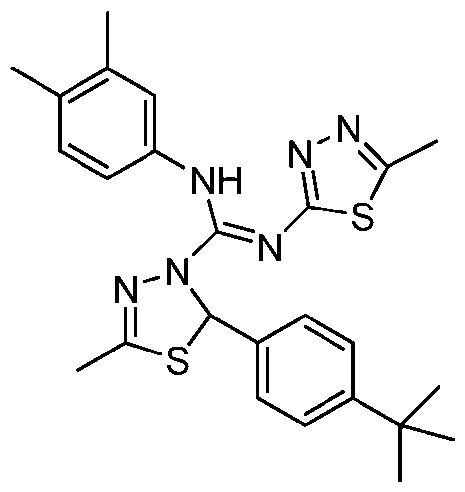
'H NMR (400 MHz CD3OD): <5 9.51 (s, 1H), 7.37 (d, J= 8.0 Hz, 2H), 7.23 (d,
J = 8 Hz, 2H), 7.21 (s, 1H), 6.85-6.89 (m, 1H), 6.76 (s, 1H), 6.73-6.77 (m, 1H), 2.49 (s, 3H), 2.31 (s, 3H), 2.30 (s, 3H), 2.07 (s, 3H). MS: m/z 479 [M+H]+.
Example 18 : (E)-N-(3,4-dimethylphenyl)-2-(4-fluorophenyl)-5-methyl-N'- (5-methyl-l,3,4-thiadiazol-2-yl)-l,3,4-thiadiazole-3(2H)-carboximidamide (Compound 18)
 'H NMR (400 MHz, CD3OD): <5 9.35 (s, 1H), 7.75 (d, .7= 8.0 Hz, 2H), 7.50
(d, J = 8.0 Hz, 2H), 7.32 (s, 1H), 6.89-6.91 (m, 1H), 6.75-6.73 (m, 2H), 2.48 (s, 3H), 2.30 (s, 3H), 2.20 (s, 3H), 2.07 (s, 3H). MS: m/z 441[M+H]+.
Example 19: (E)-2-(3,4-difluorophenyl)-N-(3,4-dimethylphenyl)-5-methyl-
N'-(5-methyl-l,3,4-thiadiazol-2-yl)-l,3,4-thiadiazole-3(2H)-carboximidamide (Compound 19)
 'H NMR (400 MHz, CD3OD): d 9.45 (s. 1H), 7.35-7.49 (m, 2H). 7. 19 (bm,
2H), 6.86-6.88 (bm, 1H), 6.86.61-6.715 (m, 2H), 2.46 (s, 3H), 2.28 (s, 3H), 2.17 (s, 3H), 2.04 (s, 3H). MS: m/z 459 [M+H]+. Example 20: (E)-N-(3,4-dimethylphenyl)-5-methyl-N'-(5-methyl-l,3,4- thiadiazol-2-yl)-2-(3,4,5-trifluorophenyl)-l,3,4-thiadiazole-3(2H)- carboximidamide (Compound 20)

4b Compound 20 Step 1: To a solution of SOCh (1.5 mL, 20.6 mmol) in ACN (20 mL) was added pyridine (3.0 mL, 37.5 mmol) slowly at 0 °C. Then 3,4,5-trifluorobenzaldehyde (lb) (3 g. 18.7 mmol) was added and the resulting mixture was stirred at room temperature for 12 h. The mixture was concentrated under reduced pressure and the
solid was suspended in a minimum of ACN. The solid was filtered, washed with Et2O. and dried under vacuum to afford (R)-l-(chloro(3,4,5- trifluorophenyl)methyl)pyridin-l-ium chloride (2b) (3.2 g, yield: 58 %) as white precipitate. 'H NMR (400 MHz, CD3OD): 5 9.32 (d, J= 6.0 Hz, 2H), 8.77 (t, J= 7.7 Hz, 1H), 8.24 (t, J= 7.1 Hz, 2H), 8.09 (s, 1H), 7.67 (dd, J= 8.0, 6.2 Hz, 2H). MS: m/z 259 [M+H]+.
Step 2: A mixture of (R)-l-(chloro(3,4,5-trifluorophenyl)methyl)pyridin-l- ium chloride (2b) (3.2 g, 10.9 mmol) and 5-methyl-l,3,4-thiadiazol-2-amine (3a) (2.5 g, 21.8 mmol) in ACN (30 mL) was stirred at 75 °C overnight. The resulting mixture was concentrated under reduced pressure and the solid was suspended in a minimum of ACN. The solid was filtered, washed with Et2O, and dried under vacuum. Then the solid was suspended in a minimum of CH2CI2 and stirred at rt overnight. The solid was again filtered, washed with Et2O, and dried under vacuum to afford 2,6-dimethyl- 9-(3,4,5-trifhiorophenyl)-9H-bis([l,3,4]thiadiazolo)[3,2-a:2',3'-d][l,3,5]triazin-8-ium chloride (4b) (1.8 g, yield: 42%) as white solid. 'H NMR (400 MHz, CD3OD): 5 7.88 (s, 1H), 7.70 - 7.59 (m, 2H), 2.63 (s, 6H). MS: m/z 358 [M+H]+.
Step 3: A mixture of 3,4-dimethylaniline (5b) (309 mg, 2.6 mmol) and 2.6- dimethyl-9-(3,4,5-trifluorophenyl)-9H-bis(|T,3,4]thiadiazolo)[3,2-a:2',3'- d][l,3,5]triazin-8-ium chloride (4b) (1 g, 2.6 mmol) in CHCls/TEA (15 mL/15 mL) was stirred at room temperature overnight. The solvent was removed under vacuum. The desired product was purified by chromatography (0-40% EtOAc/Hexanes), affording Compound 20 (125 mg) as a light-yellow solid. The obtained product was further purified by Prep-HPLC to afford (Z)-N'-(3,4-dimethylphenyl)-5-methyl-N-(5- methyl-l,3,4-thiadiazol-2-yl)-2-(3,4,5-trifluorophenyl)-l,3,4-thiadiazole-3(2H)- carboximidamide (compound 20) (85 mg, yield: 7%) as white solid. 'H NMR (400 MHz, CD3OD): 8 7.21-7.12 (m, 3H), 6.90 (d, J= 8.0 Hz, 1H), 6.79-6.68 (m, 3H), 2.30 (s, 3H). 2.28 (s, 3H). 2.11 (s. 6H). MS: m/z 477 [M+H]+. 13C NMR (101 MHz, CD3OD): 5 208.11, 200.02, 165.20, 151.60, 138.23, 130.92, 124.12, 120.29, 111.66, 92.21, 73.93, 71.35, 71.21, 69.29, 67.01, 64.26, 62.17, 19.74, 19.11, 16.41, 15.60.
Example 21: (E)-N-(3,4-dimethylphenyl)-2-(4-fluoro-3- (trifluoromethyl)phenyl)-5-methyl-N'-(5-methyl-l,3,4-thiadiazol-2-yl)-l,3,4- thiadiazole-3(2H)-carboximidamide (Compound 29)

'H NMR (400 MHz, CDsOD): 3 8.02 (s, 1H), 7.61 (t, J= 8.0 Hz, 1H), 7.29- 7.16 (m, 6H), 6.85 (s, 1H). 2.37 (s, 3H), 2.27 (s. 3H), 2.16 (s, 3H). MS: m/z 509 [M+H]+.
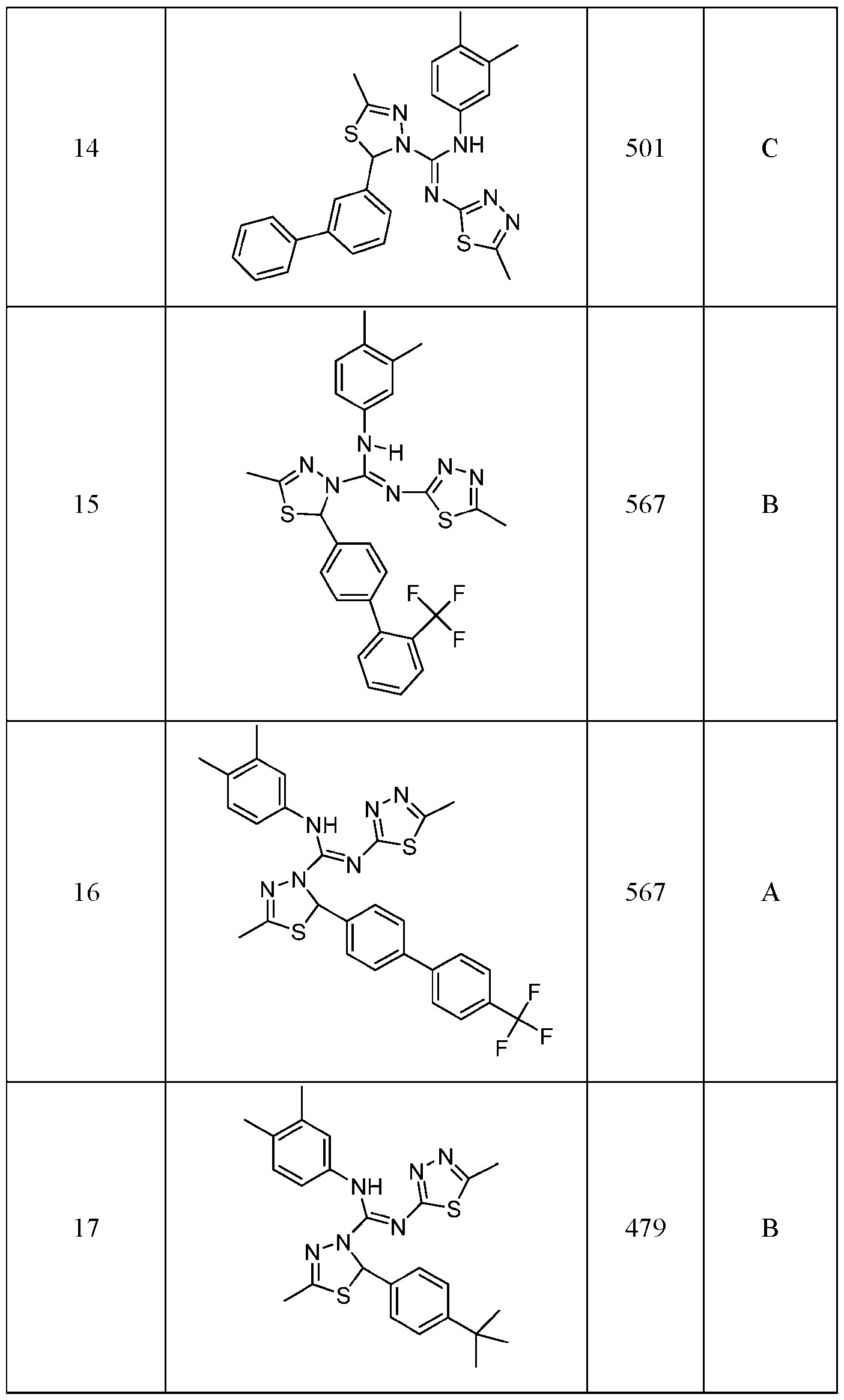
Example 35 - Bioactivity of the Exemplified Compounds hSecR agonist assay
Compounds were dispensed by acoustic dispenser Echo 555 to reach final concentration of 50 pM or less in dosage response in columns 5 through 40. Positive control of 100 pM final concentration secretin FL peptide was dispensed to column 1 and 2 with Echo, and matching DMSO was dispensed to rest of the assay wells. Stimulation buffer was prepared, containing 0.5 mM IBMX. 0.08% BSA. 5 mM HEPES pH 7.3, and HBSS. hSecR CHO cells were detached with Tryple and resuspended in stimulation buffer, and 800 cells per well w ere dispensed to Coming 3725 assay plate at 5 pL volume with Nanodrop Combi dispenser. After 30 minutes incubation at room temperature, 4 pL of anti cAMP-cryptate and cAMP-d2 mixture from Cisbio 20k Gs Dynamic kit were dispensed by Combi and the plate was mixed by centrifugation at Ik rpm for 1 minute. After 30 more minutes, the plate was read on PHERAstar FS with HTRF optical module.
The potency ranges in Table A are as follows: ECso = less than 200 nM = A; ECso = 201 nM - 1000 nM = B; ECso = 1001 - 5000 nM = C; ECso = 5001 - 20000 nM = D. ECso = > 20000 nM = E
Table A. hSecR ECso and m/z Values.




OTHER EMBODIMENTS
It is to be understood that while the present application has been described in conjunction with the detailed description thereof, the foregoing description is intended to illustrate and not limit the scope of the present application, which is defined by the scope of the appended claims. Other aspects, advantages, and modifications are within the scope of the following claims.
Claims
1 . A compound of Formula (I):
 or a pharmaceutically acceptable salt thereof, wherein: ring A is selected from phenyl, naphthyl, fluorenyl, dibenzofuranyl. and benzodioxazolyl, each optionally substituted with 1, 2, 3, or 4 R1, or ring A is thienyl optionally substituted with 1, 2, or 3 R1; each R1 is independently selected from halo, CN, ORal, SRa1, Ci-6 alkyl, Ci-6 haloalkyl, phenyl, and pyridinyl. and wherein the phenyl in the definition of R1 is optionally substituted with 1, 2 or 3 substituents each independently selected from halo, ORal, Ci-6 alkyl, and Ci-6 haloalkyl; each R2 is selected from halo, CN, ORal, SRal, Ci-6 alkyl, and Ci-6 haloalkyl;
R4 and R5 are each independently selected from Ci-6 alkyl, and phenyl; and each Ral is independently selected from H. Ci-6 alkyl, Ci-6 haloalkyl, and phenyl, with the proviso the compound is not


2. The compound of claim 1, wherein ring A is selected from phenyl, naphthyl, fluorenyl, dibenzofuranyl, and benzodioxazolyl. each substituted with 1, 2. 3. or 4 R1.
3. The compound of claim 2, wherein ring A is phenyl substituted with 1, 2. 3, or 4 R1.
4. The compound of claim 1, wherein ring A is thienyl substituted with 1, 2, or 3 R1.
5. The compound of claim 1, wherein compound of Formula (I) is a compound of Formula (la):
 or a pharmaceutically acceptable salt thereof.
6. The compound of any of the preceding claims, wherein R5 is Ci-6 alkyl.
7. The compound of any of the preceding claims, wherein R5 is C1-3 alkyl.
8. The compound of claim 7, wherein R5 is methyl.
9. The compound of claim 7, wherein R5 is ethyl.
10. The compound of any one of claims 1-6. wherein R5 is phenyl or methyl.
11. The compound of claim 10, wherein R5 is phenyl.
12. The compound of any of the preceding claims, wherein R4 is C1-3 alkyl.
13. The compound of claim 12, wherein R4 is methyl.
14. The compound of claim 12, wherein R4 is ethyl.
15. The compound of any one of claims 1-11, wherein R4 is phenyl or methyl.
16. The compound of claim 15, wherein R4 is phenyl.
17. The compound of any one of claims 1-6, wherein R4 and R5 are methyl or ethyl.
18. The compound of any one of claims 1-6. wherein R4 and R5 are phenyl.
19. The compound of any one of the preceding claims, comprising at least one R2 selected from halo, ORal, C1-6 alkyl, and C1-6 haloalkyl.
20. The compound of any one of claims 1-19, wherein one R2 is methyl.
21. The compound of any one of claims 1-19, wherein two R2 are methyl.
22. The compound of any one of claims 1-19, wherein one R2 is ethyl.
23. The compound of any one of claims 1-19, wherein one R2 is iso-propyl.
24. The compound according to any one of claims 1-19, wherein one R2 is fluoro.
25. The compound of any one of claims 1-19, wherein one R2 is chloro.
26. The compound of any one of claims 1-19, wherein one R2 is bromo.
27. The compound of any one of claims 1-19, wherein one R2 is CF3.
28. The compound of any one of claims 1-19, wherein one R2 is OCF3.
29. The compound of any one of claims 2-28, wherein each R1 is independently selected from halo. CN, ORal, SRal, C1-6 alkyl, C1-6 haloalkyl. and phenyl, and wherein the phenyl in the definition of R1 is optionally substituted with 1 , 2 or 3 substituents each independently selected from halo, ORal, C1-3 alkyd, and C1-3 haloalkyl.
30. The compound of any one of claims 2-29, wherein one R1 is methyl.
31. The compound of any one of claims 2-29, wherein one R1 is iso-propyl or tertbutyl.
32. The compound of any one of claims 2-29, wherein one or two R1 are fluoro.
33. The compound of any one of claims 2-29, wherein three R1 are fluoro.
34. The compound of any one of claims 2-29, wherein one R1 is chloro.
35. The compound of any one of claims 2-29. wherein two or three R1 are chloro.
36. The compound of any one of claims 2-29, wherein one R1 is chloro and two R1 are fluoro.
37. The compound of any one of claims 2-29, wherein one R1 is bromo.
38. The compound of any one of claims 2-29, wherein one R1 is CF3.
39. The compound of any one of claims 2-29, wherein one R1 is fluoro and one R1 is CFs.
40. The compound of any one of claims 2-29, wherein one R1 is fluoro and one R1 is CN.
41. The compound of any one of claims 2-29, wherein two R1 are fluoro and one R1 is methyl.
42. The compound of any one of claims 2-29, wherein two R1 are fluoro and one R1 is OCH3.
43. The compound of any one of claims 2-29, wherein one R1 is OCF3.
44. The compound of any one of claims 2-29, wherein one R1 is phenyl.
45. The compound of to any one of claims 2-29. wherein one R1 is phenyl substituted with fluoro, chloro, bromo, methyl, OCH3. or CF3.
46. The compound of any one of claims 2-29, wherein one R1 is O-phenyl.
47. The compound of any one of claims 2-29, wherein one R1 is phenyl substituted with CF3.
48. The compound of any one of claims 2-29, wherein one R1 is phenyl substituted with bromo.
49. The compound of any one of claims 2-29, wherein one R1 is phenyl substituted with chloro.
50. The compound of claim 1, wherein the compound is selected from:


51. A pharmaceutical composition comprising a compound of any one of claims 1- 50, or a pharmaceutically acceptable salt thereof, and a pharmaceutically acceptable carrier.
52. A method of treating a disease selected from obesity, type 2 diabetes mellitus, heart failure, hypertension, functional dyspepsia, cholestasis, and non-alcoholic fatty liver disease, the method comprising administering to a subject in need thereof a therapeutically effective amount of a compound of any one of claims 1-50, or a pharmaceutically acceptable salt thereof, or a pharmaceutical composition of claim 51.
53. A method of treating a disease mediated by stimulation of secretin receptor (SecR), comprising administering to a subject in need thereof a therapeutically effective amount of a compound of any one of claims 1-50, or a pharmaceutically acceptable salt thereof, or a pharmaceutical composition of claim 51.
Applications Claiming Priority (2)
| Application Number | Priority Date | Filing Date | Title |
|---|---|---|---|
| US202363614324P | 2023-12-22 | 2023-12-22 | |
| US63/614,324 | 2023-12-22 |
Publications (1)
| Publication Number | Publication Date |
|---|---|
| WO2025136642A1 true WO2025136642A1 (en) | 2025-06-26 |
Family
ID=96137867
Family Applications (1)
| Application Number | Title | Priority Date | Filing Date |
|---|---|---|---|
| PCT/US2024/058250 Pending WO2025136642A1 (en) | 2023-12-22 | 2024-12-03 | Secretin receptor agonists and methods of use |
Country Status (1)
| Country | Link |
|---|---|
| WO (1) | WO2025136642A1 (en) |
Citations (1)
| Publication number | Priority date | Publication date | Assignee | Title |
|---|---|---|---|---|
| WO2020211772A1 (en) * | 2019-04-16 | 2020-10-22 | Versitech Limited | Purmorphamine as a small compound positive allosteric modulator of secretin receptor for the treatment of hypertension |
-
2024
- 2024-12-03 WO PCT/US2024/058250 patent/WO2025136642A1/en active Pending
Patent Citations (1)
| Publication number | Priority date | Publication date | Assignee | Title |
|---|---|---|---|---|
| WO2020211772A1 (en) * | 2019-04-16 | 2020-10-22 | Versitech Limited | Purmorphamine as a small compound positive allosteric modulator of secretin receptor for the treatment of hypertension |
Non-Patent Citations (2)
| Title |
|---|
| DENGLER DANIELA G., HARIKUMAR KALEECKAL G., POLLARI SIRKKU, SUN QING, BROWN BROCK T., SHINOKI-IWAYA AKI, ARDECKY ROBERT, MILLER LA: "Discovery of small molecule positive allosteric modulators of the secretin receptor", BIOCHEMICAL PHARMACOLOGY, ELSEVIER, US, vol. 185, 1 March 2021 (2021-03-01), US , pages 114451, XP093332037, ISSN: 0006-2952, DOI: 10.1016/j.bcp.2021.114451 * |
| WERMANN KURT, WALTHER MARTIN, GOERLS HELMAR, ANDERS ERNST: "Bis(1,3,4âThiadiazolo)â1,3,5âtriazinium Halides. Part 7. Access to Highly Substituted Aromatic Guanidines.", CHEMINFORM, WILEY-VCH VERLAG, WEINHEIM, vol. 34, no. 50, 16 December 2003 (2003-12-16), Weinheim, XP093332040, ISSN: 0931-7597, DOI: 10.1002/chin.200350131 * |
Similar Documents
| Publication | Publication Date | Title |
|---|---|---|
| US6881746B2 (en) | Glucagon antagonists/inverse agonists | |
| JP6572392B2 (en) | Hydroxylamine and hydroxycycloalkylamine substituted diamine-arylsulfonamide compounds having selective activity in voltage-gated sodium channels | |
| CA2769474C (en) | Acyl guanidine derivatives modulating the hedgehog protein signaling pathway | |
| JP2006500325A (en) | Novel glucagon antagonist | |
| JP2004501897A (en) | Glucagon antagonist / adverse drug | |
| TW200804299A (en) | Hydantoin based kinase inhibitors | |
| CN109641852B (en) | Sulfonamides as GPR 40-and GPR 120-agonists | |
| JP2005511683A (en) | Novel glucagon antagonist | |
| JP2005537231A (en) | Novel glucagon antagonist | |
| CN117050013A (en) | Mono(acid) salt of 6-aminoisoquinoline and its uses | |
| EP0833822A1 (en) | 4-phenylaminothiazole derivatives, method for preparing same, and pharmaceutical compositions containing said derivatives | |
| CN102159578A (en) | Salts of tetrahydroimidazo [1,5-a] pyrazine derivatives, preparation methods and pharmaceutical use thereof | |
| WO2007088276A2 (en) | Sulfonamide derivatives, preparation and therapeutic application thereof | |
| JP2021512112A (en) | Heterocyclyl-substituted oxadiazolopyridine derivative for use as a ghrelin O-acyltransferase (GOAT) inhibitor | |
| WO2000023442A1 (en) | Carboxylic acid derivatives and drugs containing the same as the active ingredient | |
| CN103304500B (en) | Novel anti-diabetic compound, as well as preparation method and application thereof | |
| JP6130835B2 (en) | Benzothiazolone compounds | |
| US9593144B2 (en) | FPR1 antagonist derivatives and use thereof | |
| WO2025136642A1 (en) | Secretin receptor agonists and methods of use | |
| KR20230135085A (en) | Pyridine derivatives as modulators of sortilin activity | |
| EP1525198B1 (en) | Acyloxypyrrolidine derivatives, preparation and therapeutic use thereof | |
| CN108558760B (en) | Aromatic amide compounds, preparation method and application thereof | |
| CA2752198C (en) | Substituted 3-benzofuranyl-indol-2-one-3-acetamidopiperazine derivatives, preparation thereof, and therapeutic use thereof | |
| TW200916443A (en) | 5-aryl-4,5-dihydro-(1H)-pyrazolines as cannabinoid CB1 receptor agonists | |
| WO2025072489A2 (en) | Analogues of n-lactoyl-phenylalanine, methods of synthesis, and methods of use |
Legal Events
| Date | Code | Title | Description |
|---|---|---|---|
| 121 | Ep: the epo has been informed by wipo that ep was designated in this application |
Ref document number: 24908600 Country of ref document: EP Kind code of ref document: A1 |