WO2025136396A1 - Carbon black with shape-modified aggregate distribution, rubber products using the same - Google Patents
Carbon black with shape-modified aggregate distribution, rubber products using the same Download PDFInfo
- Publication number
- WO2025136396A1 WO2025136396A1 PCT/US2023/085448 US2023085448W WO2025136396A1 WO 2025136396 A1 WO2025136396 A1 WO 2025136396A1 US 2023085448 W US2023085448 W US 2023085448W WO 2025136396 A1 WO2025136396 A1 WO 2025136396A1
- Authority
- WO
- WIPO (PCT)
- Prior art keywords
- carbon black
- reactor
- shape
- inventive
- aggregates
- Prior art date
- Legal status (The legal status is an assumption and is not a legal conclusion. Google has not performed a legal analysis and makes no representation as to the accuracy of the status listed.)
- Pending
Links
Classifications
-
- C—CHEMISTRY; METALLURGY
- C09—DYES; PAINTS; POLISHES; NATURAL RESINS; ADHESIVES; COMPOSITIONS NOT OTHERWISE PROVIDED FOR; APPLICATIONS OF MATERIALS NOT OTHERWISE PROVIDED FOR
- C09C—TREATMENT OF INORGANIC MATERIALS, OTHER THAN FIBROUS FILLERS, TO ENHANCE THEIR PIGMENTING OR FILLING PROPERTIES ; PREPARATION OF CARBON BLACK ; PREPARATION OF INORGANIC MATERIALS WHICH ARE NO SINGLE CHEMICAL COMPOUNDS AND WHICH ARE MAINLY USED AS PIGMENTS OR FILLERS
- C09C1/00—Treatment of specific inorganic materials other than fibrous fillers; Preparation of carbon black
- C09C1/44—Carbon
- C09C1/48—Carbon black
- C09C1/50—Furnace black ; Preparation thereof
-
- C—CHEMISTRY; METALLURGY
- C09—DYES; PAINTS; POLISHES; NATURAL RESINS; ADHESIVES; COMPOSITIONS NOT OTHERWISE PROVIDED FOR; APPLICATIONS OF MATERIALS NOT OTHERWISE PROVIDED FOR
- C09C—TREATMENT OF INORGANIC MATERIALS, OTHER THAN FIBROUS FILLERS, TO ENHANCE THEIR PIGMENTING OR FILLING PROPERTIES ; PREPARATION OF CARBON BLACK ; PREPARATION OF INORGANIC MATERIALS WHICH ARE NO SINGLE CHEMICAL COMPOUNDS AND WHICH ARE MAINLY USED AS PIGMENTS OR FILLERS
- C09C1/00—Treatment of specific inorganic materials other than fibrous fillers; Preparation of carbon black
- C09C1/44—Carbon
- C09C1/48—Carbon black
- C09C1/56—Treatment of carbon black ; Purification
-
- C—CHEMISTRY; METALLURGY
- C01—INORGANIC CHEMISTRY
- C01P—INDEXING SCHEME RELATING TO STRUCTURAL AND PHYSICAL ASPECTS OF SOLID INORGANIC COMPOUNDS
- C01P2004/00—Particle morphology
- C01P2004/50—Agglomerated particles
-
- C—CHEMISTRY; METALLURGY
- C01—INORGANIC CHEMISTRY
- C01P—INDEXING SCHEME RELATING TO STRUCTURAL AND PHYSICAL ASPECTS OF SOLID INORGANIC COMPOUNDS
- C01P2004/00—Particle morphology
- C01P2004/51—Particles with a specific particle size distribution
- C01P2004/53—Particles with a specific particle size distribution bimodal size distribution
-
- C—CHEMISTRY; METALLURGY
- C01—INORGANIC CHEMISTRY
- C01P—INDEXING SCHEME RELATING TO STRUCTURAL AND PHYSICAL ASPECTS OF SOLID INORGANIC COMPOUNDS
- C01P2006/00—Physical properties of inorganic compounds
- C01P2006/19—Oil-absorption capacity, e.g. DBP values
Definitions
- 03234.0088P1 CARBON BLACK WITH SHAPE-MODIFIED AGGREGATE DISTRIBUTION, RUBBER PRODUCTS USING THE SAME BACKGROUND TECHNICAL FIELD
- the present disclosure relates to carbon blacks, and specifically to carbon blacks with a distinctive morphology and shape-modified aggregates and aggregate size distribution, together with rubber products containing such carbon blacks.
- TECHNICAL BACKGROUND Carbon black is an engineered, particulate elemental carbon found in countless items used on a daily basis. It is a useful ingredient in, for example, rubber goods, improving their strength, durability, and overall performance.
- Carbon black morphology has historically been a rich area for development of new carbon blacks since this property has a significant impact on the properties they impart to various composites, namely rubber goods.
- carbon blacks are described in product specifications and in the literature by their colloidal properties, namely surface area, tint and structure.
- variation of the carbon black aggregate size distribution has been utilized to impart desirable properties to rubber compounds. Typically, this has been achieved by making the aggregate size distribution broader, thereby increasing the average inter- aggregate spacing and reducing the degree of carbon black networking that is primarily responsible for the heat generation in rubber compounds.
- this disclosure in one aspect, relates to shape modified carbon blacks, and specifically to carbon blacks having unique shape properties and distributions.
- this carbon black will be named “carbon black of the invention” or “Inventive Carbon Black”, the two expressions being synonymous.
- Another aspect of the invention relates to rubber compounds comprising at least one carbon black of the present invention.
- FIG. 1 illustrates an exemplary carbon black reactor, in accordance with various aspects of the present disclosure.
- FIGS. 1 illustrates an exemplary carbon black reactor, in accordance with various aspects of the present disclosure.
- FIG. 2A-2D illustrate shape classifications for carbon black aggregates, including Type 1 Spheroidal (FIG.2A), Type 2 Ellipsoidal (FIG.2B), Type 3 Linear (FIG.2C), and Type 4 Branched (FIG.2D), in accordance with various aspects of the present disclosure.
- FIG. 3A illustrates exemplary carbon black aggregates having a normal aggregate size distribution, together with an exemplary plot of the aggregate size distribution, in accordance with various aspects of the present disclosure.
- FIG. 3B illustrates exemplary carbon black aggregates of the present disclosure having a different distribution of large, higher structured aggregates and small, lower structure aggregates, together with an exemplary plot of the aggregate size distribution illustrating the modified aggregate size distribution, in accordance with various aspects of the present disclosure.
- FIG. 4 illustrates aggregate size distributions for a normal ASD of an ASTM type carbon black (solid line) and an Inventive Carbon Black (dotted line), and also shows morphological descriptors from typical disc centrifuge photosedimentometry, in accordance with various aspects of the present disclosure.
- FIGS. 5A-5E show examples of the ASDs for various Comparative Carbon Blacks versus the Inventive Carbon Blacks of Similar Surface Area and Structure.
- FIGS. 6A and 6B illustrate transmission electron micrographs of aggregates of Comparative Carbon Black A and Inventive Carbon Black 1, in accordance with various aspects of the present disclosure. 03234.0088P1 [0020] FIGS.
- a filler or “a solvent” includes mixtures of two or more fillers, or solvents, respectively.
- conventional carbon black it means carbon black materials manufactured without using the processes described herein, such as, for example, ASTM grade carbon blacks as described in ASTM D-1765-19 which have historically been used in the tire and 03234.0088P1 rubber industry and exhibit the colloidal balance of properties as described in ASTM D-1765- 19.
- Heterogeneity Index or “HI” is intended to refer to a ratio providing a normalized measure of the breadth of distribution or polydispersity.
- HI ASD refers to the aggregate size heterogeneity index
- HIPSD refers to the particle size heterogeneity index, both as defined in ASTM D3849-14a (“Morphological Characterization of Carbon Black Using Electron Microscopy-Method A”).
- the Divergence Ratio can be an indicator of decoupling of the aggregate size distribution (ASD) and the particle size distribution (PSD).
- Low Divergence Ratios such as, for example, values less than about 1.5-1.7
- Higher Divergence Ratios such as, for example, values greater than about 1.5-1.7 can indicate a decoupling of ASD and PSD, such as when the ASD is being broadened at a rate faster than the PSD.
- Such a higher Divergence Ratio can indicate a carbon black grade having a broad ASD and a normal or narrow PSD.
- shape distribution can refer to a method for categorizing carbon black into four shape aggregates categories (i.e., spheroidal (type 1), ellipsoidal (type 2), linear (type 3), branched (type 4)), as illustrated respectively in FIG.2A, FIG.2B, FIG 2C and FIG.2D and described in “Morphology of Carbon-Black aggregates: Fractal versus Euclidian Geometry” by Herd and al., Rubber Chemistry and Technology v.65, p.107-129, and gives direct information regarding the balance of shape types for a shape modified grade of carbon black versus a normal or conventionally manufactured carbon black.
- shape aggregates categories i.e., spheroidal (type 1), ellipsoidal (type 2), linear (type 3), branched (type 4)
- the aggregate shape distribution is determined using skeletonization techniques and basic image analysis parameters in conjunction with skeletonization techniques based on the methods described in “The Use of Skeletonization for the Shape Classification of Carbon-Black Aggregates,” by 03234.0088P1 Herd et al., Rubber Chemistry and Technology, v.66, p.491-509.
- the term “Shape Specific Heterogeneity Index of type Z” or “SSHI of type Z” is intended to refer to a ratio of the weight percent of a particular aggregate shape category named Z to the number percent of that aggregate shape category named Z present in a carbon black material.
- Weight%tZ ⁇ ((1.8*(8/3)*A2)/P)tZ / ⁇ ((1.8*(8/3)*A2)/P)t (9) wherein ⁇ ((1.8*(8/3)A 2 )/P)tZ represents the total weight of aggregates in a given shape category, Z (1, 2, 3 or 4) and ⁇ ((1.86*(8/3)A 2 )/P)t represents the total weight of aggregates for all shape categories (1, 2, 3 and 4).
- TEM is intended to refer to transmission electron microscope.
- the apparent void volume of the carbon black material can be calculated by summing the individual void volume of each individual aggregate relative to its proportion of the total measured volumes that are representative of the aggregate size distribution.
- Higher apparent void volume V’/VA values can indicate a higher degree of branching or aggregate complexity. For example, a V’/VA of 2 means that the carbon black material can occlude up to twice its own volume.
- Disc centrifuge photosedimentometry can also be used for determination of various aggregate size properties or parameters as related to its distributional nature. This technique utilizes Stoke’s Law, modified for centrifugal sedimentation to determine the Stoke’s diameters of the Carbon Black aggregates and its aggregate size distributional properties.
- These various aggregate size distributional (ASD) parameters as shown in FIG.4, can include the Mean, Mode, D 10 , D 50 , D 90 , and Delta D50 or full width at half maximum (FWHM).
- the D10 aggregate diameter represents the aggregate diameter where 10% of the volume distribution lies below the D 10 value
- the D 50 aggregate diameter represents the aggregate diameter where 50% of the volume distribution lies below the D50 value
- the D90 aggregate diameter represents the aggregate diameter where 90% of the volume 03234.0088P1 distribution lies below the D90 value.
- Delta D50 is the full width at half maximum of the ASD peak, which may be useful as an indicator of the breadth of the ASD for unimodal ASDs, but can be less useful, if not useful at all, for multimodal ASDs, depending upon the relative magnitude of one of the modes in the multi-modal ASD.
- Mode (Delta D50 / Mode) to normalize the parameter and make it comparable between carbon black materials as the Delta D 50 itself is directly influenced by the particle size, aggregate size and aggregate structure. Unless stated to the contrary, these values can be determined by disc centrifuge photosedimentometry according to the standard ISO 15825:2017.
- references in the specification and concluding claims to parts by weight, of a particular element or component in a composition or article denotes the weight relationship between the element or component and any other elements or components in the composition or article for which a part by weight is expressed.
- X and Y are present at a weight ratio of 2:5, and are present in such ratio regardless of whether additional components are contained in the composition.
- References in the specification and concluding claims to phr of a particular element or component in a composition or article denote the parts per hundred units of mass of rubber of the particular element or component.
- Ranges can be expressed herein as from “about” one particular value, and/or to “about” another particular value. When such a range is expressed, another aspect includes from the one particular value and/or to the other particular value. Similarly, when values are expressed as approximations, by use of the antecedent “about,” it will be understood that the particular value forms another aspect. It will be further understood that the endpoints of each of the ranges are significant both in relation to the other endpoint, and independently of the other endpoint. It is also understood that there are a number of values disclosed herein, and that each value is also herein disclosed as “about” that particular value in addition to the value itself. For example, if the value “10” is disclosed, then “about 10” is also disclosed.
- Carbon blacks for rubber applications are typically identified by a four-character “N” or "S" number, e.g., NXXX or SXXX.
- the category (grade) is determined by ASTM D1765- 19. The first character of the category gives some indication of the influence of the carbon black on the rate of cure of a typical rubber formulation containing the black, where “N” is used for normal cure carbon blacks and “S” is used for slow cure carbon blacks. The second character gives information on the average surface area of the carbon black.
- carbon blacks with the same second character are grouped into a series ending in "00," e.g., N200 series.
- the last two characters are assigned arbitrarily.
- the morphological characteristics of carbon black such as particle size, aggregate size and aggregate structure, can affect various processing characteristics and performance properties, such as, for example, tread wear, rolling resistance, heat buildup, hardness, modulus, and tear resistance, of various end products like tires and mechanical rubber goods. Accordingly, different grades of carbon black are used in different polymeric formulations, depending on the specific service requirements of the tires and rubber goods.
- the carbon black of the present invention can comprise a furnace carbon black.
- the carbon black of the present invention can comprise a shape-modified version of an ASTM grade carbon black, such as, for example, an N100, N200, N300, N400, N500, N600, N700, N800, or N900 carbon black.
- the carbon black of the present invention can comprise a tread grade carbon black, suitable for use in passenger tire tread compounds, truck tire tread compounds, and mining tires.
- the carbon black of the present invention can comprise a carcass grade carbon black.
- the carbon black of the present invention can comprise a carbon black suitable for use in non-tread or carcass compounds of a tire, such as, for example, a sidewall, innerliner, sub-tread or bead filler compound.
- Morphological characteristics of carbon black include, for example, particle size/fineness, surface area, aggregate size/structure, aggregate size distribution, and aggregate shape. Particle size is a measurement of the diameter of the primary particles of carbon black.
- Iodine Adsorption No. was historically the primary indicator of surface area for defining different grades.
- Nitrogen surface area, or NSA ASTM D6556-2017
- STSA statistical thickness surface area
- NSA and STSA are better measures of the true surface area than iodine, since NSA and STSA are less influenced by the chemical composition of the carbon black surface.
- carbon black is produced by the partial oxidation or thermal decomposition of hydrocarbon gases or liquids, where a hydrocarbon raw material (hereinafter called "feedstock hydrocarbon”) is injected into a flow of hot gas wherein the feedstock hydrocarbon is pyrolyzed and converted into a smoke before being quenched by a water spray.
- feedstock hydrocarbon a hydrocarbon raw material
- the hot gas is produced by burning 03234.0088P1 fuel in a combustion section.
- the hot gas flows from the combustion section into a reaction section which is in open communication with the combustion section.
- the feedstock hydrocarbon is introduced into the hot gas as the hot gas flows through the reaction section, thereby forming a reaction mixture comprising particles / aggregates of forming carbon black.
- the reaction mixture flows from the reactor into a cooling section which is in open communication with the reaction section.
- a cooling section which is in open communication with the reaction section.
- one or more quench sprays of, for example, water are introduced into the flowing reaction mixture thereby lowering the temperature of the reaction mixture below the temperature necessary for carbon black formation.
- the carbon black aggregates are then separated from the flow of hot gas.
- a broad range of carbon black types can be made by controlled manipulation of the reactor conditions.
- Many carbon black reactors normally comprise a cylindrical combustion section axially connected to one end of a cylindrical or frusto-conical reaction section.
- a reaction choke is often axially connected to the other end of the reaction section.
- the reaction choke has a diameter substantially less than the diameter of the reaction section and connects the reaction section to the cooling section.
- the cooling section is normally cylindrical and has a diameter which is substantially larger than the diameter of the reaction choke.
- a carbon black reactor 100 is shown comprising a combustion section 102.
- the combustion section 102 comprises a cylindrical inlet 108 in the upstream end of the combustion section for the introduction of a fuel, such as natural gas or fuel oil, and a second opening 110 in the peripheral wall of the combustion section for the introduction of an oxygen-containing gas, such as air.
- a fuel such as natural gas or fuel oil
- an oxygen-containing gas such as air.
- the reactor also includes a reaction section 104 axially aligned with the combustion section.
- the hot gas produced in the combustion section flows substantially axially through the reactor, that is, the hot gas flows substantially parallel to the longitudinal axis of the reactor.
- the reaction section includes a conical section 112 extending forward from the downstream end of the combustion section.
- the reaction section is in open communication with the combustion section through the open downstream end of the combustion section.
- the reaction section has an inner diameter which gradually decreases as the reaction section converges towards a reaction choke 114.
- the reaction choke extends forward from the 03234.0088P1 converging end of the reaction section, and the reaction choke is in open communication with the reaction section through an opening in the converging end of the reaction section.
- the feedstock hydrocarbon, or conversion oil can comprise a variety of hydrocarbon materials, such as fluidized catalyst cracker (FCC) residuals, fuel oil, or coal tar.
- the feedstock hydrocarbon can also be a renewable feedstock.
- One or more hydrocarbon injection nozzles 116 are positioned along the length of the reaction section and/or the reaction choke. In FIG.1, the position of exemplary injection nozzles are denoted by the letters A, B, C, and D.
- the feedstock hydrocarbon injection nozzles can extend through the outer walls of the reaction section and the reaction choke and protrude into the interior of the carbon black reactor.
- Carbon black recovery systems are well known to those skilled in the art and thus are not discussed here in detail.
- Additives such as, for example, potassium containing structure control additives, can optionally be mixed with a feedstock hydrocarbon and/or injected separately into one or more of the feedstock hydrocarbon injection nozzles.
- the carbon black reactor illustrated in FIG. 1 is shown having a cylindrical cross-section, it should be understood that carbon black reactors having non-cylindrical cross- sections can also be used to practice the present invention.
- the present invention is not limited to any particular carbon black reactor design, and one of skill in the art, in possession of this disclosure, could readily determine how to utilize the invention in a given reactor system. It should also be understood that a combustion section which produces tangential flow, as opposed to an axial flow, can be used with the present invention.
- Conventional Control of Carbon Black Aggregates, Size and Distribution [0059] It is well known that carbon black exists as a collection of aciniform aggregates that cover a wide range of particle size, surface area and aggregate size and structure. The mean particle size and particle size distribution of carbon black directly determine its specific surface area, and as mentioned previously, smaller mean particle size increases the specific surface area and vice – versa.
- the aggregate size is determined by both the mean particle size, number of particles per aggregate and their spatial arrangement, or degree of branching and complexity that defines the aggregate structure.
- the aggregate structure and absorptive capacity manifests itself through its impact on viscosity and modulus development in a rubber compound, with higher structure driving higher viscosity and modulus. More fundamentally and from a morphological standpoint, structure manifests itself through aggregate size and complexity, with lower structure aggregates having a more compact structure, and higher structure aggregates having a more branched and open architecture capable of occluding a significant amount of oil or polymer.
- variations in carbon black structure were achieved by adding potassium- based compounds into the carbon black reactor.
- the carbon black reactor is typically a single reactor as described in this patent, with a smaller choke size, generally less than 6 inches (152.4 mm) and a tapered outlet to prevent recirculation of carbon black and creation of larger aggregates that might broaden the ASD.
- a reactor and process are described in US 10,829,613 B2, granted November 10, 2020.
- broad aggregate size distribution carbon blacks, in practically all of the methods used to produce such materials, it is apparent that the broadening of the carbon black aggregate size distribution is primarily achieved by blending carbon blacks of different particle size or surface area by direct physical blending or by controlling the relative zones of particle and aggregate formation in the reactor (mostly to produce carbon blacks with distinctly and significantly different mean particle size or surface area).
- a US Patent 5,254,325, granted October 19, 1993 discloses methods to control and widely vary the particle size and its distribution as coupled to broadening of the aggregate size distribution. This is achieved by injecting additional material hydrocarbon streams at distances along the reactor carbon black formation zones to produce different particle sizes and distributions and hence broaden the ASD.
- 03234.0088P1 [0071] A US patent, US 8,258,207 B2, granted on September 4, 2012, reported on the preparation and in-rubber properties of physical blends of carbon black, as prepared in the laboratory, unimodal in nature, perhaps with a shoulder.
- a Chinese patent, CN105647242BB, granted August 22, 2017, discloses an ultra- wide aggregate size distribution carbon black, also made with a “Y” reactor, and in this instance, based on operating conditions of each “Y’ reactor as described in the patent, one skilled in the art can determine that the NSA of each reactor in the “Y” produces a carbon black with a much different STSA thus, the broad aggregate size distribution is primarily driven by the wide particle size distribution. No information is disclosed nor claimed around variation of aggregate structure.
- the number and/or weight percent of carbon black aggregates in any one or more 03234.0088P1 shape categories can be increased or decreased.
- the methods to change the shape distribution of a carbon black can have little or no impact on the aggregate size distribution and/or particle size distribution of the carbon black.
- such techniques can alter the aggregate size distribution of a carbon black by, for example, broadening the aggregate size distribution.
- the aggregate size of a carbon black can be broadened, without broadening the particle size distribution.
- the aggregate size distribution can be broadened to a greater extent than any broadening of the particle size distribution.
- the aggregate size distribution can be broadened by extending the larger size range of the distribution.
- the use of such shape-modified carbon black materials can provide improved hysteresis while maintaining dynamic stiffness, electrical conductivity, and/or failure properties.
- the carbon black material of the present invention can be made using innovative variations of traditional carbon black manufacturing methods. Various methods of making the Inventive Carbon Black are described below and in the Examples. Variations on these methods can be determined by one of skill in the art.
- the carbon blacks of the present invention can be produced by modifying a carbon black tread reactor, such as those described generally in United States Patents Nos.4,927,607 and 5,256,388, the disclosure of which are hereby incorporated by reference in their entireties.
- feedstock can be a renewable feedstock such as plant-based feedstock, preferably a non-edible plant-based feedstock or a waste material feedstock.
- the plant-based feedstock may be woods, grass, cellulose, hemicellulose, lignin, tall oil, rubber seed oil, tobacco seed oil, castor oil, tall oil, pongamia oil, crambe oil, neem oil, rice bran oil etc.
- the waste material feedstock may be cooking oil, distillation residues from biosiel plants, pyrolysis oil, waste material comprising natural rubber or synthetic rubbers obtained from tires, cables sheaths, tubes, conveyor belts, shoes soles, hoses etc.
- the feedstock may be a mixture or renewable carbon black feedstock and hydrocarbon feedstock.
- Inventive Carbon Blacks of the present disclosure having an optimized aggregate size distribution, typically broader and optimized through control of the aggregate shape distribution, along with a narrow or normal particle size distribution can decrease the propensity for carbon black network formation and lower the hysteresis in a resulting rubber compound, while the particle size distribution in conjunction with the optimized aggregate shape distribution can maintain a better foundation for tread wear and tear properties and electrical conductivity.
- these methods have reached a practical limit based on general reactor technology, yet more flexibility in manipulating and controlling the aggregate size distribution is required.
- carbon blacks with controlled shape distribution have been invented to provide materials with advanced and distinctive morphological properties.
- Inventive Carbon Black can be produced by non-uniform injection of a structure control additive, such as a potassium-containing compound, in different reactor zones, in an effort to control the aggrgetae structure in each zone and subsequently the aggregate shape and ultimately the size distribution. Typically a broader aggregate size distribution is the result when implementing the shape-modification process.
- This method of aggregate shape control provides a means to go beyond normal reactor limitations and provide unique carbon blacks that yield beneficial properties to rubber 03234.0088P1 compounds, particularly in reduced networking and lowering heat buildup, yet with a good balance of durability.
- the Inventive Carbon Black can be produced in a single reactor via the non-uniform injection of a structure control additive.
- the Inventive Carbon Black can be produced using two or more reactors.
- the method of the present disclosure provides an Inventive Carbon Black having a modified and/or controllable distribution of aggregate shapes.
- the Inventive Carbon Black can have a different distribution of aggregates ranging from low structure to medium structure to high structure, as compared to a conventional carbon black.
- the amount, on a number or weight basis can be greater for each of the low and high structure aggregates or higher for one class and lower for another class (higher or lower structure aggregates), and in each case with a different shape distribution relative to a conventional carbon black.
- the modified shape distribution can result in wider aggregate size distribution (hereinafter “ASD”) of a carbon black without increasing the particle size distribution (i.e., the size of individual primary particles that make up an aggregate, hereinafter “PSD”).
- ASD aggregate size distribution
- the present invention can provide a multi-modal ASD carbon black.
- the present invention can provide a bi-modal or even a uni-modal ASD carbon black, wherein a greater number of low structure aggregates and a greater number of high structure aggregates are produced, as compared to a conventional carbon black.
- the techniques of the present invention provide improved methods for precisely controlling different size fractions of the ASD at a given particle size, and also result in control of the shape distributional aspects of the resulting carbon black material and control of the modes, mean and weight mean of the ASD.
- the shape modification process provides for a new method for control of the bulk average structure level, or OAN, of the carbon black material. Normally, and as explained previously, such control is achieved through more or less addition of the potassium-based structure control additive in the oil, equally portioned between one or more conversion oil spray planes, or in a separate water spray, common to all chambers of the reactor past its point of introduction.
- the OAN control may be achieved through variation of the oil split in each of the two or more conversion oil spray planes, holding the flow rate and 03234.0088P1 concentration of the potassium-based additive constant at zero or a part-per-million (ppm) level, in one or more planes, preferably in a plane located behind the spray plane(s) closet to the choke outlet.
- ppm part-per-million
- the shape modified carbon black of the present invention by using two reactors converging into a common header, where one reactor produces a carbon black of a given surface area, but with a very low to low structure (OAN >0 ml/100 g but ⁇ 70 ml/100g), while, in a second reactor, also making a carbon black with a very high structure (OAN >120 ml/100g) similar in surface area to carbon black produced in reactor one.
- This approach is not limited to two reactors nor three nor four or more reactors.
- one or more reactor(s) may have a diminished production rate that increases cost.
- one may also make a shape-modifed carbon black by physically blending two or more carbon blacks, post the reactor either in a carbon black production plant, in a separate blending facility, or even at the customers’ mixing facility. This would require production of the individual blend components, packaging and then metering and blending using dedicated blending equipment and processes. This would generally not be cost effective either and can degrade the bead quality and generate fines, which negatively impact dispersion.
- FIG.3A illustrates example aggregates from a conventional ASTM grade carbon black, having a narrow/normal ASD and narrow/normal PSD.
- FIG.3B illustrates example aggregates from the Inventive Carbon Black, having a very broad ASD and a narrow PSD.
- larger, high structure aggregates illustrated with gray particles
- production of Inventive Carbon Blacks can be achieved by utilizing hydrocarbon injection nozzles located at two or more axial planes (i.e., distance from the choke outlet) in the reactor section and/or choke of a reactor.
- the planes where hydrocarbon injection nozzles are located can depend upon the specific reactor design, but can range, for example, from about 1 inch to about 50 inches (2.54 cm to 127 cm), or 03234.0088P1 more, from the choke outlet.
- two planes of hydrocarbon injection nozzles can be used.
- three planes of hydrocarbon injection nozzles can be used.
- four, five, or more planes of hydrocarbon injection nozzles can be used.
- each plane of the plurality of hydrocarbon injection nozzle planes can be spaced equally apart, by, for example, about 2 (5.08 cm), 4 (10.16 cm), 6 (15.24 cm), 8 (20.32 cm), 10 (25.40 cm), 12 (30.48 cm), 14 (35.56 cm), 16 (40.64 cm), 18 (45.72 cm), 20 (50.80 cm), 24 (60.96 cm), 26 (66.04 cm), 28 (71.12 cm), 30 (76.20 cm), 32 (81.28 cm), 34 (86.36 cm), 36 (91.44 cm), 38 (96.52 cm), 40 (101.60 cm), 42 (106.68 cm), 44 (111,76 cm), 46 (116.84 cm), 48 (121,92 cm), or 50 inches (127.00 cm), or more.
- At least two planes of hydrocarbon injection nozzles are positioned at least 8 inches (20.32 cm) apart. In other aspects, at least two planes of hydrocarbon injection nozzles are positioned at least 10 (25.4 cm), 12 (30.48 cm), 14 (35.56 cm), 15 (38.1 cm), 16 (40.64 cm), 18 (45.72 cm), 20 (50.8 cm), 24 (60.96 cm), 26 (66.04 cm), 28 (71.12 cm), 30 (76.20 cm), 32 (81.28 cm), 34 (86.36 cm), 36 (91.44 cm), 38 (96.52 cm), 40 (101.60 cm), 42 (106.68 cm), 44 (117.76 cm), 46 (116.84 cm), 48 (116.84 cm), 50 (127.00 cm), or more inches apart.
- each plane of the plurality of hydrocarbon injection nozzle plans can be spaced apart at irregular distances from other planes.
- each plane can comprise two or more individual hydrocarbon injection nozzles, spaced, for example, uniformly, around the periphery of the reactor. If such individual nozzles are spaced uniformly around the periphery of the reactor, the angle between individual nozzles can be described as 360/number of individual nozzles.
- the number of individual hydrocarbon injection nozzles positioned at each plane can be the same. In another aspect, the number of individual hydrocarbon injection nozzles positioned at each plane can vary.
- the position and/or arrangement of individual hydrocarbon injection nozzles can vary from one plane to another.
- the amount and/or type of feedstock hydrocarbon injected at any given plane or through any individual hydrocarbon injection nozzle can be the same or different from any other plane or individual hydrocarbon injection nozzle.
- the present disclosure provides a method for manufacturing a carbon black, wherein each of a plurality of feedstock hydrocarbon injection nozzles are positioned within planes in a carbon black reactor, and wherein such planes are positioned at least 8 inches (20.32 cm), 10 inches (25.40 cm), 12 inches (30.48 cm), 14 inches (35.56 cm), 16 03234.0088P1 inches (40.64 cm), 20 inches (50.80 cm), 22 inches (55.88 cm), 24 inches (60.96 cm), 26 inches (66.04 cm), 28 inches (71.12 cm), 30 inches (76.20 cm), 32 inches (81.28 cm), 34 inches (86.36 cm), 36 inches (91.44 cm), 38 inches (96.52 cm), 40 inches (101.60 cm), 42 inches (106.68 cm), 44 inches (117.76 cm), 46 inches (116.84 cm), 48 inches (116.84 cm), 50 inches (127.00 cm), or more from each other.
- an Inventive Carbon Black can be manufactured in a reactor configured such that any one or more of a plurality of feedstock hydrocarbon injection nozzles are positioned at locations distant from each other, as measured from the end of the reactor choke, and wherein the feedstock hydrocarbon is injected into the reactor in a non-uniform manner.
- a carbon black can be manufactured in a reactor configured such that any one or more of a plurality of feedstock hydrocarbon injection nozzles are positioned at locations distant from each other, as measured from the end of the reactor choke, and wherein a structure control additive, such as a potassium containing compound is injected, separately or combined with the feedstock hydrocarbon, into the reactor in a non-uniform manner.
- the feedstock hydrocarbon can be injected into the reactor via injection sprays, wherein a potassium containing compound can be introduced in multiple spray locations positioned, for example, along the choke, and wherein the amount or rate of potassium compound addition can vary between each spray location.
- the structure control additive can be added in a non-uniform manner.
- non-uniform structure control addition can be wherein all or a portion of a structure control additive can be added at a location not typically used in carbon black manufacture, either alone or in combination with a feedstock hydrocarbon.
- non-uniform structure control addition can be wherein all or a portion of a structure control additive can be added at a plurality of locations, and wherein the amount and/or rate of structure control addition at each of the plurality of locations can be the same or can vary.
- all or a portion of a structure control additive can be mixed with a feedstock hydrocarbon and added through one injection nozzle.
- more structure control additive can be added through one injection nozzle or the injection nozzles in one plane, than through other injection nozzles.
- Properties of Shape Modified Carbon Blacks of the present invention [0090] It should be noted that the Inventive Carbon Black of the present invention can comprise any grade of carbon black. In one aspect, the Inventive Carbon Black can comprise a furnace carbon black.
- the Inventive Carbon Black can have colloidal 03234.0088P1 properties, such as, for example, Iodine number, nitrogen surface area, statistical thickness surface area, oil absorption number, or compressed oil absorption number, described for ASTM grade carbon blacks (ASTM1765-2019), such as, for example, N134, N121, N115, N110, N220, N234, N299, N330, N339, N550, N539, N660, N762, N772, or N990.
- colloidal 03234.0088P1 properties such as, for example, Iodine number, nitrogen surface area, statistical thickness surface area, oil absorption number, or compressed oil absorption number, described for ASTM grade carbon blacks (ASTM1765-2019), such as, for example, N134, N121, N115, N110, N220, N234, N299, N330, N339, N550, N539, N660, N762, N772, or N990.
- Various properties and ranges are recited below
- the Inventive Carbon Black can have a nitrogen surface area (NSA) measured according to the ASTM standard D6556-2017 of from about 135 m 2 /g to about 145 m 2 /g, from about 135 m 2 /g to about 140 m 2 /g, or from about 130 m 2 /g to about 140 m 2 /g, for example, about 130, 131, 132, 133, 134, 135, 136, 137, 138, 139, 140, 141, 142, 143, 144, or 145 m 2 /g.
- NSA nitrogen surface area
- the Inventive Carbon Black can have a nitrogen surface area of from about 110 m 2 /g to about 130 m 2 /g, or from about 115 m 2 /g to about 125 m 2 /g, for example, about 110, 111, 112, 113, 114, 115, 116, 117, 118, 119, 120, 121, 122, 123, 124, 125, 126, 127, 128, 129, or 130 m 2 /g.
- the Inventive Carbon Black can have a nitrogen surface area of from about 95 m 2 /g to about 110 m 2 /g, or from about 80 m 2 /g to about 145 m 2 /g, for example, about 80, 81, 82, 83, 84, 85, 86, 87, 88, 89, 90, 91, 92, 93, 94, 95, 96, 97, 98, 99, 100, 102, 104, 106, 108, 110, 112, 114, 116, 118, 120, 122, 124, 126, 128, 130, 132, 134, 136, 138, 140, 142, 144, or 145 m 2 /g.
- the Inventive Carbon Black can have a nitrogen surface area of from about 75 m 2 /g to about 85 m 2 /g, from about 80 m 2 /g to about 90 m 2 /g, or from about 80 m 2 /g to about 85 m 2 /g, for example, about 75, 76, 77, 78, 79, 80, 81, 82, 83, 84, or 85 m 2 /g.
- the Inventive Carbon Black can have a nitrogen surface area of from about 85 m 2 /g to about 95 m 2 /g, from about 80 m 2 /g to about 95 m 2 /g, or from about 90 m 2 /g to about 95 m 2 /g, for example, about 85, 86, 87, 88, 89, 90, 91, 92, 93, 94, or 95 m 2 /g.
- the Inventive Carbon Black can have a nitrogen surface area of from about 60 m 2 /g to about 70 m 2 /g, or from about 65 m 2 /g to about 75 m 2 /g, for example, about 60, 61, 62, 63, 64, 65, 66, 67, 68, 69, 70, 71, 72, 73, 74, or 75 m 2 /g.
- the Inventive Carbon Black can have a nitrogen surface area of from about 50 m 2 /g to about 60 m 2 /g, or from about 40 m 2 /g to about 75 m 2 /g, for example, about 40, 42, 44, 46, 48, 50, 52, 54, 56, 58, 60, 62, 64, 66, 68, 70, 72, 74, or 75 m 2 /g.
- the Inventive Carbon Black can have a nitrogen surface area of from greater than 03234.0088P1 about 0.5 m 2 /g to about 60 m 2 /g, or from about 1 m 2 /g to about 50 m 2 /g, for example, about 1, 2, 4, 6, 8, 10, 12, 14, 16, 18, 20, 22, 24, 26, 28, 30, 32, 34, 36, 38, 40, 42, 44, 46, 48, or 50 m 2 /g.
- the Inventive Carbon Black can have a nitrogen surface area equivalent to that of an N100 series carbon black.
- the Inventive Carbon Black can have a nitrogen surface area equivalent to that of an N200 series carbon black.
- the Inventive Carbon Black can have a nitrogen surface area equivalent to that of an N300 series carbon black. In other aspects, the Inventive Carbon Black can have a nitrogen surface area equivalent to that of an N400 series, N500 series, N600 series, N700 series, N800 series, or N900 series carbon black.
- the Inventive Carbon Black can have a nitrogen surface area of from about 40 m 2 /g to about 250 m 2 /g, for example, about 40, 45, 50, 55, 60, 65, 70, 75, 80, 85, 90, 95, 100, 105, 110, 115, 120, 125, 130, 135, 140, 145, 150, 155, 160, 165, 170, 175, 180, 185, 190, 195, 200, 205, 210, 215, 220, 225, 230, 235, 240, 245, or 250 m 2 /g.
- the Inventive Carbon Black can have a statistical thickness surface area (STSA) measured according to the ASTM standard 6556-2017 of from about 135 m 2 /g to about 145 m 2 /g, from about 135 m 2 /g to about 140 m 2 /g, from about 130 m 2 /g to about 140 m 2 /g, from about 125 m 2 /g to about 135 m 2 /g for example, about 125, 126, 127, 128, 129, 130, 131, 132, 133, 134, 135, 136, 137, 138, 139, 140, 141, 142, 143, 144, or 145 m 2 /g.
- STSA statistical thickness surface area
- the Inventive Carbon Black can have a statistical thickness surface area of from about 105 m 2 /g to about 115 m 2 /g, from about 110 m 2 /g to about 120 m 2 /g, or from about 110 m 2 /g to about 115 m 2 /g, for example, about 105, 106, 107, 108, 109, 110, 111, 112, 113, 114, or 115 m 2 /g.
- the Inventive Carbon Black can have a statistical thickness surface area of from about 70 m 2 /g to about 80 m 2 /g, from about 65 m 2 /g to about 80 m 2 /g, from about 70 m 2 /g to about 85 m 2 /g, from about 60 m 2 /g to about 70 m 2 /g, from about 80 m 2 /g to about 85 m 2 /g, from about 80 m 2 /g to about 90 m 2 /g or from about 72 m 2 /g to about 78 m 2 /g, for example, about 60, 61, 62, 63, 64, 65, 66, 67, 68, 69, 70, 71, 72, 73, 74, 75, 76, 77, 78, 79, 80, 81, 82, 83, 84, 85, 86, 87, 88, 89, or 90 m 2 /g.
- the Inventive Carbon Black can have a statistical thickness surface area of from about 120 m 2 /g to about 125 m 2 /g, or from about 110 m 2 /g to about 140 m 2 /g, for example, about 110, 112, 114, 116, 118, 120, 121, 122, 123, 124, 125, 126, 128, 130, 132, 134, 136, 138, or 140 m 2 /g.
- the Inventive Carbon Black can have a statistical thickness surface area of from about 1 m 2 /g to about 15 m 2 /g, from about 5 m 2 /g to about 10 m 2 /g, from about 25 m 2 /g to about 40 m 2 /g, from about 40 m 2 /g to about 65 m 2 /g, from about 65 m 2 /g to about 95 m 2 /g, from about 95 m 2 /g to about 105 m 2 /g, from about 95 m 2 /g to about 120 m 2 /g, from about 100 m 2 /g to about 130 m 2 /g, or from about 110 to about 160 m 2 /g.
- the Inventive Carbon Black can have an oil absorption number (OAN) of from about 65 ml/100g to about 75 ml/100g, from about 70 ml/100g to about 80 ml/100g, or from about 70 ml/100g to about 75 ml/100g, for example, about 65, 66, 67, 68, 69, 70, 71, 72, 73, 74, 75, 76, 77, 78, 79, or 80 ml/100g.
- OAN oil absorption number
- the Inventive Carbon Black can have an oil absorption number (OAN) of from about 90 ml/100g to about 105 ml/100g, from about 95 ml/100g to about 105 ml/100g, from about 100 ml/100g to about 110 ml/100g, or from about 100 ml/100g to about 105 ml/100g, for example, about 90, 91, 92, 93, 94, 95, 96, 97, 98, 99, 100, 101, 102, 103, 104, 105, 106, 107, 108, 109, or 110 ml/100g.
- OAN oil absorption number
- the Inventive Carbon Black can have an oil absorption number (OAN) of from about 80 ml/100g to about 90 ml/100g, or from about 65 ml/100g to about 110 ml/100g, for example, about 80, 81, 82, 83, 84, 85, 86, 87, 88, 89, 90, 91, 92, 93, 94, 95, 96, 97, 98, 99, 100, 101, 102, 103, 104, 105, 106, 107, 108, 109, or 110 ml/100g.
- OAN oil absorption number
- the Inventive Carbon Black can have an oil absorption number (OAN) of less than about 170 ml/100g, less than about 150 ml/100g, less than about 130 ml/100g, or less than about 125 ml/100g. In other aspects, the Inventive Carbon Black can have an oil absorption number equivalent to that of an N100, N200, N300, N400, N500, N600, N700, N800, or N900 series carbon black.
- OAN oil absorption number
- the Inventive Carbon Black can have a compressed oil absorption number (COAN) of from about 105 ml/100g to about 150 ml/100g, from about 105 ml/100g, to about 145 ml/100g, from about 105 ml/100g to about 140 ml/100g, from about 105 ml/100g to about 135 ml/100g, from about 105 ml/100g to about 130 ml/100g, from about 105 ml/100g to about 125 ml/100g, from about 110 ml/100g to about 125 ml/100g, from about 110 ml/100g to about 120 ml/100g, or from about 115 ml/100g to about 125 ml/100g, for example, about 105, 106, 107, 108, 109, 110, 111, 112, 113, 114, 115, 116, 117, 118, 119
- the Inventive Carbon Black can have an SSHI (Type 4) of from about 2.91 to about 3.91, together with any one or more other properties recited in this paragraph.
- the Inventive Carbon Black can have an NSA of from about 130 m2/g to about 140 m 2 /g, from about 132 m 2 /g to about 138 m 2 /g, or about 135 m 2 /g; an STSA of from about 129 m 2 /g to about 139 m 2 /g, from about 131 m 2 /g to about 137 m 2 /g, or about 134 m 2 /g; an OAN of from about 93 ml/100g to about 103 ml/100g, from about 95 ml/100g to 03234.0088P1 about 101 ml/100g, or about 99 ml/100g; a COAN of from about 76 ml/100g to about 86 ml/
- the Inventive Carbon Black can have an SSHI (Type 4) of from about 2.39 to about 3.39, together with any one or more other properties recited in this paragraph.
- the Inventive Carbon Black can have an NSA of from about 71 m2/g to about 81 m 2 /g, from about 73 m 2 /g to about 79 m 2 /g, or about 76 m 2 /g; an STSA of from about 71 m 2 /g to about 81 m 2 /g, from about 73 m 2 /g to about 79 m 2 /g, or about 76 m 2 /g; an OAN of from about 117 ml/100g to about 127 ml/100g, from about 119 ml/100g to about 125 ml/100g, or about 122 ml/100g; a COAN of from about 97 ml/100g to about 107 ml/100g
- the Inventive Carbon Black can have an SSHI (Type 4) of from about 2.59 to about 3.59, together with any one or more other properties recited in this paragraph.
- the Inventive Carbon Black can have an NSA of from about 73 m2/g to about 83 m 2 /g, from about 75 m 2 /g to about 81 m 2 /g, or about 78 m 2 /g; an STSA of from about 73 m 2 /g to about 83 m 2 /g, from about 75 m 2 /g to about 81 m 2 /g, or about 78 m 2 /g; an OAN of from about 126 ml/100g to about 136 ml/100g, from about 128 ml/100g to about 134 ml/100g, or about 131 ml/100g; a COAN of from about 96 ml/100g to about 106 ml/100g, from
- the Inventive Carbon Black can have an SSHI (Type 4) of from about 4.57 to about 5.57, together with any one or more other properties recited in this paragraph.
- the Inventive Carbon Black can have an NSA of from about 78 m2/g to about 88 m 2 /g, from about 80 m 2 /g to about 86 m 2 /g, or about 83 m 2 /g; an STSA of from about 78 m 2 /g to about 88 m 2 /g, from about 80 m 2 /g to about 86 m 2 /g, or about 83 m 2 /g; an OAN of from about 106 ml/100g to about 116 ml/100g, from about 108 ml/100g to about 114 ml/100g, or about 111 ml/100g; a COAN of from about 87 ml/100g to about 97 ml/100g, from
- the Inventive Carbon Black can have an SSHI (Type 4) of from about 3.50 to about 4.50, together with any one or more other properties recited in this paragraph.
- the Inventive Carbon Black has a multi-modal aggregate size distribution.
- the Inventive Carbon Black has a bi-modal aggregate size distribution.
- the Inventive Carbon Black has a Divergence Ratio greater than 1.5, a particle size heterogeneity index less than about 1.7, an oil absorption number less than about 170 ml/100g, and an STSA greater than about 120 m 2 /g.
- the Inventive Carbon Black has a Divergence Ratio greater than 1.5, a particle size heterogeneity index less than about 1.7, an oil absorption number less than about 125 ml/100g, and an STSA greater than about 120 m 2 /g. In another aspect, the Inventive Carbon Black has a Divergence Ratio greater than 1.5, a particle size heterogeneity index less than about 1.7, an oil absorption number less than about 200 ml/100g, and an STSA greater than about 120 m 2 /g.
- the Inventive Carbon Black has a Divergence Ratio greater than 1.5, a particle size heterogeneity index less than about 1.7, an oil absorption number less than about 170 ml/100g, and an STSA from about 70 m 2 /g to about 90 m 2 /g.
- the Inventive Carbon Black has a Divergence Ratio greater than about 2.0.
- the Inventive Carbon Black has a Divergence Ratio greater than about 1.7 and an aggregate 03234.0088P1 size heterogeneity index greater than about 2.8.
- the Inventive Carbon Black has a shape specific heterogeneity index for Type 4 (branched) aggregates of at least 2.0 or at least 2.1.
- the Inventive Carbon Black has a significantly higher number percent of low structure spheroidal and ellipsoidal aggregates and a lower number of high structures, branched aggregates, than a corresponding ASTM grade carbon black having the same or similar colloidal properties.
- the Inventive Carbon Black has a shape specific heterogeneity index for branched shape aggregates of at least 2.1, more preferably at least of 2.5.
- the Inventive Carbon Black of the present invention has a shape specific heterogeneity index for branched shape aggregates of less than 6.0, preferably of less than 5.5.
- the Inventive Carbon Black of the present invention has a shape specific heterogeneity index for branched shape aggregates ranging from 2.6 to 5.3, preferably ranging from 2.8 to 5.1, even more preferably ranging from 3.4 to 4.6.
- the shape specific heterogeneity index for branched shape aggregates is measuread as described above.
- the Inventive Carbon Black has a shape specific heterogeneity index for branched shape aggregates of at least 2.1 and a divergence ratio of at least 1.5.
- the Inventive Carbon Black has a shape specific heterogeneity index for branched shape aggregates of at least 2.5 and a divergence ratio of at least 1.6.
- the Inventive Carbon Black has a shape specific heterogeneity index for branched shape aggregates of less than 6.0 and a divergence ratio of less than 4.0. In one aspect the Inventive Carbon Black has a shape specific heterogeneity index for branched shape aggregates of less than 5.5 and a divergence ratio of less than 3.5. The divergence ratio is measured as described above. [00113] In one aspect, the Inventive Carbon Black has a shape specific heterogeneity index for branched shape aggregates ranging from 2.6 to 5.3 and a divergence ratio raging from 1.7 to 3.0.
- the Inventive Carbon Black has a shape specific heterogeneity index for branched shape aggregates ranging from 2.8 to 5.1 and a divergence ratio raging from 1.8 to 2.9. In one aspect, the Inventive Carbon Black has a shape specific heterogeneity index for branched shape aggregates ranging from 3.5 to 4.6 and a divergence ratio raging from 2.2 to 2.6. 03234.0088P1 [00114] In one aspect, the Inventive Carbon Black has a shape specific heterogeneity index for branched shape aggregates ranging from 2.6 to 5.3 and a COAN ranging from 60 to 130 ml/100g, more preferably ranging from 65-125 ml/100g.
- the Inventive Carbon Black of the present has a shape specific heterogeneity index for branched shape aggregates ranging from 2.6 to 5.3 and a NSA ranging from 30 to 160 m 2 /g, more preferably ranging from 40 to 150 m 2 /g.; the NSA being measured according to ASTM D6556-2017.
- the Inventive Carbon Black has a shape specific heterogeneity index for branched shape aggregates ranging from 2.6 to 5.3, a COAN ranging from 80 to 130 ml/100g and a STSA ranging from 90 to 145 m 2 /g.
- the Inventive Carbon Black has a shape specific heterogeneity index for branched shape aggregates ranging from 2.6 to 5.3, a COAN ranging from 85 to 120 ml/100g and a STSA ranging from 100 to 130 m 2 /g.
- the Inventive Carbon Black has a shape specific heterogeneity index for branched shape aggregates ranging from 2.6 to 5.3, a COAN ranging from 55 to 120 ml/100g and a STSA ranging from 60 to 100 m 2 /g.
- Inventive Carbon Black has a shape specific heterogeneity index for branched shape aggregates ranging from 2.6 to 5.3, a COAN ranging from 60 to 110 ml/100g and a STSA ranging from 60 to 95 m 2 /g [00119]
- the Inventive Carbon Black has a shape specific heterogeneity index for branched shape aggregates ranging from 2.6 to 5.3, a divergence ratio ranging from 1.7 to 3.0, a COAN ranging from 55 to 120 ml/100g and a STSA ranging from 60 to 100 m 2 /g.
- Inventive Carbon Black has a shape specific heterogeneity index for branched shape aggregates ranging from 2.8 to 5.1, a divergence ratio ranging from 1.80 to 2.9, a COAN ranging from 60 to 110 ml/100g and a STSA ranging from 60 to 95 m 2 /g. 03234.0088P1 [00120]
- the Inventive Carbon Black has a shape specific heterogeneity index for branched shape aggregates ranging from 2.6 to 5.3, a divergence ratio ranging from 1.70 to 3.0, a COAN ranging from 80 to 130 ml/100g and a STSA ranging from 90 to 145 m 2 /g.
- the Inventive Carbon Black has a shape specific heterogeneity index for branched shape aggregates ranging from 2.8 to 5.1, a divergence catio ranging from 1.8 to 2.9, a COAN ranging from 85 to 120 ml/100g and a STSA ranging from 100 to 130 m 2 /g.
- the Inventive Carbon Black has a shape specific heterogeneity index for branched shape aggregates ranging from 3.5 to 4.6, a divergence ratio ranging from 2.2 to 2.6, a COAN ranging from 80 to 130 ml/100g and a STSA ranging from 90 to 145 m 2 /g.
- the Inventive Carbon Black has a shape specific heterogeneity index for branched shape aggregates ranging from 3.4 to 4.6, a divergence ratio ranging from 2.2 to 2.6, a COAN ranging from 85 to 120 ml/100g and a STSA ranging from 100 to 130 m 2 /g.
- the Inventive Carbon Black has a shape specific heterogeneity index for branched shape aggregates ranging from 3.5 to 4.6, a divergence ratio ranging from 2.2 to 2.6, a COAN ranging from 55 to 120 ml/100g and a STSA ranging from 60 to 110 m 2 /g.
- the Inventive Carbon Black has a shape specific heterogeneity index for branched shape aggregates ranging from 3.5 to 4.6, a divergence ratio ranging from 2.2 to 2.6, a COAN ranging from 60 to 110 ml/100g and a STSA ranging from 60 to 90 m 2 /g.
- Rubber Compositions comprising Inventive Carbon Blacks [00123]
- rubber samples containing the Inventive Carbon Blacks can exhibit a reduction in tan delta values of at least about 5%, 7%, 9%, 11%, 13%, 15%, 17%, 19%, 21%, 23%, 25%, or more, than rubber samples containing a comparable ASTM grade carbon black.
- rubber samples containing the Inventive Carbon Blacks can exhibit a reduction in tan delta values of from about 5% to about 15%, from about 10% to about 25%, from about 10% to about 20%, from about 15% to about 30%, or from about 15% to about 25%, compared to samples containing a comparable ASTM grade carbon black.
- reductions in tan delta can vary with the loading of carbon black in a given rubber sample.
- the reduction in tan delta can be greatest at carbon black loadings of from about 40 phr to about 70 phr, from about 45 phr to about 65 phr, or from about 50 phr to about 60 phr.
- the reduction in tan delta can be greatest at carbon black loadings less than or greater than any particular value recited herein.
- 03234.0088P1 use of the Inventive Carbon Blacks in rubber can improve the balance of hysteresis and tear, essentially maintaining or improving the tear properties of the rubber compound but at significantly lower hysteresis.
- Tear strength such as Vieth Tear Strength, indicates the median load value divided by the sample thickness.
- Knotty tear index is the difference between the median tearing load and the median load where tear propagation along a prescribed path ceases.
- a rubber compound comprising the Inventive Carbon Blacks can exhibit an improvement in the ratio of Rebound to Vieth tear strength of at least about 5%, at least about 10%, at least about 15%, at least about 20%, at least about 25%, at least about 30%, at least about 35%, or more, as compared to a rubber compound comprising a ASTM grade carbon black of similar OAN and surface area.
- a rubber compound comprising the Inventive Carbon Blacks can exhibit an improvement in the ratio of Rebound to Vieth tear strength of from about 5% to about 25%, from about 5% to about 35%, from about 10% to about 35%, from about 10% to about 25%, from about 10% to about 15%, from about 15% to about 25%, from about 15% to about 20%, or from about 20% to about 35%, as compared to a rubber compound comprising a ASTM grade carbon black.
- a rubber compound comprising the Inventive Carbon Blacks can exhibit an improvement in Knotty tear index of at least about 5%, at least about 10%, at least about 15%, at least about 20%, at least about 30%, at least about 40%, at least about 50%, at least about 60%, at least about 70%, at least about 80%, at least about 85%, at least about 90%, or more, compared to a rubber compound comprising a ASTM grade carbon black.
- a rubber compound comprising the Inventive Carbon Blacks can exhibit an improvement in Knotty tear index of from about 5% to about 40%, from about 10% to about 90%, from about 20%, to about 90%, from about 30% to about 90%, from about 40% to about 90%, from about 50% to about 90%, from about 60% to about 90%, from about 70% to about 90%, from about 25% to about 100%, from about 30% to about 100%, or from about 40% to about 100%, compared to a rubber compound comprising a ASTM grade carbon black.
- Mechanical Rubber Goods or MRG products are often composed of carbon black reinforced polymer systems that are based on natural rubber (NR) or blends of NR and synthetic polymers (e.g., butadiene rubber (BR), ethylene propylene diene monomer (EPDM), nitrile rubber and variants thereof, and fluorinated elastomers).
- NR natural rubber
- synthetic polymers e.g., butadiene rubber (BR), ethylene propylene diene monomer (EPDM), nitrile rubber and variants thereof, and fluorinated elastomers.
- the polymers e.g., rubbers
- suitable for use with the current invention are any natural rubbers, synthetic rubbers, and blends of natural and synthetic.
- 03234.0088P1 These include, for example, NR, BR, styrene butadiene rubber (SBR), emulsion styrene butadiene rubber (ESBR), solution polymerization styrene butadiene rubber (SSBR), ethylene propylene diene monomer rubber (EPDM), butyl rubber, halobutyl rubber, or a mixture thereof.
- SBR styrene butadiene rubber
- ESBR emulsion styrene butadiene rubber
- SSBR solution polymerization styrene butadiene rubber
- EPDM ethylene propylene diene monomer rubber
- butyl rubber halobutyl rubber, or a mixture thereof.
- the choice of and amount of polymer can be determined by one of skill in the art based on those suitable for a desired application.
- the present disclosure provides a tire carcass compound comprising a shape modified carbon black, as described herein.
- the present disclosure provides a tire, such as, for example, a passenger, truck, or bus tire, comprising one or more shape modified carbon blacks, as described herein.
- a rubber compound can comprise a composition equivalent or similar to that described in ASTM D3191, or similar to tire compounds known in the art.
- One of skill in the art would readily be able to prepare a tire compound using a shape modified carbon black, as described herein.
- Another object of the present invention relates to a rubber composition based on at least one diene elastomer, at least one reinforcing filler and at least one crosslinking system, wherein the reinforcing filler comprises at least one carbon black having a shape specific heterogeneity index for branched shape aggregates of at least 2.1, more preferably at least of 2.5. More preferably the carbon black of said rubber composition has a shape specific heterogeneity index for branched shape aggregates of less than 6.0, preferably of less than 5.5.
- the rubber composition based on at least one diene elastomer, at least one reinforcing filler and at least one crosslinking system, wherein the reinforcing filler comprises at least one carbon black haing a shape specific heterogeneity index for branched shape aggregates ranging from 2.6 to 5.3, preferably ranging from 2.8 to 5.1, even more 03234.0088P1 preferably ranging from 3.4 to 4.6.
- the shape specific heterogeneity index for branched shape aggregates is measuread as described above.
- the invention includes a composition comprising a polymer (e.g., elastomer, plastic, resins) and an Inventive Carbon Black of the present invention, as described above.
- composition based on should be understood as meaning a composition comprising the mixture and/or the reaction product of the various constituents used, some of these base constituents being capable of reacting or intended to react with one another, at least in part, during the various phases of production of the composition, in particular during the crosslinking or vulcanization thereof.
- the carbon-comprising compounds mentioned in the description can be of fossil origin or biosourced. In the latter case, they can partially or completely result from biomass or be obtained from renewable starting materials resulting from biomass. Polymers, plasticizers, fillers and the like are concerned in particular.
- the rubber compositions in accordance with the invention comprise at least one elastomer, that is to say one elastomer or a mixture of several elastomers.
- Elastomers are polymers well known to those skilled in the art.
- the elastomer is a diene elastomer.
- elastomer (or "rubber”, the two terms being regarded as synonymous) of the "diene” type should be understood, in a known way, as meaning an (one or more is understood) elastomer resulting at least in part (i.e., a homopolymer or a copolymer) from diene monomer(s) (i.e.
- Diene elastomers can be classified into two categories: "essentially unsaturated” or “essentially saturated”. "Essentially unsaturated” is generally intended to mean a diene elastomer resulting at least in part from conjugated diene monomers having a molar content of units of diene origin (conjugated dienes) which is greater than 15% (mol%); thus, diene elastomers such as butyl rubbers or copolymers of dienes and of ⁇ -olefins of EPDM type do not fall under the preceding definition and may especially be termed "essentially saturated” diene elastomers (low or very low molar content, always less than 15% (mol%), of units of diene origin).
- “highly unsaturated” diene elastomer is intended to mean in particular a diene elastomer having a molar content of units of diene origin (conjugated dienes) which is greater than 50% (mol%).
- iene elastomer capable of being used in the rubber compositions in accordance with the invention is intended more particularly to mean: (a) any homopolymer obtained by polymerization of a conjugated diene monomer having from 4 to 12 carbon atoms; (b) any copolymer obtained by copolymerization of one or more conjugated dienes with one another or with one or more vinylaromatic compounds having from 8 to 20 carbon atoms; (c) a ternary copolymer obtained by copolymerization of ethylene and of an ⁇ - olefin having from 3 to 6 carbon atoms with a non-conjugated diene monomer having from 6 to 12 carbon atoms, such as, for example, the elastomers obtained from ethylene and propylene with a non-conjugated diene monomer of the abovementioned type, such as, especially, 1,4-hexadiene, ethylidene norbornene or di
- vinylaromatic compounds styrene, ortho-, meta- or para-methylstyrene, the “vinyltoluene” commercial mixture, para-(tert- 03234.0088P1 butyl)styrene, methoxystyrenes, chlorostyrenes, vinylmesitylene, divinylbenzene or vinylnaphthalene.
- the diene elastomer is selected from the group consisting of polybutadienes (BRs), butadiene/styrene copolymers (SBRs), isoprene/butadiene copolymers (BIRs), isoprene/styrene copolymers (SIRs), isoprene/butadiene/styrene copolymers (SBIRs) ethylene/butadiene copolymers (EBR) and the mixtures of these copolymers.
- BRs polybutadienes
- SBRs butadiene/styrene copolymers
- BIRs isoprene/butadiene copolymers
- SIRs isoprene/styrene copolymers
- SBIRs isoprene/butadiene/styrene copolymers
- EBR ethylene/butadiene copolymers
- an SBR (ESBR or SSBR) elastomer use is especially made of an SBR having a moderate styrene content, for example of between 20% and 35% by weight, or a high styrene content, for example from 35% to 45% by weight, a content (mol%) of vinyl bonds of the butadiene part of between 15% and 70%, a content (mol%) of trans-1,4- bonds of between 15% and 75% and a Tg of between -10°C and -55°C; such an SBR can advantageously be used as a mixture with a BR preferably having more than 90% (mol%) of cis-1,4- bonds.
- the diene elastomer of the composition according to the invention comprises a blend (mixture) of a BR (as low Tg elastomer) having a content (mol%) of cis-1,4- linkages of greater than 90% with one or more S-SBRs or E-SBRs (as high Tg elastomer(s)).
- the elastomers may have any microstructure, which depends on the polymerization conditions used, especially on the presence or absence of a modifying and/or randomizing agent and on the amounts of modifying and/or randomizing agent employed.
- elastomers may, for example, be block, random, sequential or microsequential elastomers and be prepared in dispersion or in solution; they may be coupled and/or star- branched or else functionalized with a coupling and/or star-branching or functionalization agent.
- the Inventive Carbon black used in the rubber composition of the invention may have the following features.
- the Inventive Carbon Black used in the rubber composition has a shape specific heterogeneity index for branched shape aggregates of at least 2.1 and a divergence ratio of at least 1.5.
- the Inventive Carbon Black used in the rubber composition has a shape specific heterogeneity index for branched shape 03234.0088P1 aggregates of at least 2.5 and a divergence ratio of at least 1.6. In one aspect the Inventive Carbon Black used in the rubber composition has a shape specific heterogeneity index for branched shape aggregates of less than 6.0 and a divergence ratio of less than 4.0. In one aspect the Inventive Carbon Black used in the rubber composition has a shape specific heterogeneity index for branched shape aggregates of less than 5.5 and a divergence ratio of less than 3.5. The divergence ratio is measured as described above.
- the Inventive Carbon Black used in the rubber composition has a shape specific heterogeneity index for branched shape aggregates ranging from 2.6 to 5.3 and a divergence ratio raging from 1.7 to 3.0. In one aspect, the Inventive Carbon Black used in the rubber composition has a shape specific heterogeneity index for branched shape aggregates ranging from 2.8 to 5.1 and a divergence ratio raging from 1.8 to 2.9. In one aspect, the Inventive Carbon Black used in the rubber composition has a shape specific heterogeneity index for branched shape aggregates ranging from 3.5 to 4.6 and a divergence ratio raging from 2.2 to 2.6.
- the Inventive Carbon Black used in the rubber composition has a shape specific heterogeneity index for branched shape aggregates ranging from 2.6 to 5.3 and a COAN ranging from 60 to 130 ml/100g, more preferably ranging from 65-125 ml/100g.
- the COAN is measured according to ASTMD3493-2018.
- the Inventive Carbon Black used in the rubber composition has a shape specific heterogeneity index for branched shape aggregates ranging from 2.6 to 5.3 and a STSA ranging from 30 to 150 m 2 /g, more preferably ranging from 60 to 145 m 2 /g.
- the STSA is measured according to D6556-2017.
- the Inventive Carbon Black used in the rubber composition has a shape specific heterogeneity index for branched shape aggregates ranging from 2.6 to 5.3 and an NSA ranging from 30 to 160 m 2 /g, more preferably ranging from 40 to 150 m 2 /g.; the NSA being measured according to ASTM D6556-2017.
- the Inventive Carbon Black used in the rubber composition has a shape specific heterogeneity index for branched shape aggregates ranging from 2.6 to 5.3, a COAN ranging from 80 to 130 ml/100g and a STSA ranging from 90 to 145 m 2 /g.
- the Inventive Carbon Black used in the rubber composition has a shape specific 03234.0088P1 heterogeneity index for branched shape aggregates ranging from 2.6 to 5.3, a COAN ranging from 85 to 120 ml/100g and a STSA ranging from 100 to 130 m 2 /g.
- the Inventive Carbon Black used in the rubber composition has a shape specific heterogeneity index for branched shape aggregates ranging from 2.6 to 5.3, a COAN ranging from 55 to 120 ml/100g and a STSA ranging from 60 to 100 m 2 /g.
- Inventive Carbon Black used in the rubber composition has a shape specific heterogeneity index for branched shape aggregates ranging from 2.6 to 5.3, a COAN ranging from 60 to 110 ml/100g and a STSA ranging from 60 to 95 m 2 /g [00151]
- the Inventive Carbon Black used in the rubber composition has a shape specific heterogeneity index for branched shape aggregates ranging from 2.6 to 5.3, a divergence ratio ranging from 1.7 to 3.0, a COAN ranging from 55 to 120 ml/100g and a STSA ranging from 60 to 100 m 2 /g.
- Inventive Carbon Black used in the rubber composition has a shape specific heterogeneity index for branched shape aggregates ranging from 2.8 to 5.1, a divergence ratio ranging from 1.80 to 2.9, a COAN ranging from 60 to 110 ml/100g and a STSA ranging from 60 to 95 m 2 /g.
- the Inventive Carbon Black used in the rubber composition has a shape specific heterogeneity index for branched shape aggregates ranging from 2.6 to 5.3, a divergence ratio ranging from 1.70 to 3.0, a COAN ranging from 80 to 130 ml/100g and a STSA ranging from 90 to 145 m 2 /g.
- the Inventive Carbon Black used in the rubber composition has a shape specific heterogeneity index for branched shape aggregates ranging from 2.8 to 5.1, a divergence catio ranging from 1.8 to 2.9, a COAN ranging from 85 to 120 ml/100g and a STSA ranging from 100 to 130 m 2 /g.
- the Inventive Carbon Black used in the rubber composition has a shape specific heterogeneity index for branched shape aggregates ranging from 3.5 to 4.6, a divergence ratio ranging from 2.2 to 2.6, a COAN ranging from 80 to 130 ml/100g and a STSA ranging from 90 to 145 m 2 /g.
- the Inventive Carbon Black used in the rubber composition has a shape specific heterogeneity index for branched shape aggregates ranging from 3.4 to 4.6, a divergence ratio ranging from 2.2 to 2.6, a COAN ranging from 85 to 120 ml/100g and a STSA ranging from 100 to 130 m 2 /g.
- the Inventive Carbon Black used in the rubber composition has a shape specific heterogeneity index for branched shape aggregates ranging from 3.5 to 4.6, a 03234.0088P1 divergence ratio ranging from 2.2 to 2.6, a COAN ranging from 55 to 120 ml/100g and a STSA ranging from 60 to 110 m 2 /g.
- the Inventive Carbon Black used in the rubber composition has a shape specific heterogeneity index for branched shape aggregates ranging from 3.5 to 4.6, a divergence ratio ranging from 2.2 to 2.6, a COAN ranging from 60 to 110 ml/100g and a STSA ranging from 60 to 90 m 2 /g.
- the amount of the Inventive Carbon Black in the rubber composition of the invention can be determined by one of ordinary skill, for example, from 10 to 110 parts per hundred rubber (phr), preferably from 20 to 100 phr, more preferably 40 to 80 phr.
- the reinforcing filler may also comprise at least one reinforcing inorganic filler.
- any inorganic or mineral filler irrespective of its colour and its origin (natural or synthetic), also known as “white filler”, “clear filler” or else “non-black filler", in contrast to carbon black, this inorganic filler being capable of reinforcing, by itself, without means other than an intermediate coupling agent, a rubber composition especially intended for the manufacture of semi-finished products for tyres or of tyres, in other words capable of replacing, in its reinforcing role, a tyre-grade carbon black for rubber compositions, especially intended for the manufacture of semi-finished products for tyres or of tyres.
- Such a filler is generally characterized by the presence of functional groups, especially hydroxyl ( ⁇ OH) functional groups, at its surface, requiring in that regard the use of a coupling agent or system intended to provide a stable chemical bond between the elastomer and said filler.
- functional groups especially hydroxyl ( ⁇ OH) functional groups
- ⁇ OH hydroxyl
- the silica used may be any reinforcing silica known to those skilled in the art, especially any precipitated or fumed silica having a BET surface area and also a CTAB specific surface area both of less than 450 m 2 /g, preferably from 30 to 400 m 2 /g, especially between 60 and 300 m 2 /g.
- HDSs highly dispersible precipitated silicas
- the Ultrasil 7000 and Ultrasil 7005 silicas from Degussa the Zeosil 1165MP, Zeosil 1135MP, Zeosil 1115MP and Zeosil Premium 200 MP silicas from Rhodia
- 03234.0088P1 the Hi-Sil EZ150G silica from PPG
- the Zeopol 8715, 8745 and 8755 silicas from Huber and the silicas having a high specific surface area as described in application WO 03/016387.It is specified that the CTAB specific surface area is determined according to French standard NF T 45-007 of November 1987 (method B).
- the reinforcing filler may also comprise another carbon black being different of the Inventive Carbon black used in the rubber composition of the invention.
- Said other carbon black can be selected from the group consisting in the HAF, ISAF or SAF carbon black type.
- said carbon black can be selected from the group comprising HAF, ISAF, or SAF carbon black types.
- the Inventive Carbon Black used in the rubber composition of the invention constitutes at least 30% by weight, preferably at least 60%, indeed even at least 80% by weight, of the total amount of the weight of reinforcing filler.
- the polymeric composition can comprise additional components.
- the composition can comprise curatives, oils, antioxidants, fillers, or a mixture thereof. The choice of additional components and amount of each can be determined by one of skill in the art based on those suitable for a desired application.
- the rubber compositions in accordance with the invention may also comprise all or a portion of the usual additives generally used in the elastomer compositions intended for the manufacture of tyres, in particular of treads, such as, for example, plasticizing agents or extending oils, whether the latter are aromatic or non-aromatic in nature, pigments, protection agents, such as antiozone waxes, chemical antiozonants or antioxidants, antifatigue agents, reinforcing resins, methylene acceptors (for example phenolic novolak resin) or 03234.0088P1 methylene donors (for example HMT or H3M), as described, for example, in Application WO 02/10269 (or US2003-0212185), a crosslinking system based either on sulfur or on sulfur-donating agents and/or on peroxide and/or on bismaleimides, vulcanization accelerators or vulcanization activators, with zinc-based activators of course being excluded.
- plasticizing agents or extending oils whether the latter are aromatic or non-aromatic
- these compositions comprise, as preferred non-aromatic or very weakly aromatic plasticizing agent, at least one compound selected from the group consisting of naphthenic oils, paraffinic oils, MES oils, TDAE oils, glycerol esters (in particular trioleates), plasticizing hydrocarbon resins having a high Tg preferably of greater than 30°C, and the mixtures of such compounds.
- the rubber compositions in accordance with the invention comprise a chemical crosslinking system. Any type of crosslinking system known to those skilled in the art for rubber compositions may be used.
- the crosslinking system is preferably a vulcanization system, that is to say a system based on sulfur (or on a sulfur-donating agent) and on a primary vulcanization accelerator.
- a vulcanization system that is to say a system based on sulfur (or on a sulfur-donating agent) and on a primary vulcanization accelerator.
- secondary vulcanization accelerators or vulcanization activators such as zinc oxide, stearic acid or equivalent compounds, or guanidine derivatives (in particular diphenylguanidine), may be added to this base vulcanization system, being incorporated during the first non-productive phase and/or during the productive phase, as described subsequently.
- sulfur When sulfur is used, it is used at a preferential content of between 0.5 and 12 phr, in particular between 1 and 10 phr.
- the primary vulcanization accelerator is used at a preferential content of between 0.5 and 10 phr, more preferentially of between 0.5 and 5.0 phr.
- the vulcanization system of the composition in accordance with the invention may also comprise one or more additional accelerators, for example compounds of the family 03234.0088P1 of the thiurams, zinc dithiocarbamate derivatives, sulfenamides, guanidines or thiophosphates.
- Use may in particular be made of any compound capable of acting as accelerator of the vulcanization of diene elastomers in the presence of sulfur, especially accelerators of thiazoles type and also their derivatives, accelerators of the thiurams type, and zinc dithiocarbamates.
- Methods of making the polymeric composition of the invention comprising the Inventive Carbon Black can utilize techniques generally known in the polymer, e.g., rubber, compounding arts. Variations on these methods can be determined by those skilled in the art.
- the carbon black can be added to the polymer and the combination can be mixed until the carbon black is dispersed to the desired degree. Additional steps and components can be added as determined by one of skill in the art.
- the rubber compositions that are embodiments of the present invention may be produced in suitable mixers, such as in internal mixer, in a manner known to those having ordinary skill in the art. There are typically two successive preparation phases, a first phase of thermo-mechanical working at high temperature, followed by a second phase of mechanical working at lower temperature wherein the crosslinking agent is added. [00172]
- the first phase of thermo-mechanical working (sometimes referred to as "non- productive" phase) is intended to mix thoroughly, by kneading, the various ingredients of the composition, with the exception of the vulcanization system.
- the Inventive Carbon Black may, for example, be already incorporated in an diene elastomer, in particular in natural rubber, in the form of a masterbatch (see, for example, patent application WO 97/36724, WO 99/16600, WO 2017103518 and WO 2019/129999 incorporated by reference).
- the masterbatch comprising the Inventive Carbon Black is obtained by a continuous process comprising the following steps: - preparing a fluid consisting of an aqueous dispersion of the Inventive Carbon Black particles, this aqueous dispersion being prepared by dispersing the Inventive Carbon Black particles in water using one or more mills, and the aqueous dispersion of filler 03234.0088P1 also passing through a homogenizer in order to obtain a particle size distribution for said Inventive Carbon Black that is as narrow as possible, - incorporating a continuous stream of a first fluid consisting of an elastomeric latex, in particular natural rubber, into the mixing zone of a coagulation reactor, incorporating a second continuous stream of a second fluid consisting of the aqueous dispersion of the Inventive Carbon Black obtained above under pressure into the mixing zone to form a mixture with the elastomeric latex; the compounding of these two fluids being sufficiently energetic to make it possible to almost completely coagulate the elast
- the mixture may be in the form of strips.
- the dried masterbatch has a moisture content of less than 2% by weight.
- the masterbatch is then added into the internal mixer with the other ingredient of the rubber composition such as for example the pasticizer, with the exception of the vulcanization system.
- a second phase of mechanical working is implemented at a lower temperature.
- this finishing phase consists of incorporating by mixing the vulcanization (or cross-linking) system (sulfur, accelerators, activators), in a suitable device, for example an open mill although some or all of the accelerators and activators may be mixed in the non-productive phase.
- the rubber composition can be formed into useful articles, including treads for use on vehicle tires.
- the treads may be formed as tread bands and then later made a part of a tire or they be formed directly onto a tire carcass by, for example, extrusion and then cured in a mold.
- tread bands may be cured before being disposed on a tire carcass or they may be cured after being disposed on the tire carcass.
- a tire tread is cured in a known manner in a mold that molds the tread elements into the tread, including, e.g., the sipes molded into the tread blocks or ribs.
- a mold that molds the tread elements into the tread, including, e.g., the sipes molded into the tread blocks or ribs.
- Particular embodiments of the present invention include tire treads, tire under- tread layer, belt wedges, carcass plies and bead filler rubber and tires having such components, and other useful articles manufactured at least in part with the rubber compositions disclosed herein. It has been found that when tires are made from such rubber compositions, an improved rolling resistance and improved electrical conductivity of the tire can be achived while maintaining tire durability.
- a tire tread is the road-contacting portion of a vehicle tire that extends circumferentially around the tire. It is designed to provide the handling characteristics required by the vehicle; e.g., traction, dry braking, wet braking, cornering and so forth - all being preferably provided with a minimum amount of noise being generated and at a low rolling resistance.
- the bead filler alternatively called the “bead apex”, is layer of rubber above the bead of the tire.
- the bead filler has a triangular cross section and is positioned to the outside of the carcass ply, or between the carcass ply and a portion of the carcass ply that wraps around the bead.
- the bead filler provides additional stiffness and support to the lower sidewall.
- the reactor was an 8 inches (20.3 cm) choke diameter tread reactor similar to the Columbian Axial Tread (CAT) reactor (as taught generally in U.S. Pat. No.4,927,607 (for example, at column 4, line 59 to column 6, line60) and U.S. Pat. No. 5,256,388 (for example, at column 4, line 61 to column 6, line 62)).
- the reactor was operated at a total air load of 9,780 Nm 3 /hr with a fuel oil rate of 466 kg/hr and an inlet air temperature of 850 °C.
- a conventional Fluidized Catalyst Cracker residuals or FCC carbon black feedstock fuel oil was preheated to a temperature of about 238° C and was injected radially via four Monarch model F-94, M30, 80 degree sprays (available from Monarch Mfg Works, 7249-B Browning Road Pennsauken, NJ 08109 USA), positioned -8 inches (20.3 cm) upstream from the choke outlet and operating at a pressure of 15 kg/cm 2 .
- Material structure was controlled by adding a 0.2 wt.% aqueous solution of potassium formate at about 29 kg/hr and mixed with the feedstock before injection into the reactor. The carbon black formation reaction was quenched via water injected at a position 70 inches (177.8 cm) downstream from the choke outlet.
- Comparative Carbon Black A (“Comp. CB A”), an ASTM N134 type carbon black
- Example 2 Production of Shape-Modified Inventive Carbon Blacks, Sample 1
- Inventive Carbon Black 1 of the present invention was made in a standard carbon black tread reactor.
- the reactor was an 8 inch (20.3 cm) choke diameter tread grade reactor similar to Columbian Axial Tread (CAT) reactor (as taught generally in U.S. Pat. Nos. 4,927,607 and 5,256,388, as referenced in Example 1).
- the reactor was operated at an air load of 9,840 Nm 3 /hr with a fuel at a rate of 469 Nm 3 /hr and an inlet air temperature of 850 °C.
- CAT Columbian Axial Tread
- a conventional FCC carbon black feedstock oil was preheated to a temperature of about 221 °C and was injected radially via Monarch model F-94, M30, 80 degree sprays (also available from Monarch Mfg Works), in equal amounts in conversion oil spray planes located at -5 inches (-12.7 cm) and -28 inches (-71.1 cm) upstream from the choke outlet, and operated at a pressure of about 25 kg/cm 2 .
- Material structure was controlled using a 24 wt.% aqueous solution of potassium formate at a flow rate of about 14 kg/hr and mixed with the feedstock before injection into the reactor.
- Example 3 Production of Shape-Modified Inventive Carbon Blacks, Samples 2 through 5
- the Inventive Carbon Blacks of this Example 3 were made in a standard carbon black tread reactor.
- the reactor was an 8 inch (20.3 cm) choke diameter tread grade reactor similar to Columbian Axial Tread (CAT) reactor (as taught generally in U.S. Pat. Nos. 4,927,607 and 5,256,388, as referenced in Example 1).
- the reactor was operated at an air load of about 10,900 Nm 3 /hr with a fuel at a rate of about 519 Nm 3 /hr and an inlet air temperature of 850 °C.
- Material structure was controlled using a 40 wt.% aqueous solution of potassium formate at a flow rate in the range of about 2.5 to 37 kg/hr, as also detailed in Table 1, below, and mixed with the feedstock before injection into the reactor only at the -5 inch (-12.7 cm) conversion oil spray plane.
- the carbon black formation reaction was quenched via water injected at a position 60 inches (152.4 cm) downstream from the choke outlet.
- Example 1 4,927,607 and 5,256,388, as referenced in Example 1).
- the reactor was operated at a total air load of 6,500 Nm 3 /hr with an inlet air temperature of 900 °C.
- a conventional FCC carbon black feedstock oil was preheated in the range of 300 °C and was injected radially via Monarch model F-94, 60 degree, M60 sprays (also available from Monarch Mfg Works), positioned -8 inches (20.3 cm) upstream from the choke outlet and operating at a pressure of 15 kg/cm 2 .
- the carbon black formation reaction was quenched via water injected at a position 120 inches (304.8 cm) downstream from the choke outlet.
- Comparative Carbon Black B Comparative Carbon Black B
- N347 type carbon black Comparative Carbon Black B
- Example 5 – Other Comparative Carbon Blacks Comparative Carbon Black C (“Comp. CB C), named Propel E7TM was bought from Cabot Corporation.
- Comparative Carbon Black D (“Comp. CB D”), a N330 ASTM type carbon black, was bought from Birla Carbon.
- the reactor was operated at a total air load of about 11,500 Nm 3 /hr with a natural gas fuel rate of about 650 Nm 3 /hr (e.g., 616 Nm 3 /hr to 661 Nm 3 /hr) and an inlet air temperature of about 850 °C (e.g., 813 °C to 846 °C).
- a conventional FCC carbon black feedstock oil was preheated and injected radially via Monarch sprays (also available from Monarch Mfg Works), as detailed in Table 2 below, operating at a pressure of from about 9.3 bar to about 11.6 bar.
- the carbon black formation reaction was quenched via water injected at a position (300 cm, 118.1 inch) downstream from the choke outlet.
- Table 4 show examples of Shape-Modified Inventive Carbon Blacks in the N300 series surface area range with NSA values in the range of 76 to 83 m 2 /g.
- ASTM D1765 defines N300 series carbon blacks with NSA values in the range of 70 to 99 m 2 /g.
- Comparative CB B is an N347 type Carbon Black and Comparative CBs C and D listed in Table 5 are Propel TM E7 from Cabot Corporation and N330, respectively.
- a one liter, water/ethanol (80%/20% v/v) dispersion fluid was prepared, containing 0.05% of a non-ionic type surfactant such as Triton X-100.
- the pH of the dispersion fluid was adjusted to a level of about 9-10 with sodium hydroxide (NaOH).
- a one liter solution of the spin fluid was prepared and is composed of demineralized water containing 0.05% of a non-ionic type surfactant such as Triton X-100.
- the pH of the spin fluid was adjusted to a level of about 9-10 with sodium hydroxide (NaOH).
- the carbon black was dispersed in the dispersion fluid at a weight of 25 to 50 mg in 50 ml of dispersion fluid, and then sonicated for 10 minutes at 70% amplitude with a power setting of 750 watts using a probe type sonicator, such as MicrosonXL-2000 (up to 100W) with a 1/4 to 1/8 inch (0.635 to 0.3175 cm) probe.
- a probe type sonicator such as MicrosonXL-2000 (up to 100W) with a 1/4 to 1/8 inch (0.635 to 0.3175 cm) probe.
- An SRB B5 or IRB No.7 reference standard was used to ensure that the instrument was calibrated and working properly. An average aggregate diameter of 113 nm +/- 5 nm should be obtained for the standard.
- the disc and instrument is first warmed up by injecting 15 ml of water and running for 30 minutes at the chosen speed for analysis to ensure the temperature panel reads a value of 25 +/-3°C. Remove the disc and clean and dry and reinstall. Inject 0.2 ml of ethanol and start centrifuge by pressing the MOTOR button on the instrument. Inject 15 ml of spin fluid to underlay the ethanol and then inject 0.1 ml of Dodecane on top of the gradient layer to reduce evaporative cooling and wait 3 minutes. Click on the “Start” menu in the computer window to prepare the instrument. Inject 0.25 ml of the prepared sample into the spinning disc and immediately press Start for data acquisition.
- Carcass or soft grades of carbon black with a surface area ranging from 10 to 50 m 2 /g were analyzed with a disc speed of 5,000 rpm for 30 minutes; tread or hard grades or carbon black with surface areas ranging from 50 to 125 m 2 /g (N400 to N200 series grades) were analyzed at disc speeds of 9,000 rpm for 60 minutes; and carbon blacks with surface areas >125 m 2 /g 03234.0088P1 (N100 series grades and others with surface areas >125m 2 /g) were analyzed at 11,000 rpm for 60 minutes.
- Tables 6 through 9 below detail the aggregate size distribution properties (ASD properties) as determined by DCP. The basic terms used to describe these ASDs are the Mean, Mode, and Span.
- the Mean is defined as (see ISO 15825:2017 (en)) the average diameter calculated from the differential mass distribution curve of the ASD; the Mode is defined as the most frequent diameter of the ASD that represents the peak in the ASD and there can be more than one mode; the Span is an indicator of the breadth of the ASD.
- D10 is the diameter below which 10 % of the mass of the aggregate population resides.
- the D 10 , D 50 and D90 can be derived from the cumulative aggregate size distribution curves.
- FIGS. 5A through 5E illustrate the DCP aggregate size distributions (ASDs) as the differential volume distribution of carbon black aggregates vs. diameter.
- FIGS.6A and 6B show TEM micrographs of the Comparative Carbon Black A, N134 type, and the Shape- Modified Inventive Carbon Black 1.
- Shape-Modified Inventive Carbon Black 1 has a different aggregate size distribution with the ASD broadened by extending the range of smaller-sized, lower structure, less-complex-shaped aggregates and larger-sized, 03234.0088P1 higher structure, more-complex-shaped aggregtaes versus the Comparative Carbon Black A. Note that both carbon blacks, Comparative Carbon Black A and Inventive Carbon Black 1, both have similar STSA, COAN, mean particle size and particle size distribution.
- the shape modified carbon blacks of the present invention can display a bi-modal distribution as a result of the shape modification and the relative peak heights of the Left peak and the Right peak, as shown in FIG.4, can be controlled via the shape-modification process to optimize the carbon black for a given process or compound.
- the ratio of the Left peak to the Right peak as an indicator of the range of ASD and shape control of the carbon black aggregates, we can see in Table 9 below that the ratio can range from an ASD with approximately equal Left and Right peak heights, to an ASD with the Left peak significantly lower in peak height, such as for Inv. CB 7 with a 0.67 : 1.00 ratio, to an ASD with the Left peak height significantly higher than the Right peak height, such as for Inv. CB 4 with a ratio of 1.00 : 0.62.
- shape modification allows significant control and manipulation of the ASD of the carbon black materials, in the ratio of the peaks in a bimodal distribution, and in their degree of separation and resolution, all at a constant mean particle size or surface area or over a very wide range of mean particle sizes and surface areas and OAN as denoted by the ASTM N – series designations, from tread to carcass.
- Table 9 DCP ASD Properties Left Mode Right Mode Ratio e 03234.0088P1 Inv CB 9 100.00 70.32 1.00 : 0.70 Analysis of Comparative and Inventive Carbon Blacks by TEM/AIA [00217]
- PSD particle size distributional properties
- ASD aggregate size distributional properties
- shape distributional properties of the carbon blacks produced in Examples 1 through 6 were also determined using TEM/AIA, according to ASTM D3849-14A (method A) and as explained above.
- Particle size distributional properties were determined from cellulose acetate butyrate (CAB) chips to break down the primary structure in accordance with the mean-chord model used for PSD characterization.
- CAB cellulose acetate butyrate
- PSD and ASD properties were determined from various image analysis properties, as measured on two-dimensional projections of the aggregates, such as area, perimeter, ferret diameters, and various skeletonization parameters (e.g., ends and branches).
- PSD particle size distributional properties
- the particle size distributional data for the Comparative Carbon Black A and the Shape-Modified Inventive Carbon Blacks 1 through 6 (N100 series grades) are shown in Table 10.
- the Mean particle size ranges from 16 to 21 nm, and the Weight Mean particle size ranges from 25 nm to 31 nm.
- the electron microscope surface areas (EMSAs) of these materials range from 119 m 2 /g to 140 m 2 /g.
- a TEM/AIA term called the Heterogeneity Index (Weight Mean / Mean) or HI which is used as an indicator of the polydispersity or breadth of the PSD or ASD, shows that the ASTM Comparative Carbon Black A, B, C and D are similar, with PSD HI or HI PSD values of 1.40 to 1.48 and can be described as narrow to normal for typical ASTM materials.
- the Shape-Modified Inventive Carbon Black materials 1 through 10 whether they are N100 or N300 series materials, also have a relatively normal 03234.0088P1 HIPSD, being only slightly broader with HIPSD values ranging from 1.40 to1.61, with only one material, Inventive Carbon Black 4, having a broad PSD HI of 1.74.
- FIGS. 7A and 7B show higher magnification TEM micrographs of the purposely Shape-Modified Inventive Carbon Black 1, where the overall aggregate size and structure are shown at lower magnification (as in FIG.6A), while one of the higher structured, larger aggregates is imaged at relatively high magnification (as in FIG.7B).
- the Shape-Modified Inventive Carbon Black 4 has the smallest Mean and largest Weight Mean, indicating the production of a higher number of smaller, lower structure (i.e., spheroidal and ellipsoidal) aggregates, together with a fewer number, but larger, more complex (i.e., liner and branched) aggregates in agreement with the DCP ASD plots.
- This shift in the Mean and Weight Mean aggregate sizes from the TEM/AIA data is observed for all Shape-Modified Inventive Carbon Blacks versus the Comparative Carbon Blacks shown in Tables 13 through 15 for both the N100 and N300 series materials.
- the Divergence Ratio is calculated as the ratio of the ASD HI / PSD HI.
- the Shape-Modified Inventive Carbon Blacks 1 through 10 have Divergence Ratios that are significantly higher than that of other analyzed carbon blacks, with Inventive Carbon Black Divergence ratios ranging from 1.89 to 2.85 and Comparative ASTM Carbon Black Divergence Ratios all approximately 1.4.
- the higher values for the Divergence ratios for the Inventive Carbon Blacks 1 through 10 indicates they possess a very broad ASD and narrow to normal PSD suggesting that the Inventive Carbon Blacks can provide a very distinctive balance of properties such as low hysteresis with similar durability as compared to ASTM Comparative Carbon Blacks. Additionally, the Divergence Ratio values demonstrate that the broad ASD of the Inventive Carbon Blacks does not necessarily derive from a broad particle size distribution, yet primarily occurs due to shape modification of the individual carbon black aggregates and hence the carbon black aggregate shape distribution.
- Shape Distributional Analysis As described above, shape classification of carbon black aggregates via TEM/AIA can be performed utilizing discrimination analysis techniques based on a set of shape descriptors including aggregate shapes from numerous grades of carbon blacks. These techniques were utilized to determine the shape distributional properties of the Comparative Carbon Blacks and the Shape-Modified Inventive Carbon Blacks, the results of which are illustrated below in Tables 16 through 18. Shape distributional properties are provided in both a number (or frequency) percent and on a weight percent basis. Breaking down the shape distributional data into number and weight percent bases can allow one to distinguish between the relative volume or weight contribution of each shape category, which can be useful when considering its impact on the ASD and the distinctiveness of the shape distribution and the subsequent properties of polymeric composites.
- the Type 1 and Type 2 aggregates increase from 8.2% to 23.3% in going from Comparative CB A to Shape-Modifed Carbon Black 1, while the weight percent of Type 3 and 4 aggregates decreases from 91.8% to 76.7% in going from the Comparative CB 1 to Shape-Modified Carbon Black 1.
- this trend of decreasing amount for the shape modified carbon black Type 3 and 4 aggregates is not always observed as for the Type 3 and 4 aggregate amounts on a number percent basis, and in many cases, the Type 3 and 4 weight percent values for these shape categories may be similar to higher than as compared to the Comparative Carbon Blacks.
- the SSHI may vary in magnitude between the various shape modied carbon blacks or Inventive Carbon Blacks depending upon the necessary level of shape modification required to meet overall structure levels or OAN and COAN for a given rubber compound as may be used in tires or rubber goods.
- Tables 17 through 18 below show additional Shape Classification data for the Comparative Carbon Blacks A, B, C and D and the remainder of the Inventive Carbon Blacks 2 through 10. The same trends as described above for Comparative Carbon Black A and the Inventive Carbon Black 1 are seen for the Comparative Carbon Blacks B, C and D and the other Shape-Modified Inventive Carbon Blacks 2 to 10. It is apparent that the resulting SSHI of type 4 aggregagtes is >3 for all Inventive Carbon Blacks with Shape Modification.
- the rubber compositions of the present invention comprise the Inventive Carbon Blacks as described above.
- Dynamic properties [00242] The dynamic properties G* and tan( ⁇ )max are measured on a viscosity analyser (Metravib V A4000) according to Standard ASTM D 5992-96. The response of a sample of vulcanized composition (cylindrical test specimen with a thickness of 4 mm and a cross section of 400 mm 2 ), subjected to a simple alternating sinusoidal shear stress, at a frequency of 10 Hz, under determined temperature conditions according to Standard ASTM D 1349- 14(2019), is recorded.
- a peak-to-peak strain amplitude sweep is carried out from 0.1% to 100% (outward cycle) and then from 100% to 0.1% (return cycle).
- the maximum value of tan( ⁇ ) observed (tan( ⁇ )max) is indicated.
- the tan( ⁇ )max values given below are measured at 60°C.
- the rigidity G* is measured at the same temperature at 50% strain on the return cycle.
- Electrical conductivity [00244] The electrical volume resistivity ⁇ (ohm.cm), expressed as log10 ⁇ , is measured at 23°C and 50% relative humidity as described in the ASTM D4496-2021 standard. For each rubber composition, 6 samples are prepared and measured after 30s equilibration time, and an average value of log10 ⁇ av is calculated. Electrical conductivity values are defined as the inverse of log10 ⁇ av values.
- a sample with an electrical conductivity value of 110 means it is 10% more conductive on a log 10 basis than the reference composition.
- the following rubber compositions are carried out in the following way: the diene elastomer, the reinforcing filler, and then, after kneading for one to two minutes, the various other ingredients, with the exception of the vulcanization system, are introduced into an internal mixer which is 70% filled and which has an initial vessel temperature of approximately 90°C. Thermomechanical working is then carried out (non-productive phase) in one step (total duration of the kneading equal to approximately 5 min), until a maximum "dropping" temperature of approximately 165°C is reached.
- ⁇ T1 is a comparative rubber composition based on natural rubber (100 phr) and comprising a carbon black having an STSA specific surface area of approximately 130 m 2 /g
- ⁇ T2 is a comparative rubber, identical to the composition T1 apart from the nature of the carbon black: the carbon black of T2 has the same COAN as the carbon black of T1 but has a different STSA specific surface area (STSA of approximately 80 m 2 /g
- ⁇ T3 is a comparative rubber, identical to the composition T1 apart from the nature of the carbon black: the carbon black of T3 has a different COAN and STSA than the carbon black of T1
- ⁇ C1 is a composition in accordance with the invention, identical to the composition T1 except for the nature of the carbon black, which is the Inventive Carbon Black 1 described above.
- Tables 19 and 20 give respectively the formulation of the different compositions (Table 19, contents of the different constituents, expressed in phr or 03234.0088P1 parts by weight per hundred parts of elastomer) and the dynamic properties measured after curing at 130°C for 60 minutes for compositions T1 to T3 and C1 (Table 20).
- Table 19 Formulation of polymeric compositions comprising Comparative and Inventive Carbon Blacks T1 T2 T3 C1 Dienic elastomer (1) 100 100 100 100 (1) Dienic elastomer: natural rubber, (2) Comparative carbon A of example 1, (3) Comparative carbon B of example 4, (4) Comparative carbon C of example 5, (5) Inventive Carbon Black: Shape modified carbon black 1 (Inv CB 1) according to the invention obtained by the process described in paragraph of example 2, (6) Antioxidant: N-(1,3-dimethylbutyl)-N-phenyl-para-phenylenediamine sold by Flexsys under the reference Santoflex 6-PPD, (7) Accelerator: N-cyclohexyl-2-benzothiazolesulfenamide sold by Flexsys under the reference Santocure CBS, [00251] Table 20: Properties of polymeric compositions comprising Comparative and Inventive Carbon Blacks T1 T2 T3 C1 03234.0088P1 [00252] Considering Table 20, it
- the control compoisition T3 compared to the control composition T1 has improved hysteresis properties and electrical conductivity but no improved surface * rigidity index.
- an improvement in the hysteresis properties is observed.
- the composition of the invention C1 provides unexpected results related to Surface x Rigidity index and electrical conductivity. Indeed, it is the only composition which presents both an improvement in electrical conductivity and a better surface * rigidity index compared to T2 and T3.
- Example 8b Tire Tread Rubber Composition
- ⁇ T4 is a comparative rubber composition based on natural rubber (100 phr) and comprising a carbon black having an STSA specific surface area of approximately 130 m 2 /g
- ⁇ T5 is a comparative rubber, identical to the composition T1 apart from the nature of the carbon black: the carbon black of T2 has the same COAN as the carbon black of T1, but has a different STSA specific surface area (STSA of approximately 80 m 2 /g)
- ⁇ T6 is a comparative rubber, identical to the composition T1 apart from the nature of the carbon black: the carbon black of T3 and T6 is the same and has a different COAN and STSA than the carbon black of T1
- ⁇ C2 is a composition in accordance with the invention, identical to the composition T1 except for the nature of the carbon black, which is the Inventive Carbon Black 1 described above.
- Table 21 Formulation of polymeric compositions comprising Comparative and Inventive Carbon Blacks T4 T5 T6 C2 Dienic elastomer (1) 60 60 60 60 Compounds (1) to (7) are the same as the one for Table 19.
- composition of the invention C2 an improvement in the hysteresis properties is observed. Additionally, the composition of the invention C2 provides unexpected results related to Surface x Rigidity index and electrical conductivity. Indeed, it is the only composition, compared to T5 and T6, which presents the best Surface x Rigidity index without decreasing electrical conductivity properties.
- Example 8c Tire Carcass-Ply Rubber Compositions
- This test aims to demonstrate the improvement in the compromise of properties obtained for carcass-ply rubber compositions in accordance with the invention, compared to carcass-ply rubber compositions comprising carbon blacks of the prior art It is critical that the rubber composition for a carcass ply has a good compromise of properties such as stiffness (rigidity), hysteresis and electrical conductivity.
- the wear property is not a main property which is sought for a carcass-ply rubber composition since it is not in contact with the ground when the tire is running, unlike a composition for a tread.
- Table 23 Formulation of polymeric compositions comprising Comparative and Inventive Carbon Blacks T7 C3 C4 03234.0088P1 vulcanization accelerator (11) 1 1 1 Compounds (1), (2) and (10) are the 19.
- Example 8d Tire Carcass-Ply Rubber Compositions
- This test aims to demonstrate the improvement in the compromise of properties obtained for rubber compositions for carcass-ply tyre in accordance with the 03234.0088P1 invention, compared to carcass-ply rubber compositions comprising carbon blacks of the prior art.
- the following Tables 25 and 26 give respectively the formulation of the different compositions (Table 25, contents of the different constituents, expressed in phr or parts by weight per hundred parts of elastomer) and the dynamic properties measured after curing at 130°C for 60 minutes for compositions T8 and C5 (Table 26).
- Table 25 Formulation of polymeric compositions comprising Comparative and Inventive Carbon Blacks T8 C5
- Compounds (1) and (6) are the same as the one disclosed in Table 19.
- Compounds (10) and (11) are the same as the one disclosed in Table 23.
- Inventive Carbon black shape modified carbon black 10 (Inv CB10) according to the invention obtained by the process described in paragraph of advantage 6
- Table 26 Properties of polymeric compositions comprising Comparative and Inventive Carbon Blacks T8 C5 03234.0088P1 [00271] Considering Table 26, it is observed surprisingly that, in regard with the control rubber composition T8, the compositions of the present invention C5 have a decreased hysteresis with a little or no decrease in rigidity.
- Table 27 T9 C7 Dienic elastomer (1) 100 100 [00276]
- Compounds (1), (6), (7) are the same as the one disclosed for Table 19.
- Compound (12) is the same as the one disclosed in table 23.
- the carbon black of any preceeding aspect/embodiment/feature, wherein the shape specific heterogeneity index for the branched shape aggregates is of less than 6.0; preferably of less than 5.5. 3 .
- the carbon black of any preceeding aspects/embodiments/features, wherein the shape specific heterogeneity index for the branched shape aggregates ranging from 2.6 to 5.3; preferably from 2.8 to 5.1; even more preferably from 3.4 to 4.6. 4 .
- the carbon black of any preceeding aspects/embodiments/features, wherein the carbon black has a Divergence Ratio of at least 1.5; preferably of at least 1.6. 5 .
- 03234.0088P1 The carbon black of any preceeding aspects/embodiments/features, wherein the Divergence Ratio is ranging from 1.7 to 3.0, preferably from 1.8 to 2.9, or more preferably 2.2 to 2.6.
- the carbon black of any preceeding aspects/embodiments/features, wherein the aggregate size heterogeneity index HI ASD of the carbon black is greater or equal to 2.2.
- STSA statistical thickness surface area
- the carbon black of any preceeding aspects/embodiments/features wherein, the carbon black has a compressed oil absorption number, COAN, measured according to ASTM D3493-2018, ranging from 60 to 150 ml/100g, preferably from 60 to 140 ml/100g, more preferably from 60 to 130 ml/100g, or even more preferably from 65 to 125 ml/100g.
- COAN compressed oil absorption number
- COAN compressed oil absorption number
- the carbon black of any preceeding aspects/embodiments/features wherein the carbon black may have a nitrogen surface area, NSA, measured according to ASTM D6556-17, ranging from 100 to 150 m 2 /g, preferably from 115 to 140 m 2 /g.
- a rubber composition comprising at least one diene elastomer, a reinforcing filler and a crosslinking system, characterized in that the reinforcing filler comprises a carbon black according to any one of the preceeding aspects/embodiments/features 1 to 21. 03234.0088P1
- a tire tread comprising a rubber composition of any preceeding aspect/embodiments/features 22-29.
- a ply carcass comprising a rubber composition of any preceeding aspects/embodiments/features 22-29.
- a bead filler comprising a rubber composition of any preceeding aspects/embodiments/features 22-29.
- 03234.0088P1 Tyre comprising a carbon black according to any preceeding aspects/embodiements/features 1 to 21 or at least one rubber composition according to any preceeding aspects/embodiments/features 22-29.
- a method for manufacturing a carbon black comprising providing a carbon black reactor and injecting a material into the carbon black reactor in a non- uniform manner, wherein the material comprises at least one of a hydrocarbon oil or a structure control additive.
- injecting the material in a non-uniform manner comprises injecting a first portion of the material into a first axial plane of the carbon black reactor and injecting a second portion of the material into a second axial plane of the carbon black reactor, wherein a rate of injection into the first axial plane and a rate of injection into the second axial plane are not equal.
- the method of any preceeding aspects/embodiments/features 35-38, wherein injecting the material in a non-uniform manner comprises injecting a first portion of the material into a first axial plane of the carbon black reactor and injecting a second portion of the material into a second axial plane of the carbon black reactor, wherein a concentration of the first portion and a concentration of the second portion are not equal.
- any preceeding aspects/embodiments/features 39 wherein a third portion of the material is injected into a third axial plane of the carbon black reactor.
- the method of any preceeding aspects/embodiments/features 42 wherein a fourth portion of the material is injected into a fourth axial plane of the carbon black reactor.
- the method of any preceeding aspects/embodiments/features 40 wherein a third portion of the material is injected into a third axial plane of the carbon black reactor.
- the method of any preceeding aspects/embodiments/features 44 wherein a fourth portion of the material is injected into a fourth axial plane of the carbon black reactor.
- any preceeding aspects/embodiments/features 35 wherein a first portion of the hydrocarbon oil material is injected into a first axial plane of the carbon black reactor, a second portion of the hydrocarbon oil material is injected into a second axial plane of the carbon black reactor, a first portion of the structure control additive is injected into a third axial plane of the carbon black reactor, and a second portion of the structure control additive is injected into a fourth axial plane of the carbon black reactor, wherein each of the hydrocarbon oil and the structure control additive is injected in a non-uniform manner.
- the method of any preceeding aspects/embodiments/features 35 wherein the carbon black reactor has a single combustion section.
- the carbon black reactor comprises two or more combustion sections.
- a carbon black reactor comprising a plurality of hydrocarbon injection ports disposed in two or more axial planes of a choke section of the carbon black reactor, a combustion section of the carbon black reactor, or a combination thereof.
- a carbon black reactor comprising a plurality of structure control additive injection ports disposed in two or more axial planes of a choke section of the carbon black reactor, a combustion section of a carbon black reactor, or a combination thereof.
Landscapes
- Chemical & Material Sciences (AREA)
- Organic Chemistry (AREA)
- Compositions Of Macromolecular Compounds (AREA)
- Pigments, Carbon Blacks, Or Wood Stains (AREA)
Abstract
Description


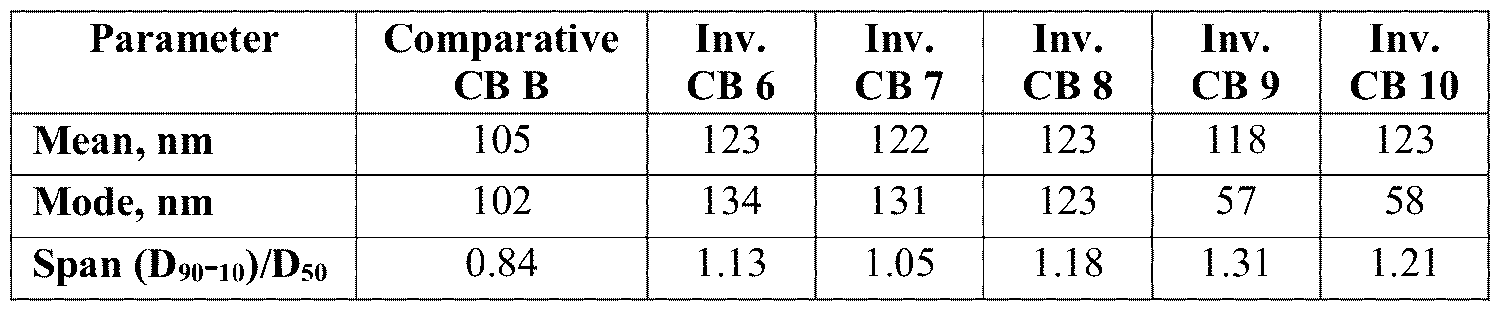





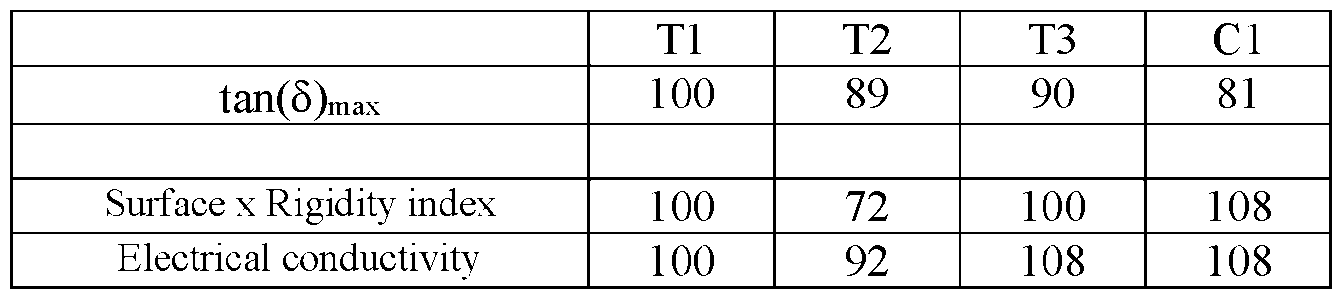


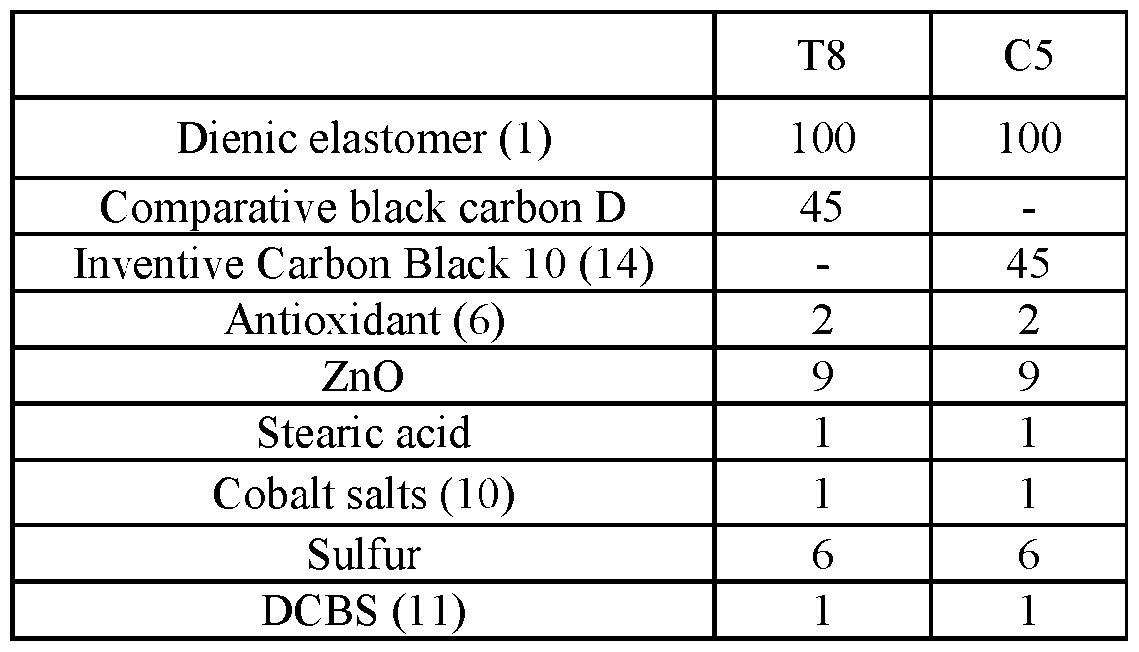


Claims
Priority Applications (2)
| Application Number | Priority Date | Filing Date | Title |
|---|---|---|---|
| PCT/US2023/085448 WO2025136396A1 (en) | 2023-12-21 | 2023-12-21 | Carbon black with shape-modified aggregate distribution, rubber products using the same |
| CN202380105170.3A CN122663233A (en) | 2023-12-21 | 2023-12-21 | Carbon black having shape-modified aggregate distribution and rubber product using the same |
Applications Claiming Priority (1)
| Application Number | Priority Date | Filing Date | Title |
|---|---|---|---|
| PCT/US2023/085448 WO2025136396A1 (en) | 2023-12-21 | 2023-12-21 | Carbon black with shape-modified aggregate distribution, rubber products using the same |
Publications (1)
| Publication Number | Publication Date |
|---|---|
| WO2025136396A1 true WO2025136396A1 (en) | 2025-06-26 |
Family
ID=89834131
Family Applications (1)
| Application Number | Title | Priority Date | Filing Date |
|---|---|---|---|
| PCT/US2023/085448 Pending WO2025136396A1 (en) | 2023-12-21 | 2023-12-21 | Carbon black with shape-modified aggregate distribution, rubber products using the same |
Country Status (2)
| Country | Link |
|---|---|
| CN (1) | CN122663233A (en) |
| WO (1) | WO2025136396A1 (en) |
Citations (18)
| Publication number | Priority date | Publication date | Assignee | Title |
|---|---|---|---|---|
| US4786677A (en) | 1987-01-21 | 1988-11-22 | The Tokai Carbon Co., Ltd. | Rubber composition containing a carbon black particles having two modal diameters in the aggregate |
| US4927607A (en) | 1988-01-11 | 1990-05-22 | Columbian Chemicals Company | Non-cylindrical reactor for carbon black production |
| EP0411160A1 (en) * | 1989-02-28 | 1991-02-06 | Nippon Steel Chemical Co., Ltd. | Method of manufacturing carbon black |
| US5256388A (en) | 1988-01-11 | 1993-10-26 | Columbian Chemicals Company | Method for consistently producing carbon black having a high tint |
| WO1997036724A2 (en) | 1996-04-01 | 1997-10-09 | Cabot Corporation | Novel elastomer composites, method and apparatus |
| WO1999016600A1 (en) | 1997-09-30 | 1999-04-08 | Cabot Corporation | Elastomer composite blends and methods for producing them |
| WO2002010269A2 (en) | 2000-07-31 | 2002-02-07 | Societe De Technologie Michelin | Running tread for tyre |
| US6391274B1 (en) * | 1998-09-05 | 2002-05-21 | Degussa Huls Aktiengesellschaft | Carbon black |
| WO2003002648A1 (en) | 2001-06-28 | 2003-01-09 | Societe De Technologie Michelin | Tyre tread reinforced with silica having a low specific surface area |
| WO2003002649A1 (en) | 2001-06-28 | 2003-01-09 | Societe De Technologie Michelin | Tyre tread reinforced with silica having a very low specific surface area |
| WO2003016387A1 (en) | 2001-08-13 | 2003-02-27 | Societe De Technologie Michelin | Diene rubber composition for tyres comprising a specific silicon as a reinforcing filler |
| WO2005113688A2 (en) * | 2004-05-13 | 2005-12-01 | Columbian Chemicals Company | Carbonaceous material with broad aggregate size distribution and improved dispersibility |
| US8258207B2 (en) | 2005-05-16 | 2012-09-04 | Cabot Corporation | Blends of carbon blacks and products containing the same |
| WO2017103518A1 (en) | 2015-12-16 | 2017-06-22 | Compagnie Generale Des Etablissements Michelin | Method for producing a masterbatch comprising a diene elastomer, an organic reinforcing filler and an antioxidant |
| CN105647242B (en) | 2016-04-07 | 2017-08-22 | 青岛黑猫炭黑科技有限责任公司 | A kind of reacting furnace for preparing ultra-wide aggregation distribution carbon black and preparation method thereof |
| WO2019129999A1 (en) | 2017-12-28 | 2019-07-04 | Compagnie Generale Des Etablissements Michelin | Process and unit for the preparation of a rubber compound in the liquid phase |
| US10829613B2 (en) | 2013-03-15 | 2020-11-10 | Orion Engineered Carbons Gmbh | Carbon black compositions |
| US20230323073A1 (en) * | 2021-04-02 | 2023-10-12 | Tokai Carbon Co., Ltd. | Carbon black and method for producing carbon black |
-
2023
- 2023-12-21 WO PCT/US2023/085448 patent/WO2025136396A1/en active Pending
- 2023-12-21 CN CN202380105170.3A patent/CN122663233A/en active Pending
Patent Citations (22)
| Publication number | Priority date | Publication date | Assignee | Title |
|---|---|---|---|---|
| US4786677A (en) | 1987-01-21 | 1988-11-22 | The Tokai Carbon Co., Ltd. | Rubber composition containing a carbon black particles having two modal diameters in the aggregate |
| US4927607A (en) | 1988-01-11 | 1990-05-22 | Columbian Chemicals Company | Non-cylindrical reactor for carbon black production |
| US5256388A (en) | 1988-01-11 | 1993-10-26 | Columbian Chemicals Company | Method for consistently producing carbon black having a high tint |
| EP0411160A1 (en) * | 1989-02-28 | 1991-02-06 | Nippon Steel Chemical Co., Ltd. | Method of manufacturing carbon black |
| US5254325A (en) | 1989-02-28 | 1993-10-19 | Nippon Steel Chemical Co., Ltd. | Process and apparatus for preparing carbon black |
| WO1997036724A2 (en) | 1996-04-01 | 1997-10-09 | Cabot Corporation | Novel elastomer composites, method and apparatus |
| WO1999016600A1 (en) | 1997-09-30 | 1999-04-08 | Cabot Corporation | Elastomer composite blends and methods for producing them |
| US6391274B1 (en) * | 1998-09-05 | 2002-05-21 | Degussa Huls Aktiengesellschaft | Carbon black |
| WO2002010269A2 (en) | 2000-07-31 | 2002-02-07 | Societe De Technologie Michelin | Running tread for tyre |
| US20030212185A1 (en) | 2000-07-31 | 2003-11-13 | Didier Vasseur | Tread for a tire |
| WO2003002649A1 (en) | 2001-06-28 | 2003-01-09 | Societe De Technologie Michelin | Tyre tread reinforced with silica having a very low specific surface area |
| WO2003002648A1 (en) | 2001-06-28 | 2003-01-09 | Societe De Technologie Michelin | Tyre tread reinforced with silica having a low specific surface area |
| US20050016651A1 (en) | 2001-06-28 | 2005-01-27 | Michelin Recherche Et Technique S.A. | Tire tread reinforced with a silica of low specific surface area |
| US20050016650A1 (en) | 2001-06-28 | 2005-01-27 | Michelin Recherche Et Technique S.A. | Tire tread reinforced with a silica of very low specific surface area |
| WO2003016387A1 (en) | 2001-08-13 | 2003-02-27 | Societe De Technologie Michelin | Diene rubber composition for tyres comprising a specific silicon as a reinforcing filler |
| WO2005113688A2 (en) * | 2004-05-13 | 2005-12-01 | Columbian Chemicals Company | Carbonaceous material with broad aggregate size distribution and improved dispersibility |
| US8258207B2 (en) | 2005-05-16 | 2012-09-04 | Cabot Corporation | Blends of carbon blacks and products containing the same |
| US10829613B2 (en) | 2013-03-15 | 2020-11-10 | Orion Engineered Carbons Gmbh | Carbon black compositions |
| WO2017103518A1 (en) | 2015-12-16 | 2017-06-22 | Compagnie Generale Des Etablissements Michelin | Method for producing a masterbatch comprising a diene elastomer, an organic reinforcing filler and an antioxidant |
| CN105647242B (en) | 2016-04-07 | 2017-08-22 | 青岛黑猫炭黑科技有限责任公司 | A kind of reacting furnace for preparing ultra-wide aggregation distribution carbon black and preparation method thereof |
| WO2019129999A1 (en) | 2017-12-28 | 2019-07-04 | Compagnie Generale Des Etablissements Michelin | Process and unit for the preparation of a rubber compound in the liquid phase |
| US20230323073A1 (en) * | 2021-04-02 | 2023-10-12 | Tokai Carbon Co., Ltd. | Carbon black and method for producing carbon black |
Non-Patent Citations (8)
| Title |
|---|
| HERD ET AL.: "The Use of Skeletonization for the Shape Classification of Carbon-Black Aggregates", RUBBER CHEMISTRY AND TECHNOLOG, vol. 66, pages 491 - 509 |
| HERD ET AL.: "The Use of Skeletonization for the Shape Classification of Carbon-Black Aggregates", RUBBER CHEMISTRY AND TECHNOLOGY, vol. 66, pages 491 - 509 |
| HERD: "Morphology of Carbon-Black Aggregates: Fractal versus Euclidian geometry", RUBBER CHEMISTRY AND TECHNOLOG, vol. 65, pages 107 - 129 |
| HERD: "Morphology of Carbon-Black aggregates: Fractal versus Euclidian Geometry", RUBBER CHEMISTRY AND TECHNOLOGY, vol. 65, pages 107 - 129 |
| HESSKLAMP, RUBBER CHEMISTRY AND TECHNOLOGY, vol. 56, 1983, pages 390 |
| JANZENKROAUS, THE PROCEEDINGS OF THE INTERNATIONAL RUBBER CONFERENCE, 1972 |
| JOURNAL OF COLLOID AND INTERFACE SCIENCE, January 1970 (1970-01-01) |
| STACYJOHNSONKRAUS, RUBBER CHEMISTRY AND TECHNOLOGY, vol. 48, 1975, pages 538 |
Also Published As
| Publication number | Publication date |
|---|---|
| CN122663233A (en) | 2026-08-28 |
Similar Documents
| Publication | Publication Date | Title |
|---|---|---|
| JP5778269B2 (en) | Rubber composition comprising thermoplastic filler and compatibilizer | |
| US7847009B2 (en) | Carbonaceous material with dissociated aggregate size and particle size distribution and improved dispersibility | |
| KR101919741B1 (en) | Carbon black compositions | |
| CN110087901B (en) | Rubber compositions containing specific rubber powders | |
| CN101392074B (en) | Tire with component containing cellulose | |
| CN102918089B (en) | Method for obtaining a rubber composition including a thermoplastic filler | |
| CN101429295B (en) | Tire with component containing cellulose | |
| US12091516B2 (en) | Use of carbon-nanofibres comprising carbon networks | |
| CN110087904A (en) | Tire provided with a sidewall comprising a rubber powder-containing composition | |
| CN102101919A (en) | Tire with a component containing carbon nanotubes | |
| JPS5986641A (en) | Rubber composition | |
| CN110099803B (en) | Rubber compositions containing specific rubber powders | |
| JP2012503055A (en) | Tire sidewall | |
| US20190382564A1 (en) | Rubber composition comprising a specific crumb rubber | |
| CA2566650C (en) | Carbonaceous material with broad aggregate size distribution and improved dispersibility | |
| CN110505964A (en) | Rubber composition comprising a specific hydrocarbon resin | |
| EP2727748B1 (en) | Pneumatic tire tread | |
| CN108602981A (en) | Include the rubber composition of substantially spherical relatively non-structured silica | |
| EP0948573B1 (en) | Automotive carbon black and rubber compositions thereof | |
| CN111836731A (en) | Rubber composition with depolymerized carbon nanotubes | |
| CN122663233A (en) | Carbon black having shape-modified aggregate distribution and rubber product using the same | |
| KR20260141614A (en) | Carbon black having a shape-modified aggregate distribution and rubber products using the same | |
| CN108017814B (en) | Rubber composition, vulcanized rubber, and preparation method and application thereof | |
| CN116635435B (en) | Rubber composition containing scrap rubber | |
| JP6045557B2 (en) | Rubber composition and method for producing pneumatic tire |
Legal Events
| Date | Code | Title | Description |
|---|---|---|---|
| 121 | Ep: the epo has been informed by wipo that ep was designated in this application |
Ref document number: 23848336 Country of ref document: EP Kind code of ref document: A1 |
|
| WWE | Wipo information: entry into national phase |
Ref document number: 2601004339 Country of ref document: TH |
|
| WWE | Wipo information: entry into national phase |
Ref document number: MX/A/2026/007764 Country of ref document: MX |
|
| REG | Reference to national code |
Ref country code: BR Ref legal event code: B01A Ref document number: 112026015307 Country of ref document: BR |
|
| WWE | Wipo information: entry into national phase |
Ref document number: 1020267023675 Country of ref document: KR |
|
| WWE | Wipo information: entry into national phase |
Ref document number: 2023848336 Country of ref document: EP |
|
| NENP | Non-entry into the national phase |
Ref country code: DE |
|
| ENP | Entry into the national phase |
Ref document number: 2023848336 Country of ref document: EP Effective date: 20260721 |
|
| WWP | Wipo information: published in national office |
Ref document number: MX/A/2026/007764 Country of ref document: MX |