INDAZOLE CONTAINING COMPOUNDS AND METHODS OF USE FIELD The present disclosure provides compounds having activity as inhibitors of mutants of the KRAS protein. This disclosure also provides pharmaceutical compositions comprising the compounds, uses and methods of treating certain disorders, such as cancer, including but not limited to Non-Small Cell Lung Cancer (NSCLC), colorectal cancer and/or pancreatic cancer. BACKGROUND From its identification as one of the first human oncogenes in 1982 (Der et al., 1982), KRAS (the Kirsten rat sarcoma viral oncogene homologue) has been the focus of extensive academic and industrial research, as a key node in the MAPK signal transduction pathway, as a transforming factor in a network of parallel effector pathways (e.g., PI3K/AKT) (Vojtek et al., 1998) and as a potential target for anti-cancer agents (Malumbres et al., 2003). Despite progress in the development of inhibitors of upstream and downstream nodes in the MAPK pathway (e.g., EGFR (Sridhar et al., 2003), BRAF (Holderfield et al., 2014) and MOK (Caunt et al., 2015)), the KRAS protein has historically proven resistant to direct inhibition. KRAS is a G-protein that couples extracellular mitogenic signaling to intracellular, pro-proliferative responses. KRAS serves as an intracellular “on/off” switch. Mitogen stimulation induces the binding of GTP to KRAS, bringing about a conformational change which enables the interaction of KRAS with downstream effector proteins, leading to cellular proliferation. Normally, pro-proliferative signaling is regulated by the action of GTPase-activating proteins (GAPs), which return KRAS to its GDP-bound, non-proliferative state. Mutations in KRAS impair the regulated cycling of KRAS between these GDP- and GTP-bound states, leading to the accumulation of the GTP-bound active state and dysregulated cellular proliferation (Simanshu et al., 2017). Attempts to develop inhibitors of mutated KRAS proteins have historically been thwarted by the absence of druggable pockets on the surface of the protein (Cox et al., 2014). In 2013, Shokat and colleagues identified covalent inhibitors of a common (O’Bryan, 2019) oncogenic mutant of KRAS, KRAS G12C, which bound to a previously unrecognized allosteric pocket on GDP-KRAS G12C and prevented its subsequent activation (Ostream et al., 2013). This discovery brought about significant new efforts in
the KRAS inhibitor research, which have recently culminated in the entry of KRAS inhibitors in human clinical trials. While some progress has been made on KRAS G12C inhibitors, there is a continued interest and effort to develop inhibitors of KRAS, particularly inhibitors of other KRAS such as KRAS G12D, G12V, G12A, G12S, G13D, Q61H, Q61L or G12C. Thus, there is a need to develop new inhibitors for KRAS G12D, G12V, G12A, G12S, G13D, Q61H, Q61L or G12C for the treatment of disorders, such as cancer. SUMMARY In one aspect, the present application is directed to compound of formula (I):

(I) or a pharmaceutically acceptable salt of said compound, wherein; X is CH
2, O, S, S(O), S(O)(NR
z) or S(O)
2; n is 0, 1, 2, or 3; m is 0, 1, 2 or 3; p is 0, 1, 2, 3 or 4; each R
x is hydroxyl, halogen, oxo, cyano, -N(R
z)
2, C
1-4 alkyl, C
1-4 alkoxy, C
1-4 haloalkyl, C
1-4 haloalkoxy, 5-7 membered heteroaryl, -T-R
y or two R
x taken together with the same carbon or adjacent carbon atoms can form C
3-7 cycloalkyl, a 3-7 membered heterocycloalkyl, wherein each C
3-7 cycloalkyl or 3-7 membered heterocycloalkyl is further substituted with 0-3 occurrences of R
y or two R
x taken together can form a bridged ring where the bridge is selected from one of the following: -C
1-4 alkylene, -C
1-4 alkylene-O-C
1-4 alkylene-, -O-, -S- or -C
1-4 alkylene-S-C
1-4 alkylene- and wherein each C
1- 4 alkylene is further substituted with 0-2 occurrences of R
y; L is a bond, C
1-6 alkylene, -O-C
1-6 alkylene, -S-C
1-6 alkylene, NR
z, O or S, wherein each C
1-6 alkylene, -O-C
1-6 alkylene and -S-C
1-6 alkylene chain is substituted with 0-2 occurrences of R
2;
R
1 is hydroxyl, -N(R
z)
2, aryl, heteroaryl, C
3-8 cycloalkyl or heterocycloalkyl substituted with 0-3 occurrences of R
5; R
2 is halogen, hydroxyl, C
1-4 alkyl or two R
2 on the same or adjacent carbon atoms can be taken together to form a C
3-7 cycloalkyl; R
3 is aryl or heteroaryl substituted with 0-3 occurrences of R
6; R
4 is hydrogen, hydroxyl, halogen, C
1-4 alkyl, C
1-4 alkoxy, C
1-4 haloalkyl, C
2-4 alkenyl, C
2-4 alkynyl, C
3-7 cycloalkyl or cyano; each R
5 is halogen, cyano, oxo, -T-R
y, hydroxyl, amino or C
1-4 alkyl; each R
6 is halogen, hydroxyl, cyano, -N(R
z)
2, C
1-4 alkyl, C
1-4 alkoxy, C
1-4 haloalkyl, C
1-4 haloalkoxy, C
2-4 alkynyl or C
3-6 cycloalkyl; R
7 is halogen, C
1-6 alkyl, C
2-6 alkenyl, C
1-4 alkoxy, C
1-4 haloalkyl or C
3-7 cycloalkyl wherein each alkyl, alkenyl or cycloalkyl is further substituted by 0-2 occurrences of R
w; R
8 is hydrogen, halo, C
1-4 alkyl, C
1-4 haloalkyl or C
2-6 alkenyl; or R
7 and R
8 are taken together with the atoms to which they are connected to form a C
3-7 cycloalkyl or 3-7 membered heterocycloalkyl substituted with 0-3 occurrences of R
w; R
9 is hydrogen, halogen or C
1-4 alkyl; R
10 is hydrogen, cyano, halo, hydroxyl, C
1-4 alkyl, -T-R
y or C
1-4 haloalkyl; R
12 is hydrogen, -C(O)-C
1-4 alkyl, -C(O)-C
1-4 alkoxy, C
1-4 alkylene-O-C(O)-C
1-4 alkyl or -C
1-4 alkylene-C(O)-C
1-4 alkyl; each R
w is halo, hydroxy, C
1-4 alkyl, C
1-4 haloalkyl, C
1-4 alkoxy, -T-R
y or C
3-6 cycloalkyl; T is C
1-4 alkylene, -S(O)
2-, -C(O)-, -C
1-4 alkylene-C(O)-, C
1-4 alkylene-S(O)
2- or - S-; R
y is halogen, oxo, C
1-4 alkyl, C
1-4 haloalkyl, hydroxyl, cyano or -N(R
z)
2; and R
z is hydrogen or C
1-4 alkyl. In a second aspect, provided herein is a pharmaceutical composition comprising a compound of Formula I or a pharmaceutically acceptable salt of said compound and a pharmaceutically acceptable excipient. In a third aspect, provided herein is a compound of Formula I, or a pharmaceutically acceptable salt of said compound, or the pharmaceutical composition as
described herein for use in treating cancer (e.g., NSCLC, colorectal cancer or pancreatic cancer). Reference will now be made in detail to embodiments of the present disclosure. While certain embodiments of the present disclosure will be described, it will be understood that it is not intended to limit the embodiments of the present disclosure to those described embodiments. To the contrary, reference to embodiments of the present disclosure is intended to cover alternatives, modifications, and equivalents as may be included within the spirit and scope of the embodiments of the present disclosure as defined by the appended claims. DETAILED DESCRIPTION Provided herein as embodiment 1 is a compound of formula (I):

or a pharmaceutically acceptable salt of said compound, wherein; X is CH
2, O, S, S(O), S(O)(NR
z) or S(O)
2; n is 0, 1, 2, or 3; m is 0, 1, 2 or 3; p is 0, 1, 2, 3 or 4; each R
x is hydroxyl, halogen, oxo, cyano, -N(R
z)
2, C
1-4 alkyl, C
1-4 alkoxy, C
1-4 haloalkyl, C
1-4 haloalkoxy, 5-7 membered heteroaryl, -T-R
y or two R
x taken together with the same carbon or adjacent carbon atoms can form C
3-7 cycloalkyl, a 3-7 membered heterocycloalkyl, wherein each C
3-7 cycloalkyl or 3-7 membered heterocycloalkyl is further substituted with 0-3 occurrences of R
y or two R
x taken together can form a bridged ring where the bridge is selected from one of the following: -C
1-4 alkylene, -C
1-4 alkylene-O-C
1-4 alkylene-, -O-, -S- or -C
1-4 alkylene-S-C
1-4 alkylene- and wherein each C
1- 4 alkylene is further substituted with 0-2 occurrences of R
y;
L is a bond, C
1-6 alkylene, -O-C
1-6 alkylene, -S-C
1-6 alkylene, NR
z, O or S, wherein each C
1-6 alkylene, -O-C
1-6 alkylene and -S-C
1-6 alkylene chain is substituted with 0-2 occurrences of R
2; R
1 is hydroxyl, -N(R
z)
2, aryl, heteroaryl, C
3-8 cycloalkyl or heterocycloalkyl substituted with 0-3 occurrences of R
5; R
2 is halogen, hydroxyl, C
1-4 alkyl or two R
2 on the same or adjacent carbon atoms can be taken together to form a C
3-7 cycloalkyl; R
3 is aryl or heteroaryl substituted with 0-3 occurrences of R
6; R
4 is hydrogen, hydroxyl, halogen, C
1-4 alkyl, C
1-4 alkoxy, C
1-4 haloalkyl, C
2-4 alkenyl, C
2-4 alkynyl, C
3-7 cycloalkyl or cyano; each R
5 is halogen, cyano, oxo, -T-R
y, hydroxyl, amino or C
1-4 alkyl; each R
6 is halogen, hydroxyl, cyano, -N(R
z)
2, C
1-4 alkyl, C
1-4 alkoxy, C
1-4 haloalkyl, C
1-4 haloalkoxy, C
2-4 alkynyl or C
3-6 cycloalkyl; R
7 is halogen, C
1-6 alkyl, C
2-6 alkenyl, C
1-4 alkoxy, C
1-4 haloalkyl or C
3-7 cycloalkyl wherein each alkyl, alkenyl or cycloalkyl is further substituted by 0-2 occurrences of R
w; R
8 is hydrogen, halo, C
1-4 alkyl, C
1-4 haloalkyl or C
2-6 alkenyl; or R
7 and R
8 are taken together with the atoms to which they are connected to form a C
3-7 cycloalkyl or 3-7 membered heterocycloalkyl substituted with 0-3 occurrences of R
w; R
9 is hydrogen, halogen or C
1-4 alkyl; R
10 is hydrogen, halo, hydroxyl, C
1-4 alkyl, -T-R
y or C
1-4 haloalkyl; R
12 is hydrogen, -C(O)-C
1-4 alkyl, -C(O)-C
1-4 alkoxy, C
1-4 alkylene-O-C(O)-C
1-4 alkyl or -C
1-4 alkylene-C(O)-C
1-4 alkyl; each R
w is halo, hydroxy, C
1-4 alkyl, C
1-4 haloalkyl, C
1-4 alkoxy, -T-R
y or C
3-6 cycloalkyl; T is C
1-4 alkylene, -S(O)
2-, -C(O)-, -C
1-4 alkylene-C(O)-, C
1-4 alkylene-S(O)
2- or - S-; R
y is halogen, oxo, C
1-4 alkyl, C
1-4 haloalkyl, hydroxyl, cyano or -N(R
z)
2; and R
z is hydrogen or C
1-4 alkyl. Provided herein as embodiment 2 is the compound according to embodiment 1, wherein L is C
1-6 alkylene (e.g., methylene or ethylene) substituted with 0-2 occurrences of R
2. Provided herein as embodiment 3 is the compound according to embodiment 1,
wherein L is -O-C
1-6 alkylene (e.g., -O-methylene-, -O-ethylene-, -O-n-propylene or -O- isopentanylene) substituted with 0-2 occurrences of R
2. Provided herein as embodiment 4 is the compound according to embodiment 3, wherein L is -O-methylene or -O-ethylene substituted with 0-2 occurrences of R
2. Provided herein as embodiment 5 is the compound according to embodiment 4, wherein L is -O-methylene or -O-ethylene substituted with 0 occurrences of R
2. Provided herein as embodiment 6 is the compound according to embodiment 5, wherein L is -O-methylene substituted with 0 occurrences of R
2. Provided herein as embodiment 7 is the compound according to embodiment 5, wherein L is -O-ethylene substituted with 0 occurrences of R
2. Provided herein as embodiment 8 is the compound according to any one of embodiments 1-7, wherein R
1 is heterocycloalkyl substituted with 0-3 occurrences of R
5. Provided herein as embodiment 9 is the compound according to embodiment 8, wherein R
1 is 7-(hexahydro-1H-pyrrolizine) substituted with 0-3 occurrences of R
5. Provided herein as embodiment 10 is the compound according to embodiment 9, wherein R
1 is 7- (hexahydro-1H-pyrrolizine) substituted with 1 occurrence of R
5. Provided herein as embodiment 11 is the compound according to embodiment 10, wherein R
5 is halogen (e.g., fluorine). Provided herein as embodiment 12 is the compound according to embodiment 10, wherein R
5 is C
1-4 alkoxy (e.g., methoxy) Provided herein as embodiment 13 is the compound according to embodiment 8, wherein R
1 is 5-(1- azabicyclo[3.2.0]heptanyl) substituted with 0 occurrences of R
5. Provided herein as embodiment 14 is the compound according to embodiment 13, wherein R
1 is 5-(1- azabicyclo[3.2.0]heptanyl) substituted with 1 occurrence of R
5. Provided herein as embodiment 15 is the compound according to embodiment 14, wherein R
5 is -T-R
y. Provided herein as embodiment 16 is the compound according to embodiment 15, wherein -T-R
y is -CH
2OH. Provided herein as embodiment 18 is the compound according to embodiment 9, wherein R
1 is 7-(hexahydro-1H-pyrrolizine) substituted with 2 occurrences of R
5. Provided herein as embodiment 19 is the compound according to embodiment 18, wherein one R
5 is halogen (e.g., fluorine) and the other R
5 is oxo. Provided herein as embodiment 20 is the compound according to embodiment 18, wherein both R
5 are halogen (e.g., fluorine). Provided herein as embodiment 21 is the compound according to embodiment 8, wherein R
1 is 2-pyrrolidine substituted with 0-3 occurrences of R
5. Provided herein as
embodiment 22 is the compound according to embodiment 21, wherein R
1 is 2- pyrrolidine substituted with 2 occurrences of R
5. Provided herein as embodiment 23 is the compound according to embodiment 22, wherein both R
5 are C
1-4 alkyl (e.g., methyl). Provided herein as embodiment 24 is the compound according to embodiment 22, wherein one R
5 is C
1-4 alkyl (e.g., methyl) and the other R
5 is halogen (e.g., fluorine). Provided herein as embodiment 25 is the compound according to embodiment 8, wherein R
1 is 3-tetrahydrofuranyl substituted with 0-3 occurrences of R
5. Provided herein as embodiment 26 is the compound according to embodiment 25, wherein R
1 is 3- tetrahydrofuranyl substituted with one occurrence of R
5. Provided herein as embodiment 27 is the compound according to embodiment 26, wherein R
5 is cyano. Provided herein as embodiment 28 is the compound according to embodiment 3, wherein L is -O-C
1-6 alkylene (e.g., -O-ethylene) substituted with one occurrence of R
2. Provided herein as embodiment 29 is the compound according to embodiment 28, wherein L is -O-ethylene substituted with one occurrence of R
2. Provided herein as embodiment 30 is the compound according to embodiment 29, wherein R
2 are C
1-4 alkyl (e.g., methyl). Provided herein as embodiment 31 is the compound according to any one of embodiments 28-30, wherein R
1 is 2-pyrrolidine substituted with 2 occurrences of R
5. Provided herein as embodiment 32 is the compound according to embodiment 31, wherein both R
5 are C
1-4 alkyl (e.g., methyl). Provided herein as embodiment 33 is the compound according to embodiment 31, wherein one R
5 is C
1-4 alkyl (e.g., methyl) and the other R
5 is halogen (e.g., fluorine). Provided herein as embodiment 34 is the compound according to embodiment 3, wherein L is -O-C
1-6 alkylene (e.g., -O-n-propylene) substituted with 2 occurrences of R
2. Provided herein as embodiment 35 is the compound according to embodiment 34, wherein L is -O-n-propylene substituted with 2 occurrences of R
2. Provided herein as embodiment 36 is the compound according to embodiment 35, wherein both R
2 are halo (e.g., fluorine). Provided herein as embodiment 37 is the compound according to embodiment 35, wherein the two R
2 are taken together with the same carbon atom to form a C
3-7 cycloalkyl (e.g., cyclopropyl). Provided herein as embodiment 38 is the compound according to any one of embodiments 34-37, wherein R
1 is heterocycloalkyl (e.g., N-morpholinyl, N-azetidinyl or N-pyrrolidinyl) substituted with 0-3 occurrences of R
5. Provided herein as embodiment
39 is the compound according to embodiment 38, wherein R
1 is N-morpholinyl, N- azetidinyl or N-pyrrolidinyl substituted with one occurrence of R
5. Provided herein as embodiment 40 is the compound according to embodiment 39, wherein R
5 is halo (e.g. fluorine). Provided herein as embodiment 41 is the compound according to any one of embodiments 34-37, wherein R
1 is -N(R
z)
2. Provided herein as embodiment 42 is the compound according to embodiment 41, wherein both R
z are C
1-4 alkyl (e.g., methyl). Provided herein as embodiment 43 is the compound according embodiment 42, wherein L is a bond. Provided herein as embodiment 44 is the compound according to embodiment 43, wherein R
1 is heterocycloalkyl (e.g., 1-piperidinyl) substituted with 0-3 occurrences of R
5. Provided herein as embodiment 45 is the compound according to embodiment 44, wherein R
1 is 1-piperidinyl substituted with 2 occurrences of R
5. Provided herein as embodiment 46 is the compound according to embodiment 45, wherein one R
5 is C
1-4 alkyl (e.g., methyl) and the other R
5 is hydroxyl. Provided herein as embodiment 47 is the compound according to any one of
Provided herein as embodiment 48 is the compound according to embodiment 47, wherein -L-R
1 is
Provided herein as embodiment 49 is the compound according to embodiment 47, wherein -L-R
1 is
Provided herein as embodiment 50 is the compound according to embodiment 47, wherein -L-R
1
. Provided herein as embodiment 51 is the compound according to embodiment 47, wherein -L-R
1 is
Provided herein as embodiment 52 is the compound according to embodiment 47, wherein -L-R
1 is
. Provided herein as embodiment 53 is the compound according to embodiment 47, wherein -
Provided herein as embodiment 54 is the compound according to embodiment 47, wherein -L-R
1 is
Provided herein as embodiment 55 is the compound according to embodiment 47, wherein -L-R
1
Provided herein as embodiment 56 is the compound according to embodiment 47, wherein -L-R
1 is
Provided herein as embodiment 57 is the compound according to embodiment 47, wherein -L-R
1 is
Provided herein as embodiment 58 is the compound according to
embodiment 47, wherein -L-R
1
. Provided herein as embodiment 59 is the compound according to embodiment 47, wherein -L-R
1 is
. Provided herein as embodiment 60 is the compound according to embodiment 47, wherein -L-R
1 is
. Provided herein as embodiment 61 is the compound according to embodiment 47, wherein -L-R
1
Provided herein as embodiment 62 is the compound according to embodiment 47, wherein -L-R
1 is
Provided herein as embodiment 63 is the compound according to embodiment 47, wherein -L-R
1 is
Provided herein as embodiment 64 is the compound according to
embodiment 47, wherein -L-R
1 is . Provided herein as embodiment 65 is the compound according to embodiment 47, wherein -L-R
1 is
. Provided herein as embodiment 66 is the compound according to embodiment 47, wherein -L-R
1 is
. Provided herein as embodiment 67 is the compound according to embodiment 47, wherein -L-R
1
Provided herein as embodiment 68 is the compound according to embodiment 47, wherein -L-R
1 is
Provided herein as embodiment 69 is the compound according to any one of embodiments 1-68, wherein X is O, S, S(O), S(O)(NR
z) or S(O)
2. Provided herein as embodiment 70 is the compound according to embodiment 69, wherein X is O. Provided herein as embodiment 71 is the compound according to embodiment 70, wherein n is 1 and m is 1. Provided herein as embodiment 72 is the compound according to embodiment 70, wherein n is 1 and m is 2 or n is 2 and m is 1. Provided herein as embodiment 73 is the compound according to embodiment 72, wherein p is 0. Provided herein as embodiment 74 is the compound according to embodiment 72, wherein p is 1. Provided herein as embodiment 75 is the compound according to embodiment 74, wherein R
x is oxo. Provided herein as embodiment 76 is the compound according to embodiment 74, wherein R
x is hydroxyl. Provided herein as embodiment 77 is the compound according to embodiment 72, wherein p is 2. Provided herein as embodiment 75 is the compound according to embodiment 74, wherein one R
x is hydroxyl and the other R
x is C
1-4 haloalkyl (e.g., monofluoromethyl). Provided herein as embodiment 76 is the compound according to embodiment 74, wherein one R
x is hydroxyl and the other R
x is C
1-4 alkyl (e.g., methyl). Provided herein as embodiment 80 is the compound according to any one of e
Provided herein as embodiment 81 is the compound according to embodiment 80, wherein is . Provided herein as embodiment 82 is the compound according to embodiment 80, wherein
Provided herein as embodiment 83 is the compound according to embodiment 80,
wherein
Provided herein as embodiment 84 is the compound according to embodiment 80, wherein
Provided herein as embodiment 85 is the compound according to embodiment 80, wherein
. Provided herein as embodiment 86 is the compound according to embodiment 80, wherein
. Provided herein as embodiment 87 is the compound according to embodiment 80, wherein
Provided herein as embodiment 88 is the compound according to embodiment 80, wherein
. Provided herein as embodiment 89 is the compound according to embodiment 69, wherein X is CH
2. Provided herein as embodiment 90 is the compound according to embodiment 89, wherein n is 1 and m is 1. Provided herein as embodiment 91 is the compound according to embodiment 90, wherein p is 0. Provided herein as embodiment 92 is the compound according to embodiment 90, wherein p is 1. Provided herein as embodiment 93 is the compound according to embodiment 92, wherein R
x is oxo or C
1-4 haloalkoxy. Provided herein as embodiment 94 is the compound according to embodiment 93, wherein R
x is oxo. Provided herein as embodiment 95 is the compound according to embodiment 93, wherein R
x is C
1-4 haloalkoxy (e.g., difluoromethoxy).
Provided herein as embodiment 96 is the compound according to embodiment 90, wherein p is 2. Provided herein as embodiment 97 is the compound according to embodiment 96, wherein each R
x is hydroxyl, C
1-4 alkyl or C
1-4 haloalkyl. Provided herein as embodiment 98 is the compound according to embodiment 97, wherein one R
x is hydroxyl and the other R
x is C
1-4 alkyl (e.g., methyl). Provided herein as embodiment 99 is the compound according to embodiment 97, wherein one R
x is hydroxyl and the other R
x is C
1-4 haloalkyl (e.g., difluoromethyl or monofluoromethyl). Provided herein as embodiment 100 is the compound according to embodiment 89, wherein n is 1 and m is 2 or n is 2 and m is 1. Provided herein as embodiment 101 is the compound according to embodiment 100, wherein p is 0. Provided herein as embodiment 102 is the compound according to embodiment 100, wherein p is 1. Provided herein as embodiment 103 is the compound according to embodiment 102, wherein R
x is oxo or C
1-4 haloalkoxy. Provided herein as embodiment 104 is the compound according to embodiment 100, wherein p is 2. Provided herein as embodiment 105 is the compound according to embodiment 104, wherein each R
x is hydroxyl, C
1-4 alkyl or C
1-4 haloalkyl. Provided herein as embodiment 106 is the compound according to embodiment 105, wherein one R
x is hydroxyl and the other R
x is C
1-4 alkyl (e.g., methyl). Provided herein as embodiment 107 is the compound according to any one of e
. Provided herein as embodiment 108 is the compound according to
embodiment 107, wherein
. Provided herein as embodiment 109 is the compound according to embodiment 107, wherein
Provided herein as embodiment 110 is the compound according to embodiment 107, wherein
herein as embodiment 111 is the compound according to embodiment 107, wherein
. Provided herein as embodiment 112 is the compound according to embodiment 107, wherein
. Provided herein as embodiment 113 is the compound according to embodiment 107, wherein
. Provided herein as embodiment 114 is the compound according to embodiment 107, wherein
. Provided herein as embodiment 115 is the compound according to embodiment 107,
wherein is . Provided herein as embodiment 116 is the
compound according to embodiment 107, wherein
. Provided herein as embodiment 117 is the compound according to embodiment 107, wherein
. Provided herein as embodiment 118 is the compound according to embodiment 107, wherein
. Provided herein as embodiment 119 is the compound according to embodiment 107, wherein
. Provided herein as embodiment 120 is the compound according to embodiment 107, wherein
. Provided herein as embodiment 121 is the compound according to embodiment 107, wherein
Provided herein as embodiment 122 is the compound according to embodiment 1, wherein
4 7 8
and R is fluorine, then R and R are not both methyl. Provided herein as embodiment 123 is the compound according to embodiment 1, wherein and R
4 is fluor
7
ine and R is hydrogen, then R
8 is not methyl. Provided herein as embodiment 124 is the compound according to
embodiment 1, wherein
and R
4 is fluorine and R
8 is hydrogen, then R
7 is not methyl. Provided herein as embodiment 125 is the compound according to embodiment 1, wherein
fluorine, then R
7 and R
8 are not both methyl. Provided herein as embodiment 126 is the compound according to embodiment 1, wherein
4
R is fluorine and R
8 is cyclopropyl, then R
7 is not halogen. Provided herein as embodiment 127 is the compound according to embodiment 1, wherein
is R
4 is fluorine, R
8 is cyclopropyl an
1
d R is substituted with 0 occurrences of R
5, then R
7 is not methyl. Provided herein as embodiment 128 is the compound according to embodiment 69, wherein X is CH
2. Provided herein as embodiment 129 is the compound according to embodiment 128, wherein n is 1 and m is 1. Provided herein as embodiment 130 is the compound according to embodiment 129, wherein p is 2. Provided herein as embodiment 131 is the compound according to embodiment 130, wherein two R
x taken together with the same carbon form a C
3-7 cycloalkyl or a 3-7 membered heterocycloalkyl, wherein each C
3-7 cycloalkyl or 3-7 membered heterocycloalkyl further substituted with 0-3 occurrences of R
y. Provided herein as embodiment 132 is the compound according to embodiment 131, wherein two R
x taken together with the same carbon form a C
3-7 cycloalkyl (e.g., cyclobutyl) further substituted with 0-3 occurrences of R
y. Provided herein as embodiment 133 is the compound according to embodiment 132, wherein two R
x taken together with the same carbon form a cyclobutyl further substituted with 0-3 occurrences
of R
y. Provided herein as embodiment 134 is the compound according to embodiment 133, wherein two R
x taken together with the same carbon form a cyclobutyl further substituted with 0 occurrences of R
y. Provided herein as embodiment 135 is the compound according to embodiment 133, wherein two R
x taken together with the same carbon form a cyclobutyl further substituted with one occurrence of R
y. Provided herein as embodiment 136 is the compound according to embodiment 135, wherein each R
y is hydroxyl or halogen (e.g., fluorine). Provided herein as embodiment 137 is the compound according to embodiment 136, wherein each R
y is hydroxyl. Provided herein as embodiment 138 is the compound according to embodiment 136, wherein each R
y is fluorine. Provided herein as embodiment 139 is the compound according to embodiment 133, wherein two R
x taken together with the same carbon form a cyclobutyl further substituted with two occurrences of R
y. Provided herein as embodiment 140 is the compound according to embodiment 139, wherein both are R
y is halogen (e.g., fluorine). Provided herein as embodiment 141 is the compound according to embodiment 131, wherein two R
x taken together with the same carbon form a 3-7 membered heterocycloalkyl (e.g., 2-oxetanyl, 3-tetrahydrothiophenyl or 5-oxazolidinyl) substituted with 0-3 occurrences of R
y. Provided herein as embodiment 142 is the compound according to embodiment 141, wherein two R
x taken together with the same carbon form 2-oxetanyl substituted with 0 occurrences of R
y. Provided herein as embodiment 143 is the compound according to embodiment 141, wherein two R
x taken together with the same carbon form 5-oxazolidinyl substituted with one occurrence of R
y. Provided herein as embodiment 144 is the compound according to embodiment 143, wherein R
y is oxo. Provided herein as embodiment 145 is the compound according to embodiment 141, wherein two R
x taken together with the same carbon form 3-tetrahydrothiophenyl substituted with two occurrences of R
y. Provided herein as embodiment 146 is the compound according to embodiment 145, wherein both R
y are oxo. Provided herein as embodiment 147 is the compound according to any one of embodiments 128-146, wherein
Provided herein as embodiment 148 is the compound according to embodiment 147, wherein
Provided herein as embodiment 149 is the compound according to embodiment 147, wherein
Provided herein as embodiment 149 is the compound according to embodiment 147, wherein
Provided herein as embodiment 150 is the compound according to embodiment 147, wherein
. Provided herein as embodiment 151 is the compound according to embodiment 147, wherein
Provided herein as embodiment 152 is the compound according to embodiment 147, wherein
Provided herein as embodiment 153 is the compound according to embodiment 147, wherein
Provided herein as embodiment 154 is the compound according to embodiment 147, wherein
Provided herein as embodiment 155 is the compound according to embodiment 147,
Provided herein as embodiment 156 is the compound according to embodiment 147, wherein
Provided herein as embodiment 157 is the compound according to embodiment 147, wherein
Provided herein as embodiment 158 is the compound according to embodiment 147, wherein
. Provided herein as embodiment 159 is the compound according to any one of embodiments 1-158, wherein R
7 is halogen, C
1-4 alkyl, C
1-4 haloalkyl, C
2-6 alkenyl or C
3-7 cycloalkyl wherein each alkyl, alkenyl or cycloalkyl is substituted with 0-2 occurrences of R
w. Provided herein as embodiment 160 is the compound according to embodiment 159, wherein R
7 is methyl, ethyl, n-propyl, isopropyl, sec-butyl, ethenyl, 2-propenyl, 2- butenyl, cyclopropyl or cyclobutyl, each of which is further substituted with 0-2 occurrences of R
w.
Provided herein as embodiment 161 is the compound according to embodiment 159, wherein R
7 is chlorine, trifluoromethyl, difluoromethyl, monofluoromethyl, ethylhydroxy, n-propylhydroxy or 3,3,3-trifluoro-n-propyl. Provided herein as embodiment 162 is the compound according to embodiment 159, wherein R
7 is halogen (e.g., chlorine). Provided herein as embodiment 163 is the compound according to embodiment 159, wherein R
7 is C
1-4 alkyl (e.g., methyl, ethyl, n- propyl, isopropyl or sec-butyl) substituted with 0-2 occurrences of R
w. Provided herein as embodiment 164 is the compound according to embodiment 163, wherein R
7 is C
1-4 alkyl (methyl, ethyl, n-propyl, isopropyl or sec-butyl) substituted with 0 occurrences of R
w. Provided herein as embodiment 165 is the compound according to embodiment 164, wherein R
7 is C
1-4 alkyl (methyl) substituted with one occurrence of R
w. Provided herein as embodiment 166 is the compound according to embodiment 165, wherein each R
w is C
1-4 alkoxy (e.g., methoxy) or C
3-7 cycloalkyl (e.g., cyclopropyl). Provided herein as embodiment 167 is the compound according to embodiment 168, wherein R
7 is C
1-4 alkyl (ethyl or n-propyl) substituted with one occurrence of R
w, wherein each R
w is hydroxyl. Provided herein as embodiment 169 is the compound according to embodiment 159, wherein R
7 is C
2-6 alkenyl (e.g., ethenyl, 2-propenyl or 2-butenyl) substituted with 0- 2 occurrences of R
w. Provided herein as embodiment 170 is the compound according to embodiment 169, wherein R
7 is C
2-6 alkenyl (e.g., ethenyl, 2-propenyl or 2-butenyl) substituted with 0 occurrences of R
w. Provided herein as embodiment 171 is the compound according to embodiment 169, wherein R
7 is C
2-6 alkenyl (e.g., ethenyl, 2- propenyl or 2-butenyl) substituted with one occurrence of R
w. Provided herein as embodiment 172 is the compound according to embodiment 171, wherein each R
w is hydroxyl, halogen (e.g., chloro or fluoro), C
1-4 alkyl (e.g., methyl or ethyl) or C
3-7 cycloalkyl (e.g., cyclopropyl). Provided herein as embodiment 173 is the compound according to embodiment 159, wherein R
7 is C
3-7 cycloalkyl (e.g., cyclopropyl or cyclobutyl) substituted with 0-2 occurrences of R
w. Provided herein as embodiment 174 is the compound according to embodiment 173, wherein R
7 is C
3-7 cycloalkyl (e.g., cyclopropyl or cyclobutyl) substituted with 0 occurrences of R
w. Provided herein as embodiment 175 is the compound according to embodiment 173, wherein R
7 is C
3-7 cycloalkyl (e.g., cyclopropyl) substituted with one occurrence of R
w. Provided herein as embodiment 176 is the compound according to embodiment 175, wherein each R
w is C
1-4 alkyl, C
1-4
haloalkyl, -T-R
y or C
3-7 cycloalkyl. Provided herein as embodiment 177 is the compound according to embodiment 176, wherein each R
w is methyl, ethyl, monofluoromethyl, -CH
2-OH, -CH
2-CN or cyclopropyl. Provided herein as embodiment 178 is the compound according to embodiment 173, wherein R
7 is C
3-7 cycloalkyl (e.g., cyclopropyl) substituted with two occurrences of R
w. Provided herein as embodiment 179 is the compound according to embodiment 178, wherein both R
w are C
1-4 alkyl (e.g., methyl). Provided herein as embodiment 180 is the compound according to any one of embodiments 1-179, wherein R
8 is hydrogen. Provided herein as embodiment 181 is the compound according to any one of embodiments 1-179, wherein R
8 is halogen (e.g., fluorine or chlorine). Provided herein as embodiment 182 is the compound according to any one of embodiments 1-179, wherein R
8 is C
1-4 alkyl (e.g., methyl). Provided herein as embodiment 183 is the compound according to any one of embodiments 1-179, wherein R
8 is C
1-4 haloalkyl (e.g., trifluoromethyl). Provided herein as embodiment 184 is the compound according to any one of embodiments 1-179, wherein R
8 is C
2-6 alkenyl (e.g., ethenyl). Provided herein as embodiment 185 is the compound according to any one of embodiments 1-158, wherein R
7 and R
8 are taken together with the atoms to which they are connected to form a C
3-7 cycloalkyl or 3-7 membered heterocycloalkyl substituted with 0-3 occurrences of R
w. Provided herein as embodiment 186 is the compound according to embodiment 185, wherein R
7 and R
8 are taken together with the atoms to which they are connected to form a C
3-7 cycloalkyl (e.g., cyclopentyl or cyclohexyl) substituted with 0-3 occurrences of R
w. Provided herein as embodiment 187 is the compound according to embodiment 186, wherein R
7 and R
8 are taken together with the atoms to which they are connected to form a cyclopentyl substituted with 0-3 occurrences of R
w. Provided herein as embodiment 188 is the compound according to embodiment 187, wherein R
7 and R
8 are taken together with the atoms to which they are connected to form a cyclopentyl substituted with 0 occurrences of R
w. Provided herein as embodiment 189 is the compound according to embodiment 187, wherein R
7 and R
8 are taken together with the atoms to which they are connected to form a cyclopentyl substituted with one occurrence of R
w. Provided herein as embodiment 190 is the compound according to embodiment 189, where R
w is C
1-4 alkyl (e.g., methyl or ethyl).
Provided herein as embodiment 191 is the compound according to embodiment 186, wherein R
7 and R
8 are taken together with the atoms to which they are connected to form a cyclohexyl substituted with 0-3 occurrences of R
w. Provided herein as embodiment 192 is the compound according to embodiment 191, wherein R
7 and R
8 are taken together with the atoms to which they are connected to form a cyclohexyl substituted with 0 occurrences of R
w. Provided herein as embodiment 193 is the compound according to embodiment 191, wherein R
7 and R
8 are taken together with the atoms to which they are connected to form a cyclohexyl substituted with 3 occurrences of R
w. Provided herein as embodiment 194 is the compound according to embodiment 193, where one R
w is C
1-4 alkyl (e.g., methyl or ethyl) and the other two R
w are halogen (e.g., fluorine). Provided herein as embodiment 195 is the compound according to any one of embodiments 1-184, wherein R
9 is hydrogen. Provided herein as embodiment 196 is the compound according to any one of embodiments 1-184, wherein R
9 is halogen (e.g., fluorine). Provided herein as embodiment 197 is the compound according to any one of embodiments 1-184, wherein R
10 is hydrogen. Provided herein as embodiment 198 is the compound according to any one of embodiments 1-184, wherein R
10 is C
1-4 alkyl (e.g., methyl). Provided herein as embodiment 199 is the compound according to any one of embodiments 1-194, wherein R
10 is cyano. Provided herein as embodiment 200 is the compound according to any one of embodiments 1-184, wherein R
10 is halogen (e.g., fluorine). Provided herein as embodiment 201 is the compound according to any one of embodiments 1-184, wherein R
12 is hydrogen. Provided herein as embodiment 202 is the compound according to any one of embodiments 1-184, wherein R
12 is -C(O)-C
1-4 alkyl (e.g., -C(O)-CH
3). Provided herein as embodiment 203 is the compound according to any one of embodiments 1-184, wherein R
12 is -C(O)-C
1-4 alkoxy (e.g., -C(O)-OCH
2CH
3). Provided herein as embodiment 204 is the compound according to any one of embodiments 1-184, wherein R
12 is C
1-4 alkylene-O-C(O)-C
1-4 alkyl (e.g., -CH
2-OC(O)- CH
3).
Provided herein as embodiment 205 is the compound according to any one of
the compound according to embodiment 205, wherein
Provided herein as embodiment 207 is the compound according to embodiment 205, wherein R
3 is
Provided herein as embodiment 208 is the compound according to
embodiment 205, wherein
. Provided herein as embodiment 209 is the compound according to embodiment 205, wherein
Provided herein as embodiment 210 is the compound according to embodiment 205, wherein R
3 is
Provided herein as embodiment 211 is the compound according to embodiment 205, wherein
. Provided herein as embodiment 212 is the compound according to embodiment 205, wherein
. Provided herein as embodiment 213 is the compound according to embodiment 205, wherein R
3 is
. Provided herein as embodiment 214 is the compound according to
embodiment 205, wherein
. Provided herein as embodiment 215 is the compound according to embodiment 205, wherein
. Provided herein as embodiment 216 is the compound according to embodiment 205, wherein R
3 is
Provided herein as embodiment 217 is the compound according to embodiment 205, wherein
. Provided herein as embodiment 218 is the compound according to embodiment 205, wherein
Provided herein as embodiment 219 is the compound according to embodiment 205, wherein R
3 is
. Provided herein as embodiment 220 is the compound according to embodiment 205, wherein
. Provided herein as embodiment 221 is the
compound according to embodiment 205, wherein
embodiment 222 is the compound according to embodiment 205, wherein R
3 is
Provided herein as embodiment 223 is the compound according to any one of e
compound according to embodiment 223, wherein
Provided herein as embodiment 225 is the compound according to embodiment 223, wherein R
3 is
Provided herein as embodiment 226 is the compound according to embodiment 223, wherein
Provided herein as embodiment 227 is the compound according to embodiment 223, wherein
Provided herein as embodiment 228 is the compound according to embodiment 223, wherein R
3 is
Provided herein as embodiment 229 is the compound according to embodiment 223, wherein
. Provided herein as embodiment 230 is the compound according to embodiment 223, wherein
. Provided
herein as embodiment 231 is the compound according to embodiment 223, wherein R
3 is
Provided herein as embodiment 232 is the compound according to embodiment 223, wherein
. Provided herein as embodiment 233 is the compound according to embodiment 223, wherein
Provided herein as embodiment 234 is the compound according to embodiment 223, wherein
Provided herein as embodiment 235 is the compound according to embodiment 223, wherein
. Provided herein as embodiment 236 is the compound according to embodiment 223, wherein R
3 is
. Provided herein as embodiment 237 is the compound according to
embodiment 223, wherein
. Provided herein as embodiment 238 is the compound according to embodiment 223, wherein
Provided herein as embodiment 239 is the compound according to embodiment 223, wherein R
3 is
. Provided herein as embodiment 240 is the compound according to any one of e
. Provided herein as embodiment 241 is the compound according to embodiment 240,
mbodiment 242 is the compound according to embodiment 240, wherein
. Provided herein as embodiment 243 is the compound according to embodiment 240, wherein R
3 is
. Provided herein as embodiment 244 is the compound according to embodiment 240, wherein
Provided herein as embodiment 245 is the compound according to embodiment 240, wherein
Provided herein as embodiment 246 is the compound according to embodiment 240, wherein
Provided herein as embodiment 247 is the compound
according to embodiment 240, wherein
Provided herein as embodiment 248 is the compound according to embodiment 240, wherein R
3 is
. Provided herein as embodiment 249 is the compound according to embodiment 240, wherein
. Provided herein as embodiment 251 is the compound according to embodiment 240, wherein
Provided herein as embodiment 252 is the compound according to embodiment 240, wherein R
3 is
. Provided herein as embodiment 253 is the compound according to embodiment 240, wherein
. Provided herein as embodiment 254 is
the compound according to embodiment 240, wherein
Provided herein as embodiment 255 is the compound according to embodiment 240, wherein R
3 is
. Provided herein as embodiment 256 is the compound according to embodiment 240, wherein
Provided herein as embodiment 257 is the compound according to embodiment 240, wherein
Provided herein as embodiment 258 is the compound according to embodiment 240, wherein R
3 is
Provided herein as embodiment 259 is the compound according to embodiment 240, wherein
. Provided herein as embodiment 260 is
the compound according to embodiment 240, wherein
herein as embodiment 261 is the compound according to embodiment 240, wherein R
3 is
. Provided herein as embodiment 262 is the compound according to e c
embodiment 264 is the compound according to embodiment 240, wherein R
3 is
Provided herein as embodiment 265 is the compound according to embodiment 240, wherein
compound according to embodiment 240, wherein
Provided herein as embodiment 267 is the compound according to embodiment 240, wherein R
3 is
Provided herein as embodiment 268 is the compound according to embodiment 240, wherein
. Provided herein as embodiment 269 is the compound according to embodiment 240, wherein
. Provided herein as embodiment 270 is the compound according to embodiment 240, wherein R
3 is
Provided herein as embodiment 271 is the compound according to embodiment 240, wherein
. Provided herein as embodiment 272 is
the compound according to embodiment 240, wherein
herein as embodiment 273 is the compound according to embodiment 240, wherein R
3 is e c
embodiment 276 is the compound according to embodiment 240, wherein R
3 is
embodiment 240, wherein
. Provided herein as embodiment 278 is
the compound according to embodiment 240, wherein
. Provided herein as embodiment 279 is the compound according to embodiment 240, wherein R
3 is
Provided herein as embodiment 280 is the compound according to embodiment 240, wherein
. Provided herein as embodiment 281 is the compound according to embodiment 240, wherein
Provided herein as embodiment 282 is the compound according to embodiment 240, wherein R
3 is
Provided herein as embodiment 283 is the compound according to any one of e
. Provided herein as embodiment 284 is the compound according to any one of e
embodiment 284, wherein
Provided herein as embodiment 286 is the compound according to embodiment 284, wherein
. Provided herein as
embodiment 287 is the compound according to embodiment 284, wherein R
3 is e c
embodiment 290 is the compound according to embodiment 284, wherein R
3 is e c
embodiment 293 is the compound according to embodiment 284, wherein R
3 is
Provided herein as embodiment 294 is the compound according to e
Provided herein as embodiment 295 is the compound according to any one of embodiments 1-294, wherein R
4 is C
1-4 alkyl, C
1-4 alkoxy, hydroxyl, halogen or C
1-4 haloalkyl. Provided herein as embodiment 296 is the compound according to embodiment 295, wherein R
4 is C
1-4 alkyl, hydroxyl or halogen. Provided herein as embodiment 297 is the compound according to embodiment 296, wherein R
4 is C
1-4 alkyl or halogen. Provided herein as embodiment 298 is the compound according to embodiment 297, wherein R
4 halogen (e.g., fluorine or chlorine). Provided herein as embodiment 299 is the compound according to embodiment 298, wherein R
4 is fluorine. Provided herein as embodiment 300 is the compound according to embodiment 1, wherein is the compound is a compound of formula (II):
(II). Provided herein as embodiment 301 is the compound according to embodiment 1, wherein is the compound is a compound of formula (III):
Provided herein as embodiment 302 is the compound according to embodiment 1, wherein is the compound is a compound of formula (IV):
(IV). Provided herein as embodiment 303 is the compound according to embodiment 1, wherein is the compound is a compound of formula (V):

(V). Provided herein as embodiment 304 is the compound according to embodiment 1, wherein the compound is selected from one of the following compounds: (3R)-1-(7-(5-Cyclopropyl-6-methyl-1H-indazol-4-yl)-8-fluoro-2-(((2R,7aS)-2- fluorotetrahydro-1H-pyrrolizin-7a(5H)-yl)methoxy)pyrido[4,3-d]pyrimidin-4-yl)-3- methylpiperidin-3-ol bis(2,2,2-trifluoroacetate);
(4S)-6-(7-(5-chloro-6-methyl-1H-indazol-4-yl)-8-fluoro-2-(((2R,7aS)-2-fluorotetrahydro- 1H-pyrrolizin-7a(5H)-yl)methoxy)pyrido[4,3-d]pyrimidin-4-yl)-1-oxa-6- azaspiro[3.5]nonane; (4S)-6-(7-(5-cyclopropyl-6-methyl-1H-indazol-4-yl)-8-fluoro-2-(((2R,7aS)-2- fluorotetrahydro-1H-pyrrolizin-7a(5H)-yl)methoxy)pyrido[4,3-d]pyrimidin-4-yl)-1-oxa- 6-azaspiro[3.5]nonane; 4-(7-(6-chloro-5-methyl-1H-indazol-4-yl)-8-fluoro-2-(((2R,7aS)-2-fluorotetrahydro-1H- pyrrolizin-7a(5H)-yl)methoxy)pyrido[4,3-d]pyrimidin-4-yl)-1,4-oxazepane; (6S)-4-(7-(5-cyclopropyl-6-methyl-1H-indazol-4-yl)-8-fluoro-2-(((2R,7aS)-2- fluorotetrahydro-1H-pyrrolizin-7a(5H)-yl)methoxy)pyrido[4,3-d]pyrimidin-4-yl)-6- methyl-1,4-oxazepan-6-ol; (5S)-7-(7-(5-cyclopropyl-6-methyl-1H-indazol-4-yl)-8-fluoro-2-(((2R,7aS)-2- fluorotetrahydro-1H-pyrrolizin-7a(5H)-yl)methoxy)pyrido[4,3-d]pyrimidin-4-yl)-1-oxa- 3,7-diazaspiro[4.5]decan-2-one; (3R)-1-(7-(5-cyclobutyl-6-methyl-1H-indazol-4-yl)-8-fluoro-2-(((2R,7aS)-2- fluorotetrahydro-1H-pyrrolizin-7a(5H)-yl)methoxy)pyrido[4,3-d]pyrimidin-4-yl)-3- methylpiperidin-3-ol; (3R)-1-(8-fluoro-2-(((2R,7aS)-2-fluorotetrahydro-1H-pyrrolizin-7a(5H)-yl)methoxy)-7- (6-methyl-5-((Z)-prop-1-en-1-yl)-1H-indazol-4-yl)pyrido[4,3-d]pyrimidin-4-yl)-3- methylpiperidin-3-ol; 7-(5-cyclopropyl-6-methyl-1H-indazol-4-yl)-4-(2,2-difluoro-6-azaspiro[3.5]nonan-6-yl)- 8-fluoro-2-(((2R,7aS)-2-fluorotetrahydro-1H-pyrrolizin-7a(5H)-yl)methoxy)pyrido[4,3- d]pyrimidine; 7-(5-cyclopropyl-6-methyl-1H-indazol-4-yl)-8-fluoro-4-((2R,4r)-2-fluoro-6- azaspiro[3.5]nonan-6-yl)-2-(((2R,7aS)-2-fluorotetrahydro-1H-pyrrolizin-7a(5H)- yl)methoxy)pyrido[4,3-d]pyrimidine; 7-(5-cyclopropyl-6-methyl-1H-indazol-4-yl)-8-fluoro-4-((2S,4s)-2-fluoro-6- azaspiro[3.5]nonan-6-yl)-2-(((2R,7aS)-2-fluorotetrahydro-1H-pyrrolizin-7a(5H)- yl)methoxy)pyrido[4,3-d]pyrimidine; (3R)-1-(7-(5-cyclopropyl-6-methyl-1H-indazol-4-yl)-2-(((2R,7aS)-2-fluorotetrahydro-1H- pyrrolizin-7a(5H)-yl)methoxy)-8-methylpyrido[4,3-d]pyrimidin-4-yl)-3-methylpiperidin- 3-ol;
(3R)-1-(8-chloro-7-(5-cyclopropyl-6-methyl-1H-indazol-4-yl)-2-(((2R,7aS)-2- fluorotetrahydro-1H-pyrrolizin-7a(5H)-yl)methoxy)pyrido[4,3-d]pyrimidin-4-yl)-3- methylpiperidin-3-ol; 1-(7-(5-cyclopropyl-6-methyl-1H-indazol-4-yl)-8-fluoro-2-(((2R,7aS)-2-fluorotetrahydro- 1H-pyrrolizin-7a(5H)-yl)methoxy)pyrido[4,3-d]pyrimidin-4-yl)azepan-3-one; 1-(8-fluoro-2-(((2R,7aS)-2-fluorotetrahydro-1H-pyrrolizin-7a(5H)-yl)methoxy)-7-(6- methyl-5-((Z)-prop-1-en-1-yl)-1H-indazol-4-yl)pyrido[4,3-d]pyrimidin-4-yl)azepan-3- one; (3S)-1-(7-(5-cyclopropyl-6-methyl-1H-indazol-4-yl)-8-fluoro-2-(((2R,7aS)-2- fluorotetrahydro-1H-pyrrolizin-7a(5H)-yl)methoxy)pyrido[4,3-d]pyrimidin-4-yl)-3- (fluoromethyl)piperidin-3-ol; (3R)-1-(7-(5-cyclopropyl-6-methyl-1H-indazol-4-yl)-8-fluoro-2-(((2R,7aS)-2- fluorotetrahydro-1H-pyrrolizin-7a(5H)-yl)methoxy)pyrido[4,3-d]pyrimidin-4-yl)-3- (fluoromethyl)piperidin-3-ol; (4S)-6-(7-(5,6-dimethyl-1H-indazol-4-yl)-8-fluoro-2-(((2R,7aS)-2-fluorotetrahydro-1H- pyrrolizin-7a(5H)-yl)methoxy)pyrido[4,3-d]pyrimidin-4-yl)-1-oxa-6- azaspiro[3.5]nonane; (3R)-1-(7-(5,6-dimethyl-1H-indazol-4-yl)-8-fluoro-2-(((2R,7aS)-2-fluorotetrahydro-1H- pyrrolizin-7a(5H)-yl)methoxy)pyrido[4,3-d]pyrimidin-4-yl)-3-methylpiperidin-3-ol; (3R)-1-(8-fluoro-2-(((2R,7aS)-2-fluorotetrahydro-1H-pyrrolizin-7a(5H)-yl)methoxy)-7- (6-methyl-5-(prop-1-en-2-yl)-1H-indazol-4-yl)pyrido[4,3-d]pyrimidin-4-yl)-3- methylpiperidin-3-ol; (3R)-1-(8-fluoro-2-(((2R,7aS)-2-fluorotetrahydro-1H-pyrrolizin-7a(5H)-yl)methoxy)-7- (6-methyl-5-((E)-prop-1-en-1-yl)-1H-indazol-4-yl)pyrido[4,3-d]pyrimidin-4-yl)-3- methylpiperidin-3-ol; (3R)-1-(7-(5-(sec-butyl)-6-methyl-1H-indazol-4-yl)-8-fluoro-2-(((2R,7aS)-2- fluorotetrahydro-1H-pyrrolizin-7a(5H)-yl)methoxy)pyrido[4,3-d]pyrimidin-4-yl)-3- methylpiperidin-3-ol; (3R)-1-(7-(5-cyclopropyl-6-methyl-1H-indazol-4-yl)-2-((1,2-dimethylpyrrolidin-2- yl)methoxy)-8-fluoropyrido[4,3-d]pyrimidin-4-yl)-3-methylpiperidin-3-ol; (4S)-6-(8-fluoro-2-(((2R,7aS)-2-fluorotetrahydro-1H-pyrrolizin-7a(5H)-yl)methoxy)-7-(6- methyl-5-((Z)-prop-1-en-1-yl)-1H-indazol-4-yl)pyrido[4,3-d]pyrimidin-4-yl)-1-oxa-6- azaspiro[3.5]nonane;
(3R)-1-(7-(6-chloro-5-((Z)-prop-1-en-1-yl)-1H-indazol-4-yl)-8-fluoro-2-(((2R,7aS)-2- fluorotetrahydro-1H-pyrrolizin-7a(5H)-yl)methoxy)pyrido[4,3-d]pyrimidin-4-yl)-3- (fluoromethyl)piperidin-3-ol; (3R)-1-(8-fluoro-2-(((2R,7aS)-2-fluorotetrahydro-1H-pyrrolizin-7a(5H)-yl)methoxy)-7- (6-methyl-5-((Z)-prop-1-en-1-yl)-1H-indazol-4-yl)pyrido[4,3-d]pyrimidin-4-yl)-3- (fluoromethyl)piperidin-3-ol; (3R)-1-(8-fluoro-2-(((2R,7aS)-2-fluorotetrahydro-1H-pyrrolizin-7a(5H)-yl)methoxy)-7- (6-methyl-5-vinyl-1H-indazol-4-yl)pyrido[4,3-d]pyrimidin-4-yl)-3-methylpiperidin-3-ol; (R)-1-((S)-8-fluoro-2-(((2R,7aS)-2-fluorotetrahydro-1H-pyrrolizin-7a(5H)-yl)methoxy)-7- (6-methyl-5-((1R,2S)-2-methylcyclopropyl)-1H-indazol-4-yl)pyrido[4,3-d]pyrimidin-4- yl)-3-methylpiperidin-3-ol; (R)-1-((R)-8-fluoro-2-(((2R,7aS)-2-fluorotetrahydro-1H-pyrrolizin-7a(5H)-yl)methoxy)- 7-(6-methyl-5-((1S,2R)-2-methylcyclopropyl)-1H-indazol-4-yl)pyrido[4,3-d]pyrimidin-4- yl)-3-methylpiperidin-3-ol; (S)-6-((S)-7-(6-chloro-5-((1S,2R)-2-methylcyclopropyl)-1H-indazol-4-yl)-8-fluoro-2- (((2R,7aS)-2-fluorotetrahydro-1H-pyrrolizin-7a(5H)-yl)methoxy)pyrido[4,3-d]pyrimidin- 4-yl)-1-oxa-6-azaspiro[3.5]nonane; (S)-6-((R)-7-(6-chloro-5-((1R,2S)-2-methylcyclopropyl)-1H-indazol-4-yl)-8-fluoro-2- (((2R,7aS)-2-fluorotetrahydro-1H-pyrrolizin-7a(5H)-yl)methoxy)pyrido[4,3-d]pyrimidin- 4-yl)-1-oxa-6-azaspiro[3.5]nonane; 7-(6-chloro-5-((Z)-prop-1-en-1-yl)-1H-indazol-4-yl)-4-(2,2-difluoro-6- azaspiro[3.5]nonan-6-yl)-8-fluoro-2-(((2R,7aS)-2-fluorotetrahydro-1H-pyrrolizin-7a(5H)- yl)methoxy)pyrido[4,3-d]pyrimidine; 8-fluoro-4-((2S,4S)-2-fluoro-6-azaspiro[3.5]nonan-6-yl)-2-(((2R,7aS)-2-fluorotetrahydro- 1H-pyrrolizin-7a(5H)-yl)methoxy)-7-(6-methyl-5-((Z)-prop-1-en-1-yl)-1H-indazol-4- yl)pyrido[4,3-d]pyrimidine; (3R)-1-(7-(5-((Z)-but-1-en-1-yl)-6-methyl-1H-indazol-4-yl)-8-fluoro-2-(((2R,7aS)-2- fluorotetrahydro-1H-pyrrolizin-7a(5H)-yl)methoxy)pyrido[4,3-d]pyrimidin-4-yl)-3- methylpiperidin-3-ol; (R)-1-((R)-8-fluoro-2-(((2R,7aS)-2-fluorotetrahydro-1H-pyrrolizin-7a(5H)-yl)methoxy)- 7-(6-methyl-5-((1S,2R)-2-methylcyclopropyl)-1H-indazol-4-yl)pyrido[4,3-d]pyrimidin-4- yl)-3-(fluoromethyl)piperidin-3-ol;
(R)-1-((S)-8-fluoro-2-(((2R,7aS)-2-fluorotetrahydro-1H-pyrrolizin-7a(5H)-yl)methoxy)-7- (6-methyl-5-((1R,2S)-2-methylcyclopropyl)-1H-indazol-4-yl)pyrido[4,3-d]pyrimidin-4- yl)-3-(fluoromethyl)piperidin-3-ol; 4-(7-(6-chloro-5-((Z)-prop-1-en-1-yl)-1H-indazol-4-yl)-8-fluoro-2-(((2R,7aS)-2- fluorotetrahydro-1H-pyrrolizin-7a(5H)-yl)methoxy)pyrido[4,3-d]pyrimidin-4-yl)-1,4- oxazepane; rac-(3R)-1-((7S)-7-(6-chloro-5-(cis-2-methylcyclopropyl)-1H-indazol-4-yl)-8-fluoro-2- (((2R,7aS)-2-fluorotetrahydro-1H-pyrrolizin-7a(5H)-yl)methoxy)pyrido[4,3-d]pyrimidin- 4-yl)-3-(difluoromethyl)piperidin-3-ol; (3R)-1-(7-(5-cyclopropyl-6-methyl-1H-indazol-4-yl)-8-fluoro-2-(((2R,7aS)-2- fluorotetrahydro-1H-pyrrolizin-7a(5H)-yl)methoxy)pyrido[4,3-d]pyrimidin-4-yl)-3- (difluoromethyl)piperidin-3-ol; (3R)-3-(difluoromethyl)-1-(8-fluoro-2-(((2R,7aS)-2-fluorotetrahydro-1H-pyrrolizin- 7a(5H)-yl)methoxy)-7-(6-methyl-5-((Z)-prop-1-en-1-yl)-1H-indazol-4-yl)pyrido[4,3- d]pyrimidin-4-yl)piperidin-3-ol; (3R)-1-(7-(6-chloro-5-((Z)-prop-1-en-1-yl)-1H-indazol-4-yl)-8-fluoro-2-(((2R,7aS)-2- fluorotetrahydro-1H-pyrrolizin-7a(5H)-yl)methoxy)pyrido[4,3-d]pyrimidin-4-yl)-3- (difluoromethyl)piperidin-3-ol; rac-(R)-3-(difluoromethyl)-1-((R)-8-fluoro-2-(((2R,7aS)-2-fluorotetrahydro-1H- pyrrolizin-7a(5H)-yl)methoxy)-7-(6-methyl-5-((1S,2R)-2-methylcyclopropyl)-1H- indazol-4-yl)pyrido[4,3-d]pyrimidin-4-yl)piperidin-3-ol; (3R)-1-(7-(5-cyclopropyl-6-methyl-1H-indazol-4-yl)-8-fluoro-2-(((2R,7aS)-2- methoxytetrahydro-1H-pyrrolizin-7a(5H)-yl)methoxy)pyrido[4,3-d]pyrimidin-4-yl)-3- methylpiperidin-3-ol; (3R)-1-(7-(5-cyclopropyl-6-methyl-1H-indazol-4-yl)-8-fluoro-2-(((2S,7aR)-2- methoxytetrahydro-1H-pyrrolizin-7a(5H)-yl)methoxy)pyrido[4,3-d]pyrimidin-4-yl)-3- methylpiperidin-3-ol; (3R)-1-(7-(5-cyclopropyl-6-methyl-1H-indazol-4-yl)-8-fluoro-2-(((2R,7aR)-2- methoxytetrahydro-1H-pyrrolizin-7a(5H)-yl)methoxy)pyrido[4,3-d]pyrimidin-4-yl)-3- methylpiperidin-3-ol; (3R)-1-(7-(5-cyclopropyl-6-methyl-1H-indazol-4-yl)-8-fluoro-2-(((2S,7aS)-2- methoxytetrahydro-1H-pyrrolizin-7a(5H)-yl)methoxy)pyrido[4,3-d]pyrimidin-4-yl)-3- methylpiperidin-3-ol;
(5S)-7-(7-(5-cyclopropyl-6-methyl-1H-indazol-4-yl)-8-fluoro-2-(((2R,7aS)-2- fluorotetrahydro-1H-pyrrolizin-7a(5H)-yl)methoxy)pyrido[4,3-d]pyrimidin-4-yl)-2-thia- 7-azaspiro[4.5]decane 2,2-dioxide; (2S,4S)-6-(7-(5-cyclopropyl-6-methyl-1H-indazol-4-yl)-8-fluoro-2-(((2R,7aS)-2- fluorotetrahydro-1H-pyrrolizin-7a(5H)-yl)methoxy)pyrido[4,3-d]pyrimidin-4-yl)-6- azaspiro[3.5]nonan-2-ol; (2R,4R)-6-(7-(5-cyclopropyl-6-methyl-1H-indazol-4-yl)-8-fluoro-2-(((2R,7aS)-2- fluorotetrahydro-1H-pyrrolizin-7a(5H)-yl)methoxy)pyrido[4,3-d]pyrimidin-4-yl)-6- azaspiro[3.5]nonan-2-ol; (6S)-4-(7-(5-cyclopropyl-6-methyl-1H-indazol-4-yl)-8-fluoro-2-(((2R,7aS)-2- fluorotetrahydro-1H-pyrrolizin-7a(5H)-yl)methoxy)pyrido[4,3-d]pyrimidin-4-yl)-6- (fluoromethyl)-1,4-oxazepan-6-ol; (2R,4R)-6-(8-fluoro-2-(((2R,7aS)-2-fluorotetrahydro-1H-pyrrolizin-7a(5H)-yl)methoxy)- 7-(6-methyl-5-((Z)-prop-1-en-1-yl)-1H-indazol-4-yl)pyrido[4,3-d]pyrimidin-4-yl)-6- azaspiro[3.5]nonan-2-ol; 7-(6-chloro-5-((Z)-prop-1-en-1-yl)-1H-indazol-4-yl)-8-fluoro-4-((2R,4R)-2-fluoro-6- azaspiro[3.5]nonan-6-yl)-2-(((2R,7aS)-2-fluorotetrahydro-1H-pyrrolizin-7a(5H)- yl)methoxy)pyrido[4,3-d]pyrimidine; (3R)-1-(7-(6-chloro-5-((Z)-prop-1-en-1-yl)-1H-indazol-4-yl)-8-fluoro-2-(((2R,7aS)-2- fluorotetrahydro-1H-pyrrolizin-7a(5H)-yl)methoxy)pyrido[4,3-d]pyrimidin-4-yl)-3- methylazepan-3-ol; (5S)-7-(7-(6-chloro-5-((Z)-prop-1-en-1-yl)-1H-indazol-4-yl)-8-fluoro-2-(((2R,7aS)-2- fluorotetrahydro-1H-pyrrolizin-7a(5H)-yl)methoxy)pyrido[4,3-d]pyrimidin-4-yl)-2-thia- 7-azaspiro[4.5]decane 2,2-dioxide; (3R)-1-(7-(5-((Z)-2-cyclopropylvinyl)-6-methyl-1H-indazol-4-yl)-8-fluoro-2-(((2R,7aS)- 2-fluorotetrahydro-1H-pyrrolizin-7a(5H)-yl)methoxy)pyrido[4,3-d]pyrimidin-4-yl)-3- methylpiperidin-3-ol; (R)-1-((R)-7-(6-chloro-5-((1S,2R)-2-methylcyclopropyl)-1H-indazol-4-yl)-8-fluoro-2- (((2R,7aS)-2-fluorotetrahydro-1H-pyrrolizin-7a(5H)-yl)methoxy)pyrido[4,3-d]pyrimidin- 4-yl)-3-(fluoromethyl)piperidin-3-ol; (R)-1-((S)-7-(6-chloro-5-((1R,2S)-2-methylcyclopropyl)-1H-indazol-4-yl)-8-fluoro-2- (((2R,7aS)-2-fluorotetrahydro-1H-pyrrolizin-7a(5H)-yl)methoxy)pyrido[4,3-d]pyrimidin- 4-yl)-3-(fluoromethyl)piperidin-3-ol;
(4S)-6-(7-(6-chloro-5-((Z)-prop-1-en-1-yl)-1H-indazol-4-yl)-8-fluoro-2-(((2R,7aS)-2- fluorotetrahydro-1H-pyrrolizin-7a(5H)-yl)methoxy)pyrido[4,3-d]pyrimidin-4-yl)-1-oxa- 6-azaspiro[3.5]nonane; 4-(7-(6-chloro-5-((Z)-prop-1-en-1-yl)-1H-indazol-4-yl)-8-fluoro-2-(((2R,7aS)-2- fluorotetrahydro-1H-pyrrolizin-7a(5H)-yl)methoxy)pyrido[4,3-d]pyrimidin-4-yl)-1,4- oxazepan-6-one; (S)-6-((R)-8-fluoro-2-(((2R,7aS)-2-fluorotetrahydro-1H-pyrrolizin-7a(5H)-yl)methoxy)-7- (6-methyl-5-((1S,2R)-2-methylcyclopropyl)-1H-indazol-4-yl)pyrido[4,3-d]pyrimidin-4- yl)-1-oxa-6-azaspiro[3.5]nonane; (S)-6-((S)-8-fluoro-2-(((2R,7aS)-2-fluorotetrahydro-1H-pyrrolizin-7a(5H)-yl)methoxy)-7- (6-methyl-5-((1R,2S)-2-methylcyclopropyl)-1H-indazol-4-yl)pyrido[4,3-d]pyrimidin-4- yl)-1-oxa-6-azaspiro[3.5]nonane; (S)-4-((R)-8-fluoro-2-(((2R,7aS)-2-fluorotetrahydro-1H-pyrrolizin-7a(5H)-yl)methoxy)-7- (6-methyl-5-((1S,2R)-2-methylcyclopropyl)-1H-indazol-4-yl)pyrido[4,3-d]pyrimidin-4- yl)-6-methyl-1,4-oxazepan-6-ol; (S)-4-((S)-8-fluoro-2-(((2R,7aS)-2-fluorotetrahydro-1H-pyrrolizin-7a(5H)-yl)methoxy)-7- (6-methyl-5-((1R,2S)-2-methylcyclopropyl)-1H-indazol-4-yl)pyrido[4,3-d]pyrimidin-4- yl)-6-methyl-1,4-oxazepan-6-ol; 1-(1-((((S)-7-(6-chloro-5-((1S,2R)-2-methylcyclopropyl)-1H-indazol-4-yl)-8-fluoro-4- ((S)-1-oxa-6-azaspiro[3.5]nonan-6-yl)pyrido[4,3-d]pyrimidin-2- yl)oxy)methyl)cyclopropyl)-N,N-dimethylmethanamine; 1-(1-((((R)-7-(6-chloro-5-((1R,2S)-2-methylcyclopropyl)-1H-indazol-4-yl)-8-fluoro-4- ((S)-1-oxa-6-azaspiro[3.5]nonan-6-yl)pyrido[4,3-d]pyrimidin-2- yl)oxy)methyl)cyclopropyl)-N,N-dimethylmethanamine; (6S)-4-(8-fluoro-2-(((2R,7aS)-2-fluorotetrahydro-1H-pyrrolizin-7a(5H)-yl)methoxy)-7- (6-methyl-5-((Z)-prop-1-en-1-yl)-1H-indazol-4-yl)pyrido[4,3-d]pyrimidin-4-yl)-6- methyl-1,4-oxazepan-6-ol; (3R)-1-(7-(5-Cyclopropyl-3,6-dimethyl-1H-indazol-4-yl)-8-fluoro-2-(((2R,7aS)-2- fluorotetrahydro-1H-pyrrolizin-7a(5H)-yl)methoxy)pyrido[4,3-d]pyrimidin-4-yl)-3- methylpiperidin-3-ol; (3R)-1-(7-(5-Cyclopropyl-3-fluoro-6-methyl-1H-indazol-4-yl)-8-fluoro-2-(((2R,7aS)-2- fluorotetrahydro-1H-pyrrolizin-7a(5H)-yl)methoxy)pyrido[4,3-d]pyrimidin-4-yl)-3- methylpiperidin-3-ol;
(3R)-1-(8-fluoro-2-(((2R,7aS)-2-fluorotetrahydro-1H-pyrrolizin-7a(5H)-yl)methoxy)-7- (6-methyl-5-propyl-1H-indazol-4-yl)pyrido[4,3-d]pyrimidin-4-yl)-3-methylpiperidin-3-ol bis(2,2,2-trifluoroacetate); (3R)-1-(7-(5-Ethyl-6-methyl-1H-indazol-4-yl)-8-fluoro-2-(((2R,7aS)-2-fluorotetrahydro- 1H-pyrrolizin-7a(5H)-yl)methoxy)pyrido[4,3-d]pyrimidin-4-yl)-3-methylpiperidin-3-ol bis(2,2,2-trifluoroacetate); (3R)-1-(8-fluoro-2-(((2R,7aS)-2-fluorotetrahydro-1H-pyrrolizin-7a(5H)-yl)methoxy)-7- (6-methyl-5-propyl-1H-indazol-4-yl)pyrido[4,3-d]pyrimidin-4-yl)-3- (fluoromethyl)piperidin-3-ol bis(2,2,2-trifluoroacetate); (3R)-1-(7-(6-Chloro-5-cyclopropyl-1H-indazol-4-yl)-8-fluoro-2-(((2R,7aS)-2- fluorotetrahydro-1H-pyrrolizin-7a(5H)-yl)methoxy)pyrido[4,3-d]pyrimidin-4-yl)-3- methylpiperidin-3-ol; (3R)-1-(7-(5-cyclopropyl-1H-indazol-4-yl)-8-fluoro-2-(((2R,7aS)-2-fluorotetrahydro-1H- pyrrolizin-7a(5H)-yl)methoxy)pyrido[4,3-d]pyrimidin-4-yl)-3-methylpiperidin-3-ol; (3R)-1-(7-(6-chloro-5-(trifluoromethyl)-1H-indazol-4-yl)-8-fluoro-2-(((2R,7aS)-2- fluorotetrahydro-1H-pyrrolizin-7a(5H)-yl)methoxy)pyrido[4,3-d]pyrimidin-4-yl)-3- methylpiperidin-3-ol; (3R)-1-(7-(6-chloro-5-((Z)-prop-1-en-1-yl)-1H-indazol-4-yl)-8-fluoro-2-(((2R,7aS)-2- fluorotetrahydro-1H-pyrrolizin-7a(5H)-yl)methoxy)pyrido[4,3-d]pyrimidin-4-yl)-3- methylpiperidin-3-ol; (3R)-1-(7-(6-chloro-5-((Z)-3-hydroxyprop-1-en-1-yl)-1H-indazol-4-yl)-8-fluoro-2- (((2R,7aS)-2-fluorotetrahydro-1H-pyrrolizin-7a(5H)-yl)methoxy)pyrido[4,3-d]pyrimidin- 4-yl)-3-methylpiperidin-3-ol; (3R)-1-(7-(6-chloro-5-(difluoromethyl)-1-(tetrahydro-2H-pyran-2-yl)-1H-indazol-4-yl)-8- fluoro-2-(((2R,7aS)-2-fluorotetrahydro-1H-pyrrolizin-7a(5H)-yl)methoxy)pyrido[4,3- d]pyrimidin-4-yl)-3-methylpiperidin-3-ol; (3R)-1-(7-(6-chloro-5-(cyclopropylmethyl)-1-(tetrahydro-2H-pyran-2-yl)-1H-indazol-4- yl)-8-fluoro-2-(((2R,7aS)-2-fluorotetrahydro-1H-pyrrolizin-7a(5H)- yl)methoxy)pyrido[4,3-d]pyrimidin-4-yl)-3-methylpiperidin-3-ol; (3R)-1-(7-((R)-5-ethyl-6,6-difluoro-5,6,7,8-tetrahydro-1H-benzo[f]indazol-4-yl)-8-fluoro- 2-(((2R,7aS)-2-fluorotetrahydro-1H-pyrrolizin-7a(5H)-yl)methoxy)pyrido[4,3- d]pyrimidin-4-yl)-3-methylpiperidin-3-ol;
(3R)-1-(8-fluoro-2-(((2R,7aS)-2-fluorotetrahydro-1H-pyrrolizin-7a(5H)-yl)methoxy)-7- ((S)-5-methyl-1,5,6,7-tetrahydrocyclopenta[f]indazol-4-yl)pyrido[4,3-d]pyrimidin-4-yl)- 3-methylpiperidin-3-ol; (3R)-1-(8-fluoro-2-(((2R,7aS)-2-fluorotetrahydro-1H-pyrrolizin-7a(5H)-yl)methoxy)-7- ((R)-5-methyl-1,5,6,7-tetrahydrocyclopenta[f]indazol-4-yl)pyrido[4,3-d]pyrimidin-4-yl)- 3-methylpiperidin-3-ol; (3R)-1-(7-((R)-5-ethyl-1,5,6,7-tetrahydrocyclopenta[f]indazol-4-yl)-8-fluoro-2- (((2R,7aS)-2-fluorotetrahydro-1H-pyrrolizin-7a(5H)-yl)methoxy)pyrido[4,3-d]pyrimidin- 4-yl)-3-methylpiperidin-3-ol; (3R)-1-(7-((S)-5-ethyl-1,5,6,7-tetrahydrocyclopenta[f]indazol-4-yl)-8-fluoro-2-(((2R,7aS)- 2-fluorotetrahydro-1H-pyrrolizin-7a(5H)-yl)methoxy)pyrido[4,3-d]pyrimidin-4-yl)-3- methylpiperidin-3-ol; (3R)-1-(7-((S)-5-ethyl-6,6-difluoro-5,6,7,8-tetrahydro-1H-benzo[f]indazol-4-yl)-8-fluoro- 2-(((2R,7aS)-2-fluorotetrahydro-1H-pyrrolizin-7a(5H)-yl)methoxy)pyrido[4,3- d]pyrimidin-4-yl)-3-methylpiperidin-3-ol; (3R)-1-(7-(6-chloro-5-((E)-2-fluoroprop-1-en-1-yl)-1H-indazol-4-yl)-8-fluoro-2- (((2R,7aS)-2-fluorotetrahydro-1H-pyrrolizin-7a(5H)-yl)methoxy)pyrido[4,3-d]pyrimidin- 4-yl)-3-methylpiperidin-3-ol; (3R)-1-(7-(6-chloro-5-((Z)-2-fluoroprop-1-en-1-yl)-1H-indazol-4-yl)-8-fluoro-2- (((2R,7aS)-2-fluorotetrahydro-1H-pyrrolizin-7a(5H)-yl)methoxy)pyrido[4,3-d]pyrimidin- 4-yl)-3-methylpiperidin-3-ol; (3R)-1-(7-(6-chloro-5-((Z)-2-chlorovinyl)-1H-indazol-4-yl)-8-fluoro-2-(((2R,7aS)-2- fluorotetrahydro-1H-pyrrolizin-7a(5H)-yl)methoxy)pyrido[4,3-d]pyrimidin-4-yl)-3- methylpiperidin-3-ol; (3R)-1-(7-(6-chloro-5-((E)-2-chlorovinyl)-1H-indazol-4-yl)-8-fluoro-2-(((2R,7aS)-2- fluorotetrahydro-1H-pyrrolizin-7a(5H)-yl)methoxy)pyrido[4,3-d]pyrimidin-4-yl)-3- methylpiperidin-3-ol; rac-(R)-1-(7-((R)-6-chloro-5-((1R,2S)-2-(fluoromethyl)cyclopropyl)-1H-indazol-4-yl)-8- fluoro-2-(((2R,7aS)-2-fluorotetrahydro-1H-pyrrolizin-7a(5H)-yl)methoxy)pyrido[4,3- d]pyrimidin-4-yl)-3-methylpiperidin-3-ol; (R)-1-((R)-7-(6-chloro-5-((1S,2R)-2-methylcyclopropyl)-1H-indazol-4-yl)-8-fluoro-2- (((2R,7aS)-2-fluorotetrahydro-1H-pyrrolizin-7a(5H)-yl)methoxy)pyrido[4,3-d]pyrimidin- 4-yl)-3-methylpiperidin-3-ol;
(3R)-1-(7-(5-((Z)-but-1-en-1-yl)-6-chloro-1H-indazol-4-yl)-8-fluoro-2-(((2R,7aS)-2- fluorotetrahydro-1H-pyrrolizin-7a(5H)-yl)methoxy)pyrido[4,3-d]pyrimidin-4-yl)-3- methylpiperidin-3-ol; rac-(R)-1-(7-((R)-6-chloro-5-((1R,2S)-2-(hydroxymethyl)cyclopropyl)-1H-indazol-4-yl)- 8-fluoro-2-(((2R,7aS)-2-fluorotetrahydro-1H-pyrrolizin-7a(5H)-yl)methoxy)pyrido[4,3- d]pyrimidin-4-yl)-3-methylpiperidin-3-ol; rac-2-((1R,2R)-2-((R)-6-chloro-4-(8-fluoro-2-(((2R,7aS)-2-fluorotetrahydro-1H- pyrrolizin-7a(5H)-yl)methoxy)-4-((R)-3-hydroxy-3-methylpiperidin-1-yl)pyrido[4,3- d]pyrimidin-7-yl)-1H-indazol-5-yl)cyclopropyl)acetonitrile; (R)-1-(7-((S)-6-chloro-5-((1S,2R)-2-(fluoromethyl)cyclopropyl)-1H-indazol-4-yl)-8- fluoro-2-(((2R,7aS)-2-fluorotetrahydro-1H-pyrrolizin-7a(5H)-yl)methoxy)pyrido[4,3- d]pyrimidin-4-yl)-3-methylpiperidin-3-ol; (R)-1-(7-((R)-6-chloro-5-((1R,2S)-2-(fluoromethyl)cyclopropyl)-1H-indazol-4-yl)-8- fluoro-2-(((2R,7aS)-2-fluorotetrahydro-1H-pyrrolizin-7a(5H)-yl)methoxy)pyrido[4,3- d]pyrimidin-4-yl)-3-methylpiperidin-3-ol; (R)-1-((R)-7-(6-chloro-5-((1R,2S)-2-methylcyclopropyl)-1H-indazol-4-yl)-8-fluoro-2- (((2R,7aS)-2-fluorotetrahydro-1H-pyrrolizin-7a(5H)-yl)methoxy)pyrido[4,3-d]pyrimidin- 4-yl)-3-methylpiperidin-3-ol; (R)-1-((R)-7-(6-chloro-7-fluoro-5-((1R,2S)-2-methylcyclopropyl)-1H-indazol-4-yl)-8- fluoro-2-(((2R,7aS)-2-fluorotetrahydro-1H-pyrrolizin-7a(5H)-yl)methoxy)pyrido[4,3- d]pyrimidin-4-yl)-3-methylpiperidin-3-ol; (R)-1-((S)-7-(6-chloro-7-fluoro-5-((1S,2R)-2-methylcyclopropyl)-1H-indazol-4-yl)-8- fluoro-2-(((2R,7aS)-2-fluorotetrahydro-1H-pyrrolizin-7a(5H)-yl)methoxy)pyrido[4,3- d]pyrimidin-4-yl)-3-methylpiperidin-3-ol; (3R)-1-(8-Fluoro-2-(((2R,7aS)-2-fluorotetrahydro-1H-pyrrolizin-7a(5H)-yl)methoxy)-7- (5-((Z)-prop-1-en-1-yl)-6-(trifluoromethyl)-1H-indazol-4-yl)pyrido[4,3-d]pyrimidin-4- yl)-3-methylpiperidin-3-ol; (3R)-1-(7-(5-cyclopropyl-6-fluoro-1H-indazol-4-yl)-8-fluoro-2-(((2R,7aS)-2- fluorotetrahydro-1H-pyrrolizin-7a(5H)-yl)methoxy)pyrido[4,3-d]pyrimidin-4-yl)-3- methylpiperidin-3-ol; (3R)-1-(7-(5-cyclopropyl-6-vinyl-1H-indazol-4-yl)-8-fluoro-2-(((2R,7aS)-2- fluorotetrahydro-1H-pyrrolizin-7a(5H)-yl)methoxy)pyrido[4,3-d]pyrimidin-4-yl)-3- methylpiperidin-3-ol;
(3R)-1-(8-fluoro-7-(6-fluoro-5-((Z)-prop-1-en-1-yl)-1H-indazol-4-yl)-2-(((2R,7aS)-2- fluorotetrahydro-1H-pyrrolizin-7a(5H)-yl)methoxy)pyrido[4,3-d]pyrimidin-4-yl)-3- methylpiperidin-3-ol; (3R)-1-(7-(5-Cyclopropyl-6-methyl-1H-indazol-4-yl)-8-fluoro-2-(((5S,7R)-7- (hydroxymethyl)-1-azabicyclo[3.2.0]heptan-5-yl)methoxy)pyrido[4,3-d]pyrimidin-4-yl)- 3-methylpiperidin-3-ol; (3R)-1-(7-(5-cyclopropyl-6-methyl-1H-indazol-4-yl)-2-((1- ((dimethylamino)methyl)cyclopropyl)methoxy)-8-fluoropyrido[4,3-d]pyrimidin-4-yl)-3- methylpiperidin-3-ol; 1-(1-(((7-(5-cyclopropyl-6-methyl-1H-indazol-4-yl)-8-fluoro-4-((S)-1-oxa-6- azaspiro[3.5]nonan-6-yl)pyrido[4,3-d]pyrimidin-2-yl)oxy)methyl)cyclopropyl)-N,N- dimethylmethanamine; (3R)-1-(7-(6-chloro-5-((Z)-prop-1-en-1-yl)-1H-indazol-4-yl)-2-((1- ((dimethylamino)methyl)cyclopropyl)methoxy)-8-fluoropyrido[4,3-d]pyrimidin-4-yl)-3- methylpiperidin-3-ol; 1-(1-(((7-(6-chloro-5-((Z)-prop-1-en-1-yl)-1H-indazol-4-yl)-8-fluoro-4-((S)-1-oxa-6- azaspiro[3.5]nonan-6-yl)pyrido[4,3-d]pyrimidin-2-yl)oxy)methyl)cyclopropyl)-N,N- dimethylmethanamine; (3R)-1-(8-fluoro-2-((1-((3-fluoroazetidin-1-yl)methyl)cyclopropyl)methoxy)-7-(6-methyl- 5-((Z)-prop-1-en-1-yl)-1H-indazol-4-yl)pyrido[4,3-d]pyrimidin-4-yl)-3-methylpiperidin- 3-ol; (4S)-6-(7-(5-cyclopropyl-6-methyl-1H-indazol-4-yl)-8-fluoro-2-((1-((3-fluoroazetidin-1- yl)methyl)cyclopropyl)methoxy)pyrido[4,3-d]pyrimidin-4-yl)-1-oxa-6- azaspiro[3.5]nonane; (3R)-1-(7-(5-cyclopropyl-6-methyl-1H-indazol-4-yl)-8-fluoro-2-((1-(((R)-3- fluoropyrrolidin-1-yl)methyl)cyclopropyl)methoxy)pyrido[4,3-d]pyrimidin-4-yl)-3- methylpiperidin-3-ol; (3R)-1-(7-(5-cyclopropyl-6-methyl-1H-indazol-4-yl)-8-fluoro-2-((1-(((S)-3- fluoropyrrolidin-1-yl)methyl)cyclopropyl)methoxy)pyrido[4,3-d]pyrimidin-4-yl)-3- methylpiperidin-3-ol; 1-(7-(6-Chloro-5-((Z)-prop-1-en-1-yl)-1H-indazol-4-yl)-8-fluoro-2-(((2R,7aS)-2- fluorotetrahydro-1H-pyrrolizin-7a(5H)-yl)methoxy)pyrido[4,3-d]pyrimidin-4-yl)azepan- 3-one bis(2,2,2-trifluoroacetate); or
(6S)-4-(7-(6-chloro-5-((Z)-prop-1-en-1-yl)-1H-indazol-4-yl)-8-fluoro-2-(((2R,7aS)-2- fluorotetrahydro-1H-pyrrolizin-7a(5H)-yl)methoxy)pyrido[4,3-d]pyrimidin-4-yl)-6- methyl-1,4-oxazepan-6-ol. Provided herein as embodiment 305 is the compound according to embodiment 1, wherein the compound is selected from one of the following compounds: (R)-1-((R)-7-(6-chloro-5-((1S,2R)-2-methylcyclopropyl)-1H-indazol-4-yl)-8-fluoro-2- (((2R,7aS)-2-fluorotetrahydro-1H-pyrrolizin-7a(5H)-yl)methoxy)pyrido[4,3-d]pyrimidin- 4-yl)-3-(fluoromethyl)piperidin-3-ol; (3R)-1-(7-(6-chloro-5-((Z)-prop-1-en-1-yl)-1H-indazol-4-yl)-8-fluoro-2-(((2R,7aS)-2- fluorotetrahydro-1H-pyrrolizin-7a(5H)-yl)methoxy)pyrido[4,3-d]pyrimidin-4-yl)-3- (fluoromethyl)piperidin-3-ol; (R)-1-((R)-8-fluoro-2-(((2R,7aS)-2-fluorotetrahydro-1H-pyrrolizin-7a(5H)-yl)methoxy)- 7-(6-methyl-5-((1S,2R)-2-methylcyclopropyl)-1H-indazol-4-yl)pyrido[4,3-d]pyrimidin-4- yl)-3-(fluoromethyl)piperidin-3-ol; (4S)-6-(7-(6-chloro-5-((Z)-prop-1-en-1-yl)-1H-indazol-4-yl)-8-fluoro-2-(((2R,7aS)-2- fluorotetrahydro-1H-pyrrolizin-7a(5H)-yl)methoxy)pyrido[4,3-d]pyrimidin-4-yl)-1-oxa- 6-azaspiro[3.5]nonane; (S)-6-((S)-7-(6-chloro-5-((1S,2R)-2-methylcyclopropyl)-1H-indazol-4-yl)-8-fluoro-2- (((2R,7aS)-2-fluorotetrahydro-1H-pyrrolizin-7a(5H)-yl)methoxy)pyrido[4,3-d]pyrimidin- 4-yl)-1-oxa-6-azaspiro[3.5]nonane; (6S)-4-(7-(6-chloro-5-((Z)-prop-1-en-1-yl)-1H-indazol-4-yl)-8-fluoro-2-(((2R,7aS)-2- fluorotetrahydro-1H-pyrrolizin-7a(5H)-yl)methoxy)pyrido[4,3-d]pyrimidin-4-yl)-6- methyl-1,4-oxazepan-6-ol; (S)-6-((R)-8-fluoro-2-(((2R,7aS)-2-fluorotetrahydro-1H-pyrrolizin-7a(5H)-yl)methoxy)-7- (6-methyl-5-((1S,2R)-2-methylcyclopropyl)-1H-indazol-4-yl)pyrido[4,3-d]pyrimidin-4- yl)-1-oxa-6-azaspiro[3.5]nonane; (3R)-1-(7-(6-chloro-5-((Z)-prop-1-en-1-yl)-1H-indazol-4-yl)-8-fluoro-2-(((2R,7aS)-2- fluorotetrahydro-1H-pyrrolizin-7a(5H)-yl)methoxy)pyrido[4,3-d]pyrimidin-4-yl)-3- methylpiperidin-3-ol; (3R)-1-(8-fluoro-2-(((2R,7aS)-2-fluorotetrahydro-1H-pyrrolizin-7a(5H)-yl)methoxy)-7- (6-methyl-5-((Z)-prop-1-en-1-yl)-1H-indazol-4-yl)pyrido[4,3-d]pyrimidin-4-yl)-3- (fluoromethyl)piperidin-3-ol;
(3R)-1-(7-(5-((Z)-but-1-en-1-yl)-6-chloro-1H-indazol-4-yl)-8-fluoro-2-(((2R,7aS)-2- fluorotetrahydro-1H-pyrrolizin-7a(5H)-yl)methoxy)pyrido[4,3-d]pyrimidin-4-yl)-3- methylpiperidin-3-ol; (6S)-4-(8-fluoro-2-(((2R,7aS)-2-fluorotetrahydro-1H-pyrrolizin-7a(5H)-yl)methoxy)-7- (6-methyl-5-((Z)-prop-1-en-1-yl)-1H-indazol-4-yl)pyrido[4,3-d]pyrimidin-4-yl)-6- methyl-1,4-oxazepan-6-ol; (3R)-1-(7-(5-((Z)-but-1-en-1-yl)-6-methyl-1H-indazol-4-yl)-8-fluoro-2-(((2R,7aS)-2- fluorotetrahydro-1H-pyrrolizin-7a(5H)-yl)methoxy)pyrido[4,3-d]pyrimidin-4-yl)-3- methylpiperidin-3-ol; (3R)-1-(8-fluoro-2-(((2R,7aS)-2-fluorotetrahydro-1H-pyrrolizin-7a(5H)-yl)methoxy)-7- (6-methyl-5-((Z)-prop-1-en-1-yl)-1H-indazol-4-yl)pyrido[4,3-d]pyrimidin-4-yl)-3- methylpiperidin-3-ol; (3R)-1-(8-Fluoro-2-(((2R,7aS)-2-fluorotetrahydro-1H-pyrrolizin-7a(5H)-yl)methoxy)-7- (5-((Z)-prop-1-en-1-yl)-6-(trifluoromethyl)-1H-indazol-4-yl)pyrido[4,3-d]pyrimidin-4- yl)-3-methylpiperidin-3-ol; 1-(1-((((S)-7-(6-chloro-5-((1S,2R)-2-methylcyclopropyl)-1H-indazol-4-yl)-8-fluoro-4- ((S)-1-oxa-6-azaspiro[3.5]nonan-6-yl)pyrido[4,3-d]pyrimidin-2- yl)oxy)methyl)cyclopropyl)-N,N-dimethylmethanamine; (R)-1-((R)-8-fluoro-2-(((2R,7aS)-2-fluorotetrahydro-1H-pyrrolizin-7a(5H)-yl)methoxy)- 7-(6-methyl-5-((1S,2R)-2-methylcyclopropyl)-1H-indazol-4-yl)pyrido[4,3-d]pyrimidin-4- yl)-3-methylpiperidin-3-ol; rac-(3R)-1-((7S)-7-(6-chloro-5-(cis-2-methylcyclopropyl)-1H-indazol-4-yl)-8-fluoro-2- (((2R,7aS)-2-fluorotetrahydro-1H-pyrrolizin-7a(5H)-yl)methoxy)pyrido[4,3-d]pyrimidin- 4-yl)-3-(difluoromethyl)piperidin-3-ol; (S)-4-((R)-8-fluoro-2-(((2R,7aS)-2-fluorotetrahydro-1H-pyrrolizin-7a(5H)-yl)methoxy)-7- (6-methyl-5-((1S,2R)-2-methylcyclopropyl)-1H-indazol-4-yl)pyrido[4,3-d]pyrimidin-4- yl)-6-methyl-1,4-oxazepan-6-ol; (R)-1-((R)-7-(6-chloro-5-((1S,2R)-2-methylcyclopropyl)-1H-indazol-4-yl)-8-fluoro-2- (((2R,7aS)-2-fluorotetrahydro-1H-pyrrolizin-7a(5H)-yl)methoxy)pyrido[4,3-d]pyrimidin- 4-yl)-3-methylpiperidin-3-ol; (R)-1-(7-((S)-6-chloro-5-((1S,2R)-2-(fluoromethyl)cyclopropyl)-1H-indazol-4-yl)-8- fluoro-2-(((2R,7aS)-2-fluorotetrahydro-1H-pyrrolizin-7a(5H)-yl)methoxy)pyrido[4,3- d]pyrimidin-4-yl)-3-methylpiperidin-3-ol;
(R)-1-((S)-7-(6-chloro-7-fluoro-5-((1S,2R)-2-methylcyclopropyl)-1H-indazol-4-yl)-8- fluoro-2-(((2R,7aS)-2-fluorotetrahydro-1H-pyrrolizin-7a(5H)-yl)methoxy)pyrido[4,3- d]pyrimidin-4-yl)-3-methylpiperidin-3-ol; (3R)-3-(difluoromethyl)-1-(8-fluoro-2-(((2R,7aS)-2-fluorotetrahydro-1H-pyrrolizin- 7a(5H)-yl)methoxy)-7-(6-methyl-5-((Z)-prop-1-en-1-yl)-1H-indazol-4-yl)pyrido[4,3- d]pyrimidin-4-yl)piperidin-3-ol; 1-(1-(((7-(6-chloro-5-((Z)-prop-1-en-1-yl)-1H-indazol-4-yl)-8-fluoro-4-((S)-1-oxa-6- azaspiro[3.5]nonan-6-yl)pyrido[4,3-d]pyrimidin-2-yl)oxy)methyl)cyclopropyl)-N,N- dimethylmethanamine; (3R)-1-(7-((R)-5-ethyl-1,5,6,7-tetrahydrocyclopenta[f]indazol-4-yl)-8-fluoro-2- (((2R,7aS)-2-fluorotetrahydro-1H-pyrrolizin-7a(5H)-yl)methoxy)pyrido[4,3-d]pyrimidin- 4-yl)-3-methylpiperidin-3-ol; or (4S)-6-(8-fluoro-2-(((2R,7aS)-2-fluorotetrahydro-1H-pyrrolizin-7a(5H)-yl)methoxy)-7-(6- methyl-5-((Z)-prop-1-en-1-yl)-1H-indazol-4-yl)pyrido[4,3-d]pyrimidin-4-yl)-1-oxa-6- azaspiro[3.5]nonane. Provided herein as embodiment 306 is the compound according to embodiment 1, wherein the compound is selected from one of the following compounds: (R)-1-((R)-7-(6-chloro-5-((1S,2R)-2-methylcyclopropyl)-1H-indazol-4-yl)-8-fluoro-2- (((2R,7aS)-2-fluorotetrahydro-1H-pyrrolizin-7a(5H)-yl)methoxy)pyrido[4,3-d]pyrimidin- 4-yl)-3-(fluoromethyl)piperidin-3-ol; (3R)-1-(7-(6-chloro-5-((Z)-prop-1-en-1-yl)-1H-indazol-4-yl)-8-fluoro-2-(((2R,7aS)-2- fluorotetrahydro-1H-pyrrolizin-7a(5H)-yl)methoxy)pyrido[4,3-d]pyrimidin-4-yl)-3- (fluoromethyl)piperidin-3-ol; (R)-1-((R)-8-fluoro-2-(((2R,7aS)-2-fluorotetrahydro-1H-pyrrolizin-7a(5H)-yl)methoxy)- 7-(6-methyl-5-((1S,2R)-2-methylcyclopropyl)-1H-indazol-4-yl)pyrido[4,3-d]pyrimidin-4- yl)-3-(fluoromethyl)piperidin-3-ol; (4S)-6-(7-(6-chloro-5-((Z)-prop-1-en-1-yl)-1H-indazol-4-yl)-8-fluoro-2-(((2R,7aS)-2- fluorotetrahydro-1H-pyrrolizin-7a(5H)-yl)methoxy)pyrido[4,3-d]pyrimidin-4-yl)-1-oxa- 6-azaspiro[3.5]nonane; (S)-6-((S)-7-(6-chloro-5-((1S,2R)-2-methylcyclopropyl)-1H-indazol-4-yl)-8-fluoro-2- (((2R,7aS)-2-fluorotetrahydro-1H-pyrrolizin-7a(5H)-yl)methoxy)pyrido[4,3-d]pyrimidin- 4-yl)-1-oxa-6-azaspiro[3.5]nonane;
(6S)-4-(7-(6-chloro-5-((Z)-prop-1-en-1-yl)-1H-indazol-4-yl)-8-fluoro-2-(((2R,7aS)-2- fluorotetrahydro-1H-pyrrolizin-7a(5H)-yl)methoxy)pyrido[4,3-d]pyrimidin-4-yl)-6- methyl-1,4-oxazepan-6-ol; (S)-6-((R)-8-fluoro-2-(((2R,7aS)-2-fluorotetrahydro-1H-pyrrolizin-7a(5H)-yl)methoxy)-7- (6-methyl-5-((1S,2R)-2-methylcyclopropyl)-1H-indazol-4-yl)pyrido[4,3-d]pyrimidin-4- yl)-1-oxa-6-azaspiro[3.5]nonane; (3R)-1-(7-(6-chloro-5-((Z)-prop-1-en-1-yl)-1H-indazol-4-yl)-8-fluoro-2-(((2R,7aS)-2- fluorotetrahydro-1H-pyrrolizin-7a(5H)-yl)methoxy)pyrido[4,3-d]pyrimidin-4-yl)-3- methylpiperidin-3-ol; (3R)-1-(8-fluoro-2-(((2R,7aS)-2-fluorotetrahydro-1H-pyrrolizin-7a(5H)-yl)methoxy)-7- (6-methyl-5-((Z)-prop-1-en-1-yl)-1H-indazol-4-yl)pyrido[4,3-d]pyrimidin-4-yl)-3- (fluoromethyl)piperidin-3-ol; or (3R)-1-(7-(5-((Z)-but-1-en-1-yl)-6-chloro-1H-indazol-4-yl)-8-fluoro-2-(((2R,7aS)-2- fluorotetrahydro-1H-pyrrolizin-7a(5H)-yl)methoxy)pyrido[4,3-d]pyrimidin-4-yl)-3- methylpiperidin-3-ol. Provided herein as embodiment 307 is the compound according to embodiment 1, wherein the compound is selected from one of the following compounds: (4-((R)-8-fluoro-4-((R)-3-(fluoromethyl)-3-hydroxypiperidin-1-yl)-2-(((2R,7aS)-2- fluorotetrahydro-1H-pyrrolizin-7a(5H)-yl)methoxy)pyrido[4,3-d]pyrimidin-7-yl)-6- methyl-5-((1S,2R)-2-methylcyclopropyl)-1H-indazol-1-yl)methyl acetate; (R)-1-((R)-7-(6-chloro-5-((1S,2R)-2-methylcyclopropyl)-1H-indazol-4-yl)-8-fluoro-2- (((2R,7aS)-2-fluorotetrahydro-1H-pyrrolizin-7a(5H)-yl)methoxy)pyrido[4,3-d]pyrimidin- 4-yl)-3-(fluoromethyl)piperidin-3-ol; (3R)-1-(7-(6-chloro-5-((Z)-prop-1-en-1-yl)-1H-indazol-4-yl)-8-fluoro-2-(((2R,7aS)-2- fluorotetrahydro-1H-pyrrolizin-7a(5H)-yl)methoxy)pyrido[4,3-d]pyrimidin-4-yl)-3- (fluoromethyl)piperidin-3-ol; (R)-1-((R)-7-(6-chloro-5-((1S,2R)-2-methylcyclopropyl)-1H-indazol-4-yl)-8-fluoro-2- (((2R,7aS)-2-fluorotetrahydro-1H-pyrrolizin-7a(5H)-yl)methoxy)pyrido[4,3-d]pyrimidin- 4-yl)-3-methylpiperidin-3-ol; (3R)-1-(7-((R)-5-ethyl-1,5,6,7-tetrahydrocyclopenta[f]indazol-4-yl)-8-fluoro-2- (((2R,7aS)-2-fluorotetrahydro-1H-pyrrolizin-7a(5H)-yl)methoxy)pyrido[4,3-d]pyrimidin- 4-yl)-3-(fluoromethyl)piperidin-3-ol;
(R)-1-((R)-8-fluoro-2-(((2R,7aS)-2-fluorotetrahydro-1H-pyrrolizin-7a(5H)-yl)methoxy)- 7-(6-methyl-5-((1S,2R)-2-methylcyclopropyl)-1H-indazol-4-yl)pyrido[4,3-d]pyrimidin-4- yl)-3-(fluoromethyl)piperidin-3-ol; (4S)-6-(7-(6-chloro-5-((Z)-prop-1-en-1-yl)-1H-indazol-4-yl)-8-fluoro-2-(((2R,7aS)-2- fluorotetrahydro-1H-pyrrolizin-7a(5H)-yl)methoxy)pyrido[4,3-d]pyrimidin-4-yl)-1-oxa- 6-azaspiro[3.5]nonane; (S)-6-((S)-7-(6-chloro-5-((1S,2R)-2-methylcyclopropyl)-1H-indazol-4-yl)-8-fluoro-2- (((2R,7aS)-2-fluorotetrahydro-1H-pyrrolizin-7a(5H)-yl)methoxy)pyrido[4,3-d]pyrimidin- 4-yl)-1-oxa-6-azaspiro[3.5]nonane; (R)-1-((S)-8-fluoro-2-(((2R,7aS)-2-fluorotetrahydro-1H-pyrrolizin-7a(5H)-yl)methoxy)-7- (6-methyl-5-((1S,2R)-2-methylcyclopropyl)-1H-indazol-4-yl)pyrido[4,3-d]pyrimidin-4- yl)-3-(methyl-d3)piperidin-3-ol; (6S)-4-(7-(6-chloro-5-((Z)-prop-1-en-1-yl)-1H-indazol-4-yl)-8-fluoro-2-(((2R,7aS)-2- fluorotetrahydro-1H-pyrrolizin-7a(5H)-yl)methoxy)pyrido[4,3-d]pyrimidin-4-yl)-6- methyl-1,4-oxazepan-6-ol; (S)-6-((R)-8-fluoro-2-(((2R,7aS)-2-fluorotetrahydro-1H-pyrrolizin-7a(5H)-yl)methoxy)-7- (6-methyl-5-((1S,2R)-2-methylcyclopropyl)-1H-indazol-4-yl)pyrido[4,3-d]pyrimidin-4- yl)-1-oxa-6-azaspiro[3.5]nonane; (S)-4-((R)-7-(6-chloro-5-((1S,2R)-2-methylcyclopropyl)-1H-indazol-4-yl)-8-fluoro-2- (((2R,7aS)-2-fluorotetrahydro-1H-pyrrolizin-7a(5H)-yl)methoxy)pyrido[4,3-d]pyrimidin- 4-yl)-6-(fluoromethyl)-1,4-oxazepan-6-ol; (S)-4-((S)-7-(6-chloro-5-((1S,2R)-2-methylcyclopropyl)-1H-indazol-4-yl)-8-fluoro-2- (((2R,7aS)-2-fluorotetrahydro-1H-pyrrolizin-7a(5H)-yl)methoxy)pyrido[4,3-d]pyrimidin- 4-yl)-6-methyl-1,4-oxazepan-6-ol; (R)-1-((S)-7-(6-chloro-7-fluoro-5-((1S,2R)-2-methylcyclopropyl)-1H-indazol-4-yl)-8- fluoro-2-(((2R,7aS)-2-fluorotetrahydro-1H-pyrrolizin-7a(5H)-yl)methoxy)pyrido[4,3- d]pyrimidin-4-yl)-3-(fluoromethyl)piperidin-3-ol; (3R)-1-(7-(6-chloro-5-((Z)-prop-1-en-1-yl)-1H-indazol-4-yl)-8-fluoro-2-(((2R,7aS)-2- fluorotetrahydro-1H-pyrrolizin-7a(5H)-yl)methoxy)pyrido[4,3-d]pyrimidin-4-yl)-3- methylpiperidin-3-ol; (3R)-1-(8-fluoro-2-(((2R,7aS)-2-fluorotetrahydro-1H-pyrrolizin-7a(5H)-yl)methoxy)-7- (6-methyl-5-((Z)-prop-1-en-1-yl)-1H-indazol-4-yl)pyrido[4,3-d]pyrimidin-4-yl)-3- (fluoromethyl)piperidin-3-ol;
4-((R)-8-fluoro-4-((R)-3-(fluoromethyl)-3-hydroxypiperidin-1-yl)-2-(((2R,7aS)-2- fluorotetrahydro-1H-pyrrolizin-7a(5H)-yl)methoxy)pyrido[4,3-d]pyrimidin-7-yl)-6- methyl-5-((1S,2R)-2-methylcyclopropyl)-1H-indazole-3-carbonitrile; (6S)-4-(8-fluoro-2-(((2R,7aS)-2-fluorotetrahydro-1H-pyrrolizin-7a(5H)-yl)methoxy)-7- (6-methyl-5-((Z)-prop-1-en-1-yl)-1H-indazol-4-yl)pyrido[4,3-d]pyrimidin-4-yl)-6- methyl-1,4-oxazepan-6-ol; (3R)-1-(8-fluoro-2-(((2R,7aS)-2-fluorotetrahydro-1H-pyrrolizin-7a(5H)-yl)methoxy)-7- (6-methyl-5-((Z)-prop-1-en-1-yl)-1H-indazol-4-yl)pyrido[4,3-d]pyrimidin-4-yl)-3- methylpiperidin-3-ol; (R)-1-((R)-8-fluoro-2-(((2R,7aS)-2-fluorotetrahydro-1H-pyrrolizin-7a(5H)-yl)methoxy)- 7-(6-methyl-5-((1S,2R)-2-methylcyclopropyl)-1H-indazol-4-yl)pyrido[4,3-d]pyrimidin-4- yl)-3-methylpiperidin-3-ol; (S)-4-((R)-8-fluoro-2-(((2R,7aS)-2-fluorotetrahydro-1H-pyrrolizin-7a(5H)-yl)methoxy)-7- (6-methyl-5-((1S,2R)-2-methylcyclopropyl)-1H-indazol-4-yl)pyrido[4,3-d]pyrimidin-4- yl)-6-methyl-1,4-oxazepan-6-ol; (R)-1-((R)-8-fluoro-2-(((2R,7aS)-2-fluorotetrahydro-1H-pyrrolizin-7a(5H)-yl)methoxy)- 7-(5-((1S,2R)-2-methylcyclopropyl)-6-(trifluoromethyl)-1H-indazol-4-yl)pyrido[4,3- d]pyrimidin-4-yl)-3-(fluoromethyl)piperidin-3-ol; (R)-1-(7-((S)-6-chloro-5-((1S,2R)-2-(fluoromethyl)cyclopropyl)-1H-indazol-4-yl)-8- fluoro-2-(((2R,7aS)-2-fluorotetrahydro-1H-pyrrolizin-7a(5H)-yl)methoxy)pyrido[4,3- d]pyrimidin-4-yl)-3-methylpiperidin-3-ol; (R)-1-((S)-7-(6-chloro-7-fluoro-5-((1S,2R)-2-methylcyclopropyl)-1H-indazol-4-yl)-8- fluoro-2-(((2R,7aS)-2-fluorotetrahydro-1H-pyrrolizin-7a(5H)-yl)methoxy)pyrido[4,3- d]pyrimidin-4-yl)-3-methylpiperidin-3-ol; or 1-(4-((R)-8-fluoro-4-((R)-3-(fluoromethyl)-3-hydroxypiperidin-1-yl)-2-(((2R,7aS)-2- fluorotetrahydro-1H-pyrrolizin-7a(5H)-yl)methoxy)pyrido[4,3-d]pyrimidin-7-yl)-6- methyl-5-((1S,2R)-2-methylcyclopropyl)-1H-indazol-1-yl)ethan-1-one. Provided herein as embodiment 308 is the compound according to embodiment 1, wherein the compound is selected from one of the following compounds: (4-((R)-8-fluoro-4-((R)-3-(fluoromethyl)-3-hydroxypiperidin-1-yl)-2-(((2R,7aS)-2- fluorotetrahydro-1H-pyrrolizin-7a(5H)-yl)methoxy)pyrido[4,3-d]pyrimidin-7-yl)-6- methyl-5-((1S,2R)-2-methylcyclopropyl)-1H-indazol-1-yl)methyl acetate;
(R)-1-((R)-7-(6-chloro-5-((1S,2R)-2-methylcyclopropyl)-1H-indazol-4-yl)-8-fluoro-2- (((2R,7aS)-2-fluorotetrahydro-1H-pyrrolizin-7a(5H)-yl)methoxy)pyrido[4,3-d]pyrimidin- 4-yl)-3-(fluoromethyl)piperidin-3-ol; (3R)-1-(7-(6-chloro-5-((Z)-prop-1-en-1-yl)-1H-indazol-4-yl)-8-fluoro-2-(((2R,7aS)-2- fluorotetrahydro-1H-pyrrolizin-7a(5H)-yl)methoxy)pyrido[4,3-d]pyrimidin-4-yl)-3- (fluoromethyl)piperidin-3-ol; (R)-1-((R)-7-(6-chloro-5-((1S,2R)-2-methylcyclopropyl)-1H-indazol-4-yl)-8-fluoro-2- (((2R,7aS)-2-fluorotetrahydro-1H-pyrrolizin-7a(5H)-yl)methoxy)pyrido[4,3-d]pyrimidin- 4-yl)-3-methylpiperidin-3-ol; (3R)-1-(7-((R)-5-ethyl-1,5,6,7-tetrahydrocyclopenta[f]indazol-4-yl)-8-fluoro-2- (((2R,7aS)-2-fluorotetrahydro-1H-pyrrolizin-7a(5H)-yl)methoxy)pyrido[4,3-d]pyrimidin- 4-yl)-3-(fluoromethyl)piperidin-3-ol; (R)-1-((R)-8-fluoro-2-(((2R,7aS)-2-fluorotetrahydro-1H-pyrrolizin-7a(5H)-yl)methoxy)- 7-(6-methyl-5-((1S,2R)-2-methylcyclopropyl)-1H-indazol-4-yl)pyrido[4,3-d]pyrimidin-4- yl)-3-(fluoromethyl)piperidin-3-ol; (4S)-6-(7-(6-chloro-5-((Z)-prop-1-en-1-yl)-1H-indazol-4-yl)-8-fluoro-2-(((2R,7aS)-2- fluorotetrahydro-1H-pyrrolizin-7a(5H)-yl)methoxy)pyrido[4,3-d]pyrimidin-4-yl)-1-oxa- 6-azaspiro[3.5]nonane; (S)-6-((S)-7-(6-chloro-5-((1S,2R)-2-methylcyclopropyl)-1H-indazol-4-yl)-8-fluoro-2- (((2R,7aS)-2-fluorotetrahydro-1H-pyrrolizin-7a(5H)-yl)methoxy)pyrido[4,3-d]pyrimidin- 4-yl)-1-oxa-6-azaspiro[3.5]nonane; (R)-1-((S)-8-fluoro-2-(((2R,7aS)-2-fluorotetrahydro-1H-pyrrolizin-7a(5H)-yl)methoxy)-7- (6-methyl-5-((1S,2R)-2-methylcyclopropyl)-1H-indazol-4-yl)pyrido[4,3-d]pyrimidin-4- yl)-3-(methyl-d3)piperidin-3-ol; or (6S)-4-(7-(6-chloro-5-((Z)-prop-1-en-1-yl)-1H-indazol-4-yl)-8-fluoro-2-(((2R,7aS)-2- fluorotetrahydro-1H-pyrrolizin-7a(5H)-yl)methoxy)pyrido[4,3-d]pyrimidin-4-yl)-6- methyl-1,4-oxazepan-6-ol. Provided herein as embodiment 309 is the compound according to embodiment 1, wherein the compound is selected from one of the following compounds: (6S)-4-(7-(6-Chloro-5-(3-hydroxypropyl)-1H-indazol-4-yl)-8-fluoro-2-(((2R,7aS)-2- fluorotetrahydro-1H-pyrrolizin-7a(5H)-yl)methoxy)pyrido[4,3-d]pyrimidin-4-yl)-1,4- oxazepan-6-ol;
(2S,4s)-6-(7-(6-Chloro-5-(2-hydroxyethyl)-1H-indazol-4-yl)-8-fluoro-2-(((2R,7aS)-2- fluorotetrahydro-1H-pyrrolizin-7a(5H)-yl)methoxy)pyrido[4,3-d]pyrimidin-4-yl)-6- azaspiro[3.5]nonan-2-ol; or (6S)-4-(7-(6-Chloro-5-(3-hydroxypropyl)-1H-indazol-4-yl)-8-fluoro-2-(((2R,7aS)-2- fluorotetrahydro-1H-pyrrolizin-7a(5H)-yl)methoxy)pyrido[4,3-d]pyrimidin-4-yl)-6- methyl-1,4-oxazepan-6-ol. Provided herein as embodiment 310 is the compound according to embodiment 1, wherein the compound is not one of the following compounds: 1-(7-(5,6-dimethyl-1H-indazol-4-yl)-8-fluoro-2-((tetrahydro-1H-pyrrolizin-7a(5H)- yl)methoxy)pyrido[4,3-d]pyrimidin-4-yl)-3-methylpiperidin-3-ol; 7-(7-(5,6-dimethyl-1H-indazol-4-yl)-8-fluoro-2-((tetrahydro-1H-pyrrolizin-7a(5H)- yl)methoxy)pyrido[4,3-d]pyrimidin-4-yl)-2,7-diazaspiro[4.5]decan-3-one; 1-(7-(5-cyclopropyl-6-methyl-1H-indazol-4-yl)-8-fluoro-2-((tetrahydro-1H-pyrrolizin- 7a(5H)-yl)methoxy)pyrido[4,3-d]pyrimidin-4-yl)-3-methylpiperidin-3-ol; (R)-1-((S)-7-(6-chloro-5-((1R,2S)-2-methylcyclopropyl)-1H-indazol-4-yl)-8-fluoro-2- (((2R,7aS)-2-fluorotetrahydro-1H-pyrrolizin-7a(5H)-yl)methoxy)pyrido[4,3-d]pyrimidin- 4-yl)-3-methylpiperidin-3-ol; (3R)-1-(7-(1H-benzo[f]indazol-4-yl)-8-fluoro-2-(((2R,7aR)-2-fluorotetrahydro-1H- pyrrolizin-7a(5H)-yl)methoxy)pyrido[4,3-d]pyrimidin-4-yl)-3-methylpiperidin-3-ol; 1-(8-fluoro-7-(5-methyl-1H-indazol-4-yl)-2-((tetrahydro-1H-pyrrolizin-7a(5H)- yl)methoxy)pyrido[4,3-d]pyrimidin-4-yl)-3-methylpiperidin-3-ol; 1-(8-fluoro-7-(6-methyl-1H-indazol-4-yl)-2-((tetrahydro-1H-pyrrolizin-7a(5H)- yl)methoxy)pyrido[4,3-d]pyrimidin-4-yl)-3-methylpiperidin-3-ol; 1-(7-(5,6-dimethyl-1H-indazol-4-yl)-8-fluoro-2-(((2R,7aS)-2-fluorotetrahydro-1H- pyrrolizin-7a(5H)-yl)methoxy)pyrido[4,3-d]pyrimidin-4-yl)-3-methylpiperidin-3-ol; (3R)-1-(7-(5-ethyl-1H-benzo[f]indazol-4-yl)-8-fluoro-2-(((2R,7aR)-2-fluorotetrahydro- 1H-pyrrolizin-7a(5H)-yl)methoxy)pyrido[4,3-d]pyrimidin-4-yl)-3-methylpiperidin-3-ol; (3R)-1-(7-(5,6-dimethyl-1H-indazol-4-yl)-2-((1- ((dimethylamino)methyl)cyclopropyl)methoxy)-8-fluoropyrido[4,3-d]pyrimidin-4-yl)-3- methylpiperidin-3-ol; 7-(7-(5,6-dimethyl-1H-indazol-4-yl)-8-fluoro-2-((tetrahydro-1H-pyrrolizin-7a(5H)- yl)methoxy)pyrido[4,3-d]pyrimidin-4-yl)-2-thia-1,3,7-triazaspiro[4.5]decane 2,2-dioxide;
4-(7-(5,6-dimethyl-1H-indazol-4-yl)-8-fluoro-2-((tetrahydro-1H-pyrrolizin-7a(5H)- yl)methoxy)pyrido[4,3-d]pyrimidin-4-yl)-6-methyl-1,4-oxazepan-6-ol; or 6-(7-(5,6-dimethyl-1H-indazol-4-yl)-8-fluoro-2-((tetrahydro-1H-pyrrolizin-7a(5H)- yl)methoxy)pyrido[4,3-d]pyrimidin-4-yl)-1,6-diazaspiro[3.5]nonan-2-one. The foregoing merely summarizes certain aspects of this disclosure and is not intended, nor should it be construed, as limiting the disclosure in any way. Formulation, and Route of Administration While it may be possible to administer a compound disclosed herein alone in the uses described, the compound administered normally will be present as an active ingredient in a pharmaceutical composition. Thus, in one embodiment, provided herein is a pharmaceutical composition comprising a compound disclosed herein in combination with one or more pharmaceutically acceptable excipients, such as diluents, carriers, adjuvants and the like, and, if desired, other active ingredients. See, e.g., Remington: The Science and Practice of Pharmacy, Volume I and Volume II, twenty-second edition, edited by Loyd V. Allen Jr., Philadelphia, PA, Pharmaceutical Press, 2012; Pharmaceutical Dosage Forms (Vol.1-3), Liberman et al., Eds., Marcel Dekker, New York, NY, 1992; Handbook of Pharmaceutical Excipients (3rd Ed.), edited by Arthur H. Kibbe, American Pharmaceutical Association, Washington, 2000; Pharmaceutical Formulation: The Science and Technology of Dosage Forms (Drug Discovery), first edition, edited by GD Tovey, Royal Society of Chemistry, 2018. In one embodiment, a pharmaceutical composition comprises a therapeutically effective amount of a compound disclosed herein. The compound(s) disclosed herein may be administered by any suitable route in the form of a pharmaceutical composition adapted to such a route and in a dose effective for the treatment intended. The compounds and compositions presented herein may, for example, be administered orally, mucosally, topically, transdermally, rectally, pulmonarily, parentally, intranasally, intravascularly, intravenously, intraarterial, intraperitoneally, intrathecally, subcutaneously, sublingually, intramuscularly, intrasternally, vaginally or by infusion techniques, in dosage unit formulations containing conventional pharmaceutically acceptable excipients. The pharmaceutical composition may be in the form of, for example, a tablet, chewable tablet, minitablet, caplet, pill, bead, hard capsule, soft capsule, gelatin capsule, granule, powder, lozenge, patch, cream, gel, sachet, microneedle array, syrup, flavored
syrup, juice, drop, injectable solution, emulsion, microemulsion, ointment, aerosol, aqueous suspension, or oily suspension. The pharmaceutical composition is typically made in the form of a dosage unit containing a particular amount of the active ingredient. Provided herein as embodiment 311 is a pharmaceutical composition comprising the compound according to any one of embodiments 1-310, or a tautomer thereof, or a pharmaceutically acceptable salt of said compound or said tautomer, and a pharmaceutically acceptable excipient. Provided herein as embodiment 312 is a compound according to any one of Embodiments 1-310, or a tautomer thereof, or a pharmaceutically acceptable salt of said compound or said tautomer, or the pharmaceutical composition according to embodiment 311 for use as a medicament. Methods of Use As discussed herein (see, section entitled “Definitions”), the compounds described herein are to be understood to include all stereoisomers, tautomers, or pharmaceutically acceptable salts of any of the foregoing or solvates of any of the foregoing. Accordingly, the scope of the methods and uses provided in the instant disclosure is to be understood to encompass also methods and uses employing all such forms. Besides being useful for human treatment, the compounds provided herein may be useful for veterinary treatment of companion animals, exotic animals and farm animals, including mammals, rodents, and the like. For example, animals including horses, dogs, and cats may be treated with compounds provided herein. In one embodiment, the disclosure provides methods of using the compounds or pharmaceutical compositions of the present disclosure to treat disease conditions, including but not limited to conditions implicated by KRAS G12D, G12V, G12A, G12S, G13D, Q61H, Q61L or G12C mutation (e.g., cancer). The cancer types are non-small cell lung cancer, colorectal cancer, pancreatic cancer, appendiceal cancer, endometrial cancer, esophageal cancer, cancer of unknown primary, ampullary cancer, gastric cancer, small bowel cancer, sinonasal cancer, bile duct cancer, or melanoma. KRAS G12D mutations occur with the alteration frequencies shown in the table below (TCGA data sets;
1-3 For example, the table shows that 32.4% of subjects with pancreatic cancer have a cancer wherein one or more cells express KRAS G12D mutant protein. Accordingly, the compounds provided herein, which bind to KRAS
G12D (see
Section entitled “Biological Evaluation” below) are useful for treatment of subjects having a cancer, including, but not limited to the cancers listed in the table below.

Provided herein as embodiment 313 is a compound according to any one of embodiments 1-310 or a pharmaceutically acceptable salt thereof, or the pharmaceutical composition according to embodiment 311 for use in treating cancer. Provided herein as Embodiment 314 is a compound according to any one of Embodiments 1-310 or a pharmaceutically acceptable salt thereof, or the pharmaceutical composition according to Embodiment 311 for use in treating cancer, wherein one or more cells express KRAS G12D, G12V, G12A, G12S, G13D, Q61H, Q61L or G12C mutant protein. Provided herein as Embodiment 315 is the compound or pharmaceutical composition for use of Embodiment 313 or 314, wherein the cancer is pancreatic cancer, colorectal cancer, non-small cell lung cancer, small bowel cancer, appendiceal cancer, cancer of unknown primary, endometrial cancer, mixed cancer types, hepatobiliary cancer, small cell lung cancer, cervical cancer, germ cell cancer, ovarian cancer,
gastrointestinal neuroendocrine cancer, bladder cancer, myelodysplastic/myeloproliferative neoplasms, head and neck cancer, esophagogastric cancer, soft tissue sarcoma, mesothelioma, thyroid cancer, leukemia, or melanoma. Provided herein as Embodiment 316 is a use of the compound according to any one of Embodiments 1-310 or a pharmaceutically acceptable salt thereof, or the pharmaceutical composition according to Embodiment 311 in the preparation of a medicament for treating cancer. Provided herein as Embodiment 317 is a use of the compound according to any one of Embodiments 1-310 or a pharmaceutically acceptable salt thereof, or the pharmaceutical composition according to Embodiment 311 in the preparation of a medicament for treating cancer, wherein one or more cells express KRAS G12D, G12V, G12A, G12S, G13D, Q61H, Q61L or G12C mutant protein. Provided herein as Embodiment 318 is the use according to Embodiment 316 or 317, wherein the cancer is non-small cell lung cancer, small bowel cancer, appendiceal cancer, colorectal cancer, cancer of unknown primary, endometrial cancer, mixed cancer types, pancreatic cancer, hepatobiliary cancer, small cell lung cancer, cervical cancer, germ cell cancer, ovarian cancer, gastrointestinal neuroendocrine cancer, bladder cancer, myelodysplastic/myeloproliferative neoplasms, head and neck cancer, esophagogastric cancer, soft tissue sarcoma, mesothelioma, thyroid cancer, leukemia, or melanoma. Provided herein as Embodiment 319 is a method of treating cancer in a subject in need thereof, the method comprising administering to the subject a therapeutically effective amount of the compound according to any one of to any one of Embodiments 1- 310 or a pharmaceutically acceptable salt thereof. Provided herein as Embodiment 320 is a method of treating cancer in a subject in need thereof, the method comprising administering to the subject a therapeutically effective amount of the compound according to any one of to any one of Embodiments 1- 310 or a pharmaceutically acceptable salt thereof, wherein one or more cells express KRAS G12D, G12V, G12A, G12S, G13D, Q61H, Q61L or G12C mutant protein. Provided herein as Embodiment 321 is the method according to Embodiment 319 or 320, wherein the cancer is non-small cell lung cancer, small bowel cancer, appendiceal cancer, colorectal cancer, cancer of unknown primary, endometrial cancer, mixed cancer types, pancreatic cancer, hepatobiliary cancer, small cell lung cancer, cervical cancer, germ cell cancer, ovarian cancer, gastrointestinal neuroendocrine cancer, bladder cancer,
myelodysplastic/myeloproliferative neoplasms, head and neck cancer, esophagogastric cancer, soft tissue sarcoma, mesothelioma, thyroid cancer, leukemia, or melanoma. Provided herein as Embodiment 322 is the method according to Embodiment 319 or 320, wherein the cancer is non-small cell lung cancer, colorectal cancer, pancreatic cancer, appendiceal cancer, endometrial cancer, esophageal cancer, cancer of unknown primary, ampullary cancer, gastric cancer, small bowel cancer, sinonasal cancer, bile duct cancer, or melanoma. Provided herein as Embodiment 323 is the method according to Embodiment 253, wherein the cancer is non-small cell lung cancer. Provided herein as Embodiment 324 is the method according to Embodiment 253, wherein the cancer is colorectal cancer. Provided herein as Embodiment 325 is the method according to Embodiment 253, wherein the cancer is pancreatic cancer. Provided herein as Embodiment 326 is the method according to anyone of Embodiments 319-325, wherein the subject has a cancer that was determined to have one or more cells expressing the KRAS G12D, G12V, G12A, G12S, G13D, Q61H, Q61L or G12C mutant protein prior to administration of the compound or a pharmaceutically acceptable salt thereof. Combination Therapy The present disclosure also provides methods for combination therapies in which an agent known to modulate other pathways, or other components of the same pathway, or even overlapping sets of target enzymes are used in combination with a compound of the present disclosure or a pharmaceutically acceptable salt thereof. In one aspect, such therapy includes but is not limited to the combination of one or more compounds of the disclosure with chemotherapeutic agents, therapeutic antibodies, and radiation treatment, to provide a synergistic or additive therapeutic effect. See, e.g., U.S. Patent No. 10,519,146 B2, issued December 31, 2019; specifically, the sections from column 201 (line 37) to column 212 (line 46) and column 219 (line 64) to column 220 (line 39), which are herewith incorporated by reference. Provided herein as Embodiment 327 is the method according to anyone of Embodiments 319-326, which further comprises simultaneous, separate, or sequential administration of an effective amount of a second compound, wherein the second
compound is an Aurora kinase A inhibitor, AKT inhibitor, arginase inhibitor, CDK4/6 inhibitor, ErbB family inhibitor, ERK inhibitor, FAK inhibitor, FGFR inhibitor, glutaminase inhibitor, IGF-1R inhibitor, KIF18A inhibitor, MCL-1 inhibitor, MEK inhibitor, mTOR inhibitor, PD-1 inhibitor, PD-L1 inhibitor, PI3K inhibitor, Raf kinase inhibitor, SHP2 inhibitor, SOS1 inhibitor, Src kinase inhibitor, or one or more chemotherapeutic agent. In one embodiment, the second compound is administered as a pharmaceutically acceptable salt. In another embodiment the second compound is administered as a pharmaceutical composition comprising the second compound or a pharmaceutically acceptable salt thereof and a pharmaceutically acceptable excipient. Aurora Kinase A Inhibitors Provided herein is the method according to anyone of Embodiments 319-326, which further comprises simultaneous, separate, or sequential administration of an effective amount of a second compound, wherein the second compound is an Aurora kinase A inhibitor. Exemplary Aurora kinase A inhibitors for use in the methods provided herein include, but are not limited to, alisertib, cenisertib, danusertib, tozasertib, LY3295668 ((2R,4R)-1-[(3-chloro-2-fluorophenyl)methyl]-4-[[3-fluoro-6-[(5-methyl-1H-pyrazol-3- yl)amino]pyridin-2-yl]methyl]-2-methylpiperidine-4-carboxylic acid), ENMD-2076 (6- (4-methylpiperazin-1-yl)-N-(5-methyl-1H-pyrazol-3-yl)-2-[(E)-2- phenylethenyl]pyrimidin-4-amine), TAK-901 (5-(3-ethylsulfonylphenyl)-3,8-dimethyl-N- (1-methylpiperidin-4-yl)-9H-pyrido[2,3-b]indole-7-carboxamide), TT-00420 (4-[9-(2- chlorophenyl)-6-methyl-2,4,5,8,12-pentazatricyclo[8.4.0.03,7]tetradeca- 1(14),3,6,8,10,12-hexaen-13-yl]morpholine), AMG 900 (N-[4-[3-(2-aminopyrimidin-4- yl)pyridin-2-yl]oxyphenyl]-4-(4-methylthiophen-2-yl)phthalazin-1-amine), MLN8054 (4- [[9-chloro-7-(2,6-difluorophenyl)-5H-pyrimido[5,4-d][2]benzazepin-2-yl]amino]benzoic acid), PF-03814735 (N-[2-[(1R,8S)-4-[[4-(cyclobutylamino)-5- (trifluoromethyl)pyrimidin-2-yl]amino]-11-azatricyclo[6.2.1.02,7]undeca-2(7),3,5-trien- 11-yl]-2-oxoethyl]acetamide), SNS-314 (1-(3-chlorophenyl)-3-[5-[2-(thieno[3,2- d]pyrimidin-4-ylamino)ethyl]-1,3-thiazol-2-yl]urea), CYC116 (4-methyl-5-[2-(4- morpholin-4-ylanilino)pyrimidin-4-yl]-1,3-thiazol-2-amine), TAS-119, BI 811283, and TTP607.
AKT Inhibitors Provided herein is the method according to anyone of Embodiments 319-326, which further comprises simultaneous, separate, or sequential administration of an effective amount of a second compound, wherein the second compound is an AKT inhibitor. Exemplary AKT inhibitors for use in the methods provided herein include, but are not limited to, afuresertib, capivasertib, ipatasertib, uprosertib, BAY1125976 (2-[4-(1- aminocyclobutyl)phenyl]-3-phenylimidazo[1,2-b]pyridazine-6-carboxamide), ARQ 092 (3-[3-[4-(1-aminocyclobutyl)phenyl]-5-phenylimidazo[4,5-b]pyridin-2-yl]pyridin-2- amine), MK2206 (8-[4-(1-aminocyclobutyl)phenyl]-9-phenyl-2H-[1,2,4]triazolo[3,4- f][1,6]naphthyridin-3-one), SR13668 (indolo[2,3-b]carbazole-2,10-dicarboxylic acid, 5,7- dihydro-6-methoxy-, 2,10-diethyl ester), ONC201 (11-benzyl-7-[(2- methylphenyl)methyl]-2,5,7,11-tetrazatricyclo[7.4.0.02,6]trideca-1(9),5-dien-8-one), ARQ 751 (N-(3-aminopropyl)-N-[(1R)-1-(3-anilino-7-chloro-4-oxoquinazolin-2-yl)but- 3-ynyl]-3-chloro-2-fluorobenzamide), RX-0201, and LY2780301. Arginase Inhibitors Provided herein is the method according to anyone of Embodiments 319-326, which further comprises simultaneous, separate, or sequential administration of an effective amount of a second compound, wherein the second compound is an arginase inhibitor. Exemplary arginase inhibitors for use in the methods provided herein include, but are not limited to, numidargistat and CB 280. CDK4/6 Inhibitors Provided herein is the method according to anyone of Embodiments 319-326, which further comprises simultaneous, separate, or sequential administration of an effective amount of a second compound, wherein the second compound is a CDK4/6 inhibitor. The term “CDK 4/6” as used herein refers to cyclin dependent kinases (“CDK”) 4 and 6, which are members of the mammalian serine/threonine protein kinases.
The term “CDK 4/6 inhibitor” as used herein refers to a compound that is capable of negatively modulating or inhibiting all or a portion of the enzymatic activity of CDK 4 and/or 6. Exemplary CDK 4/6 inhibitors for use in the methods provided herein include, but are not limited to, abemaciclib, palbociclib, ribociclib, trilaciclib, and PF-06873600 ((pyrido[2,3-d]pyrimidin-7(8H)-one, 6-(difluoromethyl)-8-[(1R,2R)-2-hydroxy-2- methylcyclopentyl]-2-[[1-(methylsulfony1)-4-piperidinyl]amino]). In one embodiment, the CDK4/6 inhibitor is palbociclib. ErbB Family Inhibitors Provided herein is the method according to anyone of Embodiments 319-326, which further comprises simultaneous, separate, or sequential administration of an effective amount of a second compound, wherein the second compound is an ErbB family inhibitor. The term “ErbB family” as used herein refers to a member of a mammalian transmembrane protein tyrosine kinase family including: ErbB1 (EGFR HER1), ErbB2 (HER2), ErbB3 (HER3), and ErbB4 (HER4). The term “ErbB family inhibitor” as used herein refers to an agent, e.g., a compound or antibody, that is capable of negatively modulating or inhibiting all or a portion of the activity of at least one member of the ErbB family. The modulation or inhibition of one or more ErbB tyrosine kinase may occur through modulating or inhibiting kinase enzymatic activity of one or more ErbB family member or by blocking homodimerization or heterodimerization of ErbB family members. In one embodiment, the ErbB family inhibitor is an EGFR inhibitor, e.g., an anti- EGFR antibody. Exemplary anti-EGFR antibodies for use in the methods provided herein include, but are not limited to, zalutumumab, nimotuzumab, matuzumab, necitumumab, panitumumab, and cetuximab. In one embodiment, the anti-EGFR antibody is cetuximab. In one embodiment, the anti-EGFR antibody is panitumumab. In another embodiment the ErbB family inhibitor is a HER2 inhibitor, e.g., an anti-HER2 antibody. Exemplary anti-HER-2 antibodies for use in the methods provided herein include, but are not limited to, pertuzumab, trastuzumab, and trastuzumab emtansine.
In yet another embodiment the ErbB family inhibitor is a HER3 inhibitor, e.g., an anti-HER3 antibody, such as HMBD-001 (Hummingbird Bioscience). In one embodiment, the ErbB family inhibitor is a combination of an anti-EGFR antibody and anti-HER2 antibody. In one embodiment, the ErbB family inhibitor is an irreversible inhibitor. Exemplary irreversible ErbB family inhibitors for use in the methods provided herein include, but are not limited to, afatinib, dacomitinib, canertinib, poziotinib, AV 412 ((N- [4-[(3-chloro-4-fluorophenyl)amino]-7-[3-methyl-3-(4-methyl-1-piperazinyl)-1-butyn-1- yl]-6-quinazolinyl]-2-propenamide)), PF 6274484 ((N-[4-[(3-chloro-4- fluorophenyl)amino]-7-methoxy-6-quinazolinyl]-2-propenamide), and HKI 357 ((E)-N- [4-[3-chloro-4-[(3-fluorophenyl)methoxy]anilino]-3-cyano-7-ethoxyquinolin-6-yl]-4- (dimethylamino)but-2-enamide). In one embodiment, the irreversible ErbB family inhibitor is afatinib. In one embodiment, the irreversible ErbB family inhibitor is dacomitinib. In one embodiment, the ErbB family inhibitor is a reversible inhibitor. Exemplary reversible ErbB family inhibitors for use in the methods provided herein include, but are not limited to erlotinib, gefitinib, sapitinib, varlitinib, tarloxotinib, TAK- 285 (N-(2-(4-((3-chloro-4-(3-(trifluoromethyl)phenoxy)phenyl)amino)-5H-pyrrolo[3,2- d]pyrimidin-5-yl)ethyl)-3-hydroxy-3-methylbutanamide), AEE788 ((S)-6-(4-((4- ethylpiperazin-1-yl)methyl)phenyl)-N-(1-phenylethyl)-7H-pyrrolo[2,3-d]pyrimidin-4- amine), BMS 599626 ((3S)-3-morpholinylmethyl-[4-[[1-[(3-fluorophenyl)methyl]-1H- indazol-5-yl]amino]-5-methylpyrrolo[2,1-f][1,2,4]triazin-6-yl]-carbamate), and GW 583340 (N-[3-chloro-4-[(3-fluorophenyl)methoxy]phenyl]-6-[2-[(2- methylsulfonylethylamino)methyl]-1,3-thiazol-4-yl]quinazolin-4-amine). In one embodiment, the reversible ErbB family inhibitor is sapitinib. In one embodiment, the reversible ErbB family inhibitor is tarloxotinib. ERK Inhibitors Provided herein is the method according to anyone of Embodiments 319-326, which further comprises simultaneous, separate, or sequential administration of an effective amount of a second compound, wherein the second compound is an ERK inhibitor.
Exemplary ERK inhibitors for use in the methods provided herein include, but are not limited to, ulixertinib, ravoxertinib, CC-90003 (N-[2-[[2-[(2-methoxy-5- methylpyridin-4-yl)amino]-5-(trifluoromethyl)pyrimidin-4-yl]amino]-5- methylphenyl]prop-2-enamide), LY3214996 (6,6-dimethyl-2-[2-[(2-methylpyrazol-3- yl)amino]pyrimidin-4-yl]-5-(2-morpholin-4-ylethyl)thieno[2,3-c]pyrrol-4-one), KO-947 (1,5,6,8-tetrahydro-6-(phenylmethyl)-3-(4-pyridinyl)-7H-pyrazolo[4,3-g]quinazolin-7- one), ASTX029, LTT462, and JSI-1187. FAK Inhibitors Provided herein is the method according to anyone of Embodiments 319-326, which further comprises simultaneous, separate, or sequential administration of an effective amount of a second compound, wherein the second compound is a FAK inhibitor. Exemplary FAK inhibitors for use in the methods provided herein include, but are not limited to, GSK2256098 (2-[[5-chloro-2-[(5-methyl-2-propan-2-ylpyrazol-3- yl)amino]pyridin-4-yl]amino]-N-methoxybenzamide), PF-00562271 (N-methyl-N-[3- [[[2-[(2-oxo-1,3-dihydroindol-5-yl)amino]-5-(trifluoromethyl)pyrimidin-4- yl]amino]methyl]pyridin-2-yl]methanesulfonamide), VS-4718 (2-[[2-(2-methoxy-4- morpholin-4-ylanilino)-5-(trifluoromethyl)pyridin-4-yl]amino]-N-methylbenzamide), and APG-2449. FGFR Inhibitors Provided herein is the method according to anyone of Embodiments 319-326, which further comprises simultaneous, separate, or sequential administration of an effective amount of a second compound, wherein the second compound is an FGFR inhibitor. Exemplary FGFR inhibitors for use in the methods provided herein include, but are not limited to, futibatinib, pemigatinib, ASP5878 (2-[4-[[5-[(2,6-difluoro-3,5- dimethoxyphenyl)methoxy]pyrimidin-2-yl]amino]pyrazol-1-yl]ethanol), AZD4547 (N- [5-[2-(3,5-dimethoxyphenyl)ethyl]-1H-pyrazol-3-yl]-4-[(3S,5R)-3,5-dimethylpiperazin- 1-yl]benzamide), debio 1347 ([5-amino-1-(2-methyl-3H-benzimidazol-5-yl)pyrazol-4- yl]-(1H-indol-2-yl)methanone), INCB062079, H3B-6527 (N-[2-[[6-[(2,6-dichloro-3,5-
dimethoxyphenyl)carbamoyl-methylamino]pyrimidin-4-yl]amino]-5-(4-ethylpiperazin-1- yl)phenyl]prop-2-enamide), ICP-105, CPL304110, HMPL-453, and HGS1036. Glutaminase Inhibitors Provided herein is the method according to anyone of Embodiments 319-326, which further comprises simultaneous, separate, or sequential administration of an effective amount of a second compound, wherein the second compound is a glutaminase inhibitor. Exemplary glutaminase inhibitors for use in the methods provided herein include, but are not limited to, telaglenastat, IPN60090, and OP 330. IGF-1R Inhibitors Provided herein is the method according to anyone of Embodiments 319-326, which further comprises simultaneous, separate, or sequential administration of an effective amount of a second compound, wherein the second compound is an IGF-1R inhibitor. Exemplary IGF-1R inhibitors for use in the methods provided herein include, but are not limited to, cixutumumab, dalotuzumab, linsitinib, ganitumab, robatumumab, BMS-754807 ((2S)-1-[4-[(5-cyclopropyl-1H-pyrazol-3-yl)amino]pyrrolo[2,1- f][1,2,4]triazin-2-yl]-N-(6-fluoropyridin-3-yl)-2-methylpyrrolidine-2-carboxamide), KW- 2450 (N-[5-[[4-(2-hydroxyacetyl)piperazin-1-yl]methyl]-2-[(E)-2-(1H-indazol-3- yl)ethenyl]phenyl]-3-methylthiophene-2-carboxamide), PL225B, AVE1642, and BIIB022. KIF18A Inhibitors Provided herein is the method according to anyone of Embodiments 319-326, which further comprises simultaneous, separate, or sequential administration of an effective amount of a second compound, wherein the second compound is a KIF18A inhibitor. Exemplary KIF18A inhibitors for use in the methods provided herein include, but are not limited to, the inhibitors disclosed in US 2020/0239441, WO 2020/132649, WO 2020/132651, and WO 2020/132653, each of which is herewith incorporated by reference in its entirety.
MCL-1 Inhibitors Provided herein is the method according to anyone of Embodiments 319-326, which further comprises simultaneous, separate, or sequential administration of an effective amount of a second compound, wherein the second compound is an MCL-1 inhibitor. Exemplary MEK inhibitors for use in the methods provided herein include, but are not limited to, murizatoclax, tapotoclax, AZD 5991 ((3aR)-5-chloro-2,11,12,24,27,29- hexahydro-2,3,24,33-tetramethyl-22H-9,4,8-(metheniminomethyno)-14,20:26,23- dimetheno-10H,20H-pyrazolo[4,3-l][2,15,22,18,19]benzoxadithiadiazacyclohexacosine- 32-carboxylic acid), MIK 665 ((αR)-α-[[(5S)-5-[3-Chloro-2-methyl-4-[2-(4-methyl-1- piperazinyl)ethoxy]phenyl]-6-(4-fluorophenyl)thieno[2,3-d]pyrimidin-4-yl]oxy]-2-[[2-(2- methoxyphenyl)-4-pyrimidinyl]methoxy]benzenepropanoic acid), and ABBV-467. In one embodiment, the MCL-1 inhibitor is murizatoclax. In another embodiment, the MCL-1 inhibitor is tapotoclax. MEK Inhibitors Provided herein is the method according to anyone of Embodiments 319-326, which further comprises simultaneous, separate, or sequential administration of an effective amount of a second compound, wherein the second compound is MEK inhibitor. Exemplary MEK inhibitors for use in the methods provided herein include, but are not limited to, trametinib, cobimetinib, selumetinib, pimasertib, refametinib, PD- 325901 (N-[(2R)-2,3-dihydroxypropoxy]-3,4-difluoro-2-(2-fluoro-4- iodoanilino)benzamide), AZD8330 (2-(2-fluoro-4-iodoanilino)-N-(2-hydroxyethoxy)-1,5- dimethyl-6-oxopyridine-3-carboxamide), GDC-0623 (5-(2-fluoro-4-iodoanilino)-N-(2- hydroxyethoxy)imidazo[1,5-a]pyridine-6-carboxamide), RO4987655 (3,4-difluoro-2-(2- fluoro-4-iodoanilino)-N-(2-hydroxyethoxy)-5-[(3-oxooxazinan-2-yl)methyl]benzamide), TAK-733 (3-[(2R)-2,3-dihydroxypropyl]-6-fluoro-5-(2-fluoro-4-iodoanilino)-8- methylpyrido[2,3-d]pyrimidine-4,7-dione), PD0325901 (N-[(2R)-2,3- dihydroxypropoxy]-3,4-difluoro-2-(2-fluoro-4-iodoanilino)benzamide), CI-1040 (2-(2- chloro-4-iodophenylamino)-N-(cyclopropylmethoxy)-3,4-difluorobenzamide), PD318088 (5-bromo-N-(2,3-dihydroxypropoxy)-3,4-difluoro-2-(2-fluoro-4- iodophenylamino)benzamide), PD98059 (2-(2-amino-3-methoxyphenyl)-4H-chromen-4-
one), PD334581 (N-[5-[3,4-Difluoro-2-[(2-fluoro-4-iodophenyl)amino]phenyl]-1,3,4- oxadiazol-2-yl]-4-morpholineethanamine), FCN-159, CS3006, HL-085, SHR 7390, and WX-554. In one embodiment, the MEK inhibitor is trametinib. mTOR Inhibitors Provided herein is the method according to anyone of Embodiments 319-326, which further comprises simultaneous, separate, or sequential administration of an effective amount of a second compound, wherein the second compound is an mTOR inhibitor. Exemplary mTOR inhibitors for use in the methods provided herein include, but are not limited to, everolimus, rapamycin, zotarolimus (ABT-578), ridaforolimus (deforolimus, MK-8669), sapanisertib, buparlisib, pictilisib, vistusertib, dactolisib, Torin- 1 (1-(4-(4-propionylpiperazin-1-yl)-3-(trifluoromethyl)cyclohexyl)-9-(quinolin-3- yl)benzo[h][1,6]naphthyridin-2(1H)-one), GDC-0349 ((S)-1-ethyl-3-(4-(4-(3- methylmorpholino)-7-(oxetan-3-yl)-5,6,7,8-tetrahydropyrido[3,4-d]pyrimidin-2- yl)phenyl)urea), and VS-5584 (SB2343, (5-(8-methyl-2-rnorpholin-4-yl-9-propan-2- ylpurin-6-yl)pyrimidin-2-amine). In one embodiment, the mTOR inhibitor is everolimus. PD-1 Inhibitors Provided herein is the method according to anyone of Embodiments 319-326, which further comprises simultaneous, separate, or sequential administration of an effective amount of a second compound, wherein the second compound is a PD-1 inhibitor. Exemplary PD-1 inhibitors for use in the methods provided herein include, but are not limited to, pembrolizumab, nivolumab, cemiplimab, spartalizumab (PDR001), camrelizumab (SHR1210), sintilimab (IBI308), tislelizumab (BGB-A317), toripalimab (JS 001), dostarlimab (TSR-042, WBP-285), INCMGA00012 (MGA012), AMP-224, AMP-514, and the anti-PD-1 antibody as described in US 10,640,504 B2 (the “Anti-PD-1 Antibody A,” column 66, line 56 to column 67, line 24 and column 67, lines 54-57), which is incorporated herein by reference.
In one embodiment, the PD-1 inhibitor is pembrolizumab. In another embodiment the PD-1 inhibitor is the Anti-PD-1 Antibody A. PD-L1 Inhibitors Provided herein is the method according to anyone of Embodiments 319-326, which further comprises simultaneous, separate, or sequential administration of an effective amount of a second compound, wherein the second compound is a PD-L1 inhibitor. Exemplary PD-L1 inhibitors for use in the methods provided herein include, but are not limited to, atezolizumab, avelumab, durvalumab, ZKAB001, TG-1501, SHR- 1316, MSB2311, MDX-1105, KN035, IMC-001, HLX20, FAZ053, CS1001, CK-301, CBT-502, BGB-A333, BCD-135, and A167. In one embodiment, the PD-L1 inhibitor is atezolizumab. PI3K Inhibitors Provided herein is the method according to anyone of Embodiments 319-326, which further comprises simultaneous, separate, or sequential administration of an effective amount of a second compound, wherein the second compound is a PI3K inhibitor. Exemplary PI3K inhibitors for use in the methods provided herein include, but are not limited to, idelalisib, copanlisib, duvelisib, alpelisib, taselisib, perifosine, buparlisib, umbralisib, pictilisib, dactolisib, voxtalisib, sonolisib, tenalisib, serabelisib, acalisib, CUDC-907 (N-hydroxy-2-[[2-(6-methoxypyridin-3-yl)-4-morpholin-4- ylthieno[3,2-d]pyrimidin-6-yl]methyl-methylamino]pyrimidine-5-carboxamide), ME-401 (N-[2-methyl-1-[2-(1-methylpiperidin-4-yl)phenyl]propan-2-yl]-4-(2- methylsulfonylbenzimidazol-1-yl)-6-morpholin-4-yl-1,3,5-triazin-2-amine), IPI-549 (2- amino-N-[(1S)-1-[8-[2-(1-methylpyrazol-4-yl)ethynyl]-1-oxo-2-phenylisoquinolin-3- yl]ethyl]pyrazolo[1,5-a]pyrimidine-3-carboxamide), SF1126 ((2S)-2-[[(2S)-3-carboxy-2- [[2-[[(2S)-5-(diaminomethylideneamino)-2-[[4-oxo-4-[[4-(4-oxo-8-phenylchromen-2- yl)morpholin-4-ium-4- yl]methoxy]butanoyl]amino]pentanoyl]amino]acetyl]amino]propanoyl]amino]-3- hydroxypropanoate), XL147 (N-[3-(2,1,3-benzothiadiazol-5-ylamino)quinoxalin-2-yl]-4- methylbenzenesulfonamide), GSK1059615 ((5Z)-5-[(4-pyridin-4-ylquinolin-6-
yl)methylidene]-1,3-thiazolidine-2,4-dione), and AMG 319 (N-[(1S)-1-(7-fluoro-2- pyridin-2-ylquinolin-3-yl)ethyl]-7H-purin-6-amine). Raf Kinase Inhibitors Provided herein is the method according to anyone of Embodiments 319-326, which further comprises simultaneous, separate, or sequential administration of an effective amount of a second compound, wherein the second compound is a Raf kinase inhibitor. The term “RAF kinase” as used herein refers to a member of a mammalian serine/threonine kinases composed of three isoforms (C-Raf, B-Raf and A-Raf) and includes homodimers of each isoform as well as heterodimers between isoforms, e.g., C- Raf/B-Raf heterodimers. The term “Raf kinase inhibitor” as used herein refers to a compound that is capable of negatively modulating or inhibiting all or a portion of the enzymatic activity of one or more member of the Raf family kinases, or is capable of disrupting Raf homodimer or heterodimer formation to inhibit activity. In one embodiment, the Raf kinase inhibitor includes, but is not limited to, encorafenib, sorafenib, lifirafenib, vemurafenib, dabrafenib, PLX-8394 (N-(3-(5-(2- cyclopropylpyrimidin-5-yl)-3a,7a-dihydro-1H-pyrrolo[2,3-b]pyridine-3-carbonyl)-2,4- difluorophenyl)-3-fluoropyrrolidine-1-sulfonamide), Raf-709 (N-(2-methyl-5,- morpholino-6’-((tetrahydro-2H-pyran-4-yl)oxy)-[3,3'-bipyridin]-5-yl)-3- (trifluoromethyl)benzamide), LXH254 (N-(3-(2-(2-hydroxyethoxy)-6- morpholinopyridin-4-yl)-4-methylphenyl)-2-(trifluoromethyl)isonicotinamide), LY3009120 (1-(3,3-dimethylbutyl)-3-(2-fluoro-4-methyl-5-(7-methyl-2- (methylamino)pyrido[2,3-d]pyrimidin-6-yl)phenyl)urea), Tak-632 (N-(7-cyano-6-(4- fluoro-3-(2-(3-(trifluoromethyl)phenyl)acetamido)phenoxy)benzo[d]thiazol-2- yl)cyclopropanecarboxamide), CEP-32496 (1-(3-((6,7-dimethoxyquinazolin-4- yl)oxy)phenyl)-3-(5-(1,1,1-trifluoro-2-methylpropan-2-yl)isoxazol-3-yl)urea), CCT196969 (1-(3-(tert-butyl)-1-phenyl-1H-pyrazol-5-yl)-3-(2-fluoro-4-((3-oxo-3,4- dihydropyrido[2,3-b]pyrazin-8-yl)oxy)phenyl)urea), and RO5126766 (N-[3-fluoro-4-[[4- methyl-2-oxo-7-(2-pyrimidinyloxy)-2H-1-benzopyran-3-yl]methyl]-2-pyridinyl]-N'- methyl-sulfamide).
In one embodiment, the Raf kinase inhibitor is encorafenib. In one embodiment, the Raf kinase inhibitor is sorafenib. In one embodiment, the Raf kinase inhibitor is lifirafenib. SHP2 Inhibitors Provided herein is the method according to anyone of Embodiments 319-326, which further comprises simultaneous, separate, or sequential administration of an effective amount of a second compound, wherein the second compound is a SHP2 inhibitor. Exemplary SHP2 inhibitors for use in the methods provided herein include, but are not limited to, SHP-099 (6-(4-amino-4-methylpiperidin-1-yl)-3-(2,3- dichlorophenyl)pyrazin-2-amine dihydrochloride), RMC-4550 ([3-[(3S,4S)-4-amino-3- methyl-2-oxa-8-azaspiro[4.5]decan-8-yl]-6-(2,3-dichlorophenyl)-5-methylpyrazin-2- yl]methanol), TNO155, (3S,4S)-8-[6-amino-5-(2-amino-3-chloropyridin-4- yl)sulfanylpyrazin-2-yl]-3-methyl-2-oxa-8-azaspiro[4.5]decan-4-amine), and RMC-4630 (Revolution Medicine). In one embodiment, the SHP inhibitor for use in the methods provided herein is RMC-4630 (Revolution Medicine). In another embodiment, exemplary SHP2 inhibitors for use in the methods provided herein include, but are not limited to, 3-[(1R,3R)-1-amino-3-methoxy-8- azaspiro[4.5]dec-8-yl]-6-(2,3-dichlorophenyl)-5-methyl-2-pyrazinemethanol (CAS 2172651-08-8), 3-[(3S,4S)-4-amino-3-methyl-2-oxa-8-azaspiro[4.5]dec-8-yl]-6-[(2,3- dichlorophenyl)thio]-5-methyl-2-pyrazinemethanol (CAS 2172652-13-8), 3-[(3S,4S)-4- amino-3-methyl-2-oxa-8-azaspiro[4.5]dec-8-yl]-6-[[3-chloro-2-(3-hydroxy-1-azetidinyl)- 4-pyridinyl]thio]-5-methyl-2-pyrazinemethanol (CAS 2172652-38-7), and 6-[(2-amino-3- chloro-4-pyridinyl)thio]-3-[(3S,4S)-4-amino-3-methyl-2-oxa-8-azaspiro[4.5]dec-8-yl]-5- methyl-2-pyrazinemethanol (CAS 2172652-48-9). In another embodiment, exemplary SHP2 inhibitors for use in the methods provided herein include, but are not limited to, 1-[5-(2,3-dichlorophenyl)-6- methylimidazo[1,5-a]pyrazin-8-yl]-4-methyl-4-piperidinamine (CAS 2240981-75-1), (1R)-8-[5-(2,3-dichlorophenyl)-6-methylimidazo[1,5-a]pyrazin-8-yl]-8- azaspiro[4.5]decan-1-amine (CAS 2240981-78-4), (3S,4S)-8-[7-(2,3-dichlorophenyl)-6- methylpyrazolo[1,5-a]pyrazin-4-yl]-3-methyl-2-oxa-8-azaspiro[4.5]decan-4-amine (CAS 2240982-45-8), (3S,4S)-8-[7-[(2-amino-3-chloro-4-pyridinyl)thio]pyrazolo[1,5-
a]pyrazin-4-yl]-3-methyl-2-oxa-8-azaspiro[4.5]decan-4-amine (CAS 2240982-57-2), 4- [(3S,4S)-4-amino-3-methyl-2-oxa-8-azaspiro[4.5]dec-8-yl]-7-(2,3-dichlorophenyl)-6- methyl-pyrazolo[1,5-a]pyrazine-2-methanol (CAS 2240982-69-6), 7-[(2-amino-3-chloro- 4-pyridinyl)thio]-4-[(3S,4S)-4-amino-3-methyl-2-oxa-8-azaspiro[4.5]dec-8-yl]-6-methyl- pyrazolo[1,5-a]pyrazine-2-methanol (CAS 2240982-73-2), and (3S,4S)-8-[7-[(2-amino-3- chloro-4-pyridinyl)thio]-6-methylpyrazolo[1,5-a]pyrazin-4-yl]-3-methyl-2-oxa-8- azaspiro[4.5]decan-4-amine (CAS 2240982-77-6). In one embodiment, the SHP inhibitor for use in the methods provided herein is (1R)-8-[5-(2,3-dichlorophenyl)-6-methylimidazo[1,5-a]pyrazin-8-yl]-8- azaspiro[4.5]decan-1-amine (CAS 2240981-78-4). In another embodiment, exemplary SHP2 inhibitors for use in the methods provided herein include, but are not limited to 3-[(1R)-1-amino-8-azaspiro[4.5]dec-8-yl]- 6-(2,3-dichlorophenyl)-5-hydroxy-2-pyridinemethanol (CAS 2238840-54-3), 3-[(1R)-1- amino-8-azaspiro[4.5]dec-8-yl]-6-[(2,3-dichlorophenyl)thio]-5-hydroxy-2- pyridinemethanol (CAS 2238840-56-5), 5-[(1R)-1-amino-8-azaspiro[4.5]dec-8-yl]-2- (2,3-dichlorophenyl)-3-pyridinol (CAS 2238840-58-7), 3-[(1R)-1-amino-8- azaspiro[4.5]dec-8-yl]-6-(2,3-dichlorophenyl)-5-methyl-2-pyridinemethanol (CAS 2238840-60-1), (1R)-8-[6-(2,3-dichlorophenyl)-5-methyl-3-pyridinyl]-8- azaspiro[4.5]decan-1-amine (CAS 2238840-62-3), 3-[(1R)-1-amino-8-azaspiro[4.5]dec- 8-yl]-6-[(2,3-dichlorophenyl)thio]-5-methyl-2-pyridinemethanol (CAS 2238840-63-4), (1R)-8-[6-[(2,3-dichlorophenyl)thio]-5-methyl-3-pyridinyl]-8-azaspiro[4.5]decan-1- amine (CAS 2238840-64-5), 5-(4-amino-4-methyl-1-piperidinyl)-2-[(2,3- dichlorophenyl)thio]-3-pyridinol (CAS 2238840-65-6), 5-[(1R)-1-amino-8- azaspiro[4.5]dec-8-yl]-2-[(2,3-dichlorophenyl)thio]-3-pyridinol (CAS 2238840-66-7), 6- [(2-amino-3-chloro-4-pyridinyl)thio]-3-[(3S,4S)-4-amino-3-methyl-2-oxa-8- azaspiro[4.5]dec-8-yl]-5-hydroxy-2-pyridinemethanol (CAS 2238840-67-8), 3-(4-amino- 4-methyl-1-piperidinyl)-6-(2,3-dichlorophenyl)-5-hydroxy-2-pyridinemethanol (CAS 2238840-68-9), 3-[(3S,4S)-4-amino-3-methyl-2-oxa-8-azaspiro[4.5]dec-8-yl]-6-(2,3- dichlorophenyl)-5-methyl-2-pyridinemethanol (CAS 2238840-69-0), 6-[(2-amino-3- chloro-4-pyridinyl)thio]-3-[(3S,4S)-4-amino-3-methyl-2-oxa-8-azaspiro[4.5]dec-8-yl]-5- methyl-2-pyridinemethanol (CAS 2238840-70-3), 3-(4-amino-4-methyl-1-piperidinyl)-6- (2,3-dichlorophenyl)-5-methyl-2-pyridinemethanol (CAS 2238840-71-4), 6-[(2-amino-3- chloro-4-pyridinyl)thio]-3-(4-amino-4-methyl-1-piperidinyl)-2-pyridinemethanol (CAS
2238840-72-5), 5-[(2-amino-3-chloro-4-pyridinyl)thio]-2-[(3S,4S)-4-amino-3-methyl-2- oxa-8-azaspiro[4.5]dec-8-yl]-6-methyl-3-pyridinemethanol (CAS 2238840-73-6), 2- [(3S,4S)-4-amino-3-methyl-2-oxa-8-azaspiro[4.5]dec-8-yl]-5-(2,3-dichlorophenyl)-6- methyl-3-pyridinemethanol (CAS 2238840-74-7), 3-[(3S,4S)-4-amino-3-methyl-2-oxa-8- azaspiro[4.5]dec-8-yl]-6-(2,3-dichlorophenyl)-5-hydroxy-2-pyridinemethanol (CAS 2238840-75-8), and 2-[(2-amino-3-chloro-4-pyridyl)sulfanyl]-5-[(3S,4S)-4-amino-3- methyl-2-oxa-8-azaspiro[4.5]decan-8-yl]-6-(hydroxymethyl)pyridin-3-ol. In one embodiment, the SHP inhibitor for use in the methods provided herein is 3-[(1R)-1-amino-8-azaspiro[4.5]dec-8-yl]-6-[(2,3-dichlorophenyl)thio]-5-hydroxy-2- pyridinemethanol (CAS 2238840-56-5). In one embodiment, the SHP2 inhibitor for use in the methods provided herein is an inhibitor disclosed in US 10,590,090 B2, US 2020/017517 A1, US 2020/017511 A1, or WO 2019/075265 A1, each of which is herewith incorporated by reference in its entirety. SOS1 Inhibitors Provided herein is the method according to anyone of Embodiments 319-326, which further comprises simultaneous, separate, or sequential administration of an effective amount of a second compound, wherein the second compound is an SOS1 inhibitor. Exemplary SOS1 inhibitors for use in the methods provided herein include, but are not limited to, BI 3406 (N-[(1R)-1-[3-amino-5-(trifluoromethyl)phenyl]ethyl]-7- methoxy-2-methyl-6-[(3S)-oxolan-3-yl]oxyquinazolin-4-amine), and BI 1701963. Src Kinase Inhibitors Provided herein is the method according to anyone of Embodiments 319-326, which further comprises simultaneous, separate, or sequential administration of an effective amount of a second compound, wherein the second compound is a Src kinase inhibitor. The term “Src kinase” as used herein refers to a member of a mammalian nonreceptor tyrosine kinase family including: Src, Yes, Fyn, and Fgr (SrcA subfamily); Lck, Hck, Blk, and Lyn (SrcB subfamily), and Frk subfamily.
The term “Src kinase inhibitor” as used herein refers to a compound that is capable of negatively modulating or inhibiting all or a portion of the enzymatic activity of one or more member of the Src kinases. Exemplary Src kinase inhibitors for use in the methods provided herein include, but are not limited to, dasatinib, ponatinib, vandetanib, bosutinib, saracatinib, KX2-391 (N-benzyl-2-(5-(4-(2-morpholinoethoxy)phenyl)pyridin-2-yl)acetamide), SU6656 ((Z)- N,N-dimethyl-2-oxo-3-((4,5,6,7-tetrahydro-1H-indol-2-yl)methylene)indoline-5- sulfonamide), PP 1 (1-(tert-butyl)-3-(p-tolyl)-1H-pyrazolo[3,4-d]pyrimidin-4-amine), WH-4-023 (2,6-dimethylphenyl(2,4-dimethoxyphenyl)(2-((4-(4-methylpiperazin-1- yl)phenyl)amino)pyrimidin-4-yl)carbamate), and KX-01 (N-benzyl-2-(5-(4-(2- morpholinoethoxy)phenyl)pyridin-2-yl)acetamide). In one embodiment, the Src kinase inhibitor is dasatinib. In one embodiment, the Src kinase inhibitor is saracatinib. In one embodiment, the Src kinase inhibitor is ponatinib. In one embodiment, the Src kinase inhibitor is vandetanib. In one embodiment, the Src kinase inhibitor is KX-01. Chemotherapeutic Agents Provided herein is the method according to anyone of Embodiments 319-326, which further comprises simultaneous, separate, or sequential administration of an effective amount of a second compound, wherein the second compound is one or more chemotherapeutic agent. Exemplary chemotherapeutic agents for use in the methods provided herein include, but are not limited to, leucovorin calcium (calcium folinate), 5-fluorouracil, irinotecan, oxaliplatin, cisplatin, carboplatin, pemetrexed, docetaxel, paclitaxel, gemcitabine, vinorelbine, chlorambucil, cyclophosphamide, and methotrexate. Definitions The following definitions are provided to assist in understanding the scope of this disclosure. Unless otherwise indicated, all numbers expressing quantities of ingredients, reaction conditions, and so forth used in the specification and claims are to be understood as being modified in all instances by the term “about.” Accordingly, unless indicated to the contrary, the numerical parameters set forth in the following specification and
attached claims are approximations that may vary depending upon the standard deviation found in their respective testing measurements. As used herein, if any variable occurs more than one time in a chemical formula, its definition on each occurrence is independent of its definition at every other occurrence. If the chemical structure and chemical name conflict, the chemical structure is determinative of the identity of the compound. Stereoisomers The compounds of the present disclosure may contain, for example, double bonds, one or more asymmetric carbon atoms, and bonds with a hindered rotation, and therefore, may exist as stereoisomers, such as double-bond isomers (i.e., geometric isomers (E/Z)), enantiomers, diastereomers, and atropoisomers. Accordingly, the scope of the instant disclosure is to be understood to encompass all possible stereoisomers of the illustrated compounds, including the stereoisomerically pure form (for example, geometrically pure, enantiomerically pure, diastereomerically pure, and atropoisomerically pure) and stereoisomeric mixtures (for example, mixtures of geometric isomers, enantiomers, diastereomers, and atropoisomers, or mixture of any of the foregoing) of any chemical structures disclosed herein (in whole or in part), unless the stereochemistry is specifically identified. If the stereochemistry of a structure or a portion of a structure is not indicated with, for example, bold or dashed lines, the structure or portion of the structure is to be interpreted as encompassing all stereoisomers of it. If the stereochemistry of a structure or a portion of a structure is indicated with, for example, bold or dashed lines, the structure or portion of the structure is to be interpreted as encompassing only the stereoisomer indicated. A bond drawn with a wavy line indicates that both stereoisomers are encompassed. This is not to be confused with a wavy line drawn perpendicular to a bond which indicates the point of attachment of a group to the rest of the molecule. The term “stereoisomer” or “stereoisomerically pure” compound as used herein refers to one stereoisomer (for example, geometric isomer, enantiomer, diastereomer and atropoisomer) of a compound that is substantially free of other stereoisomers of that compound. For example, a stereoisomerically pure compound having one chiral center will be substantially free of the mirror image enantiomer of the compound and a stereoisomerically pure compound having two chiral centers will be substantially free of other enantiomers or diastereomers of the compound. A typical stereoisomerically pure
compound comprises greater than about 80% by weight of one stereoisomer of the compound and equal or less than about 20% by weight of other stereoisomers of the compound, greater than about 90% by weight of one stereoisomer of the compound and equal or less than about 10% by weight of the other stereoisomers of the compound, greater than about 95% by weight of one stereoisomer of the compound and equal or less than about 5% by weight of the other stereoisomers of the compound, or greater than about 97% by weight of one stereoisomer of the compound and equal or less than about 3% by weight of the other stereoisomers of the compound. This disclosure also encompasses the pharmaceutical compositions comprising stereoisomerically pure forms and the use of stereoisomerically pure forms of any compounds disclosed herein. Further, this disclosure also encompasses pharmaceutical compositions comprising mixtures of stereoisomers of any compounds disclosed herein and the use of said pharmaceutical compositions or mixtures of stereoisomers. These stereoisomers or mixtures thereof may be synthesized in accordance with methods well known in the art and methods disclosed herein. Mixtures of stereoisomers may be resolved using standard techniques, such as chiral columns or chiral resolving agents. Further, this disclosure encompasses pharmaceutical compositions comprising mixtures of any of the compounds disclosed herein and one or more other active agents disclosed herein. See, for example, Jacques et al., Enantiomers, Racemates and Resolutions (Wiley-Interscience, New York, 1981); Wilen et al., Tetrahedron 33:2725; Eliel, Stereochemistry of Carbon Compounds (McGraw-Hill, NY, 1962); and Wilen, Tables of Resolving Agents and Optical Resolutions, page 268 (Eliel, Ed., Univ. of Notre Dame Press, Notre Dame, IN, 1972). Tautomers As known by those skilled in the art, certain compounds disclosed herein may exist in one or more tautomeric forms. Because one chemical structure may only be used to represent one tautomeric form, it will be understood that for convenience, referral to a compound of a given structural formula includes other tautomers of said structural formula. Accordingly, the scope of the instant disclosure is to be understood to encompass all tautomeric forms of the compounds disclosed herein.
Isotopically-Labelled Compounds Further, the scope of the present disclosure includes all pharmaceutically acceptable isotopically-labelled compounds of the compounds disclosed herein, such as the compounds of Formula I, wherein one or more atoms are replaced by atoms having the same atomic number, but an atomic mass or mass number different from the atomic mass or mass number usually found in nature. Examples of isotopes suitable for inclusion in the compounds disclosed herein include isotopes of hydrogen, such as
2H and
3H, carbon, such as
11C,
13C and
14C, chlorine, such as
36CI, fluorine, such as
18F, iodine, such as
123I and
125I, nitrogen, such as
13N and
15N, oxygen, such as
15O,
17O and
18O, phosphorus, such as
32P, and sulphur, such as
35S. Certain isotopically-labelled compounds of Formula I, for example, those incorporating a radioactive isotope, are useful in drug and/or substrate tissue distribution studies. The radioactive isotopes tritium (
3H) and carbon-14 (
14C) are particularly useful for this purpose in view of their ease of incorporation and ready means of detection. Substitution with isotopes such as deuterium (
2H or D) may afford certain therapeutic advantages resulting from greater metabolic stability, for example, increased in vivo half-life or reduced dosage requirements, and hence may be advantageous in some circumstances. Substitution with positron emitting isotopes, such as
11C,
18F,
15O and
13N, can be useful in Positron Emission Topography (PET) studies, for example, for examining target occupancy. Isotopically-labelled compounds of the compounds disclosed herein can generally be prepared by conventional techniques known to those skilled in the art or by processes analogous to those described in the accompanying General Synthetic Schemes and Examples using an appropriate isotopically-labelled reagent in place of the non-labelled reagent previously employed. Solvates As discussed above, the compounds disclosed herein and the stereoisomers, tautomers, and isotopically-labelled forms thereof or a pharmaceutically acceptable salt of any of the foregoing may exist in solvated or unsolvated forms. The term “solvate” as used herein refers to a molecular complex comprising a compound or a pharmaceutically acceptable salt thereof as described herein and a stoichiometric or non-stoichiometric amount of one or more pharmaceutically acceptable solvent molecules. If the solvent is water, the solvate is referred to as a “hydrate.”
Accordingly, the scope of the instant disclosure is to be understood to encompass all solvents of the compounds disclosed herein and the stereoisomers, tautomers and isotopically-labelled forms thereof or a pharmaceutically acceptable salt of any of the foregoing. Miscellaneous Definitions This section will define additional terms used to describe the scope of the compounds, compositions and uses disclosed herein. The term "aryl" refers to an aromatic hydrocarbon group having 6-20 carbon atoms in the ring portion. Typically, aryl is monocyclic, bicyclic or tricyclic aryl having 6-20 carbon atoms. Furthermore, the term "aryl" as used herein, refers to an aromatic substituent which can be a single aromatic ring, or multiple aromatic rings that are fused together. Non-limiting examples include phenyl, naphthyl or tetrahydronaphthyl, each of which may optionally be substituted with 1-4 substituents, such as alkyl, trifluoromethyl, cycloalkyl, halogen, hydroxy, alkoxy, acyl, alkyl-C(O)-O-, aryl-O-, heteroaryl-O-, amino, thiol, alkyl-S-, aryl-S-- nitro, cyano, carboxy, alkyl-O-C(O)--, carbamoyl, alkyl-S(O)-, sulfonyl, sulfonamido, phenyl, and heterocycloalkyl. The terms “C
1-4alkyl,” and “C
1-6alkyl” as used herein refer to a straight or branched chain hydrocarbon containing from 1 to 4, and 1 to 6 carbon atoms, respectively. Representative examples of C
1-4alkyl or C
1-6 alkyl include, but are not limited to, methyl, ethyl, n-propyl, iso-propyl, n-butyl, sec-butyl, iso-butyl, tert-butyl, pentyl and hexyl. The terms “C
1-4alkylene” and “C
1-6alkylene” refer to a straight or branched divalent alkyl group as defined herein containing 1 to 4, and 1 to 6 carbon atoms, respectively. Representative examples of alkylene include, but are not limited to, methylene, ethylene, n-propylene, iso-propylene, n-butylene, sec-butylene, iso-butylene, tert-butylene, n-pentylene, isopentylene, neopentylene, n-hexylene and the like. The term “C
2-4alkenyl” as used herein refers to a saturated hydrocarbon containing 2 to 4 carbon atoms having at least one carbon-carbon double bond. Alkenyl groups include both straight and branched moieties. Representative examples of C
2- 4alkenyl include, but are not limited to, 1-propenyl, 2-propenyl, 2-methyl-2-propenyl, and butenyl.
The term “C
2-4alkynyl” as used herein refers to a saturated hydrocarbon containing 2 to 4 carbon atoms having at least one carbon-carbon triple bond. The term includes both straight and branched moieties. Representative examples of C
3-6alkynyl include, but are not limited to, ethynyl, 1 -propynyl, 2-propynyl, 2-butynyl and 3-butynyl. The term “C
1-4alkoxy” or “C
1-6alkoxy” as used herein refers to –OR
#, wherein R
# represents a C
1-4alkyl group or C
1-6alkyl group, respectively, as defined herein. Representative examples of C
1-4alkoxy include, but are not limited to, methoxy, ethoxy, propoxy, iso-propoxy, and butoxy. Representative examples of C
1-6alkoxy include, but are not limited to, ethoxy, propoxy, iso-propoxy, and butoxy. The term “C
3-8cycloalkyl” as used herein refers to a saturated carbocyclic molecule wherein the cyclic framework has 3 to 8 carbons. Representative examples of C
3-8cycloalkyl include, but are not limited to, cyclopropyl and cyclobutyl. The term “deutero” as used herein as a prefix to another term for a chemical group refers to a modification of the chemical group, wherein one or more hydrogen atoms are substituted with deuterium (“D” or “
2H”). For example, the term “C
1- 4deuteroalkyl” refers to a C
1-4alkyl as defined herein, wherein one or more hydrogen atoms are substituted with D. Representative examples of C
1-4deuteroalkyl include, but are not limited to, -CH
2D, -CHD
2, -CD
3, -CH
2CD
3, -CDHCD
3, -CD
2CD
3, -CH(CD
3)
2, - CD(CHD
2)
2, and -CH(CH
2D)(CD
3). The term “halogen” as used herein refers to –F, -CI, -Br, or -I. The term “halo” as used herein as a prefix to another term for a chemical group refers to a modification of the chemical group, wherein one or more hydrogen atoms are substituted with a halogen as defined herein. The halogen is independently selected at each occurrence. For example, the term “C
1-4haloalkyl” refers to a C
1-4alkyl as defined herein, wherein one or more hydrogen atoms are substituted with a halogen. Representative examples of C
1-4haloalkyl include, but are not limited to, -CH
2F, -CHF
2, - CF
3, -CHFCl, -CH
2CF
3, -CFHCF
3, -CF
2CF
3, -CH(CF
3)
2, -CF(CHF
2)
2, and - CH(CH
2F)(CF
3). As used herein, the term "heteroaryl" refers to a 5-20 membered monocyclic- or bicyclic- or tricyclic-aromatic ring system, having 1 to 8 heteroatoms selected from N, O and S. In certain preferred aspects, the heteroaryl is a 5-10 membered ring system (e.g., 5-7 membered monocycle, an 8-10 membered bicycle or a 11-14 membered tricycle) or a 5-7 membered ring system. Exemplary monocyclic heteroaryl groups include 2- or 3-
thienyl, 2- or 3-furyl, 2- or 3-pyrrolyl, 2-, 4-, or 5-imidazolyl, 3-, 4-, or 5-pyrazolyl, 2-, 4-, or 5-thiazolyl, 3-, 4-, or 5-isothiazolyl, 2-, 4-, or 5-oxazolyl, 3-, 4-, or 5-isoxazolyl, 3- or 5-1,2,4-triazolyl, 4- or 5-1,2,3-triazolyl, tetrazolyl, 2-, 3-, or 4-pyridyl, 3- or 4- pyridazinyl, 3-, 4-, or 5-pyrazinyl, 2-pyrazinyl, and 2-, 4-, and 5-pyrimidinyl. Exemplary bicyclic heteroaryl groups include 1-, 3-, 4-, 5-, 6-, 7-, or 8-isoquinolinyl, 2-, 3-, 4-, 5-, 6-, 7-, or 8-quinolinyl, 1-, 3-, 4-, 5-, 6-, 7-, or 8-isoquinolinyl, 1-, 2-, 4-, 5-, 6-, 7-, or 8- benzimidazolyl and 1-, 2-, 3-, 4-, 5-, 6-, 7-, or 8-indolyl. The term "heteroaryl" also refers to a group in which a heteroaromatic ring is fused to one or more aryl, cycloaliphatic, or heterocycloalkyl rings. As used herein, the term "heterocycle,” “heterocycloalkyl” or "heterocyclo" refers to a saturated or unsaturated non-aromatic ring or ring system, e.g., which is a 4-, 5-, 6-, or 7-membered monocyclic, 7-, 8-, 9-, 10-, 11-, or 12-membered bicyclic or 10-, 11-, 12-, 13-, 14- or 15-membered tricyclic ring system and contains at least one heteroatom selected from O, S and N, where the N and S can also optionally be oxidized to various oxidation states. The heterocyclic group can be attached at a heteroatom or a carbon atom. The heterocycloalkyl can include fused or bridged rings as well as spirocyclic rings. Examples of heterocycles include tetrahydrofuran, dihydrofuran, 1, 4- dioxane, morpholine, 1,4-dithiane, piperazine, piperidine, 1,3-dioxolane, imidazolidine, imidazoline, pyrroline, pyrrolidine, tetrahydropyran, dihydropyran, oxathiolane, dithiolane, 1,3-dioxane, 1,3-dithiane, oxathiane, thiomorpholine, azetidine, thiazolidine, morpholine, and the like. The term “pharmaceutically acceptable” as used herein refers to generally recognized for use in subjects, particularly in humans. The term “pharmaceutically acceptable salt” as used herein refers to a salt of a compound that is pharmaceutically acceptable and that possesses the desired pharmacological activity of the parent compound. Such salts include: (1) acid addition salts, formed with inorganic acids such as hydrochloric acid, hydrobromic acid, sulfuric acid, nitric acid, phosphoric acid, and the like; or formed with organic acids such as acetic acid, propionic acid, hexanoic acid, cyclopentanepropionic acid, glycolic acid, pyruvic acid, lactic acid, malonic acid, succinic acid, malic acid, maleic acid, fumaric acid, tartaric acid, citric acid, benzoic acid, 3-(4-hydroxybenzoyl) benzoic acid, cinnamic acid, mandelic acid, methanesulfonic acid, and the like; or (2) salts formed when an acidic proton present in the parent compound either is replaced by a metal ion, for example, an
alkali metal ion, an alkaline earth ion, or an aluminum ion; or coordinates with an organic base such as ethanolamine, diethanolamine, triethanolamine, N-methylglucamine, dicyclohexylamine, and the like. Additional examples of such salts can be found in Berge et al., J. Pharm. Sci.66(1):1-19 (1977). See also Stahl et al., Pharmaceutical Salts: Properties, Selection, and Use, 2
nd Revised Edition (2011). The term “pharmaceutically acceptable excipient” as used herein refers to a broad range of ingredients that may be combined with a compound or salt disclosed herein to prepare a pharmaceutical composition or formulation. Typically, excipients include, but are not limited to, diluents, colorants, vehicles, anti-adherants, glidants, disintegrants, flavoring agents, coatings, binders, sweeteners, lubricants, sorbents, preservatives, and the like. The term “subject” as used herein refers to humans and mammals, including, but not limited to, primates, cows, sheep, goats, horses, dogs, cats, rabbits, rats, and mice. In one embodiment the subject is a human. The term “therapeutically effective amount” as used herein refers to that amount of a compound disclosed herein that will elicit the biological or medical response of a tissue, a system, or subject that is being sought by a researcher, veterinarian, medical doctor or other clinician. GENERAL SYNTHETIC PROCEDURES The compounds provided herein can be synthesized according to the procedures described in this and the following sections. The synthetic methods described herein are merely exemplary, and the compounds disclosed herein may also be synthesized by alternate routes utilizing alternative synthetic strategies, as appreciated by persons of ordinary skill in the art. It should be appreciated that the general synthetic procedures and specific examples provided herein are illustrative only and should not be construed as limiting the scope of the present disclosure in any manner. Generally, the compounds of Formula I can be synthesized according to the following schemes. Any variables used in the following schemes are the variables as defined for Formula I, unless otherwise noted. All starting materials are either commercially available, for example, from Merck Sigma-Aldrich Inc., Fluorochem Ltd, and Enamine Ltd. or known in the art and may be synthesized by employing known procedures using ordinary skill. Starting material may also be synthesized via the procedures disclosed herein. Suitable reaction conditions, such as, solvent, reaction
temperature, and reagents, for the Schemes discussed in this section, may be found in the examples provided herein. X

Scheme I Compounds of Formula (I-6) can also be prepared according to Scheme I. In step A, compound (I-1) undergoes S
NAr reaction with an optionally substituted cyclic amine in a solvent such as acetonitrile and in the presence of a base such as Hunig’s base to give compound (I-2). In step B, compound (I-2) undergoes S
NAr reaction with a nucleophile having the formula R
1-L-H in a solvent such as acetonitrile, in the presence of a base such as Hunig’s base to give compound (I-3). In step C, compound (I-3) is coupled with an organometallic reagent or a boronic acid (ester) attached to a chloro substituted indazole to give compound (I-4). This coupling reaction proceeds in a solvent or mixture of solvents such as 1,4-dioxane and water, and a catalyst such as cataCXium A Pd G3, with or without a base such as potassium phosphate. In step D, compound (I-4) is coupled with an organometallic reagent or a boronic acid (ester) to give compound (I-5). This
coupling reaction proceeds in a solvent or mixture of solvents such as THF and water, and a catalyst such as cataCXium A Pd G3, with or without a base such as potassium phosphate. In step E, compound (I-5) is treated with an acid such as TFA in a solvent such as dichloromethane to give compounds of Formula (I-6).

Compounds of Formula (II-6) can also be prepared according to Scheme II. In step A, compound (II-1) undergoes S
NAr reaction with an optionally substituted cyclic amine in a solvent such as acetonitrile and in the presence of a base such as Hunig’s base to give compound (II-2). In step B, compound (II-2) undergoes S
NAr reaction with a nucleophile having the formula R
1-L-H in a solvent such as acetonitrile, in the presence of a base such as Hunig’s base to give compound (II-3). In step C, compound (II-3) is coupled with an organometallic reagent such as bis(tributyltin) to give compound (II-4). This coupling reaction proceeds in a solvent such as 1,4-dioxane, and a catalyst such as chloro[(tricyclohexylphosphine)-2-(2′-aminobiphenyl)]palladium(II), with or without
additive such as lithium chloride. In step D, compound (II-4) is coupled with an aryl halide substituted indazole to give compound (II-5). This coupling reaction proceeds in a solvent such as DMF, and a catalyst such as cataCXium A Pd G3, with or without additives such as lithium chloride and copper (I) iodide. In step E, compound (II-5) is treated with an acid such as TFA in a solvent such as dichloromethane to give compounds of Formula (II-6).
Scheme III Compounds of Formula (III-7) can also be prepared according to Scheme III. In step A, compound (III-1) undergoes S
NAr reaction with an optionally substituted cyclic amine in a solvent such as acetonitrile and in the presence of a base such as Hunig’s base to give compound (III-2). In step B, compound (III-2) undergoes S
NAr reaction with a nucleophile having the formula R
1-L-H in a solvent such as acetonitrile, in the presence of a base such as Hunig’s base to give compound (III-3). In step C, compound (III-3) is
coupled with an organometallic reagent such as bis(tributyltin) to give compound (III-4). This coupling reaction proceeds in a solvent such as 1,4-dioxane, and a catalyst such as chloro[(tricyclohexylphosphine)-2-(2′-aminobiphenyl)]palladium(II), with or without additive such as lithium chloride. In step D, compound (III-4) is coupled with an aryl halide and chloro substituted indazole to give compound (III-5). This coupling reaction proceeds in a solvent such as DMF, and a catalyst such as cataCXium A Pd G3, with or without additives such as lithium chloride and copper (I) iodide. In step E, compound (III-5) is coupled with an organometallic reagent or a boronic acid (ester) to give compound (III-6). This coupling reaction proceeds in a solvent or mixture of solvents such as THF and water, and a catalyst such as cataCXium A Pd G3, with or without a base such as potassium phosphate. In step F, compound (III-6) is treated with an acid such as TFA in a solvent such as dichloromethane to give compounds of Formula (III-7).

Scheme IV
Compounds of Formula (IV-7) can be prepared according to Scheme IV. In step A, compound (IV-1) is treated with an aliphatic alcohol, such as benzyl alcohol, and a base, such as Hunig’s base, or metal alkoxide, such as potassium tert-butoxide, in a solvent such as 1,4-dioxane to give compound (IV-2). In step B, compound (IV-2) undergoes S
NAr reaction with a nucleophile having the formula R
1-L-H in a solvent such as acetonitrile, in the presence of a base such as Hunig’s base, to give compound (IV-3). In step C, compound (IV-3) is treated with a suitable set of reagents, such as Pd/C with H
2 to remove the alkyl group R, giving compound (IV-4). In Step D, compound (IV-4) is treated with an optionally substituted cyclic amine in the presence of coupling reagent such as HATU, and a base such as Hunig’s base, in a solvent such as DMA to give compound (IV-5). In Step E, compound (IV-5) is coupled with an organometallic reagent or a boronic acid (ester) to provide compound (IV-6). This coupling reaction proceeds in a solvent or mixture of solvents such as 1,4-dioxane and water, and a catalyst such as cataCXium A Pd G3, with or without a base such as potassium phosphate. In step F, compound (IV-6) is treated with an acid such as TFA in a solvent such as dichloromethane to give compounds of Formula (IV-7). EXAMPLES This section provides specific examples of compounds of Formula I and methods of making the same. List of Abbreviations Table 1.


General Analytical and Purification Methods Provided in this section are descriptions of the general analytical and purification methods used to prepare the specific examples provided herein. Chromatography: Unless otherwise indicated, crude product-containing residues were purified by passing the crude material or concentrate through either a Biotage or ISCO brand silica gel column pre-packed with silica gel (SiO
2) and eluting the product from the column with a solvent gradient as indicated. Preparative HPLC Method: Where indicated, the compounds described herein were purified via reverse phase HPLC using Waters FractionLynx or Gilson semi-preparative HPLC-MS system utilizing one of the following two HPLC columns: (a) Phenomenex Gemini column (5 micron, C18, 150 x 30 mm) or (b) Waters X-select CSH column (5 micron, C18, 100 x 30 mm). A typical run through the instrument included: eluting at 45 mL/min with a linear gradient of 10% (v/v) to 100% MeCN (0.1% v/v formic acid) in water (0.1% formic acid) over 10 minutes; conditions can be varied to achieve optimal separations. Proton NMR Spectra: Unless otherwise indicated, all
1H NMR spectra were collected on a Bruker NMR instrument at 300, 400 or 500 MHz. All observed protons are reported as parts-per-million (ppm) downfield from tetramethylsilane (TMS) using the internal solvent peak as reference. Some
1H signals may be missing due to exchange with D from MeOD, or due to signal suppression. Mass Spectra (MS): Unless otherwise indicated, all mass spectral data for starting materials, intermediates and/or exemplary compounds are reported as mass/charge (m/z), having an [M+H]+ molecular ion. The molecular ion reported was obtained by electrospray detection method (commonly referred to as an ESI MS) utilizing a Waters Acquity UPLC/MS system. Compounds having an isotopic atom, such as bromine and the
like, are generally reported according to the detected isotopic pattern, as appreciated by those skilled in the art. Preparation of Intermediates Intermediate A.5-Cyclopropyl-6-methyl-1-(tetrahydro-2H-pyran-2-yl)-4-(4,4,5,5- tetramethyl-1,3,2-dioxaborolan-2-yl)-1H-indazole.

A 40 mL vial was charged with 5-chloro-6-methyl-1-tetrahydropyran-2-yl-4-(4,4,5,5- tetramethyl-1,3,2-dioxaborolan-2-yl)indazole (0.50 g, 1.33 mmol, Advanced ChemBlocks Inc.) and PEPPSI-IPr catalyst (90 mg, 0.13 mmol, Sigma-Aldrich Corporation). The solids were dissolved in degassed THF (26 mL). Cyclopropylzinc bromide in tetrahydrofuran (0.5 M, 4.25 mL, 2.12 mmol, Rieke Metals, Inc.) was added and the reaction was allowed to stir at rt overnight. The reaction was quenched via addition of saturated aqueous ammonium chloride solution (30 mL). The reaction mixture was then transferred to a separatory funnel using DCM (30 mL), and the layers were separated. The aqueous phase was extracted with DCM (3 × 30 mL) and the combined organic layers were then dried over anhydrous sodium sulfate, filtered, and concentrated under reduced pressure to afford crude orange oil. The crude product was then purified by column chromatography on silica gel, eluting with gradient of 0-20% EtOAc in heptane to provide 5-cyclopropyl-6-methyl-1-(tetrahydro-2H-pyran-2-yl)-4-(4,4,5,5-tetramethyl- 1,3,2-dioxaborolan-2-yl)-1H-indazole (0.47 g, 1.22 mmol, 92 % yield) as light yellow solid. m/z (ESI): 383.2 (M+H)
+. Intermediate B.5-Cyclobutyl-6-methyl-1-(tetrahydro-2H-pyran-2-yl)-4-(4,4,5,5- tetramethyl-1,3,2-dioxaborolan-2-yl)-1H-indazole.
A screw-cap vial equipped with a magnetic stirring bar and a pressure-relief cap was charged with PEPPSI-IPr catalyst (90 mg, 0.13 mmol, Sigma-Aldrich Corporation), 5- chloro-6-methyl-1-(tetrahydro-2H-pyran-2-yl)-4-(4,4,5,5-tetramethyl-1,3,2-dioxaborolan- 2-yl)-1H-indazole (0.50 g, 1.33 mmol, BLD Pharmatech) and degassed tetrahydrofuran (1.3 mL). The reaction mixture was then sparged with nitrogen for 10 min. Cyclobutylzinc(II) bromide (0.5 M in THF, 5.3 mL, 2.65 mmol, Rieke Metals) was added dropwise and the reaction was stirred at rt while monitoring via LCMS. Upon completion, the reaction was concentrated under reduced pressure. The crude residue was dissolved in MeOH (2.0 mL) and was purified by reverse phase chromatography to provide 5- cyclobutyl-6-methyl-1-(tetrahydro-2H-pyran-2-yl)-4-(4,4,5,5-tetramethyl-1,3,2- dioxaborolan-2-yl)-1H-indazole (0.17 g, 0.42 mmol, 31 % yield) as yellow residue. m/z (ESI): 397.2 (M+H)
+. Intermediate C.5-(sec-Butyl)-6-methyl-1-(tetrahydro-2H-pyran-2-yl)-4-(4,4,5,5- tetramethyl-1,3,2-dioxaborolan-2-yl)-1H-indazole.

A screw-cap vial equipped with a magnetic stirring bar and a pressure-relief cap was charged with PEPPSI-IPr catalyst (45 mg, 0.066 mmol, Sigma-Aldrich Corporation), 5- chloro-6-methyl-1-(tetrahydro-2H-pyran-2-yl)-4-(4,4,5,5-tetramethyl-1,3,2-dioxaborolan- 2-yl)-1H-indazole (0.25 g, 0.66 mmol, BLD Pharmatech) and degassed tetrahydrofuran
(3.3 mL). The reaction mixture was then sparged with nitrogen for 10 min. sec- Butylzinc(II) bromide (0.5 M in THF, 2.7 mL, 1.35 mmol, Sigma-Aldrich) was added dropwise then the reaction was stirred at rt while monitoring via LCMS. Upon completion, the reaction was quenched with saturated aqueous ammonium chloride solution. The aqueous phase was extracted with DCM, and the combined organic phases were washed with brine, dried over anhydrous sodium sulfate, filtered and concentrated under reduced pressure. The crude material was dissolved in MeOH (2.0 mL) and purified by reverse phase chromatography to provide 5-(sec-butyl)-6-methyl-1- (tetrahydro-2H-pyran-2-yl)-4-(4,4,5,5-tetramethyl-1,3,2-dioxaborolan-2-yl)-1H-indazole (80 mg, 0.20 mmol, 30 % yield) as off-white solid. m/z (ESI): 399.2 (M +H)
+. Intermediate D.4-Bromo-6-chloro-5-cyclopropyl-1-(tetrahydro-2H-pyran-2-yl)-1H- indazole.

Step 1.4-Bromo-6-chloro-1-(triisopropylsilyl)-1H-indazole. A screw-cap vial equipped with a magnetic stirring bar and a pressure-relief cap was charged with 4- bromo-6-chloro-1H-indazole (2.00 g, 8.64 mmol, Combi-Blocks Inc.) and tetrahydrofuran (3.0 mL). The reaction mixture was then cooled to -78 °C. LiHMDS (1.0 M in THF, 10.4 mL, 10.4 mmol) was added dropwise, and the mixture was stirred for 20 min at -78 °C. Triisopropylchlorosilane (2.00 g, 2.2 mL, 10.4 mmol) was added dropwise, and the mixture was stirred for 20 min at -78 °C before warming to rt. Upon completion (as indicated by TLC), the reaction was carefully quenched by the addition of water. The aqueous layer was extracted with EtOAc, and the combined organic phases were washed with brine, dried over anhydrous sodium sulfate, filtered, and concentrated under reduced pressure. The crude material was purified by column chromatography on silica gel, eluting with a gradient of 0-2 % (3:1 EtOAc/EtOH) in heptane, to provide 4-bromo-6-
chloro-1-(triisopropylsilyl)-1H-indazole (2.75 g, 7.09 mmol, 82 % yield) as orange solid. m/z (ESI): 231.0/233.0 (M-TIPS+H)
+.
1H NMR (400 MHz, DMSO-d
6) δ ppm 8.34 - 8.39 (m, 1 H), 7.67 - 7.70 (m, 1 H), 7.51 - 7.55 (m, 1 H), 1.70 - 1.88 (m, 3 H), 1.08 (d, J=7.46 Hz, 18 H). Step 2.4-Bromo-6-chloro-5-iodo-1-(triisopropylsilyl)-1H-indazole. A screw- cap vial equipped with a magnetic stirring bar and a pressure-relief cap was charged with 4-bromo-6-chloro-1-(triisopropylsilyl)-1H-indazole (2.00 g, 5.16 mmol) and tetrahydrofuran (26 mL) under nitrogen. The reaction mixture was then cooled to -78 °C. LDA (1.0 M in THF, 6.7 mL, 6.7 mmol) was added dropwise, and the reaction mixture was stirred at -78 °C for 1 h. A solution of iodine (1.70 g, 6.70 mmol) in THF (1.0 mL) was then added dropwise, and the reaction was warmed to rt with stirring while monitoring via LCMS. Upon completion, the reaction was quenched with 10% aqueous sodium thiosulfate solution. The aqueous layer was extracted with DCM, and the combined organic phases were washed with brine, dried over anhydrous sodium sulfate, and filtered. TFA (2.0 mL) was added dropwise to the DCM layer, and the mixture was stirred until TIPS deprotection was complete as indicated by TLC. The organic layer was concentrated under reduced pressure, and the crude material was purified by reverse phase chromatography to provide 4-bromo-6-chloro-5-iodo-1H-indazole (0.81 g, 2.27 mmol, 44 % yield) as off-white solid. m/z (ESI): 356.8/358.8 (M+H)
+. Step 3.4-Bromo-6-chloro-5-iodo-1-(tetrahydro-2H-pyran-2-yl)-1H-indazole. A screw-cap vial equipped with a magnetic stirring bar and a pressure-relief cap was charged with 4-bromo-6-chloro-5-iodo-1H-indazole (1.00 g, 2.80 mmol), 4- methylbenzenesulfonic acid (24 mg, 0.14 mmol), 3,4-dihydro-2H-pyran (0.71 g, 0.77 mL, 8.39 mmol) and dichloromethane (14 mL). The reaction mixture was stirred at rt while monitoring via LCMS. Upon completion, the reaction was concentrated under reduced pressure. The crude residue was dissolved in DMSO (2 × 4.0 mL) and purified by reverse phase chromatography to provide 4-bromo-6-chloro-5-iodo-1-(tetrahydro-2H-pyran-2- yl)-1H-indazole (1.10 g, 2.49 mmol, 89 % yield) as off-white solid. m/z (ESI): 440.8/442.8 (M+H)
+. Step 4.4-Bromo-6-chloro-5-cyclopropyl-1-(tetrahydro-2H-pyran-2-yl)-1H- indazole. A screw-cap vial equipped with a magnetic stirring bar and a pressure-relief cap was charged with 4-bromo-6-chloro-5-iodo-1-(tetrahydro-2H-pyran-2-yl)-1H-indazole (0.50 g, 1.13 mmol), cyclopropylboronic acid (0.29 g, 3.40 mmol), potassium phosphate
tribasic (0.87 g, 4.10 mmol, Combi-Blocks), 1,1'-bis(diphenylphosphino)ferrocene- palladium dichloride (83 mg, 0.11 mmol), 1,4-dioxane (4.7 mL) and water (1.0 mL) under nitrogen. The mixture was heated to 100 °C and monitored via LCMS. Upon completion, the crude reaction was purified by reverse phase chromatography to provide 4-bromo-6-chloro-5-cyclopropyl-1-(tetrahydro-2H-pyran-2-yl)-1H-indazole (0.16 g, 0.46 mmol, 40 % yield) as orange residue. LCMS m/z (ESI): 354.9/357.0 (M+H)
+. Intermediate E. (Z)-4-Bromo-6-chloro-5-(prop-1-en-1-yl)-1-(tetrahydro-2H-pyran-2- yl)-1H-indazole.
vial equipped with a magnetic stirring bar and a pressure-relief cap was charged with (Z)- 4,4,5,5-tetramethyl-2-(prop-1-en-1-yl)-1,3,2-dioxaborolane (0.25 g, 0.28 mL, 1.47 mmol, AstaTech), 4-bromo-6-chloro-5-iodo-1-(tetrahydro-2H-pyran-2-yl)-1H-indazole (0.50 g, 1.13 mmol, Intermediate D step 3), potassium phosphate tribasic (0.84 g, 3.96 mmol), 1,1'-bis(diphenylphosphino)ferrocene-palladium dichloride (83 mg, 0.11 mmol), water (0.8 mL) and 1,4-dioxane (3.8 mL). The reaction mixture was heated to 100 °C while monitoring via LCMS. Upon completion, the crude material was purified by reverse phase chromatography to provide (Z)-4-bromo-6-chloro-5-(prop-1-en-1-yl)-1-(tetrahydro- 2H-pyran-2-yl)-1H-indazole (0.23 g, 0.65 mmol, 57 % yield) as orange oil. m/z (ESI): 270.8/272.8 (M-THP+H)
+. Intermediate F. (Z)-6-Chloro-5-(prop-1-en-1-yl)-1-(tetrahydro-2H-pyran-2-yl)-4- (4,4,5,5-tetramethyl-1,3,2-dioxaborolan-2-yl)-1H-indazole.
Intermediate E (1.00 g, 2.81 mmol) was dissolved in THF (14 mL) in a flask and the solution was cooled to -78 °C. n-Butyl lithium (2.5 M in hexanes, 1.7 mL, 4.22 mmol) was added dropwise and the mixture was stirred at -78 °C for 10 min. 2-Isopropoxy-4,4,5,5- tetramethyl-1,3,2-dioxaborolane (0.79 g, 0.86 mL, 4.22 mmol) was then added dropwise and the mixture was stirred at -78 °C for 90 min. Saturated aqueous NH
4Cl solution (10 mL) was added, and the mixture was warmed to rt. The aqueous layer was extracted with EtOAc (3 × 15 mL) and the combined organic layers were dried over Na
2SO
4, filtered and volatiles were removed in vacuo. The residue was purified via reverse phase chromatography, eluting with a gradient of 5-100% MeCN/H
2O + 0.1% TFA. To the product containing fractions was added saturated aqueous NaHCO
3 solution (20 mL) and the resulting aqueous phase was extracted with EtOAc (3 × 10 mL). The combined organic layers were dried over Na
2SO
4, filtered, and volatiles were removed in vacuo to give (Z)- 6-chloro-5-(prop-1-en-1-yl)-1-(tetrahydro-2H-pyran-2-yl)-4-(4,4,5,5-tetramethyl-1,3,2- dioxaborolan-2-yl)-1H-indazole (0.55 g, 1.37 mmol, 49 % yield). m/z (ESI): (M+H)
+ = 403.0. Intermediate G. rel-((1R,2S)-2-Methylcyclopropyl)boronic acid.

Step 1: rel-4,4,5,5-Tetramethyl-2-((1R,2S)-2-methylcyclopropyl)-1,3,2- dioxaborolane. To a cooled solution of dichloromethane (19.8 mL) in a 100 mL round bottom flask was added diethylzinc (1.0 M in hexane, 10.4 mL, 10.4 mmol). The mixture was allowed to stir at 0 °C for 10 min, and then diiodomethane (2.79 g, 0.84 mL, 10.41 mmol) was added dropwise. The reaction mixture was allowed to stir at this temperature for 25 min, then a pre-cooled solution of (Z)-4,4,5,5-tetramethyl-2-(prop-1-en-1-yl)-1,3,2- dioxaborolane (0.50 g, 3.00 mmol, Advanced ChemBlocks Inc.) in dichloromethane (10 mL) was added via cannula transfer. The reaction was then stirred at 0 °C for 40 min then allowed to stir at rt for 3.5 h. The reaction was quenched via the addition of cold 1 N HCl (50 mL) solution. The mixture was then transferred to a separatory funnel using dichloromethane (50 mL). The layers were separated, and the aqueous layer was extracted with dichloromethane (3 × 50 mL). The combined organic layers were dried with sodium
sulfate, filtered, and concentrated under reduced pressure. The resultant orange oil was then filtered through a short silica gel plug (eluting with DCM) to provide rel-4,4,5,5- tetramethyl-2-((1R,2S)-2-methylcyclopropyl)-1,3,2-dioxaborolane (0.27 g, 1.46 mmol, 49 % yield) as clear oil.
1H NMR (400 MHz, CHLOROFORM-d) δ ppm 1.26 (s, 6 H), 1.25 (s, 6 H), 1.13 - 1.18 (m, 3 H), 1.04 - 1.13 (m, 1 H), 0.74 - 0.83 (m, 1 H), 0.38 (dt, J=3.45, 1.62 Hz, 1 H), -0.08 (d, J=6.90 Hz, 1 H). Step 2: rel-((1R,2S)-2-Methylcyclopropyl)boronic acid. Sodium (meta)periodate (0.91 g, 4.30 mmol, Sigma-Aldrich Corporation) was added to a rt solution of rel-4,4,5,5-tetramethyl-2-((1R,2S)-2-methylcyclopropyl)-1,3,2-dioxaborolane (0.26 g, 1.40 mmol) in tetrahydrofuran (10 mL) and water (2.6 mL). The reaction mixture was stirred for 30 min, and then 2 N HCl (0.47 mL, 0.94 mmol) was added. The mixture was stirred for 12 h, and then diluted with water (15 mL). The aqueous layer was extracted with EtOAc (3 × 15 mL). The combined organic layers were then dried with sodium sulfate, filtered, and concentrated under reduced pressure to provide rel-((1R,2S)-2- methylcyclopropyl)boronic acid (0.10 g, 1.04 mmol, 74 % yield) as light pink oil.
1H NMR (400 MHz, METHANOL-d
4) δ ppm 1.00 - 1.13 (m, 4 H), 0.61 - 0.74 (m, 1 H), 0.28 - 0.37 (m, 1 H), -0.06 - 0.06 (m, 1 H). Intermediate H. rac-6-Chloro-5-((1R,2S)-2-methylcyclopropyl)-1-(tetrahydro-2H- pyran-2-yl)-4-(4,4,5,5-tetramethyl-1,3,2-dioxaborolan-2-yl)-1H-indazole.

Step 1: rac-4-Bromo-6-chloro-5-((1R,2S)-2-methylcyclopropyl)-1-(tetrahydro-2H- pyran-2-yl)-1H-indazole. A screw-cap vial equipped with a magnetic stirring bar and a pressure-relief cap was charged with 4-bromo-6-chloro-5-iodo-1-(tetrahydro-2H-pyran-2- yl)-1H-indazole (1.0 g, 2.3 mmol, Intermediate D, step 3), rel-((1R,2S)-2- methylcyclopropyl)boronic acid (0.41 g, 4.10 mmol, Intermediate G), potassium phosphate tribasic (1.70 g, 7.90 mmol), 1,1'-bis(diphenylphosphino)ferrocene-palladium
dichloride (0.17 g, 0.23 mmol), water (1.5 mL) and 1,4-dioxane (7.5 mL). The reaction mixture was heated to 100 °C. Upon completion of the reaction, the crude material was purified by reverse phase chromatography to provide rac-4-bromo-6-chloro-5-((1R,2S)-2- methylcyclopropyl)-1-(tetrahydro-2H-pyran-2-yl)-1H-indazole (0.40 g, 1.10 mmol, 48 % yield) as orange oil. m/z (ESI): 369.0 (M+H)
+. Step 2: rac-6-Chloro-5-((1R,2S)-2-methylcyclopropyl)-1-(tetrahydro-2H- pyran-2-yl)-4-(4,4,5,5-tetramethyl-1,3,2-dioxaborolan-2-yl)-1H-indazole.4-Bromo-6- chloro-5-((1R,2S)-2-methylcyclopropyl)-1-(tetrahydro-2H-pyran-2-yl)-1H-indazole (1.20 g, 3.30 mmol) was dissolved in THF (16 mL) and cooled to -78 °C. n-Butyl lithium (2.0 mL, 4.90 mmol) was added dropwise, and the reaction mixture was stirred at -78 °C for 10 min.2-Isopropoxy-4,4,5,5-tetramethyl-1,3,2-dioxaborolane (0.90 g, 1.00 mL, 4.90 mmol) was then added dropwise and the reaction mixture was stirred for 90 min. The reaction was quenched with saturated aqueous NH
4Cl solution (20 mL) and was allowed to warm to rt. The aqueous phase was extracted with EtOAc (3 × 20 mL), and the combined organic layers were dried over Na
2SO
4, filtered and volatiles were removed in vacuo. The residue was purified via reverse phase column chromatography to yield rac-6- chloro-5-((1R,2S)-2-methylcyclopropyl)-1-(tetrahydro-2H-pyran-2-yl)-4-(4,4,5,5- tetramethyl-1,3,2-dioxaborolan-2-yl)-1H-indazole (0.74 g, 1.80 mmol, 55 % yield). m/z (ESI): 417.2 (M+H)
+. Intermediate I. (Z)-2-(But-1-en-1-yl)-4,4,5,5-tetramethyl-1,3,2-dioxaborolane.

An oven dried scintillation vial was charged with bis(cyclopentadienyl)zirconium chloride hydride (0.47 g, 1.81 mmol, Sigma-Aldrich Corporation) under nitrogen atmosphere, and the vial was then sealed, and the contents were suspended in tetrahydrofuran (2.8 mL). Then 2-(but-1-yn-1-yl)-4,4,5,5-tetramethyl-1,3,2-dioxaborolane (0.25 g, 0.25 mL, 1.39 mmol, ChemSpace) in tetrahydrofuran (2.8 mL) was added dropwise to the reaction slurry and the reaction was allowed to stir at rt for 4.5 h. The reaction was quenched via the addition of water (5 mL) and was allowed to stir for an additional 30 min. THF was removed under reduced pressure and the reaction mixture was transferred to a separatory
funnel and the aqueous layer was extracted with heptane (3 × 5 mL). The combined organic layers were dried with sodium sulfate, filtered, and concentrated under reduced pressure to afford (Z)-2-(but-1-en-1-yl)-4,4,5,5-tetramethyl-1,3,2-dioxaborolane (0.31 g, 1.68 mmol, 121 % yield, 50% purity) as a 50% solution in heptane.
1H NMR (500 MHz, METHANOL- d
4) δ ppm 0.97 - 1.01 (m, 3 H) 1.28 (s, 12 H) 2.36 - 2.45 (m, 2 H) 5.23 (d, J=13.36 Hz, 1 H) 6.37 - 6.49 (m, 1 H). Intermediate J. (Z)-4-Bromo-5-(but-1-en-1-yl)-6-chloro-1-(tetrahydro-2H-pyran-2- yl)-1H-indazole.

A screw-cap vial equipped with a magnetic stirring bar and a pressure-relief cap was charged with 4-bromo-6-chloro-5-iodo-1-(tetrahydro-2H-pyran-2-yl)-1H-indazole (0.11 g, 0.25 mmol, Intermediate D step 3), (Z)-2-(but-1-en-1-yl)-4,4,5,5-tetramethyl- 1,3,2-dioxaborolane (0.13 g, 0.35 mmol, Intermediate I), potassium phosphate tribasic (0.19 g, 0.88 mmol), 1,1'-bis(diphenylphosphino)ferrocene-palladium dichloride (18 mg, 0.025 mmol), water (0.3 mL) and 1,4-dioxane (1.4 mL). The reaction mixture was heated to 100 °C. After stirring overnight, the reaction was cooled to rt and concentrated under reduced pressure. The crude oil was purified by chromatography on silica gel, eluting with a gradient of 0-30% EtOAc in heptane, to provide (Z)-4-bromo-5- (but-1-en-1-yl)-6-chloro-1-(tetrahydro-2H-pyran-2-yl)-1H-indazole (42 mg, 0.11 mmol, 46 % yield) as clear oil. m/z (ESI): 368.8 (M+H)
+. Intermediate K. (Z)-2-(2-Cyclopropylvinyl)-4,4,5,5-tetramethyl-1,3,2-dioxaborolane.

An oven-dried scintillation vial was charged with bis(cyclopentadienyl)zirconium chloride hydride (0.87 g, 3.38 mmol) under nitrogen, and the vial was sealed. The contents were suspended in tetrahydrofuran (5.2 mL) and then cyclopropylethynylboronic acid pinacol ester (0.50 g, 2.60 mmol, Combi-Blocks Inc.) in tetrahydrofuran (5.2 mL) was added dropwise to the reaction. The reaction mixture was allowed to stir at rt for 4 h and was then quenched via the addition of water (10 mL). The reaction was then allowed to stir for an additional 30 min. THF was removed under reduced pressure and the reaction mixture was transferred to a separatory funnel. The aqueous layer was extracted with heptane (3 × 5 mL). The combined organic layers were dried with sodium sulfate, filtered, and concentrated under reduced pressure to afford (Z)-2-(2-cyclopropylvinyl)-4,4,5,5- tetramethyl-1,3,2-dioxaborolane (0.31 g, 1.60 mmol, 62 % yield) as clear oil.
1H NMR (400 MHz, METHANOL-d
4) δ ppm 5.68 (br s, 1 H), 5.12 (d, J=13.6 Hz, 1 H), 2.27 - 2.40 (m, 1 H), 1.29 (s, 12 H), 0.79 - 0.85 (m, 2 H), 0.37 - 0.45 (m, 2 H). Intermediate L.4-Bromo-5-chloro-6-fluoro-1-(tetrahydro-2H-pyran-2-yl)-1H- indazole.
A screw-cap vial equipped with a magnetic stirring bar and a pressure-relief cap was charged with 4-bromo-5-chloro-6-fluoro-1H-indazole (1.00 g, 4.00 mmol, AstaTech), 4- methylbenzenesulfonic acid hydrate (38 mg, 0.20 mmol), 3,4-dihydro-2H-pyran (1.0 mL, 12.0 mmol) and dichloromethane (13 mL). The reaction mixture was then stirred at rt while monitoring via LCMS. Upon completion, the crude material was purified by chromatography on silica gel, eluting with a gradient of 0 - 30% (3:1 EtOAc/EtOH) in heptane, to provide 4-bromo-5-chloro-6-fluoro-1-(tetrahydro-2H-pyran-2-yl)-1H-indazole (1.15 g, 3.45 mmol, 86 % yield) as off-white solid. m/z (ESI): 333.0/335.0 (M +H)
+. Intermediate M.4-Bromo-6-chloro-1-(tetrahydro-2H-pyran-2-yl)-5- (trifluoromethyl)-1H-indazole.
A screw-cap vial equipped with a magnetic stirring bar and a pressure-relief cap was charged with (1,10-phenanthroline)(trifluoromethyl)copper(I) (0.10 g, 0.33 mmol, Ambeed, Inc.), 4-bromo-6-chloro-5-iodo-1-(tetrahydro-2H-pyran-2-yl)-1H-indazole (0.12 g, 0.27 mmol, Intermediate D, step 3) and DMF (1.4 mL) under nitrogen. The reaction mixture was then stirred at rt and monitored via LCMS. Upon completion, the reaction was filtered, and the filtrate was purified by reverse phase chromatography to provide 4- bromo-6-chloro-1-(tetrahydro-2H-pyran-2-yl)-5-(trifluoromethyl)-1H-indazole (37 mg, 0.10 mmol, 36 % yield) as colorless oil. m/z (ESI): 299.0/301.0 (M-THP+H)
+. Intermediate N.4-Bromo-5-chloro-1-(tetrahydro-2H-pyran-2-yl)-6- (trifluoromethyl)-1H-indazole.

Step 1.4-Bromo-6-iodo-1-(triisopropylsilyl)-1H-indazole. A screw-cap vial equipped with a magnetic stirring bar and a pressure-relief cap was charged with 4- bromo-6-iodo-1H-indazole (1.00 g, 3.10 mmol, Combi-Blocks) and tetrahydrofuran (10 mL). The reaction mixture was cooled to -78 °C, and LiHMDS (1.0 M in THF, 3.7 mL, 3.70 mmol) was added dropwise. The reaction mixture was stirred for 20 min at -78 °C. Triisopropylchlorosilane (0.8 mL, 3.70 mmol) was then added dropwise, and the mixture was stirred for 20 min at -78 °C, then warmed to rt. Upon completion as indicated by TLC, the reaction was carefully quenched with the addition of water. The aqueous layer
was extracted with EtOAc, and the combined organic phases were washed with brine, dried over anhydrous sodium sulfate, filtered, and concentrated under reduced pressure. The crude material was purified by chromatography on silica gel, eluting with a gradient of 0 - 2% (3:1 EtOAc/EtOH) in heptane, to provide 4-bromo-6-iodo-1-(triisopropylsilyl)- 1H-indazole (1.04 g, 2.17 mmol, 70 % yield) as white solid. m/z (ESI): 322.8/324.8 (M- TIPS+H)
+. Step 2.4-Bromo-5-chloro-6-iodo-1H-indazole. A screw-cap vial equipped with a magnetic stirring bar and a pressure-relief cap was charged with 4-bromo-6-iodo-1- (triisopropylsilyl)-1H-indazole (0.90 g, 1.88 mmol) and tetrahydrofuran (9.4 mL) under nitrogen. The reaction mixture was then cooled to -78 °C and LDA (1.0 M in THF, 2.6 mL, 2.60 mmol) was added dropwise. The reaction mixture was stirred at -78 °C for 30 min. A solution of hexachloroethane (0.62 g, 2.63 mmol, Combi-Blocks) in THF (10 mL) was added dropwise, then the reaction was allowed to warm to rt with stirring. Upon completion, the reaction mixture was quenched with half-saturated aqueous ammonium chloride solution. The aqueous layer was extracted with DCM, and the combined organic phases were washed with brine, dried over anhydrous sodium sulfate, and filtered. The DCM solution was treated with 3.0 mL of TFA, then stirred until complete TIPS deprotection. The organic layer was concentrated under reduced pressure. The crude material was dissolved in DMSO and purified by reverse phase chromatography to provide 4-bromo-5-chloro-6-iodo-1H-indazole (0.28 g, 0.77 mmol, 41 % yield) as tan solid. m/z (ESI): 356.8/358.8 (M-TIPS+H)
+. Step 3.4-Bromo-5-chloro-6-iodo-1-(tetrahydro-2H-pyran-2-yl)-1H-indazole. A screw-cap vial equipped with a magnetic stirring bar and a pressure-relief cap was charged with 4-bromo-5-chloro-6-iodo-1H-indazole (0.28 g, 0.77 mmol), 4- methylbenzenesulfonic acid (6.6 mg, 0.04 mmol), 3,4-dihydro-2H-pyran (0.21 mL, 2.30 mmol) and dichloromethane (3.8 mL). The reaction mixture was stirred at rt while monitoring via LCMS. Upon completion, the reaction was concentrated under reduced pressure. The crude residue was dissolved in DMSO and purified by reverse phase chromatography to provide 4-bromo-5-chloro-6-iodo-1-(tetrahydro-2H-pyran-2-yl)-1H- indazole (0.21 g, 0.48 mmol, 62 % yield) as off-white solid. m/z (ESI): 356.8/358.8 (M+H)
+. Step 4.4-Bromo-5-chloro-1-(tetrahydro-2H-pyran-2-yl)-6-(trifluoromethyl)- 1H-indazole. A screw-cap vial equipped with a magnetic stirring bar and a pressure-relief
cap was charged with (1,10-phenanthroline)(trifluoromethyl)copper(I) (0.17 g, 0.54 mmol, Ambeed, Inc.), 4-bromo-5-chloro-6-iodo-1-(tetrahydro-2H-pyran-2-yl)-1H- indazole (0.20 g, 0.45 mmol) and DMF (2.3 mL) under nitrogen. The reaction mixture was stirred at rt and monitored via LCMS. Upon completion, the reaction was filtered, and the filtrate was purified by reverse phase chromatography to provide 4-bromo-5- chloro-1-(tetrahydro-2H-pyran-2-yl)-6-(trifluoromethyl)-1H-indazole (0.13 g, 0.34 mmol, 74 % yield) as yellow oil. m/z (ESI): 298.6/300.6 (M+H)
+. Intermediate O.4-Bromo-6-chloro-7-fluoro-5-iodo-1-(tetrahydro-2H-pyran-2-yl)- 1H-indazole.
Step 1.4-Bromo-7-fluoro-1-(tetrahydro-2H-pyran-2-yl)-1H-indazole. A round-bottomed flask equipped with a magnetic stirring bar and a septum was charged with 4-bromo-7-fluoro-1H-indazole (1.00 g, 4.65 mmol, Combi-Blocks) and 4- methylbenzenesulfonic acid (40 mg, 0.23 mmol). The reaction mixture was stirred at rt while monitoring via LCMS. Upon completion, the reaction was washed with saturated aqueous sodium bicarbonate solution, the organic layer was dried over Na
2SO
4 and concentrated under reduced pressure. The crude material was purified by chromatography on silica gel, eluting with a gradient of 0 - 30% (3:1 EtOAc/EtOH) in heptane, to provide 4-bromo-7-fluoro-1-(tetrahydro-2H-pyran-2-yl)-1H-indazole (1.35 g, 4.51 mmol, 97 % yield) as white solid. m/z (ESI): 321.0/322.9 (M+Na)
+. Step 2.4-Bromo-6-chloro-7-fluoro-1-(tetrahydro-2H-pyran-2-yl)-1H- indazole. A screw-cap vial equipped with a magnetic stirring bar and a pressure-relief cap under nitrogen was charged with 4-bromo-7-fluoro-1-(tetrahydro-2H-pyran-2-yl)-1H- indazole (0.65 g, 2.17 mmol) and tetrahydrofuran (15 mL). The reaction mixture was cooled to -78 °C and LDA (1.0 M in THF, 3.3 mL, 3.30 mmol) was added dropwise. The
reaction was stirred at -78 °C for 1 h, then a solution of perchloroethane (1.03 g, 4.35 mmol, Combi-Blocks) in THF (5.0 mL) was added dropwise. The reaction was allowed to warm to rt while monitoring via LCMS. Upon completion, the reaction was quenched with saturated aqueous ammonium chloride solution. The aqueous layer was extracted with DCM and the combined organic phases were washed with brine, dried over anhydrous sodium sulfate, filtered, and concentrated under reduced pressure. The crude material was purified by chromatography on silica gel, eluting with a gradient of 0 - 10% (3:1 EtOAc/EtOH) in heptane, to provide 4-bromo-6-chloro-7-fluoro-1-(tetrahydro-2H- pyran-2-yl)-1H-indazole (0.45 g, 1.34 mmol, 62 % yield) as white solid. m/z (ESI): 354.9/356.8 (M+Na)
+. Step 3.4-Bromo-6-chloro-7-fluoro-5-iodo-1-(tetrahydro-2H-pyran-2-yl)-1H- indazole. A screw-cap vial equipped with a magnetic stirring bar and a pressure-relief cap under nitrogen protection was charged with 4-bromo-6-chloro-7-fluoro-1-(tetrahydro-2H- pyran-2-yl)-1H-indazole (0.45 g, 1.35 mmol) in tetrahydrofuran (9.0 mL), then cooled to -78 °C. LDA (1.0 M in THF, 2.0 mL, 2.00 mmol) was added dropwise, then the reaction mixture was stirred at -78 °C for 1 h. A solution of diiodine (0.51 g, 2.02 mmol, Spectrum) in THF (2.0 mL) was added dropwise, then the reaction mixture was stirred at -78 °C while monitoring via LCMS. Upon completion, the reaction was carefully quenched with 10% aqueous sodium thiosulfate. After warming to rt, the aqueous layer was extracted with DCM. The combined organic phases were washed with brine, dried over anhydrous sodium sulfate, filtered, and concentrated under reduced pressure. The crude reaction was dissolved in DMSO and was purified by reverse phase chromatography. The desired fractions were basified with saturated aqueous sodium bicarbonate solution and extracted with EtOAc. The combined organic phases were concentrated under reduced pressure to provide 4-bromo-6-chloro-7-fluoro-5-iodo-1- (tetrahydro-2H-pyran-2-yl)-1H-indazole (0.35 g, 0.76 mmol, 57 % yield) as orange solid. m/z (ESI): 480.6/482.7 (M+Na)
+. Intermediate P. (3R,5S)-5-(Hydroxymethyl)-1-methylpyrrolidin-3-yl dimethylcarbamate.
Step 1. (3R,5S)-5-(((tert-Butyldimethylsilyl)oxy)methyl)-1-methylpyrrolidin- 3-ol. A vial was charged with 4-(N,N-dimethylamino)-pyridine (23 mg, 0.19 mmol) and (2S,4R)-4-hydroxy-1-methyl-2-pyrrolidinemethanol (0.25 g, 0.25 mL, 1.91 mmol, Enamine) and diluted with dichloromethane (3.5 mL). The solution was then cooled to - 78 °C and triethylamine (0.23 g, 0.32 mL, 2.29 mmol) and tert-butyldimethylchlorosilane (0.32 g, 2.10 mmol, Oakwood Products, Inc.) were added before warming the reaction to rt. After stirring at rt overnight, the reaction mixture was concentrated and purified by chromatography on silica gel, eluting with a gradient of 10 -100% EtOAc (with 2% triethylamine) in heptane, to provide (3R,5S)-5-(((tert-butyldimethylsilyl)oxy)methyl)-1- methylpyrrolidin-3-ol (0.23 g, 0.94 mmol, 49 % yield) as clear oil. m/z (ESI): 246.2 (M+H)
+. Step 2. (3R,5S)-5-(((tert-Butyldimethylsilyl)oxy)methyl)-1-methylpyrrolidin- 3-yl dimethylcarbamate. To a stirred solution of (3R,5S)-5-(((tert- butyldimethylsilyl)oxy)methyl)-1-methylpyrrolidin-3-ol (0.42 g, 1.73 mmol) in tetrahydrofuran (8.0 mL) at 0 °C was added sodium hydride (0.21 g, 5.18 mmol) portion- wise. The reaction mixture was stirred at 0 °C for 5 min, dimethylcarbamyl chloride (0.56 g, 0.48 mL, 5.2 mmol) was added. The reaction mixture was then stirred at 60 °C overnight. After cooling to rt, the reaction mixture was slowly poured into ice-water and extracted with EtOAc. The combined organic layers were dried over Na
2SO
4, concentrated and the residue purified by chromatography on silica gel, eluting with a gradient of 0 - 100% (20% MeOH in DCM) in DCM to afford (3R,5S)-5-(((tert- butyldimethylsilyl)oxy)methyl)-1-methylpyrrolidin-3-yl dimethylcarbamate (0.14 g, 0.45 mmol, 26 % yield) as colorless oil. m/z (ESI,): 317.2 (M+H)
+.
Step 3. (3R,5S)-5-(Hydroxymethyl)-1-methylpyrrolidin-3-yl dimethylcarbamate. To a solution of (3R,5S)-5-(((tert-butyldimethylsilyl)oxy)methyl)- 1-methylpyrrolidin-3-yl dimethylcarbamate (82 mg, 0.26 mmol) in tetrahydrofuran (2.0 mL) at 0 °C was added tetrabutylammonium fluoride solution (1.0 M in THF, 0.38 mL, 0.38 mmol) slowly. The resulting mixture was stirred at 0 °C for 3 h. The reaction mixture was diluted with DCM and washed sequentially with saturated sodium bicarbonate solution and water. The organic phase was dried over Na
2SO
4 and the solvent evaporated in vacuo to give the crude product as colorless oil. m/z (ESI): 203.2 (M+H)
+. Intermediate Q. ((5S,7R)-7-((Benzyloxy)methyl)-1-azabicyclo[3.2.0]heptan-5- yl)methanol.
Step 1. Methyl ((S)-3-(benzyloxy)-2-hydroxypropyl)-L-prolinate. Benzyl (S)- (+)-glycidyl ether (5.90 g, 35.9 mmol, Ochem Inc.) and L-(-)-proline (8.27 g, 71.9 mmol) were dissolved in ethanol (120 mL).1,1'-Dimethyltriethylamine (44 mL, 0.25 mol) was added. The reaction mixture was heated to reflux under a nitrogen for 2 h. After cooling to rt, the reaction was concentrated under reduced pressure. The resulting yellow solid was redissolved in methanol (80 mL) and thionyl chloride (8.55 g, 8.55 mL, 71.9 mmol) was added dropwise at 0 °C. After warming to rt, the mixture was heated to reflux for 1 h. After cooling, the reaction was concentrated and the crude oil was redissolved in EtOAc and washed with saturated aqueous NaHCO
3 solution, dried over sodium sulfate, and concentrated. The crude material was purified by chromatography on silica gel, eluting with a gradient of 0 - 100% 3:1 EtOAc:EtOH (with 2% NH
4OH) in heptane, to afford methyl ((S)-3-(benzyloxy)-2-hydroxypropyl)-L-prolinate (7.37 g, 25.1 mmol, 70 % yield) as dark yellow oil.
1H NMR (400 MHz, CHLOROFORM-d) δ ppm 7.29 - 7.42 (m, 4 H),
4.59 (s, 2 H), 3.79 (br dd, J=3.9, 2.1 Hz, 1 H), 3.73 (s, 3 H), 3.45 - 3.59 (m, 3 H), 3.34 (dd, J=9.3, 4.6 Hz, 1 H), 3.10 - 3.22 (m, 1 H), 2.58 - 2.81 (m, 3 H), 2.09 - 2.25 (m, 1 H), 1.77 - 2.03 (m, 3 H). m/z (ESI): 294.2 (M+H)
+. Step 2. Methyl ((S)-1-(benzyloxy)-3-chloropropan-2-yl)-L-prolinate. Carbon tetrachloride (2.3 mL, 23.9 mmol) was added to a solution of methyl ((S)-3-(benzyloxy)- 2-hydroxypropyl)-L-prolinate (3.5 g, 11.9 mmol) in dichloromethane (40 mL) at 0 °C, followed by triphenylphosphine (6.26 g, 23.9 mmol). The reaction was allowed to warm to rt and stirred for 5 h. The crude product was purified by chromatography on silica gel, eluting with a gradient of 0-50% 3:1 EtOAc/EtOH (with 2% NH
4OH) in heptane, to provide methyl ((S)-1-(benzyloxy)-3-chloropropan-2-yl)-L-prolinate (3.38 g, 10.8 mmol, 91 % yield) as light-yellow oil. m/z (ESI): 312.1 (M+H)
+. Step 3. Methyl (5S,7R)-7-((benzyloxy)methyl)-1-azabicyclo[3.2.0]heptane-5- carboxylate. Lithium bis(trimethylsilyl)amide (1.0 M in tetrahydrofuran, 17.8 mL, 17.8 mmol) was added dropwise to a solution of methyl ((S)-1-(benzyloxy)-3-chloropropan-2- yl)-L-prolinate (3.69 g, 11.8 mmol) in tetrahydrofuran (50 mL) and hexamethylphosphoramide (5.0 mL, 28.5 mmol) cooled in a dry ice acetone bath. The reaction was warmed to 0 °C and stirred for 1 h. The reaction mixture was diluted with saturated aqueous NH
4Cl solution and extracted with EtOAc (2 × 250 mL). The organic extract was dried over sodium sulfate, concentrated in vacuo to give the crude material. The crude product was purified by chromatography on silica gel, eluting with a gradient of 0 - 50% EtOAc/EtOH (with 0.2% NH
4OH) in heptane, to provide methyl (5S,7R)-7- ((benzyloxy)methyl)-1-azabicyclo[3.2.0]heptane-5-carboxylate (1.62 g, 5.88 mmol, 50 % yield).
1H NMR (400 MHz, CHLOROFORM-d) δ ppm 7.25 - 7.38 (m, 5 H), 4.49 - 4.62 (m, 2 H), 3.70 - 3.79 (m, 3 H), 3.57 - 3.63 (m, 1 H), 3.49 - 3.55 (m, 1 H), 3.13 (dq, J=8.7, 6.3 Hz, 1 H), 2.91 (dd, J=8.8, 3.6 Hz, 2 H), 2.49 (dd, J=12.1, 6.7 Hz, 1 H), 2.13 - 2.31 (m, 2 H), 1.89 - 2.10 (m, 3 H). m/z (ESI): 276.1 (M+H)
+. Step 4. ((5S,7R)-7-((Benzyloxy)methyl)-1-azabicyclo[3.2.0]heptan-5- yl)methanol. Lithium aluminum hydride solution (1.0 M in tetrahydrofuran, 1.5 mL, 1.50 mmol) was added to a solution of methyl (5S,7R)-7-((benzyloxy)methyl)-1- azabicyclo[3.2.0]heptane-5-carboxylate (0.27 g, 0.98 mmol) in tetrahydrofuran (4.0 mL) at 0 °C. The reaction was allowed to warm to rt and then heated at reflux for 1.5 h. The reaction was cooled to 0 °C and quenched with 0.05 mL of water, 0.15 mL of 1 N NaOH, and 0.15 mL of water, and was then warmed to rt and stirred for 15 min. Sodium sulfate
was added and the reaction was filtered, washed with dichloromethane and concentrated. The crude material was purified by chromatography on silica gel, eluting with a gradient of 0-70% 3:1 EtOAc/EtOH (with 2% NH
4OH) in heptane, to afford ((5S,7R)-7- ((benzyloxy)methyl)-1-azabicyclo[3.2.0]heptan-5-yl)methanol (0.22 g, 0.87 mmol, 89 % yield) as light-yellow oil.
1H NMR (400 MHz, METHANOL-d
4) δ ppm 7.24 - 7.43 (m, 5 H), 4.49 - 4.62 (m, 2 H), 3.42 - 3.62 (m, 4 H), 3.09 - 3.25 (m, 1 H), 2.78 - 2.86 (m, 1 H), 2.66 - 2.76 (m, 1 H), 2.20 - 2.35 (m, 1 H), 2.00 - 2.15 (m, 2 H), 1.86 - 1.98 (m, 1 H), 1.76 - 1.84 (m, 1 H), 1.61 - 1.74 (m, 1 H). m/z (ESI): 248.1 (M+H)
+. Intermediate R. (1-((3-fluoroazetidin-1-yl)methyl)cyclopropyl)methanol.
Step 1. Methyl 1-(3-fluoroazetidine-1-carbonyl)cyclopropane-1-carboxylate. O-(7-Azabenzotriazole-1-yl)-N,N,N',N'-tetramethyluronium tetrafluoroborate (4.92 g, 15.3 mmol, Combi-Blocks Inc.) was added in two portions to a solution of 1- (methoxycarbonyl)cyclopropane-1-carboxylic acid (2.0 g, 13.9 mmol), 3-fluoroazetidine hydrochloride (1.86 g, 16.7 mmol), and N,N-diisopropylethylamine (7.3 mL, 41.6 mmol) in DMF (20 mL) cooled to 0 °C. The reaction was warmed to rt and stirred for 5 h. The reaction was diluted with EtOAc and washed with 1 M LiCl solution, dried over sodium sulfate and concentrated. The crude material was absorbed onto a plug of silica gel and purified by chromatography on silica gel, eluting with a gradient of 0 - 100% 3:1 EtOAc/EtOH (with 2% NH
4OH) in heptane, to provide methyl 1-(3-fluoroazetidine-1- carbonyl)cyclopropane-1-carboxylate (1.57 g, 7.80 mmol, 56 % yield) as colorless oil. m/z (ESI): 202.1 (M+H)
+.
1H NMR (400 MHz, CHLOROFORM-d) δ ppm 5.21 - 5.47 (m, 1 H), 4.09 - 4.52 (m, 4 H), 3.77 (s, 3 H), 1.30 - 1.50 (m, 4 H). Step 2. (1-((3-fluoroazetidin-1-yl)methyl)cyclopropyl)methanol. Lithium aluminum hydride (1.0 M in THF, 8.4 mL, 8.40 mmol) was added to a solution of methyl 1-(3-fluoroazetidine-1-carbonyl)cyclopropane-1-carboxylate (0.80 g, 3.98 mmol) in tetrahydrofuran (10 mL) at 0 °C. The reaction was warmed to rt and then heated at reflux for 1.5 h. The reaction was cooled to 0 °C and quenched with 0.33 mL water, 1.0 mL 1 N
NaOH, and 1.0 mL water then warmed to rt and stirred 15 min. Sodium sulfate was added and the reaction was filtered and then concentrated. The crude material was purified by chromatography on silica gel, eluting with a gradient of 0 - 100% 3:1 EtOAc/EtOH (with 2% NH
4OH) in heptane, to afford (1-((3-fluoroazetidin-1- yl)methyl)cyclopropyl)methanol (0.21 g, 1.29 mmol, 33% yield) as colorless oil. m/z (ESI): 160.1 (M+H)
+.
1H NMR (400 MHz, CHLOROFORM-d) δ ppm 4.97 - 5.26 (m, 1 H), 3.75 - 3.87 (m, 2 H), 3.65 (s, 2 H), 3.16 - 3.22 (m, 1 H), 3.10 - 3.16 (m, 1 H), 2.63 (s, 2 H), 0.33 - 0.51 (m, 4 H). Intermediate S: (S)-6-(2,7-Dichloro-8-fluoropyrido[4,3-d]pyrimidin-4-yl)-1-oxa-6- azaspiro[3.5]nonane.

To a stirred solution of 2,4,7-trichloro-8-fluoropyrido[4,3-d]pyrimidine (2.72 g, 10.8 mmol, AmBeed) and 1-oxa-6-azaspiro[3.5]nonane hemioxalate (1.86 g, 5.39 mmol, Pharmablock, Inc.) in dichloromethane (43 mL) was added 1,1'-dimethyltriethylamine (9.4 mL, 54 mmol). The reaction was stirred at -40 °C for 1 h. Upon completion, the reaction was diluted with water (10 mL) and brine (10 mL) and the aqueous layer was then extracted with DCM (3 × 25 mL). The combined organic layers were dried over sodium sulfate, filtered and concentrated under reduced pressure. The crude was purified by chromatography on silica gel, eluting with a gradient of 5-10% EtOH/ethyl acetate (3:1) in heptane to afford 6-(2,7-dichloro-8-fluoropyrido[4,3-d]pyrimidin-4-yl)-1-oxa-6- azaspiro[3.5]nonane (2.50 g, 7.28 mmol, 68 % yield) as yellow solid. m/z (ESI): 342.9 (M+H)
+. The sample (1.5 g) was subjected to chiral separation [column: Chiralcel OD (21 × 250 mm, 5 μm), mobile phase: 40% MeOH flowrate: 100 mL/min] to generate 0.41 g of peak 1 (Intermediate S) with 99% ee and 0.45 g of peak 2 with 89% ee.
Intermediate T: (S)-6-(7-Chloro-8-fluoro-2-(((2R,7aS)-2-fluorotetrahydro-1H- pyrrolizin-7a(5H)-yl)methoxy)pyrido[4,3-d]pyrimidin-4-yl)-1-oxa-6- azaspiro[3.5]nonane.

A 20 mL vial was charged with ((2R,7aS)-2-fluorotetrahydro-1H-pyrrolizin-7a(5H)- yl)methanol (0.17 g, 1.05 mmol, eNovation Chemicals) in THF (2.9 mL) and cooled to 0 °C. Sodium hydride (42 mg, 1.10 mmol) was added, and the reaction mixture was stirred for 10 min. Then, (S)-6-(2,7-dichloro-8-fluoropyrido[4,3-d]pyrimidin-4-yl)-1-oxa-6- azaspiro[3.5]nonane (0.30 g, 0.87 mmol) was transferred as a solution in THF (1 mL) and stirred at 0 °C. After stirring for 1 h, the reaction was carefully quenched with water. The solution was transferred to a separatory funnel and extracted three times with ethyl acetate. The combined organic layers were dried over Na
2SO
4, filtered, and concentrated in vacuo. The crude was purified by column chromatography on silica gel, eluting with a gradient of 5-10% MeOH (with 10% 2 M NH
3) in DCM to afford (S)-6-(7-chloro-8- fluoro-2-(((2R,7aS)-2-fluorotetrahydro-1H-pyrrolizin-7a(5H)-yl)methoxy)pyrido[4,3- d]pyrimidin-4-yl)-1-oxa-6-azaspiro[3.5]nonane (0.15 g, 0.31 mmol, 36 % yield) as yellow solid. m/z (ESI): 466.2 (M+H)
+. Intermediate U1 and U2: 7-chloro-8-fluoro-4-((2R,4r)-2-fluoro-6- azaspiro[3.5]nonan-6-yl)-2-(((2R,7aS)-2-fluorotetrahydro-1H-pyrrolizin-7a(5H)- yl)methoxy)pyrido[4,3-d]pyrimidine and 7-chloro-8-fluoro-4-((2S,4s)-2-fluoro-6- azaspiro[3.5]nonan-6-yl)-2-(((2R,7aS)-2-fluorotetrahydro-1H-pyrrolizin-7a(5H)- yl)methoxy)pyrido[4,3-d]pyrimidine.
To a 20-mL vial were added 2-fluoro-6-azaspiro[3.5]nonane hydrochloride (0.21 g, 1.19 mmol, Pharmablock) and 2,4,7-trichloro-8-fluoropyrido[4,3-d]pyrimidine (0.30 g, 1.19 mmol, AmBeed) in DCM (4.0 mL). The reaction mixture was cooled to -78 °C and diisopropylethylamine (0.83 mL, 4.75 mmol) was added. The reaction mixture was stirred for 15 min. While warming, the reaction mixture was diluted with water (10 mL) and brine (10 mL) and the aqueous layer was extracted with CH
2Cl
2 (3 × 25 mL). The combined organic layers were dried with sodium sulfate, filtered and concentrated under reduced pressure. The crude was purified by column chromatography on silica gel, eluting with a gradient 5-10% EtOH/ethyl acetate (3:1) in heptane to afford crude 2,7- dichloro-8-fluoro-4-(2-fluoro-6-azaspiro[3.5]nonan-6-yl)pyrido[4,3-d]pyrimidine as white solid. To a 15-ml vial was added the crude 2,7-dichloro-8-fluoro-4-(2-fluoro-6- azaspiro[3.5]nonan-6-yl)pyrido[4,3-d]pyrimidine, ((2R,7aS)-2-fluorotetrahydro-1H- pyrrolizin-7a(5H)-yl)methanol (0.28 g, 1.78 mmol, eNovation Chemicals) and diisopropylethylamine (0.83 mL, 4.75 mmol) in acetonitrile (4.0 mL). The reaction mixture was stirred at 80 °C for 16 h. Upon completion, the reaction was then diluted with water (10 mL) and brine (10 mL) and the aqueous layer was extracted with CH
2Cl
2 (3 × 25 mL). The combined organic layers were dried with sodium sulfate, filtered and concentrated under reduced pressure. The crude was purified by column chromatography on silica gel, eluting with a gradient of 5-10% EtOH/ethyl acetate (3:1) in heptane to afford 7-chloro-8-fluoro-4-(2-fluoro-6-azaspiro[3.5]nonan-6-yl)-2-(((2R,7aS)-2-
fluorotetrahydro-1H-pyrrolizin-7a(5H)-yl)methoxy)pyrido[4,3-d]pyrimidine (0.45 g, 0.93 mmol, 79 % yield) as yellow solid. m/z (ESI): 482.2 (M + H)
+. The sample (1.18 g) was subjected to chiral separation [column: Chiralcel OX, 21 × 250 mm, 5μm, mobile phase: 30% EtOH with 0.2% TEA flowrate: 125 mL/min] to generate 0.64 g of peak 1 (intermediate U1) with 99% ee and 0.39 g of peak 2 with 96% ee (intermediate U2). Intermediate V: (S)-7-(7-Chloro-8-fluoro-2-(((2R,7aS)-2-fluorotetrahydro-1H- pyrrolizin-7a(5H)-yl)methoxy)pyrido[4,3-d]pyrimidin-4-yl)-1-oxa-3,7- diazaspiro[4.5]decan-2-one.
To a 40-mL vial was added 2,4,7-trichloro-8-fluoropyrido[4,3-d]pyrimidine (1.00 g, 3.96 mmol, AmBeed), 1-oxa-3,7-diazaspiro[4.5]decan-2-one (0.65 g, 4.20 mmol, ChemSpace) in acetonitrile (16 mL). The reaction mixture was cooled to -78 °C before N-ethyl-N- isopropylpropan-2-amine (2.1 mL, 11.9 mmol) was added. The reaction was stirred for 15 min while warming up, full conversion to 7-(2,7-dichloro-8-fluoropyrido[4,3- d]pyrimidin-4-yl)-1-oxa-3,7-diazaspiro[4.5]decan-2-one was observed. m/z (ESI): 372.0 (M+H)
+. ((2R,7aS)-2-fluorotetrahydro-1H-pyrrolizin-7a(5H)-yl)methanol (1.26 g, 7.92 mmol, BLD Pharmatech) was added to the above mixture and the reaction was stirred at 75 °C overnight. Volatiles were removed under reduced pressure and the crude product was purified by column chromatography on silica gel, eluting with a gradient of 0-50% 3:1 EtOAc/EtOH in heptane with 2% triethylamine as an additive to yield 7-(7-chloro-8-
fluoro-2-(((2R,7aS)-2-fluorotetrahydro-1H-pyrrolizin-7a(5H)-yl)methoxy)pyrido[4,3- d]pyrimidin-4-yl)-1-oxa-3,7-diazaspiro[4.5]decan-2-one. m/z (ESI): 495.0 (M+H)
+. The sample (2.7 g) was subjected to chiral separation [column: ChiralPak AS (2 × 25 cm, 5 μm), mobile phase: 50% iPrOH with 0.2% TEA flowrate: 100 mL/min] to generate 0.56 g of peak 1 (intermediate V) with 99% ee and 0.62 g of peak 2 with 97% ee. Intermediate W: (S)-6-Methyl-1,4-oxazepan-6-ol hydrochloride.
Step 1: 4-(4-Methoxybenzyl)-6-methyl-1,4-oxazepan-6-ol. To a stirred solution of 6-methyl-1,4-oxazepan-6-ol hydrochloride (0.50 g, 2.98 mmol, Pharmablock, Inc.) in DCM (15 mL) was added N,N-diisopropylethylamine (2.1 mL, 11.9 mmol) and 1- (chloromethyl)-4-methoxybenzene (0.70 g, 4.47 mmol). The reaction mixture was stirred at rt overnight before being concentrated, and purified by column chromatography on silica gel, eluting with a gradient of 0-60% 3:1 EtOAc/EtOH (with 0.2% Et
3N) in heptane to afford 4-(4-methoxybenzyl)-6-methyl-1,4-oxazepan-6-ol (0.84 g, 3.34 mmol) as colorless oil. m/z (ESI): 252.2 (M+H)
+. Step 2: (S)-4-(4-Methoxybenzyl)-6-methyl-1,4-oxazepan-6-ol. The sample (0.84 g) was purified via SFC using a ChiralPak AD, 2 × 25 cm, 5 µm column with a mobile phase of 25% MeOH with 0.2% DEA at a flowrate of 100 mL/min to generate 0.30 g of peak 1 with 99% ee and 0.32 g of peak 2 with 98% ee. Peak assignment determined by SFC with ChiralPak AD column with 20% MeOH with 0.2% DEA. Peak 1 was utilized for further transformations. Step 3: (S)-6-Methyl-1,4-oxazepan-6-ol hydrochloride. A hydrogenation flask was charged with (S)-4-(4-methoxybenzyl)-6-methyl-1,4-oxazepan-6-ol (0.33 g, 1.30 mmol) in EtOH (6.6 ml), then 5% palladium on carbon (0.28 g, 0.13 mmol) and 2 N HCl (0.72 mL, 1.44 mmol) were added. The reaction mixture was stirred at rt under an atmosphere of hydrogen (40 psi). After 3 h, the reaction mixture was filtered through Celite and washed with MeOH. The filtrate was concentrated to afford (S)-6-methyl-1,4- oxazepan-6-ol hydrochloride (0.25 g, 1.50 mmol) as orange solid. m/z (ESI): 132.2 (M+H)
+.
Intermediate X. (R)-1-(2,7-dichloro-8-fluoropyrido[4,3-d]pyrimidin-4-yl)-3- (fluoromethyl)piperidin-3-ol and (S)-1-(2,7-dichloro-8-fluoropyrido[4,3-d]pyrimidin- 4-yl)-3-(fluoromethyl)piperidin-3-ol.
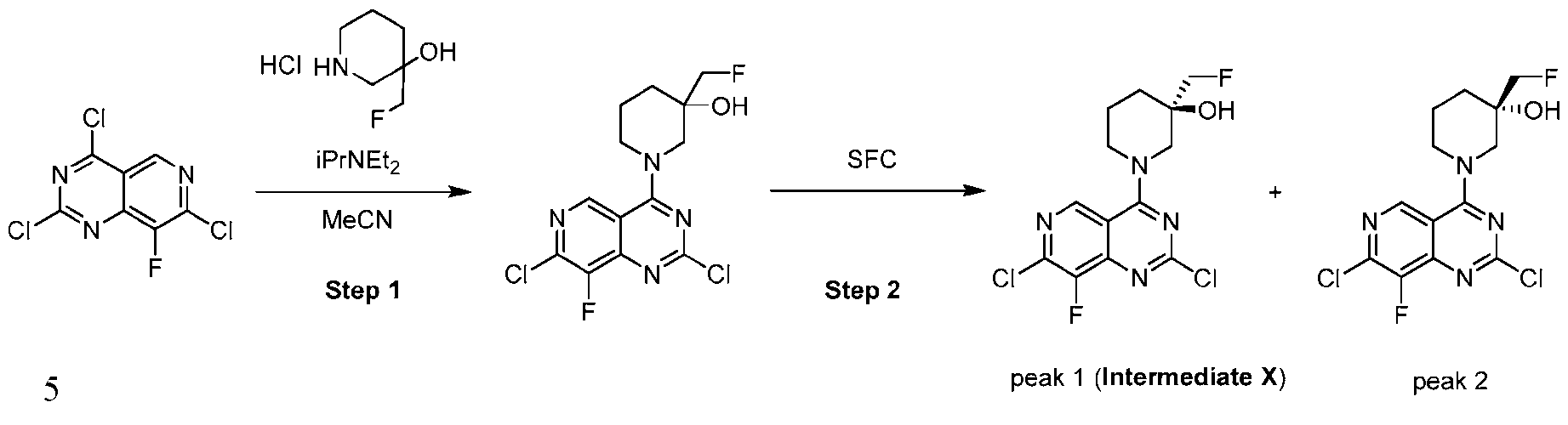
Step 1: 1-(2,7-Dichloro-8-fluoropyrido[4,3-d]pyrimidin-4-yl)-3- (fluoromethyl)piperidin-3-ol. A mixture of 2,4,7-trichloro-8-fluoropyrido[4,3- d]pyrimidine (1.50 g, 5.94 mmol, AmBeed) and 3-(fluoromethyl)piperidin-3- olhydrochloride (1.01 g, 5.94 mmol, Pharmablock, Inc.) in acetonitrile (6.0 mL) was cooled to 0 °C. N-ethyl-N-isopropylpropan-2-amine (2.1 mL, 11.9 mmol) was added. The reaction mixture was stirred at 0 °C for 10 min and then concentrated under reduced pressure and purified by column chromatography on silica gel, eluting with a gradient of 10-100% EtOAc:EtOH (3:1) in heptanes, to afford 1-(2,7-dichloro-8-fluoropyrido[4,3- d]pyrimidin-4-yl)-3-(fluoromethyl)piperidin-3-ol (1.30 g, 3.72 mmol, 62.7 % yield). Step 2: (R)-1-(2,7-Dichloro-8-fluoropyrido[4,3-d]pyrimidin-4-yl)-3- (fluoromethyl)piperidin-3-ol and (S)-1-(2,7-dichloro-8-fluoropyrido[4,3-d]pyrimidin- 4-yl)-3-(fluoromethyl)piperidin-3-ol. The sample (1.30 g) was subjected to chiral separation [column: ChiralPak (2 × 25 cm, 5 μm), mobile phase: 30% MeOH flowrate: 80 mL/min] to generate 0.56 g of peak 1 (Intermediate X) with 99% ee and 0.59 g of peak 2 with 96% ee. Intermediate Y. (R)-1-(8-Fluoro-2-(((2R,7aS)-2-fluorotetrahydro-1H-pyrrolizin- 7a(5H)-yl)methoxy)-7-(tributylstannyl)pyrido[4,3-d]pyrimidin-4-yl)-3- methylpiperidin-3-ol.
Step 1. (R)-1-(2,7-Dichloro-8-fluoropyrido[4,3-d]pyrimidin-4-yl)-3- methylpiperidin-3-ol. To a mixture of 2,4,7-trichloro-8-fluoropyrido[4,3-d]pyrimidine (25 g, 99 mmol) in acetonitrile (500 mL) was added DIPEA (86 mL, 495 mmol) and (R)- 3-methylpiperidin-3-ol hydrochloride (15 g, 99 mmol). The mixture was stirred at 0 °C for 0.5 h under N
2. The reaction mixture was diluted with H
2O (1 L) and extracted with EtOAc (0.9 L × 3). The combined organic layers were dried over Na
2SO
4, filtered and the filtrate was concentrated under reduced pressure. The residue was purified by chromatography on silica gel, eluting with a gradient of 2-100% ethyl acetate/petroleum ether to give (R)-1-(2,7-dichloro-8-fluoropyrido[4,3-d]pyrimidin-4-yl)-3- methylpiperidin-3-ol (28 g, 85 mmol, 85% yield) as yellow solid. Step 2. (R)-1-(7-Chloro-8-fluoro-2-(((2R,7aS)-2-fluorohexahydro-1H- pyrrolizin-7a-yl)methoxy)pyrido[4,3-d]pyrimidin-4-yl)-3-methylpiperidin-3-ol. To a solution of (R)-1-(2,7-dichloro-8-fluoropyrido[4,3-d]pyrimidin-4-yl)-3-methylpiperidin- 3-ol (20 g, 60 mmol) in 1,4-dioxane (300 mL) was added DIPEA (20 g, 151 mmol) and ((2R,7aS)-2-fluorotetrahydro-1H-pyrrolizin-7a(5H)-yl)methanol (14 g, 85 mmol). The resulting mixture was stirred at 100 °C for 12 h under N
2. The reaction mixture was diluted with H
2O (0.7 L) and extracted with EtOAc (0.5 L × 3). The combined organic layers were dried over Na
2SO
4, filtered and concentrated under reduced pressure. The residue was purified by chromatography on silica gel, eluting with a gradient of 10-100% ethyl acetate/petroleum ether to give (R)-1-(7-chloro-8-fluoro-2-(((2R,7aS)-2- fluorohexahydro-1H-pyrrolizin-7a-yl)methoxy)pyrido[4,3-d]pyrimidin-4-yl)-3-
methylpiperidin-3-ol. Batch 1: 10.3 g with 98.5% purity by LCMS; Batch 2: 3.3 g crude with 70% purity. m/z (ESI): 454.2, 456.2 (M+H)
+. Step 3. (R)-1-(8-Fluoro-2-(((2R,7aS)-2-fluorotetrahydro-1H-pyrrolizin- 7a(5H)-yl)methoxy)-7-(tributylstannyl)pyrido[4,3-d]pyrimidin-4-yl)-3- methylpiperidin-3-ol. To a 500 ml three-neck bottle containing the solution of (R)-1-(7- chloro-8-fluoro-2- (((2R,7aS)-2-fluorotetrahydro-1H-pyrrolizin-7a(5H)- yl)methoxy)pyrido[4,3-d]pyrimidin-4-yl)-3-methylpiperidin-3-ol (14 g, 31 mmol) in 1,4- dioxane (210 mL) was added chloro[(tricyclohexylphosphine)-2-(2′- aminobiphenyl)]palladium(II) (7.3 g, 12 mmol) and LiCl (6.5 g, 154 mmol). Bis(tributyltin) (54 g, 93 mmol) was added dropwise under N
2. The mixture was stirred at 100 °C for 12 h under N
2. The reaction mixture was diluted with H
2O (800 mL) and extracted with EtOAc (700 mL × 3). The combined organic layers were dried over Na
2SO
4, filtered and concentrated under reduced pressure. The residue was purified by chromatography on silica gel, eluting with a gradient of 10-100% of ethyl acetate in petroleum ether to give (R)-1-(8-fluoro-2-(((2R,7aS)-2-fluorotetrahydro-1H-pyrrolizin- 7a(5H)-yl)methoxy)-7-(tributylstannyl)pyrido[4,3-d]pyrimidin-4-yl)-3-methylpiperidin-3- ol (9.1 g, 13 mmol, 42 % yield) as yellow oil. m/z (ESI): 710.3 (M+H)
+. Intermediate Z: 4-Chloro-5-cyclopropyl-1-(tetrahydro-2H-pyran-2-yl)-1H-indazole.
Step 1: 5-Bromo-4-chloro-1-(tetrahydro-2H-pyran-2-yl)-1H-indazole. A mixture of 5-bromo-4-chloro-1H-indazole (0.56 g, 2.40 mmol, Pharmablock, Inc), 3,4- dihydro-2H-pyran (0.7 mL, 7.20 mmol), and p-TsOH (23 mg, 0.12 mmol) in 2- methyltetrahydrofuran (12 mL) was stirred at rt for 16 h. The crude product was adsorbed onto silica and was purified by chromatography on silica gel, eluting with a gradient of 0– 30% EtOAc in heptane, to give 5-bromo-4-chloro-1-(tetrahydro-2H-pyran-2-yl)-1H- indazole (0.41 g, 1.30 mmol, 54% yield). m/z (ESI): 231.0/233.1 (M+H-THP)
+.
Step 2: 4-Chloro-5-cyclopropyl-1-(tetrahydro-2H-pyran-2-yl)-1H-indazole. A mixture of cyclopropylboronic acid (53 mg, 0.62 mmol, Combi-Blocks, Inc.), 5-bromo- 4-chloro-1-(tetrahydro-2H-pyran-2-yl)-1H-indazole (0.13 g, 0.41 mmol), PdCl
2(dppf) (15 mg, 0.021 mmol), and potassium phosphate (2 M aqueous solution, 0.6 mL, 1.24 mmol) in 1,4-dioxane (2.0 mL) was sparged with argon then stirred at 70 °C for 16 h. The crude product was purified by chromatography on silica gel, eluting with a gradient of 0–20% EtOAc in heptane to give 4-chloro-5-cyclopropyl-1-(tetrahydro-2H-pyran-2-yl)-1H- indazole (0.10 g, 0.36 mmol, 88% yield) as colorless oil. m/z (ESI): 193.0 (M+H)
+. Intermediate AA. (Z)-3-(4-Bromo-6-chloro-1-(tetrahydro-2H-pyran-2-yl)-1H- indazol-5-yl)prop-2-en-1-ol.
A screw-cap vial equipped with a magnetic stirring bar and a pressure-relief cap was charged with 4-bromo-6-chloro-5-iodo-1-(tetrahydro-2H-pyran-2-yl)-1H-indazole (0.15 g, 0.34 mmol, Intermediate D, step 3), (Z)-3-(tributylstannyl)prop-2-en-1-ol (0.18 g, 0.51 mmol, Matrix Scientific), cataCXium A Pd G3 (25 mg, 0.034 mmol), and DMF (3.4 mL). The reaction mixture was heated to 100 °C while monitoring via LCMS. Upon completion, the crude material was purified by reverse phase chromatography to provide (Z)-3-(4-bromo-6-chloro-1-(tetrahydro-2H-pyran-2-yl)-1H-indazol-5-yl)prop-2-en-1-ol (85 mg, 0.23 mmol, 67 % yield) as orange oil. m/z (ESI): 370.2/372.2 (M+H)
+. Intermediate BB.4-Bromo-6-chloro-5-(methoxymethyl)-1-(tetrahydro-2H-pyran-2- yl)-1H-indazole.
Step 1.4-Bromo-6-chloro-1H-indazole-5-carbaldehyde. To a stirring solution of 4-bromo-6-chloro-1-(triisopropylsilyl)-1H-indazole (1.00 g, 2.60 mmol, Intermediate D, Step 1) in THF (12 mL) at -70 °C under argon was added lithium diisopropylamide (1 M in THF/hexanes, 3.7 mL, 3.70 mmol). After stirring for 20 min, a solution of DMF (0.6 mL, 8.00 mmol) in THF (2.0 mL) was added. After 20 min, the cooling bath was removed, and the reaction was allowed to warm to 0 °C. The reaction was quenched with dry silica (6 g) wetted with EtOAc (20 mL). The slurry was stirred for 45 min, then the mixture was concentrated under reduced pressure. The material was then purified by chromatography on silica gel, eluting with a gradient of 0-100% EtOAc in heptane to provide 4-bromo-6-chloro-1H-indazole-5-carbaldehyde (0.65 g, 2.50 mmol, 94 % yield) as white solid. m/z (ESI): 258.8/260.9 (M+H)
+.
1H NMR (DMSO-d
6, 400 MHz) δ 13.87 (br s, 1H), 10.37 (s, 1H), 8.33 (s, 1H), 7.8-7.8 (m, 1H). Step 2.4-Bromo-6-chloro-1-(tetrahydro-2H-pyran-2-yl)-1H-indazole-5- carbaldehyde. A suspension of 4-bromo-6-chloro-1H-indazole-5-carbaldehyde (0.63 g, 2.40 mmol), 3,4-dihydro-2H-pyran (0.61 g, 7.20 mmol), p-toluenesulfonic acid monohydrate (46 mg, 0.24 mmol) in DCM (8.0 mL) was stirred for 45 min at rt. The reaction was then directly purified by chromatography on silica gel, eluting with a gradient of 0-30% EtOAc in heptane to provide 4-bromo-6-chloro-1-(tetrahydro-2H- pyran-2-yl)-1H-indazole-5-carbaldehyde (0.52 g, 1.50 mmol, 62 % yield) as white solid. m/z (ESI): 364.8/366.9 (M+Na)
+.
1H NMR (CHLOROFORM-d, 400 MHz) δ 10.52 (s, 1H), 8.2-8.2 (m, 1H), 7.7-7.7 (m, 1H), 5.71 (dd, 1H, J=2.7, 8.7 Hz), 4.0-4.1 (m, 1H), 3.7- 3.9 (m, 1H), 2.4-2.5 (m, 1H), 2.1-2.2 (m, 2H), 1.7-1.8 (m, 3H). Step 3. (4-Bromo-6-chloro-1-(tetrahydro-2H-pyran-2-yl)-1H-indazol-5- yl)methanol. To a 100 mL round bottom flask containing both 4-bromo-6-chloro-1-
(tetrahydro-2H-pyran-2-yl)-1H-indazole-5-carbaldehyde (0.42 g, 1.22 mmol) and sodium borohydride (0.14 g, 3.70 mmol) was added THF (6.0 mL). After stirring for 15 min at rt, to the reaction was added to dry silica (3 g) suspended in EtOAc (20 mL), and water (2 mL). The reaction was concentrated under reduced pressure then purified by chromatography on silica gel, eluting with a gradient of 0-50% EtOAc in heptane to provide (4-bromo-6-chloro-1-(tetrahydro-2H-pyran-2-yl)-1H-indazol-5-yl)methanol (0.34 g, 0.98 mmol, 80 % yield) as white solid. m/z (ESI): 261.0/262.9 (-THP+H)
+ .
1H NMR (CHLOROFORM-d, 400 MHz) δ 8.03 (d, 1H, J=0.8 Hz), 7.7-7.7 (m, 1H), 5.69 (dd, 1H, J=2.8, 8.9 Hz), 5.11 (s, 2H), 4.0-4.0 (m, 1H), 3.7-3.8 (m, 1H), 2.4-2.5 (m, 1H), 1.7-2.2 (m, 6H). Step 4.4-Bromo-6-chloro-5-(methoxymethyl)-1-(tetrahydro-2H-pyran-2-yl)- 1H-indazole. To a stirring solution of (4-bromo-6-chloro-1-(tetrahydro-2H-pyran-2-yl)- 1H-indazol-5-yl)methanol (0.14 g, 0.40 mmol) in THF (2.0 mL) cooled to 0 °C under argon was added sodium hydride, 65% dispersion in liquid paraffin (19 mg, 0.48 mmol). After stirring for 15 min, a solution of iodomethane (69 mg, 0.48 mmol) in THF (0.3 mL) was added to the reaction. The cooling bath was removed and after 20 min, the reaction mixture was quenched with saturated aqueous NaCl solution (1 mL), water (1 mL), and then extracted with EtOAc (15 mL). The organic was dried over MgSO
4, filtered and concentrated under reduced pressure. The crude material was purified by chromatography on silica gel, eluting with a gradient of 0-40% EtOAc in heptane to provide 4-bromo-6- chloro-5-(methoxymethyl)-1-(tetrahydro-2H-pyran-2-yl)-1H-indazole (0.12 g, 0.32 mmol, 79 % yield) as colorless film.
1H NMR (CHLOROFORM-d, 400 MHz) δ 8.0-8.0 (m, 1H), 7.7-7.7 (m, 1H), 5.67 (dd, 1H, J=2.8, 8.9 Hz), 4.87 (s, 2H), 3.9-4.0 (m, 1H), 3.7- 3.8 (m, 1H), 3.47 (s, 3H), 2.4-2.5 (m, 1H), 2.1-2.2 (m, 2H), 1.6-1.8 (m, 3H). Intermediate CC.4-Bromo-6-chloro-5-(difluoromethyl)-1-(tetrahydro-2H-pyran-2- yl)-1H-indazole.

To a stirring suspension of 4-bromo-6-chloro-1-(tetrahydro-2H-pyran-2-yl)-1H- indazole-5-carbaldehyde (0.16 g, 0.46 mmol) in DCM (3 mL) at -70 °C under argon was added a solution of (diethylamino)trifluorosulfur (0.30 g, 0.2 mL, 1.86 mmol) in DCM
(0.8 mL). The cooling bath remained in place and the reaction mixture was stirred for 12 h overnight. To the reaction EtOH (0.5 mL) was added and after 10 min the mixture was concentrated under reduced pressure. The crude material was dissolved in DCM (2 mL) and purified by chromatography on silica gel, eluting with a gradient of 0-20% EtOAc in heptane to provide 4-bromo-6-chloro-5-(difluoromethyl)-1-(tetrahydro-2H-pyran-2-yl)- 1H-indazole (0.12 g, 0.33 mmol, 72 % yield).
1H NMR (CHLOROFORM-d, 400 MHz) δ 8.11 (s, 1H), 7.74 (s, 1H), 7.2-7.5 (m, 1H), 5.70 (dd, 1H, J=2.6, 8.9 Hz), 4.0-4.0 (m, 1H), 3.7-3.8 (m, 1H), 2.4-2.5 (m, 1H), 2.1-2.2 (m, 2H), 1.7-1.8 (m, 3H).
19F NMR (CHLOROFORM-d, 376 MHz) δ -112.03 (s). Intermediate DD.4-Bromo-6-chloro-5-(cyclopropylmethyl)-1-(tetrahydro-2H- pyran-2-yl)-1H-indazole.
Step 1. (4-Bromo-6-chloro-1-(tetrahydro-2H-pyran-2-yl)-1H-indazol-5- yl)(cyclopropyl)methanol. To a stirring solution of 4-bromo-6-chloro-1-(tetrahydro-2H- pyran-2-yl)-1H-indazole-5-carbaldehyde (0.25 g, 0.73 mmol) in THF (3.6 mL) at -20 °C under argon was added cyclopropylmagnesium bromide solution (0.5 M in THF, 1.7 mL, 0.85 mmol). After stirring for 15 min at 0 °C, the reaction was quenched with saturated aqueous NH
4Cl solution (5 mL). The reaction was then partitioned between EtOAc (25 mL) and water (5 mL). The organic was washed with saturated NaCl solution (5 mL), dried over MgSO
4, and concentrated under reduced pressure. The crude was purified by chromatography on silica gel, eluting with a gradient of 0-40% EtOAc in heptane to provide (4-bromo-6-chloro-1-(tetrahydro-2H-pyran-2-yl)-1H-indazol-5- yl)(cyclopropyl)methanol (0.21 g, 0.53 mmol, 73 % yield) as colorless oil. m/z (ESI): 408.8 (M+Na)
+.
1H NMR (CHLOROFORM-d, 400 MHz) δ 8.0-8.1 (m, 1H), 7.70 (dd, 1H, J=0.6, 3.8 Hz), 5.68 (td, 1H, J=2.5, 8.8 Hz), 4.76 (d, 1H, J=9.4 Hz), 4.0-4.0 (m, 1H), 3.7-3.8 (m, 1H), 2.4-2.6 (m, 1H), 2.1-2.2 (m, 2H), 1.6-1.9 (m, 5H), 0.7-0.8 (m, 1H), 0.6- 0.7 (m, 1H), 0.5-0.6 (m, 1H), 0.4-0.5 (m, 1H). Step 2.4-Bromo-6-chloro-5-(cyclopropylmethyl)-1-(tetrahydro-2H-pyran-2- yl)-1H-indazole. To a stirring solution of (4-bromo-6-chloro-1-(tetrahydro-2H-pyran-2-
yl)-1H-indazol-5-yl)(cyclopropyl)methanol (18 g, 0.47 mmol) and triethylsilane (0.6 mL, 4.70 mmol) in DCM (1.5 mL) trifluoroacetic acid (0.3 mL, 4.70 mol) was added. After stirring for 5 min, the reaction mixture was purified by chromatography on silica gel, eluting with a gradient of 0-40% EtOAc in heptane. The concentrated desired material was then stirred with 3,4-dihydro-2H-pyran (0.3 mL) and p-toluenesulfonic acid monohydrate (5.0 mg) for 1 h at rt. The reaction was then partitioned between EtOAc (10 mL) and saturated NaHCO
3 solution (5 mL). The organic was dried (Na
2SO
4), concentrated under reduced pressure and purified by chromatography on silica gel, eluting with a gradient of 0-40% EtOAc in heptane to provide 4-bromo-6-chloro-5- (cyclopropylmethyl)-1-(tetrahydro-2H-pyran-2-yl)-1H-indazole (0.18 g, 0.48 mmol, 100 % yield) as white solid. m/z (ESI): 368.9/370.9 (M+H)
+.
1H NMR (CHLOROFORM-d, 400 MHz) δ 7.97 (d, 1H, J=0.6 Hz), 7.6-7.7 (m, 1H), 5.65 (dd, 1H, J=2.7, 9.0 Hz), 3.9-4.0 (m, 1H), 3.7-3.8 (m, 1H), 3.05 (d, 2H, J=6.7 Hz), 2.4-2.6 (m, 1H), 2.0-2.2 (m, 2H), 1.6- 1.8 (m, 3H), 1.1-1.2 (m, 1H), 0.4-0.5 (m, 4H). Intermediate EE.4-Bromo-6-chloro-5-(2-fluoroprop-1-en-1-yl)-1-(tetrahydro-2H- pyran-2-yl)-1H-indazole.
Step 1.2-((1-Chloroethyl)thio)benzo[d]thiazole. To a stirred solution of 2- (ethylsulfanyl)-1,3-benzothiazole (1.44 g, 1.18 mL, 7.37 mmol, Oakwood Products, Inc.) in DCM (18 mL) in a 20-mL microwave reaction vessel was added 1-chloro-2,5- pyrrolidinedione (1.48 g, 11.1 mmol) in one portion as a solid. The resulting mixture was stirred at rt for 5 min before the vessel was sealed and subjected to microwave irradiation at 45 °C for 3 h. The crude was purified by chromatography on silica gel, eluting with a
gradient of 0-30% EtOAc in heptane to give 2-((1-chloroethyl)thio)benzo[d]thiazole (1.55 g, 6.75 mmol, 92 % yield) as colorless oil.
1H NMR (CHLOROFORM-d, 400 MHz) δ 7.99 (d, 1H, J=8.2 Hz), 7.88 (d, 1H, J=8.8 Hz), 7.83 (dd, 1H, J=0.6, 7.9 Hz), 7.48 (dt, 1H, J=1.3, 7.7 Hz), 7.3-7.4 (m, 1H), 6.14 (q, 1H, J=6.8 Hz), 2.06 (d, 3H, J=6.9 Hz). m/z (ESI): 230.1 (M+H)
+. Step 2.2-((1-Fluoroethyl)thio)benzo[d]thiazole. To a stirred solution of 2-((1- chloroethyl)thio)benzo[d]thiazole (1.65 g, 7.18 mmol) in MeCN (12 mL) in a 25-mL microwave reaction vessel was added zinc bromide (2.10 g, 9.34 mmol), followed by triethylamine trihydrofluoride (4.63 g, 4.68 mL, 28.7 mmol). The resulting mixture was stirred at rt for 5 min before the vessel was sealed and subjected to microwave irradiation at 70 °C for 8 h. After cooling to rt, the crude was poured into ice water and extracted with EtOAc. The combined organics layer was dried over magnesium sulfate and concentrated in vacuo. The crude residue was dissolved and loaded in DCM onto a silica gel precolumn (25 g) and purified by chromatography on silica gel, eluting with a gradient of 0-30% EtOAc in heptane to give impure 2-((1- fluoroethyl)thio)benzo[d]thiazole (1.25 g, 5.86 mmol, 82 % yield) as colorless oil.
1H NMR (CHLOROFORM-d, 400 MHz) δ 7.99 (d, 1H, J=8.2 Hz), 7.82 (d, 1H, J=8.2 Hz), 7.48 (dt, 1H, J=1.3, 7.7 Hz), 7.4-7.4 (m, 1H), 6.6-6.8 (m, 1H), 1.8-1.9 (m, 3H).
19F NMR (CHLOROFORM-d, 376 MHz) δ -142.21 (s, 1F). m/z (ESI): 214.0 (M+H)
+. Step 3.2-((1-Fluoroethyl)sulfonyl)benzo[d]thiazole. To a stirred solution of 2- ((1-fluoroethyl)thio)benzo[d]thiazole (1.25 g, 5.86 mmol) in DCM (12 mL) was added m- CPBA (3.28 g, 14.7 mmol) in one portion as a solid. The resulting mixture was stirred at rt for 2 d. The crude was poured into ice and 1 N aqueous sodium hydroxide solution and extracted with DCM. The combined organics was dried over anhydrous sodium sulfate and concentrated in vacuo. The crude residue was dissolved and loaded in DCM onto a silica gel precolumn (25 g) and purified by chromatography on silica gel, eluting with a gradient of 0-100% EtOAc in heptane to give crude 2-((1- fluoroethyl)sulfonyl)benzo[d]thiazole as colorless oil.
1H NMR (CHLOROFORM-d, 400 MHz) δ 8.29 (dd, 1H, J=1.5, 7.3 Hz), 8.06 (dd, 1H, J=1.0, 7.9 Hz), 7.6-7.7 (m, 2H), 5.7- 5.9 (m, 1H), 1.8-2.0 (m, 3H).
19F NMR (CHLOROFORM-d, 376 MHz) δ -171.52 (s, 1F). m/z (ESI): 246.0 (M+H)
+. Step 4.4-Bromo-6-chloro-5-(2-fluoroprop-1-en-1-yl)-1-(tetrahydro-2H- pyran-2-yl)-1H-indazole. To a stirred solution of 4-bromo-6-chloro-1-(tetrahydro-2H-
pyran-2-yl)-1H-indazole-5-carbaldehyde (0.12 g, 0.34 mmol) and 2-((1- fluoroethyl)sulfonyl)benzo[d]thiazole (80 mg, 0.33 mmol) in THF (4.0 mL) cooled at - 15°C was slowly added under nitrogen potassium tert-butoxide salt (1 M in THF, 0.4 mL, 0.36 mmol). The resulting mixture was stirred at - 15 °C for 40 min before quenching with saturated aqueous ammonium chloride solution. The resulting mixture was allowed to warm up to rt and was purified by chromatography on silica gel, eluting with a gradient of 0-100% EtOAc in heptane to give an impure geo-isomeric mixture of 4-bromo-6- chloro-5-(2-fluoroprop-1-en-1-yl)-1-(tetrahydro-2H-pyran-2-yl)-1H-indazole (50 mg, 0.13 mmol, 41 % yield) as colorless film. m/z (ESI): 372.9 and 374.8 (M+H)
+. Intermediate FF.4-Bromo-6-chloro-5-(2-chlorovinyl)-1-(tetrahydro-2H-pyran-2-yl)- 1H-indazole.

Step 1.5-((Chloromethyl)thio)-1-phenyl-1H-tetrazole. To a stirred ice-cooled solution of 1-phenyl-1H-tetrazole-5-thiol (3.00 g, 16.8 mmol, Sigma-Aldrich Corporation) in THF (65 mL) at -5 °C was slowly added under nitrogen sodium hydride, 60% in mineral oil (0.74 g, 18.5 mmol). The resulting mixture was stirred at -5 °C for 10 min before a solution of chloroiodomethane (3.12 g, 1.3 mL, 17.7 mmol, Combi-Blocks Inc.) in THF (3.0 mL) was slowly added. The mixture was stirred at rt for 3 h. The reaction was cooled in an ice bath before carefully quenched with ice-cold saturated aqueous ammonium chloride solution followed by extraction with EtOAc. The combined organics were washed with water and brine, and dried over anhydrous sodium sulfate. The residue after concentration in vacuo was dissolved in DCM and was purified by chromatography on silica gel, eluting with a gradient of 10-60% EtOAc in heptane to give 5-((chloromethyl)thio)-1-phenyl-1H-tetrazole (3.58 g, 15.79 mmol, 94 % yield) as white solid.
1H NMR (CHLOROFORM-d, 400 MHz) δ 7.5-7.8 (m, 5H), 5.38 (s, 2H). m/z (ESI): 227.0 (M+H)
+. Step 2.5-((Chloromethyl)sulfonyl)-1-phenyl-1H-tetrazole. To a stirred ice- cooled suspension of 5-((chloromethyl)thio)-1-phenyl-1H-tetrazole (3.58 g, 15.8 mmol)
in EtOH (100 mL) at 0 °C was added under nitrogen ammonium molybdate (para) tetrahydrate (3.90 g, 3.16 mmol, Alfa Aesar) followed by hydrogen peroxide (5.37 g, 4.8 mL, 47.4 mmol). The resulting mixture was stirred at rt overnight. The reaction was quenched with an aqueous sodium thiosulfate solution followed by extraction with EtOAc. The combined organics was washed with brine, dried over anhydrous sodium sulfate, and concentrated in vacuo. The crude residue was dissolved in DCM and was purified by chromatography on silica gel, eluting with a gradient of 10-60% EtOAc in heptane to give 5-((chloromethyl)sulfonyl)-1-phenyl-1H-tetrazole (0.25 g, 0.97 mmol, 6 % yield) as white solid.
1H NMR (CHLOROFORM-d, 400 MHz) δ 7.5-7.8 (m, 5H), 5.15 (s, 2H). m/z (ESI): 259.0 (M+H)
+. Step 3.4-Bromo-6-chloro-5-(2-chlorovinyl)-1-(tetrahydro-2H-pyran-2-yl)- 1H-indazole. To a stirred solution of 4-bromo-6-chloro-1-(tetrahydro-2H-pyran-2-yl)- 1H-indazole-5-carbaldehyde (0.12 g, 0.34 mmol) and 5-((chloromethyl)sulfonyl)-1- phenyl-1H-tetrazole (89 mg, 0.34 mmol) in THF (2.5 mL) was added under nitrogen [bis(dimethylamino)phosphoryl]dimethylamine (0.12 mL, 0.69 mmol), followed by 1,1,1,3,3,3-hexamethyldisilazane lithium salt (1 M in THF, 0.69 mL, 0.69 mmol). The resulting mixture was stirred at rt for 40 min. The crude reaction mixture was purified by chromatography on silica gel, eluting with a gradient of 0-100% EtOAc in heptane to give an impure geo-isomeric mixture of 4-bromo-6-chloro-5-(2-chlorovinyl)-1-(tetrahydro- 2H-pyran-2-yl)-1H-indazole (40 mg, 0.11 mmol, 31 % yield) as colorless film. m/z (ESI): 396.0, 398.6 and 400.8 (M+H)
+. Intermediate GG. rac-4-Bromo-6-chloro-5-((1R,2S)-2-(fluoromethyl)cyclopropyl)-1- (tetrahydro-2H-pyran-2-yl)-1H-indazole.

Step 1.4-Bromo-6-chloro-1-(triisopropylsilyl)-1H-indazole. A screw-cap vial equipped with a magnetic stirring bar and a pressure-relief cap was charged with 4- bromo-6-chloro-1H-indazole (2.00 g, 8.64 mmol, Combi-Blocks Inc.) and tetrahydrofuran (3.0 mL), then cooled to -78 °C. LiHMDS (1.0 M in THF, 10.4 mL, 10.4 mmol) was added dropwise, and the mixture was stirred for 20 min at -78 °C. Triisopropylchlorosilane (2.00 g, 2.2 mL, 10.40 mmol) was added dropwise, and the mixture was stirred for 20 min at -78 °C, then warmed to rt while monitoring via LCMS. Upon completion, the reaction was carefully quenched with the addition of water. The aqueous layer was extracted with EtOAc, and the combined organic phases were washed with brine, dried over anhydrous sodium sulfate, filtered, and concentrated under reduced pressure. The crude material was purified by chromatography on silica gel, eluting with a gradient of 0-2% (3:1 EtOAc/EtOH) in heptane, to provide 4-bromo-6-chloro-1- (triisopropylsilyl)-1H-indazole (2.75 g, 7.09 mmol, 82 % yield) as orange solid. m/z (ESI): 231.0/233.0 (M-TIPS+H)
+.
1H NMR (400 MHz, DMSO-d
6) δ ppm 8.34 - 8.39 (m, 1 H), 7.67 - 7.70 (m, 1 H), 7.51 - 7.55 (m, 1 H), 1.70 - 1.88 (m, 3 H), 1.08 (d, J=7.46 Hz, 18 H). Step 2.4-Bromo-6-chloro-5-iodo-1-(triisopropylsilyl)-1H-indazole. A screw- cap vial equipped with a magnetic stirring bar and a pressure-relief cap was charged with 4-bromo-6-chloro-1-(triisopropylsilyl)-1H-indazole (2.00 g, 5.16 mmol) and
tetrahydrofuran (26 mL) under nitrogen, then cooled to -78 °C. LDA (1.0 M in THF, 6.7 mL, 6.70 mmol) was added dropwise, then the reaction was stirred at -78 °C for 1 h. A solution of iodine (1.70 g, 6.70 mmol) in THF (1.0 mL) was then added dropwise, and the reaction was warmed to rt with stirring while monitoring via LCMS. Upon completion, the reaction was quenched with 10% aqueous sodium thiosulfate solution. The aqueous layer was extracted with DCM, and the combined organic phases were washed with brine, dried over anhydrous sodium sulfate, and filtered. TFA (2.0 mL) was added to the DCM layer, and the mixture was stirred until complete TIPS deprotection (as indicated by TLC). The organic layer was concentrated under reduced pressure, and the crude material was dissolved in DMSO and was purified by reverse phase chromatography to provide 4- bromo-6-chloro-5-iodo-1H-indazole (0.81 g, 2.27 mmol, 44 % yield) as off-white solid. m/z (ESI): 356.8/358.8 (M+H)
+. Step 3.4-Bromo-6-chloro-5-iodo-1-(tetrahydro-2H-pyran-2-yl)-1H-indazole. A screw-cap vial equipped with a magnetic stirring bar and a pressure-relief cap was charged with 4-bromo-6-chloro-5-iodo-1H-indazole (1.00 g, 2.80 mmol), 4- methylbenzenesulfonic acid (24 mg, 0.14 mmol), 3,4-dihydro-2H-pyran (0.71 g, 0.77 mL, 8.39 mmol) and dichloromethane (14 mL). The reaction mixture was stirred at rt while monitoring via LCMS. Upon completion, the reaction was concentrated under reduced pressure. The crude residue was dissolved in DMSO (2 × 4.0 mL) was purified by reverse phase chromatography to provide 4-bromo-6-chloro-5-iodo-1-(tetrahydro-2H-pyran-2- yl)-1H-indazole (1.10 g, 2.49 mmol, 89 % yield) as off-white solid. m/z (ESI): 440.8/442.8 (M+H)
+. Step 4. rel-Ethyl (1S,2R)-2-(4-bromo-6-chloro-1-(tetrahydro-2H-pyran-2-yl)- 1H-indazol-5-yl)cyclopropane-1-carboxylate. A screw-cap vial equipped with a magnetic stirring bar and a pressure-relief cap was charged with 4-bromo-6-chloro-5- iodo-1-(tetrahydro-2H-pyran-2-yl)-1H-indazole (0.50 g, 1.13 mmol), 1,1'- bis(diphenylphosphino)ferrocene-palladium dichloride (83 mg, 0.11 mmol), potassium phosphate tribasic (0.72 g, 3.40 mmol), rel-ethyl (1R,2S)-2-(tetramethyl-1,3,2- dioxaborolan-2-yl)cyclopropane-1-carboxylate (0.35 g, 0.4 mL, 1.47 mmol) in water (1.2 mL)/1,4-dioxane (6.0 mL). The reaction mixture was then heated to 90 °C while monitoring via LCMS. After 6 h, the reaction materials was purified by reverse-phase column chromatography to provide rel-ethyl (1S,2R)-2-(4-bromo-6-chloro-1-(tetrahydro-
2H-pyran-2-yl)-1H-indazol-5-yl)cyclopropane-1-carboxylate (0.18 g, 0.42 mmol, 37 % yield) as orange oil. m/z (ESI): 382.9 (M+H)
+. Step 5. rel-((1S,2R)-2-(4-Bromo-6-chloro-1-(tetrahydro-2H-pyran-2-yl)-1H- indazol-5-yl)cyclopropyl)methanol. A 6-mL vial was charged with rel-ethyl (1S,2R)-2- (4-bromo-6-chloro-1-(tetrahydro-2H-pyran-2-yl)-1H-indazol-5-yl)cyclopropane-1- carboxylate (0.18 g, 0.42 mmol) in tetrahydrofuran (2.0 mL) and stirred at -78 °C. Then diisobutylaluminum hydride solution (25% in toluene, 0.59 g, 0.7 mL, 1.04 mmol) was added dropwise. The reaction mixture was gradually warmed up to rt and the progress of reaction was monitored by LCMS. After completion, the reaction was slowly quenched with 0.5 mL of water, then 0.5 mL of 3 M NaOH and 1.5 mL of water in this order. The reaction mixture was vigorously stirred for 15 min and then the aqueous layer was extracted with EtOAc (3 × 5 mL). The combined organic layers were dried with sodium sulfate, filtered and concentrated under reduced pressure. The crude material was purified by chromatography on silica gel, eluting with a gradient of 0 - 40% 3:1 EtOAc/EtOH in heptanes, to provide rel-((1S,2R)-2-(4-bromo-6-chloro-1-(tetrahydro-2H-pyran-2-yl)-1H- indazol-5-yl)cyclopropyl)methanol (0.10 g, 0.27 mmol, 64 % yield) as light-yellow oil. m/z (ESI): 385.0 (M+H)
+. Step 6. rel-((1R,2S)-2-(4-Bromo-6-chloro-1-(tetrahydro-2H-pyran-2-yl)-1H- indazol-5-yl)cyclopropyl)methyl methanesulfonate. To a 6-mL vial charged with rel- ((1S,2R)-2-(4-bromo-6-chloro-1-(tetrahydro-2H-pyran-2-yl)-1H-indazol-5- yl)cyclopropyl)methanol (0.10 g, 0.27 mmol) in dichloromethane (1.0 mL) was added triethylamine (0.1 mL, 0.67 mmol) and methanesulfonyl chloride (27 ^L, 0.35 mmol) at 0 °C. The reaction was stirred at 0 °C and monitored by LCMS. Upon completion, the reaction was quenched with water (3 mL) and extracted with DCM (3 × 1 mL). The combined organic layers were washed with brine and dried over MgSO
4, filtered and concentrated under reduced pressure. The crude was used in the subsequent step without further purification. Step 7. rel-4-Bromo-6-chloro-5-((1R,2S)-2-(fluoromethyl)cyclopropyl)-1- (tetrahydro-2H-pyran-2-yl)-1H-indazole. To a 6-mL vial charged with rel-((1S,2R)-2- (4-bromo-6-chloro-1-(tetrahydro-2H-pyran-2-yl)-1H-indazol-5-yl)cyclopropyl)methyl methanesulfonate (0.12 g, 0.27 mmol) in tetrahydrofuran (1.0 mL) was added tetrabutylammonium fluoride (1 M in THF, 0.8 mL, 0.80 mmol). The reaction was stirred at 60 °C and monitored by LCMS. Upon completion, the crude material was purified by
reverse-phase column chromatography to provide rel-4-bromo-6-chloro-5-((1R,2S)-2- (fluoromethyl)cyclopropyl)-1-(tetrahydro-2H-pyran-2-yl)-1H-indazole (50 mg, 0.13 mmol, 48 % yield) as colorless oil. m/z (ESI): 302.9 (M+H)
+.
1H NMR (400 MHz, CHLOROFORM-d) δ ppm 8.00 (s, 1 H), 7.67 (s, 1 H), 5.63 - 5.68 (m, 1 H), 4.69 - 4.75 (m, 1 H), 4.66 - 4.92 (m, 1 H), 4.00 - 4.06 (m, 1 H), 3.76 (ddd, J=11.6, 10.0, 3.1 Hz, 1 H), 3.56 (t, J=9.5 Hz, 1 H), 2.44 - 2.54 (m, 1 H), 2.06 - 2.27 (m, 3 H), 1.94 (dddd, J=14.2, 8.6, 5.6, 2.8 Hz, 1 H), 1.66 - 1.83 (m, 3 H), 1.35 (q, J=6.2 Hz, 1 H).
19F NMR (377 MHz, CHLOROFORM-d) δ ppm -214.19 (s). Intermediate HH. rel-2-((1R,2R)-2-(4-Bromo-6-chloro-1-(tetrahydro-2H-pyran-2-yl)- 1H-indazol-5-yl)cyclopropyl)acetonitrile.
To a 6-mL vial was added rel-((1R,2S)-2-(4-bromo-6-chloro-1-(tetrahydro-2H-pyran-2- yl)-1H-indazol-5-yl)cyclopropyl)methyl methanesulfonate (68 mg, 0.15 mmol, Intermediate GG Step 6) in DMF (1.0 mL). Sodium cyanide (29 mg, 0.59 mmol) was added and the reaction mixture was stirred at 80 °C and monitored by LCMS. After 24 h, the reaction mixture was allowed to cool to rt and was slowly quenched with saturated NaHCO
3 solution (10 mL) and extracted with EtOAc (3 × 5 mL). The combined organic layers were washed with brine, dried over MgSO
4, filtered and concentrated under reduced pressure. The crude material was purified by reverse-phase column chromatography to provide rel-2-((1R,2R)-2-(4-bromo-6-chloro-1-(tetrahydro-2H-pyran- 2-yl)-1H-indazol-5-yl)cyclopropyl)acetonitrile (46 mg, 0.12 mmol, 79 % yield) as light- yellow oil. m/z (ESI): 309.9 (M+H-THP)
+. Intermediate II.4-Bromo-5-ethyl-6,6-difluoro-1-(tetrahydro-2H-pyran-2-yl)-5,6,7,8- tetrahydro-1H-benzo[f]indazole.
Step 1.8-Bromo-1-ethyl-6-fluoro-3,4-dihydronaphthalen-2(1H)-one. A 50- mL pressure-release vial was charged with 8-bromo-6-fluoro-3,4-dihydronaphthalen- 2(1H)-one (0.50 g, 2.06 mmol) and tetrahydrofuran (8.2 mL). The vial was flushed with nitrogen, and potassium tert-butoxide solution (1.0 M in tetrahydrofuran, 2.3 mL, 2.30 mmol) was added dropwise. The resulting solution was cooled to 0 °C and iodoethane (0.35 g, 0.2 mL, 2.26 mmol) was added dropwise. The resulting mixture was allowed to warm to rt and stirred for 2 h. The reaction was quenched by addition of saturated aqueous NH4Cl solution (5 mL). The resulting biphasic mixture was then transferred to a separatory funnel with EtOAc (20 mL) and H
2O (10 mL), and the aqueous phase was extracted with EtOAc (20 mL). The combined organics were dried with Na
2SO
4, filtered, and concentrated to dryness. The resulting crude residue was purified by chromatography on silica gel, eluting with a gradient of 0 - 50% EtOAc in heptane to afford 8-bromo-1- ethyl-6-fluoro-3,4-dihydronaphthalen-2(1H)-one (0.50 g, 1.85 mmol, 90 % yield) as clear oil. m/z (ESI): 271.0, 272.9 (M+H)
+. Step 2.8-Bromo-1-ethyl-2,2,6-trifluoro-1,2,3,4-tetrahydronaphthalene. A 50- mL pressure-release vial was charged with 8-bromo-1-ethyl-6-fluoro-3,4- dihydronaphthalen-2(1H)-one (0.50 g, 1.85 mmol) and dichloromethane (1.2 mL). To the resulting solution was added [bis(2-methoxyethyl)amino]sulphur trifluoride (2.7 M in toluene, 1.4 mL, 3.89 mmol), and the resulting mixture was heated 50 °C for 16 h. The reaction was quenched by addition of saturated aqueous NaHCO
3 solution (5 mL), and the resulting biphasic mixture was transferred to a separatory funnel with CH
2Cl
2 (20 mL) and H
2O (10 mL). The aqueous phase was extracted with CH
2Cl
2 (20 mL), and the combined organics were dried with Na
2SO
4, filtered, and concentrated to dryness. The resulting crude residue was purified by chromatography on silica gel, eluting with a gradient of 0 - 5% EtOAc in heptane, to afford 8-bromo-1-ethyl-2,2,6-trifluoro-1,2,3,4-
tetrahydronaphthalene (0.16 g, 0.56 mmol, 30 % yield) as clear oil.
1H NMR (400 MHz, CHLOROFORM-d) δ ppm 7.24 (dd, J=7.9, 2.5 Hz, 1 H), 6.84 (dd, J=8.8, 2.5 Hz, 1 H), 3.29 - 3.42 (m, 1 H), 2.99 - 3.09 (m, 2 H), 2.13 - 2.44 (m, 2 H), 1.61 - 1.73 (m, 2 H), 1.10 - 1.19 (m, 3 H).
19F NMR (376 MHz, CHLOROFORM-d) δ ppm -92.79 (d, J=241.0 Hz), -100.36 - -99.61 (m), -114.90 (s). Step 3.1-Bromo-8-ethyl-3,7,7-trifluoro-5,6,7,8-tetrahydronaphthalene-2- carbaldehyde. A 50-mL pressure-release vial was charged with 8-bromo-1-ethyl-2,2,6- trifluoro-1,2,3,4-tetrahydronaphthalene (0.16 g, 0.56 mmol) and tetrahydrofuran (5.6 mL). The resulting solution was flushed with nitrogen, cooled to -78 °C, and lithium diisopropylamide (1.0 M in tetrahydrofuran/hexanes, 0.8 mL, 0.84 mmol) was subsequently added dropwise. The resulting mixture was allowed to stir at -78 °C for 10 min under nitrogen, after which DMF (0.2 mL, 2.80 mmol) was added dropwise. The resulting mixture was allowed to stir at -78 °C for 1.5 h. The reaction mixture was allowed to warm to 0 °C and was quenched by slow addition of saturated aqueous NH
4Cl solution (3 mL). The mixture was then transferred to a separatory funnel with EtOAc (20 mL) and H
2O (10 mL), and the aqueous layer was extracted with EtOAc (20 mL). The combined organics were dried over Na
2SO
4, filtered, and concentrated in vacuo. The resulting crude residue was purified by chromatography on silica gel, eluting with a gradient of 0 - 20% EtOAc in heptane to afford 1-bromo-8-ethyl-3,7,7-trifluoro-5,6,7,8- tetrahydronaphthalene-2-carbaldehyde (0.13 g, 0.42 mmol, 75 % yield) as light-yellow oil.
1H NMR (500 MHz, CHLOROFORM-d) δ ppm 10.39 (s, 1 H), 6.97 (d, J=10.6 Hz, 1 H), 3.45 - 3.62 (m, 1 H), 3.12 (dd, J=9.4, 5.3 Hz, 2 H), 2.20 - 2.46 (m, 2 H), 1.61 - 1.76 (m, 2 H), 1.14 - 1.21 (m, 3 H).
19F NMR (471 MHz, CHLOROFORM-d) δ ppm -92.45 (br d, J=243.2 Hz), -100.06 (br d, J=243.2 Hz), -117.87 (s); m/z (ESI): 320.95, 322.9 (M+H)
+. Step 4.4-Bromo-5-ethyl-6,6-difluoro-5,6,7,8-tetrahydro-1H-benzo[f]indazole. A 5 mL microwave vial was charged with 1-bromo-8-ethyl-3,7,7-trifluoro-5,6,7,8- tetrahydronaphthalene-2-carbaldehyde (0.13 g, 0.42 mmol) and tetrahydrofuran (2.1 mL). To the resulting solution was added anhydrous hydrazine (0.53 g, 0.5 mL, 16.7 mmol) and the resulting mixture was heated to 70 °C in the microwave for 5 h. The reaction mixture was concentrated to dryness and the resulting crude residue was purified by chromatography on silica gel, eluting with a gradient of 0 - 50% EtOAc in heptane to
afford 4-bromo-5-ethyl-6,6-difluoro-5,6,7,8-tetrahydro-1H-benzo[f]indazole (20 mg, 0.063 mmol, 15 % yield) as off-white solid. m/z (ESI): 314.9, 316.9 (M+H)
+. Step 5.4-Bromo-5-ethyl-6,6-difluoro-1-(tetrahydro-2H-pyran-2-yl)-5,6,7,8- tetrahydro-1H-benzo[f]indazole. A 50-mL pressure-release vial was charged with 4- bromo-5-ethyl-6,6-difluoro-5,6,7,8-tetrahydro-1H-benzo[f]indazole (64 mg, 0.20 mmol), p-toluenesulfonic acid monohydrate (1.9 mg, 0.01 mmol), and dichloromethane (2.0 mL). To the resulting solution was added 3,4-dihydro-2H-pyran (55 ^L, 0.61 mmol) and the resulting mixture was allowed to stir at rt for 16 h. The reaction mixture was concentrated to dryness and the resulting crude residue was purified by chromatography on silica gel, eluting with a gradient of 0 - 20% EtOAc in heptane to afford 4-bromo-5-ethyl-6,6- difluoro-1-(tetrahydro-2H-pyran-2-yl)-5,6,7,8-tetrahydro-1H-benzo[f]indazole (75 mg, 0.19 mmol, 93 % yield) as off-white solid. m/z (ESI): 398.95, 400.9 (M+H)
+. Intermediate JJ.4-Bromo-1-(tetrahydro-2H-pyran-2-yl)-1,5,6,7- tetrahydrocyclopenta[f]indazole.
Step 1.4-Bromo-6-fluoro-2,3-dihydro-1H-indene-5-carbaldehyde. To a solution of 4-bromo-6-fluoro-2,3-dihydro-1H-indene (0.46 g, 0.5 mL, 2.14 mmol, Enamine) in THF (3.0 mL) at -78 °C was added lithium diisopropylamide (1.0 M in tetrahydrofuran/hexanes, 2.8 mL, 2.80 mmol). After stirring the reaction mixture for 10 min at this temperature, DMF (0.2 mL, 3.00 mmol) was added and the reaction was continued to stir for 30 min at rt. After completion, the reaction mixture was quenched with saturated NH
4Cl solution and extracted with ethyl acetate. The organic layer was concentrated under reduced pressure. The crude material was purified by chromatography on silica gel, eluting with a gradient of 0-50% EtOAc/EtOH (3:1) in heptane to afford 4- bromo-6-fluoro-2,3-dihydro-1H-indene-5-carbaldehyde (0.19 g, 0.76 mmol, 36 % yield). m/z (ESI): 243.0/245.1 (M+H)
+.
1H NMR (400 MHz, CHLOROFORM-d) δ ppm 10.35 (d, J=0.84 Hz, 1 H), 6.99 (d, J=10.24 Hz, 1 H), 3.10 (t, J=7.63 Hz, 2 H), 2.95 - 3.05 (m, 2 H), 2.18 (quin, J=7.63 Hz, 2 H).
Step 2.4-Bromo-1-(tetrahydro-2H-pyran-2-yl)-1,5,6,7- tetrahydrocyclopenta[f]indazole. A solution of 4-bromo-6-fluoro-2,3-dihydro-1H- indene-5-carbaldehyde (0.17 g, 0.70 mmol) and anhydrous hydrazine (2.24 g, 2.2 mL, 69.9 mmol) in tetrahydrofuran (2.0 mL) was heated to 70 °C for 18 h. After cooling to rt, the reaction mixture was concentrated to give crude 4-bromo-1,5,6,7- tetrahydrocyclopenta[f]indazole, which was dissolved in DCM (3 mL) and treated with 3,4-dihydro-2H-pyran (59 mg, 0.70 mmol) and p-toluenesulfonic acid monohydrate (0.13 g, 0.70 mmol). The resulting solution was stirred at rt for 18 h, diluted with water and extracted with EtOAc. The organic layer was separated, dried (Na
2SO
4), concentrated and residue purified by chromatography on silica gel, eluting with a gradient of 0-50% EtOAc/EtOH (3:1) in heptane to afford 4-bromo-1-(tetrahydro-2H-pyran-2-yl)-1,5,6,7- tetrahydrocyclopenta[f]indazole (45 mg, 0.14 mmol, 20 % yield). m/z (ESI): 321.0/322.9 (M+H)
+. Intermediate KK.4-Bromo-5-methyl-1-(tetrahydro-2H-pyran-2-yl)-1,5,6,7- tetrahydrocyclopenta[f]indazole.
Step 1.7-Bromo-5-fluoro-1-methyl-2,3-dihydro-1H-inden-1-ol. To a solution of 7-bromo-5-fluoro-2,3-dihydro-1H-inden-1-one (2.00 g, 8.73 mmol, Ambeed, Inc.) in tetrahydrofuran (5.0 mL) at rt was added lanthanum trichloride lithium chloride complex (14.6 mL, 8.73 mmol, Sigma-Aldrich Corporation). The solution was stirred at rt for 15 mins, cooled to 0 °C, then methylmagnesium bromide solution (3.0 M in diethyl ether, 4.4 mL, 13.1 mmol) was added dropwise. The resulting mixture was stirred at 0 °C for 2 h. The reaction mixture was quenched with saturated NH
4Cl solution and extracted with EtOAc. The organic was concentrated, and the residue purified by chromatography on silica gel, eluting with a gradient of 0-60% EtOAc/EtOH (3:1) in heptane to afford 7- bromo-5-fluoro-1-methyl-2,3-dihydro-1H-inden-1-ol (1.61 g, 6.57 mmol, 75 % yield).
1H
NMR (400 MHz, CHLOROFORM-d) δ ppm 7.13 (d, J=7.99 Hz, 1 H) 6.89 (d, J=8.44 Hz, 1 H) 2.88 - 2.99 (m, 1 H) 2.76 - 2.85 (m, 1 H) 2.75 (s, 1 H) 2.26 - 2.35 (m, 2 H) 1.65 (s, 3 H). Step 2.7-Bromo-5-fluoro-1-methyl-2,3-dihydro-1H-indene. To a solution of 7- bromo-5-fluoro-1-methyl-2,3-dihydro-1H-inden-1-ol (0.90 g, 3.67 mmol) in dichloromethane (3.0 mL) at -30 °C was added triethylsilane (1.28 g, 1.3 mL, 11.0 mmol) followed by TFA (0.6 mL, 7.30 mmol). The reaction mixture was allowed to warm to rt with stirring for 4 h, then diluted with water and extracted with EtOAc. The organic layer was concentrated, and the residue was purified by chromatography on silica gel, eluting with a gradient of 0-40% EtOAc/EtOH (3:1) in heptane to afford 7-bromo-5-fluoro-1- methyl-2,3-dihydro-1H-indene (0.73 g, 3.19 mmol, 87 % yield).
1H NMR (400 MHz, CHLOROFORM-d) δ ppm 7.05 (dd, J=8.57, 2.09 Hz, 1 H) 6.86 (br d, J=8.36 Hz, 1 H) 3.33 (t, J=7.32 Hz, 1 H) 3.07 - 3.17 (m, 1 H) 2.84 - 2.92 (m, 1 H) 2.32 (ddt, J=12.59, 10.61, 8.67, 8.67 Hz, 1 H) 1.84 (ddt, J=12.57, 8.02, 1.83, 1.83 Hz, 1 H) 1.25 (d, J=7.11 Hz, 3 H). Step 3.4-Bromo-6-fluoro-3-methyl-2,3-dihydro-1H-indene-5-carbaldehyde. To a solution of 7-bromo-5-fluoro-1-methyl-2,3-dihydro-1H-indene (0.78 g, 3.39 mmol) in THF (5.0 mL) at -78 °C was added lithium diisopropylamide (1 M in tetrahydrofuran/hexanes, 4.4 mL, 4.40 mmol) dropwise. After stirring at -78 °C for 30 minutes, DMF (0.4 mL, 4.74 mmol) was added. The resulting solution was stirred at -78 °C for another 30 minutes and the reaction mixture was quenched with saturated NH
4Cl solution and warmed to rt. The aqueous layer was extracted with EtOAc. The organic layer was concentrated, and the residue was purified by chromatography on silica gel, eluting with a gradient of 0-50% EtOAc/EtOH (3:1) in heptane to afford 4-bromo-6- fluoro-3-methyl-2,3-dihydro-1H-indene-5-carbaldehyde (0.75 g, 2.92 mmol, 86 % yield). m/z (ESI): 257.0/259 (M+H)
+.
1H NMR (400 MHz, CHLOROFORM-d) δ ppm 10.36 (s, 1 H), 6.98 (d, J=10.24 Hz, 1 H), 3.46 (t, J=7.32 Hz, 1 H), 3.13 - 3.25 (m, 1 H), 2.97 (dd, J=17.04, 8.67 Hz, 1 H), 2.28 - 2.39 (m, 1 H), 1.90 (dd, J=12.75, 7.94 Hz, 1 H), 1.27 (d, J=6.90 Hz, 3 H).
19F NMR (376 MHz, CHLOROFORM-d) δ ppm -117.18 (s). Step 4.4-Bromo-5-methyl-1-(tetrahydro-2H-pyran-2-yl)-1,5,6,7- tetrahydrocyclopenta[f]indazole. A solution of 4-bromo-6-fluoro-3-methyl-2,3-dihydro- 1H-indene-5-carbaldehyde (0.70 g, 2.72 mmol) and anhydrous hydrazine (1.8 mL, 54.5 mmol) in THF (2.0 mL) was heated to 70 °C in microwave for 5 h. The reaction was
concentrated at low temperature and the residue was purified by chromatography on silica gel, eluting with a gradient of 0-60% EtOAc/EtOH (3:1) in heptane to afford 4-bromo-5- methyl-1,5,6,7-tetrahydrocyclopenta[f]indazole (0.45 g, 1.80 mmol, 66 % yield) with 4- fluoro-8-methyl-1,6,7,8-tetrahydrocyclopenta[g]indazole. The 4-bromo-5-methyl-1,5,6,7- tetrahydrocyclopenta[f]indazole obtained was dissolved in DCM (5 mL) and treated with 3,4-dihydro-2H-pyran (1.0 mL, 10.9 mmol) and p-toluenesulfonic acid monohydrate (0.10 g, 0.55 mmol). The resulting solution was stirred at rt for 18 h and purified by chromatography on silica gel, eluting with a gradient of 0-50% EtOAc/EtOH (3:1) in heptane, to afford 4-bromo-5-methyl-1-(tetrahydro-2H-pyran-2-yl)-1,5,6,7- tetrahydrocyclopenta[f]indazole (0.27 g, 0.81 mmol, 30 % yield). m/z (ESI): 335.0/337.0 (M+H)
+.
1H NMR (400 MHz, CHLOROFORM-d) δ ppm 7.95 (s, 1 H), 7.34 (s, 1 H), 5.67 (dd, J=9.30, 2.40 Hz, 1 H), 3.97 - 4.07 (m, 1 H), 3.64 - 3.86 (m, 1 H), 3.46 (quin, J=7.11 Hz, 1 H), 3.13 - 3.35 (m, 1 H), 2.89 - 3.12 (m, 1 H), 2.50 - 2.62 (m, 1 H), 2.25 - 2.40 (m, 1 H), 2.04 - 2.25 (m, 2 H), 1.84 - 1.99 (m, 1 H), 1.61 - 1.82 (m, 3 H), 1.23 - 1.34 (m, 3 H). Intermediate LL.4-Bromo-5-ethyl-1-(tetrahydro-2H-pyran-2-yl)-1,5,6,7- tetrahydrocyclopenta[f]indazole.
Step 1.7-Bromo-1-ethyl-5-fluoro-2,3-dihydro-1H-inden-1-ol. Following the procedure described in Step 1 for Intermediate AA-2, 7-bromo-5-fluoro-2,3-dihydro-1H- inden-1-one (2.00 g, 8.73 mmol, Ambeed, Inc.) in tetrahydrofuran (10 mL), lanthanum(III) chloride bis(lithium chloride) complex solution (0.6 M in tetrahydrofuran, 14.6 mL, 8.73 mmol), and ethylmagnesium bromide (3.0 M in diethyl ether, 4.4 mL, 13.2 mmol) were used to afford 7-bromo-1-ethyl-5-fluoro-2,3-dihydro-1H-inden-1-ol (0.86 g, 3.32 mmol, 38 % yield).
1H NMR (400 MHz, CHLOROFORM-d) δ ppm 7.13 (d, J=7.97
Hz, 1 H), 6.89 (d, J=7.82 Hz, 1 H), 2.88 - 2.99 (m, 1 H), 2.72 - 2.87 (m, 1 H), 2.61 (br s, 1 H), 2.44 (ddd, J=13.38, 8.36, 2.72 Hz, 1 H), 2.19 (dt, J=13.27, 9.35 Hz, 1 H), 1.95 - 2.10 (m, 2 H), 0.91 (t, J=7.42 Hz, 3 H).
19F NMR (376 MHz, CHLOROFORM-d) δ ppm - 113.30 (s). Step 2.7-Bromo-1-ethyl-5-fluoro-2,3-dihydro-1H-indene. Following the procedure described in Step 2 for Intermediate AA-2, 7-bromo-1-ethyl-5-fluoro-2,3- dihydro-1H-inden-1-ol (0.61 g, 2.35 mmol), triethylsilane (0.8 mL, 7.10 mmol) and TFA (0.4 mL, 4.71 mmol) were used to afford 7-bromo-1-ethyl-5-fluoro-2,3-dihydro-1H- indene (0.55 g, 2.27 mmol, 96 % yield).
1H NMR (400 MHz, CHLOROFORM-d) δ ppm 7.06 (dd, J=8.57, 2.09 Hz, 1 H), 6.86 (dd, J=8.47, 0.94 Hz, 1 H), 3.01 - 3.18 (m, 2 H), 2.81 - 2.95 (m, 1 H), 2.13 - 2.27 (m, 1 H), 2.01 (ddt, J=12.93, 8.02, 1.65, 1.65 Hz, 1 H), 1.76 - 1.86 (m, 1 H), 1.39 - 1.50 (m, 1 H), 1.01 - 1.05 (m, 3 H).
19F NMR (376 MHz, CHLOROFORM-d) δ ppm -115.49 (s). Step 3.4-Bromo-3-ethyl-6-fluoro-2,3-dihydro-1H-indene-5-carbaldehyde. Following the procedure described in Step 3 for Intermediate AA-2, 7-bromo-1-ethyl-5- fluoro-2,3-dihydro-1H-indene (1.10 g, 4.52 mmol), lithium diisopropylamide (1.0 M in tetrahydrofuran/hexanes, 6.3 mL, 6.30 mmol), and DMF (0.5 mL, 6.80 mmol) was used to afford 4-bromo-3-ethyl-6-fluoro-2,3-dihydro-1H-indene-5-carbaldehyde (0.92 g, 3.40 mmol, 75 % yield). m/z (ESI): 271.0/273.0 (M+H)
+.
1H NMR (400 MHz, CHLOROFORM-d) δ ppm 10.36 (d, J=0.84 Hz, 1 H), 6.97 (d, J=10.24 Hz, 1 H), 3.07 - 3.29 (m, 2 H), 2.88 - 3.03 (m, 1 H), 2.15 - 2.29 (m, 1 H), 1.98 - 2.13 (m, 1 H), 1.61 - 1.88 (m, 1 H), 1.38 - 1.52 (m, 1 H), 1.01 (t, J=7.42 Hz, 3 H).
19F NMR (376 MHz, CHLOROFORM-d) δ ppm -117.18 (s). Step 4.4-Bromo-5-ethyl-1-(tetrahydro-2H-pyran-2-yl)-1,5,6,7- tetrahydrocyclopenta[f]indazole. Following the procedure described in Step 4 for Intermediate AA-2, 4-bromo-3-ethyl-6-fluoro-2,3-dihydro-1H-indene-5-carbaldehyde (0.55 g, 2.03 mmol), anhydrous hydrazine (2.0 mL, 60.9 mmol), and then 3,4-dihydro- 2H-pyran (0.08 g, 0.95 mmol) and p-toluenesulfonic acid monohydrate (0.03 g, 0.16 mmol) were used to afford 4-bromo-5-ethyl-1-(tetrahydro-2H-pyran-2-yl)-1,5,6,7- tetrahydrocyclopenta[f]indazole (0.12 g, 0.35 mmol, 44 % yield). m/z (ESI): 349.0/351.0 (M+H)
+.
Intermediate MM: 6-Methyl-5-((1S,2R)-2-methylcyclopropyl)-1-(tetrahydro-2H- pyran-2-yl)-4-(4,4,5,5-tetramethyl-1,3,2-dioxaborolan-2-yl)-1H-indazole.
Step 1.4-Bromo-6-methyl-5-((1S, 2R)-2-methylcyclopropyl)-1-(tetrahydro- 2H-pyran-2-yl)-1H-indazole. To a solution of 4-bromo-5-iodo-6-methyl-1-(tetrahydro- 2H-pyran-2-yl)-1H-indazole (3.0 g, 7.1 mmol) in xylenes (40 mL) and water (5 mL) in a sealed tube was added ((1S, 2R)-2-methylcyclopropyl)boronic acid (1.0 g, 10 mmol, after SFC purification of Intermediate G), K
3PO
4 (5.29 g, 24.9 mmol) and Pd(dppf)Cl
2 (0.52 g, 0.71 mmol) under N
2. The reaction mixture was stirred at 130 °C for 4 h. After cooling to rt, the mixture was diluted with water and extracted with ethyl acetate. The combined organic layers were washed with brine, dried over Na
2SO
4, filtered and concentrated under reduced pressure. The residue was purified by column chromatography on silica gel, eluting with a gradient of 0-10% of ethyl acetate in petroleum ether, to give 4-bromo- 6-methyl-5-((1S, 2R)-2-methylcyclopropyl)-1-(tetrahydro-2H-pyran-2-yl)-1H-indazole (1.8 g, 5.2 mmol, 72% yield) as a colorless oil. m/z (ESI): 349.1/351.1 (M+H)
+ Step 2.6-Methyl-5-((1S, 2R)-2-methylcyclopropyl)-1-(tetrahydro-2H-pyran- 2-yl)-4-(4,4,5,5-tetramethyl-1,3,2-dioxaborolan-2-yl)-1H-indazole. To a solution of 4- bromo-6-methyl-5-((1S, 2R)-2-methylcyclopropyl)-1-(tetrahydro-2H-pyran-2-yl)-1H- indazole (3.0 g, 8.6 mmol) in 1,4-dioxane (70 mL) was added 4,4,5,5-tetramethyl-1,3,2- dioxaborolane (1.1 g, 8.6 mmol), P(
tBu)
3 Pd G
4 (0.34 g, 0.57 mmol) and TEA (3.6 mL, 25.8 mmol) under N
2. The reaction mixtures were heated at 120 ℃ for 1 h. After cooling to rt, the mixture was diluted with water and extracted with ethyl acetate. The combined organic layers were washed with brine, dried over Na
2SO
4, filtered and concentrated under reduced pressure. The residue was purified by column chromatography on silica gel, eluting with a gradient of 0-1% of ethyl acetate in petroleum ether, to give 6-methyl- 5-((1S, 2R)-2-methylcyclopropyl)-1-(tetrahydro-2H-pyran-2-yl)-4-(4,4,5,5-tetramethyl- 1,3,2-dioxaborolan-2-yl)-1H-indazole (1.76 g, 4.5 mmol, 52% yield) as white solid. m/z (ESI): 397.2 (M+H)
+.
1H NMR (400 MHz, CHLOROFORM-d) δ ppm 8.14 (s, 1 H), 7.41 (s, 1 H), 5.68 (dd, J
1 = 2.8 Hz, J
2 = 9.6 Hz 1 H), 4.02 - 4.05 (m, 1 H), 3.74 – 3.78 (m, 1 H), 2.51 - 2.58 (m, 1 H), 2.51 (s, 3 H), 2.18 – 2.20 (m, 2 H), 2.16 – 2.18 (m, 1 H), 1.66 –
1.80 (m, 2 H), 1.55 – 1.66 (m, 1 H), 1.45 – 1.47 (m, 6 H), 1.39 – 1.43 (m, 6 H), 1.18 – 1.21 (m, 2 H), 0.59 –0.60 (m, 3 H), 0.46 – 0.47 (m, 1 H). Intermediate NN: (6-Methyl-5-((1S,2R)-2-methylcyclopropyl)-4-(4,4,5,5-tetramethyl- 1,3,2-dioxaborolan-2-yl)-1H-indazol-1-yl)methyl acetate.

To a solution of 6-methyl-5-((1S,2R)-2-methylcyclopropyl)-1-(tetrahydro-2H- pyran-2-yl)-4-(4,4,5,5-tetramethyl-1,3,2-dioxaborolan-2-yl)-1H-indazole (Intermediate MM, 0.3 g, 0.76 mmol) in dichloromethane (10 mL) was added TFA (2 mL). The mixture was stirred at 15 °C for 10 h then concentrated under reduced pressure. The resulting yellow oil was dissolved in tetrahydrofuran (10 mL) and was treated with DIPEA (1.2 mL, 7.0 mmol) and chloromethyl acetate (0.23 g, 2.1 mmol). The mixture was stirred at 70 °C for 3 h, then concentrated under reduced pressure. The residue was purified by prep-TLC on silica gel, eluting with 3:1 ethyl acetate in petroleum ether, to afford (6-methyl-5-((1S,2R)-2-methylcyclopropyl)-4-(4,4,5,5-tetramethyl-1,3,2- dioxaborolan-2-yl)-1H-indazol-1-yl)methyl acetate (0.10 g, 0.26 mmol, 37 % yield) as a yellow oil. m/z (ESI): 385.2 (M+H)
+. Intermediate OO: 6-Chloro-5-((1S, 2R)-2-methylcyclopropyl)-1-(tetrahydro-2H- pyran-2-yl)-4-(4,4,5,5-tetramethyl-1,3,2-dioxaborolan-2-yl)-1H-indazole.
Step 1.4-Bromo-6-chloro-5-((1S, 2R)-2-methylcyclopropyl)-1-(tetrahydro- 2H-pyran-2-yl)-1H-indazole. To a solution of 4-bromo-6-chloro-5-iodo-1-(tetrahydro- 2H-pyran-2-yl)-1H-indazole (3.00 g, 6.8 mmol) in xylenes (30 mL) and water (3 mL) in a
sealed tube was added ((1S, 2R)-2-methylcyclopropyl) boronic acid (0.92 g, 9.2 mmol, after SFC purification of Intermediate G), K
3PO
4 (5.04 g, 23.8 mmol) and Pd(dppf)Cl
2 (0.50 g, 0.68 mmol) under N
2. The reaction mixture was stirred at 130 °C for 4 h. After cooling to rt, the mixture was diluted with water and extracted with ethyl acetate. The combined organic layers were washed with brine, dried over Na
2SO
4, filtered and concentrated under reduced pressure. The residue was purified by column chromatography on silica gel, eluting with a gradient of 0-10% of ethyl acetate in petroleum ether, to give 4-bromo-6-chloro-5-((1S, 2R)-2-methylcyclopropyl)-1- (tetrahydro-2H-pyran-2-yl)-1H-indazole (1.67 g, 4.53 mmol, 66% yield) as colorless oil. m/z (ESI): 369.1/371.1 (M+H)
+ Step 2.6-Chloro-5-((1S, 2R)-2-methylcyclopropyl)-1-(tetrahydro-2H-pyran- 2-yl)-4-(4,4,5,5-tetramethyl-1,3,2-dioxaborolan-2-yl)-1H-indazole. To a solution of 4- bromo-6-chloro-5-((1S, 2R)-2-methylcyclopropyl)-1-(tetrahydro-2H-pyran-2-yl)-1H- indazole (4.15 g, 11.23 mmol), 4,4,5,5-tetramethyl-1,3,2-dioxaborolane (8.62 g, 67.4 mmol) in 1,4-dioxane (83 mL) was added P(tBu)
3PdG4 (0.66 g, 1.1 mmol) and TEA (4.7 mL, 33.7 mmol) under N
2. The mixture was heated at 100 ℃ for 1 h under N
2. After cooling to rt, the residue was diluted with water slowly and extracted with EtOAc. The combined organic layers were washed with brine, dried over Na
2SO
4, filtered and concentrated under reduced pressure. The residue was purified by column chromatography on silica gel, eluting with a gradient of 0-10% of ethyl acetate in petroleum ether, to give 6-chloro-5-((1S, 2R)-2-methylcyclopropyl)-1-(tetrahydro-2H- pyran-2-yl)-4-(4,4,5,5-tetramethyl-1,3,2-dioxaborolan-2-yl)-1H-indazole (2.0 g, 4.8 mmol, 43% yield) as white solid. m/z (ESI): 417.2/419.2 (M+H)
+.
1H NMR: (400 MHz, DMSO-d
6) δ ppm 8.04 (s, 1 H), 7.95 (d, J = 8.4 Hz 1 H), 5.84– 5.87 (m, 1 H), 3.84 – 3.87 (m, 2 H), 2.49 – 2.50 (m, 1 H), 2.41 – 2.48 (m, 1 H), 1.98 – 2.07 (m, 2 H), 1.65 – 1.75 (m, 1 H), 1.56 – 1.57 (m, 2 H), 1.57 (s, 6 H), 1.41 (s, 6 H), 1.19 – 1.22 (m, 2 H), 0.59 – 0.61 (m, 3 H), 0.40 – 0.41 (m, 1 H). Intermediate PP: (R)-1-(7-Chloro-8-fluoro-2-(((2R,7aS)-2-fluorotetrahydro-1H- pyrrolizin-7a(5H)-yl)methoxy)pyrido[4,3-d]pyrimidin-4-yl)-3- (fluoromethyl)piperidin-3-ol.
Step 1. Benzyl 3-(fluoromethyl)-3-hydroxypiperidine-1-carboxylate. To a 1-L round bottom flask was added 3-(fluoromethyl)piperidin-3-ol hydrochloride (20.0 g, 118 mmol, Pharmablock, Inc.) and dichloromethane (590 mL), followed by DIPEA (45.3 mL, 259 mmol) at 0
oC. Benzyl chloroformate (17.0 mL, 119 mmol) was then added dropwise to the homogeneous solution, and the reaction mixture was stirred for 15 min. The reaction was quenched with sat. aqueous ammonium chloride, the organic layer was separated and washed with brine, dried with Na
2SO
4, and concentrated. The crude material was purified by column chromatography on silica gel, eluting with a gradient of 0-100% EtOAc in heptane, to provide benzyl 3-(fluoromethyl)-3-hydroxypiperidine-1- carboxylate (30.2 g, 113 mmol, 96% yield) as clear, colorless oil. m/z (ESI): 268.0 (M+H)
+. Step 2. Benzyl (R)-3-(fluoromethyl)-3-hydroxypiperidine-1-carboxylate. The sample was purified via SFC using a ChiralChromega CCC, 30 x 250 mm 5μm, column with a mobile phase of 10% methanol with 0.2% diethylamine using a flowrate of 150 mL/min to generate 13.2 g of peak 2 with an ee of >99% as a colorless viscous liquid. m/z (ESI): 268.0 (M+H)
+. Step 3. (R)-3-(Fluoromethyl)piperidin-3-ol. A mixture of benzyl (R)-3- (fluoromethyl)-3-hydroxypiperidine-1-carboxylate (13.2 g, 49.3 mmol), ammonium formate (15.6 g, 247 mmol), and palladium 10% on activated carbon, reduced, 50% water wet paste (7.87 g, 7.40 mmol) in ethyl acetate (123 mL) was stirred at rt for 1 h. The reaction mixture was filtered through celite, covered with sand, washed with EtOAc and MeOH. The filtrate was concentrated in vacuo to give (R)-3-(fluoromethyl)piperidin-3-ol (190 mg, 1.43 mmol, 78% yield) as clear oil. m/z (ESI): 134.1 (M+H)
+.
Step 4. (R)-1-(2,7-Dichloro-8-fluoropyrido[4,3-d]pyrimidin-4-yl)-3- (fluoromethyl)piperidin-3-ol. To a 0 °C suspension of 2,4,7-trichloro-8- fluoropyrido[4,3-d]pyrimidine (2.0 g, 7.9 mmol) in acetonitrile (26 mL) was added (R)-3- (fluoromethyl)piperidin-3-ol (1.06 g, 7.92 mmol) and N,N-diisopropylethylamine (5.5 mL, 31.7 mmol). The reaction was stirred at 0 °C for 15 minutes. The crude material was purified by column chromatography on silica gel, eluting with a gradient of 0-100% 3:1 EtOAc/EtOH in heptane, to afford (R)-1-(2,7-dichloro-8-fluoropyrido[4,3-d]pyrimidin-4- yl)-3-(fluoromethyl)piperidin-3-ol (2.23 g, 6.39 mmol, 81% yield) as yellow solid. m/z (ESI): 349.0 (M+H)
+. Step 5. (R)-1-(7-Chloro-8-fluoro-2-(((2R,7aS)-2-fluorotetrahydro-1H- pyrrolizin-7a(5H)-yl)methoxy)pyrido[4,3-d]pyrimidin-4-yl)-3- (fluoromethyl)piperidin-3-ol. Lithium bis(trimethylsilyl)amide (1.0 M solution in THF, 2.6 mL, 2.6 mmol) was added to a solution of ((2R,7aS)-2-fluorotetrahydro-1H- pyrrolizin-7a(5H)-yl)methanol (0.32 g, 2.0 mmol) in THF (5 mL) cooled to 0 °C and stirred for 5 min. A solution of (R)-1-(2,7-dichloro-8-fluoropyrido[4,3-d]pyrimidin-4-yl)- 3-(fluoromethyl)piperidin-3-ol (500 mg, 1.43 mmol) in THF (5 mL) was added and the reaction mixture was stirred at 0 °C to rt for 16 h. The reaction was quenched by the addition of water and extracted with EtOAc. The organics were dried over sodium sulfate, filtered and concentrated. The crude material was purified by column chromatography on silica gel, eluting with a gradient of 0-80% 3:1 EtOAc:EtOH with 2% NH
4OH in heptanes, to afford (R)-1-(7-chloro-8-fluoro-2-(((2R,7aS)-2-fluorotetrahydro-1H- pyrrolizin-7a(5H)-yl)methoxy)pyrido[4,3-d]pyrimidin-4-yl)-3-(fluoromethyl)piperidin-3- ol (410 mg, 0.87 mmol, 61% yield) as light-yellow oil. m/z (ESI): 472.2 (M+H)
+. Intermediate QQ: 4-Bromo-5-iodo-1-(tetrahydro-2H-pyran-2-yl)-6- (trifluoromethyl)-1H-indazole.
Step 1.4-Bromo-6-(trifluoromethyl)-1H-indazol-5-amine. To a stirring solution of 6-(trifluoromethyl)-1H-indazol-5-amine (5.0 g, 25 mmol, AbovChem) in acetonitrile (100 mL) at 0 °C was added N-bromosuccinimide (4.42 g, 24.9 mmol). The
reaction mixture was stirred at rt for 10 min and the crude was purified by column chromatography on silica gel, eluting with a gradient of 0-60% of 3:1 EtOAc:EtOAc in heptane, to provide 4-bromo-6-(trifluoromethyl)-1H-indazol-5-amine (7.3 g, 26 mmol, 100 % yield) as white solid. m/z (ESI): 280.0/281.9 (M+H)
+.
1H NMR (DMSO-d
6, 400 MHz) δ 13.39 (br s, 1H), 7.91 (s, 1H), 7.79 (s, 1H), 5.01 (s, 2H). Step 2.4-Bromo-5-iodo-6-(trifluoromethyl)-1H-indazole. To a stirring solution of 4-bromo-6-(trifluoromethyl)-1H-indazol-5-amine (1.0 g, 3.6 mmol) in acetonitrile (18 mL) was added tert-butyl nitrite (0.64 mL, 5.4 mmol). The reaction mixture was stirred for 1 min, then copper(I) iodide (0.68 g, 3.6 mmol) was added. The mixture was then heated to 80 °C for 45 min. After cooling to rt, DMSO (5 mL) was added and the reaction mixture was concentrated under reduced pressure to remove MeCN. The crude residue was purified by RediSep Rf C-18 column, eluting with a gradient of 5-100% MeCN/water (with 0.1% formic acid), to provide 4-bromo-5-iodo-6-(trifluoromethyl)-1H-indazole (500 mg, 1.28 mmol, 36% yield) as white solid. m/z (ESI): 390.7/392.6 (M+H)
+.
1H NMR (DMSO-d
6, 400 MHz) δ 13.97 (br s, 1H), 8.17 (s, 1H), 8.06 (s, 1H). Step 3.4-Bromo-5-iodo-1-(tetrahydro-2H-pyran-2-yl)-6-(trifluoromethyl)- 1H-indazole. To a stirring suspension of 4-bromo-5-iodo-6-(trifluoromethyl)-1H- indazole (3.5 g, 8.9 mmol) and 3,4-dihydro-2H-pyran (2.45 mL, 26.9 mmol) in dichloromethane (30 mL) was added p-toluenesulfonic acid monohydrate (0.10 g, 0.54 mmol). The reaction mixture was stirred at RT for 1 h. The crude mixture was directly purified by column chromatography on silica gel, eluting with a gradient of 0-20% EtOAc in heptane, to provide 4-bromo-5-iodo-1-(tetrahydro-2H-pyran-2-yl)-6-(trifluoromethyl)- 1H-indazole (3.7 g, 7.8 mmol, 87 % yield) as colorless tar. m/z (ESI): 390.8/392.8(-THP M+H)
+.
1H NMR (CHLOROFORM-d, 400 MHz) δ 8.0-8.1 (m, 1H), 8.02 (s, 1H), 5.78 (dd, 1H, J=2.8, 8.7 Hz), 4.0-4.0 (m, 1H), 3.7-3.8 (m, 1H), 2.4-2.6 (m, 1H), 2.1-2.2 (m, 2H), 1.7-1.9 (m, 3H).
19F NMR (CHLOROFORM-d, 376 MHz) δ -61.42 (s). Intermediate RR: 5-((1S,2R)-2-Methylcyclopropyl)-1-(tetrahydro-2H-pyran-2-yl)-4- (4,4,5,5-tetramethyl-1,3,2-dioxaborolan-2-yl)-6-(trifluoromethyl)-1H-indazole.
This compound was prepared in an analogous fashion to Intermediate H using 4- bromo-5-iodo-1-(tetrahydro-2H-pyran-2-yl)-6-(trifluoromethyl)-1H-indazole (Intermediate QQ) and ((1S,2R)-2-Methylcyclopropyl)boronic acid (after SFC purification of Intermediate G) in Step 1. m/z (ESI): 451.3 (M+H)
+. Intermediate SS: 4-Bromo-6-methyl-5-((1S,2R)-2-methylcyclopropyl)-1-(tetrahydro- 2H-pyran-2-yl)-1H-indazole-3-carbonitrile.
Step 1: 4-Bromo-3-iodo-6-methyl-5-((1S,2R)-2-methylcyclopropyl)-1H- indazole. To a stirred solution of 4-bromo-6-methyl-5-((1S,2R)-2-methylcyclopropyl)- 1H-indazole (1.00 g, 3.77 mmol, Step 1 in Intermediate MM) in N, N- dimethylformamide (15 mL) was added potassium hydroxide (0.85 g, 15 mmol). To this mixture was added iodine (1.91 g, 7.54 mmol) in N, N-dimethylformamide (5 mL) slowly. The resulting mixture was stirred at rt for 1 h, then diluted with water and extracted with EtOAc. The organic layer was concentrated and purified by chromatography on silica gel, eluting with a gradient of 0-40% EtOAc in heptane, to afford 4-bromo-3-iodo-6-methyl-5-((1S,2R)-2-methylcyclopropyl)-1H-indazole (1.11 g, 2.84 mmol, 75% yield) as white solid. m/z (ESI, +ve ion): 390.8 (M+H)
+. Step 2.4-Bromo-6-methyl-5-((1S,2R)-2-methylcyclopropyl)-1H-indazole-3- carbonitrile. A microwave reactor vial was charged with 4-bromo-3-iodo-6-methyl-5- ((1S,2R)-2-methylcyclopropyl)-1H-indazole (0.20 g, 0.51 mmol) and copper (I) cyanide (55 mg, 0.61 mmol) in N-methyl-2-pyrrolidinone (4 mL). The reaction mixture was flushed with nitrogen and heated in microwave reactor at 160 °C for 10 min. After cooling to rt, the reaction mixture was diluted with water and EtOAc. The precipitate was filtered off. The filtrate was separated in layers and the organic layer was dried with Na
2SO
4, filtered and concentrated. The residue was purified by chromatography on silica gel, eluting with a gradient of 0-40% EtOAc in heptane, to afford 4-bromo-6-methyl-5- ((1S,2R)-2-methylcyclopropyl)-1H-indazole-3-carbonitrile (58 mg, 0.2 mmol, 39% yield) as white solid. m/z (ESI, +ve ion): 290.0 (M+H)
+.
Step 3.4-Bromo-6-methyl-5-((1S,2R)-2-methylcyclopropyl)-1-(tetrahydro- 2H-pyran-2-yl)-1H-indazole-3-carbonitrile. The mixture of 4-bromo-6-methyl-5- ((1S,2R)-2-methylcyclopropyl)-1H-indazole-3-carbonitrile (0.23 mg, 0.79 mmol), 3,4- dihydro-2H-pyran (0.2 mL, 2.4 mmol), and 4-methylbenzenesulfonic acid (6.8 mg, 0.04 mmol) in dichloromethane (4 mL) was stirred at rt for 16 h. The mixture was purified directly by chromatography on silica gel, eluting with a gradient of 0-20% EtOAc in heptane, to afford 4-bromo-6-methyl-5-((1S,2R)-2-methylcyclopropyl)-1-(tetrahydro-2H- pyran-2-yl)-1H-indazole-3-carbonitrile (0.29 g, 0.76 mmol, 96% yield) as white solid. m/z (ESI, +ve ion): 395.8 (M+Na)
+. Intermediate TT: rac-6-Fluoro-5-((1R,2S)-2-methylcyclopropyl)-1-(tetrahydro-2H- pyran-2-yl)-4-(4,4,5,5-tetramethyl-1,3,2-dioxaborolan-2-yl)-1H-indazole.
This compound was prepared in an analogous fashion to Intermediate H using 4- bromo-5-chloro-6-fluoro-1-(tetrahydro-2H-pyran-2-yl)-1H-indazole (Intermediate L) in Step 1. m/z (ESI): 401.0 (M+H)
+. Intermediate UU: 5-Ethyl-1-(tetrahydro-2H-pyran-2-yl)-4-(4,4,5,5- tetramethyl-1,3,2-dioxaborolan-2-yl)-1,5,6,7-tetrahydrocyclopenta[f]indazole.
To a solution of 4-bromo-5-ethyl-1-(tetrahydro-2H-pyran-2-yl)-1,5,6,7- tetrahydrocyclopenta[f]indazole , 0.22 g, 0.63 mmol) and THF (3 mL) at -78 °C was added n-butyllithium (2.5M in solution hexanes, 0.33 mL, 0.82 mmol) dropwise. The reaction was stirred at -78 °C for 10 min, then 2-isopropoxy-4,4,5,5-tetramethyl-1,3,2- dioxaborolane (0.23 mL, 1.3 mmol) was added dropwise. The reaction was stirred at -78
°C for 4 h. The mixture was carefully quenched with saturated aqueous ammonium chloride and the aqueous layer was extracted with DCM. The combined organic phases were dried over Na
2SO
4, filtered, and concentrated under reduced pressure. The crude material was purified by column chromatography on silica gel, eluting with a gradient of 0-50% 3:1 EtOAc:EtOH in heptane, to afford 5-ethyl-1-(tetrahydro-2H-pyran-2-yl)-4- (4,4,5,5-tetramethyl-1,3,2-dioxaborolan-2-yl)-1,5,6,7-tetrahydrocyclopenta[f]indazole (0.19 g, 0.48 mmol, 76% yield). m/z (ESI): 397.3 (M+H)
+. Intermediate VV: (R)-1-(8-Fluoro-2-(((2R,7aS)-2-fluorotetrahydro-1H-pyrrolizin- 7a(5H)-yl)methoxy)-7-(tributylstannyl)pyrido[4,3-d]pyrimidin-4-yl)-3- (fluoromethyl)piperidin-3-ol.
A microwave vial was charged with PCy
3 pd G2 (50 mg, 0.085 mmol), bis(tributyltin) (0.16 mL, 0.32 mmol), lithium chloride (45 mg, 1.1 mmol), (R)-1-(7-chloro-8-fluoro-2- (((2R,7aS)-2-fluorotetrahydro-1H-pyrrolizin-7a(5H)-yl)methoxy)pyrido[4,3-d]pyrimidin- 4-yl)-3-(fluoromethyl)piperidin-3-ol (100 mg, 0.212 mmol, Intermediate PP), and 1,4- dioxane (1.1 mL). The mixture was purged with nitrogen, capped and heated at 125 °C under microwave irradiation for 2 h. After cooling to rt, the reaction mixture was purified by column chromatography on silica gel, eluting with 0-100% (3:1 EtOAc:EtOH with 2% TEA) in heptane, to give (R)-1-(8-fluoro-2-(((2R,7aS)-2-fluorotetrahydro-1H-pyrrolizin- 7a(5H)-yl)methoxy)-7-(tributylstannyl)pyrido[4,3-d]pyrimidin-4-yl)-3- (fluoromethyl)piperidin-3-ol (45 mg, 0.062 mmol, 29 % yield) as a yellow oil m/z (ESI): 727.8 (M+H)+. Intermediate WW: 2,7-Dichloro-8-fluoro-4-(2,2,2-trifluoroethoxy)pyrido[4,3- d]pyrimidine.
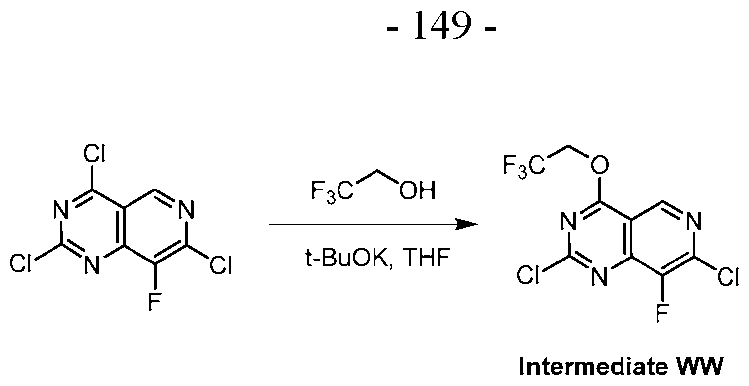
To a solution of 2,4,7-trichloro-8-fluoropyrido[4,3-d]pyrimidine (50.0 g, 198 mmol) in tetrahydrofuran (750 mL) cooled to -60
oC was added 2,2,2-trifluoroethan-1-ol (18.82 g, 188 mmol), followed by t-BuOK (1 M in THF, 188 mL, 188 mmol) dropwise. The mixture was stirred at -60 °C for 2 h. The reaction mixture was quenched by addition of H2O (1 L) at 20 °C, and extracted with EtOAc. The combined organic layers were dried over Na
2SO
4, filtered and concentrated. The residue was washed with petroleum ether (50 mL), then filtered. The filter cake was concentrated under reduced pressure to give 2,7- dichloro-8-fluoro-4-(2,2,2-trifluoroethoxy)pyrido[4,3-d]pyrimidine (50 g, 158 mmol, 84% yield) as yellow solid.
1H NMR (400 MHz, CHLOROFORM-d) δ ppm 9.18 (s, 1 H), 5.06 – 5.12 (m, 2 H). Intermediate XX: 5-(3-((tert-Butyldimethylsilyl)oxy)propyl)-6-chloro-1-(tetrahydro- 2H-pyran-2-yl)-4-(4,4,5,5-tetramethyl-1,3,2-dioxaborolan-2-yl)-1H-indazole.

Step 1.3-(4-Bromo-6-chloro-1-(tetrahydro-2H-pyran-2-yl)-1H-indazol-5- yl)propanal. To a 40 mL vial was charged with 4-bromo-6-chloro-5-iodo-1-(tetrahydro- 2H-pyran-2-yl)-1H-indazole (3.00 g, 6.80 mmol, Lab Network), sodium bicarbonate (1.43 g, 17.0 mmol), TBACl (1.95 g, 6.82 mmol), and N,N-dimethylformamide (14 mL). The solution was degassed by nitrogen bubbling for 10 min. Then palladium(II) acetate (77 mg, 0.34 mmol) and allyl alcohol (0.7 mL, 10 mmol) were added at 50 °C. The
reaction mixture was stirred at 50 °C for 18 h. After cooling to rt, the reaction was diluted with saturated aqueous ammonium chloride and extracted with EtOAc. The organic layer was washed with saturated aqueous sodium chloride, dried over sodium sulfate, and concentrated. The crude material was purified by column chromatography on silica gel, eluting with a gradient of 0-50% 3:1 EtOAc/EtOH in heptane, to provide 3-(4-bromo-6- chloro-1-(tetrahydro-2H-pyran-2-yl)-1H-indazol-5-yl)propanal (2.12 g, 5.70 mmol, 84% yield) as light-orange oil. m/z (ESI): 371.0 (M+H)
+. Step 2.3-(4-Bromo-6-chloro-1-(tetrahydro-2H-pyran-2-yl)-1H-indazol-5- yl)propan-1-ol. To a 100-mL round-bottom flask was added 3-(4-bromo-6-chloro-1- (tetrahydro-2H-pyran-2-yl)-1H-indazol-5-yl)propanal (1.06 g, 2.86 mmol) in tetrahydrofuran (5 mL)/methanol (5 mL). The reaction mixture was cooled to 0 °C. Then, sodium borohydride (0.11 g, 2.86 mmol) was slowly added in portion. The reaction mixture was stirred at 0 °C for 30 min, then was slowly quenched with saturated NH
4Cl and extracted with EtOAc. The combined organic layers were washed with brine, dried over MgSO
4, filtered and concentrated under reduced pressure.3-(4-Bromo-6-chloro-1- (tetrahydro-2H-pyran-2-yl)-1H-indazol-5-yl)propan-1-ol (1.03 g, 2.76 mmol, 97% yield) was obtained as light-yellow oil without further purification. m/z (ESI): 289.0 (M- THP+H)
+. Step 3.4-Bromo-5-(3-((tert-butyldimethylsilyl)oxy)propyl)-6-chloro-1- (tetrahydro-2H-pyran-2-yl)-1H-indazole. To a stirred solution of 3-(4-bromo-6-chloro- 1-(tetrahydro-2H-pyran-2-yl)-1H-indazol-5-yl)propan-1-ol (1.03 g, 2.76 mmol) and 1,1'- dimethyltriethylamine (0.53 mL, 3.0 mmol) in dichloromethane (10 mL) in a 40 mL vial was added tert-butyldimethylsilyl chloride (0.46 g, 3.03 mmol) and 4- (dimethylamino)pyridine (34 mg, 0.28 mmol) at 0 °C. After stirring at 0 °C for 2 h, the crude material was purified by column chromatography on silica gel, eluting with a gradient of 0-30% 3:1 EtOAc/EtOH in heptane, to provide 4-bromo-5-(3-((tert- butyldimethylsilyl)oxy)propyl)-6-chloro-1-(tetrahydro-2H-pyran-2-yl)-1H-indazole (1.12 g, 2.3 mmol, 83% yield) as colorless oil. m/z (ESI): 487.1 (M+H)
+. Step 4.5-(3-((tert-Butyldimethylsilyl)oxy)propyl)-6-chloro-1-(tetrahydro-2H- pyran-2-yl)-4-(4,4,5,5-tetramethyl-1,3,2-dioxaborolan-2-yl)-1H-indazole. To a solution of 4-bromo-5-(3-((tert-butyldimethylsilyl)oxy)propyl)-6-chloro-1-(tetrahydro- 2H-pyran-2-yl)-1H-indazole (3.4 g, 7.0 mmol), 4,4,4',4',5,5,5',5'-octamethyl-2,2'-bi(1,3,2- dioxaborolane) (8.85 g, 34.8 mmol) in 1,4-dioxane (80 mL) and water (10 mL) was added
Pd(dppf)Cl
2 (0.51 g, 0.7 mmol) and Cs
2CO
3 (6.81 g, 20.9 mmol) under N
2. The reaction mixture was heated at 120 ℃ for 5 h. After cooling to rt, the reaction mixture was diluted with water and extracted with EtOAc. The combined organic layers were washed with brine, dried over Na
2SO
4, filtered and concentrated. The residue was purified by column chromatography on silica gel, eluting with a gradient of 10-100% EtOAc in petroleum ether, to give 5-(3-((tert-butyldimethylsilyl)oxy)propyl)-6-chloro-1-(tetrahydro-2H- pyran-2-yl)-4-(4,4,5,5-tetramethyl-1,3,2-dioxaborolan-2-yl)-1H-indazole (3.3 g, 6.2 mmol, 88 % yield) as yellow oil. m/z (ESI): 535.3/ 537.2 (M+H)
+. Intermediate YY: 5-(2-((tert-Butyldimethylsilyl)oxy)ethyl)-6-chloro-1-(tetrahydro- 2H-pyran-2-yl)-4-(4,4,5,5-tetramethyl-1,3,2-dioxaborolan-2-yl)-1H-indazole.
Step 1.2-(4-Bromo-6-chloro-1-(tetrahydro-2H-pyran-2-yl)-1H-indazol-5- yl)ethan-1-ol. A vial was charged with (E)-1-ethoxyethene-2-boronic acid pinacol ester (2.02 g, 10.2 mmol, Aurum Pharmatech), 4-bromo-6-chloro-5-iodo-1-(tetrahydro-2H- pyran-2-yl)-1H-indazole (3.00 g, 6.80 mmol, LabNetwork), tripotassium phosphate (5.05 g, 23.8 mmol), 1,1'-bis(diphenylphosphino)ferrocene-palladium dichloride (0.50 g, 0.68 mmol), water (4 mL) and 1,4-dioxane (19 mL). The reaction mixture was heated to 100 °C for 1.5 h. After cooling to rt, the crude material was diluted with EtOAc and saturated aqueous sodium bicarbonate. The aqueous layer was extracted with EtOAc and the combined organics were dried (Na
2SO
4) and concentrated. This crude product was then diluted with 1,4-dioxane (18 mL) and water (1 mL) and to it was added trifluoroacetic acid (7.8 mL, 102 mmol) dropwise. The reaction mixture was stirred at 40 °C for 6 h. After cooling to rt, the reaction mixture was concentrated and the residue was purified by column chromatography on silica gel, eluting with 0-100% (3:1 EtOAc:EtOH + 2% triethylamine) in heptane, to provide 2-(4-bromo-6-chloro-1-(tetrahydro-2H-pyran-2-yl)-
1H-indazol-5-yl)acetaldehyde (2.40 g, 7.00 mmol, 95% yield) as impure brown oil, which was treated with triethylamine and filtered to neutralize the remaining TFA. m/z (ESI): 357.0 (M+H)
+. To a 250 mL round-bottom flask was charged with the above aldehyde (2.40 g, 7.00 mmol) and ethanol (70 mL). The reaction mixture was cooled to 0 °C and sodium borohydride (0.53 g, 14 mmol) was added portionwise. The solution was allowed to warm to rt and and stir for 30 min. The reaction was then carefully quenched by the addition of methanol, water, and saturated aqueous ammonium chloride. The resulting solution was extracted with EtOAc. The combined organics were dried (Na
2SO
4) and concentrated. The residue was purified by reverse phase chromatography using a 50 g C18 column, eluting with 0-100% acetonitrile + 0.1% TFA in water + 0.1% TFA to give 2-(4-bromo-6- chloro-1-(tetrahydro-2H-pyran-2-yl)-1H-indazol-5-yl)ethan-1-ol (0.20 g, 0.56 mmol, 8% yield). m/z (ESI): 359.0 (M+H)
+. Step 2.4-Bromo-5-(2-((tert-butyldimethylsilyl)oxy)ethyl)-6-chloro-1- (tetrahydro-2H-pyran-2-yl)-1H-indazole. The mixture of 2-(4-bromo-6-chloro-1- (tetrahydro-2H-pyran-2-yl)-1H-indazol-5-yl)ethan-1-ol (7.50 g, 20.8 mmol), tert- butyldimenhylsilyl chloride (3.77 g, 25.0 mmol), imidazole (3.55 g, 52.1 mmol), and DMAP (0.26 g, 2.08 mmol) in dichloromethane (140 mL) was stirred at rt for 1.5 h. The reaction was quenched via the addition of saturated aqueous sodium bicarbonate and the layers were separated. The aqueous layer was extracted with DCM and the combined organic layers were dried with sodium sulfate, filtered, and concentrated under reduced pressure. The crude oil was purified by column chromatography on silica gel, eluting with a gradient of 0-20% EtOAc in heptane, to afford 4-bromo-5-(2-((tert- butyldimethylsilyl)oxy)ethyl)-6-chloro-1-(tetrahydro-2H-pyran-2-yl)-1H-indazole (10.0 g, 21.1 mmol, 100 % yield) as colorless oil. m/z ESI: 473.0 (M+H)
+.
1H NMR (400 MHz, CHLOROFORM-d) δ ppm 7.90 - 8.05 (m, 1 H), 7.53 - 7.72 (m, 1 H), 5.51 -5.85 (m, 1 H), 5.21 - 5.38 (m, 1 H), 3.92 - 4.06 (m, 1 H), 3.65 - 3.90 (m, 3 H), 3.19 - 3.44 (m, 2 H), 2.35 - 2.67 (m, 1 H), 2.01 - 2.25 (m, 2 H), 1.64 - 1.90 (m, 3 H), 1.24 - 1.36 (m, 3 H), 0.90 - 0.93 (m, 10 H), 0.04 - 0.09 (m, 6 H). Step 3.5-(2-((tert-Butyldimethylsilyl)oxy)ethyl)-6-chloro-1-(tetrahydro-2H- pyran-2-yl)-4-(4,4,5,5-tetramethyl-1,3,2-dioxaborolan-2-yl)-1H-indazole. A screw- cap vial was charged with tris(4-methoxyphenyl)phosphine (186 mg, 0.53 mmol), palladium acetate (59 mg, 0.26 mmol,), 4,4,4',4',5,5,5',5'-octamethyl-2,2'-bi(1,3,2-
dioxaborolane) (1.61 g, 6.33 mmol), cesium carbonate (2.58 g, 7.91 mmol), 4-bromo-5- (2-((tert-butyldimethylsilyl)oxy)ethyl)-6-chloro-1-(tetrahydro-2H-pyran-2-yl)-1H- indazole (2.50 g, 5.28 mmol) and ethyl acetate (11 mL). The reaction mixture was then sparged with N
2 and heated to 80°C for 5.5 h. This was repeated 4 times. After cooling to rt, the crude material from each reaction was combined, diluted with saturated aqueous ammonium chloride, and extracted with ethyl aceate. The aqueous layer was extracted with DCM and the combined organic layers were dried with sodium sulfate, filtered, and concentrated under reduced pressure. The crude oil was purified by column chromatography on silica gel, eluting with a gradient of 0-15% EtOAc in heptane, to afford 5-(2-((tert-butyldimethylsilyl)oxy)ethyl)-6-chloro-1-(tetrahydro-2H-pyran-2-yl)-4- (4,4,5,5-tetramethyl-1,3,2-dioxaborolan-2-yl)-1H-indazole (7.50 g, 14.4 mmol, 68% yield) as colorless oil. m/z (ESI): 521.1 (M+H)
+.
1H NMR (400 MHz, CHLOROFORM- d) δ ppm 8.28 - 8.39 (m, 1 H), 7.72 - 7.78 (m, 1 H), 5.57 - 5.77 (m, 1 H), 3.94 - 4.05 (m, 1 H), 3.69 - 3.83 (m, 3 H), 3.35 (br d, J=4.8 Hz, 2 H), 2.45 - 2.61 (m, 1 H), 2.03 - 2.28 (m, 2 H), 1.62 - 1.85 (m, 3 H), 1.41 - 1.46 (m, 13 H), 0.89 (s, 9 H), 0.03 (s, 6 H). Preparation of Examples

(3R)-1-(7-(5-Cyclopropyl-6-methyl-1H-indazol-4-yl)-8-fluoro-2-(((2R,7aS)-2- fluorotetrahydro-1H-pyrrolizin-7a(5H)-yl)methoxy)pyrido[4,3-d]pyrimidin-4-yl)-3- methylpiperidin-3-ol bis(2,2,2-trifluoroacetate) (Example 1) Step 1. (R)-1-(7-Chloro-8-fluoro-2-(((2R,7aS)-2-fluorotetrahydro-1H- pyrrolizin-7a(5H)-yl)methoxy)pyrido[4,3-d]pyrimidin-4-yl)-3-methylpiperidin-3-ol. To a suspension of 2,4,7-trichloro-8-fluoropyrido[4,3-d]pyrimidine (1.00 g, 3.96 mmol, AmBeed) in acetonitrile (20 mL) at 0 °C was added (3R)-3-methylpiperidin-3-ol hydrochloride (0.60 g, 3.96 mmol, Pharmablock, Inc.) and DIEA (2.56 g, 3.5 mL, 19.8 mmol). The reaction was stirred at 0 °C. Separately, a solution of ((2R,7aS)-2- fluorotetrahydro-1H-pyrrolizin-7a(5H)-yl)methanol (1.14 g, 7.13 mmol, BLD Pharmatech) in acetonitrile (2.0 mL) was dried over anhydrous magnesium sulfate. The mixture was stirred for 5 min at ambient temperature, and then filtered through Celite to remove the magnesium sulfate. After 15 minutes, the desired intermediate (R)-1-(2,7- dichloro-8-fluoropyrido[4,3-d]pyrimidin-4-yl)-3-methylpiperidin-3-ol was observed via LCMS m/z (ESI): 331.0 (M+H)
+. To the reaction was added the filtrate of the ((2R,7aS)- 2-fluorotetrahydro-1H-pyrrolizin-7a(5H)-yl)methanol solution, and the mixture was stirred at 80 °C. After stirring overnight, the reaction was cooled to rt and concentrated under reduced pressure. The crude material was absorbed onto a plug of silica gel and purified by chromatography on silica gel, eluting with a gradient of 0-75 % of a 3:1 EtOAc/EtOH mixture (with 2% triethylamine) in heptane to provide (R)-1-(7-chloro-8- fluoro-2-(((2R,7aS)-2-fluorotetrahydro-1H-pyrrolizin-7a(5H)-yl)methoxy)pyrido[4,3- d]pyrimidin-4-yl)-3-methylpiperidin-3-ol (1.15 g, 2.53 mmol, 64 % yield) as yellow solid. m/z (ESI): 454.0 (M+H)
+. Step 2. (3R)-1-(7-(5-Chloro-6-methyl-1-(tetrahydro-2H-pyran-2-yl)-1H- indazol-4-yl)-8-fluoro-2-(((2R,7aS)-2-fluorotetrahydro-1H-pyrrolizin-7a(5H)- yl)methoxy)pyrido[4,3-d]pyrimidin-4-yl)-3-methylpiperidin-3-ol. A vial was charged with (R)-1-(7-chloro-8-fluoro-2-(((2R,7aS)-2-fluorotetrahydro-1H-pyrrolizin-7a(5H)- yl)methoxy)pyrido[4,3-d]pyrimidin-4-yl)-3-methylpiperidin-3-ol (60 mg, 0.13 mmol), 5- chloro-6-methyl-1-tetrahydropyran-2-yl-4-(4,4,5,5-tetramethyl-1,3,2-dioxaborolan-2- yl)indazole (0.10 g, 0.26 mmol, Pharmablock, Inc.), potassium phosphate (56 mg, 0.26 mmol), and CataCXium Pd G4 (20 mg, 0.026 mmol, Sigma-Aldrich Corporation). The vial was purged with nitrogen and the reactants were suspended in degassed THF (1.2 mL) and water (0.1 mL). The reaction was then sealed and heated to 65 °C. After stirring
overnight, the reaction mixture was cooled to rt and concentrated under reduced pressure. The oil was then purified via column chromatography on silica gel using a gradient of 0- 75% of a 3:1 EtOAc/EtOH mixture (with 2% triethylamine) in heptane to provide (3R)-1- (7-(5-chloro-6-methyl-1-(tetrahydro-2H-pyran-2-yl)-1H-indazol-4-yl)-8-fluoro-2- (((2R,7aS)-2-fluorotetrahydro-1H-pyrrolizin-7a(5H)-yl)methoxy)pyrido[4,3-d]pyrimidin- 4-yl)-3-methylpiperidin-3-ol (61 mg, 0.092 mmol, 70% yield) as off-white solid. LCMS m/z (ESI): 668.0 (M+H)
+. Step 3. (3R)-1-(7-(5-Cyclopropyl-6-methyl-1H-indazol-4-yl)-8-fluoro-2- (((2R,7aS)-2-fluorotetrahydro-1H-pyrrolizin-7a(5H)-yl)methoxy)pyrido[4,3- d]pyrimidin-4-yl)-3-methylpiperidin-3-ol bis(2,2,2-trifluoroacetate). A 20-mL vial was charged with (3R)-1-(7-(5-chloro-6-methyl-1-(tetrahydro-2H-pyran-2-yl)-1H- indazol-4-yl)-8-fluoro-2-(((2R,7aS)-2-fluorotetrahydro-1H-pyrrolizin-7a(5H)- yl)methoxy)pyrido[4,3-d]pyrimidin-4-yl)-3-methylpiperidin-3-ol (74 mg, 0.11 mmol,), Catacxium Pd G4 (12 mg, 0.017 mmol, Sigma-Aldrich Corporation), potassium phosphate (82 mg, 0.39 mmol), and cyclopropylboronic acid (71 mg, 0.83 mmol, Combi- Blocks Inc.). The vial was purged with nitrogen and the reactants were suspended in 2- methyl THF (0.9 mL) and water (0.2 mL), and the reaction was heated to 90 °C. After 3 h, the reaction mixture was concentrated under reduced pressure. The crude oil was purified via column chromatography on silica gel using a gradient of 0-75% of a 3:1 mixture of EtOAc/EtOH (with 2% triethylamine) in heptane to provide (3R)-1-(7-(5- cyclopropyl-6-methyl-1-(tetrahydro-2H-pyran-2-yl)-1H-indazol-4-yl)-8-fluoro-2- (((2R,7aS)-2-fluorotetrahydro-1H-pyrrolizin-7a(5H)-yl)methoxy)pyrido[4,3-d]pyrimidin- 4-yl)-3-methylpiperidin-3-ol as off-white solid. m/z (ESI): 674.2 (M+H)
+. The crude product was dissolved in DCM (2.3 mL) and 1,1,1-trifluoroacetic acid (0.44 g, 0.3 mL, 3.88 mmol) was added. The reaction was allowed to stir for 1.5 h at which point an additional 0.4 mL of TFA was added. After stirring for 3 h, the reaction was concentrated under reduced. The crude oil was then purified via reverse phase HPLC to provide (3R)-1-(7-(5-cyclopropyl-6-methyl-1H-indazol-4-yl)-8-fluoro-2-(((2R,7aS)-2- fluorotetrahydro-1H-pyrrolizin-7a(5H)-yl)methoxy)pyrido[4,3-d]pyrimidin-4-yl)-3- methylpiperidin-3-ol bis(2,2,2-trifluoroacetate) (15 mg, 0.018 mmol, 16 % yield) as white solid. m/z (ESI): 590.2 (M+H)
+.
1H NMR (400 MHz, METHANOL-d
4) δ ppm 9.43 (d, J=7.05 Hz, 1 H), 7.75 (s, 1 H), 7.54 (s, 1 H), 5.48 - 5.71 (m, 1 H), 4.73 (s, 3 H), 4.37 - 4.51 (m, 1 H), 3.84 - 4.20 (m, 3 H), 3.58 - 3.77 (m, 1 H), 3.41 - 3.56 (m, 2 H), 2.70 (s, 5
H), 2.31 - 2.51 (m, 3 H), 2.12 - 2.26 (m, 2 H), 1.99 - 2.10 (m, 1 H), 1.77 - 1.99 (m, 3 H), 1.35 (d, J=6.63 Hz, 3 H), 0.78 - 0.91 (m, 1 H), 0.55 - 0.69 (m, 1 H), 0.00 - 0.24 (m, 2 H). Table 2: Examples 2 to 66, 117-118 and 123-124. Prepared in an analogous manner to Example 1.
Table 3: SFC conditions for chiral separation.
Table 4: Analytical Data of Examples 2 to 66, 117 to 118 and 123 to 124.
1H NMR (400 MHz, METHANOL-d
4) δ ppm 9.30 – 9.45 (m, 1 H), 7.65 - 7.94 (m, 2 H), 5.48 - 6.07 (m, 2 H), 4.50 - 4.73 (m, 4 H), 3.84 - 4.16 (m, 3 H), 3.64 - 3.82 (m, 1 H), 3.41 - 3.55 38 659.8 (m, 2 H), 2.54 - 2.86 (m, 2 H), 2.32 - 2.49 (m, 3 H), 2.11 - 2.30 (m, 3 H), 1.86 - 2.09 (m, 3 H), 1.16 - 1.42 (m, 1 H), 0.70 (br d, J=6.3 Hz, 4 H), -0.47 - -0.29 (m, 1 H). 1H NMR (400 MHz, METHANOL-d
4) δ ppm 9.42 (s, 1 H), 7.34 - 7.93 (m, 2 H), 5.52 - 6.04 (m, 2 H), 4.56 - 4.80 (m, 4 H), 3.84 -4.17 39 626.0 (m, 3 H), 3.64 - 3.81 (m, 1 H), 3.43 - 3.57 (m, 2 H), 2.40- 2.80 (m, 5 H), 2.31 - 2.50 (m, 3 H), 2.12 - 2.28 (m, 2 H), 1.83 - 2.08 (m, 4 H), 0.53 - 0.91 (m, 2 H), -0.02 - 0.28 (m, 2 H).
(3R)-1-(7-(5-Cyclopropyl-3,6-dimethyl-1H-indazol-4-yl)-8-fluoro-2-(((2R,7aS)-2- fluorotetrahydro-1H-pyrrolizin-7a(5H)-yl)methoxy)pyrido[4,3-d]pyrimidin-4-yl)-3- methylpiperidin-3-ol (Example 67).

Step 1: To a stirred solution of (3R)-1-(7-(5-cyclopropyl-3-iodo-6-methyl-1H- indazol-4-yl)-8-fluoro-2-(((2R,7aS)-2-fluorotetrahydro-1H-pyrrolizin-7a(5H)- yl)methoxy)pyrido[4,3-d]pyrimidin-4-yl)-3-methylpiperidin-3-ol (0.24 g, 0.34 mmol, example 1) in DMF (4.0 mL) was added iodine (0.24 g, 0.94 mmol) and potassium hydroxide (4 N aqueous solution, 0.5 mL, 1.88 mmol). The resulting mixture was stirred at rt for 3 h. The reaction mixture was quenched by the addition of saturated ammonium chloride solution and extracted with DCM. The organic layer was concentrated and purified by chromatography on silica gel, eluting with a gradient of 0-80% [20% MeOH in DCM] in DCM to afford (3R)-1-(7-(5-cyclopropyl-3-iodo-6-methyl-1H-indazol-4-yl)- 8-fluoro-2-(((2R,7aS)-2-fluorotetrahydro-1H-pyrrolizin-7a(5H)-yl)methoxy)pyrido[4,3- d]pyrimidin-4-yl)-3-methylpiperidin-3-ol (0.24 g, 0.34 mmol, 73 % yield) as white solid.
1H NMR (400 MHz, METHANOL-d
4) δ ppm 9.32 - 9.51 (m, 1 H), 7.54 (s, 1 H), 5.50 - 5.71 (m, 1 H), 4.59 - 4.79 (m, 3 H), 4.41 (br dd, J=17.5, 13.7 Hz, 1 H), 3.83 - 4.15 (m, 3 H), 3.65 (dd, J=13.3, 1.6 Hz, 1 H), 3.34 - 3.54 (m, 2 H), 2.56 - 2.79 (m, 5 H), 2.32 - 2.50 (m, 3 H), 2.19 (br dd, J=9.2, 4.2 Hz, 2 H), 1.79 - 1.94 (m, 4 H), 1.33 (d, J=9.6 Hz, 3 H), 0.59 - 0.77 (m, 2 H), 0.27 - 0.36 (m, 2 H). m/z (ESI): 715.8 (M+H)
+. Step 2: A red-capped vial was charged with (3R)-1-(7-(5-cyclopropyl-3-iodo-6- methyl-1H-indazol-4-yl)-8-fluoro-2-(((2R,7aS)-2-fluorotetrahydro-1H-pyrrolizin-7a(5H)- yl)methoxy)pyrido[4,3-d]pyrimidin-4-yl)-3-methylpiperidin-3-ol (20 mg, 0.028 mmol), 1,4-diazabicyclo[2.2.2]octane bis(trimethylalumane) (21 mg, 0.084 mmol), and (2- dicyclohexylphosphino-2',4',6'-triisopropyl-1,1'-biphenyl)[2-(2'-amino-1,1'- biphenyl)]palladium(I) (4.7 mg, 5.60 µmol). The vial was purged with nitrogen and the solids were suspended in tetrahydrofuran (0.5 mL) and stirred at 80 °C overnight. The reaction mixture was concentrated and purified by chromatography on silica gel, eluting with a gradient of 0-80% [3:1 EtOAc : EtOH, with 0.2% Et
3N] in heptane), to afford (3R)-1-(7-(5-cyclopropyl-3,6-dimethyl-1H-indazol-4-yl)-8-fluoro-2-(((2R,7aS)-2- fluorotetrahydro-1H-pyrrolizin-7a(5H)-yl)methoxy)pyrido[4,3-d]pyrimidin-4-yl)-3- methylpiperidin-3-ol (5.2 mg, 0.0086 mmol, 31% yield) as light yellow solid.
1H NMR (400 MHz, METHANOL-d
4) δ ppm 9.38 (d, J=2.1 Hz, 1 H), 7.45 (s, 1 H), 5.50 - 5.72 (m, 1 H), 4.60 - 4.74 (m, 2 H), 4.39 (br d, J=13.4 Hz, 1 H), 3.84 - 4.15 (m, 3 H), 3.61 - 3.71 (m, 1 H), 3.43 - 3.58 (m, 2 H), 2.54 - 2.86 (m, 5 H), 2.29 - 2.51 (m, 3 H), 2.13 - 2.25 (m, 2 H), 1.80 - 1.99 (m, 7 H), 1.26 - 1.42 (m, 4 H), 0.68 - 0.82 (m, 1 H), 0.56 (td, J=8.6, 4.2 Hz, 1 H), 0.12 - 0.29 (m, 2 H). m/z (ESI, +ve ion): 604.0 (M+H)
+.
Example 68. (3R)-1-(7-(5-Cyclopropyl-3-fluoro-6-methyl-1H-indazol-4-yl)-8-fluoro- 2-(((2R,7aS)-2-fluorotetrahydro-1H-pyrrolizin-7a(5H)-yl)methoxy)pyrido[4,3- d]pyrimidin-4-yl)-3-methylpiperidin-3-ol.

The mixture of (3R)-1-(7-(5-cyclopropyl-6-methyl-1H-indazol-4-yl)-8-fluoro-2- (((2R,7aS)-2-fluorotetrahydro-1H-pyrrolizin-7a(5H)-yl)methoxy)pyrido[4,3-d]pyrimidin- 4-yl)-3-methylpiperidin-3-ol (50 mg, 0.085 mmol, Example 1) and N-fluoro-N'- chloromethyltriethylenediamine bis(tetrafluoroborate) (45 mg, 0.13 mmol) in acetonitrile (0.5 mL) was stirred in a screw-cap vial at 75 °C for 0.5 h. The reaction mixture was purified by chromatography on silica gel, eluting with a gradient of 0-50% [20% MeOH in DCM] in DCM. The crude product was purified again by reverse phase HPLC, then by chromatography on silica gel, eluting with a gradient of 0-50% [20% MeOH in DCM]/DCM) to afford (3R)-1-(7-(5-cyclopropyl-3-fluoro-6-methyl-1H-indazol-4-yl)-8- fluoro-2-(((2R,7aS)-2-fluorotetrahydro-1H-pyrrolizin-7a(5H)-yl)methoxy)pyrido[4,3- d]pyrimidin-4-yl)-3-methylpiperidin-3-ol (1.4 mg, 0.0023 mmol, 3% yield) as white solid.
1H NMR (400 MHz, METHANOL-d
4) δ ppm 9.26 - 9.32 (m, 1 H), 7.39 - 7.41 (m, 1 H), 5.20 - 5.47 (m, 1 H), 4.48 - 4.58 (m, 1 H), 4.27 - 4.39 (m, 3 H), 3.60 - 3.70 (m, 1 H), 3.42 - 3.56 (m, 1 H), 3.38 (br s, 1 H), 3.20 - 3.31 (m, 3 H), 3.05 (td, J=9.5, 5.5 Hz, 1 H), 2.67 (s, 2 H), 2.13 - 2.46 (m, 4 H), 1.78 - 2.07 (m, 7 H), 1.27 - 1.37 (m, 3 H), 0.60 - 0.79 (m, 2 H), 0.14 (qd, J=9.4, 5.3 Hz, 2 H). m/z (ESI, +ve ion): 608.0 (M+H)
+. Example 69. (3R)-1-(8-fluoro-2-(((2R,7aS)-2-fluorotetrahydro-1H-pyrrolizin-7a(5H)- yl)methoxy)-7-(6-methyl-5-propyl-1H-indazol-4-yl)pyrido[4,3-d]pyrimidin-4-yl)-3- methylpiperidin-3-ol bis(2,2,2-trifluoroacetate).

A 13 × 100 mL tube (inside a 75 mL hydrogenation vessel) was charged with (3R)-1-(8- fluoro-2-(((2R,7aS)-2-fluorotetrahydro-1H-pyrrolizin-7a(5H)-yl)methoxy)-7-(6-methyl-5- ((E)-prop-1-en-1-yl)-1H-indazol-4-yl)pyrido[4,3-d]pyrimidin-4-yl)-3-methylpiperidin-3- ol (30 mg, 0.051 mmol) and 5% palladium on carbon (32 mg, 0.015 mmol). The solids were suspended in ethanol (1.0 mL) and the reaction vessel was purged three times with hydrogen before being placed under an atmosphere of hydrogen (45 psi). The reaction was stirred at rt for 2 days, at which point the mixture was filtered through a pad of celite and washed with EtOAc (15 mL). The filtrate was concentrated under reduced pressure. The solid was then purified via reverse phase HPLC to provide (3R)-1-(8-fluoro-2- (((2R,7aS)-2-fluorotetrahydro-1H-pyrrolizin-7a(5H)-yl)methoxy)-7-(6-methyl-5-propyl- 1H-indazol-4-yl)pyrido[4,3-d]pyrimidin-4-yl)-3-methylpiperidin-3-ol bis(2,2,2- trifluoroacetate) (16 mg, 0.02 mmol, 39 % yield) as white solid. m/z (ESI): 592.3 (M+H)+.
1H NMR (400 MHz, METHANOL-d
4) δ ppm 9.39 (s, 1 H), 7.55 (s, 2 H), 5.49 - 5.70 (m, 1 H), 4.65 - 4.77 (m, 3 H), 4.33 - 4.45 (m, 1 H), 3.84 - 4.13 (m, 3 H), 3.61 - 3.72 (m, 1 H), 3.40 - 3.56 (m, 2 H), 2.59 (s, 7 H), 2.31 - 2.50 (m, 3 H), 2.10 - 2.27 (m, 2 H), 1.76 - 1.94 (m, 3 H), 1.40 - 1.58 (m, 2 H), 1.29 - 1.37 (m, 3 H), 0.75 - 0.86 (m, 3 H). Example 70. (3R)-1-(7-(5-Ethyl-6-methyl-1H-indazol-4-yl)-8-fluoro-2-(((2R,7aS)-2- fluorotetrahydro-1H-pyrrolizin-7a(5H)-yl)methoxy)pyrido[4,3-d]pyrimidin-4-yl)-3- methylpiperidin-3-ol bis(2,2,2-trifluoroacetate).

A 75-mL hydrogenation vessel was charged with (3R)-1-(8-fluoro-2-(((2R,7aS)-2- fluorotetrahydro-1H-pyrrolizin-7a(5H)-yl)methoxy)-7-(6-methyl-1-(tetrahydro-2H-pyran-
2-yl)-5-vinyl-1H-indazol-4-yl)pyrido[4,3-d]pyrimidin-4-yl)-3-methylpiperidin-3-ol bis(2,2,2-trifluoroacetate) (0.16 g, 0.18 mmol) and 5% palladium on carbon (0.12 g, 0.055 mmol). The solids were suspended in ethanol (3.6 mL) and the reaction vessel was purged three times with hydrogen before being placed under an atmosphere of hydrogen (45 psi). The reaction was stirred at rt overnight, at which point the mixture was filtered through a pad of celite and washed with EtOAc (15 mL). The filtrate was concentrated under reduced pressure to afford the crude product, which was then dissolved in DCM (3.0 mL), followed by addition of 1,1,1-trifluoroacetic acid (0.5 mL, 6.36 mmol) dropwise. The reaction was heated to 50 °C for 15 min, then the contents were concentrated. The resulting crude oil was purified via reverse phase HPLC to provide (3R)-1-(7-(5-ethyl-6- methyl-1H-indazol-4-yl)-8-fluoro-2-(((2R,7aS)-2-fluorotetrahydro-1H-pyrrolizin-7a(5H)- yl)methoxy)pyrido[4,3-d]pyrimidin-4-yl)-3-methylpiperidin-3-ol bis(2,2,2- trifluoroacetate) (28 mg, 0.036 mmol, 20 % yield) as white solid. m/z (ESI): 578.0 (M+H)
+.
1H NMR (400 MHz, METHANOL-d
4) δ ppm 9.39 (s, 1 H), 7.48 - 7.58 (m, 2 H), 5.50 - 5.70 (m, 1 H), 4.65 - 4.76 (m, 3 H), 4.35 - 4.45 (m, 1 H), 3.83 - 4.14 (m, 3 H), 3.62 - 3.72 (m, 1 H), 3.40 - 3.56 (m, 2 H), 2.60 (s, 7 H), 2.34 - 2.50 (m, 3 H), 2.13 - 2.27 (m, 2 H), 1.76 - 1.94 (m, 3 H), 1.33 (s, 3 H), 1.02 - 1.11 (m, 3 H). Example 71. (3R)-1-(8-fluoro-2-(((2R,7aS)-2-fluorotetrahydro-1H-pyrrolizin-7a(5H)- yl)methoxy)-7-(6-methyl-5-propyl-1H-indazol-4-yl)pyrido[4,3-d]pyrimidin-4-yl)-3- (fluoromethyl)piperidin-3-ol bis(2,2,2-trifluoroacetate)

A 75-mL hydrogenation vessel was charged with (3R)-1-(8-fluoro-2-(((2R,7aS)-2- fluorotetrahydro-1H-pyrrolizin-7a(5H)-yl)methoxy)-7-(6-methyl-5-((Z)-prop-1-en-1-yl)- 1-(tetrahydro-2H-pyran-2-yl)-1H-indazol-4-yl)pyrido[4,3-d]pyrimidin-4-yl)-3- (fluoromethyl)piperidin-3-ol (36 mg, 0.053 mmol, Example 26 Step 3.1) and 5% palladium on carbon (34 mg, 0.016 mmol). The solids were suspended in ethanol (1.0 mL) and the reaction vessel was purged three times with hydrogen before being placed
under an atmosphere of hydrogen (45 psi). The reaction was stirred at rt overnight, at which point the mixture was then filtered through Celite and washed with EtOAc (15 mL). The filtrate was concentrated under reduced pressure to afford a crude (3R)-1-(8- fluoro-2-(((2R,7aS)-2-fluorotetrahydro-1H-pyrrolizin-7a(5H)-yl)methoxy)-7-(6-methyl-5- propyl-1-(tetrahydro-2H-pyran-2-yl)-1H-indazol-4-yl)pyrido[4,3-d]pyrimidin-4-yl)-3- (fluoromethyl)piperidin-3-ol. m/z (ESI): 694.2 (M+H)
+. The above crude material dissolved in DCM (1.0 mL) was treated with 1,1,1- trifluoroacetic acid (0.2 mL, 1.84 mmol) dropwise. After stirring for 2 h, the reaction was concentrated under reduced pressure and the residue purified via reverse phase HPLC to provide (3R)-1-(8-fluoro-2-(((2R,7aS)-2-fluorotetrahydro-1H-pyrrolizin-7a(5H)- yl)methoxy)-7-(6-methyl-5-propyl-1H-indazol-4-yl)pyrido[4,3-d]pyrimidin-4-yl)-3- (fluoromethyl)piperidin-3-ol bis(2,2,2-trifluoroacetate) (10 mg, 0.012 mmol, 23 % yield) as light yellow solid. m/z (ESI): 610.0 (M+H)
+.
1H NMR (400 MHz, METHANOL-d
4) δ ppm 9.40 (d, J=4.6 Hz, 1 H), 7.54 (s, 2 H), 5.48 - 5.71 (m, 1 H), 4.61 - 4.77 (m, 3 H), 4.38 - 4.50 (m, 2 H), 4.28 - 4.39 (m, 1 H), 3.82 - 4.10 (m, 4 H), 3.45 - 3.63 (m, 2 H), 2.59 (s, 7 H), 2.31 - 2.50 (m, 3 H), 2.15 - 2.28 (m, 2 H), 1.82 - 1.97 (m, 3 H), 1.38 - 1.59 (m, 2 H), 0.73 - 0.85 (m, 3 H). Example 125. Ethyl 4-((R)-8-fluoro-4-((R)-3-(fluoromethyl)-3-hydroxypiperidin-1- yl)-2-(((2R,7aS)-2-fluorotetrahydro-1H-pyrrolizin-7a(5H)-yl)methoxy)pyrido[4,3- d]pyrimidin-7-yl)-6-methyl-5-((1S,2R)-2-methylcyclopropyl)-1H-indazole-1- carboxylate.
To a solution of (R)-1-((R)-8-fluoro-2-(((2R,7aS)-2-fluorotetrahydro-1H- pyrrolizin-7a(5H)-yl)methoxy)-7-(6-methyl-5-((1S,2R)-2-methylcyclopropyl)-1H- indazol-4-yl)pyrido[4,3-d]pyrimidin-4-yl)-3-(fluoromethyl)piperidin-3-ol (Example 56, 300 mg, 0.48 mmol) in DMF (10 mL) was added K
2CO
3 (200 mg, 1.45 mmol) and ethyl carbonochloridate (860 mg, 7.92 mmol) in DMF (0.5 mL). The mixture was stirred at 15 °C for 1 h then partitioned between water and EtOAc. The organic layer was dried over
Na
2SO
4, filtered and concentrated under reduced pressure. The residue was purified by column chromatography on silica gel, eluting with a gradient of 2–8% MeOH in EtOAc, to provide ethyl 4-((R)-8-fluoro-4-((R)-3-(fluoromethyl)-3-hydroxypiperidin-1-yl)-2- (((2R,7aS)-2-fluorotetrahydro-1H-pyrrolizin-7a(5H)-yl)methoxy)pyrido[4,3-d]pyrimidin- 7-yl)-6-methyl-5-((1S,2R)-2-methylcyclopropyl)-1H-indazole-1-carboxylate (62 mg, 0.089 mmol, 12% yield)} as a white solid.
1H NMR (400 MHz, CDCl
3) δ 9.22 (m, 1 H), 8.22 (s, 1 H), 7.81–8.02 (m, 1 H), 5.28 (d, J = 25.6 Hz, 1 H), 4.24–4.61 (m, 9 H), 3.42– 3.82 (m, 2 H), 3.12–3.32 (m, 3 H), 2.92–3.02 (m, 1 H), 2.62–2.72 (m, 3 H), 2.02–2.32 (m, 5 H), 1.77–2.00 (m, 6 H), 1.53 (t, J=7.2 Hz, 3 H), 1.10–1.29 (m, 1 H), 0.73 (m, 1 H), 0.42–0.62 (m, 3 H), -0.51 (m, 1 H).
19F NMR (400 MHz, CDCl
3), -135.27 (s), -172.87 (m), -228.07 (s). m/z (ESI): 694.3 (M + H)
+. Example 126.1-(4-((R)-8-fluoro-4-((R)-3-(fluoromethyl)-3-hydroxypiperidin-1-yl)-2- (((2R,7aS)-2-fluorotetrahydro-1H-pyrrolizin-7a(5H)-yl)methoxy)pyrido[4,3- d]pyrimidin-7-yl)-6-methyl-5-((1S,2R)-2-methylcyclopropyl)-1H-indazol-1-yl)ethan- 1-one.
To a solution of (R)-1-((R)-8-fluoro-2-(((2R,7aS)-2-fluorotetrahydro-1H- pyrrolizin-7a(5H)-yl)methoxy)-7-(6-methyl-5-((1S,2R)-2-methylcyclopropyl)-1H- indazol-4-yl)pyrido[4,3-d]pyrimidin-4-yl)-3-(fluoromethyl)piperidin-3-ol (Example 56, 200 mg, 0.285 mmol) in tetrahydrofuran (5 mL) was added TEA (0.2 mL, 1.4 mmol) followed by acetic anhydride (0.08 mL, 0.85 mmol) dropwise. The mixture was stirred at 15 °C for 2 h then concentrated under reduced pressure. The residue was purified by prep- HPLC: Waters Xbridge BEH C18100*30mm*10 ^m, mobile phase: [A: H
2O (10 mM NH
4HCO
3); B: ACN]; B%: 35–65%, 8 min, to provide 1-(4-((R)-8-fluoro-4-((R)-3- (fluoromethyl)-3-hydroxypiperidin-1-yl)-2-(((2R,7aS)-2-fluorotetrahydro-1H-pyrrolizin- 7a(5H)-yl)methoxy)pyrido[4,3-d]pyrimidin-7-yl)-6-methyl-5-((1S,2R)-2-
methylcyclopropyl)-1H-indazol-1-yl)ethan-1-one (30 mg, 0.05 mmol, 16% yield) as a whited solid.
1H NMR (400 MHz, Methanol-d
4) δ 9.33 (m, 1 H), 8.39 (s, 1 H), 7.93 (m, 1 H), 5.33 (d, J = 27.0 Hz, 1 H), 4.55 (m, 1 H), 4.20–4.49 (m, 5 H), 3.78 (m, 1 H), 3.42– 3.65 (m, 1 H), 3.32–3.41 (m, 1 H), 3.25–3.29 (m, 1 H), 3.05 (m, 2 H), 2.74 (s, 3 H), 2.67 (s, 3 H), 2.10–2.41 (m, 5 H), 1.92–2.02 (m, 2 H), 1.72–1.91 (m, 4 H), 1.05–1.32 (m, 2 H), 0.41–0.91 (m, 4 H), -0.61 (m, 1 H).
19F NMR (400 MHz, Methanol-d
4), -138.15 (s), - 173.72 (s), -231.96 (s). m/z (ESI): 664.4 (M + H)
+. Example 72. (3R)-1-(7-(6-Chloro-5-cyclopropyl-1H-indazol-4-yl)-8-fluoro-2- (((2R,7aS)-2-fluorotetrahydro-1H-pyrrolizin-7a(5H)-yl)methoxy)pyrido[4,3- d]pyrimidin-4-yl)-3-methylpiperidin-3-ol.

A vial was charged with (R)-1-(8-fluoro-2-(((2R,7aS)-2-fluorotetrahydro-1H-pyrrolizin- 7a(5H)-yl)methoxy)-7-(tributylstannyl)pyrido[4,3-d]pyrimidin-4-yl)-3-methylpiperidin-3- ol (0.12 g, 0.17 mmol, Intermediate Y), cataCXium A Pd G3 (20 mg, 0.028 mmol,), copper(I) iodide (13 mg, 0.07 mmol), 4-bromo-6-chloro-5-cyclopropyl-1-(tetrahydro-2H- pyran-2-yl)-1H-indazole (50 mg, 0.14 mmol) and degassed DMF (1.4 mL). The reaction mixture was heated to 70 °C. Upon completion, the reaction mixture was purified by reverse phase chromatography to provide (3R)-1-(7-(6-chloro-5-cyclopropyl-1- (tetrahydro-2H-pyran-2-yl)-1H-indazol-4-yl)-8-fluoro-2-(((2R,7aS)-2-fluorotetrahydro- 1H-pyrrolizin-7a(5H)-yl)methoxy)pyrido[4,3-d]pyrimidin-4-yl)-3-methylpiperidin-3-ol (32 mg, 0.046 mmol, 33% yield) as tan solid. m/z (ESI): 694.2 (M+H)
+. A vial was charged with (3R)-1-(7-(6-chloro-5-cyclopropyl-1-(tetrahydro-2H-pyran-2-yl)-1H- indazol-4-yl)-8-fluoro-2-(((2R,7aS)-2-fluorotetrahydro-1H-pyrrolizin-7a(5H)- yl)methoxy)pyrido[4,3-d]pyrimidin-4-yl)-3-methylpiperidin-3-ol (32 mg, 0.046 mmol) in DCM (2.0 mL).2,2,2-Trifluoroacetic acid (85 ^L, 1.15 mmol) was added, and the reaction was stirred at rt. Upon completion, the mixture was concentrated and redissolved in MeOH (1.0 mL). The crude material was purified by reverse phase chromatography to provide (3R)-1-(7-(6-chloro-5-cyclopropyl-1H-indazol-4-yl)-8-fluoro-2-(((2R,7aS)-2-
fluorotetrahydro-1H-pyrrolizin-7a(5H)-yl)methoxy)pyrido[4,3-d]pyrimidin-4-yl)-3- methylpiperidin-3-ol (10 mg, 0.016 mmol, 12 % yield) as light-yellow solid. m/z (ESI): 609.9 (M+H)
+.
1H NMR (400 MHz, METHANOL-d
4) δ ppm 9.39 (d, J=6.22 Hz, 1 H), 8.43 (br s, 1 H), 7.82 (d, J=8.29 Hz, 2 H), 5.41 - 5.66 (m, 1 H), 4.54 - 4.73 (m, 3 H), 4.36 - 4.47 (m, 1 H), 3.59 - 3.96 (m, 4 H), 3.36 - 3.53 (m, 2 H), 2.24 - 2.74 (m, 5 H), 2.19 - 2.23 (m, 1 H), 2.01 - 2.15 (m, 2 H), 1.77 - 1.94 (m, 3 H), 1.34 (d, J=7.26 Hz, 3 H), 0.86 - 0.97 (m, 1 H), 0.59 - 0.69 (m, 1 H), 0.28 (dquin, J=9.73, 5.08, 5.08, 5.08, 5.08 Hz, 1 H), 0.11 (dquin, J=9.80, 5.12, 5.12, 5.12, 5.12 Hz, 1 H). Table 5: Examples 73 to 95, 113 and 122. Prepared in an analogous manner to Example 72.
Table 6. SFC conditions for chiral separation.
Table 7: Analytical Data of Examples 73 to 95, 113 and 122 E
Example 96-97. (R)-1-((R)-7-(6-chloro-7-fluoro-5-((1R,2S)-2-methylcyclopropyl)-1H- indazol-4-yl)-8-fluoro-2-(((2R,7aS)-2-fluorotetrahydro-1H-pyrrolizin-7a(5H)- yl)methoxy)pyrido[4,3-d]pyrimidin-4-yl)-3-methylpiperidin-3-ol and (R)-1-((S)-7-(6- chloro-7-fluoro-5-((1S,2R)-2-methylcyclopropyl)-1H-indazol-4-yl)-8-fluoro-2- (((2R,7aS)-2-fluorotetrahydro-1H-pyrrolizin-7a(5H)-yl)methoxy)pyrido[4,3- d]pyrimidin-4-yl)-3-methylpiperidin-3-ol.

Step 1. rac-4-Bromo-6-chloro-7-fluoro-5-((1R,2S)-2-methylcyclopropyl)-1- (tetrahydro-2H-pyran-2-yl)-1H-indazole. A screw-cap vial equipped with a magnetic stirring bar and a pressure-relief cap was charged with 4-bromo-6-chloro-7-fluoro-5-iodo- 1-(tetrahydro-2H-pyran-2-yl)-1H-indazole (0.35 g, 0.76 mmol, Intermediate Z), rel- ((1R,2S)-2-methylcyclopropyl)boronic acid (84 mg, 0.84 mmol, PharmaBlock), 1,1'- bis(diphenylphosphino)ferrocene-palladium dichloride (42 mg, 0.057 mmol), potassium phosphate tribasic (0.57 mg, 2.67 mmol), water (0.5 mL) and degassed toluene (2.5 mL). The reaction mixture was sparged with nitrogen and then heated to 100 °C while monitoring via LCMS. Upon completion, the aqueous layer was extracted with DCM, and the combined organic phases were washed with brine, dried over anhydrous sodium
sulfate, filtered and concentrated under reduced pressure. The crude material was purified by chromatography on silica gel, eluting with a gradient of 0 - 10% (3:1 EtOAc/EtOH) in heptane, to provide rac-4-bromo-6-chloro-7-fluoro-5-((1R,2S)-2-methylcyclopropyl)-1- (tetrahydro-2H-pyran-2-yl)-1H-indazole (0.17 g, 0.43 mmol, 56 % yield) as light-yellow oil. m/z (ESI): 408.9/410.8 (M+Na)
+. Step 2. (3R)-1-(7-(6-Chloro-7-fluoro-5-(2-methylcyclopropyl)-1H-indazol-4- yl)-8-fluoro-2-(((2R,7aS)-2-fluorotetrahydro-1H-pyrrolizin-7a(5H)- yl)methoxy)pyrido[4,3-d]pyrimidin-4-yl)-3-methylpiperidin-3-ol. A screw-cap vial equipped with a magnetic stirring bar and a pressure-relief cap was charged with 4- bromo-6-chloro-7-fluoro-5-(2-methylcyclopropyl)-1-(tetrahydro-2H-pyran-2-yl)-1H- indazole (0.15 g, 0.39 mmol), (R)-1-(8-fluoro-2-(((2R,7aS)-2-fluorotetrahydro-1H- pyrrolizin-7a(5H)-yl)methoxy)-7-(tributylstannyl)pyrido[4,3-d]pyrimidin-4-yl)-3- methylpiperidin-3-ol (0.48 g, 0.68 mmol, Intermediate Y), cataCXium A Pd G3 (28 mg, 0.039 mmol), lithium chloride (33 mg, 0.77 mmol), copper(I) iodide (37 mg, 0.19 mmol), and degassed DMF (2.6 mL). The reaction mixture was heated to 100 °C and monitored via LCMS. Upon completion, the reaction mixture was purified by reverse phase chromatography. The desired fractions were treated with saturated aqueous sodium bicarbonate and extracted with EtOAc. The combined organic phases were concentrated under reduced pressure to provide (3R)-1-(7-(6-chloro-7-fluoro-5-(2-methylcyclopropyl)- 1-(tetrahydro-2H-pyran-2-yl)-1H-indazol-4-yl)-8-fluoro-2-(((2R,7aS)-2-fluorotetrahydro- 1H-pyrrolizin-7a(5H)-yl)methoxy)pyrido[4,3-d]pyrimidin-4-yl)-3-methylpiperidin-3-ol (0.11 g, 0.16 mmol, 41 % yield) as tan solid (mixture of diastereoisomers). m/z (ESI): 726.2 (M+H)
+. To the above material (0.11 g, 0.16 mmol) in DCM (2.0 mL) was added 2,2,2-trifluoroacetic acid (~25.0 equiv), then stirred at rt while monitoring via LCMS. Upon completion, the mixture was cooled to 0 °C and carefully neutralized with saturated aqueous sodium bicarbonate. The aqueous layer was extracted with DCM, and the combined organic phases were concentrated under reduced pressure. The crude material was dissolved in MeOH and was purified by reverse phase chromatography. The desired fractions were treated with saturated aqueous sodium bicarbonate and extracted with EtOAc. The combined organic phases were concentrated under reduced pressure to provide (3R)-1-(7-(6-chloro-7-fluoro-5-(2-methylcyclopropyl)-1H-indazol-4-yl)-8-fluoro- 2-(((2R,7aS)-2-fluorotetrahydro-1H-pyrrolizin-7a(5H)-yl)methoxy)pyrido[4,3-
d]pyrimidin-4-yl)-3-methylpiperidin-3-ol (64 mg, 0.10 mmol, 26 % yield) as yellow solid. m/z (ESI): 641.8 (M +H)
+. The sample was purified via SFC using a Chiralpak IE, 21 x 250 mm 5μm, column with a mobile phase of 65% methanol with 0.2% triethylamine using a flowrate of 80 mL/min to generate 17.8 mg of peak 1 (Example 96) with an ee of >99%. m/z (ESI): 641.8 (M +H)
+.
1H NMR (600 MHz, DMSO-d
6) δ ppm 9.28 - 9.38 (m, 1 H) 7.82 - 7.96 (m, 1 H) 5.19 - 5.37 (m, 1 H) 4.26 - 4.40 (m, 1 H) 4.05 (s, 3 H) 2.99 - 3.13 (m, 3 H) 2.76 - 2.89 (m, 1 H) 1.93 - 2.15 (m, 7 H) 1.64 - 1.87 (m, 8 H) 1.22 - 1.27 (m, 1 H) 1.19 (s, 3 H) 0.62 - 0.69 (m, 1 H) 0.51 - 0.62 (m, 3 H) -0.60 - -0.46 (m, 1 H). Also isolated from the column was 20.8 mg of peak 2 (Example 97) with an ee of >95%. m/z (ESI): 641.8 (M +H)
+.
1H NMR (600 MHz, DMSO-d
6) δ ppm 9.22 - 9.31 (m, 1 H) 7.82 - 7.96 (m, 1 H) 5.22 - 5.35 (m, 1 H) 4.27 - 4.39 (m, 1 H) 3.99 - 4.16 (m, 3 H) 3.02 - 3.13 (m, 3 H) 2.77 - 2.88 (m, 1 H) 1.96 - 2.15 (m, 7 H) 1.64 - 1.88 (m, 8 H) 1.20 - 1.23 (m, 4 H) 0.62 - 0.71 (m, 1 H) 0.51 - 0.62 (m, 3 H) -0.54 - -0.43 (m, 1 H). Example 119-120. (R)-1-((S)-7-(6-chloro-7-fluoro-5-((1S,2R)-2-methylcyclopropyl)- 1H-indazol-4-yl)-8-fluoro-2-(((2R,7aS)-2-fluorotetrahydro-1H-pyrrolizin-7a(5H)- yl)methoxy)pyrido[4,3-d]pyrimidin-4-yl)-3-(fluoromethyl)piperidin-3-ol and (R)-1- ((R)-7-(6-chloro-7-fluoro-5-((1R,2S)-2-methylcyclopropyl)-1H-indazol-4-yl)-8-fluoro- 2-(((2R,7aS)-2-fluorotetrahydro-1H-pyrrolizin-7a(5H)-yl)methoxy)pyrido[4,3- d]pyrimidin-4-yl)-3-(fluoromethyl)piperidin-3-ol.

Step 1. rac-6-Chloro-7-fluoro-5-((1S,2R)-2-methylcyclopropyl)-1- (tetrahydro-2H-pyran-2-yl)-4-(4,4,5,5-tetramethyl-1,3,2-dioxaborolan-2-yl)-1H- indazole. A round bottom flask was charged with rac-4-bromo-6-chloro-7-fluoro-5- ((1R,2S)-2-methylcyclopropyl)-1-(tetrahydro-2H-pyran-2-yl)-1H-indazole (Step 1 in Example 96-97, 950 mg, 2.45 mmol) in THF (9.8 mL) and cooled to -78 °C. n- Butyllithium (2.5 M solution in hexanes, 1 mL, 2.5 mmol) was added dropwise and the reaction mixture was stirred for 30 min. Then, 2-isopropoxy-4,4,5,5-tetramethyl-1,3,2- dioxaborolane (0.9 mL, 4.4 mmol) was added and the reaction mixture was stirred at -78 °C for 1 h. The reaction mixture was quenched with saturated aqeuous ammonium chloride and warmed to rt. The mixture was extracted with CH
2Cl
2. The organic extract was washed with brine, dried over Na
2SO
4, filtered and concentrated. The crude material was purified by column chromatography on silica gel, eluting with a gradient of 0-30% EtOAc in heptane, to provide rac-6-chloro-7-fluoro-5-((1R,2S)-2-methylcyclopropyl)-1- (tetrahydro-2H-pyran-2-yl)-4-(4,4,5,5-tetramethyl-1,3,2-dioxaborolan-2-yl)-1H-indazole (846 mg, 1.95 mmol, 79% yield) as colorless oil. m/z (ESI): 435.2 (M+H)
+. Step 2. (R)-1-((S)-7-(6-chloro-7-fluoro-5-(rel-(1S,2R)-2-methylcyclopropyl)- 1H-indazol-4-yl)-8-fluoro-2-(((2R,7aS)-2-fluorotetrahydro-1H-pyrrolizin-7a(5H)- yl)methoxy)pyrido[4,3-d]pyrimidin-4-yl)-3-(fluoromethyl)piperidin-3-ol and (R)-1- ((R)-7-(6-chloro-7-fluoro-5-((1R,2S)-2-methylcyclopropyl)-1H-indazol-4-yl)-8-fluoro- 2-(((2R,7aS)-2-fluorotetrahydro-1H-pyrrolizin-7a(5H)-yl)methoxy)pyrido[4,3- d]pyrimidin-4-yl)-3-(fluoromethyl)piperidin-3-ol. A 20-mL pressure release vial was charged with rac-6-chloro-7-fluoro-5-((1R,2S)-2-methylcyclopropyl)-1-(tetrahydro-2H- pyran-2-yl)-4-(4,4,5,5-tetramethyl-1,3,2-dioxaborolan-2-yl)-1H-indazole (597 mg, 1.37 mmol), (R)-1-(7-chloro-8-fluoro-2-(((2R,7aS)-2-fluorotetrahydro-1H-pyrrolizin-7a(5H)- yl)methoxy)pyrido[4,3-d]pyrimidin-4-yl)-3-(fluoromethyl)piperidin-3-ol (360 mg, 0.76 mmol, Intermediate PP), potassium phosphate (324 mg, 1.53 mmol), and CataCXium A Pd G3 (83 mg, 0.11 mmol). The vial was purged with nitrogen gas and then the reactants were suspended in 2-methyltetrahydrofuran (3 mL) and water (0.3 mL), and then was heated to 80 °C for 1 h. After cooling to rt, the crude material was purified by column chromatography on silica gel, eluting with a gradient of 0-100% 3:1 EtOAc:EtOH with 2% NH
4OH in heptane, to afford a mixture of (3R)-1-((7S)-7-(6-chloro-7-fluoro-5- ((1S,2R)-2-methylcyclopropyl)-1-(tetrahydro-2H-pyran-2-yl)-1H-indazol-4-yl)-8-fluoro- 2-(((2R,7aS)-2-fluorotetrahydro-1H-pyrrolizin-7a(5H)-yl)methoxy)pyrido[4,3-
d]pyrimidin-4-yl)-3-(fluoromethyl)piperidin-3-ol and (3R)-1-((7S)-7-(6-chloro-7-fluoro- 5-((1R,2S)-2-methylcyclopropyl)-1-(tetrahydro-2H-pyran-2-yl)-1H-indazol-4-yl)-8- fluoro-2-(((2R,7aS)-2-fluorotetrahydro-1H-pyrrolizin-7a(5H)-yl)methoxy)pyrido[4,3- d]pyrimidin-4-yl)-3-(fluoromethyl)piperidin-3-ol (580 mg, 0.77 mmol, 100% yield) as yellow solid. m/z (ESI): 744.3 (M+H)
+. The material was dissolved in DCM (1.8 mL) and TFA (3.6 mL) and water (0.6 mL) were added. The mixture was stirred 45 minutes. The solution was carefully quenched with 2 M Na
2CO
3, extracted with ethyl acetate, and the organic layer was concentrated. The crude material was purified by reverse-phase preparative HPLC using a gradient of 0-75% 0.1% TFA in CH
3CN/H
2O, to provide a mixture of (R)-1-((S)-7-(6- chloro-7-fluoro-5-(rel-(1S,2R)-2-methylcyclopropyl)-1H-indazol-4-yl)-8-fluoro-2- (((2R,7aS)-2-fluorotetrahydro-1H-pyrrolizin-7a(5H)-yl)methoxy)pyrido[4,3-d]pyrimidin- 4-yl)-3-(fluoromethyl)piperidin-3-ol and (R)-1-((R)-7-(6-chloro-7-fluoro-5-((1R,2S)-2- methylcyclopropyl)-1H-indazol-4-yl)-8-fluoro-2-(((2R,7aS)-2-fluorotetrahydro-1H- pyrrolizin-7a(5H)-yl)methoxy)pyrido[4,3-d]pyrimidin-4-yl)-3-(fluoromethyl)piperidin-3- ol (150 mg, 0.227 mmol, 30% yield) as a off-white solid. m/z (ESI): 660.2 (M+H)
+. Step 3. (R)-1-((S)-7-(6-chloro-7-fluoro-5-((1S,2R)-2-methylcyclopropyl)-1H- indazol-4-yl)-8-fluoro-2-(((2R,7aS)-2-fluorotetrahydro-1H-pyrrolizin-7a(5H)- yl)methoxy)pyrido[4,3-d]pyrimidin-4-yl)-3-(fluoromethyl)piperidin-3-ol and (R)-1- ((R)-7-(6-chloro-7-fluoro-5-((1R,2S)-2-methylcyclopropyl)-1H-indazol-4-yl)-8-fluoro- 2-(((2R,7aS)-2-fluorotetrahydro-1H-pyrrolizin-7a(5H)-yl)methoxy)pyrido[4,3- d]pyrimidin-4-yl)-3-(fluoromethyl)piperidin-3-ol. The sample was purified via SFC using a Chiralpak IE column (21 x 150 mm 5 μm) with a mobile phase of 50% methanol and a flowrate of 135 mL/min to generate 56 mg of peak 1 (Example 119) with an ee of >96%. m/z (ESI): 660.2 (M+H)
+.
1H NMR (600 MHz, DMSO-d
6) δ ppm 9.26 - 9.36 (m, 1 H), 7.71 - 7.97 (m, 1 H), 5.20 - 5.35 (m, 1 H), 4.26 - 4.46 (m, 3 H), 4.11 - 4.18 (m, 2 H), 4.05 (d, J=10.4 Hz, 1 H), 3.61 - 3.80 (m, 1 H), 3.28 - 3.51 (m, 1 H), 3.17 (d, J=4.8 Hz, 1 H), 2.98 - 3.12 (m, 3 H), 2.77 - 2.90 (m, 1 H), 1.96 - 2.22 (m, 5 H), 1.64 - 1.88 (m, 7 H), 1.17 - 1.29 (m, 1 H), 0.66 (br d, J=5.0 Hz, 1 H), 0.59 (d, J=6.0 Hz, 3 H), -0.63 - -0.34 (m, 1 H). Also isolated 57 mg of peak 2 (Example 120) with an ee of >90%. m/z (ESI): 660.2 (M+H)
+.
1H NMR (600 MHz, DMSO-d
6) δ ppm 9.17 - 9.34 (m, 1 H), 7.71 - 7.96 (m, 1 H), 5.11 - 5.43 (m, 1 H), 4.24 - 4.44 (m, 3 H), 4.02 - 4.21 (m, 3 H), 3.65 - 3.82 (m, 1 H),
3.28 - 3.51 (m, 1 H), 3.17 (d, J=4.7 Hz, 2 H), 3.03 - 3.10 (m, 2 H), 2.78 - 2.87 (m, 1 H), 1.94 - 2.18 (m, 5 H), 1.68 - 1.86 (m, 6 H), 1.21 - 1.32 (m, 1 H), 0.95 - 1.06 (m, 1 H), 0.68 (br d, J=5.0 Hz, 1 H), 0.59 (d, J=6.2 Hz, 3 H), -0.76 - -0.19 (m, 1 H). Example 98. (3R)-1-(8-Fluoro-2-(((2R,7aS)-2-fluorotetrahydro-1H-pyrrolizin- 7a(5H)-yl)methoxy)-7-(5-((Z)-prop-1-en-1-yl)-6-(trifluoromethyl)-1H-indazol-4- yl)pyrido[4,3-d]pyrimidin-4-yl)-3-methylpiperidin-3-ol.

Step 1. (3R)-1-(7-(5-Chloro-1-(tetrahydro-2H-pyran-2-yl)-6- (trifluoromethyl)-1H-indazol-4-yl)-8-fluoro-2-(((2R,7aS)-2-fluorotetrahydro-1H- pyrrolizin-7a(5H)-yl)methoxy)pyrido[4,3-d]pyrimidin-4-yl)-3-methylpiperidin-3-ol. A screw-cap vial equipped with a magnetic stirring bar and a pressure-relief cap was charged with (R)-1-(8-fluoro-2-(((2R,7aS)-2-fluorotetrahydro-1H-pyrrolizin-7a(5H)- yl)methoxy)-7-(tributylstannyl)pyrido[4,3-d]pyrimidin-4-yl)-3-methylpiperidin-3-ol (0.48 g, 0.68 mmol, Intermediate Y), 4-bromo-5-chloro-1-(tetrahydro-2H-pyran-2-yl)-6- (trifluoromethyl)-1H-indazole (0.13 g, 0.34 mmol, Intermediate N), cataCXium A Pd G3 (49 mg, 0.068 mmol), copper(I) iodide (32 mg, 0.17 mmol), lithium chloride (29 mg, 0.68 mmol), and degassed DMF (3.4 mL). The reaction mixture was heated to 100 °C. Upon completion, the reaction mixture was purified by reverse phase chromatography. The desired fractions were basified with saturated aqueous sodium bicarbonate and extracted with DCM. The combined organic phases were concentrated under reduced pressure to provide (3R)-1-(7-(5-chloro-1-(tetrahydro-2H-pyran-2-yl)-6-(trifluoromethyl)- 1H-indazol-4-yl)-8-fluoro-2-(((2R,7aS)-2-fluorotetrahydro-1H-pyrrolizin-7a(5H)-
yl)methoxy)pyrido[4,3-d]pyrimidin-4-yl)-3-methylpiperidin-3-ol (0.19 g, 0.26 mmol, 78 % yield) as yellow oil. m/z (ESI): 722.0 (M+H)
+. Step 2. (3R)-1-(8-Fluoro-2-(((2R,7aS)-2-fluorotetrahydro-1H-pyrrolizin- 7a(5H)-yl)methoxy)-7-(5-((Z)-prop-1-en-1-yl)-6-(trifluoromethyl)-1H-indazol-4- yl)pyrido[4,3-d]pyrimidin-4-yl)-3-methylpiperidin-3-ol formate salt. A screw-cap vial equipped with a magnetic stirring bar and a pressure-relief cap was charged with (3R)-1- (7-(5-chloro-1-(tetrahydro-2H-pyran-2-yl)-6-(trifluoromethyl)-1H-indazol-4-yl)-8-fluoro- 2-(((2R,7aS)-2-fluorotetrahydro-1H-pyrrolizin-7a(5H)-yl)methoxy)pyrido[4,3- d]pyrimidin-4-yl)-3-methylpiperidin-3-ol (0.18 g, 0.24 mmol), (Z)-4,4,5,5-tetramethyl-2- (prop-1-en-1-yl)-1,3,2-dioxaborolane (0.20 g, 0.2 mL, 1.21 mmol, AstaTech), potassium phosphate tribasic (0.18 g, 0.85 mmol), cataCXium A Pd G3 (27 mg, 0.036 mmol), water (0.8 mL) and 2-methyltetrahydrofuran (4.0 mL). The reaction mixture was heated to 100 °C while monitoring via LCMS. Upon completion, the crude material was purified by reverse phase chromatography to provide (3R)-1-(8-fluoro-2-(((2R,7aS)-2- fluorotetrahydro-1H-pyrrolizin-7a(5H)-yl)methoxy)-7-(5-((Z)-prop-1-en-1-yl)-1- (tetrahydro-2H-pyran-2-yl)-6-(trifluoromethyl)-1H-indazol-4-yl)pyrido[4,3-d]pyrimidin- 4-yl)-3-methylpiperidin-3-ol (42 mg, 0.058 mmol, 24 % yield) as off-white solid. m/z (ESI): 728.2 (M+H)
+. The solid was dissolved in DCM (2.0 mL) and 2,2,2-trifluoroacetic acid (25 equiv, Apollo Scientific) was added. The reaction mixture was stirred at rt while monitoring via LCMS. Upon completion, the mixture was concentrated and redissolved in MeOH (1 mL). The crude material was purified by reverse phase chromatography to provide (3R)- 1-(8-fluoro-2-(((2R,7aS)-2-fluorotetrahydro-1H-pyrrolizin-7a(5H)-yl)methoxy)-7-(5-((Z)- prop-1-en-1-yl)-6-(trifluoromethyl)-1H-indazol-4-yl)pyrido[4,3-d]pyrimidin-4-yl)-3- methylpiperidin-3-ol formate salt (11 mg, 0.016 mmol, 6.6 % yield) as white solid. m/z (ESI): 644.2 (M+H)
+;
1H NMR (400 MHz, METHANOL-d
4) δ ppm 1.18 (br d, J=5.43 Hz, 3 H) 1.32 (s, 3 H) 1.82 (br s, 3 H) 2.08 - 2.14 (m, 1 H) 2.19 - 2.23 (m, 1 H) 2.25 - 2.43 (m, 3 H) 2.47 - 2.74 (m, 2 H) 3.37 - 3.53 (m, 2 H) 3.62 - 4.00 (m, 4 H) 4.30 - 4.42 (m, 1 H) 4.56 - 4.70 (m, 3 H) 5.61 (br s, 2 H) 6.60 - 6.70 (m, 1 H) 7.90 - 7.99 (m, 1 H) 8.15 (s, 1 H) 8.35 (s, 1 H) 9.34 (s, 1 H). Table 8: Examples 99 to 101. Prepared in an analogous manner to Example 99.
E
Table 9: Analytical Data of Examples 99 to 101
Example 102. (3R)-1-(7-(5-Cyclopropyl-6-methyl-1H-indazol-4-yl)-8-fluoro-2- (((5S,7R)-7-(hydroxymethyl)-1-azabicyclo[3.2.0]heptan-5-yl)methoxy)pyrido[4,3- d]pyrimidin-4-yl)-3-methylpiperidin-3-ol.
Step 1. (R)-1-(2-(((5S,7R)-7-((Benzyloxy)methyl)-1-azabicyclo[3.2.0]heptan-5- yl)methoxy)-7-chloro-8-fluoropyrido[4,3-d]pyrimidin-4-yl)-3-methylpiperidin-3-ol. Lithium bis(trimethylsilyl)amide (1.0 M in THF, 1.1 mL, 1.10 mmol) was added to a solution of ((5S,7R)-7-((benzyloxy)methyl)-1-azabicyclo[3.2.0]heptan-5-yl)methanol (0.22 g, 0.87 mmol) in tetrahydrofuran (5.0 mL) cooled to 0 °C. The reaction mixture was stirred for 5 min and a solution of (R)-1-(2,7-dichloro-8-fluoropyrido[4,3-d]pyrimidin-4- yl)-3-methylpiperidin-3-ol (Intermediate Q, 0.24 g, 0.73 mmol) in tetrahydrofuran (5.0 mL) was added and stirred at 0 °C for 10 min. The reaction was allowed to warm to rt and stirred for 3 h. The reaction was quenched by the addition of water and extracted with EtOAc (2 × 50 mL). The combined organic layer was dried over sodium sulfate, and concentrated. The crude material was purified by chromatography on silica gel, eluting with a gradient of 50-100% 3:1 EtOAc/EtOH with 2% NH
4OH in heptane, to provide (R)- 1-(2-(((5S,7R)-7-((benzyloxy)methyl)-1-azabicyclo[3.2.0]heptan-5-yl)methoxy)-7-chloro- 8-fluoropyrido[4,3-d]pyrimidin-4-yl)-3-methylpiperidin-3-ol (0.35 g, 0.65 mmol, 89 % yield) as light-yellow solid. m/z (ESI): 542.2 (M+H)
+. Step 2. (3R)-1-(2-(((5S,7R)-7-((Benzyloxy)methyl)-1-azabicyclo[3.2.0]heptan- 5-yl)methoxy)-7-(5-cyclopropyl-6-methyl-1-(tetrahydro-2H-pyran-2-yl)-1H-indazol- 4-yl)-8-fluoropyrido[4,3-d]pyrimidin-4-yl)-3-methylpiperidin-3-ol. A 20-mL vial was charged with (R)-1-(2-(((5S,7R)-7-((benzyloxy)methyl)-1-azabicyclo[3.2.0]heptan-5- yl)methoxy)-7-chloro-8-fluoropyrido[4,3-d]pyrimidin-4-yl)-3-methylpiperidin-3-ol (0.35 g, 0.65 mmol), 5-cyclopropyl-6-methyl-1-(tetrahydro-2H-pyran-2-yl)-4-(4,4,5,5- tetramethyl-1,3,2-dioxaborolan-2-yl)-1H-indazole (Intermediate I, 0.37 g, 0.97 mmol),
potassium phosphate (0.27 g, 1.29 mmol), and cataCXium A Pd G3 (94 mg, 0.13 mmol). The reactants were suspended in 2-methylTHF (3.0 mL) and water (0.3 mL) and purged with nitrogen. The reaction mixture was heated to 65 °C for 4 h, cooled and concentrated. The crude material was purified by chromatography on silica gel, eluting with a gradient of 60-100% 3:1 EtOAc/EtOH with 2% NH
4OH in heptane, to provide (3R)-1-(2- (((5S,7R)-7-((benzyloxy)methyl)-1-azabicyclo[3.2.0]heptan-5-yl)methoxy)-7-(5- cyclopropyl-6-methyl-1-(tetrahydro-2H-pyran-2-yl)-1H-indazol-4-yl)-8-fluoropyrido[4,3- d]pyrimidin-4-yl)-3-methylpiperidin-3-ol (0.40 g, 0.53 mmol, 81 % yield) as yellow solid. m/z (ESI): 762.4 (M+H)
+. Step 3. (3R)-1-(7-(5-Cyclopropyl-6-methyl-1H-indazol-4-yl)-8-fluoro-2- (((5S,7R)-7-(hydroxymethyl)-1-azabicyclo[3.2.0]heptan-5-yl)methoxy)pyrido[4,3- d]pyrimidin-4-yl)-3-methylpiperidin-3-ol. Palladium 10% on activated charcoal, 50% water wet paste (14 mg, 0.013 mmol, Strem Chemicals, Inc.) was added to a mixture of (3R)-1-(2-(((5S,7R)-7-((benzyloxy)methyl)-1-azabicyclo[3.2.0]heptan-5-yl)methoxy)-7- (5-cyclopropyl-6-methyl-1-(tetrahydro-2H-pyran-2-yl)-1H-indazol-4-yl)-8- fluoropyrido[4,3-d]pyrimidin-4-yl)-3-methylpiperidin-3-ol (50 mg, 0.066 mmol) and ammonium formate (21 mg, 0.33 mmol) in ethyl acetate (1.0 mL). The mixture was heated to 75 °C and stirred for 16 h. After cooling to rt, the reaction mixture was filtered through a pad of Celite and washed with acetone. The filtrate was concentrated to afford the crude product, which was redissolved in DCM (2 mL) and treated with dropwise addition of 1,1,1-trifluoroacetic acid (0.50 mL, 3.88 mmol). The reaction was stirred at rt for 1 h. The crude material was purified by reverse-phase preparative HPLC to provide (3R)-1-(7-(5-cyclopropyl-6-methyl-1H-indazol-4-yl)-8-fluoro-2-(((5S,7R)-7- (hydroxymethyl)-1-azabicyclo[3.2.0]heptan-5-yl)methoxy)pyrido[4,3-d]pyrimidin-4-yl)- 3-methylpiperidin-3-ol 2,2,2-trifluoroacetate salt (5.0 mg, 7.10 µmol, 11 % yield) as off- white solid.
1H NMR (400 MHz, DMSO-d
6) δ ppm 12.62 - 13.25 (m, 1 H), 9.99 - 10.23 (m, 1 H), 9.38 (s, 1 H), 7.68 (d, J=1.7 Hz, 1 H), 7.48 (s, 1 H), 5.35 - 5.58 (m, 1 H), 4.83 (br d, J=11.7 Hz, 1 H), 4.63 (br d, J=12.5 Hz, 1 H), 4.38 - 4.45 (m, 1 H), 4.14 (br t, J=13.1 Hz, 1 H), 3.95 - 4.05 (m, 1 H), 3.73 - 3.90 (m, 2 H), 3.62 (dd, J=19.0, 13.4 Hz, 1 H), 3.38 - 3.49 (m, 1 H), 3.34 (br dd, J=11.6, 6.8 Hz, 1 H), 3.05 - 3.18 (m, 1 H), 2.61 (s, 3 H), 2.23 - 2.47 (m, 4 H), 1.99 - 2.18 (m, 3 H), 1.88 - 1.98 (m, 1 H), 1.61 - 1.81 (m, 3 H), 1.22 (d, J=8.4 Hz, 3 H), 0.66 - 0.91 (m, 1 H), 0.42 - 0.56 (m, 1 H), 0.03 - 0.13 (m, 1 H), - 0.15 - 0.02 (m, 1 H). LCMS m/z (ESI): 588.3 (M+H)
+.
Table 10: Examples 103 to 110. Prepared in an analogous manner to Example 102.
Table 11: Analytical Data of Examples 103 to 110
1-(7-(6-Chloro-5-((Z)-prop-1-en-1-yl)-1H-indazol-4-yl)-8-fluoro-2-(((2R,7aS)-2- fluorotetrahydro-1H-pyrrolizin-7a(5H)-yl)methoxy)pyrido[4,3-d]pyrimidin-4- yl)azepan-3-one bis(2,2,2-trifluoroacetate) (Example 111).

Step 1: 1-(7-Chloro-8-fluoro-2-(((2R,7aS)-2-fluorotetrahydro-1H- pyrrolizin-7a(5H)-yl)methoxy)pyrido[4,3-d]pyrimidin-4-yl)azepan-3-one. To a stirred solution of 7-chloro-8-fluoro-2-(((2R,7aS)-2-fluorotetrahydro-1H- pyrrolizin-7a(5H)-yl)methoxy)pyrido[4,3-d]pyrimidin-4-ol (1.16 g, 3.25 mmol) in
DMA (10 mL) was added N-ethyl-N-isopropylpropan-2-amine (2.10 g, 2.8 mL, 16.3 mmol), followed by O-(7-Azabenzotriazol-1-yl)-N,N,N',N'-tetramethyluronium hexafluorophosphate (4.95 g, 13.0 mmol) and azepan-3-one hydrochloride (0.58 g, 3.90 mmol). The resulting mixture was stirred at rt overnight. The reaction mixture was diluted with water and extracted with EtOAc. The organic layer was concentrated and purified by chromatography on silica gel, eluting with a gradient of 0-50% [20% MeOH in DCM]/DCM), to afford 1-(7-chloro-8-fluoro-2- (((2R,7aS)-2-fluorotetrahydro-1H-pyrrolizin-7a(5H)-yl)methoxy)pyrido[4,3- d]pyrimidin-4-yl)azepan-3-one (1.18 g, 2.61 mmol, 80 % yield) as off-white solid. m/z (ESI, +ve ion): 452.0 (M+H)
+. Step 2: 1-(7-(6-Chloro-5-((Z)-prop-1-en-1-yl)-1-(tetrahydro-2H-pyran- 2-yl)-1H-indazol-4-yl)-8-fluoro-2-(((2R,7aS)-2-fluorotetrahydro-1H- pyrrolizin-7a(5H)-yl)methoxy)pyrido[4,3-d]pyrimidin-4-yl)azepan-3-one. The mixture of 1-(7-chloro-8-fluoro-2-(((2R,7aS)-2-fluorotetrahydro-1H-pyrrolizin- 7a(5H)-yl)methoxy)pyrido[4,3-d]pyrimidin-4-yl)azepan-3-one (92 mg, 0.20 mmol), (Z)-6-chloro-5-(prop-1-en-1-yl)-1-(tetrahydro-2H-pyran-2-yl)-4-(4,4,5,5- tetramethyl-1,3,2-dioxaborolan-2-yl)-1H-indazole (Intermediate F, 0.13 g, 0.33 mmol), cataCXium A Pd G3 (30 mg, 0.041 mmol), and potassium phosphate (0.17 g, 0.81 mmol) in tetrahydrofuran (2.0 mL) and water (0.2 mL) was purged with nitrogen and stirred at 80 °C for 2 h. The reaction mixture was concentrated and purified by chromatography on silica gel, eluting with a gradient of 0-80% [3:1 EtOAc : EtOH, with 0.2% Et3N] in heptane, to afford 1-(7-(6-chloro-5-((Z)- prop-1-en-1-yl)-1-(tetrahydro-2H-pyran-2-yl)-1H-indazol-4-yl)-8-fluoro-2- (((2R,7aS)-2-fluorotetrahydro-1H-pyrrolizin-7a(5H)-yl)methoxy)pyrido[4,3- d]pyrimidin-4-yl)azepan-3-one (56 mg, 0.081 mmol, 40 % yield) as white solid. m/z (ESI, +ve ion): 691.8 (M+H)
+. Step 3: 1-(7-(6-Chloro-5-((Z)-prop-1-en-1-yl)-1H-indazol-4-yl)-8- fluoro-2-(((2R,7aS)-2-fluorotetrahydro-1H-pyrrolizin-7a(5H)- yl)methoxy)pyrido[4,3-d]pyrimidin-4-yl)azepan-3-one bis(2,2,2- trifluoroacetate). To a stirred solution of 1-(7-(6-chloro-5-((Z)-prop-1-en-1-yl)-1- (tetrahydro-2H-pyran-2-yl)-1H-indazol-4-yl)-8-fluoro-2-(((2R,7aS)-2-
fluorotetrahydro-1H-pyrrolizin-7a(5H)-yl)methoxy)pyrido[4,3-d]pyrimidin-4- yl)azepan-3-one (56 mg, 0.081 mmol) in dichloromethane (1.0 mL) was added trifluoroacetic acid (0.2 mL, 2.00 mmol). The resulting mixture was stirred at rt for 2 h, concentrated and purified by reverse phase HPLC to afford 1-(7-(6- chloro-5-((Z)-prop-1-en-1-yl)-1H-indazol-4-yl)-8-fluoro-2-(((2R,7aS)-2- fluorotetrahydro-1H-pyrrolizin-7a(5H)-yl)methoxy)pyrido[4,3-d]pyrimidin-4- yl)azepan-3-one bis(2,2,2-trifluoroacetate) (34 mg, 0.041 mmol, 50 % yield) as white solid.
1H
NMR (400 MHz, METHANOL-d4) δ ppm 9.38 (s, 1 H), 7.86 (s, 2 H), 6.50 (br d, J=11.3 Hz, 1 H), 5.48 - 5.74 (m, 2 H), 4.55 - 4.74 (m, 4 H), 4.34 - 4.42 (m, 2 H), 3.86 - 4.08 (m, 3 H), 3.45 - 3.56 (m, 1 H), 2.54 - 2.83 (m, 4 H), 2.32 - 2.47 (m, 3 H), 2.18 (br s, 3 H), 1.94 - 2.12 (m, 2 H), 1.22 (br d, J=6.9 Hz, 3 H). m/z (ESI, +ve ion): 607.8 (M+H)
+. Table 12: Example 112, 114-116 & 121. Prepared in an analogous manner to Example 111.
Table 13: Analytical Data of Example 112, 114-116 & 121.
(6S)-4-(7-(6-Chloro-5-(3-hydroxypropyl)-1H-indazol-4-yl)-8-fluoro-2-(((2R,7aS)-2- fluorotetrahydro-1H-pyrrolizin-7a(5H)-yl)methoxy)pyrido[4,3-d]pyrimidin-4-yl)- 1,4-oxazepan-6-ol (Example 127).
Step 1. (S)-4-(7-Chloro-8-fluoro-2-(((2R,7aS)-2-fluorotetrahydro-1H- pyrrolizin-7a(5H)-yl)methoxy)pyrido[4,3-d]pyrimidin-4-yl)-1,4-oxazepan-6-ol. A 40- mL vial was charged with DIPEA (3.2 mL, 18.2 mmol), (S)-[1,4]oxazepan-6-ol (1.1 mL, 9.12 mmol, J&W Pharmlab), 7-chloro-8-fluoro-2-(((2R,7aS)-2-fluorotetrahydro-1H- pyrrolizin-7a(5H)-yl)methoxy)-4-(2,2,2-trifluoroethoxy)pyrido[4,3-d]pyrimidine (2.00 g, 4.56 mmol, Intermediate WW) and N, N-dimethylformamide (20 mL). The reaction mixture was stirred at rt for 1 h. Water and DCM were added. The organic layer was separated, dried over Na
2SO
4, filtered and concentrated. The residue was purifed by column chromatography on silica gel, eluting with 0–85% 3:1 EtOAc/EtOH (with 2% triethylamine) in heptane, to yield (S)-4-(7-chloro-8-fluoro-2-(((2R,7aS)-2- fluorotetrahydro-1H-pyrrolizin-7a(5H)-yl)methoxy)pyrido[4,3-d]pyrimidin-4-yl)-1,4- oxazepan-6-ol (1.40 g, 3.07 mmol, 67% yield). m/z (ESI): 456.0 (M+H)
+. Step 2. (6S)-4-(7-(5-(3-((tert-Butyldimethylsilyl)oxy)propyl)-6-chloro-1- (tetrahydro-2H-pyran-2-yl)-1H-indazol-4-yl)-8-fluoro-2-(((2R,7aS)-2- fluorotetrahydro-1H-pyrrolizin-7a(5H)-yl)methoxy)pyrido[4,3-d]pyrimidin-4-yl)- 1,4-oxazepan-6-ol. A 40 mL vial was charged with (S)-4-(7-chloro-8-fluoro-2- (((2R,7aS)-2-fluorotetrahydro-1H-pyrrolizin-7a(5H)-yl)methoxy)pyrido[4,3-d]pyrimidin- 4-yl)-1,4-oxazepan-6-ol (400 mg, 0.88 mmol), 5-(3-((tert-butyldimethylsilyl)oxy)propyl)- 6-chloro-1-(tetrahydro-2H-pyran-2-yl)-4-(4,4,5,5-tetramethyl-1,3,2-dioxaborolan-2-yl)-
1H-indazole (704 mg, 1.32 mmol, Intermediate XX), potassium phosphate (745 mg, 3.51 mmol), cataCXium A Pd G3 (128 mg, 0.18 mmol). The vial was purged with nitrogen gas and then the reactants were suspended in degassed tetrahydrofuran (7.5 mL) and water (1.5 mL). The vial was then sealed and the reaction mixture was heated to 80 °C for 2 h. After cooling to rt, the crude mixture was purified by column chromatography on silica gel, eluting with a gradient of 0–85% 3:1 EtOAc/EtOH (with 2% tritethylamine) in heptane, to yield (6S)-4-(7-(5-(3-((tert-butyldimethylsilyl)oxy)propyl)-6-chloro-1- (tetrahydro-2H-pyran-2-yl)-1H-indazol-4-yl)-8-fluoro-2-(((2R,7aS)-2-fluorotetrahydro- 1H-pyrrolizin-7a(5H)-yl)methoxy)pyrido[4,3-d]pyrimidin-4-yl)-1,4-oxazepan-6-ol (492 mg, 0.59 mmol, 68 % yield). m/z (ESI): 828.2 (M+H)
+. Step 3. (6S)-4-(7-(6-Chloro-5-(3-hydroxypropyl)-1-(tetrahydro-2H-pyran-2- yl)-1H-indazol-4-yl)-8-fluoro-2-(((2R,7aS)-2-fluorotetrahydro-1H-pyrrolizin-7a(5H)- yl)methoxy)pyrido[4,3-d]pyrimidin-4-yl)-1,4-oxazepan-6-ol. (6S)-4-(7-(5-(3-((tert- butyldimethylsilyl)oxy)propyl)-6-chloro-1-(tetrahydro-2H-pyran-2-yl)-1H-indazol-4-yl)- 8-fluoro-2-(((2R,7aS)-2-fluorotetrahydro-1H-pyrrolizin-7a(5H)-yl)methoxy)pyrido[4,3- d]pyrimidin-4-yl)-1,4-oxazepan-6-ol (1.75 g, 2.11 mmol) was dissolved in tetrahydrofuran (50 mL) and tetrabutylammonium fluoride solution (1 M in tetrahydrofuran, 3.2 mL, 3.2 mmol) was added. The reaction mixture was stirred at rt for 2 h, then concentrated and partitioned between DCM and water. The aqueous layer was extracted with DCM and the combined organics were dried over Na
2SO
4 and concentrated. The crude material was purified by column chromatography on silica gel, eluting with a gradient of 0-30% MeOH in DCM, to yield (6S)-4-(7-(6-chloro-5-(3- hydroxypropyl)-1-(tetrahydro-2H-pyran-2-yl)-1H-indazol-4-yl)-8-fluoro-2-(((2R,7aS)-2- fluorotetrahydro-1H-pyrrolizin-7a(5H)-yl)methoxy)pyrido[4,3-d]pyrimidin-4-yl)-1,4- oxazepan-6-ol (750 mg, 1.05 mmol, 50 % yield) as an off-white solid. m/z (ESI): 714.3 (M+H)
+. Step 4. (6S)-4-(7-(6-Chloro-5-(3-hydroxypropyl)-1H-indazol-4-yl)-8-fluoro-2- (((2R,7aS)-2-fluorotetrahydro-1H-pyrrolizin-7a(5H)-yl)methoxy)pyrido[4,3- d]pyrimidin-4-yl)-1,4-oxazepan-6-ol. (6S)-4-(7-(6-chloro-5-(3-hydroxypropyl)-1- (tetrahydro-2H-pyran-2-yl)-1H-indazol-4-yl)-8-fluoro-2-(((2R,7aS)-2-fluorotetrahydro- 1H-pyrrolizin-7a(5H)-yl)methoxy)pyrido[4,3-d]pyrimidin-4-yl)-1,4-oxazepan-6-ol (300 mg, 0.42 mmol) dissolved dichloromethane (2.1 mL) was treated with trifluoroacetic acid (2.1 mL). The reaction mixture was stirred at rt for 1 h. The volatiles were removed under
reduced pressure and the crude product was purified by HPLC using an XSelect C18 column, eluting with a gradient from 10-20% acetonitrile with 0.1% formic acid in water with 0.1% formic acid, to generate (6S)-4-(7-(6-chloro-5-(3-hydroxypropyl)-1H-indazol- 4-yl)-8-fluoro-2-(((2R,7aS)-2-fluorotetrahydro-1H-pyrrolizin-7a(5H)- yl)methoxy)pyrido[4,3-d]pyrimidin-4-yl)-1,4-oxazepan-6-ol (12 mg, 0.02 mmol, 5% yield) as off-white solid. m/z (ESI): 630.0 (M+H)
+.
1H NMR (400 MHz, DMSO-d
6) δ ppm 13.15 - 13.29 (m, 1 H), 9.29 - 9.39 (m, 1 H), 7.75 - 7.85 (m, 1 H), 7.57 - 7.67 (m, 1 H), 5.15 - 5.41 (m, 2 H), 4.35 - 4.46 (m, 1 H), 4.22 - 4.28 (m, 1 H), 4.15 - 4.21 (m, 1 H), 4.11 (br s, 3 H), 3.90 - 4.01 (m, 2 H), 3.79 - 3.87 (m, 1 H), 3.55 - 3.64 (m, 1 H), 3.06 - 3.14 (m, 2 H), 3.00 - 3.05 (m, 1 H), 2.76 - 2.89 (m, 2 H), 2.55 (s, 4 H), 1.96 - 2.22 (m, 3 H), 1.74 - 1.92 (m, 3 H), 1.48 - 1.72 (m, 2 H). (6S)-4-(7-(6-Chloro-5-(3-hydroxypropyl)-1H-indazol-4-yl)-8-fluoro-2-(((2R,7aS)-2- fluorotetrahydro-1H-pyrrolizin-7a(5H)-yl)methoxy)pyrido[4,3-d]pyrimidin-4-yl)-6- methyl-1,4-oxazepan-6-ol bis(2,2,2-trifluoroacetate) salt (Example 129).
This compound was synthesized in an analogous fashion to Example 127 using (S)-6- Methyl-1,4-oxazepan-6-ol hydrochloride (Intermediate W) in step 1. m/z (ESI): 643.8 (M+H)
+.
1H NMR (400 MHz, METHANOL-d
4) δ ppm 9.72 (br s, 1 H), 7.83 (d, J=0.8 Hz, 1 H), 7.62 (s, 1 H), 5.48 - 5.72 (m, 1 H), 4.58 - 4.75 (m, 4 H), 4.16 - 4.29 (m, 1 H), 3.86 - 4.09 (m, 6 H), 3.63 - 3.84 (m, 2 H), 3.35 - 3.53 (m, 3 H), 2.86 - 3.01 (m, 1 H), 2.70 - 2.84 (m, 1 H), 2.54 - 2.70 (m, 2 H), 2.31 - 2.52 (m, 3 H), 2.13 - 2.28 (m, 1 H), 1.68 - 1.90 (m, 2 H), 1.32 (s, 3 H).
19F NMR (376 MHz, METHANOL-d
4) δ ppm -76.88 (s, 6 F), -77.37 (s, 1 F), -174.09 (s, 1 F). (2S,4s)-6-(7-(6-Chloro-5-(2-hydroxyethyl)-1H-indazol-4-yl)-8-fluoro-2-(((2R,7aS)-2- fluorotetrahydro-1H-pyrrolizin-7a(5H)-yl)methoxy)pyrido[4,3-d]pyrimidin-4-yl)-6- azaspiro[3.5]nonan-2-ol bis(trifluoroacetate) salt (Example 128).
Step 1. (2S,4s)-6-(7-Chloro-8-fluoro-2-(((2R,7aS)-2-fluorotetrahydro-1H- pyrrolizin-7a(5H)-yl)methoxy)pyrido[4,3-d]pyrimidin-4-yl)-6-azaspiro[3.5]nonan-2- ol. A mixture of 7-chloro-8-fluoro-2-(((2R,7aS)-2-fluorotetrahydro-1H-pyrrolizin-7a(5H)- yl)methoxy)-4-(2,2,2-trifluoroethoxy)pyrido[4,3-d]pyrimidine (3.0 g, 6.84 mmol, Intermediate XX), (2R,4s)-6-azaspiro[3.5]nonan-2-ol hydrochloride (1.45 g, 10.2 mmol), and diisopropylethylamine (4.8 mL, 27.3 mmol) in acetonitrile (46 mL) was stirred at 50°C for 7 h. After cooling to rt, the reaction was triturated with heptane and filtered to afford (2S,4s)-6-(7-chloro-8-fluoro-2-(((2R,7aS)-2-fluorotetrahydro-1H- pyrrolizin-7a(5H)-yl)methoxy)pyrido[4,3-d]pyrimidin-4-yl)-6-azaspiro[3.5]nonan-2-ol (2.82 g, 5.88 mmol, 86 % yield) as a white solid.. m/z (ESI): 480.0 (M+H)
+. Step 2. (2S,4s)-6-(7-(5-(2-((tert-Butyldimethylsilyl)oxy)ethyl)-6-chloro-1- (tetrahydro-2H-pyran-2-yl)-1H-indazol-4-yl)-8-fluoro-2-(((2R,7aS)-2- fluorotetrahydro-1H-pyrrolizin-7a(5H)-yl)methoxy)pyrido[4,3-d]pyrimidin-4-yl)-6- azaspiro[3.5]nonan-2-ol. A round bottomed flask was charged with potassium phosphate tribasic (2.22 g, 10.4 mmol), catacxium A Pd G3 (0.51 g, 0.7 mmol), 5-(2-((tert- butyldimethylsilyl)oxy)ethyl)-6-chloro-1-(tetrahydro-2H-pyran-2-yl)-4-(4,4,5,5- tetramethyl-1,3,2-dioxaborolan-2-yl)-1H-indazole (2.36 g, 4.52 mmol, Intermediate YY), (2S,4s)-6-(7-chloro-8-fluoro-2-(((2R,7aS)-2-fluorotetrahydro-1H-pyrrolizin-7a(5H)- yl)methoxy)pyrido[4,3-d]pyrimidin-4-yl)-6-azaspiro[3.5]nonan-2-ol (1.67 g, 3.48 mmol), water (2.1 mL) and 2-methyltetrahydrofuran (21 mL). The flask was sparged with nitrogen for 10 min then the reaction mixture was heated to 75°C for 1.5 h. This was performed a total of three times. After cooling to rt, 2-MeTHF was decanted and the aqueous layer was extracted with ethyl acetate. The combined organic phases from each of the three reactions were concentrated under reduced pressure. The crude material was
purified by chromatography on silica gel, eluting with a gradient of 0-65% 3:1 (EtOAc/EtOH with 2% triethylamine)/heptane, to provide (2S,4s)-6-(7-(5-(2-((tert- butyldimethylsilyl)oxy)ethyl)-6-chloro-1-(tetrahydro-2H-pyran-2-yl)-1H-indazol-4-yl)-8- fluoro-2-(((2R,7aS)-2-fluorotetrahydro-1H-pyrrolizin-7a(5H)-yl)methoxy)pyrido[4,3- d]pyrimidin-4-yl)-6-azaspiro[3.5]nonan-2-ol (5.49 g, 6.55 mmol, 63 % yield) as a yellow oil. m/z (ESI): 838.2 (M+H)
+.
1H NMR (400 MHz, CHLOROFORM-d) δ ppm 9.07 - 9.15 (m, 1 H), 7.76 - 7.84 (m, 1 H), 7.55 - 7.63 (m, 1 H), 5.64 - 5.79 (m, 1 H), 5.19 - 5.40 (m, 1 H), 4.20 - 4.41 (m, 3 H), 3.94 - 4.12 (m, 4 H), 3.66 - 3.91 (m, 4 H), 3.23 - 3.32 (m, 2 H), 3.12 - 3.22 (m, 2 H), 2.94 - 3.05 (m, 2 H), 2.48 - 2.62 (m, 1 H), 2.02 - 2.34 (m, 9 H), 1.60 - 2.00 (m, 16 H), 1.24 - 1.34 (m, 3 H), 0.81 (s, 9 H), -0.09 - -0.03 (m, 6 H). Step 3. (2S,4s)-6-(7-(6-Chloro-5-(2-hydroxyethyl)-1H-indazol-4-yl)-8-fluoro- 2-(((2R,7aS)-2-fluorotetrahydro-1H-pyrrolizin-7a(5H)-yl)methoxy)pyrido[4,3- d]pyrimidin-4-yl)-6-azaspiro[3.5]nonan-2-ol. To a vial was charged with (2S,4s)-6-(7- (5-(2-((tert-butyldimethylsilyl)oxy)ethyl)-6-chloro-1-(tetrahydro-2H-pyran-2-yl)-1H- indazol-4-yl)-8-fluoro-2-(((2R,7aS)-2-fluorotetrahydro-1H-pyrrolizin-7a(5H)- yl)methoxy)pyrido[4,3-d]pyrimidin-4-yl)-6-azaspiro[3.5]nonan-2-ol (30 mg, 0.036 mmol), dichloromethane (0.6 mL), and 4 M HCl in dioxane (0.22 mL, 0.88 mmol). Solids immediately crashed out, and the solution was diluted with methanol (2 mL) and stirred at rt for 35 min. The reaction mixture was concentrated, diluted with DMSO and filtered. The filtrate was purified by reverse phase HPLC, eluting with a gradient of 5-90% acetonitrile with 0.1% TFA in water with 0.1% TFA, to give (2S,4s)-6-(7-(6-chloro-5-(2- hydroxyethyl)-1H-indazol-4-yl)-8-fluoro-2-(((2R,7aS)-2-fluorotetrahydro-1H-pyrrolizin- 7a(5H)-yl)methoxy)pyrido[4,3-d]pyrimidin-4-yl)-6-azaspiro[3.5]nonan-2-ol bis(2,2,2- trifluoroacetate) salt (18 mg, 0.021 mmol, 58 % yield) as a white solid. m/z (ESI): 639.9 (M+H)
+.
1H NMR (400 MHz, METHANOL-d
4) δ ppm 9.20 - 9.31 (m, 1 H), 7.78 - 7.89 (m, 1 H), 7.61 - 7.72 (m, 1 H), 5.51 - 5.71 (m, 1 H), 4.66 - 4.78 (m, 2 H), 4.28 - 4.37 (m, 1 H), 3.82 - 4.23 (m, 7 H), 3.61 - 3.80 (m, 2 H), 3.43 - 3.55 (m, 1 H), 3.10 - 3.22 (m, 1 H), 2.90 - 3.01 (m, 1 H), 2.30 - 2.81 (m, 5 H), 2.14 - 2.30 (m, 3 H), 1.75 - 1.97 (m, 6 H).
19F NMR (376 MHz, METHANOL-d
4) δ ppm -79.41 - -76.83 (m), -143.05 - -138.53 (m), - 174.39 - -173.10 (m). Biological Evalution Provided in this section is the biological evaluation of the specific examples provided herein.
KRAS G12D TR-FRET Assay Compounds of interest were prepared in a dose-response titration in DMSO, and 80 nL were added via Labcyte Echo to each well of a 384-well plate (Perkin Elmer 6008280). The His-tagged KRAS G12D protein (Amgen) was diluted to 20 nM in Assay Buffer (20 mM HEPES, pH 7.4, 10 mM MgCl
2, 50 mM NaCl, 0.1% BSA, 0.01% Tween- 20, 10 μM GDP) and 2 uL was added to the appropriate wells of the 384-well plate. The plate was incubated for 30 minutes at room temperature. Biotinylated KRPep-2d substrate (Amgen) was diluted to 20 nM in Assay Buffer and 2 μL was added to all wells and incubated for 1 hour at room temperature. Detection Reagent (0.4 nM LANCE Eu-W1024 Anti-6xHis (Perkin Elmer AD0401), 5 nM streptavidin-d2 (Cisbio 610SADLA)) was prepared in Assay Buffer, then 4 μL was added to the plate and incubated for 1 hour at room temperature. Plates were read using PerkinElmer EnVision (ex: 320 nm, em1: 665 nm, em2: 615 nm) and em1/em2 data was used to generate curve fits using a 4-parameter logistic model to calculate IC50 values. KRAS G12D Coupled Nucleotide Exchange Assay Purified GDP-bound KRAS protein (aa 1-169), containing both G12D and C118A amino acid substitutions and an N-terminal His-tag, was pre-incubated in assay buffer (25 mM HEPES pH 7.4, 10 mM MgCl
2, and 0.01% Triton X-100) with a compound dose-response titration for 2 hours. Following compound pre-incubation, purified SOS protein (aa 564-1049) and GTP (Roche 10106399001) were added to the assay wells and incubated for an additional 30 min. To determine the extent of inhibition of SOS-mediated nucleotide exchange, purified GST-tagged cRAF (aa 1-149), nickel chelate AlphaLISA acceptor beads (PerkinElmer AL108R), and AlphaScreen glutathione donor beads (PerkinElmer 6765302) were added to the assay wells and incubated for 10 minutes. The assay plates were then read on a PerkinElmer EnVision Multilabel Reader, using AlphaScreen® technology, and data were analyzed using a 4-parameter logistic model to calculate IC
50 values. Phospho-ERK1/2 MSD Assay AsPC-1 (ATCC® CRL-1682™) cells were cultured in RPMI 1640 Medium (ThermoFisher Scientific 11875093) containing 10% fetal bovine serum (ThermoFisher
Scientific 16000044) and 1x penicillin-streptomycin-glutamine (ThermoFisher Scientific 10378016). Sixteen hours prior to compound treatment, AsPC-1 cells were seeded in 96- well cell culture plates at a density of 25,000 cells/well and incubated at 37 °C, 5% CO
2. A compound dose-response titration was diluted in growth media, added to appropriate wells of a cell culture plate, and then incubated at 37 °C, 5% CO
2 for 2 hours. Following compound treatment, cells were washed with ice-cold Dulbecco's phosphate-buffered saline, no Ca
2+ or Mg
2+ (ThermoFisher Scientific 14190144), and then lysed in RIPA buffer (50 mM Tris-HCl pH 7.5, 1% Igepal, 0.5% sodium deoxycholate, 150 mM NaCl, and 0.5% sodium dodecyl sulfate) containing protease inhibitors (Roche 4693132001) and phosphatase inhibitors (Roche 4906837001). Phosphorylation of ERK1/2 in compound-treated lysates was assayed using Phospho-ERK1/2 Whole Cell Lysate kits (Meso Scale Discovery K151DWD) according to the manufacturer’s protocol. Assay plates were read on a Meso Scale Discovery Sector Imager 6000, and data were analyzed using a 4-parameter logistic model to calculate IC
50 values. Table 14: Biochemical and cellular activity of examples.
NT: not tested. REFERENCES All references, for example, a scientific publication or patent application publication, cited herein are incorporated herein by reference in their entirety and for all purposes to the same extent as if each reference was specifically and individually indicated to be incorporated by reference in its entirety for all purposes.
 Provided herein as embodiment 48 is the compound according to embodiment 47, wherein -L-R1 is
 Provided herein as embodiment 49 is the compound according to embodiment 47, wherein -L-R1 is
 Provided herein as embodiment 50 is the compound according to embodiment 47, wherein -L-R1
 . Provided herein as embodiment 51 is the compound according to embodiment 47, wherein -L-R1 is
 Provided herein as embodiment 52 is the compound according to embodiment 47, wherein -L-R1 is
 . Provided herein as embodiment 53 is the compound according to embodiment 47, wherein -
 Provided herein as embodiment 54 is the compound according to embodiment 47, wherein -L-R1 is
 Provided herein as embodiment 55 is the compound according to embodiment 47, wherein -L-R1
 Provided herein as embodiment 56 is the compound according to embodiment 47, wherein -L-R1 is
 Provided herein as embodiment 57 is the compound according to embodiment 47, wherein -L-R1 is
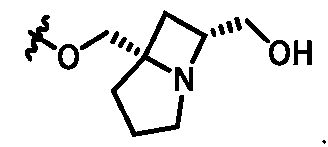 Provided herein as embodiment 58 is the compound according to
embodiment 47, wherein -L-R1
Provided herein as embodiment 58 is the compound according to
embodiment 47, wherein -L-R1
 . Provided herein as embodiment 59 is the compound according to embodiment 47, wherein -L-R1 is
 . Provided herein as embodiment 60 is the compound according to embodiment 47, wherein -L-R1 is
 . Provided herein as embodiment 61 is the compound according to embodiment 47, wherein -L-R1
 Provided herein as embodiment 62 is the compound according to embodiment 47, wherein -L-R1 is
 Provided herein as embodiment 63 is the compound according to embodiment 47, wherein -L-R1 is
 Provided herein as embodiment 64 is the compound according to
 embodiment 47, wherein -L-R1 is . Provided herein as embodiment 65 is the compound according to embodiment 47, wherein -L-R1 is
 . Provided herein as embodiment 66 is the compound according to embodiment 47, wherein -L-R1 is
 . Provided herein as embodiment 67 is the compound according to embodiment 47, wherein -L-R1
 Provided herein as embodiment 68 is the compound according to embodiment 47, wherein -L-R1 is
 Provided herein as embodiment 69 is the compound according to any one of embodiments 1-68, wherein X is O, S, S(O), S(O)(NRz) or S(O)2. Provided herein as embodiment 70 is the compound according to embodiment 69, wherein X is O. Provided herein as embodiment 71 is the compound according to embodiment 70, wherein n is 1 and m is 1. Provided herein as embodiment 72 is the compound according to embodiment 70, wherein n is 1 and m is 2 or n is 2 and m is 1. Provided herein as embodiment 73 is the compound according to embodiment 72, wherein p is 0. Provided herein as embodiment 74 is the compound according to embodiment 72, wherein p is 1. Provided herein as embodiment 75 is the compound according to embodiment 74, wherein Rx is oxo. Provided herein as embodiment 76 is the compound according to embodiment 74, wherein Rx is hydroxyl. Provided herein as embodiment 77 is the compound according to embodiment 72, wherein p is 2. Provided herein as embodiment 75 is the compound according to embodiment 74, wherein one Rx is hydroxyl and the other Rx is C1-4 haloalkyl (e.g., monofluoromethyl). Provided herein as embodiment 76 is the compound according to embodiment 74, wherein one Rx is hydroxyl and the other Rx is C1-4 alkyl (e.g., methyl). Provided herein as embodiment 80 is the compound according to any one of e
 Provided herein as embodiment 81 is the compound according to embodiment 80, wherein is . Provided herein as embodiment 82 is the compound according to embodiment 80, wherein
 Provided herein as embodiment 83 is the compound according to embodiment 80,
wherein
Provided herein as embodiment 83 is the compound according to embodiment 80,
wherein
 Provided herein as embodiment 84 is the compound according to embodiment 80, wherein
 Provided herein as embodiment 85 is the compound according to embodiment 80, wherein
 . Provided herein as embodiment 86 is the compound according to embodiment 80, wherein
 . Provided herein as embodiment 87 is the compound according to embodiment 80, wherein
 Provided herein as embodiment 88 is the compound according to embodiment 80, wherein
 . Provided herein as embodiment 89 is the compound according to embodiment 69, wherein X is CH2. Provided herein as embodiment 90 is the compound according to embodiment 89, wherein n is 1 and m is 1. Provided herein as embodiment 91 is the compound according to embodiment 90, wherein p is 0. Provided herein as embodiment 92 is the compound according to embodiment 90, wherein p is 1. Provided herein as embodiment 93 is the compound according to embodiment 92, wherein Rx is oxo or C1-4 haloalkoxy. Provided herein as embodiment 94 is the compound according to embodiment 93, wherein Rx is oxo. Provided herein as embodiment 95 is the compound according to embodiment 93, wherein Rx is C1-4 haloalkoxy (e.g., difluoromethoxy).
Provided herein as embodiment 96 is the compound according to embodiment 90, wherein p is 2. Provided herein as embodiment 97 is the compound according to embodiment 96, wherein each Rx is hydroxyl, C1-4 alkyl or C1-4 haloalkyl. Provided herein as embodiment 98 is the compound according to embodiment 97, wherein one Rx is hydroxyl and the other Rx is C1-4 alkyl (e.g., methyl). Provided herein as embodiment 99 is the compound according to embodiment 97, wherein one Rx is hydroxyl and the other Rx is C1-4 haloalkyl (e.g., difluoromethyl or monofluoromethyl). Provided herein as embodiment 100 is the compound according to embodiment 89, wherein n is 1 and m is 2 or n is 2 and m is 1. Provided herein as embodiment 101 is the compound according to embodiment 100, wherein p is 0. Provided herein as embodiment 102 is the compound according to embodiment 100, wherein p is 1. Provided herein as embodiment 103 is the compound according to embodiment 102, wherein Rx is oxo or C1-4 haloalkoxy. Provided herein as embodiment 104 is the compound according to embodiment 100, wherein p is 2. Provided herein as embodiment 105 is the compound according to embodiment 104, wherein each Rx is hydroxyl, C1-4 alkyl or C1-4 haloalkyl. Provided herein as embodiment 106 is the compound according to embodiment 105, wherein one Rx is hydroxyl and the other Rx is C1-4 alkyl (e.g., methyl). Provided herein as embodiment 107 is the compound according to any one of e
. Provided herein as embodiment 89 is the compound according to embodiment 69, wherein X is CH2. Provided herein as embodiment 90 is the compound according to embodiment 89, wherein n is 1 and m is 1. Provided herein as embodiment 91 is the compound according to embodiment 90, wherein p is 0. Provided herein as embodiment 92 is the compound according to embodiment 90, wherein p is 1. Provided herein as embodiment 93 is the compound according to embodiment 92, wherein Rx is oxo or C1-4 haloalkoxy. Provided herein as embodiment 94 is the compound according to embodiment 93, wherein Rx is oxo. Provided herein as embodiment 95 is the compound according to embodiment 93, wherein Rx is C1-4 haloalkoxy (e.g., difluoromethoxy).
Provided herein as embodiment 96 is the compound according to embodiment 90, wherein p is 2. Provided herein as embodiment 97 is the compound according to embodiment 96, wherein each Rx is hydroxyl, C1-4 alkyl or C1-4 haloalkyl. Provided herein as embodiment 98 is the compound according to embodiment 97, wherein one Rx is hydroxyl and the other Rx is C1-4 alkyl (e.g., methyl). Provided herein as embodiment 99 is the compound according to embodiment 97, wherein one Rx is hydroxyl and the other Rx is C1-4 haloalkyl (e.g., difluoromethyl or monofluoromethyl). Provided herein as embodiment 100 is the compound according to embodiment 89, wherein n is 1 and m is 2 or n is 2 and m is 1. Provided herein as embodiment 101 is the compound according to embodiment 100, wherein p is 0. Provided herein as embodiment 102 is the compound according to embodiment 100, wherein p is 1. Provided herein as embodiment 103 is the compound according to embodiment 102, wherein Rx is oxo or C1-4 haloalkoxy. Provided herein as embodiment 104 is the compound according to embodiment 100, wherein p is 2. Provided herein as embodiment 105 is the compound according to embodiment 104, wherein each Rx is hydroxyl, C1-4 alkyl or C1-4 haloalkyl. Provided herein as embodiment 106 is the compound according to embodiment 105, wherein one Rx is hydroxyl and the other Rx is C1-4 alkyl (e.g., methyl). Provided herein as embodiment 107 is the compound according to any one of e

 . Provided herein as embodiment 108 is the compound according to
embodiment 107, wherein
. Provided herein as embodiment 108 is the compound according to
embodiment 107, wherein
 . Provided herein as embodiment 109 is the compound according to embodiment 107, wherein
 Provided herein as embodiment 110 is the compound according to embodiment 107, wherein
 herein as embodiment 111 is the compound according to embodiment 107, wherein
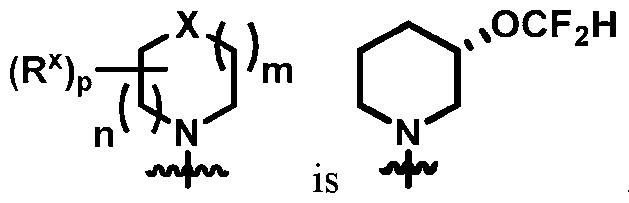 . Provided herein as embodiment 112 is the compound according to embodiment 107, wherein
 . Provided herein as embodiment 113 is the compound according to embodiment 107, wherein
 . Provided herein as embodiment 114 is the compound according to embodiment 107, wherein
 . Provided herein as embodiment 115 is the compound according to embodiment 107,
 wherein is . Provided herein as embodiment 116 is the
compound according to embodiment 107, wherein
wherein is . Provided herein as embodiment 116 is the
compound according to embodiment 107, wherein
 . Provided herein as embodiment 117 is the compound according to embodiment 107, wherein
 . Provided herein as embodiment 118 is the compound according to embodiment 107, wherein
 . Provided herein as embodiment 119 is the compound according to embodiment 107, wherein
 . Provided herein as embodiment 120 is the compound according to embodiment 107, wherein
 . Provided herein as embodiment 121 is the compound according to embodiment 107, wherein
 Provided herein as embodiment 122 is the compound according to embodiment 1, wherein 4 7 8
 and R is fluorine, then R and R are not both methyl. Provided herein as embodiment 123 is the compound according to embodiment 1, wherein and R4 is fluor 7
 ine and R is hydrogen, then R8 is not methyl. Provided herein as embodiment 124 is the compound according to
embodiment 1, wherein
ine and R is hydrogen, then R8 is not methyl. Provided herein as embodiment 124 is the compound according to
embodiment 1, wherein
 and R4 is fluorine and R8 is hydrogen, then R7 is not methyl. Provided herein as embodiment 125 is the compound according to embodiment 1, wherein
 fluorine, then R7 and R8 are not both methyl. Provided herein as embodiment 126 is the compound according to embodiment 1, wherein 4
 R is fluorine and R8 is cyclopropyl, then R7 is not halogen. Provided herein as embodiment 127 is the compound according to embodiment 1, wherein
 is R4 is fluorine, R8 is cyclopropyl an 1
 d R is substituted with 0 occurrences of R5, then R7 is not methyl. Provided herein as embodiment 128 is the compound according to embodiment 69, wherein X is CH2. Provided herein as embodiment 129 is the compound according to embodiment 128, wherein n is 1 and m is 1. Provided herein as embodiment 130 is the compound according to embodiment 129, wherein p is 2. Provided herein as embodiment 131 is the compound according to embodiment 130, wherein two Rx taken together with the same carbon form a C3-7 cycloalkyl or a 3-7 membered heterocycloalkyl, wherein each C3-7 cycloalkyl or 3-7 membered heterocycloalkyl further substituted with 0-3 occurrences of Ry. Provided herein as embodiment 132 is the compound according to embodiment 131, wherein two Rx taken together with the same carbon form a C3-7 cycloalkyl (e.g., cyclobutyl) further substituted with 0-3 occurrences of Ry. Provided herein as embodiment 133 is the compound according to embodiment 132, wherein two Rx taken together with the same carbon form a cyclobutyl further substituted with 0-3 occurrences
of Ry. Provided herein as embodiment 134 is the compound according to embodiment 133, wherein two Rx taken together with the same carbon form a cyclobutyl further substituted with 0 occurrences of Ry. Provided herein as embodiment 135 is the compound according to embodiment 133, wherein two Rx taken together with the same carbon form a cyclobutyl further substituted with one occurrence of Ry. Provided herein as embodiment 136 is the compound according to embodiment 135, wherein each Ry is hydroxyl or halogen (e.g., fluorine). Provided herein as embodiment 137 is the compound according to embodiment 136, wherein each Ry is hydroxyl. Provided herein as embodiment 138 is the compound according to embodiment 136, wherein each Ry is fluorine. Provided herein as embodiment 139 is the compound according to embodiment 133, wherein two Rx taken together with the same carbon form a cyclobutyl further substituted with two occurrences of Ry. Provided herein as embodiment 140 is the compound according to embodiment 139, wherein both are Ry is halogen (e.g., fluorine). Provided herein as embodiment 141 is the compound according to embodiment 131, wherein two Rx taken together with the same carbon form a 3-7 membered heterocycloalkyl (e.g., 2-oxetanyl, 3-tetrahydrothiophenyl or 5-oxazolidinyl) substituted with 0-3 occurrences of Ry. Provided herein as embodiment 142 is the compound according to embodiment 141, wherein two Rx taken together with the same carbon form 2-oxetanyl substituted with 0 occurrences of Ry. Provided herein as embodiment 143 is the compound according to embodiment 141, wherein two Rx taken together with the same carbon form 5-oxazolidinyl substituted with one occurrence of Ry. Provided herein as embodiment 144 is the compound according to embodiment 143, wherein Ry is oxo. Provided herein as embodiment 145 is the compound according to embodiment 141, wherein two Rx taken together with the same carbon form 3-tetrahydrothiophenyl substituted with two occurrences of Ry. Provided herein as embodiment 146 is the compound according to embodiment 145, wherein both Ry are oxo. Provided herein as embodiment 147 is the compound according to any one of embodiments 128-146, wherein
d R is substituted with 0 occurrences of R5, then R7 is not methyl. Provided herein as embodiment 128 is the compound according to embodiment 69, wherein X is CH2. Provided herein as embodiment 129 is the compound according to embodiment 128, wherein n is 1 and m is 1. Provided herein as embodiment 130 is the compound according to embodiment 129, wherein p is 2. Provided herein as embodiment 131 is the compound according to embodiment 130, wherein two Rx taken together with the same carbon form a C3-7 cycloalkyl or a 3-7 membered heterocycloalkyl, wherein each C3-7 cycloalkyl or 3-7 membered heterocycloalkyl further substituted with 0-3 occurrences of Ry. Provided herein as embodiment 132 is the compound according to embodiment 131, wherein two Rx taken together with the same carbon form a C3-7 cycloalkyl (e.g., cyclobutyl) further substituted with 0-3 occurrences of Ry. Provided herein as embodiment 133 is the compound according to embodiment 132, wherein two Rx taken together with the same carbon form a cyclobutyl further substituted with 0-3 occurrences
of Ry. Provided herein as embodiment 134 is the compound according to embodiment 133, wherein two Rx taken together with the same carbon form a cyclobutyl further substituted with 0 occurrences of Ry. Provided herein as embodiment 135 is the compound according to embodiment 133, wherein two Rx taken together with the same carbon form a cyclobutyl further substituted with one occurrence of Ry. Provided herein as embodiment 136 is the compound according to embodiment 135, wherein each Ry is hydroxyl or halogen (e.g., fluorine). Provided herein as embodiment 137 is the compound according to embodiment 136, wherein each Ry is hydroxyl. Provided herein as embodiment 138 is the compound according to embodiment 136, wherein each Ry is fluorine. Provided herein as embodiment 139 is the compound according to embodiment 133, wherein two Rx taken together with the same carbon form a cyclobutyl further substituted with two occurrences of Ry. Provided herein as embodiment 140 is the compound according to embodiment 139, wherein both are Ry is halogen (e.g., fluorine). Provided herein as embodiment 141 is the compound according to embodiment 131, wherein two Rx taken together with the same carbon form a 3-7 membered heterocycloalkyl (e.g., 2-oxetanyl, 3-tetrahydrothiophenyl or 5-oxazolidinyl) substituted with 0-3 occurrences of Ry. Provided herein as embodiment 142 is the compound according to embodiment 141, wherein two Rx taken together with the same carbon form 2-oxetanyl substituted with 0 occurrences of Ry. Provided herein as embodiment 143 is the compound according to embodiment 141, wherein two Rx taken together with the same carbon form 5-oxazolidinyl substituted with one occurrence of Ry. Provided herein as embodiment 144 is the compound according to embodiment 143, wherein Ry is oxo. Provided herein as embodiment 145 is the compound according to embodiment 141, wherein two Rx taken together with the same carbon form 3-tetrahydrothiophenyl substituted with two occurrences of Ry. Provided herein as embodiment 146 is the compound according to embodiment 145, wherein both Ry are oxo. Provided herein as embodiment 147 is the compound according to any one of embodiments 128-146, wherein


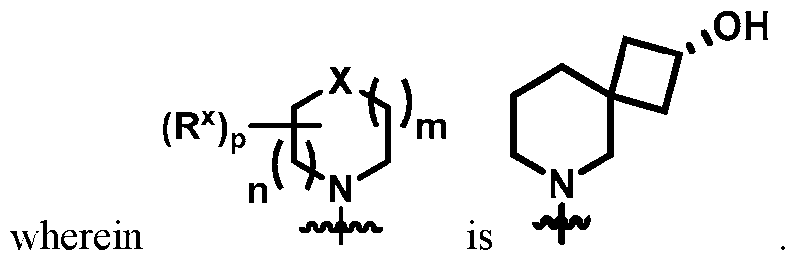


 . Provided herein as embodiment 209 is the compound according to embodiment 205, wherein
 Provided herein as embodiment 210 is the compound according to embodiment 205, wherein R3 is
 Provided herein as embodiment 211 is the compound according to embodiment 205, wherein
 . Provided herein as embodiment 212 is the compound according to embodiment 205, wherein
 . Provided herein as embodiment 213 is the compound according to embodiment 205, wherein R3 is
 . Provided herein as embodiment 214 is the compound according to
 . Provided herein as embodiment 215 is the compound according to embodiment 205, wherein
 . Provided herein as embodiment 216 is the compound according to embodiment 205, wherein R3 is
 Provided herein as embodiment 217 is the compound according to embodiment 205, wherein
 . Provided herein as embodiment 218 is the compound according to embodiment 205, wherein
 Provided herein as embodiment 219 is the compound according to embodiment 205, wherein R3 is
 . Provided herein as embodiment 220 is the compound according to embodiment 205, wherein
 . Provided herein as embodiment 221 is the
 embodiment 222 is the compound according to embodiment 205, wherein R3 is
 Provided herein as embodiment 223 is the compound according to any one of e
 compound according to embodiment 223, wherein
 Provided herein as embodiment 225 is the compound according to embodiment 223, wherein R3 is
 Provided herein as embodiment 226 is the compound according to embodiment 223, wherein
 Provided herein as embodiment 227 is the compound according to embodiment 223, wherein
 Provided herein as embodiment 228 is the compound according to embodiment 223, wherein R3 is
 Provided herein as embodiment 229 is the compound according to embodiment 223, wherein
 . Provided herein as embodiment 230 is the compound according to embodiment 223, wherein
 . Provided
herein as embodiment 231 is the compound according to embodiment 223, wherein R3 is
. Provided
herein as embodiment 231 is the compound according to embodiment 223, wherein R3 is
 Provided herein as embodiment 232 is the compound according to embodiment 223, wherein
 . Provided herein as embodiment 233 is the compound according to embodiment 223, wherein
 Provided herein as embodiment 234 is the compound according to embodiment 223, wherein
 Provided herein as embodiment 235 is the compound according to embodiment 223, wherein
 . Provided herein as embodiment 236 is the compound according to embodiment 223, wherein R3 is
 . Provided herein as embodiment 237 is the compound according to
 . Provided herein as embodiment 238 is the compound according to embodiment 223, wherein
 Provided herein as embodiment 239 is the compound according to embodiment 223, wherein R3 is
 . Provided herein as embodiment 240 is the compound according to any one of e


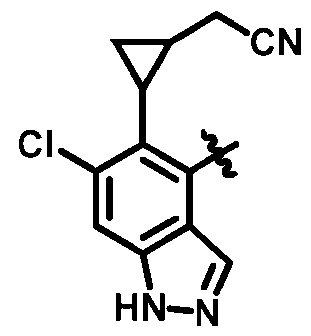


 Provided herein as embodiment 248 is the compound according to embodiment 240, wherein R3 is
 . Provided herein as embodiment 249 is the compound according to embodiment 240, wherein
 . Provided herein as embodiment 251 is the compound according to embodiment 240, wherein
 Provided herein as embodiment 252 is the compound according to embodiment 240, wherein R3 is
 . Provided herein as embodiment 253 is the compound according to embodiment 240, wherein
 . Provided herein as embodiment 254 is
the compound according to embodiment 240, wherein
. Provided herein as embodiment 254 is
the compound according to embodiment 240, wherein
 Provided herein as embodiment 255 is the compound according to embodiment 240, wherein R3 is
 . Provided herein as embodiment 256 is the compound according to embodiment 240, wherein
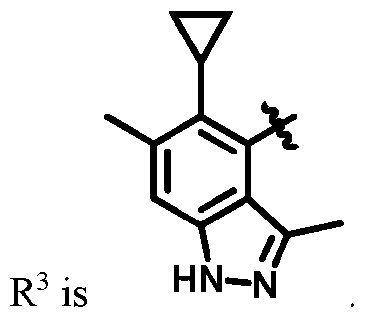 Provided herein as embodiment 257 is the compound according to embodiment 240, wherein
 Provided herein as embodiment 258 is the compound according to embodiment 240, wherein R3 is
 Provided herein as embodiment 259 is the compound according to embodiment 240, wherein
 . Provided herein as embodiment 260 is
the compound according to embodiment 240, wherein
. Provided herein as embodiment 260 is
the compound according to embodiment 240, wherein
 herein as embodiment 261 is the compound according to embodiment 240, wherein R3 is
 . Provided herein as embodiment 262 is the compound according to e c
 embodiment 264 is the compound according to embodiment 240, wherein R3 is
 Provided herein as embodiment 265 is the compound according to embodiment 240, wherein

 Provided herein as embodiment 267 is the compound according to embodiment 240, wherein R3 is
 Provided herein as embodiment 268 is the compound according to embodiment 240, wherein
 . Provided herein as embodiment 269 is the compound according to embodiment 240, wherein
 . Provided herein as embodiment 270 is the compound according to embodiment 240, wherein R3 is
 Provided herein as embodiment 271 is the compound according to embodiment 240, wherein
 . Provided herein as embodiment 272 is
the compound according to embodiment 240, wherein
. Provided herein as embodiment 272 is
the compound according to embodiment 240, wherein
 herein as embodiment 273 is the compound according to embodiment 240, wherein R3 is e c
 embodiment 276 is the compound according to embodiment 240, wherein R3 is
 embodiment 240, wherein
 . Provided herein as embodiment 278 is
 . Provided herein as embodiment 279 is the compound according to embodiment 240, wherein R3 is
 Provided herein as embodiment 280 is the compound according to embodiment 240, wherein
 . Provided herein as embodiment 281 is the compound according to embodiment 240, wherein
 Provided herein as embodiment 282 is the compound according to embodiment 240, wherein R3 is
 Provided herein as embodiment 283 is the compound according to any one of e
 . Provided herein as embodiment 284 is the compound according to any one of e
 embodiment 284, wherein
 Provided herein as embodiment 286 is the compound according to embodiment 284, wherein
 . Provided herein as
embodiment 287 is the compound according to embodiment 284, wherein R3 is e c
. Provided herein as
embodiment 287 is the compound according to embodiment 284, wherein R3 is e c
 embodiment 290 is the compound according to embodiment 284, wherein R3 is e c
 embodiment 293 is the compound according to embodiment 284, wherein R3 is
 Provided herein as embodiment 294 is the compound according to e
 Provided herein as embodiment 295 is the compound according to any one of embodiments 1-294, wherein R4 is C1-4 alkyl, C1-4 alkoxy, hydroxyl, halogen or C1-4 haloalkyl. Provided herein as embodiment 296 is the compound according to embodiment 295, wherein R4 is C1-4 alkyl, hydroxyl or halogen. Provided herein as embodiment 297 is the compound according to embodiment 296, wherein R4 is C1-4 alkyl or halogen. Provided herein as embodiment 298 is the compound according to embodiment 297, wherein R4 halogen (e.g., fluorine or chlorine). Provided herein as embodiment 299 is the compound according to embodiment 298, wherein R4 is fluorine. Provided herein as embodiment 300 is the compound according to embodiment 1, wherein is the compound is a compound of formula (II):
 (II). Provided herein as embodiment 301 is the compound according to embodiment 1, wherein is the compound is a compound of formula (III):


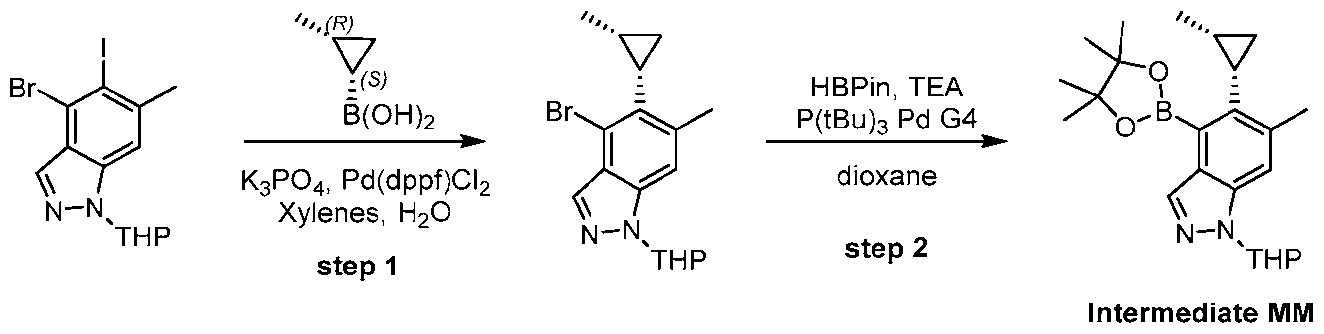


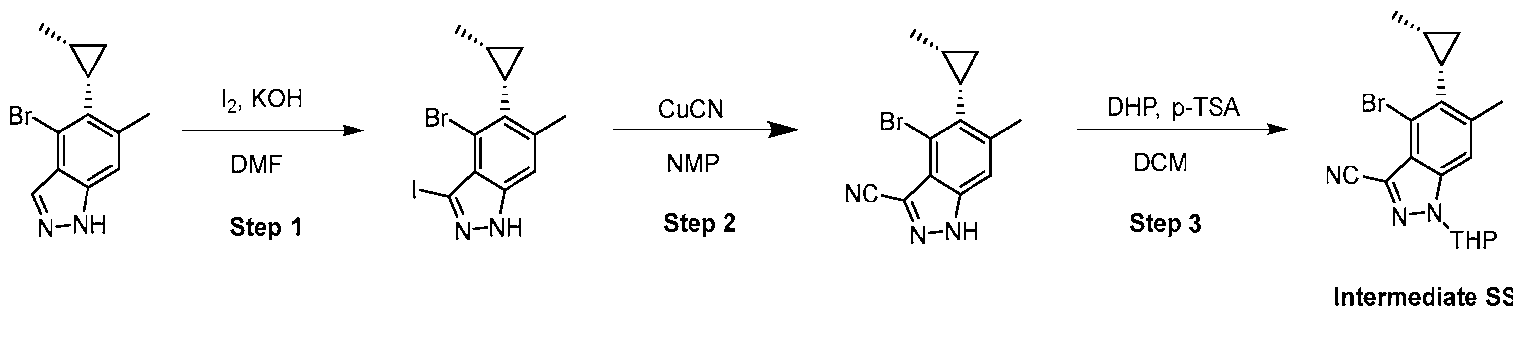


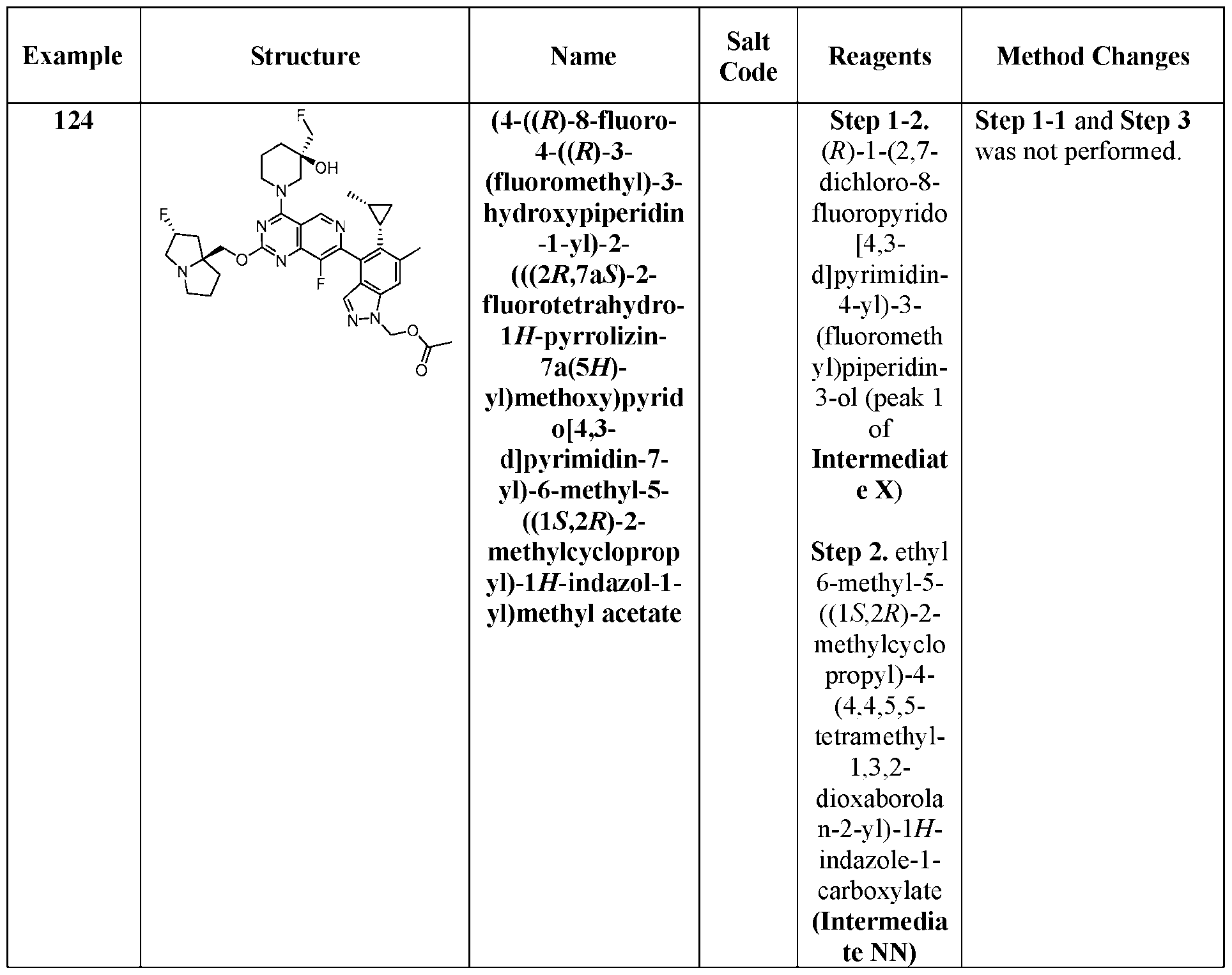


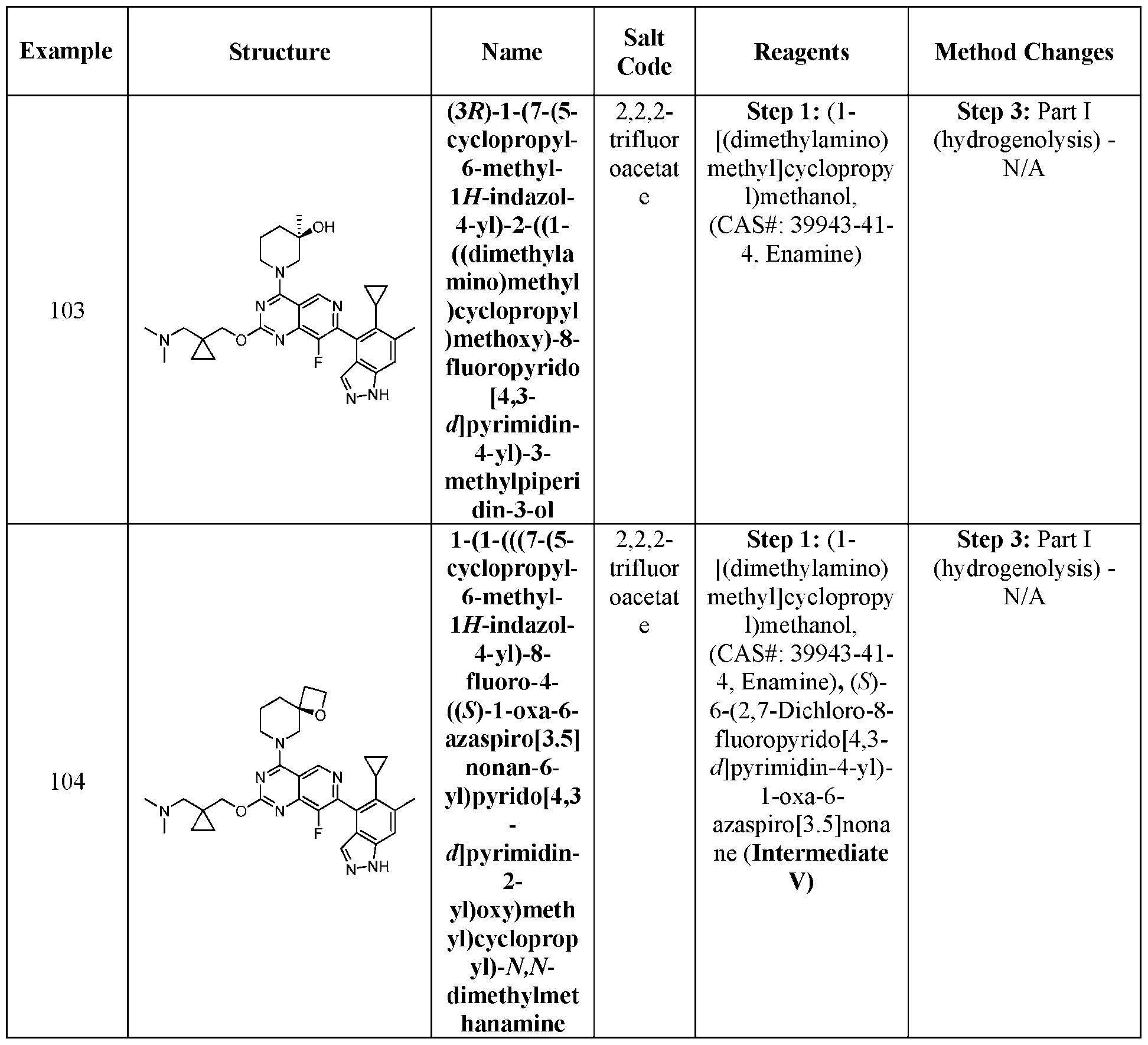


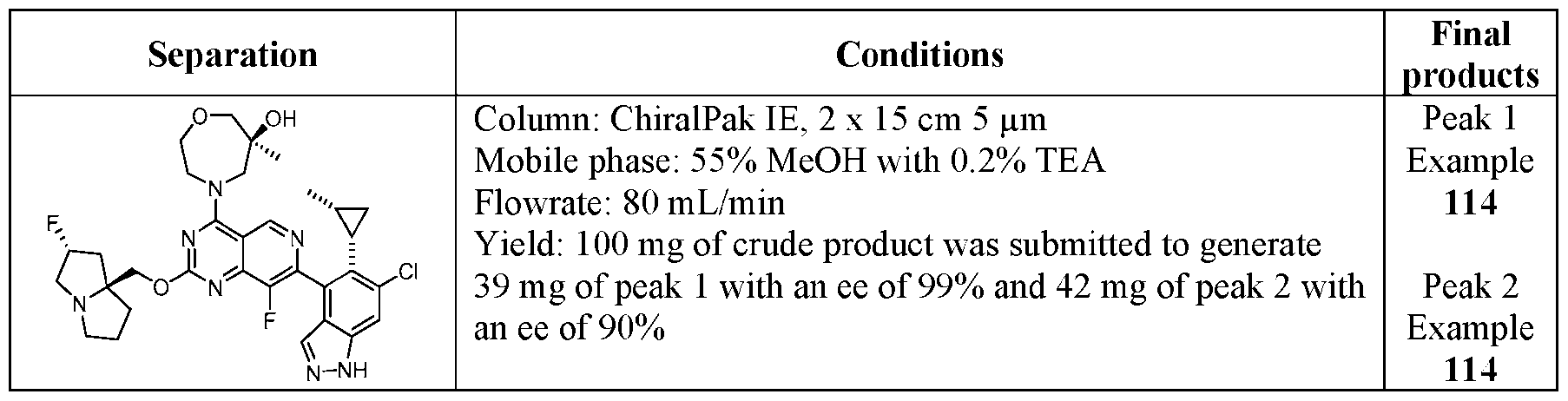


 or a pharmaceutically acceptable salt of said compound, wherein; X is CH2, O, S, S(O), S(O)(NRz) or S(O)2; n is 0, 1, 2, or 3; m is 0, 1, 2 or 3; p is 0, 1, 2, 3 or 4; each Rx is hydroxyl, halogen, oxo, cyano, -N(Rz)2, C1-4 alkyl, C1-4 alkoxy, C1-4 haloalkyl, C1-4 haloalkoxy, 5-7 membered heteroaryl, -T-Ry or two Rx taken together with the same carbon or adjacent carbon atoms can form C3-7 cycloalkyl, a 3-7 membered heterocycloalkyl, wherein each C3-7 cycloalkyl or 3-7 membered heterocycloalkyl is further substituted with 0-3 occurrences of Ry or two Rx taken together can form a bridged ring where the bridge is selected from one of the following: -C1-4 alkylene, -C1-4 alkylene-O-C1-4 alkylene-, -O-, -S- or -C1-4 alkylene-S-C1-4 alkylene- and wherein each C1- 4 alkylene is further substituted with 0-2 occurrences of Ry; L is a bond, C1-6 alkylene, -O-C1-6 alkylene, -S-C1-6 alkylene, NRz, O or S, wherein each C1-6 alkylene, -O-C1-6 alkylene and -S-C1-6 alkylene chain is substituted with 0-2 occurrences of R2; R1 is hydroxyl, -N(Rz)2, aryl, heteroaryl, C3-8 cycloalkyl or heterocycloalkyl substituted with 0-3 occurrences of R5; R2 is halogen, hydroxyl, C1-4 alkyl or two R2 on the same or adjacent carbon atoms can be taken together to form a C3-7 cycloalkyl; R3 is aryl or heteroaryl substituted with 0-3 occurrences of R6; R4 is hydrogen, hydroxyl, halogen, C1-4 alkyl, C1-4 alkoxy, C1-4 haloalkyl, C2-4 alkenyl, C2-4 alkynyl, C3-7 cycloalkyl or cyano;
each R5 is halogen, cyano, oxo, -T-Ry, hydroxyl, amino or C1-4 alkyl; each R6 is halogen, hydroxyl, cyano, -N(Rz)2, C1-4 alkyl, C1-4 alkoxy, C1-4 haloalkyl, C1-4 haloalkoxy, C2-4 alkynyl or C3-6 cycloalkyl; R7 is halogen, C1-6 alkyl, C2-6 alkenyl, C1-4 alkoxy, C1-4 haloalkyl or C3-7 cycloalkyl wherein each alkyl, alkenyl or cycloalkyl is further substituted by 0-2 occurrences of Rw; R8 is hydrogen, halo, C1-4 alkyl, C1-4 haloalkyl or C2-6 alkenyl; or R7 and R8 are taken together with the atoms to which they are connected to form a C3-7 cycloalkyl or 3-7 membered heterocycloalkyl substituted with 0-3 occurrences of Rw; R9 is hydrogen, halogen or C1-4 alkyl; R10 is hydrogen, halo, hydroxyl, C1-4 alkyl, -T-Ry or C1-4 haloalkyl; R12 is hydrogen, -C(O)-C1-4 alkyl, -C(O)-C1-4 alkoxy, C1-4 alkylene-O-C(O)-C1-4 alkyl or -C1-4 alkylene-C(O)-C1-4 alkyl; each Rw is halo, hydroxy, C1-4 alkyl, C1-4 haloalkyl, C1-4 alkoxy or C3-6 cycloalkyl; T is C1-4 alkylene, -S(O)2-, -C(O)-, -C1-4 alkylene-C(O)-, C1-4 alkylene-S(O)2- or - S-; Ry is halogen, oxo, C1-4 alkyl, C1-4 haloalkyl, hydroxyl, cyano or -N(Rz)2; and Rz is hydrogen or C1-4 alkyl.
or a pharmaceutically acceptable salt of said compound, wherein; X is CH2, O, S, S(O), S(O)(NRz) or S(O)2; n is 0, 1, 2, or 3; m is 0, 1, 2 or 3; p is 0, 1, 2, 3 or 4; each Rx is hydroxyl, halogen, oxo, cyano, -N(Rz)2, C1-4 alkyl, C1-4 alkoxy, C1-4 haloalkyl, C1-4 haloalkoxy, 5-7 membered heteroaryl, -T-Ry or two Rx taken together with the same carbon or adjacent carbon atoms can form C3-7 cycloalkyl, a 3-7 membered heterocycloalkyl, wherein each C3-7 cycloalkyl or 3-7 membered heterocycloalkyl is further substituted with 0-3 occurrences of Ry or two Rx taken together can form a bridged ring where the bridge is selected from one of the following: -C1-4 alkylene, -C1-4 alkylene-O-C1-4 alkylene-, -O-, -S- or -C1-4 alkylene-S-C1-4 alkylene- and wherein each C1- 4 alkylene is further substituted with 0-2 occurrences of Ry; L is a bond, C1-6 alkylene, -O-C1-6 alkylene, -S-C1-6 alkylene, NRz, O or S, wherein each C1-6 alkylene, -O-C1-6 alkylene and -S-C1-6 alkylene chain is substituted with 0-2 occurrences of R2; R1 is hydroxyl, -N(Rz)2, aryl, heteroaryl, C3-8 cycloalkyl or heterocycloalkyl substituted with 0-3 occurrences of R5; R2 is halogen, hydroxyl, C1-4 alkyl or two R2 on the same or adjacent carbon atoms can be taken together to form a C3-7 cycloalkyl; R3 is aryl or heteroaryl substituted with 0-3 occurrences of R6; R4 is hydrogen, hydroxyl, halogen, C1-4 alkyl, C1-4 alkoxy, C1-4 haloalkyl, C2-4 alkenyl, C2-4 alkynyl, C3-7 cycloalkyl or cyano;
each R5 is halogen, cyano, oxo, -T-Ry, hydroxyl, amino or C1-4 alkyl; each R6 is halogen, hydroxyl, cyano, -N(Rz)2, C1-4 alkyl, C1-4 alkoxy, C1-4 haloalkyl, C1-4 haloalkoxy, C2-4 alkynyl or C3-6 cycloalkyl; R7 is halogen, C1-6 alkyl, C2-6 alkenyl, C1-4 alkoxy, C1-4 haloalkyl or C3-7 cycloalkyl wherein each alkyl, alkenyl or cycloalkyl is further substituted by 0-2 occurrences of Rw; R8 is hydrogen, halo, C1-4 alkyl, C1-4 haloalkyl or C2-6 alkenyl; or R7 and R8 are taken together with the atoms to which they are connected to form a C3-7 cycloalkyl or 3-7 membered heterocycloalkyl substituted with 0-3 occurrences of Rw; R9 is hydrogen, halogen or C1-4 alkyl; R10 is hydrogen, halo, hydroxyl, C1-4 alkyl, -T-Ry or C1-4 haloalkyl; R12 is hydrogen, -C(O)-C1-4 alkyl, -C(O)-C1-4 alkoxy, C1-4 alkylene-O-C(O)-C1-4 alkyl or -C1-4 alkylene-C(O)-C1-4 alkyl; each Rw is halo, hydroxy, C1-4 alkyl, C1-4 haloalkyl, C1-4 alkoxy or C3-6 cycloalkyl; T is C1-4 alkylene, -S(O)2-, -C(O)-, -C1-4 alkylene-C(O)-, C1-4 alkylene-S(O)2- or - S-; Ry is halogen, oxo, C1-4 alkyl, C1-4 haloalkyl, hydroxyl, cyano or -N(Rz)2; and Rz is hydrogen or C1-4 alkyl.  , ,
, ,

 .
.  is , ,


 is ,
is ,


 .
. 


 .
.  , ,
, ,
 48. The compound of claim 1, wherein R4 is methyl, fluorine or chlorine. 49. The compound of claim 1, wherein the compound is selected from one of the following compounds: (6S)-4-(7-(6-Chloro-5-(3-hydroxypropyl)-1H-indazol-4-yl)-8-fluoro-2-(((2R,7aS)-2- fluorotetrahydro-1H-pyrrolizin-7a(5H)-yl)methoxy)pyrido[4,3-d]pyrimidin-4-yl)-1,4- oxazepan-6-ol; (2S,4s)-6-(7-(6-Chloro-5-(2-hydroxyethyl)-1H-indazol-4-yl)-8-fluoro-2-(((2R,7aS)-2- fluorotetrahydro-1H-pyrrolizin-7a(5H)-yl)methoxy)pyrido[4,3-d]pyrimidin-4-yl)-6- azaspiro[3.5]nonan-2-ol; or (6S)-4-(7-(6-Chloro-5-(3-hydroxypropyl)-1H-indazol-4-yl)-8-fluoro-2-(((2R,7aS)-2- fluorotetrahydro-1H-pyrrolizin-7a(5H)-yl)methoxy)pyrido[4,3-d]pyrimidin-4-yl)-6- methyl-1,4-oxazepan-6-ol.
50. A pharmaceutical composition comprising the compound according to any one of claims 1-49 or a pharmaceutically acceptable salt of said compound, and a pharmaceutically acceptable excipient. 51. A compound according to any one of claims 1-49, or a tautomer thereof, or a pharmaceutically acceptable salt of said compound, or the pharmaceutical composition according to claim 45 for use as a medicament. 52. A compound according to any one of claims 1-49 or a pharmaceutically acceptable salt thereof, or the pharmaceutical composition according to claim 50 for use in treating cancer. 53. The compound or pharmaceutical composition for use of claim 52, wherein the cancer is pancreatic cancer, colorectal cancer, non-small cell lung cancer, small bowel cancer, appendiceal cancer, cancer of unknown primary, endometrial cancer, mixed cancer types, hepatobiliary cancer, small cell lung cancer, cervical cancer, germ cell cancer, ovarian cancer, gastrointestinal neuroendocrine cancer, bladder cancer, myelodysplastic/myeloproliferative neoplasms, head and neck cancer, esophagogastric cancer, soft tissue sarcoma, mesothelioma, thyroid cancer, leukemia, or melanoma. 54. A method of treating cancer in a subject in need thereof, the method comprising administering to the subject a therapeutically effective amount of the compound according to any one of to any one of claims 1-49 or a pharmaceutically acceptable salt thereof or a pharmaceutical composition according to claim 50. 55. The method according to claim 54, wherein the cancer is non-small cell lung cancer, small bowel cancer, appendiceal cancer, colorectal cancer, cancer of unknown primary, endometrial cancer, mixed cancer types, pancreatic cancer, hepatobiliary cancer, small cell lung cancer, cervical cancer, germ cell cancer, ovarian cancer, gastrointestinal neuroendocrine cancer, bladder cancer, myelodysplastic/myeloproliferative neoplasms, head and neck cancer, esophagogastric cancer, soft tissue sarcoma, mesothelioma, thyroid cancer, leukemia, or melanoma.
48. The compound of claim 1, wherein R4 is methyl, fluorine or chlorine. 49. The compound of claim 1, wherein the compound is selected from one of the following compounds: (6S)-4-(7-(6-Chloro-5-(3-hydroxypropyl)-1H-indazol-4-yl)-8-fluoro-2-(((2R,7aS)-2- fluorotetrahydro-1H-pyrrolizin-7a(5H)-yl)methoxy)pyrido[4,3-d]pyrimidin-4-yl)-1,4- oxazepan-6-ol; (2S,4s)-6-(7-(6-Chloro-5-(2-hydroxyethyl)-1H-indazol-4-yl)-8-fluoro-2-(((2R,7aS)-2- fluorotetrahydro-1H-pyrrolizin-7a(5H)-yl)methoxy)pyrido[4,3-d]pyrimidin-4-yl)-6- azaspiro[3.5]nonan-2-ol; or (6S)-4-(7-(6-Chloro-5-(3-hydroxypropyl)-1H-indazol-4-yl)-8-fluoro-2-(((2R,7aS)-2- fluorotetrahydro-1H-pyrrolizin-7a(5H)-yl)methoxy)pyrido[4,3-d]pyrimidin-4-yl)-6- methyl-1,4-oxazepan-6-ol.
50. A pharmaceutical composition comprising the compound according to any one of claims 1-49 or a pharmaceutically acceptable salt of said compound, and a pharmaceutically acceptable excipient. 51. A compound according to any one of claims 1-49, or a tautomer thereof, or a pharmaceutically acceptable salt of said compound, or the pharmaceutical composition according to claim 45 for use as a medicament. 52. A compound according to any one of claims 1-49 or a pharmaceutically acceptable salt thereof, or the pharmaceutical composition according to claim 50 for use in treating cancer. 53. The compound or pharmaceutical composition for use of claim 52, wherein the cancer is pancreatic cancer, colorectal cancer, non-small cell lung cancer, small bowel cancer, appendiceal cancer, cancer of unknown primary, endometrial cancer, mixed cancer types, hepatobiliary cancer, small cell lung cancer, cervical cancer, germ cell cancer, ovarian cancer, gastrointestinal neuroendocrine cancer, bladder cancer, myelodysplastic/myeloproliferative neoplasms, head and neck cancer, esophagogastric cancer, soft tissue sarcoma, mesothelioma, thyroid cancer, leukemia, or melanoma. 54. A method of treating cancer in a subject in need thereof, the method comprising administering to the subject a therapeutically effective amount of the compound according to any one of to any one of claims 1-49 or a pharmaceutically acceptable salt thereof or a pharmaceutical composition according to claim 50. 55. The method according to claim 54, wherein the cancer is non-small cell lung cancer, small bowel cancer, appendiceal cancer, colorectal cancer, cancer of unknown primary, endometrial cancer, mixed cancer types, pancreatic cancer, hepatobiliary cancer, small cell lung cancer, cervical cancer, germ cell cancer, ovarian cancer, gastrointestinal neuroendocrine cancer, bladder cancer, myelodysplastic/myeloproliferative neoplasms, head and neck cancer, esophagogastric cancer, soft tissue sarcoma, mesothelioma, thyroid cancer, leukemia, or melanoma.