WO2025132182A2 - Post-exposure bake less chemically amplified photoresist composition - Google Patents
Post-exposure bake less chemically amplified photoresist composition Download PDFInfo
- Publication number
- WO2025132182A2 WO2025132182A2 PCT/EP2024/086516 EP2024086516W WO2025132182A2 WO 2025132182 A2 WO2025132182 A2 WO 2025132182A2 EP 2024086516 W EP2024086516 W EP 2024086516W WO 2025132182 A2 WO2025132182 A2 WO 2025132182A2
- Authority
- WO
- WIPO (PCT)
- Prior art keywords
- component
- composition
- mole
- alkyl
- equal
- Prior art date
- Legal status (The legal status is an assumption and is not a legal conclusion. Google has not performed a legal analysis and makes no representation as to the accuracy of the status listed.)
- Pending
Links
Classifications
-
- G—PHYSICS
- G03—PHOTOGRAPHY; CINEMATOGRAPHY; ANALOGOUS TECHNIQUES USING WAVES OTHER THAN OPTICAL WAVES; ELECTROGRAPHY; HOLOGRAPHY
- G03F—PHOTOMECHANICAL PRODUCTION OF TEXTURED OR PATTERNED SURFACES, e.g. FOR PRINTING, FOR PROCESSING OF SEMICONDUCTOR DEVICES; MATERIALS THEREFOR; ORIGINALS THEREFOR; APPARATUS SPECIALLY ADAPTED THEREFOR
- G03F7/00—Photomechanical, e.g. photolithographic, production of textured or patterned surfaces, e.g. printing surfaces; Materials therefor, e.g. comprising photoresists; Apparatus specially adapted therefor
- G03F7/004—Photosensitive materials
- G03F7/0045—Photosensitive materials with organic non-macromolecular light-sensitive compounds not otherwise provided for, e.g. dissolution inhibitors
-
- G—PHYSICS
- G03—PHOTOGRAPHY; CINEMATOGRAPHY; ANALOGOUS TECHNIQUES USING WAVES OTHER THAN OPTICAL WAVES; ELECTROGRAPHY; HOLOGRAPHY
- G03F—PHOTOMECHANICAL PRODUCTION OF TEXTURED OR PATTERNED SURFACES, e.g. FOR PRINTING, FOR PROCESSING OF SEMICONDUCTOR DEVICES; MATERIALS THEREFOR; ORIGINALS THEREFOR; APPARATUS SPECIALLY ADAPTED THEREFOR
- G03F7/00—Photomechanical, e.g. photolithographic, production of textured or patterned surfaces, e.g. printing surfaces; Materials therefor, e.g. comprising photoresists; Apparatus specially adapted therefor
- G03F7/004—Photosensitive materials
- G03F7/039—Macromolecular compounds which are photodegradable, e.g. positive electron resists
-
- G—PHYSICS
- G03—PHOTOGRAPHY; CINEMATOGRAPHY; ANALOGOUS TECHNIQUES USING WAVES OTHER THAN OPTICAL WAVES; ELECTROGRAPHY; HOLOGRAPHY
- G03F—PHOTOMECHANICAL PRODUCTION OF TEXTURED OR PATTERNED SURFACES, e.g. FOR PRINTING, FOR PROCESSING OF SEMICONDUCTOR DEVICES; MATERIALS THEREFOR; ORIGINALS THEREFOR; APPARATUS SPECIALLY ADAPTED THEREFOR
- G03F7/00—Photomechanical, e.g. photolithographic, production of textured or patterned surfaces, e.g. printing surfaces; Materials therefor, e.g. comprising photoresists; Apparatus specially adapted therefor
- G03F7/004—Photosensitive materials
- G03F7/039—Macromolecular compounds which are photodegradable, e.g. positive electron resists
- G03F7/0392—Macromolecular compounds which are photodegradable, e.g. positive electron resists the macromolecular compound being present in a chemically amplified positive photoresist composition
-
- G—PHYSICS
- G03—PHOTOGRAPHY; CINEMATOGRAPHY; ANALOGOUS TECHNIQUES USING WAVES OTHER THAN OPTICAL WAVES; ELECTROGRAPHY; HOLOGRAPHY
- G03F—PHOTOMECHANICAL PRODUCTION OF TEXTURED OR PATTERNED SURFACES, e.g. FOR PRINTING, FOR PROCESSING OF SEMICONDUCTOR DEVICES; MATERIALS THEREFOR; ORIGINALS THEREFOR; APPARATUS SPECIALLY ADAPTED THEREFOR
- G03F7/00—Photomechanical, e.g. photolithographic, production of textured or patterned surfaces, e.g. printing surfaces; Materials therefor, e.g. comprising photoresists; Apparatus specially adapted therefor
- G03F7/004—Photosensitive materials
- G03F7/085—Photosensitive compositions characterised by adhesion-promoting non-macromolecular additives
Definitions
- This actinic radiation exposure causes a chemical transformation in the exposed areas of the coated surface. Visible light, ultraviolet (UV) light, extreme ultraviolet (EUV), electron beam and X-ray radiant energy are radiation types commonly used today in microlithographic processes.
- UV light ultraviolet
- EUV extreme ultraviolet
- electron beam and X-ray radiant energy are radiation types commonly used today in microlithographic processes.
- the coated substrate is treated with a developer solution to dissolve and remove either the radiation-exposed areas (for positive-type photoresists) or the unexposed areas (for negative-type photoresists) of the coated surface of the substrate.
- the now partially unprotected substrate may be treated with a substrate-etchant solution, plasma gases or reactive ions, or have metal or metal composites deposited in the spaces of the substrate where the photoresist coating was removed during development.
- the areas of the substrate where the photoresist coating still remains are protected.
- the remaining areas of the photoresist coating may be removed during a stripping operation, leaving a patterned substrate surface.
- Positive-acting photoresists comprising Novolak polymers and quinone-diazide compounds as photoactive compounds dissolved in conventional spin casting solvent such as PGMEA or PGME are well known in the art.
- Novolak polymers may also be reacted with quinone diazides and combined with a polymer. It has been found that photoresists based on only Novolak/diazide do not have the photosensitivity or the steepness of sidewalls necessary for certain type of processes, especially for very thick films. Moreover, a high dark-film loss in the developer is often observed and such coating may have poor coating uniformity.
- Known chemically amplified photoresists such as those based on blocked poly- 4-hydroxystyrene (PHOST), blocked copolymers comprising hydroxystyrene and a blocked (meth)acrylic acid repeat unit such as tert-butyl (meth)acrylate, or (meth)acrylic materials comprising alicyclic groups, acid labile groups, and dissolution modifying groups such as anhydrides or lactones dissolved in conventional spin casting solvents such as PGMEA or PGME may exhibit the required photosensitivity and thickness requirement, but may also exhibit adhesion failure, during subsequent unit operations such as plating or etching.
- PHOST blocked poly- 4-hydroxystyrene
- blocked copolymers comprising hydroxystyrene and a blocked (meth)acrylic acid repeat unit such as tert-butyl (meth)acrylate
- (meth)acrylic materials comprising alicyclic groups, acid labile groups, and dissolution modifying groups such as anhydr
- these materials may also exhibit poor coating uniformity and also have poor process latitude against pattern collapse during post-exposure processing such as development and/or rinsing. Such failures may lead to feature sidewalls that are rough, undercut or have protrusions somewhere in the metal feature and produce features with high defect counts because of the lack of process latitude against pattern collapse and poor coating uniformity. Moreover, these photoresists may be prohibitively expensive.
- Chemically amplified resists comprising mixtures of Novolak polymers with polymers based on blocked poly-4-hydroxystyrene (PHOST), blocked copolymers comprising hydroxystyrene and a blocked (meth)acrylic acid repeat unit such as tert-butyl (meth)acrylate, or (meth)acrylic materials comprising alicyclic groups, acid labile groups, and dissolution modifying groups such as anhydrides or lactones dissolved in conventional spin casting solvents such as PGMEA (1 -methoxy 3 -propylacetate) or PGME (1- methoxy-propanol) may exhibit the required photosensitivity and thickness requirement, but may also exhibit adhesion failure, during subsequent unit operations such as plating or etching.
- PHOST blocked poly-4-hydroxystyrene
- blocked copolymers comprising hydroxystyrene and a blocked (meth)acrylic acid repeat unit such as tert-butyl (meth)acrylate
- Photoresist compositions are used in microlithography processes for making miniaturized electronic components such as in the fabrication of computer chips and integrated circuits. Generally, in these processes, a coating of film of a photoresist composition is first applied to a substrate material, such as silicon wafers used for making integrated circuits. The coated substrate is then baked to evaporate any solvent in the photoresist composition and to fix the coating onto the substrate. The baked coated surface of the substrate is next subjected to an image- wise exposure to radiation.
- a substrate material such as silicon wafers used for making integrated circuits.
- the coated substrate is then baked to evaporate any solvent in the photoresist composition and to fix the coating onto the substrate.
- the baked coated surface of the substrate is next subjected to an image- wise exposure to radiation.
- This radiation exposure causes a chemical transformation in the exposed areas of the coated surface. Visible light, ultraviolet (UV) light, electron beam and X-ray radiant energy are radiation types commonly used today in microlithographic processes.
- UV light ultraviolet
- electron beam and X-ray radiant energy are radiation types commonly used today in microlithographic processes.
- the coated substrate is treated with a developer solution to dissolve and remove either the radiation-exposed or the unexposed areas of the coated surface of the substrate.
- photoresist compositions there are two types, negative-working and positiveworking.
- negative-working photoresist compositions When negative-working photoresist compositions are exposed image-wise to radiation, the areas of the resist composition exposed to the radiation become less soluble to a developer solution (e.g., a cross-linking reaction occurs) while the unexposed areas of the photoresist coating remain relatively soluble in such a solution.
- a developer solution e.g., a cross-linking reaction occurs
- treatment of an exposed negative-working resist with a developer causes removal of the non-exposed areas of the photoresist coating and the creation of a negative image in the coating. Thereby uncovering a desired portion of the underlying substrate surface on which the photoresist composition was deposited.
- the now partially unprotected substrate may be treated with a substrate-etchant solution, plasma gases, or have metal or metal composites deposited in the spaces of the substrate where the photoresist coating was removed during development.
- the areas of the substrate where the photoresist coating still remains are protected.
- the remaining areas of the photoresist coating may be removed during a stripping operation, leaving a patterned substrate surface.
- Gold bumps, copper posts and copper wires for redistribution in wafer level packaging require a resist mold that is later electroplated to form the final metal structures in advanced interconnect technologies.
- the resist layers are very thick compared to the photoresists used in the IC manufacturing of critical layers. Both feature size and resist thickness are typically in the range of 2 pm to 100 pm (micrometers), so that high aspect ratios (resist thickness to line size) have to be patterned in the photoresist.
- One aspect of the invention is a novel photoresist composition
- a novel photoresist composition comprising:
- Component (1) a PAG component, having structure (I), wherein R2 P is selected from a C-l to C-3 alkyl, and Rip is selected from a C-2 to C-8 alkyl, and an aryl,
- Component (2) a hydroxybenzoic acid component having structure (II), wherein nii is 1 or 2,
- Component (3) a trialkyl amine quencher having structure (III), wherein Rq, Rqi and Rq2 are independently selected from a C-5 to C- 9 alkyl:
- an adhesion promoter which is an aryl-177-tetrazole-5-thiol derivative having structure (IV), wherein Riv is a substituted or unsubstituted aryl:
- Component (5) a polymer comprising a reaction product formed in the absence of an acid catalyst between:
- a Novolak polymer (i) a Novolak polymer, (ii) a polymer comprising substituted or unsubstituted hydroxystyrene and acrylate, methacrylate or a mixture of acrylate and methacrylate, the acrylate and/or methacrylate being protected by an acid labile group that requires a high activation energy for deblocking, and (iii) a compound selected from a vinyl ether and an unsubstituted or substituted, unsaturated heteroalicyclic moiety;
- Component (6) a polymer component comprising structure (V), wherein Ri is a unsubstituted or substituted alkyl or unsubstituted or substituted cycloalkyl, R2 is hydrogen or a Ci to C4 alkyl, R3 is a Ci to C4 alkyl or a C2 to C4 alkylenehydroxy moiety, R4 is hydrogen or a Ci to C4 alkyl, R5 is hydrogen or Ci to C4 alkyl, and x, y, z, and w are the mole % of each type of repeat unit, based on the total moles of x, y, z and w, where x is equal to about 30 to about 40 mole %, y is equal to about 60 to about 70 mole %, z is equal to about 0 to about 10 mole %, w is equal to 0 to about 10 mole %, where the sum of x, y, z, and w is equal to 100 mole
- Component (7) a Novolak polymer soluble in aqueous base.
- Component (8) an organic spin casting solvent.
- Component (9) an optional surfactant.
- Another aspect of this invention is a coated substrate comprising: a substrate having thereon a coating layer of the above-described inventive photoresist composition and a method for forming a photoresist relief image on a substrate comprising:
- FIG. 1 Table 2 which shows SEM cross-sections results (-100 mJ/cm 2 ) for photoresist formulations with different PAG and quenchers to improve aging
- Ex. 4 NIN/TOA (0.6 wt. ratio)
- Ex. 3 NIN/DIPA(0.5)
- Ex. 8 NIN/TBA (0.5 wt. ratio)
- Ex. 6 PAG 103/TOA (0.5 wt. ratio)).
- FIG. 2 Table 3 which shows SEM cross-section aging results for photoresist variant of Example 6 (-150 mJ/cm 2 ) which contains 0.10 wt. % solids of Salicylic acid at low temperature and high temperature after 1 week and 2 week.
- FIG. 3 Shows discoloration which occurs with aging of EX.5 which does not contains salicylic acid and EX. 6 which contains Salicylic acid.
- FIG. 4 Shows details of aging comparison of 2.00 micron SEM cross-sections taken at - 100 mJ/cm 2 for Ex. 4 containing NIN and TOA, and Ex.6 containing Irgacure 103 PAG and TOA - 100 mJ/cm 2 after 1 week of aging at 40°C.
- FIG. 5 Shows details of post-exposure delay (PED) comparison before development of 2-micron SEM cross-sections taken at -100 mJ/cm 2 for Ex. 3 containing TOA and NIN and Ex. 4 containing DIPA and NIN.
- PED post-exposure delay
- repeat unit refers to a polymer repeat unit derived from a monomer.
- acrylate monomer (A) corresponds to its polymer repeat unit (B).
- a high activation energy acid labile group is one which has an activation energy of about 25 to about 38 kcal/mol.
- high activation energy acid labile groups are tertiary alkyl esters having at least one proton beta to the tertiary position, (protecting a carboxylic acid moiety, e.g. t-butyl esters and the like) tertiaryalkoxycarbonyl having at least one proton beta to the tertiary position, (protecting a phenol moiety, e.g.
- Tertiary alkyl ethers protecting a phenolic moiety, e.g. tert-butyl ether of phenolic moiety), having at least one proton beta to the tertiary position.
- 1 -arylethyl esters protecting a carboxylic acid moiety, e.g. 1 -phenylethyl methacrylate.
- this intermediate carbocation formed by the acid labile group must have available at least one hydrogen attached to a carbon directly attached to the carbocation carbon. This allows the carbocation to participate in an elimination reaction to form an olefin and regenerate the acid moiety which initially formed the carbocation which may the proceed to cleave another group and so on.
- Protective groups cleaving through a hydrolysis process may also be employed but only if these cleave through the intermediacy of a stable cation which can react with water to regenerate effectively the acid catalyst.
- Such protecting groups are ketals, acetals and silyl protecting groups.
- Moieties which release primary, non-stabilized secondary carbocation or a tertiary carbocation which does not have an available beta-hydrogen are not effective acid cleavable protecting groups for these inventive positive working photosensitive composition because they have poor capability to regenerate the acid catalyst and consequently have poor acid cleaving efficiency and will not effectively result in chemical amplification, resulting in resist composition with poor or no lithographic sensitivity.
- aryl refers to an aromatic moiety with one attachment point (e.g. phenyl, anthracyl, naphthyl, and the like). Apart from the attachment point, aryl group may be substituted with alkyl groups, alkyloxy, nitro, alkylsulfone, trialkylsilyl, trialkylsilyloxy, aryl, aryloxy groups or halides (e.g., F, Cl, I, Br).
- attachment point e.g. phenyl, anthracyl, naphthyl, and the like.
- aryl group may be substituted with alkyl groups, alkyloxy, nitro, alkylsulfone, trialkylsilyl, trialkylsilyloxy, aryl, aryloxy groups or halides (e.g., F, Cl, I, Br).
- alkyl refers to a linear, branched or cyclic alkane moiety with one attachment point (e.g., methyl, ethyl, propyl, n-butyl, tert-butyl, cyclohexyl and the like).
- alkyl groups may be substituted with alkyl groups, aryl groups or halides (e.g., F, Cl, I, Br).
- the number of carbons for specific alkyl moieties are as follows: Ci to Cio linear alkyl, a C3 to Cio branched alkyl, a C3 to Cio cyclic alkyl, a C4 to Cio alicyclic alkyl.
- alkylene refers to a linear, branched or cyclic alkane moiety with two attachment point (e.g., methylene, ethylene, propylene and the like). Apart from the attachment points, alkylene groups may be substituted with alkyl groups, aryl groups, or halides (e.g. F, Cl, I, Br). The number of carbons for specific alkyl moieties is as follows: Ci to Cio linear alkylene, a C3 to C10 branched alkylene, a C3 to Cio cyclic alkylene, a C4 to Cio alicyclic alkylene.
- alkyloxy refers to a linear, branched or cyclic alkane moiety with one attachment through oxygen (e.g., methoxy, ethoxy, propoxy, n-butoxy, tert -butoxy, cyclohexyloxy and the like).
- alkyl groups may be substituted with alkyl groups, aryl groups or halides (e.g., F, Cl, I, Br).
- the number of carbons for specific alkyl moieties are as follows: Ci to Cio linear alkyloxy, a C3 to Cio branched alkyloxy, a C3 to Cio cyclic alkyloxy, a C4 to Cio alicyclic alkyloxy.
- substituted refers to monovalent substituents such as alkyl, alkyloxy, halide (e.g., F, Cl, and Br), aryl, aryloxy, alkylenearyl, and combination thereof unless otherwise indicated.
- halide e.g., F, Cl, and Br
- aryloxy refers to an aryl moiety as defined as above with on attachment point through an oxygen (e.g. phenyloxy, anthracyloxy and the like)
- alkylenearyl refers to an alkylene moiety which has one attachment point and an aryl substituents (e.g. -CFfc-Aryl, -C fc-C fc-Aryl, and the like) where the aryl and alkylene moieties are otherwise defined as above.
- heteroalicyclic compound or moiety refers to a cyclic organic molecule where the ring structure contains not only carbon atoms but also at least one other element like oxygen, nitrogen, or sulfur, and is considered aliphatic (not aromatic), meaning it does not have a conjugated system of double bonds within the ring; essentially, it's a non-aromatic heterocyclic compound with a ring structure that is not planar like an aromatic ring.
- One aspect of the invention is a novel photoresist composition
- Component (1) Component (1), a PAG component, having structure (I), wherein FGp is selected from a C-l to C-3 alkyl, and Ri p is selected from a C-2 to C-8 alkyl, and an aryl:
- Component (2) a hydroxybenzoic acid component having structure (II), wherein nii is 1 or 2:
- Component (3) a trialkyl amine quencher having structure (III), wherein Rq, Rqi and Rq2 are independently selected from a C-5 to C-9 alkyl:
- Component (5) a polymer comprising a reaction product formed in the absence of an acid catalyst between (i) a Novolak polymer, (ii) a polymer comprising substituted or unsubstituted hydroxystyrene and acrylate, methacrylate or a mixture of acrylate and methacrylate, the acrylate and/or methacrylate being protected by an acid labile group that requires a high activation energy for deblocking, and (iii) a compound selected from a vinyl ether and an unsubstituted or substituted, unsaturated heteroalicyclic moiety.
- Component (6) a polymer component comprising structure (V), wherein Ri is an unsubstituted or substituted alkyl or unsubstituted or substituted cycloalkyl, R2, is hydrogen or a Ci to C4 alkyl, R3 is a Ci to C4 alkyl or a C2 to C4 alkylenehydroxy moiety, R4 is hydrogen or a Ci to C4 alkyl, R5 is hydrogen or Ci to C4 alkyl, and x, y, z, and w are the mole % of each type of repeat unit, based on the total moles of x, y, z and w, where x is equal to about 30 to about 40 mole %, y is equal to about 60 to about 70 mole %, z is equal to about 0 to about 10 mole %, w is equal to 0 to about 10 mole %, where the sum of x, y, z, and w is equal to 100 mole
- Component (8) an organic spin casting solvent.
- component (1) is at least one PAG which has structure (I), In another embodiment it contains at least two different PAG’s having structure (I).
- composition does not contain any other photoacid generators than those having structures which are encompassed by structure (I).
- R 2p is isopropyl. In another aspect R 2p is n-propyl. In another aspect R 2p is ethyl. In another aspect R 2p is methyl.
- Ri p is an aryl. In one aspect of this embodiment this aryl is an unsubstituted aryl. In another aspect of this embodiment, it is a substituted aryl. In another aspect of these embodiments Ri p is phenyl or a substituted phenyl. In another aspect of these embodiments, it is phenyl. In another aspect it is a substituted phenyl whose substituent is selected from the group consisting of an alkyl, an alkyloxy, a nitro, an alkylsulfone, a trialkylsilyl, a trialkylsilyloxy, an aryl, an aryloxy, F, Cl, I, Br and mixtures thereof.
- Ri p is a C-2 to C-8 alkyl.
- Ri p is a C-8 alkyl.
- it is octan-l-yl.
- it is octan-2-yl.
- it is octan-3-yl.
- it is octan-4-yl.
- it is 3-Ethylhexanyl.
- it is octan-5-yl.
- it is 2,3-Dimethylhexanyl.
- 2,4-Dimethylhexanyl In another aspect it is 2,5-Dimethylhexanyl. In another aspect it is 3,3-Dimethylhexanyl.
- Ri p is a C-7 alkyl. In one aspect of this embodiment, it is heptan-1 -yl. In another aspect it is heptan-2-yl. In another aspect it is heptan-3-yl. In another aspect it is heptan-4-yl. In another aspect it is 2,2- dimethylpentanyl. In another aspect it is 2,3-dimethylpentanyl. In another aspect it is 2,4-dimethylpentanyl. In another aspect it is 3 ,3 -dimethylpentanyl. In another aspect it is 3-ethylpentanyl. In another aspect it is 2,2,3 -trimethylbutanyl.
- Ri p is a C-6 alkyl. In one aspect of this embodiment, it is hexan-l-yl. In another aspect it is hexan-2-yl. In another aspect it is hexan-3-yl. In another aspect it is 2,3-dimethylbutanyl. In another aspect it is 2,2- dimethylbutanyl.
- Ri p is a C-5 alkyl. In another aspect it is pentan- 1-yl. In another aspect it is petan-2-yl. In another aspect it is pentan-3 -yl. In another aspect it is neopentanyl. In another aspect it is 2-methylbutan-l -yl. In another aspect it is isopentanyl. In another aspect it is 3-methylbutan-2-yl. In another aspect it is 2-methylbutan-2-yl.
- Ri p is a C-5 alkyl. In one aspect of this embodiment, it is pentan-1 -yl. In another aspect it is petan-2-yl. In another aspect it is pentan-3 -yl. In another aspect it is neopentanyl. In another aspect it is 2-methylbutan-l -yl. In another aspect it is isopentanyl. In another aspect it is 3- methylbutan-2-yl. In another aspect it is 2-methylbutan-2-yl.
- Ri p is ethyl
- component (1) is a PAG which has structure (lb).
- component (2) is at least one hydroxy benzoic acid of structure (II). In another aspect it is at least two different hydroxy benzoic acids of structures (II).
- said hydroxy benzoic acid is one wherein nii is 2.
- said hydroxybenzoic acid is one where nii is 1 and has structure (Ila).
- said component (2) is a mixture of at least two different hydroxybenzoic acids of structure (II), wherein nii is 1, or 2 or a mixture of at least two hydroxybenzoic acids having nii 1 or 2.
- nii is has structure (Ilal). In another aspect of this embodiment it has structure (IIa2). In another aspect of this embodiment, it has structure (IIa3). In another aspect of this embodiment, it has structure (IIa4). In another aspect of this embodiment, it has structure (IIa5). In another aspect of this embodiment is has structure (IIa6).
- component (2) wherein nii is 1 , it is at least one component of structure (Ila). In one embodiment it is one hydroxybenzoic acid of structure (lib). In one embodiment it is one hydroxybenzoic acid of structure (lie). In one embodiment it is one hydroxybenzoic acid of structure (nd). In another aspect of the embodiments where component (2) has structure (Ila), it is a mixture of at least two hydroxy benzoic acid of structures (lib), (lie) or (nd). In one aspect of this embodiment, it is a mixture of structures (Hb) and (He). In another aspect it is a mixture of structures (nb) and (lid). In another it is a mixture of structures (He) and (lid). In yet another aspect it is a mixtures of structure (nb), (lie) and (nd). In a preferred embodiment it is one component of structure (nb).
- said component (3), said trialkyl amine quencher has structure (Illa), In another aspect of this embodiment nq, nql and nq2 are integers independently selected from 1 to 5. [0088] In another embodiment, of said component (3), it has structure (Illb), where nq4 is an integer which ranges from 1 to 4.
- said component (3) it is selected from the group consisting of tri(n-pentyl)amine, tri(n-hexyl)amine, tri(n-heptyl) amine, tri(n- octyl)amine, and tri(n-nonyl)amine.
- it is tri(n- hexyl)amine.
- it is tri(n-heptyl)amine.
- it is tri(n-nonyl) amine.
- an adhesion promoter which is an aryl- l //-tetrazole-5 -thiol derivative having structure (IV), it is a mixture of at least two different compounds having structure (IV) wherein Riv is a substituted or unsubstituted aryl:
- said component (4) it is one compound of structure (IV), wherein Riv is a substituted or unsubstituted aryl.
- Riv is an unsubstituted phenyl or a substituted phenyl:
- said component (4) it is a compound of structure (TVa), wherein Rp is selected from the group consisting of H, a C-l to C-4 alkyl, a C-l to C-4 alkoxy, Br, Cl, F, I, an unsubstituted phenyl, a substituted phenyl, and hydroxy.
- Rp is H.
- Rp is a C-l to
- Rp is a C-l to C-4 alkoxy. In another aspect of this embodiment Rp is Br. In another aspect of this embodiment Rp is Cl. In another aspect of this embodiment Rp is F. In another aspect of this embodiment Rp is I. In another aspect of this embodiment Rp is an unsubstituted phenyl. In another aspect of this embodiment Rp is a substituted phenyl. In another aspect of this embodiment Rp is hydroxy. In another aspect of this embodiment, Rp is selected from the group consisting of H, a C-l to C-4 alkyl and hydroxy. In another aspect of this embodiment Rp is H. In another aspect of this embodiment Rp is a C-l to C-4 alkyl. In another aspect of this embodiment Rp is hydroxy.
- Figures (IVb) to (IVp) show specific non-limiting examples of the possible embodiments for component (4) discussed above.
- Component (5) which comprises a reaction product formed in the absence of an acid catalyst between reactants (i) to (iii), where (i) is a Novolak polymer, (ii) is a polymer comprising substituted or unsubstituted hydroxystyrene and acrylate, methacrylate or a mixture of acrylate and methacrylate, the acrylate and/or methacrylate being protected by an acid labile group that requires a high activation energy for deblocking, and (iii) is a compound selected from a vinyl ether and an unsaturated unsubstituted or unsaturated substituted heteroalicyclic moiety.
- this reaction product in component (5) has a dissolution rate less than 30 A/second and preferably less than 5 A/second in 0.26 N tetramethylammonium hydroxide (TMAH).
- TMAH tetramethylammonium hydroxide
- the reaction product is formed with a reactant (iii) which selected from a vinyl ether.
- a reactant (iii) which selected from a vinyl ether.
- the vinyl ether used herein has the formula (5 a) where Rr> is unsubstituted or substituted alkyl or unsubstituted or substituted cycloalkyl.
- vinyl ethers include ethyl vinyl ether, butyl vinyl ether, hexyl vinyl ether, octyl vinyl ether, decyl vinyl ether, ethylhexyl vinyl ether, methoxy ethyl vinyl ether, ethoxy ethyl vinyl ether, chloroethyl vinyl ether, 1 -methyl-2,2- dimethylpropyl vinyl ether, 2-ethylbutyl vinyl ether, hydroxyethyl vinyl ether, diethylene glycol vinyl ether, dimethylaminoethyl vinyl ether, dimethylaminoethyl vinyl ether, diethylaminoethyl vinyl ether, butylaminoethyl vinyl ether, tetrahydrofurfuryl vinyl ether, and the like, etc.
- the vinyl ether reactant (i) has the formula (5a) where Rr> is an unsubstituted or substituted alkyl or an unsubstituted or substituted cycloalkyl.
- the vinyl ether is ethyl vinyl ether.
- the reaction product is formed with a reactant (iii) which is an unsaturated heteroalicyclic moiety having formula (5b) where X’ is a heteroatom selected from O or S.
- Y’ is either a direct valent bond or an alkylene moiety such as methylene or ethylene.
- Rx and Ry are hydrogen, a monovalent substituent such as Ci to Cs alkyl.
- Rx and Ry may be connected to form a secondary alicyclic moiety attached to formula (5a).
- the unsaturated heteroalicylic moiety is 3,4-dihydro- 2H-pyran.
- the reactant (i), the Novolak may be any resin made by subjecting a phenol or a substituted phenol to an addition-condensation reaction of a phenol or substituted phenol (or a combination thereof) and an aldehyde or ketone (or a combination thereof), in the presence of an acid or a divalent metal salt catalyst, in a suitable reaction solvent, as are well known to one skilled in the art of photoresists.
- Suitable phenols include, but are not limited to, phenol, chlorophenols, fluorophenols, m-cresol, o- cresol, p-cresol, m-ethyl phenol, o-ethyl phenol, p-ethyl phenol, m-butyl phenol, o-butyl phenol, p-butyl phenol, trimethylsilylphenol, chloromethylphenol 2,3 -xylenol, 2,4- xylenol, 2,5-xylenol, 2,6-xylenol, 3,4-xylenol, 3,5-xylenol, 3,6-xylenol, o-phenyl phenol, m-phenyl phenol, p-phenyl phenol, 2,3 ,5 -trimethylphenol, 2, 3, 5 -triethylphenol, 3,4,5- trimethylphenol, -tert — butylphenol, 3-/
- reaction product Component (5)
- TMAH tetramethylammonium hydroxide
- the reactant (i), the Novolak is one made by an addition-condensation reaction where an aldehyde is employed.
- an aldehyde may be employed alone or in combination of two or more aldehydes.
- Non limiting Examples of suitable aldehydes are formaldehyde, paraformaldehyde, acetaldehyde, benzaldehyde, furfural, trioxane, propionaldehyde, butylaldehyde, trimethylacetaldehyde, acrolein (acrylaldehyde), crotonaldehyde, cyclohexanaldehyde, furylacrolein, terephthalaldehyde, phenylacetaldehyde, a- phenylpropylaldehyde, P-phenylpropylaldehyde, o -hydroxy benzaldehyde, hydroxybenzaldehyde, p-hydroxybenzaldehyde, o-methylbenzaldehyde, methylbenzaldehyde, p-methylbenzaldehyde, o-chlorobenzaldehyde, chlorobenzaldehyde, p
- the reactant (i), the Novolak is one made by an addition-condensation reaction where a ketone is employed.
- a ketone may be employed alone or in combination of two or more ketones.
- Non limiting examples of suitable ketones include acetone, methyl ethyl ketone, diethyl ketone and diphenyl ketone. Each of these ketones may be used singly or in combination. Further, an optional combination of any of aldehydes and any of ketones can be employed.
- suitable materials are inorganic acids such as hydrochloric acid, nitric acid, sulfuric acid and the like, organic acids such as formic acid, oxalic acid, maleic acid and the like, and divalent inorganic metal salts of copper, cobalt, magnesium, manganese, nickel, zinc and the like.
- the reaction solvent is normally a hydrophilic solvent, such as methanol or dioxane.
- the reactant (i) is an alkali-soluble, film forming Novolak resin including phenol-formaldehyde Novolaks, cresol-formaldehyde Novolaks, and phenol-modified xylenol-formaldehyde Novolaks.
- Novolak resins have been commonly used in the art of photoresist manufacture as exemplified by “Chemistry and Application of Phenolic Resins”, Knop A. and Scheib, W.; Springer Verlag, N.Y., 1979 in Chapter 4.
- the Novolak is selected from a cresol-formaldehyde Novolak.
- the reactant (i) may be selected from alkali-soluble, film forming Novolak resins including cresol formaldehyde Novolak.
- reactant iii) is ethyl vinyl ether. In another aspect of these embodiments reactant ii) has structure (5c).
- Component (5) has an M w ranging from about 8000 to about 15000 and a polydispersity ranging from about 5.0 to about 15.0.
- Component (6) comprises a polymer of structures (V) where z and w are both 0 and this Component has formula (6a) where Ri is an unsubstituted or substituted alkyl or unsubstituted or substituted cycloalkyl, and x” and y” are the mole % of each type of repeat units based on the total moles of x”, and y”, where x” is equal to about 30 to about 40 mole %, y” is equal to about 60 to about 70 mole %, and where the sum of x” and y” is 100 mole %.
- Ri is methyl.
- Ri is a Ci to Cs alkyl.
- Component (6) comprises a polymer where w is 0 and this component has formula (6b), where Ri is an unsubstituted or substituted alkyl or unsubstituted or substituted cycloalkyl.
- R2 is hydrogen or a Ci to C4 alkyl
- R3 is a Ci to C4 alkyl or a C2 to C4 alkylenehydroxy moiety and x’”, y’”, and z’” are the mole % of each type of repeat unit, based on the total moles ofx’”, y’”, and z’”, where x”’ is equal to about 30 to about 38 mole %, y’” is equal to about 60 to about 68 mole %, z’” is equal to about 2 to about 10 mole %, where the sum of x”’, y’” and z’” is equal to 100 mole %.
- Ri is a Ci to Cs alkyl.
- Suitable phenols include, but are not limited to, phenol, chlorophenols, fluorophenols, m-cresol, o-cresol, p-cresol, m-ethyl phenol, o-ethyl phenol, p-ethyl phenol, m-butyl phenol, o-butyl phenol, p-butyl phenol, trimethylsilylphenol, chloromethylphenol 2,3 -xylenol, 2,4-xylenol, 2,5-xylenol, 2,6- xylenol, 3,4-xylenol, 3,5-xylenol, 3,6-xylenol, o-phenyl phenol, m-phenyl phenol, p- phenyl phenol, 2, 3, 5 -trimethylphenol, 2, 3, 5 -triethylphenol, 3, 4, 5 -trimethylphenol, -tert — butylphenol, 3-
- said Novolak polymer soluble in aqueous base may be selected from a cresol formaldehyde Novolak.
- the M w may range from about 8000 to about 2500 and their poly dispersity may range from about 5 to about 15.
- Specific non-limiting examples of such polymers are the m-cresol/formaldehyde Novolaks, SPN-560 F, or SPN-560- S , produced by Allnex, Brussels, Belgium.
- the solid component, Component (4), said thiol compound may range from about 0.05 to about 0.15 wt. % of total solids. In another aspect of this embodiment, Component (4) ranges from about 0.06 to about 0.14 wt. % of total solids. In a further embodiment of this aspect, Component (4) ranges from about 0.07 to about 0.13 wt. % of total solids. In a further embodiment of this aspect, Component (4) ranges from about 0.08 to about 0.12 wt. % of total solids. In a further embodiment of this aspect, Component (4) ranges from about 0.09 to about 0.11 wt. % of total solids.
- the solid component, Component (5), said reaction product may range from about 19.6 to about 88.1 wt. % total solids.
- Component (5) ranges from about 23.5 to about 82.2 wt. % of total solids.
- Component (5) ranges from about 27.4 to about 76.3 wt. % of total solids.
- Component (5) ranges from about 31.3 to about 70.4 wt. % of total solids.
- Component (5) ranges from about 35.2 to about 64.6 wt. % of total solids.
- component (5) ranges from about 29.3 to about 88.08 wt. % total solids. In another embodiment of this aspect of the invention, Component (5) may range from about 35.23 to about 82.2 wt. % of total solids. In a further aspect of this embodiment, Component (5) ranges from about 41.1 to about 78.3 wt. % of total solids. In a further aspect of this embodiment, Component (5) ranges from about 47.0 to about
- Component (5) ranges from about 52.8 to about 64.8 wt. % of total solids.
- component (5) may range from about 19.6 to about 58.7 wt. % total solids. In another embodiment of this aspect of the invention, Component (5) ranges from about 23.5 to about 54.8 wt. % of total solids. In a further aspect of this embodiment, Component (5) ranges from about 27.4 to about 50.9 wt. % of total solids. In a further aspect of this embodiment, Component (5) ranges from about 31.3 to about 47.0 wt. % of total solids. In a further aspect of this embodiment, Component (5) ranges from about 35.2 to about 43.1 wt. % of total solids.
- the solid component, Component (6), said polymer component may range from about 18.74 to about 58.73 wt. % of total solids.
- Component (6) ranges from about 22.5 to about 54.8 wt. % of total solids.
- Component (6) ranges from about 26.2 to about 50.9 wt. % of solids.
- Component (6) ranges from about 30.1 to about 46.98 wt. % of total solids.
- Component (6) ranges from about 33.7 to about 43.1 wt. % of total solids.
- the solid component, Component (6), said polymer component may range from about 18.7 to about 56.2 wt. % of total solids. In another embodiment of this aspect of the invention, Component (6) ranges from about 22.5 to about
- Component (6) ranges from about 26.2 to about 48.7 wt. % of solids. In a further embodiment of this aspect, Component (6) ranges from about 30 to about 45 wt. % of total solids. In a further embodiment of this aspect, Component (6) ranges from about 33.7 to about 41.2 wt. % of total solids.
- the solid component, Component (6), said polymer component may range from about 19.6 to about 58.7 wt. % of total solids. In another embodiment of this aspect of the invention, Component (6) ranges from about 23.5 to about 54.8 wt. % of total solids. In a further embodiment of this aspect, Component (6) ranges from about 27.4 to about 50.9 wt. % of solids. In a further embodiment of this aspect, Component (6) ranges from about 31.2 to about 43.1 wt. % of total solids.
- Component (7) may range from 0.83 wt. % to about 29.35 wt. % of total solids. In another embodiment of this aspect of the invention Component (7) ranges from about 1.00 about 27.4 wt. % of total solids. In a further embodiment of this aspect of the invention, Component (7) ranges from about 1.16 to about 25.4 wt. % of total solids. In a further embodiment of this aspect of the invention, Component (7) ranges from about 1.32 to about 23.5 wt. % of total solids. In a further embodiment component (7) ranges from about 1.49 to about 21.53 wt. % solids. [0138]
- Component (7) may range from 0.82 wt. % to about 2.5 wt. % of total solids. In another embodiment of this aspect of the invention Component (7) ranges from about 1.0 to about 2.3 wt. % of total solids. In a further embodiment of this aspect of the invention, Component (7) ranges from about 1.16 to about 2.16 wt. % of total solids. In a further embodiment of this aspect of the invention, Component (7) ranges from about 1.32 to about 2.00 wt. % of total solids. In a further embodiment of this aspect of the invention, Component (7) ranges from about 1.49 to about 1.83 wt. % of total solids.
- Component (7) may range from 9.80 wt. % to about 29.36 wt. % of total solids. In another embodiment of this aspect of the invention Component (7) ranges from about 11.74 to about 27.40 wt. % of total solids. In a further embodiment of this aspect of the invention, Component (7) ranges from about 13.70 to about 25.44 wt. % of total solids. In a further embodiment of this aspect of the invention, Component (7) ranges from about 15.66 to about 23.48 wt. % of total solids. In a further embodiment of this aspect of the invention, Component (7) ranges from about 17.6 to about 21.53 wt. % of total solids.
- Component (9), said optional surfactant may range from 0 wt. % to about 10 wt. % of total solids. In another embodiment of this aspect of the invention Component (9) ranges from about 0.1 wt. % to about 10 wt. % of total solids. In a further embodiment of this aspect of the invention, Component (9) ranges from about 0.1 wt. % to about 5 wt. % of total solids. In a further embodiment of this aspect of the invention, Component (9) ranges from about 0.1 wt. % to about 2 wt. % of total solids.
- Component (9) ranges from about 0.1 wt. % to about 1 wt. % of total solids. In a further embodiment of this aspect of the invention, Component (9) ranges from about 0.1 wt. % to about 0.5 wt. % of total solids. In a further embodiment of this aspect of the invention, Component (9) ranges from about 0.1 wt. % to about 0.4 wt. % of total solids. In a further embodiment of this aspect of the invention, Component (9) ranges from about 0.1 wt. % to about 0.3 wt. % of total solids.
- Component (9) ranges from about 0.1 wt. % to about 0.2 wt. % of total solids. In a further embodiment of this aspect of the invention, Component (9) ranges from about 0.12 wt. % to about 0.21 wt. % of total solids. In a further embodiment of this aspect of the invention, Component (9) ranges from about 0.12 wt. % to about 0.19 wt. % of total solids. In a further embodiment of this aspect of the invention, Component (9) ranges from about 0.13 wt. % to about 0.18 wt. % of total solids. In a further embodiment of this aspect of the invention, Component (9) ranges from about 0.13 wt. % to about 0.17 wt. % of total solids.
- the individual wt. % solid selected for each of these component within their individual cited ranges is selected so that the total wt. % solids of the solid components (1), (2), (3), (4), (5), (6), (7), and (9) is equal to 100 %.
- the individual wt. % of (1), (2), (3), (4), (5), (6), (7), and (9) and the wt. % of an optional solid components is equal to 100 wt. %.
- the organic spin casting solvent ranges from about 50 wt. % to about 80 wt. % of total the total weight of the resist solution.
- the prepared inventive photoresist composition solution comprising the above components can be applied to a substrate by any conventional method used in the photoresist art, including dipping, spraying, whirling and spin coating.
- spin coating for example, the resist solution can be adjusted with respect to the percentage of solids content, in order to provide coating of the desired thickness, given the type of spinning equipment utilized and the amount of time allowed for the spinning process.
- Suitable substrates include, without limitation, silicon, copper, aluminum, polymeric resins, silicon dioxide, metals, doped silicon dioxide, silicon nitride, tantalum, polysilicon, ceramics, aluminum/copper mixtures; gallium arsenide and other such Group III/V compounds.
- the photoresist coatings produced by the described procedure are particularly suitable for application to copper coated wafers, such as are utilized in the production of microprocessors and other miniaturized integrated circuit Components.
- a silicon/silicon dioxide wafer can also be used.
- the substrate may also comprise various polymeric resins, especially antireflective coatings.
- the substrate may have an adhesion promoting layer of a suitable composition, such as one containing hexa-alkyl disilazane.
- the photoresist composition solution is then coated onto the substrate, and the substrate is treated at a temperature from about 70°C. to about 150°C. for from about 30 seconds to about 6 minutes on a hot plate or for from about 15 to about 90 minutes in a convection oven.
- This temperature treatment is selected in order to reduce the concentration of residual solvents in the photoresist, while not causing substantial thermal degradation of the photoabsorbing compounds.
- the preferred temperature is from about 95°C.
- the temperature and time selection depends on the photoresist properties desired by the user, as well as the equipment used and commercially desired coating times.
- the coating substrate can then be exposed to actinic radiation, e.g., ultraviolet radiation, at a wavelength of from about 300 nm (nanometers) to about 450 nm, x-ray, electron beam, ion beam or laser radiation, in any desired pattern, produced by use of suitable masks, negatives, stencils, templates, etc.
- actinic radiation e.g., ultraviolet radiation
- x-ray, electron beam, ion beam or laser radiation in any desired pattern, produced by use of suitable masks, negatives, stencils, templates, etc.
- thick photoresist films are exposed using broadband radiation, using equipment such as Ultratech, Karl Suss or Perkin Elmer broadband exposure tools, although 436 nm and 365 nm Steppers may also be used.
- the photoresist is then optionally subjected to a post exposure second baking or heat treatment either before or after development.
- the heating temperatures may range from about 90°C to about 150°C., further from about 90°C to about 130°C.
- the heating may be conducted for from about 30 seconds to about 3 minutes, further from about 60 seconds to about 2 minutes on a hot plate or about 30 to about 45 minutes by convection oven.
- the exposed photoresist-coated substrates are developed to remove the imagewise exposed areas by immersion in a developing solution or developed by spray development process.
- the solution can be agitated, for example, by nitrogen burst agitation.
- the substrates are allowed to remain in the developer until all, or substantially all, of the photoresist coating has dissolved from the exposed areas.
- Developers include aqueous solutions of ammonium or alkali metal hydroxides.
- a hydroxide is tetramethyl ammonium hydroxide.
- Other include bases such as sodium or potassium hydroxide.
- Additives, such as surfactants, may be added to the developer.
- the coated wafers After removal of the coated wafers from the developing solution, one may conduct an optional postdevelopment heat treatment or bake to increase the coating’s adhesion and density of the photoresist.
- the imaged substrate may then be coated with metals, or layers of metals to form bumps as is well known in the art or processed further as desired.
- Another aspect of this invention is a novel coated substrate comprising: a substrate having thereon a coating layer of the novel photoresist formed on the substrate.
- Another aspect of this is invention is a novel method for forming a photoresist relief image on a substrate comprising the steps of (a) to (b) where step (a) is applying on a substrate a layer of the novel photoresist composition described herein and step (b) comprises exposing the photoresist layer to activating radiation and developing the exposed photoresist layer.
- the thickness of a coating film formed by the novel photoresist composition described herein can be greater than 1.0 microns.
- the photoresist is useful for imaging photoresist films on several types of substrates, for example, copper substrates requiring an aspect ratio of greater than 3 (aspect ratio is the ratio of height to width of the photoresist pattern). In another embodiment the thickness range may be 1 to 20 microns.
- the modification was to react a portion of the phenolic hydroxy groups of the polymer blends with ethyl vinyl ether (EVE), to form acetal groups on phenolic hydroxy groups.
- EVE ethyl vinyl ether
- the final solids content of the reaction solution is about 52.709% (calculated by the final solution weight obtained).
- CN6 polymer having an M w of 12000 and a polydispersity of 4.0 and an EVE protection level of 11 mole % and a dissolution rate of 30 A/sec in TMAH 0.26N solution was obtained.
- the resulting CN6 polymers were characterized by their final dissolution rates in AZ® 300MIF developer.
- the dissolution rate of the polymer is measured by measuring the coating film thickness (soft bake (SB) at 120°C for 120 seconds) at different development times.
- the meta cresol employed in the Examples used as one of the components was obtained from Sumitomo Bakelite which had an M w 12500 M w /M n ⁇ 10, and had a dissolution rate in aqueous 0.26 N TMAH at room temperature of 700A/sec.
- the Chemical amplified photoresist composition comprises two kinds of Acrylic resin, a photoacid generator, hydroxybenzoic acid, a trialkyl amine quencher, an adhesion promoter which is an aryl- 1 /7-tetrazole-5-thiol derivative, a surfactant and an organic spin casting solvent. All the compounds were mixed by propeller shaft for few hours. Finally solid content 37% photoresist was prepared. Resist was spin-coated on Cu on silicon wafers, and soft-baked at 110°C/120sec on the hot plate to obtain a film with 6.0 pm thickness, then exposed by the ghi-line or i-line low NA (0.16) stepper.
- Example 1 (comparative) (CN6, NHNI-PFBS PAG (NIN), MTA, KF353A PGMEA): [0171] A chemical amplified photoresist composition was made by dissolving 50% PGMEA solution of CN 6 resin (200grams), NHNI-PFBS PAG solid 2.01 grams, 0.3 grams of quencher 2,6-diisopropyl aniline (DIP A) and 0.034grams of adhesion promoter MTA, add 1.5 grams 10% PGMEA KF353A surfactant, and add PGMEA to adjust solid content to 37% by weight, viscosity 120cP. The pattern of this formulation can’t be opened at ⁇ 5um L&S even in overdose area.
- DIP A quencher 2,6-diisopropyl aniline
- This composition was evaluated as the same method as in Example 1.
- the pattern of this formulation can open, but pattern profile isn’t vertical, and resolution is >1.5um.
- a chemical amplified photoresist composition was made by dissolving 50% PGMEA solution of CN6 resin and PVP/ Acetal Polymer mixing ratio with 6:4 (200grams), NHNI-PFBS PAG solid 2.01 grams, 0.3 grams of quencher 2,6-diisopropyl aniline and 0.034grams of adhesion promoter MT A, to which was added a 1.5 grams 5% PGMEA KF353A surfactant, and also to which was added additional PGMEA solvent to adjust solid content to 37% by weight, with a of viscosity 120cP.
- a chemical amplified photoresist composition was made by dissolving 50% PGMEA solution of CN6 resin and PVP/ Acetal Polymer mixing ratio with 6:4 (200grams), NHNI-PFBS PAG solid 2.01 grams, 0.432 grams of the quencher Tri-n-octylamine, to which was added 1.5 grams 5% PGMEA KF353A surfactant, and to which was added PGMEA solvent to adjust solid content to 37% by weight, viscosity 120cP.
- a chemical amplified photoresist composition was made by dissolving 50% PGMEA solution of CN6 resin and PVP/ Acetal Polymer mixing ratio with 6:4 (200grams), IRGACURE PAG 103 solid 1.4 grams, 0.432 grams of quencher Tri-n-octylamine and 0. Igrams adhesion promoter PMT: 5-Mercapto-l-phenyl-lH-tetrazole, add 1.5 grams 5% PGMEA KF353A surfactant, and add PGMEA to adjust solid content to 37% by weight, viscosity 120cP.
- a chemical amplified photoresist composition was made by dissolving 50% PGMEA solution of CN6 resin and PVP/ Acetal Polymer mixing ratio with 6:4 (200grams), IRGACURE PAG 103 solid 1.4 grams, 0.432 grams of quencher Tri-n-octylamine and adhesion promoter O.lgrams PMT: 5 -Mercapto- 1 -phenyl- IH-tetrazole, add 0.1 gram 2- Hydroxybenzoic Acid, then add 1.5 grams 5% PGMEA KF353A surfactant, and add PGMEA to adjust solid content to 37% by weight, viscosity 120cP. Variants of this formulation were also made to obtain the data which is shown in Table 3 (FIG. 2).
- a chemical amplified photoresist composition was made by dissolving 50% PGMEA solution of CN6 resin and PVP/ Acetal Polymer mixing ratio with 5:5 (160grams), 50% PGMEA solution of m-Cresol Novolak Resin 40g, IRGACURE PAG 103 solid 1.4 grams, 0.432 grams of quencher Tri-n-octylamine and adhesion promoter 0.1g PMT: 5- Mercapto-l-phenyl-lH-tetrazole, add 0.1 gram 2-Hydroxybenzoic Acid, then add 1.5 grams 10% PGMEA KF353A surfactant, and add PGMEA to adjust solid content to 37% by weight, viscosity 120cP.
- chemical amplified photoresist composition was made by dissolving 50% PGMEA solution of CN6 resin and PVP/Acetal Polymer mixing ratio with 6:4 (200grams), NHNI- PFBS PAG solid 2.01 grams, 0.432 grams of quencher tributylamine, add 1.5 grams 5% PGMEA KF353A surfactant, and add PGMEA to adjust solid content to 37 wt. % viscosity 120cP.
- a chemical amplified photoresist composition was made by dissolving 50% PGMEA solution of CN6 resin and PVP/ Acetal Polymer mixing ratio with 5:5 (160grams), 50% PGMEA solution of m-Cresol Novolak Resin 40g, IRGACURE PAG 121 solid 1.7 grams, 0.432 grams of quencher Tri-n-octylamine and adhesion promoter 0.1g PMT: 5- Mercapto-l-phenyl-lH-tetrazole, add 0.1 gram 2-Hydroxybenzoic Acid, then add 1.5 grams 10% PGMEA KF353A surfactant, and add PGMEA to adjust solid content to 37% by weight, viscosity 120cP
- FIG. 2 shows Table 3 which shows SEM cross-section aging results observed for photoresist imaged at 150 mJ/cm 2 , at a wt. % solid loadings of salicylic acid of 0.1 wt. % solid (a.k.a EX. 6) at both low and high temperature for 1 to 2 weeks, and showed good retention of the linewidth of L/S features, upon aging with this additive at both low and high temperatures.
- FIG. 4 Shows details of aging comparison of 2.00-micron SEM cross-sections taken at ⁇ 100 mJ/cm 2 for photoresist Example 4 containing NIN and TOA, and Photoresist example 6 containing Irgacure 103 PAG and TOA - 100 mJ/cm 2 after 1 week of aging at 40°C which shows that using that the use of the combination of Irgacure 103 PAG and TOA has suppressed the pronounced line slimming observed with Example 4 containing NIN and TOA.
- PAG of structure (1) such as IRGACURE103
- a hydroxybenzoic acid of structure (2) such as salicylic acid
- PED post-exposure delay
- component (1) and (2) together act with unexpected synergy to improve the aging stability of the inventive formulation, when aged at 40°C for a week, preventing both discoloration and a very large Critical Dimensions (CD) of line and space (L/S) features slimming during this aging which were observed when other similar PAG’s such as N-hydroxynaphthalimide perfluoroalkyl-sulfonates are employed, while unexpectedly preserving the high sensitivity imparted by these other PAG which generate upon irradiation a much more acidic perfluorinated alkylsulfonic acid instead of the alkyl sulfonate generated photogenerated by component (2).
- PAG line and space
- a fluorinated PAG such as N-hydroxynaphthalimide perfluoroalkyl-sulfonates
- a non-fluorinated PAG also solves the problem of using such fluorinated materials which have recently becoming under higher scrutiny because of the bioaccumulation of PFAS and PFOS derivatives.
- the component (1) PAG of general structure (I) absorb and are sensitive at the g, h and i lines of UV radiation unlike the PAG having a N-Hydroxynaphthalimide perfluoroalkylesulfonate structure such as NIN employed in the comparative examples.
- Quencher Components (3) when used with additive components (1) and (2), act to greatly improve post exposure delay (PED) latitude (between exposure and development) than other quencher components such as those based on aniline derivatives.
- the thiol component (4) of structure (IV), which are 5-mercapto-l-aryl-IH- tetrazoles, when employed in these formulations unexpectedly prevents the formation of undesirable undercuts, which promote adhesion failure, which is observed with thiol compounds having different structures such as 3-mercapto-l,2,4-triazoles derivatives.
Landscapes
- Physics & Mathematics (AREA)
- Spectroscopy & Molecular Physics (AREA)
- General Physics & Mathematics (AREA)
- Materials For Photolithography (AREA)
Abstract
Chemically amplified (CA) positive resist compositions are described which are comprised of the following solid components: Component (1) a PAG having structure (I); Component (2) a hydroxybenzoic acid having structure (II); Component (3) a trialkyl amine quencher having structure (III); Component (4) an adhesion promoter which is an aryl-1H-tetrazole-5-thiol derivative having structure (IV); Component (5) a polymer comprising a reaction product formed by reacting without acid catalyst, (i) a Novolak; (ii) a polymer comprising hydroxystyrene and methacrylate and/or methacrylate protected by a high activation energy acid labile group, and a vinyl ether or a heteroalicylic; Component (6) a polymer comprising structure (V); and Component (7) a Novolak polymer. Also described, is the use of these resist composition in a method for forming a photoresist relief image on a substrate.
Description
POST-EXPOSURE BAKE LESS CHEMICALLY AMPLIFIED PHOTORESIST COMPOSITION
The present invention relates to environmentally stable photoresists for use in wafer level packaging (WLP), for copper redistribution layers (RDL), and miniaturization of small, thin and light chips such as high-density wafer level Fan-out (HDWLFO).
BACKGROUND OF THE INVENTION
[0001] Photoresist compositions are used in microlithography processes for making miniaturized electronic components such as in the fabrication of integrated circuit devices. Generally, in these processes, a coated film of a photoresist composition is applied to a substrate such as silicon wafers used for making integrated circuits, circuit boards and flat panel display substrates. The coated substrate is then baked to evaporate any solvent in the photoresist composition and to fix the coating onto the substrate. The baked coated surface of the substrate is next subjected to an image- wise exposure to actinic radiation.
[0002] This actinic radiation exposure causes a chemical transformation in the exposed areas of the coated surface. Visible light, ultraviolet (UV) light, extreme ultraviolet (EUV), electron beam and X-ray radiant energy are radiation types commonly used today in microlithographic processes. After this image- wise exposure, the coated substrate is treated with a developer solution to dissolve and remove either the radiation-exposed areas (for positive-type photoresists) or the unexposed areas (for negative-type photoresists) of the coated surface of the substrate.
[0003] After this development operation, the now partially unprotected substrate may be treated with a substrate-etchant solution, plasma gases or reactive ions, or have metal or metal composites deposited in the spaces of the substrate where the photoresist coating was removed during development. The areas of the substrate where the photoresist coating still remains are protected. Later, the remaining areas of the photoresist coating may be removed during a stripping operation, leaving a patterned substrate surface. In some instances, it is desirable to heat treat the remaining photoresist layer, after the development step and before the etching step, to increase its adhesion to the underlying substrate.
[0004] Positive-acting photoresists comprising Novolak polymers and quinone-diazide compounds as photoactive compounds dissolved in conventional spin casting solvent such as PGMEA or PGME are well known in the art. Novolak polymers may also be reacted
with quinone diazides and combined with a polymer. It has been found that photoresists based on only Novolak/diazide do not have the photosensitivity or the steepness of sidewalls necessary for certain type of processes, especially for very thick films. Moreover, a high dark-film loss in the developer is often observed and such coating may have poor coating uniformity.
[0005] Known chemically amplified photoresists, such as those based on blocked poly- 4-hydroxystyrene (PHOST), blocked copolymers comprising hydroxystyrene and a blocked (meth)acrylic acid repeat unit such as tert-butyl (meth)acrylate, or (meth)acrylic materials comprising alicyclic groups, acid labile groups, and dissolution modifying groups such as anhydrides or lactones dissolved in conventional spin casting solvents such as PGMEA or PGME may exhibit the required photosensitivity and thickness requirement, but may also exhibit adhesion failure, during subsequent unit operations such as plating or etching. Moreover, these materials may also exhibit poor coating uniformity and also have poor process latitude against pattern collapse during post-exposure processing such as development and/or rinsing. Such failures may lead to feature sidewalls that are rough, undercut or have protrusions somewhere in the metal feature and produce features with high defect counts because of the lack of process latitude against pattern collapse and poor coating uniformity. Moreover, these photoresists may be prohibitively expensive.
[0006] Chemically amplified resists comprising mixtures of Novolak polymers with polymers based on blocked poly-4-hydroxystyrene (PHOST), blocked copolymers comprising hydroxystyrene and a blocked (meth)acrylic acid repeat unit such as tert-butyl (meth)acrylate, or (meth)acrylic materials comprising alicyclic groups, acid labile groups, and dissolution modifying groups such as anhydrides or lactones dissolved in conventional spin casting solvents such as PGMEA (1 -methoxy 3 -propylacetate) or PGME (1- methoxy-propanol) may exhibit the required photosensitivity and thickness requirement, but may also exhibit adhesion failure, during subsequent unit operations such as plating or etching. Moreover, these materials may also exhibit poor coating uniformity and also have poor process latitude against pattern collapse during unit operations. Such failures may lead to feature sidewalls that are rough, undercut or have protrusions somewhere in the metal feature and produce features with high defect counts because of the lack of process latitude against pattern collapse and poor coating uniformity.
[0007] Photoresist compositions are used in microlithography processes for making miniaturized electronic components such as in the fabrication of computer chips and integrated circuits. Generally, in these processes, a coating of film of a photoresist composition is first applied to a substrate material, such as silicon wafers used for making integrated circuits. The coated substrate is then baked to evaporate any solvent in the photoresist composition and to fix the coating onto the substrate. The baked coated surface of the substrate is next subjected to an image- wise exposure to radiation.
[0008] This radiation exposure causes a chemical transformation in the exposed areas of the coated surface. Visible light, ultraviolet (UV) light, electron beam and X-ray radiant energy are radiation types commonly used today in microlithographic processes. After this image-wise exposure, the coated substrate is treated with a developer solution to dissolve and remove either the radiation-exposed or the unexposed areas of the coated surface of the substrate.
[0009] There are two types of photoresist compositions, negative-working and positiveworking. When negative-working photoresist compositions are exposed image-wise to radiation, the areas of the resist composition exposed to the radiation become less soluble to a developer solution (e.g., a cross-linking reaction occurs) while the unexposed areas of the photoresist coating remain relatively soluble in such a solution. Thus, treatment of an exposed negative-working resist with a developer causes removal of the non-exposed areas of the photoresist coating and the creation of a negative image in the coating. Thereby uncovering a desired portion of the underlying substrate surface on which the photoresist composition was deposited.
[0010] On the other hand, when positive- working photoresist compositions are exposed image-wise to radiation, those areas of the photoresist composition exposed to the radiation become more soluble to the developer solution (e.g., a rearrangement reaction occurs) while those areas not exposed remain relatively insoluble to the developer solution. Thus, treatment of an exposed positive-working photoresist with the developer causes removal of the exposed areas of the coating and the creation of a positive image in the photoresist coating. Again, a desired portion of the underlying substrate surface is uncovered.
[0011 ] After this development operation, the now partially unprotected substrate may be treated with a substrate-etchant solution, plasma gases, or have metal or metal composites
deposited in the spaces of the substrate where the photoresist coating was removed during development. The areas of the substrate where the photoresist coating still remains are protected. Later, the remaining areas of the photoresist coating may be removed during a stripping operation, leaving a patterned substrate surface. In some instances, it is desirable to heat treat the remaining photoresist layer, after the development step and before the etching step, to increase its adhesion to the underlying substrate.
[0012] In the manufacture of patterned structures, such as wafer level packaging, electrochemical deposition of electrical interconnects has been used as the density of the interconnects increases. For example, see Gary Solomon, “Process integration of electroplated solder bumps for WLP”, Solid State Technology, https ://sst. semiconductordigest, com/2001/11/process-integration-of-electroplated-solder-bumps-for-wlp/# Semiconductor Digest News and Industrial Trends, November 1, 2001.
[0013] Gold bumps, copper posts and copper wires for redistribution in wafer level packaging require a resist mold that is later electroplated to form the final metal structures in advanced interconnect technologies. The resist layers are very thick compared to the photoresists used in the IC manufacturing of critical layers. Both feature size and resist thickness are typically in the range of 2 pm to 100 pm (micrometers), so that high aspect ratios (resist thickness to line size) have to be patterned in the photoresist.
[0014] Semiconductor assembly processes have been improved by wafer level packaging (WLP) & panel level packaging introduction in high volume manufacturing. Copper (CoRedistribution layer (RDL) miniaturization is one of key process for small, thin and light chip manufacturing. Fine pitch redistribution layer (RDL) is the market trend for high density wafer level fan-out (HDWLFO) packaging for semiconductors. Photoresist development with high resolution and transmittance is required to this technology realization on the topology substrate. DNQ-based photoresists can’t meet requirement of future advancing packaging device. Current chemically amplified (CA) type photoresists indicated stable sensitivity and high resolution at various thickness because of their high transparency at i-line (365 nm) exposure. However, high price, narrow focus margin and poor environment stability, poor post exposure delay (PED), latitude, and problems with pattern defects such a undercuts, limit its application in RDL fabrication for outsourced semiconductor assembly and test (OSAT) companies. Consequently for these
applications, there is a need for a new improved CA-type photoresist which is cheaper in price, has a good shelf life, does not require a post-exposure bake, has better environmental stability with regards to post exposure delay (PED) prior to development, and have a free and wide focus margin without line slimming, and better shelf stability, and prevent the formation of an undercut at the pattern substrate interface. This is especially true in PLP processes, where photoresists need long PED (post exposure delay) latitude, high resolution, to be workable in facilities with H line LDI exposure tool.
SUMMARY OF THE INVENTION
[0015] One aspect of the invention is a novel photoresist composition comprising:
[0016] Component (1), a PAG component, having structure (I), wherein R2P is selected from a C-l to C-3 alkyl, and Rip is selected from a C-2 to C-8 alkyl, and an aryl,
(I)

[0017] Component (2), a hydroxybenzoic acid component having structure (II), wherein nii is 1 or 2,

[0018] Component (3), a trialkyl amine quencher having structure (III), wherein Rq, Rqi and Rq2 are independently selected from a C-5 to C- 9 alkyl:
Rq
N
Rqi Rq2 (TIT)
[0019] Component (4), an adhesion promoter, which is an aryl-177-tetrazole-5-thiol derivative having structure (IV), wherein Riv is a substituted or unsubstituted aryl:

[0020] Component (5), a polymer comprising a reaction product formed in the absence of an acid catalyst between:
[0021] (i) a Novolak polymer, (ii) a polymer comprising substituted or unsubstituted hydroxystyrene and acrylate, methacrylate or a mixture of acrylate and methacrylate, the acrylate and/or methacrylate being protected by an acid labile group that requires a high activation energy for deblocking, and (iii) a compound selected from a vinyl ether and an unsubstituted or substituted, unsaturated heteroalicyclic moiety;
[0022] Component (6), a polymer component comprising structure (V),
 wherein Ri is a unsubstituted or substituted alkyl or unsubstituted or substituted cycloalkyl, R2 is hydrogen or a Ci to C4 alkyl, R3 is a Ci to C4 alkyl or a C2 to C4 alkylenehydroxy moiety, R4 is hydrogen or a Ci to C4 alkyl, R5 is hydrogen or Ci to C4 alkyl, and x, y, z, and w are the mole % of each type of repeat unit, based on the total moles of x, y, z and w, where x is equal to about 30 to about 40 mole %, y is equal to about 60 to about 70 mole %, z is equal to about 0 to about 10 mole %, w is equal to 0 to about 10 mole %, where the sum of x, y, z, and w is equal to 100 mole % and the sum of z and w does not exceed about 10 mole %.
[0023] Component (7), a Novolak polymer soluble in aqueous base.
[0024] Component (8), an organic spin casting solvent.
[0025] Component (9), an optional surfactant.
[0026] It has been unexpectedly found that the combination of the additive components (1), (2), (3), (4), respectively of structures (I), (II), (III) and (IV) impart to photoresist formulations containing solid polymer components (5), (6) and (7), in an organic spin casting solvent much greater aging stability, for coated and irradiated film, prepared from these photoresist formulations and much better post-exposure delay (PED) latitude between exposure and aqueous base development, solving the problem of undesirable pattern slimming while also preventing the formation of undercuts at the pattern substrate interface.
[0027] More specifically, component (1) and (2) together act to unexpectedly improve the aging stability of the inventive formulation, when aged at 40°C for a week, preventing both discoloration and a very large CD slimming during this aging which are observed when other similar PAG’ s such as N-hydroxynaphthalimide perfluoroalkyl-sulfonates are employed, while unexpectedly preserving the high sensitivity imparted by these other PAG which generate upon irradiation a much more acidic perfluorinated alkylsulfonic acid instead of the alkyl sulfonate generated photogenerated by component (2). Also, replacement of a fluorinated PAG such as N-hydroxynaphthalimide perfluoroalkyl- sulfonates with a non-fluorinated PAG also solves the problem of using such fluorinated materials which have been recently becoming under higher scrutiny because of the bioaccumulation ofPFAS and PFOS derivatives.
[0028] Quencher Components (3), when used with additive components (1) and (2), acts to greatly improve PED latitude, compared to other quencher components such those based on aniline derivatives.
[0029] Finally, the thiol component (4) of structure (IV), which is a 5-mercapto-l-aryl- //7-tetrazole, when employed in these formulations unexpectedly prevents the formation of undesirable undercuts which are observed with other similar thiol compounds such as 3 -mercapto- 1 ,2,4-triazole derivatives .
[0030] Another aspect of this invention is a coated substrate comprising: a substrate having thereon a coating layer of the above-described inventive photoresist composition and a method for forming a photoresist relief image on a substrate comprising:
(a) applying on a substrate a layer of the photoresist above-described inventive composition
(b) exposing the photoresist layer to activating radiation and developing the exposed photoresist layer. Another aspect of this invention is the use of the photoresist composition for coating a substrate or for forming a photioresist relief image.
DETAILED DESCRIPTION OF DRAWINGS
[0031] FIG. 1 Table 2 which shows SEM cross-sections results (-100 mJ/cm2) for photoresist formulations with different PAG and quenchers to improve aging Ex. 4 (NIN/TOA (0.6 wt. ratio), Ex. 3 (NIN/DIPA(0.5)), Ex. 8 (NIN/TBA (0.5 wt. ratio)), Ex. 6 (PAG 103/TOA (0.5 wt. ratio)).
[0032] FIG. 2 Table 3 which shows SEM cross-section aging results for photoresist variant of Example 6 (-150 mJ/cm2) which contains 0.10 wt. % solids of Salicylic acid at low temperature and high temperature after 1 week and 2 week.
[0033] FIG. 3 Shows discoloration which occurs with aging of EX.5 which does not contains salicylic acid and EX. 6 which contains Salicylic acid.
[0034] FIG. 4 Shows details of aging comparison of 2.00 micron SEM cross-sections taken at - 100 mJ/cm2 for Ex. 4 containing NIN and TOA, and Ex.6 containing Irgacure 103 PAG and TOA - 100 mJ/cm2 after 1 week of aging at 40°C.
[0035] FIG. 5 Shows details of post-exposure delay (PED) comparison before development of 2-micron SEM cross-sections taken at -100 mJ/cm2 for Ex. 3 containing TOA and NIN and Ex. 4 containing DIPA and NIN.
DETAILED DESCRIPTION OF THE INVENTION
[0036] As used herein, the conjunction “or” is not intended to be exclusive unless otherwise indicated or required by the context. For example, the phrase “or, alternatively” is intended to be exclusive. As a further example, “or” may be exclusive when describing chemical substitution at a specific site.
[0037] As used herein, the term “repeat unit” refers to a polymer repeat unit derived from a monomer.
[0038] As used herein, it is understood that a repeat unit within a polymer may be referred to by its corresponding monomer. For example, acrylate monomer (A) corresponds to its polymer repeat unit (B).

(A) (B)
[0039] As used herein, the designation “(meth)acrylate repeat unit” may refer to an acrylate repeat unit or, alternatively, a methacrylate repeat unit. Accordingly, “acrylic acid” and “methacrylic acid” are collectively referred to as “(meth)acrylic acid”, an “acrylic acid derivative” and a “methacrylic acid derivative” are collectively referred to as a “(meth)acrylic acid derivative”, and “acrylate” and “methacrylate” are collectively referred to as “(meth)acrylate”.
[0040] As used herein, the designation, a high activation energy acid labile group, is one which has an activation energy of about 25 to about 38 kcal/mol. Non limiting examples of high activation energy acid labile groups are tertiary alkyl esters having at least one proton beta to the tertiary position, (protecting a carboxylic acid moiety, e.g. t-butyl esters and the like) tertiaryalkoxycarbonyl having at least one proton beta to the tertiary position, (protecting a phenol moiety, e.g. t-butoxycarboxyl and the like), Tertiary alkyl ethers (protecting a phenolic moiety, e.g. tert-butyl ether of phenolic moiety), having at least one proton beta to the tertiary position. 1 -arylethyl esters (protecting a carboxylic acid moiety, e.g. 1 -phenylethyl methacrylate). These types of acid labile groups are cleaved by acidolysis.
[0041] As used herein, the designation, a low activation energy acid labile group, is one which has an activation energy of about 15 to about 22 kcal/mol. Non limiting examples are acetal or ketals protecting a phenolic moiety (e.g. 1 -methoxy ethoxy, 2-methoxypropan- 2-yloxy, and the like), trialkysilyl acid labile groups for phenol, or carboxylic acids (e.g. trimethysilyl, phenyldimethylsilyl and the like). Generally, this type of acid labile group is cleaved by acid catalyzed hydrolysis.
[0042] As used herein the term “acid labile group” (a.k.a acid cleavable group) embodies protecting groups cleavable (a.k.a. labile) by a catalytic amount of acid in a process of acidolysis or through the hydrolysis of a ketal or acetal or silyl moieties. The acidolysis process proceeds upon the catalytic action of a proton on a suitable protecting group
cleavable by acidolysis and involves the intermediacy of a tertiary carbocation, or a stabilized secondary carbocation (e.g., secondary benzylic, allylic and the like). Further, this intermediate carbocation formed by the acid labile group must have available at least one hydrogen attached to a carbon directly attached to the carbocation carbon. This allows the carbocation to participate in an elimination reaction to form an olefin and regenerate the acid moiety which initially formed the carbocation which may the proceed to cleave another group and so on.
[0043] Protective groups cleaving through a hydrolysis process may also be employed but only if these cleave through the intermediacy of a stable cation which can react with water to regenerate effectively the acid catalyst. Such protecting groups are ketals, acetals and silyl protecting groups.
[0044] Moieties which release primary, non-stabilized secondary carbocation or a tertiary carbocation which does not have an available beta-hydrogen are not effective acid cleavable protecting groups for these inventive positive working photosensitive composition because they have poor capability to regenerate the acid catalyst and consequently have poor acid cleaving efficiency and will not effectively result in chemical amplification, resulting in resist composition with poor or no lithographic sensitivity.
[0045] The term aryl refers to an aromatic moiety with one attachment point (e.g. phenyl, anthracyl, naphthyl, and the like). Apart from the attachment point, aryl group may be substituted with alkyl groups, alkyloxy, nitro, alkylsulfone, trialkylsilyl, trialkylsilyloxy, aryl, aryloxy groups or halides (e.g., F, Cl, I, Br).
[0046] The term alkyl refers to a linear, branched or cyclic alkane moiety with one attachment point (e.g., methyl, ethyl, propyl, n-butyl, tert-butyl, cyclohexyl and the like). Apart from the attachment point, alkyl groups may be substituted with alkyl groups, aryl groups or halides (e.g., F, Cl, I, Br). The number of carbons for specific alkyl moieties are as follows: Ci to Cio linear alkyl, a C3 to Cio branched alkyl, a C3 to Cio cyclic alkyl, a C4 to Cio alicyclic alkyl.
[0047] The term alkylene refers to a linear, branched or cyclic alkane moiety with two attachment point (e.g., methylene, ethylene, propylene and the like). Apart from the attachment points, alkylene groups may be substituted with alkyl groups, aryl groups, or halides (e.g. F, Cl, I, Br). The number of carbons for specific alkyl moieties is as follows:
Ci to Cio linear alkylene, a C3 to C10 branched alkylene, a C3 to Cio cyclic alkylene, a C4 to Cio alicyclic alkylene.
[0048] The term alkyloxy refers to a linear, branched or cyclic alkane moiety with one attachment through oxygen (e.g., methoxy, ethoxy, propoxy, n-butoxy, tert -butoxy, cyclohexyloxy and the like). Apart from the attachment point, alkyl groups may be substituted with alkyl groups, aryl groups or halides (e.g., F, Cl, I, Br). The number of carbons for specific alkyl moieties are as follows: Ci to Cio linear alkyloxy, a C3 to Cio branched alkyloxy, a C3 to Cio cyclic alkyloxy, a C4 to Cio alicyclic alkyloxy.
[0049] The term alkylcarbonyloxy refers to a linear, branched or cyclic alkane moiety with one attachment through a carbonyloxy moiety (-C=O-O) (e.g., tert -butyloxy carbonyl, ethyloxycarbonyl, propyloxycarbonyl and the like).
[0050] The term “substituted” refers to monovalent substituents such as alkyl, alkyloxy, halide (e.g., F, Cl, and Br), aryl, aryloxy, alkylenearyl, and combination thereof unless otherwise indicated.
[0051] The term aryloxy refers to an aryl moiety as defined as above with on attachment point through an oxygen (e.g. phenyloxy, anthracyloxy and the like)
[0052] The term alkylenearyl refers to an alkylene moiety which has one attachment point and an aryl substituents (e.g. -CFfc-Aryl, -C fc-C fc-Aryl, and the like) where the aryl and alkylene moieties are otherwise defined as above.
[0053] The term "heteroalicyclic" compound or moiety refers to a cyclic organic molecule where the ring structure contains not only carbon atoms but also at least one other element like oxygen, nitrogen, or sulfur, and is considered aliphatic (not aromatic), meaning it does not have a conjugated system of double bonds within the ring; essentially, it's a non-aromatic heterocyclic compound with a ring structure that is not planar like an aromatic ring.
Composition
[0054] One aspect of the invention is a novel photoresist composition comprising: [0055] Component (1), a PAG component, having structure (I), wherein FGp is selected from a C-l to C-3 alkyl, and Rip is selected from a C-2 to C-8 alkyl, and an aryl:

[0056] Component (2), a hydroxybenzoic acid component having structure (II), wherein nii is 1 or 2:

[0057] Component (3), a trialkyl amine quencher having structure (III), wherein Rq, Rqi and Rq2 are independently selected from a C-5 to C-9 alkyl:
Rq
N
Rqi Rq2 (m)
[0058] Component (4), an adhesion promoter, which is an aryl-177-tetrazole-5-thiol derivative having structure (IV), wherein Riv is a substituted or unsubstituted aryl:

[0059] Component (5), a polymer comprising a reaction product formed in the absence of an acid catalyst between (i) a Novolak polymer, (ii) a polymer comprising substituted or unsubstituted hydroxystyrene and acrylate, methacrylate or a mixture of acrylate and methacrylate, the acrylate and/or methacrylate being protected by an acid labile group that requires a high activation energy for deblocking, and (iii) a compound selected from a vinyl ether and an unsubstituted or substituted, unsaturated heteroalicyclic moiety.
[0060] Component (6), a polymer component comprising structure (V), wherein Ri is an unsubstituted or substituted alkyl or unsubstituted or substituted cycloalkyl, R2, is
hydrogen or a Ci to C4 alkyl, R3 is a Ci to C4 alkyl or a C2 to C4 alkylenehydroxy moiety, R4 is hydrogen or a Ci to C4 alkyl, R5 is hydrogen or Ci to C4 alkyl, and x, y, z, and w are the mole % of each type of repeat unit, based on the total moles of x, y, z and w, where x is equal to about 30 to about 40 mole %, y is equal to about 60 to about 70 mole %, z is equal to about 0 to about 10 mole %, w is equal to 0 to about 10 mole %, where the sum of x, y, z, and w is equal to 100 mole % and the sum of z and w does not exceed about 10 mole %:

[0061 ] Component (7), a Novolak polymer soluble in aqueous base;
[0062] Component (8), an organic spin casting solvent.
[0063] Component (9), an optional surfactant.
[0064] In one embodiment of this composition, it consists essentially of components (1), (2), (3), (4), (5), (6), (7), and (8). In one aspect of this composition, it consists essentially of components (1), (2), (3), (4), (5), (6), (7), (8) and (9). In one aspect of these embodiments the meaning of “consist essentially of’ is that the composition may contain impurities up to a level of 5 wt. % based on the total weight of the composition. In another aspect of these embodiments, it may contain up to 1 wt. % of impurities. In yet another aspect of these embodiments it may contain up to 0.5 wt. % of impurities. In yet another it may contain up to 0.25 wt. % of impurities.
[0065] In one embodiment of this composition, it consists of components (1), (2), (3), (4), (5), (6), (7), and (8). In one aspect of this composition, it consists essentially of components (1), (2), (3), (4), (5), (6), (7), (8) and (9).
Component (1)
[0066] In one embodiment of this composition, component (1) is at least one PAG which has structure (I), In another embodiment it contains at least two different PAG’s having structure (I).
[0067] In another aspect of these embodiments said composition does not contain any other photoacid generators than those having structures which are encompassed by structure (I).
[0068] In one aspect of these embodiments of structure (I), R2p is isopropyl. In another aspect R2p is n-propyl. In another aspect R2p is ethyl. In another aspect R2p is methyl.
[0069] In another aspect of these embodiments Rip is an aryl. In one aspect of this embodiment this aryl is an unsubstituted aryl. In another aspect of this embodiment, it is a substituted aryl. In another aspect of these embodiments Rip is phenyl or a substituted phenyl. In another aspect of these embodiments, it is phenyl. In another aspect it is a substituted phenyl whose substituent is selected from the group consisting of an alkyl, an alkyloxy, a nitro, an alkylsulfone, a trialkylsilyl, a trialkylsilyloxy, an aryl, an aryloxy, F, Cl, I, Br and mixtures thereof. In another aspect of structure (I), Rip is a C-2 to C-8 alkyl. [0070] In another aspect of these embodiments Rip is a C-8 alkyl. In one aspect of this embodiment, it is octan-l-yl. In another aspect it is octan-2-yl. In another aspect it is octan-3-yl. In another aspect it is octan-4-yl. In another aspect it is 3-Ethylhexanyl. In another aspect it is 2,2-Dimethylhexanyl. In another aspect it is octan-5-yl. In another aspect it is 2,3-Dimethylhexanyl. In another aspect it is 2,4-Dimethylhexanyl. In another aspect it is 2,5-Dimethylhexanyl. In another aspect it is 3,3-Dimethylhexanyl.
[0071 ] In another aspect of these embodiments Rip is a C-7 alkyl. In one aspect of this embodiment, it is heptan-1 -yl. In another aspect it is heptan-2-yl. In another aspect it is heptan-3-yl. In another aspect it is heptan-4-yl. In another aspect it is 2,2- dimethylpentanyl. In another aspect it is 2,3-dimethylpentanyl. In another aspect it is 2,4-dimethylpentanyl. In another aspect it is 3 ,3 -dimethylpentanyl. In another aspect it is 3-ethylpentanyl. In another aspect it is 2,2,3 -trimethylbutanyl.
[0072] In another aspect of these embodiments Rip is a C-6 alkyl. In one aspect of this embodiment, it is hexan-l-yl. In another aspect it is hexan-2-yl. In another aspect it is hexan-3-yl. In another aspect it is 2,3-dimethylbutanyl. In another aspect it is 2,2-
dimethylbutanyl.
[0073] In another embodiment of structure (I) Rip is a C-5 alkyl. In another aspect it is pentan- 1-yl. In another aspect it is petan-2-yl. In another aspect it is pentan-3 -yl. In another aspect it is neopentanyl. In another aspect it is 2-methylbutan-l -yl. In another aspect it is isopentanyl. In another aspect it is 3-methylbutan-2-yl. In another aspect it is 2-methylbutan-2-yl.
[0074] In another embodiment of structure (I) Rip is a C-4 alkyl. In one aspect of this embodiment, it is butan-l-yl (n-butyl). In another aspect it is butan-2-yl (s-butyl). In another aspect it is 1,1-dimethylethan-l-yl (tert-butyl). In another aspect it is 2- methylpropan-l-yl (isobutyl).
[0075] In another embodiment of structure (I) RiP is as C-3 alkyl. In one aspect of this embodiment, it is n-propyl. In another aspect of this embodiment, it is isopropyl.
[0076] In another embodiment of structure (I) Rip is ethyl.
[0077] In another aspect of these embodiments, said component (1) is one having structure (la), wherein Rip is defined the same as for structure (I).
[0078] In one aspect of these embodiments of structure (la), Rip is a C-5 alkyl. In one aspect of this embodiment, it is pentan-1 -yl. In another aspect it is petan-2-yl. In another aspect it is pentan-3 -yl. In another aspect it is neopentanyl. In another aspect it is 2-methylbutan-l -yl. In another aspect it is isopentanyl. In another aspect it is 3- methylbutan-2-yl. In another aspect it is 2-methylbutan-2-yl.
[0079] In another embodiment of structure (la) RiP is a C-4 alkyl. In one aspect of this embodiment, it is butan-l-yl (n-butyl). In another aspect it is butan-2yl (s-butyl). In another aspect it is 1,1-dimethylethan-l-yl (tert-butyl). In another aspect it is 2- methylpropan-l-yl (isobutyl).
[0080] In another embodiment of structure (la) Rip is a C-3 alkyl. In one aspect of this embodiment, it is n-propyl. In another aspect of this embodiment, it is isopropyl.
[0081] In another embodiment of structure (la) Rip is ethyl.

[0082] In another embodiment of this composition, component (1) is a PAG which has structure (lb).

Component (2)
[0083] In another embodiment of this composition, component (2) is at least one hydroxy benzoic acid of structure (II). In another aspect it is at least two different hydroxy benzoic acids of structures (II).
[0084] In another aspect of this embodiment said hydroxy benzoic acid is one wherein nii is 2. In another aspect said hydroxybenzoic acid is one where nii is 1 and has structure (Ila). In another aspect of this embodiment said component (2) is a mixture of at least two different hydroxybenzoic acids of structure (II), wherein nii is 1, or 2 or a mixture of at least two hydroxybenzoic acids having nii 1 or 2.
[0085] In one aspect of these embodiments wherein nii is 2, is has structure (Ilal). In another aspect of this embodiment it has structure (IIa2). In another aspect of this embodiment, it has structure (IIa3). In another aspect of this embodiment, it has structure (IIa4). In another aspect of this embodiment, it has structure (IIa5). In another aspect of this embodiment is has structure (IIa6).


[0086] In one aspect of the embodiments of component (2), wherein nii is 1 , it is at least one component of structure (Ila). In one embodiment it is one hydroxybenzoic acid of structure (lib). In one embodiment it is one hydroxybenzoic acid of structure (lie). In one embodiment it is one hydroxybenzoic acid of structure (nd). In another aspect of the embodiments where component (2) has structure (Ila), it is a mixture of at least two hydroxy benzoic acid of structures (lib), (lie) or (nd). In one aspect of this embodiment, it is a mixture of structures (Hb) and (He). In another aspect it is a mixture of structures (nb) and (lid). In another it is a mixture of structures (He) and (lid). In yet another aspect it is a mixtures of structure (nb), (lie) and (nd). In a preferred embodiment it is one component of structure (nb).

Component (3)
[0087] In one embodiment of said composition, said component (3), said trialkyl amine quencher has structure (Illa), In another aspect of this embodiment nq, nql and nq2 are integers independently selected from 1 to 5.
[0088] In another embodiment, of said component (3), it has structure (Illb), where nq4 is an integer which ranges from 1 to 4.

[0089] In another embodiment, of said component (3), it is selected from the group consisting of tri(n-pentyl)amine, tri(n-hexyl)amine, tri(n-heptyl) amine, tri(n- octyl)amine, and tri(n-nonyl)amine. In another aspect of this embodiment it is tri(n- hexyl)amine. In another aspect it is tri(n-heptyl)amine. In another aspect it is tri(n-nonyl) amine. In another preferred embodiment it is tri(n-octyl)amine.
Component (4)
[0090] In another embodiment, of said component (4), an adhesion promoter which is an aryl- l //-tetrazole-5 -thiol derivative having structure (IV), it is a mixture of at least two different compounds having structure (IV) wherein Riv is a substituted or unsubstituted aryl:

[0091] In another embodiment, of said component (4), it is one compound of structure (IV), wherein Riv is a substituted or unsubstituted aryl. In another aspect of this embodiment Riv is an unsubstituted phenyl or a substituted phenyl:

[0092] In another embodiment of said component (4), it is a compound of structure (TVa), wherein Rp is selected from the group consisting of H, a C-l to C-4 alkyl, a C-l to C-4 alkoxy, Br, Cl, F, I, an unsubstituted phenyl, a substituted phenyl, and hydroxy. In one aspect of this embodiment, Rp is H. In another aspect of this embodiment Rp is a C-l to
C-4 alkyl. In another aspect of this embodiment Rp is a C-l to C-4 alkoxy. In another aspect of this embodiment Rp is Br. In another aspect of this embodiment Rp is Cl. In another aspect of this embodiment Rp is F. In another aspect of this embodiment Rp is I. In another aspect of this embodiment Rp is an unsubstituted phenyl. In another aspect of this embodiment Rp is a substituted phenyl. In another aspect of this embodiment Rp is hydroxy. In another aspect of this embodiment, Rp is selected from the group consisting of H, a C-l to C-4 alkyl and hydroxy. In another aspect of this embodiment Rp is H. In another aspect of this embodiment Rp is a C-l to C-4 alkyl. In another aspect of this embodiment Rp is hydroxy.
[0093] Figures (IVb) to (IVp) show specific non-limiting examples of the possible embodiments for component (4) discussed above.


Component (5)
[0094] Component (5) which comprises a reaction product formed in the absence of an acid catalyst between reactants (i) to (iii), where (i) is a Novolak polymer, (ii) is a polymer comprising substituted or unsubstituted hydroxystyrene and acrylate, methacrylate or a mixture of acrylate and methacrylate, the acrylate and/or methacrylate being protected by an acid labile group that requires a high activation energy for deblocking, and (iii) is a compound selected from a vinyl ether and an unsaturated unsubstituted or unsaturated substituted heteroalicyclic moiety.
[0095] In one aspect of this invention this reaction product in component (5) has a dissolution rate less than 30 A/second and preferably less than 5 A/second in 0.26 N tetramethylammonium hydroxide (TMAH).
[0096] In another embodiment of this invention, in Component (5), the reaction product is formed with a reactant (iii) which selected from a vinyl ether. The vinyl ether used herein has the formula (5 a) where Rr> is unsubstituted or substituted alkyl or unsubstituted or substituted cycloalkyl. Examples of vinyl ethers include ethyl vinyl ether, butyl vinyl ether, hexyl vinyl ether, octyl vinyl ether, decyl vinyl ether, ethylhexyl vinyl ether, methoxy ethyl vinyl ether, ethoxy ethyl vinyl ether, chloroethyl vinyl ether, 1 -methyl-2,2- dimethylpropyl vinyl ether, 2-ethylbutyl vinyl ether, hydroxyethyl vinyl ether, diethylene glycol vinyl ether, dimethylaminoethyl vinyl ether, dimethylaminoethyl vinyl ether, diethylaminoethyl vinyl ether, butylaminoethyl vinyl ether, tetrahydrofurfuryl vinyl ether, and the like, etc. In another manifestation of this embodiment the vinyl ether reactant (i) has the formula (5a) where Rr> is an unsubstituted or substituted alkyl or an unsubstituted
or substituted cycloalkyl. In yet another embodiment, the vinyl ether is ethyl vinyl ether.
[0097] In another embodiment of this invention, in Component (5), the reaction product is formed with a reactant (iii) which is an unsaturated heteroalicyclic moiety having formula (5b) where X’ is a heteroatom selected from O or S. Y’ is either a direct valent bond or an alkylene moiety such as methylene or ethylene. Rx and Ry are hydrogen, a monovalent substituent such as Ci to Cs alkyl. Furthermore, Rx and Ry may be connected to form a secondary alicyclic moiety attached to formula (5a). In one embodiment of this aspect of the inventive composition the unsaturated heteroalicylic moiety is 3,4-dihydro- 2H-pyran.

[0098] For Component (5), the reactant (i), the Novolak, may be any resin made by subjecting a phenol or a substituted phenol to an addition-condensation reaction of a phenol or substituted phenol (or a combination thereof) and an aldehyde or ketone (or a combination thereof), in the presence of an acid or a divalent metal salt catalyst, in a suitable reaction solvent, as are well known to one skilled in the art of photoresists. Suitable phenols include, but are not limited to, phenol, chlorophenols, fluorophenols, m-cresol, o- cresol, p-cresol, m-ethyl phenol, o-ethyl phenol, p-ethyl phenol, m-butyl phenol, o-butyl phenol, p-butyl phenol, trimethylsilylphenol, chloromethylphenol 2,3 -xylenol, 2,4- xylenol, 2,5-xylenol, 2,6-xylenol, 3,4-xylenol, 3,5-xylenol, 3,6-xylenol, o-phenyl phenol, m-phenyl phenol, p-phenyl phenol, 2,3 ,5 -trimethylphenol, 2, 3, 5 -triethylphenol, 3,4,5- trimethylphenol, -tert — butylphenol, 3-/c/7-butylphenol, 2-/c/7-buty I phenol, 2-/ /7-butyl- 4-methylphenol, 2-/c/7-butyl-5-methylphenol and other alkyl -substituted phenols; p- methoxyphenol, m-methoxyphenol, o-methoxyphenol, p-ethoxyphenol, m-ethoxyphenol, o-ethoxyphenol, o-propoxyphenol, p-propoxyphenol, m-propoxyphenol and other alkoxysubstituted phenols; o-isopropenylphenol, p-isopropenylphenol, 2-methyl-4- isopropenylphenol, 2-ethyl-4-isopropenylphenol and other isopropenyl-substituted phenols: phenylphenol and other aryl-substituted phenols; 4,4 ’-dihydroxybiphenyl,
bisphenol A, hydroquinone, resorcinol, 2-methyl resorcinol, 5-methyl resorcinol, pyrogallol, catechol, and other polyhydroxyphenols, as are well known to those skilled in the photoresist art. In one embodiment of this aspect of this composition these phenols may be used either alone or in an admixture of two or more, depending upon the dissolution rate desired.
[0099] In a further embodiment of this aspect of the invention the reaction product, Component (5), has a dissolution rate between less than about 30 A/second in 0.26 N tetramethylammonium hydroxide (TMAH), preferably less than about 5 A/second.
[0100] In one embodiment of Component (5), the reactant (i), the Novolak, is one made by an addition-condensation reaction where an aldehyde is employed. In this embodiment an aldehyde may be employed alone or in combination of two or more aldehydes. Non limiting Examples of suitable aldehydes are formaldehyde, paraformaldehyde, acetaldehyde, benzaldehyde, furfural, trioxane, propionaldehyde, butylaldehyde, trimethylacetaldehyde, acrolein (acrylaldehyde), crotonaldehyde, cyclohexanaldehyde, furylacrolein, terephthalaldehyde, phenylacetaldehyde, a- phenylpropylaldehyde, P-phenylpropylaldehyde, o -hydroxy benzaldehyde,
 hydroxybenzaldehyde, p-hydroxybenzaldehyde, o-methylbenzaldehyde,
 methylbenzaldehyde, p-methylbenzaldehyde, o-chlorobenzaldehyde,
 chlorobenzaldehyde, p-chlorobenzaldehyde, and cinnamaldehyde, and the like.
[0101] In another embodiment of component (5), the reactant (i), the Novolak, is one made by an addition-condensation reaction where a ketone is employed. In this embodiment a ketone may be employed alone or in combination of two or more ketones.
Non limiting examples of suitable ketones include acetone, methyl ethyl ketone, diethyl ketone and diphenyl ketone. Each of these ketones may be used singly or in combination. Further, an optional combination of any of aldehydes and any of ketones can be employed. [0102] As an acid or a divalent metal salt catalyst, to make reactant (i) in Component (5) non-limiting examples of suitable materials are inorganic acids such as hydrochloric acid, nitric acid, sulfuric acid and the like, organic acids such as formic acid, oxalic acid, maleic acid and the like, and divalent inorganic metal salts of copper, cobalt, magnesium, manganese, nickel, zinc and the like. The reaction solvent is normally a hydrophilic solvent, such as methanol or dioxane.
[0103] In a further embodiment, Component (5), the reactant (i), is an alkali-soluble, film forming Novolak resin including phenol-formaldehyde Novolaks, cresol-formaldehyde Novolaks, and phenol-modified xylenol-formaldehyde Novolaks. Novolak resins have been commonly used in the art of photoresist manufacture as exemplified by “Chemistry and Application of Phenolic Resins”, Knop A. and Scheib, W.; Springer Verlag, N.Y., 1979 in Chapter 4. In a more specific embodiment of this aspect of the invention the Novolak is selected from a cresol-formaldehyde Novolak.
[0104] Another more specific non-limiting example Component (5), the reactant (i), may be selected from alkali-soluble, film forming Novolak resins including cresol formaldehyde Novolak.
[0105] In another more specific non-limiting example of Component (5), the reactant (i) may be selected from a cresol formaldehyde Novolak such as the m-cresol/formaldehyde Novolaks, SPN-560 F, or SPN-560- S , produced by Allnex, Brussels, Belgium.
[0106] In another embodiment of this invention, in Component (5), reactant (ii), the polymer comprising substituted or unsubstituted hydroxystyrene and acrylate, methacrylate or a mixture of acrylate and methacrylate, the acrylate and/or methacrylate being protected by an acid labile group that requires a high activation energy for deblocking, is selected from one having formula (5c) where R? is hydrogen or a Ci to C4 alkyl, Rs is an acid labile group that requires a high activation energy for deblocking, and x’, and z’ are the mole % of each type of repeat unit, based on the total moles of x’, y’, and z’, where x’ is equal to about 55 to about 65 mole %, and z is equal to about 35 to about 45 mole %, where the sum of x’ and z’ is equal to 100 mole %: In another embodiment of this aspect of the invention in formula (5c) The R7 is methyl, and Rs is tertbutyl.

[0107] In any of the above described versions of component (5), the extent of acetal capping of with reactant iii), said compound selected from a vinyl ether and an unsaturated unsubstituted or unsaturated substituted heteroalicyclic moiety, of total phenol moieties in of reactant ii), said novolak and reactant iii) said is a polymer comprising substituted or unsubstituted hydroxystyrene and acrylate, methacrylate or a mixture of acrylate and methacrylate, the acrylate and/or methacrylate being protected by an acid labile group that requires a high activation energy for deblocking, ranges from about 5 mole % to about 25 mole %. In another aspect of this embodiment, it ranges from about 10 mole % to about 20 mole %. In another aspect of this embodiment, it ranges from about 10 mole % to about 18 mole %. In another aspect of this embodiment, it ranges from about 11 mole % to about 16 mole %. In one aspect of these embodiments, it is about 11 mole %. In another aspect of these embodiments, it is about 16 mole %. In one aspect of these embodiments reactant iii) is ethyl vinyl ether. In another aspect of these embodiments reactant ii) has structure (5c).
[0108] Typically, Component (5) has an Mw ranging from about 8000 to about 15000 and a polydispersity ranging from about 5.0 to about 15.0.
[0109] Although not bound by theory, it is believed that during the reaction to form component (5), apart from capping reactant i) and ii) there may also be formation of acetal branching (5d) between phenolic moieties resulting from the reaction of a phenolic already capped with reactant iii) with a free phenol from either reactant i), or ii), forming an acetal phenolic branching point, for instance, between partially acetal capped reagent i), partially acetal capped reagent ii) and between partially acetal capped reagent i) and ii).

Acetal Branching (5d)
[0110] In another embodiment of this invention, Component (6), comprises a polymer of structures (V) where z and w are both 0 and this Component has formula (6a) where Ri is an unsubstituted or substituted alkyl or unsubstituted or substituted cycloalkyl, and x” and y” are the mole % of each type of repeat units based on the total moles of x”, and y”, where x” is equal to about 30 to about 40 mole %, y” is equal to about 60 to about 70 mole %, and where the sum of x” and y” is 100 mole %. In another aspect of this embodiment where Ri is methyl. In another embodiment of this aspect of the invention Ri is a Ci to Cs alkyl.

[0111] In another embodiment of this invention, Component (6) comprises a polymer where w is 0 and this component has formula (6b), where Ri is an unsubstituted or substituted alkyl or unsubstituted or substituted cycloalkyl. R2 is hydrogen or a Ci to C4 alkyl, R3 is a Ci to C4 alkyl or a C2 to C4 alkylenehydroxy moiety and x’”, y’”, and z’” are the mole % of each type of repeat unit, based on the total moles ofx’”, y’”, and z’”, where x”’ is equal to about 30 to about 38 mole %, y’” is equal to about 60 to about 68 mole %, z’” is equal to about 2 to about 10 mole %, where the sum of x”’, y’” and z’” is equal to 100 mole %. In another embodiment of this aspect of the invention Ri is a Ci to Cs alkyl. In a further embodiment of this aspect of the invention Ri and R2 are methyl and R3 is a Ci to C4 alkyl.
 [0112] In another embodiment of this invention, Component (6), comprises a polymer where z is 0, and this component has formula (6c), where Ri is an unsubstituted or substituted alkyl or unsubstituted or substituted cycloalkyl, R4 is hydrogen or a Ci to C4 alkyl, Rs is hydrogen or Ci to C4 alkyl and x””, y””, and w”” are the mole % of each type of repeat unit, based on the total moles ofx””, y””, and w””, where x”” is equal to about 30 to about 39 mole %, y”” is equal to about 60 to about 69 mole %, w”” is equal to about 1 to about 10 mole %, where the sum of x””, y”” and w”” is equal to 100 mole %:

[0113] In another embodiment of this invention, Component (6), comprises at least one polymer having formula (6d), in which Ri is an unsubstituted or substituted alkyl or unsubstituted or substituted cycloalkyl. R2, is hydrogen or a Ci to C4 alkyl, R3 is a Ci to C4 alkyl or a C2 to C4 alkylenehydroxy moiety, R4 is hydrogen or a Ci to C4 alkyl, R5 is hydrogen or Ci to C4 alkyl, and x, y, z, and w are the mole % of each type of repeat unit, based on the total moles of x, y, z and w, where x is equal to about 30 to about 40 mole %, y is equal to about 60 to about 70 mole %, z is equal to about 0 to about 10 mole %, where the sum of x, y, z, and w is equal to 100 mole % and the sum of z and w does not exceed about 10 mole %. In another embodiment of this aspect of the invention Ri is a Ci to Cs alkyl.

[0114] For components (5) and (6), in one embodiment their weight based mixing ratio may range from about 0.8 to about 1.8. In another aspect of this embodiment this mixing ratio be from about 0.9 to about 1.7. In another aspect of this embodiment this mixing ration may be from about 1 to about 1.6. In other aspects of these embodiments For components (5), (6) and (7), the ratio of the weight sum of component (5) and (6) to the weight of component (7) ranges from about 85 to about 3, in another aspect it ranges from about 80 to about 3.5, in yet another aspect it ranges from about 75 to about 3.5, in still another aspect it ranges from about 70 to about 3.5, in still another aspect it ranges from about 65 to about 3.5, in still another aspect it ranges from about 60 to about 3.5, in still another aspect it ranges from about 58 to about 3.7, in still another aspect it ranges from about 58 to about 3.8, in still another aspect it ranges from about 58 to about 3.9, in yet another aspect it ranges from about 58 to about 4.
Component (7)
[0115] For Component (7), said Novolak polymer soluble in aqueous base, this component is an additive that can improve adhesion of the inventive photoresist on certain copper substrates. Component (7) may be any resin made by subjecting a phenol or a substituted phenol to an addition-condensation reaction of a phenol or substituted phenol (or a combination thereof) and an aldehyde or ketone (or a combination thereof), in the presence of an acid or a divalent metal salt catalyst, in a suitable reaction solvent, as are well known to one skilled in the art of photoresists. Suitable phenols include, but are not
limited to, phenol, chlorophenols, fluorophenols, m-cresol, o-cresol, p-cresol, m-ethyl phenol, o-ethyl phenol, p-ethyl phenol, m-butyl phenol, o-butyl phenol, p-butyl phenol, trimethylsilylphenol, chloromethylphenol 2,3 -xylenol, 2,4-xylenol, 2,5-xylenol, 2,6- xylenol, 3,4-xylenol, 3,5-xylenol, 3,6-xylenol, o-phenyl phenol, m-phenyl phenol, p- phenyl phenol, 2, 3, 5 -trimethylphenol, 2, 3, 5 -triethylphenol, 3, 4, 5 -trimethylphenol, -tert — butylphenol, 3-terZ-butylphenol, 2-/ /7-butylphenol, 2-/ /7-butyl-4-methylphenol, 2-tert- butyl-5-methylphenol and other alkyl-substituted phenols; p-methoxyphenol, m- methoxyphenol, o-methoxyphenol, p-ethoxyphenol, m-ethoxyphenol, o-ethoxyphenol, o- propoxyphenol, p-propoxyphenol, m-propoxyphenol and other alkoxy-substituted phenols; o-isopropenylphenol, p-isopropenylphenol, 2-methyl-4-isopropenylphenol, 2- ethyl-4-isopropenylphenol and other isopropenyl-substituted phenols: phenylphenol and other aryl-substituted phenols; 4,4’-dihydroxybiphenyl, bisphenol A, hydroquinone, resorcinol, 2-m ethyl resorcinol, 5 -methyl resorcinol, pyrogallol, catechol, and other polyhydroxyphenols, as are well known to those skilled in the photoresist art. In one embodiment of this aspect of this composition these phenols may be used either alone or in an admixture of two or more, depending upon the dissolution rate desired.
[0116] In one embodiment component (7), said Novolak polymer soluble in aqueous base, is one made by an addition-condensation reaction where an aldehyde is employed. In this embodiment an aldehyde may be employed alone or in combination of two or more aldehydes. Non limiting Examples of suitable aldehydes are formaldehyde, paraformaldehyde, acetaldehyde, benzaldehyde, furfural, trioxane, propionaldehyde, butylaldehyde, trimethylacetaldehyde, acrolein (acrylaldehyde), crotonaldehyde, cyclohexanaldehyde, furylacrolein, terephthalaldehyde, phenylacetaldehyde, a- phenylpropylaldehyde, P-phenylpropylaldehyde, o -hydroxy benzaldehyde,
 hydroxybenzaldehyde, p-hydroxybenzaldehyde, o-methylbenzaldehyde,
 methylbenzaldehyde, p-methylbenzaldehyde, o-chlorobenzaldehyde,
 chlorobenzaldehyde, p-chlorobenzaldehyde, and cinnamaldehyde, and the like.
[0117] In another embodiment of component (7), said Novolak polymer soluble in aqueous base, is one made by an addition-condensation reaction where a ketone is employed. In this embodiment a ketone may be employed alone or in combination of two or more ketone. Non limiting examples of suitable include acetone, methyl ethyl ketone,
diethyl ketone and diphenyl ketone. Each of these ketones may be used singly or in combination. Further, an optional combination of any of aldehydes and any of ketones can be employed.
[0118] As an acid or a divalent metal salt catalyst, to make component (7), said Novolak polymer soluble in aqueous base, non-limiting examples of suitable materials are inorganic acids such as hydrochloric acid, nitric acid, sulfuric acid and the like, organic acids such as formic acid, oxalic acid, maleic acid and the like, and divalent inorganic metal salts of copper, cobalt, magnesium, manganese, nickel, zinc and the like. The reaction solvent is normally a hydrophilic solvent, such as methanol or dioxane.
[0119] In a further embodiment, Component (7), said Novolak polymer soluble in aqueous base, is an alkali-soluble, film forming Novolak resin including phenolformaldehyde Novolaks, cresol-formaldehyde Novolaks, and phenol-modified xylenolformaldehyde Novolaks. Novolak resins have been commonly used in the art of photoresist manufacture as exemplified by “Chemistry and Application of Phenolic Resins”, Knop A. and Scheib, W.; Springer Verlag, N.Y., 1979 in Chapter 4. In a more specific embodiment of this aspect of the invention the Novolak is selected from a cresolformaldehyde Novolak.
[0120] More generally, component (7), said Novolak, has a dissolution rate in 0.26 N TMAH at room temperature from about 200 A/second and about 1300 A/second.
[0121] Another more specific non-limiting example Component (7), said Novolak polymer soluble in aqueous base, may be selected from alkali-soluble, film forming Novolak resins including cresol formaldehyde Novolak.
[0122] Another more specific non-limiting example of Component (7), said Novolak polymer soluble in aqueous base, may be selected from a cresol formaldehyde Novolak. For these type of Novolak polymer the Mw may range from about 8000 to about 2500 and their poly dispersity may range from about 5 to about 15. Specific non-limiting examples of such polymers are the m-cresol/formaldehyde Novolaks, SPN-560 F, or SPN-560- S , produced by Allnex, Brussels, Belgium.
Component (8)
[0123] For Component (8), said organic spin casting solvent is used in producing the photoresist composition by dissolving the solid components of the photoresist (i.e.
Components (1) to (7) and the optional surfactant, Component (9), and any other optional Components). The components are mixed with the organic spin casting solvent, Component (8) which is a single solvent or a mixture of solvents that dissolve the solid Components of the photoresist. Suitable solvents in the novel composition may include, for example, a glycol ether derivative such as ethyl cellosolve, methyl cellosolve, propylene glycol monomethyl ether, diethylene glycol monomethyl ether, diethylene glycol monoethyl ether, dipropylene glycol dimethyl ether, propylene glycol n-propyl ether, or diethylene glycol dimethyl ether; a glycol ether ester derivative such as ethyl cellosolve acetate, methyl cellosolve acetate, or propylene glycol monomethyl ether acetate; carboxylates such as ethyl acetate, n-butyl acetate and amyl acetate; carboxylates of di-basic acids such as diethyloxylate and diethylmalonate; dicarboxylates of glycols such as ethylene glycol diacetate and propylene glycol diacetate; and hydroxy carboxylates such as methyl lactate, ethyl lactate, ethyl glycolate, and ethyl-3 -hydroxy propionate; a ketone ester such as methylpyruvate or ethyl pyruvate; an alkoxy carboxylic acid ester such as methyl 3-methoxypropionate, ethyl 3 -ethoxypropionate, ethyl 2-hydroxy-2- methylpropionate, or methylethoxypropionate; a ketone derivative such as methyl ethyl ketone, acetyl acetone, cyclopentanone, cyclohexanone or 2-heptanone; a ketone ether derivative such as diacetone alcohol methyl ether; a ketone alcohol derivative such as acetol or diacetone alcohol; lactones such as butyrolactone; an amide derivative such as dimethylacetamide or dimethylformamide, anisole, and mixtures thereof
[0124] In another embodiment of this invention, for Component (8), said organic spin casting solvent is selected from the group consisting of a glycol ether derivative, a glycol ether ester derivative a carboxylate, a carboxylate of a di-basic acid, a dicarboxylate of a glycol, a hydroxy carboxylate, a ketone ester; an alkoxycarboxylic acid ester a ketone derivative, a ketone ether derivative, a ketone alcohol derivative, an amide derivative, and mixtures thereof.
[0125] In another Embodiment, of the novel photoresist composition, Component (8), said organic spin casting solvent, ranges from about 50 wt. % to about 80 wt. % of total the total weight of the photoresist composition. In another aspect of this embodiment of the invention, Component (8) ranges from about 55 wt. % to about 75 wt. % of the total photoresist composition. In yet more specific embodiment of the novel photoresist
composition, Component (8) ranges from about 60 to about 65 wt. % of the total weight of the total photoresist composition. In another mores specific embodiment, Component (8), ranges from about 60 to about 65 wt. % of the total weight of the total photoresist composition.
Optional Component (9)
Surfactants may be added at concentrations ranging from 0.1 to about 10 wt. % by total solids in the photoresist composition. Surfactants are typically compounds/polymers containing fluorine or silicon compounds which can assist in forming good uniform photoresist coatings. A specific example is APS-137 surfactant (available from D.H. Litter Co., Elmsford, N.Y.).
Other Optional Components
[0126] The inventive Formulation herein may contain other optional components apart from optional component (9), said surfactant, such as additives, dyes, plasticizers, and other secondary polymers. Certain types of dyes may be used to provide absorption of unwanted light. Plasticizers may be used, especially for thick films, to assist in flow properties of the film, such as those containing sulfur or oxygen. Examples of plasticizers are adipates, sebacates and phthalates. Plasticizers may be added at concentrations ranging from 0.1 to about 10 wt. % by total solids in the photoresist composition.
Photoresist compositions
[0127] Of the solid components, of the inventive formulation described herein, the solid component, Component (1), said PAG, may range from about 0.7 to about 2.1 wt. % of total solids. In another embodiment of this aspect of the invention, Component (1 ) ranges from about 0.8 to about 2.0 wt % of total solids. In a further aspect of this embodiment, Component (1) ranges from about 1.0 to about 1.8 wt. % of total solids. In a further aspect of this embodiment, Component (1 ) ranges from about 1.1 to about 1.6 wt. % of total solids. In a further aspect of this embodiment from about 1.2 to about 1.5 wt. % of total solids.
[0128] Of the solid components, the solid component, Component (2), said hydroxybenzoic acid component, may range from about 0.05 to about 0.15 wt. % of total solids. In another aspect of this embodiment, Component (2) ranges from about 0.06 to about 0.14 wt. % of total solids. In a further embodiment of this aspect, Component (2) ranges from about 0.07 to about 0.13 wt. % of total solids. In a further embodiment of
this aspect, Component (2) ranges from about 0.08 to about 0.12 wt. % of total solids. In a further embodiment of this aspect, Component (2) ranges from about 0.09 to about 0.11 wt. % of total solids. In a further embodiment of this aspect, Component (2) is about 0.10 wt. % of total solids.
[0129] Of the solid components, Component (3), said quencher, may range from about 0.21 to about 0.63 wt. % of total solids. In another embodiment of this aspect of the invention Component (1) ranges from about 0.25 to about 0.59 wt. % of total solids. In a further aspect, Component (1) ranges from about 0.29 to about 0.55 wt. % of total solids. In a further aspect, Component (1) ranges from about 0.33 to about 0.50 wt. % of total solids. In a further aspect, Component (1) ranges from about 0.38 to about 0.46 wt. % of total solids.
[0130] Of the solid components, the solid component, Component (4), said thiol compound, may range from about 0.05 to about 0.15 wt. % of total solids. In another aspect of this embodiment, Component (4) ranges from about 0.06 to about 0.14 wt. % of total solids. In a further embodiment of this aspect, Component (4) ranges from about 0.07 to about 0.13 wt. % of total solids. In a further embodiment of this aspect, Component (4) ranges from about 0.08 to about 0.12 wt. % of total solids. In a further embodiment of this aspect, Component (4) ranges from about 0.09 to about 0.11 wt. % of total solids.
[0131] Of the solid components, the solid component, Component (5), said reaction product, may range from about 19.6 to about 88.1 wt. % total solids. In another embodiment of this aspect of the invention, Component (5) ranges from about 23.5 to about 82.2 wt. % of total solids. In a further aspect of this embodiment, Component (5) ranges from about 27.4 to about 76.3 wt. % of total solids. In a further aspect of this embodiment, Component (5) ranges from about 31.3 to about 70.4 wt. % of total solids. In a further aspect of this embodiment, Component (5) ranges from about 35.2 to about 64.6 wt. % of total solids.
[0132] Of the solid components, the solid component, Component (5), said reaction product, in one embodiment, component (5) ranges from about 29.3 to about 88.08 wt. % total solids. In another embodiment of this aspect of the invention, Component (5) may range from about 35.23 to about 82.2 wt. % of total solids. In a further aspect of this embodiment, Component (5) ranges from about 41.1 to about 78.3 wt. % of total solids.
In a further aspect of this embodiment, Component (5) ranges from about 47.0 to about
70.5 wt. % of total solids. In a further aspect of this embodiment, Component (5) ranges from about 52.8 to about 64.8 wt. % of total solids.
[0133] Of the solid components, the solid component, Component (5), said reaction product, in one embodiment, component (5) may range from about 19.6 to about 58.7 wt. % total solids. In another embodiment of this aspect of the invention, Component (5) ranges from about 23.5 to about 54.8 wt. % of total solids. In a further aspect of this embodiment, Component (5) ranges from about 27.4 to about 50.9 wt. % of total solids. In a further aspect of this embodiment, Component (5) ranges from about 31.3 to about 47.0 wt. % of total solids. In a further aspect of this embodiment, Component (5) ranges from about 35.2 to about 43.1 wt. % of total solids.
[0134] Of the solid components, the solid component, Component (6), said polymer component, may range from about 18.74 to about 58.73 wt. % of total solids. In another embodiment of this aspect of the invention, Component (6) ranges from about 22.5 to about 54.8 wt. % of total solids. In a further embodiment of this aspect, Component (6) ranges from about 26.2 to about 50.9 wt. % of solids. In a further embodiment of this aspect, Component (6) ranges from about 30.1 to about 46.98 wt. % of total solids. In a further embodiment of this aspect, Component (6) ranges from about 33.7 to about 43.1 wt. % of total solids.
[0135] Of the solid components, the solid component, Component (6), said polymer component, may range from about 18.7 to about 56.2 wt. % of total solids. In another embodiment of this aspect of the invention, Component (6) ranges from about 22.5 to about
52.5 wt. % of total solids. In a further embodiment of this aspect, Component (6) ranges from about 26.2 to about 48.7 wt. % of solids. In a further embodiment of this aspect, Component (6) ranges from about 30 to about 45 wt. % of total solids. In a further embodiment of this aspect, Component (6) ranges from about 33.7 to about 41.2 wt. % of total solids.
[0136] Of the solid components, the solid component, Component (6), said polymer component, may range from about 19.6 to about 58.7 wt. % of total solids. In another embodiment of this aspect of the invention, Component (6) ranges from about 23.5 to about 54.8 wt. % of total solids. In a further embodiment of this aspect, Component (6) ranges
from about 27.4 to about 50.9 wt. % of solids. In a further embodiment of this aspect, Component (6) ranges from about 31.2 to about 43.1 wt. % of total solids.
[0137] Of the solid components, Component (7), said Novolak polymer, may range from 0.83 wt. % to about 29.35 wt. % of total solids. In another embodiment of this aspect of the invention Component (7) ranges from about 1.00 about 27.4 wt. % of total solids. In a further embodiment of this aspect of the invention, Component (7) ranges from about 1.16 to about 25.4 wt. % of total solids. In a further embodiment of this aspect of the invention, Component (7) ranges from about 1.32 to about 23.5 wt. % of total solids. In a further embodiment component (7) ranges from about 1.49 to about 21.53 wt. % solids. [0138]
[0139] Of the solid components, Component (7), said Novolak polymer, may range from 0.82 wt. % to about 2.5 wt. % of total solids. In another embodiment of this aspect of the invention Component (7) ranges from about 1.0 to about 2.3 wt. % of total solids. In a further embodiment of this aspect of the invention, Component (7) ranges from about 1.16 to about 2.16 wt. % of total solids. In a further embodiment of this aspect of the invention, Component (7) ranges from about 1.32 to about 2.00 wt. % of total solids. In a further embodiment of this aspect of the invention, Component (7) ranges from about 1.49 to about 1.83 wt. % of total solids.
[0140] Of the solid components, Component (7), said Novolak polymer, may range from 9.80 wt. % to about 29.36 wt. % of total solids. In another embodiment of this aspect of the invention Component (7) ranges from about 11.74 to about 27.40 wt. % of total solids. In a further embodiment of this aspect of the invention, Component (7) ranges from about 13.70 to about 25.44 wt. % of total solids. In a further embodiment of this aspect of the invention, Component (7) ranges from about 15.66 to about 23.48 wt. % of total solids. In a further embodiment of this aspect of the invention, Component (7) ranges from about 17.6 to about 21.53 wt. % of total solids.
[0141] Of the solid components, Component (9), said optional surfactant, may range from 0 wt. % to about 10 wt. % of total solids. In another embodiment of this aspect of the invention Component (9) ranges from about 0.1 wt. % to about 10 wt. % of total solids. In a further embodiment of this aspect of the invention, Component (9) ranges from about 0.1 wt. % to about 5 wt. % of total solids. In a further embodiment of this aspect of the
invention, Component (9) ranges from about 0.1 wt. % to about 2 wt. % of total solids. In a further embodiment of this aspect of the invention, Component (9) ranges from about 0.1 wt. % to about 1 wt. % of total solids. In a further embodiment of this aspect of the invention, Component (9) ranges from about 0.1 wt. % to about 0.5 wt. % of total solids. In a further embodiment of this aspect of the invention, Component (9) ranges from about 0.1 wt. % to about 0.4 wt. % of total solids. In a further embodiment of this aspect of the invention, Component (9) ranges from about 0.1 wt. % to about 0.3 wt. % of total solids. In a further embodiment of this aspect of the invention, Component (9) ranges from about 0.1 wt. % to about 0.2 wt. % of total solids. In a further embodiment of this aspect of the invention, Component (9) ranges from about 0.12 wt. % to about 0.21 wt. % of total solids. In a further embodiment of this aspect of the invention, Component (9) ranges from about 0.12 wt. % to about 0.19 wt. % of total solids. In a further embodiment of this aspect of the invention, Component (9) ranges from about 0.13 wt. % to about 0.18 wt. % of total solids. In a further embodiment of this aspect of the invention, Component (9) ranges from about 0.13 wt. % to about 0.17 wt. % of total solids.
[0142] For the inventive formulation, for components (1), (2), (3) (4) (5) (6), (7) and (9), when these are the only solid components present, the individual wt. % solid selected for each of these component within their individual cited ranges is selected so that the total wt. % solids of the solid components (1), (2), (3), (4), (5), (6), (7), and (9) is equal to 100 %. Similarly, if additional optional components are present in the individual composition the individual wt. % of (1), (2), (3), (4), (5), (6), (7), and (9) and the wt. % of an optional solid components is equal to 100 wt. %.
[0143] In another Embodiment, of the inventive photoresist composition Component (9), the organic spin casting solvent, ranges from about 50 wt. % to about 80 wt. % of total the total weight of the resist solution.
Application of Photoresist compositions
[0144] The prepared inventive photoresist composition solution, comprising the above components can be applied to a substrate by any conventional method used in the photoresist art, including dipping, spraying, whirling and spin coating. When spin coating, for example, the resist solution can be adjusted with respect to the percentage of solids content, in order to provide coating of the desired thickness, given the type of spinning
equipment utilized and the amount of time allowed for the spinning process. Suitable substrates include, without limitation, silicon, copper, aluminum, polymeric resins, silicon dioxide, metals, doped silicon dioxide, silicon nitride, tantalum, polysilicon, ceramics, aluminum/copper mixtures; gallium arsenide and other such Group III/V compounds.
[0145] The photoresist coatings produced by the described procedure are particularly suitable for application to copper coated wafers, such as are utilized in the production of microprocessors and other miniaturized integrated circuit Components. A silicon/silicon dioxide wafer can also be used. The substrate may also comprise various polymeric resins, especially antireflective coatings. The substrate may have an adhesion promoting layer of a suitable composition, such as one containing hexa-alkyl disilazane.
[0146] The photoresist composition solution is then coated onto the substrate, and the substrate is treated at a temperature from about 70°C. to about 150°C. for from about 30 seconds to about 6 minutes on a hot plate or for from about 15 to about 90 minutes in a convection oven. This temperature treatment is selected in order to reduce the concentration of residual solvents in the photoresist, while not causing substantial thermal degradation of the photoabsorbing compounds. In general, one desires to minimize the concentration of solvents and this first temperature treatment is conducted until substantially all of the solvents have evaporated and a coating of photoresist composition, on the order of 2-200 microns (micrometer) in thickness, remains on the substrate. Multiple coatings may be done to achieve thick films. The preferred temperature is from about 95°C. to about 135°C. The temperature and time selection depends on the photoresist properties desired by the user, as well as the equipment used and commercially desired coating times. The coating substrate can then be exposed to actinic radiation, e.g., ultraviolet radiation, at a wavelength of from about 300 nm (nanometers) to about 450 nm, x-ray, electron beam, ion beam or laser radiation, in any desired pattern, produced by use of suitable masks, negatives, stencils, templates, etc. Generally, thick photoresist films are exposed using broadband radiation, using equipment such as Ultratech, Karl Suss or Perkin Elmer broadband exposure tools, although 436 nm and 365 nm Steppers may also be used.
[0147] The photoresist is then optionally subjected to a post exposure second baking or heat treatment either before or after development. The heating temperatures may range from about 90°C to about 150°C., further from about 90°C to about 130°C. The heating
may be conducted for from about 30 seconds to about 3 minutes, further from about 60 seconds to about 2 minutes on a hot plate or about 30 to about 45 minutes by convection oven.
[0148] The exposed photoresist-coated substrates are developed to remove the imagewise exposed areas by immersion in a developing solution or developed by spray development process. The solution can be agitated, for example, by nitrogen burst agitation. The substrates are allowed to remain in the developer until all, or substantially all, of the photoresist coating has dissolved from the exposed areas. Developers include aqueous solutions of ammonium or alkali metal hydroxides. One example of a hydroxide is tetramethyl ammonium hydroxide. Other include bases such as sodium or potassium hydroxide. Additives, such as surfactants, may be added to the developer. After removal of the coated wafers from the developing solution, one may conduct an optional postdevelopment heat treatment or bake to increase the coating’s adhesion and density of the photoresist. The imaged substrate may then be coated with metals, or layers of metals to form bumps as is well known in the art or processed further as desired.
[0149] Another aspect of this invention is a novel coated substrate comprising: a substrate having thereon a coating layer of the novel photoresist formed on the substrate.
[0150] Another aspect of this is invention is a novel method for forming a photoresist relief image on a substrate comprising the steps of (a) to (b) where step (a) is applying on a substrate a layer of the novel photoresist composition described herein and step (b) comprises exposing the photoresist layer to activating radiation and developing the exposed photoresist layer.
[0151] The thickness of a coating film formed by the novel photoresist composition described herein can be greater than 1.0 microns. The photoresist is useful for imaging photoresist films on several types of substrates, for example, copper substrates requiring an aspect ratio of greater than 3 (aspect ratio is the ratio of height to width of the photoresist pattern). In another embodiment the thickness range may be 1 to 20 microns.
[0152] The following examples provide detailed illustrations of the methods of producing and utilizing compositions of the present invention. These examples are not intended, however, to limit or restrict the scope of the invention in any way and should not be construed as providing conditions, parameters or values which must be utilized
exclusively in order to practice the present invention.
EXAMPLES
Polymer Synthesis and Source of Components Additives Example of Polymers for Component (5)
Synthesis Example 1 of CN6 Polymer (~16 mole % protected with acetal)
[0153] This is a polymer modification process that combines a blend of two polymers, MARUKA LYNCUR CA-1, which is a copolymer of 60% hydro-styrene and 40% t-butyl acrylate and M-Cresol resin. The modification was to react a portion of the phenolic hydroxy groups of the polymer blends with ethyl vinyl ether (EVE), to form acetal groups on phenolic hydroxy groups. The reaction was run in PGMEA solution at 120°C. Since EVE is highly volatile (b.p. = 33°C), it was necessary to keep the reactor sealed, to avoid any losses of EVE. The pressure builds up was not allowed exceed 5 psi in the lab, in the 5 litre flask used in this reaction which was done with ~3.5 kg of solution. See Table 1 for source of raw materials employed in this reaction. For this 5 -liter reaction scale the following quantifies were employed 2037.0 grams of CA-1 polymer PGMEA solution (51.6% solids in PGMEA), 1469.3 grams of SPN 560 Novolak fast resin PGMEA solution (47.7% solids in PGMEA), and 186.0 grams ofEthyl Vinyl Ether. Two polymer solutions Maruka Lyncur CA-1 and SPN560 Novolak resin are placed in a four-necked 5 liter flask equipped with mechanical stir bar, heating mantle, thermometer, temperature controller, a condenser and a pressure gauge monitor. The reaction mixture was heated up slowly from room temperature to 120°C in about two hours with good agitation. The reaction mixture was kept at 120°C, and then ethyl vinyl ether was added slowly by a dropping funnel. During the addition of ethyl vinyl ether, the pressure was kept below 5 psi (The pressure can be controlled by the addition rate of ethyl vinyl ether. If the pressure is higher than 5 psi, then stop adding EVE until the pressure is lower than 5 psi.) After the addition of EVE was finished, the reaction mixture was kept at 120°C and then stirred overnight (about 12 hours). After overnight, the reaction was allowed to cool down to room temperature, and the final CN6 polymer solution can be used for formulation preparation without purification.
[0154] The final solids content of the reaction solution for Synthesis Example 1 of CN6 polymer is about 52.709% (calculated by the final solution weight obtained). CN6
polymer having an Mw of 12320 and a polydispersity of 3.91 and an EVE protection level of 16 mole % and as dissolution rate of less than 30A/sec A/sec in aqueous TMAH 0.26 N solution at room temperature was obtained.
Synthesis Example 2 of CN6 Polymer (~11 mole % acetal)
[0155] The same procedure was employed as for Synthesis Example 2 of CN6 polymer except that the quantities of the reagents employed were as follows: 2037.0 grams of CA- 1 polymer PGMEA solution (51.6% solids inPGMEA), 1469.3 grams of SPN 560 Novolak fast resin PGMEA solution (47.7% solids in PGMEA), and 128.0 grams of Ethyl Vinyl Ether.
[0156] The final solids content of the reaction solution is about 52.709% (calculated by the final solution weight obtained). Under these conditions CN6 polymer having an Mw of 12000 and a polydispersity of 4.0 and an EVE protection level of 11 mole % and a dissolution rate of 30 A/sec in TMAH 0.26N solution was obtained.
[0157]
Table 1 Raw Materials for Making CN6 resin

CN6 Polymer (Component (5) characterization:
[0158] The resulting CN6 polymers were characterized by their final dissolution rates in AZ® 300MIF developer. The dissolution rate of the polymer is measured by measuring the coating film thickness (soft bake (SB) at 120°C for 120 seconds) at different development times.
Example of Polymer Component (6) PVP/Acetal Polymer (Phenol, 4-ethenyl-, polymer with 1 -ethenyl-4-(l -ethoxyethoxy) benzene, Cas. No.: 158593-28-3)
[0159] This is a commercial production from Maruzen, it was added to improve the developing rate in exposed areas of coated formulated photoresist, described herein, because patterns in these exposed areas could not be opened during development if the photoresist were formulated using the CN6 polymer, made as described above, but did not
include in the formulation a PVP/Acetal Polymer such as described above.

Additives Employed in Examples and Comparative Examples
Examples of Component (1):
PAG IRGACURE 103:
[0160] This PAG (PAG 103) has several possible names as follows: 2-[2- propylsulfonyloxyimino) thiophene-3 (2H)-ylidene} -2-(2metylphenyl)acetonitrile; [2-methyl-a-[2-[[(propylsulfonyl) oxy]imino]-3(2//)-thienylidene]-Benzeneacetonitrile], [(((2Z,3Z)-3-(cyano(o-tolyl)methylene)-thiophen-2(3H)-ylidene)amino)oxy propyl sulfonate]; [2-methyl-a-[2-[[(propylsulfonyl)oxy]imino]-3(2H)-thienylidene]-
Benzeneacetonitrile], [(Z)-2-((Z)-2-(((Propylsulfonyl)-oxy)imino)thiophen-3(2H)- ylidene)-2-(o-tolyl)acetonitrile; Benzeneacetonitrile, 2-methyl-a-[2-
[[(octylsulfonyl)oxy]imino]-3(2H)-thienylidene]- Cas. No.: 852246-55-0, this is a commercial product Irgacure 103 from BASF.

PAG IRGACURE 108:
[0161] This PAG has the following name 2 -methyl -alpha-(2-(((octylsulfonyl)oxy)imino)- 3(2H)-thienylidene)-Benzeneacetonitrile (CAS RN: 852246-54-9) this is a commercial product Irgacure 108 from BASF.

PAG IRGACURE 121:
[0162] This PAG has the following name 2-Methyl-a-[2-[[[(4- methylphenyl)sulfonyl]oxy]imino]-3(2H)-thienylidene]benzeneacetonitrilethis (CAS
RN: 852246-52-7) and is a commercial product Irgacure 121 from BASF.

Comparative PAG Additive: PAG NHNI-PFBS
[0163] 1 -Butanesulfonic acid, 1,1,2,2,3,3,4,4,4-nonafluoro-, 1,3-dioxo-lH- benz[de]isoquinolin-2(3H)-yl ester; N-Hydroxynaphthalimide perfluoro-1- butanesulfonate (CAS number 171417-91-7) designated by acronym (NHNI-PFBS) or (NIN); commercial source HERAEUS.

Component (2): a hydroxy benzoic acid derivative:
[0164] 2-hydroxybenzoic acid (CAS No 69-72-7) commercial source KANTO Chemical.
 Examples of Component (3) Trialkyl amine Quencher TO A:
[0165] Tri-n-octylamine (TO A) ((Cas. No. 1116-76-3); commercial source KOEI
Chemical) is an example of additive component (3).

Comparative Amine Additive: Alkyl Substituted Aniline Quencher:
[0166] 2,6-diisopropyl aniline (CAS number 24544-04-5) commercial source TCI.

Example of component (4) adhesion promoter: Thiol PMT:
[0167] PMT (5-Mercapto-l-phenyl-lH-tetrazole (Cas. No. 86-93-1); commercial vendor TOYOBO), which is an example of component (4) of structure (IV), which when employed in the formulation examples prevented the formation of undesirable undercuts in lithographic features when these formulation were imaged lithographically. In contrast such undercuts were observed when in the same formulation PMT was replaced with an equimolar amount of another thiol additive MTA (see below).

Comparative adhesion promoter component: Thiol MTA:
[0168] lH-l,2,4-triazole-3-thiol commercial vendor Toyobo.

Example of component (6) Novolak (meta cresol Novolak)
[0169] The meta cresol employed in the Examples used as one of the components was obtained from Sumitomo Bakelite which had an Mw 12500 Mw/Mn ~10, and had a
dissolution rate in aqueous 0.26 N TMAH at room temperature of 700A/sec.
Photo Resist & Litho Process of following Example
[0170] The Chemical amplified photoresist composition comprises two kinds of Acrylic resin, a photoacid generator, hydroxybenzoic acid, a trialkyl amine quencher, an adhesion promoter which is an aryl- 1 /7-tetrazole-5-thiol derivative, a surfactant and an organic spin casting solvent. All the compounds were mixed by propeller shaft for few hours. Finally solid content 37% photoresist was prepared. Resist was spin-coated on Cu on silicon wafers, and soft-baked at 110°C/120sec on the hot plate to obtain a film with 6.0 pm thickness, then exposed by the ghi-line or i-line low NA (0.16) stepper. The exposed wafers were baked or without Bake then developed to remove the exposed areas by using 2.38% TMAH tetramethylammonium hydroxide aqueous solution) developer for 60sec with 3 puddles (3x60sec). Finally, the wafers were rinsed with DI water and then spin dried to obtain photoresist patterns. SEM was used to confirm the pattern profile and measure pattern CD size.
Example 1 (comparative) (CN6, NHNI-PFBS PAG (NIN), MTA, KF353A PGMEA): [0171] A chemical amplified photoresist composition was made by dissolving 50% PGMEA solution of CN 6 resin (200grams), NHNI-PFBS PAG solid 2.01 grams, 0.3 grams of quencher 2,6-diisopropyl aniline (DIP A) and 0.034grams of adhesion promoter MTA, add 1.5 grams 10% PGMEA KF353A surfactant, and add PGMEA to adjust solid content to 37% by weight, viscosity 120cP. The pattern of this formulation can’t be opened at <5um L&S even in overdose area.
Example 2 (comparative) (PVP/Acetal Polymer, (NHNI-PFBS PAG) NHNI-PFBS PAG, MTA, KF353A PGMEA) (DIP A):
[0172] A chemical amplified photoresist composition was made by dissolving 50% PGMEA solution of PVP/Acetal Polymer resin (200grams), NHNI-PFBS PAG solid 2.01 grams, 0.3 grams of quencher 2,6-diisopropyl aniline and 0.034grams of adhesion promoter MTA, add 1.5 grams 5% PGMEA KF353A surfactant, and add PGMEA to adjust solid content to 37% by weight, viscosity 120cP.
[0173] This composition was evaluated as the same method as in Example 1. The pattern of this formulation can open, but pattern profile isn’t vertical, and resolution is >1.5um.
Example 3 (comparative) (CN6/ PVP/Acetal Polymer=60/40, solid content ratio)
NHNI-PFBS PAG (MT A) (DIP A):
[0174] A chemical amplified photoresist composition was made by dissolving 50% PGMEA solution of CN6 resin and PVP/ Acetal Polymer mixing ratio with 6:4 (200grams), NHNI-PFBS PAG solid 2.01 grams, 0.3 grams of quencher 2,6-diisopropyl aniline and 0.034grams of adhesion promoter MT A, to which was added a 1.5 grams 5% PGMEA KF353A surfactant, and also to which was added additional PGMEA solvent to adjust solid content to 37% by weight, with a of viscosity 120cP.
[0175] This composition was evaluated as the same method as in Example 1. Pattern profile of this formulation showed very nice pattern profile and high resolution achieved at 1.0pm, but suffered serious PED issue: Pattern slim issue during PED, CD is unstable in different PED time.
Example 4 (comparative) (Quencher Tri-n-octylamine) NHNI-PFBS PAG (tri-n- octylamine) (MTA):
[0176] A chemical amplified photoresist composition was made by dissolving 50% PGMEA solution of CN6 resin and PVP/ Acetal Polymer mixing ratio with 6:4 (200grams), NHNI-PFBS PAG solid 2.01 grams, 0.432 grams of the quencher Tri-n-octylamine, to which was added 1.5 grams 5% PGMEA KF353A surfactant, and to which was added PGMEA solvent to adjust solid content to 37% by weight, viscosity 120cP.
[0177] This composition was evaluated as the same method as in Example 1. Pattern profile of this formulation showed very nice pattern profile and high resolution achieved at 1.0pm, improved pattern slim issue during PED, CD is very stable during 24hrs’s PED. But it showed serious shelf-life issue, CD size tend to half after 40°C/2weeks.
Example 5 (comparative) (IRGACURE 103 PAG) (tri-n-octylamine)(PMT):
[0178] A chemical amplified photoresist composition was made by dissolving 50% PGMEA solution of CN6 resin and PVP/ Acetal Polymer mixing ratio with 6:4 (200grams), IRGACURE PAG 103 solid 1.4 grams, 0.432 grams of quencher Tri-n-octylamine and 0. Igrams adhesion promoter PMT: 5-Mercapto-l-phenyl-lH-tetrazole, add 1.5 grams 5% PGMEA KF353A surfactant, and add PGMEA to adjust solid content to 37% by weight, viscosity 120cP.
[0179] This composition was evaluated as the same method as in Example 1.
Example 6 (IRGACURE 103 PAG) (tri-n-octylamine)(PMT)(2-Hydroxybenzoic
Acid):
[0180] A chemical amplified photoresist composition was made by dissolving 50% PGMEA solution of CN6 resin and PVP/ Acetal Polymer mixing ratio with 6:4 (200grams), IRGACURE PAG 103 solid 1.4 grams, 0.432 grams of quencher Tri-n-octylamine and adhesion promoter O.lgrams PMT: 5 -Mercapto- 1 -phenyl- IH-tetrazole, add 0.1 gram 2- Hydroxybenzoic Acid, then add 1.5 grams 5% PGMEA KF353A surfactant, and add PGMEA to adjust solid content to 37% by weight, viscosity 120cP. Variants of this formulation were also made to obtain the data which is shown in Table 3 (FIG. 2).
[0181] This composition was evaluated as the same methods as in Example 1.
Example 7 (IRGACURE 103 PAG) (tri-n-octylamine)(PMT)(2-Hydroxybenzoic Acid):
[0182] A chemical amplified photoresist composition was made by dissolving 50% PGMEA solution of CN6 resin and PVP/ Acetal Polymer mixing ratio with 5:5 (160grams), 50% PGMEA solution of m-Cresol Novolak Resin 40g, IRGACURE PAG 103 solid 1.4 grams, 0.432 grams of quencher Tri-n-octylamine and adhesion promoter 0.1g PMT: 5- Mercapto-l-phenyl-lH-tetrazole, add 0.1 gram 2-Hydroxybenzoic Acid, then add 1.5 grams 10% PGMEA KF353A surfactant, and add PGMEA to adjust solid content to 37% by weight, viscosity 120cP.
This composition was evaluated as the same method as in Example 1.
We replaced 20% CN6/PVP Acetal polymer with Novolak resin to reduce raw material cost and keep original performance.
Example 8 (comparative)
[0183] chemical amplified photoresist composition was made by dissolving 50% PGMEA solution of CN6 resin and PVP/Acetal Polymer mixing ratio with 6:4 (200grams), NHNI- PFBS PAG solid 2.01 grams, 0.432 grams of quencher tributylamine, add 1.5 grams 5% PGMEA KF353A surfactant, and add PGMEA to adjust solid content to 37 wt. % viscosity 120cP.
Example 9
[0184]
A chemical amplified photoresist composition was made by dissolving 50% PGMEA solution of CN6 resin and PVP/Acetal Polymer mixing ratio with 5:5 (160grams), 50%
PGMEA solution of m-Cresol Novolak Resin 40g, IRGACURE PAG 108 solid 1.7 grams, 0.432 grams of quencher Tri-n-octylamine and adhesion promoter 0.1g PMT: 5-Mercapto- 1 -phenyl- IH-tetrazole, add 0.1 gram 2-Hydroxybenzoic Acid, then add 1.5 grams 10% PGMEA KF353A surfactant, and add PGMEA to adjust solid content to 37% by weight, viscosity 120cP.
Example 10
[0180] A chemical amplified photoresist composition was made by dissolving 50% PGMEA solution of CN6 resin and PVP/ Acetal Polymer mixing ratio with 5:5 (160grams), 50% PGMEA solution of m-Cresol Novolak Resin 40g, IRGACURE PAG 121 solid 1.7 grams, 0.432 grams of quencher Tri-n-octylamine and adhesion promoter 0.1g PMT: 5- Mercapto-l-phenyl-lH-tetrazole, add 0.1 gram 2-Hydroxybenzoic Acid, then add 1.5 grams 10% PGMEA KF353A surfactant, and add PGMEA to adjust solid content to 37% by weight, viscosity 120cP
Example 11 (comparative)
[0180] A chemical amplified photoresist composition was made by dissolving 50% PGMEA solution of CN6 resin and PVP/ Acetal Polymer mixing ratio with 5:5 (160grams), 50% PGMEA solution of m-Cresol Novolak Resin 40g, IRGACURE PAG 103 solid 1.4 grams, 0.3 grams of quencher DIPA and adhesion promoter 0.1g PMT: 5-Mercapto-l- phenyl-lH-tetrazole, add 0.1 gram 2-Hydroxybenzoic Acid, then add 1.5 grams 10% PGMEA KF353A surfactant, and add PGMEA to adjust solid content to 37% by weight, viscosity 120cP.
[0185] Table 2 (FIG. 1) which shows SEM cross-sections results (-100 mJ/cm2) for photoresist formulations with different PAG and quenchers to improve aging Ex. 4 (NIN/TOA (0.6 wt. ratio), Ex. 3 (NIN/DIPA (0.5 wt. ratio)), Ex. 8 (NIN/TBA (0.5 wt. ratio)), Ex. 6 (PAG 103/TOA (0.5 wt. ratio)). Table 2 in FIG. 1 indicates that only the IRGACURE103/TOA combinations solved pattern slimming issue observed during the aging test where the IRGACURE 103/TOA only showed a small CD deviation after 40°C/2weeks). Moreover, upon the addition of PMT, instead of MT A, it also can keep vertical pattern profile and 1.0 pm resolution, with no PED issue and without showing an undercut of the L/S patterns. Further, upon the addition of 2-hydroxybenzoic acid in photoresist Example 6, furthermore Improved pattern sliming issue and discolor issue
during aging test. CD showed very stable even in 40°C /after 3 weeks see Table 3 FIG. 2. [0186] FIG. 2 shows Table 3 which shows SEM cross-section aging results observed for photoresist imaged at 150 mJ/cm2, at a wt. % solid loadings of salicylic acid of 0.1 wt. % solid (a.k.a EX. 6) at both low and high temperature for 1 to 2 weeks, and showed good retention of the linewidth of L/S features, upon aging with this additive at both low and high temperatures.
[0187] FIG. 3 Photoresist Example 5 which does not contain salicylic acid gives pronounced yellowing upon aging compared to photoresist Example 6 containing Salicylic acid, which does not show this yellowing upon aging.
[0188] FIG. 4 Shows details of aging comparison of 2.00-micron SEM cross-sections taken at ~ 100 mJ/cm2 for photoresist Example 4 containing NIN and TOA, and Photoresist example 6 containing Irgacure 103 PAG and TOA - 100 mJ/cm2 after 1 week of aging at 40°C which shows that using that the use of the combination of Irgacure 103 PAG and TOA has suppressed the pronounced line slimming observed with Example 4 containing NIN and TOA.
[0189] FIG. 5 Shows details of post-exposure delay (PED) comparison of 2-micron SEM L/S patterns before and after a delay of 20 hours between exposure at - 100 mJ/cm2 and development in TMAH developer for Photoresist Example 3 containing TOA and NIN and Photoresist Ex. 4 containing 2 DIPA and NIN.
[0190] Table 4 gives a summary of the performance of Ex. 1 to 7, where X indicates failure of this criteria; A indicates poor performance if this criteria; O indicates sub-optimal performance of this criteria; © indicates optimal performance of this criteria. I only indicates that formulation only has absorbance at UV i-line of a Mercury Arc lamp; ghi indicates that formulation has absorbance at i-line, g-line and h-line of a Mercury Arc
Lamp.
Table 4 Summary the Litho performance of all the Example

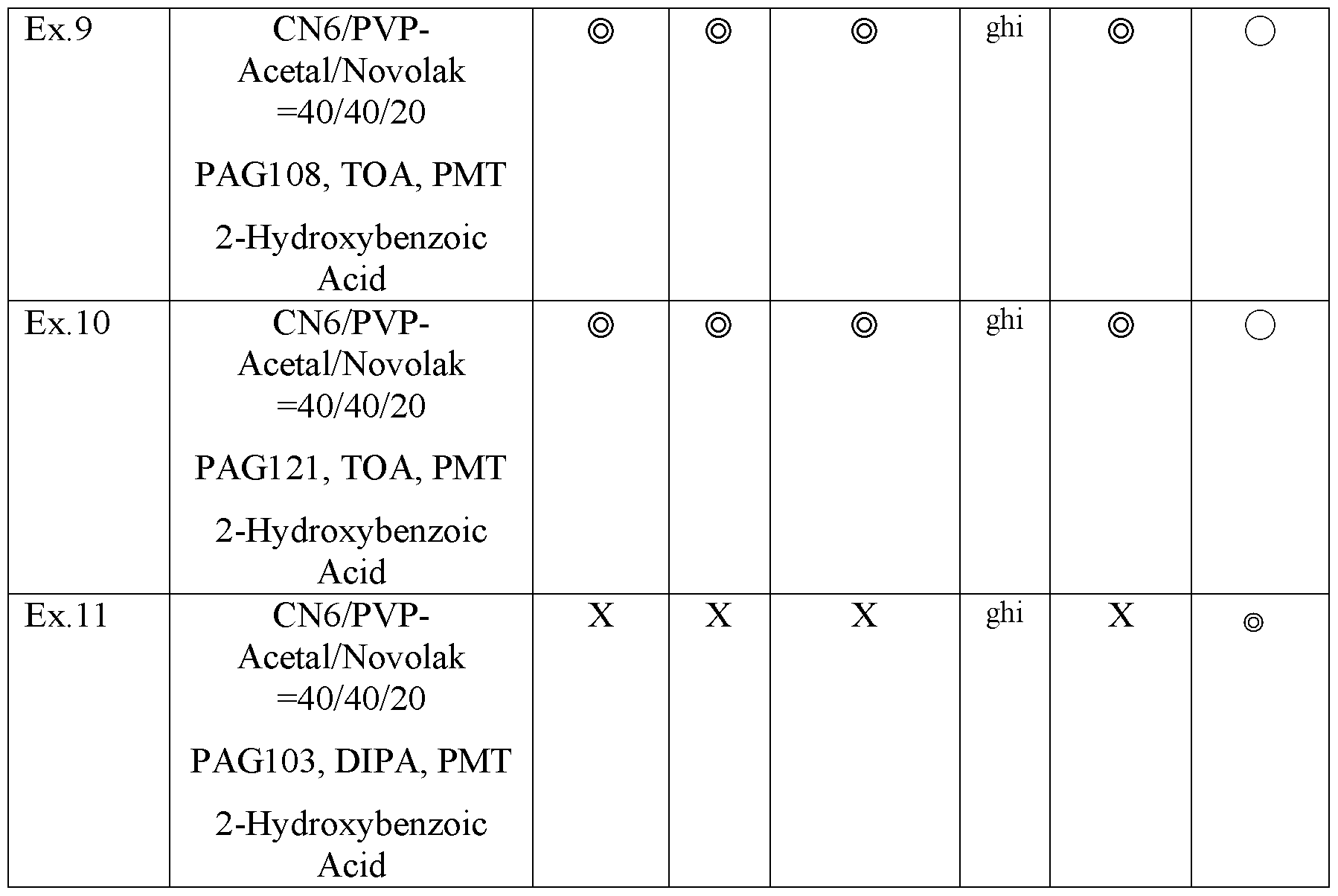
Summary of Experimental Results
[0191] A problem of aging issues, manifested by line slimming of patterned L/S and yellowing of the solution were unexpectedly removed by formulating the inventive photoresist with combination of PAG of structure (1) such as IRGACURE103, with a hydroxybenzoic acid of structure (2), such as salicylic acid, instead of using a PAG which is a N-Hydroxynaphthalimide perfluoroalkylsulfonate such as N-Hydroxynaphthalimide perfluoro- 1 -butanesulfonate.
[0192] A problem of a poor post-exposure delay (PED) where a delay between exposure of a photoresist to radiation and development of this patterned photoresist led to line slimming (e.g. L/S patterns where the lines tended to narrow)) was unexpectedly resolved by using a trialkylamine such a trioctylamine, instead of an aniline derivative such as 2,6- diisopropyaniline.
[0193] Thus, it has been unexpectedly found that the combination of the additive components (1), (2), (3), (4), respectively of structures (I), (II), (III) and (IV) impart to photoresist formulations containing solid polymer components (5), (6) and (7), in an organic spin casting solvent much greater aging stability, for coated and irradiated film,
prepared from these photoresist formulations, much better post-exposure delay (PED) latitude between exposure and aqueous base development solving the problem of undesirable pattern slimming while also preventing the formation of undercuts at the pattern substrate interface.
[0194] More specifically, component (1) and (2) together act with unexpected synergy to improve the aging stability of the inventive formulation, when aged at 40°C for a week, preventing both discoloration and a very large Critical Dimensions (CD) of line and space (L/S) features slimming during this aging which were observed when other similar PAG’s such as N-hydroxynaphthalimide perfluoroalkyl-sulfonates are employed, while unexpectedly preserving the high sensitivity imparted by these other PAG which generate upon irradiation a much more acidic perfluorinated alkylsulfonic acid instead of the alkyl sulfonate generated photogenerated by component (2). Also, replacement of a fluorinated PAG such as N-hydroxynaphthalimide perfluoroalkyl-sulfonates with a non-fluorinated PAG also solves the problem of using such fluorinated materials which have recently becoming under higher scrutiny because of the bioaccumulation of PFAS and PFOS derivatives. Lastly, the component (1) PAG of general structure (I), absorb and are sensitive at the g, h and i lines of UV radiation unlike the PAG having a N-Hydroxynaphthalimide perfluoroalkylesulfonate structure such as NIN employed in the comparative examples.
[0195] Quencher Components (3), when used with additive components (1) and (2), act to greatly improve post exposure delay (PED) latitude (between exposure and development) than other quencher components such as those based on aniline derivatives. Finally, the thiol component (4) of structure (IV), which are 5-mercapto-l-aryl-IH- tetrazoles, when employed in these formulations unexpectedly prevents the formation of undesirable undercuts, which promote adhesion failure, which is observed with thiol compounds having different structures such as 3-mercapto-l,2,4-triazoles derivatives.
Claims
1. A photoresist composition comprising:
Component (1), a PAG component having structure (I), wherein R2P is selected from a C-
1 to C-3 alkyl, and Rip is selected from a C-2 to C-8 alkyl, and an aryl,

Component (2), a hydroxybenzoic acid component having structure (II), wherein nii is 1 or 2,

(II);
Component (3), a quencher which is a trialkyl amine having structure (III), wherein Rq, Rql and Rq2 are independently selected from a C-5 to C-9 alkyl,
Rq
N
Rqi Rq2 (TIT)
Component (4), an adhesion promoter, which is an aryl- l //-tetrazole-5 -thiol derivative having structure (IV), wherein Riv is a substituted or unsubstituted aryl;

Component (5), a polymer comprising a reaction product formed in the absence of an acid catalyst between
(i) a Novolak polymer, (ii) a polymer comprising substituted or unsubstituted
hydroxystyrene and acrylate, methacrylate or a mixture of acrylate and methacrylate, the acrylate and/or methacrylate being protected by an acid labile group that requires a high activation energy for deblocking, and (iii) a compound selected from a vinyl ether and an unsubstituted or substituted, unsaturated heteroalicyclic moiety;
Component (6), a polymer component comprising structure (V):
 wherein Ri is an unsubstituted or substituted alkyl or unsubstituted or substituted cycloalkyl, R2 is hydrogen or a Ci to C4 alkyl, R3 is a Ci to C4 alkyl or a C2 to C4 alkylenehydroxy moiety, R4 is hydrogen or a Ci to C4 alkyl, R5 is hydrogen or Ci to C4 alkyl, and x, y, z, and w are the mole % of each type of repeat unit, based on the total moles of x, y, z and w, where x is equal to about 30 to about 40 mole %, y is equal to about 60 to about 70 mole %, z is equal to about 0 to about 10 mole %, w is equal to 0 to about 10 mole %, where the sum of x, y, z, and w is equal to 100 mole % and the sum of z and w does not exceed about 10 mole %,
Component (7), a Novolak polymer soluble in aqueous base;
Component (8), an organic spin casting solvent;
Component (9), an optional surfactant.
2. The composition of claim 1, wherein it consists essentially of components (1), (2),
(3), (4), (5), (6), (7), (8) and (9).
3. The composition of claim 1 or 2, wherein it consists of components (1), (2), (3),
(4), (5), (6), (7), (8) and (9).
4. The composition of any one of claims 1 to 3, wherein component (1) of structure
(I) is one where Rip is a C-2 to C-8 alkyl.
5. The composition of any one of claims 1 to 3, wherein component (1) of structure (I) is one where Rip is an aryl.
6. The composition of any one of claims 1 to 5, wherein component (1) is a PAG which has structure (la),
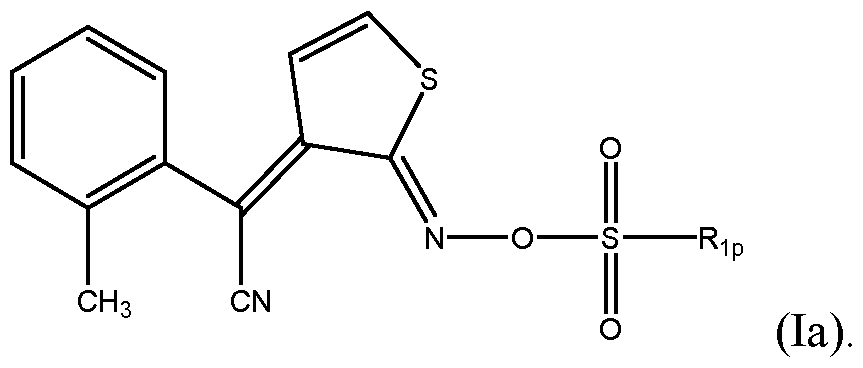
7. The composition of any one of claims 1 to 4, wherein component (1) is a PAG which has structure

8. The composition of any one of claims 1 to 7, wherein component (1 ), said PAG has a wt. % as a function of the total wt. of solid components (1), (2), (3), (4), (5), (6), (7) and (9) which ranges from about 0.7 wt. % to about 2.1 wt. % of total solids, wherein the sum of the wt. % of solids of (1), (2), (3), (4), (5), (6), (7) and (9) is equal to 100 wt. % of solids.
9. The composition of any one of claim 1 to 8, wherein component (2), said hydrobenzoic acid component has structure (II), wherein nii is 2,

10. The composition of claim 9, wherein component (2) is selected from a compound having structures (Ilal), (IIa2), (IIa3), (IIa4), (IIa5), (IIa6) and mixtures thereof,

11. The composition of any one of claims 1 to 10, wherein component (2), said hydroxybenzoic acid component has structure (Ila),

12. The composition of claim 11, wherein component (2) is selected from a compound having structures (2b), (2c) or (3d) and mixtures thereof,

13. The composition of claim 12, wherein component (2), said hydroxybenzoic acid is a single compound having structure (lib), (lie) or (nd),

14. The composition of claim 13, wherein component (2), is only one compound and it has structure (lib)
 (lib).
15. The composition of any one of claims 1 to 14, wherein component (2) has a wt. % as a function of the total wt. of solid components (1), (2), (3), (4), (5), (6), (7) and (9) which ranges from about 0.05 wt. % to about 0.15 wt. % of total solids, wherein the sum of the wt. % of solids of (1), (2), (3), (4), (5), (6), (7) and (9) is equal to 100 wt. % of solids.
16. The composition of any one of claims 1 to 15, wherein component (3), said trialkyl amine has structure (Illa), wherein nq, nql and nq2 are integers independently selected from 1 to 5,

17. The composition of any one of claims 1 to 16, wherein component (3), said trialkyl amine quencher has structure (ITIb), where nq4 is an integer which ranges from 1 to 4,
 (Illb).
18. The composition of any one of claims 1 to 17, wherein component (3), said trialkyl amine quencher is tri(n-octyl)amine.
19. The composition of any one of claims 1 to 18, wherein component (3) has a wt. % as a function of the total wt. of solid components (1), (2), (3), (4), (5), (6), (7) and (9) which ranges from about 0.21 wt. % to about 0.63 wt. % of total solids, wherein the sum of the wt. % of solids of (1), (2), (3), (4), (5), (6), (7) and (9) is equal to 100 wt. % of solids.
20. The composition of any one of claims 1 to 19, wherein component (4), said aryl- l /7-tetrazole-5-thiol derivative is a mixture of at least two different compounds having structure (IV):

21. The composition of any one of claims 1 to 19, wherein component (4), said aryl- 1 H-tetrazole-5-thiol is one compound of structure (IV), wherein Riv is a substituted or unsubstituted aryl:

22. The composition of any one of claims 1 to 21, wherein said compound having structure (IV) is selected from the group consisting of compounds having structures (IVb), (IVc), (IVd), (IVe), (IVf), (IVg), (IVh), (IVi), (IVj), (IVk), (IV1), (IVm), (IVn), (IVo),
(IVp) and mixtures thereof,


23. The composition of any one of claims 1 to 20, and 22, wherein component (4), said aryl- 1 H-tetrazole-5 -thiol derivative is a mixture of at least two different compounds having structure (IVa), wherein Rp is selected from the group consisting of H, a C-l to C-4 alkyl, a C-l to C-4 alkoxy, Br, Cl, F, I, an unsubstituted phenyl, a substituted phenyl, and hydroxy:

24. The composition of any one of claims 1 to 19, 21 and 22, wherein component (4), said aryl- 1 H-tetrazole-5-thiol derivative is one compound having structure (IVa), wherein Rp is selected from the group consisting of H, a C-l to C-4 alkyl, a C-l to C-4 alkoxy, Br, Cl, F, I, an unsubstituted phenyl, a substituted phenyl, and hydroxy:

25. The composition of claim 24, wherein component (4), said aryl-l/f-tetrazole-5- thiol derivative is one compound having structure (IVa), wherein Rp is selected from the group consisting ofH, a C-l to C-4 alkyl, and hydroxy:
26. The composition of claim 25, wherein component (4), has structure (IVc),

27. The composition of any one of claims 1 to 26, wherein component (4) has a wt. % as a function of the total wt. of solid components (1), (2), (3), (4), (5), (6), (7) and (9) which ranges from about 0.05 wt. % to about 0.15 wt. % of total solids, wherein the sum of the wt. % of solids of (1), (2), (3), (4), (5), (6), (7) and (9) is equal to 100 wt. % of solids.
28. The photoresist composition of any one of claims 1 to 27, wherein in Component (5), said reaction product has a dissolution rate in 0.26 N TMAH less than 30 A/second.
29. The photoresist composition of any one of claims 1 to 28, wherein in Component
(5) said reaction product is formed by reaction with a vinyl ether which has the formula:
 where Rr> is an unsubstituted or substituted alkyl or an unsubstituted or substituted cycloalkyl.
30. The photoresist composition of claim 29, wherein the vinyl ether is ethyl vinyl ether.
31. The photoresist composition of any one of claims 1 to 28, wherein in Component
(5), said reaction product is formed by reaction with an unsubstituted or substituted, unsaturated heteroalicyclic moiety.
32. The photoresist composition of claim 31, wherein the unsubstituted unsaturated heteroalicyclic moiety is 3,4-dihydro-2H-pyran.
33. The photoresist composition of any one of claims 1 to 32, wherein Component (5) is formed by reaction with a polymer comprising formula:
 where R? is hydrogen or a Ci to C4 alkyl, Rs is an acid labile group that requires a high activation energy for deblocking, and x’, and z’ are the mole % of each type of repeat unit, based on the total moles of x’ and z’, where x’ is equal to about 55 to about 65 mole %, and z is equal to about 35 to about 45 mole %, where the sum of x’ and z’ is equal to 100 mole %.
34. The photoresist composition of claim 33, where R7 is methyl, and Rs is tert-butyl.
35. The photoresist composition of claim 34, where x’ is about 60 mole % and z’ is about 40 mole%.
36. The composition of any one of claims 1 to 35, wherein component (5) has a wt. % as a function of the total wt. of solid components (1), (2), (3), (4), (5), (6), (7) and (9) which ranges from about 19.6 wt. % to about 88.1 wt. % of total solids, wherein the sum of the wt. % of solids of (1), (2), (3), (4), (5), (6), (7) and (9) is equal to 100 wt. % of solids.
37. The photoresist composition of any one of claims 1 to 36, wherein in Component (6), the polymer comprises formula:

38. The photoresist composition of claim 37, wherein Ri is methyl.
39. The photoresist composition of any one of claims 1 to 36, wherein in Component (6), the polymer comprises formula:
 where Ri is a unsubstituted or substituted alkyl or unsubstituted or substituted cycloalkyl, R2 is hydrogen or a Ci to C4 alkyl, R3 is a Ci to C4 alkyl or a C2 to C4 alkylenehydroxy moiety and x’”, y’”, and z’” are the mole % of each type of repeat unit, based on the total moles of x’ ”, y” ’ and z’ ’ ’ where x” ’ is equal to about 30 to about 38 mole %, y” ’ is equal to about 60 to about 68 mole %, z’” is equal to about 2 to about 10 mole %, where the
sum ofx’”, y’” and z”’ is equal to 100 mole %.
where Ri is a unsubstituted or substituted alkyl or unsubstituted or substituted cycloalkyl, R2 is hydrogen or a Ci to C4 alkyl, R3 is a Ci to C4 alkyl or a C2 to C4 alkylenehydroxy moiety and x’”, y’”, and z’” are the mole % of each type of repeat unit, based on the total moles of x’ ”, y” ’ and z’ ’ ’ where x” ’ is equal to about 30 to about 38 mole %, y” ’ is equal to about 60 to about 68 mole %, z’” is equal to about 2 to about 10 mole %, where the
sum ofx’”, y’” and z”’ is equal to 100 mole %.
40. The photoresist composition of claim 39 where Ri and R2 are methyl and R3 is a Ci to C4 alkyl.
41. The photoresist composition of any one of claims 1 to 36, wherein in Component (6), the polymer comprises formula:
 where Ri is an unsubstituted or substituted alkyl or unsubstituted or substituted cycloalkyl, R4 is hydrogen or a Ci to C4 alkyl, R5 is hydrogen or Ci to C4 alkyl, and x””, y””, and w” ” are the mole % of each type of repeat unit, based on the total moles of x” ”, y” ” and w”” where x is equal to about 30 to about 39 mole %, y”” is equal to about 60 to about 69 mole %, w is equal to about 1 to about 10 mole %, where the sum ofx””, y”” and w” ” is equal to 100 mole %.
42. The composition of any one of claims 1 to 41 , wherein component (6) has a wt. % as a function of the total wt. of solid components (1), (2), (3), (4), (5), (6), (7) and (9) which ranges from about 18.74 wt. % to about 58.73 wt. % of total solids, wherein the sum of the wt. % of solids of (1), (2), (3), (4), (5), (6), (7) and (9) is equal to 100 wt. % of solids.
43. The photoresist composition of any one of claims 1 to 42, wherein component (7), said Novolak, is a meta cresol Novolak.
44. The photoresist composition of claim 43, wherein component (7), said Novolak, has a dissolution rate in 0.26 N TMAH at room temperature from about 200 A/second to about 1300 A/second.
45. The composition of any one of claims 1 to 44 wherein component (1), said PAG,
ranges from about 0.7 to about 2.1 wt. % of total solids, component (2), said hydroxy benzoic acid component, ranges from 0.05 to about 0.15 wt. % of total solids, component
(3), said quencher, ranges from about 0.21 to about 0.63 wt. % of total solids, component
(4), said thiol compound, ranges from about 0.05 to about 0.15 wt. % of total solids, component (5), said reaction product, ranges from about 19.6 to about 79.42 wt. % total solids, component (6), said polymer component, ranges from about 18.74 to about 58.73 wt. % of total solids, component (7), said Novolak polymer, ranges from 0.83 wt. % to about 29.35 wt. % of total solids, component (9), ranges from 0 to 10 wt. % of total solids, where the sum of the wt. % of solids of (1), (2), (3), (4), (5), (6), (7) and (9) is equal to 100 wt. % of solids.
46. The composition of any one of claims 1 to 45, wherein component (8), said organic spin casting solvent, ranges from about 50 wt. % to about 80 wt. % of total the total weight of the photoresist composition.
47. A coated substrate comprising: a substrate having thereon a coating layer of the photoresist composition of any one of claims 1 to 46.
48. A method for forming a photoresist relief image on a substrate comprising: (a) applying on a substrate a layer of the photoresist composition of any one of claims 1 to 46, and (b) exposing the photoresist layer to activating radiation and developing the exposed photoresist layer.
49. The use of the photoresist composition of any one of claims 1 to 46 for coating a substrate or for forming a photoresist relief image on a substrate.
Applications Claiming Priority (2)
| Application Number | Priority Date | Filing Date | Title |
|---|---|---|---|
| US202363611437P | 2023-12-18 | 2023-12-18 | |
| US63/611,437 | 2023-12-18 |
Publications (2)
| Publication Number | Publication Date |
|---|---|
| WO2025132182A2 true WO2025132182A2 (en) | 2025-06-26 |
| WO2025132182A3 WO2025132182A3 (en) | 2025-08-14 |
Family
ID=94117107
Family Applications (1)
| Application Number | Title | Priority Date | Filing Date |
|---|---|---|---|
| PCT/EP2024/086516 Pending WO2025132182A2 (en) | 2023-12-18 | 2024-12-16 | Post-exposure bake less chemically amplified photoresist composition |
Country Status (2)
| Country | Link |
|---|---|
| TW (1) | TW202544167A (en) |
| WO (1) | WO2025132182A2 (en) |
Family Cites Families (4)
| Publication number | Priority date | Publication date | Assignee | Title |
|---|---|---|---|---|
| JP3738420B2 (en) * | 2001-11-16 | 2006-01-25 | 東京応化工業株式会社 | Positive photoresist composition and method for forming thin-film resist pattern for inclined implantation process |
| JP4623311B2 (en) * | 2006-06-14 | 2011-02-02 | 信越化学工業株式会社 | Photoacid generator for chemically amplified resist material, resist material containing the photoacid generator, and pattern forming method using the same |
| WO2018029142A1 (en) * | 2016-08-09 | 2018-02-15 | AZ Electronic Materials (Luxembourg) S.à.r.l. | Enviromentally stable, thick film, chemically amplified resist |
| JP2024541353A (en) * | 2021-11-17 | 2024-11-08 | メルク パテント ゲゼルシャフト ミット ベシュレンクテル ハフツング | Positive tone ultra thick photoresist composition |
-
2024
- 2024-12-16 TW TW113148852A patent/TW202544167A/en unknown
- 2024-12-16 WO PCT/EP2024/086516 patent/WO2025132182A2/en active Pending
Non-Patent Citations (2)
| Title |
|---|
| GARY SOLOMON: "Process integration of electroplated solder bumps for WLP", SOLID STATE TECHNOLOGY, 1 November 2001 (2001-11-01), Retrieved from the Internet <URL:https://sst.semiconductor-digest.com/2001/11/process-integration-of-electroplated-solder-bumps-for-wlp/#> |
| no. 171417-91-7 |
Also Published As
| Publication number | Publication date |
|---|---|
| WO2025132182A3 (en) | 2025-08-14 |
| TW202544167A (en) | 2025-11-16 |
Similar Documents
| Publication | Publication Date | Title |
|---|---|---|
| CN109844641B (en) | Environmentally stable thick film chemically amplified resists | |
| EP1913444B1 (en) | Photoresist composition for imaging thick films | |
| KR101505482B1 (en) | Thick film resists | |
| WO2004083962A2 (en) | Photoresist composition for the formation of thick films | |
| TW202004340A (en) | Novolak/DNQ based, chemically amplified photoresist | |
| JP2005156816A (en) | Base material and multilayer resist pattern forming method | |
| JP2005522533A (en) | NOVOLAC RESIN MIXTURE AND PHOTOSENSITIVE COMPOSITION CONTAINING THE SAME | |
| JPH08262712A (en) | Radiation-sensitive resin composition | |
| JP2711254B2 (en) | Radiation-sensitive composition containing all-substituted novolak polymer | |
| TWI862734B (en) | Pag-free positive chemically amplified resist composition and methods of using the same | |
| EP1877865B1 (en) | Nanocomposite photoresist composition for imaging thick films | |
| TW202544167A (en) | Post-exposure bake less chemically amplified photoresist composition | |
| JP3429039B2 (en) | Positive photoresist composition | |
| JP2715328B2 (en) | Positive photoresist composition | |
| JP2569705B2 (en) | Positive photoresist | |
| JP2751572B2 (en) | Radiation-sensitive resin composition | |
| JP3149548B2 (en) | Positive resist for deformed light source exposure | |
| JP3360363B2 (en) | Method of forming resist coating | |
| JPH05119474A (en) | Positive photoresist composition | |
| JPH1020503A (en) | Radiation-sensitive resin composition | |
| JPH04241353A (en) | Positive type resist composition | |
| JPH04251257A (en) | Positive type photoresist composition | |
| JPH04328556A (en) | Formation of pattern | |
| JPH0594011A (en) | Positive type photoresist composition | |
| JPH05257276A (en) | Positive type photoresist composition |