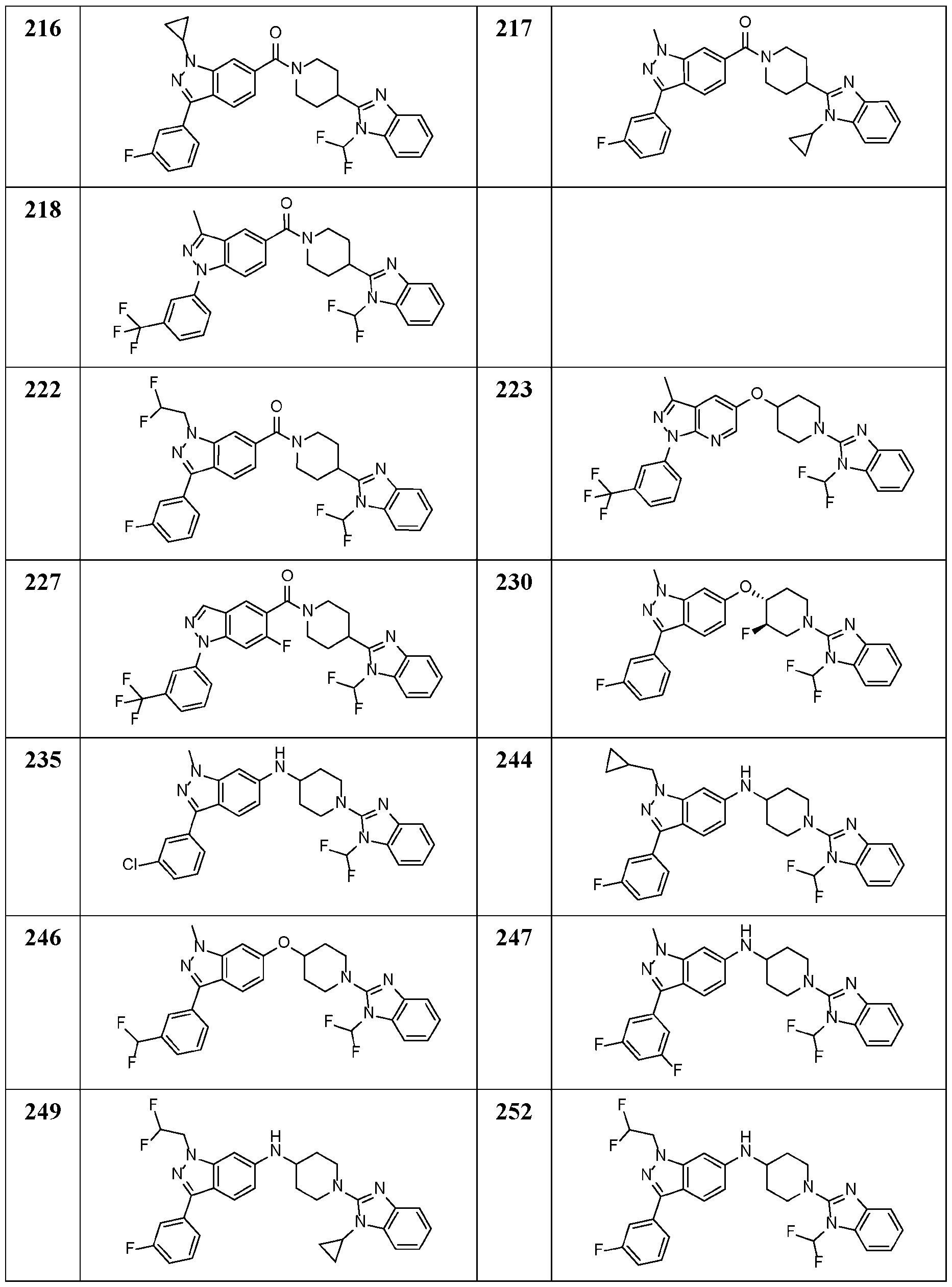
[0072] In other embodiments, compounds of Formula I are selected from the compounds shown in Table 2, and tautomers, pharmaceutically acceptable salts, solvates, hydrates, clathrates, isotopes, or isotopic forms including deuterated and tritiated forms, polymorphs and stereoisomers thereof, wherein compounds having a stereocenter can have the (R)-stereochemistry or the (S)- stereochemistry at the stereocenter or can be racemic at the stereocenter.
Table 2


Salt Forms of Compounds [0073] Compounds of Formula I may have a basic nitrogen atom, in which case they can exist as a free base or as salts. Such compounds can be used as a free base or as pharmaceutically acceptable salts. A basic nitrogen atom can form an addition salt with an acid, such as a mineral acid (e.g., HCl, HBr, HI, nitric acid, phosphoric acid or sulfuric acid) or an organic acid (e.g., a carboxylic acid or a sulfonic acid). Suitable acids for use in the preparation of pharmaceutically acceptable salts include without limitation acetic acid, 2,2-dichloroacetic acid, acylated amino acids, adipic acid, alginic acid, ascorbic acid, L-aspartic acid, benzenesulfonic acid, benzoic acid, 4- acetamidobenzoic acid, boric acid, (+)-camphoric acid, camphorsulfonic acid, (+)-(1S)-camphor- 10-sulfonic acid, capric acid, caproic acid, caprylic acid, cinnamic acid, citric acid, cyclamic acid, cyclohexanesulfamic acid, dodecylsulfuric acid, ethane-1,2-disulfonic acid, ethanesulfonic acid, 2- hydroxyethanesulfonic acid, formic acid, fumaric acid, galactaric acid, gentisic acid, glucoheptonic acid, D-gluconic acid, D-glucuronic acid, L-glutamic acid, alpha-oxo-glutaric acid, glycolic acid, hippuric acid, hydrobromic acid, hydrochloric acid, hydroiodic acid, (±)-DL-lactic acid, (+)-L- lactic acid, lactobionic acid, lauric acid, maleic acid, (-)-L-malic acid, malonic acid, (±)-DL- mandelic acid, methanesulfonic acid, naphthalene-2-sulfonic acid, naphthalene-1,5-disulfonic acid, 1-hydroxy-2-naphthoic acid, nicotinic acid, nitric acid, oleic acid, orotic acid, oxalic acid, palmitic acid, pamoic acid, perchloric acid, phosphoric acid, propionic acid, L-pyroglutamic acid, pyruvic acid, saccharic acid, salicylic acid, 4-amino-salicylic acid, sebacic acid, stearic acid, succinic acid, sulfuric acid, tannic acid, (±)-DL-tartaric acid, (+)-L-tartaric acid, thiocyanic acid, p- toluenesulfonic acid, undecylenic acid, and valeric acid. [0074] If a compound has an acidic group (e.g., a carboxyl group), the acidic group can form an addition salt with a base. Pharmaceutically acceptable base addition salts can be formed with, e.g., metals (e.g., alkali metals or alkaline earth metals) or amines (e.g., organic amines). Examples of metals useful as cations include without limitation alkali metals (e.g., lithium, sodium, potassium and cesium), alkaline earth metals (e.g., magnesium, calcium and barium),
aluminum and zinc. Metal cations can be provided by way of, e.g., inorganic bases, such as hydroxides, carbonates and hydrogen carbonates. Non-limiting examples of organic amines useful for forming base addition salts include chloroprocaine, choline, cyclohexylamine, dibenzylamine, N,N’-dibenzylethylenediamine, dicyclohexylamine, diethanolamine, ethylenediamine, N-ethylpiperidine, histidine, isopropylamine, N-methylglucamine, procaine, pyrazine, triethylamine, trimethylamine and tromethamine. Pharmaceutically acceptable salts are discussed in detail in Handbook of Pharmaceutical Salts, Properties, Selection and Use, P. Stahl and C. Wermuth, Eds., Wiley-VCH (2011). Pharmaceutical Compositions [0075] The disclosure also provides pharmaceutical compositions comprising an indirect Na
V1.7 inhibitor described herein (“Na
V1.7 inhibitor” for brevity), or a tautomer, pharmaceutically acceptable salt, solvate, hydrate, clathrate, polymorph or stereoisomer thereof, and one or more pharmaceutically acceptable excipients or carriers. The compositions can optionally contain an additional therapeutic agent such as an additional analgesic. A pharmaceutical composition contains a therapeutically effective amount, or any appropriate fraction thereof, of a NaV1.7 inhibitor, one or more pharmaceutically acceptable excipients or carriers and optionally a therapeutically effective amount of an additional therapeutic agent, and is formulated for administration to a subject for therapeutic use. For purposes of the content of a pharmaceutical composition, the term “active ingredient”, “active agent”, “therapeutic agent”, “drug” or the like encompasses a prodrug. [0076] A pharmaceutical composition contains a Na
V1.7 inhibitor and optionally an additional therapeutic agent in substantially pure form. In some embodiments, the purity of the Na
V1.7 inhibitor and the optional additional therapeutic agent independently is at least about 95%, 96%, 97%, 98% or 99%. In addition, a pharmaceutical composition is substantially free of contaminants or impurities. In some embodiments, the level of contaminants or impurities other than residual solvent in a pharmaceutical composition is no more than about 5%, 4%, 3%, 2% or 1% relative to the combined weight of the intended active and inactive ingredients. Pharmaceutical compositions generally are prepared according to current good manufacturing practice (GMP), as recommended or required by, e.g., the Federal Food, Drug, and Cosmetic Act §501(a)(2)(B) and the International Conference on Harmonisation Q7 Guideline. [0077] Pharmaceutical compositions/formulations can be prepared in sterile form. For example, pharmaceutical compositions/formulations for parenteral administration by injection or infusion
generally are sterile. Sterile pharmaceutical compositions/formulations are compounded or manufactured according to pharmaceutical-grade sterilization standards known to those of skill in the art, such as those disclosed in or required by the United States Pharmacopeia Chapters 797, 1072 and 1211, and 21 Code of Federal Regulations 211. [0078] Pharmaceutically acceptable excipients and carriers include pharmaceutically acceptable substances, materials and vehicles. Non-limiting examples of types of excipients include liquid and solid fillers, diluents, binders, lubricants, glidants, surfactants, dispersing agents, disintegration agents, emulsifying agents, wetting agents, suspending agents, thickeners, solvents, isotonic agents, buffers, pH adjusters, absorption-delaying agents, stabilizers, antioxidants, preservatives, antimicrobial agents, antibacterial agents, antifungal agents, chelating agents, adjuvants, sweetening agents, flavoring agents, coloring agents, encapsulating materials and coating materials. The use of such excipients in pharmaceutical formulations is known in the art. For example, conventional vehicles and carriers include without limitation oils (e.g., vegetable oils such as olive oil and sesame oil), aqueous solvents {e.g., saline, buffered saline (e.g., phosphate-buffered saline [PBS]) and isotonic solutions (e.g., Ringer’s solution)}, and organic solvents (e.g., dimethyl sulfoxide [DMSO] and alcohols [e.g., ethanol, glycerol and propylene glycol]). Except insofar as any conventional excipient or carrier is incompatible with the active ingredient, the disclosure encompasses the use of conventional excipients and carriers in formulations containing Na
V1.7 inhibitors. See, e.g., Remington: The Science and Practice of Pharmacy, 21st Ed., Lippincott Williams & Wilkins (Philadelphia, Pennsylvania) (2005); Handbook of Pharmaceutical Excipients, 5th Ed., Rowe et al., Eds., The Pharmaceutical Press and the American Pharmaceutical Association (2005); Handbook of Pharmaceutical Additives, 3rd Ed., Ash and Ash, Eds., Gower Publishing Co. (2007); and Pharmaceutical Pre-formulation and Formulation, Gibson, Ed., CRC Press (Boca Raton, Florida) (2004). [0079] Appropriate formulation can depend on various factors, such as the route of administration chosen. Potential routes of administration of pharmaceutical compositions comprising Na
V1.7 inhibitors include without limitation oral, parenteral (including intradermal, subcutaneous, intramuscular, intravascular, intravenous, intra-arterial, intraperitoneal, intracavitary, intramedullary, intrathecal and topical), and topical (including dermal/epicutaneous, transdermal, mucosal, transmucosal, intranasal [e.g., by nasal spray or drop], ocular/intraocular [e.g., by eye drop], pulmonary [e.g., by oral or nasal inhalation], buccal,
sublingual, rectal [e.g., by suppository], and vaginal [e.g., by suppository]). Topical formulations can be designed to produce a local or systemic therapeutic effect. [0080] As an example, formulations of Na
V1.7 inhibitors suitable for oral administration can be presented in discrete units adapted for instant, controlled or sustained release as, e.g., boluses; capsules (including push-fit capsules and soft capsules), tablets, pills, cachets or lozenges; as powders or granules; as semisolids, electuaries, pastes or gels; as solutions or suspensions in an aqueous liquid or/and a non-aqueous liquid; or as oil-in-water liquid emulsions or water-in-oil liquid emulsions. [0081] Push-fit capsules or two-piece hard gelatin capsules can contain a Na
V1.7 inhibitor in admixture with, e.g., a filler or inert solid diluent (e.g., calcium carbonate, calcium phosphate, kaolin or lactose), a binder (e.g., a starch), a glidant or lubricant (e.g., talc or magnesium stearate), and a disintegrant (e.g., crospovidone), and optionally a stabilizer or/and a preservative. For soft capsules or single-piece gelatin capsules, a Na
V1.7 inhibitor can be dissolved or suspended in a suitable liquid (e.g., liquid polyethylene glycol or an oil medium, such as a fatty oil, peanut oil, olive oil or liquid paraffin), and the liquid-filled capsules can contain one or more other liquid excipients or/and semi-solid excipients, such as a stabilizer or/and an amphiphilic agent (e.g., a fatty acid ester of glycerol, propylene glycol or sorbitol). [0082] Tablets can contain a Na
V1.7 inhibitor in admixture with, e.g., a filler or inert diluent (e.g., calcium carbonate, calcium phosphate, lactose, mannitol or microcrystalline cellulose), a binding agent (e.g., a starch, gelatin, acacia, alginic acid or a salt thereof, or microcrystalline cellulose), a lubricating agent (e.g., stearic acid, magnesium stearate, talc or silicon dioxide), and a disintegrating agent (e.g., crospovidone, croscarmellose sodium or colloidal silica), and optionally a surfactant (e.g., sodium lauryl sulfate). The tablets can be uncoated or can be coated with, e.g., an enteric coating that protects the active agent from the acidic environment of the stomach, or with a material that delays disintegration and absorption of the active agent in the gastrointestinal (GI) tract and thereby provides a sustained action over a longer time period. [0083] Compositions for oral administration can also be formulated as solutions or suspensions in an aqueous liquid and/or a non-aqueous liquid, or as oil-in-water liquid emulsions or water-in- oil liquid emulsions. Dispersible powder or granules of a Na
V1.7 inhibitor can be mixed with any suitable combination of an aqueous liquid, an organic solvent or/and an oil and any suitable
excipients (e.g., any combination of a dispersing agent, a wetting agent, a suspending agent, an emulsifying agent or/and a preservative) to form a solution, suspension or emulsion. [0084] Na
V1.7 inhibitors can also be formulated for parenteral administration by injection or infusion to circumvent gastrointestinal absorption and first-pass metabolism. An exemplary parenteral route is intravenous. Additional advantages of intravenous administration include direct administration of a therapeutic agent into systemic circulation to achieve a rapid systemic effect, and the ability to administer the agent continuously or/and in a large volume if desired. Formulations for injection or infusion can be in the form of, e.g., solutions, suspensions or emulsions in oily or aqueous vehicles, and can contain excipients such as suspending agents, dispersing agents or/and stabilizing agents. For example, aqueous or non-aqueous (e.g., oily) sterile injection solutions can contain a Na
V1.7 inhibitor along with excipients such as an antioxidant, a buffer, a bacteriostat and solutes that render the formulation isotonic with the blood of the subject. Aqueous or non-aqueous sterile suspensions can contain a Na
V1.7 inhibitor along with excipients such as a suspending agent and a thickening agent, and optionally a stabilizer and an agent that increases the solubility of the NaV1.7 inhibitor to allow for the preparation of a more concentrated solution or suspension. As another example, a sterile aqueous solution for injection or infusion (e.g., subcutaneously or intravenously) can contain a Na
V1.7 inhibitor, an isotonic agent (e.g., sodium chloride), a buffering agent (e.g., sodium citrate), a preservative (e.g., meta-cresol), and optionally a base (e.g., NaOH) or/and an acid (e.g., HCl) to adjust pH. [0085] Topical formulations for application to the skin or mucosa can be useful for transdermal or transmucosal administration of a therapeutic agent to the local target site of action, or into the blood for systemic distribution. Advantages of topical administration can include circumvention of the GI tract (including enzymes and acid in the GI tract and absorption through it) and first- pass metabolism; delivery of a therapeutic agent with a short half-life, a small therapeutic index or/and low oral bioavailability; controlled, continuous and sustained release of the therapeutic agent; a more uniform plasma level or delivery profile of the therapeutic agent; lower dose and less frequent dosing of the therapeutic agent; reduction of systemic side effects (e.g., side effects caused by a temporary overdose or an overly high peak plasma drug concentration); minimal or no invasiveness; ease of self-administration; and increased patient compliance. [0086] Compositions suitable for topical administration include without limitation liquid or semi-liquid preparations such as sprays, gels, liniments, lotions, oil-in-water or water-in-oil
emulsions such as creams, foams, ointments and pastes, and solutions or suspensions such as drops (e.g., eye drops, nose drops and ear drops). See Remington: The Science and Practice of Pharmacy, 21st Ed., Lippincott Williams & Wilkins (Philadelphia, Pennsylvania [2005]). Various excipients can be included in a topical formulation. For example, solvents, including a suitable amount of an alcohol, can be used to solubilize the active agent. Other optional excipients include without limitation gelling agents, thickening agents, emulsifiers, surfactants, stabilizers, buffers, antioxidants, preservatives, cooling agents (e.g. menthol), opacifiers, fragrances and colorants. For an active agent having a low rate of permeation through the skin or mucosal tissue, a topical formulation can contain a chemical permeation enhancer (e.g., a fatty acid ester [e.g., isopropyl myristate or isopropyl palmitate], a fatty acid [e.g., palmitic acid, oleic acid or palmitoleic acid], or/and an alcohol [e.g., propylene glycol or a fatty alcohol such as geraniol or farnesol]) to increase the permeation of the active agent through the skin or mucosal tissue. A topical formulation can also contain an irritation-mitigating excipient that reduces any irritation to the skin or mucosa caused by the active agent, the chemical permeation enhancer or any other component of the formulation. In some embodiments, a topical composition comprises a therapeutic agent dissolved, dispersed or suspended in a carrier. The carrier can be in the form of, e.g., a solution, a suspension, an emulsion, an ointment or a gel base, and can contain, e.g., petrolatum, lanolin, a wax (e.g., bee wax), mineral oil, a long-chain alcohol, polyethylene glycol or polypropylene glycol, a diluent (e.g., water or/and an alcohol [e.g., ethanol or propylene glycol]), a gel, an emulsifier, a thickening agent, a stabilizer or a preservative, or any combination thereof. A topical formulation can be administered by means of, e.g., a transdermal or transmucosal delivery device, such as a transdermal patch, a microneedle patch or an iontophoresis device. A topical composition can deliver a drug transdermally or transmucosally via a concentration gradient (with or without the use of a chemical permeation enhancer) or an active mechanism (e.g., iontophoresis or microneedles). [0087] For topical administration, a Na
V1.7 inhibitor can be formulated as, e.g., a buccal or sublingual tablet or pill. Advantages of a buccal or sublingual tablet or pill include avoidance of gastrointestinal absorption and first-pass metabolism, and rapid absorption into systemic circulation. A buccal or sublingual tablet or pill can be designed to provide faster release of the Na
V1.7 inhibitor for more rapid uptake of it into systemic circulation. In addition to a therapeutically effective amount of a Na
V1.7 inhibitor, the buccal or sublingual tablet or pill can contain suitable excipients, including without limitation any combination of fillers and diluents
(e.g., mannitol and sorbitol), binding agents (e.g., sodium carbonate), wetting agents (e.g., sodium carbonate), disintegrants (e.g., crospovidone and croscarmellose sodium), lubricants (e.g., silicon dioxide [including colloidal silicon dioxide] and sodium stearyl fumarate), stabilizers (e.g., sodium bicarbonate), flavoring agents (e.g., spearmint flavor), sweetening agents (e.g., sucralose), and coloring agents (e.g., yellow iron oxide). [0088] For topical administration, Na
V1.7 inhibitors can also be formulated for intranasal administration. The nasal mucosa provides a big surface area, a porous endothelium, a highly vascular subepithelial layer and a high absorption rate, and hence allows for high bioavailability. Moreover, intranasal administration avoids first-pass metabolism. An intranasal formulation can comprise a Na
V1.7 inhibitor along with excipients, such as a solubility enhancer (e.g., propylene glycol), a humectant (e.g., mannitol or sorbitol), a buffer and water, and optionally a preservative (e.g., benzalkonium chloride), a mucoadhesive agent (e.g., hydroxyethyl cellulose) or/and a penetration enhancer. An intranasal solution or suspension formulation can be administered to the nasal cavity by any suitable means, including but not limited to a dropper, a pipette, or a spray using, e.g., a metering atomizing spray pump. Table 3 shows exemplary excipients of nasal-spray formulations. [0089] An additional mode of topical administration of Na
V1.7 inhibitors is pulmonary, including by oral inhalation and nasal inhalation. A pulmonarily administered drug can treat a lung disease or/and a systemic disease, as the lungs serve as a portal to the systemic circulation. Advantages of pulmonary drug delivery include, for example: 1) avoidance of first-pass metabolism; 2) fast drug action; 3) large surface area of the alveolar region for absorption, high permeability of the lungs (thin air-blood barrier), and profuse vasculature of the airways; 4) reduced extracellular enzyme levels compared to the GI tract due to the large alveolar surface area; and 5) smaller doses to achieve equivalent therapeutic effect compared to other oral routes, and hence reduced systemic side effects. An advantage of oral inhalation over nasal inhalation includes deeper penetration/deposition of the drug into the lungs, although nasal inhalation can deliver the drug into systemic circulation transmucosally in the nasal cavity as well as in the lungs. Oral or nasal inhalation can be achieved by means of, e.g., a metered-dose inhaler (MDI), a dry powder inhaler (DPI) or a nebulizer, as is known in the art. In certain embodiments, a sterile aqueous solution for oral inhalation contains a Na
V1.7 inhibitor, sodium chloride, a buffering agent (e.g., sodium citrate), optionally a preservative (e.g., meta-cresol), and optionally a base (e.g., NaOH) or/and an acid (e.g., HCl) to adjust pH. Table 3 shows other exemplary excipients of oral-inhalation formulations.
[0090] Table 3. Exemplary excipients and carriers of pulmonary and nasal formulations
[0091] In some embodiments, a Na
V1.7 inhibitor is administered transdermally. In certain embodiments, the topical composition or transdermal delivery system comprises a chemical permeation enhancer (e.g., a surfactant [e.g., sodium laureth sulfate], optionally in combination with an aromatic compound [e.g., phenylpiperazine]) that facilitates the transport of the Na
V1.7 inhibitor across the skin. In further embodiments, the Na
V1.7 inhibitor is administered via a transdermal patch. In certain embodiments, the transdermal patch is a reservoir-type patch comprising an impermeable backing layer/film, a liquid- or gel-based drug reservoir, a semi-permeable membrane that serves as a rate-limiting or rate-controlling diffusion barrier, and a skin-contacting adhesive layer. The semi-permeable membrane can be composed of, e.g., a suitable polymeric material such as cellulose nitrate or acetate, polyisobutene, polypropylene, polyvinyl acetate or a polycarbonate. In other embodiments, the transdermal patch is a drug-in-adhesive patch comprising an impermeable backing layer/film and a skin-contacting adhesive layer incorporating the drug in a polymeric or viscous adhesive. The adhesive of the drug-loaded, skin-contacting adhesive layer can be, e.g., a pressure-sensitive adhesive (PSA), such as a PSA composed of an acrylic polymer (e.g.,
polyacrylate), a polyalkylene (e.g., polyisobutylene) or a silicone-based polymer (e.g., silicone-2675 or silicone-2920). Transdermal drug-delivery systems, including patches, can be designed to provide controlled and prolonged release of a drug over a period of about 1 week, 2 weeks, 3 weeks, 1 month or longer. [0092] Topical administration of a Na
V1.7 inhibitor may be particularly advantageous for treatment of pain or a pain-associated disorder. Na
V1.7 is expressed at high levels at peripheral endings in the skin and mucosa of nociceptive neurons whose cell bodies are located in the dorsal root ganglia or the trigeminal ganglia. A topical composition (e.g., a gel, ointment or cream) or a transdermal patch containing a Na
V1.7 inhibitor can be applied to the skin from where the pain sensation emanates. [0093] In some embodiments, a Na
V1.7 inhibitor is delivered from a sustained-release composition. As used herein, the term “sustained-release composition” encompasses sustained-release, prolonged- release, extended-release, delayed-release, slow-release and controlled-release compositions, systems and devices. Advantages of a sustained-release composition include without limitation a more uniform blood level of the drug (e.g., avoidance of wide peak-to-trough fluctuations), delivery of a therapeutically effective amount of the drug over a prolonged time period, reduced frequency of administration, and reduced side effects (e.g., avoidance of a drug overdose). In some embodiments, the sustained-release composition delivers the Na
V1.7 inhibitor over a period of at least about 3 days, 1 week, 2 weeks, 3 weeks, 1 month, 2 months or 3 months. [0094] In some embodiments, the sustained-release composition is a drug-encapsulation system, such as nanoparticles, microparticles or a capsule made of, e.g., a biodegradable polymer or/and a hydrogel. In certain embodiments, the sustained-release composition comprises a hydrogel. Non- limiting examples of polymers of which a hydrogel can be composed include polyvinyl alcohol, acrylate polymers (e.g., sodium polyacrylate), and other homopolymers and copolymers having a relatively large number of hydrophilic groups (e.g., hydroxyl or/and carboxylate groups). In other embodiments, the sustained-release drug-encapsulation system comprises a membrane-enclosed reservoir, wherein the reservoir contains a drug and the membrane is permeable to the drug. Such a drug-delivery system can be in the form of, e.g., a transdermal patch. [0095] In some embodiments, the sustained-release composition is formulated as polymeric nanoparticles or microparticles, wherein the polymeric particles can be delivered, e.g., by injection or from an implant. In some embodiments, the polymeric implant or polymeric nanoparticles or microparticles are composed of a biodegradable polymer. In certain embodiments, the
biodegradable polymer comprises lactic acid or/and glycolic acid [e.g., an L-lactic acid-based copolymer, such as poly(L-lactide-co-glycolide) or poly(L-lactic acid-co-D,L-2-hydroxyoctanoic acid)]. For example, biodegradable polymeric microspheres composed of polylactic acid or/and polyglycolic acid can serve as sustained-release pulmonary drug-delivery systems. The biodegradable polymer of the polymeric implant or polymeric nanoparticles or microparticles can be selected so that the polymer substantially completely degrades around the time the period of treatment is expected to end, and so that the byproducts of the polymer’s degradation, like the polymer, are biocompatible. [0096] In further embodiments, a sustained-release composition comprises a dendrimer. In certain embodiments, the dendrimer is a water-soluble dendrimer, such as a poly(amidoamine) (PAMAM) dendrimer. In some embodiments, a dendrimer encapsulates a drug through the formation of a dendrimer-drug supramolecular assembly. In other embodiments, a sustained-release composition comprises a water-soluble polymer [e.g., poly(DL-lactide)] or a liposome encapsulating a drug complexed with a dendrimer. [0097] In other embodiments, the sustained-release composition is an oral dosage form, such as a tablet or capsule. For example, a drug can be embedded in an insoluble porous matrix such that the dissolving drug must make its way out of the matrix before it can be absorbed through the GI tract. Alternatively, a drug can be embedded in a matrix that swells to form a gel through which the drug exits. Sustained release can also be achieved by way of a single-layer or multi-layer osmotic controlled-release oral delivery system (OROS). An OROS is a tablet with a semi-permeable outer membrane and one or more small laser-drilled holes in it. As the tablet passes through the body, water is absorbed through the semi-permeable membrane via osmosis, and the resulting osmotic pressure pushes the drug out through the hole(s) in the tablet and into the GI tract where it can be absorbed. [0098] For a delayed or sustained release of a NaV1.7 inhibitor, a composition can also be formulated as, e.g., a depot that can be implanted in or injected into a subject, e.g., intramuscularly, intracutaneously or subcutaneously. A depot formulation can be designed to deliver the Na
V1.7 inhibitor over an extended period of time, e.g., over a period of at least about 1 week, 2 weeks, 3 weeks, 1 month, 6 weeks, 2 months, 3 months or longer. For example, a Na
V1.7 inhibitor can be formulated with a polymeric material (e.g., polyethylene glycol [PEG], polylactic acid [PLA] or polyglycolic acid [PGA], or a copolymer thereof [e.g., PLGA or PLA- PEG]), with a hydrophobic material (e.g., as an emulsion in an oil) and/or an ion-exchange resin,
as a more lipophilic derivative (e.g., as an ester of or a salt with a fatty acid such as a C
8-C
20 fatty acid [e.g., decanoic acid]), or as a sparingly soluble derivative (e.g., a sparingly soluble salt). As an illustrative example, a Na
V1.7 inhibitor can be incorporated or embedded in sustained-release microparticles composed of PLGA and formulated as a monthly depot. [0099] A Na
V1.7 inhibitor can also be contained or dispersed in a matrix material. The matrix material can comprise a polymer (e.g., ethylene-vinyl acetate) and controls the release of the drug by controlling dissolution and/or diffusion of the drug from, e.g., a reservoir, and can enhance the stability of the drug while contained in the reservoir. Such a release system can be designed as a sustained-release system, can be configured as, e.g., a transdermal or transmucosal patch, and can contain an excipient that can accelerate the drug’s release, such as a water- swellable material (e.g., a hydrogel) that aids in expelling the drug out of the reservoir. US Pat. Nos.4,144,317 and 5,797,898 describe examples of such a release system. [00100] The release system can provide a temporally modulated release profile (e.g., pulsatile release) when time variation in plasma levels is desired, or a more continuous or consistent release profile when a constant plasma level is desired. Pulsatile release can be achieved from an individual reservoir or from a plurality of reservoirs. For example, where each reservoir provides a single pulse, multiple pulses (“pulsatile” release) are achieved by temporally staggering the single pulse release from each of multiple reservoirs. Alternatively, multiple pulses can be achieved from a single reservoir by incorporating several layers of a release system and other materials into a single reservoir. Continuous release can be achieved by incorporating a release system that degrades, dissolves, or allows diffusion of a drug through it over an extended time period. In addition, continuous release can be approximated by releasing several pulses of a drug in rapid succession (“digital” release). An active release system can be used alone or in conjunction with a passive release system, as described in US Pat.5,797,898. [00101] In addition, pharmaceutical compositions comprising a NaV1.7 inhibitor can be formulated as, e.g., liposomes, micelles (e.g., those composed of biodegradable natural or/and synthetic polymers, such as lactosomes), nanoparticles (e.g., lipid nanoparticles such as solid lipid nanoparticles), microparticles or microspheres, whether or not designed for sustained release. For example, liposomes can be used as sustained‐release pulmonary drug-delivery systems that deliver drugs to the alveolar surface for treatment of lung diseases and systemic diseases. As another example, lipid nanoparticles containing a lipophilic drug can be delivered into the lungs by oral inhalation for treatment of a lung disorder or a systemic disorder.
[00102] In some embodiments, liposomes or micelles are composed of one or more phospholipids. Phospholipids include without limitation phosphatidic acids (e.g., DEPA, DLPA, DMPA, DOPA, DPPA and DSPA), phosphatidylcholines (e.g., DDPC, DEPC, DLPC, DLOPC, DMPC, DOPC, DPPC, DSPC, MPPC, MSPC, PLPC, PMPC, POPC, PSPC, SMPC, SOPC and SPPC), phosphatidylethanolamines (e.g., DEPE, DLPE, DMPE, DOPE, DPPE, DSPE and POPE), phosphatidylglycerols (e.g., DEPG, DLPG, DMPG, DOPG, DPPG, DSPG and POPG), phosphatidylserines (e.g., DLPS, DMPS, DOPS, DPPS and DSPS), and salts (e.g., sodium and ammonium salts) thereof. In certain embodiments, liposomes or micelles are composed of one or more phosphatidylcholines. Liposomes have a hydrophilic core, so liposomes are particularly suited for delivery of more hydrophilic drugs, whereas micelles have a hydrophobic core, so micelles are particularly suited for delivery of more hydrophobic drugs. Liposomes and micelles can permeate across biological membranes. Liposomes and micelles composed of a fusogenic lipid (e.g., DPPG) can fuse with the plasma membrane of cells and thereby deliver a drug into those cells. Liposomes and micelles can provide sustained release of a drug based in part on the rate of degradation of the liposomes and micelles. [00103] The pharmaceutical compositions can be manufactured in any suitable manner known in the art, such as by means of conventional mixing, dissolving, suspending, granulating, dragee- making, levigating, emulsifying, encapsulating, entrapping or compressing processes, or any combination thereof. [00104] The compositions can be presented in unit dosage form as a single dose wherein all active and inactive ingredients are combined in a suitable system, and components do not need to be mixed to form the composition to be administered. A unit dosage form generally contains a therapeutically effective dose of the drug, but can contain an appropriate fraction thereof so that taking multiple unit dosage forms achieves the therapeutically effective dose. Examples of a unit dosage form include a tablet, capsule, or pill for oral uptake; a solution in a pre-filled syringe of a single-use pen or a pen with a dose counter for parenteral (e.g., intravenous, subcutaneous or intramuscular) injection; a capsule, cartridge or blister pre-loaded in or manually loaded into an inhaler; and a reservoir-type transdermal patch or a drug-in-adhesive patch. [00105] Alternatively, the compositions can be presented as a kit in which the active ingredient, excipient(s) and carrier(s) [e.g., solvent(s)] are provided in two or more separate containers (e.g., ampules, vials, tubes, bottles or syringes) and need to be combined to form the composition to be
administered. The kit can contain instructions for storing, preparing and administering the composition (e.g., a solution to be injected parenteraly). [0106] A kit can contain all active and inactive ingredients in unit dosage form or the active ingredient and inactive ingredients in two or more separate containers, and can contain instructions for administering or using the pharmaceutical composition to treat a medical condition. A kit can further contain a device for delivering the composition, such as a needle and a syringe, an injection pen, an inhaler or a transdermal patch. [0107] In some embodiments, a kit contains a Na
V1.7 inhibitor or a tautomer, pharmaceutically acceptable salt, solvate, hydrate, clathrate, isotopes, or isotopic forms including deuterated and tritiated forms, polymorph or stereoisomer thereof, or a pharmaceutical composition comprising the same, and instructions for administering or using the Na
V1.7 inhibitor or the composition to treat pain or a pain-associated disorder. In certain embodiments, the kit further contains a device for delivering the Na
V1.7 inhibitor or the composition, such as an injection pen, an inhaler or a transdermal patch. Therapeutic Uses of Indirect NaV1.7 Inhibitors [0108] The compounds disclosed herein indirectly inhibit the function of the voltage-gated sodium ion channel 1.7 (Na
V1.7) by selectively inhibiting SUMOylation of collapsin response mediator protein 2 (CRMP2) and hence trafficking of Na
V1.7 to the plasma membrane of nociceptive neurons. Na
V1.7 plays a critical role in the transmission of acute pain and chronic pain. Therefore, the indirect Na
V1.7 inhibitors (“Na
V1.7 inhibitors” for brevity) disclosed herein are useful for treating pain and pain-associated disorders. [0109] Types of pain that can be treated using the Na
V1.7 inhibitors disclosed herein include without limitation acute pain, chronic pain, neuropathic pain, inflammatory pain, mechanical pain, pressure pain, tactile pain, thermal pain, cold pain, post-surgical pain, cancer pain, musculoskeletal pain (e.g., neck pain, spinal cord-related pain, lower back pain, hip pain, knee pain and joint pain), and spinal cord injury-related pain, wherein each of the preceding types of pain includes allodynia, algesia and hyperalgesia. In certain embodiments, a Na
V1.7 inhibitor is used to treat acute pain. In further embodiments, a Na
V1.7 inhibitor is used to treat post-surgical pain. In other embodiments, a Na
V1.7 inhibitor is used to treat cancer pain. In additional embodiments, a Na
V1.7 inhibitor is used to treat acute or chronic neuropathic pain. The Na
V1.7 inhibitors disclosed herein can be used to treat all forms of neuropathic pain, including without
limitation chemotherapy-induced peripheral neuropathy, diabetic neuropathy, spinal cord injury- related pain, fibromyalgia and chronic regional pain syndrome. [0110] Pain-associated disorders that can be treated using the Na
V1.7 inhibitors disclosed herein include without limitation fibromyalgia, neuralgia, neuropathies (e.g., diabetic neuropathy), peripheral neuropathies (e.g., PNs induced by chemotherapy and nerve injury), chronic regional pain syndrome, musculoskeletal disorders (e.g., degenerative ones such as rheumatoid arthritis, osteoarthritis and spondylosis), headaches (e.g., migraine and tension headache), and disorders resulting from mutations in the gene encoding Na
V1.7 (e.g., primary erythromelalgia and paroxysmal extreme pain disorder). [0111] The therapeutically effective amount and frequency of administration of a Na
V1.7 inhibitor may depend on various factors, including the type of pain or the pain-associated disorder being treated, the severity of the condition, the potency of the compound, the route of administration, the age, body weight, general health, gender and diet of the subject, and the response of the subject to the treatment, and can be determined by the treating physician. In some embodiments, the effective dose (e.g., maintenance dose) of a NaV1.7 inhibitor per day is about 1-500 mg, 1-100 mg, 100-200 mg, 200-300 mg, 300-400 mg or 400-500 mg, or as deemed appropriate by the treating physician, which can be administered in a single dose or in divided doses (e.g., 2, 3 or 4 times daily). In certain embodiments, the effective dose (e.g., maintenance dose) of a Na
V1.7 inhibitor per day is about 1-200 mg, 1-50 mg, 50-100 mg, 100-150 mg or 150- 200 mg. The dosing frequency may depend on, e.g., the route of administration chosen. For example, dosing by pulmonary administration (e.g., by oral inhalation) may occur more frequently (e.g., 2, 3 or 4 times daily). To more quickly establish a therapeutic level of the Na
V1.7 inhibitor, a loading dose of the inhibitor that is greater (e.g., about 2- or 3-fold greater) than the maintenance dose can be administered at the beginning (e.g., in the first three days) of treatment followed by administration of the maintenance dose. [0112] The length of treatment with a Na
V1.7 inhibitor can be determined by the treating physician to achieve alleviation of or relief from pain. In some embodiments, an Na
V1.7 inhibitor is administered for at least about 1 week, 2 weeks, 3 weeks or 4 weeks (1 month). In other embodiments, a Na
V1.7 inhibitor is administered for at least about 6 weeks, 2 months, 3 months, 6 months, 1 year, 2 years, 3 years or longer.
[0113] Furthermore, a Na
V1.7 inhibitor can be taken pro re nata (as needed). For instance, a Na
V1.7 inhibitor can be taken until relief from pain is achieved, when dosing of the Na
V1.7 inhibitor can optionally be discontinued. If pain returns, use of the Na
V1.7 inhibitor can be resumed. Under an alternative pro re nata treatment, the dose of a Na
V1.7 inhibitor or/and its dosing frequency can be reduced upon alleviation of pain and then can be increased (e.g., to the previously effective dose or/and dosing frequency) if pain subsequently worsens. The appropriate dosage of, frequency of dosing of and length of treatment with a Na
V1.7 inhibitor to treat pain or a pain-associated disorder can be determined by the treating physician. [0114] A Na
V1.7 inhibitor can be administered via any suitable route, which may depend on, e.g., the type of pain or the pain-associated disorder being treated and its location and the pharmacokinetics of the inhibitor. Potential routes of administration of a Na
V1.7 inhibitor include without limitation oral, parenteral (including intradermal, subcutaneous, intramuscular, intravascular, intravenous, intra-arterial, intraperitoneal, intracavitary, intramedullary, intrathecal and topical), and topical (including dermal/epicutaneous, transdermal, mucosal, transmucosal, intranasal [e.g., by nasal spray or drop], ocular/intraocular [e.g., by eye drop], pulmonary [e.g., by oral or nasal inhalation], buccal, sublingual, rectal [e.g., by suppository], and vaginal [e.g., by suppository]). In certain embodiments, a Na
V1.7 inhibitor is administered orally. In other embodiments, a Na
V1.7 inhibitor is administered parenterally, such as intravenously, subcutaneously or intramuscularly. In further embodiments, a Na
V1.7 inhibitor is administered topically, such as sublingually, transdermally (e.g., via a transdermal patch), by oral inhalation or by rectal suppository. [0115] In some embodiments, a Na
V1.7 inhibitor is used in combination with one or more additional therapeutic agents to treat pain or a pain-associated disorder. In certain embodiments, the one or more additional therapeutic agents comprise one or more additional analgesics. A NaV1.7 inhibitor may have a synergistic analgesic effect when used in combination with an additional analgesic such as an opioid (e.g., morphine, oxycodone or hydrocodone) or/and an NSAID (e.g., ibuprofen, naproxen or a COX-2 inhibitor). [0116] Analgesics that can be used in combination with a Na
V1.7 inhibitor to treat pain or a pain- associated disorder include without limitation: acetaminophen (paracetamol); non-steroidal anti-inflammatory drugs (NSAIDs), such as aspirin, diclofenac, ibuprofen, naproxen, and cyclo-oxygenase 2 (COX-2) inhibitors (e.g., apricoxib, celecoxib, etoricoxib,
firocoxib, fluorocoxibs [e.g., fluorocoxibs A-C], lumiracoxib, mavacoxib, parecoxib, rofecoxib, tilmacoxib and valdecoxib); opioids, such as morphine, dihydromorphine, codeine, oxycodone, hydrocodone, pethidine and piritramide; other agonists of the µ-opioid receptor, such as buprenorphine; serotonin-norepinephrine reuptake inhibitors (SNRIs), such as duloxetine, milnacipran, tapentadol, tramadol and venlafaxine; N-methyl-D-aspartate (NMDA) receptor antagonists, such as dextromethorphan, ketamine, ketobemidone and methadone; anticholinergics, such as hyoscine (scopolamine) and orphenadrine; antihistamines, such as hydroxyzine, promethazine and tripelennamine; cannabinoids, such as cannabidiol; muscle relaxants, such as cyclobenzaprine; and other types of analgesics, including carisoprodol, flupirtine, mexiletine, nefopam and ziconotide. [0117] Other types of analgesics that are used to treat primarily neuropathic pain include anticonvulsants (e.g., carbamazepine, gabapentin, pregabalin and phenibut) and tricyclic antidepressants (e.g., amitriptyline). Examples [0118] The following examples are intended only to illustrate the disclosure. Other synthetic processes, assays, studies, protocols, procedures, methodologies, techniques, reagents and conditions may alternatively be used as appropriate. Synthesis of Compounds [0119] All air- or moisture-sensitive reactions were performed under a positive pressure of nitrogen with oven-dried glassware. Chemical reagents and anhydrous solvents were obtained from commercial sources and used as is. Preparative purification was performed on a Waters semi-preparative HPLC. The column used was a Phenomenex Luna
TM C18 (5 microns, 30 x 75 mm) at a flow rate of 45 mL/min. The mobile phase consisted of acetonitrile and water (each containing 0.1% trifluoroacetic acid [TFA]). A gradient of 10% to 50% acetonitrile over 8 minutes was used during the purification. Fraction collection was triggered by UV detection (220 nm). Purity was determined by two different methods denoted as Final QC Methods 1 and
2. Method 1: Analysis was performed on an Agilent 1290 Infinity Series HPLC. UHPLC Long Gradient Equivalent 4% to 100% acetonitrile (0.05% TFA) in water over 3 minutes run time of 4.5 minutes (i.e., the solvent gradient changed from 4% MeCN/H
2O to 100% MeCN in the first 0-3 min, and then remained at 100% MeCN for another 1.5 min) with a flow rate of 0.8 mL/min. A Phenomenex Luna
TM C18 column (3 microns, 3 x 75 mm) was used at a temperature of 50 °C. Method 2: Analysis was performed on an Agilent 1260 with a 7 minute gradient of 4% to 100% acetonitrile (containing 0.025% TFA) in water (containing 0.05% TFA) over 8 minute run time at a flow rate of 1 mL/min. A Phenomenex Luna
TM C18 column (3 microns, 3 x 75 mm) was used at a temperature of 50 °C. Purity determination was performed using an Agilent Diode Array Detector for both Method 1 and Method 2. Mass determination was performed using an Agilent 6130 mass spectrometer with electrospray ionization in the positive mode. All the compounds tested in the rat dorsal root ganglion (DRG) assay have a purity greater than 95% based on both analytical methods.
1H spectra were recorded on Varian 400 (100) and 600 MHz spectrometers. High-resolution mass spectrometry was recorded on an Agilent 6210 Time-of- Flight LC/MS system. Synthesis of Intermediates Synthesis of 2-chloro-1-(cyclopropylmethyl)-1H-benzo[d]imidazole (Int-1):
[0120] To a mixture of 2-chloro-1H-benzo[d]imidazole (3.05 g, 20 mmol) and K
2CO
3 (5.53 g, 40.0 mmol) was added a solution of (bromomethyl)cyclopropane (4.05 g, 30.0 mmol) in acetone (25 ml). The mixture was stirred at 65 °C for 5 hr. The solvent was removed and to the residue was added H
2O (60 mL)/EtOAc (60 mL) and stirred for another 15 min. The aqueous layer was extracted with EtOAc (30 mL). The combined organic layer was dried (Na
2SO
4) and filtered. After removal of solvent, the product was purified by silica gel chromatography using 5-35% EtOAc/hexane as the eluent to give 2-chloro-1-(cyclopropylmethyl)-1H-benzo[d]imidazole (4.02 g, 19.45 mmol, 97 % yield) as an oil.
1H NMR (400 MHz, DMSO-d
6) δ 7.65 (dt, J = 8.2, 1.0 Hz, 1H), 7.59 (dt, J = 7.8, 0.9 Hz, 1H), 7.31 –7.21 (m, 2H), 4.15 (d, J = 7.1 Hz, 2H), 1.31 – 1.17 (m, 1H), 0.54 – 0.39 (m, 4H); ); LC-MS (Method 1): t
R = 3.23 min, m/z (M+H)
+= 207.
Synthesis of 2-chloro-1-(difluoromethyl)-1H-benzo[d]imidazole (Int-2):
Int-2 [0121] To a mixture of 2-chloro-1H-benzo[d]imidazole (6.10 g, 40 mmol) and potassium fluoride (5.23 g, 90 mmol) in MeCN (80 ml) under N
2 was added diethyl (bromodifluoromethyl)phosphonate (12.4 ml, 70.0 mmol). The mixture was stirred at rt for overnight. To the mixture was added hexane (40 mL) and the mixture was filtered through celite and eluted with CH
2Cl
2. The filtrate was concentrated and purified by silica gel chromatography using 5-25% EtOAc/hexanae as the eluent to give 2-chloro-1-(difluoromethyl)-1H- benzo[d]imidazole (7.75 g, 38.3 mmol, 96 % yield) as a solid.
1H NMR (400 MHz, DMSO-d
6) δ 8.13 (t, J = 57.0 Hz, 1H), 7.72 (ddd, J = 6.9, 4.6, 1.5 Hz, 2H), 7.47 – 7.34 (m, 2H); LC-MS (Method 1 3.11 min, m/z (M+H)
+= 203. Synthesis of 2-chloro-1-(3-fluorobenzyl)-1H-benzo[d]imidazole (Int-3):
[0122] The title compound was prepared from 2-chloro-1H-benzo[d]imidazole and 1- (bromomethyl)-3-fluorobenzene following a similar procedure as described in the synthesis of Int-1. LC-MS (Method 1): t
R = 3.24 min, m/z (M+H)
+= 261. Synthesis of 2-chloro-1-(2,2-difluoroethyl)-1H-benzo[d]imidazole (Int-4): F
Int-4 [0123] The title compound was prepared from 2-chloro-1H-benzo[d]imidazole and 1,1-difluoro- 2-iodoethane following a similar procedure as described in the synthesis of Int-1. LC-MS (Method 1): t
R = 2.86 min, m/z (M+H)
+= 217.
Synthesis of 1-(cyclopropylmethyl)-2-(piperidin-4-yl)-1H-benzo[d]imidazole, 2HCl (Int-5):
Int-5 [0124] STEP 1: In a microwave tube was placed tert-butyl 4-(1H-benzo[d]imidazol-2- yl)piperidine-1-carboxylate (3.01 g, 10 mmol) and Cs
2CO
3 (3.26 g, 10.0 mmol), and then DMF (12 ml) was added. After few minutes, (bromomethyl)cyclopropane (2.03 g, 15.0 mmol) was added. The mixture was sealed and then stirred at 60 °C for 2 hr. After cooling to rt, the mixture was poured into EtOAc (60 mL). The organic layer was washed with H
2O (60 mL x 3), dried (Na2SO4), and filtered. After removal of solvent, the product was purified by silica gel chromatography using 10-80% EtOAc/hexane as the eluent to give tert-butyl 4-(1- (cyclopropylmethyl)-1H-benzo[d]imidazol-2-yl)piperidine-1-carboxylate (2.8 g, 7.88 mmol, 79 % yield). [0125] STEP 2: To a solution of tert-butyl 4-(1-(cyclopropylmethyl)-1H-benzo[d]imidazol-2- yl)piperidine-1-carboxylate (2.8 g, 7.88 mmol) in CH
2Cl
2 (20 ml) was added HCl (4M in dioxane, 47.3 mmol, 11.8 mL, 6 equiv). The mixture was stirred at rt for 2 hr. Then, hexane (30 mL) was added slowly and stirred for 30 min. After standing for 30 min, the solvent was carefully decanted by transfer pipette. The product was then dried in vacuo to give 1- (cyclopropylmethyl)-2-(piperidin-4-yl)-1H-benzo[d]imidazole, 2HCl (2.50 g, 7.62 mmol, 97 % yield) as a white solid.
1H NMR (400 MHz, DMSO-d6) δ 9.51 – 9.38 (m, 1H), 9.14 – 9.11 (m, 1H), 8.01 – 7.94 (m, 1H), 7.83 – 7.75 (m, 1H), 7.58 – 7.48 (m, 2H), 4.39 (d, J = 7.1 Hz, 2H), 3.80 – 3.72 (m, 1H), 3.41 (d, J = 12.7 Hz, 2H), 3.22 – 3.02 (m, 2H), 2.17 (td, J = 10.0, 3.5 Hz, 4H), 1.31 (hept, J = 6.9 Hz, 1H), 0.60 – 0.50 (m, 4H) (including one salt NH); LC-MS (Method 1): t
R = 2.42 min, m/z (M+H)
+= 256. Synthesis of 1-(difluoromethyl)-2-(piperidin-4-yl)-1H-benzo[d]imidazole, 2HCl (Int-6):
Int-6 [0126] STEP 1: To a mixture of tert-butyl 4-(1H-benzo[d]imidazol-2-yl)piperidine-1-carboxylate (4.52 g, 15 mmol) and potassium fluoride (2.179 g, 37.5 mmol) in MeCN (30 ml) under N
2 was added diethyl (bromodifluoromethyl)phosphonate (5.33 ml, 30.0 mmol). The mixture was stirred at rt for 2 hr. To the mixture was added hexane (30 mL) and the mixture was filtered through celite and eluted with 50% EtOAc/hexane. The filtrate was concentrated and purified by silica gel chromatography using 10-50% EtOAc/hexanae as the eluent to give tert-butyl 4-(1- (difluoromethyl)-1H-benzo[d]imidazol-2-yl)piperidine-1-carboxylate (5.11 g, 14.54 mmol, 97 % yield). [0127] STEP 2: To a solution of tert-butyl 4-(1-(difluoromethyl)-1H-benzo[d]imidazol-2- yl)piperidine-1-carboxylate (5.11 g, 14.54 mmol) in CH
2Cl
2 (50 ml) was added HCl (4M in dioxane, 116 mmol, 29 mL, 8 equiv). The mixture was stirred at rt for 2 hr. Then, hexane (80 mL) was added and stirred for 10 min. The solid was filtered and washed with hexane (20 mL x 2). The product was transferred to a vial and dried in vacuo to give 1-(difluoromethyl)-2- (piperidin-4-yl)-1H-benzo[d]imidazole, 2HCl (4.097 g, 12.64 mmol, 87 % yield).
1H NMR (400 MHz, DMSO-d
6) δ 9.23 (s, 1H), 9.04 (d, J = 10.4 Hz, 1H), 8.24 (t, J = 57.3 Hz, 1H), 7.74 – 7.62 (m, 2H), 7.39 – 7.28 (m, 2H), 3.57 – 3.45 (m, 1H), 3.37 (dt, J = 12.7, 3.3 Hz, 2H), 3.07 – 2.94 (m, 2H), 2.07 (h, J = 3.5 Hz, 4H) (including one salt NH); LC-MS (Method 1): t
R = 2.36 min, m/z (M+H)
+= 252. Synthesis of 1-(1-phenylethyl)-2-(piperidin-4-yl)-1H-benzo[d]imidazole, 2HCl (Int-7):
[0128] The title compound was prepared from tert-butyl 4-(1H-benzo[d]imidazol-2- yl)piperidine-1-carboxylate and (1-bromoethyl)benzene following a similar procedure as described in the synthesis of Int-5.
1H NMR (400 MHz, DMSO-d
6) δ 9.40 (d, J = 11.1 Hz, 1H), 9.21 (d, J = 11.4 Hz, 1H), 7.82 (d, J = 8.2 Hz, 1H), 7.50 – 7.25 (m, 7H), 7.21 (d, J = 8.4 Hz, 1H), 6.34 (q, J = 6.9 Hz, 1H), 3.88 (t, J = 11.5 Hz, 1H), 3.41 (d, J = 12.6 Hz, 2H), 3.13 – 3.02 (m,
2H), 2.39 – 2.06 (m, 4H), 2.01 (d, J = 6.9 Hz, 3H) (including one salt NH); LC-MS (Method 1): t
R = 2.71 min, m/z (M+H)
+= 306. Synthesis of 1-((3,3-difluorocyclobutyl)methyl)-2-(piperidin-4-yl)-1H-benzo[d]imidazole, 2HCl (Int-8):
Int-8 [0129] The title compound was prepared from tert-butyl 4-(1H-benzo[d]imidazol-2- yl)piperidine-1-carboxylate and 3-(bromomethyl)-1,1-difluorocyclobutane following a similar procedure as described in the synthesis of Int-5.
1H NMR (400 MHz, DMSO-d6) δ 9.52 (d, J = 11.2 Hz, 1H), 9.11 (d, J = 11.2 Hz, 1H), 8.02 (d, J = 7.6 Hz, 1H), 7.79 (dd, J = 6.8, 2.2 Hz, 1H), 7.56-7.50 (m, 2H), 4.65 (d, J = 6.4 Hz, 2H), 3.80 – 3.71 (m, 1H), 3.41 (d, J = 12.7 Hz, 2H), 3.18 – 3.04 (m, 2H), 2.75 – 2.53 (m, 5H), 2.22 – 2.13 (m, 4H) (including one salt NH). Synthesis of 1-((3-fluorobicyclo[1.1.1]pentan-1-yl)methyl)-2-(piperidin-4-yl)-1H- benzo[d]imidazole, 2HCl (Int-9):
[0130] The title compound was prepared from tert-butyl 4-(1H-benzo[d]imidazol-2- yl)piperidine-1-carboxylate and 1-(bromomethyl)-3-fluorobicyclo[1.1.1]pentane following a similar procedure as described in the synthesis of Int-5.
1H NMR (400 MHz, DMSO-d
6) δ 9.52 (d, J = 11.1 Hz, 1H), 9.13 (d, J = 11.1 Hz, 1H), 7.94 – 7.87 (m, 1H), 7.81 (dt, J = 8.3, 2.9 Hz, 1H), 7.59 – 7.49 (m, 2H), 4.90 (s, 2H), 3.64 –3.56 (m, 1H), 3.41 (d, J = 12.8 Hz, 2H), 3.12 (q, J = 11.8 Hz, 2H), 2.25 – 2.08 (m, 4H), 2.04 (d, J = 2.5 Hz, 6H) (including one salt NH).
Synthesis of 1-((1-methylpiperidin-4-yl)methyl)-2-(piperidin-4-yl)-1H-benzo[d]imidazole, 3HCl (Int-10):
Int-10 [0131] The title compound was prepared from tert-butyl 4-(1H-benzo[d]imidazol-2- yl)piperidine-1-carboxylate and 4-(chloromethyl)-1-methylpiperidine, HCl following a similar procedure as described in the synthesis of Int-5. LC-MS (Method 1):
0.75 min, m/z (M+H)
+= 313. Synthesis of 1-(2,2-difluoroethyl)-2-(piperidin-4-yl)-1H-benzo[d]imidazole, 2HCl (Int-11):
Int-11 [0132] The title compound was prepared from tert-butyl 4-(1H-benzo[d]imidazol-2- yl)piperidine-1-carboxylate and 1,1-difluoro-2-iodoethane following a similar procedure as described in the synthesis of Int-5.
1H NMR (400 MHz, DMSO-d
6) δ 9.52 – 9.34 (m, 1H), 9.13 (d, J = 11.4 Hz, 1H), 7.85 (d, J = 7.7 Hz, 1H), 7.77 (dd, J = 6.9, 2.1 Hz, 1H), 7.53 – 7.42 (m, 2H), 6.54 (tt, J = 53.9, 3.2 Hz, 1H), 5.07 (td, J = 15.6, 3.2 Hz, 2H), 3.69 (tt, J = 10.6, 4.1 Hz, 1H), 3.41 (d, J = 12.7 Hz, 2H), 3.04 (q, J = 11.5 Hz, 2H), 2.22 – 2.09 (m, 4H) (including one salt NH); LC-MS (Method 1): t
R = 2.26 min, m/z (M+H)
+= 266.
Synthesis of (1s,3s)-3-((2-(piperidin-4-yl)-1H-benzo[d]imidazol-1-yl)methyl)cyclobutan-1-ol, 2HCl (Int-12):
Int-12 [0133] The title compound was prepared from tert-butyl 4-(1H-benzo[d]imidazol-2- yl)piperidine-1-carboxylate and (1s,3s)-3-(bromomethyl)cyclobutan-1-ol following a similar procedure as described in the synthesis of Int-5.
1H NMR (400 MHz, DMSO-d
6) δ 9.44 (d, J = 11.1 Hz, 1H), 9.10 (d, J = 11.2 Hz, 1H), 7.93 (d, J = 7.6 Hz, 1H), 7.82 – 7.74 (m, 1H), 7.61 – 7.47 (m, 2H), 4.51 (d, J = 5.8 Hz, 2H), 3.98 – 3.85 (m, 1H), 3.79 – 3.70 (m, 1H), 3.41 (d, J = 12.6 Hz, 2H), 3.14 (q, J = 11.4 Hz, 2H), 2.27 – 2.08 (m, 7H), 1.71 (q, J = 7.8 Hz, 2H); LC-MS (Method 1): t
R = 2.28 min, m/z (M+H)
+= 286. Synthesis of 1-(1-(3-fluorobenzyl)-1H-benzo[d]imidazol-2-yl)piperidin-4-amine, 2HCl (Int-13):
[0134] STEP 1: To a mixture of 2-chloro-1-(3-fluorobenzyl)-1H-benzo[d]imidazole (2.61 g, 10 mmol) and tert-butyl piperidin-4-ylcarbamate (2.60 g, 13.0 mmol) was added DMSO (10 ml) and hunig's base (2.62 ml, 15.0 mmol). The tube was sealed and heated at 150 °C for overnight. After cooled to rt, the mixture was diluted with EtOAc (30 mL) and washed with H
2O (30 mL x 3). The organic layer was dried (Na
2SO
4) and filtered. After removal of solvent, the product was purified by silica gel chromatography using 20-90% EtOAc/hexane as the eluent to give tert- butyl (1-(1-(3-fluorobenzyl)-1H-benzo[d]imidazol-2-yl)piperidin-4-yl)carbamate (3.82 g, 8.99 mmol, 90 % yield).
[0135] STEP 2: To a solution of tert-butyl (1-(1-(3-fluorobenzyl)-1H-benzo[d]imidazol-2- yl)piperidin-4-yl)carbamate (3816 mg, 8.99 mmol) in CH
2Cl
2 (12 ml) was added HCl (4M in dioxane, 54 mmol, 13.5 mL, 6 equiv). The mixture was stirred at rt for 2 hr. Some product precipitated out and hexane (60 mL) was added. The solid was filtered and washed with hexane (5 mL x2). The solid was dried in vacuo to give1-(1-(3-fluorobenzyl)-1H-benzo[d]imidazol-2- yl)piperidin-4-amine, 2HCl (3.42 g, 8.60 mmol, 96 % yield). The material was used without further purification.
1H NMR (400 MHz, DMSO-d
6) δ 8.42 – 8.26 (m, 3H), 7.57 (d, J = 7.8 Hz, 1H), 7.46 – 7.38 (m, 1H), 7.35 – 7.24 (m, 3H), 7.19 – 7.13 (m, 2H), 7.10 (d, J = 7.7 Hz, 1H), 5.45 (s, 2H), 3.80 (d, J = 13.2 Hz, 2H), 3.35 – 3.28 (m, 3H), 2.00 (dd, J = 13.1, 3.8 Hz, 2H), 1.74 (qd, J = 12.1, 4.0 Hz, 2H) (including one salt NH); LC-MS (Method 1): t
R = 2.36 min, m/z (M+H)
+= 325. Synthesis of 1-cyclopropyl-2-(piperidin-4-yl)-1H-benzo[d]imidazole, 2HCl (Int-14):
Int-14 [0136] STEP 1: To a mixture of tert-butyl 4-(1H-benzo[d]imidazol-2-yl)piperidine-1-carboxylate (3.01 g, 10 mmol), cyclopropylboronic acid (1.72 g, 20.0 mmol), copper (II) acetate (1.82 g, 10.0 mmol), 2,2'-bipyridine (1.56 g, 10.0 mmol), and Na
2CO
3 (2.12 g, 20.0 mmol) was added 1,2- dichloroethane (50 ml). The mixture equipped with a condenser was opened to air and stirred at 65 °C for overnight. After cooling to rt, the mixture was filtered through celite and eluted with CH
2Cl
2. The filtrate was concentrated and then purified by silica gel chromatography using 40- 50-70% EtOAc/hexane (120g column) as the eluent to give tert-butyl 4-(1-cyclopropyl-1H- benzo[d]imidazol-2-yl)piperidine-1-carboxylate (1.896 g, 5.55 mmol, 55.5 % yield). LC-MS (Method 1): t
R = 2.76 min, m/z (M+H)
+= 342. [0137] STEP 2: To a solution of tert-butyl 4-(1-cyclopropyl-1H-benzo[d]imidazol-2- yl)piperidine-1-carboxylate (1.9 g, 5.55 mmol) in CH
2Cl
2 (25 ml) was added HCl (4M in dioxane, 51.8 mmol, 12.9 mL, 8 equiv). The mixture was stirred at rt for 1.5 hr. Then, hexane (75 mL) was added and stirred for 5 min. The solvent was carefully decanted by transfer pipette. Repeat adding/removing hexane for 3 times. The left solid was dried in vacuo to give 1- cyclopropyl-2-(piperidin-4-yl)-1H-benzo[d]imidazole, 2HCl (1.692 g, 5.38 mmol, 97 % yield).
1H NMR (400 MHz, DMSO-d
6) δ 9.47 (d, J = 11.0 Hz, 1H), 9.18 (d, J = 11.1 Hz, 1H), 7.86 (d, J = 7.7 Hz, 1H), 7.82 – 7.76 (m, 1H), 7.52 (t, J = 6.6 Hz, 2H), 3.79 (tt, J = 11.7, 3.4 Hz, 1H), 3.58 (tt, J = 7.4, 4.1 Hz, 1H), 3.42 (d, J = 12.7 Hz, 2H), 3.14 (q, J = 12.0 Hz, 2H), 2.27 (d, J = 13.5 Hz, 2H), 2.16 (tt, J = 12.7, 6.5 Hz, 2H), 1.33 (dt, J = 7.2, 3.5 Hz, 2H), 1.20 (p, J = 4.9 Hz, 2H) (including one salt NH); LC-MS (Method 1):
+
= 2.00 min, m/z (M+H) = 242. Synthesis of 3-(3-fluorophenyl)-1-methyl-1H-indazole-7-carboxylic acid (Int-15):
Int-15 [0138] STEP 1: In a flask was placed methyl 3-bromo-1-methyl-1H-indazole-7-carboxylate (0.54 g, 2 mmol), (3-fluorophenyl)boronic acid (0.34 g, 2.40 mmol), PdCl
2(dppf)-CH
2Cl
2 adduct (0.16 g, 0.20 mmol), and K
2CO
3 (0.99 g, 7.20 mmol). The air was removed and re-filled with N
2 (repeat for 3 times). Then, 1,4-dioxane (8 ml)/water (4 ml) was added and the mixture was stirred at 95 °C for 1.5 hr. After cooling to rt, the layers were separated. The aqueous layer was extracted with EtOAc (5 mL x 2). The combined organic layer was dried (Na
2SO
4) and filtered. After removal of solvent, the product was purified by silica gel chromatography using 5-40% EtOAc/hexane as the eluent to give methyl 3-(3-fluorophenyl)-1-methyl-1H-indazole-7- carboxylate (563 mg, 1.980 mmol, 99 % yield).
1H NMR (400 MHz, CDCl
3) δ 8.14 (dd, J = 8.2, 1.2 Hz, 1H), 7.96 (dd, J = 7.5, 1.2 Hz, 1H), 7.68 (dd, J = 7.6, 1.5 Hz, 1H), 7.61 (ddd, J = 9.9, 2.8, 1.5 Hz, 1H), 7.47 (td, J = 7.9, 5.8 Hz, 1H), 7.28 – 7.19 (m, 1H), 7.11 (td, J = 8.4, 2.6 Hz, 1H), 4.30 (d, J = 0.9 Hz, 3H), 4.01 (d, J = 0.9 Hz, 3H); LC-MS (Method 1): t
R = 3.76 min, m/z (M+H)
+= 285. [0139] STEP 2: To a suspension of methyl 3-(3-fluorophenyl)-1-methyl-1H-indazole-7- carboxylate (555 mg, 1.95 mmol) in THF (7 ml)/MeOH (1 ml) was added 1N NaOH
(aq) (7.81 mL, 7.81 mmol, 4 equiv). The mixture was heated at 55 °C for 1.5 hr. After cooling to rt, 1N HCl
(aq) was added until the pH of aqueous layer is ca.3.5-4. Then, hexane (35 mL) was added and the solid was filtered, washed with H
2O (5 mL x 2), hexane (5 mL x 2), and then dried to give 3-(3-fluorophenyl)-1-methyl-1H-indazole-7-carboxylic acid (450 mg, 1.665 mmol, 85 % yield). The material was pure and was used for next step without further purification.
1H NMR
(400 MHz, DMSO-d
6) δ 13.35 (s, 1H), 8.28 (d, J = 8.2 Hz, 1H), 7.91 (d, J = 7.2 Hz, 1H), 7.79 (d, J = 7.7 Hz, 1H), 7.69 (dt, J = 10.5, 2.0 Hz, 1H), 7.57 (q, J = 7.8 Hz, 1H), 7.35 – 7.22 (m, 2H), 4.21 (s, 3H); LC-MS (Method 1): t
R = 3.31 min, m/z (M+H)
+= 271. Synthesis of 3-(2-fluorophenyl)-1-methyl-1H-indazole-6-carboxylic acid (Int-16):
Int-16 [0140] The title compound was prepared from methyl 3-bromo-1-methyl-1H-indazole-6- carboxylate and (2-fluorophenyl)boronic acid following a similar procedure as described in the synthesis of Int-15.
1H NMR (400 MHz, DMSO-d
6) δ 13.11 (s, 1H), 8.32 (s, 1H), 7.85 – 7.71 (m, 3H), 7.56 – 7.46 (m, 1H), 7.45 – 7.31 (m, 2H), 4.20 (s, 3H); LC-MS (Method 1): t
R = 3.17 min, m/z (M+H)
+= 271. Synthesis of 1-methyl-3-(o-tolyl)-1H-indazole-6-carboxylic acid (Int-17):
[0141] The title compound was prepared from methyl 3-bromo-1-methyl-1H-indazole-6- carboxylate and (2-methylphenyl)boronic acid following a similar procedure as described in the synthesis of Int-15.
1H NMR (400 MHz, DMSO-d
6) δ 13.08 (s, 1H), 8.30 (s, 1H), 7.75 – 7.63 (m, 2H), 7.47 (d, J = 7.3 Hz, 1H), 7.42 – 7.28 (m, 3H), 4.17 (d, J = 1.1 Hz, 3H), 2.33 (s, 3H); LC-MS (Method 1): t
R = 3.31 min, m/z (M+H)
+= 267. Synthesis of 3-(3-fluorophenyl)-1-methyl-1H-indole-6-carboxylic acid (Int-18): O
Int-18 [0142] The title compound was prepared from methyl 3-bromo-1-methyl-1H-indole-6- carboxylate and (3-fluorophenyl)boronic acid following a similar procedure as described in the synthesis of Int-15.
1H NMR (400 MHz, DMSO-d
6) δ 12.68 (s, 1H), 8.12 (s, 1H), 8.00 (s, 1H), 7.95 (d, J = 8.5 Hz, 1H), 7.78 – 7.70 (m, 1H), 7.56 – 7.41 (m, 3H), 7.06 (td, J = 8.0, 2.2 Hz, 1H), 3.90 (s, 3H); LC-MS (Method 1): t
R = 3.34 min, m/z (M+H)
+= 270. Synthesis of 3-(3-fluorophenyl)-1-methyl-1H-pyrazolo[4,3-b]pyridine-6-carboxylic acid (Int-19):
Int-19 [0143] The title compound was prepared from methyl 3-bromo-1-methyl-1H-pyrazolo[4,3- b]pyridine-6-carboxylate and (3-fluorophenyl)boronic acid following a similar procedure as described in the synthesis of Int-15. LC-MS (Method 1): t
R = 3.27 min, m/z (M+H)
+= 272. Synthesis of 3-(3-fluorophenyl)-1-methyl-1H-indazole-6-carboxylic acid (Int-20):
Int-20 [0144] The title compound was prepared from methyl 3-bromo-1-methyl-1H-indazole-6- carboxylate and (3-fluorophenyl)boronic acid following a similar procedure as described in the synthesis of Int-15.
1H NMR (400 MHz, DMSO-d6) δ 13.11 (s, 1H), 8.32 (s, 1H), 8.18 (d, J = 8.6 Hz, 1H), 7.87 – 7.68 (m, 3H), 7.57 (q, J = 7.7 Hz, 1H), 7.25 (td, J = 8.6, 2.6 Hz, 1H), 4.19 (s, 3H); LC-MS (Method 1): t
R = 3.32 min, m/z (M+H)
+= 271. Synthesis of 1-(cyclopropylmethyl)-3-(3-fluorophenyl)-1H-indazole-6-carboxylic acid (Int-21):
Int-21 [0145] STEP 1: To a mixture of methyl 3-bromo-1H-indazole-6-carboxylate (5.10 g, 20 mmol) and Cs
2CO
3 (7.82 g, 24.0 mmol) was added DMF (20 ml). The mixture was stirred at rt for 5 min and (bromomethyl)cyclopropane (2.91 ml, 30.0 mmol) was added. The mixture was sealed and heated to 60 °C for 2 hr. After cooling to rt, the mixture was diluted with EtOAc (80 mL) and the mixture was washed with H
2O (100 mL x 3). The organic layer was dried (Na
2SO
4) and filtrated. After removal of solvent, the product purified by silica gel chromatography using 5-25% EtOAc/hexanae as the eluent to give methyl 3-bromo-1-(cyclopropylmethyl)-1H-indazole-6- carboxylate (4.56 g, 14.75 mmol, 73.7 % yield) [
1H NMR (400 MHz, DMSO-d
6) δ 8.40 (d, J = 1.7 Hz, 1H), 7.76 (dd, J = 8.5, 1.4 Hz, 1H), 7.67 (d, J = 8.5 Hz, 1H), 4.40 (d, J = 7.0 Hz, 2H), 3.90 (s, 3H), 1.27 (pd, J = 7.4, 3.5 Hz, 1H), 0.48 (dt, J = 7.7, 2.8 Hz, 2H), 0.45 – 0.35 (m, 2H); LC-MS (Method 1): t
R = 3.73 min, m/z (M+H)
+= 310] and methyl 3-bromo-2- (cyclopropylmethyl)-2H-indazole-6-carboxylate (0.894 g, 2.89 mmol, 14.46 % yield) [
1H NMR (400 MHz, DMSO-d
6) δ 8.30 (t, J = 1.2 Hz, 1H), 7.62 (d, J = 1.4 Hz, 2H), 4.39 (d, J = 7.2 Hz, 2H), 3.87 (s, 3H), 1.38 (qq, J = 7.4, 3.7 Hz, 1H), 0.59 – 0.43 (m, 4H); LC-MS (Method 1): t
R = 3.58 min, m/z (M+H)
+= 310]. [0146] STEP 2: In a flask was placed methyl 3-bromo-1-(cyclopropylmethyl)-1H-indazole-6- carboxylate (0.618 g, 2 mmol), (3-fluorophenyl)boronic acid (0.42 g, 3.0 mmol), PdCl
2(dppf)- CH
2Cl
2 adduct (0.163 g, 0.20 mmol), and K
2CO
3 (1.24 g, 9.0 mmol). The air was removed and re-filled with N
2 (repeat for 3 times). Then, 1,4-Dioxane (10 ml)/Water (4.5 ml) was added and the mixture was stirred at 95 °C for 1.5 hr. After cooling to rt, the layers were separated. The aqueous layer was extracted with EtOAc (30 mL x 2). The combined organic layer was dried (Na
2SO
4) and filtered. After removal of solvent, the product was purified by silica gel chromatography using 5-40% EtOAc/hexane as the eluent to give methyl 1-(cyclopropylmethyl)- 3-(3-fluorophenyl)-1H-indazole-6-carboxylate (640 mg, 1.973 mmol, 99 % yield). LC-MS (Method 1): t
R = 3.83 min, m/z (M+H)
+= 325.
[0147] STEP 3: To a suspension of methyl 1-(cyclopropylmethyl)-3-(3-fluorophenyl)-1H- indazole-6-carboxylate (0.64 g, 1.97 mmol) in THF (10 ml)/MeOH (1 ml) was added 1N NaOH
(aq) (10 mL, 10 mmol, ca.5 equiv). The mixture was heated at 55 °C for 2 hr. After cooling to rt, 1N HCl
(aq) was added until the pH of aqueous layer is ca.3. Then, hexane (40 mL) was added. The solid was filtered, washed with H
2O (3 mL x 3), hexane (3 mL x 2), and dried in vacuo to give 1-(cyclopropylmethyl)-3-(3-fluorophenyl)-1H-indazole-6-carboxylic acid (562 mg, 1.811 mmol, 92 % yield). The material was quite pure and used for next step without further purification.
1H NMR (400 MHz, DMSO-d
6) δ 13.13 (s, 1H), 8.38 (s, 1H), 8.17 (d, J = 8.6 Hz, 1H), 7.84 (d, J = 7.7 Hz, 1H), 7.81 – 7.69 (m, 2H), 7.57 (td, J = 8.1, 6.2 Hz, 1H), 7.25 (td, J = 8.6, 2.6 Hz, 1H), 4.47 (d, J = 7.0 Hz, 2H), 1.34 (ddt, J = 12.1, 7.8, 4.9 Hz, 1H), 0.50 (dtd, J = 8.4, 5.7, 2.9 Hz, 2H), 0.49 – 0.39 (m, 2H) LC-MS (Method 1): t
R = 3.46 min, m/z (M+H)
+= 311. Synthesis of 3-(3-fluorophenyl)-1-(tetrahydro-2H-pyran-4-yl)-1H-indazole-6-carboxylic acid (Int-22):
Int-22 The title compound was prepared from methyl 3-bromo-1H-indazole-6-carboxylate and tetrahydro-2H-pyran-4-yl methanesulfonate following a similar procedure as described in the synthesis of Int-21. The regio-isomers were separated in step 2.
1H NMR (400 MHz, DMSO-d
6) δ 13.16 (s, 1H), 8.46 (s, 1H), 8.18 (d, J = 8.6 Hz, 1H), 7.84 (d, J = 7.8 Hz, 1H), 7.78 (dd, J = 8.6, 1.3 Hz, 1H), 7.73 (dt, J = 10.0, 2.2 Hz, 1H), 7.57 (td, J = 8.0, 6.2 Hz, 1H), 7.25 (td, J = 8.7, 2.6 Hz, 1H), 5.15 (dq, J = 11.1, 5.5 Hz, 1H), 4.01 (dd, J = 11.3, 4.4 Hz, 2H), 3.67 – 3.54 (m, 2H), 2.20 (qd, J = 12.1, 4.4 Hz, 2H), 1.95 (dd, J = 13.0, 3.9 Hz, 2H); LC-MS (Method 1): t
R = 3.34 min, m/z (M+H)
+= 341.
Synthesis of 1-(difluoromethyl)-3-(3-fluorophenyl)-1H-indazole-6-carboxylic acid (Int-23):
Int-23 [0148] STEP 1: To a mixture of methyl 3-bromo-1H-indazole-6-carboxylate (2.55 g, 10 mmol) and potassium fluoride (1.16 g, 20.0 mmol) in MeCN (20 ml) under N
2 was added diethyl (bromodifluoromethyl)phosphonate (2.66 ml, 15.0 mmol). The mixture was stirred at rt for 24h. Another diethyl (bromodifluoromethyl)phosphonate (1.77 ml, 10.0 mmol, 1 equiv) and KF (581 mg, 10 mmol, 1 equiv) were added and stirred for another 24 h at rt. To the mixture was added hexane (10 mL) and the mixture was filtered through celite and eluted with CH
2Cl
2. The filtrate was concentrated and purified by silica gel chromatography using 5-25% EtOAc/hexane as the eluent to give methyl 3-bromo-1-(difluoromethyl)-1H-indazole-6-carboxylate (850 mg, 2.79 mmol, 27.9 % yield) (LC-MS (Method 1): t
R = 3.57 min, m/z (M+H)
+= 306) and methyl 3- bromo-2-(difluoromethyl)-2H-indazole-6-carboxylate (1140 mg, 3.74 mmol, 37.4 % yield) (LC- MS (Method 1): t
R = 3.37 min, m/z (M+H)
+= 306). [0149] STEP 2: In a flask was placed methyl 3-bromo-1-(difluoromethyl)-1H-indazole-6- carboxylate (0.610 g, 2 mmol), (3-fluorophenyl)boronic acid (0.364 g, 2.60 mmol), PdCl
2(dppf)- CH
2Cl
2 adduct (0.163 g, 0.20 mmol), and K
2CO
3 (1.078 g, 7.80 mmol). The air was removed and re-filled with N
2 (repeat for 3 times). Then, 1,4-Dioxane (8 ml)/Water (4 ml) was added and the mixture was stirred at 90 °C for 1.5 hr. After cooling to rt, the layers were separated and the aqueous layer was extracted with EtOAc (10 mL x 2). The combined organic layer was dried (Na
2SO
4) and filtered. After removal of solvent, the product was purified by silica gel chromatography using 0-20% EtOAc/hexane as the eluent to give methyl 1-(difluoromethyl)-3- (3-fluorophenyl)-1H-indazole-6-carboxylate (534 mg, 1.667 mmol, 83 % yield). LC-MS (Method 1): t
R = 3.75 min, m/z (M+H)
+= 321. [0150] STEP 3: To a suspension of methyl 1-(difluoromethyl)-3-(3-fluorophenyl)-1H-indazole- 6-carboxylate (0.641 g, 2 mmol) in THF (8 ml)/MeOH (1 ml) was added 1N NaOH
(aq) (8 mL, 8 mmol, 4 equiv). The mixture was heated at 55 °C for 1.5 hr. After cooling to rt, 1N HCl
(aq) was added until the pH of aqueous layer is ca.3. Then hexane (20 mL) was added, but no solid
formed. The layers were separated and the aqueous layer was extracted with CH
2Cl
2 (15 mL x 2). The organic layers were combined, dried (Na
2SO
4) and filtered. After removal of solvent, the product became solid and was triturated with 1% CH
2Cl
2/hexane and then dried to give 1- (difluoromethyl)-3-(3-fluorophenyl)-1H-indazole-6-carboxylic acid (605 mg, 1.976 mmol, 99 % yield). The material was pure and was used for next step without further purification.
1H NMR (400 MHz, DMSO-d
6) δ 13.45 (s, 1H), 8.49 (s, 1H), 8.40 (t, J = 57.6 Hz, 1H), 8.29 (d, J = 8.6 Hz, 1H), 7.96 (dd, J = 8.5, 1.3 Hz, 1H), 7.87 (d, J = 7.7 Hz, 1H), 7.77 (dt, J = 10.1, 2.1 Hz, 1H), 7.64 (td, J = 8.0, 6.0 Hz, 1H), 7.38 (td, J = 8.6, 2.5 Hz, 1H); LC-MS (Method 1): t
R = 3.42 min, m/z (M+H)
+= 307. Synthesis of 1-cyclopropyl-3-(3-fluorophenyl)-1H-indazole-6-carboxylic acid (Int-24):
Int-24 [0151] STEP 1: To a mixture of methyl 3-(3-fluorophenyl)-1H-indazole-6-carboxylate (0.27 g, 1 mmol), cyclopropylboronic acid (0.172 g, 2.0 mmol), copper (II) acetate (0.182 g, 1.0 mmol), 2,2'-bipyridine (0.156 g, 1.0 mmol), and Na
2CO
3 (0.212 g, 2.0 mmol) was added 1,2- dichloroethane (5 ml). The mixture was opened to air and stirred at 65 °C for 8 hr. After cooling to rt, the mixture was filter through celite and eluted with CH
2Cl
2. The filtrate was concentrated and then purified by silica gel chromatography using 0-20% EtOAc/hexane as the eluent to give methyl 1-cyclopropyl-3-(3-fluorophenyl)-1H-indazole-6-carboxylate (269 mg, 0.867 mmol, 87 % yield). LC-MS (Method 1): t
R = 3.85 min, m/z (M+H)
+= 311. [0152] STEP 2: To a suspension of methyl 1-cyclopropyl-3-(3-fluorophenyl)-1H-indazole-6- carboxylate (269 mg, 0.87 mmol) in THF (4 ml)/MeOH (1 ml) was added 1N NaOH
(aq) (4.33 mL, 4.33 mmol, 5 equiv). The mixture was heated at 55 °C for 1.5 hr. After cooling to rt, 1N HCl
(aq) was added until the pH of aqueous layer is ca.3. Then hexane (30 mL) was added and the solid was filtered, washed with H
2O (5 mL x 2), hexane (5 mL x 2), and then dried to give 1- cyclopropyl-3-(3-fluorophenyl)-1H-indazole-6-carboxylic acid (200 mg, 0.675 mmol, 78 % yield). The material was pure enough and used for next step without further purification.
1H NMR (400 MHz, DMSO-d
6) δ 13.21 (s, 1H), 8.34 (t, J = 1.0 Hz, 1H), 8.17 (d, J = 8.6 Hz, 1H),
7.85 – 7.75 (m, 2H), 7.71 (ddd, J = 10.3, 2.6, 1.5 Hz, 1H), 7.56 (td, J = 8.0, 6.2 Hz, 1H), 7.25 (td, J = 8.5, 2.3 Hz, 1H), 3.94 (p, J = 5.4 Hz, 1H), 1.21 (d, J = 4.7 Hz, 4H); LC-MS (Method 1): t
R = 3.42 min, m/z (M+H)
+= 297. Synthesis of 1-(2,2-difluoroethyl)-3-(3-fluorophenyl)-1H-indazole-6-carboxylic acid (Int-25):
[0153] The title compound was prepared from methyl 3-bromo-1H-indazole-6-carboxylate and 1,1-difluoro-2-iodoethane following a similar procedure as described in the synthesis of Int-21. The regio-isomers were separated in step 1.
1H NMR (400 MHz, DMSO-d
6) δ 13.21 (s, 1H), 8.44 (s, 1H), 8.20 (d, J = 8.6 Hz, 1H), 7.88 – 7.78 (m, 2H), 7.73 (dt, J = 10.2, 2.2 Hz, 1H), 7.59 (td, J = 8.0, 6.2 Hz, 1H), 7.29 (td, J = 8.6, 2.6 Hz, 1H), 6.50 (tt, J = 54.6, 3.4 Hz, 1H), 5.13 (td, J = 15.5, 3.3 Hz, 2H); LC-MS (Method 1): t
R = 3.29 min, m/z (M+H)
+= 321. Synthesis of 5-fluoro-3-(3-fluorophenyl)-1-methyl-1H-indazole-6-carboxylic acid (Int-26):
Int-26 [0154] The title compound was prepared from methyl 3-bromo-5-fluoro-1H-indazole-6- carboxylate and iodomethane following a similar procedure as described in the synthesis of Int- 21. The regio-isomers were separated in step 2.
1H NMR (400 MHz, DMSO-d6) δ 13.42 (s, 1H), 8.25 (d, J = 5.9 Hz, 1H), 8.00 (d, J = 11.4 Hz, 1H), 7.83 (dt, J = 7.8, 1.2 Hz, 1H), 7.72 (ddd, J = 10.4, 2.6, 1.6 Hz, 1H), 7.55 (td, J = 8.0, 6.2 Hz, 1H), 7.28 – 7.19 (m, 1H), 4.18 (s, 3H); LC-MS (Method 1): t
R = 3.27 min, m/z (M+H)
+= 289.
Synthesis of 1-(difluoromethyl)-2-(piperazin-1-yl)-1H-benzo[d]imidazole, 2HCl (Int-27):
Int-27 [0155] STEP 1: To a mixture of 2-chloro-1-(difluoromethyl)-1H-benzo[d]imidazole (506 mg, 2.5 mmol) and tert-butyl piperazine-1-carboxylate (559 mg, 3.0 mmol) was added DMSO (2.5 ml) and hunig's base (1.092 ml, 6.25 mmol). The mixture was sealed and heated at 150 °C for 1 hr. After cooling to rt, the mixture was diluted with EtOAc (10 mL) and washed with H
2O (10 mL x3). The organic layer was dried (Na
2SO
4) and filtered. After removal of solvent, the product was purified by silica gel chromatography using 10-40% EtOAc/hexane as the eluent to give tert- butyl 4-(1-(difluoromethyl)-1H-benzo[d]imidazol-2-yl)piperazine-1-carboxylate (863 mg, 2.449 mmol, 98 % yield). LC-MS (Method 1): t
R = 3.34 min, m/z (M+H)
+= 353. [0156] STEP 2: To a solution of tert-butyl 4-(1-(difluoromethyl)-1H-benzo[d]imidazol-2- yl)piperazine-1-carboxylate (863 mg, 2.45 mmol) in CH
2Cl
2 (6 ml) was added HCl (4M in dioxane, 19.6 mmol, 4.9 mL, 8 equiv). The mixture was stirred at rt for 2 hr. Then, hexane (20 mL) was added slowly and was stirred for 10 min. Carefully removed the solvent and repeated adding/removal of hexane for 3 times. The residue was dried in vacuo to give 1- (difluoromethyl)-2-(piperazin-1-yl)-1H-benzo[d]imidazole, 2HCl (785 mg, 2.414 mmol, 99 % yield).
1H NMR (400 MHz, DMSO-d
6) δ 9.41 (s, 2H), 7.82 (t, J = 57.5 Hz, 1H), 7.54 (ddd, J = 6.0, 3.4, 1.8 Hz, 2H), 7.26 (tt, J = 7.6, 5.9 Hz, 2H), 3.49 (dd, J = 6.7, 3.6 Hz, 4H), 3.29 (p, J = 4.7 Hz, 4H). (including one salt NH); LC-MS (Method 1): t
R = 2.35 min, m/z (M+H)
+= 253. Synthesis of (3-bromo-1-methyl-1H-indazol-6-yl)(4-(1-(3-fluorobenzyl)-1H-benzo[d]imidazol- 2-yl)piperidin-1-yl)methanone (In
Int-28 [0157] To a mixture of 3-bromo-1-methyl-1H-indazole-6-carboxylic acid (0.77 g, 3 mmol), 1-(3- fluorobenzyl)-2-(piperidin-4-yl)-1H-benzo[d]imidazole, 2HCl (1.147 g, 3.0 mmol), and HATU
(1.71 g, 4.5 mmol) was added DMF (6 ml) and then Hunig's base (2.62 ml, 15.00 mmol). The mixture was stirred at rt for 1.5 hr. The mixture was dropped into EtOAc/H
2O (50 mL/50 mL). The organic layer was washed with H
2O (50 mL). Some insoluble side product was filtered out. The filtrate was dried (Na
2SO
4) and filtered. After removal of solvent, the product was purified by silica gel chromatography using 0-5% MeOH/EtOAc as the eluent to give (3-bromo-1- methyl-1H-indazol-6-yl)(4-(1-(3-fluorobenzyl)-1H-benzo[d]imidazol-2-yl)piperidin-1- yl)methanone (1.396 g, 2.55 mmol, 85 % yield).
1H NMR (400 MHz, DMSO-d
6) δ 7.81 (s, 1H), 7.63 – 7.59 (m, 2H), 7.40 – 7.31 (m, 2H), 7.23 (d, J = 8.3 Hz, 1H), 7.19 – 7.12 (m, 2H), 7.08 (td, J = 8.6, 2.6 Hz, 1H), 6.93 (dd, J = 10.0, 2.7 Hz, 1H), 6.84 (d, J = 7.7 Hz, 1H), 5.58 (s, 2H), 4.56 (br s, 1H), 4.06 (s, 3H), 3.64 – 3.58 (m, 1H), 3.36 – 3.18 (m, 1H), 3.18 (br s, 1H), 2.99 (br s, 1H), 1.93 – 1.61 (m, 4H); LC-MS (Method 1): t
R = 3.01 min, m/z (M+H)
+= 546, 548. Synthesis of (3-bromo-1-methyl-1H-indol-6-yl)(4-(1-(3-fluorobenzyl)-1H-benzo[d]imidazol-2- yl)piperidin-1-yl)methanone (Int-
I
[0158] The title compound was prepared from 3-bromo-1-methyl-1H-indole-6-carboxylic acid and 1-(3-fluorobenzyl)-2-(piperidin-4-yl)-1H-benzo[d]imidazole, 2HCl following a similar procedure as described in the synthesis of Int-28. LC-MS (Method 1): t
R = 3.18 min, m/z (M+H)
+= 545, 547. Synthesis of 3-(3-fluorophenyl)-1-methyl-1H-indazole-6-carbaldehyde (Int-30):
[0159] STEP 1: To a solution of methyl 3-(3-fluorophenyl)-1-methyl-1H-indazole-6-carboxylate (0.711 g, 2.5 mmol) in THF (5 ml) at rt was added DIBAL-H (1M in CH
2Cl
2, 7.5 mL, 7.5 mmol, 3 equiv) dropwise. The mixture was stirred for another 2 hr. The mixture was slowly poured into
a vigorously stirred mixture of sat. Rochelle salt aqueous/H
2O/EtOAc (20 mL/10 mL/40 mL). The mixture was stirred for 4-5 hr and the layers were separated. The organic layer was washed with H
2O (40 mL), dried (Na
2SO
4) and filtered. After removal of solvent, the product was dried to give (3-(3-fluorophenyl)-1-methyl-1H-indazol-6-yl)methanol (630 mg, 2.458 mmol, 98 % yield). The product was pure and used for next step without further purification. LC-MS (Method 1): t
R = 3.11 min, m/z (M+H)
+= 257. [0160] STEP 2: To a solution of (3-(3-fluorophenyl)-1-methyl-1H-indazol-6-yl)methanol (0.4 g, 1.56 mmol) in CH
2Cl
2 (8 ml) was added activated MnO
2 (2 g, 23 mmol, 15 equiv). The mixture was stirred at rt for 2 hr. The mixture was filtered through a pad of celite and eluted with CH
2Cl
2. The filtrate was concentrated and the product was dried in vacuo to give 3-(3-fluorophenyl)-1- methyl-1H-indazole-6-carbaldehyde (323 mg, 1.27 mmol, 81 % yield).
1H NMR (400 MHz, DMSO-d
6) δ 10.15 (s, 1H), 8.39 (s, 1H), 8.26 (d, J = 8.5 Hz, 1H), 7.84 (d, J = 7.7 Hz, 1H), 7.77 – 7.68 (m, 2H), 7.58 (td, J = 8.0, 6.3 Hz, 1H), 7.26 (td, J = 8.9, 2.6 Hz, 1H), 4.22 (s, 3H); LC-MS (Method 1): t
R = 3.54 min, m/z (M+H)
+= 255. Synthesis of 3-(3-fluorophenyl)-1-methyl-1H-indole-6-carbaldehyde (Int-31):
Int-31 [0161] The title compound was prepared from methyl 3-(3-fluorophenyl)-1-methyl-1H-indole-6- carboxylate following a similar procedure as described in the synthesis of Int-30.
1H NMR (400 MHz, DMSO-d
6) δ 10.05 (s, 1H), 8.15 (s, 1H), 8.10 (s, 1H), 8.03 (d, J = 8.4 Hz, 1H), 7.67 (dd, J = 8.4, 1.4 Hz, 1H), 7.57 – 7.42 (m, 3H), 7.13 – 7.03 (m, 1H), 3.95 (d, J = 1.3 Hz, 3H); LC-MS (Method 1): t
R = 3.58 min, m/z (M+H)
+= 254. Synthesis of 3-(3-fluorophenyl)-1-methyl-1H-indazole-7-carbaldehyde (Int-32): O
H
Int-32 [0162] The title compound was prepared from methyl 3-(3-fluorophenyl)-1-methyl-1H-indazole- 7-carboxylate following a similar procedure as described in the synthesis of Int-30.
1H NMR (400 MHz, DMSO-d
6) δ 10.35 (d, J = 1.1 Hz, 1H), 8.41 (dd, J = 8.2, 1.3 Hz, 1H), 8.09 (dd, J = 7.3, 1.3 Hz, 1H), 7.83 – 7.76 (m, 1H), 7.69 (ddd, J = 10.3, 2.8, 1.5 Hz, 1H), 7.58 (q, J = 7.6 Hz, 1H), 7.44 (t, J = 7.7 Hz, 1H), 7.28 (td, J = 8.7, 2.8 Hz, 1H), 4.41 (d, J = 1.2 Hz, 3H); LC-MS (Method 1): t
R = 3.65 min, m/z (M+H)
+= 255. Synthesis of 3-(2-fluorophenyl)-1-methyl-1H-indazole-6-carbaldehyde (Int-33):
[0163] The title compound was prepared from methyl 3-(2-fluorophenyl)-1-methyl-1H-indazole- 7-carboxylate following a similar procedure as described in the synthesis of Int-30.
1H NMR (400 MHz, DMSO-d
6) δ 10.15 (s, 1H), 8.39 (s, 1H), 7.89 (dd, J = 8.5, 3.1 Hz, 1H), 7.78 (td, J = 7.6, 2.0 Hz, 1H), 7.72 – 7.65 (m, 1H), 7.53 (dt, J = 9.2, 6.6 Hz, 1H), 7.46 – 7.32 (m, 2H), 4.24 (d, J = 1.2 Hz, 3H); LC-MS (Method 1): t
R = 3.46 min, m/z (M+H)
+= 255. Synthesis of 1-methyl-3-(o-tolyl)-1H-indazole-6-carbaldehyde (Int-34):
Int-34 [0164] The title compound was prepared from methyl 1-methyl-3-(o-tolyl)-1H-indazole-6- carboxylate following a similar procedure as described in the synthesis of Int-30.
1H NMR (400 MHz, DMSO-d
6) δ 10.15 (s, 1H), 8.37 (s, 1H), 7.75 (d, J = 8.4 Hz, 1H), 7.64 (dt, J = 8.3, 1.3 Hz, 1H), 7.48 (d, J = 7.1 Hz, 1H), 7.43 – 7.29 (m, 3H), 4.21 (d, J = 1.2 Hz, 3H), 2.33 (s, 3H); LC-MS (Method 1): t
R = 3.54 min, m/z (M+H)
+= 251.
Synthesis of 3-(2-fluorophenyl)-1-methyl-1H-indole-6-carbaldehyde (Int-35):
Int-35 [0165] The title compound was prepared from methyl 3-(2-fluorophenyl)-1-methyl-1H-indole-6- carboxylate following a similar procedure as described in the synthesis of Int-30.
1H NMR (400 MHz, DMSO-d
6) δ 10.06 (s, 1H), 8.16 (s, 1H), 7.95 (d, J = 1.8 Hz, 1H), 7.80 (d, J = 8.4 Hz, 1H), 7.72 – 7.61 (m, 2H), 7.40 – 7.25 (m, 3H), 3.97 (s, 3H); LC-MS (Method 1): t
R = 3.57 min, m/z (M+H)
+= 254. Synthesis of 3-(3-fluorophenyl)-1-methyl-1H-pyrazolo[4,3-b]pyridine-6-carbaldehyde (Int-36):
Int-36 [0166] The title compound was prepared from methyl 3-(3-fluorophenyl)-1-methyl-1H- pyrazolo[4,3-b]pyridine-6-carboxylate following a similar procedure as described in the synthesis of Int-30. LC-MS (Method 1): t
R = 3.48 min, m/z (M+H)
+= 256. Synthesis of 1-(3-(3-fluorophenyl)-1-methyl-1H-indazol-6-yl)ethan-1-one (Int-37):
[0167] STEP 1: To a solution of 3-(3-fluorophenyl)-1-methyl-1H-indazole-6-carbaldehyde (0.763 g, 3 mmol) in 0 °C was added methylmagnesium bromide (4.29 ml, 6.0 mmol) (1.4 M in THF/toluene=1/3) dropwise. The mixture was allowed to warm to rt and stirred for another 1 hr. The mixture was cooled to 0 °C and quenched with NH
4Cl (aq) (3 mL). The mixture was poured
into EtOAc/H
2O (30 mL/30 mL). The organic layer was separated, dried (Na
2SO
4) and filtered. After removal of solvent, the product was purified by silica gel chromatography using 20-70% EtOAc/hexane as the eluent to give 1-(3-(3-fluorophenyl)-1-methyl-1H-indazol-6-yl)ethan-1-ol (684 mg, 2.53 mmol, 84 % yield). LC-MS (Method 1): t
R = 3.31 min, m/z (M+H)
+= 271. [0168] STEP 2: To a solution of 1-(3-(3-fluorophenyl)-1-methyl-1H-indazol-6-yl)ethan-1-ol (0.684 g, 2.53 mmol) in CH
2Cl
2 (20 ml) was added activated MnO
2 (4.4 g, 50.6 mmol, 20 eq). The mixture was stirred at rt for overnight. The mixture was filtered through a pad of celite and eluted with CH
2Cl
2. The filtrate was concentrated and the product was dried in vacuo to give 1- (3-(3-fluorophenyl)-1-methyl-1H-indazol-6-yl)ethan-1-one (630 mg, 2.348 mmol, 93 % yield). The product was pure and was used for next step without further purification.
1H NMR (400 MHz, DMSO-d
6) δ 8.40 (s, 1H), 8.18 (d, J = 8.6 Hz, 1H), 7.84 (d, J = 7.8 Hz, 1H), 7.77-7.70 (m, 2H), 7.57 (td, J = 8.1, 6.3 Hz, 1H), 7.25 (td, J = 8.7, 2.6 Hz, 1H), 4.21 (d, J = 1.2 Hz, 3H), 2.71 (d, J = 1.2 Hz, 3H); LC-MS (Method 1): t
R = 3.55 min, m/z (M+H)
+= 269. Synthesis of 2,2,2-trifluoro-1-(3-(3-fluorophenyl)-1-methyl-1H-indazol-6-yl)ethan-1-ol (Int-38):
[0169] To a solution of 3-(3-fluorophenyl)-1-methyl-1H-indazole-6-carbaldehyde (1.02 g, 4 mmol) in DMF (6 ml) at rt was added trimethyl(trifluoromethyl)silane (0.89 ml, 6.0 mmol) and then catalytic amount of tetrabutylammonium fluoride (0.08 ml, 0.08 mmol) (1M in THF, 0.08 mL). The mixture was stirred at rt for 1 hr. Then, the reaction was quenched with H
2O (2 mL) and TBAF (1M in THF, 0.5 mL). The mixture was stirred at rt for another 1 hr to make sure cleavage of TMS group. The mixture was diluted with EtOAc (30 mL) and washed with H
2O (30 mL x 2), dried (Na
2SO
4), and filtered. After removal of solvent, the product was dried in vacuo to give 2,2,2-trifluoro-1-(3-(3-fluorophenyl)-1-methyl-1H-indazol-6-yl)ethan-1-ol (1.29 g, 3.98 mmol, 99 % yield). The material was pure and used for next step without further purification.
1H NMR (400 MHz, DMSO-d
6) δ 8.12 (d, J = 8.5 Hz, 1H), 7.83 (d, J = 6.4 Hz, 2H), 7.71 (dt, J = 10.6, 2.1 Hz, 1H), 7.55 (td, J = 8.0, 6.1 Hz, 1H), 7.37 (d, J = 8.5 Hz, 1H), 7.22 (td, J = 8.6, 2.5
Hz, 1H), 7.01 (d, J = 5.6 Hz, 1H), 5.33 (p, J = 7.0 Hz, 1H), 4.12 (s, 3H); LC-MS (Method 1): t
R = 3.48 min, m/z (M+H)
+= 325. Synthesis of 2,2-difluoro-1-(3-(3-fluorophenyl)-1-methyl-1H-indazol-6-yl)ethan-1-ol (Int-39):
[0170] To a solution of 3-(3-fluorophenyl)-1-methyl-1H-indazole-6-carbaldehyde (1.27 g, 5 mmol) in DMF (6 ml) at rt was added (difluoromethyl)trimethylsilane (1.24 g, 10.0 mmol) and then catalytic amount of CsF (0.152 g, 1.0 mmol). The mixture was stirred at rt for 1 hr. Then the reaction was quenched with TBAF (1M in THF, 5 mL). The mixture was stirred at rt for another 1 hr to make sure cleavage of TMS group. The mixture was diluted with EtOAc (30 mL) and washed with H
2O (30 mL x 2), dried (Na
2SO
4), and filtered. After removal of solvent, the product was dried in vacuo to give 2,2-difluoro-1-(3-(3-fluorophenyl)-1-methyl-1H-indazol-6- yl)ethan-1-ol (1.341 g, 4.38 mmol, 88 % yield). The material was pure and used for next step without further purification.
1H NMR (400 MHz, DMSO-d
6) δ 8.08 (d, J = 8.5 Hz, 1H), 7.83 (d, J = 7.7 Hz, 1H), 7.75 (s, 1H), 7.70 (dt, J = 10.4, 2.2 Hz, 1H), 7.55 (td, J = 8.0, 6.2 Hz, 1H), 7.31 (d, J = 8.5 Hz, 1H), 7.22 (td, J = 8.6, 2.6 Hz, 1H), 6.37 (d, J = 5.1 Hz, 1H), 6.10 (td, J = 55.6, 4.0 Hz, 1H), 4.93 (td, J = 11.6, 5.6 Hz, 1H), 4.11 (s, 3H); LC-MS (Method 1): t
R = 3.33 min, m/z (M+H)
+= 307. Synthesis of 2,2,2-trifluoro-1-(3-(3-fluorophenyl)-1-methyl-1H-indazol-6-yl)ethyl 4- nitrobenzenesulfonate (Int-40):
Int-40 [0171] To a solution of 2,2,2-trifluoro-1-(3-(3-fluorophenyl)-1-methyl-1H-indazol-6-yl)ethan-1- ol (324 mg, 1 mmol) in CH
2Cl
2 (3 ml) was added DMAP (6.11 mg, 0.05 mmol), Et
3N (0.348 ml,
2.50 mmol), and then 4-nitrobenzenesulfonyl chloride (332 mg, 1.50 mmol). The mixture was stirred at rt for 1.5 hr. The mixture was poured into EtOAc/H
2O (15 mL/15 mL). The organic layer was then washed with H
2O (15 mL), 1N HCl (aq)/H
2O (5 mL/10 mL), H
2O (15 mL). The organic layer was dried (Na
2SO
4) and filtered. After removal of solvent, the product was purified by silica gel chromatography (24g gold column) using 5-35% EtOAc/hexane as the eluent to give 2,2,2-trifluoro-1-(3-(3-fluorophenyl)-1-methyl-1H-indazol-6-yl)ethyl 4- nitrobenzenesulfonate (460 mg, 0.903 mmol, 90 % yield). LC-MS (Method 1): t
R = 3.77 min, m/z (M+H)
+= 510. Synthesis of 2,2-difluoro-1-(3-(3-fluorophenyl)-1-methyl-1H-indazol-6-yl)ethyl 4- nitrobenzenesulfonate (Int-41):
Int-41 [0172] The title compound was prepared from 2,2-difluoro-1-(3-(3-fluorophenyl)-1-methyl-1H- indazol-6-yl)ethan-1-ol following a similar procedure as described in the synthesis of Int-40.
1H NMR (400 MHz, DMSO-d
6) δ 8.21 – 8.13 (m, 2H), 8.05 – 7.96 (m, 3H), 7.75 (dt, J = 7.8, 1.2 Hz, 1H), 7.69 (s, 1H), 7.64 (ddd, J = 10.4, 2.7, 1.5 Hz, 1H), 7.55 (td, J = 8.1, 6.2 Hz, 1H), 7.29 – 7.18 (m, 2H), 6.56 (td, J = 53.7, 3.8 Hz, 1H), 6.12 (ddd, J = 12.6, 7.9, 3.7 Hz, 1H), 4.05 (s, 3H); LC-MS (Method 1): t
R = 3.65 min, m/z (M+H)
+= 492. Synthesis of 3-bromo-N-(1-(1-(3-fluorobenzyl)-1H-benzo[d]imidazol-2-yl)piperidin-4-yl)-1- methyl-1H-pyrazolo[4,3-d]pyrimidin-7-amine (Int-42):
[0173] To a mixture of 3-bromo-7-chloro-1-methyl-1H-pyrazolo[4,3-d]pyrimidine (0.247 g, 1 mmol) and 1-(1-(3-fluorobenzyl)-1H-benzo[d]imidazol-2-yl)piperidin-4-amine, 2HCl (0.437 g,
1.10 mmol) was added EtOH (3 ml) and then hunig's base (0.611 ml, 3.50 mmol). The mixture was stirred at 80 °C for 1.5 hr. After cooling to rt, the mixture was concentrated to removed most of EtOH. Then, H
2O (20 mL) was added and stirred vigorously for 1 hr. The resulting solid was filtered, triturated with H
2O (5 mL x 2), hexane (5 mL x 2), and then dried to give 3-bromo-N- (1-(1-(3-fluorobenzyl)-1H-benzo[d]imidazol-2-yl)piperidin-4-yl)-1-methyl-1H-pyrazolo[4,3- d]pyrimidin-7-amine (525 mg, 0.981 mmol, 98 % yield).
1H NMR (400 MHz, DMSO-d
6) δ 8.27 (s, 1H), 7.44 (d, J = 7.7 Hz, 1H), 7.36 (q, J = 7.4 Hz, 1H), 7.18 (d, J = 7.6 Hz, 1H), 7.13 – 6.92 (m, 6H), 5.32 (s, 2H), 4.42 (q, J = 7.5 Hz, 1H), 4.23 (s, 3H), 3.58 (d, J = 12.7 Hz, 2H), 3.14 – 2.99 (m, 2H), 1.99 –1.93 (m, 4H); LC-MS (Method 1): t
R = 2.82 min, m/z (M+H)
+= 535, 537. Synthesis of 7-(3-fluorophenyl)-4-(piperidin-4-yloxy)thieno[3,2-d]pyrimidine, 2HCl (Int-43):
Int-43 [0174] STEP 1: To a mixture of 7-bromo-4-chlorothieno[3,2-d]pyrimidine (3.74 g, 15 mmol) and tert-butyl 4-hydroxypiperidine-1-carboxylate (3.62 g, 18.0 mmol) in DMF (30 ml) (partial suspension) at rt was added NaH (60% in mineral oil, 22.5 mmol, 900 mg, 1.5 equiv). The mixture was stirred at rt for 1 hr. After cooling to rt, the mixture was slowly poured into vigorously stirred water (400 mL) and stirred for overnight. The solid was filtered and triturated with H
2O (10 mL x 2) and then hexane (5 ml x 2). After dried, the product was dissolved in CH
2Cl
2 and filtered out some insoluble impurity. The filtrate was concentrated and purified by silica gel chromatography using 10-50% EtOAc/hexane as the eluent to give tert-butyl 4-((7- bromothieno[3,2-d]pyrimidin-4-yl)oxy)piperidine-1-carboxylate (3.97 g, 9.58 mmol, 63.9 % yield).
1H NMR (400 MHz, DMSO-d
6) δ 8.84 (s, 1H), 8.54 (s, 1H), 5.53 (dq, J = 8.2, 4.1 Hz, 1H), 3.67 (dt, J = 13.4, 4.9 Hz, 2H), 3.24 (t, J = 11.0 Hz, 2H), 2.02 (dt, J = 14.0, 4.8 Hz, 2H), 1.67 (dtd, J = 12.7, 8.5, 3.8 Hz, 2H), 1.40 (s, 9H); LC-MS (Method 1): t
R = 3.75 min, m/z (M+H)
+= 414, 416. [0175] STEP 2: In a microwave vial was placed tert-butyl 4-((7-bromothieno[3,2-d]pyrimidin-4- yl)oxy)piperidine-1-carboxylate (1.657 g, 4 mmol), (3-fluorophenyl)boronic acid (0.840 g, 6.0 mmol), PdCl
2(dppf)-CH
2Cl
2 adduct (0.327 g, 0.40 mmol), and K
2CO
3 (2.488 g, 18.0 mmol). The tube was sealed. The air was removed and re-filled with N
2 (repeat for 3 times). Then, 1,4- dioxane (18 ml)/water (9 ml) was added and the mixture was stirred at 95 °C for 2 hr. After
cooling to rt, the layers were separated. The aqueous layer was extracted with EtOAc (3 mL x 2). The combined organic layer was dried (Na
2SO
4) and filtered. After removal of solvent, the product was purified by silica gel chromatography using 5-35% EtOAc/hexane as the eluent to give tert-butyl 4-((7-(3-fluorophenyl)thieno[3,2-d]pyrimidin-4-yl)oxy)piperidine-1-carboxylate (1.671 g, 3.89 mmol, 97 % yield). LC-MS (Method 1): t
R = 4.08 min, m/z (M+H)
+= 430. [0176] STEP 3: To a solution of tert-butyl 4-((7-(3-fluorophenyl)thieno[3,2-d]pyrimidin-4- yl)oxy)piperidine-1-carboxylate (1.671 g, 3.89 mmol) in CH
2Cl
2 (10 ml) was added HCl (4M in dioxane, 27.2 mmol, 6.8 mL, 7 equiv). The mixture was stirred at rt for 2 hr. The hexane (40 mL) was added and stirred for 5 minutes. The solid was filtered and triturated with hexane (5 mL x 2). The solid was dried in vacuo to give 7-(3-fluorophenyl)-4-(piperidin-4-yloxy)thieno[3,2- d]pyrimidine, 2HCl (1.494 g, 3.71 mmol, 95 % yield).
1H NMR (400 MHz, DMSO-d
6) δ 9.15 (br s, 1H), 8.88 (s, 1H), 8.75 (s, 1H), 8.02 (dd, J = 10.8, 2.6 Hz, 1H), 7.95 (d, J = 7.8 Hz, 1H), 7.53 (q, J = 7.6 Hz, 1H), 7.23 (td, J = 8.6, 2.6 Hz, 1H), 7.05 (br s, 2H), 5.61 (tt, J = 7.8, 3.7 Hz, 1H), 3.33 – 3.09 (m, 4H), 2.26 (ddt, J = 14.7, 7.4, 3.8 Hz, 2H), 2.04 (dtd, J = 12.8, 8.2, 3.9 Hz, 2H) (including two salt NH); LC-MS (Method 1): tR = 2.75 min, m/z (M+H)
+= 330. Synthesis of 7-(3-fluorophenyl)-N-(piperidin-4-yl)thieno[3,2-d]pyrimidin-4-amine, 2HCl (Int-44):
Int-44 [0177] STEP 1: To a mixture of 7-bromo-4-chlorothieno[3,2-d]pyrimidine (2.495 g, 10 mmol) and tert-butyl 4-aminopiperidine-1-carboxylate (2.103 g, 10.50 mmol) was added EtOH (20 ml) and then Hunig's base (2.62 ml, 15.0 mmol). The mixture was stirred at 80 °C for 2.5 hr. After cooling to rt, the mixture was concentrated to removed most of EtOH. Then, H
2O (50 mL was added and stirred vigorously for 1 hr. The resulting solid was filtered, triturated with H
2O (5 mL x 2), hexane (5 mL x 2), and then dried to give tert-butyl 4-((7-bromothieno[3,2-d]pyrimidin-4- yl)amino)piperidine-1-carboxylate (4.03 g, 8.29 mmol, 83 % yield). LC-MS (Method 1): t
R = 2.94 min, m/z (M+H)
+= 413, 415. [0178] STEP 2: In a microwave vial was placed tert-butyl 4-((7-bromothieno[3,2-d]pyrimidin-4- yl)amino)piperidine-1-carboxylate (1.46 g, 3 mmol), (3-fluorophenyl)boronic acid (0.63 g, 4.50 mmol), PdCl
2(dppf)-CH
2Cl
2 adduct (0.245 g, 0.30 mmol), and K
2CO
3 (1.866 g, 13.50 mmol). The tube was sealed. The air was removed and re-filled with N
2 (repeat for 3 times). Then, 1,4-dioxane
(14 ml)/water (7 ml) was added and the mixture was stirred at 95 °C for 2 hr. After cooling to rt, the layers were separated. The aqueous layer was extracted with EtOAc (3 mL x 2). The combined organic layer was dried (Na
2SO
4) and filtered. After removal of solvent, the product was purified by silica gel chromatography using 0-60% EtOAc/hexane as the eluent to give tert-butyl 4-((7-(3- fluorophenyl)thieno[3,2-d]pyrimidin-4-yl)amino)piperidine-1-carboxylate (1.27 g, 2.96 mmol, 99 % yield). LC-MS (Method 1): t
R = 3.17 min, m/z (M+H)
+= 429. [0179] STEP 3: To a solution of tert-butyl 4-((7-(3-fluorophenyl)thieno[3,2-d]pyrimidin-4- yl)amino)piperidine-1-carboxylate (1.27 g, 2.96 mmol) in CH
2Cl
2 (7 ml) was added HCl (4M in dioxane, 20.9 mmol, 5.2 mL, 7 equiv). The mixture was stirred at rt for 2 hr. The hexane (30 mL) was added and stirred for 3 minutes. Carefully decanted the solvent by transfer pipette. Repeat adding/removal of hexane for 3 times. The solid was dried in vacuo to give 7-(3-fluorophenyl)-N- (piperidin-4-yl)thieno[3,2-d]pyrimidin-4-amine, 2HCl (1.181 g, 2.94 mmol, 99 % yield).
1H NMR (400 MHz, DMSO-d
6) δ 8.88 (br s, 2H), 8.61 (s, 1H), 8.51 (s, 1H), 7.91 (d, J = 10.7 Hz, 1H), 7.81 (d, J = 7.8 Hz, 1H), 7.52 (q, J = 7.6 Hz, 1H), 7.22 (td, J = 8.6, 2.6 Hz, 1H), 4.44 (td, J = 10.2, 6.1 Hz, 1H), 3.34 (d, J = 12.6 Hz, 2H), 3.10 – 2.95 (m, 2H), 2.08 (dd, J = 14.0, 3.7 Hz, 2H), 1.93 – 1.78 (m, 2H) (salt NH not shown); LC-MS (Method 1): t
R = 2.38 min, m/z (M+H)
+= 329. Synthesis of 2,2,2-trifluoro-1-(3-(3-fluorophenyl)-1-methyl-1H-indazol-6-yl)ethyl 4- methylbenzenesulfonate (Int-45):
[0180] The title compound was prepared from 2,2,2-trifluoro-1-(3-(3-fluorophenyl)-1-methyl- 1H-indazol-6-yl)ethan-1-ol following a similar procedure as described in the synthesis of Int-40.
1H NMR (400 MHz, DMSO-d
6) δ 8.06 (d, J = 8.6 Hz, 1H), 7.79 (dt, J = 7.7, 1.2 Hz, 1H), 7.74 – 7.64 (m, 4H), 7.56 (td, J = 8.0, 6.2 Hz, 1H), 7.28 – 7.21 (m, 4H), 6.52 (q, J = 6.5 Hz, 1H), 4.07 (s, 3H), 2.19 (s, 3H); LC-MS (Method 1): t
R = 3.87 min, m/z (M+H)
+= 479. Synthesis of 3-(3-fluorophenyl)-1-methyl-N-(piperidin-4-yl)-1H-pyrazolo[3,4-d]pyrimidin-6- amine, 2HCl (Int-46):
Int-46 [0181] The title compound was prepared from 3-bromo-6-chloro-1-methyl-1H-pyrazolo[3,4- d]pyrimidine and tert-butyl 4-aminopiperidine-1-carboxylate following a similar procedure as described in the synthesis of Int-44.
1H NMR (400 MHz, DMSO-d
6) δ 9.24 (s, 1H), 8.94 (br s, 1H), 8.72 (br s, 1H), 7.97 (br s, 1H), 7.83 (d, J = 7.8 Hz, 1H), 7.72 (dt, J = 10.4, 2.2 Hz, 1H), 7.53 (td, J = 8.0, 6.1 Hz, 1H), 7.26 (td, J = 8.6, 2.6 Hz, 1H), 4.10 (br s, 1H), 3.87 (s, 3H), 3.29 (d, J = 12.6 Hz, 2H), 3.02 (q, J = 11.1 Hz, 2H), 2.09 (d, J = 13.5 Hz, 2H), 1.83 – 1.69 (m, 2H). (including 1 salt NH); LC-MS (Method 1): t
R = 2.66 min, m/z (M+H)
+= 327. Synthesis of 3-(3-fluorophenyl)-1-methyl-6-(piperidin-4-yloxy)-1H-pyrazolo[3,4-d]pyrimidine, 2HCl (Int-47):
Int-47 [0182] The title compound was prepared from 3-bromo-6-chloro-1-methyl-1H-pyrazolo[3,4- d]pyrimidine and tert-butyl 4-hydroxypiperidine-1-carboxylate following a similar procedure as described in the synthesis of Int-43.
1H NMR (400 MHz, DMSO-d
6) δ 9.50 (s, 1H), 8.77 (br s, 2H), 7.90 (d, J = 7.7 Hz, 1H), 7.80 (dt, J = 10.2, 2.2 Hz, 1H), 7.57 (td, J = 8.1, 6.1 Hz, 1H), 7.30 (td, J = 8.6, 2.6 Hz, 1H), 5.36 (dt, J = 7.8, 4.1 Hz, 1H), 3.98 (s, 3H), 3.25 (dd, J = 12.2, 4.8 Hz, 2H), 3.15 (ddd, J = 12.5, 8.3, 3.7 Hz, 2H), 2.27 – 2.16 (m, 2H), 2.00 (dd, J = 13.3, 8.4 Hz, 2H). (including one salt NH); LC-MS (Method 1):
+
= 2.62 min, m/z (M+H) = 328. Synthesis of 5-(3-fluorophenyl)-7-methyl-N-(piperidin-4-yl)-7H-pyrrolo[2,3-d]pyrimidin-2- amine, 2HCl (Int-48):
Int-48 [0183] The title compound was prepared from 5-bromo-2-chloro-7-methyl-7H-pyrrolo[2,3- d]pyrimidine and tert-butyl 4-aminopiperidine-1-carboxylate following a similar procedure as described in the synthesis of Int-44.
1H NMR (400 MHz, DMSO-d
6) δ 9.07 (s, 1H), 8.90 (br s, 1H), 8.75 (br s, 1H), 8.29 (br s, 1H), 7.92 (s, 1H), 7.55 – 7.42 (m, 3H), 7.16 – 7.07 (m, 1H), 4.15 (s, 1H), 3.70 (s, 3H), 3.31 (d, J = 12.8 Hz, 2H), 3.05 (d, J = 11.0 Hz, 2H), 2.17 – 2.06 (m, 2H), 1.85 – 1.71 (m, 2H). (including one salt NH); LC-MS (Method 1): t
R = 2.36 min, m/z (M+H)
+= 326. Synthesis of 3-(3-fluorophenyl)-1-methyl-6-(piperidin-4-yloxy)-1H-pyrazolo[4,3-c]pyridine, 2HCl (Int-49):
Int-49 [0184] The title compound was prepared from 3-bromo-6-chloro-1-methyl-1H-pyrazolo[4,3- c]pyridine and tert-butyl 4-hydroxypiperidine-1-carboxylate following a similar procedure as described in the synthesis of Int-43.
1H NMR (400 MHz, DMSO-d
6) δ 9.10 (s, 1H), 8.89 (br s, 2H), 7.86 (d, J = 7.8 Hz, 1H), 7.75 (dt, J = 10.2, 2.2 Hz, 1H), 7.56 (td, J = 8.1, 6.1 Hz, 1H), 7.28 (td, J = 8.6, 2.6 Hz, 1H), 7.08 (s, 1H), 5.29 (dt, J = 8.0, 4.2 Hz, 1H), 4.01 (s, 3H), 3.28 –3.05 (m, 4H), 2.21 – 2.12 (m, 2H), 1.93 (dd, J = 13.1, 8.8 Hz, 2H). (including one salt NH); LC-MS (Method 1): t
R = 2.56 min, m/z (M+H)
+= 327. Synthesis of 3-bromo-1-methyl-6-(piperidin-4-yloxy)-1H-pyrazolo[3,4-b]pyridine, 2HCl (Int-50):
Int-50
[0185] The title compound was prepared from 3-bromo-6-chloro-1-methyl-1H-pyrazolo[3,4- b]pyridine and tert-butyl 4-hydroxypiperidine-1-carboxylate following a similar procedure as described in the synthesis of Int-43 (STEP 1 and STEP 3). Synthesis of 3-bromo-6-((1-(1-(difluoromethyl)-1H-benzo[d]imidazol-2-yl)piperidin-4-yl)oxy)- 1-methyl-1H-pyrazolo[3,4-b]pyridine (Int-51):
Int-51 [0186] To a mixture of 3-bromo-1-methyl-6-(piperidin-4-yloxy)-1H-pyrazolo[3,4-b]pyridine, 2HCl (0.257 g, 0.669 mmol) in DMSO (2 ml) was added 2-chloro-1-(difluoromethyl)-1H- benzo[d]imidazole (0.170 g, 0.84 mmol) and Hunig's base (0.467 ml, 2.68 mmol). The mixture was sealed and heated at 150 °C for 2 hr. After cooling to rt, the mixture was diluted with EtOAc (6 mL) and washed with H
2O (6 mL x 3). The organic layer was dried (Na
2SO
4) and filtered. After removal of solvent, the product was purified by silica gel chromatography using 0-35% EtOAc/hexane as the eluent to give 3-bromo-6-((1-(1-(difluoromethyl)-1H-benzo[d]imidazol-2- yl)piperidin-4-yl)oxy)-1-methyl-1H-pyrazolo[3,4-b]pyridine (270 mg, 0.57 mmol, 85 % yield). LC-MS (Method 1): t
R = 3.55 min, m/z (M+H)
+= 477, 479. Synthesis of 3-bromo-1-methyl-N-(piperidin-4-yl)-1H-indazol-6-amine, 2HCl (Int-52):
Int-52 [0187] STEP 1: To a mixture of 3-bromo-1-methyl-1H-indazol-6-amine (4.97 g, 22 mmol) and tert-butyl 4-oxopiperidine-1-carboxylate (4.82 g, 24.20 mmol) was added CH
2Cl
2 (50 ml). The mixture was stirred at rt for 5-10 min and then sodium triacetoxyborohydride (18.65 g, 88 mmol) was added portion wise. The mixture was then stirred at rt for overnight. The mixture was diluted with CH
2Cl
2 (100 mL) and then H
2O (70 mL) and saturated Na
2CO
3 (aq) (30 mL) were added slowly. The mixture was stirred for 10 min. The organic layer was separated, dried (Na
2SO
4) and filtered. After removal of solvent, to the crude product was added CH
2Cl
2 (40 mL) and then hexane (400 mL). The resulting solid was filtered, washed with 5% CH
2Cl
2/hexane, and dried to
give tert-butyl 4-((3-bromo-1-methyl-1H-indazol-6-yl)amino)piperidine-1-carboxylate (8.96 g, 21.89 mmol, 99 % yield). This product was pure and used for next step without further purification.
1H NMR (400 MHz, DMSO-d
6) δ 7.15 (d, J = 8.8 Hz, 1H), 6.60 (dd, J = 8.9, 1.8 Hz, 1H), 6.45 (d, J = 1.8 Hz, 1H), 6.02 (d, J = 8.0 Hz, 1H), 3.87 (d, J = 12.8 Hz, 2H), 3.83 (s, 3H), 3.51 (d, J = 8.6 Hz, 1H), 2.93 (br s, 2H), 1.97 – 1.88 (m, 2H), 1.39 (s, 9H), 1.31 – 1.17 (m, 2H); LC-MS (Method 1):
+
3.55 min, m/z (M+H) = 409, 411. [0188] STEP 2: To a solution of tert-butyl 4-((3-bromo-1-methyl-1H-indazol-6- yl)amino)piperidine-1-carboxylate (0.82 g, 2 mmol) in CH
2Cl
2 (6 ml) was added HCl (4M in dioxane, 16 mmol, 4 mL, 8 equiv). The mixture was stirred at rt for 2 hr. Then, hexane (30 mL) was added slowly and was stirred for 10 min. The solid was filtered and washed with hexane 5 mL x 2). The solid was dried in vacuo to give 3-bromo-1-methyl-N-(piperidin-4-yl)-1H-indazol- 6-amine, 2HCl (755 mg, 1.976 mmol, 99 % yield). The product was used for next step without further purification.
1H NMR (400 MHz, DMSO-d
6) δ 8.97 (s, 1H), 8.88 (s, 1H), 7.19 (d, J = 8.8 Hz, 1H), 6.67 (dd, J = 8.8, 1.7 Hz, 1H), 6.55 (s, 1H), 3.85 (s, 3H), 3.62 (dt, J = 9.8, 5.7 Hz, 1H), 3.29 (d, J = 12.5 Hz, 2H), 2.99 (q, J = 11.2 Hz, 2H), 2.09 (dd, J = 13.5, 3.8 Hz, 2H), 1.63 (qd, J = 12.0, 3.6 Hz, 2H); LC-MS (Method 1): t
R = 2.41 min, m/z (M+H)
+= 309, 311. Synthesis of 3-(3-fluorophenyl)-1-methyl-N-(piperidin-4-yl)-1H-indazol-6-amine, 2HCl (Int-53):
[0189] STEP 1: In a flask was placed tert-butyl 4-((3-bromo-1-methyl-1H-indazol-6- yl)amino)piperidine-1-carboxylate (2.456 g, 6 mmol), (3-fluorophenyl)boronic acid (1.091 g, 7.80 mmol), PdCl
2(dppf)-CH
2Cl
2 adduct (0.490 g, 0.60 mmol), and K
2CO
3 (3.23 g, 23.40 mmol). The air was removed and re-filled with N
2 (repeat for 3 times). Then, 1,4-dioxane (24 ml)/water (12 ml) was added and the mixture was stirred at 90 °C for 2 hr. After cooling to rt, the organic layer was separated and the aqueous layer was extracted with EtOAc (10 mL x 3). The combined organic layer was dried (Na
2SO
4), filtered through celite, and eluted with EtOAc. After removal of solvent, the product was purified by silica gel chromatography using 10-50% EtOAc/hexane as the eluent to give tert-butyl 4-((3-(3-fluorophenyl)-1-methyl-1H-indazol-6-
yl)amino)piperidine-1-carboxylate (2.23 g, 5.25 mmol, 88 % yield). LC-MS (Method 1): t
R = 3.63 min, m/z (M+H)
+= 425. [0190] STEP 2: To a solution of tert-butyl 4-((3-(3-fluorophenyl)-1-methyl-1H-indazol-6- yl)amino)piperidine-1-carboxylate (1220 mg, 2.87 mmol) in CH
2Cl
2 (10 ml) was added HCl (4M in dioxane, 23 mmol, 5.75 mL, 8 equiv). The mixture was stirred at rt for 2 hr. Then, hexane (35 mL) was added slowly and was stirred for 10 min. The solvent was carefully removed, and addition/removal of hexane was repeated 3 times. The residue was dried in vacuo to give 3-(3- fluorophenyl)-1-methyl-N-(piperidin-4-yl)-1H-indazol-6-amine, 2HCl (1050 mg, 2.64 mmol, 92 % yield). The product was pure and was used in the next step without further purification.
NMR (400 MHz, DMSO-d
6) δ 9.02 (br s, 1H), 8.90 (br s, 1H), 7.81 (d, J = 8.8 Hz, 1H), 7.75 (d, J = 7.8 Hz, 1H), 7.62 (dt, J = 10.3, 2.1 Hz, 1H), 7.50 (td, J = 8.0, 6.2 Hz, 1H), 7.17 (td, J = 8.6, 2.6 Hz, 1H), 6.78 (d, J = 8.9 Hz, 1H), 6.73 (s, 1H), 3.96 (s, 3H), 3.68 (tt, J = 10.0, 3.9 Hz, 1H), 3.31 (d, J = 12.5 Hz, 2H), 3.00 (q, J = 11.2 Hz, 2H), 2.11 (dd, J = 14.0, 3.8 Hz, 2H), 1.69 (q, J = 11.8 Hz, 2H); LC-MS (Method 1): t
R = 2.65 min, m/z (M+H)
+= 325. Synthesis of 3-(3,5-difluorophenyl)-1-methyl-N-(piperidin-4-yl)-1H-indazol-6-amine, 2HCl (Int-54):
[0191] The title compound was prepared from tert-butyl 4-((3-bromo-1-methyl-1H-indazol-6- yl)amino)piperidine-1-carboxylate and (3,5-difluorophenyl)boronic acid following a similar procedure as described in the synthesis of Int-53.
1H NMR (400 MHz, DMSO-d
6) δ 9.08 (br s, 1H), 8.96 (br s, 1H), 7.88 – 7.80 (m, 1H), 7.59 – 7.48 (m, 2H), 7.20 (tt, J = 9.3, 2.4 Hz, 1H), 6.88 – 6.77 (m, 1H), 6.74 (d, J = 11.5 Hz, 1H), 3.97 (s, 3H), 3.68 (td, J = 9.3, 5.7 Hz, 1H), 3.31 (dt, J = 13.0, 3.5 Hz, 2H), 2.99 (q, J = 11.2 Hz, 2H), 2.11 (dd, J = 13.7, 3.8 Hz, 2H), 1.70 (ddt, J = 15.1, 11.0, 5.9 Hz, 2H); LC-MS (Method 1): t
R = 2.80 min, m/z (M+H)
+= 343. Synthesis of 3-(3-chlorophenyl)-1-methyl-N-(piperidin-4-yl)-1H-indazol-6-amine, 2HCl (Int-55):
Int-55 [0192] The title compound was prepared from tert-butyl 4-((3-bromo-1-methyl-1H-indazol-6- yl)amino)piperidine-1-carboxylate and (3-chlorophenyl)boronic acid following a similar procedure as described in the synthesis of Int-53.
1H NMR (400 MHz, DMSO-d
6) δ 8.94 (s, 1H), 8.84 (s, 1H), 7.87 –7.85 (m, 2H), 7.75 (d, J = 8.8 Hz, 1H), 7.49 (t, J = 8.1 Hz, 1H), 7.42 – 7.37 (m, 1H), 6.74 (dd, J = 8.9, 1.8 Hz, 1H), 6.64 (s, 1H), 3.95 (s, 3H), 3.66 (tt, J = 9.6, 3.8 Hz, 1H), 3.31 (d, J = 12.5 Hz, 2H), 3.01 (q, J = 11.1 Hz, 2H), 2.11 (dd, J = 13.7, 3.8 Hz, 2H), 1.73 – 1.59 (m, 2H); LC-MS (Method 1): t
R = 2.85 min, m/z (M+H)
+= 341, 343. Synthesis of N-(3,3-difluoropiperidin-4-yl)-3-(3-fluorophenyl)-1-methyl-1H-indazol-6-amine, 2HCl (Int-56):
Int-56 [0193] STEP 1: To a mixture of 3-bromo-1-methyl-1H-indazol-6-amine (0.904 g, 4 mmol), tert- butyl 3,3-difluoro-4-oxopiperidine-1-carboxylate (1.035 g, 4.40 mmol), and decaborane (0.489 g, 4.0 mmol) was added MeOH (8 ml). The mixture was stirred at rt for 7 hr. The mixture was concentrated by blowing air to remove most of MeOH solvent. Then, EtOAc/H
2O/Na
2CO
3 (aq) (25 mL/20 mL/5 mL) were added and stirred for another 1 hr. The organic layer was separated and the aqueous was extracted with EtOAc (20 mL). The combined organic layer was dried (Na
2SO
4) and filtered. After removal of solvent, the product was purified by silica gel chromatography using 5- 40% EtOAc/hexane as the eluent to give tert-butyl 4-((3-bromo-1-methyl-1H-indazol-6-yl)amino)- 3,3-difluoropiperidine-1-carboxylate (1.41 g, 3.17 mmol, 79 % yield). [0194] STEP 2: In a flask was placed tert-butyl 4-((3-bromo-1-methyl-1H-indazol-6-yl)amino)- 3,3-difluoropiperidine-1-carboxylate (668 mg, 1.5 mmol), (3-fluorophenyl)boronic acid (315 mg, 2.250 mmol), PdCl
2(dppf)-CH
2Cl
2 adduct (306 mg, 0.375 mmol), and K
2CO
3 (933 mg, 6.75
mmol). The air was removed and re-filled with N
2 (repeat for 3 times). Then, 1,4-Dioxane (8 ml)/Water (4 ml) was added and the mixture was stirred at 90 °C for 2 hr. After cooling to rt, the organic layer was separated and the aqueous layer was extracted with EtOAC (10 mL x 3). The combined organic layer was dried (Na
2SO
4), filtered through celite, and eluted with EtOAc. After removal of solvent, the product was purified by silica gel chromatography using 5-40% EtOAc/hexane as the eluent to give tert-butyl 3,3-difluoro-4-((3-(3-fluorophenyl)-1-methyl-1H- indazol-6-yl)amino)piperidine-1-carboxylate (200 mg, 0.434 mmol, 29.0 % yield). LC-MS (Method 1): t
R = 3.72 min, m/z (M+H)
+= 461. [0195] STEP 3: To a solution of tert-butyl 3,3-difluoro-4-((3-(3-fluorophenyl)-1-methyl-1H- indazol-6-yl)amino)piperidine-1-carboxylate (200 mg, 0.434 mmol) in CH
2Cl
2 (2 ml) was added HCl (4M in dioxane, 3.48 mmol, 0.87 mL, 8 equiv). The mixture was stirred at rt for 2 hr. Then, hexane (20 mL) was added slowly and was stirred for 10 min. Carefully remove the solvent and repeat adding/removing of hexane step for 2-3 times. The product was then dried in vacuo to give N-(3,3-difluoropiperidin-4-yl)-3-(3-fluorophenyl)-1-methyl-1H-indazol-6-amine, 2HCl (168 mg, 0.388 mmol, 89 % yield). The product was used in the next step without further purification.
1H NMR (400 MHz, DMSO-d
6) δ 9.95 (br s, 1H), 9.38 (br s, 1H), 7.76 (t, J = 8.0 Hz, 2H), 7.62 (dt, J = 10.5, 2.2 Hz, 1H), 7.50 (td, J = 8.0, 6.2 Hz, 1H), 7.17 (td, J = 8.7, 2.6 Hz, 1H), 6.79 (dd, J = 8.9, 1.9 Hz, 1H), 6.69 (d, J = 1.9 Hz, 1H), 6.35 (br s, 1H), 4.35 (d, J = 10.2 Hz, 1H), 3.92 (s, 3H), 3.63 – 3.55 (m, 2H), 3.33 (d, J = 13.0 Hz, 1H), 3.13 (d, J = 10.5 Hz, 1H), 2.15 (dd, J = 11.8, 7.1 Hz, 1H), 1.89 (q, J = 12.1 Hz, 1H) (including one salt NH); LC-MS (Method 1): t
R = 2.77 min, m/z (M+H)
+= 261. Synthesis of 3-bromo-N-(1-(1-(difluoromethyl)-1H-benzo[d]imidazol-2-yl)piperidin-4-yl)-1- methyl-1H-indazol-6-amine (Int-5
Int-57 [0196] The title compound was prepared from 3-bromo-1-methyl-N-(piperidin-4-yl)-1H-indazol- 6-amine, 2HCl and 2-chloro-1-(difluoromethyl)-1H-benzo[d]imidazole following a similar procedure as described in the synthesis of Int-51.
1H NMR (400 MHz, DMSO-d
6) δ 7.70 (t, J = 57.9 Hz, 1H), 7.49 (dd, J = 7.5, 1.5 Hz, 2H), 7.26 – 7.14 (m, 3H), 6.66 (dd, J = 8.8, 1.8 Hz, 1H),
6.52 (d, J = 1.8 Hz, 1H), 6.16 (d, J = 7.9 Hz, 1H), 3.85 (s, 3H), 3.65 – 3.55 (m, 3H), 3.27 – 3.15 (m, 2H), 2.12 – 2.00 (m, 2H), 1.75 – 1.61 (m, 2H); LC-MS (Method 1): t
R = 3.29 min, m/z (M+H)
+= 475, 477. Synthesis of tert-butyl 4-((3-(3-fluorophenyl)-1H-indazol-6-yl)amino)piperidine-1-carboxylate (Int-58):
Int-58 [0197] STEP 1: To a mixture of 3-bromo-1H-indazol-6-amine (4.67 g, 22 mmol) and tert-butyl 4-oxopiperidine-1-carboxylate (4.82 g, 24.20 mmol) was added CH
2Cl
2 (50 ml). The mixture was stirred at rt for 5-10 min and then sodium triacetoxyborohydride (18.65 g, 88 mmol) was added portion wise. The mixture was then stirred at rt for overnight. The mixture was diluted with CH
2Cl
2 (50 mL) and H
2O (70 mL). Then, saturated Na
2CO
3 (aq) (30 mL) were added slowly until the pH of aqueous layer is ca.7. The mixture was stirred for 10 min. The organic layer was separated, dried (Na
2SO
4) and filtered. After removal of solvent, to the crude product was added CH
2Cl
2 (40 mL) and then hexane (400 mL). The resulting solid was filtered, washed with 5% CH
2Cl
2/hexane, and dried to give tert-butyl 4-((3-bromo-1H-indazol-6-yl)amino)piperidine-1- carboxylate (8.89 g, 22.49 mmol, 102 % yield). This product was pure and used for next step without further purification.
1H NMR (400 MHz, DMSO-d
6) δ 12.58 (s, 1H), 7.17 (d, J = 8.8 Hz, 1H), 6.60 (dd, J = 8.9, 1.8 Hz, 1H), 6.37 (d, J = 1.8 Hz, 1H), 5.96 (d, J = 7.9 Hz, 1H), 3.86 (d, J = 13.2 Hz, 2H), 3.45– 3.43 (m, 1H), 2.93 (br s, 2H), 1.90 (dd, J = 13.0, 3.6 Hz, 2H), 1.39 (s, 9H), 1.31 – 1.17 (m, 2H); LC-MS (Method 1): t
R = 3.28 min, m/z (M+H)
+= 395, 397. [0198] STEP 2: In a flask was placed tert-butyl 4-((3-bromo-1H-indazol-6-yl)amino)piperidine-1- carboxylate (2.372 g, 6 mmol), (3-fluorophenyl)boronic acid (1.679 g, 12.00 mmol), PdCl
2(dppf)- CH
2Cl
2 adduct (0.490 g, 0.60 mmol), and K
2CO
3 (5.80 g, 42.0 mmol). The air was removed and re-filled with N
2 (repeat for 3 times). Then, 1,4-dioxane (40 ml)/water (18 ml) was added and the mixture was stirred at 90 °C for overnight. After cooling to rt, the layers were separated. The aqueous layer was extracted with EtOAc (10 mL x 2). The combined organic layer was dried (Na
2SO
4) and filtered through celite. After removal of solvent, the product was purified by silica
gel chromatography using 20-70% EtOAc/hexane as the eluent to give tert-butyl 4-((3-(3- fluorophenyl)-1H-indazol-6-yl)amino)piperidine-1-carboxylate (1.615 g, 3.93 mmol, 65.6 % yield).
1H NMR (400 MHz, DMSO-d
6) δ 12.58 (s, 1H), 7.76 (dt, J = 7.8, 1.2 Hz, 1H), 7.72 (d, J = 8.8 Hz, 1H), 7.64 (ddd, J = 10.6, 2.7, 1.5 Hz, 1H), 7.50 (td, J = 8.0, 6.3 Hz, 1H), 7.16 (td, J = 8.7, 2.6 Hz, 1H), 6.63 (dd, J = 8.9, 1.9 Hz, 1H), 6.45 (d, J = 1.9 Hz, 1H), 5.83 (d, J = 8.0 Hz, 1H), 3.87 (d, J = 13.2 Hz, 2H), 3.52 – 3.39 (m, 1H), 2.95 (br s, 2H), 1.99 – 1.88 (m, 2H), 1.38 (s, 9H), 1.33 – 1.19 (m, 2H); LC-MS (Method 1): t
R = 3.37 min, m/z (M+H)
+= 411. Synthesis of 1-(2,2-difluoroethyl)-3-(3-fluorophenyl)-N-(piperidin-4-yl)-1H-indazol-6-amine, 2HCl (Int-59):
Int-59 [0199] STEP 1: To a mixture of tert-butyl 4-((3-(3-fluorophenyl)-1H-indazol-6- yl)amino)piperidine-1-carboxylate (0.205 g, 0.5 mmol) and Cs
2CO
3 (0.244 g, 0.75 mmol) was added DMF (1.5 ml). The mixture was stirred at rt for 5 min and 1,1-difluoro-2-iodoethane (0.288 g, 1.50 mmol) was added. The mixture was sealed and stirred at rt for overnight. After cooling to rt, the mixture was diluted with EtOAc (80 mL) and the mixture was washed with H
2O (8 mL x 3). The organic layer was dried (Na
2SO
4) and filtrated. After removal of solvent, the product purified by silica gel chromatography using 5-25% EtOAc/hexane as the eluent to give tert-butyl 4-((1-(2,2-difluoroethyl)-3-(3-fluorophenyl)-1H-indazol-6-yl)amino)piperidine-1- carboxylate (210 mg, 0.443 mmol, 89 % yield).
1H NMR (400 MHz, DMSO-d
6) δ 7.78 – 7.68 (m, 2H), 7.62 (ddd, J = 10.4, 2.6, 1.5 Hz, 1H), 7.52 (td, J = 8.0, 6.2 Hz, 1H), 7.25 – 7.15 (m, 1H), 6.70 – 6.62 (m, 2H), 6.43 (tt, J = 56.0, 4.0 Hz, 1H), 5.98 (d, J = 8.1 Hz, 1H), 4.80 (td, J = 15.0, 3.9 Hz, 2H), 3.88 (d, J = 13.1 Hz, 2H), 3.62 – 3.46 (m, 1H), 2.96 (br s, 2H), 1.99 – 1.90 (m, 2H), 1.40 (s, 9H), 1.32 – 1.20 (m, 2H); LC-MS (Method 1): t
R = 3.70 min, m/z (M+H)
+= 475. [0200] STEP 2: To a solution of tert-butyl 4-((1-(2,2-difluoroethyl)-3-(3-fluorophenyl)-1H- indazol-6-yl)amino)piperidine-1-carboxylate (0.2 g, 0.421 mmol) in CH
2Cl
2 (2 ml) was added HCl (4M in dioxane, 3.38 mmol, 0.85 mL, 8 equiv). The mixture was stirred at rt for 2 hr. Then, hexane (20 mL) was added and stirred for 5 min. The solvent was carefully removed. Repeat
adding/removing of hexane for 3 times. The left solid was dried in vacuo to give 1-(2,2- difluoroethyl)-3-(3-fluorophenyl)-N-(piperidin-4-yl)-1H-indazol-6-amine, 2HCl (180 mg, 0.402 mmol, 95 % yield). The material was used for next step without further purification.
1H NMR (400 MHz, DMSO-d
6) δ 8.86 (br s, 1H), 8.77 (br s, 1H), 7.79 – 7.72 (m, 2H), 7.63 (dt, J = 10.2, 2.2 Hz, 1H), 7.52 (td, J = 8.0, 6.2 Hz, 1H), 7.21 (td, J = 8.6, 2.7 Hz, 1H), 6.76 – 6.67 (m, 2H), 6.44 (tt, J = 55.1, 4.0 Hz, 1H), 4.81 (td, J = 14.9, 4.0 Hz, 2H), 3.63 (td, J = 9.5, 4.6 Hz, 1H), 3.31 (d, J = 12.4 Hz, 2H), 3.01 (q, J = 11.2 Hz, 2H), 2.11 (dd, J = 14.1, 3.8 Hz, 2H), 1.63 (ddt, J = 13.7, 10.0, 5.1 Hz, 2H); LC-MS (Method 1): t
R = 2.78 min, m/z (M+H)
+= 375. Synthesis of 1-cyclopropyl-3-(3-fluorophenyl)-N-(piperidin-4-yl)-1H-indazol-6-amine, 2HCl (Int-60):
Int-60 [0201] STEP 1: To a mixture of tert-butyl 4-((3-(3-fluorophenyl)-1H-indazol-6- yl)amino)piperidine-1-carboxylate (0.308 g, 0.75 mmol), cyclopropylboronic acid (0.129 g, 1.50 mmol), copper (II) acetate (0.136 g, 0.75 mmol), 2,2'-bipyridine (0.117 g, 0.750 mmol), and Na
2CO
3 (0.159 g, 1.50 mmol) was added 1,2-dichloroethane (4 ml). The mixture was opened to air and stirred at 65 °C for overnight. After cooling to rt, the mixture was filter through celite and eluted with CH
2Cl
2. The filtrate was concentrated and then purified by silica gel chromatography using 20-40% EtOAc/hexane as the eluent to give tert-butyl 4-((1-cyclopropyl-3-(3- fluorophenyl)-1H-indazol-6-yl)amino)piperidine-1-carboxylate (293 mg, 0.650 mmol, 87 % yield). LC-MS (Method 1): t
R = 3.75 min, m/z (M+H)
+= 451. [0202] STEP 2: To a solution of tert-butyl 4-((1-cyclopropyl-3-(3-fluorophenyl)-1H-indazol-6- yl)amino)piperidine-1-carboxylate (0.293 g, 0.65 mmol) in CH
2Cl
2 (2 ml) was added HCl (4M in dioxane, 5.20 mmol, 1.3 mL, 8 equiv). The mixture was stirred at rt for 2 hr. Then, hexane (20 mL) was added and stirred for 5 min. The solvent was carefully removed. Repeat adding/removing of hexane for 3 times. The left solid was dried in vacuo to give 1-cyclopropyl- 3-(3-fluorophenyl)-N-(piperidin-4-yl)-1H-indazol-6-amine, 2HCl (268 mg, 0.633 mmol, 97 % yield). The material was used in the next step without further purification.
1H NMR (400 MHz,
DMSO-d
6) δ 8.97 (br s, 1H), 8.87 (br s, 1H), 7.78 (d, J = 9.2 Hz, 1H), 7.73 (d, J = 7.8 Hz, 1H), 7.60 (dt, J = 10.3, 2.2 Hz, 1H), 7.50 (td, J = 8.0, 6.2 Hz, 1H), 7.18 (td, J = 8.6, 2.6 Hz, 1H), 6.79 –6.77 (m, 2H), 3.75 – 3.61 (m, 2H), 3.31 (d, J = 12.4 Hz, 2H), 3.02 (q, J = 11.0 Hz, 2H), 2.11 (dd, J = 14.1, 3.8 Hz, 2H), 1.76 – 1.62 (m, 2H), 1.16 – 1.05 (m, 4H); LC-MS (Method 1): t
R = 2.83 min, m/z (M+H)
+= 351. Synthesis of 3-(3-fluorophenyl)-1-methyl-6-(piperidin-4-yloxy)-1H-indazole, HCl (Int-61):
Int-61 [0203] STEP 1: In a microwave vial was placed 3-bromo-1-methyl-1H-indazol-6-ol (0.91 g, 4 mmol), tert-butyl 4-hydroxypiperidine-1-carboxylate (0.886 g, 4.40 mmol), DTBAD (1.382 g, 6.0 mmol), triphenylphosphine (1.574 g, 6.0 mmol). The vial was sealed and the air was removed and refilled with N
2 (repeat for 2 times). Then, THF (8 ml) was added and the mixture was stirred at rt for 3 hr. The mixture was concentrated and the mixture was purified by silica gel chromatography using 5-45% EtOAc/hexane as the eluent to give tert-butyl 4-((3-bromo-1- methyl-1H-indazol-6-yl)oxy)piperidine-1-carboxylate (2.095 g (ca.70% purity), 3.57 mmol, 89 % yield). LC-MS (Method 1): t
R = 3.76 min, m/z (M+H)
+= 410, 412. [0204] STEP 2: In a flask was placed tert-butyl 4-((3-bromo-1-methyl-1H-indazol-6- yl)oxy)piperidine-1-carboxylate (2.095 g, 3.57 mmol), (3-fluorophenyl)boronic acid (0.750 g, 5.36 mmol), PdCl
2(dppf)-CH
2Cl
2 adduct (0.292 g, 0.357 mmol), and K
2CO
3 (2.223 g, 16.08 mmol). The air was removed and re-filled with N
2 (repeat for 3 times). Then, 1,4-dioxane (16 ml)/water (8 ml) was added and the mixture was stirred at 92 °C for 2 hr. After cooling to rt, the organic layer was separated and the aqueous layer was extracted with EtOAc (5 mL x 3). The combined organic layer was dried (Na
2SO
4), filtered through celite, and eluted with EtOAc. After removal of solvent, the product was purified by silica gel chromatography using 5-45% EtOAc/hexane as the eluent to give tert-butyl 4-((3-(3-fluorophenyl)-1-methyl-1H-indazol-6- yl)oxy)piperidine-1-carboxylate (1.342 g (ca.80% purity), 2.52 mmol, 70.6 % yield). LC-MS (Method 1): t
R = 3.78 min, m/z (M+H)
+= 426.
[0205] STEP 3: To a solution of tert-butyl 4-((3-(3-fluorophenyl)-1-methyl-1H-indazol-6- yl)oxy)piperidine-1-carboxylate (1342 mg, 2.52 mmol) in CH
2Cl
2 (4 ml) was added HCl (4M in dioxane, 15.24 mmol, 3.81 mL, 6 equiv). The mixture was stirred at rt for 2 hr. Then, hexane (25 mL) was added slowly and was stirred for 10 min. Carefully removed the solvent and repeated adding/removal of hexane for 3 times. The reside was dried in vacuo to give 3-(3-fluorophenyl)- 1-methyl-6-(piperidin-4-yloxy)-1H-indazole, HCl (1.01 g, 2.51 mmol, 100 % yield). The product is pure and was used for next step without further purification.
1H NMR (400 MHz, DMSO-d
6) δ 8.86 (br s, 1H), 8.57 (br s, 1H), 8.00 (s, 1H), 7.75 (d, J = 8.7 Hz, 1H), 7.54 –7.49 (m, 1H), 7.34 – 7.13 (m, 3H), 7.10 (d, J = 8.8 Hz, 1H), 4.63 (dt, J = 6.6, 3.3 Hz, 1H), 3.36 (s, 3H), 2.99 – 2.83 (m, 2H), 2.78 –2.64 (m, 2H), 1.99 – 1.86 (m, 2H), 1.71 – 1.57 (m, 2H) (including 1 salt NH); LC-MS (Method 1
2.67 min, m/z (M+H)
+= 326. Synthesis of 3-bromo-6-((1-(1-(difluoromethyl)-1H-benzo[d]imidazol-2-yl)piperidin-4-yl)oxy)- 1-methyl-1H-indazole (Int-62):
Int-62 [0206] The title compound was prepared from 3-bromo-1-methyl-6-(piperidin-4-yloxy)-1H- indazole, 2HCl and 2-chloro-1-(difluoromethyl)-1H-benzo[d]imidazole following a similar procedure as described in the synthesis of Int-51.
1H NMR (400 MHz, DMSO-d
6) δ 8.01 (s, 1H), 7.72 (t, J = 57.4 Hz, 1H), 7.75 – 7.69 (m, 1H), 7.55 – 7.46 (m, 2H), 7.27 – 7.11 (m, 3H), 4.85 (dt, J = 7.0, 3.6 Hz, 1H), 4.29 (s, 3H), 3.55 (ddd, J = 12.0, 8.0, 3.3 Hz, 2H), 3.30– 3.20 (m, 2H), 2.13 (ddt, J = 11.9, 7.6, 3.5 Hz, 2H), 2.00 – 1.88 (m, 2H); LC-MS (Method 1): t
R = 3.37 min, m/z (M+H)
+= 476, 478. Synthesis of 3-(3-fluorophenyl)-6-(((3S,4S)-3-fluoropiperidin-4-yl)oxy)-1-methyl-1H-indazole, 2HCl (Int-63): F
Int-63
[0207] The title compound was prepared from 3-bromo-1-methyl-1H-indazol-6-ol and tert-butyl (3S,4R)-3-fluoro-4-hydroxypiperidine-1-carboxylate following a similar procedure as described in the synthesis of Int-61.
1H NMR (400 MHz, DMSO-d
6) δ 9.42 (br s, 1H), 9.18 (br s, 1H), 8.02 (s, 1H), 7.78 (d, J = 8.9 Hz, 1H), 7.52 (q, J = 7.4 Hz, 1H), 7.34 – 7.20 (m, 3H), 7.17 (d, J = 8.9 Hz, 1H), 4.88 – 4.57 (m, 2H), 3.37 (s, 3H), 3.19 (br s, 1H), 2.92 (br s, 2H), 2.72 (br s, 1H), 2.02 (d, J = 9.4 Hz, 1H), 1.71 (br s, 1H). (including one salt NH); LC-MS (Method 1): t
R = 2.55 min, m/z (M+H)
+= 344. Synthesis of 3-(3-fluorophenyl)-6-(((3R,4R)-3-fluoropiperidin-4-yl)oxy)-1-methyl-1H-indazole, 2HCl (Int-64):
[0208] The title compound was prepared from 3-bromo-1-methyl-1H-indazol-6-ol and tert-butyl (3R,4S)-3-fluoro-4-hydroxypiperidine-1-carboxylate following a similar procedure as described in the synthesis of Int-61.
1H NMR (400 MHz, DMSO-d
6) δ 9.50 (s, 1H), 9.24 (s, 1H), 8.02 (s, 1H), 7.77 (d, J = 8.8 Hz, 1H), 7.52 (q, J = 7.5 Hz, 1H), 7.34 – 7.19 (m, 3H), 7.17 (d, J = 8.9 Hz, 1H), 4.85 – 4.58 (m, 2H), 3.36 (s, 3H), 3.19 (br s, 1H), 2.92 (br s, 2H), 2.72 (br s, 1H), 2.07 – 1.97 (m, 1H), 1.74 – 1.68 (m, 1H). (including one salt NH); LC-MS (Method 1): t
R = 2.55 min, m/z (M+H)
+= 344. Synthesis of (4-(1H-benzo[d]imidazol-2-yl)piperidin-1-yl)(3-(3-fluorophenyl)-1-methyl-1H- indazol-6-yl)methanone (Int-65):
[0209] The title compound was prepared from 3-(3-fluorophenyl)-1-methyl-1H-indazole-6- carboxylic acid and 2-(piperidin-4-yl)-1H-benzo[d]imidazole following a similar procedure as described in the synthesis of Int-28.
1H NMR (400 MHz, DMSO-d
6) δ 12.70 (br s, 1H), 8.16 (d,
J = 8.3 Hz, 1H), 7.87 – 7.81 (m, 1H), 7.80 (s, 1H), 7.72 (ddd, J = 10.4, 2.7, 1.5 Hz, 1H), 7.61 – 7.45 (m, 3H), 7.27 – 7.21 (m, 2H), 7.15 (dd, J = 6.0, 3.2 Hz, 2H), 4.56 (br s, 1H), 4.14 (s, 3H), 3.72 (br s, 1H), 3.60 (tt, J = 10.1, 5.0 Hz, 1H), 3.28 – 2.98 (m, 2H), 2.24 – 1.67 (m, 4H); LC-MS (Method 1): t
R = 2.86 min, m/z (M+H)
+= 454. Synthesis of 3-(3-fluorophenyl)-1-methyl-N-(piperidin-4-yl)-N-(trifluoromethyl)-1H-indazol-6- amine, 2HCl (Int-66):
Int-66 [0210] STEP 1: To a mixture of tert-butyl 4-((3-(3-fluorophenyl)-1-methyl-1H-indazol-6- yl)amino)piperidine-1-carboxylate (0.212 g, 0.5 mmol) and tetramethylammonium trifluoromethanethiolate (0.131 g, 0.75 mmol) was added MeCN (2.5 ml). The mixture was stirred at rt for overnight. Then, silver(I) fluoride (0.222 g, 1.75 mmol) was added and stirred at rt for another 4 hr. The mixture was poured into EtOAc/H
2O (25 mL/25 mL). The organic layer was washed with H
2O (25 mL), dried (Na
2SO
4) and filtered. After removal of solvent, the product was purified by silica gel chromatography using 5-65% EtOAc/hexane as the eluent to give tert-butyl 4-((3-(3-fluorophenyl)-1-methyl-1H-indazol-6- yl)(trifluoromethyl)amino)piperidine-1-carboxylate (135 mg, 0.274 mmol, 54.8 % yield) and recover SM (50 mg). LC-MS (Method 1): t
R = 4.03 min, m/z (M+H)
+= 493. [0211] STEP 2: To a solution of tert-butyl 4-((3-(3-fluorophenyl)-1-methyl-1H-indazol-6- yl)(trifluoromethyl)amino)piperidine-1-carboxylate (135 mg, 0.274 mmol) in CH
2Cl
2 (1.5 ml) was added HCl (4M in dioxane, 2.2 mmol, 0.55 mL, 8 equiv). The mixture was stirred at rt for 1.5 hr. Then, hexane (20 mL) was added slowly and was stirred for 10 min. Carefully remove the solvent and repeat adding/removing of hexane steps for 2-3 times. The product was then dried in vacuo to give 3-(3-fluorophenyl)-1-methyl-N-(piperidin-4-yl)-N-(trifluoromethyl)-1H-indazol-6- amine, 2HCl (122 mg, 0.262 mmol, 96 % yield). The product was used in the next step without further purification.
1H NMR (400 MHz, DMSO-d
6) δ 8.80 (d, J = 11.6 Hz, 1H), 8.18 (d, J = 8.7 Hz, 1H), 7.87 (s, 1H), 7.83 (d, J = 7.8 Hz, 1H), 7.77 – 7.67 (m, 1H), 7.57 (td, J = 8.0, 6.2 Hz, 1H), 7.30 – 7.19 (m, 2H), 4.32 (td, J = 10.2, 5.9 Hz, 1H), 4.13 (s, 3H), 3.28 (d, J = 13.1 Hz, 2H),
3.02 (q, J = 12.0 Hz, 2H), 2.16 (d, J = 13.5 Hz, 2H), 1.75 – 1.62 (m, 2H); LC-MS (Method 1): t
R = 3.05 min, m/z (M+H)
+= 393. Synthesis of 4-(2-(2-(piperidin-4-yl)-1H-benzo[d]imidazol-1-yl)ethyl)morpholine, 3HCl (Int-67):
[0212] The title compound was prepared from tert-butyl 4-(1H-benzo[d]imidazol-2- yl)piperidine-1-carboxylate and 4-(2-chloroethyl)morpholine, HCl following a similar procedure as described in the synthesis of Int-5.
1H NMR (400 MHz, DMSO-d
6) δ 12.43 (s, 1H), 9.18 (s, 1H), 9.07 (s, 1H), 8.03 (d, J = 7.8 Hz, 1H), 7.76 (d, J = 7.7 Hz, 1H), 7.48 (p, J = 7.5 Hz, 2H), 4.94 (t, J = 7.9 Hz, 2H), 4.02 (d, J = 12.8 Hz, 2H), 3.96 – 3.77 (m, 3H), 3.62 – 3.34 (m, 6H), 3.24 –3.14 (m, 4H), 2.24 – 2.05 (m, 4H). (including two salt NH); LC-MS (Method 1): t
R = 0.70 min, m/z (M+H)
+= 315. Synthesis of 2,2,2-trifluoro-1-(3-(3-fluorophenyl)-1-methyl-1H-indazol-6-yl)ethyl methanesulfonate (Int-68): M
Int-68 [0213] The title compound was prepared from 2,2,2-trifluoro-1-(3-(3-fluorophenyl)-1-methyl- 1H-indazol-6-yl)ethan-1-ol and methanesulfonyl chloride following a similar procedure as described in the synthesis of Int-40. LC-MS (Method 1): t
R = 3.98 min, m/z (M+H)
+= 403. Synthesis of 1-(3-fluorobenzyl)-1H-indazole-5-carboxylic acid (Int-69): O
Int-69 [0214] STEP 1: In a microwave tube was placed methyl 1H-indazole-5-carboxylate (0.400g, 2.27 mmol) and potassium carbonate (0.949 g, 6.87 mmol) and then N,N-dimethylformamide (7.6 ml) was added.1-(Bromomethyl)-3-fluorobenzene (0.729 g, 0.47 ml 3.86 mmol) was added into the reaction mixture at room temperature. The reaction mixture was sealed and heated up to 90 °C and then stirred for overnight. After cooling to rt, the mixture was diluted with EtOAc (20 mL) and washed with H
2O (20 mL x3). The organic layer was dried (Na
2SO
4) and filtered. After removal of solvent, the product was purified by silica gel chromatography using 10-80% EtOAc/hexane to give methyl 1-(3-fluorobenzyl)-1H-indazole-5-carboxylate (276.8 mg, 0.975 mmol; LC-MS (Method 1): t
R = 3.13 min, m/z (M+H)
+= 284) and methyl 2-(3-fluorobenzyl)-2H- indazole-5-carboxylate (155.1 mg, 0.546 mmol; LC-MS (Method 1): t
R = 3.25 min, m/z (M+H)
+= 285. [0215] STEP 2: The title compound was prepared from methyl 1-(3-fluorobenzyl)-1H-indazole-5- carboxylate following a similar procedure as described in the synthesis of Int-15 (STEP-2).
1H NMR (400 MHz, DMSO-d6) δ 12.79 (s, 1H), 8.44 (s, 1H), 8.28 (s, 1H), 7.92 (dd, J = 8.8, 1.5 Hz, 1H), 7.78 (d, J = 8.8 Hz, 1H), 7.33 (td, J = 7.9, 6.0 Hz, 1H), 7.08 (td, J = 9.2, 3.2 Hz, 1H), 7.07 – 6.98 (m, 2H), 5.71 (s, 2H); LC-MS (Method 1): t
R = 3.21 min, m/z (M+H)
+= 271. Synthesis of 2-(3-fluorobenzyl)-2H-indazole-5-carboxylic acid (Int-70):
Int-70 [0216] The title compound was prepared from methyl 2-(3-fluorobenzyl)-2H-indazole-5- carboxylate following a similar procedure as described in the synthesis of Int-15 (STEP-2).
1H NMR (400 MHz, DMSO-d
6) δ 12.70 (s, 1H), 8.71 (s, 1H), 8.45 (d, J = 1.4 Hz, 1H), 7.73 (dd, J = 9.1, 1.5 Hz, 1H), 7.61 (d, J = 9.1 Hz, 1H), 7.39 (td, J = 7.9, 6.2 Hz, 1H), 7.15 (qd, J = 8.7, 2.2 Hz, 3H), 5.69 (s, 2H); LC-MS (Method 1): t
R = 3.10 min, m/z (M+H)
+= 271.
Synthesis of 1-(3-fluorophenyl)-1H-indazole-5-carboxylic acid (Int-71):
Int-71 [0217] STEP 1: In a microwave tube was placed methyl 1H-indazole-5-carboxylate (300 mg, 1.70 mmol), 1-bromo-3-fluorobenzene (0.571 ml, 5.11 mmol), (1R,2R)-N1,N2- dimethylcyclohexane-1,2-diamine (145 mg, 1.02 mmol), cesium carbonate (555 mg, 1.70 mmol) and copper(I) iodide (32.4 mg, 0.17 mmol) and then 1,4-dioxane (10 ml) was added. The mixture was sealed and then stirred at 100
oC for overnight. The mixture was poured into EtOAc (20 mL). The organic layer was washed with H
2O (20 mL x 3), dried (Na
2SO
4), and filtered. After removal of solvent, the product was purified by silica gel chromatography using 0-30% EtOAc/hexane to give methyl 1-(3-fluorophenyl)-1H-indazole-5-carboxylate (46 mg, 0.170 mmol;
1H NMR (400 MHz, DMSO-d
6) δ 8.58 (t, J = 1.0 Hz, 2H), 8.05 (dd, J = 8.9, 1.5 Hz, 1H), 7.98 (d, J = 8.9 Hz, 1H), 7.70 – 7.59 (m, 3H), 7.29 (td, J = 8.9, 2.4 Hz, 1H), 3.88 (s, 3H); LC-MS (Method 1): t
R = 3.44 min, m/z (M+H)
+= 271) and methyl 2-(3-fluorophenyl)-2H-indazole-5- carboxylate (30 mg, 0.111 mmol;
1H NMR (400 MHz, DMSO-d
6) δ 9.39 (s, 1H), 8.52 (d, J = 1.3 Hz, 1H), 8.05 – 7.95 (m, 2H), 7.85 – 7.75 (m, 2H), 7.70 – 7.60 (m, 1H), 7.34 (td, J = 8.5, 2.5 Hz, 1H), 3.87 (s, 3H); LC-MS (Method 1): t
R = 3.35 min, m/z (M+H)
+= 271). [0218] STEP 2: The title compound was prepared from methyl 1-(3-fluorophenyl)-1H-indazole- 5-carboxylate following a similar procedure as described in the synthesis of Int-15 (STEP-2). LC-MS (Method 1): t
R = 2.39 min m/z (M+H)
+= 257. Synthesis of 2-(3-fluorophenyl)-2H-indazole-5-carboxylic acid (Int-72):
Int-72 [0219] The title compound was prepared from methyl 2-(3-fluorophenyl)-2H-indazole-5- carboxylate following a similar procedure as described in the synthesis of Int-15 (STEP-2). LC- MS (Method 1): t
R = 2.39 min m/z (M+H)
+= 257.
Synthesis of 1-(3-fluorophenyl)-1H-indazole-5-carbaldehyde (Int-73):
[0220] The title compound was prepared from methyl 1-(3-fluorophenyl)-1H-indazole-5- carboxylate following a similar procedure as described in the synthesis of Int-30. LC-MS (Method 1): t
R = 3.37 min, m/z (M+H)
+= 241. Synthesis of 1-(3-fluorophenyl)-3-methyl-1H-indazol-5-amine (Int-74):
Int-74 [0221] The title compound was prepared from 3-methyl-1H-indazol-5-amine following a similar procedure as described in the synthesis of Int-71 (STEP-1). LC-MS (Method 1): t
R = 2.34 min, m/z (M+H)
+= 242. Synthesis of 1-(3-fluorophenyl)-3-methyl-1H-indazol-5-ol (Int-75):
[0222] The title compound was prepared from 3-methyl-1H-indazol-5-ol (2 g, 13.50 mmol) following a similar procedure as described in the synthesis of Int-71 (STEP-1). LC-MS (Method 1 3.12 min, m/z (M+H)
+= 243.
Synthesis of methyl 1-(3-fluorophenyl)-3-methyl-1H-indazole-5-carboxylate (Int-76):
Int-76 [0223] The title compound was prepared from methyl 3-methyl-1H-indazole-5-carboxylate following a similar procedure as described in the synthesis of Int-71 (STEP-1). LC-MS (Method 1): t
R = 3.68 min, m/z (M+H)
+= 285. Synthesis of 1-(3-fluorophenyl)-3-methyl-1H-indazole-5-carbaldehyde (Int-77):
Int-77 [0224] The title compound was prepared from methyl 1-(3-fluorophenyl)-3-methyl-1H-indazole- 5-carboxylate following a similar procedure as described in the synthesis of Int-30. LC-MS (Method 1): t
R = 3.49 min, m/z (M+H)
+= 255. Synthesis of 2-(piperidin-4-yl)-1-(1-(pyridin-2-yl)ethyl)-1H-benzo[d]imidazole, 2HCl (Int-78):
Int-78 [0225] The title compound was prepared from tert-butyl 4-(1H-benzo[d]imidazol-2- yl)piperidine-1-carboxylate and 2-(1-bromoethyl)pyridine following a similar procedure as described in the synthesis of Int-5. LC-MS (Method 1): t
R = 2.65 min, m/z (M+H)
+=307.
Synthesis of 2-(piperidin-4-yl)-1-(2-(tetrahydro-2H-pyran-4-yl)ethyl)-1H-benzo[d]imidazole, 2HCl (Int-79):
[0226] The title compound was prepared from tert-butyl 4-(1H-benzo[d]imidazol-2- yl)piperidine-1-carboxylate and 4-(2-bromoethyl)tetrahydro-2H-pyran following a similar procedure as described in the synthesis of Int-5. LC-MS (Method 1): t
R = 2.21 min, m/z (M+H)
+=314. Synthesis of 1-(3-fluorophenyl)-3-methyl-5-(piperidin-4-yloxy)-1H-indazole, 2HCl (Int-80):
[0227] The title compound was prepared from 1-(3-fluorophenyl)-3-methyl-1H-indazol-5-ol and tert-butyl 4-hydroxypiperidine-1-carboxylate following a similar procedure as described in the synthesis of Int-61 (STEP 1 and STEP 3). LC-MS (Method 1): t
R = 2.74 min, m/z (M+H)
+= 326. Synthesis of 2-chloro-1-(1-(pyridin-2-yl)ethyl)-1H-benzo[d]imidazole (Int-81): N
Int-81 [0228] The title compound was prepared from 2-chloro-1H-benzo[d]imidazole and 2-(1- bromoethyl)pyridine following a similar procedure as described in the synthesis of Int-1. LC-MS (Method 1): t
R = 3.20 min, m/z (M+H)
+= 258.
Synthesis of 2-chloro-1-(1-phenylethyl)-1H-benzo[d]imidazole (Int-82):
Int-82 [0229] The title compound was prepared from 2-chloro-1H-benzo[d]imidazole and (1- bromoethyl)benzene following a similar procedure as described in the synthesis of Int-1. LC-MS (Method 1): t
R = 3.42 min, m/z (M+H)
+= 257. Synthesis of Test Compounds Example 1. (1-(3-fluorobenzoyl)indolin-5-yl)(4-(1-(3-fluorobenzyl)-1H-benzo[d]imidazol-2- yl)piperidin-1-yl)methanone, TFA (Cpd 1)
[0230] To a mixture of 1-(3-fluorobenzoyl)indoline-5-carboxylic acid (28.5 mg, 0.1 mmol), 1-(3- fluorobenzyl)-2-(piperidin-4-yl)-1H-benzo[d]imidazole, 2HCl (38.2 mg, 0.10 mmol), and HATU (76 mg, 0.20 mmol) was added DMF (1 ml) and then Hunig's base (0.052 ml, 0.30 mmol). The mixture was stirred at rt for 2 hr. The mixture was filtered and submitted for purification by semi-preparative HPLC to give (1-(3-fluorobenzoyl)indolin-5-yl)(4-(1-(3-fluorobenzyl)-1H- benzo[d]imidazol-2-yl)piperidin-1-yl)methanone, TFA (30.8 mg, 0.045 mmol, 44.6 % yield).
1H NMR (400 MHz, DMSO-d
6) δ 8.08 (s, 1H), 7.75 (d, J = 7.5 Hz, 1H), 7.62 (d, J = 7.6 Hz, 1H), 7.55 (td, J = 7.9, 5.8 Hz, 1H), 7.47 – 7.34 (m, 7H), 7.27 (s, 1H), 7.20 – 7.05 (m, 2H), 7.00 (d, J = 7.8 Hz, 1H), 5.76 (s, 2H), 4.51 (s, 1H), 4.02 (t, J = 8.2 Hz, 2H), 3.83 (s, 1H), 3.67 (s, 1H), 3.25 – 2.80 (m, 4H), 1.97 – 1.75 (m, 4H); LC-MS (Method 2): t
R = 4.66 min, m/z (M+H)
+= 577. Example 2. (4-(1-(3-fluorobenzyl)-1H-benzo[d]imidazol-2-yl)piperidin-1-yl)(4-((3- fluorophenyl)amino)quinazolin-7-yl)methanone, TFA (Cpd 2)
Cpd 2 STEP 1: Synthesis of methyl 4-((3-fluorophenyl)amino)quinazoline-7-carboxylate [0231] To a suspension of methyl 4-chloroquinazoline-7-carboxylate (0.668 g, 3 mmol) in 2- propanol (6 ml) was added 3-fluoroaniline (0.367 g, 3.30 mmol) and then Hunig's base (0.786 ml, 4.50 mmol). Then, the microwave vial was sealed and heated at 90 °C for 5 hr. After cooling to rt, the mixture was concentrated and then H
2O/hexane (10 mL/10 mL) was added. The solid was filtered and triturated with 5% CH
2Cl
2/hexane and then dried in vacuo to give crude methyl 4-((3-fluorophenyl)amino)quinazoline-7-carboxylate (875 mg (ca.85% purity), 2.502 mmol, 83 % yield). LC-MS (Method 1): t
R = 2.61 min, m/z (M+H)
+= 298. STEP 2: Synthesis of 4-((3-fluorophenyl)amino)quinazoline-7-carboxylic acid [0232] To a suspension of methyl 4-((3-fluorophenyl)amino)quinazoline-7-carboxylate (700 mg, 2.0 mmol) in THF (8 ml)/MeOH (2 ml) was added 1 N NaOH
(aq) (8 mL, 8 mmol, 4 equiv). The mixture was stirred at 50 °C for 1.5 hr. After cooling to rt, 1N HCl (aq) was added dropwise until the pH of aqueous layer was ca 5. Then, hexane (20 mL) was added and the solid was filtered, triturated with H
2O (5 mL x 2), hexane (5 mL x 2), and then dried to give 4-((3- fluorophenyl)amino)quinazoline-7-carboxylic acid (470 mg, 1.66 mmol, 83 % yield).
1H NMR (400 MHz, DMSO-d
6) δ 13.51 (s, 1H), 10.06 (s, 1H), 8.72 (s, 1H), 8.66 (d, J = 8.7 Hz, 1H), 8.29 (d, J = 1.7 Hz, 1H), 8.09 (dd, J = 8.6, 1.7 Hz, 1H), 7.94 (dt, J = 11.9, 2.3 Hz, 1H), 7.69 (d, J = 8.2 Hz, 1H), 7.42 (q, J = 7.9 Hz, 1H), 6.96 (td, J = 8.4, 2.5 Hz, 1H); LC-MS (Method 1): t
R = 2.42 min, m/z (M+H)
+= 284. STEP 3: Synthesis of (4-(1-(3-fluorobenzyl)-1H-benzo[d]imidazol-2-yl)piperidin-1-yl)(4-((3- fluorophenyl)amino)quinazolin-7-yl)methanone, TFA (Cpd 2) [0233] The title compound was prepared from 4-((3-fluorophenyl)amino)quinazoline-7- carboxylic acid and 1-(3-fluorobenzyl)-2-(piperidin-4-yl)-1H-benzo[d]imidazole, 2HCl following a similar procedure as described in Example 1.
1H NMR (400 MHz, DMSO-d
6) δ 10.69 (s, 1H), 8.85 (s, 1H), 8.74 (d, J = 8.5 Hz, 1H), 7.90 – 7.81 (m, 2H), 7.77 (t, J = 8.5 Hz,
2H), 7.62 (t, J = 8.3 Hz, 2H), 7.51– 7.36 (m, 4H), 7.20 – 7.02 (m, 3H), 7.00 (d, J = 7.7 Hz, 1H), 5.76 (br s, 2H), 4.64 (d, J = 12.9 Hz, 1H), 3.79 – 3.53 (m, 2H), 3.27 (br s, 1H), 3.00 (br s, 1H), 2.08 – 1.68 (m, 4H); LC-MS (Method 2): t
R = 3.99 min, m/z (M+H)
+= 575. Example 3. (4-(1-(3-fluorobenzyl)-1H-benzo[d]imidazol-2-yl)piperidin-1-yl)(2-((3- fluorophenyl)amino)quin F
C
[0234] The title compound was prepared from methyl 2-chloroquinazoline-6-carboxylate and 3- fluoroaniline following a similar procedure as described in Example 2.
1H NMR (400 MHz, DMSO-d
6) δ 10.26 (s, 1H), 9.40 (s, 1H), 8.10 – 8.02 (m, 2H), 7.85 (dd, J = 8.6, 1.9 Hz, 1H), 7.80 – 7.72 (m, 2H), 7.70 – 7.60 (m, 2H), 7.36–7.31 (m, 4H), 7.14 (td, J = 10.0, 4.4 Hz, 2H), 7.01 (d, J = 7.7 Hz, 1H), 6.80 (td, J = 8.4, 2.5 Hz, 1H), 5.78 (s, 2H), 4.59 (br s, 1H), 3.85 (br s, 1H), 3.71 (br s, 1H), 3.11 (br s, 2H), 1.92 (s, 4H); LC-MS (Method 2): t
R = 4.80 min, m/z (M+H)
+= 575. Example 4. (4-(1-(3-fluorobenzyl)-1H-benzo[d]imidazol-2-yl)piperidin-1-yl)(1-(4- fluorophenyl)-1H-indol-5-yl)m
Cpd 4 [0235] The title compound was prepared from 1-(4-fluorophenyl)-1H-indole-5-carboxylic acid and 1-(3-fluorobenzyl)-2-(piperidin-4-yl)-1H-benzo[d]imidazole, 2HCl following a similar procedure as described in Example 1.
1H NMR (400 MHz, DMSO-d
6) δ 7.74 (d, J = 1.5 Hz, 1H), 7.70 (d, J = 3.3 Hz, 1H), 7.63 (td, J = 8.8, 5.0 Hz, 3H), 7.51 (d, J = 8.5 Hz, 1H), 7.42 (t, J = 8.5 Hz, 3H), 7.34 (q, J = 7.6 Hz, 1H), 7.25 (dd, J = 8.6, 1.6 Hz, 1H), 7.22 – 7.13 (m, 2H), 7.08 (td, J = 8.6, 2.5 Hz, 1H), 6.95 (d, J = 9.9 Hz, 1H), 6.85 (d, J = 7.7 Hz, 1H), 6.77 (d, J = 3.3 Hz,
1H), 5.59 (s, 2H), 3.31 (s, 3H), 3.08 (s, 2H), 1.83 (d, J = 14.3 Hz, 4H); LC-MS (Method 2): t
R = 5.05 min, m/z (M+H)
+= 547. Example 5. (4-(1-(3-fluorobenzyl)-1H-benzo[d]imidazol-2-yl)piperidin-1-yl)(2-(3- fluorobenzyl)-2H-indazol-5-yl)methanone, TFA (Cpd 5) F
Cpd 5 [0236] The title compound was prepared from 2-(3-fluorobenzyl)-2H-indazole-5-carboxylic acid and 1-(3-fluorobenzyl)-2-(piperidin-4-yl)-1H-benzo[d]imidazole, 2HCl following a similar procedure as described in Example 1.
1H NMR (400 MHz, DMSO-d6) δ 8.61 (d, J = 1.0 Hz, 1H), 7.83 (t, J = 1.3 Hz, 1H), 7.75 (d, J = 7.6 Hz, 1H), 7.66 (dd, J = 8.9, 1.0 Hz, 1H), 7.62 (d, J = 7.6 Hz, 1H), 7.39 (tdd, J = 8.4, 6.0, 2.8 Hz, 3H), 7.27 (dd, J = 8.9, 1.5 Hz, 1H), 7.19 – 7.11 (m, 3H), 7.11 (s, 1H), 6.99 (d, J = 7.7 Hz, 1H), 5.72 (d, J = 26.8 Hz, 4H), 3.66 (s, 4H), 3.11 (d, J = 30.6 Hz, 3H), 1.87 (s, 4H); LC-MS (Method 2): t
R = 4.59 min, m/z (M+H)
+= 562. Example 6. (4-(1-(3-fluorobenzyl)-1H-benzo[d]imidazol-2-yl)piperidin-1-yl)(1-(3- fluorobenzyl)-1H-indazol-5-yl)m
Cpd 6 [0237] The title compound was prepared from 1-(3-fluorobenzyl)-1H-indazole-5-carboxylic acid and 1-(3-fluorobenzyl)-2-(piperidin-4-yl)-1H-benzo[d]imidazole, 2HCl following a similar procedure as described in Example 1.
1H NMR (400 MHz, DMSO-d
6) δ: 8.22 (d, J = 0.9 Hz, 1H), 7.89 (dd, J = 1.5, 0.8 Hz, 1H), 7.87 – 7.74 (m, 2H), 7.63 (d, J = 7.8 Hz, 1H), 7.49 – 7.30 (m, 5H), 7.20 – 7.14 (m, 1H), 7.14 – 7.08 (m, 2H), 7.08 – 7.03 (m, 2H), 7.01 (d, J = 7.7 Hz, 1H),
5.79 – 5.70 (m, 4H), 3.68 (s, 1H), 2.50 (p, J = 1.8 Hz, 6H), 1.89 (s, 2H); LC-MS (Method 2): t
R = 4.65 min, m/z (M+H)
+= 562. Example 7. (4-(1-(3-fluorobenzyl)-1H-benzo[d]imidazol-2-yl)piperidin-1-yl)(4-((3- fluorophenyl)amino)thieno[3,2-d]pyrimidin-7-yl)methanone, TFA (Cpd 7)
Cpd 7 [0238] The title compound was prepared from methyl 4-chlorothieno[3,2-d]pyrimidine-7- carboxylate and 3-fluoroaniline following a similar procedure as described in Example 2.
1H NMR (400 MHz, DMSO-d
6) δ 10.02 (s, 1H), 8.67 (s, 1H), 8.40 (s, 1H), 7.90 – 7.81 (m, 1H), 7.76 (d, J = 7.7 Hz, 1H), 7.61 (dd, J = 13.4, 8.0 Hz, 2H), 7.49 – 7.33 (m, 4H), 7.13 (t, J = 9.2 Hz, 2H), 7.01 (d, J = 7.7 Hz, 1H), 6.92 (td, J = 8.6, 2.5 Hz, 1H), 5.76 (s, 2H), 4.70 (d, J = 13.0 Hz, 1H), 3.67 (s, 1H), 3.50 (d, J = 13.3 Hz, 1H), 3.19 (t, J = 12.9 Hz, 1H), 2.97 (t, J = 12.4 Hz, 1H), 2.12 – 1.65 (m, 4H); LC-MS (Method 2): t
R = 4.57 min, m/z (M+H)
+= 581. Example 8. (4-(1-(3-fluorobenzyl)-1H-benzo[d]imidazol-2-yl)piperidin-1-yl)(2-(3- fluorophenyl)-2H-indazol-5-yl)methanone, TFA (Cpd 8 )
Cpd 8 [0239] The title compound was prepared from 2-(3-fluorophenyl)-2H-indazole-5-carboxylic acid and 1-(3-fluorobenzyl)-2-(piperidin-4-yl)-1H-benzo[d]imidazole, 2HCl following a similar procedure in Example 1.
1H NMR (400 MHz, DMSO-d
6) δ 9.26 (d, J = 1.0 Hz, 1H), 8.02 – 7.96 (m, 2H), 7.87 (t, J = 1.3 Hz, 1H), 7.79 (dd, J = 9.0, 1.0 Hz, 1H), 7.74 (d, J = 7.5 Hz, 1H), 7.64 (td, J = 8.5, 6.4 Hz, 1H), 7.60 (d, J = 7.8 Hz, 1H), 7.42 – 7.35 (m, 4H), 7.34 – 7.29 (m, 1H), 7.13 (td, J = 8.7, 2.6 Hz, 1H), 7.08 (d, J = 10.2 Hz, 1H), 6.98 (d, J = 7.8 Hz, 1H), 5.74 (s, 2H), 4.50 (s, 1H), 3.64 (s, 1H), 2.99 (s, 2H), 1.89 (s, 5H); LC-MS (Method 2): t
R = 4.70 min, m/z (M+H)
+= 548.
Example 9. (4-(1-(3-fluorobenzyl)-1H-benzo[d]imidazol-2-yl)piperidin-1-yl)(4-((3- fluorophenyl)amino)quinazolin-8-yl)methanone, TFA (Cpd 9) F
Cpd 9 [0240] The title compound was prepared from methyl 4-chloroquinazoline-8-carboxylate and 3- fluoroaniline following a similar procedure as described in Example 2.
1H NMR (400 MHz, DMSO-d
6) δ 10.09 (s, 1H), 8.69 (s, 1H), 8.61 (d, J = 8.3 Hz, 1H), 7.92 (d, J = 11.7 Hz, 1H), 7.82 (d, J = 7.2 Hz, 1H), 7.74 (dt, J = 15.4, 7.7 Hz, 2H), 7.66 (d, J = 8.3 Hz, 1H), 7.61 (d, J = 7.8 Hz, 1H), 7.45 – 7.34 (m, 4H), 7.18 – 7.05 (m, 2H), 6.98 (dt, J = 11.0, 8.0 Hz, 2H), 5.75 (s, 2H), 4.76 (d, J = 13.0 Hz, 1H), 3.65 (s, 1H), 3.25 (d, J = 13.4 Hz, 1H), 3.11 (t, J = 12.4 Hz, 1H), 2.98 (td, J = 12.4, 3.4 Hz, 1H), 2.09 – 1.56 (m, 4H); LC-MS (Method 2): t
R = 4.25 min, m/z (M+H)
+= 575. Example 10. (4-(1-(3-fluorobenzyl)-1H-benzo[d]imidazol-2-yl)piperidin-1-yl)(1-(3- fluorophenyl)-1H-indazol-5-yl
Cpd 10 [0241] The title compound was prepared from 1-(3-fluorophenyl)-1H-indazole-5-carboxylic acid and 1-(3-fluorobenzyl)-2-(piperidin-4-yl)-1H-benzo[d]imidazole, 2HCl following a similar procedure as described in Example 1.
1H NMR (400 MHz, DMSO-d
6) δ 8.49 (d, J = 0.9 Hz, 1H), 8.03 – 7.93 (m, 2H), 7.75 – 7.51 (m, 7H), 7.49 – 7.19 (m, 3H), 7.12 (td, J = 8.6, 2.5 Hz, 1H), 7.01 (dd, J = 38.6, 8.9 Hz, 2H), 5.71 (s, 2H), 3.78 (s, 2H), 3.08 (s, 2H), 1.88 (s, 5H); LC- MS (Method 2): t
R = 4.79 min, m/z (M+H)
+= 548.
Example 11. 7-(3-fluorobenzyl)-4-((1-(1-(3-fluorobenzyl)-1H-benzo[d]imidazol-2- yl)piperidin-4-yl)oxy)-7H-pyrrolo[2,3-d]pyrimidine, TFA (Cpd 11)

Cpd 11 STEP 1: Synthesis of 4-chloro-7-(3-fluorobenzyl)-7H-pyrrolo[2,3-d]pyrimidine [0242] The material, 4-chloro-7-(3-fluorobenzyl)-7H-pyrrolo[2,3-d]pyrimidine, was prepared from 4-chloro-7H-pyrrolo[2,3-d]pyrimidine and 1-(bromomethyl)-3-fluorobenzene following a similar procedure as described in the synthesis of Int-69 (STEP 1). STEP 2: Synthesis of 7-(3-fluorobenzyl)-4-((1-(1-(3-fluorobenzyl)-1H-benzo[d]imidazol-2- yl)piperidin-4-yl)oxy)-7H-pyrrolo[2,3-d]pyrimidine, TFA (Cpd 11) [0243] In a microwave tube was placed 1-(1-(3-fluorobenzyl)-1H-benzo[d]imidazol-2- yl)piperidin-4-ol (50mg, 0.154 mmol) and sodium hydride (18.44 mg, 0.461 mmol) were added in N,N-Dimethylformamide (2 ml) and stirred for 30 mins at room temperature. After deprotonation, 4-chloro-7-(3-fluorobenzyl)-7H-pyrrolo[2,3-d]pyrimidine (44.2 mg, 0.169 mmol) was added in the reaction mixture. After stirring for 4 hrs at room temperature, the mixture was poured into EtOAc (20 mL). The organic layer was washed with H
2O (20 mL x 3), dried (Na
2SO
4), and filtered. After removal of solvent, the product was submitted for purification by semi-preparative HPLC to give 7-(3-fluorobenzyl)-4-((1-(1-(3-fluorobenzyl)-1H- benzo[d]imidazol-2-yl)piperidin-4-yl)oxy)-7H-pyrrolo[2,3-d]pyrimidine, TFA (Cpd 11, 6.0 mg, 0.011 mmol, 10.8 % yield).
1H NMR (400 MHz, DMSO-d
6) δ 8.40 (s, 1H), 7.56 – 7.49 (m, 2H), 7.46 – 7.36 (m, 1H), 7.30 (ddd, J = 8.3, 5.3, 2.3 Hz, 5H), 7.19 – 7.09 (m, 5H), 6.52 (d, J = 3.5 Hz, 1H), 5.54 (dq, J = 8.0, 4.0 Hz, 1H), 5.45 (s, 2H), 5.41 (s, 2H), 3.65 (s, 3H), 2.17 (s, 2H), 1.95 (qd, J = 8.7, 4.4 Hz, 3H); LC-MS (Method 2): t
R = 5.08 min, m/z (M+H)
+= 551.
Example 12. (4-(1-(3-fluorobenzyl)-1H-benzo[d]imidazol-2-yl)piperidin-1-yl)(1-(3- fluorobenzyl)-1H-pyrrolo[2,3-b]pyridin-4-yl)methanone, TFA (Cpd 12)
Cpd 12 STEP 1: Synthesis of (4-(1-(3-fluorobenzyl)-1H-benzo[d]imidazol-2-yl)piperidin-1-yl)(1H- pyrrolo[2,3-b]pyridin-4-yl)methanone [0244] To a mixture of 1H-pyrrolo[2,3-b]pyridine-4-carboxylic acid (0.162 g, 1 mmol), 1-(3- fluorobenzyl)-2-(piperidin-4-yl)-1H-benzo[d]imidazole, 2HCl (0.382 g, 1.00 mmol), and HATU (0.57 g, 1.50 mmol), was added DMF (3 ml) and then Hunig’s base (0.517 g, 4.0 mmol). The mixture was stirred at rt for 3 hr. The mixture was then dropped into vigorously stirred H
2O (6 mL), and Na
2CO
3 (aq) was added until the pH was around 7-8. The solid was filtered, washed with H
2O (5 mL x 2), hexane (5 mL x 2), and then dried to give crude product. The product was purified by silica gel chromatography using 0-10% MeOH/EtOAc as the eluent to give pure (4- (1-(3-fluorobenzyl)-1H-benzo[d]imidazol-2-yl)piperidin-1-yl)(1H-pyrrolo[2,3-b]pyridin-4- yl)methanone (358 mg, 0.789 mmol, 79 % yield). LC-MS (Method 1): t
R = 2.64 min, m/z (M+H)
+= 454. STEP 2: Synthesis of (4-(1-(3-fluorobenzyl)-1H-benzo[d]imidazol-2-yl)piperidin-1-yl)(1-(3- fluorobenzyl)-1H-pyrrolo[2,3-b]pyridin-4-yl)methanone, TFA (Cpd 12) [0245] To a mixture of (4-(1-(3-fluorobenzyl)-1H-benzo[d]imidazol-2-yl)piperidin-1-yl)(1H- pyrrolo[2,3-b]pyridin-4-yl)methanone (45.4 mg, 0.1 mmol) and K
2CO
3 (27.6 mg, 0.20 mmol) was added a solution of 1-(bromomethyl)-3-fluorobenzene (56.7 mg, 0.30 mmol) in MeCN (1 ml). The mixture was heated at 80 °C for overnight. After cooling to rt, the mixture was filtered and submitted for purification using semi-preparative HPLC to give (4-(1-(3-fluorobenzyl)-1H- benzo[d]imidazol-2-yl)piperidin-1-yl)(1-(3-fluorobenzyl)-1H-pyrrolo[2,3-b]pyridin-4- yl)methanone, TFA (5.5 mg, 8.14 µmol, 8.14 % yield).
1H NMR (400 MHz, DMSO-d
6) δ 8.35 (d, J = 4.8 Hz, 1H), 7.78 (d, J = 3.5 Hz, 1H), 7.74 (d, J = 7.7 Hz, 1H), 7.58 (d, J = 7.4 Hz, 1H), 7.42 – 7.28 (m, 4H), 7.15 – 7.02 (m, 6H), 6.97 (d, J = 7.8 Hz, 1H), 6.51 (d, J = 3.5 Hz, 1H), 5.72 (s, 2H), 5.52 (s, 2H), 4.67 (d, J = 12.9 Hz, 1H), 3.62 (s, 1H), 3.50 (d, J = 13.3 Hz, 1H), 3.19 (s,
1H), 3.00 (t, J = 12.3 Hz, 1H), 2.06 – 1.69 (m, 4H); LC-MS (Method 2): t
R = 4.60 min, m/z (M+H)
+= 562. Example 13. (4-(1-(3-fluorobenzyl)-1H-benzo[d]imidazol-2-yl)piperidin-1-yl)(1-(3- fluorobenzyl)-1H-indol-4-yl)methanone (Cpd 13)
Cpd 13 [0246] The title compound was prepared from (4-(1-(3-fluorobenzyl)-1H-benzo[d]imidazol-2- yl)piperidin-1-yl)(1H-indol-4-yl)methanone and 1-(bromomethyl)-3-fluorobenzene (using NaH as the base and DMF as the solvent) following a similar procedure as described in Example 12. LC-MS (Method 2): t
R = 5.03 min, m/z (M+H)
+= 561. Example 14. (4-(1-(3-fluorobenzyl)-1H-benzo[d]imidazol-2-yl)piperidin-1-yl)(1-(3- fluorobenzyl)-1H-pyrazolo[ F
Cpd 14 STEP 1: Synthesis of 1-(3-fluorobenzyl)-1H-pyrazolo[3,4-b]pyridine-5-carboxylic acid [0247] The material, 1-(3-fluorobenzyl)-1H-pyrazolo[3,4-b]pyridine-5-carboxylic acid, was prepared from methyl 1H-pyrazolo[3,4-b]pyridine-5-carboxylate and 1-(bromomethyl)-3- fluorobenzene following a similar procedure as described in Int-69.
1H NMR (400 MHz, DMSO-d
6) δ 13.22 (s, 1H), 9.07 (d, J = 2.0 Hz, 1H), 8.82 (d, J = 2.0 Hz, 1H), 8.36 (s, 1H), 7.34 (td, J = 8.0, 6.1 Hz, 1H), 7.14 – 7.01 (m, 3H), 5.73 (s, 2H); LC-MS (Method 1): t
R = 2.86 min, m/z (M+H)
+= 272.
STEP 2: Synthesis of (4-(1-(3-fluorobenzyl)-1H-benzo[d]imidazol-2-yl)piperidin-1-yl)(1-(3- fluorobenzyl)-1H-pyrazolo[3,4-b]pyridin-5-yl)methanone (Cpd 14) [0248] The title compound was prepared from 1-(3-fluorobenzyl)-1H-pyrazolo[3,4-b]pyridine-5- carboxylic acid and 1-(3-fluorobenzyl)-2-(piperidin-4-yl)-1H-benzo[d]imidazole, 2HCl following a similar procedure as described in Example 1.
1H NMR (400 MHz, DMSO-d
6) δ 8.66 (d, J = 2.0 Hz, 1H), 8.41 (d, J = 2.0 Hz, 1H), 8.30 (s, 1H), 7.66 – 7.57 (m, 1H), 7.45 – 7.31 (m, 3H), 7.23 – 7.04 (m, 6H), 6.95 (dt, J = 10.1, 2.0 Hz, 1H), 6.86 (d, J = 7.7 Hz, 1H), 5.73 (s, 2H), 5.60 (s, 2H), 4.52 (s, 1H), 3.80 (s, 1H), 3.68 – 3.56 (m, 1H), 3.20 – 3.09 (m, 1H), 1.89 (s, 1H), 1.87 (s, 4H); LC-MS (Method 2): t
R = 4.85 min, m/z (M+H)
+= 563. Example 15. (3-(4-fluorobenzyl)-1-methyl-1H-indazol-6-yl)(4-(1-(3-fluorobenzyl)-1H- benzo[d]imidazol-2-yl)pip
Cpd 15 [0249] In a microwave vial was placed (3-bromo-1-methyl-1H-indazol-6-yl)(4-(1-(3- fluorobenzyl)-1H-benzo[d]imidazol-2-yl)piperidin-1-yl)methanone (146 mg, 0.2 mmol), 2-(4- fluorobenzyl)-4,4,5,5-tetramethyl-1,3,2-dioxaborolane (70.8 mg, 0.30 mmol), PdCl
2(dppf)- CH
2Cl
2 adduct (16.33 mg, 0.02 mmol), and K
2CO
3 (124 mg, 0.90 mmol). The tube was sealed. The air was removed and re-filled with N
2 (repeat for 3 times). Then, 1,4-dioxane (1 ml)/water (0.5 ml) was added and the mixture was stirred at 95 °C for 4 hr. After cooling to rt, the layers were separated. The aqueous layer was extracted with EtOAc (1 mL x 2). The combined organic layer was dried (Na
2SO
4), filtered, and then concentrated. The product was purified by silica gel chromatography using 0-10% MeOH/EtOAc as the eluent to give (3-(4-fluorobenzyl)-1-methyl- 1H-indazol-6-yl)(4-(1-(3-fluorobenzyl)-1H-benzo[d]imidazol-2-yl)piperidin-1-yl)methanone (19.3 mg, 0.034 mmol, 16.76 % yield).
1H NMR (400 MHz, DMSO-d
6) δ 7.68 (d, J = 8.3 Hz, 1H), 7.65 (s, 1H), 7.62 – 7.57 (m, 1H), 7.35 (ddt, J = 13.4, 9.7, 5.3 Hz, 4H), 7.20 – 7.11 (m, 2H), 7.11 – 7.02 (m, 4H), 6.93 (d, J = 10.0 Hz, 1H), 6.83 (d, J = 7.7 Hz, 1H), 5.57 (s, 2H), 4.54 (br s, 1H), 4.25 (s, 2H), 4.00 (s, 3H), 3.65 (br s, 1H), 3.40 –2.89 (m, 3H), 1.94 – 1.62 (m, 4H); LC-MS (Method 2): t
R = 5.03 min, m/z (M+H)
+= 561.
Example 16. 5-((1-(1-(3-fluorobenzyl)-1H-benzo[d]imidazol-2-yl)piperidin-4-yl)methyl)-1- phenyl-1,5-dihydro-4H-pyrazo
Cpd 16 STEP 1: Synthesis of tert-butyl 4-((4-oxo-1-phenyl-1,4-dihydro-5H-pyrazolo[3,4-d]pyridazin-5- yl)methyl)piperidine-1-carboxylate [0250] In a microwave was placed 1-phenyl-1,5-dihydro-4H-pyrazolo[3,4-d]pyridazin-4-one (0.318 g, 1.5 mmol), tert-butyl 4-(bromomethyl)piperidine-1-carboxylate (0.709 g, 2.55 mmol), and Cs
2CO
3 (0.650 g, 2.0 mmol). Then, DMF (3 ml) was added and the tube was sealed and heated at 80 °C for 8 hr. After cooling to rt, the mixture was poured into EtOAc/H
2O (40 mL/40 mL). The organic layer was washed with H
2O (40 mL x 2), dried (Na
2SO
4), and filtered. After removal of solvent, the product was purified by silica gel chromatography using 10-70% EtOAc/hexane as the eluent to give tert-butyl 4-((4-oxo-1-phenyl-1,4-dihydro-5H-pyrazolo[3,4- d]pyridazin-5-yl)methyl)piperidine-1-carboxylate (530 mg, 1.294 mmol, 86 % yield). LC-MS (Method 1): t
R = 3.43 min, m/z (M+H)
+= 410. STEP 2: Synthesis of 1-phenyl-5-(piperidin-4-ylmethyl)-1,5-dihydro-4H-pyrazolo[3,4- d]pyridazin-4-one, 2HCl [0251] To a solution of tert-butyl 4-((4-oxo-1-phenyl-1,4-dihydro-5H-pyrazolo[3,4-d]pyridazin- 5-yl)methyl)piperidine-1-carboxylate (530 mg, 1.294 mmol) in CH
2Cl
2 (4 ml) was added HCl (4M in dioxane, 10.32 mmol, 2.6 mL, 8 equiv). The mixture was stirred at rt for 2 hr. Then, hexane (30 mL) was added and the solid was filtered. The solid was triturated with hexane (5 mL x 2), and then dried in vacuo to give 1-phenyl-5-(piperidin-4-ylmethyl)-1,5-dihydro-4H- pyrazolo[3,4-d]pyridazin-4-one, 2HCl (455 mg, 1.190 mmol, 92 % yield). LC-MS (Method 1): t
R = 2.45 min, m/z (M+H)
+= 310.
STEP 3: Synthesis of 5-((1-(1-(3-fluorobenzyl)-1H-benzo[d]imidazol-2-yl)piperidin-4- yl)methyl)-1-phenyl-1,5-dihydro-4H-pyrazolo[3,4-d]pyridazin-4-one, TFA (Cpd 16) [0252] In a microwave tube was placed 1-phenyl-5-(piperidin-4-ylmethyl)-1,5-dihydro-4H- pyrazolo[3,4-d]pyridazin-4-one, 2HCl (38.2 mg, 0.1 mmol) and 2-chloro-1-(3-fluorobenzyl)-1H- benzo[d]imidazole (26.1 mg, 0.10 mmol) and then DMSO and Hunig's base (69.9 µl, 0.40 mmol) were added. The tube was sealed and heated at 150 °C for overnight. After cooling to rt, the mixture was filtered and submitted for purification using semi-preparative HPLC to give 5-((1-(1- (3-fluorobenzyl)-1H-benzo[d]imidazol-2-yl)piperidin-4-yl)methyl)-1-phenyl-1,5-dihydro-4H- pyrazolo[3,4-d]pyridazin-4-one, TFA (31.7 mg, 0.049 mmol, 48.9 % yield).
1H NMR (400 MHz, DMSO-d
6) δ 8.59 (s, 1H), 8.53 (s, 1H), 7.78 (d, J = 7.9 Hz, 2H), 7.62 (t, J = 7.7 Hz, 2H), 7.53 (d, J = 7.3 Hz, 1H), 7.49 (d, J = 7.9 Hz, 1H), 7.40 (q, J = 7.7 Hz, 1H), 7.33 – 7.05 (m, 6H), 5.41 (s, 2H), 4.11 (d, J = 7.1 Hz, 2H), 3.64 (d, J = 12.7 Hz, 2H), 3.13 (s, 2H), 2.24 – 2.09 (m, 1H), 1.72 – 1.59 (m, 2H), 1.48 (tt, J = 13.1, 6.7 Hz, 2H); LC-MS (Method 2): t
R = 4.76 min, m/z (M+H)
+= 534. Example 17. 2-(1-(1-(4-fluorophenyl)-1H-indole-5-carbonyl)piperidin-4-yl)isoindolin-1-one (Cpd 17)
Cpd 17 [0253] The title compound was prepared from 1-(4-fluorophenyl)-1H-indole-5-carboxylic acid and 2-(piperidin-4-yl)isoindolin-1-one, HCl following a similar procedure as described in Example 1.
1H NMR (400 MHz, DMSO-d
6) δ 7.76 (s, 1H), 7.71 (d, J = 3.4 Hz, 1H), 7.69 – 7.61 (m, 3H), 7.58 (d, J = 4.2 Hz, 2H), 7.51 (d, J = 8.6 Hz, 1H), 7.49 – 7.36 (m, 3H), 7.27 (d, J = 8.5 Hz, 1H), 6.76 (d, J = 3.3 Hz, 1H), 4.49 (s, 2H), 4.33 (p, J = 8.2 Hz, 1H), 4.19 – 3.65 (m, 2H), 3.07 (br s, 2H), 1.86 – 1.70 (m, 4H); LC-MS (Method 2): t
R = 5.53 min, m/z (M+H)
+= 454.
Example 18. N-(1-(1-(3-fluorobenzyl)-1H-benzo[d]imidazol-2-yl)piperidin-4-yl)-7-(3- fluorophenyl)thieno[3,2-d]p F
Cpd 18 STEP 1: Synthesis of 7-bromo-N-(1-(1-(3-fluorobenzyl)-1H-benzo[d]imidazol-2-yl)piperidin-4- yl)thieno[3,2-d]pyrimidin-4-amine [0254] The material, 7-bromo-N-(1-(1-(3-fluorobenzyl)-1H-benzo[d]imidazol-2-yl)piperidin-4- yl)thieno[3,2-d]pyrimidin-4-amine, was prepared from 7-bromo-4-chlorothieno[3,2-d]pyrimidine and 1-(1-(3-fluorobenzyl)-1H-benzo[d]imidazol-2-yl)piperidin-4-amine, 2HCl following a similar procedure as described in the synthesis of Int-42. LC-MS (Method 1): t
R = 2.81 min, m/z (M+H)
+= 537, 539. STEP 2: Synthesis of N-(1-(1-(3-fluorobenzyl)-1H-benzo[d]imidazol-2-yl)piperidin-4-yl)-7-(3- fluorophenyl)thieno[3,2-d]pyrimidin-4-amine (Cpd 18) [0255] The title compound was prepared from 7-bromo-N-(1-(1-(3-fluorobenzyl)-1H- benzo[d]imidazol-2-yl)piperidin-4-yl)thieno[3,2-d]pyrimidin-4-amine and (3- fluorophenyl)boronic acid following a similar procedure as described in Example 15.
1H NMR (400 MHz, DMSO-d
6) δ 8.55 (s, 1H), 8.47 (s, 1H), 8.07 – 7.99 (m, 1H), 7.91 (dd, J = 10.0, 7.7 Hz, 2H), 7.49 (q, J = 7.4 Hz, 1H), 7.45 (d, J = 7.8 Hz, 1H), 7.37 (q, J = 7.4 Hz, 1H), 7.23 – 7.14 (m, 2H), 7.12 – 6.96 (m, 5H), 5.32 (s, 2H), 4.38 (q, J = 7.5 Hz, 1H), 3.57 (d, J = 12.7 Hz, 2H), 3.10 (t, J = 12.2 Hz, 2H), 1.99 (dd, J = 12.4, 3.7 Hz, 2H), 1.85 (qd, J = 12.2, 3.8 Hz, 2H); LC- MS (Method 2): t
R = 4.61 min, m/z (M+H)
+= 553. Example 19. (4-(1-(3-fluorobenzyl)-1H-benzo[d]imidazol-2-yl)piperidin-1-yl)(1-(3- fluorobenzyl)-1H-pyrrolo[2 i i l h 1 F
Cpd 19 [0256] The title compound was prepared from 1H-pyrrolo[2,3-b]pyridine-5-carboxylic acid and 1- (3-fluorobenzyl)-2-(piperidin-4-yl)-1H-benzo[d]imidazole, 2HCl following a similar procedure as described in Example 12.
1H NMR (400 MHz, DMSO-d
6) δ 8.34 (d, J = 2.0 Hz, 1H), 8.10 (d, J = 2.0 Hz, 1H), 7.75 (d, J = 3.5 Hz, 1H), 7.64 – 7.59 (m, 1H), 7.45 – 7.40 (m, 2H), 7.38 – 7.32 (m, 2H), 7.20 – 7.15 (m, 2H), 7.10 – 7.07 (m, 3H), 6.95 (dt, J = 9.8, 2.1 Hz, 1H), 6.86 (dt, J = 8.1, 1.1 Hz, 1H), 6.62 (d, J = 3.5 Hz, 1H), 5.60 (s, 2H), 5.53 (s, 2H), 4.09 (q, J = 5.3 Hz, 1H), 3.17 (d, J = 4.9 Hz, 3H), 1.84 (s, 5H); LC-MS (Method 2): t
R = 4.92 min, m/z (M+H)
+= 562. Example 20. (4-(1-(3-fluorobenzyl)-1H-benzo[d]imidazol-2-yl)piperidin-1-yl)(3-(3- fluorophenyl)-1-methyl-1H-in F
Cpd 20 [0257] The title compound was prepared from (3-bromo-1-methyl-1H-indazol-6-yl)(4-(1-(3- fluorobenzyl)-1H-benzo[d]imidazol-2-yl)piperidin-1-yl)methanone and (3-fluorophenyl)boronic acid following a similar procedure as described in Example 15.
1H NMR (400 MHz, DMSO-d
6) δ 8.17 (d, J = 8.4 Hz, 1H), 7.83 (d, J = 7.8 Hz, 1H), 7.80 (s, 1H), 7.78 – 7.68 (m, 2H), 7.57 (dt, J = 14.7, 6.6 Hz, 2H), 7.38 (q, J = 7.5 Hz, 3H), 7.27 – 7.22 (m, 2H), 7.17 – 7.04 (m, 2H), 6.99 (d, J = 7.7 Hz, 1H), 5.74 (s, 2H), 4.64 (s, 1H), 4.15 (s, 3H), 3.92 – 3.47 (m, 2H), 3.25 (br s, 1H), 3.01 (br s, 1H), 1.89 (br s, 4H); LC-MS (Method 2): t
R = 5.15 min, m/z (M+H)
+= 562. Example 21. (4-(1-(3-fluorobenzyl)-1H-benzo[d]imidazol-2-yl)piperidin-1-yl)(3-(5- fluoropyridin-3-yl)-1-methyl- F
C 21
[0258] The title compound was prepared from (3-bromo-1-methyl-1H-indol-6-yl)(4-(1-(3- fluorobenzyl)-1H-benzo[d]imidazol-2-yl)piperidin-1-yl)methanone and (5-fluoropyridin-3- yl)boronic acid following a similar procedure as described in Example 15.
1H NMR (400 MHz, DMSO-d
6) δ 8.81 (s, 1H), 8.43 (d, J = 2.6 Hz, 1H), 8.07 (s, 1H), 7.98 (t, J = 8.5 Hz, 2H), 7.78 (d, J = 7.6 Hz, 1H), 7.67 – 7.64 (m, 2H), 7.53 – 7.34 (m, 3H), 7.24 (d, J = 8.3 Hz, 1H), 7.14 (t, J = 9.2 Hz, 2H), 7.03 (d, J = 7.8 Hz, 1H), 5.79 (s, 2H), 3.89 (s, 3H), 4.18 – 3.37 (m, 3H), 3.12 (s, 2H), 1.90 (s, 4H); LC-MS (Method 2): t
R = 4.81 min, m/z (M+H)
+= 562. Example 22. (1-(4-fluorophenyl)-1H-indol-5-yl)(4-(1-(((1s,3s)-3-hydroxycyclobutyl)methyl)- 1H-benzo[d]imidazol-2-yl)piperidin-1-yl)methanone, TFA (Cpd 22)
Cpd 22 STEP 1: Synthesis of (4-(1H-benzo[d]imidazol-2-yl)piperidin-1-yl)(1-(4-fluorophenyl)-1H- indol-5-yl)methanone [0259] The material, (4-(1H-benzo[d]imidazol-2-yl)piperidin-1-yl)(1-(4-fluorophenyl)-1H-indol- 5-yl)methanone, was prepared from 1-(4-fluorophenyl)-1H-indole-5-carboxylic acid and 2- (piperidin-4-yl)-1H-benzo[d]imidazole following a similar procedure as described in the synthesis of Int-65. LC-MS (Method 1): t
R = 2.97 min, m/z (M+H)
+= 439. STEP 2: Synthesis of (1-(4-fluorophenyl)-1H-indol-5-yl)(4-(1-(((1s,3s)-3- hydroxycyclobutyl)methyl)-1H-benzo[d]imidazol-2-yl)piperidin-1-yl)methanone, TFA (Cpd 22) [0260] To a mixture of (4-(1H-benzo[d]imidazol-2-yl)piperidin-1-yl)(1-(4-fluorophenyl)-1H- indol-5-yl)methanone (48.7 mg, 0.1 mmol) and Cs
2CO
3 (48.9 mg, 0.15 mmol) was added DMF (1 ml). The mixture was stirred at rt for 3-5 min and then (1s,3s)-3-(bromomethyl)cyclobutan-1- ol (33.0 mg, 0.20 mmol) was added. The mixture was stirred for another 2 hr at 50 °C. The mixture was filtered and then submitted for purification by semi-preparative HPLC to give (1-(4- fluorophenyl)-1H-indol-5-yl)(4-(1-(((1s,3s)-3-hydroxycyclobutyl)methyl)-1H-benzo[d]imidazol- 2-yl)piperidin-1-yl)methanone, TFA (3.5 mg, 5.50 µmol, 5.50 % yield).
1H NMR (400 MHz, DMSO-d
6) δ 7.85 (s, 1H), 7.77 (s, 1H), 7.72 (d, J = 3.5 Hz, 2H), 7.64 (dd, J = 8.7, 4.9 Hz, 2H),
7.54 (d, J = 8.6 Hz, 1H), 7.43 (t, J = 8.6 Hz, 4H), 7.29 (d, J = 8.6 Hz, 1H), 6.78 (d, J = 3.2 Hz, 1H), 4.49 (s, 2H), 3.86 (q, J = 7.2 Hz, 1H), 2.27 – 2.09 (m, 3H), 2.00 –1.84 (m, 4H), 1.68 –1.64 (m, 2H). (5 protons and OH are broad and not assigned; salt proton not shown); LC-MS (Method 2): t
R = 4.65 min, m/z (M+H)
+= 523. Example 23. (4-(1-(3-fluorobenzyl)-1H-benzo[d]imidazol-2-yl)piperidin-1-yl)(1-(5- fluoropyridin-3-yl)-1H-indol-5-yl)methanone (Cpd 23) F
Cpd 23 STEP 1: Synthesis of 1-(5-fluoropyridin-3-yl)-1H-indole-5-carboxylic acid [0261] The material, 1-(5-fluoropyridin-3-yl)-1H-indole-5-carboxylic acid, was prepared from methyl 1H-indole-5-carboxylate and 3-bromo-5-fluoropyridine following a similar procedure as described in Int-71. LC-MS (Method 1): t
R = 2.87 min, m/z (M+H)
+= 257. STEP 2: Synthesis of (4-(1-(3-fluorobenzyl)-1H-benzo[d]imidazol-2-yl)piperidin-1-yl)(1-(5- fluoropyridin-3-yl)-1H-indol-5-yl)methanone (Cpd 23) [0262] The title compound was prepared from 1-(5-fluoropyridin-3-yl)-1H-indole-5-carboxylic acid and 1-(3-fluorobenzyl)-2-(piperidin-4-yl)-1H-benzo[d]imidazole, 2HCl following a similar procedure as described in Example 1.
1H NMR (400 MHz, DMSO-d
6) δ 8.80 (t, J = 1.7 Hz, 1H), 8.64 (d, J = 2.7 Hz, 1H), 8.17 (dt, J = 10.0, 2.4 Hz, 1H), 7.84 (d, J = 3.3 Hz, 1H), 7.76 (dd, J = 1.6, 0.7 Hz, 1H), 7.69 (dt, J = 8.6, 0.8 Hz, 1H), 7.65 – 7.55 (m, 1H), 7.44 – 7.26 (m, 3H), 7.21 – 7.11 (m, 2H), 7.11 – 7.03 (m, 1H), 6.94 (dt, J = 10.1, 2.0 Hz, 1H), 6.88 – 6.81 (m, 2H), 5.58 (s, 2H), 4.91 – 3.50 (m, 2H), 3.08 (qd, J = 7.3, 4.7 Hz, 3H), 1.83 (d, J = 12.6 Hz, 4H); LC-MS (Method 2): t
R = 4.67 min, m/z (M+H)
+= 548.
Example 24. 2-(1-(1-(3-fluorophenyl)-1H-indazole-5-carbonyl)piperidin-4-yl)isoindolin-1- one, TFA (Cpd 24)
Cpd 24 [0263] The title compound was prepared from 1-(3-fluorophenyl)-1H-indazole-5-carboxylic acid and 2-(piperidin-4-yl)isoindolin-1-one, HCl following a similar procedure as described in Example 1.
1H NMR (400 MHz, DMSO-d
6) δ 8.49 (d, J = 0.9 Hz, 1H), 8.01 (d, J = 1.2 Hz, 1H), 7.99 – 7.93 (m, 1H), 7.71 – 7.62 (m, 4H), 7.62 – 7.56 (m, 3H), 7.48 (dq, J = 8.4, 4.2 Hz, 1H), 7.31 – 7.22 (m, 1H), 4.49 (s, 2H), 4.34 (p, J = 8.5 Hz, 1H), 3.79 (s, 1H), 2.96 (m, 2H), 1.80 (s, 5H); LC-MS (Method 2): t
R = 5.26 min, m/z (M+H)
+= 455. Example 25. (4-(1-(3-fluorobenzyl)-1H-benzo[d]imidazol-2-yl)piperidin-1-yl)(3-(4- fluorophenyl)-1-methyl-1H-ind
C
[0264] The title compound was prepared from (3-bromo-1-methyl-1H-indazol-6-yl)(4-(1-(3- fluorobenzyl)-1H-benzo[d]imidazol-2-yl)piperidin-1-yl)methanone and (4-fluorophenyl)boronic acid following a similar procedure as described in Example 15.
1H NMR (400 MHz, DMSO-d
6) δ 8.09 (d, J = 8.4 Hz, 1H), 8.04 – 7.95 (m, 2H), 7.79 (s, 1H), 7.65 – 7.56 (m, 1H), 7.40 – 7.31 (m, 4H), 7.23 (d, J = 8.4 Hz, 1H), 7.18 – 7.13 (m, 2H), 7.08 (td, J = 8.6, 2.6 Hz, 1H), 6.98 – 6.90 (m, 1H), 6.84 (d, J = 7.7 Hz, 1H), 5.58 (s, 2H), 4.57 (br s, 1H), 4.13 (s, 3H), 3.71 (br s, 1H), 3.44 – 3.31 (m, 1H), 3.21 (br s, 1H), 3.01 (br s, 1H), 2.06 – 1.61 (m, 4H); LC-MS (Method 2): t
R = 5.60 min, m/z (M+H)
+= 562.
Example 26. (4-(1-(3-fluorobenzyl)-1H-benzo[d]imidazol-2-yl)piperidin-1-yl)(3-(5- fluoropyridin-3-yl)-1-methyl-1H-indazol-6-yl)methanone (Cpd 26) F
Cpd 26 [0265] The title compound was prepared from (3-bromo-1-methyl-1H-indazol-6-yl)(4-(1-(3- fluorobenzyl)-1H-benzo[d]imidazol-2-yl)piperidin-1-yl)methanone and (5-fluoropyridin-3- yl)boronic acid following a similar procedure as described in Example 15.
1H NMR (400 MHz, DMSO-d
6) δ 9.07 (d, J = 2.1 Hz, 1H), 8.62 (d, J = 2.7 Hz, 1H), 8.25 – 8.16 (m, 2H), 7.85 (s, 1H), 7.65 – 7.56 (m, 1H), 7.42 – 7.36 (m, 1H), 7.33 (dd, J = 8.0, 6.1 Hz, 1H), 7.27 (d, J = 8.4 Hz, 1H), 7.21 – 7.12 (m, 2H), 7.08 (td, J = 8.7, 2.6 Hz, 1H), 6.93 (dd, J = 9.9, 2.6 Hz, 1H), 6.84 (d, J = 7.7 Hz, 1H), 5.58 (s, 2H), 4.58 (br s, 1H), 4.17 (s, 3H), 3.69 (br s, 1H), 3.41 – 3.32 (m, 1H), 3.27 – 3.11 (m, 1H), 3.01 (brs, 1H), 1.97 – 1.63 (m, 4H); LC-MS (Method 2): t
R = 4.92 min, m/z (M+H)
+= 563. Example 27. (4-(1-(3-fluorobenzyl)-1H-benzo[d]imidazol-2-yl)piperidin-1-yl)(4-(3- fluorophenyl)thieno[3,2-d]py
Cpd 27 STEP 1: Synthesis of 4-(3-fluorophenyl)thieno[3,2-d]pyrimidine-7-carboxylic acid [0266] The material, 4-(3-fluorophenyl)thieno[3,2-d]pyrimidine-7-carboxylic acid, was prepared from methyl 4-chlorothieno[3,2-d]pyrimidine-7-carboxylate and (3-fluorophenyl)boronic acid following a similar procedure as described in the synthesis of Int-15. LC-MS (Method 1): t
R = 3.39 min, m/z (M+H)
+= 275.
STEP 2: Synthesis of(4-(1-(3-fluorobenzyl)-1H-benzo[d]imidazol-2-yl)piperidin-1-yl)(4-(3- fluorophenyl)thieno[3,2-d]pyrimidin-7-yl)methanone (Cpd 27) [0267] The title compound was prepared from 4-(3-fluorophenyl)thieno[3,2-d]pyrimidine-7- carboxylic acid and 1-(3-fluorobenzyl)-2-(piperidin-4-yl)-1H-benzo[d]imidazole, 2HCl following a similar procedure as described in Example 1.
1H NMR (400 MHz, DMSO-d
6) δ 9.34 (s, 1H), 8.74 (s, 1H), 8.01 (d, J = 7.8 Hz, 1H), 7.93 (dd, J = 9.8, 2.4 Hz, 1H), 7.73 (td, J = 8.0, 5.8 Hz, 1H), 7.65 – 7.57 (m, 1H), 7.51 (td, J = 8.6, 2.6 Hz, 1H), 7.44 – 7.28 (m, 2H), 7.21 – 7.11 (m, 2H), 7.07 (td, J = 8.7, 2.6 Hz, 1H), 6.93 (dd, J = 10.2, 2.6 Hz, 1H), 6.85 (d, J = 7.7 Hz, 1H), 5.57 (s, 2H), 4.65 (d, J = 13.0 Hz, 1H), 3.49 (d, J = 13.5 Hz, 1H), 3.37 (q, J = 10.2 Hz, 1H), 3.18 (t, J = 12.6 Hz, 1H), 3.04 (td, J = 13.2, 4.1 Hz, 1H), 1.96 – 1.78 (m, 3H), 1.65 (d, J = 12.9 Hz, 1H); LC-MS (Method 2): t
R = 5.33 min, m/z (M+H)
+= 566. Example 28. (4-(1-(3-fluorobenzyl)-1H-benzo[d]imidazol-2-yl)piperidin-1-yl)(1-(3- fluorophenyl)-1H-pyrrolo[2,3-b]pyridin-5-yl)methanone (Cpd 28) F
Cpd 28 STEP 1: Synthesis of 1-(3-fluorophenyl)-1H-pyrrolo[2,3-b]pyridine-5-carboxylic acid [0268] The material, 1-(3-fluorophenyl)-1H-pyrrolo[2,3-b]pyridine-5-carboxylic acid, was prepared from methyl 1H-pyrrolo[2,3-b]pyridine-5-carboxylate and 1-bromo-3-fluorobenzene following a similar procedure as described in the synthesis of Int-71. LC-MS (Method 1): t
R = 3.28 min, m/z (M+H)
+= 257. STEP 2: Synthesis of (4-(1-(3-fluorobenzyl)-1H-benzo[d]imidazol-2-yl)piperidin-1-yl)(1-(3- fluorophenyl)-1H-pyrrolo[2,3-b]pyridin-5-yl)methanone (Cpd 28) [0269] The title compound was prepared 1-(3-fluorophenyl)-1H-pyrrolo[2,3-b]pyridine-5- carboxylic acid and 1-(3-fluorobenzyl)-2-(piperidin-4-yl)-1H-benzo[d]imidazole, 2HCl following a similar procedure as described in Example 1.
1H NMR (400 MHz, DMSO-d
6) δ 8.41 (dd, J = 2.0, 0.4 Hz, 1H), 8.18 (d, J = 2.0 Hz, 1H), 8.10 (dd, J = 3.7, 0.4 Hz, 1H), 7.91 (dd, J = 2.5, 2.0 Hz, 1H), 7.83 (ddd, J = 8.2, 2.1, 0.9 Hz, 1H), 7.63 – 7.55 (m, 2H), 7.42 – 7.31 (m, 2H),
7.22 – 7.13 (m, 3H), 7.08 (tdd, J = 8.3, 2.7, 0.9 Hz, 1H), 6.94 (dt, J = 9.9, 2.1 Hz, 1H), 6.85 (ddd, J = 7.7, 1.7, 0.9 Hz, 1H), 6.82 (d, J = 3.7 Hz, 1H), 5.59 (s, 2H), 4.57-3.82 (m, 2H), 3.37 (m, 1H), 1.85 (m, 6H); LC-MS (Method 2): t
R = 5.53 min, m/z (M+H)
+= 548. Example 29. (4-(1-(3-fluorobenzyl)-1H-benzo[d]imidazol-2-yl)piperidin-1-yl)(1-(3- fluorophenyl)-1H-indol-4-yl)
Cpd 29 STEP 1: Synthesis of 1-(3-fluorophenyl)-1H-indole-4-carboxylic acid [0270] The material, 1-(3-fluorophenyl)-1H-indole-4-carboxylic acid, was prepared from methyl 1H-indole-4-carboxylate and 1-bromo-3-fluorobenzene following a similar procedure as described in the synthesis of Int-71. LC-MS (Method 1): t
R = 3.20 min, m/z (M+H)
+=256. STEP 2: Synthesis of (4-(1-(3-fluorobenzyl)-1H-benzo[d]imidazol-2-yl)piperidin-1-yl)(1-(3- fluorophenyl)-1H-indol-4-yl)methanone (Cpd 29) [0271] The title compound was prepared from 1-(3-fluorophenyl)-1H-pyrrolo[2,3-b]pyridine-5- carboxylic acid and 1-(3-fluorobenzyl)-2-(piperidin-4-yl)-1H-benzo[d]imidazole, 2HCl following a similar procedure as described in Example 1.
1H NMR (400 MHz, DMSO-d
6) δ 7.79 (d, J = 3.3 Hz, 1H), 7.68 – 7.64 (m, 1H), 7.61 (ddt, J = 6.4, 5.1, 2.5 Hz, 2H), 7.53 (dt, J = 10.2, 2.3 Hz, 1H), 7.49 (ddd, J = 8.0, 2.1, 0.9 Hz, 1H), 7.41 – 7.37 (m, 1H), 7.34 (td, J = 8.0, 6.1 Hz, 1H), 7.29 – 7.24 (m, 2H), 7.18 – 7.13 (m, 3H), 7.08 (td, J = 8.6, 2.5 Hz, 1H), 6.96 – 6.81 (m, 2H), 6.64 (dd, J = 3.3, 0.8 Hz, 1H), 5.57 (s, 2H), 4.63 (s, 1H), 3.59 (s, 1H), 3.13 (m, 2H), 1.96 – 1.66 (m, 5H); LC-MS (Method 2): t
R = 5.64 min, m/z (M+H)
+= 547.
Example 30. (4-(1-(3-fluorobenzyl)-1H-benzo[d]imidazol-2-yl)piperidin-1-yl)(1-(3- fluorophenyl)-1H-indol-5-yl) F
Cpd 30 STEP 1: Synthesis of 1-(3-fluorophenyl)-1H-indole-5-carboxylic acid [0272] The material, 1-(3-fluorophenyl)-1H-indole-5-carboxylic acid, was prepared from methyl 1H-indole-5-carboxylate and 1-bromo-3-fluorobenzene following a similar procedure as described in the synthesis of Int-71. LC-MS (Method 1): t
R = 3.30 min, m/z (M+H)
+=256. STEP 2: Synthesis of (4-(1-(3-fluorobenzyl)-1H-benzo[d]imidazol-2-yl)piperidin-1-yl)(1-(3- fluorophenyl)-1H-indol-5-yl)methanone (Cpd 30) [0273] The title compound was prepared from 1-(3-fluorophenyl)-1H-indole-5-carboxylic acid and 1-(3-fluorobenzyl)-2-(piperidin-4-yl)-1H-benzo[d]imidazole, 2HCl following a similar procedure as described in Example 1.
1H NMR (400 MHz, DMSO-d
6) δ 7.77 (d, J = 3.3 Hz, 1H), 7.74 (dd, J = 1.6, 0.7 Hz, 1H), 7.68 – 7.56 (m, 4H), 7.52 (dt, J = 10.1, 2.2 Hz, 1H), 7.48 (ddd, J = 8.0, 2.1, 0.9 Hz, 1H), 7.41 – 7.37 (m, 1H), 7.34 (td, J = 8.1, 6.2 Hz, 1H), 7.30 – 7.23 (m, 2H), 7.19 – 7.12 (m, 2H), 7.11 – 7.05 (m, 1H), 6.94 (dt, J = 10.1, 2.0 Hz, 1H), 6.84 (ddd, J = 7.7, 1.7, 0.9 Hz, 1H), 6.80 (dd, J = 3.3, 0.8 Hz, 1H), 5.58 (s, 2H), 4.05 (m, 2H), 3.36 (m, 1H), 3.07 (s, 3H), 1.81 (s, 1H); LC-MS (Method 2): t
R = 5.615 min, m/z (M+H)
+= 547. Example 31. (1-(3-fluorophenyl)-1H-indazol-5-yl)(4-(1-((1-methylpiperidin-4-yl)methyl)- 1H-benzo[d]imidazol-2-yl)piperidin-1-yl)methanone (Cpd 31) O
Cpd 31 [0274] The title compound was prepared from 1-(3-fluorophenyl)-1H-indazole-5-carboxylic acid and 1-((1-methylpiperidin-4-yl)methyl)-2-(piperidin-4-yl)-1H-benzo[d]imidazole, 3HCl
following a similar procedure as described in Example 1.
1H NMR (400 MHz, DMSO-d
6) δ 8.38 (d, J = 0.9 Hz, 1H), 7.98 (dt, J = 8.6, 0.8 Hz, 1H), 7.70 – 7.62 (m, 3H), 7.62 – 7.58 (m, 1H), 7.57 – 7.53 (m, 2H), 7.35 (dd, J = 7.1, 0.7 Hz, 1H), 7.31 – 7.24 (m, 1H), 7.20 – 7.11 (m, 2H), 4.16 (d, J = 6.9 Hz, 2H), 3.60 (pd, J = 6.6, 3.9 Hz, 2H), 3.12 (qd, J = 7.4, 4.3 Hz, 2H), 1.84 (s, 3H), 1.24 (dd, J = 6.6, 5.4 Hz, 10H), 0.51 – 0.48 (m, 2H), 0.43 (dd, J = 4.9, 1.5 Hz, 2H); LC-MS (Method 2): t
R = 3.68 min, m/z (M+H)
+= 551. Example 32. (4-(1-(3-fluorobenzyl)-1H-benzo[d]imidazol-2-yl)piperidin-1-yl)(1-((5- fluoropyridin-3-yl)methyl)-1H-pyrrolo[2,3-b]pyridin-4-yl)methanone, TFA (Cpd 32)
Cpd 32 [0275] The title compound was prepared from (4-(1-(3-fluorobenzyl)-1H-benzo[d]imidazol-2- yl)piperidin-1-yl)(1H-pyrrolo[2,3-b]pyridin-4-yl)methanone and 3-(bromomethyl)-5- fluoropyridine, HBr following a similar procedure as described in Example 12.
1H NMR (400 MHz, DMSO-d
6) δ 8.48 (d, J = 2.8 Hz, 1H), 8.42 (t, J = 1.8 Hz, 1H), 8.36 (d, J = 4.8 Hz, 1H), 7.83 (d, J = 3.6 Hz, 1H), 7.80 – 7.74 (m, 1H), 7.66 – 7.58 (m, 2H), 7.46 – 7.36 (m, 3H), 7.17 – 7.09 (m, 3H), 6.99 (d, J = 7.7 Hz, 1H), 6.53 (d, J = 3.5 Hz, 1H), 5.75 (s, 2H), 5.58 (s, 2H), 4.67 (d, J = 13.1 Hz, 1H), 3.50 (d, J = 13.5 Hz, 1H), 2.98 (d, J = 13.2 Hz, 1H), 2.05 – 1.84 (m, 3H), 1.76 (s, 3H); LC-MS (Method 2): t
R = 4.32 min, m/z (M+H)
+= 563. Example 33. (1-(3-fluorophenyl)-1H-indazol-5-yl)(4-(1-(((1s,3s)-3- hydroxycyclobutyl)methyl)-1H-benzo[d]imidazol-2-yl)piperidin-1-yl)methanone (Cpd 33) O
Cpd 33 [0276] The title compound was prepared from 1-(3-fluorophenyl)-1H-indazole-5-carboxylic acid and (1s,3s)-3-((2-(piperidin-4-yl)-1H-benzo[d]imidazol-1-yl)methyl)cyclobutan-1-ol, 2HCl
following a similar procedure as described in Example 1.
1H NMR (400 MHz, DMSO-d
6) δ 8.48 (d, J = 2.8 Hz, 1H), 8.42 (t, J = 1.8 Hz, 1H), 8.36 (d, J = 4.8 Hz, 1H), 7.83 (d, J = 3.6 Hz, 1H), 7.77 (d, J = 7.6 Hz, 1H), 7.67 – 7.59 (m, 2H), 7.49 – 7.37 (m, 3H), 7.37 – 7.33 (m, 1H), 7.18 – 7.04 (m, 3H), 6.99 (d, J = 7.7 Hz, 1H), 6.53 (d, J = 3.5 Hz, 1H), 5.75 (s, 2H), 5.58 (s, 2H), 4.67 (d, J = 13.1 Hz, 1H), 3.65 (s, 1H), 3.50 (d, J = 13.4 Hz, 1H), 3.19 (s, 1H), 2.99 (t, J = 12.5 Hz, 1H), 1.97 (d, J = 20.0 Hz, 2H), 1.76 (s, 3H); LC-MS (Method 2): t
R = 4.09 min, m/z (M+H)
+= 524. Example 34. (1-(3-fluorophenyl)-1H-indazol-5-yl)(4-(1-(1-(pyridin-2-yl)ethyl)-1H- benzo[d]imidazol-2-yl)piperidin-1-yl)methanone (Cpd 34)
Cpd 34 [0277] The title compound was prepared from 1-(3-fluorophenyl)-1H-indazole-5-carboxylic acid and 2-(piperidin-4-yl)-1-(1-(pyridin-2-yl)ethyl)-1H-benzo[d]imidazole, 3HCl following a similar procedure as described in Example 1.
1H NMR (400 MHz, DMSO-d
6) δ 8.60 – 8.54 (m, 1H), 8.49 (d, J = 0.9 Hz, 1H), 8.02 (t, J = 1.1 Hz, 1H), 7.97 (dt, J = 8.7, 1.0 Hz, 1H), 7.79 – 7.52 (m, 6H), 7.34 – 7.19 (m, 3H), 7.07 (ddd, J = 10.7, 7.4, 2.0 Hz, 2H), 6.98 (ddd, J = 8.3, 6.9, 1.2 Hz, 1H), 6.13 (q, J = 7.0 Hz, 1H), 4.55 (s, 1H), 3.83 (s, 1H), 3.14 (s, 3H), 1.98 – 1.88 (m, 6H), 1.24 – 1.12 (m, 1H); LC-MS (Method 2): t
R = 4.63 min, m/z (M+H)
+= 545. Example 35. (1-(3-fluorophenyl)-1H-indazol-5-yl)(4-(1-(2-morpholinoethyl)-1H- benzo[d]imidazol-2-yl)piperidin-1-yl)methanone (Cpd 35)
Cpd 35 [0278] The title compound was prepared from 1-(3-fluorophenyl)-1H-indazole-5-carboxylic acid and 4-(2-(2-(piperidin-4-yl)-1H-benzo[d]imidazol-1-yl)ethyl)morpholine, 3HCl following a similar procedure as described in Example 1.
1H NMR (400 MHz, DMSO-d
6) δ 8.51 (d, J = 0.9
Hz, 1H), 8.04 (t, J = 1.1 Hz, 1H), 8.02 – 7.95 (m, 1H), 7.74 – 7.48 (m, 6H), 7.28 (tt, J = 8.3, 2.0 Hz, 1H), 7.24 – 7.11 (m, 2H), 4.54 (s, 1H), 4.36 (t, J = 6.3 Hz, 2H), 4.03 (q, J = 7.1 Hz, 1H), 3.92 (s, 2H), 3.53 (t, J = 4.6 Hz, 4H), 3.10 (qd, J = 7.3, 4.8 Hz, 1H), 2.76 – 2.57 (m, 2H), 2.45 (s, 3H), 1.88 (q, J = 11.7 Hz, 2H), 1.17 (t, J = 7.2 Hz, 3H); LC-MS (Method 2): t
R = 3.69 min, m/z (M+H)
+= 553. Example 36. 2-(1-(1-(3-fluorophenyl)-1H-indole-4-carbonyl)piperidin-4-yl)isoindolin-1-one (Cpd.36)
Cpd 36 [0279] The title compound was prepared from 1-(3-fluorophenyl)-1H-indole-4-carboxylic acid and 2-(piperidin-4-yl)isoindolin-1-one, HCl following a similar procedure as described in Example 1.
1H NMR (400 MHz, DMSO-d
6) δ 7.79 (d, J = 3.4 Hz, 1H), 7.70 – 7.43 (m, 8H), 7.27 (dt, J = 8.8, 6.9 Hz, 2H), 7.17 (d, J = 7.2 Hz, 1H), 6.70 (d, J = 3.3 Hz, 1H), 4.72 (s, 1H), 4.49 (s, 2H), 4.32 (p, J = 8.1 Hz, 1H), 3.10 (d, J = 83.6 Hz, 2H), 1.77 (d, J = 73.3 Hz, 5H); LC- MS (Method 2): t
R = 5.62 min, m/z (M+H)
+= 454. Example 37. (4-(1-(3-fluorobenzyl)-1H-benzo[d]imidazol-2-yl)piperidin-1-yl)(3-(4- fluorophenyl)-1-methyl-1H-ind
Cpd 37 [0280] The title compound was prepared from (3-bromo-1-methyl-1H-indol-6-yl)(4-(1-(3- fluorobenzyl)-1H-benzo[d]imidazol-2-yl)piperidin-1-yl)methanone and (4-fluorophenyl)boronic acid following a similar procedure as described in Example 15.
1H NMR (400 MHz, DMSO-d
6) δ 7.87 (d, J = 8.2 Hz, 1H), 7.79 (s, 1H), 7.75 (d, J = 7.6 Hz, 1H), 7.70 – 7.56 (m, 4H), 7.38 (h, J
= 7.2 Hz, 3H), 7.26 (t, J = 8.7 Hz, 2H), 7.19 (d, J = 8.2 Hz, 1H), 7.12 (q, J = 9.9 Hz, 2H), 6.99 (d, J = 7.7 Hz, 1H), 5.75 (s, 2H), 3.87 (s, 3H), 3.72 (d, J = 43.6 Hz, 3H), 3.10 (br s, 2H), 2.06 – 1.73 (m, 4H); LC-MS (Method 2): t
R = 5.39 min, m/z (M+H)
+= 561. Example 38. (4-(1-(cyclopropylmethyl)-1H-benzo[d]imidazol-2-yl)piperidin-1-yl)(1-(3- fluorophenyl)-1H-indazol-5-yl)methanone (Cpd 38)
Cpd 38 [0281] The title compound was prepared from 1-(3-fluorophenyl)-1H-indazole-5-carboxylic acid and 1-(cyclopropylmethyl)-2-(piperidin-4-yl)-1H-benzo[d]imidazole, 2HCl following a similar procedure as described in Example 1.
1H NMR (400 MHz, DMSO-d
6) δ 8.05 – 7.90 (m, 4H), 7.71 – 7.50 (m, 6H), 7.27 (t, J = 8.1 Hz, 1H), 7.19 – 7.11 (m, 1H), 4.16 (d, J = 6.9 Hz, 2H), 1.90 (s, 5H), 1.27 – 1.18 (m, 5H), 0.53 – 0.47 (m, 2H), 0.45 – 0.40 (m, 2H); LC-MS (Method 2): t
R = 4.57 min, m/z (M+H)
+= 494. Example 39. (4-(1-(3-fluorobenzyl)-1H-benzo[d]imidazol-2-yl)piperidin-1-yl)(3-(3- fluorophenyl)-1-methyl-1H-in F
C
[0282] The title compound was prepared from (3-bromo-1-methyl-1H-indol-6-yl)(4-(1-(3- fluorobenzyl)-1H-benzo[d]imidazol-2-yl)piperidin-1-yl)methanone and (3-fluorophenyl)boronic acid following a similar procedure as described in Example 15.
1H NMR (400 MHz, DMSO-d
6) δ 7.94 (d, J = 8.3 Hz, 1H), 7.91 (s, 1H), 7.74 (d, J = 7.5 Hz, 1H), 7.61 (s, 2H), 7.53 (d, J = 7.8 Hz, 1H), 7.50 – 7.32 (m, 5H), 7.21 (d, J = 8.3 Hz, 1H), 7.17 – 7.01 (m, 3H), 6.99 (d, J = 7.7 Hz, 1H), 5.75 (s, 2H), 3.87 (s, 3H), 3.80 – 3.50 (m, 3H), 3.10 (br s, 2H), 1.88 (br s, 4H); LC-MS (Method 2): t
R = 5.34 min, m/z (M+H)
+= 561.
Example 40. (1-(3-fluorophenyl)-1H-indazol-5-yl)(4-(1-(1-phenylethyl)-1H- benzo[d]imidazol-2-yl)piperidin-1-yl)methanone (Cpd 40)
Cpd 40 [0283] The title compound was prepared from 1-(3-fluorophenyl)-1H-indazole-5-carboxylic acid and 1-(1-phenylethyl)-2-(piperidin-4-yl)-1H-benzo[d]imidazole, 2HCl following a similar procedure as described in Example 1.
1H NMR (400 MHz, DMSO-d
6) δ 8.50 (d, J = 0.9 Hz, 1H), 8.05 – 7.91 (m, 2H), 7.70 – 7.52 (m, 6H), 7.30 – 7.10 (m, 3H), 4.57 (s, 1H), 4.19 (d, J = 6.9 Hz, 2H), 3.86 (s, 1H), 2.67 (s, 2H), 1.89 (d, J = 14.0 Hz, 4H), 1.23 (ddd, J = 10.9, 7.2, 4.6 Hz, 4H), 0.57 – 0.37 (m, 4H); LC-MS (Method 2): t
R = 4.96 min, m/z (M+H)
+= 544. Example 41. (4-(1-(3-fluorobenzyl)-1H-benzo[d]imidazol-2-yl)piperidin-1-yl)(1-((5- fluoropyridin-3-yl)methyl)-1H-indol-4-yl)methanone, TFA (Cpd 41)
Cpd 41 [0284] The title compound was prepared from (4-(1-(3-fluorobenzyl)-1H-benzo[d]imidazol-2- yl)piperidin-1-yl)(1H-indol-4-yl)methanone and 3-(bromomethyl)-5-fluoropyridine, HBr following a similar procedure as described in Example 12.
1H NMR (400 MHz, DMSO-d
6) δ 8.47 (d, J = 2.8 Hz, 1H), 8.39 (d, J = 1.9 Hz, 1H), 7.73 (d, J = 7.6 Hz, 1H), 7.68 (d, J = 3.2 Hz, 1H), 7.63 (d, J = 8.3 Hz, 1H), 7.58 (dt, J = 9.5, 2.4 Hz, 2H), 7.37 (td, J = 8.0, 6.1 Hz, 3H), 7.20 (d, J = 7.5 Hz, 1H), 7.15 – 7.01 (m, 3H), 6.96 (d, J = 7.7 Hz, 1H), 6.48 (d, J = 3.2 Hz, 1H), 5.71 (s, 2H), 5.54 (s, 2H), 4.66 (s, 1H), 3.04 (m, 3H), 1.80 (s, 5H); LC-MS (Method 2): t
R = 4.59 min, m/z (M+H)
+= 562.
Example 42. (4-(1-(cyclopropylmethyl)-1H-benzo[d]imidazol-2-yl)piperidin-1-yl)(3-(3- fluorophenyl)-1-methyl-1H-indazol-6-yl)methanone (Cpd 42)
[0285] The title compound was prepared from 3-(3-fluorophenyl)-1-methyl-1H-indazole-6- carboxylic acid and 1-(cyclopropylmethyl)-2-(piperidin-4-yl)-1H-benzo[d]imidazole, 2HCl following a similar procedure as described in Example 1.
1H NMR (400 MHz, DMSO-d
6) δ 8.16 (d, J = 8.4 Hz, 1H), 7.85 – 7.83 (m, 2H), 7.76 – 7.68 (m, 1H), 7.61 – 7.52 (m, 3H), 7.30 – 7.09 (m, 4H), 4.62 (br s, 1H), 4.17 – 4.15 ( m, 5H), 3.76 (br s, 1H), 3.40 – 3.22 (m, 2H), 3.09 (br s, 1H), 2.14 – 1.71 (m, 4H), 1.18 (p, J = 6.2 Hz, 1H), 0.54 – 0.38 (m, 4H); LC-MS (Method 2): t
R = 4.80 min, m/z (M+H)
+= 508. Example 43. (3-(3-fluorophenyl)-1-methyl-1H-indazol-6-yl)(4-(1-(((1s,3s)-3- hydroxycyclobutyl)methyl)-1H-benzo[d]imidazol-2-yl)piperidin-1-yl)methanone (Cpd 43)
Cpd 43 [0286] The title compound was prepared from 3-(3-fluorophenyl)-1-methyl-1H-indazole-6- carboxylic acid and (1s,3s)-3-((2-(piperidin-4-yl)-1H-benzo[d]imidazol-1-yl)methyl)cyclobutan- 1-ol, 2HCl following a similar procedure as described in Example 1.
1H NMR (400 MHz, DMSO-d
6) δ 8.16 (d, J = 8.4 Hz, 1H), 7.85 – 7.83 (m, 2H), 7.76 – 7.68 (m, 1H), 7.59 – 7.50 (m, 3H), 7.30 – 7.08 (m, 4H), 5.00 (d, J = 6.1 Hz, 1H), 4.63 (br s, 1H), 4.27 (d, J = 6.3 Hz, 2H), 4.15 (s, 3H), 3.87 – 3.76 (m, 2H), 3.30 (s, 1H), 3.08 (s, 1H), 2.24 – 2.02 (m, 3H), 2.02 – 1.70 (m, 5H), 1.59 (q, J = 8.2 Hz, 2H); LC-MS (Method 2): t
R = 4.30 min, m/z (M+H)
+= 538.
Example 44. (4-(1-(3-fluorobenzyl)-1H-benzo[d]imidazol-2-yl)piperidin-1-yl)(1-methyl-3- (1-methyl-1H-pyrazol-4-yl)-1H
Cpd 44 [0287] The title compound was prepared from (3-bromo-1-methyl-1H-indazol-6-yl)(4-(1-(3- fluorobenzyl)-1H-benzo[d]imidazol-2-yl)piperidin-1-yl)methanone and 1-methyl-4-(4,4,5,5- tetramethyl-1,3,2-dioxaborolan-2-yl)-1H-pyrazole following a similar procedure as described in Example 15.
1H NMR (400 MHz, DMSO-d
6) δ 8.37 (s, 1H), 8.05 (d, J = 8.4 Hz, 1H), 7.96 (s, 1H), 7.71 (s, 1H), 7.65 – 7.56 (m, 1H), 7.43 – 7.29 (m, 2H), 7.20 – 7.12 (m, 3H), 7.08 (td, J = 8.7, 2.6 Hz, 1H), 6.93 (dd, J = 10.1, 2.7 Hz, 1H), 6.84 (d, J = 7.7 Hz, 1H), 5.58 (s, 2H), 4.57 (br s, 1H), 4.05 (s, 3H), 3.91 (s, 3H), 3.72 (br s, 1H), 3.42 – 3.31 (m, 1H), 3.20 (br s, 1H), 3.00 (br s, 1H), 2.02 – 1.61 (m, 4H); LC-MS (Method 2): t
R = 4.21 min, m/z (M+H)
+= 548. Example 45. (3-(3-fluorophenyl)-1-methyl-1H-indazol-6-yl)(4-(1-(1-phenylethyl)-1H- benzo[d]imidazol-2-yl)piperidin-1-yl)methanone (Cpd 45)
Cpd 45 [0288] The title compound was prepared from 3-(3-fluorophenyl)-1-methyl-1H-indazole-6- carboxylic acid and 1-(1-phenylethyl)-2-(piperidin-4-yl)-1H-benzo[d]imidazole, 2HCl following a similar procedure as described in Example 1.
1H NMR (400 MHz, DMSO-d
6) δ 8.16 (d, J = 8.4 Hz, 1H), 7.84 (d, J = 8.1 Hz, 2H), 7.76 – 7.68 (m, 1H), 7.56 (q, J = 7.3 Hz, 2H), 7.37 – 7.18 (m, 7H), 7.10 – 6.96 (m, 3H), 6.09 (q, J = 7.0 Hz, 1H), 4.61 (br s, 1H), 4.15 (s, 3H), 3.73 (br s, 1H), 3.47 (s, 1H), 3.30 (br s, 1H), 3.03 (br s, 1H), 2.08 – 1.67 (m, 7H); LC-MS (Method 2): t
R = 5.11 min, m/z (M+H)
+= 558.
Example 46. (3-(3-fluorophenyl)-1-methyl-1H-indazol-6-yl)(4-(1-(1-(pyridin-2-yl)ethyl)-1H- benzo[d]imidazol-2-yl)piperidin-1-yl)methanone (Cpd 46)
Cpd 46 [0289] The title compound was prepared from 3-(3-fluorophenyl)-1-methyl-1H-indazole-6- carboxylic acid and 2-(piperidin-4-yl)-1-(1-(pyridin-2-yl)ethyl)-1H-benzo[d]imidazole, 3HCl following a similar procedure as described in Example 1.
1H NMR (400 MHz, DMSO-d
6) δ 8.57 (d, J = 4.8 Hz, 1H), 8.16 (d, J = 8.4 Hz, 1H), 7.85 – 7.83 (m, 2H), 7.78 – 7.68 (m, 2H), 7.61 – 7.51 (m, 2H), 7.31 – 7.21 (m, 4H), 7.11 – 6.93 (m, 3H), 6.13 (q, J = 7.0 Hz, 1H), 4.62 (br s, 1H), 4.15 (s, 3H), 3.74 (br s, 1H), 3.57 – 3.43 (m, 1H), 3.30 (br s, 1H), 3.04 (br s, 1H), 2.20 – 1.66 (m, 7H); LC-MS (Method 2): t
R = 4.78 min, m/z (M+H)
+= 559. Example 47. (3-(3-fluorophenyl)-1-methyl-1H-indazol-6-yl)(4-(1-((1-methylpiperidin-4- yl)methyl)-1H-benzo[d]imidazol-2-yl)piperidin-1-yl)methanone (Cpd 47)
[0290] The title compound was prepared from 3-(3-fluorophenyl)-1-methyl-1H-indazole-6- carboxylic acid and 1-((1-methylpiperidin-4-yl)methyl)-2-(piperidin-4-yl)-1H- benzo[d]imidazole, 3HCl following a similar procedure as described in Example 1.
1H NMR (400 MHz, CDCl
3) δ 8.02 (d, J = 8.4 Hz, 1H), 7.75 (dd, J = 8.4, 5.5 Hz, 2H), 7.69 – 7.62 (m, 1H), 7.59 (s, 1H), 7.47 (td, J = 7.9, 5.9 Hz, 1H), 7.35 – 7.22 (m, 4H), 7.09 (td, J = 8.4, 2.6 Hz, 1H), 4.91 (s, 1H), 4.16 (s, 3H), 4.05 (d, J = 7.5 Hz, 2H), 3.28 – 2.94 (m, 2H), 2.87 (d, J = 11.4 Hz, 2H), 2.19 (tt, J = 12.3, 6.5 Hz, 2H), 2.11 – 1.67 (m, 7H), 1.65 – 1.35 (m, 4H) (three protons were broad and not assigned); LC-MS (Method 2): t
R = 3.84 min, m/z (M+H)
+= 565.
Example 48. (3-(3-fluorophenyl)-1-methyl-1H-indazol-6-yl)(4-(1-(2-morpholinoethyl)-1H- benzo[d]imidazol-2-yl)piperidin-1-yl)methanone (Cpd 48)
Cpd 48 [0291] The title compound was prepared from 3-(3-fluorophenyl)-1-methyl-1H-indazole-6- carboxylic acid and 4-(2-(2-(piperidin-4-yl)-1H-benzo[d]imidazol-1-yl)ethyl)morpholine, 3HCl following a similar procedure as described in Example 1.
1H NMR (400 MHz, DMSO-d
6) δ 8.16 (d, J = 8.4 Hz, 1H), 7.85 – 7.83 (m, 2H), 7.72 (dt, J = 10.4, 2.1 Hz, 1H), 7.60 – 7.52 (m, 2H), 7.50 (d, J = 7.6 Hz, 1H), 7.32 – 7.09 (m, 4H), 4.63 (br s, 1H), 4.34 (t, J = 6.4 Hz, 2H), 4.15 (s, 3H), 3.77 (br s, 1H), 3.51 (t, J = 4.5 Hz, 4H), 3.40 – 3.18 (m, 2H), 3.06 (br s, 1H), 2.60 (t, J = 6.3 Hz, 2H), 2.42 (t, J = 4.7 Hz, 4H), 2.15 – 1.75 (m, 4H); LC-MS (Method 2): t
R = 3.90 min, m/z (M+H)
+= 567. Example 49. 4-((1-(1-(3-fluorobenzyl)-1H-benzo[d]imidazol-2-yl)piperidin-4-yl)oxy)-N-(3- fluorophenyl)-5-methyl-5H-pyrrolo[3,2-d]pyrimidine-7-carboxamide (Cpd 49)
Cpd 49 STEP 1: Synthesis of 1-(1-(3-fluorobenzyl)-1H-benzo[d]imidazol-2-yl)piperidin-4-ol [0292] In a microwave tube was placed N-ethyl-N-isopropylpropan-2-amine (8.82 ml, 50.5 mmol), 2-chloro-1-(3-fluorobenzyl)-1H-benzo[d]imidazole (5 g, 16.83 mmol), piperidin-4-ol (6.81 g, 67.3 mmol), then N,N-dimethylformamide (20 ml) was added. The mixture was sealed and then stirred at room temperature for 24 hr. The mixture was poured into EtOAc (60 mL). The organic layer was washed with H
2O (60 mL x 3), dried with Na
2SO
4, and filtered. After removal of solvent, the product was purified by silica gel chromatography using 0-10%
EtOAc/DCM with 0.05% triethylamine to give 1-(1-(3-fluorobenzyl)-1H-benzo[d]imidazol-2- yl)piperidin-4-ol (4.5 g, 13.83 mmol, 82 % yield); LC-MS (Method 1): t
R = 2.62 min, m/z (M+H)
+= 326. STEP 2: Synthesis of methyl 4-((1-(1-(3-fluorobenzyl)-1H-benzo[d]imidazol-2-yl)piperidin-4- yl)oxy)-5-methyl-5H-pyrrolo[3,2-d]pyrimidine-7-carboxylate [0293] In a microwave tube was placed 1-(1-(3-fluorobenzyl)-1H-benzo[d]imidazol-2- yl)piperidin-4-ol (300 mg, 0.922 mmol), methyl 4-chloro-5-methyl-5H-pyrrolo[3,2- d]pyrimidine-7-carboxylate (229 mg, 1.014 mmol), and NaH (24.34 mg, 1.014 mmol) were added in N,N-Dimethylformamide (2 ml) then the reaction was heated up to 80
oC. After stirring for overnight, the mixture was cooled down to room temperature and poured into EtOAc (20 mL). The organic layer was washed with H
2O (20 mL x 3), dried (Na
2SO
4), and filtered. After removal of solvent, the product was purified with 10.0 % MeOH/DCM with 0.10 % triethylamine to give methyl 4-((1-(1-(3-fluorobenzyl)-1H-benzo[d]imidazol-2-yl)piperidin-4- yl)oxy)-5-methyl-5H-pyrrolo[3,2-d]pyrimidine-7-carboxylate (155 mg, 0.301 mmol, 32.7 % yield); LC-MS (Method 1): tR = 3.32 min, m/z (M+H)
+= 515. STEP 3: Synthesis of 4-((1-(1-(3-fluorobenzyl)-1H-benzo[d]imidazol-2-yl)piperidin-4-yl)oxy)-5- methyl-5H-pyrrolo[3,2-d]pyrimidine-7-carboxylic acid [0294] The material, 4-((1-(1-(3-fluorobenzyl)-1H-benzo[d]imidazol-2-yl)piperidin-4-yl)oxy)-5- methyl-5H-pyrrolo[3,2-d]pyrimidine-7-carboxylic acid, was prepared from methyl 4-((1-(1-(3- fluorobenzyl)-1H-benzo[d]imidazol-2-yl)piperidin-4-yl)oxy)-5-methyl-5H-pyrrolo[3,2- d]pyrimidine-7-carboxylate following the similar procedure as described in the synthesis of Int- 71 (STEP-2). LC-MS (Method 1
+
2.62 min, m/z (M+H) = 501. STEP 4: Synthesis of 4-((1-(1-(3-fluorobenzyl)-1H-benzo[d]imidazol-2-yl)piperidin-4-yl)oxy)- N-(3-fluorophenyl)-5-methyl-5H-pyrrolo[3,2-d]pyrimidine-7-carboxamide (Cpd 49) [0295] The title compound was prepared from 4-((1-(1-(3-fluorobenzyl)-1H-benzo[d]imidazol-2- yl)piperidin-4-yl)oxy)-5-methyl-5H-pyrrolo[3,2-d]pyrimidine-7-carboxylic acid and 3- fluoroaniline following a similar procedure as described in Example 1.
1H NMR (400 MHz, DMSO-d
6) δ 10.64 (s, 1H), 8.63 (s, 1H), 8.36 (s, 1H), 7.79 (dt, J = 11.5, 2.2 Hz, 1H), 7.48 – 7.44 (m, 1H), 7.40 – 7.33 (m, 3H), 7.20 – 7.16 (m, 1H), 7.12 – 7.05 (m, 2H), 7.03 (dd, J = 7.3, 1.3 Hz, 1H), 7.01 – 6.95 (m, 1H), 6.95 – 6.88 (m, 1H), 5.62 (dd, J = 7.4, 3.9 Hz, 1H), 5.34 (s, 2H), 4.10
(s, 3H), 3.51 – 3.42 (m, 1H), 3.26 (m, 1H), 2.67 (s, 1H), 2.27 – 1.94 (m, 5H). LC-MS (Method 2): t
R = 5.365 min, m/z (M+H)
+= 594. Example 50. (4-(1-(3-fluorobenzyl)-1H-benzo[d]imidazol-2-yl)piperidin-1-yl)(1-(3- fluorophenyl)-1H-pyrrolo[2,3-b]pyridin-4-yl)methanone, TFA (Cpd 50)
Cpd 50 [0296] The title compound was prepared from (4-(1-(3-fluorobenzyl)-1H-benzo[d]imidazol-2- yl)piperidin-1-yl)(1H-pyrrolo[2,3-b]pyridin-4-yl)methanone and 1-bromo-3-fluorobenzene following a similar procedure as described in the synthesis of Int-71 (STEP-1).
1H NMR (400 MHz, DMSO-d
6) δ 8.43 (d, J = 4.8 Hz, 1H), 8.14 (d, J = 3.8 Hz, 1H), 7.92 (dt, J = 10.9, 2.3 Hz, 1H), 7.83 (dd, J = 8.1, 2.0 Hz, 1H), 7.75 (d, J = 7.6 Hz, 1H), 7.59 (td, J = 8.3, 6.6 Hz, 2H), 7.43 – 7.33 (m, 3H), 7.27 – 7.04 (m, 4H), 6.98 (d, J = 7.7 Hz, 1H), 6.73 (d, J = 3.7 Hz, 1H), 5.73 (s, 2H), 4.69 (d, J = 13.0 Hz, 1H), 3.23 (s, 4H), 1.97 (d, J = 27.5 Hz, 2H), 1.78 (s, 2H); LC-MS (Method 2): t
R = 5.01 min, m/z (M+H)
+= 548. Example 51. (1-(3-fluorophenyl)-1H-indazol-5-yl)(4-(1-(2-(tetrahydro-2H-pyran-4-yl)ethyl)- 1H-benzo[d]imidazol-2-yl)piperidin-1-yl)methanone (Cpd 51)
Cpd 51 [0297] The title compound was prepared from 1-(3-fluorophenyl)-1H-indazole-5-carboxylic acid and 2-(piperidin-4-yl)-1-(2-(tetrahydro-2H-pyran-4-yl)ethyl)-1H-benzo[d]imidazole, 2HCl following a similar procedure as described in Example 1.
1H NMR (400 MHz, DMSO-d
6) δ 8.51 (d, J = 0.9 Hz, 1H), 8.06 – 8.02 (m, 1H), 7.99 (dt, J = 8.7, 0.9 Hz, 1H), 7.73 – 7.64 (m, 3H), 7.64 – 7.54 (m, 2H), 7.50 (d, J = 7.7 Hz, 1H), 7.28 (tdd, J = 8.5, 2.6, 1.3 Hz, 1H), 7.18 (dtd, J = 17.4,
7.3, 1.2 Hz, 2H), 4.58 (s, 1H), 4.27 (t, J = 7.5 Hz, 2H), 3.88 – 3.80 (m, 2H), 3.68 – 3.55 (m, 1H), 3.32 – 3.22 (m, 2H), 3.14 (qd, J = 7.3, 4.2 Hz, 1H), 1.90 (s, 4H), 1.67 (d, J = 13.5 Hz, 5H), 1.26 (dd, J = 6.6, 5.4 Hz, 4H); LC-MS (Method 2): t
R = 4.56 min, m/z (M+H)
+= 552. Example 52. 4-((1-(1-(3-fluorobenzyl)-1H-benzo[d]imidazol-2-yl)piperidin-4-yl)oxy)-7-(3- fluorophenyl)-7H-pyrrolo[2,3-d]pyrimidine (Cpd 52)
Cpd 52 STEP 1: Synthesis of 4-chloro-7-(3-fluorophenyl)-7H-pyrrolo[2,3-d]pyrimidine [0298] The material, 4-chloro-7-(3-fluorophenyl)-7H-pyrrolo[2,3-d]pyrimidine, was prepared from 4-chloro-7H-pyrrolo[2,3-d]pyrimidine and 1-bromo-3-fluorobenzene following a similar procedure as described in the synthesis of Int-71 (STEP 1). STEP 2: Synthesis of 4-((1-(1-(3-fluorobenzyl)-1H-benzo[d]imidazol-2-yl)piperidin-4-yl)oxy)-7- (3-fluorophenyl)-7H-pyrrolo[2,3-d]pyrimidine (Cpd 52) [0299] The title compound was prepared from 4-chloro-7-(3-fluorophenyl)-7H-pyrrolo[2,3- d]pyrimidine and 1-(1-(3-fluorobenzyl)-1H-benzo[d]imidazol-2-yl)piperidin-4-ol following a similar procedure as described in Example 49 (STEP-2).
1H NMR (400 MHz, DMSO-d
6) δ 8.50 (s, 1H), 7.91 (d, J = 3.8 Hz, 1H), 7.85 (dt, J = 10.7, 2.4 Hz, 1H), 7.77 (dd, J = 8.1, 2.0 Hz, 1H), 7.59 (td, J = 8.3, 6.6 Hz, 1H), 7.46 (d, J = 7.7 Hz, 1H), 7.42 – 7.32 (m, 1H), 7.28 – 7.17 (m, 2H), 7.13 – 6.96 (m, 5H), 6.78 (d, J = 3.7 Hz, 1H), 5.61 – 5.46 (m, 1H), 5.35 (s, 2H), 3.49 (s, 1H), 3.27 – 3.09 (m, 3H), 2.33 – 1.78 (m, 4H). LC-MS (Method 2): t
R = 5.41 min, m/z (M+H)
+= 537. Example 53. (1s,3s)-3-((2-(1-((3-(3-fluorophenyl)-1-methyl-1H-indazol-6- yl)methyl)piperidin-4-yl)-1H-benzo[d]imidazol-1-yl)methyl)cyclobutan-1-ol (Cpd 53)
[0300] To a mixture of 3-(3-fluorophenyl)-1-methyl-1H-indazole-6-carbaldehyde (38.1 mg, 0.15 mmol) and (1s,3s)-3-((2-(piperidin-4-yl)-1H-benzo[d]imidazol-1-yl)methyl)cyclobutan-1-ol, 2HCl (53.7 mg, 0.15 mmol) in CH
2Cl
2 (1.5 ml) was added Et
3N (0.042 ml, 0.30 mmol) and stirred for 5 min. Then, sodium triacetoxyborohydride (95 mg, 0.45 mmol) was added and stirred at rt for 2 hr. The mixture was poured into EtOAc/2N Na
2CO
3 (aq) (10 mL/10 mL). The aqueous layer was extracted with EtOAc (5 mL x 2). The combined organic layer was dried (Na
2SO
4) and filtered. After removal of solvent, the product was purified by silica gel chromatography using 0- 15% MeOH/EtOAc as the eluent to give (1s,3s)-3-((2-(1-((3-(3-fluorophenyl)-1-methyl-1H- indazol-6-yl)methyl)piperidin-4-yl)-1H-benzo[d]imidazol-1-yl)methyl)cyclobutan-1-ol (59.1 mg, 0.113 mmol, 75 % yield).
1H NMR (400 MHz, DMSO-d
6) δ 8.05 (d, J = 8.4 Hz, 1H), 7.83 (d, J = 7.8 Hz, 1H), 7.70 (dt, J = 10.6, 2.0 Hz, 1H), 7.62 (s, 1H), 7.59 – 7.49 (m, 2H), 7.47 (d, J = 7.7 Hz, 1H), 7.28 (d, J = 8.5 Hz, 1H), 7.21 (td, J = 8.7, 2.7 Hz, 1H), 7.18 – 7.08 (m, 2H), 4.98 (d, J = 6.3 Hz, 1H), 4.21 (d, J = 6.5 Hz, 2H), 4.11 (s, 3H), 3.82 (p, J = 7.1 Hz, 1H), 3.71 (s, 2H), 3.10 – 2.82 (m, 3H), 2.27 – 1.72 (m, 9H), 1.63 – 1.50 (m, 2H); LC-MS (Method 2): t
R = 3.92 min, m/z (M+H)
+= 524. Example 54. (4-(1-(3-fluorobenzyl)-1H-benzo[d]imidazol-2-yl)piperidin-1-yl)(3-(3- fluorophenyl)-1-methyl-1H-indazol-7-yl)methanone (Cpd 54)
Cpd 54 [0301] The title compound was prepared from 3-(3-fluorophenyl)-1-methyl-1H-indazole-7- carboxylic acid and 1-(3-fluorobenzyl)-2-(piperidin-4-yl)-1H-benzo[d]imidazole, 2HCl following a similar procedure as described in Example 1.
1H NMR (400 MHz, DMSO-d
6) δ 8.14 (d, J = 8.2 Hz, 1H), 7.81 (d, J = 7.8 Hz, 1H), 7.70 (d, J = 10.3 Hz, 1H), 7.63 – 7.54 (m, 2H), 7.46 – 7.21 (m, 5H), 7.16 (h, J = 6.9 Hz, 2H), 7.08 (td, J = 8.7, 2.6 Hz, 1H), 6.94 (d, J = 10.1 Hz, 1H), 6.84 (d, J = 7.8 Hz, 1H), 5.58 (s, 2H), 4.74 – 4.65 (m, 1H), 4.11 (s, 1.5H), 3.99 (s, 1.5H), 3.66 (d, J = 13.5 Hz, 0.5H), 3.49 (d, J = 13.4 Hz, 0.5H), 3.37 (br s, 1H), 3.20 (t, J = 12.6 Hz, 1H), 3.09 (br s, 1H), 2.03 – 1.61 (m, 4H). (s-cis and trans isomers of amide bond was observed; some peaks were split); LC-MS (Method 2): t
R = 5.16 min, m/z (M+H)
+= 562.
Example 55. 6-((4-(1-(3-fluorobenzyl)-1H-benzo[d]imidazol-2-yl)piperidin-1-yl)methyl)-3- (3-fluorophenyl)-1-methyl-1H-indazole (Cpd 55) F
Cpd 55 [0302] The title compound was prepared from 3-(3-fluorophenyl)-1-methyl-1H-indazole-6- carbaldehyde and 1-(3-fluorobenzyl)-2-(piperidin-4-yl)-1H-benzo[d]imidazole, 2HCl following a similar procedure as described in Example 53.
1H NMR (400 MHz, DMSO-d
6) δ 8.03 (d, J = 8.4 Hz, 1H), 7.82 (d, J = 7.8 Hz, 1H), 7.69 (dt, J = 10.5, 2.1 Hz, 1H), 7.63 – 7.49 (m, 3H), 7.43 – 7.29 (m, 2H), 7.28 – 7.11 (m, 4H), 7.07 (td, J = 8.6, 2.7 Hz, 1H), 6.90 (dd, J = 10.0, 2.6 Hz, 1H), 6.82 (d, J = 7.7 Hz, 1H), 5.54 (s, 2H), 4.09 (s, 3H), 3.66 (s, 2H), 2.98 – 2.91 (m, 3H), 2.10 (t, J = 12.2 Hz, 2H), 1.98 – 1.84 (m, 2H), 1.70 (d, J = 12.6 Hz, 2H); LC-MS (Method 2): t
R = 4.71 min, m/z (M+H)
+= 548. Example 56. (3-(3-fluorophenyl)-1-methyl-1H-indazol-6-yl)(4-(1-((3-methyloxetan-3- yl)methyl)-1H-benzo[d]imidazol-2-yl)piperidin-1-yl)methanone (Cpd 56)
Cpd 56 [0303] The title compound was prepared from (4-(1H-benzo[d]imidazol-2-yl)piperidin-1-yl)(3- (3-fluorophenyl)-1-methyl-1H-indazol-6-yl)methanone and 3-(bromomethyl)-3-methyloxetane following a similar procedure as described in Example 22 (STEP-2).
1H NMR (400 MHz, DMSO-d
6) δ 8.16 (d, J = 8.4 Hz, 1H), 7.84 – 7.82 (m, 2H), 7.72 (dt, J = 10.5, 2.0 Hz, 1H), 7.61 – 7.50 (m, 3H), 7.30 – 7.11 (m, 4H), 4.60 (br s, 1H), 4.57 (d, J = 5.9 Hz, 2H), 4.43 (s, 2H), 4.16 – 4.14 (m, 5H), 3.75 (br s, 1H), 3.35 – 2.95 (m, 3H), 2.05 – 1.64 (m, 4H), 1.25 (s, 3H); LC-MS (Method 2): t
R = 4.52 min, m/z (M+H)
+= 538.
Example 57. (4-(1-((3-fluorobicyclo[1.1.1]pentan-1-yl)methyl)-1H-benzo[d]imidazol-2- yl)piperidin-1-yl)(3-(3-fluorophenyl)-1-methyl-1H-indazol-6-yl)methanone (Cpd 57)
Cpd 57 [0304] The title compound was prepared from (4-(1H-benzo[d]imidazol-2-yl)piperidin-1-yl)(3- (3-fluorophenyl)-1-methyl-1H-indazol-6-yl)methanone and 1-(bromomethyl)-3- fluorobicyclo[1.1.1]pentane following a similar procedure as described in Example 22 (STEP- 2).
1H NMR (400 MHz, DMSO-d
6) δ 8.16 (d, J = 8.4 Hz, 1H), 7.85 – 7.83 (m, 2H), 7.76 – 7.68 (m, 1H), 7.59 – 7.53 (m, 2H), 7.48 (d, J = 7.6 Hz, 1H), 7.30 – 7.10 (m, 4H), 4.62 (br s, 3H), 4.15 (s, 3H), 3.76 (br s, 1H), 3.27 – 2.93 (m, 3H), 2.05 – 1.72 (m, 10H); LC-MS (Method 2): t
R = 4.99 min, m/z (M+H)
+= 552. Example 58. (4-(1-(3-fluorobenzyl)-1H-benzo[d]imidazol-2-yl)piperidin-1-yl)(3-(2- fluorophenyl)-1-methyl-1H-in
Cpd 58 [0305] The title compound was prepared from 3-(2-fluorophenyl)-1-methyl-1H-indazole-6- carboxylic acid and 1-(3-fluorobenzyl)-2-(piperidin-4-yl)-1H-benzo[d]imidazole, 2HCl following a similar procedure as described in Example 1.
1H NMR (400 MHz, DMSO-d6) δ 7.83 – 7.72 (m, 3H), 7.65 – 7.56 (m, 1H), 7.55 – 7.45 (m, 1H), 7.44 – 7.29 (m, 4H), 7.23 – 7.12 (m, 3H), 7.08 (td, J = 8.7, 2.6 Hz, 1H), 6.94 (d, J = 9.9 Hz, 1H), 6.84 (d, J = 7.7 Hz, 1H), 5.58 (s, 2H), 4.57 (br s, 1H), 4.15 (s, 3H), 3.71 (br s, 1H), 3.37 (t, J = 10.3 Hz, 1H), 3.21 (br s, 1H), 3.00 (br s, 1H), 2.01 – 1.62 (m, 4H); LC-MS (Method 2): t
R = 4.95 min, m/z (M+H)
+= 562.
Example 59. 2-(1-(3-(2-fluorophenyl)-1-methyl-1H-indazole-6-carbonyl)piperidin-4- yl)isoindolin-1-one (Cpd 59) F
Cpd 59 [0306] The title compound was prepared from 3-(2-fluorophenyl)-1-methyl-1H-indazole-6- carboxylic acid and 2-(piperidin-4-yl)isoindolin-1-one, HCl following a similar procedure as described in Example 1.
1H NMR (400 MHz, DMSO-d
6) δ 7.83 – 7.73 (m, 3H), 7.67 (d, J = 7.5 Hz, 1H), 7.59 (d, J = 4.2 Hz, 2H), 7.53 – 7.44 (m, 2H), 7.43 – 7.31 (m, 2H), 7.24 (d, J = 8.4 Hz, 1H), 4.67 (br s, 1H), 4.50 (s, 2H), 4.40 – 4.27 (m, 1H), 4.16 (s, 3H), 3.71 (br s, 1H), 3.32 (br s, 1H), 2.95 (br s, 1H), 1.98 – 1.60 (m, 4H); LC-MS (Method 2):
+
5.19 min, m/z (M+H) = 469. Example 60. (4-(1-((3,3-difluorocyclobutyl)methyl)-1H-benzo[d]imidazol-2-yl)piperidin-1- yl)(3-(3-fluorophenyl)-1-methyl-1H-indazol-6-yl)methanone (Cpd 60)
Cpd 60 [0307] The title compound was prepared from (4-(1H-benzo[d]imidazol-2-yl)piperidin-1-yl)(3- (3-fluorophenyl)-1-methyl-1H-indazol-6-yl)methanone and 3-(bromomethyl)-1,1- difluorocyclobutane following a similar procedure as described in Example 22 (STEP 2).
1H NMR (400 MHz, DMSO-d
6) δ 8.16 (d, J = 8.4 Hz, 1H), 7.87 – 7.80 (m, 2H), 7.72 (dt, J = 10.8, 2.0 Hz, 1H), 7.66 – 7.51 (m, 3H), 7.30 – 7.11 (m, 4H), 4.63 (br s, 1H), 4.42 (d, J = 6.0 Hz, 2H), 4.15 (s, 3H), 3.76 (br s, 1H), 3.42 – 3.22 (m, 2H), 3.08 (br s, 1H), 2.69 – 2.37 (m, 5H), 2.07 – 1.68 (m, 4H); LC-MS (Method 2): t
R = 4.98 min, m/z (M+H)
+= 558.
Example 61. 4-(6-(4-(1-(3-fluorobenzyl)-1H-benzo[d]imidazol-2-yl)piperidine-1-carbonyl)- 1-methyl-1H-indazol-3-yl)-1-
[0308] The title compound was prepared from (3-bromo-1-methyl-1H-indazol-6-yl)(4-(1-(3- fluorobenzyl)-1H-benzo[d]imidazol-2-yl)piperidin-1-yl)methanone and 1-methyl-4-(4,4,5,5- tetramethyl-1,3,2-dioxaborolan-2-yl)pyridin-2(1H)-one following a similar procedure as described in Example 15.
1
NMR (400 MHz, DMSO-d
6) δ 8.13 (d, J = 8.4 Hz, 1H), 7.84 (s, 1H), 7.77 (d, J = 7.1 Hz, 1H), 7.65 – 7.56 (m, 1H), 7.42 – 7.30 (m, 2H), 7.27 (dd, J = 8.4, 1.2 Hz, 1H), 7.20 – 7.12 (m, 2H), 7.08 (td, J = 8.6, 2.6 Hz, 1H), 6.96 –6.91 (m, 2H), 6.87 – 6.79 (m, 2H), 5.58 (s, 2H), 4.57 (br s, 1H), 4.15 (s, 3H), 3.69 (br s, 1H), 3.46 (s, 3H), 3.39 –3.32 (m, 1H), 3.21 (br s, 1H), 3.01 (br s, 1H), 1.96 –1.63 (m, 4H); LC-MS (Method 2): t
R = 4.07 min, m/z (M+H)
+= 575. Example 62. (3-(3,5-dimethylisoxazol-4-yl)-1-methyl-1H-indazol-6-yl)(4-(1-(3- fluorobenzyl)-1H-benzo[d]imidazol-2-yl)piperidin-1-yl)methanone (Cpd 62)
[0309] The title compound was prepared from (3-bromo-1-methyl-1H-indazol-6-yl)(4-(1-(3- fluorobenzyl)-1H-benzo[d]imidazol-2-yl)piperidin-1-yl)methanone and 3,5-dimethyl-4-(4,4,5,5- tetramethyl-1,3,2-dioxaborolan-2-yl)isoxazole following a similar procedure as described in Example 15.
1H NMR (400 MHz, DMSO-d
6) δ 7.81 (s, 1H), 7.72 (d, J = 8.3 Hz, 1H), 7.64 – 7.56 (m, 1H), 7.43 – 7.29 (m, 2H), 7.21 – 7.12 (m, 3H), 7.08 (td, J = 8.7, 2.6 Hz, 1H), 6.93 (dd, J = 10.1, 2.6 Hz, 1H), 6.84 (d, J = 7.7 Hz, 1H), 5.58 (s, 2H), 4.57 (br s, 1H), 4.13 (s, 3H), 3.70 (br
s, 1H), 3.39 – 3.30 (m, 1H), 3.21 (br s, 1H), 3.00 (br s, 1H), 2.44 (s, 3H), 2.24 (s, 3H), 1.97 – 1.61 (m, 4H); LC-MS (Method 2): t
R = 4.46 min, m/z (M+H)
+= 563. Example 63. 2-(1-(3-(3-fluorophenyl)-1-methyl-1H-indazole-6-carbonyl)piperidin-4- yl)isoindolin-1-one (Cpd 63)
Cpd 63 [0310] The title compound was prepared from 3-(3-fluorophenyl)-1-methyl-1H-indazole-6- carboxylic acid and 2-(piperidin-4-yl)isoindolin-1-one, HCl following a similar procedure as described in Example 1.
1H NMR (400 MHz, DMSO-d6) δ 8.16 (d, J = 8.4 Hz, 1H), 7.87 – 7.79 (m, 2H), 7.72 (dt, J = 10.5, 2.1 Hz, 1H), 7.67 (d, J = 7.5 Hz, 1H), 7.61 – 7.51 (m, 3H), 7.47 (dt, J = 8.1, 4.2 Hz, 1H), 7.31 – 7.19 (m, 2H), 4.67 (br s, 1H), 4.50 (s, 2H), 4.41 – 4.29 (m, 1H), 4.15 (s, 3H), 3.70 (br s, 1H), 3.31 (br s, 1H), 2.96 (br s, 1H), 1.93 – 1.61 (m, 4H); LC-MS (Method 2): t
R = 5.41 min, m/z (M+H)
+= 469. Example 64. (4-(1-(2-cyclopropylethyl)-1H-benzo[d]imidazol-2-yl)piperidin-1-yl)(3-(3- fluorophenyl)-1-methyl-1H-indazol-6-yl)methanone (Cpd 64)
Cpd 64 [0311] The title compound was prepared from (4-(1H-benzo[d]imidazol-2-yl)piperidin-1-yl)(3- (3-fluorophenyl)-1-methyl-1H-indazol-6-yl)methanone and (2-bromoethyl)cyclopropane following a similar procedure as described in Example 22 (STEP 2).
1H NMR (400 MHz, DMSO-d
6) δ 8.16 (d, J = 8.4 Hz, 1H), 7.85 – 7.83 (m, 2H), 7.76 – 7.68 (m, 1H), 7.60 – 7.52 (m, 2H), 7.49 (d, J = 7.6 Hz, 1H), 7.30 – 7.09 (m, 4H), 4.62 (br s, 1H), 4.31 (t, J = 7.1 Hz, 2H), 4.15 (s, 3H), 3.76 (br s, 1H), 3.41 – 3.21 (m, 2H), 3.09 (br s, 1H), 2.09 – 1.71 (m, 4H), 1.62 (q, J = 7.0
Hz, 2H), 0.63 (ddd, J = 12.8, 8.3, 5.3 Hz, 1H), 0.32 (dd, J = 8.4, 4.4 Hz, 2H), -0.04 (t, J = 4.9 Hz, 2H); LC-MS (Method 2
+
5.00 min, m/z (M+H) = 522. Example 65. 5-(6-(4-(1-(3-fluorobenzyl)-1H-benzo[d]imidazol-2-yl)piperidine-1-carbonyl)- 1-methyl-1H-indazol-3-yl)-1-
Cpd 65 [0312] The title compound was prepared from (3-bromo-1-methyl-1H-indazol-6-yl)(4-(1-(3- fluorobenzyl)-1H-benzo[d]imidazol-2-yl)piperidin-1-yl)methanone and 1-methyl-5-(4,4,5,5- tetramethyl-1,3,2-dioxaborolan-2-yl)pyridin-2(1H)-one following a similar procedure as described in Example 15.
1H NMR (400 MHz, DMSO-d
6) δ 8.31 (d, J = 2.6 Hz, 1H), 8.13 (d, J = 8.4 Hz, 1H), 8.00 (dd, J = 9.5, 2.5 Hz, 1H), 7.75 (s, 1H), 7.62 – 7.57 (m, 1H), 7.43 – 7.29 (m, 2H), 7.23 – 7.12 (m, 3H), 7.08 (td, J = 8.6, 2.6 Hz, 1H), 6.93 (dt, J = 10.1, 2.2 Hz, 1H), 6.84 (d, J = 7.7 Hz, 1H), 6.53 (d, J = 9.4 Hz, 1H), 5.58 (s, 2H), 4.58 (br s, 1H), 4.08 (s, 3H), 3.69 (br s, 1H), 3.56 (s, 3H), 3.40 – 3.32 (m, 1H), 3.20 (br s, 1H), 3.00 (br s, 1H), 1.98 – 1.63 (m, 4H); LC- MS (Method 2): t
R = 4.00 min, m/z (M+H)
+= 575. Example 66. (3-(3-fluorophenyl)-1-methyl-1H-indazol-6-yl)(4-(1-(2-(tetrahydro-2H-pyran- 4-yl)ethyl)-1H-benzo[d]imidazol-2-yl)piperidin-1-yl)methanone (Cpd 66)
Cpd 66 [0313] The title compound was prepared from (4-(1H-benzo[d]imidazol-2-yl)piperidin-1-yl)(3- (3-fluorophenyl)-1-methyl-1H-indazol-6-yl)methanone and 4-(2-bromoethyl)tetrahydro-2H- pyran following a similar procedure as described in Example 22 (STEP 2).
1H NMR (400 MHz,
DMSO-d
6) δ 8.16 (d, J = 8.4 Hz, 1H), 7.85 – 7.82 (m, 2H), 7.76 – 7.68 (m, 1H), 7.61 – 7.50 (m, 2H), 7.47 (d, J = 7.7 Hz, 1H), 7.30 – 7.09 (m, 4H), 4.62 (s, 1H), 4.25 (t, J = 7.5 Hz, 2H), 4.15 (s, 3H), 3.89 – 3.68 (m, 3H), 3.30 – 3.08 (s, 5H), 2.10 – 1.73 (m, 4H), 1.66 – 1.57 (m, 5H), 1.31 – 1.17 (m, 2H); LC-MS (Method 2): t
R = 4.74 min, m/z (M+H)
+= 566. Example 67. (3-(3-fluorophenyl)-1-methyl-1H-indazol-6-yl)(4-(1-((tetrahydro-2H-pyran-4- yl)methyl)-1H-benzo[d]imidazol-2-yl)piperidin-1-yl)methanone (Cpd 67)
Cpd 67 [0314] The title compound was prepared from (4-(1H-benzo[d]imidazol-2-yl)piperidin-1-yl)(3- (3-fluorophenyl)-1-methyl-1H-indazol-6-yl)methanone and 4-(bromomethyl)tetrahydro-2H- pyran following a similar procedure as described in Example 22 (STEP-2).
1H NMR (400 MHz, DMSO-d
6) δ 8.16 (d, J = 8.4 Hz, 1H), 7.85 – 7.83 (m, 2H), 7.76 – 7.66 (m, 1H), 7.59 – 7.54 (m, 3H), 7.30 – 7.09 (m, 4H), 4.62 (br s, 1H), 4.15 – 4.13 (m, 5H), 3.87 – 3.64 (m, 3H), 3.42 – 2.97 (m, 5H), 2.11 – 1.72 (m, 5H), 1.44 – 1.34 (m, 4H); LC-MS (Method 2): t
R = 4.61 min, m/z (M+H)
+= 552. Example 68. (4-(1-(2-(azetidin-1-yl)ethyl)-1H-benzo[d]imidazol-2-yl)piperidin-1-yl)(3-(3- fluorophenyl)-1-methyl-1H-indazol-6-yl)methanone (Cpd 68)
Cpd 68 [0315] The title compound was prepared from (4-(1H-benzo[d]imidazol-2-yl)piperidin-1-yl)(3- (3-fluorophenyl)-1-methyl-1H-indazol-6-yl)methanone and 1-(2-chloroethyl)azetidine, HCl following a similar procedure as described in Example 22 (STEP 2).
1H NMR (400 MHz, DMSO-d
6) δ 8.17 (d, J = 8.4 Hz, 1H), 7.85 – 7.83 (m, 2H), 7.75 – 7.69 (m, 1H), 7.61 – 7.51 (m, 2H), 7.47 (d, J = 7.7 Hz, 1H), 7.30 – 7.09 (m, 4H), 4.63 (br s, 1H), 4.21 – 4.11 (m, 5H), 3.77 (br
s, 1H), 3.39 – 2.97 (m, 7H), 2.69 (br s, 2H), 2.14 – 1.76 (m, 6H); LC-MS (Method 2): t
R = 3.85 min, m/z (M+H)
+= 537. Example 69. (4-(1-((3-fluorooxetan-3-yl)methyl)-1H-benzo[d]imidazol-2-yl)piperidin-1- yl)(1-(3-fluorophenyl)-1H-indazol-5-yl)methanone (Cpd 69)
Cpd 69 STEP 1: Synthesis of (4-(1H-benzo[d]imidazol-2-yl)piperidin-1-yl)(1-(3-fluorophenyl)-1H- indazol-5-yl)methanone [0316] The material, (4-(1H-benzo[d]imidazol-2-yl)piperidin-1-yl)(1-(3-fluorophenyl)-1H- indazol-5-yl)methanone, was prepared from 1-(3-fluorophenyl)-1H-indazole-5-carboxylic acid and 2-(piperidin-4-yl)-1H-benzo[d]imidazole following a similar procedure as described in Example 1. LC-MS (Method 2): t
R = 2.75 min, m/z (M+H)
+= 440. STEP 2: Synthesis of (4-(1-((3-fluorooxetan-3-yl)methyl)-1H-benzo[d]imidazol-2-yl)piperidin- 1-yl)(1-(3-fluorophenyl)-1H-indazol-5-yl)methanone (Cpd 69) [0317] The title compound was prepared from (4-(1H-benzo[d]imidazol-2-yl)piperidin-1-yl)(1- (3-fluorophenyl)-1H-indazol-5-yl)methanone and 3-(bromomethyl)-3-fluorooxetane following a similar procedure as described in Example 22 (STEP 2).
1H NMR (400 MHz, DMSO-d
6) δ 8.51 (d, J = 0.9 Hz, 1H), 8.06 – 8.02 (m, 1H), 8.02 – 7.95 (m, 1H), 7.70 – 7.64 (m, 4H), 7.59 (ddd, J = 9.3, 8.2, 1.5 Hz, 2H), 7.32 – 7.25 (m, 1H), 7.20 (dtd, J = 18.3, 7.2, 1.3 Hz, 2H), 5.01 (s, 1H), 4.95 (s, 1H), 4.80 (d, J = 8.4 Hz, 1H), 4.74 (d, J = 8.5 Hz, 1H), 4.60 (dd, J = 21.1, 8.3 Hz, 2H), 3.16 (s, 3H), 1.99 (s, 1H), 1.88 (s, 5H); LC-MS (Method 2): t
R = 4.33 min, m/z (M+H)
+= 528.
Example 70. (4-(1-((3-fluorooxetan-3-yl)methyl)-1H-benzo[d]imidazol-2-yl)piperidin-1- yl)(3-(3-fluorophenyl)-1-methyl-1H-indazol-6-yl)methanone (Cpd 70)
Cpd 70 [0318] The title compound was prepared from (4-(1H-benzo[d]imidazol-2-yl)piperidin-1-yl)(3- (3-fluorophenyl)-1-methyl-1H-indazol-6-yl)methanone and 3-(bromomethyl)-3-fluorooxetane following a similar procedure as described in Example 22 (STEP 2).
1H NMR (400 MHz, DMSO-d
6) δ 8.16 (d, J = 8.4 Hz, 1H), 7.87 – 7.80 (m, 2H), 7.72 (dt, J = 10.4, 2.0 Hz, 1H), 7.66 (d, J = 7.8 Hz, 1H), 7.59 –7.53 (m, 2H), 7.27 (d, J = 8.4 Hz, 1H), 7.25 – 7.13 (m, 3H), 4.96 (d, J = 21.6 Hz, 2H), 4.75 (dd, J = 22.8, 8.2 Hz, 2H), 4.65 (s, 1H), 4.58 (dd, J = 21.1, 8.2 Hz, 2H), 4.15 (s, 3H), 3.76 (br s, 1H), 3.40 –3.20 (m, 2H), 3.03 (br s, 1H), 2.09 – 1.67 (m, 4H); LC-MS (Method 2): t
R = 4.69 min, m/z (M+H)
+= 542. Example 71. (3-(3-fluorophenyl)-1-methyl-1H-indazol-7-yl)(4-(1-(1-phenylethyl)-1H- benzo[d]imidazol-2-yl)piperidin-1-yl)methanone (Cpd 71)
Cpd 71 [0319] The title compound was prepared from 3-(3-fluorophenyl)-1-methyl-1H-indazole-7- carboxylic acid and 1-(1-phenylethyl)-2-(piperidin-4-yl)-1H-benzo[d]imidazole, 2HCl following a similar procedure as described in Example 1.
1H NMR (400 MHz, DMSO-d
6) δ 8.15 (d, J = 8.2 Hz, 1H), 7.81 (d, J = 7.7 Hz, 1H), 7.70 (d, J = 10.4 Hz, 1H), 7.57 (td, J = 8.0, 4.4 Hz, 2H), 7.48 – 7.16 (m, 8H), 7.10 – 6.94 (m, 3H), 6.08 (q, J = 7.1 Hz, 1H), 4.78 – 4.70 (m, 1H), 4.12 (s, 1.5H), 4.00 (s, 1.5H), 3.65 – 3.00 (m, 4H), 2.15 – 1.64 (m, 7H). (s-cis and trans isomers of the amide bond were observed; some peaks were split); LC-MS (Method 2): t
R = 5.34 min, m/z (M+H)
+= 558.
Example 72. 3-(3-fluorophenyl)-1-methyl-7-((4-(1-(1-(pyridin-2-yl)ethyl)-1H- benzo[d]imidazol-2-yl)piperidin-1-yl)methyl)-1H-indazole (Cpd 72)
Cpd 72 [0320] The title compound was prepared from 3-(3-fluorophenyl)-1-methyl-1H-indazole-7- carbaldehyde and 2-(piperidin-4-yl)-1-(1-(pyridin-2-yl)ethyl)-1H-benzo[d]imidazole, 3HCl following a similar procedure as described in Example 53.
1H NMR (400 MHz, DMSO-d6) δ 8.57 (dd, J = 5.1, 1.7 Hz, 1H), 7.98 (d, J = 8.2 Hz, 1H), 7.78 (d, J = 7.7 Hz, 1H), 7.73 (td, J = 7.7, 1.8 Hz, 1H), 7.67 (dt, J = 10.5, 2.1 Hz, 1H), 7.60 – 7.47 (m, 2H), 7.30 (dd, J = 7.5, 4.9 Hz, 1H), 7.27 – 7.11 (m, 4H), 7.11 – 7.01 (m, 2H), 6.97 (t, J = 7.6 Hz, 1H), 6.08 (q, J = 7.0 Hz, 1H), 4.47 (s, 3H), 3.91 – 3.79 (m, 2H), 3.10 (br s, 1H), 2.94 (t, J = 12.9 Hz, 2H), 2.26 – 2.06 (m, 2H), 1.92 (d, J = 7.0 Hz, 3H), 1.88 – 1.64 (m, 4H); LC-MS (Method 2): t
R = 4.47 min, m/z (M+H)
+= 545. Example 73. (3-(3-fluorophenyl)-1-methyl-1H-indazol-6-yl)(4-(1-(((1r,3r)-3- hydroxycyclobutyl)methyl)-1H-benzo[d]imidazol-2-yl)piperidin-1-yl)methanone (Cpd 73)
Cpd 73 [0321] The title compound was prepared from (4-(1H-benzo[d]imidazol-2-yl)piperidin-1-yl)(3- (3-fluorophenyl)-1-methyl-1H-indazol-6-yl)methanone and (1r,3r)-3-(bromomethyl)cyclobutan- 1-ol following a similar procedure as described in Example 22 (STEP 2).
1H NMR (400 MHz, DMSO-d
6) δ 8.16 (d, J = 8.4 Hz, 1H), 7.85 – 7.80 (m, 2H), 7.72 (dt, J = 10.3, 1.9 Hz, 1H), 7.59 – 7.53 (m, 3H), 7.30 – 7.08 (m, 4H), 5.00 (d, J = 6.2 Hz, 1H), 4.62 (br s, 1H), 4.43 (h, J = 6.8 Hz, 1H), 4.30 (d, J = 8.2 Hz, 2H), 4.15 (s, 3H), 3.75 (br s, 1H), 3.37 – 3.02 (m, 3H), 2.69 – 2.54 (m, 1H), 2.06 – 1.70 (m, 8H); LC-MS (Method 2): t
R = 4.46 min, m/z (M+H)
+= 538. Example 74. 7-((4-(1-(cyclopropylmethyl)-1H-benzo[d]imidazol-2-yl)piperidin-1- yl)methyl)-3-(3-fluorophenyl)-1-methyl-1H-indazole (Cpd 74)
Cpd 74 [0322] The title compound was prepared from 3-(3-fluorophenyl)-1-methyl-1H-indazole-7- carbaldehyde and 1-(cyclopropylmethyl)-2-(piperidin-4-yl)-1H-benzo[d]imidazole, 2HCl following a similar procedure as described in Example 53.
1H NMR (400 MHz, DMSO-d
6) δ 7.99 (d, J = 8.2 Hz, 1H), 7.78 (d, J = 7.7 Hz, 1H), 7.73 – 7.63 (m, 1H), 7.58 – 7.49 (m, 3H), 7.29 – 7.07 (m, 5H), 4.49 (s, 3H), 4.13 (d, J = 6.8 Hz, 2H), 3.88 (s, 2H), 3.03 – 2.93 (m, 3H), 2.26 – 2.20 (m, 2H), 1.92 – 1.83 (m, 4H), 1.16 (h, J = 5.9 Hz, 1H), 0.49 (dd, J = 7.1, 2.8 Hz, 2H), 0.41 (t, J = 4.8 Hz, 2H); LC-MS (Method 2): t
R = 4.46 min, m/z (M+H)
+= 494. Example 75. (1s,3s)-3-((2-(1-((3-(3-fluorophenyl)-1-methyl-1H-indazol-7- yl)methyl)piperidin-4-yl)-1H-benzo[d]imidazol-1-yl)methyl)cyclobutan-1-ol (Cpd 75)
Cpd 75 [0323] The title compound was prepared from 3-(3-fluorophenyl)-1-methyl-1H-indazole-7- carbaldehyde and (1s,3s)-3-((2-(piperidin-4-yl)-1H-benzo[d]imidazol-1-yl)methyl)cyclobutan-1- ol, 2HCl following a similar procedure as described in Example 53.
1H NMR (400 MHz, DMSO-d
6) δ 7.99 (d, J = 8.2 Hz, 1H), 7.78 (d, J = 7.7 Hz, 1H), 7.67 (dt, J = 10.6, 1.9 Hz, 1H), 7.57 – 7.45 (m, 3H), 7.29 – 7.06 (m, 5H), 4.99 (d, J = 6.3 Hz, 1H), 4.49 (s, 3H), 4.22 (d, J = 6.4 Hz, 2H), 3.92 – 3.78 (m, 3H), 3.00 – 2.88 (m, 3H), 2.27 – 2.13 (m, 4H), 2.13 – 2.02 (m, 1H), 1.91 – 1.77 (m, 4H), 1.63 – 1.51 (m, 2H); LC-MS (Method 2): t
R = 4.07 min, m/z (M+H)
+= 524.
Example 76. (4-(1-(3-fluorobenzyl)-1H-benzo[d]imidazol-2-yl)piperidin-1-yl)(3-(6- (hydroxymethyl)pyridin-3-yl)-1-methyl-1H-indazol-6-yl)methanone (Cpd 76)
[0324] The title compound was prepared from (3-bromo-1-methyl-1H-indazol-6-yl)(4-(1-(3- fluorobenzyl)-1H-benzo[d]imidazol-2-yl)piperidin-1-yl)methanone and (6- (hydroxymethyl)pyridin-3-yl)boronic acid following a similar procedure as described in Example 15.
1H NMR (400 MHz, DMSO-d
6) δ 9.06 (d, J = 2.1 Hz, 1H), 8.35 (dd, J = 8.2, 2.3 Hz, 1H), 8.14 (d, J = 8.4 Hz, 1H), 7.82 (s, 1H), 7.63 –7.57 (m, 2H), 7.42 – 7.29 (m, 2H), 7.25 (d, J = 8.4 Hz, 1H), 7.18 –7.12 (m, 2H), 7.08 (td, J = 8.6, 2.6 Hz, 1H), 6.94 (d, J = 9.6 Hz, 1H), 6.84 (d, J = 7.7 Hz, 1H), 5.58 (s, 2H), 5.48 (t, J = 5.8 Hz, 1H), 4.62 (d, J = 5.8 Hz, 2H), 4.57 (br s, 1H), 4.15 (s, 3H), 3.70 (br s, 1H), 3.40 –3.32 (m, 1H), 3.21 (br s, 1H), 3.01 (br s, 1H), 1.96 –1.64 (m, 4H); LC-MS (Method 2): t
R = 3.78 min, m/z (M+H)
+= 575. Example 77. (4-(1-((3,3-difluorocyclobutyl)methyl)-1H-benzo[d]imidazol-2-yl)piperidin-1- yl)(1-(3-fluorophenyl)-1H-indazol-5-yl)methanone (Cpd 77)
Cpd 77 [0325] The title compound was prepared from (4-(1H-benzo[d]imidazol-2-yl)piperidin-1-yl)(1- (3-fluorophenyl)-1H-indazol-5-yl)methanone and 3-(bromomethyl)-1,1-difluorocyclobutane following a similar procedure as described in Example 22 (STEP 2).
1H NMR (400 MHz, DMSO-d
6) δ 8.49 (d, J = 0.9 Hz, 1H), 8.02 (dd, J = 1.6, 0.8 Hz, 1H), 7.97 (dt, J = 8.8, 1.0 Hz, 1H), 7.70 – 7.62 (m, 3H), 7.62 – 7.54 (m, 3H), 7.31 – 7.23 (m, 1H), 7.18 (dt, J = 17.9, 7.2 Hz,
2H), 4.60 (s, 1H), 4.43 (d, J = 6.0 Hz, 2H), 3.87 (s, 1H), 3.37 (s, 1H), 3.36 (m, 1H), 3.17 (m, 2H), 2.72 – 2.50 (m, 4H), 1.88 (s, 4H); LC-MS (Method 2): t
R = 4.83 min, m/z (M+H)
+= 544. Example 78. 6-((4-(1-(cyclopropylmethyl)-1H-benzo[d]imidazol-2-yl)piperidin-1- yl)methyl)-3-(3-fluorophenyl)-1-methyl-1H-indazole (Cpd 78)
[0326] The title compound was prepared from 3-(3-fluorophenyl)-1-methyl-1H-indazole-6- carbaldehyde and 1-(cyclopropylmethyl)-2-(piperidin-4-yl)-1H-benzo[d]imidazole, 2HCl following a similar procedure as described in Example 53.
1H NMR (400 MHz, DMSO-d
6) δ 8.04 (d, J = 8.4 Hz, 1H), 7.82 (d, J = 7.7 Hz, 1H), 7.70 (dt, J = 10.6, 2.0 Hz, 1H), 7.62 (s, 1H), 7.57 – 7.51 (m, 3H), 7.27 (d, J = 8.4 Hz, 1H), 7.21 (td, J = 8.6, 2.7 Hz, 1H), 7.18 – 7.08 (m, 2H), 4.13 – 4.10 (m, 5H), 3.70 (s, 2H),3.01 – 2.90 (m, 3H), 2.19 (t, J = 11.5 Hz, 2H), 1.96 (qd, J = 12.3, 3.6 Hz, 2H), 1.84 (dd, J = 13.3, 3.7 Hz, 2H), 1.14 (ddd, J = 12.7, 7.4, 4.9 Hz, 1H), 0.53 – 0.32 (m, 4H); LC-MS (Method 2): t
R = 4.32 min, m/z (M+H)
+= 494. Example 79. (4-(1-(difluoromethyl)-1H-benzo[d]imidazol-2-yl)piperidin-1-yl)(1-(3- fluorophenyl)-1H-indazol-5-yl)methanone (Cpd 79)
Cpd 79 [0327] In a microwave tube was placed cesium carbonate (44.5 mg, 0.137 mmol), (4-(1H- benzo[d]imidazol-2-yl)piperidin-1-yl)(1-(3-fluorophenyl)-1H-indazol-5-yl)methanone (30 mg, 0.068 mmol), diethyl (bromodifluoromethyl)phosphonate (0.018 ml, 0.102 mmol) and then N,N- dimethylformamide (1 ml) was added. The mixture was sealed and then stirred at rt for 24 hr. The mixture was poured into EtOAc (60 mL). The organic layer was washed with H
2O (60 mL x 3), dried (Na
2SO
4), and filtered. After removal of solvent, the product was purified by silica gel
chromatography using 0-10% MeOH/DCM with 0.05% triethylamine to give (4-(1- (difluoromethyl)-1H-benzo[d]imidazol-2-yl)piperidin-1-yl)(1-(3-fluorophenyl)-1H-indazol-5- yl)methanone (4.5 mg, 9.19 µmol, 13.5 % yield).
1H NMR (400 MHz, DMSO-d
6) δ 8.49 (d, J = 0.9 Hz, 1H), 8.22 (t, J = 57.4 Hz, 1H), 8.05 – 8.00 (m, 1H), 7.96 (d, J = 8.8 Hz, 1H), 7.67 (td, J = 8.4, 3.9 Hz, 5H), 7.58 (dd, J = 8.7, 1.6 Hz, 1H), 7.36 – 7.21 (m, 3H), 4.23 (d, J = 276.7 Hz, 2H), 3.49 (s, 1H), 3.16 (s, 2H), 1.97 (s, 2H), 1.88 (d, J = 10.5 Hz, 2H); LC-MS (Method 2): t
R = 5.77 min, m/z (M+H)
+= 490. Example 80. (4-(1-(cyclopropylmethyl)-1H-benzo[d]imidazol-2-yl)piperidin-1-yl)(3-(3- fluorophenyl)-1-methyl-1H-indazol-7-yl)methanone (Cpd 80)
Cpd 80 [0328] The title compound was prepared from 3-(3-fluorophenyl)-1-methyl-1H-indazole-7- carboxylic acid and 1-(cyclopropylmethyl)-2-(piperidin-4-yl)-1H-benzo[d]imidazole, 2HCl following a similar procedure as described in Example 1.
1H NMR (400 MHz, DMSO-d
6) δ 8.15 (d, J = 8.2 Hz, 1H), 7.82 (d, J = 7.7 Hz, 1H), 7.71 (d, J = 10.2 Hz, 1H), 7.60 – 7.53 (m, 3H), 7.47 – 7.21 (m, 3H), 7.19 – 7.10 (m, 2H), 4.79 – 4.70 (m, 1H), 4.24 – 3.99 (m, 5H), 3.70 (d, J = 13.4 Hz, 0.5H), 3.52 (d, J = 13.4 Hz, 0.5H), 3.43 – 3.27 (m, 2H), 3.18 (t, J = 12.7 Hz, 1H), 2.13 – 1.64 (m, 4H), 1.23 – 1.13 (m, 1H), 0.52 – 0.40 (m, 4H) (s-cis and s-trans isomers of the amide bond were observed; some peaks were split); LC-MS (Method 2): t
R +
= 5.03 min, m/z (M+H) = 508. Example 81. 7-((4-(1-(3-fluorobenzyl)-1H-benzo[d]imidazol-2-yl)piperidin-1-yl)methyl)-3- (3-fluorophenyl)-1-methyl-1H-indazole (Cpd 81)
Cpd 81
[0329] The title compound was prepared from 3-(3-fluorophenyl)-1-methyl-1H-indazole-7- carbaldehyde and 1-(3-fluorobenzyl)-2-(piperidin-4-yl)-1H-benzo[d]imidazole, 2HCl following a similar procedure as described in Example 53.
1H NMR (400 MHz, DMSO-d
6) δ 7.98 (d, J = 8.2 Hz, 1H), 7.77 (d, J = 7.8 Hz, 1H), 7.66 (dt, J = 10.6, 2.0 Hz, 1H), 7.60 – 7.50 (m, 2H), 7.40 (dt, J = 7.3, 3.6 Hz, 1H), 7.34 (td, J = 7.9, 5.9 Hz, 1H), 7.24 – 7.20 (m, 2H), 7.15 – 7.05 (m, 4H), 6.91 (dd, J = 10.0, 2.6 Hz, 1H), 6.82 (d, J = 7.7 Hz, 1H), 5.55 (s, 2H), 4.46 (s, 3H), 3.83 (s, 2H), 3.02 – 2.89 (m, 3H), 2.13 (t, J = 11.4 Hz, 2H), 1.80 (dd, J = 13.2, 9.7 Hz, 2H), 1.70 (d, J = 12.4 Hz, 2H); LC-MS (Method 2): t
R = 4.83 min, m/z (M+H)
+= 548. Example 82. 3-(3-fluorophenyl)-1-methyl-7-((4-(1-(1-phenylethyl)-1H-benzo[d]imidazol-2- yl)piperidin-1-yl)methyl)-1H-indazole (Cpd 82)
Cpd 82 [0330] The title compound was prepared from 3-(3-fluorophenyl)-1-methyl-1H-indazole-7- carbaldehyde and 1-(1-phenylethyl)-2-(piperidin-4-yl)-1H-benzo[d]imidazole, 2HCl following a similar procedure as described in Example 53.
1H NMR (400 MHz, DMSO-d
6) δ 7.98 (d, J = 8.2 Hz, 1H), 7.78 (d, J = 7.8 Hz, 1H), 7.66 (dt, J = 10.5, 2.1 Hz, 1H), 7.60 – 7.48 (m, 2H), 7.37 – 7.10 (m, 8H), 7.05 (dt, J = 7.6, 3.4 Hz, 2H), 6.97 (dd, J = 8.5, 6.6 Hz, 1H), 6.04 (q, J = 7.0 Hz, 1H), 4.47 (s, 3H), 3.90 – 3.78 (m, 2H), 3.08 – 2.99 (m, 3H), 2.23 – 2.07 (m, 2H), 1.99 – 1.65 (m, 7H); LC-MS (Method 2): t
R = 4.83 min, m/z (M+H)
+= 544. Example 83. (3-(3-fluorophenyl)-1-methyl-1H-indazol-7-yl)(4-(1-(((1s,3s)-3- hydroxycyclobutyl)methyl)-1H-benzo[d]imidazol-2-yl)piperidin-1-yl)methanone (Cpd 83)
Cpd 83 [0331] The title compound was prepared from 3-(3-fluorophenyl)-1-methyl-1H-indazole-7- carboxylic acid and (1s,3s)-3-((2-(piperidin-4-yl)-1H-benzo[d]imidazol-1-yl)methyl)cyclobutan-
1-ol, 2HCl following a similar procedure as described in Example 1.
1H NMR (400 MHz, DMSO-d
6) δ 8.16 (d, J = 8.2 Hz, 1H), 7.82 (d, J = 7.8 Hz, 1H), 7.71 (d, J = 10.3 Hz, 1H), 7.61 – 7.36 (m, 4H), 7.36 – 7.22 (m, 2H), 7.16 (p, J = 7.3 Hz, 2H), 4.99 (d, J = 6.0 Hz, 1H), 4.79 – 4.70 (m, 1H), 4.26 (d, J = 6.3 Hz, 2H), 4.14 (s, 1.5H), 4.02 (s, 1.5H), 3.84 (q, J = 7.0 Hz, 1H), 3.71 (d, J = 13.6 Hz, 0.5H), 3.53 (d, J = 13.4 Hz, 0.5H), 3.42 – 3.24 (s, 2H), 3.17 (t, J = 12.7 Hz, 1H), 2.23 – 1.66 (m, 7H), 1.62 – 1.56 (m, 2H) (s-cis and s-trans isomers of the amide bond were observed; some peaks were split); LC-MS (Method 2): t
R = 4.54 min, m/z (M+H)
+= 538. Example 84. (3-(3-fluorophenyl)-1-methyl-1H-indazol-7-yl)(4-(1-(1-(pyridin-2-yl)ethyl)- 1H-benzo[d]imidazol-2-yl)piperidin-1-yl)methanone (Cpd 84)
Cpd 84 [0332] The title compound was prepared from 3-(3-fluorophenyl)-1-methyl-1H-indazole-7- carboxylic acid and 2-(piperidin-4-yl)-1-(1-(pyridin-2-yl)ethyl)-1H-benzo[d]imidazole, 3HCl following a similar procedure as described in Example 1.
1H NMR (400 MHz, DMSO-d
6) δ 8.61 – 8.51 (m, 1H), 8.15 (d, J = 8.2 Hz, 1H), 7.82 (d, J = 7.8 Hz, 1H), 7.79 – 7.65 (m, 2H), 7.59 – 7.54 (m, 2H), 7.49 – 7.16 (m, 5H), 7.10 – 6.95 (m, 3H), 6.12 (q, J = 7.3 Hz, 1H), 4.81 – 4.65 (m, 1H), 4.12 (s, 1.5H), 4.00 (s, 1.5H), 3.73 – 3.00 (m, 4H), 2.23 – 1.65 (m, 7H) (s-cis and s-trans isomers of the amide bond were observed; some peaks were split); LC-MS (Method 2): t
R = 4.97 min, m/z (M+H)
+= 559. Example 85. 2-(1-(3-(3-fluorophenyl)-1-methyl-1H-indazole-7-carbonyl)piperidin-4- yl)isoindolin-1-one (Cpd 85)
Cpd 85 [0333] The title compound was prepared from 3-(3-fluorophenyl)-1-methyl-1H-indazole-7- carboxylic acid and 2-(piperidin-4-yl)isoindolin-1-one, HCl following a similar procedure as
described in Example 1.
1H NMR (400 MHz, DMSO-d
6) δ 8.15 (d, J = 8.2 Hz, 1H), 7.81 (d, J = 7.8 Hz, 1H), 7.71 – 7.66 (m, 2H), 7.62 – 7.40 (m, 5H), 7.39 – 7.21 (m, 2H), 4.82 – 4.74 (m, 1H), 4.52 (s, 1H), 4.48 (s, 1H), 4.42 – 4.27 (m, 1H), 4.14 (s, 1.5H), 3.99 (s, 1.5H), 3.66 (d, J = 13.7 Hz, 0.5H), 3.46 (d, J = 13.4 Hz, 0.5H), 3.39 – 3.20 (., 1H), 3.10 – 2.98 (m, 1H), 1.99 – 1.58 (m, 4H) (s-cis and s-trans isomers of the amide bond were observed; some peaks were split); LC-MS (Method 2): t
R = 5.58 min, m/z (M+H)
+= 469. Example 86. 3-(3-fluorophenyl)-1-methyl-6-((4-(1-(1-phenylethyl)-1H-benzo[d]imidazol-2- yl)piperidin-1-yl)methyl)-1H-indazole (Cpd 86)
Cpd 86 [0334] The title compound was prepared from 3-(3-fluorophenyl)-1-methyl-1H-indazole-6- carbaldehyde and 1-(1-phenylethyl)-2-(piperidin-4-yl)-1H-benzo[d]imidazole, 2HCl following a similar procedure as described in Example 53.
1H NMR (400 MHz, DMSO-d
6) δ 8.03 (d, J = 8.4 Hz, 1H), 7.82 (d, J = 7.8 Hz, 1H), 7.69 (dt, J = 10.4, 2.1 Hz, 1H), 7.60 (s, 1H), 7.57 – 7.52 (m, 2H), 7.37 – 7.14 (m, 7H), 7.09 – 7.03 (m, 2H), 7.00 – 6.94 (m, 1H), 6.02 (q, J = 7.0 Hz, 1H), 4.10 (s, 3H), 3.67 (s, 2H), 3.10 – 2.87 (m, 3H), 2.22 – 1.65 (m, 6H), 1.89 (d, J = 7.1 Hz, 3H); LC-MS (Method 2): t
R = 4.81 min, m/z (M+H)
+= 544. Example 87. 3-(3-fluorophenyl)-1-methyl-6-((4-(1-(1-(pyridin-2-yl)ethyl)-1H- benzo[d]imidazol-2-yl)piperidin-1-yl)methyl)-1H-indazole (Cpd 87) N
[0335] The title compound was prepared from 3-(3-fluorophenyl)-1-methyl-1H-indazole-6- carbaldehyde and 2-(piperidin-4-yl)-1-(1-(pyridin-2-yl)ethyl)-1H-benzo[d]imidazole, 3HCl following a similar procedure as described in Example 53.
1H NMR (400 MHz, DMSO-d
6) δ 8.56 (dd, J = 5.0, 1.6 Hz, 1H), 8.04 (d, J = 8.4 Hz, 1H), 7.82 (d, J = 7.8 Hz, 1H), 7.75 – 7.68
(m, 2H), 7.61 (s, 1H), 7.57 – 7.51 (m, 2H), 7.33 – 7.15 (m, 4H), 7.11 – 7.01 (m, 2H), 6.97 (t, J = 7.6 Hz, 1H), 6.07 (q, J = 7.0 Hz, 1H), 4.10 (s, 3H), 3.68 (s, 2H), 3.07 (d, J = 11.6 Hz, 1H), 2.95 (t, J = 10.4 Hz, 2H), 2.23 – 1.63 (m, 6H), 1.92 (d, J = 7.0 Hz, 3H); LC-MS (Method 2): t
R = 4.41 min, m/z (M+H)
+= 545. Example 88. (4-(1-((2,2-difluorocyclopropyl)methyl)-1H-benzo[d]imidazol-2-yl)piperidin- 1-yl)(1-(3-fluorophenyl)-1H-indazol-5-yl)methanone (Cpd 88)
Cpd 88 [0336] The title compound was prepared from (4-(1H-benzo[d]imidazol-2-yl)piperidin-1-yl)(1- (3-fluorophenyl)-1H-indazol-5-yl)methanone and 2-(bromomethyl)-1,1-difluorocyclopropane following a similar procedure as described in Example 22 (STEP 2).
1H NMR (400 MHz, DMSO-d
6) δ 8.49 (d, J = 0.8 Hz, 1H), 8.02 (d, J = 1.5 Hz, 1H), 7.97 (d, J = 8.7 Hz, 1H), 7.72 – 7.62 (m, 3H), 7.62 – 7.53 (m, 3H), 7.27 (tdd, J = 8.6, 2.6, 1.3 Hz, 1H), 7.19 (q, J = 7.4 Hz, 2H), 4.44 (d, J = 7.0 Hz, 2H), 3.87 (s, 1H), 3.38 (s, 1H), 3.21 (s, 2H), 2.23 (dp, J = 20.0, 7.2 Hz, 1H), 1.88 (t, J = 12.5 Hz, 5H), 1.69 (tdd, J = 12.3, 7.9, 5.0 Hz, 1H), 1.59 – 1.46 (m, 1H); LC-MS (Method 2): t
R = 4.67 min, m/z (M+H)
+= 530. Example 89. (4-(1-(difluoromethyl)-1H-benzo[d]imidazol-2-yl)piperidin-1-yl)(3-(3- fluorophenyl)-1-methyl-1H-indazol-6-yl)methanone (Cpd 89)
[0337] The title compound was prepared from 3-(3-fluorophenyl)-1-methyl-1H-indazole-6- carboxylic acid and 1-(difluoromethyl)-2-(piperidin-4-yl)-1H-benzo[d]imidazole, 2HCl following a similar procedure as described in Example 1.
1H NMR (400 MHz, DMSO-d6) δ 8.22 (t, J = 57.4 Hz, 1H), 8.16 (d, J = 8.4 Hz, 1H), 7.85 – 7.83 (m, 2H), 7.76 – 7.63 (m, 3H), 7.56 (q,
J = 7.7 Hz, 1H), 7.37 – 7.19 (m, 4H), 4.63 (br s, 1H), 4.15 (s, 3H), 3.76 (br s, 1H), 3.53 – 3.43 (m, 1H), 3.38 – 2.97 (m, 2H), 2.17 – 1.80 (m, 4H); LC-MS (Method 2): t
R = 6.00 min, m/z (M+H)
+= 504. Example 90. 5-(6-(4-(1-(3-fluorobenzyl)-1H-benzo[d]imidazol-2-yl)piperidine-1-carbonyl)- 1-methyl-1H-indazol-3-yl)-1,3-dimethylpyridin-2(1H)-one (Cpd 90)
[0338] The title compound was prepared from (3-bromo-1-methyl-1H-indazol-6-yl)(4-(1-(3- fluorobenzyl)-1H-benzo[d]imidazol-2-yl)piperidin-1-yl)methanone and 1,3-dimethyl-5-(4,4,5,5- tetramethyl-1,3,2-dioxaborolan-2-yl)pyridin-2(1H)-one following a similar procedure as described in Example 15.
1H NMR (400 MHz, DMSO-d
6) δ 8.18 (d, J = 2.5 Hz, 1H), 8.14 (d, J = 8.4 Hz, 1H), 7.94 – 7.89 (m, 1H), 7.75 (s, 1H), 7.62 – 7.57 (m, 1H), 7.43 – 7.29 (m, 2H), 7.23 – 7.11 (m, 3H), 7.08 (td, J = 8.6, 2.6 Hz, 1H), 6.97 – 6.89 (m, 1H), 6.84 (d, J = 7.7 Hz, 1H), 5.58 (s, 2H), 4.57 (s, 1H), 4.08 (s, 3H), 3.69 (br s, 1H), 3.57 (s, 3H), 3.40 – 3.32 (m, 1H), 3.21 (br s, 1H), 3.00 (br s, 1H), 2.10 (s, 3H), 1.96 – 1.61 (m, 4H); LC-MS (Method 2): t
R = 4.33 min, m/z (M+H)
+= 589. Example 91. 2-(1-((3-(3-fluorophenyl)-1-methyl-1H-indol-6-yl)methyl)piperidin-4-yl)-1-(1- phenylethyl)-1H-benzo[d]imidazole (Cpd 91)
[0339] The title compound was prepared from 3-(3-fluorophenyl)-1-methyl-1H-indole-6- carbaldehyde and 1-(1-phenylethyl)-2-(piperidin-4-yl)-1H-benzo[d]imidazole, 2HCl following a similar procedure as described in Example 53.
1H NMR (400 MHz, DMSO-d
6) δ 7.82 (d, J = 8.2 Hz, 1H), 7.75 (s, 1H), 7.55 (d, J = 7.9 Hz, 1H), 7.51 (d, J = 7.8 Hz, 1H), 7.48 – 7.38 (m, 3H),
7.32 (t, J = 7.4 Hz, 2H), 7.25 (t, J = 7.2 Hz, 1H), 7.17 (d, J = 7.6 Hz, 2H), 7.13 (d, J = 8.2 Hz, 1H), 7.10 – 6.93 (m, 4H), 6.02 (q, J = 7.0 Hz, 1H), 3.82 (s, 3H), 3.63 (s, 2H), 3.05 – 2.88 (m, 3H), 2.17 – 1.63 (m, 6H), 1.89 (d, J = 6.9 Hz, 3H); LC-MS (Method 2): t
R = 5.04 min, m/z (M+H)
+= 543. Example 92. (3-(3-fluorophenyl)-1-methyl-1H-indol-6-yl)(4-(1-(1-(pyridin-2-yl)ethyl)-1H- benzo[d]imidazol-2-yl)piperidin-1-yl)methanone (Cpd 92)
[0340] The title compound was prepared from 3-(3-fluorophenyl)-1-methyl-1H-indole-6- carboxylic acid and 2-(piperidin-4-yl)-1-(1-(pyridin-2-yl)ethyl)-1H-benzo[d]imidazole, 3HCl following a similar procedure as described in Example 1.
1H NMR (400 MHz, DMSO-d
6) δ 8.57 (d, J = 4.8 Hz, 1H), 7.93 (d, J = 8.3 Hz, 1H), 7.90 (s, 1H), 7.74 (dd, J = 8.5, 6.7 Hz, 1H), 7.62 (s, 1H), 7.54 (t, J = 8.2 Hz, 2H), 7.50 – 7.41 (m, 2H), 7.29 (dd, J = 7.5, 4.9 Hz, 1H), 7.21 (t, J = 7.4 Hz, 2H), 7.10 – 7.01 (m, 3H), 7.01 – 6.93 (m, 1H), 6.13 (q, J = 7.0 Hz, 1H), 4.54 (br s, 1H), 4.17 – 3.77 (br s, 1H), 3.88 (s, 3H), 3.54 – 3.45 (m, 1H), 3.13 (br s, 2H), 1.94 (d, J = 6.9 Hz, 3H), 2.09 – 1.78 (m, 4H); LC-MS (Method 2): t
R = 5.11 min, m/z (M+H)
+= 558. Example 93. (4-(1-(cyclopropylmethyl)-1H-benzo[d]imidazol-2-yl)piperidin-1-yl)(3-(3- fluorophenyl)-1-methyl-1H-indol-6-yl)methanone (Cpd 93)
[0341] The title compound was prepared from 3-(3-fluorophenyl)-1-methyl-1H-indole-6- carboxylic acid and 1-(cyclopropylmethyl)-2-(piperidin-4-yl)-1H-benzo[d]imidazole, 2HCl following a similar procedure as described in Example 1.
1H NMR (400 MHz, DMSO-d6) δ 7.94 (d, J = 8.3 Hz, 1H), 7.90 (s, 1H), 7.63 (s, 1H), 7.54 (t, J = 8.1 Hz, 3H), 7.50 – 7.41 (m, 2H), 7.24 – 7.09 (m, 3H), 7.04 (td, J = 8.5, 2.6 Hz, 1H), 4.54 (br s, 1H), 4.16 (d, J = 6.8 Hz, 2H), 4.04 –
3.78 (br s, 1H), 3.88 (s, 3H), 3.39 –3.00 (m, 3H), 2.02 –1.79 (m, 4H), 1.22 –1.15 (m, 1H), 0.54 – 0.38 (m, 4H); LC-MS (Method 2): t
R = 5.20 min, m/z (M+H)
+= 507. Example 94. 1-(cyclopropylmethyl)-2-(1-((3-(3-fluorophenyl)-1-methyl-1H-indol-6- yl)methyl)piperidin-4-yl)-1H-benzo[d]imidazole (Cpd 94)
Cpd 94 [0342] The title compound was prepared from 3-(3-fluorophenyl)-1-methyl-1H-indole-6- carbaldehyde and 1-(cyclopropylmethyl)-2-(piperidin-4-yl)-1H-benzo[d]imidazole, 2HCl following a similar procedure as described in Example 53.
1H NMR (400 MHz, DMSO-d
6) δ 7.84 (d, J = 8.2 Hz, 1H), 7.76 (s, 1H), 7.54 – 7.51 (m, 3H), 7.48 – 7.38 (m, 3H), 7.18 – 7.08 (m, 3H), 7.01 (td, J = 8.5, 2.6 Hz, 1H), 4.11 (d, J = 6.8 Hz, 2H), 3.83 (s, 3H), 3.66 (s, 2H), 3.00 – 2.91 (m, 3H), 2.16 (t, J = 11.2 Hz, 2H), 1.94 (qd, J = 12.1, 3.7 Hz, 2H), 1.83 (d, J = 12.5 Hz, 2H), 1.19 – 1.08 (m, 1H), 0.48 (dd, J = 7.0, 2.7 Hz, 2H), 0.39 (d, J = 4.9 Hz, 2H); LC-MS (Method 2): t
R = 4.66 min, m/z (M+H)
+= 493. Example 95. 2-(1-((3-(3-fluorophenyl)-1-methyl-1H-indazol-7-yl)methyl)piperidin-4- yl)isoindolin-1-one (Cpd 95)
Cpd 95 [0343] The title compound was prepared from 3-(3-fluorophenyl)-1-methyl-1H-indazole-7- carbaldehyde and 2-(piperidin-4-yl)isoindolin-1-one, HCl following a similar procedure as described in Example 53.
1H NMR (400 MHz, DMSO-d
6) δ 7.98 (d, J = 8.2 Hz, 1H), 7.78 (d, J = 7.7 Hz, 1H), 7.70 – 7.61 (m, 2H), 7.58 – 7.52 (m, 3H), 7.47 – 7.41 (m, 1H), 7.29 – 7.18 (m, 2H), 7.15 (t, J = 7.6 Hz, 1H), 4.46 (s, 3H), 4.42 (s, 2H), 4.09 – 4.02 (m, 1H), 3.86 (s, 2H), 2.95 (d, J = 11.2 Hz, 2H), 2.18 (td, J = 11.5, 3.3 Hz, 2H), 1.79 – 1.67 (m, 4H); LC-MS (Method 2): t
R
= 4.48 min, m/z (M+H)
+= 455.
Example 96. (3-(3-fluorophenyl)-1-methyl-1H-indol-6-yl)(4-(1-(((1s,3s)-3- hydroxycyclobutyl)methyl)-1H-benzo[d]imidazol-2-yl)piperidin-1-yl)methanone (Cpd 96)
[0344] The title compound was prepared from 3-(3-fluorophenyl)-1-methyl-1H-indole-6- carboxylic acid and (1s,3s)-3-((2-(piperidin-4-yl)-1H-benzo[d]imidazol-1-yl)methyl)cyclobutan- 1-ol, 2HCl following a similar procedure as described in Example 1.
(400 MHz, DMSO-d
6) δ 7.94 (d, J = 8.3 Hz, 1H), 7.90 (s, 1H), 7.63 (s, 1H), 7.56 – 7.41 (m, 5H), 7.24 – 7.10 (m, 3H), 7.04 (td, J = 8.6, 2.6 Hz, 1H), 5.00 (d, J = 6.1 Hz, 1H), 4.53 (br s, 1H), 4.26 (d, J = 6.3 Hz, 2H), 3.88 (s, 3H), 4.11 – 3.78 (m, 2H), 3.33 – 3.00 (m, 3H), 2.24 – 2.02 (m, 3H), 2.00 – 1.75 (m, 4H), 1.65 – 1.54 (m, 2H); LC-MS (Method 2): t
R = 4.70 min, m/z (M+H)
+= 537. Example 97. N-(1-(1-(3-fluorobenzyl)-1H-benzo[d]imidazol-2-yl)piperidin-4-yl)-3-(3- fluorophenyl)-1-methyl-1H-pyrazolo[4,3-d]pyrimidin-7-amine (Cpd 97)
[0345] The title compound was prepared from 3-bromo-N-(1-(1-(3-fluorobenzyl)-1H- benzo[d]imidazol-2-yl)piperidin-4-yl)-1-methyl-1H-pyrazolo[4,3-d]pyrimidin-7-amine and (3- fluorophenyl)boronic acid following a similar procedure as described in Example 15.
1H NMR (400 MHz, DMSO-d
6) δ 8.37 (s, 1H), 8.22 – 8.12 (m, 2H), 7.62 – 7.47 (m, 1H), 7.45 (d, J = 7.8 Hz, 1H), 7.37 (q, J = 7.4 Hz, 1H), 7.24 – 6.93 (m, 8H), 5.33 (s, 2H), 4.45 (q, J = 7.1 Hz, 1H), 4.32 (s, 3H), 3.60 (d, J = 12.7 Hz, 2H), 3.12 (td, J = 11.7, 4.3 Hz, 2H), 2.05 – 1.91 (m, 4H); LC- MS (Method 2): t
R = 4.99 min, m/z (M+H)
+= 551. Example 98. (3-(3-fluorophenyl)-1-methyl-1H-indol-6-yl)(4-(1-(1-phenylethyl)-1H- benzo[d]imidazol-2-yl)piperidin-1-yl)methanone (Cpd 98)
[0346] The title compound was prepared from 3-(3-fluorophenyl)-1-methyl-1H-indole-6- carboxylic acid and 1-(1-phenylethyl)-2-(piperidin-4-yl)-1H-benzo[d]imidazole, 2HCl following a similar procedure as described in Example 1.
1H NMR (400 MHz, DMSO-d
6) δ 7.93 (d, J = 8.3 Hz, 1H), 7.90 (s, 1H), 7.62 (s, 1H), 7.59 – 7.40 (m, 4H), 7.35 – 7.32 (m, 2H), 7.29 – 7.16 (m, 4H), 7.12 – 6.93 (m, 4H), 6.09 (q, J = 7.0 Hz, 1H), 4.53 (br s, 1H), 3.88 (s, 3H), 4.13 – 3.76 (br s, 1H), 3.45 (p, J = 7.5 Hz, 1H), 3.11 (br s, 2H), 1.92 (d, J = 7.0 Hz, 3H), 2.03 – 1.72 (m, 4H); LC- MS (Method 2): t
R = 5.47 min, m/z (M+H)
+= 557. Example 99. 1-(3-fluorobenzyl)-2-(1-((3-(3-fluorophenyl)-1-methyl-1H-indol-6- yl)methyl)piperidin-4-yl)-1H-benzo[d]imidazole (Cpd 99)
[0347] The title compound was prepared from 3-(3-fluorophenyl)-1-methyl-1H-indole-6- carbaldehyde and 1-(3-fluorobenzyl)-2-(piperidin-4-yl)-1H-benzo[d]imidazole, 2HCl following a similar procedure as described in Example 53.
1H NMR (400 MHz, DMSO-d
6) δ 7.82 (d, J = 8.2 Hz, 1H), 7.75 (s, 1H), 7.61 – 7.56 (m, 1H), 7.51 (d, J = 7.8 Hz, 1H), 7.47 – 7.38 (m, 4H), 7.33 (td, J = 7.9, 6.0 Hz, 1H), 7.18 – 6.97 (m, 5H), 6.89 (dd, J = 10.1, 2.7 Hz, 1H), 6.81 (d, J = 7.7 Hz, 1H), 5.54 (s, 2H), 3.82 (s, 3H), 3.62 (s, 2H), 2.96 – 2.90 (m, 3H), 2.06 (t, J = 11.6 Hz, 2H), 1.96 – 1.81 (m, 2H), 1.68 (d, J = 11.2 Hz, 2H); LC-MS (Method 2): t
R = 4.90 min, m/z (M+H)
+= 547. Example 100. 2-(1-((3-(3-fluorophenyl)-1-methyl-1H-indol-6-yl)methyl)piperidin-4-yl)-1- (1-(pyridin-2-yl)ethyl)-1H-benzo[d]imidazole (Cpd 100)
[0348] The title compound was prepared from 3-(3-fluorophenyl)-1-methyl-1H-indole-6- carbaldehyde and 2-(piperidin-4-yl)-1-(1-(pyridin-2-yl)ethyl)-1H-benzo[d]imidazole, 3HCl following a similar procedure as described in Example 53.
1H NMR (400 MHz, DMSO-d
6) δ 8.59 – 8.53 (m, 1H), 7.83 (d, J = 8.2 Hz, 1H), 7.78 – 7.69 (m, 2H), 7.52 (dd, J = 10.2, 7.7 Hz, 2H), 7.46 – 7.41 (m, 3H), 7.29 (dd, J = 7.5, 4.9 Hz, 1H), 7.18 (d, J = 7.9 Hz, 1H), 7.14 (d, J = 8.3 Hz, 1H), 7.10 – 6.92 (m, 4H), 6.06 (q, J = 7.0 Hz, 1H), 3.83 (s, 3H), 3.64 (s, 2H), 3.11 – 2.90 (m, 3H), 2.20 – 1.64 (m, 6H), 1.91 (d, J = 7.0 Hz, 3H); LC-MS (Method 2): t
R = 4.70 min, m/z (M+H)
+= 544. Example 101. (1s,3s)-3-((2-(1-((3-(3-fluorophenyl)-1-methyl-1H-indol-6-yl)methyl)piperidin- 4-yl)-1H-benzo[d]imidazol-1-yl)methyl)cyclobutan-1-ol (Cpd 101)
Cpd 101 [0349] The title compound was prepared from 3-(3-fluorophenyl)-1-methyl-1H-indole-6- carbaldehyde and (1s,3s)-3-((2-(piperidin-4-yl)-1H-benzo[d]imidazol-1-yl)methyl)cyclobutan-1- ol, 2HCl following a similar procedure as described in Example 53.
1H NMR (400 MHz, DMSO-d6) δ 7.84 (d, J = 8.2 Hz, 1H), 7.76 (s, 1H), 7.55 – 7.37 (m, 6H), 7.18 – 7.08 (m, 3H), 7.02 (td, J = 8.5, 2.6 Hz, 1H), 4.98 (d, J = 6.3 Hz, 1H), 4.21 (d, J = 6.4 Hz, 2H), 3.83 (s, 3H), 3.87 – 3.77 (m, 1H), 3.66 (s, 2H), 3.11 – 2.81 (m, 3H), 2.23 – 2.01 (m, 5H), 1.93 (q, J = 11.5 Hz, 2H), 1.80 (d, J = 12.8 Hz, 2H), 1.62 – 1.49 (m, 2H); LC-MS (Method 2): t
R = 4.29 min, m/z (M+H)
+= 523. Example 102. 4-((1-(1-(3-fluorobenzyl)-1H-benzo[d]imidazol-2-yl)piperidin-4-yl)oxy)-7-(3- fluorophenyl)thieno[3,2-d]pyrimidine (Cpd 102)
F
Cpd 102 [0350] To a mixture of 2-chloro-1-(3-fluorobenzyl)-1H-benzo[d]imidazole (43.0 mg, 0.165 mmol) and 7-(3-fluorophenyl)-4-(piperidin-4-yloxy)thieno[3,2-d]pyrimidine, 2HCl (60.3 mg, 0.15 mmol) was added DMSO (1 ml) and Hunig's base (0.092 ml, 0.525 mmol). The tube was sealed and heated at 150 °C for overnight. After cooled to rt, the mixture was diluted with EtOAc (5 mL) and washed with H
2O (5 mL x 3). The organic layer was dried (Na
2SO
4) and filtered. After removal of solvent, the product was purified by silica gel chromatography using 10-60% EtOAc/hexane as the eluent to give 4-((1-(1-(3-fluorobenzyl)-1H-benzo[d]imidazol-2- yl)piperidin-4-yl)oxy)-7-(3-fluorophenyl)thieno[3,2-d]pyrimidine (42.7 mg, 0.077 mmol, 51.4 % yield).
1H NMR (400 MHz, DMSO-d
6) δ 8.88 (s, 1H), 8.72 (s, 1H), 8.03 (dd, J = 10.7, 2.4 Hz, 1H), 7.96 (d, J = 7.8 Hz, 1H), 7.53 (q, J = 7.6 Hz, 1H), 7.46 (d, J = 7.7 Hz, 1H), 7.36 (td, J = 7.9, 5.9 Hz, 1H), 7.28 – 7.16 (m, 2H), 7.13 – 6.92 (m, 5H), 5.62 (tt, J = 8.0, 3.8 Hz, 1H), 5.34 (s, 2H), 3.48 (dd, J = 13.2, 5.8 Hz, 2H), 3.24 (ddd, J = 12.6, 8.7, 3.3 Hz, 2H), 2.26 – 2.15 (m, 2H), 2.04 – 1.96 (m, 2H); LC-MS (Method 2): t
R = 5.61 min, m/z (M+H)
+= 554. Example 103. (4-fluoro-1-(3-fluorophenyl)-1H-indazol-5-yl)(4-(1-(3-fluorobenzyl)-1H- benzo[d]imidazol-2-yl)piperidin-1-yl)methanone (Cpd 103)
Cpd 103 STEP 1: Synthesis of 4-fluoro-1-(3-fluorophenyl)-1H-indazole-5-carboxylic acid [0351] The material, 4-fluoro-1-(3-fluorophenyl)-1H-indazole-5-carboxylic acid, was prepared from methyl 4-fluoro-1-(3-fluorophenyl)-1H-indazole-5-carboxylate and 1-bromo-3- fluorobenzene following a similar procedure as described in the synthesis of Int-71.
STEP 2: Synthesis of (4-fluoro-1-(3-fluorophenyl)-1H-indazol-5-yl)(4-(1-(3-fluorobenzyl)-1H- benzo[d]imidazol-2-yl)piperidin-1-yl)methanone (Cpd 103) [0352] The title compound was prepared from 4-fluoro-1-(3-fluorophenyl)-1H-indazole-5- carboxylic acid and 1-(3-fluorobenzyl)-2-(piperidin-4-yl)-1H-benzo[d]imidazole, 2HCl following a similar procedure as described in Example 1. LC-MS (Method 2): t
R = 4.92 min, m/z (M+H)+= 566. Example 104. 2-(1-((1-(3-fluorophenyl)-1H-pyrrolo[2,3-b]pyridin-4-yl)methyl)piperidin-4- yl)-1-(1-(pyridin-2-yl)ethyl)-1H-benzo[d]imidazole (Cpd 104)
Cpd 104 STEP 1: Synthesis of methyl 1-(3-fluorophenyl)-1H-pyrrolo[2,3-b]pyridine-4-carboxylate [0353] The material, methyl 1-(3-fluorophenyl)-1H-pyrrolo[2,3-b]pyridine-4-carboxylate, was prepared from methyl 1H-pyrrolo[2,3-b]pyridine-4-carboxylate and 1-bromo-3-fluorobezene following a similar procedure as described in the synthesis of Int-71 (STEP 1). STEP 2: Synthesis of 1-(3-fluorophenyl)-1H-pyrrolo[2,3-b]pyridine-4-carbaldehyde [0354] The material, 1-(3-fluorophenyl)-1H-pyrrolo[2,3-b]pyridine-4-carbaldehyde, was prepared from methyl 1-(3-fluorophenyl)-1H-pyrrolo[2,3-b]pyridine-4-carboxylate following a similar procedure as described in the synthesis of Int-30. LC-MS (Method 1): t
R = 3.44 min, m/z (M+H)
+= 241. STEP 3: Synthesis of 2-(1-((1-(3-fluorophenyl)-1H-pyrrolo[2,3-b]pyridin-4-yl)methyl)piperidin- 4-yl)-1-(1-(pyridin-2-yl)ethyl)-1H-benzo[d]imidazole (Cpd 104) [0355] The title compound was prepared from 1-(3-fluorophenyl)-1H-pyrrolo[2,3-b]pyridine-4- carbaldehyde and 2-(piperidin-4-yl)-1-(1-(pyridin-2-yl)ethyl)-1H-benzo[d]imidazole, 3HCl following a similar procedure as described in Example 53.
1H NMR (400 MHz, DMSO-d6) δ 8.62 (d, J = 0.9 Hz, 1H), 8.56 (ddd, J = 4.8, 1.8, 0.9 Hz, 1H), 7.80 (dt, J = 8.5, 0.8 Hz, 1H), 7.73 (ddd, J = 8.0, 7.5, 1.8 Hz, 1H), 7.69 – 7.57 (m, 3H), 7.57 – 7.50 (m, 1H), 7.46 (dd, J = 8.5, 7.0 Hz, 1H), 7.31 – 7.16 (m, 4H), 7.11 – 7.02 (m, 2H), 6.97 (ddd, J = 8.0, 7.3, 1.2 Hz, 1H), 6.07
(q, J = 7.0 Hz, 1H), 3.88 (s, 2H), 3.13 – 3.03 (m, 1H), 2.96 (t, J = 10.4 Hz, 2H), 2.23 – 2.09 (m, 2H), 1.97 (s, 1H), 1.95 – 1.88 (m, 5H), 1.76 – 1.68 (m, 1H); LC-MS (Method 2): t
R = 4.20 min, m/z (M+H)
+= 531. Example 105. 1-(3-fluorophenyl)-4-((4-(1-(1-(pyridin-2-yl)ethyl)-1H-benzo[d]imidazol-2- yl)piperidin-1-yl)methyl)-1H-indazole (Cpd 105)
Cpd 105 [0356] The title compound was prepared from methyl 1H-indazole-4-carboxylate and 1-bromo- 3-fluorobenzene following a similar procedure as described in Example 104.
1H NMR (400 MHz, DMSO-d
6) δ 8.56 (ddd, J = 4.8, 1.9, 0.9 Hz, 1H), 8.30 (d, J = 4.8 Hz, 1H), 8.01 (d, J = 3.8 Hz, 1H), 7.95 (dt, J = 11.1, 2.3 Hz, 1H), 7.84 (ddd, J = 8.2, 2.1, 0.9 Hz, 1H), 7.73 (td, J = 7.7, 1.8 Hz, 1H), 7.62 – 7.51 (m, 2H), 7.33 – 7.25 (m, 1H), 7.25 – 7.11 (m, 3H), 7.06 (ddd, J = 8.7, 7.3, 1.5 Hz, 2H), 7.02 – 6.93 (m, 2H), 6.07 (q, J = 7.0 Hz, 1H), 3.86 (s, 2H), 3.02 (d, J = 49.6 Hz, 3H), 2.18 (q, J = 12.3 Hz, 2H), 1.91 (d, J = 7.1 Hz, 6H), 1.73 (d, J = 12.9 Hz, 1H); LC-MS (Method 2): t
R = 4.11 min, m/z (M+H)
+= 531. Example 106. 2-(1-(1-(3-fluorophenyl)-1H-pyrrolo[2,3-b]pyridine-4-carbonyl)piperidin-4- yl)isoindolin-1-one (Cpd 106)
Cpd 106 STEP 1: Synthesis of 1-(3-fluorophenyl)-1H-pyrrolo[2,3-b]pyridine-4-carboxylic acid [0357] The material, 1-(3-fluorophenyl)-1H-pyrrolo[2,3-b]pyridine-4-carboxylic acid, was prepared from methyl 1H-pyrrolo[2,3-b]pyridine-4-carboxylate and 1-bromo-3-fluorobenzene following a similar procedure as described in the synthesis of Int-71. LC-MS (Method 1): t
R = 3.15 min, m/z (M+H)
+= 257.
STEP 2: Synthesis of 2-(1-(1-(3-fluorophenyl)-1H-pyrrolo[2,3-b]pyridine-4-carbonyl)piperidin- 4-yl)isoindolin-1-one (Cpd 106) [0358] The title compound was prepared from 1-(3-fluorophenyl)-1H-pyrrolo[2,3-b]pyridine-4- carboxylic acid and 2-(piperidin-4-yl)isoindolin-1-one, HCl following a similar procedure as described in Example 1.
1H NMR (400 MHz, DMSO-d
6) δ 8.42 (d, J = 4.8 Hz, 1H), 8.13 (d, J = 3.8 Hz, 1H), 7.92 (dt, J = 10.9, 2.3 Hz, 1H), 7.83 (ddd, J = 8.2, 2.1, 0.9 Hz, 1H), 7.67 (dt, J = 7.5, 1.1 Hz, 1H), 7.64 – 7.54 (m, 3H), 7.47 (ddd, J = 7.6, 4.7, 3.7 Hz, 1H), 7.26 (d, J = 4.8 Hz, 1H), 7.20 (tdd, J = 8.5, 2.5, 0.9 Hz, 1H), 6.76 (d, J = 3.8 Hz, 1H), 4.72 (d, J = 13.2 Hz, 1H), 4.50 (d, J = 10.5 Hz, 2H), 4.33 (p, J = 8.0 Hz, 1H), 3.49 (d, J = 13.5 Hz, 1H), 3.15 (s, 1H), 3.01 (s, 1H), 1.79 (d, J = 83.7 Hz, 4H); LC-MS (Method 2): t
R = 5.31 min, m/z (M+H)
+= 455. Example 107. 2-(1-(1-(3-fluorophenyl)-1H-indazole-4-carbonyl)piperidin-4-yl)isoindolin-1- one (Cpd 107)
Cpd 107 STEP 1: Synthesis of 1-(3-fluorophenyl)-1H-indazole-4-carboxylic acid [0359] The material, 1-(3-fluorophenyl)-1H-indazole-4-carboxylic acid, was prepared from methyl 1H-indazole-4-carboxylate and 1-bromo-3-fluorobenzene following a similar procedure as described in the synthesis of Int-71. LC-MS (Method 1): t
R = 3.16 min, m/z (M+H)
+= 257. STEP 2: Synthesis of 2-(1-(1-(3-fluorophenyl)-1H-indazole-4-carbonyl)piperidin-4- yl)isoindolin-1-one (Cpd 107) [0360] The title compound was prepared from 1-(3-fluorophenyl)-1H-indazole-4-carboxylic acid and 2-(piperidin-4-yl)isoindolin-1-one, HCl following a similar procedure as described in Example 1.
1H NMR (400 MHz, DMSO-d
6) δ 8.43 (d, J = 0.9 Hz, 1H), 7.98 (dt, J = 8.7, 0.8 Hz, 1H), 7.70 – 7.62 (m, 4H), 7.62 – 7.55 (m, 3H), 7.47 (ddd, J = 7.5, 4.6, 3.8 Hz, 1H), 7.34 (dd, J = 7.1, 0.7 Hz, 1H), 7.30 – 7.22 (m, 1H), 5.74 (s, 1H), 4.53 – 4.48 (m, 2H), 4.33 (td, J = 10.0, 5.0 Hz, 1H), 4.01 (q, J = 7.1 Hz, 1H), 1.78 (d, J = 69.2 Hz, 4H), 1.20 – 1.11 (m, 2H); LC-MS (Method 2): t
R = 5.24 min, m/z (M+H)
+= 455.
Example 108. 2-(1-((1-methyl-3-(o-tolyl)-1H-indazol-7-yl)methyl)piperidin-4-yl)isoindolin- 1-one (Cpd 108)
Cpd 108 STEP 1: Synthesis of methyl 1-methyl-3-(o-tolyl)-1H-indazole-7-carboxylate [0361] The material, methyl 1-methyl-3-(o-tolyl)-1H-indazole-7-carboxylate, was prepared from methyl 3-bromo-1-methyl-1H-indazole-7-carboxylate and o-tolylboronic acid following a similar procedure as described in the synthesis of Int-15 (STEP-1). LC-MS (Method 1): t
R = 3.71 min, m/z (M+H)
+= 281. STEP 2: Synthesis of 1-methyl-3-(o-tolyl)-1H-indazole-7-carbaldehyde [0362] The material, 1-methyl-3-(o-tolyl)-1H-indazole-7-carbaldehyde, was prepared from methyl 1-methyl-3-(o-tolyl)-1H-indazole-7-carboxylate following a similar procedure as described in the synthesis of Int-30.
1H NMR (400 MHz, DMSO-d
6) δ 10.34 (s, 1H), 8.07 (dd, J = 7.2, 1.1 Hz, 1H), 7.90 (dd, J = 8.0, 1.1 Hz, 1H), 7.47 – 7.28 (m, 6H), 4.40 (s, 3H), 2.30 (s, 3H); LC-MS (Method 1): t
R = 3.675 min, m/z (M+H)
+= 251. STEP 3: Synthesis of 2-(1-((1-methyl-3-(o-tolyl)-1H-indazol-7-yl)methyl)piperidin-4- yl)isoindolin-1-one (Cpd 108) [0363] The title compound was prepared from 1-methyl-3-(o-tolyl)-1H-indazole-7-carbaldehyde and 2-(piperidin-4-yl)isoindolin-1-one, HCl following a similar procedure as described in Example 53.
1H NMR (400 MHz, DMSO-d
6) δ 7.66 (dt, J = 7.6, 1.1 Hz, 1H), 7.62 – 7.52 (m, 2H), 7.52 – 7.42 (m, 3H), 7.42 – 7.27 (m, 3H), 7.26 – 7.19 (m, 1H), 7.07 (dd, J = 8.2, 6.9 Hz, 1H), 4.45 (d, J = 1.7 Hz, 5H), 4.08 (dq, J = 11.2, 5.5 Hz, 1H), 3.88 (s, 2H), 3.00 (d, J = 11.4 Hz, 2H), 2.34 (s, 3H), 2.21 (t, J = 11.5 Hz, 2H), 1.76 (dt, J = 23.7, 7.9 Hz, 4H); LC-MS (Method 2): t
R = 4.33 min, m/z (M+H)
+= 451.
Example 109. 2-(1-(1-methyl-3-(o-tolyl)-1H-indazole-7-carbonyl)piperidin-4-yl)isoindolin- 1-one (Cpd 109)
Cpd 109 STEP 1: Synthesis of 1-methyl-3-(o-tolyl)-1H-indazole-7-carboxylic acid [0364] The material, 1-methyl-3-(o-tolyl)-1H-indazole-7-carboxylic acid, was prepared from methyl 3-bromo-1-methyl-1H-indazole-7-carboxylate and o-tolylboronic acid following a similar procedure as described in the synthesis of Int-15. LC-MS (Method 1): t
R = 3.29 min, m/z (M+H)
+= 267. STEP 2: Synthesis of 2-(1-(1-methyl-3-(o-tolyl)-1H-indazole-7-carbonyl)piperidin-4- yl)isoindolin-1-one (Cpd 109) [0365] The title compound was prepared from 1-methyl-3-(o-tolyl)-1H-indazole-7-carboxylic acid and 2-(piperidin-4-yl)isoindolin-1-one, HCl following a similar procedure as described in Example 1.
1H NMR (400 MHz, DMSO-d
6) δ 7.64 (dd, J = 8.2, 1.0 Hz, 1H), 7.59 (t, J = 5.4 Hz, 2H), 7.48 – 7.44 (m, 3H), 7.41 – 7.29 (m, 4H), 7.24 – 7.18 (m, 1H), 4.79 (t, J = 15.2 Hz, 1H), 4.50 (d, J = 17.0 Hz, 2H), 4.36 (s, 1H), 3.98 (s, 3H), 3.72 (s, 1H), 3.07 (s, 1H), 2.33 (d, J = 2.7 Hz, 3H), 2.00 – 1.59 (m, 5H); LC-MS (Method 2): t
R +
= 5.52 min, m/z (M+H) = 465. Example 110. 2-(1-((3-(2-fluorophenyl)-1-methyl-1H-indazol-7-yl)methyl)piperidin-4- yl)isoindolin-1-one (C
Cpd 110 STEP 1: Synthesis of methyl 3-(2-fluorophenyl)-1-methyl-1H-indazole-7-carboxylate [0366] The material, methyl 3-(2-fluorophenyl)-1-methyl-1H-indazole-7-carboxylate, was prepared from methyl 3-bromo-1-methyl-1H-indazole-7-carboxylate and (2-
fluorophenyl)boronic acid following a similar procedure as described in the synthesis of Int-15 (STEP-1). LC-MS (Method 1): t
R = 3.61 min, m/z (M+H)
+= 285. STEP 2: Synthesis of 3-(2-fluorophenyl)-1-methyl-1H-indazole-7-carbaldehyde [0367] The material, 3-(2-fluorophenyl)-1-methyl-1H-indazole-7-carbaldehyde, was prepared from methyl 3-(2-fluorophenyl)-1-methyl-1H-indazole-7-carboxylate following a similar procedure as described in the synthesis of Int-30.
1H NMR (400 MHz, DMSO-d
6) δ 10.35 (d, J = 1.7 Hz, 1H), 8.07 (ddq, J = 18.2, 8.1, 1.4 Hz, 2H), 7.73 (tt, J = 7.6, 1.8 Hz, 1H), 7.60 – 7.49 (m, 1H), 7.39 (qdd, J = 9.1, 4.5, 2.5 Hz, 3H), 4.42 (d, J = 1.4 Hz, 3H); LC-MS (Method 1): t
R = 3.48 min, m/z (M+H)
+= 255. STEP 3: Synthesis of 2-(1-((3-(2-fluorophenyl)-1-methyl-1H-indazol-7-yl)methyl)piperidin-4- yl)isoindolin-1-one (Cpd 110) [0368] The title compound was prepared from 3-(2-fluorophenyl)-1-methyl-1H-indazole-7- carbaldehyde and 2-(piperidin-4-yl)isoindolin-1-one, HCl following a similar procedure as described in Example 53.
1H NMR (400 MHz, DMSO-d
6) δ 7.73 (td, J = 7.6, 1.8 Hz, 1H), 7.69 – 7.60 (m, 2H), 7.60 – 7.43 (m, 4H), 7.43 – 7.32 (m, 2H), 7.24 (dd, J = 7.0, 1.1 Hz, 1H), 7.11 (dd, J = 8.2, 6.9 Hz, 1H), 4.46 (d, J = 13.7 Hz, 5H), 4.09 (td, J = 11.3, 5.7 Hz, 1H), 3.88 (s, 2H), 2.98 (d, J = 11.4 Hz, 2H), 2.25 – 2.15 (m, 2H), 1.77 (dd, J = 11.8, 3.5 Hz, 2H), 1.72 (s, 2H); LC- MS (Method 2): t
R = 4.23 min, m/z (M+H)
+= 455. Example 110. 2-(1-((3-(2-fluorophenyl)-1-methyl-1H-indazol-7-yl)methyl)piperidin-4- yl)isoindolin-1-one (C
STEP 1: Synthesis of methyl 3-(2-fluorophenyl)-1-methyl-1H-indazole-7-carboxylate [0369] The material, methyl 3-(2-fluorophenyl)-1-methyl-1H-indazole-7-carboxylate, was prepared from methyl 3-bromo-1-methyl-1H-indazole-7-carboxylate and (2- fluorophenyl)boronic acid following a similar procedure as described in the synthesis of Int-15 (STEP 1). LC-MS (Method 1): t
R = 3.61 min, m/z (M+H)
+= 285.
STEP 2: Synthesis of 3-(2-fluorophenyl)-1-methyl-1H-indazole-7-carbaldehyde [0370] The material, 3-(2-fluorophenyl)-1-methyl-1H-indazole-7-carbaldehyde, was prepared from methyl 3-(2-fluorophenyl)-1-methyl-1H-indazole-7-carboxylate following a similar procedure as described in the synthesis of Int-30.
1H NMR (400 MHz, DMSO-d
6) δ 10.35 (d, J = 1.7 Hz, 1H), 8.07 (ddq, J = 18.2, 8.1, 1.4 Hz, 2H), 7.73 (tt, J = 7.6, 1.8 Hz, 1H), 7.60 – 7.49 (m, 1H), 7.39 (qdd, J = 9.1, 4.5, 2.5 Hz, 3H), 4.42 (d, J = 1.4 Hz, 3H); LC-MS (Method 1):
= 3.48 min, m/z (M+H)
+= 255. STEP 3: Synthesis of 2-(1-((3-(2-fluorophenyl)-1-methyl-1H-indazol-7-yl)methyl)piperidin-4- yl)isoindolin-1-one (Cpd 110) [0371] The title compound was prepared from 3-(2-fluorophenyl)-1-methyl-1H-indazole-7- carbaldehyde and 2-(piperidin-4-yl)isoindolin-1-one, HCl following a similar procedure as described in Example 53.
1H NMR (400 MHz, DMSO-d
6) δ 7.73 (td, J = 7.6, 1.8 Hz, 1H), 7.69 – 7.60 (m, 2H), 7.60 – 7.43 (m, 4H), 7.43 – 7.32 (m, 2H), 7.24 (dd, J = 7.0, 1.1 Hz, 1H), 7.11 (dd, J = 8.2, 6.9 Hz, 1H), 4.46 (d, J = 13.7 Hz, 5H), 4.09 (td, J = 11.3, 5.7 Hz, 1H), 3.88 (s, 2H), 2.98 (d, J = 11.4 Hz, 2H), 2.25 – 2.15 (m, 2H), 1.77 (dd, J = 11.8, 3.5 Hz, 2H), 1.72 (s, 2H); LC- MS (Method 2): t
R = 4.23 min, m/z (M+H)
+= 455. Example 111. 2-(1-(3-(2-fluorophenyl)-1-methyl-1H-indazole-7-carbonyl)piperidin-4- yl)isoindolin-1-one (Cpd 111)
Cpd 111 STEP 1: Synthesis of 3-(2-fluorophenyl)-1-methyl-1H-indazole-7-carboxylic acid [0372] The material, 3-(2-fluorophenyl)-1-methyl-1H-indazole-7-carboxylic acid, was prepared from methyl 3-bromo-1-methyl-1H-indazole-7-carboxylate and (2-fluorophenyl)boronic acid following a similar procedure as described in the synthesis of Int-15. LC-MS (Method 1): t
R = 3.18 min, m/z (M+H)
+= 271.
STEP 2: Synthesis of 2-(1-(3-(2-fluorophenyl)-1-methyl-1H-indazole-7-carbonyl)piperidin-4- yl)isoindolin-1-one (Cpd 111) [0373] The title compound was prepared from 3-(2-fluorophenyl)-1-methyl-1H-indazole-7- carboxylic acid and 2-(piperidin-4-yl)isoindolin-1-one, HCl following a similar procedure as described in Example 1.
1H NMR (400 MHz, DMSO-d
6) δ 7.83 – 7.74 (m, 2H), 7.69 (dd, J = 7.7, 3.5 Hz, 1H), 7.60 (dd, J = 7.9, 4.2 Hz, 2H), 7.57 – 7.34 (m, 5H), 7.27 (q, J = 7.5 Hz, 1H), 4.81 (t, J = 15.6 Hz, 1H), 4.52 (d, J = 17.1 Hz, 2H), 4.38 (s, 1H), 4.09 (d, J = 57.7 Hz, 3H), 3.60 (d, J = 7.4 Hz, 1H), 3.18 – 3.03 (m, 2H), 1.96 – 1.62 (m, 4H); LC-MS (Method 2): t
R = 5.315 min, m/z (M+H)
+= 469. Example 112. (3-(2-fluorophenyl)-1-methyl-1H-indazol-7-yl)(4-(1-(1-(pyridin-2-yl)ethyl)- 1H-benzo[d]imidazol-2-yl)piperidin-1-yl)methanone (Cpd.112)
Cpd 112 [0374] The title compound was prepared from 3-(2-fluorophenyl)-1-methyl-1H-indazole-7- carboxylic acid and 2-(piperidin-4-yl)-1-(1-(pyridin-2-yl)ethyl)-1H-benzo[d]imidazole, 3HCl following a similar procedure as described in Example 1.
1H NMR (400 MHz, DMSO-d
6) δ 8.60 – 8.53 (m, 1H), 7.87 – 7.66 (m, 2H), 7.60 – 7.47 (m, 2H), 7.44 – 7.39 (m, 1H), 7.39 – 7.33 (m, 2H), 7.27 (tt, J = 17.3, 7.9 Hz, 3H), 7.06 (dt, J = 13.2, 7.0 Hz, 2H), 6.98 (q, J = 7.3 Hz, 1H), 6.13 (d, J = 7.6 Hz, 1H), 4.86 – 4.62 (m, 1H), 4.07 (d, J = 45.7 Hz, 3H), 3.72 (d, J = 13.5 Hz, 1H), 3.54 (s, 2H), 3.37 (q, J = 12.7 Hz, 1H), 3.12 (t, J = 11.9 Hz, 1H), 2.18 (d, J = 13.4 Hz, 1H), 2.00 – 1.87 (m, 4H), 1.76 (s, 1H), 1.28 – 1.13 (m, 1H); LC-MS (Method 2): t
R = 4.735 min, m/z (M+H)
+= 559.
Example 113. 3-(2-fluorophenyl)-1-methyl-7-((4-(1-(1-(pyridin-2-yl)ethyl)-1H- benzo[d]imidazol-2-yl)piperidin-1-yl)methyl)-1H-indazole (Cpd 113)
Cpd 113 [0375] The title compound was prepared from 3-(2-fluorophenyl)-1-methyl-1H-indazole-7- carbaldehyde and 2-(piperidin-4-yl)-1-(1-(pyridin-2-yl)ethyl)-1H-benzo[d]imidazole, 3HCl following a similar procedure as described in Example 53.
1H NMR (400 MHz, DMSO-d
6) δ 8.57 (ddd, J = 4.8, 1.9, 0.9 Hz, 1H), 7.73 (tdd, J = 7.3, 5.3, 1.8 Hz, 2H), 7.62 (ddd, J = 8.3, 3.2, 1.1 Hz, 1H), 7.55 – 7.44 (m, 2H), 7.43 – 7.26 (m, 3H), 7.21 (dd, J = 17.4, 7.3 Hz, 2H), 7.14 – 7.07 (m, 1H), 7.11 – 7.01 (m, 2H), 6.97 (ddd, J = 8.3, 7.2, 1.2 Hz, 1H), 6.08 (q, J = 7.0 Hz, 1H), 5.74 (s, 1H), 4.47 (s, 3H), 3.91 – 3.79 (m, 2H), 3.11 (s, 1H), 2.95 (t, J = 12.7 Hz, 2H), 2.18 (s, 1H), 2.25 – 2.08 (m, 1H), 1.96 – 1.77 (m, 6H); LC-MS (Method 2): t
R = 4.24 min, m/z (M+H)
+= 545. Example 114. 1-methyl-7-((4-(1-(1-(pyridin-2-yl)ethyl)-1H-benzo[d]imidazol-2- yl)piperidin-1-yl)methyl)-3-(o-tolyl)-1H-indazole (Cpd 114)
[0376] The title compound was prepared from 1-methyl-3-(o-tolyl)-1H-indazole-7-carbaldehyde and 2-(piperidin-4-yl)-1-(1-(pyridin-2-yl)ethyl)-1H-benzo[d]imidazole, 3HCl following a similar procedure as described in Example 53. LC-MS (Method 2): t
R = 4.35 min, m/z (M+H)
+= 541.
Example 115. 5-((4-(1-(3-fluorobenzyl)-1H-benzo[d]imidazol-2-yl)piperidin-1-yl)methyl)-1- (3-fluorophenyl)-1H-indazole
Cpd 115 STEP 1: Synthesis of 1-(3-fluorophenyl)-1H-indazole-5-carbaldehyde [0377] The material, (1-(3-fluorophenyl)-1H-indazole-5-carbaldehyde, was prepared from methyl 1-(3-fluorophenyl)-1H-indazole-5-carboxylate following a similar procedure as described in the synthesis of Int-30. LC-MS (Method 1): t
R = 3.42 min, m/z (M+H)
+= 241. STEP 2: Synthesis of 5-((4-(1-(3-fluorobenzyl)-1H-benzo[d]imidazol-2-yl)piperidin-1- yl)methyl)-1-(3-fluorophenyl)-1H-indazole (Cpd 115) [0378] The title compound was prepared from 1-(3-fluorophenyl)-1H-indazole-5-carbaldehyde and 1-(3-fluorobenzyl)-2-(piperidin-4-yl)-1H-benzo[d]imidazole, 2HCl following a similar procedure as described in Example 53.
1H NMR (400 MHz, DMSO-d
6) δ 8.37 (d, J = 0.9 Hz, 1H), 7.87 (dt, J = 8.7, 0.9 Hz, 1H), 7.78 (dd, J = 1.6, 0.8 Hz, 1H), 7.71 – 7.55 (m, 4H), 7.50 (dd, J = 8.8, 1.6 Hz, 1H), 7.44 – 7.36 (m, 1H), 7.36 – 7.28 (m, 1H), 7.26 – 7.18 (m, 1H), 7.18 – 7.11 (m, 2H), 7.11 – 7.04 (m, 1H), 6.90 (ddd, J = 10.0, 2.6, 1.6 Hz, 1H), 6.82 (ddd, J = 7.7, 1.6, 0.9 Hz, 1H), 5.54 (s, 2H), 3.62 (s, 2H), 3.00 – 2.84 (m, 3H), 2.13 – 2.03 (m, 2H), 1.94 –1.83 (q, 2H), 1.74 – 1.66 (m, 2H); LC-MS (Method 2): t
R = 4.53 min, m/z (M+H)
+= 534. Example 116. (4-(1-(cyclopropylmethyl)-1H-benzo[d]imidazol-2-yl)piperidin-1-yl)(1- methyl-3-(o-tolyl)-1H-indazol-7-yl)methanone (Cpd 116)
Cpd 116
[0379] The title compound was prepared from 1-methyl-3-(o-tolyl)-1H-indazole-7-carboxylic acid and 1-(cyclopropylmethyl)-2-(piperidin-4-yl)-1H-benzo[d]imidazole, 2HCl following a similar procedure as described in Example 1.
1H NMR (400 MHz, DMSO-d
6) δ 7.69 – 7.43 (m, 4H), 7.36 (dddd, J = 14.5, 12.3, 8.3, 6.0 Hz, 4H), 7.19 (dq, J = 29.3, 7.3 Hz, 3H), 4.20 – 3.97 (m, 5H), 2.34 (s, 3H), 2.07 (d, J = 13.1 Hz, 1H), 1.91 (s, 2H), 1.84 (d, J = 13.8 Hz, 1H), 1.29 – 1.21 (m, 6H), 0.53 – 0.40 (m, 4H); LC-MS (Method 2): t
R = 4.86 min, m/z (M+H)
+= 504. Example 117. (4-(1-(cyclopropylmethyl)-1H-benzo[d]imidazol-2-yl)piperidin-1-yl)(3-(2- fluorophenyl)-1-methyl-1H-indazol-7-yl)methanone (Cpd 117)
Cpd 117 [0380] The title compound was prepared from 3-(2-fluorophenyl)-1-methyl-1H-indazole-7- carboxylic acid and 1-(cyclopropylmethyl)-2-(piperidin-4-yl)-1H-benzo[d]imidazole, 2HCl following a similar procedure as described in Example 1.
1H NMR (400 MHz, DMSO-d
6) δ 7.84 – 7.73 (m, 2H), 7.54 (ddd, J = 15.4, 6.1, 3.3 Hz, 3H), 7.48 – 7.33 (m, 3H), 7.29 (q, J = 7.0 Hz, 1H), 7.17 (q, J = 7.5 Hz, 2H), 4.74 (d, J = 14.9 Hz, 1H), 4.21 – 4.14 (m, 3H), 4.05 (s, 2H), 3.76 (d, J = 13.5 Hz, 1H), 3.58 (d, J = 14.9 Hz, 1H), 2.09 (d, J = 13.0 Hz, 1H), 1.97 – 1.81 (m, 2H), 1.21 (dq, J = 26.4, 6.5 Hz, 4H), 0.55 – 0.45 (m, 2H), 0.44 (d, J = 4.7 Hz, 2H); LC-MS (Method 2): t
R = 4.69 min, m/z (M+H)
+= 508. Example 118. (1-methyl-3-(o-tolyl)-1H-indazol-7-yl)(4-(1-(1-(pyridin-2-yl)ethyl)-1H- benzo[d]imidazol-2-yl)piperidin-1-yl)methanone (Cpd 118)
Cpd 118 [0381] The title compound was prepared from 1-methyl-3-(o-tolyl)-1H-indazole-7-carboxylic acid and 2-(piperidin-4-yl)-1-(1-(pyridin-2-yl)ethyl)-1H-benzo[d]imidazole, 3HCl following a
similar procedure as described in Example 1. LC-MS (Method 2): t
R = 4.85 min, m/z (M+H)
+= 555. Example 119. 7-((4-(1-(cyclopropylmethyl)-1H-benzo[d]imidazol-2-yl)piperidin-1- yl)methyl)-3-(2-fluorophenyl)-1-methyl-1H-indazole (Cpd 119)
[0382] The title compound was prepared from 3-(2-fluorophenyl)-1-methyl-1H-indazole-7- carbaldehyde and 1-(cyclopropylmethyl)-2-(piperidin-4-yl)-1H-benzo[d]imidazole, 2HCl following a similar procedure as described in Example 53.
1H NMR (400 MHz, DMSO-d
6) δ 7.74 (td, J = 7.6, 1.8 Hz, 1H), 7.64 (dd, J = 7.8, 3.0 Hz, 1H), 7.57 – 7.46 (m, 3H), 7.45 – 7.32 (m, 2H), 7.26 (d, J = 6.9 Hz, 1H), 7.21 – 7.08 (m, 3H), 4.51 (s, 3H), 4.15 (d, J = 6.8 Hz, 2H), 3.90 (s, 2H), 3.00 (d, J = 11.0 Hz, 3H), 2.31 – 2.17 (m, 2H), 1.89 (d, J = 9.9 Hz, 4H), 1.28 – 1.08 (m, 1H), 0.55 – 0.33 (m, 4H); LC-MS (Method 2): t
R = 4.15 min, m/z (M+H)
+= 494. Example 120. 7-((4-(1-(difluoromethyl)-1H-benzo[d]imidazol-2-yl)piperidin-1-yl)methyl)- 3-(3-fluorophenyl)-1-methyl-1H-indazole (Cpd 120)
Cpd 120 [0383] The title compound was prepared from 3-(3-fluorophenyl)-1-methyl-1H-indazole-7- carbaldehyde and 1-(difluoromethyl)-2-(piperidin-4-yl)-1H-benzo[d]imidazole, 2HCl following a similar procedure as described in Example 53.
1H NMR (400 MHz, DMSO-d
6) δ 8.18 (t, J = 57.5 Hz, 1H), 7.99 (d, J = 8.1 Hz, 1H), 7.78 (d, J = 7.7 Hz, 1H), 7.70 – 7.61 (m, 3H), 7.55 (q, J = 7.5 Hz, 1H), 7.38 – 7.11 (m, 5H), 4.46 (s, 3H), 3.87 (s, 2H), 3.22 – 3.10 (m, 1H), 2.97 (d, J = 11.2 Hz, 2H), 2.27 – 2.13 (m, 2H), 1.97 – 1.74 (m, 4H); LC-MS (Method 2): t
R = 4.81 min, m/z (M+H)
+= 490.
Example 121. (1s,3s)-3-((2-(1-((3-(2-fluorophenyl)-1-methyl-1H-indazol-6- yl)methyl)piperidin-4-yl)-1H-benzo[d]imidazol-1-yl)methyl)cyclobutan-1-ol (Cpd 121)
Cpd 121 [0384] The title compound was prepared from 3-(2-fluorophenyl)-1-methyl-1H-indazole-6- carbaldehyde and (1s,3s)-3-((2-(piperidin-4-yl)-1H-benzo[d]imidazol-1-yl)methyl)cyclobutan-1- ol, 2HCl following a similar procedure as described in Example 53.
1H NMR (400 MHz, DMSO-d
6) δ 7.76 (t, J = 7.6 Hz, 1H), 7.68 (dd, J = 8.4, 3.2 Hz, 1H), 7.61 (s, 1H), 7.52 (d, J = 7.7 Hz, 1H), 7.47 (t, J = 7.4 Hz, 2H), 7.42 – 7.29 (m, 2H), 7.22 (d, J = 8.4 Hz, 1H), 7.17 – 7.09 (m, 2H), 4.98 (d, J = 6.3 Hz, 1H), 4.21 (d, J = 6.3 Hz, 2H), 4.12 (s, 3H), 3.82 (q, J = 7.1 Hz, 1H), 3.69 (s, 2H), 3.05 – 2.82 (m, 3H), 2.25 – 2.02 (m, 5H), 1.95 (td, J = 12.8, 9.4 Hz, 2H), 1.81 (d, J = 12.7 Hz, 2H), 1.62 – 1.51 (m, 2H); LC-MS (Method 2): t
R = 3.78 min, m/z (M+H)
+= 524. Example 122. 6-((4-(1-(cyclopropylmethyl)-1H-benzo[d]imidazol-2-yl)piperidin-1- yl)methyl)-1-methyl-3-(o-tolyl)-1H-indazole (Cpd 122)
Cpd 122 [0385] The title compound was prepared from 1-methyl-3-(o-tolyl)-1H-indazole-6-carbaldehyde and 1-(cyclopropylmethyl)-2-(piperidin-4-yl)-1H-benzo[d]imidazole, 2HCl following a similar procedure as described in Example 53.
1H NMR (400 MHz, DMSO-d
6) δ 7.60 (s, 1H), 7.57 – 7.49 (m, 3H), 7.47 (dd, J = 6.6, 2.3 Hz, 1H), 7.37 – 7.28 (m, 3H), 7.22 – 7.08 (m, 3H), 4.12 (d, J = 6.8 Hz, 2H), 4.09 (s, 3H), 3.69 (s, 2H), 3.10 – 2.88 (m, 3H), 2.35 (s, 3H), 2.19 (t, J = 11.8 Hz, 2H), 1.96 (q, J = 12.0 Hz, 2H), 1.84 (d, J = 12.7 Hz, 2H), 1.15 (h, J = 6.0 Hz, 1H), 0.47 (dd, J = 7.7, 4.8 Hz, 2H), 0.40 (t, J = 4.7 Hz, 2H); LC-MS (Method 2): t
R = 4.25 min, m/z (M+H)
+= 490. Example 123. 6-((4-(1-(difluoromethyl)-1H-benzo[d]imidazol-2-yl)piperidin-1-yl)methyl)- 3-(2-fluorophenyl)-1-methyl-1H-indazole (Cpd 123)
Cpd 123 [0386] The title compound was prepared from 3-(2-fluorophenyl)-1-methyl-1H-indazole-6- carbaldehyde and 1-(difluoromethyl)-2-(piperidin-4-yl)-1H-benzo[d]imidazole, 2HCl following a similar procedure as described in Example 53.
1H NMR (400 MHz, DMSO-d
6) δ 8.16 (t, J = 57.4 Hz, 1H), 7.76 (t, J = 7.6 Hz, 1H), 7.71 – 7.62 (m, 3H), 7.61 (s, 1H), 7.48 (q, J = 7.0 Hz, 1H), 7.41 – 7.26 (m, 4H), 7.21 (d, J = 8.4 Hz, 1H), 4.11 (s, 3H), 3.69 (s, 2H), 3.12 (dt, J = 10.0, 4.8 Hz, 1H), 2.97 (d, J = 11.1 Hz, 2H), 2.18 (td, J = 10.9, 3.9 Hz, 2H), 2.00 – 1.82 (m, 4H); LC- MS (Method 2): t
R = 4.66 min, m/z (M+H)
+= 490. Example 124. 2-(1-((1-methyl-3-(o-tolyl)-1H-indazol-6-yl)methyl)piperidin-4-yl)isoindolin- 1-one (Cpd 124)
Cpd 124 [0387] The title compound was prepared from 1-methyl-3-(o-tolyl)-1H-indazole-6-carbaldehyde and 2-(piperidin-4-yl)isoindolin-1-one, HCl following a similar procedure as described in Example 53.
1H NMR (400 MHz, DMSO-d
6) δ 7.65 (d, J = 7.5 Hz, 1H), 7.60 – 7.50 (m, 4H), 7.47 – 7.44 (m, 2H), 7.39 – 7.27 (m, 3H), 7.17 (d, J = 8.4 Hz, 1H), 4.46 (s, 2H), 4.08 (s, 3H), 4.07 – 4.00 (m, 1H), 3.65 (s, 2H), 2.96 (d, J = 11.1 Hz, 2H), 2.34 (s, 3H), 2.13 (t, J = 11.5 Hz, 2H), 1.82 (q, J = 11.6 Hz, 2H), 1.69 (d, J = 12.0 Hz, 2H); LC-MS (Method 2): t
R = 4.36 min, m/z (M+H)
+= 451.
Example 125. 6-((4-(1-(3-fluorobenzyl)-1H-benzo[d]imidazol-2-yl)piperidin-1-yl)methyl)-1- methyl-3-(o-tolyl)-1H-indazole (Cpd 125)
Cpd 125 [0388] The title compound was prepared from 1-methyl-3-(o-tolyl)-1H-indazole-6-carbaldehyde and 1-(3-fluorobenzyl)-2-(piperidin-4-yl)-1H-benzo[d]imidazole, 2HCl following a similar procedure as described in Example 53.
1H NMR (400 MHz, DMSO-d
6) δ 7.62 – 7.55 (m, 2H), 7.52 (d, J = 8.3 Hz, 1H), 7.46 (dd, J = 6.6, 2.2 Hz, 1H), 7.42 – 7.26 (m, 5H), 7.18 – 7.11 (m, 3H), 7.07 (td, J = 8.7, 2.6 Hz, 1H), 6.90 (d, J = 10.0 Hz, 1H), 6.82 (d, J = 7.7 Hz, 1H), 5.54 (s, 2H), 4.08 (s, 3H), 3.64 (s, 2H), 2.98 – 2.90 (m, 3H), 2.34 (s, 3H), 2.09 (t, J = 11.6 Hz, 2H), 1.90 (q, J = 11.5 Hz, 2H), 1.69 (d, J = 12.7 Hz, 2H); LC-MS (Method 2): t
R = 4.68 min, m/z (M+H)
+= 544. Example 126. 6-((4-(1-(difluoromethyl)-1H-benzo[d]imidazol-2-yl)piperidin-1-yl)methyl)- 3-(3-fluorophenyl)-1-methyl-1H-indazole (Cpd 126)
Cpd 126 [0389] The title compound was prepared from 3-(3-fluorophenyl)-1-methyl-1H-indazole-6- carbaldehyde and 1-(difluoromethyl)-2-(piperidin-4-yl)-1H-benzo[d]imidazole, 2HCl following a similar procedure as described in Example 53.
1H NMR (400 MHz, DMSO-d
6) δ 8.16 (t, J = 57.4 Hz, 1H), 8.04 (d, J = 8.4 Hz, 1H), 7.82 (d, J = 7.8 Hz, 1H), 7.74 – 7.59 (m, 4H), 7.55 (q, J = 7.6 Hz, 1H), 7.34 – 7.24 (m, 3H), 7.21 (td, J = 8.6, 2.6 Hz, 1H), 4.10 (s, 3H), 3.69 (s, 2H), 3.20 – 3.07 (m, 1H), 2.97 (d, J = 11.0 Hz, 2H), 2.18 (dt, J = 11.1, 5.9 Hz, 2H), 1.97 – 1.89 (m, 4H); LC- MS (Method 2): t
R = 4.83 min, m/z (M+H)
+= 490.
Example 127. (3-(2-fluorophenyl)-1-methyl-1H-indazol-6-yl)(4-(1-(1-phenylethyl)-1H- benzo[d]imidazol-2-yl)piperidin-1-yl)methanone (Cpd 127)
Cpd 127 [0390] The title compound was prepared from 3-(2-fluorophenyl)-1-methyl-1H-indazole-6- carboxylic acid and 1-(1-phenylethyl)-2-(piperidin-4-yl)-1H-benzo[d]imidazole, 2HCl following a similar procedure as described in Example 1.
1H NMR (400 MHz, DMSO-d
6) δ 7.84 – 7.73 (m, 3H), 7.56 (d, J = 8.0 Hz, 1H), 7.50 (q, J = 7.0 Hz, 1H), 7.44 – 7.18 (m, 8H), 7.08 (t, J = 7.4 Hz, 1H), 7.04 – 6.94 (m, 2H), 6.09 (q, J = 7.0 Hz, 1H), 4.60 (br s, 1H), 4.16 (s, 3H), 3.73 (br s, 1H), 3.51 – 3.41 (m, 1H), 3.32 – 2.92 (m, 2H), 2.11 – 1.65 (m, 7H; LC-MS (Method 2): t
R = 4.98 min, m/z (M+H)
+= 558. Example 128. 6-((4-(1-(difluoromethyl)-1H-benzo[d]imidazol-2-yl)piperidin-1-yl)methyl)- 1-methyl-3-(o-tolyl)-1H-indazole (Cpd 128)
Cpd 128 [0391] The title compound was prepared from 1-methyl-3-(o-tolyl)-1H-indazole-6-carbaldehyde and 1-(difluoromethyl)-2-(piperidin-4-yl)-1H-benzo[d]imidazole, 2HCl following a similar procedure as described in Example 53.
1H NMR (400 MHz, DMSO-d
6) δ 8.16 (t, J = 57.5 Hz, 1H), 7.71 – 7.61 (m, 2H), 7.59 (s, 1H), 7.54 (d, J = 8.4 Hz, 1H), 7.46 (dd, J = 6.6, 2.2 Hz, 1H), 7.40 – 7.26 (m, 5H), 7.17 (d, J = 8.4 Hz, 1H), 4.09 (s, 3H), 3.68 (s, 2H), 3.13 (dq, J = 10.9, 5.9 Hz, 1H), 2.98 (d, J = 11.0 Hz, 2H), 2.34 (s, 3H), 2.18 (td, J = 11.1, 4.3 Hz, 2H), 2.00 – 1.83 (m, 4H); LC-MS (Method 2): t
R = 4.80 min, m/z (M+H)
+= 486.
Example 129. 6-((4-(1-(3-fluorobenzyl)-1H-benzo[d]imidazol-2-yl)piperidin-1-yl)methyl)-3- (2-fluorophenyl)-1-methyl-1H F
Cpd 129 [0392] The title compound was prepared from 3-(2-fluorophenyl)-1-methyl-1H-indazole-6- carbaldehyde and 1-(3-fluorobenzyl)-2-(piperidin-4-yl)-1H-benzo[d]imidazole, 2HCl following a similar procedure as described in Example 53.
1H NMR (400 MHz, DMSO-d
6) δ 7.79 – 7.71 (m, 1H), 7.67 (dd, J = 8.5, 3.2 Hz, 1H), 7.60 – 7.58 (m, 2H), 7.52 – 7.44 (m, 1H), 7.44 – 7.28 (m, 4H), 7.19 (d, J = 8.4 Hz, 1H), 7.17 – 7.11 (m, 2H), 7.07 (td, J = 8.6, 2.6 Hz, 1H), 6.90 (d, J = 9.9 Hz, 1H), 6.82 (d, J = 7.7 Hz, 1H), 5.54 (s, 2H), 4.10 (s, 3H), 3.65 (s, 2H), 2.98 – 2.87 (m, 3H), 2.09 (t, J = 11.6 Hz, 2H), 1.91 (qd, J = 11.6, 6.0 Hz, 2H), 1.69 (d, J = 12.7 Hz, 2H); LC-MS (Method 2): t
R = 4.51 min, m/z (M+H)
+= 548. Example 130. (4-(1-(cyclopropylmethyl)-1H-benzo[d]imidazol-2-yl)piperidin-1-yl)(3-(2- fluorophenyl)-1-methyl-1H-indazol-6-yl)methanone (Cpd 130) F
[0393] The title compound was prepared from 3-(2-fluorophenyl)-1-methyl-1H-indazole-6- carboxylic acid and 1-(cyclopropylmethyl)-2-(piperidin-4-yl)-1H-benzo[d]imidazole, 2HCl following a similar procedure as described in Example 1.
1H NMR (400 MHz, DMSO-d
6) δ 7.83 (s, 1H), 7.82 – 7.74 (m, 2H), 7.56 – 7.48 (m, 3H), 7.43 – 7.31 (m, 2H), 7.23 (d, J = 8.4 Hz, 1H), 7.19 – 7.12 (m, 2H), 4.62 (br s, 1H), 4.17 – 4.15 (m, 5H), 3.76 (br s, 1H), 3.40 – 3.00 (m, 3H), 2.11 – 1.74 (m, 4H), 1.18 (p, J = 6.4 Hz, 1H), 0.54 – 0.36 (m, 4H); LC-MS (Method 2): t
R = 4.62 min, m/z (M+H)
+= 508.
Example 131. 6-((4-(1-(cyclopropylmethyl)-1H-benzo[d]imidazol-2-yl)piperidin-1- yl)methyl)-3-(2-fluorophenyl)-1-methyl-1H-indazole (Cpd 131)
Cpd 131 [0394] The title compound was prepared from 3-(2-fluorophenyl)-1-methyl-1H-indazole-6- carbaldehyde and 1-(cyclopropylmethyl)-2-(piperidin-4-yl)-1H-benzo[d]imidazole, 2HCl following a similar procedure as described in Example 53.
1H NMR (400 MHz, DMSO-d
6) δ 7.76 (td, J = 7.6, 1.8 Hz, 1H), 7.68 (dd, J = 8.4, 3.2 Hz, 1H), 7.61 (s, 1H), 7.54 – 7.45 (m, 3H), 7.42 – 7.29 (m, 2H), 7.22 (d, J = 8.4 Hz, 1H), 7.18 – 7.08 (m, 2H), 4.15 – 4.08 (m, 5H), 3.70 (s, 2H), 3.06 – 2.87 (m, 3H), 2.19 (t, J = 11.5 Hz, 2H), 1.96 (qd, J = 12.3, 3.6 Hz, 2H), 1.84 (d, J = 12.7 Hz, 2H), 1.15 (h, J = 6.1 Hz, 1H), 0.48 (dd, J = 7.0, 2.8 Hz, 2H), 0.40 (t, J = 4.8 Hz, 2H); LC-MS (Method 2): t
R = 4.11 min, m/z (M+H)
+= 494. Example 132. (4-(1-(difluoromethyl)-1H-benzo[d]imidazol-2-yl)piperidin-1-yl)(3-(2- fluorophenyl)-1-methyl-1H-indazol-6-yl)methanone (Cpd 132) F
[0395] The title compound was prepared from 3-(2-fluorophenyl)-1-methyl-1H-indazole-6- carboxylic acid and 1-(difluoromethyl)-2-(piperidin-4-yl)-1H-benzo[d]imidazole, 2HCl following a similar procedure as described in Example 1.
1H NMR (400 MHz, DMSO-d
6) δ 8.22 (t, J = 57.4 Hz, 1H), 7.83 (s, 1H), 7.80 – 7.75 (m, 2H), 7.67 (dd, J = 8.9, 5.9 Hz, 2H), 7.52 – 7.48 (m, 1H), 7.44 – 7.27 (m, 4H), 7.23 (d, J = 8.4 Hz, 1H), 4.63 (br s, 1H), 4.16 (s, 3H), 3.77 (br s, 1H), 3.53 – 3.43 (m, 1H), 3.35 – 2.94 (m, 2H), 2.18 – 1.78 (m, 4H); LC-MS (Method 2): t
R = 5.75 min, m/z (M+H)
+= 504.
Example 133. 2-(1-((3-(2-fluorophenyl)-1-methyl-1H-indazol-6-yl)methyl)piperidin-4- yl)isoindolin-1-one (Cpd 133)
Cpd 133 [0396] The title compound was prepared from 3-(2-fluorophenyl)-1-methyl-1H-indazole-6- carbaldehyde and 2-(piperidin-4-yl)isoindolin-1-one, HCl following a similar procedure as described in Example 53.
1H NMR (400 MHz, DMSO-d
6) δ 7.76 (td, J = 7.6, 1.7 Hz, 1H), 7.69 – 7.64 (m, 2H), 7.61 – 7.54 (m, 3H), 7.51 – 7.43 (m, 2H), 7.41 – 7.29 (m, 2H), 7.21 (d, J = 8.4 Hz, 1H), 4.46 (s, 2H), 4.11 (s, 3H), 4.08 – 3.96 (m, 1H), 3.65 (s, 2H), 2.96 (d, J = 11.0 Hz, 2H), 2.13 (t, J = 11.6 Hz, 2H), 1.82 (qd, J = 12.2, 3.8 Hz, 2H), 1.69 (dd, J = 12.2, 3.9 Hz, 2H); LC- MS (Method 2): t
R = 4.19 min, m/z (M+H)
+= 455. Example 134. (3-(2-fluorophenyl)-1-methyl-1H-indazol-6-yl)(4-(1-(((1s,3s)-3- hydroxycyclobutyl)methyl)-1H-benzo[d]imidazol-2-yl)piperidin-1-yl)methanone (Cpd 134)
[0397] The title compound was prepared from 3-(2-fluorophenyl)-1-methyl-1H-indazole-6- carboxylic acid and (1s,3s)-3-((2-(piperidin-4-yl)-1H-benzo[d]imidazol-1-yl)methyl)cyclobutan- 1-ol, 2HCl following a similar procedure as described in Example 1.
1H NMR (400 MHz, DMSO-d
6) δ 7.83 (s, 1H), 7.82 – 7.72 (m, 2H), 7.59 – 7.45 (m, 3H), 7.44 – 7.31 (m, 2H), 7.23 (d, J = 8.4 Hz, 1H), 7.20 – 7.08 (m, 2H), 4.99 (d, J = 6.2 Hz, 1H), 4.62 (br s, 1H), 4.26 (d, J = 6.3 Hz, 2H), 4.10 (s, 3H), 3.88 – 3.68 (m, 2H), 3.35 – 2.98 (m, 3H), 2.22 – 1.69 (m, 7H), 1.65 – 1.54 (m, 2H); LC-MS (Method 2): t
R = 4.18 min, m/z (M+H)
+= 538.
Example 135. (1s,3s)-3-((2-(1-((1-methyl-3-(o-tolyl)-1H-indazol-6-yl)methyl)piperidin-4-yl)- 1H-benzo[d]imidazol-1-yl)methyl)cyclobutan-1-ol (Cpd 135)
Cpd 135 [0398] The title compound was prepared from 1-methyl-3-(o-tolyl)-1H-indazole-6-carbaldehyde and (1s,3s)-3-((2-(piperidin-4-yl)-1H-benzo[d]imidazol-1-yl)methyl)cyclobutan-1-ol, 2HCl following a similar procedure as described in Example 53.
1H NMR (400 MHz, DMSO-d
6) δ 7.59 (s, 1H), 7.53 (t, J = 8.6 Hz, 2H), 7.49 – 7.43 (m, 2H), 7.38 – 7.28 (m, 3H), 7.19 – 7.09 (m, 3H), 4.98 (d, J = 6.3 Hz, 1H), 4.21 (d, J = 6.3 Hz, 2H), 4.09 (s, 3H), 3.83 (q, J = 7.1 Hz, 1H), 3.69 (s, 2H), 3.05 – 2.83 (m, 3H), 2.35 (s, 3H), 2.22 – 2.11 (m, 4H), 2.11 – 2.02 (m, 1H), 1.95 (q, J = 11.9 Hz, 2H), 1.81 (d, J = 12.9 Hz, 2H), 1.62 – 1.51 (m, 2H); LC-MS (Method 2): t
R = 3.89 min, m/z (M+H)
+= 520. Example 136. (3-(2-fluorophenyl)-1-methyl-1H-indazol-6-yl)(4-(1-(1-(pyridin-2-yl)ethyl)- 1H-benzo[d]imidazol-2-yl)piperidin-1-yl)methanone (Cpd 136)
[0399] The title compound was prepared from 3-(2-fluorophenyl)-1-methyl-1H-indazole-6- carboxylic acid and 2-(piperidin-4-yl)-1-(1-(pyridin-2-yl)ethyl)-1H-benzo[d]imidazole, 2HCl following a similar procedure as described in Example 1.
1H NMR (400 MHz, DMSO-d
6) δ 8.57 (d, J = 4.8 Hz, 1H), 7.85 – 7.68 (m, 4H), 7.55 (d, J = 8.0 Hz, 1H), 7.50 (dd, J = 7.8, 5.4 Hz, 1H), 7.44 – 7.32 (m, 2H), 7.29 (dd, J = 7.5, 5.0 Hz, 1H), 7.22 (d, J = 8.2 Hz, 2H), 7.11 – 7.02 (m, 2H), 6.98 (t, J = 7.6 Hz, 1H), 6.13 (q, J = 7.0 Hz, 1H), 4.62 (br s, 1H), 4.16 (s, 3H), 3.74 (br s, 1H), 3.57 – 3.44 (m, 1H), 3.33 – 2.93 (m, 2H), 2.18 – 1.64 (m, 7H); LC-MS (Method 2): t
R = 4.63 min, m/z (M+H)
+= 559.
Example 137. 5-((4-(1-(cyclopropylmethyl)-1H-benzo[d]imidazol-2-yl)piperidin-1- yl)methyl)-1-(2-fluorophenyl)-3-methyl-1H-indazole (Cpd 137)
Cpd 137 STEP 1: Synthesis of methyl 1-(2-fluorophenyl)-3-methyl-1H-indazole-5-carboxylate [0400] The material, methyl 1-(2-fluorophenyl)-3-methyl-1H-indazole-5-carboxylate, was prepared from methyl 3-methyl-1H-indazole-5-carboxylate and 1-bromo-2-fluorobenzene following a similar procedure as described in the synthesis of Int-71 (STEP 1). LC-MS (Method 1): t
R = 3.24 min, m/z (M+H)
+= 285. STEP 2: Synthesis of 1-(2-fluorophenyl)-3-methyl-1H-indazole-5-carbaldehyde [0401] The material, 1-(2-fluorophenyl)-3-methyl-1H-indazole-5-carbaldehyde, was prepared from methyl 1-(2-fluorophenyl)-3-methyl-1H-indazole-5-carboxylate following a similar procedure as described in the synthesis of Int-30. LC-MS (Method 1): t
R = 3.33 min, m/z (M+H)
+= 255. STEP 3: Synthesis of 5-((4-(1-(cyclopropylmethyl)-1H-benzo[d]imidazol-2-yl)piperidin-1- yl)methyl)-1-(2-fluorophenyl)-3-methyl-1H-indazole (Cpd 137) [0402] The title compound was prepared from 1-(2-fluorophenyl)-3-methyl-1H-indazole-5- carbaldehyde and 1-(cyclopropylmethyl)-2-(piperidin-4-yl)-1H-benzo[d]imidazole, 2HCl following a similar procedure as described in Example 53.
1H NMR (400 MHz, DMSO-d
6) δ 7.72 (s, 1H), 7.68 – 7.59 (m, 1H), 7.54 – 7.49 (m, 4H), 7.46 (dd, J = 8.7, 1.5 Hz, 1H), 7.39 (ddd, J = 8.5, 5.3, 3.8 Hz, 1H), 7.30 (dd, J = 8.6, 3.3 Hz, 1H), 7.13 (pd, J = 7.2, 1.4 Hz, 2H), 4.11 (d, J = 6.8 Hz, 2H), 3.65 (s, 2H), 2.96 (d, J = 11.4 Hz, 3H), 2.57 (s, 3H), 2.21 – 2.11 (m, 2H), 1.99 – 1.87 (m, 2H), 1.83 (d, J = 12.7 Hz, 2H), 1.24 – 1.06 (m, 1H), 0.53 – 0.35 (m, 4H); LC-MS (Method 2): t
R = 4.06 min, m/z (M+H)
+= 494.
Example 138. 2-(1-((1-(2-fluorophenyl)-3-methyl-1H-indazol-5-yl)methyl)piperidin-4- yl)isoindolin-1-one (Cpd 138)
Cpd 138 [0403] The title compound was prepared from 1-(2-fluorophenyl)-3-methyl-1H-indazole-5- carbaldehyde and 2-(piperidin-4-yl)isoindolin-1-one, HCl following a similar procedure as described in Example 53.
1H NMR (400 MHz, DMSO-d
6) δ 7.74 – 7.65 (m, 2H), 7.65 – 7.60 (m, 1H), 7.60 – 7.54 (m, 2H), 7.54 – 7.42 (m, 4H), 7.42 – 7.27 (m, 2H), 4.45 (s, 2H), 4.11 – 3.93 (m, 1H), 3.61 (s, 2H), 2.94 (d, J = 11.2 Hz, 2H), 2.57 (s, 3H), 2.20 – 2.00 (m, 2H), 1.89 (s, 1H), 1.86 – 1.73 (m, 1H), 1.69 (d, J = 10.5 Hz, 2H); LC-MS (Method 2): t
R = 4.12 min, m/z (M+H)
+= 455. Example 139. 4-((1-(1-(cyclopropylmethyl)-1H-benzo[d]imidazol-2-yl)piperidin-4-yl)oxy)- 7-(3-fluorophenyl)thieno[3,2-d]pyrimidine (Cpd 139) F
Cpd 139 [0404] The title compound was prepared from 7-(3-fluorophenyl)-4-(piperidin-4- yloxy)thieno[3,2-d]pyrimidine, 2HCl and 2-chloro-1-(cyclopropylmethyl)-1H- benzo[d]imidazole following a similar procedure as described in Example 102.
1H NMR (400 MHz, DMSO-d6) δ 8.90 (s, 1H), 8.73 (s, 1H), 8.04 (ddd, J = 10.9, 2.8, 1.4 Hz, 1H), 7.97 (d, J = 7.8 Hz, 1H), 7.54 (q, J = 7.6 Hz, 1H), 7.49 – 7.38 (m, 2H), 7.23 (td, J = 8.6, 2.6 Hz, 1H), 7.13 – 7.05 (m, 2H), 5.64 (tt, J = 7.9, 3.9 Hz, 1H), 3.97 (d, J = 6.8 Hz, 2H), 3.48 (dt, J = 11.4, 4.3 Hz, 2H), 3.23 (ddd, J = 12.4, 8.7, 3.2 Hz, 2H), 2.30 – 2.19 (m, 2H), 2.03 (dtd, J = 12.3, 8.3, 3.4 Hz, 2H), 1.22 (h, J = 5.1 Hz, 1H), 0.47 (dd, J = 8.0, 3.8 Hz, 2H), 0.41 (d, J = 4.9 Hz, 2H); LC-MS (Method 2): t
R = 5.43 min, m/z (M+H)
+= 500.
Example 140. 2-(1-(1-methyl-3-(o-tolyl)-1H-indazole-6-carbonyl)piperidin-4-yl)isoindolin- 1-one (Cpd 140)
Cpd 140 [0405] The title compound was prepared from 1-methyl-3-(o-tolyl)-1H-indazole-6-carboxylic acid and 2-(piperidin-4-yl)isoindolin-1-one, HCl following a similar procedure as described in Example 1.
1H NMR (400 MHz, DMSO-d
6) δ 7.79 (s, 1H), 7.66 (t, J = 8.7 Hz, 2H), 7.59 (d, J = 4.2 Hz, 2H), 7.50-7.45 (m, 2H), 7.39-7.30 (m, 3H), 7.19 (d, J = 8.3 Hz, 1H), 4.67 (br s, 1H), 4.50 (s, 2H), 4.38-4.27 (m, 1H), 4.13 (s, 3H), 3.72 (br s, 1H), 3.25 (br s, 1H), 2.95 (br s, 1H), 2.35 (s, 3H), 1.92-1.64 (m, 4H); LC-MS (Method 2): t
R = 5.39 min, m/z (M+H)
+= 465. Example 141. (4-(1-(3-fluorobenzyl)-1H-benzo[d]imidazol-2-yl)piperidin-1-yl)(1-methyl-3- (o-tolyl)-1H-indazol-6-yl)methanone (Cpd 141)
Cpd 141 [0406] The title compound was prepared from 1-methyl-3-(o-tolyl)-1H-indazole-6-carboxylic acid and 1-(3-fluorobenzyl)-2-(piperidin-4-yl)-1H-benzo[d]imidazole, 2HCl following a similar procedure as described in Example 1.
1H NMR (400 MHz, DMSO-d
6) δ 7.78 (s, 1H), 7.64 (d, J = 8.3 Hz, 1H), 7.62 – 7.56 (m, 1H), 7.50 – 7.45 (m, 1H), 7.42 – 7.27 (m, 5H), 7.21 – 7.11 (m, 3H), 7.11 – 7.04 (m, 1H), 6.94 (d, J = 9.9 Hz, 1H), 6.85 (d, J = 7.7 Hz, 1H), 5.58 (s, 2H), 4.57 (br s, 1H), 4.13 (s, 3H), 3.73 (br s, 1H), 3.40 – 3.33 (m, 1H), 3.20 (br s, 1H), 3.00 (br s, 1H), 2.34 (s, 3H), 2.01 – 1.59 (m, 4H); LC-MS (Method 2): t
R +
= 5.05 min, m/z (M+H) = 558.
Example 142. N-(1-(1-(cyclopropylmethyl)-1H-benzo[d]imidazol-2-yl)piperidin-4-yl)-7-(3- fluorophenyl)thieno[3,2-d]pyrimidin-4-amine (Cpd 142)
Cpd 142 [0407] The title compound was prepared from 7-(3-fluorophenyl)-N-(piperidin-4-yl)thieno[3,2- d]pyrimidin-4-amine, 2HCl and 2-chloro-1-(cyclopropylmethyl)-1H-benzo[d]imidazole following a similar procedure as described in Example 102.
1H NMR (400 MHz, DMSO-d
6) δ 8.57 (s, 1H), 8.48 (s, 1H), 8.04 (ddd, J = 11.0, 2.8, 1.4 Hz, 1H), 7.92 (dd, J = 7.8, 4.5 Hz, 2H), 7.54 – 7.37 (m, 3H), 7.19 (td, J = 8.6, 2.6 Hz, 1H), 7.13 – 7.03 (m, 2H), 4.47 – 4.33 (m, 1H), 3.95 (d, J = 6.8 Hz, 2H), 3.56 (d, J = 12.6 Hz, 2H), 3.06 (t, J = 12.2 Hz, 2H), 2.03 (d, J = 12.4 Hz, 2H), 1.86 (qd, J = 12.3, 3.8 Hz, 2H), 1.26 – 1.12 (m, 1H), 0.52 – 0.42 (m, 2H), 0.41 (d, J = 4.7 Hz, 2H); LC-MS (Method 2): t
R = 4.20 min, m/z (M+H)
+= 499. Example 143. (4-(1-(cyclopropylmethyl)-1H-benzo[d]imidazol-2-yl)piperidin-1-yl)(1- methyl-3-(o-tolyl)-1H-indazol-6-yl)methanone (Cpd 143)
Cpd 143 [0408] The title compound was prepared from 1-methyl-3-(o-tolyl)-1H-indazole-6-carboxylic acid and 1-(cyclopropylmethyl)-2-(piperidin-4-yl)-1H-benzo[d]imidazole, 2HCl following a similar procedure as described in Example 1.
1H NMR (400 MHz, DMSO-d
6) δ 7.80 (s, 1H), 7.66 (d, J = 8.3 Hz, 1H), 7.55 (d, J = 7.6 Hz, 2H), 7.48 (dd, J = 6.8, 2.1 Hz, 1H), 7.40 – 7.28 (m, 3H), 7.19 –7.12 (m, 3H), 4.62 (br s, 1H), 4.17 –4.14 (m, 5H), 3.78 (br s, 1H), 3.40 –3.00 (m, 3H), 2.35 (s, 3H), 2.09 – 1.70 (m, 4H), 1.28 – 1.13 (m, 1H), 0.55 – 0.36 (m, 4H); LC-MS (Method 2): t
R = 4.81 min, m/z (M+H)
+= 504.
Example 144. 5-((4-(1-(cyclopropylmethyl)-1H-benzo[d]imidazol-2-yl)piperidin-1- yl)methyl)-1-(3-fluorophenyl)-3-methyl-1H-indazole (Cpd 144)
Cpd 144 STEP 1: Synthesis of 1-(3-fluorophenyl)-3-methyl-1H-indazole-5-carbaldehyde [0409] The material, 1-(3-fluorophenyl)-3-methyl-1H-indazole-5-carbaldehyde, was prepared from methyl 1-(3-fluorophenyl)-3-methyl-1H-indazole-5-carboxylate following a similar procedure as described in the synthesis of Int-30. LC-MS (Method 1): t
R = 3.54 min, m/z (M+H)
+= 255. STEP 2: Synthesis of 5-((4-(1-(cyclopropylmethyl)-1H-benzo[d]imidazol-2-yl)piperidin-1- yl)methyl)-1-(3-fluorophenyl)-3-methyl-1H-indazole (Cpd 144) [0410] The title compound was prepared from 1-(3-fluorophenyl)-3-methyl-1H-indazole-5- carbaldehyde and 1-(cyclopropylmethyl)-2-(piperidin-4-yl)-1H-benzo[d]imidazole, 2HCl following a similar procedure as described in Example 53.
1H NMR (400 MHz, DMSO-d
6) δ 7.88 (d, J = 8.6 Hz, 1H), 7.76 (s, 1H), 7.69 – 7.51 (m, 6H), 7.23 – 7.09 (m, 3H), 4.13 (d, J = 6.8 Hz, 2H), 3.68 (s, 2H), 2.98 (d, J = 11.4 Hz, 3H), 2.60 (s, 3H), 2.19 (t, J = 11.5 Hz, 2H), 1.97 (s, 1H), 1.95 – 1.81 (m, 3H), 1.21 – 1.06 (m, 1H), 0.54 – 0.43 (m, 2H), 0.46 – 0.37 (m, 2H); LC-MS (Method 2): t
R = 4.22 min, m/z (M+H)
+= 494. Example 145. 1-(3-fluorophenyl)-3-methyl-5-((4-(1-(1-(pyridin-2-yl)ethyl)-1H- benzo[d]imidazol-2-yl)piperidin-1-yl)methyl)-1H-indazole (Cpd 145)
Cpd 145 [0411] The title compound was prepared from 1-(3-fluorophenyl)-3-methyl-1H-indazole-5- carbaldehyde and 2-(piperidin-4-yl)-1-(1-(pyridin-2-yl)ethyl)-1H-benzo[d]imidazole, 3HCl
following a similar procedure as described in Example 53.
1H NMR (400 MHz, DMSO-d
6) δ 8.58 (dt, J = 4.7, 1.2 Hz, 1H), 7.87 (d, J = 8.7 Hz, 1H), 7.80 – 7.69 (m, 2H), 7.69 – 7.47 (m, 5H), 7.35 – 7.24 (m, 1H), 7.18 (dd, J = 10.5, 7.1 Hz, 2H), 7.13 – 7.03 (m, 2H), 7.03 – 6.93 (m, 1H), 6.08 (q, J = 7.0 Hz, 1H), 3.66 (s, 2H), 3.17 – 2.86 (m, 4H), 2.59 (s, 3H), 2.11 (dd, J = 19.6, 10.3 Hz, 2H), 2.05 – 1.81 (m, 5H), 1.76 (dd, J = 23.4, 13.7 Hz, 1H); LC-MS (Method 2): t
R
= 4.30 min, m/z (M+H)
+= 545. Example 146. 2-(1-((1-(3-fluorophenyl)-3-methyl-1H-indazol-5-yl)methyl)piperidin-4- yl)isoindolin-1-one (Cpd 146)
Cpd 146 [0412] The title compound was prepared from 1-(3-fluorophenyl)-3-methyl-1H-indazole-5- carbaldehyde and 2-(piperidin-4-yl)isoindolin-1-one, HCl following a similar procedure as described in Example 53.
1H NMR (400 MHz, DMSO-d
6) δ 7.85 (d, J = 8.7 Hz, 1H), 7.72 (s, 1H), 7.67 – 7.62 (m, 2H), 7.61 – 7.54 (m, 4H), 7.50 (dd, J = 8.7, 1.5 Hz, 1H), 7.48 – 7.43 (m, 1H), 7.21 – 7.11 (m, 1H), 4.46 (s, 2H), 4.02 (tt, J = 11.6, 4.2 Hz, 1H), 3.62 (s, 2H), 2.94 (d, J = 11.1 Hz, 2H), 2.57 (s, 3H), 2.11 (td, J = 11.9, 2.4 Hz, 2H), 1.84 – 1.77 (m, 2H), 1.69 (dd, J = 12.6, 4.0 Hz, 2H); LC-MS (Method 2): t
R = 4.36 min, m/z (M+H)
+= 455. Example 147. 5-((4-(1-(difluoromethyl)-1H-benzo[d]imidazol-2-yl)piperidin-1-yl)methyl)- 1-(3-fluorophenyl)-3-methyl-1H-indazole (Cpd 147)
Cpd 147 [0413] The title compound was prepared from 1-(3-fluorophenyl)-3-methyl-1H-indazole-5- carbaldehyde and 1-(difluoromethyl)-2-(piperidin-4-yl)-1H-benzo[d]imidazole, 2HCl following a similar procedure as described in Example 53.
1H NMR (400 MHz, DMSO-d
6) δ 8.33 – 8.01 (m, 3H), 7.75 – 7.59 (m, 6H), 7.38 – 7.30 (m, 2H), 7.27 – 7.20 (m, 1H), 4.53 (d, J = 4.6 Hz, 2H),
3.07 (q, J = 11.3 Hz, 2H), 2.64 (s, 3H), 2.27 – 2.13 (m, 4H); LC-MS (Method 2): t
R = 4.83 min, m/z (M+H)
+= 490. Example 148. 7-((4-(1-(cyclopropylmethyl)-1H-benzo[d]imidazol-2-yl)piperidin-1- yl)methyl)-1-methyl-3-(o-tolyl)-1H-indazole (Cpd 148)
Cpd 148 [0414] The title compound was prepared from 1-methyl-3-(o-tolyl)-1H-indazole-7-carbaldehyde and 1-(cyclopropylmethyl)-2-(piperidin-4-yl)-1H-benzo[d]imidazole, 2HCl following a similar procedure as described in Example 53.
1H NMR (400 MHz, DMSO-d
6) δ 7.55 – 7.42 (m, 4H), 7.39 – 7.35 (m, 1H), 7.35 – 7.27 (m, 2H), 7.22 (d, J = 6.9 Hz, 1H), 7.17 – 7.09 (m, 2H), 7.06 (dd, J = 8.1, 6.9 Hz, 1H), 4.46 (s, 3H), 4.14 (d, J = 6.8 Hz, 2H), 3.88 (s, 2H), 3.00 (d, J = 11.3 Hz, 3H), 2.33 (s, 3H), 2.24 (td, J = 11.2, 4.5 Hz, 2H), 1.88 (d, J = 6.5 Hz, 5H), 1.23 – 1.11 (m, 1H), 0.50 (dd, J = 3.4, 2.2 Hz, 1H), 0.41 (dt, J = 5.2, 2.8 Hz, 2H); LC-MS (Method 2): t
R = 4.31 min, m/z (M+H)
+= 490. Example 149. 3-(2-fluorophenyl)-1-methyl-6-((4-(1-(1-(pyridin-2-yl)ethyl)-1H- benzo[d]imidazol-2-yl)piperidin-1-yl)methyl)-1H-indazole (Cpd 149)
Cpd 149 [0415] The title compound was prepared from 3-(2-fluorophenyl)-1-methyl-1H-indazole-6- carbaldehyde and 2-(piperidin-4-yl)-1-(1-(pyridin-2-yl)ethyl)-1H-benzo[d]imidazole, 2HCl following a similar procedure as described in Example 53.
1H NMR (400 MHz, DMSO-d
6) δ 8.56 (d, J = 4.8 Hz, 1H), 7.79 – 7.74 (m, 1H), 7.72 (d, J = 8.4 Hz, 1H), 7.67 (dd, J = 8.6, 3.2 Hz, 1H), 7.60 (s, 1H), 7.54 (d, J = 7.9 Hz, 1H), 7.48 (q, J = 7.0 Hz, 1H), 7.42 – 7.36 (m, 1H), 7.34 (d, J = 7.7 Hz, 1H), 7.29 (dt, J = 7.3, 4.1 Hz, 1H), 7.22 – 7.17 (m, 2H), 7.11 – 7.02 (m, 2H), 6.97 (t, J = 7.6 Hz, 1H), 6.07 (q, J = 7.1 Hz, 1H), 4.11 (s, 3H), 3.67 (s, 2H), 3.16 – 2.86 (m, 3H),
2.21 – 1.84 (m, 5H), 1.91 (d, J = 7.1 Hz, 3H), 1.72 (d, J = 12.8 Hz, 1H); LC-MS (Method 2): t
R = 4.21 min, m/z (M+H)
+= 545. Example 150. 1-methyl-6-((4-(1-(1-(pyridin-2-yl)ethyl)-1H-benzo[d]imidazol-2- yl)piperidin-1-yl)methyl)-3-(o-tolyl)-1H-indazole (Cpd 150)
Cpd 150 [0416] The title compound was prepared from 1-methyl-3-(o-tolyl)-1H-indazole-6-carbaldehyde and 2-(piperidin-4-yl)-1-(1-(pyridin-2-yl)ethyl)-1H-benzo[d]imidazole, 2HCl following a similar procedure as described in Example 53.
1H NMR (400 MHz, DMSO-d
6) δ 8.56 (d, J = 4.8 Hz, 1H), 7.73 (td, J = 7.7, 1.7 Hz, 1H), 7.58 (s, 1H), 7.53 (d, J = 8.1 Hz, 2H), 7.46 (dd, J = 6.6, 2.2 Hz, 1H), 7.37 – 7.28 (m, 4H), 7.17 (dd, J = 8.3, 4.3 Hz, 2H), 7.11 – 7.02 (m, 2H), 6.97 (t, J = 7.6 Hz, 1H), 6.07 (q, J = 7.0 Hz, 1H), 4.08 (s, 3H), 3.66 (s, 2H), 3.12 – 2.90 (m, 3H), 2.34 (s, 3H), 2.22 – 1.83 (m, 5H), 1.92 (d, J = 7.0 Hz, 3H), 1.72 (d, J = 12.9 Hz, 1H); LC-MS (Method 2): t
R = 4.33 min, m/z (M+H)
+= 541. Example 151. 1-methyl-6-((4-(1-(1-phenylethyl)-1H-benzo[d]imidazol-2-yl)piperidin-1- yl)methyl)-3-(o-tolyl)-1H-indazole (Cpd 151)
Cpd 151 [0417] The title compound was prepared from 1-methyl-3-(o-tolyl)-1H-indazole-6-carbaldehyde and 1-(1-phenylethyl)-2-(piperidin-4-yl)-1H-benzo[d]imidazole, 2HCl following a similar procedure as described in Example 53.
1H NMR (400 MHz, DMSO-d
6) δ 7.57 – 7.52 (m, 3H), 7.46 (dd, J = 6.5, 2.2 Hz, 1H), 7.40 – 7.20 (m, 6H), 7.17 (t, J = 7.1 Hz, 3H), 7.10 – 7.02 (m, 2H), 6.97 (t, J = 7.5 Hz, 1H), 6.02 (q, J = 7.0 Hz, 1H), 4.08 (s, 3H), 3.66 (s, 2H), 3.08 – 2.89 (m, 3H), 2.34 (s, 3H), 2.22 – 1.81 (m, 5H), 1.89 (d, J = 7.1 Hz, 3H), 1.72 (d, J = 12.7 Hz, 1H); LC-MS (Method 2): t
R = 4.72 min, m/z (M+H)
+= 540.
Example 152. 2-(1-((3-(3-fluorophenyl)-1-methyl-1H-indol-6-yl)methyl)piperidin-4- yl)isoindolin-1-one (C
Cpd 152 [0418] The title compound was prepared from 3-(3-fluorophenyl)-1-methyl-1H-indole-6- carbaldehyde and 2-(piperidin-4-yl)isoindolin-1-one, HCl following a similar procedure as described in Example 53.
1H NMR (400 MHz, DMSO-d
6) δ 7.83 (d, J = 8.2 Hz, 1H), 7.76 (s, 1H), 7.65 (d, J = 7.5 Hz, 1H), 7.57 – 7.56 (m, 2H), 7.51 (d, J = 7.8 Hz, 1H), 7.49 – 7.39 (m, 4H), 7.14 (d, J = 8.2 Hz, 1H), 7.01 (td, J = 8.6, 2.5 Hz, 1H), 4.46 (s, 2H), 4.02 (ddd, J = 11.9, 7.7, 4.1 Hz, 1H), 3.82 (s, 3H), 3.61 (s, 2H), 2.96 (d, J = 11.1 Hz, 2H), 2.09 (t, J = 11.5 Hz, 2H), 1.81 (qd, J = 12.4, 3.8 Hz, 2H), 1.73 – 1.64 (m, 2H); LC-MS (Method 2): t
R = 4.72 min, m/z (M+H)
+= 454. Example 153. 1-(difluoromethyl)-2-(1-((3-(3-fluorophenyl)-1-methyl-1H-indol-6- yl)methyl)piperidin-4-yl)-1H-benzo[d]imidazole (Cpd 153)
Cpd 153 [0419] The title compound was prepared from 3-(3-fluorophenyl)-1-methyl-1H-indole-6- carbaldehyde and 1-(difluoromethyl)-2-(piperidin-4-yl)-1H-benzo[d]imidazole, 2HCl following a similar procedure as described in Example 53.
1H NMR (400 MHz, DMSO-d6) δ 8.16 (t, J = 57.4 Hz, 1H), 7.83 (d, J = 8.2 Hz, 1H), 7.76 (s, 1H), 7.71 – 7.59 (m, 2H), 7.51 (d, J = 7.8 Hz, 1H), 7.48 – 7.38 (m, 3H), 7.34 – 7.25 (m, 2H), 7.14 (d, J = 8.2 Hz, 1H), 7.01 (td, J = 8.5, 2.5 Hz, 1H), 3.83 (s, 3H), 3.65 (s, 2H), 3.13 – 3.05 (m, 1H), 2.97 (d, J = 11.1 Hz, 2H), 2.19 – 2.08 (m, 2H), 1.92 – 1.87 (m, 4H); LC-MS (Method 2): t
R = 5.19 min, m/z (M+H)
+= 489. Example 154. 2-(1-((3-(3-fluorophenyl)-1-methyl-1H-indazol-6-yl)methyl)piperidin-4- yl)isoindolin-1-one (Cpd 154)
Cpd 154 [0420] The title compound was prepared from 3-(3-fluorophenyl)-1-methyl-1H-indazole-6- carbaldehyde and 2-(piperidin-4-yl)isoindolin-1-one, HCl following a similar procedure as described in Example 53.
1H NMR (400 MHz, DMSO-d
6) δ 8.04 (d, J = 8.4 Hz, 1H), 7.82 (d, J = 7.8 Hz, 1H), 7.72 – 7.67 (m, 1H), 7.65 (d, J = 7.5 Hz, 1H), 7.62 – 7.51 (m, 4H), 7.46 (dt, J = 8.1, 4.2 Hz, 1H), 7.26 (d, J = 8.4 Hz, 1H), 7.21 (td, J = 8.6, 2.6 Hz, 1H), 4.46 (s, 2H), 4.10 (s, 3H), 4.08 – 3.95 (m, 1H), 3.66 (s, 2H), 2.96 (d, J = 11.2 Hz, 2H), 2.13 (t, J = 11.5 Hz, 2H), 1.89 – 1.76 (m, 2H), 1.70 (d, J = 10.7 Hz, 2H); LC-MS (Method 2): t
R = 4.44 min, m/z (M+H)
+= 455. Example 155. 3-(2-fluorophenyl)-1-methyl-6-((4-(1-(1-phenylethyl)-1H-benzo[d]imidazol- 2-yl)piperidin-1-yl)methyl)-1H-indazole (Cpd 155)
Cpd 155 [0421] The title compound was prepared from 3-(2-fluorophenyl)-1-methyl-1H-indazole-6- carbaldehyde and 1-(1-phenylethyl)-2-(piperidin-4-yl)-1H-benzo[d]imidazole, 2HCl following a similar procedure as described in Example 53.
1H NMR (400 MHz, DMSO-d
6) δ 7.75 (t, J = 7.5 Hz, 1H), 7.67 (dd, J = 8.5, 3.2 Hz, 1H), 7.59 (s, 1H), 7.55 (d, J = 8.0 Hz, 1H), 7.48 (q, J = 7.0 Hz, 1H), 7.42 – 7.14 (m, 8H), 7.11 – 7.00 (m, 2H), 7.00 – 6.93 (m, 1H), 6.02 (q, J = 7.0 Hz, 1H), 4.11 (s, 3H), 3.66 (s, 2H), 3.08 – 2.89 (m, 3H), 2.23 – 1.79 (m, 5H), 1.89 (d, J = 7.1 Hz, 3H), 1.72 (d, J = 12.7 Hz, 1H); LC-MS (Method 2): t
R = 4.56 min, m/z (M+H)
+= 544.
Example 156. 4-((1-(1-(cyclopropylmethyl)-1H-benzo[d]imidazol-2-yl)piperidin-4-yl)oxy)- 7-(2-fluorophenyl)-7H-pyrrolo[2,3-d]pyrimidine (Cpd 156)
Cpd 156 STEP 1: Synthesis of 4-chloro-7-(2-fluorophenyl)-7H-pyrrolo[2,3-d]pyrimidine [0422] The material, 4-chloro-7-(2-fluorophenyl)-7H-pyrrolo[2,3-d]pyrimidine, was prepared from 4-chloro-7H-pyrrolo[2,3-d]pyrimidine and 1-bromo-2-fluorobenzene following a similar procedure as described in Int-71 (STEP 1). LC-MS (Method 1): t
R = 3.515 min, m/z (M+H)
+= 248. STEP 2: Synthesis of 4-((1-(1-(cyclopropylmethyl)-1H-benzo[d]imidazol-2-yl)piperidin-4- yl)oxy)-7-(2-fluorophenyl)-7H-pyrrolo[2,3-d]pyrimidine (Cpd 156) [0423] The material, 1-(1-(cyclopropylmethyl)-1H-benzo[d]imidazol-2-yl)piperidin-4-ol, was prepared from 2-chloro-1-(cyclopropylmethyl)-1H-benzo[d]imidazole following a similar procedure as described in Example 49 (STEP 1). [0424] The title compound was prepared from 4-chloro-7-(2-fluorophenyl)-7H-pyrrolo[2,3- d]pyrimidine and 1-(1-(cyclopropylmethyl)-1H-benzo[d]imidazol-2-yl)piperidin-4-ol following a similar procedure as described in Example 49 (STEP 2).
1H NMR (400 MHz, DMSO-d
6) δ 8.56 (s, 1H), 7.96 (d, J = 3.7 Hz, 1H), 7.89 (dq, J = 10.7, 2.4 Hz, 1H), 7.81 (ddd, J = 8.2, 2.1, 0.9 Hz, 1H), 7.70 (s, 1H), 7.63 (td, J = 8.2, 6.6 Hz, 1H), 7.57 – 7.49 (m, 1H), 7.33 (s, 2H), 7.27 (tdd, J = 8.6, 2.6, 0.9 Hz, 1H), 6.81 (dd, J = 5.1, 3.7 Hz, 1H), 5.69 – 5.63 (m, 1H), 4.14 (d, J = 6.7 Hz, 2H), 3.78 (s, 4H), 2.29 (s, 2H), 2.11 – 2.01 (m, 2H), 1.34 – 1.24 (m, 1H), 0.59 – 0.53 (m, 2H), 0.50 – 0.45 (m, 2H); LC-MS (Method 2): t
R = 5.20 min, m/z (M+H)
+= 483.
Example 157. 1-(difluoromethyl)-2-(1-((3-(2-fluorophenyl)-1-methyl-1H-indol-6- yl)methyl)piperidin-4-yl)-1H-benzo[d]imidazole (Cpd 157)
Cpd 157 [0425] The title compound was prepared from 3-(2-fluorophenyl)-1-methyl-1H-indole-6- carbaldehyde and 1-(difluoromethyl)-2-(piperidin-4-yl)-1H-benzo[d]imidazole, 2HCl following a similar procedure as described in Example 53.
1H NMR (400 MHz, DMSO-d6) δ 8.16 (t, J = 57.4 Hz, 1H), 7.73 – 7.58 (m, 5H), 7.44 (s, 1H), 7.28 (dt, J = 7.2, 3.7 Hz, 5H), 7.11 (d, J = 8.2 Hz, 1H), 3.85 (s, 3H), 3.66 (s, 2H), 3.11 (p, J = 8.0 Hz, 1H), 2.97 (d, J = 11.1 Hz, 2H), 2.18 – 2.12 (m, 2H), 2.01 – 1.82 (m, 4H); LC-MS (Method 2): t
R = 5.16 min, m/z (M+H)
+= 489. Example 158. 1-(cyclopropylmethyl)-2-(1-((3-(2-fluorophenyl)-1-methyl-1H-indol-6- yl)methyl)piperidin-4-yl)-1H-benzo[d]imidazole (Cpd 158)
Cpd 158 [0426] The title compound was prepared from 3-(2-fluorophenyl)-1-methyl-1H-indole-6- carbaldehyde and 1-(cyclopropylmethyl)-2-(piperidin-4-yl)-1H-benzo[d]imidazole, 2HCl following a similar procedure as described in Example 53.
1H NMR (400 MHz, DMSO-d
6) δ 7.69 (dt, J = 8.1, 4.9 Hz, 1H), 7.64 (d, J = 8.1 Hz, 1H), 7.61 (d, J = 2.0 Hz, 1H), 7.52 (t, J = 6.7 Hz, 2H), 7.44 (s, 1H), 7.33 – 7.22 (m, 3H), 7.17 –7.09 (m, 3H), 4.11 (d, J = 6.8 Hz, 2H), 3.85 (s, 3H), 3.66 (s, 2H), 3.00 –2.90 (m, 3H), 2.16 (t, J = 11.4 Hz, 2H), 1.94 (qd, J = 12.5, 3.8 Hz, 2H), 1.83 (d, J = 12.6 Hz, 2H), 1.14 (p, J = 7.0 Hz, 1H), 0.48 (q, J = 5.4 Hz, 2H), 0.39 (t, J = 4.8 Hz, 2H); LC-MS (Method 2): t
R = 4.50 min, m/z (M+H)
+= 493.
Example 159. 1-(cyclopropylmethyl)-2-(1-((1-(3-fluorophenyl)-1H-pyrrolo[2,3-b]pyridin-4- yl)methyl)piperidin-4-yl)-1H-benzo[d]imidazole, 2TFA (Cpd 159)
Cpd 159 STEP 1: Synthesis of methyl 1-(3-fluorophenyl)-1H-pyrrolo[2,3-b]pyridine-4-carboxylate [0427] The material, methyl 1-(3-fluorophenyl)-1H-pyrrolo[2,3-b]pyridine-4-carboxylate, was prepared from methyl 1H-pyrrolo[2,3-b]pyridine-4-carboxylate and 1-bromo-3-fluorobenzene following a similar procedure as described in the synthesis of Int-71 (STEP 1). LC-MS (Method 1): t
R = 3.60 min, m/z (M+H)
+= 271. STEP 2: Synthesis of 1-(3-fluorophenyl)-1H-pyrrolo[2,3-b]pyridine-4-carbaldehyde [0428] The material, 1-(3-fluorophenyl)-1H-pyrrolo[2,3-b]pyridine-4-carbaldehyde, was prepared from methyl 1-(3-fluorophenyl)-1H-pyrrolo[2,3-b]pyridine-4-carboxylate following a similar procedure in as described in the synthesis of Int-30. LC-MS (Method 1): t
R = 3.43 min, m/z (M+H)
+= 241. STEP 3: Synthesis of 1-(cyclopropylmethyl)-2-(1-((1-(3-fluorophenyl)-1H-pyrrolo[2,3- b]pyridin-4-yl)methyl)piperidin-4-yl)-1H-benzo[d]imidazole, 2TFA (Cpd 159) [0429] The title compound was prepared from 1-(3-fluorophenyl)-1H-pyrrolo[2,3-b]pyridine-4- carbaldehyde and 1-(cyclopropylmethyl)-2-(piperidin-4-yl)-1H-benzo[d]imidazole, 2HCl following a similar procedure as described in Example 53.
1H NMR (400 MHz, DMSO-d
6) δ 8.49 (d, J = 4.8 Hz, 1H), 8.22 (d, J = 3.8 Hz, 1H), 7.93 (dt, J = 10.9, 2.3 Hz, 1H), 7.84 (dd, J = 7.9, 2.1 Hz, 1H), 7.66 – 7.55 (m, 3H), 7.45 (d, J = 4.9 Hz, 1H), 7.21 (td, J = 8.5, 3.7 Hz, 3H), 7.14 (d, J = 3.8 Hz, 1H), 4.78 – 4.59 (m, 2H), 4.16 (d, J = 7.0 Hz, 2H), 3.62 (s, 2H), 3.27 (d, J = 37.4 Hz, 3H), 2.16 (d, J = 17.3 Hz, 4H), 1.19 (dd, J = 14.2, 7.9 Hz, 1H), 0.53 – 0.37 (m, 4H); LC-MS (Method 2): t
R = 4.09 min, m/z (M+H)
+= 480.
Example 160. 6-((4-(1-((3,3-difluorocyclobutyl)methyl)-1H-benzo[d]imidazol-2- yl)piperidin-1-yl)methyl)-3-(3-fluorophenyl)-1-methyl-1H-indazole (Cpd 160) F
[0430] The title compound was prepared from 3-(3-fluorophenyl)-1-methyl-1H-indazole-6- carbaldehyde and 1-((3,3-difluorocyclobutyl)methyl)-2-(piperidin-4-yl)-1H-benzo[d]imidazole, 2HCl following a similar procedure as described in Example 53.
1H NMR (400 MHz, DMSO- d
6) δ 8.04 (d, J = 8.4 Hz, 1H), 7.83 (d, J = 7.8 Hz, 1H), 7.70 (dd, J = 10.5, 2.5 Hz, 1H), 7.62 (s, 1H), 7.59 – 7.51 (m, 3H), 7.27 (d, J = 8.4 Hz, 1H), 7.25 – 7.09 (m, 3H), 4.38 (d, J = 5.5 Hz, 2H), 4.11 (s, 3H), 3.70 (s, 2H), 3.04 – 2.91 (m, 3H), 2.66 – 2.35 (m, 5H), 2.20 (t, J = 11.5 Hz, 2H), 1.95 (td, J = 12.8, 9.2 Hz, 2H), 1.82 (d, J = 12.7 Hz, 2H); LC-MS (Method 2): t
R = 4.60 min, m/z (M+H)
+= 544. Example 161. 6-((4-(1-((3-fluorobicyclo[1.1.1]pentan-1-yl)methyl)-1H-benzo[d]imidazol-2- yl)piperidin-1-yl)methyl)-3-(3-fluorophenyl)-1-methyl-1H-indazole (Cpd 161)
[0431] The title compound was prepared from 3-(3-fluorophenyl)-1-methyl-1H-indazole-6- carbaldehyde and 1-((3-fluorobicyclo[1.1.1]pentan-1-yl)methyl)-2-(piperidin-4-yl)-1H- benzo[d]imidazole, 2HCl following a similar procedure as described in Example 53.
1H NMR (400 MHz, DMSO-d
6) δ 8.04 (d, J = 8.4 Hz, 1H), 7.83 (d, J = 7.8 Hz, 1H), 7.70 (dd, J = 10.5, 2.6 Hz, 1H), 7.62 (s, 1H), 7.58 – 7.51 (m, 2H), 7.47 – 7.43 (m, 1H), 7.27 (d, J = 8.4 Hz, 1H), 7.21 (td, J = 8.6, 2.6 Hz, 1H), 7.17 – 7.10 (m, 2H), 4.57 (s, 2H), 4.11 (s, 3H), 3.70 (s, 2H), 2.97 (d, J = 11.0 Hz, 2H), 2.85 – 2.78 (m, 1H), 2.18 (t, J = 11.5 Hz, 2H), 2.02 – 1.86 (m, 8H), 1.80 (d, J = 12.6 Hz, 2H); LC-MS (Method 2): t
R = 4.56 min, m/z (M+H)
+= 538.
Example 162. (4-(1-(2,2-difluoroethyl)-1H-benzo[d]imidazol-2-yl)piperidin-1-yl)(3-(3- fluorophenyl)-1-methyl-1H-indazol-6-yl)methanone (Cpd 162)
Cpd 162 [0432] The title compound was prepared from (4-(1H-benzo[d]imidazol-2-yl)piperidin-1-yl)(3- (3-fluorophenyl)-1-methyl-1H-indazol-6-yl)methanone and 1,1-difluoro-2-iodoethane following a similar procedure as described in Example 22 (STEP 2).
1H NMR (400 MHz, DMSO-d
6) δ 8.16 (d, J = 8.4 Hz, 1H), 7.85 – 7.83 (m, 2H), 7.72 (dd, J = 10.4, 2.5 Hz, 1H), 7.59 – 7.53 (m, 3H), 7.31 – 7.14 (m, 4H), 6.43 (tt, J = 56.4, 4.0 Hz, 1H), 4.90 – 4.76 (m, 2H), 4.63 (br s, 1H), 4.16 (s, 3H), 3.76 (br s, 1H), 3.46 – 3.14 (m, 2H), 3.04 (br s, 1H), 2.11 – 1.69 (m, 4H); LC-MS (Method 2): t
R = 4.74 min, m/z (M+H)
+= 518. Example 163. (4-(1-(cyclopropylmethyl)-1H-benzo[d]imidazol-2-yl)piperidin-1-yl)(3-(3- fluorophenyl)-1-methyl-1H-pyrazolo[4,3-b]pyridin-6-yl)methanone (Cpd 163)
Cpd 163 [0433] The title compound was prepared from 3-(3-fluorophenyl)-1-methyl-1H-pyrazolo[4,3- b]pyridine-6-carboxylic acid and 1-(cyclopropylmethyl)-2-(piperidin-4-yl)-1H- benzo[d]imidazole, 2HCl following a similar procedure as described in Example 1.
1H NMR (400 MHz, DMSO-d
6) δ 8.69 (d, J = 1.9 Hz, 1H), 8.40 (d, J = 1.8 Hz, 1H), 8.30 (d, J = 7.8 Hz, 1H), 8.25 (dd, J = 10.7, 2.6 Hz, 1H), 7.59 – 7.54 (m, 3H), 7.27 – 7.10 (m, 3H), 4.63 (br s, 1H), 4.19 – 4.16 (m, 5H), 3.76 (br s, 1H), 3.42 – 3.24 (m, 2H), 3.13 (br s, 1H), 2.12 – 1.75 (m, 4H), 1.19 (p, J = 6.2 Hz, 1H), 0.50 (d, J = 8.0 Hz, 2H), 0.43 (d, J = 4.9 Hz, 2H); LC-MS (Method 2): t
R = 4.84 min, m/z (M+H)
+= 509.
Example 164. 7-((4-(1-(3-fluorobenzyl)-1H-benzo[d]imidazol-2-yl)piperidin-1-yl)methyl)-3- (2-fluorophenyl)-1-methyl-1H-indazole (Cpd 164)
Cpd 164 [0434] The title compound was prepared from 3-(2-fluorophenyl)-1-methyl-1H-indazole-7- carbaldehyde and 1-(3-fluorobenzyl)-2-(piperidin-4-yl)-1H-benzo[d]imidazole, 2HCl following a similar procedure as described in Example 53.
1H NMR (400 MHz, DMSO-d
6) δ 11.85 (s, 2H), 7.72 (td, J = 7.6, 1.9 Hz, 1H), 7.63 – 7.58 (m, 1H), 7.58 – 7.54 (m, 1H), 7.52 – 7.45 (m, 1H), 7.43 – 7.31 (m, 3H), 7.22 (d, J = 6.9 Hz, 1H), 7.17 – 7.12 (m, 1H), 7.09 (dd, J = 8.3, 6.7 Hz, 1H), 6.92 (d, J = 9.8 Hz, 1H), 6.83 (d, J = 7.7 Hz, 1H), 5.74 (s, 1H), 5.55 (s, 2H), 4.46 (s, 3H), 2.93 (d, J = 11.6 Hz, 3H), 2.14 (t, J = 11.1 Hz, 3H), 1.71 (d, J = 12.4 Hz, 5H); LC-MS (Method 2): t
R = 4.67 min, m/z (M+H)
+= 548. Example 165. (4-(1-(3-fluorobenzyl)-1H-benzo[d]imidazol-2-yl)piperidin-1-yl)(3-(3- fluorophenyl)-1-methyl-1H-pyrazolo[4,3-b]pyridin-6-yl)methanone (Cpd 165) F
Cpd 165 [0435] The title compound was prepared from 3-(3-fluorophenyl)-1-methyl-1H-pyrazolo[4,3- b]pyridine-6-carboxylic acid and 1-(3-fluorobenzyl)-2-(piperidin-4-yl)-1H-benzo[d]imidazole, 2HCl following a similar procedure as described in Example 1.
1H NMR (400 MHz, DMSO-d
6) δ 8.67 (d, J = 1.9 Hz, 1H), 8.37 (d, J = 1.9 Hz, 1H), 8.30 (d, J = 7.8 Hz, 1H), 8.24 (d, J = 10.6 Hz, 1H), 7.64 – 7.51 (m, 2H), 7.42 – 7.29 (m, 2H), 7.23 (td, J = 8.5, 2.6 Hz, 1H), 7.20 – 7.12 (m, 2H), 7.08 (td, J = 8.6, 2.6 Hz, 1H), 6.94 (d, J = 9.9 Hz, 1H), 6.85 (d, J = 7.6 Hz, 1H), 5.59 (s, 2H), 4.59 (br s, 1H), 4.17 (s, 3H), 3.72 (br s, 1H), 3.42–3.21 (br s, 2H), 3.05 (br s, 1H), 1.99 – 1.62 (m, 4H); LC-MS (Method 2): t
R = 5.10 min, m/z (M+H)
+= 563.
Example 166. 1-((3-fluorobicyclo[1.1.1]pentan-1-yl)methyl)-2-(1-((3-(3-fluorophenyl)-1- methyl-1H-indol-6-yl)methyl)piperidin-4-yl)-1H-benzo[d]imidazole (Cpd 166)
Cpd 166 [0436] The title compound was prepared from 3-(3-fluorophenyl)-1-methyl-1H-indole-6- carbaldehyde and 1-((3-fluorobicyclo[1.1.1]pentan-1-yl)methyl)-2-(piperidin-4-yl)-1H- benzo[d]imidazole, 2HCl following a similar procedure as described in Example 53.
1H NMR (400 MHz, DMSO-d
6) δ 7.84 (d, J = 8.2 Hz, 1H), 7.76 (s, 1H), 7.52 (t, J = 7.0 Hz, 2H), 7.47 – 7.41 (m, 4H), 7.19 – 7.07 (m, 3H), 7.02 (td, J = 8.4, 2.5 Hz, 1H), 4.57 (s, 2H), 3.83 (s, 3H), 3.66 (s, 2H), 2.98 (d, J = 10.9 Hz, 2H), 2.79 (d, J = 11.8 Hz, 1H), 2.14 (t, J = 11.4 Hz, 2H), 1.97 – 1.87 (m, 8H), 1.79 (d, J = 12.6 Hz, 2H); LC-MS (Method 2): t
R = 4.80 min, m/z (M+H)
+= 537. Example 167. 1-(3-fluorobenzyl)-2-(1-((1-(3-fluorophenyl)-1H-pyrrolo[2,3-b]pyridin-4- yl)methyl)piperidin-4-yl)-1H F
Cpd 167 [0437] The title compound was prepared from 1-(3-fluorophenyl)-1H-pyrrolo[2,3-b]pyridine-4- carbaldehyde and 1-(3-fluorobenzyl)-2-(piperidin-4-yl)-1H-benzo[d]imidazole, 2HCl following a similar procedure as described in Example 53.
1H NMR (400 MHz, DMSO-d
6) δ 7.59 – 7.53 (m, 1H), 7.47 (dd, J = 8.2, 1.1 Hz, 1H), 7.45 – 7.39 (m, 2H), 7.38 – 7.28 (m, 4H), 7.19 (d, J = 6.6 Hz, 1H), 7.15 – 7.12 (m, 2H), 7.10 (dd, J = 8.9, 3.0 Hz, 1H), 7.04 (dd, J = 8.2, 6.9 Hz, 1H), 6.95 – 6.89 (m, 1H), 6.83 (d, J = 7.6 Hz, 1H), 5.56 (s, 2H), 4.43 (s, 3H), 3.84 (s, 2H), 2.94 (d, J = 11.7 Hz, 3H), 2.32 (s, 3H), 2.14 (t, J = 11.3 Hz, 2H), 1.89 – 1.77 (m, 2H), 1.71 (d, J = 12.5 Hz, 2H); LC-MS (Method 2): t
R = 4.61 min, m/z (M+H)
+= 534.
Example 168. 1-((3,3-difluorocyclobutyl)methyl)-2-(1-((3-(3-fluorophenyl)-1-methyl-1H- indol-6-yl)methyl)piperidin- F
Cpd 168 [0438] The title compound was prepared from 3-(3-fluorophenyl)-1-methyl-1H-indole-6- carbaldehyde and 1-((3,3-difluorocyclobutyl)methyl)-2-(piperidin-4-yl)-1H-benzo[d]imidazole, 2HCl following a similar procedure as described in Example 53.
1H NMR (400 MHz, DMSO- d
6) δ 7.83 (d, J = 8.2 Hz, 1H), 7.76 (s, 1H), 7.60 – 7.38 (m, 6H), 7.21 – 7.06 (m, 3H), 7.05 – 6.97 (m, 1H), 4.37 (d, J = 5.6 Hz, 2H), 3.83 (s, 3H), 3.66 (s, 2H), 2.99 – 2.92 (m, 3H), 2.66 – 2.32 (m, 5H), 2.16 (t, J = 11.5 Hz, 2H), 2.00 – 1.85 (m, 2H), 1.81 (d, J = 12.7 Hz, 2H); LC-MS (Method 2): t
R = 4.79 min, m/z (M+H)
+= 544. Example 169. 7-((4-(1-(3-fluorobenzyl)-1H-benzo[d]imidazol-2-yl)piperidin-1-yl)methyl)-1- methyl-3-(o-tolyl)-1H-indazole (Cpd 169)
Cpd 169 [0439] The title compound was prepared from 1-methyl-3-(o-tolyl)-1H-indazole-7-carbaldehyde and 1-(3-fluorobenzyl)-2-(piperidin-4-yl)-1H-benzo[d]imidazole, 2HCl following a similar procedure as described in Example 53.
1H NMR (400 MHz, DMSO-d
6) δ 7.59 – 7.53 (m, 1H), 7.47 (dd, J = 8.2, 1.1 Hz, 1H), 7.45 – 7.39 (m, 2H), 7.38 – 7.28 (m, 4H), 7.19 (d, J = 6.6 Hz, 1H), 7.15 – 7.12 (m, 2H), 7.10 (dd, J = 8.9, 3.0 Hz, 1H), 7.04 (dd, J = 8.2, 6.9 Hz, 1H), 6.95 – 6.89 (m, 1H), 6.83 (d, J = 7.6 Hz, 1H), 5.56 (s, 2H), 4.43 (s, 3H), 3.84 (s, 2H), 2.94 (d, J = 11.7 Hz, 3H), 2.32 (s, 3H), 2.14 (t, J = 11.3 Hz, 2H), 1.89 – 1.77 (m, 2H), 1.71 (d, J = 12.5 Hz, 2H); LC- MS (Method 2): tR = 4.83 min, m/z (M+H)
+= 544.
Example 170. 6-(1-(4-(1-(cyclopropylmethyl)-1H-benzo[d]imidazol-2-yl)piperidin-1- yl)ethyl)-3-(3-fluorophenyl)-1-methyl-1H-indazole (Cpd 170)
Cpd 170 [0440] To a mixture of 1-(3-(3-fluorophenyl)-1-methyl-1H-indazol-6-yl)ethan-1-one (53.7 mg, 0.2 mmol) and 1-(cyclopropylmethyl)-2-(piperidin-4-yl)-1H-benzo[d]imidazole, 2HCl (65.7 mg, 0.200 mmol) in CH2Cl2 (1.5 ml) was added Et3N (0.056 ml, 0.40 mmol) and stirred for 5 min. Then, titanium(IV) isopropoxide (0.176 ml, 0.60 mmol) was added. After 5 min, sodium triacetoxyborohydride (212 mg, 1.0 mmol) was added and stirred at rt for overnight. The mixture was poured into EtOAc/2N Na
2CO
3 (aq) (10 mL/10 mL). The aqueous layer was extracted with EtOAc (5 mL x 2). The combined organic layer was dried (Na
2SO
4) and filtered. After removal of solvent, the product was purified by silica gel chromatography using 0-10% MeOH/EtOAc as the eluent to give 6-(1-(4-(1-(cyclopropylmethyl)-1H-benzo[d]imidazol-2-yl)piperidin-1-yl)ethyl)-3- (3-fluorophenyl)-1-methyl-1H-indazole (56.4 mg, 0.111 mmol, 55.5 % yield).
1H NMR (400 MHz, DMSO-d
6) δ 8.04 (d, J = 8.5 Hz, 1H), 7.82 (d, J = 7.7 Hz, 1H), 7.70 (dd, J = 10.5, 2.5 Hz, 1H), 7.60 (s, 1H), 7.58 – 7.47 (m, 3H), 7.30 (d, J = 8.5 Hz, 1H), 7.25 – 7.17 (m, 1H), 7.17 – 7.08 (m, 2H), 4.11 (s, 3H), 4.08 (d, J = 6.8 Hz, 2H), 3.71 (q, J = 6.7 Hz, 1H), 3.12 (d, J = 11.1 Hz, 1H), 2.97 – 2.80 (m, 2H), 2.16 (t, J = 11.3 Hz, 1H), 2.08 (t, J = 11.3 Hz, 1H), 2.02 – 1.81 (m, 3H), 1.77 (d, J = 12.7 Hz, 1H), 1.43 (d, J = 6.6 Hz, 3H), 1.11 (h, J = 5.9 Hz, 1H), 0.45 (d, J = 7.8 Hz, 2H), 0.36 (d, J = 4.9 Hz, 2H); LC-MS (Method 2): t
R = 4.79 min, m/z (M+H)
+= 543. Example 171. (4-(1-(cyclopropylmethyl)-1H-benzo[d]imidazol-2-yl)piperidin-1-yl)(1-(3- fluorophenyl)-1H-indazol-4-yl)methanone (Cpd 171) F
Cpd 171
[0441] The title compound was prepared from 1-(3-fluorophenyl)-1H-indazole-4-carboxylic acid and 1-(cyclopropylmethyl)-2-(piperidin-4-yl)-1H-benzo[d]imidazole, 2HCl following a similar procedure as described in Example 1.
1H NMR (400 MHz, DMSO-d
6) δ 8.41 (d, J = 0.9 Hz, 1H), 8.01 (dt, J = 8.7, 0.9 Hz, 1H), 7.73 – 7.65 (m, 3H), 7.64 – 7.56 (m, 3H), 7.37 (dd, J = 7.1, 0.7 Hz, 1H), 7.33 – 7.27 (m, 1H), 7.23 – 7.13 (m, 2H), 4.19 (d, J = 6.8 Hz, 2H), 3.64 (qd, J = 6.6, 3.9 Hz, 1H), 3.15 (qd, J = 7.4, 4.2 Hz, 1H), 1.28 (s, 8H), 0.50 (d, J = 35.5 Hz, 4H); LC-MS (Method 2): t
R = 4.76 min, m/z (M+H)
+= 494. Example 172. 6-((4-(1-(difluoromethyl)-1H-benzo[d]imidazol-2-yl)piperidin-1-yl)methyl)- 3-(3-fluorophenyl)-1-methyl-1H-pyrazolo[4,3-b]pyridine (Cpd 172)
Cpd 172 [0442] The title compound was prepared from 3-(3-fluorophenyl)-1-methyl-1H-pyrazolo[4,3- b]pyridine-6-carbaldehyde and 1-(difluoromethyl)-2-(piperidin-4-yl)-1H-benzo[d]imidazole, 2HCl following a similar procedure as described in Example 53.
1H NMR (400 MHz, DMSO-d
6) δ 8.63 (s, 1H), 8.30 (d, J = 7.4 Hz, 1H), 8.28 – 8.22 (m, 1H), 8.12 (s, 1H), 8.16 (t, J = 57.4 Hz, 1H), 7.70 – 7.61 (m, 2H), 7.55 (q, J = 7.5 Hz, 1H), 7.35 – 7.25 (m, 2H), 7.20 (ddd, J = 10.1, 8.3, 2.6 Hz, 1H), 4.14 (s, 3H), 3.76 (s, 2H), 3.14 (q, J = 5.8 Hz, 1H), 2.98 (d, J = 11.1 Hz, 2H), 2.21 (t, J = 10.9 Hz, 2H), 1.96 – 1.90 (m, 4H); LC-MS (Method 2): t
R = 4.79 min, m/z (M+H)
+= 491. Example 173. 5-((4-(1-(difluoromethyl)-1H-benzo[d]imidazol-2-yl)piperidin-1-yl)methyl)- 1-(2-fluorophenyl)-3-methyl-1H-indazole (Cpd 173)
Cpd 173 [0443] The title compound was prepared from 1-(2-fluorophenyl)-3-methyl-1H-indazole-5- carbaldehyde and 1-(difluoromethyl)-2-(piperidin-4-yl)-1H-benzo[d]imidazole, 2HCl following a similar procedure as described in Example 53.
1H NMR (400 MHz, DMSO-d
6) δ 8.17 (t, J =
57.4 Hz, 1H), 7.74 (s, 1H), 7.69 – 7.63 (m, 3H), 7.56 – 7.50 (m, 2H), 7.46 (dd, J = 8.7, 1.5 Hz, 1H), 7.41 (ddd, J = 8.5, 5.3, 3.9 Hz, 1H), 7.35 – 7.28 (m, 3H), 3.67 (s, 2H), 3.13 (p, J = 7.8 Hz, 1H), 2.97 (d, J = 11.3 Hz, 2H), 2.59 (s, 3H), 2.22 – 2.11 (m, 2H), 1.90 (d, J = 3.3 Hz, 4H); LC- MS (Method 2): t
R = 4.65 min, m/z (M+H)
+= 490. Example 174. 1-((3-fluorobicyclo[1.1.1]pentan-1-yl)methyl)-2-(1-((3-(2-fluorophenyl)-1- methyl-1H-indol-6-yl)methyl)piperidin-4-yl)-1H-benzo[d]imidazole (Cpd 174)
Cpd 174 [0444] The title compound was prepared from 3-(2-fluorophenyl)-1-methyl-1H-indole-6- carbaldehyde and 1-((3-fluorobicyclo[1.1.1]pentan-1-yl)methyl)-2-(piperidin-4-yl)-1H- benzo[d]imidazole, 2HCl following a similar procedure as described in Example 53.
1H NMR (400 MHz, DMSO-d
6) δ 7.73 – 7.59 (m, 3H), 7.53 (d, J = 7.4 Hz, 1H), 7.48 – 7.44 (m, 2H), 7.28 (dq, J = 8.9, 4.8 Hz, 3H), 7.16 – 7.10 (m, 3H), 4.57 (s, 2H), 3.85 (s, 3H), 3.66 (s, 2H), 2.98 (d, J = 11.0 Hz, 2H), 2.80 (dq, J = 11.9, 6.1 Hz, 1H), 2.14 (t, J = 11.4 Hz, 2H), 1.96 – 1.85 (m, 8H), 1.79 (d, J = 12.5 Hz, 2H); LC-MS (Method 2): t
R = 4.81 min, m/z (M+H)
+= 537. Example 175. 6-((4-(1-(cyclopropylmethyl)-1H-benzo[d]imidazol-2-yl)piperidin-1- yl)methyl)-3-(3-fluorophenyl)-1-methyl-1H-pyrazolo[4,3-b]pyridine (Cpd 175)
Cpd 175 [0445] The title compound was prepared from 3-(3-fluorophenyl)-1-methyl-1H-pyrazolo[4,3- b]pyridine-6-carbaldehyde and 1-(cyclopropylmethyl)-2-(piperidin-4-yl)-1H-benzo[d]imidazole, 2HCl following a similar procedure as described in Example 53.
1H NMR (400 MHz, DMSO- d
6) δ 8.64 (d, J = 1.8 Hz, 1H), 8.30 (d, J = 7.8 Hz, 1H), 8.28 – 8.22 (m, 1H), 8.12 (s, 1H), 7.60 – 7.49 (m, 3H), 7.20 (td, J = 8.6, 2.5 Hz, 1H), 7.17 – 7.09 (m, 2H), 4.15 (s, 3H), 4.12 (d, J = 6.8 Hz, 2H), 3.77 (s, 2H), 3.00 – 2.93 (m, 3H), 2.23 (t, J = 11.4 Hz, 2H), 1.97 (qd, J = 11.6, 6.2 Hz,
2H), 1.84 (d, J = 12.8 Hz, 2H), 1.14 (p, J = 6.8 Hz, 1H), 0.53 – 0.45 (m, 2H), 0.40 (t, J = 4.8 Hz, 2H); LC-MS (Method 2): t
R = 4.20 min, m/z (M+H)
+= 495. Example 176. 5-((4-(1-((3-fluorobicyclo[1.1.1]pentan-1-yl)methyl)-1H-benzo[d]imidazol-2- yl)piperidin-1-yl)methyl)-1-(2-fluorophenyl)-3-methyl-1H-indazole (Cpd 176)
Cpd 176 [0446] The title compound was prepared from 1-(2-fluorophenyl)-3-methyl-1H-indazole-5- carbaldehyde and 1-((3-fluorobicyclo[1.1.1]pentan-1-yl)methyl)-2-(piperidin-4-yl)-1H- benzo[d]imidazole, 2HCl following a similar procedure as described in Example 53.
1H NMR (400 MHz, DMSO-d
6) δ 7.74 (dd, J = 1.5, 0.8 Hz, 1H), 7.69 – 7.63 (m, 1H), 7.57 – 7.45 (m, 5H), 7.44 – 7.38 (m, 1H), 7.35 – 7.29 (m, 1H), 7.19 – 7.10 (m, 2H), 4.59 (s, 2H), 3.67 (s, 2H), 2.97 (d, J = 11.2 Hz, 2H), 2.87 – 2.79 (m, 1H), 2.59 (s, 3H), 2.16 (dd, J = 12.3, 9.6 Hz, 2H), 1.93 (d, J = 2.6 Hz, 7H), 1.90 (s, 3H); LC-MS (Method 2): t
R = 4.41 min, m/z (M+H)
+= 538. Example 177. (4-(1-(3-fluorobenzyl)-1H-benzo[d]imidazol-2-yl)piperidin-1-yl)(1-(3- fluorophenyl)-1H-indazol-4-yl)methanone (Cpd 177) F
Cpd 177 [0447] The title compound was prepared from 1-(3-fluorophenyl)-1H-indazole-4-carboxylic acid and 1-(3-fluorobenzyl)-2-(piperidin-4-yl)-1H-benzo[d]imidazole, 2HCl following a similar procedure as described in Example 1.
1H NMR (400 MHz, DMSO-d
6) δ 8.36 (d, J = 0.9 Hz, 1H), 7.97 (dt, J = 8.6, 0.8 Hz, 1H), 7.71 – 7.53 (m, 5H), 7.41 – 7.24 (m, 4H), 7.19 – 7.12 (m, 2H), 7.08 (td, J = 8.6, 2.6 Hz, 1H), 6.96 – 6.91 (m, 1H), 6.84 (d, J = 7.6 Hz, 1H), 5.58 (s, 2H), 3.66 – 3.54 (m, 1H), 2.67 (s, 2H), 1.27 – 1.21 (m, 6H); LC-MS (Method 2): tR = 5.05 min, m/z (M+H)
+= 548.
Example 178. (4-(1-(cyclopropylmethyl)-1H-benzo[d]imidazol-2-yl)piperidin-1-yl)(1-(3- fluorophenyl)-1H-pyrrolo[2,3-b]pyridin-4-yl)methanone (Cpd 178)
Cpd 178 [0448] The title compound was prepared from 1-(3-fluorophenyl)-1H-pyrrolo[2,3-b]pyridine-4- carboxylic acid and 1-(cyclopropylmethyl)-2-(piperidin-4-yl)-1H-benzo[d]imidazole, 2HCl following a similar procedure as described in Example 1.
1H NMR (400 MHz, DMSO-d
6) δ 8.43 (d, J = 4.8 Hz, 1H), 8.15 (d, J = 3.8 Hz, 1H), 7.93 (dt, J = 10.9, 2.3 Hz, 1H), 7.83 (ddd, J = 8.2, 2.1, 0.9 Hz, 1H), 7.63 – 7.53 (m, 3H), 7.26 (d, J = 4.8 Hz, 1H), 7.24 – 7.10 (m, 3H), 6.71 (d, J = 3.8 Hz, 1H), 5.74 (s, 1H), 4.68 (d, J = 13.0 Hz, 1H), 4.15 (d, J = 6.9 Hz, 2H), 3.55 (d, J = 14.0 Hz, 1H), 3.20 – 3.08 (m, 1H), 2.05 (d, J = 13.2 Hz, 1H), 1.92 (t, J = 12.0 Hz, 1H), 1.80 (s, 2H), 1.24 (dd, J = 6.6, 5.4 Hz, 1H), 1.21 – 1.14 (m, 1H), 0.55 – 0.34 (m, 4H); LC-MS (Method 2): t
R = 4.61 min, m/z (M+H)
+= 494. Example 179. 4-((4-(1-(cyclopropylmethyl)-1H-benzo[d]imidazol-2-yl)piperidin-1- yl)methyl)-1-(3-fluorophenyl)-1H-indazole (Cpd 179) F
Cpd 179 [0449] The title compound was prepared from 1-(3-fluorophenyl)-1H-indazole-4-carbaldehyde and 1-(cyclopropylmethyl)-2-(piperidin-4-yl)-1H-benzo[d]imidazole, 2HCl following a similar procedure as described in Example 53.
1H NMR (400 MHz, DMSO-d
6) δ 8.64 (d, J = 0.9 Hz, 1H), 7.80 (d, J = 8.5 Hz, 1H), 7.69 – 7.60 (m, 3H), 7.55 – 7.50 (m, 2H), 7.47 (dd, J = 8.6, 7.0 Hz, 1H), 7.26 – 7.20 (m, 2H), 7.17 – 7.09 (m, 2H), 4.12 (d, J = 6.8 Hz, 2H), 3.91 (s, 2H), 3.04 – 2.92 (m, 3H), 2.22 (t, J = 11.4 Hz, 2H), 2.03 – 1.90 (m, 2H), 1.87 – 1.80 (m, 2H), 1.22 – 1.09 (m, 1H), 0.51 – 0.36 (m, 4H); LC-MS (Method 2): t
R = 4.105 min, m/z (M+H)
+= 480. Example 180. 6-(1-(4-(1-(difluoromethyl)-1H-benzo[d]imidazol-2-yl)piperidin-1-yl)ethyl)- 3-(3-fluorophenyl)-1-methyl-1H-indazole (Cpd 180)
[0450] The title compound was prepared from 1-(3-(3-fluorophenyl)-1-methyl-1H-indazol-6- yl)ethan-1-one and 1-(difluoromethyl)-2-(piperidin-4-yl)-1H-benzo[d]imidazole, 2HCl following a similar procedure as described in Example 170.
1H NMR (400 MHz, DMSO-d
6) δ 8.11 (t, J = 57.4 Hz, 1H), 8.03 (d, J = 8.5 Hz, 1H), 7.82 (d, J = 7.8 Hz, 1H), 7.73 – 7.58 (m, 4H), 7.55 (td, J = 8.0, 6.2 Hz, 1H), 7.31 –7.26 (m, 3H), 7.21 (td, J = 8.6, 2.6 Hz, 1H), 4.11 (s, 3H), 3.72 (q, J = 6.7 Hz, 1H), 3.15 – 2.97 (m, 2H), 2.94 (d, J = 11.2 Hz, 1H), 2.21 – 1.99 (m, 2H), 1.94 –1.80 (m, 4H), 1.42 (d, J = 6.7 Hz, 3H); LC-MS (Method 2): t
R = 5.05 min, m/z (M+H)
+= 504. Example 181. 7-((4-(1-((3-fluorobicyclo[1.1.1]pentan-1-yl)methyl)-1H-benzo[d]imidazol-2- yl)piperidin-1-yl)methyl)-3-(3-fluorophenyl)-1-methyl-1H-indazole (Cpd 181)
Cpd 181 [0451] The title compound was prepared from 3-(3-fluorophenyl)-1-methyl-1H-indazole-7- carbaldehyde and 1-((3-fluorobicyclo[1.1.1]pentan-1-yl)methyl)-2-(piperidin-4-yl)-1H- benzo[d]imidazole, 2HCl following a similar procedure as described in Example 53.
1H NMR (400 MHz, DMSO-d
6) δ 7.99 (d, J = 8.2 Hz, 1H), 7.78 (d, J = 7.7 Hz, 1H), 7.67 (dt, J = 10.5, 2.1 Hz, 1H), 7.55 (td, J = 8.0, 6.1 Hz, 1H), 7.52 – 7.48 (m, 1H), 7.45 (d, J = 7.6 Hz, 1H), 7.29 – 7.19 (m, 2H), 7.19 – 7.07 (m, 3H), 4.58 (s, 2H), 4.48 (s, 3H), 3.87 (s, 2H), 2.97 (d, J = 11.2 Hz, 2H), 2.89 – 2.80 (m, 1H), 2.26 – 2.15 (m, 2H), 1.93 (d, J = 2.5 Hz, 6H), 1.88 – 1.75 (m, 4H); LC-MS (Method 2): t
R = 4.66 min, m/z (M+H)
+= 538.
Example 182. 6-((4-(1-((3-fluorobicyclo[1.1.1]pentan-1-yl)methyl)-1H-benzo[d]imidazol-2- yl)piperidin-1-yl)methyl)-3-(2-fluorophenyl)-1-methyl-1H-indazole (Cpd 182)
[0452] The title compound was prepared from 3-(2-fluorophenyl)-1-methyl-1H-indazole-6- carbaldehyde and 1-((3-fluorobicyclo[1.1.1]pentan-1-yl)methyl)-2-(piperidin-4-yl)-1H- benzo[d]imidazole, 2HCl following a similar procedure as described in Example 53.
1H NMR (400 MHz, DMSO-d
6) δ 7.76 (td, J = 7.6, 1.8 Hz, 1H), 7.69 (dd, J = 8.5, 3.2 Hz, 1H), 7.61 (s, 1H), 7.55 – 7.42 (m, 3H), 7.41 – 7.30 (m, 2H), 7.22 (d, J = 8.5 Hz, 1H), 7.17– 7.10 (m, 2H), 4.57 (s, 2H), 4.12 (s, 3H), 3.70 (s, 2H), 3.08 – 2.76 (m, 3H), 2.18 (br s, 2H), 2.04 – 1.85 (m, 8H), 1.80 (d, J = 12.5 Hz, 2H); LC-MS (Method 2): t
R = 4.46 min, m/z (M+H)
+= 538. Example 183. (1s,3s)-3-((2-(1-((3-(2-fluorophenyl)-1-methyl-1H-indol-6- yl)methyl)piperidin-4-yl)-1H-benzo[d]imidazol-1-yl)methyl)cyclobutan-1-ol (Cpd 183)
Cpd 183 [0453] The title compound was prepared from 3-(2-fluorophenyl)-1-methyl-1H-indole-6- carbaldehyde and (1s,3s)-3-((2-(piperidin-4-yl)-1H-benzo[d]imidazol-1-yl)methyl)cyclobutan-1- ol, 2HCl following a similar procedure as described in Example 53.
1H NMR (400 MHz, DMSO-d
6) δ 7.73 – 7.59 (m, 3H), 7.55 – 7.49 (m, 1H), 7.46 (d, J = 7.3 Hz, 2H), 7.33 – 7.23 (m, 3H), 7.16 – 7.09 (m, 3H), 4.97 (d, J = 6.4 Hz, 1H), 4.21 (d, J = 6.4 Hz, 2H), 3.86 (s, 3H), 3.83 – 3.76 (m, 1H), 3.68 (br s, 2H), 3.07 – 2.83 (m, 3H), 2.25 – 1.70 (m, 9H), 1.56 (td, J = 10.3, 5.2 Hz, 2H); LC-MS (Method 2): t
R = 4.16 min, m/z (M+H)
+= 523.
Example 184. 5-((4-(1-(cyclopropylmethyl)-1H-benzo[d]imidazol-2-yl)piperidin-1- yl)methyl)-6-fluoro-1-(2-fluorophenyl)-1H-indazole (Cpd 184)
Cpd 184 STEP 1: Synthesis of methyl 6-fluoro-1-(2-fluorophenyl)-1H-indazole-5-carboxylate [0454] The material, methyl 6-fluoro-1-(2-fluorophenyl)-1H-indazole-5-carboxylate, was prepared from methyl 6-fluoro-1H-indazole-5-carboxylate and 1-bromo-2-fluorobenzene following a similar procedure as described in the synthesis of Int-71 (STEP 1). LC-MS (Method 1): tR = 3.43 min, m/z (M+H)
+= 289. STEP 2: Synthesis of 6-fluoro-1-(2-fluorophenyl)-1H-indazole-5-carbaldehyde [0455] The material, 6-fluoro-1-(2-fluorophenyl)-1H-indazole-5-carbaldehyde, was prepared from methyl 6-fluoro-1-(2-fluorophenyl)-1H-indazole-5-carboxylate following a similar procedure in the synthesis of Int-30. LC-MS (Method 1): t
R = 3.38 min, m/z (M+H)
+= 259. STEP 3: Synthesis of 5-((4-(1-(cyclopropylmethyl)-1H-benzo[d]imidazol-2-yl)piperidin-1- yl)methyl)-6-fluoro-1-(2-fluorophenyl)-1H-indazole (Cpd 184) [0456] The title compound was prepared from 6-fluoro-1-(2-fluorophenyl)-1H-indazole-5- carbaldehyde and 1-(cyclopropylmethyl)-2-(piperidin-4-yl)-1H-benzo[d]imidazole, 2HCl following a similar procedure as described in Example 53.
1H NMR (400 MHz, DMSO-d
6) δ 8.44 (d, J = 1.0 Hz, 1H), 7.96 (d, J = 6.9 Hz, 1H), 7.71 (td, J = 7.9, 1.6 Hz, 1H), 7.64 – 7.50 (m, 4H), 7.48 – 7.40 (m, 1H), 7.24 (dd, J = 10.4, 2.9 Hz, 1H), 7.15 (pd, J = 7.2, 1.5 Hz, 2H), 4.13 (d, J = 6.8 Hz, 2H), 3.71 (s, 2H), 3.04 – 2.87 (m, 3H), 2.24 (t, J = 11.2 Hz, 2H), 1.95 (q, J = 12.2 Hz, 2H), 1.85 (d, J = 12.4 Hz, 2H), 1.29 – 1.07 (m, 1H), 0.54 – 0.46 (m, 2H), 0.46 – 0.36 (m, 2H); LC-MS (Method 2): t
R = 3.96 min, m/z (M+H)
+= 498.
Example 185. 6-chloro-5-((4-(1-(cyclopropylmethyl)-1H-benzo[d]imidazol-2-yl)piperidin-1- yl)methyl)-1-(2-fluorophenyl)-1H-indazole (Cpd 185)
Cpd 185 STEP 1: Synthesis of methyl 6-chloro-1-(2-fluorophenyl)-1H-indazole-5-carboxylate [0457] The material, methyl 6-chloro-1-(2-fluorophenyl)-1H-indazole-5-carboxylate, was prepared from methyl 6-chloro-1H-indazole-5-carboxylate and 1-bromo-2-fluorobenzene following a similar procedure as described in the synthesis of Int-71 (STEP 1). STEP 2: Synthesis of 6-chloro-1-(2-fluorophenyl)-1H-indazole-5-carbaldehyde [0458] The material, 6-chloro-1-(2-fluorophenyl)-1H-indazole-5-carbaldehyde, was prepared from methyl 6-chloro-1-(2-fluorophenyl)-1H-indazole-5-carboxylate following a similar procedure in the synthesis of Int-30. LC-MS (Method 1): t
R = 3.56 min, m/z (M+H)
+= 275, 277. STEP 3: Synthesis of 6-chloro-5-((4-(1-(cyclopropylmethyl)-1H-benzo[d]imidazol-2- yl)piperidin-1-yl)methyl)-1-(2-fluorophenyl)-1H-indazole (Cpd 185) [0459] The title compound was prepared from 6-chloro-1-(2-fluorophenyl)-1H-indazole-5- carbaldehyde and 1-(cyclopropylmethyl)-2-(piperidin-4-yl)-1H-benzo[d]imidazole, 2HCl following a similar procedure as described in Example 53.
1H NMR (400 MHz, DMSO-d
6) δ 8.46 (d, J = 1.0 Hz, 1H), 8.04 (s, 1H), 7.70 (td, J = 7.9, 1.6 Hz, 1H), 7.63 – 7.48 (m, 5H), 7.47 – 7.39 (m, 1H), 7.14 (pd, J = 7.2, 1.5 Hz, 2H), 6.50 (s, 1H), 4.13 (d, J = 6.8 Hz, 2H), 3.71 (s, 2H), 3.01 (d, J = 11.4 Hz, 3H), 2.29 (t, J = 10.8 Hz, 2H), 1.98 (q, J = 11.0 Hz, 2H), 1.85 (d, J = 12.4 Hz, 2H), 0.54 – 0.43 (m, 2H), 0.46 – 0.36 (m, 2H); LC-MS (Method 2): t
R = 4.04 min, m/z (M+H)
+= 514, 516. Example 186. (4-(1-(difluoromethyl)-1H-benzo[d]imidazol-2-yl)piperidin-1-yl)(1-(3- fluorophenyl)-3-methyl-1H-indazol-5-yl)methanone (Cpd 186) O
Cpd 186 [0460] The title compound was prepared from 1-(3-fluorophenyl)-3-methyl-1H-indazole-5- carboxylic acid and 1-(difluoromethyl)-2-(piperidin-4-yl)-1H-benzo[d]imidazole, 2HCl following a similar procedure as described in Example 1.
1H NMR (400 MHz, DMSO-d
6) δ 8.22 (t, J = 57.4 Hz, 1H), 7.97 (dd, J = 1.6, 0.8 Hz, 1H), 7.92 (dd, J = 8.7, 0.8 Hz, 1H), 7.71 – 7.54 (m, 6H), 7.35 – 7.28 (m, 2H), 7.24 – 7.15 (m, 1H), 4.22 (d, J = 277.2 Hz, 2H), 3.48 (s, 1H), 3.12 (qd, J = 7.4, 4.2 Hz, 2H), 2.67 (s, 3H), 1.87 (qd, J = 12.2, 4.0 Hz, 4H); LC-MS (Method 2): t
R = 5.90 min, m/z (M+H)
+= 504. Example 187. (4-(1-(cyclopropylmethyl)-1H-benzo[d]imidazol-2-yl)piperidin-1-yl)(1-(3- fluorophenyl)-3-methyl-1H-indazol-5-yl)methanone (Cpd 187)
Cpd 187 [0461] The title compound was prepared from 1-(3-fluorophenyl)-3-methyl-1H-indazole-5- carboxylic acid and 1-(cyclopropylmethyl)-2-(piperidin-4-yl)-1H-benzo[d]imidazole, 2HCl following a similar procedure as described in Example 1.
1H NMR (400 MHz, DMSO-d
6) δ 8.00 – 7.88 (m, 2H), 7.69 – 7.53 (m, 6H), 7.25 – 7.10 (m, 3H), 4.17 (d, J = 6.8 Hz, 2H), 3.08 (qd, J = 7.3, 4.9 Hz, 2H), 2.62 (s, 3H), 1.88 (d, J = 12.1 Hz, 2H), 1.28 – 1.12 (m, 6H), 0.54 – 0.39 (m, 4H); LC-MS (Method 2): t
R = 4.81 min, m/z (M+H)
+= 508. Example 188. (4-(1-(difluoromethyl)-1H-benzo[d]imidazol-2-yl)piperidin-1-yl)(1-(3- fluorophenyl)-3-methyl-1H-pyrrolo[2,3-b]pyridin-5-yl)methanone (Cpd 188)
Cpd.188 STEP 1: Synthesis of 1-(3-fluorophenyl)-3-methyl-1H-pyrrolo[2,3-b]pyridine-5-carboxylic acid
[0462] The material, 1-(3-fluorophenyl)-3-methyl-1H-pyrrolo[2,3-b]pyridine-5-carboxylic acid, was prepared from methyl 3-methyl-1H-pyrrolo[2,3-b]pyridine-4-carboxylate and 1-bromo-3- fluorobenzene following a similar procedure as described in the synthesis of Int-71. LC-MS (Method 1): t
R = 3.22 min, m/z (M+H)
+= 271. STEP 2: Synthesis of (4-(1-(difluoromethyl)-1H-benzo[d]imidazol-2-yl)piperidin-1-yl)(1-(3- fluorophenyl)-3-methyl-1H-pyrrolo[2,3-b]pyridin-5-yl)methanone (Cpd 188) [0463] The title compound was prepared from 1-(3-fluorophenyl)-3-methyl-1H-pyrrolo[2,3- b]pyridine-5-carboxylic acid and 1-(difluoromethyl)-2-(piperidin-4-yl)-1H-benzo[d]imidazole, 2HCl following a similar procedure as described in Example 1.
1H NMR (400 MHz, CDCl
3) δ 8.40 (t, J = 4.5 Hz, 1H), 7.81 – 7.41 (m, 5H), 7.41 – 7.30 (m, 4H), 7.14 – 6.95 (m, 2H), 5.00 (d, J = 12.9 Hz, 1H), 3.76 – 3.68 (m, 1H), 2.18 (dd, J = 18.7, 11.4 Hz, 3H), 2.00 (t, J = 13.4 Hz, 2H), 1.25 (s, 3H), 0.86 (d, J = 17.7 Hz, 2H); LC-MS (Method 2): t
R = 6.53 min, m/z (M+H)
+= 504. Example 189. (1-(3-fluorophenyl)-3-methyl-1H-indazol-5-yl)(4-(1-(1-(pyridin-2-yl)ethyl)- 1H-benzo[d]imidazol-2-yl)piperidin-1-yl)methanone (Cpd 189)
Cpd 189 [0464] The title compound was prepared from 1-(3-fluorophenyl)-3-methyl-1H-indazole-5- carboxylic acid and 2-(piperidin-4-yl)-1-(1-(pyridin-2-yl)ethyl)-1H-benzo[d]imidazole, 3HCl following a similar procedure as described in Example 1.
1H NMR (400 MHz, DMSO-d6) δ 8.60 – 8.54 (m, 1H), 8.00 – 7.85 (m, 2H), 7.79 – 7.70 (m, 1H), 7.69 – 7.50 (m, 5H), 7.34 – 7.26 (m, 1H), 7.26 – 7.16 (m, 2H), 7.07 (ddd, J = 10.7, 7.3, 2.0 Hz, 2H), 6.98 (ddd, J = 8.3, 6.9, 1.2 Hz, 1H), 6.13 (q, J = 6.9 Hz, 1H), 4.57 (s, 1H), 3.84 (s, 1H), 3.51 (s, 1H), 2.61 (s, 3H), 1.95 (d, J = 6.9 Hz, 3H), 1.86 (s, 3H), 1.24 (dd, J = 6.6, 5.5 Hz, 3H); LC-MS (Method 2): t
R = 4.80 min, m/z (M+H)
+= 559. Example 190. N-(1-(1-(difluoromethyl)-1H-benzo[d]imidazol-2-yl)piperidin-4-yl)-7-(3- fluorophenyl)thieno[3,2-d]pyrimidin-4-amine (Cpd 190)
Cpd 190 [0465] The title compound was prepared from 7-(3-fluorophenyl)-N-(piperidin-4-yl)thieno[3,2- d]pyrimidin-4-amine, 2HCl and 2-chloro-1-(difluoromethyl)-1H-benzo[d]imidazole following a similar procedure as described in Example 102.
1H NMR (400 MHz, DMSO-d
6) δ 8.57 (s, 1H), 8.47 (s, 1H), 8.03 (dt, J = 11.1, 2.2 Hz, 1H), 7.96 – 7.84 (m, 2H), 7.70 (t, J = 57.9 Hz, 1H), 7.53 – 7.44 (m, 3H), 7.28 – 7.14 (m, 3H), 4.50 – 4.33 (m, 1H), 3.64 (d, J = 12.9 Hz, 2H), 3.26 – 3.13 (m, 2H), 2.03 (dd, J = 13.3, 3.8 Hz, 2H), 1.91 (qd, J = 12.1, 3.9 Hz, 2H); LC-MS (Method 2): t
R = 5.41 min, m/z (M+H)
+= 495. Example 191. 4-((1-(1-(difluoromethyl)-1H-benzo[d]imidazol-2-yl)piperidin-4-yl)oxy)-7-(3- fluorophenyl)thieno[3,2-d]pyrimidine (Cpd 191)
Cpd 191 [0466] The title compound was prepared from 7-(3-fluorophenyl)-4-(piperidin-4- yloxy)thieno[3,2-d]pyrimidine, 2HCl and 2-chloro-1-(difluoromethyl)-1H-benzo[d]imidazole following a similar procedure as described in Example 102.
1H NMR (400 MHz, DMSO-d
6) δ 8.89 (s, 1H), 8.72 (s, 1H), 8.03 (dt, J = 10.8, 2.2 Hz, 1H), 7.96 (d, J = 8.1 Hz, 1H), 7.75 (t, J = 57.8 Hz, 1H), 7.57 – 7.47 (m, 3H), 7.28 – 7.15 (m, 3H), 5.65 (tt, J = 7.9, 3.8 Hz, 1H), 3.53 (ddd, J = 11.0, 6.7, 3.9 Hz, 2H), 3.38 – 3.30 (m, 2H), 2.27 (ddt, J = 13.9, 7.3, 3.7 Hz, 2H), 2.07 (dtd, J = 12.1, 8.1, 3.5 Hz, 2H); LC-MS (Method 2): t
R = 7.39 min, m/z (M+H)
+= 496. Example 192. N-(1-(1-(cyclopropylmethyl)-1H-benzo[d]imidazol-2-yl)piperidin-4-yl)-3-(3- fluorophenyl)-1-methyl-1H-indazol-6-amine (Cpd 192) H
Cpd 192 [0467] The title compound was prepared from 3-(3-fluorophenyl)-1-methyl-N-(piperidin-4-yl)- 1H-indazol-6-amine, 2HCl and 2-chloro-1-(cyclopropylmethyl)-1H-benzo[d]imidazole following a similar procedure as described in Example 102.
1H NMR (400 MHz, DMSO-d
6) δ 7.73 (t, J = 8.3 Hz, 2H), 7.61 (dt, J = 10.4, 2.2 Hz, 1H), 7.54 – 7.37 (m, 3H), 7.16 (td, J = 8.7, 2.6 Hz, 1H), 7.10 –7.05 (m, 2H), 6.69 (dd, J = 8.9, 1.8 Hz, 1H), 6.56 (d, J = 1.9 Hz, 1H), 6.02 (d, J = 8.1 Hz, 1H), 3.97 –3.89 (m, 5H), 3.67 –3.57 (m, 1H), 3.52 (d, J = 12.6 Hz, 2H), 3.12 (t, J = 11.8 Hz, 2H), 2.11 (d, J = 12.3 Hz, 2H), 1.64 (q, J = 10.5 Hz, 2H), 1.26 – 1.14 (m, 1H), 0.53 – 0.42 (m, 2H), 0.42 – 0.35 (m, 2H); LC-MS (Method 2): t
R = 4.69 min, m/z (M+H)
+= 495. Example 193. N-(1-(1-(difluoromethyl)-1H-benzo[d]imidazol-2-yl)piperidin-4-yl)-3-(3- fluorophenyl)-1-methyl-1H-indazol-6-amine (Cpd 193)
Cpd 193 [0468] The title compound was prepared from 3-(3-fluorophenyl)-1-methyl-N-(piperidin-4-yl)- 1H-indazol-6-amine, 2HCl and 2-chloro-1-(difluoromethyl)-1H-benzo[d]imidazole following a similar procedure as described in Example 102.
1H NMR (400 MHz, DMSO-d
6) δ 7.89 – 7.57 (m, 3H), 7.62 (ddd, J = 10.6, 2.6, 1.5 Hz, 1H), 7.54 – 7.45 (m, 3H), 7.28 – 7.12 (m, 3H), 6.70 (dd, J = 8.9, 1.8 Hz, 1H), 6.57 (d, J = 1.9 Hz, 1H), 6.05 (d, J = 7.8 Hz, 1H), 3.95 (s, 3H), 3.73 – 3.54 (m, 3H), 3.29 – 3.19 (m, 2H), 2.11 (dd, J = 13.4, 3.9 Hz, 2H), 1.78 – 1.64 (m, 2H); LC-MS (Method 2): t
R = 5.34 min, m/z (M+H)
+= 491. Example 194. (1-(cyclopropylmethyl)-3-(3-fluorophenyl)-1H-indazol-6-yl)(4-(1- (difluoromethyl)-1H-benzo[d]imidazol-2-yl)piperidin-1-yl)methanone (Cpd 194)
Cpd 194
[0469] The title compound was prepared from 1-(cyclopropylmethyl)-3-(3-fluorophenyl)-1H- indazole-6-carboxylic acid and 1-(difluoromethyl)-2-(piperidin-4-yl)-1H-benzo[d]imidazole, 2HCl following a similar procedure as described in Example 1.
1H NMR (400 MHz, DMSO-d
6) δ 8.21 (t, J = 57.4 Hz, 1H), 8.15 (d, J = 8.4 Hz, 1H), 7.91 (s, 1H), 7.84 (d, J = 7.8 Hz, 1H), 7.75 – 7.62 (m, 3H), 7.57 (td, J = 8.1, 6.2 Hz, 1H), 7.37 – 7.19 (m, 4H), 4.62 (br s, 1H), 4.42 (d, J = 7.1 Hz, 2H), 3.75 br (s, 1H), 3.48 (s, 1H), 3.30 – 2.94 (m, 2H), 2.17 – 1.75 (m, 4H), 1.34 (ddt, J = 12.4, 8.0, 3.9 Hz, 1H), 0.54 – 0.39 (m, 4H); LC-MS (Method 2): t
R = 6.00 min, m/z (M+H)
+= 544. Example 195. (4-(1-(cyclopropylmethyl)-1H-benzo[d]imidazol-2-yl)piperidin-1-yl)(1- (cyclopropylmethyl)-3-(3-fluorophenyl)-1H-indazol-6-yl)methanone (Cpd 195)
Cpd 195 [0470] The title compound was prepared from 1-(cyclopropylmethyl)-3-(3-fluorophenyl)-1H- indazole-6-carboxylic acid and 1-(cyclopropylmethyl)-2-(piperidin-4-yl)-1H-benzo[d]imidazole, 2HCl following a similar procedure as described in Example 1.
1H NMR (400 MHz, DMSO-d
6) δ 8.16 (d, J = 8.4 Hz, 1H), 7.91 (s, 1H), 7.84 (d, J = 7.8 Hz, 1H), 7.72 (dt, J = 10.0, 2.1 Hz, 1H), 7.62 – 7.50 (m, 3H), 7.29 – 7.21 (m, 2H), 7.20 – 7.09 (m, 2H), 4.62 (s, 1H), 4.43 (d, J = 7.0 Hz, 2H), 4.16 (d, J = 6.8 Hz, 2H), 3.75 (br s, 1H), 3.40 – 3.20 (m, 2H), 3.09 (br s, 1H), 2.11 – 1.72 (m, 4H), 1.37 – 1.27 (m, 1H), 1.23 – 1.13 (m, 1H), 0.54 – 0.38 (m, 8H); LC-MS (Method 2): t
R
= 4.71 min, m/z (M+H)
+= 548. Example 196. (1s,3s)-3-((2-(1-((1-(3-fluorophenyl)-3-methyl-1H-indazol-5- yl)methyl)piperidin-4-yl)-1H-benzo[d]imidazol-1-yl)methyl)cyclobutan-1-ol (Cpd 196) OH
Cpd 196
[0471] The title compound was prepared from 1-(3-fluorophenyl)-3-methyl-1H-indazole-5- carbaldehyde and (1s,3s)-3-((2-(piperidin-4-yl)-1H-benzo[d]imidazol-1-yl)methyl)cyclobutan-1- ol, 2HCl following a similar procedure as in Example 53.
1H NMR (400 MHz, DMSO-d
6) δ 7.86 (dd, J = 8.7, 0.7 Hz, 1H), 7.74 (d, J = 1.5 Hz, 1H), 7.68 – 7.43 (m, 6H), 7.21 – 7.06 (m, 3H), 4.98 (d, J = 6.3 Hz, 1H), 4.21 (d, J = 6.3 Hz, 2H), 3.91 – 3.76 (m, 1H), 3.66 (s, 2H), 2.96 (d, J = 11.2 Hz, 2H), 2.88 (d, J = 8.6 Hz, 1H), 2.58 (s, 3H), 2.22 – 2.15 (m, 3H), 2.15 – 1.99 (m, 2H), 1.92 (qd, J = 11.0, 4.6 Hz, 2H), 1.84 – 1.76 (m, 2H), 1.62 – 1.50 (m, 2H); LC-MS (Method 2): t
R = 4.63 min, m/z (M+H)
+= 524. Example 197. 6-(1-(4-(1-(cyclopropylmethyl)-1H-benzo[d]imidazol-2-yl)piperidin-1-yl)- 2,2,2-trifluoroethyl)-3-(3-fluorophenyl)-1-methyl-1H-indazole (Cpd 197)
Cpd 197 [0472] In a microwave tube was placed 1-(cyclopropylmethyl)-2-(piperidin-4-yl)-1H- benzo[d]imidazole (0.077 g, 0.3 mmol) and sodium iodide (4.50 mg, 0.03 mmol). Then, 2,2,2- trifluoro-1-(3-(3-fluorophenyl)-1-methyl-1H-indazol-6-yl)ethyl methanesulfonate (0.157 g, 0.39 mmol) in DMSO (1 ml) and Hunig's base (0.183 ml, 1.05 mmol) were added subsequently. The tube was sealed and heated at 125 °C for overnight. The mixture was diluted with EtOAc (10 mL) and washed with H
2O (10 mL x 3). The organic layer was dried (Na
2SO
4) and filtered. After removal of solvent, the product was purified by silica gel chromatography using 5-90% EtOAc/hexane as the eluent to give 6-(1-(4-(1-(cyclopropylmethyl)-1H-benzo[d]imidazol-2- yl)piperidin-1-yl)-2,2,2-trifluoroethyl)-3-(3-fluorophenyl)-1-methyl-1H-indazole. LC-MS (Method 2): t
R = 5.77 min, m/z (M+H)
+= 562. Example 198. 5-((4-(1-(cyclopropylmethyl)-1H-benzo[d]imidazol-2-yl)piperidin-1- yl)methyl)-3-methyl-1-(3-(trifluoromethyl)phenyl)-1H-indazole, 2TFA (Cpd 198)
Cpd 198 STEP 1: Synthesis of methyl 3-methyl-1-(3-(trifluoromethyl)phenyl)-1H-indazole-5-carboxylate [0473] The material, methyl 3-methyl-1-(3-(trifluoromethyl)phenyl)-1H-indazole-5-carboxylate, was prepared from methyl 3-methyl-1H-indazole-5-carboxylate and 1-bromo-3- trifluoromethylbenzene following a similar procedure as described in the synthesis of Int-71 (STEP 1). LC-MS (Method 1): t
R = 3.85 min, m/z (M+H)
+= 335. STEP 2: Synthesis of 3-methyl-1-(3-(trifluoromethyl)phenyl)-1H-indazole-5-carbaldehyde [0474] The material, 3-methyl-1-(3-(trifluoromethyl)phenyl)-1H-indazole-5-carbaldehyde, was prepared from methyl 3-methyl-1-(3-(trifluoromethyl)phenyl)-1H-indazole-5-carboxylate following a similar procedure as described in the synthesis of Int-30. LC-MS (Method 1): t
R = 3.70 min, m/z (M+H)
+= 305. STEP 3: Synthesis of 5-((4-(1-(cyclopropylmethyl)-1H-benzo[d]imidazol-2-yl)piperidin-1- yl)methyl)-3-methyl-1-(3-(trifluoromethyl)phenyl)-1H-indazole, 2TFA (Cpd 198) [0475] The title compound was prepared from 3-methyl-1-(3-(trifluoromethyl)phenyl)-1H- indazole-5-carbaldehyde and 1-(cyclopropylmethyl)-2-(piperidin-4-yl)-1H-benzo[d]imidazole, 2HCl following a similar procedure as described in Example 53.
1H NMR (400 MHz, DMSO- d
6) δ 8.14 (dd, J = 7.9, 2.1 Hz, 1H), 8.08 (s, 1H), 8.07 – 7.99 (m, 2H), 7.85 (t, J = 8.0 Hz, 1H), 7.76 (d, J = 7.9 Hz, 1H), 7.73 – 7.64 (m, 2H), 7.61 (d, J = 7.6 Hz, 1H), 7.27 (p, J = 7.5 Hz, 2H), 4.53 (s, 2H), 4.21 (t, J = 7.7 Hz, 2H), 3.59 (d, J = 12.1 Hz, 2H), 3.48 – 3.33 (m, 2H), 2.66 (s, 3H), 2.33 (p, J = 1.9 Hz, 1H), 2.17 (q, J = 7.8 Hz, 5H), 1.34 – 1.12 (m, 1H), 0.55 – 0.41 (m, 4H); LC-MS (Method 2): t
R = 4.61 min, m/z (M+H)
+= 544. Example 199. 6-((1-(1-(cyclopropylmethyl)-1H-benzo[d]imidazol-2-yl)piperidin-4-yl)oxy)- 3-(3-fluorophenyl)-1-methyl-1H-indazole (Cpd 199)
Cpd 199 [0476] The title compound was prepared from 3-(3-fluorophenyl)-1-methyl-6-(piperidin-4- yloxy)-1H-indazole, HCl and 2-chloro-1-(cyclopropylmethyl)-1H-benzo[d]imidazole following a similar procedure as described in Example 102.
1H NMR (400 MHz, DMSO-d
6) δ 8.00 (s, 1H),
7.75 (d, J = 8.8 Hz, 1H), 7.55 – 7.45 (m, 1H), 7.44 – 7.34 (m, 2H), 7.30 – 7.19 (m, 3H), 7.14 (d, J = 8.9 Hz, 1H), 7.07 – 7.03 (m, 2H), 4.57 (dt, J = 7.7, 3.9 Hz, 1H), 3.86 (d, J = 6.7 Hz, 2H), 3.37 (s, 3H), 3.18 – 2.97 (m, 4H), 2.01 – 1.85 (m, 2H), 1.70 – 1.53 (m, 2H), 1.13 (dd, J = 9.0, 4.0 Hz, 1H), 0.43 (dt, J = 8.4, 2.9 Hz, 2H), 0.35 – 0.30 (m, 2H); LC-MS (Method 2): t
R = 5.12 min, m/z (M+H)
+= 496. Example 200. 6-((1-(1-(difluoromethyl)-1H-benzo[d]imidazol-2-yl)piperidin-4-yl)oxy)-3-(3- fluorophenyl)-1-methyl-1H-indazole (Cpd 200)
[0477] The title compound was prepared from 3-(3-fluorophenyl)-1-methyl-6-(piperidin-4- yloxy)-1H-indazole, HCl and 2-chloro-1-(difluoromethyl)-1H-benzo[d]imidazole following a similar procedure as described in Example 102.
1H NMR (400 MHz, DMSO-d
6) δ 8.00 (s, 1H), 7.75 (d, J = 8.8 Hz, 1H), 7.63 (t, J = 57.4 Hz, 1H), 7.51 – 7.42 (m, 3H), 7.30 – 7.11 (m, 6H), 4.62 (dt, J = 7.3, 3.7 Hz, 1H), 3.36 (s, 3H), 3.19 – 3.07 (m, 4H), 2.04 – 1.91 (m, 2H), 1.70 (dtd, J = 12.3, 7.7, 4.1 Hz, 2H); LC-MS (Method 2): t
R = 5.76 min, m/z (M+H)
+= 492. Example 201. (4-(1-(difluoromethyl)-1H-benzo[d]imidazol-2-yl)piperidin-1-yl)(3-(3- fluorophenyl)-1-methyl-1H-indol-6-yl)methanone (Cpd 201)
Cpd 201 [0478] The title compound was prepared from 3-(3-fluorophenyl)-1-methyl-1H-indole-6- carboxylic acid and 1-(difluoromethyl)-2-(piperidin-4-yl)-1H-benzo[d]imidazole, 2HCl following a similar procedure as described in Example 1.
1H NMR (400 MHz, DMSO-d
6) δ 8.22 (t, J = 57.4 Hz, 1H), 7.93 (d, J = 8.2 Hz, 1H), 7.90 (s, 1H), 7.68 (dt, J = 9.2, 3.9 Hz, 2H), 7.63 (s, 1H), 7.53 (d, J = 7.7 Hz, 1H), 7.50 – 7.41 (m, 2H), 7.35 –7.28 (m, 2H), 7.21 (dd, J = 8.3, 1.5 Hz, 1H), 7.04 (td, J
= 8.5, 2.5 Hz, 1H), 4.70 –4.00 (m, 2H), 3.87 (s, 3H), 3.48 (tt, J = 11.3, 4.2 Hz, 1H), 3.30 –3.00 (m, 2H), 2.13 – 1.78 (m, 4H); LC-MS (Method 2): t
R = 6.00 min, m/z (M+H)
+= 503. Example 202. 6-(1-(4-(1-(difluoromethyl)-1H-benzo[d]imidazol-2-yl)piperidin-1-yl)-2,2,2- trifluoroethyl)-3-(3-fluorophenyl)-1-methyl-1H-indazole (Cpd 202)
Cpd 202 [0479] In a microwave tube was placed 2,2,2-trifluoro-1-(3-(3-fluorophenyl)-1-methyl-1H- indazol-6-yl)ethyl 4-nitrobenzenesulfonate (102 mg, 0.2 mmol) and 1-(difluoromethyl)-2- (piperidin-4-yl)-1H-benzo[d]imidazole (101 mg, 0.40 mmol) and then added MeCN (0.4 ml). The tube was sealed and heated at 130 °C for 4 hr under microwave irradiation. After cooling to rt, to the mixture was added EtOAc/H
2O/saturated Na
2CO
3 (aq) (3 mL/3 mL/0.5 mL). The aqueous layer was extracted with EtOAc (3 mL). The combined organic layer was dried (Na
2SO
4) and filtered. After removal of solvent, the product was purified by silica gel chromatography using 5-35-40% EtOAc/hexane as the eluent to give product 6-(1-(4-(1- (difluoromethyl)-1H-benzo[d]imidazol-2-yl)piperidin-1-yl)-2,2,2-trifluoroethyl)-3-(3- fluorophenyl)-1-methyl-1H-indazole (60 mg, 0.108 mmol, 53.8 % yield).
1H NMR (400 MHz, DMSO-d
6) δ 8.17 (d, J = 8.5 Hz, 1H), 8.06 (t, J = 57.4 Hz, 1H), 7.84 (dt, J = 7.9, 1.2 Hz, 1H), 7.75 – 7.52 (m, 5H), 7.37 – 7.21 (m, 4H), 4.83 (q, J = 9.5 Hz, 1H), 4.15 (s, 3H), 3.17 –3.15 (m, 2H), 3.05 – 2.92 (m, 1H), 2.54 (dd, J = 10.8, 4.1 Hz, 1H), 2.20 – 2.09 (m, 1H), 1.95 – 1.81 (m, 4H); LC-MS (Method 2): t
R = 6.65 min, m/z (M+H)
+= 558. Example 203. (4-(1-(difluoromethyl)-1H-benzo[d]imidazol-2-yl)piperidin-1-yl)(1- (difluoromethyl)-3-(3-fluorophenyl)-1H-indazol-6-yl)methanone (Cpd 203) F
Cpd 203
[0480] The title compound was prepared from 1-(difluoromethyl)-3-(3-fluorophenyl)-1H- indazole-6-carboxylic acid and 1-(difluoromethyl)-2-(piperidin-4-yl)-1H-benzo[d]imidazole, 2HCl following a similar procedure as described in Example 1.
1H NMR (400 MHz, DMSO-d
6) δ 8.35 (t, J = 57.5 Hz, 1H), 8.26 (d, J = 8.4 Hz, 1H), 8.22 (t, J = 57.5 Hz, 1H), 8.01 (s, 1H), 7.87 (d, J = 7.7 Hz, 1H), 7.78 (dt, J = 10.1, 2.2 Hz, 1H), 7.73 – 7.57 (m, 3H), 7.48 (d, J = 8.4 Hz, 1H), 7.42 – 7.26 (m, 3H), 4.62 (br s, 1H), 3.70 (br s, 1H), 3.49 (dt, J = 14.6, 8.4 Hz, 1H), 3.40 –3.00 (m, 2H), 2.17 – 1.78 (m, 4H); LC-MS (Method 2): t
R = 6.17 min, m/z (M+H)
+= 540. Example 204. (4-(1-(cyclopropylmethyl)-1H-benzo[d]imidazol-2-yl)piperidin-1-yl)(1- (difluoromethyl)-3-(3-fluorophenyl)-1H-indazol-6-yl)methanone (Cpd 204)
Cpd 204 [0481] The title compound was prepared from 1-(difluoromethyl)-3-(3-fluorophenyl)-1H-indazole- 6-carboxylic acid and 1-(cyclopropylmethyl)-2-(piperidin-4-yl)-1H-benzo[d]imidazole, 2HCl following a similar procedure as described in Example 1.
1H NMR (400 MHz, DMSO-d
6) δ 8.36 (t, J = 57.7 Hz, 1H), 8.26 (d, J = 8.4 Hz, 1H), 8.01 (s, 1H), 7.87 (d, J = 7.7 Hz, 1H), 7.78 (dt, J = 10.0, 2.2 Hz, 1H), 7.64 (td, J = 8.0, 6.0 Hz, 1H), 7.55 (d, J = 7.7 Hz, 2H), 7.48 (dd, J = 8.4, 1.3 Hz, 1H), 7.38 (td, J = 8.6, 2.5 Hz, 1H), 7.22 – 7.09 (m, 2H), 4.61 (br s, 1H), 4.16 (d, J = 6.8 Hz, 2H), 3.70 (br s, 1H), 3.40 – 3.00 (m, 3H), 2.11 – 1.75 (m, 4H), 1.26 – 1.12 (m, 1H), 0.49 (dd, J = 8.0, 3.8 Hz, 2H), 0.45 – 0.37 (m, 2H); LC-MS (Method 2): t
R = 5.17 min, m/z (M+H)
+= 544. Example 205. (3-(3-fluorophenyl)-1-methyl-1H-indazol-6-yl)(4-(1-(piperidin-4-yl)-1H- benzo[d]imidazol-2-yl)piperidin-1-yl)methanone, 2HCl (Cpd 205) H
Cpd 205
STEP 1: Synthesis of tert-butyl 4-(2-(1-(3-(3-fluorophenyl)-1-methyl-1H-indazole-6- carbonyl)piperidin-4-yl)-1H-benzo[d]imidazol-1-yl)piperidine-1-carboxylate [0482] The starting material, tert-butyl 4-(2-(1-(3-(3-fluorophenyl)-1-methyl-1H-indazole-6- carbonyl)piperidin-4-yl)-1H-benzo[d]imidazol-1-yl)piperidine-1-carboxylate, was prepared from (4-(1H-benzo[d]imidazol-2-yl)piperidin-1-yl)(3-(3-fluorophenyl)-1-methyl-1H-indazol-6- yl)methanone and tert-butyl 4-((methylsulfonyl)oxy)piperidine-1-carboxylate following a similar procedure as described in Example 22 (STEP 2). LC-MS (Method 2): t
R = 3.31 min, m/z (M+H)
+= 637. STEP 2: Synthesis of (3-(3-fluorophenyl)-1-methyl-1H-indazol-6-yl)(4-(1-(piperidin-4-yl)-1H- benzo[d]imidazol-2-yl)piperidin-1-yl)methanone, 2HCl (Cpd 205) [0483] To a solution of tert-butyl 4-(2-(1-(3-(3-fluorophenyl)-1-methyl-1H-indazole-6- carbonyl)piperidin-4-yl)-1H-benzo[d]imidazol-1-yl)piperidine-1-carboxylate (37 mg, 0.058 mmol) in CH
2Cl
2 (0.5 ml) was added HCl (4M in dioxane, 0.465 mmol, 0.12 mL, 8 equiv). The mixture was stirred at rt for 1 hr. Then, hexane (3 mL) was added slowly and was stirred for 10 min. Carefully removed the solvent and repeated adding/removal of hexane for 3 times. The reside was dried in vacuo to give (3-(3-fluorophenyl)-1-methyl-1H-indazol-6-yl)(4-(1-(piperidin- 4-yl)-1H-benzo[d]imidazol-2-yl)piperidin-1-yl)methanone, 2HCl (32.8 mg, 0.054 mmol, 93 % yield).
1H NMR (400 MHz, DMSO-d
6) δ 9.59 (br s, 1H), 8.96 (d, J = 10.3 Hz, 1H), 8.31 (br s, 1H), 8.18 (d, J = 8.4 Hz, 1H), 7.88 (s, 1H), 7.84 (d, J = 7.8 Hz, 1H), 7.79 (s, 1H), 7.72 (dt, J = 10.4, 2.1 Hz, 1H), 7.57 (q, J = 7.7 Hz, 1H), 7.49 (s, 2H), 7.30 (d, J = 8.4 Hz, 1H), 7.25 (td, J = 8.7, 2.6 Hz, 1H), 5.14 (br s, 1H), 4.70 (br s, 1H), 4.17 (s, 3H), 3.82 (br s, 2H), 3.58 – 2.95 (m, 4H), 2.90 – 2.75 (m, 2H), 2.23 – 1.82 (m, 8H). (including one salt NH); LC-MS (Method 2): t
R = 3.99 min, m/z (M+H)
+= 537. Example 206. 6-((1-(1-(difluoromethyl)-1H-benzo[d]imidazol-2-yl)piperidin-4-yl)oxy)-3-(3- fluorophenyl)-1-methyl-1H-pyrazolo[4,3-c]pyridine (Cpd 206)
Cpd 206
[0484] The title compound was prepared from 3-(3-fluorophenyl)-1-methyl-6-(piperidin-4- yloxy)-1H-pyrazolo[4,3-c]pyridine, 2HCl and 2-chloro-1-(difluoromethyl)-1H- benzo[d]imidazole following a similar procedure as described in Example 102.
1H NMR (400 MHz, DMSO-d
6) δ 9.11 (s, 1H), 7.87 (d, J = 7.1 Hz, 1H), 7.78 – 7.74 (m, 1H), 7.73 (d, J = 58.6 Hz, 1H), 7.57 – 7.46 (m, 3H), 7.32 – 7.15 (m, 3H), 7.04 (s, 1H), 5.32 (dt, J = 8.2, 4.2 Hz, 1H), 4.01 (s, 3H), 3.53 (dt, J = 11.5, 4.7 Hz, 2H), 3.30 – 3.24 (m, 2H), 2.24 – 2.13 (m, 2H), 1.96 (dtd, J = 12.2, 8.2, 3.4 Hz, 2H); LC-MS (Method 2): t
R = 5.70 min, m/z (M+H)
+= 493. Example 207. N-(1-(1-(difluoromethyl)-1H-benzo[d]imidazol-2-yl)piperidin-4-yl)-5-(3- fluorophenyl)-7-methyl-7H-pyrrolo[2,3-d]pyrimidin-2-amine (Cpd 207)
Cpd 207 [0485] The title compound was prepared from 5-(3-fluorophenyl)-7-methyl-N-(piperidin-4-yl)- 7H-pyrrolo[2,3-d]pyrimidin-2-amine, 2HCl and 2-chloro-1-(difluoromethyl)-1H- benzo[d]imidazole following a similar procedure as described in Example 102.
1H NMR (400 MHz, DMSO-d
6) δ 8.90 (s, 1H), 7.68 (t, J = 57.8 Hz, 1H), 7.60 (s, 1H), 7.53 – 7.38 (m, 5H), 7.26 – 7.14 (m, 2H), 7.03 (tq, J = 6.0, 2.7 Hz, 2H), 4.02 (dd, J = 13.3, 7.2 Hz, 1H), 3.65 (s, 3H), 3.58 (dd, J = 10.2, 6.3 Hz, 2H), 3.24 – 3.11 (m, 2H), 2.05 (dd, J = 13.2, 3.8 Hz, 2H), 1.86 – 1.72 (m, 2H); LC-MS (Method 2): t
R = 4.76 min, m/z (M+H)
+= 492. Example 208. (4-(1-(difluoromethyl)-1H-benzo[d]imidazol-2-yl)piperidin-1-yl)(3-(3- fluorophenyl)-1-methyl-1H-pyrazolo[4,3-b]pyridin-6-yl)methanone (Cpd 208)
Cpd 208 [0486] The title compound was prepared from 3-(3-fluorophenyl)-1-methyl-1H-pyrazolo[4,3- b]pyridine-6-carboxylic acid and 1-(difluoromethyl)-2-(piperidin-4-yl)-1H-benzo[d]imidazole, 2HCl following a similar procedure as described in Example 1.
1H NMR (400 MHz, DMSO-d
6)
δ 8.69 (d, J = 1.7 Hz, 1H), 8.39 (d, J = 1.7 Hz, 1H), 8.37 – 8.05 (m, 3H), 7.71 – 7.63 (m, 2H), 7.56 (td, J = 8.1, 6.2 Hz, 1H), 7.35 –7.29 (m, 2H), 7.23 (td, J = 8.6, 2.7 Hz, 1H), 4.64 (br s, 1H), 4.18 (s, 3H), 3.77 (br s, 1H), 3.55 –3.45 (m, 1H), 3.30 (br s, 1H), 3.06 (br s, 1H), 2.17 – 1.81 (m, 4H); LC-MS (Method 2): t
R = 5.71 min, m/z (M+H)
+= 505. Example 209. N-(1-(1-(cyclopropylmethyl)-1H-benzo[d]imidazol-2-yl)piperidin-4-yl)-3-(3- fluorophenyl)-1-methyl-1H-pyrazolo[3,4-d]pyrimidin-6-amine (Cpd 209)
Cpd 209 [0487] The title compound was prepared from 3-(3-fluorophenyl)-1-methyl-N-(piperidin-4-yl)- 1H-pyrazolo[3,4-d]pyrimidin-6-amine, 2HCl and 2-chloro-1-(cyclopropylmethyl)-1H- benzo[d]imidazole following a similar procedure as described in Example 102.
1H NMR (400 MHz, DMSO-d
6) δ 9.19 (br s, 1H), 7.83 (d, J = 7.7 Hz, 1H), 7.77 –7.60 (m, 2H), 7.58 (td, J = 8.1, 6.1 Hz, 1H), 7.45 –7.39 (m, 2H), 7.25 (td, J = 8.6, 2.6 Hz, 1H), 7.11 –7.05 (m, 2H), 4.06 (s, 1H), 3.94 (d, J = 6.7 Hz, 2H), 3.86 (s, 3H), 3.53 (d, J = 12.3 Hz, 2H), 3.05 (t, J = 12.1 Hz, 2H), 2.06 (d, J = 12.7 Hz, 2H), 1.77 (q, J = 11.3 Hz, 2H), 1.20 (dq, J = 12.8, 6.3 Hz, 1H), 0.47 (dd, J = 7.9, 4.3 Hz, 2H), 0.42 – 0.33 (m, 2H); LC-MS (Method 2): t
R = 4.90 min, m/z (M+H)
+= 497. Example 210. 6-((1-(1-(difluoromethyl)-1H-benzo[d]imidazol-2-yl)piperidin-4-yl)oxy)-3-(3- fluorophenyl)-1-methyl-1H-pyrazolo[3,4-d]pyrimidine (Cpd 210)
Cpd 210 [0488] The title compound was prepared from 3-(3-fluorophenyl)-1-methyl-6-(piperidin-4- yloxy)-1H-pyrazolo[3,4-d]pyrimidine, 2HCl and 2-chloro-1-(difluoromethyl)-1H- benzo[d]imidazole following a similar procedure as described in Example 102.
1H NMR (400 MHz, DMSO-d
6) δ 9.19 (br s, 1H), 7.83 (d, J = 7.7 Hz, 1H), 7.77 –7.60 (m, 2H), 7.58 (td, J = 8.1, 6.1 Hz, 1H), 7.45 –7.39 (m, 2H), 7.25 (td, J = 8.6, 2.6 Hz, 1H), 7.11 –7.05 (m, 2H), 4.06 (s, 1H), 3.94 (d, J = 6.7 Hz, 2H), 3.86 (s, 3H), 3.53 (d, J = 12.3 Hz, 2H), 3.05 (t, J = 12.1 Hz, 2H),
2.06 (d, J = 12.7 Hz, 2H), 1.77 (q, J = 11.3 Hz, 2H), 1.20 (dq, J = 12.8, 6.3 Hz, 1H), 0.47 (dd, J = 7.9, 4.3 Hz, 2H), 0.42 – 0.33 (m, 2H); LC-MS (Method 2): t
R = 5.62 min, m/z (M+H)
+= 494. Example 211. N-(1-(1-(difluoromethyl)-1H-benzo[d]imidazol-2-yl)piperidin-4-yl)-3-(3- fluorophenyl)-1-methyl-1H-pyrazolo[3,4-d]pyrimidin-6-amine (Cpd 211)
Cpd 211 [0489] The title compound was prepared from 3-(3-fluorophenyl)-1-methyl-N-(piperidin-4-yl)- 1H-pyrazolo[3,4-d]pyrimidin-6-amine, 2HCl and 2-chloro-1-(difluoromethyl)-1H- benzo[d]imidazole following a similar procedure as described in Example 102.
1H NMR (400 MHz, DMSO-d
6) δ 9.19 (s, 1H), 7.83 (d, J = 7.8 Hz, 1H), 7.80 – 7.63 (m, 3H), 7.57 – 7.51 (m, 1H), 7.51 – 7.46 (m, 2H), 7.29 – 7.14 (m, 3H), 4.08 (s, 1H), 3.86 (s, 3H), 3.60 (d, J = 12.7 Hz, 2H), 3.18 (t, J = 11.9 Hz, 2H), 2.04 (br s, 2H), 1.83 (t, J = 11.3 Hz, 2H); LC-MS (Method 2): t
R = 5.49 min, m/z (M+H)
+= 493. Example 212. (3-(3-fluorophenyl)-1-methyl-1H-indazol-6-yl)(4-(1-(tetrahydro-2H-pyran-4- yl)-1H-benzo[d]imidazol-2-yl)piperidin-1-yl)methanone, TFA (Cpd 212)
Cpd 212 [0490] The title compound was prepared from (4-(1H-benzo[d]imidazol-2-yl)piperidin-1-yl)(3- (3-fluorophenyl)-1-methyl-1H-indazol-6-yl)methanone and tetrahydro-2H-pyran-4-yl methanesulfonate following a similar procedure as described in Example 22 (STEP 2).
1H NMR (400 MHz, DMSO-d
6) δ 8.18 (d, J = 8.4 Hz, 1H), 7.91 (s, 1H), 7.85 – 7.83 (m, 2H), 7.72 (dt, J = 10.0, 2.2 Hz, 2H), 7.57 (td, J = 8.0, 6.1 Hz, 1H), 7.39 (s, 2H), 7.32 – 7.20 (m, 2H), 4.90 (br s, 1H), 4.68 (br s, 1H), 4.15 (s, 3H), 4.04 (dd, J = 11.6, 4.4 Hz, 2H), 3.94 – 2.89 (m, 6H), 2.20 – 1.76 (m, 8H); LC-MS (Method 2): t
R = 4.66 min, m/z (M+H)
+= 538.
Example 213. 5-((1-(1-(cyclopropylmethyl)-1H-benzo[d]imidazol-2-yl)piperidin-4-yl)oxy)- 1-(3-fluorophenyl)-3-methyl-1H-indazole (Cpd 213)
Cpd 213 [0491] The title compound was prepared from 1-(3-fluorophenyl)-3-methyl-5-(piperidin-4- yloxy)-1H-indazole, 2HCl and 2-chloro-1-(cyclopropylmethyl)-1H-benzo[d]imidazole following a similar procedure as described in Example 102.
1H NMR (400 MHz, DMSO-d
6) δ 7.84 (d, J = 9.1 Hz, 1H), 7.63 – 7.57 (m, 2H), 7.48 – 7.42 (m, 3H), 7.22 (dd, J = 9.1, 2.3 Hz, 1H), 7.17 (dt, J = 8.1, 1.8 Hz, 1H), 7.12 – 7.08 (m, 2H), 6.99 – 6.96 (m, 1H), 4.72 (dt, J = 7.9, 4.0 Hz, 1H), 3.97 (d, J = 6.7 Hz, 2H), 3.94 – 3.87 (m, 1H), 3.66 (d, J = 6.9 Hz, 1H), 3.54 – 3.44 (m, 2H), 3.18 (ddd, J = 12.6, 8.9, 3.3 Hz, 2H), 2.57 (s, 3H), 2.20 – 2.11 (m, 2H), 2.04 (s, 1H), 1.95 – 1.82 (m, 2H), 1.27 – 1.12 (m, 2H); LC-MS (Method 2): t
R = 5.48 min, m/z (M+H)
+= 496. Example 214. 5-((1-(1-(3-fluorobenzyl)-1H-benzo[d]imidazol-2-yl)piperidin-4-yl)oxy)-1- (3-fluorophenyl)-3-methyl-1H-indazole (Cpd 214)
Cpd 214 [0492] The title compound was prepared from 1-(3-fluorophenyl)-3-methyl-5-(piperidin-4- yloxy)-1H-indazole, 2HCl and 2-chloro-1-(3-fluorobenzyl)-1H-benzo[d]imidazole following a similar procedure as described in Example 102. LC-MS (Method 2): t
R = 5.68 min, m/z (M+H)
+= 550. Example 215. 5-((1-(1-(difluoromethyl)-1H-benzo[d]imidazol-2-yl)piperidin-4-yl)oxy)-1-(3- fluorophenyl)-3-methyl-1H-indazole (Cpd 215)
Cpd 215 [0493] The title compound was prepared from 1-(3-fluorophenyl)-3-methyl-5-(piperidin-4- yloxy)-1H-indazole, 2HCl and 2-chloro-1-(difluoromethyl)-1H-benzo[d]imidazole following a similar procedure as described in Example 102.
1H NMR (400 MHz, DMSO-d
6) δ 7.90 – 7.69 (m, 2H), 7.64 – 7.52 (m, 3H), 7.50 (dt, J = 7.6, 1.7 Hz, 2H), 7.43 (d, J = 2.3 Hz, 1H), 7.29 – 7.09 (m, 4H), 4.73 (dt, J = 7.7, 3.9 Hz, 1H), 3.59 – 3.46 (m, 2H), 3.30 – 3.18 (m, 2H), 2.55 (s, 3H), 2.23 – 1.82 (m, 4H); LC-MS (Method 2): t
R =6.11 min, m/z (M+H)
+= 492. Example 216. (1-cyclopropyl-3-(3-fluorophenyl)-1H-indazol-6-yl)(4-(1-(difluoromethyl)- 1H-benzo[d]imidazol-2-yl)piperidin-1-yl)methanone (Cpd 216)
Cpd 216 [0494] The title compound was prepared from 1-cyclopropyl-3-(3-fluorophenyl)-1H-indazole-6- carboxylic acid and 1-(difluoromethyl)-2-(piperidin-4-yl)-1H-benzo[d]imidazole, 2HCl following a similar procedure as described in Example 1.
1H NMR (400 MHz, DMSO-d
6) δ 8.22 (t, J = 57.3 Hz, 1H), 8.15 (d, J = 8.4 Hz, 1H), 7.83 – 7.80 (m, 2H), 7.74 – 7.60 (m, 3H), 7.56 (td, J = 8.1, 6.2 Hz, 1H), 7.34 – 7.29 (m, 3H), 7.24 (td, J = 8.6, 2.6 Hz, 1H), 4.62 (br s, 1H), 3.91 (tt, J = 7.1, 4.1 Hz, 1H), 3.79 (br s, 1H), 3.53 – 3.44 (m, 1H), 3.38 – 3.00 (m, 2H), 2.19 – 1.75 (m, 4H), 1.20 – 1.12 (m, 4H); LC-MS (Method 2): t
R = 6.15 min, m/z (M+H)
+= 530. Example 217. (4-(1-cyclopropyl-1H-benzo[d]imidazol-2-yl)piperidin-1-yl)(3-(3- fluorophenyl)-1-methyl-1H-indazol-6-yl)methanone (Cpd 217)
Cpd 217 [0495] To a mixture of (4-(1H-benzo[d]imidazol-2-yl)piperidin-1-yl)(3-(3-fluorophenyl)-1- methyl-1H-indazol-6-yl)methanone (91 mg, 0.2 mmol), cyclopropylboronic acid (51.5 mg, 0.60 mmol), copper (II) acetate (36.3 mg, 0.20 mmol), 2,2'-bipyridine (31.2 mg, 0.20 mmol), and Na
2CO
3 (63.6 mg, 0.60 mmol) was added 1,2-dichloroethane (5 ml). The mixture was opened to air and stirred at 65 °C for 8 hr. After cooling to rt, the mixture was filtered through celite and eluted with CH
2Cl
2. The filtrate was concentrated and then purified by silica gel chromatography using 0-5% MeOH/EtOAc as the eluent to give (4-(1-cyclopropyl-1H-benzo[d]imidazol-2- yl)piperidin-1-yl)(3-(3-fluorophenyl)-1-methyl-1H-indazol-6-yl)methanone (54.2 mg, 0.110 mmol, 54.9 % yield).
1H NMR (400 MHz, DMSO-d
6) δ 8.16 (d, J = 8.4 Hz, 1H), 7.84 (d, J = 6.7 Hz, 2H), 7.72 (dt, J = 10.1, 2.2 Hz, 1H), 7.61 – 7.50 (m, 3H), 7.30 – 7.10 (m, 4H), 4.62 (br s, 1H), 4.15 (s, 3H), 3.77 (br s, 1H), 3.51 (dq, J = 11.0, 5.9 Hz, 1H), 3.48 –3.00 (m, 3H), 2.22 – 1.71 (m, 4H), 1.22 (h, J = 4.9 Hz, 2H), 1.07 – 0.99 (m, 2H); LC-MS (Method 2): t
R = 4.62 min, m/z (M+H)
+= 494. Example 218. (4-(1-(difluoromethyl)-1H-benzo[d]imidazol-2-yl)piperidin-1-yl)(3-methyl-1- (3-(trifluoromethyl)phenyl)-1H-indazol-5-yl)methanone (Cpd 218)
Cpd 218 STEP 1: Synthesis of 3-methyl-1-(3-(trifluoromethyl)phenyl)-1H-indazole-5-carboxylic acid [0496] The material, 3-methyl-1-(3-(trifluoromethyl)phenyl)-1H-indazole-5-carboxylic acid, was prepared from methyl 3-methyl-1H-indazole-5-carboxylate and 1-bromo-3- trifluoromethylbenzene following a similar procedure as described in the synthesis of Int-71. LC-MS (Method 1): t
R = 3.48 min, m/z (M+H)
+= 321.
STEP 2: Synthesis of (4-(1-(difluoromethyl)-1H-benzo[d]imidazol-2-yl)piperidin-1-yl)(3- methyl-1-(3-(trifluoromethyl)phenyl)-1H-indazol-5-yl)methanone (Cpd 218) [0497] The title compound was prepared from 3-methyl-1-(3-(trifluoromethyl)phenyl)-1H- indazole-5-carboxylic acid and 1-(difluoromethyl)-2-(piperidin-4-yl)-1H-benzo[d]imidazole, 2HCl following a similar procedure as described in Example 1.
1H NMR (400 MHz, DMSO-d
6) δ 8.26 – 8.08 (m, 2H), 8.06 (d, J = 2.1 Hz, 1H), 8.01 (dd, J = 1.6, 0.8 Hz, 1H), 7.96 – 7.90 (m, 1H), 7.83 (t, J = 8.0 Hz, 1H), 7.76 – 7.72 (m, 1H), 7.72 – 7.65 (m, 2H), 7.61 (dd, J = 8.7, 1.5 Hz, 1H), 7.38 – 7.28 (m, 2H), 3.62 (pd, J = 6.6, 3.9 Hz, 1H), 3.49 (d, J = 10.7 Hz, 1H), 3.14 (qd, J = 7.4, 4.2 Hz, 2H), 1.89 (qd, J = 12.0, 3.9 Hz, 2H), 1.28 – 1.25 (m, 4H), 1.23 (d, J = 7.2 Hz, 2H); LC-MS (Method 2): t
R =6.25 min, m/z (M+H)
+= 554. Example 219. 6-((1-(1-(difluoromethyl)-1H-benzo[d]imidazol-2-yl)piperidin-4-yl)oxy)-3-(3- fluorophenyl)-1-methyl-1H-pyrazolo[3,4-b]pyridine (Cpd 219)
Cpd 219 [0498] The title compound was prepared from 3-bromo-6-((1-(1-(difluoromethyl)-1H- benzo[d]imidazol-2-yl)piperidin-4-yl)oxy)-1-methyl-1H-pyrazolo[3,4-b]pyridine and (3- fluorophenyl)boronic acid following a similar procedure as described in Example 15.
1H NMR (400 MHz, DMSO-d
6) δ 8.46 (d, J = 8.8 Hz, 1H), 7.81 (d, J = 7.7 Hz, 1H), 7.74 (t, J = 57.8 Hz, 1H), 7.70 (dt, J = 10.3, 2.2 Hz, 1H), 7.56 – 7.47 (m, 3H), 7.28 – 7.15 (m, 3H), 6.75 (d, J = 8.7 Hz, 1H), 5.43 (dq, J = 7.9, 4.0 Hz, 1H), 4.02 (s, 3H), 3.53 (ddd, J = 11.4, 6.2, 3.6 Hz, 2H), 3.35 – 3.30 (m, 2H), 2.25 (ddt, J = 11.4, 7.0, 3.7 Hz, 2H), 2.01 (dtd, J = 12.0, 8.0, 3.4 Hz, 2H); LC-MS (Method 2): t
R = 6.33 min, m/z (M+H)
+= 493. Example 220. 1-(3-fluorophenyl)-3-methyl-5-((1-(1-(1-phenylethyl)-1H-benzo[d]imidazol- 2-yl)piperidin-4-yl)oxy)-1H-indazole, 2TFA (Cpd 220)
Cpd 220 [0499] The title compound was prepared from 1-(3-fluorophenyl)-3-methyl-5-(piperidin-4- yloxy)-1H-indazole, 2HCl and 2-chloro-1-(1-phenylethyl)-1H-benzo[d]imidazole following a similar procedure as described in Example 102.
1H NMR (400 MHz, CDCl
3) δ 7.81 (s, 1H), 7.65 (d, J = 8.0 Hz, 1H), 7.52 – 7.33 (m, 9H), 7.20 (t, J = 7.5 Hz, 1H), 7.14 (s, 2H), 7.04 – 6.96 (m, 2H), 5.69 (s, 1H), 4.67 (s, 1H), 3.86 (s, 2H), 3.68 (s, 2H), 2.61 (s, 4H), 2.00 (s, 6H); LC-MS (Method 2): t
R =5.82 min, m/z (M+H)
+= 546. Example 221. (4-(1-(difluoromethyl)-1H-benzo[d]imidazol-2-yl)piperidin-1-yl)(3-(3- fluorophenyl)-1-(tetrahydro-2H-pyran-4-yl)-1H-indazol-6-yl)methanone (Cpd 221)
Cpd 221 [0500] The title compound was prepared from 3-(3-fluorophenyl)-1-(tetrahydro-2H-pyran-4-yl)- 1H-indazole-6-carboxylic acid and 1-(difluoromethyl)-2-(piperidin-4-yl)-1H-benzo[d]imidazole, 2HCl following a similar procedure as described in Example 1.
1H NMR (400 MHz, DMSO-d
6) δ 8.21 (t, J = 57.4 Hz, 1H), 8.15 (d, J = 8.4 Hz, 1H), 7.97 (s, 1H), 7.84 (d, J = 7.7 Hz, 1H), 7.73 (dt, J = 10.5, 2.1 Hz, 1H), 7.67 (td, J = 6.3, 2.8 Hz, 2H), 7.57 (td, J = 8.1, 6.2 Hz, 1H), 7.37 – 7.19 (m, 4H), 5.08 (td, J = 11.2, 5.3 Hz, 1H), 4.63 (br s, 1H), 4.07 – 3.96 (m, 2H), 3.76 (br s, 1H), 3.65 – 3.54 (m, 2H), 3.49 (br s, 1H), 3.28 (br s, 1H), 3.04 (br s, 1H), 2.27 – 2.11 (m, 2H), 2.11 – 1.74 (m, 6H); LC-MS (Method 2): t
R = 6.07 min, m/z (M+H)
+= 574. Example 222. (1-(2,2-difluoroethyl)-3-(3-fluorophenyl)-1H-indazol-6-yl)(4-(1- (difluoromethyl)-1H-benzo[d]imidazol-2-yl)piperidin-1-yl)methanone (Cpd 222)
 OC(=O)OR11, -OC(=O)NR12R13, -NR12C(=O)OR11, -NR11C(=O)NR12R13, alkyl, haloalkyl, alkoxy, haloalkoxy, cycloalkyl, heterocyclyl, aryl and heteroaryl, wherein: R11 in each occurrence independently is hydrogen, alkyl, cycloalkyl, heterocyclyl, aryl, heteroaryl, -alkylcycloalkyl, -alkylheterocyclyl, -alkylaryl or -alkylheteroaryl; and R12 and R13 in each occurrence independently are hydrogen, alkyl, cycloalkyl, heterocyclyl, aryl, heteroaryl, -alkylcycloalkyl, -alkylheterocyclyl, -alkylaryl or -alkylheteroaryl, or R12 and R13 and the nitrogen atom to which they are connected form a heterocyclic or heteroaryl ring.
Indirect Inhibitors of NaV1.7 [0058] The compounds of the disclosure indirectly inhibit the function of the voltage-gated sodium ion channel 1.7 (NaV1.7) by selectively inhibiting SUMOylation of collapsin response mediator protein 2 (CRMP2) and hence trafficking of NaV1.7 to the plasma membrane of nociceptive neurons. The compounds have Formula I or are tautomers, pharmaceutically acceptable salts, solvates, hydrates, clathrates, isotopes, or isotopic forms including deuterated and tritiated forms, polymorphs or stereoisomers thereof:
OC(=O)OR11, -OC(=O)NR12R13, -NR12C(=O)OR11, -NR11C(=O)NR12R13, alkyl, haloalkyl, alkoxy, haloalkoxy, cycloalkyl, heterocyclyl, aryl and heteroaryl, wherein: R11 in each occurrence independently is hydrogen, alkyl, cycloalkyl, heterocyclyl, aryl, heteroaryl, -alkylcycloalkyl, -alkylheterocyclyl, -alkylaryl or -alkylheteroaryl; and R12 and R13 in each occurrence independently are hydrogen, alkyl, cycloalkyl, heterocyclyl, aryl, heteroaryl, -alkylcycloalkyl, -alkylheterocyclyl, -alkylaryl or -alkylheteroaryl, or R12 and R13 and the nitrogen atom to which they are connected form a heterocyclic or heteroaryl ring.
Indirect Inhibitors of NaV1.7 [0058] The compounds of the disclosure indirectly inhibit the function of the voltage-gated sodium ion channel 1.7 (NaV1.7) by selectively inhibiting SUMOylation of collapsin response mediator protein 2 (CRMP2) and hence trafficking of NaV1.7 to the plasma membrane of nociceptive neurons. The compounds have Formula I or are tautomers, pharmaceutically acceptable salts, solvates, hydrates, clathrates, isotopes, or isotopic forms including deuterated and tritiated forms, polymorphs or stereoisomers thereof:
 wherein: ring A attached to E is selected from: , N N
 N
N
 G and J independently are nitrogen or -CH-;
when G is nitrogen and J is -CH- or nitrogen, E is -C(=O)-, -CH2-, NH, or -CHR6-; when G is -CH- and J is nitrogen or -CH, E is -C(=O)-, -O-, -S-, -NH-, -N(C1-4 alkyl)- [e.g., -N(methyl)- or -N(ethyl)-], or -N(C1-4 haloalkyl)- (e.g., -NCHF2- or -NCF3-), wherein E and ring Q can be cis or trans to each other when both G and J are -CH; when G is nitrogen,
G and J independently are nitrogen or -CH-;
when G is nitrogen and J is -CH- or nitrogen, E is -C(=O)-, -CH2-, NH, or -CHR6-; when G is -CH- and J is nitrogen or -CH, E is -C(=O)-, -O-, -S-, -NH-, -N(C1-4 alkyl)- [e.g., -N(methyl)- or -N(ethyl)-], or -N(C1-4 haloalkyl)- (e.g., -NCHF2- or -NCF3-), wherein E and ring Q can be cis or trans to each other when both G and J are -CH; when G is nitrogen,
 R1 is hydrogen, C1-4 alkyl (e.g., methyl, ethyl or isopropyl), C1-4 haloalkyl (e.g., -CHF2, - CF3, -CH2CHF2 or -CH2CF3), C3-6 cycloalkyl (e.g., cyclopropyl, cyclobutyl or cyclopentyl), 3-6- membered heterocyclyl (e.g.,
 -CH2-(C3-6 cycloalkyl) (e.g.,
 ), -CH2-(3-6-membered heterocyclyl), phenyl, thiophenyl, C5-6 aryl, C5-6 heteroaryl, or halide, wherein the C3-6 cycloalkyl, 3-6-membered heterocyclyl, -CH2-(C3-6 cycloalkyl), -CH2-(3- 6-membered heterocyclyl), phenyl, thiophenyl, C5-6 aryl and C5-6 heteroaryl can optionally have 1, 2 or 3 substituents independently selected from halide (e.g., F and Cl), -CN, -OH, C1-4 alkyl (e.g., methyl), C1-4 alkoxy (e.g., methoxy), C1-4 haloalkyl (e.g., -CHF2 and -CF3), C1-4 haloalkoxy (e.g., -OCHF2 and -OCF3), and -(CH2)1/2OH (e.g., -CH2OH); R2 is 6-10-membered aryl or 5-10-membered heteroaryl, wherein the aryl or heteroaryl can be connected to ring A directly or via -CH2-, -NH-, -NCH3-, -O- or -S-, and wherein the aryl or heteroaryl can optionally have 1, 2 or 3 substituents independently selected from halide (e.g., F and Cl), -CN, -OH, C1-4 alkyl (e.g., methyl), C1-4 alkoxy (e.g., methoxy), C1-4 haloalkyl (e.g., - CHF2 and -CF3), C1-4 haloalkoxy (e.g., -OCHF2 and -OCF3), -(CH2)1/2OH (e.g., -CH2OH), - (CH2)1/2-(C1-4 alkoxy) (e.g., -CH2OCH3), -C(=O)NH2, -C(=O)NR8R9 (e.g., -C(=O)NHCH3), and - SO2R8 (e.g., -SO2CH3); and wherein R2 is not connected via -NH-, -NCH3-, -O- or -S-, to the nitrogen of ring A; R3 in each occurrence independently is halide (e.g., F), -OH, C1-4 alkyl (e.g., methyl), C1-4 haloalkyl (e.g., -CHF2 and -CF3), or C1-4 alkoxy (e.g., methoxy), wherein R3 is not -OH or C1-4 alkoxy at a carbon atom that is directly connected to a ring nitrogen atom; R4 is hydrogen, C1-4 alkyl (e.g., methyl or ethyl), C1-4 haloalkyl (e.g., -CHF2 or - CH2CHF2), C3-6 cycloalkyl (e.g., cyclopropyl), 3-6-membered heterocyclyl, -(CH2)1/2-(C3-6 cycloalkyl) (e.g., -CH2-cyclopropyl), -(CH2)1/2-(3-6-membered heterocyclyl) (e.g., -CH2-
 tetrahydropyranyl,), -(CH2)1/2-phenyl, -(CH2)1/2-(5- or 6-membered heteroaryl),
 ,
,
 , , or ; wherein the C3-6 cycloalkyl, 3-6-membered heterocyclyl, -(CH2)1/2-cycloalkyl, -(CH2)1/2-heterocyclyl, -(CH2)1/2-phenyl and -(CH2)1/2- heteroaryl can optionally have 1, 2 or 3 substituents independently selected from halide (e.g., F and Cl), -CN, -OH, C1-4 alkyl (e.g., methyl), C1-4 alkoxy (e.g., methoxy), C1-4 haloalkyl (e.g., - CHF2 and -CF3), C1-4 haloalkoxy (e.g., -OCHF2 and -OCF3), and -(CH2)1/2OH (e.g., -CH2OH); R5 is hydrogen, halide (e.g., F or Cl), -CN, C1-4 alkyl (e.g., methyl), C1-4 haloalkyl (e.g., - CHF2 or -CF3), C1-4 alkoxy (e.g., methoxy), C1-4 haloalkoxy (e.g., -OCHF2 or -OCF3), or - (CH2)1/2OH (e.g., -CH2OH); R6 is C1-4 alkyl (e.g., methyl or ethyl), C1-4 haloalkyl (e.g., -CHF2 or -CF3), cyclopropyl or -CH2-cyclopropyl; R7 in each occurrence independently is halide (e.g., F or Cl), -CN, C1-4 alkyl (e.g., methyl), C1-4 haloalkyl (e.g., -CHF2 or -CF3), C1-4 alkoxy (e.g., methoxy), C1-4 haloalkoxy (e.g., - OCHF2 or -OCF3), or -(CH2)1/2OH (e.g., -CH2OH); R8 and R9 independently are hydrogen or C1-4 alkyl (e.g., methyl); R10 is H, halide, C1-4 alkyl, C3-6 cycloalkyl, phenyl, thiophenyl, pyridine, C5-6 aryl or C5-6 heteroaryl, wherein the C3-6 cycloalkyl, phenyl, thiophenyl, pyridine, C5-6 aryl or C5-6 heteroaryl can optionally have 1, 2 or 3 substituents independently selected from halide (e.g., F or Cl), -CN, C1-4 alkyl (e.g., methyl), C1-4 haloalkyl (e.g., -CHF2 or -CF3), C1-4 alkoxy (e.g., methoxy), C1-4 haloalkoxy (e.g., -OCHF2 or -OCF3), or -(CH2)1/2OH (e.g., -CH2OH); m is 0, 1 or 2; n is 0, 1 or 2; p is 0, 1 or 2; q is 0, 1 or 2; and a group having a stereocenter can have the (R)-stereochemistry or the (S)-stereochemistry at the stereocenter or can be racemic at the stereocenter. [0059] In some embodiments, the optionally substituted R2 group is selected from phenyl, pyrrolyl, furanyl (furyl), thiophenyl (thienyl), pyrazolyl, imidazolyl, oxazolyl, isoxazolyl,
thiazolyl, isothiazolyl, pyridinyl (pyridyl), pyridazinyl, pyrimidinyl, pyrazinyl, 2-pyridinonyl, 3- pyridinonyl and 4-pyridinonyl, wherein the R2 group can be connected to ring A directly or via - CH2-, -NH-, -NCH3-, -O- or -S-, and wherein R2 is not connected via -NH-, -NCH3-, -O- or -S-, to the nitrogen of ring A. [0060] In some embodiments of the compounds of Formula I: ring A attached to E is selected from: N N
, , or ; wherein the C3-6 cycloalkyl, 3-6-membered heterocyclyl, -(CH2)1/2-cycloalkyl, -(CH2)1/2-heterocyclyl, -(CH2)1/2-phenyl and -(CH2)1/2- heteroaryl can optionally have 1, 2 or 3 substituents independently selected from halide (e.g., F and Cl), -CN, -OH, C1-4 alkyl (e.g., methyl), C1-4 alkoxy (e.g., methoxy), C1-4 haloalkyl (e.g., - CHF2 and -CF3), C1-4 haloalkoxy (e.g., -OCHF2 and -OCF3), and -(CH2)1/2OH (e.g., -CH2OH); R5 is hydrogen, halide (e.g., F or Cl), -CN, C1-4 alkyl (e.g., methyl), C1-4 haloalkyl (e.g., - CHF2 or -CF3), C1-4 alkoxy (e.g., methoxy), C1-4 haloalkoxy (e.g., -OCHF2 or -OCF3), or - (CH2)1/2OH (e.g., -CH2OH); R6 is C1-4 alkyl (e.g., methyl or ethyl), C1-4 haloalkyl (e.g., -CHF2 or -CF3), cyclopropyl or -CH2-cyclopropyl; R7 in each occurrence independently is halide (e.g., F or Cl), -CN, C1-4 alkyl (e.g., methyl), C1-4 haloalkyl (e.g., -CHF2 or -CF3), C1-4 alkoxy (e.g., methoxy), C1-4 haloalkoxy (e.g., - OCHF2 or -OCF3), or -(CH2)1/2OH (e.g., -CH2OH); R8 and R9 independently are hydrogen or C1-4 alkyl (e.g., methyl); R10 is H, halide, C1-4 alkyl, C3-6 cycloalkyl, phenyl, thiophenyl, pyridine, C5-6 aryl or C5-6 heteroaryl, wherein the C3-6 cycloalkyl, phenyl, thiophenyl, pyridine, C5-6 aryl or C5-6 heteroaryl can optionally have 1, 2 or 3 substituents independently selected from halide (e.g., F or Cl), -CN, C1-4 alkyl (e.g., methyl), C1-4 haloalkyl (e.g., -CHF2 or -CF3), C1-4 alkoxy (e.g., methoxy), C1-4 haloalkoxy (e.g., -OCHF2 or -OCF3), or -(CH2)1/2OH (e.g., -CH2OH); m is 0, 1 or 2; n is 0, 1 or 2; p is 0, 1 or 2; q is 0, 1 or 2; and a group having a stereocenter can have the (R)-stereochemistry or the (S)-stereochemistry at the stereocenter or can be racemic at the stereocenter. [0059] In some embodiments, the optionally substituted R2 group is selected from phenyl, pyrrolyl, furanyl (furyl), thiophenyl (thienyl), pyrazolyl, imidazolyl, oxazolyl, isoxazolyl,
thiazolyl, isothiazolyl, pyridinyl (pyridyl), pyridazinyl, pyrimidinyl, pyrazinyl, 2-pyridinonyl, 3- pyridinonyl and 4-pyridinonyl, wherein the R2 group can be connected to ring A directly or via - CH2-, -NH-, -NCH3-, -O- or -S-, and wherein R2 is not connected via -NH-, -NCH3-, -O- or -S-, to the nitrogen of ring A. [0060] In some embodiments of the compounds of Formula I: ring A attached to E is selected from: N N


 not nitrogen. [0064] In some embodiments, the ring containing G and J, with indicated points of attachment to
 [0065] In some embodiments, when G is nitrogen and J is -CH- or nitrogen, E is -C(=O)-, -CH2-, -CH(CH3)-, -, -CH(CHF2)-, -CH(CF3)-, -CH(cyclopropyl)- or -CH(CH2-cyclopropyl)-, wherein a stereocenter can have the (R)-stereochemistry or the (S)-stereochemistry or can be racemic. In other embodiments, when G is -CH- and J is nitrogen or -CH, E is -O-, -NH-, -NCH3- or -NCF3-. [0066] In some embodiments, R1 is hydrogen, methyl, -CHF2, -CH2CHF2, cyclopropyl or -CH2- cyclopropyl. [0067] In some embodiments, R2 is 2-F-phenyl, 2-CH3-phenyl, 3-F-phenyl, 3-Cl-phenyl, 3- CHF2-phenyl, 3-CF3-phenyl, 4-F-phenyl, 2,3-diF-phenyl, 3,5-diF-phenyl, 2-F-5-Cl-phenyl, 5-Cl- thiophen-3-yl, 5-CF3-thiophen-3-yl, 5-F-pyridin-3-yl, or 5-Cl-pyridin-3-yl, wherein the R2 group can be connected to ring A directly or via -CH2- or -NH-; and wherein R2 is not connected via - NH- to the nitrogen of ring A. In certain embodiments, R2 is 3-F-phenyl, 3-Cl-phenyl or 3-CF3- phenyl. [0068] In certain embodiments, p is 0. In other embodiments, p is 1 or 2, and R3 in each occurrence independently is F or methyl.
[0069] In some embodiments, R4 is selected from -CHF2, -CH2CHF2, cyclopropyl, -CH2- cyclopropyl, -CH2CH2-cyclopropyl, cis or trans -CH2-3-OH-cyclobutane, -CH2-(3,3-diF- cyclobutane),
[0065] In some embodiments, when G is nitrogen and J is -CH- or nitrogen, E is -C(=O)-, -CH2-, -CH(CH3)-, -, -CH(CHF2)-, -CH(CF3)-, -CH(cyclopropyl)- or -CH(CH2-cyclopropyl)-, wherein a stereocenter can have the (R)-stereochemistry or the (S)-stereochemistry or can be racemic. In other embodiments, when G is -CH- and J is nitrogen or -CH, E is -O-, -NH-, -NCH3- or -NCF3-. [0066] In some embodiments, R1 is hydrogen, methyl, -CHF2, -CH2CHF2, cyclopropyl or -CH2- cyclopropyl. [0067] In some embodiments, R2 is 2-F-phenyl, 2-CH3-phenyl, 3-F-phenyl, 3-Cl-phenyl, 3- CHF2-phenyl, 3-CF3-phenyl, 4-F-phenyl, 2,3-diF-phenyl, 3,5-diF-phenyl, 2-F-5-Cl-phenyl, 5-Cl- thiophen-3-yl, 5-CF3-thiophen-3-yl, 5-F-pyridin-3-yl, or 5-Cl-pyridin-3-yl, wherein the R2 group can be connected to ring A directly or via -CH2- or -NH-; and wherein R2 is not connected via - NH- to the nitrogen of ring A. In certain embodiments, R2 is 3-F-phenyl, 3-Cl-phenyl or 3-CF3- phenyl. [0068] In certain embodiments, p is 0. In other embodiments, p is 1 or 2, and R3 in each occurrence independently is F or methyl.
[0069] In some embodiments, R4 is selected from -CHF2, -CH2CHF2, cyclopropyl, -CH2- cyclopropyl, -CH2CH2-cyclopropyl, cis or trans -CH2-3-OH-cyclobutane, -CH2-(3,3-diF- cyclobutane),
 , , -CH2-tetrahydropyran-4-yl, -CH2CH2- tetrahydropyran-4-yl, -CH2-phenyl, -CH2-(3-F-phenyl), -CH(CH3)-phenyl, -CH(CH3)-(3-F- phenyl), -CF2-phenyl, -CF2-(3-F-phenyl), -CH2-pyridin-2-yl and -CH(CH3)-pyridin-2-yl, wherein a stereocenter can have the (R)-stereochemistry or the (S)-stereochemistry or can be racemic. In certain embodiments, R4 is -CHF2, -CH2CHF2, cyclopropyl, -CH2-cyclopropyl, -CH2-(3-F- phenyl), -CF2-phenyl, -CF2-(3-F-phenyl),
 , -CH(CH3)-phenyl, or -CH(CH3)- pyridin-2-yl. [0070] In some embodiments, R5 is hydrogen, F or Cl. [0071] In some embodiments, compounds of Formula I are selected from the compounds shown in Table 1, and tautomers, pharmaceutically acceptable salts, solvates, hydrates, clathrates, isotopes, or isotopic forms including deuterated and tritiated forms, polymorphs and stereoisomers thereof, wherein compounds having a stereocenter can have the (R)-stereochemistry or the (S)- stereochemistry at the stereocenter or can be racemic at the stereocenter. Table 1


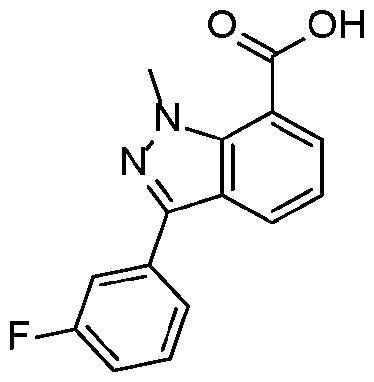


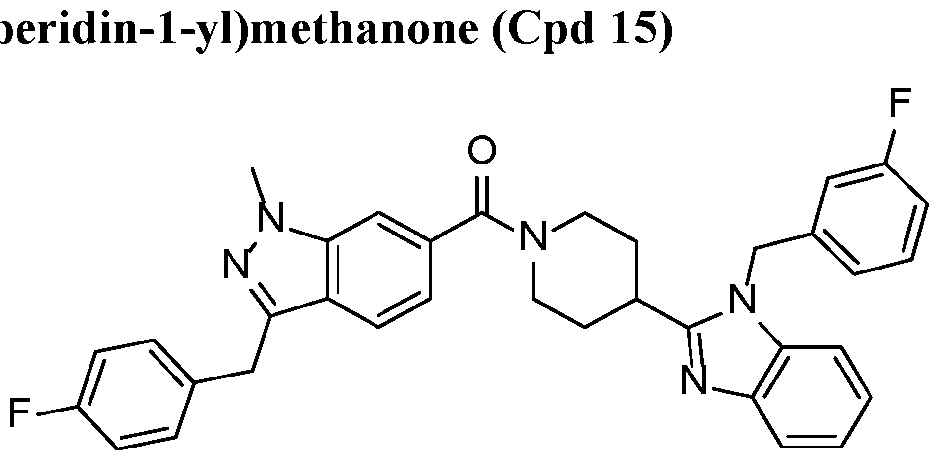


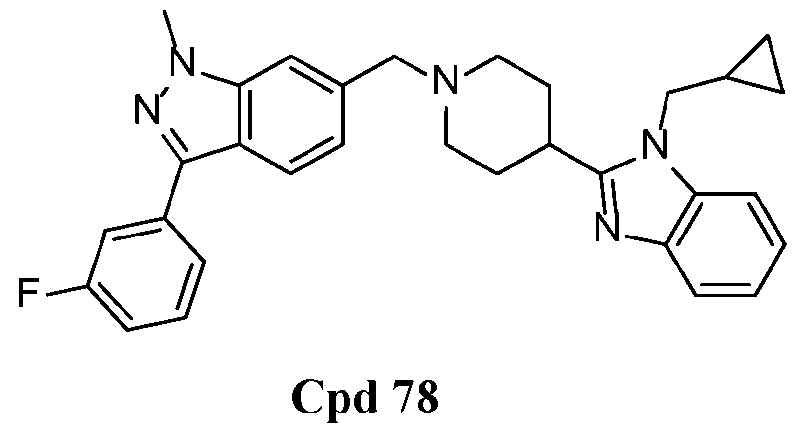


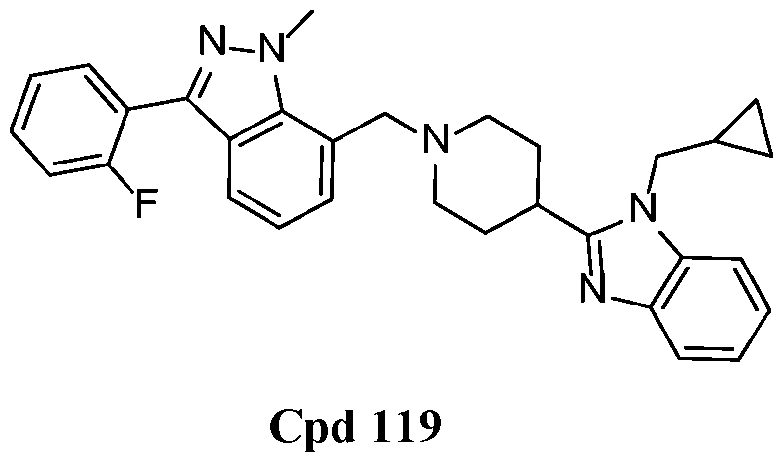


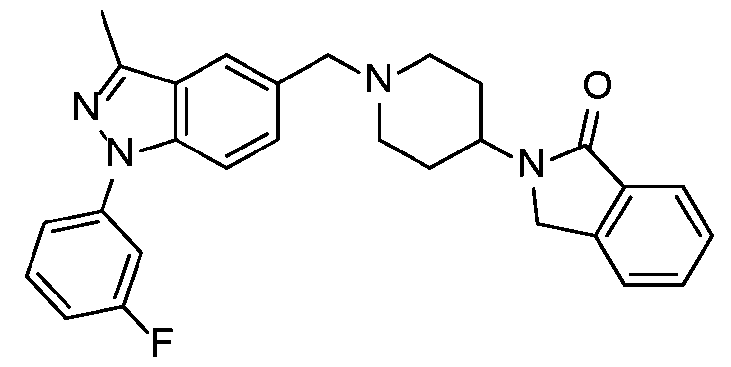


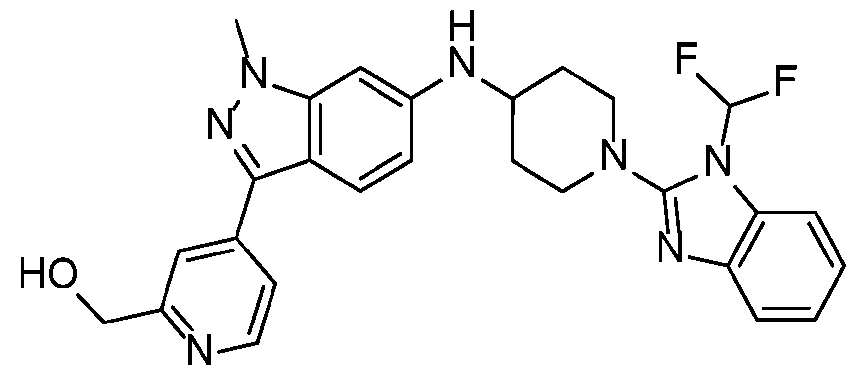


 wherein: ring A attached to E is selected from: N R N N


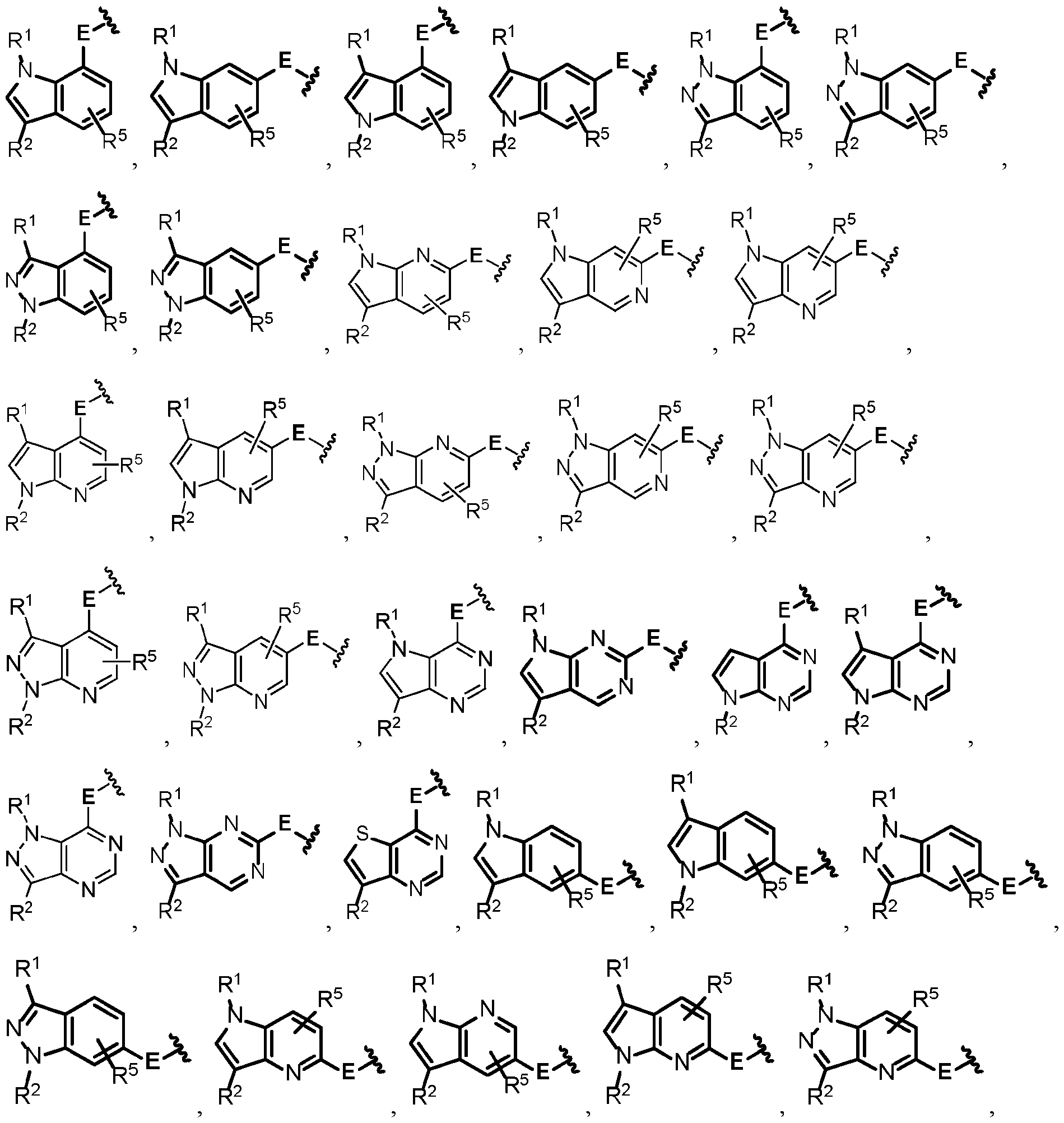


 .
.  , , -CH2-tetrahydropyran- 4-yl, -CH2CH2-tetrahydropyran-4-yl, -CH2-phenyl, -CH2-(3-F-phenyl), -CH(CH3)-phenyl, - CH(CH3)-(3-F-phenyl), -CF2-phenyl, -CF2-(3-F-phenyl), -CH2-pyridin-2-yl and -CH(CH3)- pyridin-2-yl, and wherein a stereocenter can have the (R)-stereochemistry or the (S)- stereochemistry or can be racemic.
  , -CH(CH3)- phenyl, or -CH(CH3)-pyridin-2-yl.
 53 57 60 64 75 84
 N O N N N N N N N N F N F F 92 O 93 O N N N N N N N N F N F