WO2025129082A1 - Positive allosteric modulators of the muscarinic acetylcholine receptor m4 - Google Patents
Positive allosteric modulators of the muscarinic acetylcholine receptor m4 Download PDFInfo
- Publication number
- WO2025129082A1 WO2025129082A1 PCT/US2024/060145 US2024060145W WO2025129082A1 WO 2025129082 A1 WO2025129082 A1 WO 2025129082A1 US 2024060145 W US2024060145 W US 2024060145W WO 2025129082 A1 WO2025129082 A1 WO 2025129082A1
- Authority
- WO
- WIPO (PCT)
- Prior art keywords
- compound
- pharmaceutically acceptable
- methyl
- acceptable salt
- pyridin
- Prior art date
- Legal status (The legal status is an assumption and is not a legal conclusion. Google has not performed a legal analysis and makes no representation as to the accuracy of the status listed.)
- Pending
Links
Classifications
-
- C—CHEMISTRY; METALLURGY
- C07—ORGANIC CHEMISTRY
- C07D—HETEROCYCLIC COMPOUNDS
- C07D495/00—Heterocyclic compounds containing in the condensed system at least one hetero ring having sulfur atoms as the only ring hetero atoms
- C07D495/12—Heterocyclic compounds containing in the condensed system at least one hetero ring having sulfur atoms as the only ring hetero atoms in which the condensed system contains three hetero rings
- C07D495/14—Ortho-condensed systems
-
- A—HUMAN NECESSITIES
- A61—MEDICAL OR VETERINARY SCIENCE; HYGIENE
- A61P—SPECIFIC THERAPEUTIC ACTIVITY OF CHEMICAL COMPOUNDS OR MEDICINAL PREPARATIONS
- A61P25/00—Drugs for disorders of the nervous system
- A61P25/04—Centrally acting analgesics, e.g. opioids
-
- A—HUMAN NECESSITIES
- A61—MEDICAL OR VETERINARY SCIENCE; HYGIENE
- A61P—SPECIFIC THERAPEUTIC ACTIVITY OF CHEMICAL COMPOUNDS OR MEDICINAL PREPARATIONS
- A61P25/00—Drugs for disorders of the nervous system
- A61P25/18—Antipsychotics, i.e. neuroleptics; Drugs for mania or schizophrenia
-
- A—HUMAN NECESSITIES
- A61—MEDICAL OR VETERINARY SCIENCE; HYGIENE
- A61P—SPECIFIC THERAPEUTIC ACTIVITY OF CHEMICAL COMPOUNDS OR MEDICINAL PREPARATIONS
- A61P25/00—Drugs for disorders of the nervous system
- A61P25/20—Hypnotics; Sedatives
-
- A—HUMAN NECESSITIES
- A61—MEDICAL OR VETERINARY SCIENCE; HYGIENE
- A61P—SPECIFIC THERAPEUTIC ACTIVITY OF CHEMICAL COMPOUNDS OR MEDICINAL PREPARATIONS
- A61P25/00—Drugs for disorders of the nervous system
- A61P25/28—Drugs for disorders of the nervous system for treating neurodegenerative disorders of the central nervous system, e.g. nootropic agents, cognition enhancers, drugs for treating Alzheimer's disease or other forms of dementia
Definitions
- Cholinergic neurotransmission involves the activation of nicotinic acetylcholine receptors (nAChRs) or the muscarinic acetylcholine receptors (mAChRs) by the binding of the endogenous orthosteric agonist acetylcholine (ACh).
- nAChRs nicotinic acetylcholine receptors
- mAChRs muscarinic acetylcholine receptors
- ACh endogenous orthosteric agonist acetylcholine
- Conditions associated with cognitive impairment such as Alzheimer’s disease, are accompanied by a reduction of acetylcholine content in the brain. This is believed to be the result of degeneration of cholinergic neurons of the basal forebrain, which widely innervate multiple areas of the brain, including the association cortices and hippocampus, which are critically involved in higher processes.
- AChE inhibitors have shown therapeutic efficacy, but have been found to have frequent cholinergic side effects due to peripheral acetylcholine stimulation, including abdominal cramps, nausea, vomiting, and diarrhea. These gastrointestinal side effects have been observed in about a third of the patients treated. In addition, some AChE inhibitors, such as tacrine, have also been found to cause significant hepatotoxicity with elevated liver transaminases observed in about 30% of patients. The adverse effects of AChE inhibitors have severely limited their clinical utility.
- An alternative approach to pharmacologically target cholinergic hypofunction is the activation of mAChRs, which are widely expressed throughout the body.
- the mAChRs are members of the family A G protein-coupled receptors (GPCRs) and include five subtypes, designated M1-M5.
- the M1, M3 and M5 subtypes mainly couple to Gq and activate phospholipase C, whereas the M 2 and M 4 subtypes mainly couple to G i/o and associated effector systems.
- GPCRs G protein-coupled receptors
- M1-M5 subtypes mainly couple to Gq and activate phospholipase C
- M 2 and M 4 subtypes mainly couple to G i/o and associated effector systems.
- M 1 -M 5 have varying roles in cognitive, sensory, motor and autonomic functions.
- mAChR subtypes that regulate processes involved in cognitive function could prove to be superior therapeutics for treatment of psychosis, schizophrenia and related disorders.
- the muscarinic M4 receptor has been shown to have a major role in cognitive processing and is believed to have a major role in the pathophysiology of psychotic disorders, including schizophrenia.
- AChE inhibitors and other cholinergic agents are mediated by activation of peripheral M 2 and M 3 mAChRs and include bradycardia, GI distress, excessive salivation, and sweating.
- M 4 has been viewed as the most likely subtype for mediating the effects of muscarinic acetylcholine receptor dysfunction in psychotic disorders, including schizophrenia, cognition disorders, and neuropathic pain. Because of this, considerable effort has been focused on developing selective M4 agonists for treatment of these disorders. Unfortunately, these efforts have been largely unsuccessful because of an inability to develop compounds that are highly selective for the mAChR M 4 . Because of this, mAChR agonists that have been tested in clinical studies induce a range of adverse effects by activation of peripheral mAChRs.
- Allosteric activators can include allosteric agonists, that act at a site removed from the orthosteric site to directly activate the receptor in the absence of ACh as well as positive allosteric modulators (PAMs), which do not activate the receptor directly but potentiate activation of the receptor by the endogenous orthosteric agonist ACh. Also, it is possible for a single molecule to have both allosteric potentiator and allosteric agonist activity.
- muscarinic agonists including xanomeline have been shown to be active in animal models with similar profiles to known antipsychotic drugs, but without causing catalepsy (Bymaster et al., Eur. J. Pharmacol.1998, 356, 109, Bymaster et al., Life Sci. 1999, 64, 527; Shannon et al., J. Pharmacol. Exp. Ther.1999, 290, 901; Shannon et al., Schizophrenia Res.2000, 42, 249).
- xanomeline was shown to reduce psychotic behavioral symptoms such as delusions, suspiciousness, vocal outbursts, and hallucinations in Alzheimer’s disease patients (Bodick et al., Arch. Neurol.1997, 54, 465), however treatment induced side effects, e.g., gastrointestinal effects, have severely limited the clinical utility of this compound.
- treatment induced side effects e.g., gastrointestinal effects
- gastrointestinal effects have severely limited the clinical utility of this compound.
- muscarinic acetylcholine receptor research there is still a scarcity of compounds that are potent, efficacious, and selective activators of the M4 mAChR and also effective in the treatment of neurological and psychiatric disorders associated with cholinergic activity and diseases in which the muscarinic M4 receptor is involved.
- the invention provides a pharmaceutical composition comprising a compound of formula (I), or a pharmaceutically acceptable salt thereof, and a pharmaceutically acceptable carrier.
- a pharmaceutical composition comprising a compound of formula (I), or a pharmaceutically acceptable salt thereof, and a pharmaceutically acceptable carrier.
- Another aspect provides a method of treating a neurological and/or psychiatric disorder associated with muscarinic acetylcholine receptor dysfunction in a mammal, comprising administering to the mammal a therapeutically effective amount of the compound of formula (I), or pharmaceutically acceptable salt or composition thereof.
- Another aspect provides a compound of formula (I), or a pharmaceutically acceptable salt or composition thereof, for use in the treatment of a neurological and/or psychiatric disorder associated with muscarinic acetylcholine receptor dysfunction in a mammal.
- the compounds include naphthyridine-substituted pyridazine compounds.
- the human muscarinic acetylcholine receptor M 4 (mAChR M 4 ) is a protein of 479 amino acids encoded by the CHRM 4 gene. The molecular weight of the unglycosylated protein is about 54 kDa and it is a transmembrane GPCR.
- the mAChR M 4 is a member of the GPCR Class A family, or the rhodopsin-like GPCRs, which are characterized by structural features similar to rhodopsin such as seven transmembrane segments.
- the muscarinic acetylcholine receptors have the N-terminus oriented to the extracellular face of the membrane and the C-terminus located on the cytoplasmic face.
- the present disclosure also contemplates other embodiments “comprising,” “consisting of” and “consisting essentially of,” the embodiments or elements presented herein, whether explicitly set forth or not.
- the modifier “about” used in connection with a quantity is inclusive of the stated value and has the meaning dictated by the context (for example, it includes at least the degree of error associated with the measurement of the particular quantity).
- the modifier “about” should also be considered as disclosing the range defined by the absolute values of the two endpoints. For example, the expression “from about 2 to about 4” also discloses the range “from 2 to 4.”
- the term “about” may refer to plus or minus 10% of the indicated number.
- alkoxy refers to an alkyl group, as defined herein, appended to the parent molecular moiety through an oxygen atom.
- alkoxy include, but are not limited to, methoxy, ethoxy, propoxy, 2-propoxy, butoxy and tert- butoxy.
- alkyl as used herein, means a straight or branched, saturated hydrocarbon chain.
- lower alkyl or “C 1-6 alkyl” means a straight or branched chain hydrocarbon containing from 1 to 6 carbon atoms.
- C 1-4 alkyl means a straight or branched chain saturated hydrocarbon containing from 1 to 4 carbon atoms.
- alkyl include, but are not limited to, methyl, ethyl, n-propyl, iso-propyl, n-butyl, sec-butyl, iso-butyl, tert-butyl, n-pentyl, isopentyl, neopentyl, n-hexyl, 3-methylhexyl, 2,2-dimethylpentyl, 2,3- dimethylpentyl, n-heptyl, n-octyl, n-nonyl, and n-decyl.
- alkenyl means a straight or branched, hydrocarbon chain containing at least one carbon-carbon double bond.
- alkoxyalkyl refers to an alkoxy group, as defined herein, appended to the parent molecular moiety through an alkyl group, as defined herein.
- alkoxyfluoroalkyl refers to an alkoxy group, as defined herein, appended to the parent molecular moiety through a fluoroalkyl group, as defined herein.
- alkylene refers to a divalent group derived from a straight or branched saturated chain hydrocarbon, for example, of 1 to 6 carbon atoms.
- Representative examples of alkylene include, but are not limited to, -CH 2 -, -CH 2 CH 2 -, -CH 2 CH 2 CH 2 -, -CH 2 CH(CH 3 )CH 2 -, -CH 2 CH 2 CH 2 CH 2 -, -CH 2 CH(CH 3 )CH 2 CH 2 -, and -CH 2 CH 2 CH 2 CH 2 CH 2 -.
- deuterioalkylene means an alkylene group, as defined herein, in which one or more hydrogen atoms in the alkylene are the isotope deuterium, i.e., 2 H.
- deuterioalkylene include -CD2-, -CH2CD2-, and -CD2CD2-.
- alkylamino means at least one alkyl group, as defined herein, is appended to the parent molecular moiety through an amino group, as defined herein.
- amide means -C(O)NR- or -NRC(O)-, wherein R may be hydrogen, alkyl, cycloalkyl, aryl, heteroaryl, heterocycle, alkenyl, or heteroalkyl.
- aminoalkyl means at least one amino group, as defined herein, is appended to the parent molecular moiety through an alkylene group, as defined herein.
- amino means —NR x R y , wherein R x and R y may be hydrogen, alkyl, cycloalkyl, aryl, heteroaryl, heterocycle, alkenyl, or heteroalkyl.
- R x and R y may be hydrogen, alkyl, cycloalkyl, aryl, heteroaryl, heterocycle, alkenyl, or heteroalkyl.
- amino may be –NRx–, wherein Rx may be hydrogen, alkyl, cycloalkyl, aryl, heteroaryl, heterocycle, alkenyl, or heteroalkyl.
- aryl refers to a phenyl or a phenyl appended to the parent molecular moiety and fused to a cycloalkane group (e.g., the aryl may be indan-4-yl), fused to a 6-membered arene group (i.e., the aryl is naphthyl), or fused to a non-aromatic heterocycle (e.g., the aryl may be benzo[d][1,3]dioxol-5-yl).
- phenyl is used when referring to a substituent and the term 6-membered arene is used when referring to a fused ring.
- the 6- membered arene is monocyclic (e.g., benzene or benzo).
- the aryl may be monocyclic (phenyl) or bicyclic (e.g., a 9- to 12-membered fused bicyclic system).
- cyanoalkyl means at least one -CN group, is appended to the parent molecular moiety through an alkylene group, as defined herein.
- cyanofluoroalkyl means at least one -CN group, is appended to the parent molecular moiety through a fluoroalkyl group, as defined herein.
- cycloalkoxy refers to a cycloalkyl group, as defined herein, appended to the parent molecular moiety through an oxygen atom.
- cycloalkyl or “cycloalkane,” as used herein, refers to a saturated ring system containing all carbon atoms as ring members and zero double bonds.
- cycloalkyl is used herein to refer to a cycloalkane when present as a substituent.
- a cycloalkyl may be a monocyclic cycloalkyl (e.g., cyclopropyl), a fused bicyclic cycloalkyl (e.g., decahydronaphthalenyl), or a bridged cycloalkyl in which two non-adjacent atoms of a ring are linked by an alkylene bridge of 1, 2, 3, or 4 carbon atoms (e.g., bicyclo[2.2.1]heptanyl).
- a monocyclic cycloalkyl e.g., cyclopropyl
- a fused bicyclic cycloalkyl e.g., decahydronaphthalenyl
- a bridged cycloalkyl in which two non-adjacent atoms of a ring are linked by an alkylene bridge of 1, 2, 3, or 4 carbon atoms (e.g., bicyclo[2.2.1]heptanyl).
- fluoroalkyl means an alkyl group, as defined herein, in which one, two, three, four, five, six, seven or eight hydrogen atoms are replaced by fluorine.
- Representative examples of fluoroalkyl include, but are not limited to, 2-fluoroethyl, 2,2,2- trifluoroethyl, trifluoromethyl, difluoromethyl, pentafluoroethyl, and trifluoropropyl such as 3,3,3-trifluoropropyl.
- haloalkoxy means at least one haloalkyl group, as defined herein, is appended to the parent molecular moiety through an oxygen atom.
- halocycloalkyl means a cycloalkyl group, as defined herein, in which one or more hydrogen atoms are replaced by a halogen.
- heteroalkyl means an alkyl group, as defined herein, in which one or more of the carbon atoms has been replaced by a heteroatom selected from S, O, P and N.
- monocyclic heterocyclyls include, but are not limited to, azetidinyl, azepanyl, aziridinyl, diazepanyl, 1,3-dioxanyl, 1,3-dioxolanyl, 1,3-dithiolanyl, 1,3- dithianyl, imidazolinyl, imidazolidinyl, isothiazolinyl, isothiazolidinyl, isoxazolinyl, isoxazolidinyl, morpholinyl, 2-oxo-3-piperidinyl, 2-oxoazepan-3-yl, oxadiazolinyl, oxadiazolidinyl, oxazolinyl, oxazolidinyl, oxetanyl, oxepanyl, oxocanyl, piperazinyl, piperidinyl, pyranyl, pyrazolinyl,
- the bicyclic heterocycle is a monocyclic heterocycle fused to a 6-membered arene, or a monocyclic heterocycle fused to a monocyclic cycloalkane, or a monocyclic heterocycle fused to a monocyclic cycloalkene, or a monocyclic heterocycle fused to a monocyclic heterocycle, or a monocyclic heterocycle fused to a monocyclic heteroarene, or a spiro heterocycle group, or a bridged monocyclic heterocycle ring system in which two non-adjacent atoms of the ring are linked by an alkylene bridge of 1, 2, 3, or 4 carbon atoms, or an alkenylene bridge of two, three, or four carbon atoms.
- bicyclic heterocyclyl is attached to the parent molecular moiety at a non-aromatic ring atom (e.g., indolin-1-yl).
- bicyclic heterocyclyls include, but are not limited to, chroman-4-yl, 2,3-dihydrobenzofuran-2-yl, 2,3- dihydrobenzothien-2-yl, 1,2,3,4-tetrahydroisoquinolin-2-yl, 2-azaspiro[3.3]heptan-2-yl, 2-oxa-6- azaspiro[3.3]heptan-6-yl, azabicyclo[2.2.1]heptyl (including 2-azabicyclo[2.2.1]hept-2-yl), azabicyclo[3.1.0]hexanyl (including 3-azabicyclo[3.1.0]hexan-3-yl), 2,3-dihydro-1H-indol-1-yl, isoindolin-2-yl, oc
- Tricyclic heterocycles are exemplified by a bicyclic heterocycle fused to a 6-membered arene, or a bicyclic heterocycle fused to a monocyclic cycloalkane, or a bicyclic heterocycle fused to a monocyclic cycloalkene, or a bicyclic heterocycle fused to a monocyclic heterocycle, or a bicyclic heterocycle in which two non-adjacent atoms of the bicyclic ring are linked by an alkylene bridge of 1, 2, 3, or 4 carbon atoms, or an alkenylene bridge of two, three, or four carbon atoms.
- tricyclic heterocycles include, but are not limited to, octahydro-2,5-epoxypentalene, hexahydro-2H-2,5-methanocyclopenta[b]furan, hexahydro-1H-1,4-methanocyclopenta[c]furan, aza-adamantane (1- azatricyclo[3.3.1.13,7]decane), and oxa-adamantane (2-oxatricyclo[3.3.1.13,7]decane).
- the monocyclic, bicyclic, and tricyclic heterocyclyls are connected to the parent molecular moiety at a non-aromatic ring atom.
- 1,4-phenylene refers to the following divalent group that links two portions of a molecule in a 1,4 or para relationship: .
- 6-membered 1,4-heteroarylene refers to a divalent 6-membered heterarene that links two portions of a molecule in a 1,4 or para relationship on the heteroarene, .
- hydroxyl or “hydroxy,” as used herein, means an -OH group.
- hydroxyalkyl means at least one -OH group, is appended to the parent molecular moiety through an alkylene group, as defined herein.
- hydroxyfluoroalkyl means at least one -OH group, is appended to the parent molecular moiety through a fluoroalkyl group, as defined herein.
- Terms such as “alkyl,” “cycloalkyl,” “alkylene,” etc. may be preceded by a designation indicating the number of atoms present in the group in a particular instance (e.g., "C 1-4 alkyl,” “C 3-6 cycloalkyl,” “C 1-4 alkylene”). These designations are used as generally understood by those skilled in the art. For example, the representation "C” followed by a subscripted number indicates the number of carbon atoms present in the group that follows.
- C3alkyl is an alkyl group with three carbon atoms (i.e., n-propyl, isopropyl).
- C1-4 the members of the group that follows may have any number of carbon atoms falling within the recited range.
- a “C 1-4 alkyl,” for example, is an alkyl group having from 1 to 4 carbon atoms, however arranged (i.e., straight chain or branched).
- the terms "parent molecule” or “parent molecular moiety” refer to the entire portion of a molecule to which a substituent is attached, i.e., the remainder of the molecule.
- sulfonamide means -S(O)2NR z - or –NR z S(O)-, wherein R z may be hydrogen, alkyl, cycloalkyl, aryl, heteroaryl, heterocycle, alkenyl, or heteroalkyl.
- substituted refers to a group “substituted” on a group such as an alkyl, alkenyl, alkynyl, aryl, heteroaryl, cycloalkyl, heteroalkyl, or heterocycle group, at any atom of that group. Any atom can be substituted.
- substituted refers to a group that may be further substituted with one or more non-hydrogen substituent groups.
- a group is optionally substituted. In some embodiments, a group is optionally substituted with 1, 2, 3, 4, or 5 substituents. In some embodiments, an aryl, heteroaryl, cycloalkyl, or heterocycle is optionally substituted with 1, 2, 3, 4, or 5 substituents. In some embodiments, an aryl, heteroaryl, cycloalkyl, or heterocycle may be independently unsubstituted or substituted with 1, 2, or 3 substituents.
- groups and substituents thereof may be selected in accordance with permitted valence of the atoms and the substituents, such that the selections and substitutions result in a stable compound, e.g., which does not spontaneously undergo transformation such as by rearrangement, cyclization, elimination, etc.
- allosteric site refers to a ligand binding site that is topographically distinct from the orthosteric binding site.
- modulator refers to a molecular entity (e.g., but not limited to, a ligand and a disclosed compound) that modulates the activity of the target receptor protein.
- ligand refers to a natural or synthetic molecular entity that is capable of associating or binding to a receptor to form a complex and mediate, prevent or modify a biological effect.
- ligand encompasses allosteric modulators, inhibitors, activators, agonists, antagonists, natural substrates and analogs of natural substrates.
- natural ligand and endogenous ligand as used herein are used interchangeably, and refer to a naturally occurring ligand, found in nature, which binds to a receptor.
- mAChR M4 receptor positive allosteric modulator refers to any exogenously administered compound or agent that directly or indirectly augments the activity of the mAChR M4 receptor in the presence or in the absence of acetylcholine, or another agonist, in an animal, in particular a mammal, for example a human.
- a mAChR M 4 receptor positive allosteric modulator can increase the activity of the mAChR M 4 receptor in a cell in the presence of extracellular acetylcholine.
- the cell can be Chinese hamster ovary (CHO- K1) cells transfected with human mAChR M 4 .
- the cell can be Chinese hamster ovary (CHO-K1) cells transfected with rat mAChR M4 receptor.
- the cell can be Chinese hamster ovary (CHO-K1) cells transfected with a mammalian mAChR M4.
- mAChR M4 receptor positive allosteric modulator includes a compound that is a “mAChR M4 receptor allosteric potentiator” or a “mAChR M4 receptor allosteric agonist,” as well as a compound that has mixed activity comprising pharmacology of both an “mAChR M 4 receptor allosteric potentiator” and an “mAChR M 4 receptor allosteric agonist.”
- the term “mAChR M 4 receptor positive allosteric modulator also includes a compound that is a “mAChR M 4 receptor allosteric enhancer.”
- mAChR M 4 receptor allosteric potentiator refers to any exogenously administered compound or agent that directly or indirectly augments the response produced by the endogenous ligand (such as acetylcholine) when the endogenous ligand binds to the orthosteric site of the mAChR M4 receptor in an animal, in particular
- the mAChR M4 receptor allosteric potentiator binds to a site other than the orthosteric site, that is, an allosteric site, and positively augments the response of the receptor to an agonist or the endogenous ligand.
- an allosteric potentiator does not induce desensitization of the receptor, activity of a compound as an mAChR M 4 receptor allosteric potentiator provides advantages over the use of a pure mAChR M4 receptor orthosteric agonist. Such advantages can include, for example, increased safety margin, higher tolerability, diminished potential for abuse, and reduced toxicity.
- mAChR M4 receptor allosteric enhancer refers to any exogenously administered compound or agent that directly or indirectly augments the response produced by the endogenous ligand (such as acetylcholine) in an animal, in particular a mammal, for example a human.
- the allosteric enhancer increases the affinity of the natural ligand or agonist for the orthosteric site.
- an allosteric enhancer increases the agonist efficacy.
- E8a The compound of E8, or a pharmaceutically acceptable salt thereof, wherein R 8a is hydrogen. [0095] E8.2. The compound of E8, or a pharmaceutically acceptable salt thereof, wherein R 8a is C1-6alkyl. [0096] E8.3. The compound of any of E1-E8 or E8.2, or a pharmaceutically acceptable salt thereof, wherein the C1-6alkyl at R 8a is methyl, ethyl, isopropyl, or tert-butyl. [0097] E8.4. The compound of any of E1-E8 or E8.2-E8.3, or a pharmaceutically acceptable salt thereof, wherein the C 1-6 alkyl at R 8a is methyl. [0098] E8.5.
- E1-E12 The compound of any of E1-E12, or a pharmaceutically acceptable salt thereof, wherein Z 1 is N.
- E14 The compound of any of E1-E12, or a pharmaceutically acceptable salt thereof, wherein Z 1 is CR 1 .
- E14.1 The compound of any of E1-E12 or E14, or a pharmaceutically acceptable salt thereof, wherein R 1 is hydrogen.
- E14.2 The compound of any of E1-E12 or E14, or a pharmaceutically acceptable salt thereof, wherein R 1 is methyl.
- E15 The compound of any of E1-E14.2, or a pharmaceutically acceptable salt thereof, wherein Z 2 is CR 2 .
- E16 The compound of any of E1-E14.2, or a pharmaceutically acceptable salt thereof, wherein Z 2 is CR 2 .
- Coupling of compound v with an appropriate amine compound vi provides a compound vii, which corresponds to a compound of formula (I), where R 10 is –C(R 7a )(R 7b )–Cy–OR 8 .
- Scheme 2 [00147] As shown in Scheme 2, reaction of a compound ii with a base followed by coupling of ammonium chloride with a coupling agent such as HATU may provide compound viii, and reaction with an ortho ester R 5 –C(OR)3 may provide compound iv. Reaction with phosphorus oxychloride may provide compound v, and coupling of compound v with an appropriate amine compound vi may provide a compound vii, which corresponds to a compound of formula (I)
- the disclosed compounds activate mAChR M4 response as an increase in calcium fluorescence in mAChR M4-transfected CHO-K1 cells in the presence of the compound, compared to the response of equivalent CHO-K1 cells in the absence of the compound.
- a disclosed compound activates the mAChR M4 response with an EC50 of less than about 10 ⁇ M, less than about 5 ⁇ M, less than about 1 ⁇ M, less than about 500 nM, of less than about 100 nM, or less than about 50 nM.
- the disclosed compounds exhibit positive allosteric modulation of the mAChR M 4 response to acetylcholine with an EC50 of less than about 10 ⁇ M, less than about 5 ⁇ M, less than about 1 ⁇ M, less than about 500 nM, or less than about 100 nM.
- the EC50 for positive allosteric modulation is determined in CHO-K1 cells are transfected with a mAChR M4.
- the mAChR M4 transfected human mAChR M4.
- a disclosed compound can activate mAChR M 4 response with an EC 50 of about 5- fold less, about 10-fold less, about 20-fold less, about 30-fold less, about 50-fold less, about 100- fold less, about 200-fold less, about 300-fold less, about 400-fold less, or greater than about 500- fold less than that for mAChR M1.
- a disclosed compound can activate mAChR M4 response with an EC50 of about 5-fold less, about 10-fold less, about 20-fold less, about 30-fold less, about 50-fold less, about 100-fold less, about 200-fold less, about 300-fold less, about 400-fold less, or greater than about 500-fold less than that for mAChR M 2 .
- a disclosed compound can activate mAChR M 4 response with an EC 50 of about 5- fold less, about 10-fold less, about 20-fold less, about 30-fold less, about 50-fold less, about 100- fold less, about 200-fold less, about 300-fold less, about 400-fold less, or greater than about 500- fold less than that for mAChR M3.
- a disclosed compound can activate mAChR M4 response with an EC50 of about 5-fold less, about 10-fold less, about 20-fold less, about 30-fold less, about 50-fold less, about 100-fold less, about 200-fold less, about 300-fold less, about 400-fold less, or greater than about 500-fold less than that for mAChR M 5 .
- the compound can have an EC50 of less than about 10 ⁇ M, of less than about 5 ⁇ M, of less than about 1 ⁇ M, of less than about 500 nM, of less than about 100 nM, or of less than about 50 nM; and the compound can also activate mAChR M 4 response with an EC 50 of about 5-fold less, about 10-fold less, about 20-fold less, about 30-fold less, about 50-fold less, about 100-fold less, about 200-fold less, about 300-fold less, about 400-fold less, or greater than about 500-fold less than that for mAChR M 3 .
- the compound can have an EC50 of less than about 10 ⁇ M, of less than about 5 ⁇ M, of less than about 1 ⁇ M, of less than about 500 nM, of less than about 100 nM, or of less than about 50 nM; and the compound can also activate mAChR M4 response with EC50 of 5-fold less, about 10-fold less, about 20-fold less, about 30-fold less than that for the M2-M5 receptors, of about 50-fold less, about 100-fold less, about 200-fold less, about 300-fold less, about 400-fold less, M2, M3, or M5 receptors, or greater than about 500-fold less than that for the mAChR M1, M2, M3, or M5 receptors.
- compositions and Formulations [00163] The disclosed compounds may be incorporated into pharmaceutical compositions suitable for administration to a subject (such as a patient, which may be a human or non-human). The disclosed compounds may also be provided as formulations, such as spray-dried dispersion formulations.
- the pharmaceutical compositions and formulations may include a “therapeutically effective amount” or a “prophylactically effective amount” of the agent.
- a “therapeutically effective amount” refers to an amount effective, at dosages and for periods of time necessary, to achieve the desired therapeutic result.
- a therapeutically effective amount of the composition may be determined by a person skilled in the art and may vary according to factors such as the disease state, age, sex, and weight of the individual, and the ability of the composition to elicit a desired response in the individual.
- a therapeutically effective amount is also one in which any toxic or detrimental effects of a compound of the invention (e.g., a compound of formula (I)) are outweighed by the therapeutically beneficial effects.
- prophylactically effective amount refers to an amount effective, at dosages and for periods of time necessary, to achieve the desired prophylactic result. Typically, since a prophylactic dose is used in subjects prior to or at an earlier stage of disease, the prophylactically effective amount will be less than the therapeutically effective amount.
- a therapeutically effective amount of a compound of formula (I) may be about 1 mg/kg to about 1000 mg/kg, about 5 mg/kg to about 950 mg/kg, about 10 mg/kg to about 900 mg/kg, about 15 mg/kg to about 850 mg/kg, about 20 mg/kg to about 800 mg/kg, about 25 mg/kg to about 750 mg/kg, about 30 mg/kg to about 700 mg/kg, about 35 mg/kg to about 650 mg/kg, about 40 mg/kg to about 600 mg/kg, about 45 mg/kg to about 550 mg/kg, about 50 mg/kg to about 500 mg/kg, about 55 mg/kg to about 450 mg/kg, about 60 mg/kg to about 400 mg/kg, about 65 mg/kg to about 350 mg/kg, about 70 mg/kg to about 300 mg/kg, about 75 mg/kg to about 250 mg/kg, about 80 mg/kg to about 200 mg/kg, about 85 mg/kg to about 150 mg/kg, and about 90 mg/kg to about
- compositions and formulations may include pharmaceutically acceptable carriers.
- pharmaceutically acceptable carrier means a non- toxic, inert solid, semi-solid or liquid filler, diluent, encapsulating material or formulation auxiliary of any type.
- materials which can serve as pharmaceutically acceptable carriers are sugars such as, but not limited to, lactose, glucose and sucrose; starches such as, but not limited to, corn starch and potato starch; cellulose and its derivatives such as, but not limited to, sodium carboxymethyl cellulose, ethyl cellulose and cellulose acetate; powdered tragacanth; malt; gelatin; talc; excipients such as, but not limited to, cocoa butter and suppository waxes; oils such as, but not limited to, peanut oil, cottonseed oil, safflower oil, sesame oil, olive oil, corn oil and soybean oil; glycols; such as propylene glycol; esters such as, but not limited to, ethyl oleate and ethyl laurate; agar; buffering agents such as, but not limited to, magnesium hydroxide and aluminum hydroxide; alginic acid; pyrogen-free water; isotonic saline;
- the compounds and their pharmaceutically acceptable salts may be formulated for administration by, for example, solid dosing, eye drop, in a topical oil-based formulation, injection, inhalation (either through the mouth or the nose), implants, or oral, buccal, parenteral, or rectal administration.
- Techniques and formulations may generally be found in “Remington's Pharmaceutical Sciences,” (Meade Publishing Co., Easton, Pa.).
- Therapeutic compositions must typically be sterile and stable under the conditions of manufacture and storage.
- the route by which the disclosed compounds are administered and the form of the composition will dictate the type of carrier to be used.
- compositions may be in a variety of forms, suitable, for example, for systemic administration (e.g., oral, rectal, nasal, sublingual, buccal, implants, or parenteral) or topical administration (e.g., dermal, pulmonary, nasal, aural, ocular, liposome delivery systems, or iontophoresis).
- Carriers for systemic administration typically include at least one of diluents, lubricants, binders, disintegrants, colorants, flavors, sweeteners, antioxidants, preservatives, glidants, solvents, suspending agents, wetting agents, surfactants, combinations thereof, and others. All carriers are optional in the compositions.
- Suitable diluents include sugars such as glucose, lactose, dextrose, and sucrose; diols such as propylene glycol; calcium carbonate; sodium carbonate; sugar alcohols, such as glycerin; mannitol; and sorbitol.
- the amount of diluent(s) in a systemic or topical composition is typically about 50 to about 90%.
- Suitable lubricants include silica, talc, stearic acid and its magnesium salts and calcium salts, calcium sulfate; and liquid lubricants such as polyethylene glycol and vegetable oils such as peanut oil, cottonseed oil, sesame oil, olive oil, corn oil and oil of theobroma.
- Topical compositions that can be applied locally to the skin may be in any form including solids, solutions, oils, creams, ointments, gels, lotions, shampoos, leave-on and rinse-out hair conditioners, milks, cleansers, moisturizers, sprays, skin patches, and the like.
- Topical compositions include: a disclosed compound (e.g., a compound of formula (I)), and a carrier.
- the carrier of the topical composition preferably aids penetration of the compounds into the skin.
- the carrier may further include one or more optional components.
- the amount of the carrier employed in conjunction with a disclosed compound is sufficient to provide a practical quantity of composition for administration per unit dose of the compound.
- the methods of treatment may comprise administering to a subject in need of such treatment a therapeutically effective amount of the compound of formula (I), or a pharmaceutical composition comprising a therapeutically effective amount of a compound of formula (I).
- the disclosure provides a method for enhancing cognition in a mammal comprising the step of administering to the mammal a therapeutically effective amount of the compound of formula (I), or a pharmaceutical composition comprising a therapeutically effective amount of a compound of formula (I).
- the compounds and compositions disclosed herein may be useful for treating, preventing, ameliorating, controlling or reducing the risk of a variety of disorders associated with selective mAChR M4 receptor activation.
- a treatment can include selective mAChR M 4 receptor activation to an extent effective to affect cholinergic activity.
- a disorder can be associated with cholinergic activity, for example cholinergic hypofunction.
- a method for the treatment of one or more disorders associated with mAChR M4 receptor activity in a subject comprising the step of administering to the subject a therapeutically effective amount of the compound of formula (I), or a pharmaceutically acceptable salt thereof, or a pharmaceutical composition comprising a therapeutically effective amount of a compound of formula (I), or a pharmaceutically acceptable salt thereof.
- the disclosure provides a compound of formula (I), or a pharmaceutically acceptable salt thereof, for use in a method for the treatment of a disorder associated with the mAChR M4 receptor.
- the disclosure provides a pharmaceutical composition comprising a compound of formula (I), or a pharmaceutically acceptable salt thereof, for use in a method for the treatment of a disorder associated with the mAChR M4 receptor.
- the disclosure provides a compound of formula (I), or a pharmaceutically acceptable salt thereof, for use in the manufacture of a medicament for the treatment of a disorder associated with the mAChR M 4 receptor.
- the disclosure provides a method for the treatment of a disorder associated with muscarinic acetylcholine receptor dysfunction in a mammal, comprising the step of administering to the mammal an effective amount of at least one disclosed compound or a pharmaceutically acceptable salt thereof, or a pharmaceutical composition comprising at least one disclosed compound or pharmaceutically acceptable salt thereof.
- the disclosure provides a compound of formula (I), or a pharmaceutically acceptable salt thereof, for use in a method for the treatment of a disorder associated with muscarinic acetylcholine receptor dysfunction in a mammal.
- the disclosure provides a pharmaceutical composition comprising a compound of formula (I), or a pharmaceutically acceptable salt thereof, for use in a method for the treatment of a neurological, psychiatric, or cognitive disorder associated with the mAChR M4 receptor, in particular, the disorders described herein.
- the disclosure provides a compound of formula (I), or a pharmaceutically acceptable salt thereof, for use in the manufacture of a medicament for the treatment of a neurological, psychiatric, or cognitive disorder associated with the mAChR M 4 receptor, in particular, the disorders described herein.
- the disorder is a neurological disorder selected from brain tumor, dementia with Lewy bodies, multiple sclerosis, sarcoidosis, Lyme disease, syphilis, Alzheimer’s disease, Parkinson’s disease, and anti-NMDA receptor encephalitis.
- the disorder is a psychotic disorder selected from schizophrenia, brief psychotic disorder, schizophreniform disorder, schizoaffective disorder, delusional disorder, and shared psychotic disorder.
- the schizophrenia is selected from catastrophic schizophrenia, catatonic schizophrenia, paranoid schizophrenia, residual schizophrenia, disorganized schizophrenia, and undifferentiated schizophrenia.
- the disorder is selected from schizoid personality disorder, schizotypal personality disorder, and paranoid personality disorder.
- the psychotic disorder is due to a general medical condition and is substance-induced or drug-induced (phencyclidine, ketamine and other dissociative anesthetics, amphetamine and other psychostimulants, and cocaine).
- the present disclosure provides a method for treating a cognitive disorder, comprising administering to a patient in need thereof an effective amount of a compound or a composition of the present disclosure.
- cognitive disorders include dementia (associated with Alzheimer’s disease, ischemia, multi-infarct dementia, trauma, vascular problems or stroke, HIV disease, Parkinson’s disease, Huntington’s disease, Pick’s disease, Creutzfeldt-Jacob disease, perinatal hypoxia, other general medical conditions or substance abuse), delirium, amnestic disorder, substance-induced persisting delirium, dementia due to HIV disease, dementia due to Huntington’s disease, dementia due to Parkinson’s disease, Parkinsonian-ALS demential complex, dementia of the Alzheimer’s type, age-related cognitive decline, and mild cognitive impairment.
- dementia associated with Alzheimer’s disease, ischemia, multi-infarct dementia, trauma, vascular problems or stroke, HIV disease, Parkinson’s disease, Huntington’s disease, Pick’s disease, Creutzfeldt-Jacob disease, perinatal hypoxia, other general medical conditions or substance abuse
- delirium amnestic disorder
- substance-induced persisting delirium dementia due to HIV disease
- dementia due to Huntington’s disease dementia due
- DSM-IV-TR Diagnostic and Statistical Manual of Mental Disorders
- DSM-5 2013, American Psychiatric Association, Washington DC
- NCDs neurocognitive disorders
- NCD due to Alzheimer’s disease vascular NCD, NCD with Lewy bodies, NCD due to Parkinson’s disease, frontotemporal NCD, NCD due to traumatic brain injury, NCD due to HIV infection, substance/medication-induced NCD, NCD due to Huntington’s disease, NCD due to prion disease, NCD due to another medical condition, NCD due to multiple etiologies, and unspecified NCD.
- the NCD category in DSM-5 encompasses the group of disorders in which the primary clinical deficit is in cognitive function, and that are acquired rather than developmental.
- the term “cognitive disorders” includes treatment of those cognitive disorders and neurocognitive disorders as described in DSM-IV-TR or DSM-5.
- the present disclosure provides a method for treating schizophrenia or psychosis, comprising administering to a patient in need thereof an effective amount of a compound or composition of the present disclosure.
- Particular schizophrenia or psychosis pathologies are paranoid, disorganized, catatonic or undifferentiated schizophrenia and substance-induced psychotic disorder.
- DSM-IV-TR provides a diagnostic tool that includes paranoid, disorganized, catatonic, undifferentiated or residual schizophrenia, and substance- induced psychotic disorder.
- DSM-5 eliminated the subtypes of schizophrenia, and instead includes a dimensional approach to rating severity for the core symptoms of schizophrenia, to capture the heterogeneity in symptom type and severity expressed across individuals with psychotic disorders.
- schizophrenia or psychosis includes treatment of those mental disorders as described in DSM-IV-TR or DSM-5.
- the skilled artisan will recognize that there are alternative nomenclatures, nosologies and classification systems for mental disorders, and that these systems evolve with medical and scientific progress. Thus the term “schizophrenia or psychosis” is intended to include like disorders that are described in other diagnostic sources.
- the present disclosure provides a method for treating pain, comprising administering to a patient in need thereof an effective amount of a compound or composition of the present disclosure.
- a compound or composition of the present disclosure are bone and joint pain (osteoarthritis), repetitive motion pain, dental pain, cancer pain, myofascial pain (muscular injury, fibromyalgia), perioperative pain (general surgery, gynecological), chronic pain and neuropathic pain.
- the compounds and compositions may be further useful in a method for the prevention, treatment, control, amelioration, or reduction of risk of the diseases, disorders and conditions noted herein.
- an appropriate dosage level may be about 0.01 to 500 mg per kg patient body weight per day, which can be administered in single or multiple doses.
- the dosage level may be about 0.1 to about 250 mg/kg per day, or about 0.5 to about 100 mg/kg per day.
- a suitable dosage level can be about 0.01 to 250 mg/kg per day, about 0.05 to 100 mg/kg per day, or about 0.1 to 50 mg/kg per day.
- the dosage can be 0.05 to 0.5, 0.5 to 5 or 5 to 50 mg/kg per day.
- the compositions may be provided in the form of tablets containing 1.0 to 1000 milligrams of the active ingredient, particularly 1.0, 5.0, 10, 15, 20, 25, 50, 75, 100, 150, 200, 250, 300, 400, 500, 600, 750, 800, 900, or 1000 milligrams of the active ingredient for the symptomatic adjustment of the dosage to the patient to be treated.
- the compounds can be administered on a regimen of 1 to 4 times per day, preferably once or twice per day. This dosage regimen can be adjusted to provide the optimal therapeutic response.
- the mammal has been diagnosed with a need for treatment for the disorder prior to the administering step.
- the method further comprises the step of identifying a subject in need of treatment for the disorder.
- the disorder can be selected from psychosis, schizophrenia, conduct disorder, disruptive behavior disorder, bipolar disorder, psychotic episodes of anxiety, anxiety associated with psychosis, psychotic mood disorders such as severe major depressive disorder; mood disorders associated with psychotic disorders, acute mania, depression associated with bipolar disorder, mood disorders associated with schizophrenia, behavioral manifestations of mental retardation, autistic disorder, movement disorders, Tourette’s syndrome, akinetic-rigid syndrome, movement disorders associated with Parkinson’s disease, tardive dyskinesia, drug induced and neurodegeneration based dyskinesias, attention deficit hyperactivity disorder, cognitive disorders, dementias, and memory disorders.
- the disclosure provides a compound of formula (I), or a pharmaceutically acceptable salt thereof, for use in a method for the potentiation of muscarinic acetylcholine receptor activity in a mammal.
- the disclosure provides a pharmaceutical composition comprising a compound of formula (I), or a pharmaceutically acceptable salt thereof, for use in a method for the potentiation of muscarinic acetylcholine receptor activity in a mammal.
- the disclosure provides to a method for potentiation of muscarinic acetylcholine receptor activity in a cell, comprising the step of contacting the cell with an effective amount of at least one disclosed compound or a pharmaceutically acceptable salt thereof.
- the cell is mammalian (e.g., human).
- the cell has been isolated from a mammal prior to the contacting step.
- contacting is via administration to a mammal.
- the invention relates to a method for enhancing cognition in a mammal comprising the step of administering to the mammal an effective amount of least one disclosed compound; or a pharmaceutically acceptable salt, hydrate, solvate, or polymorph thereof.
- the disclosure provides a compound of formula (I), or a pharmaceutically acceptable salt thereof, for use in a method for the enhancment of cognition in a mammal.
- the disclosure provides a pharmaceutical composition comprising a compound of formula (I), or a pharmaceutically acceptable salt thereof, for use in a method for the enhancment of cognition in a mammal.
- the disclosure provides a compound of formula (I), or a pharmaceutically acceptable salt thereof, for use in the manufacture of a medicament for the enhancment of cognition in a mammal.
- the mammal is a human.
- the mammal has been diagnosed with a need for cognition enhancement prior to the administering step.
- the method further comprises the step of identifying a mammal in need of cognition enhancement.
- the need for cognition enhancement is associated with a muscarinic receptor dysfunction.
- the muscarinic receptor is mAChR M 4 .
- the cognition enhancement is a statistically significant increase in Novel Object Recognition. In some embodiments, the cognition enhancement is a statistically significant increase in performance of the Wisconsin Card Sorting Test. d. Cotherapeutic methods [00245]
- the present invention is further directed to administration of a selective mAChR M4 activator for improving treatment outcomes in the context of cognitive or behavioral therapy. That is, in some embodiments, the invention relates to a cotherapeutic method comprising a step of administering to a mammal an effective amount and dosage of at least one disclosed compound, or a pharmaceutically acceptable salt thereof.
- the disclosure provides a compound of formula (I), or a pharmaceutically acceptable salt thereof, for use in a cotherapeutic method with cognitive or behaviorial therapy in a mammal.
- the disclosure provides a pharmaceutical composition comprising a compound of formula (I), or a pharmaceutically acceptable salt thereof, for use in a cotherapeutic method with cognitive or behaviorial therapy in a mammal.
- the disclosure provides a compound of formula (I), or a pharmaceutically acceptable salt thereof, for use in the manufacture of a medicament for a cotherapeutic method with cognitive or behaviorial therapy in a mammal.
- administration improves treatment outcomes in the context of cognitive or behavioral therapy.
- Administration in connection with cognitive or behavioral therapy can be continuous or intermittent. Administration need not be simultaneous with therapy and can be before, during, and/or after therapy.
- cognitive or behavioral therapy can be provided within 1, 2, 3, 4, 5, 6, 7 days before or after administration of the compound.
- cognitive or behavioral therapy can be provided within 1, 2, 3, or 4 weeks before or after administration of the compound.
- cognitive or behavioral therapy can be provided before or after administration within a period of time of 1, 2, 3, 4, 5, 6, 7, 8, 9, or 10 half-lives of the administered compound.
- additional therapeutic agent(s) may be administered simultaneously or sequentially with the disclosed compounds and compositions. Sequential administration includes administration before or after the disclosed compounds and compositions. In some embodiments, the additional therapeutic agent or agents may be administered in the same composition as the disclosed compounds. In other embodiments, there may be an interval of time between administration of the additional therapeutic agent and the disclosed compounds. In some embodiments, administration of an additional therapeutic agent with a disclosed compound may allow lower doses of the other therapeutic agents and/or administration at less frequent intervals. When used in combination with one or more other active ingredients, the compounds of the present invention and the other active ingredients may be used in lower doses than when each is used singly.
- compositions of the present invention include those that contain one or more other active ingredients, in addition to a compound of Formula (I).
- the above combinations include combinations of a compound of the present invention not only with one other active compound, but also with two or more other active compounds.
- the disclosed compounds can be used as single agents or in combination with one or more other drugs in the treatment, prevention, control, amelioration or reduction of risk of the aforementioned diseases, disorders and conditions for which the compound or the other drugs have utility, where the combination of drugs together are safer or more effective than either drug alone.
- the other drug(s) can be administered by a route and in an amount commonly used therefor, contemporaneously or sequentially with a disclosed compound.
- a pharmaceutical composition in unit dosage form containing such drugs and the disclosed compound may be used.
- the combination therapy can also be administered on overlapping schedules.
- the combination of one or more active ingredients and a disclosed compound can be more efficacious than either as a single agent.
- the disclosed compounds and the other active ingredients can be used in lower doses than when each is used singly.
- the pharmaceutical compositions and methods of the present invention can further comprise other therapeutically active compounds as noted herein which are usually applied in the treatment of the above mentioned pathological conditions.
- the above combinations include combinations of a disclosed compound not only with one other active compound, but also with two or more other active compounds.
- disclosed compounds can be used in combination with other drugs that are used in the prevention, treatment, control, amelioration, or reduction of risk of the diseases or conditions for which disclosed compounds are useful.
- Such other drugs can be administered, by a route and in an amount commonly used therefor, contemporaneously or sequentially with a compound of the present invention.
- a pharmaceutical composition containing such other drugs in addition to a disclosed compound is preferred.
- the pharmaceutical compositions include those that also contain one or more other active ingredients, in addition to a compound of the present invention.
- the weight ratio of a disclosed compound to the second active ingredient can be varied and will depend upon the effective dose of each ingredient. Generally, an effective dose of each will be used. Thus, for example, when a compound of the present invention is combined with another agent, the weight ratio of a disclosed compound to the other agent will generally range from about 1000:1 to about 1:1000, preferably about 200:1 to about 1:200. Combinations of a compound of the present invention and other active ingredients will generally also be within the aforementioned range, but in each case, an effective dose of each active ingredient should be used. [00255] In such combinations a disclosed compound and other active agents can be administered separately or in conjunction. In addition, the administration of one element can be prior to, concurrent to, or subsequent to the administration of other agent(s).
- the disclosed compounds can be used alone or in combination with other agents which are known to be beneficial in the subject indications or other drugs that affect receptors or enzymes that either increase the efficacy, safety, convenience, or reduce unwanted side effects or toxicity of the disclosed compounds.
- the subject compound and the other agent can be coadministered, either in concomitant therapy or in a fixed combination.
- the compound can be employed in combination with anti- Alzheimer’s agents, beta-secretase inhibitors, cholinergic agents, gamma-secretase inhibitors, HMG-CoA reductase inhibitors, M1 allosteric agonists, M1 positive allosteric modulators, NSAIDs including ibuprofen, vitamin E, and anti-amyloid antibodies.
- the subject compound can be employed in combination with sedatives, hypnotics, anxiolytics, antipsychotics (typical and atypical), antianxiety agents, cyclopyrrolones, imidazopyridines, pyrazolopyrimidines, minor tranquilizers, melatonin agonists and antagonists, melatonergic agents, benzodiazepines, barbiturates, 5HT-2 antagonists, and the like, such as: adinazolam, allobarbital, alonimid, alprazolam, amisulpride, amitriptyline, amobarbital, amoxapine, aripiprazole, bentazepam, benzoctamine, brotizolam, bupropion, busprione, butabarbital, butalbital, capuride, carbocloral, chloral betaine, chloral hydrate, clomipramine, clonazepam, cloperidone, clo
- the compound can be employed in combination with levodopa (with or without a selective extracerebral decarboxylase inhibitor such as carbidopa or benserazide), anticholinergics such as biperiden (optionally as its hydrochloride or lactate salt) and trihexyphenidyl (benzhexol) hydrochloride, COMT inhibitors such as entacapone, MOA-B inhibitors, antioxidants, A2a adenosine receptor antagonists, cholinergic agonists, NMDA receptor antagonists, serotonin receptor antagonists and dopamine receptor agonists such as alentemol, bromocriptine, fenoldopam, lisuride, naxagolide, pergolide and pramipexole.
- levodopa with or without a selective extracerebral decarboxylase inhibitor such as carbidopa or benserazide
- anticholinergics such as biperiden
- the dopamine agonist can be in the form of a pharmaceutically acceptable salt, for example, alentemol hydrobromide, bromocriptine mesylate, fenoldopam mesylate, naxagolide hydrochloride and pergolide mesylate. Lisuride and pramipexol are commonly used in a non-salt form.
- the compound can be employed in combination with a compound from the phenothiazine, thioxanthene, heterocyclic dibenzazepine, butyrophenone, diphenylbutylpiperidine and indolone classes of neuroleptic agent.
- Suitable examples of phenothiazines include chlorpromazine, mesoridazine, thioridazine, acetophenazine, fluphenazine, perphenazine and trifluoperazine.
- Suitable examples of thioxanthenes include chlorprothixene and thiothixene.
- An example of a dibenzazepine is clozapine.
- An example of a butyrophenone is haloperidol.
- An example of a diphenylbutylpiperidine is pimozide.
- An example of an indolone is molindolone.
- Other neuroleptic agents include loxapine, sulpiride and risperidone.
- the neuroleptic agents when used in combination with the subject compound can be in the form of a pharmaceutically acceptable salt, for example, chlorpromazine hydrochloride, mesoridazine besylate, thioridazine hydrochloride, acetophenazine maleate, fluphenazine hydrochloride, flurphenazine enathate, fluphenazine decanoate, trifluoperazine hydrochloride, thiothixene hydrochloride, haloperidol decanoate, loxapine succinate and molindone hydrochloride.
- a pharmaceutically acceptable salt for example, chlorpromazine hydrochloride, mesoridazine besylate, thioridazine hydrochloride, acetophenazine maleate, fluphenazine hydrochloride, flurphenazine enathate, fluphenazine decanoate, trifluoperazine hydrochloride, thiothixen
- Perphenazine, chlorprothixene, clozapine, haloperidol, pimozide and risperidone are commonly used in a non-salt form.
- the subject compound can be employed in combination with acetophenazine, alentemol, aripiprazole, amisulpride, benzhexol, bromocriptine, biperiden, chlorpromazine, chlorprothixene, clozapine, diazepam, fenoldopam, fluphenazine, haloperidol, levodopa, levodopa with benserazide, levodopa with carbidopa, lisuride, loxapine, mesoridazine, molindolone, naxagolide, olanzapine, pergolide, perphenazine, pimozide, pramipexole, quetiapine, ris
- the compound can be employed in combination with an anti- depressant or anti-anxiety agent, including norepinephrine reuptake inhibitors (including tertiary amine tricyclics and secondary amine tricyclics), selective serotonin reuptake inhibitors (SSRIs), monoamine oxidase inhibitors (MAOIs), reversible inhibitors of monoamine oxidase (RIMAs), serotonin and noradrenaline reuptake inhibitors (SNRIs), corticotropin releasing factor (CRF) antagonists, -adrenoreceptor antagonists, neurokinin-1 receptor antagonists, atypical anti- depressants, benzodiazepines, 5-HT1A agonists or antagonists, especially 5-HT1A partial agonists, and corticotropin releasing factor (CRF) antagonists.
- norepinephrine reuptake inhibitors including tertiary amine tricyclics and secondary amine tricyclics
- Specific agents include: amitriptyline, clomipramine, doxepin, imipramine and trimipramine; amoxapine, desipramine, maprotiline, nortriptyline and protriptyline; fluoxetine, fluvoxamine, paroxetine and sertraline; isocarboxazid, phenelzine, tranylcypromine and selegiline; moclobemide: venlafaxine; duloxetine; aprepitant; bupropion, lithium, nefazodone, trazodone and viloxazine; alprazolam, chlordiazepoxide, clonazepam, chlorazepate, diazepam, halazepam, lorazepam, oxazepam and prazepam; buspirone, flesinoxan, gepirone and ipsapirone, and pharmaceutically acceptable salts thereof.
- the compounds can be coadministered with orthosteric muscarinic agonists, muscarinic potentiators, or cholinesterase inhibitors.
- the compounds can be coadministered with GlyT1 inhibitors and the like such as, but not limited to: risperidone, clozapine, haloperidol, fluoxetine, prazepam, xanomeline, lithium, phenobarbitol, and salts thereof and combinations thereof.
- GlyT1 inhibitors and the like such as, but not limited to: risperidone, clozapine, haloperidol, fluoxetine, prazepam, xanomeline, lithium, phenobarbitol, and salts thereof and combinations thereof.
- Methods of treatment may include any number of modes of administering a disclosed composition.
- Modes of administration may include tablets, pills, dragees, hard and soft gel capsules, granules, pellets, aqueous, lipid, oily or other solutions, emulsions such as oil-in-water emulsions, liposomes, aqueous or oily suspensions, syrups, elixirs, solid emulsions, solid dispersions or dispersible powders.
- Iodomethane-d 3 (39 ⁇ L, 0.62 mmol) was added to the solution. After 18h, additional iodomethane-d 3 (32.6 ⁇ L) was added and the mixture was heated to 50 °C for 18 h. The mixture was cooled to ambient temperature, added to water, and extracted with EtOAc (3x). The combined organic layers were dried (MgSO 4 ), filtered, and concentrated. Purification using normal phase column chromatography (0-40% EtOAc/Hexanes) afforded the title compound (135 mg).
- the vessel was capped, degassed and purged with nitrogen (3x) followed by addition of 1,4-dioxane (0.5mL).
- the vial was heated to 110 °C overnight.
- the reaction was cooled to room temperature and filtered through a pad of Celite® which was rinsed thoroughly with DCM/EtOAc.
- the organics were concentrated and the crude residue was purified via RP-HPLC (15 - 45% MeCN in 0.1% aqueous TFA). Fractions containing product were basified with sat. NaHCO3 solution, extracted with 3:1 chloroform/IPA and concentrated to provide the title compound (13 mg).
- the resulting polyclones were further screened to obtain monoclones of hM4–Gqi5 and rM4–Gqi5 for compound screening assay.
- Stable monoclone cells were maintained in Ham’s F-12 medium containing 10% heat- inactivated fetal bovine serum (FBS), 1X Antibiotic/Antimycotic, 20 mM HEPES, 500 ⁇ g/mL G418 sulfate, and 200 ⁇ g/mL Hygromycin B in 37 °C humidified incubators in the presence of 5% CO2.
- FBS heat- inactivated fetal bovine serum
- 1X Antibiotic/Antimycotic 20 mM HEPES
- 500 ⁇ g/mL G418 sulfate 500 ⁇ g/mL G418 sulfate
- 200 ⁇ g/mL Hygromycin B in 37 °C humidified incubators in the presence of 5% CO2.
- Test compound was added to cells expressing the muscarinic receptors that were loaded with calcium sensitive fluorescent dye. After a ⁇ 2.5 minute incubation period, a submaximal (EC 20 ) concentration of acetylcholine was added, and the response measured. This kinetic assay allows for simultaneous screening and potency determination of multiple pharmacological modes of action including agonist and potentiator activity.
- CHO-K1 cells stably expressing muscarinic receptors were plated in growth medium lacking G418 and hygromycin at 15,000 cells/20 ⁇ L/well in Greiner 384-well black- walled, tissue culture (TC)-treated, clear-bottom plates (Greiner Bio-One).
- Compounds were serially diluted 1:3 into 10 point concentration response curves in DMSO using the Bravo Liquid Handler (Agilent, Santa Clara, CA), transferred to a 384 well daughter plates using an Echo acoustic liquid handler (Beckman Coulter, Indianapolis, Indiana), and diluted in assay Buffer to a 2X final concentration.
- the agonist plates were prepared using acetylcholine (ACh, Sigma- Aldrich, St. Louis, MO) concentrations for the EC 20 and EC MAX responses by diluting in assay buffer to a 5X final concentration.
- the 2X dye solution (2.3 ⁇ M) was prepared by mixing a 2.3 mM Fluo-4-AM stock in DMSO with 10% (w/v) pluronic acid F-127 in a 1:1 ratio in assay buffer. Using a microplate washer (BioTek, Winooski, VT), cells were washed with assay buffer for 3 times to remove medium. After the final wash, 20 L of assay buffer remained in the cell plates. Immediately, 20 L of the 2X dye solution (final 1.15 ⁇ M) was added to each well of the cell plate using a Multidrop Combi dispenser (Thermo Fisher, Waltham, MA).
- DMSO vehicle was added to the control wells in the first add for assessing ACh EC20, EC80, and ECmax responses.
- Calcium fluorescence was recorded as fold over basal fluorescence and raw data were normalized to the maximal response to ACh agonist.
- Agonist activity was analyzed as a concentration-dependent increase in calcium mobilization upon compound addition.
- Positive allosteric modulator activity was analyzed as a concentration- dependent increase in the EC 20 acetylcholine response.
- Antagonist activity was analyzed as a concentration-dependent decrease in the EC 80 acetylcholine response.
- Concentration-response curves were generated using a four-parameter logistical equation using GraphPad Prism (La Jolla, CA) or the Dotmatics software platform (Woburn, MA). [00328] The above-described assay was also operated in a second mode where an appropriate fixed concentration of the present compounds was added to the cells after establishment of a fluorescence baseline for about 3 seconds, and the response in cells was measured. 140 s later, the appropriate concentration of agonist was added and the calcium response (maximum-local minima response) was measured. The EC 50 values for the agonist in the presence of test compound were determined by nonlinear curve fitting.
- a decrease in the EC 50 value of the agonist with increasing concentrations of the present compounds is an indication of the degree of muscarinic positive allosteric modulation at a given concentration of the present compound.
- An increase in the EC50 value of the agonist with increasing concentrations of the present compounds is an indication of the degree of muscarinic antagonism at a given concentration of the present compound.
- the second mode also indicates whether the present compounds also affect the maximum response of the muscarinic receptor to agonists.
- HTRF ® Homogeneous Time-Resolved Fluorescence
- TR-FRET Time-Resolved Resonance Energy Transfer
- the day before assay the cells were trypsinized and resuspended in plating medium (growth medium without G418). The cells were plated to white, solid, flat-bottomed, 384 well plates at densities of 4,000 and 6,000 cells/10 L/well, of human M 4 and rat M 4 cells, respectively. The cell plates were spun at 100xg for 1 min, then immediately placed in a 37 °C incubator in the presence of 5% CO2 overnight. [00332] The next day, reagents were freshly diluted at a 2X concentration in assay buffer using F12 basal medium or stimulation buffer. All assay buffers contained 500 ⁇ M IBMX to block cAMP degradation.
- Activation of M 4 by compounds was examined in cells stimulated with an EC 80 concentration of forskolin to induce submaximal intracellular cAMP levels.
- Forskolin EC 80 concentrations were determined from forskolin concentration response curves (CRCs) and ranged from 1.5 to 2.5 ⁇ M.
- Compounds (10 mM) were prepared in 100% DMSO and further serially diluted either 1:3 or 1:5 into a 13-point CRC in DMSO using a Bravo Liquid Handler in a 384 well microplate.
- Agonist assay mode was used to assess the abilities of M 4 compounds to directly activate M 4 receptors in the absence of the agonist, acetylcholine.
- acetylcholine CRC was also performed in the presence of an EC 80 concentration of forskolin to determine the concentrations of acetylcholine inducing maximal (EC max ) and submaximal (EC 20 ) cAMP inhibition in order to prepare for the subsequent potentiator mode assay .
- the 10-point serially diluted compounds starting 1.1 ⁇ M as a final concentration, were transferred to a compound plate using an Echo plate reformat protocol.2X assay buffer containing an EC80 concentration of forskolin and an EC20 concentration of acetylcholine was added to the compound plate.
Landscapes
- Health & Medical Sciences (AREA)
- Organic Chemistry (AREA)
- Chemical & Material Sciences (AREA)
- Engineering & Computer Science (AREA)
- Bioinformatics & Cheminformatics (AREA)
- Neurosurgery (AREA)
- Neurology (AREA)
- Biomedical Technology (AREA)
- Life Sciences & Earth Sciences (AREA)
- Veterinary Medicine (AREA)
- Medicinal Chemistry (AREA)
- Nuclear Medicine, Radiotherapy & Molecular Imaging (AREA)
- General Chemical & Material Sciences (AREA)
- Pharmacology & Pharmacy (AREA)
- Chemical Kinetics & Catalysis (AREA)
- Animal Behavior & Ethology (AREA)
- General Health & Medical Sciences (AREA)
- Public Health (AREA)
- Psychiatry (AREA)
- Pain & Pain Management (AREA)
- Anesthesiology (AREA)
- Hospice & Palliative Care (AREA)
- Pharmaceuticals Containing Other Organic And Inorganic Compounds (AREA)
- Heterocyclic Carbon Compounds Containing A Hetero Ring Having Oxygen Or Sulfur (AREA)
Abstract
Substituted pyrimido[4',5':4,5]thieno[2,3-c]pyridazin-8-amines and pyrido[4',3':4,5]thieno[2,3-c]pyridazin-8-amines are positive allosteric modulators of the muscarinic acetylcholine receptor M4 (mAChR M4) and may have use in treating neurological and psychiatric disorders associated with muscarinic acetylcholine receptor dysfunction.
Description
POSITIVE ALLOSTERIC MODULATORS OF THE MUSCARINIC ACETYLCHOLINE RECEPTOR M4 RELATED APPLICATIONS [0001] This application claims priority to U.S. Provisional Application No. 63/610,231, filed December 14, 2023, which is hereby incorporated by reference in its entirety. TECHNICAL FIELD [0002] The present disclosure relates to compounds, compositions, and methods for treating neurological and psychiatric disorders associated with muscarinic acetylcholine receptor dysfunction. BACKGROUND [0003] Cholinergic neurotransmission involves the activation of nicotinic acetylcholine receptors (nAChRs) or the muscarinic acetylcholine receptors (mAChRs) by the binding of the endogenous orthosteric agonist acetylcholine (ACh). Conditions associated with cognitive impairment, such as Alzheimer’s disease, are accompanied by a reduction of acetylcholine content in the brain. This is believed to be the result of degeneration of cholinergic neurons of the basal forebrain, which widely innervate multiple areas of the brain, including the association cortices and hippocampus, which are critically involved in higher processes. Clinical data supports that cholinergic hypofunction contributes to the cognitive deficits of patients suffering from schizophrenia. Efforts to increase acetylcholine levels have focused on increasing levels of choline, the precursor for acetylcholine synthesis, and on blocking acetylcholinesterase (AChE), the enzyme that metabolizes acetylcholine. As a result, acetylcholinesterase (AChE) inhibitors, which inhibit the hydrolysis of ACh, have been approved in the United States for use in the palliative, but not disease-modifying, treatment of the cognitive deficits in AD patients. [0004] Attempts to augment central cholinergic function through the administration of choline or phosphatidylcholine have not been successful. AChE inhibitors have shown therapeutic efficacy, but have been found to have frequent cholinergic side effects due to peripheral acetylcholine stimulation, including abdominal cramps, nausea, vomiting, and diarrhea. These gastrointestinal side effects have been observed in about a third of the patients treated. In addition, some AChE inhibitors, such as tacrine, have also been found to cause significant hepatotoxicity with elevated liver transaminases observed in about 30% of patients.
The adverse effects of AChE inhibitors have severely limited their clinical utility. An alternative approach to pharmacologically target cholinergic hypofunction is the activation of mAChRs, which are widely expressed throughout the body. [0005] The mAChRs are members of the family A G protein-coupled receptors (GPCRs) and include five subtypes, designated M1-M5. The M1, M3 and M5 subtypes mainly couple to Gq and activate phospholipase C, whereas the M2 and M4 subtypes mainly couple to Gi/o and associated effector systems. These five distinct mAChR subtypes have been identified in the mammalian central nervous system where they are prevalent and differentially expressed. M1-M5 have varying roles in cognitive, sensory, motor and autonomic functions. Thus, without wishing to be bound by a particular theory, it is believed that selective agonists of mAChR subtypes that regulate processes involved in cognitive function could prove to be superior therapeutics for treatment of psychosis, schizophrenia and related disorders. The muscarinic M4 receptor has been shown to have a major role in cognitive processing and is believed to have a major role in the pathophysiology of psychotic disorders, including schizophrenia. [0006] Evidence suggests that the most prominent adverse effects of AChE inhibitors and other cholinergic agents are mediated by activation of peripheral M2 and M3 mAChRs and include bradycardia, GI distress, excessive salivation, and sweating. In contrast, M4 has been viewed as the most likely subtype for mediating the effects of muscarinic acetylcholine receptor dysfunction in psychotic disorders, including schizophrenia, cognition disorders, and neuropathic pain. Because of this, considerable effort has been focused on developing selective M4 agonists for treatment of these disorders. Unfortunately, these efforts have been largely unsuccessful because of an inability to develop compounds that are highly selective for the mAChR M4. Because of this, mAChR agonists that have been tested in clinical studies induce a range of adverse effects by activation of peripheral mAChRs. To fully understand the physiological roles of individual mAChR subtypes and to further explore the therapeutic utility of mAChR ligands in psychosis, including schizophrenia, cognition disorders and other disorders, it can be important to develop compounds that are highly selective activators of mAChR M4 and other individual mAChR subtypes. [0007] Previous attempts to develop agonists that are highly selective for individual mAChR subtypes have failed because of the high conservation of the orthosteric ACh binding site. To circumvent problems associated with targeting the highly conserved orthosteric ACh binding
site, it is believed that developing compounds that act at allosteric sites on mAChRs that are removed from the orthosteric site and are less highly conserved. This approach is proving to be highly successful in developing selective ligands for multiple GPCR subtypes. In the case of mAChRs, a major goal has been to develop allosteric ligands that selectively increase activity of mAChR M4 or other mAChR subtypes. Allosteric activators can include allosteric agonists, that act at a site removed from the orthosteric site to directly activate the receptor in the absence of ACh as well as positive allosteric modulators (PAMs), which do not activate the receptor directly but potentiate activation of the receptor by the endogenous orthosteric agonist ACh. Also, it is possible for a single molecule to have both allosteric potentiator and allosteric agonist activity. [0008] More recently, muscarinic agonists including xanomeline have been shown to be active in animal models with similar profiles to known antipsychotic drugs, but without causing catalepsy (Bymaster et al., Eur. J. Pharmacol.1998, 356, 109, Bymaster et al., Life Sci. 1999, 64, 527; Shannon et al., J. Pharmacol. Exp. Ther.1999, 290, 901; Shannon et al., Schizophrenia Res.2000, 42, 249). Further, xanomeline was shown to reduce psychotic behavioral symptoms such as delusions, suspiciousness, vocal outbursts, and hallucinations in Alzheimer’s disease patients (Bodick et al., Arch. Neurol.1997, 54, 465), however treatment induced side effects, e.g., gastrointestinal effects, have severely limited the clinical utility of this compound. [0009] Despite advances in muscarinic acetylcholine receptor research, there is still a scarcity of compounds that are potent, efficacious, and selective activators of the M4 mAChR and also effective in the treatment of neurological and psychiatric disorders associated with cholinergic activity and diseases in which the muscarinic M4 receptor is involved. SUMMARY [0010] In one aspect, disclosed are compounds of formula (I), or a pharmaceutically acceptable salt thereof
wherein: Z1 is N or CR1; R1 is hydrogen or methyl; Z2 is CR2 or N; R2 is methyl, chloro, difluoromethyl, trifluoromethyl, or hydrogen; Z3 is CR3 or N; R3 is methyl or hydrogen; provided that no more than 1 of Z1, Z2, and Z3 is N; Z4 is N or CR4; R4 is hydrogen or methyl; R5 is hydrogen or methyl; R6 is hydrogen, C1-4alkyl, C1-2fluoroalkyl, C3-4cycloalkyl, or –C1-3alkylene–C3-4cycloalkyl; R7a and R7b are independently hydrogen or methyl; Cy is a 6-membered 1,4-heteroarylene or 1,4-phenylene, the heteroarylene containing 1-2 nitrogen atoms and Cy being unsubstituted or substituted with 1-4 substituents independently selected from the group consisting of halogen, cyano, C1-4alkyl, C1-2fluoroalkyl, C3- 4cycloalkyl, OH, –OC1-4alkyl, and –OC1-2fluoroalkyl; R8 is –C1-6alkylene–X, –C1-6fluoroalkylene–X, G1, or G2;
 R8a is hydrogen, C1-6alkyl, C1-6fluoroalkyl, C3-6cycloalkyl, –C1-3alkylene–C3-6cycloalkyl, G1, or G2;
R8b is hydrogen, C1-4alkyl, C1-2fluoroalkyl, C3-6cycloalkyl, or –C1-3alkylene–C3-6cycloalkyl; R8c is C1-6alkyl, C1-6fluoroalkyl, C3-6cycloalkyl, –C1-3alkylene–C3-6cycloalkyl, G1, or G2; G1 is a 4-to 7-membered heterocyclyl containing 1-2 heteroatoms independently selected from the group consisting of O, N, and S, and optionally substituted with a first substituent selected from the group consisting of halogen, cyano, C1-4alkyl, C1-2fluoroalkyl, C3- 4cycloalkyl, oxo, –OR8d, –N(R8d)2, –NR8dC(O)R8d, –C(O)N(R8d)2, –C(O)OR8d, –SO2R8e, and –C(O)R8d and optionally further substituted with 1-3 substituents independently selected from the group consisting of halogen, C1-4alkyl, and C1-2fluoroalkyl; G2 is a C3-6cycloalkyl substituted with a first substituent selected from the group consisting of oxo, –OR8d, –N(R8d)2, –NR8dC(O)R8d, –C(O)N(R8d)2, –C(O)OR8d, –SO2R8e, and –C(O)R8d and optionally further substituted with 1-3 substituents independently selected from the group consisting of halogen, C1-4alkyl, and C1-2fluoroalkyl; R8d is hydrogen, C1-4alkyl, C1-2fluoroalkyl, C3-4cycloalkyl, or –C1-3alkylene–C3-4cycloalkyl; and R8e is C1-4alkyl, C1-2fluoroalkyl, C3-4cycloalkyl, or –C1-3alkylene–C3-4cycloalkyl. [0011] In another aspect, the invention provides a pharmaceutical composition comprising a compound of formula (I), or a pharmaceutically acceptable salt thereof, and a pharmaceutically acceptable carrier. [0012] Another aspect provides a method of treating a neurological and/or psychiatric disorder associated with muscarinic acetylcholine receptor dysfunction in a mammal, comprising administering to the mammal a therapeutically effective amount of the compound of formula (I), or pharmaceutically acceptable salt or composition thereof. [0013] Another aspect provides a compound of formula (I), or a pharmaceutically acceptable salt or composition thereof, for use in the treatment of a neurological and/or psychiatric disorder associated with muscarinic acetylcholine receptor dysfunction in a mammal. [0014] Another aspect provides use of a compound of formula (I), or a pharmaceutically acceptable salt or composition thereof, for the preparation of a medicament for the treatment of a neurological and/or psychiatric disorder associated with muscarinic acetylcholine receptor dysfunction in a mammal. [0015] In another aspect, the invention provides kits comprising a compound of formula (I), or a pharmaceutically acceptable salt or composition thereof, and instructions for use.
DETAILED DESCRIPTION [0016] Disclosed herein are positive allosteric modulators (i.e. potentiators) of the muscarinic acetylcholine receptor M4 (mAChR M4), methods of making same, pharmaceutical compositions comprising same, and methods of treating neurological and psychiatric disorders associated with muscarinic acetylcholine receptor dysfunction using same. The compounds include naphthyridine-substituted pyridazine compounds. [0017] The human muscarinic acetylcholine receptor M4 (mAChR M4) is a protein of 479 amino acids encoded by the CHRM4 gene. The molecular weight of the unglycosylated protein is about 54 kDa and it is a transmembrane GPCR. As described above, the mAChR M4 is a member of the GPCR Class A family, or the rhodopsin-like GPCRs, which are characterized by structural features similar to rhodopsin such as seven transmembrane segments. The muscarinic acetylcholine receptors have the N-terminus oriented to the extracellular face of the membrane and the C-terminus located on the cytoplasmic face. [0018] Previous attempts to develop agonists that are highly selective for individual mAChR subtypes have failed because of the high conservation of the orthosteric ACh binding site. To circumvent problems associated with targeting the highly conserved orthosteric ACh binding site, it is believed that developing compounds that act at allosteric sites on mAChRs that are removed from the orthosteric site and are less highly-conserved. Without wishing to be bound by a particular theory, the disclosed compounds and products of the disclosed methods are believed to bind to an allosteric site distinct from the orthosteric binding site. 1. Definitions [0019] Unless otherwise defined, all technical and scientific terms used herein have the same meaning as commonly understood by one of ordinary skill in the art. In case of conflict, the present document, including definitions, will control. Preferred methods and materials are described below, although methods and materials similar or equivalent to those described herein can be used in practice or testing of the present invention. All publications, patent applications, patents and other references mentioned herein are incorporated by reference in their entirety. The materials, methods, and examples disclosed herein are illustrative only and not intended to be limiting. [0020] The terms “comprise(s),” “include(s),” “having,” “has,” “can,” “contain(s),” and variants thereof, as used herein, are intended to be open-ended transitional phrases, terms, or
words that do not preclude the possibility of additional acts or structures. The singular forms “a,” “an” and “the” include plural references unless the context clearly dictates otherwise. The present disclosure also contemplates other embodiments “comprising,” “consisting of” and “consisting essentially of,” the embodiments or elements presented herein, whether explicitly set forth or not. [0021] The modifier “about” used in connection with a quantity is inclusive of the stated value and has the meaning dictated by the context (for example, it includes at least the degree of error associated with the measurement of the particular quantity). The modifier “about” should also be considered as disclosing the range defined by the absolute values of the two endpoints. For example, the expression “from about 2 to about 4” also discloses the range “from 2 to 4.” The term “about” may refer to plus or minus 10% of the indicated number. For example, “about 10%” may indicate a range of 9% to 11%, and “about 1” may mean from 0.9-1.1. Other meanings of “about” may be apparent from the context, such as rounding off, so, for example “about 1” may also mean from 0.5 to 1.4. [0022] Definitions of specific functional groups and chemical terms are described in more detail below. For purposes of this disclosure, the chemical elements are identified in accordance with the Periodic Table of the Elements, CAS version, Handbook of Chemistry and Physics, 75th Ed., inside cover, and specific functional groups are generally defined as described therein. Additionally, general principles of organic chemistry, as well as specific functional moieties and reactivity, are described in Organic Chemistry, Thomas Sorrell, University Science Books, Sausalito, 1999; Smith and March March's Advanced Organic Chemistry, 5th Edition, John Wiley & Sons, Inc., New York, 2001; Larock, Comprehensive Organic Transformations, VCH Publishers, Inc., New York, 1989; Carruthers, Some Modern Methods of Organic Synthesis, 3rd Edition, Cambridge University Press, Cambridge, 1987; the entire contents of each of which are incorporated herein by reference. [0023] The term “alkoxy,” as used herein, refers to an alkyl group, as defined herein, appended to the parent molecular moiety through an oxygen atom. Representative examples of alkoxy include, but are not limited to, methoxy, ethoxy, propoxy, 2-propoxy, butoxy and tert- butoxy. [0024] The term “alkyl,” as used herein, means a straight or branched, saturated hydrocarbon chain. The term “lower alkyl” or “C1-6alkyl” means a straight or branched chain hydrocarbon
containing from 1 to 6 carbon atoms. The term “C1-4alkyl” means a straight or branched chain saturated hydrocarbon containing from 1 to 4 carbon atoms. Representative examples of alkyl include, but are not limited to, methyl, ethyl, n-propyl, iso-propyl, n-butyl, sec-butyl, iso-butyl, tert-butyl, n-pentyl, isopentyl, neopentyl, n-hexyl, 3-methylhexyl, 2,2-dimethylpentyl, 2,3- dimethylpentyl, n-heptyl, n-octyl, n-nonyl, and n-decyl. [0025] The term “alkenyl,” as used herein, means a straight or branched, hydrocarbon chain containing at least one carbon-carbon double bond. [0026] The term “alkoxyalkyl,” as used herein, refers to an alkoxy group, as defined herein, appended to the parent molecular moiety through an alkyl group, as defined herein. [0027] The term “alkoxyfluoroalkyl,” as used herein, refers to an alkoxy group, as defined herein, appended to the parent molecular moiety through a fluoroalkyl group, as defined herein. [0028] The term “alkylene,” as used herein, refers to a divalent group derived from a straight or branched saturated chain hydrocarbon, for example, of 1 to 6 carbon atoms. Representative examples of alkylene include, but are not limited to, -CH2-, -CH2CH2-, -CH2CH2CH2-, -CH2CH(CH3)CH2-, -CH2CH2CH2CH2-, -CH2CH(CH3)CH2CH2-, and -CH2CH2CH2CH2CH2-. [0029] The term “deuterioalkylene,” as used herein, means an alkylene group, as defined herein, in which one or more hydrogen atoms in the alkylene are the isotope deuterium, i.e., 2H. Representative examples of deuterioalkylene include -CD2-, -CH2CD2-, and -CD2CD2-. [0030] The term “alkylamino,” as used herein, means at least one alkyl group, as defined herein, is appended to the parent molecular moiety through an amino group, as defined herein. [0031] The term “amide,” as used herein, means -C(O)NR- or -NRC(O)-, wherein R may be hydrogen, alkyl, cycloalkyl, aryl, heteroaryl, heterocycle, alkenyl, or heteroalkyl. [0032] The term “aminoalkyl,” as used herein, means at least one amino group, as defined herein, is appended to the parent molecular moiety through an alkylene group, as defined herein. [0033] The term “amino,” as used herein, means –NRxRy, wherein Rx and Ry may be hydrogen, alkyl, cycloalkyl, aryl, heteroaryl, heterocycle, alkenyl, or heteroalkyl. In the case of an aminoalkyl group or any other moiety where amino appends together two other moieties, amino may be –NRx–, wherein Rx may be hydrogen, alkyl, cycloalkyl, aryl, heteroaryl, heterocycle, alkenyl, or heteroalkyl. [0034] The term “aryl,” as used herein, refers to a phenyl or a phenyl appended to the parent molecular moiety and fused to a cycloalkane group (e.g., the aryl may be indan-4-yl), fused to a
6-membered arene group (i.e., the aryl is naphthyl), or fused to a non-aromatic heterocycle (e.g., the aryl may be benzo[d][1,3]dioxol-5-yl). The term “phenyl” is used when referring to a substituent and the term 6-membered arene is used when referring to a fused ring. The 6- membered arene is monocyclic (e.g., benzene or benzo). The aryl may be monocyclic (phenyl) or bicyclic (e.g., a 9- to 12-membered fused bicyclic system). [0035] The term “cyanoalkyl,” as used herein, means at least one -CN group, is appended to the parent molecular moiety through an alkylene group, as defined herein. [0036] The term “cyanofluoroalkyl,” as used herein, means at least one -CN group, is appended to the parent molecular moiety through a fluoroalkyl group, as defined herein. [0037] The term “cycloalkoxy,” as used herein, refers to a cycloalkyl group, as defined herein, appended to the parent molecular moiety through an oxygen atom. [0038] The term “cycloalkyl” or “cycloalkane,” as used herein, refers to a saturated ring system containing all carbon atoms as ring members and zero double bonds. The term “cycloalkyl” is used herein to refer to a cycloalkane when present as a substituent. A cycloalkyl may be a monocyclic cycloalkyl (e.g., cyclopropyl), a fused bicyclic cycloalkyl (e.g., decahydronaphthalenyl), or a bridged cycloalkyl in which two non-adjacent atoms of a ring are linked by an alkylene bridge of 1, 2, 3, or 4 carbon atoms (e.g., bicyclo[2.2.1]heptanyl). Representative examples of cycloalkyl include, but are not limited to, cyclopropyl, cyclobutyl, cyclopentyl, cyclohexyl, cycloheptyl, cyclooctyl, cyclononyl, cyclodecyl, adamantyl, and bicyclo[1.1.1]pentanyl. [0039] The term “cycloalkenyl” or “cycloalkene,” as used herein, means a non-aromatic monocyclic or multicyclic ring system containing all carbon atoms as ring members and at least one carbon-carbon double bond and preferably having from 5-10 carbon atoms per ring. The term “cycloalkenyl” is used herein to refer to a cycloalkene when present as a substituent. A cycloalkenyl may be a monocyclic cycloalkenyl (e.g., cyclopentenyl), a fused bicyclic cycloalkenyl (e.g., octahydronaphthalenyl), or a bridged cycloalkenyl in which two non-adjacent atoms of a ring are linked by an alkylene bridge of 1, 2, 3, or 4 carbon atoms (e.g., bicyclo[2.2.1]heptenyl). Exemplary monocyclic cycloalkenyl rings include cyclopentenyl, cyclohexenyl or cycloheptenyl. Exemplary monocyclic cycloalkenyl rings include cyclopentenyl, cyclohexenyl or cycloheptenyl.
[0040] The term “carbocyclyl” means a “cycloalkyl” or a “cycloalkenyl.” The term “carbocycle” means a “cycloalkane” or a “cycloalkene.” The term “carbocyclyl” refers to a “carbocycle” when present as a substituent. [0041] The term “fluoroalkyl,” as used herein, means an alkyl group, as defined herein, in which one, two, three, four, five, six, seven or eight hydrogen atoms are replaced by fluorine. Representative examples of fluoroalkyl include, but are not limited to, 2-fluoroethyl, 2,2,2- trifluoroethyl, trifluoromethyl, difluoromethyl, pentafluoroethyl, and trifluoropropyl such as 3,3,3-trifluoropropyl. [0042] The term “fluoroalkylene,” as used herein, means an alkylene group, as defined herein, in which one, two, three, four, five, six, seven or eight hydrogen atoms are replaced by fluorine. Representative examples of fluoroalkylene include, but are not limited to –CF2–, –CH2CF2–, 1,2-difluoroethylene, 1,1,2,2-tetrafluoroethylene, 1,3,3,3-tetrafluoropropylene, 1,1,2,3,3-pentafluoropropylene, and perfluoropropylene such as 1,1,2,2,3,3-hexafluoropropylene. [0043] The term “fluoroalkoxy,” as used herein, means at least one fluoroalkyl group, as defined herein, is appended to the parent molecular moiety through an oxygen atom. Representative examples of fluoroalkoxy include, but are not limited to, difluoromethoxy, trifluoromethoxy and 2,2,2-trifluoroethoxy. [0044] The term “halogen” or “halo,” as used herein, means Cl, Br, I, or F. [0045] The term “haloalkyl,” as used herein, means an alkyl group, as defined herein, in which one, two, three, four, five, six, seven or eight hydrogen atoms are replaced by a halogen. [0046] The term “haloalkoxy,” as used herein, means at least one haloalkyl group, as defined herein, is appended to the parent molecular moiety through an oxygen atom. [0047] The term “halocycloalkyl,” as used herein, means a cycloalkyl group, as defined herein, in which one or more hydrogen atoms are replaced by a halogen. [0048] The term “heteroalkyl,” as used herein, means an alkyl group, as defined herein, in which one or more of the carbon atoms has been replaced by a heteroatom selected from S, O, P and N. Representative examples of heteroalkyls include, but are not limited to, alkyl ethers, secondary and tertiary alkyl amines, amides, and alkyl sulfides. [0049] The term “heteroaryl,” as used herein, refers to an aromatic monocyclic heteroatom- containing ring (monocyclic heteroaryl) or a bicyclic ring system containing at least one monocyclic heteroaromatic ring (bicyclic heteroaryl). The term “heteroaryl” is used herein to
refer to a heteroarene when present as a substituent. The monocyclic heteroaryl are five or six membered rings containing at least one heteroatom independently selected from the group consisting of N, O and S (e.g.1, 2, 3, or 4 heteroatoms independently selected from O, S, and N). The five membered aromatic monocyclic rings have two double bonds and the six membered aromatic monocyclic rings have three double bonds. The bicyclic heteroaryl is an 8- to 12- membered ring system and includes a fused bicyclic heteroaromatic ring system (i.e., 10π electron system) such as a monocyclic heteroaryl ring fused to a 6-membered arene (e.g., quinolin-4-yl, indol-1-yl), a monocyclic heteroaryl ring fused to a monocyclic heteroarene (e.g., naphthyridinyl), and a phenyl fused to a monocyclic heteroarene (e.g., quinolin-5-yl, indol-4-yl). A bicyclic heteroaryl/heteroarene group includes a 9-membered fused bicyclic heteroaromatic ring system having four double bonds and at least one heteroatom contributing a lone electron pair to a fully aromatic 10π electron system, such as ring systems with a nitrogen atom at the ring junction (e.g., imidazopyridine) or a benzoxadiazolyl. A bicyclic heteroaryl also includes a fused bicyclic ring system composed of one heteroaromatic ring and one non-aromatic ring such as a monocyclic heteroaryl ring fused to a monocyclic carbocyclic ring (e.g., 6,7-dihydro-5H- cyclopenta[b]pyridinyl), or a monocyclic heteroaryl ring fused to a monocyclic heterocycle (e.g., 2,3-dihydrofuro[3,2-b]pyridinyl). The bicyclic heteroaryl is attached to the parent molecular moiety at an aromatic ring atom. Other representative examples of heteroaryl include, but are not limited to, indolyl (e.g., indol-1-yl, indol-2-yl, indol-4-yl), pyridinyl (including pyridin-2-yl, pyridin-3-yl, pyridin-4-yl), pyrimidinyl, pyrazinyl, pyridazinyl, pyrazolyl (e.g., pyrazol-4-yl), pyrrolyl, benzopyrazolyl, 1,2,3-triazolyl (e.g., triazol-4-yl), 1,3,4-thiadiazolyl, 1,2,4-thiadiazolyl, 1,3,4-oxadiazolyl, 1,2,4-oxadiazolyl, imidazolyl, thiazolyl (e.g., thiazol-4-yl), isothiazolyl, thienyl, benzimidazolyl (e.g., benzimidazol-5-yl), benzothiazolyl, benzoxazolyl, benzoxadiazolyl, benzothienyl, benzofuranyl, isobenzofuranyl, furanyl, oxazolyl, isoxazolyl, purinyl, isoindolyl, quinoxalinyl, indazolyl (e.g., indazol-4-yl, indazol-5-yl), quinazolinyl, 1,2,4- triazinyl, 1,3,5-triazinyl, isoquinolinyl, quinolinyl, imidazo[1,2-a]pyridinyl (e.g., imidazo[1,2- a]pyridin-6-yl), naphthyridinyl, pyridoimidazolyl, thiazolo[5,4-b]pyridin-2-yl, and thiazolo[5,4- d]pyrimidin-2-yl. [0050] The term “heterocycle” or “heterocyclic,” as used herein, means a monocyclic heterocycle, a bicyclic heterocycle, or a tricyclic heterocycle. The term “heterocyclyl” is used herein to refer to a heterocycle when present as a substituent. The monocyclic heterocycle is a
three-, four-, five-, six-, seven-, or eight-membered ring containing at least one heteroatom independently selected from the group consisting of O, N, and S. The three- or four-membered ring contains zero or one double bond, and one heteroatom selected from the group consisting of O, N, and S. The five-membered ring contains zero or one double bond and one, two or three heteroatoms selected from the group consisting of O, N and S. The six-membered ring contains zero, one or two double bonds and one, two, or three heteroatoms selected from the group consisting of O, N, and S. The seven- and eight-membered rings contains zero, one, two, or three double bonds and one, two, or three heteroatoms selected from the group consisting of O, N, and S. Representative examples of monocyclic heterocyclyls include, but are not limited to, azetidinyl, azepanyl, aziridinyl, diazepanyl, 1,3-dioxanyl, 1,3-dioxolanyl, 1,3-dithiolanyl, 1,3- dithianyl, imidazolinyl, imidazolidinyl, isothiazolinyl, isothiazolidinyl, isoxazolinyl, isoxazolidinyl, morpholinyl, 2-oxo-3-piperidinyl, 2-oxoazepan-3-yl, oxadiazolinyl, oxadiazolidinyl, oxazolinyl, oxazolidinyl, oxetanyl, oxepanyl, oxocanyl, piperazinyl, piperidinyl, pyranyl, pyrazolinyl, pyrazolidinyl, pyrrolinyl, pyrrolidinyl, tetrahydrofuranyl, tetrahydropyranyl, tetrahydropyridinyl, tetrahydrothienyl, thiadiazolinyl, thiadiazolidinyl, 1,2- thiazinanyl, 1,3-thiazinanyl, thiazolinyl, thiazolidinyl, thiomorpholinyl, 1,1- dioxidothiomorpholinyl (thiomorpholine sulfone), thiopyranyl, and trithianyl. The bicyclic heterocycle is a monocyclic heterocycle fused to a 6-membered arene, or a monocyclic heterocycle fused to a monocyclic cycloalkane, or a monocyclic heterocycle fused to a monocyclic cycloalkene, or a monocyclic heterocycle fused to a monocyclic heterocycle, or a monocyclic heterocycle fused to a monocyclic heteroarene, or a spiro heterocycle group, or a bridged monocyclic heterocycle ring system in which two non-adjacent atoms of the ring are linked by an alkylene bridge of 1, 2, 3, or 4 carbon atoms, or an alkenylene bridge of two, three, or four carbon atoms. The bicyclic heterocyclyl is attached to the parent molecular moiety at a non-aromatic ring atom (e.g., indolin-1-yl). Representative examples of bicyclic heterocyclyls include, but are not limited to, chroman-4-yl, 2,3-dihydrobenzofuran-2-yl, 2,3- dihydrobenzothien-2-yl, 1,2,3,4-tetrahydroisoquinolin-2-yl, 2-azaspiro[3.3]heptan-2-yl, 2-oxa-6- azaspiro[3.3]heptan-6-yl, azabicyclo[2.2.1]heptyl (including 2-azabicyclo[2.2.1]hept-2-yl), azabicyclo[3.1.0]hexanyl (including 3-azabicyclo[3.1.0]hexan-3-yl), 2,3-dihydro-1H-indol-1-yl, isoindolin-2-yl, octahydrocyclopenta[c]pyrrolyl, octahydropyrrolopyridinyl, tetrahydroisoquinolinyl, 7-oxabicyclo[2.2.1]heptanyl, hexahydro-2H-cyclopenta[b]furanyl, 2-
oxaspiro[3.3]heptanyl, 3-oxaspiro[5.5]undecanyl, 6-oxaspiro[2.5]octan-1-yl, and 3- oxabicyclo[3.1.0]hexan-6-yl. Tricyclic heterocycles are exemplified by a bicyclic heterocycle fused to a 6-membered arene, or a bicyclic heterocycle fused to a monocyclic cycloalkane, or a bicyclic heterocycle fused to a monocyclic cycloalkene, or a bicyclic heterocycle fused to a monocyclic heterocycle, or a bicyclic heterocycle in which two non-adjacent atoms of the bicyclic ring are linked by an alkylene bridge of 1, 2, 3, or 4 carbon atoms, or an alkenylene bridge of two, three, or four carbon atoms. Examples of tricyclic heterocycles include, but are not limited to, octahydro-2,5-epoxypentalene, hexahydro-2H-2,5-methanocyclopenta[b]furan, hexahydro-1H-1,4-methanocyclopenta[c]furan, aza-adamantane (1- azatricyclo[3.3.1.13,7]decane), and oxa-adamantane (2-oxatricyclo[3.3.1.13,7]decane). The monocyclic, bicyclic, and tricyclic heterocyclyls are connected to the parent molecular moiety at a non-aromatic ring atom. [0051] The term “1,4-phenylene” refers to the following divalent group that links two portions of a molecule in a 1,4 or para relationship:
R8a is hydrogen, C1-6alkyl, C1-6fluoroalkyl, C3-6cycloalkyl, –C1-3alkylene–C3-6cycloalkyl, G1, or G2;
R8b is hydrogen, C1-4alkyl, C1-2fluoroalkyl, C3-6cycloalkyl, or –C1-3alkylene–C3-6cycloalkyl; R8c is C1-6alkyl, C1-6fluoroalkyl, C3-6cycloalkyl, –C1-3alkylene–C3-6cycloalkyl, G1, or G2; G1 is a 4-to 7-membered heterocyclyl containing 1-2 heteroatoms independently selected from the group consisting of O, N, and S, and optionally substituted with a first substituent selected from the group consisting of halogen, cyano, C1-4alkyl, C1-2fluoroalkyl, C3- 4cycloalkyl, oxo, –OR8d, –N(R8d)2, –NR8dC(O)R8d, –C(O)N(R8d)2, –C(O)OR8d, –SO2R8e, and –C(O)R8d and optionally further substituted with 1-3 substituents independently selected from the group consisting of halogen, C1-4alkyl, and C1-2fluoroalkyl; G2 is a C3-6cycloalkyl substituted with a first substituent selected from the group consisting of oxo, –OR8d, –N(R8d)2, –NR8dC(O)R8d, –C(O)N(R8d)2, –C(O)OR8d, –SO2R8e, and –C(O)R8d and optionally further substituted with 1-3 substituents independently selected from the group consisting of halogen, C1-4alkyl, and C1-2fluoroalkyl; R8d is hydrogen, C1-4alkyl, C1-2fluoroalkyl, C3-4cycloalkyl, or –C1-3alkylene–C3-4cycloalkyl; and R8e is C1-4alkyl, C1-2fluoroalkyl, C3-4cycloalkyl, or –C1-3alkylene–C3-4cycloalkyl. [0011] In another aspect, the invention provides a pharmaceutical composition comprising a compound of formula (I), or a pharmaceutically acceptable salt thereof, and a pharmaceutically acceptable carrier. [0012] Another aspect provides a method of treating a neurological and/or psychiatric disorder associated with muscarinic acetylcholine receptor dysfunction in a mammal, comprising administering to the mammal a therapeutically effective amount of the compound of formula (I), or pharmaceutically acceptable salt or composition thereof. [0013] Another aspect provides a compound of formula (I), or a pharmaceutically acceptable salt or composition thereof, for use in the treatment of a neurological and/or psychiatric disorder associated with muscarinic acetylcholine receptor dysfunction in a mammal. [0014] Another aspect provides use of a compound of formula (I), or a pharmaceutically acceptable salt or composition thereof, for the preparation of a medicament for the treatment of a neurological and/or psychiatric disorder associated with muscarinic acetylcholine receptor dysfunction in a mammal. [0015] In another aspect, the invention provides kits comprising a compound of formula (I), or a pharmaceutically acceptable salt or composition thereof, and instructions for use.
DETAILED DESCRIPTION [0016] Disclosed herein are positive allosteric modulators (i.e. potentiators) of the muscarinic acetylcholine receptor M4 (mAChR M4), methods of making same, pharmaceutical compositions comprising same, and methods of treating neurological and psychiatric disorders associated with muscarinic acetylcholine receptor dysfunction using same. The compounds include naphthyridine-substituted pyridazine compounds. [0017] The human muscarinic acetylcholine receptor M4 (mAChR M4) is a protein of 479 amino acids encoded by the CHRM4 gene. The molecular weight of the unglycosylated protein is about 54 kDa and it is a transmembrane GPCR. As described above, the mAChR M4 is a member of the GPCR Class A family, or the rhodopsin-like GPCRs, which are characterized by structural features similar to rhodopsin such as seven transmembrane segments. The muscarinic acetylcholine receptors have the N-terminus oriented to the extracellular face of the membrane and the C-terminus located on the cytoplasmic face. [0018] Previous attempts to develop agonists that are highly selective for individual mAChR subtypes have failed because of the high conservation of the orthosteric ACh binding site. To circumvent problems associated with targeting the highly conserved orthosteric ACh binding site, it is believed that developing compounds that act at allosteric sites on mAChRs that are removed from the orthosteric site and are less highly-conserved. Without wishing to be bound by a particular theory, the disclosed compounds and products of the disclosed methods are believed to bind to an allosteric site distinct from the orthosteric binding site. 1. Definitions [0019] Unless otherwise defined, all technical and scientific terms used herein have the same meaning as commonly understood by one of ordinary skill in the art. In case of conflict, the present document, including definitions, will control. Preferred methods and materials are described below, although methods and materials similar or equivalent to those described herein can be used in practice or testing of the present invention. All publications, patent applications, patents and other references mentioned herein are incorporated by reference in their entirety. The materials, methods, and examples disclosed herein are illustrative only and not intended to be limiting. [0020] The terms “comprise(s),” “include(s),” “having,” “has,” “can,” “contain(s),” and variants thereof, as used herein, are intended to be open-ended transitional phrases, terms, or
words that do not preclude the possibility of additional acts or structures. The singular forms “a,” “an” and “the” include plural references unless the context clearly dictates otherwise. The present disclosure also contemplates other embodiments “comprising,” “consisting of” and “consisting essentially of,” the embodiments or elements presented herein, whether explicitly set forth or not. [0021] The modifier “about” used in connection with a quantity is inclusive of the stated value and has the meaning dictated by the context (for example, it includes at least the degree of error associated with the measurement of the particular quantity). The modifier “about” should also be considered as disclosing the range defined by the absolute values of the two endpoints. For example, the expression “from about 2 to about 4” also discloses the range “from 2 to 4.” The term “about” may refer to plus or minus 10% of the indicated number. For example, “about 10%” may indicate a range of 9% to 11%, and “about 1” may mean from 0.9-1.1. Other meanings of “about” may be apparent from the context, such as rounding off, so, for example “about 1” may also mean from 0.5 to 1.4. [0022] Definitions of specific functional groups and chemical terms are described in more detail below. For purposes of this disclosure, the chemical elements are identified in accordance with the Periodic Table of the Elements, CAS version, Handbook of Chemistry and Physics, 75th Ed., inside cover, and specific functional groups are generally defined as described therein. Additionally, general principles of organic chemistry, as well as specific functional moieties and reactivity, are described in Organic Chemistry, Thomas Sorrell, University Science Books, Sausalito, 1999; Smith and March March's Advanced Organic Chemistry, 5th Edition, John Wiley & Sons, Inc., New York, 2001; Larock, Comprehensive Organic Transformations, VCH Publishers, Inc., New York, 1989; Carruthers, Some Modern Methods of Organic Synthesis, 3rd Edition, Cambridge University Press, Cambridge, 1987; the entire contents of each of which are incorporated herein by reference. [0023] The term “alkoxy,” as used herein, refers to an alkyl group, as defined herein, appended to the parent molecular moiety through an oxygen atom. Representative examples of alkoxy include, but are not limited to, methoxy, ethoxy, propoxy, 2-propoxy, butoxy and tert- butoxy. [0024] The term “alkyl,” as used herein, means a straight or branched, saturated hydrocarbon chain. The term “lower alkyl” or “C1-6alkyl” means a straight or branched chain hydrocarbon
containing from 1 to 6 carbon atoms. The term “C1-4alkyl” means a straight or branched chain saturated hydrocarbon containing from 1 to 4 carbon atoms. Representative examples of alkyl include, but are not limited to, methyl, ethyl, n-propyl, iso-propyl, n-butyl, sec-butyl, iso-butyl, tert-butyl, n-pentyl, isopentyl, neopentyl, n-hexyl, 3-methylhexyl, 2,2-dimethylpentyl, 2,3- dimethylpentyl, n-heptyl, n-octyl, n-nonyl, and n-decyl. [0025] The term “alkenyl,” as used herein, means a straight or branched, hydrocarbon chain containing at least one carbon-carbon double bond. [0026] The term “alkoxyalkyl,” as used herein, refers to an alkoxy group, as defined herein, appended to the parent molecular moiety through an alkyl group, as defined herein. [0027] The term “alkoxyfluoroalkyl,” as used herein, refers to an alkoxy group, as defined herein, appended to the parent molecular moiety through a fluoroalkyl group, as defined herein. [0028] The term “alkylene,” as used herein, refers to a divalent group derived from a straight or branched saturated chain hydrocarbon, for example, of 1 to 6 carbon atoms. Representative examples of alkylene include, but are not limited to, -CH2-, -CH2CH2-, -CH2CH2CH2-, -CH2CH(CH3)CH2-, -CH2CH2CH2CH2-, -CH2CH(CH3)CH2CH2-, and -CH2CH2CH2CH2CH2-. [0029] The term “deuterioalkylene,” as used herein, means an alkylene group, as defined herein, in which one or more hydrogen atoms in the alkylene are the isotope deuterium, i.e., 2H. Representative examples of deuterioalkylene include -CD2-, -CH2CD2-, and -CD2CD2-. [0030] The term “alkylamino,” as used herein, means at least one alkyl group, as defined herein, is appended to the parent molecular moiety through an amino group, as defined herein. [0031] The term “amide,” as used herein, means -C(O)NR- or -NRC(O)-, wherein R may be hydrogen, alkyl, cycloalkyl, aryl, heteroaryl, heterocycle, alkenyl, or heteroalkyl. [0032] The term “aminoalkyl,” as used herein, means at least one amino group, as defined herein, is appended to the parent molecular moiety through an alkylene group, as defined herein. [0033] The term “amino,” as used herein, means –NRxRy, wherein Rx and Ry may be hydrogen, alkyl, cycloalkyl, aryl, heteroaryl, heterocycle, alkenyl, or heteroalkyl. In the case of an aminoalkyl group or any other moiety where amino appends together two other moieties, amino may be –NRx–, wherein Rx may be hydrogen, alkyl, cycloalkyl, aryl, heteroaryl, heterocycle, alkenyl, or heteroalkyl. [0034] The term “aryl,” as used herein, refers to a phenyl or a phenyl appended to the parent molecular moiety and fused to a cycloalkane group (e.g., the aryl may be indan-4-yl), fused to a
6-membered arene group (i.e., the aryl is naphthyl), or fused to a non-aromatic heterocycle (e.g., the aryl may be benzo[d][1,3]dioxol-5-yl). The term “phenyl” is used when referring to a substituent and the term 6-membered arene is used when referring to a fused ring. The 6- membered arene is monocyclic (e.g., benzene or benzo). The aryl may be monocyclic (phenyl) or bicyclic (e.g., a 9- to 12-membered fused bicyclic system). [0035] The term “cyanoalkyl,” as used herein, means at least one -CN group, is appended to the parent molecular moiety through an alkylene group, as defined herein. [0036] The term “cyanofluoroalkyl,” as used herein, means at least one -CN group, is appended to the parent molecular moiety through a fluoroalkyl group, as defined herein. [0037] The term “cycloalkoxy,” as used herein, refers to a cycloalkyl group, as defined herein, appended to the parent molecular moiety through an oxygen atom. [0038] The term “cycloalkyl” or “cycloalkane,” as used herein, refers to a saturated ring system containing all carbon atoms as ring members and zero double bonds. The term “cycloalkyl” is used herein to refer to a cycloalkane when present as a substituent. A cycloalkyl may be a monocyclic cycloalkyl (e.g., cyclopropyl), a fused bicyclic cycloalkyl (e.g., decahydronaphthalenyl), or a bridged cycloalkyl in which two non-adjacent atoms of a ring are linked by an alkylene bridge of 1, 2, 3, or 4 carbon atoms (e.g., bicyclo[2.2.1]heptanyl). Representative examples of cycloalkyl include, but are not limited to, cyclopropyl, cyclobutyl, cyclopentyl, cyclohexyl, cycloheptyl, cyclooctyl, cyclononyl, cyclodecyl, adamantyl, and bicyclo[1.1.1]pentanyl. [0039] The term “cycloalkenyl” or “cycloalkene,” as used herein, means a non-aromatic monocyclic or multicyclic ring system containing all carbon atoms as ring members and at least one carbon-carbon double bond and preferably having from 5-10 carbon atoms per ring. The term “cycloalkenyl” is used herein to refer to a cycloalkene when present as a substituent. A cycloalkenyl may be a monocyclic cycloalkenyl (e.g., cyclopentenyl), a fused bicyclic cycloalkenyl (e.g., octahydronaphthalenyl), or a bridged cycloalkenyl in which two non-adjacent atoms of a ring are linked by an alkylene bridge of 1, 2, 3, or 4 carbon atoms (e.g., bicyclo[2.2.1]heptenyl). Exemplary monocyclic cycloalkenyl rings include cyclopentenyl, cyclohexenyl or cycloheptenyl. Exemplary monocyclic cycloalkenyl rings include cyclopentenyl, cyclohexenyl or cycloheptenyl.
[0040] The term “carbocyclyl” means a “cycloalkyl” or a “cycloalkenyl.” The term “carbocycle” means a “cycloalkane” or a “cycloalkene.” The term “carbocyclyl” refers to a “carbocycle” when present as a substituent. [0041] The term “fluoroalkyl,” as used herein, means an alkyl group, as defined herein, in which one, two, three, four, five, six, seven or eight hydrogen atoms are replaced by fluorine. Representative examples of fluoroalkyl include, but are not limited to, 2-fluoroethyl, 2,2,2- trifluoroethyl, trifluoromethyl, difluoromethyl, pentafluoroethyl, and trifluoropropyl such as 3,3,3-trifluoropropyl. [0042] The term “fluoroalkylene,” as used herein, means an alkylene group, as defined herein, in which one, two, three, four, five, six, seven or eight hydrogen atoms are replaced by fluorine. Representative examples of fluoroalkylene include, but are not limited to –CF2–, –CH2CF2–, 1,2-difluoroethylene, 1,1,2,2-tetrafluoroethylene, 1,3,3,3-tetrafluoropropylene, 1,1,2,3,3-pentafluoropropylene, and perfluoropropylene such as 1,1,2,2,3,3-hexafluoropropylene. [0043] The term “fluoroalkoxy,” as used herein, means at least one fluoroalkyl group, as defined herein, is appended to the parent molecular moiety through an oxygen atom. Representative examples of fluoroalkoxy include, but are not limited to, difluoromethoxy, trifluoromethoxy and 2,2,2-trifluoroethoxy. [0044] The term “halogen” or “halo,” as used herein, means Cl, Br, I, or F. [0045] The term “haloalkyl,” as used herein, means an alkyl group, as defined herein, in which one, two, three, four, five, six, seven or eight hydrogen atoms are replaced by a halogen. [0046] The term “haloalkoxy,” as used herein, means at least one haloalkyl group, as defined herein, is appended to the parent molecular moiety through an oxygen atom. [0047] The term “halocycloalkyl,” as used herein, means a cycloalkyl group, as defined herein, in which one or more hydrogen atoms are replaced by a halogen. [0048] The term “heteroalkyl,” as used herein, means an alkyl group, as defined herein, in which one or more of the carbon atoms has been replaced by a heteroatom selected from S, O, P and N. Representative examples of heteroalkyls include, but are not limited to, alkyl ethers, secondary and tertiary alkyl amines, amides, and alkyl sulfides. [0049] The term “heteroaryl,” as used herein, refers to an aromatic monocyclic heteroatom- containing ring (monocyclic heteroaryl) or a bicyclic ring system containing at least one monocyclic heteroaromatic ring (bicyclic heteroaryl). The term “heteroaryl” is used herein to
refer to a heteroarene when present as a substituent. The monocyclic heteroaryl are five or six membered rings containing at least one heteroatom independently selected from the group consisting of N, O and S (e.g.1, 2, 3, or 4 heteroatoms independently selected from O, S, and N). The five membered aromatic monocyclic rings have two double bonds and the six membered aromatic monocyclic rings have three double bonds. The bicyclic heteroaryl is an 8- to 12- membered ring system and includes a fused bicyclic heteroaromatic ring system (i.e., 10π electron system) such as a monocyclic heteroaryl ring fused to a 6-membered arene (e.g., quinolin-4-yl, indol-1-yl), a monocyclic heteroaryl ring fused to a monocyclic heteroarene (e.g., naphthyridinyl), and a phenyl fused to a monocyclic heteroarene (e.g., quinolin-5-yl, indol-4-yl). A bicyclic heteroaryl/heteroarene group includes a 9-membered fused bicyclic heteroaromatic ring system having four double bonds and at least one heteroatom contributing a lone electron pair to a fully aromatic 10π electron system, such as ring systems with a nitrogen atom at the ring junction (e.g., imidazopyridine) or a benzoxadiazolyl. A bicyclic heteroaryl also includes a fused bicyclic ring system composed of one heteroaromatic ring and one non-aromatic ring such as a monocyclic heteroaryl ring fused to a monocyclic carbocyclic ring (e.g., 6,7-dihydro-5H- cyclopenta[b]pyridinyl), or a monocyclic heteroaryl ring fused to a monocyclic heterocycle (e.g., 2,3-dihydrofuro[3,2-b]pyridinyl). The bicyclic heteroaryl is attached to the parent molecular moiety at an aromatic ring atom. Other representative examples of heteroaryl include, but are not limited to, indolyl (e.g., indol-1-yl, indol-2-yl, indol-4-yl), pyridinyl (including pyridin-2-yl, pyridin-3-yl, pyridin-4-yl), pyrimidinyl, pyrazinyl, pyridazinyl, pyrazolyl (e.g., pyrazol-4-yl), pyrrolyl, benzopyrazolyl, 1,2,3-triazolyl (e.g., triazol-4-yl), 1,3,4-thiadiazolyl, 1,2,4-thiadiazolyl, 1,3,4-oxadiazolyl, 1,2,4-oxadiazolyl, imidazolyl, thiazolyl (e.g., thiazol-4-yl), isothiazolyl, thienyl, benzimidazolyl (e.g., benzimidazol-5-yl), benzothiazolyl, benzoxazolyl, benzoxadiazolyl, benzothienyl, benzofuranyl, isobenzofuranyl, furanyl, oxazolyl, isoxazolyl, purinyl, isoindolyl, quinoxalinyl, indazolyl (e.g., indazol-4-yl, indazol-5-yl), quinazolinyl, 1,2,4- triazinyl, 1,3,5-triazinyl, isoquinolinyl, quinolinyl, imidazo[1,2-a]pyridinyl (e.g., imidazo[1,2- a]pyridin-6-yl), naphthyridinyl, pyridoimidazolyl, thiazolo[5,4-b]pyridin-2-yl, and thiazolo[5,4- d]pyrimidin-2-yl. [0050] The term “heterocycle” or “heterocyclic,” as used herein, means a monocyclic heterocycle, a bicyclic heterocycle, or a tricyclic heterocycle. The term “heterocyclyl” is used herein to refer to a heterocycle when present as a substituent. The monocyclic heterocycle is a
three-, four-, five-, six-, seven-, or eight-membered ring containing at least one heteroatom independently selected from the group consisting of O, N, and S. The three- or four-membered ring contains zero or one double bond, and one heteroatom selected from the group consisting of O, N, and S. The five-membered ring contains zero or one double bond and one, two or three heteroatoms selected from the group consisting of O, N and S. The six-membered ring contains zero, one or two double bonds and one, two, or three heteroatoms selected from the group consisting of O, N, and S. The seven- and eight-membered rings contains zero, one, two, or three double bonds and one, two, or three heteroatoms selected from the group consisting of O, N, and S. Representative examples of monocyclic heterocyclyls include, but are not limited to, azetidinyl, azepanyl, aziridinyl, diazepanyl, 1,3-dioxanyl, 1,3-dioxolanyl, 1,3-dithiolanyl, 1,3- dithianyl, imidazolinyl, imidazolidinyl, isothiazolinyl, isothiazolidinyl, isoxazolinyl, isoxazolidinyl, morpholinyl, 2-oxo-3-piperidinyl, 2-oxoazepan-3-yl, oxadiazolinyl, oxadiazolidinyl, oxazolinyl, oxazolidinyl, oxetanyl, oxepanyl, oxocanyl, piperazinyl, piperidinyl, pyranyl, pyrazolinyl, pyrazolidinyl, pyrrolinyl, pyrrolidinyl, tetrahydrofuranyl, tetrahydropyranyl, tetrahydropyridinyl, tetrahydrothienyl, thiadiazolinyl, thiadiazolidinyl, 1,2- thiazinanyl, 1,3-thiazinanyl, thiazolinyl, thiazolidinyl, thiomorpholinyl, 1,1- dioxidothiomorpholinyl (thiomorpholine sulfone), thiopyranyl, and trithianyl. The bicyclic heterocycle is a monocyclic heterocycle fused to a 6-membered arene, or a monocyclic heterocycle fused to a monocyclic cycloalkane, or a monocyclic heterocycle fused to a monocyclic cycloalkene, or a monocyclic heterocycle fused to a monocyclic heterocycle, or a monocyclic heterocycle fused to a monocyclic heteroarene, or a spiro heterocycle group, or a bridged monocyclic heterocycle ring system in which two non-adjacent atoms of the ring are linked by an alkylene bridge of 1, 2, 3, or 4 carbon atoms, or an alkenylene bridge of two, three, or four carbon atoms. The bicyclic heterocyclyl is attached to the parent molecular moiety at a non-aromatic ring atom (e.g., indolin-1-yl). Representative examples of bicyclic heterocyclyls include, but are not limited to, chroman-4-yl, 2,3-dihydrobenzofuran-2-yl, 2,3- dihydrobenzothien-2-yl, 1,2,3,4-tetrahydroisoquinolin-2-yl, 2-azaspiro[3.3]heptan-2-yl, 2-oxa-6- azaspiro[3.3]heptan-6-yl, azabicyclo[2.2.1]heptyl (including 2-azabicyclo[2.2.1]hept-2-yl), azabicyclo[3.1.0]hexanyl (including 3-azabicyclo[3.1.0]hexan-3-yl), 2,3-dihydro-1H-indol-1-yl, isoindolin-2-yl, octahydrocyclopenta[c]pyrrolyl, octahydropyrrolopyridinyl, tetrahydroisoquinolinyl, 7-oxabicyclo[2.2.1]heptanyl, hexahydro-2H-cyclopenta[b]furanyl, 2-
oxaspiro[3.3]heptanyl, 3-oxaspiro[5.5]undecanyl, 6-oxaspiro[2.5]octan-1-yl, and 3- oxabicyclo[3.1.0]hexan-6-yl. Tricyclic heterocycles are exemplified by a bicyclic heterocycle fused to a 6-membered arene, or a bicyclic heterocycle fused to a monocyclic cycloalkane, or a bicyclic heterocycle fused to a monocyclic cycloalkene, or a bicyclic heterocycle fused to a monocyclic heterocycle, or a bicyclic heterocycle in which two non-adjacent atoms of the bicyclic ring are linked by an alkylene bridge of 1, 2, 3, or 4 carbon atoms, or an alkenylene bridge of two, three, or four carbon atoms. Examples of tricyclic heterocycles include, but are not limited to, octahydro-2,5-epoxypentalene, hexahydro-2H-2,5-methanocyclopenta[b]furan, hexahydro-1H-1,4-methanocyclopenta[c]furan, aza-adamantane (1- azatricyclo[3.3.1.13,7]decane), and oxa-adamantane (2-oxatricyclo[3.3.1.13,7]decane). The monocyclic, bicyclic, and tricyclic heterocyclyls are connected to the parent molecular moiety at a non-aromatic ring atom. [0051] The term “1,4-phenylene” refers to the following divalent group that links two portions of a molecule in a 1,4 or para relationship:
 . [0052] The term “6-membered 1,4-heteroarylene” refers to a divalent 6-membered heterarene that links two portions of a molecule in a 1,4 or para relationship on the heteroarene,
 . [0053] The term “hydroxyl” or “hydroxy,” as used herein, means an -OH group. [0054] The term “hydroxyalkyl,” as used herein, means at least one -OH group, is appended to the parent molecular moiety through an alkylene group, as defined herein. [0055] The term “hydroxyfluoroalkyl,” as used herein, means at least one -OH group, is appended to the parent molecular moiety through a fluoroalkyl group, as defined herein. [0056] Terms such as "alkyl," "cycloalkyl," "alkylene," etc. may be preceded by a designation indicating the number of atoms present in the group in a particular instance (e.g., "C1-4alkyl," "C3-6cycloalkyl," "C1-4alkylene"). These designations are used as generally understood by those skilled in the art. For example, the representation "C" followed by a subscripted number indicates the number of carbon atoms present in the group that follows. Thus, "C3alkyl" is an alkyl group with three carbon atoms (i.e., n-propyl, isopropyl). Where a range is given, as in "C1-4," the members of the group that follows may have any number of
carbon atoms falling within the recited range. A "C1-4alkyl," for example, is an alkyl group having from 1 to 4 carbon atoms, however arranged (i.e., straight chain or branched). [0057] The terms "parent molecule" or "parent molecular moiety" refer to the entire portion of a molecule to which a substituent is attached, i.e., the remainder of the molecule. [0058] The term “sulfonamide,” as used herein, means -S(O)2NRz- or –NRzS(O)-, wherein Rz may be hydrogen, alkyl, cycloalkyl, aryl, heteroaryl, heterocycle, alkenyl, or heteroalkyl. [0059] The term “substituents” refers to a group “substituted” on a group such as an alkyl, alkenyl, alkynyl, aryl, heteroaryl, cycloalkyl, heteroalkyl, or heterocycle group, at any atom of that group. Any atom can be substituted. [0060] The term “substituted” refers to a group that may be further substituted with one or more non-hydrogen substituent groups. Substituent groups include, but are not limited to, halogen, =O (oxo), =S (thioxo), cyano, nitro, fluoroalkyl, alkoxyfluoroalkyl, fluoroalkoxy, alkyl, alkenyl, alkynyl, haloalkyl, haloalkoxy, heteroalkyl, cycloalkyl, cycloalkenyl, aryl, heteroaryl, heterocycle, cycloalkylalkyl, heteroarylalkyl, arylalkyl, hydroxy, hydroxyalkyl, alkoxy, alkoxyalkyl, alkylene, aryloxy, phenoxy, benzyloxy, amino, alkylamino, acylamino, aminoalkyl, arylamino, sulfonylamino, sulfinylamino, sulfonyl, alkylsulfonyl, arylsulfonyl, aminosulfonyl, sulfinyl, -COOH, ketone, amide, carbamate, and acyl. In some embodiments, a group is optionally substituted. In some embodiments, a group is optionally substituted with 1, 2, 3, 4, or 5 substituents. In some embodiments, an aryl, heteroaryl, cycloalkyl, or heterocycle is optionally substituted with 1, 2, 3, 4, or 5 substituents. In some embodiments, an aryl, heteroaryl, cycloalkyl, or heterocycle may be independently unsubstituted or substituted with 1, 2, or 3 substituents. [0061] For compounds described herein, groups and substituents thereof may be selected in accordance with permitted valence of the atoms and the substituents, such that the selections and substitutions result in a stable compound, e.g., which does not spontaneously undergo transformation such as by rearrangement, cyclization, elimination, etc. [0062] The term “allosteric site” as used herein refers to a ligand binding site that is topographically distinct from the orthosteric binding site. [0063] The term “modulator” as used herein refers to a molecular entity (e.g., but not limited to, a ligand and a disclosed compound) that modulates the activity of the target receptor protein.
[0064] The term “ligand” as used herein refers to a natural or synthetic molecular entity that is capable of associating or binding to a receptor to form a complex and mediate, prevent or modify a biological effect. Thus, the term “ligand” encompasses allosteric modulators, inhibitors, activators, agonists, antagonists, natural substrates and analogs of natural substrates. [0065] The terms “natural ligand” and “endogenous ligand” as used herein are used interchangeably, and refer to a naturally occurring ligand, found in nature, which binds to a receptor. [0066] The term “orthosteric site” as used herein refers to the primary binding site on a receptor that is recognized by the endogenous ligand or agonist for that receptor. For example, the orthosteric site in the mAChR M4 receptor is the site that acetylcholine binds. [0067] The term “mAChR M4 receptor positive allosteric modulator” as used herein refers to any exogenously administered compound or agent that directly or indirectly augments the activity of the mAChR M4 receptor in the presence or in the absence of acetylcholine, or another agonist, in an animal, in particular a mammal, for example a human. For example, a mAChR M4 receptor positive allosteric modulator can increase the activity of the mAChR M4 receptor in a cell in the presence of extracellular acetylcholine. The cell can be Chinese hamster ovary (CHO- K1) cells transfected with human mAChR M4. The cell can be Chinese hamster ovary (CHO-K1) cells transfected with rat mAChR M4 receptor. The cell can be Chinese hamster ovary (CHO-K1) cells transfected with a mammalian mAChR M4. The term “mAChR M4 receptor positive allosteric modulator” includes a compound that is a “mAChR M4 receptor allosteric potentiator” or a “mAChR M4 receptor allosteric agonist,” as well as a compound that has mixed activity comprising pharmacology of both an “mAChR M4 receptor allosteric potentiator” and an “mAChR M4 receptor allosteric agonist.” The term “mAChR M4 receptor positive allosteric modulator also includes a compound that is a “mAChR M4 receptor allosteric enhancer.” [0068] The term “mAChR M4 receptor allosteric potentiator” as used herein refers to any exogenously administered compound or agent that directly or indirectly augments the response produced by the endogenous ligand (such as acetylcholine) when the endogenous ligand binds to the orthosteric site of the mAChR M4 receptor in an animal, in particular a mammal, for example a human. The mAChR M4 receptor allosteric potentiator binds to a site other than the orthosteric site, that is, an allosteric site, and positively augments the response of the receptor to an agonist or the endogenous ligand. In some embodiments, an allosteric potentiator does not induce
desensitization of the receptor, activity of a compound as an mAChR M4 receptor allosteric potentiator provides advantages over the use of a pure mAChR M4 receptor orthosteric agonist. Such advantages can include, for example, increased safety margin, higher tolerability, diminished potential for abuse, and reduced toxicity. [0069] The term “mAChR M4 receptor allosteric enhancer” as used herein refers to any exogenously administered compound or agent that directly or indirectly augments the response produced by the endogenous ligand (such as acetylcholine) in an animal, in particular a mammal, for example a human. In some embodiments, the allosteric enhancer increases the affinity of the natural ligand or agonist for the orthosteric site. In some embodiments, an allosteric enhancer increases the agonist efficacy. The mAChR M4 receptor allosteric enhancer binds to a site other than the orthosteric site, that is, an allosteric site, and positively augments the response of the receptor to an agonist or the endogenous ligand. An allosteric enhancer has no effect on the receptor by itself and requires the presence of an agonist or the natural ligand to realize a receptor effect. [0070] The term “mAChR M4 receptor allosteric agonist” as used herein refers to any exogenously administered compound or agent that directly activates the activity of the mAChR M4 receptor in the absence of the endogenous ligand (such as acetylcholine) in an animal, in particular a mammal, for example a human. The mAChR M4 receptor allosteric agonist binds to a site that is distinct from the orthosteric acetylcholine site of the mAChR M4 receptor. Because it does not require the presence of the endogenous ligand, activity of a compound as an mAChR M4 receptor allosteric agonist provides advantages if cholinergic tone at a given synapse is low. [0071] The term “mAChR M4 receptor neutral allosteric ligand” as used herein refers to any exogenously administered compound or agent that binds to an allosteric site without affecting the binding or function of agonists or the natural ligand at the orthosteric site in an animal, in particular a mammal, for example a human. However, a neutral allosteric ligand can block the action of other allosteric modulators that act via the same site. [0072] For the recitation of numeric ranges herein, each intervening number there between with the same degree of precision is explicitly contemplated. For example, for the range of 6-9, the numbers 7 and 8 are contemplated in addition to 6 and 9, and for the range 6.0-7.0, the number 6.0, 6.1, 6.2, 6.3, 6.4, 6.5, 6.6, 6.7, 6.8, 6.9, and 7.0 are explicitly contemplated. [0073] Abbreviations:
AcOH is acetic acid AIBN is 2,2'-azobis(2-methylpropionitrile) aq is aqueous BINAP is 2,2 -bis(diphenylphosphino)-1,1 -binaphthyl BMS is borane dimethylsulfide Boc is tert-butoxycarbonyl BOP is benzotriazole-1-yl-oxy-tris-(dimethylamino)-phosphonium hexafluorophosphate BrettPhos is 2-(dicyclohexylphosphino)3,6-dimethoxy-2 ,4 ,6 -triisopropyl-1,1 -biphenyl BrettPhos Pd G3 is [(2-di-cyclohexylphosphino-3,6-dimethoxy-2 ,4 ,6 - triisopropyl-1,1 - biphenyl)-2-(2 -amino-1,1 -biphenyl)]palladium(II) methanesulfonate t-BuOH is tert-butanol Celite® is diatomaceous earth DBU is 1,8-diazabicyclo[5.4.0]undec-7-ene DCE is 1,2-dichloroethane DCM is dichloromethane DEA is diethylamine DMAP is 4-dimethylaminopyridine DMF is N,N-dimethylformamide DMP or Dess-Martin periodinane is 1,1,1-tris(acetyloxy)-1,1-dihydro-1,2-benziodoxol-3-(1H)- one DIAD is diisopropyl azodicarboxylate DIPEA or DIEA is diisopropylethylamine DMSO is dimethyl sulfoxide Dowtherm™ A is a eutectic mixture of 26.5% diphenyl + 73.5% diphenyl oxide DtBAD is di-tert-butyl-azodicarboxylate eq or eq. is equivalent(s) EtOAc is ethyl acetate (4,4 -dtbbpy)NiCl2 is 4,4 -bis(1,1-dimethylethyl)-2,2 -bipyridine] nickel (II) dichloride EtOH is ethanol h or hr is hour(s) HATU is hexafluorophosphate azabenzotriazole tetramethyl uronium
Hex is hexane(s) IPA is isopropyl alcohol KOAc is potassium acetate LAH is lithium aluminum hydride Lawesson’s Reagent is 2,4-Bis(4-methoxyphenyl)-2,4-dithioxo-1,3,2,4-dithiadiphosphetane mCPBA is meta-chloroperoxy benzoic acid MeCN or ACN is acetonitrile MeOH is methanol min is minute(s) mw or MW is microwave irradiation NaOAc is sodium acetate NaOMe is sodium methoxide NBS is N-bromosuccinimide NCS is N-chlorosuccinimide NMO is 4-methylmorpholine N-oxide NMP is N-methyl-2-pyrrolidone [Pd(allyl)(tBuBrettPhos)]OTf is trifluoromethanesulfonate allyl[(2-Di-tert-butylphosphino-3,6- dimethoxy-2',4',6'-triisopropyl-1,1'-biphenyl)-2-(2'-amino-1,1'-biphenyl)] palladium(II) Pd2dba3 is tris(dibenzylideneacetone)dipalladium(0) Pd(dppf)Cl2 is [1,1 -bis(diphenylphosphino)ferrocene]dichloropalladium(II) Pd(OAc)2 is palladium(II)acetate Pd(PPh3)4 is tetrakis(triphenylphosphine)palladium(0) PPA is polyphosphoric acid PPh3 is triphenylphosphine PPTS is pyridinium p-toluenesulfonate rt is room temperature sat. is saturated sec is second(s) SCX cartridge or HF SCX cartridge is a strong cation exchanger cartridge (i.e. Agilent part# 14256027) SFC is supercritical fluid chromatography
TBAC or TBACl is tetrabutylammonium chloride TBDMS is tert-butyldimethylsilyl t-BuXPhos is 2-di-tert-butylphosphino-2 ,4 ,6 -triisopropylbiphenyl TEA or Et3N is triethylamine TFA is trifluoroacetic acid THF is tetrahydrofuran TMB is trimethylboroxine TosCl is para-toluenesulfonyl chloride tosyl is para-toluenesulfonyl Xantphos is 4,5-Bis(diphenylphosphino)-9,9-dimethylxanthene 2. Compounds [0074] In one aspect, the invention provides compounds of formula (I), wherein Z1, Z2, Z3, Z4, R5, R6, R7a, R7b, Cy, and R8 are as defined herein. [0075] Unsubstituted or substituted rings (i.e., optionally substituted) such as aryl, heteroaryl, etc. are composed of both a ring system and the ring system's optional substituents. Accordingly, the ring system may be defined independently of its substituents, such that redefining only the ring system leaves any previous optional substituents present. For example, a 5- to 12-membered heteroaryl with optional substituents may be further defined by specifying the ring system of the 5- to 12-membered heteroaryl is a 5- to 6-membered heteroaryl (i.e., 5- to 6-membered heteroaryl ring system), in which case the optional substituents of the 5- to 12- membered heteroaryl are still present on the 5- to 6-membered heteroaryl, unless otherwise expressly indicated. [0076] Where heterocyclic and heteroaromatic ring systems are defined to "contain" or as "containing" specified heteroatoms (e.g., 1-3 heteroatoms independently selected from the group consisting of O, N, and S), any ring atoms of the heterocyclic and heteroaromatic ring systems that are not one of the specified heteroatoms are carbon atoms. [0077] In the following, numbered embodiments of the invention are disclosed. The first embodiment is denoted E1, subsequent embodiments are denoted E2, E3, E4, E5, E6, E6.1, and so forth. [0078] E1. A compound of formula (I), or a pharmaceutically acceptable salt thereof,
. [0053] The term “hydroxyl” or “hydroxy,” as used herein, means an -OH group. [0054] The term “hydroxyalkyl,” as used herein, means at least one -OH group, is appended to the parent molecular moiety through an alkylene group, as defined herein. [0055] The term “hydroxyfluoroalkyl,” as used herein, means at least one -OH group, is appended to the parent molecular moiety through a fluoroalkyl group, as defined herein. [0056] Terms such as "alkyl," "cycloalkyl," "alkylene," etc. may be preceded by a designation indicating the number of atoms present in the group in a particular instance (e.g., "C1-4alkyl," "C3-6cycloalkyl," "C1-4alkylene"). These designations are used as generally understood by those skilled in the art. For example, the representation "C" followed by a subscripted number indicates the number of carbon atoms present in the group that follows. Thus, "C3alkyl" is an alkyl group with three carbon atoms (i.e., n-propyl, isopropyl). Where a range is given, as in "C1-4," the members of the group that follows may have any number of
carbon atoms falling within the recited range. A "C1-4alkyl," for example, is an alkyl group having from 1 to 4 carbon atoms, however arranged (i.e., straight chain or branched). [0057] The terms "parent molecule" or "parent molecular moiety" refer to the entire portion of a molecule to which a substituent is attached, i.e., the remainder of the molecule. [0058] The term “sulfonamide,” as used herein, means -S(O)2NRz- or –NRzS(O)-, wherein Rz may be hydrogen, alkyl, cycloalkyl, aryl, heteroaryl, heterocycle, alkenyl, or heteroalkyl. [0059] The term “substituents” refers to a group “substituted” on a group such as an alkyl, alkenyl, alkynyl, aryl, heteroaryl, cycloalkyl, heteroalkyl, or heterocycle group, at any atom of that group. Any atom can be substituted. [0060] The term “substituted” refers to a group that may be further substituted with one or more non-hydrogen substituent groups. Substituent groups include, but are not limited to, halogen, =O (oxo), =S (thioxo), cyano, nitro, fluoroalkyl, alkoxyfluoroalkyl, fluoroalkoxy, alkyl, alkenyl, alkynyl, haloalkyl, haloalkoxy, heteroalkyl, cycloalkyl, cycloalkenyl, aryl, heteroaryl, heterocycle, cycloalkylalkyl, heteroarylalkyl, arylalkyl, hydroxy, hydroxyalkyl, alkoxy, alkoxyalkyl, alkylene, aryloxy, phenoxy, benzyloxy, amino, alkylamino, acylamino, aminoalkyl, arylamino, sulfonylamino, sulfinylamino, sulfonyl, alkylsulfonyl, arylsulfonyl, aminosulfonyl, sulfinyl, -COOH, ketone, amide, carbamate, and acyl. In some embodiments, a group is optionally substituted. In some embodiments, a group is optionally substituted with 1, 2, 3, 4, or 5 substituents. In some embodiments, an aryl, heteroaryl, cycloalkyl, or heterocycle is optionally substituted with 1, 2, 3, 4, or 5 substituents. In some embodiments, an aryl, heteroaryl, cycloalkyl, or heterocycle may be independently unsubstituted or substituted with 1, 2, or 3 substituents. [0061] For compounds described herein, groups and substituents thereof may be selected in accordance with permitted valence of the atoms and the substituents, such that the selections and substitutions result in a stable compound, e.g., which does not spontaneously undergo transformation such as by rearrangement, cyclization, elimination, etc. [0062] The term “allosteric site” as used herein refers to a ligand binding site that is topographically distinct from the orthosteric binding site. [0063] The term “modulator” as used herein refers to a molecular entity (e.g., but not limited to, a ligand and a disclosed compound) that modulates the activity of the target receptor protein.
[0064] The term “ligand” as used herein refers to a natural or synthetic molecular entity that is capable of associating or binding to a receptor to form a complex and mediate, prevent or modify a biological effect. Thus, the term “ligand” encompasses allosteric modulators, inhibitors, activators, agonists, antagonists, natural substrates and analogs of natural substrates. [0065] The terms “natural ligand” and “endogenous ligand” as used herein are used interchangeably, and refer to a naturally occurring ligand, found in nature, which binds to a receptor. [0066] The term “orthosteric site” as used herein refers to the primary binding site on a receptor that is recognized by the endogenous ligand or agonist for that receptor. For example, the orthosteric site in the mAChR M4 receptor is the site that acetylcholine binds. [0067] The term “mAChR M4 receptor positive allosteric modulator” as used herein refers to any exogenously administered compound or agent that directly or indirectly augments the activity of the mAChR M4 receptor in the presence or in the absence of acetylcholine, or another agonist, in an animal, in particular a mammal, for example a human. For example, a mAChR M4 receptor positive allosteric modulator can increase the activity of the mAChR M4 receptor in a cell in the presence of extracellular acetylcholine. The cell can be Chinese hamster ovary (CHO- K1) cells transfected with human mAChR M4. The cell can be Chinese hamster ovary (CHO-K1) cells transfected with rat mAChR M4 receptor. The cell can be Chinese hamster ovary (CHO-K1) cells transfected with a mammalian mAChR M4. The term “mAChR M4 receptor positive allosteric modulator” includes a compound that is a “mAChR M4 receptor allosteric potentiator” or a “mAChR M4 receptor allosteric agonist,” as well as a compound that has mixed activity comprising pharmacology of both an “mAChR M4 receptor allosteric potentiator” and an “mAChR M4 receptor allosteric agonist.” The term “mAChR M4 receptor positive allosteric modulator also includes a compound that is a “mAChR M4 receptor allosteric enhancer.” [0068] The term “mAChR M4 receptor allosteric potentiator” as used herein refers to any exogenously administered compound or agent that directly or indirectly augments the response produced by the endogenous ligand (such as acetylcholine) when the endogenous ligand binds to the orthosteric site of the mAChR M4 receptor in an animal, in particular a mammal, for example a human. The mAChR M4 receptor allosteric potentiator binds to a site other than the orthosteric site, that is, an allosteric site, and positively augments the response of the receptor to an agonist or the endogenous ligand. In some embodiments, an allosteric potentiator does not induce
desensitization of the receptor, activity of a compound as an mAChR M4 receptor allosteric potentiator provides advantages over the use of a pure mAChR M4 receptor orthosteric agonist. Such advantages can include, for example, increased safety margin, higher tolerability, diminished potential for abuse, and reduced toxicity. [0069] The term “mAChR M4 receptor allosteric enhancer” as used herein refers to any exogenously administered compound or agent that directly or indirectly augments the response produced by the endogenous ligand (such as acetylcholine) in an animal, in particular a mammal, for example a human. In some embodiments, the allosteric enhancer increases the affinity of the natural ligand or agonist for the orthosteric site. In some embodiments, an allosteric enhancer increases the agonist efficacy. The mAChR M4 receptor allosteric enhancer binds to a site other than the orthosteric site, that is, an allosteric site, and positively augments the response of the receptor to an agonist or the endogenous ligand. An allosteric enhancer has no effect on the receptor by itself and requires the presence of an agonist or the natural ligand to realize a receptor effect. [0070] The term “mAChR M4 receptor allosteric agonist” as used herein refers to any exogenously administered compound or agent that directly activates the activity of the mAChR M4 receptor in the absence of the endogenous ligand (such as acetylcholine) in an animal, in particular a mammal, for example a human. The mAChR M4 receptor allosteric agonist binds to a site that is distinct from the orthosteric acetylcholine site of the mAChR M4 receptor. Because it does not require the presence of the endogenous ligand, activity of a compound as an mAChR M4 receptor allosteric agonist provides advantages if cholinergic tone at a given synapse is low. [0071] The term “mAChR M4 receptor neutral allosteric ligand” as used herein refers to any exogenously administered compound or agent that binds to an allosteric site without affecting the binding or function of agonists or the natural ligand at the orthosteric site in an animal, in particular a mammal, for example a human. However, a neutral allosteric ligand can block the action of other allosteric modulators that act via the same site. [0072] For the recitation of numeric ranges herein, each intervening number there between with the same degree of precision is explicitly contemplated. For example, for the range of 6-9, the numbers 7 and 8 are contemplated in addition to 6 and 9, and for the range 6.0-7.0, the number 6.0, 6.1, 6.2, 6.3, 6.4, 6.5, 6.6, 6.7, 6.8, 6.9, and 7.0 are explicitly contemplated. [0073] Abbreviations:
AcOH is acetic acid AIBN is 2,2'-azobis(2-methylpropionitrile) aq is aqueous BINAP is 2,2 -bis(diphenylphosphino)-1,1 -binaphthyl BMS is borane dimethylsulfide Boc is tert-butoxycarbonyl BOP is benzotriazole-1-yl-oxy-tris-(dimethylamino)-phosphonium hexafluorophosphate BrettPhos is 2-(dicyclohexylphosphino)3,6-dimethoxy-2 ,4 ,6 -triisopropyl-1,1 -biphenyl BrettPhos Pd G3 is [(2-di-cyclohexylphosphino-3,6-dimethoxy-2 ,4 ,6 - triisopropyl-1,1 - biphenyl)-2-(2 -amino-1,1 -biphenyl)]palladium(II) methanesulfonate t-BuOH is tert-butanol Celite® is diatomaceous earth DBU is 1,8-diazabicyclo[5.4.0]undec-7-ene DCE is 1,2-dichloroethane DCM is dichloromethane DEA is diethylamine DMAP is 4-dimethylaminopyridine DMF is N,N-dimethylformamide DMP or Dess-Martin periodinane is 1,1,1-tris(acetyloxy)-1,1-dihydro-1,2-benziodoxol-3-(1H)- one DIAD is diisopropyl azodicarboxylate DIPEA or DIEA is diisopropylethylamine DMSO is dimethyl sulfoxide Dowtherm™ A is a eutectic mixture of 26.5% diphenyl + 73.5% diphenyl oxide DtBAD is di-tert-butyl-azodicarboxylate eq or eq. is equivalent(s) EtOAc is ethyl acetate (4,4 -dtbbpy)NiCl2 is 4,4 -bis(1,1-dimethylethyl)-2,2 -bipyridine] nickel (II) dichloride EtOH is ethanol h or hr is hour(s) HATU is hexafluorophosphate azabenzotriazole tetramethyl uronium
Hex is hexane(s) IPA is isopropyl alcohol KOAc is potassium acetate LAH is lithium aluminum hydride Lawesson’s Reagent is 2,4-Bis(4-methoxyphenyl)-2,4-dithioxo-1,3,2,4-dithiadiphosphetane mCPBA is meta-chloroperoxy benzoic acid MeCN or ACN is acetonitrile MeOH is methanol min is minute(s) mw or MW is microwave irradiation NaOAc is sodium acetate NaOMe is sodium methoxide NBS is N-bromosuccinimide NCS is N-chlorosuccinimide NMO is 4-methylmorpholine N-oxide NMP is N-methyl-2-pyrrolidone [Pd(allyl)(tBuBrettPhos)]OTf is trifluoromethanesulfonate allyl[(2-Di-tert-butylphosphino-3,6- dimethoxy-2',4',6'-triisopropyl-1,1'-biphenyl)-2-(2'-amino-1,1'-biphenyl)] palladium(II) Pd2dba3 is tris(dibenzylideneacetone)dipalladium(0) Pd(dppf)Cl2 is [1,1 -bis(diphenylphosphino)ferrocene]dichloropalladium(II) Pd(OAc)2 is palladium(II)acetate Pd(PPh3)4 is tetrakis(triphenylphosphine)palladium(0) PPA is polyphosphoric acid PPh3 is triphenylphosphine PPTS is pyridinium p-toluenesulfonate rt is room temperature sat. is saturated sec is second(s) SCX cartridge or HF SCX cartridge is a strong cation exchanger cartridge (i.e. Agilent part# 14256027) SFC is supercritical fluid chromatography
TBAC or TBACl is tetrabutylammonium chloride TBDMS is tert-butyldimethylsilyl t-BuXPhos is 2-di-tert-butylphosphino-2 ,4 ,6 -triisopropylbiphenyl TEA or Et3N is triethylamine TFA is trifluoroacetic acid THF is tetrahydrofuran TMB is trimethylboroxine TosCl is para-toluenesulfonyl chloride tosyl is para-toluenesulfonyl Xantphos is 4,5-Bis(diphenylphosphino)-9,9-dimethylxanthene 2. Compounds [0074] In one aspect, the invention provides compounds of formula (I), wherein Z1, Z2, Z3, Z4, R5, R6, R7a, R7b, Cy, and R8 are as defined herein. [0075] Unsubstituted or substituted rings (i.e., optionally substituted) such as aryl, heteroaryl, etc. are composed of both a ring system and the ring system's optional substituents. Accordingly, the ring system may be defined independently of its substituents, such that redefining only the ring system leaves any previous optional substituents present. For example, a 5- to 12-membered heteroaryl with optional substituents may be further defined by specifying the ring system of the 5- to 12-membered heteroaryl is a 5- to 6-membered heteroaryl (i.e., 5- to 6-membered heteroaryl ring system), in which case the optional substituents of the 5- to 12- membered heteroaryl are still present on the 5- to 6-membered heteroaryl, unless otherwise expressly indicated. [0076] Where heterocyclic and heteroaromatic ring systems are defined to "contain" or as "containing" specified heteroatoms (e.g., 1-3 heteroatoms independently selected from the group consisting of O, N, and S), any ring atoms of the heterocyclic and heteroaromatic ring systems that are not one of the specified heteroatoms are carbon atoms. [0077] In the following, numbered embodiments of the invention are disclosed. The first embodiment is denoted E1, subsequent embodiments are denoted E2, E3, E4, E5, E6, E6.1, and so forth. [0078] E1. A compound of formula (I), or a pharmaceutically acceptable salt thereof,
wherein: Z1 is N or CR1; R1 is hydrogen or methyl; Z2 is CR2 or N; R2 is methyl, chloro, difluoromethyl, trifluoromethyl, or hydrogen; Z3 is CR3 or N; R3 is methyl or hydrogen; provided that no more than 1 of Z1, Z2, and Z3 is N; Z4 is N or CR4; R4 is hydrogen or methyl; R5 is hydrogen or methyl; R6 is hydrogen, C1-4alkyl, C1-2fluoroalkyl, C3-4cycloalkyl, or –C1-3alkylene–C3-4cycloalkyl; R7a and R7b are independently hydrogen or methyl; Cy is a 6-membered 1,4-heteroarylene or 1,4-phenylene, the heteroarylene containing 1-2 nitrogen atoms and Cy being unsubstituted or substituted with 1-4 substituents independently selected from the group consisting of halogen, cyano, C1-4alkyl, C1-2fluoroalkyl, C3- 4cycloalkyl, OH, –OC1-4alkyl, and –OC1-2fluoroalkyl; R8 is –C1-6alkylene–X, –C1-6fluoroalkylene–X, G1, or G2;
 R8a is hydrogen, C1-6alkyl, C1-6fluoroalkyl, C3-6cycloalkyl, –C1-3alkylene–C3-6cycloalkyl, G1, or G2;
R8b is hydrogen, C1-4alkyl, C1-2fluoroalkyl, C3-6cycloalkyl, or –C1-3alkylene–C3-6cycloalkyl; R8c is C1-6alkyl, C1-6fluoroalkyl, C3-6cycloalkyl, –C1-3alkylene–C3-6cycloalkyl, G1, or G2; G1 is a 4-to 7-membered heterocyclyl containing 1-2 heteroatoms independently selected from the group consisting of O, N, and S, and optionally substituted with a first substituent selected from the group consisting of halogen, cyano, C1-4alkyl, C1-2fluoroalkyl, C3- 4cycloalkyl, oxo, –OR8d, –N(R8d)2, –NR8dC(O)R8d, –C(O)N(R8d)2, –C(O)OR8d, –SO2R8e, and –C(O)R8d and optionally further substituted with 1-3 substituents independently selected from the group consisting of halogen, C1-4alkyl, and C1-2fluoroalkyl; G2 is a C3-6cycloalkyl substituted with a first substituent selected from the group consisting of oxo, –OR8d, –N(R8d)2, –NR8dC(O)R8d, –C(O)N(R8d)2, –C(O)OR8d, –SO2R8e, and –C(O)R8d and optionally further substituted with 1-3 substituents independently selected from the group consisting of halogen, C1-4alkyl, and C1-2fluoroalkyl; R8d is hydrogen, C1-4alkyl, C1-2fluoroalkyl, C3-4cycloalkyl, or –C1-3alkylene–C3-4cycloalkyl; and R8e is C1-4alkyl, C1-2fluoroalkyl, C3-4cycloalkyl, or –C1-3alkylene–C3-4cycloalkyl. [0079] E2. The compound of E1, or a pharmaceutically acceptable salt thereof, wherein Cy is the unsubstituted or substituted 6-membered 1,4-heteroarylene. [0080] E3. The compound of E1 or E2, or a pharmaceutically acceptable salt thereof, wherein the ring system of the unsubstituted or substituted 6-membered 1,4-heteroarylene at Cy is pyridylene (i.e., Cy is unsubstituted or substituted pyridylene). [0081] E4. The compound of any of E1-E3, or a pharmaceutically acceptable salt thereof, wherein Cy is unsubstituted. [0082] E5. The compound of E4, or a pharmaceutically acceptable salt thereof, wherein
R8a is hydrogen, C1-6alkyl, C1-6fluoroalkyl, C3-6cycloalkyl, –C1-3alkylene–C3-6cycloalkyl, G1, or G2;
R8b is hydrogen, C1-4alkyl, C1-2fluoroalkyl, C3-6cycloalkyl, or –C1-3alkylene–C3-6cycloalkyl; R8c is C1-6alkyl, C1-6fluoroalkyl, C3-6cycloalkyl, –C1-3alkylene–C3-6cycloalkyl, G1, or G2; G1 is a 4-to 7-membered heterocyclyl containing 1-2 heteroatoms independently selected from the group consisting of O, N, and S, and optionally substituted with a first substituent selected from the group consisting of halogen, cyano, C1-4alkyl, C1-2fluoroalkyl, C3- 4cycloalkyl, oxo, –OR8d, –N(R8d)2, –NR8dC(O)R8d, –C(O)N(R8d)2, –C(O)OR8d, –SO2R8e, and –C(O)R8d and optionally further substituted with 1-3 substituents independently selected from the group consisting of halogen, C1-4alkyl, and C1-2fluoroalkyl; G2 is a C3-6cycloalkyl substituted with a first substituent selected from the group consisting of oxo, –OR8d, –N(R8d)2, –NR8dC(O)R8d, –C(O)N(R8d)2, –C(O)OR8d, –SO2R8e, and –C(O)R8d and optionally further substituted with 1-3 substituents independently selected from the group consisting of halogen, C1-4alkyl, and C1-2fluoroalkyl; R8d is hydrogen, C1-4alkyl, C1-2fluoroalkyl, C3-4cycloalkyl, or –C1-3alkylene–C3-4cycloalkyl; and R8e is C1-4alkyl, C1-2fluoroalkyl, C3-4cycloalkyl, or –C1-3alkylene–C3-4cycloalkyl. [0079] E2. The compound of E1, or a pharmaceutically acceptable salt thereof, wherein Cy is the unsubstituted or substituted 6-membered 1,4-heteroarylene. [0080] E3. The compound of E1 or E2, or a pharmaceutically acceptable salt thereof, wherein the ring system of the unsubstituted or substituted 6-membered 1,4-heteroarylene at Cy is pyridylene (i.e., Cy is unsubstituted or substituted pyridylene). [0081] E4. The compound of any of E1-E3, or a pharmaceutically acceptable salt thereof, wherein Cy is unsubstituted. [0082] E5. The compound of E4, or a pharmaceutically acceptable salt thereof, wherein
 . [0083] E6. The compound of any of E1-E5, or a pharmaceutically acceptable salt thereof, wherein R8 is –C1-6alkylene–X. [0084] E6.1. The compound of any of E1-E6, or a pharmaceutically acceptable salt thereof, wherein the –C1-6alkylene–X at R8 is –C2-4alkylene–X.
[0085] E6.2. The compound of any of E1-E6.1, or a pharmaceutically acceptable salt thereof, wherein the –C1-6alkylene–X at R8 is –CH2CH2–X, –CH2CH(CH3)–X, –CH(CH3)CH2– X, or –CH2C(CH3)2–X. [0086] E6.3. The compound of E6.2, or a pharmaceutically acceptable salt thereof, wherein the –C1-6alkylene–X at R8 is
. [0083] E6. The compound of any of E1-E5, or a pharmaceutically acceptable salt thereof, wherein R8 is –C1-6alkylene–X. [0084] E6.1. The compound of any of E1-E6, or a pharmaceutically acceptable salt thereof, wherein the –C1-6alkylene–X at R8 is –C2-4alkylene–X.
[0085] E6.2. The compound of any of E1-E6.1, or a pharmaceutically acceptable salt thereof, wherein the –C1-6alkylene–X at R8 is –CH2CH2–X, –CH2CH(CH3)–X, –CH(CH3)CH2– X, or –CH2C(CH3)2–X. [0086] E6.3. The compound of E6.2, or a pharmaceutically acceptable salt thereof, wherein the –C1-6alkylene–X at R8 is
 . [0087] E6.4. The compound of E6.2, or a pharmaceutically acceptable salt thereof, wherein the –C1-6alkylene–X at R8 is . [0088] E6.5. The compound of any of E1-E6.4, or a pharmaceutically acceptable salt thereof, wherein any alkylene in R8 is deuterioalkylene. [0089] E6.6. The compound of any of E1-E6.2 or E6.5, or a pharmaceutically acceptable salt thereof, wherein the –C1-6alkylene–X at R8 is –CD2CD2–X. [0090] E7. The compound of any of E1-E6.6, or a pharmaceutically acceptable salt thereof, wherein X is –OR8a or –C(O)OR8a. [0091] E7.1. The compound of E7, or a pharmaceutically acceptable salt thereof, wherein X is –OR8a. [0092] E7.2. The compound of E7, or a pharmaceutically acceptable salt thereof, wherein X is –C(O)OR8a. [0093] E8. The compound of any of E1-E7.2, or a pharmaceutically acceptable salt thereof, wherein R8a is hydrogen, C1-6alkyl, or C3-6cycloalkyl. [0094] E8.1. The compound of E8, or a pharmaceutically acceptable salt thereof, wherein R8a is hydrogen. [0095] E8.2. The compound of E8, or a pharmaceutically acceptable salt thereof, wherein R8a is C1-6alkyl. [0096] E8.3. The compound of any of E1-E8 or E8.2, or a pharmaceutically acceptable salt thereof, wherein the C1-6alkyl at R8a is methyl, ethyl, isopropyl, or tert-butyl. [0097] E8.4. The compound of any of E1-E8 or E8.2-E8.3, or a pharmaceutically acceptable salt thereof, wherein the C1-6alkyl at R8a is methyl. [0098] E8.5. The compound of any of E1-E8 or E8.2-E8.4, or a pharmaceutically acceptable salt thereof, wherein the C1-6alkyl at R8a is CD3.
[0099] E8.6. The compound of E8, or a pharmaceutically acceptable salt thereof, wherein R8a is C3-6cycloalkyl. [00100] E8.7. The compound of any of E1-E8 or E8.2-E8.6, or a pharmaceutically acceptable salt thereof, wherein the C3-6cycloalkyl at R8a is cyclopentyl. [00101] E9. The compound of any of E1-E6.4, or a pharmaceutically acceptable salt thereof, wherein X is G1. [00102] E10. The compound of any of E1-E6.4 or E9, or a pharmaceutically acceptable salt thereof, wherein the ring system of the optionally substituted 4-to 7-membered heterocyclyl at G1 is a 5-membered heterocyclyl containing 1-2 heteroatoms independently selected from the group consisting of O, N, and S. [00103] E11. The compound of any of E1-E6 or E9-E10, or a pharmaceutically acceptable salt thereof, wherein G1 is substituted with 1 oxo. [00104] E12. The compound of any of E1-E6.4 or E9-E11, or a pharmaceutically acceptable salt thereof, wherein G1 is
. [0087] E6.4. The compound of E6.2, or a pharmaceutically acceptable salt thereof, wherein the –C1-6alkylene–X at R8 is . [0088] E6.5. The compound of any of E1-E6.4, or a pharmaceutically acceptable salt thereof, wherein any alkylene in R8 is deuterioalkylene. [0089] E6.6. The compound of any of E1-E6.2 or E6.5, or a pharmaceutically acceptable salt thereof, wherein the –C1-6alkylene–X at R8 is –CD2CD2–X. [0090] E7. The compound of any of E1-E6.6, or a pharmaceutically acceptable salt thereof, wherein X is –OR8a or –C(O)OR8a. [0091] E7.1. The compound of E7, or a pharmaceutically acceptable salt thereof, wherein X is –OR8a. [0092] E7.2. The compound of E7, or a pharmaceutically acceptable salt thereof, wherein X is –C(O)OR8a. [0093] E8. The compound of any of E1-E7.2, or a pharmaceutically acceptable salt thereof, wherein R8a is hydrogen, C1-6alkyl, or C3-6cycloalkyl. [0094] E8.1. The compound of E8, or a pharmaceutically acceptable salt thereof, wherein R8a is hydrogen. [0095] E8.2. The compound of E8, or a pharmaceutically acceptable salt thereof, wherein R8a is C1-6alkyl. [0096] E8.3. The compound of any of E1-E8 or E8.2, or a pharmaceutically acceptable salt thereof, wherein the C1-6alkyl at R8a is methyl, ethyl, isopropyl, or tert-butyl. [0097] E8.4. The compound of any of E1-E8 or E8.2-E8.3, or a pharmaceutically acceptable salt thereof, wherein the C1-6alkyl at R8a is methyl. [0098] E8.5. The compound of any of E1-E8 or E8.2-E8.4, or a pharmaceutically acceptable salt thereof, wherein the C1-6alkyl at R8a is CD3.
[0099] E8.6. The compound of E8, or a pharmaceutically acceptable salt thereof, wherein R8a is C3-6cycloalkyl. [00100] E8.7. The compound of any of E1-E8 or E8.2-E8.6, or a pharmaceutically acceptable salt thereof, wherein the C3-6cycloalkyl at R8a is cyclopentyl. [00101] E9. The compound of any of E1-E6.4, or a pharmaceutically acceptable salt thereof, wherein X is G1. [00102] E10. The compound of any of E1-E6.4 or E9, or a pharmaceutically acceptable salt thereof, wherein the ring system of the optionally substituted 4-to 7-membered heterocyclyl at G1 is a 5-membered heterocyclyl containing 1-2 heteroatoms independently selected from the group consisting of O, N, and S. [00103] E11. The compound of any of E1-E6 or E9-E10, or a pharmaceutically acceptable salt thereof, wherein G1 is substituted with 1 oxo. [00104] E12. The compound of any of E1-E6.4 or E9-E11, or a pharmaceutically acceptable salt thereof, wherein G1 is
 . [00105] E13. The compound of any of E1-E12, or a pharmaceutically acceptable salt thereof, wherein Z1 is N. [00106] E14. The compound of any of E1-E12, or a pharmaceutically acceptable salt thereof, wherein Z1 is CR1. [00107] E14.1. The compound of any of E1-E12 or E14, or a pharmaceutically acceptable salt thereof, wherein R1 is hydrogen. [00108] E14.2. The compound of any of E1-E12 or E14, or a pharmaceutically acceptable salt thereof, wherein R1 is methyl. [00109] E15. The compound of any of E1-E14.2, or a pharmaceutically acceptable salt thereof, wherein Z2 is CR2. [00110] E16. The compound of any of E1-E15, or a pharmaceutically acceptable salt thereof, wherein R2 is methyl or chloro. [00111] E16.1. The compound of E16, or a pharmaceutically acceptable salt thereof, wherein R2 is methyl. [00112] E16.2. The compound of E16, or a pharmaceutically acceptable salt thereof, wherein R2 is chloro.
[00113] E17. The compound of any of E1-E12 or E14-E14.2, or a pharmaceutically acceptable salt thereof, wherein Z2 is N. [00114] E18. The compound of any of E1-E17, or a pharmaceutically acceptable salt thereof, wherein Z3 is CR3. [00115] E19. The compound of any of E1-E18, or a pharmaceutically acceptable salt thereof, wherein R3 is methyl. [00116] E20. The compound of any of E1-E19, or a pharmaceutically acceptable salt thereof, wherein Z4 is N. [00117] E21. The compound of any of E1-E19, or a pharmaceutically acceptable salt thereof, wherein Z4 is CR4. [00118] E22. The compound of any of E1-E19 or E21, or a pharmaceutically acceptable salt thereof, wherein R4 is hydrogen. [00119] E23. The compound of any of E1-E22, or a pharmaceutically acceptable salt thereof, wherein R5 is hydrogen. [00120] E24. The compound of any of E1-E23, or a pharmaceutically acceptable salt thereof, wherein R6 is hydrogen. [00121] E25. The compound of any of E1-E24, or a pharmaceutically acceptable salt thereof, wherein R7a and R7b are hydrogen. [00122] E25.1. The compound of any of E1-E25, or a pharmaceutically acceptable salt thereof, wherein R7a and R7b are deuterium (i.e., the hydrogens at R7a and R7b are the isotope deuterium). [00123] E26. The compound of E1 selected from the group consisting of: N-((6-(2-methoxyethoxy)pyridin-3-yl)methyl)-3,4- dimethylpyrimido[4',5':4,5]thieno[2,3-c]pyridazin-8-amine; 3-(2-((5-(((3,4-dimethylpyrimido[4',5':4,5]thieno[2,3-c]pyridazin-8- yl)amino)methyl)pyridin-2-yl)oxy)ethyl)oxazolidin-2-one; N-((6-(2-methoxypropoxy)pyridin-3-yl)methyl)-3,4- dimethylpyrimido[4',5':4,5]thieno[2,3-c]pyridazin-8-amine; N-((6-((1-methoxypropan-2-yl)oxy)pyridin-3-yl)methyl)-3,4- dimethylpyrimido[4',5':4,5]thieno[2,3-c]pyridazin-8-amine;
N-((6-(2-isopropoxyethoxy)pyridin-3-yl)methyl)-3,4- dimethylpyrimido[4',5':4,5]thieno[2,3-c]pyridazin-8-amine; N-((6-(2-(tert-butoxy)ethoxy)pyridin-3-yl)methyl)-3,4- dimethylpyrimido[4',5':4,5]thieno[2,3-c]pyridazin-8-amine; N-((6-(2-(cyclopentyloxy)ethoxy)pyridin-3-yl)methyl)-3,4- dimethylpyrimido[4',5':4,5]thieno[2,3-c]pyridazin-8-amine; 2-((5-(((3,4-dimethylpyrimido[4',5':4,5]thieno[2,3-c]pyridazin-8- yl)amino)methyl)pyridin-2-yl)oxy)ethan-1-ol; N-((6-(2-methoxyethoxy)pyridin-3-yl)methyl)-3,4-dimethylpyrido[4',3':4,5]thieno[2,3- c]pyridazin-8-amine; 1-((5-(((3,4-dimethylpyrimido[4',5':4,5]thieno[2,3-c]pyridazin-8- yl)amino)methyl)pyridin-2-yl)oxy)-2-methylpropan-2-ol; N-((6-(2-(methoxy-d3)ethoxy)pyridin-3-yl)methyl)-3,4- dimethylpyrimido[4',5':4,5]thieno[2,3-c]pyridazin-8-amine; N-((6-(2-(methoxy-d3)ethoxy)pyridin-3-yl)methyl-d2)-3,4- dimethylpyrimido[4',5':4,5]thieno[2,3-c]pyridazin-8-amine; 8-chloro-N-((6-(2-methoxyethoxy)pyridin-3-yl)methyl)-7,9- dimethylpyrido[3',2':4,5]thieno[3,2-d]pyrimidin-4-amine; 8-chloro-N-((6-(2-methoxyethoxy)pyridin-3-yl)methyl)-9- methylpyrido[3',2':4,5]thieno[3,2-d]pyrimidin-4-amine; N-((6-(2-methoxyethoxy)pyridin-3-yl)methyl)-7,9-dimethylthieno[2,3-d:4,5- d']dipyrimidin-4-amine; N-((6-(2-methoxyethoxy)pyridin-3-yl)methyl)-2,4-dimethylthieno[2,3-b:5,4- c']dipyridin-8-amine; N-((6-(2-methoxyethoxy)pyridin-3-yl)methyl)-2,4-dimethylpyrido[4',3':4,5]thieno[2,3- d]pyrimidin-8-amine; N-((6-(2-methoxyethoxy)pyridin-3-yl)methyl)-7,9-dimethylpyrido[3',2':4,5]thieno[3,2- d]pyrimidin-4-amine; (S)-N-((6-(2-methoxypropoxy)pyridin-3-yl)methyl)-3,4- dimethylpyrimido[4',5':4,5]thieno[2,3-c]pyridazin-8-amine;
(R)-N-((6-(2-methoxypropoxy)pyridin-3-yl)methyl)-3,4- dimethylpyrimido[4',5':4,5]thieno[2,3-c]pyridazin-8-amine; N-((6-(2-(methoxy-d3)ethoxy-1,1,2,2-d4)pyridin-3-yl)methyl)-3,4- dimethylpyrimido[4',5':4,5]thieno[2,3-c]pyridazin-8-amine; N-((6-(2-methoxyethoxy-1,1,2,2-d4)pyridin-3-yl)methyl)-3,4- dimethylpyrimido[4',5':4,5]thieno[2,3-c]pyridazin-8-amine; 2-((5-(((3,4-dimethylpyrimido[4',5':4,5]thieno[2,3-c]pyridazin-8- yl)amino)methyl)pyridin-2-yl)oxy)acetic acid; or a pharmaceutically acceptable salt thereof. [00124] E26.1. The compound of any of E1-E26, or a pharmaceutically acceptable salt thereof, in a form wherein any hydrogen atom in the compound not specified as deuterium represents hydrogen at its natural level of isotopic abundance. [00125] E27. A pharmaceutical composition comprising the compound of any of E1- E26.1, or a pharmaceutically acceptable salt thereof, and a pharmaceutically acceptable carrier. [00126] E28. A method for treating a neurological and/or psychiatric disorder associated with muscarinic acetylcholine receptor dysfunction in a mammal, comprising administering to the mammal a therapeutically effective amount of the compound of any of E1-E26.1, or pharmaceutically acceptable salt thereof, or the pharmaceutical composition of E27. [00127] E29. The method of E28, wherein the disorder is associated with a mAChR M4 dysfunction. [00128] E30. The method of E28 or E29, wherein the disorder is a neurological and/or psychiatric disorder associated with mAChR M4 dysfunction. [00129] E31. The method of any of E28-E30, wherein the disorder is selected from the group consisting of Alzheimer's disease, schizophrenia, a sleep disorder, a pain disorder, and a cognitive disorder. [00130] E32. The method of E31, wherein the disorder is Alzheimer's disease. [00131] E33. The method of any of E28-E30, wherein the disorder is selected from the group consisting of psychosis, schizophrenia, conduct disorder, disruptive behavior disorder, bipolar disorder, psychotic episodes of anxiety, anxiety associated with psychosis, psychotic mood disorders such as severe major depressive disorder; mood disorders associated with psychotic disorders, acute mania, depression associated with bipolar disorder, mood disorders
associated with schizophrenia, behavioral manifestations of mental retardation, autistic disorder, movement disorders, Tourette's syndrome, akinetic-rigid syndrome, movement disorders associated with Parkinson's disease, tardive dyskinesia, drug induced and neurodegeneration based dyskinesias, attention deficit hyperactivity disorder, cognitive disorders, dementias, and memory disorders. [00132] E34. A kit comprising the compound of any of E1-E26.1, or a pharmaceutically acceptable salt thereof, and one or more of: (a) at least one agent known to increase mAChR M4 activity; (b) at least one agent known to decrease mAChR M4 activity; (c) at least one agent known to treat a disorder associated with cholinergic activity; (d) instructions for treating a disorder associated with cholinergic activity; (e) instructions for treating a disorder associated with mAChR M4 receptor activity; and (f) instructions for administering the compound in connection with cognitive or behavioral therapy. [00133] E35. The compound of any of E1-E26.1, or a pharmaceutically acceptable salt thereof, or the pharmaceutical composition of E27, for use in the treatment of a neurological and/or psychiatric disorder associated with muscarinic acetylcholine receptor dysfunction in a mammal. [00134] E36. The use of the compound of any of E1-E26.1, or a pharmaceutically acceptable salt thereof, or the pharmaceutical composition of E27 for the preparation of a medicament for the treatment of a neurological and/or psychiatric disorder associated with muscarinic acetylcholine receptor dysfunction in a mammal. [00135] The compound may exist as a stereoisomer wherein asymmetric or chiral centers are present. The stereoisomer is “R” or “S” depending on the configuration of substituents around the chiral carbon atom. The terms “R” and “S” used herein are configurations as defined in IUPAC 1974 Recommendations for Section E, Fundamental Stereochemistry, in Pure Appl. Chem., 1976, 45: 13-30. The disclosure contemplates various stereoisomers and mixtures thereof and these are specifically included within the scope of this invention. Stereoisomers include enantiomers and diastereomers, and mixtures of enantiomers or diastereomers. Individual stereoisomers of the compounds may be prepared synthetically from commercially available starting materials, which contain asymmetric or chiral centers or by preparation of racemic mixtures followed by methods of resolution well-known to those of ordinary skill in the art. These methods of resolution are exemplified by (1) attachment of a mixture of enantiomers to a
chiral auxiliary, separation of the resulting mixture of diastereomers by recrystallization or chromatography and optional liberation of the optically pure product from the auxiliary as described in Furniss, Hannaford, Smith, and Tatchell, “Vogel's Textbook of Practical Organic Chemistry,” 5th edition (1989), Longman Scientific & Technical, Essex CM202JE, England, or (2) direct separation of the mixture of optical enantiomers on chiral chromatographic columns, or (3) fractional recrystallization methods. [00136] It should be understood that the compound may possess tautomeric forms, as well as geometric isomers, and that these also constitute embodiments of the disclosure. [00137] In the compounds of formula (I), and any subformulas, any "hydrogen" or "H," whether explicitly recited or implicit in the structure, encompasses hydrogen isotopes 1H (protium) and 2H (deuterium). Accordingly, any group comprising one or more hydrogen atoms encompasses corresponding deuterium-labeled versions of the group. For example, “–CH2–”
. [00105] E13. The compound of any of E1-E12, or a pharmaceutically acceptable salt thereof, wherein Z1 is N. [00106] E14. The compound of any of E1-E12, or a pharmaceutically acceptable salt thereof, wherein Z1 is CR1. [00107] E14.1. The compound of any of E1-E12 or E14, or a pharmaceutically acceptable salt thereof, wherein R1 is hydrogen. [00108] E14.2. The compound of any of E1-E12 or E14, or a pharmaceutically acceptable salt thereof, wherein R1 is methyl. [00109] E15. The compound of any of E1-E14.2, or a pharmaceutically acceptable salt thereof, wherein Z2 is CR2. [00110] E16. The compound of any of E1-E15, or a pharmaceutically acceptable salt thereof, wherein R2 is methyl or chloro. [00111] E16.1. The compound of E16, or a pharmaceutically acceptable salt thereof, wherein R2 is methyl. [00112] E16.2. The compound of E16, or a pharmaceutically acceptable salt thereof, wherein R2 is chloro.
[00113] E17. The compound of any of E1-E12 or E14-E14.2, or a pharmaceutically acceptable salt thereof, wherein Z2 is N. [00114] E18. The compound of any of E1-E17, or a pharmaceutically acceptable salt thereof, wherein Z3 is CR3. [00115] E19. The compound of any of E1-E18, or a pharmaceutically acceptable salt thereof, wherein R3 is methyl. [00116] E20. The compound of any of E1-E19, or a pharmaceutically acceptable salt thereof, wherein Z4 is N. [00117] E21. The compound of any of E1-E19, or a pharmaceutically acceptable salt thereof, wherein Z4 is CR4. [00118] E22. The compound of any of E1-E19 or E21, or a pharmaceutically acceptable salt thereof, wherein R4 is hydrogen. [00119] E23. The compound of any of E1-E22, or a pharmaceutically acceptable salt thereof, wherein R5 is hydrogen. [00120] E24. The compound of any of E1-E23, or a pharmaceutically acceptable salt thereof, wherein R6 is hydrogen. [00121] E25. The compound of any of E1-E24, or a pharmaceutically acceptable salt thereof, wherein R7a and R7b are hydrogen. [00122] E25.1. The compound of any of E1-E25, or a pharmaceutically acceptable salt thereof, wherein R7a and R7b are deuterium (i.e., the hydrogens at R7a and R7b are the isotope deuterium). [00123] E26. The compound of E1 selected from the group consisting of: N-((6-(2-methoxyethoxy)pyridin-3-yl)methyl)-3,4- dimethylpyrimido[4',5':4,5]thieno[2,3-c]pyridazin-8-amine; 3-(2-((5-(((3,4-dimethylpyrimido[4',5':4,5]thieno[2,3-c]pyridazin-8- yl)amino)methyl)pyridin-2-yl)oxy)ethyl)oxazolidin-2-one; N-((6-(2-methoxypropoxy)pyridin-3-yl)methyl)-3,4- dimethylpyrimido[4',5':4,5]thieno[2,3-c]pyridazin-8-amine; N-((6-((1-methoxypropan-2-yl)oxy)pyridin-3-yl)methyl)-3,4- dimethylpyrimido[4',5':4,5]thieno[2,3-c]pyridazin-8-amine;
N-((6-(2-isopropoxyethoxy)pyridin-3-yl)methyl)-3,4- dimethylpyrimido[4',5':4,5]thieno[2,3-c]pyridazin-8-amine; N-((6-(2-(tert-butoxy)ethoxy)pyridin-3-yl)methyl)-3,4- dimethylpyrimido[4',5':4,5]thieno[2,3-c]pyridazin-8-amine; N-((6-(2-(cyclopentyloxy)ethoxy)pyridin-3-yl)methyl)-3,4- dimethylpyrimido[4',5':4,5]thieno[2,3-c]pyridazin-8-amine; 2-((5-(((3,4-dimethylpyrimido[4',5':4,5]thieno[2,3-c]pyridazin-8- yl)amino)methyl)pyridin-2-yl)oxy)ethan-1-ol; N-((6-(2-methoxyethoxy)pyridin-3-yl)methyl)-3,4-dimethylpyrido[4',3':4,5]thieno[2,3- c]pyridazin-8-amine; 1-((5-(((3,4-dimethylpyrimido[4',5':4,5]thieno[2,3-c]pyridazin-8- yl)amino)methyl)pyridin-2-yl)oxy)-2-methylpropan-2-ol; N-((6-(2-(methoxy-d3)ethoxy)pyridin-3-yl)methyl)-3,4- dimethylpyrimido[4',5':4,5]thieno[2,3-c]pyridazin-8-amine; N-((6-(2-(methoxy-d3)ethoxy)pyridin-3-yl)methyl-d2)-3,4- dimethylpyrimido[4',5':4,5]thieno[2,3-c]pyridazin-8-amine; 8-chloro-N-((6-(2-methoxyethoxy)pyridin-3-yl)methyl)-7,9- dimethylpyrido[3',2':4,5]thieno[3,2-d]pyrimidin-4-amine; 8-chloro-N-((6-(2-methoxyethoxy)pyridin-3-yl)methyl)-9- methylpyrido[3',2':4,5]thieno[3,2-d]pyrimidin-4-amine; N-((6-(2-methoxyethoxy)pyridin-3-yl)methyl)-7,9-dimethylthieno[2,3-d:4,5- d']dipyrimidin-4-amine; N-((6-(2-methoxyethoxy)pyridin-3-yl)methyl)-2,4-dimethylthieno[2,3-b:5,4- c']dipyridin-8-amine; N-((6-(2-methoxyethoxy)pyridin-3-yl)methyl)-2,4-dimethylpyrido[4',3':4,5]thieno[2,3- d]pyrimidin-8-amine; N-((6-(2-methoxyethoxy)pyridin-3-yl)methyl)-7,9-dimethylpyrido[3',2':4,5]thieno[3,2- d]pyrimidin-4-amine; (S)-N-((6-(2-methoxypropoxy)pyridin-3-yl)methyl)-3,4- dimethylpyrimido[4',5':4,5]thieno[2,3-c]pyridazin-8-amine;
(R)-N-((6-(2-methoxypropoxy)pyridin-3-yl)methyl)-3,4- dimethylpyrimido[4',5':4,5]thieno[2,3-c]pyridazin-8-amine; N-((6-(2-(methoxy-d3)ethoxy-1,1,2,2-d4)pyridin-3-yl)methyl)-3,4- dimethylpyrimido[4',5':4,5]thieno[2,3-c]pyridazin-8-amine; N-((6-(2-methoxyethoxy-1,1,2,2-d4)pyridin-3-yl)methyl)-3,4- dimethylpyrimido[4',5':4,5]thieno[2,3-c]pyridazin-8-amine; 2-((5-(((3,4-dimethylpyrimido[4',5':4,5]thieno[2,3-c]pyridazin-8- yl)amino)methyl)pyridin-2-yl)oxy)acetic acid; or a pharmaceutically acceptable salt thereof. [00124] E26.1. The compound of any of E1-E26, or a pharmaceutically acceptable salt thereof, in a form wherein any hydrogen atom in the compound not specified as deuterium represents hydrogen at its natural level of isotopic abundance. [00125] E27. A pharmaceutical composition comprising the compound of any of E1- E26.1, or a pharmaceutically acceptable salt thereof, and a pharmaceutically acceptable carrier. [00126] E28. A method for treating a neurological and/or psychiatric disorder associated with muscarinic acetylcholine receptor dysfunction in a mammal, comprising administering to the mammal a therapeutically effective amount of the compound of any of E1-E26.1, or pharmaceutically acceptable salt thereof, or the pharmaceutical composition of E27. [00127] E29. The method of E28, wherein the disorder is associated with a mAChR M4 dysfunction. [00128] E30. The method of E28 or E29, wherein the disorder is a neurological and/or psychiatric disorder associated with mAChR M4 dysfunction. [00129] E31. The method of any of E28-E30, wherein the disorder is selected from the group consisting of Alzheimer's disease, schizophrenia, a sleep disorder, a pain disorder, and a cognitive disorder. [00130] E32. The method of E31, wherein the disorder is Alzheimer's disease. [00131] E33. The method of any of E28-E30, wherein the disorder is selected from the group consisting of psychosis, schizophrenia, conduct disorder, disruptive behavior disorder, bipolar disorder, psychotic episodes of anxiety, anxiety associated with psychosis, psychotic mood disorders such as severe major depressive disorder; mood disorders associated with psychotic disorders, acute mania, depression associated with bipolar disorder, mood disorders
associated with schizophrenia, behavioral manifestations of mental retardation, autistic disorder, movement disorders, Tourette's syndrome, akinetic-rigid syndrome, movement disorders associated with Parkinson's disease, tardive dyskinesia, drug induced and neurodegeneration based dyskinesias, attention deficit hyperactivity disorder, cognitive disorders, dementias, and memory disorders. [00132] E34. A kit comprising the compound of any of E1-E26.1, or a pharmaceutically acceptable salt thereof, and one or more of: (a) at least one agent known to increase mAChR M4 activity; (b) at least one agent known to decrease mAChR M4 activity; (c) at least one agent known to treat a disorder associated with cholinergic activity; (d) instructions for treating a disorder associated with cholinergic activity; (e) instructions for treating a disorder associated with mAChR M4 receptor activity; and (f) instructions for administering the compound in connection with cognitive or behavioral therapy. [00133] E35. The compound of any of E1-E26.1, or a pharmaceutically acceptable salt thereof, or the pharmaceutical composition of E27, for use in the treatment of a neurological and/or psychiatric disorder associated with muscarinic acetylcholine receptor dysfunction in a mammal. [00134] E36. The use of the compound of any of E1-E26.1, or a pharmaceutically acceptable salt thereof, or the pharmaceutical composition of E27 for the preparation of a medicament for the treatment of a neurological and/or psychiatric disorder associated with muscarinic acetylcholine receptor dysfunction in a mammal. [00135] The compound may exist as a stereoisomer wherein asymmetric or chiral centers are present. The stereoisomer is “R” or “S” depending on the configuration of substituents around the chiral carbon atom. The terms “R” and “S” used herein are configurations as defined in IUPAC 1974 Recommendations for Section E, Fundamental Stereochemistry, in Pure Appl. Chem., 1976, 45: 13-30. The disclosure contemplates various stereoisomers and mixtures thereof and these are specifically included within the scope of this invention. Stereoisomers include enantiomers and diastereomers, and mixtures of enantiomers or diastereomers. Individual stereoisomers of the compounds may be prepared synthetically from commercially available starting materials, which contain asymmetric or chiral centers or by preparation of racemic mixtures followed by methods of resolution well-known to those of ordinary skill in the art. These methods of resolution are exemplified by (1) attachment of a mixture of enantiomers to a
chiral auxiliary, separation of the resulting mixture of diastereomers by recrystallization or chromatography and optional liberation of the optically pure product from the auxiliary as described in Furniss, Hannaford, Smith, and Tatchell, “Vogel's Textbook of Practical Organic Chemistry,” 5th edition (1989), Longman Scientific & Technical, Essex CM202JE, England, or (2) direct separation of the mixture of optical enantiomers on chiral chromatographic columns, or (3) fractional recrystallization methods. [00136] It should be understood that the compound may possess tautomeric forms, as well as geometric isomers, and that these also constitute embodiments of the disclosure. [00137] In the compounds of formula (I), and any subformulas, any "hydrogen" or "H," whether explicitly recited or implicit in the structure, encompasses hydrogen isotopes 1H (protium) and 2H (deuterium). Accordingly, any group comprising one or more hydrogen atoms encompasses corresponding deuterium-labeled versions of the group. For example, “–CH2–”
 , etc. [00138] The present disclosure also includes an isotopically-labeled compound, which is identical to those recited in formula (I), but for the fact that one or more atoms are specified as an atom having an atomic mass or mass number different from the atomic mass or mass number usually found in nature. Examples of isotopes suitable for inclusion in the compounds of the invention are hydrogen, carbon, nitrogen, oxygen, phosphorus, sulfur, fluorine, and chlorine, such as, but not limited to 2H, 3H, 13C, 14C, 15N, 18O, 17O, 31P, 32P, 35S, 18F, and 36Cl, respectively. [00139] Deuterium-labeled compounds disclosed herein may possess certain therapeutic advantages compared to non-labeled analogs, as a result of greater metabolic stability. For example, the disclosed compounds may possess improved pharmacokinetics properties such as increased in vivo half-life, reduced clearance rate, and/or increased bioavailability compared to non-labeled analogs. The improved pharmacokinetic properties may allow for reduced dosage requirements and/or less frequent dosing to achieve or maintain a therapeutic effect. [00140] The compound may incorporate positron-emitting isotopes for medical imaging and positron-emitting tomography (PET) studies for determining the distribution of receptors. Suitable positron-emitting isotopes that can be incorporated in compounds of formula (I) are 11C, 13N, 15O, and 18F.
[00141] Isotopically-enriched forms of compounds of formula (I), or any subformulas, may generally be prepared by conventional techniques known to those skilled in the art or by processes analogous to those described in the accompanying Examples using an appropriate isotopically-enriched reagent in place of a non-isotopically-enriched reagent. The extent of isotopic enrichment can be characterized as a percent incorporation of a particular isotope at an isotopically-labeled atom (e.g., % deuterium incorporation at a deuterium label). a. Pharmaceutically Acceptable Salts [00142] The disclosed compounds may exist as pharmaceutically acceptable salts. The term “pharmaceutically acceptable salt” refers to salts or zwitterions of the compounds which are water or oil-soluble or dispersible, suitable for treatment of disorders without undue toxicity, irritation, and allergic response, commensurate with a reasonable benefit/risk ratio and effective for their intended use. The salts may be prepared during the final isolation and purification of the compounds or separately by reacting an amino group of the compounds with a suitable acid. For example, a compound may be dissolved in a suitable solvent, such as but not limited to methanol and water and treated with at least one equivalent of an acid, like hydrochloric acid. The resulting salt may precipitate out and be isolated by filtration and dried under reduced pressure. Alternatively, the solvent and excess acid may be removed under reduced pressure to provide a salt. Representative salts include acetate, adipate, alginate, citrate, aspartate, benzoate, benzenesulfonate, bisulfate, butyrate, camphorate, camphorsulfonate, digluconate, glycerophosphate, hemisulfate, heptanoate, hexanoate, formate, isethionate, fumarate, lactate, maleate, methanesulfonate, naphthylenesulfonate, nicotinate, oxalate, pamoate, pectinate, persulfate, 3-phenylpropionate, picrate, oxalate, maleate, pivalate, propionate, succinate, tartrate, trichloroacetate, trifluoroacetate, glutamate, para-toluenesulfonate, undecanoate, hydrochloric, hydrobromic, sulfuric, phosphoric and the like. The amino groups of the compounds may also be quaternized with alkyl chlorides, bromides and iodides such as methyl, ethyl, propyl, isopropyl, butyl, lauryl, myristyl, stearyl and the like. [00143] Basic addition salts may be prepared during the final isolation and purification of the disclosed compounds by reaction of a carboxyl group with a suitable base such as the hydroxide, carbonate, or bicarbonate of a metal cation such as lithium, sodium, potassium, calcium, magnesium, or aluminum, or an organic primary, secondary, or tertiary amine. Quaternary amine salts can be prepared, such as those derived from methylamine, dimethylamine, trimethylamine,
triethylamine, diethylamine, ethylamine, tributylamine, pyridine, N,N-dimethylaniline, N- methylpiperidine, N-methylmorpholine, dicyclohexylamine, procaine, dibenzylamine, N,N- dibenzylphenethylamine, 1-ephenamine and N,N’-dibenzylethylenediamine, ethylenediamine, ethanolamine, diethanolamine, piperidine, piperazine, and the like. b. General Synthesis [00144] Compounds of formula (I) may be prepared by synthetic processes or by metabolic processes. Preparation of the compounds by metabolic processes includes those occurring in the human or animal body (in vivo) or processes occurring in vitro. [00145] Compounds of formula (I) may be synthesized as shown in Schemes 1-4. Scheme 1
, etc. [00138] The present disclosure also includes an isotopically-labeled compound, which is identical to those recited in formula (I), but for the fact that one or more atoms are specified as an atom having an atomic mass or mass number different from the atomic mass or mass number usually found in nature. Examples of isotopes suitable for inclusion in the compounds of the invention are hydrogen, carbon, nitrogen, oxygen, phosphorus, sulfur, fluorine, and chlorine, such as, but not limited to 2H, 3H, 13C, 14C, 15N, 18O, 17O, 31P, 32P, 35S, 18F, and 36Cl, respectively. [00139] Deuterium-labeled compounds disclosed herein may possess certain therapeutic advantages compared to non-labeled analogs, as a result of greater metabolic stability. For example, the disclosed compounds may possess improved pharmacokinetics properties such as increased in vivo half-life, reduced clearance rate, and/or increased bioavailability compared to non-labeled analogs. The improved pharmacokinetic properties may allow for reduced dosage requirements and/or less frequent dosing to achieve or maintain a therapeutic effect. [00140] The compound may incorporate positron-emitting isotopes for medical imaging and positron-emitting tomography (PET) studies for determining the distribution of receptors. Suitable positron-emitting isotopes that can be incorporated in compounds of formula (I) are 11C, 13N, 15O, and 18F.
[00141] Isotopically-enriched forms of compounds of formula (I), or any subformulas, may generally be prepared by conventional techniques known to those skilled in the art or by processes analogous to those described in the accompanying Examples using an appropriate isotopically-enriched reagent in place of a non-isotopically-enriched reagent. The extent of isotopic enrichment can be characterized as a percent incorporation of a particular isotope at an isotopically-labeled atom (e.g., % deuterium incorporation at a deuterium label). a. Pharmaceutically Acceptable Salts [00142] The disclosed compounds may exist as pharmaceutically acceptable salts. The term “pharmaceutically acceptable salt” refers to salts or zwitterions of the compounds which are water or oil-soluble or dispersible, suitable for treatment of disorders without undue toxicity, irritation, and allergic response, commensurate with a reasonable benefit/risk ratio and effective for their intended use. The salts may be prepared during the final isolation and purification of the compounds or separately by reacting an amino group of the compounds with a suitable acid. For example, a compound may be dissolved in a suitable solvent, such as but not limited to methanol and water and treated with at least one equivalent of an acid, like hydrochloric acid. The resulting salt may precipitate out and be isolated by filtration and dried under reduced pressure. Alternatively, the solvent and excess acid may be removed under reduced pressure to provide a salt. Representative salts include acetate, adipate, alginate, citrate, aspartate, benzoate, benzenesulfonate, bisulfate, butyrate, camphorate, camphorsulfonate, digluconate, glycerophosphate, hemisulfate, heptanoate, hexanoate, formate, isethionate, fumarate, lactate, maleate, methanesulfonate, naphthylenesulfonate, nicotinate, oxalate, pamoate, pectinate, persulfate, 3-phenylpropionate, picrate, oxalate, maleate, pivalate, propionate, succinate, tartrate, trichloroacetate, trifluoroacetate, glutamate, para-toluenesulfonate, undecanoate, hydrochloric, hydrobromic, sulfuric, phosphoric and the like. The amino groups of the compounds may also be quaternized with alkyl chlorides, bromides and iodides such as methyl, ethyl, propyl, isopropyl, butyl, lauryl, myristyl, stearyl and the like. [00143] Basic addition salts may be prepared during the final isolation and purification of the disclosed compounds by reaction of a carboxyl group with a suitable base such as the hydroxide, carbonate, or bicarbonate of a metal cation such as lithium, sodium, potassium, calcium, magnesium, or aluminum, or an organic primary, secondary, or tertiary amine. Quaternary amine salts can be prepared, such as those derived from methylamine, dimethylamine, trimethylamine,
triethylamine, diethylamine, ethylamine, tributylamine, pyridine, N,N-dimethylaniline, N- methylpiperidine, N-methylmorpholine, dicyclohexylamine, procaine, dibenzylamine, N,N- dibenzylphenethylamine, 1-ephenamine and N,N’-dibenzylethylenediamine, ethylenediamine, ethanolamine, diethanolamine, piperidine, piperazine, and the like. b. General Synthesis [00144] Compounds of formula (I) may be prepared by synthetic processes or by metabolic processes. Preparation of the compounds by metabolic processes includes those occurring in the human or animal body (in vivo) or processes occurring in vitro. [00145] Compounds of formula (I) may be synthesized as shown in Schemes 1-4. Scheme 1
 [00146] As shown in Scheme 1, reaction of a compound i and ethyl thioglycolate may provide a compound ii. Reaction of compound ii with amidine acetate iii may provide compound iv, and reaction with phosphorus oxychloride provides compound v. Coupling of compound v with an appropriate amine compound vi provides a compound vii, which corresponds to a compound of formula (I), where R10 is –C(R7a)(R7b)–Cy–OR8.
Scheme 2
[00146] As shown in Scheme 1, reaction of a compound i and ethyl thioglycolate may provide a compound ii. Reaction of compound ii with amidine acetate iii may provide compound iv, and reaction with phosphorus oxychloride provides compound v. Coupling of compound v with an appropriate amine compound vi provides a compound vii, which corresponds to a compound of formula (I), where R10 is –C(R7a)(R7b)–Cy–OR8.
Scheme 2
 [00147] As shown in Scheme 2, reaction of a compound ii with a base followed by coupling of ammonium chloride with a coupling agent such as HATU may provide compound viii, and reaction with an ortho ester R5–C(OR)3 may provide compound iv. Reaction with phosphorus oxychloride may provide compound v, and coupling of compound v with an appropriate amine compound vi may provide a compound vii, which corresponds to a compound of formula (I)

Scheme 3
 [00148] As shown in Scheme 3, reaction of ii with cupric bromide and tert-butyl nitrite may provide compound ix. Reaction of compound ix with N-vinylacetamide in the presence of a palladium catalyst such as palladium acetate may provide compound x, which may be reacted with an acid such as hydrochloric acid to provide compound xi. Reaction with ammonium hydroxide may provide compound xii. Finally, reaction with phosphorus oxychloride followed by coupling with an appropriate amine HNR6R10 may provide a compound xiii, where R10 is –C(R7a)(R7b)–Cy–OR8. Scheme 4
[00149] As shown in Scheme 4, reaction of compound xiv and amine vi may provide compound xv using a C-N coupling reaction (e.g. Buchwald reaction, Mitsunobu reaction or standard SnAR reaction), which corresponds to a compound of formula (I) where R10 is – C(R7a)(R7b)–Cy–OR8. These coupling reactions are well-known to those skilled in the art of organic chemistry. [00150] The compounds and intermediates may be isolated and purified by methods well- known to those skilled in the art of organic synthesis. Examples of conventional methods for isolating and purifying compounds can include, but are not limited to, chromatography on solid supports such as silica gel, alumina, or silica derivatized with alkylsilane groups, by recrystallization at high or low temperature with an optional pretreatment with activated carbon, thin-layer chromatography, distillation at various pressures, sublimation under vacuum, and trituration, as described for instance in “Vogel's Textbook of Practical Organic Chemistry,” 5th edition (1989), by Furniss, Hannaford, Smith, and Tatchell, pub. Longman Scientific & Technical, Essex CM202JE, England. [00151] A disclosed compound may have at least one basic nitrogen whereby the compound can be treated with an acid to form a desired salt. For example, a compound may be reacted with an acid at or above room temperature to provide the desired salt, which is deposited, and collected by filtration after cooling. Examples of acids suitable for the reaction include, but are not limited to tartaric acid, lactic acid, succinic acid, as well as mandelic, atrolactic, methanesulfonic, ethanesulfonic, toluenesulfonic, naphthalenesulfonic, benzenesulfonic, carbonic, fumaric, maleic, gluconic, acetic, propionic, salicylic, hydrochloric, hydrobromic, phosphoric, sulfuric, citric, hydroxybutyric, camphorsulfonic, malic, phenylacetic, aspartic, or glutamic acid, and the like. [00152] Reaction conditions and reaction times for each individual step can vary depending on the particular reactants employed and substituents present in the reactants used. Specific procedures are provided in the Examples section. Reactions can be worked up in the conventional manner, e.g. by eliminating the solvent from the residue and further purified according to methodologies generally known in the art such as, but not limited to, crystallization, distillation, extraction, trituration and chromatography. Unless otherwise described, the starting materials and reagents are either commercially available or can be prepared by one skilled in the art from commercially available materials using methods described in the chemical literature.
Starting materials, if not commercially available, can be prepared by procedures selected from standard organic chemical techniques, techniques that are analogous to the synthesis of known, structurally similar compounds, or techniques that are analogous to the above described schemes or the procedures described in the synthetic examples section. [00153] Routine experimentations, including appropriate manipulation of the reaction conditions, reagents and sequence of the synthetic route, protection of any chemical functionality that cannot be compatible with the reaction conditions, and deprotection at a suitable point in the reaction sequence of the method are included in the scope of the invention. Suitable protecting groups and the methods for protecting and deprotecting different substituents using such suitable protecting groups are well known to those skilled in the art; examples of which can be found in PGM Wuts and TW Greene, in Greene’s book titled Protective Groups in Organic Synthesis (4th ed.), John Wiley & Sons, NY (2006), which is incorporated herein by reference in its entirety. Synthesis of the compounds of the invention can be accomplished by methods analogous to those described in the synthetic schemes described hereinabove and in specific examples. [00154] When an optically active form of a disclosed compound is required, it can be obtained by carrying out one of the procedures described herein using an optically active starting material (prepared, for example, by asymmetric induction of a suitable reaction step), or by resolution of a mixture of the stereoisomers of the compound or intermediates using a standard procedure (such as chromatographic separation, recrystallization or enzymatic resolution). [00155] Similarly, when a pure geometric isomer of a compound is required, it can be obtained by carrying out one of the above procedures using a pure geometric isomer as a starting material, or by resolution of a mixture of the geometric isomers of the compound or intermediates using a standard procedure such as chromatographic separation. [00156] It can be appreciated that the synthetic schemes and specific examples as described are illustrative and are not to be read as limiting the scope of the invention as it is defined in the appended claims. All alternatives, modifications, and equivalents of the synthetic methods and specific examples are included within the scope of the claims. c. Muscarinic Acetylcholine Receptor M4 Activity [00157] In some embodiments, the disclosed compounds potentiate the agonist response (e.g., acetylcholine) of mAChR M4. In some embodiments, the disclosed compounds increase mAChR M4 response to non-maximal concentrations of agonist in the presence of compound compared to
the response to agonist in the absence of compound. The potentiation of mAChR M4 activity can be demonstrated by methodology known in the art. For example, activation of mAChR M4 activity can be determined by measurement of calcium flux in response to agonist, e.g. acetylcholine, in cells loaded with a Ca2+-sensitive fluorescent dye (e.g., Fluo-4) and co- expression of a chimeric or promiscuous G protein. In some embodiments, the calcium flux was measured as an increase in fluorescent static ratio. In some embodiments, positive allosteric modulator activity was analyzed as a concentration-dependent increase in the EC20 acetylcholine response (i.e. the response of mAChR M4 at a concentration of acetylcholine that yields 20% of the maximal response). [00158] In some embodiments, the disclosed compounds activate mAChR M4 response as an increase in calcium fluorescence in mAChR M4-transfected CHO-K1 cells in the presence of the compound, compared to the response of equivalent CHO-K1 cells in the absence of the compound. In some embodiments, a disclosed compound activates the mAChR M4 response with an EC50 of less than about 10 μM, less than about 5 μM, less than about 1 μM, less than about 500 nM, of less than about 100 nM, or less than about 50 nM. In some embodiments, the mAChR M4-transfected CHO-K1 cells are transfected with human mAChR M4 In some embodiments, the mAChR M4-transfected CHO-K1 cells are transfected with rat mAChR M4. [00159] The disclosed compounds may exhibit positive allosteric modulation of mAChR M4 response to acetylcholine as an increase in response to non-maximal concentrations of acetylcholine in CHO-K1 cells transfected with a mAChR M4 in the presence of the compound, compared to the response to acetylcholine in the absence of the compound. In some embodiments, the disclosed compounds exhibit positive allosteric modulation of the mAChR M4 response to acetylcholine with an EC50 of less than about 10 μM, less than about 5 μM, less than about 1 μM, less than about 500 nM, or less than about 100 nM. In some embodiments, the EC50 for positive allosteric modulation is determined in CHO-K1 cells are transfected with a mAChR M4. In some embodiments, the mAChR M4 transfected human mAChR M4. In some embodiments, the mAChR M4 transfected rat mAChR M4. [00160] A disclosed compound can have selectivity for the mAChR M4 receptor vis-à-vis one or more of the mAChR M1, M2, M3 or M5 receptors. For example, the disclosed compounds may activate mAChR M4 response in mAChR M4 -transfected CHO-K1 cells with an EC50 less than the EC50 for one or more of mAChR M1, M2, M3 or M5-transfected CHO-K1 cells. In some
embodiments, a disclosed compound can activate mAChR M4 response with an EC50 of about 5- fold less, about 10-fold less, about 20-fold less, about 30-fold less, about 50-fold less, about 100- fold less, about 200-fold less, about 300-fold less, about 400-fold less, or greater than about 500- fold less than that for mAChR M1. In some embodiments, a disclosed compound can activate mAChR M4 response with an EC50 of about 5-fold less, about 10-fold less, about 20-fold less, about 30-fold less, about 50-fold less, about 100-fold less, about 200-fold less, about 300-fold less, about 400-fold less, or greater than about 500-fold less than that for mAChR M2. In some embodiments, a disclosed compound can activate mAChR M4 response with an EC50 of about 5- fold less, about 10-fold less, about 20-fold less, about 30-fold less, about 50-fold less, about 100- fold less, about 200-fold less, about 300-fold less, about 400-fold less, or greater than about 500- fold less than that for mAChR M3. In some embodiments, a disclosed compound can activate mAChR M4 response with an EC50 of about 5-fold less, about 10-fold less, about 20-fold less, about 30-fold less, about 50-fold less, about 100-fold less, about 200-fold less, about 300-fold less, about 400-fold less, or greater than about 500-fold less than that for mAChR M5. In some embodiments, a disclosed compound can activate mAChR M4 response with an EC50 of 5-fold less, about 10-fold less, about 20-fold less, about 30-fold less than that for the M2-M5 receptors, of about 50-fold less, about 100-fold less, about 200-fold less, about 300-fold less, about 400- fold less, or greater than about 500-fold less than that for the mAChR M1, M2, M3, or M5 receptors. [00161] The disclosed compounds may activate mAChR M4 response in M4-transfected CHO- K1 cells with an EC50 of less than about 10 μM and exhibits a selectivity for the M4 receptor vis- à-vis one or more of the mAChR M1, M2, M3, or M5 receptors. For example, in some embodiments, the compound can have an EC50 of less than about 10 μM, of less than about 5 μM, of less than about 1 μM, of less than about 500 nM, of less than about 100 nM, or of less than about 50 nM; and the compound can also activate mAChR M4 response with an EC50 of about 5-fold less, 10-fold less, 20-fold less, 30-fold less, 50-fold less, 100-fold less, 200-fold less, 300-fold less, 400-fold less, or greater than about 500-fold less than that for mAChR M1. In some embodiments, the compound can have an EC50 of less than about 10 μM, of less than about 5 μM, of less than about 1 μM, of less than about 500 nM, of less than about 100 nM, or of less than about 50 nM; and the compound can also activate mAChR M4 response with an EC50 of about 5-fold less, about 10-fold less, about 20-fold less, about 30-fold less, about 50-fold less,
about 100-fold less, about 200-fold less, about 300-fold less, about 400-fold less, or greater than about 500-fold less than that for mAChR M2. In some embodiments, the compound can have an EC50 of less than about 10 μM, of less than about 5 μM, of less than about 1 μM, of less than about 500 nM, of less than about 100 nM, or of less than about 50 nM; and the compound can also activate mAChR M4 response with an EC50 of about 5-fold less, about 10-fold less, about 20-fold less, about 30-fold less, about 50-fold less, about 100-fold less, about 200-fold less, about 300-fold less, about 400-fold less, or greater than about 500-fold less than that for mAChR M3. In some embodiments, the compound can have an EC50 of less than about 10 μM, of less than about 5 μM, of less than about 1 μM, of less than about 500 nM, of less than about 100 nM, or of less than about 50 nM; and the compound can also activate mAChR M4 response with an EC50 of about 5-fold less, about 10-fold less, about 20-fold less, about 30-fold less, about 50-fold less, about 100-fold less, about 200-fold less, about 300-fold less, about 400-fold less, or greater than about 500-fold less than that for mAChR M5. In some embodiments, the compound can have an EC50 of less than about 10 μM, of less than about 5 μM, of less than about 1 μM, of less than about 500 nM, of less than about 100 nM, or of less than about 50 nM; and the compound can also activate mAChR M4 response with EC50 of 5-fold less, about 10-fold less, about 20-fold less, about 30-fold less than that for the M2-M5 receptors, of about 50-fold less, about 100-fold less, about 200-fold less, about 300-fold less, about 400-fold less, M2, M3, or M5 receptors, or greater than about 500-fold less than that for the mAChR M1, M2, M3, or M5 receptors. [00162] In vivo efficacy for disclosed compounds can be measured in a number of preclinical rat behavioral models where known, clinically useful antipsychotics display similar positive responses. For example, disclosed compounds may reverse amphetamine-induced hyperlocomotion in male Sprague-Dawley rats at doses ranging from 1 to 100 mg/kg p.o. 3. Pharmaceutical Compositions and Formulations [00163] The disclosed compounds may be incorporated into pharmaceutical compositions suitable for administration to a subject (such as a patient, which may be a human or non-human). The disclosed compounds may also be provided as formulations, such as spray-dried dispersion formulations. [00164] The pharmaceutical compositions and formulations may include a “therapeutically effective amount” or a “prophylactically effective amount” of the agent. A “therapeutically effective amount” refers to an amount effective, at dosages and for periods of time necessary, to
achieve the desired therapeutic result. A therapeutically effective amount of the composition may be determined by a person skilled in the art and may vary according to factors such as the disease state, age, sex, and weight of the individual, and the ability of the composition to elicit a desired response in the individual. A therapeutically effective amount is also one in which any toxic or detrimental effects of a compound of the invention (e.g., a compound of formula (I)) are outweighed by the therapeutically beneficial effects. A “prophylactically effective amount” refers to an amount effective, at dosages and for periods of time necessary, to achieve the desired prophylactic result. Typically, since a prophylactic dose is used in subjects prior to or at an earlier stage of disease, the prophylactically effective amount will be less than the therapeutically effective amount. [00165] For example, a therapeutically effective amount of a compound of formula (I), may be about 1 mg/kg to about 1000 mg/kg, about 5 mg/kg to about 950 mg/kg, about 10 mg/kg to about 900 mg/kg, about 15 mg/kg to about 850 mg/kg, about 20 mg/kg to about 800 mg/kg, about 25 mg/kg to about 750 mg/kg, about 30 mg/kg to about 700 mg/kg, about 35 mg/kg to about 650 mg/kg, about 40 mg/kg to about 600 mg/kg, about 45 mg/kg to about 550 mg/kg, about 50 mg/kg to about 500 mg/kg, about 55 mg/kg to about 450 mg/kg, about 60 mg/kg to about 400 mg/kg, about 65 mg/kg to about 350 mg/kg, about 70 mg/kg to about 300 mg/kg, about 75 mg/kg to about 250 mg/kg, about 80 mg/kg to about 200 mg/kg, about 85 mg/kg to about 150 mg/kg, and about 90 mg/kg to about 100 mg/kg. [00166] The pharmaceutical compositions and formulations may include pharmaceutically acceptable carriers. The term “pharmaceutically acceptable carrier,” as used herein, means a non- toxic, inert solid, semi-solid or liquid filler, diluent, encapsulating material or formulation auxiliary of any type. Some examples of materials which can serve as pharmaceutically acceptable carriers are sugars such as, but not limited to, lactose, glucose and sucrose; starches such as, but not limited to, corn starch and potato starch; cellulose and its derivatives such as, but not limited to, sodium carboxymethyl cellulose, ethyl cellulose and cellulose acetate; powdered tragacanth; malt; gelatin; talc; excipients such as, but not limited to, cocoa butter and suppository waxes; oils such as, but not limited to, peanut oil, cottonseed oil, safflower oil, sesame oil, olive oil, corn oil and soybean oil; glycols; such as propylene glycol; esters such as, but not limited to, ethyl oleate and ethyl laurate; agar; buffering agents such as, but not limited to, magnesium hydroxide and aluminum hydroxide; alginic acid; pyrogen-free water; isotonic saline; Ringer's
solution; ethyl alcohol, and phosphate buffer solutions, as well as other non-toxic compatible lubricants such as, but not limited to, sodium lauryl sulfate and magnesium stearate, as well as coloring agents, releasing agents, coating agents, sweetening, flavoring and perfuming agents, preservatives and antioxidants can also be present in the composition, according to the judgment of the formulator. [00167] Thus, the compounds and their pharmaceutically acceptable salts may be formulated for administration by, for example, solid dosing, eye drop, in a topical oil-based formulation, injection, inhalation (either through the mouth or the nose), implants, or oral, buccal, parenteral, or rectal administration. Techniques and formulations may generally be found in “Remington's Pharmaceutical Sciences,” (Meade Publishing Co., Easton, Pa.). Therapeutic compositions must typically be sterile and stable under the conditions of manufacture and storage. [00168] The route by which the disclosed compounds are administered and the form of the composition will dictate the type of carrier to be used. The composition may be in a variety of forms, suitable, for example, for systemic administration (e.g., oral, rectal, nasal, sublingual, buccal, implants, or parenteral) or topical administration (e.g., dermal, pulmonary, nasal, aural, ocular, liposome delivery systems, or iontophoresis). [00169] Carriers for systemic administration typically include at least one of diluents, lubricants, binders, disintegrants, colorants, flavors, sweeteners, antioxidants, preservatives, glidants, solvents, suspending agents, wetting agents, surfactants, combinations thereof, and others. All carriers are optional in the compositions. [00170] Suitable diluents include sugars such as glucose, lactose, dextrose, and sucrose; diols such as propylene glycol; calcium carbonate; sodium carbonate; sugar alcohols, such as glycerin; mannitol; and sorbitol. The amount of diluent(s) in a systemic or topical composition is typically about 50 to about 90%. [00171] Suitable lubricants include silica, talc, stearic acid and its magnesium salts and calcium salts, calcium sulfate; and liquid lubricants such as polyethylene glycol and vegetable oils such as peanut oil, cottonseed oil, sesame oil, olive oil, corn oil and oil of theobroma. The amount of lubricant(s) in a systemic or topical composition is typically about 5 to about 10%. [00172] Suitable binders include polyvinyl pyrrolidone; magnesium aluminum silicate; starches such as corn starch and potato starch; gelatin; tragacanth; and cellulose and its derivatives, such as sodium carboxymethylcellulose, ethyl cellulose, methylcellulose,
microcrystalline cellulose, and sodium carboxymethylcellulose. The amount of binder(s) in a systemic composition is typically about 5 to about 50%. [00173] Suitable disintegrants include agar, alginic acid and the sodium salt thereof, effervescent mixtures, croscarmellose, crospovidone, sodium carboxymethyl starch, sodium starch glycolate, clays, and ion exchange resins. The amount of disintegrant(s) in a systemic or topical composition is typically about 0.1 to about 10%. [00174] Suitable colorants include a colorant such as an FD&C dye. When used, the amount of colorant in a systemic or topical composition is typically about 0.005 to about 0.1%. [00175] Suitable flavors include menthol, peppermint, and fruit flavors. The amount of flavor(s), when used, in a systemic or topical composition is typically about 0.1 to about 1.0%. [00176] Suitable sweeteners include aspartame and saccharin. The amount of sweetener(s) in a systemic or topical composition is typically about 0.001 to about 1%. [00177] Suitable antioxidants include butylated hydroxyanisole (“BHA”), butylated hydroxytoluene (“BHT”), and vitamin E. The amount of antioxidant(s) in a systemic or topical composition is typically about 0.1 to about 5%. [00178] Suitable preservatives include benzalkonium chloride, methyl paraben and sodium benzoate. The amount of preservative(s) in a systemic or topical composition is typically about 0.01 to about 5%. [00179] Suitable glidants include silicon dioxide. The amount of glidant(s) in a systemic or topical composition is typically about 1 to about 5%. [00180] Suitable solvents include water, isotonic saline, ethyl oleate, glycerine, hydroxylated castor oils, alcohols such as ethanol, and phosphate buffer solutions. The amount of solvent(s) in a systemic or topical composition is typically from about 0 to about 100%. [00181] Suitable suspending agents include AVICEL RC-591 (from FMC Corporation of Philadelphia, PA) and sodium alginate. The amount of suspending agent(s) in a systemic or topical composition is typically about 1 to about 8%. [00182] Suitable surfactants include lecithin, Polysorbate 80, and sodium lauryl sulfate, and the TWEENS from Atlas Powder Company of Wilmington, Delaware. Suitable surfactants include those disclosed in the C.T.F.A. Cosmetic Ingredient Handbook, 1992, pp.587-592; Remington's Pharmaceutical Sciences, 15th Ed.1975, pp. 335-337; and McCutcheon's Volume
1, Emulsifiers & Detergents, 1994, North American Edition, pp.236-239. The amount of surfactant(s) in the systemic or topical composition is typically about 0.1% to about 5%. [00183] Although the amounts of components in the systemic compositions may vary depending on the type of systemic composition prepared, in general, systemic compositions include 0.01% to 50% of an active compound (e.g., a compound of formula (I)) and 50% to 99.99% of one or more carriers. Compositions for parenteral administration typically include 0.1% to 10% of actives and 90% to 99.9% of a carrier including a diluent and a solvent. [00184] Compositions for oral administration can have various dosage forms. For example, solid forms include tablets, capsules, granules, and bulk powders. These oral dosage forms include a safe and effective amount, usually at least about 5%, and more particularly from about 25% to about 50% of actives. The oral dosage compositions include about 50% to about 95% of carriers, and more particularly, from about 50% to about 75%. [00185] Tablets can be compressed, tablet triturates, enteric-coated, sugar-coated, film-coated, or multiple-compressed. Tablets typically include an active component, and a carrier comprising ingredients selected from diluents, lubricants, binders, disintegrants, colorants, flavors, sweeteners, glidants, and combinations thereof. Specific diluents include calcium carbonate, sodium carbonate, mannitol, lactose and cellulose. Specific binders include starch, gelatin, and sucrose. Specific disintegrants include alginic acid and croscarmellose. Specific lubricants include magnesium stearate, stearic acid, and talc. Specific colorants are the FD&C dyes, which can be added for appearance. Chewable tablets preferably contain sweeteners such as aspartame and saccharin, or flavors such as menthol, peppermint, fruit flavors, or a combination thereof. [00186] Capsules (including implants, time release and sustained release formulations) typically include an active compound (e.g., a compound of formula (I)), and a carrier including one or more diluents disclosed above in a capsule comprising gelatin. Granules typically comprise a disclosed compound, and preferably glidants such as silicon dioxide to improve flow characteristics. Implants can be of the biodegradable or the non-biodegradable type. [00187] The selection of ingredients in the carrier for oral compositions depends on secondary considerations like taste, cost, and shelf stability, which are not critical for the purposes of this invention. [00188] Solid compositions may be coated by conventional methods, typically with pH or time-dependent coatings, such that a disclosed compound is released in the gastrointestinal tract
in the vicinity of the desired application, or at various points and times to extend the desired action. The coatings typically include one or more components selected from the group consisting of cellulose acetate phthalate, polyvinyl acetate phthalate, hydroxypropyl methyl cellulose phthalate, ethyl cellulose, EUDRAGIT® coatings (available from Evonik Industries of Essen, Germany), waxes and shellac. [00189] Compositions for oral administration can have liquid forms. For example, suitable liquid forms include aqueous solutions, emulsions, suspensions, solutions reconstituted from non-effervescent granules, suspensions reconstituted from non-effervescent granules, effervescent preparations reconstituted from effervescent granules, elixirs, tinctures, syrups, and the like. Liquid orally administered compositions typically include a disclosed compound and a carrier, namely, a carrier selected from diluents, colorants, flavors, sweeteners, preservatives, solvents, suspending agents, and surfactants. Peroral liquid compositions preferably include one or more ingredients selected from colorants, flavors, and sweeteners. [00190] Other compositions useful for attaining systemic delivery of the subject compounds include sublingual, buccal and nasal dosage forms. Such compositions typically include one or more of soluble filler substances such as diluents including sucrose, sorbitol and mannitol; and binders such as acacia, microcrystalline cellulose, carboxymethyl cellulose, and hydroxypropyl methylcellulose. Such compositions may further include lubricants, colorants, flavors, sweeteners, antioxidants, and glidants. [00191] The disclosed compounds can be topically administered. Topical compositions that can be applied locally to the skin may be in any form including solids, solutions, oils, creams, ointments, gels, lotions, shampoos, leave-on and rinse-out hair conditioners, milks, cleansers, moisturizers, sprays, skin patches, and the like. Topical compositions include: a disclosed compound (e.g., a compound of formula (I)), and a carrier. The carrier of the topical composition preferably aids penetration of the compounds into the skin. The carrier may further include one or more optional components. [00192] The amount of the carrier employed in conjunction with a disclosed compound is sufficient to provide a practical quantity of composition for administration per unit dose of the compound. Techniques and compositions for making dosage forms useful in the methods of this invention are described in the following references: Modern Pharmaceutics, Chapters 9 and 10,
Banker & Rhodes, eds. (1979); Lieberman et al., Pharmaceutical Dosage Forms: Tablets (1981); and Ansel, Introduction to Pharmaceutical Dosage Forms, 2nd Ed., (1976). [00193] A carrier may include a single ingredient or a combination of two or more ingredients. In the topical compositions, the carrier includes a topical carrier. Suitable topical carriers include one or more ingredients selected from phosphate buffered saline, isotonic water, deionized water, monofunctional alcohols, symmetrical alcohols, aloe vera gel, allantoin, glycerin, vitamin A and E oils, mineral oil, propylene glycol, PPG-2 myristyl propionate, dimethyl isosorbide, castor oil, combinations thereof, and the like. More particularly, carriers for skin applications include propylene glycol, dimethyl isosorbide, and water, and even more particularly, phosphate buffered saline, isotonic water, deionized water, monofunctional alcohols, and symmetrical alcohols. [00194] The carrier of a topical composition may further include one or more ingredients selected from emollients, propellants, solvents, humectants, thickeners, powders, fragrances, pigments, and preservatives, all of which are optional. [00195] Suitable emollients include stearyl alcohol, glyceryl monoricinoleate, glyceryl monostearate, propane-1,2-diol, butane-1,3-diol, mink oil, cetyl alcohol, isopropyl isostearate, stearic acid, isobutyl palmitate, isocetyl stearate, oleyl alcohol, isopropyl laurate, hexyl laurate, decyl oleate, octadecan-2-ol, isocetyl alcohol, cetyl palmitate, di-n-butyl sebacate, isopropyl myristate, isopropyl palmitate, isopropyl stearate, butyl stearate, polyethylene glycol, triethylene glycol, lanolin, sesame oil, coconut oil, arachis oil, castor oil, acetylated lanolin alcohols, petroleum, mineral oil, butyl myristate, isostearic acid, palmitic acid, isopropyl linoleate, lauryl lactate, myristyl lactate, decyl oleate, myristyl myristate, and combinations thereof. Specific emollients for skin include stearyl alcohol and polydimethylsiloxane. The amount of emollient(s) in a skin-based topical composition is typically about 5% to about 95%. [00196] Suitable propellants include propane, butane, isobutane, dimethyl ether, carbon dioxide, nitrous oxide, and combinations thereof. The amount of propellant(s) in a topical composition is typically about 0% to about 95%. [00197] Suitable solvents include water, ethyl alcohol, methylene chloride, isopropanol, castor oil, ethylene glycol monoethyl ether, diethylene glycol monobutyl ether, diethylene glycol monoethyl ether, dimethylsulfoxide, dimethyl formamide, tetrahydrofuran, and combinations
thereof. Specific solvents include ethyl alcohol and homotopic alcohols. The amount of solvent(s) in a topical composition is typically about 0% to about 95%. [00198] Suitable humectants include glycerin, sorbitol, sodium 2-pyrrolidone-5-carboxylate, soluble collagen, dibutyl phthalate, gelatin, and combinations thereof. Specific humectants include glycerin. The amount of humectant(s) in a topical composition is typically 0% to 95%. [00199] The amount of thickener(s) in a topical composition is typically about 0% to about 95%. [00200] Suitable powders include beta-cyclodextrins, hydroxypropyl cyclodextrins, chalk, talc, fullers earth, kaolin, starch, gums, colloidal silicon dioxide, sodium polyacrylate, tetra alkyl ammonium smectites, trialkyl aryl ammonium smectites, chemically-modified magnesium aluminum silicate, organically-modified montmorillonite clay, hydrated aluminum silicate, fumed silica, carboxyvinyl polymer, sodium carboxymethyl cellulose, ethylene glycol monostearate, and combinations thereof. The amount of powder(s) in a topical composition is typically 0% to 95%. [00201] The amount of fragrance in a topical composition is typically about 0% to about 0.5%, particularly, about 0.001% to about 0.1%. [00202] Suitable pH adjusting additives include HCl or NaOH in amounts sufficient to adjust the pH of a topical pharmaceutical composition. [00203] The pharmaceutical composition or formulation may exhibit positive allosteric modulation of mAChR M4 with an EC50 of less than about 10 μM, less than about 5 μM, less than about 1 μM, less than about 500 nM, or less than about 100 nM. The pharmaceutical composition or formulation may exhibit positive allosteric modulation of mAChR M4 with an EC50 of between about 10 μM and about 1 nM, about 1 μM and about 1 nM, about 100 nM and about 1 nM, or between about 10 nM and about 1 nM. a. Spray-Dried Dispersion Formulations [00204] The disclosed compounds may be formulated as a spray-dried dispersion (SDD). An SDD is a single-phase, amorphous molecular dispersion of a drug in a polymer matrix. It is a solid solution with the compound molecularly “dissolved” in a solid matrix. SDDs are obtained by dissolving drug and a polymer in an organic solvent and then spray-drying the solution. The use of spray drying for pharmaceutical applications can result in amorphous dispersions with increased solubility of Biopharmaceutics Classification System (BCS) class II (high
permeability, low solubility) and class IV (low permeability, low solubility) drugs. Formulation and process conditions are selected so that the solvent quickly evaporates from the droplets, thus allowing insufficient time for phase separation or crystallization. SDDs have demonstrated long- term stability and manufacturability. For example, shelf lives of more than 2 years have been demonstrated with SDDs. Advantages of SDDs include, but are not limited to, enhanced oral bioavailability of poorly water-soluble compounds, delivery using traditional solid dosage forms (e.g., tablets and capsules), a reproducible, controllable and scalable manufacturing process and broad applicability to structurally diverse insoluble compounds with a wide range of physical properties. [00205] Thus, in one embodiment, the disclosure may provide a spray-dried dispersion formulation comprising a compound of formula (I). 4. Methods of Use [00206] The disclosed compounds, pharmaceutical compositions and formulations may be used in methods for treatment of disorders, such as neurological and/or psychiatric disorders, associated with muscarinic acetylcholine receptor dysfunction. The disclosed compounds and pharmaceutical compositions may also be used in methods for the potentiation of muscarinic acetylcholine receptor activity in a mammal, and in methods for enhancing cognition in a mammal. The methods further include cotherapeutic methods for improving treatment outcomes in the context of cognitive or behavioral therapy. In the methods of use described herein, additional therapeutic agent(s) may be administered simultaneously or sequentially with the disclosed compounds and compositions. a. Treating disorders [00207] The disclosed compounds, pharmaceutical compositions and formulations may be used for treating disorders, or used in methods for treatment of disorders, such as neurological and/or psychiatric disorders, associated with muscarinic acetylcholine receptor dysfunction. The methods of treatment may comprise administering to a subject in need of such treatment a therapeutically effective amount of the compound of formula (I), or a pharmaceutical composition comprising a therapeutically effective amount of a compound of formula (I). [00208] In some embodiments, the disclosure provides a method for enhancing cognition in a mammal comprising the step of administering to the mammal a therapeutically effective amount
of the compound of formula (I), or a pharmaceutical composition comprising a therapeutically effective amount of a compound of formula (I). [00209] The compounds and compositions disclosed herein may be useful for treating, preventing, ameliorating, controlling or reducing the risk of a variety of disorders associated with selective mAChR M4 receptor activation. For example, a treatment can include selective mAChR M4 receptor activation to an extent effective to affect cholinergic activity. A disorder can be associated with cholinergic activity, for example cholinergic hypofunction. Thus, provided is a method of treating or preventing a disorder in a subject comprising the step of administering to the subject at least one disclosed compound or at least one disclosed pharmaceutical composition, in an amount effective to treat the disorder in the subject. [00210] Also provided is a method for the treatment of one or more disorders associated with mAChR M4 receptor activity in a subject comprising the step of administering to the subject a therapeutically effective amount of the compound of formula (I), or a pharmaceutically acceptable salt thereof, or a pharmaceutical composition comprising a therapeutically effective amount of a compound of formula (I), or a pharmaceutically acceptable salt thereof. [00211] In some embodiments, the disclosure provides a compound of formula (I), or a pharmaceutically acceptable salt thereof, for use in a method for the treatment of a disorder associated with the mAChR M4 receptor. In some embodiments, the disclosure provides a pharmaceutical composition comprising a compound of formula (I), or a pharmaceutically acceptable salt thereof, for use in a method for the treatment of a disorder associated with the mAChR M4 receptor. [00212] In some embodiments, the disclosure provides a compound of formula (I), or a pharmaceutically acceptable salt thereof, for use in the manufacture of a medicament for the treatment of a disorder associated with the mAChR M4 receptor. [00213] In some embodiments, the disclosure provides a method for the treatment of a disorder associated with muscarinic acetylcholine receptor dysfunction in a mammal, comprising the step of administering to the mammal an effective amount of at least one disclosed compound or a pharmaceutically acceptable salt thereof, or a pharmaceutical composition comprising at least one disclosed compound or pharmaceutically acceptable salt thereof.
[00214] In some embodiments, the disclosure provides a compound of formula (I), or a pharmaceutically acceptable salt thereof, for use in a method for the treatment of a disorder associated with muscarinic acetylcholine receptor dysfunction in a mammal. [00215] In some embodiments, the disclosure provides a pharmaceutical composition comprising a compound of formula (I), or a pharmaceutically acceptable salt thereof, for use in a method for the treatment of a disorder associated with muscarinic acetylcholine receptor dysfunction in a mammal. [00216] In some embodiments, the disclosure provides a compound of formula (I), or a pharmaceutically acceptable salt thereof, for use in the manufacture of a medicament for the treatment of a disorder associated with muscarinic acetylcholine receptor dysfunction in a mammal. [00217] In some embodiments, the disclosed compounds and compositions have utility in treating a variety of neurological, psychiatric and cognitive disorders associated with the mAChR M4 receptor, including one or more of the following conditions or diseases: schizophrenia, psychotic disorder NOS, brief psychotic disorder, schizophreniform disorder, schizoaffective disorder, delusional disorder, shared psychotic disorder, catastrophic schizophrenia, postpartum psychosis, psychotic depression, psychotic break, tardive psychosis, myxedematous psychosis, occupational psychosis, menstrual psychosis, secondary psychotic disorder, bipolar I disorder with psychotic features, and substance-induced psychotic disorder. In some embodiments, the psychotic disorder is a psychosis associated with an illness selected from major depressive disorder, affective disorder, bipolar disorder, electrolyte disorder, Alzheimer’s disease, neurological disorder, hypoglycemia, AIDS, lupus, and post-traumatic stress disorder. [00218] In some embodiments, the disclosure provides a compound of formula (I), or a pharmaceutically acceptable salt thereof, for use in a method for the treatment of a neurological, psychiatric, or cognitive disorder associated with the mAChR M4 receptor, in particular, the disorders described herein. In some embodiments, the disclosure provides a pharmaceutical composition comprising a compound of formula (I), or a pharmaceutically acceptable salt thereof, for use in a method for the treatment of a neurological, psychiatric, or cognitive disorder associated with the mAChR M4 receptor, in particular, the disorders described herein. In some embodiments, the disclosure provides a compound of formula (I), or a pharmaceutically acceptable salt thereof, for use in the manufacture of a medicament for the treatment of a
neurological, psychiatric, or cognitive disorder associated with the mAChR M4 receptor, in particular, the disorders described herein. [00219] In some embodiments, the disorder is a neurological disorder selected from brain tumor, dementia with Lewy bodies, multiple sclerosis, sarcoidosis, Lyme disease, syphilis, Alzheimer’s disease, Parkinson’s disease, and anti-NMDA receptor encephalitis. [00220] In some embodiments, the disorder is a psychotic disorder selected from schizophrenia, brief psychotic disorder, schizophreniform disorder, schizoaffective disorder, delusional disorder, and shared psychotic disorder. In some embodiments, the schizophrenia is selected from catastrophic schizophrenia, catatonic schizophrenia, paranoid schizophrenia, residual schizophrenia, disorganized schizophrenia, and undifferentiated schizophrenia. In some embodiments, the disorder is selected from schizoid personality disorder, schizotypal personality disorder, and paranoid personality disorder. In some embodiments, the psychotic disorder is due to a general medical condition and is substance-induced or drug-induced (phencyclidine, ketamine and other dissociative anesthetics, amphetamine and other psychostimulants, and cocaine). [00221] In some embodiments, the present disclosure provides a method for treating a cognitive disorder, comprising administering to a patient in need thereof an effective amount of a compound or a composition of the present disclosure. In some embodiments, cognitive disorders include dementia (associated with Alzheimer’s disease, ischemia, multi-infarct dementia, trauma, vascular problems or stroke, HIV disease, Parkinson’s disease, Huntington’s disease, Pick’s disease, Creutzfeldt-Jacob disease, perinatal hypoxia, other general medical conditions or substance abuse), delirium, amnestic disorder, substance-induced persisting delirium, dementia due to HIV disease, dementia due to Huntington’s disease, dementia due to Parkinson’s disease, Parkinsonian-ALS demential complex, dementia of the Alzheimer’s type, age-related cognitive decline, and mild cognitive impairment. [00222] The text revision of the fourth edition of the Diagnostic and Statistical Manual of Mental Disorders (DSM-IV-TR) (2000, American Psychiatric Association, Washington DC) provides a diagnostic tool that includes cognitive disorders including dementia, delirium, amnestic disorders and age-related cognitive decline. The fifth edition of the Diagnostic and Statistical Manual of Mental Disorders (DSM-5) (2013, American Psychiatric Association, Washington DC) provides a diagnostic tool for neurocognitive disorders (NCDs) that include
delirium, followed by the syndromes of major NCD, mild NCD, and their etiological subtypes. The major or mild NCD subtypes include NCD due to Alzheimer’s disease, vascular NCD, NCD with Lewy bodies, NCD due to Parkinson’s disease, frontotemporal NCD, NCD due to traumatic brain injury, NCD due to HIV infection, substance/medication-induced NCD, NCD due to Huntington’s disease, NCD due to prion disease, NCD due to another medical condition, NCD due to multiple etiologies, and unspecified NCD. The NCD category in DSM-5 encompasses the group of disorders in which the primary clinical deficit is in cognitive function, and that are acquired rather than developmental. As used herein, the term “cognitive disorders” includes treatment of those cognitive disorders and neurocognitive disorders as described in DSM-IV-TR or DSM-5. The skilled artisan will recognize that there are alternative nomenclatures, nosologies and classification systems for mental disorders, and that these systems evolve with medical and scientific progress. Thus the term “cognitive disorders” is intended to include like disorders that are described in other diagnostic sources. [00223] In some embodiments, the present disclosure provides a method for treating schizophrenia or psychosis, comprising administering to a patient in need thereof an effective amount of a compound or composition of the present disclosure. Particular schizophrenia or psychosis pathologies are paranoid, disorganized, catatonic or undifferentiated schizophrenia and substance-induced psychotic disorder. DSM-IV-TR provides a diagnostic tool that includes paranoid, disorganized, catatonic, undifferentiated or residual schizophrenia, and substance- induced psychotic disorder. DSM-5 eliminated the subtypes of schizophrenia, and instead includes a dimensional approach to rating severity for the core symptoms of schizophrenia, to capture the heterogeneity in symptom type and severity expressed across individuals with psychotic disorders. As used herein, the term “schizophrenia or psychosis” includes treatment of those mental disorders as described in DSM-IV-TR or DSM-5. The skilled artisan will recognize that there are alternative nomenclatures, nosologies and classification systems for mental disorders, and that these systems evolve with medical and scientific progress. Thus the term “schizophrenia or psychosis” is intended to include like disorders that are described in other diagnostic sources. [00224] In some embodiments, the present disclosure provides a method for treating pain, comprising administering to a patient in need thereof an effective amount of a compound or composition of the present disclosure. Particular pain embodiments are bone and joint pain
(osteoarthritis), repetitive motion pain, dental pain, cancer pain, myofascial pain (muscular injury, fibromyalgia), perioperative pain (general surgery, gynecological), chronic pain and neuropathic pain. [00225] The compounds and compositions may be further useful in a method for the prevention, treatment, control, amelioration, or reduction of risk of the diseases, disorders and conditions noted herein. The compounds and compositions may be further useful in a method for the prevention, treatment, control, amelioration, or reduction of risk of the aforementioned diseases, disorders and conditions, in combination with other agents. [00226] In the treatment of conditions which require activation of mAChR M4, an appropriate dosage level may be about 0.01 to 500 mg per kg patient body weight per day, which can be administered in single or multiple doses. The dosage level may be about 0.1 to about 250 mg/kg per day, or about 0.5 to about 100 mg/kg per day. A suitable dosage level can be about 0.01 to 250 mg/kg per day, about 0.05 to 100 mg/kg per day, or about 0.1 to 50 mg/kg per day. Within this range the dosage can be 0.05 to 0.5, 0.5 to 5 or 5 to 50 mg/kg per day. For oral administration, the compositions may be provided in the form of tablets containing 1.0 to 1000 milligrams of the active ingredient, particularly 1.0, 5.0, 10, 15, 20, 25, 50, 75, 100, 150, 200, 250, 300, 400, 500, 600, 750, 800, 900, or 1000 milligrams of the active ingredient for the symptomatic adjustment of the dosage to the patient to be treated. The compounds can be administered on a regimen of 1 to 4 times per day, preferably once or twice per day. This dosage regimen can be adjusted to provide the optimal therapeutic response. It will be understood, however, that the specific dose level and frequency of dosage for any particular patient can be varied and will depend upon a variety of factors including the activity of the specific compound employed, the metabolic stability and length of action of that compound, the age, body weight, general health, sex, diet, mode and time of administration, rate of excretion, drug combination, the severity of the particular condition, and the host undergoing therapy. [00227] Thus, in some embodiments, the disclosure relates to a method for activating mAChR M4 receptor activity in at least one cell, comprising the step of contacting the at least one cell with at least one disclosed compound or at least one product of a disclosed method in an amount effective to activate mAChR M4 in the at least one cell. In some embodiments, the cell is mammalian, for example, human. In some embodiments, the cell has been isolated from a
subject prior to the contacting step. In some embodiments, contacting is via administration to a subject. [00228] In some embodiments, the invention relates to a method for activating mAChR M4 activity in a subject, comprising the step of administering to the subject at least one disclosed compound or at least one product of a disclosed method in a dosage and amount effective to activating mAChR M4 activity in the subject. In some embodiments, the subject is mammalian, for example, human. In some embodiments, the mammal has been diagnosed with a need for mAChR M4 agonism prior to the administering step. In some embodiments, the mammal has been diagnosed with a need for mAChR M4 activation prior to the administering step. In some embodiments, the method further comprises the step of identifying a subject in need of mAChR M4 agonism. [00229] In some embodiments, the invention relates to a method for the treatment of a disorder associated with selective mAChR M4 activation, for example, a disorder associated with cholinergic activity, in a mammal comprising the step of administering to the mammal at least one disclosed compound or at least one product of a disclosed method in a dosage and amount effective to treat the disorder in the mammal. In some embodiments, the mammal is a human. In some embodiments, the mammal has been diagnosed with a need for treatment for the disorder prior to the administering step. In some embodiments, the method further comprises the step of identifying a subject in need of treatment for the disorder. [00230] In some embodiments, the disorder can be selected from psychosis, schizophrenia, conduct disorder, disruptive behavior disorder, bipolar disorder, psychotic episodes of anxiety, anxiety associated with psychosis, psychotic mood disorders such as severe major depressive disorder; mood disorders associated with psychotic disorders, acute mania, depression associated with bipolar disorder, mood disorders associated with schizophrenia, behavioral manifestations of mental retardation, autistic disorder, movement disorders, Tourette’s syndrome, akinetic-rigid syndrome, movement disorders associated with Parkinson’s disease, tardive dyskinesia, drug induced and neurodegeneration based dyskinesias, attention deficit hyperactivity disorder, cognitive disorders, dementias, and memory disorders. [00231] In some embodiments, the disorder is Alzheimer’s disease.
b. Potentiation of Muscarinic Acetylcholine Receptor Activity [00232] In some embodiments, the disclosure relates to a method for potentiation of muscarinic acetylcholine receptor activity in a mammal comprising the step of administering to the mammal an effective amount of at least one disclosed compound or a pharmaceutically acceptable salt thereof, or a pharmaceutical composition comprising at least one disclosed compound or pharmaceutically acceptable salt thereof. [00233] In some embodiments, the disclosure provides a compound of formula (I), or a pharmaceutically acceptable salt thereof, for use in a method for the potentiation of muscarinic acetylcholine receptor activity in a mammal. In some embodiments, the disclosure provides a pharmaceutical composition comprising a compound of formula (I), or a pharmaceutically acceptable salt thereof, for use in a method for the potentiation of muscarinic acetylcholine receptor activity in a mammal. [00234] In some embodiments, the disclosure provides a compound of formula (I), or a pharmaceutically acceptable salt thereof, for use in the manufacture of a medicament for the potentiation of muscarinic acetylcholine receptor activity in a mammal. [00235] In some embodiments, potentiation of muscarinic acetylcholine receptor activity increases muscarinic acetylcholine receptor activity. In some embodiments, potentiation of muscarinic acetylcholine receptor activity is partial agonism of the muscarinic acetylcholine receptor. In some embodiments, potentiation of muscarinic acetylcholine receptor activity is positive allosteric modulation of the muscarinic acetylcholine receptor. [00236] In some embodiments, the compound administered exhibits potentiation of mAChR M4 with an EC50 of less than about 10 μM, less than about 5 μM, less than about 1 μM, less than about 500 nM, or less than about 100 nM. In some embodiments, the compound administered exhibits potentiation of mAChR M4 with an EC50 of between about 10 μM and about 1 nM, about 1 μM and about 1 nM, about 100 nM and about 1 nM, or about 10 nM and about 1 nM. [00237] In some embodiments, the mammal is a human. In some embodiments, the mammal has been diagnosed with a need for potentiation of muscarinic acetylcholine receptor activity prior to the administering step. In some embodiments, the method further comprises the step of identifying a mammal in need of potentiating muscarinic acetylcholine receptor activity. In some embodiments, the potentiation of muscarinic acetylcholine receptor activity treats a disorder
associated with muscarinic acetylcholine receptor activity in the mammal. In some embodiments, the muscarinic acetylcholine receptor is mAChR M4. [00238] In some embodiments, potentiation of muscarinic acetylcholine receptor activity in a mammal is associated with the treatment of a neurological and/or psychiatric disorder associated with a muscarinic receptor dysfunction, such as a neurological or psychiatric disorder disclosed herein. In some embodiments, the muscarinic receptor is mAChR M4. [00239] In some embodiments, the disclosure provides to a method for potentiation of muscarinic acetylcholine receptor activity in a cell, comprising the step of contacting the cell with an effective amount of at least one disclosed compound or a pharmaceutically acceptable salt thereof. In some embodiments, the cell is mammalian (e.g., human). In some embodiments, the cell has been isolated from a mammal prior to the contacting step. In some embodiments, contacting is via administration to a mammal. c. Enhancing Cognition [00240] In some embodiments, the invention relates to a method for enhancing cognition in a mammal comprising the step of administering to the mammal an effective amount of least one disclosed compound; or a pharmaceutically acceptable salt, hydrate, solvate, or polymorph thereof. [00241] In some embodiments, the disclosure provides a compound of formula (I), or a pharmaceutically acceptable salt thereof, for use in a method for the enhancment of cognition in a mammal. In some embodiments, the disclosure provides a pharmaceutical composition comprising a compound of formula (I), or a pharmaceutically acceptable salt thereof, for use in a method for the enhancment of cognition in a mammal. [00242] In some embodiments, the disclosure provides a compound of formula (I), or a pharmaceutically acceptable salt thereof, for use in the manufacture of a medicament for the enhancment of cognition in a mammal. [00243] In some embodiments, the mammal is a human. In some embodiments, the mammal has been diagnosed with a need for cognition enhancement prior to the administering step. In some embodiments, the method further comprises the step of identifying a mammal in need of cognition enhancement. In some embodiments, the need for cognition enhancement is associated with a muscarinic receptor dysfunction. In some embodiments, the muscarinic receptor is mAChR M4.
[00244] In some embodiments, the cognition enhancement is a statistically significant increase in Novel Object Recognition. In some embodiments, the cognition enhancement is a statistically significant increase in performance of the Wisconsin Card Sorting Test. d. Cotherapeutic methods [00245] The present invention is further directed to administration of a selective mAChR M4 activator for improving treatment outcomes in the context of cognitive or behavioral therapy. That is, in some embodiments, the invention relates to a cotherapeutic method comprising a step of administering to a mammal an effective amount and dosage of at least one disclosed compound, or a pharmaceutically acceptable salt thereof. [00246] In some embodiments, the disclosure provides a compound of formula (I), or a pharmaceutically acceptable salt thereof, for use in a cotherapeutic method with cognitive or behaviorial therapy in a mammal. In some embodiments, the disclosure provides a pharmaceutical composition comprising a compound of formula (I), or a pharmaceutically acceptable salt thereof, for use in a cotherapeutic method with cognitive or behaviorial therapy in a mammal. [00247] In some embodiments, the disclosure provides a compound of formula (I), or a pharmaceutically acceptable salt thereof, for use in the manufacture of a medicament for a cotherapeutic method with cognitive or behaviorial therapy in a mammal. [00248] In some embodiments, administration improves treatment outcomes in the context of cognitive or behavioral therapy. Administration in connection with cognitive or behavioral therapy can be continuous or intermittent. Administration need not be simultaneous with therapy and can be before, during, and/or after therapy. For example, cognitive or behavioral therapy can be provided within 1, 2, 3, 4, 5, 6, 7 days before or after administration of the compound. As a further example, cognitive or behavioral therapy can be provided within 1, 2, 3, or 4 weeks before or after administration of the compound. As a still further example, cognitive or behavioral therapy can be provided before or after administration within a period of time of 1, 2, 3, 4, 5, 6, 7, 8, 9, or 10 half-lives of the administered compound. [00249] It is understood that the disclosed cotherapeutic methods can be used in connection with the disclosed compounds, compositions, kits, and uses.
e. Combination Therapies [00250] In the methods of use described herein, additional therapeutic agent(s) may be administered simultaneously or sequentially with the disclosed compounds and compositions. Sequential administration includes administration before or after the disclosed compounds and compositions. In some embodiments, the additional therapeutic agent or agents may be administered in the same composition as the disclosed compounds. In other embodiments, there may be an interval of time between administration of the additional therapeutic agent and the disclosed compounds. In some embodiments, administration of an additional therapeutic agent with a disclosed compound may allow lower doses of the other therapeutic agents and/or administration at less frequent intervals. When used in combination with one or more other active ingredients, the compounds of the present invention and the other active ingredients may be used in lower doses than when each is used singly. Accordingly, the pharmaceutical compositions of the present invention include those that contain one or more other active ingredients, in addition to a compound of Formula (I). The above combinations include combinations of a compound of the present invention not only with one other active compound, but also with two or more other active compounds. [00251] The disclosed compounds can be used as single agents or in combination with one or more other drugs in the treatment, prevention, control, amelioration or reduction of risk of the aforementioned diseases, disorders and conditions for which the compound or the other drugs have utility, where the combination of drugs together are safer or more effective than either drug alone. The other drug(s) can be administered by a route and in an amount commonly used therefor, contemporaneously or sequentially with a disclosed compound. When a disclosed compound is used contemporaneously with one or more other drugs, a pharmaceutical composition in unit dosage form containing such drugs and the disclosed compound may be used. However, the combination therapy can also be administered on overlapping schedules. It is also envisioned that the combination of one or more active ingredients and a disclosed compound can be more efficacious than either as a single agent. Thus, when used in combination with one or more other active ingredients, the disclosed compounds and the other active ingredients can be used in lower doses than when each is used singly.
[00252] The pharmaceutical compositions and methods of the present invention can further comprise other therapeutically active compounds as noted herein which are usually applied in the treatment of the above mentioned pathological conditions. [00253] The above combinations include combinations of a disclosed compound not only with one other active compound, but also with two or more other active compounds. Likewise, disclosed compounds can be used in combination with other drugs that are used in the prevention, treatment, control, amelioration, or reduction of risk of the diseases or conditions for which disclosed compounds are useful. Such other drugs can be administered, by a route and in an amount commonly used therefor, contemporaneously or sequentially with a compound of the present invention. When a compound of the present invention is used contemporaneously with one or more other drugs, a pharmaceutical composition containing such other drugs in addition to a disclosed compound is preferred. Accordingly, the pharmaceutical compositions include those that also contain one or more other active ingredients, in addition to a compound of the present invention. [00254] The weight ratio of a disclosed compound to the second active ingredient can be varied and will depend upon the effective dose of each ingredient. Generally, an effective dose of each will be used. Thus, for example, when a compound of the present invention is combined with another agent, the weight ratio of a disclosed compound to the other agent will generally range from about 1000:1 to about 1:1000, preferably about 200:1 to about 1:200. Combinations of a compound of the present invention and other active ingredients will generally also be within the aforementioned range, but in each case, an effective dose of each active ingredient should be used. [00255] In such combinations a disclosed compound and other active agents can be administered separately or in conjunction. In addition, the administration of one element can be prior to, concurrent to, or subsequent to the administration of other agent(s). [00256] Accordingly, the disclosed compounds can be used alone or in combination with other agents which are known to be beneficial in the subject indications or other drugs that affect receptors or enzymes that either increase the efficacy, safety, convenience, or reduce unwanted side effects or toxicity of the disclosed compounds. The subject compound and the other agent can be coadministered, either in concomitant therapy or in a fixed combination.
[00257] In some embodiments, the compound can be employed in combination with anti- Alzheimer’s agents, beta-secretase inhibitors, cholinergic agents, gamma-secretase inhibitors, HMG-CoA reductase inhibitors, M1 allosteric agonists, M1 positive allosteric modulators, NSAIDs including ibuprofen, vitamin E, and anti-amyloid antibodies. In another embodiment, the subject compound can be employed in combination with sedatives, hypnotics, anxiolytics, antipsychotics (typical and atypical), antianxiety agents, cyclopyrrolones, imidazopyridines, pyrazolopyrimidines, minor tranquilizers, melatonin agonists and antagonists, melatonergic agents, benzodiazepines, barbiturates, 5HT-2 antagonists, and the like, such as: adinazolam, allobarbital, alonimid, alprazolam, amisulpride, amitriptyline, amobarbital, amoxapine, aripiprazole, bentazepam, benzoctamine, brotizolam, bupropion, busprione, butabarbital, butalbital, capuride, carbocloral, chloral betaine, chloral hydrate, clomipramine, clonazepam, cloperidone, clorazepate, chlordiazepoxide, clorethate, chlorpromazine, clozapine, cyprazepam, desipramine, dexclamol, diazepam, dichloralphenazone, divalproex, diphenhydramine, doxepin, estazolam, ethchlorvynol, etomidate, fenobam, flunitrazepam, flupentixol, fluphenazine, flurazepam, fluvoxamine, fluoxetine, fosazepam, glutethimide, halazepam, haloperidol, hydroxyzine, imipramine, lithium, lorazepam, lormetazepam, maprotiline, mecloqualone, melatonin, mephobarbital, meprobamate, methaqualone, midaflur, midazolam, nefazodone, nisobamate, nitrazepam, nortriptyline, olanzapine, oxazepam, paraldehyde, paroxetine, pentobarbital, perlapine, perphenazine, phenelzine, phenobarbital, prazepam, promethazine, propofol, protriptyline, quazepam, quetiapine, reclazepam, risperidone, roletamide, secobarbital, sertraline, suproclone, temazepam, thioridazine, thiothixene, tracazolate, tranylcypromaine, trazodone, triazolam, trepipam, tricetamide, triclofos, trifluoperazine, trimetozine, trimipramine, uldazepam, venlafaxine, zaleplon, ziprasidone, zolazepam, zolpidem, and salts thereof, and combinations thereof, and the like, or the subject compound can be administered in conjunction with the use of physical methods such as with light therapy or electrical stimulation. [00258] In some embodiments, the compound can be employed in combination with levodopa (with or without a selective extracerebral decarboxylase inhibitor such as carbidopa or benserazide), anticholinergics such as biperiden (optionally as its hydrochloride or lactate salt) and trihexyphenidyl (benzhexol) hydrochloride, COMT inhibitors such as entacapone, MOA-B inhibitors, antioxidants, A2a adenosine receptor antagonists, cholinergic agonists, NMDA receptor antagonists, serotonin receptor antagonists and dopamine receptor agonists such as
alentemol, bromocriptine, fenoldopam, lisuride, naxagolide, pergolide and pramipexole. It will be appreciated that the dopamine agonist can be in the form of a pharmaceutically acceptable salt, for example, alentemol hydrobromide, bromocriptine mesylate, fenoldopam mesylate, naxagolide hydrochloride and pergolide mesylate. Lisuride and pramipexol are commonly used in a non-salt form. [00259] In some embodiments, the compound can be employed in combination with a compound from the phenothiazine, thioxanthene, heterocyclic dibenzazepine, butyrophenone, diphenylbutylpiperidine and indolone classes of neuroleptic agent. Suitable examples of phenothiazines include chlorpromazine, mesoridazine, thioridazine, acetophenazine, fluphenazine, perphenazine and trifluoperazine. Suitable examples of thioxanthenes include chlorprothixene and thiothixene. An example of a dibenzazepine is clozapine. An example of a butyrophenone is haloperidol. An example of a diphenylbutylpiperidine is pimozide. An example of an indolone is molindolone. Other neuroleptic agents include loxapine, sulpiride and risperidone. It will be appreciated that the neuroleptic agents when used in combination with the subject compound can be in the form of a pharmaceutically acceptable salt, for example, chlorpromazine hydrochloride, mesoridazine besylate, thioridazine hydrochloride, acetophenazine maleate, fluphenazine hydrochloride, flurphenazine enathate, fluphenazine decanoate, trifluoperazine hydrochloride, thiothixene hydrochloride, haloperidol decanoate, loxapine succinate and molindone hydrochloride. Perphenazine, chlorprothixene, clozapine, haloperidol, pimozide and risperidone are commonly used in a non-salt form. Thus, the subject compound can be employed in combination with acetophenazine, alentemol, aripiprazole, amisulpride, benzhexol, bromocriptine, biperiden, chlorpromazine, chlorprothixene, clozapine, diazepam, fenoldopam, fluphenazine, haloperidol, levodopa, levodopa with benserazide, levodopa with carbidopa, lisuride, loxapine, mesoridazine, molindolone, naxagolide, olanzapine, pergolide, perphenazine, pimozide, pramipexole, quetiapine, risperidone, sulpiride, tetrabenazine, trihexyphenidyl, thioridazine, thiothixene, trifluoperazine or ziprasidone. [00260] In some embodiments, the compound can be employed in combination with an anti- depressant or anti-anxiety agent, including norepinephrine reuptake inhibitors (including tertiary amine tricyclics and secondary amine tricyclics), selective serotonin reuptake inhibitors (SSRIs), monoamine oxidase inhibitors (MAOIs), reversible inhibitors of monoamine oxidase (RIMAs), serotonin and noradrenaline reuptake inhibitors (SNRIs), corticotropin releasing factor (CRF)
antagonists, -adrenoreceptor antagonists, neurokinin-1 receptor antagonists, atypical anti- depressants, benzodiazepines, 5-HT1A agonists or antagonists, especially 5-HT1A partial agonists, and corticotropin releasing factor (CRF) antagonists. Specific agents include: amitriptyline, clomipramine, doxepin, imipramine and trimipramine; amoxapine, desipramine, maprotiline, nortriptyline and protriptyline; fluoxetine, fluvoxamine, paroxetine and sertraline; isocarboxazid, phenelzine, tranylcypromine and selegiline; moclobemide: venlafaxine; duloxetine; aprepitant; bupropion, lithium, nefazodone, trazodone and viloxazine; alprazolam, chlordiazepoxide, clonazepam, chlorazepate, diazepam, halazepam, lorazepam, oxazepam and prazepam; buspirone, flesinoxan, gepirone and ipsapirone, and pharmaceutically acceptable salts thereof. [00261] In some embodiments, the compounds can be coadministered with orthosteric muscarinic agonists, muscarinic potentiators, or cholinesterase inhibitors. In some embodiments, the compounds can be coadministered with GlyT1 inhibitors and the like such as, but not limited to: risperidone, clozapine, haloperidol, fluoxetine, prazepam, xanomeline, lithium, phenobarbitol, and salts thereof and combinations thereof. f. Modes of Administration [00262] Methods of treatment may include any number of modes of administering a disclosed composition. Modes of administration may include tablets, pills, dragees, hard and soft gel capsules, granules, pellets, aqueous, lipid, oily or other solutions, emulsions such as oil-in-water emulsions, liposomes, aqueous or oily suspensions, syrups, elixirs, solid emulsions, solid dispersions or dispersible powders. For the preparation of pharmaceutical compositions for oral administration, the agent may be admixed with commonly known and used adjuvants and excipients such as for example, gum arabic, talcum, starch, sugars (such as, e.g., mannitose, methyl cellulose, lactose), gelatin, surface-active agents, magnesium stearate, aqueous or non- aqueous solvents, paraffin derivatives, cross-linking agents, dispersants, emulsifiers, lubricants, conserving agents, flavoring agents (e.g., ethereal oils), solubility enhancers (e.g., benzyl benzoate or benzyl alcohol) or bioavailability enhancers (e.g. Gelucire.TM.). In the pharmaceutical composition, the agent may also be dispersed in a microparticle, e.g. a nanoparticulate composition. [00263] For parenteral administration, the agent can be dissolved or suspended in a physiologically acceptable diluent, such as, e.g., water, buffer, oils with or without solubilizers,
surface-active agents, dispersants or emulsifiers. As oils for example and without limitation, olive oil, peanut oil, cottonseed oil, soybean oil, castor oil and sesame oil may be used. More generally spoken, for parenteral administration, the agent can be in the form of an aqueous, lipid, oily or other kind of solution or suspension or even administered in the form of liposomes or nano-suspensions. [00264] The term “parenterally,” as used herein, refers to modes of administration which include intravenous, intramuscular, intraperitoneal, intrasternal, subcutaneous and intraarticular injection and infusion. 5. Kits [00265] In one aspect, the disclosure provides kits comprising at least one disclosed compound or a pharmaceutically acceptable salt thereof, and one or more of: (a) at least one agent known to increase mAChR M4 activity; (b) at least one agent known to decrease mAChR M4 activity; (c) at least one agent known to treat a disorder associated with cholinergic activity; (d) instructions for treating a disorder associated with cholinergic activity; (e) instructions for treating a disorder associated with M4 receptor activity; or (f) instructions for administering the compound in connection with cognitive or behavioral therapy. [00266] In some embodiments, the at least one disclosed compound and the at least one agent are co-formulated. In some embodiments, the at least one disclosed compound and the at least one agent are co-packaged. The kits can also comprise compounds and/or products co-packaged, co-formulated, and/or co-delivered with other components. For example, a drug manufacturer, a drug reseller, a physician, a compounding shop, or a pharmacist can provide a kit comprising a disclosed compound and/or product and another component for delivery to a patient. [00267] The disclosed kits can be employed in connection with disclosed methods of use. [00268] The kits may further comprise information, instructions, or both that use of the kit may provide treatment for medical conditions in mammals (particularly humans). The information and instructions may be in the form of words, pictures, or both, and the like. In addition or in the alternative, the kit may include the compound, a composition, or both; and information, instructions, or both; regarding methods of application of compound, or of composition, for example with the benefit of treating or preventing medical conditions in
mammals (e.g., humans). [00269] The compounds and processes of the invention will be better understood by reference to the following examples, which are intended as an illustration of and not a limitation upon the scope of the invention. 6. Examples [00270] All NMR spectra were recorded on a 400 MHz AMX Bruker NMR spectrometer.1H chemical shifts are reported in values in ppm downfield with the deuterated solvent as the internal standard. Data are reported as follows: chemical shift, multiplicity (s = singlet, bs = broad singlet, d = doublet, t = triplet, q = quartet, dd = doublet of doublets, m = multiplet, ABq = AB quartet), coupling constant, integration. Reversed-phase LCMS analysis was performed using an Agilent 1200 system comprised of a binary pump with degasser, high-performance autosampler, thermostatted column compartment, C18 column, diode-array detector (DAD) and an Agilent 6150 MSD with the following parameters. The gradient conditions were 5% to 95% acetonitrile with the aqueous phase 0.1% TFA in water over 1.4 minutes, hold at 95% acetonitrile for 0.1 min, 0.5 mL/min, 55° C (“90 sec method”). Samples were separated on a Waters Acquity UPLC BEH C18 column (1.7 μm, 1.0 x 50 mm) at 0.5 mL/min, with column and solvent temperatures maintained at 55 ºC. The DAD was set to scan from 190 to 300 nm, and the signals used were 220 nm and 254 nm (both with a band width of 4nm). The MS detector was configured with an electrospray ionization source, and the low-resolution mass spectra were acquired by scanning from 140 to 700 AMU with a step size of 0.2 AMU at 0.13 cycles/second, and peak width of 0.008 minutes. The drying gas flow was set to 13 liters per minute at 300 ºC and the nebulizer pressure was set to 30 psi. The capillary needle voltage was set at 3000 V, and the fragmentor voltage was set at 100V. Data acquisition was performed with Agilent Chemstation and Analytical Studio Reviewer software. a. Preparation of Intermediates
 [00271] Ethyl 5-amino-3,4-dimethylthieno[2,3-c]pyridazine-6-carboxylate (A). To a 20 mL microwave vial was added 3-chloro-5,6-dimethyl-pyridazine-4-carbonitrile (1.20 g, 7.16
mmol), potassium carbonate (1.98 g, 14.3 mmol), IPA (15 mL), and ethyl thioglycolate (0.87 mL, 7.88 mmol). After 20 min at 105 °C in the microwave reactor, the reaction was cooled to room temperature, and added to water (150 mL). The solids were filtered, washed with water (3×) and dried to yield A (1.42 g, 79% yield). ES-MS [M+1]+: 252.2; 1H NMR (400 MHz, CDCl3) 6.18 (s, 2H), 4.41 (q, J = 7 Hz, 2H), 2.85 (s, 3H), 2.77 (s, 3H), 1.44 (t, J = 7.12 Hz, 3H).
[00271] Ethyl 5-amino-3,4-dimethylthieno[2,3-c]pyridazine-6-carboxylate (A). To a 20 mL microwave vial was added 3-chloro-5,6-dimethyl-pyridazine-4-carbonitrile (1.20 g, 7.16
mmol), potassium carbonate (1.98 g, 14.3 mmol), IPA (15 mL), and ethyl thioglycolate (0.87 mL, 7.88 mmol). After 20 min at 105 °C in the microwave reactor, the reaction was cooled to room temperature, and added to water (150 mL). The solids were filtered, washed with water (3×) and dried to yield A (1.42 g, 79% yield). ES-MS [M+1]+: 252.2; 1H NMR (400 MHz, CDCl3) 6.18 (s, 2H), 4.41 (q, J = 7 Hz, 2H), 2.85 (s, 3H), 2.77 (s, 3H), 1.44 (t, J = 7.12 Hz, 3H).
 [00272] 3,4-Dimethylpyrimido[4',5':4,5]thieno[2,3-c]pyridazin-8-ol (B). A solution of A (1.41 g, 5.61 mmol) in formamide (10 mL, 252 mmol) was heated in an open vessel to 150 °C. To the reaction was added formamidine acetate (1.75 g, 16.8 mmol). At 150 °C, formamidine acetate (1.75 g, 16.8 mmol) was added to the reaction every 30 min over 2.5 hrs. The reaction was removed from the heating mantle and diluted slowly with cold water. The solution was partially concentrated in vacuo. The residue was diluted with water, and solids were filtered and washed with water (3×), and dried overnight in a vacuum oven. The filtrate was partially concentrated in vacuo and diluted with water. Solids were filtered, washed with water (3×) and dried. The solids were combined to yield B (877 mg, 67% yield). ES-MS [M+1]+: 233.2; 1H NMR (400 MHz, d6-DMSO) 8.48 (s, 1H), 2.98 (s, 3H), 2.80 (s, 3H).
 [00273] 8-Chloro-3,4-dimethylpyrimido[4',5':4,5]thieno[2,3-c]pyridazine (C). To a suspension of intermediate B (3.0 g, 11.6 mmol) in 1,2-dichloroethane (58 mL) was added triethylamine (2.4 mL, 17.4 mmol) followed by the slow addition of phosphorus oxychloride (35
mL, 375.5 mmol). The reaction mixture was heated to reflux. After 16 hours, the reaction mixture was cooled to rt and concentrated under vacuum. The residue was suspended in DCM (150 mL) and triethylamine (5 mL) was added. The resulting solution was filtered to remove insoluble phosphate salts. The filtrate was concentrated under reduced pressure to yield a dark brown residue which was purified using flash chromatography on silica gel (0-50% EtOAc/DCM) to yield the title compound (1.63 g, 56% yield). ES-MS [M+1]+: 251.0; 1H NMR (400 MHz, DMSO-d6) 9.33 (s, 1H), 3.02 (s, 3H), 2.83 (s, 3H); 13C NMR (100 MHz, CDCl3) 162.4, 157.5, 157.1, 155.8, 154.6, 136.2, 132.9, 127.2, 19.9, 14.5.
[00273] 8-Chloro-3,4-dimethylpyrimido[4',5':4,5]thieno[2,3-c]pyridazine (C). To a suspension of intermediate B (3.0 g, 11.6 mmol) in 1,2-dichloroethane (58 mL) was added triethylamine (2.4 mL, 17.4 mmol) followed by the slow addition of phosphorus oxychloride (35
mL, 375.5 mmol). The reaction mixture was heated to reflux. After 16 hours, the reaction mixture was cooled to rt and concentrated under vacuum. The residue was suspended in DCM (150 mL) and triethylamine (5 mL) was added. The resulting solution was filtered to remove insoluble phosphate salts. The filtrate was concentrated under reduced pressure to yield a dark brown residue which was purified using flash chromatography on silica gel (0-50% EtOAc/DCM) to yield the title compound (1.63 g, 56% yield). ES-MS [M+1]+: 251.0; 1H NMR (400 MHz, DMSO-d6) 9.33 (s, 1H), 3.02 (s, 3H), 2.83 (s, 3H); 13C NMR (100 MHz, CDCl3) 162.4, 157.5, 157.1, 155.8, 154.6, 136.2, 132.9, 127.2, 19.9, 14.5.
 [00274] Ethyl 5-bromo-3,4-dimethylthieno[2,3-c]pyridazine-6-carboxylate (G). To a 250 mL round bottom flask equipped with a metal stir bar were added compound A (3.8 g, 15.1 mmol) and MeCN (25 mL) at 23°C. A solution of cupric bromide (1.69g, 7.6 mmol) and tert- butyl nitrite (2.53 mL, 21.2 mmol) in MeCN (20 mL) was slowly added via addition funnel over 20 min. After addition, the reaction stirred at 23 °C for 1.5 hr. The reaction was poured into 500 mL water and vigorously stirred. The suspension was vacuum filtered, and washed with water (~1000 mL). The solids were isolated and dried by high vacuum to give the title compound (3.12 g, 66% yield). ES-MS [M+1]+: 316.0.
[00275] Ethyl (E)-5-(2-acetamidovinyl)-3,4-dimethylthieno[2,3-c]pyridazine-6- carboxylate (H). To a 20 mL microwave vial containing a heterogeneous mixture of compound G (0.50 g, 1.59 mmol), N-vinylacetamide (0.68 g, 7.93 mmol) and triethylamine (1.05 mL, 7.93 mmol) in DMF (8 mL) was bubbled nitrogen gas. After 2 min of nitrogen exposure, palladium acetate (36 mg, 0.159 mmol) and tri(o-tolyl)phosphine (97 mg, 0.317 mmol) were added and the vial was immediately capped and subjected to microwave irradiation for 20 min at 130 °C. The reaction was diluted with water and extracted with EtOAc (3x). The combined organics were washed with water (4x), brine, dried over MgSO4, filtered, and concentrated. The crude sample was taken up in DCM and purified using normal phase column chromatography (1-10% MeOH/DCM) to afford the desired product (0.73g, 49% yield). ES-MS [M+1]+: 320.2. [00276] 3,4-Dimethyl-8H-pyrano[4',3':4,5]thieno[2,3-c]pyridazin-8-one (I). To a 20 mL microwave vial containing compound H (0.325 g, 1.02 mmol) and 1,4-dioxane (3 mL) was added 3N HCl solution (6.8 mL, 20.3 mmol). The vial was capped and subjected to microwave irradiation for 20 min at 150 °C. The reaction was concentrated and azeotroped with methanol (3×) to give the title compound (83 mg). ES-MS [M+1]+: 233.2. [00277] 3,4-Dimethylpyrido[4',3':4,5]thieno[2,3-c]pyridazin-8-ol (J). To a 50 mL reinforced pressure vessel containing compound I (330 mg, 1.42 mmol) was added ammonium hydroxide (2.77 mL, 71.0 mmol, 28-30% NH3 basis). The vessel was capped and heated to 100 °C for 1.5 hr. The sample was transferred to a flask using DCM/MeOH and concentrated to dryness (azeotroped with methanol, 2 × 100mL). The crude residue was sonicated in IPA and filtered to give the title compound (235 mg). ES-MS [M+1]+: 232.3. [00278] 8-Chloro-3,4-dimethylpyrido[4',3':4,5]thieno[2,3-c]pyridazine (K). To a 20 mL microwave vial containing compound J (249 mg, 1.08 mmol) was added phosphorous (V) oxychloride (10.0 mL, 108 mmol). The vial was capped and subjected to microwave irradiation for 30 min at 150 °C. The sample was transferred to a flask and concentrated to dryness. The crude solid was basified with neat triethylamine until pH >8. The aqueous suspension was extracted with DCM (3×). The combined organics were passed through a hydrophobic phase separator, rinsed with DCM, and concentrated to give the title compound. ES-MS [M+1]+: 250.2.
[00279] 6-(2-Methoxyethoxy)nicotinonitrile (L). To a solution of sodium hydride (60% dispersion in mineral oil) (866 mg, 21.7 mmol) in DMF (48 mL) at 0 °C was added 2- methoxyethan-1-ol (1.71 mL, 21.7 mmol). After 20 minutes, a solution of 6- chloronicotinonitrile (2.0 g, 14.4 mmol) in 10 mL of DMF was added and the mixture was allowed to warm to room temperature, then heated to 50 °C for 18 hours. The mixture was cooled to ambient temperature then slowly added to water and extracted with EtOAc (5×). The organics were combined, washed with brine, dried (MgSO4), filtered, and concentrated. Purification using normal phase column chromatography (0-20% EtOAc/DCM) gave 1.6 g of title compound. ES-MS [M+1]+: 179;
[00274] Ethyl 5-bromo-3,4-dimethylthieno[2,3-c]pyridazine-6-carboxylate (G). To a 250 mL round bottom flask equipped with a metal stir bar were added compound A (3.8 g, 15.1 mmol) and MeCN (25 mL) at 23°C. A solution of cupric bromide (1.69g, 7.6 mmol) and tert- butyl nitrite (2.53 mL, 21.2 mmol) in MeCN (20 mL) was slowly added via addition funnel over 20 min. After addition, the reaction stirred at 23 °C for 1.5 hr. The reaction was poured into 500 mL water and vigorously stirred. The suspension was vacuum filtered, and washed with water (~1000 mL). The solids were isolated and dried by high vacuum to give the title compound (3.12 g, 66% yield). ES-MS [M+1]+: 316.0.
[00275] Ethyl (E)-5-(2-acetamidovinyl)-3,4-dimethylthieno[2,3-c]pyridazine-6- carboxylate (H). To a 20 mL microwave vial containing a heterogeneous mixture of compound G (0.50 g, 1.59 mmol), N-vinylacetamide (0.68 g, 7.93 mmol) and triethylamine (1.05 mL, 7.93 mmol) in DMF (8 mL) was bubbled nitrogen gas. After 2 min of nitrogen exposure, palladium acetate (36 mg, 0.159 mmol) and tri(o-tolyl)phosphine (97 mg, 0.317 mmol) were added and the vial was immediately capped and subjected to microwave irradiation for 20 min at 130 °C. The reaction was diluted with water and extracted with EtOAc (3x). The combined organics were washed with water (4x), brine, dried over MgSO4, filtered, and concentrated. The crude sample was taken up in DCM and purified using normal phase column chromatography (1-10% MeOH/DCM) to afford the desired product (0.73g, 49% yield). ES-MS [M+1]+: 320.2. [00276] 3,4-Dimethyl-8H-pyrano[4',3':4,5]thieno[2,3-c]pyridazin-8-one (I). To a 20 mL microwave vial containing compound H (0.325 g, 1.02 mmol) and 1,4-dioxane (3 mL) was added 3N HCl solution (6.8 mL, 20.3 mmol). The vial was capped and subjected to microwave irradiation for 20 min at 150 °C. The reaction was concentrated and azeotroped with methanol (3×) to give the title compound (83 mg). ES-MS [M+1]+: 233.2. [00277] 3,4-Dimethylpyrido[4',3':4,5]thieno[2,3-c]pyridazin-8-ol (J). To a 50 mL reinforced pressure vessel containing compound I (330 mg, 1.42 mmol) was added ammonium hydroxide (2.77 mL, 71.0 mmol, 28-30% NH3 basis). The vessel was capped and heated to 100 °C for 1.5 hr. The sample was transferred to a flask using DCM/MeOH and concentrated to dryness (azeotroped with methanol, 2 × 100mL). The crude residue was sonicated in IPA and filtered to give the title compound (235 mg). ES-MS [M+1]+: 232.3. [00278] 8-Chloro-3,4-dimethylpyrido[4',3':4,5]thieno[2,3-c]pyridazine (K). To a 20 mL microwave vial containing compound J (249 mg, 1.08 mmol) was added phosphorous (V) oxychloride (10.0 mL, 108 mmol). The vial was capped and subjected to microwave irradiation for 30 min at 150 °C. The sample was transferred to a flask and concentrated to dryness. The crude solid was basified with neat triethylamine until pH >8. The aqueous suspension was extracted with DCM (3×). The combined organics were passed through a hydrophobic phase separator, rinsed with DCM, and concentrated to give the title compound. ES-MS [M+1]+: 250.2.
[00279] 6-(2-Methoxyethoxy)nicotinonitrile (L). To a solution of sodium hydride (60% dispersion in mineral oil) (866 mg, 21.7 mmol) in DMF (48 mL) at 0 °C was added 2- methoxyethan-1-ol (1.71 mL, 21.7 mmol). After 20 minutes, a solution of 6- chloronicotinonitrile (2.0 g, 14.4 mmol) in 10 mL of DMF was added and the mixture was allowed to warm to room temperature, then heated to 50 °C for 18 hours. The mixture was cooled to ambient temperature then slowly added to water and extracted with EtOAc (5×). The organics were combined, washed with brine, dried (MgSO4), filtered, and concentrated. Purification using normal phase column chromatography (0-20% EtOAc/DCM) gave 1.6 g of title compound. ES-MS [M+1]+: 179;
 NMR (400 MHz, CDCl3) 8.46 (dd, J = 2.4, 0.8 Hz, 1H), 7.78 (dd, J = 8.7, 2.3 Hz, 1H), 6.88 (dd, J = 8.7, 0.8 Hz, 1H), 4.57 – 4.50 (m, 2H), 3.78 – 3.71 (m, 2H), 3.44 (s, 3H). [00280] (6-(2-Methoxyethoxy)pyridin-3-yl)methanamine (M). To a degassed solution of 6- (2-methoxyethoxy)nicotinonitrile (1.6 g, 8.99 mmol) in ethanol (36 mL) and ammonium hydroxide (12 mL) was added Raney® Nickel (1.2 g, 20.6 mmol). The reaction vessel was evacuated under vacuum and the atmosphere was replaced with hydrogen (3×; balloon). The mixture was stirred at ambient temperature for 7 hours then carefully filtered over Celite® and rinsed with MeOH. The filtrate was dried (MgSO4), filtered, then concentrated under vacuum to afford 1.47 g of title compound. ES-MS
 183; 1H NMR (400 MHz, CDCl3) 8.04 (d, J = 2.4 Hz, 1H), 7.56 (dd, J = 8.5, 2.5 Hz, 1H), 6.79 (d, J = 8.4 Hz, 1H), 4.50 – 4.40 (m, 2H), 3.80 (s, 2H), 3.76 – 3.67 (m, 2H), 3.44 (s, 3H).
 [00281] 6-(2-Isopropoxyethoxy)nicotinonitrile (N). To a reaction vessel under inert atmosphere was added sodium hydride (60% in mineral oil) (43 mg, 1.08 mmol). To the reaction
was added DMF (1.2 mL). At 0 °C, a solution of 2-isopropoxyethan-1-ol (113 mg, 1.08 mmol) in DMF (0.6 mL) was added to the reaction dropwise. After 20 minutes, a solution of 6- chloronicotinonitrile (100 mg, 0.722 mmol) in DMF (0.6 mL) was added to the reaction mixture. The ice bath was removed and the reaction was allowed to warm to room temperature. The reaction was heated to 50 °C. After 16 hours, water was added to the reaction and the reaction was extracted with EtOAc. The organic layer was washed with H2O (3×). The organic layer was washed with 1 M NaOH aqueous solution, dried with Na2SO4, filtered, and concentrated to give the title compound (133 mg). ES-MS [M+1]+: 207. [00282] (6-(2-Isopropoxyethoxy)pyridin-3-yl)methanamine (O). To a solution of 6-(2- isopropoxyethoxy)nicotinonitrile (133 mg, 0.647 mmol) in THF (3 mL) at 0 °C was added borane dimethylsulfide (1.29 mL, 2.59 mmol) dropwise. The mixture was warmed to room temperature. After 4 hours, the mixture was slowly added to a solution of ethanol at 0 °C. After an additional 15 minutes at 0 °C, the ice bath was removed. The reaction mixture was concentrated. The residue was dissolved in MeOH and purified by a SCX cartridge, eluting with MeOH solution, followed by flushing the SCX cartridge with NH3/MeOH (7N) to give the title compound (50 mg). ES-MS [M+1]+: 211.
[00281] 6-(2-Isopropoxyethoxy)nicotinonitrile (N). To a reaction vessel under inert atmosphere was added sodium hydride (60% in mineral oil) (43 mg, 1.08 mmol). To the reaction
was added DMF (1.2 mL). At 0 °C, a solution of 2-isopropoxyethan-1-ol (113 mg, 1.08 mmol) in DMF (0.6 mL) was added to the reaction dropwise. After 20 minutes, a solution of 6- chloronicotinonitrile (100 mg, 0.722 mmol) in DMF (0.6 mL) was added to the reaction mixture. The ice bath was removed and the reaction was allowed to warm to room temperature. The reaction was heated to 50 °C. After 16 hours, water was added to the reaction and the reaction was extracted with EtOAc. The organic layer was washed with H2O (3×). The organic layer was washed with 1 M NaOH aqueous solution, dried with Na2SO4, filtered, and concentrated to give the title compound (133 mg). ES-MS [M+1]+: 207. [00282] (6-(2-Isopropoxyethoxy)pyridin-3-yl)methanamine (O). To a solution of 6-(2- isopropoxyethoxy)nicotinonitrile (133 mg, 0.647 mmol) in THF (3 mL) at 0 °C was added borane dimethylsulfide (1.29 mL, 2.59 mmol) dropwise. The mixture was warmed to room temperature. After 4 hours, the mixture was slowly added to a solution of ethanol at 0 °C. After an additional 15 minutes at 0 °C, the ice bath was removed. The reaction mixture was concentrated. The residue was dissolved in MeOH and purified by a SCX cartridge, eluting with MeOH solution, followed by flushing the SCX cartridge with NH3/MeOH (7N) to give the title compound (50 mg). ES-MS [M+1]+: 211.
 [00283] 6-(2-(Cyclopentyloxy)ethoxy)nicotinonitrile (P). Prepared in a similar manner to Intermediate N. ES-MS [M+1]+: 233. [00284] (6-(2-(Cyclopentyloxy)ethoxy)pyridin-3-yl)methanamine (Q). Prepared in a similar manner to Intermediate O. ES-MS [M+1]+: 237.
[00285] 6-(2-((Tetrahydro-2H-pyran-2-yl)oxy)ethoxy)nicotinonitrile (R). Prepared in a similar manner to Intermediate N. ES-MS [M+1]+: 249;
 (400 MHz, DMSO) 8.69 (dd, J = 2.4, 0.8 Hz, 1H), 8.15 (dd, J = 8.7, 2.4 Hz, 1H), 7.03 (dd, J = 8.7, 0.8 Hz, 1H), 4.63 (t, J = 3.7 Hz, 1H), 4.56 – 4.41 (m, 2H), 3.98 – 3.88 (m, 1H), 3.80 – 3.68 (m, 2H), 3.47 – 3.37 (m, 1H), 1.75 – 1.55 (m, 2H), 1.55 – 1.36 (m, 4H). [00286] (6-(2-((Tetrahydro-2H-pyran-2-yl)oxy)ethoxy)pyridin-3-yl)methanamine (S). Prepared in a similar manner to Intermediate O. ES-MS [M+1]+: 253.


 [00287] 6-(2-Hydroxy-2-methylpropoxy)nicotinonitrile (T). Prepared in a similar manner to Intermediate N. ES-MS [M-OH]+: 175. 1H NMR (400 MHz, CDCl3) 8.47 (dd, J = 2.4, 0.8 Hz, 1H), 7.81 (dd, J = 8.7, 2.4 Hz, 1H), 6.89 (dd, J = 8.7, 0.8 Hz, 1H), 2.72 (t, J = 5.7 Hz, 2H), 1.34 (s, 6H). [00288] 1-((5-(Aminomethyl)pyridin-2-yl)oxy)-2-methylpropan-2-ol (U). Prepared in a similar manner to Intermediate M. ES-MS [M+1]+: 197.
[00289] 6-(2-Hydroxyethoxy)nicotinonitrile. To a solution of sodium hydride (60% dispersion in mineral oil) (433 mg, 10.8 mmol) in DMF (20 mL) at 0 °C was added dropwise a solution of 2-((tert-butyldimethylsilyl)oxy)ethan-1-ol (2.12 mL, 10.8 mmol) in DMF (10 mL). The mixture was stirred 20 minutes, after which a solution of 6-chloronicotinonitrile (1.0 g, 7.2 mmol) in DMF (5 mL) was added at 0 °C. The mixture was allowed to warm to ambient temperature then heated to 50 °C for 18 hours. The mixture was slowly added to water and extracted with EtOAc (5 x 100mL). The organics were combined, washed with brine, dried (MgSO4), filtered, and concentrated. The material was purified using normal-phase chromatography on silica gel (0-6% MeOH/DCM) to give title compound (726 mg). 1H NMR (400 MHz, CDCl3) 8.47 (dd, J = 2.4, 0.8 Hz, 1H), 7.80 (ddd, J = 8.7, 3.6, 2.3 Hz, 1H), 6.88 (dd, J = 8.7, 0.8 Hz, 1H), 4.56 – 4.49 (m, 2H), 3.98 (q, J = 4.9 Hz, 2H); ES-MS
[00287] 6-(2-Hydroxy-2-methylpropoxy)nicotinonitrile (T). Prepared in a similar manner to Intermediate N. ES-MS [M-OH]+: 175. 1H NMR (400 MHz, CDCl3) 8.47 (dd, J = 2.4, 0.8 Hz, 1H), 7.81 (dd, J = 8.7, 2.4 Hz, 1H), 6.89 (dd, J = 8.7, 0.8 Hz, 1H), 2.72 (t, J = 5.7 Hz, 2H), 1.34 (s, 6H). [00288] 1-((5-(Aminomethyl)pyridin-2-yl)oxy)-2-methylpropan-2-ol (U). Prepared in a similar manner to Intermediate M. ES-MS [M+1]+: 197.
[00289] 6-(2-Hydroxyethoxy)nicotinonitrile. To a solution of sodium hydride (60% dispersion in mineral oil) (433 mg, 10.8 mmol) in DMF (20 mL) at 0 °C was added dropwise a solution of 2-((tert-butyldimethylsilyl)oxy)ethan-1-ol (2.12 mL, 10.8 mmol) in DMF (10 mL). The mixture was stirred 20 minutes, after which a solution of 6-chloronicotinonitrile (1.0 g, 7.2 mmol) in DMF (5 mL) was added at 0 °C. The mixture was allowed to warm to ambient temperature then heated to 50 °C for 18 hours. The mixture was slowly added to water and extracted with EtOAc (5 x 100mL). The organics were combined, washed with brine, dried (MgSO4), filtered, and concentrated. The material was purified using normal-phase chromatography on silica gel (0-6% MeOH/DCM) to give title compound (726 mg). 1H NMR (400 MHz, CDCl3) 8.47 (dd, J = 2.4, 0.8 Hz, 1H), 7.80 (ddd, J = 8.7, 3.6, 2.3 Hz, 1H), 6.88 (dd, J = 8.7, 0.8 Hz, 1H), 4.56 – 4.49 (m, 2H), 3.98 (q, J = 4.9 Hz, 2H); ES-MS
 165.
165.
 [00290] 6-(2-(Methoxy-d3)ethoxy)nicotinonitrile. To a solution of sodium hydride (60% dispersion in mineral oil) (212 mg, 5.30 mmol) in DMF (12.6 mL) at 0 °C was added dropwise a solution of 6-(2-hydroxyethoxy)nicotinonitrile (726 mg, 4.42 mmol) in DMF (6.3 mL). The mixture was stirred 20 minutes, after which a solution of iodomethane-d3 (413 μL, 6.63 mmol) in DMF (3.2 mL) was added at 0 °C. The mixture was allowed to warm to ambient temperature then heated to 50 °C for 18 hours. After cooling to room temperature, the mixture was slowly added to water and extracted with EtOAc (3 x 100 mL). The organics were combined, washed with brine, dried (MgSO4), filtered, and concentrated. The material was purified using normal- phase chromatography on silica gel (0-30% EtOAc/Hex) to give title compound (344 mg). 1H NMR (400 MHz, CDCl3) 8.47 (dd, J = 2.3, 0.8 Hz, 1H), 7.78 (dd, J = 8.7, 2.4 Hz, 1H), 6.88 (dd, J = 8.7, 0.8 Hz, 1H), 4.62 – 4.25 (m, 2H), 3.83 – 3.58 (m, 2H); ES-MS [M+1]+: 182.
[00291] (6-(2-(Methoxy-d3)ethoxy)pyridin-3-yl)methanamine. To a solution of 6-(2- (methoxy-d3)ethoxy)nicotinonitrile (65 mg, 0.29 mmol) in ethanol (1.2 mL) and ammonium hydroxide (395 μL, 2.53 mmol) was added Raney® nickel (40 mg, 0.67 mmol). The reaction was placed under a hydrogen atmosphere (balloon) and stirred at ambient temperature for 18 hours. The reaction was carefully filtered over Celite®, rinsed with MeOH and the filtrate was dried (MgSO4), filtered, then concentrated. The residue was then dissolved in MeOH and loaded onto a SCX-cartridge (HF bond). The cartridge was washed with MeOH and eluted with 7N NH3 in MeOH to afford title compound (47 mg). 1H NMR (400 MHz, CDCl3) 8.15 – 7.93 (m, 1H), 7.57 (dd, J = 8.5, 2.5 Hz, 1H), 6.79 (dd, J = 8.5, 0.7 Hz, 1H), 4.60 – 4.29 (m, 2H), 3.80 (s, 2H), 3.78 – 3.70 (m, 2H); ES-MS [M+1]+: 186.
[00290] 6-(2-(Methoxy-d3)ethoxy)nicotinonitrile. To a solution of sodium hydride (60% dispersion in mineral oil) (212 mg, 5.30 mmol) in DMF (12.6 mL) at 0 °C was added dropwise a solution of 6-(2-hydroxyethoxy)nicotinonitrile (726 mg, 4.42 mmol) in DMF (6.3 mL). The mixture was stirred 20 minutes, after which a solution of iodomethane-d3 (413 μL, 6.63 mmol) in DMF (3.2 mL) was added at 0 °C. The mixture was allowed to warm to ambient temperature then heated to 50 °C for 18 hours. After cooling to room temperature, the mixture was slowly added to water and extracted with EtOAc (3 x 100 mL). The organics were combined, washed with brine, dried (MgSO4), filtered, and concentrated. The material was purified using normal- phase chromatography on silica gel (0-30% EtOAc/Hex) to give title compound (344 mg). 1H NMR (400 MHz, CDCl3) 8.47 (dd, J = 2.3, 0.8 Hz, 1H), 7.78 (dd, J = 8.7, 2.4 Hz, 1H), 6.88 (dd, J = 8.7, 0.8 Hz, 1H), 4.62 – 4.25 (m, 2H), 3.83 – 3.58 (m, 2H); ES-MS [M+1]+: 182.
[00291] (6-(2-(Methoxy-d3)ethoxy)pyridin-3-yl)methanamine. To a solution of 6-(2- (methoxy-d3)ethoxy)nicotinonitrile (65 mg, 0.29 mmol) in ethanol (1.2 mL) and ammonium hydroxide (395 μL, 2.53 mmol) was added Raney® nickel (40 mg, 0.67 mmol). The reaction was placed under a hydrogen atmosphere (balloon) and stirred at ambient temperature for 18 hours. The reaction was carefully filtered over Celite®, rinsed with MeOH and the filtrate was dried (MgSO4), filtered, then concentrated. The residue was then dissolved in MeOH and loaded onto a SCX-cartridge (HF bond). The cartridge was washed with MeOH and eluted with 7N NH3 in MeOH to afford title compound (47 mg). 1H NMR (400 MHz, CDCl3) 8.15 – 7.93 (m, 1H), 7.57 (dd, J = 8.5, 2.5 Hz, 1H), 6.79 (dd, J = 8.5, 0.7 Hz, 1H), 4.60 – 4.29 (m, 2H), 3.80 (s, 2H), 3.78 – 3.70 (m, 2H); ES-MS [M+1]+: 186.
 [00292] (6-(2-(Methoxy-d3)ethoxy)pyridin-3-yl)methan-d2-amine. To a solution of 6-(2- (methoxy-d3)ethoxy)nicotinonitrile (175 mg, 0.79 mmol) in ethanol (3.2 mL) and ammonium hydroxide (1.1 mL, 6.82 mmol) was added Raney® nickel (106 mg, 1.81 mmol). The reaction was placed under a deuterium atmosphere (balloon) and stirred at ambient temperature for 18 hours. The reaction was carefully filtered over Celite®, rinsed with MeOH and the filtrate was dried (MgSO 4 ), filtered, then concentrated. The residue was then dissolved in MeOH and loaded onto a SCX-cartridge (HF bond). The cartridge was washed with MeOH and eluted with 7N NH3 in MeOH to afford title compound (141 mg). ES-MS [M+1]+: 188.
 [00293] 2-((5-Iodopyridin-2-yl)oxy)ethan-1,1,2,2-d4-1-ol. A solution of 2-chloro-5- iodopyridine (500 mg, 2.09 mmol), 18-Crown-6 (221 mg, 0.84 mmol), potassium hydroxide (239 mg, 4.18 mmol) , and ethane-d4-1,2-diol (641 μL, 11.5 mmol) were dissolved in toluene (105
mL) and stirred under reflux for 18 h. The reaction was concentrated and purification using normal phase column chromatography (20-40% EtOAc/DCM) provided the title compound (282 mg). ES-MS [M+1]+: 270.
[00293] 2-((5-Iodopyridin-2-yl)oxy)ethan-1,1,2,2-d4-1-ol. A solution of 2-chloro-5- iodopyridine (500 mg, 2.09 mmol), 18-Crown-6 (221 mg, 0.84 mmol), potassium hydroxide (239 mg, 4.18 mmol) , and ethane-d4-1,2-diol (641 μL, 11.5 mmol) were dissolved in toluene (105
mL) and stirred under reflux for 18 h. The reaction was concentrated and purification using normal phase column chromatography (20-40% EtOAc/DCM) provided the title compound (282 mg). ES-MS [M+1]+: 270.
 [00294] 5-Iodo-2-(2-(methoxy-d3)ethoxy-1,1,2,2-d4)pyridine. To a solution of sodium hydride (60% dispersion in mineral oil) (42 mg, 1.04 mmol) in THF (2.6 mL) at 0 °C was added a solution of 2-((5-iodopyridin-2-yl)oxy)ethan-1,1,2,2-d4-1-ol (140 mg, 0.52 mmol) in THF (2.6 mL). The mixture was stirred for 10 minutes at 0 °C then warmed to room temperature and stirred for an additional 30 minutes. Iodomethane-d3 (39 μL, 0.62 mmol) was added to the solution. After 18h, additional iodomethane-d3 (32.6 μL) was added and the mixture was heated to 50 °C for 18 h. The mixture was cooled to ambient temperature, added to water, and extracted with EtOAc (3x). The combined organic layers were dried (MgSO4), filtered, and concentrated. Purification using normal phase column chromatography (0-40% EtOAc/Hexanes) afforded the title compound (135 mg). 1H NMR (400 MHz, CDCl3) 8.31 (dd, J = 2.4, 0.7 Hz, 1H), 7.78 (dd, J = 8.7, 2.4 Hz, 1H), 6.65 (dd, J = 8.7, 0.7 Hz, 1H); ES-MS [M+1]+: 287.
 [00295] 5-Iodo-2-(2-methoxyethoxy-1,1,2,2-d4)pyridine. Prepared in a similar manner as 5- iodo-2-(2-(methoxy-d3)ethoxy-1,1,2,2-d4)pyridine.1H NMR (400 MHz, CDCl3) 8.31 (dd, J = 2.4, 0.7 Hz, 1H), 7.78 (dd, J = 8.7, 2.4 Hz, 1H), 6.65 (dd, J = 8.7, 0.7 Hz, 1H), 3.43 (s, 3H); ES- MS [M+1]+: 284.
[00296] 6-(2-(Methoxy-d3)ethoxy-1,1,2,2-d4)nicotinonitrile. To a microwave vial was added 5-iodo-2-(2-(methoxy-d3)ethoxy-1,1,2,2-d4)pyridine (135 mg, 0.47 mmol), Pd(PPh3)4 (55 mg, 0.05 mmol), zinc cyanide (55 mg, 0.47mmol), and DMF (3 mL). The vial was sealed and microwave irradiated for 15 minutes at 175 °C. The reaction mixture was cooled to ambient temperture, diluted with water and extracted with EtOAc (3x). The organic layers were pooled and dried (MgSO4), filtered, and concentrated. The material was purified using normal-phase chromatography on silica gel (0 - 30% EtOAc/Hex) to give title compound (25 mg). 1H NMR (400 MHz, CDCl3) 8.46 (dd, J = 2.3, 0.8 Hz, 1H), 7.78 (dd, J = 8.7, 2.4 Hz, 1H), 6.88 (dd, J = 8.7, 0.8 Hz, 1H); ES-MS [M+1]+: 186.
[00295] 5-Iodo-2-(2-methoxyethoxy-1,1,2,2-d4)pyridine. Prepared in a similar manner as 5- iodo-2-(2-(methoxy-d3)ethoxy-1,1,2,2-d4)pyridine.1H NMR (400 MHz, CDCl3) 8.31 (dd, J = 2.4, 0.7 Hz, 1H), 7.78 (dd, J = 8.7, 2.4 Hz, 1H), 6.65 (dd, J = 8.7, 0.7 Hz, 1H), 3.43 (s, 3H); ES- MS [M+1]+: 284.
[00296] 6-(2-(Methoxy-d3)ethoxy-1,1,2,2-d4)nicotinonitrile. To a microwave vial was added 5-iodo-2-(2-(methoxy-d3)ethoxy-1,1,2,2-d4)pyridine (135 mg, 0.47 mmol), Pd(PPh3)4 (55 mg, 0.05 mmol), zinc cyanide (55 mg, 0.47mmol), and DMF (3 mL). The vial was sealed and microwave irradiated for 15 minutes at 175 °C. The reaction mixture was cooled to ambient temperture, diluted with water and extracted with EtOAc (3x). The organic layers were pooled and dried (MgSO4), filtered, and concentrated. The material was purified using normal-phase chromatography on silica gel (0 - 30% EtOAc/Hex) to give title compound (25 mg). 1H NMR (400 MHz, CDCl3) 8.46 (dd, J = 2.3, 0.8 Hz, 1H), 7.78 (dd, J = 8.7, 2.4 Hz, 1H), 6.88 (dd, J = 8.7, 0.8 Hz, 1H); ES-MS [M+1]+: 186.
 [00297] 6-(2-Methoxyethoxy-1,1,2,2-d4)nicotinonitrile. Prepared in a similar manner as 6- (2-(methoxy-d3)ethoxy-1,1,2,2-d4)nicotinonitrile.1H NMR (400 MHz, CDCl3) 8.46 (dd, J = 2.3, 0.8 Hz, 1H), 7.78 (dd, J = 8.7, 2.4 Hz, 1H), 6.88 (dd, J = 8.7, 0.8 Hz, 1H); ES-MS [M+1]+: 183.
 [00299] (6-(2-Methoxyethoxy-1,1,2,2-d4)pyridin-3-yl)methanamine. Prepared in a similar manner as (6-(2-(methoxy-d3)ethoxy)pyridin-3-yl)methan-d2-amine. ES-MS [M+1]+: 187; 1H NMR (400 MHz, MeOD) 8.07 (d, J = 2.4 Hz, 1H), 7.70 (dd, J = 8.5, 2.5 Hz, 1H), 6.80 (d, J = 8.5 Hz, 1H), 3.76 (s, 2H), 3.40 (s, 3H).
 [00300] Ethyl 2-((5-cyanopyridin-2-yl)oxy)acetate. To a solution of sodium hydride (60% dispersion in mineral oil; 217 mg, 5.41 mmol) in DMF (12 mL) at 0 °C was added ethyl 2- hydroxyacetate (512 L, 5.41 mmol). After 20 min, a solution of 6-chloronicotinonitrile (500 mg, 3.61 mmol) in DMF (1mL) was added and the ice bath was removed. The reaction mixture was heated to 50 °C. After 18 h, the mixture was slowly added to water and extracted with EtOAc (3x). The organic layers were combined, washed brine, dried (MgSO4), filtered, and concentrated. The crude residue was purified using reverse phase HPLC (5-40% MeCN/ 0.1% aqueous TFA). The fractions containing desired product were basified with sat. NaHCO3 then extracted with 3:1 chloroform/IPA (3x). The combined organics were passed through a phase separator and the solvents were concentrated to give the title compound (184 mg).1H NMR (400 MHz, CD Cl3) 8.44 (dd, J = 2.3, 0.8 Hz, 1H), 7.84 (dd, J = 8.7, 2.3 Hz, 1H), 6.97 (dd, J = 8.7, 0.8 Hz, 1H), 4.94 (s, 2H), 4.24 (q, J = 7.1 Hz, 2H), 1.28 (t, J = 7.1 Hz, 3H). [M+1]+: 207.1.
 [00301] 2-((5-(Aminomethyl)pyridin-2-yl)oxy)acetamide. To a degassed solution of ethyl 2- [(5-cyano-2-pyridinyl)oxy]acetate (184 mg, 0.89 mmol) in EtOH (2.2 mL) and NH4OH (0.70 mL, 4.46 mmol) was added Raney Ni (120 mg). The reaction was purged with hydrogen gas (1 atm) and stirred at rt. After 5 h, the reaction was carefully filtered over Celite®, rinsed with MeOH and the filtrate was dried (MgSO4), filtered, then concentrated. The material was purified
using an SCX cartridge (HF bond), loaded and washed with MeOH, eluting with 2N NH3 in MeOH. The eluant was concentrated down to afford the title compound. [M+1]+: 211.1.
[00301] 2-((5-(Aminomethyl)pyridin-2-yl)oxy)acetamide. To a degassed solution of ethyl 2- [(5-cyano-2-pyridinyl)oxy]acetate (184 mg, 0.89 mmol) in EtOH (2.2 mL) and NH4OH (0.70 mL, 4.46 mmol) was added Raney Ni (120 mg). The reaction was purged with hydrogen gas (1 atm) and stirred at rt. After 5 h, the reaction was carefully filtered over Celite®, rinsed with MeOH and the filtrate was dried (MgSO4), filtered, then concentrated. The material was purified
using an SCX cartridge (HF bond), loaded and washed with MeOH, eluting with 2N NH3 in MeOH. The eluant was concentrated down to afford the title compound. [M+1]+: 211.1.
 [00302] 2-((5-(((3,4-Dimethylpyrimido[4',5':4,5]thieno[2,3-c]pyridazin-8- yl)amino)methyl)pyridin-2-yl)oxy)acetamide. A mixture of N,N-diisopropylethylamine (0.18 mL, 0.96 mmol) and 8-chloro-3,4-dimethylpyrimido[4',5':4,5]thieno[2,3-c]pyridazine (60 mg, 0.24 mmol) and ethyl 2-[[5-(aminomethyl)-2-pyridinyl]oxy]acetate (92 mg, 0.26 mmol) in DMF (1 mL) was stirred at 50 °C for 20 h. To the reaction mixture was added DMF (2.4 mL), the mixture was filtered and purified using reverse phase HPLC (20-50% MeCN/ 0.1% aqueous TFA). The fractions were concentrated to afford the title compound (13 mg).1H NMR (400 MHz, CDCl3) 8.84 (s, 1H), 8.28 – 8.23 (m, 1H), 7.75 (dd, J = 8.5, 2.5 Hz, 1H), 6.85 (d, J = 8.4 Hz, 1H), 6.31 (s, 1H), 5.23 (s, 1H), 4.87 (d, J = 5.8 Hz, 2H), 4.85 (s, 2H), 3.09 (s, 3H), 2.88 (s, 3H). [M+1]+: 396.3. b. Exemplified compounds of the invention
 [00303] N-((6-(2-Methoxyethoxy)pyridin-3-yl)methyl)-3,4- dimethylpyrimido[4',5':4,5]thieno[2,3-c]pyridazin-8-amine (Compound 1). A mixture of 8- chloro-3,4-dimethylpyrimido[4',5':4,5]thieno[2,3-c]pyridazine (15 mg, 0.06 mmol), (6-(2- methoxyethoxy)pyridin-3-yl)methanamine (13 mg, 0.072 mmol), and N,N-diisopropylethylamine (63 μL, 0.36 mmol) in NMP (300 μL) was heated at 70 °C for 18 hours. The reaction was cooled to ambient temperature and purified by RP-HPLC (10-55% ACN/0.1% aqueous TFA).
The fractions containing desired product were basified with saturated NaHCO3 and extracted with 3:1 chloroform/IPA (3×). The collected organic layers were passed through a hydrophobic phase separator, and concentrated to afford the title compound. ES-MS [M+1]+: 397; 1H NMR (400 MHz, DMSO) 8.76 – 8.68 (m, 2H), 8.19 (dd, J = 2.5, 0.7 Hz, 1H), 7.74 (dd, J = 8.5, 2.5 Hz, 1H), 6.80 (dd, J = 8.5, 0.8 Hz, 1H), 4.71 (d, J = 5.7 Hz, 2H), 4.37 – 4.30 (m, 2H), 3.66 – 3.59 (m, 2H), 3.27 (s, 3H), 3.02 (s, 3H), 2.78 (s, 3H).
[00303] N-((6-(2-Methoxyethoxy)pyridin-3-yl)methyl)-3,4- dimethylpyrimido[4',5':4,5]thieno[2,3-c]pyridazin-8-amine (Compound 1). A mixture of 8- chloro-3,4-dimethylpyrimido[4',5':4,5]thieno[2,3-c]pyridazine (15 mg, 0.06 mmol), (6-(2- methoxyethoxy)pyridin-3-yl)methanamine (13 mg, 0.072 mmol), and N,N-diisopropylethylamine (63 μL, 0.36 mmol) in NMP (300 μL) was heated at 70 °C for 18 hours. The reaction was cooled to ambient temperature and purified by RP-HPLC (10-55% ACN/0.1% aqueous TFA).
The fractions containing desired product were basified with saturated NaHCO3 and extracted with 3:1 chloroform/IPA (3×). The collected organic layers were passed through a hydrophobic phase separator, and concentrated to afford the title compound. ES-MS [M+1]+: 397; 1H NMR (400 MHz, DMSO) 8.76 – 8.68 (m, 2H), 8.19 (dd, J = 2.5, 0.7 Hz, 1H), 7.74 (dd, J = 8.5, 2.5 Hz, 1H), 6.80 (dd, J = 8.5, 0.8 Hz, 1H), 4.71 (d, J = 5.7 Hz, 2H), 4.37 – 4.30 (m, 2H), 3.66 – 3.59 (m, 2H), 3.27 (s, 3H), 3.02 (s, 3H), 2.78 (s, 3H).
 [00304] N-((6-(2-Isopropoxyethoxy)pyridin-3-yl)methyl)-3,4- dimethylpyrimido[4',5':4,5]thieno[2,3-c]pyridazin-8-amine (Compound 5). A mixture of (6- (2-isopropoxyethoxy)pyridine-3-yl)methanamine (50 mg, 0.24 mmol), 8-chloro-3,4- dimethylpyrimido[4',5':4,5]thieno[2,3-c]pyridazine (46 mg, 0.18 mmol), and N,N- diisopropylethylamine (136 μL, 0.74 mmol) in DMSO (1.5 mL) was heated to 70 °C for 2 hours. The reaction mixture was purified directly via RP-HPLC (15-55% MeCN in 0.1% aqueous TFA). The fractions containing product were basified with saturated NaHCO3 solution, extracted with DCM, and concentrated to give the title compound (42 mg). ES-MS [M+1]+: 425.3; 1H NMR (400 MHz, DMSO) 8.72 (s, 2H), 8.19 (dd, J = 2.5, 0.8 Hz, 1H), 7.74 (dd, J = 8.5, 2.5 Hz, 1H), 6.80 (dd, J = 8.5, 0.7 Hz, 1H), 4.70 (d, J = 5.7 Hz, 2H), 4.34 – 4.27 (m, 2H), 3.69 – 3.62 (m, 2H), 3.58 (p, J = 6.1 Hz, 1H), 3.00 (s, 3H), 2.77 (s, 3H), 1.08 (d, J = 6.1 Hz, 6H).
[00305] N-((6-(2-(Cyclopentyloxy)ethoxy)pyridin-3-yl)methyl)-3,4- dimethylpyrimido[4',5':4,5]thieno[2,3-c]pyridazin-8-amine (Compound 7) was prepared in a similar manner as Compound 5. ES-MS [M+1]+: 451.3; 1H NMR (400 MHz, DMSO) 8.72 (d, J = 2.6 Hz, 2H), 8.19 (dd, J = 2.5, 0.7 Hz, 1H), 7.74 (dd, J = 8.5, 2.5 Hz, 1H), 6.80 (dd, J = 8.5, 0.7 Hz, 1H), 4.70 (d, J = 5.8 Hz, 2H), 4.33 – 4.27 (m, 2H), 3.91 (ddd, J = 5.9, 3.5, 2.5 Hz, 1H), 3.66 – 3.59 (m, 2H), 3.01 (s, 3H), 2.77 (s, 3H), 1.70 – 1.40 (m, 8H).
 [00306] 2-((5-(((3,4-Dimethylpyrimido[4',5':4,5]thieno[2,3-c]pyridazin-8- yl)amino)methyl)pyridin-2-yl)oxy)ethan-1-ol (Compound 8) was prepared in a similar manner as Compound 5. ES-MS [M+1]+: 383.2; 1H NMR (400 MHz, DMSO) 8.72 (d, J = 3.4 Hz, 2H), 8.19 (d, J = 2.4 Hz, 1H), 7.74 (dd, J = 8.5, 2.5 Hz, 1H), 6.79 (d, J = 8.5 Hz, 1H), 4.80 (s, 1H), 4.70 (d, J = 5.7 Hz, 2H), 4.23 (dd, J = 5.8, 4.6 Hz, 2H), 3.68 (d, J = 5.2 Hz, 2H), 3.01 (s, 3H), 2.78 (s, 3H).
 [00307] 1-((5-(((3,4-Dimethylpyrimido[4',5':4,5]thieno[2,3-c]pyridazin-8- yl)amino)methyl)pyridin-2-yl)oxy)-2-methylpropan-2-ol (Compound 10) was prepared in a similar manner as Compound 5. ES-MS [M+1]+: 411.4; 1H NMR (400 MHz, DMSO) 8.72 (d, J = 3.9 Hz, 2H), 8.18 (d, J = 2.4 Hz, 1H), 7.73 (dd, J = 8.5, 2.5 Hz, 1H), 6.80 (dd, J = 8.5, 0.8
Hz, 1H), 4.71 (d, J = 5.7 Hz, 2H), 4.59 (s, 1H), 4.00 (s, 2H), 3.02 (s, 3H), 2.78 (s, 3H), 1.16 (s, 6H).
[00307] 1-((5-(((3,4-Dimethylpyrimido[4',5':4,5]thieno[2,3-c]pyridazin-8- yl)amino)methyl)pyridin-2-yl)oxy)-2-methylpropan-2-ol (Compound 10) was prepared in a similar manner as Compound 5. ES-MS [M+1]+: 411.4; 1H NMR (400 MHz, DMSO) 8.72 (d, J = 3.9 Hz, 2H), 8.18 (d, J = 2.4 Hz, 1H), 7.73 (dd, J = 8.5, 2.5 Hz, 1H), 6.80 (dd, J = 8.5, 0.8
Hz, 1H), 4.71 (d, J = 5.7 Hz, 2H), 4.59 (s, 1H), 4.00 (s, 2H), 3.02 (s, 3H), 2.78 (s, 3H), 1.16 (s, 6H).
 [00308] N-((6-(2-(Methoxy-d3)ethoxy)pyridin-3-yl)methyl)-3,4- dimethylpyrimido[4',5':4,5]thieno [2,3-c]pyridazin-8-amine (Compound 11). A mixture of 8- chloro-3,4-dimethylpyrimido[4',5':4,5]thieno[2,3-c]pyridazine (76 mg, 0.30 mmol), (6-(2- (methoxy-d3)ethoxy)pyridin-3-yl)methanamine (47 mg, 0.25 mmol), and N,N- diisopropylethylamine (265 μL, 1.52 mmol) in DMSO (1.3 mL) was heated at 75 °C for 4 hours then cooled to ambient temperature. The mixture was filtered and purified via RP-HPLC (15- 65% ACN/ 0.05% aqueous NH4OH) to afford title compound (52 mg).1H NMR (400 MHz, DMSO) 8.73 (m, 2H), 8.19 (d, J = 2.4 Hz, 1H), 7.74 (dd, J = 8.5, 2.5 Hz, 1H), 6.80 (dd, J = 8.5, 0.8 Hz, 1H), 4.71 (d, J = 5.7 Hz, 2H), 4.37 – 4.30 (m, 2H), 3.66 – 3.59 (m, 2H), 3.02 (s, 3H), 2.78 (s, 3H); ES-MS [M+1]+: 400.
 [00309] N-((6-(2-(Methoxy-d3)ethoxy)pyridin-3-yl)methyl-d2)-3,4- dimethylpyrimido[4',5':4,5] thieno[2,3-c]pyridazin-8-amine (Compound 12). A mixture of 8-chloro-3,4-dimethylpyrimido[4',5':4,5]thieno [2,3-c]pyridazine (225 mg, 0.90 mmol), (6-(2- (methoxy-d3)ethoxy)pyridin-3-yl)methan-d2-amine (140 mg, 0.75 mmol), and N,N- diisopropylethylamine (748 μL, 4.49 mmol) in DMSO (3.7 mL) was heated at 75 °C for 4 hours then cooled to room temperature. The mixture was filtered and purified via RP-HPLC (15-65% ACN/ 0.05% aqueous NH4OH) to afford title compound (87 mg). 1H NMR (400 MHz, DMSO) 8.73 (s, 1H), 8.71 (s, 1H), 8.19 (dd, J = 2.5, 0.8 Hz, 1H), 7.74 (dd, J = 8.5, 2.5 Hz, 1H), 6.80
(dd, J = 8.5, 0.8 Hz, 1H), 4.37 – 4.30 (m, 2H), 3.66 – 3.59 (m, 2H), 3.02 (s, 3H), 2.78 (s, 3H); ES-MS [M+1]+: 402.
[00309] N-((6-(2-(Methoxy-d3)ethoxy)pyridin-3-yl)methyl-d2)-3,4- dimethylpyrimido[4',5':4,5] thieno[2,3-c]pyridazin-8-amine (Compound 12). A mixture of 8-chloro-3,4-dimethylpyrimido[4',5':4,5]thieno [2,3-c]pyridazine (225 mg, 0.90 mmol), (6-(2- (methoxy-d3)ethoxy)pyridin-3-yl)methan-d2-amine (140 mg, 0.75 mmol), and N,N- diisopropylethylamine (748 μL, 4.49 mmol) in DMSO (3.7 mL) was heated at 75 °C for 4 hours then cooled to room temperature. The mixture was filtered and purified via RP-HPLC (15-65% ACN/ 0.05% aqueous NH4OH) to afford title compound (87 mg). 1H NMR (400 MHz, DMSO) 8.73 (s, 1H), 8.71 (s, 1H), 8.19 (dd, J = 2.5, 0.8 Hz, 1H), 7.74 (dd, J = 8.5, 2.5 Hz, 1H), 6.80
(dd, J = 8.5, 0.8 Hz, 1H), 4.37 – 4.30 (m, 2H), 3.66 – 3.59 (m, 2H), 3.02 (s, 3H), 2.78 (s, 3H); ES-MS [M+1]+: 402.
 [00310] 8-Chloro-N-((6-(2-methoxyethoxy)pyridin-3-yl)methyl)-7,9- dimethylpyrido[3',2':4,5]thieno[3,2-d]pyrimidin-4-amine (Compound 13). A mixture of (6- (2-methoxyethoxy)pyridin-3-yl)methanamine (29 mg, 0.079 mmol), 4,8-dichloro-7,9- dimethylpyrido[3',2':4,5]thieno[3,2-d]pyrimidine (15 mg, 0.053 mmol) )[Reference: WO 2017223290], and N,N-diisopropylethylamine (39 μL, 0.21 mmol) in DMF (0.5 mL) was heated to 50 °C for 16 hours. The reaction mixture was purified directly via RP-HPLC (34-74% MeCN in 0.1% aqueous TFA). The fractions containing product were basified with saturated NaHCO3 solution, extracted with DCM, and concentrated to give the title compound (16 mg). ES-MS [M+1]+: 430.3; 1H NMR (400 MHz, DMSO) 8.63 (s, 1H), 8.46 (t, J = 5.8 Hz, 1H), 8.20 – 8.15 (m, 1H), 7.73 (dd, J = 8.5, 2.5 Hz, 1H), 6.79 (dd, J = 8.5, 0.7 Hz, 1H), 4.67 (d, J = 5.7 Hz, 2H), 4.37 – 4.30 (m, 2H), 3.66 – 3.59 (m, 2H), 3.27 (s, 3H), 3.04 (d, J = 0.9 Hz, 3H), 2.66 (s, 3H).
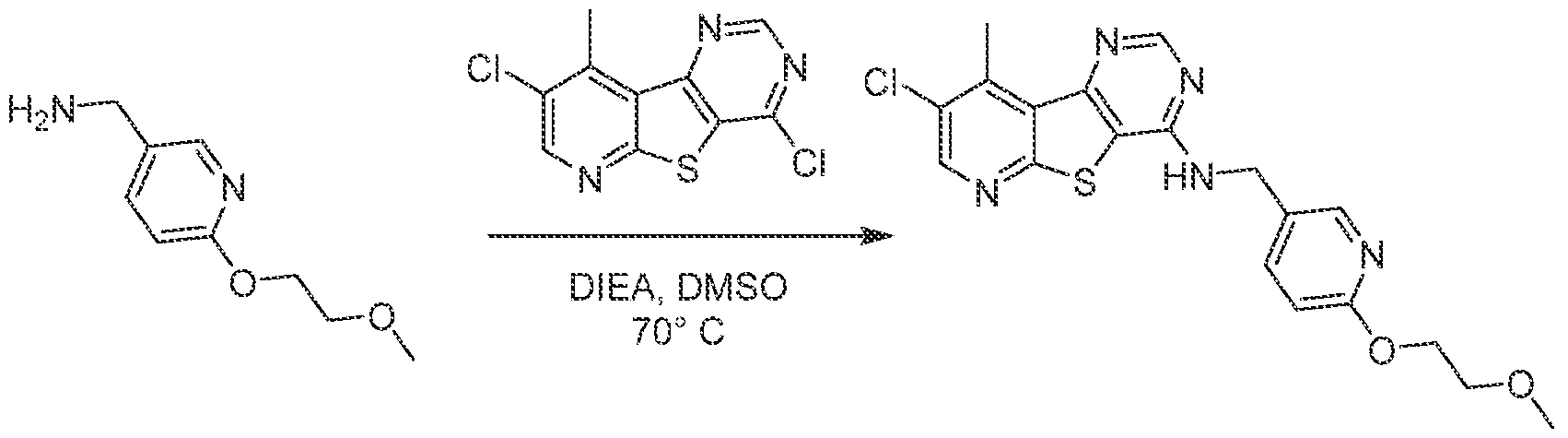 [00311] 8-Chloro-N-((6-(2-methoxyethoxy)pyridin-3-yl)methyl)-9- methylpyrido[3',2':4,5]thieno[3,2-d]pyrimidin-4-amine (Compound 14). A mixture of (6-(2- methoxyethoxy)pyridin-3-yl)methanamine (30 mg, 0.083 mmol), 4,8-dichloro-9- methylpyrido[3',2':4,5]thieno[3,2-d]pyrimidine (15 mg, 0.056 mmol) )[Reference: WO
2017223290], and N,N-diisopropylethylamine (41 μL, 0.22 mmol) in DMF (0.5 mL) was heated to 50 °C for 16 hours. The reaction mixture was purified directly via RP-HPLC (30-70% MeCN in 0.1% aqueous TFA). The fractions containing product were basified with saturated NaHCO3 solution, extracted with DCM, and concentrated to give the title compound (10 mg). ES-MS [M+1]+: 416.2; 1H NMR (400 MHz, DMSO) 8.76 (s, 1H), 8.68 (s, 1H), 8.56 (t, J = 5.8 Hz, 1H), 8.18 (d, J = 2.4 Hz, 1H), 7.73 (dd, J = 8.5, 2.5 Hz, 1H), 6.79 (d, J = 8.5 Hz, 1H), 4.69 (d, J = 5.7 Hz, 2H), 4.37 – 4.30 (m, 2H), 3.66 – 3.59 (m, 2H), 3.27 (s, 3H), 3.10 (s, 3H).
[00311] 8-Chloro-N-((6-(2-methoxyethoxy)pyridin-3-yl)methyl)-9- methylpyrido[3',2':4,5]thieno[3,2-d]pyrimidin-4-amine (Compound 14). A mixture of (6-(2- methoxyethoxy)pyridin-3-yl)methanamine (30 mg, 0.083 mmol), 4,8-dichloro-9- methylpyrido[3',2':4,5]thieno[3,2-d]pyrimidine (15 mg, 0.056 mmol) )[Reference: WO
2017223290], and N,N-diisopropylethylamine (41 μL, 0.22 mmol) in DMF (0.5 mL) was heated to 50 °C for 16 hours. The reaction mixture was purified directly via RP-HPLC (30-70% MeCN in 0.1% aqueous TFA). The fractions containing product were basified with saturated NaHCO3 solution, extracted with DCM, and concentrated to give the title compound (10 mg). ES-MS [M+1]+: 416.2; 1H NMR (400 MHz, DMSO) 8.76 (s, 1H), 8.68 (s, 1H), 8.56 (t, J = 5.8 Hz, 1H), 8.18 (d, J = 2.4 Hz, 1H), 7.73 (dd, J = 8.5, 2.5 Hz, 1H), 6.79 (d, J = 8.5 Hz, 1H), 4.69 (d, J = 5.7 Hz, 2H), 4.37 – 4.30 (m, 2H), 3.66 – 3.59 (m, 2H), 3.27 (s, 3H), 3.10 (s, 3H).
 [00312] N-((6-(2-Methoxyethoxy)pyridin-3-yl)methyl)-7,9-dimethylthieno[2,3-d:4,5- d']dipyrimidin-4-amine (Compound 15). A mixture of (6-(2-methoxyethoxy)pyridin-3- yl)methanamine (33 mg, 0.090 mmol), 4-chloro-7,9-dimethylthieno[2,3-d:4,5-d']dipyrimidine (15 mg, 0.060 mmol) [Reference: WO 2019113179], and N,N-diisopropylethylamine (44 μL, 0.24 mmol) in DMF (0.5 mL) was heated to 50 °C for 16 hours. The reaction mixture was purified directly via RP-HPLC (14-54% MeCN in 0.1% aqueous TFA). The fractions containing product were basified with saturated NaHCO3 solution, extracted with DCM, and concentrated to give the title compound (20 mg). ES-MS [M+1]+: 397.3; 1H NMR (400 MHz, DMSO) 8.68 (s, 1H), 8.56 (t, J = 5.7 Hz, 1H), 8.17 (dd, J = 2.5, 0.7 Hz, 1H), 7.73 (dd, J = 8.5, 2.5 Hz, 1H), 6.79 (dd, J = 8.5, 0.7 Hz, 1H), 4.68 (d, J = 5.7 Hz, 2H), 4.37 – 4.30 (m, 2H), 3.68 – 3.59 (m, 2H), 3.27 (s, 3H), 3.05 (s, 3H), 2.72 (s, 3H).
[00313] N-((6-(2-Methoxyethoxy)pyridin-3-yl)methyl)-2,4-dimethylthieno[2,3-b:5,4- c']dipyridin-8-amine (Compound 16). To a 2 mL vial were added 8-chloro-2,4- dimethylthieno[2,3-b:5,4-c']dipyridine (20 mg, 0.08 mmol)[Reference: Bioorg. Med. Chem. Lett. 2021, 53, 128416], (6-(2-methoxyethoxy)pyridin-3-yl)methanamine (35 mg, 0.1 mmol), Cs2CO3 (37 mg, 0.11 mmol), tris(dibenzylideneacetone)dipalladium(0) (11.0 mg, 0.01 mmol), and XantPhos (14.0 mg, 0.02 mmol). The vessel was capped, degassed and purged with nitrogen (3x) followed by addition of 1,4-dioxane (0.5 mL). The vial was heated to 110 °C overnight. The reaction was cooled to room temperature and filtered through a pad of Celite® which was rinsed thoroughly with DCM/EtOAc. The organics were concentrated and the crude residue was purified via RP-HPLC (15 - 45% ACN/ 0.05% aqueous NH4OH). The fractions containing product were basified with sat. NaHCO3 solution, extracted with 3:1 chloroform/IPA, and concentrated to give the title compound.1H NMR (400 MHz, CDCl3) 8.23 (d, J = 5.7 Hz, 1H), 8.21 (dd, J = 2.5, 0.8 Hz, 1H), 7.69 (dd, J = 8.5, 2.5 Hz, 1H), 7.47 (d, J = 5.7 Hz, 1H), 7.08 (s, 1H), 6.80 (dd, J = 8.5, 0.7 Hz, 1H), 4.78 (d, J = 5.6 Hz, 2H), 4.59 (t, J = 5.7 Hz, 1H), 4.51 – 4.44 (m, 2H), 3.78 – 3.71 (m, 2H), 3.44 (s, 3H), 2.84 (d, J = 0.8 Hz, 3H), 2.67 (s, 3H). ES-MS [M+1]+: 395.3.
 [00314] N-((6-(2-Methoxyethoxy)pyridin-3-yl)methyl)-2,4- dimethylpyrido[4',3':4,5]thieno[2,3-d]pyrimidin-8-amine (Compound 17). To a 2 mL vial were added 8-chloro-2,4-dimethylpyrido[4',3':4,5]thieno[2,3-d]pyrimidine (20 mg, 0.08 mmol) [Reference: WO 2019113179], (6-(2-methoxyethoxy)pyridin-3-yl)methanamine (35 mg, 0.1 mmol), Cs2CO3 (37 mg, 0.11 mmol), tris(dibenzylideneacetone)dipalladium(0) (11.0 mg, 0.01 mmol), and XantPhos (14.0 mg, 0.02 mmol). The vessel was capped, degassed and purged with nitrogen (3x) followed by addition of 1,4-dioxane (0.5mL). The vial was heated to 110 °C overnight. The reaction was cooled to room temperature and filtered through a pad of Celite® which was rinsed thoroughly with DCM/EtOAc. The organics were concentrated and the crude residue was purified via RP-HPLC (15 - 45% MeCN in 0.1% aqueous TFA). Fractions containing product were basified with sat. NaHCO3 solution, extracted with 3:1 chloroform/IPA
and concentrated to provide the title compound (13 mg). 1H NMR (400 MHz, CDCl3) 8.30 (d, J = 5.6 Hz, 1H), 8.21 (dd, J = 2.4, 0.8 Hz, 1H), 7.68 (dd, J = 8.5, 2.5 Hz, 1H), 7.45 (d, J = 5.6 Hz, 1H), 6.80 (dd, J = 8.5, 0.8 Hz, 1H), 4.78 (d, J = 5.5 Hz, 2H), 4.63 (t, J = 5.5 Hz, 1H), 4.51 – 4.44 (m, 2H), 3.78 – 3.71 (m, 2H), 3.44 (s, 3H), 3.02 (s, 3H), 2.84 (s, 3H). ES-MS [M+1]+: 396.3.
[00314] N-((6-(2-Methoxyethoxy)pyridin-3-yl)methyl)-2,4- dimethylpyrido[4',3':4,5]thieno[2,3-d]pyrimidin-8-amine (Compound 17). To a 2 mL vial were added 8-chloro-2,4-dimethylpyrido[4',3':4,5]thieno[2,3-d]pyrimidine (20 mg, 0.08 mmol) [Reference: WO 2019113179], (6-(2-methoxyethoxy)pyridin-3-yl)methanamine (35 mg, 0.1 mmol), Cs2CO3 (37 mg, 0.11 mmol), tris(dibenzylideneacetone)dipalladium(0) (11.0 mg, 0.01 mmol), and XantPhos (14.0 mg, 0.02 mmol). The vessel was capped, degassed and purged with nitrogen (3x) followed by addition of 1,4-dioxane (0.5mL). The vial was heated to 110 °C overnight. The reaction was cooled to room temperature and filtered through a pad of Celite® which was rinsed thoroughly with DCM/EtOAc. The organics were concentrated and the crude residue was purified via RP-HPLC (15 - 45% MeCN in 0.1% aqueous TFA). Fractions containing product were basified with sat. NaHCO3 solution, extracted with 3:1 chloroform/IPA
and concentrated to provide the title compound (13 mg). 1H NMR (400 MHz, CDCl3) 8.30 (d, J = 5.6 Hz, 1H), 8.21 (dd, J = 2.4, 0.8 Hz, 1H), 7.68 (dd, J = 8.5, 2.5 Hz, 1H), 7.45 (d, J = 5.6 Hz, 1H), 6.80 (dd, J = 8.5, 0.8 Hz, 1H), 4.78 (d, J = 5.5 Hz, 2H), 4.63 (t, J = 5.5 Hz, 1H), 4.51 – 4.44 (m, 2H), 3.78 – 3.71 (m, 2H), 3.44 (s, 3H), 3.02 (s, 3H), 2.84 (s, 3H). ES-MS [M+1]+: 396.3.
 [00315] N-((6-(2-Methoxyethoxy)pyridin-3-yl)methyl)-7,9- dimethylpyrido[3',2':4,5]thieno[3,2-d]pyrimidin-4-amine (Compound 18). A mixture of N,N- diisopropylethylamine (40 μL, 0.24 mmol) and 4-chloro-7,9-dimethylpyrido[3',2':4,5]thieno[3,2- d]pyrimidine (15 mg, 0.06 mmol) )[Reference: Bioorg. Med. Chem. Lett. 2021, 53, 128416] and (6-(2-methoxyethoxy)pyridin-3-yl)methanamine (33 mg, 0.09 mmol) in DMF (0.5 mL) was stirred at 70 °C for 2 h. The reaction mixture was purified via RP-HPLC (15-55% MeCN in 0.1% aqueous TFA). The fractions containing desired product were basified with sat. NaHCO3 solution, extracted with 3:1 chloroform/IPA (3x) and concentrated to give the title compound (17 mg).1H NMR (400 MHz, CDCl3) 8.79 (s, 1H), 8.19 (dd, J = 2.6, 0.8 Hz, 1H), 7.66 (dd, J = 8.5, 2.5 Hz, 1H), 7.12 (s, 1H), 6.81 (dd, J = 8.5, 0.8 Hz, 1H), 5.00 (d, J = 5.8 Hz, 1H), 4.82 (d, J = 5.7 Hz, 2H), 4.51 – 4.44 (m, 2H), 3.78 – 3.71 (m, 2H), 3.43 (s, 3H), 3.02 (d, J = 0.8 Hz, 3H), 2.67 (s, 3H). ES-MS [M+1]+: 396.3.
 [00316] (S)-N-((6-(2-methoxypropoxy)pyridin-3-yl)methyl)-3,4- dimethylpyrimido[4',5':4,5]thieno[2,3-c]pyridazin-8-amine and (R)-N-((6-(2- methoxypropoxy)pyridin-3-yl)methyl)-3,4-dimethylpyrimido[4',5':4,5]thieno[2,3- c]pyridazin-8-amine
Analytical Separation Example: [00317] Chiral SFC separation was performed on a Thar (Waters) Investigator. Column: Chiral Technologies CHIRALPAK IF, 4.6 x 250 mm, 5 μm. Gradient conditions: 35% Isocratic ethanol in CO2. Flow rate: 3.5 mL/min. Column temperature: 40° C. System backpressure: 100 bar. Enantiomer 1: Enantiomer 2 (1:1). Preparative Separation Example: [00318] Chiral SFC separation was performed on a PIC Solution SFC-PICLab PREP 100. Column: Chiral Technologies CHIRALPAK IF, 21 x 250 mm, 5 μm. Conditions: 35% isocratic ethanol in CO2. Flow rate: 80 mL/min. Column temperature: 40° C. System backpressure: 100 bar. Enantiomer 1 (Compound 19; first eluted peak): [00319] Rt = 9.33 min (preparative method); ES-MS [M+1]+ = 411.2; 94% ee; 1H NMR (400 MHz, DMSO) 8.72 (s, 2H), 8.19 (dd, J = 2.5, 0.7 Hz, 1H), 7.74 (dd, J = 8.5, 2.5 Hz, 1H), 6.80 (dd, J = 8.5, 0.7 Hz, 1H), 4.71 (d, J = 5.7 Hz, 2H), 4.18 (dd, J = 5.1, 1.4 Hz, 2H), 3.70 – 3.58 (m, 1H), 3.27 (s, 3H), 3.01 (s, 3H), 2.78 (s, 3H), 1.13 (d, J = 6.3 Hz, 3H). Enantiomer 2 (Compound 20; second eluted peak): [00320] Rt = 10.98 min (preparative method; ES-MS [M+1]+ = 411.2; 99% ee; 1H NMR (400 MHz, DMSO) 8.71 (s, 2H), 8.19 (dd, J = 2.5, 0.7 Hz, 1H), 7.74 (dd, J = 8.5, 2.5 Hz, 1H), 6.80 (dd, J = 8.5, 0.7 Hz, 1H), 4.70 (d, J = 5.7 Hz, 2H), 4.18 (dd, J = 5.1, 1.6 Hz, 2H), 3.70 – 3.58 (m, 1H), 3.27 (s, 3H), 2.99 (s, 3H), 2.77 (s, 3H), 1.13 (d, J = 6.3 Hz, 3H).
[00316] (S)-N-((6-(2-methoxypropoxy)pyridin-3-yl)methyl)-3,4- dimethylpyrimido[4',5':4,5]thieno[2,3-c]pyridazin-8-amine and (R)-N-((6-(2- methoxypropoxy)pyridin-3-yl)methyl)-3,4-dimethylpyrimido[4',5':4,5]thieno[2,3- c]pyridazin-8-amine
Analytical Separation Example: [00317] Chiral SFC separation was performed on a Thar (Waters) Investigator. Column: Chiral Technologies CHIRALPAK IF, 4.6 x 250 mm, 5 μm. Gradient conditions: 35% Isocratic ethanol in CO2. Flow rate: 3.5 mL/min. Column temperature: 40° C. System backpressure: 100 bar. Enantiomer 1: Enantiomer 2 (1:1). Preparative Separation Example: [00318] Chiral SFC separation was performed on a PIC Solution SFC-PICLab PREP 100. Column: Chiral Technologies CHIRALPAK IF, 21 x 250 mm, 5 μm. Conditions: 35% isocratic ethanol in CO2. Flow rate: 80 mL/min. Column temperature: 40° C. System backpressure: 100 bar. Enantiomer 1 (Compound 19; first eluted peak): [00319] Rt = 9.33 min (preparative method); ES-MS [M+1]+ = 411.2; 94% ee; 1H NMR (400 MHz, DMSO) 8.72 (s, 2H), 8.19 (dd, J = 2.5, 0.7 Hz, 1H), 7.74 (dd, J = 8.5, 2.5 Hz, 1H), 6.80 (dd, J = 8.5, 0.7 Hz, 1H), 4.71 (d, J = 5.7 Hz, 2H), 4.18 (dd, J = 5.1, 1.4 Hz, 2H), 3.70 – 3.58 (m, 1H), 3.27 (s, 3H), 3.01 (s, 3H), 2.78 (s, 3H), 1.13 (d, J = 6.3 Hz, 3H). Enantiomer 2 (Compound 20; second eluted peak): [00320] Rt = 10.98 min (preparative method; ES-MS [M+1]+ = 411.2; 99% ee; 1H NMR (400 MHz, DMSO) 8.71 (s, 2H), 8.19 (dd, J = 2.5, 0.7 Hz, 1H), 7.74 (dd, J = 8.5, 2.5 Hz, 1H), 6.80 (dd, J = 8.5, 0.7 Hz, 1H), 4.70 (d, J = 5.7 Hz, 2H), 4.18 (dd, J = 5.1, 1.6 Hz, 2H), 3.70 – 3.58 (m, 1H), 3.27 (s, 3H), 2.99 (s, 3H), 2.77 (s, 3H), 1.13 (d, J = 6.3 Hz, 3H).
[00321] N-((6-(2-(Methoxy-d3)ethoxy-1,1,2,2-d4)pyridin-3-yl)methyl)-3,4- dimethylpyrimido[4',5':4,5]thieno[2,3-c]pyridazin-8-amine (Compound 21). Prepared in a similar manner to Compound 15. ES-MS [M+1]+: 404; 1H NMR (400 MHz, DMSO) 8.75 – 8.68 (m, 2H), 8.19 (dd, J = 2.5, 0.8 Hz, 1H), 7.74 (dd, J = 8.5, 2.5 Hz, 1H), 6.80 (dd, J = 8.5, 0.7 Hz, 1H), 4.70 (d, J = 5.7 Hz, 2H), 3.00 (s, 3H), 2.77 (s, 3H).
 [00322] N-((6-(2-methoxyethoxy-1,1,2,2-d4)pyridin-3-yl)methyl)-3,4- dimethylpyrimido[4',5':4,5]thieno[2,3-c]pyridazin-8-amine (Compound 22). Prepared in a similar manner to Compound 12. ES-MS [M+1]+: 401.
 [00323] 2-((5-(((3,4-dimethylpyrimido[4',5':4,5]thieno[2,3-c]pyridazin-8- yl)amino)methyl)pyridin-2-yl)oxy)acetic acid (Compound 23). A mixture of 2-((5-(((3,4- dimethylpyrimido[4',5':4,5]thieno[2,3-c]pyridazin-8-yl)amino)methyl)pyridin-2- yl)oxy)acetamide (46 mg, 0.12 mmol) in 1M HCl (0.23 mL, 0.23 mmol) and water (1 mL) was stirred at 100 °C. After 18 h, the reaction mixture was neutralized with 1M NaOH and concentrated. The crude residue was dissolved in DMSO/DMF (1:1; 2.0 mL) and purified using reverse phase HPLC (10-40% ACN/ 0.05% aqueous NH4OH). The fractions containing the desired product were concentrated to give the title compound (25 mg).1H NMR (400 MHz, DMSO) 8.74 (t, J = 5.8 Hz, 2H), 8.70 (s, 1H), 8.11 (d, J = 2.4 Hz, 1H), 7.69 (dd,
 8.5, 2.5 Hz, 1H), 6.73 (d, 1H), 4.67 (d, J = 5.1 Hz, 2H), 4.44 (s, 2H), 2.99 (s, 3H), 2.76 (s, 3H). [M+1]+: 397.3.
[00324] The compounds shown in Table 1 may be prepared using the methods shown in the preceding Schemes and Examples with the appropriate starting materials. Table 1
8.5, 2.5 Hz, 1H), 6.73 (d, 1H), 4.67 (d, J = 5.1 Hz, 2H), 4.44 (s, 2H), 2.99 (s, 3H), 2.76 (s, 3H). [M+1]+: 397.3.
[00324] The compounds shown in Table 1 may be prepared using the methods shown in the preceding Schemes and Examples with the appropriate starting materials. Table 1


 a. Earlier eluting enantiomer by chiral SFC separation b. Later eluting enantiomer by chiral SFC separation Biological Activity A. Cell Lines Expressing Muscarinic Acetylcholine Receptors [00325] Human and rat M4 cDNAs, along with the chimeric G protein Gqi5, were transfected into Chinese hamster ovary (CHO-K1) cells purchased from the American Type Culture Collection using Lipofectamine2000. The transfected cells were subjected to selection antbiotic treatment to generate stable cell lines; G418 sulfate (1 mg/ml) for selecting M4 expressing cells and Hygromycin B (500 μg/mL) for selecting Gqi5 expressing cells. The resulting polyclones were further screened to obtain monoclones of hM4–Gqi5 and rM4–Gqi5 for compound screening assay. Stable monoclone cells were maintained in Ham’s F-12 medium containing 10% heat-
inactivated fetal bovine serum (FBS), 1X Antibiotic/Antimycotic, 20 mM HEPES, 500 μg/mL G418 sulfate, and 200 μg/mL Hygromycin B in 37 °C humidified incubators in the presence of 5% CO2. B. Cell-Based Functional Assay of Muscarinic Acetylcholine Receptor Activity [00326] The high throughput assay was employed to measure receptor-induced mobilization of intracellular calcium to determine compound activity. Test compound was added to cells expressing the muscarinic receptors that were loaded with calcium sensitive fluorescent dye. After a ~2.5 minute incubation period, a submaximal (EC20) concentration of acetylcholine was added, and the response measured. This kinetic assay allows for simultaneous screening and potency determination of multiple pharmacological modes of action including agonist and potentiator activity. CHO-K1 cells stably expressing muscarinic receptors were plated in growth medium lacking G418 and hygromycin at 15,000 cells/20 μL/well in Greiner 384-well black- walled, tissue culture (TC)-treated, clear-bottom plates (Greiner Bio-One). Cells were incubated overnight at 37 °C and 5% CO2. The next day, calcium assay buffer (Hank’s balanced salt solution (HBSS), 20 mM HEPES, 2.5 mM Probenecid, 4.16 mM sodium bicarbonate (Sigma- Aldrich, St. Louis, MO)) was prepared to dilute compounds, agonists, and Fluo-4- acetomethoxyester (Fluo-4-AM), fluorescent calcium indicator dye. Compounds were serially diluted 1:3 into 10 point concentration response curves in DMSO using the Bravo Liquid Handler (Agilent, Santa Clara, CA), transferred to a 384 well daughter plates using an Echo acoustic liquid handler (Beckman Coulter, Indianapolis, Indiana), and diluted in assay Buffer to a 2X final concentration. The agonist plates were prepared using acetylcholine (ACh, Sigma- Aldrich, St. Louis, MO) concentrations for the EC20 and ECMAX responses by diluting in assay buffer to a 5X final concentration. The 2X dye solution (2.3 μM) was prepared by mixing a 2.3 mM Fluo-4-AM stock in DMSO with 10% (w/v) pluronic acid F-127 in a 1:1 ratio in assay buffer. Using a microplate washer (BioTek, Winooski, VT), cells were washed with assay buffer for 3 times to remove medium. After the final wash, 20 L of assay buffer remained in the cell plates. Immediately, 20 L of the 2X dye solution (final 1.15 μM) was added to each well of the cell plate using a Multidrop Combi dispenser (Thermo Fisher, Waltham, MA). After cells were incubated with the dye solutions for 45 min at 37 °C in the presence of 5% CO2, the dye solutions were removed and replaced with assay buffer using a microplate washer, leaving 20 L of assay buffer in the cell plate.
[00327] The prepared compound, agonist, and cell plates were placed inside the Functional Drug Screening System uCell (FDSS uCell, Hamamatsu, Japan) to measure the calcium flux. The triple add protocol was used to measure Ca kinetics; Compound, ACh for EC20, and ACh for EC80 adds in an order. Briefly, after establishment of a fluorescence baseline for 2 seconds (excitation, 480 nm; emission, 530 nm), first add occurred by adding 20 μL of test compound to the cells, and the response was measured for 140 seconds. This is followed by second add; 10 μL (5X) of an EC20 concentration of ACh agonist was added to the cells, and the response of the cells was measured for 125 seconds. Immediately, the third add occurred by adding 12 ul (5X) of an EC80 concentration of ACh and the response of the cells was measured for 90 seconds. Acetylcholine-mediated maximum response (ECmax) was measured by adding 1 mM ACh as third add in the control wells. DMSO vehicle was added to the control wells in the first add for assessing ACh EC20, EC80, and ECmax responses. Calcium fluorescence was recorded as fold over basal fluorescence and raw data were normalized to the maximal response to ACh agonist. Agonist activity was analyzed as a concentration-dependent increase in calcium mobilization upon compound addition. Positive allosteric modulator activity was analyzed as a concentration- dependent increase in the EC20 acetylcholine response. Antagonist activity was analyzed as a concentration-dependent decrease in the EC80 acetylcholine response. Concentration-response curves were generated using a four-parameter logistical equation using GraphPad Prism (La Jolla, CA) or the Dotmatics software platform (Woburn, MA). [00328] The above-described assay was also operated in a second mode where an appropriate fixed concentration of the present compounds was added to the cells after establishment of a fluorescence baseline for about 3 seconds, and the response in cells was measured. 140 s later, the appropriate concentration of agonist was added and the calcium response (maximum-local minima response) was measured. The EC50 values for the agonist in the presence of test compound were determined by nonlinear curve fitting. A decrease in the EC50 value of the agonist with increasing concentrations of the present compounds (a leftward shift of the agonist concentration-response curve) is an indication of the degree of muscarinic positive allosteric modulation at a given concentration of the present compound. An increase in the EC50 value of the agonist with increasing concentrations of the present compounds (a rightward shift of the agonist concentration response curve) is an indication of the degree of muscarinic antagonism at a given concentration of the present compound. The second mode also indicates whether the
present compounds also affect the maximum response of the muscarinic receptor to agonists. C. Activity of Compounds in a mAChR M4 Cell-Based Assay [00329] Compounds were synthesized as described above. Activity (EC50 and Emax) was determined in the mAChR M4 cell-based functional assay as described above and the data are shown in Table 2. Also, selectivity at M2 activity (EC50 and Emax) was shown below as determined in the M2 cell-based functional assay. The compound number corresponds to the compound numbers used in Table 1. Table 2.
a. Earlier eluting enantiomer by chiral SFC separation b. Later eluting enantiomer by chiral SFC separation Biological Activity A. Cell Lines Expressing Muscarinic Acetylcholine Receptors [00325] Human and rat M4 cDNAs, along with the chimeric G protein Gqi5, were transfected into Chinese hamster ovary (CHO-K1) cells purchased from the American Type Culture Collection using Lipofectamine2000. The transfected cells were subjected to selection antbiotic treatment to generate stable cell lines; G418 sulfate (1 mg/ml) for selecting M4 expressing cells and Hygromycin B (500 μg/mL) for selecting Gqi5 expressing cells. The resulting polyclones were further screened to obtain monoclones of hM4–Gqi5 and rM4–Gqi5 for compound screening assay. Stable monoclone cells were maintained in Ham’s F-12 medium containing 10% heat-
inactivated fetal bovine serum (FBS), 1X Antibiotic/Antimycotic, 20 mM HEPES, 500 μg/mL G418 sulfate, and 200 μg/mL Hygromycin B in 37 °C humidified incubators in the presence of 5% CO2. B. Cell-Based Functional Assay of Muscarinic Acetylcholine Receptor Activity [00326] The high throughput assay was employed to measure receptor-induced mobilization of intracellular calcium to determine compound activity. Test compound was added to cells expressing the muscarinic receptors that were loaded with calcium sensitive fluorescent dye. After a ~2.5 minute incubation period, a submaximal (EC20) concentration of acetylcholine was added, and the response measured. This kinetic assay allows for simultaneous screening and potency determination of multiple pharmacological modes of action including agonist and potentiator activity. CHO-K1 cells stably expressing muscarinic receptors were plated in growth medium lacking G418 and hygromycin at 15,000 cells/20 μL/well in Greiner 384-well black- walled, tissue culture (TC)-treated, clear-bottom plates (Greiner Bio-One). Cells were incubated overnight at 37 °C and 5% CO2. The next day, calcium assay buffer (Hank’s balanced salt solution (HBSS), 20 mM HEPES, 2.5 mM Probenecid, 4.16 mM sodium bicarbonate (Sigma- Aldrich, St. Louis, MO)) was prepared to dilute compounds, agonists, and Fluo-4- acetomethoxyester (Fluo-4-AM), fluorescent calcium indicator dye. Compounds were serially diluted 1:3 into 10 point concentration response curves in DMSO using the Bravo Liquid Handler (Agilent, Santa Clara, CA), transferred to a 384 well daughter plates using an Echo acoustic liquid handler (Beckman Coulter, Indianapolis, Indiana), and diluted in assay Buffer to a 2X final concentration. The agonist plates were prepared using acetylcholine (ACh, Sigma- Aldrich, St. Louis, MO) concentrations for the EC20 and ECMAX responses by diluting in assay buffer to a 5X final concentration. The 2X dye solution (2.3 μM) was prepared by mixing a 2.3 mM Fluo-4-AM stock in DMSO with 10% (w/v) pluronic acid F-127 in a 1:1 ratio in assay buffer. Using a microplate washer (BioTek, Winooski, VT), cells were washed with assay buffer for 3 times to remove medium. After the final wash, 20 L of assay buffer remained in the cell plates. Immediately, 20 L of the 2X dye solution (final 1.15 μM) was added to each well of the cell plate using a Multidrop Combi dispenser (Thermo Fisher, Waltham, MA). After cells were incubated with the dye solutions for 45 min at 37 °C in the presence of 5% CO2, the dye solutions were removed and replaced with assay buffer using a microplate washer, leaving 20 L of assay buffer in the cell plate.
[00327] The prepared compound, agonist, and cell plates were placed inside the Functional Drug Screening System uCell (FDSS uCell, Hamamatsu, Japan) to measure the calcium flux. The triple add protocol was used to measure Ca kinetics; Compound, ACh for EC20, and ACh for EC80 adds in an order. Briefly, after establishment of a fluorescence baseline for 2 seconds (excitation, 480 nm; emission, 530 nm), first add occurred by adding 20 μL of test compound to the cells, and the response was measured for 140 seconds. This is followed by second add; 10 μL (5X) of an EC20 concentration of ACh agonist was added to the cells, and the response of the cells was measured for 125 seconds. Immediately, the third add occurred by adding 12 ul (5X) of an EC80 concentration of ACh and the response of the cells was measured for 90 seconds. Acetylcholine-mediated maximum response (ECmax) was measured by adding 1 mM ACh as third add in the control wells. DMSO vehicle was added to the control wells in the first add for assessing ACh EC20, EC80, and ECmax responses. Calcium fluorescence was recorded as fold over basal fluorescence and raw data were normalized to the maximal response to ACh agonist. Agonist activity was analyzed as a concentration-dependent increase in calcium mobilization upon compound addition. Positive allosteric modulator activity was analyzed as a concentration- dependent increase in the EC20 acetylcholine response. Antagonist activity was analyzed as a concentration-dependent decrease in the EC80 acetylcholine response. Concentration-response curves were generated using a four-parameter logistical equation using GraphPad Prism (La Jolla, CA) or the Dotmatics software platform (Woburn, MA). [00328] The above-described assay was also operated in a second mode where an appropriate fixed concentration of the present compounds was added to the cells after establishment of a fluorescence baseline for about 3 seconds, and the response in cells was measured. 140 s later, the appropriate concentration of agonist was added and the calcium response (maximum-local minima response) was measured. The EC50 values for the agonist in the presence of test compound were determined by nonlinear curve fitting. A decrease in the EC50 value of the agonist with increasing concentrations of the present compounds (a leftward shift of the agonist concentration-response curve) is an indication of the degree of muscarinic positive allosteric modulation at a given concentration of the present compound. An increase in the EC50 value of the agonist with increasing concentrations of the present compounds (a rightward shift of the agonist concentration response curve) is an indication of the degree of muscarinic antagonism at a given concentration of the present compound. The second mode also indicates whether the
present compounds also affect the maximum response of the muscarinic receptor to agonists. C. Activity of Compounds in a mAChR M4 Cell-Based Assay [00329] Compounds were synthesized as described above. Activity (EC50 and Emax) was determined in the mAChR M4 cell-based functional assay as described above and the data are shown in Table 2. Also, selectivity at M2 activity (EC50 and Emax) was shown below as determined in the M2 cell-based functional assay. The compound number corresponds to the compound numbers used in Table 1. Table 2.
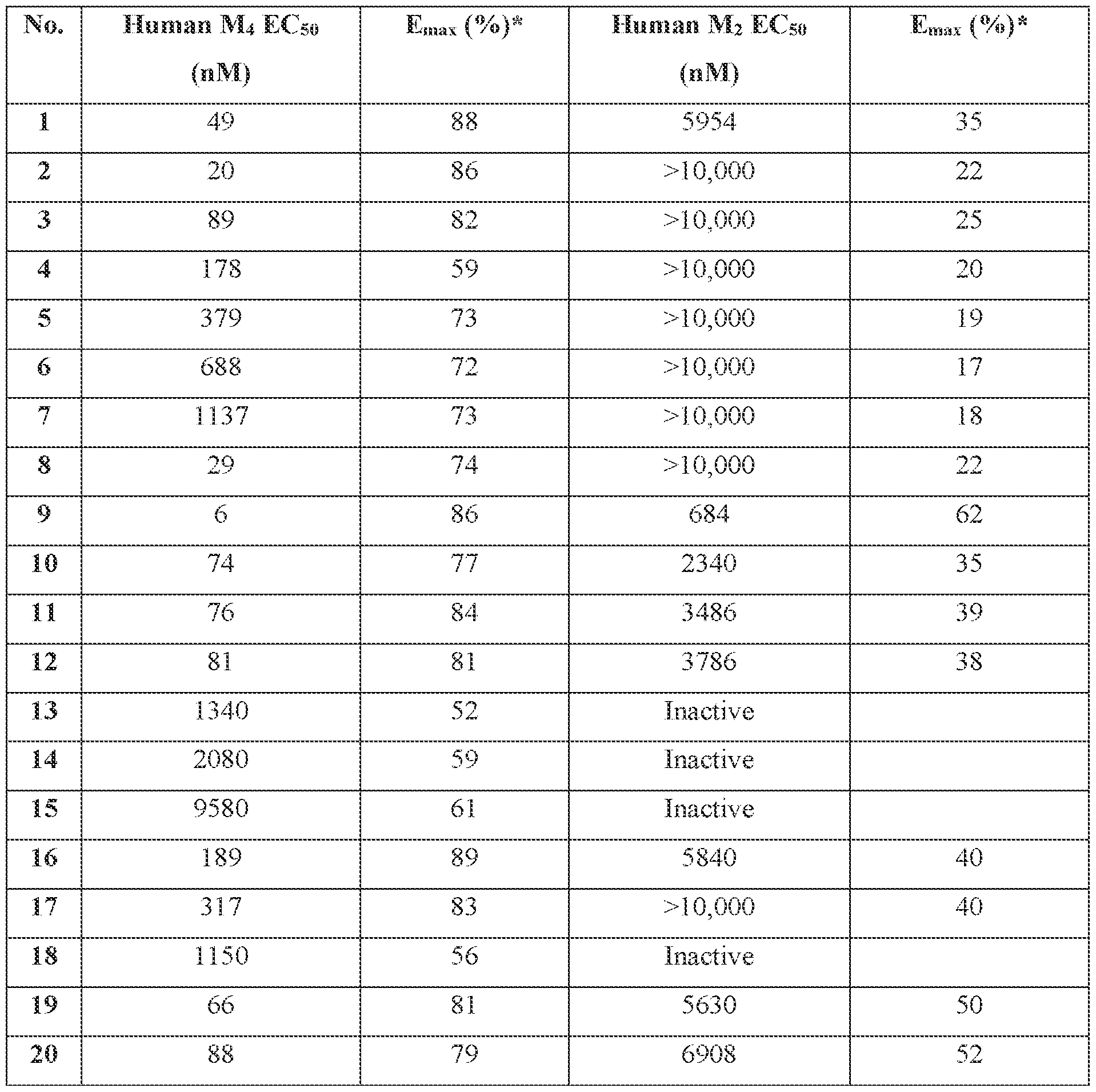
 * %ACh maximum at 30 μM. D. Functional assessment of M4 activator compounds in cellular cAMP assay Cellular cAMP Gi HTRF Assay [00330] Activation of the M4 receptor leads to the inhibition of cAMP production by coupling to Gi/o proteins. To measure the level of cAMP inhibition by M4 allosteric modulators, a Homogeneous Time-Resolved Fluorescence (HTRF®) cAMP assay was employed using CHO cells stably expressing human or rat M4 receptors. The HTRF cAMP assay is a Time-Resolved Resonance Energy Transfer (TR-FRET) competitive immunoassay. Endogenous intracellular cAMP generated by cells competes with Europium cryptate-labeled cAMP (Europium donor, emission 665 nm) for the binding to a cAMP antibody labeled with d2 (d2-acceptor, emission 620 nm). Thus, the fluorescence emission ratio (665 nm/620 nm) is inversely proportional to the cAMP amount in the cells. Compound-mediated M4 activation results in an increase in HTRF ratio (665 nm/620 nm), indicative of a decrease in intracellular cAMP level. To monitor agonist activity, compounds were added to the M4 cells in the presence of an EC80 concentration of forskolin (adenylyl cyclase activator) which induces a submaximal intracellular cAMP level. To assess potentiator activity, compounds were added to the M4 cells with an EC80 concentration of forskolin in the presence of an EC20 concentration of acetylcholine. This functional assay allows determination of the potency and efficacy of compounds directly activating or potentiating the Gi/o-coupled M4 receptor; representative data are shown in Table 3. [00331] Functional agonist and potentiator activities of compounds were determined by measuring cAMP levels in Chinese Hamster Ovary (CHO) cells stably expressing human or rat M4 muscarinic receptors using an HTRF cAMP Gi/o kit. Cells were maintained in F12 medium containing 10% FBS, 20 mM HEPES, 1X Antibiotic/Antimycotic, and G418 (500 g/ml) in 37 °C humidified incubators in the presence of 5% CO2. The day before assay, the cells were trypsinized and resuspended in plating medium (growth medium without G418). The cells were plated to white, solid, flat-bottomed, 384 well plates at densities of 4,000 and 6,000 cells/10
L/well, of human M4 and rat M4 cells, respectively. The cell plates were spun at 100xg for 1 min, then immediately placed in a 37 °C incubator in the presence of 5% CO2 overnight. [00332] The next day, reagents were freshly diluted at a 2X concentration in assay buffer using F12 basal medium or stimulation buffer. All assay buffers contained 500 μM IBMX to block cAMP degradation. Activation of M4 by compounds was examined in cells stimulated with an EC80 concentration of forskolin to induce submaximal intracellular cAMP levels. Forskolin EC80 concentrations were determined from forskolin concentration response curves (CRCs) and ranged from 1.5 to 2.5 μM. Compounds (10 mM) were prepared in 100% DMSO and further serially diluted either 1:3 or 1:5 into a 13-point CRC in DMSO using a Bravo Liquid Handler in a 384 well microplate. [00333] Agonist assay mode was used to assess the abilities of M4 compounds to directly activate M4 receptors in the absence of the agonist, acetylcholine. The 10-point serially diluted compounds, starting 30 μM as a final concentration, were transferred to a compound plate using an Echo plate reformat protocol.2X assay buffer containing an EC80 concentration of forskolin concentration was added to the compound plate. Vehicle (1% DMSO) was added to the following control wells; baseline cAMP (no forskolin), forskolin max, and forskolin EC80.10 μL/well of the prepared 2X assay buffer was immediately added to the cell plates using a Bravo 384 well tip liquid handler. The cell plates were immediately spun for 30 seconds at 100 x g and incubated at 37 °C for 10 min with gentle shaking at 50 rpm. An acetylcholine CRC was also performed in the presence of an EC80 concentration of forskolin to determine the concentrations of acetylcholine inducing maximal (ECmax) and submaximal (EC20) cAMP inhibition in order to prepare for the subsequent potentiator mode assay. [00334] In potentiator assay mode, the 10-point serially diluted compounds, starting 1.1 μM as a final concentration, were transferred to a compound plate using an Echo plate reformat protocol.2X assay buffer containing an EC80 concentration of forskolin and an EC20 concentration of acetylcholine was added to the compound plate. Vehicle (1% DMSO) was added to the following; (1) for forskolin controls wells - baseline cAMP (no forskolin), forskolin max, and forskolin EC80, (2) for agonist control wells containing forskolin EC80 – basal (no agonist), and acetylcholine EC20 and ECmax.10 μL/well of the prepared 2X assay buffer was immediately added to the cell plates using a Bravo 384 well tip liquid handler. The cell plates were immediately spun for 30 seconds at 100x g and incubated at 37 °C for 10 min with gentle
shaking at 50 rpm. During the 10-minute incubation period, cAMP Eu-cryptate donor (20X) and anti-cAMP d2 antibody acceptor (20X) were diluted in lysis/detection buffer in separate tubes. Immediately after the incubation, cells were lysed by sequentially adding 10 μL/well of cAMP Eu-crytate solution and 10 μL/well of anti-cAMP d2 antibody solution. The cell plates were immediately spun for 30 seconds at 100x g and incubated for 60 minutes at 25 °C with gentle shaking at 50 rpm. Immediately after the detection incubation, TR-FRET signals were measured at two channels, 665 and 620 nm, using an EnVision Plate reader (Perkin Elmer). All emission ratios (665/620) were normalized to % acetylcholine max. Individual CRCs were generated using a four-parameter logistical equation using GraphPad Prism (La Jolla, CA), and EC50 was extracted from the fitting, and maximal response (% ACh Max) was determined;
* %ACh maximum at 30 μM. D. Functional assessment of M4 activator compounds in cellular cAMP assay Cellular cAMP Gi HTRF Assay [00330] Activation of the M4 receptor leads to the inhibition of cAMP production by coupling to Gi/o proteins. To measure the level of cAMP inhibition by M4 allosteric modulators, a Homogeneous Time-Resolved Fluorescence (HTRF®) cAMP assay was employed using CHO cells stably expressing human or rat M4 receptors. The HTRF cAMP assay is a Time-Resolved Resonance Energy Transfer (TR-FRET) competitive immunoassay. Endogenous intracellular cAMP generated by cells competes with Europium cryptate-labeled cAMP (Europium donor, emission 665 nm) for the binding to a cAMP antibody labeled with d2 (d2-acceptor, emission 620 nm). Thus, the fluorescence emission ratio (665 nm/620 nm) is inversely proportional to the cAMP amount in the cells. Compound-mediated M4 activation results in an increase in HTRF ratio (665 nm/620 nm), indicative of a decrease in intracellular cAMP level. To monitor agonist activity, compounds were added to the M4 cells in the presence of an EC80 concentration of forskolin (adenylyl cyclase activator) which induces a submaximal intracellular cAMP level. To assess potentiator activity, compounds were added to the M4 cells with an EC80 concentration of forskolin in the presence of an EC20 concentration of acetylcholine. This functional assay allows determination of the potency and efficacy of compounds directly activating or potentiating the Gi/o-coupled M4 receptor; representative data are shown in Table 3. [00331] Functional agonist and potentiator activities of compounds were determined by measuring cAMP levels in Chinese Hamster Ovary (CHO) cells stably expressing human or rat M4 muscarinic receptors using an HTRF cAMP Gi/o kit. Cells were maintained in F12 medium containing 10% FBS, 20 mM HEPES, 1X Antibiotic/Antimycotic, and G418 (500 g/ml) in 37 °C humidified incubators in the presence of 5% CO2. The day before assay, the cells were trypsinized and resuspended in plating medium (growth medium without G418). The cells were plated to white, solid, flat-bottomed, 384 well plates at densities of 4,000 and 6,000 cells/10
L/well, of human M4 and rat M4 cells, respectively. The cell plates were spun at 100xg for 1 min, then immediately placed in a 37 °C incubator in the presence of 5% CO2 overnight. [00332] The next day, reagents were freshly diluted at a 2X concentration in assay buffer using F12 basal medium or stimulation buffer. All assay buffers contained 500 μM IBMX to block cAMP degradation. Activation of M4 by compounds was examined in cells stimulated with an EC80 concentration of forskolin to induce submaximal intracellular cAMP levels. Forskolin EC80 concentrations were determined from forskolin concentration response curves (CRCs) and ranged from 1.5 to 2.5 μM. Compounds (10 mM) were prepared in 100% DMSO and further serially diluted either 1:3 or 1:5 into a 13-point CRC in DMSO using a Bravo Liquid Handler in a 384 well microplate. [00333] Agonist assay mode was used to assess the abilities of M4 compounds to directly activate M4 receptors in the absence of the agonist, acetylcholine. The 10-point serially diluted compounds, starting 30 μM as a final concentration, were transferred to a compound plate using an Echo plate reformat protocol.2X assay buffer containing an EC80 concentration of forskolin concentration was added to the compound plate. Vehicle (1% DMSO) was added to the following control wells; baseline cAMP (no forskolin), forskolin max, and forskolin EC80.10 μL/well of the prepared 2X assay buffer was immediately added to the cell plates using a Bravo 384 well tip liquid handler. The cell plates were immediately spun for 30 seconds at 100 x g and incubated at 37 °C for 10 min with gentle shaking at 50 rpm. An acetylcholine CRC was also performed in the presence of an EC80 concentration of forskolin to determine the concentrations of acetylcholine inducing maximal (ECmax) and submaximal (EC20) cAMP inhibition in order to prepare for the subsequent potentiator mode assay. [00334] In potentiator assay mode, the 10-point serially diluted compounds, starting 1.1 μM as a final concentration, were transferred to a compound plate using an Echo plate reformat protocol.2X assay buffer containing an EC80 concentration of forskolin and an EC20 concentration of acetylcholine was added to the compound plate. Vehicle (1% DMSO) was added to the following; (1) for forskolin controls wells - baseline cAMP (no forskolin), forskolin max, and forskolin EC80, (2) for agonist control wells containing forskolin EC80 – basal (no agonist), and acetylcholine EC20 and ECmax.10 μL/well of the prepared 2X assay buffer was immediately added to the cell plates using a Bravo 384 well tip liquid handler. The cell plates were immediately spun for 30 seconds at 100x g and incubated at 37 °C for 10 min with gentle
shaking at 50 rpm. During the 10-minute incubation period, cAMP Eu-cryptate donor (20X) and anti-cAMP d2 antibody acceptor (20X) were diluted in lysis/detection buffer in separate tubes. Immediately after the incubation, cells were lysed by sequentially adding 10 μL/well of cAMP Eu-crytate solution and 10 μL/well of anti-cAMP d2 antibody solution. The cell plates were immediately spun for 30 seconds at 100x g and incubated for 60 minutes at 25 °C with gentle shaking at 50 rpm. Immediately after the detection incubation, TR-FRET signals were measured at two channels, 665 and 620 nm, using an EnVision Plate reader (Perkin Elmer). All emission ratios (665/620) were normalized to % acetylcholine max. Individual CRCs were generated using a four-parameter logistical equation using GraphPad Prism (La Jolla, CA), and EC50 was extracted from the fitting, and maximal response (% ACh Max) was determined;
 where A is the molar concentration of the compound; bottom and top denote the lower and upper plateaus of the concentration-response curve; HillSlope is the Hill coefficient that describes the steepness of the curve; and EC50 is the molar concentration of compound required to generate a response halfway between the top and bottom. Table 3. hM4 cAMP Activity
 Table 4. Materials and Equipment

 [00335] It is understood that the foregoing detailed description and accompanying examples are merely illustrative and are not to be taken as limitations upon the scope of the invention, which is defined solely by the appended claims and their equivalents. [00336] Various changes and modifications to the disclosed embodiments will be apparent to those skilled in the art. Such changes and modifications, including without limitation those relating to the chemical structures, substituents, derivatives, intermediates, syntheses, compositions, formulations, or methods of use of the invention, may be made without departing from the spirit and scope thereof.
Claims
CLAIMS What is claimed is: 1. A compound of formula (I), or a pharmaceutically acceptable salt thereof,
 wherein: Z1 is N or CR1; R1 is hydrogen or methyl; Z2 is CR2 or N; R2 is methyl, chloro, difluoromethyl, trifluoromethyl, or hydrogen; Z3 is CR3 or N; R3 is methyl or hydrogen; provided that no more than 1 of Z1, Z2, and Z3 is N; Z3 is N or CR4; R4 is hydrogen or methyl; R5 is hydrogen or methyl; R6 is hydrogen, C1-4alkyl, C1-2fluoroalkyl, C3-4cycloalkyl, or –C1-3alkylene–C3-4cycloalkyl; R7a and R7b are independently hydrogen or methyl; Cy is a 6-membered 1,4-heteroarylene or 1,4-phenylene, the heteroarylene containing 1-2 nitrogen atoms and Cy being unsubstituted or substituted with 1-4 substituents independently selected from the group consisting of halogen, cyano, C1-4alkyl, C1-2fluoroalkyl, C3- 4cycloalkyl, OH, –OC1-4alkyl, and –OC1-2fluoroalkyl; R8 is –C1-6alkylene–X, –C1-6fluoroalkylene–X, G1, or G2;
X is –OR8a, –N(R8a)(R8b), –SR8c, –SO2R8c, –NR8aC(O)R8b, –NR8bC(O)R8a, –C(O)OR8a, –C(O)N(R8a)(R8b), G1, or G2; R8a is hydrogen, C1-6alkyl, C1-6fluoroalkyl, C3-6cycloalkyl, –C1-3alkylene–C3-6cycloalkyl, G1, or G2; R8b is hydrogen, C1-4alkyl, C1-2fluoroalkyl, C3-6cycloalkyl, or –C1-3alkylene–C3-6cycloalkyl; R8c is C1-6alkyl, C1-6fluoroalkyl, C3-6cycloalkyl, –C1-3alkylene–C3-6cycloalkyl, G1, or G2; G1 is a 4-to 7-membered heterocyclyl containing 1-2 heteroatoms independently selected from the group consisting of O, N, and S, and optionally substituted with a first substituent selected from the group consisting of halogen, cyano, C1-4alkyl, C1-2fluoroalkyl, C3- 4cycloalkyl, oxo, –OR8d, –N(R8d)2, –NR8dC(O)R8d, –C(O)N(R8d)2, –C(O)OR8d, –SO2R8e, and –C(O)R8d and optionally further substituted with 1-3 substituents independently selected from the group consisting of halogen, C1-4alkyl, and C1-2fluoroalkyl; G2 is a C3-6cycloalkyl substituted with a first substituent selected from the group consisting of oxo, –OR8d, –N(R8d)2, –NR8dC(O)R8d, –C(O)N(R8d)2, –C(O)OR8d, –SO2R8e, and –C(O)R8d and optionally further substituted with 1-3 substituents independently selected from the group consisting of halogen, C1-4alkyl, and C1-2fluoroalkyl; R8d is hydrogen, C1-4alkyl, C1-2fluoroalkyl, C3-4cycloalkyl, or –C1-3alkylene–C3-4cycloalkyl; and R8e is C1-4alkyl, C1-2fluoroalkyl, C3-4cycloalkyl, or –C1-3alkylene–C3-4cycloalkyl.
wherein: Z1 is N or CR1; R1 is hydrogen or methyl; Z2 is CR2 or N; R2 is methyl, chloro, difluoromethyl, trifluoromethyl, or hydrogen; Z3 is CR3 or N; R3 is methyl or hydrogen; provided that no more than 1 of Z1, Z2, and Z3 is N; Z3 is N or CR4; R4 is hydrogen or methyl; R5 is hydrogen or methyl; R6 is hydrogen, C1-4alkyl, C1-2fluoroalkyl, C3-4cycloalkyl, or –C1-3alkylene–C3-4cycloalkyl; R7a and R7b are independently hydrogen or methyl; Cy is a 6-membered 1,4-heteroarylene or 1,4-phenylene, the heteroarylene containing 1-2 nitrogen atoms and Cy being unsubstituted or substituted with 1-4 substituents independently selected from the group consisting of halogen, cyano, C1-4alkyl, C1-2fluoroalkyl, C3- 4cycloalkyl, OH, –OC1-4alkyl, and –OC1-2fluoroalkyl; R8 is –C1-6alkylene–X, –C1-6fluoroalkylene–X, G1, or G2;
X is –OR8a, –N(R8a)(R8b), –SR8c, –SO2R8c, –NR8aC(O)R8b, –NR8bC(O)R8a, –C(O)OR8a, –C(O)N(R8a)(R8b), G1, or G2; R8a is hydrogen, C1-6alkyl, C1-6fluoroalkyl, C3-6cycloalkyl, –C1-3alkylene–C3-6cycloalkyl, G1, or G2; R8b is hydrogen, C1-4alkyl, C1-2fluoroalkyl, C3-6cycloalkyl, or –C1-3alkylene–C3-6cycloalkyl; R8c is C1-6alkyl, C1-6fluoroalkyl, C3-6cycloalkyl, –C1-3alkylene–C3-6cycloalkyl, G1, or G2; G1 is a 4-to 7-membered heterocyclyl containing 1-2 heteroatoms independently selected from the group consisting of O, N, and S, and optionally substituted with a first substituent selected from the group consisting of halogen, cyano, C1-4alkyl, C1-2fluoroalkyl, C3- 4cycloalkyl, oxo, –OR8d, –N(R8d)2, –NR8dC(O)R8d, –C(O)N(R8d)2, –C(O)OR8d, –SO2R8e, and –C(O)R8d and optionally further substituted with 1-3 substituents independently selected from the group consisting of halogen, C1-4alkyl, and C1-2fluoroalkyl; G2 is a C3-6cycloalkyl substituted with a first substituent selected from the group consisting of oxo, –OR8d, –N(R8d)2, –NR8dC(O)R8d, –C(O)N(R8d)2, –C(O)OR8d, –SO2R8e, and –C(O)R8d and optionally further substituted with 1-3 substituents independently selected from the group consisting of halogen, C1-4alkyl, and C1-2fluoroalkyl; R8d is hydrogen, C1-4alkyl, C1-2fluoroalkyl, C3-4cycloalkyl, or –C1-3alkylene–C3-4cycloalkyl; and R8e is C1-4alkyl, C1-2fluoroalkyl, C3-4cycloalkyl, or –C1-3alkylene–C3-4cycloalkyl.
2. The compound of claim 1, or a pharmaceutically acceptable salt thereof, wherein Cy is the unsubstituted or substituted 6-membered 1,4-heteroarylene.
3. The compound of claim 1 or 2, or a pharmaceutically acceptable salt thereof, wherein the ring system of the unsubstituted or substituted 6-membered 1,4-heteroarylene at Cy is pyridylene.
4. The compound of any of claims 1-3, or a pharmaceutically acceptable salt thereof, wherein Cy is unsubstituted.
5. The compound of claim 4, or a pharmaceutically acceptable salt thereof, wherein
6. The compound of any of claims 1-5, or a pharmaceutically acceptable salt thereof, wherein R8 is –C1-6alkylene–X.
7. The compound of any of claims 1-6, or a pharmaceutically acceptable salt thereof, wherein X is –OR8a or –C(O)OR8a.
8. The compound of any of claims 1-7, or a pharmaceutically acceptable salt thereof, wherein R8a is hydrogen, C1-6alkyl, or C3-6cycloalkyl.
9. The compound of any of claims 1-6, or a pharmaceutically acceptable salt thereof, wherein X is G1.
10. The compound of any of claims 1-6 or 9, or a pharmaceutically acceptable salt thereof, wherein the ring system of the optionally substituted 4-to 7-membered heterocyclyl at G1 is a 5- membered heterocyclyl containing 1-2 heteroatoms independently selected from the group consisting of O, N, and S.
11. The compound of any of claims 1-6 or 9-10, or a pharmaceutically acceptable salt thereof, wherein G1 is substituted with 1 oxo.
12. The compound of any of claims 1-6 or 9-11, or a pharmaceutically acceptable salt thereof, wherein
 .
.
13. The compound of any of claims 1-12, or a pharmaceutically acceptable salt thereof,
wherein Z1 is N.
14. The compound of any of claims 1-12, or a pharmaceutically acceptable salt thereof, wherein Z1 is CR1.
15. The compound of any of claims 1-14, or a pharmaceutically acceptable salt thereof, wherein Z2 is CR2.
16. The compound of any of claims 1-15, or a pharmaceutically acceptable salt thereof, wherein R2 is methyl or chloro.
17. The compound of any of claims 1-12 or 14, or a pharmaceutically acceptable salt thereof, wherein Z2 is N.
18. The compound of any of claims 1-17, or a pharmaceutically acceptable salt thereof, wherein Z3 is CR3.
19. The compound of any of claims 1-18, or a pharmaceutically acceptable salt thereof, wherein R3 is methyl.
20. The compound of any of claims 1-19, or a pharmaceutically acceptable salt thereof, wherein Z4 is N.
21. The compound of any of claims 1-19, or a pharmaceutically acceptable salt thereof, wherein Z4 is CR4.
22. The compound of any of claims 1-19 or 21, or a pharmaceutically acceptable salt thereof, wherein R4 is hydrogen.
23. The compound of any of claims 1-22, or a pharmaceutically acceptable salt thereof, wherein R5 is hydrogen.
24. The compound of any of claims 1-23, or a pharmaceutically acceptable salt thereof, wherein R6 is hydrogen.
25. The compound of any of claims 1-24, or a pharmaceutically acceptable salt thereof, wherein R7a and R7b are hydrogen.
26. The compound of claim 1 selected from the group consisting of: N-((6-(2-methoxyethoxy)pyridin-3-yl)methyl)-3,4- dimethylpyrimido[4',5':4,5]thieno[2,3-c]pyridazin-8-amine; 3-(2-((5-(((3,4-dimethylpyrimido[4',5':4,5]thieno[2,3-c]pyridazin-8- yl)amino)methyl)pyridin-2-yl)oxy)ethyl)oxazolidin-2-one; N-((6-(2-methoxypropoxy)pyridin-3-yl)methyl)-3,4- dimethylpyrimido[4',5':4,5]thieno[2,3-c]pyridazin-8-amine; N-((6-((1-methoxypropan-2-yl)oxy)pyridin-3-yl)methyl)-3,4- dimethylpyrimido[4',5':4,5]thieno[2,3-c]pyridazin-8-amine; N-((6-(2-isopropoxyethoxy)pyridin-3-yl)methyl)-3,4- dimethylpyrimido[4',5':4,5]thieno[2,3-c]pyridazin-8-amine; N-((6-(2-(tert-butoxy)ethoxy)pyridin-3-yl)methyl)-3,4- dimethylpyrimido[4',5':4,5]thieno[2,3-c]pyridazin-8-amine; N-((6-(2-(cyclopentyloxy)ethoxy)pyridin-3-yl)methyl)-3,4- dimethylpyrimido[4',5':4,5]thieno[2,3-c]pyridazin-8-amine; 2-((5-(((3,4-dimethylpyrimido[4',5':4,5]thieno[2,3-c]pyridazin-8- yl)amino)methyl)pyridin-2-yl)oxy)ethan-1-ol; N-((6-(2-methoxyethoxy)pyridin-3-yl)methyl)-3,4-dimethylpyrido[4',3':4,5]thieno[2,3- c]pyridazin-8-amine; 1-((5-(((3,4-dimethylpyrimido[4',5':4,5]thieno[2,3-c]pyridazin-8- yl)amino)methyl)pyridin-2-yl)oxy)-2-methylpropan-2-ol; N-((6-(2-(methoxy-d3)ethoxy)pyridin-3-yl)methyl)-3,4- dimethylpyrimido[4',5':4,5]thieno[2,3-c]pyridazin-8-amine;
N-((6-(2-(methoxy-d3)ethoxy)pyridin-3-yl)methyl-d2)-3,4- dimethylpyrimido[4',5':4,5]thieno[2,3-c]pyridazin-8-amine; 8-chloro-N-((6-(2-methoxyethoxy)pyridin-3-yl)methyl)-7,9- dimethylpyrido[3',2':4,5]thieno[3,2-d]pyrimidin-4-amine; 8-chloro-N-((6-(2-methoxyethoxy)pyridin-3-yl)methyl)-9- methylpyrido[3',2':4,5]thieno[3,2-d]pyrimidin-4-amine; N-((6-(2-methoxyethoxy)pyridin-3-yl)methyl)-7,9-dimethylthieno[2,3-d:4,5- d']dipyrimidin-4-amine; N-((6-(2-methoxyethoxy)pyridin-3-yl)methyl)-2,4-dimethylthieno[2,3-b:5,4- c']dipyridin-8-amine; N-((6-(2-methoxyethoxy)pyridin-3-yl)methyl)-2,4-dimethylpyrido[4',3':4,5]thieno[2,3- d]pyrimidin-8-amine; 3-chloro-N-((6-(2-methoxyethoxy)pyridin-3-yl)methyl)-2,4-dimethylthieno[2,3-b:5,4- c']dipyridin-8-amine; N-((6-(2-methoxyethoxy)pyridin-3-yl)methyl)-7,9-dimethylpyrido[3',2':4,5]thieno[3,2- d]pyrimidin-4-amine; (S)-N-((6-(2-methoxypropoxy)pyridin-3-yl)methyl)-3,4- dimethylpyrimido[4',5':4,5]thieno[2,3-c]pyridazin-8-amine; (R)-N-((6-(2-methoxypropoxy)pyridin-3-yl)methyl)-3,4- dimethylpyrimido[4',5':4,5]thieno[2,3-c]pyridazin-8-amine; N-((6-(2-(methoxy-d3)ethoxy-1,1,2,2-d4)pyridin-3-yl)methyl)-3,4- dimethylpyrimido[4',5':4,5]thieno[2,3-c]pyridazin-8-amine; N-((6-(2-methoxyethoxy-1,1,2,2-d4)pyridin-3-yl)methyl)-3,4- dimethylpyrimido[4',5':4,5]thieno[2,3-c]pyridazin-8-amine; 2-((5-(((3,4-dimethylpyrimido[4',5':4,5]thieno[2,3-c]pyridazin-8- yl)amino)methyl)pyridin-2-yl)oxy)acetic acid; or a pharmaceutically acceptable salt thereof.
27. A pharmaceutical composition comprising the compound of any of claims 1-26, or a pharmaceutically acceptable salt thereof, and a pharmaceutically acceptable carrier.
28. A compound of any of claims 1-26, or a pharmaceutically acceptable salt thereof, or the pharmaceutical composition of claim 27, for use in the treatment of a neurological and/or psychiatric disorder, wherein the disorder is selected from Alzheimer's disease, schizophrenia, a sleep disorder, a pain disorder, and a cognitive disorder.
Applications Claiming Priority (2)
| Application Number | Priority Date | Filing Date | Title |
|---|---|---|---|
| US202363610231P | 2023-12-14 | 2023-12-14 | |
| US63/610,231 | 2023-12-14 |
Publications (1)
| Publication Number | Publication Date |
|---|---|
| WO2025129082A1 true WO2025129082A1 (en) | 2025-06-19 |
Family
ID=94601330
Family Applications (1)
| Application Number | Title | Priority Date | Filing Date |
|---|---|---|---|
| PCT/US2024/060145 Pending WO2025129082A1 (en) | 2023-12-14 | 2024-12-13 | Positive allosteric modulators of the muscarinic acetylcholine receptor m4 |
Country Status (1)
| Country | Link |
|---|---|
| WO (1) | WO2025129082A1 (en) |
Citations (3)
| Publication number | Priority date | Publication date | Assignee | Title |
|---|---|---|---|---|
| WO2017223290A1 (en) * | 2016-06-22 | 2017-12-28 | Vanderbilt University | Positive allosteric modulators of the muscarinic acetylcholine receptor m4 |
| WO2018085813A1 (en) * | 2016-11-07 | 2018-05-11 | Vanderbilt University | Positive allosteric modulators of the muscarinic acetylcholine receptor m4 |
| WO2019113179A1 (en) * | 2017-12-05 | 2019-06-13 | Vanderbilt University | Positive allosteric modulators of the muscarinic acetylcholine receptor m4 |
-
2024
- 2024-12-13 WO PCT/US2024/060145 patent/WO2025129082A1/en active Pending
Patent Citations (3)
| Publication number | Priority date | Publication date | Assignee | Title |
|---|---|---|---|---|
| WO2017223290A1 (en) * | 2016-06-22 | 2017-12-28 | Vanderbilt University | Positive allosteric modulators of the muscarinic acetylcholine receptor m4 |
| WO2018085813A1 (en) * | 2016-11-07 | 2018-05-11 | Vanderbilt University | Positive allosteric modulators of the muscarinic acetylcholine receptor m4 |
| WO2019113179A1 (en) * | 2017-12-05 | 2019-06-13 | Vanderbilt University | Positive allosteric modulators of the muscarinic acetylcholine receptor m4 |
Non-Patent Citations (1)
| Title |
|---|
| LONG MADELINE F ET AL: "Discovery of structurally distinct tricyclic M4 positive allosteric modulator (PAM) chemotypes - Part 2", BIOORGANIC & MEDICINAL CHEMISTRY LETTERS, ELSEVIER, AMSTERDAM NL, vol. 53, 26 October 2021 (2021-10-26), XP086868054, ISSN: 0960-894X, [retrieved on 20211026], DOI: 10.1016/J.BMCL.2021.128416 * |
Similar Documents
| Publication | Publication Date | Title |
|---|---|---|
| EP3534901B1 (en) | Positive allosteric modulators of the muscarinic acetylcholine receptor m4 | |
| US10927126B2 (en) | Positive allosteric modulators of the muscarinic acetylcholine receptor M4 | |
| US10961253B2 (en) | Positive allosteric modulators of the muscarinic acetylcholine receptor M4 | |
| US20250017935A1 (en) | 7,8-dihydro-5h-1,6-naphthyridine derivatives as positive allosteric modulators of the muscarinic acetylcholine receptor m4 for treating neurological and psychiatric disorders | |
| WO2023141511A1 (en) | Positive allosteric modulators of the muscarinic acetylcholine receptor m4 | |
| US11376254B2 (en) | Positive allosteric modulators of the muscarinic acetylcholine receptor M4 | |
| US20260035366A1 (en) | Positive modulators of the muscarinic acetylcholine receptor m4 | |
| US10736898B2 (en) | Positive allosteric modulators of the muscarinic acetylcholine receptor M4 | |
| US10189857B2 (en) | Positive allosteric modulators of the muscarinic acetylcholine receptor M4 | |
| WO2025129082A1 (en) | Positive allosteric modulators of the muscarinic acetylcholine receptor m4 | |
| EP4698539A1 (en) | Pyrrolopyridine derivatives as positive allosteric modulators of the muscarinic acetylcholine receptor m4 | |
| WO2024220635A1 (en) | Thiazolopyridine derivatives as positive allosteric modulators of the muscarinic acetylcholine receptor m4 | |
| EP4698543A1 (en) | 1,6-naphthyridine derivatives as positive allosteric modulators of the muscarinic acetylcholine receptor m4 useful for the treatment of neurological and psychiatric disorders | |
| HK40014595A (en) | Positive allosteric modulators of the muscarinic acetylcholine receptor m4 | |
| HK40014595B (en) | Positive allosteric modulators of the muscarinic acetylcholine receptor m4 | |
| HK40014598B (en) | Positive allosteric modulators of the muscarinic acetylcholine receptor m4 | |
| HK40014598A (en) | Positive allosteric modulators of the muscarinic acetylcholine receptor m4 |
Legal Events
| Date | Code | Title | Description |
|---|---|---|---|
| 121 | Ep: the epo has been informed by wipo that ep was designated in this application |
Ref document number: 24852977 Country of ref document: EP Kind code of ref document: A1 |