WO2025123045A1 - Predictive and diagnostic screening methods for endometrial cancer - Google Patents
Predictive and diagnostic screening methods for endometrial cancer Download PDFInfo
- Publication number
- WO2025123045A1 WO2025123045A1 PCT/US2024/059234 US2024059234W WO2025123045A1 WO 2025123045 A1 WO2025123045 A1 WO 2025123045A1 US 2024059234 W US2024059234 W US 2024059234W WO 2025123045 A1 WO2025123045 A1 WO 2025123045A1
- Authority
- WO
- WIPO (PCT)
- Prior art keywords
- palmitoyl
- gpc
- stearoyl
- enyl
- sulfate
- Prior art date
- Legal status (The legal status is an assumption and is not a legal conclusion. Google has not performed a legal analysis and makes no representation as to the accuracy of the status listed.)
- Pending
Links
Classifications
-
- G—PHYSICS
- G01—MEASURING; TESTING
- G01N—INVESTIGATING OR ANALYSING MATERIALS BY DETERMINING THEIR CHEMICAL OR PHYSICAL PROPERTIES
- G01N33/00—Investigating or analysing materials by specific methods not covered by groups G01N1/00 - G01N31/00
- G01N33/48—Biological material, e.g. blood, urine; Haemocytometers
- G01N33/50—Chemical analysis of biological material, e.g. blood, urine; Testing involving biospecific ligand binding methods; Immunological testing
- G01N33/53—Immunoassay; Biospecific binding assay; Materials therefor
- G01N33/575—Immunoassay; Biospecific binding assay; Materials therefor for cancer
- G01N33/5755—Immunoassay; Biospecific binding assay; Materials therefor for cancer of the uterine cervix, uterine corpus or endometrium
-
- A—HUMAN NECESSITIES
- A61—MEDICAL OR VETERINARY SCIENCE; HYGIENE
- A61P—SPECIFIC THERAPEUTIC ACTIVITY OF CHEMICAL COMPOUNDS OR MEDICINAL PREPARATIONS
- A61P31/00—Antiinfectives, i.e. antibiotics, antiseptics, chemotherapeutics
-
- G—PHYSICS
- G01—MEASURING; TESTING
- G01N—INVESTIGATING OR ANALYSING MATERIALS BY DETERMINING THEIR CHEMICAL OR PHYSICAL PROPERTIES
- G01N30/00—Investigating or analysing materials by separation into components using adsorption, absorption or similar phenomena or using ion-exchange, e.g. chromatography or field flow fractionation
- G01N30/02—Column chromatography
- G01N30/86—Signal analysis
-
- G—PHYSICS
- G01—MEASURING; TESTING
- G01N—INVESTIGATING OR ANALYSING MATERIALS BY DETERMINING THEIR CHEMICAL OR PHYSICAL PROPERTIES
- G01N30/00—Investigating or analysing materials by separation into components using adsorption, absorption or similar phenomena or using ion-exchange, e.g. chromatography or field flow fractionation
- G01N30/02—Column chromatography
- G01N30/88—Integrated analysis systems specially adapted therefor, not covered by a single one of the groups G01N30/04 - G01N30/86
-
- G—PHYSICS
- G01—MEASURING; TESTING
- G01N—INVESTIGATING OR ANALYSING MATERIALS BY DETERMINING THEIR CHEMICAL OR PHYSICAL PROPERTIES
- G01N33/00—Investigating or analysing materials by specific methods not covered by groups G01N1/00 - G01N31/00
- G01N33/48—Biological material, e.g. blood, urine; Haemocytometers
- G01N33/50—Chemical analysis of biological material, e.g. blood, urine; Testing involving biospecific ligand binding methods; Immunological testing
- G01N33/84—Chemical analysis of biological material, e.g. blood, urine; Testing involving biospecific ligand binding methods; Immunological testing involving inorganic compounds or pH
-
- G—PHYSICS
- G01—MEASURING; TESTING
- G01N—INVESTIGATING OR ANALYSING MATERIALS BY DETERMINING THEIR CHEMICAL OR PHYSICAL PROPERTIES
- G01N33/00—Investigating or analysing materials by specific methods not covered by groups G01N1/00 - G01N31/00
- G01N33/48—Biological material, e.g. blood, urine; Haemocytometers
- G01N33/50—Chemical analysis of biological material, e.g. blood, urine; Testing involving biospecific ligand binding methods; Immunological testing
- G01N33/92—Chemical analysis of biological material, e.g. blood, urine; Testing involving biospecific ligand binding methods; Immunological testing involving lipids, e.g. cholesterol, lipoproteins, or their receptors
-
- G—PHYSICS
- G01—MEASURING; TESTING
- G01N—INVESTIGATING OR ANALYSING MATERIALS BY DETERMINING THEIR CHEMICAL OR PHYSICAL PROPERTIES
- G01N30/00—Investigating or analysing materials by separation into components using adsorption, absorption or similar phenomena or using ion-exchange, e.g. chromatography or field flow fractionation
- G01N30/02—Column chromatography
- G01N30/88—Integrated analysis systems specially adapted therefor, not covered by a single one of the groups G01N30/04 - G01N30/86
- G01N2030/8809—Integrated analysis systems specially adapted therefor, not covered by a single one of the groups G01N30/04 - G01N30/86 analysis specially adapted for the sample
- G01N2030/8813—Integrated analysis systems specially adapted therefor, not covered by a single one of the groups G01N30/04 - G01N30/86 analysis specially adapted for the sample biological materials
-
- G—PHYSICS
- G01—MEASURING; TESTING
- G01N—INVESTIGATING OR ANALYSING MATERIALS BY DETERMINING THEIR CHEMICAL OR PHYSICAL PROPERTIES
- G01N2800/00—Detection or diagnosis of diseases
- G01N2800/52—Predicting or monitoring the response to treatment, e.g. for selection of therapy based on assay results in personalised medicine; Prognosis
-
- G—PHYSICS
- G01—MEASURING; TESTING
- G01N—INVESTIGATING OR ANALYSING MATERIALS BY DETERMINING THEIR CHEMICAL OR PHYSICAL PROPERTIES
- G01N2800/00—Detection or diagnosis of diseases
- G01N2800/56—Staging of a disease; Further complications associated with the disease
-
- G—PHYSICS
- G01—MEASURING; TESTING
- G01N—INVESTIGATING OR ANALYSING MATERIALS BY DETERMINING THEIR CHEMICAL OR PHYSICAL PROPERTIES
- G01N30/00—Investigating or analysing materials by separation into components using adsorption, absorption or similar phenomena or using ion-exchange, e.g. chromatography or field flow fractionation
- G01N30/02—Column chromatography
- G01N30/62—Detectors specially adapted therefor
- G01N30/72—Mass spectrometers
Definitions
- the present invention relates to methods for predictive and diagnostic screening of women at risk for the development and progression of endometrial cancer.
- the methods feature detecting particular biomarkers using the local microenvironment.
- Endometrial cancer is a cancer of the lining of the uterus, and is the most prevalent gynecologic malignancy in high-income countries, with an annual global estimated incidence of 417,000 new cases and 97,000 deaths.
- Risk factors of EC include increased body mass index (BMI). diabetes, older age. early menopause, hypertension, family history (Lynch syndrome), and polycystic ovary syndrome (PCOS).
- BMI body mass index
- PCOS polycystic ovary syndrome
- Atypical hyperplasia is also a major risk factor for the development of EC when left untreated, being an endometrial precancerous condition.
- biomarkers serum levels of two proteins: human epididymis protein 4 (HE4) and cancer antigen 125 (CAI 25), have been shown to be altered in EC, but these markers also lack sensitivity and specificity. Thus, additional research is needed to quantify protein biomarkers in the context of EC for sufficient diagnostic accuracy, preferably using samples collected by a non-invasive method.
- HE4 human epididymis protein 4
- CAI 25 cancer antigen 125
- the present invention features a method comprises obtaining a cervicovaginal lavage (CVL) sample from a patient, producing a profile of the CVL sample collected by detecting at least five or more metabolite biomarkers selected from one or a combination of: 6-oxopiperidine-2-carboxylate, glycerophosphoethanolamine (GPEA), glycerophosphocholine (GPC), guanine, cytosine, glycerophosphoserine, X-19913, X-24724 lyxonate, prolylglycine, glycerophosphoglycerol, or N-acetylserine; and measuring the CVL sample profile produced in the aforementioned step.
- CVL cervicovaginal lavage
- the metabolites are expressed in grade 1/2 endometrioid endometrial cancer (EEC).
- the metabolite biomarkers detected in the CVL sample profile may further comprise one or more of AMP, spermine, myristoleoylcamitine, heptadecasphingosine, myristoylcamitine, pryndoxamine. 3 -hydroxyhexanoate, GPC (16:0/20:3). palmitoleoylcamitine. which may be expressed in all endometrial cancer (EMC).
- the metabolite biomarkers detected in the CVL sample profile may further comprise one or more of biliverdin, PC (P-16:0/20:4), 7-HOCA, PC (P-16:0/16:0), BHBA, X-25004, glycolithocholate sulfate, N-acetylserine, 3 -hydroxyhexanoate, myristolycamitine (C14: l).
- X-19913 which may be expressed in aggressive forms of endometrial cancer (EMC).
- the present invention features non-invasive method of diagnosing endometrial cancer (EC) in a subject in need thereof.
- the method comprises determining the subject’s levels of five or more metabolite biomarkers and diagnosing the patient with EC if the levels of at least five biomarkers are altered compared to a control profile.
- determining the subject’s levels of five or more metabolite biomarkers comprises obtaining a cervicovaginal lavage (CVL) sample from the subject; and measuring the levels of at least five or more metabolite biomarkers in the sample obtained; wherein the metabolite biomarkers are selected from one or a combination of: 6-oxopiperidine-2-carboxylate, glycerophosphoethanolamine (GPEA), glycerophosphocholine (GPC), guanine, cytosine, glycerophosphoserine, X-19913, X-24724 lyxonate, prolylglycine, glycerophosphoglycerol. or N-acetylserine.
- CVL cervicovaginal lavage
- the subject is diagnosed with EC when N-(2-hydroxypalmitoyl)-sphingosine (dl 8: l/16:0(2OH)), heptadecasphingosine (d!7: l), gabapentin, sphingosine, hydroxypalmitoyl sphingomyelin (d!8: 1/16:0(OH)), N-palmitoyl-heptadecasphingosine (d!7: 1/16:0), ceramide (d!8: l/17:0, d!7: l/18:0), hexadecasphingosine (dl6: l), X-17799.
- sphingadienine, or cholesterol sulfate are downregulated compared to a control profile and gamma-glutamylglutamine, 1-stearoyl-GPI (18:0), or cytidine 5 '-monophosphate (5'-CMP) are upregulated compared to a control profile.
- the present invention may also feature an in vitro method of diagnosing endometrial cancer (EC) in a subject in need thereof.
- the method may comprise producing a profile from a vaginal swab sample having been obtained from a subject by detecting at least five or more metabolite biomarkers selected from one or a combination of: 6-oxopiperidine-2-carboxylate, glycerophosphoethanolamine (GPEA), glycerophosphocholine (GPC).
- GPEA glycerophosphoethanolamine
- GPC glycerophosphocholine
- the present invention may also feature methods of treating endometrial cancer (EC) in a subject in need thereof, where if a subject is diagnosed with EC, then an EC treatment is administered to the subject.
- EC endometrial cancer
- the the method diagnoses endometrial cancer (EC) in the subject, wherein a subject is diagnosed with EC with cancer when N-(2-hydroxypalmitoyl)-sphingosine (d!8: l/16:0(2OH)), heptadecasphingosine (d!7: l), gabapentin, sphingosine, hydroxypalmitoyl sphingomyelin (dl8: l/16:0(OH))**, N-palmitoyl-heptadecasphingosine (d!7: 1/16:0)*, ceramide (dl8: l/17:0, dl 7: 1/18:0)*, hexadecasphingosine (dl6: l)*, X-17799, sphingadienine, or cholesterol sulfate are downregulated and gamma-glutamylglutamine, 1-stearoyl-GPI (18:0
- the present invention features a method of treating endometrial cancer (EC) in a patient in need thereof.
- the method may comprise diagnosing endometrial cancer (EC) in the patient as described herein and administering a therapeutic amount of a treatment to the patient if the patient is diagnosed with EC.
- the present invention features a method of monitoring an endometrial cancer treatment.
- the method comprises obtaining a first cervicovaginal lavage (CVL) sample from the subject and producing a baseline profile of the CVL sample collected by detecting at least five or more metabolite biomarkers.
- the baseline profile may be produced by detecting five or more metabolite biomarkers selected from one or a combination of: 6-oxopiperidine-2-carboxylate.
- the method comprises administering the treatment for EC to the subject.
- the method may further comprise obtaining a second cervicovaginal lavage (CVL) sample from the subject and producing a second profile of the CVL sample collected by detecting at least five or more metabolites biomarkers.
- CVL cervicovaginal lavage
- the second profile may be produced by detecting five or more metabolite biomarkers selected from one or a combination of: 6-oxopiperidine-2-carboxylate, glycerophosphoethanolamine (GPEA), glycerophosphocholine (GPC), guanine, cytosine, glycerophosphoserine, X-19913, X-24724 lyxonate, prolylglycine, glycerophosphoglycerol. or N-acetylserine.
- the method comprises comparing the baseline profile of the CVL sample to the second profile of the CVL sample.
- the treatment is effective if the levels of at least five biomarkers are altered from the baseline profile as compared to the second profile. In some embodiments, the treatment is effective when N-(2-hydroxypalmitoyl)-sphingosine (dl8: l/16:0(2OH)).
- heptadecasphingosine (d!7: l), gabapentin, sphingosine, hydroxypalmitoyl sphingomyelin (dl8: l/16:0(OH))**, N-palmitoyl-heptadecasphingosine (d!7: 1/16:0)*, ceramide (dl8: l/17:0, dl 7: 1/18:0)*, hexadecasphingosine (dl6: l)*, X-17799, sphingadienine, or cholesterol sulfate are upregulated and gamma-glutamylglutamine, 1-stearoyl-GPI (18:0), or cytidine 5 '-monophosphate (5'-CMP) are down-regulated.
- gamma-glutamylglutamine 1-stearoyl-GPI (18:0)
- the present invention features a non-invasive method of determining a size of a tumor in a subject with endometrial cancer (EC).
- the method may comprise determining the patient’s levels of five or more metabolites biomarkers by obtaining a cervicovaginal lavage (CVL) sample from the patien; and measuring the levels of five or more biomarkers in the sample obtained.
- CVL cervicovaginal lavage
- the five or more biomarkers comprise dihomolinolenate (20:3n3 or 3n6), (3'-5')-adenylyluridine, ceramide (d!8:l/14:0, dl6: l/16:0), N-palmitoyl-sphingadienine (d!8:2/l 6:0).
- 3-hydroxypalmitoylcamitine 1-linoleoylglycerol (18:2), 2'-deoxyuridine, 1-oleoyl-GPE (18:1),
- N-stearoyl-sphinganine (dl8:0/18:0)*, eicosenoate (20:ln9 or Inll), l-myristoyl-2-palmitoyl-GPC (14:0/16:0), sphingomyelin (dl8:2/24: l, d!8: 1/24:2)*,
- the size of the tumor is greater than 2 cm if the levels of five or more biomarkers are altered compared to a predetermined threshold.
- dihomolinolenate (20:3n3 or 3n6).
- N-palmitoyl-sphingosine (dl8: 1/16:0), l-(l-enyl-palmitoyl)-2-palmitoyl-GPC (P-16:0/16:0), biliverdin, N-palmitoyl-sphinganine (dl 8:0/16:0), N6-methyladenosine, 1 -stearoyl-GPI (18:0), lactosyl-N-nervonoyl-sphingosine (dl 8: 1/24: 1), l-(l-enyl-palmitoyl)-2-linoleoyl-GPC (P-16: 0/18:2), l-(l-enyl-palmitoyl)-2-arachidonoyl-GPC (P-16:0/20:4), 1-oleoyl-GPC (18: 1), ceramide (dl8: 1/17:0, dl7: 1/18:0), myristoyl
- 3-hydroxypalmitoylcamitine 1-linoleoylglycerol (18:2), 2'-deoxyuridine, 1-oleoyl-GPE (18: 1), N-stearoyl-sphinganine (dl8:0/18:0)*, eicosenoate (20: ln9 or loll), l-myristoyl-2-palmitoyl-GPC (14:0/16:0), sphingomyelin (dl8:2/24: l, dl8: 1/24:2)*, l-(l-enyl-palmitoyl)-2-oleoyl-GPE (P-16:0/18: l)*, 3-methyl-2-oxovalerate, l-palmitoyl-2-stearoyl-GPC (16:0/18:0).
- l-(l-enyl-palmitoyl)-2-oleoyl-GPC P-16:0/18: l)*
- 1-palmitoyl-GPE 16:0
- tumors greater than or equal to 2 cm and CDP-choline, CDP-ethanolamine, NAD+, val-val-ala, 4-hydroxyphenylacetylglutamine, 1 -methylguanidine, 2-hydroxy-4-(methylthio)butanoic acid, cysteine, adenosine, AMP, glycerophosphoglycerol, homocysteine, N-acetyl cysteine, adenine, cytidine diphosphate, 2,3-diphosphoglycerate, glutathione, reduced (GSEI), histidylalanine, Isobar: hexose diphosphates, dihydroorotate, camosine, valylglutamine, tyrosylglycine,
- the present invention features a method may comprise obtaining a vaginal swab sample from a patient, producing a profile of the vaginal swab sample collected by detecting at least five or more metabolite biomarkers selected from one or more of: N-(2-hydroxypalmitoyl)-sphingosine (dl8: l/16:0(2OH)), heptadecasphingosine (dl7: l), gabapentin, sphingosine, hydroxypalmitoyl sphingomyelin (dl8: l/16:0(OH)), N-palmitoyl-heptadecasphingosine (d!7: 1/16:0).
- N-(2-hydroxypalmitoyl)-sphingosine dl8: l/16:0(2OH)
- heptadecasphingosine dl7: l
- gabapentin sphingosine
- the metabolite biomarkers are expressed in grade 1/2 endometrioid endometrial cancer (EEC).
- the present invention features a non-invasive method of diagnosing endometrial cancer (EC) in a subject in need thereof.
- the method comprises determining the patient’s levels of five or more metabolite biomarkers and diagnosing the subject with EC if the levels of at least five biomarkers are altered compared to a control profile.
- determining the subject’s levels of five or more metabolite biomarkers comprises obtaining a vaginal swab sample from the patient; and measuring the levels of at least five or more metabolite biomarkers in the sample obtained; wherein the metabolite biomarkers are selected from one or a combination of:
- N-(2-hydroxypalmitoyl)-sphingosine (dl8: l/16:0(2OH)), heptadecasphingosine (dl7: l), gabapentin, sphingosine, hydroxypalmitoyl sphingomyelin (dl8: l/16:0(OH)), N-palmitoyl-heptadecasphingosine (dl7; 1/16:0), ceramide (dl8: 1/17:0, dl7: 1/18:0)*, hexadecasphingosine (dl6: l)*, X-17799, sphingadienine, cholesterol sulfate, gamma-glutamylglutamine, 1 -stearoyl-GPI (18:0), or cytidine 5 '-monophosphate (5'-CMP).
- the a subject is diagnosed with EC with cancer when N-(2-hydroxypalmitoyl)-sphingosine (d!8: l/16:0(2OH)), heptadecasphingosine (d!7: l), gabapentin, sphingosine, hydroxypalmitoyl sphingomyelin (dl8: l/16:0(OH))**, N-palmitoyl-heptadecasphingosine (d!7: 1/16:0)*, ceramide (dl8: l/17:0, dl7:l/18:0)*, hexadecasphingosine (dl6: l)*, X-17799, sphingadienine, or cholesterol sulfate are downregulated and gamma-glutamylglutamine, 1 -stearoyl-GPI (18:0). or cytidine 5 '-monophosphate (5
- the present invention may also feature an in vitro method of diagnosing endometrial cancer (EC) in a subject in need thereof.
- the method may comprise producing a profile from a vaginal swab sample obtained from a subject by detecting at least five or more metabolite biomarkers selected from one or a combination of: N-(2-hydroxypalmitoyl)-sphingosine (d!8: l/16:0(2OH)), heptadecasphingosine (dl7: l), gabapentin, sphingosine, hydroxypalmitoyl sphingomyelin (dl8: l/16:0(OH)), N-palmitoyl-heptadecasphingosine (dI7: 1/16:0).
- ceramide (d!8: l/17:0, dI7: 1/18:0)*, hexadecasphingosine (dl6: l)*, X-17799, sphingadienine, cholesterol sulfate, gamma-glutamylglutamine, 1 -stearoyl-GPI (18:0), or cytidine 5 '-monophosphate (5'-CMP)and diagnosing the patient with EC if the levels of at least five biomarkers are altered compared to a control profile.
- the subject is diagnosed with EC if the levels of at least five biomarkers are altered compared to a control profile.
- the present invention may also feature methods of treating endometrial cancer (EC) in a subject in need thereof, where if a subject is diagnosed with EC, then an EC treatment is administered to the subject.
- EC endometrial cancer
- the a subject is diagnosed with EC with cancer when N-(2-hydroxypalmitoyl)-sphingosine (d! 8: l/16:0(2OH)), heptadecasphingosine (d!7: l).
- 1-stearoyl-GPI (18:0), or cytidine 5'-monophosphate (5'-CMP) are upregulated.
- the present invention features a method of treating endometrial cancer (EC) in a patient in need thereof.
- the method may comprise diagnosing endometrial cancer (EC) in the patient as described herein and administering a therapeutic amount of a treatment to the patient if the patient is diagnosed with EC.
- the present invention features a method of monitoring an endometrial cancer treatment.
- the method comprises obtaining a first vaginal swab sample from the subject and producing a baseline profile of the vaginal swab sample collected by detecting at least five or more metabolite biomarkers.
- the baseline profile may be produced by detecting five or more metabolite biomarkers selected from one or a combination of: N-(2-hydroxypalmitoyl)-sphingosine (dl8: l/16:0(2OH)), heptadecasphingosine (dl7: l), gabapentin, sphingosine, hydroxypalmitoyl sphingomyelin (dl8: l/16:0(OH)), N-palmitoyl-heptadecasphingosine (dl7: 1/16:0), ceramide (dl8:l/17:0, dl7: 1/18:0)*, hexadecasphingosine (dl6: l)*, X-17799, sphingadienine, cholesterol sulfate, gamma-glutamylglutamine, 1-stearoyl-GPI (18:0), or cytidine 5'-monophosphat
- the method comprises administering the treatment for EC to the subject.
- the method may further comprise obtaining a second vaginal swab sample from the subject and producing a second profile of the vaginal swab sample collected by detecting at least five or more metabolites biomarkers.
- the second profile may be produced by detecting five or more metabolite biomarkers selected from one or a combination of: N-(2-hydroxypalmitoyl)-sphingosine (dl8: l/16:0(2OH)), heptadecasphingosine (dl7: l), gabapentin, sphingosine, hydroxypalmitoyl sphingomyelin (dl8: l/16:0(OH)), N-palmitoyl-heptadecasphingosine (dl 7: 1/16:0), ceramide (dl8:l/17:0, dl7: 1/18:0)*, hexadecasphingosine (dl6: l)*, X-17799.
- N-(2-hydroxypalmitoyl)-sphingosine dl8: l/16:0(2OH)
- heptadecasphingosine dl7: l
- the method comprises comparing the baseline profile of the vaginal swab sample to the second profile of the vaginal swab sample.
- the treatment is effective if the levels of at least five biomarkers are altered from the baseline profile as compared to the second profile.
- the treatment is effective when N-(2-hydroxypalmitoyl)-sphingosine (dl8: l/16:0(2OH)), heptadecasphingosine (dl7: l), gabapentin, sphingosine, hydroxypalmitoyl sphingomyelin (dl8: l/16:0(OH))**, N-palmitoyl-heptadecasphingosine (d!7: 1/16:0)*, ceramide (dl8: 1/17:0.
- dl7: 1/18:0)*, hexadecasphingosine (dl6: l)*, X-17799, sphingadienine, or cholesterol sulfate are upregulated and gamma-glutamylglutamine, 1-stearoyl-GPI (18:0), or cytidine 5 '-monophosphate (5'-CMP) are downregulated compared to a control profile.
- the present invention features a non-invasive method of determining a size of a tumor in a subject with endometrial cancer (EC).
- the method may comprise determining the patient’s levels of five or more metabolites biomarkers by obtaining a vaginal swab sample from the patient, and measuring the levels of five or more biomarkers in the sample obtained.
- the five or more biomarkers comprise 7-dimethylurate, pentose acid, N-acetylvaline, dopamine 3-O-sulfate, 1, 7-dimethylurate,
- the size of the tumor is greater than 2 cm if the levels of five or more biomarkers are altered compared to a predetermined threshold.
- 2-aminophenol sulfate, X-23662, 1,2,3-benzenetriol sulfate (2), 1 -methylguanidine, X-25102, doxylamine, X-17808, histidylalanine, methyl-4-hydroxybenzoate sulfate, argininate, ondansetron, and X-24991 are down-regulated in tumors greater than or equal to 2 cm.
- the present invention may further feature a non-invasive method of determining a prognosis of endometrial cancer (EC) in a subject in need thereof.
- the method comprises characterizing endometrial tumor characteristics comprising tumor size, myometrial invasion, mismatch repair (MMR) status, histological grade, age, or a combination thereof and determining the prognosis of the patient.
- the endometrial tumor characteristics may be determined by determining the patient’s levels of five or more metabolites biomarkers by obtaining a biological sample from the patient; and measuring the levels of two or more biomarkers in the sample obtained.
- the biological sample comprises a cervicovaginal lavage (CVL) sample, a urine sample, a vaginal swab, or a cervicovaginal secretion; wherein the cervicovaginal secretion is collected via a self collected lavage or a menstrual cup.
- CVL cervicovaginal lavage
- One of the unique and inventive technical features of the present invention is non-invasive sampling (e g., a cervicovaginal lavage (CVL) or vaginal).
- CVL cervicovaginal lavage
- vaginal vaginal
- the technical feature of the present invention advantageously provides for the detection of EC-related metabolite biomarkers in the cervicovaginal microenvironment. None of the presently known prior references or work has the unique, inventive technical feature of the present invention.
- the inventive technical features of the present invention contributed to a surprising result.
- Patients with tumors exhibiting myometrial invasion showed a significant increase in lipids, particularly glycerophospholipids, detected in vaginal swabs. These lipid profiles were distinct from those identified in cervicovaginal lavage (CVL) samples.
- CVL cervicovaginal lavage
- patients with larger tumors and MMR-deficient tumors demonstrated a depletion of various metabolites, including lipids and other metabolite classes, in vaginal swabs, while only two metabolites varied between histological subtypes in these samples.
- vaginal swabs revealed unique but less abundant metabolic features for differentiating tumor subtypes compared to CVL samples, suggesting that CVL metabolites may have greater potential for endometrial cancer (EC) stratification.
- EC endometrial cancer
- Another surprising result of the present invention contributed to a surprising result is that the targets that were most predictive were not the targets that were anticipated or predicted would be most predictive of disease status. Additional multivariate biomarker discovery analysis also yielded a unique set of targets that, when combined, were most predictive of disease status.
- FIG. 1A and IB show the global metabolic analysis reveals differing profiles between endometrial cancer patients and benign controls.
- FIG. 2A, 2B, 2C, and 2D show 7 metabolic analysis reveals the upregulation of lipids and downregulation of amino acids in endometrial cancer compared to benign conditions.
- FIG. 2B shows bar charts showing significantly altered (q ⁇ 0.05, FO2.0), FDR-corrected lipids in EC All, grade 1/2 EEC, and other EC compared to benign controls. Color-coded by lipid class.
- 2D shows bar charts showing significantly altered (q ⁇ 0.05, FO2.0), FDR-corrected amino acids in EC All, grade 1/2 EEC, and other EC compared to benign controls. Color-coded by amino acid class. This is important because there are particular subpathways of each of the lipid and amino acid groups.
- FIG. 3A. 3B, 3C. and 3D shows the fold change and T-test data reveals significant (q ⁇ 0.05, FC>2.0) up/downregulation of metabolites in endometrial cancer compared to benign controls.
- FIG. 3A and 3B show Volcano plots showing FDR-corrected, significantly altered (q ⁇ 0.05, FC>2.0) metabolites in grade 1/2 EEC (FIG. 3A) and other EC (FIG. 3B) compared to benign controls. Color-coded by significance and up/downregulation. Top altered metabolites are labeled. Uncharacterized metabolites were not included in this analysis.
- FIG. 3A. 3B, 3C. and 3D shows the fold change and T-test data reveals significant (q ⁇ 0.05, FC>2.0) up/downregulation of metabolites in endometrial cancer compared to benign controls.
- FIG. 3A and 3B show Volcano plots showing FDR-corrected, significantly altered (q ⁇ 0.05, FC>2.0) metabolites in grade 1/2 EEC
- FIG. 3C shows a Venn diagram comparing all significantly altered (q ⁇ 0.05, FC>2.0) metabolites in grade 1/2 EEC and other EC compared to benign controls. Bar plot demonstrates the superpathw ay profiles of each section from the Venn diagram.
- FIG. 3D shows bar charts representing downregulated amino acid and upregulated lipid classes unique to each cancer type and shared between all endometrial cancers. This is important because the specific metabolites and subpathways were identified that are altered and more indicative of grade 1/2 EEC and other EC vs. non-malignant controls.
- FIG. 4 shows the top 25 enriched pathways in EC All vs non-malignant controls. Enrichment analysis is based on the KEGG pathway database. This is important because it revealed metabolic pathways altered in endometrial cancer vs non-malignant controls.
- FIG. 5A, 5B, and 5C show- receiver operating characteristic (ROC) analysis reveals a multitude of potential biomarkers to detect endometrial cancer patients from benign controls.
- FIG. 5 A shows a scater plot showing 10 metabolites had an AUC>0.8 (good biomarker threshold) for EC All vs benign controls. Metabolites color-coded by superpathway. Uncharacterized metabolites not included in analysis.
- FIG. 5B shows a scater plot showing the AUC values of the 10 metabolites from panel A for grade 1/2 EEC and other EC vs benign controls. Metabolites color-coded by superpathway.
- FIG. 5 A shows a scater plot showing 10 metabolites had an AUC>0.8 (good biomarker threshold) for EC All vs benign controls. Metabolites color-coded by superpathway. Uncharacterized metabolites not included in analysis.
- FIG. 5B shows a scater plot showing the AUC values of the 10 metabolites from panel A for
- 5C shows AUC plots for the top four potential EC All biomarkers showing the AUC values for grade 1/2 EEC and other EC vs benign controls. This is important because it demonstrates that these specific and individual metabolites are sensitive and specific for prediction of all types of endometrial cancer and then specifically for grade 1/2 EEC and other EC relative to non-malignant controls.
- FIG. 6A and 6B show the top 15 metabolites with biomarker potential for other EC vs non-malignant controls (AUC>0.8 is considered good and AUC>0.9 is considered excellent) by receiver operating characteristic (ROC) analysis.
- ROC receiver operating characteristic
- FIG. 7A shows metabolites color-coded by superpathway. Uncharacterized metabolites were included in analysis.
- FIG. 7B shows AUC plots for the top three potential other EC biomarkers showing the AUC values. This is important because it demonstrates unique and individual metabolites that are specific for other endometrial cancer types that are higher grade and more aggressive subtype of endometrial cancer.
- FIG. 7A, 7B, 7C, and 7D show multivariate ROC analysis reveals potential for a multiple metabolites test to distinguish endometrial cancer patients from benign controls.
- FIG. 7B shows the top 15 selected metabolites (based on random forest) and their selected frequency. Color-coded by superpathway. Squares represent the relative levels of each metabolite in EC All and benign.
- FIG. 7C shows a cross validation plot demonstrating the abi 1 ity of multivariate ROC to predict disease groups.
- FIG. 7D shows a confusion matrix demonstrating the percentage of samples predicted correctly/incorrectly. Color-coded by percentage of total samples per disease group. This is important because combining multiple metabolites in this analysis demonstrated an increase in predictive accuracy for all endometrial cancer types.
- FIG. 8A, 8B, and 8C show analysis of pathology data reveals relationships between metabolites and tumor characteristics.
- FIG. 8A shows fold-change and T-test data combined to produce volcano plots show significantly (p ⁇ 0.05) up/downregulated (FC>2.0) metabolites associated with histological grade (other EC vs grade 1/2 EEC), MMR status (MMR deficient vs MMR proficient), myometrial invasion (present vs not present), and tumor size (>2cm vs 2cm).
- FIG. 8B shows Spearman correlation analysis shows top 20 significantly (p ⁇ 0.05) correlated metabolites with increased tumor size and increased depth of myometrial invasion.
- FIG. 8A shows fold-change and T-test data combined to produce volcano plots show significantly (p ⁇ 0.05) up/downregulated (FC>2.0) metabolites associated with histological grade (other EC vs grade 1/2 EEC), MMR status (MMR deficient vs MMR proficient), myometrial invasion (present vs not present
- FIG. 8C shows Venn diagram displaying number of significantly altered (p ⁇ 0.05, FC>2.0) metabolites that are unique or shared among the different tumor characteristics. This is important because using the CVL we were able to predict tumor size prior to surgery as well as other tumor characteristics such as histological grade, MMR status and myometrial invasion using these metabolic markers. Some markers are shared among these features and others are unique.
- FIG. 9A, 9B. 9C, and 9D shows metabolic profiles of vaginal swab samples substantially differ from metabolic profiles of cervicovaginal lavage samples.
- FIG. 10A, 10B, and IOC show lipid, amino acid, and peptide metabolism is significantly dysregulated in endometrial cancer compared to benign conditions based on the vaginal swab profiles.
- FIG. 11 A, 11 B, 11C, and 11D shows metabolites detected in vaginal swabs differentiate patients based on the endometrial tumor characteristics indicating potential prognostic utility.
- FIG. 12A and 12B shows the top predictive metabolic biomarkers for endometrial cancer differ between vaginal swabs and CVL samples.
- FIG. 13 shows the top predictive metabolic biomarkers for endometrial cancer in vaginal swab samples based on univariate ROC analysis.
- FIG. 14 shows the top predictive metabolic biomarkers for endometrial cancer in CVL samples based on univariate ROC analysis.
- FIG. 15 shows receiver operating characteristic (ROC) curves of the two most predictive metabolic biomarkers for endometrial cancer in vaginal swab samples.
- FIG. 16A, 16B, and 16C shows metabolites detected in vaginal swabs have similar predictive accuracy to metabolites in CVL based on multivariate ROC analyses using random forest algorithm. Multivariate ROC analyses were based on vaginal swab and CVL metabolic profiles excluding metabolites with unknown identity and xenobiotics.
- FIG. 17A, 17B, 17C, 17D, and 17E shows the best multivariate model based on vaginal swab profiles and the LASSO algorithm consist of 13 metabolic features.
- FIG. 18A, 18B, 18C, 18D, and 18E shows the best multivariate model based on CVL profiles and LASSO algorithm consist of 17 metabolic features.
- SAH S-adenosylhomocysteine
- SAM S-adenosylmethionine
- cancer refers to any physiological condition in mammals characterized by unregulated cell growth. Cancers described herein include solid tumors.
- a “solid tumor” or “tumor” refers to a lesion and neoplastic cell growth and proliferation, whether malignant or benign and all pre-cancerous and cancerous cells and tissues resulting in abnormal tissue growth.
- Neoplastic refers to any form of dysregulated or unregulated cell growth, whether malignant or benign, resulting in abnormal tissue growth.
- hyperplasia may refer to when healthy cells undergo abnormal changes within tissues or organs, and it is considered a pre-cancerous disease state. In some embodiments, hyperplasia may progress and become cancer. In other embodiments, hyperplasia may regress.
- pre-cancerous disease state may refer to a condition or lesion involving abnormal cells associated with an increased risk of developing into cancer. In some embodiments, the progression of normal cells to precancerous cells and towards endometrial cancer may involve oncogenes, inflammation, and multiple somatic mutations that initiate the malignant transformation, activation, and clonal expansion of stem cells.
- a subject can be a mammal such as a non-pnmate (e.g., cows, pigs, horses, cats, dogs, rats, etc.) or a primate (e.g., monkey and human).
- the subject is a human.
- the subject is a mammal (e.g., a human) having a disease, disorder, or condition described herein.
- the subject is a mammal (e.g., a human) at risk of developing a disease, disorder, or condition described herein.
- the term patient refers to a human.
- a normal subject may refer to a subject undergoing a hysterectomy for a benign condition, e.g., abnormal uterine bleeding, endometriosis, pelvic pain, etc.
- polypeptide and “protein” are used interchangeably to refer to a polymer of amino acid residues, comprising natural or non-natural amino acid residues, and are not limited to a minimum length.
- peptides, oligopeptides, dimers, multimers, and the like are included within the definition. Both full-length proteins and fragments thereof are encompassed by the definition.
- peptide refers to a short polymer of amino acids linked together by peptide bonds. In contrast to other amino acid polymers (e.g., proteins, polypeptides, etc.), peptides are of about 50 amino acids or less in length. A peptide may comprise natural amino acids, non-natural amino acids, amino acid analogs, and/or modified amino acids. A peptide may be a subsequence of naturally occurring protein or a non-natural (synthetic) sequence.
- the term “metabolite” refers to a small molecule that is an intermediate or end product of cellular metabolism within a living organism.
- Metabolites encompass both primary metabolites, directly involved in fundamental cellular functions, and secondary metabolites, which may serve specialized functions such as defense mechanisms or environmental adaptation.
- the present invention features methods (e.g., non/minimally invasive methods) for improving early EC detection/diagnosis among diverse racial and ethnic populations by developing cost-effective, robust, non-invasive diagnostics that facilitate a better understanding and decrease morbidity associated with this cancer health disparity in women.
- methods e.g., non/minimally invasive methods
- the present invention features a method comprising obtaining a biological sample from a patient, producing a profile of the aforementioned biological sample collected by detecting at least five or more metabolite biomarkers, and measuring the biological sample profile produced.
- the present invention features a method comprising obtaining a cervicovaginal lavage (CVL) sample from a patient, producing a profile of the aforementioned CVL sample collected by detecting at least five or more metabolite biomarkers; and measuring the CVL sample profile produced.
- CVL cervicovaginal lavage
- the present invention features a method comprising obtaining a vaginal swab sample from a patient, producing a profile of the aforementioned vaginal swab sample collected by detecting at least two or more metabolite biomarkers; and measuring the vaginal swab sample profile produced.
- the method comprises obtaining a cervicovaginal lavage (CVL) sample from a patient, producing a profile of the CVL sample collected by detecting at least five or more metabolite biomarkers selected from one or a combination of: 6-oxopiperidine-2-carboxylate, glycerophosphoethanolamine (GPEA), glycerophosphocholine (GPC), guanine, cytosine, glycerophosphoserine, X-19913, X-24724 lyxonate, prolylglycine, glycerophosphoglycerol. or N-acetylserine; and measuring the CVL sample profile produced in the aforementioned step.
- CVL cervicovaginal lavage
- the metabolites are expressed in grade 1/2 endometrioid endometrial cancer (EEC).
- the metabolite biomarkers detected in the CVL sample profile may further comprise one or more of AMP, spermine, myristoleoylcamitine, heptadecasphingosine, myristoylcamitine, pryridoxamine, 3 -hydroxyhexanoate, GPC (16:0/20:3). palmitoleoylcamitine. which may be expressed in all endometrial cancer (EMC).
- the metabolite biomarkers detected in the CVL sample profile may further comprise one or more of biliverdin, PC (P-16:0/20:4), 7-HOCA, PC (P-16:0/16:0), BHBA, X-25004. glycolithocholate sulfate, N-acetylserine, 3 -hydroxyhexanoate, myristolycamitine (C14: l). X-19913. which may be expressed in aggressive forms of endometrial cancer (EMC).
- EMC endometrial cancer
- the method may comprise obtaining a vaginal swab sample from a patient, producing a profile of the vaginal swab sample collected by detecting at least five or more metabolite biomarkers selected from one or more of: N-(2-hydroxypalmitoyl)-sphingosine (dl 8: l/16:0(2OH)), heptadecasphingosine (dl7: l), gabapentin, sphingosine, hydroxypalmitoyl sphingomyelin (dl8: l/16:0(OH)), N-palmitoyl-heptadecasphingosine (dl 7: 1/16: 0), ceramide (dl8: l/17:0, dl7: l/18:0)*, hexadecasphingosine (dl6: l)*, X-17799, sphingadienine, cholesterol s
- the methods described herein are configured to predict the risk of endometrial hyperplasia or cancer in women and may also facilitate the diagnosis of endometrial hyperplasia or cancer. For instance, these methods may be utilized to diagnose endometrial cancer, such as Type 1 endometrial cancer (EC).
- endometrial cancer such as Type 1 endometrial cancer (EC).
- a profile of a sample is produced by detecting at least five or more metabolite biomarkers.
- a profile of a sample e.g.. a CVL sample or a vaginal swab sample
- a profile of a sample is produced by detecting at least ten or more metabolite biomarkers.
- a profile of a sample e.g., a CVL sample or a vaginal swab sample
- a profile of a sample is produced by detecting at least twenty or more metabolite biomarkers. In some embodiments, a profile of a sample (e.g., a CVL sample or a vaginal swab sample) is produced by detecting at least twenty five or more metabolite biomarkers.
- a profile of a sample is produced by detecting about 5-25 metabolite biomarkers.
- a profile of a sample e.g., a CVL sample or a vaginal swab sample
- a profile of a sample is produced by detecting about 5-20 metabolite biomarkers.
- a profile of a sample is produced by detecting about 5-15 metabolite biomarkers.
- a profile of a sample is produced by detecting about 5-10 metabolite biomarkers.
- a profile of a sample is produced by detecting about 10-25 metabolite biomarkers.
- a profile of a sample is produced by detecting about 10-20 metabolite biomarkers.
- a profile of a sample is produced by detecting about 10-20 metabolite biomarkers.
- a CVL sample or a vaginal swab sample is produced by detecting about 10-15 metabolite biomarkers.
- a profile of a sample e.g., a CVL sample or a vaginal swab sample
- a profile of a sample is produced by detecting about 15-25 metabolite biomarkers.
- a profile of a sample is produced by detecting about 15-20 metabolite biomarkers.
- the present invention may also feature a non-invasive method of diagnosing endometrial cancer (EC) in a subject in need thereof.
- the method comprises determining the subject’s levels of five or more metabolites biomarkers: a) obtaining a biological sample from the patient; and b) measuring the levels of five or more metabolite biomarkers in the sample obtained.
- the method comprises determining the patient’s levels of five or more metabolite biomarkers by: obtaining a cervicovaginal lavage (CVL) sample from the patient; and measuring the levels of five or more biomarkers in the sample obtained.
- CVL cervicovaginal lavage
- the patient may be diagnosed with EC if at least five biomarkers are altered compared to a control profile.
- the method comprises determining the patient’s levels of five or more metabolite biomarkers by: obtaining a vaginal swab sample from the patient; and measuring the levels of five or more biomarkers in the sample obtained.
- the patient may be diagnosed with EC if at least five biomarkers are altered compared to a control profile.
- the present invention features non-invasive method of diagnosing endometrial cancer (EC) in a subject in need thereof.
- the method comprises determining the subject’s levels of five or more metabolite biomarkers and diagnosing the patient with EC if the levels of at least five biomarkers are altered compared to a control profile.
- determining the subject’s levels of five or more metabolite biomarkers comprises obtaining a cervicovaginal lavage (CVL) sample from the subject; and measuring the levels of at least five or more metabolite biomarkers in the sample obtained; wherein the metabolite biomarkers are selected from one or a combination of: 6-oxopiperidine-2-carboxylate, glycerophosphoethanolamine (GPEA), glycerophosphocholine (GPC), guanine, cytosine, glycerophosphoserine, X-19913, X-24724 lyxonate, prolylglycine, glycerophosphoglycerol. or N-acetylserine.
- CVL cervicovaginal lavage
- the subject is diagnosed with EC when N-(2-hydroxypalmitoyl)-sphingosine (dl8: l/16:0(2OH)), heptadecasphingosine (dl7: l), gabapentin, sphingosine, hydroxypalmitoyl sphingomyelin (dl 8: 1/16: 0(OH)), N-palmitoyl-heptadecasphingosine (dl7: 1/16:0), ceramide (dl8: l/17:0, dl7: l/18:0), hexadecasphingosine (dl6: 1), X-17799.
- N-(2-hydroxypalmitoyl)-sphingosine dl8: l/16:0(2OH)
- heptadecasphingosine dl7: l
- gabapentin sphingosine
- sphingadienine, or cholesterol sulfate are downregulated compared to a control profile and gamma-glutamylglutamine, 1-stearoyl-GPI (18:0), or cytidine 5'-monophosphate (5'-CMP) are upregulated compared to a control profile.
- the present invention features a non-invasive method of diagnosing endometrial cancer (EC) in a subject in need thereof.
- the method comprises determining the patient’s levels of five or more metabolite biomarkers and diagnosing the subject with EC if the levels of at least five biomarkers are altered compared to a control profile.
- determining the subject's levels of five or more metabolite biomarkers comprises obtaining a vaginal swab sample from the patient; and measuring the levels of at least five or more metabolite biomarkers in the sample obtained; wherein the metabolite biomarkers are selected from one or a combination of:
- N-(2-hydroxypalmitoyl)-sphingosine (d!8: l/16:0(2OH)), heptadecasphingosine (dl7: l), gabapentin, sphingosine, hydroxypalmitoyl sphingomyelin (d!8: 1/16:0(OH)), N-palmitoyl-heptadecasphingosine (dI7: 1/16:0).
- ceramide (dl8: l/17:0, dI7: 1/18:0)*, hexadecasphingosine (dl6: l)*, X-17799, sphingadienine, cholesterol sulfate, gamma-glutamylglutamine, 1 -stearoyl-GPI (18:0), or cytidine 5 '-monophosphate (5'-CMP).
- the a subject is diagnosed with EC with cancer when N-(2-hydroxypalmitoyl)-sphingosine (d!8: l/16:0(2OH)), heptadecasphingosine (d!7: l), gabapentin, sphingosine, hydroxypalmitoyl sphingomyelin (dl8: l/16:0(OH))**, N-palmitoyl-heptadecasphingosine (d!7: 1/16:0)*, ceramide (dl8: l/17:0, dl7: 1/18:0)*, hexadecasphingosine (dl6: l)*, X-17799, sphingadienine, or cholesterol sulfate are downregulated and gamma-glutamylglutamine, 1 -stearoyl-GPI (18:0). or cytidine 5 '-monophosphate (5
- the present invention features a method of treating endometrial cancer (EC) in a patient in need thereof.
- the method comprises diagnosing endometrial cancer (EC) in the patient as described herein.
- the method of diagnosing EC may comprise obtaining a biological sample from the patient, measuring the levels of five or more metabolites biomarkers in the sample obtained, and diagnosing the patient with EC if the levels of at least five metabolite biomarkers are altered (e.g., increased) compared to a control profile.
- the method of diagnosing EC may comprise obtaining a cervi co vaginal lavage (CVL) sample from the patient, measuring the levels of five or more metabolites biomarkers in the sample obtained, and diagnosing the patient with EC if the levels of at least five biomarkers are altered (e.g., increased) compared to a control profile.
- the method of diagnosing EC may comprise obtaining a vaginal swab sample from the patient, measuring the levels of five or more metabolites biomarkers in the sample obtained, and diagnosing the patient with EC if the levels of at least five biomarkers are altered (e.g., increased) compared to a control profile.
- a therapeutic amount of a treatment is administered to the patient if the patient is diagnosed with endometrial cancer (EC).
- the present invention features a method of treating endometrial cancer (EC) in a patient in need thereof.
- the method may comprise diagnosing endometrial cancer (EC) in the patient as described herein and administering a therapeutic amount of a treatment to the patient if the patient is diagnosed with EC.
- a patient may be diagnosed with EC by obtaining a cervi co vaginal lavage (CVL) sample from the patient and measuring the levels of at least five or more metabolite biomarkers in the sample obtained in (i); wherein the metabolite biomarkers are selected from one or a combination of: 6-oxopiperidine-2-carboxylate, glycerophosphoethanolamine (GPEA).
- CVL cervi co vaginal lavage
- glycerophosphocholine GPC
- guanine cytosine
- glycerophosphoserine X-19913, X-24724 lyxonate
- prolylglycine prolylglycine
- glycerophosphoglycerol or N-acetylsenne
- the present invention features a method of treating endometrial cancer (EC) in a patient in need thereof.
- the method may comprise diagnosing endometrial cancer (EC) in the patient as described herein and administering a therapeutic amount of a treatment to the patient if the patient is diagnosed with EC.
- a patient may be diagnosed with EC by obtaining a vaginal swab sample from the patient, measuring the levels of at least five or more metabolite biomarkers in the sample obtained in (i); wherein the metabolite biomarkers are selected from one or a combination of: N-(2-hydroxypalmitoyl)-sphingosine (d!8: l/16:0(2OH)), heptadecasphingosine (d!7: l), gabapentin, sphingosine, hydroxypalmitoyl sphingomyelin (dl 8: 1/16:0(OH)), N-palmitoyl-heptadecasphingosine (dl 7: 1/16:0), ceramide (dl8:l/17:0, d!7: l/18:0)*, hexadecasphingosine (dl6: l)*, X-17799, sphingadienine
- the aforementioned methods comprise measuring at least five or more metabolite biomarkers in a sample (e.g., a CVL sample or a vaginal swab sample). In some embodiments, the aforementioned methods comprise measuring at least ten or more metabolite biomarkers in a sample (e.g., a CVL sample or a vaginal swab sample). In some embodiments, the aforementioned methods comprise measuring at least fifteen or more metabolite biomarkers in a sample (e.g., a CVL sample or a vaginal swab sample).
- the aforementioned methods comprise measuring at least twenty or more metabolite biomarkers in a sample (e.g., a CVL sample or a vaginal swab sample). In some embodiments, the aforementioned methods comprise measuring at least twenty five or more metabolite biomarkers in a sample (e.g.. a CVL sample or a vaginal swab sample).
- the aforementioned methods comprise measuring about 5-25 metabolite biomarkers in a sample (e.g.. a CVL sample or a vaginal swab sample). In some embodiments, the aforementioned methods comprise measuring about 5-20 metabolite biomarkers in a sample (e.g., a CVL sample or a vaginal swab sample). In some embodiments, the aforementioned methods comprise measuring about 5-15 metabolite biomarkers in a sample (e.g., a CVL sample or a vaginal swab sample).
- the aforementioned methods comprise measuring about 5-10 metabolite biomarkers in a sample (e.g., a CVL sample or a vaginal swab sample). In some embodiments, the aforementioned methods comprise measuring about 10-25 metabolite biomarkers in a sample (e.g., a CVL sample or a vaginal swab sample). In some embodiments, the aforementioned methods comprise measuring about 10-20 metabolite biomarkers in a sample (e.g., a CVL sample or a vaginal swab sample).
- the aforementioned methods comprise measuring about 10-15 metabolite biomarkers in a sample (e.g., a CVL sample or a vaginal swab sample). In some embodiments, the aforementioned methods comprise measuring about 15-25 metabolite biomarkers in a sample (e.g., a CVL sample or a vaginal swab sample). In some embodiments, the aforementioned methods comprise measuring about 15-20 metabolite biomarkers in a sample (e.g.. a CVL sample or a vaginal swab sample).
- a patient is diagnosed with EC if the levels of at least five or more metabolite biomarkers are altered compared to a control profile. In some embodiments, a patient is diagnosed with EC if the levels of at least ten or more metabolite biomarkers are altered compared to a control profile. In some embodiments, a patient is diagnosed with EC if the levels of at least fifteen or more metabolite biomarkers are altered compared to a control profile. In some embodiments, a patient is diagnosed with EC if the levels of at least twenty or more metabolite biomarkers are altered compared to a control profile. In some embodiments, a patient is diagnosed with EC if the levels of at least twenty-five or more metabolite biomarkers are altered compared to a control profile.
- a patient is diagnosed with EC if the levels of about 5-25 metabolite biomarkers are altered compared to a control profile. In some embodiments, a patient is diagnosed with EC if the levels of about 5-20 metabolite biomarkers are altered compared to a control profile. In some embodiments, a patient is diagnosed with EC if the levels of about 5-15 metabolite biomarkers are altered compared to a control profile. In some embodiments, a patient is diagnosed with EC if the levels of about 5-10 metabolite biomarkers are altered compared to a control profile.
- a patient is diagnosed with EC if the levels of about 10-25 metabolite biomarkers are altered compared to a control profile. In some embodiments, a patient is diagnosed with EC if the levels of about 10-20 metabolite biomarkers are altered compared to a control profile. In some embodiments, a patient is diagnosed with EC if the levels of about 10-15 metabolite biomarkers are altered compared to a control profile. In some embodiments, a patient is diagnosed with EC if the levels of about 12-25 metabolite biomarkers are altered compared to a control profile. In some embodiments, a patient is diagnosed with EC if the levels of about 15-20 metabolite biomarkers are altered compared to a control profile.
- the present may also feature a method of monitoring treatment for endometrial cancer (EC) in a subject in need thereof.
- the method comprises obtaining a first biological sample from the subject and producing a baseline profile of the biological sample collected by detecting at least five or more metabolites biomarkers.
- the treatment for EC is then administered to the subject.
- the method may further comprise obtaining a second biological sample from the subject and producing a second profile of the biological sample collected bydetecting at least five or more metabolites biomarkers.
- the baseline profile of the biological sample produced may then be compared to the second profile of the biological sample produced.
- the treatment is effective if the levels of at least five biomarkers are altered from the baseline profile as compared to the second profile.
- the method comprises obtaining a first cervi co vaginal lavage (CVL) sample from the subject and producing a baseline profile of the CVL sample collected by detecting at least five or more metabolite biomarkers.
- the baseline profile may be produced by detecting five or more metabolite biomarkers are selected from one or a combination of: 6-oxopiperidine-2-carboxylate, glycerophosphoethanolamine (GPEA), glycerophosphocholine (GPC), guanine, cytosine, glycerophosphoserine, X-19913, X-24724 lyxonate, prolylglycine, glycerophosphoglycerol, or N-acetylserine.
- GPEA glycerophosphoethanolamine
- GPC glycerophosphocholine
- guanine guanine
- cytosine cytosine
- glycerophosphoserine X-19913, X-247
- the method comprises administering the treatment for EC to the subject.
- the method may further comprise obtaining a second cervico vaginal lavage (CVL) sample from the subject and producing a second profile of the CVL sample collected by detecting at least five or more metabolites biomarkers.
- CVL cervico vaginal lavage
- the second profile may be produced by detecting five or more metabolite biomarkers are selected from one or a combination of: 6-oxopiperidine-2-carboxylate, glycerophosphoethanolamine (GPEA), glycerophosphocholine (GPC), guanine, cytosine, glycerophosphoserine, X-19913, X-24724 lyxonate, prolylglycine, glycerophosphoglycerol, or N-acetylserine.
- the method comprises comparing the baseline profile of the CVL sample to the second profile of the CVL sample.
- the treatment is effective if the levels of at least five biomarkers are altered from the baseline profile as compared to the second profile. In some embodiments, the treatment is effective when N-(2-hydroxypalmitoyl)-sphingosine (dl8: l/16:0(2OH)).
- heptadecasphingosine (d!7: l), gabapentin, sphingosine, hydroxypalmitoyl sphingomyelin (dl8: l/16:0(OH))**, N-palmitoyl-heptadecasphingosine (dl7: 1/16:0)*, ceramide (dl8: l/17:0, dl7:l/18:0)*, hexadecasphingosine (dl6: l)*, X-17799, sphingadienine, or cholesterol sulfate are upregulated and gamma-glutamylglutamine.
- 1-stearoyl-GPI (18:0), or cytidine 5'-monophosphate (5'-CMP) are down-regulated.
- the method comprises obtaining a first vaginal swab sample from the subject and producing a baseline profile of the vaginal swab sample collected by detecting at least five or more metabolite biomarkers.
- the baseline profile may be produced by detecting five or more metabolite biomarkers selected from one or a combination of: N-(2-hydroxypalmitoyl)-sphingosine (dl8: l/16:0(2OH)), heptadecasphingosine (d!7: l), gabapentin, sphingosine, hydroxypalmitoyl sphingomyelin (dl8: l/16:0(OH)), N-palmitoyl-heptadecasphingosine (dl 7: 1/16:0), ceramide (dl 8:l/17:0, dl 7: 1/18:0)*, hexadecasphingosine (dl6:
- the method comprises administering the treatment for EC to the subject.
- the method may further comprise obtaining a second vaginal swab sample from the subject and producing a second profile of the vaginal swab sample collected by detecting at least five or more metabolites biomarkers.
- the second profile may be produced by detecting five or more metabolite biomarkers selected from one or a combination of: N-(2-hydroxypalmitoyl)-sphingosine (d!8: l/16:0(2OH)), heptadecasphingosine (dl7: l), gabapentin, sphingosine, hydroxypalmitoyl sphingomyelin (dl8: 1/I6:0(OH)), N-palmitoyl-heptadecasphingosine (dl 7: 1/16:0), ceramide (dl8:l/17:0, dl7:l/18:0)*, hexadecasphingosine (dl6: l)*, X-17799, sphingadienine, cholesterol sulfate, gamma-glutamylglutamine, 1-stearoyl-GPI (18:0), or cytidine 5'-mono
- the method comprises comparing the baseline profile of the vaginal swab sample to the second profile of the vaginal swab sample.
- the treatment is effective if the levels of at least five biomarkers are altered from the baseline profile as compared to the second profile.
- the treatment is effective when N-(2-hydroxypalmitoyl)-sphingosine (dl8: l/16:0(2OH)), heptadecasphingosine (d!7: l).
- 1-stearoyl-GPI (18:0), or cytidine 5'-monophosphate (5'-CMP) are downregulated compared to a control profile.
- the treatment is effective if the levels of at least five biomarkers from the baseline profile are altered as compared to the second profile. In some embodiments, the treatment is effective if the levels of at least ten biomarkers from the baseline profile are altered as compared to the second profile. In some embodiments, the treatment is effective if the levels of at least fifteen biomarkers from the baseline profile are altered as compared to the second profile. In some embodiments, the treatment is effective if the levels of at least twenty biomarkers from the baseline profile are altered as compared to the second profile. In some embodiments, the treatment is effective if the levels of at least twenty-five biomarkers from the baseline profile are altered as compared to the second profile.
- the treatment is effective if the levels of about 5-25 biomarkers from the baseline profile are altered as compared to the second profile. In some embodiments, the treatment is effective if the levels of about 5-20 biomarkers from the baseline profile are altered as compared to the second profile. In some embodiments, the treatment is effective if the levels of about 5-15 biomarkers from the baseline profile are altered as compared to the second profile. In some embodiments, the treatment is effective if the levels of about 5-20 biomarkers from the baseline profile are altered as compared to the second profile. In some embodiments, the treatment is effective if the levels of about 10-25 biomarkers from the baseline profile are altered as compared to the second profile.
- the treatment is effective if the levels of about 10-20 biomarkers from the baseline profile are altered as compared to the second profile. In some embodiments, the treatment is effective if the levels of about 10-15 biomarkers from the baseline profile are altered as compared to the second profile. In some embodiments, the treatment is effective if the levels of about 15-25 biomarkers from the baseline profile are altered as compared to the second profile. In some embodiments, the treatment is effective if the levels of about 15-20 biomarkers from the baseline profile are altered as compared to the second profile.
- the present invention may also feature an in vitro method of diagnosing endometrial cancer (EC) in a subject in need thereof.
- the method may comprise producing a profile from a biological sample obtained from a subject by detecting at least five or more metabolite biomarkers and analyzing the biological sample profile produced.
- the subject is diagnosed with EC if the levels of at least five biomarkers are altered compared to a control profile.
- the present invention may also feature methods of treating endometrial cancer (EC) in a subject in need thereof, where if a subject is diagnosed with EC, then an EC treatment is administered to the subject.
- the present invention may also feature an in vitro method of diagnosing endometrial cancer (EC) in a subject in need thereof
- the method may comprise producing a profile from a vaginal swab sample having been obtained from a subject by detecting at least five or more metabolite biomarkers selected from one or a combination of: 6-oxopiperidine-2-carboxylate, glycerophosphoethanolamine (GPEA), glycerophosphocholine (GPC), guanine, cytosine, glycerophosphoserine, X-19913, X-24724 lyxonate, prolylglycine, glycerophosphoglycerol, or N-acetylsenne.
- GPEA glycerophosphoethanolamine
- GPC glycerophosphocholine
- guanine guanine
- cytosine cytosine
- glycerophosphoserine X-19913, X-24724 ly
- the present invention may also feature methods of treating endometrial cancer (EC) in a subject in need thereof, where if a subject is diagnosed with EC, then an EC treatment is administered to the subject.
- EC endometrial cancer
- the the method diagnoses endometrial cancer (EC) in the subject, wherein a subject is diagnosed with EC with cancer when N-(2-hydroxypalmitoyl)-sphingosine (dl8: l/16:0(2OH)), heptadecasphingosine (dl7: l), gabapentin, sphingosine, hydroxypalmitoyl sphingomyelin (dl8: l/16:0(OH))**, N-palmitoyl-heptadecasphingosine (dl7: 1/16:0)*, ceramide (dl8: l/17:0, dl7: 1/18:0)*, hexadecasphingosine (dl6: l)*, X-17799, sphingadienine, or cholesterol sulfate are downregulated and gamma-glutamylglutamine, 1-stearoyl-GPI (18:0
- the present invention may also feature an in vitro method of diagnosing endometrial cancer (EC) in a subject in need thereof.
- the method may comprise producing a profile from a vaginal swab sample obtained from a subject by detecting at least five or more metabolite biomarkers selected from one or a combination of: N-(2-hydroxypalmitoyl)-sphingosine (d!8: l/16:0(2OH)), heptadecasphingosine (dl7: l), gabapentin, sphingosine, hydroxypalmitoyl sphingomyelin (dl8: l/16:0(OH)), N-palmitoyl-heptadecasphingosine (dl7: 1/16:0), ceramide (dl8: l/17:0, dl 7: 1/18:0)*, hexadecasphingosine (dl6: l)*,
- the subject is diagnosed with EC if the levels of at least five biomarkers are altered compared to a control profile.
- the present invention may also feature methods of treating endometrial cancer (EC) in a subject in need thereof, where if a subject is diagnosed with EC, then an EC treatment is administered to the subject.
- the a subject is diagnosed with EC with cancer when N-(2-hydroxypalmitoyl)-sphingosine (d!
- aforementioned methods described herein may comprise measuring five or more metabolic metabolites and/or characterizing endometrial tumor characteristics. In some embodiments, aforementioned methods described herein may further characterize endometrial tumor characteristics, such as tumor size, myometrial invasion, mismatch repair (MMR) status, histological grade, age, or a combination thereof.
- MMR mismatch repair
- metabolite biomarkers that may indicate tumor size in a CVL sample may include but are not limited to dihomolinolenate (20:3n3 or 3n6), (3'-5')-adenylyluridine, ceramide (d!8: 1/14:0, d!6: 1/16:0), N-palmitoyl-sphingadienine (dl 8:2/16:0), (3'-5')-cytidylyluridine, (3'-5')-guanylylcytidine, bilirubin degradation product, C 17H18N2O4 (2), N-stearoyl-sphingosine (dl8: 1/18:0), (3'-5')-adenylylcytidine,
- 1-oleoyl-GPE (18: 1), N-stearoyl-sphinganine (dl 8:0/18:0)*, eicosenoate (20:ln9 or Inll), l-myristoyl-2-palmitoyl-GPC (14:0/16:0), sphingomyelin (dl8:2/24:l, dl8: l/24:2)*, l-(l-enyl-palmitoyl)-2-oleoyl-GPE (P-16:0/18: l)*, 3-methyl-2-oxovalerate, l-palmitoyl-2-stearoyl-GPC (16:0/18:0),
- N-stearoyl-sphinganine (dl8:0/18:0)*, eicosenoate (20: ln9 or Inll), l-myristoyl-2-palmitoyl-GPC (14:0/16:0), sphingomyelin (dl8:2/24: l, dl8:l/24:2)*, l-(l-enyl-palmitoyl)-2-oleoyl-GPE (P-16:0/18: l)*, 3-methyl-2-oxovalerate, l-palmitoyl-2-stearoyl-GPC (16:0/18:0).
- l-(l-enyl-palmitoyl)-2-oleoyl-GPC P-16:0/18: l)*
- 1-palmitoyl-GPE (16:0) are enriched (e.g., upregulated) in tumors greater than or equal to 2 cm.
- metabolite biomarkers that may indicate tumor size in a CVL sample may include but are not limited (3'-5')-adenylylcytidine, (3'-5')-adenylyluridine, (3'-5')-cytidylyluridine, (3'-5')-guanylylcytidine, (3'-5')-guanylyluridine, l-(l-enyl-palmitoyl)-2-linoleoyl-GPC (P-16:0/18:2), l-(l-enyl-palmitoyl)-2-oleoyl-GPC (P-16:0/18: 1), l-(l-enyl-palmitoyl)-2-oleoyl-GPE (P-16:0/18: 1), 18:0-18: 1 PS,
- 3-hydroxypalmitoylcamitine 3-methyl-2-oxovalerate, 4-hydroxyphenylacetylglutamine, argininate, behenoyl dihydrosphingomyelin (dl8:0/22:0), BHBA, bilirubin degradation product, C17H18N2O4 (2), biliverdin, C14 Cer, C16 Cer, C16 LacCer, C16DH Cer, C17 Cer, C18 (Plasm)-18:l PE, C18 Plasm Ipe, C24: l LacCer, camosine, CDP-choline, CDP-ethanolamine, cysteine, cytidine diphosphate, cytosine, dihomolinoleate (20:2n6), dihomolinolenate (20:3n3 or 3n6), dihydroorotate, eicosenoate (20: ln9 or Inll), erucate (22: ln9), glutathione, reduced (GSH),
- NAD+ N-palmitoyl-sphingadienine (dl 8:2/16: 0), N-stearoyl-sphinganine (dl 8:0/18:0), N-stearoyl-sphingosine (dl 8: 1/18: 0), palmitoleoylcamitine (C16: l), palmitoylcamitine (C16), PC (14:0/16:0), PC (P-16:0/16:0), PC (P-16:0/20:4), sphingomyelin (dl8:2/24: l, dl8: l/24:2), tyrosylglycine, val-val-ala. or valylglutamine.
- metabolite biomarkers that may indicate myometrial invasion in a CVL sample may include but are not limited to ceramide (d!8:l/14:0, d!6: l/16:0)*, (3'-5')-cytidylyluridine*, N-stearoyl-sphingosine (dl8: 1/18:0)*, N-palmitoyl-sphinganine (dl 8:0/16:0), N-palmitoyl-sphingosine (d!8: 1/16:0), l-(l-enyl-palmitoyl)-2-palmitoyl-GPC (P-16:0/16:0)*, alpha-hydroxyisocaproate, CMP, 2 -AMP, AMP, argininate*, 2, 3-diphosphogly cerate, cyclic adenosine diphosphate-ribose, histamine, and try ptamine.
- ceramide (dl8: l/14:0, dl6: 1/16:0)*, (3'-5')-cytidylyluridine*, N-stearoyl-sphingosine (dl 8: 1/18:0)*, N-palmitoyl-sphinganine (dl 8:0/16:0),
- N-palmitoyl-sphingosine (dl 8: 1/16:0), and l-(l-enyl-palmitoyl)-2-palmitoyl-GPC (P-16:0/16:0)* are enriched (e.g., upregulated) in the absence of myometrial invasion.
- alpha-hydroxyisocaproate, CMP, 2'-AMP, AMP, argininate*, 2,3-diphosphoglycerate, cyclic adenosine diphosphate-ribose. histamine, and tryptamine are depleted (e.g., down-regulated) in the absence of myometrial invasion.
- metabolite biomarkers that may indicate myometrial invasion in a CVL sample may include but are not limited to (3'-5')-cytidylyluridine, 2,3-diphosphoglycerate, 2 -AMP, alpha-hydroxyisocaproate, AMP, argininate, C14 Cer, C16 Cer, C16DH Cer, CMP, cyclic adenosine diphosphate-ribose, histamine, N-stearoyl-sphingosine (dl8: 1/18:0), PC (P-16:0/16:0), or try ptamine.
- metabolite biomarkers that may indicate MMR status in a CVL sample may include but are not limited to decanoylcamitine (CI O), octanoy 1 carnitine (C8), laurylcamitine (C12), glutarate (C5-DC), S-adenosylmethionine (SAM), butyryl carnitine (C4), lyxonate, 6-oxopiperidine-2-carboxylate, adenosine, guanine, and sarcosine.
- decanoylcamitine CI O
- octanoy 1 carnitine C8
- laurylcamitine C12
- glutarate C5-DC
- SAM S-adenosylmethionine
- C4 butyryl carnitine
- decanoylcamitine (CIO), octanoylcamitine (C8), and laurylcamitine (C12) are enriched (e.g., upregulated) in MMR-proficient tumors.
- glutarate (C5-DC), S-adenosylmethionine (SAM), butyrylcamitine (C4), lyxonate, 6-oxopiperidine-2-carboxylate, adenosine, guanine, and sarcosine are depleted (e.g., down-regulated) in MMR deficient tumors.
- metabolite biomarkers that may indicate MMR status in a CVL sample may include but are not limited to 6-oxopiperidine-2-carboxylate, adenosine, butyrylcamitine (C4), decanoylcamitine (CIO), glutarate (C5-DC). guanine, laurylcamitine (Cl 2), lyxonate, octanoylcamitine (C8). SAM, or sarcosine.
- metabolite biomarkers that may indicate histological grade in a CVL sample may include but are not limited to 1-oleoyl-GPS (18: 1), pregnen-diol disulfate, dehydroepiandrosterone sulfate (DHEA-S).
- 1-oleoyl-GPS (18: 1), pregnen-diol disulfate, dehydroepiandrosterone sulfate (DHEA-S).
- kynurenine l-(l-enyl-palmitoyl)-2-arachidonoyl-GPC (P-16:0/20:4), pregnenetriol disulfate, l-stearoyl-2-docosahexaenoyl-GPC (18:0/22:6), 1,2-dilinoleoyl-GPC (18:2/18:2), l-palmitoyl-2-palmitoleoyl-GPC (16:0/16: 1), l-linoleoyl-2-arachidonoyl-GPC (18:2/20:4n6), androsterone sulfate, I-palmitoyl-2-arachidonoyl-GPC (16:0/20:4n6).
- 1-oleoyl-GPS (18: 1), pregnen-diol disulfate, dehydroepiandrosterone sulfate (DHEA-S), kynurenine, l-(l-enyl-palmitoyl)-2-arachidonoyl-GPC (P-16: 0/20:4), pregnenetriol disulfate, l-stearoyl-2-docosahexaenoyl-GPC (18:0/22:6), 1,2-dilinoleoyl-GPC (18:2/18:2), 1 -palmitoyl-2-palmitoleoyl-GPC (16:0/16:1), l-linoleoyl-2-arachidonoyl-GPC (18:2/20:4n6), androsterone sulfate, l-palmitoyl-2-arachidon
- l-stearoyl-2-linoleoyl-GPC (18:0/18:2), l -palmitoyl-2-docosahexaenoyl-GPC (16:0/22:6), l-stearoyl-2-arachidonoyl-GPC (18:0/20:4), N-methylhydroxyproline, 3-hydroxybutyrate (BHBA), sphingomyelin (dl8:2/16:0, dl8: 1/16: 1), l-palmitoyl-2-dihomo-linolenoyl-GPC (16:0/20:3n3 or 6), l-palmitoyl-2-linoleoyl-GPC (16:0/18:2), sphingomyelin (dl8: l/20: 1, dl8:2/20:0), sphingomyelin (dl8: l/18: 1, dl8:2/18:0), l-(l-
- metabolite biomarkers that may indicate histological grade in a CVL sample may include but are not limited to l-(l-enyl-palmitoyl)-2-linoleoyl-GPC (P-16:0/18:2), 1,2-dilinoleoyl-GPC (18:2/18:2), l-linoleoyl-2-arachidonoyl-GPC (18:2/20:4n6), l-oleoyl-2-linoleoyl-GPC (18: 1/18:2), 1-oleoyl-GPS (18: 1), l-palmitoyl-2-docosahexaenoyl-GPC (16:0/22:6). l-palmitoyl-2-linoleoyl-GPC (16:0/18:2),
- metabolite biomarkers that may indicate age in a CVL sample may include but are not limited to N6-methyllysine, nicotinate ribonucleoside, or a combination thereof
- metabolite biomarkers that may indicate tumor size in a vaginal swab sample may include but are not limited 3,7-dimethylurate, pentose acid, N-acetylvaline, dopamine 3-O-sulfate, 1,7-dimethylurate, 1 -ribosyl-imidazoleacetate, gamma-glutamylisoleucine, X- 12830, N-acetyltry ptophan, X- 15486, hydantoin-5-propionate, 5-acetylamino-6-formylamino-3-methyluracil, N-acetyl-1 -methylhistidine.
- the aforementioned metabolite biomarkers are depleted (e.g., down -regulated) in tumors greater than or equal to 2 cm.
- metabolite biomarkers that may indicate myometrial invasion in a vaginal swab sample may include but are not limited dihomo-linolenate (20:3n3 or n6), l-(l-enyl-oleoyl)-GPE (P-18: l)*, l-(l-enyl-palmitoyl)-GPE (P-16:0)*, 1-stearoyl-GPE (18:0), l-(l-enyl-palmitoyl)-2-docosahexaenoyl-GPE (P-16:0/22:6)*, 1,2-dilinoleoyl-GPC (18:2/18:2), l-(l-enyl-palmitoyl)-2-linoleoyl-GPC (P-16:0/18:2)*, 1-stearoyl-GPC (18:0), alpha-tocopherol,
- 1.2-dipalmitoyl-GPC (16:0/16:0), l-(l-enyl-palmitoyl)-2-arachidonoyl-GPC (P-16:0/20:4)*, myristoylcamitine (C14), l-(l-enyl-palmitoyl)-2-oleoyl-GPC (P-16:0/18: l)*, X-17348, vitamin D3 sulfate, ondansetron, and N-acetylhistamine.
- dihomo-linolenate (20:3n3 or n6).
- X-17348, vitamin D3 sulfate, ondansetron, and N-acetylhistamine are depleted (e.g., down-regulated) in the
- metabolite biomarkers that may indicate MMR status in a vaginal swab sample may include but are not limited lidocaine, 3-methylglutarate/2-methylglutarate, sphingomyelin (dl7: 1/14:0, dl6: 1/15:0)*, 4-cholesten-3-one, adenosine, margaroylcamitine (C17)*, oleoylcamitine (C18: l). 2-hydroxyadipate, 2,3-dihydroxyisovalerate, 2-isopropylmalate, and sarcosine.
- the aforementioned metabolite biomarkers are depleted (e.g., down-regulated) in MMR proficient cancer.
- metabolite biomarkers that may indicate histological grade in a CVL sample may include but are not limited to X- 11308 or 4-hydroxy glutamate.
- X-11308 is enriched (e g., upregulated) in 1/2 EEC and 4-hydroxyglutamate is depleted (e.g., down-regulated) in 1/2 EEC.
- the present invention may also feature a non-invasive method of determining the size of a tumor in a subject with endometrial cancer (EC).
- the method may comprise determining the patient’s levels of five or more metabolites biomarkers by obtaining a biological sample (e.g., a CVL sample or a vaginal swab) from the patient and measuring the levels of five or more biomarkers in the sample (e.g., the CVL sample) obtained.
- a biological sample e.g., a CVL sample or a vaginal swab
- the five or more biomarkers are selected from a group comprising 2-hydroxybutyrate, 2’-deoxyuridine,
- 2-methyl-2-oxybutyrate 5-methyluridine, 5, 6, -dihydrothymine, adenosine, AMP, camosine, cytidine diphosphate, FA(20:2n6), FA(20:3n6), hexose diphosphates, N-acetylglucosamine, N-acetyltaurine, C16DH Cer, C16 Cer, SAM, uridine or a combination thereof.
- the size of the tumor is greater than 2 cm if the levels of two or more biomarkers are altered compared to a predetermined threshold
- the present invention features a non-invasive method of determining a size of a tumor in a subject with endometrial cancer (EC).
- the method may comprise determining the patient’s levels of five or more metabolites biomarkers by obtaining a cervicovaginal lavage (CVL) sample from the patien; and measuring the levels of five or more biomarkers in the sample obtained.
- CVL cervicovaginal lavage
- the five or more biomarkers comprise dihomolinolenate (20:3n3 or 3n6), (3'-5')-adenylyluridine, ceramide (d!8:l/14:0, dl6: l/16:0), N-palmitoyl-sphingadienine (dl8:2/l 6:0).
- N-stearoyl-sphinganine (dl8:0/18:0)*, eicosenoate (20: ln9 or Inll), l-myristoyl-2-palmitoyl-GPC (14:0/16:0), sphingomyelin (dl8:2/24: l, dl8:l/24:2)*, l-(l-enyl-palmitoyl)-2-oleoyl-GPE (P- 16: 0/18 : 1)*, 3-methyl-2-oxovalerate, l -palmitoyl-2-stearoyl-GPC (16:0/18:0), l -(l-enyl-palmitoyl)-2-oleoyl-GPC (P- 16: 0/ 18: 1 )*, 1 -palmitoyl-GPE (16:0) CDP-choline, CDP-ethanolamine, NAD+, val-val-ala, 4-hydroxyphen
- the size of the tumor is greater than 2 cm if the levels of five or more biomarkers are altered compared to a predetermined threshold.
- dihomolinolenate (20:3n3 or 3n6) is an enzyme that has been altered.
- N-palmitoyl-sphingosine (dl8: 1/16:0), l-(l-enyl-palmitoyl)-2-palmitoyl-GPC (P-16:0/16:0), biliverdin, N-palmitoyl-sphinganine (dl 8:0/16:0), N6-methyladenosine, 1 -stearoyl-GPI (18:0), lactosyl-N-nervonoyl-sphingosine (dl 8: 1/24: 1), l-(l-enyl-palmitoyl)-2-linoleoyl-GPC (P-16: 0/18:2), l-(l-enyl-palmitoyl)-2-arachidonoyl-GPC (P-16:0/20:4), 1-oleoyl-GPC (18: 1), ceramide (dl8: 1/17:0, dl7: 1/18:0), myristoyl
- the present invention features a non-invasive method of determining a size of a tumor in a subject with endometrial cancer (EC).
- the method may comprise determining the patient’s levels of five or more metabolites biomarkers by obtaining a vaginal sw ab sample from the patient, and measuring the levels of five or more biomarkers in the sample obtained.
- the five or more biomarkers comprise 7-dimethylurate, pentose acid, N-acetylvaline, dopamine 3-O-sulfate. 1.7-dimethylurate,
- the size of the tumor is greater than 2 cm if the levels of five or more biomarkers are altered compared to a predetermined threshold.
- the size of the tumor is greater than 2 cm if the levels of at least five or more biomarkers are altered compared to a predetermined threshold. In some embodiments, the size of the tumor is greater than 2 cm if the levels of at least ten or more biomarkers are altered compared to a predetermined threshold. In some embodiments, the size of the tumor is greater than 2 cm if the levels of at least fifteen or more biomarkers are altered compared to a predetermined threshold. In some embodiments, the size of the tumor is greater than 2 cm if the levels of at least twenty or more biomarkers are altered compared to a predetermined threshold. In some embodiments, the size of the tumor is greater than 2 cm if the levels of at least twenty-five or more biomarkers are altered compared to a predetermined threshold.
- the size of the tumor is greater than 2 cm if the levels of about 5-25 biomarkers are altered compared to a predetermined threshold. In some embodiments, the size of the tumor is greater than 2 cm if the levels of about 5-20 biomarkers are altered compared to a predetermined threshold. In some embodiments, the size of the tumor is greater than 2 cm if the levels of about 5-15 biomarkers are altered compared to a predetermined threshold. In some embodiments, the size of the tumor is greater than 2 cm if the levels of about 5-10 biomarkers are altered compared to a predetermined threshold. In some embodiments, the size of the tumor is greater than 2 cm if the levels of about 10-25 biomarkers are altered compared to a predetermined threshold.
- the size of the tumor is greater than 2 cm if the levels of about 10-20 biomarkers are altered compared to a predetermined threshold. In some embodiments, the size of the tumor is greater than 2 cm if the levels of about 10-15 biomarkers are altered compared to a predetermined threshold. In some embodiments, the size of the tumor is greater than 2 cm if the levels of about 15-25 biomarkers are altered compared to a predetermined threshold. In some embodiments, the size of the tumor is greater than 2 cm if the levels of about 15-20 biomarkers are altered compared to a predetermined threshold.
- the present invention may further feature a non-invasive method of determining a prognosis of endometrial cancer (EC) in a subject in need thereof.
- the method comprises characterizing endometrial tumor characteristics comprising tumor size, myometrial invasion, mismatch repair (MMR) status, histological grade, age, or a combination thereof and determining the prognosis of the patient.
- the endometrial tumor characteristics may be determined by determining the patient’s levels of five or more metabolites biomarkers by obtaining a biological sample from the patient; and measuring the levels of two or more biomarkers in the sample obtained.
- the biological sample comprises a cervicovaginal lavage (CVL) sample, a urine sample, a vaginal swab, or a cervicovaginal secretion; wherein the cervicovaginal secretion is collected via a self collected lavage or a menstrual cup.
- CVL cervicovaginal lavage
- the method comprises characterizing endometrial tumor characteristics comprising tumor size, myometrial invasion, mismatch repair (MMR) status, histological grade, age, or a combination thereof and determining the prognosis of the patient.
- the endometrial tumor characteristics may be determined by determining the patient's levels of five or more metabolites biomarkers by obtaining a CVL sample from the patient; and measuring the levels of two or more biomarkers in the sample obtained.
- a tumor size larger than 2cm, presence of myometrial invasion, MMR proficient, and grade 3 is indicative of a poor prognosis and a tumor size smaller than 2cm, no myometrial invasion, MMR deficient and grade 1/2 is indicative of a good prognosis.
- the method comprises characterizing endometrial tumor characteristics comprising tumor size, myometrial invasion, mismatch repair (MMR) status, histological grade, age, or a combination thereof and determining the prognosis of the patient.
- MMR mismatch repair
- the endometrial tumor characteristics may be determined by determining the patient’s levels of five or more metabolites biomarkers by obtaining a vaginal swab sample from the patient; and measuring the levels of two or more biomarkers in the sample obtained.
- a tumor size larger than 2cm, presence of myometrial invasion, MMR proficient, and grade 3 is indicative of a poor prognosis and a tumor size smaller than 2cm, no myometrial invasion, MMR deficient and grade 1/2 is indicative of a good prognosis.
- the method comprises characterizing endometrial tumor characteristics comprising tumor size, myometrial invasion, mismatch repair (MMR) status, histological grade, age, or a combination thereof and determining the prognosis of the patient.
- the endometrial tumor characteristics may be determined by determining the patient’s levels of five or more metabolites biomarkers by obtaining a vaginal swab sample from the patient; and measuring the levels of two or more biomarkers in the sample obtained.
- a tumor size larger than 2cm, presence of myometrial invasion, MMR proficient, and grade 3 is indicative of a poor prognosis and a tumor size smaller than 2cm, no myometrial invasion, MMR deficient and grade 1/2 is indicative of a good prognosis.
- the method comprises characterizing endometrial tumor characteristics comprising tumor size, myometrial invasion, mismatch repair (MMR) status, histological grade, age, or a combination thereof and determining the prognosis of the patient.
- MMR mismatch repair
- the endometrial tumor characteristics may be determined by determining the patient’s levels of five or more metabolites biomarkers by obtaining a vaginal swab sample from the patient; and measuring the levels of two or more biomarkers in the sample obtained.
- a tumor size larger than 2cm, presence of myometrial invasion, MMR proficient, and grade 3 is indicative of a poor prognosis and a tumor size smaller than 2cm, no myometrial invasion, MMR deficient and grade 1/2 is indicative of a good prognosis.
- a bioinformatic pipeline may be used to build and predict said profile.
- Endometrial cancer was previously grouped into two major categories: type I (consisting of grade 1 and 2 endometrioid carcinoma (EEC)) and type II (composed of higher-grade EECs and other non-endometrioid subtypes).
- type I consisting of grade 1 and 2 endometrioid carcinoma (EEC)
- type II composed of higher-grade EECs and other non-endometrioid subtypes.
- This foundational knowledge is essential for advancing pathophysiological understanding of the disease, as well as improving detection and risk stratification based on tumor progression and characteristics.
- Study participants Participants were recruited at three clinical sites in the Phoenix (AZ, USA) metropolitan area: Banner Universify Medical Center - Phoenix, Valleywise Health Medical Center, and Dignity Health Chandler Regional Medical Center between June 2018-February 2020. A total of 192 women undergoing hysterectomy for benign or malignant indications were enrolled.
- a breakdow n of the diagnosis of hyperplasia and endometrial cancer subtypes can be found in Table 1. Women of any race or ethnicity and ages 18 years or older were included.
- Table 1 show s the breakdown of diagnoses of hyperplasia and endometrial cancer subtypes. Values are n (%). Benign diagnosis breakdown is not included as these participants had a mixture of both singular and co-occurring conditions such as adenomyosis, endometriosis, and fibroids.
- Table 2 shows the exclusion criteria for participant recruitment into study.
- CVL and vaginal swab samples were collected by a surgeon in the operating room during standard-of-care hysterectomy procedure. Samples were obtained after induction of anesthesia and prior to vaginal preparation with antiseptic solution. CVLs were collected using a non-lubricated speculum and 10 ml of sterile 0.9% saline solution (Teknova, Hollister, CA). Samples were immediately placed on ice and frozen at -80°C within an hour. Prior to downstream analyses, the samples were thawed on ice; centrifuged (700 x g for 10 minutes at 4°C); aliquoted to prevent multiple freeze-thaw cycles; and stored at -80°C.
- MetaboAnalyst 5.0 was used to analyze and visualize metabolomic data. All data inputted into MetaboAnalyst were log 10 -transformed, and autoscaled (mean-centered and divided by the standard deviation of each variable).
- HCA Unsupervised hierarchical clustering analysis
- FC analysis was used to compare the absolute value of change of the means of each metabolite between the two groups being investigated.
- the FC analysis utilizes data prior to data transformation and scaling. Data from FC analysis and T-test were combined to produce volcano plots depicting significantly up/downregulated metabolites (q ⁇ 0.05 and FC>2) for comparison of two selected disease groups.
- Enrichment analysis was performed to identify significantly altered metabolic pathways. The analysis was completed by comparing p metabolite data to the Small Molecule Pathway Database metabolite set based on normal human metabolic pathways. Enrichment ratio and significance of enrichment of pathways were calculated based on the number of metabolites detected within a specific pathway relative to the number of known metabolites in that pathway. The algorithm also considered relative intensity of metabolites in each group. Despite being named pathway “enrichment’ analysis, this method does not indicate upregulation or enrichment of pathways but determines pathways that are highly altered in the data.
- ROC receiver operating characteristic
- Multivariate ROC curve analysis was performed using random forest algorithm and automated feature selection for sample classification. This analysis identifies the most important features, which are used to build predictive models distinguishing disease groups. Performance of predictive models was evaluated using Monte Carlo cross-validation and measured by AUC of multivariate ROC and the confusion matrix calculated at a probability threshold of 0.5.
- MetOrigin is freely available and was used to identify putative metabolic origins of identified metabolites. MetOrigin determines whether the metabolite is from host, microbiome, or potential co-metabolism.
- BMI body mass index
- Table 3 shows patient demographics for the cohort. Statistical analysis of participant demographics in the different groups analyzed. Values are n (%) unless stated as mean (SD). P-values were calculated using Kruskal-Wallis test for continuous variables and Fisher’s exact test for categorical variables.
- EC-All had 41 (65.1% of all upregulated metabolites), grade 1/2 EEC had 25 (55.6%), and other EC groups had 86 (79.6%).
- Amino acids, peptides, and xenobiotics were significantly downregulated across EC.
- EC-All 60 downregulated amino acids (35.9% all downregulated metabolites), 25 downregulated peptides (15%), and 29 downregulated xenobiotics (17.4%).
- grade 1/2 EEC there were 61 amino acids (38.4%), 23 peptides (14.5%), and 29 xenobiotics (18.2%) were identified.
- in other EC there were 40 amino acids (39.6%), 21 peptides (20.8%), and 5 xenobiotics (5%) (FIG. IB).
- Cluster 1 consisted of 64% EC, 29% benign, and 8% hyperplasia, and included all the other EC participants.
- Cluster 2 consisted of 76% benign, 13% EC, and 11 % hyperplasia. All the EC participants within cluster 2 were grade 1/2 EEC.
- Cluster 1 showed upregulated lipids and cluster 2 showed upregulated amino acids, peptides, and xenobiotics. This analysis revealed global metabolic profiles can successfully distinguish participants with EC and benign conditions.
- Metabolic profiling reveals that EC is associated with upregulation of lipids and downregulation of amino acids: Metabolomic investigation of CVL samples detected overall 228 lipids belonging to different classes: sterol lipids (14%), ketone bodies (1%), glycerolipids (4%), glycerophospholipids (22%), ceramides (4%), other sphingolipids (21%), long-chain fatty acids (4%), and other fatty acids (30%) (FIG. 2A).
- EC subtypes share many altered metabolites but have a number of uniquely altered metabolites: Significantly altered (q ⁇ 0.05 and FC>2) metabolites were visualized on volcano plots to show up/downregulation. Comparison of grade 1/2 EEC to benign revealed 204 altered metabolites (45 upregulated and 159 downregulated). Comparison of other EC subtypes to benign revealed 209 altered metabolites (108 upregulated and 101 downregulated) (FIG. 3A and 3B). Whilst both grade 1/2 EEC and other EC have a similar number of altered metabolites when compared to benign, other EC had more upregulated metabolites than grade 1/2 EEC, whereas grade 1/2 EEC had more downregulated metabolites than other EC.
- the Venn diagram shows overlap and distinct populations of significantly altered metabolites between grade 1/2 EEC and other EC.
- Grade 1/2 EEC has 70 uniquely altered metabolites (predominantly downregulated amino acids and xenobiotics), whereas other EC has 84 uniquely altered metabolites (predominantly upregulated lipids).
- EC has a greater number of upregulated lipids than grade 1/2 compared to benign, particularly glycerophospholipids, other sphingolipids, and other fatty acids (FIG. 3D). Meanwhile, most downregulated amino acids are common among all subtypes of EC, with grade 1/2 EEC having a small number of uniquely altered amino acids when compared to benign (FIG. 3D).
- EMC mitochondrial electron transport chain
- glycerol phosphate shuttle p ⁇ 0.0001
- lipid pathways cardiolipin biosynthesis p ⁇ 0.0001
- de novo triacylglycerol biosynthesis p ⁇ 0.0001
- glycerolipid metabolism p ⁇ 0.0001
- amino acid pathways arginine and proline metabolism p ⁇ 0.0001
- glutamate metabolism p ⁇ 0.0001
- histidine metabolism p ⁇ 0.0001
- try ptophan metabolism p ⁇ 0.0001
- nucleotide pathways pyrimidine metabolism p ⁇ 0.0001 and purine metabolism (p ⁇ 0.OOOl).
- Metabolites in cervicovaginal lavages can discriminate EC participants from benign participants: An ROC analysis was performed to identify potential metabolic biomarkers that can distinguish participants with EC from participants with benign conditions with high specificity and sensitivity. When comparing the EC-All group to benign group, there were 10 metabolites that reached the a good biomarker threshold (AUC>0.8): 6-oxopiperidine-2-carboxylate (AUC 0.838).
- GPEA glycerophosphoethanolamine
- GPC glycerophosphocholme
- prolylglycine 0.810
- ROC analysis comparing other EC to benign conditions revealed many potential biomarkers (147 metabolites for other EC subtypes, including biliverdin with an AUC>0.9, considered an excellent discriminator (FIG. 6A and 6B)). Overall, metabolites exhibited higher sensitivity and specificity for other EC compared to grade 1/2 EEC (FIG. 5B). The top four biomarkers for EC-All vs benign are shown as AUC plots, with individual AUC values for grade 1/2 EEC and other EC depicted, which highlights these metabolites were more sensitive and specific for other EC compared to grade 1/2 EEC (FIG. 5C).
- Statistical analysis was performed with correction for BMI and age to ensure diagnostic markers are not signatures of age or obesity (Table 4). No loss in significance in any of the above diagnostic markers after correction.
- Table 4 shows significance levels of metabolites after adjustment for age and BMI. A linear regression model was used, and p-values were adjusted using Dunnell adjustment. This is important because age and BMI do not impact the significance of these key metabolites, therefore they are specific to endometrial cancer (not age or BMI).
- Machine learning-based multivariate models accurately predict EC from benign conditions: A multivariate ROC approach based on a random forest algorithm was used to predict disease groups. This may be useful as an individual biomarker may be elevated in other conditions; therefore, combination of multiple metabolites may exhibit higher sensitivity and specificity for EC detection.
- a multivariate ROC analysis was conducted for EC-All vs benign using a range of features from 5 to 100 metabolites, chosen by the machine learning algorithm to build multivariate models (FIG. 7A). The average AUC for all the number of features was >0.8 and therefore these models were considered good discriminators, with five-features and 100-feature models giving average AUCs of 0.826 and 0.884, respectively.
- a multivariate model with 25 metabolic features presents potential for a good diagnostic tool, with an AUC range of 0.800-0.951 ; predictive accuracy of each method remained consistent with 5 features having a predictive accuracy of 74.7% and 100 features with 78.9% (FIG. 7A).
- a 25-feature model based on the predictive accuracies was used, as 25 is a manageable number of metabolites to be measured for a diagnostic test.
- the top 15 predictive features that were most frequently used to create the model by random forest included mostly lipids (GPEA, GPC, glycerophosphoserine, myristoleoylcamitine, heptadecasphingosine, myristoylcamtine, 3-hydroxyhexonate, GPC (16:0/20:3), and palmitoleoylcamtine), and some nucleotides (guanine, AMP), amino acids (spermine and 6-oxopiperidine-2-carboxylate), peptides (prolylglycine), and cofactors and vitamins (pyridoxamine) (FIG. 7B).
- GPEA lipids
- GPC glycerophosphoserine
- myristoleoylcamitine heptadecasphingosine
- myristoylcamtine 3-hydroxyhexonate
- GPC (16:0/20:3) and palmitoleoylcamtine
- nucleotides guanine, AMP
- amino acids
- Cervicovaginal metabolite levels are reflective of tumor characteristics: EC participants were grouped based on tumor characteristics: histological grade (other EC vs grade 1/2 EEC), MMR status (MMR deficient vs MMR proficient), tumor size (>2cm vs 2cm), and myometrial invasion (present vs not present). In addition, participants with EC were stratified based on age (65 years vs ⁇ 65 years), as increased age is a risk factor of EC. Volcano plots show significantly up/downregulated (p ⁇ 0.05 and FC>2) metabolites associated with each tumor characteristic (FIG. 8A).
- Myometrial invasion and tumor size shared nine metabolites (AMP, 2,3-diphosphoglycerate, C16DH Cer, argininate, C16 Cer, (3’-5’)-cytidyluridine, C14 Cer, N-stearoyl-sphingosine (d!8: 1/18:0), PC-(P-16:0/16:0)), MMR status and tumor size shared adenosine only, and histological grade and tumor size shared four metabolites (homocysteine, l-(l-enyl-palmitoyl)-2-linoleoyl-GPC (P-16:0/18:2), BHBA, and PC-(P-16:0/20:4)).
- AMP 2,3-diphosphoglycerate, C16DH Cer, argininate, C16 Cer, (3’-5’
- Cytidyluridine C14 Cer, N-stearoy
- Table 5 shows specific metabolites listed that were used to create the volcano plot information for FIG. 8A and FIG. 8C. 1 -stearoy 1-2-oleoyl-GPS (18:0/18: 1) 0.3406 0.0077 0.3622 0.0038
- Fibrinopeptide A phosphono-ser(3) 0.3227 0.0119 glycerol 0.3158 0.014 glycosyl-N-palmitoyl-sphingosine (dl8: 1/16:0) 0.3028 0.0187 0.379 0.0024 guanosine 0.3174 0.0119 hexanoylcamitine (C6) 0.331 0.0098 homogentisate -0.3057 0.0176 inosine 0.3102 0.0159
- Isobar hexose diphosphates -0.4031 0.0014 isobutyrylglycine (C4) 0.3437 0.0072 lactosyl-N-nervonoyl-sphingosine
- N-acetylaspartate 0.3139 0.0146
- N-palmitoyl-sphingosine (dl 8: 1/16:0) 0.384 0.0025 0.3733 0.0028
- N-stearoyl-sphingosine (d 18 : 1/ 18 : 0) 0.3283 0.0104 0.329 0.009
- SAM S-adenosylmethionine
- the present invention has identified a number of key metabolites to serve as potential biomarkers detectable in CVL samples. These included a multitude of metabolites from different superfamilies and pathways, including lipids (GPEA, GPC, glycerophosphoserine, and glycerophosphoglycerol), amino acids (6-oxopiperidine-2-carboxylate and N-acetylserine), and nucleotides (guanine and cytosine). Of these, one metabolite with a high specificity and sensitivity for both grade 1/2 EEC and other EC types was glycerophosphoethanolamine (GPEA). This metabolite directly relates to a state of altered lipid metabolism due to involvement in cell membrane structure, cellular interactions, and cellular signaling.
- GPEA glycerophosphoethanolamine
- Results from the multi-biomarker prediction models which provided strong sensitivity and specificity for EC, gives rise to potential for diagnosis of EC via more comfortable and acceptable means for patients compared to current techniques (such as biopsy or D&C).
- a combination of 25 metabolites identified by a machine-learning algorithm provides a strong basis for selection of key biomarker candidates to detect EC.
- This model does not automatically consider demographic information such as age and BMI, therefore corrections for age and BMI were completed and all of the biomarkers found significant in this model remained significant.
- This multi-biomarker panel approach also provides an advantage of not relying on levels of a singular biomarker for diagnosis; individual metabolites may be increased for a multitude of reasons, including non-malignant diseases. For example, metabolites relating to tryptophan and histidine metabolism are enriched in both EC and adenomyosis (a non-malignant gynecologic condition affecting the endometrium).
- metabolites detected in CVL samples are reflective of tumor characteristics, such as tumor size, myometrial invasion, and MMR status. These results are crucial in highlighting that not only do cervicovaginal metabolites hold potential for diagnosis of EC, but they also hold prognostic value, since these characteristics (tumor size, myometrial invasion, histological grade, MMR status, as well as age) are used frequently by clinicians to assess risk stratification for operation, as well as deciding whether a total hysterectomy is required to provide the best possible outcome for participants.
- metabolite levels are indicative of tumor characteristics, particularly tumor size and myometrial invasion, particularly pyrimidine and purine metabolites (2'-deoxyuridine, 5-methyluridine, 5,6-dihydrothymine, adenosine, AMP. cytidine diphosphate, and uridine).
- descriptions of the inventions described herein using the phrase “comprising” includes embodiments that could be described as “consisting essentially of' or “consisting of’, and as such the written description requirement for claiming one or more embodiments of the present invention using the phrase “consisting essentially of’ or “consisting of’ is met.
Landscapes
- Health & Medical Sciences (AREA)
- Life Sciences & Earth Sciences (AREA)
- Chemical & Material Sciences (AREA)
- Immunology (AREA)
- Engineering & Computer Science (AREA)
- Molecular Biology (AREA)
- Biomedical Technology (AREA)
- Hematology (AREA)
- Urology & Nephrology (AREA)
- General Health & Medical Sciences (AREA)
- General Physics & Mathematics (AREA)
- Pathology (AREA)
- Biochemistry (AREA)
- Physics & Mathematics (AREA)
- Analytical Chemistry (AREA)
- Medicinal Chemistry (AREA)
- Microbiology (AREA)
- Food Science & Technology (AREA)
- Cell Biology (AREA)
- Biotechnology (AREA)
- Organic Chemistry (AREA)
- Animal Behavior & Ethology (AREA)
- Chemical Kinetics & Catalysis (AREA)
- General Chemical & Material Sciences (AREA)
- Nuclear Medicine, Radiotherapy & Molecular Imaging (AREA)
- Communicable Diseases (AREA)
- Pharmacology & Pharmacy (AREA)
- Oncology (AREA)
- Public Health (AREA)
- Veterinary Medicine (AREA)
- Inorganic Chemistry (AREA)
- Biophysics (AREA)
- Endocrinology (AREA)
- Pharmaceuticals Containing Other Organic And Inorganic Compounds (AREA)
- Acyclic And Carbocyclic Compounds In Medicinal Compositions (AREA)
Abstract
Endometrial cancer (EC) is the most common gynecologic cancer in developed countries and the fourth most common cancer affecting women in the US. In contrast to other cancers, rates of EC continue to rise, and there are indications that social determinants of health and race and/or ethnicity contribute to risk. Thus, the methods described herein provide a non-invasive means of measuring biomarkers in the local cervicovaginal microenvironment. These novel biomarkers may be used for diagnosing and/or predicting women who are "at risk" for the development and progression of endometrial cancer (EC; e.g., EC type 1). Specifically, the methods herein may include obtaining a cervicovaginal lavage (CVL) or vaginal swab sample from a patient and producing a profile of at least five or more biomarkers from the collected sample.
Description
PREDICTIVE AND DIAGNOSTIC SCREENING METHODS
FOR ENDOMETRIAL CANCER
CROSS-REFERENCE TO RELATED APPLICATIONS
[0001] This application claims benefit of U.S. Provisional Application No. 63/613,339 filed December 21, 2023, and U.S. Provisional Application No. 63/607,724 filed December 8, 2023, the specifications of which are incorporated herein in their entirety by reference.
FIELD OF THE INVENTION
[0002] The present invention relates to methods for predictive and diagnostic screening of women at risk for the development and progression of endometrial cancer. The methods feature detecting particular biomarkers using the local microenvironment.
BACKGROUND OF THE INVENTION
[0003] Endometrial cancer (EC) is a cancer of the lining of the uterus, and is the most prevalent gynecologic malignancy in high-income countries, with an annual global estimated incidence of 417,000 new cases and 97,000 deaths. Risk factors of EC include increased body mass index (BMI). diabetes, older age. early menopause, hypertension, family history (Lynch syndrome), and polycystic ovary syndrome (PCOS). Atypical hyperplasia is also a major risk factor for the development of EC when left untreated, being an endometrial precancerous condition.
[0004] Current diagnosis of EC relies on histopathological investigation of biopsy samples. Endometrial specimens are typically collected at a physician’s office using biopsy pipelies with or without hysteroscopy or dilation and curettage. However, certain populations of women (e.g., morbidly obese, mentally disabled, sexually traumatized) often require the operating room setting for biopsy sample collection. Imaging techniques, specifically transvaginal ultrasound, computed tomography (CT) scans, and magnetic resonance imaging (MRI), are used preoperatively in EC management. Through assessment of factors including myometrial invasion, lymphovascular invasion, and tumor size, these techniques are more reliable for pre-operative characterization of EC, as well as. for continually monitoring and management of EC; yet, they lack sensitivity and specificity for diagnostic value in EC. Regarding biomarkers, serum levels of two proteins: human epididymis protein 4 (HE4) and cancer antigen 125 (CAI 25), have been shown to be altered in EC, but these markers also lack sensitivity and specificity. Thus, additional research is needed to quantify protein biomarkers in the context of EC for sufficient diagnostic accuracy, preferably using samples collected by a non-invasive method.
BRIEF SUMMARY OF THE INVENTION
[0005] It is an objective of the present invention to provide methods that allow for non-invasive point-of-care testing for early diagnosis of endometrial hyperplasia and cancer, as specified in the independent claims. Embodiments of the invention are given in the dependent claims. Embodiments of the present invention can be freely combined with each other if they are not mutually exclusive.
[0006] In some embodiments, the present invention features a method comprises obtaining a cervicovaginal lavage (CVL) sample from a patient, producing a profile of the CVL sample collected by detecting at least five or more metabolite biomarkers selected from one or a combination of: 6-oxopiperidine-2-carboxylate, glycerophosphoethanolamine (GPEA), glycerophosphocholine (GPC), guanine, cytosine, glycerophosphoserine, X-19913, X-24724 lyxonate, prolylglycine, glycerophosphoglycerol, or N-acetylserine; and measuring the CVL sample profile produced in the aforementioned step. In some embodiments, the metabolites are expressed in grade 1/2 endometrioid endometrial cancer (EEC). In some embodiments, the metabolite biomarkers detected in the CVL sample profile may further comprise one or more of AMP, spermine, myristoleoylcamitine, heptadecasphingosine, myristoylcamitine, pryndoxamine. 3 -hydroxyhexanoate, GPC (16:0/20:3). palmitoleoylcamitine. which may be expressed in all endometrial cancer (EMC). Alternatively, or in addition to, the metabolite biomarkers detected in the CVL sample profile may further comprise one or more of biliverdin, PC (P-16:0/20:4), 7-HOCA, PC (P-16:0/16:0), BHBA, X-25004, glycolithocholate sulfate, N-acetylserine, 3 -hydroxyhexanoate, myristolycamitine (C14: l). X-19913, which may be expressed in aggressive forms of endometrial cancer (EMC).
[0007] In some embodiments, the present invention features non-invasive method of diagnosing endometrial cancer (EC) in a subject in need thereof. In some embodiments, the method comprises determining the subject’s levels of five or more metabolite biomarkers and diagnosing the patient with EC if the levels of at least five biomarkers are altered compared to a control profile. In some embodiments, determining the subject’s levels of five or more metabolite biomarkers comprises obtaining a cervicovaginal lavage (CVL) sample from the subject; and measuring the levels of at least five or more metabolite biomarkers in the sample obtained; wherein the metabolite biomarkers are selected from one or a combination of: 6-oxopiperidine-2-carboxylate, glycerophosphoethanolamine (GPEA), glycerophosphocholine (GPC), guanine, cytosine, glycerophosphoserine, X-19913, X-24724 lyxonate, prolylglycine,
glycerophosphoglycerol. or N-acetylserine. In certain embodiments, the subject is diagnosed with EC when N-(2-hydroxypalmitoyl)-sphingosine (dl 8: l/16:0(2OH)), heptadecasphingosine (d!7: l), gabapentin, sphingosine, hydroxypalmitoyl sphingomyelin (d!8: 1/16:0(OH)), N-palmitoyl-heptadecasphingosine (d!7: 1/16:0), ceramide (d!8: l/17:0, d!7: l/18:0), hexadecasphingosine (dl6: l), X-17799. sphingadienine, or cholesterol sulfate are downregulated compared to a control profile and gamma-glutamylglutamine, 1-stearoyl-GPI (18:0), or cytidine 5 '-monophosphate (5'-CMP) are upregulated compared to a control profile.
[0008] In some embodiments, the present invention may also feature an in vitro method of diagnosing endometrial cancer (EC) in a subject in need thereof. The method may comprise producing a profile from a vaginal swab sample having been obtained from a subject by detecting at least five or more metabolite biomarkers selected from one or a combination of: 6-oxopiperidine-2-carboxylate, glycerophosphoethanolamine (GPEA), glycerophosphocholine (GPC). guanine, cytosine, glycerophosphoserine, X-19913, X-24724 lyxonate, prolylglycine, glycerophosphoglycerol, or N-acetylserine, and diagnosing the patient with EC if the levels of at least five biomarkers are altered compared to a control profile. In some embodiments, the subject is diagnosed with EC if the levels of at least five biomarkers are altered compared to a control profile. The present invention may also feature methods of treating endometrial cancer (EC) in a subject in need thereof, where if a subject is diagnosed with EC, then an EC treatment is administered to the subject. In some embodiments, the the method diagnoses endometrial cancer (EC) in the subject, wherein a subject is diagnosed with EC with cancer when N-(2-hydroxypalmitoyl)-sphingosine (d!8: l/16:0(2OH)), heptadecasphingosine (d!7: l), gabapentin, sphingosine, hydroxypalmitoyl sphingomyelin (dl8: l/16:0(OH))**, N-palmitoyl-heptadecasphingosine (d!7: 1/16:0)*, ceramide (dl8: l/17:0, dl 7: 1/18:0)*, hexadecasphingosine (dl6: l)*, X-17799, sphingadienine, or cholesterol sulfate are downregulated and gamma-glutamylglutamine, 1-stearoyl-GPI (18:0), or cytidine 5 '-monophosphate (5'-CMP) are upregulated compared to a control profile.
[0009] In some embodiments, the present invention features a method of treating endometrial cancer (EC) in a patient in need thereof. The method may comprise diagnosing endometrial cancer (EC) in the patient as described herein and administering a therapeutic amount of a treatment to the patient if the patient is diagnosed with EC.
[0010] In other embodiments, the present invention features a method of monitoring an endometrial cancer treatment. In some embodiments, the method comprises obtaining a first
cervicovaginal lavage (CVL) sample from the subject and producing a baseline profile of the CVL sample collected by detecting at least five or more metabolite biomarkers. For example, the baseline profile may be produced by detecting five or more metabolite biomarkers selected from one or a combination of: 6-oxopiperidine-2-carboxylate. glycerophosphoethanolamine (GPEA), glycerophosphocholine (GPC), guanine, cytosine, glycerophosphoserine, X- 19913, X-24724 lyxonate, prolylglycine, glycerophosphoglycerol, or N-acetylserine. In some embodiments, the method comprises administering the treatment for EC to the subject. The method may further comprise obtaining a second cervicovaginal lavage (CVL) sample from the subject and producing a second profile of the CVL sample collected by detecting at least five or more metabolites biomarkers. For example, the second profile may be produced by detecting five or more metabolite biomarkers selected from one or a combination of: 6-oxopiperidine-2-carboxylate, glycerophosphoethanolamine (GPEA), glycerophosphocholine (GPC), guanine, cytosine, glycerophosphoserine, X-19913, X-24724 lyxonate, prolylglycine, glycerophosphoglycerol. or N-acetylserine. In some embodiments, the method comprises comparing the baseline profile of the CVL sample to the second profile of the CVL sample. In some embodiments, the treatment is effective if the levels of at least five biomarkers are altered from the baseline profile as compared to the second profile. In some embodiments, the treatment is effective when N-(2-hydroxypalmitoyl)-sphingosine (dl8: l/16:0(2OH)). heptadecasphingosine (d!7: l), gabapentin, sphingosine, hydroxypalmitoyl sphingomyelin (dl8: l/16:0(OH))**, N-palmitoyl-heptadecasphingosine (d!7: 1/16:0)*, ceramide (dl8: l/17:0, dl 7: 1/18:0)*, hexadecasphingosine (dl6: l)*, X-17799, sphingadienine, or cholesterol sulfate are upregulated and gamma-glutamylglutamine, 1-stearoyl-GPI (18:0), or cytidine 5 '-monophosphate (5'-CMP) are down-regulated.
[0011] In some embodiments, the present invention features a non-invasive method of determining a size of a tumor in a subject with endometrial cancer (EC). The method may comprise determining the patient’s levels of five or more metabolites biomarkers by obtaining a cervicovaginal lavage (CVL) sample from the patien; and measuring the levels of five or more biomarkers in the sample obtained. In some embodiments, the five or more biomarkers comprise dihomolinolenate (20:3n3 or 3n6), (3'-5')-adenylyluridine, ceramide (d!8:l/14:0, dl6: l/16:0), N-palmitoyl-sphingadienine (d!8:2/l 6:0). (3'-5')-cytidylyluridine, (3'-5')-guanylylcytidine, bilirubin degradation product, C17H18N2O4 (2), N-stearoyl-sphingosine (d 18: 1/18:0), (3'-5')-adenylylcytidine, (3'-5')-guanylyluridine, dihomolinoleate (20:2n6), 3 -hydroxy butyrate (BHBA), N-palmitoyl-sphingosine (dl 8: 1/16:0), l-(l-enyl-palmitoyl)-2-palmitoyl-GPC
(P-16:0/16:0), biliverdin, N-palmitoyl-sphinganine (dl 8:0/16:0), N6-methyladenosine, 1 -stearoyl-GPI (18:0), lactosyl-N-nervonoyl-sphingosine (d 18: 1 /24: 1 ), l-(l-enyl-palmitoyl)-2-linoleoyl-GPC (P-16:0/18:2), l-(l-enyl-palmitoyl)-2-arachidonoyl-GPC (P-16:0/20:4), 1-oleoyl-GPC (18: 1), ceramide (dl8: 1/17:0, dl7: 1/18:0), myristoylcamitine (C14), 1 -( 1 -enyl-stearoyl)-GPE (P-18:0). 1 -dihomo-linolenylglycerol (20:3). 1 -palmitoyl-GPC (16:0), N-acetylaspartate (NAA), l-stearoyl-2-oleoyl-GPS (18:0/18: 1), 1 -stearoyl -GPS (18:0)*, erucate (22:ln9), behenoyl dihydrosphingomyelin (dl8:0/22:0)*, 2-palmitoyl-GPC* (16:0)*, palmitoleoylcamitine (C16:l)*, l-(l-enyl-stearoyl)-2-oleoyl-GPE (P-18:0/18: 1), l-stearoyl-2-oleoyl-GPE (18:0/18:1), l-(l-enyl-palmitoyl)-2-arachidonoyl-GPE (P-16:0/20:4)*, lactosyl-N-palmitoyl-sphingosine (dl8: 1/16:0), palmitoylcamitine (C16). N-acetyltaurine,
3-hydroxypalmitoylcamitine, 1-linoleoylglycerol (18:2), 2'-deoxyuridine, 1-oleoyl-GPE (18:1),
N-stearoyl-sphinganine (dl8:0/18:0)*, eicosenoate (20:ln9 or Inll), l-myristoyl-2-palmitoyl-GPC (14:0/16:0), sphingomyelin (dl8:2/24: l, d!8: 1/24:2)*,
1 -( 1 -enyl-palmitoyl)-2-oleoyl-GPE (P-16: 0/18 : 1)*, 3-methyl-2-oxovalerate, l-palmitoyl-2-stearoyl-GPC (16:0/18:0), l-(l-enyl-palmitoyl)-2-oleoyl-GPC (P-16:0/18: 1)*, 1 -palmitoyl-GPE (16:0) CDP-choline, CDP-ethanolamine, NAD+, val-val-ala,
4-hydroxyphenylacetylglutamine, 1 -methylguanidine, 2-hydroxy-4-(methylthio)butanoic acid, cysteine, adenosine, AMP, glycerophosphoglycerol, homocysteine. N-acetylcysteine, adenine, cytidine diphosphate. 2.3-diphosphoglycerate, glutathione, reduced (GSH). histidylalanine, Isobar: hexose diphosphates, dihydroorotate, carnosine, valylglutamine, tyrosylglycine, argininate, and cytosine. The size of the tumor is greater than 2 cm if the levels of five or more biomarkers are altered compared to a predetermined threshold. In certain embodiments, dihomolinolenate (20:3n3 or 3n6). (3'-5')-adenylyluridine, ceramide (dl8:l/14:0, dl6: 1/16:0), N-palmitoyl-sphingadienine (dl 8:2/16:0), (3'-5')-cytidylyluridine, (3'-5')-guanylylcytidine, bilirubin degradation product, C17H18N2O4 (2), N-stearoyl-sphingosine (d 18: 1/18:0), (3'-5')-adenylylcytidine, (3'-5')-guanylyluridine, dihomolinoleate (20:2n6), 3-hydroxybutyrate (BEIBA). N-palmitoyl-sphingosine (dl8: 1/16:0), l-(l-enyl-palmitoyl)-2-palmitoyl-GPC (P-16:0/16:0), biliverdin, N-palmitoyl-sphinganine (dl 8:0/16:0), N6-methyladenosine, 1 -stearoyl-GPI (18:0), lactosyl-N-nervonoyl-sphingosine (dl 8: 1/24: 1), l-(l-enyl-palmitoyl)-2-linoleoyl-GPC (P-16: 0/18:2), l-(l-enyl-palmitoyl)-2-arachidonoyl-GPC (P-16:0/20:4), 1-oleoyl-GPC (18: 1), ceramide (dl8: 1/17:0, dl7: 1/18:0), myristoylcamitine (C14), l-(l-enyl-stearoyl)-GPE (P-18:0). 1 -dihomo-linolenylglycerol (20:3). 1 -palmitoyl-GPC (16:0), N-acetylaspartate (NAA), l-stearoyl-2-oleoyl-GPS (18:0/18:1), 1 -stearoyl -GPS (18:0)*, erucate
(22: ln9). behenoyl dihydrosphingomyelin (d!8:0/22:0)*, 2-palmitoyl-GPC* (16:0)*, palmitoleoylcamitine (C l 6: 1 )*, l -(l -enyl-stearoyl)-2-oleoyl-GPE (P-18:0/18: 1 ), l-stearoyl-2-oleoyl-GPE (18:0/18: 1), l-(l-enyl-palmitoyl)-2-arachidonoyl-GPE (P-16:0/20:4)*, lactosyl-N-palmitoyl-sphingosine (dl8: 1/16:0), palmitoylcamitine (C16), N-acetyltaurine. 3-hydroxypalmitoylcamitine, 1-linoleoylglycerol (18:2), 2'-deoxyuridine, 1-oleoyl-GPE (18: 1), N-stearoyl-sphinganine (dl8:0/18:0)*, eicosenoate (20: ln9 or loll), l-myristoyl-2-palmitoyl-GPC (14:0/16:0), sphingomyelin (dl8:2/24: l, dl8: 1/24:2)*, l-(l-enyl-palmitoyl)-2-oleoyl-GPE (P-16:0/18: l)*, 3-methyl-2-oxovalerate, l-palmitoyl-2-stearoyl-GPC (16:0/18:0). l-(l-enyl-palmitoyl)-2-oleoyl-GPC (P-16:0/18: l)*, 1-palmitoyl-GPE (16:0) are upregulated in tumors greater than or equal to 2 cm and CDP-choline, CDP-ethanolamine, NAD+, val-val-ala, 4-hydroxyphenylacetylglutamine, 1 -methylguanidine, 2-hydroxy-4-(methylthio)butanoic acid, cysteine, adenosine, AMP, glycerophosphoglycerol, homocysteine, N-acetyl cysteine, adenine, cytidine diphosphate, 2,3-diphosphoglycerate, glutathione, reduced (GSEI), histidylalanine, Isobar: hexose diphosphates, dihydroorotate, camosine, valylglutamine, tyrosylglycine, argininate, cytosine are down-regulated in tumors greater than or equal to 2cm.
[0012] In other embodiments, the present invention features a method may comprise obtaining a vaginal swab sample from a patient, producing a profile of the vaginal swab sample collected by detecting at least five or more metabolite biomarkers selected from one or more of: N-(2-hydroxypalmitoyl)-sphingosine (dl8: l/16:0(2OH)), heptadecasphingosine (dl7: l), gabapentin, sphingosine, hydroxypalmitoyl sphingomyelin (dl8: l/16:0(OH)), N-palmitoyl-heptadecasphingosine (d!7: 1/16:0). ceramide (dl8: l/17:0, d!7: 1/18:0)*, hexadecasphingosine (dl6: l)*, X-17799, sphingadienine, cholesterol sulfate, gamma-glutamylglutamine, 1 -stearoyl-GPI (18:0), or cytidine 5'-monophosphate (5'-CMP) and analyzing the vaginal swab sample profile produced in the aforementioned step. In some embodiments, the metabolite biomarkers are expressed in grade 1/2 endometrioid endometrial cancer (EEC).
[0013] In some embodiments, the present invention features a non-invasive method of diagnosing endometrial cancer (EC) in a subject in need thereof. In some embodiments, the method comprises determining the patient’s levels of five or more metabolite biomarkers and diagnosing the subject with EC if the levels of at least five biomarkers are altered compared to a control profile. In some embodiments, determining the subject’s levels of five or more metabolite
biomarkers comprises obtaining a vaginal swab sample from the patient; and measuring the levels of at least five or more metabolite biomarkers in the sample obtained; wherein the metabolite biomarkers are selected from one or a combination of:
N-(2-hydroxypalmitoyl)-sphingosine (dl8: l/16:0(2OH)), heptadecasphingosine (dl7: l), gabapentin, sphingosine, hydroxypalmitoyl sphingomyelin (dl8: l/16:0(OH)), N-palmitoyl-heptadecasphingosine (dl7; 1/16:0), ceramide (dl8: 1/17:0, dl7: 1/18:0)*, hexadecasphingosine (dl6: l)*, X-17799, sphingadienine, cholesterol sulfate, gamma-glutamylglutamine, 1 -stearoyl-GPI (18:0), or cytidine 5 '-monophosphate (5'-CMP). In some embodiments, the a subject is diagnosed with EC with cancer when N-(2-hydroxypalmitoyl)-sphingosine (d!8: l/16:0(2OH)), heptadecasphingosine (d!7: l), gabapentin, sphingosine, hydroxypalmitoyl sphingomyelin (dl8: l/16:0(OH))**, N-palmitoyl-heptadecasphingosine (d!7: 1/16:0)*, ceramide (dl8: l/17:0, dl7:l/18:0)*, hexadecasphingosine (dl6: l)*, X-17799, sphingadienine, or cholesterol sulfate are downregulated and gamma-glutamylglutamine, 1 -stearoyl-GPI (18:0). or cytidine 5 '-monophosphate (5'-CMP) are upregulated.
[0014] In some embodiments, the present invention may also feature an in vitro method of diagnosing endometrial cancer (EC) in a subject in need thereof. The method may comprise producing a profile from a vaginal swab sample obtained from a subject by detecting at least five or more metabolite biomarkers selected from one or a combination of: N-(2-hydroxypalmitoyl)-sphingosine (d!8: l/16:0(2OH)), heptadecasphingosine (dl7: l), gabapentin, sphingosine, hydroxypalmitoyl sphingomyelin (dl8: l/16:0(OH)), N-palmitoyl-heptadecasphingosine (dI7: 1/16:0). ceramide (d!8: l/17:0, dI7: 1/18:0)*, hexadecasphingosine (dl6: l)*, X-17799, sphingadienine, cholesterol sulfate, gamma-glutamylglutamine, 1 -stearoyl-GPI (18:0), or cytidine 5 '-monophosphate (5'-CMP)and diagnosing the patient with EC if the levels of at least five biomarkers are altered compared to a control profile. In some embodiments, the subject is diagnosed with EC if the levels of at least five biomarkers are altered compared to a control profile. The present invention may also feature methods of treating endometrial cancer (EC) in a subject in need thereof, where if a subject is diagnosed with EC, then an EC treatment is administered to the subject. In some embodiments, the a subject is diagnosed with EC with cancer when N-(2-hydroxypalmitoyl)-sphingosine (d! 8: l/16:0(2OH)), heptadecasphingosine (d!7: l). gabapentin, sphingosine, hydroxypalmitoyl sphingomyelin (dl8:l/16:0(OH))**, N-palmitoyl-heptadecasphingosine (dl 7: 1/16: 0)*, ceramide (dl8: l/17:0, dl7: 1/18:0)*, hexadecasphingosine (dl6: l)*, X-17799, sphingadienine, or
cholesterol sulfate are downregulated and gamma-glutamylglutamine. 1-stearoyl-GPI (18:0), or cytidine 5'-monophosphate (5'-CMP) are upregulated.
[0015] In some embodiments, the present invention features a method of treating endometrial cancer (EC) in a patient in need thereof. The method may comprise diagnosing endometrial cancer (EC) in the patient as described herein and administering a therapeutic amount of a treatment to the patient if the patient is diagnosed with EC.
[0016] In other embodiments, the present invention features a method of monitoring an endometrial cancer treatment. In some embodiments, the method comprises obtaining a first vaginal swab sample from the subject and producing a baseline profile of the vaginal swab sample collected by detecting at least five or more metabolite biomarkers. For example, the baseline profile may be produced by detecting five or more metabolite biomarkers selected from one or a combination of: N-(2-hydroxypalmitoyl)-sphingosine (dl8: l/16:0(2OH)), heptadecasphingosine (dl7: l), gabapentin, sphingosine, hydroxypalmitoyl sphingomyelin (dl8: l/16:0(OH)), N-palmitoyl-heptadecasphingosine (dl7: 1/16:0), ceramide (dl8:l/17:0, dl7: 1/18:0)*, hexadecasphingosine (dl6: l)*, X-17799, sphingadienine, cholesterol sulfate, gamma-glutamylglutamine, 1-stearoyl-GPI (18:0), or cytidine 5'-monophosphate (5'-CMP). In some embodiments, the method comprises administering the treatment for EC to the subject. The method may further comprise obtaining a second vaginal swab sample from the subject and producing a second profile of the vaginal swab sample collected by detecting at least five or more metabolites biomarkers. For example, the second profile may be produced by detecting five or more metabolite biomarkers selected from one or a combination of: N-(2-hydroxypalmitoyl)-sphingosine (dl8: l/16:0(2OH)), heptadecasphingosine (dl7: l), gabapentin, sphingosine, hydroxypalmitoyl sphingomyelin (dl8: l/16:0(OH)), N-palmitoyl-heptadecasphingosine (dl 7: 1/16:0), ceramide (dl8:l/17:0, dl7: 1/18:0)*, hexadecasphingosine (dl6: l)*, X-17799. sphingadienine, cholesterol sulfate, gamma-glutamylglutamine, 1-stearoyl-GPI (18:0), or cytidine 5 '-monophosphate (5'-CMP). In some embodiments, the method comprises comparing the baseline profile of the vaginal swab sample to the second profile of the vaginal swab sample. In some embodiments, the treatment is effective if the levels of at least five biomarkers are altered from the baseline profile as compared to the second profile. In some embodiments, the treatment is effective when N-(2-hydroxypalmitoyl)-sphingosine (dl8: l/16:0(2OH)), heptadecasphingosine (dl7: l), gabapentin, sphingosine, hydroxypalmitoyl sphingomyelin (dl8: l/16:0(OH))**,
N-palmitoyl-heptadecasphingosine (d!7: 1/16:0)*, ceramide (dl8: 1/17:0. dl7: 1/18:0)*, hexadecasphingosine (dl6: l)*, X-17799, sphingadienine, or cholesterol sulfate are upregulated and gamma-glutamylglutamine, 1-stearoyl-GPI (18:0), or cytidine 5 '-monophosphate (5'-CMP) are downregulated compared to a control profile.
[0017] In other embodiments, the present invention features a non-invasive method of determining a size of a tumor in a subject with endometrial cancer (EC). The method may comprise determining the patient’s levels of five or more metabolites biomarkers by obtaining a vaginal swab sample from the patient, and measuring the levels of five or more biomarkers in the sample obtained. In some embodimetns, the five or more biomarkers comprise 7-dimethylurate, pentose acid, N-acetylvaline, dopamine 3-O-sulfate, 1, 7-dimethylurate,
1 -ribosyl-imidazoleacetate, gamma-glutamylisoleucine, X-12830, N-acetyltryptophan, X-15486, hydantoin-5 -propionate, 5-acetylamino-6-formylamino-3-methyluracil,
N -acetyl- 1 -methylhistidine, 4-methylguaiacol sulfate, X-25105. trimethylamine N-oxide, 2R,3R-dihydroxybutyrate, 6-hydroxyindole sulfate, 5-acetylamino-6-amino-3-methyluracil, p-cresol sulfate, X-12216, 3-indoxyl sulfate, 4-hydroxyhippurate, 3 -methoxy catechol sulfate (1), N-acetylcamosine, phenyl acetyl glutamate, sucralose, 4-methylcatechol sulfate, X- 17348,
2-aminophenol sulfate, X-23662. 1,2,3-benzenetriol sulfate (2), 1 -methylguanidine, X-25102, doxylamine, X-17808, histidylalanine, methyl-4-hydroxybenzoate sulfate, argininate, ondansetron, and X-24991. The size of the tumor is greater than 2 cm if the levels of five or more biomarkers are altered compared to a predetermined threshold. In certain embodiments, 7-dimethylurate, pentose acid, N-acetylvaline, dopamine 3-O-sulfate. 1.7-dimethylurate,
1 -ribosyl-imidazoleacetate, gamma-glutamylisoleucine. X-12830, N-acetyltryptophan, X-15486, hydantoin-5 -propionate, 5-acetylamino-6-formylamino-3-methyluracil,
N-acetyl- l -methylhistidine, 4-methylguaiacol sulfate, X-25105, trimethylamine N-oxide, 2R,3R-dihydroxybutyrate, 6-hydroxyindole sulfate, 5-acetylamino-6-amino-3-methyluracil, p-cresol sulfate, X-12216, 3-indoxyl sulfate, 4-hydroxyhippurate, 3 -methoxy catechol sulfate (1), N-acetylcamosine, phenylacetylglutamate, sucralose, 4-methylcatechol sulfate, X- 17348,
2-aminophenol sulfate, X-23662, 1,2,3-benzenetriol sulfate (2), 1 -methylguanidine, X-25102, doxylamine, X-17808, histidylalanine, methyl-4-hydroxybenzoate sulfate, argininate, ondansetron, and X-24991 are down-regulated in tumors greater than or equal to 2 cm.
[0018] The present invention may further feature a non-invasive method of determining a prognosis of endometrial cancer (EC) in a subject in need thereof. In some embodiments, the
method comprises characterizing endometrial tumor characteristics comprising tumor size, myometrial invasion, mismatch repair (MMR) status, histological grade, age, or a combination thereof and determining the prognosis of the patient. In some embodiments, the endometrial tumor characteristics may be determined by determining the patient’s levels of five or more metabolites biomarkers by obtaining a biological sample from the patient; and measuring the levels of two or more biomarkers in the sample obtained. In some embodiments, a tumor size larger than 2cm, presence of myometrial invasion, MMR proficient, and grade 3 is indicative of a poor prognosis and a tumor size smaller than 2cm, no myometrial invasion, MMR deficient and grade 1/2 is indicative of a good prognosis. In some embodiments, the biological sample comprises a cervicovaginal lavage (CVL) sample, a urine sample, a vaginal swab, or a cervicovaginal secretion; wherein the cervicovaginal secretion is collected via a self collected lavage or a menstrual cup.
[0019] One of the unique and inventive technical features of the present invention is non-invasive sampling (e g., a cervicovaginal lavage (CVL) or vaginal). Without wishing to limit the invention to any theory or mechanism, it is believed that the technical feature of the present invention advantageously provides for the detection of EC-related metabolite biomarkers in the cervicovaginal microenvironment. None of the presently known prior references or work has the unique, inventive technical feature of the present invention.
[0020] Furthermore, the prior references teach away from the present invention. For example, for a definitive diagnosis, women undergo various time-consuming and painful medical procedures, such as endometrial biopsy with or without hysteroscopy, and dilation and curettage, which may create a barrier to early detection and treatment, particularly for women with inadequate healthcare access. Specifically, invasive approaches create a barrier to screening, and there is currently no screening method for the early detection of EC in asymptomatic women.
[0021] Furthermore, the inventive technical features of the present invention contributed to a surprising result. Patients with tumors exhibiting myometrial invasion showed a significant increase in lipids, particularly glycerophospholipids, detected in vaginal swabs. These lipid profiles were distinct from those identified in cervicovaginal lavage (CVL) samples. Additionally, patients with larger tumors and MMR-deficient tumors demonstrated a depletion of various metabolites, including lipids and other metabolite classes, in vaginal swabs, while only two metabolites varied between histological subtypes in these samples. Overall, vaginal swabs revealed unique but less abundant metabolic features for differentiating tumor subtypes
compared to CVL samples, suggesting that CVL metabolites may have greater potential for endometrial cancer (EC) stratification.
[0022] Another surprising result of the present invention contributed to a surprising result is that the targets that were most predictive were not the targets that were anticipated or predicted would be most predictive of disease status. Additional multivariate biomarker discovery analysis also yielded a unique set of targets that, when combined, were most predictive of disease status.
[0023] Any feature or combination of features described herein are included within the scope of the present invention provided that the features included in any such combination are not mutually inconsistent as will be apparent from the context, this specification, and the knowledge of one of ordinary skills in the art. Additional advantages and aspects of the present invention are apparent in the following detailed description and claims.
BRIEF DESCRIPTION OF THE SEVERAL VIEWS OF THE DRAWING(S)
[0024] The features and advantages of the present invention will become apparent from a consideration of the following detailed description presented in connection with the accompanying drawings in which:
[0025] FIG. 1A and IB show the global metabolic analysis reveals differing profiles between endometrial cancer patients and benign controls. FIG. 1A shows a pie chart representing the proportions of different super pathways according to all detected metabolites (n=920) in all samples (n=192). FIG. I B shows bar charts showing significantly altered (q<0.05, FC>2.0), FDR-corrected metabolites in EC All, grade 1/2 EEC, and other EC compared to benign controls. Not including uncharacterized metabolites. Pie charts show the proportion of disease groups in each cluster of samples. **** = p<0.001. Uncharacterized metabolites were not included in this analysis. This is important/useful because it provides the global landscape of the key types of metabolites that are detected in CVLs and altered in cancer vs. non-cancer controls.
[0026] FIG. 2A, 2B, 2C, and 2D show7 metabolic analysis reveals the upregulation of lipids and downregulation of amino acids in endometrial cancer compared to benign conditions. FIG. 2A shows a pie chart representing the proportions of different classes of lipids according to all detected lipids (n=228) in all samples (n=192). FIG. 2B shows bar charts showing significantly altered (q<0.05, FO2.0), FDR-corrected lipids in EC All, grade 1/2 EEC, and other EC compared to benign controls. Color-coded by lipid class. FIG. 2C shows a pie chart representing the proportions of different classes of amino acids according to all detected amino acids (n=206)
in all samples (n=192). FIG. 2D shows bar charts showing significantly altered (q<0.05, FO2.0), FDR-corrected amino acids in EC All, grade 1/2 EEC, and other EC compared to benign controls. Color-coded by amino acid class. This is important because there are particular subpathways of each of the lipid and amino acid groups.
[0027] FIG. 3A. 3B, 3C. and 3D shows the fold change and T-test data reveals significant (q<0.05, FC>2.0) up/downregulation of metabolites in endometrial cancer compared to benign controls. FIG. 3A and 3B show Volcano plots showing FDR-corrected, significantly altered (q<0.05, FC>2.0) metabolites in grade 1/2 EEC (FIG. 3A) and other EC (FIG. 3B) compared to benign controls. Color-coded by significance and up/downregulation. Top altered metabolites are labeled. Uncharacterized metabolites were not included in this analysis. FIG. 3C shows a Venn diagram comparing all significantly altered (q<0.05, FC>2.0) metabolites in grade 1/2 EEC and other EC compared to benign controls. Bar plot demonstrates the superpathw ay profiles of each section from the Venn diagram. FIG. 3D shows bar charts representing downregulated amino acid and upregulated lipid classes unique to each cancer type and shared between all endometrial cancers. This is important because the specific metabolites and subpathways were identified that are altered and more indicative of grade 1/2 EEC and other EC vs. non-malignant controls.
[0028] FIG. 4 shows the top 25 enriched pathways in EC All vs non-malignant controls. Enrichment analysis is based on the KEGG pathway database. This is important because it revealed metabolic pathways altered in endometrial cancer vs non-malignant controls.
[0029] FIG. 5A, 5B, and 5C show- receiver operating characteristic (ROC) analysis reveals a multitude of potential biomarkers to detect endometrial cancer patients from benign controls. FIG. 5 A shows a scater plot showing 10 metabolites had an AUC>0.8 (good biomarker threshold) for EC All vs benign controls. Metabolites color-coded by superpathway. Uncharacterized metabolites not included in analysis. FIG. 5B shows a scater plot showing the AUC values of the 10 metabolites from panel A for grade 1/2 EEC and other EC vs benign controls. Metabolites color-coded by superpathway. FIG. 5C shows AUC plots for the top four potential EC All biomarkers showing the AUC values for grade 1/2 EEC and other EC vs benign controls. This is important because it demonstrates that these specific and individual metabolites are sensitive and specific for prediction of all types of endometrial cancer and then specifically for grade 1/2 EEC and other EC relative to non-malignant controls.
[0030] FIG. 6A and 6B show the top 15 metabolites with biomarker potential for other EC vs non-malignant controls (AUC>0.8 is considered good and AUC>0.9 is considered excellent) by receiver operating characteristic (ROC) analysis. The analysis revealed a multitude of potential
biomarkers to detect other EC patients from benign controls. FIG. 7A shows metabolites color-coded by superpathway. Uncharacterized metabolites were included in analysis. FIG. 7B shows AUC plots for the top three potential other EC biomarkers showing the AUC values. This is important because it demonstrates unique and individual metabolites that are specific for other endometrial cancer types that are higher grade and more aggressive subtype of endometrial cancer.
[0031] FIG. 7A, 7B, 7C, and 7D show multivariate ROC analysis reveals potential for a multiple metabolites test to distinguish endometrial cancer patients from benign controls. FIG. 7A shows AUC plot from multivariate analysis, color-coded by the number of metabolites. Metabolites were chosen for analysis by random forest machine learning. Uncharacterized metabolites were not included in the analysis. Var. = number of variables (metabolites). AUC = area under curve. Range = AUC range. PA = predictive accuracy. FIG. 7B shows the top 15 selected metabolites (based on random forest) and their selected frequency. Color-coded by superpathway. Squares represent the relative levels of each metabolite in EC All and benign. FIG. 7C shows a cross validation plot demonstrating the abi 1 ity of multivariate ROC to predict disease groups. FIG. 7D shows a confusion matrix demonstrating the percentage of samples predicted correctly/incorrectly. Color-coded by percentage of total samples per disease group. This is important because combining multiple metabolites in this analysis demonstrated an increase in predictive accuracy for all endometrial cancer types.
[0032] FIG. 8A, 8B, and 8C show analysis of pathology data reveals relationships between metabolites and tumor characteristics. FIG. 8A shows fold-change and T-test data combined to produce volcano plots show significantly (p<0.05) up/downregulated (FC>2.0) metabolites associated with histological grade (other EC vs grade 1/2 EEC), MMR status (MMR deficient vs MMR proficient), myometrial invasion (present vs not present), and tumor size (>2cm vs 2cm). FIG. 8B shows Spearman correlation analysis shows top 20 significantly (p<0.05) correlated metabolites with increased tumor size and increased depth of myometrial invasion. FIG. 8C shows Venn diagram displaying number of significantly altered (p<0.05, FC>2.0) metabolites that are unique or shared among the different tumor characteristics. This is important because using the CVL we were able to predict tumor size prior to surgery as well as other tumor characteristics such as histological grade, MMR status and myometrial invasion using these metabolic markers. Some markers are shared among these features and others are unique.
[0033] FIG. 9A, 9B. 9C, and 9D shows metabolic profiles of vaginal swab samples substantially differ from metabolic profiles of cervicovaginal lavage samples.
[0034] FIG. 10A, 10B, and IOC show lipid, amino acid, and peptide metabolism is significantly dysregulated in endometrial cancer compared to benign conditions based on the vaginal swab profiles.
[0035] FIG. 11 A, 11 B, 11C, and 11D shows metabolites detected in vaginal swabs differentiate patients based on the endometrial tumor characteristics indicating potential prognostic utility.
[0036] FIG. 12A and 12B shows the top predictive metabolic biomarkers for endometrial cancer differ between vaginal swabs and CVL samples.
[0037] FIG. 13 shows the top predictive metabolic biomarkers for endometrial cancer in vaginal swab samples based on univariate ROC analysis.
[0038] FIG. 14 shows the top predictive metabolic biomarkers for endometrial cancer in CVL samples based on univariate ROC analysis.
[0039] FIG. 15 shows receiver operating characteristic (ROC) curves of the two most predictive metabolic biomarkers for endometrial cancer in vaginal swab samples.
[0040] FIG. 16A, 16B, and 16C shows metabolites detected in vaginal swabs have similar predictive accuracy to metabolites in CVL based on multivariate ROC analyses using random forest algorithm. Multivariate ROC analyses were based on vaginal swab and CVL metabolic profiles excluding metabolites with unknown identity and xenobiotics.
[0041] FIG. 17A, 17B, 17C, 17D, and 17E shows the best multivariate model based on vaginal swab profiles and the LASSO algorithm consist of 13 metabolic features.
[0042] FIG. 18A, 18B, 18C, 18D, and 18E shows the best multivariate model based on CVL profiles and LASSO algorithm consist of 17 metabolic features.
DETAILED DESCRIPTION OF THE INVENTION
[0043] Following is a list of acronyms as referred to herein:
Original Name Abbreviation
Endometrial cancer EC
Cervicovaginal lavage CVL
Endometrioid carcinoma EEC l-stearoyl-2-oleoyl-GPS (18:0/18: 1) 18:0-18: 1 PS
3-carboxy-4-methyl-5-pentyl-2-furanpropionate 3-CMPFP
(3-CMPFP)**
3-hydroxybutyratc (BHBA) BHBA ceramide (dl8: 1/14:0, dl6: 1/16:0)* C14 Cer N-palmitoyl-sphingosine (dl 8: 1/16:0) C16 Cer lactosyl-N-palmitoyl-sphingosine (dl 8 : 1/16:0) C16 LacCer N -palmitoy 1-sphinganine (d 18 : 0/ 16: 0) C16DH Cer ceramide (dl 8: 1/17:0, dl7: 1/18:0)* C17 Cer
1 -(1 -enyl-stearoyl)-2-oleoyl-GPE (P- 18:0/18: 1 ) C18 (Plasm)-18:l PE l-(l-enyl-stearoyl)-2-arachidonoyl-GPE (P-18:0/20:4)* C18 (Plasm)-20:4 PE
1 -( 1 -eny l-stearoyl)-GPE (P- 18 : 0)* C18 Plasm Ipe sphingomyelin (dl 8: 1/24: 1. dl8:2/24:0)* C24 Cer lactosyl-N-nervonoyl-sphingosine (dl 8: 1/24: 1)* C24:l LacCer dihomo-linoleate (20:2n6) FA (20:2n6) dihomo-linolenate (20:3n3 or n6) FA (20:3n6) glycerophosphorylcholine (GPC) GPC l-palmitoyl-2-oleoyl-GPC (16:0/18: 1) GPC (16:0/18: 1) l-palmitoyl-2-dihomo-linolenoyl-GPC (16:0/20:3n3 or 6)* GPC (16:0/20:3) l-stearoyl-2-oleoyl-GPE (18:0/18: 1) GPE (18:0/18:1) l-stearoyl-2-arachidonoyl-GPE (18:0/20:4) GPE (18:0/20:4) l-(l-enyl-palmitoyl)-2-arachidonoyl-GPE (P-16:0/20:4)* GPE (P-16:0/20:4) glycerophosphoethanolamine GPEA l-stearoyl-2-arachidonoyl-GPI (18:0/20:4) GPI (18:0/20:4)
1-dihomo-linolenylglycerol (20:3) MAG (20:3)
2-hydroxy-4-(methylthio)butanoic acid Mha acid
1 -myristoyl-2-palmitoy 1-GPC (14:0/16:0) PC (14:0/16:0) 1,2-dipalmitoyl-GPC (16:0/16:0) PC (16:0/16:0) l-palmitoyl-2-palmitoleoy 1-GPC (16:0/16: 1)* PC (16:0/16: 1) l-palmitoyl-2-arachidonoy 1-GPC (16:0/20:4n6) PC (16:0/20:4) l-stearoyl-2-arachidonoyl-GPC (18:0/20:4) PC (18:0/20:4n6)
1 -( 1 -eny 1-palmitoy l)-2-palmitoyl-GPC (P- 16: 0/16 : 0)* PC (P-16:0/16:0) l-(l-enyl-palmitoyl)-2-arachidonoyl-GPC (P-16:0/20:4)* PC (P-16:0/20:4) l-(l-enyl-palmitoyl)-2-linoleoyl-GPE (P-16:0/18:2)* PE (16: 1/18:2) phenyllactate (PLA) PLA
S-adenosylhomocysteine (SAH) SAH
S-adenosylmethionine (SAM) SAM myristoyl dihydrosphingomyelin (dl 8:0/14:0)* SM (dl 8:0/14:0) sphingomyelin (dl8:2/16:0. dl8: 1/16: 1)* SM (dl8: l/16:0. dl 8: 1/I6: 1(92))
UDP-N-acetylglucosamine/galactosamine UDPGNAc pantothenate Vitamin B5
TERMS
[0044] For purposes of summarizing the disclosure, certain aspects, advantages, and novel features of the disclosure are described herein. It is to be understood that not necessarily all such advantages may be achieved in accordance with any particular embodiments of the disclosure. Thus, the disclosure may be embodied or carried out in a manner that achieves or optimizes one advantage or group of advantages as taught herein without necessarily achieving other advantages as may be taught or suggested herein.
[0045] As used herein, the singular forms “a,” “an,” and “the” are intended to include the plural forms as well, unless the context clearly indicates otherwise. Furthermore, to the extent that the terms “including,” “includes,” “having,” “has,” “with,” or variants thereof are used in either the detailed description and/or the claims, such terms are intended to be inclusive in a manner similar to the term “comprising.”
[0046] The term “cancer” refers to any physiological condition in mammals characterized by unregulated cell growth. Cancers described herein include solid tumors. A “solid tumor” or “tumor” refers to a lesion and neoplastic cell growth and proliferation, whether malignant or benign and all pre-cancerous and cancerous cells and tissues resulting in abnormal tissue growth. “Neoplastic,” as used herein, refers to any form of dysregulated or unregulated cell growth, whether malignant or benign, resulting in abnormal tissue growth.
[0047] The term “hyperplasia” may refer to when healthy cells undergo abnormal changes within
tissues or organs, and it is considered a pre-cancerous disease state. In some embodiments, hyperplasia may progress and become cancer. In other embodiments, hyperplasia may regress. The term “pre-cancerous disease state” may refer to a condition or lesion involving abnormal cells associated with an increased risk of developing into cancer. In some embodiments, the progression of normal cells to precancerous cells and towards endometrial cancer may involve oncogenes, inflammation, and multiple somatic mutations that initiate the malignant transformation, activation, and clonal expansion of stem cells.
[0048] As used herein, the terms “subject” and “patient” are used interchangeably. As used herein, a subject can be a mammal such as a non-pnmate (e.g., cows, pigs, horses, cats, dogs, rats, etc.) or a primate (e.g., monkey and human). In specific embodiments, the subject is a human. In one embodiment, the subject is a mammal (e.g., a human) having a disease, disorder, or condition described herein. In another embodiment, the subject is a mammal (e.g., a human) at risk of developing a disease, disorder, or condition described herein. In certain instances, the term patient refers to a human.
[0049] As used herein, the terms “normal subject,” “benign control,” “non-malignant” control,” or “control subject” may be used interchangeably and refers to a subject with benign gynecologic conditions. In some embodiments, a normal subject may refer to a subject undergoing a hysterectomy for a benign condition, e.g., abnormal uterine bleeding, endometriosis, pelvic pain, etc.
[0050] The terms "polypeptide" and "protein" are used interchangeably to refer to a polymer of amino acid residues, comprising natural or non-natural amino acid residues, and are not limited to a minimum length. Thus, peptides, oligopeptides, dimers, multimers, and the like are included within the definition. Both full-length proteins and fragments thereof are encompassed by the definition.
[0051] As used herein, the term "peptide" refers to a short polymer of amino acids linked together by peptide bonds. In contrast to other amino acid polymers (e.g., proteins, polypeptides, etc.), peptides are of about 50 amino acids or less in length. A peptide may comprise natural amino acids, non-natural amino acids, amino acid analogs, and/or modified amino acids. A peptide may be a subsequence of naturally occurring protein or a non-natural (synthetic) sequence.
[0052] As used herein, the term “metabolite” refers to a small molecule that is an intermediate or end product of cellular metabolism within a living organism. These molecules play crucial roles in various biological processes, including but not limited to, energy production, cellular signaling, and the synthesis of essential biomolecules such as amino acids, nucleotides, and lipids. Metabolites encompass both primary metabolites, directly involved in fundamental cellular functions, and secondary metabolites, which may serve specialized functions such as defense mechanisms or environmental adaptation.
[0053] Referring now to FIGs. 1A-18E, the present invention features methods (e.g., non/minimally invasive methods) for improving early EC detection/diagnosis among diverse racial and ethnic populations by developing cost-effective, robust, non-invasive diagnostics that facilitate a better understanding and decrease morbidity associated with this cancer health disparity in women.
[0054] In some embodiments, the present invention features a method comprising obtaining a biological sample from a patient, producing a profile of the aforementioned biological sample collected by detecting at least five or more metabolite biomarkers, and measuring the biological sample profile produced. In some embodiments, the present invention features a method comprising obtaining a cervicovaginal lavage (CVL) sample from a patient, producing a profile of the aforementioned CVL sample collected by detecting at least five or more metabolite biomarkers; and measuring the CVL sample profile produced. In other embodiments, the present invention features a method comprising obtaining a vaginal swab sample from a patient, producing a profile of the aforementioned vaginal swab sample collected by detecting at least two or more metabolite biomarkers; and measuring the vaginal swab sample profile produced.
[0055] In some embodiments, the method comprises obtaining a cervicovaginal lavage (CVL) sample from a patient, producing a profile of the CVL sample collected by detecting at least five or more metabolite biomarkers selected from one or a combination of: 6-oxopiperidine-2-carboxylate, glycerophosphoethanolamine (GPEA), glycerophosphocholine (GPC), guanine, cytosine, glycerophosphoserine, X-19913, X-24724 lyxonate, prolylglycine, glycerophosphoglycerol. or N-acetylserine; and measuring the CVL sample profile produced in the aforementioned step. In some embodiments, the metabolites are expressed in grade 1/2 endometrioid endometrial cancer (EEC). In some embodiments, the metabolite biomarkers detected in the CVL sample profile may further comprise one or more of AMP, spermine, myristoleoylcamitine, heptadecasphingosine, myristoylcamitine, pryridoxamine,
3 -hydroxyhexanoate, GPC (16:0/20:3). palmitoleoylcamitine. which may be expressed in all endometrial cancer (EMC). Alternatively, or in addition to, the metabolite biomarkers detected in the CVL sample profile may further comprise one or more of biliverdin, PC (P-16:0/20:4), 7-HOCA, PC (P-16:0/16:0), BHBA, X-25004. glycolithocholate sulfate, N-acetylserine, 3 -hydroxyhexanoate, myristolycamitine (C14: l). X-19913. which may be expressed in aggressive forms of endometrial cancer (EMC).
[0056] In other embodiments, the method may comprise obtaining a vaginal swab sample from a patient, producing a profile of the vaginal swab sample collected by detecting at least five or more metabolite biomarkers selected from one or more of: N-(2-hydroxypalmitoyl)-sphingosine (dl 8: l/16:0(2OH)), heptadecasphingosine (dl7: l), gabapentin, sphingosine, hydroxypalmitoyl sphingomyelin (dl8: l/16:0(OH)), N-palmitoyl-heptadecasphingosine (dl 7: 1/16: 0), ceramide (dl8: l/17:0, dl7: l/18:0)*, hexadecasphingosine (dl6: l)*, X-17799, sphingadienine, cholesterol sulfate, gamma-glutamylglutamine, 1-stearoyl-GPI (18:0), or cytidine 5'-monophosphate (5'-CMP) and analyzing the vaginal swab sample profile produced in the aforementioned step. In some embodiments, the metabolite biomarkers are expressed in grade 1/2 endometrioid endometrial cancer (EEC).
[0057] In some embodiments, the methods described herein, including the aforementioned methods, are configured to predict the risk of endometrial hyperplasia or cancer in women and may also facilitate the diagnosis of endometrial hyperplasia or cancer. For instance, these methods may be utilized to diagnose endometrial cancer, such as Type 1 endometrial cancer (EC).
[0058] In some embodiments, a profile of a sample (e.g., a CVL sample or a vaginal swab sample) is produced by detecting at least five or more metabolite biomarkers. In some embodiments, a profile of a sample (e.g.. a CVL sample or a vaginal swab sample) is produced by detecting at least ten or more metabolite biomarkers. In some embodiments, a profile of a sample (e.g., a CVL sample or a vaginal swab sample) is produced by detecting at least fifteen or more metabolite biomarkers. In some embodiments, a profile of a sample (e g., a CVL sample or a vaginal swab sample) is produced by detecting at least twenty or more metabolite biomarkers. In some embodiments, a profile of a sample (e.g., a CVL sample or a vaginal swab sample) is produced by detecting at least twenty five or more metabolite biomarkers.
[0059] In some embodiments, a profile of a sample (e.g., a CVL sample or a vaginal swab
sample) is produced by detecting about 5-25 metabolite biomarkers. In some embodiments, a profile of a sample (e g., a CVL sample or a vaginal swab sample) is produced by detecting about 5-20 metabolite biomarkers. In some embodiments, a profile of a sample (e.g., a CVL sample or a vaginal swab sample) is produced by detecting about 5-15 metabolite biomarkers. In some embodiments, a profile of a sample (e.g., a CVL sample or a vaginal swab sample) is produced by detecting about 5-10 metabolite biomarkers. In some embodiments, a profile of a sample (e.g., a CVL sample or a vaginal swab sample) is produced by detecting about 10-25 metabolite biomarkers. In some embodiments, a profile of a sample (e.g., a CVL sample or a vaginal swab sample) is produced by detecting about 10-20 metabolite biomarkers. In some embodiments, a profile of a sample (e.g.. a CVL sample or a vaginal swab sample) is produced by detecting about 10-15 metabolite biomarkers. In some embodiments, a profile of a sample (e.g., a CVL sample or a vaginal swab sample) is produced by detecting about 15-25 metabolite biomarkers. In some embodiments, a profile of a sample (e.g., a CVL sample or a vaginal swab sample) is produced by detecting about 15-20 metabolite biomarkers.
[0060] The present invention may also feature a non-invasive method of diagnosing endometrial cancer (EC) in a subject in need thereof. In some embodiments, the method comprises determining the subject’s levels of five or more metabolites biomarkers: a) obtaining a biological sample from the patient; and b) measuring the levels of five or more metabolite biomarkers in the sample obtained. In some embodiments, the method comprises determining the patient’s levels of five or more metabolite biomarkers by: obtaining a cervicovaginal lavage (CVL) sample from the patient; and measuring the levels of five or more biomarkers in the sample obtained. The patient may be diagnosed with EC if at least five biomarkers are altered compared to a control profile. In other embodiments, the method comprises determining the patient’s levels of five or more metabolite biomarkers by: obtaining a vaginal swab sample from the patient; and measuring the levels of five or more biomarkers in the sample obtained. The patient may be diagnosed with EC if at least five biomarkers are altered compared to a control profile.
[0061] In some embodiments, the present invention features non-invasive method of diagnosing endometrial cancer (EC) in a subject in need thereof. In some embodiments, the method comprises determining the subject’s levels of five or more metabolite biomarkers and diagnosing the patient with EC if the levels of at least five biomarkers are altered compared to a control profile. In some embodiments, determining the subject’s levels of five or more metabolite biomarkers comprises obtaining a cervicovaginal lavage (CVL) sample from the subject; and
measuring the levels of at least five or more metabolite biomarkers in the sample obtained; wherein the metabolite biomarkers are selected from one or a combination of: 6-oxopiperidine-2-carboxylate, glycerophosphoethanolamine (GPEA), glycerophosphocholine (GPC), guanine, cytosine, glycerophosphoserine, X-19913, X-24724 lyxonate, prolylglycine, glycerophosphoglycerol. or N-acetylserine. In certain embodiments, the subject is diagnosed with EC when N-(2-hydroxypalmitoyl)-sphingosine (dl8: l/16:0(2OH)), heptadecasphingosine (dl7: l), gabapentin, sphingosine, hydroxypalmitoyl sphingomyelin (dl 8: 1/16: 0(OH)), N-palmitoyl-heptadecasphingosine (dl7: 1/16:0), ceramide (dl8: l/17:0, dl7: l/18:0), hexadecasphingosine (dl6: 1), X-17799. sphingadienine, or cholesterol sulfate are downregulated compared to a control profile and gamma-glutamylglutamine, 1-stearoyl-GPI (18:0), or cytidine 5'-monophosphate (5'-CMP) are upregulated compared to a control profile.
[0062] In some embodiments, the present invention features a non-invasive method of diagnosing endometrial cancer (EC) in a subject in need thereof. In some embodiments, the method comprises determining the patient’s levels of five or more metabolite biomarkers and diagnosing the subject with EC if the levels of at least five biomarkers are altered compared to a control profile. In some embodiments, determining the subject's levels of five or more metabolite biomarkers comprises obtaining a vaginal swab sample from the patient; and measuring the levels of at least five or more metabolite biomarkers in the sample obtained; wherein the metabolite biomarkers are selected from one or a combination of:
N-(2-hydroxypalmitoyl)-sphingosine (d!8: l/16:0(2OH)), heptadecasphingosine (dl7: l), gabapentin, sphingosine, hydroxypalmitoyl sphingomyelin (d!8: 1/16:0(OH)), N-palmitoyl-heptadecasphingosine (dI7: 1/16:0). ceramide (dl8: l/17:0, dI7: 1/18:0)*, hexadecasphingosine (dl6: l)*, X-17799, sphingadienine, cholesterol sulfate, gamma-glutamylglutamine, 1 -stearoyl-GPI (18:0), or cytidine 5 '-monophosphate (5'-CMP). In some embodiments, the a subject is diagnosed with EC with cancer when N-(2-hydroxypalmitoyl)-sphingosine (d!8: l/16:0(2OH)), heptadecasphingosine (d!7: l), gabapentin, sphingosine, hydroxypalmitoyl sphingomyelin (dl8: l/16:0(OH))**, N-palmitoyl-heptadecasphingosine (d!7: 1/16:0)*, ceramide (dl8: l/17:0, dl7: 1/18:0)*, hexadecasphingosine (dl6: l)*, X-17799, sphingadienine, or cholesterol sulfate are downregulated and gamma-glutamylglutamine, 1 -stearoyl-GPI (18:0). or cytidine 5 '-monophosphate (5'-CMP) are upregulated.
[0063] The present invention features a method of treating endometrial cancer (EC) in a patient
in need thereof. In some embodiments, the method comprises diagnosing endometrial cancer (EC) in the patient as described herein. For example, the method of diagnosing EC may comprise obtaining a biological sample from the patient, measuring the levels of five or more metabolites biomarkers in the sample obtained, and diagnosing the patient with EC if the levels of at least five metabolite biomarkers are altered (e.g., increased) compared to a control profile. In some embodiments, the method of diagnosing EC may comprise obtaining a cervi co vaginal lavage (CVL) sample from the patient, measuring the levels of five or more metabolites biomarkers in the sample obtained, and diagnosing the patient with EC if the levels of at least five biomarkers are altered (e.g., increased) compared to a control profile. In other embodiments, the method of diagnosing EC may comprise obtaining a vaginal swab sample from the patient, measuring the levels of five or more metabolites biomarkers in the sample obtained, and diagnosing the patient with EC if the levels of at least five biomarkers are altered (e.g., increased) compared to a control profile. A therapeutic amount of a treatment is administered to the patient if the patient is diagnosed with endometrial cancer (EC).
[0064] In some embodiments, the present invention features a method of treating endometrial cancer (EC) in a patient in need thereof. The method may comprise diagnosing endometrial cancer (EC) in the patient as described herein and administering a therapeutic amount of a treatment to the patient if the patient is diagnosed with EC. In some embodiments, a patient may be diagnosed with EC by obtaining a cervi co vaginal lavage (CVL) sample from the patient and measuring the levels of at least five or more metabolite biomarkers in the sample obtained in (i); wherein the metabolite biomarkers are selected from one or a combination of: 6-oxopiperidine-2-carboxylate, glycerophosphoethanolamine (GPEA). glycerophosphocholine (GPC), guanine, cytosine, glycerophosphoserine, X-19913, X-24724 lyxonate, prolylglycine, glycerophosphoglycerol, or N-acetylsenne: and diagnosing the patient with EC if the levels of at least five biomarkers in the profile obtained are altered compared to a control profile.
[0065] In some embodiments, the present invention features a method of treating endometrial cancer (EC) in a patient in need thereof. The method may comprise diagnosing endometrial cancer (EC) in the patient as described herein and administering a therapeutic amount of a treatment to the patient if the patient is diagnosed with EC. In some embodiments, a patient may be diagnosed with EC by obtaining a vaginal swab sample from the patient, measuring the levels of at least five or more metabolite biomarkers in the sample obtained in (i); wherein the metabolite biomarkers are selected from one or a combination of:
N-(2-hydroxypalmitoyl)-sphingosine (d!8: l/16:0(2OH)), heptadecasphingosine (d!7: l), gabapentin, sphingosine, hydroxypalmitoyl sphingomyelin (dl 8: 1/16:0(OH)), N-palmitoyl-heptadecasphingosine (dl 7: 1/16:0), ceramide (dl8:l/17:0, d!7: l/18:0)*, hexadecasphingosine (dl6: l)*, X-17799, sphingadienine, cholesterol sulfate, gamma-glutamylglutamine, 1 -stearoyl-GPI (18:0), or cytidine 5'-monophosphate (5'-CMP); and diagnosing the patient with EC if the levels of at least five biomarkers are altered compared to a control profile.
[0066] In some embodiments, the aforementioned methods comprise measuring at least five or more metabolite biomarkers in a sample (e.g., a CVL sample or a vaginal swab sample). In some embodiments, the aforementioned methods comprise measuring at least ten or more metabolite biomarkers in a sample (e.g., a CVL sample or a vaginal swab sample). In some embodiments, the aforementioned methods comprise measuring at least fifteen or more metabolite biomarkers in a sample (e.g., a CVL sample or a vaginal swab sample). In some embodiments, the aforementioned methods comprise measuring at least twenty or more metabolite biomarkers in a sample (e.g., a CVL sample or a vaginal swab sample). In some embodiments, the aforementioned methods comprise measuring at least twenty five or more metabolite biomarkers in a sample (e.g.. a CVL sample or a vaginal swab sample).
[0067] In some embodiments, the aforementioned methods comprise measuring about 5-25 metabolite biomarkers in a sample (e.g.. a CVL sample or a vaginal swab sample). In some embodiments, the aforementioned methods comprise measuring about 5-20 metabolite biomarkers in a sample (e.g., a CVL sample or a vaginal swab sample). In some embodiments, the aforementioned methods comprise measuring about 5-15 metabolite biomarkers in a sample (e.g., a CVL sample or a vaginal swab sample). In some embodiments, the aforementioned methods comprise measuring about 5-10 metabolite biomarkers in a sample (e.g., a CVL sample or a vaginal swab sample). In some embodiments, the aforementioned methods comprise measuring about 10-25 metabolite biomarkers in a sample (e.g., a CVL sample or a vaginal swab sample). In some embodiments, the aforementioned methods comprise measuring about 10-20 metabolite biomarkers in a sample (e.g., a CVL sample or a vaginal swab sample). In some embodiments, the aforementioned methods comprise measuring about 10-15 metabolite biomarkers in a sample (e.g., a CVL sample or a vaginal swab sample). In some embodiments, the aforementioned methods comprise measuring about 15-25 metabolite biomarkers in a sample (e.g., a CVL sample or a vaginal swab sample). In some embodiments, the aforementioned
methods comprise measuring about 15-20 metabolite biomarkers in a sample (e.g.. a CVL sample or a vaginal swab sample).
[0068] In some embodiments, a patient is diagnosed with EC if the levels of at least five or more metabolite biomarkers are altered compared to a control profile. In some embodiments, a patient is diagnosed with EC if the levels of at least ten or more metabolite biomarkers are altered compared to a control profile. In some embodiments, a patient is diagnosed with EC if the levels of at least fifteen or more metabolite biomarkers are altered compared to a control profile. In some embodiments, a patient is diagnosed with EC if the levels of at least twenty or more metabolite biomarkers are altered compared to a control profile. In some embodiments, a patient is diagnosed with EC if the levels of at least twenty-five or more metabolite biomarkers are altered compared to a control profile.
[0069] In some embodiments, a patient is diagnosed with EC if the levels of about 5-25 metabolite biomarkers are altered compared to a control profile. In some embodiments, a patient is diagnosed with EC if the levels of about 5-20 metabolite biomarkers are altered compared to a control profile. In some embodiments, a patient is diagnosed with EC if the levels of about 5-15 metabolite biomarkers are altered compared to a control profile. In some embodiments, a patient is diagnosed with EC if the levels of about 5-10 metabolite biomarkers are altered compared to a control profile. In some embodiments, a patient is diagnosed with EC if the levels of about 10-25 metabolite biomarkers are altered compared to a control profile. In some embodiments, a patient is diagnosed with EC if the levels of about 10-20 metabolite biomarkers are altered compared to a control profile. In some embodiments, a patient is diagnosed with EC if the levels of about 10-15 metabolite biomarkers are altered compared to a control profile. In some embodiments, a patient is diagnosed with EC if the levels of about 12-25 metabolite biomarkers are altered compared to a control profile. In some embodiments, a patient is diagnosed with EC if the levels of about 15-20 metabolite biomarkers are altered compared to a control profile.
[0070] The present may also feature a method of monitoring treatment for endometrial cancer (EC) in a subject in need thereof. In some embodiments, the method comprises obtaining a first biological sample from the subject and producing a baseline profile of the biological sample collected by detecting at least five or more metabolites biomarkers. The treatment for EC is then administered to the subject. The method may further comprise obtaining a second biological sample from the subject and producing a second profile of the biological sample collected bydetecting at least five or more metabolites biomarkers. The baseline profile of the biological
sample produced may then be compared to the second profile of the biological sample produced. In some embodiments, the treatment is effective if the levels of at least five biomarkers are altered from the baseline profile as compared to the second profile.
[0071] In other embodiments, the method comprises obtaining a first cervi co vaginal lavage (CVL) sample from the subject and producing a baseline profile of the CVL sample collected by detecting at least five or more metabolite biomarkers. For example, the baseline profile may be produced by detecting five or more metabolite biomarkers are selected from one or a combination of: 6-oxopiperidine-2-carboxylate, glycerophosphoethanolamine (GPEA), glycerophosphocholine (GPC), guanine, cytosine, glycerophosphoserine, X-19913, X-24724 lyxonate, prolylglycine, glycerophosphoglycerol, or N-acetylserine. In some embodiments, the method comprises administering the treatment for EC to the subject. The method may further comprise obtaining a second cervico vaginal lavage (CVL) sample from the subject and producing a second profile of the CVL sample collected by detecting at least five or more metabolites biomarkers. For example, the second profile may be produced by detecting five or more metabolite biomarkers are selected from one or a combination of: 6-oxopiperidine-2-carboxylate, glycerophosphoethanolamine (GPEA), glycerophosphocholine (GPC), guanine, cytosine, glycerophosphoserine, X-19913, X-24724 lyxonate, prolylglycine, glycerophosphoglycerol, or N-acetylserine. In some embodiments, the method comprises comparing the baseline profile of the CVL sample to the second profile of the CVL sample. In some embodiments, the treatment is effective if the levels of at least five biomarkers are altered from the baseline profile as compared to the second profile. In some embodiments, the treatment is effective when N-(2-hydroxypalmitoyl)-sphingosine (dl8: l/16:0(2OH)). heptadecasphingosine (d!7: l), gabapentin, sphingosine, hydroxypalmitoyl sphingomyelin (dl8: l/16:0(OH))**, N-palmitoyl-heptadecasphingosine (dl7: 1/16:0)*, ceramide (dl8: l/17:0, dl7:l/18:0)*, hexadecasphingosine (dl6: l)*, X-17799, sphingadienine, or cholesterol sulfate are upregulated and gamma-glutamylglutamine. 1-stearoyl-GPI (18:0), or cytidine 5'-monophosphate (5'-CMP) are down-regulated.
[0072] In other embodiments, the method comprises obtaining a first vaginal swab sample from the subject and producing a baseline profile of the vaginal swab sample collected by detecting at least five or more metabolite biomarkers. For example, the baseline profile may be produced by detecting five or more metabolite biomarkers selected from one or a combination of: N-(2-hydroxypalmitoyl)-sphingosine (dl8: l/16:0(2OH)), heptadecasphingosine (d!7: l),
gabapentin, sphingosine, hydroxypalmitoyl sphingomyelin (dl8: l/16:0(OH)), N-palmitoyl-heptadecasphingosine (dl 7: 1/16:0), ceramide (dl 8:l/17:0, dl 7: 1/18:0)*, hexadecasphingosine (dl6: l)*, X-17799, sphingadienine, cholesterol sulfate, gamma-glutamylglutamine, 1-stearoyl-GPI (18:0), or cytidine 5 '-monophosphate (5'-CMP). In some embodiments, the method comprises administering the treatment for EC to the subject. The method may further comprise obtaining a second vaginal swab sample from the subject and producing a second profile of the vaginal swab sample collected by detecting at least five or more metabolites biomarkers. For example, the second profile may be produced by detecting five or more metabolite biomarkers selected from one or a combination of: N-(2-hydroxypalmitoyl)-sphingosine (d!8: l/16:0(2OH)), heptadecasphingosine (dl7: l), gabapentin, sphingosine, hydroxypalmitoyl sphingomyelin (dl8: 1/I6:0(OH)), N-palmitoyl-heptadecasphingosine (dl 7: 1/16:0), ceramide (dl8:l/17:0, dl7:l/18:0)*, hexadecasphingosine (dl6: l)*, X-17799, sphingadienine, cholesterol sulfate, gamma-glutamylglutamine, 1-stearoyl-GPI (18:0), or cytidine 5'-monophosphate (5'-CMP). In some embodiments, the method comprises comparing the baseline profile of the vaginal swab sample to the second profile of the vaginal swab sample. In some embodiments, the treatment is effective if the levels of at least five biomarkers are altered from the baseline profile as compared to the second profile. In some embodiments, the treatment is effective when N-(2-hydroxypalmitoyl)-sphingosine (dl8: l/16:0(2OH)), heptadecasphingosine (d!7: l). gabapentin, sphingosine, hydroxypalmitoyl sphingomyelin (dl8: l/16:0(OH))**, N-palmitoyl-heptadecasphingosine (dl7: 1/16:0)*, ceramide (dl8: l/17:0, dl7:l/18:0)*, hexadecasphingosine (dl6: l)*, X-17799, sphingadienine, or cholesterol sulfate are upregulated and gamma-glutamylglutamine. 1-stearoyl-GPI (18:0), or cytidine 5'-monophosphate (5'-CMP) are downregulated compared to a control profile.
[0073] In some embodiments, the treatment is effective if the levels of at least five biomarkers from the baseline profile are altered as compared to the second profile. In some embodiments, the treatment is effective if the levels of at least ten biomarkers from the baseline profile are altered as compared to the second profile. In some embodiments, the treatment is effective if the levels of at least fifteen biomarkers from the baseline profile are altered as compared to the second profile. In some embodiments, the treatment is effective if the levels of at least twenty biomarkers from the baseline profile are altered as compared to the second profile. In some embodiments, the treatment is effective if the levels of at least twenty-five biomarkers from the baseline profile are altered as compared to the second profile.
[0074] In some embodiments, the treatment is effective if the levels of about 5-25 biomarkers from the baseline profile are altered as compared to the second profile. In some embodiments, the treatment is effective if the levels of about 5-20 biomarkers from the baseline profile are altered as compared to the second profile. In some embodiments, the treatment is effective if the levels of about 5-15 biomarkers from the baseline profile are altered as compared to the second profile. In some embodiments, the treatment is effective if the levels of about 5-20 biomarkers from the baseline profile are altered as compared to the second profile. In some embodiments, the treatment is effective if the levels of about 10-25 biomarkers from the baseline profile are altered as compared to the second profile. In some embodiments, the treatment is effective if the levels of about 10-20 biomarkers from the baseline profile are altered as compared to the second profile. In some embodiments, the treatment is effective if the levels of about 10-15 biomarkers from the baseline profile are altered as compared to the second profile. In some embodiments, the treatment is effective if the levels of about 15-25 biomarkers from the baseline profile are altered as compared to the second profile. In some embodiments, the treatment is effective if the levels of about 15-20 biomarkers from the baseline profile are altered as compared to the second profile.
[0075] The present invention may also feature an in vitro method of diagnosing endometrial cancer (EC) in a subject in need thereof. The method may comprise producing a profile from a biological sample obtained from a subject by detecting at least five or more metabolite biomarkers and analyzing the biological sample profile produced. In some embodiments, the subject is diagnosed with EC if the levels of at least five biomarkers are altered compared to a control profile. The present invention may also feature methods of treating endometrial cancer (EC) in a subject in need thereof, where if a subject is diagnosed with EC, then an EC treatment is administered to the subject.
[0076] In some embodiments, the present invention may also feature an in vitro method of diagnosing endometrial cancer (EC) in a subject in need thereof The method may comprise producing a profile from a vaginal swab sample having been obtained from a subject by detecting at least five or more metabolite biomarkers selected from one or a combination of: 6-oxopiperidine-2-carboxylate, glycerophosphoethanolamine (GPEA), glycerophosphocholine (GPC), guanine, cytosine, glycerophosphoserine, X-19913, X-24724 lyxonate, prolylglycine, glycerophosphoglycerol, or N-acetylsenne. and diagnosing the patient with EC if the levels of at least five biomarkers are altered compared to a control profile. In some embodiments, the subject
is diagnosed with EC if the levels of at least five biomarkers are altered compared to a control profile. The present invention may also feature methods of treating endometrial cancer (EC) in a subject in need thereof, where if a subject is diagnosed with EC, then an EC treatment is administered to the subject. In some embodiments, the the method diagnoses endometrial cancer (EC) in the subject, wherein a subject is diagnosed with EC with cancer when N-(2-hydroxypalmitoyl)-sphingosine (dl8: l/16:0(2OH)), heptadecasphingosine (dl7: l), gabapentin, sphingosine, hydroxypalmitoyl sphingomyelin (dl8: l/16:0(OH))**, N-palmitoyl-heptadecasphingosine (dl7: 1/16:0)*, ceramide (dl8: l/17:0, dl7: 1/18:0)*, hexadecasphingosine (dl6: l)*, X-17799, sphingadienine, or cholesterol sulfate are downregulated and gamma-glutamylglutamine, 1-stearoyl-GPI (18:0). or cytidine 5'-monophosphate (5'-CMP) are upregulated compared to a control profile.
[0077] In some embodiments, the present invention may also feature an in vitro method of diagnosing endometrial cancer (EC) in a subject in need thereof. The method may comprise producing a profile from a vaginal swab sample obtained from a subject by detecting at least five or more metabolite biomarkers selected from one or a combination of: N-(2-hydroxypalmitoyl)-sphingosine (d!8: l/16:0(2OH)), heptadecasphingosine (dl7: l), gabapentin, sphingosine, hydroxypalmitoyl sphingomyelin (dl8: l/16:0(OH)), N-palmitoyl-heptadecasphingosine (dl7: 1/16:0), ceramide (dl8: l/17:0, dl 7: 1/18:0)*, hexadecasphingosine (dl6: l)*, X-17799, sphingadienine, cholesterol sulfate, gamma-glutamylglutamine, 1-stearoyl-GPI (18:0), or cytidine 5 '-monophosphate (5'-CMP)and diagnosing the patient with EC if the levels of at least five biomarkers are altered compared to a control profile. In some embodiments, the subject is diagnosed with EC if the levels of at least five biomarkers are altered compared to a control profile. The present invention may also feature methods of treating endometrial cancer (EC) in a subject in need thereof, where if a subject is diagnosed with EC, then an EC treatment is administered to the subject. In some embodiments, the a subject is diagnosed with EC with cancer when N-(2-hydroxypalmitoyl)-sphingosine (d! 8: l/16:0(2OH)), heptadecasphingosine (dl7: l), gabapentin, sphingosine, hydroxypalmitoyl sphingomyelin (dl8:l/16:0(OH))**, N-palmitoyl-heptadecasphingosine (dl 7: 1/16: 0)*, ceramide (dl8: l/17:0, dl7: 1/18:0)*, hexadecasphingosine (dl6: l)*, X-17799, sphingadienine, or cholesterol sulfate are downregulated and gamma-glutamylglutamine. 1-stearoyl-GPI (18:0), or cytidine 5'-monophosphate (5'-CMP) are upregulated.
[0078] In some embodiments, aforementioned methods described herein may comprise
measuring five or more metabolic metabolites and/or characterizing endometrial tumor characteristics. In some embodiments, aforementioned methods described herein may further characterize endometrial tumor characteristics, such as tumor size, myometrial invasion, mismatch repair (MMR) status, histological grade, age, or a combination thereof.
[0079] In some embodiments, metabolite biomarkers that may indicate tumor size in a CVL sample may include but are not limited to dihomolinolenate (20:3n3 or 3n6), (3'-5')-adenylyluridine, ceramide (d!8: 1/14:0, d!6: 1/16:0), N-palmitoyl-sphingadienine (dl 8:2/16:0), (3'-5')-cytidylyluridine, (3'-5')-guanylylcytidine, bilirubin degradation product, C 17H18N2O4 (2), N-stearoyl-sphingosine (dl8: 1/18:0), (3'-5')-adenylylcytidine,
(3'-5')-guanylyluridine, dihomolinoleate (20:2n6), 3-hydroxybutyrate (BHBA), N-palmitoyl-sphingosine (dl8: 1/16:0), l-(l-enyl-palmitoyl)-2-palmitoyl-GPC (P-16:0/16:0), biliverdin, N-palmitoyl-sphinganine (dl8:0/16:0), N6-methyladenosine, 1 -stearoyl-GPI (18:0), lactosyl-N-nervonoyl-sphingosine (d 18 : 1/24: 1). l-(l-enyl-palmitoyl)-2-linoleoyl-GPC
(P-16:0/18:2), l-(l-enyl-palmitoyl)-2-arachidonoyl-GPC (P-16:0/20:4), 1 -oleoyl-GPC (18: 1), ceramide (dl8: 1/17:0, dl7: 1/18:0), myristoylcamitine (C14), l-(l-enyl-stearoyl)-GPE (P-18:0), 1-dihomo-linolenylglycerol (20:3), 1-palmitoyl-GPC (16:0), N-acetylaspartate (NAA), l-stearoyl-2-oleoyl-GPS (18:0/18: 1). 1-stearoyl-GPS (18:0)*, erucate (22: ln9), behenoyl dihydrosphingomyelin (dl 8:0/22:0)*, 2-palmitoyl-GPC* (16:0)*, palmitoleoylcamitine (C16:l)*, l-(l-enyl-stearoyl)-2-oleoyl-GPE (P- 18: 0/18: 1 ), l-stearoyl-2-oleoyl-GPE (18:0/18: 1), l-(l-enyl-palmitoyl)-2-arachidonoyl-GPE (P-16:0/20:4)*, lactosyl-N-palmitoyl-sphingosine (dl8: 1/16:0), palmitoylcamitine (C16), N-acetyltaurine, 3-hydroxypalmitoylcamitine, 1-linoleoylglycerol (18:2). 2'-deoxyuridine, 1-oleoyl-GPE (18: 1), N-stearoyl-sphinganine (dl 8:0/18:0)*, eicosenoate (20:ln9 or Inll), l-myristoyl-2-palmitoyl-GPC (14:0/16:0), sphingomyelin (dl8:2/24:l, dl8: l/24:2)*, l-(l-enyl-palmitoyl)-2-oleoyl-GPE (P-16:0/18: l)*, 3-methyl-2-oxovalerate, l-palmitoyl-2-stearoyl-GPC (16:0/18:0),
1-(l-enyl-palmitoyl)-2-oleoyl-GPC (P-16:0/18: l)*, 1 -palmitoyl-GPE (16:0) CDP-choline, CDP-ethanolamine, NAD+, val-val-ala, 4-hydroxyphenylacetylglutamine, 1 -methylguanidine,
2-hydroxy-4-(methylthio)butanoic acid, cysteine, adenosine, AMP, glycerophosphoglycerol, homocysteine, N-acetylcysteine, adenine, cytidine diphosphate, 2,3-diphosphoglycerate, glutathione, reduced (GSH). histidylalanine, Isobar: hexose diphosphates, dihydroorotate, camosine, valylglutamine, tyrosylglycine, argininate. and cytosine. In some embodiments, dihomolinolenate (20:3n3 or 3n6), (3'-5')-adenylyluridine, ceramide (dl8:l/14:0, dl6: l/16:0), N-palmitoyl-sphingadienine (dl8:2/16:0), (3'-5')-cytidylyluridine, (3'-5')-guanylylcytidine,
bilirubin degradation product, C17H18N2O4 (2), N-stearoyl-sphingosine (dl8: 1/18:0), (3'-5')-adenylylcytidine, (3'-5')-guanylyluridine, dihomolinoleate (20:2n6), 3 -hydroxy butyrate (BHBA), N-palmitoyl-sphingosine (dl 8: 1/16:0), l-(l-enyl-palmitoyl)-2-palmitoyl-GPC (P-16:0/16:0), biliverdin, N-palmitoyl-sphinganine (dl 8: 0/16: 0), N6-methyladenosine, 1-stearoyl-GPI (18:0), lactosyl-N-nervonoyl-sphingosine (dl8: 1/24: 1), l-(l-enyl-palmitoyl)-2-linoleoyl-GPC (P-16:0/18:2), l-(l-enyl-palmitoyl)-2-arachidonoyl-GPC (P-16:0/20:4), 1-oleoyl-GPC (18: 1), ceramide (dl 8: 1/17:0, dl7: 1/18:0), myristoylcarnitine (C14), l-(l-enyl-stearoyl)-GPE (P-18:0), 1 -dihomo-linolenylglycerol (20:3), 1 -palmitoyl-GPC (16:0), N-acetylaspartate (NAA), l-stearoyl-2-oleoyl-GPS (18:0/18: 1), 1-stearoyl-GPS (18:0)*, erucate (22: ln9). behenoyl dihydrosphingomyelin (d!8:0/22:0)*, 2-palmitoyl-GPC* (16:0)*, palmitoleoylcamitine (C16: l)*, l-(l-enyl-stearoyl)-2-oleoyl-GPE (P-18:0/18: 1 ), 1 -stearoyl-2-oleoyl-GPE (18:0/18: 1), l-(l-enyl-palmitoyl)-2-arachidonoyl-GPE (P-16:0/20:4)*, lactosyl-N-palmitoyl-sphingosine (dl8: 1/16:0), palmitoylcamitine (C16), N-acetyltaunne.
3-hydroxypalmitoylcamitine, 1-linoleoylglycerol (18:2), 2'-deoxyuridine, 1-oleoyl-GPE (18: 1),
N-stearoyl-sphinganine (dl8:0/18:0)*, eicosenoate (20: ln9 or Inll), l-myristoyl-2-palmitoyl-GPC (14:0/16:0), sphingomyelin (dl8:2/24: l, dl8:l/24:2)*, l-(l-enyl-palmitoyl)-2-oleoyl-GPE (P-16:0/18: l)*, 3-methyl-2-oxovalerate, l-palmitoyl-2-stearoyl-GPC (16:0/18:0). l-(l-enyl-palmitoyl)-2-oleoyl-GPC (P-16:0/18: l)*, 1-palmitoyl-GPE (16:0) are enriched (e.g., upregulated) in tumors greater than or equal to 2 cm. In other embodiments, CDP-choline, CDP-ethanolamine, NAD+, val-val-ala,
4-hydroxy phenylacelylgl utamine, 1 -methylguanidine, 2-hydroxy-4-(methylthio)butanoic acid, cysteine, adenosine, AMP, glycerophosphoglycerol, homocysteine. N-acetylcysteine, adenine, cytidine diphosphate, 2,3-diphosphoglycerate, glutathione, reduced (GSH), histidylalanine, Isobar: hexose diphosphates, dihydroorotate, camosine, valylglutamine, tyrosylglycine, argininate, cytosine are depleted (e.g., down-regulated) in tumors greater than or equal to 2cm.
[0080] In other embodiments, metabolite biomarkers that may indicate tumor size in a CVL sample may include but are not limited (3'-5')-adenylylcytidine, (3'-5')-adenylyluridine, (3'-5')-cytidylyluridine, (3'-5')-guanylylcytidine, (3'-5')-guanylyluridine, l-(l-enyl-palmitoyl)-2-linoleoyl-GPC (P-16:0/18:2), l-(l-enyl-palmitoyl)-2-oleoyl-GPC (P-16:0/18: 1), l-(l-enyl-palmitoyl)-2-oleoyl-GPE (P-16:0/18: 1), 18:0-18: 1 PS,
1-linoleoylglycerol (18:2), 1 -methylguanidine, 1-oleoyl-GPC (18: 1), 1-oleoyl-GPE (18: 1), l-palmitoyl-2-stearoyl-GPC (16:0/18:0), 1 -palmitoyl-GPC (16:0), 1-palmitoyl-GPE (16:0), l-stearoyl-2-oleoyl-GPS (18:0/18: 1), 1-stearoyl-GPI (18:0), 2,3-diphosphoglycerate,
2'-deoxyuridine, 2-palmitoyl-GPC* (16:0). 3-hydroxypalmitoylcamitine, 3-methyl-2-oxovalerate, 4-hydroxyphenylacetylglutamine, argininate, behenoyl dihydrosphingomyelin (dl8:0/22:0), BHBA, bilirubin degradation product, C17H18N2O4 (2), biliverdin, C14 Cer, C16 Cer, C16 LacCer, C16DH Cer, C17 Cer, C18 (Plasm)-18:l PE, C18 Plasm Ipe, C24: l LacCer, camosine, CDP-choline, CDP-ethanolamine, cysteine, cytidine diphosphate, cytosine, dihomolinoleate (20:2n6), dihomolinolenate (20:3n3 or 3n6), dihydroorotate, eicosenoate (20: ln9 or Inll), erucate (22: ln9), glutathione, reduced (GSH), glycerophosphoglycerol, GPE (18:0/18: 1), GPE (P-16:0/20:4), histidylalanine, homocysteine, Isobar: hexose diphosphates, MAG (20:3). Mha acid, myristoylcamitine (C14), N6-methyladenosine, N-acetylaspartate (NAA), N-acetylcysteine, N-acetyltaurine. NAD+, N-palmitoyl-sphingadienine (dl 8:2/16: 0), N-stearoyl-sphinganine (dl 8:0/18:0), N-stearoyl-sphingosine (dl 8: 1/18: 0), palmitoleoylcamitine (C16: l), palmitoylcamitine (C16), PC (14:0/16:0), PC (P-16:0/16:0), PC (P-16:0/20:4), sphingomyelin (dl8:2/24: l, dl8: l/24:2), tyrosylglycine, val-val-ala. or valylglutamine.
[0081] In some embodiments, metabolite biomarkers that may indicate myometrial invasion in a CVL sample may include but are not limited to ceramide (d!8:l/14:0, d!6: l/16:0)*, (3'-5')-cytidylyluridine*, N-stearoyl-sphingosine (dl8: 1/18:0)*, N-palmitoyl-sphinganine (dl 8:0/16:0), N-palmitoyl-sphingosine (d!8: 1/16:0), l-(l-enyl-palmitoyl)-2-palmitoyl-GPC (P-16:0/16:0)*, alpha-hydroxyisocaproate, CMP, 2 -AMP, AMP, argininate*, 2, 3-diphosphogly cerate, cyclic adenosine diphosphate-ribose, histamine, and try ptamine. In some embodiments, ceramide (dl8: l/14:0, dl6: 1/16:0)*, (3'-5')-cytidylyluridine*, N-stearoyl-sphingosine (dl 8: 1/18:0)*, N-palmitoyl-sphinganine (dl 8:0/16:0),
N-palmitoyl-sphingosine (dl 8: 1/16:0), and l-(l-enyl-palmitoyl)-2-palmitoyl-GPC (P-16:0/16:0)* are enriched (e.g., upregulated) in the absence of myometrial invasion. In some embodiments, alpha-hydroxyisocaproate, CMP, 2'-AMP, AMP, argininate*, 2,3-diphosphoglycerate, cyclic adenosine diphosphate-ribose. histamine, and tryptamine are depleted (e.g., down-regulated) in the absence of myometrial invasion.
[0082] In some embodiments, metabolite biomarkers that may indicate myometrial invasion in a CVL sample may include but are not limited to (3'-5')-cytidylyluridine, 2,3-diphosphoglycerate, 2 -AMP, alpha-hydroxyisocaproate, AMP, argininate, C14 Cer, C16 Cer, C16DH Cer, CMP, cyclic adenosine diphosphate-ribose, histamine, N-stearoyl-sphingosine (dl8: 1/18:0), PC (P-16:0/16:0), or try ptamine.
[0083] In some embodiments, metabolite biomarkers that may indicate MMR status in a CVL sample may include but are not limited to decanoylcamitine (CI O), octanoy 1 carnitine (C8), laurylcamitine (C12), glutarate (C5-DC), S-adenosylmethionine (SAM), butyryl carnitine (C4), lyxonate, 6-oxopiperidine-2-carboxylate, adenosine, guanine, and sarcosine. In some embodiments, decanoylcamitine (CIO), octanoylcamitine (C8), and laurylcamitine (C12) are enriched (e.g., upregulated) in MMR-proficient tumors. In some embodiments, glutarate (C5-DC), S-adenosylmethionine (SAM), butyrylcamitine (C4), lyxonate, 6-oxopiperidine-2-carboxylate, adenosine, guanine, and sarcosine are depleted (e.g., down-regulated) in MMR deficient tumors.
[0084] In other embodiments, metabolite biomarkers that may indicate MMR status in a CVL sample may include but are not limited to 6-oxopiperidine-2-carboxylate, adenosine, butyrylcamitine (C4), decanoylcamitine (CIO), glutarate (C5-DC). guanine, laurylcamitine (Cl 2), lyxonate, octanoylcamitine (C8). SAM, or sarcosine.
[0085] In some embodiments, metabolite biomarkers that may indicate histological grade in a CVL sample may include but are not limited to 1-oleoyl-GPS (18: 1), pregnen-diol disulfate, dehydroepiandrosterone sulfate (DHEA-S). kynurenine, l-(l-enyl-palmitoyl)-2-arachidonoyl-GPC (P-16:0/20:4), pregnenetriol disulfate, l-stearoyl-2-docosahexaenoyl-GPC (18:0/22:6), 1,2-dilinoleoyl-GPC (18:2/18:2), l-palmitoyl-2-palmitoleoyl-GPC (16:0/16: 1), l-linoleoyl-2-arachidonoyl-GPC (18:2/20:4n6), androsterone sulfate, I-palmitoyl-2-arachidonoyl-GPC (16:0/20:4n6). androstenediol (3beta,17beta) disulfate (2), l-stearoyl-2-linoleoyl-GPC (18:0/18:2), l-palmitoyl-2-docosahexaenoyl-GPC (16:0/22:6), l-stearoyl-2-arachidonoyl-GPC (18:0/20:4), N-methylhydroxyproline, 3-hydroxybutyrate (BHBA), sphingomyelin (dl8:2/16:0, d!8: 1/16: 1), l-palmitoyl-2-dihomo-linolenoyl-GPC (16:0/20:3n3 or 6), l-palmitoyl-2-linoleoyl-GPC (16:0/18:2), sphingomyelin (dl8: 1/20: 1, dl8:2/20:0), sphingomyelin (dl8: l/18: 1, dl8:2/18:0),
1-(l-enyl-palmitoyl)-2-linoleoyl-GPC (P-16:0/18:2), l-oleoyl-2-linoleoyl-GPC (18: 1/18:2),
2-methylbutyrylcamitine (C5), and homocysteine. In some embodiments, 1-oleoyl-GPS (18: 1), pregnen-diol disulfate, dehydroepiandrosterone sulfate (DHEA-S), kynurenine, l-(l-enyl-palmitoyl)-2-arachidonoyl-GPC (P-16: 0/20:4), pregnenetriol disulfate, l-stearoyl-2-docosahexaenoyl-GPC (18:0/22:6), 1,2-dilinoleoyl-GPC (18:2/18:2), 1 -palmitoyl-2-palmitoleoyl-GPC (16:0/16:1), l-linoleoyl-2-arachidonoyl-GPC (18:2/20:4n6), androsterone sulfate, l-palmitoyl-2-arachidonoyl-GPC (16:0/20:4n6), androstenediol
(3beta,17beta) disulfate (2). l-stearoyl-2-linoleoyl-GPC (18:0/18:2), l -palmitoyl-2-docosahexaenoyl-GPC (16:0/22:6), l-stearoyl-2-arachidonoyl-GPC (18:0/20:4), N-methylhydroxyproline, 3-hydroxybutyrate (BHBA), sphingomyelin (dl8:2/16:0, dl8: 1/16: 1), l-palmitoyl-2-dihomo-linolenoyl-GPC (16:0/20:3n3 or 6), l-palmitoyl-2-linoleoyl-GPC (16:0/18:2), sphingomyelin (dl8: l/20: 1, dl8:2/20:0), sphingomyelin (dl8: l/18: 1, dl8:2/18:0), l-(l-enyl-palmitoyl)-2-linoleoyl-GPC (P- 16:0/18:2), and l-oleoyl-2-linoleoyl-GPC (18: 1/18:2) are enriched (e.g., upregulated) in 1/2 EEC. In some embodiments, 2-methylbutyrylcamitine (C5) and homocysteine are depleted (e.g., down-regulated) in 1/2 EEC.
[0086] In some embodiments, metabolite biomarkers that may indicate histological grade in a CVL sample may include but are not limited to l-(l-enyl-palmitoyl)-2-linoleoyl-GPC (P-16:0/18:2), 1,2-dilinoleoyl-GPC (18:2/18:2), l-linoleoyl-2-arachidonoyl-GPC (18:2/20:4n6), l-oleoyl-2-linoleoyl-GPC (18: 1/18:2), 1-oleoyl-GPS (18: 1), l-palmitoyl-2-docosahexaenoyl-GPC (16:0/22:6). l-palmitoyl-2-linoleoyl-GPC (16:0/18:2),
1 -stearoyl-2-docosahexaenoyl-GPC (18:0/22:6), l-stearoyl-2-linoleoyl-GPC (18:0/18:2),
2-methylbutyrylcamitine (C5), androstenediol (3beta,17beta) disulfate (2), androsterone sulfate, BHBA. dehydroepiandrosterone sulfate (DHEA-S), GPC (16:0/20:3), homocysteine, kynurenine, N-methylhydroxyproline, PC (16:0/16: 1), PC (16:0/20:4), PC (18:0/20:4n6), PC (P-16: 0/20:4), pregnen-diol disulfate, pregnenetriol disulfate, SM (dl8: 1/16:0, dl 8: 1/16: 1(92)), sphingomyelin (dl 8: 1/18: 1, dl8:2/l 8:0), sphingomyelin (dl8: 1/20: 1, dl8:2/20:0), or sphingomyelin (dl8:2/24: l, dl8: 1/24:2).
[0087] In some embodiments, metabolite biomarkers that may indicate age in a CVL sample may include but are not limited to N6-methyllysine, nicotinate ribonucleoside, or a combination thereof
[0088] In some embodiments, metabolite biomarkers that may indicate tumor size in a vaginal swab sample may include but are not limited 3,7-dimethylurate, pentose acid, N-acetylvaline, dopamine 3-O-sulfate, 1,7-dimethylurate, 1 -ribosyl-imidazoleacetate, gamma-glutamylisoleucine, X- 12830, N-acetyltry ptophan, X- 15486, hydantoin-5-propionate, 5-acetylamino-6-formylamino-3-methyluracil, N-acetyl-1 -methylhistidine. 4-methylguaiacol sulfate, X-25105, trimethylamine N-oxide, 2R,3R-dihydroxybutyrate, 6-hydroxyindole sulfate, 5 -acetylamino-6-amino-3 -methyluracil, p-cresol sulfate, X-12216, 3-indoxyl sulfate, 4-hydroxyhippurate, 3 -methoxy catechol sulfate (1), N-acetylcamosine, phenylacetylglutamate, sucralose, 4-methylcatechol sulfate, X-17348, 2-aminophenol sulfate, X-23662,
1,2,3-benzenetriol sulfate (2). 1 -methylguanidine, X-25102, doxylamine, X- 17808, histidylalanine, methyl-4-hydroxy benzoate sulfate, argininate, ondansetron, and X-24991. In some embodiments, the aforementioned metabolite biomarkers are depleted (e.g., down -regulated) in tumors greater than or equal to 2 cm.
[0089] In some embodiments, metabolite biomarkers that may indicate myometrial invasion in a vaginal swab sample may include but are not limited dihomo-linolenate (20:3n3 or n6), l-(l-enyl-oleoyl)-GPE (P-18: l)*, l-(l-enyl-palmitoyl)-GPE (P-16:0)*, 1-stearoyl-GPE (18:0), l-(l-enyl-palmitoyl)-2-docosahexaenoyl-GPE (P-16:0/22:6)*, 1,2-dilinoleoyl-GPC (18:2/18:2), l-(l-enyl-palmitoyl)-2-linoleoyl-GPC (P-16:0/18:2)*, 1-stearoyl-GPC (18:0), alpha-tocopherol,
1.2-dipalmitoyl-GPC (16:0/16:0), l-(l-enyl-palmitoyl)-2-arachidonoyl-GPC (P-16:0/20:4)*, myristoylcamitine (C14), l-(l-enyl-palmitoyl)-2-oleoyl-GPC (P-16:0/18: l)*, X-17348, vitamin D3 sulfate, ondansetron, and N-acetylhistamine. In some embodiments, dihomo-linolenate (20:3n3 or n6). l-(l-enyl-oleoyl)-GPE (P-18: l)*, l-(l-enyl-palmitoyl)-GPE (P-16:0)*, 1 -stearoyl-GPE (18:0), l-(l-enyl-palmitoyl)-2-docosahexaenoyl-GPE (P-16:0/22:6)*,
1.2-dilinoleoyl-GPC (18:2/18:2), l-(l-enyl-palmitoyl)-2-linoleoyl-GPC (P-16:0/18:2)*, 1-stearoyl-GPC (18:0), alpha-tocopherol, 1,2-dipalmitoyl-GPC (16:0/16:0), l-(l-enyl-palmitoyl)-2-arachidonoyl-GPC (P-16:0/20:4)*, myristoylcamitine (C14), l-(l-enyl-palmitoyl)-2-oleoyl-GPC (P-16:0/18: l)* are enriched (e.g., upregulated) in the absence of myometrial invasion. In some embodiments, X-17348, vitamin D3 sulfate, ondansetron, and N-acetylhistamine are depleted (e.g., down-regulated) in the absence of myometrial invasion.
[0090] In some embodiments, metabolite biomarkers that may indicate MMR status in a vaginal swab sample may include but are not limited lidocaine, 3-methylglutarate/2-methylglutarate, sphingomyelin (dl7: 1/14:0, dl6: 1/15:0)*, 4-cholesten-3-one, adenosine, margaroylcamitine (C17)*, oleoylcamitine (C18: l). 2-hydroxyadipate, 2,3-dihydroxyisovalerate, 2-isopropylmalate, and sarcosine. In some embodiments, the aforementioned metabolite biomarkers are depleted (e.g., down-regulated) in MMR proficient cancer.
[0091] In some embodiments, metabolite biomarkers that may indicate histological grade in a CVL sample may include but are not limited to X- 11308 or 4-hydroxy glutamate. In some embodiments, are X-11308 is enriched (e g., upregulated) in 1/2 EEC and 4-hydroxyglutamate is depleted (e.g., down-regulated) in 1/2 EEC.
[0092] The present invention may also feature a non-invasive method of determining the size of
a tumor in a subject with endometrial cancer (EC). The method may comprise determining the patient’s levels of five or more metabolites biomarkers by obtaining a biological sample (e.g., a CVL sample or a vaginal swab) from the patient and measuring the levels of five or more biomarkers in the sample (e.g., the CVL sample) obtained. In some embodiments, the five or more biomarkers are selected from a group comprising 2-hydroxybutyrate, 2’-deoxyuridine,
2-methyl-2-oxybutyrate, 5-methyluridine, 5, 6, -dihydrothymine, adenosine, AMP, camosine, cytidine diphosphate, FA(20:2n6), FA(20:3n6), hexose diphosphates, N-acetylglucosamine, N-acetyltaurine, C16DH Cer, C16 Cer, SAM, uridine or a combination thereof. The size of the tumor is greater than 2 cm if the levels of two or more biomarkers are altered compared to a predetermined threshold
[0093] In some embodiments, the present invention features a non-invasive method of determining a size of a tumor in a subject with endometrial cancer (EC). The method may comprise determining the patient’s levels of five or more metabolites biomarkers by obtaining a cervicovaginal lavage (CVL) sample from the patien; and measuring the levels of five or more biomarkers in the sample obtained. In some embodiments, the five or more biomarkers comprise dihomolinolenate (20:3n3 or 3n6), (3'-5')-adenylyluridine, ceramide (d!8:l/14:0, dl6: l/16:0), N-palmitoyl-sphingadienine (dl8:2/l 6:0). (3'-5')-cytidylyluridine, (3'-5')-guanylylcytidine, bilirubin degradation product, C17H18N2O4 (2), N-stearoyl-sphingosine (d 18: 1/18:0), (3'-5')-adenylylcytidine, (3'-5')-guanylyluridine, dihomolinoleate (20:2n6), 3 -hydroxy butyrate (BHBA), N-palmitoyl-sphingosine (dl 8: 1/16:0), l-(l-enyl-palmitoyl)-2-palmitoyl-GPC (P- 16: 0/16: 0), biliverdin, N-palmitoyl-sphinganine (dl 8: 0/16: 0), N6-methyladenosine, 1-stearoyl-GPI (18:0), lactosyl-N-nervonoyl-sphingosine (dl 8: 1/24: 1), l-(l-enyl-palmitoyl)-2-linoleoyl-GPC (P-16:0/18:2), l-(l-enyl-palmitoyl)-2-arachidonoyl-GPC (P-16:0/20:4), 1-oleoyl-GPC (18: 1), ceramide (dl8: 1/17:0, dl7: 1/18:0), myristoylcarnitine (C14), l-(l-enyl-stearoyl)-GPE (P-18:0). 1 -dihomo-linolenylglycerol (20:3), 1 -palmitoyl-GPC (16:0), N-acetylaspartate (NAA), l-stearoyl-2-oleoyl-GPS (18:0/18: 1), 1 -stearoyl -GPS (18:0)*, erucate (22: ln9), behenoyl dihydrosphingomyelin (dl8:0/22:0)*, 2-palmitoyl-GPC* (16:0)*, palmitoleoylcamitine (C16: l)*, l-(l-enyl-stearoyl)-2-oleoyl-GPE (P-18:0/18: 1), 1 -stearoyl-2-oleoyl-GPE (18:0/18: 1), l-(l-enyl-palmitoyl)-2-arachidonoyl-GPE (P-16:0/20:4)*, lactosyl-N-palmitoyl-sphingosine (dl8: 1/16:0), palmitoylcarnitine (C16). N-acetyltaurine,
3-hydroxypalmitoylcamitine, 1-hnoleoylglycerol (18:2). 2'-deoxyuridine. 1-oleoyl-GPE (18: 1),
N-stearoyl-sphinganine (dl8:0/18:0)*, eicosenoate (20: ln9 or Inll), l-myristoyl-2-palmitoyl-GPC (14:0/16:0), sphingomyelin (dl8:2/24: l, dl8:l/24:2)*,
l-(l-enyl-palmitoyl)-2-oleoyl-GPE (P- 16: 0/18 : 1)*, 3-methyl-2-oxovalerate, l -palmitoyl-2-stearoyl-GPC (16:0/18:0), l -(l-enyl-palmitoyl)-2-oleoyl-GPC (P- 16: 0/ 18: 1 )*, 1 -palmitoyl-GPE (16:0) CDP-choline, CDP-ethanolamine, NAD+, val-val-ala, 4-hydroxyphenylacetylglutamine, 1 -methylguanidine, 2-hydroxy-4-(methylthio)butanoic acid, cysteine, adenosine, AMP, glycerophosphoglycerol, homocysteine. N-acetylcysteine, adenine, cytidine diphosphate, 2,3-diphosphoglycerate, glutathione, reduced (GSH), histidylalanine, Isobar: hexose diphosphates, dihydroorotate, carnosine, valylglutamine, tyrosylglycine, argininate, and cytosine. The size of the tumor is greater than 2 cm if the levels of five or more biomarkers are altered compared to a predetermined threshold. In certain embodiments, dihomolinolenate (20:3n3 or 3n6). (3'-5')-adenylyluridine, ceramide (d!8: 1/14:0, dl6: l/16:0), N-palmitoyl-sphingadienine (dl 8:2/16:0), (3'-5')-cytidylyluridine, (3'-5')-guanylylcytidine, bilirubin degradation product, C17H18N2O4 (2), N-stearoyl-sphingosine (dl 8: 1/18:0), (3'-5')-adenylylcytidine, (3'-5')-guanylyluridine, dihomolinoleate (20:2n6), 3-hydroxybutyrate (BHBA). N-palmitoyl-sphingosine (dl8: 1/16:0), l-(l-enyl-palmitoyl)-2-palmitoyl-GPC (P-16:0/16:0), biliverdin, N-palmitoyl-sphinganine (dl 8:0/16:0), N6-methyladenosine, 1 -stearoyl-GPI (18:0), lactosyl-N-nervonoyl-sphingosine (dl 8: 1/24: 1), l-(l-enyl-palmitoyl)-2-linoleoyl-GPC (P-16: 0/18:2), l-(l-enyl-palmitoyl)-2-arachidonoyl-GPC (P-16:0/20:4), 1-oleoyl-GPC (18: 1), ceramide (dl8: 1/17:0, dl7: 1/18:0), myristoylcamitine (C14), l-(l-enyl-stearoyl)-GPE (P-18:0). 1 -dihomo-linolenylglycerol (20:3). 1 -palmitoyl-GPC (16:0), N-acetylaspartate (NAA), l-stearoyl-2-oleoyl-GPS (18:0/18:1), 1 -stearoyl -GPS (18:0)*, erucate (22: ln9), behenoyl dihydrosphingomyelin (dl8:0/22:0)*, 2-palmitoyl-GPC* (16:0)*, palmitoleoylcamitine (C16: l)*, l-(l-enyl-stearoyl)-2-oleoyl-GPE (P-18:0/18: 1), 1 -stearoyl-2-oleoyl-GPE (18:0/18: 1), l-(l-enyl-palmitoyl)-2-arachidonoyl-GPE (P-16:0/20:4)*, lactosyl-N-palmitoyl-sphingosine (dl8: 1/16:0), palmitoylcamitine (C16), N-acetyltaurine, 3-hydroxypalmitoylcamitine, 1-linoleoylglycerol (18:2), 2'-deoxyuridine, 1-oleoyl-GPE (18: 1), N-stearoyl-sphinganine (dl8:0/18:0)*, eicosenoate (20: ln9 or Inll), l-myristoyl-2-palmitoyl-GPC (14:0/16:0), sphingomyelin (dl8:2/24: l, dl8: 1/24:2)*, l-(l-enyl-palmitoyl)-2-oleoyl-GPE (P- 16: 0/18 : 1)*, 3-methyl-2-oxovalerate, l-palmitoyl-2-stearoyl-GPC (16:0/18:0), l-(l-enyl-palmitoyl)-2-oleoyl-GPC (P-16:0/18: l)*, 1 -palmitoyl-GPE (16:0) are upregulated in tumors greater than or equal to 2 cm and CDP-choline, CDP-ethanolamine, NAD+, val-val-ala, 4-hydroxyphenylacetylglutamine, 1 -methylguanidine, 2-hydroxy-4-(methylthio)butanoic acid, cysteine, adenosine, AMP, glycerophosphoglycerol, homocysteine, N-acetylcysteine, adenine, cytidine diphosphate,
2,3-diphosphoglycerate, glutathione, reduced (GSH), histidylalanine, Isobar: hexose diphosphates, dihydroorotate, carnosine, valylglutamine, tyrosylglycine, argininate, cytosine are down-regulated in tumors greater than or equal to 2 cm.
[0094] In other embodiments, the present invention features a non-invasive method of determining a size of a tumor in a subject with endometrial cancer (EC). The method may comprise determining the patient’s levels of five or more metabolites biomarkers by obtaining a vaginal sw ab sample from the patient, and measuring the levels of five or more biomarkers in the sample obtained. In some embodimetns, the five or more biomarkers comprise 7-dimethylurate, pentose acid, N-acetylvaline, dopamine 3-O-sulfate. 1.7-dimethylurate,
1-ribosyl-imidazoleacetate, gamma-glutamylisoleucine. X-12830, N-acetyltryptophan, X-15486, hydantoin-5 -propionate, 5-acetylamino-6-formylamino-3-methyluracil,
N-acetyl- l -methylhistidine, 4-methylguaiacol sulfate, X-25105, trimethylamine N-oxide, 2R,3R-dihydroxybutyrate, 6-hydroxyindole sulfate, 5-acetylamino-6-amino-3-methyluracil, p-cresol sulfate, X-12216, 3-indoxyl sulfate, 4-hydroxyhippurate, 3 -methoxy catechol sulfate (1), N-acetylcamosine, phenylacetylglutamate, sucralose, 4-methylcatechol sulfate, X- 17348,
2-aminophenol sulfate, X-23662, 1,2,3-benzenetriol sulfate (2), 1 -methylguanidine, X-25102, doxylamine, X-17808, histidylalanine, methyl-4-hydroxybenzoate sulfate, argininate, ondansetron, and X-24991. The size of the tumor is greater than 2 cm if the levels of five or more biomarkers are altered compared to a predetermined threshold. In certain embodiments, 7-dimethylurate, pentose acid, N-acetylvaline, dopamine 3-O-sulfate, 1, 7-dimethylurate,
1-ribosyl-imidazoleacetate, gamma-glutamylisoleucine, X-12830, N-acetyltryptophan, X-15486, hydantoin-5 -propionate, 5-acetylamino-6-formylamino-3-methyluracil,
N-acetyl-l -methylhistidine, 4-methylguaiacol sulfate, X-25105, trimethylamine N-oxide, 2R,3R-dihydroxybutyrate, 6-hydroxyindole sulfate, 5 -acetylamino-6-amino-3 -methyluracil, p-cresol sulfate, X-12216, 3-indoxyl sulfate, 4-hydroxyhippurate, 3 -methoxy catechol sulfate (1), N-acetylcamosine, phenyl acetyl glutamate, sucralose, 4-methylcatechol sulfate, X- 17348,
2-aminophenol sulfate, X-23662. 1,2,3-benzenetriol sulfate (2), 1 -methylguanidine, X-25102, doxylamine, X-17808, histidylalanine, methyl-4-hydroxybenzoate sulfate, argininate, ondansetron, and X-24991 are down-regulated in tumors greater than or equal to 2 cm.
[0095] In some embodiments, the size of the tumor is greater than 2 cm if the levels of at least five or more biomarkers are altered compared to a predetermined threshold. In some embodiments, the size of the tumor is greater than 2 cm if the levels of at least ten or more biomarkers are altered compared to a predetermined threshold. In some embodiments, the size of
the tumor is greater than 2 cm if the levels of at least fifteen or more biomarkers are altered compared to a predetermined threshold. In some embodiments, the size of the tumor is greater than 2 cm if the levels of at least twenty or more biomarkers are altered compared to a predetermined threshold. In some embodiments, the size of the tumor is greater than 2 cm if the levels of at least twenty-five or more biomarkers are altered compared to a predetermined threshold.
[0096] In some embodiments, the size of the tumor is greater than 2 cm if the levels of about 5-25 biomarkers are altered compared to a predetermined threshold. In some embodiments, the size of the tumor is greater than 2 cm if the levels of about 5-20 biomarkers are altered compared to a predetermined threshold. In some embodiments, the size of the tumor is greater than 2 cm if the levels of about 5-15 biomarkers are altered compared to a predetermined threshold. In some embodiments, the size of the tumor is greater than 2 cm if the levels of about 5-10 biomarkers are altered compared to a predetermined threshold. In some embodiments, the size of the tumor is greater than 2 cm if the levels of about 10-25 biomarkers are altered compared to a predetermined threshold. In some embodiments, the size of the tumor is greater than 2 cm if the levels of about 10-20 biomarkers are altered compared to a predetermined threshold. In some embodiments, the size of the tumor is greater than 2 cm if the levels of about 10-15 biomarkers are altered compared to a predetermined threshold. In some embodiments, the size of the tumor is greater than 2 cm if the levels of about 15-25 biomarkers are altered compared to a predetermined threshold. In some embodiments, the size of the tumor is greater than 2 cm if the levels of about 15-20 biomarkers are altered compared to a predetermined threshold.
[0097] The present invention may further feature a non-invasive method of determining a prognosis of endometrial cancer (EC) in a subject in need thereof. In some embodiments, the method comprises characterizing endometrial tumor characteristics comprising tumor size, myometrial invasion, mismatch repair (MMR) status, histological grade, age, or a combination thereof and determining the prognosis of the patient. In some embodiments, the endometrial tumor characteristics may be determined by determining the patient’s levels of five or more metabolites biomarkers by obtaining a biological sample from the patient; and measuring the levels of two or more biomarkers in the sample obtained. In some embodiments, a tumor size larger than 2cm, presence of myometrial invasion, MMR proficient, and grade 3 is indicative of a poor prognosis and a tumor size smaller than 2cm, no myometrial invasion, MMR deficient and grade 1/2 is indicative of a good prognosis. In some embodiments, the biological sample
comprises a cervicovaginal lavage (CVL) sample, a urine sample, a vaginal swab, or a cervicovaginal secretion; wherein the cervicovaginal secretion is collected via a self collected lavage or a menstrual cup.
[0098] In some embodiments, the method comprises characterizing endometrial tumor characteristics comprising tumor size, myometrial invasion, mismatch repair (MMR) status, histological grade, age, or a combination thereof and determining the prognosis of the patient. In some embodiments, the endometrial tumor characteristics may be determined by determining the patient's levels of five or more metabolites biomarkers by obtaining a CVL sample from the patient; and measuring the levels of two or more biomarkers in the sample obtained. In some embodiments, a tumor size larger than 2cm, presence of myometrial invasion, MMR proficient, and grade 3 is indicative of a poor prognosis and a tumor size smaller than 2cm, no myometrial invasion, MMR deficient and grade 1/2 is indicative of a good prognosis. In some embodiments, the method comprises characterizing endometrial tumor characteristics comprising tumor size, myometrial invasion, mismatch repair (MMR) status, histological grade, age, or a combination thereof and determining the prognosis of the patient. In some embodiments, the endometrial tumor characteristics may be determined by determining the patient’s levels of five or more metabolites biomarkers by obtaining a vaginal swab sample from the patient; and measuring the levels of two or more biomarkers in the sample obtained. In some embodiments, a tumor size larger than 2cm, presence of myometrial invasion, MMR proficient, and grade 3 is indicative of a poor prognosis and a tumor size smaller than 2cm, no myometrial invasion, MMR deficient and grade 1/2 is indicative of a good prognosis.
[0099] In some embodiments, the method comprises characterizing endometrial tumor characteristics comprising tumor size, myometrial invasion, mismatch repair (MMR) status, histological grade, age, or a combination thereof and determining the prognosis of the patient. In some embodiments, the endometrial tumor characteristics may be determined by determining the patient’s levels of five or more metabolites biomarkers by obtaining a vaginal swab sample from the patient; and measuring the levels of two or more biomarkers in the sample obtained. In some embodiments, a tumor size larger than 2cm, presence of myometrial invasion, MMR proficient, and grade 3 is indicative of a poor prognosis and a tumor size smaller than 2cm, no myometrial invasion, MMR deficient and grade 1/2 is indicative of a good prognosis. In some embodiments, the method comprises characterizing endometrial tumor characteristics comprising tumor size, myometrial invasion, mismatch repair (MMR) status, histological grade, age, or a combination
thereof and determining the prognosis of the patient. In some embodiments, the endometrial tumor characteristics may be determined by determining the patient’s levels of five or more metabolites biomarkers by obtaining a vaginal swab sample from the patient; and measuring the levels of two or more biomarkers in the sample obtained. In some embodiments, a tumor size larger than 2cm, presence of myometrial invasion, MMR proficient, and grade 3 is indicative of a poor prognosis and a tumor size smaller than 2cm, no myometrial invasion, MMR deficient and grade 1/2 is indicative of a good prognosis.
[00100] Various methods may be used to produce a profile in accordance with the present invention. In some embodiments, a bioinformatic pipeline may be used to build and predict said profile.
EXAMPLE
[00101] The following is a non-limiting example of the present invention. It is to be understood that said example is not intended to limit the present invention in any way. Equivalents or substitutes are within the scope of the present invention.
[00102] Endometrial cancer (EC) was previously grouped into two major categories: type I (consisting of grade 1 and 2 endometrioid carcinoma (EEC)) and type II (composed of higher-grade EECs and other non-endometrioid subtypes). Now, due to the heterogeneity of EC, different subtypes have been proposed based on histology and genetic information, such as mutations in p53, mismatch repair (MMR) proteins, and POLE. Grade 1/2 EEC is more common, estrogen-driven, and has a better prognosis; Grade 3 EEC and other EC subtypes are less common, are not estrogen-driven, and have poorer prognosis.
[00103] Several factors determine the prognosis of EC, including age, histological grade, tumor size, presence of lymphovascular or myometrial invasion, and MMR protein status. Regardless of the prognosis, the gold standard for EC treatment remains total hysterectomy, removal of ovaries and tubes, and either sentinel or complete pelvic lymphadenectomy; however, this procedure can be undesirable, especially for younger women wanting to preserve fertility and/or prevent early menopause. The present invention features novel diagnostic and prognostic biomarkers that are crucial for better risk stratification and improved treatment options for EC patients.
[00104] The present invention utilizes an untargeted global metabolomics platform in
combination with cervi co vaginal sampling from a cohort of well-characterized patients undergoing hysterectomy (n=192) to identify metabolomic profiles in women with EC. This foundational knowledge is essential for advancing pathophysiological understanding of the disease, as well as improving detection and risk stratification based on tumor progression and characteristics.
[00105] Study participants: Participants were recruited at three clinical sites in the Phoenix (AZ, USA) metropolitan area: Banner Universify Medical Center - Phoenix, Valleywise Health Medical Center, and Dignity Health Chandler Regional Medical Center between June 2018-February 2020. A total of 192 women undergoing hysterectomy for benign or malignant indications were enrolled. Histopathology results from biopsy samples collected from surgery were used to stratify participants into four disease groups: benign conditions (n=108) (including adenomyosis, endometriosis, fibroids, and other benign implications as singular or comorbidities), endometrial hyperplasia (n=18), grade 1 or 2 endometrioid carcinoma (grade 1/2 EEC) (n=53), and other endometrial cancer (EC) subtypes (n=13) (including grade 3 EEC, serous carcinoma and other histological subtypes). A breakdow n of the diagnosis of hyperplasia and endometrial cancer subtypes can be found in Table 1. Women of any race or ethnicity and ages 18 years or older were included. Patients were excluded based on factors such as menstruation, infectious diseases, lifestyle choices, and other conditions; detailed exclusion criteria are available in Table 2. The exclusion criteria were verified by physician’s pelvic exam, medical records and/or self-reported data. Demographic, socioeconomic, and medical history data were collected from surveys and/or medical records.
[00106] Table 1 show s the breakdown of diagnoses of hyperplasia and endometrial cancer subtypes. Values are n (%). Benign diagnosis breakdown is not included as these participants had a mixture of both singular and co-occurring conditions such as adenomyosis, endometriosis, and fibroids.


[00107] Table 2 shows the exclusion criteria for participant recruitment into study.
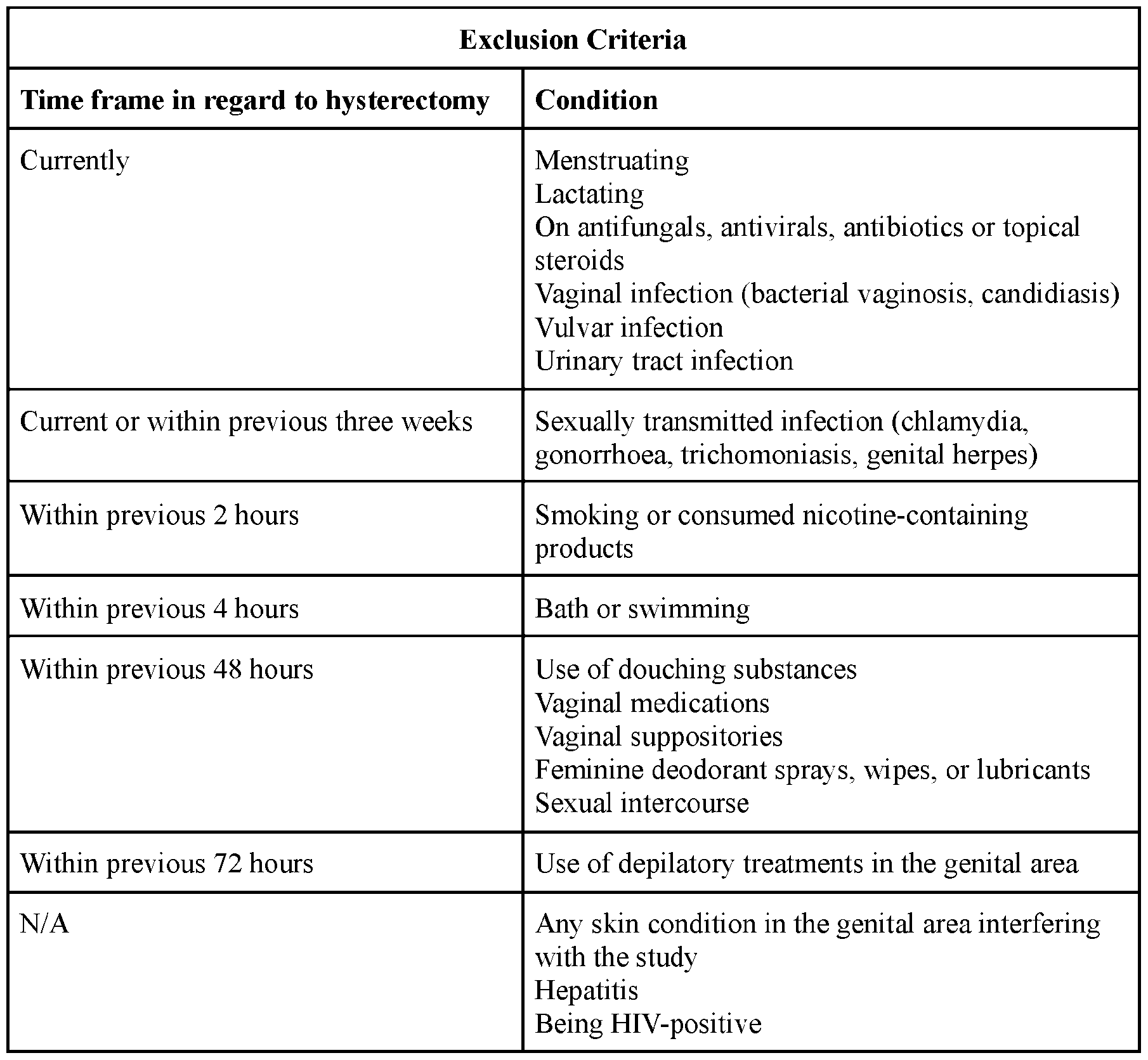
[00108] Sample collection and processing: CVL and vaginal swab samples were collected by a surgeon in the operating room during standard-of-care hysterectomy procedure. Samples were obtained after induction of anesthesia and prior to vaginal preparation with antiseptic solution. CVLs were collected using a non-lubricated speculum and 10 ml of sterile 0.9% saline solution (Teknova, Hollister, CA). Samples were immediately placed on ice and
frozen at -80°C within an hour. Prior to downstream analyses, the samples were thawed on ice; centrifuged (700 x g for 10 minutes at 4°C); aliquoted to prevent multiple freeze-thaw cycles; and stored at -80°C.
[00109] Quantification of soluble metabolites: Soluble metabolites in CVL and vaginal swab samples were quantified using a global metabolomics platform at Metabolon, Inc (Durham, NC) as previously described. Briefly, the Metabolon’s platform utilized a Waters ACQUITY ultra-performance liquid chromatography (UPLC) and a Thermo Scientific Q-exactive high resolution/accurate mass spectrometer interfaced with a heated electrospray ionization (HESI-II) source and Orbitrap mass analyzer operated at 35000 mass resolution. Compounds were identified using Metabolon’s library of purified standards. Peaks were quantified using area-under-the-curve for relative intensity. The data were normalized by registering medians of each compound to equal one and normalizing each data point proportionately.
[00110] Metabolomic data analysis: MetaboAnalyst 5.0 was used to analyze and visualize metabolomic data. All data inputted into MetaboAnalyst were log10-transformed, and autoscaled (mean-centered and divided by the standard deviation of each variable).
[00111] Unsupervised hierarchical clustering analysis (HCA) was performed on metabolomic data to visualize metabolic profiles as heatmaps and show relationships between global metabolic profiles and disease groups: EC-All (grade 1/2 EEC and other EC subtypes), endometrial hyperplasia, and benign conditions. For sample clustering. Pearson distance measure and Ward linkage method was applied. HCA utilized the top 100 significant metabolites (q<0.05) based on an analysis of variance (ANOVA) with false discovery rate (FDR)-correction.
[00112] A two-sample T-test with FDR-correction (q<0.05) was performed to determine significant differences in metabolite levels between the disease groups. Fold change (FC) analysis was used to compare the absolute value of change of the means of each metabolite between the two groups being investigated. The FC analysis utilizes data prior to data transformation and scaling. Data from FC analysis and T-test were combined to produce volcano plots depicting significantly up/downregulated metabolites (q<0.05 and FC>2) for comparison of two selected disease groups.
[00113] Enrichment analysis was performed to identify significantly altered metabolic pathways. The analysis was completed by comparing p metabolite data to the Small Molecule
Pathway Database metabolite set based on normal human metabolic pathways. Enrichment ratio and significance of enrichment of pathways were calculated based on the number of metabolites detected within a specific pathway relative to the number of known metabolites in that pathway. The algorithm also considered relative intensity of metabolites in each group. Despite being named pathway "enrichment’ analysis, this method does not indicate upregulation or enrichment of pathways but determines pathways that are highly altered in the data.
[00114] Univariate receiver operating characteristic (ROC) analysis was performed to identify metabolic biomarkers that discriminate specific disease groups with high sensitivity and specificity. Mean levels of metabolites for each participant were used in the analyses. Strength of the discriminators was measured with area under the curve (AUC) values. Metabolites with AUC greater than 0.8 or 0.9 were considered as good or excellent discriminators, respectively. Uncharacterized metabolites were excluded from ROC analysis.
[00115] Multivariate ROC curve analysis was performed using random forest algorithm and automated feature selection for sample classification. This analysis identifies the most important features, which are used to build predictive models distinguishing disease groups. Performance of predictive models was evaluated using Monte Carlo cross-validation and measured by AUC of multivariate ROC and the confusion matrix calculated at a probability threshold of 0.5.
[00116] To determine associations between metabolite levels and tumor characteristics, participants with EC were stratified based on age (65 vs <65), histological grade (grade 1/2 EEC vs other EC), mismatch repair (MMR) protein status (MMR-deficient vs MMR-proficient), tumor size (>2cm vs 2cm), and myometrial invasion (present vs not present). Metabolite levels between those groups were compared using volcano plot analyses as described earlier. Spearman rank correlation analysis was performed to correlate metabolite levels to tumor size (measured in cm) and depth of myometrial invasion (measured in mm).
[00117] MetOrigin is freely available and was used to identify putative metabolic origins of identified metabolites. MetOrigin determines whether the metabolite is from host, microbiome, or potential co-metabolism.
[00118] Differences in demographic, socioeconomic, and other participant-related variables between disease groups were tested using the Kruskal-Wallis test for continuous
variables and Fisher’s exact test for categorical variables.
[00119] Study population: A total of 192 women undergoing hysterectomy were recruited and enrolled. Women were classified into four groups: benign conditions (n=108), endometrial hyperplasia (n=18). grade 1/2 EEC (n=53), and other EC subtypes (n=13) based on histopathological confirmation of biopsy samples. In some analyses EC is grouped as 'EC All’ (n=63) and includes both grade 1/2 EEC and other EC. Clinical and demographic information for this cohort was previously described. Key demographic information is displayed in Table 3 and additional information relating to participant demographics and characteristics were also analyzed (data not shown). Overall, participants had a mean age of 51 years, mean body mass index (BMI) of 34.8 and were mostly Caucasian (75%). Participants diagnosed with EC were more often post-menopausal and on average were older with higher BMI (grade 1/2 EEC only) compared to participants with benign conditions.
[00120] Table 3 shows patient demographics for the cohort. Statistical analysis of participant demographics in the different groups analyzed. Values are n (%) unless stated as mean (SD). P-values were calculated using Kruskal-Wallis test for continuous variables and Fisher’s exact test for categorical variables.


[00121] Global metabolomics reveals distinct cervicovaginal metabolic profiles for EC and benign participants: An untargeted global metabolomic approach and cervicovaginal sampling was used to assess the cervicovaginal metabolic profiles of women with EC, hyperplasia, and benign conditions. 920 metabolites were identified across the CVL samples, belonging to lipid (25%), amino acid (22%). xenobiotic (19%). nucleotide (7%), peptide (4%), carbohydrate (4%), cofactors and vitamins (4%), energy (1%), and partially characterized/uncharacterized (13% and 1%, respectively) superpathways (FIG. 1A). Metabolite origin investigation revealed that metabolites detected in CVL samples likely originated from a mix of host (2.6%). microbiota (9%), co-metabolism (23%). and other (64%; including drug, diet, environment and unknown sources).
[00122] Using fold change analysis and T-tests with FDR correction, significantly altered (q<0.05 and FC>2) metabolites were identified in EC groups compared to benign. Uncharacterized metabolites were not included in this analysis as they have limited utilization. The EC-All group had a total of 230 altered metabolites (167 downregulated and 63 upregulated) when compared to the benign group. The grade 1/2 EEC group had 204 altered metabolites (159 downregulated and 45 upregulated). The other EC group had 209 altered metabolites (101 downregulated and 108 upregulated). A large proportion of significantly upregulated metabolites in each EC group were lipids: EC-All had 41 (65.1% of all upregulated metabolites), grade 1/2 EEC had 25 (55.6%), and other EC groups had 86 (79.6%). Amino acids, peptides, and
xenobiotics were significantly downregulated across EC. In EC-All. 60 downregulated amino acids (35.9% all downregulated metabolites), 25 downregulated peptides (15%), and 29 downregulated xenobiotics (17.4%). In grade 1/2 EEC there were 61 amino acids (38.4%), 23 peptides (14.5%), and 29 xenobiotics (18.2%) were identified. Finally, in other EC there were 40 amino acids (39.6%), 21 peptides (20.8%), and 5 xenobiotics (5%) (FIG. IB).
[00123] Hierarchical Clustering Analysis (HCA) stratified participants based on their metabolic profiles, producing a heatmap from the top 100 significant metabolites (ANOVA, q<0.05; data not shown). The analysis revealed two clusters were significantly (p<0.0001) different in disease distribution (diseases grouped as benign, hyperplasia, and EC all and clusters based on dendogram). Hyperplasia was distributed between both clusters, due to this hyperplasia did not take focus as a group in further analyses - hyperplasia participants were did not include and analysis continued for benign (n=108) vs grade 1/2 EEC (n=53) and other EC (n=13). Cluster 1 consisted of 64% EC, 29% benign, and 8% hyperplasia, and included all the other EC participants. Cluster 2 consisted of 76% benign, 13% EC, and 11 % hyperplasia. All the EC participants within cluster 2 were grade 1/2 EEC. Cluster 1 showed upregulated lipids and cluster 2 showed upregulated amino acids, peptides, and xenobiotics. This analysis revealed global metabolic profiles can successfully distinguish participants with EC and benign conditions.
[00124] Metabolic profiling reveals that EC is associated with upregulation of lipids and downregulation of amino acids: Metabolomic investigation of CVL samples detected overall 228 lipids belonging to different classes: sterol lipids (14%), ketone bodies (1%), glycerolipids (4%), glycerophospholipids (22%), ceramides (4%), other sphingolipids (21%), long-chain fatty acids (4%), and other fatty acids (30%) (FIG. 2A). Lipids were significantly upregulated (q<0.05 and FC>2) in EC participants compared to benign participants, particularly glycerophospholipids (n=I0 for EC all), other sphingolipids (n=5 for EC all), and other fatty acids (n=l I for EC all) (FIG. 2B).
[00125] Also, overall 206 amino acids were detected in CVL samples, belonging to a number of different pathways: leucine, isoleucine and valine metabolism (13%), histidine metabolism (11%). urea cycle (11%), methionine, cysteine, SAM and laurine metabolism (10%), lysine metabolism (10%), tyrosine metabolism (8%), tryptophan metabolism (7%), polyamine metabolism (6%), glutamate metabolism (5%), glycine, serine and threonine metabolism (4%), glutathione metabolism (4%), alanine and aspartate metabolism (4%), phenylalanine metabolism (3%). creatine metabolism (3%), guanidino and acetamido metabolism (1%) (FIG. 2C). Amino
acids were significantly downregulated (q<0.05 and FC>2) in EC compared to benign conditions, particularly methionine, cysteine, SAM and laurine metabolism (n=l 1 for EC all), tyrosine metabolism (n=7 for EC all) and leucine, isoleucine and valine metabolism (n=6 for EC all) (FIG. 2D)
[00126] EC subtypes share many altered metabolites but have a number of uniquely altered metabolites: Significantly altered (q<0.05 and FC>2) metabolites were visualized on volcano plots to show up/downregulation. Comparison of grade 1/2 EEC to benign revealed 204 altered metabolites (45 upregulated and 159 downregulated). Comparison of other EC subtypes to benign revealed 209 altered metabolites (108 upregulated and 101 downregulated) (FIG. 3A and 3B). Whilst both grade 1/2 EEC and other EC have a similar number of altered metabolites when compared to benign, other EC had more upregulated metabolites than grade 1/2 EEC, whereas grade 1/2 EEC had more downregulated metabolites than other EC. The Venn diagram shows overlap and distinct populations of significantly altered metabolites between grade 1/2 EEC and other EC. Grade 1/2 EEC has 70 uniquely altered metabolites (predominantly downregulated amino acids and xenobiotics), whereas other EC has 84 uniquely altered metabolites (predominantly upregulated lipids). Both subgroups of EC share 134 altered metabolites, mostly upregulated lipids (n=24) and nucleotides (n=7) and downregulated amino acids (n=40), peptides (n=18), and nucleotides (n=ll) (FIG. 3C). Other EC has a greater number of upregulated lipids than grade 1/2 compared to benign, particularly glycerophospholipids, other sphingolipids, and other fatty acids (FIG. 3D). Meanwhile, most downregulated amino acids are common among all subtypes of EC, with grade 1/2 EEC having a small number of uniquely altered amino acids when compared to benign (FIG. 3D).
[00127] Altered metabolic pathways in EC: Pathway enrichment analysis was performed to identify which metabolic pathways are significantly altered in EC-All group compared to the benign group. 86 significantly (p<0.05) altered pathways were identified in EC-All vs benign; the top 25 pathways are shown in FIG. 4. Top pathways were associated with energy (n=5), lipid (n=5), amino acid (n=10), cofactors and vitamins (n=3), and nucleotide (n=2). Among the most significantly altered pathways were: energy pathways mitochondrial electron transport chain (METC) (p<0.0001) and glycerol phosphate shuttle (p<0.0001); lipid pathways cardiolipin biosynthesis (p<0.0001), de novo triacylglycerol biosynthesis (p<0.0001) and glycerolipid metabolism (p<0.0001); amino acid pathways arginine and proline metabolism (p<0.0001), glutamate metabolism (p<0.0001), histidine metabolism (p<0.0001), and try ptophan
metabolism (p<0.0001); and nucleotide pathways pyrimidine metabolism (p<0.0001) and purine metabolism (p<0.OOOl).
[00128] Metabolites in cervicovaginal lavages can discriminate EC participants from benign participants: An ROC analysis was performed to identify potential metabolic biomarkers that can distinguish participants with EC from participants with benign conditions with high specificity and sensitivity. When comparing the EC-All group to benign group, there were 10 metabolites that reached the a good biomarker threshold (AUC>0.8): 6-oxopiperidine-2-carboxylate (AUC=0.838). glycerophosphoethanolamine (GPEA) (AUC=0.37), glycerophosphocholme (GPC) (AUC=0.831), guanine (AUC=0.826), cytosine (AUC=0.819), glycerophosphoserine (AUC=0.814), lyxonate (AUC=0.810), prolylglycine (0.810), glycerophosphoglycerol (AUC=0.807), and N-acetylserine (AUC=0.807) (FIG. 5A). When comparing only grade 1/2 EEC to benign, there were only 6 metabolites that reached the AUC>0.8 threshold (all of which were among the 10 metabolites identified for EC- All) (FIG. 5B). ROC analysis comparing other EC to benign conditions revealed many potential biomarkers (147 metabolites for other EC subtypes, including biliverdin with an AUC>0.9, considered an excellent discriminator (FIG. 6A and 6B)). Overall, metabolites exhibited higher sensitivity and specificity for other EC compared to grade 1/2 EEC (FIG. 5B). The top four biomarkers for EC-All vs benign are shown as AUC plots, with individual AUC values for grade 1/2 EEC and other EC depicted, which highlights these metabolites were more sensitive and specific for other EC compared to grade 1/2 EEC (FIG. 5C). Statistical analysis was performed with correction for BMI and age to ensure diagnostic markers are not signatures of age or obesity (Table 4). No loss in significance in any of the above diagnostic markers after correction.
[00129] Table 4 shows significance levels of metabolites after adjustment for age and BMI. A linear regression model was used, and p-values were adjusted using Dunnell adjustment. This is important because age and BMI do not impact the significance of these key metabolites, therefore they are specific to endometrial cancer (not age or BMI).


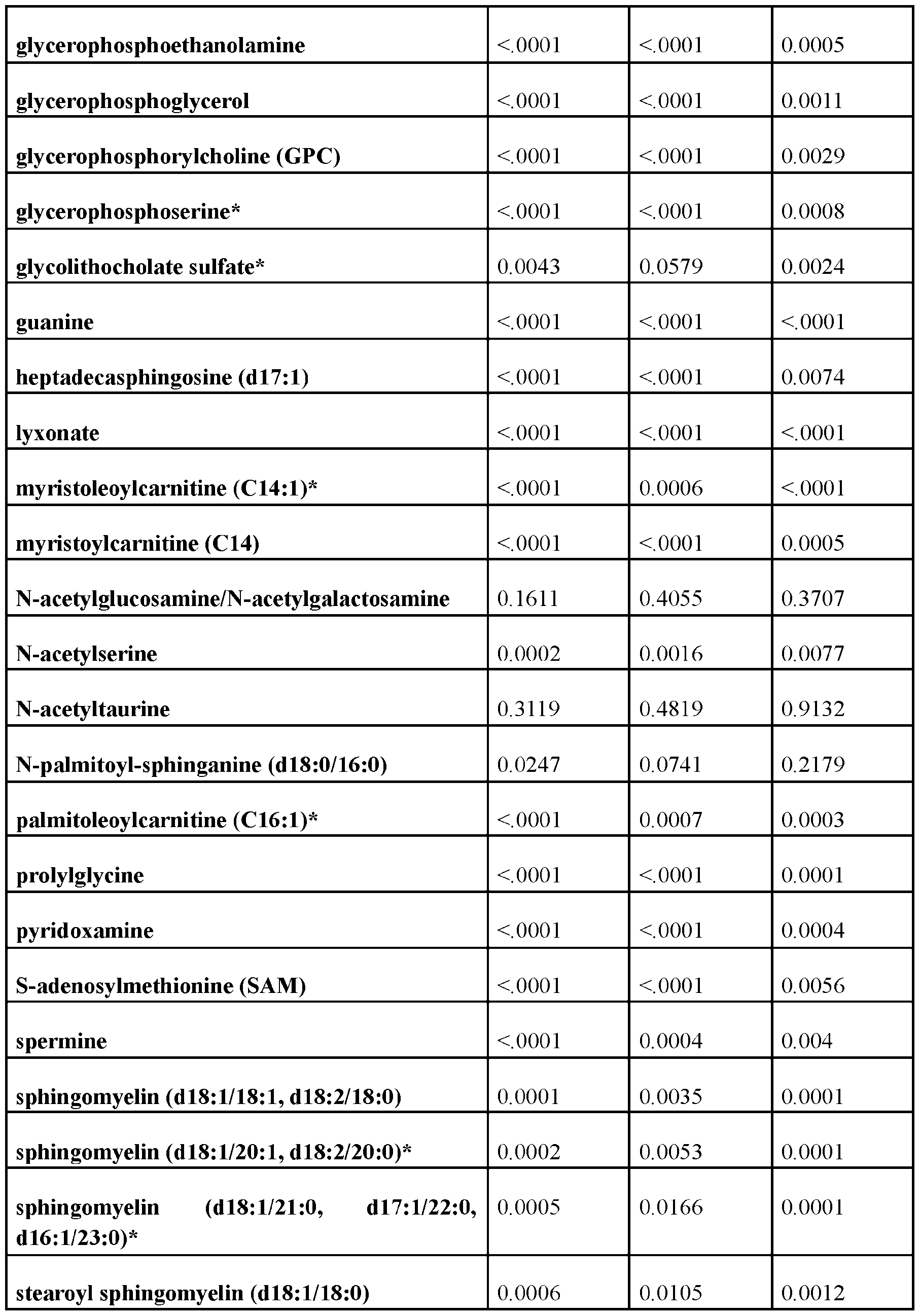

[00130] Machine learning-based multivariate models accurately predict EC from benign conditions: A multivariate ROC approach based on a random forest algorithm was used to predict disease groups. This may be useful as an individual biomarker may be elevated in other conditions; therefore, combination of multiple metabolites may exhibit higher sensitivity and specificity for EC detection. A multivariate ROC analysis was conducted for EC-All vs benign using a range of features from 5 to 100 metabolites, chosen by the machine learning algorithm to build multivariate models (FIG. 7A). The average AUC for all the number of features was >0.8 and therefore these models were considered good discriminators, with five-features and 100-feature models giving average AUCs of 0.826 and 0.884, respectively. A multivariate model with 25 metabolic features presents potential for a good diagnostic tool, with an AUC range of 0.800-0.951 ; predictive accuracy of each method remained consistent with 5 features having a predictive accuracy of 74.7% and 100 features with 78.9% (FIG. 7A). A 25-feature model based on the predictive accuracies was used, as 25 is a manageable number of metabolites to be measured for a diagnostic test. The top 15 predictive features that were most frequently used to create the model by random forest included mostly lipids (GPEA, GPC, glycerophosphoserine, myristoleoylcamitine, heptadecasphingosine, myristoylcamtine, 3-hydroxyhexonate, GPC (16:0/20:3), and palmitoleoylcamtine), and some nucleotides (guanine, AMP), amino acids (spermine and 6-oxopiperidine-2-carboxylate), peptides (prolylglycine), and cofactors and vitamins (pyridoxamine) (FIG. 7B). Many metabolites used to build this multivariate model were also identified in the univariate ROC analyses, including guanine, GPEA, GPC, and prolylglycine. This model of 25-variables shows high predictive accuracy of 78.6% based on cross-validation, with many participants correctly classified into their disease group (FIG. 7C). A confusion matrix shows the times each sample obtained was classified correctly. For EC-All, 83.3% (n=55) of participants were correctly classified as EC-All, and only 16.7% (n=ll) were incorrectly classified as benign. For benign participants, 79.6% (n=86) were correctly classified as benign, and 20.4% (n=22) were incorrectly classified as EC-All (FIG. 7D).
[00131] Cervicovaginal metabolite levels are reflective of tumor characteristics: EC participants were grouped based on tumor characteristics: histological grade (other EC vs grade 1/2 EEC), MMR status (MMR deficient vs MMR proficient), tumor size (>2cm vs 2cm), and
myometrial invasion (present vs not present). In addition, participants with EC were stratified based on age (65 years vs <65 years), as increased age is a risk factor of EC. Volcano plots show significantly up/downregulated (p<0.05 and FC>2) metabolites associated with each tumor characteristic (FIG. 8A). For age, one downregulated metabolite (nicotinate ribonucleoside) and one upregulated metabolite (N6-methyllysine) were identified. For histological grade, 25 upregulated metabolites and two downregulated metabolites (2-methylbutyrylcamitine (C5), and homocysteine) were identified. For MMR status, three upregulated (decanoylcamitine (CIO), laurel carnitine (Cl 2), and octonoly carnitine (C8)) and eight downregulated. For myometrial invasion, nine downregulated and six upregulated, including many lipids. Finally, for tumor size, 25 downregulated and 53 upregulated, 56% of which were lipids (n=44) were identified. In addition, Spearman rank correlation analysis was used to show" the strength of relationship between individual metabolite levels and tumor size (measured in cm) and depth of myometrial invasion (measured in mm). The top 10 metabolites identified that were significantly correlated with tumor size and/or myometrial invasion (with a mix of some positively and some negatively correlating) included amino acids, carbohydrates, lipids, and nucleotides. 5-methyluridine, AMP, C16 Ceramide (Cer), and uridine all correlated with both tumor size and myometrial invasion (mix of negative and positive correlation) (FIG. 8B). All results from Spearman rank analysis are in Table 5. The Venn diagram illustrates the number of metabolites that were unique or shared between tumor characteristics (FIG. 8C). Age did not have any shared altered metabolites with any tumor characteristics investigated. Myometrial invasion and tumor size shared nine metabolites (AMP, 2,3-diphosphoglycerate, C16DH Cer, argininate, C16 Cer, (3’-5’)-cytidyluridine, C14 Cer, N-stearoyl-sphingosine (d!8: 1/18:0), PC-(P-16:0/16:0)), MMR status and tumor size shared adenosine only, and histological grade and tumor size shared four metabolites (homocysteine, l-(l-enyl-palmitoyl)-2-linoleoyl-GPC (P-16:0/18:2), BHBA, and PC-(P-16:0/20:4)).
[00132] Table 5 shows specific metabolites listed that were used to create the volcano plot information for FIG. 8A and FIG. 8C.

 1 -stearoy 1-2-oleoyl-GPS (18:0/18: 1) 0.3406 0.0077 0.3622 0.0038
1-stearoyl-GPI (18:0) 0.3417 0.0075
1-stearoyl-GPS (18:0) 0.3352 0.0088
12-dipalmitoyl-GPC (16:0/16:0) 0.3066 0.0154
2-aminoadipate -0.3615 0.0045
2-hydroxybutyrate/2-hydroxyisobutyrate 0.3302 0.01 0.3916 0.0016
2-linoleoylglycerol (18:2) 0.3135 0.0131
2, 3-diphosphogly cerate -0.3747 0.0032
2'-AMP -0.3175 0.0134
2'-deoxyuridine 0.3983 0.0013
2'-O-methylguanosine 0.3574 0.0043
3-hydroxyhexanoate 0.3121 0.0152 0.3504 0.0052
3-hydroxy octanoate 0.3459 0.0059
3-methyl-2-oxobutyrate 0.4412 0.0003
3-methyl-2-oxoval erate 0.3816 0.0022
4-hydroxy glutamate -0.3351 0.0078
4-methyl-2-oxopentanoate 0.3539 0.0048
5-hydroxylysine 0.3626 0.0044
5-methyluridine (ribothymidine) 0.4218 0.0008 0.3986 0.0013
56-dihydrothymine 0.4111 0.0009 acetylphosphate -0.3026 0.0188 adenine -0.3353 0.0088 adenosine -0.4427 0.0004 alpha-hydroxyisocaproate -0.336 0.0087
AMP -0.4164 0.0009 -0.4644 0.0001 anthranilate 0.3006 0.0176 arachidate (20:0) 0.3176 0.0134 bilirubin degradation product
C17H18N2O4 (2) 0.331 0.0086 carnosine -0.4104 0.0009
CDP-choline -0.3636 0.0037
CDP-ethanolamine -0.3696 0.0031 ceramide (dl8: 1/14:0 dl6: 1/16:0) 0.3078 0.0149 ceramide (dl8: 1/14:0, dl6: 1/16:0) 0.3622 0.0045 ceramide (dl8: 1/17:0, dl7: 1/18:0) 0.352 0.0058 cholesterol 0.3111 0.0139 choline 0.3528 0.0049 citrate 0.3617 0.0045 cys-gly oxidized 0.3385 0.0071 cysteine s-sulfate 0.4015 0.0015 0.3404 0.0068 cysteinylglycine -0.3357 0.0087 cysteinylglycine disulfide 0.3077 0.0168 0.3398 0.0069 cytidine diphosphate -0.408 0.001 decanoy Icamitine (CIO) 0.3 0.0199 dihomolinoleate (20:2n6) 0.3869 0.0023 dihomolinolenate (20:3n3 or 3n6) 0.3931 0.0019 erucate (22: ln9) 0.3008 0.0195
Fibrinopeptide A 0.323 0.0118
Fibrinopeptide A. phosphono-ser(3) 0.3227 0.0119
glycerol 0.3158 0.014 glycosyl-N-palmitoyl-sphingosine (dl8: 1/16:0) 0.3028 0.0187 0.379 0.0024 guanosine 0.3174 0.0119 hexanoylcamitine (C6) 0.331 0.0098 homogentisate -0.3057 0.0176 inosine 0.3102 0.0159
Isobar: hexose diphosphates -0.4031 0.0014 isobutyrylglycine (C4) 0.3437 0.0072 lactosyl-N-nervonoyl-sphingosine
(dl 8: 1/24:1) 0.3221 0.0107 lactosyl-N-palmitoyl-sphingosine
(dl8:l/16:0) 0.3215 0.0108 lignoceroyl sphingomyelin (dl 8: 1/24:0) 0.3051 0.0159 malonylcamitine 0.3353 0.0088 mevalonate -0.3281 0.0105 mevalonolactone -0.3577 0.005 myristoyl dihydrosphingomyelin
(dl8:0/14:0) 0.3451 0.0069 myristoylcamitine (Cl 4) 0.3377 0.0083 0.3015 0.0173
N-acetyl-cadaverine -0.3123 0.0151
N-acetylaspartate (NAA) 0.3139 0.0146
N-acetylglucosamine/N-acetylgalactosami ne 0.3359 0.0087 0.4023 0.0012
N-acetylglycine 0.3189 0.013 0.3331 0.0082
N-acetyltaurine 0.4065 0.001
N-alpha-acetylomi thine 0.3205 0.0125
N-palmitoy 1-sphinganine (d 18 : 0/16: 0) 0.4175 0.0009 0.3023 0.0169
N-palmitoyl-sphingosine (dl 8: 1/16:0) 0.384 0.0025 0.3733 0.0028
N-stearoyl-sphingosine (d 18 : 1/ 18 : 0) 0.3283 0.0104 0.329 0.009
N6-methyllysine 0.308 0.0167
NAD+ -0.3361 0.0076 nicotinamide ribonucleotide (NMN) 0.3097 0.0143 oleoylcamitine (Cl 8: 1) 0.3063 0.0155 oxalate (ethanedioate) 0.3157 0.014 0.3176 0.0119 p-cresol glucuronide -0.3661 0.0034 palmitoyl dihydrosphingomyelin
(dl8:0/16:0) 0.3277 0.0106 0.3042 0.0162 palmitoylcamitine (Cl 6) 0.3139 0.013 phenylacetylglutamine -0.3161 0.0123 prostaglandin A2 0.3034 0.0185
S-adenosylmethionine (SAM) -0.3877 0.0022 sphingomyelin (dl7: 1/16:0 dl8: 1/15:0 dl6:l/17:0) 0.3184 0.0117 sphingomyelin (dl 8:0/20:0. dl6:0/22:0) 0.3016 0.0192 sphingomyelin (dl 8: 1/24: 1 dl8:2/24:0) 0.305 0.0159 stearate (18:0) 0.3142 0.0145
UDP-glucose -0.3335 0.0092 -0.3415 0.0066
UDP-glucuronate -0.3168 0.0121
UDP-N-acetylglucosamine/galactosamine -0.3742 0.0027 uridine <0.000
0.495 1 0.3988 0.0013 uridine 2' -monophosphate (2'-UMP) -0.3009 0.0195
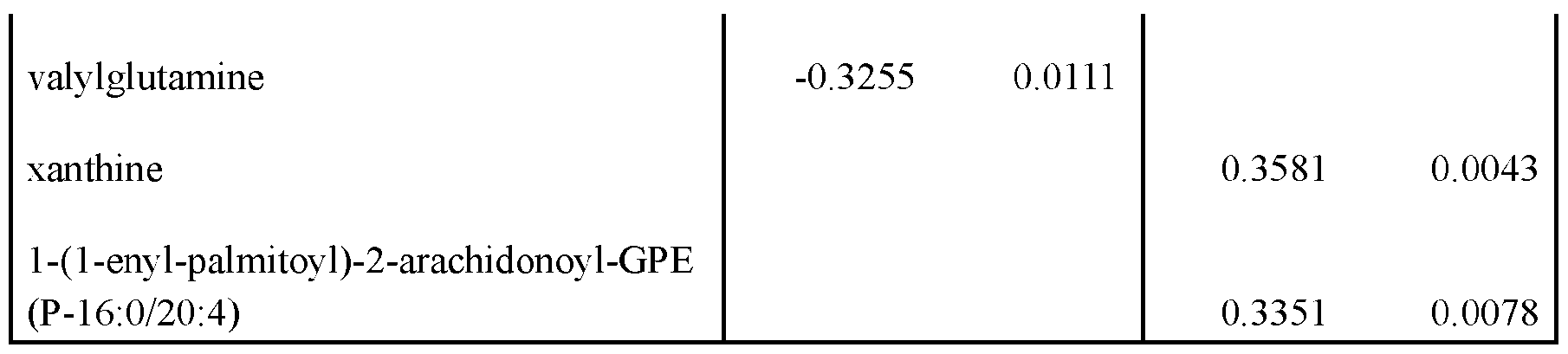
[00133] As described herein, this cross-sectional study investigated global metabolic profiles of CVL samples collected from 192 women undergoing hysterectomy for benign or malignant indications. Participants were grouped, based on histology; as benign conditions (n=108), endometrial hyperplasia (n=18), grade 1/2 EEC (n=53), and other EC (n=13). Utilizing this cohort and an untargeted metabolomics approach, a unique cervicovaginal metabolic profile was identified for EC compared to benign conditions.
[00134] This is the largest comprehensive metabolic analysis studying endometrial cancer in the context of CVL sampling and untargeted high-performance liquid chromatography-mass spectrometry, and largest metabolic profiling of EC using non-invasive sampling. Levels of over 900 metabolites were detected and showed a distinct alteration of metabolic profiles in participants with cancer vs benign controls, including significant (q<0.05) upregulation of lipids and downregulation of amino acids, peptides, and nucleotides.
[00135] Whilst all EC types share most altered metabolites, there are also unique metabolic signatures associated with histological grade and ri pe. Grade 1/2 EEC has more downregulated amino acids, whereas other EC has unique upregulation, particularly of glycerophospholipids, other sphingolipids, and fatty acids. The other EC group in this cohort consists of grade 3 EECs and other histological subtypes, such as serous carcinoma, which are known to be more aggressive forms of EC. Between the two groups of EC within this study, grade 1/2 EEC and other EC, both an overlap and distinct profile of metabolic signatures were identified with other EC displaying a distinct upregulation of lipids, which may correspond to its aggressiveness.
[00136] Thus, the present invention has identified a number of key metabolites to serve as potential biomarkers detectable in CVL samples. These included a multitude of metabolites from different superfamilies and pathways, including lipids (GPEA, GPC, glycerophosphoserine, and glycerophosphoglycerol), amino acids (6-oxopiperidine-2-carboxylate and N-acetylserine), and nucleotides (guanine and cytosine). Of these, one metabolite with a high specificity and
sensitivity for both grade 1/2 EEC and other EC types was glycerophosphoethanolamine (GPEA). This metabolite directly relates to a state of altered lipid metabolism due to involvement in cell membrane structure, cellular interactions, and cellular signaling.
[00137] Results from the multi-biomarker prediction models, which provided strong sensitivity and specificity for EC, gives rise to potential for diagnosis of EC via more comfortable and acceptable means for patients compared to current techniques (such as biopsy or D&C). A combination of 25 metabolites identified by a machine-learning algorithm provides a strong basis for selection of key biomarker candidates to detect EC. This model does not automatically consider demographic information such as age and BMI, therefore corrections for age and BMI were completed and all of the biomarkers found significant in this model remained significant. This multi-biomarker panel approach also provides an advantage of not relying on levels of a singular biomarker for diagnosis; individual metabolites may be increased for a multitude of reasons, including non-malignant diseases. For example, metabolites relating to tryptophan and histidine metabolism are enriched in both EC and adenomyosis (a non-malignant gynecologic condition affecting the endometrium).
[00138] Remarkably, metabolites detected in CVL samples are reflective of tumor characteristics, such as tumor size, myometrial invasion, and MMR status. These results are crucial in highlighting that not only do cervicovaginal metabolites hold potential for diagnosis of EC, but they also hold prognostic value, since these characteristics (tumor size, myometrial invasion, histological grade, MMR status, as well as age) are used frequently by clinicians to assess risk stratification for operation, as well as deciding whether a total hysterectomy is required to provide the best possible outcome for participants. Thus, metabolite levels are indicative of tumor characteristics, particularly tumor size and myometrial invasion, particularly pyrimidine and purine metabolites (2'-deoxyuridine, 5-methyluridine, 5,6-dihydrothymine, adenosine, AMP. cytidine diphosphate, and uridine).
[00139] To summarize, by metabolomic investigation of CVL samples we were able to effectively distinguish participants based on disease status and endometrial cancer subtype. These metabolites informed the metabolic pathways and pathophysiological processes altered within EC. Key to the findings is downregulation of amino acids observed within EC are likely a result of general cancer characteristics, whilst upregulation of lipids align with disease progression and severity. These metabolites, both singularly and combined, w ere highly predictive of cancer and provide potential diagnostic capabilities via CVL sampling. Combination of metabolites, using
multivariate biomarker discovery analysis, showed that a diagnostic model of 25 metabolites provided a high correct prediction rate of disease. Strikingly, these metabolites were predictive of tumor characteristics, disease severity and histological grade, providing potential prognostic capability and risk stratification for treatment planning using cervicovaginal sampling.
[00140] As used herein, the term ‘’about” refers to plus or minus 10% of the referenced number.
[00141] Although there has been shown and described the preferred embodiment of the present invention, it will be readily apparent to those skilled in the art that modifications may be made thereto which do not exceed the scope of the appended claims. Therefore, the scope of the invention is only to be limited by the following claims. In some embodiments, the figures presented in this patent application are drawn to scale, including the angles, ratios of dimensions, etc. In some embodiments, the figures are representative only and the claims are not limited by the dimensions of the figures. In some embodiments, descriptions of the inventions described herein using the phrase “comprising” includes embodiments that could be described as “consisting essentially of' or “consisting of’, and as such the written description requirement for claiming one or more embodiments of the present invention using the phrase “consisting essentially of’ or “consisting of’ is met.
Claims
1. A method comprising: a) obtaining a cervicovaginal lavage (CVL) sample from a patient; b) producing a profile of the CVL sample collected in (a) by detecting at least five or more metabolite biomarkers selected from one or a combination of: 6-oxopiperidine-2-carboxylate, glycerophosphoethanolamine (GPEA), glycerophosphocholine (GPC), guanine, cytosine, glycerophosphoserine, X-19913, X-24724 lyxonate, prolylglycine, glycerophosphoglycerol. or N-acetylserine; and c) measuring the CVL sample profile produced in (b).
2. The method of claim 1, wherein producing a profile comprises detecting at least ten or more biomarkers.
3. The method of claim 1 or claim 2. wherein producing a profile comprises detecting at least 15 or more biomarkers.
4. The method of any one of claims 1-3, wherein producing a profile comprises detecting at least 20 or more biomarkers.
5. The method of any one of claims 1-4, wherein the metabolite biomarkers are expressed in grade 1/2 endometrioid endometrial cancer (EEC).
6. The method of any one of claims 1-5, wherein the metabolite biomarkers further comprise one or more of AMP, spermine, myristoleoylcamitine, heptadecasphingosine, myristoylcamitine, pryridoxamine. 3-hydroxyhexanoate, GPC (16:0/20:3), palmitoleoylcamitine.
7. The method of claim 6, wherein the metabolite biomarkers are expressed in all endometrial cancer (EMC).
8. The method of any one of claims 1-7, wherein the metabolite biomarkers further comprise one or more of biliverdin, PC (P-16: 0/20:4), 7-HOCA, PC (P-16:0/16:0), BHBA, X-25004, glycolithocholate sulfate, N-acetylserine, 3-hydroxyhexanoate, myristoly carnitine (C14: l), X-19913.
9. The method of claim 8, wherein the metabolite biomarkers are expressed in aggressive forms of endometrial cancer (EMC).
10. The method of any one of claims 1-9, wherein the method predicts the risk of endometrial cancer in women.
11. The method of any one of claims 1-10, wherein the method diagnoses endometrial cancer
in women.
12. The method of any one of claims 1-11 , wherein the endometrial cancer is EC type 1 .
13. A method comprising: a) obtaining a vaginal swab sample from a patient; b) producing a profile of the vaginal swab sample collected in (a) by detecting at least five or more metabolite biomarkers selected from one or more of: N-(2-hydroxypalmitoyl)-sphingosine (dl 8: 1/16:0(2OH)), heptadecasphingosine (dl7: l). gabapentin, sphingosine, hydroxypalmitoyl sphingomyelin (dl8:l/16:0(OH)), N-palmitoyl-heptadecasphingosine (dl7: 1/16:0), ceramide (dl8: l/17:0, dl 7: 1/18:0)*, hexadecasphingosine (dl6: l)*, X-17799, sphingadienine, cholesterol sulfate, gamma-glutamylglutamine, 1 -stearoyl-GPI (18:0), or cytidine 5 '-monophosphate (5'-CMP). c) analyzing the vaginal swab sample profile produced in (b).
14. The method of claim 13, wherein producing a profile comprises detecting at least ten or more biomarkers.
15. The method of claim 13 or claim 14, wherein producing a profile comprises detecting at least 15 or more biomarkers.
16. The method of any one of claims 13-15, wherein producing a profile comprises detecting at least 20 or more biomarkers.
17. The method of any one of claims 13-16, wherein the metabolite biomarkers are expressed in grade 1/2 endometrioid endometrial cancer (EEC).
18. The method of any one of claims 13-17, wherein the method predicts the risk of endometrial cancer in women.
19. The method of any one of claims 13-18, wherein the method diagnoses endometrial cancer in women.
20. The method of any one of claims 13-19, wherein the endometrial cancer is EC type 1.
21. A non-invasive method of diagnosing endometrial cancer (EC) in a subject in need thereof, the method comprising: a) determining the subject’s levels of five or more metabolite biomarkers by: i) obtaining a cervicovaginal lavage (CVL) sample from the patient; and ii) measuring the levels of at least five or more metabolite biomarkers in the sample obtained in (i); wherein the metabolite biomarkers are selected
from one or a combination of: 6-oxopiperidine-2-carboxylate, glycerophosphoethanolamine (GPEA), glycerophosphocholine (GPC), guanine, cytosine, glycerophosphoserine, X-19913, X-24724 lyxonate, prolylglycine, glycerophosphoglycerol, or N-acetylserine; and b) diagnosing the subject with EC if the levels of at least five biomarkers are altered compared to a control profile.
22. The method of claim 21, wherein the method comprises measuring the levels of at least ten or more metabolite biomarkers in the sample obtained
23. The method of claim 21 or claim 22, wherein the method comprises measuring the levels of at least 15 or more metabolite biomarkers in the sample obtained.
24. The method of any one of claims 21-23, wherein the method comprises measuring the levels of at least 20 or more metabolite biomarkers in the sample obtained.
25. The method of any one of claims 21-24, wherein the subject is diagnosed with EC when N-(2-hydroxypalmitoyl)-sphingosine (dl8: l/16:0(2OH)). heptadecasphingosine (dl7: l), gabapentin, sphingosine, hydroxypalmitoyl sphingomyelin (dl8: 1/16:0(OH)), N-palmitoyl-heptadecasphingosine (dl7: 1/16:0), ceramide (dl8: l/17:0, dl7: l/18:0), hexadecasphingosine (dl6: l), X-17799, sphingadienine, or cholesterol sulfate are downregulated compared to a control profile and gamma-glutamylglutamine, 1-stearoyl-GPI (18:0), or cytidine 5'-monophosphate (5'-CMP) are upregulated compared to a control profile.
26. The method of any one of claims 21-25, wherein the metabolite biomarkers are expressed in grade 1/2 endometrioid endometrial cancer (EEC).
27. The method of any one of claims 21-26. wherein the metabolite biomarkers further comprise one or more of AMP, spermine, myristoleoylcamitine, heptadecasphingosine, myristoylcamitine, pryridoxamine. 3-hydroxyhexanoate, GPC (16:0/20:3), palmitoleoylcamitine.
28. The method of claim 27, wherein the metabolite biomarkers are expressed in all endometrial cancer (EMC).
29. The method of any one of claims 21-28, wherein the metabolite biomarkers further comprise one or more of biliverdin, PC (P-16: 0/20:4), 7-HOCA, PC (P-16:0/16:0), BHBA, X-25004, glycolithocholate sulfate, N-acetylserine, 3-hydroxyhexanoate, myristoly carnitine (C14: 1), X-19913.
30. The method of claim 29, wherein the metabolite biomarkers are expressed in aggressive forms of endometrial cancer (EMC).
31. The method of any one of claims 21-30, wherein the method predicts the risk of endometrial cancer in women.
32. The method of any one of claims 21-31. wherein the method diagnoses endometrial cancer in women.
33. The method of any one of claims 21-32, wherein the endometrial cancer is EC type 1.
34. The method of any one of claims 21-33, further comprising administering a therapeutic amount of a treatment to the patient if the patient is diagnosed with endometrial cancer (EC).
35. A non-invasive method of diagnosing endometrial cancer (EC) in a subject in need thereof, the method comprising: a) determining the subject’s levels of five or more metabolite biomarkers by: i) obtaining a vaginal swab sample from the subject; and ii) measuring the levels of at least five or more metabolite biomarkers in the sample obtained in (i); wherein the metabolite biomarkers are selected from one or a combination of: N-(2-hydroxypalmitoyl)-sphingosine (dl8: l/16:0(2OH)), heptadecasphingosine (dl7: l), gabapentin, sphingosine, hydroxypalmitoyl sphingomyelin (dl8: l/16:0(OH)), N-palmitoyl-heptadecasphingosine (dl 7: 1/16:0), ceramide (dl8: l/17:0, dl7: 1/18:0)*, hexadecasphingosine (dl6:l)*, X-17799, sphingadienine, cholesterol sulfate, gamma-glutamylglutamine, 1-stearoyl-GPI (18:0), or cytidine 5 '-monophosphate (5'-CMP); and b) diagnosing the subject with EC if the levels of at least five biomarkers are altered compared to a control profile.
36. The method of claim 35, wherein the method comprises measuring the levels of at least ten or more metabolite biomarkers in the sample obtained.
37. The method of claim 35 or claim 36, wherein the method comprises measuring the levels of at least 15 or more metabolite biomarkers in the sample obtained.
38. The method of any one of claims 35-37, wherein the method comprises measuring the levels of at least 20 or more metabolite biomarkers in the sample obtained
39. The method of any one of claims 35-38, wherein the subject is diagnosed with EC with cancer when N-(2-hydroxypalmitoyl)-sphingosine (dl 8: 1/16:0(2014)),
heptadecasphingosine (d!7: 1 ). gabapentin, sphingosine, hydroxypalmitoyl sphingomyelin (dl 8: 1/16:0(014))**, N-palmitoyl-heptadecasphingosine (dl 7: 1/16:0)*, ceramide (d!8: l/17:0, dl7: 1/18:0)*, hexadecasphingosine (d!6: l)*, X-17799, sphingadienine, or cholesterol sulfate are downregulated and gamma-glutamylglutamine, 1-stearoyl-GPI (18:0), or cytidine 5'-monophosphate (5'-CMP) are upregulated.
40. The method of any one of claims 35-39, wherein the metabolite biomarkers are expressed in grade 1/2 endometrioid endometrial cancer (EEC).
41. A method of treating endometrial cancer (EC) in a patient in need thereof, the method comprising: a) diagnosing endometrial cancer (EC) in the patient by: i) obtaining a cervicovaginal lavage (CVL) sample from the patient; ii) measuring the levels of at least five or more metabolite biomarkers in the sample obtained in (i); wherein the metabolite biomarkers are selected from one or a combination of: 6-oxopiperidine-2-carboxylate, glycerophosphoethanolamine (GPEA), glycerophosphocholine (GPC), guanine, cytosine, glycerophosphoserine, X-19913, X-24724 lyxonate, prolylglycine, glycerophosphoglycerol, or N-acetylserine; an iii) diagnosing the patient with EC if the levels of at least five biomarkers in the profile obtained in (ii) are altered compared to a control profile; and b) administering a therapeutic amount of a treatment to the patient if the patient is diagnosed with EC.
42. The method of claim 41, wherein the method comprises measuring the levels of at least ten or more metabolite biomarkers in the sample obtained
43. The method of claim 41 or claim 42, wherein the method comprises measuring the levels of at least 15 or more metabolite biomarkers in the sample obtained.
44. The method of any one of claims 41-43, wherein the method comprises measuring the levels of at least 20 or more metabolite biomarkers in the sample obtained.
45. The method of any one of claims 41-44, wherein the subject is diagnosed with EC when N-(2-hydroxypalmitoyl)-sphingosine (dl8: l/16:0(2OH)), heptadecasphingosine (dl7: l), gabapentin, sphingosine, hydroxypalmitoyl sphingomyelin (dl8: l/16:0(OH))**, N-palmitoyl-heptadecasphingosine (dl 7: 1/16:0)*, ceramide (dl8: l/17:0, dl7: 1/18:0)*, hexadecasphingosine (dl6: l)*, X-17799, sphingadienine, or cholesterol sulfate are downregulated compared to the control profile and gamma-glutamylglutamine,
1-stearoyl-GPI (18:0), or cytidine 5'-monophosphate (5'-CMP) are upregulated compared to the control profde.
46. The method of any one of claims 41-45, wherein the metabolite biomarkers are expressed in grade 1/2 endometrioid endometrial cancer (EEC).
47. The method of any one of claims 41-46. wherein the metabolite biomarkers further comprise one or more of AMP, spermine, myristoleoylcamitine, heptadecasphingosine, myristoylcamitine, pryridoxamine. 3-hydroxyhexanoate, GPC (16:0/20:3), palmitoleoylcamitine.
48. The method of claim 47, wherein the metabolite biomarkers are expressed in all endometrial cancer (EMC).
49. The method of any one of claims 41-48, wherein the metabolite biomarkers further comprise one or more of biliverdin, PC (P-16: 0/20:4), 7-HOCA, PC (P-16:0/16:0), BHBA, X-25004, glycolithocholate sulfate, N-acetylserine, 3-hydroxyhexanoate, myristoly carnitine (C14: l), X-19913.
50. The method of claim 49, wherein the metabolite biomarkers are expressed in aggressive forms of endometrial cancer (EMC).
51. The method of any one of claims 41-50, wherein the method predicts the risk of endometrial cancer in women.
52. The method of any one of claims 41-51. wherein the method diagnoses endometrial cancer in women.
53. The method of any one of claims 41-52, wherein the endometrial cancer is EC type 1.
54. The method of any one of claims 41-52, wherein producing a profile further comprises characterizing endometrial tumor characteristics comprising tumor size, myometrial invasion, mismatch repair (MMR) status, histological grade, age, or a combination thereof.
55. The method of claim 54, wherein tumor size is determined by metabolite biomarkers selected from a group comprising dihomolinolenate (20:3n3 or 3n6), (3'-5')-adenylyluridine, ceramide (dl8: l/14:0, dl6: l/16:0), N-palmitoyl-sphingadienine (dl8:2/16:0), (3'-5')-cytidylyluridine, (3'-5')-guanylylcytidine, bilirubin degradation product, C17H18N2O4 (2), N-stearoyl-sphingosine (dl 8 : 1/18: 0), (3'-5')-adenylylcytidine, (3'-5')-guanylyluridine. dihomolinoleate (20:2n6), 3 -hydroxy butyrate (BHBA),
N-palmitoyl-sphingosine (dl 8: 1/16:0), l-(l-enyl-palmitoyl)-2-palmitoyl-GPC (P-16:0/16:0), biliverdin, N-palmitoyl-sphinganine (dl 8:0/16:0), N6-methyladenosine,
1 -stearoyl-GPI (18:0). lactosyl-N-nervonoyl-sphingosine (dl8: 1/24: 1), 1 -(1 -enyl -palmitoyl)-2-linoleoy 1 -GPC (P- 16 : 0/ 18 : 2), l-(l-enyl-palmitoyl)-2-arachidonoyl-GPC (P-16: 0/20:4), 1-oleoyl-GPC (18:1), ceramide (dl8: 1/17:0, dl7: 1/18:0), myristoylcamitine (C14), l-(l-enyl-stearoyl)-GPE (P-18:0), 1-dihomo-linolenylglycerol (20:3), 1-palmitoyl-GPC (16:0), N-acetylaspartate (NAA), l-stearoyl-2-oleoyl-GPS (18:0/18: 1), 1 -stearoyl -GPS (18:0)*, erucate (22:ln9), behenoyl dihydrosphingomyelin (dl8:0/22:0)*, 2-palmitoyl-GPC* (16:0)*, palmitoleoylcamitine (C16:l)*, l-(l-enyl-stearoyl)-2-oleoyl-GPE (P-18:0/18: 1), 1 -stearoyl-2-oleoyl-GPE (18:0/18: 1), l-(l-enyl-palmitoyl)-2-arachidonoyl-GPE (P-16:0/20:4)*, lactosyl-N-palmitoyl-sphingosine (dl 8: 1/16:0), palmitoylcamitine (C16). N-acetyltaurine, 3-hydroxypalmitoylcamitine, 1-linoleoylglycerol (18:2), 2'-deoxyuridine, 1-oleoyl-GPE (18:1), N-stearoyl-sphinganine (dl 8:0/18:0)*, eicosenoate (20:ln9 or Inll), l-myristoyl-2-palmitoyl-GPC (14:0/16:0), sphingomyelin (dl8:2/24: l, dl8: 1/24:2)*,
1-(l-enyl-palmitoyl)-2-oleoyl-GPE (P-16:0/18:1)*, 3-methyl-2-oxovalerate,
1 -palmitoyl-2-stearoyl-GPC (16:0/18:0), 1 -( 1 -enyl-palmitoyl)-2-oleoyl-GPC
(P-16:0/18:l)*, 1 -palmitoyl-GPE (16:0) CDP-choline, CDP-ethanolamine, NAD+, val-val-ala, 4-hydroxyphenylacetylglutamine, 1 -methylguanidine,
2-hydroxy-4-(methylthio)butanoic acid, cysteine, adenosine, AMP, glycerophosphoglycerol. homocysteine. N-acetylcysteine, adenine, cytidine diphosphate. 2,3-diphosphoglycerate, glutathione, reduced (GSH), histidylalanine, Isobar: hexose diphosphates, dihydroorotate, camosine, valylglutamine, tyrosylglycine, argininate, and cytosine.
56. The method of claim 55. wherein dihomolinolenate (20:3n3 or 3n6), (3'-5')-adenylyluridine, ceramide (dl 8: 1/14:0, dl6: 1/16:0), N-palmitoyl-sphingadienine (dl8:2/16:0), (3'-5')-cytidylyluridine, (3'-5')-guanylylcytidine, bilirubin degradation product, C17H18N2O4 (2), N-stearoyl-sphingosine (dl 8 : 1/18: 0), (3'-5')-adenylylcytidine, (3'-5')-guanylyluridine. dihomolinoleate (20:2n6), 3 -hydroxy butyrate (BHBA),
N-palmitoyl-sphingosine (dl 8: 1/16:0), l-(l-enyl-palmitoyl)-2-palmitoyl-GPC (P-16:0/16:0), biliverdin, N-palmitoyl-sphinganine (dl 8: 0/16: 0), N6-methyladenosine, 1 -stearoyl-GPI (18:0), lactosyl-N-nervonoyl-sphingosine (dl 8: 1/24: 1), 1 -(1 -enyl-palmitoy l)-2-linoleoy 1-GPC (P- 16 : 0/ 18 : 2), l-(l-enyl-palmitoyl)-2-arachidonoyl-GPC (P-16:0/20:4), 1-oleoyl-GPC (18: 1), ceramide (d! 8:l/17:0, d!7: l/18:0), myristoylcamitine (C 14), l-(l-enyl-stearoyl)-GPE (P-18:0),
1-dihomo-linolenylglycerol (20:3), 1-palmitoyl-GPC (16:0), N-acetylaspartate (NAA), l -stearoyl-2-oleoyl-GPS (18:0/18: 1), 1 -stearoyl -GPS (18:0)*, erucate (22: ln9), behenoyl dihydrosphingomyelin (dl8:0/22:0)*, 2-palmitoyl-GPC* (16:0)*, palmitoleoylcamitine (C16:l)*, l-(l-enyl-stearoyl)-2-oleoyl-GPE (P-18:0/18: 1 ), 1 -stearoyl-2-oleoyl-GPE (18:0/18: 1), l-(l-enyl-palmitoyl)-2-arachidonoyl-GPE (P-16:0/20:4)*, lactosyl-N-palmitoyl-sphingosine (dl 8: 1/16:0), palmitoylcamitine (C16), N-acetyltaurine,
3-hydroxypalmitoylcamitine, 1-linoleoylglycerol (18:2), 2'-deoxyuridine, 1-oleoyl-GPE (18:1), N-stearoyl-sphinganine (dl 8:0/18:0)*, eicosenoate (20: ln9 or Inll), l-myristoyl-2-palmitoyl-GPC (14:0/16:0), sphingomyelin (dl8:2/24: l, dl8: 1/24:2)*, l-(l-enyl-palmitoyl)-2-oleoyl-GPE (P-16:0/18: 1)*, 3-methyl-2-oxovalerate, l-palmitoyl-2-stearoyl-GPC (16:0/18:0), l-(l-enyl-palmitoyl)-2-oleoyl-GPC (P-16:0/18:l)*, 1-palmitoyl-GPE (16:0) are upregulated in tumors greater than or equal to 2 cm and CDP-choline, CDP-ethanolamine, NAD+, val-val-ala,
4-hy droxyphenylacetylglutamine, 1 -methylguanidine, 2-hy droxy-4-(methylthio)butanoic acid, cysteine, adenosine, AMP, glycerophosphoglycerol, homocysteine, N-acetylcysteine, adenine, cytidine diphosphate, 2,3-diphosphoglycerate, glutathione, reduced (GSH), histidylalanine, Isobar: hexose diphosphates, dihydroorotate, carnosine, valylglutamine, tyrosylglycine, argininate. cytosine are down-regulated in tumors greater than or equal to 2cm
57. The method of claim 54, wherein myometrial invasion is determined by metabolite biomarkers selected from a group comprising ceramide (dl8: l/14:0, dl6:l/16:0)*, (3'-5')-cytidylyluridine*, N-stearoyl-sphingosine (dl8: 1/18:0)*, N-palmitoyl-sphinganine (dl8:0/16:0), N-palmitoyl-sphingosine (dl8: 1/16:0), l-(l-enyl-palmitoyl)-2-palmitoyl-GPC (P-16:0/16:0)*, alpha-hydroxyisocaproate, CMP, 2'-AMP, AMP, argininate*, 2,3-diphosphoglycerate, cyclic adenosine diphosphate-ribose, histamine, and tryptamine.
58. The method of claim 57. wherein ceramide (dl8: l/14:0. dl6: l/16:0)*,
(3'-5')-cytidylyluridine*, N-stearoyl-sphingosine (dl8: 1/18:0)*, N-palmitoyl-sphinganine (dl8:0/16:0), N-palmitoyl-sphingosine (dl8: 1/16:0), and l-(l-enyl-palmitoyl)-2-palmitoyl-GPC (P-16:0/16:0)* are upregulated in the in the absence of myometrial invasion and alpha-hydroxyisocaproate, CMP. 2'-AMP, AMP, argininate*, 2,3-diphosphoglycerate. cyclic adenosine diphosphate-ribose, histamine, and tryptamine are down -regulated in the absence of myometrial invasion
59. The method of claim 54, wherein mismatch repair (MMR) status is determined by metabolite biomarkers selected from a group comprising decanoylcamitine (CIO), octanoylcamitine (C8), laurylcarnitine (C12), glutarate (C5-DC), S-adenosylmethionine (SAM), butyrylcamitine (C4), lyxonate, 6-oxopiperidine-2-carboxylate. adenosine, guanine, and sarcosine.
60. The method of claim 59, wherein decanoylcamitine (CIO), octanoylcamitine (C8), and laurylcamitine (C12) are upregulated in MMR-proficient cancer and glutarate (C5-DC),
5-adenosylmethionine (SAM), butyrylcamitine (C4), lyxonate,
6-oxopiperidine-2-carboxylate, adenosine, guanine, and sarcosine are down-regulated in MMR deficient cancer.
61. The method of claim 54, wherein the histological grade is determined by metabolite biomarkers selected from a group comprising 1-oleoyl-GPS (18: 1), pregnen-diol disulfate, dehydroepiandrosterone sulfate (DHEA-S). kynurenine, l-(l-enyl-palmitoyl)-2-arachidonoyl-GPC (P-16:0/20:4). pregnenetriol disulfate, l-stearoyl-2-docosahexaenoyl-GPC (18:0/22:6), 1,2-dilinoleoyl-GPC (18:2/18:2), l-palmitoyl-2-palmitoleoyl-GPC (16:0/16: 1), l-linoleoyl-2-arachidonoyl-GPC (18:2/20:4n6), androsterone sulfate, l-palmitoyl-2-arachidonoyl-GPC (16:0/20:4n6), androstenediol (3beta,17beta) disulfate (2), l-stearoyl-2-linoleoyl-GPC (18:0/18:2), l-palmitoyl-2-docosahexaenoyl-GPC (16:0/22:6). l-stearoyl-2-arachidonoyl-GPC (18:0/20:4), N-methylhydroxyproline, 3-hydroxybutyrate (BHBA), sphingomyelin (dl8:2/16:0, dl8: l/16: l), l-palmitoyl-2-dihomo-linolenoyl-GPC (16:0/20:3n3 or 6), l-palmitoyl-2-linoleoyl-GPC (16:0/18:2), sphingomyelin (dl8: l/20:l. dl8:2/20:0), sphingomyelin (dl8: 1/18: 1, dl8:2/18:0), l-(l-enyl-palmitoyl)-2-linoleoyl-GPC
(P-16:0/18:2), l-oleoyl-2-linoleoyl-GPC (18: 1/18:2), 2-methylbutyrylcamitine (C5), and homocysteine.
62. The method of claim 61, wherein 1-oleoyl-GPS (18: 1), pregnen-diol disulfate, dehydroepiandrosterone sulfate (DHEA-S), kynurenine, l-(l-enyl-palmitoyl)-2-arachidonoyl-GPC (P-16:0/20:4), pregnenetriol disulfate, l-stearoyl-2-docosahexaenoyl-GPC (18:0/22:6), 1,2-dilinoleoyl-GPC (18:2/18:2), 1 -palmitoyl-2-palmitoleoyl-GPC (16:0/16: 1), l-linoleoyl-2-arachidonoyl-GPC (18:2/20:4n6), androsterone sulfate, l-palmitoyl-2-arachidonoyl-GPC (16:0/20:4n6), androstenediol (3beta,17beta) disulfate (2), l-stearoyl-2-linoleoyl-GPC (18:0/18:2), 1 -palmitoyl-2-docosahexaenoyl-GPC (16:0/22:6), 1 -stearoyl-2-arachidonoyl-GPC
13
(18:0/20:4), N-methylhydroxyproline, 3 -hydroxy butyrate (BHBA), sphingomyelin (dl 8:2/16:0, dl 8: 1/16: 1 ), l -palmitoyl-2-dihomo-linolenoyl-GPC (16:0/20:3n3 or 6),
1-palmitoyl-2-linoleoyl-GPC (16:0/18:2), sphingomyelin (dl8: l/20:l, dl8:2/20:0), sphingomyelin (dl8: l/18: l, dl8:2/18:0), l-(l-enyl-palmitoyl)-2-linoleoyl-GPC
(P-16:0/18:2), and l-oleoyl-2-linoleoyl-GPC (18: 1/18:2) are upregulated in 1/2 EEC and
2-methylbutyrylcamitine (C5) and homocysteine are down-regulated in 1/2 EEC.
63. The method of claim 54, wherein the age is determined by metabolite biomarkers selected from a group comprising N6-methyllysine, nicotinate ribonucleoside, or a combination thereof.
64. A method of treating endometrial cancer (EC) in a patient in need thereof, the method comprising: a) diagnosing endometrial cancer (EC) in the patient by: i) obtaining a vaginal swab sample from the patient; ii) measuring the levels of at least five or more metabolite biomarkers in the sample obtained in (i); wherein the metabolite biomarkers are selected from one or a combination of: N-(2-hydroxypalmitoyl)-sphingosine (dl8: l/16:0(2OH)), heptadecasphingosine (dl7: l), gabapentin, sphingosine, hydroxypalmitoyl sphingomyelin (dl8: 1/16:0(014)), N-palmitoyl-heptadecasphingosine (dl7: 1/16:0), ceramide (dl8: l/17:0, dl7: 1/18:0)*, hexadecasphingosine (dl6:l)*, X-17799, sphingadienine, cholesterol sulfate, gamma-glutamylglutamine, 1-stearoyl-GPI (18:0), or cytidine 5 '-monophosphate (5'-CMP); and b) diagnosing the patient with EC if the levels of at least five biomarkers are altered compared to a control profile.
65. The method of claim 64, wherein the method comprises measuring the levels of at least ten or more metabolite biomarkers in the sample obtained
66. The method of claim 64 or claim 65, wherein the method comprises measuring the levels of at least 15 or more metabolite biomarkers in the sample obtained.
67. The method of any one of claims 64-66, wherein the method comprises measuring the levels of at least 20 or more metabolite biomarkers in the sample obtained.
68. The method of any one of claims 64-67, wherein the method diagnoses endometrial cancer (EC) in the subject, wherein a subject is diagnosed with EC with cancer when N-(2-hydroxypalmitoyl)-sphingosine (dl 8: l/16:0(2OH)), heptadecasphingosine (dl7: l ),
gabapentin, sphingosine, hydroxypalmitoyl sphingomyelin (dl8: 1/16:0(014))**, N-palmitoyl-heptadecasphingosine (dl 7: 1/16:0)*, ceramide (dl 8: l/17:0, dl 7: 1/18:0)*, hexadecasphingosine (dl6: l)*, X-17799, sphingadienine, or cholesterol sulfate are downregulated and gamma-glutamylglutamine. 1-stearoyl-GPI (18:0), or cytidine 5 '-monophosphate (5 -CMP) are upregulated compared to a control profde.
69. The method of any one of claims 64-68, wherein the metabolite biomarkers are expressed in grade 1/2 endometrioid endometrial cancer (EEC).
70. The method of any one of claims 64-69 wherein producing a profile further comprises characterizing endometrial tumor characteristics comprising tumor size, myometrial invasion, mismatch repair (MMR) status, histological grade, age, or a combination thereof.
71. The method of claim 70, wherein tumor size is determined by metabolite biomarkers selected from a group comprising 3,7-dimethylurate, pentose acid, N-acetylvaline, dopamine 3-O-sulfate, 1.7-dimethylurate, 1 -ribosyl-imidazoleacetate, gamma-glutamylisoleucine, X- 12830, N-acetyltryptophan, X- 15486, hydantoin-5-propi onate, 5-acetylamino-6-formylamino-3-methyluracil,
N-acetyl-1 -methylhistidine, 4-methylguaiacol sulfate, X-25105, trimethylamine N-oxide, 2R,3R-dihydroxybutyrate, 6-hydroxyindole sulfate,
5 -acetylamino-6-amino-3 -methyluracil, p-cresol sulfate, X-12216. 3-indoxyl sulfate.
4-hydroxyhippurate, 3 -methoxy catechol sulfate (1), N-acetylcarnosine. phenylacetylglutamate, sucralose, 4-methylcatechol sulfate, X-17348, 2-aminophenol sulfate, X-23662, 1,2,3-benzenetriol sulfate (2), 1 -methylguanidine, X-25102, doxylamine, X- 17808, histidylalanine, methyl-4-hydroxybenzoate sulfate, argininate, ondansetron, and X-24991.
72. The method of claim 71, wherein 3,7-dimethylurate, pentose acid, N-acetylvaline, dopamine 3-O-sulfate, 1,7-dimethylurate, 1 -ribosyl-imidazoleacetate, gamma-glutamylisoleucine, X-12830, N-acetyltryptophan. X-15486, hydantoin-5-propi onate, 5-acetylamino-6-formylamino-3-methyluracil,
N-acetyl-1 -methylhistidine, 4-methylguaiacol sulfate, X-25105, trimethylamine N-oxide, 2R,3R-dihydroxybutyrate, 6-hydroxyindole sulfate,
5-acetylamino-6-amino-3-methyluracil, p-cresol sulfate, X-12216. 3-indoxyl sulfate, 4-hydroxyhippurate, 3-methoxycatechol sulfate (1), N-acetylcamosine, phenylacetylglutamate, sucralose, 4-methylcatechol sulfate, X-17348, 2-aminophenol
sulfate. X-23662, 1,2,3-benzenetriol sulfate (2). 1 -methylguanidine, X-25102, doxylamine, X-17808, histidylalanine, methyl -4-hydroxy benzoate sulfate, argininate, ondansetron, and X-24991 are down-regulated in tumors greater than or equal to 2 cm.
73. The method of claim 54, wherein myometrial invasion is determined by metabolite biomarkers selected from a group comprising dihomo-linolenate (20:3n3 or n6), l-(l-enyl-oleoyl)-GPE (P-18: l)*, l-(l-enyl-palmitoyl)-GPE (P-16:0)*, 1-stearoyl-GPE (18:0), l-(l-enyl-palmitoyl)-2-docosahexaenoyl-GPE (P-16:0/22:6)*,
1,2-dilinoleoyl-GPC (18:2/18:2), l-(l-enyl-palmitoyl)-2-linoleoyl-GPC (P-16:0/18:2)*, 1 -stearoyl-GPC (18:0), alpha-tocopherol, 1,2-dipalmitoyl-GPC (16:0/16:0), l-(l-enyl-palmitoyl)-2-arachidonoyl-GPC (P-16:0/20:4)*. myristoylcamitine (C14), l-(l-enyl-palmitoyl)-2-oleoyl-GPC (P-16:0/18: l)*, X-17348, vitamin D3 sulfate, ondansetron, and N-acetylhistamine.
74. The method of claim 73, wherein dihomo-linolenate (20:3n3 or n6), l-(l-enyl-oleoyl)-GPE (P-18: l)*, l-(l-enyl-palmitoyl)-GPE (P-16:0)*. 1-stearoyl-GPE (18:0), l-(l-enyl-palmitoyl)-2-docosahexaenoyl-GPE (P-16:0/22:6)*,
1.2-dilinoleoyl-GPC (18:2/18:2), l-(l-enyl-palmitoyl)-2-linoleoyl-GPC (P-16:0/18:2)*, 1 -stearoyl-GPC (18:0), alpha-tocopherol, 1,2-dipalmitoyl-GPC (16:0/16:0), l-(l-enyl-palmitoyl)-2-arachidonoyl-GPC (P-16:0/20:4)*, myristoylcamitine (C14),
1-(l-enyl-palmitoyl)-2-oleoyl-GPC (P-16:0/18: l)* are upregulated in the absence of myometrial invasion and X-17348, vitamin D3 sulfate, ondansetron, and N-acetylhistamine are down-regulated in the absence of myometrial invasion.
75. The method of claim 54, wherein mismatch repair (MMR) status is determined by metabolite biomarkers selected from a group comprising lidocaine,
3-methylglutarate/2-methylglutarate, sphingomyelin (dl7: 1/14:0, dl6: 1/15:0)*,
4-cholesten-3-one, adenosine, margaroylcamitine (C17)*, oleoyl carnitine (C18: l),
2-hydroxyadipate, 2,3-dihydroxyisovalerate, 2-isopropylmalate. and sarcosine.
76. The method of claim 75, wherein are lidocaine. 3-methylglutarate/2-methylglutarate, sphingomyelin (dl7: l/14:0, dl6: l/15:0)*, 4-cholesten-3-one, adenosine, margaroylcamitine (C17)*, oleoylcamitine (C18:l), 2-hydroxyadipate,
2.3-dihydroxyisovalerate, 2-isopropylmalate, and sarcosine down-regulated in MMR proficient cancer.
77. The method of claim 70. wherein the histological grade is determined by metabolite biomarkers selected from a group comprising X-l 1308 or 4-hydroxy glutamate.
78. The method of claim 77, wherein X-11308 is upregulated in 1/2 EEC and 4-hydroxyglutamate is down-regulated in 1/2 EEC.
79. A method of monitoring a treatment for endometrial cancer (EC) in a subject in need thereof, the method comprising; a) obtaining a first cervicovaginal lavage (CVL) sample from the subject; b) producing a baseline profile of the CVL sample collected in (a) by detecting at least five or more metabolite biomarkers in the sample obtained in (i); wherein the metabolite biomarkers are selected from one or a combination of: 6-oxopiperidine-2-carboxylate. glycerophosphoethanolamine (GPEA), glycerophosphocholine (GPC), guanine, cytosine, glycerophosphoserine, X-19913, X-24724 lyxonate, prolylglycine, glycerophosphoglycerol, or N-acetylserine; c) administering the treatment for EC to the subject; d) obtaining a second cervicovaginal lavage (CVL) sample from the subject; e) producing a second profile of the CVL sample collected in (d) by detecting at least at least five or more metabolite biomarkers in the sample obtained in (i); wherein the metabolite biomarkers are selected from one or a combination of: 6-oxopiperidine-2-carboxylate. glycerophosphoethanolamine (GPEA), glycerophosphocholine (GPC), guanine, cytosine, glycerophosphoserine, X-19913, X-24724 lyxonate, prolylglycine, glycerophosphoglycerol, or N-acetylserine; and
1) comparing the baseline profile of the CVL sample produced in (b) to the second profile of the CVL sample produced in (e); wherein the treatment is effective if the levels of at least five biomarkers are altered from the baseline profile as compared to the second profile.
80. The method of claim 79, wherein the method comprises measuring the levels of at least ten or more metabolite biomarkers in the sample obtained
81. The method of claim 79 or claim 80, wherein the method comprises measuring the levels of at least 15 or more metabolite biomarkers in the sample obtained.
82. The method of any one of claims 79-81, wherein the method comprises measuring the levels of at least 20 or more metabolite biomarkers in the sample obtained.
83. The method of any one of claims 79-82, wherein the treatment is effective when
N-(2-hydroxypalmitoyl)-sphingosine (dl8: l/16:0(2OH)). heptadecasphingosine (dl7: l), gabapentin, sphingosine, hydroxypalmitoyl sphingomyelin (dl 8: l/16:0(OH))**, N-palmitoyl-heptadecasphingosine (dl7:l/16:0)*, ceramide (dl8: l/17:0, d!7: l/18:0)*, hexadecasphingosine (dl6: l)*, X-17799, sphingadienine, or cholesterol sulfate are upregulated and gamma-glutamylglutamine. 1-stearoyl-GPI (18:0), or cytidine 5'-monophosphate (5 -CMP) are down-regulated.
84. The method of any one of claims 79-83, wherein the metabolite biomarkers are expressed in grade 1/2 endometrioid endometrial cancer (EEC).
85. The method of any one of claims 79-84. wherein the metabolite biomarkers further comprise one or more of AMP. spermine, myristoleoylcamitine, heptadecasphingosine, myristoylcamitine, pryridoxamine, 3-hydroxyhexanoate, GPC (16:0/20:3), palmitoleoylcamitine.
86. The method of claim 85, wherein the metabolite biomarkers are expressed in all endometrial cancer (EMC).
87. The method of any one of claims 79-86, wherein the metabolite biomarkers further comprise one or more of biliverdin, PC (P-16: 0/20:4), 7-HOCA, PC (P-16:0/16:0), BHBA, X-25004, glycolithocholate sulfate, N-acetylserine, 3-hydroxyhexanoate, myristolycamitine (C14: l), X-19913.
88. The method of any one of claims 79-87. wherein producing a profile further comprises characterizing endometrial tumor characteristics comprising tumor size, myometrial invasion, mismatch repair (MMR) status, histological grade, age, or a combination thereof.
89. The method of claim 88, wherein tumor size is determined by metabolite biomarkers selected from a group comprising dihomolinolenate (20:3n3 or 3n6), (3'-5')-adenylyluridine, ceramide (dl8: l/14:0, dl6: l/16:0), N-palmitoyl-sphingadienine (dl8:2/16:0), (3'-5')-cytidylyluridine, (3'-5')-guanylylcytidine, bilirubin degradation product, C17H18N2O4 (2), N-stearoyl-sphingosine (dl 8: 1/18:0), (3'-5')-adenylylcytidine, (3'-5')-guanylyluridine, dihomohnoleate (20:2n6), 3-hydroxybutyrate (BHBA), N-palmitoyl-sphingosine (dl 8: 1/16:0), l-(l-enyl-palmitoyl)-2-palmitoyl-GPC (P-16:0/16:0), biliverdin, N-palmitoyl-sphinganine (dl 8: 0/16: 0), N6-methyladenosine, 1-stearoyl-GPI (18:0), lactosyl-N-nervonoyl-sphingosine (dl 8: 1/24: 1), 1 -( 1 -enyl-palmitoyl)-2-linoleoy 1-GPC (P- 16 : 0/ 18 : 2), l -(l -enyl-palmitoyl)-2-arachidonoyl-GPC (P-16:0/20:4), 1 -oleoyl-GPC (18: 1), ceramide
(dl8: 1/17:0, dl7: 1/18:0), myristoylcamitine (C14). l-(l-enyl-stearoyl)-GPE (P-18:0), 1 -dihomo-linolenylglycerol (20:3), 1 -palmitoyl-GPC (16:0), N-acetylaspartate (NAA), l-stearoyl-2-oleoyl-GPS (18:0/18:1), 1-stearoyl-GPS (18:0)*, erucate (22:ln9), behenoyl dihydrosphingomyelin (dl8:0/22:0)*, 2-palmitoyl-GPC* (16:0)*, palmitoleoylcamitine (C16:l)*. l-(l-enyl-stearoyl)-2-oleoyl-GPE (P-18:0/18: 1), 1 -stearoyl-2-oleoyl-GPE (18:0/18:1), l-(l-enyl-palmitoyl)-2-arachidonoyl-GPE (P-16:0/20:4)*, lactosyl-N-palmitoyl-sphingosine (dl 8: 1/16:0), palmitoylcamitine (C16), N-acetyltaurine, 3-hydroxypalmitoylcamitine, 1-linoleoylglycerol (18:2), 2'-deoxyuridine, 1-oleoyl-GPE (18:1), N-stearoyl-sphinganine (dl8:0/18:0)*, eicosenoate (20:ln9 or Inll), l-myristoyl-2-palmitoyl-GPC (14:0/16:0), sphingomyelin (dl8:2/24:l, d!8: l/24:2)*, l-(l-enyl-palmitoyl)-2-oleoyl-GPE (P-16:0/18:1)*, 3-methyl-2-oxovalerate,
1-palmitoyl-2-stearoyl-GPC (16:0/18:0), l-(l-enyl-palmitoyl)-2-oleoyl-GPC
(P-16:0/18:l)*, 1-palmitoyl-GPE (16:0) CDP-choline, CDP-ethanolamine, NAD+, val-val-ala. 4-hydroxyphenylacetylglutamine. 1 -methylguanidine,
2-hydroxy-4-(methylthio)butanoic acid, cysteine, adenosine, AMP, glycerophosphoglycerol, homocysteine, N-acetylcysteine, adenine, cytidine diphosphate, 2,3-diphosphoglycerate, glutathione, reduced (GSH), histidylalanine, Isobar: hexose diphosphates, dihydroorotate, camosine, valylglutamine, tyrosylglycine, argininate, and cytosine.
90. The method of claim 89, wherein dihomolinolenate (20:3n3 or 3n6), (3'-5')-adenylyluridine, ceramide (dl8:l/14:0, dl6: l/16:0), N-palmitoyl-sphingadienine (dl8:2/16:0), (3'-5')-cytidylyluridine. (3'-5')-guanylylcytidine, bilirubin degradation product, C17H18N2O4 (2), N-stearoyl-sphingosine (dl 8: 1/18:0). (3'-5')-adenylylcytidine, (3'-5')-guanylyluridine, dihomolinoleate (20:2n6), 3-hydroxybutyrate (BHBA), N-palmitoyl-sphingosine (dl 8: 1/16:0), l-(l-enyl-palmitoyl)-2-palmitoyl-GPC (P-16:0/16:0), biliverdin, N-palmitoyl-sphinganine (dl 8: 0/16: 0), N6-methyladenosine, 1-stearoyl-GPI (18:0), lactosyl-N-nervonoyl-sphingosine (dl8: 1/24: 1), 1 -(1 -enyl-palmitoyl)-2-linoleoy 1-GPC (P- 16 : 0/ 18 : 2), l-(l-enyl-palmitoyl)-2-arachidonoyl-GPC (P-16: 0/20:4), 1-oleoyl-GPC (18:1), ceramide (dl8: 1/17:0, dl7: 1/18:0), myristoylcamitine (C14), l-(l-enyl-stearoyl)-GPE (P-18:0), 1-dihomo-linolenylglycerol (20:3), 1 -palmitoyl-GPC (16:0), N-acetylaspartate (NAA), l-stearoyl-2-oleoyl-GPS (18:0/18: 1), 1-stearoyl-GPS (18:0)*, erucate (22: ln9), behenoyl dihydrosphingomyelin (dl 8:0/22:0)*, 2-palmitoyl-GPC* (16:0)*, palmitoleoylcamitine
(C16: l)*_ l-(l-enyl-stearoyl)-2-oleoyl-GPE (P-18:0/18: 1), 1 -stearoyl-2-oleoyl-GPE (18:0/18: 1), 1 -(1 -enyl-palmitoyl)-2-arachidonoyl-GPE (P-16:0/20:4)*, lactosyl-N-palmitoyl-sphingosine (dl 8: 1/16:0), palmitoylcamitine (C16), N-acetyltaurine,
3-hydroxypalmitoylcamitine, 1-linoleoylglycerol (18:2), 2'-deoxyuridine, 1-oleoyl-GPE (18: 1), N-stearoyl-sphinganine (dl 8:0/18:0)*, eicosenoate (20: ln9 or Inl l), l-myristoyl-2-palmitoyl-GPC (14:0/16:0), sphingomyelin (dl8:2/24: l, dl8: l/24:2)*, l-(l-enyl-palmitoyl)-2-oleoyl-GPE (P-16:0/18:1)*, 3-methyl-2-oxovalerate, l-palmitoyl-2-stearoyl-GPC (16:0/18:0), l-(l-enyl-palmitoyl)-2-oleoyl-GPC (P-16:0/18: l)*, 1-palmiloyl-GPE (16:0) are upregulaled in tumors greater than or equal to 2 cm and CDP-choline. CDP-ethanolamine, NAD+, val-val-ala,
4-hy droxyphenylacetylglutamine, 1 -methylguanidine, 2-hy droxy-4-(methylthio)butanoic acid, cysteine, adenosine, AMP, glycerophosphoglycerol, homocysteine, N-acetylcysteine, adenine, cytidine diphosphate, 2,3-diphosphoglycerate, glutathione, reduced (GSH), histidylalanine, Isobar: hexose diphosphates, dihydroorotate, camosine, valylglutamine, tyrosylglycine, argininate, cytosine are down-regulated in tumors greater than or equal to 2cm.
91. The method of claim 88, wherein myometrial invasion is determined by metabolite biomarkers selected from a group comprising ceramide (dl8: l/14:0, dl6: l/16:0)*, (3'-5')-cytidylyluridine*. N-stearoyl-sphingosine (dl8: 1/18:0)*, N-palmitoyl-sphinganine (dl 8:0/16:0), N-palmitoyl-sphingosine (d 18: 1/16:0), l-(l-enyl-palmitoyl)-2-palmitoyl-GPC (P-16:0/16:0)*, alpha-hydroxyisocaproate, CMP, 2'-AMP, AMP, argininate*, 2,3-diphosphoglycerate. cyclic adenosine diphosphate-ribose, histamine, and tryptamine.
92. The method of claim 91, wherein ceramide (dl8: l/14:0, dl 6: 1/16:0)*,
(3'-5')-cytidylyluridine*, N-stearoyl-sphingosine (dl8: 1/18:0)*, N-palmitoyl-sphinganine (dl8:0/16:0), N-palmitoyl-sphingosine (dl8: 1/16:0), and l-(l-enyl-palmitoyl)-2-palmitoyl-GPC (P-16:0/16:0)* are upregulated in the in the absence of myometrial invasion and alpha-hydroxyisocaproate, CMP, 2'-AMP, AMP, argininate*, 2,3-diphosphoglycerate, cyclic adenosine diphosphate-ribose, histamine, and tryptamine are down-regulated in the absence of myometrial invasion
93. The method of claim 88, wherein mismatch repair (MMR) status is determined by metabolite biomarkers selected from a group comprising decanoy Icamitine (CIO), octanoylcamitine (C8), laurylcamitine (Cl 2), glutarate (C5-DC), S-adenosylmethionine
(SAM), butyryl carnitine (C4), lyxonate. 6-oxopiperidine-2-carboxylate. adenosine, guanine, and sarcosine.
94. The method of claim 93, wherein decanoylcamitine (CIO), octanoylcamitine (C8), and laurylcamitine (Cl 2) are upregulated in MMR-proficient cancer and glutarate (C5-DC),
5-adenosylmethionine (SAM), butyrylcamitine (C4). lyxonate,
6-oxopiperidine-2-carboxylate, adenosine, guanine, and sarcosine are down-regulated in MMR deficient cancer.
95. The method of claim 88, wherein the histological grade is determined by metabolite biomarkers selected from a group comprising 1-oleoyl-GPS (18: 1), pregnen-diol disulfate. dehydroepiandrosterone sulfate (DHEA-S). kynurenine, l-(l-enyl-palmitoyl)-2-arachidonoyl-GPC (P-16:0/20:4), pregnenetriol disulfate, l-stearoyl-2-docosahexaenoyl-GPC (18:0/22:6), 1,2-dilinoleoyl-GPC (18:2/18:2), l-palmitoyl-2-palmitoleoyl-GPC (16:0/16: 1), l-linoleoyl-2-arachidonoyl-GPC (18:2/20:4n6), androsterone sulfate. l-palmitoyl-2-arachidonoyl-GPC (16:0/20:4n6), androstenediol (3beta,17beta) disulfate (2), l-stearoyl-2-linoleoyl-GPC (18:0/18:2), l-palmitoyl-2-docosahexaenoyl-GPC (16:0/22:6), l-stearoyl-2-arachidonoyl-GPC (18:0/20:4), N-methylhydroxyproline, 3-hydroxybutyrate (BHBA), sphingomyelin (dl8:2/16:0, dl8: l/16: l), l-palmitoyl-2-dihomo-linolenoyl-GPC (16:0/20:3n3 or 6), l-palmitoyl-2-linoleoyl-GPC (16:0/18:2), sphingomyelin (dl8: l/20: l. dl8:2/20:0), sphingomyelin (dl8: l/18: l, dl8:2/18:0), l-(l-enyl-palmitoyl)-2-linoleoyl-GPC
(P-16:0/18:2), l-oleoyl-2-linoleoyl-GPC (18: 1/18:2), 2-methylbutyrylcarnitine (C5), and homocysteine.
96. The method of claim 95, wherein 1-oleoyl-GPS (18: 1), pregnen-diol disulfate, dehydroepiandrosterone sulfate (DHEA-S), kynurenine, l-(l-enyl-palmitoyl)-2-arachidonoyl-GPC (P-16:0/20:4), pregnenetriol disulfate, l-stearoyl-2-docosahexaenoyl-GPC (18:0/22:6), 1,2-dilinoleoyl-GPC (18:2/18:2), 1 -palmitoyl-2-palmitoleoyl-GPC (16:0/16: 1), l-linoleoyl-2-arachidonoyl-GPC (18:2/20:4n6), androsterone sulfate, l-palmitoyl-2-arachidonoyl-GPC (16:0/20:4n6), androstenediol (3beta,17beta) disulfate (2), 1 -stearoyl-2-linoleoyl-GPC (18:0/18:2), l-palmitoyl-2-docosahexaenoyl-GPC (16:0/22:6), l-stearoyl-2-arachidonoyl-GPC (18:0/20:4), N-methylhydroxyproline, 3-hydroxybutyrate (BHBA), sphingomyelin (dl8:2/16:0, dl8: 1/16: 1), l-palmitoyl-2-dihomo-linolenoyl-GPC (16:0/20:3n3 or 6), 1 -palmitoyl-2-linoleoyl-GPC (16:0/18:2), sphingomyelin (dl 8: l/20:l , dl 8:2/20:0),
sphingomyelin (dl8: 1/18: 1, dl8:2/18:0), l-(l-enyl-palmitoyl)-2-linoleoyl-GPC
(P-16:0/18:2), and 1 -oleoyl -2 -linoleoyl-GPC (18: 1/18:2) are upregulated in 1/2 EEC and 2-methylbutyrylcamitine (C5) and homocysteine are down-regulated in 1/2 EEC.
97. The method of claim 88, wherein the age is determined by metabolite biomarkers selected from a group comprising N6-methyllysine. nicotinate ribonucleoside, or a combination thereof.
98. A method of monitoring a treatment for endometrial cancer (EC) in a subject in need thereof, the method comprising; a) obtaining a first vaginal swab sample from the subject; b) producing a baseline profile of the vaginal swab sample collected in (a) by detecting at least five or more metabolite biomarkers in the sample obtained in (i); wherein the metabolite biomarkers are selected from one or a combination of: N-(2-hydroxypalmitoyl)-sphingosine (dl 8: 1/16:0(2OH)), heptadecasphingosine (dl7: l). gabapentin, sphingosine, hydroxypalmitoyl sphingomyelin (d 18: 1/16:0(OH)), N-palmitoyl-heptadecasphingosine (dl7: 1/16:0), ceramide (dl8: l/17:0, dl7: 1/18:0)*, hexadecasphingosine (dl6: l)*, X-17799, sphingadienine, cholesterol sulfate, gamma-glutamylglutamine, 1 -stearoyl-GPI (18:0), or cytidine 5'-monophosphate (5'-CMP); c) administering the treatment for EC to the subject; d) obtaining a second vaginal swab sample from the subject; e) producing a second profile of the vaginal swab sample collected in (d) by detecting at least at least five or more metabolite biomarkers in the sample obtained in (i); wherein the metabolite biomarkers are selected from one or a combination of: N-(2-hydroxypalmitoyl)-sphingosine (dl 8: 1/16:0(2OH)), heptadecasphingosine (dl7: l), gabapentin, sphingosine, hydroxypalmitoyl sphingomyelin (dl 8: 1/16:0(OH)), N-palmitoyl-heptadecasphingosine (dl7: 1/16:0), ceramide (dl8: 1/17:0, dl7: 1/18:0)*. hexadecasphingosine (dl6: l)*, X-17799, sphingadienine, cholesterol sulfate, gamma-glutamylglutamine, 1 -stearoyl-GPI (18:0), or cytidine 5 '-monophosphate (5'-CMP); and
1) comparing the baseline profile of the vaginal sw ab sample produced in (b) to the second profile of the vaginal swab sample produced in (e); wherein the treatment is effective if the levels of at least five biomarkers are altered from the baseline profile as compared to the second profile.
99. The method of claim 98, wherein the method comprises measuring the levels of at least ten or more metabolite biomarkers in the sample obtained
100. The method of claim 98 or claim 99, wherein the method comprises measuring the levels of at least 15 or more metabolite biomarkers in the sample obtained.
101. The method of any one of claims 98-100, wherein the method comprises measuring the levels of at least 20 or more metabolite biomarkers in the sample obtained.
102. The method of any one of claims 98-101, wherein the treatment is effective when N-(2-hydroxypalmitoyl)-sphingosine (dl8: l/16:0(2OH)), heptadecasphingosine (dl7: l), gabapentin, sphingosine, hydroxypalmitoyl sphingomyelin (dl8: l/16:0(OH))**, N-palmitoyl-heptadecasphingosine (dl7:l/16:0)*, ceramide (dl8: l/17:0. d!7: 1/18:0)*, hexadecasphingosine (dl6: l)*, X-17799, sphingadienine, or cholesterol sulfate are upregulated and gamma-glutamylglutamine, 1-stearoyl-GPI (18:0), or cytidine 5 '-monophosphate (5 '-CMP) are downregulated compared to a control profile.
103. The method of any one of claims 98-102, wherein the metabolite biomarkers are expressed in grade 1/2 endometrioid endometrial cancer (EEC).
104. The method of any one of claims 98-103 wherein producing a profile further comprises characterizing endometrial tumor characteristics comprising tumor size, myometrial invasion, mismatch repair (MMR) status, histological grade, age, or a combination thereof.
105. The method of claim 104, wherein tumor size is determined by metabolite biomarkers selected from a group comprising 3,7-dimethylurate, pentose acid, N-acetyl valine, dopamine 3-O-sulfate, 1.7-dimethylurate, 1 -ribosy 1-imidazoleacetate, gamma-glutamylisoleucine, X-12830, N-acetyltryptophan. X-15486, hydantoin-5-propi onate, 5-acetylamino-6-formylamino-3-methyluracil,
N-acetyl-l-methylhistidine, 4-methylguaiacol sulfate, X-25105, trimethylamine N-oxide, 2R.3R-dihydroxybutyrate. 6-hydroxyindole sulfate,
5-acetylamino-6-amino-3-methyluracil, p-cresol sulfate, X-12216. 3-indoxyl sulfate, 4-hydroxyhippurate, 3-methoxycatechol sulfate (1), N-acetylcamosine, phenylacetylglutamate, sucralose, 4-methylcatechol sulfate, X-17348, 2-aminophenol sulfate, X-23662, 1,2,3-benzenetriol sulfate (2), 1 -methylguanidine, X-25102, doxylamine, X- 17808, histidylalanine, methyl-4-hydroxybenzoate sulfate, argininate, ondansetron, and X-24991.
106. The method of claim 105, wherein 3,7-dimethylurate. pentose acid, N-acetylvaline, dopamine 3-O-sulfate, 1 ,7-dimethylurate, 1 -ribosyl-imidazoleacetate, gamma-glutamylisoleucine, X-12830, N-acetyltryptophan, X-15486, hydantoin-5-propi onate, 5-acetylamino-6-formylamino-3-methyl uracil,
N-acetyl-1 -methylhistidine, 4-methylguaiacol sulfate. X-25105, trimethylamine N-oxide, 2R,3R-dihydroxybutyrate, 6-hydroxyindole sulfate,
5 -acetylamino-6-amino-3 -methyluracil, p-cresol sulfate, X-12216, 3-indoxyl sulfate, 4-hydroxyhippurate, 3-methoxycatechol sulfate (1), N-acetyl camosine, phenylacetylglutamate, sucralose, 4-methylcatechol sulfate, X-17348. 2-aminophenol sulfate. X-23662. 1,2,3-benzenetriol sulfate (2). 1 -methylguanidine, X-25102, doxylamine, X- 17808, histidylalanine, methyl-4-hydroxybenzoate sulfate, argininate, ondansetron, and X-24991 are down-regulated in tumors greater than or equal to 2 cm.
107. The method of claim 104, wherein myometrial invasion is determined by metabolite biomarkers selected from a group comprising dihomo-linolenate (20:3n3 or n6), l-(l-enyl-oleoyl)-GPE (P-18: l)*, l-(l-enyl-palmitoyl)-GPE (P-16:0)*, 1-stearoyl-GPE (18:0), l-(l-enyl-palmitoyl)-2-docosahexaenoyl-GPE (P-16:0/22:6)*,
1,2-dilinoleoyl-GPC (18:2/18:2), l-(l-enyl-palmitoyl)-2-linoleoyl-GPC (P-16:0/18:2)*, 1-stearoyl-GPC (18:0), alpha-tocopherol, 1,2-dipalmitoyl-GPC (16:0/16:0), l-(l-enyl-palmitoyl)-2-arachidonoyl-GPC (P-16:0/20:4)*. myristoylcamitine (C14), l-(l-enyl-palmitoyl)-2-oleoyl-GPC (P-16:0/18: l)*, X-17348, vitamin D3 sulfate, ondansetron, and N-acetylhistamine.
108. The method of claim 107, wherein dihomo-linolenate (20:3n3 or n6), l-(l-enyl-oleoyl)-GPE (P-18: l)*, l-(l-enyl-palmitoyl)-GPE (P-16:0)*. 1-stearoyl-GPE (18:0), l-(l-enyl-palmitoyl)-2-docosahexaenoyl-GPE (P-16:0/22:6)*,
1,2-dilinoleoyl-GPC (18:2/18:2), l-(l-enyl-palmitoyl)-2-linoleoyl-GPC (P-16:0/18:2)*, 1-stearoyl-GPC (18:0), alpha-tocopherol, 1,2-dipalmitoyl-GPC (16:0/16:0), l-(l-enyl-palmitoyl)-2-arachidonoyl-GPC (P-16:0/20:4)*, myristoylcamitine (C14), l-(l-enyl-palmitoyl)-2-oleoyl-GPC (P-16:0/18: l)* are upregulated in the absence of myometrial invasion and X-17348, vitamin D3 sulfate, ondansetron, and N-acetylhistamine are down-regulated in the absence of myometrial invasion.
109. The method of claim 104. wherein mismatch repair (MMR) status is determined by metabolite biomarkers selected from a group comprising lidocaine, 3-methylglutarate/2-methylglutarate, sphingomyelin (dl 7: 1/14:0, dl 6: 1/15:0)*,
4-cholesten-3-one, adenosine, margaroylcamitine (C17)*, oleoyl carnitine (C18: l), 2-hydroxyadipate, 2,3-dihydroxyisovalerate, 2-isopropylmalate, and sarcosine.
110. The method of claim 109, wherein are lidocaine, 3-methylglutarate/2-methylglutarate, sphingomyelin (dl7:l/14:0, dl6: 1/15:0)*, 4-cholesten-3-one, adenosine, margaroylcamitine (C17)*, oleoylcamitine (C18: l), 2-hydroxyadipate, 2,3-dihydroxyisovalerate, 2-isopropylmalate, and sarcosine down-regulated in MMR proficient cancer.
111. The method of claim 104, wherein the histological grade is determined by metabolite biomarkers selected from a group comprising X-11308 or 4-hydroxyglutamate.
112. The method of claim 111, wherein X-11308 is upregulated in 1/2 EEC and 4-hydroxyglutamate is down-regulated in 1/2 EEC.
113. An in vitro method of diagnosing endometrial cancer (EC) in a subject in need thereof, the method comprising: a) producing a profile from a cervicovaginal lavage (CVL) sample having been obtained from a subject by detecting at least five or more metabolite biomarkers selected from one or a combination of: 6-oxopiperidine-2-carboxylate, glycerophosphoethanolamine (GPEA), glycerophosphocholine (GPC), guanine, cytosine, glycerophosphoserine, X- 19913, X-24724 lyxonate, prolylglycine, glycerophosphoglyceroL or N-acetylserme; and b) diagnosing the patient with EC if the levels of at least five biomarkers are altered compared to a control profile.
114. The method of claim 113, wherein producing a profile comprises detecting at least ten or more biomarkers.
115. The method of claim 113 or claim 114, wherein producing a profile comprises detecting at least 15 or more biomarkers.
116. The method of any one of claims 113-115, wherein producing a profile comprises detecting at least 20 or more biomarkers.
117. The method of any one of claims 113-116, the subject is diagnosed with EC when N-(2-hydroxypalmitoyl)-sphingosine (dl8: l/16:0(2OH)), heptadecasphingosine (dl7: l), gabapentin, sphingosine, hydroxypalmitoyl sphingomyelin (dl8: l/16:0(OH))**, N-palmitoyl-heptadecasphingosine (dl 7: 1/16:0)*, ceramide (dl8: l/17:0, dl7: 1/18:0)*, hexadecasphingosine (dl6: l)*, X-17799, sphingadienine, or cholesterol sulfate are downregulated compared to the control profile and gamma-glutamylglutamine,
1-stearoyl-GPI (18:0), or cytidine 5'-monophosphate (5'-CMP) are upregulated compared to the control profde.
118. The method of any one of claims 113-117, wherein the metabolite biomarkers are expressed in grade 1/2 endometrioid endometrial cancer (EEC).
119. The method of any one of claims 113-118, wherein the metabolite biomarkers further comprise one or more of AMP, spermine, myristoleoylcamitine, heptadecasphingosine, myristoylcamitine, pryridoxamine. 3-hydroxyhexanoate, GPC (16:0/20:3), palmitoleoylcamitine.
120. The method of any one of claims 113-119, wherein the metabolite biomarkers are expressed in all endometrial cancer (EMC).
121. The method of any one of claims 113-120, wherein the metabolite biomarkers further comprise one or more of biliverdin, PC (P-16: 0/20:4), 7-HOCA, PC (P-16:0/16:0), BHBA, X-25004, glycolithocholate sulfate, N-acetylserine, 3-hydroxyhexanoate, myristoly carnitine (C14: l), X-19913.
122. The method of any one of claims 113-121, wherein producing a profile further comprises characterizing endometrial tumor characteristics comprising tumor size, myometrial invasion, mismatch repair (MMR) status, histological grade, age, or a combination thereof.
123. The method of claim 122, wherein tumor size is determined by metabolite biomarkers selected from a group comprising dihomolinolenate (20:3n3 or 3n6), (3'-5')-adenylyluridine, ceramide (dl8: l/14:0, dl6: l/16:0), N-palmitoyl-sphingadienine (dl8:2/16:0), (3'-5')-cytidylyluridine. (3'-5')-guanylylcytidine, bilirubin degradation product, C17H18N2O4 (2), N-stearoyl-sphingosine (dl 8: 1/18:0). (3'-5')-adenylylcytidine, (3'-5')-guanylyluridine, dihomolinoleate (20:2n6), 3-hydroxybutyrate (BHBA), N-palmitoyl-sphingosine (dl 8: 1/16:0), l-(l-enyl-palmitoyl)-2-palmitoyl-GPC (P-16:0/16:0), biliverdin, N-palmitoyl-sphinganine (dl 8: 0/16: 0), N6-methyladenosine, 1-stearoyl-GPI (18:0), lactosyl-N-nervonoyl-sphingosine (dl8: 1/24: 1), 1 -(1 -enyl-palmitoyl)-2-linoleoy 1-GPC (P- 16 : 0/ 18 : 2), l-(l-enyl-palmitoyl)-2-arachidonoyl-GPC (P-16: 0/20:4), 1-oleoyl-GPC (18:1), ceramide (dl8: 1/17:0, dl7: 1/18:0), myristoylcamitine (C14), l-(l-enyl-stearoyl)-GPE (P-18:0), 1-dihomo-linolenylglycerol (20:3), 1-palmi toy 1-GPC (16:0), N-acetylaspartate (NAA), l-stearoyl-2-oleoyl-GPS (18:0/18: 1), 1-stearoyl-GPS (18:0)*, erucate (22: ln9), behenoyl dihydrosphingomyelin (dl 8:0/22:0)*, 2-palmitoyl-GPC* (16:0)*, palmitoleoylcamitine
(C16: l)*. l-(l-enyl-stearoyl)-2-oleoyl-GPE (P-18:0/18: 1), 1 -stearoyl-2-oleoyl-GPE (18:0/18:1), 1 -(1 -enyl-palmitoyl)-2-arachidonoyl-GPE (P-16:0/20:4)*, lactosyl-N-palmitoyl-sphingosine (dl 8: 1/16:0), palmitoylcamitine (C16), N-acetyltaurine, 3-hydroxypalmitoylcamitine, 1-linoleoylglycerol (18:2), 2'-deoxyuridine, 1-oleoyl-GPE (18:1), N-stearoyl-sphinganine (dl 8:0/18:0)*, eicosenoate (20:ln9 or Inll), l-myristoyl-2-palmitoyl-GPC (14:0/16:0), sphingomyelin (dl8:2/24:l, dl8: l/24:2)*, l-(l-enyl-palmitoyl)-2-oleoyl-GPE (P-16:0/18:1)*, 3-methyl-2-oxovalerate,
1-palmitoyl-2-stearoyl-GPC (16:0/18:0), l-(l-enyl-palmitoyl)-2-oleoyl-GPC
(P-16:0/18:l)*, 1-palmitoyl-GPE (16:0) CDP-choline, CDP-ethanolamine, NAD+, val-val-ala. 4-hydroxyphenylacetylglutamine. 1 -methylguanidine,
2-hydroxy-4-(methylthio)butanoic acid, cysteine, adenosine, AMP, glycerophosphoglycerol, homocysteine, N-acetylcysteine, adenine, cytidine diphosphate, 2,3-diphosphoglycerate, glutathione, reduced (GSH). histidylalanine, Isobar: hexose diphosphates, dihydroorotate, camosine, valylglutamine, tyrosylglycine, argininate, and cytosine.
124. The method of claim 123, wherein dihomolinolenate (20:3n3 or 3n6), (3'-5')-adenylyluridine, ceramide (dl8: 1/14:0, dl6: 1/16:0), N-palmitoyl-sphingadienine (dl8:2/16:0), (3'-5')-cytidylyluridine. (3'-5')-guanylylcytidine, bilirubin degradation product, C17H18N2O4 (2), N-stearoyl-sphingosine (dl8: 1/18:0). (3'-5')-adenylylcytidine, (3'-5')-guanylyluridine, dihomolinoleate (20:2n6), 3-hydroxybutyrate (BHBA), N-palmitoyl-sphingosine (dl 8: 1/16:0), l-(l-enyl-palmitoyl)-2-palmitoyl-GPC (P-16:0/16:0), biliverdin, N-palmitoyl-sphinganine (dl 8: 0/16: 0), N6-methyladenosine, 1-stearoyl-GPI (18:0). lactosyl-N-nervonoyl-sphingosine (dl8: 1/24: 1), 1 -(1 -enyl-palmitoyl)-2-linoleoy 1-GPC (P- 16 : 0/ 18 : 2), l-(l-enyl-palmitoyl)-2-arachidonoyl-GPC (P-16: 0/20:4), 1-oleoyl-GPC (18:1), ceramide (dl8: 1/17:0, dl7: 1/18:0), myristoylcamitine (C14), l-(l-enyl-stearoyl)-GPE (P-18:0), 1-dihomo-linolenylglycerol (20:3), 1-palmi toy 1-GPC (16:0), N-acetylaspartate (NAA), l-stearoyl-2-oleoyl-GPS (18:0/18: 1), 1 -stearoyl -GPS (18:0)*, erucate (22:ln9), behenoyl dihydrosphingomyelin (dl8:0/22:0)*, 2-palmitoyl-GPC* (16:0)*, palmitoleoylcamitine (C16:l)*, l-(l-enyl-stearoyl)-2-oleoyl-GPE (P-18:0/18: 1), 1 -stearoyl-2-oleoyl-GPE (18:0/18: 1), l-(l-enyl-palmitoyl)-2-arachidonoyl-GPE (P-16:0/20:4)*, lactosyl-N-palmitoyl-sphingosine (dl 8: 1/16:0), palmitoylcamitine (C16). N-acetyltaurine,
3-hydroxypalmitoylcamitine, 1-linoleoylglycerol (18:2), 2'-deoxyuridine, 1-oleoyl-GPE
(18: 1), N-stearoyl-sphinganine (dl8:0/18:0)*, eicosenoate (20: ln9 or Inl l), 1 -myristoyl-2-palmitoyl-GPC (14:0/16:0), sphingomyelin (dl 8:2/24: l, dl 8: 1/24:2)*, l-(l-enyl-palmitoyl)-2-oleoyl-GPE (P-16:0/18:1)*, 3-methyl-2-oxovalerate,
1 -palmitoyl-2-stearoyl-GPC (16:0/18:0), 1-(1 -enyl-palmitoyl)-2-oleoyl-GPC
(P-16:0/18: 1)*. 1-palmitoyl-GPE (16:0) are upregulated in tumors greater than or equal to
2 cm and CDP-choline, CDP-ethanolamine, NAD+, val-val-ala, 4-hy droxyphenylacetylglutamine, 1 -methylguanidine, 2-hy droxy-4-(methylthio)butanoic acid, cysteine, adenosine, AMP, glycerophosphoglycerol, homocysteine, N-acetylcysteine. adenine, cytidine diphosphate, 2,3-diphosphoglycerate, glutathione, reduced (GSH), histidylalanine. Isobar: hexose diphosphates, dihydroorotate. camosine, valylglutamine, tyrosylglycine, argininate, cytosine are down-regulated in tumors greater than or equal to 2cm
125. The method of claim 122, wherein myometrial invasion is determined by metabolite biomarkers selected from a group comprising ceramide (dl8: l/14:0, dl6: l/16:0)*, (3'-5')-cytidylyluridine*, N-stearoyl-sphingosine (dl8: 1/18:0)*, N-palmitoyl-sphinganine (dl8:0/16:0), N-palmitoyl-sphingosine (dl8: 1/16:0), l-(l-enyl-palmitoyl)-2-palmitoyl-GPC (P-16:0/16:0)*, alpha-hydroxyisocaproate, CMP, 2'-AMP, AMP, argininate*, 2,3-diphosphoglycerate. cyclic adenosine diphosphate-ribose, histamine, and tryptamine.
126. The method of claim 125, wherein ceramide (dl8: l/14:0, dl6: l/16:0)*,
(3'-5')-cytidylyluridine*, N-stearoyl-sphingosine (dl8: 1/18:0)*, N-palmitoyl-sphinganine (dl8:0/16:0), N-palmitoyl-sphingosine (dl8: 1/16:0), and l-(l-enyl-palmitoyl)-2-palmitoyl-GPC (P-16:0/16:0)* are upregulated in the in the absence of myometrial invasion and alpha-hydroxyisocaproate, CMP, 2'-AMP, AMP, argininate*, 2,3-diphosphoglycerate, cyclic adenosine diphosphate-ribose, histamine, and try ptamine are down-regulated in the absence of myometrial invasion
127. The method of claim 122. wherein mismatch repair (MMR) status is determined by metabolite biomarkers selected from a group comprising decanoy Icamitine (CIO), octanoylcamitine (C8), laurylcamitine (C12), glutarate (C5-DC), S-adenosylmethionine (SAM), butyrylcamitine (C4), lyxonate, 6-oxopiperidine-2-carboxylate, adenosine, guanine, and sarcosine.
128. The method of claim 127. wherein decanoylcamitine (CIO), octanoylcamitine (C8), and laurylcamitine (Cl 2) are upregulated in MMR-proficient cancer and glutarate
(C5-DC). S-adenosylmethionine (SAM), butyrylcamitine (C4), lyxonate, 6-oxopiperidine-2-carboxylate, adenosine, guanine, and sarcosine are down-regulated in MMR deficient cancer.
129. The method of claim 122, wherein the histological grade is determined by metabolite biomarkers selected from a group comprising 1-oleoyl-GPS (18: 1), pregnen-diol disulfate, dehydroepiandrosterone sulfate (DHEA-S), kynurenine, l-(l-enyl-palmitoyl)-2-arachidonoyl-GPC (P-16:0/20:4), pregnenetriol disulfate, l-stearoyl-2-docosahexaenoyl-GPC (18:0/22:6), 1,2-dilinoleoyl-GPC (18:2/18:2), l-palmitoyl-2-palmitoleoyl-GPC (16:0/16: 1), l-linoleoyl-2-arachidonoyl-GPC (18:2/20:4n6), androsterone sulfate. l-palmitoyl-2-arachidonoyl-GPC (16:0/20:4n6), androstenediol (3beta,17beta) disulfate (2), l-stearoyl-2-linoleoyl-GPC (18:0/18:2), l-palmitoyl-2-docosahexaenoyl-GPC (16:0/22:6), l-stearoyl-2-arachidonoyl-GPC (18:0/20:4), N-methylhydroxyproline, 3-hydroxybutyrate (BHBA), sphingomyelin (dl8:2/16:0, dl8: l/16: l), l-palmitoyl-2-dihomo-linolenoyl-GPC (16:0/20:3n3 or 6), l-palmitoyl-2-linoleoyl-GPC (16:0/18:2), sphingomyelin (dl8: l/20: l, dl8:2/20:0), sphingomyelin (dl8: l/18: l, dl8:2/18:0), l-(l-enyl-palmitoyl)-2-linoleoyl-GPC
(P-16:0/18:2), l-oleoyl-2-linoleoyl-GPC (18: 1/18:2), 2-methylbutyrylcarnitine (C5), and homocysteine.
130. The method of claim 129. wherein 1-oleoyl-GPS (18: 1). pregnen-diol disulfate, dehydroepiandrosterone sulfate (DHEA-S), kynurenine, l-(l-enyl-palmitoyl)-2-arachidonoyl-GPC (P-16:0/20:4), pregnenetriol disulfate, l-stearoyl-2-docosahexaenoyl-GPC (18:0/22:6), 1,2-dilinoleoyl-GPC (18:2/18:2), 1 -palmitoyl-2-palmitoleoyl-GPC (16:0/16: 1), l-linoleoyl-2-arachidonoyl-GPC (18:2/20:4n6), androsterone sulfate, l-palmitoyl-2-arachidonoyl-GPC (16:0/20:4n6), androstenediol (3beta,17beta) disulfate (2), 1 -stearoyl-2-linoleoyl-GPC (18:0/18:2), l-palmitoyl-2-docosahexaenoyl-GPC (16:0/22:6), l-stearoyl-2-arachidonoyl-GPC (18:0/20:4), N-methylhydroxyproline, 3-hydroxybutyrate (BHBA), sphingomyelin (dl8:2/16:0, dl8: l/16: l), l-palmitoyl-2-dihomo-linolenoyl-GPC (16:0/20:3n3 or 6),
1-palmitoyl-2-linoleoyl-GPC (16:0/18:2), sphingomyelin (dl8: l/20:l, dl8:2/20:0), sphingomyelin (dl8: l/18: l, dl8:2/18:0), l-(l-enyl-palmitoyl)-2-linoleoyl-GPC
(P-16:0/18:2), and l-oleoyl-2-linoleoyl-GPC (18: 1/18:2) are upregulated in 1/2 EEC and
2-methylbutyrylcamitine (C5) and homocysteine are down-regulated in 1/2 EEC.
131. The method of claim 122. wherein the age is determined by metabolite biomarkers selected from a group comprising N6-methyllysine, nicotinate ribonucleoside, or a combination thereof.
132. An in vitro method of diagnosing endometrial cancer (EC) in a subject in need thereof, the method comprising: a) producing a profile from a vaginal swab sample having been obtained from a subject by detecting at least five or more metabolite biomarkers selected from one or a combination of: 6-oxopiperidine-2-carboxylate, glycerophosphoethanolamine (GPEA), glycerophosphocholine (GPC), guanine, cytosine, glycerophosphoserine, X-19913. X-24724 lyxonate, prolylglycine, glycerophosphoglycerol. or N-acetylserine; and b) diagnosing the patient with EC if the levels of at least five biomarkers are altered compared to a control profile.
133. The method of claim 132, wherein producing a profile comprises detecting at least ten or more biomarkers.
134. The method of claim 132 or claim 133, wherein producing a profile comprises detecting at least 15 or more biomarkers.
135. The method of any one of claims 132-134, wherein producing a profile comprises detecting at least 20 or more biomarkers.
136. The method of any one of claims 132-135, wherein the method diagnoses endometrial cancer (EC) in the subject, wherein a subject is diagnosed with EC with cancer when N-(2-hydroxypalmitoyl)-sphingosine (dl8: l/16:0(2OH)), heptadecasphingosine (dl7: l), gabapentin, sphingosine, hydroxypalmitoyl sphingomyelin (dl8: l/16:0(OH))**, N-palmitoyl-heptadecasphingosine (dl7: 1/16:0)*, ceramide (dl8: l/17:0, dl 7: 1/18:0)*, hexadecasphingosine (dl6: l)*, X-17799, sphingadienine, or cholesterol sulfate are downregulated and gamma-glutamylglutamine. 1-stearoyl-GPI (18:0), or cytidine 5 '-monophosphate (5 -CMP) are upregulated compared to a control profile.
137. The method of any one of claims 132-136, wherein the metabolite biomarkers are expressed in grade 1/2 endometrioid endometrial cancer (EEC).
138. The method of any one of claims 132-137, wherein producing a profile further comprises characterizing endometrial tumor characteristics comprising tumor size, myometrial invasion, mismatch repair (MMR) status, histological grade, age, or a combination thereof.
139. The method of claim 138, wherein tumor size is determined by metabolite biomarkers selected from a group comprising 3,7-dimethylurate, pentose acid, N-acetyl valine, dopamine 3-O-sulfate, 1,7-dimethylurate, 1 -ribosyl-imidazoleacetate, gamma-glutamylisoleucine, X-12830, N-acetyltryptophan. X-15486, hydantoin-5-propionate, 5-acetylamino-6-formylamino-3-methyluracil,
N-acetyl-1 -methylhistidine, 4-methylguaiacol sulfate, X-25105, trimethylamine N-oxide, 2R,3R-dihydroxybutyrate, 6-hydroxyindole sulfate,
5 -acetylamino-6-amino-3 -methyluracil, p-cresol sulfate, X-12216, 3-indoxyl sulfate,
4-hydroxyhippurate, 3-methoxycatechol sulfate (1), N-acetylcamosine, phenylacetylglutamate, sucralose. 4-methylcatechol sulfate, X-17348. 2-aminophenol sulfate, X-23662, 1,2,3-benzenetriol sulfate (2), 1 -methylguanidine, X-25102, doxylamine, X- 17808, histidylalanine, methyl-4-hydroxybenzoate sulfate, argininate, ondansetron, and X-24991.
140. The method of claim 139, wherein 3,7-dimethylurate, pentose acid, N-acetylvaline, dopamine 3-O-sulfate, 1,7-dimethylurate, 1 -ribosyl-imidazoleacetate, gamma-glutamylisoleucine, X-12830, N-acetyltryptophan, X-15486, hydantoin-5-propi onate, 5-acetylamino-6-formylamino-3-methyl uracil,
N-acetyl-1 -methylhistidine, 4-methylguaiacol sulfate. X-25105, trimethylamine N-oxide, 2R.3R-dihydroxybutyrate, 6-hydroxyindole sulfate,
5 -acetylamino-6-amino-3 -methyluracil, p-cresol sulfate, X-12216, 3-indoxyl sulfate, 4-hydroxyhippurate, 3-methoxycatechol sulfate (1), N-acetylcamosine, phenylacetylglutamate, sucralose, 4-methylcatechol sulfate, X-17348. 2-aminophenol sulfate, X-23662, 1,2,3-benzenetriol sulfate (2). 1 -methylguanidine, X-25102, doxylamine, X- 17808, histidylalanine, methyl-4-hydroxybenzoate sulfate, argininate, ondansetron, and X-24991 are down-regulated in tumors greater than or equal to 2 cm.
141. The method of claim 138, wherein myometrial invasion is determined by metabolite biomarkers selected from a group comprising dihomo-linolenate (20:3n3 or n6), l-(l-enyl-oleoyl)-GPE (P-18: l)*, l-(l-enyl-palmitoyl)-GPE (P-16:0)*, 1-stearoyl-GPE (18:0), l-(l-enyl-palmitoyl)-2-docosahexaenoyl-GPE (P-16:0/22:6)*,
1,2-dilinoleoyl-GPC (18:2/18:2), l-(l-enyl-palmitoyl)-2-linoleoyl-GPC (P-16:0/18:2)*, 1 -stearoyl-GPC (18:0), alpha-tocopherol, 1,2-dipalmitoyl-GPC (16:0/16:0), l-(l-enyl-palmitoyl)-2-arachidonoyl-GPC (P-16:0/20:4)*, myristoylcamitine (C14),
l-(l-enyl-palmitoyl)-2-oleoyl-GPC (P-16:0/18: l)*, X-17348, vitamin D3 sulfate, ondansetron, and N-acetylhistamine.
142. The method of claim 141, wherein dihomo-linolenate (20:3n3 or n6), l-(l-enyl-oleoyl)-GPE (P-18: l)*, l-(l-enyl-palmitoyl)-GPE (P-16:0)*, 1-stearoyl-GPE (18:0), 1 -( 1 -enyl-palmitoy l)-2-docosahexaenoyl-GPE (P- 16: 0/22: 6)*,
1.2-dilinoleoyl-GPC (18:2/18:2), 1-(1 -enyl-palmitoy l)-2-linoleoyl-GPC (P-16:0/18:2)*, 1 -stearoyl-GPC (18:0), alpha-tocopherol, 1,2-dipalmitoyl-GPC (16:0/16:0), 1-(1 -enyl-palmitoy l)-2-arachidonoyl-GPC (P-16:0/20:4)*, myristoylcamitine (C14),
1-(1 -enyl-palmitoy l)-2-oleoyl-GPC (P-16:0/18: l)* are upregulated in the absence of myometrial invasion and X-17348, vitamin D3 sulfate, ondansetron, and N-acetylhistamine are down-regulated in the absence of myometrial invasion.
143. The method of claim 138, wherein mismatch repair (MMR) status is determined by metabolite biomarkers selected from a group comprising lidocaine,
3-methylglutarate/2-methylglutarate. sphingomyelin (dl7: 1/14:0, dl6: 1/15:0)*,
4-cholesten-3-one, adenosine, margaroylcamitine (C17)*, oleoyl carnitine (C18: l),
2-hydroxyadipate, 2,3-dihydroxyisovalerate, 2-isopropylmalate, and sarcosine.
144. The method of claim 143, wherein are lidocaine, 3-methylglutarate/2-methylglutarate, sphingomyelin (dl7: 1/14:0, dl6: 1/15:0)*, 4-cholesten-3-one, adenosine, margaroylcamitine (C17)*, oleoylcamitine (C18: l), 2-hydroxyadipate,
2.3-dihydroxyisovalerate, 2-isopropylmalate, and sarcosine down-regulated in MMR proficient cancer.
145. The method of claim 138, wherein the histological grade is determined by metabolite biomarkers selected from a group comprising X-11308 or 4-hydroxy glutamate.
146. The method of claim 145, wherein X-11308 is upregulated in 1/2 EEC and 4-hydroxy glutamate is down-regulated in 1/2 EEC.
147. A non-invasive method of determining a size of a tumor in a subject with endometrial cancer (EC), the method comprising: determining the patient’s levels of five or more metabolites biomarkers by: a) obtaining a cervi co vaginal lavage (CVL) sample from the patient; and b) measuring the levels of five or more biomarkers in the sample obtained in (i); wherein the five or more biomarkers comprise dihomolinolenate (20:3n3 or 3n6), (3'-5')-adenylyluridine, ceramide (dl 8: l/14:0, dl 6: l/16:0),
N-palmitoyl-sphingadienine (dl 8:2/16:0). (3'-5')-cytidylyluridine, (3'-5')-guanylylcytidine, bilirubin degradation product, C17H18N2O4 (2), N-stearoyl-sphingosine (dl 8: 1/18:0), (3'-5')-adenylylcytidine,
(3'-5')-guanylyluridine, dihomolinoleate (20:2n6), 3-hydroxybutyrate (BHBA), N-palmitoyl-sphingosine (dl 8 : 1/16:0), l-(l-enyl-palmitoyl)-2-palmitoyl-GPC (P-16:0/16:0), biliverdin, N-palmitoyl-sphinganine (dl8:0/16:0), N6-methyladenosine, 1 -stearoyl-GPI (18:0), lactosyl-N-nervonoyl-sphingosine (d 18 : 1 /24 : 1 ) , 1-(1 -eny 1-palmitoy l)-2-linoleoy 1-GPC (P- 16 : 0/ 18 : 2), l-(l-enyl-palmitoyl)-2-arachidonoyl-GPC (P-16:0/20:4), 1-oleoyl-GPC (18:1), ceramide (dl8:l/17:0, dl7:l/18:0), myristoylcamitine (C14), l-(l-enyl-stearoyl)-GPE (P-18:0), 1-dihomo-linolenylglycerol (20:3), 1 -palmitoyl-GPC (16:0), N-acetylaspartate (NAA), l-stearoyl-2-oleoyl-GPS (18:0/18:1). 1-stearoyl-GPS (18:0)*, erucate (22:ln9), behenoyl dihydrosphingomyelin (dl8:0/22:0)*, 2-palmitoyl-GPC* (16:0)*, palmitoleoylcamitine (C16:l)*, l-(l-enyl-stearoyl)-2-oleoyl-GPE (P-18:0/18: 1 ), 1 -stearoyl-2-oleoy 1-GPE (18:0/18:1), 1 -( 1 -enyl-palmitoyl)-2-arachidonoyl-GPE (P-16:0/20:4)*, lactosyl-N-palmitoyl-sphingosine (dl8: 1/16:0), palmitoylcamitine (C16), N-acetyltaurine, 3 -hydroxy palmitoylcamitine. 1-linoleoylglycerol (18:2), 2'-deoxyuridine, 1-oleoyl-GPE (18:1). N-stearoyl-sphinganine (dl8:0/18:0)*, eicosenoate (20: ln9 or Inll), l-myristoyl-2-palmitoyl-GPC (14:0/16:0), sphingomyelin (dl8:2/24:l, dl8:l/24:2)*, 1 -(1 -enyl-palmitoyl)-2-oleoyl-GPE (P-16:0/18:l)*, 3-methyl-2-oxovalerate, l-palmitoyl-2-stearoyl-GPC (16:0/18:0),
1-(l-enyl-palmitoyl)-2-oleoy 1-GPC (P-16:0/18: l)*, 1 -palmitoyl-GPE (16:0)
CDP-choline, CDP-ethanolamine, NAD+, val-val-ala,
4-hy droxyphenylacetylglutamine, 1 -methylguanidine,
2-hydroxy-4-(methylthio)butanoic acid, cysteine, adenosine, AMP, glycerophosphoglycerol, homocysteine, N-acetylcysteine, adenine, cytidine diphosphate, 2,3 -di phosphoglycerate, glutathione, reduced (GSH), histidylalanine. Isobar: hexose diphosphates, dihydroorotate, camosine, valylglutamine, tyrosylglycine, argininate, and cytosine; and wherein the size of the tumor is greater than 2 cm if the levels of five or more biomarkers are altered compared to a predetermined threshold.
148. The method of claim 147, wherein dihomolinolenate (20:3n3 or 3n6),
(3'-5')-adenylyluridine, ceramide (dl 8: l/14:0, dl 6: l/16:0), N-palmitoyl-sphingadienine (dl8:2/16:0), (3'-5')-cytidylyluridine, (3'-5')-guanylylcytidine, bilirubin degradation product, C17H18N2O4 (2), N-stearoyl-sphingosine (dl 8 : 1/18: 0), (3'-5')-adenylylcytidine, (3'-5')-guanylyluridine. dihomolinoleate (20:2n6), 3 -hydroxy butyrate (BHBA),
N-palmitoyl-sphingosine (dl 8: 1/16:0), l-(l-enyl-palmitoyl)-2-palmitoyl-GPC
(P-16:0/16:0), biliverdin, N-palmitoyl-sphinganine (dl 8: 0/16: 0), N6-methyladenosine, 1 -stearoyl-GPI (18:0), lactosyl-N-nervonoyl-sphingosine (dl 8: 1/24: 1), 1 -(1 -enyl-palmitoy l)-2-linoleoy 1-GPC (P- 16 : 0/ 18 : 2), l-(l-enyl-palmitoyl)-2-arachidonoyl-GPC (P-16:0/20:4), 1-oleoyl-GPC (18: 1), ceramide (dl8: l/17:0, dl7: 1/18:0), myristoylcamitine (C 14), l-(l-enyl-stearoyl)-GPE (P-18:0), 1 -dihomo-linolenylglycerol (20:3), 1-palmitoyl-GPC (16:0), N-acetylaspartate (NAA), l-stearoyl-2-oleoyl-GPS (18:0/18: 1), 1-stearoyl-GPS (18:0)*, erucate (22: ln9), behenoyl dihydrosphingomyelin (dl8:0/22:0)*_ 2-palmitoyl-GPC* (16:0)*. palmitoleoylcamitine (C16: l)*, l-(l-enyl-stearoyl)-2-oleoyl-GPE (P-18:0/18: 1), l-stearoyl-2-oleoyl-GPE (18:0/18: 1), 1-(1 -enyl-palmitoy l)-2-arachidonoyl-GPE (P-16:0/20:4)*, lactosyl-N-palmitoyl-sphingosine (dl 8: 1/16:0), palmitoylcamitine (C16), N-acetyltaurine,
3-hydroxypalmitoylcamitine, 1-linoleoylglycerol (18:2), 2'-deoxyuridine, 1-oleoyl-GPE (18: 1), N-stearoyl-sphinganine (dl 8:0/18:0)*, eicosenoate (20: ln9 or lul l), 1 -myristoyl-2-palmitoyl-GPC (14:0/16:0), sphingomyelin (dl8:2/24: l, dl8: 1/24:2)*, l-(l-enyl-palmitoyl)-2-oleoyl-GPE (P-16:0/18:1)*, 3-methyl-2-oxovalerate,
1 -palmitoyl-2-stearoyl-GPC (16:0/18:0), 1-(1 -enyl-palmitoyl)-2-oleoyl-GPC
(P- 16: 0/ 18 : 1)*. 1-palmitoyl-GPE (16:0) are upregulated in tumors greater than or equal to
2 cm and CDP-choline, CDP-ethanolamine, NAD+, val-val-ala,
4-hy droxyphenylacetylglutamine, 1 -methylguanidine, 2-hy droxy-4-(methylthio)butanoic acid, cysteine, adenosine, AMP, glycerophosphoglycerol, homocysteine, N-acetylcysteine. adenine, cytidine diphosphate, 2,3-diphosphoglycerate, glutathione, reduced (GSH), histidylalanine. Isobar: hexose diphosphates, dihydroorotate, camosine, valylglutamine, tyrosylglycine, argininate, cytosine are down-regulated in tumors greater than or equal to 2cm.
149. A non-invasive method of determining a size of a tumor in a subject with endometrial cancer (EC), the method comprising: determining the patient’s levels of five or more metabolites biomarkers by:
a) obtaining a vaginal swab sample from the patient; and b) measuring the levels of five or more biomarkers in the sample obtained in (i); wherein the five or more biomarkers comprise 7-dimethylurate, pentose acid, N-acetylvaline, dopamine 3-O-sulfate, 1, 7-dimethylurate,
1-ribosyl-imidazol eacetate. gamma-glutamylisoleucine. X- 12830,
N-acetyltry ptophan, X- 15486, hydantoin-5-propionate,
5-acetylamino-6-formylamino-3-methyluracil, N-acetyl-1 -methylhistidine,
4-methylguaiacol sulfate, X-25105, trimethylamine N-oxide,
2R,3R-dihydroxybutyrate, 6-hydroxyindole sulfate,
5-acetylamino-6-amino-3-methyluracil, p-cresol sulfate, X-12216, 3-indoxyl sulfate, 4-hydroxyhippurate, 3-methoxycatechol sulfate (1), N-acetylcamosine, phenylacetylglutamate, sucralose, 4-methylcatechol sulfate, X-17348,
2-aminophenol sulfate, X-23662. 1,2,3-benzenetriol sulfate (2),
1 -methylguanidine. X-25102. doxylamine, X-17808, histidylalanine, methyl-4-hydroxy benzoate sulfate, argininate, ondansetron, and X-24991; and wherein the size of the tumor is greater than 2 cm if the levels of five or more biomarkers are altered compared to a predetermined threshold.
150. The method of claim 149. wherein In some embodiments, 7-dimethylurate, pentose acid, N-acetylvaline, dopamine 3-O-sulfate, 1.7-dimethylurate,
1-ribosyl-imidazoleacetate, gamma-glutamylisoleucine, X- 12830, N-acetyltryptophan, X-15486, hydantoin-5 -propionate, 5 -acetylamino-6-formylamino-3 -methyluracil,
N-acetyl-1 -methylhistidine, 4-methylguaiacol sulfate. X-25105, trimethylamine N-oxide, 2R.3R-dihydroxybutyrate, 6-hydroxyindole sulfate,
5 -acetylamino-6-amino-3 -methyluracil, p-cresol sulfate, X-12216, 3-indoxyl sulfate, 4-hydroxyhippurate, 3-methoxycatechol sulfate (1), N-acetylcamosine, phenylacetylglutamate, sucralose, 4-methylcatechol sulfate, X-17348, 2-aminophenol sulfate, X-23662, 1,2,3-benzenetriol sulfate (2), 1 -methylguanidine, X-25102, doxylamine, X-17808, histidylalanine, methyl-4-hydroxybenzoate sulfate, argininate, ondansetron, and X-24991 are down-regulated in tumors greater than or equal to 2 cm
151. The method of any one of claims 147-150, wherein the size of the tumor is greater than 2 cm if the levels of at least ten biomarkers are altered compared to a predetermined threshold.
152. The method of any one of claims 147-150, wherein the size of the tumor is greater
than 2 cm if the levels of at least fifteen biomarkers are altered compared to a predetermined threshold.
153. A non-invasive method of determining a prognosis of endometrial cancer (EC) in a subject in need thereof, the method comprising: a) characterizing endometrial tumor characteristics comprising tumor size, myometrial invasion, mismatch repair (MMR) status, histological grade, age, or a combination thereof by: i) determining the patient’s levels of five or more metabolites biomarkers by:
1. obtaining a biological sample from the patient; and
2. measuring the levels of two or more biomarkers in the sample obtained in (1); b) determining the prognosis of the patient wherein a tumor size larger than 2cm, presence of myometrial invasion, MMR proficient, and grade 3 is indicative of a poor prognosis and a tumor size smaller than 2cm, no myometrial invasion, MMR deficient and grade 1/2 is indicative of a good prognosis.
154. The method of claim 153, wherein the biological sample comprises a cervicovaginal lavage (CVL) sample, a urine sample, a vaginal swab, or a cervicovaginal secretion; wherein the cervicovaginal secretion is collected via a self collected lavage or a menstrual cup.
155. A non-invasive method of determining a prognosis of endometrial cancer (EC) in a subject in need thereof, the method comprising: a) characterizing endometrial tumor characteristics comprising tumor size, myometrial invasion, mismatch repair (MMR) status, histological grade, age, or a combination thereof by: i) determining the patient’s levels of five or more metabolites biomarkers, or a combination thereof by:
1. obtaining a cervicovaginal lavage (CVL) sample from the patient; and
2. measuring the levels of two or more biomarkers in the sample obtained in (i); and b) determining the prognosis of the patient
wherein a tumor size larger than 2cm. presence of myometrial invasion. MMR proficient, and grade 3 is indicative of a poor prognosis and a tumor size smaller than 2cm, no myometrial invasion, MMR deficient and grade 1/2 is indicative of a good prognosis.
156. The method of claim 155, wherein tumor size is determined by metabolite biomarkers selected from a group comprising dihomohnolenate (20:3n3 or 3n6), (3'-5')-adenylyluridine, ceramide (dl8:l/14:0, dl6: l/16:0), N-palmitoyl-sphingadienine (d!8:2/16:0), (3'-5')-cytidylyluridine, (3'-5')-guanylylcytidine, bilirubin degradation product, C17H18N2O4 (2), N-stearoyl-sphingosine (dl 8 : 1/18: 0), (3'-5')-adenylylcytidine, (3'-5')-guanylyluridine. dihomolinoleate (20:2n6). 3-hydroxybutyrate (BHBA), N-palmitoyl-sphingosine (dl 8: 1/16:0), l-(l-enyl-palmitoyl)-2-palmitoyl-GPC
(P-16:0/16:0), biliverdin, N-palmitoyl-sphinganine (dl 8: 0/16: 0), N6-methyladenosine, 1 -stearoyl-GPI (18:0), lactosyl-N-nervonoyl-sphingosine (dl 8: 1/24: 1), 1 -( 1 -enyl-palmitoy l)-2-linoleoy 1-GPC (P- 16 : 0/ 18 : 2), l-(l-enyl-palmitoyl)-2-arachidonoyl-GPC (P-16:0/20:4), 1-oleoyl-GPC (18: 1), ceramide (dl8:l/17:0, dl7: l/18:0), myristoylcamitine (C14), l-(l-enyl-stearoyl)-GPE (P-18:0), 1 -dihomo-linolenylglycerol (20:3), 1-palmitoy 1-GPC (16:0), N-acetylaspartate (NAA), l-stearoyl-2-oleoyl-GPS (18:0/18:1), 1-stearoyl-GPS (18:0)*, erucate (22: ln9), behenoyl dihydrosphingomyelin (dl8:0/22:0)*. 2-palmitoyl-GPC* (16:0)*. palmitoleoylcamitine (C16:l)*, l-(l-enyl-stearoyl)-2-oleoyl-GPE (P-18:0/18: 1), l-stearoyl-2-oleoyl-GPE (18:0/18:1), 1-(1 -enyl-palmitoy l)-2-arachidonoyl-GPE (P-16:0/20:4)*, lactosyl-N-palmitoyl-sphingosine (dl 8: 1/16:0), palmitoylcamitine (C16), N-acetyltaurme. 3-hydroxypalmitoylcamitine, 1-linoleoylglycerol (18:2). 2'-deoxyuridine. 1-oleoyl-GPE (18:1), N-stearoyl-sphinganine (dl8:0/18:0)*, eicosenoate (20:ln9 or lull), 1 -myristoyl-2-palmitoyl-GPC (14:0/16:0), sphingomyelin (dl8:2/24:l, dl8:l/24:2)*, 1-(1 -enyl-palmitoy l)-2-oleoyl-GPE (P-16:0/18:1)*, 3-methyl-2-oxovalerate,
1-palmitoyl-2-stearoyl-GPC (16:0/18:0), l-(l-enyl-palmitoyl)-2-oleoyl-GPC
(P-16:0/18: l)*, 1 -palmitoyl-GPE (16:0) CDP-choline, CDP-ethanolamine, NAD+, val-val-ala, 4-hydroxy pheny lacetylgl utamine, 1 -methylguanidine,
2-hydroxy-4-(methylthio)butanoic acid, cysteine, adenosine, AMP, glycerophosphoglycerol, homocysteine, N-acetylcysteine, adenine, cytidine diphosphate, 2.3-diphosphoglycerate, glutathione, reduced (GSH). histidylalanine. Isobar: hexose
diphosphates, dihydroorotate, camosine, valylglutamine, tyrosylglycine, argininate, and cytosine.
157. The method of claim 156, wherein dihomolinolenate (20:3n3 or 3n6), (3'-5')-adenylyluridine, ceramide (dl8: 1/14:0, dl6: 1/16:0), N-palmitoyl-sphingadienine (dl8:2/16:0), (3'-5')-cytidylyluridine. (3'-5')-guanylylcytidine, bilirubin degradation product, C17H18N2O4 (2), N-stearoyl-sphingosine (dl8: 1/18:0), (3'-5')-adenylylcytidine, (3'-5')-guanylyluridine, dihomolinoleate (20:2n6), 3-hydroxybutyrate (BHBA), N-palmitoyl-sphingosine (dl 8: 1/16:0), l-(l-enyl-palmitoyl)-2-palmitoyl-GPC (P-16:0/16:0), biliverdin, N-palmitoyl-sphinganine (dl 8: 0/16: 0), N6-methyladenosine, 1 -stearoyl-GPI (18:0). lactosyl-N-nervonoyl-sphingosine (dl 8: 1/24: 1), 1 -(1 -enyl-palmitoyl)-2-linoleoy 1-GPC (P- 16 : 0/ 18 : 2), l-(l-enyl-palmitoyl)-2-arachidonoyl-GPC (P-16: 0/20:4), 1-oleoyl-GPC (18:1), ceramide (dl8: 1/17:0, dl7: 1/18:0), myristoylcamitine (C14), l-(l-enyl-stearoyl)-GPE (P-18:0), 1-dihomo-linolenylglycerol (20:3), 1-palmi toy 1-GPC (16:0), N-acetylaspartate (NAA), l-stearoyl-2-oleoyl-GPS (18:0/18: 1), 1 -stearoyl -GPS (18:0)*, erucate (22: ln9), behenoyl dihydrosphingomyelin (dl8:0/22:0)*, 2-palmitoy 1-GPC* (16:0)*, palmitoleoylcamitine (C16:l)*, l-(l-enyl-stearoyl)-2-oleoyl-GPE (P-18:0/18:l), 1 -stearoyl-2-oleoyl-GPE (18:0/18: 1), l-(l-enyl-palmitoyl)-2-arachidonoyl-GPE (P-16:0/20:4)*, lactosyl-N-palmitoyl-sphingosine (dl 8: 1/16:0), palmitoylcamitine (C16). N-acetyltaurine,
3-hydroxypalmitoylcamitine, 1-linoleoylglycerol (18:2), 2'-deoxyuridine, 1-oleoyl-GPE (18:1), N-stearoyl-sphinganine (dl 8:0/18:0)*, eicosenoate (20: ln9 or Inll), l-myristoyl-2-palmitoyl-GPC (14:0/16:0), sphingomyelin (dl8:2/24: l, dl8: 1/24:2)*,
1 -( 1 -enyl-palmitoy l)-2-oleoy 1-GPE (P- 16: 0/ 18 : 1 )* , 3-methyl-2-oxo valerate, l-palmitoyl-2-stearoyl-GPC (16:0/18:0), l-(l-enyl-palmitoyl)-2-oleoyl-GPC (P-16:0/18:l)*, 1-palmitoy 1-GPE (16:0) are upregulated in tumors greater than or equal to
2 cm and CDP-choline, CDP-ethanolamine, NAD+, val-val-ala,
4-hy droxyphenylacetylglutamine, 1 -methylguanidine, 2-hy droxy-4-(methylthio)butanoic acid, cysteine, adenosine, AMP, glycerophosphoglycerol, homocysteine, N-acetylcysteine, adenine, cytidine diphosphate, 2,3-diphosphoglycerate, glutathione, reduced (GSH), histidylalanine, Isobar: hexose diphosphates, dihydroorotate, camosine, valylglutamine, tyrosylglycine, argininate. cytosine are down-regulated in tumors greater than or equal to 2cm
158. The method of claim 155. wherein myometrial invasion is determined by metabolite biomarkers selected from a group comprising ceramide (dl 8: l/14:0, dl 6: 1/16:0)*, (3'-5')-cytidylyluridine*, N-stearoyl-sphingosine (dl8: 1/18:0)*, N-palmitoyl-sphinganine (dl8:0/16:0), N-palmitoyl-sphingosine (dl8: 1/16:0), l-(l-enyl-palmitoyl)-2-palmitoyl-GPC (P-16:0/16:0)*, alpha-hydroxyisocaproate. CMP, 2'-AMP, AMP, argininate*, 2, 3-diphosphogly cerate, cyclic adenosine diphosphate-ribose, histamine, and tryptamine.
159. The method of claim 158, wherein ceramide (dl 8: 1/14:0, dl6: 1/16:0)*,
(3'-5')-cytidylyluridine*, N-stearoyl-sphingosine (dl8: 1/18:0)*, N-palmitoyl-sphinganine (dl8:0/16:0). N-palmitoyl-sphingosine (dl8: 1/16:0), and l-(l-enyl-palmitoyl)-2-palmitoyl-GPC (P-16:0/16:0)* are upregulated in the in the absence of myometrial invasion and alpha-hydroxyisocaproate, CMP, 2'-AMP, AMP, argininate*, 2,3-diphosphoglycerate, cyclic adenosine diphosphate-ribose, histamine, and tryptamine are down-regulated in the absence of myometrial invasion
160. The method of claim 155, wherein mismatch repair (MMR) status is determined by metabolite biomarkers selected from a group comprising decanoy Icamitine (CIO), octanoylcamitine (C8), laurylcarnitine (C12), glutarate (C5-DC), S-adenosylmethionine (SAM), butyrylcamitine (C4), lyxonate. 6-oxopiperidine-2-carboxylate. adenosine, guanine, and sarcosine.
161. The method of claim 160, wherein decanoylcamitine (CIO), octanoylcamitine (C8), and 1 auryl carnitine (Cl 2) are upregulated in MMR-proficient cancer and glutarate (C5-DC), S-adenosylmethionine (SAM), butyrylcamitine (C4), lyxonate, 6-oxopiperidine-2-carboxylate, adenosine, guanine, and sarcosine are down-regulated in MMR deficient cancer.
162. The method of claim 161, wherein the histological grade is determined by metabolite biomarkers selected from a group comprising 1-oleoyl-GPS (18: 1), pregnen-diol disulfate, dehydroepiandrosterone sulfate (DHEA-S). kynurenine, l-(l-enyl-palmitoyl)-2-arachidonoyl-GPC (P-16:0/20:4), pregnenetriol disulfate, l-stearoyl-2-docosahexaenoyl-GPC (18:0/22:6), 1,2-dilinoleoyl-GPC (18:2/18:2), 1 -palmitoyl-2-palmitoleoyl-GPC (16:0/16: 1), l-linoleoyl-2-arachidonoyl-GPC (18:2/20:4n6), androsterone sulfate, l-palmitoyl-2-arachidonoyl-GPC (16:0/20:4n6), androstenediol (3beta,17beta) disulfate (2), l-stearoyl-2-linoleoyl-GPC (18:0/18:2), 1 -palmitoyl-2-docosahexaenoyl-GPC (16:0/22:6), 1 -stearoyl-2-arachidonoyl-GPC
(18:0/20:4), N-methylhydroxyproline, 3 -hydroxy butyrate (BHBA), sphingomyelin (dl 8:2/16:0, dl 8: 1/16: 1 ), l -palmitoyl-2-dihomo-linolenoyl-GPC (16:0/20:3n3 or 6), l-palmitoyl-2-linoleoyl-GPC (16:0/18:2), sphingomyelin (dl8: l/20:l, dl8:2/20:0), sphingomyelin (dl8: l/18: l, dl8:2/18:0), l-(l-enyl-palmitoyl)-2-linoleoyl-GPC
(P-16:0/18:2), l-oleoyl-2-linoleoyl-GPC (18: 1/18:2), 2-methylbutyrylcamitine (C5), and homocysteine.
163. The method of claim 162, wherein 1-oleoyl-GPS (18: 1), pregnen-diol disulfate, dehydroepiandrosterone sulfate (DHEA-S), kynurenine, l-(l-enyl-palmitoyl)-2-arachidonoyl-GPC (P-16:0/20:4). pregnenetriol disulfate, l-stearoyl-2-docosahexaenoyl-GPC (18:0/22:6), 1,2-dilinoleoyl-GPC (18:2/18:2), l-palmitoyl-2-palmitoleoyl-GPC (16:0/16: 1), l-linoleoyl-2-arachidonoyl-GPC (18:2/20:4n6), androsterone sulfate, l-palmitoyl-2-arachidonoyl-GPC (16:0/20:4n6), androstenediol (3beta,17beta) disulfate (2), l-stearoyl-2-linoleoyl-GPC (18:0/18:2), l-palmitoyl-2-docosahexaenoyl-GPC (16:0/22:6). l-stearoyl-2-arachidonoyl-GPC (18:0/20:4), N-methylhydroxyproline, 3-hydroxybutyrate (BHBA), sphingomyelin (dl8:2/16:0, dl8: l/16: l), l-palmitoyl-2-dihomo-linolenoyl-GPC (16:0/20:3n3 or 6),
1-palmitoyl-2-linoleoyl-GPC (16:0/18:2), sphingomyelin (dl8: l/20:l, dl8:2/20:0), sphingomyelin (dl8: 1/18: 1, dl8:2/18:0), l-(l-enyl-palmitoyl)-2-linoleoyl-GPC
(P-16:0/18:2), and l-oleoyl-2-linoleoyl-GPC (18: 1/18:2) are upregulated in 1/2 EEC and
2-methylbutyrylcamitine (C5) and homocysteine are down-regulated in 1/2 EEC.
164. The method of claim 155, wherein the age is determined by metabolite biomarkers selected from a group comprising N6-methyllysine. nicotinate ribonucleoside, or a combination thereof.
165. A non-invasive method of determining a prognosis of endometrial cancer (EC) in a subject in need thereof, the method comprising: a) characterizing endometrial tumor characteristics comprising tumor size, myometrial invasion, mismatch repair (MMR) status, histological grade, age, or a combination thereof by: i) determining the patient’s levels of two or more metabolites biomarkers by:
1. obtaining a vaginal swab sample from the patient; and
2. measuring the levels of two or more biomarkers in the sample obtained in (i); and b) determining the prognosis of the patient
wherein a tumor size larger than 2cm. presence of myometrial invasion. MMR proficient, and grade 3 is indicative of a poor prognosis and a tumor size smaller than 2cm, no myometrial invasion, MMR deficient and grade 1/2 is indicative of a good prognosis.
166. The method of claim 165, wherein tumor size is determined by metabolite biomarkers selected from a group comprising 3,7-dimethylurate, pentose acid, N-acetylvaline, dopamine 3-O-sulfate, 1,7-dimethylurate, 1 -ribosyl-imidazoleacetate, gamma-glutamylisoleucine, X-12830, N-acetyltryptophan. X-15486, hydantoin-5-propi onate, 5-acetylamino-6-formylamino-3-methyluracil,
N-acetyl-1 -methylhistidine, 4-methylguaiacol sulfate. X-25105, trimethylamine N-oxide, 2R,3R-dihydroxybutyrate, 6-hydroxyindole sulfate,
5 -acetylamino-6-amino-3 -methyluracil, p-cresol sulfate, X-12216, 3-indoxyl sulfate,
4-hydroxyhippurate, 3-methoxycatechol sulfate (1), N-acetylcamosine, phenylacetylglutamate, sucralose. 4-methylcatechol sulfate, X- 17348. 2-aminophenol sulfate, X-23662, 1,2,3-benzenetriol sulfate (2), 1 -methylguanidine, X-25102, doxylamine, X- 17808, histidylalanine, methyl-4-hydroxybenzoate sulfate, argininate, ondansetron, and X-24991.
167. The method of claim 166, wherein 3,7-dimethylurate, pentose acid, N-acetylvaline, dopamine 3-O-sulfate, 1.7-dimethylurate, 1 -ribosyl-imidazoleacetate, gamma-glutamylisoleucine, X-12830, N-acetyltryptophan, X-15486, hydantoin-5-propionate, 5-acetylamino-6-formylamino-3-methyluracil,
N-acetyl-1 -methylhistidine, 4-methylguaiacol sulfate. X-25105, trimethylamine N-oxide, 2R.3R-dihydroxybutyrate, 6-hydroxyindole sulfate,
5 -acetylamino-6-amino-3 -methyluracil, p-cresol sulfate, X-12216, 3-indoxyl sulfate, 4-hydroxyhippurate, 3-methoxycatechol sulfate (1), N-acetylcamosine, phenylacetylglutamate, sucralose, 4-methylcatechol sulfate, X-17348, 2-aminophenol sulfate, X-23662, 1,2,3-benzenetriol sulfate (2), 1 -methylguanidine, X-25102, doxylamine, X- 17808, histidylalanine, methyl-4-hydroxybenzoate sulfate, argininate, ondansetron, and X-24991 are down-regulated in tumors greater than or equal to 2 cm.
168. The method of claim 165, wherein myometrial invasion is determined by metabolite biomarkers selected from a group comprising dihomo-linolenate (20:3n3 or n6), l-(l-enyl-oleoyl)-GPE (P-18: l)*. l-(l-enyl-palmitoyl)-GPE (P-16:0)*. 1-stearoyl-GPE (18:0), 1 -(1 -enyl-palmitoyl)-2-docosahexaenoyl-GPE (P-16:0/22:6)*,
1.2-dilinoleoyl-GPC (18:2/18:2), l-(l-enyl-palmitoyl)-2-linoleoyl-GPC (P-16:0/18:2)*, 1 -stearoyl-GPC (18:0), alpha-tocopherol, 1,2-dipalmitoyl-GPC (16:0/16:0), l-(l-enyl-palmitoyl)-2-arachidonoyl-GPC (P-16:0/20:4)*, myristoylcamitine (C14), l-(l-enyl-palmitoyl)-2-oleoyl-GPC (P-16:0/18: l)*, X-17348, vitamin D3 sulfate, ondansetron, and N-acetylhistamine.
169. The method of claim 168, wherein dihomo-linolenate (20:3n3 or n6), l-(l-enyl-oleoyl)-GPE (P-18: l)*, l-(l-enyl-palmitoyl)-GPE (P-16:0)*, 1-stearoyl-GPE (18:0), l-(l-enyl-palmitoyl)-2-docosahexaenoyl-GPE (P-16:0/22:6)*,
1.2-dilinoleoyl-GPC (18:2/18:2), l-(l-enyl-palmitoyl)-2-linoleoyl-GPC (P-16:0/18:2)*, 1 -stearoyl-GPC (18:0). alpha-tocopherol, 1,2-dipalmitoyl-GPC (16:0/16:0), l-(l-enyl-palmitoyl)-2-arachidonoyl-GPC (P-16:0/20:4)*, myristoylcamitine (C14),
1-(l-enyl-palmitoyl)-2-oleoyl-GPC (P-16:0/18:l)* are upregulated in the absence of myometrial invasion and X-17348, vitamin D3 sulfate, ondansetron, and N-acetylhistamine are down-regulated in the absence of myometrial invasion.
170. The method of claim 165, wherein mismatch repair (MMR) status is determined by metabolite biomarkers selected from a group comprising lidocaine,
3-methylglutarate/2-methylglutarate, sphingomyelin (dl7: l/14:0, dl6: l/15:0)*,
4-cholesten-3-one, adenosine, margaroylcamitine (C17)*, oleoylcamitine (C18: l),
2-hydroxyadipate, 2.3-dihydroxyisovalerate. 2-isopropylmalate. and sarcosine.
171. The method of claim 170, wherein are lidocaine, 3-methylglutarate/2-methylglutarate, sphingomyelin (dl7:l/14:0, dl6: l/15:0)*, 4-cholesten-3-one, adenosine, margaroylcamitine (C17)*, oleoylcamitine (C18: l), 2-hydroxyadipate,
2.3-dihydroxyisovalerate, 2-isopropylmalate, and sarcosine down-regulated in MMR proficient cancer.
172. The method of claim 165, wherein the histological grade is determined by metabolite biomarkers selected from a group comprising X-11308 or 4-hydroxyglutamate.
173. The method of claim 172, wherein X-11308 is upregulated in 1/2 EEC and 4-hydroxyglutamate is down-regulated in 1/2 EEC.
Applications Claiming Priority (4)
| Application Number | Priority Date | Filing Date | Title |
|---|---|---|---|
| US202363607724P | 2023-12-08 | 2023-12-08 | |
| US63/607,724 | 2023-12-08 | ||
| US202363613339P | 2023-12-21 | 2023-12-21 | |
| US63/613,339 | 2023-12-21 |
Publications (1)
| Publication Number | Publication Date |
|---|---|
| WO2025123045A1 true WO2025123045A1 (en) | 2025-06-12 |
Family
ID=95980506
Family Applications (1)
| Application Number | Title | Priority Date | Filing Date |
|---|---|---|---|
| PCT/US2024/059234 Pending WO2025123045A1 (en) | 2023-12-08 | 2024-12-09 | Predictive and diagnostic screening methods for endometrial cancer |
Country Status (1)
| Country | Link |
|---|---|
| WO (1) | WO2025123045A1 (en) |
Citations (3)
| Publication number | Priority date | Publication date | Assignee | Title |
|---|---|---|---|---|
| US20170003291A1 (en) * | 2015-06-27 | 2017-01-05 | William Beaumont Hospital | Methods for detecting, diagnosing and treating endometrial cancer |
| US20220102000A1 (en) * | 2019-01-31 | 2022-03-31 | Yeda Research And Development Co. Ltd. | Predicting blood metabolites |
| WO2023220726A2 (en) * | 2022-05-12 | 2023-11-16 | Arizona Board Of Regents On Behalf Of The University Of Arizona | Predictive and diagnostic screening methods for endometrial cancer |
-
2024
- 2024-12-09 WO PCT/US2024/059234 patent/WO2025123045A1/en active Pending
Patent Citations (3)
| Publication number | Priority date | Publication date | Assignee | Title |
|---|---|---|---|---|
| US20170003291A1 (en) * | 2015-06-27 | 2017-01-05 | William Beaumont Hospital | Methods for detecting, diagnosing and treating endometrial cancer |
| US20220102000A1 (en) * | 2019-01-31 | 2022-03-31 | Yeda Research And Development Co. Ltd. | Predicting blood metabolites |
| WO2023220726A2 (en) * | 2022-05-12 | 2023-11-16 | Arizona Board Of Regents On Behalf Of The University Of Arizona | Predictive and diagnostic screening methods for endometrial cancer |
Similar Documents
| Publication | Publication Date | Title |
|---|---|---|
| CN112804936B (en) | Metabolomic signatures for prediction, diagnosis and prognosis of various diseases including cancer | |
| ES2595205T3 (en) | Method to diagnose asphyxiation | |
| US20170003291A1 (en) | Methods for detecting, diagnosing and treating endometrial cancer | |
| Knific et al. | Models including plasma levels of sphingomyelins and phosphatidylcholines as diagnostic and prognostic biomarkers of endometrial cancer | |
| Chen et al. | Metabolomics: a promising diagnostic and therapeutic implement for breast cancer | |
| US20130217647A1 (en) | Biomarkers for Prostate Cancer and Methods Using the Same | |
| Cheng et al. | Metabolomic biomarkers in cervicovaginal fluid for detecting endometrial cancer through nuclear magnetic resonance spectroscopy | |
| Liang et al. | Metabolomics analysis and diagnosis of lung cancer: insights from diverse sample types | |
| BR112017004773B1 (en) | BIOMARKERS FOR BREAST CANCER ASSESSMENT | |
| EP2529229A1 (en) | Diagnosing prostate cancer relapse | |
| WO2023283410A2 (en) | Exosomal lipids and metabolites for the early detection of hepatocellular carcinoma | |
| Huang et al. | Development and Validation of a Novel Plasma Metabolomic Signature for the Detection of Renal Cell Carcinoma | |
| US20150310169A1 (en) | Metabolic profiling in tissue and serum is indicative of tumor differentiation in prostate cancer | |
| JP7838771B2 (en) | Biliary tract cancer screening methods | |
| KR102520048B1 (en) | Biomarkers for predicting therapeutic response of rheumatoid arthritis | |
| Serie et al. | GlycoKnow Ovarian: a Glycoprotein-based, Serum Diagnostic to Distinguish Ovarian Cancers from Benign Pelvic Masses | |
| KR102540121B1 (en) | Biomarkers for diagnosis of synovitis severity | |
| WO2025111761A1 (en) | Biomarkers, systems, and methods for detecting resectable pancreatic duct adenocarcinoma | |
| WO2025118084A1 (en) | Early breast cancer detection using blood-based metabolomic profiling | |
| WO2024216391A1 (en) | Method of diagnosis and treatment of pancreatic cancer | |
| Aitchison et al. | Global Metabolic and Lipidomic Profiling of Cervicovaginal Lavages for Minimally Invasive Cervical Cancer Detection |
Legal Events
| Date | Code | Title | Description |
|---|---|---|---|
| 121 | Ep: the epo has been informed by wipo that ep was designated in this application |
Ref document number: 24901725 Country of ref document: EP Kind code of ref document: A1 |