WO2025120893A1 - フッ素樹脂シート、その製造方法及びこれを含む金属張フッ素樹脂基板 - Google Patents
フッ素樹脂シート、その製造方法及びこれを含む金属張フッ素樹脂基板 Download PDFInfo
- Publication number
- WO2025120893A1 WO2025120893A1 PCT/JP2024/025105 JP2024025105W WO2025120893A1 WO 2025120893 A1 WO2025120893 A1 WO 2025120893A1 JP 2024025105 W JP2024025105 W JP 2024025105W WO 2025120893 A1 WO2025120893 A1 WO 2025120893A1
- Authority
- WO
- WIPO (PCT)
- Prior art keywords
- fluororesin
- sheet
- fluororesin sheet
- inorganic filler
- fluoropolymer
- Prior art date
- Legal status (The legal status is an assumption and is not a legal conclusion. Google has not performed a legal analysis and makes no representation as to the accuracy of the status listed.)
- Pending
Links
Images
Classifications
-
- B—PERFORMING OPERATIONS; TRANSPORTING
- B32—LAYERED PRODUCTS
- B32B—LAYERED PRODUCTS, i.e. PRODUCTS BUILT-UP OF STRATA OF FLAT OR NON-FLAT, e.g. CELLULAR OR HONEYCOMB, FORM
- B32B15/00—Layered products comprising a layer of metal
- B32B15/04—Layered products comprising a layer of metal comprising metal as the main or only constituent of a layer, which is next to another layer of the same or of a different material
- B32B15/08—Layered products comprising a layer of metal comprising metal as the main or only constituent of a layer, which is next to another layer of the same or of a different material of synthetic resin
- B32B15/082—Layered products comprising a layer of metal comprising metal as the main or only constituent of a layer, which is next to another layer of the same or of a different material of synthetic resin comprising vinyl resins; comprising acrylic resins
-
- B—PERFORMING OPERATIONS; TRANSPORTING
- B32—LAYERED PRODUCTS
- B32B—LAYERED PRODUCTS, i.e. PRODUCTS BUILT-UP OF STRATA OF FLAT OR NON-FLAT, e.g. CELLULAR OR HONEYCOMB, FORM
- B32B15/00—Layered products comprising a layer of metal
- B32B15/20—Layered products comprising a layer of metal comprising aluminium or copper
-
- B—PERFORMING OPERATIONS; TRANSPORTING
- B32—LAYERED PRODUCTS
- B32B—LAYERED PRODUCTS, i.e. PRODUCTS BUILT-UP OF STRATA OF FLAT OR NON-FLAT, e.g. CELLULAR OR HONEYCOMB, FORM
- B32B27/00—Layered products comprising a layer of synthetic resin
- B32B27/18—Layered products comprising a layer of synthetic resin characterised by the use of special additives
- B32B27/20—Layered products comprising a layer of synthetic resin characterised by the use of special additives using fillers, pigments, thixotroping agents
-
- B—PERFORMING OPERATIONS; TRANSPORTING
- B32—LAYERED PRODUCTS
- B32B—LAYERED PRODUCTS, i.e. PRODUCTS BUILT-UP OF STRATA OF FLAT OR NON-FLAT, e.g. CELLULAR OR HONEYCOMB, FORM
- B32B27/00—Layered products comprising a layer of synthetic resin
- B32B27/30—Layered products comprising a layer of synthetic resin comprising vinyl (co)polymers; comprising acrylic (co)polymers
-
- C—CHEMISTRY; METALLURGY
- C08—ORGANIC MACROMOLECULAR COMPOUNDS; THEIR PREPARATION OR CHEMICAL WORKING-UP; COMPOSITIONS BASED THEREON
- C08J—WORKING-UP; GENERAL PROCESSES OF COMPOUNDING; AFTER-TREATMENT NOT COVERED BY SUBCLASSES C08B, C08C, C08F, C08G or C08H
- C08J3/00—Processes of treating or compounding macromolecular substances
- C08J3/20—Compounding polymers with additives, e.g. colouring
- C08J3/205—Compounding polymers with additives, e.g. colouring in the presence of a continuous liquid phase
- C08J3/21—Compounding polymers with additives, e.g. colouring in the presence of a continuous liquid phase the polymer being premixed with a liquid phase
- C08J3/215—Compounding polymers with additives, e.g. colouring in the presence of a continuous liquid phase the polymer being premixed with a liquid phase at least one additive being also premixed with a liquid phase
-
- C—CHEMISTRY; METALLURGY
- C08—ORGANIC MACROMOLECULAR COMPOUNDS; THEIR PREPARATION OR CHEMICAL WORKING-UP; COMPOSITIONS BASED THEREON
- C08J—WORKING-UP; GENERAL PROCESSES OF COMPOUNDING; AFTER-TREATMENT NOT COVERED BY SUBCLASSES C08B, C08C, C08F, C08G or C08H
- C08J5/00—Manufacture of articles or shaped materials containing macromolecular substances
- C08J5/18—Manufacture of films or sheets
-
- H—ELECTRICITY
- H05—ELECTRIC TECHNIQUES NOT OTHERWISE PROVIDED FOR
- H05K—PRINTED CIRCUITS; CASINGS OR CONSTRUCTIONAL DETAILS OF ELECTRIC APPARATUS; MANUFACTURE OF ASSEMBLAGES OF ELECTRICAL COMPONENTS
- H05K1/00—Printed circuits
- H05K1/02—Details
- H05K1/03—Use of materials for the substrate
Definitions
- the present invention relates to a fluororesin sheet useful for printed wiring boards for high-speed communication using high frequencies such as millimeter waves and microwaves, a method for producing the same, and a method for producing a metal-clad fluororesin substrate that includes the same.
- thermoplastic resins such as fluororesin and polyphenylene ether
- thermosetting resins such as low-dielectric epoxy resin and low-dielectric maleimide resin
- Patent Document 1 proposes mixing a low molecular weight polytetrafluoroethylene fine powder and an inorganic filler with a fluororesin, impregnating the mixture into a glass fiber cloth to produce a fluororesin prepreg.
- Patent Document 2 proposes subjecting the surface of the fluororesin prepreg impregnated into the glass fiber cloth to a hydrophilic treatment to impart amino and hydroxyl groups, and then laminating the surface with a metal foil.
- Patent Documents 3 to 7 propose laminating fluororesin sheets by rolling in multiple stages.
- JP 2020-50860 A JP 2022-114351 A International Publication No. 2023/013569 JP 2021-061406 A International Publication No. 2021/235276 JP 2008-238828 A JP 2017-141345 A
- fluororesin sheets have the problem of being easily torn and difficult to handle.
- glass fiber cloth is impregnated with fluororesin to form a fluororesin prepreg, which improves handleability, but there is a need for a fluororesin sheet that does not use glass fiber cloth and is easy to handle on its own, and a metal-clad fluororesin substrate that includes such a sheet.
- Patent Documents 3 to 7 have the problem that the fluororesin sheet contains unnecessary organic matter, and when heated to the heat press temperature in the copper foil attachment process, defects due to air bubbles are likely to occur.
- the present invention provides a fluororesin sheet that is easy to handle on its own and does not easily generate bubbles even when heated to the heat press temperature of the copper foil attachment process, a method for producing the same, and a metal-clad fluororesin substrate that includes the same.
- One embodiment of the present invention relates to a fluororesin sheet that contains a fluoropolymer and an inorganic filler, in which the fluoropolymer is oriented in the plane direction of the fluororesin sheet, the inorganic filler is surface-treated, and the fluororesin sheet is a degreased sheet.
- Another embodiment of the present invention relates to a metal-clad laminate in which a metal foil is laminated to at least one surface of the fluororesin sheet.
- Yet another embodiment of the present invention is a method for producing the fluororesin sheet, A first step of mixing an aqueous dispersion of a fluoropolymer with a surface-treated inorganic filler to form a compound, and then pressing the compound into a sheet; A second step of stacking and press-molding the sheets into a sheet; A third step of rolling and then drying the obtained sheet;
- the present invention relates to a method for producing a fluororesin sheet, which includes a fourth step of degreasing at a temperature of 200° C. or higher but lower than 300° C. for 5 to 24 hours.
- the present invention provides a fluororesin sheet that contains a fluoropolymer and an inorganic filler, the fluoropolymer is oriented in the plane direction of the fluororesin sheet, the inorganic filler is surface-treated, and is a degreased sheet, which makes it possible to provide a fluororesin sheet that is easy to handle by itself, a manufacturing method thereof, and a metal-clad fluororesin substrate that includes the same, which can reduce water absorption (moisture absorption), and improve electrical stability.
- FIG. 1 is an SEM cross-sectional photograph (magnification: 40 times) of a fluororesin sheet according to Example 1 of the present invention.
- FIG. 2 is an SEM cross-sectional photograph (magnification: 40 times) of the fluororesin sheet of Comparative Example 1.
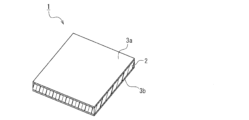
- FIG. 3 is a schematic perspective view of a copper-clad fluororesin substrate according to one embodiment of the present invention.
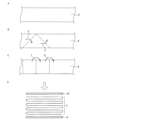
- 4A to 4D are schematic perspective views showing a method for producing a fluororesin sheet according to one embodiment of the present invention.
- the inventors have studied the problems with conventional fluororesin sheets laminated with glass fiber cloth and metal-clad fluororesin substrates that contain this, and have found that conventional products have problems such as difficulty in forming a thin film due to restrictions on the thickness of the glass fiber cloth, and that in terms of physical properties, the volume balance between fluororesin and glass fiber cloth is different, causing the dielectric constant to fluctuate and tending to result in poorer transmission characteristics at high frequencies compared to clothless materials, and that the high viscosity of fluororesin makes it difficult to impregnate the inside, leading to the possibility of air being trapped inside.
- the present invention was completed based on these ideas.
- the fluororesin sheet of the present invention contains a fluoropolymer and an inorganic filler, and the inorganic filler has been surface-treated (pretreated).
- the inorganic filler is preferably silicon oxide, aluminum oxide, titanium oxide, aluminum nitride, boron nitride, silicon nitride, barium titanate, barium sulfate, magnesium hydroxide, glass particles, ceramic particles, or a combination thereof. These inorganic fillers can enhance the reinforcing effect of the fluororesin sheet.
- Pretreatment refers to adhering a surface treatment agent to the surface of the inorganic filler before mixing the fluoropolymer and the inorganic filler.
- the surface treatment agent is preferably a silane coupling agent, an aluminate coupling agent, or a titanate coupling agent.
- These surface treatment agents have high affinity with fluoropolymers, and even if a large amount of inorganic filler is added to the fluoropolymer, the inorganic filler has good mixing properties and improves handling.
- the inorganic filler absorbs moisture, which causes the dielectric tangent to increase.
- the moisture absorption can be suppressed and the increase in the dielectric tangent can be suppressed.
- the hydroxyl group (-OH group) on the surface of the inorganic filler is blocked with a surface treatment agent to prevent moisture absorption.
- silane coupling agents include alkylalkoxysilane compounds represented by R(CH 3 ) a Si(OR') 4-a (R is an unsubstituted or substituted organic group having 1 to 20 carbon atoms, R' is an alkyl group having 1 to 4 carbon atoms, and a is 0 or 1), or partial hydrolyzates thereof, such as methyltrimethoxysilane, n-propyltrimethoxysilane, hexyltrimethoxysilane, decyltrimethoxysilane, methyltriethoxysilane, n-propyltriethoxysilane, hexyltriethoxysilane, octyltriethoxysi
- aluminate coupling agents examples include aluminum alkylacetoacetate diisopropylate, and examples of titanate coupling agents include triisostearoyloxy-isopropoxytitanium.
- the above coupling agents may be used alone or in combination of two or more.
- the surface treatment agent is preferably added in an amount of 0.05 to 4 parts by mass per 100 parts by mass of inorganic filler, more preferably 0.07 to 3.5 parts by mass, and even more preferably 1 to 3 parts by mass. This ensures good mixing and improved handling even when a large amount of inorganic filler is added to the fluoropolymer.
- fluoropolymer and surface-treated inorganic filler further additives such as pigments, stabilizers, oils, alcohols, resins, etc. may also be added.
- the fluoropolymer is oriented in the plane direction of the fluororesin sheet.
- This structure is realized by repeating lamination and press molding multiple times and by parallel lamination or cross lamination when sheets of a compound (mixture) of fluoropolymer and surface-treated inorganic filler are laminated and press molded into a sheet.
- the fluoropolymer becomes entangled with the inorganic filler and covers it. This results in a structure in which interfacial peeling between the inorganic filler and the fluoropolymer is eliminated.
- the fluoropolymer is oriented in the plane direction and interfacial peeling between the inorganic filler and the fluoropolymer is eliminated, resulting in a fluororesin sheet with high tensile strength in multiple directions and good handleability even without using glass fiber cloth.
- This structure results in high tensile strength in the plane direction and good handleability of the fluororesin sheet alone even without using glass fiber cloth.
- glass fiber cloth is not excluded, and it may be laminated at any location, but it is preferable to use a fluororesin sheet alone without using glass fiber cloth.
- the fluororesin sheet preferably has a tensile strength of 5 MPa or more in both the length direction and width direction, more preferably greater than 5 MPa, and even more preferably 6 MPa or more.
- the fluororesin sheet preferably has a breaking elongation of 1% or more in both the length direction and width direction, more preferably 5% or more, and even more preferably 10% or more.
- the upper limit is preferably 500% or less, and even more preferably 400% or less. This provides high elongation in various directions and improves handling.
- the fluoropolymer is preferably at least one selected from the group consisting of polytetrafluoroethylene (PTFE), perfluoroalkoxyalkane polymer (PFA), and perfluoroethylenepropene copolymer (FEP).
- PTFE polytetrafluoroethylene
- PFA perfluoroalkoxyalkane polymer
- FEP perfluoroethylenepropene copolymer
- the fluororesin sheet preferably contains 10 to 4,000 parts by mass of inorganic filler per 100 parts by mass of fluororesin, more preferably 30 to 3,800 parts by mass, and even more preferably 50 to 3,500 parts by mass.
- Each particle of the inorganic filler preferably has a D50 (median diameter) of 0.01 to 100 ⁇ m, more preferably 0.1 to 90 ⁇ m, and even more preferably 0.1 to 80 ⁇ m in cumulative particle size distribution by volume measured using the laser diffraction light scattering method. This improves reinforcing properties.
- the thickness of the fluororesin sheet is preferably 0.05 to 10.0 mm, more preferably 0.1 to 9 mm, and even more preferably 0.12 to 8 mm. This allows it to be used with a variety of circuit boards.
- the mass per unit area of the fluororesin sheet is preferably 80 to 40,000 g/m 2 , more preferably 160 to 30,000 g/m 2 , and even more preferably 200 to 20,000 g/m 2. This makes it possible to produce circuit boards with different characteristics.
- the fluororesin sheet can be adhered to metal foil with a surface roughness of Rz 0.85 or more and 2.0 or less, and the adhesive strength with the metal foil is preferably a maximum peel strength of 40 N/cm. More preferably, the peel strength is 5.0 to 40 N/cm, and even more preferably 5.3 to 40 N/cm. This allows it to be used with a variety of circuit boards.
- the solder heat resistance is preferably such that the copper foil does not peel off or swell when a 50 mm square copper-clad fluororesin board sample is floated in a solder bath at 288°C for 10 minutes. This improves the process passability of the soldering work.
- the metal-clad fluororesin substrate of the present invention has a metal foil laminated to at least one surface of any of the above-mentioned fluororesin sheets. It is preferably laminated to both surfaces or in multiple layers. This makes it suitable for use with many circuit boards.
- the metal-clad fluororesin substrate preferably has a dielectric tangent of 0.0001 to 0.003 at a frequency of 10 GHz.
- the metal-clad fluororesin substrate preferably has a relative dielectric constant of 1.5 to 20 at a frequency of 10 GHz. This makes it suitable for use as a high-frequency circuit board.
- the metal foil is preferably copper foil, which makes it suitable for use in high-frequency circuit boards.
- the manufacturing method of the present invention includes the following steps.
- First step Mix an aqueous dispersion of fluoropolymer with an inorganic filler, compound, and press mold into a sheet.
- compound has the same meaning as green body.
- Press molding is preferably performed at room temperature and a pressure of 0.5 to 4.0 MPa. Compounding can be performed using a rotating/revolutionary mixing method, kneader kneading, shaking, three-roll mill, pot mill, or other mixing methods.
- Second step The sheets are laminated and press molded to obtain a sheet.
- the press molding is preferably performed at a pressure of 0.15 to 2.5 MPa at room temperature. At this time, lamination and press molding may be repeated multiple times.
- the multiple times is preferably 2 to 20 times, more preferably 3 to 15 times.
- the lamination may be performed in one direction (parallel lamination) or in multiple directions (cross lamination).
- the fluoropolymer is laminated in the thickness direction of the fluororesin sheet and oriented in the plane direction.
- the fluoropolymer is entangled with the inorganic filler and covers the inorganic filler. This results in a structure in which interfacial peeling between the inorganic filler and the fluoropolymer does not occur.
- the structure in which the fluororesin sheet is laminated in the thickness direction and oriented in the plane direction, and the structure in which interfacial peeling between the inorganic filler and the fluoropolymer does not occur combine to synergistically provide a fluororesin sheet with high tensile strength in multiple directions and good handleability even without using glass fiber cloth.
- the treatment time for degreasing is preferably 10 minutes to 24 hours, more preferably 30 minutes to 20 hours, and even more preferably 1 to 16 hours.
- the size of the fluororesin sheet to be degreased is preferably 30 to 30,000 mm in length, 20 to 1,000 mm in width, and 70 to 11,000 ⁇ m in thickness.
- the degreasing treatment is preferably performed by exposing at least one side, preferably both sides, of the fluororesin sheet to air. This removes unnecessary organic matter, such as stabilizers, oils, alcohols, dispersants, etc. If unnecessary organic matter remains in the fluororesin sheet, when the sheet is heated to a heat press temperature (near the melting point of the fluororesin, 326° C.) in the subsequent copper foil attachment process, the organic matter becomes bubbles and becomes defects. Furthermore, the substances that have become bubbles corrode the copper foil, reducing the peel strength.
- a heat press temperature near the melting point of the fluororesin, 326° C.
- the present invention removes unnecessary organic matter by degreasing, and prevents defects due to bubbles even when the sheet is heated to a heat press temperature (near the melting point of the fluororesin, 326° C.) in the subsequent copper foil attachment process.
- the degreasing process may be carried out under reduced pressure of 0.1 to 10 kPa.
- Degreasing equipment includes an electric heating oven, a circulating air-blowing heating oven, an IR oven, etc., and may be of a batch type or a continuous method.
- An IR oven can obtain a degreasing effect greater than that of an electric heating oven in a short time.
- An IR oven allows for continuous degreasing, and can also be used for long lengths. Since thick sheets require a long time to be degreased, it is preferable to heat them in an electric heating oven and then reduce the pressure after they have been sufficiently heated.
- Figure 1 is a scanning electron microscope (SEM) cross-sectional photograph (magnification 40x) of a fluororesin sheet 1 of Example 1 of the present invention.
- the fluoropolymer is oriented in the plane direction of the fluororesin sheet. In other words, it is the fluoropolymer that is aligned in the horizontal direction.
- this fluororesin sheet has a structure in which the fluoropolymer is laminated in layers in the thickness direction. In other words, it has a laminated structure when viewed in the cross-sectional direction.
- Figure 2 is an SEM photograph (magnification 40x) of the fluororesin sheet of Comparative Example 1. This fluororesin sheet was produced using a method that did not include the second step (lamination press step) of the method of the present invention, and no orientation of the fluoropolymer was observed.
- FIG. 3 is a schematic perspective view of a copper-clad fluororesin substrate 1 according to one embodiment of the present invention.
- This copper-clad fluororesin substrate 1 has copper foils 3a and 3b attached to both sides of a fluororesin sheet 2.
- the fluororesin sheet 2 is heated to a temperature close to its melting point of 326°C, and is attached to the copper foils 3a and 3b by heat pressing.
- An adhesive may be used at this time.
- Figures 4A-D are schematic perspective views showing a method for producing a fluororesin sheet according to one embodiment of the present invention.
- Figure 4A shows a fluororesin sheet 4 obtained in the first step of the method of the present invention.
- Figure 4B shows an example in which this fluororesin sheet 4 is cross-laminated as indicated by arrows 5 and 6. The folding angle is arbitrary.
- Figure 4C shows the fluororesin sheet 4 being parallel-laminated as indicated by arrows 7 and 8.
- the cross lamination of Figure 4B and the parallel lamination of Figure 4C may be mixed to form a mixed lamination.
- the fluororesin sheet 4 laminated in this manner is pressed with press plates 10 and 11 as shown in Figure 4D.
- the fluororesin sheet of the present invention is obtained through the rolling, drying and degreasing steps as described above.
- ⁇ Tensile strength, tensile elongation> A tensile strength test and a tensile elongation test were performed using a tensile tester (manufactured by Shimadzu Corporation) according to ASTM D638: 1995. The tensile strength and tensile elongation were measured on a sample 5 cm wide and converted to per cm. The elongation is the elongation at break.
- Example 1 Laser diffraction light scattering method, cumulative particle size distribution by volume D50: A liquid obtained by mixing 0.7 parts of trimethoxymethylsilane (DOWSIL SZ 6070 Silan, manufactured by Toray Industries, Inc.) and 24 parts of normal propanol was dropped onto 100 parts of silicon oxide (F-40: manufactured by Marukama Kamado Toryo Co., Ltd.) having a median diameter of 5.6 ⁇ m, and the mixture was mixed for 30 minutes in a Henschel mixer. The mixed filler was heated in an oven at 100° C. for 60 minutes to obtain a surface-treated filler.
- DOWSIL SZ 6070 Silan manufactured by Toray Industries, Inc.
- F-40 manufactured by Marukama Kamado Toryo Co., Ltd.
- an aqueous dispersion (60% concentration) of polytetrafluoroethylene (31-JR: manufactured by Mitsui Chemours) was added so that the resin content was 95 parts by volume, and an aqueous dispersion (60% concentration) of perfluoroethylene (335-JR: manufactured by Mitsui Chemours) was added so that the resin content was 5 parts by volume, and the mixture was stirred to obtain a dispersion.
- ⁇ Mixing> The dispersion obtained above was stirred for 2 minutes with a propeller machine adjusted to a rotation speed of 60 to 70 rpm, and then stirred for 2 minutes with a propeller machine adjusted to a rotation speed of 60 to 70 rpm.
- the size of the sheet was 10,000 mm in length, 500 mm in width, and 100 ⁇ m in thickness.
- the degreasing treatment was performed by exposing at least one side of the fluororesin sheet to air.
- ⁇ Heat pressing> The long degreased sheet obtained in the degreasing process was cut to a predetermined size (for example, 200 mm length, 300 mm width), and copper foil (manufactured by Fukuda Metal Foil & Powder Co., Ltd., product name "CF-T4X-SV18", surface roughness Rz: 1.0 ⁇ m)/degreased sheet/copper foil were layered in this order, gradually heated to a temperature of 350° C., and vacuum hot-pressed at a vacuum degree of 0.9 kPa and a pressure of 8.0 MPa to form a laminate.
- Example 1 is a scanning electron microscope (SEM) cross-sectional photograph (magnification 40 times) of the fluororesin sheet 1 of Example 1. It can be seen that the fluoropolymer is oriented in the plane direction of the fluororesin sheet. In other words, it is the fluoropolymer that is aligned in the horizontal direction. It can also be seen that this fluororesin sheet has a structure in which the fluoropolymer is laminated in layers in the thickness direction. In other words, it has a laminated structure when viewed in the cross-sectional direction.
- SEM scanning electron microscope
- Fig. 2 is an SEM photograph (magnification 40 times) of the fluororesin sheet of Comparative Example 1. This fluororesin sheet was produced by a method that did not include the second step (lamination press step) of the method of the present invention, and no orientation of the fluoropolymer was observed.
- Example 2 Laser diffraction light scattering method, cumulative particle size distribution by volume D50: A liquid obtained by mixing 0.3 parts of trimethoxymethylsilane (DOWSIL SZ 6070 Silan, manufactured by Toray Industries, Inc.) and 7 parts of normal propanol was dropped onto 100 parts of silicon oxide (LS-44: manufactured by Marukama Kamado Toryo Co., Ltd.) having a median diameter of 13.5 ⁇ m, and the mixture was mixed for 30 minutes in a Henschel mixer. The mixed filler was heated in an oven at 100° C. for 60 minutes to obtain a surface-treated filler.
- DOWSIL SZ 6070 Silan manufactured by Toray Industries, Inc.
- LS-44 manufactured by Marukama Kamado Toryo Co., Ltd.
- an aqueous dispersion (60% concentration) of polytetrafluoroethylene (31-JR: manufactured by Mitsui Chemours) was added so that the resin content was 95 parts by volume, and an aqueous dispersion (60% concentration) of perfluoroethylene (335-JR: manufactured by Mitsui Chemours) was added so that the resin content was 5 parts by volume, and the mixture was stirred to obtain a dispersion.
- ⁇ Mixing> The dispersion obtained above was stirred for 2 minutes with a propeller machine adjusted to a rotation speed of 60 to 70 rpm, and then stirred for 2 minutes with a propeller machine adjusted to a rotation speed of 60 to 70 rpm.
- the size of the sheet was 10,000 mm in length, 500 mm in width, and 100 ⁇ m in thickness.
- the degreasing treatment was performed by exposing at least one side of the fluororesin sheet to air.
- ⁇ Heat pressing> The long degreased sheet obtained in the degreasing process was cut to a predetermined size (for example, 200 mm length, 300 mm width), and copper foil (manufactured by Fukuda Metal Foil & Powder Co., Ltd., product name "CF-T4X-SV18", surface roughness Rz: 1.0 ⁇ m)/degreased sheet/copper foil were layered in this order, gradually heated to a temperature of 350° C., and vacuum hot-pressed at a vacuum degree of 0.9 kPa and a pressure of 8.0 MPa to form a laminate.
- Example 2 The same procedure as in Example 2 was carried out except that the surface treatment of the inorganic filler was not performed and that degreasing was not performed.
- Example 3 Laser diffraction light scattering method, cumulative particle size distribution by volume D50: A liquid obtained by mixing 1.0 part of triisostearoyloxy-isopropoxytitanium (TTS: manufactured by Ajinomoto Fine-Techno Co., Ltd.) and 8 parts of xylene was dropped onto 100 parts of silicon oxide (LS-44: manufactured by Marukama Kamado Toryo Co., Ltd.) having a median diameter of 13.5 ⁇ m, and the mixture was mixed for 30 minutes in a Henschel mixer. The mixed filler was heated in an oven at 150° C. for 60 minutes to obtain a surface-treated filler.
- TTS triisostearoyloxy-isopropoxytitanium
- LS-44 manufactured by Marukama Kamado Toryo Co., Ltd.
- an aqueous dispersion (60% concentration) of polytetrafluoroethylene (31-JR: manufactured by Mitsui Chemours) was added so that the resin content was 95 parts by volume, and an aqueous dispersion (60% concentration) of perfluoroethylene (335-JR: manufactured by Mitsui Chemours) was added so that the resin content was 5 parts by volume, and the mixture was stirred to obtain a dispersion.
- ⁇ Mixing> The dispersion obtained above was stirred for 2 minutes with a propeller machine adjusted to a rotation speed of 60 to 70 rpm, and then stirred for 2 minutes with a propeller machine adjusted to a rotation speed of 60 to 70 rpm.
- the size of the sheet was 10,000 mm in length, 500 mm in width, and 100 ⁇ m in thickness.
- the degreasing treatment was performed by exposing at least one side of the fluororesin sheet to air.
- ⁇ Heat pressing> The long degreased sheet obtained in the degreasing process was cut to a predetermined size (for example, 200 mm length, 300 mm width), and copper foil (manufactured by Fukuda Metal Foil & Powder Co., Ltd., product name "CF-T4X-SV18", surface roughness Rz: 1.0 ⁇ m)/degreased sheet/copper foil were layered in this order, gradually heated to a temperature of 350° C., and vacuum hot-pressed at a vacuum degree of 0.9 kPa and a pressure of 8.0 MPa to form a laminate.
- Example 3 The same procedure as in Example 3 was carried out except that the surface treatment of the inorganic filler was not performed and that degreasing was not performed. The above results are shown in Table 1.
- Example 1-3 As is clear from Table 1, in Example 1-3, no air bubbles were generated during the copper foil attachment process, and a copper foil-clad laminate without defects was obtained. In addition, it was confirmed that the fluororesin sheet of Example 1-3 had a low water absorption rate and was less susceptible to the effects of humidity due to the surface treatment with inorganic filler. Furthermore, it was confirmed that the fluororesin sheet of Example 1-3 was a fluororesin sheet with good handleability even without using glass fiber cloth, and had good physical and electrical properties.
- the fluororesin sheet of the present invention and metal-clad fluororesin substrates containing the same are useful for wiring substrates such as IoT devices and wearable devices, which have low transmission loss even when using high frequencies such as millimeter waves, high-speed transmission FPCs, transceivers, high-speed communication boards, antenna boards, smartphones, smart watches, communication base station antennas, collision sensors, distance sensors, sensors in train monitoring systems, satellite communication antennas, intersection inspection sensors, security image sensors, runway foreign object detection systems, and river water level monitoring sensors.
Landscapes
- Chemical & Material Sciences (AREA)
- Engineering & Computer Science (AREA)
- Manufacturing & Machinery (AREA)
- Health & Medical Sciences (AREA)
- Chemical Kinetics & Catalysis (AREA)
- Medicinal Chemistry (AREA)
- Polymers & Plastics (AREA)
- Organic Chemistry (AREA)
- Microelectronics & Electronic Packaging (AREA)
- Materials Engineering (AREA)
- Laminated Bodies (AREA)
Priority Applications (2)
| Application Number | Priority Date | Filing Date | Title |
|---|---|---|---|
| JP2024569143A JP7713117B1 (ja) | 2023-12-07 | 2024-07-11 | フッ素樹脂シート、その製造方法及びこれを含む金属張フッ素樹脂基板 |
| CN202480052531.7A CN121712830A (zh) | 2023-12-07 | 2024-07-11 | 氟树脂片材、其制造方法及包含其的覆金属氟树脂基板 |
Applications Claiming Priority (2)
| Application Number | Priority Date | Filing Date | Title |
|---|---|---|---|
| JP2023207151 | 2023-12-07 | ||
| JP2023-207151 | 2023-12-07 |
Publications (1)
| Publication Number | Publication Date |
|---|---|
| WO2025120893A1 true WO2025120893A1 (ja) | 2025-06-12 |
Family
ID=95980884
Family Applications (1)
| Application Number | Title | Priority Date | Filing Date |
|---|---|---|---|
| PCT/JP2024/025105 Pending WO2025120893A1 (ja) | 2023-12-07 | 2024-07-11 | フッ素樹脂シート、その製造方法及びこれを含む金属張フッ素樹脂基板 |
Country Status (4)
| Country | Link |
|---|---|
| JP (1) | JP7713117B1 (https=) |
| CN (1) | CN121712830A (https=) |
| TW (1) | TW202523769A (https=) |
| WO (1) | WO2025120893A1 (https=) |
Citations (10)
| Publication number | Priority date | Publication date | Assignee | Title |
|---|---|---|---|---|
| JP2003338670A (ja) * | 2002-05-22 | 2003-11-28 | Tomoegawa Paper Co Ltd | フッ素樹脂プリント配線板及びその製造方法 |
| JP2008238828A (ja) | 2008-06-11 | 2008-10-09 | Nippon Valqua Ind Ltd | 充填材入りフッ素樹脂シート |
| JP2017141345A (ja) | 2016-02-10 | 2017-08-17 | 日本ゼオン株式会社 | 複合材料シートおよび熱伝導シートの製造方法 |
| JP2020050860A (ja) | 2018-09-27 | 2020-04-02 | 南亞塑膠工業股▲分▼有限公司 | フッ素樹脂組成物及びこれを使用するプリプレグと銅張基板 |
| JP2021061406A (ja) | 2016-03-18 | 2021-04-15 | 日東電工株式会社 | 絶縁樹脂材料、それを用いた金属層付絶縁樹脂材料および配線基板 |
| WO2021235276A1 (ja) | 2020-05-18 | 2021-11-25 | 住友電気工業株式会社 | 誘電体シートの製造方法、高周波プリント配線板用基板の製造方法、誘電体シート、及び高周波プリント配線板用基板 |
| JP2022114351A (ja) | 2021-01-26 | 2022-08-05 | 信越化学工業株式会社 | 低誘電金属張フッ素樹脂基板及びその製造方法 |
| WO2023013569A1 (ja) | 2021-08-04 | 2023-02-09 | Agc株式会社 | シートの製造方法、積層シートの製造方法およびシート |
| WO2023080113A1 (ja) * | 2021-11-08 | 2023-05-11 | 住友電気工業株式会社 | 誘電体シート、高周波プリント配線板用基板及び高周波プリント配線板 |
| WO2023189794A1 (ja) * | 2022-03-31 | 2023-10-05 | 日鉄ケミカル&マテリアル株式会社 | 金属張積層板及びその製造方法 |
Family Cites Families (2)
| Publication number | Priority date | Publication date | Assignee | Title |
|---|---|---|---|---|
| JP2008181610A (ja) * | 2007-01-25 | 2008-08-07 | Fujifilm Corp | 磁気記録媒体 |
| JP2009054198A (ja) * | 2007-08-23 | 2009-03-12 | Fujifilm Corp | 磁気記録媒体 |
-
2024
- 2024-07-11 CN CN202480052531.7A patent/CN121712830A/zh active Pending
- 2024-07-11 JP JP2024569143A patent/JP7713117B1/ja active Active
- 2024-07-11 WO PCT/JP2024/025105 patent/WO2025120893A1/ja active Pending
- 2024-07-17 TW TW113126755A patent/TW202523769A/zh unknown
Patent Citations (10)
| Publication number | Priority date | Publication date | Assignee | Title |
|---|---|---|---|---|
| JP2003338670A (ja) * | 2002-05-22 | 2003-11-28 | Tomoegawa Paper Co Ltd | フッ素樹脂プリント配線板及びその製造方法 |
| JP2008238828A (ja) | 2008-06-11 | 2008-10-09 | Nippon Valqua Ind Ltd | 充填材入りフッ素樹脂シート |
| JP2017141345A (ja) | 2016-02-10 | 2017-08-17 | 日本ゼオン株式会社 | 複合材料シートおよび熱伝導シートの製造方法 |
| JP2021061406A (ja) | 2016-03-18 | 2021-04-15 | 日東電工株式会社 | 絶縁樹脂材料、それを用いた金属層付絶縁樹脂材料および配線基板 |
| JP2020050860A (ja) | 2018-09-27 | 2020-04-02 | 南亞塑膠工業股▲分▼有限公司 | フッ素樹脂組成物及びこれを使用するプリプレグと銅張基板 |
| WO2021235276A1 (ja) | 2020-05-18 | 2021-11-25 | 住友電気工業株式会社 | 誘電体シートの製造方法、高周波プリント配線板用基板の製造方法、誘電体シート、及び高周波プリント配線板用基板 |
| JP2022114351A (ja) | 2021-01-26 | 2022-08-05 | 信越化学工業株式会社 | 低誘電金属張フッ素樹脂基板及びその製造方法 |
| WO2023013569A1 (ja) | 2021-08-04 | 2023-02-09 | Agc株式会社 | シートの製造方法、積層シートの製造方法およびシート |
| WO2023080113A1 (ja) * | 2021-11-08 | 2023-05-11 | 住友電気工業株式会社 | 誘電体シート、高周波プリント配線板用基板及び高周波プリント配線板 |
| WO2023189794A1 (ja) * | 2022-03-31 | 2023-10-05 | 日鉄ケミカル&マテリアル株式会社 | 金属張積層板及びその製造方法 |
Also Published As
| Publication number | Publication date |
|---|---|
| JPWO2025120893A1 (https=) | 2025-06-12 |
| JP7713117B1 (ja) | 2025-07-24 |
| CN121712830A (zh) | 2026-03-20 |
| TW202523769A (zh) | 2025-06-16 |
Similar Documents
| Publication | Publication Date | Title |
|---|---|---|
| EP3668283B1 (en) | Substrate for high-frequency printed wiring board | |
| TWI906309B (zh) | 雙面覆銅層壓板 | |
| JP7559767B2 (ja) | 非水系分散液、積層体の製造方法及び成形物 | |
| CN110062786B (zh) | 黑色液晶聚合物膜和多层基板 | |
| WO2016159102A1 (ja) | フッ素系樹脂含有非水系分散体、フッ素系樹脂含有ポリイミド前駆体溶液組成物、それを用いたポリイミド、ポリイミドフィルム、回路基板用接着剤組成物、およびそれらの製造方法 | |
| KR20160103519A (ko) | 회로 기판 및 그 제조 방법 | |
| JP7371681B2 (ja) | 液状組成物、パウダー、及び、パウダーの製造方法 | |
| WO2019230569A1 (ja) | 樹脂付金属箔の製造方法、樹脂付金属箔、積層体及びプリント基板 | |
| WO2023189794A1 (ja) | 金属張積層板及びその製造方法 | |
| KR20230010621A (ko) | 열 용융성 테트라플루오로에틸렌계 폴리머를 포함하는 층을 갖는 적층체의 제조 방법 | |
| WO2021075504A1 (ja) | 非水系分散液及び積層体の製造方法 | |
| KR20250141181A (ko) | 불소 수지 시트, 동장 적층체, 회로용 기판 및 안테나 | |
| JP7713117B1 (ja) | フッ素樹脂シート、その製造方法及びこれを含む金属張フッ素樹脂基板 | |
| KR102897538B1 (ko) | 액상 조성물 | |
| JP7730968B2 (ja) | フッ素樹脂シート及びこれを含む金属張フッ素樹脂基板 | |
| JP2025049784A (ja) | 金属張積層板及びその製造方法 | |
| JP7762314B2 (ja) | 分散組成物、フッ素系樹脂フィルム、金属張積層板及びその製造方法 | |
| KR102021641B1 (ko) | 적층체, 적층체의 제조 방법 및 다층 기판 | |
| JP7810914B2 (ja) | 組成物、シート及び金属張積層体 | |
| JP7846386B2 (ja) | 誘電体、銅張積層体及びそれらの製造方法 | |
| JP7553751B1 (ja) | フッ素樹脂フィルム、フッ素樹脂フィルムの製造方法、フレキシブル銅張積層板用シート状貼付けフィルム、フレキシブル銅張積層板および回路基板 | |
| JP2007323918A (ja) | シールドフラットケーブルおよびその製造方法 | |
| WO2024070495A1 (ja) | 樹脂組成物及びこれを用いたフッ素系樹脂フィルム並びにフッ素系樹脂金属張積層体 | |
| JP2026069514A (ja) | 誘電体、銅張積層体及びそれらの製造方法 | |
| JP2025063712A (ja) | 水系分散液、積層体の製造方法、積層体、金属張積層体、及び車載レーダ |
Legal Events
| Date | Code | Title | Description |
|---|---|---|---|
| ENP | Entry into the national phase |
Ref document number: 2024569143 Country of ref document: JP Kind code of ref document: A |
|
| WWE | Wipo information: entry into national phase |
Ref document number: 2024569143 Country of ref document: JP |
|
| 121 | Ep: the epo has been informed by wipo that ep was designated in this application |
Ref document number: 24898954 Country of ref document: EP Kind code of ref document: A1 |
|
| WWE | Wipo information: entry into national phase |
Ref document number: 2601000921 Country of ref document: TH |
|
| WWE | Wipo information: entry into national phase |
Ref document number: 24898954 Country of ref document: EP Ref document number: 2024898954 Country of ref document: EP |