WO2025111237A1 - Cyclic sulfur containing additive compounds for high voltage energy storage device electrolytes, and processes thereof - Google Patents
Cyclic sulfur containing additive compounds for high voltage energy storage device electrolytes, and processes thereof Download PDFInfo
- Publication number
- WO2025111237A1 WO2025111237A1 PCT/US2024/056465 US2024056465W WO2025111237A1 WO 2025111237 A1 WO2025111237 A1 WO 2025111237A1 US 2024056465 W US2024056465 W US 2024056465W WO 2025111237 A1 WO2025111237 A1 WO 2025111237A1
- Authority
- WO
- WIPO (PCT)
- Prior art keywords
- optionally substituted
- energy storage
- electrolyte
- electrolyte composition
- alkyl
- Prior art date
- Legal status (The legal status is an assumption and is not a legal conclusion. Google has not performed a legal analysis and makes no representation as to the accuracy of the status listed.)
- Ceased
Links
Classifications
-
- H—ELECTRICITY
- H01—ELECTRIC ELEMENTS
- H01M—PROCESSES OR MEANS, e.g. BATTERIES, FOR THE DIRECT CONVERSION OF CHEMICAL ENERGY INTO ELECTRICAL ENERGY
- H01M10/00—Secondary cells; Manufacture thereof
- H01M10/05—Accumulators with non-aqueous electrolyte
- H01M10/056—Accumulators with non-aqueous electrolyte characterised by the materials used as electrolytes, e.g. mixed inorganic/organic electrolytes
- H01M10/0564—Accumulators with non-aqueous electrolyte characterised by the materials used as electrolytes, e.g. mixed inorganic/organic electrolytes the electrolyte being constituted of organic materials only
- H01M10/0566—Liquid materials
- H01M10/0567—Liquid materials characterised by the additives
-
- H—ELECTRICITY
- H01—ELECTRIC ELEMENTS
- H01G—CAPACITORS; CAPACITORS, RECTIFIERS, DETECTORS, SWITCHING DEVICES, LIGHT-SENSITIVE OR TEMPERATURE-SENSITIVE DEVICES OF THE ELECTROLYTIC TYPE
- H01G11/00—Hybrid capacitors, i.e. capacitors having different positive and negative electrodes; Electric double-layer [EDL] capacitors; Processes for the manufacture thereof or of parts thereof
- H01G11/54—Electrolytes
- H01G11/58—Liquid electrolytes
- H01G11/60—Liquid electrolytes characterised by the solvent
-
- H—ELECTRICITY
- H01—ELECTRIC ELEMENTS
- H01G—CAPACITORS; CAPACITORS, RECTIFIERS, DETECTORS, SWITCHING DEVICES, LIGHT-SENSITIVE OR TEMPERATURE-SENSITIVE DEVICES OF THE ELECTROLYTIC TYPE
- H01G11/00—Hybrid capacitors, i.e. capacitors having different positive and negative electrodes; Electric double-layer [EDL] capacitors; Processes for the manufacture thereof or of parts thereof
- H01G11/54—Electrolytes
- H01G11/58—Liquid electrolytes
- H01G11/64—Liquid electrolytes characterised by additives
-
- H—ELECTRICITY
- H01—ELECTRIC ELEMENTS
- H01M—PROCESSES OR MEANS, e.g. BATTERIES, FOR THE DIRECT CONVERSION OF CHEMICAL ENERGY INTO ELECTRICAL ENERGY
- H01M10/00—Secondary cells; Manufacture thereof
- H01M10/05—Accumulators with non-aqueous electrolyte
- H01M10/052—Li-accumulators
-
- H—ELECTRICITY
- H01—ELECTRIC ELEMENTS
- H01M—PROCESSES OR MEANS, e.g. BATTERIES, FOR THE DIRECT CONVERSION OF CHEMICAL ENERGY INTO ELECTRICAL ENERGY
- H01M10/00—Secondary cells; Manufacture thereof
- H01M10/05—Accumulators with non-aqueous electrolyte
- H01M10/056—Accumulators with non-aqueous electrolyte characterised by the materials used as electrolytes, e.g. mixed inorganic/organic electrolytes
- H01M10/0564—Accumulators with non-aqueous electrolyte characterised by the materials used as electrolytes, e.g. mixed inorganic/organic electrolytes the electrolyte being constituted of organic materials only
- H01M10/0566—Liquid materials
- H01M10/0569—Liquid materials characterised by the solvents
-
- H—ELECTRICITY
- H01—ELECTRIC ELEMENTS
- H01M—PROCESSES OR MEANS, e.g. BATTERIES, FOR THE DIRECT CONVERSION OF CHEMICAL ENERGY INTO ELECTRICAL ENERGY
- H01M10/00—Secondary cells; Manufacture thereof
- H01M10/42—Methods or arrangements for servicing or maintenance of secondary cells or secondary half-cells
- H01M10/4235—Safety or regulating additives or arrangements in electrodes, separators or electrolyte
-
- H—ELECTRICITY
- H01—ELECTRIC ELEMENTS
- H01M—PROCESSES OR MEANS, e.g. BATTERIES, FOR THE DIRECT CONVERSION OF CHEMICAL ENERGY INTO ELECTRICAL ENERGY
- H01M10/00—Secondary cells; Manufacture thereof
- H01M10/05—Accumulators with non-aqueous electrolyte
- H01M10/052—Li-accumulators
- H01M10/0525—Rocking-chair batteries, i.e. batteries with lithium insertion or intercalation in both electrodes; Lithium-ion batteries
-
- H—ELECTRICITY
- H01—ELECTRIC ELEMENTS
- H01M—PROCESSES OR MEANS, e.g. BATTERIES, FOR THE DIRECT CONVERSION OF CHEMICAL ENERGY INTO ELECTRICAL ENERGY
- H01M2300/00—Electrolytes
- H01M2300/0017—Non-aqueous electrolytes
- H01M2300/0025—Organic electrolyte
- H01M2300/0028—Organic electrolyte characterised by the solvent
- H01M2300/0031—Chlorinated solvents
-
- H—ELECTRICITY
- H01—ELECTRIC ELEMENTS
- H01M—PROCESSES OR MEANS, e.g. BATTERIES, FOR THE DIRECT CONVERSION OF CHEMICAL ENERGY INTO ELECTRICAL ENERGY
- H01M2300/00—Electrolytes
- H01M2300/0017—Non-aqueous electrolytes
- H01M2300/0025—Organic electrolyte
- H01M2300/0028—Organic electrolyte characterised by the solvent
- H01M2300/0037—Mixture of solvents
-
- Y—GENERAL TAGGING OF NEW TECHNOLOGICAL DEVELOPMENTS; GENERAL TAGGING OF CROSS-SECTIONAL TECHNOLOGIES SPANNING OVER SEVERAL SECTIONS OF THE IPC; TECHNICAL SUBJECTS COVERED BY FORMER USPC CROSS-REFERENCE ART COLLECTIONS [XRACs] AND DIGESTS
- Y02—TECHNOLOGIES OR APPLICATIONS FOR MITIGATION OR ADAPTATION AGAINST CLIMATE CHANGE
- Y02E—REDUCTION OF GREENHOUSE GAS [GHG] EMISSIONS, RELATED TO ENERGY GENERATION, TRANSMISSION OR DISTRIBUTION
- Y02E60/00—Enabling technologies; Technologies with a potential or indirect contribution to GHG emissions mitigation
- Y02E60/10—Energy storage using batteries
Definitions
- the present disclosure relates generally to energy storage devices, and specifically to improved electrolyte formulations for use in energy storage devices.
- Energy storage devices are widely used to provide power to electronic, electromechanical, electrochemical, and other useful devices. Such cells include primary chemical cells, secondary (rechargeable) cells, fuel cells, and various species of capacitors, including ultracapacitors. Increasing the operating voltage and temperature of energy storage devices, including batteries and capacitors, would be desirable for enhancing energy storage, increasing power capability, and broadening real-world use cases.
- Lithium ion batteries have been relied on as a power source in numerous commercial and industrial uses, for example, in consumer devices, productivity devices, and in battery powered vehicles.
- Lithium ion batteries are well suited to meet future demands however improvements in energy density are needed to provide longer life batteries that can travel further on a single charge.
- the electrolyte is one component in conventional lithium ion batteries that determines electrochemical performance as well as safety of those batteries, where the compatibility between electrode and electrolyte in part governs battery cell performance. [0007] In conventional lithium ion batteries, discharge rates less than about C/5 are typically manageable by higher energy electrode designs, where C/5 is a discharge current relative to cell capacity such that the cell is drained in 5 hours.
- the electrolyte composition includes: a solvent; a salt; and an additive comprising a compound selected from Formula (A), Formula (B) or Formula (C): wherein: A is O or absent; X 1 is O or NR 6 ; X 2 is O or NR 7 ; R 1 is an optionally substituted C 1- 6 alkylene; R 2 , R 3 , R 4 and R 5 are independently selected from hydrogen, an optionally substituted alkyl, an optionally substituted cycloalkyl, an optionally substituted haloalkyl, an optionally substituted alkenyl, an optionally substituted alkynyl, an optionally substituted cycloalkenyl, a halogen, hydroxy, an optionally substituted alkoxy, an optionally substituted haloalkoxy, an optionally substituted C-amido, an optionally substituted N-amido, an optionally substituted C-carboxy, an optionally substituted O-carboxy, an optionally substituted sul
- the compound of Formula (A) is absent and the compound is of Formula some embodiments, A is O, and the compound is of Formula ( [0011]
- the compound of Formula (A) is selected from the (DTD-8MR), (DTD-CN).
- the compound of Formula (A) is selected from the group consisting (SO 2 -NMe), (DTD-CN).
- the compound of Formula (A) is selected from the group consisting (DTD-COOMe), (DTD-monoCOOMe), (DTD-CF3),
- the compound is of Formula (A1).
- the compound of Formula (A1) is selected from the group consisting of
- the compound is of Formula (A2). In some embodiments, the compound of Formula (A2) is selected from the
- the compound is of Formula (B). In some embodiments, the compound of Formula (B) is selected from the group consisting of [0014] In some embodiments, the compound is of Formula (C). In some embodiments, the compound of Formula (C) is selected from the group consisting of [0015] In some embodiments, the electrolyte composition includes the additive in about 0.5-3 wt%. In some embodiments, the electrolyte composition may further include an additional additive. In some embodiments, the additional additive can be selected from vinylene chloride (VC), fluoroethylene chloride (FEC), or a combination of VC and FEC.
- VC vinylene chloride
- FEC fluoroethylene chloride
- the electrolyte composition can include an additional additive of about 0.25 wt% VC, about 0.75 wt% FEC, and about 0.25 wt% VC and about 0.75 wt % FEC.
- the solvent can be ethylene chloride (EC), ethyl methyl chloride (EMC), dimethyl chloride (DMC), or combinations thereof.
- the electrolyte can comprise EC:DMC at a ratio of 15:85 w/w or EC:EMC at a ratio of 3:7 w/w.
- the energy storage device includes: an electrolyte; a cathode; an anode; and a housing, wherein the electrolyte, cathode and anode are disposed within the housing.
- the energy storage device is a lithium-ion battery.
- a volume of gas can be produced within the energy storage device including an electrolyte composition having an additive as described herein that is less than or comparable to a volume of gas produced within an energy storage device without the additive.
- a method of preparing an energy storage device is described. The method includes: preparing an electrolyte; and positioning the electrolyte within a housing comprising a cathode and an anode.
- FIG. 1A is a data chart showing the specific discharge capacity performances of energy storage devices comprising an SO 3 -CF 3 additive, according to some embodiments.
- FIG. 1B is a data chart showing the specific discharge capacity performances of energy storage devices comprising an SO 3 -CF 3 additive and 0.25wt% VC co-additive, according to some embodiments.
- FIG. 1A is a data chart showing the specific discharge capacity performances of energy storage devices comprising an SO 3 -CF 3 additive and 0.25wt% VC co-additive, according to some embodiments.
- FIG. 1C is a data chart showing the specific discharge capacity performances of energy storage devices comprising an SO3-CF3 additive (0.5 wt%) with VC and/or FEC co-additives, according to some embodiments.
- FIG. 2A is a data chart showing the resistance performances of energy storage devices comprising an SO 3 -CF 3 additive, according to some embodiments.
- FIG. 2B is a data chart showing the resistance performances of energy storage devices comprising an SO3-CF3 additive with FEC and/or VC co-additives, according to some embodiments.
- FIG. 3A is a data chart showing the specific discharge capacity performances of energy storage devices comprising an DTD-COOMe additive, according to some embodiments. [0025] FIG.
- FIG. 3B is a data chart specific discharge capacity performances of energy storage devices comprising an DTD-COOMe additive (0.5 wt%) with VC and/or FEC co- additives, according to some embodiments.
- FIG. 4A is a data chart showing the resistance performances of energy storage devices comprising an DTD-COOMe additive, according to some embodiments.
- FIG. 4B is a data chart showing the resistance performances of energy storage devices comprising an DTD-COOMe additive with VC and/or FEC co-additives, according to some embodiments.
- FIG. 5A is data charts showing the specific discharge capacity and voltage polarization ( V) performances of energy storage devices comprising an DTD-COOMe additive, according to some embodiments.
- FIG. V voltage polarization
- FIG. 5B is data charts showing the specific discharge capacity and voltage polarization ( V) performances of energy storage devices comprising an DTD-COOMe additive with an FEC co-additive, according to some embodiments
- FIG. 5C are bar graphs showing the gas volume expansion and charge transfer resistance (Rct) measurements of energy storage devices comprising an DTD- COOMe additive, according to some embodiments.
- FIG. 6A are data charts showing the specific discharge capacity and voltage polarization ( V) performances of energy storage devices comprising an DTD- CF3 additive, according to some embodiments.
- FIG. 6B are bar graphs showing the gas volume expansion and charge transfer resistance (Rct) measurements of energy storage devices comprising an DTD-CF3 additive, according to some embodiments.
- FIG. 7A is a data chart showing the specific discharge capacity performances of energy storage devices comprising an SO3-N-Me additive, according to some embodiments.
- FIG. 7B is a data chart showing the coulombic efficiency performances of energy storage devices comprising an SO3-N-Me additive, according to some embodiments.
- FIG. 8A is a data chart showing the specific discharge capacity performances of energy storage devices comprising an DTD-7MR additive, according to some embodiments.
- FIG. 8B is a data chart showing the coulombic efficiency performances of energy storage devices comprising an DTD-7MR additive, according to some embodiments.
- FIG. 9A is a data chart showing the specific discharge capacity performances of energy storage devices comprising an ODTO additive, according to some embodiments.
- FIG. 9B is a data chart showing the coulombic efficiency performances of energy storage devices comprising an ODTO additive, according to some embodiments.
- FIG. 10A is a data chart showing the resistance performances of energy storage devices comprising an ODTO additive, according to some embodiments.
- FIG. 10B is an expanded version of the data chart of FIG. 10A showing the resistance performances of energy storage devices comprising an ODTO additive, according to some embodiments.
- FIG. 11A is a bar chart showing the specific discharge capacity performances of energy storage devices comprising DTD-7MR and/or ODTO additives, according to some embodiments.
- FIG. 11B is a bar chart showing the coulombic efficiency performances of energy storage devices comprising DTD-7MR and/or ODTO additives, according to some embodiments.
- FIG. 12A is a data chart showing the resistance performances of energy storage devices comprising efficiency performances of energy storage devices comprising DTD-7MR and/or ODTO additives, according to some embodiments.
- FIG. 12B is an expanded version of the data chart of FIG. 12A showing the resistance performances of energy storage devices comprising efficiency performances of energy storage devices comprising DTD-7MR and/or ODTO additives, according to some embodiments.
- FIG. 13A is a data chart showing the specific discharge capacity performances of energy storage devices comprising an DTD-6MR additive, according to some embodiments.
- FIG. 13B is a data chart showing the coulombic efficiency performances of energy storage devices comprising an DTD-6MR additive, according to some embodiments.
- FIG. 14 is a data chart showing the specific discharge capacity performances of energy storage devices comprising an SO3 additive, according to some embodiments.
- FIG. 15A is a data chart showing the specific discharge capacity performances of energy storage devices comprising an SO3-Me additive, according to some embodiments.
- FIG. 15B is a data chart showing the specific discharge capacity performances of energy storage devices comprising an SO 3 -Me additive and VC co-additive, according to some embodiments.
- FIG. 15A is a data chart showing the specific discharge capacity performances of energy storage devices comprising an SO3-Me additive and VC co-additive, according to some embodiments.
- FIG. 15C is a data chart showing the specific discharge capacity performances of energy storage devices comprising an SO3-Me additive and VC and FEC co- additives, according to some embodiments.
- FIG. 16A are data charts showing the specific discharge capacity and voltage polarization ( V) performances of energy storage devices comprising DTD-7MR or DTD-8MR additives, according to some embodiments.
- FIG. 16B are bar graphs showing the gas volume expansion and charge transfer resistance (Rct) measurements of energy storage devices comprising DTD-7MR or DTD-8MR additives, according to some embodiments.
- FIG. 17A are data charts showing the specific discharge capacity and voltage polarization ( V) performances of energy storage devices comprising Th-ETA, Th- TCN, Th-MOT, Th-ET, Th-BR3K, Th-BPin or Th-MIDA additives, according to some embodiments.
- FIG. 17B are bar graphs showing the gas volume expansion and charge transfer resistance (Rct) measurements of energy storage devices comprising Th-ETA, Th- TCN, Th-MOT, Th-ET, Th-BR3K, Th-BPin or Th-MIDA additives, according to some embodiments.
- FIG. 18A are data charts showing the specific discharge capacity and voltage polarization ( V) performances of energy storage devices comprising TMS, according to some embodiments.
- FIG. 18A are data charts showing the specific discharge capacity and voltage polarization ( V) performances of energy storage devices comprising TMS, according to some embodiments.
- FIG. 18B are bar graphs showing the gas volume expansion and charge transfer resistance (Rct) measurements of energy storage devices comprising TMS, according to some embodiments.
- FIG. 19A are data charts showing the specific discharge capacity and voltage polarization ( V) performances of energy storage devices comprising SO2N-5-Me, SO3-5-Me or SO3-N-Me, according to some embodiments.
- FIG. 19B are bar graphs showing the gas volume expansion and charge transfer resistance (Rct) measurements of energy storage devices comprising SO 2 N-5-Me, SO 3 -5-Me or SO 3 -N-Me, according to some embodiments.
- FIG. 19A are data charts showing the specific discharge capacity and voltage polarization ( V) performances of energy storage devices comprising SO2N-5-Me, SO3-5-Me or SO3-N-Me, according to some embodiments.
- FIG. 19B are bar graphs showing the gas volume expansion and charge transfer resistance (Rct) measurements of energy storage devices comprising SO 2 N-5-Me, SO
- FIG. 20A are data charts showing the specific discharge capacity and voltage polarization ( V) performances of energy storage devices comprising ODTO, according to some embodiments.
- FIG. 20B are bar graphs showing the gas volume expansion and charge transfer resistance (Rct) measurements of energy storage devices comprising ODTO, according to some embodiments.
- FIG. 21 is a bar graph showing end of life cycles measured for energy storage devices comprising various additives, according to some embodiments.
- FIG. 22A is a data chart showing the relative decay rate (mol%) of DTD in electrolyte formulations under shelf-storage conditions at ambient temperature (25 °C) and 5 °C over 1 year. [0063] FIG.
- FIG. 22B is a data chart showing the relative decay rate (mol%) of DTD- Me in electrolyte formulations under shelf-storage conditions at ambient temperature (25 °C) and 5 °C over 40 weeks.
- FIG. 22C is a data chart showing the relative decay rate (mol%) of DTD- diCOOMe in electrolyte formulations at ambient shelf-storage conditions at ambient temperature (25 °C) and 5 °C over 1 year , according to some embodiments.
- FIG. 22D is a data chart showing the relative decay rate (mol%) of DTD- monoCOOMe in electrolyte formulations at ambient under shelf-storage conditions at ambient temperature (25 °C) and 5 °C over 32 weeks, according to some embodiments.
- FIG. 22E is a data chart showing the relative decay rate (mol%) of DTD- diMe in electrolyte formulations at ambient under shelf-storage conditions at ambient temperature (25 °C) and 5 °C over 24 weeks, according to some embodiments.
- FIG. 22F is a data chart showing the relative decay rate (mol%) of DTD- tetMe in electrolyte formulations at ambient under shelf-storage conditions at ambient temperature (25 °C) and 5 °C over 16 weeks, according to some embodiments.
- Electrolyte formulations comprising at least one cyclic sulfur containing additive for high-voltage, high-energy density energy storage devices (e.g., lithium ion and/or sodium ion batteries) are described.
- the electrolyte formulations further include a solvent and a salt (e.g., a lithium salt and/or a sodium salt).
- a salt e.g., a lithium salt and/or a sodium salt.
- Such device improvements may beneficially afford improved cycling stability, particularly under extreme conditions such as high voltages (e.g., at least 4.2 V, 4.3 V or 4.4 V) and high temperature (e.g., about 40-45 °C).
- the indicated “optionally substituted” or “substituted” group may be substituted with one or more group(s) individually and independently selected from deuterium (D), halogen, hydroxy, C1-4 alkoxy, C1-8 alkyl, C3-20 cycloalkyl, aryl, heteroaryl, heterocyclyl, C 1-6 haloalkyl, cyano, C 2-8 alkenyl, C 2-8 alkynyl, C 3- 20 cycloalkenyl, aryl(alkyl), heteroaryl(alkyl), heterocyclyl(alkyl), acyl, thiocarbonyl, C-carboxy, O-carboxy, sulfenyl, sulfinyl, sulfonyl, haloalkoxy, an amino, a mono-substituted amine group and a di-substituted amine group.
- D deuterium
- D deuterium
- halogen hydroxy, C
- Ca to Cb in which “a” and “b” are integers refer to the number of carbon atoms in a group.
- the indicated group can contain from “a” to “b”, inclusive, carbon atoms.
- a “C1 to C4 alkyl” group refers to all alkyl groups having from 1 to 4 carbons, that is, CH3-, CH3CH2-, CH3CH2CH2-, (CH3)2CH-, CH 3 CH 2 CH 2 CH 2 -, CH 3 CH 2 CH(CH 3 )- and (CH 3 ) 3 C-. If no “a” and “b” are designated, the broadest range described in these definitions is to be assumed.
- R groups are described as being “taken together” the R groups and the atoms they are attached to can form a cycloalkyl, cycloalkenyl, aryl, heteroaryl or heterocycle.
- R a and R b of an NR a R b group are indicated to be “taken together,” it means that they are covalently bonded, either indirectly through intermediate atoms, or directly to one another, to form a ring, for example:
- alkyl refers to a fully saturated aliphatic hydrocarbon group. The alkyl moiety may be branched or straight chain.
- alkyl groups examples include, but are not limited to, isopropyl, sec-butyl, t-butyl and the like.
- straight chain alkyl groups examples include, but are not limited to, methyl, ethyl, propyl, butyl, pentyl, hexyl, heptyl, and the like.
- alkenyl used herein refers to a monovalent straight or branched chain radical of from two to thirty carbon atoms containing a carbon double bond(s) including, but not limited to, 1-propenyl, 2-propenyl, 2-methyl-1-propenyl, 1- butenyl, 2-butenyl and the like.
- alkenyl group may be unsubstituted or substituted.
- alkynyl used herein refers to a monovalent straight or branched chain radical of from two to thirty carbon atoms containing a carbon triple bond(s) including, but not limited to, 1-propynyl, 1-butynyl, 2-butynyl and the like. An alkynyl group may be unsubstituted or substituted.
- cycloalkyl refers to a completely saturated (no double or triple bonds) mono- or multi- cyclic hydrocarbon ring system. When composed of two or more rings, the rings may be joined together in a fused, bridged or spiro fashion.
- the term “fused” refers to two rings which have two atoms and one bond in common.
- rings A and B are fused .
- bridged cycloalkyl refers to compounds wherein the cycloalkyl contains a linkage of one or more atoms connecting non-adjacent atoms.
- spiro refers to two rings which have one atom in common and the two rings are not linked by a bridge.
- Cycloalkyl groups can contain 3 to 30 atoms in the ring(s), 3 to 20 atoms in the ring(s), 3 to 10 atoms in the ring(s), 3 to 8 atoms in the ring(s) or 3 to 6 atoms in the ring(s).
- a cycloalkyl group may be unsubstituted or substituted. Examples of mono-cycloalkyl groups include, but are in no way limited to, cyclopropyl, cyclobutyl, cyclopentyl, cyclohexyl, cycloheptyl and cyclooctyl.
- fused cycloalkyl groups are decahydronaphthalenyl, dodecahydro- 1H-phenalenyl and tetradecahydroanthracenyl; examples of bridged cycloalkyl groups are bicyclo[1.1.1]pentyl, adamantanyl, and norbornanyl; and examples of spiro cycloalkyl groups include spiro[3.3]heptane and spiro[4.5]decane.
- cycloalkenyl refers to a mono- or multi- cyclic hydrocarbon ring system that contains one or more double bonds in at least one ring; although, if there is more than one, the double bonds cannot form a fully delocalized pi- electron system throughout all the rings (otherwise the group would be “aryl,” as defined herein). Cycloalkenyl groups can contain 3 to 30 atoms in the ring(s), 3 to 20 atoms in the ring(s), 3 to 10 atoms in the ring(s), 3 to 8 atoms in the ring(s) or 3 to 6 atoms in the ring(s).
- cycloalkynyl refers to a mono- or multi- cyclic hydrocarbon ring system that contains one or more triple bonds in at least one ring. If there is more than one triple bond, the triple bonds cannot form a fully delocalized pi-electron system throughout all the rings. Cycloalkynyl groups can contain 8 to 30 atoms in the ring(s), 8 to 20 atoms in the ring(s) or 8 to 10 atoms in the ring(s).
- aryl refers to a carbocyclic (all carbon) monocyclic or multicyclic aromatic ring system (including fused ring systems where two carbocyclic rings share a chemical bond) that has a fully delocalized pi-electron system throughout all the rings.
- the number of carbon atoms in an aryl group can vary.
- the aryl group can be a C 6 -C 14 aryl group, a C 6 -C 10 aryl group, or a C 6 aryl group.
- aryl groups include, but are not limited to, benzene, naphthalene and azulene. An aryl group may be substituted or unsubstituted.
- heteroaryl refers to a monocyclic or multicyclic aromatic ring system (a ring system with fully delocalized pi-electron system) that contain(s) one or more heteroatoms (for example, 1, 2 or 3 heteroatoms), that is, an element other than carbon, including but not limited to, nitrogen, oxygen and sulfur. The number of atoms in the ring(s) of a heteroaryl group can vary.
- the heteroaryl group can contain 4 to 14 atoms in the ring(s), 5 to 10 atoms in the ring(s) or 5 to 6 atoms in the ring(s).
- heteroaryl includes fused ring systems where two rings, such as at least one aryl ring and at least one heteroaryl ring, or at least two heteroaryl rings, share at least one chemical bond.
- heteroaryl rings include, but are not limited to, furan, furazan, thiophene, benzothiophene, phthalazine, pyrrole, oxazole, benzoxazole, 1,2,3- oxadiazole, 1,2,4-oxadiazole, thiazole, 1,2,3-thiadiazole, 1,2,4-thiadiazole, benzothiazole, imidazole, benzimidazole, indole, indazole, pyrazole, benzopyrazole, isoxazole, benzoisoxazole, isothiazole, triazole, benzotriazole, thiadiazole, tetrazole, pyridine, pyridazine, pyrimidine, pyrazine, purine, pteridine, quinoline, isoquinoline, quinazoline, quinoxaline, cinnoline and triazine.
- heteroaryl group may be substituted or unsubstituted.
- heterocyclyl or “heteroalicyclyl” refers to three-, four-, five-, six-, seven-, eight-, nine-, ten-, up to 18-membered monocyclic, bicyclic and tricyclic ring system wherein carbon atoms together with from 1 to 5 heteroatoms constitute said ring system.
- a heterocycle may optionally contain one or more unsaturated bonds situated in such a way, however, that a fully delocalized pi-electron system does not occur throughout all the rings.
- the heteroatom(s) is an element other than carbon including, but not limited to, oxygen, sulfur and nitrogen.
- a heterocycle may further contain one or more carbonyl or thiocarbonyl functionalities, so as to make the definition include oxo-systems and thio- systems such as lactams, lactones, cyclic imides, cyclic thioimides and cyclic carbamates. When composed of two or more rings, the rings may be joined together in a fused or spiro fashion. Additionally, any nitrogens in a heteroalicyclic may be quaternized. Heterocyclyl or heteroalicyclic groups may be unsubstituted or substituted.
- heterocyclyl or “heteroalicyclyl” groups include but are not limited to, 1,3-dioxin, 1,3- dioxane, 1,4-dioxane, 1,2-dioxolane, 1,3-dioxolane, 1,4-dioxolane, 1,3-oxathiane, 1,4- oxathiin, 1,3-oxathiolane, 1,3-dithiole, 1,3-dithiolane, 1,4-oxathiane, tetrahydro-1,4-thiazine, 2H-1,2-oxazine, maleimide, succinimide, barbituric acid, thiobarbituric acid, dioxopiperazine, hydantoin, dihydrouracil, trioxane, hexahydro-1,3,5-triazine, imidazoline, imidazolidine, isoxazoline, isoxazol
- aralkyl and “aryl(alkyl)” refer to an aryl group connected, as a substituent, via a lower alkylene group.
- the lower alkylene and aryl group of an aralkyl may be substituted or unsubstituted. Examples include but are not limited to benzyl, 2-phenylalkyl, 3-phenylalkyl and naphthylalkyl.
- heteroarylkyl and “heteroaryl(alkyl)” refer to a heteroaryl group connected, as a substituent, via a lower alkylene group.
- heteroaralkyl may be substituted or unsubstituted. Examples include but are not limited to 2-thienylalkyl, 3-thienylalkyl, furylalkyl, thienylalkyl, pyrrolylalkyl, pyridylalkyl, isoxazolylalkyl and imidazolylalkyl and their benzo-fused analogs.
- a “heteroalicyclyl(alkyl)” and “heterocyclyl(alkyl)” refer to a heterocyclic or a heteroalicyclylic group connected, as a substituent, via a lower alkylene group.
- the lower alkylene and heterocyclyl of a (heteroalicyclyl)alkyl may be substituted or unsubstituted. Examples include but are not limited tetrahydro-2H-pyran-4-yl(methyl), piperidin-4-yl(ethyl), piperidin-4-yl(propyl), tetrahydro-2H-thiopyran-4-yl(methyl) and 1,3- thiazinan-4-yl(methyl). [0085] “Alkylene groups” and “lower alkylene groups” are straight-chained - CH2- tethering groups, forming bonds to connect molecular fragments via their terminal carbon atoms.
- alkoxy refers to the formula –OR wherein R is an alkyl, an alkenyl, an alkynyl, a cycloalkyl, a cycloalkenyl, aryl, heteroaryl, heterocyclyl, cycloalkyl(alkyl), aryl(alkyl), heteroaryl(alkyl) or heterocyclyl(alkyl) is defined herein.
- R is an alkyl, an alkenyl, an alkynyl, a cycloalkyl, a cycloalkenyl, aryl, heteroaryl, heterocyclyl, cycloalkyl(alkyl), aryl(alkyl), heteroaryl(alkyl) or heterocyclyl(alkyl) is defined herein.
- a non-limiting list of alkoxys is methoxy, ethoxy, n-propoxy, 1-methylethoxy (isopropoxy), n- butoxy, iso-butoxy,
- acyl refers to a hydrogen, alkyl, alkenyl, alkynyl, aryl, heteroaryl, heterocyclyl, aryl(alkyl), heteroaryl(alkyl) and heterocyclyl(alkyl) connected, as substituents, via a carbonyl group. Examples include formyl, acetyl, propanoyl, benzoyl and acryl. An acyl may be substituted or unsubstituted. [0089] A “cyano” group refers to a “-CN” group.
- halogen atom or “halogen” as used herein, means any one of the radio-stable atoms of column 7 of the Periodic Table of the Elements, such as, fluorine, chlorine, bromine and iodine.
- An O-carbamyl may be substituted or unsubstituted.
- An N-carbamyl may be substituted or unsubstituted.
- An O-thiocarbamyl may be substituted or unsubstituted.
- An N-thiocarbamyl may be substituted or unsubstituted.
- a C-amido may be substituted or unsubstituted.
- R and R A can be independently hydrogen, an alkyl, an alkenyl, an alkynyl, a cycloalkyl, a cycloalkenyl, aryl, heteroaryl, heterocyclyl, cycloalkyl(alkyl), aryl(alkyl), heteroaryl(alkyl) or heterocyclyl(alkyl).
- An N-amido may be substituted or unsubstituted.
- a C-thioamido may be substituted or unsubstituted.
- R and R A can be independently hydrogen, an alkyl, an alkenyl, an alkynyl, a cycloalkyl, a cycloalkenyl, aryl, heteroaryl, heterocyclyl, cycloalkyl(alkyl), aryl(alkyl), heteroaryl(alkyl) or heterocyclyl(alkyl).
- An N-thioamido may be substituted or unsubstituted.
- S-sulfonamido refers to a “-SO2N(RARB)” group in which RA and RB can be independently hydrogen, an alkyl, an alkenyl, an alkynyl, a cycloalkyl, a cycloalkenyl, aryl, heteroaryl, heterocyclyl, cycloalkyl(alkyl), aryl(alkyl), heteroaryl(alkyl) or heterocyclyl(alkyl).
- An S-sulfonamido may be substituted or unsubstituted.
- N-sulfonamido refers to a “RSO 2 N(R A )-” group in which R and R A can be independently hydrogen, an alkyl, an alkenyl, an alkynyl, a cycloalkyl, a cycloalkenyl, aryl, heteroaryl, heterocyclyl, cycloalkyl(alkyl), aryl(alkyl), heteroaryl(alkyl) or heterocyclyl(alkyl).
- R and R A can be independently hydrogen, an alkyl, an alkenyl, an alkynyl, a cycloalkyl, a cycloalkenyl, aryl, heteroaryl, heterocyclyl, cycloalkyl(alkyl), aryl(alkyl), heteroaryl(alkyl) or heterocyclyl(alkyl).
- An N-sulfonamido may be substituted or unsubstituted.
- An O-carboxy may be substituted or unsubstituted.
- a “sulfenyl” group refers to an “-SR” group in which R can be hydrogen, an alkyl, an alkenyl, an alkynyl, a cycloalkyl, a cycloalkenyl, aryl, heteroaryl, heterocyclyl, cycloalkyl(alkyl), aryl(alkyl), heteroaryl(alkyl) or heterocyclyl(alkyl).
- a sulfenyl may be substituted or unsubstituted.
- a “sulfonyl” group refers to an “SO 2 R” group in which R can be the same as defined with respect to sulfenyl. A sulfonyl may be substituted or unsubstituted.
- haloalkyl refers to an alkyl group in which one or more of the hydrogen atoms are replaced by a halogen (e.g., mono-haloalkyl, di-haloalkyl and tri- haloalkyl).
- a halogen e.g., mono-haloalkyl, di-haloalkyl and tri- haloalkyl.
- groups include but are not limited to, chloromethyl, fluoromethyl, difluoromethyl, trifluoromethyl, 1-chloro-2-fluoromethyl and 2-fluoroisobutyl.
- a haloalkyl may be substituted or unsubstituted.
- haloalkoxy refers to an alkoxy group in which one or more of the hydrogen atoms are replaced by a halogen (e.g., mono-haloalkoxy, di- haloalkoxy and tri- haloalkoxy).
- a halogen e.g., mono-haloalkoxy, di- haloalkoxy and tri- haloalkoxy.
- groups include but are not limited to, chloromethoxy, fluoromethoxy, difluoromethoxy, trifluoromethoxy, 1-chloro-2-fluoromethoxy and 2- fluoroisobutoxy.
- a haloalkoxy may be substituted or unsubstituted.
- nitro as used herein refers to a –NO2 group.
- a “mono-substituted amine” group refers to a “-NHR” group in which R can be an alkyl, an alkenyl, an alkynyl, a haloalkyl, a cycloalkyl, a cycloalkenyl, aryl, heteroaryl, heterocyclyl, cycloalkyl(alkyl), aryl(alkyl), heteroaryl(alkyl) or heterocyclyl(alkyl), as defined herein.
- a mono-substituted amino may be substituted or unsubstituted.
- a “di-substituted amine” group refers to a “-NRARB” group in which RA and R B can be independently an alkyl, an alkenyl, an alkynyl, a haloalkyl, a cycloalkyl, a cycloalkenyl, aryl, heteroaryl, heterocyclyl, cycloalkyl(alkyl), aryl(alkyl), heteroaryl(alkyl) or heterocyclyl(alkyl), as defined herein.
- a di-substituted amino may be substituted or unsubstituted.
- di-substituted amino groups include, but are not limited to, N(methyl)2, N(phenyl)(methyl), N(ethyl)(methyl) and the like.
- substituents e.g. haloalkyl
- substituents there may be one or more substituents present.
- “haloalkyl” may include one or more of the same or different halogens.
- C1-C3 alkoxyphenyl may include one or more of the same or different alkoxy groups containing one, two or three atoms.
- a radical indicates species with a single, unpaired electron such that the species containing the radical can be covalently bonded to another species.
- a radical is not necessarily a free radical. Rather, a radical indicates a specific portion of a larger molecule.
- the term “radical” can be used interchangeably with the term “group.”
- the compounds provided herein may be enantiomerically pure, enantiomerically enriched, racemic mixture, diastereomerically pure, diastereomerically enriched, or a stereoisomeric mixture.
- each double bond may independently be E or Z, or a mixture thereof.
- all tautomeric forms are also intended to be included.
- a hydrogen atom may be explicitly disclosed or understood to be present in the compound.
- the hydrogen atom can be any isotope of hydrogen, including but not limited to hydrogen-1 (protium) and hydrogen-2 (deuterium).
- reference herein to a compound encompasses all potential isotopic forms unless the context clearly dictates otherwise.
- the methods and combinations described herein include crystalline forms (also known as polymorphs, which include the different crystal packing arrangements of the same elemental composition of a compound), amorphous phases, salts, solvates, and hydrates.
- the compounds described herein exist in solvated forms with pharmaceutically acceptable solvents such as water, ethanol, or the like. In other embodiments, the compounds described herein exist in unsolvated form. Solvates contain either stoichiometric or non-stoichiometric amounts of a solvent, and may be formed during the process of crystallization with pharmaceutically acceptable solvents such as water, ethanol, or the like. Hydrates are formed when the solvent is water, or alcoholates are formed when the solvent is alcohol.
- the compounds provided herein can exist in unsolvated as well as solvated forms. In general, the solvated forms are considered equivalent to the unsolvated forms for the purposes of the compounds and methods provided herein.
- the term ‘including’ should be read to mean ‘including, without limitation,’ ‘including but not limited to,’ or the like;
- the term ‘comprising’ as used herein is synonymous with ‘including,’ ‘containing,’ or ‘characterized by,’ and is inclusive or open-ended and does not exclude additional, unrecited elements or method steps;
- the term ‘having’ should be interpreted as ‘having at least;’ the term ‘includes’ should be interpreted as ‘includes but is not limited to;’ the term ‘example’ is used to provide exemplary instances of the item in discussion, not an exhaustive or limiting list thereof; and use of terms like ‘preferably,’ ‘preferred,’ ‘desired,’ or ‘desirable,’ and words of similar meaning should not be understood as implying that certain features are critical, essential, or even important to the structure or function, but instead as merely intended to highlight alternative or additional features that may or cannot be utilized in a particular embodiment.
- the term “comprising” is to be interpreted synonymously with the phrases “having at least” or “including at least”.
- the term “comprising” means that the process includes at least the recited steps, but may include additional steps.
- the term “comprising” means that the compound, composition or device includes at least the recited features or components, but may also include additional features or components.
- Cyclic Sulfur Containing Additives are generally disclosed.
- the cyclic sulfur containing electrolyte additives is a cyclic sulfite and/or a cyclic sulfate electrolyte additive.
- the cyclic sulfur containing electrolyte additives are of Formula (A): [0125]
- A is O or absent;
- X 1 is O or NR 6 ;
- X 2 is O or NR 7 ;
- R 1 is an optionally substituted C 1-6 alkylene;
- R 2 , R 3 , R 4 and R 5 are independently selected from hydrogen, an optionally substituted alkyl, an optionally substituted cycloalkyl, an optionally substituted haloalkyl, an optionally substituted alkenyl, an optionally substituted alkynyl, an optionally substituted cycloalkenyl, a halogen, hydroxy, an optionally substituted alkoxy, an optionally substituted haloalkoxy, an optionally substituted C-amido, an optionally substituted N-amido, an optionally substituted C-carboxy, an optionally substituted O-carboxy, an optionally substituted sulfen
- the cyclic sulfur containing electrolyte additives of Formula (A) are of Formula (A1): [0127] In some embodiments, the cyclic sulfur containing electrolyte additives of Formula (A) are of Formula (A2): [0128] In some embodiments, the electrolyte additive of Formula (A) is selected from any one of or any combination of the compounds shown in Table A. Table A [0129] In some embodiments, the electrolyte additive of Formula (A) is not selected from any one of or any combination of the of the compounds shown in Table A. For example, in some embodiments the compound is not selected from DTD, TMS or PLS (i.e., DTD-Me), or any combinations thereof.
- R 8a and R 8b are independently selected from hydrogen, an optionally substituted alkyl, an optionally substituted cycloalkyl, an optionally substituted haloalkyl, an optionally substituted alkenyl, an optionally substituted alkynyl, an optionally substituted cycloalkenyl, a halogen, hydroxy, an optionally substituted alkoxy, an optionally substituted haloalkoxy, an optionally substituted C-amido, an optionally substituted N-amido, an optionally substituted C-carboxy, an optionally substituted O-carboxy, an optionally substituted sulfenyl, an optionally substituted sulfinyl, an optionally substituted sulfonyl, cyano, nitro, amino, an optionally substituted amine, are taken together
- the electrolyte additive of Formula (B) is not selected from any one of or any combination of the of the compounds shown in Table B.
- the compound is not Th-CN.
- Formula (C) [0134]
- the cyclic sulfur containing electrolyte additives are of Formula (C): [0135]
- R 10 is an optionally substituted C1-6 alkylene; and R 11 , R 12 , R 13 and R 14 are independently selected from hydrogen, an optionally substituted alkyl, an optionally substituted cycloalkyl, an optionally substituted haloalkyl, an optionally substituted alkenyl, an optionally substituted alkynyl, an optionally substituted cycloalkenyl, a halogen, hydroxy, an optionally substituted alkoxy, an optionally substituted haloalkoxy, an optionally substituted C-amido, an optionally substituted N-amido, an optionally substituted
- the electrolyte additive of Formula (C) is not selected from any one of or any combination of the of the compounds shown in Table C.
- the compound is not ODTO.
- Electrolytes [0138]
- the electrolyte formulations described herein can include a salt (e.g., lithium salt), an electrolyte solvent, and one or more of the additives discussed herein.
- the electrolyte further comprises one or more additional additives.
- the electrolyte comprises the additive in, in about, in at most, or in at most about, 0.1 wt.%, 0.5 wt.
- the electrolyte composition comprises the additive in about 0.5-3 wt%, or any range of values therebetween.
- the electrolyte comprises a plurality of additives that total to, to about, to at most, or to at most about, 0.5 wt.
- the salt comprises a cation and an anion.
- the anion is redox stable. In some embodiments, the anion can be monovalent.
- the salt is a lithium salt and/or a sodium salt.
- a lithium salt can be selected from lithium hexafluorophosphate (LiPF6), lithium tetrafluoroborate (LiBF4), lithium difluoro(oxalato)borate (LiDFOB), lithium bisfluorosulfonyl imide (LiFSI), lithium tetrafluoro(oxalate)phosphate (LiTFOP), lithium difluoro(dioxalato)phosphate (LiDFDOP), and combinations thereof.
- LiPF6 lithium hexafluorophosphate
- LiBF4 lithium tetrafluoroborate
- LiDFOB lithium difluoro(oxalato)borate
- LiFSI lithium bisfluorosulfonyl imide
- LiTFOP lithium tetrafluoro(oxalate)phosphate
- a sodium salt can be selected from sodium hexafluorophosphate (NaPF 6 ), sodium tetrafluoroborate (NaBF 4 ), sodium difluoro(oxalato)borate (NaDFOB), sodium bisfluorosulfonyl imide (NaFSI), sodium bistrifluoromethylsulfonyl imide (NaTFSI), sodium tetrafluoro(oxalate)phosphate (NaTFOP), sodium difluoro(dioxalato)phosphate (NaDFDOP), and combinations thereof.
- NaPF 6 sodium hexafluorophosphate
- NaBF 4 sodium tetrafluoroborate
- NaDFOB sodium difluoro(oxalato)borate
- NaFSI sodium bisfluorosulfonyl imide
- NaTFSI sodium bistrifluoromethylsulfonyl imide
- NaTFOP sodium tetrafluoro(oxalate
- the salt can include an anion selected from hexafluorophosphate, tetrafluoroborate, bisfluorosulfonyl imide, tetrafluoro(oxalate)phosphate, difluoro(dioxalato)phosphate, difluoro(oxalato)borate, and combinations thereof.
- the salt concentration of the electrolyte can be, be about, be at most, or be at most about, 0.1 M, 0.2 M, 0.3 M, 0.4 M, 0.5 M, 0.6 M, 0.7 M, 0.8 M.
- the salt concentration can be about 0.1 M to about 5 M, about 0.2 M to about 3 M, about 0.3 M to about 2 M, or about 0.7 M to about 1 M.
- the electrolyte includes a liquid solvent.
- a solvent as provided herein need not dissolve every component, and need not completely dissolve each component of the electrolyte.
- the solvent can include an organic solvent.
- a solvent can include one or more functional groups selected from carbonates, ethers and/or esters.
- the solvent can comprise a carbonate.
- the carbonate can be selected from cyclic carbonates such as, for example, ethylene carbonate (EC), propylene carbonate (PC), vinyl ethylene carbonate (VEC), vinylene carbonate (VC), fluoroethylene carbonate (FEC), and combinations thereof, or acyclic carbonates such as, for example, dimethyl carbonate (DMC), diethyl carbonate (DEC), ethyl methyl carbonate (EMC), and combinations thereof.
- the solvent can comprise an ester.
- the ester is selected from methyl acetate (MA), methyl propionate (MP), ethyl acetate (EA), methyl butyrate (MB), and combinations thereof.
- the solvent may include EC, PC, VEC, VC, FEC, DMC, DEC, EMC, MA, MP, EA, MB, and combinations thereof. In some embodiments, the solvent may include EC, DMC, DEC, EMC, MA, and combinations thereof. In some embodiments, the solvent may include EC, DMC, EMC, and combinations thereof.
- the electrolyte includes a first solvent:second solvent w/w ratio of, of about, of at least, or of at least about 1:10, 2:10, 18:85, 3:10, 4:10, 3:7, 5:10, 6:10, 7:10, 8:10, 9:10, 1:1, 10:9, 10:8, 10:7, 10:6, 10:5, 7:3, 10:4, 10:3, 85:18, 10:2 or 10:1, or any range of values therebetween.
- the solvent may include EC:DMC at a ratio of 18:85 w/w.
- the solvent may include EC:EMC at a ratio of 3:7 w/w.
- the electrolyte comprises the solvent in, in about, in at least, or in at least about, 80 wt.%, 81 wt.%, 82 wt.%, 83 wt.%, 84 wt.%, 85 wt.%, 86 wt.%, 87 wt.%, 88 wt.%, 89 wt.%, 90 wt.%, 91 wt.%, 92 wt.%, 93 wt.%, 94 wt.%, 95 wt.%, 96 wt.%, 97 wt.% or 98 wt.%, or any range of values therebetween.
- the electrolyte includes one or more additional additives.
- an additional additive can include one or more functional groups selected from carbonates, ethers and/or esters.
- the additional additive may be selected from a carbonate, an ether, an ester, a salt (e.g., lithium salt, sodium salt), and combinations thereof.
- the additional additive can comprise a carbonate.
- the carbonate can be selected from cyclic carbonates such as, for example, ethylene carbonate (EC), propylene carbonate (PC), vinyl ethylene carbonate (VEC), vinylene carbonate (VC), fluoroethylene carbonate (FEC), and combinations thereof, or acyclic carbonates such as, for example, dimethyl carbonate (DMC), diethyl carbonate (DEC), ethyl methyl carbonate (EMC), and combinations thereof.
- the additional additive can comprise an ester.
- the ester is selected from methyl acetate (MA), methyl propionate (MP), ethyl acetate (EA), methyl butyrate (MB), and combinations thereof.
- the additional additive can comprise a lithium salt additive and/or a sodium salt additive.
- the lithium salt additive is selected from lithium difluoro(oxalato)borate (LiDFOB), lithium difluorophosphate (LiPO2F2), and combinations thereof.
- the sodium salt additive is selected from sodium difluoro(oxalato)borate (NaDFOB), sodium difluorophosphate (NaPO 2 F 2 ), and combinations thereof.
- the additional additive may be selected from polyethersulfone (PES), 1,3- propene sultone (PRS), 1,3,2-dioxathiolane-2,2-dioxide (“DTD”), EC, PC, VEC, VC, FEC, DMC, DEC, EMC, MA, MP, EA, MB, LiDFOB, LiPO 2 F 2 , and combinations thereof.
- the electrolyte comprises the additional additive in, in about, in at most, or in at most about, 0.1 wt.%, 0.25%, 0.5 wt.
- the electrolyte comprises an additional additive of about 0.25 wt% VC. In other embodiments, the electrolyte composition comprises an additional additive of about 0.75% wt% FEC.
- the electrolyte composition comprises the additional additive of about 0.25 wt% VC and about 0.75 wt% FEC.
- Electrode Materials, Electrode Films, Electrodes and Energy Storage Device [0145]
- Energy storage devices of the present disclosure include the electrolyte discussed herein, a cathode, an anode, and a housing, wherein the electrolyte, cathode and anode are disposed within the housing.
- the energy storage devices of the present enclosure may further include a separator, wherein the separator is placed between the anode electrode and the cathode electrode.
- the energy storage device comprises an anode electrode positioned between two cathode electrodes.
- anode electrode and/or the cathode electrode comprises a shaped electrode film.
- an energy storage device as provided herein is a lithium-ion battery and/or sodium-ion battery.
- the energy storage devices may be a battery, capacitor, capacitor-battery hybrid, fuel cell, or combinations thereof.
- an energy storage device as provided herein has a discharge capacity retention when cycled up to 4.2 V, 4.3 V or 4.4 V of at least about 90% after 50 cycles.
- Each of the cathode and anode include an electrode film and a current collected that form the electrode.
- An active material (e.g., cathode active material, anode active material) may be used in the preparation of an electrode film mixture, electrode film and/or electrode for an energy storage device, such as the shaped electrode films and shaped electrodes described herein.
- an electrode comprises a current collector and an electrode film.
- the active material is a cathode active material.
- the cathode active material is selected from at least one of a metal oxide, metal sulfide, a sulfur-carbon composite, a lithium metal oxide, and a material including sulfur.
- the lithium metal oxide can be, for example, a lithium nickel manganese cobalt oxide ((i.e., LiNixMnyCo1-x-yO2 or “NMC”), a lithium manganese oxide (LMO), a lithium cobalt oxide (“LCO”), a lithium titanate (“LTO”), and/or a lithium nickel cobalt aluminum oxide (i.e., LiNi x Co y Al z O 2 or “NCA”).
- NMC lithium nickel manganese cobalt oxide
- LMO lithium manganese oxide
- LCO lithium cobalt oxide
- LTO lithium titanate
- NCA lithium nickel cobalt aluminum oxide
- cathode active materials can comprise, for example, a layered transition metal oxide (such as LiCoO 2 (LCO), Li(NiMnCo)O 2 (NMC) and/or LiNi 0.8 Co 0.15 Al 0.05 O 2 (i.e., LiNi x Co y Al z O 2 or NCA)).
- the cathode active material can be an iron phosphate-based active material.
- iron phosphate-based active materials include LiFePO4 (i.e., “lithium iron phosphate” and “LFP”) and LiMn1-xFexPO4 (i.e., “lithium manganese iron phosphate” and “LMFP”) (e.g., LiMn0.6Fe0.4PO4 or LiMn0.8Fe0.2PO4).
- the iron phosphate-based active material includes LFP.
- the iron phosphate-based active material includes an LMFP.
- the iron phosphate-based active material includes an LFP and/or an LMFP.
- the cathode active material can comprise sulfur or a material including sulfur, such as lithium sulfide (Li 2 S), molybdenum disulfide (MoS2), or other sulfur-based materials, or a mixture thereof.
- the cathode active material can be a spinel manganese oxide (such as LiMn2O4 (LMO) and/or LiMn1.5Ni0.5O4 (LMNO)), an olivine (such as LiFePO4), silicon, silicon oxide (SiOx), aluminum, tin, tin oxide (SnOx), manganese oxide (MnOx), molybdenum oxide (MoO 2 ), nickel oxide (NiOx), or copper oxide (CuOxIn some embodiments, the cathode active material includes at least two of LFP, LMFP, NMC, NCA, LMO, LNMO, LCO, LTO, and combinations thereof.
- an electrode film includes an anode active material.
- anode active materials can include, for example, an insertion material (such as carbon or graphite), an alloying/dealloying material (such as silicon, silicon oxide, tin, and/or tin oxide), a metal alloy or compound (such as Si-Al, and/or Si-Sn), and/or a conversion material (such as manganese oxide, molybdenum oxide, nickel oxide, and/or copper oxide).
- the anode active materials can be used alone or mixed together to form multi-phase materials (such as Si-C, Sn-C, SiOx-C, SnOx-C, Si-Sn, Si-SiOx, Sn-SnOx, Si- SiOx-C, Sn-SnOx-C, Si-Sn-C, SiOx-SnOx-C, Si-SiOx-Sn, or Sn-SiOx-SnOx.).
- multi-phase materials such as Si-C, Sn-C, SiOx-C, SnOx-C, Si-Sn, Si-SiOx, Sn-SnOx, Si-Sn-C, SiOx-SnOx-C, Si-SiOx-Sn, or Sn-SiOx-SnOx.
- Anode active materials include common natural graphite, synthetic or artificial graphite, surface modified graphite, spherical-shaped graphite, flake-shaped graphite and blends or combinations of these types of graphite, metallic elements and its compound as well as metal-C composite for anode.
- an electrode film as provided herein includes at least one active material.
- the electrode film mixture and/or electrode film comprises the active material in an amount of, of about, of at least, or at least about, 70 wt.%, 75 wt.%, 80 wt.%, 85 wt.%, 86 wt.%, 87 wt.%, 88 wt.%, 89 wt.%, 90 wt.%, 91 wt.%, 92 wt.%, 93 wt.%, 94 wt.%, 95 wt.%, 96 wt.%, 97 wt.%, 98 wt.%, 98.5 wt.%, 99 wt.%, 99.5 wt.%, 99.8 wt.% or 99.9 wt.%, or any range of values therebetween.
- an electrode film mixture and/or electrode film comprises a carbon material configured to reversibly intercalate lithium ions.
- the lithium intercalating carbon is selected from a graphitic carbon, graphite, hard carbon, soft carbon and combinations thereof.
- the electrode film of the electrode can include a binder material, one or more of graphitic carbon, graphite, graphene-containing carbon, hard carbon and soft carbon, and an electrical conductivity promoting material.
- an electrode is mixed with lithium metal and/or lithium ions.
- the electrode comprises the carbon material in a total amount of, of about, of at most, or at most about, 20 wt.%, 15 wt.%, 10 wt.%, 9 wt.%, 8 wt.%, 7 wt.%, 6 wt.%, 5 wt.%, 4 wt.%, 3 wt.%, 2 wt.%, 1 wt.%, or any range of values therebetween.
- an electrode film mixture and/or electrode film includes a conductive additive.
- the conductive additive may comprise a conductive carbon additive, such as a carbon black.
- the conductive additive may comprise a conductive carbon additive.
- the conductive carbon additive comprises carbon black, carbon nanotubes, such as single-walled carbon nanotubes (SWCNTs) and multi-walled carbon nanotubes (MWCNTs).
- the electrode film comprises the conductive additive in a total amount of, of about, of at most, or at most about, 10 wt.%, 9 wt.%, 8 wt.%, 7 wt.%, 6 wt.%, 5 wt.%, 4 wt.%, 3 wt.%, 2 wt.%, 1 wt.%, 0.5 wt.%, 0.25 wt.%, 0.1 wt.%, or any range of values therebetween.
- each of the conductive additive is in an amount of, of about, of at most, or at most about, 10 wt.%, 9 wt.%, 8 wt.%, 7 wt.%, 6 wt.%, 5 wt.%, 4 wt.%, 3 wt.%, 2 wt.%, 1 wt.%, 0.5 wt.%, 0.25 wt.%, 0.1 wt.%, of the electrode film, or any range of values therebetween.
- the conductive additive is carbon black.
- the electrode film further comprises at least one binder.
- binders can include polytetrafluoroethylene (PTFE), a polyolefin, polyalkylenes, polyethers, styrene-butadiene, co-polymers of polysiloxanes and polysiloxane, branched polyethers, polyvinylethers, a carboxymethylcellulose (CMC), co- polymers thereof, and/or combinations thereof.
- the polyolefin can include polyethylene (PE), polypropylene (PP), polyvinylidene fluoride (PVDF), co- polymers thereof, and/or combinations thereof.
- the binder can include polyvinylene chloride, poly(phenylene oxide) (PPO), polyethylene-block-poly(ethylene glycol), poly(ethylene oxide) (PEO), poly(phenylene oxide) (PPO), polyethylene-block- poly(ethylene glycol), polydimethylsiloxane (PDMS), polydimethylsiloxane- coalkylmethylsiloxane, co-polymers thereof, and/or combinations thereof.
- the binder may include a thermoplastic.
- the binder comprises a fibrillizable and/or fibrillized polymer.
- the binder comprises, consists essentially, or consists of a single fibrillizable and/or fibrillized binder, such as PTFE.
- the electrode film includes, includes about, includes at most, or includes at most about, 1 wt.%, 2 wt.%, 3 wt.%, 4 wt.%, 5 wt.%, 6 wt.%, 7 wt.%, 8 wt.%, 9 wt.%, 10 wt.%, or any range of values therebetween, of a binder.
- a “solvent-free” electrode film is an electrode film that contains no detectable processing solvents, processing solvent residues, or processing solvent impurities.
- a dry electrode film such as a cathode electrode film or an anode electrode film that is manufactured with only dry components, may be solvent-free.
- a “wet” electrode, “wet process” electrode, or slurry electrode is an electrode or comprises an electrode film (e.g., shaped, unshaped) prepared by at least one step involving a slurry of active material(s), binder(s), and optionally additive(s), even if a subsequent drying step removes moisture from the electrode or electrode film.
- a wet electrode or wet electrode film will include at least one or more processing solvents, processing solvent residues, and/or processing solvent impurities.
- the electrode film can be a wet processed electrode film.
- the electrode film is prepared by a wet or slurry-based electrode fabrication process.
- the electrode film of the present disclosure can be a dry processed electrode film.
- the electrode film is prepared by a dry electrode fabrication process.
- a dry electrode fabrication process can refer to a process in which no or substantially no solvents are used to form a dry electrode film.
- components of the active layer or electrode film, including carbon materials and binders may comprise, consist of, or consist essentially of dry particles.
- the dry particles for forming the active layer or electrode film may be combined to provide a dry particle active layer mixture.
- the active layer or electrode film may be formed from the dry particle active layer mixture such that weight percentages of the components of the active layer or electrode film and weight percentages of the components of the dry particles active layer mixture are substantially the same.
- the active layer or electrode film formed from the dry particle active layer mixture using the dry fabrication process may be free from, or substantially free from, any processing additives such as solvents and solvent residues resulting therefrom.
- the resulting active layer or electrode films are self-supporting films formed using the dry process from the dry particle mixture.
- the resulting active layer or electrode films are free- standing films formed using the dry process from the dry particle mixture.
- a process for forming an active layer or electrode film can include fibrillizing the fibrillizable binder component(s) such that the film comprises fibrillized binder.
- a free- standing active layer or electrode film may be formed in the absence of a current collector.
- an active layer or electrode film may comprise a fibrillized polymer matrix such that the film is self-supporting. It is thought that a matrix, lattice, or web of fibrils can be formed to provide mechanical structure to the electrode film.
- an electrode film is disposed on a current collector to form an electrode (e.g., shaped electrode).
- a current collector can include a metallic material, such as a material comprising aluminum, nickel, copper, combinations of the foregoing.
- a current collector comprises a pure metal.
- a current collector comprises a metallized polymer film or metal coated polymer film.
- the polymer comprises polyethylene terephthalate (PET), biaxially oriented polypropylene (BOPP) or a combination thereof.
- the metal coating comprises aluminum.
- coating the final electrode film mixture comprises forming a uniform electrode film mixture coating.
- the current collector comprises a thickness of, of about, of at most, or at most about, 200 ⁇ m, 100 ⁇ m, 50 ⁇ m, 40 ⁇ m, 30 ⁇ m, 20 ⁇ m, 15 ⁇ m, 10 ⁇ m, 5 ⁇ m, or any range of values therebetween.
- the electrode is a single-sided electrode.
- an electrode is a double-sided electrode.
- at least a portion of the electrode is a single-sided electrode and/or double-sided electrode (e.g., wherein the portion is located at an end of the electrode).
- the double- sided electrode includes two electrode films.
- the double-sided electrode may include a current collector, a top electrode film, and a bottom electrode film.
- each of the two electrode films can have any suitable shape, size and thickness.
- An electrode assembly includes a cathode, an anode, and a separator positioned between the anode and cathode.
- the electrode assembly is a wound electrode (i.e., rolled electrode) assembly (e.g., a jelly roll).
- the energy storage device is selected from the group consisting of a cylindrical energy storage device, a stacked prismatic energy storage device, and a spiral-wound prismatic energy storage device.
- An energy storage device as provided herein can be of any suitable configuration, for example planar, spirally wound, button shaped, or pouch.
- An energy storage device as provided herein can be a component of a system, for example, a power generation system, an uninterruptible power source systems (UPS), a photo voltaic power generation system, an energy recovery system for use in, for example, industrial machinery and/or transportation.
- An energy storage device as provided herein may be used to power various electronic device and/or motor vehicles, including hybrid electric vehicles (HEV), plug-in hybrid electric vehicles (PHEV), and/or electric vehicles (EV).
- HEV hybrid electric vehicles
- PHEV plug-in hybrid electric vehicles
- EV electric vehicles
- the energy storage device used in motor vehicles including hybrid electric vehicles (HEV), plug-in hybrid electric vehicles (PHEV), and/or electric vehicles (EV) reduces greenhouse gas emissions.
- HEV hybrid electric vehicles
- PHEV plug-in hybrid electric vehicles
- EV electric vehicles
- an energy storage device including an electrolyte formulation as provided herein may demonstrate a higher discharge rate capability in comparison to energy storage devices that do not use the electrolyte formulations described herein. Such higher discharge rate capability is desirable in high energy, high power applications such as electric vehicle propulsion.
- an energy storage device including an electrolyte formulation as provided herein may produce a smaller volume of gas within the energy storage device in comparison to energy storage devices without the electrolyte formulations described herein.
- An energy storage device including an electrolyte formulation described herein may be characterized by improved capacity retention over the life of the device. Further improvements that may be realized in various embodiments include improved cycling performance, including improved storage stability during cycling and reduced capacity fade. In some embodiments, improved cycling performance were also achieved under aggressive or stressed conditions (e.g., long constant voltage hold at 4.2 V or 4.4 V).
- an electrolyte formulation provided herein can be used in various embodiments with any of a number of energy storage devices and systems, such as one or more batteries, capacitors, capacitor-battery hybrids, fuel cells, or other energy storage systems or devices and combinations thereof.
- an electrolyte additive or electrolyte including an additive described herein may be implemented in lithium ion and/or sodium ion batteries.
- the lithium ion or sodium ion battery is configured to operate at about 2.5 to 4.5 V, or 3.0 to 4.2 V.
- the lithium ion or sodium ion battery is configured to have a minimum operating voltage of about 2.5 V to about 3 V, respectively.
- the lithium ion or sodium ion battery is configured to have a maximum operating voltage of or of about 4.0 V, 4.1 V, 4.2 V, 4.3 V, 4.4 V, 4.5 V or 4.6 V, or any range of values thereof.
- an energy storage device is created such that one electrode (e.g., anode) is larger than and overhangs the other electrode (e.g., cathode).
- One electrode may overhang the other in the winding direction and/or non-winding direction of the electrode assembly. Such electrode overhangs may avoid yield losses.
- the boundary of the shaped electrode film is easier to identify and therefore improves the ability to form a counter electrode (e.g., anode electrode) with an overhang.
- a method for preparing an energy storage device includes preparing the electrolyte discussed herein and positioning the electrolyte within a housing comprising a cathode and an anode.
- a method for preparing an electrolyte includes combining a compound of Formula (A), a solvent and a salt to form the electrolyte.
- Example 1 – SO2-N-Me Synthesis Scheme 1 [0168] SO2-N-Me was synthesized according to Scheme 1 depicted herein. Purification was performed by extraction of reaction solution with saturated NaCl and concentration of organic fractions in vacuo, followed by high vacuum distillation of organic fractions ( ⁇ 0.1 torr, 45°C).
- Example 2 – SO 3 -N-Me Synthesis Scheme 2 [0169] SO3-N-Me was synthesized according to Scheme 2 depicted herein.
- FIGS. 1A-2B show the testing results for a control electrolyte of 1.2 M LiPF6 and EC/EMC (3/7 w/w) (i.e., “Gen-2”), the Gen-2 electrolytes with SO3-CF3 additives, and the Gen-2 electrolytes with SO3-CF3 additives and VC and/or FEC co- additives.
- Example 9 – DTD-COOMe Performance [0177] An NMC622/Graphite cell was charged with an electrolyte and tested at a cutoff voltage of 3.0V to 4.4 V, with cycling at C/3 (CCCV for charging and CC for discharge), at a testing temperature of 40 , and an HPPC test every 20 cycles. [0178] FIGS.
- 3A-4B show the testing results for a control electrolyte of 1.2 M LiPF6 and EC/EMC (3/7 w/w) (i.e., “Gen-2”), the Gen-2 electrolytes with DTD-COOMe additives, and the Gen-2 electrolytes with DTD-COOMe additives and VC and/or FEC co- additives.
- Example 10 – DTD-COOMe Performance Comparted to DTD Control [0179] NMC442/graphite pouch cells were charged with an electrolyte, a formation cycle was performed at 40 of a 1.5V hold for 24 hrs, a C/20 CC up to 4.4 V, a C/20 CC down to 3.0 V and back up to 3.8V for EIS measurements.
- FIGS. 5A-5C show the testing results for a control electrolyte, electrolytes with an DTD additive, FEC additive, DTD-COOMe additives, DTD and FEC additives, or DTD-COOME and FEC additives.
- the results shown in FIG. 5C were measured after the initial formation cycle was performed.
- FIGS. 5A and 5B although the 2% DTD electrolyte formulation demonstrated a high capacity retention, the energy storage device begins to suffer from impedance growth.
- the 3% DTD-COOMe electrolyte formulation demonstrated 175 cycles to end of life (EOL) with the lowest V. Similar trends were demonstrated for when adding FEC as a co-additive along with DTD-COOMe.
- DTD-COOME electrolyte formulations demonstrated lower gas volume generation relative to the control electrolyte and the electrolyte with a DTD additive alone, and acceptable charge transfer resistances.
- Example 11 – DTD-CF3 Performance [0183] NMC442/graphite pouch cells were charged with an electrolyte, a formation cycle was performed at 40 of a 1.5V hold for 24 hrs, a C/20 CC up to 4.4 V, a C/20 CC down to 3.0 V and back up to 3.8V for EIS measurements. Cells were tested using a cycle-hold protocol of two cycles between 3.0 and 4.4 V at C/3 followed by a 24 hour hold at 4.4 V, all at 40 o C.
- FIGS. 6A and 6B show the testing results for a control electrolyte, electrolytes with a DTD additive, DTD-CF 3 additives, or SO 4 -Et-MeO (i.e., additive.
- the results shown in FIG. 6B were measured after the initial formation cycle was performed.
- FIG. 6A demonstrates that DTD-CF3 reduces V growth
- FIG. 6B shows that DTD-CF3 reduces V growth
- An NMC62/Graphite cell was charged with an electrolyte and tested at a cutoff voltage of 3.0V to 4.4 V, with cycling at C/3 (CCCV for charging and CC for discharge), at a testing temperature of 40 , and an HPPC test every 20 cycles.
- FIGS. 7A and 7B show the performance results of a control electrolyte of 1.2 M LiPF6 and EC/EMC (3/7 w/w) (i.e., “Gen-2”), the Gen-2 electrolytes with SO3-N-Me additives, and the Gen-2 electrolytes with SO 3 -N-Me additives and VC, FEC, PES or LiDFOB co-additives.
- Example 11 – DTD-7MR Performance [0187] An NMC622/Graphite cell was charged with an electrolyte and tested at a cutoff voltage of 3.0V to 4.4 V, with cycling at C/3 (CCCV for charging and CC for discharge), at a testing temperature of 40 , and an HPPC test every 20 cycles. [0188] FIGS.
- FIGS. 8A and 8B show the performance results of a control electrolyte of 1.2 M LiPF6 and EC/EMC (3/7 w/w) (i.e., “Gen-2”), the Gen-2 electrolytes with DTD-6MR additives, and the Gen-2 electrolytes with DTD-7MR additives.
- Example 12 – ODTO Performance [0189] An NMC622/Graphite cell was charged with an electrolyte and tested at a cutoff voltage of 3.0V to 4.4 V, with cycling at C/3 (CCCV for charging and CC for discharge), at a testing temperature of 40 , and an HPPC test every 20 cycles. [0190] FIGS.
- FIGS. 9A-10B show the performance results of a control electrolyte of 1.2 M LiPF6 and EC/EMC (3/7 w/w) (i.e., “Gen-2”), and the Gen-2 electrolytes with ODTO additives.
- Example 13 – ODTO and DTD-7MR Performance [0191] An NMC622/Graphite cell was charged with an electrolyte and tested at a cutoff voltage of 3.0V to 4.4 V, with cycling at C/3 (CCCV for charging and CC for discharge), at a testing temperature of 40 , and an HPPC test every 20 cycles. [0192] FIGS.
- 11A-12B show the performance results of a control electrolyte of 1.2 M LiPF6 and EC/EMC (3/7 w/w) (i.e., “Gen-2”), the Gen-2 electrolytes with DTD-7MR additives, the Gen-2 electrolytes with ODTO additives, and the Gen-2 electrolytes with DTD-7MR and ODTO additives.
- Example 14 – DTD-8MR Performance [0193] An NMC622/Graphite cell was charged with an electrolyte and tested at a cutoff voltage of 3.0V to 4.4 V, with cycling at C/3 (CCCV for charging and CC for discharge), at a testing temperature of 40 , and an HPPC test every 20 cycles. [0194] FIGS.
- FIG. 13A and 13B show the performance results of a control electrolyte of 1.2 M LiPF6 and EC/EMC (3/7 w/w) (i.e., “Gen-2”), the Gen-2 electrolytes with DTD- 6MR additives, and the Gen-2 electrolytes with DTD-8MR additives.
- Example 15 – SO3 Performance An NMC622/Graphite cell was charged with an electrolyte and tested at a cutoff voltage of 3.0V to 4.4 V, with cycling at C/3 (CCCV for charging and CC for discharge), at a testing temperature of 40 , and an HPPC test every 20 cycles. [0196] FIG.
- FIGS. 14 shows the performance results for a control electrolyte of 1.2 M LiPF6 and EC/EMC (3/7 w/w) (i.e., “Gen-2”), and the Gen-2 electrolytes with SO 3 additives.
- Example 16 – SO3-5-Me Performance An NMC622/Graphite cell was charged with an electrolyte and tested at a cutoff voltage of 3.0V to 4.4 V, with cycling at C/3 (CCCV for charging and CC for discharge), at a testing temperature of 40 , and an HPPC test every 20 cycles. [0198] FIGS.
- 15A-15C show the performance results for a control electrolyte of 1.2 M LiPF6 and EC/EMC (3/7 w/w) (i.e., “Gen-2”), the Gen-2 electrolytes with SO 3 -Me additives, the Gen-2 electrolytes with SO 3 -Me additives with VC and/or FEC co-additives, and the Gen-2 electrolytes with SO 3 -Me additives with VC and FEC co-additives.
- Example 17 – DTD-7MR and DTD-8MR Performance [0199] NMC442/graphite pouch cells were charged with an electrolyte, a formation cycle was performed at 40 of a 1.5V hold for 24 hrs, a C/20 CC up to 4.4 V, a C/20 CC down to 3.0 V and back up to 3.8V for EIS measurements. Cells were tested using a cycle-hold protocol of two cycles between 3.0 and 4.4 V at C/3 followed by a 24 hour hold at 4.4 V, all at 40 o C. This sequence was repeated until the cell capacity reached 100 mAh.
- FIGS. 16A and 16B show the testing results for a control electrolyte, an electrolyte with a DTD additive, electrolytes with a DTD-7MR additive, and electrolytes with a DTD-8MR additive. The results shown in FIG. 16B were measured after the initial formation cycle was performed. [0201] FIG. 16B demonstrates DTD-7MR and DTD-8MR show comparable or reduced gas volume generation and charge transfer resistance.
- NMC442/graphite pouch cells were charged with an electrolyte, a formation cycle was performed at 40 of a 1.5V hold for 24 hrs, a C/20 CC up to 4.4 V, a C/20 CC down to 3.0 V and back up to 3.8V for EIS measurements. Cells were tested using a cycle-hold protocol of two cycles between 3.0 and 4.4 V at C/3 followed by a 24 hour hold at 4.4 V, all at 40 o C. This sequence was repeated until the cell capacity reached 100 mAh.
- Example 18 NMC442/graphite pouch cells were charged with an electrolyte, a formation cycle was performed at 40 of a 1.5V hold for 24 hrs, a C/20 CC up to 4.4 V, a C/20 CC to either 4.4 V and back up to 3.8V for EIS measurements. Cells were tested using a cycle-hold protocol of two cycles between 3.0 and 4.4 V at C/3 followed by a 24 hour hold at 4.4 V, all at 40 o C. This sequence was repeated until the cell capacity reached 100 mAh.
- FIGS. 18A and 18B show the testing results for a control electrolyte, an electrolyte with a DTD additive, and electrolytes with a TMS additives. The results shown in FIG.18B were measured after the initial formation cycle was performed.
- Example 19 NMC442/graphite pouch cells were charged with an electrolyte, a formation cycle was performed at 40 of a 1.5V hold for 24 hrs, a C/20 CC up to 4.4 V, a C/20 CC down to 3.0 V and back up to 3.8V for EIS measurements. Cells were tested using a cycle-hold protocol of two cycles between 3.0 and 4.4 V at C/3 followed by a 24 hour hold at 4.4 V, all at 40 o C. This sequence was repeated until the cell capacity reached 100 mAh.
- FIGS. 19A and 19B show the testing results for a control electrolyte, electrolytes with SO2N-5-Me additives, electrolytes with SO3-5-Me additives, and electrolytes with SO3-N-Me additives. The results shown in FIG. 19B were measured after the initial formation cycle was performed.
- Example 20 NMC442/graphite pouch cells were charged with an electrolyte, a formation cycle was performed at 40 of a 1.5V hold for 24 hrs, a C/20 CC up to 4.4 V, a C/20 CC down to 3.0 V and back up to 3.8V for EIS measurements. Cells were tested using a cycle-hold protocol of two cycles between 3.0 and 4.4 V at C/3 followed by a 24 hour hold at 4.4 V, all at 40 o C. This sequence was repeated until the cell capacity reached 100 mAh.
- FIGS. 20A and 20B show the testing results for a control electrolyte, and an electrolyte with an ODTO additive. The results shown in FIG. 20B were measured after the initial formation cycle was performed. The cell with the ODTO additive shows exceptional performance.
- Example 21 NMC442/graphite pouch cells were charged with an electrolyte, a formation cycle was performed at 40 of a 1.5V hold for 24 hrs, a C/20 CC up to 4.4 V, a C/20 CC down to 3.0 V and back up to 3.8V for EIS measurements. Cells were tested using a cycle-hold protocol of two cycles between 3.0 and 4.4 V at C/3 followed by a 24 hour hold at 4.4 V, all at 40 o C. This sequence was repeated until the cell capacity reached 100 mAh. All electrolytes included 1.5M LiPF 6 with EC:DMC at weight ratios of 15:85 in addition to the wt.% of additive compound(s) noted.
- FIG.21 is a bar graph showing the number of C/3 cycles in the cycle-hold protocol described above until end of life, measured or predicted for NMC442/graphite pouch-type energy storage devices comprising various additives, according to some embodiments.
- FIG. 22A shows the relative amounts of DTD (mol%) at 5 °C and under ambient conditions over the course of 1 year. After 1 year under ambient storage conditions, less than 20% of DTD remained.
- FIG. 22B shows the relative amounts of DTD-Me (mol%) over the course of 40 weeks at both 5 °C and ambient storage conditions.
- FIGS. 22C, 22D, 22E and 22F show relative decay rates of DTD-diCOOMe, DTD-mCOOMe (i.e., DTD-monoCOOMe), DTD-diMe and DTD-tetMe at 5 °C and 25 °C over the course of 1 year, 32 weeks, 24 weeks, and 16 weeks, respectively.
- DTD-diCOOMe i.e., DTD-monoCOOMe
Landscapes
- Chemical & Material Sciences (AREA)
- Chemical Kinetics & Catalysis (AREA)
- Electrochemistry (AREA)
- Engineering & Computer Science (AREA)
- General Chemical & Material Sciences (AREA)
- Manufacturing & Machinery (AREA)
- Physics & Mathematics (AREA)
- Condensed Matter Physics & Semiconductors (AREA)
- General Physics & Mathematics (AREA)
- Inorganic Chemistry (AREA)
- Power Engineering (AREA)
- Microelectronics & Electronic Packaging (AREA)
- Organic Low-Molecular-Weight Compounds And Preparation Thereof (AREA)
Abstract
Description


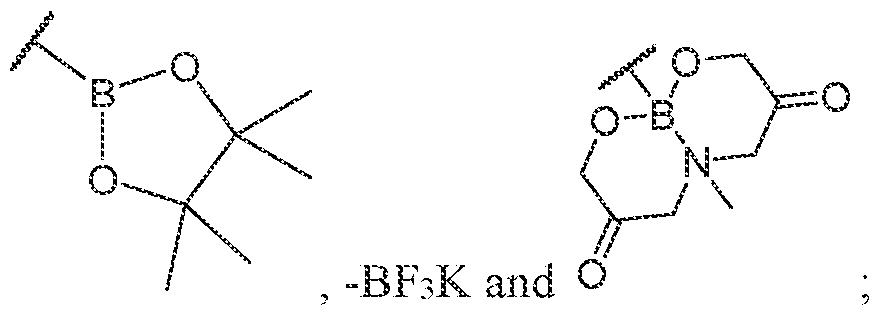


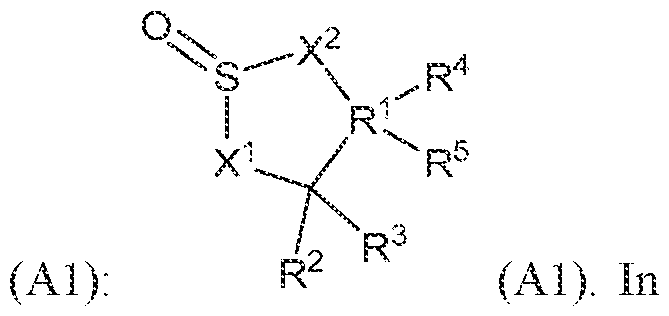


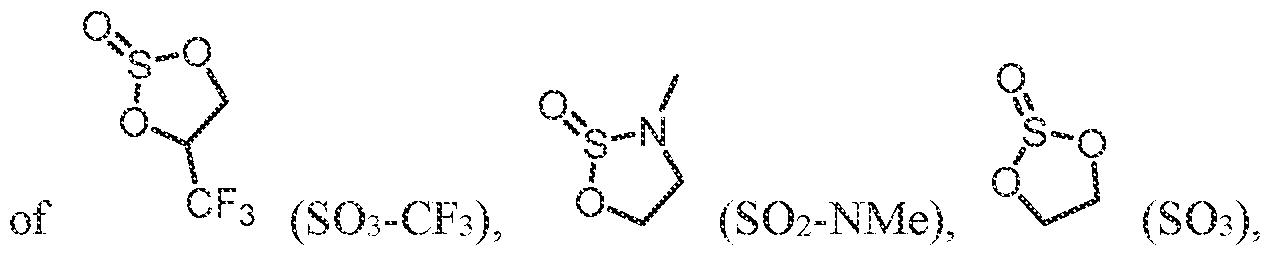





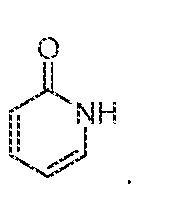


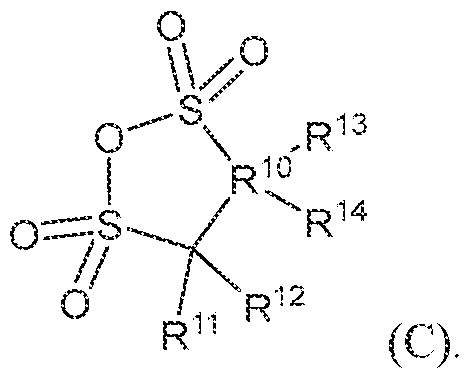


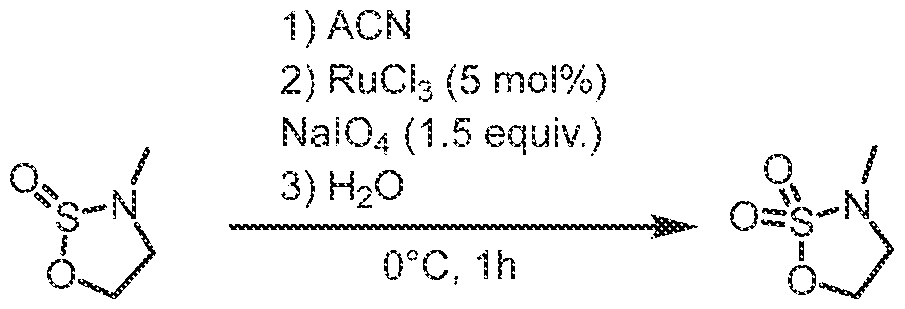
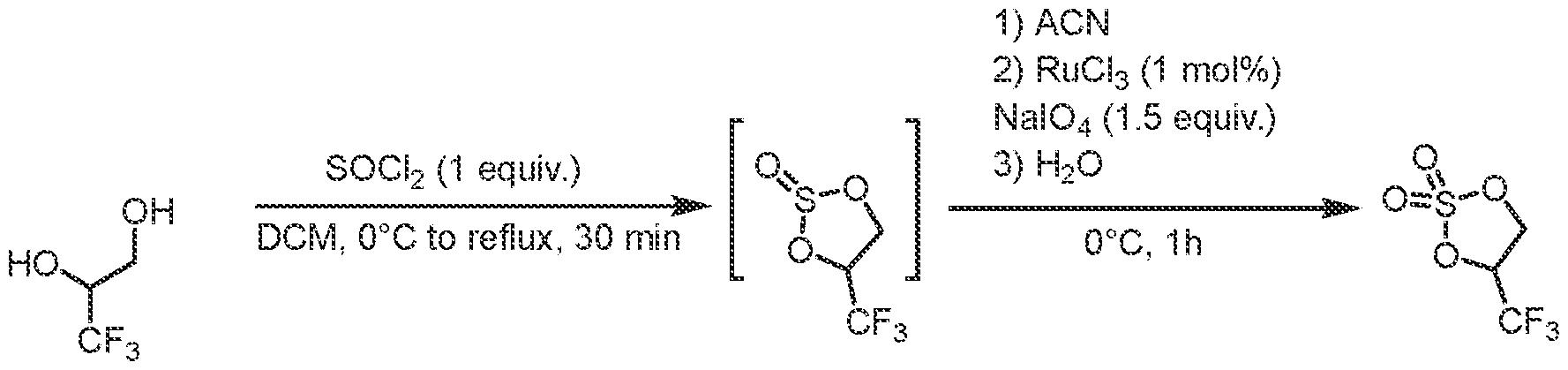


Claims


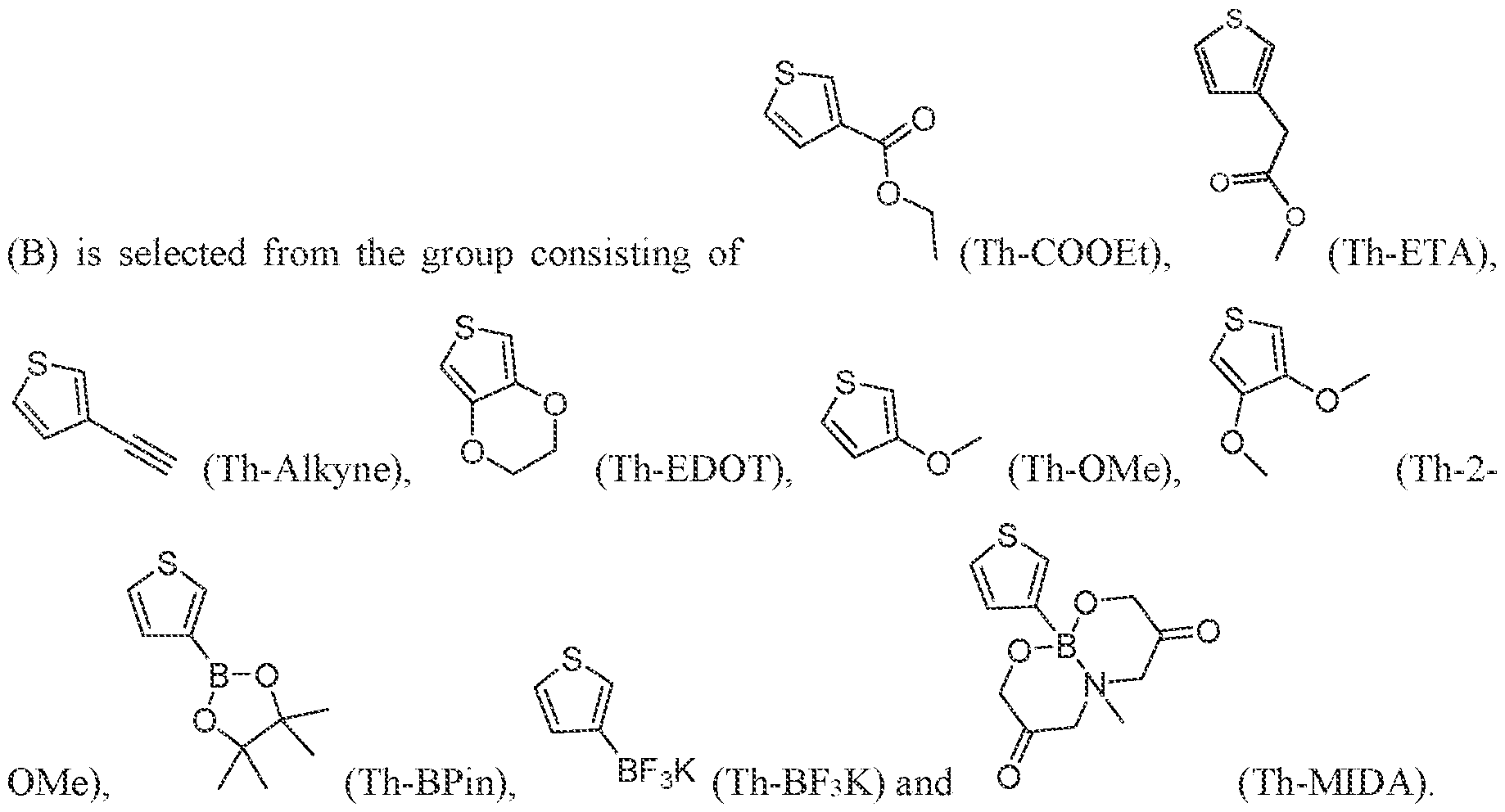


Priority Applications (3)
| Application Number | Priority Date | Filing Date | Title |
|---|---|---|---|
| EP24822018.8A EP4813008A1 (en) | 2023-11-20 | 2024-11-19 | Cyclic sulfur containing additive compounds for high voltage energy storage device electrolytes, and processes thereof |
| CN202480083915.5A CN122603423A (en) | 2023-11-20 | 2024-11-19 | Cyclic sulfur-containing additive compounds for high pressure energy storage device electrolytes and methods thereof |
| KR1020267018151A KR20260110198A (en) | 2023-11-20 | 2024-11-19 | Cyclic sulfur-containing additive compounds for high-voltage energy storage device electrolytes, and the process thereof |
Applications Claiming Priority (2)
| Application Number | Priority Date | Filing Date | Title |
|---|---|---|---|
| US202363601091P | 2023-11-20 | 2023-11-20 | |
| US63/601,091 | 2023-11-20 |
Publications (1)
| Publication Number | Publication Date |
|---|---|
| WO2025111237A1 true WO2025111237A1 (en) | 2025-05-30 |
Family
ID=93893611
Family Applications (1)
| Application Number | Title | Priority Date | Filing Date |
|---|---|---|---|
| PCT/US2024/056465 Ceased WO2025111237A1 (en) | 2023-11-20 | 2024-11-19 | Cyclic sulfur containing additive compounds for high voltage energy storage device electrolytes, and processes thereof |
Country Status (4)
| Country | Link |
|---|---|
| EP (1) | EP4813008A1 (en) |
| KR (1) | KR20260110198A (en) |
| CN (1) | CN122603423A (en) |
| WO (1) | WO2025111237A1 (en) |
Citations (3)
| Publication number | Priority date | Publication date | Assignee | Title |
|---|---|---|---|---|
| US9601808B2 (en) * | 2012-03-27 | 2017-03-21 | Tdk Corporation | Nonaqueous electrolytic solution containing glycol sulfate derivative and fluoroethylene carbonate and lithium ion secondary battery containing the same |
| US20170317385A1 (en) * | 2014-12-17 | 2017-11-02 | Basf Corporation | Electrolyte Compositions For Rechargeable Lithium Ion Batteries |
| US11108086B2 (en) * | 2018-01-31 | 2021-08-31 | Uchicago Argonne, Llc | Electrolyte for high voltage lithium-ion batteries |
-
2024
- 2024-11-19 EP EP24822018.8A patent/EP4813008A1/en active Pending
- 2024-11-19 WO PCT/US2024/056465 patent/WO2025111237A1/en not_active Ceased
- 2024-11-19 CN CN202480083915.5A patent/CN122603423A/en active Pending
- 2024-11-19 KR KR1020267018151A patent/KR20260110198A/en active Pending
Patent Citations (3)
| Publication number | Priority date | Publication date | Assignee | Title |
|---|---|---|---|---|
| US9601808B2 (en) * | 2012-03-27 | 2017-03-21 | Tdk Corporation | Nonaqueous electrolytic solution containing glycol sulfate derivative and fluoroethylene carbonate and lithium ion secondary battery containing the same |
| US20170317385A1 (en) * | 2014-12-17 | 2017-11-02 | Basf Corporation | Electrolyte Compositions For Rechargeable Lithium Ion Batteries |
| US11108086B2 (en) * | 2018-01-31 | 2021-08-31 | Uchicago Argonne, Llc | Electrolyte for high voltage lithium-ion batteries |
Also Published As
| Publication number | Publication date |
|---|---|
| KR20260110198A (en) | 2026-07-14 |
| CN122603423A (en) | 2026-08-18 |
| EP4813008A1 (en) | 2026-09-30 |
Similar Documents
| Publication | Publication Date | Title |
|---|---|---|
| EP3793013B1 (en) | Lithium-ion battery and electrical apparatus including the same | |
| US20230097126A1 (en) | Lithium ion secondary battery | |
| JP6099155B2 (en) | Secondary battery electrolyte and secondary battery using the same | |
| EP2924796A1 (en) | Lithium ion secondary battery | |
| EP3001496A1 (en) | Method for manufacturing non-aqueous electrolyte secondary battery | |
| EP3333961A1 (en) | Nonaqueous electrolyte solution for lithium secondary batteries, positive electrode for lithium secondary batteries, method for producing positive electrode for lithium secondary batteries, and lithium secondary battery | |
| EP3096388A1 (en) | Nonaqueous electrolyte secondary battery and battery pack of same | |
| US20230402654A1 (en) | Stabilized electrolytes for low-temperature batteries | |
| WO2013137418A1 (en) | Non-aqueous electrolyte secondary battery and battery pack | |
| CN105514308A (en) | Method for manufacturing lithium ion secondary battery | |
| CN105051949A (en) | Negative electrode for non-aqueous electrolyte secondary batteries and non-aqueous electrolyte secondary battery | |
| JP2013037772A (en) | Nonaqueous electrolyte secondary battery and manufacturing method therefor | |
| WO2019235469A1 (en) | Reduced graphene-based material | |
| JP2025518846A (en) | Carbonate compounds for electrolyte compositions for energy storage devices and methods thereof | |
| CN110931860B (en) | Nonaqueous electrolyte for lithium ion secondary battery | |
| EP4293781B1 (en) | Nonaqueous electrolytic solution and nonaqueous electrolytic solution battery | |
| EP4813008A1 (en) | Cyclic sulfur containing additive compounds for high voltage energy storage device electrolytes, and processes thereof | |
| WO2021240448A1 (en) | Electrolytic solution for secondary battery, and secondary battery comprising same | |
| JP2018056013A (en) | Composite, positive electrode, negative electrode, power storage body, lithium ion secondary battery and capacitor having the same | |
| EP3667802A1 (en) | Additive for non-aqueous electrolyte, non-aqueous electrolyte, and power storage device | |
| JP7340147B2 (en) | Non-aqueous electrolytes and non-aqueous electrolyte secondary batteries | |
| JP7346799B2 (en) | Lithium boron phosphate compound, additive for lithium secondary batteries, non-aqueous electrolyte for lithium secondary batteries, lithium secondary battery precursor, method for producing lithium secondary batteries, and lithium secondary batteries | |
| WO2024072964A1 (en) | Carbon dioxide saturated electrolytes for energy storage device, and methods thereof | |
| EP4668400A1 (en) | Electrolyte, battery cell, battery and electrical apparatus | |
| JP6252353B2 (en) | Non-aqueous electrolyte storage element and storage device including the same |
Legal Events
| Date | Code | Title | Description |
|---|---|---|---|
| 121 | Ep: the epo has been informed by wipo that ep was designated in this application |
Ref document number: 24822018 Country of ref document: EP Kind code of ref document: A1 |
|
| DPE1 | Request for preliminary examination filed after expiration of 19th month from priority date (pct application filed from 20040101) | ||
| WWE | Wipo information: entry into national phase |
Ref document number: MX/A/2026/006108 Country of ref document: MX |
|
| ENP | Entry into the national phase |
Ref document number: 1020267018151 Country of ref document: KR Free format text: ST27 STATUS EVENT CODE: A-0-1-A10-A15-NAP-PA0105 (AS PROVIDED BY THE NATIONAL OFFICE) |
|
| WWE | Wipo information: entry into national phase |
Ref document number: 1020267018151 Country of ref document: KR |
|
| NENP | Non-entry into the national phase |
Ref country code: DE |
|
| WWP | Wipo information: published in national office |
Ref document number: MX/A/2026/006108 Country of ref document: MX |
|
| WWP | Wipo information: published in national office |
Ref document number: 1020267018151 Country of ref document: KR |