WO2025111187A1 - Tin precursor compounds and related compositions and methods - Google Patents

Tin precursor compounds and related compositions and methods Download PDF

Info

Publication number
WO2025111187A1
WO2025111187A1 PCT/US2024/055898 US2024055898W WO2025111187A1 WO 2025111187 A1 WO2025111187 A1 WO 2025111187A1 US 2024055898 W US2024055898 W US 2024055898W WO 2025111187 A1 WO2025111187 A1 WO 2025111187A1
Authority
WO
WIPO (PCT)
Prior art keywords
alkyl
alkenyl
combination
hydrogen
aryl
Prior art date
Legal status (The legal status is an assumption and is not a legal conclusion. Google has not performed a legal analysis and makes no representation as to the accuracy of the status listed.)
Pending
Application number
PCT/US2024/055898
Other languages
French (fr)
Inventor
Claudia Fafard
David M. Ermert
Current Assignee (The listed assignees may be inaccurate. Google has not performed a legal analysis and makes no representation or warranty as to the accuracy of the list.)
Entegris Inc
Original Assignee
Entegris Inc
Priority date (The priority date is an assumption and is not a legal conclusion. Google has not performed a legal analysis and makes no representation as to the accuracy of the date listed.)
Filing date
Publication date
Application filed by Entegris Inc filed Critical Entegris Inc
Priority to CN202480077393.8A priority Critical patent/CN122341775A/en
Priority to KR1020267019323A priority patent/KR20260113269A/en
Publication of WO2025111187A1 publication Critical patent/WO2025111187A1/en
Anticipated expiration legal-status Critical
Pending legal-status Critical Current

Links

Classifications

    • C—CHEMISTRY; METALLURGY
    • C07—ORGANIC CHEMISTRY
    • C07F—ACYCLIC, CARBOCYCLIC OR HETEROCYCLIC COMPOUNDS CONTAINING ELEMENTS OTHER THAN CARBON, HYDROGEN, HALOGEN, OXYGEN, NITROGEN, SULFUR, SELENIUM OR TELLURIUM
    • C07F7/00—Compounds containing elements of Groups 4 or 14 of the Periodic Table
    • C07F7/22—Tin compounds
    • C07F7/2284—Compounds with one or more Sn-N linkages
    • C—CHEMISTRY; METALLURGY
    • C07—ORGANIC CHEMISTRY
    • C07F—ACYCLIC, CARBOCYCLIC OR HETEROCYCLIC COMPOUNDS CONTAINING ELEMENTS OTHER THAN CARBON, HYDROGEN, HALOGEN, OXYGEN, NITROGEN, SULFUR, SELENIUM OR TELLURIUM
    • C07F15/00—Compounds containing elements of Groups 8, 9, 10 or 18 of the Periodic Table
    • C07F15/04—Nickel compounds

Definitions

  • TIN PRECURSOR COMPOUNDS AND RELATED COMPOSITIONS AND METHODS FIELD [001] The present disclosure relates to tin precursor compounds and related compositions and methods. CROSS-REFERENCE TO RELATED APPLICATIONS [002] This application claims the benefit under 35 USC 119 of U.S. Provisional Patent Application No.63/601,524, filed Nov.21, 2023, the disclosure of which is hereby incorporated herein by reference in its entirety. BACKGROUND [003] Some precursors are useful in the manufacture of microelectronic devices. The manufacture of such devices can involve use of deposition processes to form thin films, as well as extreme ultraviolet (EUV) lithography to form thin films.
  • EUV extreme ultraviolet
  • alkyl refers to a hydrocarbyl having from 1 to 30 carbon atoms. The alkyl may be attached via a single bond. An alkyl having n carbon atoms may be designated as a “C n alkyl.” For example, a “C3 alkyl” may include n- propyl and isopropyl. An alkyl having a range of carbon atoms, such as 1 to 30 carbon atoms, may be designated as a C1-C30 alkyl.
  • the alkyl comprises or is selected from the group consisting of at least one of methyl, ethyl, n-propyl, 1-methylethyl (iso-propyl), n- butyl, iso-butyl, sec-butyl, n-pentyl, 1,1-dimethylethyl (t-butyl), n-pentyl, iso-pentyl, n-hexyl, isohexyl, 3-methylhexyl, 2-methylhexyl, heptyl, octyl, nonyl, decyl, dodecyl, octadecyl, or any combination thereof.
  • alkyl refers generally to alkyls, alkenyls, alkynyls, and/or cycloalkyls.
  • alkenyl refers to a hydrocarbyl having from 1 to 30 carbon atoms and at least one carbon-carbon double bond.
  • the alkenyl comprises or is selected from the group consisting of at least one of a C1-C30 alkenyl, C1-C29 alkenyl, C1-C28 alkenyl, C1-C27 alkenyl, C1-C27 alkenyl, C1- C26 alkenyl, C1-C25 alkenyl, C1-C24 alkenyl, C1-C23 alkenyl, C1-C22 alkenyl, C1-C21 alkenyl, C1-C20 alkenyl, C1-C19 alkenyl, C1-C18 alkenyl, C1-C17 alkenyl, C1-C16 alkenyl, C1-C15 alkenyl, C1-C14 alkenyl, C1-C13 alkenyl, C1-C12 alkenyl, C1-C11 alkenyl, C1-C10 alkenyl, a C1-C9 alken
  • alkenyl groups include, without limitation, at least one of vinyl, allyl, 1-methylvinyl, 1-propenyl, 1-butenyl, 2-butenyl, 3-butenyl, 1,3-butadienyl, 2- methyl-1-propenyl, 2-methyl-2-propenyl, 1-pentenyl, 2-pentenyl, 3-pentenyl, 4- pentenyl, 1,3-pentadienyl, 2,4-pentadienyl, 1,4-pentadienyl, 3-methyl-2-butenyl, 1- hexenyl, 2-hexenyl, 3-hexenyl, 1,3-hexadienyl, 1,4-hexadienyl, 2-methylpentenyl, 1-heptenyl, 3-heptenyl, 1-octenyl, 1,3-octadienyl, 1-nonenyl, 2-nonenyl, 3-nonenyl, 1-dec
  • alkynyl refers to a hydrocarbyl having from 1 to 30 carbon atoms and at least one carbon-carbon triple bond.
  • the alkynyl comprises or is selected from the group consisting of at least one of a C1-C30 alkynyl, C1-C29 alkynyl, C1-C28 alkynyl, C1-C27 alkynyl, C1-C27 alkynyl, C1- C26 alkynyl, C1-C25 alkynyl, C1-C24 alkynyl, C1-C23 alkynyl, C1-C22 alkynyl, C1-C21 alkynyl, C1-C20 alkynyl, C1-C19 alkynyl, C1-C18 alkynyl, C1-C17 alkynyl, C1-C16 alkynyl, C1-C15 al
  • alkynyl groups include, without limitation, at least one of ethynyl, propynyl, n-butynyl, n-pentynyl, 3-methyl-1-butynyl, n-hexynyl, methyl-pentynyl, or any combination thereof.
  • cycloalkyl refers to a non-aromatic carbocyclic ring having from 3 to 8 carbon atoms in the ring. The term includes a monocyclic non- aromatic carbocyclic ring and a polycyclic non-aromatic carbocyclic ring.
  • polycyclic when used as a modifier, refers to a cycloalkyl having more than one cyclic ring structure, which may be fused, bridged, spiro, or otherwise bonded ring structures. For example, two or more cycloalkyls may be fused, bridged, or fused and bridged to obtain the polycyclic non-aromatic carbocyclic ring.
  • the cycloalkyl may comprise, consist of, or consist essentially of, or may be selected from the group consisting of, at least one of cyclopropyl, cyclobutyl, cyclopentyl, cyclohexyl, cycloheptyl, cyclooctyl, or any combination thereof.
  • aryl refers to a monocyclic or polycyclic aromatic hydrocarbon. The number of carbon atoms of the aryl may be in a range of 5 carbon atoms to 100 carbon atoms. In some embodiments, the aryl has 5 to 20 carbon atoms.
  • the aryl has 6 to 8 carbon atoms, 6 to 10 carbon atoms, 6 to 12 carbon atoms, 6 to 15 carbon atoms, or 6 to 20 carbon atoms.
  • the aryl is —C6H5.
  • amino and/or “amine” refers to a functional group of formula —N(R a R b ), wherein R a and R b are independently a hydrogen, an alkyl (as defined herein), an aminoalkyl (as defined herein), or a silyl (as defined herein), or R a and R b are bonded to each other to form a C3-C20 N-heterocycle.
  • the amino may comprise an alkylamino or a dialkylamino.
  • the amino may comprise at least one of methylamino, dimethylamino, ethylamino, diethylamino, isopropylamino, di-isopropylamino, butylamino, sec-butylamino, tert-butylamino, di-sec-butylamino, isobutylamino, di- isobutylamino, di-tert-pentylamino, ethylmethylamino, isopropyl-n-propylamino, or any combination thereof.
  • alkylaminos may include, without limitation, one or more of the following: primary alkylaminos, such as, for example and without limitation, methylamino, ethylamino, n-propylamino, isopropylamino, n-butylamino, sec-butylamino, isobutylamino, t-butylamino, pentylamino, 2- aminopentane, 3-aminopentane, 1-amino-2-methylbutane, 2-amino-2- methylbutane, 3-amino-2-methylbutane, 4-amino-2-methylbutane, hexylamino, 5- amino-2-methylpentane, heptylamino, octylamino, nonylamino, decylamino, undecylamino, dodecylamino, tridecylamino, tetradecylamino, pentadecta
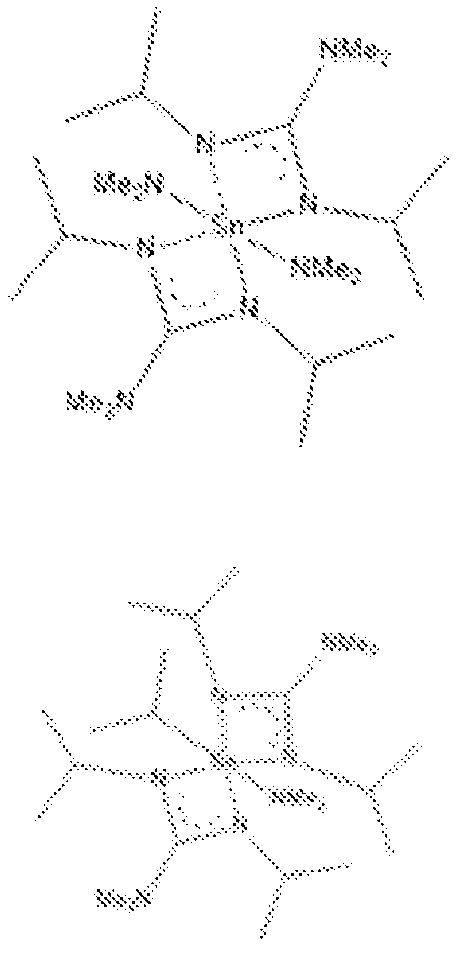
  • alkoxy or “alkoxide” refers to a functional group of formula —OR c , wherein R c is an alkyl (as defined herein), a silylalkyl, a cycloalkyl, or an aryl.
  • the alkoxy may comprise, consist of, or consist essentially of, or may selected from the group consisting of, at least one of methoxy, ethoxy, methoxy, ethoxy, n-propoxy, 1-methylethoxy (isopropoxy), n- butoxy, iso-butoxy, sec-butoxy, tert-butoxy, or any combination thereof.
  • sil refers to a functional group of formula —Si(R e R f R g ), where each of R e , R f , and R g is independently a hydrogen or an alkyl, as defined herein.
  • the silyl is a functional group of formula —SiH3. In some embodiments, the silyl is a functional group of formula —SiR e H2, where R e is not hydrogen. In some embodiments, the silyl is a functional group of formula — SiR e R f H, where R e and R f are not hydrogen. In some embodiments, the silyl is a functional group of the formula —Si(R e R f R g ), where R e , R f , and R g are not hydrogen. In some embodiments, the silyl is a functional group of formula — Si(CH3)3.
  • alkoxyalkyl refers to an alkyl as defined herein, wherein at least one of the hydrogen atoms of the alkyl is replaced with an alkoxy as defined herein.
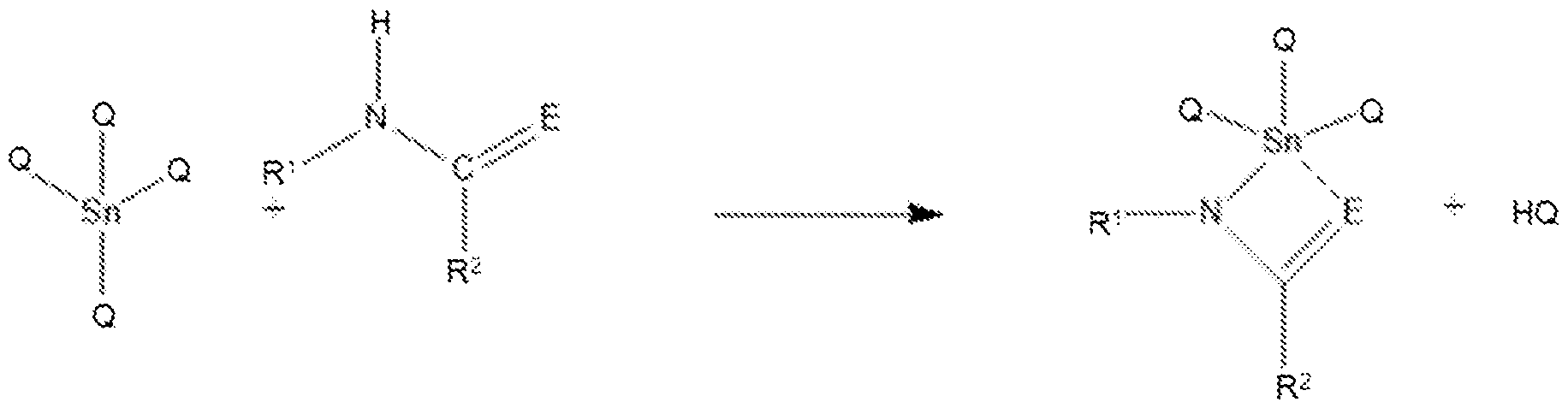
  • alkoxyalkyl refers to a functional group of formula —(alkyl)OR a , wherein the alkyl is defined above and wherein the R a is defined above.
  • the alkoxyalkyl is a functional group of formula —(CH2)nOR a , where n is 1 to 10 and R a is defined above.
  • the alkoxyalkyl is a functional group of the formula —CH2CH2OCH3.
  • the term “aralkyl” refers to an alkyl as defined herein, wherein at least one of the hydrogen atoms of the alkyl is replaced with an aryl as defined herein.
  • the term “aralkyl” refers to a functional group of formula —(alkyl)(aryl), wherein the alkyl is defined herein and the aryl is defined herein.
  • the aralkyl is —CH2(C6H5).
  • aminoalkyl refers to an alkyl as defined herein, wherein at least one of the hydrogen atoms of the alkyl is replaced with an amino as defined herein.
  • aminoalkyl refers to a functional group of formula —(alkyl)N(R b R c R d ), wherein the alkyl is defined above and wherein R b , R c , and R d are defined above.
  • the aminoalkyl is —CH2N(CH3)2.
  • the aminoalkyl is —(CH2)3N(CH3)2.
  • the aminoalkyl is aminomethyl (—CH2NH2).
  • the aminoalkyl is N,N-dimethylaminoethyl (—CH2CH2N(CH3)2).
  • the aminoalkyl is 3-(N-cyclopropylamino)propyl (—CH2CH2CH2NH—Pr).
  • silalkyl refers to an alkyl as defined herein, wherein at least one of the hydrogen atoms of the alkyl is replaced with a silyl as defined herein.
  • silalkyl refers to a functional group of formula —(alkyl)Si(R e R f R g ), wherein the alkyl is defined above and wherein R e , R f , and R g are defined above.
  • the silylalky is a functional group of formula —(CH2)mSi(R e R f R g ), where m is 1 to 10 and where R e , R f , and R g are defined above.
  • the silylalkyl is a functional group of formula —CH2Si(CH3)3.
  • the term “haloalkyl” refers to an alkyl as defined here, wherein at least one of the hydrogen atoms of the alkyl is replaced with a halide as defined herein.
  • the haloalkyl comprises a fluoroalkyl.
  • the fluoroalkyl comprises at least one of —CH2CF3, —CH(CF3)2, — CH2F, —CH2CH2F, —CF3, —CF2CF3, or any combination thereof.
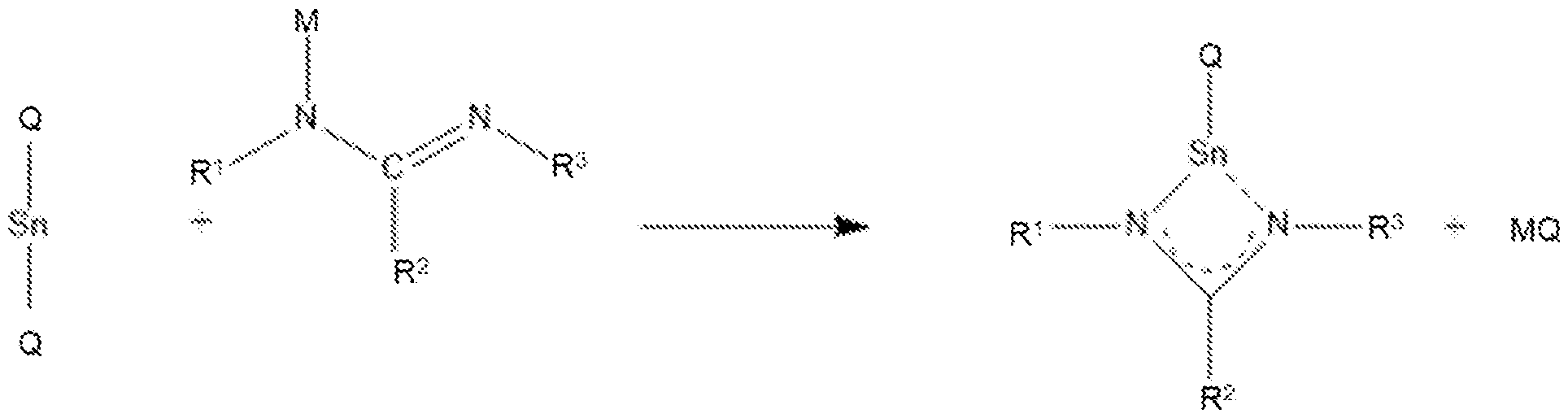
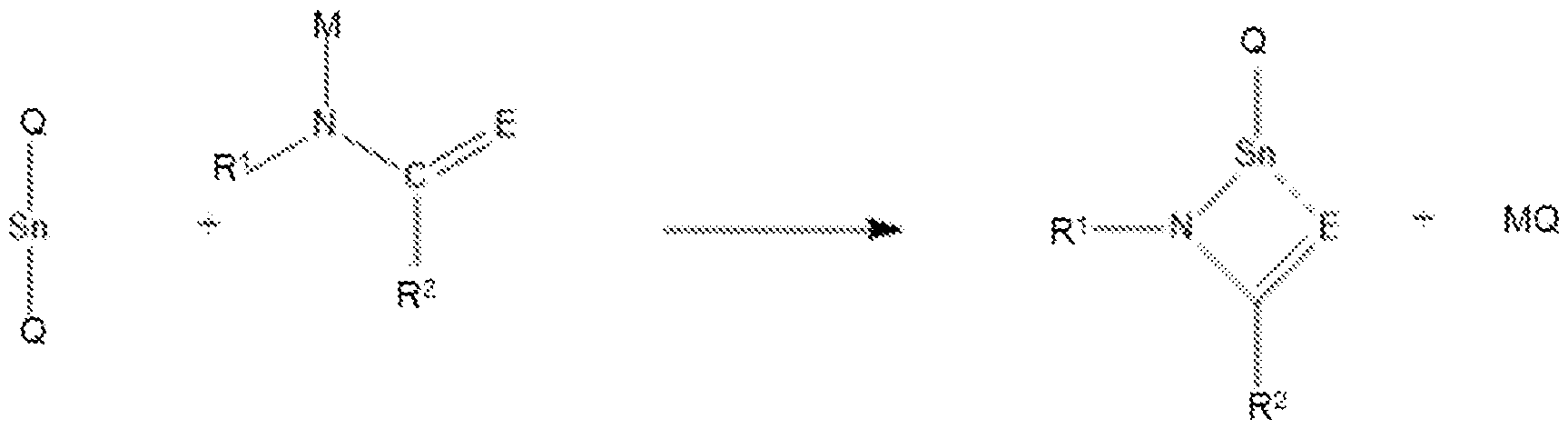
  • halogen refers to a —Cl, —Br, —I, or —F.
  • metal refers to at least one of an alkali metal, an alkaline earth metal, a transition metal, a post-transition metal, or any combination thereof. In some embodiments, the metal comprises a metal cation.
  • the metal cation comprises at least one of a lithium cation, a sodium cation, a potassium cation, a rubidium cation, a cesium cation, a francium cation, a beryllium cation, a magnesium cation, a calcium cation, a strontium cation, a barium cation, a radium cation, a scandium cation, a titanium cation, a vanadium cation, a chromium cation, a manganese cation, an iron cation, a cobalt cation, a nickel cation, a copper cation, a zinc cation, a yttrium cation, a zirconium cation, a niobium cation, a molybdenum cation, a technetium cation, a ruthenium cation,
  • compositions useful in extreme-ultraviolet (EUV) lithography comprise tin precursor compounds.
  • the tin precursor compounds may be used to form tin-containing films useful in the fabrication of microelectronic devices, including semiconductor devices.
  • the tin precursor compounds comprise tin (IV) monoalkyl species with at least one mono-ionic bidentate ligand.
  • the precursor compositions may be used as deposition precursors for generating tin-containing films.
  • the tin-containing films may be used in dry resist applications or as reflective coatings for extreme- ultraviolet (EUV) lithography, among others.
  • the precursor compositions may be formed according to the methods disclosed herein in high yield and high purity, while also minimizing the number of steps required to produce the precursor compositions.
  • the tin-containing films may also be formed according to the methods disclosed herein. That is, the tin-containing films disclosed herein may be formed by one or more deposition processes that utilize the precursor compositions.
  • deposition processes include, without limitation, at least one of a chemical vapor deposition (CVD) process, a digital or pulsed chemical vapor deposition process, a plasma-enhanced cyclical chemical vapor deposition process (PECCVD), a flowable chemical vapor deposition process (FCVD), an atomic layer deposition (ALD) process, a thermal atomic layer deposition, a plasma-enhanced atomic layer deposition (PEALD) process, a metal organic chemical vapor deposition (MOCVD) process, a plasma-enhanced chemical vapor deposition (PECVD) process, or any combination thereof.
  • CVD chemical vapor deposition
  • PECCVD plasma-enhanced cyclical chemical vapor deposition process
  • FCVD flowable chemical vapor deposition process
  • ALD atomic layer deposition
  • ALD atomic layer deposition
  • thermal atomic layer deposition a thermal atomic layer deposition
  • PEALD plasma-enhanced atomic layer deposition
  • E is N(R 3 ); Q is independently a halogen; a is 1; and b is 3.
  • E is N(R 3 ); Q independently comprises at least one of a halogen, an amine, or any combination thereof; a is 2; and b is 2.
  • E is O or S; Q is independently a halogen; a is 1; and b is 3.
  • E is O or S; Q independently comprises at least one of a halogen, an amine, or any combination thereof; a is 2; and b is 2.
  • E is N(R 3 ); Q is a halogen; a is 1; and b is 1.
  • E is N(R 3 ); a is 2; and b is 0.
  • E is O or S; Q is a halogen; a is 1; and b is 1.
  • E is O or S; a is 2; and b is 0.
  • the compound comprises at least one of the following:
  • the compound comprises at least one of the following: . [0077] In some embodiments, the resent in the composition at a purity of 95% to 99.9999%, or any range or subrange between 95% and 99.9999%.
  • the compound is present in the composition at a purity of 96% to 99.9999%, 97% to 99.9999%, 98% to 99.9999%, 99% to 99.9999%, 99.9% to 99.9999%, 99.99% to 99.9999%, 99.999% to 99.9999%, 95% to 99.999%, 95% to 99.99%, 95% to 99.9%, 95% to 99%, 95% to 98%, 95% to 97%, or 95% to 96%.
  • Some embodiments relate to a method of forming a precursor compound.
  • E is N(R 3 ); Q is independently a halogen; m is 1; n is 3; a is 1; b is 1; and c is 3.
  • E is O or S; Q is independently a halogen; m is 1; n is 3; a is 1; b is 1; and c is 3.
  • E is N(R 3 ); Q is a halogen; m is 1; n is 1; a is 1; b is 1; and c is 1.
  • E is O or S; Q is a halogen; m is 1; n is 1; a is 1; b is 1; and c is 1. [0093] In some embodiments, the method comprises: . [0094] In some embodiments, the method comprises: . [0095] In some embodiments, the method comprises:
  • the compound is produced at a purity of 95% to 99.9999%, or any range or subrange between 95% and 99.9999%.
  • the compound is present in the composition at a purity of 96% to 99.9999%, 97% to 99.9999%, 98% to 99.9999%, 99% to 99.9999%, 99.9% to 99.9999%, 99.99% to 99.9999%, 99.999% to 99.9999%, 95% to 99.999%, 95% to 99.99%, 95% to 99.9%, 95% to 99%, 95% to 98%, 95% to 97%, or 95% to 96%.
  • the contacting further forms a compound of the formula MQ.
  • Z is a metal; E is N(R 3 ); n is 4; a is 1; and b is 3.
  • Z is a metal; E is O or S; n is 4; a is 1; and b is 3.
  • Z is a metal; E is N(R 3 ); n is 2; a is 1; and b is 1.
  • Z is a metal; E is O or S; n is 2; a is 1; and b is 1.
  • the method comprises: .
  • the method comprises: . [00 ] n some em o mens, e me o comprses: . [00118] In some embodiments, the method comprises: . [00119] In some embodiments, the method comprises: the contacting further forms a compound of the formula HZ. [00120] In some embodiments, Z is a metal; E is N(R 3 ); n is 4; a is 1; and b is 3. [00121] In some embodiments, Z is a metal; E is O or S; n is 4; a is 1; and b is 3.
  • Z is a metal; E is N(R 3 ); n is 2; a is 1; and b is 1. [00123] In some embodiments, Z is a metal; E is O or S; n is 2; a is 1; and b is 1. [00124] In some embodiments, the method comprises: . [0 ] n some em o mens, e me o comprses: . [00126] In some embodiments, the method comprises: . [00127] In some embodiments, the method comprises: . [00128] In some embodiments, the compound is present in the composition at a purity of 95% to 99.9999%, or any range or subrange between 95% and 99.9999%.
  • the compound is present in the composition at a purity of 96% to 99.9999%, 97% to 99.9999%, 98% to 99.9999%, 99% to 99.9999%, 99.9% to 99.9999%, 99.99% to 99.9999%, 99.999% to 99.9999%, 95% to 99.999%, 95% to 99.99%, 95% to 99.9%, 95% to 99%, 95% to 98%, 95% to 97%, or 95% to 96%.
  • Aspect 2 The composition according to Aspect 1, wherein: E is N(R 3 ); Q is independently a halogen; a is 1; b is 3. Aspect 3.
  • Aspect 4. The composition according to Aspect 1, wherein: E is O or S; Q is independently a halogen; a is 1; and b is 3.
  • Aspect 5 The composition according to Aspect 1, wherein: E is O or S; Q independently comprises at least one of a halogen, an amine, or any combination thereof; a is 2; and b is 2.
  • composition according to Aspect 1 wherein: E is N(R 3 ); Q is a halogen; a is 1; and b is 1.
  • Aspect 7 The composition according to Aspect 1, wherein: E is N(R 3 ); a is 2; and b is 0.
  • Aspect 8. The composition according to Aspect 1, wherein: E is O or S; Q is a halogen; a is 1; and b is 1.
  • Aspect 9. The composition according to Aspect 1, wherein: E is O or S; a is 2; and b is 0.
  • Aspect 10 The composition according to Aspect 1, wherein the compound comprises at least one of the following:
  • Aspect 11 The composition according to Aspect 1, wherein the compound comprises at least one of the following:
  • Aspect 12 The composition according to Aspect 1, wherein the compound comprises at least one of the following: R 3
  • Aspect 13 The composition ect 1, wherein the compound comprises at least one of the following: .
  • Aspect 15 The method according to Aspect 14, wherein: E is N(R 3 ); Q is independently a halogen; m is 1; n is 3; a is 1; b is 1; and c is 3.
  • Aspect 16 The method according to Aspect 14, wherein: E is O or S; Q is independently a halogen; m is 1; n is 3; a is 1; b is 1; and c is 3.
  • Aspect 17 The method according to Aspect 14, wherein: E is N(R 3 ); Q is a halogen; m is 1; n is 1; a is 1; b is 1; and c is 1.
  • Aspect 19 The method according to Aspect 14, wherein the method comprises: . Aspe ct 20.
  • Aspect 21 The method according to Aspect 14, wherein the method comprises: .
  • R 1 independently comprises at least one of a hydrogen, an alkyl, an alkenyl, an aryl, a silyl, or any combination thereof;
  • R 2 independently comprises at least one of a hydrogen, an alkyl, an alkenyl, an aryl, a silyl, an amine, or any combination thereof;
  • E independently comprises N(R 3 ), O, or S, where: R 3 independently comprises at least one of a hydrogen, an alkyl, an alkenyl, an aryl, a silyl, or any combination thereof;
  • Q independently comprises a hydrogen, an alkyl, an alkenyl, an aryl, a silyl, an amine, an alkoxide
  • Aspect 24 The method according to Aspect 23, wherein the contacting further forms a compound of the formula MQ.
  • Aspect 25. The method according to Aspect 24, wherein: Z is a metal; E is N(R 3 ); n is 4; a is 1; and b is 3.
  • Aspect 26. The method according to Aspect 24, wherein: Z is a metal; E is O or S; n is 4; a is 1; and b is 3.
  • Aspect 27 The method according to Aspect 24, wherein: Z is a metal; E is N(R 3 ); n is 2; a is 1; and b is 1.
  • Aspect 24 wherein: Z is a metal; E is O or S; n is 2; a is 1; and b is 1.
  • Aspect 29. The method according to Aspect 24, wherein the method comprises: A spect 30.
  • Aspect 33 wherein: Z is a metal; E is N(R 3 ); n is 4; a is 1; and b is 3.
  • Aspect 35 The method according to Aspect 33, wherein: Z is a metal; E is O or S; n is 4; a is 1; and b is 3.
  • Aspect 36 The method according to Aspect 33, wherein: Z is a metal; E is N(R 3 ); n is 2; a is 1; and b is 1.
  • Aspect 37 The method according to Aspect 33, wherein: Z is a metal; E is O or S; n is 2; a is 1; and b is 1.
  • Aspect 34 The method according to Aspect 33, wherein the method comprises: .
  • Aspect 35 The method according to Aspect 35.

Landscapes

  • Chemical & Material Sciences (AREA)
  • Organic Chemistry (AREA)

Abstract

Tin precursor compounds and related compositions and methods are provided. A composition comprises a compound of the formula: where: a + b = 2 or 4; R1 independently comprises at least one of a hydrogen, an alkyl, an alkenyl, an aryl, a silyl, or any combination thereof; R2 independently comprises at least one of a hydrogen, an alkyl, an alkenyl, an aryl, a silyl, an amine, an alkoxide, or any combination thereof; E independently comprises N(R3), O, or S, where: R3 independently comprises at least one of a hydrogen, an alkyl, an alkenyl, an aryl, a silyl, or any combination thereof; and Q independently comprises a hydrogen, an alkyl, an alkenyl, an aryl, a silyl, an amine, an alkoxide, a halogen, or any combination thereof. Other precursor compounds, compositions, and methods are provided.

Description

TIN PRECURSOR COMPOUNDS AND RELATED COMPOSITIONS AND METHODS FIELD [001] The present disclosure relates to tin precursor compounds and related compositions and methods. CROSS-REFERENCE TO RELATED APPLICATIONS [002] This application claims the benefit under 35 USC 119 of U.S. Provisional Patent Application No.63/601,524, filed Nov.21, 2023, the disclosure of which is hereby incorporated herein by reference in its entirety. BACKGROUND [003] Some precursors are useful in the manufacture of microelectronic devices. The manufacture of such devices can involve use of deposition processes to form thin films, as well as extreme ultraviolet (EUV) lithography to form thin films. SUMMARY [004] Some embodiments relate to a composition. In some embodiments, the composition comprises a compound of the formula: , [005] where:
Figure imgf000002_0001
[006] a + b = 2 or 4; [007] R1 independently comprises at least one of a hydrogen, an alkyl, an alkenyl, an aryl, a silyl, or any combination thereof; [008] R2 independently comprises at least one of a hydrogen, an alkyl, an alkenyl, an aryl, a silyl, an amine, an alkoxide, or any combination thereof; [009] E independently comprises N(R3), O, or S, where: [0010] R3 independently comprises at least one of a hydrogen, an alkyl, an alkenyl, an aryl, a silyl, or any combination thereof; and [0011] Q independently comprises a hydrogen, an alkyl, an alkenyl, an aryl, a silyl, an amine, an alkoxide, a halogen, or any combination thereof. [0012] Some embodiments relate to a method. In some embodiments, the method comprises contacting a compound of the formula: , [0013] with a compound of the
Figure imgf000003_0001
, [0014] to form a compound of the formula: , [0015] where:
Figure imgf000003_0002
[0016] m + n = 2 or 4; [0017] a + b + c = 2 or 4; [0018] R1 independently comprises at least one of a hydrogen, an alkyl, an alkenyl, an aryl, a silyl, or any combination thereof; [0019] R2 independently comprises at least one of a hydrogen, an alkyl, an alkenyl, an aryl, a silyl, an amine, an amide, an alkoxide, or any combination thereof; [0020] E independently comprises N(R3), O, or S, where: [0021] R3 independently comprises at least one of a hydrogen, an alkyl, an alkenyl, an aryl, a silyl, or any combination thereof; and [0022] Q independently comprises at least one of a hydrogen, an alkyl, an alkenyl, an aryl, a silyl, an amine, an alkoxide, a halogen, or any combination thereof. [0023] Some embodiments relate to a method. In some embodiments, the method comprises contacting a compound of the formula: [0024] with a compound of th
Figure imgf000003_0004
, [0025] to form a compound of the formula:
Figure imgf000003_0003
[0026] where: [0027] n is 2 or 4; [0028] a + b = 2 or 4; [0029] Z is a hydrogen (H) or a metal (M); [0030] R1 independently comprises at least one of a hydrogen, an alkyl, an alkenyl, an aryl, a silyl, or any combination thereof; [0031] R2 independently comprises at least one of a hydrogen, an alkyl, an alkenyl, an aryl, a silyl, an amine, or any combination thereof; [0032] E independently comprises N(R3), O, or S, where: [0033] R3 independently comprises at least one of a hydrogen, an alkyl, an alkenyl, an aryl, a silyl, or any combination thereof; and [0034] Q independently comprises a hydrogen, an alkyl, an alkenyl, an aryl, a silyl, an amine, an alkoxide, a halogen, or any combination thereof. DETAILED DESCRIPTION [0035] Among those benefits and improvements that have been disclosed, other objects and advantages of this disclosure will become apparent from the following description taken in conjunction with the accompanying figures. Detailed embodiments of the present disclosure are disclosed herein; however, it is to be understood that the disclosed embodiments are merely illustrative of the disclosure that may be embodied in various forms. In addition, each of the examples given regarding the various embodiments of the disclosure which are intended to be illustrative, and not restrictive. [0036] Any prior patents and publications referenced herein are incorporated by reference in their entireties. [0037] Throughout the specification and claims, the following terms take the meanings explicitly associated herein, unless the context clearly dictates otherwise. The phrases "in one embodiment," “in an embodiment,” and "in some embodiments" as used herein do not necessarily refer to the same embodiment(s), though it may. Furthermore, the phrases "in another embodiment" and "in some other embodiments" as used herein do not necessarily refer to a different embodiment, although it may. All embodiments of the disclosure are intended to be combinable without departing from the scope or spirit of the disclosure. [0038] As used herein, the term "based on" is not exclusive and allows for being based on additional factors not described, unless the context clearly dictates otherwise. In addition, throughout the specification, the meaning of "a," "an," and "the" include plural references. The meaning of "in" includes "in" and "on." [0039] As used herein, the term “contacting” refers to bringing two or more components into immediate or close proximity, or into direct contact. [0040] As used herein, the term “alkyl” refers to a hydrocarbyl having from 1 to 30 carbon atoms. The alkyl may be attached via a single bond. An alkyl having n carbon atoms may be designated as a “Cn alkyl.” For example, a “C3 alkyl” may include n- propyl and isopropyl. An alkyl having a range of carbon atoms, such as 1 to 30 carbon atoms, may be designated as a C1-C30 alkyl. In some embodiments, the alkyl is linear. In some embodiments, the alkyl is branched. In some embodiments, the alkyl is substituted. In some embodiments, the alkyl is unsubstituted. In some embodiments, the alkyl comprises or is selected from the group consisting of at least one of a C1-C30 alkyl, C1-C29 alkyl, C1-C28 alkyl, C1-C27 alkyl, C1-C27 alkyl, C1- C26 alkyl, C1-C25 alkyl, C1-C24 alkyl, C1-C23 alkyl, C1-C22 alkyl, C1-C21 alkyl, C1-C20 alkyl, C1-C19 alkyl, C1-C18 alkyl, C1-C17 alkyl, C1-C16 alkyl, C1-C15 alkyl, C1-C14 alkyl, C1-C13 alkyl, C1-C12 alkyl, C1-C11 alkyl, C1-C10 alkyl, a C1-C9 alkyl, a C1-C8 alkyl, a C1-C7 alkyl, a C1-C6 alkyl, a C1-C5 alkyl, a C1-C4 alkyl, a C1-C3 alkyl, a C1-C2 alkyl, a C2-C30 alkyl, a C3-C30 alkyl, a C4-C30 alkyl, a C5-C30 alkyl, a C6-C30 alkyl, a C7- C30 alkyl, a C8-C30 alkyl, a C9-C30 alkyl, a C10-C30 alkyl, a C11-C30 alkyl, a C12-C30 alkyl, a C13-C30 alkyl, a C14-C30 alkyl, a C15-C30 alkyl, a C16-C30 alkyl, a C17-C30 alkyl, a C18-C30 alkyl, a C19-C30 alkyl, a C20-C30 alkyl, a C21-C30 alkyl, a C22-C30 alkyl, a C23-C30 alkyl, a C24-C30 alkyl, a C25-C30 alkyl, a C26-C30 alkyl, a C27-C30 alkyl, a C28-C30 alkyl, a C29-C30 alkyl, a C2-C10 alkyl, a C3-C10 alkyl, a C4-C10 alkyl, a C5-C10 alkyl, a C6-C10 alkyl, a C7-C10 alkyl, a C8-C10 alkyl, a C2-C9 alkyl, a C2-C8 alkyl, a C2-C7 alkyl, a C2-C6 alkyl, a C2-C5 alkyl, a C3-C5 alkyl, or any combination thereof. In some embodiments, the alkyl comprises or is selected from the group consisting of at least one of methyl, ethyl, n-propyl, 1-methylethyl (iso-propyl), n- butyl, iso-butyl, sec-butyl, n-pentyl, 1,1-dimethylethyl (t-butyl), n-pentyl, iso-pentyl, n-hexyl, isohexyl, 3-methylhexyl, 2-methylhexyl, heptyl, octyl, nonyl, decyl, dodecyl, octadecyl, or any combination thereof. In some embodiments, the term “alkyl” refers generally to alkyls, alkenyls, alkynyls, and/or cycloalkyls. [0041] As used herein, the term “alkenyl” refers to a hydrocarbyl having from 1 to 30 carbon atoms and at least one carbon-carbon double bond. In some embodiments, the alkenyl comprises or is selected from the group consisting of at least one of a C1-C30 alkenyl, C1-C29 alkenyl, C1-C28 alkenyl, C1-C27 alkenyl, C1-C27 alkenyl, C1- C26 alkenyl, C1-C25 alkenyl, C1-C24 alkenyl, C1-C23 alkenyl, C1-C22 alkenyl, C1-C21 alkenyl, C1-C20 alkenyl, C1-C19 alkenyl, C1-C18 alkenyl, C1-C17 alkenyl, C1-C16 alkenyl, C1-C15 alkenyl, C1-C14 alkenyl, C1-C13 alkenyl, C1-C12 alkenyl, C1-C11 alkenyl, C1-C10 alkenyl, a C1-C9 alkenyl, a C1-C8 alkenyl, a C1-C7 alkenyl, a C1-C6 alkenyl, a C1-C5 alkenyl, a C1-C4 alkenyl, a C1-C3 alkenyl, a C1-C2 alkenyl, a C2- C30 alkenyl, a C3-C30 alkenyl, a C4-C30 alkenyl, a C5-C30 alkenyl, a C6-C30 alkenyl, a C7-C30 alkenyl, a C8-C30 alkenyl, a C9-C30 alkenyl, a C10-C30 alkenyl, a C11-C30 alkenyl, a C12-C30 alkenyl, a C13-C30 alkenyl, a C14-C30 alkenyl, a C15-C30 alkenyl, a C16-C30 alkenyl, a C17-C30 alkenyl, a C18-C30 alkenyl, a C19-C30 alkenyl, a C20-C30 alkenyl, a C21-C30 alkenyl, a C22-C30 alkenyl, a C23-C30 alkenyl, a C24-C30 alkenyl, a C25-C30 alkenyl, a C26-C30 alkenyl, a C27-C30 alkenyl, a C28-C30 alkenyl, a C29-C30 alkenyl, a C2-C10 alkenyl, a C3-C10 alkenyl, a C4-C10 alkenyl, a C5-C10 alkenyl, a C6- C10 alkenyl, a C7-C10 alkenyl, a C8-C10 alkenyl, a C2-C9 alkenyl, a C2-C8 alkenyl, a C2-C7 alkenyl, a C2-C6 alkenyl, a C2-C5 alkenyl, a C3-C5 alkenyl, or any combination thereof. Examples of alkenyl groups include, without limitation, at least one of vinyl, allyl, 1-methylvinyl, 1-propenyl, 1-butenyl, 2-butenyl, 3-butenyl, 1,3-butadienyl, 2- methyl-1-propenyl, 2-methyl-2-propenyl, 1-pentenyl, 2-pentenyl, 3-pentenyl, 4- pentenyl, 1,3-pentadienyl, 2,4-pentadienyl, 1,4-pentadienyl, 3-methyl-2-butenyl, 1- hexenyl, 2-hexenyl, 3-hexenyl, 1,3-hexadienyl, 1,4-hexadienyl, 2-methylpentenyl, 1-heptenyl, 3-heptenyl, 1-octenyl, 1,3-octadienyl, 1-nonenyl, 2-nonenyl, 3-nonenyl, 1-decenyl, 3-decenyl, 1-undecenyl, oleyl, linoleyl, linolenyl, or any combination thereof. [0042] As used herein, the term “alkynyl” refers to a hydrocarbyl having from 1 to 30 carbon atoms and at least one carbon-carbon triple bond. In some embodiments, the alkynyl comprises or is selected from the group consisting of at least one of a C1-C30 alkynyl, C1-C29 alkynyl, C1-C28 alkynyl, C1-C27 alkynyl, C1-C27 alkynyl, C1- C26 alkynyl, C1-C25 alkynyl, C1-C24 alkynyl, C1-C23 alkynyl, C1-C22 alkynyl, C1-C21 alkynyl, C1-C20 alkynyl, C1-C19 alkynyl, C1-C18 alkynyl, C1-C17 alkynyl, C1-C16 alkynyl, C1-C15 alkynyl, C1-C14 alkynyl, C1-C13 alkynyl, C1-C12 alkynyl, C1-C11 alkynyl, C1-C10 alkynyl, a C1-C9 alkynyl, a C1-C8 alkynyl, a C1-C7 alkynyl, a C1-C6 alkynyl, a C1-C5 alkynyl, a C1-C4 alkynyl, a C1-C3 alkynyl, a C1-C2 alkynyl, a C2-C30 alkynyl, a C3-C30 alkynyl, a C4-C30 alkynyl, a C5-C30 alkynyl, a C6-C30 alkynyl, a C7- C30 alkynyl, a C8-C30 alkynyl, a C9-C30 alkynyl, a C10-C30 alkynyl, a C11-C30 alkynyl, a C12-C30 alkynyl, a C13-C30 alkynyl, a C14-C30 alkynyl, a C15-C30 alkynyl, a C16-C30 alkynyl, a C17-C30 alkynyl, a C18-C30 alkynyl, a C19-C30 alkynyl, a C20-C30 alkynyl, a C21-C30 alkynyl, a C22-C30 alkynyl, a C23-C30 alkynyl, a C24-C30 alkynyl, a C25-C30 alkynyl, a C26-C30 alkynyl, a C27-C30 alkynyl, a C28-C30 alkynyl, a C29-C30 alkynyl, a C2-C10 alkynyl, a C3-C10 alkynyl, a C4-C10 alkynyl, a C5-C10 alkynyl, a C6-C10 alkynyl, a C7-C10 alkynyl, a C8-C10 alkynyl, a C2-C9 alkynyl, a C2-C8 alkynyl, a C2-C7 alkynyl, a C2-C6 alkynyl, a C2-C5 alkynyl, a C3-C5 alkynyl, or any combination thereof. Examples of alkynyl groups include, without limitation, at least one of ethynyl, propynyl, n-butynyl, n-pentynyl, 3-methyl-1-butynyl, n-hexynyl, methyl-pentynyl, or any combination thereof. [0043] As used herein, the term “cycloalkyl” refers to a non-aromatic carbocyclic ring having from 3 to 8 carbon atoms in the ring. The term includes a monocyclic non- aromatic carbocyclic ring and a polycyclic non-aromatic carbocyclic ring. The term "monocyclic," when used as a modifier, refers to a cycloalkyl having a single cyclic ring structure. The term "polycyclic," when used as a modifier, refers to a cycloalkyl having more than one cyclic ring structure, which may be fused, bridged, spiro, or otherwise bonded ring structures. For example, two or more cycloalkyls may be fused, bridged, or fused and bridged to obtain the polycyclic non-aromatic carbocyclic ring. In some embodiments, the cycloalkyl may comprise, consist of, or consist essentially of, or may be selected from the group consisting of, at least one of cyclopropyl, cyclobutyl, cyclopentyl, cyclohexyl, cycloheptyl, cyclooctyl, or any combination thereof. [0044] As used herein, the term "aryl" refers to a monocyclic or polycyclic aromatic hydrocarbon. The number of carbon atoms of the aryl may be in a range of 5 carbon atoms to 100 carbon atoms. In some embodiments, the aryl has 5 to 20 carbon atoms. For example, in some embodiments, the aryl has 6 to 8 carbon atoms, 6 to 10 carbon atoms, 6 to 12 carbon atoms, 6 to 15 carbon atoms, or 6 to 20 carbon atoms. The term "monocyclic," when used as a modifier, refers to an aryl having a single aromatic ring structure. The term "polycyclic," when used as a modifier, refers to an aryl having more than one aromatic ring structure, which may be fused, bridged, spiro, or otherwise bonded ring structures. In some embodiments, the aryl is —C6H5. [0045] As used herein, the term “amino” and/or “amine” refers to a functional group of formula —N(RaRb), wherein Ra and Rb are independently a hydrogen, an alkyl (as defined herein), an aminoalkyl (as defined herein), or a silyl (as defined herein), or Ra and Rb are bonded to each other to form a C3-C20 N-heterocycle. In some embodiments, the amino may comprise an alkylamino or a dialkylamino. In some embodiments, the amino may comprise at least one of methylamino, dimethylamino, ethylamino, diethylamino, isopropylamino, di-isopropylamino, butylamino, sec-butylamino, tert-butylamino, di-sec-butylamino, isobutylamino, di- isobutylamino, di-tert-pentylamino, ethylmethylamino, isopropyl-n-propylamino, or any combination thereof. Examples of the alkylaminos may include, without limitation, one or more of the following: primary alkylaminos, such as, for example and without limitation, methylamino, ethylamino, n-propylamino, isopropylamino, n-butylamino, sec-butylamino, isobutylamino, t-butylamino, pentylamino, 2- aminopentane, 3-aminopentane, 1-amino-2-methylbutane, 2-amino-2- methylbutane, 3-amino-2-methylbutane, 4-amino-2-methylbutane, hexylamino, 5- amino-2-methylpentane, heptylamino, octylamino, nonylamino, decylamino, undecylamino, dodecylamino, tridecylamino, tetradecylamino, pentadecylamino, hexadecylamino, heptadecylamino, and octadecylamino; and secondary alkylaminos, such as, for example and without limitation, dimethylamino, diethylamino, dipropylamino, diisopropylamino, dibutylamino, diisobutylamino, di- sec-butylamino, di-t-butylamino, dipentylamino, dihexylamino, diheptylamino, dioctylamino, dinonylamino, didecylamino, methylethylamino, methylpropylamino, methylisopropylamino, methylbutylamino, methylisobutylamino, methyl-sec- butylamino, methyl-t-butylamino, methylamylamino, methylisoamylamino, ethylpropylamino, ethylisopropylamino, ethylbutylamino, ethylisobutylamino, ethyl- sec-butylamino, ethylamino, ethylisoamylamino, propylbutylamino, and propylisobutylamino. Unless otherwise provided herein, the terms “amine” and “amino” may be used interchangeably throughout this disclosure. [0046] As used herein, the term “alkoxy” or “alkoxide” refers to a functional group of formula —ORc, wherein Rc is an alkyl (as defined herein), a silylalkyl, a cycloalkyl, or an aryl. In some embodiments, the alkoxy may comprise, consist of, or consist essentially of, or may selected from the group consisting of, at least one of methoxy, ethoxy, methoxy, ethoxy, n-propoxy, 1-methylethoxy (isopropoxy), n- butoxy, iso-butoxy, sec-butoxy, tert-butoxy, or any combination thereof. [0047] As used herein, the term “silyl” refers to a functional group of formula —Si(ReRfRg), where each of Re, Rf, and Rg is independently a hydrogen or an alkyl, as defined herein. In some embodiments, the silyl is a functional group of formula —SiH3. In some embodiments, the silyl is a functional group of formula —SiReH2, where Re is not hydrogen. In some embodiments, the silyl is a functional group of formula — SiReRfH, where Re and Rf are not hydrogen. In some embodiments, the silyl is a functional group of the formula —Si(ReRfRg), where Re, Rf, and Rg are not hydrogen. In some embodiments, the silyl is a functional group of formula — Si(CH3)3. [0048] As used herein, the term “alkoxyalkyl” refers to an alkyl as defined herein, wherein at least one of the hydrogen atoms of the alkyl is replaced with an alkoxy as defined herein. In some embodiments, the term “alkoxyalkyl” refers to a functional group of formula —(alkyl)ORa, wherein the alkyl is defined above and wherein the Ra is defined above. In some embodiments, the alkoxyalkyl is a functional group of formula —(CH2)nORa, where n is 1 to 10 and Ra is defined above. In some embodiments, the alkoxyalkyl is a functional group of the formula —CH2CH2OCH3. [0049] As used herein, the term “aralkyl” refers to an alkyl as defined herein, wherein at least one of the hydrogen atoms of the alkyl is replaced with an aryl as defined herein. In some embodiments, the term “aralkyl” refers to a functional group of formula —(alkyl)(aryl), wherein the alkyl is defined herein and the aryl is defined herein. In some embodiments, the aralkyl is —CH2(C6H5). [0050] As used herein, the term “aminoalkyl” refers to an alkyl as defined herein, wherein at least one of the hydrogen atoms of the alkyl is replaced with an amino as defined herein. In some embodiments, the term “aminoalkyl” refers to a functional group of formula —(alkyl)N(RbRcRd), wherein the alkyl is defined above and wherein Rb, Rc, and Rd are defined above. In some embodiments, the aminoalkyl is —CH2N(CH3)2. In some embodiments, the aminoalkyl is —(CH2)3N(CH3)2. In some embodiments, the aminoalkyl is aminomethyl (—CH2NH2). In some embodiments, the aminoalkyl is N,N-dimethylaminoethyl (—CH2CH2N(CH3)2). In some embodiments, the aminoalkyl is 3-(N-cyclopropylamino)propyl (—CH2CH2CH2NH—Pr). [0051] As used herein, the term “silylalkyl” refers to an alkyl as defined herein, wherein at least one of the hydrogen atoms of the alkyl is replaced with a silyl as defined herein. In some embodiments, the term “silylalkyl” refers to a functional group of formula —(alkyl)Si(ReRfRg), wherein the alkyl is defined above and wherein Re, Rf, and Rg are defined above. In some embodiments, the silylalky is a functional group of formula —(CH2)mSi(ReRfRg), where m is 1 to 10 and where Re, Rf, and Rg are defined above. In some embodiments, the silylalkyl is a functional group of formula —CH2Si(CH3)3. [0052] As used herein, the term “haloalkyl” refers to an alkyl as defined here, wherein at least one of the hydrogen atoms of the alkyl is replaced with a halide as defined herein. In some embodiments, the haloalkyl comprises a fluoroalkyl. In some embodiments, the fluoroalkyl comprises at least one of —CH2CF3, —CH(CF3)2, — CH2F, —CH2CH2F, —CF3, —CF2CF3, or any combination thereof. [0053] As used herein, the term “halogen” refers to a —Cl, —Br, —I, or —F. [0054] As used herein, the term “metal” refers to at least one of an alkali metal, an alkaline earth metal, a transition metal, a post-transition metal, or any combination thereof. In some embodiments, the metal comprises a metal cation. In some embodiments, the metal cation comprises at least one of a lithium cation, a sodium cation, a potassium cation, a rubidium cation, a cesium cation, a francium cation, a beryllium cation, a magnesium cation, a calcium cation, a strontium cation, a barium cation, a radium cation, a scandium cation, a titanium cation, a vanadium cation, a chromium cation, a manganese cation, an iron cation, a cobalt cation, a nickel cation, a copper cation, a zinc cation, a yttrium cation, a zirconium cation, a niobium cation, a molybdenum cation, a technetium cation, a ruthenium cation, a rhodium cation, a palladium cation, a silver cation, a cadmium cation, a hafnium cation, a tantalum cation, a tungsten cation, a rhenium cation, an osmium cation, an iridium cation, a platinum cation, a gold cation, a mercury cation, an aluminum cation, a gallium cation, an indium cation, tin cation, a thallum cation, a lead cation, a bismuth cation, a polonium cation, or any combination thereof. The charge(s) of the metal cations are known and, for simplicity, thus are not repeated here; however, it will be appreciated that the metal cations can have any known charge. [0055] Some embodiments relate to compositions useful in extreme-ultraviolet (EUV) lithography, among other applications, and related methods. The compositions disclosed herein comprise tin precursor compounds. The tin precursor compounds may be used to form tin-containing films useful in the fabrication of microelectronic devices, including semiconductor devices. In some embodiments, for example, the tin precursor compounds comprise tin (IV) monoalkyl species with at least one mono-ionic bidentate ligand. The precursor compositions may be used as deposition precursors for generating tin-containing films. The tin-containing films may be used in dry resist applications or as reflective coatings for extreme- ultraviolet (EUV) lithography, among others. The precursor compositions may be formed according to the methods disclosed herein in high yield and high purity, while also minimizing the number of steps required to produce the precursor compositions. [0056] The tin-containing films may also be formed according to the methods disclosed herein. That is, the tin-containing films disclosed herein may be formed by one or more deposition processes that utilize the precursor compositions. Examples of deposition processes include, without limitation, at least one of a chemical vapor deposition (CVD) process, a digital or pulsed chemical vapor deposition process, a plasma-enhanced cyclical chemical vapor deposition process (PECCVD), a flowable chemical vapor deposition process (FCVD), an atomic layer deposition (ALD) process, a thermal atomic layer deposition, a plasma-enhanced atomic layer deposition (PEALD) process, a metal organic chemical vapor deposition (MOCVD) process, a plasma-enhanced chemical vapor deposition (PECVD) process, or any combination thereof. [0057] Some embodiments relate to a composition. In some embodiments, the composition comprises a precursor compound. For example, in some embodiments, the composition comprises a compound of the formula: , [0058] where: [0059] a + b = 2 or 4; [0060] R1 independently comprises at least one of a hydrogen, an alkyl, an alkenyl, an aryl, a silyl, or any combination thereof; [0061] R2 independently comprises at least one of a hydrogen, an alkyl, an alkenyl, an aryl, a silyl, an amine, an alkoxide, or any combination thereof; [0062] E independently comprises N(R3), O, or S, where: [0063] R3 independently comprises at least one of a hydrogen, an alkyl, an alkenyl, an aryl, a silyl, or any combination thereof; [0064] Q independently comprises a hydrogen, an alkyl, an alkenyl, an aryl, a silyl, an amine, an alkoxide, a halogen, or any combination thereof. [0065] In some embodiments, E is N(R3); Q is independently a halogen; a is 1; and b is 3. [0066] In some embodiments, E is N(R3); Q independently comprises at least one of a halogen, an amine, or any combination thereof; a is 2; and b is 2. [0067] In some embodiments, E is O or S; Q is independently a halogen; a is 1; and b is 3. [0068] In some embodiments, E is O or S; Q independently comprises at least one of a halogen, an amine, or any combination thereof; a is 2; and b is 2. [0069] In some embodiments, E is N(R3); Q is a halogen; a is 1; and b is 1. [0070] In some embodiments, E is N(R3); a is 2; and b is 0. [0071] In some embodiments, E is O or S; Q is a halogen; a is 1; and b is 1. [0072] In some embodiments, E is O or S; a is 2; and b is 0. [0073] In some embodiments, the compound comprises at least one of the following:
Figure imgf000013_0001
. [0074] In some embodi
Figure imgf000014_0001
ast one of the following:
Figure imgf000014_0002
. [0075] In some embodimen
Figure imgf000015_0001
at least one of the following: R3 .
Figure imgf000015_0002
[0076] In some embodiments, the compound comprises at least one of the following:
Figure imgf000015_0003
. [0077] In some embodiments, the
Figure imgf000016_0001
resent in the composition at a purity of 95% to 99.9999%, or any range or subrange between 95% and 99.9999%. In some embodiments, the compound is present in the composition at a purity of 96% to 99.9999%, 97% to 99.9999%, 98% to 99.9999%, 99% to 99.9999%, 99.9% to 99.9999%, 99.99% to 99.9999%, 99.999% to 99.9999%, 95% to 99.999%, 95% to 99.99%, 95% to 99.9%, 95% to 99%, 95% to 98%, 95% to 97%, or 95% to 96%. [0078] Some embodiments relate to a method of forming a precursor compound. In some embodiments, the method of forming a precursor compound comprises contacting a compound of the formula: , [0079] with a compound of the fo
Figure imgf000016_0002
, [0080] to form a compound of the formula: , [0081] where: [0082] m + n = 2 or 4; [0083] a + b + c = 2 or 4; [0084] R1 independently comprises at least one of a hydrogen, an alkyl, an alkenyl, an aryl, a silyl, or any combination thereof; [0085] R2 independently comprises at least one of a hydrogen, an alkyl, an alkenyl, an aryl, a silyl, an amine, an amide, an alkoxide, or any combination thereof; [0086] E independently comprises N(R3), O, or S, where: [0087] R3 independently comprises at least one of a hydrogen, an alkyl, an alkenyl, an aryl, a silyl, or any combination thereof; [0088] Q independently comprises at least one of a hydrogen, an alkyl, an alkenyl, an aryl, a silyl, an amine, an alkoxide, a halogen, or any combination thereof. [0089] In some embodiments, E is N(R3); Q is independently a halogen; m is 1; n is 3; a is 1; b is 1; and c is 3. [0090] In some embodiments, E is O or S; Q is independently a halogen; m is 1; n is 3; a is 1; b is 1; and c is 3. [0091] In some embodiments, E is N(R3); Q is a halogen; m is 1; n is 1; a is 1; b is 1; and c is 1. [0092] In some embodiments, E is O or S; Q is a halogen; m is 1; n is 1; a is 1; b is 1; and c is 1. [0093] In some embodiments, the method comprises: .
Figure imgf000017_0001
[0094] In some embodiments, the method comprises: .
Figure imgf000017_0002
[0095] In some embodiments, the method comprises:
. [0096] In
Figure imgf000018_0001
some embodments, t e met od comprses: .
Figure imgf000018_0002
[0097] In some embodiments, the compound is produced at a purity of 95% to 99.9999%, or any range or subrange between 95% and 99.9999%. In some embodiments, the compound is present in the composition at a purity of 96% to 99.9999%, 97% to 99.9999%, 98% to 99.9999%, 99% to 99.9999%, 99.9% to 99.9999%, 99.99% to 99.9999%, 99.999% to 99.9999%, 95% to 99.999%, 95% to 99.99%, 95% to 99.9%, 95% to 99%, 95% to 98%, 95% to 97%, or 95% to 96%. [0098] Some embodiments relate to a method of forming a precursor compound. In some embodiments, the method of forming a precursor compound comprises contacting a compound of the formula: , [0099] with a compound of the formula: , [00100] to form a compound of the formula: , [00101] where: [00102] n is 2 or 4; [00103] a + b = 2 or 4; [00104] Z is a hydrogen (H) or a metal (M); [00105] R1 independently comprises at least one of a hydrogen, an alkyl, an alkenyl, an aryl, a silyl, or any combination thereof; [00106] R2 independently comprises at least one of a hydrogen, an alkyl, an alkenyl, an aryl, a silyl, an amine, or any combination thereof; [00107] E independently comprises N(R3), O, or S, where: [00108] R3 independently comprises at least one of a hydrogen, an alkyl, an alkenyl, an aryl, a silyl, or any combination thereof; [00109] Q independently comprises a hydrogen, an alkyl, an alkenyl, an aryl, a silyl, an amine, an alkoxide, a halogen, or any combination thereof. [00110] In some embodiments, the contacting further forms a compound of the formula MQ. [00111] In some embodiments, Z is a metal; E is N(R3); n is 4; a is 1; and b is 3. [00112] In some embodiments, Z is a metal; E is O or S; n is 4; a is 1; and b is 3. [00113] In some embodiments, Z is a metal; E is N(R3); n is 2; a is 1; and b is 1. [00114] In some embodiments, Z is a metal; E is O or S; n is 2; a is 1; and b is 1. [00115] In some embodiments, the method comprises: .
Figure imgf000019_0001
[00116] In some embodiments, the method comprises: . [00
Figure imgf000020_0002
] n some em o mens, e me o comprses: .
Figure imgf000020_0001
[00118] In some embodiments, the method comprises: .
Figure imgf000020_0003
[00119] In some embodiments, the method comprises: the contacting further forms a compound of the formula HZ. [00120] In some embodiments, Z is a metal; E is N(R3); n is 4; a is 1; and b is 3. [00121] In some embodiments, Z is a metal; E is O or S; n is 4; a is 1; and b is 3. [00122] In some embodiments, Z is a metal; E is N(R3); n is 2; a is 1; and b is 1. [00123] In some embodiments, Z is a metal; E is O or S; n is 2; a is 1; and b is 1. [00124] In some embodiments, the method comprises: . [0
Figure imgf000021_0001
] n some em o mens, e me o comprses: .
Figure imgf000021_0004
[00126] In some embodiments, the method comprises: .
Figure imgf000021_0002
[00127] In some embodiments, the method comprises: .
Figure imgf000021_0003
[00128] In some embodiments, the compound is present in the composition at a purity of 95% to 99.9999%, or any range or subrange between 95% and 99.9999%. In some embodiments, the compound is present in the composition at a purity of 96% to 99.9999%, 97% to 99.9999%, 98% to 99.9999%, 99% to 99.9999%, 99.9% to 99.9999%, 99.99% to 99.9999%, 99.999% to 99.9999%, 95% to 99.999%, 95% to 99.99%, 95% to 99.9%, 95% to 99%, 95% to 98%, 95% to 97%, or 95% to 96%. EXAMPLE 1 Synthesis of iPrSn(NMe2)2[(iPr)N C(NMe2) N(iPr)]
Figure imgf000022_0001
[00129] A tin (IV) compound of the formula Sn(N(CH3)2)3(iPr) (5g, 17.0 mmol) was diluted in 10 mL of anhydrous hexanes and cooled to –10C. To this solution a carbodiimide of the formula N(iPr)=C=N(iPr) (2.14g, 17.0 mmol) was added slowly dropwise. The solvent then was removed under vacuum and yielded a clear viscous liquid: mass 7.3g, yield:100%. Purity: 97.1% by 119Sn-NMR. 119Sn{1H}- NMR (149 MHz, C6D6, 298K): -199.9 ppm; 1H{13C}-NMR (400 MHz, C6D6, 298K): 1.06 (12H), 1.41 (6H), 1.75 (1H), 2.52 ( 6H), 2.75 (12 H), 3.46 ( 2H); 13C{1H}-NMR (100 MHz, C6D6, 298K) : 21.04, 24.58, 26.45, 40.36, 43.81, 46.62, 164.79. EXAMPLE 2 Synthesis of iPrSn(NMe2)[(iPr)N C(NMe2) N(iPr)]2
Figure imgf000023_0001
[00130] A tin (IV) compound of the formula Sn(N(CH3)2)3(iPr) (1g, 3.40 mmol) was diluted in 1 mL of anhydrous C6D6. To this solution a carbodiimide of the formula N(iPr)=C=N(iPr) (1.28g, 10.2 mmol) was added slowly dropwise. 119Sn{1H}-NMR (149 MHz, C6D6, 298K): -406.2 ppm. EXAMPLE 3 Synthesis of Sn(NMe2)2[(iPr)N C(NMe2) N(iPr)]2
Figure imgf000023_0002
[00131] A tin (IV) compound of the formula Sn(N(CH3)2)4 (5g, 16.9 mmol) was diluted in 50 mL of anhydrous hexanes. To this solution a carbodiimide of the formula N(iPr)=C=N(iPr) (2.14g, 17.0 mmol) was added slowly dropwise; an exotherm was observed. The rate of addition was such to maintain a solution temperature below 30C. The reaction solution was stirred overnight and the following day the solvent was removed under vacuum. A sticky solid was obtained. The material was dissolved in ~ 7 mL of hexanes and cooled to –35C. A crystalline white solid was collected: mass 7.7g, yield:83%. Melting Point: 61.1 °C (by DSC) Purity: 100% by 119Sn-NMR.119Sn{1H}-NMR (149 MHz, NEAT, 298K): -478.4 ppm; 1H{13C}-NMR (400 MHz, C6D6, 298K): 1.18-1.38 (multiple d, 24H), 2.52 (s, 12H), 2.99 (s, 12H), 3.55-3.72 (m, 4H); 13C{1H}-NMR (100 MHz, C6D6, 298K) : 23.20, 24.28, 24.54, 25.51, 40.34, 44.29, 46.85, 165.74. [00132] ASPECTS [00133] Various Aspects are described below. It is to be understood that any one or more of the features recited in the following Aspect(s) can be combined with any one or more other Aspect(s). Aspect 1. A composition comprising: a compound of the formula: , where: a + b = 2 or 4; R1 independently comprises at least one of a hydrogen, an alkyl, an alkenyl, an aryl, a silyl, or any combination thereof; R2 independently comprises at least one of a hydrogen, an alkyl, an alkenyl, an aryl, a silyl, an amine, an alkoxide, or any combination thereof; E independently comprises N(R3), O, or S, where: R3 independently comprises at least one of a hydrogen, an alkyl, an alkenyl, an aryl, a silyl, or any combination thereof; Q independently comprises a hydrogen, an alkyl, an alkenyl, an aryl, a silyl, an amine, an alkoxide, a halogen, or any combination thereof. Aspect 2. The composition according to Aspect 1, wherein: E is N(R3); Q is independently a halogen; a is 1; b is 3. Aspect 3. The composition according to Aspect 1, wherein: E is N(R3); Q independently comprises at least one of a halogen, an amine, or any combination thereof; a is 2; and b is 2. Aspect 4. The composition according to Aspect 1, wherein: E is O or S; Q is independently a halogen; a is 1; and b is 3. Aspect 5. The composition according to Aspect 1, wherein: E is O or S; Q independently comprises at least one of a halogen, an amine, or any combination thereof; a is 2; and b is 2. Aspect 6. The composition according to Aspect 1, wherein: E is N(R3); Q is a halogen; a is 1; and b is 1. Aspect 7. The composition according to Aspect 1, wherein: E is N(R3); a is 2; and b is 0. Aspect 8. The composition according to Aspect 1, wherein: E is O or S; Q is a halogen; a is 1; and b is 1. Aspect 9. The composition according to Aspect 1, wherein: E is O or S; a is 2; and b is 0. Aspect 10. The composition according to Aspect 1, wherein the compound comprises at least one of the following:
Figure imgf000027_0001
.
Figure imgf000028_0001
Aspect 11. The composition according to Aspect 1, wherein the compound comprises at least one of the following:
Figure imgf000028_0002
.
Figure imgf000029_0001
Aspect 12. The composition according to Aspect 1, wherein the compound comprises at least one of the following: R3
Figure imgf000029_0002
. Aspect 13. The composition
Figure imgf000030_0001
ect 1, wherein the compound comprises at least one of the following: .
Figure imgf000030_0002
Aspect 14. A method comprising: contacting a compound of the formula: , with a compound of the formula: , to form a compound of the formula: , where: m + n = 2 or 4; a + b + c = 2 or 4; R1 independently comprises at least one of a hydrogen, an alkyl, an alkenyl, an aryl, a silyl, or any combination thereof; R2 independently comprises at least one of a hydrogen, an alkyl, an alkenyl, an aryl, a silyl, an amine, an amide, an alkoxide, or any combination thereof; E independently comprises N(R3), O, or S, where: R3 independently comprises at least one of a hydrogen, an alkyl, an alkenyl, an aryl, a silyl, or any combination thereof; Q independently comprises at least one of a hydrogen, an alkyl, an alkenyl, an aryl, a silyl, an amine, an alkoxide, a halogen, or any combination thereof. Aspect 15. The method according to Aspect 14, wherein: E is N(R3); Q is independently a halogen; m is 1; n is 3; a is 1; b is 1; and c is 3. Aspect 16. The method according to Aspect 14, wherein: E is O or S; Q is independently a halogen; m is 1; n is 3; a is 1; b is 1; and c is 3. Aspect 17. The method according to Aspect 14, wherein: E is N(R3); Q is a halogen; m is 1; n is 1; a is 1; b is 1; and c is 1. Aspect 18. The method according to Aspect 14, wherein: E is O or S; Q is a halogen; m is 1; n is 1; a is 1; b is 1; and c is 1. Aspect 19. The method according to Aspect 14, wherein the method comprises: . Aspe
Figure imgf000033_0001
ct 20. The method according to Aspect 14, wherein the method comprises: .
Figure imgf000033_0002
Aspect 21. The method according to Aspect 14, wherein the method comprises: .
Figure imgf000033_0003
Aspect 22. The method according to Aspect 14, wherein the method comprises: .
Figure imgf000033_0004
Aspect 23. A method comprising: contacting a compound of the formula: , with a compound of the formula: , to form a compound of the formula: , where: n is 2 or 4; a + b = 2 or 4; Z is a hydrogen (H) or a metal (M); R1 independently comprises at least one of a hydrogen, an alkyl, an alkenyl, an aryl, a silyl, or any combination thereof; R2 independently comprises at least one of a hydrogen, an alkyl, an alkenyl, an aryl, a silyl, an amine, or any combination thereof; E independently comprises N(R3), O, or S, where: R3 independently comprises at least one of a hydrogen, an alkyl, an alkenyl, an aryl, a silyl, or any combination thereof; Q independently comprises a hydrogen, an alkyl, an alkenyl, an aryl, a silyl, an amine, an alkoxide, a halogen, or any combination thereof. Aspect 24. The method according to Aspect 23, wherein the contacting further forms a compound of the formula MQ. Aspect 25. The method according to Aspect 24, wherein: Z is a metal; E is N(R3); n is 4; a is 1; and b is 3. Aspect 26. The method according to Aspect 24, wherein: Z is a metal; E is O or S; n is 4; a is 1; and b is 3. Aspect 27. The method according to Aspect 24, wherein: Z is a metal; E is N(R3); n is 2; a is 1; and b is 1. Aspect 28. The method according to Aspect 24, wherein: Z is a metal; E is O or S; n is 2; a is 1; and b is 1. Aspect 29. The method according to Aspect 24, wherein the method comprises: A
Figure imgf000036_0001
spect 30. The method according to Aspect 24, wherein the method comprises: .
Figure imgf000036_0003
Aspect 31. The method according to Aspect 24, wherein the method comprises: .
Figure imgf000036_0002
Aspect 32. The method according to Aspect 24, wherein the method comprises: . A
Figure imgf000037_0001
spect 33. e met od accordng to spect 3, w eren t e contactng urther forms a compound of the formula HZ. Aspect 34. The method according to Aspect 33, wherein: Z is a metal; E is N(R3); n is 4; a is 1; and b is 3. Aspect 35. The method according to Aspect 33, wherein: Z is a metal; E is O or S; n is 4; a is 1; and b is 3. Aspect 36. The method according to Aspect 33, wherein: Z is a metal; E is N(R3); n is 2; a is 1; and b is 1. Aspect 37. The method according to Aspect 33, wherein: Z is a metal; E is O or S; n is 2; a is 1; and b is 1. Aspect 34. The method according to Aspect 33, wherein the method comprises: .
Figure imgf000038_0001
Aspect 35. The method according to Aspect 33, wherein the method comprises: .
Figure imgf000038_0002
Aspect 36. The method according to Aspect 33, wherein the method comprises: .
Figure imgf000039_0001
spec . e me o accor ng o spec , w eren e me o comprises: .
Figure imgf000039_0002
It is to be understood that changes may be made in detail, especially in matters of the construction materials employed and the shape, size, and arrangement of parts without departing from the scope of the present disclosure. This Specification and the embodiments described are examples, with the true scope and spirit of the disclosure being indicated by the claims that follow.

Claims

CLAIMS What is claimed is: 1. A composition comprising: a compound of the formula: , where: a + b = 2 or 4; R1 independently comprises at least one of a hydrogen, an alkyl, an alkenyl, an aryl, a silyl, or any combination thereof; R2 independently comprises at least one of a hydrogen, an alkyl, an alkenyl, an aryl, a silyl, an amine, an alkoxide, or any combination thereof; E independently comprises N(R3), O, or S, where: R3 independently comprises at least one of a hydrogen, an alkyl, an alkenyl, an aryl, a silyl, or any combination thereof; and Q independently comprises a hydrogen, an alkyl, an alkenyl, an aryl, a silyl, an amine, an alkoxide, a halogen, or any combination thereof.
2. The composition of claim 1, wherein: E is N(R3); Q is independently a halogen; a is 1; and b is 3.
3. The composition of claim 1, wherein: E is N(R3); Q independently comprises at least one of a halogen, an amine, or any combination thereof; a is 2; and b is 2.
4. The composition of claim 1, wherein: E is O or S; Q is independently a halogen; a is 1; and b is 3.
5. The composition of claim 1, wherein: E is O or S; Q independently comprises at least one of a halogen, an amine, or any combination thereof; a is 2; and b is 2.
6. The composition of claim 1, wherein: E is N(R3); Q is a halogen; a is 1; and b is 1.
7. The composition of claim 1, wherein: E is N(R3); a is 2; and b is 0.
8. The composition of claim 1, wherein: E is O or S; Q is a halogen; a is 1; and b is 1.
9. The composition of claim 1, wherein: E is O or S; a is 2; and b is 0.
10. The composition of claim 1, wherein the compound comprises at least one of the following:
Figure imgf000042_0001
Figure imgf000043_0001
.
11. The composition of claim
Figure imgf000044_0001
1, wherein the compound comprises at least one of the following:
Figure imgf000044_0002
Figure imgf000045_0001
12. The composition of claim 1, wherein the compound comprises at least one of the following: R3 .
13. The composition of claim 1
Figure imgf000046_0001
, wherein the compound comprises at least one of the following:
Figure imgf000046_0002
.
14. A method comprising: contacting a compound of the formula: , with a compound of the fo
Figure imgf000047_0001
, to form a compound of the formula: , where: m + n = 2 or 4; a + b + c = 2 or 4; R1 independently comprises at least one of a hydrogen, an alkyl, an alkenyl, an aryl, a silyl, or any combination thereof; R2 independently comprises at least one of a hydrogen, an alkyl, an alkenyl, an aryl, a silyl, an amine, an amide, an alkoxide, or any combination thereof; E independently comprises N(R3), O, or S, where: R3 independently comprises at least one of a hydrogen, an alkyl, an alkenyl, an aryl, a silyl, or any combination thereof; and Q independently comprises at least one of a hydrogen, an alkyl, an alkenyl, an aryl, a silyl, an amine, an alkoxide, a halogen, or any combination thereof.
15. The method of claim 14, wherein: E is N(R3); Q is independently a halogen; m is 1; n is 3; a is 1; b is 1; and c is 3.
16. The method of claim 14, wherein: E is O or S; Q is independently a halogen; m is 1; n is 3; a is 1; b is 1; and c is 3.
17. The method of claim 14, wherein: E is N(R3); Q is a halogen; m is 1; n is 1; a is 1; b is 1; and c is 1.
18. The method of claim 14, wherein: E is O or S; Q is a halogen; m is 1; n is 1; a is 1; b is 1; and c is 1.
19. The method of claim 14, wherein the method comprises: .
Figure imgf000049_0001
20. The method of claim 14, wherein the method comprises: .
Figure imgf000049_0002
21. The method of claim 14, wherein the method comprises: .
Figure imgf000049_0003
22. The method of claim 14, wherein the method comprises: .
23. A me
Figure imgf000050_0001
thod comprising: contacting a compound of the formula: , with a compound of the formula: , to form a compound of the formula: , where: n is 2 or 4; a + b = 2 or 4; Z is a hydrogen (H) or a metal (M); R1 independently comprises at least one of a hydrogen, an alkyl, an alkenyl, an aryl, a silyl, or any combination thereof; R2 independently comprises at least one of a hydrogen, an alkyl, an alkenyl, an aryl, a silyl, an amine, or any combination thereof; E independently comprises N(R3), O, or S, where: R3 independently comprises at least one of a hydrogen, an alkyl, an alkenyl, an aryl, a silyl, or any combination thereof; and Q independently comprises a hydrogen, an alkyl, an alkenyl, an aryl, a silyl, an amine, an alkoxide, a halogen, or any combination thereof.
24. The method of claim 23, wherein the contacting further forms a compound of the formula MQ.
25. The method of claim 24, wherein: Z is a metal; E is N(R3); n is 4; a is 1; and b is 3.
26. The method of claim 24, wherein: Z is a metal; E is O or S; n is 4; a is 1; and b is 3.
27. The method of claim 24, wherein: Z is a metal; E is N(R3); n is 2; a is 1; and b is 1.
28. The method of claim 24, wherein: Z is a metal; E is O or S; n is 2; a is 1; and b is 1.
29. The method of claim 24, wherein the method comprises: .
Figure imgf000052_0001
30. The method of claim 24, wherein the method comprises: .
Figure imgf000052_0002
31. The method of claim 24, wherein the method comprises:
.
Figure imgf000053_0001
32. The method of claim 24, wherein the method comprises: .
Figure imgf000053_0002
33. The method of claim 23, wherein the contacting further forms a compound of the formula HZ.
34. The method of claim 33, wherein: Z is a metal; E is N(R3); n is 4; a is 1; and b is 3.
35. The method of claim 33, wherein: Z is a metal; E is O or S; n is 4; a is 1; and b is 3.
36. The method of claim 33, wherein: Z is a metal; E is N(R3); n is 2; a is 1; and b is 1.
37. The method of claim 33, wherein: Z is a metal; E is O or S; n is 2; a is 1; and b is 1.
38. The method of claim 33, wherein the method comprises:
Figure imgf000054_0001
.
39. The method of claim 33, wherein the method comprises: .
Figure imgf000055_0003
40. The method of claim 33, wherein the method comprises: .
Figure imgf000055_0001
41. The method of claim 33, wherein the method comprises: .
Figure imgf000055_0002
PCT/US2024/055898 2023-11-21 2024-11-14 Tin precursor compounds and related compositions and methods Pending WO2025111187A1 (en)

Priority Applications (2)

Application Number Priority Date Filing Date Title
CN202480077393.8A CN122341775A (en) 2023-11-21 2024-11-14 Tin precursor compounds and related compositions and methods
KR1020267019323A KR20260113269A (en) 2023-11-21 2024-11-14 Tin precursor compounds and related compositions and methods

Applications Claiming Priority (2)

Application Number Priority Date Filing Date Title
US202363601524P 2023-11-21 2023-11-21
US63/601,524 2023-11-21

Publications (1)

Publication Number Publication Date
WO2025111187A1 true WO2025111187A1 (en) 2025-05-30

Family

ID=95716806

Family Applications (1)

Application Number Title Priority Date Filing Date
PCT/US2024/055898 Pending WO2025111187A1 (en) 2023-11-21 2024-11-14 Tin precursor compounds and related compositions and methods

Country Status (5)

Country Link
US (1) US20250163082A1 (en)
KR (1) KR20260113269A (en)
CN (1) CN122341775A (en)
TW (1) TW202536234A (en)
WO (1) WO2025111187A1 (en)

Non-Patent Citations (5)

* Cited by examiner, † Cited by third party
Title
AHMET IBRAHIM Y., HILL MICHAEL S., RAITHBY PAUL R., JOHNSON ANDREW L.: "Tin guanidinato complexes: oxidative control of Sn, SnS, SnSe and SnTe thin film deposition", DALTON TRANSACTION, ROYAL SOCIETY OF CHEMISTRY, UK, vol. 47, no. 14, 1 January 2018 (2018-01-01), UK, pages 5031 - 5048, XP055967883, ISSN: 1477-9226, DOI: 10.1039/C8DT00773J *
ÁLVAREZ-RODRÍGUEZ, L. ET AL.: "Organic amides as suitable precursors to stabilize stannylenes", ORGANOMETALLICS, vol. 32, no. 12, 2013, pages 3557 - 3561, XP055967879, DOI: 10.1021/om400476c *
CATHERALL AMANDA L., HARRIS SHASA, HILL MICHAEL S., JOHNSON ANDREW L., MAHON MARY F.: "Deposition of SnS Thin Films from Sn(II) Thioamidate Precursors", CRYSTAL GROWTH & DESIGN, ASC WASHINGTON DC, US, vol. 17, no. 10, 4 October 2017 (2017-10-04), US , pages 5544 - 5551, XP093317838, ISSN: 1528-7483, DOI: 10.1021/acs.cgd.7b01100 *
DEBNICKE KURT, ERGEZINGER CHRISTINA, HARTMANN EVA, ZINN ALFRED, HIISLER KLAUS: "N,N,N′-tris(trimethylsilyl)organoamidine als regeantien in der komplexchemie", JOURNAL OF ORGANOMETALLIC CHEMISTRY, ELSEVIER, AMSTERDAM, NL, vol. 352, no. 1-2, 6 September 1988 (1988-09-06), AMSTERDAM, NL, pages C1 - C4, XP093317834, ISSN: 0022-328X, DOI: 10.1016/0022-328X(88)83041-9 *
FOLEY STEPHEN R., ZHOU YUANLIN, YAP GLENN P. A., RICHESON DARRIN S.: "Synthesis of M II [N(SiMe 3 ) 2 ][Me 3 SiNC( t Bu)NSiMe 3 ] (M = Sn, Ge) from Amidinate Precursors: Active Catalysts for Phenyl Isocyanate Cyclization", INORGANIC CHEMISTRY, AMERICAN CHEMICAL SOCIETY, EASTON , US, vol. 39, no. 5, 1 March 2000 (2000-03-01), Easton , US , pages 924 - 929, XP093317822, ISSN: 0020-1669, DOI: 10.1021/ic991004b *

Also Published As

Publication number Publication date
US20250163082A1 (en) 2025-05-22
KR20260113269A (en) 2026-07-21
CN122341775A (en) 2026-07-03
TW202536234A (en) 2025-09-16

Similar Documents

Publication Publication Date Title
TWI390070B (en) Β-diimine ligand source, metal-containing compound and system and method therefor
TW201229044A (en) Salt and photoresist composition comprising the same
Bonanno et al. Amide derivatives of tantalum and a niobium-promoted ring opening of 3, 5-lutidine
WO2025024752A2 (en) Tin amide compounds and related compositions and methods
US20240317781A1 (en) Mono-substituted tin compounds and related methods
EP4581039A1 (en) Compositions for extreme ultraviolet lithography and related methods
WO2024263428A1 (en) Stannous alkoxides and related methods
WO2024220940A1 (en) Multi-nuclear tin compounds and related methods
US20250163082A1 (en) Tin precursor compounds and related compositions and methods
WO2025184113A1 (en) High purity tin compounds and related compositions and related methods
KR20130118830A (en) A precursor compound containing group iv transition metal, preparing method thereof, precursor composition containing the same, and depositing method of thin film using the same
EP4619828A1 (en) Functionalized organotin precursors and related methods
WO2025260016A1 (en) One step synthesis of high purity precursors
Tada et al. Dual Nature of (Phenylseleno) cobaloxime in the Reaction with 2-Propynyl Derivatives.
TW200706542A (en) Processes for the production of organometallic compounds
WO2023062633A1 (en) Process for the preparation of a salbutamol intermediate
HAYASHI et al. Studies on antitumor substances. XII. Synthesis of bis (2, 3-epoxypropyl) amine derivatives and the reaction with some nucleophiles
Zenova Asymmetric induction in the photochemistry of 2-benzoyladamantane-2-carboxylic acid derivatives
WO2025217227A1 (en) Metal-containing precursors

Legal Events

Date Code Title Description
121 Ep: the epo has been informed by wipo that ep was designated in this application

Ref document number: 24894896

Country of ref document: EP

Kind code of ref document: A1

ENP Entry into the national phase

Ref document number: 1020267019323

Country of ref document: KR

Free format text: ST27 STATUS EVENT CODE: A-0-1-A10-A15-NAP-PA0105 (AS PROVIDED BY THE NATIONAL OFFICE)

WWE Wipo information: entry into national phase

Ref document number: 1020267019323

Country of ref document: KR

Ref document number: 202647075020

Country of ref document: IN

NENP Non-entry into the national phase

Ref country code: DE

WWP Wipo information: published in national office

Ref document number: 202647075020

Country of ref document: IN

WWP Wipo information: published in national office

Ref document number: 1020267019323

Country of ref document: KR