WO2025104697A1 - Heteroaromatic 17beta hydroxy steroid dehydrogenase 13 inhibitors - Google Patents
Heteroaromatic 17beta hydroxy steroid dehydrogenase 13 inhibitors Download PDFInfo
- Publication number
- WO2025104697A1 WO2025104697A1 PCT/IB2024/061419 IB2024061419W WO2025104697A1 WO 2025104697 A1 WO2025104697 A1 WO 2025104697A1 IB 2024061419 W IB2024061419 W IB 2024061419W WO 2025104697 A1 WO2025104697 A1 WO 2025104697A1
- Authority
- WO
- WIPO (PCT)
- Prior art keywords
- compound
- pharmaceutically acceptable
- formula
- acceptable salt
- iii
- Prior art date
- Legal status (The legal status is an assumption and is not a legal conclusion. Google has not performed a legal analysis and makes no representation as to the accuracy of the status listed.)
- Pending
Links
Classifications
-
- C—CHEMISTRY; METALLURGY
- C07—ORGANIC CHEMISTRY
- C07D—HETEROCYCLIC COMPOUNDS
- C07D417/00—Heterocyclic compounds containing two or more hetero rings, at least one ring having nitrogen and sulfur atoms as the only ring hetero atoms, not provided for by group C07D415/00
- C07D417/02—Heterocyclic compounds containing two or more hetero rings, at least one ring having nitrogen and sulfur atoms as the only ring hetero atoms, not provided for by group C07D415/00 containing two hetero rings
- C07D417/06—Heterocyclic compounds containing two or more hetero rings, at least one ring having nitrogen and sulfur atoms as the only ring hetero atoms, not provided for by group C07D415/00 containing two hetero rings linked by a carbon chain containing only aliphatic carbon atoms
-
- A—HUMAN NECESSITIES
- A61—MEDICAL OR VETERINARY SCIENCE; HYGIENE
- A61P—SPECIFIC THERAPEUTIC ACTIVITY OF CHEMICAL COMPOUNDS OR MEDICINAL PREPARATIONS
- A61P1/00—Drugs for disorders of the alimentary tract or the digestive system
- A61P1/16—Drugs for disorders of the alimentary tract or the digestive system for liver or gallbladder disorders, e.g. hepatoprotective agents, cholagogues, litholytics
-
- C—CHEMISTRY; METALLURGY
- C07—ORGANIC CHEMISTRY
- C07D—HETEROCYCLIC COMPOUNDS
- C07D413/00—Heterocyclic compounds containing two or more hetero rings, at least one ring having nitrogen and oxygen atoms as the only ring hetero atoms
- C07D413/02—Heterocyclic compounds containing two or more hetero rings, at least one ring having nitrogen and oxygen atoms as the only ring hetero atoms containing two hetero rings
- C07D413/06—Heterocyclic compounds containing two or more hetero rings, at least one ring having nitrogen and oxygen atoms as the only ring hetero atoms containing two hetero rings linked by a carbon chain containing only aliphatic carbon atoms
-
- C—CHEMISTRY; METALLURGY
- C07—ORGANIC CHEMISTRY
- C07D—HETEROCYCLIC COMPOUNDS
- C07D413/00—Heterocyclic compounds containing two or more hetero rings, at least one ring having nitrogen and oxygen atoms as the only ring hetero atoms
- C07D413/02—Heterocyclic compounds containing two or more hetero rings, at least one ring having nitrogen and oxygen atoms as the only ring hetero atoms containing two hetero rings
- C07D413/12—Heterocyclic compounds containing two or more hetero rings, at least one ring having nitrogen and oxygen atoms as the only ring hetero atoms containing two hetero rings linked by a chain containing hetero atoms as chain links
Definitions
- This specification relates to certain heteroaromatic compounds and pharmaceutically acceptable salts thereof that inhibit 17P hydroxy steroid dehydrogenase 13 (17PHSD13 or HSD17B13), and their use in treating diseases such as liver disease.
- This specification also relates to processes and intermediate compounds involved in the preparation of the amido heteroaromatic compounds and to pharmaceutical compositions containing them.
- Non-alcoholic fatty liver disease represents a spectrum of liver disease ranging from simple steatosis (non-alcoholic fatty liver), to non-alcoholic steatohepatitis (NASH) with or without fibrosis, to cirrhosis.
- Hepatic steatosis is defined as excess fat accumulation in the liver with greater than 5% induced by causes other than alcohol intake.
- NASH is defined by hepatic steatosis with inflammation and hepatocyte injury, with or without fibrosis. It is estimated that approximately 25% of the global population has NAFLD, and mortality due to NAFLD-related disease is expected to increase significantly through 2030.
- a variant in the 17PHSD13 gene was associated in an allele dose-dependent manner with decreased serum aminotransferases levels, as well as a lower risk of liver disease, including alcoholic and non-alcoholic liver disease, cirrhosis and hepatocellular carcinoma (HCC) (Abul-Husn et al, N Engl J Med. 2018, 378(12), 1096-106, Wang et al, Eur Rev Med Pharmacol Sci, 2020, 24(17), 8997-9007).
- HCC hepatocellular carcinoma
- the 17PHSD13 splice variant results in a truncated, unstable and enzymatically inactive protein and has thus been characterized as an 17PHSD13 Loss of Function (LoF) variant (Ma et al, Hepatology 2019, 69(4), 1504-19).
- LoF Loss of Function
- LoF 17PHSD13 rs72613567:TA
- decreased disease severity has been replicated in additional cohorts with histologically proven NAFLD and was also associated with lower plasma transaminases, reduced risk of cirrhosis, HCC and liver related mortality in a study of 111612 individuals from the Danish general population (Gellert-Kristensen et al, Hepatology, 2020, 71(1), 56-66).
- the protective effect of the LoF 17PHSD13 (rs72613567:TA) variant on plasma transaminases levels appears to be amplified by several key risk factors of liver disease such as obesity, alcohol consumption, as well as established genetic risk factors such as, but not limited to, the (rs738409 C>G) variant in patatin-like phospholipase domain-containing protein 3 (PNPLA3).
- PNPLA3 patatin-like phospholipase domain-containing protein 3
- two additional 17PHSD13LoF variants (rs62305723) and (rsl43404524) were also reported to confer protection from chronic liver disease progression (Kozlitina et al, N Engl J Med, 2018, 379(19), 1876-7).
- the LoF 17PHSD13 protective variants has a stronger association with fibrosis and progression to advance liver disease but is not associated with steatosis.
- liver diseases such as NAFLD (for example NASH, liver fibrosis, cirrhosis and isolated steatosis), liver inflammation, alcoholic steatohepatitis (ASH), hepatitis C virus (HCV) and hepatocellular carcinoma (HCC), such as in individuals harbouring several key risk factors of liver disease such as obesity, alcohol consumption, as well as established genetic risk factors such as the (rs738409 C>G) variant in PNPLA3.
- NAFLD for example NASH, liver fibrosis, cirrhosis and isolated steatosis
- ASH alcoholic steatohepatitis
- HCV hepatitis C virus
- HCC hepatocellular carcinoma
- the compounds of the disclosure provide an anti-liver disease effect by, as a minimum, acting as 17PHSD13 inhibitors. Further, compounds of the disclosure may selectively inhibit 17PHSD13 over 17PHSD4 and/or 17PHSD9.
- 17PHSD Fifteen 17PHSD (HSD17B) members have been identified in human. The sequence homology among the different members is rather low, but the overall structure seems conserved. 17P-Hydroxysteroid dehydrogenases are mainly involved in sex hormone metabolism. Some 17PHSD enzymes also play key roles in cholesterol and fatty acid metabolism (Labrie et al. Journal of Molecular Endocrinology, 2000, 25, 1-16, Wen Su et al. Molecular and Cellular Endocrinology, 2019, 489, 119-125). A clean off-target profile is an advantage for a 17PHSD13 inhibitor to avoid potential toxicity caused by off- target activity. This includes selectivity to other 17PHSD members.
- 17PHSD4/ D-bifunctional protein is involved in fatty acid p-oxidation and steroid metabolism. 17PHSD4 is ubiquitously expressed and play an important role in the inactivation of estrogens in a large series of peripheral tissues. Mutations inl7PHSD4 are known to cause DBP deficiency, an autosomal-recessive disorder of peroxisomal fatty acid p-oxidation that is generally fatal within the first two years of life. A homozygous missense variant in 17PHSD4 has been identified in Perrault syndrome, a recessive disorder characterized by ovarian dysgenesis in females, sensorineural deafness in both males and females, and in some patients, neurological manifestations (Pierce et al. Am. J. Hum. Genet., 2010, 87, 282-8; and Chen et al. BMC Med Genet., 2017, 18, 91).
- 17PHSD9/ RDH5 (retinol dehydrogenase 5) is involved in retinoid metabolism.
- the enzyme is mainly expressed in the retinal pigment epithelium.
- the RDH5 gene encodes the enzyme that is a part of the visual cycle, the 11-cis retinol dehydrogenase, catalysing the reduction of 11-cis-retinol to 11-cis- retinal.
- RDH5 gene mutations cause a progressive cone dystrophy or macular dystrophy as well as night blindness.
- Fundus albipunctatus is a rare, congenital form of night blindness with rod system impairment, characterised by the presence of numerous small, white-yellow retinal lesions.
- the compounds of the specification may also exhibit advantageous physical properties (for example, lower lipophilicity, higher aqueous solubility, higher permeability, lower plasma protein binding, and/or greater chemical stability), and/or favourable toxicity profiles (for example a decreased activity at hERG), and/or favourable metabolic or pharmacokinetic profiles, in comparison with other known 17PHSD13 inhibitors.
- the compounds of the specification may exhibit improved stability in colon to allow greater absorption in the human gastrointestinal tract. Such compounds may therefore be especially suitable as therapeutic agents, such as for the treatment of liver disease.
- each R A is independently selected from H, F and Cl,
- R B is F or Cl
- R c is H, F or Cl
- one of X 1 , X 2 and X 3 is selected from NH, O and S and the other two of X 1 , X 2 and X 3 are independently selected from N and CR Y
- each R Y is independently H, -CN, or R XA
- R XA is independently C1-3 alkyl optionally substituted with one to three F, either (i) R 1 and R 2 are independently selected from H, R 4 and R 5 , or (ii) R 1 and R 2 together with the carbon atom to which they are attached form a cyclopropane or cyclobutane ring
- each R 3 is independently R 4A , R 5A or -OH
- each of R 4 and R 4A are independently Ci.g alkyl optionally substituted with one to three F
- each of R 5 and R 5A are independently C3-6 cycloalkyl optionally substituted with one to three F
- R 6 is C1-6 alkyl, C3-6 cycl
- J is O, CH2 or a covalent bond
- a compound of Formula (I), or a pharmaceutically acceptable salt thereof for use in the treatment of liver disease.
- a compound of Formula (I), or a pharmaceutically acceptable salt thereof in the manufacture of a medicament for the treatment of liver disease.
- a method of treating liver disease in a patient comprising administering to the patient an effective amount of a compound of Formula (I), or a pharmaceutically acceptable salt thereof.
- alkyl refers to both straight and branched chain saturated hydrocarbon radicals having the specified number of carbon atoms.
- C x.v indicates the numerical range of carbon atoms that are present in the group.
- suitable C1-3 alkyl groups include methyl, ethyl, n-propyl, and i-propyl.
- suitable C1-4 alkyl groups include methyl, ethyl, n-propyl, i-propyl, n-butyl, i-butyl, s-butyl and t-butyl.
- Ci-g alkyl groups include, but are not limited to, methyl, ethyl, n-propyl, i-propyl, n-butyl, i- butyl, s-butyl and t-butyl, n-pentyl and n-hexyl.
- alkylene refers to both straight and branched chain saturated hydrocarbon bivalent radicals having the specified number of carbon atoms with two points of attachment to adjacent atoms/groups.
- suitable C1-5 alkylene groups include, but are not limited to, -CH 2 -, -CH(CH 3 )-, -CH(CH 2 CH 3 )-, -C(CH 3 ) 2 -, -CH 2 CH 2 -, -CH(CH 3 )CH 2 -, -CH(CH 2 CH 3 )CH 2 -, - C(CH 3 ) 2 CH 2 -, -CH(CH 3 )CH(CH 3 )-, -CH 2 CH 2 CH 2 -, -CH(CH 3 )CH 2 CH 2 -, -CH 2 CH(CH 3 )CH 2 -,-C(CH 3 )(CH 3 )CH 2 CH 2 - , -CH 2 CH 2 CH 2 CH 2 -, -CH(CH(CH 3 )CH
- C 2.5 alkylene groups include, but are not limited to, -CH 2 CH 2 -, -CH(CH 3 )CH 2 -, - CH(CH 2 CH 3 )CH 2 -, -C(CH 3 ) 2 CH 2 -, -CH(CH 3 )CH(CH 3 )-, -CH 2 CH 2 CH 2 -, -CH(CH 3 )CH 2 CH 2 -, -CH 2 CH(CH 3 )CH 2 -,- C(CH 3 )(CH 3 )CH 2 CH 2 -, -CH 2 CH 2 CH 2 CH 2 -, -CH(CH 3 )CH 2 CH 2 CH 2 -, -CH 2 CH(CH 3 )CH 2 CH 2 - and - CH 2 CH 2 CH 2 CH 2 CH 2 -.
- one CH 2 group of a C1-5 alkylene group may be optionally replaced by an oxygen group.
- suitable C1-5 alkylene groups with a CH 2 group replaced by an oxygen group include, but are not limited to, -O-, -OCH 2 -, -CH(CH 3 )O-, -CH(CH 2 CH 3 )O-, -C(CH 3 ) 2 O-, -OCH 2 CH 2 -, - CH 2 OCH 2 -, -OCH 2 CH 2 CH 2 -, -CH 2 OCH 2 CH 2 -, -OCH 2 CH 2 CH 2 -, -CH 2 OCH 2 CH 2 -, -OCH 2 CH 2 CH 2 CH 2 -, -CH 2 OCH 2 CH 2 CH 2 - and - CH 2 CH 2 OCH 2 CH 2 -.
- one CH 2 group of a C 2.5 alkylene group may be optionally replaced by an oxygen group.
- suitable C2-5 alkylene groups with a CH2 group replaced by an oxygen group include, but are not limited to, -CH2O-, -CH(CH3)O-, -CH(CH2CH3)O-, -CfCHahO-, - OCH2CH2-, - CH2OCH2-, -OCH2CH2CH2-, -CH2OCH2CH2-, -OCH2CH2CH2CH2-, -OCH2CH2CH2CH2-, -CH2OCH2CH2CH2- and - CH2CH2OCH2CH2-.
- cycloalkyl refers to saturated cyclic hydrocarbon radicals having the specified number of carbon atoms.
- Examples of C3-6 cycloalkyl groups are cyclopropyl, cyclobutyl, cyclopentyl and cyclohexyl.
- halo is selected from Cl, F, Br and I. In embodiments, halo is selected from Cl and F.
- the bonding of an atom or group may be any suitable atom of that group; for example, propyl includes prop-l-yl and prop-2-yl.
- the selected substituents may comprise the same substituents or different substituents from within the given group.
- the selected substituents may comprise the same substituents or different substituents from within the given group.
- a compound of Formula (I), or a pharmaceutically acceptable salt thereof that is a compound of Formula (II) or a pharmaceutically acceptable salt thereof.
- a compound of Formula (I), or a pharmaceutically acceptable salt thereof that is a compound of Formula (IIA) or a pharmaceutically acceptable salt thereof.
- a compound of Formula (I), or a pharmaceutically acceptable salt thereof that is a compound of Formula (I I B) or a pharmaceutically acceptable salt thereof.
- a compound of Formula (I), or a pharmaceutically acceptable salt thereof that is a compound of Formula (IIC) or a pharmaceutically acceptable salt thereof.
- a compound of Formula (I), or a pharmaceutically acceptable salt thereof that is a compound of Formula (I I D) or a pharmaceutically acceptable salt thereof.
- each R Y is independently H, -CN, or R XA , wherein R XA is independently C1-3 alkyl optionally substituted with one to three F.
- R XA is independently C1-3 alkyl (i.e. C1-3 alkyl is unsubstituted).
- each R Y is independently H.
- R Y is H.
- R Y is H.
- R Y is H or -CN.
- a compound of Formula (I), (II), ( II A), ( I IB), (IIC) or ( I ID), or a pharmaceutically acceptable salt thereof wherein one of X 1 , X 2 and X 3 is S, one of X 1 , X 2 and X 3 is N, and one of X 1 , X 2 and X 3 is CR Y .
- R Y is H.
- each R Y is H.
- each R Y is H.
- X 1 is CR Y
- X 2 is CR Y
- X 3 is S
- X 1 is CR Y
- X 2 is O
- X 3 is CR Y
- X 1 is CR Y
- X 2 is CR Y
- X 3 is N
- each R Y is H.
- R Y is H.
- a compound of Formula (I), or a pharmaceutically acceptable salt thereof that is a compound of Formula (III) or a pharmaceutically acceptable salt thereof.
- a compound of Formula (I), or a pharmaceutically acceptable salt thereof that is a compound of Formula (I I IA) or a pharmaceutically acceptable salt thereof.
- a compound of Formula (I), or a pharmaceutically acceptable salt thereof that is a compound of Formula (111 B) or a pharmaceutically acceptable salt thereof.
- each R A is independently H or F. In further embodiments, each R A is F.
- R c is H or F. In further embodiments, R c is H.
- a compound of Formula (I), or a pharmaceutically acceptable salt thereof that is a compound of Formula (IV) or a pharmaceutically acceptable salt thereof.
- a compound of Formula (I), or a pharmaceutically acceptable salt thereof that is a compound of Formula (IVA) or a pharmaceutically acceptable salt thereof.
- a compound of Formula (I), or a pharmaceutically acceptable salt thereof that is a compound of Formula (IVB) or a pharmaceutically acceptable salt thereof.
- a compound of Formula (I), or a pharmaceutically acceptable salt thereof that is a compound of Formula (IVC) or a pharmaceutically acceptable salt thereof.
- J is CH2.
- J is a covalent bond.
- a compound of Formula (I), (II), (HA), (I IB), (III), (IIIA), (II I B), (IV), (IVA), (IVB) or (IVC), or a pharmaceutically acceptable salt thereof, wherein Q. is CH2. In alternative embodiments, Q. is C( O).
- each R 3A is independently H, R 4A or R 5A .
- each R 3A is independently H, R 4A or R 5A .
- each R 3A is independently H, R 4A or R 5A .
- G is O . In further embodiments, G is O . In further embodiments, G is In embodiments, there is provided a compound of Formula (I), (III), (I HA), (I II B), (IV), (IVA), (IVB) or
- each R 3A is independently H, R 4A or R 5A .
- each R 3A is independently H, R 4A or R 5A .
- each R 3A is independently H, R 4A or R 5A .
- R 1 is Ci.g alkyl and R 2 is H.
- R 1 is C1-4 alkyl and R 2 is H.
- R 1 is CH3 and R 2 is H.
- each R 3 is independently R 4A .
- each R 3 is independently Ci.g alkyl.
- each R 3 is independently C1. alkyl.
- each R 3 is CH3.
- each R 3 is independently R 5A .
- each R 3 is independently C3-6 cycloalkyl.
- n is 0.
- n is 1.
- n is 2.
- n is 3.
- n is 2 and each R 3 is independently C1-4 alkyl. In further embodiments, n is 2 and each R 3 is CH3.
- each R 4 is independently Ci.g alkyl optionally substituted with one to three F.
- each R 4 is independently Ci.g alkyl (i.e. Ci.g alkyl is unsubstituted).
- each R 4 is independently C1-4 alkyl optionally substituted with one to three F.
- each R 4 is independently C1-4 alkyl (i.e. C1-4 alkyl is unsubstituted).
- each R 4 is CH3.
- each R 4A is independently Ci.g alkyl optionally substituted with one to three F. .
- each R 4A is independently Ci.g alkyl (i.e. Ci.g alkyl is unsubstituted).
- each R 4A is independently C1-4 alkyl optionally substituted with one to three F.
- each R 4A is independently C1-4 alkyl (i.e. C1-4 alkyl is unsubstituted).
- each R 4A is CH3.
- each R 5 is independently C3-6 cycloalkyl optionally substituted with one to three F. In further embodiments, each R 5 is independently C3-6 cycloalkyl.
- each R 5A is independently C3-6 cycloalkyl optionally substituted with one to three F. In further embodiments, each R 5A is independently C3-6 cycloalkyl.
- each R 7 is independently Ci.g alkyl, C3-6 cycloalkyl, - O(Ci- 6 alkyl) -O(C3-s cycloalkyl), -OH, -CN, and halo.
- each R 7 is independently Ci.g alkyl, -O(Ci.g alkyl), -OH, -CN, F and Cl.
- each R 7 is independently C1-4 alkyl, -O(Ci- alkyl), -OH, -CN, F and Cl.
- a compound of Formula (I), or a pharmaceutically acceptable salt thereof with the proviso that the compound is not l-((3-(4-fluoro-3-hydroxyphenyl)-l,2,4-oxadiazol- 5-yl)methyl)piperidin-2-one.
- a compound of Formula (I), or a pharmaceutically acceptable salt thereof that is (2R,6S)-2,6-Dimethyl-4-((5-(2,4,5-trifluoro-3-hydroxyphenyl)-l,2,4-oxadiazol-3-yl)methyl)morpholin- 3-one, (2S,6R)-2,6-Dimethyl-4-((5-(2,4,5-trifluoro-3-hydroxyphenyl)-l,2,4-oxadiazol-3-yl)methyl)morpholin- 3-one, (2S,6R)-2,6-Dimethyl-4-((5-(2,4,5-trifluoro-3-hydroxyphenyl)-l,2,4-oxadiazol-3-yl)methyl)morpholin-
- a compound of Formula (I), or a pharmaceutically acceptable salt thereof that is l-((2-(2,4,5-Trifluoro-3-hydroxyphenyl)thiazol-5-yl)methyl)piperidine-2, 6-dione,
- a further feature is any of the embodiments described in the specification with the proviso that any of the specific Examples are individually disclaimed.
- a further feature is any of the embodiments described in the specification with the proviso that any one or more of the compounds selected from the above list of Examples of compounds of the specification are individually disclaimed.
- the compounds disclosed herein may contain one or more chiral centers. Accordingly, if desired, such compounds can be prepared or isolated as pure stereoisomers, i.e. as individual enantiomers, diastereoisomers, or as a stereoisomerically enriched mixture. All such stereoisomer (and enriched) mixtures are included within the scope of the embodiments, unless otherwise stated. Pure stereoisomers (or enriched mixtures) may be prepared using, for example, optically active starting materials or stereoselective reagents well-known in the art. Alternatively, racemic mixtures of such compounds can be separated using, for example, chiral column chromatography, chiral resolving agents and the like.
- the chemical structure or chemical name is intended to embrace all possible stereoisomers, diastereoisomers, conformers, rotamers and tautomers of the compound depicted.
- a compound containing a chiral carbon atom is intended to embrace both the I enantiomer and the (S) enantiomer, as well as mixtures of the enantiomers, including racemic mixtures; and a compound containing two chiral carbons is intended to embrace all enantiomers and diastereoisomers including (R,R), (S,S), (R,S) and (S,R).
- a pharmaceutical composition which comprises a compound of the Formula (I), (II), (HA), (II B), (IIC), (HD), (III), (IIIA), (I IIB), (IV), (IVA), (IVB) or (IVC), or a pharmaceutically acceptable salt thereof, in association with a pharmaceutically acceptable excipient, optionally further comprising one or more of the other stereoisomeric forms of the compound of Formula (I), (II), (HA), (IIB), (IIC), (HD), (III), (IIIA), (IIIB), (IV), (IVA), (IVB) or (IVC), or pharmaceutically acceptable salt thereof, wherein the compound of Formula (I), (II), (I I A), (IIB), (IIC), ( 11 D), (III), (IIIA), (IIIB), (IV), (IVA), (IVB) or (IVC), or pharmaceutically acceptable salt thereof is present within the composition with an enantiomeric excess (%ee) of > 90% and a
- the compound of Formula (I), (II), (IIA), (IIB), (IIC), (HD), (III), (IIIA), (IIIB), (IV), (IVA), (IVB) or (IVC), and pharmaceutically acceptable salts thereof may be prepared, used or supplied in amorphous form, crystalline form, or semicrystalline form and any given compound of Formula (I), (II), (IIA), (IIB), (IIC), ( 11 D), (III), (IIIA), (IIIB), (IV), (IVA), (IVB) or (IVC), or pharmaceutically acceptable salt thereof, may be capable of being formed into more than one crystalline / polymorphic form, including hydrated (e.g.
- isotopes will be understood to include those atoms having the same atomic number but different mass numbers.
- isotopes of hydrogen include tritium and deuterium.
- isotopes of carbon include 13 C and 14 C.
- Isotopes of nitrogen include 15 N.
- Isotopes of fluorine include 18 F.
- a suitable pharmaceutically acceptable salt of a compound of Formula (I), (II), (IIA), (IIB), (IIC), ( 11 D), (III), (IIIA), (IIIB), (IV), (IVA), (IVB) or (IVC) is, for example, a base addition salt.
- a base addition salt of a compound of Formula (I), (II), (IIA), (IIB), (IIC), (HD), (III), (IIIA), (IIIB), (IV), (IVA), (IVB) or (IVC) may be formed by bringing the compound into contact with a suitable inorganic or organic base under conditions known to the skilled person.
- a base addition salt may for example be an alkali metal salt (such as a sodium, potassium, or lithium salt) or an alkaline earth metal salt (such as a calcium salt), which may be formed using an alkali metal or alkaline earth metal hydroxide or alkoxide (e.g., an ethoxide or methoxide).
- a base addition salt may also be formed using a suitably basic organic amine (e.g., a choline or meglumine salt).
- a suitable pharmaceutically acceptable salt of a compound of Formula (I), (II), (IIA), (IIB), (IIC), ( 11 D), (III), (IIIA), (IIIB), (IV), (IVA), (IVB) or (IVC) is, for example, an acid addition salt.
- An acid addition salt of a compound of Formula (I), (II), (HA), (IIB), (IIC), (HD), (HI), (IIIA), (IIIB), (IV), (IVA), (IVB) or (IVC) may be formed by bringing the compound into contact with a suitable inorganic or organic acid under conditions known to the skilled person.
- An acid addition salt may for example be formed using an inorganic acid selected from hydrochloric acid, hydrobromic acid, sulphuric acid and phosphoric acid.
- An acid addition salt may also be formed using an organic acid selected from trifluoroacetic acid, citric acid, maleic acid, oxalic acid, acetic acid, formic acid, benzoic acid, fumaric acid, succinic acid, tartaric acid, lactic acid, pyruvic acid, methanesulfonic acid, benzenesulfonic acid and paratoluenesulfonic acid.
- a further suitable pharmaceutically acceptable salt of a compound of Formula (I), (II), (HA), ( I IB), (IIC), ( 11 D), (III), (IIIA), ( I II B), (IV), (IVA), (IVB) or (IVC) is, for example, a salt formed within a patient's body after administration of a compound of Formula (I), (II), ( 11 A), ( II B), (IIC), (I I D), (III), (IIIA), ( I II B), (IV), (IVA), (IVB) or (IVC) to the patient.
- a pharmaceutical composition comprising a compound of Formula (I), (II), (HA), (IIB), (IIC), (HD), (HI), (IIIA), (HIB), (IV), (IVA), (IVB) or (IVC), or a pharmaceutically acceptable salt thereof and a pharmaceutically acceptable excipient.
- composition refers to a preparation which is in such form as to permit the biological activity of the active ingredient, and which contains no additional components which are unacceptably toxic to a patient to which the composition would be administered. Such compositions can be sterile.
- a pharmaceutical composition according to the present specification will comprise a compound of Formula (I), (II), (IIA), (IIB), (IIC), (I I D), (III), (IIIA), (I II B), (IV), (IVA), (IVB) or (IVC), or a pharmaceutically acceptable salt thereof, and a pharmaceutically acceptable excipient.
- compositions of the compound of Formula (I), (II), (IIA), (IIB), (IIC), (HD), (III), (IIIA), ( I II B), (IV), (IVA), (IVB) or (IVC), or a pharmaceutically acceptable salt thereof, described above may be prepared e.g. for parenteral, subcutaneous, intramuscular or intravenous administration.
- compositions of the compound of Formula (I), (II), (IIA), (IIB), (IIC), (HD), (III), (IIIA), ( I II B), (IV), (IVA), (IVB) or (IVC), or a pharmaceutically acceptable salt thereof, described above may conveniently be administered in unit dosage form and may be prepared by any of the methods well-known in the pharmaceutical art, for example as described in Remington's Pharmaceutical Sciences, 1 7th ed., Mack Publishing Company, Easton, PA., (1985).
- the compounds of (I), (II), ( 11 A), (I I B), (IIC), ( 11 D), (III), ( 11 IA), ( I II B), (IV), (IVA), (IVB) or (IVC), and pharmaceutically acceptable salts thereof are expected to be useful in therapy, for example in the treatment of diseases or medical conditions mediated at least in part by 17BHSD13, including liver disease, such as NASH.
- the liver disease is selected from alcoholic liver disease, non-alcoholic liver disease, NAFLD (such as NASH, liver fibrosis, cirrhosis, and isolated steatosis), liver inflammation, alcoholic steatoheptatis (ASH), hepatitis C virus (HCV) and hepatocellular carcinoma (HCC).
- NAFLD such as NASH, liver fibrosis, cirrhosis, and isolated steatosis
- liver inflammation alcoholic steatoheptatis (ASH), hepatitis C virus (HCV) and hepatocellular carcinoma (HCC).
- the term “therapy” is intended to have its normal meaning of dealing with a disease in order to entirely or partially relieve one, some or all of its symptoms, or to correct or compensate for the underlying pathology.
- the term “therapy” also includes “prophylaxis” unless there are specific indications to the contrary.
- the terms “therapeutic” and “therapeutically” should be interpreted in a corresponding manner.
- prophylaxis is intended to have its normal meaning and includes primary prophylaxis to prevent the development of the disease and secondary prophylaxis whereby the disease has already developed and the patient is temporarily or permanently protected against exacerbation or worsening of the disease or the development of new symptoms associated with the disease.
- treatment is used synonymously with “therapy”.
- treat can be regarded as “applying therapy” where “therapy” is as defined herein.
- a disease mediated by 17PHSD13 such as liver disease (e.g. NASH).
- NASH nonalcoholic Steatohepatitis
- the liver disease is end stage liver disease.
- BMI body mass index
- the subject has a BMI of 30 kg/m 2 to 39.9 kg/m 2 .
- the patient has a BMI of at least 40 kg/m 2 .
- the patient is overweight.
- the patient is obese.
- the patient is (i) suffering from or susceptible to liver fibrosis, and (ii) suffering from or susceptible to one or more conditions selected from the group consisting of obesity, dyslipidemia, insulin resistance, Type 2 diabetes, and renal insufficiency.
- the patient is (i) suffering from or susceptible to cirrhosis, and (ii) suffering from or susceptible to one or more conditions selected from the group consisting of obesity, dyslipidemia, insulin resistance, Type 2 diabetes, and renal insufficiency.
- the NAFLD is Stage 1 NAFLD.
- the NAFLD is Stage 2 NAFLD.
- the NAFLD is Stage 3 NAFLD.
- the NAFLD is Stage 4 NAFLD. See, e.g., "The Diagnosis and Management of Nonalcoholic Fatty Liver Disease: Practice Guidance From the American Association for the Study of Liver Diseases," Hepatology, Vol. 67, No. 1, 2018.
- NAFLD such as NASH.
- the patient is obese.
- the patient has alcoholic liver disease.
- the patient has a genetic risk factor for liver disease, such as the (rs738409 C>G) variant in PNPLA3.
- the NASH is Stage 1 NASH.
- the NASH is Stage 2 NASH.
- the NASH is Stage 3 NASH.
- the NASH is Stage 4 NASH.
- the patient is also suffering from or susceptible to one or more conditions selected from obesity, dyslipidemia, insulin resistance, Type 2 diabetes, and renal insufficiency.
- liver fibrosis is Stage 3 liver fibrosis.
- the patient is also suffering from or susceptible to one or more conditions selected from obesity, dyslipidemia, insulin resistance, Type 2 diabetes, and renal insufficiency.
- the cirrhosis is stage F4 cirrhosis.
- the patient is also suffering from or susceptible to one or more conditions selected from obesity, dyslipidemia, insulin resistance, Type 2 diabetes, and renal insufficiency.
- the inflammation is chronic inflammation.
- the chronic inflammation is selected from the group consisting of rheumatoid arthritis, osteoarthritis, and Crohn's disease.
- the chronic inflammation is rheumatoid arthritis.
- HCC hepatocellular carcinoma
- ASH alcoholic steatoheptatis
- HCV hepatitis C virus
- a medicament for the treatment of disease e.g. NASH
- a method of treating disease such as NASH, in a patient comprising administering to the patient an effective amount of a compound of Formula (I), (II), (HA), (I I B), (IIC), (HD), (III), (I II A), (II I B), (IV), (IVA), (IVB) or (IVC), or a pharmaceutically acceptable salt thereof.
- treating refers to both (1) therapeutic measures that cure, slow down, lessen symptoms of, and/or halt progression of a diagnosed pathologic condition or disorder and (2) prophylactic or preventative measures that prevent and/or slow the development of a targeted pathologic condition or disorder.
- those in need of treatment include those already with the disorder; those prone to have the disorder; and those in whom the disorder is to be prevented.
- an effective amount means an amount of an active ingredient which is sufficient enough to significantly and positively modify the symptoms and/or conditions to be treated (e.g., provide a positive clinical response).
- the effective amount of an active ingredient for use in a pharmaceutical composition will vary with the particular condition being treated, the severity of the condition, the duration of the treatment, the nature of concurrent therapy, the particular active ingredient(s) being employed, the particular pharmaceutically-acceptable excipient(s)/carrier(s) utilized, and like factors within the knowledge and expertise of the attending physician.
- patient refers to any animal (e.g., a mammal), including, but not limited to humans, nonhuman primates, rodents, and the like, which is to be the recipient of a particular treatment.
- the term "patient” refers to a human subject.
- a method of treating disease in a patient comprising administering to the patient an effective amount of a compound of Formula (I), (II), (IIA), ( 11 B), (IIC), ( 11 D), (III), (IIIA), ( I II B), (IV), (IVA), (IVB) or (IVC), or a pharmaceutically acceptable salt thereof, wherein the disease is selected from isolated steatosis, NASH, liver fibrosis and cirrhosis.
- a method of treating a 17PHSD13 mediated disease in a patient comprising administering to the patient an effective amount of a compound of Formula (I), (II), (IIA), ( 11 B), (IIC), ( I ID), (III), (IIIA), ( I II B), (IV), (IVA), (IVB) or (IVC), or a pharmaceutically acceptable salt thereof, such as NASH.
- the compounds of the present disclosure may be used in the methods described above as either as single pharmacological agents or in combination with other pharmacological agents or techniques. Such combination therapies may be achieved by way of the simultaneous, sequential or separate dosing of the individual components of the treatment. These combination therapies (and corresponding combination products) employ the compounds of the present disclosure and the other pharmacological agent(s).
- a combination for use in the treatment of liver disease comprising a compound of Formula (I), (II), (IIA), (I I B), (IIC), (HD), (III), (IIIA), (I II B), (IV), (IVA), (IVB) or (IVC), or a pharmaceutically acceptable salt thereof, and a sodium-glucose transport protein 2 (SGLT2) inhibitor.
- the SGLT2 inhibitor is selected from canagliflozin, dapagliflozin, empagliflozin, ertugliflozin, ipragliflozin, luseogliflozin, and remogliflozin.
- a combination for use in the treatment of liver disease comprising a compound of Formula (I), (II), (IIA), (I I B), (IIC), (HD), (III), (IIIA), (I II B), (IV), (IVA), (IVB) or (IVC), or a pharmaceutically acceptable salt thereof, and metformin, or a pharmaceutically acceptable salt thereof.
- a combination for use in the treatment of liver disease comprising a compound of Formula (I), (II), (IIA), (I I B), (IIC), (HD), (III), (IIIA), (I II B), (IV), (IVA), (IVB) or (IVC), or a pharmaceutically acceptable salt thereof, and a glucagon-like peptide-1 receptor (GLP1) agonist.
- the GLP1 agonist is selected from exenatide, liraglutide, lixisenatide, albiglutide, dulaglutide, and semaglutide.
- a combination for use in the treatment of liver disease comprising a compound of Formula (I), (II), (IIA), (I I B), (IIC), (HD), (III), (IIIA), (I II B), (IV), (IVA), (IVB) or (IVC), or a pharmaceutically acceptable salt thereof, and a dipeptidyl peptidase 4 (DPP4) inhibitor.
- DPP4 dipeptidyl peptidase 4
- the DPP4 inhibitor is selected sitagliptin, vildagliptin, saxagliptin, linagliptin, gemigliptin, anagliptin, teneligliptin, alogliptin, trelagliptin, omarigliptin, evogliptin, gosogliptin, and dutogliptin.
- a combination for use in the treatment of liver disease comprising a compound of Formula (I), (II), (IIA), (I I B), (IIC), (II D), (III), (IIIA), (I II B), (IV), (IVA), (IVB) or (IVC), or a pharmaceutically acceptable salt thereof, and a PPAR agonist.
- the PPAR agonist is a PPARa agonist.
- the PPAR agonist is a PPARy agonist.
- the PPAR agonist is a PPARa/y agonist.
- the PPAR agonist is selected from clofibrate, gemfibrozil, ciprofibrate, bezafibrate, and fenofibrate.
- the PPAR agonist is a thiazolidinedione.
- the thiazolidinedione is selected from pioglitazone, rosiglitazone, lobeglitazone, and rivoglitazone.
- the PPAR agonist stimulates liver expression of FGF21.
- a combination for use in the treatment of liver disease comprising a compound of Formula (I), (II), (IIA), (I I B), (IIC), (HD), (III), (IIIA), (I II B), (IV), (IVA), (IVB) or (IVC), or a pharmaceutically acceptable salt thereof, and a Pan-PPAR agonist.
- the Pan-PPAR agonist is lanifibranor.
- a combination for use in the treatment of liver disease comprising a compound of Formula (I), (II), (IIA), (I I B), (IIC), (HD), (III), (IIIA), (I II B), (IV), (IVA), (IVB) or (IVC), or a pharmaceutically acceptable salt thereof, and a ThrB agonist.
- the ThrB agonist is resmetirom.
- a combination for use in the treatment of liver disease comprising a compound of Formula (I), (II), (IIA), (I I B), (IIC), (HD), (III), (IIIA), (I II B), (IV), (IVA), (IVB) or (IVC), or a pharmaceutically acceptable salt thereof, and a FXR agonist.
- the FXR agonist is obeticholic acid.
- the compounds of the Formula (I), (II), (IIA), (I I B), (IIC), ( 11 D), (III), (IIIA), ( I II B), (IV), (IVA), (IVB) or (IVC) are primarily of value as therapeutic agents for use in patients, they are also useful whenever it is required to inhibit 17PHSD13. Thus, they are useful as pharmacological standards for use in the development of new biological tests and in the search for new pharmacological agents.
- reactions refer to being degassed or purged
- this can be performed for example by purging the reaction solvent with a constant flow of nitrogen for a suitable period of time (for example 5 to 10 min) or by repeatedly evacuating the vessel and backfill with appropriate inert atmosphere (for example nitrogen (g) or argon (g));
- the compound may be dissolved in a solvent e.g. DMSO and filtered through a syringe filter prior to purification on preparative HPLC.
- a solvent e.g. DMSO
- the structures of the intermediates and/or the end-products of the Formula (I) might appear as rotamers in the NMR-spectrum in a more equal relationship, in such instances the peaks of such rotamers are either reported as multiplets, if the signals of said rotamers are partially overlapping, or as individual peaks, if the signals of said rotamers are well separated and only the total number of protons are reported. The ratio of major vs minor rotamer is reported if known.
- Electrospray mass spectral data were obtained using a Waters Acquity UPLC coupled to a Waters single quadrupole mass spectrometer or similar equipment, acquiring both positive and negative ion data, and generally, only ions relating to the parent structure are reported;
- (xv) high resolution electrospray mass spectral data were obtained using a Waters XEVO qToF mass spectrometer or similar equipment, coupled to a Waters Acquity UPLC, acquiring either positive and negative ion data, and generally, only ions relating to the parent structure are reported
- ChemDraw is optionally using labels in the graphical representation of stereocenters such as and 'or' to describe the configuration of the stereochemical centers present in the structure.
- a number following the '&' and 'or' flag is assigned to each stereocenter present in the structure. The numbers are incremented automatically to indicate that stereocenters may vary independently to each other.
- stereocenters In general, for chemical structures of Examples and Intermediates where more than one stereocenter is present and said stereocenters have a fixed relative configuration, the same number is used after the label '&' and 'or' to indicate that said stereocenters forms a group.
- stereocenters In general, for chemical structures of Examples and Intermediates where more than one stereocenter is present and said stereocenters have a fixed relative configuration, the same number is used after the label '&' and 'or' to indicate that said stereocenters forms a group.
- XPhos Pd G3 (2-Dicyclohexylphosphino-2',4',6'-triisopropyl-l, -biphenyl)[2-(2'-amino-l, - biphenyl)]palladium(ll) methanesulfonate, XPhos-G3-Palladacycle. (CAS Registry Number 1445085- 55-1)
- TEA 2,4,5-trifluoro-3-hydroxybenzoyl chloride (6.11 g, 29.0 mmol) and 2-chloro-/V-hydroxyacetimidamide (2.1 g, 19.4 mmol) in DCM (20 mL) at 25°C.
- the resulting solution was stirred at 25°C for 1 h.
- the reaction mixture was poured into NaHCOs (sat, aq, 200 mL), and extracted with DCM (3x100 mL). The combined organic layer was dried over Na2SO4, filtered and the filtrate was concentrated.
- Step 1 2,3,6-Trifluoro-5-(3-(hydroxymethyl)-l,2,4-oxadiazol-5-yl)phenyl methanesulfonate
- Step 2 (5-(2,4,5-trifluoro-3-((methylsulfonyl)oxy)phenyl)-l,2,4-oxadiazol-3-yl)methyl methanesulfonate
- NBS (710 mg, 3.99 mmol) was added dropwise to a stirred solution of (2R,6S)-4-(furan-3-ylsulfonyl)- 2,6-dimethylmorpholine Intermediate 7 (815 mg, 3.32 mmol) anhydrous DMF (20 mL) at 0°C.
- the resulting solution was stirred at 60°C for 2.5 h.
- the reaction mixture was stirred at 60°C for 2.5 h and then cooled to 0°C.
- NBS (710 mg, 3.99 mmol) was added dropwise at 0°C and the reaction mixture was then heated at 60°C for 2.5 h.
- reaction mixture was cooled again to 0°C and NBS (710 mg, 3.99 mmol) was added dropwise at 0°C.
- the reaction mixture was heated at 60°C for 2.5 h.
- the reaction mixture was diluted with water (200 mL) and extracted with EtOAc (3x150 mL). The combined organic layer was washed with brine (sat, 3x200 mL), dried over NajSC , filtered, and concentrated.
- Methanesulfonic anhydride (0.171 g, 0.98 mmol) was added to a stirred solution of (2-(2,4,5- trifluoro-3-methoxyphenyl)thiazol-5-yl)methanol Intermediate 13 (0.180 g, 0.65 mmol) and DIPEA (0.343 mL, 1.96 mmol) in DCM (6 mL). The reaction mixture was stirred at rt for 30 min to give a solution of crude subtitle compound that was used directly in Example 9 step b).
- Example 9 step a A crude solution of (2-(2,4,5-trifluoro-3-methoxyphenyl)thiazol-5-yl)methyl methanesulfonate in DCM, Example 9 step a) was added to a stirred solution of piperidine-2, 6-dione (37 mg, 0.33 mmol) and NaOt-Am (70 mg, 0.64 mmol) in NMP (2 mL). The reaction mixture was stirred at rt for 2 h. AcOH (0.074 mL, 1.30 mmol) was added, and the DCM was evaporated under reduced pressure to give a solution of crude subtitle compound in NMP that was used directly in Example 9 step c); MS (ESI) m/z [M+H] + 371.1.
- SCIEX LC-MS/MS system Sample was injected with CTC analytical injector, SHIMATZU LC pumps LC20 and analyzed on the SCIEX API 5000 LCMSMS system with the following settings. Samples were chromatographed on a WATERS, SYMMETRY, C8, 3.5 pm, 2. lx 50 mm) column at constant flow rate of 0.5 mL/min. The mobile phases consist of A (water with 0.2% formic acid) and B (acetonitrile with 0.2% formic acid). The LC gradient profile is as follows: 50% B during 0 to 0.5 min, a linear increase to 100% B during 0.5 to 1 min, hold at 100% B during 1 to 1.6 min then back to 50% B from 1.6 to 2 min.
- the run time was 2 min with retention times of approximately 0.8 and 1.07 min for Estradiol and Estrone, respectively.
- Detection was performed on a API 5000 LC/MS/MS system with a triple quadrupole mass spectrometer, a TURBO V ion source, in multiple reaction monitoring (MRM) mode at positive polarity with APCI probe.
- MRM pairs were m/z 273.1 to m/z 107.0 and m/z 271.3 to 107.0. for Estradiol and Estrone, respectively.
- the dwell times were 100 ms for each transition and a depolarization and collision energy of 100 and 40, respectively.
- Data from MS signals was using area under curve (AUC).
- Ratio Estrone/(Estrone + Estradiol)
- SCIEX LC-MS/MS system Sample was injected with CTC analytical injector, SHIMATZU LC pumps LC20 and analysed on the SCIEX API 5000 LCMSMS system with the following settings. Samples were chromatographed on a WATERS, symmetry, C8, 3.5 pm, 2. lx 50 mm) column at constant flow rate of 0.5 mL/min. The mobile phases consist of A (water with 0.2% formic acid) and B (acetonitrile with 0.2% formic acid). The LC gradient profile is as follows: 50% B during 0 to 0.5 min, a linear increase to 100% B during 0.5 to 1 min, hold at 100% B during 1 to 1.6 min then back to 50% B from 1.6 to 2 min.
- the run time was 2 min with retention times of approximately 0.8 and 1.07 min for Estradiol and Estrone, respectively.
- Detection was performed on a API 5000 LC/MS/MS system with a triple quadrupole mass spectrometer, a TURBO V ion source, in multiple reaction monitoring (MRM) mode at positive polarity with APCI probe.
- MRM pairs were m/z 273.1 to m/z 107.0 and m/z 271.3 to 107.0. for Estradiol and Estrone, respectively.
- the dwell times were 100 ms for each transition and a depolarization and collision energy of 100 and 40, respectively.
- Data from MS signals was using area under curve (AUC).
- Ratio Estrone/(Estrone + Estradiol) In vitro 17bHSD4 enzyme assay
- SCIEX LC-MS/MS system Sample was injected with CTC analytical injector, SHIMATZU LC pumps LC20 and analysed on the SCIEX API 5000 LCMSMS system with the following settings. Samples were chromatographed on a WATERS, symmetry, C8, 3.5 pm, 2. lx 50 mm) column at constant flow rate of 0.5 mL/min. The mobile phases consists of A (water with 0.2% formic acid) and B (acetonitrile with 0.2% formic acid). The LC gradient profile is as follows: 50% B during 0 to 0.1 min, a linear increase to 100% B during 0.1 to 0.8 min, hold at 100% B during 0.8 to 1.5 min then back to 50% B from 1.5 to 1.6 min and hold during run time.
- the run time was 2 min with retention times of approximately 1,54 and 1.62 min for Retinol and Retinal, respectively.
- Detection was performed on a API 5000 LC/MS/MS system with a triple quadrupole mass spectrometer, a TURBO V ion source, in multiple reaction monitoring (MRM) mode at positive polarity with ESI probe.
- MRM pairs were m/z 269.3 to m/z 93.0 and m/z 285.2 to 161.0. for Retinol and Retinal, respectively.
- the dwell times were 100 ms for each transition and a depolarization and collision energy of 50 and 25, respectively.
- Compound % effect -100 x ((X-min)/(max-min)) where X represents the effect in the presence of test compound, min is DMSO and max is the maximum inhibition of enzyme using a known inhibitor as control.
- Table 1 The data in Table 1 may be from a single experiment or an average of two or more experiments.
Landscapes
- Chemical & Material Sciences (AREA)
- Organic Chemistry (AREA)
- Health & Medical Sciences (AREA)
- Nuclear Medicine, Radiotherapy & Molecular Imaging (AREA)
- Pharmacology & Pharmacy (AREA)
- Chemical Kinetics & Catalysis (AREA)
- General Chemical & Material Sciences (AREA)
- Medicinal Chemistry (AREA)
- Engineering & Computer Science (AREA)
- Gastroenterology & Hepatology (AREA)
- Bioinformatics & Cheminformatics (AREA)
- Life Sciences & Earth Sciences (AREA)
- Animal Behavior & Ethology (AREA)
- General Health & Medical Sciences (AREA)
- Public Health (AREA)
- Veterinary Medicine (AREA)
- Pharmaceuticals Containing Other Organic And Inorganic Compounds (AREA)
Abstract
The specification relates to compounds of Formula (I) and to pharmaceutically acceptable salts thereof, to processes and intermediates used for their preparation, to pharmaceutical compositions containing them and to their use in the treatment of diseases such as liver disease.
Description
HETEROAROMATIC 17BETA HYDROXY STEROID DEHYDROGENASE 13 INHIBITORS
Cross-Reference to Related Patent Application
This specification claims the benefit of priority to U.S. Provisional Patent Application No. 63/599,661 (filed 16 November 2023). The entire text of the above-referenced patent application is incorporated by reference into this specification.
Field
This specification relates to certain heteroaromatic compounds and pharmaceutically acceptable salts thereof that inhibit 17P hydroxy steroid dehydrogenase 13 (17PHSD13 or HSD17B13), and their use in treating diseases such as liver disease. This specification also relates to processes and intermediate compounds involved in the preparation of the amido heteroaromatic compounds and to pharmaceutical compositions containing them.
Background
Non-alcoholic fatty liver disease (NAFLD) represents a spectrum of liver disease ranging from simple steatosis (non-alcoholic fatty liver), to non-alcoholic steatohepatitis (NASH) with or without fibrosis, to cirrhosis. Hepatic steatosis is defined as excess fat accumulation in the liver with greater than 5% induced by causes other than alcohol intake. NASH is defined by hepatic steatosis with inflammation and hepatocyte injury, with or without fibrosis. It is estimated that approximately 25% of the global population has NAFLD, and mortality due to NAFLD-related disease is expected to increase significantly through 2030.
To date, there are no approved treatments for NAFLD (such as NASH) and therapeutic interventions focus on addressing co-morbidities that contribute to the pathogenesis of NAFLD, including treating insulin resistance, obesity, type II diabetes mellitus, and dyslipidemia.
Recently, a variant in the 17PHSD13 gene, was associated in an allele dose-dependent manner with decreased serum aminotransferases levels, as well as a lower risk of liver disease, including alcoholic and non-alcoholic liver disease, cirrhosis and hepatocellular carcinoma (HCC) (Abul-Husn et al, N Engl J Med. 2018, 378(12), 1096-106, Wang et al, Eur Rev Med Pharmacol Sci, 2020, 24(17), 8997-9007). The 17PHSD13 splice variant (rs72613567:TA) results in a truncated, unstable and enzymatically inactive protein and has thus been characterized as an 17PHSD13 Loss of Function (LoF) variant (Ma et al, Hepatology 2019, 69(4), 1504-19). The association between the LoF 17PHSD13 (rs72613567:TA) and decreased disease severity has been replicated in additional cohorts with histologically proven NAFLD and was also associated with lower plasma transaminases, reduced risk
of cirrhosis, HCC and liver related mortality in a study of 111612 individuals from the Danish general population (Gellert-Kristensen et al, Hepatology, 2020, 71(1), 56-66). Interestingly, the protective effect of the LoF 17PHSD13 (rs72613567:TA) variant on plasma transaminases levels appears to be amplified by several key risk factors of liver disease such as obesity, alcohol consumption, as well as established genetic risk factors such as, but not limited to, the (rs738409 C>G) variant in patatin-like phospholipase domain-containing protein 3 (PNPLA3). Further, two additional 17PHSD13LoF variants (rs62305723) and (rsl43404524) were also reported to confer protection from chronic liver disease progression (Kozlitina et al, N Engl J Med, 2018, 379(19), 1876-7). In general, the LoF 17PHSD13 protective variants has a stronger association with fibrosis and progression to advance liver disease but is not associated with steatosis.
Based on the genetic validation of 17PHSD13LoF variants conferring protection against liver disease risk and progression, inhibition of 17PHSD13 activity with small molecules inhibitors could be an effective therapeutic approach for treating liver diseases such as NAFLD (for example NASH, liver fibrosis, cirrhosis and isolated steatosis), liver inflammation, alcoholic steatohepatitis (ASH), hepatitis C virus (HCV) and hepatocellular carcinoma (HCC), such as in individuals harbouring several key risk factors of liver disease such as obesity, alcohol consumption, as well as established genetic risk factors such as the (rs738409 C>G) variant in PNPLA3.
The compounds of the disclosure provide an anti-liver disease effect by, as a minimum, acting as 17PHSD13 inhibitors. Further, compounds of the disclosure may selectively inhibit 17PHSD13 over 17PHSD4 and/or 17PHSD9.
Fifteen 17PHSD (HSD17B) members have been identified in human. The sequence homology among the different members is rather low, but the overall structure seems conserved. 17P-Hydroxysteroid dehydrogenases are mainly involved in sex hormone metabolism. Some 17PHSD enzymes also play key roles in cholesterol and fatty acid metabolism (Labrie et al. Journal of Molecular Endocrinology, 2000, 25, 1-16, Wen Su et al. Molecular and Cellular Endocrinology, 2019, 489, 119-125). A clean off-target profile is an advantage for a 17PHSD13 inhibitor to avoid potential toxicity caused by off- target activity. This includes selectivity to other 17PHSD members.
17PHSD4/ D-bifunctional protein (DBP) is involved in fatty acid p-oxidation and steroid metabolism. 17PHSD4 is ubiquitously expressed and play an important role in the inactivation of estrogens in a large series of peripheral tissues. Mutations inl7PHSD4 are known to cause DBP deficiency, an autosomal-recessive disorder of peroxisomal fatty acid p-oxidation that is generally fatal within the first two years of life. A homozygous missense variant in 17PHSD4 has been identified in Perrault syndrome, a recessive disorder characterized by ovarian dysgenesis in females, sensorineural
deafness in both males and females, and in some patients, neurological manifestations (Pierce et al. Am. J. Hum. Genet., 2010, 87, 282-8; and Chen et al. BMC Med Genet., 2017, 18, 91).
17PHSD9/ RDH5 (retinol dehydrogenase 5) is involved in retinoid metabolism. The enzyme is mainly expressed in the retinal pigment epithelium. The RDH5 gene encodes the enzyme that is a part of the visual cycle, the 11-cis retinol dehydrogenase, catalysing the reduction of 11-cis-retinol to 11-cis- retinal. RDH5 gene mutations cause a progressive cone dystrophy or macular dystrophy as well as night blindness. Fundus albipunctatus is a rare, congenital form of night blindness with rod system impairment, characterised by the presence of numerous small, white-yellow retinal lesions. This disorder is caused mostly by mutations in the RDH5 gene (Hotta et al. Am. J. Ophthalmol., 2003, 135, 917-9; and Skorczyk-Werner et al. J. Appl. Genet., 2015, 56, 317-27).
The compounds of the specification may also exhibit advantageous physical properties (for example, lower lipophilicity, higher aqueous solubility, higher permeability, lower plasma protein binding, and/or greater chemical stability), and/or favourable toxicity profiles (for example a decreased activity at hERG), and/or favourable metabolic or pharmacokinetic profiles, in comparison with other known 17PHSD13 inhibitors. For example, the compounds of the specification may exhibit improved stability in colon to allow greater absorption in the human gastrointestinal tract. Such compounds may therefore be especially suitable as therapeutic agents, such as for the treatment of liver disease.
General Description
According to one aspect of the specification there is provided a compound of Formula (I)
 each RA is independently selected from H, F and Cl,
RB is F or Cl,
Rc is H, F or Cl,
one of X1, X2 and X3 is selected from NH, O and S and the other two of X1, X2 and X3 are independently selected from N and CRY, wherein each RY is independently H, -CN, or RXA, wherein RXA is independently C1-3 alkyl optionally substituted with one to three F, either (i) R1 and R2 are independently selected from H, R4 and R5, or (ii) R1 and R2 together with the carbon atom to which they are attached form a cyclopropane or cyclobutane ring, each R3 is independently R4A, R5A or -OH, each of R4 and R4A are independently Ci.g alkyl optionally substituted with one to three F, and each of R5 and R5A are independently C3-6 cycloalkyl optionally substituted with one to three F, R6 is C1-6 alkyl, C3-6 cycloalkyl or H, each R7 is independently selected from R4A, R5A, -O(R4A) -O(R5A), -OH, -CN, and halo, n is 0, 1, 2 or 3,
J is O, CH2 or a covalent bond,
Q is CH2 or C(=O), and wherein optionally (i) one carbon atom of ring D1, D2, D3 or D4 is attached to a C2-5 alkylene group to form a spirocyclic ring, or (ii) two carbon atoms of ring D1, D2, D3 or D4 are attached to a C1-5 alkylene group to form a bridged or fused ring, wherein one CH2 group of said C2-5 alkylene group and C1-5 alkylene group may be optionally replaced by an oxygen group, or a pharmaceutically acceptable salt thereof.
In a further aspect there is provided a pharmaceutical composition comprising a compound of Formula (I), or a pharmaceutically acceptable salt thereof, and a pharmaceutically acceptable excipient.
In a further aspect there is provided a compound of Formula (I), or a pharmaceutically acceptable salt thereof, for use in therapy.
In a further aspect there is provided a compound of Formula (I), or a pharmaceutically acceptable salt thereof, for use in the treatment of liver disease.
In a further aspect there is provided the use of a compound of Formula (I), or a pharmaceutically acceptable salt thereof, in the manufacture of a medicament.
In a further aspect there is provided the use of a compound of Formula (I), or a pharmaceutically acceptable salt thereof, in the manufacture of a medicament for the treatment of liver disease.
In a further aspect there is provided a method of treating liver disease in a patient comprising administering to the patient an effective amount of a compound of Formula (I), or a pharmaceutically acceptable salt thereof.
In a further aspect there is provided intermediates useful for the synthesis of a compound of Formula (I), or a pharmaceutically acceptable salt thereof.
Definitions
So that the present specification may be more readily understood, certain terms are explicitly defined below. In addition, definitions are set forth as appropriate throughout the detailed description.
As used herein the term "alkyl" refers to both straight and branched chain saturated hydrocarbon radicals having the specified number of carbon atoms.
In this specification the prefix Cx.v, as used in terms such as "Cx.v alkyl" and the like where x and y are integers, indicates the numerical range of carbon atoms that are present in the group. Examples of suitable C1-3 alkyl groups include methyl, ethyl, n-propyl, and i-propyl. Examples of suitable C1-4 alkyl groups include methyl, ethyl, n-propyl, i-propyl, n-butyl, i-butyl, s-butyl and t-butyl. Examples of suitable Ci-g alkyl groups include, but are not limited to, methyl, ethyl, n-propyl, i-propyl, n-butyl, i- butyl, s-butyl and t-butyl, n-pentyl and n-hexyl.
As used herein the term "alkylene" refers to both straight and branched chain saturated hydrocarbon bivalent radicals having the specified number of carbon atoms with two points of attachment to adjacent atoms/groups. Examples of suitable C1-5 alkylene groups include, but are not limited to, -CH2-, -CH(CH3)-, -CH(CH2CH3)-, -C(CH3)2-, -CH2CH2-, -CH(CH3)CH2-, -CH(CH2CH3)CH2-, - C(CH3)2CH2-, -CH(CH3)CH(CH3)-, -CH2CH2CH2-, -CH(CH3)CH2CH2-, -CH2CH(CH3)CH2-,-C(CH3)(CH3)CH2CH2- , -CH2CH2CH2CH2-, -CH(CH3)CH2CH2CH2-, -CH2CH(CH3)CH2CH2- and -CH2CH2CH2CH2CH2-. Examples of suitable C2.5 alkylene groups include, but are not limited to, -CH2CH2-, -CH(CH3)CH2-, - CH(CH2CH3)CH2-, -C(CH3)2CH2-, -CH(CH3)CH(CH3)-, -CH2CH2CH2-, -CH(CH3)CH2CH2-, -CH2CH(CH3)CH2-,- C(CH3)(CH3)CH2CH2-, -CH2CH2CH2CH2-, -CH(CH3)CH2CH2CH2-, -CH2CH(CH3)CH2CH2- and - CH2CH2CH2CH2CH2-. In embodiments, one CH2 group of a C1-5 alkylene group may be optionally replaced by an oxygen group. Examples of suitable C1-5 alkylene groups with a CH2 group replaced by an oxygen group include, but are not limited to, -O-, -OCH2-, -CH(CH3)O-, -CH(CH2CH3)O-, -C(CH3)2O-, -OCH2CH2-, - CH2OCH2-, -OCH2CH2CH2-, -CH2OCH2CH2-, -OCH2CH2CH2CH2-, -CH2OCH2CH2CH2- and - CH2CH2OCH2CH2-. In embodiments, one CH2 group of a C2.5 alkylene group may be optionally
replaced by an oxygen group. Examples of suitable C2-5 alkylene groups with a CH2 group replaced by an oxygen group include, but are not limited to, -CH2O-, -CH(CH3)O-, -CH(CH2CH3)O-, -CfCHahO-, - OCH2CH2-, - CH2OCH2-, -OCH2CH2CH2-, -CH2OCH2CH2-, -OCH2CH2CH2CH2-, -CH2OCH2CH2CH2- and - CH2CH2OCH2CH2-.
As used herein the term "cycloalkyl" refers to saturated cyclic hydrocarbon radicals having the specified number of carbon atoms. Examples of C3-6 cycloalkyl groups are cyclopropyl, cyclobutyl, cyclopentyl and cyclohexyl.
Unless otherwise stated, "halo" is selected from Cl, F, Br and I. In embodiments, halo is selected from Cl and F.
Unless specifically stated, the bonding of an atom or group may be any suitable atom of that group; for example, propyl includes prop-l-yl and prop-2-yl.
For the avoidance of doubt, where multiple substituents are independently selected from a given group, the selected substituents may comprise the same substituents or different substituents from within the given group.
For the avoidance of doubt, the use of a circle within a 5 membered ring indicates that the 5 membered ring is an aromatic ring. By way of illustration only,
 indicates an aromatic

For the avoidance of doubt, the label "DI", "D2", "D3" or "D4", in the centre of a ring indicates that said ring is "ring DI", "ring D2", "ring D3" or "ring D4" respectively. By way of illustration only, an
 For the avoidance of doubt, the use of a bond between a substituent and the centre of a ring denotes that the substituent may replace any hydrogen atom directly attached to the ring.
Where any embodiment within this specification includes a group which is said to be "optionally substituted", then a further embodiment will include that embodiment wherein the said group is unsubstituted.
For the avoidance of doubt, where multiple substituents are independently selected from a given group, the selected substituents may comprise the same substituents or different substituents from within the given group.
Units, prefixes, and symbols are denoted in their International System of Units (SI) accepted form. Numeric ranges are inclusive of the numbers defining the range.
Unless defined otherwise, all technical and scientific terms used herein have the same meaning as commonly understood by one of ordinary skill in the art to which this disclosure is related. For example, the Concise Dictionary of Biomedicine and Molecular Biology, Juo, Pei-Show, 2nd ed., 2002, CRC Press; The Dictionary of Cell and Molecular Biology, 3rd ed., 1999, Academic Press; and the Oxford Dictionary of Biochemistry and Molecular Biology, Revised, 2000, Oxford University Press, provide one of skill with a general dictionary of many of the terms used in this disclosure.
Detailed Description
In one aspect there is provided a compound of Formula (I), or a pharmaceutically acceptable salt thereof, as defined above.
In embodiments, there is provided a compound of Formula (I), or a pharmaceutically acceptable salt thereof, that is a compound of Formula (II)
 or a pharmaceutically acceptable salt thereof.
In embodiments, there is provided a compound of Formula (I), or a pharmaceutically acceptable salt thereof, that is a compound of Formula (IIA)
 or a pharmaceutically acceptable salt thereof.
In embodiments, there is provided a compound of Formula (I), or a pharmaceutically acceptable salt thereof, that is a compound of Formula (I I B)
 or a pharmaceutically acceptable salt thereof.
In embodiments, there is provided a compound of Formula (I), or a pharmaceutically acceptable salt thereof, that is a compound of Formula (IIC)
 or a pharmaceutically acceptable salt thereof.
In embodiments, there is provided a compound of Formula (I), or a pharmaceutically acceptable salt thereof, that is a compound of Formula (I I D)
 or a pharmaceutically acceptable salt thereof.
In embodiments, there is provided a compound of Formula (I), (II), (HA), (I I B), (IIC) or ( 11 D), or a pharmaceutically acceptable salt thereof, wherein each RY is independently H, -CN, or RXA, wherein RXA is independently C1-3 alkyl optionally substituted with one to three F. In further embodiments RXA is independently C1-3 alkyl (i.e. C1-3 alkyl is unsubstituted). In further embodiments, each RY is independently H.
In embodiments, there is provided a compound of Formula (I), (II), (HA), ( I IB), (IIC) or ( I ID), or a pharmaceutically acceptable salt thereof, wherein one of X1, X2 and X3 is O and the other two of X1, X2 and X3 are selected from N and CRY. In further embodiments, RY is H.
In embodiments, there is provided a compound of Formula (I), (II), (HA), ( I IB), (IIC) or ( I ID), or a pharmaceutically acceptable salt thereof, wherein one of X1, X2 and X3 is S and the other two of X1, X2 and X3 are selected from N and CRY. In further embodiments, RY is H.
In embodiments, there is provided a compound of Formula (I), (II), (HA), ( I IB), (IIC) or ( I ID), or a pharmaceutically acceptable salt thereof, wherein one of X1, X2 and X3 is O and the other two of X1, X2 and X3 are both N.
In embodiments, there is provided a compound of Formula (I), (II), ( II A), ( I IB), (IIC) or ( I ID), or a pharmaceutically acceptable salt thereof, wherein one of X1, X2 and X3 is O, one of X1, X2 and X3 is N, and one of X1, X2 and X3 is CRY. In further embodiments, RY is H or -CN.
In embodiments, there is provided a compound of Formula (I), (II), ( II A), ( I IB), (IIC) or ( I ID), or a pharmaceutically acceptable salt thereof, wherein one of X1, X2 and X3 is S and the other two of X1, X2 and X3 are both N.
In embodiments, there is provided a compound of Formula (I), (II), ( II A), ( I IB), (IIC) or ( I ID), or a pharmaceutically acceptable salt thereof, wherein one of X1, X2 and X3 is S, one of X1, X2 and X3 is N, and one of X1, X2 and X3 is CRY. In further embodiments, RY is H.
In embodiments, there is provided a compound of Formula (I), (II), (HA), ( I IB), (IIC) or ( I ID), or a pharmaceutically acceptable salt thereof, wherein one of X1, X2 and X3 is S and the other two of X1, X2 and X3 are both CRY. In further embodiments, each RY is H.
In embodiments, there is provided a compound of Formula (I), (II), (HA), ( I IB), (IIC) or ( 11 D), or a pharmaceutically acceptable salt thereof, wherein one of X1, X2 and X3 is O and the other two of X1, X2 and X3 are both CRY. In further embodiments, each RY is H.
In embodiments, there is provided a compound of Formula (I), (II), (HA), ( I IB), (IIC) or ( I ID), or a pharmaceutically acceptable salt thereof, wherein
(i) X1 is N, X2 is O and X3 is N,
(ii) X1 is N, X2 is N and X3 is O,
(iii) X1 is CRY, X2 is CRY and X3 is S,
(iv) X1 is O, X2 is N and X3 is CRY,
(v) X1 is N, X2 is O and X3 is CRY,
(vi) X1 is CRY, X2 is N and X3 is O,
(vii) X1 is O, X2 is N and X3 is N,
(viii) X1 is N, X2 is N and X3 is S,
(ix) X1 is CRY, X2 is S and X3 is CRY,
(x) X1 is CRY, X2 is N and X3 is S,
(xi) X1 is CRY, X2 is O and X3 is CRY,
(xii) X1 is CRY, X2 is CRY and X3 is N,
(xiii) X1 is N, X2 is CRY and X3 is S,
(xiv) X1 is CRY, X2 is S and X3 is N,
(xv) X1 is S, X2 is N and X3 is CRY,
(xvi) X1 is CRY, X2 is O and X3 is N,
(xvii) X1 is O, X2 is CRY and X3 is CRY, or
(xviii) X1 is N, X2 is S and X3 is CRY.
In embodiments, there is provided a compound of Formula (I), (II), (HA), ( I IB), (IIC) or ( I ID), or a pharmaceutically acceptable salt thereof, wherein
(i) X1 is N, X2 is O and X3 is N,
(ii) X1 is N, X2 is N and X3 is O,
(iii) X1 is CH, X2 is CH and X3 is S,
(iv) X1 is O, X2 is N and X3 is CH,
(v) X1 is N, X2 is O and X3 is CH,
(vi) X1 is CH, X2 is N and X3 is O,
(vii) X1 is O, X2 is N and X3 is N,
(viii) X1 is N, X2 is N and X3 is S,
(ix) X1 is CH, X2 is S and X3 is CH,
(x) X1 is CH, X2 is N and X3 is S,
(xi) X1 is CH, X2 is O and X3 is CH,
(xii) X1 is CH, X2 is CH and X3 is N,
(xiii) X1 is N, X2 is CH and X3 is S,
(xiv) X1 is CH, X2 is S and X3 is N,
(xv) X1 is S, X2 is N and X3 is CH,
(xvi) X1 is CH, X2 is O and X3 is N,
(xvii) X1 is O, X2 is CH and X3 is CH, or
(xviii) X1 is N, X2 is S and X3 is CH.
In embodiments, there is provided a compound of Formula (I), (II), (HA), ( I IB), (IIC) or ( I ID), or a pharmaceutically acceptable salt thereof, wherein X1 is N, X2 is O and X3 is N.
In embodiments, there is provided a compound of Formula (I), (II), (HA), ( I IB), (IIC) or ( I ID), or a pharmaceutically acceptable salt thereof, wherein X1 is N, X2 is N and X3 is O.
In embodiments, there is provided a compound of Formula (I), (II), (HA), ( I IB), (IIC) or ( I ID), or a pharmaceutically acceptable salt thereof, wherein X1 is N, X2 is N and X3 is S.
In embodiments, there is provided a compound of Formula (I), (II), (HA), ( I IB), (IIC) or ( I ID), or a pharmaceutically acceptable salt thereof, wherein X1 is N, X2 is O and X3 is CRY. In further embodiments, RY is H.
In embodiments, there is provided a compound of Formula (I), (II), ( II A), ( I IB), (IIC) or ( I ID), or a pharmaceutically acceptable salt thereof, wherein X1 is CRY, X2 is N and X3 is O. In further embodiments, RY is H.
In embodiments, there is provided a compound of Formula (I), (II), ( II A), ( I IB), (IIC) or ( I ID), or a pharmaceutically acceptable salt thereof, wherein X1 is CRY, X2 is CRY and X3 is S. In further embodiments, each RY is H.
In embodiments, there is provided a compound of Formula (I), (II), ( II A), ( I IB), (IIC) or ( I ID), or a pharmaceutically acceptable salt thereof, wherein X1 is CRY, X2 is O and X3 is CRY. In further embodiments, each RY is H.
In embodiments, there is provided a compound of Formula (I), (II), (HA), (I I B), (IIC) or ( 11 D), or a pharmaceutically acceptable salt thereof, wherein X1 is CRY, X2 is N and X3 is S. In further embodiments, RY is H.
In embodiments, there is provided a compound of Formula (I), or a pharmaceutically acceptable salt thereof, that is a compound of Formula (III)
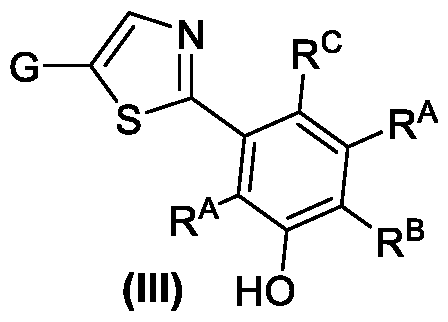 or a pharmaceutically acceptable salt thereof.
In embodiments, there is provided a compound of Formula (I), or a pharmaceutically acceptable salt thereof, that is a compound of Formula (I I IA)
 or a pharmaceutically acceptable salt thereof.
In embodiments, there is provided a compound of Formula (I), or a pharmaceutically acceptable salt thereof, that is a compound of Formula (111 B)
 or a pharmaceutically acceptable salt thereof.
In embodiments, there is provided a compound of Formula (I), (II), (HA), (I IB), (IIC), (HD), (III), (II IA) or ( 11 IB), or a pharmaceutically acceptable salt thereof, wherein each RA is independently H or F. In further embodiments, each RA is F.
In embodiments, there is provided a compound of Formula (I), (II), (II A), (I IB), (IIC), (HD), (III), (II IA) or ( 11 IB), or a pharmaceutically acceptable salt thereof, wherein RB is F.
In embodiments, there is provided a compound of Formula (I), (II), (HA), (I IB), (IIC), (HD), (III), (II IA) or ( 11 IB), or a pharmaceutically acceptable salt thereof, wherein Rc is H or F. In further embodiments, Rc is H.
In embodiments, there is provided a compound of Formula (I), (II), (II A), (I IB), (IIC), (HD), (III), (II IA) or ( 11 IB), or a pharmaceutically acceptable salt thereof, wherein each RA is F, RB is F and Rc is H.
In embodiments, there is provided a compound of Formula (I), or a pharmaceutically acceptable salt thereof, that is a compound of Formula (IV)
 or a pharmaceutically acceptable salt thereof. In embodiments, there is provided a compound of Formula (I), or a pharmaceutically acceptable salt thereof, that is a compound of Formula (IVA)
 or a pharmaceutically acceptable salt thereof.
In embodiments, there is provided a compound of Formula (I), or a pharmaceutically acceptable salt thereof, that is a compound of Formula (IVB)
 or a pharmaceutically acceptable salt thereof.
In embodiments, there is provided a compound of Formula (I), or a pharmaceutically acceptable salt thereof, that is a compound of Formula (IVC)
 or a pharmaceutically acceptable salt thereof.
In embodiments, there is provided a compound of Formula (I), (II), (HA), (I IB), (III), (IIIA), (II I B), (IV), (IVA), (IVB) or (IVC), or a pharmaceutically acceptable salt thereof, wherein J is O. In alternative embodiments, J is CH2. In alternative embodiments, J is a covalent bond.
In embodiments, there is provided a compound of Formula (I), (II), (HA), (I IB), (III), (IIIA), (II I B), (IV), (IVA), (IVB) or (IVC), or a pharmaceutically acceptable salt thereof, wherein Q. is CH2. In alternative embodiments, Q. is C(=O).
In embodiments, there is provided a compound of Formula (I), (II), (II A), (I IB), (III), (IIIA), (II I B), (IV), (IVA), (IVB) or (IVC), or a pharmaceutically acceptable salt thereof, wherein J is O and Q. is CH2. In alternative embodiments, J is CH2 and Q. is CH2. In alternative embodiments, J is a covalent bond and Q is CH2.
In embodiments, there is provided a compound of Formula (I), (III), (IIIA), (I II B), (IV), (IVA), (IVB) or
(IVC), or a pharmaceutically acceptable salt thereof, wherein

In embodiments, there is provided a compound of Formula (I), (III), (IIIA), (I II B), (IV), (IVA), (IVB) or (IVC), or a pharmaceutically acceptable salt thereof, wherein one carbon atom of ring D1 is attached to a C2-5 alkylene group to form a spirocyclic ring, and wherein one CH2 group of said C2-5 alkylene group may be optionally replaced by an oxygen group.
In embodiments, there is provided a compound of Formula (I), (III), (IIIA), (I II B), (IV), (IVA), (IVB) or (IVC), or a pharmaceutically acceptable salt thereof, wherein one carbon atom of ring D1 is attached to a C2-5 alkylene group to form a spirocyclic ring.
In embodiments, there is provided a compound of Formula (I), (III), (IIIA), (I II B), (IV), (IVA), (IVB) or (IVC), or a pharmaceutically acceptable salt thereof, wherein two carbon atoms of ring D1 are attached to a C1-5 alkylene group to form a bridged or fused ring, and wherein one CH2 group of said C1-5 alkylene group may be optionally replaced by an oxygen group.
In embodiments, there is provided a compound of Formula (I), (III), (I HA), (I II B), (IV), (IVA), (IVB) or (IVC), or a pharmaceutically acceptable salt thereof, wherein two carbon atoms of ring D1 are attached to a C1-5 alkylene group to form a bridged or fused ring.
In embodiments, there is provided a compound of Formula (I), (III), (I HA), (I II B), (IV), (IVA), (IVB) or
(IVC), or a pharmaceutically acceptable salt thereof, wherein
 embodiments,
 further embodiments,
 further embodiments,
 further embodiments,
 embodiments,

In embodiments, there is provided a compound of Formula (I), (III), (I HA), (I II B), (IV), (IVA), (IVB) or
(IVC), or a pharmaceutically acceptable salt thereof, wherein
 wherein each R3A is independently H, R4A or R5A.
In embodiments, there is provided a compound of Formula (I), (III), (I HA), (I II B), (IV), (IVA), (IVB) or
(IVC), or a pharmaceutically acceptable salt thereof, wherein
 , wherein each R3A is independently H, R4A or R5A.
In embodiments, there is provided a compound of Formula (I), (III), (I HA), (I II B), (IV), (IVA), (IVB) or
, wherein each R3A is independently H, R4A or R5A.
In embodiments, there is provided a compound of Formula (I), (III), (I HA), (I II B), (IV), (IVA), (IVB) or
(IVC), or a pharmaceutically acceptable salt thereof, wherein
 alternative embodiments,
 alternative embodiments,
 alternative embodiments,
 alternative embodiments,

In embodiments, there is provided a compound of Formula (I), (III), (I HA), (I II B), (IV), (IVA), (IVB) or
(IVC), or a pharmaceutically acceptable salt thereof, wherein
 alternative
 alternative embodiments,

 tive embodiments,
 alternative embodiments,
 alternative embodiments, G is
 . , . In alternative
embodiments,
. , . In alternative
embodiments,
 alternative embodiments,
 alternative embodiments,
 alternative embodiments,
 embodiments,
 alternative embodiments,
 embodiments,
 In embodiments, there is provided a compound of Formula (I), (III), (I HA), (I II B), (IV), (IVA), (IVB) or
(IVC), or a pharmaceutically acceptable salt thereof, wherein

In embodiments, there is provided a compound of Formula (I), (III), (I HA), (I II B), (IV), (IVA), (IVB) or (IVC), or a pharmaceutically acceptable salt thereof, wherein one carbon atom of ring D2 is attached to a C2-5 alkylene group to form a spirocyclic ring, and wherein one CH2 group of said C2-5 alkylene group may be optionally replaced by an oxygen group.
In embodiments, there is provided a compound of Formula (I), (III), (I HA), (I II B), (IV), (IVA), (IVB) or (IVC), or a pharmaceutically acceptable salt thereof, wherein one carbon atom of ring D2 is attached to a C2-5 alkylene group to form a spirocyclic ring.
In embodiments, there is provided a compound of Formula (I), (III), (I HA), (I II B), (IV), (IVA), (IVB) or (IVC), or a pharmaceutically acceptable salt thereof, wherein two carbon atoms of ring D2 are attached to a C1-5 alkylene group to form a bridged or fused ring, and wherein one CH2 group of said C1-5 alkylene group may be optionally replaced by an oxygen group.
In embodiments, there is provided a compound of Formula (I), (III), (I HA), (I II B), (IV), (IVA), (IVB) or (IVC), or a pharmaceutically acceptable salt thereof, wherein two carbon atoms of ring D2 are attached to a Ci-5 alkylene group to form a bridged or fused ring.
In embodiments, there is provided a compound of Formula (I), (III), (I HA), (I II B), (IV), (IVA), (IVB) or (IVC), or a pharmaceutically acceptable salt thereof, wherein
 further embodiments,
 further embodiments,
 further embodiments,
 further embodiments,
 further embodiments,

G is O . In further embodiments, G is O . In further embodiments, G is
 In embodiments, there is provided a compound of Formula (I), (III), (I HA), (I II B), (IV), (IVA), (IVB) or
(IVC), or a pharmaceutically acceptable salt thereof, wherein
 , wherein each R3A is independently H, R4A or R5A.
In embodiments, there is provided a compound of Formula (I), (III), (I HA), (I II B), (IV), (IVA), (IVB) or
, wherein each R3A is independently H, R4A or R5A.
In embodiments, there is provided a compound of Formula (I), (III), (I HA), (I II B), (IV), (IVA), (IVB) or
(IVC), or a pharmaceutically acceptable salt thereof, wherein
 wherein each R3A is independently H, R4A or R5A.
In embodiments, there is provided a compound of Formula (I), (III), (I HA), (I II B), (IV), (IVA), (IVB) or
(IVC), or a pharmaceutically acceptable salt thereof, wherein

In embodiments, there is provided a compound of Formula (I), (III), (I HA), (I II B), (IV), (IVA), (IVB) or
(IVC), or a pharmaceutically acceptable salt thereof, wherein

In embodiments, there is provided a compound of Formula (I), (III), (I HA), (I II B), (IV), (IVA), (IVB) or (IVC), or a pharmaceutically acceptable salt thereof, wherein one carbon atom of ring D3 is attached to a C2-5 alkylene group to form a spirocyclic ring, and wherein one CH2 group of said C2-5 alkylene group may be optionally replaced by an oxygen group.
In embodiments, there is provided a compound of Formula (I), (III), (I IIA), (I II B), (IV), (IVA), (IVB) or (IVC), or a pharmaceutically acceptable salt thereof, wherein one carbon atom of ring D3 is attached to a C2-5 alkylene group to form a spirocyclic ring.
In embodiments, there is provided a compound of Formula (I), (III), (I IIA), (I II B), (IV), (IVA), (IVB) or (IVC), or a pharmaceutically acceptable salt thereof, wherein two carbon atoms of ring D3 are attached to a C1-5 alkylene group to form a bridged or fused ring, and wherein one CH2 group of said C1-5 alkylene group may be optionally replaced by an oxygen group.
In embodiments, there is provided a compound of Formula (I), (III), (I IIA), (I II B), (IV), (IVA), (IVB) or (IVC), or a pharmaceutically acceptable salt thereof, wherein two carbon atoms of ring D3 are attached to a C1-5 alkylene group to form a bridged or fused ring.
In embodiments, there is provided a compound of Formula (I), (III), (I IIA), (I II B), (IV), (IVA), (IVB) or
(IVC), or a pharmaceutically acceptable salt thereof, wherein
 further

In embodiments, there is provided a compound of Formula (I), (III), (I HA), (I II B), (IV), (IVA), (IVB) or
(IVC), or a pharmaceutically acceptable salt thereof, wherein

In embodiments, there is provided a compound of Formula (I), (III), (I HA), (I II B), (IV), (IVA), (IVB) or (IVC), or a pharmaceutically acceptable salt thereof, wherein one carbon atom of ring D4 is attached to a C2-5 alkylene group to form a spirocyclic ring, and wherein one CH2 group of said C2-5 alkylene group may be optionally replaced by an oxygen group.
In embodiments, there is provided a compound of Formula (I), (III), (I HA), (I II B), (IV), (IVA), (IVB) or (IVC), or a pharmaceutically acceptable salt thereof, wherein one carbon atom of ring D4 is attached to a C2-5 alkylene group to form a spirocyclic ring.
In embodiments, there is provided a compound of Formula (I), (III), (I HA), (I II B), (IV), (IVA), (IVB) or (IVC), or a pharmaceutically acceptable salt thereof, wherein two carbon atoms of ring D4 are attached to a C1-5 alkylene group to form a bridged or fused ring, and wherein one CH2 group of said C1-5 alkylene group may be optionally replaced by an oxygen group.
In embodiments, there is provided a compound of Formula (I), (III), (I IIA), (I II B), (IV), (IVA), (IVB) or (IVC), or a pharmaceutically acceptable salt thereof, wherein two carbon atoms of ring D4 are attached to a C1-5 alkylene group to form a bridged or fused ring.
In embodiments, there is provided a compound of Formula (I), (III), (IIIA), (I II B), (IV), (IVA), (IVB) or
(IVC), or a pharmaceutically acceptable salt thereof, wherein
 further embodiments,
 further embodiments,

In embodiments, there is provided a compound of Formula (I), (III), (I HA), (I II B), (IV), (IVA), (IVB) or
(IVC), or a pharmaceutically acceptable salt thereof, wherein
 further embodiments,

In embodiments, there is provided a compound of Formula (I), (II), (II B), (IIC), (I I D), (III), (IIIA), (I II B), (IV), (IVA), (IVB) or (IVC), or a pharmaceutically acceptable salt thereof, wherein R1 and R2 are independently selected from H, R4 and R5. In embodiments, there is provided a compound of Formula (I), (II), (II B), (IIC), (I I D), (III), (IIIA), (I II B), (IV), (IVA), (IVB) or (IVC), or a pharmaceutically acceptable salt thereof, wherein R1 is H and R2 is H.
In embodiments, there is provided a compound of Formula (I), (II), (II B), (IIC), (I I D), (III), (IIIA), (I II B), (IV), (IVA), (IVB) or (IVC), or a pharmaceutically acceptable salt thereof, wherein R1 is R4, and R2 is H. In further embodiments, R1 is Ci.g alkyl and R2 is H. In further embodiments, R1 is C1-4 alkyl and R2 is H. In further embodiments, R1 is CH3 and R2 is H.
In embodiments, there is provided a compound of Formula (I), (II), (II B), (IIC), (I I D), (III), (IIIA),(IIIB), (IV), (IVA), (IVB) or (IVC), or a pharmaceutically acceptable salt thereof, wherein R1 is R5, and R2 is H. In further embodiments, R1 is C3-6 cycloalkyl and R2 is H.
In embodiments, there is provided a compound of Formula (I), (II), (II B), (IIC), (I I D), (III), (IIIA), (I II B), (IV), (IVA), (IVB) or (IVC), or a pharmaceutically acceptable salt thereof, wherein R1 and R2 are independently R4. In further embodiments, R1 and R2 are independently Ci-g alkyl. In further embodiments, R1 and R2 are independently C1-4 alkyl. In further embodiments, R1 is CH3 and R2 is CH3.
In embodiments, there is provided a compound of Formula (I), (II), (II B), (IIC), (I I D), (III), (IIIA), (I II B), (IV), (IVA), (IVB) or (IVC), or a pharmaceutically acceptable salt thereof, wherein R1 and R2 together with the carbon atom to which they are attached form a cyclopropane or cyclobutane ring.
In embodiments, there is provided a compound of Formula (I), (II), (II B), (IIC), (I I D), (III), (IIIA), (I II B), (IV), (IVA), (IVB) or (IVC), or a pharmaceutically acceptable salt thereof, wherein R1 and R2 together with the carbon atom to which they are attached form a cyclopropane ring.
In embodiments, there is provided a compound of Formula (I), (II), (II B), (IIC), (I I D), (III), (IIIA), (I II B), (IV), (IVA), (IVB) or (IVC), or a pharmaceutically acceptable salt thereof, wherein R1 and R2 together with the carbon atom to which they are attached form a cyclobutane ring.
In embodiments, there is provided a compound of Formula (I), (II), (HA), (I IB), (IIC), (III), (IIIA), (II I B), (IV), (IVA), (IVB) or (IVC), or a pharmaceutically acceptable salt thereof, wherein each R3 is independently R4A. In further embodiments, each R3 is independently Ci.g alkyl. In further embodiments, each R3 is independently C1. alkyl. In further embodiments, each R3 is CH3.
In embodiments, there is provided a compound of Formula (I), (II), (HA), (I IB), (IIC), (III), (IIIA), (II I B), (IV), (IVA), (IVB) or (IVC), or a pharmaceutically acceptable salt thereof, wherein each R3 is independently R5A. In further embodiments, each R3 is independently C3-6 cycloalkyl.
In embodiments, there is provided a compound of Formula (I), (II), (II A), (I IB), (IIC), (HD) (III), (IIIA), ( 11 IB), (IV), (IVA), (IVB) or (IVC), or a pharmaceutically acceptable salt thereof, wherein n is 0. In alternative embodiments, n is 1. In alternative embodiments, n is 2. In alternative embodiments, n is 3.
In embodiments, there is provided a compound of Formula (I), (II), (II A), (I IB), (IIC), (III), (IIIA), (II I B), (IV), (IVA), (IVB) or (IVC), or a pharmaceutically acceptable salt thereof, wherein n is 2 and each R3 is independently C1-4 alkyl. In further embodiments, n is 2 and each R3 is CH3.
In embodiments, there is provided a compound of Formula (I), (II), (II B), (IIC), (I I D), (III), (IIIA), (I II B), (IV), (IVA), (IVB) or (IVC), or a pharmaceutically acceptable salt thereof, wherein each R4 is independently Ci.g alkyl optionally substituted with one to three F. In further embodiments, each R4 is independently Ci.g alkyl (i.e. Ci.g alkyl is unsubstituted). In further embodiments, each R4 is
independently C1-4 alkyl optionally substituted with one to three F. In further embodiments, each R4 is independently C1-4 alkyl (i.e. C1-4 alkyl is unsubstituted). In further embodiments, each R4 is CH3.
In embodiments, there is provided a compound of Formula (I), (II), (HA), (I IB), (IIC), (III), (II I A). (II I B), (IV), (IVA), (IVB) or (IVC), or a pharmaceutically acceptable salt thereof, wherein each R4A is independently Ci.g alkyl optionally substituted with one to three F. . In further embodiments, each R4A is independently Ci.g alkyl (i.e. Ci.g alkyl is unsubstituted). In further embodiments, each R4A is independently C1-4 alkyl optionally substituted with one to three F. In further embodiments, each R4A is independently C1-4 alkyl (i.e. C1-4 alkyl is unsubstituted). In further embodiments, each R4A is CH3.
In embodiments, there is provided a compound of Formula (I), (II), (II B), (IIC), (I I D), (III), (IIIA), (I II B), (IV), (IVA), (IVB) or (IVC), or a pharmaceutically acceptable salt thereof, wherein each R5 is independently C3-6 cycloalkyl optionally substituted with one to three F. In further embodiments, each R5 is independently C3-6 cycloalkyl.
In embodiments, there is provided a compound of Formula (I), (II), (HA), (I IB), (IIC), (III), (IIIA) (I II B), (IV), (IVA), (IVB) or (IVC), or a pharmaceutically acceptable salt thereof, wherein each R5A is independently C3-6 cycloalkyl optionally substituted with one to three F. In further embodiments, each R5A is independently C3-6 cycloalkyl.
In embodiments, there is provided a compound of Formula (I), (IIC), (III), (IIIA), (I II B), (IV), (IVA), (IVB) or (IVC), or a pharmaceutically acceptable salt thereof, wherein R6 is C1-6 alkyl, C3-6 cycloalkyl or H. In further embodiments, R6 is Ci.g alkyl. In further embodiments, R6 is CH3.
In embodiments, there is provided a compound of Formula (I), ( 11 D), (III), (IIIA), ( II I B), or a pharmaceutically acceptable salt thereof, wherein each R7 is independently Ci.g alkyl, C3-6 cycloalkyl, - O(Ci-6 alkyl) -O(C3-s cycloalkyl), -OH, -CN, and halo. In embodiments, wherein each R7 is independently Ci.g alkyl, -O(Ci.g alkyl), -OH, -CN, F and Cl. In embodiments, wherein each R7 is independently C1-4 alkyl, -O(Ci- alkyl), -OH, -CN, F and Cl.
In embodiments, there is provided a compound of Formula (I), or a pharmaceutically acceptable salt thereof, with the proviso that the compound is not l-((3-(4-fluoro-3-hydroxyphenyl)-l,2,4-oxadiazol- 5-yl)methyl)piperidin-2-one.
In embodiments, there is provided a compound of Formula (I), or a pharmaceutically acceptable salt thereof, that is (2R,6S)-2,6-Dimethyl-4-((5-(2,4,5-trifluoro-3-hydroxyphenyl)-l,2,4-oxadiazol-3-yl)methyl)morpholin- 3-one,
(2S,6R)-2,6-Dimethyl-4-((5-(2,4,5-trifluoro-3-hydroxyphenyl)-l,2,4-oxadiazol-3-yl)methyl)morpholin-
4-((5-(2,4,5-Trifluoro-3-hydroxyphenyl)-l,2,4-oxadiazol-3-yl)methyl)morpholin-3-one, l-((5-(2,4,5-Trifluoro-3-hydroxyphenyl)-l,2,4-oxadiazol-3-yl)methyl)piperidin-2-one,
1-((5-(2,4,5-Trifluoro-3-hydroxyphenyl)-l,2,4-oxadiazol-3-yl)methyl)piperidine-2,6-dione, 3-(4-(((2R,6S)-2,6-Dimethylmorpholino)sulfonyl)furan-2-yl)-2,5,6-trifluorophenol,
2-((5-(2,4,5-Trifluoro-3-hydroxyphenyl)-l,2,4-oxadiazol-3-yl)methyl)-l,2-thiazinane 1,1-dioxide,
5-Hydroxy-l-((5-(2,4,5-trifluoro-3-hydroxyphenyl)-l,2,4-oxadiazol-3-yl)methyl)piperidin-2-one, or
6-Cyclopropyl-4-((5-(2,4,5-trifluoro-3-hydroxyphenyl)-l,2,4-oxadiazol-3-yl)methyl)morpholin-3-one, or a pharmaceutically acceptable salt thereof.
In embodiments, there is provided a compound of Formula (I), or a pharmaceutically acceptable salt thereof, that is l-((2-(2,4,5-Trifluoro-3-hydroxyphenyl)thiazol-5-yl)methyl)piperidine-2, 6-dione,
6-Cyclopropyl-4-((2-(2,4,5-trifluoro-3-hydroxyphenyl)thiazol-5-yl)methyl)morpholin-3-one, (lR,5S)-3-((2-(2,4,5-Trifluoro-3-hydroxyphenyl)thiazol-5-yl)methyl)-3-azabicyclo[3.1.0]hexane-2,4- dione,
(lR,5S)-3-((2-(2,4,5-Trifluoro-3-hydroxyphenyl)thiazol-5-yl)methyl)-3-azabicyclo[3.2.0]heptane-2,4- dione, l-((2-(2,4,5-Trifluoro-3-hydroxyphenyl)thiazol-5-yl)methyl)pyrrolidine-2, 5-dione, or
3-((2-(2,4,5-Trifluoro-3-hydroxyphenyl)thiazol-5-yl)methyl)oxazolidine-2, 4-dione, or a pharmaceutically acceptable salt thereof.
In embodiments, there is provided a compound of Formula (I), or a pharmaceutically acceptable salt thereof, that is
2.6-Dimethyl-4-((5-(2,4,5-trifluoro-3-hydroxyphenyl)-l,2,4-oxadiazol-3-yl)methyl)morpholin-3-one,
2.6-Dimethyl-4-((5-(2,4,5-trifluoro-3-hydroxyphenyl)-l,2,4-oxadiazol-3-yl)methyl)morpholin-4-((5-
(2,4,5-Trifluoro-3-hydroxyphenyl)-l,2,4-oxadiazol-3-yl)methyl)morpholin-3-one, l-((5-(2,4,5-Trifluoro-3-hydroxyphenyl)-l,2,4-oxadiazol-3-yl)methyl)piperidin-2-one,
1-((5-(2,4,5-Trifluoro-3-hydroxyphenyl)-l,2,4-oxadiazol-3-yl)methyl)piperidine-2,6-dione, 3-(4-((2,6-Dimethylmorpholino)sulfonyl)furan-2-yl)-2,5,6-trifluorophenol,
2-((5-(2,4,5-Trifluoro-3-hydroxyphenyl)-l,2,4-oxadiazol-3-yl)methyl)-l,2-thiazinane 1,1-dioxide,
5-Hydroxy-l-((5-(2,4,5-trifluoro-3-hydroxyphenyl)-l,2,4-oxadiazol-3-yl)methyl)piperidin-2-one,
6-Cyclopropyl-4-((5-(2,4,5-trifluoro-3-hydroxyphenyl)-l,2,4-oxadiazol-3-yl)methyl)morpholin-3-one, l-((2-(2,4,5-Trifluoro-3-hydroxyphenyl)thiazol-5-yl)methyl)piperidine-2, 6-dione,
6-Cyclopropyl-4-((2-(2,4,5-trifluoro-3-hydroxyphenyl)thiazol-5-yl)methyl)morpholin-3-one,
3-((2-(2,4,5-Trifluoro-3-hydroxyphenyl)thiazol-5-yl)methyl)-3-azabicyclo[3.1.0]hexane-2, 4-dione,
3-((2-(2,4,5-Trifluoro-3-hydroxyphenyl)thiazol-5-yl)methyl)-3-azabicyclo[3.2.0]heptane-2, 4-dione, l-((2-(2,4,5-Trifluoro-3-hydroxyphenyl)thiazol-5-yl)methyl)pyrrolidine-2, 5-dione, or 3-((2-(2,4,5-Trifluoro-3-hydroxyphenyl)thiazol-5-yl)methyl)oxazolidine-2, 4-dione, or a pharmaceutically acceptable salt thereof.
A further feature is any of the embodiments described in the specification with the proviso that any of the specific Examples are individually disclaimed. A further feature is any of the embodiments described in the specification with the proviso that any one or more of the compounds selected from the above list of Examples of compounds of the specification are individually disclaimed.
The compounds disclosed herein may contain one or more chiral centers. Accordingly, if desired, such compounds can be prepared or isolated as pure stereoisomers, i.e. as individual enantiomers, diastereoisomers, or as a stereoisomerically enriched mixture. All such stereoisomer (and enriched) mixtures are included within the scope of the embodiments, unless otherwise stated. Pure stereoisomers (or enriched mixtures) may be prepared using, for example, optically active starting materials or stereoselective reagents well-known in the art. Alternatively, racemic mixtures of such compounds can be separated using, for example, chiral column chromatography, chiral resolving agents and the like.
Unless stereochemistry is explicitly indicated in a chemical structure or chemical name, the chemical structure or chemical name is intended to embrace all possible stereoisomers, diastereoisomers, conformers, rotamers and tautomers of the compound depicted. For example, a compound containing a chiral carbon atom is intended to embrace both the I enantiomer and the (S) enantiomer, as well as mixtures of the enantiomers, including racemic mixtures; and a compound containing two chiral carbons is intended to embrace all enantiomers and diastereoisomers including (R,R), (S,S), (R,S) and (S,R).
In embodiments, there is provided a pharmaceutical composition which comprises a compound of the Formula (I), (II), (HA), (II B), (IIC), (HD), (III), (IIIA), (I IIB), (IV), (IVA), (IVB) or (IVC), or a pharmaceutically acceptable salt thereof, in association with a pharmaceutically acceptable excipient, optionally further comprising one or more of the other stereoisomeric forms of the compound of Formula (I), (II), (HA), (IIB), (IIC), (HD), (III), (IIIA), (IIIB), (IV), (IVA), (IVB) or (IVC), or pharmaceutically acceptable salt thereof, wherein the compound of Formula (I), (II), (I I A), (IIB), (IIC), ( 11 D), (III), (IIIA), (IIIB), (IV), (IVA), (IVB) or (IVC), or pharmaceutically acceptable salt thereof is present
within the composition with an enantiomeric excess (%ee) of > 90% and a diastereomeric excess (%de) of > 90%.
The compound of Formula (I), (II), (IIA), (IIB), (IIC), (HD), (III), (IIIA), (IIIB), (IV), (IVA), (IVB) or (IVC), and pharmaceutically acceptable salts thereof, may be prepared, used or supplied in amorphous form, crystalline form, or semicrystalline form and any given compound of Formula (I), (II), (IIA), (IIB), (IIC), ( 11 D), (III), (IIIA), (IIIB), (IV), (IVA), (IVB) or (IVC), or pharmaceutically acceptable salt thereof, may be capable of being formed into more than one crystalline / polymorphic form, including hydrated (e.g. hemi hydrate, a mono hydrate, a di hydrate, a tri hydrate or other stoichiometry of hydrate) and/or solvated forms. It is to be understood that the present specification encompasses any and all such solid forms of the compound of Formula (I), (II), (IIA), (IIB), (IIC), (HD), (III), (IIIA), (IIIB), (IV), (IVA), (IVB) or (IVC), and pharmaceutically acceptable salts thereof.
In further embodiments there is provided a compound of Formula (I), (II), (IIA), (IIB), (IIC), (HD), (III), (IIIA), (IIIB), (IV), (IVA), (IVB) or (IVC), or pharmaceutically acceptable salts thereof, which is obtainable by the methods described in the 'Examples" section hereinafter.
The present specification is intended to include all isotopes of atoms occurring in the present compounds. Isotopes will be understood to include those atoms having the same atomic number but different mass numbers. For example, isotopes of hydrogen include tritium and deuterium. Isotopes of carbon include 13C and 14C. Isotopes of nitrogen include 15N. Isotopes of fluorine include 18F.
A suitable pharmaceutically acceptable salt of a compound of Formula (I), (II), (IIA), (IIB), (IIC), ( 11 D), (III), (IIIA), (IIIB), (IV), (IVA), (IVB) or (IVC) is, for example, a base addition salt. A base addition salt of a compound of Formula (I), (II), (IIA), (IIB), (IIC), (HD), (III), (IIIA), (IIIB), (IV), (IVA), (IVB) or (IVC) may be formed by bringing the compound into contact with a suitable inorganic or organic base under conditions known to the skilled person. A base addition salt may for example be an alkali metal salt (such as a sodium, potassium, or lithium salt) or an alkaline earth metal salt (such as a calcium salt), which may be formed using an alkali metal or alkaline earth metal hydroxide or alkoxide (e.g., an ethoxide or methoxide). A base addition salt may also be formed using a suitably basic organic amine (e.g., a choline or meglumine salt).
A suitable pharmaceutically acceptable salt of a compound of Formula (I), (II), (IIA), (IIB), (IIC), ( 11 D), (III), (IIIA), (IIIB), (IV), (IVA), (IVB) or (IVC) is, for example, an acid addition salt. An acid addition salt of a compound of Formula (I), (II), (HA), (IIB), (IIC), (HD), (HI), (IIIA), (IIIB), (IV), (IVA), (IVB) or (IVC) may be formed by bringing the compound into contact with a suitable inorganic or organic acid under conditions known to the skilled person. An acid addition salt may for example be formed using an
inorganic acid selected from hydrochloric acid, hydrobromic acid, sulphuric acid and phosphoric acid. An acid addition salt may also be formed using an organic acid selected from trifluoroacetic acid, citric acid, maleic acid, oxalic acid, acetic acid, formic acid, benzoic acid, fumaric acid, succinic acid, tartaric acid, lactic acid, pyruvic acid, methanesulfonic acid, benzenesulfonic acid and paratoluenesulfonic acid.
A further suitable pharmaceutically acceptable salt of a compound of Formula (I), (II), (HA), ( I IB), (IIC), ( 11 D), (III), (IIIA), ( I II B), (IV), (IVA), (IVB) or (IVC) is, for example, a salt formed within a patient's body after administration of a compound of Formula (I), (II), ( 11 A), ( II B), (IIC), (I I D), (III), (IIIA), ( I II B), (IV), (IVA), (IVB) or (IVC) to the patient.
The compound of Formula (I), (II), (HA), (IIB), (IIC), (HD), (III), (IIIA), (HIB), (IV), (IVA), (IVB) or (IVC), or pharmaceutically acceptable salt thereof, may be prepared as a co-crystal solid form. It is to be understood that a pharmaceutically acceptable co-crystal of an compound of Formula (I), (II), (HA), (IIB), (IIC), ( I ID), (III), (IIIA), ( I II B), (IV), (IVA), (IVB) or (IVC), or pharmaceutically acceptable salts thereof, form an aspect of the present specification.
In a further aspect there is provided a pharmaceutical composition comprising a compound of Formula (I), (II), (HA), (IIB), (IIC), (HD), (HI), (IIIA), (HIB), (IV), (IVA), (IVB) or (IVC), or a pharmaceutically acceptable salt thereof and a pharmaceutically acceptable excipient.
The term "pharmaceutical composition" refers to a preparation which is in such form as to permit the biological activity of the active ingredient, and which contains no additional components which are unacceptably toxic to a patient to which the composition would be administered. Such compositions can be sterile. A pharmaceutical composition according to the present specification will comprise a compound of Formula (I), (II), (IIA), (IIB), (IIC), (I I D), (III), (IIIA), (I II B), (IV), (IVA), (IVB) or (IVC), or a pharmaceutically acceptable salt thereof, and a pharmaceutically acceptable excipient.
The pharmaceutical formulations of the compound of Formula (I), (II), (IIA), (IIB), (IIC), (HD), (III), (IIIA), ( I II B), (IV), (IVA), (IVB) or (IVC), or a pharmaceutically acceptable salt thereof, described above may be prepared e.g. for parenteral, subcutaneous, intramuscular or intravenous administration.
The pharmaceutical formulations of the compound of Formula (I), (II), (IIA), (IIB), (IIC), (HD), (III), (IIIA), ( I II B), (IV), (IVA), (IVB) or (IVC), or a pharmaceutically acceptable salt thereof, described above may conveniently be administered in unit dosage form and may be prepared by any of the methods well-known in the pharmaceutical art, for example as described in Remington's Pharmaceutical Sciences, 17th ed., Mack Publishing Company, Easton, PA., (1985).
As a result of their 17BHSD13 inhibitory activity, the compounds of (I), (II), ( 11 A), (I I B), (IIC), ( 11 D), (III), ( 11 IA), ( I II B), (IV), (IVA), (IVB) or (IVC), and pharmaceutically acceptable salts thereof are expected to be useful in therapy, for example in the treatment of diseases or medical conditions mediated at least in part by 17BHSD13, including liver disease, such as NASH.
In one aspect of the present specification there is provided a compound of Formula (I), (II), (HA), ( 11 B), (IIC), ( I ID), (III), ( I II A), ( I II B), (IV), (IVA), (IVB) or (IVC), or a pharmaceutically acceptable salt thereof, for use in therapy.
In one aspect of the present specification there is provided a compound of Formula (I), (II), (HA), ( 11 B), (IIC), ( I ID), (III), ( I II A), ( I II B), (IV), (IVA), (IVB) or (IVC), or a pharmaceutically acceptable salt thereof, for use in the treatment of liver disease. In embodiments, the liver disease is selected from alcoholic liver disease, non-alcoholic liver disease, NAFLD (such as NASH, liver fibrosis, cirrhosis, and isolated steatosis), liver inflammation, alcoholic steatoheptatis (ASH), hepatitis C virus (HCV) and hepatocellular carcinoma (HCC).
The term "therapy" is intended to have its normal meaning of dealing with a disease in order to entirely or partially relieve one, some or all of its symptoms, or to correct or compensate for the underlying pathology. The term "therapy" also includes "prophylaxis" unless there are specific indications to the contrary. The terms "therapeutic" and "therapeutically" should be interpreted in a corresponding manner.
The term "prophylaxis" is intended to have its normal meaning and includes primary prophylaxis to prevent the development of the disease and secondary prophylaxis whereby the disease has already developed and the patient is temporarily or permanently protected against exacerbation or worsening of the disease or the development of new symptoms associated with the disease.
The term "treatment" is used synonymously with "therapy". Similarly the term "treat" can be regarded as "applying therapy" where "therapy" is as defined herein.
In embodiments, there is provided a compound of Formula (I), (II), (II A), (I IB), (IIC), (HD), (III), (II IA), ( 11 IB), (IV), (IVA), (IVB) or (IVC), or a pharmaceutically acceptable salt thereof, for use in providing an inhibitory effect on 17PHSD13.
In embodiments, there is provided a compound of Formula (I), (II), (II A), (I IB), (IIC), (HD), (III), (II IA), ( 11 IB), (IV), (IVA), (IVB) or (IVC), or a pharmaceutically acceptable salt thereof, for use in the treatment of a disease mediated by 17PHSD13, such as liver disease (e.g. NASH).
In embodiments, there is provided a compound of Formula (I), (II), (HA), (I IB), (IIC), (HD), (III), (IIIA), ( 11 IB), (IV), (IVA), (IVB) or (IVC), or a pharmaceutically acceptable salt thereof, for use in the treatment of fatty liver disease.
In embodiments, there is provided a compound of Formula (I), (II), (II A), (I IB), (IIC), (HD), (III), (IIIA), ( 11 IB), (IV), (IVA), (IVB) or (IVC), or a pharmaceutically acceptable salt thereof, for use in the treatment of nonalcoholic Fatty Liver Disease (NAFLD), such as isolated steatosis, Nonalcoholic Steatohepatitis (NASH), liver fibrosis or cirrhosis. In further embodiments, the liver disease is end stage liver disease.
In embodiments, there is provided a compound of Formula (I), (II), (II A), (I IB), (IIC), (HD), (III), (IIIA), ( 11 IB), (IV), (IVA), (IVB) or (IVC), or a pharmaceutically acceptable salt thereof, for use in the treatment of liver disease, such as NASH, wherein the patient is also suffering from or susceptible to one or more conditions selected from the group consisting of obesity, dyslipidemia, insulin resistance, Type 2 diabetes, and renal insufficiency.
In embodiments, there is provided a compound of Formula (I), (II), (II A), (I IB), (IIC), (II D), (III), (IIIA), ( 11 IB), (IV), (IVA), (IVB) or (IVC), or a pharmaceutically acceptable salt thereof, for use in the treatment of liver disease, such as NASH, wherein the patient has a body mass index (BMI) of 27 kg/m2 to 40 kg/m2. In further embodiments, the subject has a BMI of 30 kg/m2 to 39.9 kg/m2. In further embodiments, the patient has a BMI of at least 40 kg/m2. In further embodiments, the patient is overweight. In further embodiments, the patient is obese.
In embodiments, there is provided a compound of Formula (I), (II), (II A), (I IB), (IIC), (II D), (III), (IIIA), ( 11 IB), (IV), (IVA), (IVB) or (IVC), or a pharmaceutically acceptable salt thereof, for use in the treatment of liver disease, such as NASH, wherein the patient is also suffering from or susceptible to dyslipidemia.
In embodiments, there is provided a compound of Formula (I), (II), (II A), (I IB), (IIC), (II D), (III), (IIIA), ( 11 IB), (IV), (IVA), (IVB) or (IVC), or a pharmaceutically acceptable salt thereof, for use in the treatment of liver disease, such as NASH, wherein the patient is also suffering from or susceptible to insulin resistance.
In embodiments, there is provided a compound of Formula (I), (II), (II A), (I IB), (IIC), (II D), (III), (IIIA), ( 11 IB), (IV), (IVA), (IVB) or (IVC), or a pharmaceutically acceptable salt thereof, for use in the treatment of liver disease, such as NASH, wherein the patient is also suffering from or susceptible to Type 2 diabetes.
In embodiments, there is provided a compound of Formula (I), (II), (HA), (I IB), (IIC), (HD), (III), (IIIA), ( 11 IB), (IV), (IVA), (IVB) or (IVC), or a pharmaceutically acceptable salt thereof, for use in the treatment of liver disease, such as NASH, wherein the patient is also suffering from or susceptible to renal insufficiency.
In embodiments, there is provided a compound of Formula (I), (II), (II A), (I IB), (IIC), (HD), (III), (IIIA), ( 11 IB), (IV), (IVA), (IVB) or (IVC), or a pharmaceutically acceptable salt thereof, for use in the treatment of liver disease, such as NASH, wherein the patient is also suffering from or susceptible to liver fibrosis. In further embodiments, the patient is (i) suffering from or susceptible to liver fibrosis, and (ii) suffering from or susceptible to one or more conditions selected from the group consisting of obesity, dyslipidemia, insulin resistance, Type 2 diabetes, and renal insufficiency.
In embodiments, there is provided a compound of Formula (I), (II), (II A), (I IB), (IIC), (HD), (III), (IIIA), ( 11 IB), (IV), (IVA), (IVB) or (IVC), or a pharmaceutically acceptable salt thereof, for use in the treatment of liver disease, such as NASH, wherein the patient is also suffering from or susceptible to cirrhosis. In further embodiments, the patient is (i) suffering from or susceptible to cirrhosis, and (ii) suffering from or susceptible to one or more conditions selected from the group consisting of obesity, dyslipidemia, insulin resistance, Type 2 diabetes, and renal insufficiency.
In embodiments, there is provided a compound of Formula (I), (II), (II A), (I IB), (IIC), (II D), (III), (IIIA), ( 11 IB), (IV), (IVA), (IVB) or (IVC), or a pharmaceutically acceptable salt thereof, for use in the treatment of NAFLD. In further embodiments, the NAFLD is Stage 1 NAFLD. In further embodiments, the NAFLD is Stage 2 NAFLD. In further embodiments, the NAFLD is Stage 3 NAFLD. In further embodiments, the NAFLD is Stage 4 NAFLD. See, e.g., "The Diagnosis and Management of Nonalcoholic Fatty Liver Disease: Practice Guidance From the American Association for the Study of Liver Diseases," Hepatology, Vol. 67, No. 1, 2018.
In embodiments, there is provided a compound of Formula (I), (II), (II A), (I IB), (IIC), (II D), (III), (IIIA), ( 11 IB), (IV), (IVA), (IVB) or (IVC), or a pharmaceutically acceptable salt thereof, for use in the treatment of NAFLD, such as NASH. In further embodiments, the patient is obese. In further embodiments, the patient has alcoholic liver disease. In further embodiments, the patient has a genetic risk factor for liver disease, such as the (rs738409 C>G) variant in PNPLA3.
In embodiments, there is provided a compound of Formula (I), (II), (II A), (I IB), (IIC), (II D), (III), (IIIA), ( 11 IB), (IV), (IVA), (IVB) or (IVC), or a pharmaceutically acceptable salt thereof, for use in the treatment of NASH. In further embodiments, the NASH is Stage 1 NASH. In further embodiments, the NASH is Stage 2 NASH. In further embodiments, the NASH is Stage 3 NASH. In further embodiments,
the NASH is Stage 4 NASH. In further embodiments, the patient is also suffering from or susceptible to one or more conditions selected from obesity, dyslipidemia, insulin resistance, Type 2 diabetes, and renal insufficiency.
In embodiments, there is provided a compound of Formula (I), (II), (HA), (I IB), (IIC), (HD), (III), (IIIA), ( 11 IB), (IV), (IVA), (IVB) or (IVC), or a pharmaceutically acceptable salt thereof, for use in the treatment of liver fibrosis. In further embodiments, the liver fibrosis is Stage 3 liver fibrosis. In further embodiments, the patient is also suffering from or susceptible to one or more conditions selected from obesity, dyslipidemia, insulin resistance, Type 2 diabetes, and renal insufficiency.
In embodiments, there is provided a compound of Formula (I), (II), (II A), (I IB), (IIC), (HD), (III), (IIIA), ( 11 IB), (IV), (IVA), (IVB) or (IVC), or a pharmaceutically acceptable salt thereof, for use in the treatment of cirrhosis. In further embodiments, the cirrhosis is stage F4 cirrhosis. In further embodiments, the patient is also suffering from or susceptible to one or more conditions selected from obesity, dyslipidemia, insulin resistance, Type 2 diabetes, and renal insufficiency.
In embodiments, there is provided a compound of Formula (I), (II), (II A), (I IB), (IIC), (HD), (III), (IIIA), ( 11 IB), (IV), (IVA), (IVB) or (IVC), or a pharmaceutically acceptable salt thereof, for use in the treatment of liver inflammation. In further embodiments, the inflammation is chronic inflammation. In further embodiments, the chronic inflammation is selected from the group consisting of rheumatoid arthritis, osteoarthritis, and Crohn's disease. In further embodiments, the chronic inflammation is rheumatoid arthritis.
In embodiments, there is provided a compound of Formula (I), (II), (II A), (I IB), (IIC), (II D), (III), (IIIA), ( 11 IB), (IV), (IVA), (IVB) or (IVC), or a pharmaceutically acceptable salt thereof, for use in the treatment of hepatocellular carcinoma (HCC).
In embodiments, there is provided a compound of Formula (I), (II), (II A), (I IB), (IIC), (II D), (III), (IIIA), ( 11 IB), (IV), (IVA), (IVB) or (IVC), or a pharmaceutically acceptable salt thereof, for use in the treatment of alcoholic steatoheptatis (ASH).
In embodiments, there is provided a compound of Formula (I), (II), (II A), (I IB), (IIC), (II D), (III), (IIIA), ( 11 IB), (IV), (IVA), (IVB) or (IVC), or a pharmaceutically acceptable salt thereof, for use in the treatment of hepatitis C virus (HCV).
In one aspect of the present specification there is provided the use of a compound of Formula (I), (II), (IIA), (I I B), (IIC), ( 11 D), (III), (IIIA), ( II I B), (IV), (IVA), (IVB) or (IVC), or a pharmaceutically acceptable salt thereof, as described herein, in the manufacture of a medicament, such as a medicament for the treatment of disease (e.g. NASH).
In one aspect of the present specification there is provided a method of treating disease, such as NASH, in a patient comprising administering to the patient an effective amount of a compound of Formula (I), (II), (HA), (I I B), (IIC), (HD), (III), (I II A), (II I B), (IV), (IVA), (IVB) or (IVC), or a pharmaceutically acceptable salt thereof.
Terms such as "treating" or "treatment" refer to both (1) therapeutic measures that cure, slow down, lessen symptoms of, and/or halt progression of a diagnosed pathologic condition or disorder and (2) prophylactic or preventative measures that prevent and/or slow the development of a targeted pathologic condition or disorder. Thus, those in need of treatment include those already with the disorder; those prone to have the disorder; and those in whom the disorder is to be prevented.
The term "effective amount" means an amount of an active ingredient which is sufficient enough to significantly and positively modify the symptoms and/or conditions to be treated (e.g., provide a positive clinical response). The effective amount of an active ingredient for use in a pharmaceutical composition will vary with the particular condition being treated, the severity of the condition, the duration of the treatment, the nature of concurrent therapy, the particular active ingredient(s) being employed, the particular pharmaceutically-acceptable excipient(s)/carrier(s) utilized, and like factors within the knowledge and expertise of the attending physician.
The term "patient" refers to any animal (e.g., a mammal), including, but not limited to humans, nonhuman primates, rodents, and the like, which is to be the recipient of a particular treatment.
Typically, the term "patient" refers to a human subject.
In embodiments, there is provided a method of treating disease in a patient comprising administering to the patient an effective amount of a compound of Formula (I), (II), (IIA), ( 11 B), (IIC), ( 11 D), (III), (IIIA), ( I II B), (IV), (IVA), (IVB) or (IVC), or a pharmaceutically acceptable salt thereof, wherein the disease is selected from isolated steatosis, NASH, liver fibrosis and cirrhosis.
In embodiments, there is provided a method of treating a 17PHSD13 mediated disease in a patient comprising administering to the patient an effective amount of a compound of Formula (I), (II), (IIA), ( 11 B), (IIC), ( I ID), (III), (IIIA), ( I II B), (IV), (IVA), (IVB) or (IVC), or a pharmaceutically acceptable salt thereof, such as NASH.
The compounds of the present disclosure may be used in the methods described above as either as single pharmacological agents or in combination with other pharmacological agents or techniques. Such combination therapies may be achieved by way of the simultaneous, sequential or separate dosing of the individual components of the treatment. These combination therapies (and
corresponding combination products) employ the compounds of the present disclosure and the other pharmacological agent(s).
In embodiments, there is provided a combination for use in the treatment of liver disease, such as NASH, comprising a compound of Formula (I), (II), (IIA), (I I B), (IIC), (HD), (III), (IIIA), (I II B), (IV), (IVA), (IVB) or (IVC), or a pharmaceutically acceptable salt thereof, and a sodium-glucose transport protein 2 (SGLT2) inhibitor. In further embodiments, the SGLT2 inhibitor is selected from canagliflozin, dapagliflozin, empagliflozin, ertugliflozin, ipragliflozin, luseogliflozin, and remogliflozin.
In embodiments, there is provided a combination for use in the treatment of liver disease, such as NASH, comprising a compound of Formula (I), (II), (IIA), (I I B), (IIC), (HD), (III), (IIIA), (I II B), (IV), (IVA), (IVB) or (IVC), or a pharmaceutically acceptable salt thereof, and metformin, or a pharmaceutically acceptable salt thereof.
In embodiments, there is provided a combination for use in the treatment of liver disease, such as NASH, comprising a compound of Formula (I), (II), (IIA), (I I B), (IIC), (HD), (III), (IIIA), (I II B), (IV), (IVA), (IVB) or (IVC), or a pharmaceutically acceptable salt thereof, and a glucagon-like peptide-1 receptor (GLP1) agonist. In further embodiments, the GLP1 agonist is selected from exenatide, liraglutide, lixisenatide, albiglutide, dulaglutide, and semaglutide.
In embodiments, there is provided a combination for use in the treatment of liver disease, such as NASH, comprising a compound of Formula (I), (II), (IIA), (I I B), (IIC), (HD), (III), (IIIA), (I II B), (IV), (IVA), (IVB) or (IVC), or a pharmaceutically acceptable salt thereof, and a dipeptidyl peptidase 4 (DPP4) inhibitor. In further embodiments, the DPP4 inhibitor is selected sitagliptin, vildagliptin, saxagliptin, linagliptin, gemigliptin, anagliptin, teneligliptin, alogliptin, trelagliptin, omarigliptin, evogliptin, gosogliptin, and dutogliptin.
In embodiments, there is provided a combination for use in the treatment of liver disease, such as NASH, comprising a compound of Formula (I), (II), (IIA), (I I B), (IIC), (II D), (III), (IIIA), (I II B), (IV), (IVA), (IVB) or (IVC), or a pharmaceutically acceptable salt thereof, and a PPAR agonist. In further embodiments, the PPAR agonist is a PPARa agonist. In further embodiments, the PPAR agonist is a PPARy agonist. In further embodiments, the PPAR agonist is a PPARa/y agonist. In further embodiments, the PPAR agonist is selected from clofibrate, gemfibrozil, ciprofibrate, bezafibrate, and fenofibrate. In further embodiments, the PPAR agonist is a thiazolidinedione. In further embodiments, the thiazolidinedione is selected from pioglitazone, rosiglitazone, lobeglitazone, and rivoglitazone. In further embodiments, the PPAR agonist stimulates liver expression of FGF21.
In embodiments, there is provided a combination for use in the treatment of liver disease, such as NASH, comprising a compound of Formula (I), (II), (IIA), (I I B), (IIC), (HD), (III), (IIIA), (I II B), (IV), (IVA), (IVB) or (IVC), or a pharmaceutically acceptable salt thereof, and a Pan-PPAR agonist. In further embodiments, the Pan-PPAR agonist is lanifibranor.
In embodiments, there is provided a combination for use in the treatment of liver disease, such as NASH, comprising a compound of Formula (I), (II), (IIA), (I I B), (IIC), (HD), (III), (IIIA), (I II B), (IV), (IVA), (IVB) or (IVC), or a pharmaceutically acceptable salt thereof, and a ThrB agonist. In further embodiments, the ThrB agonist is resmetirom.
In embodiments, there is provided a combination for use in the treatment of liver disease, such as NASH, comprising a compound of Formula (I), (II), (IIA), (I I B), (IIC), (HD), (III), (IIIA), (I II B), (IV), (IVA), (IVB) or (IVC), or a pharmaceutically acceptable salt thereof, and a FXR agonist. In further embodiments, the FXR agonist is obeticholic acid.
Although the compounds of the Formula (I), (II), (IIA), (I I B), (IIC), ( 11 D), (III), (IIIA), ( I II B), (IV), (IVA), (IVB) or (IVC) are primarily of value as therapeutic agents for use in patients, they are also useful whenever it is required to inhibit 17PHSD13. Thus, they are useful as pharmacological standards for use in the development of new biological tests and in the search for new pharmacological agents.
Examples
The specification will now be illustrated by the following non-limiting Examples in which, genera
(i) operations were carried out at room temperature (rt), i.e. in the range 17 to 28°C and where needed under an atmosphere of an inert gas such as N2;
(ii) where reactions refer to being degassed or purged, this can be performed for example by purging the reaction solvent with a constant flow of nitrogen for a suitable period of time (for example 5 to 10 min) or by repeatedly evacuating the vessel and backfill with appropriate inert atmosphere (for example nitrogen (g) or argon (g));
(iii) where reactions refer to the use of a microwave reactor, one of the following microwave reactors were used: Biotage Initiator, Personal Chemistry Emrys Optimizer, Personal Chemistry Smith Creator or CEM Explorer;
(iv) in general, the course of reactions was followed by thin layer chromatography (TLC) and/or analytical high performance liquid chromatography (HPLC or UPLC) which was usually coupled to a mass spectrometer (LCMS).
(v) when necessary, organic solutions were dried over anhydrous MgSCU or NajSC , or by using ISOLUTE Phase Separator, and workup procedures were carried out using traditional phase separating techniques. When a drying agent such as e.g. MgSO4 or Na2SO4 is used for drying an organic layer, it is understood that said organic layer is filtered before concentration of said layer.
(vi), evaporations were carried out either by rotary evaporation in vacuo or in a Genevac HT-4 / EZ-2 or Biotage V10;
(vii) unless otherwise stated, flash column chromatography was performed on straight phase silica, using either Merck Silica Gel (Art. 9385) or prep-packed cartridges such as BIOTAGE SNAP cartridges (40-63 pm silica, 4-330 g), BIOTAGE Sfar Silica HC D cartridges (20 pm, 10-100 g), INTERCHIM PURIFLASH cartridges (25 pm, 4-120 g), INTERCHIM PURIFLASH cartridges (50 pm, 25-330 g), GRACE GRACERESOLV Silica Flash Cartridges (4-120 g) or Agela Flash Colum Silica-CS cartridges (80-330 g), or on reversed phase silica using Agela Technologies C-18, spherical cartridges (20-35 pm, 100 A, 80-330 g), manually or automated using a Grace REVELERIS X2 Flash system or similar system;
(viii) preparative TLC was performed on glass-backed silica plates (20x20 cm) covered with a 1 mm thick silica gel (particle size of 10-40 pm), in a glass chamber, using the appropriate solvent or solvent mixtures as eluant as stated in the experimental description;
(ix) preparative reverse phase HPLC and preparative reverse phase SFC were performed using standard HPLC and SFC instruments, respectively, equipped with either a MS and/or UV triggered fraction collecting instrument, using either isocratic or a gradient of the mobile phase as described in the experimental section and using one of the following methods: PrepMethod A: The compound was purified by preparative HPLC on a XBRIDGE C18 ODB column (5 pm, 150x30 mm ID) using a gradient of MeCN in H2O/NH4HCO3 (10 mM)+0.1% NH4OH as mobile phase; PrepMethod B: The compound was purified by preparative HPLC on a Kromasil C8 column (10 pm, 250x50 mm ID) using a gradient of MeCN in H2O/MeCN/FA (95/5/0.2) as mobile phase; PrepMethod C: The compound was purified by preparative HPLC on a XBRIDGE Shield RP18 OBD column (5pm, 150x30 mm ID) using a gradient of MeCN in water (containing 10 mmol/L NH4HCC>3+0.05%NH3 in H2O); PrepMethod D: The compound purified by preparative HPLC on a Kromasil C8 column (10 pm, 250x20 mm ID) using a gradient of MeCN in H2O/MeCN/FA (95/5/0.2) as mobile phase.
In some instances the compound may be dissolved in a solvent e.g. DMSO and filtered through a syringe filter prior to purification on preparative HPLC.
Relevant fractions were collected, combined and freeze-dried or evaporated to give the purified compound or relevant fractions were collected, combined and concentrated at reduced pressure,
extracted with DCM or EtOAc, and the organic phase was dried either over NajSC or by using a phase-separator, and then concentrated at reduced pressure to give the purified compound.
(x) chiral preparative chromatography was carried out using HPLC or SFC on a standard HPLC or SFC instruments, respectively, and using either isocratic or gradient run with mobile phase as described in the experimental section;
(xi) yields, where present, are not necessarily the maximum attainable, and when necessary, reactions were repeated if a larger amount of the reaction product was required;
(xii) where certain compounds were obtained as an acid-addition salt, for example a monohydrochloride salt or a di-hydrochloride salt, the stoichiometry of the salt was based on the number and nature of the basic groups in the compound, the exact stoichiometry of the salt was generally not determined, for example by means of elemental analysis data;
(xiii) in general, the structures of the end-products of the Formula (I) were confirmed by nuclear magnetic resonance (NMR) and/or mass spectral techniques; proton NMR chemical shift values were measured on the delta scale using Bruker Avance III 300, 400, 500 and 600 spectrometers, operating at 1H frequencies of 300, 400, 500 and 600 MHz, respectively. The experiments were typically recorded at 25°C. Chemical shifts are given in ppm with the solvent as internal standard. Protons on heteroatoms such as NH and OH protons are only reported when detected in NMR and can therefore be missing. In certain instances, protons can be masked or partially masked by solvent peaks and will therefore either be missing and not reported or reported as multiplets overlapping with solvent. The following abbreviations have been used (and derivatives thereof, e.g. dd, doublet of doublets, etc.): s, singlet; d, doublet; t, triplet; q, quartet; m, multiplet; br, broad; qn, quintet; p, pentet. In some cases, the structures of the end-products of the Formula (I) might appear as rotamers in the NMR-spectrum, in which instances only peaks of the major rotamer are reported. In certain instances, the structures of the intermediates and/or the end-products of the Formula (I) might appear as rotamers in the NMR-spectrum in a more equal relationship, in such instances the peaks of such rotamers are either reported as multiplets, if the signals of said rotamers are partially overlapping, or as individual peaks, if the signals of said rotamers are well separated and only the total number of protons are reported. The ratio of major vs minor rotamer is reported if known.
(xiv) Electrospray mass spectral data were obtained using a Waters Acquity UPLC coupled to a Waters single quadrupole mass spectrometer or similar equipment, acquiring both positive and negative ion data, and generally, only ions relating to the parent structure are reported;
(xv) high resolution electrospray mass spectral data were obtained using a Waters XEVO qToF mass spectrometer or similar equipment, coupled to a Waters Acquity UPLC, acquiring either positive and negative ion data, and generally, only ions relating to the parent structure are reported
(xvi) intermediates were not necessarily fully purified but their structures and purity were assessed by TLC, analytical HPLC/UPLC, and/or NMR analysis and/or mass spectrometry;
(xvii) unless stated otherwise compounds containing an asymmetric carbon and/or sulfur atom were not resolved;
(xviii) in general Examples and Intermediate compounds are named using ChemDraw Professional version 22.2.0 from PerkinElmer. ChemDraw Professional version 22.2.0 generates the names of chemical structures using the Cahn-lngold-Prelog (CIP) rules for stereochemistry and follows IUPAC rules as closely as possible when generating chemical names. Stereoisomers are differentiated from each other by stereodescriptors cited in names and assigned in accordance with the CIP rules.
ChemDraw is optionally using labels in the graphical representation of stereocenters such as
 and 'or' to describe the configuration of the stereochemical centers present in the structure. A number following the '&' and 'or' flag is assigned to each stereocenter present in the structure. The numbers are incremented automatically to indicate that stereocenters may vary independently to each other.
In general, for chemical structures of Examples and Intermediates where more than one stereocenter is present and said stereocenters have a fixed relative configuration, the same number is used after the label '&' and 'or' to indicate that said stereocenters forms a group. A third stereocenter present in the same chemical structure, that varies independently to the former stereocenters, is designated with a unique new number following the label '&' and 'or'.
In general chemical structures of Examples and Intermediates containing the label '&' at a stereocenter, means the configuration of such Example or Intermediate at that stereocenter is a mixture of both (R) and (S); and a label 'or' means the configuration of such Example or Intermediate at that stereocenter is either (S) or (R). Absolute, unspecified, '&', and 'or' stereocenters can all be present in a single structure.
In general, for chemical structures of Examples and Intermediates where only one stereocenter is present and said stereocenter is racemic, no flag is designated to the stereocenter and the structure is drawn with a straight bond at said stereocenter.
In general for structures of Examples and Intermediates where all of the stereocenters are designated as '&', the structure is named with a "rac-" prefix. For structures of Examples and
Intermediates where all of the stereocenters are designated as 'or', the structure is named with a "rel-" prefix.
In general, for chemical structures of Examples and Intermediates where more than one stereocenter is present and said stereocenters have a fixed relative configuration, the same number is used after the label '&' and 'or' to indicate that said stereocenters forms a group. A third stereocenter present in the same chemical structure, that varies independently to the former stereocenters, is designated with a unique new number following the label '&' and 'or'.
In general the label "Isomer 1" corresponds to the first eluted isomer, and "Isomer 2" corresponds to the second eluted isomer, on a given chiral HPLC column and eluent, and are used to distinguish two isomers containing one or more stereocenters with absolute unknown configuration;
(xix) in addition to the ones mentioned above, the following abbreviations and units have been used:
AcOH Acetic acid
Aq Aqueous
Art Article bis(pinacolato)diboron 4,4,4',4',5,5,5',5'-Octamethyl-2,2'-bi-l,3,2-dioxaborolane
Calcd Calculated
DCM Dichloromethane
DI PEA /V-ethyl-/V-isopropyl-propan-2-amine
DMF /V,/V-dimethylformamide
DMSO Dimethyl sulfoxide dppb 1,4-Bis(diphenylphosphino)butane
EDC 3-(((ethylimino)methylene)amino)-/V,/\/-dimethylpropan-l-amine e.g. for example
ESI Electrospray ionization etc. et cetera
EtOAc Ethyl acetate
FA Formic acid
(g) gas
HPLC High performance liquid chromatography
HOBt l-hydroxybenzotriazole;hydrate
HRMS High resolution mass spectrometry
ID innter diameter
i.e. id est
LCMS Liquid Chromatography Mass Spectrometry
MeCN Acetonitrile
MeOH Methanol
MS Mass spectrometry
MTBE methyl tert-butyl ether m/z mass spectrometry peak(s)
NaOt-Am sodium 2-methylbutan-2-olate
NBS /V-bromosuccinimide
NMP l-methylpyrrolidin-2-one
NMR Nuclear magnetic resonance
Pd(OAc)2 Palladium(ll) acetate rt Room temperature sat Saturated
SFC Supercritical fluid chromatography
TEA Triethylamine
TFA trifluoroacetic acid
THF Tetrahydrofuran
TLC Thin layer chromatography
UPLC ultra performance liquid chromatography
UV ultraviolet vs versus
XPhos 2-dicyclohexylphosphino-2',4',6'-tri-iso-propyl-l,r-biphenyl
XPhos Pd G3 (2-Dicyclohexylphosphino-2',4',6'-triisopropyl-l, -biphenyl)[2-(2'-amino-l, - biphenyl)]palladium(ll) methanesulfonate, XPhos-G3-Palladacycle. (CAS Registry Number 1445085- 55-1)
Units
A Angstrom
C Celcius cm centimeter(s) g gram h hour(s)
M mole per liter mg milligram
MHz megaherz min minute(s) mL milliliter mm millimeter mmol millimole(s) pm micrometer pL Microlitre
PPm parts per million
Intermediate 1
3-(3-(Chloromethyl)-l,2,4-oxadiazol-5-yl)-2,5,6-trifluorophenol

TEA (5.39 mL, 38.70 mmol) was added slowly to 2,4,5-trifluoro-3-hydroxybenzoyl chloride (6.11 g, 29.0 mmol) and 2-chloro-/V-hydroxyacetimidamide (2.1 g, 19.4 mmol) in DCM (20 mL) at 25°C. The resulting solution was stirred at 25°C for 1 h. The reaction mixture was poured into NaHCOs (sat, aq, 200 mL), and extracted with DCM (3x100 mL). The combined organic layer was dried over Na2SO4, filtered and the filtrate was concentrated. The residue was dissolved in AcOH (20 mL) at 25°C, and the resulting solution was stirred at 100°C for 3 h. The solvent was partially removed under reduced pressure and the residue was poured into NaHCOs (sat, aq, 200 mL) and extracted with EtOAc (3x100 mL). The organic layer was dried over NajSC , filtered, and concentrated. The residue was purified by straight phase flash chromatography on silica (gradient: 2-50% EtOAc in heptane) to give the title compound (620 mg, 56%); MS (ESI) m/z [M-H]' 262.9.
Intermediate 2
3-(3-(((2S,6/?)-2,6-Dimethylmorpholino)methyl)-l,2,4-oxadiazol-5-yl)-2,5,6-trifluorophenol
 K2CO3 (188 mg, 1.36 mmol) was added to 3-(3-(chloromethyl)-l,2,4-oxadiazol-5-yl)-2,5,6- trifluorophenol Intermediate 1 (300 mg, 1.13 mmol), (2S,6R)-2,6-dimethylmorpholine (131 mg, 1.13 mmol) and Nal (85 mg, 0.57 mmol) in MeCN (5 mL) at 25°C. The resulting mixture was stirred at 25°C for 16 h. The reaction mixture was filtered, and the filtrate was concentrated. The residue was purified by preparative TLC (EtOAc:petroleum ether, 1:1), to afford the title compound (160 mg, 41%) as a pale yellow gum; MS (ESI) m/z [M+H]+ 344.
Intermediate 3
(2S,6R)-2,6-Dimethyl-4-((5-(2,4,5-trifluoro-3-((4-methoxybenzyl)oxy)phenyl)-l,2,4-oxadiazol-3- yl)methyl)morpholine

3-(3-(((2S,6R)-2,6-Dimethylmorpholino)methyl)-l,2,4-oxadiazol-5-yl)-2,5,6-trifluorophenol Intermediate 2 (160 mg, 0.47 mmol), l-(chloromethyl)-4-methoxybenzene (stabilized with CaCOs) (88 mg, 0.56 mmol) and K2CO3 (193 mg, 1.40 mmol) in MeCN (5 mL) was stirred at 80°C for 16 h. The reaction mixture was filtered, and the filtrate was concentrated. The residue was purified by preparative TLC (EtOAc:petroleum ether, 1:2), to afford the title compound (112 mg, 51.9%) as a pale yellow gum; MS (ESI) m/z [M+H]+ 464.
Intermediate 4 rac-(2/?,6S)-2,6-Dimethyl-4-((5-(2,4,5-trifluoro-3-((4-methoxybenzyl)oxy)phenyl)-l,2,4-oxadiazol-3- yl)methyl)morpholin-3-one
 h (1.97 g, 7.77 mmol) was added to (2S,6R)-2,6-dimethyl-4-((5-(2,4,5-trifluoro-3-((4- methoxybenzyl)oxy)phenyl)-l,2,4-oxadiazol-3-yl)methyl)morpholine Intermediate 3 (160 mg, 0.35 mmol) and NaHCOs (870 mg, 10.36 mmol) in THF (10 mL) and water (4 mL) at 25°C. The resulting mixture was stirred at 25°C for 3 h. The reaction mixture was added to a mixture of NajSzOs (sat, aq, 100 mL) and NaHCOs (sat, aq, 100 mL). The mixture was extracted with DCM (2x100 mL), and the combined organic layer was washed with NaHCOs (sat, aq, 100 mL), dried over NajSC , filtered, and concentrated. The residue was purified by preparative TLC (EtOAc:petroleum ether, 1:1), to afford the title compound (101 mg, 61%) as a pale yellow solid; MS (ESI) m/z [M+H]+ 478.
Intermediate 5
Ethyl 5-(2,4,5-trifluoro-3-hydroxyphenyl)-l,2,4-oxadiazole-3-carboxylate

EDC (43.5 g, 227 mmol) and HOBt (15.34 g, 114 mmol) were added to ethyl (Z)-2-amino-2- (hydroxyimino)acetate (15 g, 113 mmol), 2,4,5-trifluoro-3-hydroxybenzoic acid (21.81 g, 113 mmol) and NaHCOs (28.6 g, 340.6 mmol) in DMF (150 mL) under a Nz(g) atmosphere. The resulting solution was stirred at 100°C for 1 h. The reaction mixture was filtered through CELITE, and the filtrate was concentrated, diluted with DCM (300 mL) and washed with water (300 mL). The organic layer was dried over Na2SO4, filtered, and concentrated. The crude product was purified by reversed phase flash chromatography on a C18 column (gradient 50-60% MeCN in water (0.5% FA)) to give the title compound (7.0 g, 21%) as a white solid; MS (ESI) m/z [M+H]+ 289.
Intermediate 6
(5-(2,4,5-Trifluoro-3-((methylsulfonyl)oxy)phenyl)-l,2,4-oxadiazol-3-yl)methyl methanesulfonate

Step 1: 2,3,6-Trifluoro-5-(3-(hydroxymethyl)-l,2,4-oxadiazol-5-yl)phenyl methanesulfonate

NaBF (1.18 g, 31.2 mmol) was added to a stirred solution of ethyl 5-(2,4,5-trifluoro-3- hydroxyphenyl)-l,2,4-oxadiazole-3-carboxylate Intermediate 5 (3.0 g, 10.4 mmol) in MeOH (60 mL), and the resulting mixture was stirred at rt for 15 min. A second portion of NaBFU (1.18 g, 31.2 mmol) was added and the reaction mixture was stirred at rt for 15 min. 3.8 M HCI (60 mL) was added, and the reaction mixture was stirred at rt for 15 min. The reaction mixture was concentrated, and the remaining aqueous solution was diluted with water and extracted with EtOAc. The organic layer was concentrated to give the subtitle compound (2.82 g); MS (ESI) m/z [M+H]+ 247.1.
Step 2: (5-(2,4,5-trifluoro-3-((methylsulfonyl)oxy)phenyl)-l,2,4-oxadiazol-3-yl)methyl methanesulfonate
2,3,6-Trifluoro-5-(3-(hydroxymethyl)-l,2,4-oxadiazol-5-yl)phenyl methanesulfonate Intermediate 6 Step a) (2.54 g) was dissolved in DCM (100 mL). DIPEA (9.06 mL, 52.0 mmol) and methanesulfonic anhydride (5.43 g, 31.2 mmol) were added and the reaction mixture was stirred at rt for 30 min. 3.8 M HCI (100 mL) was added, and the phases were separated. The aqueous layer was extracted with DCM, and the combined organic layer was passed through a phase separator and concentrated. The residue was purified by straight phase flash chromatography on silica (gradient: 40-70% EtOAc in heptane) to give the title compound (3.70 g, 88%) as an off-white solid; MS (ESI) m/z [M+H]+ 403.
Intermediate 7
(2/?,6S)-4-(Furan-3-ylsulfonyl)-2,6-dimethylmorpholine

(2R,6S)-2,6-Dimethylmorpholine (747 mg, 6.48 mmol) was added slowly to a solution of furan-3- sulfonyl chloride (900 mg, 5.40 mmol) and TEA (1.506 mL, 10.81 mmol) in DCM (10 mL) at 0°C. The reaction mixture was allowed to reach rt and the solution was stirred at 25°C for 2 h. The solvent was removed under reduced pressure and the residue was purified by reversed phase flash chromatography on a C18 column (gradient: 0-100% MeCN in water) to afford the title compound (1.04 g, 78%) as a yellow oil; MS (ESI) m/z [M+H]+ 246.
Intermediate 8
(2/?,6S)-4-((5-Bromofuran-3-yl)sulfonyl)-2,6-dimethylmorpholine
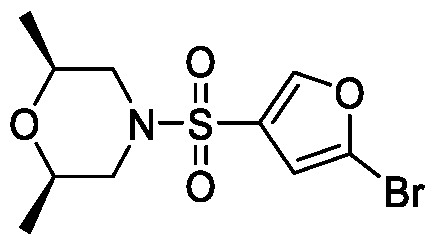
NBS (710 mg, 3.99 mmol) was added dropwise to a stirred solution of (2R,6S)-4-(furan-3-ylsulfonyl)- 2,6-dimethylmorpholine Intermediate 7 (815 mg, 3.32 mmol) anhydrous DMF (20 mL) at 0°C. The resulting solution was stirred at 60°C for 2.5 h. The reaction mixture was stirred at 60°C for 2.5 h and then cooled to 0°C. NBS (710 mg, 3.99 mmol) was added dropwise at 0°C and the reaction mixture was then heated at 60°C for 2.5 h. The reaction mixture was cooled again to 0°C and NBS (710 mg, 3.99 mmol) was added dropwise at 0°C. The reaction mixture was heated at 60°C for 2.5 h. The reaction mixture was diluted with water (200 mL) and extracted with EtOAc (3x150 mL). The combined organic layer was washed with brine (sat, 3x200 mL), dried over NajSC , filtered, and concentrated. The crude product was purified by reversed phase flash chromatography on a C18- column (gradient: 10-100% MeCN in water) and then by preparative TLC (EtOAc:petroleum ether, 1:4), to afford the title compound (525 mg, 49 %) as a white solid; MS (ESI) m/z [M+H]+324/326.
Intermediate 9
4,4,5,5-Tetramethyl-2-(2,4,5-trifluoro-3-methoxyphenyl)-l,3,2-dioxaborolane

A mixture of 2,4,5-trifluoro-3-methoxybenzoic acid (2.40 g, 11.6 mmol), Pd(OAc)2 (0.157 g, 0.70 mmol), bis(pinacolato)diboron (4.44 g, 17.5 mmol), pivalic anhydride (3.54 mL, 17.5 mmol), TEA (2.44 mL, 17.5 mmol) and dppb (0.596 g, 1.40 mmol) in 1,4-dioxane (60 mL) was stirred at 100°C for 48 h under a Nj(g) atmosphere. The mixture was cooled to rt and diluted with EtOAc (60 mL). The solids were filtered off and the filtrate was concentrated. The crude product was purified by straight phase flash chromatography on silica (gradient: 0-6% EtOAc in heptane) to give the title compound (2.25 g, 67%) as a colourless oil; XH NMR (500 MHz, CDCI3) 6 1.35 (s, 12H), 4.01 (s, 3H), 7.20 (td, 1H).
Intermediate 10
(2/?,6S)-2,6-Dimethyl-4-((5-(2,4,5-trifluoro-3-methoxyphenyl)furan-3-yl)sulfonyl)morpholine

K3PO4 (802 mg, 3.78 mmol) was added to (2R,6S)-4-((5-bromofuran-3-yl)sulfonyl)-2,6- dimethylmorpholine Intermediate 8 (490 mg, 1.51 mmol), 4,4,5,5-tetramethyl-2-(2,4,5-trifluoro-3- methoxyphenyl)-l,3,2-dioxaborolane Intermediate 9 (1.31 g, 4.53 mmol), XPhos Pd G3 (383 mg, 0.45 mmol) and XPhos (216 mg, 0.45 mmol) in THF (10 mL) and water (2 mL) at 25°C. The reaction mixture was stirred under a Nz(g) atmosphere at 60°C for 2 h. The reaction mixture was diluted with water (50 mL) and extracted with EtOAc (3x100 mL). The combined organic layer was dried over NajSC , filtered, and concentrated. The residue was purified by preparative TLC (EtOAc:petroleum ether, 1:4), to afford the title compound (448 mg, 73%) as a white solid; MS (ESI) m/z [M+H]+ 406.
Intermediate 11
5-((tert-Butyldimethylsilyl)oxy)piperidin-2-one
 tert-Butylchlorodimethylsilane (0.564 mL, 3.26 mmol) was added to a mixture of 5-hydroxypiperidin- 2-one (302 mg, 2.62 mmol) and lH-imidazole (357 mg, 5.25 mmol) in anhydrous NMP (3 mL) at rt and the resulting solution was stirred at rt overnight. The solution was diluted with MTBE (40 mL) and washed with water (3x15 mL), dried over NajSC , filtered and concentrated to give the title compound (485 mg, 81%) as a white solid; MS m/z (ESI) [M+H]+ 230.
Intermediate 12
Ethyl 2-(2,4,5-trifluoro-3-methoxyphenyl)thiazole-5-carboxylate

A solution of 2,4,5-trifluoro-3-methoxybenzothioamide W02023222850 Al (1.095 g, 4.95 mmol) and ethyl 2-chloro-3-oxopropanoate (0.820 g, 5.45 mmol) in toluene (25 mL) was heated at 105-110°C
for 4 h. The reaction mixture was concentrated under reduced pressure and the residue was purified by straight phase flash chromatography on silica, (0-30% EtOAc in heptane) to give an orange solid which was further purified by trituration with heptane to give the title compound (282 mg, 18%) as a pale orange solid; MS m/z (ESI) [M+H]+ 318.1.
Intermediate 13
(2-(2,4,5-Trifluoro-3-methoxyphenyl)thiazol-5-yl)methanol

NaBE (0.227 g, 5.99 mmol) was added to a stirred solution of ethyl 2-(2,4,5-trifluoro-3- methoxyphenyl)thiazole-5-carboxylate Intermediate 12 (0.38 g, 1.20 mmol) in THF (4.5 mL) and MeOH (1.5 mL). The reaction mixture was stirred at 55 °C for 1 h. The reaction solution was cooled to rt and 3.8 M HCI (5 mL, aq) was added, and the mixture was stirred for 10 min. THF and MeOH was evaporated off, and the remaining water residue was extracted with 150 mL EtOAc (x2). The combined organic layers were washed with water (20 mL), passed through a phase separator, and concentrated under reduced pressure to give the title compound (0.33 g, 100 %) as a white solid; MS (ESI) m/z [M+H]+ 276.1
Example 1 rac-(2/?,6S)-2,6-Dimethyl-4-((5-(2,4,5-trifluoro-3-hydroxyphenyl)-l,2,4-oxadiazol-3- yl)methyl)morpholin-3-one

A solution of 4 M HCI in dioxane (0.359 mL, 2.51 mmol) and roc-(2R,6S)-2,6-dimethyl-4-((5-(2,4,5- trifluoro-3-((4-methoxybenzyl)oxy)phenyl)-l,2,4-oxadiazol-3-yl)methyl)morpholin-3-one
Intermediate 4 (80 mg, 0.17 mmol) in 1,4-dioxane (10 mL) was stirred at 60°C for 3 h. The reaction mixture was concentrated and the residue was purified by preparative HPLC, PrepMethod A (gradient: 6-27%), to afford the title compound (30 mg, 50%) as a white solid; HRMS (ESI) m/z [M+H]+ calcd for C15H15F3N3O4: 358.1008, found: 358.1004; XH NMR (500 MHz, DMSO-dg) 6 1.14 (3H,
d), 1.27 (3H, d), 3.29-3.40 (2H, m), 3.91-4.00 (1H, m), 4.20 (1H, q), 4.62 (1H, d), 4.74 (1H, d), 7.1-
7.17 (1H, m).
Example 2
4-((5-(2,4,5-Trifluoro-3-hydroxyphenyl)-l,2,4-oxadiazol-3-yl)methyl)morpholin-3-one

(5-(2,4,5-Trifluoro-3-((methylsulfonyl)oxy)phenyl)-l,2,4-oxadiazol-3-yl)methyl methanesulfonate Intermediate 6 (100 mg, 0.25 mmol) was added to a stirred suspension of morpholin-3-one (55.3 mg, 0.55 mmol) and NaOt-Am (60 mg, 0.55 mmol) in NMP (3 mL) and the resulting suspension was stirred at rt for 1.5 h. AcOH (0.043 mL, 0.75 mmol) was added followed by water (0.1 mL) and the mixture was filtered through a syringe filter (Glass Acrodisk 25 mm, 1.0 pm). The filtrate was purified by preparative HPLC, PrepMethod B (gradient: 15-55%), to give the title compound (59 mg, 72%) as a white solid; HRMS (ESI) m/z [M+H]+ calcd for CI3HIIF3N3O4: 330.0696, found: 330.0684; XH NMR (500 MHz, DMSO-dg) 6 3.49-3.55 (2H, m), 3.85-3.9 (2H, m), 4.12 (2H, s), 4.79 (2H, s), 7.59 (1H, ddd), 11.64 (1H, s).
Example 3 l-((5-(2,4,5-Trifluoro-3-hydroxyphenyl)-l,2,4-oxadiazol-3-yl)methyl)piperidin-2-one

A solution of (5-(2,4,5-trifluoro-3-((methylsulfonyl)oxy)phenyl)-l,2,4-oxadiazol-3-yl)methyl methanesulfonate Intermediate 6 (75 mg, 0.19 mmol) in NMP (0.7 mL) was added to a stirred suspension of piperidin-2-one (47 mg, 0.41 mmol) and NaOt-Am (45.2 mg, 0.41 mmol) in NMP (1.3 mL) and the resulting solution was stirred at rt for 20 min. AcOH (32 pL, 0.56 mmol) was added followed by water (0.1 mL) and the mixture was filtered through a syringe filter (Glass Acrodisk 25 mm, 1.0 pm). The filtrate was purified by preparative HPLC, PrepMethod B (gradient: 15-55%), to give the title compound (29 mg, 47%) as a white solid; HRMS (ESI) m/z [M+H]+ calcd for CI4HI3F3N3O3:
328.0904, found: 328.0926; XH NMR (500 MHz, DMSO-dg) 6 1.71-1.82 (4H, m), 2.29 (2H, t), 3.43 (2H, t), 4.72 (2H, s), 7.5-7.59 (1H, m), 11.64 (1H, s).
Example 4 l-((5-(2,4,5-Trifluoro-3-hydroxyphenyl)-l,2,4-oxadiazol-3-yl)methyl)piperidine-2,6-dione

(5-(2,4,5-Trifluoro-3-((methylsulfonyl)oxy)phenyl)-l,2,4-oxadiazol-3-yl)methyl methanesulfonate Intermediate 6 (100 mg, 0.25 mmol) was added to a stirred suspension of piperidine-2, 6-dione (62 mg, 0.55 mmol) and NaOt-Am (60 mg, 0.55 mmol) in anhydrous NMP (3 mL) and the resulting suspension was stirred at rt overnight. AcOH (0.043 mL, 0.75 mmol) was added followed by water (0.1 mL) and the mixture was filtered through a syringe filter (Glass Acrodisk 25 mm, 1.0 pm). The filtrate was purified by preparative HPLC PrepMethod B (gradient: 15-55%), to give the title compound (47 mg, 55%) as a white solid; HRMS (ESI) m/z [M+H]+ +calcd for C14H11F3N3O4: 342.0696, found: 342.0690; XH NMR (500 MHz, DMSO-dg) 6 1.90 (2H, p), 2.71 (4H, t), 5.04 (2H, s), 7.54 (1H, ddd), 11.64 (1H, s).
Example 5
3-(4-(((2/?,6S)-2,6-Dimethylmorpholino)sulfonyl)furan-2-yl)-2,5,6-trifluorophenol

A solution of (2S,6R)-2,6-dimethyl-4-((5-(2,4,5-trifluoro-3-methoxyphenyl)furan-3- yl)sulfonyl)morpholine Intermediate 10 (317 mg, 0.78 mmol) in methanesulfonic acid (10 mL) was stirred at 25°C for 30 min. roc-D-Methionine (467 mg, 3.13 mmol) was added portion wise and the resulting solution was stirred at 60°C for 18 h. The reaction mixture was very carefully poured into NaHCOs (sat, aq, 100 mL) and extracted with EtOAc (3x150 mL). The combined organic layer was dried over NajSC , filtered, and concentrated. The residue was purified by preparative TLC (EtOAc:petroleum ether, 1:1) and then by preparative HPLC PrepMethod C (gradient 15-35%), to
afford the title compound (55 mg, 18%) as a white solid; HRMS (ESI) m/z [M+H]+ calcd for C16H17F3NO5S: 390.0618, found: 390.0650; XH NMR (300 MHz, CDCI3) 6 1.19 (6H, d), 2.14 (2H, dd), 3.54-3.62 (2H, m), 3.67-3.83 (2H, m), 6.92-6.99 (1H, m), 7.19 (1H, ddd), 7.93 (1H, d).
Example 6
2-((5-(2,4,5-Trifluoro-3-hydroxyphenyl)-l,2,4-oxadiazol-3-yl)methyl)-l,2-thiazinane 1,1-dioxide

NaOt-Am (60.2 mg, 0.55 mmol) was added to a solution of 1,2-thiazinane 1,1-dioxide (74 mg, 0.55 mmol) in anhydrous NMP (1.5 mL) and the resulting mixture was stirred at rt for 2 min. (5-(2,4,5- Trifluoro-3-((methylsulfonyl)oxy)phenyl)-l,2,4-oxadiazol-3-yl)methyl methanesulfonate Intermediate 6 (100 mg, 0.25 mmol) was added and the reaction mixture was stirred at rt for 1 h. AcOH (43 pL, 0.75 mmol) was added followed by water (0.1 mL) and the mixture was filtered through a syringe filter (Glass Acrodisk 25 mm, 0.45 pm). The filtrate was purified by preparative HPLC, PrepMethod B, (gradient: 20-60%), to give the title compound (54 mg, 60%) as a white solid; HRMS (ESI) m/z [M+H]+ calcd for C13H13F3N3O4S: 364.0574, found: 364.0588; XH NMR (DMSO-dg) 6: 1.56-1.65 (2H, m), 2.00-2.09 (2H, m), 3.22 (2H, t), 3.43 (2H, t), 4.54 (2H, s), 7.55-7.64 (1H, m), 11.67 (1H, s)
Example 7
5-Hydroxy-l-((5-(2,4,5-trifluoro-3-hydroxyphenyl)-l,2,4-oxadiazol-3-yl)methyl)piperidin-2-one

(5-(2,4,5-Trifluoro-3-((methylsulfonyl)oxy)phenyl)-l,2,4-oxadiazol-3-yl)methyl methanesulfonate Intermediate 6 (100 mg, 0.25 mmol) was added to a stirred suspension of of 5-((tert- butyldimethylsilyl)oxy)piperidin-2-one Intermediate 11 (125 mg, 0.55 mmol) and NaOt-Am (60 mg,
0.55 mmol) in NMP (3 mL) and the reaction mixture was stirred at rt for 2 h. NaOt-Am (27 mg, 0.25
mmol) was added and the reaction mixture was stirred for 2 h. The reaction mixture was poured into 0.05 M KHSO4 (aq, 20 mL) and extracted with MTBE (40 mL). The organic layer was washed with water (2x15 mL), dried over NajSC , filtered and concentrated. The residue was dissolved in 90% TFA (aq, 2 mL) and stirred at rt for 1 h. The solution was concentrated, and the residue was purified by preparative HPLC , PrepMethod B (gradient: 10-50%) to give the title compound (42 mg, 50%) as a white solid; HRMS (ESI) m/z [M+H]+ calcd for C14H13F3N3O4: 344.0852, found: 344.0852; XH NMR (500 MHz, DMSO-dg) 6 1.69-1.79 (1H, m), 1.82-1.92 (1H, m), 2.26 (1H, dt), 2.37-2.46 (1H, m), 3.27 (1H, dd), 3.54 (1H, dd), 3.96-4.01 (1H, m), 4.59 (1H, d), 4.79 (1H, d), 5.08 (1H, s), 7.52-7.61 (1H, m), 11.65 (1H, s).
Example 8
6-Cyclopropyl-4-((5-(2,4,5-trifluoro-3-hydroxyphenyl)-l,2,4-oxadiazol-3-yl)methyl)morpholin-3- one

(5-(2,4,5-Trifluoro-3-((methylsulfonyl)oxy)phenyl)-l,2,4-oxadiazol-3-yl)methyl methanesulfonate Intermediate 6 (100 mg, 0.25 mmol) was added to a stirred suspension 6-cyclopropylmorpholin-3- one (77 mg, 0.55 mmol) and NaOt-Am (60 mg, 0.55 mmol) in NMP (3 mL) and the reaction mixture was stirred at rt for 3 h. AcOH (85 pL, 1.49 mmol) was added and the solution was filtered through a syringefilter (Glass Acrodisk 25 mm, 1.0 pm). The filter was washed with DMSO (0.5 mL) and the combined filtrates were purified by preparative HPLC, PrepMethod D (gradient: 25-65%), to give the title compound (39 mg, 43%) as an off white solid; HRMS (ESI) m/z [M+H]+ calcd for C16H15F3N3O : 370.1008, found: 370.0992; XH NMR (DMSO-dg) 60.26-0.40 (2H, m), 0.44-0.54 (2H, m), 0.89-0.99 (1H, m), 3.23 (1H, td), 3.48-3.55 (2H, m), 4.08 (1H, d), 4.17 (1H, d), 4.68 (1H, d), 4.88 (1H, d), 7.59 (1H, ddd), 11.64 (1H, s).
Example 9 l-((2-(2, 4, 5-Trifluoro-3-hydroxyphenyl)thiazol-5-yl)methyl)piperidine-2, 6-dione

Methanesulfonic anhydride (0.171 g, 0.98 mmol) was added to a stirred solution of (2-(2,4,5- trifluoro-3-methoxyphenyl)thiazol-5-yl)methanol Intermediate 13 (0.180 g, 0.65 mmol) and DIPEA (0.343 mL, 1.96 mmol) in DCM (6 mL). The reaction mixture was stirred at rt for 30 min to give a solution of crude subtitle compound that was used directly in Example 9 step b).
Step b) l-((2-(2, 4, 5-Trifluoro-3-methoxyphenyl)thiazol-5-yl)methyl)piperidine-2, 6-dione

A crude solution of (2-(2,4,5-trifluoro-3-methoxyphenyl)thiazol-5-yl)methyl methanesulfonate in DCM, Example 9 step a) was added to a stirred solution of piperidine-2, 6-dione (37 mg, 0.33 mmol) and NaOt-Am (70 mg, 0.64 mmol) in NMP (2 mL). The reaction mixture was stirred at rt for 2 h. AcOH (0.074 mL, 1.30 mmol) was added, and the DCM was evaporated under reduced pressure to give a solution of crude subtitle compound in NMP that was used directly in Example 9 step c); MS (ESI) m/z [M+H]+ 371.1.
Step c) l-((2-(2, 4, 5-Trifluoro-3-hydroxyphenyl)thiazol-5-yl)methyl)piperidine-2, 6-dione
A solution of crude l-((2-(2, 4, 5-trifluoro-3-methoxyphenyl)thiazol-5-yl)methyl)piperidine-2, 6-dione in NMP, Example 9 step b), and KI (717 mg, 4.32 mmol) was diluted with NMP (2 mL) and heated at 130 °C for 2 h. The reaction mixture was stirred at rt overnight. The mixture was diluted with DMSO, filtered and purified by preparative HPLC, PrepMethod D (gradient: 20-60%) to give the title compound (21 mg, 1 %) as a white solid; HRMS (ESI) m/z [M+H]+ calcd for C15H12F3N2O3S: 355.0358, found: 355.0366.
The following Examples 10-14 were prepared from Intermediate 13 and the appropriate amine in an analogues manner as described for Example 9.
Example 10 6-Cyclopropyl-4-((2-(2,4,5-trifluoro-3-hydroxyphenyl)thiazol-5-yl)methyl)morpholin-3-one

HRMS (ESI) m/z [M+H]+ calcd for C17H16F3N2O3S: 383.0672, found: 383.0678
Example 11
(l/?,5S)-3-((2-(2,4,5-Trifluoro-3-hydroxyphenyl)thiazol-5-yl)methyl)-3-azabicyclo[3.1.0]hexane-2,4- dione

HRMS (ESI) m/z [M+H]+ calcd for C15H10F3N2O3S: 355.0358, found: 355.0376
Example 12
(l/?,5S)-3-((2-(2,4,5-Trifluoro-3-hydroxyphenyl)thiazol-5-yl)methyl)-3-azabicyclo[3.2.0]heptane-2,4- dione
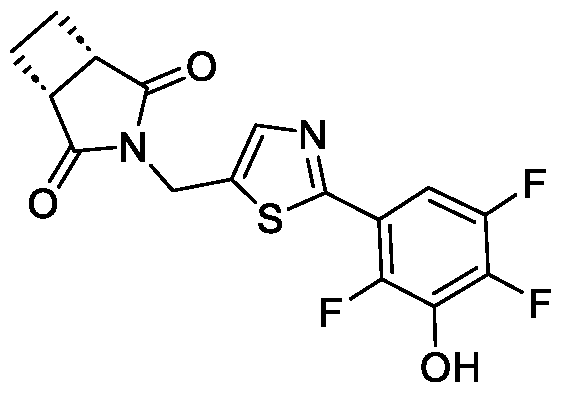
HRMS (ESI) m/z [M+H]+ calcd for C16H12F3N2O3S: 369.0516, found: 369.0504
Example 13 l-((2-(2, 4, 5-Trifluoro-3-hydroxyphenyl)thiazol-5-yl)methyl)pyrrolidine-2, 5-dione

HRMS (ESI) m/z [M+H]+ calcd for C14H10F3N2O3S: 343.0358, found: 343.0364
Example 14
3-((2-(2, 4, 5-Trifluoro-3-hydroxyphenyl)thiazol-5-yl)methyl)oxazolidine-2, 4-dione

HRMS (ESI) m/z [M+H]+ calcd for Ci3H8F3N2O4S: 345.0152, found: 345.0148
In vitro 17bHSD13 enzyme assay
10 concentration of compounds (0.2 pl) in DMSO was added to GREINER PP 384 well plate (781280) using ECHO dispensing (BECKMAN COULTER) followed by 20 pl of recombinant 17bHSD13 (N2-K300). The enzyme reaction was initiated by addition, using CERTUS-FLEX dispenser (GYGER), of 20 pl of substrate solution containing NAD (SIGMA, N1511) and Estradiol (SIGMA, E8875). After each addition plates were centrifuged for 1 min at 150x g (EPPENDORF, 5810R, A-4-81). Final assay conditions were 80 nM of 17bHSD13, 0.5 mM of NAD, 20 pM Estradiol and various concentrations of compound in buffer (5 mM EDTA (TEKNOVA E0306), 0.01% DDM (AFFYMETRIX D310) in 50mM Tris- Cl, pH 7.4). After 2.5 h the reaction were stopped by addition of 20 pl of 0.6 % Formic acid (MERCK 5.33002) and samples were analyzed using LC-MS/MS.
SCIEX LC-MS/MS system: Sample was injected with CTC analytical injector, SHIMATZU LC pumps LC20 and analyzed on the SCIEX API 5000 LCMSMS system with the following settings. Samples were chromatographed on a WATERS, SYMMETRY, C8, 3.5 pm, 2. lx 50 mm) column at constant flow rate of 0.5 mL/min. The mobile phases consist of A (water with 0.2% formic acid) and B (acetonitrile with
0.2% formic acid). The LC gradient profile is as follows: 50% B during 0 to 0.5 min, a linear increase to 100% B during 0.5 to 1 min, hold at 100% B during 1 to 1.6 min then back to 50% B from 1.6 to 2 min. The run time was 2 min with retention times of approximately 0.8 and 1.07 min for Estradiol and Estrone, respectively. Detection was performed on a API 5000 LC/MS/MS system with a triple quadrupole mass spectrometer, a TURBO V ion source, in multiple reaction monitoring (MRM) mode at positive polarity with APCI probe. The MRM pairs were m/z 273.1 to m/z 107.0 and m/z 271.3 to 107.0. for Estradiol and Estrone, respectively. The dwell times were 100 ms for each transition and a depolarization and collision energy of 100 and 40, respectively. Data from MS signals was using area under curve (AUC). Ratio = Estrone/(Estrone + Estradiol)
In vitro 17bHSD13 cell assay
Inhibition of 17bHSD13 was measured in a cell-based assay with over expressed HSD17P13 in HEK293S cells, measuring estradiol to estrone conversion by LCMS/MS.
Cells were plated in 384 well plates (GREINER CELL culture plate 384w black/clear Poly-D-Lysine) at 10 K c/w in 30 pl of culture media (DMEM with GLUTAMAX plus 10 % FBS). After the cells were allowed to attach for 6 h, 0.15 pl of 10 concentration of compounds and 0.03 pl of 10 mM Estradiol (SIGMA, E8875) in DMSO, was added using ECHO dispensing (BECKMAN COULTIER). After 18 h of cell culturing for 20 pl of media was transferred using BRAVO dispensing robot (AGILENT) to a GREINER PP 384 well plate (781280) and 40 pl of 50 % acetonitrile was added. Samples were analyzed using LC-MS/MS.
SCIEX LC-MS/MS system: Sample was injected with CTC analytical injector, SHIMATZU LC pumps LC20 and analysed on the SCIEX API 5000 LCMSMS system with the following settings. Samples were chromatographed on a WATERS, symmetry, C8, 3.5 pm, 2. lx 50 mm) column at constant flow rate of 0.5 mL/min. The mobile phases consist of A (water with 0.2% formic acid) and B (acetonitrile with 0.2% formic acid). The LC gradient profile is as follows: 50% B during 0 to 0.5 min, a linear increase to 100% B during 0.5 to 1 min, hold at 100% B during 1 to 1.6 min then back to 50% B from 1.6 to 2 min. The run time was 2 min with retention times of approximately 0.8 and 1.07 min for Estradiol and Estrone, respectively. Detection was performed on a API 5000 LC/MS/MS system with a triple quadrupole mass spectrometer, a TURBO V ion source, in multiple reaction monitoring (MRM) mode at positive polarity with APCI probe. The MRM pairs were m/z 273.1 to m/z 107.0 and m/z 271.3 to 107.0. for Estradiol and Estrone, respectively. The dwell times were 100 ms for each transition and a depolarization and collision energy of 100 and 40, respectively. Data from MS signals was using area under curve (AUC). Ratio = Estrone/(Estrone + Estradiol)
In vitro 17bHSD4 enzyme assay
10 concentration of compounds (0.2 pl) in DMSO was added to GREINER FLUOTRAC 200 384 well plate (781076) using ECHO dispensing (BECKMAN COULTER). 80 nl of 10 mM Estradiol (SIGMA, E8875) was added using Echo dispensing. The enzyme reaction was initiated by addition, using MULTIDROP COMBI dispensing (THERMO FISHER), of 40 pl of a mix containing recombinant 17bHSD4 (M1-N311) and NAD. Final assay conditions were 40 nM of 17bHSD4, 0.125 mM of NAD, 15 pM Estradiol and various concentrations of compound in buffer (5 mM EDTA (TEKNOVA E0306), 0.01% DDM (AFFYMETRIX D310) in 50mM Tris-CI, pH 7.4). After each addition plates were centrifuged for 1 min at 150x g (EPPENDORF, 5810R, A-4-81). NADH formation was measured by fluorescence intensity (Fl) (Ex360/Em460) at time zero (to) and at 1.5 h (ti) in a PHERASTAR FSX (BMG LABTECH). Fl for each sample was calculated as Fl at ti minus Fl at to.
In vitro 17bHSD9 cell assay
Inhibition of 17bHSD9 was measured in a cell-based assay with over expressed HSD17P9 in HEK293S cells, measuring retinol to retinal conversion by LCMS/MS.
Cells were plated in 384 well plates (GREINER CELL culture plate 384w black/clear Poly-D-Lysine) at 10 K c/w in 30 pl of culture media (DMEM with GLUTAMAX plus 10 % FBS). After the cells were allowed to attach for 6 h, 0.15 pl of 10 concentration of compounds and 0.015 pl of 10 mM all-trans- retinol (CAYMAN CHEMICAL, 20241) in DMSO, was added using ECHO dispensing (BECKMAN COULTIER). After 18 h of cell culturing for 20 pl of media was transferred using BRAVO dispensing robot (AGILENT) to a GREINER PP 384 well plate (781280) and 40 pl of 50 % acetonitrile was added. Samples were analyzed using LC-MS/MS.
SCIEX LC-MS/MS system: Sample was injected with CTC analytical injector, SHIMATZU LC pumps LC20 and analysed on the SCIEX API 5000 LCMSMS system with the following settings. Samples were chromatographed on a WATERS, symmetry, C8, 3.5 pm, 2. lx 50 mm) column at constant flow rate of 0.5 mL/min. The mobile phases consists of A (water with 0.2% formic acid) and B (acetonitrile with 0.2% formic acid). The LC gradient profile is as follows: 50% B during 0 to 0.1 min, a linear increase to 100% B during 0.1 to 0.8 min, hold at 100% B during 0.8 to 1.5 min then back to 50% B from 1.5 to 1.6 min and hold during run time. The run time was 2 min with retention times of approximately 1,54 and 1.62 min for Retinol and Retinal, respectively. Detection was performed on a API 5000 LC/MS/MS system with a triple quadrupole mass spectrometer, a TURBO V ion source, in multiple reaction monitoring (MRM) mode at positive polarity with ESI probe. The MRM pairs were m/z 269.3 to m/z 93.0 and m/z 285.2 to 161.0. for Retinol and Retinal, respectively. The dwell times were 100
ms for each transition and a depolarization and collision energy of 50 and 25, respectively. Data from MS signals was using area under curve (AUC). Ratio = Retinal/(Retinal+ Retinol).
Data analysis
GENEDATA SCREENER was used for curve fitting and calculation of IC50 values. Compound effect was calculated with the formula below;
Compound % effect = -100 x ((X-min)/(max-min)) where X represents the effect in the presence of test compound, min is DMSO and max is the maximum inhibition of enzyme using a known inhibitor as control.
Table 1
 The data in Table 1 may be from a single experiment or an average of two or more experiments.
The above description of illustrative embodiments is intended only to acquaint others skilled in the art with the Applicant's specification, its principles, and its practical application so that others skilled in the art may readily adapt and apply the specification in its numerous forms, as they may be best suited to the requirements of a particular use. This description and its specific examples, while indicating embodiments of this specification, are intended for purposes of illustration only. This
specification, therefore, is not limited to the illustrative embodiments described in this specification, and may be variously modified. In addition, it is to be appreciated that various features of the specification that are, for clarity reasons, described in the context of separate embodiments, also may be combined to form a single embodiment. Conversely, various features of the specification that are, for brevity reasons, described in the context of a single embodiment, also may be combined to form sub-combinations thereof.
Claims
1. A compound of Formula (I)
 each RA is independently selected from H, F and Cl,
RB is F or Cl,
Rc is H, F or Cl, one of X1, X2 and X3 is selected from NH, O and S and the other two of X1, X2 and X3 are independently selected from N and CRY, wherein each RY is independently H, -CN, or RXA, wherein RXA is independently C1-3 alkyl optionally substituted with one to three F, either (i) R1 and R2 are independently selected from H, R4 and R5, or (ii) R1 and R2 together with the carbon atom to which they are attached form a cyclopropane or cyclobutane ring, each R3 is independently R4A, R5A or -OH, each of R4 and R4A are independently Ci.g alkyl optionally substituted with one to three F, and each of R5 and R5A are independently C3-6 cycloalkyl optionally substituted with one to three F,
R6 is C1-6 alkyl, C3-6 cycloalkyl or H, each R7 is independently selected from R4A, R5A, -O(R4A) -O(R5A), -OH, -CN, and halo, n is 0, 1, 2 or 3,
J is O, CH2 or a covalent bond,
Q is CH2 or C(=O), and wherein optionally (i) one carbon atom of ring D1, D2, D3 or D4 is attached to a C2-5 alkylene group to form a spirocyclic ring, or (ii) two carbon atoms of ring D1, D2, D3 or D4 are attached to a C1-5 alkylene group to form a bridged or fused ring, wherein one CH2 group of said C2-5 alkylene group and C1-5 alkylene group may be optionally replaced by an oxygen group,
or a pharmaceutically acceptable salt thereof.
2. A compound of Formula (I), or a pharmaceutically acceptable salt thereof, as claimed in claim 1, wherein
(i) X1 is N, X2 is O and X3 is N,
(ii) X1 is N, X2 is N and X3 is O,
(iii) X1 is CRY, X2 is CRY and X3 is S,
(iv) X1 is O, X2 is N and X3 is CRY,
(v) X1 is N, X2 is O and X3 is CRY,
(vi) X1 is CRY, X2 is N and X3 is O,
(vii) X1 is O, X2 is N and X3 is N,
(viii) X1 is N, X2 is N and X3 is S,
(ix) X1 is CRY, X2 is S and X3 is CRY,
(x) X1 is CRY, X2 is N and X3 is S,
(xi) X1 is CRY, X2 is O and X3 is CRY,
(xii) X1 is CRY, X2 is CRY and X3 is N,
(xiii) X1 is N, X2 is CRY and X3 is S,
(xiv) X1 is CRY, X2 is S and X3 is N,
(xv) X1 is S, X2 is N and X3 is CRY,
(xvi) X1 is CRY, X2 is O and X3 is N,
(xvii) X1 is O, X2 is CRY and X3 is CRY, or
(xviii) X1 is N, X2 is S and X3 is CRY.
3. A compound of Formula (I), or a pharmaceutically acceptable salt thereof, as claimed in claim 1 or claim 2, wherein X1 is CRY, X2 is N and X3 is S.
4. A compound of Formula (I), or a pharmaceutically acceptable salt thereof, as claimed in claim 1 or claim 2, wherein X1 is CRY, X2 is O and X3 is CRY.
5. A compound of Formula (I), or a pharmaceutically acceptable salt thereof, as claimed in claim 1 or claim 2, wherein X1 is CRY, X2 is CRY and X3 is S.
6. A compound of Formula (I), or a pharmaceutically acceptable salt thereof, as claimed any one of claims 1 to 5, wherein each RA is independently H or F.
7. A compound of Formula (I), or a pharmaceutically acceptable salt thereof, as claimed any one of claims 1 to 6, wherein each RA is F.
8. A compound of Formula (I), or a pharmaceutically acceptable salt thereof, as claimed any one of claims 1 to 7, wherein RB is F.
9. A compound of Formula (I), or a pharmaceutically acceptable salt thereof, as claimed any one of claims 1 to 8, wherein Rc is H.
10. A compound of Formula (I), or a pharmaceutically acceptable salt thereof, as claimed in any one of claims 1 to 9, wherein R1 is H or CH3 and R2 is H.
11. A compound of Formula (I), or a pharmaceutically acceptable salt thereof, as claimed in any one of claims 1 to 10, wherein G is

12. A compound of Formula (I), or a pharmaceutically acceptable salt thereof, as claimed in any one of claims 1 to 11, wherein J is O.
13. A compound of Formula (I), or a pharmaceutically acceptable salt thereof, as claimed in any one of claims 1 to 12, wherein Q. is CH2.
14. A compound of Formula (I), or a pharmaceutically acceptable salt thereof, as claimed in any one of claims 1 to 13, wherein each R3 is independently C1-4 alkyl.
15. A compound of Formula (I), or a pharmaceutically acceptable salt thereof, as claimed in any one of claims 1 to 13, wherein G is
 wherein each R3A is independently H, R4A or R5A.
16. A pharmaceutical composition comprising a compound of Formula (I), or a pharmaceutically acceptable salt thereof, as claimed in any one of claims 1 to 15, and a pharmaceutically acceptable excipient.
17. A compound of Formula (I), or a pharmaceutically acceptable salt thereof, as claimed in any one of claims 1 to 15, for use in therapy.
18. A compound of Formula (I), or a pharmaceutically acceptable salt thereof, as claimed in any one of claims 1 to 15, for use in the treatment of liver disease.
19. A compound of Formula (I), or a pharmaceutically acceptable salt thereof, as claimed in any one of claims 1 to 15, for use in the treatment of a liver disease selected from alcoholic liver disease, non-alcoholic liver disease, NAFLD, NASH, liver fibrosis, cirrhosis, isolated steatosis, liver inflammation, alcoholic steatohepatitis (ASH), hepatitis C virus (HCV) and hepatocellular carcinoma (HCC).
20. A compound of Formula (I), or a pharmaceutically acceptable salt thereof, as claimed in any one of claims 1 to 15, for use in the treatment of NASH.
21. A method of treating liver disease in a patient comprising administering to the patient a compound of Formula (I), or a pharmaceutically acceptable salt thereof, as claimed in any one of claims 1 to 15.
Applications Claiming Priority (2)
| Application Number | Priority Date | Filing Date | Title |
|---|---|---|---|
| US202363599661P | 2023-11-16 | 2023-11-16 | |
| US63/599,661 | 2023-11-16 |
Publications (1)
| Publication Number | Publication Date |
|---|---|
| WO2025104697A1 true WO2025104697A1 (en) | 2025-05-22 |
Family
ID=93799684
Family Applications (1)
| Application Number | Title | Priority Date | Filing Date |
|---|---|---|---|
| PCT/IB2024/061419 Pending WO2025104697A1 (en) | 2023-11-16 | 2024-11-15 | Heteroaromatic 17beta hydroxy steroid dehydrogenase 13 inhibitors |
Country Status (1)
| Country | Link |
|---|---|
| WO (1) | WO2025104697A1 (en) |
Citations (1)
| Publication number | Priority date | Publication date | Assignee | Title |
|---|---|---|---|---|
| WO2023222850A1 (en) | 2022-05-19 | 2023-11-23 | Astrazeneca Ab | Amido heteroaromatic compounds useful in the treatment of liver diseases |
-
2024
- 2024-11-15 WO PCT/IB2024/061419 patent/WO2025104697A1/en active Pending
Patent Citations (1)
| Publication number | Priority date | Publication date | Assignee | Title |
|---|---|---|---|---|
| WO2023222850A1 (en) | 2022-05-19 | 2023-11-23 | Astrazeneca Ab | Amido heteroaromatic compounds useful in the treatment of liver diseases |
Non-Patent Citations (17)
| Title |
|---|
| "Concise Dictionary of Biomedicine and Molecular Biology", 2002, CRC PRESS |
| "Oxford Dictionary of Biochemistry and Molecular Biology", 2000, OXFORD UNIVERSITY PRESS |
| "Remington's Pharmaceutical Sciences", 1985, MACK PUBLISHING COMPANY |
| "The Diagnosis and Management of Nonalcoholic Fatty Liver Disease: Practice Guidance From the American Association for the Study of Liver Diseases", HEPATOLOGY, vol. 67, no. 1, 2018 |
| "The Dictionary of Cell and Molecular Biology", 1999, ACADEMIC PRESS |
| ABUL-HUSN ET AL., N ENGL J MED., vol. 378, no. 12, 2018, pages 1096 - 106 |
| CHEN ET AL., BMC MED GENET., vol. 18, 2017, pages 91 |
| GELLERT-KRISTENSEN ET AL., HEPATOLOGY, vol. 71, no. 1, 2020, pages 56 - 66 |
| HOTTA ET AL., AM. J. OPHTHALMOL., vol. 135, 2003, pages 917 - 9 |
| KOZLITINA ET AL., N ENGL J MED, vol. 379, no. 19, 2018, pages 1876 - 7 |
| LABRIE ET AL., JOURNAL OF MOLECULAR ENDOCRINOLOGY, vol. 25, 2000, pages 1 - 16 |
| MA ET AL., HEPATOLOGY, vol. 69, no. 4, 2019, pages 1504 - 19 |
| PIERCE ET AL., AM. J. HUM. GENET., vol. 87, 2010, pages 282 - 8 |
| SKORCZYK-WERNER ET AL., J. APPL. GENET., vol. 56, 2015, pages 317 - 27 |
| THAMM SVEN ET AL: "Discovery of a Novel Potent and Selective HSD17B13 Inhibitor, BI-3231, a Well-Characterized Chemical Probe Available for Open Science", JOURNAL OF MEDICINAL CHEMISTRY, vol. 66, no. 4, 2 February 2023 (2023-02-02), US, pages 2832 - 2850, XP093064026, ISSN: 0022-2623, Retrieved from the Internet <URL:https://pubs.acs.org/doi/pdf/10.1021/acs.jmedchem.2c01884> DOI: 10.1021/acs.jmedchem.2c01884 * |
| WANG ET AL., EUR REV MED PHARMACOL SCI, vol. 24, no. 17, 2020, pages 8997 - 9007 |
| WEN SU ET AL., MOLECULAR AND CELLULAR ENDOCRINOLOGY, vol. 489, 2019, pages 119 - 125 |
Similar Documents
| Publication | Publication Date | Title |
|---|---|---|
| EP4219487B9 (en) | Glp-1 receptor agonists and uses thereof | |
| EP3143020B1 (en) | Dihydroquinolizinones for the treatment and prophylaxis of hepatitis b virus infection | |
| EP4514782B1 (en) | Amido heteroaromatic compounds useful in the treatment of liver diseases | |
| WO2010094977A1 (en) | Novel biphenyl compounds useful for the treatment of hepatitis c | |
| JP2024536353A (en) | GLP-1 receptor modulators and certain 2,5-diazabicyclo[4.2.0]octanes | |
| US20230165865A1 (en) | Heteroaryldihydropyrimidine derivatives and methods of treating hepatitis b infections | |
| TW201002696A (en) | Novel compounds 409 | |
| WO2025104701A1 (en) | Amido heteroaromatic compounds | |
| WO2025104699A1 (en) | Uracil compounds | |
| KR102963549B1 (en) | Amido heteroaromatic compounds useful for the treatment of liver disease | |
| WO2023222849A1 (en) | Amino heteroaromatic compounds useful in the treatment of liver diseases | |
| WO2023223257A1 (en) | Amino heteroaromatic compounds | |
| TWI919070B (en) | Amido heteroaromatic compounds and uses thereof | |
| HK40117545B (en) | Amido heteroaromatic compounds useful in the treatment of liver diseases | |
| HK40117545A (en) | Amido heteroaromatic compounds useful in the treatment of liver diseases | |
| TWI785351B (en) | Thiazolidinedione derivatives and pharmaceutical compositions containing them | |
| EA052200B1 (en) | AMIDO-HETERAROMATIC COMPOUNDS USED IN THE TREATMENT OF LIVER DISEASES | |
| BRPI0415273B1 (en) | MORPHOLINE DERIVATIVES AS NOREPINEPHRINE REABSORATION INHIBITORS, ITS CHLORIDRATE SALT, ITS USE, INTERMEDIARIES AND PREPARATION PROCESS, AND PHARMACEUTICAL COMPOSITION | |
| RU2769715C9 (en) | Glp-1 receptor agonists and use thereof | |
| WO2025196446A1 (en) | Thiadiazoles as glutaminase 1 inhibitors | |
| WO2025093589A1 (en) | Heteroaryl amide derivatives as sodium channel inhibitors | |
| CA3251045A1 (en) | Modulators of cystic fibrosis transmembrane conductance regulator | |
| MXPA06005226A (en) | Morpholine derivatives as norepinephrine reuptake inhibitors |
Legal Events
| Date | Code | Title | Description |
|---|---|---|---|
| 121 | Ep: the epo has been informed by wipo that ep was designated in this application |
Ref document number: 24818064 Country of ref document: EP Kind code of ref document: A1 |