WO2025101652A1 - Selective mammalian sterile 20-like kinase 1 (mst1) modulator compounds as therapeutics for diabetes and liver regeneration - Google Patents
Selective mammalian sterile 20-like kinase 1 (mst1) modulator compounds as therapeutics for diabetes and liver regeneration Download PDFInfo
- Publication number
- WO2025101652A1 WO2025101652A1 PCT/US2024/054783 US2024054783W WO2025101652A1 WO 2025101652 A1 WO2025101652 A1 WO 2025101652A1 US 2024054783 W US2024054783 W US 2024054783W WO 2025101652 A1 WO2025101652 A1 WO 2025101652A1
- Authority
- WO
- WIPO (PCT)
- Prior art keywords
- compound
- pharmaceutically acceptable
- acceptable salt
- disease
- alkyl
- Prior art date
- Legal status (The legal status is an assumption and is not a legal conclusion. Google has not performed a legal analysis and makes no representation as to the accuracy of the status listed.)
- Pending
Links
Classifications
-
- C—CHEMISTRY; METALLURGY
- C07—ORGANIC CHEMISTRY
- C07D—HETEROCYCLIC COMPOUNDS
- C07D401/00—Heterocyclic compounds containing two or more hetero rings, having nitrogen atoms as the only ring hetero atoms, at least one ring being a six-membered ring with only one nitrogen atom
- C07D401/02—Heterocyclic compounds containing two or more hetero rings, having nitrogen atoms as the only ring hetero atoms, at least one ring being a six-membered ring with only one nitrogen atom containing two hetero rings
- C07D401/12—Heterocyclic compounds containing two or more hetero rings, having nitrogen atoms as the only ring hetero atoms, at least one ring being a six-membered ring with only one nitrogen atom containing two hetero rings linked by a chain containing hetero atoms as chain links
-
- C—CHEMISTRY; METALLURGY
- C07—ORGANIC CHEMISTRY
- C07D—HETEROCYCLIC COMPOUNDS
- C07D401/00—Heterocyclic compounds containing two or more hetero rings, having nitrogen atoms as the only ring hetero atoms, at least one ring being a six-membered ring with only one nitrogen atom
- C07D401/14—Heterocyclic compounds containing two or more hetero rings, having nitrogen atoms as the only ring hetero atoms, at least one ring being a six-membered ring with only one nitrogen atom containing three or more hetero rings
-
- C—CHEMISTRY; METALLURGY
- C07—ORGANIC CHEMISTRY
- C07D—HETEROCYCLIC COMPOUNDS
- C07D405/00—Heterocyclic compounds containing both one or more hetero rings having oxygen atoms as the only ring hetero atoms, and one or more rings having nitrogen as the only ring hetero atom
- C07D405/14—Heterocyclic compounds containing both one or more hetero rings having oxygen atoms as the only ring hetero atoms, and one or more rings having nitrogen as the only ring hetero atom containing three or more hetero rings
-
- C—CHEMISTRY; METALLURGY
- C07—ORGANIC CHEMISTRY
- C07D—HETEROCYCLIC COMPOUNDS
- C07D413/00—Heterocyclic compounds containing two or more hetero rings, at least one ring having nitrogen and oxygen atoms as the only ring hetero atoms
- C07D413/14—Heterocyclic compounds containing two or more hetero rings, at least one ring having nitrogen and oxygen atoms as the only ring hetero atoms containing three or more hetero rings
-
- C—CHEMISTRY; METALLURGY
- C07—ORGANIC CHEMISTRY
- C07D—HETEROCYCLIC COMPOUNDS
- C07D471/00—Heterocyclic compounds containing nitrogen atoms as the only ring hetero atoms in the condensed system, at least one ring being a six-membered ring with one nitrogen atom, not provided for by groups C07D451/00 - C07D463/00
- C07D471/02—Heterocyclic compounds containing nitrogen atoms as the only ring hetero atoms in the condensed system, at least one ring being a six-membered ring with one nitrogen atom, not provided for by groups C07D451/00 - C07D463/00 in which the condensed system contains two hetero rings
- C07D471/10—Spiro-condensed systems
-
- C—CHEMISTRY; METALLURGY
- C07—ORGANIC CHEMISTRY
- C07D—HETEROCYCLIC COMPOUNDS
- C07D487/00—Heterocyclic compounds containing nitrogen atoms as the only ring hetero atoms in the condensed system, not provided for by groups C07D451/00 - C07D477/00
- C07D487/02—Heterocyclic compounds containing nitrogen atoms as the only ring hetero atoms in the condensed system, not provided for by groups C07D451/00 - C07D477/00 in which the condensed system contains two hetero rings
- C07D487/08—Bridged systems
-
- C—CHEMISTRY; METALLURGY
- C07—ORGANIC CHEMISTRY
- C07D—HETEROCYCLIC COMPOUNDS
- C07D491/00—Heterocyclic compounds containing in the condensed ring system both one or more rings having oxygen atoms as the only ring hetero atoms and one or more rings having nitrogen atoms as the only ring hetero atoms, not provided for by groups C07D451/00 - C07D459/00, C07D463/00, C07D477/00 or C07D489/00
- C07D491/02—Heterocyclic compounds containing in the condensed ring system both one or more rings having oxygen atoms as the only ring hetero atoms and one or more rings having nitrogen atoms as the only ring hetero atoms, not provided for by groups C07D451/00 - C07D459/00, C07D463/00, C07D477/00 or C07D489/00 in which the condensed system contains two hetero rings
- C07D491/10—Spiro-condensed systems
- C07D491/107—Spiro-condensed systems with only one oxygen atom as ring hetero atom in the oxygen-containing ring
-
- C—CHEMISTRY; METALLURGY
- C07—ORGANIC CHEMISTRY
- C07D—HETEROCYCLIC COMPOUNDS
- C07D498/00—Heterocyclic compounds containing in the condensed system at least one hetero ring having nitrogen and oxygen atoms as the only ring hetero atoms
- C07D498/02—Heterocyclic compounds containing in the condensed system at least one hetero ring having nitrogen and oxygen atoms as the only ring hetero atoms in which the condensed system contains two hetero rings
- C07D498/08—Bridged systems
-
- A—HUMAN NECESSITIES
- A61—MEDICAL OR VETERINARY SCIENCE; HYGIENE
- A61P—SPECIFIC THERAPEUTIC ACTIVITY OF CHEMICAL COMPOUNDS OR MEDICINAL PREPARATIONS
- A61P1/00—Drugs for disorders of the alimentary tract or the digestive system
- A61P1/16—Drugs for disorders of the alimentary tract or the digestive system for liver or gallbladder disorders, e.g. hepatoprotective agents, cholagogues, litholytics
-
- A—HUMAN NECESSITIES
- A61—MEDICAL OR VETERINARY SCIENCE; HYGIENE
- A61P—SPECIFIC THERAPEUTIC ACTIVITY OF CHEMICAL COMPOUNDS OR MEDICINAL PREPARATIONS
- A61P25/00—Drugs for disorders of the nervous system
- A61P25/28—Drugs for disorders of the nervous system for treating neurodegenerative disorders of the central nervous system, e.g. nootropic agents, cognition enhancers, drugs for treating Alzheimer's disease or other forms of dementia
-
- A—HUMAN NECESSITIES
- A61—MEDICAL OR VETERINARY SCIENCE; HYGIENE
- A61P—SPECIFIC THERAPEUTIC ACTIVITY OF CHEMICAL COMPOUNDS OR MEDICINAL PREPARATIONS
- A61P3/00—Drugs for disorders of the metabolism
- A61P3/08—Drugs for disorders of the metabolism for glucose homeostasis
- A61P3/10—Drugs for disorders of the metabolism for glucose homeostasis for hyperglycaemia, e.g. antidiabetics
Definitions
- MST1 Mammalian sterile 20-like kinase 1
- STK4 serine/threonine kinase 4
- MST1 activity is strongly induced under diabetic conditions.
- Neratinib a recently discovered MST1 inhibitor compound, improved cultured P-cell survival under multiple diabetogenic conditions and was shown to be efficacious in multiple animal models of diabetes.
- Neratinib was initially identified and developed as an irreversible dual inhibitor of EGFR/HER2 that covalently binds to a cysteine residue in the active site of EGFR/HER2 kinases, with recent FDA approval as a trastuzumab - based adjuvant therapy in patients with HER2 -positive breast cancer.
- neratinib has dose-limiting, gastrointestinal toxicity associated with on-target inhibition of EGFR, which likely precludes direct repurposing for a chronic disease like diabetes.
- potent MST1 modulator compounds with reduced EGFR activity that maintain the ability to protect P-cells.
- PHLF Post-hepatectomy liver failure
- NASH non-alcoholic fatty liver disease
- NAFLD as a risk factor for liver injury and PHLF is particularly important as the prevalence for NAFLD is estimated to be 30% in the United States.
- Preclinical models of NASH have demonstrated significant risk for mortality following partial hepatectomy, consistent with clinical outcomes in patients with NASH.
- the ability to augment or accelerate liver regeneration pharmacologically, in patients with or without NASH, may provide an avenue for prevention or treatment of PHLF.
- Compounds described herein are modulators of the MST1 kinase. More specifically, the compounds of the present disclosure are inhibitors of MST1 . In some embodiments, compounds are selective for MST1 overMST2. In some embodiments, the compounds have reduced EGFR activity. In some embodiments, a compound described herein may be useful in the treatment of MST1 mediated diseases, disorders, or conditions. In some embodiments, described herein an orally bioavailable MST1/2 inhibitor capable of inducing YAP-dependent pro-regenerative signaling, augmenting liver regeneration, and improving survival in a murine NASH model following partial hepatectomy.
- R 1 is hydrogen, halogen, Ci-C 6 -alkyl, Ci-C 6 -haloalkyl, -O(Ci-C 6 -alkyl), -O(Ci-C 6 - haloalkyl), -NHC(O)-(C 3 -C 6 -cycloalkyl), or
- R 2 is -OR 5 , -C2-Ce-alkynyl-(5- to 10-membered heteroaryl), C 3 -Ci4-heterocycloalkyl, 5- to 10-membered heteroaryl or -C(O)-(C 3 -Ci4-heterocycloalkyl), wherein -C 2 -C 6 -alkynyl-(5- to 10-membered heteroaryl), C 3 -Ci4-heterocycloalkyl, and 5- to 10-membered heteroaryl are each independently unsubstituted or substituted with Ci-C 6 -alkyl or C 3 -Ci 4 -heterocycloalkyl, and wherein at least two members of the 5- to 10-membered heteroaryl, at least one member of the - C 2 -C 6 -alkynyl-(5- to 10-membered heteroaryl), and at least one atom of the C 3 -Ci 4 -
- R 3a , R 3b , and R 3c are each independently hydrogen, halogen, -CN, Ci-C 6 alkyl, or -O(Ci- C 6 alkyl), wherein at least one of R 3a , R 3b , and R 3c is not hydrogen;
- R 7 and R 8 are each independently C 3 -Ci 4 -cycloalkyl or C 3 -Ci 4 -heterocycloalkyl, wherein any cycloalkyl and heterocycloalkyl is unsubstituted or substituted with at least one substituent selected from -OH, -CN, -N(R 7 ) 2 , C 6 -Ci 0 -aryl, -S(O) 0.2 (Ci-C 6 -alkyl), -Ci-C 6 -alkyl(N(R 7 ) 2 ), - C(O)R 7 , -(NH) 0 -IC(NH)(NH 2 ), Ci-C 6 -alkyl, hydroxy(Ci-C 6 -alkyl), Ci-C 6 -haloalkyl, -O(C C 6 - alkyl), -O(Ci-C 6 -haloalkyl), -(Ci-C6-alky
- n is 1 and the compound is of Formula (II): or a pharmaceutically acceptable salt thereof.
- R 4a and R 4b are each independently hydrogen, halogen, -NH 2 , or - CH 3 , and at least one of R 4a and R 4b is not hydrogen.
- R 1 is hydrogen, halogen, -O(Ci-C 6 -alkyl), -O(Ci-C 6 -haloalkyl),
- the compound is of Formula (III):
- R 5 is Ci-C 5 -alkyl or Ci-C 5 -haloalkyl.
- Ci- C 5 -alkyl and Ci-C 5 -haloalkyl are each independently substituted with halogen, -N(R 6 ) 2 , or - (NH)O-IC(NH)(NH 2 ).
- Ci-C 5 -alkyl and Ci-C 5 -haloalkyl are each
- NH H 2 N' ⁇ N' ⁇ independently substituted with -NH 2 , -NH(CH 3 ), -N(CH 3 ) 2 , or H
- R 5 is -CH 2 -(C 3 -Ci4-cycloalkyl) or -CH 2 -(Ce-Cio-aryl).
- -CH 2 -(C 3 -Ci4-cycloalkyl) and -CH 2 -(Ce-Cio-aryl) are each independently substituted with -N(R 6 ) 2 , -CH 2 -N(R 6 ) 2 , or C 6 -Ci 0 -aryl.
- -CH 2 -(C 3 -CI 4 - cycloalkyl) and -CH 2 -(C 6 -Ci 0 -aryl) are each independently substituted with -NH 2 , -NH(CH 3 ), - N(CH 3 ) 2 , -CH 2 -NH 2 , or phenyl.
- -CH 2 -(C 3 -Ci 4 -cycloalkyl) and -CH 2 -(C 6 - Cio-aryl) are each independently substituted with no more than two substituents.
- R 5 is -CH 2 -(C 3 -Ci 4 -heterocycloalkyl).
- - CH 2 -(C 3 -Ci4-heterocycloalkyl) is substituted with halogen, Ci-Cs-alkyl, -C(O)R 6 , -S(0)o- 2 (Ci-Ce- alkyl), or -(NH) 0 .IC(NH)(NH 2 ).
- -CH 2 -(C 3 -Ci4-heterocycloalkyl) is substituted with -F, -CH 3 , -SO 2 CH 3 , or -C(NH)(NH 2 ).
- -CH 2 -(C 3 -CI 4 - heterocycloalkyl) is substituted with no more than two substituents.
- R 5 is C 3 -Ci4 heterocycloalkyl. In some embodiments, C 3 -Ci4 heterocycloalkyl is un substituted.
- the compound is of Formula (IV):
- C 3 -Ci 4 -cycloalkyl or C 3 -Ci 4 -heterocycloalkyl are each independently substituted with -F, -CH 3 , -CH 2 CH 3 , -CH 2 CH 2 CH 3 , -CH 2 OH, -CH 2 CH 2 OH, cyclopropyl, -CH(CH 3 ) 2 , -OCH 2 , -CH 2 CH 2 OCH 3 , -CF 3 , -NH 2 , phenyl, and pyrimidyl.
- C 3 -Ci 4 -cycloalkyl and C 3 -Ci 4 -heterocycloalkyl are each independently substituted with no more than four substituents.
- R 5 is -C(O)NH(R 7 ).
- R 8 is C 3 -Ci 4 - cycloalkyl.
- C 3 -Ci 4 -cycloalkyl is substituted -N(R 6 ) 2 .
- C 3 -Ci 4 -cycloalkyl is substituted with -NH 2 .
- R 2 is C 3 -Ci4-heterocycloalkyl.
- C 3 -Ci4- heterocycloalkyl is substituted with Ci-C 6 -alkyl or -N(R 6 ) 2 .
- C 3 -Ci 4 - heterocycloalkyl is substituted with -CH 3 , -CH(CH 3 ), or -N(CH 3 ) 2 .
- R 2 is -C 2 -C6-alkynyl-(5- to 10-membered heteroaryl). In some embodiments, -C 2 -C 6 -alkynyl-(5- to 10-membered heteroaryl) is substituted with C 3 -Ci 4 - heterocycloalkyl.
- R 2 is 5- to 10-membered heteroaryl.
- 5- to 10-membered heteroaryl is substituted with C 3 -Ci4-heterocycloalkyl.
- R 2 is -C(O)-(C 3 -Ci 4 -heterocycloalkyl).
- C 3 - Cu-heterocycloalkyl is substituted with Ci-C 5 alkyl.
- the present disclosure provides a pharmaceutical composition comprising a compound as described herein, or a pharmaceutically acceptable salt thereof, and at least one pharmaceutically acceptable carrier or excipient.
- the pharmaceutical composition is formulated for administration to a mammal by intravenous administration, subcutaneous administration, oral administration, inhalation, nasal administration, dermal administration, or ophthalmic administration. In some embodiments, the pharmaceutical composition is formulated for administration to a mammal by oral administration. In some embodiments, the pharmaceutical composition is in the form of a tablet, a pill, a capsule, a liquid, a suspension, a gel, a dispersion, a solution, an emulsion, an ointment, or a lotion. In some embodiments, the pharmaceutical composition is in the form of a tablet, a pill, or a capsule.
- the present disclosure provides a method of treating a disease, a disorder, or a condition in a subject in need thereof, comprising administering to the subject a compound as described herein, or a pharmaceutically acceptable salt thereof, wherein the disease is selected from a metabolic disease or condition, an inflammatory disease or condition, and an autoimmune disease or disorder.
- the disease disorder, or condition is a metabolic disease.
- the metabolic disease is selected from diabetes, prediabetes, diabetic nephropathy, diabetic retinopathy, diabetic neuropathy, diabetic heart disease, diabetic foot disorders, macrovascular disease, diabetic cardiomyopathy, and diabetic ketoacidosis.
- the metabolic disease or disorder is diabetes.
- the diabetes is selected from Type 1 diabetes, Type 2 diabetes, and gestational diabetes.
- the disease is an inflammatory disease or condition.
- the inflammatory disease or condition is selected from Alzherimer’s disease, arthritis, asthma, atherosclerosis, Crohn's disease, colitis, dermatitis, fibromyalgia, hepatitis, irritable bowel syndrome (IBS), Parkinson's disease, celiac disease, lupus, chronic obstructive pulmonary disease, and psoriasis.
- the disease is an autoimmune disease or disorder.
- the autoimmune disease or disorder is chosen from encephalomyelitis, alopecia areata, antiphospholipid syndrome, autoimmune cardiomyopathy, autoimmune hemolytic anemia, autoimmune hepatitis, autoimmune inner ear disease, autoimmune lymphoproliferative syndrome, autoimmune peripheral neuropathy, autoimmune pancreatitis, autoimmune polyendrocrine syndrome, autoimmune progesterone dermatitis, autoimmune thrombocytopenic purpura, autoimmune urticaria, autoimmune uveitis, Behcet's disease, Celiac disease, cold agglutinin disease, Crohn's disease, dermatomyositis, diabetes mellitus type 1, eosinophilic fasciitis, gastrointestinal pemphigoid, Goodpasture's syndrome, Grave's disease, Guillain-Barre syndrome, Hashimoto's encephalopathy, Hashimoto's
- the present disclosure provides a method for liver regeneration in a subject in need thereof, comprising administering to the subject a compound as described herein, or a pharmaceutically acceptable salt thereof.
- the liver has undergone a resection.
- the resection is hepatocellular carcinoma resection.
- FIG. 1 A depicts the viability of f cells under ER stress treated with various concentrations of compound 90
- FIG. IB depicts the basal insulin secretion of P cells under ER stress after treatment with compound 90 at various concentrations.
- FIG. ID depicts an immunoblot of MST1 and cleaved caspase 3 (Cl.Casp3) from INS1E cell lysates following exposure to TG and/or compound 90;
- FIG. 2A depicts the schematic of therapeutic treatment of compound 90 in MLDS diabetic model
- FIG. 2B depicts nonfasted fed blood glucose level in mice
- FIG. 2C depicts oGTT performed on day 21 after treatment with compound 90
- FIG. 2D depicts the area under the curve (AUC) for oGTT study on day 21.
- FIG. 3 depicts chemical structures of neratinib and compound 90 with respective half maximal inhibitory concentrations (IC50) for MST1, MST2 and EGFR.
- Compound 90 inhibits MST1 and protects islet cells from toxic stimuli in vitro.
- FIG. 4A illustrates that compound 90 accelerates murine liver regeneration following hepatectomy.
- FIG. 4C depicts an immunoblot for proliferating cellular nuclear antigen (PCNA) of liver lysates 40-hours post hepatectomy treated with vehicle or compound 90 (mg/kg/dose).
- PCNA proliferating cellular nuclear antigen
- FIG. 4E depicts representative hematoxylin and eosin-stained liver remnants treated with vehicle of compound 90 (50mg/kg/dose), scale bar 200 pm.
- FIG. 5A illustrates that compound 90 transiently activates YAP in vitro in Hui 545 cells and is important for liver regeneration acceleration.
- FIG. 5B depicts immunoblot detection of YAP and its phosphorylated state following exposure to increasing concentrations of compound 90 (pM).
- FIG. 5C depicts representative immunofluorescence microscopy images of Hui 545 cells stained for YAP or TAZ following exposure to compound 90 (3pM). Image insets displaying DAPI overlay.
- FIG. 6A illustrates that compound 90 induces accelerated liver regeneration through enhancement of normal regenerative pathways.
- FIG. 6B depicts a heatmap of transcripts induced or repressed in the regenerating remnant (40-hours post hepatectomy) in vehicle treated mice.
- FIG. 6C shows a descriptive analysis of the repressed and induced gene sets 40-hours post hepatectomy.
- FIG. 7A illustrates that compound 90 prevents mortality following partial hepatectomy in diet induced NASH models.
- FIG. 7E depicts representative immunofluorescence images and quantification of (BrdU) incorporation in NASH murine liver sections 72-hours post hepatectomy
- FIG. 8A shows co-crystal images of compound 175 with MST1 and MST2.
- FIG. 8B depicts a Nanosyn kinase screen with IC 50 values for each kinase.
- FIG. 10A illustrates that extended treatment with compound 90 does not induce gross or microscopic hepatic changes.
- Scale bar 1 cm.
- FIG. 10B depicts liver to body weight ratio (%) following 4-week treatment.
- FIG. 10C depicts representative liver sections following hematoxylin and eosin (H&E) or Sirius red stains.
- Low power magnification H&E scale bar 250pm.
- High power magnification H&E and Sirius red scale bars 100pm
- FIG. 11A illustrates that administration of AAV8-Cre recombinase successfully deletes YAP and TAZ.
- FIG. 12A illustrates that high fat, high fructose, and high cholesterol diet (FFC) recapitulates gross and microscopic features of NASH.
- FFC high cholesterol diet
- the present disclosure provides novel MST1 modulator compounds as described herein, with reduced EGFR activity that maintain the ability to protect P-cells in vitro and in vivo.
- the MST1 modulator compounds are MST1 inhibitor compounds with attenuated potency toward MST2.
- the compounds of the present disclosure exhibit -7-10 fold selectivity forMSTl overMST2, are potent for protection of P-cells in vitro, and exhibit enhanced in vivo efficacy against multiple low dose streptozotocin (STZ) induced type 1 diabetes.
- R 1 is hydrogen, halogen, Ci-Ce-alkyl, Ci-Ce-haloalkyl, -O(Ci-Ce-alkyl), -O(Ci-Ce-
- R 2 is -OR 5 , -C2-Ce-alkynyl-(5- to 10-membered heteroaryl), C3-C14- heterocycloalkyl, 5- to 10-membered heteroaryl, or -C(O)-(C 3 -Ci4-heterocycloalkyl), wherein - C 2 -C 6 -alkynyl-(5- to 10-membered heteroaryl), C 3 -Ci 4 -heterocycloalkyl, and 5- to 10-membered heteroaryl are each independently unsubstituted or substituted with Ci-C 6 -alkyl or C3-C14- heterocycloalkyl, and wherein at least two members of the 5- to 10-membered heteroaryl, at least one member of the -C 2 -C 6 -alkynyl-(5- to 10-membered heteroaryl), and at least one atom of the Cs-Cu-heterocycloalkyl are each independently
- R 3a , R 3b , and R 3c are each independently hydrogen, halogen, -CN, Ci-C 6 alkyl, or - O(Ci-Ce alkyl), wherein at least one of R 3a , R 3b , and R 3c is not hydrogen;
- R 4a and R 4b are each independently hydrogen, halogen, Ci-Ce alkyl, or -N(R 7 ) 2 , wherein at least one of R 4a and R 4b is not hydrogen;
- R 5 is Ci-C 5 -alkyl, Ci-C 5 -haloalkyl, C 3 -Ci 4 -cycloalkyl, C 3 -Ci 4 -heterocycloalkyl, 5- to 10-membered heteroaryl, -CH 2 -(Ce-Cio-aryl), -CH 2 -(C3-Ci4-cycloalkyl), - ⁇ -(Cs-Cu- heterocycloalkyl), -CH 2 -(5- to 10-membered heteroaryl), -C(O)NH(R 7 ), or -C(O)R 8 , wherein the Ci-C 5 -alkyl is substituted with -N(R 6 ) 2 or -(NH) 0 .
- R 7 and R 8 are each independently C 3 -Ci 4 -cycloalkyl or C 3 -Ci 4 -heterocycloalkyl, wherein any cycloalkyl and heterocycloalkyl is unsubstituted or substituted with at least one substituent selected from -OH, -CN, -N(R 6 ) 2 , C 6 -Ci 0 -aryl, -S(0)o- 2 (Ci-C 6 -alkyl), -Ci-C 6 - alkyl(N(R 6 ) 2 ), -C(O)R 6 , -(NH) 0 -IC(NH)(NH 2 ), Ci-C 6 -alkyl, hydroxy(Ci-C 6 -alkyl), Ci-C 6 - haloalkyl, -O(Ci-Ce-alkyl), -O(Ci-Ce-haloalkyl), -(Ci-C6-alky
- n 1 and the compound is of Formula (II):
- R 3a is halogen, -CN, Ci-C 6 alkyl, or -O(Ci-C 6 alkyl). In some embodiments, R 3a is halogen. In some embodiments R 3a is Br. In some embodiments R 3a is Cl. In some embodiments R 3a is F.
- R 3b is halogen, -CN, Ci-C 6 alkyl, or -O(Ci-C 6 alkyl). In some embodiments R 3b is halogen. In some embodiments R 3b is Br. In some embodiments R 3b is Cl. In some embodiments R 3b is F.
- R 3c is halogen, -CN, Ci-C 6 alkyl, or -O(Ci-C 6 alkyl). In some embodiments R 3c is halogen. In some embodiments R 3c is Br. In some embodiments R 3c is Cl. In some embodiments R 3c is F.
- R 3a , R 3b , and R 3c are each independently hydrogen, halogen, -CH 3 , or -CN, and wherein at least one of R 3a , R 3b , and R 3c is not a hydrogen.
- R 3a is halogen, -CH 3 , or -CN, and R 3b and R 3c are each hydrogen.
- R 3b is halogen, -CH 3 , or -CN, and R 3a and R 3c are each hydrogen.
- R 3a and R 3c are each independently halogen, -CH 3 , or -CN, and R 3b is hydrogen.
- R 3a is chlorine, R 3b is H, and R 3c is H.
- R 3a is chlorine, R 3b is H, and R 3c is F.
- R 4a and R 4b are each independently hydrogen, halogen, -NH 2 , or - CH 3 , and at least one of R 4a and R 4b is not hydrogen. In some embodiments R 4a and R 4b are each independently hydrogen, halogen, -CH 3 , and at least one ofR 4a and R 4b is not hydrogen. In some embodiments R 4a is -CH 3 and R 4b is H. In some embodiments R 4a is H and R 4b is Cl.
- R 1 is hydrogen, halogen, -O(Ci-Ce-alkyl), -O(Ci-Ce-haloalkyl), -
- R 1 is hydrogen, halogen, -O(Ci- Ce-alkyl), -O(Ci-Ce-haloalkyl), -NHC(O)-(C 3 -C6-cycloalkyl).
- R 1 is hydrogen, halogen, -O(Ci-C 6 -alkyl), -O(Ci-C 6 -haloalkyl).
- R 1 is -O(Ci-C 6 - alkyl) or -O(Ci-C 6 -haloalkyl).
- R 1 is hydrogen, halogen.
- R 1 is hydrogen.
- R 1 is Br, Cl, or F.
- R 1 is Cl, or F.
- R 1 is Cl.
- R 1 is F.
- R 1 is Br, Cl, or F.
- R 1 is -OCH3. In some embodiments R 1 or -OCF3. In some embodiments
- R 2 is C 3 -Ci4-heterocycloalkyl.
- the C3-C14- heterocycloalkyl is substituted with Ci-C 6 -alkyl or -N(R 6 ) 2 .
- the C3-C14- heterocycloalkyl is substituted with -CH 3 , -CH(CH 3 ), or -N(CH 3 ) 2 .
- R 2 is selected from:
- the compound is selected from: pharmaceutically acceptable salt thereof.
- R 2 is -C 2 -C6-alkynyl-(5- to 10-membered heteroaryl). In some embodiments the -C 2 -C 6 -alkynyl-(5- to 10-membered heteroaryl) is substituted with C3-C14- heterocycloalkyl. In some embodiments the -C 2 -C6-alkynyl-(5- to 10-membered heteroaryl) is substituted
- R 2 is 5- to 10-membered heteroaryl.
- the 5- to 10-membered heteroaryl is substituted with C 3 -Ci4-heterocycloalkyl.
- the 5- to 10-membered heteroaryl is substituted with
- R 2 is -C(O)-(C 3 -Ci 4 -heterocycloalkyl). In some embodiments the
- C 3 -Ci4-heterocycloalkyl is substituted with Ci-C 5 -alkyl.
- R 2 is
- the compound is of Formula (III): or a pharmaceutically acceptable salt thereof.
- R 5 is C 3 -Ci4-cycloalkyl, C 3 -Ci4-heterocycloalkyl, 5- to 10- membered heteroaryl, -CH 2 -(C 6 -Cio-aryl), -CH 2 -(C 3 -Ci 4 -cycloalkyl), -CH 2 -(C 3 -CI 4 - heterocycloalkyl), -CH 2 -(5- to 10-membered heteroaryl), -C(0)NH(R 7 ), or -C(O)R 8 .
- R 5 is C 3 -Ci4-cycloalkyl, C 3 -Ci4-heterocycloalkyl, -CH 2 -(Ce-Cio- aryl), -CH 2 -(C 3 -Ci 4 -cycloalkyl), -CH 2 -(C 3 -Ci 4 -heterocycloalkyl), or -CH 2 -(5- to 10-membered heteroaryl).
- R 5 is -CH 2 -(C 3 -Ci4-cycloalkyl), -CH 2 -(C 3 -Ci4-heterocycloalkyl).
- R 5 is -CH 2 -(C 3 -Ci 4 -heterocycloalkyl). In some embodiments R 5 is
- R 5 is Ci-Cs-alkyl or Ci-Cs-haloalkyl.
- the Ci-C 5 -alkyl and Ci-C 5 -haloalkyl are each independently substituted with halogen, -N(R 6 ) 2 , or - (NH) 0 -IC(NH)(NH 2 ).
- the Ci-C 5 -alkyl and Ci-C 5 -haloalkyl are each
- R 5 is selected from:
- R 5 is -CH 2 -(C3-Ci4-cycloalkyl) or -CH 2 -(C6-Cio-aryl).
- the -CH 2 -(C 3 -Ci4-cycloalkyl) and -CH 2 -(C 6 -Ci 0 -aryl) are each independently substituted with -N(R 6 ) 2 , -CH 2 -N(R 6 ) 2 , or C 6 -Ci 0 -aryl.
- the -CH 2 -(C 3 -CI 4 - cycloalkyl) and -CH 2 -(Ce-Cio-aryl) are each independently substituted with -NH 2 , -NH(CH 3 ), - N(CH 3 ) 2 , -CH 2 -NH 2 , or phenyl.
- the -CH 2 -(C 3 -Ci 4 -cycloalkyl) and -CH 2 - (C 6 -Cio-aryl) are each independently substituted with no more than two substituents.
- R 5 is selected from:
- the compound is selected from: pharmaceutically acceptable salt thereof.
- R 5 is -CH 2 -(C3-Ci4-heterocycloalkyl).
- the - CH 2 -(C3-Ci4-heterocycloalkyl) is substituted with halogen, Ci-C 5 -alkyl, -C(O)R 6 , -S(O) 0-2 (Ci-C 6 - alkyl), or -(NH) 0 .IC(NH)(NH 2 ).
- the -CH 2 -(C 3 -Ci4-heterocycloalkyl) is substituted with -F, -CH 3 , -SO 2 CH 3 , or -C(NH)(NH 2 ). In some embodiments the -CH 2 -(C3-Ci4- heterocycloalkyl) is substituted with no more than two substituents.
- R 5 is selected from:
- the compound is selected from:
- R 5 is C3-C14 heterocycloalkyl. In some embodiments the C3-C14 heterocycloalkyl is un substituted.
- R 5 is selected from:
- the compound is acceptable salt thereof.
- the compound is: pharmaceutically acceptable salt thereof.
- R 5 is -C(O)NH(R 7 ).
- R 7 is Cs-Cu-cycloalkyl.
- the C 3 -Ci 4 -cycloalkyl is substituted -N(R 6 ) 2 . In some embodiments the C 3 -
- Cu-cycloalkyl is substituted with -NH 2 .
- the compound is or a pharmaceutically acceptable salt thereof.
- the compound is of Formula (IV): or a pharmaceutically acceptable salt thereof.
- R 8 is C 3 -Ci 4 -cycloalkyl or C 3 -Ci4-heterocycloalkyl.
- the C 3 -Ci 4 -cycloalkyl or C 3 -Ci 4 -heterocycloalkyl are each independently substituted with halogen, -OH, -CN, -N(R 6 ) 2 , C 6 -Ci 0 -aryl, Ci-C 6 -alkyl, hydroxy(Ci-C 6 -alkyl), Ci- C 6 -haloalkyl, -O(Ci-C 6 -alkyl), -(Ci-C6-alkyl)(OCi-C 6 -alkyl), C 3 -C 6 -cycloalkyl, or 5- to 10- membered heteroaryl.
- the C 3 -Ci 4 -cycloalkyl or C 3 -Ci 4 -heterocycloalkyl are each independently substituted with -F, -CH 3 , -CH 2 CH 3 , -CH 2 CH 2 CH 3 , -CH 2 OH, - CH 2 CH 2 OH, cyclopropyl, -CH(CH 3 ) 2 , -OCH 2 , -CH 2 CH 2 OCH 3 , -CF 3 , -NH 2 , phenyl, or pyrimidyl.
- the C 3 -Ci 4 -cycloalkyl and C 3 -Ci 4 -heterocycloalkyl are each independently substituted with no more than four substituents.
- R 8 is selected from:
- the compound is selected from:
- Exemplary compounds described herein include the compounds found in Table 1 below.
- the present disclosure provides a pharmaceutically acceptable salt of a compound described in Table 1.
- pharmaceutically acceptable salt refers to a form of a therapeutically active agent that consists of a cationic form of the therapeutically active agent in combination with a suitable anion, or in alternative embodiments, an anionic form of the therapeutically active agent in combination with a suitable cation.
- Handbook of Pharmaceutical Salts Properties, Selection and Use. International Union of Pure and Applied Chemistry, Wiley -VCH 2002. S.M. Berge, L.D. Bighley, D.C. Monkhouse, J. Pharm. Sci. 1977, 66, 1 -19. P. H. Stahl and C. G.
- Pharmaceutical salts typically are more soluble and more rapidly soluble in stomach and intestinal juices than non-ionic species and so are useful in solid dosage forms. Furthermore, because their solubility often is a function of pH, selective dissolution in one or another part of the digestive tract is possible and this capability can be manipulated as one aspect of delayed and sustained release behaviors. Also, because the saltforming molecule can be in equilibrium with a neutral form, passage through biological membranes can be adjusted.
- pharmaceutically acceptable salts are obtained by reacting a compound of Formula (I) with an acid.
- the compound of Formula (I) i.e. free base form
- Inorganic acids include, but are not limited to, hydrochloric acid, hydrobromic acid, sulfuric acid, phosphoric acid, nitric acid, and metaphosphoric acid.
- a compound of Formula (I) is prepared as a chloride salt, sulfate salt, bromide salt, mesylate salt, maleate salt, citrate salt or phosphate salt.
- pharmaceutically acceptable salts are obtained by reacting a compound of Formula (I) with a base.
- the compound of Formula (I) is acidic and is reacted with a base.
- an acidic proton of the compound of Formula (I) is replaced by a metal ion, e.g., lithium, sodium, potassium, magnesium, calcium, or an aluminum ion.
- compounds described herein coordinate with an organic base, such as, but not limited to, ethanolamine, diethanolamine, triethanolamine, tromethamine, meglumine, N-methylglucamine, dicyclohexylamine, tris(hydroxymethyl)methylamine.
- compounds described herein form salts with amino acids such as, but not limited to, arginine, lysine, and the like.
- Acceptable inorganic bases used to form salts with compounds that include an acidic proton include, but are not limited to, aluminum hydroxide, calcium hydroxide, potassium hydroxide, sodium carbonate, potassium carbonate, sodium hydroxide, lithium hydroxide, and the like.
- the compounds provided herein are prepared as a sodium salt, calcium salt, potassium salt, magnesium salt, meglumine salt, N-methylglucamine salt or ammonium salt.
- solvates contain either stoichiometric or non- stoichiometric amounts of a solvent, and are formed during the process of crystallization with pharmaceutically acceptable solvents such as water, ethanol, and the like. Hydrates are formed when the solvent is water, or alcoholates are formed when the solvent is alcohol. Solvates of compounds described herein are conveniently prepared or formed during the processes described herein. In addition, the compounds provided herein optionally exist in unsolvated as well as solvated forms.
- sites on the organic radicals (e.g. alkyl groups, aromatic rings) of compounds of Formula (I) are susceptible to various metabolic reactions. Incorporation of appropriate substituents on the organic radicals will reduce, minimize or eliminate this metabolic pathway.
- the appropriate substituent to decrease or eliminate the susceptibility of the aromatic ring to metabolic reactions is, by way of example only, a halogen, deuterium, an alkyl group, a haloalkyl group, or a deuteroalkyl group.
- the compounds described herein are labeled isotopically (e.g. with a radioisotope) or by another other means, including, but not limited to, the use of chromophores or fluorescent moieties, bioluminescent labels, or chemiluminescent labels.
- Compounds described herein include isotopically -lab eled compounds, which are identical to those recited in the various formulae and structures presented herein, but for the fact that one or more atoms are replaced by an atom having an atomic mass or mass number different from the atomic mass or mass number usually found in nature.
- isotopes that can be incorporated into the present compounds include isotopes of hydrogen, carbon, nitrogen, oxygen, sulfur, fluorine chlorine, iodine, phosphorus, such as, for example, 2H, 3H, 13C, 14C, 15N, 180, 170, 35S, 18F, 36C1, 1231, 1241, 1251, 1311, 32P and 33P.
- isotopically-labeled compounds described herein, for example those into which radioactive isotopes such as 3H and 14C are incorporated are useful in drug and/or substrate tissue distribution assays.
- substitution with isotopes such as deuterium affords certain therapeutic advantages resulting from greater metabolic stability, such as, for example, increased in vivo half-life or reduced dosage requirements.
- the compounds of Formula (I) possess one or more stereocenters and each stereocenter exists independently in either the R or S configuration. In some embodiments, the compound of Formula (I) exists in the R configuration. In some embodiments, the compound of Formula (I) exists in the S configuration.
- the compounds presented herein include all diastereomeric, individual enantiomers, atropisomers, and epimeric forms as well as the appropriate mixtures thereof.
- the compounds and methods provided herein include all cis, trans, syn, anti,
- E Delta-deltasional (E), and sixteen (Z) isomers as well as the appropriate mixtures thereof.
- Individual stereoisomers are obtained, if desired, by methods such as, stereoselective synthesis and/or the separation of stereoisomers by chiral chromatographic columns or the separation of diastereomers by either non-chiral or chiral chromatographic columns or crystallization and recrystallization in a proper solvent or a mixture of solvents.
- compounds of Formula (I) are prepared as their individual stereoisomers by reacting a racemic mixture of the compound with an optically active resolving agent to form a pair of diastereoisomeric compounds/salts, separating the diastereomers and recovering the optically pure individual enantiomers.
- resolution of individual enantiomers is carried out using covalent diastereomeric derivatives of the compounds described herein.
- diastereomers are separated by separation/resolution techniques based upon differences in solubility.
- separation of stereoisomers is performed by chromatography or by the forming diastereomeric salts and separation by recrystallization, or chromatography, or any combination thereof. Jean Jacques, Andre Collet, Samuel H. Wilen, “Enantiomers, Racemates and Resolutions”, John Wiley And Sons, Inc., 1981 .
- stereoisomers are obtained by stereoselective synthesis.
- prodrugs refers to an agent that is converted into the parent drug in vivo. Prodrugs are often useful because, in some situations, they are easier to administer than the parent drug. They are, for instance, bioavailable by oral administration whereas the parent is not. Further or alternatively, the prodrug also has improved solubility in pharmaceutical compositions over the parent drug. In some embodiments, the design of a prodrug increases the effective water solubility.
- a prodrug is a compound described herein, which is administered as an ester (the “prodrug”) but then is metabolically hydrolyzed to provide the active entity.
- a further example of a prodrug is a short peptide (polyaminoacid) bonded to an acid group where the peptide is metabolized to reveal the active moiety.
- a prodrug upon in vivo administration, is chemically converted to the biologically, pharmaceutically or therapeutically active form of the compound.
- a prodrug is enzymatically metabolized by one or more steps or processes to the biologically, pharmaceutically or therapeutically active form of the compound.
- Prodrugs of the compounds described herein include, but are not limited to, esters, ethers, carbonates, thiocarbonates, N-acyl derivatives, N-acyloxyalkyl derivatives, N-alkyloxyacyl derivatives, quaternary derivatives of tertiary amines, N-Mannich bases, Schiff bases, amino acid conjugates, phosphate esters, and sulfonate esters. See for example Design of Prodrugs, Bundgaard, A. Ed., Elseview, 1985 and Method in Enzymology, Widder, K. et al., Ed.; Academic, 1985, vol. 42, p. 309-396; Bundgaard, H.
- a hydroxyl group in the compounds disclosed herein is used to form a prodrug, wherein the hydroxyl group is incorporated into an acyloxyalkyl ester, alkoxycarbonyloxyalkyl ester, alkyl ester, aryl ester, phosphate ester, sugar ester, ether, and the like.
- a hydroxyl group in the compounds disclosed herein is a prodrug wherein the hydroxyl is then metabolized in vivo to provide a carboxylic acid group.
- a carboxyl group is used to provide an ester or amide (i.e. the prodrug), which is then metabolized in vivo to provide a carboxylic acid group.
- compounds described herein are prepared as alkyl ester prodrugs. [00107]Prodrug forms of the herein described compounds, wherein the prodrug is metabolized in vivo to produce a compound of Formula (I) as set forth herein are included within the scope of the claims. In some cases, some of the herein-described compounds is a prodrug for another derivative or active compound.
- any one of the hydroxyl group(s), amino group(s) and/or carboxylic acid group(s) are functionalized in a suitable manner to provide a prodrug moiety.
- the prodrug moiety is as described above.
- the compounds described herein are metabolized upon administration to an organism in need to produce a metabolite that is then used to produce a desired effect, including a desired therapeutic effect.
- a “metabolite” of a compound disclosed herein is a derivative of that compound that is formed when the compound is metabolized.
- active metabolite refers to a biologically active derivative of a compound that is formed when the compound is metabolized.
- metabolized refers to the sum of the processes (including, but not limited to, hydrolysis reactions and reactions catalyzed by enzymes) by which a particular substance is changed by an organism. Thus, enzymes may produce specific structural alterations to a compound.
- cytochrome P450 catalyzes a variety of oxidative and reductive reactions while uridine diphosphate glucuronyltransferases catalyze the transfer of an activated glucuronic-acid molecule to aromatic alcohols, aliphatic alcohols, carboxylic acids, amines and free sulfhydryl groups.
- Metabolites of the compounds disclosed herein are optionally identified either by administration of compounds to a host and analysis of tissue samples from the host, or by incubation of compounds with hepatic cells in vitro and analysis of the resulting compounds. [OOlllJIn some instances, heterocyclic rings may exist in tautomeric forms.
- the compounds described herein may inhibit an activity of MST1.
- the activity may be selected from a phosphorylation activity, an inflammatory activity, a cleavage activity, an apoptotic activity, a ubiquinating activity, a mitochondrial activity, and combination thereof.
- the activity may be an activity directed toward MST1.
- the activity may be directed toward a non-MSTl protein or substrate.
- the activity may be selected from autophosphorylation.
- the compounds described herein may inhibit phosphorylation of a protein downstream of the activity of MST1.
- the compounds described herein may inhibit phosphorylation of a protein upstream of the activity of MST1.
- the protein downstream may be selected from a transcription factor, a kinase, a histone.
- the transcription factor may be pancreatic and duodenal homeobox 1 (PDX-1) or a homolog thereof.
- the histone may be histone 2B (H2B).
- the kinase may be a Janus kinase (JNK).
- the compounds described herein may inhibit cleavage of a protein downstream of the activity of the MST1.
- the protein downstream may be an apoptotic protein.
- the protein downstream maybe a caspase.
- the caspase may be an initiator caspase.
- the caspase may be an effector caspase.
- the caspase may be selected from caspase 9, caspase 3 and MST1.
- the compounds described herein may inhibit apoptotic activity of a protein downstream of the activity of the MST1.
- the protein downstream may be selected from JNK, Bim, Bax, Bcl-2, homologs thereof, and combinations thereof.
- compositions comprising a compound as described herein, or a pharmaceutically acceptable salt thereof, and at least one pharmaceutically acceptable excipient or diluent.
- the compounds described herein are formulated into pharmaceutical compositions.
- Pharmaceutical compositions are formulated in a conventional manner using one or more pharmaceutically acceptable inactive ingredients that facilitate processing of the active compounds into preparations that are used pharmaceutically. Proper formulation is dependent upon the route of administration chosen.
- a summary of pharmaceutical compositions described herein is found, for example, in Remington: The Science and Practice of Pharmacy, Nineteenth Ed (Easton, Pa.: Mack Publishing Company, 1995); Hoover, John E., Remington’s Pharmaceutical Sciences, Mack Publishing Co., Easton, Pennsylvania 1975; Liberman, H.A.
- the pharmaceutical composition is useful in the treatment of disease or disorder associated with MST1 .
- the disease or disorder is a metabolic disease or disorder, an autoimmune disease or disorder, or an inflammatory disease or disorder, diabetes, or combinations thereof.
- the pharmaceutical composition is useful in the treatment of an inflammatory disease or disorder.
- the inflammatory disease or disorder is an auto-inflammatory disease or disorder, a host-mediated inflammatory disease or disorder, an injury -related inflammatory disease or disorder, an infection -related inflammatory disease or disorder, a hyperproliferative (e.g., cancer, fibrosis) mediated inflammatory disease or disorder.
- the pharmaceutical composition is useful in the treatment of an autoimmune disease or disorders.
- an autoimmune disease or disorder is rheumatoid arthritis, multiple sclerosis, psoriasis, psoriatic arthritis, lupus, systemic lupus erythematosus, Sjogren’s syndrome, ankylosing spondylitis, vitiligo, atopic dermatitis, scleroderma, alopecia, hidradenitis suppurativa, uveitis, dry eye, intestinal bowel disease, Crohn’s disease, ulcerative colitis, celiac disease, Bechet’s disease, type 1 diabetes, systemic sclerosis, and idiopathic pulmonary fibrosis.
- an autoimmune disease or disorder is lupus or systemic lupus erythematosus. In some embodiments, an autoimmune disease or disorder is psoriasis. In some embodiments, an autoimmune disease or disorder is irritable bowel disease (IBS) or irritable bowel disease with diarrhea (IBS-D). In some embodiments, an autoimmune disease or disorder is dry eye or uveitis. In some embodiments, an autoimmune disease or disorder is Crohn’s disease. In some embodiments, an autoimmune disease or disorder is atopic dermatitis.
- IBS irritable bowel disease
- IBS-D irritable bowel disease with diarrhea
- an autoimmune disease or disorder is dry eye or uveitis. In some embodiments, an autoimmune disease or disorder is Crohn’s disease. In some embodiments, an autoimmune disease or disorder is atopic dermatitis.
- the pharmaceutical composition is useful in the treatment of nonalcoholic fatty liver disease. In some embodiments, the pharmaceutical composition is useful in the treatment of a brain injury. In some embodiments, the pharmaceutical composition is useful in the treatment of a myocardial injury.
- the compounds described herein are administered either alone or in combination with pharmaceutically acceptable carriers, excipients or diluents, in a pharmaceutical composition.
- Administration of the compounds and compositions described herein can be affected by any method that enables delivery of the compounds to the site of action.
- enteral routes including oral, gastric or duodenal feeding tube, rectal suppository and rectal enema
- parenteral routes injection or infusion, including intraarterial, intracardiac, intradermal, intraduodenal, intramedullary, intramuscular, intraosseous, intraperitoneal, intrathecal, intravascular, intravenous, intravitreal, epidural and subcutaneous), inhalational, transdermal, transmucosal, sublingual, buccal and topical (including epicutaneous, dermal, enema, eye drops, ear drops, intranasal, vaginal) administration, although the most suitable route may depend upon for example the condition and disorder of the recipient.
- compounds described herein can be administered locally to the area in need of treatment, by for example, topical application such as creams or ointments. Additional examples of local administration of the present compounds include eye drops, ocular creams, gels or hydrogels, implants, transdermal patches, or drug depots.
- a pharmaceutical composition is administered orally (e.g., in a liquid formulation, tablet, capsule, nebulized liquid, aerosolized liquid, dry powder spray).
- compositions suitable for oral administration are presented as discrete units such as capsules, cachets or tablets each containing a predetermined amount of the active ingredient; as a powder or granules; as a solution or a suspension in an aqueous liquid or a non-aqueous liquid; or as an oil-in-water liquid emulsion or a water-in-oil liquid emulsion.
- the active ingredient is presented as a bolus, electuary or paste.
- compositions which canbe used orally include tablets, push -fit capsules made of gelatin, as well as soft, sealed capsules made of gelatin and a plasticizer, such as glycerol or sorbitol. Tablets may be made by compression or molding, optionally with one or more accessory ingredients. Compressed tablets may be prepared by compressing in a suitable machine the active ingredient in a free-flowing form such as a powder or granules, optionally mixed with binders, inert diluents, or lubricating, surface active or dispersing agents. Molded tablets may be made by molding in a suitable machine a mixture of the powdered compound moistened with an inert liquid diluent.
- the tablets are coated or scored and are formulated so as to provide slow or controlled release of the active ingredient therein. All formulations for oral administration should be in dosages suitable for such administration.
- the push-fit capsules can contain the active ingredients in admixture with filler such as lactose, binders such as starches, and/or lubricants such as talc or magnesium stearate and, optionally, stabilizers.
- the active compounds may be dissolved or suspended in suitable liquids, such as fatty oils, liquid paraffin, or liquid polyethylene glycols. In some embodiments, stabilizers are added. Dragee cores are provided with suitable coatings.
- compositions are formulated for parenteral administration by injection, e.g., by bolus injection or continuous infusion.
- Formulations for injection may be presented in unit dosage form, e.g., in ampoules or in multi -dose containers, with an added preservative.
- compositions may take such forms as suspensions, solutions or emulsions in oily or aqueous vehicles, and may contain formulatory agents such as suspending, stabilizing and/or dispersing agents.
- the compositions may be presented in unit-dose or multidose containers, for example sealed ampoules and vials, and maybe stored in powder form or in a freeze-dried (lyophilized) condition requiring only the addition of the sterile liquid carrier, for example, saline or sterile pyrogen-free water, immediately prior to use.
- sterile liquid carrier for example, saline or sterile pyrogen-free water
- compositions may be administered topically, that is by non-systemic administration.
- non-systemic administration includes the application of a compound of the present invention externally to the epidermis or the buccal cavity and the installation of such a compound into the ear, eye and nose, such that the compound does not significantly enter the blood stream.
- systemic administration refers to oral, intravenous, intraperitoneal and intramuscular administration.
- compositions suitable for topical administration include liquid or semiliquid preparations suitable for penetration through the skin to the site of inflammation such as gels, liniments, lotions, creams, ointments or pastes, and drops suitable for administration to the eye, ear or nose.
- the active ingredient may comprise, for topical administration, from 0.001% to 10% w/w, for instance from 1% to 2% by weight of the formulation.
- compositions for administration by inhalation are conveniently delivered from an insufflator, nebulizer pressurized packs or other convenient means of delivering an aerosol spray.
- Pressurized packs may comprise a suitable propellant such as dichlorodifluoromethane, trichlorofluoromethane, dichlorotetrafluoroethane, carbon dioxide or other suitable gas.
- the dosage unit may be determined by providing a valve to deliver a metered amount.
- pharmaceutical preparations may take the form of a dry powder composition, for example a powder mix of the compound and a suitable powder base such as lactose or starch.
- the powder composition may be presented in unit dosage form, in for example, cap sules, cartridges, gelatin orblister packs from which the powder may be administered with the aid of an inhalator or insufflator.
- compositions described herein may include other agents conventional in the art having regard to the type of formulation in question, for example those suitable for oral administration may include flavoring agents.
- the present disclosure provides a method of treating a disease, a disorder, or a condition in a subject, comprising administering to the subject a compound as described herein, or a pharmaceutically acceptable salt thereof, wherein the disease is selected from a metabolic disease or condition, an inflammatory disease or condition, and an autoimmune disease or disorder.
- the present disclosure provides a method of treating a disease, a disorder, or a condition in a subject, comprising administering to the subject a compound as described herein, or a pharmaceutically acceptable salt thereof, wherein the disease is nonalcoholic fatty liver disease.
- the present disclosure provides a method of treating a disease, a disorder, or a condition in a subject, comprising administering to the subject a compound as described herein, or a pharmaceutically acceptable salt thereof, wherein the disease is brain injury.
- the present disclosure provides a method of treating a disease, a disorder, or a condition in a subject, comprising administering to the subject a compound as described herein, or a pharmaceutically acceptable salt thereof, wherein the disease is non-myocardial injury.
- the disease, disorder, or condition is a metabolic disease.
- metabolic disease is selected from diabetes, prediabetes, diabetic nephropathy, diabetic retinopathy, diabetic neuropathy, diabetic heart disease, diabetic foot disorders, macrovascular disease, diabetic cardiomyopathy, and diabetic ketoacidosis.
- the metabolic disease or disorder is diabetes.
- the diabetes is selected from Type 1 diabetes, Type 2 diabetes, and gestational diabetes.
- the disease is an inflammatory disease or condition.
- the inflammatory disease or condition is selected from Alzherimer’s disease, arthritis, asthma, atherosclerosis, Crohn's disease, colitis, dermatitis, fibromyalgia, hepatitis, irritable bowel syndrome (IBS), Parkinson's disease, celiac disease, lupus, chronic obstructive pulmonary disease, and psoriasis.
- the disease is an autoimmune disease or disorder.
- the autoimmune disease or disorder is chosen from encephalomyelitis, alopecia areata, antiphospholipid syndrome, autoimmune cardiomyopathy, autoimmune hemolytic anemia, autoimmune hepatitis, autoimmune inner ear disease, autoimmune lymphoproliferative syndrome, autoimmune peripheral neuropathy, autoimmune pancreatitis, autoimmune polyendrocrine syndrome, autoimmune progesterone dermatitis, autoimmune thrombocytopenic purpura, autoimmune urticaria, autoimmune uveitis, Behcet's disease, Celiac disease, cold agglutinin disease, Crohn's disease, dermatomyositis, diabetes mellitus type 1, eosinophilic fasciitis, gastrointestinal pemphigoid, Goodpasture's syndrome, Grave's disease, Guillain-Barre syndrome, Hashimoto's encephal
- the resection is hepatocellular carcinoma resection.
- the metabolic condition may be a metabolic disease, a metabolic disorder or a symptom thereof.
- the metabolic condition may acute.
- the metabolic condition may be chronic.
- the metabolic condition may be a risk for a metabolic disease.
- the metabolic condition may be a pre-metabolic condition.
- the subject may be insulin insensitive or have high glucose levels, but not diagnosed with diabetes mellitus.
- the metabolic condition may be diabetes mellitus.
- Diabetes mellitus may include, type I diabetes, type 2 diabetes, gestational diabetes, and prediabetes.
- the diabetes mellitus may be caused by a disease of the pancreas, a surgery or a medication.
- the metabolic condition may be one or more symptoms and/or conditions of a metabolic disease/disorder.
- diabetes/metabolic related conditions include, but are not limited to, diabetic retinopathy, diabetic nephropathy, diabetic heart disease, diabetic foot disorders, diabetic neuropathy, macrovascular disease, diabetic cardiomyopathy, infection and diabetic ketoacidosis.
- Diabetic neuropathy may include, but is not limited to symmetric polyneuropathy, autonomic neuropathy, radiculopathy, cranial neuropathy, and mononeuropathy.
- a compound described herein or a pharmaceutically acceptable salt, solvate, or prodrug thereof, that inhibits an activity of a mammalian sterile 20- like kinase 1 (MST1), a cleaved product thereof, or a homolog thereof.
- MST1 mammalian sterile 20- like kinase 1
- a compound described herein or a pharmaceutically acceptable salt, solvate, or prodrug thereof, that inhibits an activity of a mammalian sterile 20-like kinase 1 (MST1), a cleaved product thereof, or a homolog thereof, wherein the compound is neratinib.
- MST1 mammalian sterile 20-like kinase 1
- the inflammatory condition is selected from, but not limited to, Alzheimer's, arthritis (osteoarthritis, rheumatoid arthritis (RA), psoriatic arthritis), asthma, atherosclerosis, Crohn's disease, colitis, dermatitis, fibromyalgia, hepatitis, irritable bowel syndrome (IBS), Parkinson's disease, celiac disease, lupus, chronic obstructive pulmonary disease, and psoriasis.
- Alzheimer's arthritis
- arthritis osteoarthritis, rheumatoid arthritis (RA), psoriatic arthritis
- asthma atherosclerosis
- Crohn's disease colitis
- dermatitis fibromyalgia
- hepatitis hepatitis
- IBS irritable bowel syndrome
- Parkinson's disease celiac disease
- lupus chronic obstructive pulmonary disease
- psoriasis psoriasis
- the method further comprises treating the subject with an additional therapy.
- the additional therapy is a therapy for the treatment of diabetes mellitus.
- the additional therapy is a sulfonylurea.
- the additional therapy is a thiazolidine.
- the additional therapy is a dipeptidyl peptidase-4 (DPP-4) inhibitor.
- the additional therapy is selected from metformin, sitagliptin, exenatide, colesevelam, sitagliptin, metformin, glipizide, glimepiride, canagliflozin, insulin, rosiglitazone, saxagliptin, alogliptin, chlorpropamide, glibenclaimide, gliclazide, glucomannan, miglitol, pioglitazone, repaglinide, simvastatin, tolazamide, tolbutamide, vildagliptin, and combinations thereof.
- autoimmune disorder in a subject comprising administering to the subject a compound described herein, or a pharmaceutically acceptable salt, solvate, or prodrug thereof, that inhibits an activity of a mammalian sterile 20-like kinase 1 (MST1), a cleaved product thereof, or a homolog thereof.
- MST1 mammalian sterile 20-like kinase 1
- a method of treating an autoimmune disorder in a subject comprising administering to the subject a compound described herein, or a pharmaceutically acceptable salt, solvate, or prodrug thereof, that inhibits an activity of a mammalian sterile 20-like kinase 1 (MST1), a cleaved product thereof, or a homolog thereof, wherein the compound is neratinib .
- MST1 mammalian sterile 20-like kinase 1
- the autoimmune disorder is selected from, but are not limited to, acute disseminated encephalomyelitis, alopecia areata, antiphospholipid syndrome, autoimmune cardiomyopathy, autoimmune hemolytic anemia, autoimmune hepatitis, autoimmune inner ear disease, autoimmune lymphoproliferative syndrome, autoimmune peripheral neuropathy, autoimmune pancreatitis, autoimmune polyendrocrine syndrome, autoimmune progesterone dermatitis, autoimmune thrombocytopenic purpura, autoimmune urticaria, autoimmune uveitis, Behcet’s disease, Celiac disease, cold agglutinin disease, Crohn’s disease, dermatomyositis, diabetes mellitus type 1, eosinophilic fasciitis, gastrointestinal pemphigoid, Goodpasture’s syndrome, Grave’s disease, Guillain -Barre syndrome, Hashimoto’s encephalopathy, Hashimoto’s thyroiditis, idiopathic
- the compounds described herein may inhibit an activity of MST1. In some embodiments, the compounds described herein may inhibit an activity of MST2. In some embodiments, the compounds described herein may inhibit an activity of MST1 and MST2. In some embodiments, the compounds described herein are selective for inhibition of MST1 over MST2.
- the activity may be selected from a phosphorylation activity, an inflammatory activity, a cleavage activity, an apoptotic activity, a ubiquinating activity, a mitochondrial activity, and combinations thereof.
- the activity may be an activity directed toward MST1.
- the activity may be directed toward a non-MSTl protein or substrate.
- the activity may be selected from autophosphorylation.
- C1-C4 alkyl indicates that there are one to four carbon atoms in the alkyl group, i.e., the alkyl group is selected from among methyl, ethyl, propyl, iso-propyl, n-butyl, iso-butyl, sec-butyl, and t-butyl.
- an “alkyl” group refers to an aliphatic hydrocarbon group.
- the alkyl group is branched or straight chain.
- the “alkyl” group has 1 to 10 carbon atoms, i.e. a Cp Cwalkyl.
- a numerical range such as “1 to 10” refers to each integer in the given range; e.g., “1 to 10 carbon atoms” means that the alkyl group consist of 1 carbon atom, 2 carbon atoms, 3 carbon atoms, etc., up to and including 10 carbon atoms, although the present definition also covers the occurrence of the term “alkyl” where no numerical range is designated.
- an alkyl is a Ci-Ce alkyl.
- the alkyl is methyl, ethyl, propyl, iso-propyl, n-butyl, iso-butyl, sec-butyl, or t-butyl.
- Typical alkyl groups include, but are in no way limited to, methyl, ethyl, propyl, isopropyl, butyl, isobutyl, sec -butyl, tertiary butyl, pentyl, neopentyl, or hexyl.
- alkylamine refers to the -N(alkyl)xHy group, where x is 0 and y is 2, or where x is 1 and y is 1, or where x is 2 and y is 0.
- hydroxyalkyl refers to an alkyl in which one hydrogen atom is replaced by a hydroxyl.
- a hydroxyalkyl is a Ci-C4hydroxyalkyl.
- Typical hydroxyalkyl groups include, but are not limited to, -CH 2 OH, -CH 2 CH 2 OH, -CH 2 CH 2 CH 2 OH, - CH 2 CH 2 CH 2 CH 2 OH, and the like.
- aminoalkyl refers to an alkyl in which one hydrogen atom is replaced by an amino.
- aminoalkyl is a Ci-C 4 aminoalkyl.
- Typical aminoalkyl groups include, but are not limited to, -CH 2 NH 2 , -CH 2 CH 2 NH 2 , -CH 2 CH 2 CH 2 NH 2 , -CH 2 CH 2 CH 2 CH 2 NH 2 , and the like.
- alkenyl refers to a type of alkyl group in which at least one carbon -carbon double bond is present.
- R is H oran alkyl.
- an alkenyl is selected from ethenyl (i.e., vinyl), propenyl (i.e., allyl), butenyl, pentenyl, pentadienyl, and the like.
- alkynyl refers to a type of alkyl group in which at least one carbon -carbon triple bond is present.
- R is H or an alkyl.
- an alkynyl is selected from ethynyl, propynyl, butynyl, pentynyl, hexynyl, and the like.
- heteroalkyl refers to an alkyl group in which one or more skeletal atoms of the alkyl are selected from an atom other than carbon, e.g., oxygen, nitrogen (e.g. -NH-, - N(alkyl)-, sulfur, or combinations thereof.
- a heteroalkyl is attached to the rest of the molecule at a carbon atom of the heteroalkyl.
- a heteroalkyl is a Ci-C 6 -heteroalkyl.
- Carbocyclic refers to a ring or ring system where the atoms forming the backbone of the ring are all carbon atoms. The term thus distinguishes carbocyclic from “heterocyclic” rings or “heterocycles” in which the ring backbone contains at least one atom which is different from carbon. In some embodiments, at least one of the two rings of a bicyclic carbocycle is aromatic. In some embodiments, both rings of a bicyclic carbocycle are aromatic. Carbocycles include aryls and cycloalkyls.
- aryl refers to an aromatic ring wherein each of the atoms forming the ring is a carbon atom.
- aryl is phenyl or a naphthyl.
- an aryl is a phenyl.
- an aryl is a phenyl, naphthyl, indanyl, indenyl, or tetrahydronaphthyl.
- an aryl is a C 6 -Ci 0 aryl.
- an aryl group is a monoradical or a diradical (i.e., an arylene group).
- cycloalkyl refers to a monocyclic or polycyclic aliphatic, non -aromatic radical, wherein each of the atoms forming the ring (i.e. skeletal atoms) is a carbon atom.
- cycloalkyls are spirocyclic or bridged compounds.
- cycloalkyls are optionally fused with an aromatic ring, and the point of attachment is at a carbon that is notan aromatic ring carbon atom.
- Cycloalkyl groups include groups having from 3 to 10 ring atoms.
- cycloalkyl groups are selected from among cyclopropyl, cyclobutyl, cyclopentyl, cyclopentenyl, cyclohexyl, cyclohexenyl, cycloheptyl, cyclooctyl, spiro[2.2]pentyl, norbornyl andbicycle[l .l.l]pentyl.
- a cycloalkyl is a C 3 - C 6 cycloalkyl.
- a cycloalkyl is a C3-C 4 cycloalkyl.
- halo or, alternatively, “halogen” or “halide” means fluoro, chloro, bromo or iodo. In some embodiments, halo is fluoro, chloro, or bromo.
- fluoroalkyl refers to an alkyl in which one or more hydrogen atoms are replaced by a fluorine atom.
- a fluoroalkyl is a Ci-Cefluoroalkyl.
- heterocycle refers to heteroaromatic rings (also known as heteroaryls) and heterocycloalkyl rings containing one to four heteroatoms in the ring(s), where each heteroatom in the ring(s) is selected from O, S and N, wherein each heterocyclic group has from 3 to 10 atoms in its ring system, and with the proviso that any ring does not contain two adjacent O or S atoms.
- Non -aromatic heterocyclic groups also known as heterocycloalkyls
- aromatic heterocyclic groups include rings having 5 to 10 atoms in its ring system.
- the heterocyclic groups include benzo-fused ring systems.
- non-aromatic heterocyclic groups are pyrrolidinyl, tetrahydrofuranyl, dihydrofuranyl, tetrahydrothienyl, oxazolidinonyl, tetrahydropyranyl, dihydropyranyl, tetrahydrothiopyranyl, piperidinyl, morpholinyl, thiomorpholinyl, thioxanyl, piperazinyl, aziridinyl, azetidinyl, oxetanyl, thietanyl, homopiperidinyl, oxepanyl, thiepanyl, oxazepinyl, diazepinyl, thiazepinyl, 1,2,3,6-tetrahydropyridinyl, pyrrolin-2-yl, pyrrolin-3-yl, indolinyl, 2H-
- aromatic heterocyclic groups are pyridinyl, imidazolyl, pyrimidinyl, pyrazolyl, triazolyl, pyrazinyl, tetrazolyl, furyl, thienyl, isoxazolyl, thiazolyl, oxazolyl, isothiazolyl, pyrrolyl, quinolinyl, isoquinolinyl, indolyl, benzimidazolyl, benzofuranyl, cinnolinyl, indazolyl, indolizinyl, phthalazinyl, pyridazinyl, triazinyl, isoindolyl, pteridinyl, purinyl, oxadiazolyl, thiadiazolyl, furazanyl, benzofurazanyl, benzothiophenyl, benzothiazolyl, benzoxazolyl, quinazolinyl, quinox
- a group derived from pyrrole includes both pyrrol-l-yl (N-attached) or pyrrol-3-yl (C-attached).
- a group derived from imidazole includes imidazol-l-yl or imidazol-3-yl (both N-attached) or imidazol-2-yl, imidazol-4-yl or imidazol-5-yl (all C-attached).
- the heterocyclic groups include benzo-fused ring systems.
- at least one of the two rings of a bicyclic heterocycle is aromatic.
- both rings of a bicyclic heterocycle are aromatic.
- heteroaryl or, alternatively, “heteroaromatic” refers to an aryl group that includes one or more ring heteroatoms selected from nitrogen, oxygen and sulfur.
- heteroaryl groups include monocyclic heteroaryls and bicyclic heteroaryls.
- Monocyclic heteroaryls include pyridinyl, imidazolyl, pyrimidinyl, pyrazolyl, triazolyl, pyrazinyl, tetrazolyl, furyl, thienyl, isoxazolyl, thiazolyl, oxazolyl, isothiazolyl, pyrrolyl, pyridazinyl, triazinyl, oxadiazolyl, thiadiazolyl, and furazanyl.
- Monocyclic heteroaryls include indolizine, indole, benzofuran, benzothiophene, indazole, benzimidazole, purine, quinolizine, quinoline, isoquinoline, cinnoline, phthalazine, quinazoline, quinoxaline, 1,8-naphthyridine, and pteridine.
- a heteroaryl contains 0-4 N atoms in the ring.
- a heteroaryl contains 1 -4 N atoms in the ring.
- a heteroaryl contains 0-4 N atoms, 0-1 O atoms, and 0-1 S atoms in the ring.
- a heteroaryl contains 1 -4 N atoms, 0-1 O atoms, and 0-1 S atoms in the ring.
- heteroaryl is a Ci-Cgheteroaryl.
- monocyclic heteroaryl is a Ci-Csheteroaryl.
- monocyclic heteroaryl is a 5 -membered or 6-membered heteroaryl.
- bicyclic heteroaryl is a C 6 -C 9 heteroaryl.
- a “heterocycloalkyl” group refers to a cycloalkyl group that includes at least one heteroatom selected from nitrogen, oxygen and sulfur. In some embodiments, a heterocycloalkyl is fused with an aryl or heteroaryl.
- the heterocycloalkyl is oxazolidinonyl, pyrrolidinyl, tetrahydrofuranyl, tetrahydrothienyl, tetrahydropyranyl, tetrahydrothiopyranyl, piperidinyl, morpholinyl, thiomorpholinyl, piperazinyl, piperidin-2-onyl, pyrrolidine-2, 5- dithionyl, pyrrolidine-2, 5-dionyl, pyrrolidinonyl, imidazolidinyl, imidazolidin-2-onyl, or thiazolidin-2-onyl.
- a heterocycloalkyl is a C 2 -Ci 0 heterocycloalkyl. In another aspect, a heterocycloalkyl is a C 4 -Ci 0 heterocycloalkyl. In some embodiments, a heterocycloalkyl is monocyclic or bicyclic. In some embodiments, a heterocycloalkyl is monocyclic and is a 3, 4, 5, 6, 7, or 8-membered ring. In some embodiments, a heterocycloalkyl is monocyclic and is a 3, 4, 5, or 6-membered ring. In some embodiments, a heterocycloalkyl is monocyclic and is a 3 or 4-membered ring.
- a heterocycloalkyl contains 0-2 N atoms in the ring. In some embodiments, a heterocycloalkyl contains 0-2 N atoms, 0-2 O atoms and 0-1 S atoms in the ring.
- the term “bond” or “single bond” refers to a chemical bond between two atoms, or two moieties when the atoms joined by the bond are considered to be part of larger substructure. In one aspect, when a group described herein is a bond, the referenced group is absent thereby allowing a bond to be formed between the remaining identified groups.
- moiety refers to a specific segment or functional group of a molecule. Chemical moieties are often recognized chemical entities embedded in or appended to a molecule.
- optional substituents are independently selected from halogen, -CN, -NH 2 , -OH, -NH(CH 3 ), -N(CH 3 ) 2 , -CH 3 , -CH 2 CH 3 , -CHF 2 , -CF 3 , - OCH 3 , -OCHF 2 , and -OCF 3 .
- substituted groups are substituted with one or two of the preceding groups.
- module means to interact with a target either directly or indirectly so as to alter the activity of the target, including, by way of example only, to enhance the activity of the target, to inhibit the activity of the target, to limit the activity of the target, or to extend the activity of the target.
- modulator refers to a molecule that interacts with a target either directly or indirectly. The interactions include, but are not limited to, the interactions of an agonist, partial agonist, an inverse agonist, antagonist, degrader, or combinations thereof. In some embodiments, a modulator is an antagonist. In some embodiments, a modulator is an inhibitor. [00176]
- administered refers to the methods that may be used to enable delivery of compounds or compositions to the desired site of biological action.
- these methods include, but are not limited to oral routes, intraduodenal routes, parenteral injection (including intravenous, subcutaneous, intraperitoneal, intramuscular, intravascular or infusion), topical and rectal administration.
- parenteral injection including intravenous, subcutaneous, intraperitoneal, intramuscular, intravascular or infusion
- topical and rectal administration include, but are not limited to oral routes, intraduodenal routes, parenteral injection (including intravenous, subcutaneous, intraperitoneal, intramuscular, intravascular or infusion), topical and rectal administration.
- parenteral injection including intravenous, subcutaneous, intraperitoneal, intramuscular, intravascular or infusion
- topical and rectal administration include, but are not limited to oral routes, intraduodenal routes, parenteral injection (including intravenous, subcutaneous, intraperitoneal, intramuscular, intravascular or infusion), topical and rectal administration.
- parenteral injection including intravenous, subcutaneous, intraperitoneal, intramuscular, intra
- an “effective amount” or “therapeutically effective amount,” as used herein, refer to a sufficient amount of an agent or a compound being administered, which will relieve to some extent one or more of the symptoms of the disease or condition being treated. The result includes reduction and/or alleviation of the signs, symptoms, or causes of a disease, or any other desired alteration of a biological system.
- an “effective amount” for therapeutic uses is the amount of the composition comprising a compound as disclosed herein required to provide a clinically significant decrease in disease symptoms.
- An appropriate “effective” amount in any individual case is optionally determined using techniques, such as a dose escalation study.
- the terms “enhance” or “enhancing,” as used herein, means to increase or prolong either in potency or duration a desired effect.
- the term “enhancing” refers to the ability to increase or prolong, either in potency or duration, the effect of other therapeutic agents on a system.
- An “enhancing-effective amount,” as used herein, refers to an amount adequate to enhance the effect of another therapeutic agent in a desired system.
- the term “pharmaceutical combination” as used herein, means a product that results from the mixing or combining of more than one active ingredient and includes both fixed and nonfixed combinations of the active ingredients.
- the term “fixed combination” meansthat the active ingredients, e.g. a compound of Formula (I), or a pharmaceutically acceptable salt thereof, and a co-agent, are both administered to a patient simultaneously in the form of a single entity or dosage.
- the term “non-fixed combination” means that the active ingredients, e.g.
- a compound of Formula (I), or a pharmaceutically acceptable salt thereof, and a co-agent are administered to a patient as separate entities either simultaneously, concurrently or sequentially with no specific intervening time limits, wherein such administration provides effective levels of the two compounds in the body of the patient.
- cocktail therapy e.g. the administration of three or more active ingredients.
- the term “subject” or “patient” encompasses mammals. Examples of mammals include, but are not limited to, any member of the Mammalian class: humans, non -human primates such as chimpanzees, and other apes and monkey species; farm animals such as cattle, horses, sheep, goats, swine; domestic animals such as rabbits, dogs, and cats; laboratory animals including rodents, such as rats, mice and guinea pigs, and the like. In one aspect, the mammal is a human.
- treat include alleviating, abating or ameliorating at least one symptom of a disease or condition, preventing additional symptoms, inhibiting the disease or condition, e.g., arresting the development or progression of the disease or condition, relieving the disease or condition, causing regression of the disease or condition, relieving a secondary condition causedby the disease or condition, or stopping the symptoms of the disease or condition either prophylactically and/or therapeutically.
- INS IE Normal human cholangiocytes
- INS IE was kindly provided by Dr. Claes Wollheim, Geneva & Lund University.
- INS IE were cultured in complete RPML1640 at 11.1 mM glucose as previously described.
- Cells were cultured in variable conditions which include: 0.5 mM palmitic acid, dissolved as previously described, 1 mM thap sigargin, 100 pM H2O2 (All Sigma).
- INS1E cells were treated with compounds in dose-dependent manner in 384 well microplates (Corning, NY) at 104 cells/well in 25 pL of complete grow medium. After 24 hours of compound treatment, 5 pL of Celltiter-Glo® reagent (Promega) was added to each well. Assay plates were shaken vigorously for Imin at RT to achieve completed cell lysis. Luminescence intensity was detected on Envision plate reader (Perkin Elmer).
- C57BL/J6 mice were obtained from JAX laboratory, USA. Mice were maintained under a 12-hour light dark cycle (6 AM to 6 PM) and fed ad libitum. Interventions were only performed during their light cycle and completed at the same time within their light cycle.
- mice were treated 1 day preoperatively and then every 12 hours postoperatively until euthanasia unless otherwise noted.
- Mice received compound 90 every 12 hours via oral gavage dissolved in (0.5% methylcellulose + 0.5% Tween- 80). Control mice received equal volumes of vehicle.
- mice were randomly assigned to control or treatment. Surgical procedures were performed in small cohorts to ensure uniform timing in relation to the day: night cycle. Mice were anesthetized by vaporized isoflurane for an average operation time of 15 minutes. Two-thirds partial hepatectomy was conducted as previously described. Briefly, Cholecystectomy followed by sequential ligation and excision of the left median, right median and left lateral lobes was performed. Hemostasis was achieved. The abdomen was then closed in 2 layers with running 4-0 Vicryl. The resected tissue was collected for further molecular analysis as baseline. Liver regeneration was assessed 40-, 72-, and 120 hours post-hepatectomy. All excised tissue was either frozen and stored at -80 degrees C or fixed in 10% (v/v) buffered formalin overnight at room temperature.
- mice [00191]Yap/Taz double floxed mice (Yap fl/fl /Taz fl/fl ) were obtained from Jackson Laboratory (Strain #030532). Eight-week-old Yap fl/fl /Taz fl/fl mice were administered 1x10¹¹ AAV8 particles expressing AAV. TBG.PI.Cre.rBG, a gift from James M. Wilson (Addgene viral prep # 100787- AAV8) as previously described, intravenously by tail vein injection. Four weeks following administration mice underwent 70% partial hepatectomy as described above.
- MAP-RSeq employs the very fast, accurate and splice-aware aligner, STAR, to align reads to the reference human genome build hg38.
- the aligned reads were then processed through a variety of modules in a parallel fashion.
- Gene and exon expression quantification were performed using the Subread package to obtain both raw and normalized (RPKM - Reads Per Kilobase per Million mapped reads) reads.
- Proteins were isolated from mouse livers or cell lysates by mechanical disruption in cell lysis buffer (Cell Signaling Technology) with protease inhibitors (Roche), phosphatase inhibitors (Roche), and ImMPMSF. Cellular debris was removed by centrifugation, 12,000g x 15 min at 4°C. Protein concentrations were determined with BSA protein assay (Fisher). Proteins were resolved by SDS-PAGE on Tris-Glycine gels (Invitrogen) followed by transfer to 0.2pm nitrocellulose orPVDF. Membranes were blocked in 5% BSA in TBS-Tween20 (0.1% v/v) and then stained overnight at 4°C. Primary antibodies are listed in the table below. Secondary HRP antibodies were applied for 1 hour at room temperature and then blots were visualized with ECL or ECL prime (GE Healthcare Life Sciences) chemiluminescence. Membranes were stripped, blocked, and reblotted as needed.
- mice were administered 5’-bromo-2’-deoxyuridine (lOOmg/kg) (Sigma) i.p.. FFPE liver sections were incubated with primary antibody at 4°C overnight. Secondary antibody was applied for 1.5 hours at room temperature and nuclei were counterstained with DAPI. Ten high powered fields (400x) were visualized and BrdU positive hepatocytes were counted on an immunofluorescence microscope (Invitrogen EVOS M5000).
- Paraffin sections were cut at a thickness of 5 pm. Tissues were stained for histological analysis with H&E or primary antibodies listed in the table below. For quantification of BrdU positive hepatocytes, ten high-power fields (HPF) (200x) were visualized per sample and manually counted.
- HPF high-power fields
- intermediate I-D in dry IPA was added the substituted anilines at room temperature.
- the reaction mixture was then heated to 75 °C- 100 °C. After completion of the reaction, the mixture was cooled to room temperature and quenched with water, followed by extraction with an organic solvent. The combined organic layer was dried, concentrated under reduced pressure to provide the crude residue, which was purified by column chromatography to give the desired intermediate I-E.
- Step 3 Synthesis of 4-((2-chloro-4-((6-chloropyridin-2-yl)niethoxy)-5-fluorophenyl)amino)-6-
- Step 4 Synthesis of tert-butyl 4-(((4-((2-chloro-4-((6-chloropyridin-2-yl)methoxy)-5- fluorophenyl)amino)-3-cyano-6-fluoroquinolin- 7-yl)oxy)methyl)piperidine-l -carboxylate (I- 10)
- Example 5 MST1/MST2 Biochemical LanthaScreen Eu kinase binding assay
- Compounds in lOOOX DMSO stock solution was dispensed using automated dispensing system (Labcyte) to 384 well Coming Microplate at 15 nL, then 5uL of Kinase buffer A was added to each well. Plates were shaken and incubated for 1 minute to ensure well dissolution of compounds.
- [00230JINS1E cells were pre-treated with compound 90 for 24 hours, followed by co-treatment of both the compound and TG (final 0.1 uM for 16 hours) to induce ER stress. As shown by FIGs. 1A and IB, compound 90 dose-dependently increased INS1E P-cells viability and basal insulin levels.
- Glucose -stimulated insulation secretion (GSIS) impaired by palmitate acid (PA) [00231JINS1E cells were pre-treated with various concentrations of compound 90 for 16 hours, followed by co-treatment of palmitate acid (PA; 200 pM) and compound 90 for 24 hours.
- Treated cells were stimulated by high glucose (HG) for insulin secretion and secreted insulin was assayed from the media.
- HG high glucose
- Compound 90 restored glucose stimulated insulin secretion (GSIS) which was abolished by HG/PA induced glucolipotoxicity .
- INS IE cells were pre-treated with compound 90 at various concentrations for 24 hours. Then TG (20 nM) were added with Compound 90 for 24 hours to ER stress on P-cells. The cells were subject to immunoblots analysis to determine caspase activation using cleaved caspase-3 - specific antibody (Cl, Casp 3) and the level of MST1 phosphorylation using phosphor-specific antibody (P-MST1), respectively, as shown in FIG. ID.
- compound 90-treated INS1E cells maintained their ability to secrete insulin in response to high glucose (HG) under the cellular stressor palmitic acid (PA) (FIG. ID). Palmitic acid induced activation of MST-1 and increased cleaved caspase 3 levels in INS1E which was mitigated by pretreatment with compound 90 (FIG. IE).
- Compound 90 showed good exposure, with 35% oral bioavailability, comparable to neratinib (Table 4).
- Compound 90 was further profiled for PK inter species in rats and dogs. Good exposure in rats was observed, showing multiples of exposure and demonstrating a broad window. Additional observations include under-proportional drug exposure from 30 to 100 mg/kg and over-proportional exposure at 300 mg/kg, suggestive of saturation of a clearance mechanism. Similar exposure in the repeat dose tolerability studies are shown in Table 5. Finally, compound 90 showed good oral exposure in dogs at with 37% of bioavailability suggesting dogs are likely a suitable non-rodent species for later stage safety studies. PK profiling results collectively indicate compound 90 was suitable for progression into efficacy studies in animal models of diabetes.
- Example 8 Therapeutic efficacy of Compound 90 in a MLDS-induced T1D model
- Diabetes was induced with streptozotocin (50 mpk) in drinking water for 5 consecutive days, and then starting on day 8, mice were orally treated twice daily with compound 90 (10 and 50 mg/kg) or reference compound 175 for 28 days (FIG. 2A).
- Compound treatment was generally tolerated in all animals and no effects on BW were observed in any of the treatment groups.
- fed blood glucose levels were monitored three times a week.
- compound 90 treatment at 10 and 50 mg/kg BID showed highly improved glycemic control at both doses, similar efficacy to the reference compound 175 at 50 mg/kg (FIG.
- Example 9 - Compound 90 accelerates murine liver regeneration following surgical resection
- YAP has proven important in the context of liver regeneration. Activating YAP through genetic manipulation or pharmacological inhibition of the Hippo pathway has been utilized to accelerate liver regeneration.
- a standard 70% murine partial hepatectomy model mice were treated with variable doses of compound 90 twice-daily beginning 12 hours pre-operatively (FIG. 4A).
- Liver regeneration was evaluated at 40- and 72- hours post-hepatectomy by examining liver to body weight ratios. Forty hours post-hepatectomy liver to body weight ratios were increased in mice treated with compound 90 at 50 mg/kg/dose (FIG. 4B).
- PCNA proliferating cellular nuclear antigen
- ALT alanine aminotransferase
- ALP alkaline phosphatase
- BUN blood urea nitrogen
- bilirubin alanine aminotransferase
- H&E histological analysis by H&E did not reveal any major changes in liver architecture post-hepatectomy (FIG. 4E).
- Example 10 - Compound 90 activates YAP, TAZ, and is required for accelerated murine liver regeneration
- [00247JMST1 is a kinase upstream of multiple Hippo pathway members but importantly is upstream of MOB kinase activation 1A (M0B1A). Inhibition of MST1 is known to reduce MOB 1 A threonine phosphorylation, a marker for activity.
- MOB 1 A in conjunction with large tumor suppressor kinase 1/2 (LATS1/2) phosphorylates YAP.
- LATS1/2 large tumor suppressor kinase 1/2
- S127 serine
- Reduction of YAP serine phosphorylation permits nuclear translocation and transcriptional co -activation of cognate genes.
- Hu 1545 cells a human hepatocyte derived cell line, were utilized to explore compound 90’s effects on YAP activation.
- M0B1 A and YAP post -translation al modifications were observed with immunoblot following exposure of compound 90 (3pM).
- Compound 90-treated cells had a reduced M0B1 A phosphorylation indicating on target MST1 inhibition. Additionally, YAP-S127 phosphorylation was reduced suggesting increased YAP activity.
- Hydrogen peroxide (H2O2) is known to activate the Hippo pathway through increased MST1 activation. Following exposure to H 2 O 2 , M0B1 A phosphorylation increased, indicating increased MST1 activity. H 2 O 2 induced MST1 activation was ablated when Hu 1545 cells were pretreated with compound 90 (FIG. 5A)
- YAP post-translational changes were also examined over a range of doses (0.1 -3pM) with progressive decreases in serine phosphorylation with increased compound 90 (FIG. 5B). Changes in YAP S127 are known to be associated with subcellular redistribution of YAP and its paralog TAZ. Following, compound 90 exposure YAP and TAZ subcellular location were assessed and mean fluorescence intensity quantified by confocal microscopy. Hul545 cells treated with compound 90 demonstrated increased intranuclear levels of both YAP and TAZ, consistent with decreased Hippo pathway activity (FIG. 5C and FIG. 5D).
- NHC normal human cholangiocytes
- FIG. 9A reduced serine phosphorylated YAP
- FIG. 9B increased expression of YAP/TAZ cognate gene expression
- Example 11 - Compound 90 induces a pro-regenerative transcriptional profile following hepatectomy
- RNA sequencing was performed on whole liver lysates from vehicle and compound 90-treated mice 40 hours post-hepatectomy with resections specimens used as baseline measurements. Overall, the number of transcripts modified from baseline following hepatectomy in vehicle and compound 90-treated mice were similar, 1224 vs 1463 (FIG. 6 A).
- the differentially expressed transcripts were compared between groups. Vehicle and compound 90- treated mice had 1027 differentially expressed transcripts in common with 436 transcripts unique to compound 90 treatment (FIG. 6A).
- IP A Qiagen Ingenuity Pathway Analysis
- the common gene set was enriched in pathways categorized as cell cycle regulation, cellular stress and injury, and metabolic pathways, complete list in supplemental data.
- Activation scores (Z-score) were compared between the enriched pathways (- 1.3 ⁇ Log2FC >1.3, FDR ⁇ 0.05) from the transcripts unique to vehicle or compound 90.
- Example 12 - Compound 90 improves post-hepatectomy survival in murine diet induced NASH
- Non-alcoholic fatty liver disease represents a spectrum of disease that spans from simple steatosis to non-alcoholic steatohepatitis (NASH).
- NAFLD prevalence has increased over the past decade and clinically represents a disease that increases the risk of liver insufficiency and PHLF following hep atectomy.
- the ability to prevent PHLF in patients with NASH represents a clinical need as no pharmacological agents are clinically approved.
- the effects of compound 90 in a murine diet induced NASH model following hepatectomy were studied. Mice were randomized to either standard chow or a high fat, fructose, and cholesterol (FFC) diet for 24 weeks as previously described (FIG. 7A).
- NASH mice were characterized by increased weight gain and gross liver size (FIG. 12A-B). Microscopically, steatosis with ballooning hepatocytes and fibrosis were observed (FIG. 12C). Chow control mice were randomized to vehicle or compound 90 treatment and underwent partial hepatectomy. Liver to body weight ratio was increased at 40- and 72- hours post-hepatectomy, similar to wild type mice (FIG. 7B). Proliferative response was assessed by 5-bromo-2’-deoxyuridine (BrdU) incorporation. Liver sections stained for BrdU 40-hours post hepatectomy demonstrated increased incorporation in compound 90-treated mice (FIG. 7C).
- MST1 inhibitor compound 90 demonstrated on-target inhibition of MST1 and reduced EGFR inhibition which resulted in Yes-associated protein (YAP) activation. Oral delivery of compound 90 perioperative ly resulted in accelerated liver regeneration and improved survival in diet induced NASH models. Transcriptional analysis suggested that compound 90 enhanced the normal regenerative pathways induced following liver resection. Overall, pharmacological acceleration of liver regeneration with compound 90 was feasible, had an acceptable therapeutic index, and provided survival benefit in models of diet induced nonalcoholic steatohepatitis. Compound 90 is orally bioavailable MST1/2 inhibitor that is tolerable. Compound 90 accelerated liver regeneration in models of murine partial hepatectomy by enhancing pro-regenerative and pro-proliferative transcription profiles, and compound 90 improves survival in a diet induced NASH partial hepatectomy model.
- YAP Yes-associated protein
Landscapes
- Chemical & Material Sciences (AREA)
- Organic Chemistry (AREA)
- Pharmaceuticals Containing Other Organic And Inorganic Compounds (AREA)
Abstract
Described herein are compounds that are MST1 inhibitors, methods of making such compounds, pharmaceutical compositions and medicaments comprising such compounds, and methods of using such compounds in the treatment of conditions, diseases, or disorders that would benefit from modulation of MST1 activity, such as diabetes and liver regeneration.
Description
SELECTIVE MAMMALIAN STERILE 20-LIKE KINASE 1 (MST1) MODULATOR COMPOUNDS AS THERAPEUTICS FOR DIABETES AND LIVER REGENERATION
CROSS-REFERENCE TO RELATED APPLICATIONS
[0001] This application claims the benefit of U.S. Application Serial No. 63/596,924, filed on November 7, 2023, the entirety of which is incorporated herein by reference.
BACKGROUND OF THE INVENTION
[0002] Mammalian sterile 20-like kinase 1 (MST1; also known as serine/threonine kinase 4, STK4) plays a key role in pancreatic P cell survival and function by modulating Bel -2 family proteins, and MST1 activity is strongly induced under diabetic conditions. Consistent with genetic inhibition of MST1, Neratinib, a recently discovered MST1 inhibitor compound, improved cultured P-cell survival under multiple diabetogenic conditions and was shown to be efficacious in multiple animal models of diabetes. Neratinib was initially identified and developed as an irreversible dual inhibitor of EGFR/HER2 that covalently binds to a cysteine residue in the active site of EGFR/HER2 kinases, with recent FDA approval as a trastuzumab - based adjuvant therapy in patients with HER2 -positive breast cancer.
SUMMARY OF THE INVENTION
[0003] However, neratinib has dose-limiting, gastrointestinal toxicity associated with on-target inhibition of EGFR, which likely precludes direct repurposing for a chronic disease like diabetes. Thus, there exists a need for the development of potent MST1 modulator compounds with reduced EGFR activity that maintain the ability to protect P-cells.
[0004] Liver regeneration is a complex and tightly regulated process, of which our understanding continues to rapidly evolve. Post-hepatectomy liver failure (PHLF) represents a spectrum of disease where hepatic insufficiency and acute hepatic failure occur following liver resection. PHLF has high rates of mortality and there are no effective treatment options. There are multiple risks factors for PHLF but importantly underlying liver disease such as non-alcoholic fatty liver disease increases risk for PHLF. Non-alcoholic fatty liver disease (NAFLD) represents a clinical spectrum of disease from simple steatosis to non-alcoholic steatohepatitis (NASH). These histological findings are accompanied by obesity and metabolic derangements like diabetes. NAFLD as a risk factor for liver injury and PHLF is particularly important as the prevalence for NAFLD is estimated to be 30% in the United States. Preclinical models of NASH have demonstrated significant risk for mortality following partial hepatectomy, consistent with clinical outcomes in patients with NASH. The ability to augment or accelerate liver regeneration
pharmacologically, in patients with or without NASH, may provide an avenue for prevention or treatment of PHLF.
[0005] Compounds described herein are modulators of the MST1 kinase. More specifically, the compounds of the present disclosure are inhibitors of MST1 . In some embodiments, compounds are selective for MST1 overMST2. In some embodiments, the compounds have reduced EGFR activity. In some embodiments, a compound described herein may be useful in the treatment of MST1 mediated diseases, disorders, or conditions. In some embodiments, described herein an orally bioavailable MST1/2 inhibitor capable of inducing YAP-dependent pro-regenerative signaling, augmenting liver regeneration, and improving survival in a murine NASH model following partial hepatectomy.
[0006] Accordingly, in a first aspect, the present disclosure provides a compound of Formula (I):

Formula (I), or a pharmaceutically acceptable salt thereof, wherein:
R1 is hydrogen, halogen, Ci-C6-alkyl, Ci-C6-haloalkyl, -O(Ci-C6-alkyl), -O(Ci-C6- haloalkyl), -NHC(O)-(C3-C6-cycloalkyl), or

R2 is -OR5, -C2-Ce-alkynyl-(5- to 10-membered heteroaryl), C3-Ci4-heterocycloalkyl, 5- to 10-membered heteroaryl or -C(O)-(C3-Ci4-heterocycloalkyl), wherein -C2-C6-alkynyl-(5- to 10-membered heteroaryl), C3-Ci4-heterocycloalkyl, and 5- to 10-membered heteroaryl are each independently unsubstituted or substituted with Ci-C6-alkyl or C3-Ci4-heterocycloalkyl, and wherein at least two members of the 5- to 10-membered heteroaryl, at least one member of the - C2-C6-alkynyl-(5- to 10-membered heteroaryl), and at least one atom of the C3-Ci4- heterocycloalkyl are each independently selected from N, O, and S;
R3a, R3b, and R3c are each independently hydrogen, halogen, -CN, Ci-C6 alkyl, or -O(Ci- C6 alkyl), wherein at least one of R3a, R3b, and R3c is not hydrogen;
R4a and R4b are each independently hydrogen, halogen, Ci-C6 alkyl, or -N(R7)2, wherein at least one of R4a and R4b is not hydrogen;
R5 is Ci-C5-alkyl, Ci-C5-haloalkyl, C3-Ci4-cycloalkyl, C3-Ci4-heterocycloalkyl, 5- to 10- membered heteroaryl, -CH2-(C6-Cio-aryl), -CH2-(C3-Ci4-cycloalkyl), -CH2-(C3-C14- heterocycloalkyl), -CH2-(5- to 10-membered heteroaryl), -C(O)NH(R7), or -C(O)R8, wherein the Ci-Cs-alkyl is substituted with -N(R6)2 or -(NH)0.IC(NH)(NH2), and wherein any haloalkyl, cycloalkyl, heterocycloalkyl, and heteroaryl of R5 is unsubstituted or substituted with at least one substituents independently selected from halogen, -OH, -CN, -N(R6)2, Ce-Cio-aryl, -S(0)o-2(Ci- C6-alkyl), -Ci-C6-alkyl(N(R6)2), -C(O)R6, -(NH)0-IC(NH)(NH2), Ci-C6-alkyl, hydroxy(Ci-C6- alkyl), Ci-C6-haloalkyl, -O(Ci-C6-alkyl), -O(Ci-C6-haloalkyl), -(Ci-C6-alkyl)(OCi-C6-alkyl), C3- C6-cycloalkyl, and 5- to 10-membered heteroaryl, and wherein 1 -4 members of any heterocycloalkyl and heteroaryl are independently selected from N, O, and S; each R6 is independently hydrogen or Ci-Ce alkyl;
R7 and R8 are each independently C3-Ci4-cycloalkyl or C3-Ci4-heterocycloalkyl, wherein any cycloalkyl and heterocycloalkyl is unsubstituted or substituted with at least one substituent selected from -OH, -CN, -N(R7)2, C6-Ci0-aryl, -S(O)0.2(Ci-C6-alkyl), -Ci-C6-alkyl(N(R7)2), - C(O)R7, -(NH)0-IC(NH)(NH2), Ci-C6-alkyl, hydroxy(Ci-C6-alkyl), Ci-C6-haloalkyl, -O(C C6- alkyl), -O(Ci-C6-haloalkyl), -(Ci-C6-alkyl)(OCi-C6-alkyl), C3-C6-cycloalkyl, and 5- to 10- membered heteroaryl, wherein 1-4 members of any heterocycloalkyl and heteroaryl are each independently selected from N, O, and S; and n is 1, 2, 3, or 4.
[0007] In some embodiments, n is 1 and the compound is of Formula (II):
 or a pharmaceutically acceptable salt thereof.
[0008] In some embodiments, R3a, R3b, and R3care each independently hydrogen, halogen, -CH3, or -CN, and wherein at least one of R3a, R3b, and R3c is not a hydrogen.
[0009] In some embodiments, R4aand R4b are each independently hydrogen, halogen, -NH2, or - CH3, and at least one of R4a and R4b is not hydrogen.
[0010] In some embodiments, R1 is hydrogen, halogen, -O(Ci-C6-alkyl), -O(Ci-C6-haloalkyl),

[0011] In some embodiments, the compound is of Formula (III):

Formula (III), or a pharmaceutically acceptable salt thereof.
[0012] In some embodiments, R5 is Ci-C5-alkyl or Ci-C5-haloalkyl. In some embodiments, Ci- C5-alkyl and Ci-C5-haloalkyl are each independently substituted with halogen, -N(R6)2, or - (NH)O-IC(NH)(NH2). In some embodiments, Ci-C5-alkyl and Ci-C5-haloalkyl are each
NH H2N'^N'^ independently substituted with -NH2, -NH(CH3), -N(CH3)2, or H
[0013] In some embodiments, R5 is -CH2-(C3-Ci4-cycloalkyl) or -CH2-(Ce-Cio-aryl). In some embodiments, -CH2-(C3-Ci4-cycloalkyl) and -CH2-(Ce-Cio-aryl) are each independently substituted with -N(R6)2, -CH2-N(R6)2, or C6-Ci0-aryl. In some embodiments, -CH2-(C3-CI4- cycloalkyl) and -CH2-(C6-Ci0-aryl) are each independently substituted with -NH2, -NH(CH3), - N(CH3)2, -CH2-NH2, or phenyl. In some embodiments, -CH2-(C3-Ci4-cycloalkyl) and -CH2-(C6- Cio-aryl) are each independently substituted with no more than two substituents.
[0014] In some embodiments, R5 is -CH2-(C3-Ci4-heterocycloalkyl). In some embodiments, - CH2-(C3-Ci4-heterocycloalkyl) is substituted with halogen, Ci-Cs-alkyl, -C(O)R6, -S(0)o-2(Ci-Ce- alkyl), or -(NH)0.IC(NH)(NH2). In some embodiments, -CH2-(C3-Ci4-heterocycloalkyl) is substituted with -F, -CH3, -SO2CH3, or -C(NH)(NH2). In some embodiments, -CH2-(C3-CI4- heterocycloalkyl) is substituted with no more than two substituents.
[0015] In some embodiments, R5 is C3-Ci4 heterocycloalkyl. In some embodiments, C3-Ci4 heterocycloalkyl is un substituted.
[0016] In some embodiments, the compound is of Formula (IV):

Formula (IV), or a pharmaceutically acceptable salt thereof.
[0017] In some embodiments, R8 is C3-Ci4-cycloalkyl or C3-Ci4-heterocycloalkyl. In some embodiments, C3-Ci4-cycloalkyl or C3-Ci4-heterocycloalkyl are each independently substituted with halogen, -OH, -CN, -N(R6)2, Ce-Cio-aryl, Ci-Ce-alkyl, hydroxy(Ci-Ce-alkyl), Ci-Ce- haloalkyl, -O(Ci-C6-alkyl), -(Ci-C6-alkyl)(OCi-C6-alkyl), C3-C6-cycloalkyl, or 5- to 10- membered heteroaryl. In some embodiments, C3-Ci4-cycloalkyl or C3-Ci4-heterocycloalkyl are each independently substituted with -F, -CH3, -CH2CH3, -CH2CH2CH3, -CH2OH, -CH2CH2OH, cyclopropyl, -CH(CH3)2, -OCH2, -CH2CH2OCH3, -CF3, -NH2, phenyl, and pyrimidyl. In some embodiments, C3-Ci4-cycloalkyl and C3-Ci4-heterocycloalkyl are each independently substituted with no more than four substituents.
[0018] In some embodiments, R5 is -C(O)NH(R7). In some embodiments, R8 is C3-Ci4- cycloalkyl. In some embodiments, C3-Ci4-cycloalkyl is substituted -N(R6)2. In some embodiments, C3-Ci4-cycloalkyl is substituted with -NH2.
[0019] In some embodiments, R2 is C3-Ci4-heterocycloalkyl. In some embodiments, C3-Ci4- heterocycloalkyl is substituted with Ci-C6-alkyl or -N(R6)2. In some embodiments, C3-Ci4- heterocycloalkyl is substituted with -CH3, -CH(CH3), or -N(CH3)2.
[0020] In some embodiments, R2 is -C2-C6-alkynyl-(5- to 10-membered heteroaryl). In some embodiments, -C2-C6-alkynyl-(5- to 10-membered heteroaryl) is substituted with C3-Ci4- heterocycloalkyl.
[0021] In some embodiments, R2 is 5- to 10-membered heteroaryl. In some embodiments, 5- to 10-membered heteroaryl is substituted with C3-Ci4-heterocycloalkyl.
[0022] In some embodiments, R2 is -C(O)-(C3-Ci4-heterocycloalkyl). In some embodiments, C3- Cu-heterocycloalkyl is substituted with Ci-C5 alkyl.
[0023] Any combination of the groups described above forthe various variables is contemplated herein. Throughout the specification, groups and substituents thereof are chosen by one skilled in the field to provide stable moieties and compounds.
[0024] In a second aspect, the present disclosure provides a pharmaceutical composition comprising a compound as described herein, or a pharmaceutically acceptable salt thereof, and at least one pharmaceutically acceptable carrier or excipient.
[0025] In some embodiments, the pharmaceutical composition is formulated for administration to a mammal by intravenous administration, subcutaneous administration, oral administration, inhalation, nasal administration, dermal administration, or ophthalmic administration. In some embodiments, the pharmaceutical composition is formulated for administration to a mammal by oral administration. In some embodiments, the pharmaceutical composition is in the form of a tablet, a pill, a capsule, a liquid, a suspension, a gel, a dispersion, a solution, an emulsion, an ointment, or a lotion. In some embodiments, the pharmaceutical composition is in the form of a tablet, a pill, or a capsule.
[0026] In a third aspect, the present disclosure provides a method of treating a disease, a disorder, or a condition in a subject in need thereof, comprising administering to the subject a compound as described herein, or a pharmaceutically acceptable salt thereof, wherein the disease is selected from a metabolic disease or condition, an inflammatory disease or condition, and an autoimmune disease or disorder.
[0027] In some embodiments of the method, the disease disorder, or condition is a metabolic disease. In some embodiments, the metabolic disease is selected from diabetes, prediabetes, diabetic nephropathy, diabetic retinopathy, diabetic neuropathy, diabetic heart disease, diabetic foot disorders, macrovascular disease, diabetic cardiomyopathy, and diabetic ketoacidosis. [0028] In some embodiments of the method, the metabolic disease or disorder is diabetes. In some embodiments, the diabetes is selected from Type 1 diabetes, Type 2 diabetes, and gestational diabetes.
[0029] In some embodiments of the method, the disease is an inflammatory disease or condition. In some embodiments, the inflammatory disease or condition is selected from Alzherimer’s disease, arthritis, asthma, atherosclerosis, Crohn's disease, colitis, dermatitis, fibromyalgia, hepatitis, irritable bowel syndrome (IBS), Parkinson's disease, celiac disease, lupus, chronic obstructive pulmonary disease, and psoriasis.
[0030] In some embodiments of the method, the disease is an autoimmune disease or disorder. In some embodiments, the autoimmune disease or disorder is chosen from encephalomyelitis, alopecia areata, antiphospholipid syndrome, autoimmune cardiomyopathy, autoimmune hemolytic anemia, autoimmune hepatitis, autoimmune inner ear disease, autoimmune lymphoproliferative syndrome, autoimmune peripheral neuropathy, autoimmune pancreatitis, autoimmune polyendrocrine syndrome, autoimmune progesterone dermatitis, autoimmune
thrombocytopenic purpura, autoimmune urticaria, autoimmune uveitis, Behcet's disease, Celiac disease, cold agglutinin disease, Crohn's disease, dermatomyositis, diabetes mellitus type 1, eosinophilic fasciitis, gastrointestinal pemphigoid, Goodpasture's syndrome, Grave's disease, Guillain-Barre syndrome, Hashimoto's encephalopathy, Hashimoto's thyroiditis, idiopathic thrombocytopenic purpura, lupus erythematosus, Miller-Fisher syndrome, mixed connective tissue disease, multiple sclerosis, myasthenia gravis, narcolepsy, pemphigus vulgaris, pernicious anemia, polymyositis, primary biliary cirrhosis, psoriasis, psoriatic arthritis, relapsing polychondritis, rheumatoid arthritis, rheumatic fever, Sjogren's syndrome, temporal arteritis, transverse myelitis, ulcerative colitis, undifferentiated connective tissue disease, vasculitis, and Wegener's granulomatosis.
[0031] In a final aspect, the present disclosure provides a method for liver regeneration in a subject in need thereof, comprising administering to the subject a compound as described herein, or a pharmaceutically acceptable salt thereof. In some embodiments, the liver has undergone a resection. In some embodiments, the resection is hepatocellular carcinoma resection.
[0032] Other objects, features and advantages of the compounds, methods and compositions described herein will become apparent from the following detailed description. It should be understood, however, that the detailed description and the specific examples, while indicating specific embodiments, are given by way of illustration only, since various changes and modifications within the spirit and scope of the instant disclosure will become apparent to those skilled in the art from this detailed description.
BRIEF DESCRIPTION OF THE DRAWINGS
[0033] FIG. 1 A depicts the viability of f cells under ER stress treated with various concentrations of compound 90; FIG. IB depicts the basal insulin secretion of P cells under ER stress after treatment with compound 90 at various concentrations. FIG. 1C depicts normalized insulin secretion from INS1E following exposure high glucose (HG) in the presence of palmitic acid (PA), compound 175, compound 90 (pM) or compound 90 and PA (n=***); FIG. ID depicts an immunoblot of MST1 and cleaved caspase 3 (Cl.Casp3) from INS1E cell lysates following exposure to TG and/or compound 90; FIG. IE depicts the immunoblot analysis of inhibition of MST1 auto-phosphorylation and caspase 3 activation of human pancreatic islets by compound 90 after 72 hours; and FIG. IF depicts the apoptosis rate of P-cells after treatments with compound 90 at 1 and 5 pM concentrations.
[0034] FIG. 2A depicts the schematic of therapeutic treatment of compound 90 in MLDS diabetic model; FIG. 2B depicts nonfasted fed blood glucose level in mice; FIG. 2C depicts oGTT performed on day 21 after treatment with compound 90; FIG. 2D depicts the area under the curve (AUC) for oGTT study on day 21.
[0035] FIG. 3 depicts chemical structures of neratinib and compound 90 with respective half maximal inhibitory concentrations (IC50) for MST1, MST2 and EGFR. Compound 90 inhibits MST1 and protects islet cells from toxic stimuli in vitro.
[0036] FIG. 4A illustrates that compound 90 accelerates murine liver regeneration following hepatectomy. Murine partial hepatectomy schema. FIG. 4B Liver/body weight ratio (%) following murine partial hepatectomy treated with vehicle or compound 90 (mg/kg/dose) 40 - and 72-hours post hepatectomy (n=3-6). FIG. 4C depicts an immunoblot for proliferating cellular nuclear antigen (PCNA) of liver lysates 40-hours post hepatectomy treated with vehicle or compound 90 (mg/kg/dose). FIG. 4D depicts a post-hepatectomy plasma analysis of alanine aminotransferase (ALT), aspartate aminotransferase (AST), blood urea nitrogen (BUN), and total bilirubin in vehicle and compound 90 (50mg/kg/dose) treated mice (n=5). FIG. 4E depicts representative hematoxylin and eosin-stained liver remnants treated with vehicle of compound 90 (50mg/kg/dose), scale bar 200 pm.
[0037] FIG. 5A illustrates that compound 90 transiently activates YAP in vitro in Hui 545 cells and is important for liver regeneration acceleration. Immunoblot detection of Mps one Binder (M0B1), Yes-associated protein (YAP) and their phosphorylated states in Hu 1545 cell lysates following exposure of compound 90 (3 pM) and/or hydrogen peroxide (H2O2). FIG. 5B depicts immunoblot detection of YAP and its phosphorylated state following exposure to increasing concentrations of compound 90 (pM). FIG. 5C depicts representative immunofluorescence microscopy images of Hui 545 cells stained for YAP or TAZ following exposure to compound 90 (3pM). Image insets displaying DAPI overlay. Scale bars = 50pm. FIG. 5D depicts mean fluorescence intensity of nuclear YAP or TAZ in Hui 545 cells. Dashed line=median and dotted lines=interquartile range. FIG. 5E depicts Hu 1545 transcript quantification by real time-PCR following exposure to compound 90 (3pM), compound 90 exposure 6-, and 24-hours after washout of compound 90, normalized to vehicle expression (n=3). FIG. 5F depicts liver to body weight ratio (%) in control YAPfl/fl/TAZfl/fl and mice with YAP/TAZ genetically ablated in hepatocytes, YAPAHe?/TAZAHeP treated with vehicle or compound 90 (50mg/kg/dose), (n=4-6). [0038] FIG. 6A illustrates that compound 90 induces accelerated liver regeneration through enhancement of normal regenerative pathways. Venn diagram of differentially expressed genes, 2 > Log 2 fold change < -2, 40-hours post hepatectomy in vehicle and compound 90 -treated
mice. FIG. 6B depicts a heatmap of transcripts induced or repressed in the regenerating remnant (40-hours post hepatectomy) in vehicle treated mice. FIG. 6C shows a descriptive analysis of the repressed and induced gene sets 40-hours post hepatectomy. FIG. 6D depicts gene transcript expression of the induced gene profile and repressed gene profile in compound 90 or vehicle treated mice 40-hours post hepatectomy (n=3). FIG. 6E depicts heatmap and transcript expression quantification of cell cycle genes in murine livers at baseline and 40-hours post hepatectomy in vehicle and compound 90-treated mice (n=3).
[0039] FIG. 7A illustrates that compound 90 prevents mortality following partial hepatectomy in diet induced NASH models. Procedural schematic for NASH induction with a high fat, high fructose, and high cholesterol (FFC) diet. FIG. 7B depicts chow-fed control mice liver to body weight ratio (%) following hepatectomy with vehicle or compound 90 (50mg/kg/dose) treatment (n=3-6). FIG. 7C depicts representative immunofluorescence images and quantification of (BrdU) incorporation in murine liver sections 40-hours post hepatectomy (n=3-4). FIG. 7D depicts murine NASH Kaplan-Meier survival curve post-hepatectomy in vehicle (n=18) and compound 90-treated animals (n=16). Log-Rank analysis. Vehicle n=18 and compound 90 n=16. FIG. 7E depicts representative immunofluorescence images and quantification of (BrdU) incorporation in NASH murine liver sections 72-hours post hepatectomy (n=3-5).
[0040] FIG. 8A shows co-crystal images of compound 175 with MST1 and MST2. FIG. 8B depicts a Nanosyn kinase screen with IC50 values for each kinase.
[0041] FIG. 9A illustrates that Cholangiocyte exposure to compound 90 activates YAP in vitro. Immunob lot for YAP and phosphorylated YAP in normal human cholangiocytes (NHC) treated with compound 90 (1 pM) or vehicle. Immunoblot lanes are non-continguous lanes from the same blot. FIG. 9B depicts YAP target gene transcript expression evaluation by real time PCR in NHC after vehicle or compound 90 treatment, normalized to vehicle expression (n=3).
[0042] FIG. 10A illustrates that extended treatment with compound 90 does not induce gross or microscopic hepatic changes. Gross photograph of explanted murine livers following a 4 -week treatment with vehicle or compound 90 (50mg/kg/dose). Scale bar =1 cm. FIG. 10B depicts liver to body weight ratio (%) following 4-week treatment. FIG. 10C depicts representative liver sections following hematoxylin and eosin (H&E) or Sirius red stains. Low power magnification H&E scale bar = 250pm. High power magnification H&E and Sirius red scale bars =100pm [0043] FIG. 11A illustrates that administration of AAV8-Cre recombinase successfully deletes YAP and TAZ. A) Schematic of YAP/TAZ deletion from hepatocytes in vivo. FIG. 11B depicts immunoblot detection of YAP and TAZ from whole liver lysates compared to an untreated floxed mouse “control”.
[0044] FIG. 12A illustrates that high fat, high fructose, and high cholesterol diet (FFC) recapitulates gross and microscopic features of NASH. A) Weight gain following 24 weeks of standard chow or FFC diets. FIG. 12B depicts representative explanted livers following FFC or standard chow diet. Scale bar = 1 cm. FIG. 12C depicts representative photomicrographs of hematoxylin and Eosin (H&E) and Sirius red stained liver sections following standard chow or FFC diet for24-weeks. Scale bar = 200pm. FIG. 12D depicts liver to body weight ratio (%) 72- hours post hepatectomy in mice with NASH treated with vehicle (n=4) or compound 90 (50mg/kg/dose) (n=9).
DETAILED DESCRIPTION OF THE INVENTION
[0045] The present disclosure provides novel MST1 modulator compounds as described herein, with reduced EGFR activity that maintain the ability to protect P-cells in vitro and in vivo. In some embodiments, the MST1 modulator compounds are MST1 inhibitor compounds with attenuated potency toward MST2. As described herein, the compounds of the present disclosure exhibit -7-10 fold selectivity forMSTl overMST2, are potent for protection of P-cells in vitro, and exhibit enhanced in vivo efficacy against multiple low dose streptozotocin (STZ) induced type 1 diabetes.
Compounds
[0046] In a first aspect, the present disclosure provides a compound of Formula (I):

Formula (I), or a pharmaceutically acceptable salt thereof, wherein:
R1 is hydrogen, halogen, Ci-Ce-alkyl, Ci-Ce-haloalkyl, -O(Ci-Ce-alkyl), -O(Ci-Ce-

HN^ / haloalkyl), -NHC(O)-(C3-C6-cycloalkyl), or *
R2 is -OR5, -C2-Ce-alkynyl-(5- to 10-membered heteroaryl), C3-C14- heterocycloalkyl, 5- to 10-membered heteroaryl, or -C(O)-(C3-Ci4-heterocycloalkyl), wherein - C2-C6-alkynyl-(5- to 10-membered heteroaryl), C3-Ci4-heterocycloalkyl, and 5- to 10-membered
heteroaryl are each independently unsubstituted or substituted with Ci-C6-alkyl or C3-C14- heterocycloalkyl, and wherein at least two members of the 5- to 10-membered heteroaryl, at least one member of the -C2-C6-alkynyl-(5- to 10-membered heteroaryl), and at least one atom of the Cs-Cu-heterocycloalkyl are each independently selected from N, O, and S;
R3a, R3b, and R3c are each independently hydrogen, halogen, -CN, Ci-C6 alkyl, or - O(Ci-Ce alkyl), wherein at least one of R3a, R3b, and R3c is not hydrogen;
R4a and R4b are each independently hydrogen, halogen, Ci-Ce alkyl, or -N(R7)2, wherein at least one of R4a and R4b is not hydrogen;
R5 is Ci-C5-alkyl, Ci-C5-haloalkyl, C3-Ci4-cycloalkyl, C3-Ci4-heterocycloalkyl, 5- to 10-membered heteroaryl, -CH2-(Ce-Cio-aryl), -CH2-(C3-Ci4-cycloalkyl), -□^-(Cs-Cu- heterocycloalkyl), -CH2-(5- to 10-membered heteroaryl), -C(O)NH(R7), or -C(O)R8, wherein the Ci-C5-alkyl is substituted with -N(R6)2 or -(NH)0.|C(NH)(NH2), and wherein any haloalkyl, cycloalkyl, heterocycloalkyl, and heteroaryl of R5 is unsubstituted or substituted with at least one substituents independently selected from halogen, -OH, -CN, -N(R6)2, C6-Ci0-aryl, -S(O)0.2(Ci- C6-alkyl), -Ci-C6-alkyl(N(R6)2), -C(O)R6, -(NH)0.IC(NH)(NH2), Ci-C6-alkyl, hydroxy(Ci-C6- alkyl), Ci-C6-haloalkyl, -O(Ci-C6-alkyl), -O(Ci-C6-haloalkyl), -(Ci-C6-alkyl)(OCi-C6-alkyl), C3- Ce-cycloalkyl, and 5- to 10-membered heteroaryl, and wherein 1 -4 members of any heterocycloalkyl and heteroaryl are independently selected from N, O, and S; each R6 is independently hydrogen or Ci-C6 alkyl;
R7 and R8 are each independently C3-Ci4-cycloalkyl or C3-Ci4-heterocycloalkyl, wherein any cycloalkyl and heterocycloalkyl is unsubstituted or substituted with at least one substituent selected from -OH, -CN, -N(R6)2, C6-Ci0-aryl, -S(0)o-2(Ci-C6-alkyl), -Ci-C6- alkyl(N(R6)2), -C(O)R6, -(NH)0-IC(NH)(NH2), Ci-C6-alkyl, hydroxy(Ci-C6-alkyl), Ci-C6- haloalkyl, -O(Ci-Ce-alkyl), -O(Ci-Ce-haloalkyl), -(Ci-C6-alkyl)(OCi-C6-alkyl), Cs-Ce-cycloalkyl, and 5- to 10-membered heteroaryl, wherein 1 -4 members of any heterocycloalkyl and heteroaryl are each independently selected from N, O, and S; and n is 1, 2, 3, or 4.
[0047] In some embodiments, n is 1 and the compound is of Formula (II):

Formula (II), or a pharmaceutically acceptable salt thereof.
[0048] In some embodiments, R3a is halogen, -CN, Ci-C6 alkyl, or -O(Ci-C6 alkyl). In some embodiments, R3ais halogen. In some embodiments R3ais Br. In some embodiments R3a is Cl. In some embodiments R3a is F.
[0049] In some embodiments R3b is halogen, -CN, Ci-C6 alkyl, or -O(Ci-C6 alkyl). In some embodiments R3b is halogen. In some embodiments R3b is Br. In some embodiments R3b is Cl. In some embodiments R3b is F.
[0050] In some embodiments R3c is halogen, -CN, Ci-C6 alkyl, or -O(Ci-C6 alkyl). In some embodiments R3c is halogen. In some embodiments R3c is Br. In some embodiments R3c is Cl. In some embodiments R3c is F.
[0051] In some embodiments R3a, R3b, and R3care each independently hydrogen, halogen, -CH3, or -CN, and wherein at least one of R3a, R3b, and R3cis not a hydrogen. In some embodiments R3a is halogen, -CH3, or -CN, and R3b and R3c are each hydrogen. In some embodiments R3b is halogen, -CH3, or -CN, and R3a and R3c are each hydrogen. In some embodiments R3a and R3c are each independently halogen, -CH3, or -CN, and R3b is hydrogen. In some embodiments R3ais chlorine, R3b is H, and R3c is H. In some embodiments R3ais chlorine, R3b is H, and R3c is F.
[0052] In some embodiments R4a and R4b are each independently hydrogen, halogen, -NH2, or - CH3, and at least one of R4a and R4b is not hydrogen. In some embodiments R4a and R4b are each independently hydrogen, halogen, -CH3, and at least one ofR4a and R4b is not hydrogen. In some embodiments R4a is -CH3 and R4b is H. In some embodiments R4a is H and R4b is Cl.
[0053] In some embodiments R1 is hydrogen, halogen, -O(Ci-Ce-alkyl), -O(Ci-Ce-haloalkyl), -
NHC(O)-(C3-Ce-cycloalkyl),
 . In some embodiments R1 is hydrogen, halogen, -O(Ci- Ce-alkyl), -O(Ci-Ce-haloalkyl), -NHC(O)-(C3-C6-cycloalkyl). In some embodiments R1 is hydrogen, halogen, -O(Ci-C6-alkyl), -O(Ci-C6-haloalkyl). In some embodiments R1 is -O(Ci-C6- alkyl) or -O(Ci-C6-haloalkyl). In some embodiments R1 is hydrogen, halogen. In some
embodiments R1 is hydrogen. In some embodiments R1 is Br, Cl, or F. In some embodiments R1 is Cl, or F. In some embodiments R1 is Cl. In some embodiments R1 is F. In some embodiments
. In some embodiments R1 is hydrogen, halogen, -O(Ci- Ce-alkyl), -O(Ci-Ce-haloalkyl), -NHC(O)-(C3-C6-cycloalkyl). In some embodiments R1 is hydrogen, halogen, -O(Ci-C6-alkyl), -O(Ci-C6-haloalkyl). In some embodiments R1 is -O(Ci-C6- alkyl) or -O(Ci-C6-haloalkyl). In some embodiments R1 is hydrogen, halogen. In some
embodiments R1 is hydrogen. In some embodiments R1 is Br, Cl, or F. In some embodiments R1 is Cl, or F. In some embodiments R1 is Cl. In some embodiments R1 is F. In some embodiments
R1 is -OCH3. In some embodiments R1 or -OCF3. In some embodiments

[0054] In some embodiments R2 is C3-Ci4-heterocycloalkyl. In some embodiments the C3-C14- heterocycloalkyl is substituted with Ci-C6-alkyl or -N(R6)2. In some embodiments the C3-C14- heterocycloalkyl is substituted with -CH3, -CH(CH3), or -N(CH3)2.
[0055] In some embodiments R2 is selected from:

[0056] In some embodiments the compound is selected from:

 pharmaceutically acceptable salt thereof.
[0057] In some embodiments R2 is -C2-C6-alkynyl-(5- to 10-membered heteroaryl). In some embodiments the -C2-C6-alkynyl-(5- to 10-membered heteroaryl) is substituted with C3-C14- heterocycloalkyl. In some embodiments the -C2-C6-alkynyl-(5- to 10-membered heteroaryl) is substituted

[0058] In some embodiments
 [0059] In some embodiments the compound

[0060] In some embodiments R2 is 5- to 10-membered heteroaryl. In some embodiments the 5- to 10-membered heteroaryl is substituted with C3-Ci4-heterocycloalkyl.
[0061] In some embodiments the 5- to 10-membered heteroaryl is substituted with

In some embodiments the

[0062] In some embodiments the compound

[0063] In some embodiments R2 is -C(O)-(C3-Ci4-heterocycloalkyl). In some embodiments the
C3-Ci4-heterocycloalkyl is substituted with Ci-C5-alkyl. In some embodiments R2 is

[0064] In some embodiments the compound

[0065] In some embodiments the compound is of Formula (III):
 or a pharmaceutically acceptable salt thereof.
[0066] In some embodiments R5 is C3-Ci4-cycloalkyl, C3-Ci4-heterocycloalkyl, 5- to 10- membered heteroaryl, -CH2-(C6-Cio-aryl), -CH2-(C3-Ci4-cycloalkyl), -CH2-(C3-CI4- heterocycloalkyl), -CH2-(5- to 10-membered heteroaryl), -C(0)NH(R7), or -C(O)R8.
or a pharmaceutically acceptable salt thereof.
[0066] In some embodiments R5 is C3-Ci4-cycloalkyl, C3-Ci4-heterocycloalkyl, 5- to 10- membered heteroaryl, -CH2-(C6-Cio-aryl), -CH2-(C3-Ci4-cycloalkyl), -CH2-(C3-CI4- heterocycloalkyl), -CH2-(5- to 10-membered heteroaryl), -C(0)NH(R7), or -C(O)R8.
[0067] In some embodiments R5 is C3-Ci4-cycloalkyl, C3-Ci4-heterocycloalkyl, -CH2-(Ce-Cio- aryl), -CH2-(C3-Ci4-cycloalkyl), -CH2-(C3-Ci4-heterocycloalkyl), or -CH2-(5- to 10-membered heteroaryl).
[0068] In some embodiments R5 is -CH2-(C3-Ci4-cycloalkyl), -CH2-(C3-Ci4-heterocycloalkyl).
[0069] In some embodiments R5 is -CH2-(C3-Ci4-heterocycloalkyl). In some embodiments R5 is

[0070] In some embodiments R5 is Ci-Cs-alkyl or Ci-Cs-haloalkyl. In some embodiments the Ci-C5-alkyl and Ci-C5-haloalkyl are each independently substituted with halogen, -N(R6)2, or - (NH)0-IC(NH)(NH2). In some embodiments the Ci-C5-alkyl and Ci-C5-haloalkyl are each
NH independently substituted with -NH2, -NH(CH3), -N(CH3)2, or

[0071] In some embodiments R5 is selected from:


[0073] In some embodiments R5 is -CH2-(C3-Ci4-cycloalkyl) or -CH2-(C6-Cio-aryl). In some embodiments the -CH2-(C3-Ci4-cycloalkyl) and -CH2-(C6-Ci0-aryl) are each independently substituted with -N(R6)2, -CH2-N(R6)2, or C6-Ci0-aryl. In some embodiments the -CH2-(C3-CI4- cycloalkyl) and -CH2-(Ce-Cio-aryl) are each independently substituted with -NH2, -NH(CH3), - N(CH3)2, -CH2-NH2, or phenyl. In some embodiments the -CH2-(C3-Ci4-cycloalkyl) and -CH2- (C6-Cio-aryl) are each independently substituted with no more than two substituents.
[0074] In some embodiments R5 is selected from:


[0075] In some embodiments the compound is selected from:

 pharmaceutically acceptable salt thereof.
[0076] In some embodiments R5 is -CH2-(C3-Ci4-heterocycloalkyl). In some embodiments the - CH2-(C3-Ci4-heterocycloalkyl) is substituted with halogen, Ci-C5-alkyl, -C(O)R6, -S(O)0-2(Ci-C6- alkyl), or -(NH)0.IC(NH)(NH2). In some embodiments the -CH2-(C3-Ci4-heterocycloalkyl) is substituted with -F, -CH3, -SO2CH3, or -C(NH)(NH2). In some embodiments the -CH2-(C3-Ci4- heterocycloalkyl) is substituted with no more than two substituents.
[0077] In some embodiments R5 is selected from:

[0078] In some embodiments the compound is selected from:


[0079] In some embodiments R5 is C3-C14 heterocycloalkyl. In some embodiments the C3-C14 heterocycloalkyl is un substituted.
[0080] In some embodiments R5 is selected from:

[0081] In some embodiments the compound is
 acceptable salt thereof.
[0082] In some embodiments the compound is:
 pharmaceutically acceptable salt thereof.
[0083] In some embodiments R5 is -C(O)NH(R7). In some embodiments R7 is Cs-Cu-cycloalkyl.
In some embodiments the C3-Ci4-cycloalkyl is substituted -N(R6)2. In some embodiments the C3-
Cu-cycloalkyl is substituted with -NH2.
[0084] In some embodiments the compound is
 or a pharmaceutically acceptable salt thereof.
[0085] In some embodiments the compound is of Formula (IV):
 or a pharmaceutically acceptable salt thereof.
[0086] In some embodiments R8 is C3-Ci4-cycloalkyl or C3-Ci4-heterocycloalkyl. In some embodiments the C3-Ci4-cycloalkyl or C3-Ci4-heterocycloalkyl are each independently substituted with halogen, -OH, -CN, -N(R6)2, C6-Ci0-aryl, Ci-C6-alkyl, hydroxy(Ci-C6-alkyl), Ci- C6-haloalkyl, -O(Ci-C6-alkyl), -(Ci-C6-alkyl)(OCi-C6-alkyl), C3-C6-cycloalkyl, or 5- to 10- membered heteroaryl. In some embodiments the C3-Ci4-cycloalkyl or C3-Ci4-heterocycloalkyl are each independently substituted with -F, -CH3, -CH2CH3, -CH2CH2CH3, -CH2OH, - CH2CH2OH, cyclopropyl, -CH(CH3)2, -OCH2, -CH2CH2OCH3, -CF3, -NH2, phenyl, or pyrimidyl. In some embodiments the C3-Ci4-cycloalkyl and C3-Ci4-heterocycloalkyl are each independently substituted with no more than four substituents.
[0087] In some embodiments R8 is selected from:

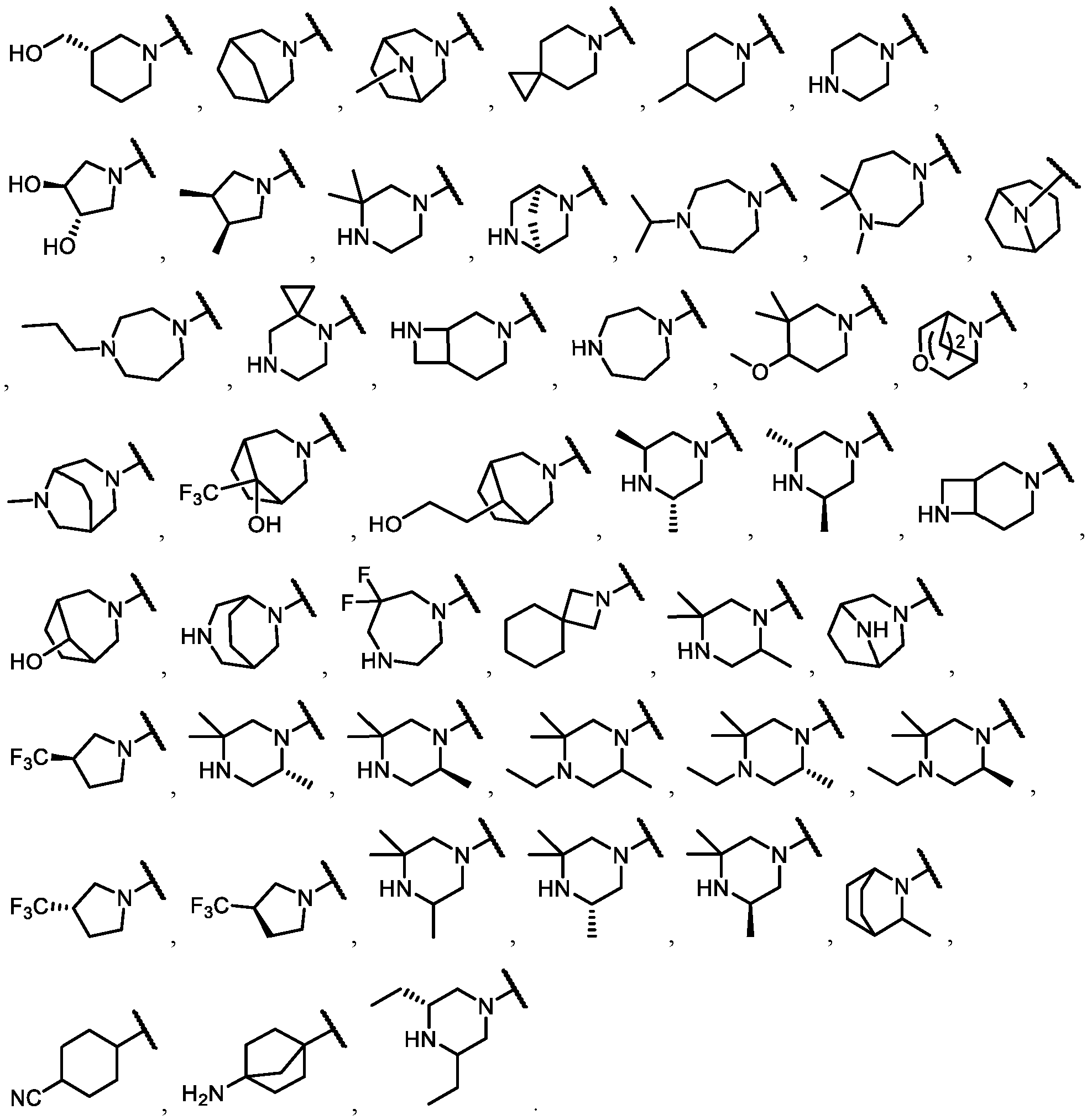
[0088] In some embodiments the compound is selected from:


[0090] Exemplary compounds described herein include the compounds found in Table 1 below.
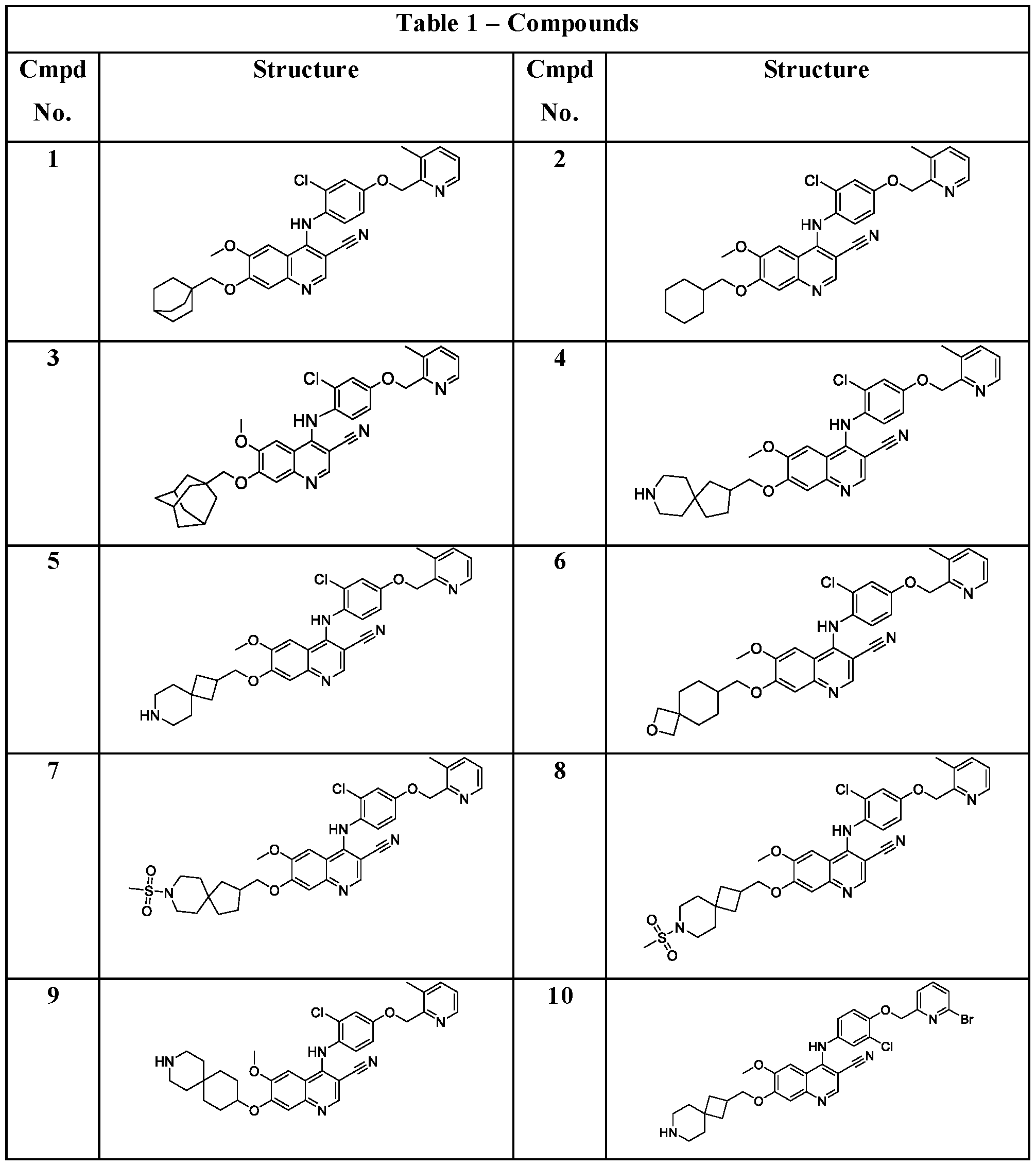


[0091] In some embodiments, the present disclosure provides a pharmaceutically acceptable salt of a compound described in Table 1.
[0092] In one aspect, compounds described herein are in the form of pharmaceutically acceptable salts. In addition, the compounds described herein can exist in unsolvated as well as solvated
forms with pharmaceutically acceptable solvents such as water, ethanol, and the like. The solvated forms of the compounds presented herein are also considered to be disclosed herein. [0093] “Pharmaceutically acceptable,” as used herein, refers a material, such as a carrier or diluent, which does not abrogate the biological activity or properties of the compound, and is relatively nontoxic at the concentration or amount used, i.e., the material is administered to an individual without causing undesirable biological effects or interacting in a deleterious manner with any of the components of the composition in which it is contained.
[0094] The term “pharmaceutically acceptable salt” refers to a form of a therapeutically active agent that consists of a cationic form of the therapeutically active agent in combination with a suitable anion, or in alternative embodiments, an anionic form of the therapeutically active agent in combination with a suitable cation. Handbook of Pharmaceutical Salts: Properties, Selection and Use. International Union of Pure and Applied Chemistry, Wiley -VCH 2002. S.M. Berge, L.D. Bighley, D.C. Monkhouse, J. Pharm. Sci. 1977, 66, 1 -19. P. H. Stahl and C. G. Wermuth, editors, Handbook of Pharmaceutical Salts: Properties, Selection and Use, Weinheim/Zurich:Wiley-VCH/VHCA, 2002. Pharmaceutical salts typically are more soluble and more rapidly soluble in stomach and intestinal juices than non-ionic species and so are useful in solid dosage forms. Furthermore, because their solubility often is a function of pH, selective dissolution in one or another part of the digestive tract is possible and this capability can be manipulated as one aspect of delayed and sustained release behaviors. Also, because the saltforming molecule can be in equilibrium with a neutral form, passage through biological membranes can be adjusted.
[0095] In some embodiments, pharmaceutically acceptable salts are obtained by reacting a compound of Formula (I) with an acid. In some embodiments, the compound of Formula (I) (i.e. free base form) is basic and is reacted with an organic acid or an inorganic acid. Inorganic acids include, but are not limited to, hydrochloric acid, hydrobromic acid, sulfuric acid, phosphoric acid, nitric acid, and metaphosphoric acid. Organic acids include, but are not limited to, 1 - hydroxy -2-naphthoic acid; 2,2 -dichloroacetic acid; 2-hydroxyethanesulfonic acid; 2-oxoglutaric acid; 4-acetamidobenzoic acid; 4 -aminosalicylic acid; acetic acid; adipic acid; ascorbic acid (L); aspartic acid (L); benzenesulfonic acid; benzoic acid; camphoric acid (+); camphor-10-sulfonic acid (+); capric acid (decanoic acid); caproic acid (hexanoic acid); caprylic acid (octanoic acid); carbonic acid; cinnamic acid; citric acid; cyclamic acid; dodecylsulfuric acid; ethane -1,2- disulfonic acid; ethanesulfonic acid; formic acid; fumaric acid; galactaric acid; gentisic acid; glucoheptonic acid (D); gluconic acid (D); glucuronic acid (D); glutamic acid; glutaric acid; glycerophosphoric acid; glycolic acid; hippuric acid; isobutyric acid; lactic acid (DL); lactobionic
acid; lauric acid; maleic acid; malic acid (- L); malonic acid; mandelic acid (DL); methanesulfonic acid; naphthalene-l,5-disulfonic acid; naphthalene-2-sulfonic acid; nicotinic acid; oleic acid; oxalic acid; palmitic acid; pamoic acid; phosphoric acid; proprionic acid; pyroglutamic acid (- L); salicylic acid; sebacic acid; stearic acid; succinic acid; sulfuric acid; tartaric acid (+ L); thiocyanic acid; toluenesulfonic acid (p); and undecylenic acid.
[0096] In some embodiments, a compound of Formula (I) is prepared as a chloride salt, sulfate salt, bromide salt, mesylate salt, maleate salt, citrate salt or phosphate salt.
[0097] In some embodiments, pharmaceutically acceptable salts are obtained by reacting a compound of Formula (I) with a base. In some embodiments, the compound of Formula (I) is acidic and is reacted with a base. In such situations, an acidic proton of the compound of Formula (I) is replaced by a metal ion, e.g., lithium, sodium, potassium, magnesium, calcium, or an aluminum ion. In some cases, compounds described herein coordinate with an organic base, such as, but not limited to, ethanolamine, diethanolamine, triethanolamine, tromethamine, meglumine, N-methylglucamine, dicyclohexylamine, tris(hydroxymethyl)methylamine. In other cases, compounds described herein form salts with amino acids such as, but not limited to, arginine, lysine, and the like. Acceptable inorganic bases used to form salts with compounds that include an acidic proton, include, but are not limited to, aluminum hydroxide, calcium hydroxide, potassium hydroxide, sodium carbonate, potassium carbonate, sodium hydroxide, lithium hydroxide, and the like. In some embodiments, the compounds provided herein are prepared as a sodium salt, calcium salt, potassium salt, magnesium salt, meglumine salt, N-methylglucamine salt or ammonium salt.
[0098] It should be understood that a reference to a pharmaceutically acceptable saltincludes the solvent addition forms. In some embodiments, solvates contain either stoichiometric or non- stoichiometric amounts of a solvent, and are formed during the process of crystallization with pharmaceutically acceptable solvents such as water, ethanol, and the like. Hydrates are formed when the solvent is water, or alcoholates are formed when the solvent is alcohol. Solvates of compounds described herein are conveniently prepared or formed during the processes described herein. In addition, the compounds provided herein optionally exist in unsolvated as well as solvated forms.
[0099] The methods and formulations described herein include the use of N-oxides (if appropriate), or pharmaceutically acceptable salts of compounds having the structure of Formula (I), as well as active metabolites of these compounds having the same type of activity.
[00100]In some embodiments, sites on the organic radicals (e.g. alkyl groups, aromatic rings) of compounds of Formula (I) are susceptible to various metabolic reactions. Incorporation of
appropriate substituents on the organic radicals will reduce, minimize or eliminate this metabolic pathway. In specific embodiments, the appropriate substituent to decrease or eliminate the susceptibility of the aromatic ring to metabolic reactions is, by way of example only, a halogen, deuterium, an alkyl group, a haloalkyl group, or a deuteroalkyl group.
[OOlOlJIn another embodiment, the compounds described herein are labeled isotopically (e.g. with a radioisotope) or by another other means, including, but not limited to, the use of chromophores or fluorescent moieties, bioluminescent labels, or chemiluminescent labels. [00102] Compounds described herein include isotopically -lab eled compounds, which are identical to those recited in the various formulae and structures presented herein, but for the fact that one or more atoms are replaced by an atom having an atomic mass or mass number different from the atomic mass or mass number usually found in nature. Examples of isotopes that can be incorporated into the present compounds include isotopes of hydrogen, carbon, nitrogen, oxygen, sulfur, fluorine chlorine, iodine, phosphorus, such as, for example, 2H, 3H, 13C, 14C, 15N, 180, 170, 35S, 18F, 36C1, 1231, 1241, 1251, 1311, 32P and 33P. In one aspect, isotopically-labeled compounds described herein, for example those into which radioactive isotopes such as 3H and 14C are incorporated, are useful in drug and/or substrate tissue distribution assays. In one aspect, substitution with isotopes such as deuterium affords certain therapeutic advantages resulting from greater metabolic stability, such as, for example, increased in vivo half-life or reduced dosage requirements.
[00103]In some embodiments, the compounds of Formula (I) possess one or more stereocenters and each stereocenter exists independently in either the R or S configuration. In some embodiments, the compound of Formula (I) exists in the R configuration. In some embodiments, the compound of Formula (I) exists in the S configuration. The compounds presented herein include all diastereomeric, individual enantiomers, atropisomers, and epimeric forms as well as the appropriate mixtures thereof. The compounds and methods provided herein include all cis, trans, syn, anti, entgegen (E), and zusammen (Z) isomers as well as the appropriate mixtures thereof.
[00104]Individual stereoisomers are obtained, if desired, by methods such as, stereoselective synthesis and/or the separation of stereoisomers by chiral chromatographic columns or the separation of diastereomers by either non-chiral or chiral chromatographic columns or crystallization and recrystallization in a proper solvent or a mixture of solvents. In certain embodiments, compounds of Formula (I) are prepared as their individual stereoisomers by reacting a racemic mixture of the compound with an optically active resolving agent to form a pair of diastereoisomeric compounds/salts, separating the diastereomers and recovering the
optically pure individual enantiomers. In some embodiments, resolution of individual enantiomers is carried out using covalent diastereomeric derivatives of the compounds described herein. In another embodiment, diastereomers are separated by separation/resolution techniques based upon differences in solubility. In other embodiments, separation of stereoisomers is performed by chromatography or by the forming diastereomeric salts and separation by recrystallization, or chromatography, or any combination thereof. Jean Jacques, Andre Collet, Samuel H. Wilen, “Enantiomers, Racemates and Resolutions”, John Wiley And Sons, Inc., 1981 . In some embodiments, stereoisomers are obtained by stereoselective synthesis.
[00105]In some embodiments, compounds described herein are prepared as prodrugs. A “prodrug” refers to an agent that is converted into the parent drug in vivo. Prodrugs are often useful because, in some situations, they are easier to administer than the parent drug. They are, for instance, bioavailable by oral administration whereas the parent is not. Further or alternatively, the prodrug also has improved solubility in pharmaceutical compositions over the parent drug. In some embodiments, the design of a prodrug increases the effective water solubility. An example, without limitation, of a prodrug is a compound described herein, which is administered as an ester (the “prodrug”) but then is metabolically hydrolyzed to provide the active entity. A further example of a prodrug is a short peptide (polyaminoacid) bonded to an acid group where the peptide is metabolized to reveal the active moiety. In certain embodiments, upon in vivo administration, a prodrug is chemically converted to the biologically, pharmaceutically or therapeutically active form of the compound. In certain embodiments, a prodrug is enzymatically metabolized by one or more steps or processes to the biologically, pharmaceutically or therapeutically active form of the compound.
[00106]Prodrugs of the compounds described herein include, but are not limited to, esters, ethers, carbonates, thiocarbonates, N-acyl derivatives, N-acyloxyalkyl derivatives, N-alkyloxyacyl derivatives, quaternary derivatives of tertiary amines, N-Mannich bases, Schiff bases, amino acid conjugates, phosphate esters, and sulfonate esters. See for example Design of Prodrugs, Bundgaard, A. Ed., Elseview, 1985 and Method in Enzymology, Widder, K. et al., Ed.; Academic, 1985, vol. 42, p. 309-396; Bundgaard, H. “Design and Application of Prodrugs” in A Textbook of Drug Design and Development, Krosgaard -Larsen and H. Bundgaard, Ed., 1991, Chapter s, p. 113-191; and Bundgaard, H., Advanced DrugDelivery Review, 1992, 8, 1 -38, each of which is incorporated herein by reference. In some embodiments, a hydroxyl group in the compounds disclosed herein is used to form a prodrug, wherein the hydroxyl group is incorporated into an acyloxyalkyl ester, alkoxycarbonyloxyalkyl ester, alkyl ester, aryl ester, phosphate ester, sugar ester, ether, and the like. In some embodiments, a hydroxyl group in the
compounds disclosed herein is a prodrug wherein the hydroxyl is then metabolized in vivo to provide a carboxylic acid group. In some embodiments, a carboxyl group is used to provide an ester or amide (i.e. the prodrug), which is then metabolized in vivo to provide a carboxylic acid group. In some embodiments, compounds described herein are prepared as alkyl ester prodrugs. [00107]Prodrug forms of the herein described compounds, wherein the prodrug is metabolized in vivo to produce a compound of Formula (I) as set forth herein are included within the scope of the claims. In some cases, some of the herein-described compounds is a prodrug for another derivative or active compound.
[00108]In some embodiments, any one of the hydroxyl group(s), amino group(s) and/or carboxylic acid group(s) are functionalized in a suitable manner to provide a prodrug moiety. In some embodiments, the prodrug moiety is as described above.
[00109]In additional or further embodiments, the compounds described herein are metabolized upon administration to an organism in need to produce a metabolite that is then used to produce a desired effect, including a desired therapeutic effect.
[00110] A “metabolite” of a compound disclosed herein is a derivative of that compound that is formed when the compound is metabolized. The term “active metabolite” refers to a biologically active derivative of a compound that is formed when the compound is metabolized. The term “metabolized,” as used herein, refers to the sum of the processes (including, but not limited to, hydrolysis reactions and reactions catalyzed by enzymes) by which a particular substance is changed by an organism. Thus, enzymes may produce specific structural alterations to a compound. For example, cytochrome P450 catalyzes a variety of oxidative and reductive reactions while uridine diphosphate glucuronyltransferases catalyze the transfer of an activated glucuronic-acid molecule to aromatic alcohols, aliphatic alcohols, carboxylic acids, amines and free sulfhydryl groups. Metabolites of the compounds disclosed herein are optionally identified either by administration of compounds to a host and analysis of tissue samples from the host, or by incubation of compounds with hepatic cells in vitro and analysis of the resulting compounds. [OOlllJIn some instances, heterocyclic rings may exist in tautomeric forms. In such situations, it is understood that the structures of said compounds are illustrated or named in one tautomeric form but could be illustrated or named in the alternative tautomeric form. The alternative tautomeric forms are expressly included in this disclosure, such as, for example, the structures illustrated below.
[00112]In some embodiments, the compounds described herein may inhibit an activity of MST1. The activity may be selected from a phosphorylation activity, an inflammatory activity, a cleavage activity, an apoptotic activity, a ubiquinating activity, a mitochondrial activity, and
combination thereof. The activity may be an activity directed toward MST1. The activity may be directed toward a non-MSTl protein or substrate. The activity may be selected from autophosphorylation.
[00113]In some embodiments, the compounds described herein may inhibit phosphorylation of a protein downstream of the activity of MST1. The compounds described herein may inhibit phosphorylation of a protein upstream of the activity of MST1. The protein downstream may be selected from a transcription factor, a kinase, a histone. The transcription factor may be pancreatic and duodenal homeobox 1 (PDX-1) or a homolog thereof. The histone may be histone 2B (H2B). The kinase may be a Janus kinase (JNK). The compounds described herein may inhibit cleavage of a protein downstream of the activity of the MST1. The protein downstream may be an apoptotic protein. The protein downstream maybe a caspase. The caspase may be an initiator caspase. The caspase may be an effector caspase. The caspase may be selected from caspase 9, caspase 3 and MST1. The compounds described herein may inhibit apoptotic activity of a protein downstream of the activity of the MST1. The protein downstream may be selected from JNK, Bim, Bax, Bcl-2, homologs thereof, and combinations thereof.
Pharmaceutical Compositions
[00114]In a second aspect, the present disclosure provides pharmaceutical compositions comprising a compound as described herein, or a pharmaceutically acceptable salt thereof, and at least one pharmaceutically acceptable excipient or diluent.
[00115]In some embodiments, the compounds described herein are formulated into pharmaceutical compositions. Pharmaceutical compositions are formulated in a conventional manner using one or more pharmaceutically acceptable inactive ingredients that facilitate processing of the active compounds into preparations that are used pharmaceutically. Proper formulation is dependent upon the route of administration chosen. A summary of pharmaceutical compositions described herein is found, for example, in Remington: The Science and Practice of Pharmacy, Nineteenth Ed (Easton, Pa.: Mack Publishing Company, 1995); Hoover, John E., Remington’s Pharmaceutical Sciences, Mack Publishing Co., Easton, Pennsylvania 1975; Liberman, H.A. and Lachman, L., Eds., Pharmaceutical Dosage Forms, Marcel Decker, New York, N.Y., 1980; and Pharmaceutical Dosage Forms and Drug Delivery Systems, Seventh Ed. (Lippincott Williams & Wilkinsl999), herein incorporated by reference for such disclosure. [00116]In some embodiments, the pharmaceutical composition is useful in the treatment of disease or disorder associated with MST1 . In some embodiments, the disease or disorder is a
metabolic disease or disorder, an autoimmune disease or disorder, or an inflammatory disease or disorder, diabetes, or combinations thereof.
[00117]In some embodiments, the pharmaceutical composition is useful in the treatment of an inflammatory disease or disorder. In some embodiments, the inflammatory disease or disorder is an auto-inflammatory disease or disorder, a host-mediated inflammatory disease or disorder, an injury -related inflammatory disease or disorder, an infection -related inflammatory disease or disorder, a hyperproliferative (e.g., cancer, fibrosis) mediated inflammatory disease or disorder. [00118]In some embodiments, the pharmaceutical composition is useful in the treatment of an autoimmune disease or disorders. In some embodiments, an autoimmune disease or disorder is rheumatoid arthritis, multiple sclerosis, psoriasis, psoriatic arthritis, lupus, systemic lupus erythematosus, Sjogren’s syndrome, ankylosing spondylitis, vitiligo, atopic dermatitis, scleroderma, alopecia, hidradenitis suppurativa, uveitis, dry eye, intestinal bowel disease, Crohn’s disease, ulcerative colitis, celiac disease, Bechet’s disease, type 1 diabetes, systemic sclerosis, and idiopathic pulmonary fibrosis. In some embodiments, an autoimmune disease or disorder is lupus or systemic lupus erythematosus. In some embodiments, an autoimmune disease or disorder is psoriasis. In some embodiments, an autoimmune disease or disorder is irritable bowel disease (IBS) or irritable bowel disease with diarrhea (IBS-D). In some embodiments, an autoimmune disease or disorder is dry eye or uveitis. In some embodiments, an autoimmune disease or disorder is Crohn’s disease. In some embodiments, an autoimmune disease or disorder is atopic dermatitis.
[00119]In some embodiments, the pharmaceutical composition is useful in the treatment of nonalcoholic fatty liver disease. In some embodiments, the pharmaceutical composition is useful in the treatment of a brain injury. In some embodiments, the pharmaceutical composition is useful in the treatment of a myocardial injury.
[00120]In some embodiments, the compounds described herein are administered either alone or in combination with pharmaceutically acceptable carriers, excipients or diluents, in a pharmaceutical composition. Administration of the compounds and compositions described herein can be affected by any method that enables delivery of the compounds to the site of action. These methods include, though are not limited to delivery via enteral routes (including oral, gastric or duodenal feeding tube, rectal suppository and rectal enema), parenteral routes (injection or infusion, including intraarterial, intracardiac, intradermal, intraduodenal, intramedullary, intramuscular, intraosseous, intraperitoneal, intrathecal, intravascular, intravenous, intravitreal, epidural and subcutaneous), inhalational, transdermal, transmucosal, sublingual, buccal and topical (including epicutaneous, dermal, enema, eye drops, ear drops,
intranasal, vaginal) administration, although the most suitable route may depend upon for example the condition and disorder of the recipient. By way of example only, compounds described herein can be administered locally to the area in need of treatment, by for example, topical application such as creams or ointments. Additional examples of local administration of the present compounds include eye drops, ocular creams, gels or hydrogels, implants, transdermal patches, or drug depots. In some embodiments, a pharmaceutical composition is administered orally (e.g., in a liquid formulation, tablet, capsule, nebulized liquid, aerosolized liquid, dry powder spray).
[00121]In some embodiments, pharmaceutical compositions suitable for oral administration are presented as discrete units such as capsules, cachets or tablets each containing a predetermined amount of the active ingredient; as a powder or granules; as a solution or a suspension in an aqueous liquid or a non-aqueous liquid; or as an oil-in-water liquid emulsion or a water-in-oil liquid emulsion. In some embodiments, the active ingredient is presented as a bolus, electuary or paste.
[00122]Pharmaceutical compositions which canbe used orally include tablets, push -fit capsules made of gelatin, as well as soft, sealed capsules made of gelatin and a plasticizer, such as glycerol or sorbitol. Tablets may be made by compression or molding, optionally with one or more accessory ingredients. Compressed tablets may be prepared by compressing in a suitable machine the active ingredient in a free-flowing form such as a powder or granules, optionally mixed with binders, inert diluents, or lubricating, surface active or dispersing agents. Molded tablets may be made by molding in a suitable machine a mixture of the powdered compound moistened with an inert liquid diluent. In some embodiments, the tablets are coated or scored and are formulated so as to provide slow or controlled release of the active ingredient therein. All formulations for oral administration should be in dosages suitable for such administration. The push-fit capsules can contain the active ingredients in admixture with filler such as lactose, binders such as starches, and/or lubricants such as talc or magnesium stearate and, optionally, stabilizers. In soft capsules, the active compounds may be dissolved or suspended in suitable liquids, such as fatty oils, liquid paraffin, or liquid polyethylene glycols. In some embodiments, stabilizers are added. Dragee cores are provided with suitable coatings. For this purpose, concentrated sugar solutions may be used, which may optionally contain gum arabic, talc, polyvinyl pyrrolidone, carbopol gel, polyethylene glycol, and/or titanium dioxide, lacquer solutions, and suitable organic solvents or solvent mixtures. Dyestuffs or pigments may be ad ded to the tablets or Dragee coatings for identification or to characterize different combinations of active compound doses.
[00123] In some embodiments, pharmaceutical compositions are formulated for parenteral administration by injection, e.g., by bolus injection or continuous infusion. Formulations for injection may be presented in unit dosage form, e.g., in ampoules or in multi -dose containers, with an added preservative. The compositions may take such forms as suspensions, solutions or emulsions in oily or aqueous vehicles, and may contain formulatory agents such as suspending, stabilizing and/or dispersing agents. The compositions may be presented in unit-dose or multidose containers, for example sealed ampoules and vials, and maybe stored in powder form or in a freeze-dried (lyophilized) condition requiring only the addition of the sterile liquid carrier, for example, saline or sterile pyrogen-free water, immediately prior to use. Extemporaneous injection solutions and suspensions may be prepared from sterile powders, granules and tablets of the kind previously described.
[00124]Pharmaceutical compositions may be administered topically, that is by non-systemic administration. This includes the application of a compound of the present invention externally to the epidermis or the buccal cavity and the installation of such a compound into the ear, eye and nose, such that the compound does not significantly enter the blood stream. In contrast, systemic administration refers to oral, intravenous, intraperitoneal and intramuscular administration.
[00125]Pharmaceutical compositions suitable for topical administration include liquid or semiliquid preparations suitable for penetration through the skin to the site of inflammation such as gels, liniments, lotions, creams, ointments or pastes, and drops suitable for administration to the eye, ear or nose. The active ingredient may comprise, for topical administration, from 0.001% to 10% w/w, for instance from 1% to 2% by weight of the formulation.
[00126]Pharmaceutical compositions for administration by inhalation are conveniently delivered from an insufflator, nebulizer pressurized packs or other convenient means of delivering an aerosol spray. Pressurized packs may comprise a suitable propellant such as dichlorodifluoromethane, trichlorofluoromethane, dichlorotetrafluoroethane, carbon dioxide or other suitable gas. In the case of a pressurized aerosol, the dosage unit may be determined by providing a valve to deliver a metered amount. Alternatively, for administration by inhalation or insufflation, pharmaceutical preparations may take the form of a dry powder composition, for example a powder mix of the compound and a suitable powder base such as lactose or starch. The powder composition may be presented in unit dosage form, in for example, cap sules, cartridges, gelatin orblister packs from which the powder may be administered with the aid of an inhalator or insufflator.
[00127]It should be understood that in addition to the ingredients particularly mentioned above, the compounds and compositions described herein may include other agents conventional in the
art having regard to the type of formulation in question, for example those suitable for oral administration may include flavoring agents.
Method of Treatments
[00128]In another aspect, the present disclosure provides a method of treating a disease, a disorder, or a condition in a subject, comprising administering to the subject a compound as described herein, or a pharmaceutically acceptable salt thereof, wherein the disease is selected from a metabolic disease or condition, an inflammatory disease or condition, and an autoimmune disease or disorder.
[00129]In some embodiments, the present disclosure provides a method of treating a disease, a disorder, or a condition in a subject, comprising administering to the subject a compound as described herein, or a pharmaceutically acceptable salt thereof, wherein the disease is nonalcoholic fatty liver disease.
[00130]In some embodiments, the present disclosure provides a method of treating a disease, a disorder, or a condition in a subject, comprising administering to the subject a compound as described herein, or a pharmaceutically acceptable salt thereof, wherein the disease is brain injury.
[00131] In some embodiments, the present disclosure provides a method of treating a disease, a disorder, or a condition in a subject, comprising administering to the subject a compound as described herein, or a pharmaceutically acceptable salt thereof, wherein the disease is non-myocardial injury.
[00132]In some embodiments of the method, the disease, disorder, or condition is a metabolic disease.
[00133]In some embodiments of the method, metabolic disease is selected from diabetes, prediabetes, diabetic nephropathy, diabetic retinopathy, diabetic neuropathy, diabetic heart disease, diabetic foot disorders, macrovascular disease, diabetic cardiomyopathy, and diabetic ketoacidosis.
[00134]In some embodiments of the method, the metabolic disease or disorder is diabetes.
[00135]In some embodiments of the method, the diabetes is selected from Type 1 diabetes, Type 2 diabetes, and gestational diabetes.
[00136]In some embodiments of the method, the disease is an inflammatory disease or condition. [00137]In some embodiments of the method, the inflammatory disease or condition is selected from Alzherimer’s disease, arthritis, asthma, atherosclerosis, Crohn's disease, colitis, dermatitis,
fibromyalgia, hepatitis, irritable bowel syndrome (IBS), Parkinson's disease, celiac disease, lupus, chronic obstructive pulmonary disease, and psoriasis.
[00138]In some embodiments of the method, the disease is an autoimmune disease or disorder. [00139]In some embodiments of the method, the autoimmune disease or disorder is chosen from encephalomyelitis, alopecia areata, antiphospholipid syndrome, autoimmune cardiomyopathy, autoimmune hemolytic anemia, autoimmune hepatitis, autoimmune inner ear disease, autoimmune lymphoproliferative syndrome, autoimmune peripheral neuropathy, autoimmune pancreatitis, autoimmune polyendrocrine syndrome, autoimmune progesterone dermatitis, autoimmune thrombocytopenic purpura, autoimmune urticaria, autoimmune uveitis, Behcet's disease, Celiac disease, cold agglutinin disease, Crohn's disease, dermatomyositis, diabetes mellitus type 1, eosinophilic fasciitis, gastrointestinal pemphigoid, Goodpasture's syndrome, Grave's disease, Guillain-Barre syndrome, Hashimoto's encephalopathy, Hashimoto's thyroiditis, idiopathic thrombocytopenic purpura, lupus erythematosus, Miller-Fisher syndrome, mixed connective tissue disease, multiple sclerosis, myasthenia gravis, narcolepsy, pemphigus vulgaris, pernicious anemia, polymyositis, primary biliary cirrhosis, psoriasis, psoriatic arthritis, relapsing polychondritis, rheumatoid arthritis, rheumatic fever, Sjogren's syndrome, temporal arteritis, transverse myelitis, ulcerative colitis, undifferentiated connective tissue disease, vasculitis, and Wegener's granulomatosis.
[00140]The present disclosure also provides a method for liver regeneration in a subject in need thereof, comprising administering to the subject a compound as described herein, or a pharmaceutically acceptable salt thereof.
[00141]In some embodiments of the method, the liver has undergone a resection.
[00142]In some embodiments of the method, the resection is hepatocellular carcinoma resection. [00143]In some embodiments, the metabolic condition may be a metabolic disease, a metabolic disorder or a symptom thereof. The metabolic condition may acute. The metabolic condition may be chronic. The metabolic condition may be a risk for a metabolic disease. The metabolic condition may be a pre-metabolic condition. For example, the subject may be insulin insensitive or have high glucose levels, but not diagnosed with diabetes mellitus.
[00144]The metabolic condition may be diabetes mellitus. The method of claim 1, wherein the metabolic condition is selected from type 1 diabetes mellitus and type 2 diabetes mellitus. Diabetes mellitus may include, type I diabetes, type 2 diabetes, gestational diabetes, and prediabetes. The diabetes mellitus may be caused by a disease of the pancreas, a surgery or a medication.
[00145] In some embodiments, the metabolic condition may be one or more symptoms and/or conditions of a metabolic disease/disorder. Examples of diabetes/metabolic related conditions include, but are not limited to, diabetic retinopathy, diabetic nephropathy, diabetic heart disease, diabetic foot disorders, diabetic neuropathy, macrovascular disease, diabetic cardiomyopathy, infection and diabetic ketoacidosis. Diabetic neuropathy may include, but is not limited to symmetric polyneuropathy, autonomic neuropathy, radiculopathy, cranial neuropathy, and mononeuropathy.
[00146] Further disclosed herein are methods of treating an inflammatory condition in a subject comprising administering to the subject a compound described herein, or a pharmaceutically acceptable salt, solvate, or prodrug thereof, that inhibits an activity of a mammalian sterile 20- like kinase 1 (MST1), a cleaved product thereof, or a homolog thereof. In some embodiments are methods of treating an inflammatory condition in a subject comprising administering to the subject a compound described herein, or a pharmaceutically acceptable salt, solvate, or prodrug thereof, that inhibits an activity of a mammalian sterile 20-like kinase 1 (MST1), a cleaved product thereof, or a homolog thereof, wherein the compound is neratinib. In some embodiments, the inflammatory condition is selected from, but not limited to, Alzheimer's, arthritis (osteoarthritis, rheumatoid arthritis (RA), psoriatic arthritis), asthma, atherosclerosis, Crohn's disease, colitis, dermatitis, fibromyalgia, hepatitis, irritable bowel syndrome (IBS), Parkinson's disease, celiac disease, lupus, chronic obstructive pulmonary disease, and psoriasis.
[00147]In some embodiments, the method further comprises treating the subject with an additional therapy. In some embodiments, the additional therapy is a therapy for the treatment of diabetes mellitus. In some embodiments, the additional therapy is a sulfonylurea. In some embodiments, the additional therapy is a thiazolidine. In some embodiments, the additional therapy is a dipeptidyl peptidase-4 (DPP-4) inhibitor. In some embodiments, the additional therapy is selected from metformin, sitagliptin, exenatide, colesevelam, sitagliptin, metformin, glipizide, glimepiride, canagliflozin, insulin, rosiglitazone, saxagliptin, alogliptin, chlorpropamide, glibenclaimide, gliclazide, glucomannan, miglitol, pioglitazone, repaglinide, simvastatin, tolazamide, tolbutamide, vildagliptin, and combinations thereof.
[00148]Disclosed herein are methods of treating an autoimmune disorder in a subject comprising administering to the subject a compound described herein, or a pharmaceutically acceptable salt, solvate, or prodrug thereof, that inhibits an activity of a mammalian sterile 20-like kinase 1 (MST1), a cleaved product thereof, or a homolog thereof. In some embodiments is a method of treating an autoimmune disorder in a subject comprising administering to the subject a compound described herein, or a pharmaceutically acceptable salt, solvate, or prodrug thereof, that inhibits
an activity of a mammalian sterile 20-like kinase 1 (MST1), a cleaved product thereof, or a homolog thereof, wherein the compound is neratinib . In some embodiments, the autoimmune disorder is selected from, but are not limited to, acute disseminated encephalomyelitis, alopecia areata, antiphospholipid syndrome, autoimmune cardiomyopathy, autoimmune hemolytic anemia, autoimmune hepatitis, autoimmune inner ear disease, autoimmune lymphoproliferative syndrome, autoimmune peripheral neuropathy, autoimmune pancreatitis, autoimmune polyendrocrine syndrome, autoimmune progesterone dermatitis, autoimmune thrombocytopenic purpura, autoimmune urticaria, autoimmune uveitis, Behcet’s disease, Celiac disease, cold agglutinin disease, Crohn’s disease, dermatomyositis, diabetes mellitus type 1, eosinophilic fasciitis, gastrointestinal pemphigoid, Goodpasture’s syndrome, Grave’s disease, Guillain -Barre syndrome, Hashimoto’s encephalopathy, Hashimoto’s thyroiditis, idiopathic thrombocytopenic purpura, lupus erythematosus, Miller-Fisher syndrome, mixed connective tissue disease, multiple sclerosis, myasthenia gravis, narcolepsy, pemphigus vulgaris, pernicious anemia, polymyositis, primary biliary cirrhosis, psoriasis, psoriatic arthritis, relapsing polychondritis, rheumatoid arthritis, rheumatic fever, Sjogren’s syndrome, temporal arteritis, transverse myelitis, ulcerative colitis, undifferentiated connective tissue disease, vasculitis, and Wegener’s granulomatosis. [00149]In some embodiments, the compounds described herein may inhibit an activity of MST1. In some embodiments, the compounds described herein may inhibit an activity of MST2. In some embodiments, the compounds described herein may inhibit an activity of MST1 and MST2. In some embodiments, the compounds described herein are selective for inhibition of MST1 over MST2. The activity may be selected from a phosphorylation activity, an inflammatory activity, a cleavage activity, an apoptotic activity, a ubiquinating activity, a mitochondrial activity, and combinations thereof. The activity may be an activity directed toward MST1. The activity may be directed toward a non-MSTl protein or substrate. The activity may be selected from autophosphorylation.
Definitions
[00150]Unless otherwise stated, the following terms used in this application have the definitions given below. The use of the term “including” as well as other forms, such as “include”, “includes,” and “included,” is not limiting. The section headings used herein are for organizational purposes only and are not to be construed as limiting the subject matter described. [00151] As used herein, Ci-Cx includes Ci-C2, C1-C3 . . . Ci-Cx. By way of example only, a group designated as "Ci-C6" indicates that there are one to six carbon atoms in the moiety, i.e. groups containing 1 carbon atom, 2 carbon atoms, 3 carbon atoms or 4 carbon atoms. Thus, by way of
example only, "C1-C4 alkyl" indicates that there are one to four carbon atoms in the alkyl group, i.e., the alkyl group is selected from among methyl, ethyl, propyl, iso-propyl, n-butyl, iso-butyl, sec-butyl, and t-butyl.
[00152] An “alkyl” group refers to an aliphatic hydrocarbon group. The alkyl group is branched or straight chain. In some embodiments, the “alkyl” group has 1 to 10 carbon atoms, i.e. a Cp Cwalkyl. Whenever it appears herein, a numerical range such as “1 to 10” refers to each integer in the given range; e.g., “1 to 10 carbon atoms” means that the alkyl group consist of 1 carbon atom, 2 carbon atoms, 3 carbon atoms, etc., up to and including 10 carbon atoms, although the present definition also covers the occurrence of the term “alkyl” where no numerical range is designated. In some embodiments, an alkyl is a Ci-Ce alkyl. In one aspect the alkyl is methyl, ethyl, propyl, iso-propyl, n-butyl, iso-butyl, sec-butyl, or t-butyl. Typical alkyl groups include, but are in no way limited to, methyl, ethyl, propyl, isopropyl, butyl, isobutyl, sec -butyl, tertiary butyl, pentyl, neopentyl, or hexyl.
[00153] An “alkylene” group refers to a divalent alkyl radical. Any of the above mentioned monovalent alkyl groups may be an alkylene by abstraction of a second hydrogen atom from the alkyl. In some embodiments, an alkylene is a Ci-C6 alkylene. In other embodiments, an alkylene is a Cl-C4alkylene. Typical alkylene groups include, but are not limited to, -CH2-, -CH2CH2-, - CH2CH2CH2-, -CH2CH2CH2CH2-, and the like. In some embodiments, an alkylene is -CH2-. [00154] An “alkoxy” group refers to a (alkyl)O- group, where alkyl is as defined herein.
[00155]The term “alkylamine” refers to the -N(alkyl)xHy group, where x is 0 and y is 2, or where x is 1 and y is 1, or where x is 2 and y is 0.
[00156]An “hydroxyalkyl” refers to an alkyl in which one hydrogen atom is replaced by a hydroxyl. In some embodiments, a hydroxyalkyl is a Ci-C4hydroxyalkyl. Typical hydroxyalkyl groups include, but are not limited to, -CH2OH, -CH2CH2OH, -CH2CH2CH2OH, - CH2CH2CH2CH2OH, and the like.
[00157] An “aminoalkyl” refers to an alkyl in which one hydrogen atom is replaced by an amino. In some embodiments, aminoalkyl is a Ci-C4aminoalkyl. Typical aminoalkyl groups include, but are not limited to, -CH2NH2, -CH2CH2NH2, -CH2CH2CH2NH2, -CH2CH2CH2CH2NH2, and the like.
[00158]The term “alkenyl” refers to a type of alkyl group in which at least one carbon -carbon double bond is present. In one embodiment, an alkenyl group has the formula -C(R)=CR2, wherein R refers to the remaining portions of the alkenyl group, which may be the same or different. In some embodiments, R is H oran alkyl. In some embodiments, an alkenyl is selected from ethenyl (i.e., vinyl), propenyl (i.e., allyl), butenyl, pentenyl, pentadienyl, and the like. Non-
limiting examples of an alkenyl group include -CH=CH2, -C(CH3)=CH2, -CH=CHCH3, -
C(CH3)=CHCH3, and -CH2CH=CH2.
[00159]The term “alkynyl” refers to a type of alkyl group in which at least one carbon -carbon triple bond is present. In one embodiment, an alkenyl group has the formula -C=C-R, wherein R refers to the remaining portions of the alkynyl group. In some embodiments, R is H or an alkyl. In some embodiments, an alkynyl is selected from ethynyl, propynyl, butynyl, pentynyl, hexynyl, and the like. Non-limiting examples of an alkynyl group include -C=CH, -C=CCH3 - C=CCH2CH3, -CH2C=CH.
[00160]The term “heteroalkyl” refers to an alkyl group in which one or more skeletal atoms of the alkyl are selected from an atom other than carbon, e.g., oxygen, nitrogen (e.g. -NH-, - N(alkyl)-, sulfur, or combinations thereof. A heteroalkyl is attached to the rest of the molecule at a carbon atom of the heteroalkyl. In one aspect, a heteroalkyl is a Ci-C6-heteroalkyl.
[00161]The term “aromatic” refers to a planar ring having a delocalized 7t-electron system containing 4n+2 71 electrons, where n is an integer. The term “aromatic” includes both carbocyclic aryl (“aryl”, e.g., phenyl) and heterocyclic aryl (or “heteroaryl” or “heteroaromatic”) groups (e.g., pyridine). The term includes monocyclic or fused-ring polycyclic (i.e., rings which share adjacent pairs of carbon atoms) groups.
[00162]The term “carbocyclic” or “carbocycle” refers to a ring or ring system where the atoms forming the backbone of the ring are all carbon atoms. The term thus distinguishes carbocyclic from “heterocyclic” rings or “heterocycles” in which the ring backbone contains at least one atom which is different from carbon. In some embodiments, at least one of the two rings of a bicyclic carbocycle is aromatic. In some embodiments, both rings of a bicyclic carbocycle are aromatic. Carbocycles include aryls and cycloalkyls.
[00163] As used herein, the term “aryl” refers to an aromatic ring wherein each of the atoms forming the ring is a carbon atom. In one aspect, aryl is phenyl or a naphthyl. In some embodiments, an aryl is a phenyl. In some embodiments, an aryl is a phenyl, naphthyl, indanyl, indenyl, or tetrahydronaphthyl. In some embodiments, an aryl is a C6-Ci0aryl. Depending on the structure, an aryl group is a monoradical or a diradical (i.e., an arylene group).
[00164]The term “cycloalkyl” refers to a monocyclic or polycyclic aliphatic, non -aromatic radical, wherein each of the atoms forming the ring (i.e. skeletal atoms) is a carbon atom. In some embodiments, cycloalkyls are spirocyclic or bridged compounds. In some embodiments, cycloalkyls are optionally fused with an aromatic ring, and the point of attachment is at a carbon that is notan aromatic ring carbon atom. Cycloalkyl groups include groups having from 3 to 10 ring atoms. In some embodiments, cycloalkyl groups are selected from among cyclopropyl,
cyclobutyl, cyclopentyl, cyclopentenyl, cyclohexyl, cyclohexenyl, cycloheptyl, cyclooctyl, spiro[2.2]pentyl, norbornyl andbicycle[l .l.l]pentyl. In some embodiments, a cycloalkyl is a C3- C6cycloalkyl. In some embodiments, a cycloalkyl is a C3-C4cycloalkyl.
[00165] The term “halo” or, alternatively, “halogen” or “halide” means fluoro, chloro, bromo or iodo. In some embodiments, halo is fluoro, chloro, or bromo.
[00166] The term “fluoroalkyl” refers to an alkyl in which one or more hydrogen atoms are replaced by a fluorine atom. In one aspect, a fluoroalkyl is a Ci-Cefluoroalkyl.
[00167]The term "heterocycle" or “heterocyclic” refers to heteroaromatic rings (also known as heteroaryls) and heterocycloalkyl rings containing one to four heteroatoms in the ring(s), where each heteroatom in the ring(s) is selected from O, S and N, wherein each heterocyclic group has from 3 to 10 atoms in its ring system, and with the proviso that any ring does not contain two adjacent O or S atoms. Non -aromatic heterocyclic groups (also known as heterocycloalkyls) include rings having 3 to 10 atoms in its ring system and aromatic heterocyclic groups include rings having 5 to 10 atoms in its ring system. The heterocyclic groups include benzo-fused ring systems. Examples of non-aromatic heterocyclic groups are pyrrolidinyl, tetrahydrofuranyl, dihydrofuranyl, tetrahydrothienyl, oxazolidinonyl, tetrahydropyranyl, dihydropyranyl, tetrahydrothiopyranyl, piperidinyl, morpholinyl, thiomorpholinyl, thioxanyl, piperazinyl, aziridinyl, azetidinyl, oxetanyl, thietanyl, homopiperidinyl, oxepanyl, thiepanyl, oxazepinyl, diazepinyl, thiazepinyl, 1,2,3,6-tetrahydropyridinyl, pyrrolin-2-yl, pyrrolin-3-yl, indolinyl, 2H- pyranyl, 4H-pyranyl, dioxanyl, 1,3-dioxolanyl, pyrazolinyl, dithianyl, dithiolanyl, dihydropyranyl, dihydrothienyl, dihydrofuranyl, pyrazolidinyl, imidazolinyl, imidazolidinyl, 3 - azabicyclo[3.1.0]hexanyl, 3-azabicyclo[4.1.0]heptanyl, 3H-indolyl, indolin-2-onyl, isoindolin-1- onyl, isoindoline-1, 3-dionyl, 3,4-dihydroisoquinolin-l(2H)-onyl, 3,4-dihydroquinolin-2(lH)- onyl, isoindoline-1,3 -dithionyl, benzo[d]oxazol-2(3H)-onyl, lH-benzo[d]imidazol-2(3H)-onyl, benzo[d]thiazol-2(3H)-onyl, and quinolizinyl. Examples of aromatic heterocyclic groups are pyridinyl, imidazolyl, pyrimidinyl, pyrazolyl, triazolyl, pyrazinyl, tetrazolyl, furyl, thienyl, isoxazolyl, thiazolyl, oxazolyl, isothiazolyl, pyrrolyl, quinolinyl, isoquinolinyl, indolyl, benzimidazolyl, benzofuranyl, cinnolinyl, indazolyl, indolizinyl, phthalazinyl, pyridazinyl, triazinyl, isoindolyl, pteridinyl, purinyl, oxadiazolyl, thiadiazolyl, furazanyl, benzofurazanyl, benzothiophenyl, benzothiazolyl, benzoxazolyl, quinazolinyl, quinoxalinyl, naphthyridinyl, and furopyridinyl. The foregoing groups are either C-attached(or C-linked) or N-attached where such is possible. For instance, a group derived from pyrrole includes both pyrrol-l-yl (N-attached) or pyrrol-3-yl (C-attached). Further, a group derived from imidazole includes imidazol-l-yl or imidazol-3-yl (both N-attached) or imidazol-2-yl, imidazol-4-yl or imidazol-5-yl (all C-attached).
The heterocyclic groups include benzo-fused ring systems. Non-aromatic heterocycles are optionally substituted with one or two oxo (=0) moieties, such as pyrrolidin-2-one. In some embodiments, at least one of the two rings of a bicyclic heterocycle is aromatic. In some embodiments, both rings of a bicyclic heterocycle are aromatic.
[00168]The terms “heteroaryl” or, alternatively, “heteroaromatic” refers to an aryl group that includes one or more ring heteroatoms selected from nitrogen, oxygen and sulfur. Illustrative examples of heteroaryl groups include monocyclic heteroaryls and bicyclic heteroaryls. Monocyclic heteroaryls include pyridinyl, imidazolyl, pyrimidinyl, pyrazolyl, triazolyl, pyrazinyl, tetrazolyl, furyl, thienyl, isoxazolyl, thiazolyl, oxazolyl, isothiazolyl, pyrrolyl, pyridazinyl, triazinyl, oxadiazolyl, thiadiazolyl, and furazanyl. Monocyclic heteroaryls include indolizine, indole, benzofuran, benzothiophene, indazole, benzimidazole, purine, quinolizine, quinoline, isoquinoline, cinnoline, phthalazine, quinazoline, quinoxaline, 1,8-naphthyridine, and pteridine. In some embodiments, a heteroaryl contains 0-4 N atoms in the ring. In some embodiments, a heteroaryl contains 1 -4 N atoms in the ring. In some embodiments, a heteroaryl contains 0-4 N atoms, 0-1 O atoms, and 0-1 S atoms in the ring. In some embodiments, a heteroaryl contains 1 -4 N atoms, 0-1 O atoms, and 0-1 S atoms in the ring. In some embodiments, heteroaryl is a Ci-Cgheteroaryl. In some embodiments, monocyclic heteroaryl is a Ci-Csheteroaryl. In some embodiments, monocyclic heteroaryl is a 5 -membered or 6-membered heteroaryl. In some embodiments, bicyclic heteroaryl is a C6-C9heteroaryl.
[00169] A “heterocycloalkyl” group refers to a cycloalkyl group that includes at least one heteroatom selected from nitrogen, oxygen and sulfur. In some embodiments, a heterocycloalkyl is fused with an aryl or heteroaryl. In some embodiments, the heterocycloalkyl is oxazolidinonyl, pyrrolidinyl, tetrahydrofuranyl, tetrahydrothienyl, tetrahydropyranyl, tetrahydrothiopyranyl, piperidinyl, morpholinyl, thiomorpholinyl, piperazinyl, piperidin-2-onyl, pyrrolidine-2, 5- dithionyl, pyrrolidine-2, 5-dionyl, pyrrolidinonyl, imidazolidinyl, imidazolidin-2-onyl, or thiazolidin-2-onyl. In one aspect, a heterocycloalkyl is a C2-Ci0heterocycloalkyl. In another aspect, a heterocycloalkyl is a C4-Ci0heterocycloalkyl. In some embodiments, a heterocycloalkyl is monocyclic or bicyclic. In some embodiments, a heterocycloalkyl is monocyclic and is a 3, 4, 5, 6, 7, or 8-membered ring. In some embodiments, a heterocycloalkyl is monocyclic and is a 3, 4, 5, or 6-membered ring. In some embodiments, a heterocycloalkyl is monocyclic and is a 3 or 4-membered ring. In some embodiments, a heterocycloalkyl contains 0-2 N atoms in the ring. In some embodiments, a heterocycloalkyl contains 0-2 N atoms, 0-2 O atoms and 0-1 S atoms in the ring.
[00170] The term “bond” or “single bond” refers to a chemical bond between two atoms, or two moieties when the atoms joined by the bond are considered to be part of larger substructure. In one aspect, when a group described herein is a bond, the referenced group is absent thereby allowing a bond to be formed between the remaining identified groups.
[00171]The term “moiety” refers to a specific segment or functional group of a molecule. Chemical moieties are often recognized chemical entities embedded in or appended to a molecule.
[00172]The term “substituted” means that the referenced group is optionally substituted with one or more additional group(s) individually and independently selected from halogen, -CN, -NH2, - NH(alkyl), -N(alkyl)2, -OH, -CO2H, -CO2alkyl, -C(=O)NH2, -C(=O)NH(alkyl), -C(=O)N(alkyl)2, -S(=O)2NH2, -S(=O)2NH(alkyl), -S(=O)2N(alkyl)2, alkyl, cycloalkyl, fluoroalkyl, heteroalkyl, alkoxy, fluoroalkoxy, heterocycloalkyl, aryl, heteroaryl, aryloxy, alkylthio, arylthio, alkylsulfoxide, arylsulfoxide, alkylsulfone, and arylsulfone. In some other embodiments, optional substituents are independently selected from halogen, -CN, -NH2, -NH(CH3), -N(CH3)2, -OH, - CO2H, -CO2(Ci-C4alkyl), -C(=O)NH2, -C(=O)NH(Ci-C4alkyl), -C(=O)N(Ci-C4alkyl)2, - S(=O)2NH2, -S(=O)2NH(C1-C4alkyl), -S(=O)2N(Ci-C4alkyl)2, Ci-C4alkyl, C3-C6cycloalkyl, C C4fluoroalkyl, Ci-C4heteroalkyl, Ci-C4alkoxy, Cl-C4fluoroalkoxy, -SCi-C4alkyl, -S(=O)Ci- C4alkyl, and -S(=O)2Ci-C4alkyl. In some embodiments, optional substituents are independently selected from halogen, -CN, -NH2, -OH, -NH(CH3), -N(CH3)2, -CH3, -CH2CH3, -CHF2, -CF3, - OCH3, -OCHF2, and -OCF3. In some embodiments, substituted groups are substituted with one or two of the preceding groups. In some embodiments, an optional substituent on an aliphatic carbon atom (acyclic or cyclic) includes oxo (=0).
[00173]The term “acceptable” with respect to a formulation, composition or ingredient, as used herein, means having no persistent detrimental effect on the general health of the subject being treated.
[00174]The term “modulate” as used herein, means to interact with a target either directly or indirectly so as to alter the activity of the target, including, by way of example only, to enhance the activity of the target, to inhibit the activity of the target, to limit the activity of the target, or to extend the activity of the target.
[00175]The term “modulator” as used herein, refers to a molecule that interacts with a target either directly or indirectly. The interactions include, but are not limited to, the interactions of an agonist, partial agonist, an inverse agonist, antagonist, degrader, or combinations thereof. In some embodiments, a modulator is an antagonist. In some embodiments, a modulator is an inhibitor.
[00176] The terms "administer," "administering", "administration," and the like, as used herein, refer to the methods that may be used to enable delivery of compounds or compositions to the desired site of biological action. These methods include, but are not limited to oral routes, intraduodenal routes, parenteral injection (including intravenous, subcutaneous, intraperitoneal, intramuscular, intravascular or infusion), topical and rectal administration. Those of skill in the art are familiar with administration techniques that can be employed with the compounds and methods described herein. In some embodiments, the compounds and compositions described herein are administered orally.
[00177]The terms “effective amount” or “therapeutically effective amount,” as used herein, refer to a sufficient amount of an agent or a compound being administered, which will relieve to some extent one or more of the symptoms of the disease or condition being treated. The result includes reduction and/or alleviation of the signs, symptoms, or causes of a disease, or any other desired alteration of a biological system. For example, an “effective amount” for therapeutic uses is the amount of the composition comprising a compound as disclosed herein required to provide a clinically significant decrease in disease symptoms. An appropriate “effective” amount in any individual case is optionally determined using techniques, such as a dose escalation study.
[00178] The terms “enhance” or “enhancing,” as used herein, means to increase or prolong either in potency or duration a desired effect. Thus, in regard to enhancing the effect of therapeutic agents, the term “enhancing” refers to the ability to increase or prolong, either in potency or duration, the effect of other therapeutic agents on a system. An “enhancing-effective amount,” as used herein, refers to an amount adequate to enhance the effect of another therapeutic agent in a desired system.
[00179] The term “pharmaceutical combination” as used herein, means a product that results from the mixing or combining of more than one active ingredient and includes both fixed and nonfixed combinations of the active ingredients. The term “fixed combination” meansthat the active ingredients, e.g. a compound of Formula (I), or a pharmaceutically acceptable salt thereof, and a co-agent, are both administered to a patient simultaneously in the form of a single entity or dosage. The term “non-fixed combination” means that the active ingredients, e.g. a compound of Formula (I), or a pharmaceutically acceptable salt thereof, and a co-agent, are administered to a patient as separate entities either simultaneously, concurrently or sequentially with no specific intervening time limits, wherein such administration provides effective levels of the two compounds in the body of the patient. The latter also applies to cocktail therapy, e.g. the administration of three or more active ingredients.
[00180]The terms “article of manufacture” and “kit” are used as synonyms.
[00181] The term “subject” or “patient” encompasses mammals. Examples of mammals include, but are not limited to, any member of the Mammalian class: humans, non -human primates such as chimpanzees, and other apes and monkey species; farm animals such as cattle, horses, sheep, goats, swine; domestic animals such as rabbits, dogs, and cats; laboratory animals including rodents, such as rats, mice and guinea pigs, and the like. In one aspect, the mammal is a human. [00182] The terms “treat,” “treating” or “treatment,” as used herein, include alleviating, abating or ameliorating at least one symptom of a disease or condition, preventing additional symptoms, inhibiting the disease or condition, e.g., arresting the development or progression of the disease or condition, relieving the disease or condition, causing regression of the disease or condition, relieving a secondary condition causedby the disease or condition, or stopping the symptoms of the disease or condition either prophylactically and/or therapeutically.
EXAMPLES
[00183] The following examples are provided for illustrative purposes only and not to limit the scope of the claims provided herein.
[00184] As used above, and throughout the description of the invention, the following abbreviations, unless otherwise indicated, shall be understood to have the following meanings:
Abbreviations:
ACN acetonitrile
CAN ceric ammonium nitrate
DCM dichloromethane
DIBAL diisobutylaluminum hydride
DIPEA N,N-diisopropylethylamine
DMA dimethylacetamide
DMF N,N-dimethylformamide
DMSO dimethylsulfoxide
EtOAc ethyl acetate
HEPES 4-(2-hydroxyethyl)-l-piperazineethanesulfonic acid
HMDS bis(trimethylsilyl)amide
HPLC high pressure liquid chromatography
HTRF homogenous time resolved fluorescence
IC50 half maximal inhibitory concentration
IFN interferon
IL interleukin
IPA isopropyl alcohol
LCMS liquid chromatography-mass spectrometry
MDI metered drug inhalant
MW microwave
NMR nuclear magnetic resonance
T3P propanephosphonic acid anhydride
TBAF tetra-n-butylammonium fluoride
TBDMS tert-butyldimethylsilyl
TBDPS tert-butyldiphenylsilyl
TEA triethylamine
TFA trifluoroacetic acid
THF tetrahydrofuran
TLC thin-layer chromatography
Materials and Methods
In Vitro Studies
[00185] Normal human cholangiocytes (NHC) were maintained in culture as previously described at 37 °C and 5% CO2. Experiments with NHC were performed in DMEM with 10% FBS with cells at 60-80% confluency unless otherwise specified. The clonal rat P- cell line INS IE was kindly provided by Dr. Claes Wollheim, Geneva & Lund University. INS IE were cultured in complete RPML1640 at 11.1 mM glucose as previously described. Cells were cultured in variable conditions which include: 0.5 mM palmitic acid, dissolved as previously described, 1 mM thap sigargin, 100 pM H2O2 (All Sigma). INS1E cells were treated with compounds in dose-dependent manner in 384 well microplates (Corning, NY) at 104 cells/well in 25 pL of complete grow medium. After 24 hours of compound treatment, 5 pL of Celltiter-Glo® reagent (Promega) was added to each well. Assay plates were shaken vigorously for Imin at RT to achieve completed cell lysis. Luminescence intensity was detected on Envision plate reader (Perkin Elmer).
Mstl/Mst2 protein expression, purification, crystallization, and data collection
[00186]Kinase domain of Mstl containing amino acid residues (25-301) and kinase domain of Mst2 containing amino acid residues (24-300) were cloned into pET-15b vector and were expressed as a His-tag fusion protein in the E. coli BL21 (DE3) cells. Cell culture was carried out in TB media at 18°C. The fusion protein was purified by nickel affinity column and further
purified by anion exchange chromatography and Superdex 75 16/60 column. The near 100% pure protein samples in 25 mM Hepes (pH 7.5), 150 mM NaCl, 5% glycerol, 1 mM TCEP, 2 mM MgCl2 was concentrated to 10 mg/ml.
Animals
[00187] C57BL/J6 mice were obtained from JAX laboratory, USA. Mice were maintained under a 12-hour light dark cycle (6 AM to 6 PM) and fed ad libitum. Interventions were only performed during their light cycle and completed at the same time within their light cycle.
NASH Model
[00188] Ten-week-old male C57BL/J6 were housed 5 mice per cage and cages were randomized to a diet for 24 weeks: standard chow (Diet Pico Laboratory Rodent Diet) or high fat, fructose, and cholesterol (FFC) diet which included a high fat and cholesterol chow (AIN-76A Western Diet; 1810060; Test Diet) and the drinking water was supplemented with fructose (23.1 g/L, Sigma F2543) and glucose (18.9 g/L, Sigma 49158) as previously described.
In Vivo Therapeutics
[00189]For the murine partial hepatectomy model, mice were treated 1 day preoperatively and then every 12 hours postoperatively until euthanasia unless otherwise noted. Mice received compound 90 every 12 hours via oral gavage dissolved in (0.5% methylcellulose + 0.5% Tween- 80). Control mice received equal volumes of vehicle.
Partial Hepatectomy Model
[00190]Male age matched mice were randomly assigned to control or treatment. Surgical procedures were performed in small cohorts to ensure uniform timing in relation to the day: night cycle. Mice were anesthetized by vaporized isoflurane for an average operation time of 15 minutes. Two-thirds partial hepatectomy was conducted as previously described. Briefly, Cholecystectomy followed by sequential ligation and excision of the left median, right median and left lateral lobes was performed. Hemostasis was achieved. The abdomen was then closed in 2 layers with running 4-0 Vicryl. The resected tissue was collected for further molecular analysis as baseline. Liver regeneration was assessed 40-, 72-, and 120 hours post-hepatectomy. All excised tissue was either frozen and stored at -80 degrees C or fixed in 10% (v/v) buffered formalin overnight at room temperature.
YAP/TAZ Hepatocyte Deletion In Vivo
[00191]Yap/Taz double floxed mice (Yapfl/fl/Tazfl/fl) were obtained from Jackson Laboratory (Strain #030532). Eight-week-old Yapfl/fl/Tazfl/fl mice were administered 1x10¹¹ AAV8 particles expressing AAV. TBG.PI.Cre.rBG, a gift from James M. Wilson (Addgene viral prep # 100787-
AAV8) as previously described, intravenously by tail vein injection. Four weeks following administration mice underwent 70% partial hepatectomy as described above.
Plasma Analysis Post-Hepatectomy
[00192]Blood was collected via the inferior vena cava puncture and placed in a lithium heparin tube. Plasma was separated from the blood by centrifugation at 2000 xg for 15 minutes at 4°C and transferred to new tubes. Plasma was aliquoted and stored at -80°C. Plasma was analyzed with Vetscan VS2 chemistry analyzer (Zoetis).
RNA Sequencing
[00193JRNA was isolated from mouse livers using Qiagen RNeasy kit with on column DNase digestion per the manufacturer protocol. The raw RNA sequencing paired -end reads for the samples were processed through the Mayo RNA-Seq bioinformatics pipeline, MAP-RSeq version 3.1.4. Briefly, MAP-RSeq employs the very fast, accurate and splice-aware aligner, STAR, to align reads to the reference human genome build hg38. The aligned reads were then processed through a variety of modules in a parallel fashion. Gene and exon expression quantification were performed using the Subread package to obtain both raw and normalized (RPKM - Reads Per Kilobase per Million mapped reads) reads. Finally, comprehensive analyses were run on the aligned reads to assess quality of the sequenced libraries. The data presented in this publication have been deposited to NCBFs Gene Expression Omnibus (GEO) and are accessible through GEO Series accession number GSE****. Using the raw gene counts report from MAP-RSeq, genes differentially expressed between the groups were assessed using the bioinformatics package edgeR 2.6.2. Genes found different between the groups were reported along with their magnitude of change (log2 scale) and their level of significance (False Discovery Rate, FDR < 5%). Canonical pathway analysis was performed using the Ingenuity pathway analysis software IPA (Ingenuity® Systems). Biological functions and disease information within the IPA software were used to investigate the canonical pathways of interest. The ShinyGO application was used to evaluate the core regeneration gene sets as previously described. Pathways were considered significant using if FDR < 5%.
Quantitative reverse transcriptase polymerase chain reaction (qRT-PCR)
[00194] Total RNA was isolated from cultured cells or mouse liver samples using TRIzol followed by isopropanol precipitation. Reverse transcription was performed with Moloney murine leukemia virus reverse transcriptase and random primers (Life Technologies). Real time PCR (Light Cycler 480 II, Roche Diagnostics) was performed with Sybr Green (Roche Diagnostics) with primer sequences listed in the table below. Relative expression of target genes
was calculated using the AACt method with target gene normalization to the geometric mean of 18S rRNA expression.

Western blot
[00195]Proteins were isolated from mouse livers or cell lysates by mechanical disruption in cell lysis buffer (Cell Signaling Technology) with protease inhibitors (Roche), phosphatase inhibitors (Roche), and ImMPMSF. Cellular debris was removed by centrifugation, 12,000g x 15 min at 4°C. Protein concentrations were determined with BSA protein assay (Fisher). Proteins were resolved by SDS-PAGE on Tris-Glycine gels (Invitrogen) followed by transfer to 0.2pm nitrocellulose orPVDF. Membranes were blocked in 5% BSA in TBS-Tween20 (0.1% v/v) and then stained overnight at 4°C. Primary antibodies are listed in the table below. Secondary HRP antibodies were applied for 1 hour at room temperature and then blots were visualized with ECL or ECL prime (GE Healthcare Life Sciences) chemiluminescence. Membranes were stripped, blocked, and reblotted as needed.
BrdU-Labeling
[00196]Two hours prior to euthanasia mice were administered 5’-bromo-2’-deoxyuridine (lOOmg/kg) (Sigma) i.p.. FFPE liver sections were incubated with primary antibody at 4°C overnight. Secondary antibody was applied for 1.5 hours at room temperature and nuclei were counterstained with DAPI. Ten high powered fields (400x) were visualized and BrdU positive hepatocytes were counted on an immunofluorescence microscope (Invitrogen EVOS M5000).
Immunohistochemistry
[00197] Paraffin sections were cut at a thickness of 5 pm. Tissues were stained for histological analysis with H&E or primary antibodies listed in the table below. For quantification of BrdU positive hepatocytes, ten high-power fields (HPF) (200x) were visualized per sample and manually counted.


Statistical analyses
[00198] Statistical analyses were performed with Prism version 9 (GraphPad Software) software or SPSS (IBM SPSS Statistics). Comparison of 2 groups for in vitro and in vivo studies was performed using Mann-Whitney U test. Comparison of 3 or more groups was performed using Kruskal Wallis test. Survival analysis was performed using Log Rank (Mantel Cox) test in SPSS. P values <0.05 were considered statistically significant.
Study Approval
[00199] All animal experiments were performed with Mayo Clinic Institutional Animal Care and Use Committee approval.
Example 1 - Synthesis of non-commercially available quinolines
General Methods
[00200]Unless otherwise stated, commercially available reagents and solvents were used without purification. Solvents: ACS grade. Reagents: unless otherwise noted, from Combi Blocks, Alfa Aesar, Fisher and Aldrich highest quality available. TLC: silica gel 60 F254 aluminum plates, (whatman, type Al Sil G/UV, 250 pm layer); visualization by UV absorption. Redisep and Biotage Flash+ systems were used for medium-pressure column chromatography. NMR: JH spectra were obtained at Bruker 400 MHz spectrometer. 1HNMR data are reported with chemical shifts (5) in parts-per-million (ppm) relative to the residual signal of the deuterated solvent as follows: chemical shift, multiplicity (s = singlet, d = doublet, t = triplet, q = quartet, qn = quintet, m = multiplet, and br = broad), coupling constant in Hz. Reactions were monitored by LC/MS using Agilent 1260 infinity. Purity was determined by LCMS using a Waters ZQ Mass spectrometer equipped w ith an Extend-C18 Rapid Resolution column (3.5 pm, 2.1 mm x 50 mm). Elution was carried out with a 5-95% gradient over 4 min of CH3CN in water containing 0.1% formic acid at a flow rate of 0.75 mL/min at r.t.
General synthetic scheme and procedures for synthesizing non-commercially available quinoline intermediates
Scheme 1

X = OMe, OCF3, F, H, NO2


X = X = OMe, OCF3, F, H, NO2 X = OMe, OCF3, F, H, NO2
Step 1
[00201] A solution of the corresponding aniline (leq) and ethyl 2 -cyano-3-eth oxyacrylate (1.1 eq) in toluene (0.5 mL/mmol) was heated at 110 °C overnight. After completion of the reaction, the mixture was cooled to room temperature and diluted with water. The resulting precipitate was filtered, washed with water, and dried overnight to give the desired intermediate I-A, which was used in the next step without further purification.
Step 2
[00202] A solution of the intermediate I-A obtained in step 1 in dowtherm (4 mL/mmol) was stirred at 250 °C. After completion of the reaction, the reaction mixture was cooled to room temperature, followed by addition of hexane to facilitate precipitation of the crude residue. The precipitate was then filtered, washed with hexane, and purified by column chromatography to give the desired intermediate I-B.
Step 3
[00203] The corresponding intermediate I-B was heated in the presence of POC13 (2.5 mL/mmol) in a sealed vial at 105 to 110 °C. After completion of the reaction, volatiles were removed by nitrogen flow and the resulting residue was resuspended in an aqueous solution of K2CO3. The mixture was extracted with DCM, and the combined organic phase was then dried, filtered and
concentrated under reduced pressure to give the desired intermediate I-C, which was used in the next step without further purification.
Step 4
[00204]The corresponding intermediate I-C was dissolved in DCM and cooled to 0 °C followed by portion-wise addition of AICI3. The resulting mixture was then slowly warmed to room temperature and stirred. After completion of the reaction, the mixture was poured into an aqueous solution of NaOH and stirred. The mixture was then neutralized with citric acid to give the crude residue, which was collected by filtration and washed with water to give the desired intermediate I-D, which was used without further purification.
Example 2 - Synthesis of 4-chloro-6-fluoro-7-hydroxyquinoline-3-carbonitrile (1-6)
Scheme 2

Step 1 — Synthesis of l-fluoro-2-isopropoxy-4-nitrobenzene (1-1)

1-1
[00205]To a solution of l-fluoro-2-hydroxy-4-nitrobenzene (50g, 0.3183 mol) in DMF (500 mL) was added 2-bromopropane (43g, 0.35 mol, 1.1 eq) followed by K2CO3 (88g, 0.6365mol) at
room temperature and stirred for 12h. The reaction mixture was quenched in water (lOOOrnL) and crude residue was extracted with ethyl acetate (3 x 500ml). The organic layer was dried over Na2SO4 and concentrated under vacuum to give crude intermediate 1-1, or l-fluoro-2-isopropyl- 4-nitrobenzene in 79% yield, which was used for next step without further purification.
[00206] Tf NMR (400 MHz, DMSO-d6, 8 = ppm, J = Hz) 7.97-7.95 (t, J = 4.8, 1H), 7.88-7.85 (q, J = 5.2, 1H), 7.54-7.49 (t, J = 10.4, 1H), 4.87-4.83 (m, 1H), 1.33-126 (d, J = 6, 6H).
Step 2 — Synthesis of 4-fluoro-3 -isoprop oxy aniline (1-2)

1-2
[00207]To a solution of 1-1 (50g, 0.2512mol) in methanol (400mL) and water (lOOmL) was added Fe powder (70g, 1.256mol) followedby drop-wise addition of acetic acid (lOOmL) at 10- 15 °C and then refluxed for 3h. The reaction mixture was filtered through celite bed and washed with methanol. The filtrate was concentrated under vacuum and basify with saturated NaHCOs solution followedby extraction with ethyl acetate (3 X 250mL). The organic layer was dried over Na2SO4 and concentrated under vacuum, and the crude residue was triturated with n-pentane to give 1-2 or 4-fluoro-3 -isoproproxy aniline in 82% yield.
Step 3 — Synthesis of ethyl 2-cyano-3-((4-fluoro-3-isopropoxyphenyl)amino)acrylate (1-3)

[00208]To a solution of 1-2 (25g, 0.1478 mol) in toluene (300mL) was added ethyl-2-cyano-3- ethoxyacrylate (25g, 0.1478mol) at room temperature and stirred for 110 °C for 12h. The reaction mixture was cooled to 10-15 °C and filtered to give the crude residue, followed by washing with cold toluene to provide the desired intermediate 1-3, or ethyl 2-cyano-3-((4-fluoro- 3-isopropoxyphenyl)amino)acrylate in 62% yield. LCMS: 27.83% : 72.67% (E:Z isomers).
Step 4 — Synthesis of 6-fluoro-4-hydroxy-7-isopropoxyquinoline-3-carbonitrile (1-4)

[00209] Intermediate 1-3 (1g) in Dry Dowtherm (12ml) was refluxed at 250 °C for Ih. The reaction mixture was then cooled to room temperature and poured into n-hexane and stirred for lOmin. The mixture was then filtered, and the crude material was purified by column chromatography (10% methanol in DCM) to give the desired intermediate 1-4, or 6-fluoro-4- hydroxy-7-isopropoxyquinoline-3 -carbonitrile in 59% yield.
Step 5 - Synthesis of 4-chloro-6-fluoro-7-isopropoxyquinoline-3-carbonitrile (1-5)

[00210]In a 3 -neck round-bottom flask equipped with a reflux condenser, 1-4 or 6-fluoro-4- hydroxy-7-isopropoxyquinoline-3-carbonitrile (10g, 0.0407mol) in POCI3 (lOOmL) was refluxed at 110 °C. After 2 hours, the reaction mixture was cooled to room temperature and POC13 was evaporated under vacuum. The crude residue was then quenched with saturated sodium bicarbonate solution at 0 °C and product was extracted with ethyl acetate (3 x 200mL). The combined organic layer was dried over sodium sulphate and evaporated under reduce pressure to give the desired intermediate 1-5 or 4-chloro-6-fluoro-7-isopropoxyquinoline-3-carbonitrile in 74% yield.
[00211] 'H NMR (400 MHz, DMSO-76) 5 12.66 (s, IH), 8.70 (s, IH), 7.77 (d, 7 = 11.5, 1.3 Hz, IH), 7.24 (d, 7 = 7.1 Hz, IH), 4.75 (hept, 7 = 6.2 Hz, IH), 1.39 (d, 7 = 6.1 Hz, 6H).
Step 6 - Synthesis of 4-chloro-6-fluoro-7-hydroxyquinoline-3 -carbo nitrile (1-6)

1-6
[00212]To a stirred solution of 1-5 or 4-chloro-6-fluoro-7-isopropoxyquinoline-3 -carbonitrile (6g, 0.02272mol) in DCM (120mL) was added AICI3 (15g, 0.1136mol) portion-wise at 0 °C. After complete addition of A1C13, the reaction mixture was stirred for 3h at room temperature. The reaction mixture was quenched by sodium bicarbonate at 0 °C and the resulting mixture was extracted with ethyl acetate (3 x 200mL). The combined organic layer was dried over sodium sulphate and evaporated under reduce pressure to give a crude residue, which was purified by column chromatography (30% ethyl acetate in n-hexane) to give the desired intermediate 1-6 or 4-chloro-6-fluoro-7-hydroxyquinoline-3 -carbonitrile in 69% yield.
[00213] Tf NMR (400 MHz, DMSO-t/6) 59.10 (s, 1H), 8.08 (d, J = 11.6 Hz, 1H), 7.78 (d, J = 8.0 Hz, 1H), 5.05 (hept, J = 6.0 Hz, 1H), 1.40 (d, J = 6.0 Hz, 6H).
Example 3 - General Synthetic Procedures for MST1 inhibitor compounds
General Methods
[00214]Unless otherwise stated, commercially available reagents and solvents were used without purification. Solvents: ACS grade. Reagents: unless otherwise noted, from Combi Blocks, Alfa Aesar, Fisher and Aldrich highest quality available. TLC: silica gel 60 F254 aluminum plates, (whatman, type Al Sil G/UV, 250 pm layer); visualization by UV absorption. Redisep and Biotage Flash+ systems were used for medium-pressure column chromatography. NMR: 'H spectra were obtained at Bruker 400 MHz spectrometer. 1HNMR data are reported with chemical shifts (5) in parts-per-million (ppm) relative to the residual signal of the deuterated solvent as follows: chemical shift, multiplicity (s = singlet, d = doublet, t = triplet, q = quartet, qn = quintet, m = multiplet, and br = broad), coupling constant in Hz. Reactions were monitored by LC/MS using Agilent 1260 infinity. Purity was determined by LCMS using a Waters ZQ Mass spectrometer equipped w ith an Extend-C18 Rapid Resolution column (3.5 pm, 2.1 mm x 50 mm). Elution was carried out with a 5-95% gradient over 4 min of CH3CN in water containing 0.1% formic acid at a flow rate of 0.75 mL/min at r.t.
General synthetic scheme and procedures for synthesizing MST1 inhibitor compounds
Scheme 3
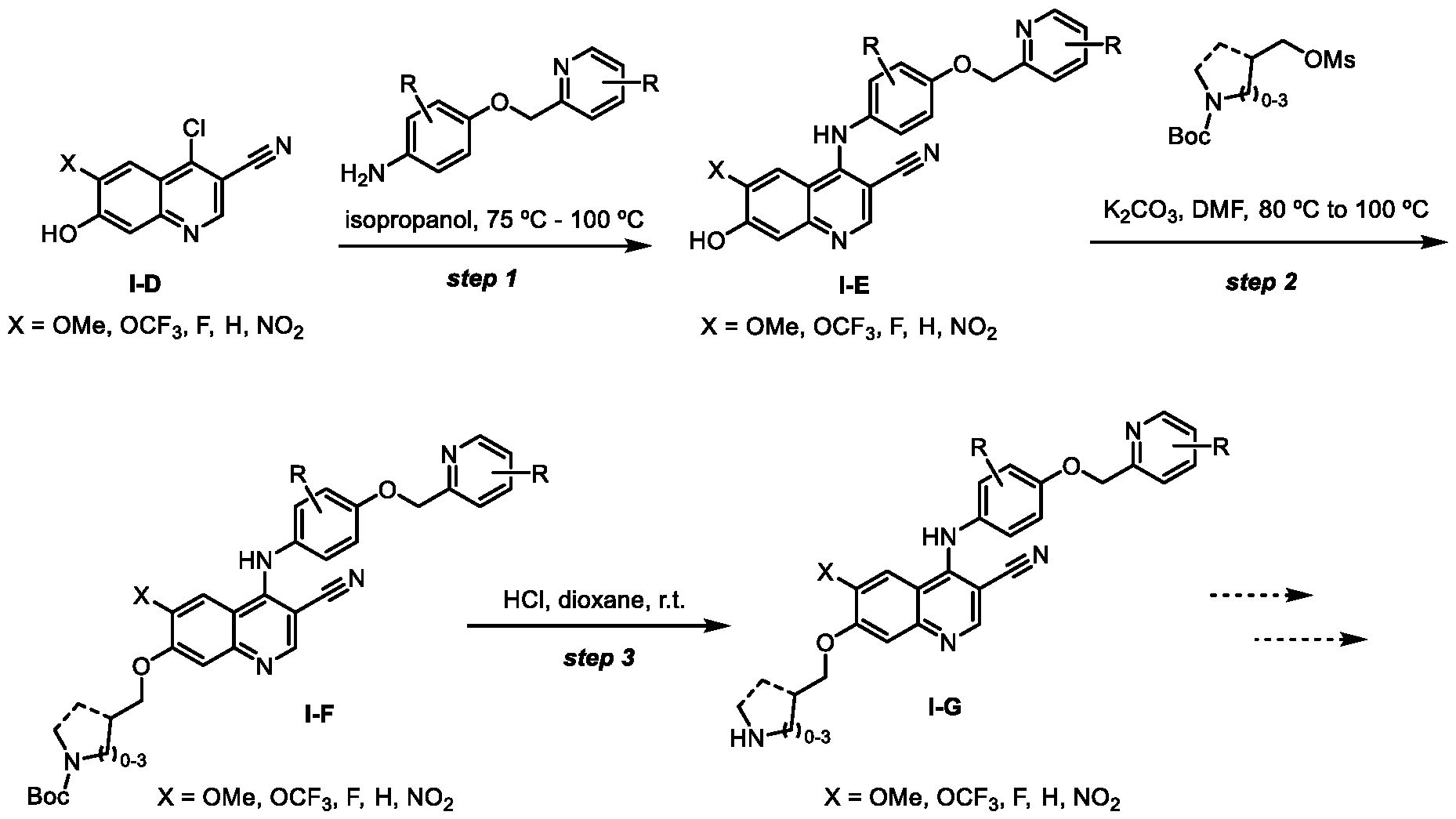
Step 1
[00215] Generally, intermediate I-D in dry IPA was added the substituted anilines at room temperature. The reaction mixture was then heated to 75 °C- 100 °C. After completion of the reaction, the mixture was cooled to room temperature and quenched with water, followed by extraction with an organic solvent. The combined organic layer was dried, concentrated under reduced pressure to provide the crude residue, which was purified by column chromatography to give the desired intermediate I-E.
Step 2
[00216] Generally, to a stirred solution of intermediate I-E in dry DMF was added CS2CO3 at room temperature, followed by the addition of the mesylate. The reaction mixture was then stirred at 80 °C-100 °C. After completion of the reaction, the mixture cooled to room temperature, quenched with ice-cold water and extracted with ethyl acetate. The combined organic layer was dried, concentrated under reduced pressure, and the resulting crude residue was purified by column chromatography to give the desired intermediate I-F.
Step 3
[00217] Generally, to a stirred solution of I-F in dry dioxane was added HC1 in dioxane drop -wise at 0 °C. The resulting mixture was then stirred at room temperature. After completion of the
reaction, dioxane was evaporated under reduced pressure, and the crude residue was purified to give the desired product, or the desired intermediate for further manipulation.
Example 4 - Synthesis of Compound 90
Scheme 4


Step 1 - Synthesis of 2-chloro-6-((5-chloro-2-fluoro-4-nitrophenoxy)methyl)pyridine (1-7)

[00218]To a solution of l-chloro-4,5-difluoro-2-nitrobenzene (25g, 0.1395mol) in dry DMF (250mL) was added (6-chloropyridin-2-yl)methanol (20g, 0.1395mol) at room temperature, and then the reaction was heated to 50 °C. After 12 hours, the mixture was cooled to room temperature and then quenched with ice-cold water with stirring for 10 minutes. The precipitate was then filtered and dried under vacuum to give the desired intermediate 1-7 or 2-chloro-6-((5- chloro-2-fluoro-4-nitrophenoxy)methyl)pyridine in 61% yield.
Step 2 — Synthesis of 2-chloro-4-((6-chloropyridin-2-yl)methoxy)-5-fluoroaniline (1-8)
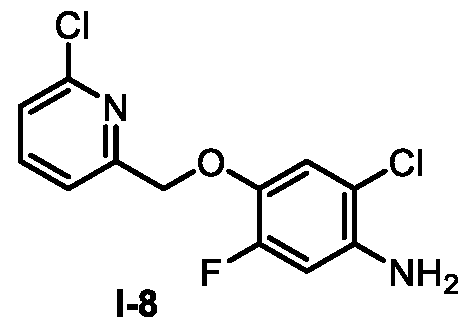
[00219]To a solution of 1-7 or 2-chloro-6-((5-chloro-2-fluoro-4-nitrophenoxy)methyl)pyridine (13g, 0.0412mol) in methanol (130mL) and water (30mL) was added Fe powder (15.88g, 0.28mol) followed by drop-wise addition of acetic acid (26mL) at 10-15 °C. The resulting mixture was refluxed for 2 hours and then cooled to room temperature. The reaction mixture was filtered through celite bed and washed with methanol. The filtrate was concentrated under vacuum and basify with saturated NaHCO3 solution followed by extraction with ethyl acetate (3 X 250mL). The organic layer was dried with Na2SO4 and concentrated under vacuum to give the crude residue, which was then triturated with n-pentaneto provide the desired intermediate 1-8 or 2-chloro-4-((6-chloropyridin-2-yl)methoxy)-5-fluoroaniline in 93% yield.
Step 3 - Synthesis of 4-((2-chloro-4-((6-chloropyridin-2-yl)niethoxy)-5-fluorophenyl)amino)-6-

[00220] To a solution of 1-6 or 4-chloro-6-fluoro-7-hydroxyquinoline-3 -carbonitrile (8g, 0.036mol) in dry IPA (80mL) was added 1-8 or 2-chloro-4-((6-chloropyridin-2-yl)methoxy)-5- fluoroaniline (10.3g, 0.036mol) atroom temperature. The reaction mixture was heated at the 100 °C. After 6 hours, the reaction mixture was cooled to room temperature and quenched by water, followed by extraction with ethyl acetate (2 x lOOmL). The combined organic layer was dried over sodium sulphate and evaporated under reduced pressure to provide the crude residue, which was purified by column chromatography (3-4% methanol in DCM) to give the desired intermediate 1-9 or 4-((2-chloro-4-((6-chloropyridin-2-yl)methoxy)-5-fluorophenyl)amino)-6- fluoro-7-hydroxyquinoline-3 -carbonitrile in 26% yield.
Step 4 — Synthesis of tert-butyl 4-(((4-((2-chloro-4-((6-chloropyridin-2-yl)methoxy)-5- fluorophenyl)amino)-3-cyano-6-fluoroquinolin- 7-yl)oxy)methyl)piperidine-l -carboxylate (I- 10)

[00221]To a stirred solution of 1-9 or 4-((2-chloro-4-((6-chloropyridin-2-yl)methoxy)-5- fluorophenyl)amino)-6-fluoro-7-hydroxyquinoline-3-carbonitrile (500mg, 1.059mmol) in dry DMF (5mL) was added Cs2CO3 (690mg, 2.1186mmol) at room temperature, followed by tertbutyl 4-((tosyloxy)methyl)piperidine-l-carboxylate (430mg, 1.1623 mmol). The reaction mixture was stirred at 90 °C. After 3 hours, the reaction mixture was cooled to room temperature, quenched with ice-cold water and extracted with ethyl acetate (2 x 50mL). The combined organic layer was dried over sodium sulphate and evaporated under reduced pressure to give the crude residue, which was purified by column chromatography (4-5% methanol in DCM) to give the desired intermediate 1-10 or tert-butyl 4-(((4-((2-chloro-4-((6-chloropyridin-2-yl)methoxy)-5- fluorophenyl)amino)-3-cyano-6-fluoroquinolin-7-yl)oxy)methyl)piperidine-l-carboxylate in 61% yield.
Step 5 - Synthesis of 4-((2-chloro-4-((6-chloropyridin-2-yl)methoxy)-5-fluorophenyl)amino)-6-

Compound 90
[00222]To a stirred solution of 1-10 or tert-butyl 4-(((4-((2-chloro-4-((6-chloropyridin-2- yl)methoxy)-5-fluorophenyl)amino)-3-cyano-6-fluoroquinolin-7-yl)oxy)methyl)piperidine-l- carboxylate (8g, 0.0078mol) in dry 1,4-dioxane (16mL) was added 4M HC1 in dioxane (32mL) drop-wise at 0 °C. The resulting mixture was then stirred at room temperature for 3h. After
completion of the reaction 1,4-dioxane was evaporated under reduced pressure to provide the crude residue which was purified by trituration with n-pentane and diethyl ether to give the desired product compound 90 or 4-((2-chloro-4-((6-chloropyridin-2-yl)methoxy)-5- fluorophenyl)amino)-6-fluoro-7-(piperidin-4-ylmethoxy)quinoline-3 -carbonitrile as a HC1 salt in 81% yield.
[00223]1H NMR (400 MHz, DMSO-d6) 5 11.49 (s, 1H), 9.14 (d, J = 10.7 Hz, 1H), 9.06 (s, 1H), 8.98-8.95 (t, J= 15.6 Hz, 2H), 8.84 (s, 1H), 7.97-7.94 (t, J = 7.8 Hz, 1H), 7.82-7.80 (d, J = 8.0 Hz, 1H), 7.70-7.65 (m, 2H), 7.58-7.52 (dd, J = 13.8, 7.7 Hz, 2H), 5.36 (s, 2H), 4.19-4.17 (d, J = 5.6 Hz, 2H), 3.32-3.28 (d, J= 10.4 Hz, 2H), 2.93-2.90 (d, J = 10.4 Hz, 2H), 2.22 (s, 1H), 1.97- 1.94 (d, J = 13.2 Hz, 2H), 1.61 -1.58 (d, J = 12 Hz, 2H).
[00224]The compounds described herein can be prepared using methods analogous to those described in Examples 1 to 4.
[00225]Table 2 below shows the characterization data for the compounds of Table 1.


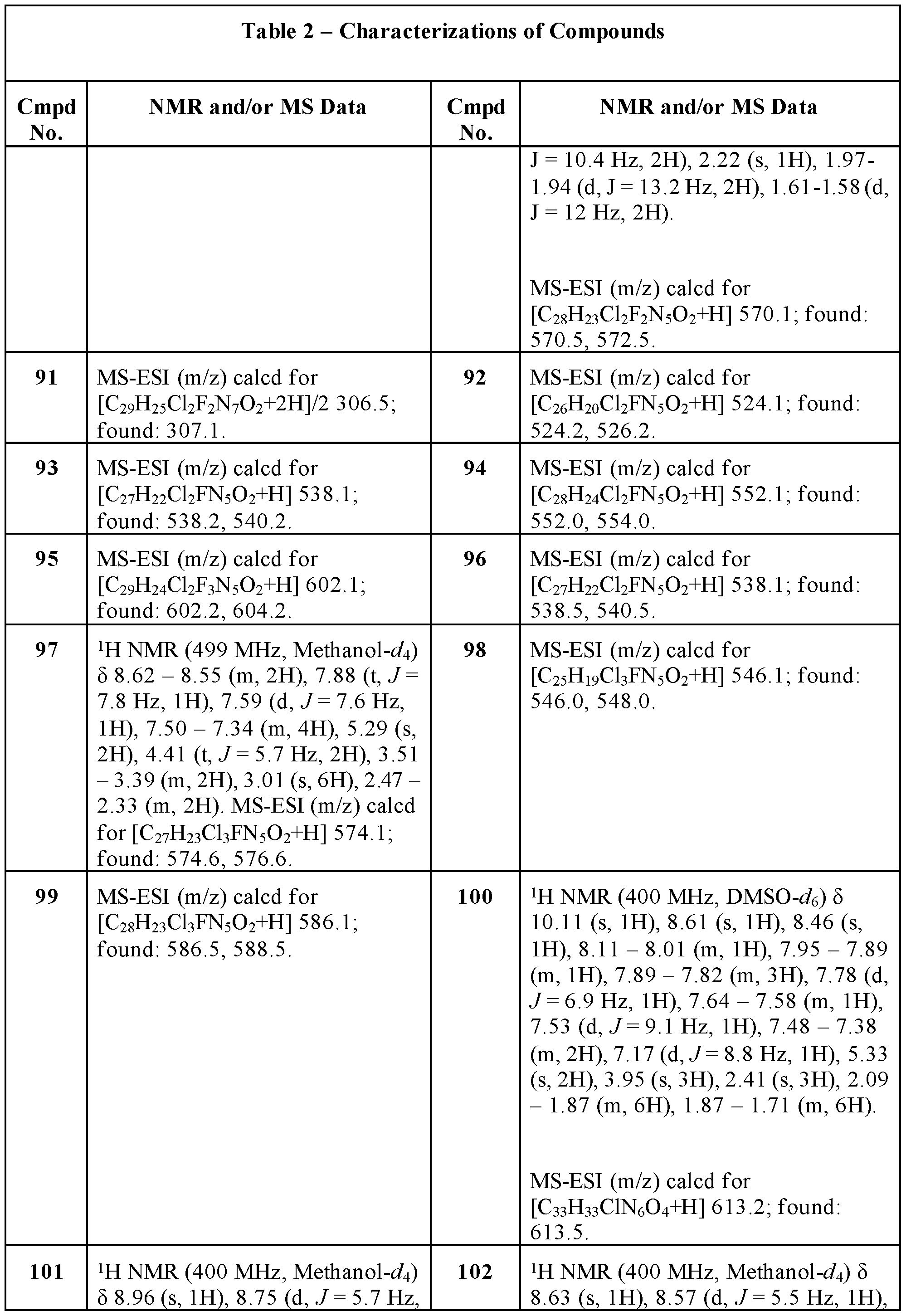

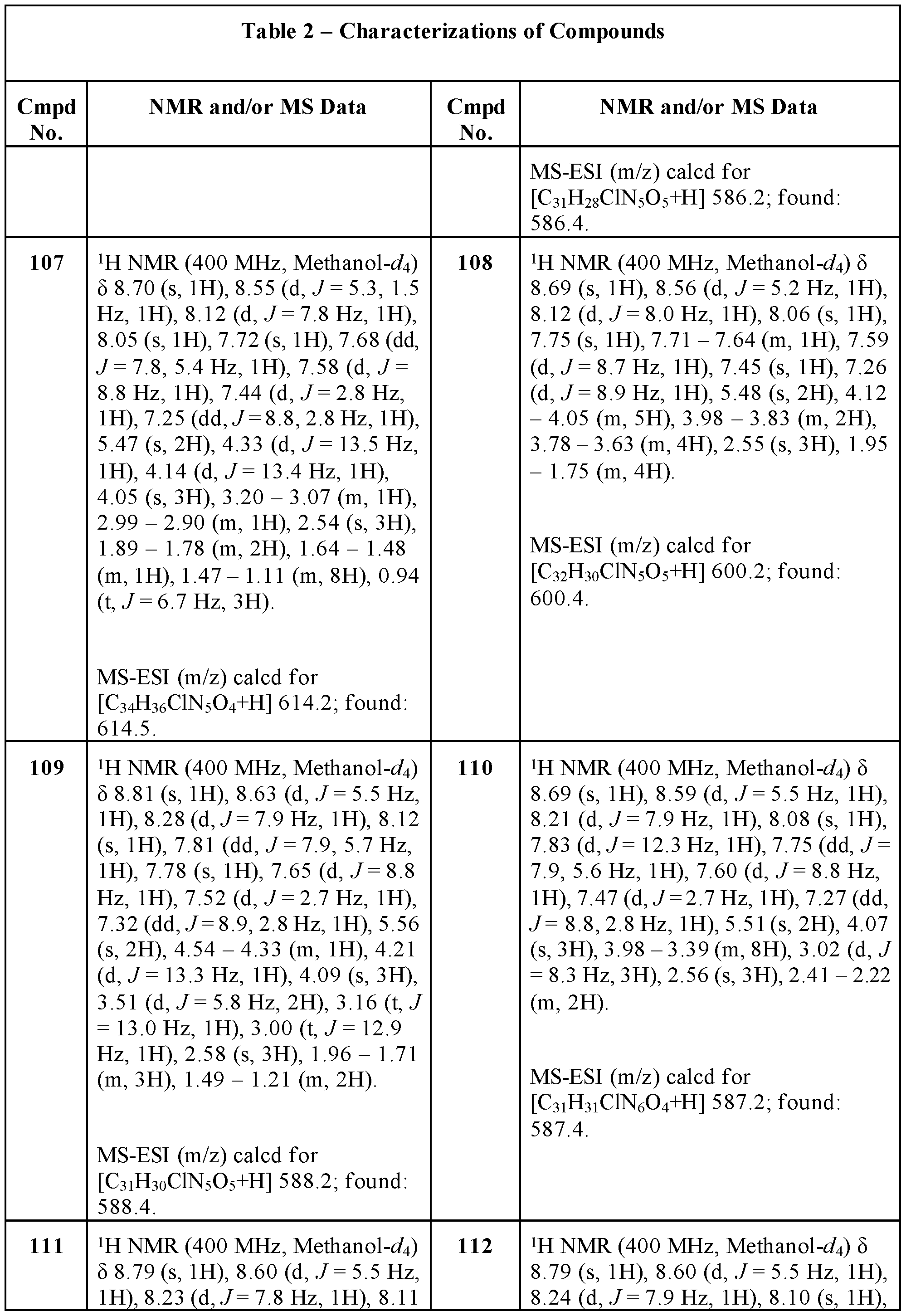


Example 5 - MST1/MST2 Biochemical LanthaScreen Eu kinase binding assay [00226JMST1 and MST2 biochemical LanthaScreen Eu Kinase Binding Assay was based on the binding and displacement ofkinase tracer to the kinase of interest. Compounds in lOOOX DMSO stock solution was dispensed using automated dispensing system (Labcyte) to 384 well Coming Microplate at 15 nL, then 5uL of Kinase buffer A was added to each well. Plates were shaken and incubated for 1 minute to ensure well dissolution of compounds. Kinase/ Antibody mixture was added at a final concentration of 5 nM and 2 nM, and kinase tracer 222 solution at a final concentration of 100 nM in a total volume of 20 pL. Plates were incubated for 1.5 hours in the dark at room temperature and assay plates were scanned on Envi sion plate reader with excitation at 340 nM and kinase Trace Emission at 665 nM.
[00227]Table 3 below shows the IC50 value ranges for MST1 and MST2 binding assays of selected compounds, with compounds having A = IC50 less than 100 nM; B = IC50 greater than or equal to 100 nM and less than 1 pM; and C= IC50 greater than or equal to 1 pM and less than 10 pM; nt = not tested.
[00228] As demonstrated by the data in Table 3, compounds disclosed herein were selective for MST1 over MST2 inhibition.


Example 6 - Protection of P-cells in vitro by compound 90
[00229]This example shows that compound 90 protects P-cells against cellular stresses in vitro. Increased survival of f -cells against ER stress
[00230JINS1E cells were pre-treated with compound 90 for 24 hours, followed by co-treatment of both the compound and TG (final 0.1 uM for 16 hours) to induce ER stress. As shown by FIGs. 1A and IB, compound 90 dose-dependently increased INS1E P-cells viability and basal insulin levels.
Glucose -stimulated insulation secretion (GSIS) impaired by palmitate acid (PA) [00231JINS1E cells were pre-treated with various concentrations of compound 90 for 16 hours, followed by co-treatment of palmitate acid (PA; 200 pM) and compound 90 for 24 hours.
Treated cells were stimulated by high glucose (HG) for insulin secretion and secreted insulin was assayed from the media. As shown by FIG. 1C, Compound 90 restored glucose stimulated insulin secretion (GSIS) which was abolished by HG/PA induced glucolipotoxicity .
Dose-responsive inhibition ofMSTl phosphorylation and caspase 3 activation
[00232] INS IE cells were pre-treated with compound 90 at various concentrations for 24 hours. Then TG (20 nM) were added with Compound 90 for 24 hours to ER stress on P-cells. The cells were subject to immunoblots analysis to determine caspase activation using cleaved caspase-3 - specific antibody (Cl, Casp 3) and the level of MST1 phosphorylation using phosphor-specific antibody (P-MST1), respectively, as shown in FIG. ID.
Inhibition ofMSTl autophosphorylation and caspase 3 activation
[00233]Human pancreatic islets were isolated and treated with low glucose (5.5 mM) alone or high glucose (22 mM) together with PA (500 pM), and compound 90 at 1 pM and 5 pM for 72 hours. The islets were subject to immunoblots analysis to determine caspase activation using cleaved caspase-3-specific antibody (Cl, Casp3) and the level of MST1 phosphorylation using phosphor-specific antibody (P-MST1), respectively. Total level of MSTl and actin were shown for loading control, and the islets were obtained from two unrelated donors, as shown FIG. IE. Protection of f -cells in human islets from glucolipotoxicity
[00234]Cell death in human islets were induced, and compound 90 was alone pre-treated for 24 hours and co-incubated with HG and PA for 72 hours. Apoptosis rate was determined by TUNEL positive cell normalized to insulin-staining positive cell per islet, as shown in FIG. IF. Compound 90 protects islet cells in diabetogenic conditions in vitro.
[00235]The effects of compound 90 on the pancreatic beta cell line INS1E was evaluated. Cell viability and insulin production were measured in vitro in cells pretreated with compound 90 at increasing doses prior to exposure with thapsigargin (TG), a known ER stressor that induces beta cell dysfunction and death. Compound 90 improved cell viability (FIG. 1A) and maintained basal insulin production (FIG. IB) when compared to no treatment. To understand the potential mechanism, activation of MST-1 and caspase were interrogated by western blot. Thapsigargin increased phosphorylation of MST-1, an activating mark, and increased cleaved caspase 3. Both MST-1 activation and caspase 3 activation were reduced by pretreatment with compound 90 (FIG. 1C). Additionally, compound 90-treated INS1E cells maintained their ability to secrete insulin in response to high glucose (HG) under the cellular stressor palmitic acid (PA) (FIG. ID). Palmitic acid induced activation of MST-1 and increased cleaved caspase 3 levels in INS1E which was mitigated by pretreatment with compound 90 (FIG. IE).
[00236] The data show that compound 90 is cytoprotective, through on target MST1 inhibition, by reducing caspase 3 activation in cytotoxic environments.
Example 7 - Pharmacokinetics (PK) studies of compound 90 in mouse, rat, and dog [00237]Mouse oral and IV PK of compound 90 at 20 mg/kg and 5 mg/kg were evaluated respectively.
[00238] Approximately 40-50 pL whole blood were collected at 0.5, 1, 3, 7, 9, and 24 hours post dose study on day 35. Whole blood was collected into lithium heparin plasma separator tubes. Plasma will be extracted after centrifugation (14000 rpm, 4 °C). Plasma were stored at - 80 °C for future analyses.
[00239] Compound 90 showed good exposure, with 35% oral bioavailability, comparable to neratinib (Table 4).

[00240] Compound 90 was further profiled for PK inter species in rats and dogs. Good exposure in rats was observed, showing multiples of exposure and demonstrating a broad window. Additional observations include under-proportional drug exposure from 30 to 100 mg/kg and over-proportional exposure at 300 mg/kg, suggestive of saturation of a clearance mechanism. Similar exposure in the repeat dose tolerability studies are shown in Table 5. Finally, compound 90 showed good oral exposure in dogs at with 37% of bioavailability suggesting dogs are likely a suitable non-rodent species for later stage safety studies. PK profiling results collectively indicate compound 90 was suitable for progression into efficacy studies in animal models of diabetes.

Example 8 - Therapeutic efficacy of Compound 90 in a MLDS-induced T1D model [00241]Diabetes was induced with streptozotocin (50 mpk) in drinking water for 5 consecutive days, and then starting on day 8, mice were orally treated twice daily with compound 90 (10 and 50 mg/kg) or reference compound 175 for 28 days (FIG. 2A). Compound treatment was generally tolerated in all animals and no effects on BW were observed in any of the treatment groups. Throughout the course of the study, fed blood glucose levels were monitored three times a week. Remarkably, compound 90 treatment at 10 and 50 mg/kg BID showed highly improved glycemic control at both doses, similar efficacy to the reference compound 175 at 50 mg/kg (FIG. 2B) Oral glucose tolerance tests (oGTT) were performed on Day 21 (FIG. 2C) and day 35 respectively. Compound 90 treatment at 50 mg/kg showed significant improvement of glucose tolerance on both day 21 and day 35, comparable to the reference compound 175 at the same dose.
[00242]Next, to examine whether compound 90 treatment mediated the improvement of glucose metabolism in MLDS-induced mice by protection of P-cells, PK and histology of P-cells were evaluated on day one and at steady state to assess effects on insulin production and secretion. In addition, compound 90 was subjected to 4 day tolerability study at 50, 100, 500 mg/kg per day in Taconic SD female rats, and only at lOx the efficacious dose, 1 out 3 animals showed some clinical findings with lethargy and hypothermia with ~ 13% body weight reduction, indicating compound 90 is relatively tolerated at higher doses with drug exposure at the tolerated dose is > 8x higher than the efficacious drug levels.
[00243]The structure of the reference compound 175 is

[00244] The structure of Neratinib is

[00245]In summary, MST1 -selective inhibitor compound 90 showed a potent in vivo efficacy in T1D diabetic animal model with a reasonable safety window.
Example 9 - Compound 90 accelerates murine liver regeneration following surgical resection
[00246]The activation of YAP has proven important in the context of liver regeneration. Activating YAP through genetic manipulation or pharmacological inhibition of the Hippo pathway has been utilized to accelerate liver regeneration. In a standard 70% murine partial hepatectomy model, mice were treated with variable doses of compound 90 twice-daily beginning 12 hours pre-operatively (FIG. 4A). Liver regeneration was evaluated at 40- and 72- hours post-hepatectomy by examining liver to body weight ratios. Forty hours post-hepatectomy liver to body weight ratios were increased in mice treated with compound 90 at 50 mg/kg/dose (FIG. 4B). Additionally, 72-hours post-hepatectomy liver to body weight ratios were increased with compound 90 at all doses tested (5-, 15-, and 50- mg/kg/dose) (FIG. 4B). Proliferative indices were evaluated 40-hours post-hepatectomy, a timepoint associated with peak proliferation, by proliferating cellular nuclear antigen (PCNA) immunoblot. PCNA was more abundant in murine liver lysates treated with compound 90 in the 15-, and 50 mg/kg/dose groups (FIG. 4C). Histological analysis did not reveal any major changes in liver architecture and plasma analysis did not identify any Biochemical analysis did not identify any derangements in liver or kidney function tests, alanine aminotransferase (ALT), alkaline phosphatase (ALP), blood urea nitrogen (BUN), bilirubin) (FIG. 4D). Histological analysis by H&E did not reveal any major changes in liver architecture post-hepatectomy (FIG. 4E). These data indicate that
perioperative compound 90 accelerates liver regeneration post-hepatectomy and is tolerable in the setting of hepatectomy.
Example 10 - Compound 90 activates YAP, TAZ, and is required for accelerated murine liver regeneration
[00247JMST1 is a kinase upstream of multiple Hippo pathway members but importantly is upstream of MOB kinase activation 1A (M0B1A). Inhibition of MST1 is known to reduce MOB 1 A threonine phosphorylation, a marker for activity. The activity of MOB 1 A in conjunction with large tumor suppressor kinase 1/2 (LATS1/2) phosphorylates YAP. This serine (S127) post- translational modification marks YAP for cytosolic retention and degradation. Reduction of YAP serine phosphorylation permits nuclear translocation and transcriptional co -activation of cognate genes. Hu 1545 cells, a human hepatocyte derived cell line, were utilized to explore compound 90’s effects on YAP activation. First, M0B1 A and YAP post -translation al modifications were observed with immunoblot following exposure of compound 90 (3pM). Compound 90-treated cells had a reduced M0B1 A phosphorylation indicating on target MST1 inhibition. Additionally, YAP-S127 phosphorylation was reduced suggesting increased YAP activity. Hydrogen peroxide (H2O2) is known to activate the Hippo pathway through increased MST1 activation. Following exposure to H2O2, M0B1 A phosphorylation increased, indicating increased MST1 activity. H2O2 induced MST1 activation was ablated when Hu 1545 cells were pretreated with compound 90 (FIG. 5A)
[00248] YAP post-translational changes were also examined over a range of doses (0.1 -3pM) with progressive decreases in serine phosphorylation with increased compound 90 (FIG. 5B). Changes in YAPS127 are known to be associated with subcellular redistribution of YAP and its paralog TAZ. Following, compound 90 exposure YAP and TAZ subcellular location were assessed and mean fluorescence intensity quantified by confocal microscopy. Hul545 cells treated with compound 90 demonstrated increased intranuclear levels of both YAP and TAZ, consistent with decreased Hippo pathway activity (FIG. 5C and FIG. 5D). To confirm that the post-translational changes and YAP/TAZ nuclear relocation induced YAP/TAZ transcriptional co-activation, YAP/TAZ cognate gene expression were further examined. Using quantitative RT- PCR, CTGF, CYR61, and NUAK2 were significantly increased in compound 90-treated Hui 545 cells (FIG. 5E). Following exposure to compound 90 in which cognate genes were elevated, compound 90 was withdrawn and cognate genes were reexamined 6- and 24-hours later. CTGF and NUAK2 remained elevated 6 hours after compound 90 withdrawal, with all the cognate genes returned to baseline levels at 24 hours (FIG. 5E). These results indicate that compound 90
inhibited MST1 in a human hepatocyte derived cell line and resulted in transient YAP/TAZ activation.
[00249]To confirm these results, normal human cholangiocytes (NHC), a transformed normal cholangiocyte cell line, were utilized to further define the effects of compound 90 on YAP activity. NHC cells exposed to compound 90 demonstrated reduced serine phosphorylated YAP (FIG. 9A), and increased expression of YAP/TAZ cognate gene expression (FIG. 9B), as was observed in Hui 545 cells.
[00250]Prior studies on MST1 inhibition or genetic ablation have shown that this alteration can induce liver carcinogenesis. Additionally, evidence suggests that disordered overactivity of YAP can promote fibrosis. To evaluate if prolonged exposure to compound 90 could lead to carcinogenesis or fibrosis, mice were administered compound 90 (50mg/kg/dose, twice daily) or vehicle (0.5% tween-80/0.5% methylcellulose) for 4 weeks. Following euthanasia, liver to body weight ratio assessments were not different between treatment groups (FIG. 10). Histological analysis with H&E and Sirius red stains did not identify any histological changes or fibrosis (FIG. 10C)
[00251]To further investigated whether YAP/TAZ was a major determinant of accelerated liver regeneration observed with compound 90 administration post-hepatectomy. To do this, Yap and Taz from hepatocytes were genetically ablated in vivo by delivering hepatotropic Cre recombinase to Yap Tazf mice as previously described. YAP/TAZ deletion was confirmed by immunoblot of whole liver lysates from the resection specimens (FIG. 1 IB). Yap^/Taz^ and Yapf /Tazf mice, as a genetic background control, underwent partial hepatectomy with perioperative compound 90 administration. Similar to wild -type mice, compound 90-induced accelerated regeneration in Yapf /Taz 1 mice but the pro-regenerative effects were lost in Yap^v/Taz^ (FIG. 5F). These data indicate that compound 90 mediates enhanced liver regeneration through YAP and TAZ.
Example 11 - Compound 90 induces a pro-regenerative transcriptional profile following hepatectomy
[00252]Bulk RNA sequencing was performed on whole liver lysates from vehicle and compound 90-treated mice 40 hours post-hepatectomy with resections specimens used as baseline measurements. Overall, the number of transcripts modified from baseline following hepatectomy in vehicle and compound 90-treated mice were similar, 1224 vs 1463 (FIG. 6 A). The differentially expressed transcripts were compared between groups. Vehicle and compound 90- treated mice had 1027 differentially expressed transcripts in common with 436 transcripts unique
to compound 90 treatment (FIG. 6A). These gene sets were characterized utilizing Qiagen Ingenuity Pathway Analysis (IP A). The common gene set was enriched in pathways categorized as cell cycle regulation, cellular stress and injury, and metabolic pathways, complete list in supplemental data. Activation scores (Z-score) were compared between the enriched pathways (- 1.3< Log2FC >1.3, FDR <0.05) from the transcripts unique to vehicle or compound 90.
Pathways in which an activation score was undefined, or the Z-score change was between 1 and - 1 were excluded from analysis. In compound 90-treated mice, there was increased activation in inflammation related pathways, IL-17 signaling and MSP-RON signaling (table below). Pathways in which the activation was reduced in compound 90-treated mice were metabolic related (table below).

[00253]While induction of unique pathways as described above may contribute to accelerated regeneration, accelerated regeneration could also occur due to enhanced expression of pathways normally modified following hepatectomy. Transcriptional profiles of baseline livers were compared to the regenerating remnants in vehicle treated mice. Genes differentially expressed were identified (1.5 >Log2FC < -1.5, FDR <0.05). These genes were grouped as either induced or repressed transcripts (FIG. 6B), which were considered the core regeneration transcriptional profile 40 hours post-hepatectomy. Gene set enrichment analysis was performed using ShinyGO on the induced and repressed core regeneration gene sets. The induced core regeneration transcripts were enriched in pathways involved in cellular proliferation and cell cycle control while the repressed genes were enriched in metabolic pathways (FIG. 6C). These results are congruent with previous literature in which the metabolic processing of the liver is reduced while cellular proliferation is increased to restore hepatic homeostasis. The induced core regeneration transcripts expression in compound 90 -treated mice, 40 hours post-hepatectomy, were enhanced compared to vehicle treated mice (FIG. 6D). These results suggest that compound 90-accelerated regeneration by enhancing the pathways that are normally turned on following hepatectomy. Concurrently, the core regeneration repressed transcripts trended towards a smaller reduction in compound 90-treated mice but was not statistically significant (FIG. 6D). This suggested that the functional metabolic processing of the liver was maintained or turned off less during the regenerative process.
[00254]To further confirm that compound 90 induced a pro -proliferative enhancement of regeneration following partial hepatectomy, expression of transcripts in a standard cell cycle gene set (KEGG Cell Cycle, 04110) were compared. Cell cycle transcript expression at baseline and in the regenerating remnants of vehicle treated and compound 90-treated mice are graphically displayed in FIG. 6E. The hepatectomy stimulus induces most of these transcripts to increase expression, as expected. Compound 90-treated mice had further induction of these cell cycle gene transcripts based on the Log2FPKM (FIG. 6E). These data indicate that compound 90 administered perioperatively was pro-regenerative through enhanced induction of a core liver regeneration transcriptional profile.
Example 12 - Compound 90 improves post-hepatectomy survival in murine diet induced NASH
[00255] Non-alcoholic fatty liver disease represents a spectrum of disease that spans from simple steatosis to non-alcoholic steatohepatitis (NASH). NAFLD prevalence has increased over the past decade and clinically represents a disease that increases the risk of liver insufficiency and
PHLF following hep atectomy. The ability to prevent PHLF in patients with NASH represents a clinical need as no pharmacological agents are clinically approved. The effects of compound 90 in a murine diet induced NASH model following hepatectomy were studied. Mice were randomized to either standard chow or a high fat, fructose, and cholesterol (FFC) diet for 24 weeks as previously described (FIG. 7A). NASH mice were characterized by increased weight gain and gross liver size (FIG. 12A-B). Microscopically, steatosis with ballooning hepatocytes and fibrosis were observed (FIG. 12C). Chow control mice were randomized to vehicle or compound 90 treatment and underwent partial hepatectomy. Liver to body weight ratio was increased at 40- and 72- hours post-hepatectomy, similar to wild type mice (FIG. 7B). Proliferative response was assessed by 5-bromo-2’-deoxyuridine (BrdU) incorporation. Liver sections stained for BrdU 40-hours post hepatectomy demonstrated increased incorporation in compound 90-treated mice (FIG. 7C). Partial hepatectomy in other murine NASH models has been shown to result in high post-operative mortality. Following partial hepatectomy, mice with diet induced NASH had a 22.2% survival. Survival was significantly improved when NASH mice were treated with compound 90 (56.25%) (FIG. 7D). Liver to body weight ratio was not significantly increased in compound 90-treated NASH mice (FIG. 12D). Despite the lack of liver to body weight ratio augmentation, a significant increase in BrdU incorporation in compound 90 - treated mice (FIG. 7E) was observed. These data indicate that administration of compound 90 in a murine model of NASH represents a feasible option to prevent liver failure and improve survival post-hepatectomy.
[00256]In summary, MST1 inhibitor compound 90 demonstrated on-target inhibition of MST1 and reduced EGFR inhibition which resulted in Yes-associated protein (YAP) activation. Oral delivery of compound 90 perioperative ly resulted in accelerated liver regeneration and improved survival in diet induced NASH models. Transcriptional analysis suggested that compound 90 enhanced the normal regenerative pathways induced following liver resection. Overall, pharmacological acceleration of liver regeneration with compound 90 was feasible, had an acceptable therapeutic index, and provided survival benefit in models of diet induced nonalcoholic steatohepatitis. Compound 90 is orally bioavailable MST1/2 inhibitor that is tolerable. Compound 90 accelerated liver regeneration in models of murine partial hepatectomy by enhancing pro-regenerative and pro-proliferative transcription profiles, and compound 90 improves survival in a diet induced NASH partial hepatectomy model.
[00257]The examples and embodiments described herein are for illustrative purposes only and various modifications or changes suggested to persons skilled in the art are to be included within the spirit and purview of this application and scope of the appended claims.
Claims
1 . A compound of Formula (I):

Formula (I), or a pharmaceutically acceptable salt thereof, wherein:
R1 is hydrogen, halogen, Ci-C6-alkyl, Ci-C6-haloalkyl, -O(Ci-C6-alkyl), -O(Ci-C6-

HN> haloalkyl), -NHC(O)-(C3-C6-cycloalkyl), or '
R2 is -OR5, -C2-C6-alkynyl-(5- to 10-membered heteroaryl), C3-C14- heterocycloalkyl, 5- to 10-membered heteroaryl, or -C(O)-(C3-Ci4-heterocycloalkyl), wherein -C2-C6-alkynyl-(5- to 10 -membered heteroaryl), C3-Ci4-heterocycloalkyl, and 5- to 10-membered heteroaryl are each independently unsubstituted or substituted with Ci- C6-alkyl or C3-Ci4-heterocycloalkyl, and wherein at least two members of the 5- to 10- membered heteroaryl, at least one member of the -C2-C6-alkynyl-(5- to 10-membered heteroaryl), and at least one atom of the C3-Ci4-heterocycloalkyl are each independently selected from N, O, and S;
R3a, R3b, and R3c are each independently hydrogen, halogen, -CN, Ci-C6 alkyl, or - O(Ci-Ce alkyl), wherein at least one of R3a, R3b, and R3c is not hydrogen;
R4a and R4b are each independently hydrogen, halogen, Ci-C6 alkyl, or -N(R7)2, wherein at least one of R4a and R4b is not hydrogen;
R5 is Ci-C5-alkyl, Ci-C5-haloalkyl, C3-Ci4-cycloalkyl, C3-Ci4-heterocycloalkyl, 5- to 10-membered heteroaryl, -CH2-(C6-Cio-aryl), -CH2-(C3-Ci4-cycloalkyl), -CH2-(C3-Ci4- heterocycloalkyl), -CH2-(5- to 10-membered heteroaryl), -C(O)NH(R7), or -C(O)R8, wherein the Ci-Cs-alkyl is substituted with -N(R6)2 or -(NH)0.IC(NH)(NH2), and wherein any haloalkyl, cycloalkyl, heterocycloalkyl, and heteroaryl of R5 is unsubstituted or substituted with at least one substituents independently selected from halogen, -OH, - CN, -N(R6)2, C6-Cio-aryl, -S(O)0.2(Ci-C6-alkyl), -Ci-C6-alkyl(N(R6)2), -C(O)R6, -(NH)0.
1C(NH)(NH2), Ci-C6-alkyl, hydroxy(Ci-C6-alkyl), Ci-C6-haloalkyl, -O(Ci-C6-alkyl), - O(Ci-C6-haloalkyl), -(Ci-C6-alkyl)(OCi-C6-alkyl), C3-C6-cycloalkyl, and 5- to 10- membered heteroaryl, and wherein 1-4 members of any heterocycloalkyl and heteroaryl are independently selected from N, O, and S; each R6 is independently hydrogen or Ci-C6 alkyl;
R7 and R8 are each independently C3-Ci4-cycloalkyl or C3-Ci4-heterocycloalkyl, wherein any cycloalkyl and heterocycloalkyl is unsubstituted or substituted with at least one substituent selected from -OH, -CN, -N(R6)2, C6-Ci0-aryl, -S(0)o-2(Ci-C6-alkyl), -Ci- C6-alkyl(N(R6)2), -C(O)R6, -(NH)0.IC(NH)(NH2), Ci-C6-alkyl, hydroxy(Ci-C6-alkyl), C C6-haloalkyl, -O(Ci-C6-alkyl), -O(Ci-C6-haloalkyl), -(Ci-C6-alkyl)(OCi-C6-alkyl), C3-C6- cycloalkyl, and 5- to 10-membered heteroaryl, wherein 1 -4 members of any heterocycloalkyl and heteroaryl are each independently selected from N, O, and S; and n is 1, 2, 3, or 4.
2. The compound of claim 1, or a pharmaceutically acceptable salt thereof, wherein the compound is of Formula (II):
 or a pharmaceutically acceptable salt thereof.
3. The compound of claim 1 or 2, or a pharmaceutically acceptable salt thereof, wherein R3a is halogen, -CN, Ci-C6 alkyl, or -O(Ci-C6 alkyl).
4. The compound of claim 1 or 2, or a pharmaceutically acceptable salt thereof, wherein R3a is halogen.
5. The compound of claim 1 or 2, or a pharmaceutically acceptable salt thereof, wherein R3a is Br.
6. The compound of claim 1 or 2, or a pharmaceutically acceptable salt thereof, wherein R3a is Cl.
7. The compound of claim 1 or 2, or a pharmaceutically acceptable salt thereof, wherein R3a is F.
8. The compound of any of claims 1-7, or a pharmaceutically acceptable salt thereof, wherein R3b is halogen, -CN, Ci-C6 alkyl, or -O(Ci-C6 alkyl).
9. The compound of any of claims 1 -7, or a pharmaceutically acceptable salt thereof, wherein R3b is halogen.
10. The compound of any of claims 1 -7, or a pharmaceutically acceptable salt thereof, wherein R3b is Br.
11 . The compound of any of claims 1 -7, or a pharmaceutically acceptable salt thereof, wherein R3b is Cl.
12. The compound of any of claims 1 -7, or a pharmaceutically acceptable salt thereof, wherein R3b is F.
13. The compound of any of claims 1 -12, or a pharmaceutically acceptable salt thereof, wherein R3c is halogen, -CN, Ci-C6 alkyl, or -O(Ci-C6 alkyl).
14. The compound of any of claims 1 -12, or a pharmaceutically acceptable salt thereof, wherein R3c is halogen.
15. The compound of any of claims 1 -12, or a pharmaceutically acceptable salt thereof, wherein R3c is Br.
16. The compound of any of claims 1 -12, or a pharmaceutically acceptable salt thereof, wherein R3c is Cl.
17. The compound of any of claims 1 -12, or a pharmaceutically acceptable salt thereof, wherein R3c is F.
18. The compound of claim 1 or 2, or a pharmaceutically acceptable salt thereof, wherein R3a, R3b, and R3c are each independently hydrogen, halogen, -CH3, or -CN, and wherein at least one of R3a, R3b, and R3c is not a hydrogen.
19. The compound of claim 1 or 2, or a pharmaceutically acceptable salt thereof, wherein R3a is halogen, -CH3, or -CN, and R3b and R3c are each hydrogen.
20. The compound of claim 1 or 2, or a pharmaceutically acceptable salt thereof, wherein R3b is halogen, -CH3, or -CN, and R3a and R3c are each hydrogen.
21 . The compound of claim 1 or 2, or a pharmaceutically acceptable salt thereof, wherein R3a and R3c are each independently halogen, -CH3, or -CN, and R3b is hydrogen.
22. The compound of claim 1 or 2, or a pharmaceutically acceptable salt thereof, wherein R3a is chlorine, R3b is H, and R3c is H.
23. The compound of claim 1 or 2, or a pharmaceutically acceptable salt thereof, wherein R3a is chlorine, R3b is H, and R3c is F.
24. The compound of any one of claims 1 -23, or a pharmaceutically acceptable salt thereof, wherein R4a and R4b are each independently hydrogen, halogen, -NH2, or -CH3, and at least one of R4a and R4b is not hydrogen.
25. The compound of any one of claims 1 -23, or a pharmaceutically acceptable salt thereof, wherein R4a and R4b are each independently hydrogen, halogen, -CH3, and at least one of R4a and R4b is not hydrogen.
26. The compound of any one of claims 1 -23, or a pharmaceutically acceptable salt thereof, wherein R4a is -CH3 and R4b is H.
27. The compound of any one of claim 1-23, or a pharmaceutically acceptable salt thereof, wherein R4a is H and R4b is Cl.
28. The compound of any one of claims 1 to 27, or a pharmaceutically acceptable salt thereof, wherein R1 is hydrogen, halogen, -O(Ci-C6-alkyl), -O(Ci-C6-haloalkyl), -NHC(O)-(C3-
C6-cycloalkyl),

29. The compound of any one of claims 1 to 27, or a pharmaceutically acceptable salt thereof, wherein R1 is hydrogen, halogen, -O(Ci-C6-alkyl), -O(Ci-C6-haloalkyl), -NHC(O)-(C3- Ce-cycloalkyl).
30. The compound of any one of claims 1 to 27, or a pharmaceutically acceptable salt thereof, wherein R1 is hydrogen, halogen, -O(Ci-C6-alkyl), -O(Ci-C6-haloalkyl).
31 . The compound of any one of claims 1 to 27, or a pharmaceutically acceptable salt thereof, wherein R1 is -O(Ci-C6-alkyl) or -O(Ci-C6-haloalkyl).
32. The compound of any one of claims 1 to 27, or a pharmaceutically acceptable salt thereof, wherein R1 is hydrogen, halogen.
33. The compound of any one of claims 1 to 27, or a pharmaceutically acceptable salt thereof, wherein R1 is hydrogen.
34. The compound of any one of claims 1 to 27, or a pharmaceutically acceptable salt thereof, wherein R1 is Br, Cl, or F.
35. The compound of any one of claims 1 to 27, or a pharmaceutically acceptable salt thereof, wherein R1 is Cl, or F.
36. The compound of any one of claims 1 to 27, or a pharmaceutically acceptable salt thereof, wherein R1 is Cl.
37. The compound of any one of claims 1 to 27, or a pharmaceutically acceptable salt thereof, wherein R1 is F.
38. The compound of any one of claims 1 to 27, or a pharmaceutically acceptable salt thereof, wherein R1 is -OCH3.
39. The compound of any one of claims 1 to 27, or a pharmaceutically acceptable salt thereof, wherein R1 or -OCF3.
40. The compound of any one of claims 1 to 27, or a pharmaceutically acceptable salt thereof, wherein

41 . The compound of any one of claims 1 to 40, or a pharmaceutically acceptable salt thereof, wherein R2 is C3-Ci4-heterocycloalkyl.
42. The compound of claim 41, or a pharmaceutically acceptable salt thereof, wherein C3- Cu-heterocycloalkyl is substituted with Ci-Ce-alkyl or -N(R6)2.
43. The compound of claim 41 or 42, or a pharmaceutically acceptable salt thereof, wherein C3-Ci4-heterocycloalkyl is substituted with -CH3, -CH(CH3), or -N(CH3)2.
44. The compound of any one of claims 41 to 43, or a pharmaceutically acceptable salt thereof, wherein R2 is selected from:

45. The compound of any one of claims 41 to 44, or a pharmaceutically acceptable salt thereof, wherein the compound is selected from:

46. The compound of any one of claims 1 to 40, or a pharmaceutically acceptable salt thereof, wherein R2 is -C2-Ce-alkynyl-(5- to 10-membered heteroaryl).
47. The compound of claim 46, or a pharmaceutically acceptable salt thereof, wherein -C2- C6-alkynyl-(5- to 10-membered heteroaryl) is substituted with C3-Ci4-heterocycloalkyl.
48. The compound of claim 47, or a pharmaceutically acceptable salt thereof, wherein -C2-
Ce-alkynyl-(5- to 10-membered heteroaryl) is substituted with

49. The compound of any one of claims 1 to 40, or a pharmaceutically acceptable salt thereof, wherein

50. The compound of any one of claims 1 to 40, or a pharmaceutically acceptable salt thereof, wherein the compound
 pharmaceutically acceptable salt thereof.
51 . The compound of any one of claims 1 to 40, or a pharmaceutically acceptable salt thereof, wherein R2 is 5- to 10-membered heteroaryl.
52. The compound of claim 51, or a pharmaceutically acceptable salt thereof, wherein 5- to 10-membered heteroaryl is substituted with C3-Ci4-heterocycloalkyl.
53. The compound of claim 51 or 52, or a pharmaceutically acceptable salt thereof, wherein
5- to 10-membered heteroaryl is substituted with
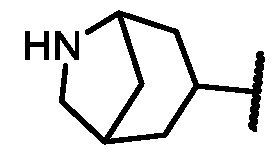
54. The compound of any one of claims 1 to 40, or a pharmaceutically acceptable salt thereof,

55. The compound of any one of claims 1 to 40, or a pharmaceutically acceptable salt thereof,
 pharmaceutically acceptable salt thereof.
56. The compound of any one of claims 1 to 40, or a pharmaceutically acceptable salt thereof, wherein R2 is -C(O)-(C3-Ci4-heterocycloalkyl).
57. The compound of claim 56, or a pharmaceutically acceptable salt thereof, wherein the C3- Cu-heterocycloalkyl is substituted with Ci-Cs-alkyl.
58. The compound of any one of claims 1 to 40, or a pharmaceutically acceptable salt thereof, wherein

59. The compound of any one of claims 1 to 40, or a pharmaceutically acceptable salt thereof, wherein the compound i
 pharmaceutically acceptable salt thereof.
60. The compound of any one of claims 1 to 40, wherein the compound is of Formula (III):

Formula (III), or a pharmaceutically acceptable salt thereof.
61 . The compound of claim 60, or a pharmaceutically acceptable salt thereof, wherein R5 is C3-Ci4-cycloalkyl, C3-Ci4-heterocycloalkyl, 5 - to 10-membered heteroaryl, -CH2-(C6-CI0- aryl), -CH2-(C3-Ci4-cycloalkyl), -CH2-(C3-Ci4-heterocycloalkyl), -CH2-(5- to 10- membered heteroaryl), -C(O)NH(R7), or -C(O)R8.
62. The compound of claim 60, or a pharmaceutically acceptable salt thereof, wherein R5 is C3-Ci4-cycloalkyl, C3-Ci4-heterocycloalkyl, -CH2-(C6-Ci0-aryl), -CH2-(C3-CI4- cycloalkyl), -CH2-(C3-Ci4-heterocycloalkyl), or -CH2-(5- to 10-membered heteroaryl).
63. The compound of claim 60, or a pharmaceutically acceptable salt thereof, wherein R5 is - CH2-(C3-Ci4-cycloalkyl), -CH2-(C3-Ci4-heterocycloalkyl).
- Il l -
64. The compound of claim 60, or a pharmaceutically acceptable saltthereof, wherein R5 is -
CH2-(C3-Ci4-heterocycloalkyl).
65. The compound of claim 60, or a pharmaceutically acceptable salt thereof, wherein R5 is

66. The compound of claim 60, or a pharmaceutically acceptable salt thereof, wherein R5 is Ci-C5-alkyl or Ci-C5-haloalkyl.
67. The compound of claim 66, or a pharmaceutically acceptable salt thereof, wherein C1-C5- alkyl and Ci-C5-haloalkyl are each independently substituted with halogen, -N(R6)2, or - (NH)O.IC(NH)(NH2).
68. The compound of claim 66, or a pharmaceutically acceptable saltthereof, wherein C1-C5- alkyl and Ci-C5-haloalkyl are each independently substituted with -NH2, -NH(CH3), -

69. The compound of any one of claims 66 to 68, or a pharmaceutically acceptable salt thereof, wherein R5 is selected from:

70. The compound of any one of claims 66 to 69, or a pharmaceutically acceptable salt thereof, wherein the compound is selected from:


71. The compound of claim 60, or a pharmaceutically acceptable salt thereof, wherein R5 is - CH2-(C3-Ci4-cycloalkyl) or -CH2-(C6-Cio-aryl).
72. The compound of claim 71, or a pharmaceutically acceptable salt thereof, wherein -CH2- (Cs-Cu-cycloalkyl) and -CH2-(Ce-Cio-aryl) are each independently substituted with -N(R6)2, -CH2-N(R6)2, or C6-Ci0-aryl.
73. The compound of claim 71 or 72, or a pharmaceutically acceptable salt thereof, wherein - CH2-(C3-Ci4-cycloalkyl) and -CH2-(C6-Cio-aryl) are each independently substituted with - NH2, -NH(CH3), -N(CH3)2, -CH2-NH2, or phenyl.
74. The compound of any one of claims 71 to 73, or a pharmaceutically acceptable salt thereof, wherein -CH2-(C3-Ci4-cycloalkyl) and -CH2-(C6-Ci0-aryl) are each independently substituted with no more than two substituents.
75. The compound of any one of claims 71 to 74, or a pharmaceutically acceptable salt

76. The compound of any one of claims 71 to 75, or a pharmaceutically acceptable salt thereof, wherein the compound is selected from:


77. The compound of claim 60, or a pharmaceutically acceptable saltthereof, wherein R5 is - CH2-(C3-Ci4-heterocycloalkyl).
78. The compound of claim 77, or a pharmaceutically acceptable salt thereof, wherein -CH2-(C3-Ci4-heterocycloalkyl) is substituted with halogen, Ci-C5-alkyl, - C(O)R6, -S(O)0.2(Ci-C6-alkyl), or -(NH)0.IC(NH)(NH2).
79. The compound of claim 77 or 78, or a pharmaceutically acceptable saltthereof, wherein - CH2-(C3-Ci4-heterocycloalkyl) is substituted with -F, -CH3, -SO2CH3, or -C(NH)(NH2).
80. The compound of any one of claims 77 to 79, or a pharmaceutically acceptable salt thereof, wherein -CH2-(C3-Ci4-heterocycloalkyl) is substituted with no more than two substituents.
81. The compound of any one of claims 77 to 80, or a pharmaceutically acceptable salt thereof, wherein R5 is selected from:


82. The compound of claim 77 to 81, ora pharmaceutically acceptable salt thereof, wherein the compound is selected from:


 and a pharmaceutically acceptable salt thereof.
83. The compound of claim 60, or a pharmaceutically acceptable salt thereof, wherein R5 is C3-C14 heterocycloalkyl.
84. The compound of claim 83, or a pharmaceutically acceptable saltthereof, wherein C3-C14 heterocycloalkyl is un substituted.
85. The compound of claim 83 or 84, or a pharmaceutically acceptable salt thereof, wherein R5 is selected from:

86. The compound of any one of claims 83 to 85, or a pharmaceutically acceptable salt thereof, wherein the compound is:
 acceptable salt thereof.
87. The compound of claim 60, or a pharmaceutically acceptable salt thereof, wherein the compound is:
 pharmaceutically acceptable salt thereof.
88. The compound of any one of claims 1 -40 or 60, or a pharmaceutically acceptable salt thereof, wherein R5 is -C(O)NH(R7).
89. The compound of claim 88, or a pharmaceutically acceptable salt thereof, wherein R7 is C3-Ci4-cycloalkyl.
90. The compound of claim 88 or 89, or a pharmaceutically acceptable salt thereof, wherein C3-Ci4-cycloalkyl is substituted -N(R6)2.
91. The compound of any one of claims 88 to 90, or a pharmaceutically acceptable salt thereof, wherein C3-Ci4-cycloalkyl is substituted with -NH2.
92. The compound of any one of claims 88 to 91, or a pharmaceutically acceptable salt thereof, wherein the compound is
 or a pharmaceutically acceptable salt thereof.
93. The compound of any one of claim 1 -40 or 60, or a pharmaceutically acceptable salt thereof, wherein the compound is of Formula (IV):

Formula (IV). or a pharmaceutically acceptable salt thereof.
94. The compound of claim 93, or a pharmaceutically acceptable salt thereof, wherein R8 is C3-Ci4-cycloalkyl or C3-Ci4-heterocycloalkyl.
95. The compound of claim 94, or a pharmaceutically acceptable salt thereof, wherein C3- Cu-cycloalkyl or C3-Ci4-heterocycloalkyl are each independently substituted with halogen, -OH, -CN, -N(R6)2, C6-Ci0-aryl, Ci-C6-alkyl, hydroxy(Ci-C6-alkyl), Ci-C6- haloalkyl, -O(Ci-Ce-alkyl), -(Ci-C6-alkyl)(OCi-Ce-alkyl), C3-Ce-cycloalkyl, or 5- to 10- membered heteroaryl.
96. The compound of claim 94 or 95, or a pharmaceutically acceptable salt thereof, wherein C3-Ci4-cycloalkyl or C3-Ci4-heterocycloalkyl are each independently substituted with -F, -CH3, -CH2CH3, -CH2CH2CH3, -CH2OH, -CH2CH2OH, cyclopropyl, -CH(CH3)2, -OCH2, -CH2CH2OCH3, -CF3, -NH2, phenyl, or py rimidyl.
97. The compound of any one of claims 94 to 96, or a pharmaceutically acceptable salt thereof, wherein C3-Ci4-cycloalkyl and C3-Ci4-heterocycloalkyl are each independently substituted with no more than four substituents.
98. The compound of any one of claims 94 to 97, or a pharmaceutically acceptable salt thereof, wherein R8 is selected from:


99. The compound of any one of claims 94 to 98, or a pharmaceutically acceptable salt thereof, wherein the compound is selected from:


100. A pharmaceutical composition comprising a compound of any one of claims 1 to 99, or a pharmaceutically acceptable salt thereof, and at least one pharmaceutically acceptable carrier or excipient.
101. A method of treating a disease, a disorder, or a condition in a subject, comprising administering to the subject a compound according to any one of claims 1 to 99, or a pharmaceutically acceptable salt thereof.
102. A method of treating a disease, a disorder, or a condition in a subject, comprising administering to the subject a compound according to any one of claims 1 to 99, or a pharmaceutically acceptable salt thereof, wherein the disease is selected from a metabolic disease or condition, an inflammatory disease or condition, and an autoimmune disease or disorder.
103. The method of claim 102, wherein the disease, disorder, or condition is a metabolic disease.
104. The method of claim 103 wherein the metabolic disease is selected from diabetes, prediabetes, diabetic nephropathy, diabetic retinopathy, diabetic neuropathy, diabetic heart disease, diabetic foot disorders, macrovascular disease, diabetic cardiomyopathy, and diabetic ketoacidosis.
105. The method of claim 104 wherein the metabolic disease is diabetes.
106. The method of claim 105, wherein the diabetes is Type 1 diabetes, Type 2 diabetes, and gestational diabetes.
107. The method of claim 106, wherein the diabetes is Type 1 diabetes.
108. The method of claim 106, wherein the diabetes is Type 2 diabetes.
109. The method of claim 106, wherein the diabetes is gestational diabetes.
110. The method of claim 104 wherein the metabolic disease is prediabetes.
111. The method of claim 104 wherein the metabolic disease is diabetic nephropathy.
112. The method of claim 104 wherein the metabolic disease is diabetic retinopathy.
113. The method of claim 104 wherein the metabolic disease is diabetic neuropathy.
114. The method of claim 104 wherein the metabolic disease is diabetic heart disease.
115. The method of claim 104 wherein the metabolic disease is a diabetic foot disorder.
116. The method of claim 104 wherein the metabolic disease is macrovascular disease.
117. The method of claim 104 wherein the metabolic disease is diabetic cardiomyopathy.
118. The method of claim 104 wherein the metabolic disease is diabetic ketoacidosis.
119. The method of claim 102, wherein the disease is an inflammatory disease or condition.
120. The method of claim 119, wherein the inflammatory disease or condition is selected from Alzheimer’s disease, arthritis, asthma, atherosclerosis, Crohn's disease, colitis, dermatitis, fibromyalgia, hepatitis, irritable bowel syndrome (IBS), Parkinson's disease, celiac disease, lupus, chronic obstructive pulmonary disease, and psoriasis.
121. The method of claim 120, wherein the inflammatory disease or condition is Alzheimer’s disease.
122. The method of claim 120, wherein the inflammatory disease or condition is arthritis.
123. The method of claim 120, wherein the inflammatory disease or condition is asthma.
124. The method of claim 120, wherein the inflammatory disease or condition is atherosclerosis.
125. The method of claim 120, wherein the inflammatory disease or condition is
Crohn's disease.
126. The method of claim 120, wherein the inflammatory disease or condition is colitis.
127. The method of claim 120, wherein the inflammatory disease or condition is dermatitis.
128. The method of claim 120, wherein the inflammatory disease or condition is fibromyalgia.
129. The method of claim 120, wherein the inflammatory disease or condition is hepatitis.
130. The method of claim 120, wherein the inflammatory disease or condition is irritable bowel syndrome (IBS).
131. The method of claim 120, wherein the inflammatory disease or condition is Parkinson's disease.
132. The method of claim 120, wherein the inflammatory disease or condition is celiac disease.
133. The method of claim 120, wherein the inflammatory disease or condition is lupus.
134. The method of claim 120, wherein the inflammatory disease or condition is chronic obstructive pulmonary disease.
135. The method of claim 120, wherein the inflammatory disease or condition is psoriasis.
136. The method of claim 102, wherein the disease is an autoimmune disease or disorder.
137. The method of claim 136, wherein the autoimmune disease or disorder is chosen from encephalomyelitis, alopecia areata, antiphospholipid syndrome, autoimmune cardiomyopathy, autoimmune hemolytic anemia, autoimmune hepatitis, autoimmune inner ear disease, autoimmune lymphoproliferative syndrome, autoimmune peripheral neuropathy, autoimmune pancreatitis, autoimmune polyendrocrine syndrome, autoimmune progesterone dermatitis, autoimmune thrombocytopenic purpura, autoimmune urticaria, autoimmune uveitis, Behcet's disease, Celiac disease, cold agglutinin disease, Crohn's disease, dermatomyositis, diabetes mellitus type 1, eosinophilic fasciitis, gastrointestinal pemphigoid, Goodpasture's syndrome, Grave's disease, Guillain-Barre syndrome, Hashimoto's encephalopathy, Hashimoto's thyroiditis, idiopathic thrombocytopenic purpura, lupus erythematosus, Miller-Fisher syndrome, mixed connective tissue disease, multiple sclerosis, myasthenia gravis, narcolepsy,
pemphigus vulgaris, pernicious anemia, polymyositis, primary biliary cirrhosis, psoriasis, psoriatic arthritis, relapsing polychondritis, rheumatoid arthritis, rheumatic fever, Sjogren's syndrome, temporal arteritis, transverse myelitis, ulcerative colitis, undifferentiated connective tissue disease, vasculitis, and Wegener's granulomatosis.
138. A method for liver regeneration in a subject in need thereof, comprising administering to the subject a compound according to any one of claims 1 to 99, or a pharmaceutically acceptable salt thereof.
139. The method of claim 138, wherein the liver has undergone a resection.
140. The method of claim 139, wherein the resection is hepatocellular carcinoma resection.
141. The method of claim 101, wherein the disease is non-alcoholic fatty liver disease.
142. The method of claim 101, wherein the disease is a brain injury.
143. The method of claim 101, wherein the disease is myocardial injury.
Applications Claiming Priority (2)
| Application Number | Priority Date | Filing Date | Title |
|---|---|---|---|
| US202363596924P | 2023-11-07 | 2023-11-07 | |
| US63/596,924 | 2023-11-07 |
Publications (1)
| Publication Number | Publication Date |
|---|---|
| WO2025101652A1 true WO2025101652A1 (en) | 2025-05-15 |
Family
ID=95696610
Family Applications (1)
| Application Number | Title | Priority Date | Filing Date |
|---|---|---|---|
| PCT/US2024/054783 Pending WO2025101652A1 (en) | 2023-11-07 | 2024-11-06 | Selective mammalian sterile 20-like kinase 1 (mst1) modulator compounds as therapeutics for diabetes and liver regeneration |
Country Status (1)
| Country | Link |
|---|---|
| WO (1) | WO2025101652A1 (en) |
Citations (2)
| Publication number | Priority date | Publication date | Assignee | Title |
|---|---|---|---|---|
| US20160115154A1 (en) * | 2013-06-06 | 2016-04-28 | Merck Patent Gmbh | Quinoline Inhibitor of the Macrophage Stimulating 1 Receptor MSTR1 |
| WO2016210345A1 (en) * | 2015-06-25 | 2016-12-29 | The California Institute For Biomedical Research | Composition and methods for inhibiting mammalian sterile 20-like kinase 1 |
-
2024
- 2024-11-06 WO PCT/US2024/054783 patent/WO2025101652A1/en active Pending
Patent Citations (3)
| Publication number | Priority date | Publication date | Assignee | Title |
|---|---|---|---|---|
| US20160115154A1 (en) * | 2013-06-06 | 2016-04-28 | Merck Patent Gmbh | Quinoline Inhibitor of the Macrophage Stimulating 1 Receptor MSTR1 |
| WO2016210345A1 (en) * | 2015-06-25 | 2016-12-29 | The California Institute For Biomedical Research | Composition and methods for inhibiting mammalian sterile 20-like kinase 1 |
| US20210061784A1 (en) * | 2015-06-25 | 2021-03-04 | The Scripps Research Institute | Composition and methods for inhibiting mammalian sterile 20-like kinase 1 |
Non-Patent Citations (1)
| Title |
|---|
| DATABASE Substance 31 May 2019 (2019-05-31), PUBCHEM: "AKOS005146340", XP093317368, Database accession no. 109693540 * |
Similar Documents
| Publication | Publication Date | Title |
|---|---|---|
| JP5827962B2 (en) | Cdc7 kinase inhibitors and uses thereof | |
| EP4333850A1 (en) | Shp2 inhibitor monotherapy and uses thereof | |
| JP6043733B2 (en) | Cannabinoid receptor modulator | |
| US20230241068A1 (en) | Compounds and pharmaceutical compositions thereof for use in the treatment of fibrotic diseases | |
| TWI381841B (en) | An immunosuppressive agent and an antitumor agent containing a heterocyclic compound as an active ingredient | |
| CN104718204B (en) | Oxazolidin-2-one-pyrimidine derivatives | |
| EA030003B1 (en) | Polycyclic carbamoylpyridone compound and pharmaceutical use thereof for treating hiv infection | |
| EA030068B1 (en) | Autotaxin inhibitor compounds | |
| EA005028B1 (en) | Pyrimidine carboxamides useful as inhibitors of pde4 isozymes | |
| UA129653C2 (en) | Macrocyclic compounds as sting agonists and methods and uses thereof | |
| CA3077383A1 (en) | Substituted pyrimidine piperazine compound and use thereof | |
| CA3221777A1 (en) | Methods of treating nash | |
| CA3163095A1 (en) | Combination therapy involving diaryl macrocyclic compounds | |
| CA3217380A1 (en) | Nampt inhibitors and uses thereof | |
| BR112020025670A2 (en) | PIRAZÓIS ALCOHOLS AS SOLUBLE CYCLASE GUANILATE ACTIVATORS | |
| KR102288246B1 (en) | Mechanical targets of rapamycin signaling pathway inhibitors and their therapeutic applications | |
| JP2022552975A (en) | Use of nicotinamide mononucleotide (NMN) for preventing and/or treating rheumatoid arthritis and corresponding compositions | |
| JP6557266B2 (en) | Substituted chromene derivatives as selective dual inhibitors of PI3 delta and gamma protein kinases | |
| WO2025101652A1 (en) | Selective mammalian sterile 20-like kinase 1 (mst1) modulator compounds as therapeutics for diabetes and liver regeneration | |
| US20250109144A1 (en) | Therapeutic agents for enhancing epithelial and/or endothelial barrier function | |
| TW201700474A (en) | New type 5 phosphodiesterase inhibitor and its medical application | |
| CN101137379B (en) | Cxcr4 antagonists for the treatment of HIV infection | |
| WO2025008773A1 (en) | Mitochondria specific transcription inhibitor compounds | |
| KR20250105460A (en) | Combination therapy including KRAS inhibitor and SHP2 inhibitor | |
| CN120239604A (en) | Treatments for leukemia |
Legal Events
| Date | Code | Title | Description |
|---|---|---|---|
| 121 | Ep: the epo has been informed by wipo that ep was designated in this application |
Ref document number: 24889526 Country of ref document: EP Kind code of ref document: A1 |