WO2025097040A1 - Methods and compositions for reducing angiotensinogen - Google Patents
Methods and compositions for reducing angiotensinogen Download PDFInfo
- Publication number
- WO2025097040A1 WO2025097040A1 PCT/US2024/054244 US2024054244W WO2025097040A1 WO 2025097040 A1 WO2025097040 A1 WO 2025097040A1 US 2024054244 W US2024054244 W US 2024054244W WO 2025097040 A1 WO2025097040 A1 WO 2025097040A1
- Authority
- WO
- WIPO (PCT)
- Prior art keywords
- less
- salt
- agt
- subject
- oligomeric compound
- Prior art date
- Legal status (The legal status is an assumption and is not a legal conclusion. Google has not performed a legal analysis and makes no representation as to the accuracy of the status listed.)
- Pending
Links
Classifications
-
- A—HUMAN NECESSITIES
- A61—MEDICAL OR VETERINARY SCIENCE; HYGIENE
- A61K—PREPARATIONS FOR MEDICAL, DENTAL OR TOILETRY PURPOSES
- A61K31/00—Medicinal preparations containing organic active ingredients
- A61K31/70—Carbohydrates; Sugars; Derivatives thereof
- A61K31/7088—Compounds having three or more nucleosides or nucleotides
- A61K31/7115—Nucleic acids or oligonucleotides having modified bases, i.e. other than adenine, guanine, cytosine, uracil or thymine
-
- A—HUMAN NECESSITIES
- A61—MEDICAL OR VETERINARY SCIENCE; HYGIENE
- A61K—PREPARATIONS FOR MEDICAL, DENTAL OR TOILETRY PURPOSES
- A61K31/00—Medicinal preparations containing organic active ingredients
- A61K31/21—Esters, e.g. nitroglycerine, selenocyanates
- A61K31/215—Esters, e.g. nitroglycerine, selenocyanates of carboxylic acids
- A61K31/216—Esters, e.g. nitroglycerine, selenocyanates of carboxylic acids of acids having aromatic rings, e.g. benactizyne, clofibrate
-
- A—HUMAN NECESSITIES
- A61—MEDICAL OR VETERINARY SCIENCE; HYGIENE
- A61K—PREPARATIONS FOR MEDICAL, DENTAL OR TOILETRY PURPOSES
- A61K31/00—Medicinal preparations containing organic active ingredients
- A61K31/33—Heterocyclic compounds
- A61K31/395—Heterocyclic compounds having nitrogen as a ring hetero atom, e.g. guanethidine or rifamycins
- A61K31/41—Heterocyclic compounds having nitrogen as a ring hetero atom, e.g. guanethidine or rifamycins having five-membered rings with two or more ring hetero atoms, at least one of which being nitrogen, e.g. tetrazole
-
- A—HUMAN NECESSITIES
- A61—MEDICAL OR VETERINARY SCIENCE; HYGIENE
- A61K—PREPARATIONS FOR MEDICAL, DENTAL OR TOILETRY PURPOSES
- A61K47/00—Medicinal preparations characterised by the non-active ingredients used, e.g. carriers or inert additives; Targeting or modifying agents chemically bound to the active ingredient
- A61K47/50—Medicinal preparations characterised by the non-active ingredients used, e.g. carriers or inert additives; Targeting or modifying agents chemically bound to the active ingredient the non-active ingredient being chemically bound to the active ingredient, e.g. polymer-drug conjugates
- A61K47/51—Medicinal preparations characterised by the non-active ingredients used, e.g. carriers or inert additives; Targeting or modifying agents chemically bound to the active ingredient the non-active ingredient being chemically bound to the active ingredient, e.g. polymer-drug conjugates the non-active ingredient being a modifying agent
- A61K47/54—Medicinal preparations characterised by the non-active ingredients used, e.g. carriers or inert additives; Targeting or modifying agents chemically bound to the active ingredient the non-active ingredient being chemically bound to the active ingredient, e.g. polymer-drug conjugates the non-active ingredient being a modifying agent the modifying agent being an organic compound
- A61K47/549—Sugars, nucleosides, nucleotides or nucleic acids
-
- A—HUMAN NECESSITIES
- A61—MEDICAL OR VETERINARY SCIENCE; HYGIENE
- A61P—SPECIFIC THERAPEUTIC ACTIVITY OF CHEMICAL COMPOUNDS OR MEDICINAL PREPARATIONS
- A61P9/00—Drugs for disorders of the cardiovascular system
- A61P9/12—Antihypertensives
-
- C—CHEMISTRY; METALLURGY
- C12—BIOCHEMISTRY; BEER; SPIRITS; WINE; VINEGAR; MICROBIOLOGY; ENZYMOLOGY; MUTATION OR GENETIC ENGINEERING
- C12N—MICROORGANISMS OR ENZYMES; COMPOSITIONS THEREOF; PROPAGATING, PRESERVING, OR MAINTAINING MICROORGANISMS; MUTATION OR GENETIC ENGINEERING; CULTURE MEDIA
- C12N15/00—Mutation or genetic engineering; DNA or RNA concerning genetic engineering, vectors, e.g. plasmids, or their isolation, preparation or purification; Use of hosts therefor
- C12N15/09—Recombinant DNA-technology
- C12N15/11—DNA or RNA fragments; Modified forms thereof; Non-coding nucleic acids having a biological activity
- C12N15/113—Non-coding nucleic acids modulating the expression of genes, e.g. antisense oligonucleotides; Antisense DNA or RNA; Triplex- forming oligonucleotides; Catalytic nucleic acids, e.g. ribozymes; Nucleic acids used in co-suppression or gene silencing
-
- C—CHEMISTRY; METALLURGY
- C12—BIOCHEMISTRY; BEER; SPIRITS; WINE; VINEGAR; MICROBIOLOGY; ENZYMOLOGY; MUTATION OR GENETIC ENGINEERING
- C12N—MICROORGANISMS OR ENZYMES; COMPOSITIONS THEREOF; PROPAGATING, PRESERVING, OR MAINTAINING MICROORGANISMS; MUTATION OR GENETIC ENGINEERING; CULTURE MEDIA
- C12N2310/00—Structure or type of the nucleic acid
- C12N2310/10—Type of nucleic acid
- C12N2310/11—Antisense
-
- C—CHEMISTRY; METALLURGY
- C12—BIOCHEMISTRY; BEER; SPIRITS; WINE; VINEGAR; MICROBIOLOGY; ENZYMOLOGY; MUTATION OR GENETIC ENGINEERING
- C12N—MICROORGANISMS OR ENZYMES; COMPOSITIONS THEREOF; PROPAGATING, PRESERVING, OR MAINTAINING MICROORGANISMS; MUTATION OR GENETIC ENGINEERING; CULTURE MEDIA
- C12N2310/00—Structure or type of the nucleic acid
- C12N2310/30—Chemical structure
- C12N2310/31—Chemical structure of the backbone
- C12N2310/315—Phosphorothioates
-
- C—CHEMISTRY; METALLURGY
- C12—BIOCHEMISTRY; BEER; SPIRITS; WINE; VINEGAR; MICROBIOLOGY; ENZYMOLOGY; MUTATION OR GENETIC ENGINEERING
- C12N—MICROORGANISMS OR ENZYMES; COMPOSITIONS THEREOF; PROPAGATING, PRESERVING, OR MAINTAINING MICROORGANISMS; MUTATION OR GENETIC ENGINEERING; CULTURE MEDIA
- C12N2310/00—Structure or type of the nucleic acid
- C12N2310/30—Chemical structure
- C12N2310/32—Chemical structure of the sugar
- C12N2310/322—2'-R Modification
-
- C—CHEMISTRY; METALLURGY
- C12—BIOCHEMISTRY; BEER; SPIRITS; WINE; VINEGAR; MICROBIOLOGY; ENZYMOLOGY; MUTATION OR GENETIC ENGINEERING
- C12N—MICROORGANISMS OR ENZYMES; COMPOSITIONS THEREOF; PROPAGATING, PRESERVING, OR MAINTAINING MICROORGANISMS; MUTATION OR GENETIC ENGINEERING; CULTURE MEDIA
- C12N2310/00—Structure or type of the nucleic acid
- C12N2310/30—Chemical structure
- C12N2310/32—Chemical structure of the sugar
- C12N2310/323—Chemical structure of the sugar modified ring structure
- C12N2310/3231—Chemical structure of the sugar modified ring structure having an additional ring, e.g. LNA, ENA
-
- C—CHEMISTRY; METALLURGY
- C12—BIOCHEMISTRY; BEER; SPIRITS; WINE; VINEGAR; MICROBIOLOGY; ENZYMOLOGY; MUTATION OR GENETIC ENGINEERING
- C12N—MICROORGANISMS OR ENZYMES; COMPOSITIONS THEREOF; PROPAGATING, PRESERVING, OR MAINTAINING MICROORGANISMS; MUTATION OR GENETIC ENGINEERING; CULTURE MEDIA
- C12N2310/00—Structure or type of the nucleic acid
- C12N2310/30—Chemical structure
- C12N2310/33—Chemical structure of the base
- C12N2310/334—Modified C
- C12N2310/3341—5-Methylcytosine
-
- C—CHEMISTRY; METALLURGY
- C12—BIOCHEMISTRY; BEER; SPIRITS; WINE; VINEGAR; MICROBIOLOGY; ENZYMOLOGY; MUTATION OR GENETIC ENGINEERING
- C12N—MICROORGANISMS OR ENZYMES; COMPOSITIONS THEREOF; PROPAGATING, PRESERVING, OR MAINTAINING MICROORGANISMS; MUTATION OR GENETIC ENGINEERING; CULTURE MEDIA
- C12N2310/00—Structure or type of the nucleic acid
- C12N2310/30—Chemical structure
- C12N2310/34—Spatial arrangement of the modifications
- C12N2310/341—Gapmers, i.e. of the type ===---===
-
- C—CHEMISTRY; METALLURGY
- C12—BIOCHEMISTRY; BEER; SPIRITS; WINE; VINEGAR; MICROBIOLOGY; ENZYMOLOGY; MUTATION OR GENETIC ENGINEERING
- C12N—MICROORGANISMS OR ENZYMES; COMPOSITIONS THEREOF; PROPAGATING, PRESERVING, OR MAINTAINING MICROORGANISMS; MUTATION OR GENETIC ENGINEERING; CULTURE MEDIA
- C12N2310/00—Structure or type of the nucleic acid
- C12N2310/30—Chemical structure
- C12N2310/34—Spatial arrangement of the modifications
- C12N2310/345—Spatial arrangement of the modifications having at least two different backbone modifications
-
- C—CHEMISTRY; METALLURGY
- C12—BIOCHEMISTRY; BEER; SPIRITS; WINE; VINEGAR; MICROBIOLOGY; ENZYMOLOGY; MUTATION OR GENETIC ENGINEERING
- C12N—MICROORGANISMS OR ENZYMES; COMPOSITIONS THEREOF; PROPAGATING, PRESERVING, OR MAINTAINING MICROORGANISMS; MUTATION OR GENETIC ENGINEERING; CULTURE MEDIA
- C12N2310/00—Structure or type of the nucleic acid
- C12N2310/30—Chemical structure
- C12N2310/34—Spatial arrangement of the modifications
- C12N2310/346—Spatial arrangement of the modifications having a combination of backbone and sugar modifications
-
- C—CHEMISTRY; METALLURGY
- C12—BIOCHEMISTRY; BEER; SPIRITS; WINE; VINEGAR; MICROBIOLOGY; ENZYMOLOGY; MUTATION OR GENETIC ENGINEERING
- C12N—MICROORGANISMS OR ENZYMES; COMPOSITIONS THEREOF; PROPAGATING, PRESERVING, OR MAINTAINING MICROORGANISMS; MUTATION OR GENETIC ENGINEERING; CULTURE MEDIA
- C12N2310/00—Structure or type of the nucleic acid
- C12N2310/30—Chemical structure
- C12N2310/35—Nature of the modification
- C12N2310/351—Conjugate
Definitions
- compositions and methods described herein relate to reducing the amount of angiotensinogen (AGT) in a cell or subject, for example a subject having or at risk for heart failure, such as heart failure with reduced ejection fraction (HFrEF).
- AGT angiotensinogen
- Compositions and methods also relate to methods for ameliorating symptoms of, and treating, heart failure, including HFrEF.
- HF heart failure
- QOL quality of life
- Symptoms of heart failure include, but are not limited to, fatigue, rapid or irregular heartbeat, palpitation, shortness of breath, chest pain, dizziness, weakness, dyspnea, orthopnea, edema, hepatic congestion, and ascites.
- HF left ventricular
- EF ejection fraction
- HFrEF HFrEF
- left ventricular systolic function e.g., coronary artery disease
- LV remodeling a common cause of HFrEF.
- Neurohormonal activation is associated with a cascade of effects on the peripheral vasculature, heart and kidneys (see, e.g., Hartupee and Mann (2017) Nat Rev Cardiol 14(1): 30–38).
- the net effect of responses is to produce hemodynamic changes in heart, kidneys and vasculature to increase cardiac output and ventricular filling.
- the heart also compensates at the cellular level by increasing myocyte size to counteract the reduction in cardiac output, leading to cardiac hypertrophy and adverse remodeling at the organ level. While this compensatory remodeling is initially beneficial, the heart and individual myocytes eventually grow to a point that they can no longer support their own metabolic needs, and the heart eventually fails to produce enough cardiac output to perfuse vital organs and meet the metabolic demands of the body.
- Classes of RAAS inhibitors developed for heart failure include: (i) angiotensin converting enzyme inhibitors (ACEi) that block the conversion of Ang I to Ang II, thereby reducing cardiac afterload or the force against which the heart must pump; (ii) angiotensin receptor blockers (ARBs) that competitively inhibit AT1 receptors and block action of Ang II at end organs which also results in reduction of cardiac afterload; (iii) mineralocorticoid receptor antagonists (MRA) competitively inhibit mineralocorticoid receptors in the distal convoluted tubules of the kidneys to block the action of aldosterone, thereby enhancing natriuresis and diuresis and reducing cardiac afterload; and (iv) the angiotensin receptor blocker-neprilysin inhibitor (ARNi), which combines the ARB valsartan with sacubitril, a neprilysin inhibitor (NI)), a circulating endogenous peptidase that
- RAAS inhibitors Despite overwhelming evidence of the benefits of RAAS inhibitors, there is abundant evidence that utilization and efficacy is far from universal, and when RAAS inhibitors are used they are rarely prescribed at guideline-recommended target doses due, in part, to side effects of these drugs.
- many patients have intolerances that limit use of ACEi, particularly at >50% of guideline-recommended target doses.
- some patients experience persistent cough and/or angioedema, thought to be related to elevated bradykinin levels arising from ACE inhibition.
- ARB therapy has been associated with renal dysfunction and hyperkalemia in some HF patients.
- ACEi and ARBs can exacerbate renal dysfunction and cause difficult to control hyperkalemia, leading to underdosing and drug cessation, and this combination of ACEi and ARBs is considered contraindicated by European and American Cardiology societies.
- Treatment with MRA has been associated with hyperkalemia, renal dysfunction and gynecomastia in landmark heart failure trials.
- sacubitril failed to demonstrate efficacy in heart failure patients.
- Combinations of NI with ACEi resulted in cases of severe angioedema due to the combined effects of ACE and neprilysin inhibition on bradykinin levels.
- ARNi contains an ARB, it is associated with many of the same toxicities as ACEi and ARBs including hypotension, renal dysfunction, acute kidney injury (AKI) and hyperkalemia.
- AKI acute kidney injury
- Many contemporary registry studies evaluating the real world utilization of GDMT have demonstrated that substantial proportions of HF 3 57983492.1 Attorney Docket: 277023/BIOL0479WO/556906 PCT Application patients are either never prescribed GDMT or they are prescribed GDMT at suboptimal doses that have not shown to have clinical benefit in landmark studies.
- RAAS inhibitors Patients with severe renal dysfunction and hyperkalemia are unlikely to tolerate RAAS inhibitors let alone combination of ARNI and MRA at guideline- recommended target doses.
- American and European guidelines recommend combination of vasodilators isosorbide dinitrate and hydralazine as second line therapy for HF patients with renal dysfunction or other contraindications to ACE/ARB/ARNi.
- the pure vasodilators lack RAAS inhibitory activity and show no ability to attenuate adverse remodeling in direct head-to-head studies. Underprescription of RAAS inhibitors is still a global problem affecting nearly a majority of patients with heart failure.
- RAAS renin-angiotensin-aldosterone system
- the subject has, or is at risk for, heart failure, e.g., heart failure with reduced ejection fraction (HFrEF).
- methods include administering about 15 mg to about 200 mg of an oligomeric agent having a modified oligonucleotide consisting of 16-30 linked nucleosides wherein the modified oligonucleotide comprises a nucleobase sequence of at least 16 contiguous nucleosides at least 80% complementary to the nucleobase sequence of an equal length region of a nucleobase sequence of SEQ ID NO: 1 or SEQ ID NO: 2, or salt thereof, to a subject having or at 4 57983492.1 Attorney Docket: 277023/BIOL0479WO/556906 PCT Application risk for heart failure.
- the amount of AGT RNA and/or AGT protein in the subject is decreased by at least 70%, at least 75%, at least 80% or at least 85% and less than 95% compared to the baseline amount of AGT RNA and/or AGT protein in the subject prior to any administration of the oligomeric agent.
- the subject has or is at risk for heart failure with reduced ejection fraction (HFrEF), heart failure with mid-range ejection fraction (HFmrEF), heart failure with improved ejection fraction (HFimpEF), or heart failure with preserved ejection fraction (HFpEF).
- Described herein are methods for reducing the amount of angiotensinogen (AGT) RNA and/or AGT protein in a subject who is or is at risk of being intolerant to treatment with a renin-angiotensin-aldosterone system (RAAS) inhibitor, comprising administering about 15 mg to about 200 mg of an oligomeric agent or salt thereof to a subject having or at risk for heart failure, wherein the oligomeric agent comprises a modified oligonucleotide consisting of 16-30 linked nucleosides, and wherein the modified oligonucleotide comprises a nucleobase sequence of at least 16 contiguous nucleosides at least 80% complementary to the nucleobase sequence of an equal length region of nucleobases 2046-2061 of SEQ ID NO: 1 or nucleobases 14940-14955 of SEQ ID NO: 2.
- AGT angiotensinogen
- RAAS renin-angiotensin-aldosterone system
- the amount of AGT RNA and/or AGT protein in the subject is decreased by at least 70%, at least 75%, at least 80% or at least 85% and less than 95% compared to the baseline amount of AGT RNA and/or AGT protein in the subject prior to any administration of the oligomeric agent.
- the subject has or is at risk for, or the heart failure is, heart failure with reduced ejection fraction (HFrEF), heart failure with mid-range ejection fraction (HFmrEF), heart failure with improved ejection fraction (HFimpEF), or heart failure with preserved ejection fraction (HFpEF).
- RAAS renin-angiotensin-aldosterone system
- the amount of AGT RNA and/or AGT protein in the subject is decreased by at least 70%, at least 75%, at least 80%, or at least 85% and less than 95% compared to the baseline amount of AGT RNA and/or AGT protein in the subject prior to any administration of the oligomeric agent.
- the subject has or is at risk for heart failure with reduced ejection fraction (HFrEF), heart failure with mid-range ejection fraction (HFmrEF), heart failure with improved ejection fraction (HFimpEF), or heart failure with preserved ejection fraction (HFpEF).
- RAAS renin-angiotensin-aldosterone system
- the amount of AGT RNA and/or AGT protein in the subject is decreased by at least 70%, at least 75%, at least 80% or at least 85% and less than 95% compared to the baseline amount of AGT RNA and/or AGT protein in the subject prior to any administration of the oligomeric agent.
- the subject has or is at risk for, or the heart failure is, heart failure with reduced ejection fraction (HFrEF), heart failure with mid-range ejection fraction (HFmrEF), heart failure with improved ejection fraction (HFimpEF), or heart failure with preserved ejection fraction (HFpEF).
- oligomeric compound is a GalNAc- conjugated modified oligonucleotide
- an oligomeric agent or salt thereof for treating heart failure in a subject having or at risk for heart failure who is or is at risk of being intolerant to treatment with a renin-angiotensin-aldosterone system (RAAS) inhibitor, wherein the oligomeric agent has a modified oligonucleotide consisting of 16-30 linked nucleosides and wherein the modified oligonucleotide comprises a nucleobase sequence of at least 16 contiguous nucleosides at least 80% complementary to the nucleobase sequence of an equal length region of SEQ ID NO: 1 or SEQ ID NO: 2, and the subject has or is at risk for heart failure.
- RAAS renin-angiotensin-aldosterone system
- the oligomeric agent decreases the amount of AGT RNA and/or AGT protein in a subject by at least 70%, at least 75%, at least 80% or at least 85% and less than 95% compared to the baseline amount of AGT RNA 7 57983492.1 Attorney Docket: 277023/BIOL0479WO/556906 PCT Application and/or AGT protein in the subject prior to any administration of the oligomeric agent; and in certain embodiments the subject has or is at risk for heart failure with reduced ejection fraction (HFrEF), heart failure with mid-range ejection fraction (HFmrEF), heart failure with improved ejection fraction (HFimpEF), or heart failure with preserved ejection fraction (HFpEF).
- HFrEF reduced ejection fraction
- HFmrEF heart failure with mid-range ejection fraction
- HFimpEF heart failure with improved ejection fraction
- HFpEF heart failure with preserved ejection fraction
- oligomeric agent or salt thereof for treating heart failure in a subject having or at risk for heart failure who is or is at risk of being intolerant to treatment with a renin-angiotensin-aldosterone system (RAAS) inhibitor
- RAAS renin-angiotensin-aldosterone system
- the oligomeric agent comprises a modified oligonucleotide consisting of 16-30 linked nucleosides and wherein the modified oligonucleotide comprises a nucleobase sequence of at least 16 contiguous nucleosides at least 80% complementary to the nucleobase sequence of an equal length region of nucleobases 2046-2061 of SEQ ID NO: 1 or nucleobases 14940-14955 of SEQ ID NO: 2, or salt thereof and the subject has or is at risk for heart failure.
- RAAS renin-angiotensin-aldosterone system
- the oligomeric agent decreases the amount of AGT RNA and/or AGT protein in a subject by at least 70%, at least 75%, at least 80% or at least 85% and less than 95% compared to the baseline amount of AGT RNA and/or AGT protein in the subject prior to any administration of the oligomeric agent.
- the subject has or is at risk for heart failure with reduced ejection fraction (HFrEF), heart failure with mid-range ejection fraction (HFmrEF), heart failure with improved ejection fraction (HFimpEF), or heart failure with preserved ejection fraction (HFpEF).
- use is in a subject having or who is at risk for heart failure, selected from heart failure with reduced ejection fraction (HFrEF), heart failure with mid-range ejection fraction (HFmrEF), heart failure with improved ejection fraction (HFimpEF), or heart failure with preserved ejection fraction (HFpEF).
- HFrEF reduced ejection fraction
- HFmrEF heart failure with mid-range ejection fraction
- HFimpEF heart failure with improved ejection fraction
- HFpEF heart failure with preserved ejection fraction
- an oligomeric agent or salt thereof in the manufacture of a medicament for reducing the amount of AGT RNA and/or AGT protein in a subject or for treating heart failure and/or ameliorating one or more symptoms of heart failure
- the oligomeric agent is a modified oligonucleotide consisting of 16-50 linked nucleosides, wherein the modified oligonucleotide has at least 16 contiguous nucleosides at least 80% complementary to the nucleobase sequence of an equal length region of SEQ ID NO: 1 or SEQ ID NO: 2.
- the oligomeric agent decreases the amount of AGT RNA and/or AGT protein in a 9 57983492.1 Attorney Docket: 277023/BIOL0479WO/556906 PCT Application subject by at least 70%, at least 75%, at least 80% or at least 85% and less than 95% compared to the baseline amount of AGT RNA and/or AGT protein in the subject prior to any administration of the oligomeric agent or salt thereof; and wherein the subject has or is at risk for heart failure with reduced ejection fraction (HFrEF), heart failure with mid-range ejection fraction (HFmrEF), heart failure with improved ejection fraction (HFimpEF), or heart failure with preserved ejection fraction (HFpEF).
- HFrEF reduced ejection fraction
- HFmrEF heart failure with mid-range ejection fraction
- HFimpEF heart failure with improved ejection fraction
- HFpEF heart failure with preserved ejection fraction
- oligomeric agent in the manufacture of a medicament for reducing the amount of AGT RNA and/or AGT protein in a subject or for treating heart failure and/or ameliorating one or more symptoms of heart failure
- the oligomeric agent comprises a modified oligonucleotide consisting of 16-50 linked nucleosides, wherein the modified oligonucleotide comprises a nucleobase sequence comprising at least 13, or at least 16, contiguous nucleosides at least 80% complementary to the nucleobase sequence of an equal length region of nucleobases 2046-2061 of SEQ ID NO: 1 or nucleobases 14940-14955 of SEQ ID NO: 2.
- the oligomeric agent decreases the amount of AGT RNA and/or AGT protein in a subject by at least 70%, at least 75%, at least 80% or at least 85% and less than 95% compared to the baseline amount of AGT RNA and/or AGT protein in the subject prior to any administration of the oligomeric agent or salt thereof.
- the subject has or is at risk for, or the heart failure is, heart failure with reduced ejection fraction (HFrEF), heart failure with mid-range ejection fraction (HFmrEF), heart failure with improved ejection fraction (HFimpEF), or heart failure with preserved ejection fraction (HFpEF).
- HFrEF reduced ejection fraction
- HFmrEF heart failure with mid-range ejection fraction
- HFimpEF heart failure with improved ejection fraction
- HFpEF preserved ejection fraction
- unit doses comprising 50 mg to 150 mg of an oligomeric compound represented by the following Structure 1: (SEQ ID NO: 5), 11 57983492.1 Attorney Docket: 277023/BIOL0479WO/556906 PCT Application or a salt thereof. (SEQ ID NO: 5).
- Unit doses described comprise an amount of oligomeric compound or salt thereof within the range of about 50 mg to 150 mg, 50 mg to 140 mg, 50 mg to 120 mg, 50 mg to 110 mg, 50 mg to 100 mg, 50 mg to 80 mg, 50 mg to 70 mg, 50 mg to 60 mg, 60 mg to 150 mg, 60 mg to 140 mg, 60 mg to 120 mg, 60 mg to 110 mg, 60 mg to 100 mg, 60 mg to 80 mg, 60 mg to 70 mg, 70 mg to 150 mg, 70 mg to 140 mg, 70 mg to 120 mg, 70 mg to 110 mg, 70 mg to 100 mg, 70 mg to 80 mg, 80 mg to 150 mg, 80 mg to 140 mg, 80 mg to 120 mg, 80 mg to 110 mg, 80 mg to 100 mg, 80 mg to 90 mg, 90 mg to 150 mg, 90 mg to 140 mg, 90 mg to 120 mg, 90 mg to 110 mg, 90 mg to 100 mg, 100 mg to 150 mg, 100 mg to 140 mg, 100 mg to 110 mg, 110 mg to 140 mg, 90 mg to 120 mg, 90 mg to 120 mg, 90 mg to 120 mg
- Unit doses are formulated as pharmaceutical compositions comprising a pharmaceutically acceptable carrier, adjuvant or excipient.
- Certain compositions comprise an oligomeric agent or salt thereof and a pharmaceutically acceptable carrier or excipient.
- Certain compositions comprise a pharmaceutically acceptable carrier or excipient which is sterile water or sterile saline or phosphate buffered saline.
- Certain compositions are formulated for parenteral administration.
- Certain compositions are formulated for subcutaneous, intramuscular, or intravenous administration. Described unit doses and compositions are useful in the methods and uses described herein.
- FIG.1 depicts results of reduction of AGT protein levels as compared to placebo following subcutaneous administration of a single dose of ION904.
- FIG.2 depicts results of mean plasma concentrations of ION904 versus time (24-hour profile) by dose following subcutaneous administration (linear scale).
- FIG.3 depicts results of mean plasma concentrations of ION904 versus time (24-hour profile) by dose following subcutaneous administration (semilogarithmic scale).
- FIG.4 depicts an inhibitory effect E max model of plasma AGT (% of baseline) as a function of plasma concentrations of ION904 measured on day 29 of a study according to Example 2 following a single subcutaneous dose administration of ION904.
- FIG.5 depicts mean percent change from baseline of plasma AGT protein levels as compared to placebo following subcutaneous administration of monthly doses of ION904.
- FIG.6 depicts median percent change from baseline of plasma AGT protein levels as compared to placebo following subcutaneous administration of monthly doses of ION904.
- FIG.7 depicts a waterfall plot of individual subject percent change from baseline of plasma AGT protein levels and systolic blood pressure (SBP) change from baseline at day 99 of a study according to Example 3.
- FIG.8 depicts results of mean change from baseline in seated automated office SBP over time following subcutaneous administration of monthly doses of ION904.
- FIG.9 depicts results of mean change from baseline in seated automated office diastolic blood pressure (DBP) over time following subcutaneous administration of monthly doses of ION904.
- DBP diastolic blood pressure
- 5-methyl cytosine means a cytosine modified with a methyl group attached to the 5 position.
- a 5-methyl cytosine is a modified nucleobase.
- abasic nucleoside means a modified nucleoside in which the sugar moiety is not attached to a nucleobase.
- about means plus or minus 7% of the provided value.
- active agent refers to a composition or compound that has measurable specified activity when administered to a subject.
- An active agent may be, for example, an oligomeric agent, e.g., an antisense oligonucleotide.
- an active agent is other than an oligomeric agent or an antisense oligonucleotide.
- “ameliorate” with reference to a symptom of a disease, disorder or condition means improvement in, or lessening of, at least one symptom of a disease, disorder or condition. Amelioration may be reduction in severity or frequency of a symptom or the delayed onset, or slowing of progression in the severity or frequency of, a symptom. Progression, frequency, or 17 57983492.1 Attorney Docket: 277023/BIOL0479WO/556906 PCT Application severity indicators may be determined by subjective or objective measures known in the art and/or described herein.
- antisense activity means any detectable and/or measurable change attributable (whether directly and/or indirectly) to hybridization of an antisense oligonucleotide to a target nucleic acid.
- compounds have antisense activity when they alter the amount or activity of a target nucleic acid by 25% or more in an in vitro assay; or, for example compounds have antisense activity when they alter the amount or activity of a target nucleic acid by 25% or more in an in vivo assay.
- Antisense activity may be assessed in a standard assay.
- An antisense oligonucleotide may be paired with a second oligonucleotide (herein, a “sense oligonucleotide”) that is complementary to the antisense oligonucleotide (for example, forming an “oligomeric duplex”), may be an unpaired antisense oligonucleotide (herein, a single-stranded antisense oligonucleotide), or may be a “hairpin oligonucleotide” that has at least one region that is self-complementary.
- bicyclic sugar or “bicyclic sugar moiety” means a modified sugar moiety comprising a furanosyl sugar moiety and a second ring, wherein the second ring is formed via a bridge connecting two non-geminal atoms in the ring of the furanosyl sugar moiety, thereby forming a bicyclic structure.
- bicyclic sugar moieties include locked nucleic acid (LNA) sugar moieties and constrained ethyl (cEt) sugar moieties as defined herein.
- LNA locked nucleic acid
- cEt constrained ethyl
- cell-targeting moiety means a conjugate moiety or portion of a conjugate moiety that has affinity for a particular cell type or particular cell types.
- a cell- targeting moiety may have affinity for a cell surface moiety, such as a cell surface receptor on a particular cell type.
- cleavable moiety means a group of atoms comprising at least one bond that is cleaved under physiological conditions, e.g., in a cell, in a subject, such as a cleavable moiety cleaved inside a cell or sub-cellular compartment, e.g., an endosome or lysosome.
- a cleavable moiety may be cleaved by endogenous enzymes, such as nucleases, or under certain conditions, e.g., a certain pH.
- complementary nucleobase(s) or “complementary” in reference to a nucleobase(s) means nucleobases that form hydrogen bonds with one another.
- Complementary nucleobase pairs include, but are not limited to, adenine (A) and thymine (T), adenine (A) and uracil (U), cytosine (C) and guanine (G), 5-methylcytosine ( m C) and guanine (G).
- adenine (A) and thymine (T) adenine (A) and uracil (U)
- C cytosine
- G guanine
- Certain modified nucleobases that are complementary to unmodified nucleobases or to other modified nucleobases are known in the art.
- hypoxanthine the nucleobase of the nucleoside inosine (I)
- hypoxanthine (I) is considered a complementary nucleobase to thymine (T), adenine (A), uracil (U), and cytosine (C).
- complementary sequence(s) or “complementary” in reference to a sequence(s) refers to two nucleobase sequences in which some, a majority, or all of the nucleobases in the two sequences are complementary nucleobases when the sequences are aligned.
- nucleobase sequence means the order of contiguous nucleobases in a strand of linked nucleosides or a region thereof (e.g., an oligonucleotide or region thereof, or a target nucleic acid or region thereof) independent of any sugar or internucleoside linkage modification.
- Complementary nucleobase sequences may be nucleobase sequences of two separate strands of linked nucleosides or region thereof (e.g., an oligonucleotide and a region of a target nucleic acid, or an antisense oligonucleotide and its paired sense oligonucleotide) or complementary nucleobase sequences may be two regions of a single strand of linked nucleosides (e.g., self-complementary regions of a hairpin oligonucleotide).
- first strand of linked nucleosides e.g., an oligonucleotide
- second strand of linked nucleosides e.g., a target nucleic acid or another oligonucleotide
- nucleobase sequence of the first strand of linked nucleosides or region thereof is complementary to the nucleobase sequence of the second strand of linked nucleosides or region thereof when aligned.
- not every pair of nucleobases in the aligned nucleobase sequences needs to be a base pair match for the two sequences to be “complementary.” Rather, some mismatches are tolerated.
- complementarity is expressed as a percent
- such percent represents the percent of nucleobases within one nucleobase sequence that are complementary to nucleobases within an equal length second sequence when the 19 57983492.1 Attorney Docket: 277023/BIOL0479WO/556906 PCT Application sequences are aligned.
- “complementary” is assumed to be at least 70%.
- Complementary nucleobase sequences may be 75%, 80%, 85%, 90%, 95%, or 100% complementary.
- nucleobase sequence of an oligonucleotide consisting of 20 nucleosides is 80% complementary to another nucleobase sequence, then 16 of the nucleobase pairs are complementary nucleobases, and there are 4 mismatches when the sequences are aligned. If a nucleobase sequence of an oligonucleotide consisting of 20 nucleosides is at least 80% complementary to another nucleobase sequence, then 16, 17, 18, 19, or 20 of the nucleobase pairs are complementary nucleobases, and there are 0-4 mismatches when the sequences are aligned.
- conjugate group means a group of atoms that is directly or indirectly attached to an oligonucleotide.
- a conjugate group comprises as conjugate moiety and a conjugate linker that attaches the conjugate moiety to the oligonucleotide.
- conjugate linker means a single bond or a group of atoms comprising at least one bond that connects a conjugate moiety to an oligonucleotide.
- conjugate moiety means a group of atoms that when covalently bound to a molecule (e.g., an oligonucleotide) modifies one or more properties of such molecule compared to the same molecule lacking the conjugate moiety, wherein such properties include, but are not limited to pharmacodynamics, pharmacokinetics, stability, binding, absorption, tissue distribution, cellular distribution, cellular uptake, charge, and clearance.
- a complementary region of a strand of linked nucleosides may be a portion of a strand of linked nucleosides or may include the entire strand of linked nucleosides.
- a complementary region may include a mismatch, but the nucleobases of the terminal nucleosides of a complementary region are complementary to the nucleobases of the terminal nucleosides of the equal-length region of the separate strand of linked nucleosides or to the nucleobases of the terminal nucleosides of the equal- length region within the strand of linked nucleosides.
- cEt nucleoside means a nucleoside comprising a cEt sugar moiety.
- deoxy region means a region of 5-12 contiguous nucleosides, wherein at least 70% of the nucleosides are DNA nucleosides.
- DNA nucleoside means a nucleoside comprising an unmodified DNA sugar moiety.
- a DNA nucleoside may comprise a modified or unmodified nucleobase.
- a DNA nucleoside may comprise a uracil nucleobase or a modified nucleobase, or may be an abasic nucleoside.
- DNA sugar moiety means an unmodified DNA sugar moiety.
- dose means a specified quantity of active agent, e.g., a compound, oligomeric agent, for example, in a pharmaceutical composition, typically measured in metric mass units, such as milligrams (mg).
- a “fixed dose” refers to a quantity of active agent that is provided to each subject to whom the agent is administered, regardless of subject-specific factors, for example, weight. Typically, a fixed dose is indicated as an amount, e.g., milligrams (mg).
- a “weight-based dose” refers to a quantity of active agent based on weight, or body mass index of a subject to whom the active agent is administered.
- a weight-based dose is indicated in amount per unit of measure of body weight, such as kilograms or pounds (e.g., milligrams/kilogram, or mg/kg).
- unit dose refers to a physically discrete composition containing a predetermined quantity of active agent (e.g., compound, oligomeric agent) intended for single administration to a subject.
- a unit dose may be a single dose for a subject, e.g., an injection or a tablet comprising a dose for a human subject.
- a unit dose may contain active agent (e.g., a compound, oligomeric agent) and a pharmaceutical diluent, carrier, excipient, and/or vehicle.
- a unit dose may be in a container, such as a vial, ampule, autoinjector device, capsule, or syringe.
- a unit dose is included in a single dose container, e.g., a single-dose pre-filled syringe.
- a unit dose is included in a multidose container, e.g., multiple single-dose pre-filled syringes supplied in a container.
- a fixed dose and/or a weight- based dose comprises one or more unit dose(s), e.g., a fixed dose comprises administration of one or two or three unit doses.
- a “dosing regimen” refers to specific dose(s), number of dose(s), method of administration, timing of administration of doses and/or frequency of administration of doses (dosing interval) to a subject, and, if relevant, over a specific time period or treatment duration.
- a dosing regimen also includes additional aspects, e.g., administration in conjunction with food and/or drink, administration in conjunction with additional agent(s), administration in conjunction with other lifestyle adjustments (e.g., diet).
- double-stranded refers to hybridized or bound complementary regions, including those between two separate strands of linked nucleosides (e.g., an antisense oligonucleotide and a sense oligonucleotide) and those within a single strand of linked nucleosides (e.g., a hairpin oligonucleotide). Paired complementary regions of two separate strands of linked nucleosides form a “duplex” of the separate strands.
- a single strand of linked nucleosides i.e., a first region of the strand of linked nucleosides and a second region of the strand of linked nucleosides
- a “hairpin oligonucleotide” is a single strand of linked nucleosides that comprises a region that is double-stranded and is not a duplex.
- a hairpin oligonucleotide that comprises at least one region that is complementary to a target nucleic acid is an antisense oligonucleotide.
- a “furanosyl sugar moiety” is a group of atoms that comprises a furanose ring and optional substituents, and is numbered according to the following structure below, with ⁇ _cX ⁇ ]P[ PSSXcX ⁇ ]P[ bdQbcXcdT]cb Pc P]h ⁇ U cWT +u& ,u& -u& .u& P]S /u _ ⁇ bXcX ⁇ ]b( [0077]
- “hybridize” or “hybridization” means the act or process of two complementary regions of linked nucleosides (e.g., oligonucleotides, nucleic acids) annealing together to form a double-stranded region.
- internucleoside linkage means the covalent linkage between adjacent nucleosides in an oligonucleotide.
- internucleoside linkage means a phosphodiester internucleoside linkage.
- internucleoside linkage means any internucleoside linkage other than a linkage.
- “linked nucleosides” are nucleosides that are connected in a contiguous sequence (i.e., nucleosides immediately adjacent to one another, no additional nucleosides are presented between those that are linked).
- “loading dose” refers to one or more dose(s) of active agent (e.g., a compound, oligomeric agent) administered to a subject during an initial phase of a dosing regimen.
- a loading dose is administered to achieve a desired condition in a subject, for example, a desired initial concentration of active agent, a steady state concentration of active agent, or a desired effect in the subject.
- a single loading dose achieves the desired state (e.g., concentration of active agent). In certain embodiments multiple loading doses achieve the desired state (e.g., concentration of active agent), wherein an “initial loading dose” means a first loading dose, and a “.ast loading dose” means the dose administered most recently prior to a first maintenance dose.
- “maintenance dose” refers to one or more dose(s) of active agent (e.g., a compound, oligomeric agent) administered to a subject after a loading dose. For example, a maintenance dose may be administered during a dosing phase after steady state concentration of active substance has been achieved (e.g., through administration of one or more loading dose).
- a maintenance dose may be administered to maintain a desired condition that results from administration of the loading dose.
- “Maintenance period” refers to a time period after a desired 23 57983492.1 Attorney Docket: 277023/BIOL0479WO/556906 PCT Application condition is achieved in a subject during which one or more maintenance doses are administered to the subject.
- a “mismatch” between two aligned strands of linked nucleosides means that the two nucleobases at a specified position of the aligned nucleobase sequences are not complementary nucleobases as defined herein.
- modified nucleoside means a compound or subunit comprising a sugar moiety and optionally a nucleobase, wherein the sugar moiety is modified and/or the nucleobase is modified or absent.
- modified sugar moiety means a group of atoms other than an unmodified bdVPa ⁇ XTch cWPc U ⁇ a ⁇ b cWT _ ⁇ acX ⁇ ] ⁇ U P ]dR[T ⁇ bXST R ⁇ aaTb_ ⁇ ]SX]V c ⁇ P w' ⁇ 'aXQ ⁇ bh[ bdVPa ⁇ XTch X] HD9 ⁇ a P w' ⁇ 'ST ⁇ ghaXQ ⁇ bh[ bdVPa ⁇ XTch X] ⁇ D9( 9 ⁇ SXUXTS bdVPa ⁇ XTch Xb bT[TRcTS Ua ⁇ P modified furanos
- a “modified nucleobase” means a group of atoms other than unmodified A, T, C, U or G capable of pairing with at least one unmodified nucleobase.
- a “5-methylcytosine” is a modified nucleobase.
- Inosine (I) is a nucleoside comprising the modified nucleobase hypoxanthine.
- motif means a pattern of independently unmodified and/or independently modified sugar moieties, nucleobases, and/or internucleoside linkages in an oligonucleotide.
- non-bicyclic modified sugar moiety means a modified furanosyl sugar moiety comprising a modification, such as a substituent, that does not form a bridge between two atoms of the sugar to form a second ring.
- nucleobase means an unmodified nucleobase or modified nucleobase.
- nucleobase sequence means the order of contiguous nucleobases in a strand of linked nucleosides independent of any sugar or internucleoside linkage modification.
- nucleobase sequence of a reference SEQ ID NO refers only to the order of contiguous nucleobases provided in such SEQ ID NO, independent of any sugar or internucleoside linkage modification(s), and therefore, unless otherwise indicated, includes compounds wherein each sugar moiety and each internucleoside linkage, independently, is modified or unmodified, irrespective of the presence or absence of modifications indicated in the referenced SEQ ID NO.
- nucleoside means an “unmodified nucleoside” or a “modified nucleoside.”
- nucleoside overhang or “overhang” refers to unpaired nucleosides at either or both ends of an oligomeric duplex.
- oligomeric agent means a compound or complex comprising or consisting of at least one modified oligonucleotide and optionally one or more additional associated features selected from: (a) one or more additional modified or unmodified oligonucleotides, each of which may be hybridized to or covalently linked to the at least one modified oligonucleotide and/or to each other; (b) one or more conjugate groups, which may be covalently attached directly or indirectly to any oligonucleotide of such oligomeric agent; and (c) one or more terminal groups.
- oligomeric compound means a compound comprising an oligonucleotide and optionally one or more covalently linked, directly or indirectly, chemical features selected from one or more conjugate group and one or more terminal group.
- oligonucleotide means a strand of linked nucleosides, wherein each nucleoside and/or each internucleoside linkage of the strand of linked nucleosides may independently be modified or unmodified. Unless otherwise indicated, oligonucleotides consist of 12-80 linked nucleosides. Unless otherwise indicated, no more than 10% of the nucleosides of an oligonucleotide are abasic nucleosides. As used herein, “modified oligonucleotide” means an oligonucleotide, wherein at least one nucleoside and/or internucleoside linkage is modified.
- unmodified oligonucleotide means an oligonucleotide consisting of unmodified nucleosides linked by phosphodiester internucleoside linkages.
- An oligonucleotide may be paired with a second oligonucleotide that is complementary to the oligonucleotide to form an oligomeric duplex, or it may be unpaired.
- pharmaceutical composition means a mixture of substances suitable for administration to a subject.
- a pharmaceutical composition may comprise an oligomeric agent and a sterile aqueous solution.
- a pharmaceutical composition may show activity in certain cell lines.
- “pharmaceutically acceptable” in reference to a substance, element, material, compound, or composition means that the substance, element, material, compound, or composition is, within the scope of sound medical judgment, suitable for use in subjects without excessive toxicity, irritation, allergic response, or other problem or complication, commensurate with a reasonable benefit/risk ratio. 25 57983492.1 Attorney Docket: 277023/BIOL0479WO/556906 PCT Application [0098]
- “pharmaceutically acceptable carrier” means an ingredient, e.g., a filler, diluent, preservative, stabilizing agent or excipient, in a pharmaceutical composition suitable for use in administering to a subject.
- a pharmaceutically acceptable carrier lacks pharmacological activity but is desirable in preparing a pharmaceutical composition.
- pharmaceutically acceptable salts means physiologically and pharmaceutically acceptable salts of compounds. Pharmaceutically acceptable salts retain the desired biological activity of the parent compound and do not impart undesired toxicological effects thereto.
- RAAS refers to the renin-angiotensin-aldosterone system, a physiological/hormonal system involved in regulation of vascular tone and fluid homeostasis through regulation of blood volume, electrolyte balance and systemic vascular resistance, which, as such, is a mediator of cardiac, vascular and renal physiology.
- RAAS multiple organ systems involved in RAAS include the kidneys, lungs, systemic vasculature, adrenal cortex and brain.
- Components of the systemic RAAS pathway that work to effectuate responses in the organ systems include angiotensinogen (AGT), renin, angiotensin I (Ang I), , angiotensin converting enzyme (ACE), angiotensin II (Ang II), and aldosterone.
- AGT angiotensinogen
- renin angiotensin I
- ACE angiotensin converting enzyme
- Ang II angiotensin II
- aldosterone aldosterone
- the first prohormone in this pathway, AGT is manufactured by hepatocytes in the liver and secreted into circulation.
- Renin secreted into circulation from the kidneys in response to decreased renal perfusion,catalyzes the conversion of AGT to Ang I, which in turn is enzymatically cleaved by ACE (expressed in vascular endothelial cells primarily in the pulmonary circulation) to generate the biologically active Ang II.
- Ang II is the a primary mediator of the physiologic effects of the RAAS, and acts on vascular smooth muscle cells to contract causing vasoconstriction and increased afterload, and it stimulates production of aldosterone from the adrenal cortex.
- RAAS inhibitor refers to an agent that antagonizes or interferes with the RAAS pathway and reduces, suppresses, inhibits or blocks activity of the biologically active RAAS pathway hormones Ang II or Aldosterone, typically by targeting a component in the RAAS pathway (e.g., in the AGT-angiotensin-AT1-aldosterone axis), such as, for example, proteins, enzymes and receptors in the RAAS pathway.
- a component in the RAAS pathway e.g., in the AGT-angiotensin-AT1-aldosterone axis
- RAAS inhibitors examples include ACE inhibitors, angiotensin receptor blockers (ARBs; which block the angiotensinAT1 receptor), ARB combined with neprilysin inhibitors (ARNi), mineralocorticoid receptor blockers (MRA) and direct renin inhibitors.
- ARBs angiotensin receptor blockers
- ARNi neprilysin inhibitors
- MRA mineralocorticoid receptor blockers
- direct renin inhibitors examples include ACE inhibitors, angiotensin receptor blockers (ARBs; which block the angiotensinAT1 receptor), ARB combined with neprilysin inhibitors (ARNi), mineralocorticoid receptor blockers (MRA) and direct renin inhibitors.
- RAAS inhibitor intolerant or “RAAS inhibitor intolerance” refers to a diminished ability or inability of a subject to tolerate certain effects (e.g., adverse effects, side effects) that may occur with inhibition or suppression of the RAAS and/or treatment with one or more RAAS inhibitor, (e.g., an ACEi, ARB, ARNi, MRA).
- RAAS inhibitor e.g., an ACEi, ARB, ARNi, MRA
- unmodified nucleobase means unmodified adenine (A), unmodified thymine (T), unmodified cytosine (C), unmodified uracil (U), or unmodified guanine (G).
- an “unmodified nucleoside” means a compound or subunit comprising an unmodified sugar moiety and an unmodified nucleobase.
- Embodiment 25 The method or use of any one of embodiments 1-21, wherein the amount of AGT RNA and/or AGT protein is decreased by at least 70%, at least 75%, at least 80% or at least 85% and less than 95% compared to the amount of AGT protein prior to administering the oligomeric compound or salt thereof.
- Embodiment 25 The method or use of any one of embodiments 1-21, wherein the amount of AGT RNA and/or AGT protein is decreased by at least 70%, at least 75%, at least 80% or at least 85% and less than 90% compared to the baseline amount of AGT RNA and/or AGT protein in the subject prior to any administration of the oligomeric compound or salt thereof.
- Embodiment 26 Embodiment 26.
- Embodiment 27 The method or use of any one of embodiments 1-26, wherein the oligomeric compound or salt thereof is the only RAAS inhibitor administered to the subject.
- Embodiment 28 The method or use of any one of embodiments 1-26, wherein the oligomeric compound or salt thereof is the only RAAS inhibitor administered to the subject.
- Embodiment 29 The method or use of any one of embodiments 1-26, wherein the subject has been previously treated with a GDMT for heart failure.
- Embodiment 30 The method or use of any one of embodiments 1-26, wherein the subject has been previously treated with an ACE inhibitor, an ARB, an ARNi, a MRA and/or a direct renin inhibitor.
- Embodiment 31 The method or use of any one of embodiments 1-26, wherein the subject is being treated concurrently with a RAAS inhibitor in addition to the oligomeric compound.
- Embodiment 32 The method or use of any one of embodiments 1-26, wherein the subject has been previously treated with a GDMT for heart failure.
- Embodiment 33 The method of any one of embodiments 1-26, comprising administering the oligomeric compound or salt thereof and simultaneously or sequentially administering: (i) a RAAS inhibitor or (ii) an ACE inhibitor, ARB, ARNi, MRA or direct renin inhibitor to the subject. [0153] Embodiment 34.
- Embodiment 35 The method or use of any one of embodiments 31-34, wherein the RAAS inhibitor, ACE inhibitor, ARB, ARNi, MRA or a direct renin inhibitor is administered at less than the Guideline-recommended target dosefor treatment of HFrEF.
- Embodiment 36 Embodiment 36.
- Embodiment 37 The method or use of any one of embodiments 28-36, wherein the RAAS inhibitor, ACE inhibitor, ARB, ARNi, MRA or renin inhibitor is administered at a frequency that is less than the Guideline-recommended,dosing regimen for treatment of HFrEF.
- Embodiment 38 Embodiment 38.
- Embodiment 39 The method or use of any one of embodiments 1-27, further comprising simultaneously or sequentially administering a neprilysin inhibitor to the subject.
- Embodiment 40 The method or use of embodiment 38 or embodiment 39, wherein the neprilysin inhibitor is sacubitril.
- Embodiment 41 The method or use of embodiment 39 or embodiment 40, further comprising simultaneously or sequentially administering an ARB to the subject.
- Embodiment 42 The method or use of embodiment 41, wherein the ARB is valsartan.
- Embodiment 43 The method or use of any one of embodiments 1-42, wherein the subject has asymptomatic left ventricular dysfunction (ALVD).
- Embodiment 44 The method or use of any one of embodiments 1-42, wherein the subject has structural and/or functional abnormalities of the pericardium, myocardium and/or a cardiac valve.
- Embodiment 45 The method or use of any one of embodiments 1-42, wherein the subject has structural and/or functional abnormalities of the pericardium, myocardium and/or a cardiac valve.
- Embodiment 46 The method or use of any one of embodiments 1-45, wherein the subject has or is at risk of having angioedema or asthma.
- Embodiment 47 The method or use of any one of embodiments 1-46, wherein the subject has renal insufficiency.
- Embodiment 48 The method or use of any one of embodiments 1-46, wherein the subject has renal insufficiency.
- an estimated glomerular filtration rate of between 30 and 90 ml/min/1.73 m 2 , between 30 and 89 ml/min/1.73 m 2 , between 30 and 80 ml/min/1.73 m 2 , between 20 and 89 ml/min/1.73 m 2 , between 20 and 80 ml/min/1.73 m 2 , between 45 and 89 ml/min/1.73 m 2 , between 40 and 89 ml/min/1.73 m 2 , between 40 and 80 ml/min/1.73 m 2 , between 60 and 89 ml/min/1.73 m 2 , between 30 and 60 ml/min/1.73 m 2 , between 30 and 59 ml/min/1.73 m 2 , between 40 and 60 ml/min/1.73 m 2 , between 30 and 44 ml/min/1.73 m 2 , between
- Embodiment 49 The method or use of any one of embodiments 1-48, wherein administering or use of the oligomeric compound or salt thereof comprises administering or use of a fixed dose of the oligomeric compound or salt thereof within the range of about 50 mg to 150 mg, 50 mg to 140 mg, 50 mg to 120 mg, 50 mg to 110 mg, 50 mg to 100 mg, 50 mg to 80 mg, 50 mg to 70 mg, 50 mg to 60 mg, 60 mg to 150 mg, 60 mg to 140 mg, 60 mg to 120 mg, 60 mg to 110 mg, 60 mg to 100 mg, 60 mg to 80 mg, 60 mg to 70 mg, 70 mg to 150 mg, 70 mg to 140 mg, 70 mg to 120 mg, 70 mg to 110 mg, 70 mg to 100 mg, 70 mg to 80 mg, 80 mg to 150 mg, 80 mg to 140 mg, 80 mg to 120 mg, 80 mg to 110 mg, 80 mg to 100 mg, 80 mg to 90 mg, 90 mg to 150 mg, 90 mg to 140 mg, 90 mg to 120 mg, 90 mg to 100 mg, 80 mg to 90 mg, 90 mg,
- Embodiment 51 The method or use of any one of embodiments 1-48, wherein administering or use of the oligomeric compound or salt thereof comprises administering or use of a fixed dose of at least about 50 mg and less than about 150 mg, at least about 50 mg and less than about 145 mg, at least about 50 mg and less than about 140 mg, at least about 50 mg and less than about 135 mg, at least about 50 mg and less than about 130 mg, at least about 50 mg and less than about 125 mg, at least about 50 mg and less than about 120 mg, at least about 50 mg and less than about 115 mg, at 41 57983492.1 Attorney Docket: 277023/BIOL0479WO/556906 PCT Application least about 50 mg and less than about 110 mg, at least about 50 mg and less than about 105 mg, at least about 50 mg and less than about 100 mg, at least about 50 mg and less than about 95 mg, at least about 50 mg and less than about 90 mg, at least about 50 mg and less than about 85 mg, at least about 50 mg
- Embodiment 52 The method or use of any one of embodiments 1-48, wherein administering or use of the oligomeric compound or salt thereof comprises administering or use of a fixed dose of about 50 mg, about 55 mg, about 60 mg, about 65 mg, about 70 mg, about 75 mg, about 80 mg, about 85 mg, about 90 mg, about 95 mg, about 100 mg, about 105 mg, about 110 mg, about 115 mg, about 120 mg, about 125 mg, about 130 mg, about 135 mg, about 140 mg, about 145 mg, or about 150 mg of the oligomeric compound or salt thereof.
- 42 57983492.1 Attorney Docket: 277023/BIOL0479WO/556906 PCT Application [0172] Embodiment 53.
- administering or use of the oligomeric compound or salt thereof comprises administering or use of a fixed dose of 50 mg, 55 mg, 60 mg, 65 mg, 70 mg, 75 mg, 80 mg, 85 mg, 90 mg, 95 mg, 100 mg, 105 mg, 110 mg, 115 mg, 120 mg, 125 mg, 130 mg, 135 mg, 140 mg, 145 mg, or 150 mg of the oligomeric compound or salt thereof.
- Embodiment 54 comprises administering or use of a fixed dose of 50 mg, 55 mg, 60 mg, 65 mg, 70 mg, 75 mg, 80 mg, 85 mg, 90 mg, 95 mg, 100 mg, 105 mg, 110 mg, 115 mg, 120 mg, 125 mg, 130 mg, 135 mg, 140 mg, 145 mg, or 150 mg of the oligomeric compound or salt thereof.
- administering or use comprises administering or use of a fixed dose of about 55 mg, about 60 mg, about 65 mg, about 70 mg, about 75 mg, about 80 mg, about 85 mg, about 90 mg, about 95 mg, or about 100 mg of the oligomeric compound or salt thereof.
- Embodiment 55 The method or use of any one of embodiments 1-48, wherein the administering or use comprises administering or use of a fixed dose of 55 mg, 60 mg, 65 mg, 70 mg, 75 mg, 80 mg, 85 mg, 90 mg, 95 mg, or 100 mg of the oligomeric compound or salt thereof.
- Embodiment 56 Embodiment 56.
- Embodiment 57 The method or use of any one of embodiments 1-48, comprising administering or use of a fixed dose of about 55 mg of the oligomeric compound or salt thereof.
- Embodiment 58 The method or use of any one of embodiments 1-48, comprising administering or use of a fixed dose of about 55 mg of the oligomeric compound or salt thereof.
- Embodiment 59 The method or use of any one of embodiments 1-48, comprising administering or use of a fixed dose of about 65 mg of the oligomeric compound or salt thereof.
- Embodiment 60 The method or use of any one of embodiments 1-48, comprising administering or use of a fixed dose of about 70 mg of the oligomeric compound or salt thereof.
- Embodiment 61 The method or use of any one of embodiments 1-48, comprising administering or use of a fixed dose of about 75 mg of the oligomeric compound or salt thereof.
- Embodiment 62 The method or use of any one of embodiments 1-48, comprising administering or use of a fixed dose of about 80 mg of the oligomeric compound or salt thereof.
- Embodiment 63 The method or use of any one of embodiments 1-48, comprising administering or use of a fixed dose of about 85 mg of the oligomeric compound or salt thereof. 43 57983492.1 Attorney Docket: 277023/BIOL0479WO/556906 PCT Application [0183]
- Embodiment 64 The method or use of any one of embodiments 1-48, comprising administering or use of a fixed dose of about 90 mg of the oligomeric compound or salt thereof.
- Embodiment 65 Embodiment 65.
- Embodiment 66 The method or use of any one of embodiments 1-48, comprising administering or use of a fixed dose of about 100 mg of the oligomeric compound or salt thereof.
- Embodiment 67 The method or use of any one of embodiments 1-48, comprising administering or use of a fixed dose of 55 mg to 105 mg of the oligomeric compound or salt thereof.
- Embodiment 68 The method or use of any one of embodiments 1-48, comprising administering or use of a unit dose of 60 mg of the oligomeric compound or salt thereof.
- Embodiment 69 The method or use of any one of embodiments 1-48, comprising administering or use of a fixed dose of 65 mg of the oligomeric compound or salt thereof.
- Embodiment 70 The method or use of any one of embodiments 1-48, comprising administering or use of a fixed dose of 70 mg of the oligomeric compound or salt thereof.
- Embodiment 71 The method or use of any one of embodiments 1-48, comprising administering or use of a fixed dose of 75 mg of the oligomeric compound or salt thereof.
- Embodiment 72 Embodiment 72.
- Embodiment 73 The method or use of any one of embodiments 1-48, comprising administering or use of a fixed dose of 85 mg of the oligomeric compound or salt thereof.
- Embodiment 74 The method or use of any one of embodiments 1-48, comprising administering or use of a fixed dose of 90 mg of the oligomeric compound or salt thereof.
- Embodiment 75 The method or use of any one of embodiments 1-48, comprising administering or use of a fixed dose of 95 mg of the oligomeric compound or salt thereof.
- Embodiment 76 The method or use of any one of embodiments 1-48, comprising administering or use of a fixed dose of 100 mg of the oligomeric compound or salt thereof.
- Embodiment 77 The method or use of any one of embodiments 1-48, wherein the oligomeric compound or salt thereof is ION904 or a salt thereof.
- Embodiment 78 The method of any one of embodiments 1-77, wherein the oligomeric compound or salt thereof is administered once about every 4 weeks or once about every 28 days. 44 57983492.1 Attorney Docket: 277023/BIOL0479WO/556906 PCT Application [0198] Embodiment 79.
- Embodiment 80 The method of any one of embodiments 1-77, wherein the oligomeric compound or salt thereof is administered about once every 2 weeks, about once every 3 weeks, about once every 4 weeks, about once every 5 weeks, about once every 6 weeks, about once every 7 weeks, about once every 8 weeks, about once every 9 weeks, or about once every 10 weeks.
- Embodiment 81 The method of any one of embodiments 1-77, wherein the oligomeric compound or salt thereof is administered once every 4 weeks or once every 28 days.
- Embodiment 82 The method of any one of embodiments 1-77, wherein the oligomeric compound or salt thereof is administered once every 4 weeks or once every 28 days.
- Embodiment 83 The method of any one of embodiments 1-77, wherein the oligomeric compound or salt thereof is administered once every 2 weeks, once every 3 weeks, once every 4 weeks, once every 5 weeks, once every 6 weeks, once every 7 weeks, once every 8 weeks, once every 9 weeks, or once every 10 weeks. [0203] Embodiment 84.
- administering or use comprises administering or use of a fixed dose of 55 mg, 60 mg, 65 mg, 70 mg, 75 mg, 80 mg, 85 mg, 90 mg, 95 mg, or 100 mg of the oligomeric compound or salt thereof once every 3 weeks, once every 4 weeks, once every 5 weeks or once every 6 weeks.
- Embodiment 85 comprises administering or use of a fixed dose of 55 mg, 60 mg, 65 mg, 70 mg, 75 mg, 80 mg, 85 mg, 90 mg, 95 mg, or 100 mg of the oligomeric compound or salt thereof once every 3 weeks, once every 4 weeks, once every 5 weeks or once every 6 weeks.
- administering or use comprises administering or use of a fixed dose of about 55 mg, about 60 mg, about 65 mg, about 70 mg, about 75 mg, about 80 mg, about 85 mg, about 90 mg, about 95 mg, or about 100 mg of the oligomeric compound or salt thereof once about every 3 weeks, once about every 4 weeks, once about every 5 weeks or once about every 6 weeks, wherein the oligomeric compound is formulated for parenteral administration.
- a fixed dose of about 55 mg, about 60 mg, about 65 mg, about 70 mg, about 75 mg, about 80 mg, about 85 mg, about 90 mg, about 95 mg, or about 100 mg of the oligomeric compound or salt thereof once about every 3 weeks, once about every 4 weeks, once about every 5 weeks or once about every 6 weeks, wherein the oligomeric compound is formulated for parenteral administration.
- administering or use comprises administering or use of a fixed dose of about 60 mg, about 70 mg, about 80 mg, about 90 mg, or about 100 mg of the oligomeric compound or salt thereof once about every 25 days, once about every 26 days, once about every 27 days, once about every 28 days, once about every 29 days, once about every 30 days, or once about every 31 days, wherein the oligomeric compound is formulated for parenteral administration.
- 45 57983492.1 Attorney Docket: 277023/BIOL0479WO/556906 PCT Application [0206] Embodiment 87.
- administering or use comprises administering or use of a fixed dose of 60 mg or about 60 mg, or 90 mg or about 90 mg of the oligomeric compound or salt thereof once every 28 days or about every 28 days, or once every 4 weeks or about every 4 weeks, or once a month or about once a month, wherein the oligomeric compound is formulated for subcutaneous administration.
- administering or use comprises administering or use of a fixed dose of about 60 mg or about 90 mg of the oligomeric compound or salt thereof once about every 28 days or once about every 4 weeks, or once about every month, wherein the oligomeric compound is formulated for subcutaneous administration.
- Embodiment 89 The method or use of any one of embodiments 1-88, wherein the oligomeric compound or salt thereof comprises administering or use of a loading dose.
- Embodiment 90 The method or use of embodiment 89, wherein the administering or use comprises one or more maintenance doses of the oligomeric compound or salt thereof.
- Embodiment 91 The method or use of embodiment 90, wherein the loading dose comprises a greater amount of the oligomeric compound or salt thereof than a maintenance dose.
- Embodiment 92 The method or use of embodiment 90, wherein the loading dose and the maintenance dose comprises the same amount of the oligomeric compound or salt thereof.
- Embodiment 93 Embodiment 93.
- Embodiment 94 The method or use of any one of embodiments 1-93, wherein such method or use is effective to treat heart failure and/or ameliorate one or more symptoms of heart failure, but does not significantly reduce systolic blood pressure and/or diastolic blood pressure in a subject having, or at risk for, heart failure.
- Embodiment 95 The method or use of any one of embodiments 1-93, wherein such method or use improves cardiac function, reduces cardiac dilation, reduces cardiac fibrosis, reverses or attenuates cardiac remodeling, increases LVEF, improves left ventricular end systolic volume (LVESV) or left ventricular indexed end systolic volume (LVESVi), improves left ventricular end diastolic volume (LVEDV), improves left ventricle (LV) strain, improves 6-minute walk test, and/or improves quality of life in the subject having, or at risk for, heart failure.
- LVESV left ventricular end systolic volume
- LVESVi left ventricular indexed end systolic volume
- LVEDV left ventricular end diastolic volume
- LV left ventricle
- 6-minute walk test improves quality of life in the subject having, or at risk for, heart failure.
- Embodiment 96 The method or use of any one of embodiments 1-93, wherein such method or use decreases the level of NT-proBNP, BNP, high-sensitive cardiac troponin T (hs-cTnT), and/or cTnT in blood, plasma, or serum of the subject having, or at risk for, heart failure [0216] Embodiment 97.
- Embodiment 98 The method or use of any one of embodiments 1-93, wherein such method or use slows or prevents progression of one or more symptoms or signs of heart failure in the subject having, or at risk for, heart failure.
- Embodiment 99 Embodiment 99.
- Embodiment 103 The method or use of embodiment 102, wherein the oligomeric compound or salt thereof, or pharmaceutical composition is administered subcutaneously.
- Embodiment 104 The method or use of embodiment 103wherein the oligomeric compound or salt thereof, or pharmaceutical composition is administered by a syringe.
- Embodiment 105 The method or use of embodiment 103, wherein the oligomeric compound or salt thereof, or pharmaceutical composition is administered by an autoinjector device.
- Embodiment 106 Embodiment 106.
- a method of treating heart failure in a subject comprising administering a fixed dose of 55 mg to 100 mg of an oligomeric compound or a salt thereof to a subject; wherein administering the oligomeric compound results in amelioration of one or more symptoms and/or lack of progression of heart failure; wherein the oligomeric compound is represented by the following sodium salt: 47 57983492.1 Attorney Docket: 277023/BIOL0479WO/556906 PCT Application (SEQ ID NO: 5), wherein the oligomeric compound is formulated with a pharmaceutically acceptable carrier or excipient selected from sterile water or sterile saline or phosphate buffered saline, formulated for parenteral administration.
- a pharmaceutically acceptable carrier or excipient selected from sterile water or sterile saline or phosphate buffered saline, formulated for parenteral administration.
- RAAS renin-angiontensin-aldosterone system
- Embodiment 111 A unit dose comprising 50 mg to 150 mg of an oligomeric compound represented by the following Structure 1: 50 57983492.1 Attorney Docket: 277023/BIOL0479WO/556906 PCT Application (SEQ ID NO: 5), or a salt thereof.
- a unit dose comprising 50 mg to 150 mg an oligomeric compound represented by the following sodium salt Structure 2: 57983492.1 Attorney Docket: 277023/BIOL0479WO/556906 PCT Application an amount mg to 140 50 mg mg, mg mg, mg mg, mg mg, mg mg, mg to 100 mg, 60 mg to 80 mg, 60 mg to 70 mg, 70 mg to 150 mg, 70 mg to 140 mg, 70 mg to 120 mg, 70 mg to 110 mg, 70 mg to 100 mg, 70 mg to 80 mg, 80 mg to 150 mg, 80 mg to 140 mg, 80 mg to 120 mg, 80 mg to 110 mg, 80 mg to 100 mg, 80 mg to 90 mg, 90 mg to 150 mg, 90 mg to 140 mg, 90 mg to 120 mg, 90 mg to 110 mg, 90 mg to 100 mg, 100 mg to 150 mg, 100 mg to 140 mg, 100 mg to 120 mg, 100 mg to 110 mg, 110 mg to 140 mg, 110 mg to 130 mg, 110 mg to 120 mg, 120 mg to 150 mg, 120 mg to 140 mg, 120 mg to 130
- Embodiment 115 The unit dose of any one of embodiments 109-112, comprising at least about 50 mg and less than about 150 mg, at least about 50 mg and less than about 145 mg, at least about 50 mg and less than about 140 mg, at least about 50 mg and less than about 135 mg, at least about 50 mg and less than about 130 mg, at least about 50 mg and less than about 125 mg, at least about 50 mg and less than about 120 mg, at least about 50 mg and less than about 115 mg, at least about 50 mg and less than about 110 mg, at least about 50 mg and less than about 105 mg, at least about 50 mg and less than about 100 mg, at least about 50 mg and less than about 95 mg, at least 53 57983492.1 Attorney Docket: 277023/BIOL0479WO/556906 PCT Application about 50 mg and less than about 90 mg, at least about 50 mg and less than about 85 mg, at least about 50 mg and less than about 80 mg, at least about 50 mg and less than about 75 mg, at least about 50 mg
- Embodiment 116 The unit dose of any one of embodiments 109-112, comprising about 50 mg, about 55 mg, about 60 mg, about 65 mg, about 70 mg, about 75 mg, about 80 mg, about 85 mg, about 90 mg, about 95 mg, about 100 mg, about 105 mg, about 110 mg, about 115 mg, about 120 mg, about 125 mg, about 130 mg, about 135 mg, about 140 mg, about 145 mg, or about 150 mg of the oligomeric compound or salt thereof.
- Embodiment 117 Embodiment 117.
- 54 57983492.1 Attorney Docket: 277023/BIOL0479WO/556906 PCT Application [0237] Embodiment 118.
- the unit dose of any one of embodiments 109-112, comprising about 55 mg, about 60 mg, about 65 mg, about 70 mg, about 75 mg, about 80 mg, about 85 mg, about 90 mg, about 95 mg, or about 100 mg of the oligomeric compound or salt thereof.
- the unit dose of any one of embodiments 109-112, comprising 55 mg, 60 mg, 65 mg, 70 mg, 75 mg, 80 mg, 85 mg, 90 mg, 95 mg, or 100 mg of the oligomeric compound or salt thereof.
- Embodiment 120 Embodiment 120.
- Embodiment 121 The unit dose of any one of embodiments 109-112, comprising about 55 mg of the oligomeric compound or salt thereof.
- Embodiment 122 The unit dose of any one of embodiments 109-112, comprising about 60 mg of the oligomeric compound or salt thereof.
- Embodiment 123 The unit dose of any one of embodiments 109-112, comprising about 65 mg of the oligomeric compound or salt thereof.
- Embodiment 124 The unit dose of any one of embodiments 109-112, comprising about 70 mg of the oligomeric compound or salt thereof.
- Embodiment 125 The unit dose of any one of embodiments 109-112, comprising about 75 mg of the oligomeric compound or salt thereof.
- Embodiment 126 The unit dose of any one of embodiments 109-112, comprising about 80 mg of the oligomeric compound or salt thereof.
- Embodiment 127 Embodiment 127.
- Embodiment 128 The unit dose of any one of embodiments 109-112, comprising about 90 mg of the oligomeric compound or salt thereof.
- Embodiment 129 The unit dose of any one of embodiments 109-112, comprising about 95 mg of the oligomeric compound or salt thereof.
- Embodiment 130 The unit dose of any one of embodiments 109-112, comprising about 100 mg of the oligomeric compound or salt thereof. 55 57983492.1 Attorney Docket: 277023/BIOL0479WO/556906 PCT Application [0250] Embodiment 131.
- Embodiment 132 The unit dose of any one of embodiments 109-112, comprising 55 mg to 95 mg of the oligomeric compound or salt thereof.
- Embodiment 132 The unit dose of any one of embodiments 109-131, further comprising a neprilysin inhibitor.
- Embodiment 133 The unit dose of embodiment 132, wherein the neprilysin inhibitor is sacubitril.
- Embodiment 134 The unit dose of any one of embodiments 109-133, further comprising an ACEi, ARB, ARNi or MRA.
- Embodiment 135. The unit dose of any embodiment 132 or embodiment 133, further comprising an ARB which is valsartan.
- Embodiment 136 The unit dose of embodiment 134 or embodiment 135, wherein the dose of the ACEi, ARB, ARNi or MRA is lower than the Guideline-recommended, target dose for treating HFrEF.
- Embodiment 137 The unit dose of embodiment 136, wherein the dose of the ACEi, ARB, ARNi or MRA is less than about 80%, 70%, 60%, 55%, 50%, 45%, or 40% of the Guideline- recommendedtarget dose for treating HFrEF.
- Embodiment 138 The unit dose of any one of embodiments 109-131, wherein the unit dose does not contain any other RAAS inhibitor.
- Embodiment 139 Embodiment 139.
- Embodiment 140 The unit dose of embodiments 139, consisting of the oligomeric compound or salt thereof and a pharmaceutically acceptable carrier or excipient.
- Embodiment 141 The unit dose of embodiment 139, wherein the pharmaceutically acceptable carrier or excipient is sterile water or sterile saline or phosphate buffered saline.
- Embodiment 142 The unit dose of embodiment 141, consisting of the oligomeric compound or salt thereof and sterile water or sterile saline or phosphate buffered saline.
- Embodiment 143 The unit dose of any one of embodiments 109-142, formulated for parenteral administration.
- Embodiment 144 The unit dose of embodiment 143, formulated for subcutaneous, intramuscular, or intravenous administration.
- Embodiment 145 The unit dose of embodiment 143, formulated for subcutaneous administration. 56 57983492.1 Attorney Docket: 277023/BIOL0479WO/556906 PCT Application
- Embodiment 146 The unit dose of any one of embodiments 109-145, contained in a single- dose vial.
- Embodiment 147 The unit dose of any one of embodiments 109-145, provided in multi-dose vials.
- Embodiment 148 The unit dose of any one of embodiments 109-145, contained in a prefilled syringe.
- Embodiment 149 The unit dose of any one of embodiments 109-145, contained in a single- dose prefilled syringe.
- Embodiment 150 The unit dose of any one of embodiments 109-145, contained in an autoinjector device.
- Embodiment 151 A kit, comprising: (a) the unit dose of any one of embodiments 109-150, and (b) instructions for use, and, optionally, (c) means for administering the unit dose.
- Embodiment 152 The unit dose of any one of embodiments 109-150, and (b) instructions for use, and, optionally, (c) means for administering the unit dose.
- Embodiment 151 wherein the instructions are for use in reducing the amount of AGT RNA and/or AGT protein in a subject having or at risk for heart failure.
- Embodiment 153 The kit of embodiment 151, wherein the instructions are for use in treating, or ameliorating one or more symptoms of, heart failure in a subject having or at risk for heart failure.
- Embodiment 154 The method or use or unit dose of any one of embodiments 1-153, wherein the modified oligonucleotide is single-stranded.
- Embodiment 155 The method or use or unit dose of any one of embodiments 1-153, wherein the modified oligonucleotide is the only oligonucleotide in the oligomeric compound.
- Embodiment 156 The method or use or unit dose of any one of embodiments 1-153, wherein the modified oligonucleotide is double-stranded.
- Embodiment 157 Embodiment 157.
- a unit dose comprising 55 mg to 100 mg of an oligomeric compound represented by the following sodium salt: 57 57983492.1 Attorney Docket: 277023/BIOL0479WO/556906 PCT Application (SEQ ID NO: 5), and a pharmaceutically acceptable carrier or excipient selected from sterile water or sterile saline or phosphate buffered saline, formulated for parenteral administration.
- a pharmaceutically acceptable carrier or excipient selected from sterile water or sterile saline or phosphate buffered saline, formulated for parenteral administration.
- Embodiment 158 The unit dose of embodiment 157, formulated for subcutaneous administration and contained in a single use vial, pre-filled syringe or an autoinjector device.
- Embodiment 159 Embodiment 159.
- a method for reducing the amount of angiotensinogen (AGT) RNA and/or AGT protein in a subject who is or is at risk of being intolerant to treatment with a renin- angiotensin-aldosterone system (RAAS) inhibitor comprising administering about 15 mg to about 200 mg of an oligomeric agent or salt thereof to a subject having or at risk for heart failure, wherein the oligomeric agent comprises a modified oligonucleotide consisting of 16-30 linked nucleosides, and wherein the modified oligonucleotide comprises a nucleobase sequence of at least 16 contiguous nucleosides at least 80% complementary to the nucleobase sequence of an equal length region of nucleobases 2046-2061 of SEQ ID NO: 1 or nucleobases 14940-14955 of SEQ ID NO: 2; wherein: 58 57983492.1 Attorney Docket: 277023/BIOL0479WO/556906 PCT Application the amount of AGT
- an oligomeric agent or salt thereof for treating heart failure in a subject having or at risk for heart failure who is or is at risk of being intolerant to treatment with a renin-angiotensin-aldosterone system (RAAS) inhibitor
- the oligomeric agent comprises a modified oligonucleotide consisting of 16-30 linked nucleosides and wherein the modified oligonucleotide comprises a nucleobase sequence of at least 16 contiguous nucleosides at least 80% complementary to the nucleobase sequence of an equal length region of nucleobases 2046-2061 of SEQ ID NO: 1 or nucleobases 14940-14955 of SEQ ID NO: 2, or salt thereof to a subject having or at risk for heart failure; and 59 57983492.1 Attorney Docket: 277023/BIOL0479WO/556906 PCT Application wherein the oligomeric agent decreases the amount of AGT RNA and/or AGT protein in a subject by at least
- Embodiment 16 Use of an oligomeric agent or salt thereof in the manufacture of a medicament for reducing the amount of AGT RNA and/or AGT protein in a subject or for treating heart failure and/or ameliorating one or more symptoms of heart failure, wherein: [0283] the oligomeric agent comprises a modified oligonucleotide consisting of 16-50 linked nucleosides, wherein the modified oligonucleotide comprises at least 13 contiguous nucleosides at least 80% complementary to the nucleobase sequence of an equal length region of nucleobases 2046-2061 of SEQ ID NO: 1 or nucleobases 14940-14955 of SEQ ID NO: 2; and [0284] the oligomeric agent decreases the amount of AGT RNA and/or AGT protein in a subject by at least 70%, at least 75%, at least 80% or at least 85% and less than 95% compared to the baseline amount of AGT RNA and/or AGT protein in the subject
- Embodiment 164 Use of 60 mg to 120 mg of an oligomeric agent or a salt thereof for reducing AGT RNA and/or AGT protein in a subject having or at risk for heart failure with reduced ejection fraction (HFrEF); wherein the oligomeric agent comprises a modified oligonucleotide consisting of 16-30 linked nucleosides, and wherein the modified oligonucleotide comprises a nucleobase sequence of at least 16 contiguous nucleosides at least 80% complementary to the nucleobase sequence of an equal length region of nucleobases 2046-2061 of SEQ ID NO: 1 or nucleobases 14940-14955 of SEQ ID NO: 2; and wherein the amount of AGT RNA and/or AGT protein in the subject is decreased by at least 70%, at least 75%, at least 80% or at least 85% and less than 95% compared to the baseline amount of AGT RNA and/or AGT protein in the subject prior to any administration of the oligomeric
- Embodiment 165 The method or use of any one of embodiments 159-164, wherein the subject has or is at risk for, or the heart failure is, heart failure with reduced ejection fraction (HFrEF), heart failure with mid-range ejection fraction (HFmrEF), heart failure with improved ejection fraction (HFimpEF), or heart failure with preserved ejection fraction (HFpEF).
- Embodiment 166 The method or use of any one of embodiments 159-164, wherein the subject has a left ventricular ejection fraction of about 50% or less, about 40% or less, or about 35% or less, or about 30% or less.
- Embodiment 167 The method or use of any one of embodiments 159-164, wherein the subject has one or more of asymptomatic left ventricular dysfunction (ALVD), asymptomatic or symptomatic valvular heart disease, left ventricular hypertrophy, left ventricular fibrosis, left ventricular dilatation, and left ventricular hypocontractility.
- ABVD asymptomatic left ventricular dysfunction
- Embodiment 168 The method or use of any one of embodiments 159-167, wherein the amount of AGT protein in the liver of the subject is reduced.
- Embodiment 169 Embodiment 169.
- Embodiment 170 The method or use of any one of embodiments 159-169, wherein a decrease in the amount of AGT RNA and/or AGT protein in the subject is less than 95%, or less than 94%, or less than 93%, or less than 92%, or less than 91%, or less than 90% compared to the baseline amount of AGT RNA and/or AGT protein in the subject prior to any administration of the oligomeric agent or salt thereof.
- Embodiment 172 The method or use of any one of embodiments 159-169, wherein the amount of AGT RNA and/or AGT protein in the subject is decreased by no more than 85%, or no more than 86%, or no more than 87%, or no more than 88%, or no more than 89%, or no more than 90%, or no more than 91%, or no more than 92%, or no more than 93%, or no more than 94%, or no more than 95% compared to the baseline amount of AGT RNA and/or AGT protein in the subject prior to any administration of the oligomeric agent or salt thereof.
- Embodiment 172 Embodiment 172.
- Embodiment 173 The method or use of any one of embodiments 159-169, wherein the amount of AGT RNA and/or AGT protein is decreased by at least 70% or at least 75%, at least 80% or at least 85% and less than 90% compared to the baseline amount of AGT RNA and/or AGT protein in the subject prior to any administration of the oligomeric agent or salt thereof.
- Embodiment 174 Embodiment 174.
- nucleobase sequence comprises at least 13, at least 14, at least 15 or at least 16 contiguous nucleobases at least 85%, at least 90%, at least 95%, or 100% complementary to the nucleobase sequence of an equal length region of nucleobases 2046-2061 of SEQ ID NO: 1 or nucleobases 14940-14955 of SEQ ID NO: 2.
- nucleobase sequence comprises at least 13, at least 14, at least 15, or at least 16 contiguous nucleobases of any one of the nucleobase sequence of SEQ ID NOs: 3-5.
- Embodiment 177 The method or use of any one of embodiments 159-174, wherein the modified oligonucleotide consists of 16 to 17, 16 to 18,16 to 20, 16 to 25, 16 to 30, 17 to 20, 17 to 25, 17 to 30, 18 to 20, 18 to 25, 18 to 30, 19 to 20, 19 to 25, 19 to 30, 20 to 25, 20 to 30, 21-23, 21 to 25, 21 to 30, 22 to 25, 22 to 30, 23 to 25, or 23 to 30 linked nucleosides.
- Embodiment 178 The method or use of any one of embodiments 159-174, wherein the modified oligonucleotide consists of 16 to 30 linked nucleosides and comprises or consists of a nucleobase sequence comprising the nucleobase sequence of any one of SEQ ID NOs: 3-5. [0300] Embodiment 179.
- the modified oligonucleotide comprises one or more i) modified nucleosides comprising a modified sugar moiety, ii) cyclic sugar surrogate, iii) acyclic sugar surrogate, iii) modified internucleoside linkage, and/or iv) modified nucleobase.
- Embodiment 180 The method or use of embodiment 179, wherein the modified sugar moiety is a modified furanosyl sugar moiety or a sugar surrogate.
- the modified nucleoside comprises a bicyclic modified sugar moiety comprising a 4’-2’ bridge selected from 4'-CH 2 -O-2' and 4'-CH(CH 3 )-O-2'.
- Embodiment 182 The method or use of embodiment 179, wherein the modified nucleoside comprises a non-bicyclic modified sugar moiety selected from a 2’-MOE sugar moiety, 2’-OMe sugar moiety, a 2’-F sugar moiety, or a 2’-NMA sugar moiety.
- Embodiment 183 Embodiment 183.
- each internucleoside linkage of the modified oligonucleotide is independently selected from a phosphodiester internucleoside linkage, a phosphorothioate internucleoside linkage, and a mesyl phosphoramidate internucleoside.
- 62 57983492.1 Attorney Docket: 277023/BIOL0479WO/556906 PCT Application
- Embodiment 184 The method or use of embodiment 179, wherein the modified nucleobase is 5-methylcytosine or hypoxanthine.
- Embodiment 185 Embodiment 185.
- each nucleoside of the modified oligonucleotide comprises a nucleobase.
- Embodiment 186 The method or use of embodiment 179, wherein each nucleoside of the modified oligonucleotide is independently selected from a furanosyl nucleoside, a cyclic sugar surrogate nucleoside, and an acyclic sugar surrogate nucleoside comprising a nucleobase.
- Embodiment 187 The method or use of embodiment 179, wherein at least one nucleoside of the modified oligonucleotide comprises an unmodified sugar moiety.
- Embodiment 188 Embodiment 188.
- Embodiment 189 The method or use of any one of embodiments 1-188, wherein the oligomeric agent or salt thereof comprises a conjugate group comprising a conjugate linker and a conjugate moiety comprising a cell-targeting moiety.
- Embodiment 190 The method or use of embodiment 189, wherein the cell-targeting moiety comprises a moiety that interacts with or binds to a liver cell.
- Embodiment 191 The method or use embodiment 190, wherein the conjugate group comprises a N-acetyl galactosamine (GalNAc) moiety.
- Embodiment 192 The method or use of embodiment 191, wherein the conjugate group comprises the following structure: , or 63 57983492.1 Attorney Docket: 277023/BIOL0479WO/556906 PCT Application .
- Embodiment 193. The method or use of any one of embodiments 189-192, wherein the conjugate group comprises a conjugate linker consisting of a single bond and/or comprises a cleavable linker.
- Embodiment 195 The method or use of any one of embodiments 159-194, wherein the modified oligonucleotide comprises a deoxy region consisting of 5-12 linked nucleosides.
- Embodiment 196 The method or use of embodiment 195, wherein the deoxy region consists of 6, 7, 8, 9, 10, or 6-10 linked nucleosides.
- Embodiment 197 The method or use of any one of embodiments 189-193, wherein the conjugate group is attached to the 5’-terminal nucleoside or to the 3’-terminal nucleoside of the modified oligonucleotide.
- each nucleoside immediately adjacent to the deoxy region comprises a modified sugar moiety.
- Embodiment 198 The method or use of embodiment 196, wherein the deoxy region is flanked on the 5’-side by a 5’-region consisting of 1-6 nucleosides and on the 3’-side by a 3’-region consisting of 1-6 linked nucleosides; wherein the 3’-most nucleoside of the 5’-region comprises a modified sugar moiety and the 5’-most nucleoside of the 3’-region comprises a modified sugar moiety.
- Embodiment 199 Embodiment 199.
- each nucleoside of the 3’- region comprises a modified sugar moiety and/or wherein each nucleoside of the 5’-region comprises a modified sugar moiety.
- Embodiment 200 The method or use of any one of embodiments 199, wherein each nucleoside of the 5’-region independently is a cEt nucleoside, a 2’-OMe nucleoside, or a 2’-MOE 64 57983492.1 Attorney Docket: 277023/BIOL0479WO/556906 PCT Application nucleoside and each nucleoside of the 3’-region independently is a cEt nucleoside, a 2’-OMe nucleoside, or a [0322] wherein the modified region consisting of 6- [0323] wherein the modified sugar moiety, ‘k’ represents a cEt ‘y’ represents a 2’-OMe sugar [0324] wherein each internucleoside from a
- RNA and/or AGT protein in a renin- angiotensin- system 15 mg to about 200 mg an oligomeric agent or salt thereof to a subject having or at risk for heart failure
- the oligomeric agent comprises a modified oligonucleotide consisting of 16-30 linked nucleosides
- the modified oligonucleotide comprises a nucleobase sequence of at least 16 contiguous nucleosides at least 80% complementary to the nucleobase sequence of an equal length region of SEQ ID NO: 1 or SEQ ID NO: 2
- the amount of AGT RNA and/or AGT protein in the subject is decreased by at least 70%, at least 75%, at least 80% or at least 85% and less than 95% compared to the baseline amount of AGT RNA and/or AGT protein in the subject prior to any administration of the oligomeric agent
- the subject has or is at risk for heart failure with reduced ejection fraction
- Embodiment 206 A method of treating heart failure in a subject having or at risk for heart failure who is or is at risk of being intolerant to treatment with a renin-angiotensin-aldosterone system (RAAS) inhibitor, comprising administering about 15 mg to about 200 mg of an oligomeric agent or salt thereof to a subject having or at risk for heart failure, wherein the oligomeric agent comprises a modified oligonucleotide consisting of 16-30 linked nucleosides, and wherein the modified oligonucleotide comprises a nucleobase sequence of at least 16 contiguous nucleosides at least 80% complementary to the nucleobase sequence of an equal length region of SEQ ID NO: 1 or SEQ ID NO: 2; and wherein the amount of AGT RNA and/or AGT protein in the subject is decreased by at least 70%, at least 75%, at least
- RAAS renin-angiotensin-aldosterone system
- Embodiment 207 Use of an oligomeric agent or salt thereof for treating heart failure in a subject having or at risk for heart failure who is or is at risk of being intolerant to treatment with a renin-angiotensin-aldosterone system (RAAS) inhibitor, wherein: [0331] the oligomeric agent comprises a modified oligonucleotide consisting of 16-30 linked nucleosides, wherein the modified oligonucleotide comprises a nucleobase sequence of at least 16 contiguous nucleosides and wherein the modified oligonucleotide is at least 80% complementary to the nucleobase sequence of an equal length region of SEQ ID NO: 1 or SEQ ID NO: 2, or salt thereof to a subject having or at risk for heart failure; and [0332] wherein the oligomeric agent decreases the amount of AGT RNA and/or AGT protein in a subject by at least 70%, at least 75%, at least 80% or at least 85% and
- Embodiment 208 Use of an oligomeric agent or salt thereof in the manufacture of a medicament for reducing the amount of AGT RNA and/or AGT protein in a subject or for treating heart failure and/or ameliorating one or more symptoms of heart failure, wherein: [0334] the oligomeric agent comprises a modified oligonucleotide consisting of 12-80 linked nucleosides, wherein the modified oligonucleotide comprises at least 16 contiguous nucleosides at 66 57983492.1 Attorney Docket: 277023/BIOL0479WO/556906 PCT Application least 80% complementary to the nucleobase sequence of an equal length region of SEQ ID NO: 1 or SEQ ID NO: 2; and [0335] the oligomeric agent decreases the amount of AGT RNA and/or AGT protein in a subject by at least 70%, at least 75%, at least 80% or at least 85% and less than 95% compared to the baseline amount of AGT RNA and/
- Embodiment 2 09 A method for reducing AGT RNA and/or AGT protein in a subject, comprising administering 60 mg to 120 mg of an oligomeric agent or salt thereof to a subject having or at risk for heart failure with reduced ejection fraction (HFrEF); wherein the oligomeric agent comprises a modified oligonucleotide consisting of 12-80 linked nucleosides, wherein the modified oligonucleotide comprises at least 16 contiguous nucleosides at least 80% complementary to the nucleobase sequence of an equal length region of SEQ ID NO: 1 or SEQ ID NO: 2; and wherein the oligomeric agent decreases the amount of AGT RNA and/or AGT protein in a subject by at least 70%, at least 75%, at least 80% or at least 85% and less than 95% compared to the baseline amount of AGT RNA and/or AGT protein in the subject prior to any administration of the oligomeric agent or salt thereof.
- HFrEF reduced ejection fraction
- Embodiment 210 Use of 60 mg to 120 mg of an oligomeric agent or a salt thereof for reducing AGT RNA and/or AGT protein in a subject having or at risk for heart failure with reduced ejection fraction (HFrEF); wherein the oligomeric agent comprises a modified oligonucleotide consisting of 12-80 linked nucleosides, wherein the modified oligonucleotide comprises at least 16 contiguous nucleosides at least 80% complementary to the nucleobase sequence of an equal length region of SEQ ID NO: 1 or SEQ ID NO: 2; and wherein the oligomeric agent decreases the amount of AGT RNA and/or AGT protein in a subject by at least 70%, at least 75%, at least 80% or at least 85% and less than 95% compared to the baseline amount of AGT RNA and/or AGT protein in the subject prior to any administration of the oligomeric agent or salt thereof.
- HFrEF reduced ejection fraction
- Angiotensinogen AGT
- Angiotensinogen AGT has been proposed as a genetic target for treating hypertension and cardiovascular disorders because chronic overactivity of the renin-angiotensin-aldosterone system (RAAS) pathway is a major contributor to the pathogenesis of cardiovascular disorders, including 67 57983492.1 Attorney Docket: 277023/BIOL0479WO/556906 PCT Application hypertension, chronic kidney disease and heart failure.
- a representative nucleobase sequence for a human AGT gene encoding human AGT RNA, wherein angiotensinogen protein is the expression product
- AGT angiotensinogen
- Ang II potent vasoactive peptide angiotensin II
- the RAAS pathway acts as a key regulator of acute hemodynamic changes in the body and is responsive to decreases in cardiac output that occur during heart failure, but persistent overactivation results in excessive vasoconstriction, salt and water retention, cardiac remodeling and hypertrophy, and fibrosis.
- inhibition of the most proximal prohormone in the RAAS pathway is proposed to mitigate effects of RAAS overactivity.
- methods have been described of treating hypertension by administering antisense oligonucleotides, for example, compound 757456 (also referred to as IONIS-AGT-LRX), which targets human AGT (see, e.g., WO2017/062816).
- Results of all four studies of compound 757456 demonstrated safety and tolerability of the compound at single doses up to 80 mg and weekly doses at 80 mg or 120 mg. Results indicated a higher reduction in systolic and diastolic blood pressure (as compared to placebo) that was clinically meaningful (> 5 mmHg) though not statistically significant in studies. The maximum mean reduction in plasma AGT in these trials was 67% as compared to baseline.
- RNAi-based therapeutic applications over antisense oligonucleotide (ASO)-based therapies is a purported relatively more potent and longer inhibitory effect of RNAi-based therapeutics (see, e.g., Ren et al. (2020) Curr Opin Nephrol Hypertens 29(2):180-189).
- a report of a phase 1 study of zilebesiran involving subjects with hypertension describes decreases in serum AGT levels and blood pressure after single subcutaneous doses (up to 800 mg) of the compound were sustained for up to 4 weeks (See Desai et al. (2023) N Eng J Med 389(3):228-238 (Desai et al. (2023)).
- AGT levels of more than 90% zilebesiran doses of 100 mg or more sustained from week 3 through week 12, or through week 24 (800 mg zilebesiran) were observed.
- Blood pressure changes after zilebesiran treatment could be reversed through high dietary salt intake and were augmented by coadministration of an ARB (irbesartan).
- AGT-targeting siRNA caused a near complete depletion of AGT (by 99.2 ⁇ 0.1%) and a reduction in mean arterial pressure by 19mm Hg, similar to results observed with zilebesiran (800 mg) in the phase 1 trial; and effects could be reversed by continuous infusion of intravenous vasopressors (Ang II or norepinephrine) ((Uijl et al. (2022) J Am Heart Assoc 11(15); e026426); Ranasinghe et al. (2022)).
- Ang II or norepinephrine intravenous vasopressors
- compositions and methods provided herein sufficiently reduce the amount or level of AGT RNA and/or AGT protein in a subject having or at risk for heart failure to provide a therapeutic benefit but with limited effect on blood pressure (and other cardiovascular/renal parameters affected by the RAAS), thereby markedly reducing risk of adverse events or side effects associated with other RAAS inhibitors.
- the heart failure is HFrEF.
- compositions and methods are provided for reducing AGT RNA and/or AGT protein in a subject having or at risk for heart failure (e.g., HFrEF) and for treating a subject having or at risk for heart failure (e.g., HFrEF) wherein the subject is, or is at risk of being, susceptible to adverse side effects of existing RAAS inhibitor therapies, including, but not limited to, ACE inhibitors (ACEi), ARBs, ARNi, and MRAs.
- ACEi ACE inhibitors
- ARBs ARNi
- MRAs MRAs
- a subject is 70 57983492.1 Attorney Docket: 277023/BIOL0479WO/556906 PCT Application unable to tolerate treatment with optimal, Guideline-recommended target doses or dosing regimens of RAAS inhibitors (e.g., ACEi, ARB, ARNi, MRA) for treatment of heart failure.
- RAAS inhibitors e.g., ACEi, ARB, ARNi, MRA
- a subject has hyperkalemia, renal dysfunction, renal insufficiency (including AKI and CKD), hypotension, and/or pulmonary disease.
- a subject has or is at risk of having angioedema, asthma or chronic obstructive pulmonary disease (COPD).
- COPD chronic obstructive pulmonary disease
- compositions provided herein, and methods for reducing AGT RNA and/or AGT protein or for treating a subject having or at risk for heart failure provide for at least a 70%, at least a 75%, at least an 80%, or at least an 85% decrease in the amount or level of AGT RNA and/or AGT RNA and/or AGT protein in the subject (e.g., the amount of AGT plasma protein of the subject, or circulating level of AGT protein) compared to the level of AGT RNA and/or AGT protein prior to any treatment with the compositions and methods (i.e., baseline AGT RNA or AGT protein levels) wherein the maximum decrease in the amount of AGT RNA and/or AGT protein is less than 95%, or less 94%, or less than 93%, or less than 92%, or less than 91%, or less than of 90%, or less than 88%, or less than 86%, or less than 85%, compared to the amount or level of AGT RNA and/or AGT protein prior to
- the amount of ION904 is within the range of about 60 mg to about 120 mg, about 75 mg to about 120 mg, about 80 mg to about 120 mg, or about 90 to about 100 mg.
- ION904 is administered once every 4 weeks or once a month.
- ION904 or a composition containing ION904 is administered for a period of about 1 month to about 12 months, or about 6 months to about 36 months, or about 12 months to about 60 months or more.
- a composition contains, or a method includes administering to a cell or subject, an oligomeric agent comprising or consisting of at least one modified oligonucleotide and optionally one or more additional associated features selected from: (a) one or more additional oligonucleotides, each of which may be modified 71 57983492.1 Attorney Docket: 277023/BIOL0479WO/556906 PCT Application or unmodified, hybridized to or covalently linked to the at least one modified oligonucleotide and/or to each other; (b) one or more conjugate groups, which may be covalently attached directly or indirectly to an oligonucleotide of such oligomeric agent; and (c) one or more terminal groups.
- an oligomeric agent comprising or consisting of at least one modified oligonucleotide and optionally one or more additional associated features selected from: (a) one or more additional oligonucleotides, each of which may be modified 71 57983492.1
- an oligomeric agent comprises or consists of a modified oligonucleotide comprising a nucleobase sequence that is complementary to an equal length target region of a target nucleic acid, such as an AGT target nucleic acid (e.g., a human AGT target nucleic acid).
- a target nucleic acid such as an AGT target nucleic acid (e.g., a human AGT target nucleic acid).
- the AGT nucleic acid has the sequence set forth in SEQ ID NO: 1 or SEQ ID NO: 2.
- an oligomeric agent contains or consists of a modified oligonucleotide, such as, for example, an antisense oligonucleotide, containing a nucleobase sequence complementary to an AGT RNA, e.g., a human AGT RNA, such as a mature AGT mRNA or an AGT pre-mRNA, including intronic, exonic, and untranslated regions.
- a modified oligonucleotide is single-stranded.
- the modified oligonucleotide is double-stranded.
- contacting a cell with an oligomeric agent containing a modified oligonucleotide, containing a nucleobase sequence that is complementary to an equal-length target region of SEQ ID NOs: 1 or 2 decreases the amount or level of AGT RNA in the cell, and in certain embodiments decreases the amount or level of AGT protein produced in the cell.
- the oligonucleotide is attached to a conjugate group, e.g., a conjugate group containing a cell-targeting moiety that interacts with or binds to a cell surface protein of a hepatic cell.
- the oligonucleotide is attached to a conjugate group containing one or more N-acetyl galactosamine (GalNAc) moieties.
- the oligomeric agent consists of an oligonucleotide attached to a conjugate group, e.g., a conjugate group containing one or more GalNAc moieties.
- the conjugate group is attached to a terminus of the oligonucleotide, e.g., the 5’ terminal nucleobase of the oligonucleotide.
- a modified oligonucleotide of the oligomeric agent is an antisense oligonucleotide.
- the oligomeric agent comprises or consists of an antisense oligonucleotide. In certain embodiments, the oligomeric agent comprises or consists of an antisense oligonucleotide and a conjugate group. In certain embodiments, the oligomeric agent consists of an antisense oligonucleotide attached to a conjugate group, e.g., a conjugate group containing one or more GalNAc moieties. In certain embodiments, the oligomeric agent comprises or consists of an antisense oligonucleotide and one or more terminal group(s).
- the oligomeric agent comprises or consists of an antisense oligonucleotide, a conjugate group, and one or more terminal group(s).
- the oligomeric agent 72 57983492.1 Attorney Docket: 277023/BIOL0479WO/556906 PCT Application comprises or consists of an antisense oligonucleotide comprising a nucleobase sequence that is complementary to a target region of an AGT nucleic acid, and a sense oligonucleotide comprising a duplexing region that is complementary to the antisense oligonucleotide, or a region thereof.
- one or both of the antisense and sense oligonucleotides is/are modified.
- the antisense oligonucleotide and/or the sense oligonucleotide is attached to a conjugate group and/or a terminal group.
- Modified antisense and/or sense oligonucleotides comprise at least one modified nucleoside (comprising a modified sugar moiety and/or a modified nucleobase and/or lacking a nucleobase) and/or at least one modified internucleoside linkage. Examples of certain modified nucleosides and modified internucleoside linkages suitable for use in modified antisense and/or sense oligonucleotides are described herein.
- an oligomeric agent is an RNase H agent. In certain embodiments, an oligomeric agent is an RNAi agent. [0347] In certain embodiments, the oligomeric agent containing a modified oligonucleotide (such as, for example, a single-stranded modified oligonucleotide), containing a nucleobase sequence complementary to an equal length target region of an AGT target nucleic acid (e.g., a human AGT target nucleic acid, such as, for example, the AGT nucleic acid having the sequence set forth in SEQ ID NO: 1 or SEQ ID NO: 2), when administered to a cell or subject, decreases the amount of AGT RNA and/or AGT protein in the cell or subject (e.g., the amount of AGT protein in the blood, serum or plasma of the subject, or the circulating level of AGT RNA and/or AGT protein) by at least 70%, at least 75%, at least 80%, or at least 85% and less than
- the maximum decrease in the amount or level of AGT RNA and/or AGT protein in the cell or subject is less than 95%, or less than 94%, or less than 93%, or less than 92%, or less than 91%, or less than 90% compared to the amount or level of AGT RNA and/or AGT protein prior to any administration of the oligomeric agent.
- the amount or level of AGT RNA and/or AGT protein in the cell or subject decreases no more than 85%, or no more than 86%, or no more than 87%, or no more than 88%, or no more than 89%, or no more than 90%, or no more than 91%, or no more than 92%, or no more than 93%, or no more than 94% compared to the amount or level of AGT RNA and/or AGT protein prior to any administration of the oligomeric agent.
- the oligomeric agent when 73 57983492.1 Attorney Docket: 277023/BIOL0479WO/556906 PCT Application administered to a cell or subject, decreases the amount of AGT RNA and/or AGT protein in the cell or subject (e.g., the amount of AGT protein in the blood, serum or plasma of the subject, or the circulating level of AGT RNA and/or AGT protein) by at least 70%, at least 75%, at least 80% or at least 85% and less than 95% compared to the amount or level of AGT RNA and/or AGT protein prior to any administration of the oligomeric agent (i.e., the baseline level or amount of AGT RNA and/or AGT protein in the cell or subject).
- the oligomeric agent i.e., the baseline level or amount of AGT RNA and/or AGT protein in the cell or subject.
- the oligomeric agent when administered to a cell or subject, decreases the amount of AGT RNA and/or AGT protein in the cell or subject (e.g., the amount of AGT protein in the blood, serum or plasma of the subject, or the circulating level of AGT RNA and/or AGT protein) by at least 70%, at least 75%, at least 80% or at least 85% and less than 94% compared to the amount or level of AGT RNA and/or AGT protein prior to any administration of the oligomeric agent (i.e., the baseline level or amount of AGT RNA and/or AGT protein in a cell or subject).
- the amount of AGT RNA and/or AGT protein in the cell or subject e.g., the amount of AGT protein in the blood, serum or plasma of the subject, or the circulating level of AGT RNA and/or AGT protein
- the oligomeric agent when administered to a cell or subject, decreases the amount of AGT RNA and/or AGT protein in the cell or subject (e.g., the amount of AGT protein in the blood, serum or plasma of the subject, or the circulating level of AGT RNA and/or AGT protein) by at least 70%, at least 75%, at least 80% or at least 85% and less than 93% compared to the amount or level of AGT RNA and/or AGT protein prior to any administration of the oligomeric agent (i.e., the baseline level or amount of AGT RNA and/or AGT protein in a cell or subject).
- the amount of AGT RNA and/or AGT protein in the cell or subject e.g., the amount of AGT protein in the blood, serum or plasma of the subject, or the circulating level of AGT RNA and/or AGT protein
- the oligomeric agent when administered to a cell or subject, decreases the amount of AGT RNA and/or AGT protein in the cell or subject (e.g., the amount of AGT protein in the blood, serum or plasma of the subject, or the circulating level of AGT RNA and/or AGT protein) by at least 70%, at least 75%, at least 80% or at least 85% and less than 92% compared to the amount or level of AGT RNA and/or AGT protein prior to any administration of the oligomeric agent (i.e., the baseline level or amount of AGT RNA and/or AGT protein in the cell or subject).
- the amount of AGT RNA and/or AGT protein in the cell or subject e.g., the amount of AGT protein in the blood, serum or plasma of the subject, or the circulating level of AGT RNA and/or AGT protein
- the oligomeric agent when administered to a cell or subject, decreases the amount of AGT RNA and/or AGT protein in the cell or subject (e.g., the amount of AGT protein in the blood, serum or plasma of the subject, or the circulating level of AGT RNA and/or AGT protein) by at least 70%, at least 75%, at least 80% or at least 85% and less than 91% compared to the amount or level of AGT RNA and/or AGT protein prior to any administration of the oligomeric agent (i.e., the baseline level or amount of AGT RNA and/or AGT protein in a cell or subject).
- the amount of AGT RNA and/or AGT protein in the cell or subject e.g., the amount of AGT protein in the blood, serum or plasma of the subject, or the circulating level of AGT RNA and/or AGT protein
- the oligomeric agent when administered to a cell or subject, decreases the amount of AGT RNA and/or AGT protein in the cell or subject (e.g., the amount of AGT protein in the blood, serum or plasma of the subject, or the 74 57983492.1 Attorney Docket: 277023/BIOL0479WO/556906 PCT Application circulating level of AGT RNA and/or AGT protein) by at least 70%, at least 75%, at least 80% or at least 85% and less than 90% compared to the amount or level of AGT RNA and/or AGT protein prior to any administration of the oligomeric agent (i.e., the baseline level or amount of AGT RNA and/or AGT protein in the cell or subject).
- the amount of AGT RNA and/or AGT protein in the cell or subject e.g., the amount of AGT protein in the blood, serum or plasma of the subject, or the 74 57983492.1 Attorney Docket: 277023/BIOL0479WO/556906 PC
- the oligomeric agent when administered to a cell or subject, decreases the amount of AGT RNA and/or AGT protein in the cell or subject (e.g., the amount of AGT protein in the blood, serum or plasma of the subject, or the circulating level of AGT RNA and/or AGT protein) by at least 70%, at least 75%, at least 80% or at least 85% and less than 89% compared to the amount or level of AGT RNA and/or AGT protein prior to any administration of the oligomeric agent (i.e., the baseline level or amount of AGT RNA and/or AGT protein in the cell or subject).
- the amount of AGT RNA and/or AGT protein in the cell or subject e.g., the amount of AGT protein in the blood, serum or plasma of the subject, or the circulating level of AGT RNA and/or AGT protein
- the oligomeric agent when administered to a cell or subject, decreases the amount of AGT RNA and/or AGT protein in the cell or subject (e.g., the amount of AGT protein in the blood, serum or plasma of the subject, or the circulating level of AGT RNA and/or AGT protein) by at least 70% but less than 95%, less than 94%, less than 93%, less than 92%, less than 91%, less than 90%, less than 89%, less than 88%, less than 87%, less than 86%, or less than 85% compared to the baseline level or amount of AGT RNA and/or AGT protein in the cell or subject.
- the amount of AGT RNA and/or AGT protein in the cell or subject e.g., the amount of AGT protein in the blood, serum or plasma of the subject, or the circulating level of AGT RNA and/or AGT protein
- the oligomeric agent when administered to a cell or subject, decreases the amount of AGT RNA and/or AGT protein in the cell or subject (e.g., the amount of AGT protein in the blood, serum or plasma of the subject, or the circulating level of AGT RNA and/or AGT protein) by at least 75% but less than 95%, less than 94%, less than 93%, less than 92%, less than 91%, less than 90%, less than 89%, less than 88%, less than 87%, less than 86%, or less than 85% compared to the baseline level or amount of AGT RNA and/or AGT protein in the cell or subject.
- the amount of AGT RNA and/or AGT protein in the cell or subject e.g., the amount of AGT protein in the blood, serum or plasma of the subject, or the circulating level of AGT RNA and/or AGT protein
- the oligomeric agent when administered to a cell or subject, decreases the amount of AGT RNA and/or AGT protein in the cell or subject (e.g., the amount of AGT protein in the blood, serum or plasma of the subject, or the circulating level of AGT RNA and/or AGT protein) by at least 80% but 95%, less than 94%, less than 93%, less than 92%, less than 91%, less than 90%, less than 89%, less than 88%, less than 87%, less than 86%, or less than 85% compared to the baseline level or amount of AGT RNA and/or AGT protein in the cell or subject.
- the amount of AGT RNA and/or AGT protein in the cell or subject e.g., the amount of AGT protein in the blood, serum or plasma of the subject, or the circulating level of AGT RNA and/or AGT protein
- the oligomeric agent when administered to a cell or subject, decreases the amount of AGT RNA and/or AGT protein in the cell or subject (e.g., the amount of AGT protein in the blood, serum or plasma of the subject, or the circulating level of AGT RNA and/or AGT protein) by at least 85% but less than 95%, less than 94%, less than 93%, less than 92%, less than 91%, less than 90%, or less than 89% compared to the baseline level 75 57983492.1 Attorney Docket: 277023/BIOL0479WO/556906 PCT Application or amount of AGT RNA and/or AGT protein in the cell or subject.
- the amount of AGT RNA and/or AGT protein in the cell or subject e.g., the amount of AGT protein in the blood, serum or plasma of the subject, or the circulating level of AGT RNA and/or AGT protein
- the oligomeric agent when administered to a cell or subject, decreases the amount of AGT RNA and/or AGT protein in the cell or subject (e.g., the amount of AGT protein in the blood, serum or plasma of the subject, or the circulating level of AGT RNA and/or AGT protein) by 70%-90%, 70%-89%, 70%-88%, 70%-87%, 70%-86%, 70%-85%, 70%-84%, 70%-83%, 70%-82%, 70%-81%, 70%-80%, 75%-90%, 75%-89%, 75%-88%, 75%-87%, 75%-86%, 75%-85%, 75%-84%, 75%-83%, 75%-82%, 75%-81%, 75%-80%, 76%-90%, 76%-89%, 76%-88%, 76%-87%, 76%-86%, 76%-85%, 76%-84%, 76%-83%, 76%-82%, 76%-81%, 76%-80%, 77%-90%, 77%-89%, 77%-88%, 76%-87%, 76%-86%
- a composition contains, or a method includes administering to a cell or subject, an oligomeric agent comprising or consisting of a modified oligonucleotide, containing a nucleobase sequence at least 80% complementary to an equal length region of nucleobases 2046-2061 of SEQ ID NO: 1 or nucleobases 14940-14955 of SEQ ID NO: 2.
- the oligomeric agent contains a conjugate group.
- the oligomeric agent consists of a modified oligonucleotide, containing a nucleobase sequence at least 80% complementary to an equal length region of nucleobases 2046-2061 of SEQ ID NO: 1 or nucleobases 14940-14955 of SEQ ID NO: 2 attached to a conjugate group.
- the conjugate group contains a cell-targeting moiety that interacts with or binds to a cell surface protein of a hepatic cell.
- the oligonucleotide is attached to a conjugate group containing one or more GalNAc moieties.
- the conjugate group is attached to a terminus of the oligonucleotide, e.g., the 5’ terminal nucleobase of the oligonucleotide.
- a composition contains, or a method includes administering to a cell or subject, an oligomeric agent comprising or consisting of a modified oligonucleotide, having a nucleobase sequence of SEQ ID NO: 3.
- the oligomeric agent contains a conjugate group.
- the oligomeric agent consists of a modified oligonucleotide, having a nucleobase sequence of SEQ ID NOs: 3, 4 or 5 attached to a conjugate group.
- the conjugate group contains a cell-targeting moiety that interacts with or binds to a cell surface protein of a hepatic cell.
- the oligonucleotide is attached to a conjugate group containing one or more GalNAc moieties.
- the conjugate group is attached to a terminus of the oligonucleotide, e.g., the 5’ terminal nucleobase of the oligonucleotide.
- a composition contains or consists of, or a method includes administering to a cell or subject, ION904.
- ION904 is represented by the following chemical structure: 78 57983492.1 Attorney Docket: 277023/BIOL0479WO/556906 PCT Application (SEQ ID NO: 5 having the nucleobase sequence of SEQ ID NO: 3) (Structure 1), or a salt thereof.
- an oligomeric agent e.g., ION904 acts as an acid.
- an oligomeric agent such as ION904 may be drawn or described in protonated (free acid) form, or ionized and in association with a cation (salt) form
- aqueous solutions of the oligomeric agent e.g., ION904
- a phosphate linkage of ION904 in aqueous solution exists in equilibrium among free acid, anion, and salt forms.
- the term, “ION904,” is intended to include all such forms.
- ION904 has several such linkages, each of which is in equilibrium.
- ION904 exists in solution in an ensemble of forms at multiple positions all at equilibrium.
- ION904 is intended to include all such forms. Drawn structures necessarily depict a single form. Nevertheless, unless otherwise indicated, such drawings are likewise intended to include corresponding forms.
- a structure depicting the free acid of ION904 followed by the term “or a salt thereof” expressly 79 57983492.1 Attorney Docket: 277023/BIOL0479WO/556906
- PCT Application includes all such forms that may be fully or partially protonated/de-protonated/in association with a cation. In certain instances, one or more specific cation is identified.
- ION904 is a [0357] In certain following (SEQ ID NO: 5 having the nucleobase sequence of SEQ ID NO: 3) (Structure 2). [0358] C. Oligonucleotides 80 57983492.1 Attorney Docket: 277023/BIOL0479WO/556906 PCT Application [0359] In certain embodiments, modified oligonucleotides useful in the methods and compositions a is the at or an sequence of nucleobases 2046-2061 of SEQ ID NO: 1 or nucleobases 14940-14955 of SEQ ID NO: 2.
- a modified oligonucleotide comprises or consists of a nucleobase sequence that is 100% complementary to a nucleobase sequence of SEQ ID NOs: 1 or 2. In certain embodiments, a modified oligonucleotide comprises or consists of a nucleobase sequence that is 100% complementary to an equal length sequence of nucleobases 2046-2061 of SEQ ID NO: 1 or nucleobases 14940-14955 of SEQ ID NO: 2. In certain embodiments, a modified oligonucleotide, has a nucleobase sequence comprising or consisting of any of SEQ ID NOs: 3, 4 or 5, with 0, 1 or 2 mismatches.
- a modified oligonucleotide has a nucleobase sequence comprising or consisting of any of SEQ ID NOs: 3, 4 or 5.
- the oligonucleotide e.g., modified oligonucleotide
- the oligonucleotide is complementary to a target region of an AGT nucleic acid over the entire length of the 81 57983492.1 Attorney Docket: 277023/BIOL0479WO/556906 PCT Application oligonucleotide.
- a modified oligonucleotide is at least 99%, at least 95%, at least 90%, at least 85%, or at least 80% complementary to an equal length portion of the AGT nucleic acid.
- the modified oligonucleotide is at least 80% complementary to a region of the AGT nucleic acid over the entire length of the oligonucleotide and comprises a nucleobase sequence that is 100% or fully complementary to a target region of the AGT nucleic acid.
- a targeting region nucleobase sequence of a modified oligonucleotide is from 6 to 20, 10 to 18, 14 to 18, 15 to 16, 16 to 17, 16 to 20, or 18 to 20 nucleosides in length.
- the targeting region nucleobase sequence comprises at least 8, at least 9, at least 10, at least 11, at least 12, at least 13, at least 14, at least 15, at least 16, at least 17, at least 18, at least 19, at least 20, at least 21, at least 22, or at least 23 contiguous nucleosides.
- the targeting region nucleobase sequence is 8, 9, 10, 11, 12, in In at of a 11 of X 82 57983492.1 Attorney Docket: 277023/BIOL0479WO/556906 PCT Application represents the fewest number of nucleosides in the range and Y represents the largest number nucleosides in the range.
- X and Y are each independently selected from 8, 9, 10, 11, 12, 13, 14, 15, 16, 17, 18, 19, 20, 21, 22, 23, 24, 25, 26, 27, 28, 29, 30, 31, 32, 33, 34, 35, -0& -1& -2& -3& .*& .+& .,& .-& ..& ./& .0& .1& .2& .3& P]S /*5 _a ⁇ eXSTS cWPc Nl O( > ⁇ a TgP ⁇ _[T& X]
- oligonucleotides consist of 12 to 13, 12 to 14, 12 to 15, 12 to 16, 12 to 17, 12 to 18, 12 to 19, 12 to 20, 12 to 21, 12 to 22, 12 to 23, 12 to 24, 12 to 25, 12 to 26, 12 to 27, 12 to 28, 12 to 29, 12 to 30, 13 to 14, 13 to 15, 13 to 16, 13 to 17, 13 to 18, 13 to 19, 13 to 20, 13 to 21, 13 to 22, 13 to 23, 13 to 24, 13 to 25, 13 to 26, 13 to 27, 13 to 28, 13 to 29, 13 to 29, 13 to 20, 13
- modified oligonucleotides consist of 16 linked nucleosides. In certain embodiments, oligonucleotides modified oligonucleotides consist of 14 linked nucleosides. In certain embodiments, modified oligonucleotides consist of 15 linked nucleosides. In certain embodiments, modified oligonucleotides consist of 17 linked nucleosides. In certain embodiments, modified oligonucleotides consist of 18 linked nucleosides. In certain embodiments, modified oligonucleotides consist of 19 linked nucleosides. In certain embodiments, modified oligonucleotides consist of 20 linked nucleosides.
- modified oligonucleotides consist of 21 linked nucleosides. In certain embodiments, modified oligonucleotides consist of 22 linked nucleosides. In certain embodiments, modified oligonucleotides consist of 23 linked nucleosides. In certain embodiments, modified oligonucleotides have no more than 1 to 3 mismatches to a target nucleic acid. 83 57983492.1 Attorney Docket: 277023/BIOL0479WO/556906 PCT Application [0367] In certain embodiments, modified oligonucleotides consist of 12-30 linked nucleosides. In certain embodiments, modified oligonucleotides consist of 14-25 linked nucleosides.
- modified oligonucleotides consist of 14-23 linked nucleosides. In certain embodiments, modified oligonucleotides consist of 14-20 linked nucleosides. In certain embodiments, modified oligonucleotides consist of 14-18 linked nucleosides. In certain embodiments, modified oligonucleotides consist of 14-17 linked nucleosides. In certain embodiments, modified oligonucleotides consist of 14-16 linked nucleosides. In certain embodiments, modified oligonucleotides consist of 16-23 linked nucleosides. In certain embodiments, modified oligonucleotides consist of 16-20 linked nucleosides.
- modified oligonucleotides consist of 16-30 linked nucleosides. In certain embodiments, modified oligonucleotides consist of 19-30 linked nucleosides. In certain embodiments, modified oligonucleotides consist of 23-30 linked nucleosides. In certain embodiments, modified oligonucleotides consist of 18-25 linked nucleosides. In certain embodiments, modified oligonucleotides consist of 16-22 linked nucleosides. In certain embodiments, modified oligonucleotides consist of 18-19 linked nucleosides. In certain embodiments, modified oligonucleotides consist of 21-23 linked nucleosides.
- modified oligonucleotides consist of 23-24 linked nucleosides. In certain embodiments, modified oligonucleotides consist of 16 linked nucleosides. In certain embodiments, modified oligonucleotides consist of 17 linked nucleosides. In certain embodiments, modified oligonucleotides consist of 18 linked nucleosides. In certain embodiments, modified oligonucleotides consist of 19 linked nucleosides. In certain embodiments, modified oligonucleotides consist of 20 linked nucleosides. In certain embodiments, modified oligonucleotides consist of 21 linked nucleosides.
- modified oligonucleotides consist of 22 linked nucleosides. In certain embodiments, modified oligonucleotides consist of 23 linked nucleosides. [0368] In certain embodiments, a modified oligonucleotide contains one or more mismatches relative to the nucleobase sequence of the target AGT nucleic acid. In certain embodiments, the oligonucleotide is an antisense oligonucleotide. In certain embodiments, antisense activity against the target nucleic acid is reduced by such a mismatch, and activity against a non-target nucleic acid is reduced.
- the oligonucleotide e.g., 84 57983492.1 Attorney Docket: 277023/BIOL0479WO/556906 PCT Application antisense oligonucleotide, is at least 80% complementary to the target region of the AGT nucleic acid over the entire length of the oligonucleotide and comprises no more than one to three mismatches with the AGT nucleic acid.
- the oligonucleotide comprises a nucleobase sequence that is at least 80% complementary to a nucleobase sequence of the AGT nucleic acid over the entire length, and comprises no more than one to three mismatches with the target nucleic acid.
- the oligonucleotide e.g., an antisense oligonucleotide, comprises a nucleobase sequence that is at least 80%, at least 85%, at least 90%, at least 95%, or 100% complementary to a the AGT nucleic acid over the entire length of the nucleobase sequence.
- a mismatch is specifically positioned within an oligonucleotide, e.g., an antisense oligonucleotide.
- a mismatch is at position 3, 4, 5, 6, 7, 8, 9, 10, ++& ⁇ a +, Ua ⁇ cWT /u'T]S ⁇ U cWT ⁇ [XV ⁇ ]dR[T ⁇ cXST( A] RTacPX] T ⁇ Q ⁇ SX ⁇ T]cb& P ⁇ Xb ⁇ PcRW Xb Pc _ ⁇ bXcX ⁇ ] ++& +*& 3& 2& 1& 0& /& .& -& ⁇ a , Ua ⁇ cWT -u'T]S ⁇ U cWT ⁇ [XV ⁇ ]dR[T ⁇ cXST( A] RTacPX] T ⁇ Q ⁇ SX ⁇ T]cb& +', additional mismatches may be present at a termin
- a modified oligonucleotide (such as, for example, a single-stranded modified oligonucleotide), containing a nucleobase sequence complementary to an equal length target region of an AGT target nucleic acid (e.g., a human AGT target nucleic acid, such as, for example, the AGT nucleic acid having the sequence set forth in SEQ ID NO: 1 or SEQ ID NO: 2), when administered to a cell or subject, decreases the amount of AGT RNA and/or AGT protein in the cell or subject (e.g., the amount of AGT protein in the blood, serum or plasma of the subject, or the circulating level of AGT RNA and/or AGT protein) by at least 70%, at least 75%, at least 80%, or at least 85% compared to the amount or level of AGT RNA and/or AGT protein prior to any administration of the oligomeric agent (i.e., the baseline level or amount of AGT RNA and/
- the maximum decrease in the amount or level of AGT RNA and/or AGT protein in the cell or subject is less than less than 95%, or less than 94%, or less than 93%, or less than 92%, or less than 91%, or less than 90% compared to the baseline level or amount of AGT RNA and/or AGT protein in the cell or subject.
- the amount or level of AGT RNA and/or AGT protein in the cell or subject decreases no more than 85%, or no more than 86%, or no more than 87%, or no more than 88%, or no more than 89%, or no more than 90%, or no more than 91%, or no more than 92%, or no more than 93%, or no more than 94%, or no more than 95%, compared to the baseline level or amount of AGT RNA and/or AGT protein in the cell or subject.
- the oligonucleotide when administered to a cell or subject, decreases the amount of AGT RNA and/or AGT protein in the cell or subject (e.g., the amount of AGT protein in the blood, serum or plasma of the subject, or the circulating level of AGT RNA and/or AGT protein) by at least 70%, at least 75%, at least 80% or at least 85% and less than 95% compared to the baseline level or amount of AGT RNA and/or AGT protein in the cell or subject.
- modified oligonucleotide such as, for example, a single- stranded modified oligonucleotide
- the oligonucleotide when administered to a cell or subject, decreases the amount of AGT RNA and/or AGT protein in the cell or subject (e.g., the amount of AGT protein in the blood, serum or plasma of the subject, or the circulating level of AGT RNA and/or AGT protein) by at least 70%, at least 75%, at least 80% or at least 85% and less than 94% compared to the baseline level or amount of AGT RNA and/or AGT protein in the cell or subject.
- the amount of AGT RNA and/or AGT protein in the cell or subject e.g., the amount of AGT protein in the blood, serum or plasma of the subject, or the circulating level of AGT RNA and/or AGT protein
- the oligonucleotide when administered to a cell or subject, decreases the amount of AGT RNA and/or AGT protein in the cell or subject (e.g., the amount of AGT protein in the blood, serum or plasma of the subject, or the circulating level of AGT RNA and/or AGT protein) by at least 70%, at least 75%, at least 80% or at least 85% and less than 93% compared to the baseline level or amount of AGT RNA and/or AGT protein in the cell or subject.
- modified oligonucleotide such as, for example, a single-stranded modified oligonucleotide
- the oligonucleotide when administered to a cell or subject, decreases the amount of AGT RNA and/or AGT protein in the cell or subject (e.g., the amount of AGT protein in the blood, serum or plasma of the subject, or the circulating level of AGT RNA and/or AGT protein) by at least 70%, at least 75%, at least 80% or at least 85% and less than 92% compared to the baseline level or amount of AGT RNA and/or AGT protein in the cell or subject.
- modified oligonucleotide such as, for example, a single-stranded modified oligonucleotide
- the oligonucleotide when administered to a cell or subject, decreases the amount of AGT RNA and/or AGT protein in the cell or subject (e.g., the amount of AGT protein in the blood, serum or plasma of the subject, or the circulating level of AGT RNA and/or AGT protein) by at least 70%, at least 75%, at least 80% or at least 85% and less than 91% compared to the baseline level or amount of AGT RNA and/or AGT 86 57983492.1 Attorney Docket: 277023/BIOL0479WO/556906 PCT Application protein in the cell or subject.
- modified oligonucleotide such as, for example, a single-stranded modified oligonucleotide
- the oligonucleotide when administered to a cell or subject, decreases the amount of AGT RNA and/or AGT protein in the cell or subject (e.g., the amount of AGT protein in the blood, serum or plasma of the subject, or the circulating level of AGT RNA and/or AGT protein) by at least 70%, at least 75%, at least 80% or at least 85% and less than 90% compared to the baseline level or amount of AGT RNA and/or AGT protein in the cell or subject.
- modified oligonucleotide such as, for example, a single-stranded modified oligonucleotide
- the oligonucleotide when administered to a cell or subject, decreases the amount of AGT RNA and/or AGT protein in the cell or subject (e.g., the amount of AGT protein in the blood, serum or plasma of the subject, or the circulating level of AGT RNA and/or AGT protein) by at least 70%, at least 75%, at least 80% or
- the oligonucleotide when administered to a cell or subject, decreases the amount of AGT RNA and/or AGT protein in the cell or subject (e.g., the amount of AGT protein in the blood, serum or plasma of the subject, or the circulating level of AGT RNA and/or AGT protein) by at least 70%, at least 75%, at least 80% or at least 85% and less than 89% compared to the baseline level or amount of AGT RNA and/or AGT protein in the cell or subject.
- modified oligonucleotide such as, for example, a single-stranded modified oligonucleotide
- the oligonucleotide when administered to a cell or subject, decreases the amount of AGT RNA and/or AGT protein in the cell or subject (e.g., the amount of AGT protein in the blood, serum or plasma of the subject, or the circulating level of AGT RNA and/or AGT protein) by at least 70% but less than 95%, less than 94%, less than 93%, less than 92%, less than 91%, less than 90%, less than 89%, less than 88%, less than 87%, less than 86%, or less than 85% compared to the baseline level or amount of AGT RNA and/or AGT protein in the cell or subject.
- modified oligonucleotide such as, for example, a single-stranded modified oligonucleotide
- the oligonucleotide when administered to a cell or subject, decreases the amount of AGT RNA and/or AGT protein in the cell or subject (e.g., the amount of AGT protein in the blood, serum or plasma
- the oligonucleotide when administered to a cell or subject, decreases the amount of AGT RNA and/or AGT protein in the cell or subject (e.g., the amount of AGT protein in the blood, serum or plasma of the subject, or the circulating level of AGT RNA and/or AGT protein) by at least 75% but less than 95%, less than 94%, less than 93%, less than 92%, less than 91%, less than 90%, less than 89%, less than 88%, less than 87%, less than 86%, or less than 85% compared to the baseline level or amount of AGT RNA and/or AGT protein in the cell or subject.
- modified oligonucleotide such as, for example, a single-stranded modified oligonucleotide
- the oligonucleotide when administered to a cell or subject, decreases the amount of AGT RNA and/or AGT protein in the cell or subject (e.g., the amount of AGT protein in the blood, serum or plasma of the subject, or the circulating level of AGT RNA and/or AGT protein) by at least 80% but less than 95%, less than 94%, less than 93%, less than 92%, less than 91%, less than 90%, less than 89%, less than 88%, less 87 57983492.1 Attorney Docket: 277023/BIOL0479WO/556906 PCT Application than 87%, less than 86%, or less than 85% compared to the baseline level or amount of AGT RNA and/or AGT protein in the cell or subject.
- modified oligonucleotide such as, for example, a single-stranded modified oligonucleotide
- the oligonucleotide when administered to a cell or subject, decreases the amount of AGT RNA and/or AGT protein in the cell or subject (e.g., the amount of AGT protein in the blood, serum or plasma of the subject, or the circulating level of AGT RNA and/or AGT protein) by at least 85% but less than 95%, less than 94%, less than 93%, less than 92%, less than 91%, less than 90%, or less than 89% compared to the baseline level or amount of AGT RNA and/or AGT protein in the cell or subject.
- modified oligonucleotide such as, for example, a single-stranded modified oligonucleotide
- the oligonucleotide when administered to a cell or subject, decreases the amount of AGT RNA and/or AGT protein in the cell or subject (e.g., the amount of AGT protein in the blood, serum or plasma of the subject, or the circulating level of AGT RNA and/or AGT
- a modified oligonucleotide contains a nucleobase sequence complementary to an equal length region within nucleobases 2046-2061 of SEQ ID NO: 1 or within nucleobases 14940-14955 of SEQ ID NO: 2.
- a modified oligonucleotide contains a nucleobase sequence that is at least 80%, at least 85%, at least 90%, at least 95%, or at least 99% complementary to an equal length region within nucleobases 2046-2061 of SEQ ID NO: 1 88 57983492.1 Attorney Docket: 277023/BIOL0479WO/556906 PCT Application or within nucleobases 14940-14955 of SEQ ID NO: 2.
- a modified oligonucleotide contains a nucleobase sequence that is 100% complementary to an equal length region within nucleobases 2046-2061 of SEQ ID NO: 1 or within nucleobases 14940-14955 of SEQ ID NO: 2.
- the nucleobase sequence of the oligonucleotide, e.g., modified oligonucleotide, containing a nucleobase sequence that is complementary to an equal length target region of an AGT target nucleic acid contains at least 12, at least 13, at least 14, at least 15, or at least 16 contiguous nucleobases of a nucleobase sequence provided in Table 1.
- the nucleobase sequence of the oligonucleotide e.g., modified oligonucleotide, containing a nucleobase sequence that is complementary to an equal length target region of an AGT target nucleic acid consists of a nucleobase sequence provided in Table 1. [0372] Table 1: Examples of nucleobase sequences.
- SEQ ID NO: 1 SEQ ID NO: 2 NUCLEOBASE SEQ Start Site-Stop Start Site-Stop SEQUENCE ID NO: Site Site 2046-2061 14940-14955 CGCTGATTTGTCCGGG 3 2047-2062 14941-14956 TCGCTGATTTGTCCGG 6 2048-2063 14942-14957 ATCGCTGATTTGTCCG 7 2049-2064 14943-14958 CATCGCTGATTTGTCC 8 2050-2065 14944-14959 ACATCGCTGATTTGTC 9 2051-2066 14945-14960 CACATCGCTGATTTGT 10 [0373] D.
- compositions and methods described herein comprise an oligomeric agent comprising or consisting of a modified oligonucleotide targeting AGT.
- Modified oligonucleotides comprise at least one modified nucleoside (comprising a modified sugar moiety and/or a modified nucleobase and/or lacking a nucleobase) and/or at least one modified internucleoside linkage. Examples of certain modified nucleosides and modified internucleoside linkages suitable for use in modified oligonucleotides are described herein.
- modified nucleosides comprising the following modified sugar moieties and/or the following 89 57983492.1 Attorney Docket: 277023/BIOL0479WO/556906 PCT Application modified nucleobases, and internucleoside linkages comprising the following modifications, may be incorporated into modified oligonucleotides described herein.
- Modified Sugar Moieties [0376] Modified sugar moieties include modified furanosyl sugar moieties, sugar surrogates (e.g., cyclic sugar surrogates, acyclic sugar surrogates), and sugar mimics. In certain embodiments, modified sugar moieties are non-bicyclic modified furanosyl sugar moieties.
- modified sugar moieties are bicyclic or tricyclic furanosyl sugar moieties.
- modified sugar moieties are sugar surrogates.
- Sugar surrogates may comprise one or more substitutions corresponding to those of other types of modified sugar moieties.
- modified furanosyl sugar moieties and nucleosides incorporating such modified furanosyl sugar moieties are further defined by stereochemical configuration.
- alkoxy e.g., methoxy
- alkynyl allyl
- alkyl e.g., methyl (R or S), ethyl (R or S)
- non-bicyclic modified sugar moieties comprise more than one non- QaXSVX]V bdVPa bdQbcXcdT]c& U ⁇ a TgP ⁇ _[T& ,u'>'/u' ⁇ TcWh[ bdVPa ⁇ XTcXTb& bdRW Pb STbRaXQTS X] CXVPfP et al.& KI ,*+*)*+3*2-1& fWXRW Xb X]R ⁇ a_ ⁇ aPcTS WTaTX] Qh aTUTaT]RT& ⁇ a P[cTa]PcXeT ,u' P]S /u' ⁇ SXUXTS sugar moieties as described in Rajeev et al., US 2013/0203836, which is incorporated herein by reference.
- Certain modified sugar moieties are bicyclic sugar moieties and comprise a substituent that bridges two atoms of the furanosyl ring to form a second ring.
- the bicyclic bdVPa ⁇ XTch R ⁇ _aXbTb P QaXSVT QTcfTT] cWT .u P]S cWT ,u UdaP] ⁇ bT aX]V Pc ⁇ b( gP ⁇ _[Tb ⁇ U bdRW .u c ⁇ ,u QaXSVX]V bdVPa bdQbcXcdT]cb X]R[dST& Qdc PaT ] ⁇ c [X ⁇ XcTS c ⁇ 4.u';@2',u& .u'$;@2)2',u& .u'$;@2)3',u& .u';@ 2 'E',u $nBD9o%&
- bicyclic sugar moieties and nucleosides incorporating such bicyclic sugar moieties are further defined by bcTaT ⁇ RWT ⁇ XRP[ R ⁇ ]UXVdaPcX ⁇ ]( > ⁇ a TgP ⁇ _[T& P] BD9 ]dR[T ⁇ bXST $STbRaXQTS WTaTX]% ⁇ Ph QT X] cWT t'B R ⁇ ]UXVdaPcX ⁇ ] ⁇ a X] cWT w' ⁇ R ⁇ ]UXVdaPcX ⁇ ]( t'B' ⁇ TcWh[T]T ⁇ gh $.u';@2'E',u% ⁇ a t'B'BD9 QXRhR[XR nucleosides have been incorporated into oligonucleotides that showed antisense activity (Frieden et al.
- modified sugar moieties comprise one or more non-bridging sugar substituent and one or more bridging sugar substituent (e.g.& /u'bdQbcXcdcTS P]S .u',u QaXSVTS bdVPab%( [0388]
- modified sugar moieties are sugar surrogates, selected from cyclic sugar surrogates and acyclic sugar surrogates.
- the oxygen atom of the sugar moiety is replaced, e.g., with a sulfur, carbon or nitrogen atom (X is S, C(R1R2), or N(R3)).
- modified sugar moieties also comprise bridging and/or non-bridging substituents as described herein.
- sugar surrogates comprise rings having other than 5 atoms.
- a sugar surrogate comprises a six-membered tetrahydropyran (“THP”), where X is O-C(R 1 R 2 ), p is 1, Q is CH, Z is C(G 1 G 2 ), and m is 0.
- THP tetrahydropyran
- X O-C(R 1 R 2 )
- p is 1
- Q is CH
- Z is C(G 1 G 2 )
- m is 0.
- tetrahydropyrans may be further modified or substituted.
- sugar surrogates comprise rings having more than 5 atoms and more than one heteroatom.
- morpholino means a sugar surrogate having Formula Ia, above, wherein X is O, Y and Z are each CH 2 , and Q is N.
- a morpholino is modified, for example by adding or altering various substituent groups from the above morpholino structure.
- sugar surrogates are referred to herein as “modified morpholinos.”
- sugar surrogates are acyclic sugar surrogates
- acyclic sugar surrogates are the “unlocked” sugar structure of UNA (“unlocked nucleic acid”) nucleosides.
- Representative U.S. publications that teach the preparation of UNA include, but are not limited to, U.S. Patent Publication No. 2011/0313020.
- acyclic sugar surrogates are the glycerol as found in GNA (“glycol nucleic acid”) nucleosides. Further acyclic sugar surrogates include those described in Manoharan et al., U.S.
- modified oligonucleotides include one or more sugar mimic, in which a group of atoms other than a “furanosyl sugar moiety” or a “sugar surrogate” form the portion of a ]dR[T ⁇ bXST R ⁇ aaTb_ ⁇ ]SX]V c ⁇ cWT w' ⁇ 'aXQ ⁇ bh[ bdVPa X] HD9( A] RTacPX] T ⁇ Q ⁇ SX ⁇ T]cb& P bdVPa ⁇ X ⁇ XR Xb a portion of the backbone of a peptide nucleic acid, while the remainder of the backbone of the peptide nucleic acid is an internucleoside linkage.
- modified oligonucleotides comprise one or more nucleoside comprising an unmodified nucleobase.
- modified oligonucleotides comprise 94 57983492.1 Attorney Docket: 277023/BIOL0479WO/556906 PCT Application one or more nucleoside comprising a modified nucleobase.
- modified oligonucleotides comprise one or more nucleoside that does not comprise a nucleobase, referred to as an abasic nucleoside. In certain embodiments, modified oligonucleotides contain no abasic nucleosides. In certain embodiments, modified oligonucleotides comprise one or more inosine nucleosides (i.e., nucleosides comprising a hypoxanthine nucleobase).
- An “unmodified nucleobase” is unmodified adenine (A), unmodified thymine (T), unmodified cytosine (C), unmodified uracil (U), or unmodified guanine (G).
- a modified nucleobase is a group of atoms other than unmodified A, T, C, U, or G capable of pairing with at least one other nucleobase.
- a 5-methylcytosine is an example of a modified nucleobase.
- a universal base is a modified nucleobase that can pair with any one of the five unmodified nucleobases, e.g., inosine (I).
- modified nucleobases of a modified oligonucleotide are selected from: 5-substituted pyrimidines, 6-azapyrimidines, alkyl or alkynyl substituted pyrimidines, alkyl substituted purines, and N-2, N-6, and O-6 substituted purines.
- modified nucleobases are selected from: 5-methylcytosine, hypoxanthine, 1-methylpseudouridine, 2- aminopropyladenine, 5-hydroxymethyl cytosine, xanthine, 2-aminoadenine, 6-N-methylguanine, 6- N-methyladenine, 2-propyladenine, 2-thiouracil, 2-thiothymine and 2-thiocytosine, 5-propynyl (-CoC-CH 3 ) uracil, 5-propynylcytosine, 6-azouracil, 6-azocytosine, 6-azothymine, 5-ribosyluracil (pseudouracil), 4-thiouracil, 8-halo, 8-amino, 8-thiol, 8-thioalkyl, 8-hydroxyl, 8-aza and other 8- substituted purines, 5-halo (particularly 5-bromo), 5-trifluoromethyl, 5-halouracil, and 5- halocytosine,
- nucleobases include tricyclic pyrimidines, such as 1,3-diazaphenoxazine-2-one, 1,3- diazaphenothiazine-2-one, and 9-(2-aminoethoxy)-1,3-diazaphenoxazine-2-one (G-clamp).
- Modified nucleobases may also include those in which the purine or pyrimidine base is replaced with other heterocycles, for example, 7-deaza-adenine, 7-deazaguanosine, 2-aminopyridine, and 2-pyridone.
- Further nucleobases include those disclosed in Englisch, U. et al., Angew. Chem. Int. Ed.
- each nucleobase of a modified oligonucleotide is selected from unmodified A, unmodified G, unmodified C, unmodified T, unmodified U, and m C.
- each nucleobase of a modified oligonucleotide is selected from unmodified A, unmodified G, unmodified C, unmodified T, unmodified U, m C, or hypoxanthine. In certain embodiments, there are no modified nucleobases in a modified oligonucleotide and each nucleobase of a modified oligonucleotide is selected from unmodified A, unmodified G, unmodified C, unmodified T, and unmodified U. [0399] 3.
- oligomeric agents provided herein comprise or consist of a modified oligonucleotide comprising at least one modified internucleoside linkage.
- the naturally ⁇ RRdaaX]V X]cTa]dR[T ⁇ bXST [X]ZPVT ⁇ U HD9 P]S ⁇ D9 Xb P -u c ⁇ /u _W ⁇ b_W ⁇ SXTbcTa [X]ZPVT( @TaTX]& P[[ X]cTa]dR[T ⁇ bXST [X]ZPVTb QTcfTT] UdaP] ⁇ bh[ bdVPa ⁇ XTcXTb PaT -u c ⁇ /u X]cTa]dR[T ⁇ bXST [X]ZPVTb d][Tbb otherwise indicated.
- nucleosides of modified oligonucleotides are linked together using one or more modified internucleoside linkages.
- the two main classes of internucleoside linkages are defined by the presence or absence of a phosphorus atom.
- Modified internucleoside linkages compared to naturally occurring phosphodiester linkages, may be used to alter, typically increase, nuclease resistance of the oligonucleotide.
- a modified internucleoside linkage is any of those described in WO 2021/030778, incorporated by reference herein. Certain internucleoside linkages having reduced charge (referred to as “neutral internucleoside linkages”) have been described.
- Further neutral internucleoside linkages include nonionic linkages comprising siloxane (dialkylsiloxane), carboxylate ester, carboxamide, sulfide, sulfonate ester and amides (See for example: Carbohydrate Modifications in Antisense Research; Y.S. Sanghvi and P.D. Cook, Eds., ACS Symposium Series 580; Chapters 3 and 4, 40-65). Further neutral internucleoside linkages include nonionic linkages comprising mixed N, O, S and CH2 component parts.
- a terminal inverted nucleoside may be attached to either or both ends of an oligonucleotide.
- a bicyclic sugar moiety may be linked via an atom on the non- furanosyl ring. In certain such embodiments, a bicyclic sugar moiety is linked 7’ to 5’.
- modified oligonucleotides comprise one or more modified internucleoside linkage.
- the modified, unmodified, and differently modified sugar moieties, nucleobases, and/or internucleoside linkages of a modified oligonucleotide define a pattern or motif. 97 57983492.1 Attorney Docket: 277023/BIOL0479WO/556906 PCT Application
- the patterns of sugar moieties, nucleobases, and internucleoside linkages are each independent of one another.
- a modified oligonucleotide may be described by its sugar motif, nucleobase motif, and/or internucleoside linkage motif (as used herein, nucleobase motif describes the modifications to the nucleobases independent of the nucleobase sequence).
- nucleobase motif describes the modifications to the nucleobases independent of the nucleobase sequence.
- nucleobase motif describes the modifications to the nucleobases independent of the nucleobase sequence.
- nucleobase motif describes the modifications to the nucleobases independent of the nucleobase sequence.
- nucleobase motif describes the modifications to the nucleobases independent of the nucleobase sequence.
- nucleobase motif describes the modifications to the nucleobases independent of the nucleobase sequence.
- the sugar moiety of at least one nucleoside of a modified oligonucleotide is a modified sugar moiety.
- modified oligonucleotides comprise or consist of a region having a fully modified sugar motif.
- each nucleoside of the fully modified region of the modified oligonucleotide comprises a modified sugar moiety.
- each nucleoside of the entire modified oligonucleotide comprises a modified sugar moiety and the oligonucleotide is referred to as a fully modified oligonucleotide.
- modified oligonucleotides comprise or consist of a region having a fully modified sugar motif, wherein each nucleoside within the fully modified region comprises the same modified sugar moiety, referred to herein as a uniformly modified sugar motif.
- At least one nucleoside of a modified oligonucleotide comprises P ,u'ECT bdVPa ⁇ XTch $i.e.& Xb P ,u'ECT ⁇ SXUXTS ]dR[T ⁇ bXST%( A] RTacPX] T ⁇ Q ⁇ SX ⁇ T]cb& Pc [TPbc ⁇ ]T ]dR[T ⁇ bXST ⁇ U P ⁇ SXUXTS ⁇ [XV ⁇ ]dR[T ⁇ cXST R ⁇ _aXbTb P ,u'> bdVPa ⁇ XTch $i.e.& Xb P ,u'> ⁇ SXUXTS nucleoside).
- At least one nucleoside of a modified oligonucleotide comprises a cEt sugar moiety
- a modified oligonucleotide comprises a deoxy region.
- the deoxy region consists of 5-12 or 7-12 linked nucleosides.
- the deoxy region consists of 6, 7, 8, 9, 10, or 6-10 linked nucleosides.
- at least one nucleoside within the deoxy region comprises a modified sugar moiety.
- each nucleoside of the deoxy region is a deoxynucleoside.
- oligonucleotides comprise modified and/or unmodified nucleobases arranged along the oligonucleotide or region thereof in a defined pattern or motif.
- at least one nucleobase is modified. In certain embodiments, none of the nucleobases are modified.
- at least one purine and/or at least pyrimidine is modified.
- at least one adenine is modified.
- at least one guanine is modified.
- at least one thymine is modified.
- at least one uracil is modified.
- at least one cytosine is modified.
- At least one of the cytosine nucleobases in a modified oligonucleotide is 5- methylcytosine.
- all of the cytosine nucleobases are 5-methylcytosines and all of the other nucleobases of the modified oligonucleotide are unmodified nucleobases.
- one or two of the cytosine nucleobases are 5-methylcytosines and all of the other nucleobases of the modified oligonucleotide are unmodified nucleobases.
- oligonucleotides comprise modified and unmodified internucleoside linkages arranged along the oligonucleotide or region thereof in a defined pattern or motif.
- each internucleoside linkage is a phosphodiester internucleoside linkage.
- each internucleoside linkage of a modified oligonucleotide is a phosphorothioate 99 57983492.1 Attorney Docket: 277023/BIOL0479WO/556906 PCT Application internucleoside linkage.
- each internucleoside linkage of a modified oligonucleotide is independently selected from a phosphorothioate internucleoside linkage, a mesyl phosphoramidate internucleoside linkage, and a phosphodiester internucleoside linkage. In certain embodiments, each internucleoside linkage of a modified oligonucleotide is independently selected from a phosphorothioate internucleoside linkage and a phosphodiester internucleoside linkage.
- each internucleoside linkage of a modified oligonucleotide is independently selected from a mesyl phosphoramidate internucleoside linkage and a phosphorothioate internucleoside linkage.
- each phosphorothioate internucleoside linkage is independently selected from a stereorandom phosphorothioate, a (Sp) phosphorothioate, and a (Rp) phosphorothioate.
- each mesyl phosphoramidate internucleoside linkage is independently selected from a stereorandom mesyl phosphoramidate, a (Sp) mesyl phosphoramidate, and a (Rp) mesyl phosphoramidate.
- an antisense oligonucleotide has an X]cTa]dR[T ⁇ bXST [X]ZPVT ⁇ cXU $Ua ⁇ /u c ⁇ -u% ⁇ U4 b ⁇ bbbbbbb ⁇ b& fWTaTX] TPRW p ⁇ q aT_aTbT]cb P phosphodiester internucleoside linkage and each ‘s’ represents a phosphorothioate internucleoside linkage.
- a modified oligonucleotide is characterized by sequence, modification motif(s) and overall length. In certain embodiments, such parameters are each independent of one another.
- each internucleoside linkage of a modified oligonucleotide having one or more modified sugar moiety and/or sugar motif is modified or unmodified and may or may not follow the modification pattern of the sugar modifications or sugar motif.
- internucleoside linkages within a region of a modified oligonucleotide comprising certain sugar modifications may be the same or different from one another and may be the same or different from the internucleoside linkages of the region of the modified oligonucleotide comprising different sugar modifications.
- modified oligonucleotides may comprise one or more modified nucleobase independent of the pattern of the sugar modifications or sugar motif and independent of the internucleoside linkages or internucleoside linkage motif. Unless specifically indicated, all modifications are independent of nucleobase sequence. Furthermore, each modification, whether internucleoside linkage, modified sugar moiety, or modified nucleobase, of a modified oligonucleotide, e.g., a modified antisense oligonucleotide, is independent of each modification of a paired oligonucleotide, e.g., sense oligonucleotide, unless specifically indicated otherwise. [0418] E.
- an oligomeric agent comprises a modified oligonucleotide that is an antisense oligonucleotide, e.g., modified antisense oligonucleotide; wherein such oligomeric agent is an antisense agent.
- an oligomeric agent comprises a modified single- stranded antisense oligonucleotide.
- the oligomeric agent is an RNase H agent.
- a single-stranded oligonucleotide e.g., modified oligonucleotide, comprises at least 12, at least 13, at least 14, at least 15, or at least 16 contiguous nucleosides complementary to an equal length region within nucleobases 2046-2061 of SEQ ID NO: 1 or within nucleobases 14940-14955 of SEQ ID NO: 2.
- the single-stranded oligonucleotide e.g., modified oligonucleotide, consists of 16 to 25, 16 to 23, 16 to 20, 16 to 18, 16 to 17, or 16 linked nucleosides, wherein at least 12, at least 13, at least 14, at least 15, or at least 16 contiguous nucleosides complementary to an equal length region within nucleobases 2046-2061 of SEQ ID NO: 1 or within nucleobases 14940-14955 of SEQ ID NO: 2.
- an oligomeric agent comprising a modified oligonucleotide, e.g., modified antisense oligonucleotide is a duplex wherein a modified antisense oligonucleotide is paired with a second oligonucleotide, e.g., a second modified oligonucleotide, to form an oligomeric duplex.
- a modified antisense oligonucleotide is paired with a second oligonucleotide, e.g., a second modified oligonucleotide, to form an oligomeric duplex.
- an oligomeric duplex comprises a first modified oligonucleotide comprising at least 12, at least 13, at least 14, at least 15, or at least 16 contiguous nucleosides complementary to an equal length region within nucleobases 2046-2061 of SEQ ID NO: 1 or within nucleobases 14940- 14955 of SEQ ID NO: 2.
- an oligomeric duplex comprises a first modified oligonucleotide comprising modified oligonucleotide consisting of 16 to 25, 16 to 23, 16 to 20, 16 to 18, 16 to 17, or 16 linked nucleosides, wherein at least 12, at least 13, at least 14, at least 15, or at least 16 contiguous nucleosides complementary to an equal length region within nucleobases 2046- 2061 of SEQ ID NO: 1 or within nucleobases 14940-14955 of SEQ ID NO: 2.
- an oligomeric agent comprises an oligomeric duplex, wherein the oligomeric agent comprises or consists of: (1) a first modified oligonucleotide (e.g., an antisense oligonucleotide), (2) a second oligonucleotide (e.g., a sense oligonucleotide), and (3) optionally a terminal group and/or a conjugate group.
- a first modified oligonucleotide e.g., an antisense oligonucleotide
- a second oligonucleotide e.g., a sense oligonucleotide
- optionally a terminal group and/or a conjugate group either or both oligonucleotides of an oligomeric duplex may be linked to a conjugate group.
- Either or both oligonucleotides of an oligomeric duplex may comprise a terminal group.
- Each oligonucleotide of an oligomeric duplex may include non-complementary or unpaired overhanging nucleosides.
- the nucleobase of the non-complementary or unpaired overhanging nucleosides is adenine or thymine.
- the two oligonucleotides have at least one mismatch relative to one another.
- Application oligonucleotide of an oligomeric duplex is an antisense oligonucleotide and a second oligonucleotide of the oligomeric duplex is a sense oligonucleotide and the oligomeric duplex is an antisense agent.
- the antisense activity of the oligomeric duplex involves loading of the antisense oligonucleotide into an RNA-induced silencing complex (RISC), ultimately resulting in cleavage of the target nucleic acid.
- RISC RNA-induced silencing complex
- RNAi agents that comprise an antisense oligonucleotide that is loaded into RISC are RNAi agents.
- RNAi agents may be double-stranded (siRNA or dsRNAi) or single-stranded (ssRNA).
- ssRNA single-stranded
- RNAi agents are capable of RISC-mediated modulation of a target nucleic acid in a cell.
- antisense activity involves a decrease in an amount or level of AGT RNA and/or AGT protein (e.g., human AGT RNA and/or human AGT protein) in a cell or subject.
- AGT RNA and/or AGT protein e.g., human AGT RNA and/or human AGT protein
- Methods for detecting a change in an amount or level of AGT RNA and/or AGT protein in a cell or subject include, for example, measuring the amount of AGT RNA and/or AGT protein in a cell or in a sample from a subject (e.g., blood, plasma, or serum) at different times or under different conditions and comparing the amounts, which, if different, indicates a change in the amount or level or AGT RNA and/or AGT protein.
- a subject e.g., blood, plasma, or serum
- the amount or level of AGT RNA and/or AGT protein in a cell or a sample from a subject may be measured before administering an oligomeric agent described herein, e.g., ION904 (e.g., baseline amount or level of AGT RNA and/or AGT protein), and the amount compared to the level or amount of AGT RNA and/or AGT protein measured after administering an oligomeric agent described herein, e.g., ION904.
- Methods of measuring AGT RNA and AGT protein are known in the art and/or described herein (see, e.g., International Application PCT/US2021/059896 publication WO2022/109139).
- AGT RNA e.g., human AGT RNA
- a primer probe set e.g., human AGT primer probe
- RTS3721 forward sequence CCCTGATGGGAGCCAGTGT, designated herein as SEQ ID NO: 11
- reverse sequence AGCAGGGAGAAGCCCTTCA designated herein as SEQ ID NO: 12
- probe sequence CCCTGGCTTTCAACACCTACGTCCACTX where X is a fluorescent label, designated herein as SEQ ID NO: 13).
- Results can be normalized to total RNA content, for example, measure by RIBOGREEN ® and/or to GAPDH (e.g., human GAPDH) using PCR.
- AGT protein e.g., human AGT protein
- a sample e.g., plasma
- ELISA method e.g., 102 57983492.1 Attorney Docket: 277023/BIOL0479WO/556906
- PCT Application ELISA kits are available for performing ELISA measurements (Human Total Angiotensinogen Assay Kit, IBL (Immuno-Biological Laboratories Co., Ltd.), Cat #27412) according to the manufacturer’s instructions. [0423] G.
- oligomeric compounds comprising one or more modified oligonucleotide and one or more conjugate groups.
- an oligomeric compound optionally further comprises one or more terminal groups.
- Conjugate groups comprise or R ⁇ ]bXbc ⁇ U P R ⁇ ]YdVPcT ⁇ XTch P]S P R ⁇ ]YdVPcT [X]ZTa( 9 R ⁇ ]YdVPcT Va ⁇ d_ ⁇ Ph QT PccPRWTS Pc cWT -u T]S P]S) ⁇ a cWT /u T]S ⁇ U P] ⁇ [XV ⁇ ]dR[T ⁇ cXST P]S) ⁇ a Pc P]h X]cTa]P[ _ ⁇ bXcX ⁇ ]( A] RTacPX] T ⁇ Q ⁇ SX ⁇ T]cb& conjugate groups are attached through a modified sugar moiety or a modified internucleoside linkage.
- oligomeric compounds comprise a modified oligonucleotide, a cell-targeting moiety, and a conjugate linker.
- a conjugate group comprises a conjugate moiety and a conjugate linker.
- a conjugate moiety modifies one or more properties of an attached oligonucleotide, including but not limited to pharmacodynamics, pharmacokinetics, stability, binding, absorption, tissue distribution, cellular distribution, cellular uptake, charge and clearance.
- a conjugate moiety imparts a new property on the attached oligonucleotide.
- a conjugate moiety comprises or consists of a cell-targeting moiety.
- a cell-targeting moiety is capable of binding the cell-surface receptor or the cell-surface moiety.
- an agent comprising a cell-targeting moiety is capable of being internalized when it interacts with or binds the cell-surface receptor or the cell-surface moiety.
- a cell-targeting moiety comprises a liver cell targeting moiety or a liver cell ligand.
- a liver cell-targeting moiety consists of a cell-targeting moiety having affinity for the hepatic asialoglycoprotein receptor (ASGP-R).
- ASGP-R hepatic asialoglycoprotein receptor
- the cell-targeting moiety comprises more than one ligand, and each ligand has affinity for the ASGP- R.
- each ligand is a carbohydrate.
- each ligand is 103 57983492.1 Attorney Docket: 277023/BIOL0479WO/556906 PCT Application independently selected from galactose, N-acetyl galactosamine (GalNAc), mannose, glucose, glucosamine, and fucose.
- each ligand of a cell-targeting moiety is a carbohydrate, carbohydrate derivative, modified carbohydrate, polysaccharide, modified polysaccharide, or polysaccharide derivative.
- the conjugate group comprises a carbohydrate cluster (see, e.g., Maier et al., “Synthesis of Antisense Oligonucleotides Conjugated to a Multivalent Carbohydrate Cluster for Cellular Targeting,” Bioconjugate Chemistry, 2003, 14, 18-29 or Rensen et al., “Design and Synthesis of Novel N-Acetylgalactosamine-Terminated Glycolipids for Targeting of Lipoproteins to the Hepatic Asiaglycoprotein Receptor,” J.
- each ligand is an amino sugar or a thio sugar.
- amino sugars may be bT[TRcTS Ua ⁇ P]h ]d ⁇ QTa ⁇ U R ⁇ _ ⁇ d]Sb Z] ⁇ f] X] cWT Pac& bdRW Pb bXP[XR PRXS& t' ⁇ 'VP[PRc ⁇ bP ⁇ X]T& w' muramic acid, 2-deoxy-2-methylamino-L-glucopyranose, 4,6-dideoxy-4-formamido-2,3-di-O- methyl-D-mannopyranose, 2-deoxy-2-sulfoamino-D-glucopyranose and N-sulfo-D-glucosamine, and N'V[hR ⁇ [ ⁇ h['t']TdaP ⁇ X]XR PRXS( > ⁇ a TgP ⁇ _[
- each ligand is N-acetyl galactosamine (GalNAc).
- the cell-targeting moiety comprises one GalNAc ligand.
- the cell-targeting moiety comprises two GalNAc ligands.
- the cell-targeting moiety comprises three GalNAc ligands.
- the cell-targeting moiety comprises a GalNAc ligand cluster.
- the cell-targeting moiety comprises a three GalNAc ligand cluster.
- the cell-targeting moiety is any one of those described in US 9,127,276, the entire contents of which is incorporated herein by reference.
- a conjugate group comprises a cell-targeting moiety selected from any one of the formula set forth in Table 2: [0432] Table 2: Conjugate groups. 104 57983492.1 Attorney Docket: 277023/BIOL0479WO/556906 PCT Application Structure: Name: GalNAc3- 7 HO OH GalNAc3- O H HO O N 10 4 AcHN O HO OH O H O N H HO 4 N AcHN O HO OH O H HO O N 4 AcHN O GalNAc3- 1 105 57983492.1 Attorney Docket: 277023/BIOL0479WO/556906 PCT Application Structure: Name: HO OH GalNAc3- H O O O H 3 AcHN N H O N O O H H O N O N (CH HO OH O NH N 2 ) 6 O O O H O O O O O HO NHAc HN N H O OH O O H O O O HO NHAc GalNAc3- 23 (with
- the conjugate linker comprises a chemical byl .
- yl ain xo, ups e or ker s at tral ein, ate nal to ide not ith ore n a s, a ate xed ble led ion , , ied oligonucleotide, maleimide-thiol Michael addition, ketol/hydroxylamine ligation, the Staudinger ligation, reductive amination, thio ether formation, disulfide formation, reductive alkylation, catalyst- 109 57983492.1 Attorney Docket: 277023/BIOL0479WO/556906 PCT Application free N-arylation, sulfur fluoride exchange click reaction (SuFEx), and inverse demand Diels Alder ion , et ew.
- n ion al., ers, es., S. n”, ew. 01; and , et al., ials of p g py , 3,6- dioxaoctanoic acid (ADO), succinimidyl 4-(N-maleimidomethyl) cyclohexane-1-carboxylate (SMCC) and 6-aminohexanoic acid (AHEX or AHA).
- ADO 3,6- dioxaoctanoic acid
- SMCC succinimidyl 4-(N-maleimidomethyl) cyclohexane-1-carboxylate
- AHEX or AHA 6-aminohexanoic acid
- conjugate linkers include but are not limited to substituted or unsubstituted C 1 -C 10 alkyl, substituted or unsubstituted C 2 -C 10 alkenyl or substituted or unsubstituted C 2 -C 10 alkynyl, wherein a nonlimiting list of preferred substituent groups includes hydroxyl, amino, alkoxy, carboxy, benzyl, phenyl, nitro, thiol, thioalkoxy, halogen, alkyl, aryl, alkenyl and alkynyl.
- conjugate linkers comprise 1-5 linker-nucleosides.
- conjugate linkers comprise 2-5 linker-nucleosides. In certain embodiments, conjugate linkers comprise exactly 3 linker-nucleosides. In certain embodiments, conjugate linkers comprise the TCA motif. In certain embodiments, such linker-nucleosides are modified nucleosides. In certain embodiments such linker-nucleosides comprise a modified sugar moiety. In certain embodiments, linker-nucleosides are unmodified.
- linker-nucleosides comprise an 110 57983492.1 Attorney Docket: 277023/BIOL0479WO/556906
- Application optionally protected heterocyclic base selected from a purine, substituted purine, pyrimidine or om ne, er- gly, eric are gly, f a o a ing ide nce ing ous s in rise of ise nts, ate ers no the g a eric compound has been taken up, it is desirable that the conjugate moiety be cleaved to release the unconjugated or parent oligonucleotide.
- conjugate linkers may comprise one or more cleavable moieties.
- a cleavable moiety is a cleavable bond.
- a cleavable moiety is a group of atoms comprising at least one cleavable bond.
- a cleavable moiety comprises a group of atoms having one, two, three, four, or more than four cleavable bonds.
- a cleavable moiety is selectively cleaved inside a cell or subcellular compartment, such as a lysosome.
- a cleavable moiety is selectively cleaved by endogenous enzymes, such as nucleases.
- a cleavable bond is selected from among: an amide, an ester, an ether, one or both esters of a phosphodiester, a phosphate ester, a carbamate, or a disulfide.
- a cleavable bond is one or both of the esters of a phosphodiester.
- a cleavable moiety comprises a phosphate or phosphodiester.
- the cleavable moiety is a phosphodiester linkage between an oligonucleotide and a conjugate moiety.
- a cleavable moiety comprises or consists of one or more linker- nucleosides.
- the one or more linker-nucleosides are linked to one another and/or to the remainder of the oligomeric compound through cleavable bonds. In certain embodiments, such cleavable bonds are unmodified phosphodiester bonds.
- a cleavable moiety is 2'-deoxy nucleoside that is attached to either the 3' or 5'-terminal nucleoside of an oligonucleotide by a phosphate internucleoside linkage and covalently attached to the remainder of the conjugate linker or conjugate moiety by a phosphate or phosphorothioate linkage.
- the cleavable moiety is 2'-deoxyadenosine.
- oligomeric compounds described herein comprise an oligonucleotide linked to a conjugate moiety by a conjugate linker, wherein the oligomeric compound is prepared using Click chemistry known in the art.
- compounds comprise an oligonucleotide, a cell-targeting moiety, and a conjugate linker.
- oligomeric compounds comprise an oligonucleotide, a hepatic asialoglycoprotein receptor (ASGP-R) ligand, and a conjugate linker.
- oligomeric compounds comprise an oligonucleotide, a N-acetyl galactosamine (GalNAc) ligand, and a conjugate linker.
- oligomeric compounds comprise an oligonucleotide, a 112 57983492.1 Attorney Docket: 277023/BIOL0479WO/556906 PCT Application GalNAc trimer, a branching group, a conjugate linker, and optionally modifications to the GalNAc ligands.
- oligomeric compounds comprise an oligonucleotide, two or more GalNAc ligands, a branching group, a conjugate linker, and optionally modifications to the GalNAc ligands.
- a conjugate linker connects GalNAc ligand to an oligonucleotide.
- two or more GalNAc ligands are covalently connected to a conjugate linker, and the conjugate linker is covalently connected to the 3’ end of an oligonucleotide.
- a three GalNAc cluster is covalently connected to a conjugate linker, and the conjugate linker is covalently connected to the 3’ end of an oligonucleotide.
- two or more GalNAc ligands are covalently connected to a conjugate linker, and the conjugate linker is covalently connected to the 5’ end of an oligonucleotide.
- a three GalNAc cluster is covalently connected to a conjugate linker, and the conjugate linker is covalently connected to the 5’ end of an oligonucleotide.
- two or more GalNAc ligands are covalently connected to a conjugate linker, and the conjugate linker is covalently connected to an internal position of an oligonucleotide.
- a three GalNAc cluster is covalently connected to a conjugate linker, and the conjugate linker is covalently connected to an internal position of an oligonucleotide.
- an internal position of an oligonucleotide is a 2’- position of a modified sugar moiety of a nucleoside within the internal region of an oligonucleotide that is not the 5’ terminal nucleoside or the 3’ terminal nucleoside.
- an internal position of an oligonucleotide is a modified internucleoside linkage of the oligonucleotide.
- a conjugate group comprises a conjugate trishexylamino (THA)-C6 linker.
- a conjugate group comprises GalNAc is trishexylamino-(THA)-C6 GalNAc3.
- the trishexylamino-(THA)-C6 GalNAc3 is attached to the 5’- terminal nucleoside of an oligonucleotide.
- a 5'-Trishexylamino-(THA)-C6 GalNAc 3 conjugate group has the formula: 113 57983492.1 Attorney Docket: 277023/BIOL0479WO/556906 PCT Application .
- a modified oligonucleotide is linked to the Trishexylamino-(THA)- C6 GalNAc 3 conjugate by a cleavable moiety.
- the cleavable moiety is a phosphate group.
- the phosphate group is attached to the 5’-oxygen atom of the 5’-nucleoside of the oligonucleotide.
- a 5'-Trishexylamino-(THA)-C6 GalNAc 3 conjugate group containing a cleavable moiety has the formula: .
- a GalNAc-containing conjugate group is HPPO-GalNAc.
- the HPPO-GalNAc-containing conjugate group is attached to the 3’-terminal nucleoside of an oligonucleotide.
- HPPO-GalNAc conjugate group containing a cleavable moiety has the formula: 114 57983492.1 Attorney Docket: 277023/BIOL0479WO/556906 PCT Application .
- Terminal Groups means a group of atoms that is covalently linked to a terminus of an oligonucleotide. Examples of a terminal group include, but are not limited to, a capping group, a phosphate moiety, a stabilized phosphate group, and a protecting group, wherein one or more groups is attached to either or both ends of an oligonucleotide.
- one or more terminal groups is attached to either or both ends of an oligonucleotide.
- an oligonucleotide is linked to a terminal group comprising a stabilized 5’-phosphate.
- the stabilized phosphate moiety results in stabilization of a 5’-phosphate moiety of the 5’-terminal nucleoside of an 115 57983492.1 Attorney Docket: 277023/BIOL0479WO/556906 PCT Application oligonucleotide, relative to the stability of an unmodified 5’-phosphate of an unmodified nucleoside under biologic conditions.
- Such stabilization of a 5’-phosphate group includes but is not limited to resistance to removal by phosphatases.
- Stabilized phosphate moieties but are not limited to 5’- phosphonates, including, but not limited to 5’-vinylphosphonate, 5’-methylphosphonate, and 5’- cyclopropyl phosphonate.
- the stabilized phosphate moiety is a cyclopropyl phosphonate or an (E)-vinyl phosphonate.
- III. COMPOSITIONS [0454] A. Pharmaceutical Compositions [0455] In certain embodiments, described herein are compositions comprising or consisting of, or consisting essentially of, an oligomeric agent.
- an oligomeric agent e.g., a unit dose
- contains a modified oligonucleotide e.g., comprising a nucleobase sequence consisting of 16-30 nucleosides
- a modified oligonucleotide e.g., comprising a nucleobase sequence consisting of 16-30 nucleosides
- the oligomeric agent is any such oligomeric agent described herein and/or containing any such oligonucleotide described herein.
- a composition containing an oligomeric agent is a pharmaceutical composition, e.g., a pharmaceutical formulation.
- the composition contains a pharmaceutically acceptable carrier or excipient.
- the pharmaceutical composition consists of the oligomeric agent and a pharmaceutically acceptable carrier or excipient.
- the oligonucleotide of the oligomeric agent is single-stranded.
- the oligonucleotide of the oligomeric agent is a single-stranded antisense agent, and in certain embodiments is a single-stranded RNase H agent.
- the composition is a pharmaceutical composition consisting of an oligomeric agent consisting of a single-stranded antisense agent, and optionally a conjugate group, and a pharmaceutically acceptable carrier or excipient.
- the nucleobase sequence of the modified oligonucleotide includes at least 12, at least 13, at least 14, at least 15, or at least 16 contiguous nucleobases complementary to an equal length portion of nucleobases 2046-2061 of SEQ ID NO: 1 or nucleobases 14940-14955 of SEQ ID NO: 2.
- the nucleobase sequence of the modified oligonucleotide includes at least 112, at least 13, at least 14, at least 15, or at least 16 contiguous nucleobases of SEQ ID NO: 3, 4 or 5.
- the nucleobase sequence of the modified oligonucleotide is SEQ ID NO: 3, 4 or 5.
- the oligomeric agent contains a conjugate group 116 57983492.1 Attorney Docket: 277023/BIOL0479WO/556906 PCT Application attached to the modified oligonucleotide.
- compositions containing an oligomeric agent that contains a modified oligonucleotide having a nucleobase sequence complementary to a nucleobase sequence of an equal length in an AGT nucleic acid are used in methods provided herein for reducing the amount of AGT RNA and/or AGT protein in a cell or a subject having or at risk for heart failure, or for treating a subject having or at risk for heart failure.
- a composition containing the oligomeric agent is a pharmaceutical composition.
- the pharmaceutical composition comprises a pharmaceutically acceptable carrier or excipient.
- the pharmaceutical composition consists of, or consists essentially of, the oligomeric agent, e.g., ION904, and a pharmaceutically acceptable carrier or excipient.
- the pharmaceutical composition comprises, consists of, or consists essentially of a sterile saline solution and the oligomeric agent, e.g., ION904.
- the pharmaceutical composition comprises, consists of, or consists essentially of a buffered sterile saline solution and the oligomeric agent, e.g., ION904.
- the sterile saline is pharmaceutical grade saline.
- the pharmaceutical composition comprises, consists of, or consists essentially of sterile water and the oligomeric agent, e.g., ION904.
- the sterile water is pharmaceutical grade water.
- the pharmaceutical composition comprises, consists of, or consists essentially of the oligomeric agent, e.g., ION904, in 2mM phosphate buffered isotonic saline, pH 7.4.
- a composition e.g., pharmaceutical compositions, comprising the 118 57983492.1 Attorney Docket: 277023/BIOL0479WO/556906 PCT
- Application oligomeric agent e.g., ION904 encompass any salt, e.g., any pharmaceutically acceptable salt, of the oligomeric agent, e.g., ION904, esters of the oligomeric agent, e.g., ION904, or salts of such esters.
- pharmaceutical compositions comprising an oligomeric agent, e.g., ION904 are capable of providing (directly or indirectly) the biologically active metabolite or residue thereof upon administration to a human subject.
- the disclosure is also drawn to salts, e.g., pharmaceutically acceptable salts, of the oligomeric agent, e.g., ION904, prodrugs of the oligomeric agent, e.g., ION904, pharmaceutically acceptable salts of such prodrugs, and other bioequivalents.
- Suitable pharmaceutically acceptable salts include, but are not limited to, sodium and potassium salts.
- an oligomeric agent such as ION904 may be drawn or described in protonated (free acid) form, and/or ionized and/or in association with a cation (salt) form
- aqueous solutions of the oligomeric agent e.g., ION904
- a phosphate linkage of ION904 in aqueous solution exists in equilibrium among free acid, anion, and salt forms.
- the term, “ION904,” is intended to include all such forms.
- ION904 has several such linkages, each of which is in equilibrium. Thus, ION904 exists in solution in an ensemble of forms at multiple positions all at equilibrium.
- ION904 is intended to include all such forms. Drawn structures necessarily depict a single form. Nevertheless, unless otherwise indicated, such drawings are likewise intended to include corresponding forms.
- a structure depicting the free acid of ION904 followed by the term “or a salt thereof” expressly includes all such forms that may be fully or partially protonated/de-protonated/in association with a cation. In certain instances, one or more specific cation is identified.
- ION904 is in aqueous solution composition with sodium. In certain embodiments, ION904 is in aqueous solution composition with potassium. In certain embodiments, ION904 is in phosphate-buffered saline (PBS).
- ION904 is in water.
- the pH of the solution is adjusted with NaOH and/or HCl to achieve a desired pH.
- Certain pharmaceutical compositions are formulated based on a mode of delivery. Pharmaceutical compositions described herein can be administered in a number of different ways, e.g., depending on whether local or systemic treatment is desired and upon the area to be treated. Administration can be, for example, transdermal, epidermal, oral or parenteral. Parenteral 119 57983492.1 Attorney Docket: 277023/BIOL0479WO/556906 PCT Application administration includes intravenous, intraarterial, subcutaneous, intraperitoneal or intramuscular injection or infusion.
- a composition e.g., pharmaceutical composition
- an oligomeric agent e.g., ION904
- a composition containing an oligomeric agent e.g., ION904
- a syringe is administered by a syringe.
- dose or quantity of an oligomeric agent, e.g., ION904 in milligrams indicates the mass of the free acid form of the oligomeric agent, e.g., ION904.
- a free acid is in equilibrium with anionic and salt forms.
- an oligomeric agent e.g., ION904
- an oligomeric agent exists as a solvent-free, sodium-acetate free, anhydrous, free acid.
- ION904 may be partially or fully de-protonated and in association with Na+ ions, including equilibrium over a combination of multiple different sites throughout the oligomeric compound.
- a mass of proton forms is nevertheless counted toward weight of the dose, and the mass of Na+ ions are not counted toward the weight of the dose.
- a dose or quantity of 80 mg of ION904 equals the number of fully protonated molecules that weighs 80 mg. This would be equivalent to 83.8 mg of solvent-free, sodium-acetate free, anhydrous sodiated ION904.
- an oligomeric agent containing an oligomeric agent e.g., a unit dose
- an oligomeric agent e.g., a unit dose
- a modified oligonucleotide e.g., comprising a nucleobase sequence consisting of 16-30 nucleosides
- the oligomeric agent is any such oligomeric agent described herein containing any such oligonucleotide described herein.
- compositions e.g., pharmaceutical composition, containing such oligomeric agents.
- the composition contains ION904 in any or all forms, including any salt (e.g., pharmaceutically acceptable salt) of ION904, e.g., potassium, calcium, magnesium, and sodium salts (see, e.g., Structure 2), ester of ION904, or salts of such esters.
- the composition containing an oligomeric agent e.g., ION904, that contains a oligomeric agent (e.g., a modified oligonucleotide comprising a nucleobase sequence consisting of 16-30 nucleosides) having a nucleobase sequence complementary to a nucleobase sequence of an equal length in an AGT nucleic acid, e.g., a human AGT nucleic acid such as, e.g., SEQ ID NO: 1 or 120 57983492.1 Attorney Docket: 277023/BIOL0479WO/556906 PCT Application 2, does not contain any other any RAAS inhibitor, e.g., an ACEi, ARB, ARNI, renin inhibitor or MRA.
- a oligomeric agent e.g., a modified oligonucleotide comprising a nucleobase sequence consisting of 16-30 nucleosides
- AGT nucleic acid e.g., a human
- the composition does not contain a neprilysin inhibitor. In certain embodiments, the composition does not contain any GDMT for heart failure. In certain embodiments, the composition does not contain any other active agent.
- a composition e.g., pharmaceutical composition, containing an oligomeric a to a nucleic acid such as, the is an ACEi, ARB, In certain certain at a dose that is less target that is less than about 70%, less than about 60%, less than about 50%, or less than about 40% of the Guideline- recommended target dose.
- GDMT Guideline-directed medical therapy
- ACC American College of Cardiology
- AHA American Heart Association
- HFSA Heart Failure Society of America
- ESC European (European Society of Cardiology; ESC) societies based on the results of multiple landmark randomized controlled clinical trials and, using this evidence- based approach, provided guideline recommendations for the management of heart failure, including HFrEF, HFmrEF and HFpEF.
- RAASi ARNi as a first line, though ACEi and/or 9H: RP] QT dbTS XU RP]] ⁇ c c ⁇ [TaPcT 9HDX%& $,% CH9& $-% w'Q[ ⁇ RZTab P]S $.% I?BJ, X]WXQXc ⁇ ab
- RAASi ARNi as a first line, though ACEi and/or 9H: RP] QT dbTS XU RP]] ⁇ c c ⁇ [TaPcT 9HDX%& $,% CH9& $-% w'Q[ ⁇ RZTab P]S $.% I?BJ, X]WXQXc ⁇ ab
- the maximum decrease in the amount or level 123 57983492.1 Attorney Docket: 277023/BIOL0479WO/556906 PCT Application of AGT RNA and/or AGT protein in the cell or subject is less than 95%, or less than 94%, or less than 93%, or less than 92%, or less than 91%, or less than 90% compared to the baseline level or amount of AGT RNA and/or AGT protein in the cell or subject.
- the amount or level of AGT RNA and/or AGT protein in the cell or subject decreases no more than 85%, or no more than 86%, or no more than 87%, or no more than 88%, or no more than 89%, or no more than 90%, or no more than 91%, or no more than 92%, or no more than 93%, or no more than 94%, or no more than 95%, compared to the baseline level or amount of AGT RNA and/or AGT protein in the cell or subject.
- the quantity of the oligomeric agent, e.g., ION904, in the unit dose is effective to, when administered to a cell or subject, decrease the amount of AGT RNA and/or AGT protein in the cell or subject (e.g., the amount of AGT protein in the blood, serum or plasma of the subject, or the circulating level of AGT RNA and/or AGT protein) by at least 70%, at least 75%, at least 80% or at least 85% and less than 95% compared the baseline level or amount of AGT RNA and/or AGT protein in the cell or subject.
- the amount of the oligomeric agent, e.g., ION904 in the unit dose is effective to, when administered to a cell or subject, decrease the amount of AGT RNA and/or AGT protein in the cell or subject (e.g., the amount of AGT protein in the blood, serum or plasma of the subject, or the circulating level of AGT RNA and/or AGT protein) by at least 70%, at least 75%, at least
- the quantity of the oligomeric agent, e.g., ION904, in the unit dose is effective to, when administered to a cell or subject, decrease the amount of AGT RNA and/or AGT protein in the cell or subject (e.g., the amount of AGT protein in the blood, serum or plasma of the subject, or the circulating level of AGT RNA and/or AGT protein) by at least 70%, at least 75%, at least 80% or at least 85% and less than 94% compared to the amount or level of AGT RNA and/or AGT protein prior to any administration of the oligomeric agent (i.e., the baseline level or amount of AGT RNA and/or AGT protein in a cell or subject).
- the amount of AGT RNA and/or AGT protein in the cell or subject e.g., the amount of AGT protein in the blood, serum or plasma of the subject, or the circulating level of AGT RNA and/or AGT protein
- the quantity of the oligomeric agent, e.g., ION904, in the unit dose is effective to, when administered to a cell or subject, decrease the amount of AGT RNA and/or AGT protein in the cell or subject (e.g., the amount of AGT protein in the blood, serum or plasma of the subject, or the circulating level of AGT RNA and/or AGT protein) by at least 70%, at least 75%, at least 80% or at least 85% and less than 93% compared to the amount or level of AGT RNA and/or AGT protein prior to any administration of the oligomeric agent (i.e., the baseline level or amount of AGT RNA and/or AGT protein in a cell or subject).
- the amount of AGT RNA and/or AGT protein in the cell or subject e.g., the amount of AGT protein in the blood, serum or plasma of the subject, or the circulating level of AGT RNA and/or AGT protein
- the quantity of the oligomeric agent, e.g., ION904, in the unit dose is effective to, when administered to a cell or subject, decrease the amount of AGT RNA and/or AGT protein in the cell or subject (e.g., the amount of AGT protein in the blood, serum or plasma of the subject, or the circulating level of AGT RNA and/or AGT protein) by at least 70%, at 124 57983492.1 Attorney Docket: 277023/BIOL0479WO/556906 PCT Application least 75%, at least 80% or at least 85% and less than 92% compared to the amount or level of AGT RNA and/or AGT protein prior to any administration of the oligomeric agent (i.e., the baseline level or amount of AGT RNA and/or AGT protein in the cell or subject).
- the amount of AGT RNA and/or AGT protein in the cell or subject e.g., the amount of AGT protein in the blood, serum or plasma of the subject, or the circulating level of
- the quantity of the oligomeric agent, e.g., ION904, in the unit dose is effective to, when administered to a cell or subject, decrease the amount of AGT RNA and/or AGT protein in the cell or subject (e.g., the amount of AGT protein in the blood, serum or plasma of the subject, or the circulating level of AGT RNA and/or AGT protein) by at least 70%, at least 75%, at least 80% or at least 85% and less than 91% compared to the amount or level of AGT RNA and/or AGT protein prior to any administration of the oligomeric agent (i.e., the baseline level or amount of AGT RNA and/or AGT protein in a cell or subject).
- the amount of AGT RNA and/or AGT protein in the cell or subject e.g., the amount of AGT protein in the blood, serum or plasma of the subject, or the circulating level of AGT RNA and/or AGT protein
- the quantity of the oligomeric agent, e.g., ION904, in the unit dose is effective to, when administered to a cell or subject, decrease the amount of AGT RNA and/or AGT protein in the cell or subject (e.g., the amount of AGT protein in the blood, serum or plasma of the subject, or the circulating level of AGT RNA and/or AGT protein) by at least 70%, at least 75%, at least 80% or at least 85% and less than 90% compared to the amount or level of AGT RNA and/or AGT protein prior to any administration of the oligomeric agent (i.e., the baseline level or amount of AGT RNA and/or AGT protein in the cell or subject).
- the amount of AGT RNA and/or AGT protein in the cell or subject e.g., the amount of AGT protein in the blood, serum or plasma of the subject, or the circulating level of AGT RNA and/or AGT protein
- the quantity of the oligomeric agent, e.g., ION904 in the unit dose is effective to treat, and/or ameliorate one or more symptoms of, heart failure, such as HFrEF, HFmrEF or HFpEF, but does not significantly alter (e.g., decrease) systemic blood pressure (e.g., systolic blood or diastolic blood pressure) in a subject having, or at risk for, heart failure, including, e.g., a subject having, or at risk for heart failure who has hypotension (low blood pressure) or normal blood pressure (normotension).
- systemic blood pressure e.g., systolic blood or diastolic blood pressure
- a significant alteration in systolic or diastolic blood pressure is a greater than about 10 mm Hg change in blood pressure, or a greater than about 11 mm Hg change in blood pressure, or a greater than about 12 mm Hg change in blood pressure, or a greater than about 13 mm Hg change in blood pressure, or a greater than about 14 mm Hg change in blood pressure, or a greater than about 15 mm Hg change in blood pressure.
- normal systolic blood pressure is within the range of about 90 mm Hg or 100 mm Hg to about 120 mm Hg or 125 mm Hg, and normal diastolic blood pressure is within the range of about 60 mm Hg and about 80 mm Hg.
- low systolic blood pressure is less than about 90 mm Hg and low diastolic blood pressure is less than about 60 mm Hg.
- elevated systolic blood pressure is about 125 mm Hg to about 129 mm Hg and high systolic blood pressure (i.e., hypertension) is about 130 mm Hg or higher.
- the quantity of oligomeric agent, e.g., ION904 in the unit dose is effective in treating, and/or ameliorating one or more symptoms of, HFrEF, but does not significantly alter (e.g., decrease) systemic blood pressure (e.g., systolic blood or diastolic blood pressure) in a subject having, or at risk for, HFrEF, including, e.g., a subject having, or at risk for heart failure who has hypotension or normal blood pressure.
- systemic blood pressure e.g., systolic blood or diastolic blood pressure
- the quantity of oligomeric agent, e.g., ION904, in the unit dose is effective in treating, and/or ameliorating one or more symptoms of, heart failure, such as HFrEF, HFmrEF or HFpEF, but does not significantly alter (e.g., increase) potassium levels (e.g., blood, serum or plasma potassium levels) in a subject having, or at risk for heart failure (such as HFrEF, HFmrEF or HFpEF), including, for example, a subject having, or at risk for, heart failure who has hyperkalemia, renal dysfunction, or renal insufficiency, acute kidney injury (AKI), or chronic kidney disease (CKD).
- HFrEF HFmrEF
- HFpEF e.g., HFpEF
- AKI acute kidney injury
- CKD
- hyperkalemia is a high potassium level (e.g., serum potassium level) of greater than about 5.0 mEq/L or about 5.5 mEq/L, elevated serum potassium level is greater than about 4.0 mEq/L, and normal potassium levels are within the range of about 3.5 127 57983492.1 Attorney Docket: 277023/BIOL0479WO/556906 PCT Application mEq/L to about 5.0 mEq/L.
- serum potassium level e.g., serum potassium level
- elevated serum potassium level is greater than about 4.0 mEq/L
- normal potassium levels are within the range of about 3.5 127 57983492.1 Attorney Docket: 277023/BIOL0479WO/556906 PCT Application mEq/L to about 5.0 mEq/L.
- renal insufficiency is associated with an eGFR of less than about 90 ml/min/1.73 m2 or about 100 ml/min/1.73 m2 (or eGFR between 30 and 90 ml/min/1.73 m 2 & l.* ⁇ [) ⁇ X])+(1- ⁇ 2 & l-/ ⁇ [) ⁇ X])+(1- ⁇ 2 & ⁇ a l-* ⁇ [) ⁇ X])+(1- ⁇ 2 ), stage 2 kidney disease is associated with an eGFR within the range of about 60 ml/min/1.73 m2 to about 89 ml/min/1.73 m2, stage 3 kidney disease is associated with an eGFR within the range of about 30 ml/min/1.73 m2 to about 59 ml/min/1.73 m2, stage 4 kidney disease is associated with an eGFR within the range of about 15 ml/min/1.73 m2
- the quantity of oligomeric agent e.g., ION904, in the unit dose is effective in treating, and/or ameliorating one or more symptoms of, HFrEF, but does not significantly alter (e.g., increase) potassium levels (e.g., blood, serum or plasma potassium levels) in a subject having, or at risk for HFrEF, including, e.g., a subject having, or at risk for HFrEF who has renal insufficiency.
- potassium levels e.g., blood, serum or plasma potassium levels
- the amount of oligomeric agent e.g., ION904, in the unit dose is effective in treating, and/or ameliorating one or more symptoms of, heart failure, such as HFrEF, HFmrEF or HFpEF, but does not significantly alter bradykinin homeostasis and/or increase bradykinin levels (e.g., blood, serum, or plasma bradykinin levels) in a subject having, or at risk for heart failure (such as HFrEF, HFmrEF or HFpEF), including, for example, a subject having, or at risk for heart failure who has pulmonary disease or angioedema.
- heart failure such as HFrEF, HFmrEF or HFpEF
- the quantity of oligomeric agent e.g., ION904, in the unit dose is effective in treating, and/or ameliorating one or more symptoms of, HFrEF, but does not significantly alter bradykinin homeostasis and/or increase bradykinin levels (e.g., blood, serum, or plasma bradykinin levels)in a subject having, or at risk for HFrEF, including, e.g., a subject having, or at risk for heart failure who has pulmonary disease or angioedema. Bradykinin homeostasis is maintained through balanced levels of bradykinin formation and degradation.
- bradykinin levels e.g., blood, serum, or plasma bradykinin levels
- bradykinin homeostasis can result in relatively elevated bradykinin levels which leads to increased vascular permeability.
- Increased vascular permeability allows for increased fluid leakage from blood vessels into tissues which can result in angioedema (e.g., non-allergic angioedema).
- bradykinin can trigger bronchoconstriction in the respiratory tract, which may lead to cough development.
- the quantity of oligomeric agent e.g., ION904 in the unit dose improves cardiac function, reduces cardiac dilation, reduces cardiac fibrosis, reverses or attenuates cardiac remodeling, and/or increases LVEF in a subject having, or at risk for, heart failure (such as HFrEF, HFmrEF or HFpEF).
- a subject having, or at risk for, heart failure such as HFrEF, HFmrEF or HFpEF.
- the quantity of oligomeric agent e.g., ION904, 128 57983492.1 Attorney Docket: 277023/BIOL0479WO/556906 PCT
- Application in the unit dose improves cardiac function, reduces cardiac dilation, reduces cardiac fibrosis, reverses or attenuates cardiac remodeling, and/or increases LVEF in a subject having, or at risk for, HFrEF.
- the quantity of oligomeric agent e.g., ION904 in the unit dose improves improve left ventricular end diastolic volume (LVEDV), improves left ventricle (LV) strain, improves 6-minute walk test, and/or improves quality of life as assessed by patient reported outcomes of a subject having, or at risk for, heart failure.
- the quantity of oligomeric agent e.g., ION904, in the unit dose improves left ventricular indexed end systolic volume (ESVi) or left ventricular end systolic volume (LVESV) of a subject having, or at risk for, heart failure (such as HFrEF, HFmrEF, HFimpEF or HFpEF).
- the quantity of oligomeric agent e.g., ION904, in the unit dose improves ESVi or LVESV of a subject having, or at risk for, HFrEF.
- the quantity of oligomeric agent e.g., ION904, in the unit dose decreases the level of N-terminal prohormone B-type natriuretic peptide (NT-proBNP), B- type natriuretic peptide (BNP), high-sensitive cardiac troponin T (hs-cTnT), and/or cardiac troponin T (cTnT) in plasma of a subject having, or at risk for, heart failure (such as HFrEF, HFmrEF or HFpEF) compared to the level prior to administration of the unit dose, or to the baseline level in a subject before any administration of the oligomeric agent, e.g., ION904.
- NT-proBNP N-terminal prohormone B-type natriuretic peptide
- the quantity of oligomeric agent e.g., ION904, in the unit dose decreases the level NT-proBNP, BNP, high-sensitive cardiac troponin T (hs-cTnT) and/or cTnT in plasma of a subject having, or at risk for, HFrEF compared to the level prior to administration of the unit dose, or to the baseline level in a subject before any administration of the oligomeric agent, e.g., ION904.
- the unit dose is administered as a loading dose.
- administration of one or more loading dose is effective in achieving a desired condition in a subject, for example, a desired initial concentration of oligomeric agent, e.g., ION904.
- administration of the loading dose(s) is/are effective in decreasing the amount or level of AGT RNA and/or AGT protein in the subject (e.g., the amount of AGT protein in the blood, serum or plasma of the subject, or the circulating level of AGT RNA and/or AGT protein) compared to the amount or level of AGT RNA and/or AGT protein prior to administration of the loading dose of the oligomeric agent (e.g., the baseline or pre- administration level of AGT).
- a unit dose is effective to decrease the amount or level of AGT RNA and/or AGT protein in the subject (e.g., the amount of AGT protein in the blood, serum or plasma of the subject, or the circulating level of AGT RNA and/or AGT protein) by 20%-95%, 20%-90%, 20%-89%, 20%-88%, 20%-87%, 20%-86%, 20%- 129 57983492.1 Attorney Docket: 277023/BIOL0479WO/556906 PCT Application 85%, 20%-84%, 20%-83%, 20%-82%, 20%-81%, 20%-80%, 20%-79%, 20%-78%, 20%-77%, 20%-76%, 20%-75%, 20%-74%, 20%-73%, 20%-72%, 20%-71%, 20%-70%, 20%-65%, 20%-60%, 20%-55%, 20%-50%, 50%-95%, 50%-90%, 50%-89%, 50%-88%, 50%-87%, 50%-86%, 50%-85%, 50%-84%, 50%-83%, 50%-83%, 50%-8
- administration of the loading dose(s) is more effective to decrease the amount or level of AGT RNA and/or AGT protein in the subject (e.g., the amount of AGT protein in the blood, serum or plasma of the subject, or the circulating level of AGT RNA and/or AGT protein) than administration of a maintenance dose is to decrease the amount or level of AGT RNA and/or AGT protein in the subject (e.g., the amount of AGT protein in the blood, serum or plasma of the subject, or the circulating level of AGT RNA and/or AGT protein).
- administration of a loading dose(s) is less effective in decreasing the amount or level of AGT RNA and/or AGT protein in the subject (e.g., the amount of AGT protein in the blood, serum or plasma of the subject, or the circulating level of AGT RNA and/or AGT protein) than administration of a maintenance dose is to decrease the amount or level of AGT RNA and/or AGT protein in the subject (e.g., the amount of AGT protein in the blood, serum or plasma of the subject, or the circulating level of AGT RNA and/or AGT protein).
- the quantity of the oligomeric agent, e.g., ION904, in a unit dose that is a loading dose is greater than the quantity of the oligomeric agent, e.g., ION904, in a unit dose that is a maintenance dose. In certain embodiments, the quantity of the oligomeric agent, e.g., ION904, in a unit dose that is a loading dose is less than the quantity of the oligomeric agent, e.g., ION904, in a unit dose that is a maintenance dose. [0476] In certain embodiments of the unit doses of a composition provided herein, the unit dose is administered as a maintenance dose.
- administration of the maintenance dose is effective in maintaining a desired condition in a subject that results from administration of the loading dose.
- administration of the maintenance dose is effective in 130 57983492.1 Attorney Docket: 277023/BIOL0479WO/556906 PCT Application maintaining an amount or level of AGT RNA and/or AGT protein in the subject (e.g., the amount of AGT protein in the blood, serum or plasma of the subject, or the circulating level of AGT RNA and/or AGT protein) that is less than the amount or level of AGT RNA and/or AGT protein prior to administration of the loading dose of the oligomeric agent (e.g., the baseline or pre-administration level of AGT).
- administration of the maintenance dose is effective in maintaining an amount or level of AGT RNA and/or AGT protein in the subject (e.g., the amount of AGT protein in the blood, serum or plasma of the subject, or the circulating level of AGT RNA and/or AGT protein) that is about the same as the amount or level of AGT RNA and/or AGT protein after administration of the loading dose, that is less than the amount or level of AGT RNA and/or AGT protein after administration of the loading dose, or that is more than the amount or level of AGT RNA and/or AGT protein after administration of the loading dose but less than the amount or level of AGT RNA and/or AGT protein prior to administration of the loading dose of the oligomeric agent (e.g., the baseline or pre-administration level of AGT).
- an amount or level of AGT RNA and/or AGT protein in the subject e.g., the amount of AGT protein in the blood, serum or plasma of the subject, or the circulating level of AGT RNA and/or AGT
- the quantity of the oligomeric agent, e.g., ION904, in a unit dose that is a maintenance dose is greater than the quantity of the oligomeric agent, e.g., ION904, in a unit dose that is a loading dose. In certain embodiments, the quantity of the oligomeric agent, e.g., ION904, in a unit does that is a maintenance dose is less than the quantity of the oligomeric agent, e.g., ION904, in a unit dose that is a loading dose.
- the quantity of the oligomeric agent, e.g., ION904 in a unit dose is within the range of about 15 mg to about 200 mg, about 20 mg to about 200 mg, about 40 mg to about 150 mg, about 60 mg to about 150 mg, about 60 mg to about 140 mg, about 65 mg to about 140 mg, about 70 mg to about 140 mg, about 75 mg to about 120 mg, about 80 mg to about 120 mg, about 85 mg to about 120 mg, about 90 mg to about 120 mg, about 95 mg to about 120 mg, about 100 mg to about 120 mg, about 60 mg to about 110 mg, about 65 mg to about 110 mg, about 70 mg to about 110 mg, about 75 mg to about 110 mg, about 80 mg to about 110 mg, about 85 mg to about 110 mg, about 90 mg to about 110 mg, about 95 mg to about 110 mg, about 100 mg to about 110 mg, about 60 mg to about 100 mg, about 65 mg to about 100 mg, about 70 mg to about 100 mg, about 75 mg to to to about to about 110 mg, about 80 mg to about 110 mg, about 85 mg to
- the quantity of the oligomeric agent, e.g., ION904, in a unit dose is within the range of about 40 mg to 200 mg, 40 131 57983492.1 Attorney Docket: 277023/BIOL0479WO/556906 PCT Application mg to 190 mg, 40 mg to 180 mg, 40 mg to 170 mg, from 40 mg to 160 mg, 40 mg to 150 mg, 40 mg to 140 mg, 40 mg to 120 mg, 40 mg to 110 mg, 40 mg to 100 mg, 40 mg to 80 mg, 40 mg to 70 mg, 40 mg to 60 mg, 40 mg to 50 mg, 50 mg to 200 mg, 50 mg to 190 mg, 50 mg to 180 mg, 50 mg to 170 mg, 50 mg to 160 mg, 50 mg to 150 mg, 50 mg to 140 mg, 50 mg to 120 mg, 50 mg to 110 mg, 50 mg to 100 mg, 50 mg to 80 mg, 50 mg to 70 mg, 50 mg to 60 mg, 60 mg to 200 mg, 60 mg to 190 mg, 50 mg to 180 mg, 50 mg to 170 mg, 50 mg
- the quantity of the oligomeric agent, e.g., ION904 in a unit dose is at least about 20 mg and less than 200 mg, at least about 20 mg and less than 195 mg, at least about 20 mg and less than 190 mg, at least about 20 mg and less than 185 mg, at least about 20 mg and less than 180 mg, at least about 20 mg and less 132 57983492.1 Attorney Docket: 277023/BIOL0479WO/556906 PCT Application than 175 mg, at least about 20 mg and less than 170 mg, at least about 20 mg and less than 165 mg, at least about 20 mg and less than 160 mg, at least about 20 mg and less than 155 mg, at least about 20 mg and less than 150 mg, at least about 20 mg and less than 145 mg, at least about 20 mg and less than 140 mg, at least about 20 mg and less than 135 mg, at least about 20 mg and less than 130 mg, at least about 20 mg and
- the quantity of the oligomeric agent, e.g., ION904 in a unit dose is at least about 20 mg and less than about 200 mg, at least about 20 mg and less than about 195 mg, at least about 20 mg and less than about 190 mg, at least about 20 mg and less than about 185 mg, at least about 20 mg and less than about 180 mg, at least about 20 mg and less than about 175 mg, at least about 20 mg and less than about 170 mg, at least about 20 mg and less than about 165 mg, at least about 20 mg and less than about 160 mg, at least about 20 mg and less than about 155 mg, at least about 20 mg and less than about 150 mg, at least about 20 mg and less than about 145 mg, at least about 20 mg and less than about 140 mg, at least about 20 mg and less than about 135 mg, at least about 20 mg and less than about 130 mg, at least about 20 mg and less than about 125 mg, at least about 20 mg and
- the quantity of the oligomeric agent, e.g., ION904 in a unit dose is about 15 mg, about 20 mg, about 30 mg, about 40 mg, about 50 mg, about 55 mg, about 60 mg, about 65 mg, about 70 mg, about 75 mg, about 80 mg, about 85 mg, about 90 mg, about 95 mg, about 100 mg, about 105 mg, about 110 mg, about 115 mg, about 120 mg, about 125 mg, about 130 mg, about 135 mg, about 140 mg, about 145 mg, or about 150 mg.
- the quantity of the oligomeric agent, e.g., ION904 in the unit dose is about 60 mg, about 65 mg, about 70 mg, about 75 mg, about 80 mg, about 85 mg, about 90 mg, about 95 mg, about 100 mg, or about 110 mg.
- the quantity of the oligomeric agent, e.g., ION904 in a unit dose is 15 mg, 20 mg, 30 mg, 40 mg, 50 mg, 55 mg, 60 mg, 65 mg, 70 mg, 75 mg, 80 mg, 85 mg, 90 mg, 95 mg, 100 mg, 105 mg, 110 mg, 115 mg, 120 mg, 125 mg, 130 mg, 135 mg, 140 mg, 145 mg, or 150 mg.
- the quantity of the oligomeric agent, e.g., ION904 in the unit dose is 60 mg, 65 mg, 70 mg, 75 mg, 80 mg, 85 mg, 90 mg, 95 mg, 100 mg, or 110 mg.
- the quantity of the oligomeric agent, e.g., ION904 in a unit dose is within the range of about 60 mg to about 110 mg, about 75 mg to about 110 mg, about 85 mg to about 110 mg, about 90 mg to about 110 mg, about 95 mg to about 110 mg, about 100 mg to about 110 mg, about 80 mg to about 100 mg, about 85 mg to about 100 mg, or about 90 mg to about 100 mg.
- the quantity of the oligomeric agent, e.g., ION904, in the unit dose is about 60 mg, about 65 mg, about 70 mg, about 75 mg, about 80 mg, about 85 mg, about 90 mg, about 95 mg, about 100 mg, about 105 mg, about 110 mg, or about 120 mg.
- the quantity of the oligomeric agent, e.g., ION904, in the unit dose is 60 mg, 65 mg, 70 mg, 75 mg, 80 mg, 85 mg, 90 mg, 95 mg, 100 mg, 105 mg, 110 mg, or 120 mg.
- the quantity of the oligomeric agent, e.g., ION904, in the unit dose is 60 mg to 120 mg.
- a composition e.g., pharmaceutical composition, containing an oligomeric agent, e.g., ION04, that contains a modified oligonucleotide (e.g., comprising a nucleobase sequence consisting of 12-40 nucleosides) having a nucleobase sequence complementary to a nucleobase sequence of an equal length target region in an AGT nucleic acid, 134 57983492.1 Attorney Docket: 277023/BIOL0479WO/556906 PCT Application e.g., a human AGT nucleic acid such as, e.g., SEQ ID NO: 1 or 2, the unit dose is in a single-dose container or the unit dose is in a multi-dose container.
- a human AGT nucleic acid such as, e.g., SEQ ID NO: 1 or 2
- the container is a vial, tube or ampule.
- the unit dose is in a single dose container, such as, for example, a syringe, e.g., a pre-filled syringe, or cartridge.
- a unit dose is contained within a medical device, e.g., an autoinjector or pen injector.
- a multi-dose container contains 2-12 unit doses, 2-11 unit doses, 2-10 unit doses, 2-9 unit doses, 2-8 unit doses, 2-7 unit doses, 2-6 unit doses, 2-5 unit doses, 2-4 unit doses, 2-3 unit doses, 12 unit doses, 11 unit doses, 10 unit doses, 9 unit doses, 8 unit doses, 7 unit doses, 6 unit doses, 5 unit doses, 4 unit doses, 3 unit doses, or 2 unit doses.
- an autoinjector or pen injector contains 1-12 unit doses, 1-11 unit doses, 1-10 unit doses, 1-9 unit doses, 1-8 unit doses, 1-7 unit doses, 1-6 unit doses, 1-5 unit doses, 1-4 unit doses, 1-3 unit doses, 1-2 unit doses, 12 unit doses, 11 unit doses, 10 unit doses, 9 unit doses, 8 unit doses, 7 unit doses, 6 unit doses, 5 unit doses, 4 unit doses, 3 unit doses, 2 unit doses or 1 unit dose. [0485] C.
- kits containing any unit dose described herein of an oligomeric agent (or salt thereof), e.g., ION904, that contains a modified oligonucleotide (e.g., comprising a nucleobase sequence consisting of 12-40 nucleosides) having a nucleobase sequence complementary to a nucleobase sequence of an equal length target region in an AGT nucleic acid, e.g., a human AGT nucleic acid such as, e.g., SEQ ID NO: 1 or 2.
- a modified oligonucleotide e.g., comprising a nucleobase sequence consisting of 12-40 nucleosides
- AGT nucleic acid e.g., a human AGT nucleic acid such as, e.g., SEQ ID NO: 1 or 2.
- a kit contains the unit dose, instructions for use of the unit dose, and means for administering the unit dose.
- the instructions are for use in reducing the amount of AGT RNA and/or AGT protein in a subject having or at risk for heart failure (such as HFrEF, HFmrEF, HFimpEF or HFpEF).
- the instructions are for use in reducing the amount of AGT RNA and/or AGT protein in a subject having or at risk for HFrEF.
- the instructions are for use in in treating, or ameliorating one or more symptoms of, heart failure in a subject having or at risk for heart failure (such as HFrEF, HFmrEF, 135 57983492.1 Attorney Docket: 277023/BIOL0479WO/556906 PCT Application HFimpEF or HFpEF).
- the instructions are for use in in treating, or ameliorating one or more symptoms of, heart failure in a subject having or at risk for HFrEF, HFmrEF. [0487] IV.
- methods described herein include administering an oligomeric agent (e.g., a unit dose) that contains a modified oligonucleotide (e.g., comprising a nucleobase sequence consisting of 16-30 nucleosides) having a nucleobase sequence complementary to a nucleobase sequence of an equal length target region in an AGT nucleic acid, e.g., a human AGT nucleic acid such as, e.g., SEQ ID NO: 1 or 2, to a cell or subject.
- the oligomeric agent is any such oligomeric agent described herein and/or containing any such oligonucleotide described herein.
- the dose of the oligomeric agent is a fixed dose. In certain embodiments, the dose of the oligomeric agent, e.g., ION904, is a weight-based dose.
- the oligomeric agent is contained in a composition such as a pharmaceutical composition, e.g., a pharmaceutical formulation. In certain embodiments, the composition contains a pharmaceutically acceptable carrier or excipient. In certain embodiments, the pharmaceutical composition consists of an oligomeric agent and a pharmaceutically acceptable carrier or excipient. In certain embodiments, the oligonucleotide of the oligomeric agent is single- stranded.
- the oligonucleotide of the oligomeric agent is a single-stranded 136 57983492.1 Attorney Docket: 277023/BIOL0479WO/556906 PCT Application antisense agent, and in certain embodiments is a single-stranded RNase H agent.
- the composition is a pharmaceutical composition consisting of an oligomeric agent consisting of a single-stranded antisense agent, and optionally a conjugate group, and a pharmaceutically acceptable carrier or excipient.
- the methods include administering an oligomeric agent that contains a modified oligonucleotide (e.g., comprising a nucleobase sequence consisting of 16-30 nucleosides) having a nucleobase sequence at least 12, at least 13, at least 14, at least 15, or at least 16 contiguous nucleobases complementary to an equal length portion of nucleobases 2046-2061 of SEQ ID NO: 1 or nucleobases 14940-14955 of SEQ ID NO: 2.
- the nucleobase sequence of the modified oligonucleotide includes at least 12, at least 13, at least 14, at least 15, or at least 16 contiguous nucleobases of SEQ ID NO: 3, 4 or 5.
- the nucleobase sequence of the modified oligonucleotide is SEQ ID NO: 3, 4 or 5.
- the oligomeric agent contains a conjugate group attached to the modified oligonucleotide.
- the conjugate group includes one or more GalNAc moieties (e.g., trishexylamino-(THA)-C6 GalNAc3).
- the oligomeric agent consists of, or consists essentially of, the modified oligonucleotide and the conjugate group.
- the methods include administering ION904 (represented in certain embodiments by Structure 1).
- ION904, and compositions containing ION904 includes any salt (e.g., pharmaceutically acceptable salt) of ION904, e.g., potassium, calcium, magnesium, and sodium salts (see, e.g., Structure 2), ester of ION904, or salts of such esters.
- an oligomeric agent e.g., ION904
- the pharmaceutical composition comprises a pharmaceutically acceptable carrier or excipient.
- the pharmaceutical composition consists of, or consists essentially of, the oligomeric agent, e.g., ION904, and a pharmaceutically acceptable carrier or excipient.
- the pharmaceutical composition comprises, consists of, or consists essentially of a sterile saline solution and the oligomeric agent, e.g., ION904.
- the sterile saline is pharmaceutical grade 138 57983492.1 Attorney Docket: 277023/BIOL0479WO/556906 PCT Application saline.
- the pharmaceutical composition comprises, consists of, or consists essentially of sterile water and the oligomeric agent, e.g., ION904.
- the sterile water is pharmaceutical grade water.
- the pharmaceutical composition comprises, consists of, or consists essentially of the oligomeric agent, e.g., ION904, in 2mM phosphate buffered isotonic saline, pH 7.4.
- a dose or quantity of an oligomeric agent in milligrams indicates the mass of the free acid form of the oligomeric agent, e.g., ION904.
- the free acid In aqueous solution, the free acid is in equilibrium with anionic and salt forms.
- the oligomeric agent e.g., ION904 exists as a solvent-free, sodium-acetate free, anhydrous, free acid.
- an oligomeric agent e.g., ION904
- sodium e.g., saline
- the oligomeric agent may be partially or fully de-protonated and in association with Na+ ions.
- the mass of the protons is nevertheless counted toward the weight of the dose, and the mass of the Na+ ions are not counted toward the weight of the dose.
- a dose (e.g., a unit dose) of an oligomeric agent provided herein is a quantity of the oligomeric agent, e.g., ION904, effective to, when administered to a cell or subject, decrease the amount of AGT RNA and/or AGT protein in the cell or subject (e.g., the amount of AGT protein in the blood, serum or plasma of the subject, or the circulating level of AGT RNA and/or AGT protein) by at least 70%, at least 75%, at least 80%, or at least 85% compared to the amount or level of AGT RNA and/or AGT protein prior to any administration of the oligomeric agent (e.g., the baseline or pre-administration level of AGT in the cell or subject).
- the oligomeric agent e.g., the baseline or pre-administration level of AGT in the cell or subject.
- the maximum decrease in the amount or level of AGT RNA and/or AGT protein in the cell or subject is less than 95%, or less than 94%, or less than 93%, or less than 92%, or less than 91%, or less than 90% compared to the baseline level or amount of AGT RNA and/or AGT protein in the cell or subject.
- the amount or level of AGT RNA and/or AGT protein in the cell or subject decreases no more than 85%, or no more than 86%, or no more than 87%, or no more than 88%, or no more than 89%, or no more than 90%, or no more than 91%, or no more than 92%, or no more than 93%, or no more than 94%, or no more than 95%, compared to the baseline level or amount of AGT RNA and/or AGT protein in the cell or subject.
- a dose (e.g., a unit dose) of the oligomeric agent is a quantity of the oligomeric agent effective to, when administered to a cell or subject, 139 57983492.1 Attorney Docket: 277023/BIOL0479WO/556906
- PCT Application decrease the amount of AGT RNA and/or AGT protein in the cell or subject (e.g., the amount of AGT protein in the blood, serum or plasma of the subject, or the circulating level of AGT RNA and/or AGT protein) by at least 70%, at least 75%, at least 80% or at least 85% and less than 95% compared the baseline level or amount of AGT RNA and/or AGT protein in the cell or subject.
- a dose (e.g., a unit dose) of the oligomeric agent is a quantity of the oligomeric agent effective to, when administered to a cell or subject, decrease the amount of AGT RNA and/or AGT protein in the cell or subject (e.g., the amount of AGT protein in the blood, serum or plasma of the subject, or the circulating level of AGT RNA and/or AGT protein) by at least 70%, at least 75%, at least 80% or at least 85% and less than 94% compared to the baseline amount or level of AGT RNA and/or AGT protein in a cell or subject.
- a dose (e.g., a unit dose) of the oligomeric agent is a quantity of the oligomeric agent effective to, when administered to a cell or subject, decrease the amount of AGT RNA and/or AGT protein in the cell or subject (e.g., the amount of AGT protein in the blood, serum or plasma of the subject, or the circulating level of AGT RNA and/or AGT protein) by at least 70%, at least 75%, at least 80% or at least 85% and less than 93% compared to the baseline amount or level of AGT RNA and/or AGT protein in a cell or subject.
- a dose (e.g., a unit dose) of the oligomeric agent is a quantity of the oligomeric agent effective to, when administered to a cell or subject, decrease the amount of AGT RNA and/or AGT protein in the cell or subject (e.g., the amount of AGT protein in the blood, serum or plasma of the subject, or the circulating level of AGT RNA and/or AGT protein) by at least 70%, at least 75%, at least 80% or at least 85% and less than 92% compared to the baseline amount or level of AGT RNA and/or AGT protein in the cell or subject.
- a dose (e.g., a unit dose) of the oligomeric agent is a quantity of the oligomeric agent effective to, when administered to a cell or subject, decrease the amount of AGT RNA and/or AGT protein in the cell or subject (e.g., the amount of AGT protein in the blood, serum or plasma of the subject, or the circulating level of AGT RNA and/or AGT protein) by at least 70%, at least 75%, at least 80% or at least 85% and less than 91% compared to the baseline amount or level of AGT RNA and/or AGT protein in a cell or subject.
- a dose (e.g., a unit dose) of the oligomeric agent is a quantity of the oligomeric agent effective to, when administered to a cell or subject, decrease the amount of AGT RNA and/or AGT protein in the cell or subject (e.g., the amount of AGT protein in the blood, serum or plasma of the subject, or the circulating level of AGT RNA and/or AGT protein) by at least 70%, at least 75%, at least 80% or at least 85% and less than 90% compared to the baseline amount or 140 57983492.1 Attorney Docket: 277023/BIOL0479WO/556906 PCT Application level of AGT RNA and/or AGT protein in the cell or subject.
- a dose (e.g., a unit dose) of the oligomeric agent is a quantity of the oligomeric agent effective to, when administered to a cell or subject, decrease the amount of AGT RNA and/or AGT protein in the cell or subject (e.g., the amount of AGT protein in the blood, serum or plasma of the subject, or the circulating level of AGT RNA and/or AGT protein) by at least 70%, at least 75%, at least 80% or at least 85% and less than 89% compared to the baseline amount or level of AGT RNA and/or AGT protein in the cell or subject.
- a dose (e.g., a unit dose) of the oligomeric agent is a quantity of the oligomeric agent effective to, when administered to a cell or subject, decrease the amount of AGT RNA and/or AGT protein in the cell or subject (e.g., the amount of AGT protein in the blood, serum or plasma of the subject, or the circulating level of AGT RNA and/or AGT protein) by at least 70% but less than 95%, less than 94%, less than 93%, less than 92%, less than 91%, less than 90%, less than 89%, less than 88%, or less than 85% compared to the baseline level or amount of AGT RNA and/or AGT protein in the cell or subject.
- a dose (e.g., a unit dose) of the oligomeric agent is a quantity of the oligomeric agent effective to, when administered to a cell or subject, decrease the amount of AGT RNA and/or AGT protein in the cell or subject (e.g., the amount of AGT protein in the blood, serum or plasma of the subject, or the circulating level of AGT RNA and/or AGT protein) by at least 75% but less than 95%, less than 94%, less than 93%, less than 92%, less than 91%, less than 90%, less than 89%, less than 88%, or less than 85% compared to the baseline level or amount of AGT RNA and/or AGT protein in the cell or subject.
- a dose (e.g., a unit dose) of the oligomeric agent is a quantity of the oligomeric agent effective to, when administered to a cell or subject, decrease the amount of AGT RNA and/or AGT protein in the cell or subject (e.g., the amount of AGT protein in the blood, serum or plasma of the subject, or the circulating level of AGT RNA and/or AGT protein) by at least 85% but less than 95%, less than 94%, less than 93%, less than 92%, less than 91%, less than 90%, or 141 57983492.1 Attorney Docket: 277023/BIOL0479WO/556906 PCT Application less than 89% compared to the baseline level or amount of AGT RNA and/or AGT protein in the cell or subject.
- a dose (e.g., a unit dose) of the oligomeric agent is a quantity of the oligomeric agent effective to, when administered to a cell or subject, decrease the amount of AGT RNA and/or AGT protein in the cell or subject (e.g., the amount of AGT protein in the blood, serum or plasma of the subject, or the circulating level of AGT RNA and/or AGT protein) by 70%-90%, 70%-89%, 70%-88%, 70%-87%, 70%-86%, 70%-85%, 70%- 84%, 70%-83%, 70%-82%, 70%-81%, 70%-80%, 75%-90%, 75%-89%, 75%-88%, 75%-87%, 75%-86%, 76%-89%, 76%-88%, 76%-80%, 77%-90%, 77%-82%, 77%-81%, 78%-84%, 78%-83%, 79%-86%, 79%-85%, 80%-88%, 80%-87%, 81%-88%, 79%-85%, 80%-88%, 80%-87%,
- a dose (e.g., a unit dose) of the oligomeric agent is administered once every month (or once every four weeks), or once every 28 days, or once every two weeks, or once every week.
- a dose (e.g., a unit dose) of the oligomeric agent is administered once every month (or once every four weeks), or once every 28 days, or once every two weeks, or once every week.
- a dose (e.g., a unit dose) of the oligomeric agent is administered once every month (or once every four weeks), or once every 28 days, or once every two weeks, or once every week.
- a dose (e.g., a unit dose) of the oligomeric agent is administered once every month (or once every four weeks), or once every 28 days, or once every two weeks, or once every week.
- a significant alteration in systolic or diastolic blood pressure is a greater than about 10 mm Hg change in blood pressure, or a greater than about 11 mm Hg change in blood pressure, or a greater than about 12 mm Hg change in blood pressure, or a greater than about 13 mm Hg change in blood pressure, or a greater than about 14 mm Hg change in blood pressure, or a greater than about 15 mm 142 57983492.1 Attorney Docket: 277023/BIOL0479WO/556906 PCT Application Hg change in blood pressure.
- a dose of the oligomeric agent is a quantity of the oligomeric agent effective in treating, and/or ameliorating one or more symptoms of, HFrEF, but does not significantly alter (e.g., decrease) systemic blood pressure (e.g., systolic blood or diastolic blood pressure) in a subject having, or at risk for, HFrEF, including, for example, a subject having, or at risk for, heart failure who has hypotension or normal blood pressure.
- systemic blood pressure e.g., systolic blood or diastolic blood pressure
- a dose e.g., a unit dose
- oligomeric agent e.g., ION904
- a dose is a quantity of the oligomeric agent effective in treating, and/or ameliorating one or more symptoms of, heart failure, such as HFrEF, HFmrEF or HFpEF, but that does not significantly alter (e.g., increase) potassium levels (e.g., blood, serum or plasma potassium levels) in a subject having, or at risk for, heart failure (such as HFrEF, HFmrEF or HFpEF), including, for example, a subject having, or at risk for, heart failure who has hyperkalemia, renal dysfunction, or renal insufficiency, acute kidney injury (AKI), or chronic kidney disease (CKD).
- AKI acute kidney injury
- CKD chronic kidney disease
- renal insufficiency is associated with an eGFR of less than about 90 ml/min/1.73 m2 or less than about 100 ml/min/1.73 m2 (or eGFR between 30 and 90 ml/min/1.73 m 2 & l.* ⁇ [) ⁇ X])+(1- ⁇ 2 & l-/ ml/min/1.73 m 2 & ⁇ a l-* ⁇ [) ⁇ X])+(1- ⁇ 2 ), stage 2 kidney disease is associated with an eGFR within the range of about 60 ml/min/1.73 m2 to about 89 ml/min/1.73 m2, stage 3 kidney disease is associated with an eGFR within the range of about 30 ml/min/1.73 m2 to about 59 ml/min/1.73 m2, stage 4 kidney disease is associated with an eGFR within the range of about 15 ml/min/1.73 m2 to about
- a dose e.g., a unit dose
- oligomeric agent e.g., ION904
- a dose is a quantity of the oligomeric agent effective in treating, and/or ameliorating one or more symptoms of, HFrEF, but that does not significantly alter (e.g., increase) potassium levels (e.g., blood, serum or plasma potassium levels) in a subject having, or at risk for, HFrEF, 143 57983492.1 Attorney Docket: 277023/BIOL0479WO/556906 PCT Application including, for example, a subject having, or at risk for, HFrEF who has hyperkalemia, renal dysfunction, or renal insufficiency, acute kidney injury (AKI), or chronic kidney disease (CKD).
- AKI acute kidney injury
- CKD chronic kidney disease
- a dose e.g., a unit dose
- oligomeric agent e.g., ION904
- a dose is a quantity of the oligomeric agent effective in treating, and/or ameliorating one or more symptoms of, heart failure, such as HFrEF, HFmrEF or HFpEF, but that does not significantly alter bradykinin homeostasis and/or increase bradykinin levels (e.g., blood, serum, or plasma bradykinin levels) in a subject having, or at risk for heart failure (such as HFrEF, HFmrEF or HFpEF), including, for example, a subject having, or at risk for heart failure who has pulmonary disease or angioedema.
- bradykinin levels e.g., blood, serum, or plasma bradykinin levels
- the dose (e.g., a unit dose) of oligomeric agent e.g., ION904 is a quantity of the oligomeric agent effective in treating, and/or ameliorating one or more symptoms of, HFrEF, but that does not significantly alter bradykinin homeostasis and/or increase bradykinin levels (e.g., blood, serum, or plasma bradykinin levels) in a subject having, or at risk for, HFrEF, including, e.g., a subject having, or at risk for heart failure who has pulmonary disease or angioedema.
- bradykinin levels e.g., blood, serum, or plasma bradykinin levels
- a dose e.g., a unit dose
- oligomeric agent e.g., ION904
- a dose of oligomeric agent is a quantity of the oligomeric agent that improves cardiac function, reduces cardiac dilation, reduces cardiac fibrosis, reverses or attenuates cardiac remodeling, and/or increases LVEF in a subject having, or at risk for, heart failure (such as HFrEF, HFmrEF or HFpEF).
- a dose e.g., a unit dose
- oligomeric agent e.g., ION904
- a dose is a quantity of the oligomeric agent that improves cardiac function, reduces cardiac dilation, reduces cardiac fibrosis, reverses or attenuates cardiac remodeling, and/or increases LVEF in a subject having, or at risk for, HFrEF.
- a dose e.g., a unit dose
- oligomeric agent e.g., ION904
- a dose is a quantity of the oligomeric agent that improves left ventricular end diastolic volume (LVEDV), improves left ventricle (LV) strain, improves a 6-minute walk test, and/or improves quality of life as assessed by patient reported outcomes of a subject having, or at risk for, heart failure.
- LVEDV left ventricular end diastolic volume
- LV left ventricle
- 6-minute walk test improves quality of life as assessed by patient reported outcomes of a subject having, or at risk for, heart failure.
- a dose (e.g., a unit dose) of oligomeric agent e.g., ION904 is a quantity of the oligomeric agent that improves left ventricular ESVi or LVESV of a subject having, or at risk for, heart failure (such as HFrEF, HFmrEF or HFpEF).
- a dose (e.g., a unit dose) of oligomeric agent e.g., ION904 is an amount of the oligomeric agent that improves ESVi or LVESV of a subject having, or at risk for, HFrEF.
- a dose e.g., a unit dose
- oligomeric agent e.g., ION904
- a dose is a quantity of the oligomeric agent that decreases the level of NT-proBNP, BNP, high-sensitive cardiac troponin T (hs-cTnT), and/or cTnT in plasma of a subject having, or at risk for, heart failure (such as HFrEF, HFmrEF or HFpEF) compared to the level prior to administration 144 57983492.1 Attorney Docket: 277023/BIOL0479WO/556906 PCT Application of the oligomeric agent, or to the baseline level in a subject before any administration of the oligomeric agent, e.g., ION904.
- a dose e.g., a unit dose
- oligomeric agent e.g., ION904
- a dose is a quantity of the oligomeric agent that decreases the level of NT-proBNP, BNP, high-sensitive cardiac troponin T (hs-cTnT), and/or cTnT in plasma of a subject having, or at risk for, HFrEF compared to the level prior to administration of the oligomeric agent, or to the baseline level in a subject before any administration of the oligomeric agent, e.g., ION904.
- hs-cTnT high-sensitive cardiac troponin T
- the dose (e.g., a unit dose) of the oligomeric agent is administered once every month (or once every four weeks), or once every 28 days, or once every two weeks, or once every week.
- a dose (e.g., a unit dose) of an oligomeric agent, e.g., ION904 is a quantity of the oligomeric agent administered as a loading dose.
- administration of one or more loading dose is effective in achieving a desired condition in a subject, for example, a desired initial concentration of oligomeric agent, e.g., ION904.
- the quantity of oligomeric agent in a loading dose(s) is/are effective in decreasing the amount or level of AGT RNA and/or AGT protein in the subject (e.g., the amount of AGT protein in the blood, serum or plasma of the subject, or the circulating level of AGT RNA and/or AGT protein) compared to the amount or level of AGT RNA and/or AGT protein prior to administration of the loading dose of the oligomeric agent (e.g., the baseline or pre-administration level of AGT).
- a dose is effective to decrease the amount or level of AGT RNA and/or AGT protein in the subject (e.g., the amount of AGT protein in the blood, serum or plasma of the subject, or the circulating level of AGT RNA and/or AGT protein) by 20%-95%, 20%-90%, 20%-89%, 20%-88%, 20%-87%, 20%-86%, 20%-85%, 20%-84%, 20%-83%, 20%-82%, 20%-81%, 20%-80%, 20%-79%, 20%-78%, 20%-77%, 20%-76%, 20%-75%, 20%-74%, 20%-73%, 20%-72%, 20%-71%, 20%-70%, 20%-65%, 20%-60%, 20%-55%, 20%-50%, 50%-95%, 50%-90%, 50%-89%, 50%-88%, 50%-87%, 50%-86%, 50%-85%, 50%-84%, 50%-83%, 50%-82%, 50%-81%, 50%-80%, 50%-79%, 50%-78%, 50%-77%, 50%-76%, 50%-7-76%, 50%-7-76%, 50%-7-7
- administration of the loading dose(s) is more effective to decrease the amount or level of AGT RNA and/or AGT protein in the subject (e.g., the amount of AGT protein in the blood, serum or plasma of the subject, or the circulating level of AGT RNA and/or AGT protein) than administration of a maintenance dose is to decrease the amount or level of AGT RNA and/or AGT protein in the subject (e.g., the amount of AGT protein in the blood, serum or plasma of the subject, or the circulating level of AGT RNA and/or AGT protein).
- administration of a loading dose(s) is less effective in decreasing the amount or level of AGT RNA and/or AGT protein in the subject (e.g., the amount of AGT protein in the blood, serum or plasma of the subject, or the circulating level of AGT RNA and/or AGT protein) than administration of a maintenance dose is to decrease the amount or level of AGT RNA and/or AGT protein in the subject (e.g., the amount of AGT protein in the blood, serum or plasma of the subject, or the circulating level of AGT RNA and/or AGT protein).
- the quantity of the oligomeric agent, e.g., ION904, in a loading dose is greater than the quantity of the oligomeric agent, e.g., ION904, in a maintenance dose. In certain embodiments, the quantity of the oligomeric agent, e.g., ION904, in a loading dose is less than the quantity of the oligomeric agent, e.g., ION904, in a maintenance dose. In certain embodiments, a loading dose of the oligomeric agent is administered once every month (or once every four weeks), or once every 28 days, or once every two weeks, or once every week.
- a dose e.g., a unit dose
- an oligomeric agent e.g., ION904
- administration of the maintenance dose is effective in maintaining a desired condition in a subject that results from administration of the loading dose(s).
- administration of the maintenance dose is effective in maintaining an amount or level of AGT RNA and/or AGT protein in the subject (e.g., the amount of AGT protein in the blood, serum or plasma of the subject, or the circulating level of AGT RNA and/or AGT protein) that is about the same as the amount or level of 146 57983492.1 Attorney Docket: 277023/BIOL0479WO/556906 PCT Application AGT RNA and/or AGT protein after administration of the loading dose, that is less than the amount or level of AGT RNA and/or AGT protein after administration of the loading dose, or that is more than the amount or level of AGT RNA and/or AGT protein after administration of the loading dose but less than the amount or level of AGT RNA and/or AGT protein prior to administration of the loading dose of the oligomeric agent (e.g., the baseline or pre-administration level of AGT).
- an amount or level of AGT RNA and/or AGT protein in the subject e.g., the amount of A
- the quantity of the oligomeric agent, e.g., ION904, in a maintenance dose is greater than the quantity of the oligomeric agent, e.g., ION904, in a loading dose. In certain embodiments, the quantity of the oligomeric agent, e.g., ION904, in a maintenance dose is less than the quantity of the oligomeric agent, e.g., ION904, in a loading dose. In certain embodiments, a maintenance dose of an oligomeric agent is administered once every month (or once every four weeks), or once every 28 days, or once every two weeks, or once every week.
- the quantity of an oligomeric agent, e.g., ION904, in a dose is within the range of about 15 mg to about 200 mg, about 20 mg to about 200 mg, about 40 mg to about 150 mg, about 60 mg to about 150 mg, about 60 mg to about 140 mg, about 65 mg to about 140 mg, about 70 mg to about 140 mg, about 75 mg to about 120 mg, about 80 mg to about 120 mg, about 85 mg to about 120 mg, about 90 mg to about 120 mg, about 95 mg to about 120 mg, about 100 mg to about 120 mg, about 60 mg to about 110 mg, about 65 mg to about 110 mg, about 70 mg to about 110 mg, about 75 mg to about 110 mg, about 80 mg to about 110 mg, about 85 mg to about 110 mg, about 90 mg to about 110 mg, about 95 mg to about 110 mg, about 100 mg to about 110 mg, about 60 mg to about 100 mg, about 65 mg to about 100 mg, about 70 mg to about 100 mg, about 75 mg to about 100 mg to about 100 mg, about 80 mg to about 110 mg, about 85 mg to about
- the dose (e.g., a unit dose) of the oligomeric agent, e.g., ION904 is administered once every month (or once every four weeks), or once every 28 days, or once every two weeks, or once every week.
- the quantity of an oligomeric agent, e.g., ION904, in a dose is within the range of about 40 mg to 200 mg, 40 mg to 190 mg, 40 mg to 180 mg, 40 mg to 170 mg, from 40 mg to 160 mg, 40 mg to 150 mg, 40 mg to 140 mg, 40 mg to 120 mg, 40 mg to 110 mg, 40 mg to 100 mg, 40 mg to 80 mg, 40 mg to 70 mg, 40 mg to 60 mg, 40 mg to 50 mg, 50 mg to 200 mg, 50 mg to 190 mg, 50 mg to 180 mg, 50 mg to 170 mg, 50 mg to 160 mg, 50 mg to 150 mg, 50 mg to 140 mg, 50 mg to 120 mg, 50 mg to 110 mg, 50 mg to 100 mg, 50 mg to 80 mg, 50 mg to 70 mg, 50 mg to 60 mg, 60 mg to 200 mg, 60 mg to 190 mg, 60 mg to 180 mg, 60 mg to 170 mg, 60 mg to 160 mg, 60 mg to 150 mg, 60 mg to 150 mg,
- the dose (e.g., a unit dose) of the oligomeric agent, e.g., ION904 is administered once every month (or once every four weeks), or once every 28 days, or once every two weeks, or once every week.
- the quantity of an oligomeric agent, e.g., ION904, in a dose is at least about 20 mg and less than 200 mg, at least about 20 mg and less than 195 mg, at least about 20 mg and less than 190 mg, at least about 20 mg and less than 185 mg, at least about 20 mg and less than 180 mg, at least about 20 mg and less than 175 mg, at least about 20 mg and less than 170 mg, at least about 20 mg and less than 165 mg, at least about 20 mg and less than 160 mg, at least about 20 mg and less than 155 mg, at least about 20 mg and less than 150 mg, at least about 20 mg and less than 145 mg, at least about 20 mg and less than 140 mg, at least about 20 mg and less than 135 mg, at least about 20 mg and less than 130 mg, at least about 20 mg and less than 125 mg, at least about 20 mg and less than 120 mg, at least about 20 mg and less than 115 mg, at
- the dose (e.g., a unit dose) of the oligomeric agent, e.g., ION904 is administered every month (or once every four weeks), or once every 28 days, or once every two weeks, or once every week.
- the quantity of an oligomeric agent, e.g., ION904, in a dose is at least about 20 mg and less than about 200 mg, at least about 20 mg and less than about 195 mg, at least about 20 mg and less than about 190 mg, at least about 20 mg and less than about 185 mg, at least about 20 mg and less than about 180 mg, at least about 20 mg and less than about 175 mg, at least about 20 mg and less than about 170 mg, at least about 20 mg and less than about 165 mg, at least about 20 mg and less than about 160 mg, at least about 20 mg and less than about 155 mg, at least about 20 mg and less than about 150 mg, at least about 20 mg and less than about 145 mg, at least about 20 mg and less than about 140 mg, at least about 20 mg and less than about 135 mg, at least about 20 mg and less than about 130 mg, at least about 20 mg and less than about 125 mg, at least about 20 mg and less than
- the dose (e.g., a unit dose) of the oligomeric agent, e.g., ION904 is administered once every month (or once every four weeks), or once every 28 days, or once every two weeks, or once every week.
- the quantity of the oligomeric agent, e.g., ION904, in a dose is about 15 mg, is or is about 20 mg, about 30 mg, about 40 mg, about 50 mg, about 55 mg, about 60 mg, about 65 mg, about 70 mg, about 75 mg, about 80 mg, about 85 mg, about 90 mg, about 95 mg, about 100 mg, about 105 mg, about 110 mg, about 115 mg, about 120 mg, about 125 mg, about 130 mg, about 135 mg, about 140 mg, about 145 mg, or about 150 mg.
- the quantity of the oligomeric agent, e.g., ION904, in the dose is about 60 mg, about 65 mg, about 70 mg, about 75 mg, about 80 mg, about 85 mg, about 90 mg, about 95 mg, about 100 mg, or about 110 mg.
- the dose (e.g., a unit dose) of the oligomeric agent, e.g., ION904 is administered once every month (or once every four weeks), or once every 28 days, or once every two weeks, or once every week.
- the quantity of the oligomeric agent, e.g., ION904, in a dose is 15 mg, 20 mg, 30 mg, 40 mg, 50 mg, 55 mg, 60 mg, 65 mg, 70 mg, 75 mg, 80 mg, 85 mg, 90 mg, 95 mg, 100 mg, 105 mg, 110 mg, 115 mg, 120 mg, 125 mg, 130 mg, 135 mg, 140 mg, 145 mg, or 150 mg.
- the quantity of the oligomeric agent, e.g., ION904 in the dose is 60 mg, 65 mg, 70 mg, 75 mg, 80 mg, 85 mg, 90 mg, 95 mg, 100 mg, or 110 mg.
- the dose (e.g., a unit dose) of the oligomeric agent, e.g., ION904 is administered once every month (or once every four weeks), or once every 28 days, or once every two weeks, or once every week.
- the quantity of the oligomeric agent, e.g., ION904, in a dose (e.g., a unit dose) is within the range of about 60 mg to about 110 mg, about 75 mg to about 110 mg, about 85 mg to about 110 mg, about 90 mg to about 110 mg, about 95 mg to about 110 mg, about 100 mg to about 110 mg, about 80 mg to about 100 mg, about 85 mg to about 100 mg, or about 90 mg to about 100 mg.
- the quantity of the oligomeric agent, e.g., ION904, in a dose is about 60 mg, about 65 mg, about 70 mg, about 75 mg, about 80 mg, about 85 mg, about 90 mg, about 95 mg, about 100 mg, about 105 mg, about 110 mg, or about 120 mg.
- the quantity of the oligomeric agent, e.g., ION904, in a dose is 60 mg, 65 mg, 70 mg, 75 mg, 80 mg, 85 mg, 90 mg, 95 mg, 100 mg, 105 mg, 110 mg, or 120 mg.
- the quantity of the oligomeric agent, e.g., ION904, in a dose is 80 mg to 120 mg.
- the dose (e.g., a unit dose) of the oligomeric agent is administered once every month, once every four weeks, or once every 28 days. [0510] A.
- oligomeric agent that contains a modified oligonucleotide (e.g., comprising a nucleobase sequence consisting of 16-30 nucleosides) having a nucleobase sequence complementary to a nucleobase sequence of an equal length target region in an AGT nucleic acid, e.g., a human AGT nucleic acid such as, e.g., SEQ ID NO: 1 or 2, which include administering a quantity (e.g., dose, e.g., a unit dose) of the oligomeric agent, e.g., ION904, to a subject one time, at least two times, two or more times, or a plurality of times.
- a quantity e.g., dose, e.g., a unit dose
- the oligomeric agent e.g., ION904
- the oligomeric agent is administered to a subject more than once, e.g., at least two times or two or more times, and the administrations of the oligomeric agent are separated by a period of time in a dosing regimen.
- the doses of oligomeric agent, e.g., ION904, administered at separate times can be the same or different.
- the oligomeric agent is administered repeatedly for a certain period of time (e.g., treatment period or treatment duration).
- the oligomeric agent is administered repeatedly for an indeterminate period of time (e.g., no defined end time).
- the dose(s) (e.g., a unit dose) is/are any of the particular doses or amounts described herein.
- methods for (and compositions for use in the methods) of administering an oligomeric agent, e.g., ION904 provide a dosing regimen for reducing the level or amount of AGT RNA and/or AGT protein in a subject (e.g., the amount of AGT protein in the blood, serum or plasma of the subject, or the circulating level of AGT RNA and/or AGT protein).
- methods (and compositions for use in the methods) of administering an oligomeric agent e.g., ION904
- a dosing regimen for treating a subject having or at risk for heart failure such as HFrEF, HFpEF, or HFmrEF.
- a subject has or is at risk for HFrEF.
- an oligomeric agent e.g., that contains a modified oligonucleotide (e.g., comprising a nucleobase sequence consisting of 16-30 nucleosides) having a nucleobase sequence complementary to a nucleobase sequence of an equal length target region in an AGT nucleic acid, e.g., a human AGT nucleic acid such as, e.g., SEQ ID NO: 1 or 2, to a subject, the subject has or is at risk for heart failure, such as HFrEF, HFpEF, or HFmrEF. In certain embodiments, the subject has or is at risk for HFrEF.
- a modified oligonucleotide e.g., comprising a nucleobase sequence consisting of 16-30 nucleosides
- a human AGT nucleic acid such as, e.g., SEQ ID NO: 1 or 2
- the subject has or is at risk for heart failure, such as HFrEF,
- the subject is, or is at risk of being, susceptible to adverse side effects of existing RAAS inhibitor therapies, including, but not limited to, ACE inhibitors (ACEi), ARB, ARNi, and MRA.
- ACEi ACE inhibitors
- the subject is unable to tolerate treatment with optimal, Guideline-recommended target doses and/or dosing frequencies of RAAS inhibitors (e.g., ACEi, ARB, ARNi, MRA).
- the subject has renal 151 57983492.1 Attorney Docket: 277023/BIOL0479WO/556906 PCT Application dysfunction, renal insufficiency (including, e.g., AKI, CKD), hypotension, low-to-normal blood pressure, and/or pulmonary disease.
- the subject has or is at risk of having hyperkalemia, angioedema or asthma.
- an oligomeric agent e.g., a unit dose of an oligomeric agent
- a modified oligonucleotide e.g., comprising a nucleobase sequence consisting of 16-30 nucleosides
- the oligomeric agent e.g., ION904, or composition containing it, is administered once every month.
- the oligomeric agent e.g., ION904, or composition containing it, is administered once every 4 weeks.
- the oligomeric agent, e.g., ION904 is administered to a subject at an interval of once a month, an interval of once a quarter, or an interval of biannually.
- the oligomeric agent, e.g., ION904 is administered to a subject at an interval of about once a week, an interval of about once every 2 weeks, an interval of about once every 3 weeks, an interval of about once every 4 weeks, an interval of about once every 5 weeks, or an interval of about once every 6 weeks.
- the oligomeric agent e.g., ION904, or composition containing it
- the oligomeric agent, e.g., ION904, or composition containing it is administered once every 28 days.
- the oligomeric agent, e.g., ION904, or composition containing it is administered once every 84 days, once every 56 days, once every 30 days, once every 28 days, once every 20 days, or once every 14 days.
- the oligomeric agent e.g., ION904, or composition containing it, is administered at least 1, 2, 3, 4, 5, 6, 7, 8, 9, 10, 11 or 12 times or more.
- the quantity of the oligomeric agent, e.g., ION904, administered according to any regimen described herein is within the range of about 60 mg to about 120 mg, about 65 mg to about 120 mg, about 70 mg to about 120 mg, about 75 mg to about 120 mg, about 80 mg to about 120 mg, about 85 mg to about 120 mg, about 90 mg to about 120 mg, about 95 mg to about 120 mg, about 100 mg to about 120 mg, 60 mg to about 110 mg, about 65 mg to about 110 mg, about 70 mg to about 110 mg, about 75 mg to about 110 mg, about 80 mg to about 110 mg, about 85 mg to about 110 mg, about 90 mg to about 110 mg, about 95 mg to about 110 mg, about 100 mg to about 110 mg, about 60 mg to about 100 mg, about 65 mg to about 100 mg, about 70 mg 152
- the quantity of the oligomeric agent, e.g., ION904, administered is 60 mg, 65 mg, 70 mg, 75 mg, 80 mg, 85 mg, 90 mg, 95 mg, 100 mg, 105 mg, 110 mg, or 120 mg.
- the oligomeric agent, e.g., ION904, or composition containing it can be administered by a syringe.
- the oligomeric agent e.g., ION904, or composition containing it
- an oligomeric agent e.g., a unit dose of an oligomeric agent
- a modified oligonucleotide e.g., comprising a nucleobase sequence consisting of 16-30 nucleosides
- the oligomeric agent, e.g., ION904, or composition containing it is administered to a subject about once every 2 weeks for at least about 52 weeks, at least about 26 weeks, or at least about 13 weeks.
- the oligomeric agent e.g., ION904
- the oligomeric agent, e.g., ION904 is administered to a subject about once every 4 weeks for at least about 52 weeks, at least about 26 weeks, or at least about 13 weeks.
- the oligomeric agent, e.g., ION904 is administered to a subject about once every 5 weeks for at least about 52 weeks, or at least about 26 weeks.
- the oligomeric agent e.g., ION904
- the oligomeric agent, e.g., ION904 is administered to a subject about once every 4 weeks for an indeterminate period of time.
- administration of the oligomeric agent, e.g., ION904, is repeated monthly.
- the oligomeric agent, e.g., ION904 is administered to a subject once a month for at least about 3 months.
- the oligomeric agent e.g., ION904
- the oligomeric agent, e.g., ION904 is administered to a subject once a month for at least about 9 months.
- the oligomeric agent, e.g., ION904 is administered to a subject once a month for at 153 57983492.1 Attorney Docket: 277023/BIOL0479WO/556906 PCT Application least about 12 months.
- the oligomeric agent, e.g., ION904 is administered to a subject once a month for at least about 15 months.
- the oligomeric agent e.g., ION904
- the oligomeric agent, e.g., ION904 is administered to a subject once a month for an indeterminate amount of time.
- an oligomeric agent e.g., a unit dose of an oligomeric agent
- a modified oligonucleotide e.g., comprising a nucleobase sequence consisting of 16-30 nucleosides
- the oligomeric agent e.g., ION904, or composition containing it
- the oligomeric agent e.g., ION904
- the oligomeric agent, e.g., ION904 is administered to a subject every 28 days for at least about 90 days, at least about 120 days, at least about 180 days or at least about 365 days.
- the oligomeric agent, e.g., ION904 is administered to a subject every 28 days for an indeterminate period of time.
- a method comprises administering to a subject about 60 mg of oligomeric agent, e.g., ION904, about once every 4 weeks. In certain embodiments, a method comprises administering to a subject 60 mg of oligomeric agent, e.g., ION904, once every 4 weeks. In certain embodiments a method comprises administering to a subject about 80 mg of oligomeric agent, e.g., ION904, about once every 4 weeks. In certain embodiments a method comprises administering to a subject 80 mg of oligomeric agent, e.g., ION904, once every 4 weeks.
- a method comprises administering to a subject about 60 mg of oligomeric agent, e.g., ION904, subcutaneously about once every 4 weeks. In certain embodiments a method comprises administering to a subject 60 mg of oligomeric agent, e.g., ION904, subcutaneously once every 4 weeks. In certain embodiments a method comprises administering to a subject about 80 mg of oligomeric agent, e.g., ION904, subcutaneously about once every 4 weeks. In certain embodiments a method comprises administering to a subject 80 mg of oligomeric agent, e.g., ION904, subcutaneously once every 4 weeks.
- a method comprises administering to a subject about 90 mg of oligomeric agent, e.g., ION904, about once every 4 weeks.
- a method 154 57983492.1 Attorney Docket: 277023/BIOL0479WO/556906 PCT Application comprises administering to a subject 90 mg of oligomeric agent, e.g., ION904, once every 4 weeks.
- a method comprises administering to a subject about 100 mg of oligomeric agent, e.g., ION904, about once every 4 weeks.
- a method comprises administering to a subject 100 mg of oligomeric agent, e.g., ION904, once every 4 weeks.
- a method comprises administering to a subject about 90 mg of oligomeric agent, e.g., ION904, subcutaneously about once every 4 weeks. In certain embodiments a method comprises administering to a subject 90 mg of oligomeric agent, e.g., ION904, subcutaneously once every 4 weeks. In certain embodiments a method comprises administering to a subject about 100 mg of oligomeric agent, e.g., ION904, subcutaneously about once every 4 weeks. In certain embodiments a method comprises administering to a subject 100 mg of oligomeric agent, e.g., ION904, subcutaneously once every 4 weeks.
- methods comprise administering the oligomeric agent, e.g., ION904 (e.g., a unit dose of the oligomeric agent), for as long as required to decrease the amount or level of AGT RNA and/or AGT protein in the subject (e.g., the amount of AGT protein in the blood, serum or plasma of the subject, or the circulating level of AGT RNA and/or AGT protein) to a desired level and/or to maintain a desired amount or level of AGT RNA and/or AGT protein in the subject (e.g., the amount of AGT protein in the blood, serum or plasma of the subject, or the circulating level of AGT RNA and/or AGT protein).
- the oligomeric agent e.g., ION904 (e.g., a unit dose of the oligomeric agent)
- methods comprise administering the oligomeric agent, e.g., ION904 (e.g., a unit dose of the oligomeric agent), for as long as the subject needs treatment for, and/or amelioration of one or more symptoms of, heart failure, such as HFrEF, HFpEF, or HFmrEF.
- the method includes administration of first loading and subsequent maintenance doses of the oligomeric agent which are the same dose.
- the oligomeric agent e.g., a unit dose
- a unit dose e.g., ION904
- the quantity of oligomeric agent, e.g., ION904, administered each time is the same, i.e., the same dose is administered each time.
- the quantity of oligomeric agent, e.g., ION904, at different time is not the same, i.e., different doses are administered at different times.
- the quantity of oligomeric agent in the doses administered increases over time or decreases over time in the treatment period.
- a loading dose of the 155 57983492.1 Attorney Docket: 277023/BIOL0479WO/556906 PCT Application oligomeric agent, e.g., ION904 is administered at the start of treatment period and the dose reduces an amount or level of AGT RNA and/or AGT protein in the subject compared to the amount or level of AGT RNA and/or AGT protein in the subject (e.g., the amount of AGT protein in the blood, serum or plasma of the subject, or the circulating level of AGT RNA and/or AGT protein) prior to administration of the dose (e.g., a baseline or pre-administration amount or level of AGT RNA and/or AGT protein).
- the number of administrations of the oligomeric agent, e.g., ION904, during a period of time can vary depending on the desired outcome, for example, reducing the amount or level of AGT RNA and/or AGT protein in the subject (e.g., the amount of AGT protein in the blood, serum or plasma of the subject, or the circulating level of AGT RNA and/or AGT protein) or ameliorating one or more symptoms of heart failure in the subject.
- the amount or level of AGT RNA and/or AGT protein in the subject decreases about 60%-90%, about 60%-89%, about 60%-85%, about 60%-80%, about 60%-75%, about 65%-90%, about 65%-89%, about 65%-85%, about 65%-80%, about 65%-75%, about 70%- 90%, about 70%-89%, about 70%-85%, about 70%-80%, or about 70%-75% within about 2-3 weeks after administration of a dose compared to the amount or level of AGT protein in the subject prior to any administration of the dose (e.g., the baseline amount or level).
- a dose of the oligomeric agent is administered to the subject one or more times during a treatment period.
- a loading dose of oligomeric agent is administered once, about 2 times, about 3 times, about 4 times, to achieve the level of AGT protein in the subject.
- subsequence maintenance dose(s) are regularly administered to maintain the effect.
- the same dose is administered each time.
- different doses may be administered at different times in the loading treatment period, followed by same doses administered at same interval in the maintenance treatment period.
- the duration of the period of time is about 3 months, about 6 months, about 9 months, about 12 months, about 15 months, about 24 months, about 2 years, about 3 years, about 4 years, or about 5 years or more.
- the amount or level of AGT RNA and/or AGT protein in the subject e.g., the amount of AGT protein in the blood, serum or plasma of the subject, or the circulating level of AGT RNA and/or AGT protein
- the amount or level of AGT RNA and/or AGT protein in the subject is maintained through the duration of the period of subsequently administered doses at about the same level as, or a lower level than, the level achieved about 2-3 weeks after the first administration of the dose of oligomeric agent.
- a method comprises administering to a subject about 60 mg of ION904 about once every 4 weeks. In certain embodiments, a method comprises administering to a subject 60 mg of ION904 once every 4 weeks.
- a method comprises administering to a subject about 80 mg of ION904 about once every 4 weeks. In certain embodiments a method comprises administering to a subject 80 mg of ION904 once every 4 weeks. In certain embodiments, a method comprises administering to a subject about 90 mg of ION904 about once every 4 weeks. In certain embodiments, a method comprises administering to a subject 90 mg of ION904 once every 4 weeks. In certain embodiments a method comprises administering to a subject about 100 mg of ION904 about once every 4 weeks. In certain embodiments a method comprises administering to a subject 100 mg of ION904 once every 4 weeks.
- the oligomeric agent e.g., ION904, or composition containing it, is administered parenterally. In certain embodiments, the oligomeric agent, e.g., ION904, is administered subcutaneously. [0522] 1.
- oligomeric agent e.g., ION904 (e.g., a unit dose) that contains a modified oligonucleotide (e.g., comprising a nucleobase sequence consisting of 16-30 nucleosides) having a nucleobase sequence complementary to a nucleobase sequence of an equal length target region in an AGT nucleic acid, e.g., a human AGT nucleic acid such as, e.g., SEQ ID NO: 1 or 2, a quantity of the oligomeric agent is administered as a loading dose and/or a maintenance dose.
- a modified oligonucleotide e.g., comprising a nucleobase sequence consisting of 16-30 nucleosides
- AGT nucleic acid e.g., a human AGT nucleic acid such as, e.g., SEQ ID NO: 1 or 2
- a quantity of the oligomeric agent is administered as a loading dose and/or
- methods comprise administering one or more loading dose of the oligomeric agent, e.g., ION904, to a subject and subsequently administering one or more maintenance dose to the subject.
- the quantity of oligomeric agent in a loading dose and a maintenance dose is the same.
- the quantity of oligomeric agent in a loading dose and the quantity of oligomeric agent in a maintenance dose are different.
- the quantity of oligomeric agent in a loading dose is greater than the quantity of 157 57983492.1 Attorney Docket: 277023/BIOL0479WO/556906 PCT Application oligomeric agent in a maintenance dose.
- the quantity of oligomeric agent in a loading dose is less than the quantity of oligomeric agent in a maintenance dose.
- the quantity of oligomeric agent in each maintenance dose administered to a subject is the same.
- the quantity of oligomeric agent in two or more of the maintenance doses administered to a subject is not the same.
- the quantity of oligomeric agent in a maintenance dose administered to a subject two or more, or at least two, times differs and increases in one or more additional administrations given over time or decreases in one or more additional administrations given over time.
- methods comprise administering at least 1 loading dose, at least 2 loading doses, at least 3 loading doses, at least 4 loading doses, at least 5 loading doses, or at least 6 loading doses of the oligomeric agent, e.g., ION904.
- methods comprise administering 1, 2, 3, 4, or 5, loading doses of the oligomeric agent, e.g., ION904.
- methods comprise administering a loading dose of the oligomeric agent, e.g., ION904, about every day, every two days, every three days, every week, about every 2 weeks, or about every 3 weeks.
- methods comprise administering an initial loading dose of the oligomeric agent, e.g., ION904, and administering a second loading dose about 1 week after administering the initial loading dose.
- a first loading dose is the sole loading dose of the oligomeric agent.
- methods comprise administering at least 1 maintenance dose, at least 2 maintenance doses, at least 3 maintenance doses, at least 4 maintenance doses, at least 5 maintenance doses, at least 6 maintenance doses of the oligomeric agent, at least 9 maintenance doses, at least 12 maintenance doses, at least 18 maintenance doses of the oligomeric agent, at least 24 maintenance doses, at least 36 maintenance doses, or at least 60 maintenance doses or more of the oligomeric agent e.g., ION904.
- methods comprise administering 1, 2, 3, 4, 5, 6, 7, 8, 9, 10, 11, 12, 18, 24, 36, or 60 maintenance doses of the oligomeric agent, e.g., ION904.
- methods comprise administering a maintenance dose of the oligomeric agent, e.g., ION904, about once every 4 weeks, about once every 5 weeks, about once every 6 weeks, about once every 7 weeks, or about once every 8 weeks.
- methods comprise administering a first maintenance dose of the oligomeric agent, e.g., ION904, and administering a second maintenance dose about 4 weeks, about 5 weeks, about 6 weeks, about 7 weeks, or about 8 weeks after administering the first maintenance dose.
- an oligomeric agent e.g., ION904 (e.g., a unit dose)
- a modified oligonucleotide e.g., comprising a nucleobase sequence consisting of 16-30 nucleosides
- a nucleobase sequence complementary to a nucleobase sequence of an equal length target region in an AGT nucleic acid e.g., a human AGT nucleic acid such as, e.g., SEQ ID NO: 1 or 2
- the first dose of oligomeric agent that is administered is a loading dose.
- the amount or level of AGT RNA and/or AGT protein in the subject decreases about 60%-90%, about 60%-89%, about 60%-85%, about 60%-80%, about 60%-75%, about 65%- 90%, about 65%-89%, about 65%-85%, about 65%-80%, about 65%-75%, about 70%-90%, about 70%-89%, about 70%-85%, about 70%-80%, or about 70%-75% within about 2-3 weeks after administration of the loading dose compared to the amount or level of AGT RNA and/or AGT protein in the subject prior to administration of the loading dose.
- one or more maintenance doses of oligomeric agent are administered to the subject during a period of time (e.g., a maintenance period) after administration of one or more loading doses.
- a period of time e.g., a maintenance period
- the period of time during which one or more loading doses is/are administered and the period of time during which one or more maintenance doses is/are administered overlap.
- the period of time during which one or more loading doses is/are administered and the period of time during which one or more maintenance doses is/are administered do not overlap.
- a maintenance dose is administered after the only or last loading dose is administered.
- the number of maintenance doses administered can vary depending on the desired outcome, for example, reducing the amount or level of AGT RNA and/or AGT protein in the subject (e.g., the amount of AGT protein in the blood, serum or plasma of the subject, or the circulating level of AGT RNA and/or AGT protein) or ameliorating one or more symptoms of heart failure in the subject.
- about 1, about 2, about 3, about 4, about 5, about 6, about 7, about 8, about 9, about 10, about 11, about 12, about 13, about 14, about 15, about 16, about 17, about 18, about 19, or about 20 or more maintenance doses are administered during the period of time.
- the duration of the period of time is about 3 months, about 6 months, about 9 months, about 12 months, about 15 months, about 24 months, about 2 years, about 3 years, about 4 years, or about 5 years or more.
- the amount or level of AGT RNA and/or AGT protein in the subject decreases about 60%-90%, about 60%- 159 57983492.1 Attorney Docket: 277023/BIOL0479WO/556906 PCT Application 89%, about 60%-85%, about 60%-80%, about 60%-75%, about 65%-90%, about 65%-89%, about 65%-85%, about 65%-80%, about 65%-75%, about 70%-90%, about 70%-89%, about 70%-85%, about 70%-80%, or about 70%-75% within about 2-3 weeks after administration of a loading dose compared to the amount or level of AGT RNA and/
- the amount or level of AGT RNA and/or AGT protein in the subject is maintained through the duration of the period of subsequently administered maintenance doses (e.g., the maintenance period) at about the same level as, or a lower level than, the level achieved about 2 weeks after administration of the loading dose(s).
- a method comprises administering to a subject a loading dose of about 60 mg of oligomeric agent, e.g., ION904, followed by a maintenance doses of about 60 mg each of oligomeric agent, e.g., ION904, about once every 4 weeks.
- a method comprises administering to a subject a loading dose of about 80 mg of oligomeric agent, e.g., ION904, followed by about 5 or about 7 maintenance doses of about 80 mg each of oligomeric agent, e.g., ION904, about once every 4 weeks.
- a method comprises administering to a subject a loading dose of about 80 mg of oligomeric agent, e.g., ION904, followed by about 5 or about 7 maintenance doses of about 60 mg each of oligomeric agent, e.g., ION904, about once every 4 weeks.
- methods comprise administering a first maintenance dose or doses of the oligomeric agent, e.g., ION904, about 3 weeks, about 4 weeks, about 5 weeks, about 6 weeks, about 7 weeks, about 8 weeks, about 9 weeks, about 10 weeks, about 11 weeks, or about 12 weeks, after administering the last loading dose of the oligomeric agent, e.g., ION904.
- a first maintenance dose or doses of the oligomeric agent e.g., ION904
- the maintenance dose is about 5 mg, 10 mg, 20 mg, 40 mg, 60 mg, 65 mg, 70 mg, 75 mg, 80 mg, 85 mg, 90 mg, 95 mg, 100 mg, 105 mg, 110 mg, 115 mg, or 120 mg of the oligomeric agent, e.g., ION904.
- the loading dose is about 90 mg of the oligomeric agent, e.g., ION904.
- a maintenance dose is about 90 mg of the oligomeric agent, e.g., ION904.
- a loading dose is about 100 mg of the oligomeric agent, e.g., ION904.
- a maintenance dose is about 100 mg of the oligomeric agent, e.g., ION904.
- the loading dose is administered once in the first week and the maintenance dose is administered for as long as the subject needs treatment. [0532] 2.
- oligomeric agent e.g., ION904 that contains a modified oligonucleotide (e.g., comprising a nucleobase sequence consisting of 16-30 nucleosides) having a nucleobase sequence complementary to a nucleobase sequence of an equal length target region in an AGT nucleic acid, e.g., a human AGT nucleic acid such as, e.g., SEQ ID NO: 1 or 2
- the oligomeric agent is administered to a subject more than once (e.g., two or more times or at least two times) over a certain time period or duration of treatment (e.g., treatment period).
- the quantity, or dose, of the oligomeric agent administered to the subject at each administration is increased over time or for a certain time period.
- the quantity of the oligomeric agent administered to the subject at each administration is decreased over time or for a certain time period.
- the quantity of the oligomeric agent administered at any particular time is changed depending on the level of AGT RNA and/or AGT protein in the subject (e.g., the amount of AGT protein in the blood, serum or plasma of the subject, or the circulating level of AGT RNA and/or AGT protein).
- the method includes administering a quantity (e.g., a unit dose) of the oligomeric agent, e.g., ION904, to the subject, and, after a period of time, and before administering another unit dose of the oligomeric agent, determining, or measuring, the amount of AGT RNA and/or AGT protein in the subject (e.g., the amount of AGT protein in the blood, serum or plasma of the subject, or the circulating level of AGT RNA and/or AGT protein).
- a quantity e.g., a unit dose
- the oligomeric agent e.g., ION904
- the amount of AGT RNA and/or AGT protein in the subject e.g., the amount of AGT protein in the blood, serum or plasma of the subject, or the circulating level of AGT RNA and/or AGT protein.
- the quantity of the oligomeric agent in the next unit dose administered to the subject is decreased (i.e., the dose of oligomeric agent is decreased) relative to the previous dose and/or the administration of the next unit dose is delayed until the amount of AGT RNA and/or AGT protein in the subject increases.
- the quantity of the oligomeric agent in the next unit dose administered to the subject is increased (i.e., the dose of oligomeric agent is increased) relative to the previous dose and/or the administration of one or more subsequent unit doses is moved up in time or the frequency of administration of subsequent unit doses is increased at least until the amount of AGT RNA and/or AGT protein in the subject decreases.
- the method includes administering a dose of an oligomeric agent, e.g., ION904 (e.g., a unit dose) that contains a modified oligonucleotide (e.g., comprising a nucleobase sequence consisting of 16-30 nucleosides) having a nucleobase sequence complementary to a nucleobase sequence of an equal length target region in an AGT nucleic acid, 162 57983492.1 Attorney Docket: 277023/BIOL0479WO/556906 PCT Application e.g., a human AGT nucleic acid such as, e.g., SEQ ID NO: 1 or 2, to a subject, determining or measuring the amount AGT RNA and/or AGT protein in the subject (e.g., the amount of AGT protein in the blood, serum or plasma of the subject, or the circulating level of AGT RNA and/or AGT protein) after a period of time following the administration of the oligomeric agent, e.g.
- the predetermined level is about 30%, about 29%, about 28%, about 27%, about 26%, about 25%, about 24%, about 23%, about 22%, about 21%, about 20%, about 19%, about 18%, about 17%, about 16%, about 15%, about 14%, about 13%, about 12%, about 11%, about 10%, about 9%, about 8%, about 7%, about 6%, about 5%, about 4%, about 3%, about 2% or about 1% of the amount of AGT RNA and/or AGT protein in the subject prior to any administration of the oligomeric agent (e.g., the baseline level of AGT RNA and/or AGT protein in the subject).
- the oligomeric agent e.g., the baseline level of AGT RNA and/or AGT protein in the subject.
- the predetermined level is about 30%, about 25%, about 20%, about 18%, about 15%, about 14%, about 13%, about 12%, about 11%, about 10%, about 9%, about 8%, about 7%, about 6%, or about 5% of the amount of AGT RNA and/or AGT protein in the subject prior to any administration of the oligomeric agent (e.g., the baseline level of AGT RNA and/or AGT protein in the subject).
- the predetermined level is 30%, 29%, 28%, 27%, 26%, 25%, 24%, 23%, 22%, 21%, 20%, 19%, 18%, 17%, 16%, 15%, 14%, 13%, 12%, 11%, 10%, 9%, 8%, 7%, 6%, 5%, 4%, 3%, 2% or 1% of the amount of AGT RNA and/or AGT protein in the subject prior to any administration of the oligomeric agent (e.g., the baseline level of AGT RNA and/or AGT protein in the subject).
- the oligomeric agent e.g., the baseline level of AGT RNA and/or AGT protein in the subject.
- the amount of AGT RNA and/or AGT protein is measured no earlier than 14 days, 3 days, 12 days, 11 days, 10 days, 9 days, 8 days, 7 days, 6 days, 5 days, 4 days, 3 days, 2 days or 1 day before the time of the subsequent administration of the oligomeric agent, e.g., ION904.
- the amount of AGT RNA and/or AGT 163 57983492.1 Attorney Docket: 277023/BIOL0479WO/556906 PCT Application protein is measured at least 2 weeks or at least 3 weeks after the time of the administration of the oligomeric agent, e.g., ION904, that preceded the subsequent administration of the oligomeric agent.
- the oligomeric agent e.g., ION904
- the method includes administering a dose of an oligomeric agent, e.g., ION904 (e.g., a unit dose amount) that contains a modified oligonucleotide (e.g., comprising a nucleobase sequence consisting of 16-30 nucleosides) having a nucleobase sequence complementary to a nucleobase sequence of an equal length target region in an AGT nucleic acid, e.g., a human AGT nucleic acid such as, e.g., SEQ ID NO: 1 or 2, to a subject, determining or measuring the amount AGT RNA and/or AGT protein in the subject (e.g., the amount of AGT protein in the blood, serum or plasma of the subject, or the circulating level of AGT RNA and/or AGT protein) after a period of time following the administration of
- a modified oligonucleotide e.g., comprising
- the predetermined level is about 20%, about 19%, about 18%, about 17%, about 16%, about 15%, about 14%, about 13%, about 12%, about 11%, or about 10%, of the amount of AGT RNA and/or AGT protein in the subject prior to any administration of the oligomeric agent (e.g., the baseline level of AGT RNA and/or AGT protein in the subject).
- the predetermined level is about 20%, about 19%, about 18%, about 17%, about 16%, about 15%, about 14%, about 13%, or about 12%, of the amount of AGT RNA and/or AGT protein in the subject prior to any administration of the oligomeric agent (e.g., the baseline level of AGT RNA and/or AGT protein in the subject).
- the predetermined level is 25%, 24%, 23%, 22%, 21%, 20%, 19%, 18%, 17%, 16%, 15%, 14%, 13%, 12%, 11%, or 10% of the amount of AGT RNA and/or AGT protein in the subject prior to any administration of the oligomeric agent (e.g., the baseline level of AGT RNA and/or AGT protein in the subject).
- the predetermined level is 20%, 19%, 18%, 17%, 16%, 15%, 14%, 13%, or 12% of the amount of AGT RNA and/or AGT protein in the subject prior to any administration of the oligomeric agent 164 57983492.1 Attorney Docket: 277023/BIOL0479WO/556906 PCT Application (e.g., the baseline level of AGT RNA and/or AGT protein in the subject).
- the predetermined level is 10%, 9%, 8%, 7%, 6%, or 5% of the amount of AGT RNA and/or AGT protein in the subject prior to any administration of the oligomeric agent (e.g., the baseline level of AGT RNA and/or AGT protein in the subject). In certain embodiments, the predetermined level is 15%, 14%, 13%, 12%, or 11% of the amount of AGT RNA and/or AGT protein in the subject prior to any administration of the oligomeric agent (e.g., the baseline level of AGT RNA and/or AGT protein in the subject).
- the amount of AGT RNA and/or AGT protein is measured no earlier than 14 days, 13 days, 12 days, 11 days, 10 days, 9 days, 8 days, 7 days, 6 days, 5 days, 4 days, 3 days, 2 days or 1 day before the time of the subsequent administration of the oligomeric agent, e.g., ION904.
- the amount of AGT RNA and/or AGT protein is measured at least 2 weeks or at least 3 weeks after the time of the administration of the oligomeric agent, e.g., ION904, that preceded the subsequent administration of the oligomeric agent.
- the oligomeric agent, e.g., ION904 is administered every 4 weeks.
- a method includes administering a first quantity of an oligomeric agent, e.g., ION904 (e.g., a unit dose) that contains a modified oligonucleotide (e.g., comprising a nucleobase sequence consisting of 16-30 nucleosides) having a nucleobase sequence complementary to a nucleobase sequence of an equal length target region in an AGT nucleic acid, e.g., a human AGT nucleic acid such as, e.g., SEQ ID NO: 1 or 2, to a subject one or more (e.g., two or more, at least two, or a plurality of) times for a first period of time followed by administering a second quantity of the oligomeric agent one or more times (e.g., two or more, at least two, or a plurality of unit doses) for a second period of time, wherein the second quantity is smaller than the first quantity (i.
- an oligomeric agent e.
- a method comprises administering about 90 mg or 100 mg of the oligomeric agent, e.g., ION904, to a subject one or more (e.g., two or more, at least two, or a plurality of) times for a first period of time followed by administering about 60 mg, about 65 mg, about 70 mg, about 75 mg, about 80 mg, about 85 mg, or about 90 mg of the oligomeric agent, e.g., ION904, to the subject one or more (e.g., two or more, at least two, or a plurality of) doses of for a second period of time.
- the oligomeric agent e.g., ION904
- a method comprises administering to a subject about 90 mg or 100 mg of the oligomeric agent, e.g., ION904, once every 4 weeks for a first period of time followed by administering to the subject about 60 mg, about 65 mg, about 70 mg, about 75 mg, about 80 mg, about 85 mg, or about 90 mg of the oligomeric agent, e.g., ION904, once every 4 weeks for a second 165 57983492.1 Attorney Docket: 277023/BIOL0479WO/556906 PCT Application period of time.
- the first period of time and the second period of time do not overlap.
- the first period of time is about 9 to about 13 weeks and the second period of time is about 9 to about 13 weeks, or the first period of time is about 21 to about 25 weeks and the second period of time is about 26 to about 52 weeks or an indeterminate period of time.
- HF heart failure
- HFrEF reduced ejection fraction
- HFpEF heart failure with preserved ejection fraction
- HFmrEF heart failure with mid-range ejection fraction
- HFimpEF heart failure with improved ejection fraction
- the method includes administration of an oligomeric agent comprising a modified oligonucleotide having a nucleobase sequence complementary to a nucleobase sequence of an equal length target region in an angiotensinogen (AGT) nucleic acid, e.g., a human AGT nucleic acid such as, e.g., SEQ ID NO: 1 or 2.
- AGT angiotensinogen
- the modified oligonucleotide comprises at least 13 contiguous nucleosides at least 80%, 85%, 90%, 95% or 100% complementary to the nucleobase sequence of an equal length region of nucleobases 2046-2061 of SEQ ID NO: 1 or nucleobases 14940-14955 of SEQ ID NO: 2.
- the oligomeric agent comprises a cell-targeting ligand, that interacts with a receptor on the surface of a liver cell.
- the cell-targeting moiety contains a carbohydrate, e.g., N-acetyl galactosamine (GalNAc).
- the method includes administering to a cell, tissue, or subject a unit dose of ION904; and in certain embodiments the composition comprises, consists essentially of or consists of a unit dose of ION904.
- the method includes administering a pharmaceutically acceptable carrier or excipient and the oligomeric agent, e.g., ION904.
- the subject has a left ventricular ejection fraction of about 40%, about 35% or less, or about 30% or less.
- the subject has or is at risk for HFmrEF.
- the subject has a left ventricular ejection fraction of about 41% to about 49%.
- the subject has asymptomatic left ventricular dysfunction (ALVD).
- the subject has structural and/or functional abnormalities of the pericardium, myocardium and/or a cardiac valve.
- the subject has normal blood pressure, or does not have hypertension, and/or is not being treated with an anti-hypertensive treatment.
- the amount of AGT RNA and/or AGT protein in a subject having or at risk for heart failure is reduced.
- the amount of AGT RNA and/or AGT protein in a subject to whom (or in a cell to which) an 167 57983492.1 Attorney Docket: 277023/BIOL0479WO/556906 PCT Application oligomeric agent (or salt thereof) or ION904 as described herein is administered is reduced.
- the amount of AGT RNA and/or AGT protein in the subject is decreased by at least 70%, at least 75%, at least 80%, or at least 85% compared to the amount or level of AGT RNA and/or AGT protein prior to any administration of an oligomeric agent or ION904, or a composition containing it.
- the maximum decrease in the amount or level of AGT RNA and/or AGT protein in the subject is less than 95%, or less than 90%, or no more than 85%, or no more than 86%, or no more than 87%, or no more than 88%, or no more than 89%, or no more than 90%, or no more than 91%, or no more than 92%, or no more than 93%, or no more than 94%, or no more than 95% compared to the amount or level of AGT RNA and/or AGT protein prior to any administration of an oligomeric agent or ION904, or a composition containing (or consisting of a pharmaceutically acceptable carrier and) it.
- the amount of oligomeric agent (or salt thereof) or ION904 administered to the subject in the method is about 60 to about 120 mg, or about 75 to about 110 mg, or about 80 mg to about 110 mg, or about 90 to about 100 mg, or about 90 mg, or about 100 mg.
- the oligomeric agent is ION904, or the composition contains ION904, or the method includes administering ION904 or a composition containing ION904.
- the composition consists of ION904 and a pharmaceutically acceptable carrier.
- the subject is, or is at risk of being, intolerant to treatment with one or more existing renin- angiotensin-aldosterone system (RAAS) inhibitor therapies, including, but not limited to, angiotensin converting enzyme (ACE) inhibitors (ACEi), angiotensin II type 1 (AT1) receptor blockers (ARB), ARB-neprilysin inhibitors (ARNi), mineralocorticoid receptor antagonists (MRA) and renin inhibitors.
- ACE angiotensin converting enzyme
- ARB angiotensin II type 1 receptor blockers
- ARNi ARB-neprilysin inhibitors
- MRA mineralocorticoid receptor antagonists
- the subject does not have hypertension, is not being treated concurrently with an anti-hypertensive treatment, and/or is not being treated concurrently with an ACEi or ARB, or with any RAAS inhibitor. In certain embodiments, the subject is not being treated concurrently with any GDMT for heart failure.
- the subject is being treated with a dose and/or dosing regimen of an ACEi and/or an ARB, or any RAAS inhibitor, that is less than the guideline-recommended target dose, or less than an optimal dose of RAAS inhibitor treatment of HFrEF (e.g., a dose that is less than 60%, or less than 50%, or less than 40% of the guideline-recommended target dose for treatment of HFrEF and/or an administration frequency or duration of treatment that is less than that a recommended administration schedule).
- the subject is not being treated concurrently with a neprilysin inhibitor.
- the subject has been previously treated with but is no longer being treated with a GDMT for heart failure.
- the subject has been previously treated with but is no longer being treated with a RAAS inhibitor. In certain embodiments, the subject has been previously treated with but is no longer being treated with and ACEi, ARB, ARNi, or MRA.
- the method is effective in treating, or ameliorating one or more symptoms of, heart failure, e.g., HFrEF, without causing hypotension, or at risk for heart failure (such as HFrEF), or does not significantly alter (e.g., increase) potassium levels (e.g., blood, serum, or plasma potassium levels) in a subject having, or at risk for heart failure (such as HFrEF), or does not significantly alter bradykinin homeostasis or increase bradykinin levels
- NT- proBNP N-terminal prohormone B-type natriuretic peptide
- BNP B-type natriuretic peptide
- hs-cTnT high-sensitive cardiac troponin T
- cTnT cardiac troponin T
- the method includes administering an oligomeric agent (or salt thereof) or ION904 as described herein and no other active agent for the treatment of heart failure and/or suppression or inhibition of the RAAS is administered to the subject for the duration of the oligomeric agent treatment period.
- the method includes administering an oligomeric agent (or salt thereof) or ION904 as described herein and administering active agent.
- the method includes administering an oligomeric agent or ION904 as described herein and administering a GDMT for heart failure, e.g., HFrEF.
- the GDMT for heart failure is one or more of an ACEi, ARB, ARNi, MRA, beta blocker and SGLT2.
- the dose of the GDMT for heart failure is the Guideline- recommended initial dose or target dose.
- the method includes administering the oligomeric agent or ION904 to the subject and administering a dose of an ACEi, ARB, ARNi and/or an MRA that is less than the Guideline-recommended dose (or dose recognized by the medical community as therapeutic, efficacious, optimal, or fully or maximally efficacious) and/or dosing regimen for treatment of heart failure, e.g., HFrEF (e.g., a dose that is less than 60%, or less than 50%, or less than 40% of the Guideline-recommended dose and/or optimal dose for treatment of HFrEF and/or an administration frequency or duration of treatment that is less than the Guideline- 170 57983492.1 Attorney Docket: 277023/BIOL0479WO/556906 PCT Application recommended dose or optimal administration frequency or treatment period.
- HFrEF e.g., a dose that is less than 60%, or less than 50%, or
- the method includes administering an oligomeric agent or ION904 as described herein and administering a neprilysin inhibitor.
- the neprilysin inhibitor is sacubitril or a modified oligonucleotide (such as, for example, a single-stranded modified oligonucleotide) having a nucleobase sequence complementary to a sequence in a neprilysin nucleic acid (e.g., a modified antisense oligonucleotide targeting a human neprilysin (MME) RNA).
- MME human neprilysin
- the method includes administering (or the composition contains, consists essentially of, or consists of) a quantity (or a dose, fixed dose, a unit dose) of the oligomeric agent (or salt thereof) or ION904 within the range of about 5 mg to about 200 mg.
- the amount of oligomeric agent or ION904 is or is about 60 mg, or is or is about 65 mg, or is or is about 70 mg, or is or is about 75 mg, or is or is about 80 mg, or is or is about 85 mg, or is or is about 90 mg, or is or is about 95 mg, or is or is about 100 mg, or is or is about 105 mg, or is or is about 110 mg, or is or is about 115 mg, or is or is about 120 mg.
- the quantity of oligomeric agent (or salt thereof) or ION904 is in a pharmaceutical composition.
- the pharmaceutical composition contains a pharmaceutically acceptable carrier or excipient.
- a composition contains, or consists of a pharmaceutically acceptable carrier and, 90 mg or 100 mg of the oligomeric agent or ION904.
- the quantity of oligomeric agent (or salt thereof) or ION904 is in a unit dose form.
- the unit dose contains, or consists of a pharmaceutically acceptable carrier and, 50-120 mg, or 60-120 mg, or 70-110 mg, or 80-100 mg, or 90-100 mg of the oligomeric agent or ION904, or 50 mg, 55 mg, 60 mg, 65 mg, 70 mg, 75 mg, 80 mg, 85 mg, 90 mg, 95 mg, 100 mg, 105 mg, 110 mg, 115 mg, or 120 mg of the oligomeric agent or ION904.
- the unit dose is formulated for parenteral administration, e.g., subcutaneous administration, to a subject, such as a subject having or at risk for heart failure, such as HFrEF.
- a composition contains an oligomeric agent (or salt thereof) or ION904 and another active agent.
- the composition contains a neprilysin inhibitor.
- the neprilysin inhibitor is sacubitril.
- the amount of the oligomeric agent (or salt thereof) or ION904 administered in the method, or contained in the composition is effective in treating, or ameliorating one or more 171 57983492.1 Attorney Docket: 277023/BIOL0479WO/556906 PCT
- Heart failure e.g., HFrEF
- systemic e.g., systolic and/or diastolic
- potassium levels e.g., blood, serum, or plasma potassium levels
- the oligomeric agent (or salt thereof) or ION904 provided herein, or the methods for reducing the amount or level of AGT RNA and/or AGT protein in a subject having, or at risk for, heart failure, or the methods for treating a subject having, or at risk for, heart failure, is administered at least 1, 2, 3, 4, 5, 6, 7, 8, 9, 10, 11 or 12 times or more.
- the oligomeric agent (or salt thereof) or ION904 is administered over a period of about 13 weeks, about 14 weeks, about 15 weeks, about 16 weeks, about 17 weeks, about 18 weeks, about 19 weeks, about 20 weeks, about 21 weeks, about 22 weeks, about 23 weeks, about 24 weeks, about 25 weeks, about 26 weeks, about 27 weeks, about 28 weeks, or more.
- the oligomeric agent (or salt thereof) or ION904, or composition containing it can be administered subcutaneously.
- the method includes administering a quantity (e.g., dose, unit dose) of the oligomeric agent or ION904, to a subject, and, after a period of time, and before administering another unit dose or quantity of the oligomeric agent, determining, or measuring, the amount of AGT RNA and/or AGT protein in the subject (e.g., the amount of AGT protein in the blood, serum or plasma of the subject
- the quantity of the oligomeric agent or ION904 in the next unit dose administered to the subject is decreased (i.e., the dose of oligomeric agent is decreased) relative to the previous dose and/or the administration of the next unit dose is delayed until the amount of AGT RNA and/or AGT protein in the subject increases.
- the quantity of the oligomeric agent or ION904 in the next unit dose administered to the subject is increased (i.e., the dose of oligomeric agent is increased) relative to the previous dose and/or the administration of one or more subsequent unit doses is moved up in time or the frequency of administration of subsequent unit doses is increased at least until the amount of AGT RNA and/or AGT protein in the subject decreases.
- compositions provided herein methods include administering (or the composition contains, consists essentially of, or consists of) an oligomeric agent containing an oligonucleotide (e.g., a modified oligonucleotide) having a nucleobase sequence complementary to a nucleobase sequence of an equal length target region in an AGT nucleic acid, having at least 13 contiguous nucleosides at least 80%, 85%, 90%, or 95% complementary to the nucleobase sequence of an equal region of nucleobases 2046-2061 of SEQ ID NO: 1 or nucleobases 14940-14955 of SEQ ID NO: 2.
- an oligonucleotide e.g., a modified oligonucleotide having a nucleobase sequence complementary to a nucleobase sequence of an equal length target region in an AGT nucleic acid, having at least 13 contiguous nucleosides at least 80%, 85%, 90%, or 95% complementary to the
- the nucleobase sequence comprises at least 13, at least 14, at least 15 or at least 16 contiguous nucleobases complementary to an equal length region of nucleobases 2046-2061 of SEQ ID NO: 1 or nucleobases 14940-14955 of SEQ ID NO: 2.
- the nucleobase sequence contains least 12, at least 13, at least 14, at least 15 or at least 16 contiguous nucleobases of SEQ ID NO: 3.
- the oligonucleotide e.g., modified oligonucleotide
- the oligonucleotide is a modified oligonucleotide containing at least one, at least two, at least three, at least four, at least 5 or at least 6 modified nucleosides containing a modified sugar moiety, or has 1 to 6 modified nucleosides containing a modified sugar moiety.
- each modified sugar moiety is independently selected from a 2’-MOE sugar moiety 173 57983492.1 Attorney Docket: 277023/BIOL0479WO/556906 PCT Application and a bicyclic sugar moiety (e.g., cET sugar moiety).
- At least one, or at least two, or at least three of the nucleosides contains a cEt sugar moiety, or 1-3 of the nucleosides contains a cEt sugar moiety.
- the modified oligonucleotide contains at least 1, at least 2, at least 3, at least 4, at least 5 or at least 6 modified nucleosides containing a modified sugar moiety, the remainder of the nucleosides in the modified oligonucleotide are DNA nucleosides.
- the modified includes a deoxy region.
- an oligomeric agent e.g., ION904 (e.g., a unit dose) that contains a modified oligonucleotide (e.g., comprising a nucleobase sequence consisting of 16-30 nucleosides) having a nucleobase sequence complementary to a nucleobase sequence of an equal length target region in an AGT nucleic acid, e.g., a human AGT nucleic acid such as, e.g., SEQ ID NO: 1 or 2, to a subject, no other active agent for the treatment of heart failure and/or suppression or inhibition of the RAAS is administered to the subject for the duration of the oligomeric agent treatment period.
- a modified oligonucleotide e.g., comprising a nucleobase sequence consisting of 16-30 nucleosides
- AGT nucleic acid e.g., a human AGT nucleic acid such as, e.g., SEQ ID NO: 1 or 2
- no other active agent for the treatment of heart failure and/or suppression or inhibition of the RAAS is administered to the subject simultaneously (i.e., within the same 24-hr period of administration of the oligomeric agent, e.g., ION904.
- the oligomeric agent e.g., ION904
- the oligomeric agent is administered as a monotherapy for reducing AGT RNA and AGT protein levels, suppression or inhibition of the RAAS and/or treatment of heart failure.
- the subject is not being treated concurrently with an anti-hypertensive 174 57983492.1 Attorney Docket: 277023/BIOL0479WO/556906 PCT Application treatment, and/or is not being treated concurrently with an ACEi or ARB, or with any RAAS inhibitor.
- Antihypertensive treatments include, for example, thiazide-type diuretics, calcium channel blockers, ACEi, ARB, beta blockers, alpha-1 blocker, centrally acting sympatholytic agents, and direct acting vasodilators (e.g., hydralazine).
- the subject is not being treated concurrently with any GDMT for heart failure, e.g., HFrEF.
- an oligomeric agent e.g., ION904 (e.g., a unit dose) that contains a modified oligonucleotide (e.g., comprising a nucleobase sequence consisting of 16-30 nucleosides) having a nucleobase sequence complementary to a nucleobase sequence of an equal length target region in an AGT nucleic acid, e.g., a human AGT nucleic acid such as, e.g., SEQ ID NO: 1 or 2, the method includes administering to the subject the oligomeric agent and administering to the subject a GDMT for heart failure, e.g., HFrEF.
- a GDMT for heart failure e.g., HFrEF
- the GDMT for heart failure is one or more of an ACEi, ARB, ARNi, MRA, beta blocker and SGLT2.
- the method includes administering the oligomeric agent, e.g.,, ION904, to the subject and administering a dose of an ACEi, ARB, ARNi and/or an MRA that is less than the guideline-recommended dose (or dose recognized by the medical community as therapeutic, efficacious, optimal, or fully or maximally efficacious) and/or dosing regimen for treatment of heart failure, e.g., HFrEF (e.g., a dose that is less than 60%, or less than 50%, or less than 40% of the guideline-recommended dose and/or optimal dose for treatment of HFrEF and/or an administration frequency or duration of treatment that is less than the guideline-recommended dose or optimal administration frequency or treatment period.
- HFrEF e.g., a dose that is less than 60%, or less than 50%, or less than 40% of the guideline
- the method includes administering the oligomeric agent, e.g., ION904, to the subject and administering to the subject a neprilysin inhibitor.
- the subject is being treated concurrently with a neprilysin inhibitor and is not being treated concurrently with an ACEi or ARB, or with any other RAAS inhibitor.
- the method includes administering the oligomeric agent, e.g., ION904, to the subject and administering a neprilysin inhibitor to the subject wherein the subject is not being treated concurrently with any other GDMT for heart failure.
- an oligomeric agent e.g., ION904 (e.g., a unit dose) that contains a modified oligonucleotide (e.g., comprising a nucleobase sequence consisting of 16-30 nucleosides) having a nucleobase sequence complementary to a nucleobase sequence of an equal length target region in an AGT nucleic acid, e.g., a human AGT nucleic acid such as, e.g., SEQ ID NO: 1 or 2, the method 175 57983492.1 Attorney Docket: 277023/BIOL0479WO/556906 PCT Application includes concurrently administering the oligomeric agent, e.g., ION904, and at least one other active agent.
- a modified oligonucleotide e.g., comprising a nucleobase sequence consisting of 16-30 nucleosides
- a human AGT nucleic acid such as, e.g., SEQ ID NO: 1
- the at least one other active agent treats heart failure, e.g., HFrEF, HFmrEF or HFpEF, or a symptom thereof. In certain embodiments, the at least one other active agent treats HFrEF, or a symptom thereof.
- the oligomeric agent e.g., ION904 is administered concurrently with the at least one other active agent to produce a combinational effect. In certain embodiments, the oligomeric agent, e.g., ION904, is administered concurrently with the at least one other active agent to produce a synergistic effect.
- Concurrent administration of an oligomeric agent, e.g., ION904, and at least one other active agent means the oligomeric agent, e.g., ION904, is administered and at least one other active agent is also administered to the subject.
- at least a period of time during the total treatment time period (duration) comprises concurrent administration.
- concurrent administration of at least one other active agent spans the total treatment time period of the oligomeric agent, e.g., ION904.
- concurrent administration with at least one other active agent comprises at least one other active agent that is the same throughout concurrent administration.
- concurrent administration with at least one other active agent comprises at least one other active agent that change over concurrent administration.
- the oligomeric agent, e.g., ION904, and the at least one other active agent are administered simultaneously (i.e., within the same 24-hour period).
- the oligomeric agent, e.g., ION904, and the at least one other active agent may be contained together in a single formulation or composition, or may be separate compositions.
- the oligomeric agent, e.g., ION904, and the at least one other active agent are administered sequentially (i.e., a first administration followed by a second administration).
- administration is minutes apart.
- administration is hours apart.
- administration is 1, 2, 3, 4, or 5 hours apart.
- an active agent that may be administered concurrently with the oligomeric agent is an ACE inhibitor (e.g., lisinopril, ramipril, perindopril, enalapril, benazepril, quinapril, captopril, fosinopril, trandolapril, moexipril, enalaprilat, trandolapril), an ARB (e.g., losartan, olmesartan, valsartan, candesartan, irbesartan, telmisartan, azilsartan, eprosartan), a beta blocker (e.g., bisoprolol, carvedilol, carvedilol CR, metoprolol), a calcium channel blocker, a 176 5
- an ACE inhibitor e.g., lisinopril, ramipril, perindopril, enala
- the method includes administering an oligomeric agent, or salt thereof (e.g., a unit dose), e.g., ION904, that contains an oligonucleotide 177 57983492.1 Attorney Docket: 277023/BIOL0479WO/556906 PCT Application (e.g., comprising a nucleobase sequence consisting of 16-30 nucleosides), e.g., a modified oligonucleotide, having a nucleobase sequence complementary to a nucleobase sequence of an equal length target region in an AGT nucleic acid, e.g., a human AGT nucleic acid such as, e.g., SEQ ID NO: 1 or 2, to a cell or subject.
- the oligomeric agent is any one of such oligomeric agents described herein and/or containing any of the oligonucleotides described herein.
- the oligonucleotide, e.g., modified oligonucleotide, of the oligomeric agent comprises or consists of a nucleobase sequence that is at least 80%, at least 85%, at least 90%, at least 95%, or at least 99% complementary to a region of SEQ ID NOs: 1 or 2.
- the oligonucleotide of the oligomeric agent is any one of such oligonucleotides, e.g., modified oligonucleotides, described herein.
- the nucleobase sequence of the modified oligonucleotide is 8, 9, 10, 11, 12, 13, 14, 15, 16, 17, 18, 19, 20, 21, 22, or 23 contiguous nucleosides in length.
- the oligomeric agent comprises or consists of a modified oligonucleotide, containing a nucleobase sequence complementary to an equal length region of nucleobases 2046-2061 of SEQ ID NO: 1 or nucleobases 14940-14955 of SEQ ID NO: 2.
- the oligomeric agent contains a conjugate group.
- the oligomeric agent consists of a modified oligonucleotide, containing a nucleobase sequence complementary to an equal length region of nucleobases 2046-2061 of SEQ ID NO: 1 or nucleobases 14940-14955 of SEQ ID NO: 2 attached to a conjugate group.
- the conjugate group contains a cell-targeting moiety that interacts with or binds to a cell surface protein of a hepatic cell.
- the oligonucleotide is attached to a conjugate group containing one or more GalNAc moieties, e.g., trishexylamino-(THA)-C6 GalNAc 3 .
- the conjugate group is attached to a terminus of the oligonucleotide, e.g., the 5’ terminal nucleobase of the oligonucleotide.
- the nucleobase sequence of the modified oligonucleotide of the oligomeric agent includes at least 12, at least 13, at least 14, at least 15, or at least 16 contiguous nucleobases complementary to an equal length region of nucleobases 2046-2061 of SEQ ID NO: 1 (GENBANK Accession No. NM_000029.3).
- the nucleobase sequence of the modified oligonucleotide includes at least 12, at least 13, at least 14, at least 15, or at least 16 contiguous nucleobases of SEQ ID NO: 3.
- the modified oligonucleotide of the oligomeric agent consists of SEQ ID NO: 3.
- the oligomeric agent consists of a modified oligonucleotide, having a nucleobase sequence of SEQ ID NOs: 3, 4 or 5 attached to a conjugate group.
- the oligomeric agent is ION904 (represented in certain embodiments by Structure 1), including any salt 178 57983492.1 Attorney Docket: 277023/BIOL0479WO/556906 PCT Application (e.g., pharmaceutically acceptable salt) of ION904, e.g., potassium, calcium, magnesium, and sodium salts (see, e.g., Structure 2), ester of ION904, or salts of such esters.
- the subject is one having, or at risk for, heart failure.
- Structural impairments include, for example, LV chamber dilation, eT]caXRd[Pa Wh_Taca ⁇ _Wh& BL fP[[ cWXRZ]Tbb m +, ⁇ & fP[[ ⁇ cX ⁇ ] PQ] ⁇ a ⁇ P[XcXTb& P]S eP[ed[Pa WTPac disease.
- Functional impairments include, for example, reduced ventricular systolic function, reduced ejection fraction, reduced ( ⁇ 16%) global longitudinal strain, increased filling pressure, and valve aTVdaVXcPcX ⁇ ]( IXV]b P]S bh ⁇ _c ⁇ b ⁇ U WTPac UPX[daT X]R[dST T[TePcTS :DF $T(V(& m -/ _V) ⁇ [%& T[TePcTS DJ'_a ⁇ :DF $T(V(& m+,/ _V) ⁇ [%& aP_XS ⁇ a XaaTVd[Pa WTPacQTPc& _P[_XcPcX ⁇ ]& bW ⁇ ac]Tbb ⁇ U QaTPcW& RWTbc pain, dizziness, weakness, dyspnea, orthopnea, edema, hepatic congestion, and ascites.
- Asymptomatic subjects having structural or functional heart disease e.g., asymptomatic left ventricular dysfunction (ALVD)
- cardiomyopathies are considered to be at risk for heart failure.
- Risk factors for development of heart failure include diabetes, prediabetes, atherosclerotic cardiovascular disease (CVD), obesity, and hypertension.
- causes of heart failure include ischemic heart disease, myocardial infarction, genetic cardiomyopathies, amyloidosis, tachycardia, hypertension and valvular heart disease.
- the subject to whom the oligomeric agent is administered is one having, or at risk for, HFrEF, HFmrEF, HFimpEF or HFpEF.
- the GDMT also include additional criteria for diagnosis of HFmrEF and HFpEF which are evidence of increased LV filling pressures (e.g., elevated levels of natriuretic peptides, echocardiographic diastolic parameters, invasive hemodynamic measurements and structural alterations, such as an increase in left atrial size and volume (left atrial volume index) and/or an increase in LV mass (LV mass index)).
- additional criteria for diagnosis of HFmrEF and HFpEF which are evidence of increased LV filling pressures (e.g., elevated levels of natriuretic peptides, echocardiographic diastolic parameters, invasive hemodynamic measurements and structural alterations, such as an increase in left atrial size and volume (left atrial volume index) and/or an increase in LV mass (LV mass index)).
- the subject has an LVEF greater than 40% but previously had an LVEF of about 40% or less. In certain embodiments, the subject has an LVEF greater than 40% but previously had an LVEF of about 40% or less and has an at least 10-point increase in LVEF from baseline LVEF. In certain embodiments, the subject has an LVEF of greater than about 50% and has an elevated left ventricle (LV) filling pressure, elevated left atrial size and/or volume and/or an elevated LF mass.
- methods include administering to a subject an oligomeric agent (or salt thereof), e.g., ION904, wherein a subject has, or is at risk for, heart failure, and has asymptomatic left ventricular dysfunction (ALVD).
- a subject has, or is at risk for, heart failure, and has structural and/or functional abnormalities of the pericardium, myocardium and/or a cardiac valve.
- a subject has, or is at risk for, heart failure, and has one or more of asymptomatic or symptomatic valvular heart disease, left ventricular hypertrophy, left ventricular fibrosis, left ventricular dilatation, and left ventricular hypocontractility.
- a subject has, or is at risk for, heart failure, and has normal systemic blood pressure (e.g., normotension) or does not have hypertension.
- normal systolic blood pressure is within the range of about 90 mm Hg to about 120 mm Hg, about 90 mm Hg to about 125 mm Hg, about 100 mm Hg to about 120 mm Hg, or about 100 mm Hg to about 125 mm Hg
- normal diastolic blood pressure is within the range of about 60 mm Hg and about 80 mm Hg.
- a subject has, or is at risk for, heart failure, and has elevated systemic blood pressure or high systemic blood pressure (e.g., hypertension).
- elevated systolic blood pressure is about 125 mm Hg to about 129 mm Hg and high systolic blood pressure (i.e., hypertension) is about 130 mm Hg or higher.
- a subject has, or is at risk for, heart failure, and 180 57983492.1 Attorney Docket: 277023/BIOL0479WO/556906
- PCT Application is, or is at risk of being, intolerant to treatment with a renin-angiotensin-aldosterone system (RAAS) inhibitor.
- RAAS inhibitors include ACEi, ARB, ARNi, renin inhibitors and MRA.
- Such subjects have an inability to tolerate or have a diminished tolerance to certain effects (e.g., adverse or side effects) that may occur with inhibition or suppression of the RAAS and/or treatment with a RAAS inhibitor, particularly treatment with a therapeutically effective, efficacious, optimal or Guideline-recommended dose of a RAAS inhibitor for a given indication, e.g., heart failure, such as e.g., HFrEF.
- a RAAS inhibitor intolerant subjects treatment with a RAAS inhibitor is associated with adverse effects such as cough, hypotension or hypotensive symptoms, hyperkalemia, renal dysfunction and angioedema.
- the extent or severity of the adverse effect is such that RAAS inhibitor treatment is either discontinued, switched, or continued at doses and/or dosing regimens that are lower and/or have a decreased frequency of administration than that recommended in GDMT and/or recognized as therapeutic, efficacious, optimal, or fully or maximally efficacious.
- many RAAS inhibitor intolerant subjects are suboptimally dosed (e.g., taking no RAAS inhibitor or less than a Guideline-recommended target dose, such as less than about 80%, 70%, 60%, 55%, 50%, 45%, or 40% of such a recommended dose).
- a subject has, or is at risk for, heart failure, and is being treated with a RAAS inhibitor.
- the RAAS inhibitor is one or more of an ACEi, ARB, ARNi, renin inhibitor and MRA.
- the RAAS inhibitor is one or more of an ACEi, ARB, ARNi, and MRA.
- the subject is being treated with a dose of RAAS inhibitor that is less than the Guideline-recommended target dose for treatment of HF, e.g., HFrEF, and/or is being treated with the RAAS inhibitor less frequently or for a shorter duration than the Guideline-recommended dosing frequency or duration.
- the dose of the RAAS inhibitor e.g., ACE inhibitor, ARB, ARNi, MRA or renin inhibitor
- the dose of the RAAS inhibitor is less than about 80%, 70%, 60%, 55%, 50%, 45%, or 40% of the Guideline-recommended dose for treatment of HF, e.g., HFrEF.
- a subject has, or is at risk for, heart failure, and has been previously treated with a RAAS inhibitor but is no longer being treated with a RAAS inhibitor.
- the RAAS inhibitor is one or more of an ACEi, ARB, ARNi, renin inhibitor and MRA.
- the RAAS inhibitor is one or more of an ACEi, ARB, ARNi, and MRA.
- the subject was treated with a dose of RAAS inhibitor that is less than the Guideline-recommended dose for treatment of HF, e.g., HFrEF, 181 57983492.1 Attorney Docket: 277023/BIOL0479WO/556906 PCT Application and/or was treated with the RAAS inhibitor less frequently or for a shorter duration than the Guideline-recommended dosing frequency or duration.
- the dose of the RAAS inhibitor e.g., ACE inhibitor, ARB, ARNi, MRA or renin inhibitor
- oligomeric agent e.g., ION904
- GDMT guideline-directed medical therapy
- the subject is not being treated concurrently with any guideline-directed medical therapy (GDMT) for HFrEF.
- oligomeric agent e.g., ION904
- administering an oligomeric agent e.g., ION904
- the subject has been previously treated with but is no longer being treated with a GDMT for heart failure.
- administering an oligomeric agent e.g., ION904
- the subject has been previously treated with but is no longer being treated with a GDMT for HFrEF.
- a subject having or at risk for heart failure who may benefit from RAAS inhibitor therapy has a greater risk for, susceptibility to, or sensitivity to, potential adverse effects of a RAAS inhibitor or RAAS inhibitor treatment.
- Such subjects include, for example, those who have normal-to-low systemic blood pressure, hypotension, hyperkalemia, renal dysfunction, renal insufficiency (including, e.g., AKI and CKD), angioedema or history of angioedema, and/or pulmonary disease, e.g., asthma or COPD.
- Such subjects have conditions that could be exacerbated by effects of RAAS inhibitors.
- a subject has, or is at risk for, heart failure, and has a systolic blood pressure less than about 130 mm Hg, or less than about 125 mm Hg, or less than about 120 mm Hg, or less than about 110 mm Hg, or within the range of about 90 mm Hg to about 182 57983492.1 Attorney Docket: 277023/BIOL0479WO/556906 PCT Application 130 mm Hg, or about 100 mm Hg to about 130 mm Hg, or about 110 mm Hg to about 130 mm Hg, or about 90 mm Hg to about 125 mm Hg, or about 100 mm Hg to about 125 mm Hg, or about 110 mm Hg to about 125 mm Hg, or about 90 mm Hg to about 120 mm Hg, or about 100 mm Hg
- a subject has, or is at risk for, heart failure, and has a systolic blood pressure less than about 90 mm Hg.
- the subject is not being treated concurrently with an anti-hypertensive treatment.
- a subject has, or is at risk for, heart failure, and has an elevated or high potassium level (e.g., blood, plasma or serum potassium level).
- the subject has a serum potassium level greater than about 4.0 mEq/L, greater than about 4.5 mEq/L, greater than about 5.0 mEq/L, or about 5.5 mEq/L or more.
- a subject has, or is at risk for, heart failure, and has renal dysfunction or renal insufficiency.
- the subject has an estimated glomerular filtration rate (eGFR) between 30 and 90 ml/min/1.73 m 2 , between 30 and 89 ml/min/1.73 m 2 , between 30 and 80 ml/min/1.73 m 2 , between 20 and 89 ml/min/1.73 m 2 , between 20 and 80 ml/min/1.73 m 2 , between 45 and 89 ml/min/1.73 m 2 , between 40 and 89 ml/min/1.73 m 2 , between 40 and 80 ml/min/1.73 m 2 , between 60 and 89 ml/min/1.73 m 2 , between 30 and 60 ml/min/1.73 m 2 , between 30 and 59 ml/min/1.73 m 2 , between 40 and 60 ml/min/1.73 m 2 , between 30 and 44 ml/min/1.73 m 2 , between 35 and 45 ml
- the subject has an eGFR less than about 90 ml/min/1.73 m 2 , less than about 89 ml/min/1.73 m 2 , less than about 80 ml/min/1.73 m 2 , less than about 70 ml/min/1.73 m 2 , less than about 60 ml/min/1.73 m 2 , less than about 59 ml/min/1.73 m 2 , less than about 45 ml/min/1.73 m 2 , less than about 44 ml/min/1.73 m 2 , less than about 40 ml/min/1.73 m 2 , less than about 30 ml/min/1.73 m 2 , less than about 29 ml/min/1.73 m 2 , or less than about 15 ml/min/1.73 m 2 .
- a subject has, or is at risk for, heart failure, and has asthma or chronic obstructive pulmonary disease (COPD).
- COPD chronic obstructive pulmonary disease
- such methods include administering an oligomeric agent or salt thereof (e.g., a unit dose), e.g., ION904, that contains an oligonucleotide (e.g., comprising a nucleobase sequence consisting of 16-30 nucleosides), e.g., a modified oligonucleotide, having a nucleobase sequence complementary to a nucleobase sequence of an equal length target region in an AGT nucleic acid, e.g., a human AGT nucleic acid such as, e.g., SEQ ID NO: 1 or 2, to a cell or subject.
- an oligomeric agent or salt thereof e.g., a unit dose
- an oligonucleotide e.g., comprising a nucleobase sequence consisting of 16-30 nucleosides
- a modified oligonucleotide having a nucleobase sequence complementary to a nucleobase sequence of an equal length target region
- the oligomeric agent is any one of such oligomeric agents described herein and/or containing any of the oligonucleotides described herein.
- the methods of reducing the amount of AGT RNA and/or AGT protein include administering the oligomeric agent, e.g., ION904, to a subject having or at risk for heart failure, e.g., HFrEF, HFmrEF, HFimpEF or HFpEF.
- the subject is any subject having or at risk for heart failure described herein, including, for example, a subject having or at risk for heart failure and who is, or is at risk of being, intolerant to treatment with a renin- angiotensin-aldosterone system (RAAS) inhibitor.
- RAAS renin- angiotensin-aldosterone system
- the amount of AGT RNA and/or AGT protein in the cell or subject is decreased after administering the oligomeric agent, e.g., ION904, compared to the baseline amount of AGT RNA and/or AGT protein in the cell or subject prior to any administration of the oligomeric agent.
- the amount or level of AGT RNA and/or AGT protein in the cell or subject decreases by at least 70%, at least 75%, at least 80%, or at least 85% compared to the amount or level of AGT RNA and/or AGT protein compared to the baseline amount of AGT RNA and/or AGT protein in the cell or subject prior to any administration of the oligomeric agent.
- the maximum decrease in the amount or level of AGT RNA and/or AGT protein in the cell or subject is less than 95%, or less than 94%, or less than 93%, or less than 92%, or less than 91%, or less than 90% compared to the baseline level or amount of AGT RNA and/or AGT protein in the cell or subject.
- the amount or level 184 57983492.1 Attorney Docket: 277023/BIOL0479WO/556906 PCT Application of AGT RNA and/or AGT protein in the cell or subject decreases no more than 85%, or no more than 86%, or no more than 87%, or no more than 88%, or no more than 89%, or no more than 90%, or no more than 91%, or no more than 92%, or no more than 93%, or no more than 94%, or no more than 95%, compared to the baseline level or amount of AGT RNA and/or AGT protein in the cell or subject.
- the amount of AGT RNA and/or AGT protein in the cell or subject decreases by at least 70%, at least 75%, at least 80% or at least 85% and less than 95% compared the baseline level or amount of AGT RNA and/or AGT protein in the cell or subject.
- the amount of AGT RNA and/or AGT protein in the cell or subject decreases by at least 70%, at least 75%, at least 80% or at least 85% and less than 94% compared to the baseline amount or level of AGT RNA and/or AGT protein in a cell or subject.
- the amount of AGT RNA and/or AGT protein in the cell or subject decreases by at least 70%, at least 75%, at least 80% or at least 85% and less than 93% compared to the baseline amount or level of AGT RNA and/or AGT protein in a cell or subject.
- the amount of AGT RNA and/or AGT protein in the cell or subject decreases by at least 70%, at least 75%, at least 80% or at least 85% and less than 92% compared to the baseline amount or level of AGT RNA and/or AGT protein in the cell or subject.
- the amount of AGT RNA and/or AGT protein in the cell or subject decreases by at least 70%, at least 75%, at least 80% or at least 85% and less than 91% compared to the baseline amount or level of AGT RNA and/or AGT protein in a cell or subject.
- the amount of AGT RNA and/or AGT protein in the cell or subject decreases by at least 70%, at least 75%, at least 80% or at least 85% and less than 90% compared to the baseline amount or level of AGT RNA and/or AGT protein in the cell or subject.
- the amount of AGT RNA and/or AGT protein in the cell or subject decreases by at least 70%, at least 75%, at least 80% or at least 85% and less than 89% compared to the baseline amount or level of AGT RNA and/or AGT protein in the cell or subject.
- methods of reducing the amount of AGT RNA and/or AGT protein in a cell or subject include administering an oligomeric agent or salt thereof (e.g., a unit dose), e.g., ION904, to a cell or subject, wherein the amount of AGT RNA and/or AGT protein in the cell or subject (e.g., the amount of AGT protein in the blood, serum or plasma of the subject, or the circulating level of AGT RNA and/or AGT protein) decreases by at least 70% but less than 95%, less than 94%, less than 93%, less than 92%, less than 91%, less than 90%, less than 89%, less than 88%, or less than 85% compared to the baseline level or amount of AGT RNA and/or AGT protein in the cell or subject.
- an oligomeric agent or salt thereof e.g., a unit dose
- ION904 e.g., ION904
- the amount of AGT RNA and/or AGT protein in the cell or subject decreases by at least 75% but less than 95%, less than 94%, less than 93%, less than 92%, less than 91%, less than 90%, less than 89%, less than 88%, or less than 85% compared to the baseline level or amount of AGT RNA and/or AGT protein in the cell or subject.
- the amount of AGT RNA and/or AGT protein in the cell or subject decreases by at least 80% but less than 95%, less than 94%, less than 93%, less than 92%, less than 91%, less than 90%, less than 89%, less than 88%, or less than 85% compared to the baseline level or amount of AGT RNA and/or AGT protein in the cell or subject.
- the amount of AGT RNA and/or AGT protein in the cell or subject decreases by at least 85% but less than 95%, less than 94%, less than 93%, less than 92%, less than 91%, less than 90%, or less than 89% compared to the baseline level or amount of AGT RNA and/or AGT protein in the cell or subject.
- the amount of AGT RNA and/or AGT protein in the cell or subject decreases by 70%-90%, 70%-89%, 70%-88%, 70%-87%, 70%-86%, 70%-85%, 70%-84%, 70%-83%, 70%-82%, 70%-81%, 70%-80%, 75%-90%, 75%-89%, 75%-88%, 75%-87%, 75%-86%, 75%-85%, 75%-84%, 75%-83%, 75%-82%, 75%-81%, 75%-80%, 76%-90%, 76%-89%, 76%-88%, 76%-87%, 76%-86%, 76%-85%, 76%-84%, 76%-83%, 76%-82%, 76%-81%, 76%-80%, 77%-90%, 77%-89%, 77%-88%, 76%-87%, 76%-86%, 76%-85%, 76%-84%, 76%-83%, 76%-82%, 76%-81%, 76%-80%, 77%-90%, 77%-89%, 77%-88%, 77%-87%, 77%-86%
- the oligomeric agent is administered once every month (or once every four weeks), or once every 28 days, or once every two weeks, or once every week.
- Methods of treating heart failure and/or ameliorating one or more symptoms of heart failure are also provided herein.
- at least one symptom of fatigue, rapid or irregular heartbeat, palpitation, shortness of breath, chest pain, dizziness, weakness, dyspnea, orthopnea, edema, hepatic congestion, or ascites is ameliorated or prevented.
- treatment delays the onset of, slows the progression of, or prevents heart failure or a symptom thereof.
- such methods include administering an oligomeric agent or salt thereof (e.g., a unit dose), e.g., ION904, that contains an oligonucleotide (e.g., comprising a nucleobase sequence consisting of 16-30 nucleosides), e.g., a modified oligonucleotide, having a nucleobase sequence complementary to a nucleobase sequence of an equal length target region in an AGT nucleic acid, e.g., a human AGT nucleic acid such as, e.g., SEQ ID NO: 1 or 2, to subject.
- an oligomeric agent or salt thereof e.g., a unit dose
- an oligonucleotide e.g., comprising a nucleobase sequence consisting of 16-30 nucleosides
- a modified oligonucleotide having a nucleobase sequence complementary to a nucleobase sequence of an equal length target region in an AGT
- the oligomeric agent is any one of such oligomeric agents described herein and/or containing any of the oligonucleotides described herein.
- the methods of treating heart failure and/or ameliorating one or more symptoms of heart failure include administering the oligomeric agent, e.g., ION904, to a subject having or at risk for heart failure, e.g., HFrEF, HFmrEF, HFimpEF or HFpEF.
- the subject is any subject having or at risk for heart failure described herein, including, for example, a subject having or at risk for heart failure and who is, or is at risk of being, intolerant to treatment with a renin-angiotensin-aldosterone system (RAAS) inhibitor.
- RAAS renin-angiotensin-aldosterone system
- the amount of AGT RNA and/or AGT protein in the subject e.g., the amount of AGT protein in the blood, serum or plasma of the subject, or the 187 57983492.1 Attorney Docket: 277023/BIOL0479WO/556906 PCT Application circulating level of AGT RNA and/or AGT protein
- the amount of AGT RNA and/or AGT protein in the subject is reduced, for example, by any of the percentages described herein.
- administering treats, and/or ameliorates one or more symptoms of, heart failure in the subject but does not significantly alter (e.g., decrease) systemic blood pressure (e.g., systolic blood or diastolic blood pressure) in the subject having, or at risk for, heart failure, e.g., HFrEF.
- systemic blood pressure e.g., systolic blood or diastolic blood pressure
- the subject having, or at risk for, heart failure has hypotension (low blood pressure) or normotension (normal blood pressure).
- the oligomeric agent e.g., ION904
- a significant alteration in systolic or diastolic blood pressure is a greater than about 10 mm Hg change in blood pressure, or a greater than about 11 mm Hg change in blood pressure, or a greater than about 12 mm Hg change in blood pressure, or a greater than about 13 mm Hg change in blood pressure, or a greater than about 14 mm Hg change in blood pressure, or a greater than about 15 mm Hg change in blood pressure.
- normal systolic blood pressure is within the range of about 90 mm Hg or 100 mm Hg to about 120 mm Hg or 125 mm Hg, and normal diastolic blood pressure is within the range of about 60 mm Hg and about 80 mm Hg.
- low systolic blood pressure is less than about 90 mm Hg and low diastolic blood pressure is less than about 60 mm Hg.
- elevated systolic blood pressure is about 125 mm Hg to about 129 mm Hg and high systolic blood pressure (i.e., hypertension) is about 130 mm Hg or higher.
- administering treats, and/or ameliorates one or more symptoms of, heart failure in the subject but does not significantly alter (e.g., increase) potassium levels (e.g., blood, serum or plasma potassium levels) in the subject having, or at risk for, heart failure, e.g., HFrEF.
- potassium levels e.g., blood, serum or plasma potassium levels
- the subject having, or at risk for, heart failure has hyperkalemia, renal dysfunction, or renal insufficiency, acute kidney injury (AKI), or chronic kidney disease (CKD).
- the oligomeric agent e.g., ION904 is administered once every month (or once every four weeks), once every 28 days, or once every two weeks, or once every week.
- renal insufficiency is associated with an eGFR of less than about 90 ml/min/1.73 m2 or less than about 100 ml/min/1.73 m2 (or eGFR between 30 and 90 ml/min/1.73 m 2 & l.* ⁇ [) ⁇ X])+(1- ⁇ 2 & l-/ ⁇ [) ⁇ X])+(1- ⁇ 2 & ⁇ a l-* ml/min/1.73 m 2 ), stage 2 kidney disease is associated with an eGFR within the range of about 60 ml/min/1.73 m2 to about 89 ml/min/1.73 m2, stage 3 kidney disease is associated with an eGFR within the range of about 30 ml/min/1.73 m2 to about 59 ml/min/1.73 m2, stage 4 kidney disease is associated with an eGFR within the range of about 15 ml/min/1.73 m2 to about
- administering treats, and/or ameliorates one or more symptoms of, heart failure in the subject but does not significantly alter bradykinin homeostasis and/or increase bradykinin levels (e.g., blood, serum, or plasma bradykinin levels) in the subject having, or at risk for heart failure, e.g., HFrEF.
- the subject having, or at risk for heart failure has pulmonary disease or angioedema.
- the oligomeric agent e.g., ION904
- administration of the oligomeric agent (or salt thereof), e.g., ION904 improves cardiac function, reduces cardiac dilation, reduces cardiac fibrosis, reverses or attenuates cardiac remodeling, and/or increases LVEF in a subject having, or at risk for, heart failure (such as HFrEF, HFmrEF or HFpEF).
- administration of the oligomeric agent improves left ventricular end diastolic volume (LVEDV), improves left ventricle (LV) strain, improves a 6-minute walk test, and/or improves quality of life as assessed by patient reported outcomes of a subject having, or at risk for, heart failure.
- administration of the oligomeric agent e.g., ION904 improves left ventricular ESVi or LVESV of a subject having, or at risk for, heart failure (such as HFrEF, HFmrEF or HFpEF).
- administration of the oligomeric agent decreases the level of NT-proBNP, BNP, high-sensitive cardiac troponin T (hs-cTnT), and/or cTnT in plasma of a subject having, or at risk 189 57983492.1 Attorney Docket: 277023/BIOL0479WO/556906 PCT Application for, heart failure (such as HFrEF, HFmrEF or HFpEF) compared to the baseline level in a subject before any administration of the oligomeric agent, e.g., ION904.
- heart failure such as HFrEF, HFmrEF or HFpEF
- the oligomeric agent e.g., ION904
- the oligomeric agent is administered once every month (or once every four weeks), once every 28 days, or once every two weeks, or once every week.
- an oligomeric agent or salt thereof e.g., a unit dose
- that contains an oligonucleotide e.g., comprising a nucleobase sequence consisting of 16-30 nucleosides
- a modified oligonucleotide having a nucleobase sequence complementary to a nucleobase sequence of an equal length target region in an AGT nucleic acid, e.g., a human AGT nucleic acid such as, e.g., SEQ ID NO: 1 or 2, to a cell or subject
- a certain quantity, unit dose, or dose of the oligomeric agent is administered to the cell or subject.
- the quantity of the oligomeric agent, or the quantity of oligomeric agent in the dose or unit dose is about 15 mg to about 200 mg of ION904.
- a dose of an oligomeric agent, e.g., ION904, administered is a fixed dose.
- a dose of an oligomeric agent, e.g., ION904 is a loading dose or maintenance dose as described herein.
- a quantity, unit dose, or dose of an oligomeric agent is a specific quantity of the oligomeric agent, e.g., ION904, as described herein.
- the quantity of an oligomeric agent, e.g., ION904, administered is within the range of about 60 mg to about 110 mg, about 75 mg to about 110 mg, about 85 mg to about 110 mg, about 90 mg to about 110 mg, about 95 mg to about 110 mg, about 100 mg to about 110 mg, about 80 mg to about 100 mg, about 85 mg to about 100 mg, or about 90 mg to about 100 mg.
- the quantity of the oligomeric agent, e.g., ION904, in a dose is about 60 mg, about 65 mg, about 70 mg, about 75 mg, about 80 mg, about 85 mg, about 90 mg, about 95 mg, about 100 mg, about 105 mg, about 110 mg, or about 120 mg.
- the quantity of the oligomeric agent, e.g., ION904, in a dose is 60 mg, 65 mg, 70 mg, 75 mg, 80 mg, 85 mg, 90 mg, 95 mg, 100 mg, 105 mg, 110 mg, or 120 mg.
- the quantity of the oligomeric agent e.g., ION904
- the quantity of the oligomeric agent is 80 mg to 120 mg.
- the quantity of the oligomeric agent is administered 190 57983492.1 Attorney Docket: 277023/BIOL0479WO/556906 PCT Application once every month, once every four weeks, or once every 28 days.
- the methods that include administering an oligomeric agent or salt thereof (e.g., a unit dose), e.g., ION904, the methods for treating heart failure and/or ameliorating one or more symptoms of heart failure, and the methods of reducing the amount of AGT RNA and/or AGT protein in a cell or subject, the oligomeric agent, e.g., ION904, is administered to cell or subject one time, at least two times, two or more times, or a plurality of times.
- an oligomeric agent or salt thereof e.g., ION904
- the oligomeric agent e.g., ION904
- the oligomeric agent is administered to a subject more than once, e.g., at least two times or two or more times, and the administrations of the oligomeric agent are separated by a period of time in a dosing regimen.
- the doses of oligomeric agent, e.g., ION904, administered at separate times can be the same or different.
- the oligomeric agent is administered repeatedly for a certain period of time (e.g., treatment period or treatment duration).
- the quantity or dose e.g., a unit dose
- the oligomeric agent e.g., ION904
- a dosing regimen for reducing the level or amount of AGT RNA and/or AGT protein in a subject e.g., the amount of AGT protein in the blood, serum or plasma of the subject, or the circulating level of AGT RNA and/or AGT protein
- a subject e.g., the amount of AGT protein in the blood, serum or plasma of the subject, or the circulating level of AGT RNA and/or AGT protein
- a dosing regimen for reducing the level or amount of AGT RNA and/or AGT protein in a subject by certain percentages described herein.
- the oligomeric agent e.g., ION904
- the subject has or is at risk for HFrEF.
- the methods that include administering an oligomeric agent (e.g., a unit dose), e.g., ION904, the methods for treating heart failure and/or ameliorating one or more symptoms of heart failure, and the methods of reducing the amount of AGT RNA and/or AGT protein in a cell or subject, the oligomeric agent, e.g., ION904, the oligomeric agent, e.g., ION904, is administered at any of the frequencies, durations of time (e.g., treatment periods) and in any of the quantities, unit doses or doses described herein.
- the oligomeric agent, e.g., ION904 is administered about once every 4 weeks.
- a method comprises administering to a subject 90 mg of oligomeric agent, e.g., ION904, once every 4 weeks. In certain embodiments a method comprises administering to a subject about 100 mg of oligomeric agent, e.g., ION904, about once every 4 weeks. In certain embodiments a method comprises administering to a subject 100 mg of oligomeric agent, e.g., ION904, once every 4 weeks. In certain embodiments a method comprises 191 57983492.1 Attorney Docket: 277023/BIOL0479WO/556906 PCT Application administering to a subject about 90 mg of oligomeric agent, e.g., ION904, subcutaneously about once every 4 weeks.
- a method comprises administering to a subject 90 mg of oligomeric agent, e.g., ION904, subcutaneously once every 4 weeks. In certain embodiments a method comprises administering to a subject about 100 mg of oligomeric agent, e.g., ION904, subcutaneously about once every 4 weeks. In certain embodiments a method comprises administering to a subject 100 mg of oligomeric agent, e.g., ION904, subcutaneously once every 4 weeks.
- methods comprise administering the oligomeric agent, e.g., ION904 (e.g., a unit dose of the oligomeric agent), for as long as required to decrease the amount or level of AGT RNA and/or AGT protein in the subject (e.g., the amount of AGT protein in the blood, serum or plasma of the subject, or the circulating level of AGT RNA and/or AGT protein) to a desired level and/or to maintain a desired amount or level of AGT RNA and/or AGT protein in the subject (e.g., the amount of AGT protein in the blood, serum or plasma of the subject, or the circulating level of AGT RNA and/or AGT protein).
- the oligomeric agent e.g., ION904 (e.g., a unit dose of the oligomeric agent)
- methods comprise administering the oligomeric agent, e.g., ION904 (e.g., a unit dose of the oligomeric agent), for as long as the subject needs treatment for, and/or amelioration of one or more symptoms of, heart failure, such as HFrEF, HFpEF, or HFmrEF.
- oligomeric agent e.g., ION904
- a unit dose of the oligomeric agent e.g., a unit dose of the oligomeric agent
- oligomeric agent or salt thereof e.g., a unit dose
- the quantity of the oligomeric agent administered at any particular time is changed depending on the level of AGT RNA and/or AGT protein in the cell or subject (e.g., the amount of AGT protein in the blood, serum or plasma of the subject, or the circulating level of AGT RNA and/or AGT protein).
- the method includes administering a quantity (e.g., dose, unit dose) of the oligomeric agent, e.g., ION904, to a subject, and, after a period of time, and before administering another unit dose or quantity of the oligomeric agent, determining, or measuring, the amount of AGT RNA and/or AGT protein in the subject (e.g., the amount of AGT protein in the blood, serum or plasma of the subject, or the circulating level of AGT RNA and/or AGT protein).
- a quantity e.g., dose, unit dose
- the oligomeric agent e.g., ION904
- the amount of AGT RNA and/or AGT protein in the subject e.g., the amount of AGT protein in the blood, serum or plasma of the subject, or the circulating level of AGT RNA and/or AGT protein.
- the quantity of the oligomeric agent in the next unit dose administered to the subject is decreased (i.e., the dose of oligomeric agent is 192 57983492.1 Attorney Docket: 277023/BIOL0479WO/556906 PCT Application decreased) relative to the previous dose and/or the administration of the next unit dose is delayed until the amount of AGT RNA and/or AGT protein in the subject increases.
- the quantity of the oligomeric agent in the next unit dose administered to the subject is increased (i.e., the dose of oligomeric agent is increased) relative to the previous dose and/or the administration of one or more subsequent unit doses is moved up in time or the frequency of administration of subsequent unit doses is increased at least until the amount of AGT RNA and/or AGT protein in the subject decreases.
- the predetermined level of AGT RNA and/or AGT protein represented, for example, as a certain percentage of the amount of AGT RNA and/or AGT protein in the subject prior to any administration of the oligomeric agent (e.g., the baseline level of AGT RNA and/or AGT protein in the subject), is any of the predetermined levels described for such methods herein.
- the period of time after administering the oligomeric agent, and before administering another unit dose or quantity of the oligomeric agent, at which the amount of AGT RNA and/or AGT protein is measured is any such time periods described for such methods herein.
- the subject is any subject having or at risk for heart failure described herein, including, for example, a subject having or at risk for heart failure and who is, or is at risk of being, intolerant to treatment with a renin-angiotensin-aldosterone system (RAAS) inhibitor.
- RAAS renin-angiotensin-aldosterone system
- any of the methods including embodiments of methods for treating heart failure and/or ameliorating one or more symptoms of heart failure, and methods of reducing the amount of AGT RNA and/or AGT protein in a cell or subject
- an oligomeric agent or salt thereof e.g., a unit dose
- an oligonucleotide e.g., comprising a nucleobase sequence consisting of 16-30 nucleosides
- a modified oligonucleotide having a nucleobase sequence complementary to a nucleobase sequence of an equal length target region in an AGT nucleic acid, e.g., a human AGT nucleic acid such as, e.g., SEQ ID NO: 1 or 2
- the oligomeric agent is contained within a composition, e.g., a pharmaceutical composition.
- a pharmaceutical composition comprises a pharmaceutically acceptable carrier or excipient.
- the pharmaceutical composition consists of, or consists essentially of, the oligomeric agent (e.g., a unit dose), e.g., ION904, and a pharmaceutically acceptable carrier or excipient.
- the pharmaceutical composition comprises, consists of, or consists essentially of a sterile saline solution (e.g., pharmaceutical grade saline) and the oligomeric agent.
- Application pharmaceutical composition comprises, consists of, or consists essentially of sterile water (e.g., pharmaceutical grade water) and the oligomeric agent, ION904.
- the pharmaceutical composition comprises, consists of, or consists essentially of the oligomeric agent, e.g., ION904, in 2mM phosphate buffered isotonic saline, pH 7.4.
- the methods for treating heart failure and/or ameliorating one or more symptoms of heart failure, and the methods of reducing the amount of AGT RNA and/or AGT protein in a cell or subject is administered parenterally.
- the oligomeric agent or salt thereof, ION904, or pharmaceutical composition is administered subcutaneously.
- the oligomeric agent or salt thereof, ION904, or pharmaceutical composition is administered by a syringe.
- the oligomeric agent or salt thereof, ION904, or pharmaceutical composition is administered by an autoinjector device.
- the method comprises administering the oligomeric agent and administering a different active agent.
- the oligomeric agent and the different active agent are administered concurrently.
- the different agent is one that, together with the oligomeric agent that contains a modified oligonucleotide having a nucleobase sequence complementary to a nucleobase sequence of an equal length target region in an AGT nucleic acid, e.g., a human AGT nucleic acid such as, e.g., SEQ ID NO: 1 or 2, produces a combinational effect or a synergistic effect, for example, in reducing the amount of AGT RNA and/or AGT protein in the subject or in treating heart failure and/or ameliorating one or more symptoms of heart failure.
- an AGT nucleic acid e.g., a human AGT nucleic acid such as, e.g., SEQ ID NO: 1 or 2
- the method includes administering to the subject the oligomeric agent, e.g., ION904, and administering to the subject another RAAS inhibitor. In certain embodiments, the method includes administering to the subject the oligomeric agent, e.g., ION904, and administering to the subject one or more of an ACEi, ARB, ARNi or MRA. In certain embodiments, the method includes administering to the subject the oligomeric agent, e.g., ION904, and administering to the subject a GDMT for heart failure, e.g., HFrEF.
- a GDMT for heart failure e.g., HFrEF.
- the GDMT for heart failure is one from each category of: i) ACEi, ARB, ARNi, ii) MRA, iii) beta blocker and iv) SGLT2.
- the method 194 57983492.1 Attorney Docket: 277023/BIOL0479WO/556906 PCT Application includes administering the oligomeric agent, e.g.,, ION904, to the subject and administering a dose of an ACEi, ARB, ARNi and/or an MRA that is less than the Guideline-recommended dose (or dose recognized by the medical community as therapeutic, efficacious, optimal, or fully or maximally efficacious) and/or dosing regimen for treatment of heart failure, e.g., HFrEF (e.g., a dose that is less than 60%, or less than 50%, or less than 40% of the Guideline-recommended dose and/or optimal dose for treatment of HFrEF and/or an administration frequency or duration of treatment that
- HFrEF
- the method includes administering the oligomeric agent, e.g., ION904, to the subject and administering to the subject a neprilysin inhibitor, such as, for example, sacubitril (e.g., about 40 to about 100 mg) or a modified oligonucleotide (such as, for example, a single-stranded modified oligonucleotide) having a nucleobase sequence complementary to a sequence in a neprilysin nucleic acid (e.g., a modified antisense oligonucleotide targeting a human neprilysin (MME) RNA).
- a neprilysin inhibitor such as, for example, sacubitril (e.g., about 40 to about 100 mg) or a modified oligonucleotide (such as, for example, a single-stranded modified oligonucleotide) having a nucleobase sequence complementary to a sequence in a
- the subject is being treated concurrently with a neprilysin inhibitor and is not being treated concurrently with an ACEi or ARB, or with any other RAAS inhibitor.
- the method includes administering the oligomeric agent, e.g., ION904, to the subject and administering a neprilysin inhibitor to the subject wherein the subject is not being treated concurrently with any other GDMT for heart failure.
- the oligomeric agent, e.g., ION904 and the at least one other active agent are administered simultaneously (i.e., within the same 24-hour period).
- the oligomeric agent, e.g., ION904, and the at least one other active agent may be contained together in a single formulation or composition, or may be separate compositions. In certain embodiments of concurrent administration, the oligomeric agent, e.g., ION904, and the at least one other active agent are administered sequentially (i.e., more than 24 hours apart).
- the method includes administering the oligomeric agent, e.g., ION904, to the subject and administering to the subject an angiotensin receptor blocker-neprilysin inhibitor (ARNi), such as, for example, the ARB valsartan with sacubitril, a neprilysin inhibitor Ni (e.g., about 25 to about 100 mg, e.g., about 24-26 mg, 48-52 mg, 96-104 mg).
- ARNi angiotensin receptor blocker-neprilysin inhibitor
- the subject is being treated concurrently with a ARNi and is not being treated concurrently with an ACEi or with any other RAAS inhibitor.
- the method includes administering the oligomeric agent, e.g., ION904, to the subject and administering a ARNi to the subject wherein the subject is not being treated concurrently with any other GDMT for heart failure.
- the oligomeric agent, e.g., ION904, and the at least one other active agent are 195 57983492.1 Attorney Docket: 277023/BIOL0479WO/556906 PCT Application administered simultaneously (i.e., within the same 24-hour period).
- the oligomeric agent, e.g., ION904, and the at ARNi active agent may be contained together in a single formulation or composition, or may be separate compositions.
- an active agent that may be administered concurrently with an oligomeric agent, e.g., ION904, is an ACE inhibitor (e.g., lisinopril, ramipril, perindopril, enalapril, benazepril, quinapril, captopril, fosinopril, trandolapril, moexipril, enalaprilat, trandolapril), an ARB (e.g., losartan, olmesartan, valsartan, candesartan, irbesartan, telmisartan, azilsartan, eprosartan), a beta blocker (e.g., bisoprolol,
- methods described herein including methods for administering an oligomeric agent or salt thereof (e.g., a unit dose), e.g., ION904, for treating heart failure and/or ameliorating one or more symptoms of heart failure, or for reducing the amount of AGT RNA and/or AGT protein in a cell or subject, are sufficiently effective to treat heart failure, such as HFrEF, HFpEF, HFimpEF, or HFmrEF, in a human subject.
- an oligomeric agent or salt thereof e.g., a unit dose
- ION904 for treating heart failure and/or ameliorating one or more symptoms of heart failure, or for reducing the amount of AGT RNA and/or AGT protein in a cell or subject.
- methods described herein including methods for administering an oligomeric agent or salt thereof (e.g., a unit dose), e.g., ION904, for treating heart failure and/or ameliorating one or more symptoms of heart failure, or for reducing the amount of AGT RNA and/or AGT protein in a cell or subject, are sufficiently effective to treat HFrEF in a human subject.
- an oligomeric agent or salt thereof e.g., ION904
- methods described herein including methods for administering an oligomeric agent or salt thereof (e.g., a unit dose), e.g., ION904, for treating heart failure and/or ameliorating one or more symptoms of heart failure, or for reducing the amount of AGT RNA and/or AGT protein in a cell or subject, are sufficiently effective to ameliorate or prevent one or more symptoms of heart failure, such as HFrEF, HFpEF, HFimpEF, or HFmrEF, in a human subject.
- an oligomeric agent or salt thereof e.g., ION904
- methods described herein including methods for administering an oligomeric agent or salt thereof (e.g., a unit dose), e.g., ION904, for treating heart failure and/or ameliorating one or more symptoms of heart failure, or for reducing the amount of AGT RNA and/or AGT protein in a cell or subject, are sufficiently effective to ameliorate or prevent one or more symptoms of HFrEF in a human subject.
- an oligomeric agent or salt thereof e.g., ION904
- a method of treating, and/or ameliorating one or more symptoms of, heart failure comprises administering ION904 (e.g., a unit dose of ION904) once every 4 weeks to a subject having or at risk for heart failure, thereby treating, and/or ameliorating one or more symptoms of, heart failure in the subject.
- ION904 e.g., a unit dose of ION904
- a method of treating, and/or ameliorating one or more symptoms of HFrEF comprises administering ION904 (e.g., a unit dose of ION904) once every 4 weeks to a subject having or at risk for HFrEF, thereby treating, and/or ameliorating one or more symptoms of, HFrEF in the subject.
- ION904 e.g., a unit dose of ION904
- a method of treating, and/or ameliorating one or more symptoms of, heart failure such as HFrEF, HFpEF, HFimpEF, or HFmrEF, comprises administering to a subject having or at risk for heart failure about 60 mg of ION904 once every 4 weeks.
- a method of treating, and/or ameliorating one or more symptoms of HFrEF comprises administering to a subject having or at risk for HFrEF about 60 mg of ION904 once every 4 weeks.
- a method of treating, and/or ameliorating one or more symptoms of, heart failure such as HFrEF, HFpEF, HFimpEF, or HFmrEF, comprises administering to a subject having or at risk for heart failure 60 mg of ION904 once every 4 weeks.
- a method of treating, and/or ameliorating one or more symptoms of, HFrEF comprises administering to a subject having or at risk for heart failure 60 mg of ION904 once every 4 weeks.
- a method of treating, and/or ameliorating one or more symptoms of, heart failure comprises administering to a subject having or at risk for heart failure about 80 mg of ION904 once every 4 weeks.
- a method of treating, and/or ameliorating one or more symptoms of, HFrEF comprises administering to a subject having or at risk for HFrEF about 80 mg of ION904 once every 4 weeks.
- a method of treating, and/or ameliorating one or more symptoms of, heart failure comprises administering to a subject having or at risk for heart failure 80 mg of ION904 once every 4 weeks.
- a method of treating, and/or ameliorating one or more symptoms of, HFrEF comprises administering to a subject having or at risk for HFrEF 80 mg of ION904 once every 4 weeks.
- a method of treating, and/or ameliorating one or more symptoms of, heart failure comprises administering to a subject having or at risk for heart failure about 60 mg of ION904 subcutaneously once every 4 weeks.
- a method of treating, and/or ameliorating one or more symptoms of, HFrEF comprises administering to a subject having or at risk for HFrEF about 60 mg of ION904 subcutaneously once every 4 weeks.
- a method of treating, and/or ameliorating one or more symptoms of, heart failure comprises administering to a subject having or at risk for heart failure 60 mg of ION904 subcutaneously once every 4 weeks.
- a method of treating, and/or ameliorating one or more symptoms of, HFrEF comprises administering to a subject having or at risk for HFrEF 60 mg of ION904 subcutaneously once every 4 weeks.
- a method of treating, and/or ameliorating one or more symptoms of, heart failure comprises administering to a subject having or at risk for heart failure about 80 mg of ION904 subcutaneously once every 4 weeks.
- a method of treating, and/or ameliorating one or more symptoms of, HFrEF comprises administering to a subject having or at risk for HFrEF about 80 mg of ION904 subcutaneously once every 4 weeks.
- a method of treating, and/or ameliorating one or more symptoms of, heart failure comprises administering to a subject having or at risk for heart failure 80 mg of ION904 subcutaneously once every 4 weeks.
- a method of treating, and/or ameliorating one or more symptoms of, HFrEF comprises administering to a subject having or at risk for HFrEF 80 mg of ION904 subcutaneously once every 4 weeks.
- a method of treating, and/or ameliorating one or more symptoms of, heart failure comprises administering to a subject having or at risk for heart failure about 90 mg of ION904 once every 4 weeks.
- a method of treating, and/or ameliorating one or more symptoms of HFrEF comprises administering to a subject having or at risk for HFrEF about 90 mg of ION904 once every 4 weeks.
- a method of treating, and/or ameliorating one or more symptoms of, heart failure comprises administering to a subject having or at risk for heart failure 90 mg of ION904 once every 4 weeks.
- a method of treating, and/or ameliorating one or more symptoms of, HFrEF comprises administering to a subject having or at risk for heart failure 90 mg of ION904 once every 4 weeks.
- a method of treating, and/or ameliorating one or more symptoms of, heart failure comprises administering to a subject having or at risk for heart failure about 100 mg of ION904 once every 4 weeks.
- a method of treating, and/or ameliorating one or more symptoms of, HFrEF comprises administering to a subject having or at risk for HFrEF about 100 mg of ION904 once every 4 weeks.
- a method of treating, and/or ameliorating one or more symptoms of, heart failure comprises administering to a subject having or at risk for heart failure 100 mg of ION904 once every 4 weeks.
- a method of treating, and/or ameliorating one or more symptoms of, HFrEF comprises administering to a subject having or at risk for HFrEF 100 mg of ION904 once every 4 weeks.
- a method of treating, and/or ameliorating one or more symptoms of, heart failure comprises administering to a subject having or at risk for heart failure about 90 mg of ION904 subcutaneously once every 4 weeks.
- a method of treating, and/or ameliorating one or more symptoms of, HFrEF comprises administering to a subject having or at risk for HFrEF about 90 mg of ION904 subcutaneously once every 4 weeks.
- a method of treating, and/or ameliorating one or more symptoms of, heart failure comprises administering to a subject having or at risk for heart failure 90 mg of ION904 subcutaneously once every 4 weeks.
- a method of treating, and/or ameliorating one or more symptoms of, HFrEF comprises administering to a subject having or at risk for HFrEF 90 mg of ION904 subcutaneously once every 4 weeks.
- a method of treating, and/or ameliorating one or more symptoms of, heart failure comprises administering to a subject having or at risk for heart failure about 100 mg of ION904 subcutaneously once every 4 weeks.
- a method of treating, and/or ameliorating one or more symptoms of, HFrEF comprises administering to a subject having or at risk for HFrEF about 100 mg of ION904 subcutaneously once every 4 weeks.
- a method of treating, and/or ameliorating one or more symptoms of, heart failure comprises administering to a subject having or at risk for heart failure 100 mg of ION904 subcutaneously once every 4 weeks.
- a method of treating, and/or ameliorating one or more symptoms of, HFrEF comprises administering to a subject having or at risk for HFrEF 100 mg of ION904 subcutaneously once every 4 weeks.
- an oligonucleotide comprising a nucleoside comprising a 2’-OH sugar moiety and a thymine base could be described as a DNA having a modified sugar (i.e., 2’-OH in place of one 2’-H of DNA) or as an RNA having a modified base (i.e., thymine (5-methyl uracil) in place of an uracil of RNA); and certain nucleic acid compounds described herein comprise one or more nucleosides comprising modified sugar moieties having 2’-substituent(s) that are neither OH nor H.
- nucleic acid compounds “RNA” or “DNA” does not alter or limit the description of such nucleic acid compounds.
- the description of compounds as having “the nucleobase sequence of” a SEQ ID NO. describes only the nucleobase sequence. Accordingly, absent additional description, such description of compounds by reference to a nucleobase sequence of a SEQ ID NO. does not limit sugar or internucleoside linkage modifications or presence or absence of additional substituents such as a conjugate group. Further, absent additional description, the nucleobases of a compound “having the nucleobase sequence of” a SEQ ID NO. include such compounds having modified forms of the identified nucleobases as described herein.
- the chemical notation of “A es T ko m C ez G ds C d ” indicates a compound wherein the first nucleoside, which comprises a 2’-MOE sugar moiety (indicated by the “e” subscript) and an unmodified adenine nucleobase, is linked to the second nucleoside via a phosphorothioate linkage (indicated by the “s” subscript); the second nucleoside, which comprises a cEt sugar moiety (indicated by the “k” subscript) and an unmodified thymine nucleobase, is linked to the third nucleoside via a phosphodiester linkage (indicated by the “o” subscript); the third nucleoside, which comprises a 2’-MOE sugar moiety and a 5-methyl modified cytosine nucleobase (indicated by the “m” superscript), is linked to the fourth nucleoside via a mesyl phosphoramidate
- each nucleobase, sugar, and internucleoside linkage of such specific compound is modified only as indicated. Accordingly, in the context of a description of a specific compound having a particular Compound No., “A es T ko m C ez G ds C d ” indicates a compound wherein the first nucleoside, which comprises a 2’-MOE sugar moiety (indicated by the “e” subscript) and an unmodified adenine nucleobase, is linked to the second nucleoside via a phosphorothioate linkage (indicated by the “s” subscript); the second nucleoside, which comprises a cEt sugar moiety (indicated by the “k” subscript) and an unmodified thymine nucleobase, is linked to the third nucleoside via a phosphodiester linkage (
- nucleobase modifications may be indicated within a nucleotide or nucleobase sequence (e.g., by superscript or subscript, as shown above) or 201 57983492.1 Attorney Docket: 277023/BIOL0479WO/556906 PCT Application may be indicated in text accompanying a sequence (e.g., in separate text that appears within or above or below a table of compounds).
- each nucleobase, sugar, and internucleoside linkage of such a specific compound includes only the modifications indicated in the drawn chemical structure.
- drawn compounds may exist in equilibrium between tautomeric forms and/or as salts in equilibrium with protonated or ionic forms.
- Drawn structures are intended to capture all such forms of such compounds.
- the compounds described herein include variations in which one or more atoms are replaced with a non-radioactive isotope or radioactive isotope of the indicated element.
- compounds herein that comprise hydrogen atoms encompass all possible deuterium substitutions for each of the 1 H hydrogen atoms.
- Isotopic substitutions encompassed by the compounds herein include but are not limited to: 2 H or 3 H in place of 1 H, 13 C or 14 C in place of 12 C, 15 N in place of 14 N, 17 O or 18 O in place of 16 O, and 33 S, 34 S, 35 S, or 36 S in place of 32 S.
- non- radioactive isotopic substitutions may impart new properties on the compound that are beneficial for use as a therapeutic or research tool.
- radioactive isotopic substitutions may make the compound suitable for research or diagnostic purposes such as imaging.
- Example 1 Effects of ISIS 757456
- Subjects with Uncontrolled Hypertension [0609]
- SBP seated automated office systolic blood pressure
- DBP seated automated office diastolic blood pressure
- Plasma AGT protein levels over time were also measured. Other objectives were to evaluate the effects of ION904 on aldosterone, angiotensin II, plasma renin activity (PRA), renin mass, NT-pro B-type natriuretic peptide (BNP), and urinary angiotensinogen, and to assess potential pharmacokinetic/pharmacodynamic correlations on relevant biomarkers.
- PRA plasma renin activity
- BNP NT-pro B-type natriuretic peptide
- urinary angiotensinogen and to assess potential pharmacokinetic/pharmacodynamic correlations on relevant biomarkers.
- Laboratory Parameters [0622] Chemistry and hematology parameters were measured by an automatic analyzer. Angiotensinogen and exploratory RAAS metabolites aldosterone, angiotensin I, and angiotensin II were measured at Attoquant Diagnostics GmbH (Wien Austria).
- the angiotensinogen method utilized lithium-heparin plasma samples after full conversion of angiotensinogen with excess renin after a 60-minute incubation.
- the concentration of angiotensin I was measured by LC-MS/MS analysis using stable isotope labeled angiotensin I for internal standardization. Since it was assumed 209 57983492.1 Attorney Docket: 277023/BIOL0479WO/556906 PCT Application that the conversion is 100% and there is a 1:1 molar relationship of angiotensin I to angiotensinogen, the angiotensin I concentration was equivalent to the angiotensinogen concentration.
- the lower limit of quantification 2 nmol/L, was determined by the signal-to-noise ratio >10 of angiotensin I.
- the upper limit of quantification was 1975 nmol/L.
- Quality control (QC) samples were prepared using human angiotensinogen (IBL, Gunma, Japan) and were compared by cross-batch validation.
- Plasma renin activity was measured as the rate of formation of angiotensin I at 37 ⁇ C detected by LC-MS/MS in serum samples after incubation with renin (Attoquant Diagnostics). Angiotensin II and aldosterone were measured at Attoquant Diagnostics using similar LC/MS-MS using a stable isotope labelled internal standards for angiotensin II and aldosterone. Plasma renin mass and BNP levels were analyzed with established assays at Medpace Reference Laboratories (Cincinnati, OH). [0623] Angiotensinogen was also measured at MedPace Reference Laboratories (MRL, Cincinnati, Ohio, U.S.A.) using an enzyme-linked immunoassay.
- Angiotensinogen levels of EDTA-plasma samples were detected with horse radish perioxidase mouse anti-human AGT monoclonal Fab’ fragment (IBL-America).
- the safety set included all participants who were randomized and received at least 1 dose of ION904.
- the per protocol set included all participants who were randomized and received the protocol-specified ION904 drug exposure.
- the pharmacodynamics analysis was conducted in the per protocol set. The change and percent change from baseline in angiotensinogen and other parameters were summarized and compared between ION904 treatments and pooled placebo using 1-way analysis of variance (ANOVA) or, if data departed substantially from a normal distribution, the Wilcoxon Rank Sum test.
- ANOVA 1-way analysis of variance
- Example 3 Effects of ION904 in Subjects with Uncontrolled Hypertension y in lel o a t nt [0650] Table 15: Design of Phase 2 Study according to Example 3.
- Period Duration Screening Period 4 weeks Eligible Patients Only Treatment Period 1 13 weeks End of treatment (EOT) visit/Early termination from treatment 2 2 weeks after last dose Post-Treatment Period 13 weeks End of stud (EOS) rocedures/earl ing d.
- the primary objective was to evaluate the effect of ION904 on plasma angiotensinogen in patients with uncontrolled hypertension.
- the primary endpoint was percent change in plasma 224 57983492.1 Attorney Docket: 277023/BIOL0479WO/556906 PCT Application angiotensinogen from Baseline to Study Day 99 in ION904-treated patients compared to placebo. e of n, er.
- ACEi benazepril l * >20 captopril l1/ >75 enalapril l+* >10 fosinopril l,* >20 lisinopril l,* >20 perinodpril ⁇ 8 m2 quinapril ⁇ 40 m.
- nts ian s is ely @V 904 in ues was an exploratory endpoint because, in general, the number of subjects in the treatment groups was less than the number required in order to definitively identify a statistically significant change in blood pressure. A confirmed systolic blood pressure less than 90 mmHg was not observed. DBP data are set forth in Table 26 and shown in FIG.9. Results for the full analysis set were similar to those for the per protocol set. [0675] Table 23: Seated automated SBP in subjects with uncontrolled blood pressure.
- Plasma exposure was dose-dependent with concentrations appearing to reach steady-state by the end of the 12-week dosing period for the lower dose cohorts and approaching steady-state for the highest dose cohort.
- the plasma elimination half-life of ION904 was approximately 3 to 4 weeks, reflecting the long tissue half-life of ION904.
- the overall incidence of treatment-emergent immunogenicity was relatively low (16.7%), as was the median peak titer of 300, while median onset was observed at 60 days.
- ION904 was generally well-tolerated. A summary of TEAEs is provided in Tables 27 and 28. The most frequently reported TEAEs for patients who received ION904 were injection site erythema (0% placebo, 19.4% ION904), headache (8.3% placebo, 11.1% ION904), and injection site pruritus (0% placebo, 8.3% ION904).
- TEAEs were reported as mild or moderate, and no dose dependency was noted for TEAEs. No flu-like reactions and no adverse events of special interest (AESIs) were reported.6 TEAEs were reported as severe for 3 ION904-treated patients.
- the primary endpoint will be end systolic cardiac volume indexed to body Vi) in LV iac ers lly ted ns. on, of 0% FR ine ach art 60 iod nal e at iac irst all t to ose ma vel, P), and Attorney Docket: 277023/BIOL0479WO/556906 PCT
- the stratification factor current use of ACEi/ARB vs. no current use of ACEi/ARB
- treatment, and baseline measure was included in the analysis of covariate (ANCOVA) model as an independent variable.
- Table 26 Mean ( ⁇ SEM) change from Baseline in seated automated office DBP over time
- Plasma exposure was dose-dependent with concentrations appearing to reach steady-state by the end of the 12-week dosing period for the lower dose cohorts and approaching steady-state for the
- SUBSTITUTE SHEET (RULE 26) highest dose cohort.
- the plasma elimination half-life of ION904 was approximately 3 to 4 weeks, reflecting the long tissue half-life of ION904.
- the overall incidence of treatment-emergent immunogenicity was relatively low (16.7%), as was the median peak titer of 300, while median onset was observed at 60 days.
- ADA positivity did not appear to be any notable impact of ADA positivity on PK measures, however, the number of patients with positive ADA in each cohort was low, making a comparison difficult.
- ION904 was generally well-tolerated. A summary of TEAEs is provided in Tables 27 and 28. The most frequently reported TEAEs for patients who received ION904 were injection site erythema (0% placebo, 19.4% ION904), headache (8.3% placebo, 11.1% ION904), and injection site pruritus (0% placebo, 8.3% ION904). Most TEAEs were reported as mild or moderate, and no dose dependency was noted for TEAEs. No flu-like reactions and no adverse events of special interest (AESIs) were reported. 6 TEAEs were reported as severe for 3 ION904-treated patients. No clinically meaningful platelet signal or thrombocytopenia was observed with ION904 treatment.
- AESIs adverse events of special interest
- liver signal (ALT/AST > 3X ULN) was observed with ION904 treatment.
- No renal signal related to ION904 treatment was observed.
- No AEs were reported for hyperkalemia. No deaths occurred during the study.
- clinically meaningful decreases in eGFR increases in serum potassium, signals for hyperkalemia, renal dysfunction, hypotension, liver dysfunction, or thrombocytopenia were not observed; and no drug-related serious adverse events occurred.
- Table 27 Treatment-emergent adverse events reported for at least 5% of placebo- treated, 30 mg ION904-treated, and 60 mg ION904-treated patients.
- Table 28 Treatment-emergent adverse events reported for at least 5% of 90 mg ION904- treated and all ION904-treated patients.
- Results of ION904 administration demonstrated significant reductions in plasma AGT protein levels, with a favorable safety and tolerability profile, though no significant impact on blood pressure in subjects with uncontrolled hypertension on one or more antihypertensive medications, however the study was not powered to detect changes in blood pressure. Notably, ION904 reductions were more potent and more durable as compared to ISIS 757456.
- ION904 achieved greater reductions in plasma AGT protein (e.g., 4 doses of 90 mg of ION904 over 15 weeks achieved a maximum median percent reduction of 86% in plasma AGT compared to baseline; whereas a maximum reduction of 63% in plasma AGT protein was achieved by day 57 after 8 doses of 120 mg of compound ISIS 757456, and a maximum reduction of 49% in plasma AGT protein was achieved by day 85 after 12 doses of 80 mg of compound ISIS 757456 (see Example 1), and up to a maximum reduction of 67% in AGT protein was seen in earlier studies).
- Example 4 Study to Assess the Effect of ION904 in Patients with Heart Failure
- SUBSTITUTE SHEET (RULE 26) (HFrEF, i.e., EF ⁇ 40%) will be evaluated in subjects having an NYHA functional class II-III classification, half of which will have an eGFR ⁇ 45 ml/min/1.73 m 2 and half of which will have an eGFR >45 ml/min/1.73 m 2 .
- the primary endpoint will be end systolic cardiac volume indexed to body surface area (ESVi) and/or end diastolic cardiac volume indexed to body surface area (EDVi) measured by echocardiogram; and secondary/exploratory end points will include percent change in plasma AGT protein level from baseline over time, cardiac function (EF, global longitudinal LV strain), serum biomarkers associated with remodeling (NT -proBNP and hs-Troponin), cardiac functional status (NYHA functional class), and patient-reported outcomes (KCCQ).
- ESVi body surface area
- EDVi body surface area measured by echocardiogram
- secondary/exploratory end points will include percent change in plasma AGT protein level from baseline over time, cardiac function (EF, global longitudinal LV strain), serum biomarkers associated with remodeling (NT -proBNP and hs-Troponin), cardiac functional status (NYHA functional class), and patient-reported outcomes (KCCQ).
- Subjects will be required to be on a stable regimen of guideline-recommended beta blockers and SGLT-2 inhibitors (in countries where they are approved) and they should be on maximally tolerated doses of RAAS inhibitors (ACE/ARB/ARNi or MRA), unless they have prior documented contraindication to one of these compounds, for at least 4 weeks prior to screening evaluations. Investigators will continue the stable regimen throughout the duration of study with some variation, as a change in any life-saving heart failure medications after Day 1 may be allowed at discretion of the investigator if warranted by the subject's condition.
- RAAS inhibitors ACE/ARB/ARNi or MRA
- Subjects will be stratified by eGFR with 50% of the population having an eGFR >45 ml/min/1.73 m 2 and 50% of the population having an eGFR ⁇ 45 ml/min/1.73 m 2 . Further stratification will include NYHA class (i.e., II or III). Baseline demographic and disease characteristics as well as subjects’ NYHA class will be summarized for each treatment group.
- Baseline plasma AGT protein is the average of all values prior to a first dose of ION904.
- Baseline eGFR is the average of the pre-dose result closest to day 1 and day 1 result. Baseline for all other assessments is the last measurement prior to a first dose of ION904. Additional analyses include: (1) absolute levels, change, and percent change in plasma
- SUBSTITUTE SHEET (RULE 26) AGT protein from baseline to each scheduled, post-baseline visit, up to week 36, (2) absolute level, change, and percent change in N-terminal prohormone of B-type natriuretic peptide (NT -proBNP), from baseline to each scheduled, post-baseline visit, up to week 36, (3) absolute levels, change, and percent change in high-sensitive cardiac troponin T (hs-cTnT) from baseline to each scheduled, postbaseline visit, up to week 36, (4) cardiac dimension measurements via echocardiography; cardiac function (EF, strain) and dimensions (ESVi, EDVi) on echocardiography, and (5) absolute levels, change and percent change of angiotensin II, renin (PRA, direct renin) from baseline to each scheduled, post-baseline visit, up to week 36.
- subject reported results including change in subject reported outcomes, Kansas City Cardiomyopathy Questionnaire (KCCQ) and EQ-5D-5L; and proportion of subjects reported CV mortality, HF hospitalization
Landscapes
- Health & Medical Sciences (AREA)
- Life Sciences & Earth Sciences (AREA)
- Chemical & Material Sciences (AREA)
- Public Health (AREA)
- Medicinal Chemistry (AREA)
- Pharmacology & Pharmacy (AREA)
- Epidemiology (AREA)
- Animal Behavior & Ethology (AREA)
- General Health & Medical Sciences (AREA)
- Veterinary Medicine (AREA)
- Molecular Biology (AREA)
- Biochemistry (AREA)
- Engineering & Computer Science (AREA)
- Bioinformatics & Cheminformatics (AREA)
- Emergency Medicine (AREA)
- Pharmaceuticals Containing Other Organic And Inorganic Compounds (AREA)
Abstract
Provided herein are methods of reducing the amount of AGT RNA and/or AGT protein in a subject having or at risk for heart failure, such as heart failure with reduced ejection fraction (HFrEF), heart failure with mid-range ejection fraction (HFmrEF), or heart failure with preserved ejection fraction (HFpEF), and, in particular instances, a subject who is, or is at risk of being, intolerant to treatment with a renin-angiotensin-aldosterone system (RAAS) inhibitor. Also provided herein are methods for treating heart failure (such as HFrEF, HFmrEF or HFpEF). Methods provided herein include administering to a subject an oligomeric agent containing a modified oligonucleotide containing a nucleobase sequence complementary to a sequence in an AGT nucleic acid, such as ION904. Further provided herein are pharmaceutical compositions containing ION904.
Description
Attorney Docket: 277023/BIOL0479WO/556906 PCT Application METHODS AND COMPOSITIONS FOR REDUCING ANGIOTENSINOGEN CROSS REFERENCE TO RELATED APPLICATION [0001] This PCT application claims the benefit of U.S. provisional application no.63/596,175, filed on November 3, 2023, the entire contents of which is hereby incorporated by reference in its entirety. SEQUENCE LISTING [0002] The present application is being filed concurrently with a Sequence Listing in electronic format. The Sequence Listing is provided as a file entitled BIOL0479USLSEQ.xml, created on October 30, 2023, which is 47 KB in size. The contents of the electronic format of the sequence listing are incorporated herein by reference in their entirety. FIELD OF THE INVENTION [0003] Compositions and methods described herein relate to reducing the amount of angiotensinogen (AGT) in a cell or subject, for example a subject having or at risk for heart failure, such as heart failure with reduced ejection fraction (HFrEF). Compositions and methods also relate to methods for ameliorating symptoms of, and treating, heart failure, including HFrEF. BACKGROUND [0004] Heart failure (HF), a clinical syndrome becoming a global public health issue imposing serious burdens on healthcare systems, is characterized by significant mortality, frequent hospitalization, and poor quality of life (QOL), with an overall prevalence that is steadily increasing worldwide. (Shahim et al. (2023) Cardiac Failure Review 9:e11; Ambrosy et al., Curr Heart Fail Rep 2014; 11: 416-427; Heidenreich et al., Circ Heart Fail 2013; 6: 606-619). Symptoms of heart failure include, but are not limited to, fatigue, rapid or irregular heartbeat, palpitation, shortness of breath, chest pain, dizziness, weakness, dyspnea, orthopnea, edema, hepatic congestion, and ascites. HF can be stratified into three groups by assessment of left ventricular (LV) ejection fraction (EF) (i.e., a measure of how much blood is pumped from the left ventricle with each contraction): heart failure with reduced EF (HFrEF; also referred to as systolic HF), heart failure with mid-range EF 1 57983492.1
Attorney Docket: 277023/BIOL0479WO/556906 PCT Application (HFmrEF) and heart failure with preserved EF (HFpEF; also referred to as diastolic HF) with each of the three groups having different demographics, comorbidities, and responses to therapies. [0005] Approximately 40%-60% of HF patients are classified as HFrEF, (Shahim et al. (2023) Cardiac Failure Review 9:e11 ). HFrEF is associated with diminished contractility of the heart muscle and cardiovascular conditions that adversely impact left ventricular systolic function (e.g., coronary artery disease) and LV remodeling, and the most prevalent cause of HFrEF is ischemic heart disease. Four classes of medications, known as the “four pillars” of heart failure therapy, greatly improve outcome, morbidity and mortality and attenuate adverse cardiac remodeling in patients with HFrEF, though only for those who can tolerate them at guideline- recommended target doses. See, e.g., Heidenreich et al (2022) Circulation 145(18):e895-e1032, 2022 AHA/ACC/HFSA Guideline for the Management of Heart Failure: A Report of the American College of Cardiology/American Heart Association Joint Committee on Clinical Practice Guidelines. Medicines in two of the four pillars inhibit the renin-angiotensin-aldosterone system (RAAS) (RAAS inhibitors), while others blunt the detrimental sympathetic nervous output to the heart (beta blockers) or antagonize sodium-glucose cotransporter-2 receptors (SGLT2) in the kidneys to act as a weak diuretic and attenuate adverse remodeling. Specific therapies are available and recommended for HFrEF, however, those treatments lack efficacy in treating HFpEF (see, e.g., Simmonds et al. (2020) Cells 9:242). ESC recently gave class I recommendation to SGLT2 inhibitors for HFmrEF and HFpEF for the first time at their 2023 congress. [0006] Activation of the RAAS and the sympathetic nervous system (i.e., neurohormonal activation) occurs in response to decreases in cardiac output and renal perfusion as a compensatory homeostatic response to low cardiac output seen in heart failure. Neurohormonal activation is associated with a cascade of effects on the peripheral vasculature, heart and kidneys (see, e.g., Hartupee and Mann (2017) Nat Rev Cardiol 14(1): 30–38). The net effect of responses is to produce hemodynamic changes in heart, kidneys and vasculature to increase cardiac output and ventricular filling. The heart also compensates at the cellular level by increasing myocyte size to counteract the reduction in cardiac output, leading to cardiac hypertrophy and adverse remodeling at the organ level. While this compensatory remodeling is initially beneficial, the heart and individual myocytes eventually grow to a point that they can no longer support their own metabolic needs, and the heart eventually fails to produce enough cardiac output to perfuse vital organs and meet the metabolic demands of the body. This leads to end-stage heart failure and death will occur without heart transplantation. 2 57983492.1
Attorney Docket: 277023/BIOL0479WO/556906 PCT Application [0007] Several classes of RAAS inhibitors have been developed over the last several decades and have demonstrated the ability to improve morbidity and mortality in heart failure and attenuate adverse cardiac remodeling described above. Classes of RAAS inhibitors developed for heart failure include: (i) angiotensin converting enzyme inhibitors (ACEi) that block the conversion of Ang I to Ang II, thereby reducing cardiac afterload or the force against which the heart must pump; (ii) angiotensin receptor blockers (ARBs) that competitively inhibit AT1 receptors and block action of Ang II at end organs which also results in reduction of cardiac afterload; (iii) mineralocorticoid receptor antagonists (MRA) competitively inhibit mineralocorticoid receptors in the distal convoluted tubules of the kidneys to block the action of aldosterone, thereby enhancing natriuresis and diuresis and reducing cardiac afterload; and (iv) the angiotensin receptor blocker-neprilysin inhibitor (ARNi), which combines the ARB valsartan with sacubitril, a neprilysin inhibitor (NI)), a circulating endogenous peptidase that acts to breakdown B-type or brain natriuretic peptide (BNP), thereby potentiating the activity of BNP and enhancing natriuresis and diuresis to reduce cardiac preload and afterload. Despite overwhelming evidence of the benefits of RAAS inhibitors, there is abundant evidence that utilization and efficacy is far from universal, and when RAAS inhibitors are used they are rarely prescribed at guideline-recommended target doses due, in part, to side effects of these drugs. [0008] For example, many patients have intolerances that limit use of ACEi, particularly at >50% of guideline-recommended target doses. For example, some patients experience persistent cough and/or angioedema, thought to be related to elevated bradykinin levels arising from ACE inhibition. Although first investigated as a possible alternative for HF patients who could not tolerate ACEi, ARB therapy has been associated with renal dysfunction and hyperkalemia in some HF patients. Furthermore, combining ACEi and ARBs can exacerbate renal dysfunction and cause difficult to control hyperkalemia, leading to underdosing and drug cessation, and this combination of ACEi and ARBs is considered contraindicated by European and American Cardiology societies. Treatment with MRA has been associated with hyperkalemia, renal dysfunction and gynecomastia in landmark heart failure trials. As a monotherapy, sacubitril failed to demonstrate efficacy in heart failure patients. Combinations of NI with ACEi resulted in cases of severe angioedema due to the combined effects of ACE and neprilysin inhibition on bradykinin levels. Because ARNi contains an ARB, it is associated with many of the same toxicities as ACEi and ARBs including hypotension, renal dysfunction, acute kidney injury (AKI) and hyperkalemia. Many contemporary registry studies evaluating the real world utilization of GDMT have demonstrated that substantial proportions of HF 3 57983492.1
Attorney Docket: 277023/BIOL0479WO/556906 PCT Application patients are either never prescribed GDMT or they are prescribed GDMT at suboptimal doses that have not shown to have clinical benefit in landmark studies. These registries consistently show that patients who are not prescribed GDMT or who are prescribed <50% of guideline-directed target doses of ACEi, ARB, ARNi or MRA have significantly worse morbidity and mortality than those taking guideline-recommended target doses. Intolerance to RAAS inhibitors is further exacerbated when multiple classes of RAAS inhibitors (such as ARNI + MRA) are used concurrently or when these drugs are used in patients with baseline renal dysfunction or borderline renal function. [0009] Currently, there are limited therapeutic options to fully inhibit the RAAS pathway in HF patients with intolerance to existing RAAS inhibitors so that they can achieve the desired clinical benefits of guideline target doses. Patients with severe renal dysfunction and hyperkalemia are unlikely to tolerate RAAS inhibitors let alone combination of ARNI and MRA at guideline- recommended target doses. American and European guidelines recommend combination of vasodilators isosorbide dinitrate and hydralazine as second line therapy for HF patients with renal dysfunction or other contraindications to ACE/ARB/ARNi. However, the pure vasodilators lack RAAS inhibitory activity and show no ability to attenuate adverse remodeling in direct head-to-head studies. Underprescription of RAAS inhibitors is still a global problem affecting nearly a majority of patients with heart failure. Though reasons for non-prescription and underdosing of RAAS inhibitors are multifactorial, intolerance is a major factor in limiting treatment of a substantial number of patients. Thus, effective therapies to treat HF patients, particularly HFrEF patients, who are unable, or at risk of being able, to tolerate Guideline-recommended doses of RAAS inhibitors remains a major unmet need. SUMMARY OF THE INVENTION [0010] Described herein are methods for reducing the amount of angiotensinogen (AGT) RNA and/or AGT protein in a subject. In certain embodiments, the subject is or is at risk of being intolerant to treatment with a renin-angiotensin-aldosterone system (RAAS) inhibitor. In certain embodiments, the subject has, or is at risk for, heart failure, e.g., heart failure with reduced ejection fraction (HFrEF). In certain embodiments, methods include administering about 15 mg to about 200 mg of an oligomeric agent having a modified oligonucleotide consisting of 16-30 linked nucleosides wherein the modified oligonucleotide comprises a nucleobase sequence of at least 16 contiguous nucleosides at least 80% complementary to the nucleobase sequence of an equal length region of a nucleobase sequence of SEQ ID NO: 1 or SEQ ID NO: 2, or salt thereof, to a subject having or at 4 57983492.1
Attorney Docket: 277023/BIOL0479WO/556906 PCT Application risk for heart failure. In certain embodiments, the amount of AGT RNA and/or AGT protein in the subject is decreased by at least 70%, at least 75%, at least 80% or at least 85% and less than 95% compared to the baseline amount of AGT RNA and/or AGT protein in the subject prior to any administration of the oligomeric agent. In certain embodiments the subject has or is at risk for heart failure with reduced ejection fraction (HFrEF), heart failure with mid-range ejection fraction (HFmrEF), heart failure with improved ejection fraction (HFimpEF), or heart failure with preserved ejection fraction (HFpEF). Described herein are methods for reducing the amount of angiotensinogen (AGT) RNA and/or AGT protein in a subject who is or is at risk of being intolerant to treatment with a renin-angiotensin-aldosterone system (RAAS) inhibitor, comprising administering about 15 mg to about 200 mg of an oligomeric agent or salt thereof to a subject having or at risk for heart failure, wherein the oligomeric agent comprises a modified oligonucleotide consisting of 16-30 linked nucleosides, and wherein the modified oligonucleotide comprises a nucleobase sequence of at least 16 contiguous nucleosides at least 80% complementary to the nucleobase sequence of an equal length region of nucleobases 2046-2061 of SEQ ID NO: 1 or nucleobases 14940-14955 of SEQ ID NO: 2. In certain embodiments, the amount of AGT RNA and/or AGT protein in the subject is decreased by at least 70%, at least 75%, at least 80% or at least 85% and less than 95% compared to the baseline amount of AGT RNA and/or AGT protein in the subject prior to any administration of the oligomeric agent. In certain embodiments, the subject has or is at risk for, or the heart failure is, heart failure with reduced ejection fraction (HFrEF), heart failure with mid-range ejection fraction (HFmrEF), heart failure with improved ejection fraction (HFimpEF), or heart failure with preserved ejection fraction (HFpEF). Described are methods for reducing the amount of AGT RNA and/or AGT protein in a subject intolerant, or at risk of being intolerant, to treatment with a renin-angiontensin-aldosterone system (RAAS) inhibitor, comprising administering an oligomeric compound or salt thereof to a subject having or at risk for heart failure; wherein the subject is intolerant, or is at risk of being intolerant, to treatment with a RAAS inhibitor; and wherein the amount of AGT protein in the subject is reduced by at least 70%, at least 75%, at least 80% or at least 85% but less than 95% in the subject, wherein the oligomeric compound is a GalNAc-conjugated modified oligonucleotide, wherein the modified oligonucleotide is represented by the following chemical notation (5’ to 3’): mCesGeo mCkoTdsGdsAdsTdsTdsTdsGdsTds mCds mCdsGkoGksGe (SEQ ID NO: 4) or a salt thereof; wherein A = an adenine nucleobase, mC = a 5-methyl cytosine nucleobase, G = a guanine nucleobase, T = a thymine nucleobase, e = a 2’-MOE sugar moiety, k = a cEt sugar moiety, d = an unmodified 5 57983492.1
Attorney Docket: 277023/BIOL0479WO/556906 PCT Application DNA sugar moiety, s = a phosphorothioate internucleoside linkage, and o = a phosphodiester internucleoside linkage; and wherein GalNAc is an N-acetyl galactosamine conjugate moiety. [0011] Described are methods of treating heart failure in a subject having or at risk for heart failure who is or is at risk of being intolerant to treatment with a renin-angiotensin-aldosterone system (RAAS) inhibitor, comprising administering about 15 mg to about 200 mg of an oligomeric agent having a modified oligonucleotide consisting of 16-30 linked nucleosides wherein the modified oligonucleotide comprises a nucleobase sequence of at least 16 contiguous nucleosides at least 80% complementary to a nucleobase sequence of an equal length region of SEQ ID NO: 1 or SEQ ID NO: 2, or salt thereof, to a subject having or at risk for heart failure. In certain embodiments the amount of AGT RNA and/or AGT protein in the subject is decreased by at least 70%, at least 75%, at least 80%, or at least 85% and less than 95% compared to the baseline amount of AGT RNA and/or AGT protein in the subject prior to any administration of the oligomeric agent. In certain embodiments the subject has or is at risk for heart failure with reduced ejection fraction (HFrEF), heart failure with mid-range ejection fraction (HFmrEF), heart failure with improved ejection fraction (HFimpEF), or heart failure with preserved ejection fraction (HFpEF). Described are methods of treating heart failure in a subject having or at risk for heart failure who is intolerant or who is at risk of being intolerant to treatment with a renin-angiotensin-aldosterone system (RAAS) inhibitor, comprising administering about 15 mg to about 200 mg of an oligomeric agent or salt thereof to a subject having or at risk for heart failure, wherein the oligomeric agent comprises a modified oligonucleotide consisting of 16-30 linked nucleosides, and wherein the modified oligonucleotide comprises a nucleobase sequence of at least 16 contiguous nucleosides at least 80% complementary to the nucleobase sequence of an equal length region of nucleobases 2046-2061 of SEQ ID NO: 1 or nucleobases 14940-14955 of SEQ ID NO: 2. In certain embodiments the amount of AGT RNA and/or AGT protein in the subject is decreased by at least 70%, at least 75%, at least 80% or at least 85% and less than 95% compared to the baseline amount of AGT RNA and/or AGT protein in the subject prior to any administration of the oligomeric agent. In certain embodiments, the subject has or is at risk for, or the heart failure is, heart failure with reduced ejection fraction (HFrEF), heart failure with mid-range ejection fraction (HFmrEF), heart failure with improved ejection fraction (HFimpEF), or heart failure with preserved ejection fraction (HFpEF). Described are methods of treating heart failure in a subject, comprising administering an oligomeric compound 6 57983492.1
Attorney Docket: 277023/BIOL0479WO/556906 PCT Application or a salt thereof to a subject having or at risk of having heart failure, wherein the subject is or is at risk of being intolerant to treatment with a RAAS inhibitor; wherein treatment results in one or more symptoms ameliorated and/or lack of progression of heart failure, wherein the oligomeric compound is a GalNAc-conjugated modified oligonucleotide, wherein the modified oligonucleotide is represented by the following chemical notation (5’ to 3’): mCesGeomCkoTdsGdsAdsTdsTdsTdsGdsTdsmCdsmCdsGkoGksGe (SEQ ID NO: 4) or a salt thereof; wherein A = an adenine nucleobase, mC = a 5-methyl cytosine nucleobase, G = a guanine nucleobase, T = a thymine nucleobase, e = a 2’-MOE sugar moiety, k = a cEt sugar moiety, d = an unmodified DNA sugar moiety, s = a phosphorothioate internucleoside linkage, and o = a phosphodiester internucleoside linkage; and wherein GalNAc is an N-acetyl galactosamine conjugate moiety. [0012] Additionally described are methods of treating heart failure in a subject, comprising administering about 50 mg to about 200 mg an oligomeric compound or a salt thereof to a subject; wherein administering oligomeric compound results in amelioration of one or more symptoms and/or lack of progression of heart failure, wherein the oligomeric compound is a GalNAc- conjugated modified oligonucleotide, wherein the modified oligonucleotide is represented by the following chemical notation (5’ to 3’): mCesGeo mCkoTdsGdsAdsTdsTdsTdsGdsTds mCds mCdsGkoGksGe (SEQ ID NO: 4) or a salt thereof; wherein A = an adenine nucleobase, mC = a 5-methyl cytosine nucleobase, G = a guanine nucleobase, T = a thymine nucleobase, e = a 2’-MOE sugar moiety, k = a cEt sugar moiety, d = an unmodified DNA sugar moiety, s = a phosphorothioate internucleoside linkage, and o = a phosphodiester internucleoside linkage; and wherein GalNAc is an N-acetyl galactosamine conjugate moiety. [0013] Also described are uses of an oligomeric agent or salt thereof for treating heart failure in a subject having or at risk for heart failure who is or is at risk of being intolerant to treatment with a renin-angiotensin-aldosterone system (RAAS) inhibitor, wherein the oligomeric agent has a modified oligonucleotide consisting of 16-30 linked nucleosides and wherein the modified oligonucleotide comprises a nucleobase sequence of at least 16 contiguous nucleosides at least 80% complementary to the nucleobase sequence of an equal length region of SEQ ID NO: 1 or SEQ ID NO: 2, and the subject has or is at risk for heart failure. In certain embodiments the oligomeric agent decreases the amount of AGT RNA and/or AGT protein in a subject by at least 70%, at least 75%, at least 80% or at least 85% and less than 95% compared to the baseline amount of AGT RNA 7 57983492.1
Attorney Docket: 277023/BIOL0479WO/556906 PCT Application and/or AGT protein in the subject prior to any administration of the oligomeric agent; and in certain embodiments the subject has or is at risk for heart failure with reduced ejection fraction (HFrEF), heart failure with mid-range ejection fraction (HFmrEF), heart failure with improved ejection fraction (HFimpEF), or heart failure with preserved ejection fraction (HFpEF). Described are uses of an oligomeric agent or salt thereof for treating heart failure in a subject having or at risk for heart failure who is or is at risk of being intolerant to treatment with a renin-angiotensin-aldosterone system (RAAS) inhibitor, wherein the oligomeric agent comprises a modified oligonucleotide consisting of 16-30 linked nucleosides and wherein the modified oligonucleotide comprises a nucleobase sequence of at least 16 contiguous nucleosides at least 80% complementary to the nucleobase sequence of an equal length region of nucleobases 2046-2061 of SEQ ID NO: 1 or nucleobases 14940-14955 of SEQ ID NO: 2, or salt thereof and the subject has or is at risk for heart failure. In certain embodiments the oligomeric agent decreases the amount of AGT RNA and/or AGT protein in a subject by at least 70%, at least 75%, at least 80% or at least 85% and less than 95% compared to the baseline amount of AGT RNA and/or AGT protein in the subject prior to any administration of the oligomeric agent. In certain embodiments the subject has or is at risk for heart failure with reduced ejection fraction (HFrEF), heart failure with mid-range ejection fraction (HFmrEF), heart failure with improved ejection fraction (HFimpEF), or heart failure with preserved ejection fraction (HFpEF). Also described are uses of an oligomeric compound or a salt thereof for treating heart failure in a subject intolerant to, or at risk of being intolerant to, treatment with a RAAS inhibitor, wherein: the subject does not progress or one or more symptoms are ameliorated; wherein the oligomeric compound is a GalNAc-conjugated modified oligonucleotide, wherein the modified oligonucleotide is represented by the following chemical notation (5’ to 3’): mCesGeo mCkoTdsGdsAdsTdsTdsTdsGdsTds mCds mCdsGkoGksGe (SEQ ID NO: 4) or a salt thereof; wherein A = an adenine nucleobase, mC = a 5-methyl cytosine nucleobase, G = a guanine nucleobase, T = a thymine nucleobase, e = a 2’-MOE sugar moiety, k = a cEt sugar moiety, d = an unmodified DNA sugar moiety, s = a phosphorothioate internucleoside linkage, and o = a phosphodiester internucleoside linkage; and wherein GalNAc is an N-acetyl galactosamine conjugate moiety. [0014] Described are uses of 50 mg to 200 mg of an oligomeric compound or a salt thereof for treating heart failure in a subject having or at risk for heart failure; wherein the oligomeric compound is a GalNAc-conjugated modified oligonucleotide, wherein the modified oligonucleotide is represented by the following chemical notation (5’ to 3’): 8 57983492.1
Attorney Docket: 277023/BIOL0479WO/556906 PCT Application mCesGeo mCkoTdsGdsAdsTdsTdsTdsGdsTds mCds mCdsGkoGksGe (SEQ ID NO: 4) or a salt thereof; wherein A = an adenine nucleobase, mC = a 5-methyl cytosine nucleobase, G = a guanine nucleobase, T = a thymine nucleobase, e = a 2’-MOE sugar moiety, k = a cEt sugar moiety, d = an unmodified DNA sugar moiety, s = a phosphorothioate internucleoside linkage, and o = a phosphodiester internucleoside linkage; and wherein GalNAc is an N-acetyl galactosamine conjugate moiety. [0015] Also provided are uses of an oligomeric compound or a salt thereof for reducing the amount of AGT RNA and/or AGT protein in a subject intolerant, or at risk of being intolerant, to treatment with a renin-angiontensin-aldosterone system (RAAS) inhibitor, wherein the oligomeric compound is a GalNAc-conjugated modified oligonucleotide, wherein the modified oligonucleotide is represented by the following chemical notation (5’ to 3’): mCesGeomCkoTdsGdsAdsTdsTdsTdsGdsTdsmCdsmCdsGkoGksGe (SEQ ID NO: 4) or a salt thereof; wherein A = an adenine nucleobase, mC = a 5-methyl cytosine nucleobase, G = a guanine nucleobase, T = a thymine nucleobase, e = a 2’-MOE sugar moiety, k = a cEt sugar moiety, d = an unmodified DNA sugar moiety, s = a phosphorothioate internucleoside linkage, and o = a phosphodiester internucleoside linkage; and wherein GalNAc is an N-acetyl galactosamine conjugate moiety; and wherein the oligomeric compound decreases to the amount of AGT RNA and/or AGT protein in a subject by at least 70%, at least 75%, at least 80% or at least 85% but less than 95% compared to the baseline amount of AGT RNA and/or AGT protein in the subject prior to any administration of the oligomeric agent or salt thereof. [0016] In certain embodiments, use is in a subject having or who is at risk for heart failure, selected from heart failure with reduced ejection fraction (HFrEF), heart failure with mid-range ejection fraction (HFmrEF), heart failure with improved ejection fraction (HFimpEF), or heart failure with preserved ejection fraction (HFpEF). [0017] Also described herein are uses of an oligomeric agent or salt thereof in the manufacture of a medicament for reducing the amount of AGT RNA and/or AGT protein in a subject or for treating heart failure and/or ameliorating one or more symptoms of heart failure, wherein the oligomeric agent is a modified oligonucleotide consisting of 16-50 linked nucleosides, wherein the modified oligonucleotide has at least 16 contiguous nucleosides at least 80% complementary to the nucleobase sequence of an equal length region of SEQ ID NO: 1 or SEQ ID NO: 2. In certain embodiments the oligomeric agent decreases the amount of AGT RNA and/or AGT protein in a 9 57983492.1
Attorney Docket: 277023/BIOL0479WO/556906 PCT Application subject by at least 70%, at least 75%, at least 80% or at least 85% and less than 95% compared to the baseline amount of AGT RNA and/or AGT protein in the subject prior to any administration of the oligomeric agent or salt thereof; and wherein the subject has or is at risk for heart failure with reduced ejection fraction (HFrEF), heart failure with mid-range ejection fraction (HFmrEF), heart failure with improved ejection fraction (HFimpEF), or heart failure with preserved ejection fraction (HFpEF). Described are uses of an oligomeric agent or salt thereof in the manufacture of a medicament for reducing the amount of AGT RNA and/or AGT protein in a subject or for treating heart failure and/or ameliorating one or more symptoms of heart failure, wherein the oligomeric agent comprises a modified oligonucleotide consisting of 16-50 linked nucleosides, wherein the modified oligonucleotide comprises a nucleobase sequence comprising at least 13, or at least 16, contiguous nucleosides at least 80% complementary to the nucleobase sequence of an equal length region of nucleobases 2046-2061 of SEQ ID NO: 1 or nucleobases 14940-14955 of SEQ ID NO: 2. In certain embodiments the oligomeric agent decreases the amount of AGT RNA and/or AGT protein in a subject by at least 70%, at least 75%, at least 80% or at least 85% and less than 95% compared to the baseline amount of AGT RNA and/or AGT protein in the subject prior to any administration of the oligomeric agent or salt thereof. In certain embodiments, the subject has or is at risk for, or the heart failure is, heart failure with reduced ejection fraction (HFrEF), heart failure with mid-range ejection fraction (HFmrEF), heart failure with improved ejection fraction (HFimpEF), or heart failure with preserved ejection fraction (HFpEF). [0018] Additionally described are unit doses useful in the provided methods. Described are unit doses comprising 50 mg to 200 mg of an oligomeric compound comprising a GalNAc-conjugated modified oligonucleotide represented by the following chemical notation (5’ to 3’): mCesGeo mCkoTdsGdsAdsTdsTdsTdsGdsTds mCds mCdsGkoGksGe (SEQ ID NO: 4) or a salt thereof; wherein A = an adenine nucleobase, mC = a 5-methyl cytosine nucleobase, G = a guanine nucleobase, T = a thymine nucleobase, e = a 2’-MOE sugar moiety, k = a cEt sugar moiety, d = an unmodified DNA sugar moiety, s = a phosphorothioate internucleoside linkage, and o = a phosphodiester internucleoside linkage; and wherein GalNAc is an N-acetyl galactosamine conjugate moiety. [0019] Also described are unit doses comprising 50 mg to 150 mg of an oligomeric compound represented by the following chemical notation (5’ to 3’): THA-C6-GalNAc3- mCesGeo mCkoTdsGdsAdsTdsTdsTdsGdsTds mCds mCdsGkoGksGe (SEQ ID NO: 5) or a salt thereof; wherein A = an adenine nucleobase, mC = a 5-methyl cytosine nucleobase, G = a guanine nucleobase, T = a 10 57983492.1
Attorney Docket: 277023/BIOL0479WO/556906 PCT Application thymine nucleobase, e = a 2’-MOE sugar moiety, k = a cEt sugar moiety, d = an unmodified DNA sugar moiety, s = a phosphorothioate internucleoside linkage, and o = a phosphodiester internucleoside linkage, and THA-C6-GalNAc3= . [0020] Also described are unit doses comprising 50 mg to 150 mg of an oligomeric compound represented by the following Structure 1:
 (SEQ ID NO: 5), 11 57983492.1
Attorney Docket: 277023/BIOL0479WO/556906 PCT Application or a salt thereof.
(SEQ ID NO: 5), 11 57983492.1
Attorney Docket: 277023/BIOL0479WO/556906 PCT Application or a salt thereof.
 (SEQ ID NO: 5). [0022] Unit doses described comprise an amount of oligomeric compound or salt thereof within the range of about 50 mg to 150 mg, 50 mg to 140 mg, 50 mg to 120 mg, 50 mg to 110 mg, 50 mg to 100 mg, 50 mg to 80 mg, 50 mg to 70 mg, 50 mg to 60 mg, 60 mg to 150 mg, 60 mg to 140 mg, 60 mg to 120 mg, 60 mg to 110 mg, 60 mg to 100 mg, 60 mg to 80 mg, 60 mg to 70 mg, 70 mg to 150 mg, 70 mg to 140 mg, 70 mg to 120 mg, 70 mg to 110 mg, 70 mg to 100 mg, 70 mg to 80 mg, 80 mg to 150 mg, 80 mg to 140 mg, 80 mg to 120 mg, 80 mg to 110 mg, 80 mg to 100 mg, 80 mg to 90 mg, 90 mg to 150 mg, 90 mg to 140 mg, 90 mg to 120 mg, 90 mg to 110 mg, 90 mg to 100 mg, 100 mg to 150 mg, 100 mg to 140 mg, 100 mg to 120 mg, 100 mg to 110 mg, 110 mg to 150 mg, 110 mg to 140 mg, 110 mg to 130 mg, 110 mg to 120 mg, 120 mg to 150 mg, 120 mg to 140 mg, 120 mg to 130 mg, 130 mg to 150 mg, 130 mg to 140 mg, 140 mg to 150 mg, 55 mg to 125 mg, 55 mg to 115 mg, 55 mg to 105 mg, 55 mg to 95 mg, 55 mg to 85 mg, 55 mg to 75 mg, 55 mg to 65 mg, 65 12 57983492.1
Attorney Docket: 277023/BIOL0479WO/556906 PCT Application mg to 125 mg, 65 mg to 115 mg, 65 mg to 105 mg, or 65 mg to 95 mg, 65 mg to 85 mg, 65 mg to 75 mg, 85 mg to an 150 mg, about 50 mg to 120 mg, about 60 mg to about 80 mg, mg, 90 mg mg to to about 140 150 mg, mg,
(SEQ ID NO: 5). [0022] Unit doses described comprise an amount of oligomeric compound or salt thereof within the range of about 50 mg to 150 mg, 50 mg to 140 mg, 50 mg to 120 mg, 50 mg to 110 mg, 50 mg to 100 mg, 50 mg to 80 mg, 50 mg to 70 mg, 50 mg to 60 mg, 60 mg to 150 mg, 60 mg to 140 mg, 60 mg to 120 mg, 60 mg to 110 mg, 60 mg to 100 mg, 60 mg to 80 mg, 60 mg to 70 mg, 70 mg to 150 mg, 70 mg to 140 mg, 70 mg to 120 mg, 70 mg to 110 mg, 70 mg to 100 mg, 70 mg to 80 mg, 80 mg to 150 mg, 80 mg to 140 mg, 80 mg to 120 mg, 80 mg to 110 mg, 80 mg to 100 mg, 80 mg to 90 mg, 90 mg to 150 mg, 90 mg to 140 mg, 90 mg to 120 mg, 90 mg to 110 mg, 90 mg to 100 mg, 100 mg to 150 mg, 100 mg to 140 mg, 100 mg to 120 mg, 100 mg to 110 mg, 110 mg to 150 mg, 110 mg to 140 mg, 110 mg to 130 mg, 110 mg to 120 mg, 120 mg to 150 mg, 120 mg to 140 mg, 120 mg to 130 mg, 130 mg to 150 mg, 130 mg to 140 mg, 140 mg to 150 mg, 55 mg to 125 mg, 55 mg to 115 mg, 55 mg to 105 mg, 55 mg to 95 mg, 55 mg to 85 mg, 55 mg to 75 mg, 55 mg to 65 mg, 65 12 57983492.1
Attorney Docket: 277023/BIOL0479WO/556906 PCT Application mg to 125 mg, 65 mg to 115 mg, 65 mg to 105 mg, or 65 mg to 95 mg, 65 mg to 85 mg, 65 mg to 75 mg, 85 mg to an 150 mg, about 50 mg to 120 mg, about 60 mg to about 80 mg, mg, 90 mg mg to to about 140 150 mg, mg,
 about 55 mg to about 95 mg, about 55 mg to about 85 mg, about 55 mg to about 75 mg, about 55 mg to about 65 mg, about 65 mg to about 125 mg, about 65 mg to about 115 mg, about 65 mg to about 105 mg, or about 65 mg to about 95 mg, about 65 mg to about 85 mg, about 65 mg to about 75 mg, about 75 mg to about 125 mg, about 75 mg to about 115 mg, about 75 mg to about 105 mg, about 75 mg to about 95 mg, about 75 mg to about 85 mg, about 85 mg to about 125 mg, about 85 mg to about 115 mg, about 85 mg to about 105 mg, or about 85 mg to about 95 mg. Unit doses are formulated as pharmaceutical compositions comprising a pharmaceutically acceptable carrier, adjuvant or excipient. Certain compositions comprise an oligomeric agent or salt thereof and a pharmaceutically acceptable carrier or excipient. Certain compositions comprise a pharmaceutically acceptable carrier or excipient which is sterile water or sterile saline or phosphate buffered saline. Certain compositions are formulated for parenteral administration. Certain compositions are formulated for subcutaneous, intramuscular, or intravenous administration. Described unit doses and compositions are useful in the methods and uses described herein. 13 57983492.1
Attorney Docket: 277023/BIOL0479WO/556906 PCT Application 14 57983492.1
Attorney Docket: 277023/BIOL0479WO/556906 PCT Application BRIEF DESCRIPTION OF THE DRAWINGS [0023] Each of the following figures is provided by way of example and is not intended to limit the scope of the claimed invention. [0024] FIG.1 depicts results of reduction of AGT protein levels as compared to placebo following subcutaneous administration of a single dose of ION904. [0025] FIG.2 depicts results of mean plasma concentrations of ION904 versus time (24-hour profile) by dose following subcutaneous administration (linear scale). [0026] FIG.3 depicts results of mean plasma concentrations of ION904 versus time (24-hour profile) by dose following subcutaneous administration (semilogarithmic scale). [0027] FIG.4 depicts an inhibitory effect Emax model of plasma AGT (% of baseline) as a function of plasma concentrations of ION904 measured on day 29 of a study according to Example 2 following a single subcutaneous dose administration of ION904. [0028] FIG.5 depicts mean percent change from baseline of plasma AGT protein levels as compared to placebo following subcutaneous administration of monthly doses of ION904. [0029] FIG.6 depicts median percent change from baseline of plasma AGT protein levels as compared to placebo following subcutaneous administration of monthly doses of ION904. [0030] FIG.7 depicts a waterfall plot of individual subject percent change from baseline of plasma AGT protein levels and systolic blood pressure (SBP) change from baseline at day 99 of a study according to Example 3. [0031] FIG.8 depicts results of mean change from baseline in seated automated office SBP over time following subcutaneous administration of monthly doses of ION904. [0032] FIG.9 depicts results of mean change from baseline in seated automated office diastolic blood pressure (DBP) over time following subcutaneous administration of monthly doses of ION904. DETAILED DESCRIPTION [0033] It is to be understood that both the foregoing general description and the following detailed description are exemplary and explanatory only and are not restrictive. Herein, the use of the singular includes the plural unless specifically stated otherwise. Furthermore, the use of the term “including” as well as other forms, such as “includes” and “included”, is not limiting. Also, terms such as “element” or “component” encompass both elements and components comprising one unit 15 57983492.1
Attorney Docket: 277023/BIOL0479WO/556906 PCT Application and elements and components that comprise more than one subunit, unless specifically stated otherwise. [0034] The section headings used herein are for organizational purposes only and are not to be construed as limiting the subject matter described. [0035] I. DEFINITIONS [0036] The following definitions are provided, along with additional definitions throughout the specification, for a complete understanding of the instant invention. Unless specific definitions are provided, nomenclature used in connection with, and procedures and techniques of, analytical chemistry, synthetic organic chemistry, and medicinal and pharmaceutical chemistry described herein are those well-known and commonly used in the art. Unless otherwise indicated, the following terms have the following meanings. [0037] 9b dbTS WTaTX]& n,u'ST^gh]dR[T^bXSTo \TP]b P ]dR[T^bXST R^\_aXbX]V P ,u'ST^ghUdaP]^bh[ bdVPa \^XTch( K][Tbb ^cWTafXbT X]SXRPcTS& P ,u'ST^gh]dR[T^bXST Xb P ,u'w'<'ST^gh]dR[T^bXST fWXRW R^\_aXbTb P ,u'w'<'ST^ghaXQ^bh[ bdVPa \^XTch& fWXRW Xb X] cWT w'< R^]UXVdaPcX^] X] ]PcdaP[[h ^RRdaaX]V ST^ghaXQ^]dR[TXR PRXS $<D9%( 9 ,u'ST^gh]dR[T^bXST ^a P ]dR[T^bXST R^\_aXbX]V P] d]\^SXUXTS ,u'ST^ghaXQ^bh[ bdVPa \^XTch \Ph QT PQPbXR& R^\_aXbT P \^SXUXTS ]dR[T^QPbT& ^a \Ph comprise an RNA nucleobase (uracil). [0038] 9b dbTS WTaTX]& n,u'ST^gh bdVPa \^XTcho \TP]b P ,u'@$@% ST^ghUdaP]^bh[ bdVPa \^XTch( K][Tbb ^cWTafXbT X]SXRPcTS& P ,u'ST^gh bdVPa \^XTch Xb P ,u'w'<'ST^ghaXQ^bh[ bdVPa \^XTch& fWXRW WPb cWT w'< aXQ^bh[ R^]UXVdaPcX^] X] ]PcdaP[[h ^RRdaaX]V ST^ghaXQ^]dR[TXR PRXS $<D9%( [0039] 9b dbTS WTaTX]& n,u'CE=o \TP]b P ,u'E;@2CH2OCH3 Va^d_ Pc cWT ,u'_^bXcX^] ^U P UdaP]^bh[ bdVPa \^XTch( 9 n,u'CE= bdVPa \^XTcho \TP]b P bdVPa \^XTch fXcW P ,u'E;@2CH2OCH3 Va^d_ Pc cWT ,u'_^bXcX^] ^U P UdaP]^bh[ bdVPa \^XTch( K][Tbb ^cWTafXbT X]SXRPcTS& P ,u'CE= bdVPa \^XTch Xb X] cWT w'<'aXQ^bh[ bcTaT^RWT\XRP[ R^]UXVdaPcX^]( nCE=o \TP]b E'\TcW^ghTcWh[( [0040] 9b dbTS WTaTX]& n,u'CE= ]dR[T^bXSTo ^a n,u' E;@2CH2OCH3 nucleoside” means a ]dR[T^bXST R^\_aXbX]V P ,u'CE= bdVPa \^XTch $^a ,u'E;@2CH2OCH3 furanosyl sugar moiety). [0041] 9b dbTS WTaTX]& n,u'ECTo \TP]b P ,u'E;@3 Va^d_ Pc cWT ,u'_^bXcX^] ^U P UdaP]^bh[ bdVPa \^XTch( 9 n,u'ECT bdVPa \^XTcho \TP]b P bdVPa \^XTch fXcW P ,u'E;@3 Va^d_ Pc cWT ,u'_^bXcX^] ^U P UdaP]^bh[ bdVPa \^XTch( K][Tbb ^cWTafXbT X]SXRPcTS& P ,u'ECT bdVPa \^XTch Xb X] cWT w'<'aXQ^bh[ stereochemical configuration. [0042] 9b dbTS WTaTX]& n,u'ECT ]dR[T^bXSTo \TP]b P ]dR[T^bXST R^\_aXbX]V P ,u'ECT bdVPa moiety. 16 57983492.1
Attorney Docket: 277023/BIOL0479WO/556906 PCT Application [0043] 9b dbTS WTaTX]& n,u'>o \TP]b P ,u'U[d^a^ Va^d_ Pc cWT ,u'_^bXcX^] ^U P UdaP]^bh[ bdVPa \^XTch( 9 n,u'> bdVPa \^XTcho \TP]b P bdVPa \^XTch fXcW P ,u'> Va^d_ Pc cWT ,u'_^bXcX^] ^U P UdaP]^bh[ bdVPa \^XTch( K][Tbb ^cWTafXbT X]SXRPcTS& P ,u'> bdVPa \^XTch Xb X] cWT w'<'aXQ^bh[ R^]UXVdaPcX^]( [0044] 9b dbTS WTaTX]& n,u'> ]dR[T^bXSTo \TP]b P ]dR[T^bXST R^\_aXbX]V P ,u'> bdVPa \^XTch( [0045] 9b dbTS WTaTX] n,u'DC9o \TP]b P ,u'E;@2C(=O)-N(H)CH3 Va^d_ Pc cWT ,u'_^bXcX^] ^U P UdaP]^bh[ bdVPa \^XTch( 9 n,u'DC9 bdVPa \^XTcho \TP]b P bdVPa \^XTch fXcW P ,u'E;@2C(=O)- N(H)CH3 Va^d_ Pc cWT ,u'_^bXcX^] ^U P UdaP]^bh[ bdVPa \^XTch( [0046] 9b dbTS WTaTX]& n,u'DC9 ]dR[T^bXSTo \TP]b P ]dR[T^bXST R^\_aXbX]V P ,u'DC9 bdVPa moiety. [0047] 9b dbTS WTaTX]& n,u'bdQbcXcdcTS ]dR[T^bXSTo \TP]b P \^SXUXTS ]dR[T^bXST R^\_aXbX]V P ,u' bdQbcXcdcTS UdaP]^bh[ bdVPa \^XTch( ,u'bdQbcXcdcTS ]dR[T^bXSTb X]R[dST& Qdc PaT ]^c [X\XcTS c^& T(V(& P ,u'ECT ]dR[T^bXST& P ,u'CE= ]dR[T^bXST& P ,u'> ]dR[T^bXST& P ,u'DC9 ]dR[T^bXST& P R=c ]dR[T^bXST& a LNA nucleoside. [0048] 9b dbTS WTaTX]& n,q'bdQbcXcdcX^]o ^a n,u'bdQbcXcdcTS bdVPa \^XTcho \TP]b P \^SXUXTS UdaP]^bh[ bdVPa \^XTch fWTaTX] cWT ,u'_^bXcX^] Xb PccPRWTS c^ Pc [TPbc ^]T bdQbcXcdT]c ^cWTa cWP] @ ^a E@( 9 ,u'bdQbcXcdcTS bdVPa \^XTch X]R[dSTb P QXRhR[XR bdVPa \^XTch fWTaTX] cWT bTR^]S aX]V Xb Y^X]TS c^ cWT UdaP]^bh[ aX]V Pc cWT ,u'_^bXcX^]( ,u'bdQbcXcdcTS bdVPa \^XTcXTb X]R[dST& Qdc PaT ]^c [X\XcTS c^& ,u'ECT bdVPa \^XTcXTb& ,u'CE= bdVPa \^XTcXTb& ,u'> bdVPa \^XTcXTb& ,u'DC9 bdVPa moieties, cEt sugar moieties, and LNA sugar moieties. [0049] As used herein, “5-methyl cytosine” means a cytosine modified with a methyl group attached to the 5 position. A 5-methyl cytosine is a modified nucleobase. [0050] As used herein, “abasic nucleoside” means a modified nucleoside in which the sugar moiety is not attached to a nucleobase. [0051] As used herein, “about” means plus or minus 7% of the provided value. [0052] As used herein, “active agent” refers to a composition or compound that has measurable specified activity when administered to a subject. An active agent may be, for example, an oligomeric agent, e.g., an antisense oligonucleotide. In certain embodiments an active agent is other than an oligomeric agent or an antisense oligonucleotide. [0053] As used herein, “ameliorate” with reference to a symptom of a disease, disorder or condition means improvement in, or lessening of, at least one symptom of a disease, disorder or condition. Amelioration may be reduction in severity or frequency of a symptom or the delayed onset, or slowing of progression in the severity or frequency of, a symptom. Progression, frequency, or 17 57983492.1
Attorney Docket: 277023/BIOL0479WO/556906 PCT Application severity indicators may be determined by subjective or objective measures known in the art and/or described herein. [0054] As used herein, “antisense activity” means any detectable and/or measurable change attributable (whether directly and/or indirectly) to hybridization of an antisense oligonucleotide to a target nucleic acid. For example, compounds have antisense activity when they alter the amount or activity of a target nucleic acid by 25% or more in an in vitro assay; or, for example compounds have antisense activity when they alter the amount or activity of a target nucleic acid by 25% or more in an in vivo assay. Antisense activity may be assessed in a standard assay. Herein, antisense activity is a decrease in the amount or expression of a target nucleic acid, e.g., a target RNA, or a protein encoded by such target nucleic acid compared to target nucleic acid levels or target protein levels in the absence of the oligonucleotide. [0055] As used herein, “antisense agent” means an oligomeric agent comprising an antisense oligonucleotide. [0056] As used herein, “antisense oligonucleotide” means an oligonucleotide having at least one nucleobase sequence that is complementary to a target nucleic acid (e.g., a nucleobase sequence of a target nucleic acid). An antisense oligonucleotide may be paired with a second oligonucleotide (herein, a “sense oligonucleotide”) that is complementary to the antisense oligonucleotide (for example, forming an “oligomeric duplex”), may be an unpaired antisense oligonucleotide (herein, a single-stranded antisense oligonucleotide), or may be a “hairpin oligonucleotide” that has at least one region that is self-complementary. [0057] As used herein, “bicyclic sugar” or “bicyclic sugar moiety” means a modified sugar moiety comprising a furanosyl sugar moiety and a second ring, wherein the second ring is formed via a bridge connecting two non-geminal atoms in the ring of the furanosyl sugar moiety, thereby forming a bicyclic structure. Examples of bicyclic sugar moieties include locked nucleic acid (LNA) sugar moieties and constrained ethyl (cEt) sugar moieties as defined herein. [0058] As used herein, “bicyclic nucleoside” or “BNA” means a nucleoside comprising a bicyclic sugar moiety. [0059] As used herein, “cell-targeting moiety” means a conjugate moiety or portion of a conjugate moiety that has affinity for a particular cell type or particular cell types. For example, a cell- targeting moiety may have affinity for a cell surface moiety, such as a cell surface receptor on a particular cell type. 18 57983492.1
Attorney Docket: 277023/BIOL0479WO/556906 PCT Application [0060] As used herein, “cleavable moiety” means a group of atoms comprising at least one bond that is cleaved under physiological conditions, e.g., in a cell, in a subject, such as a cleavable moiety cleaved inside a cell or sub-cellular compartment, e.g., an endosome or lysosome. In certain embodiments, a cleavable moiety may be cleaved by endogenous enzymes, such as nucleases, or under certain conditions, e.g., a certain pH. [0061] As used herein, “complementary nucleobase(s)” or “complementary” in reference to a nucleobase(s) means nucleobases that form hydrogen bonds with one another. Complementary nucleobase pairs include, but are not limited to, adenine (A) and thymine (T), adenine (A) and uracil (U), cytosine (C) and guanine (G), 5-methylcytosine (mC) and guanine (G). Certain modified nucleobases that are complementary to unmodified nucleobases or to other modified nucleobases are known in the art. For example, hypoxanthine, the nucleobase of the nucleoside inosine (I), can pair with adenine, cytosine, thymine, or uracil. Herein, hypoxanthine (I) is considered a complementary nucleobase to thymine (T), adenine (A), uracil (U), and cytosine (C). [0062] As used herein, “complementary sequence(s)” or “complementary” in reference to a sequence(s) refers to two nucleobase sequences in which some, a majority, or all of the nucleobases in the two sequences are complementary nucleobases when the sequences are aligned. A “nucleobase sequence” means the order of contiguous nucleobases in a strand of linked nucleosides or a region thereof (e.g., an oligonucleotide or region thereof, or a target nucleic acid or region thereof) independent of any sugar or internucleoside linkage modification. Complementary nucleobase sequences may be nucleobase sequences of two separate strands of linked nucleosides or region thereof (e.g., an oligonucleotide and a region of a target nucleic acid, or an antisense oligonucleotide and its paired sense oligonucleotide) or complementary nucleobase sequences may be two regions of a single strand of linked nucleosides (e.g., self-complementary regions of a hairpin oligonucleotide). As used herein, when a first strand of linked nucleosides (e.g., an oligonucleotide), or region thereof, is described as being complementary to a second strand of linked nucleosides (e.g., a target nucleic acid or another oligonucleotide), it means that the nucleobase sequence of the first strand of linked nucleosides or region thereof is complementary to the nucleobase sequence of the second strand of linked nucleosides or region thereof when aligned. Not every pair of nucleobases in the aligned nucleobase sequences needs to be a base pair match for the two sequences to be “complementary.” Rather, some mismatches are tolerated. Where complementarity is expressed as a percent, such percent represents the percent of nucleobases within one nucleobase sequence that are complementary to nucleobases within an equal length second sequence when the 19 57983492.1
Attorney Docket: 277023/BIOL0479WO/556906 PCT Application sequences are aligned. Unless otherwise specified, “complementary” is assumed to be at least 70%. Complementary nucleobase sequences may be 75%, 80%, 85%, 90%, 95%, or 100% complementary. For example, if a nucleobase sequence of an oligonucleotide consisting of 20 nucleosides is 80% complementary to another nucleobase sequence, then 16 of the nucleobase pairs are complementary nucleobases, and there are 4 mismatches when the sequences are aligned. If a nucleobase sequence of an oligonucleotide consisting of 20 nucleosides is at least 80% complementary to another nucleobase sequence, then 16, 17, 18, 19, or 20 of the nucleobase pairs are complementary nucleobases, and there are 0-4 mismatches when the sequences are aligned. As used herein, “fully complementary” or “100% complementary” means that each nucleobase pair of the two nucleobase sequences is complementary when the equal length sequences are aligned. [0063] As used herein, “conjugate group” means a group of atoms that is directly or indirectly attached to an oligonucleotide. A conjugate group comprises as conjugate moiety and a conjugate linker that attaches the conjugate moiety to the oligonucleotide. [0064] As used herein, “conjugate linker” means a single bond or a group of atoms comprising at least one bond that connects a conjugate moiety to an oligonucleotide. [0065] As used herein, “conjugate moiety” means a group of atoms that when covalently bound to a molecule (e.g., an oligonucleotide) modifies one or more properties of such molecule compared to the same molecule lacking the conjugate moiety, wherein such properties include, but are not limited to pharmacodynamics, pharmacokinetics, stability, binding, absorption, tissue distribution, cellular distribution, cellular uptake, charge, and clearance. [0066] As used herein, “complementary region” in reference to a strand of linked nucleosides (e.g., an oligonucleotide or a target nucleic acid) is a region of the strand of linked nucleosides in which the nucleobase sequence of the region is complementary with the nucleobase sequence of an equal- length region of a separate strand of linked nucleosides (e.g., an oligonucleotide and a target nucleic acid, or an antisense oligonucleotide and a sense oligonucleotide), or the nucleobase sequence of an equal-length region within the strand of linked nucleosides (e.g., in a “hairpin oligonucleotide”). A complementary region of a strand of linked nucleosides may be a portion of a strand of linked nucleosides or may include the entire strand of linked nucleosides. A complementary region may include a mismatch, but the nucleobases of the terminal nucleosides of a complementary region are complementary to the nucleobases of the terminal nucleosides of the equal-length region of the separate strand of linked nucleosides or to the nucleobases of the terminal nucleosides of the equal- length region within the strand of linked nucleosides. 20 57983492.1
Attorney Docket: 277023/BIOL0479WO/556906 PCT Application [0067] 9b dbTS WTaTX]& nR^]bcaPX]TS TcWh[o ^a nR=co ^a nR=c bdVPa \^XTcho \TP]b P w'< aXQ^bh[ bicyclic sugar moiety wherein the second ring of the bicyclic sugar is formed via a bridge R^]]TRcX]V cWT .u'RPaQ^] P]S cWT ,u'RPaQ^] ^U cWT w'< aXQ^bh[ bdVPa \^XTch& fWTaTX] cWT QaXSVT WPb cWT U^a\d[P .u';@$;@3%'E',u& P]S fWTaTX] cWT \TcWh[ Va^d_ ^U cWT QaXSVT Xb X] cWT S configuration. [0068] As used herein, “cEt nucleoside” means a nucleoside comprising a cEt sugar moiety. [0069] As used herein, “deoxy region” means a region of 5-12 contiguous nucleosides, wherein at least 70% of the nucleosides are DNA nucleosides. Each nucleoside of a deoxy region is selected Ua^\ P ,u'ST^gh]dR[T^bXST P]S ,u'bdQbcXcdcTS ]dR[T^bXST( 9 ST^gh aTVX^] bd__^acb HDPbT @ PRcXeXch( [0070] As used herein, “DNA nucleoside” means a nucleoside comprising an unmodified DNA sugar moiety. A DNA nucleoside may comprise a modified or unmodified nucleobase. A DNA nucleoside may comprise a uracil nucleobase or a modified nucleobase, or may be an abasic nucleoside. [0071] As used herein, “DNA sugar moiety” means an unmodified DNA sugar moiety. [0072] As used herein, “dose” means a specified quantity of active agent, e.g., a compound, oligomeric agent, for example, in a pharmaceutical composition, typically measured in metric mass units, such as milligrams (mg). A “fixed dose” refers to a quantity of active agent that is provided to each subject to whom the agent is administered, regardless of subject-specific factors, for example, weight. Typically, a fixed dose is indicated as an amount, e.g., milligrams (mg). A “weight-based dose” refers to a quantity of active agent based on weight, or body mass index of a subject to whom the active agent is administered. Typically, a weight-based dose is indicated in amount per unit of measure of body weight, such as kilograms or pounds (e.g., milligrams/kilogram, or mg/kg). As used herein, “unit dose” refers to a physically discrete composition containing a predetermined quantity of active agent (e.g., compound, oligomeric agent) intended for single administration to a subject. For example, a unit dose may be a single dose for a subject, e.g., an injection or a tablet comprising a dose for a human subject. A unit dose may contain active agent (e.g., a compound, oligomeric agent) and a pharmaceutical diluent, carrier, excipient, and/or vehicle. A unit dose may be in a container, such as a vial, ampule, autoinjector device, capsule, or syringe. In certain embodiments, a unit dose is included in a single dose container, e.g., a single-dose pre-filled syringe. In certain embodiments, a unit dose is included in a multidose container, e.g., multiple single-dose pre-filled syringes supplied in a container. In certain embodiments a fixed dose and/or a weight- based dose comprises one or more unit dose(s), e.g., a fixed dose comprises administration of one or two or three unit doses. 21 57983492.1
Attorney Docket: 277023/BIOL0479WO/556906 PCT Application [0073] As used herein, a “dosing regimen” refers to specific dose(s), number of dose(s), method of administration, timing of administration of doses and/or frequency of administration of doses (dosing interval) to a subject, and, if relevant, over a specific time period or treatment duration. In certain embodiments, a dosing regimen also includes additional aspects, e.g., administration in conjunction with food and/or drink, administration in conjunction with additional agent(s), administration in conjunction with other lifestyle adjustments (e.g., diet). [0074] As used herein, “double-stranded” refers to hybridized or bound complementary regions, including those between two separate strands of linked nucleosides (e.g., an antisense oligonucleotide and a sense oligonucleotide) and those within a single strand of linked nucleosides (e.g., a hairpin oligonucleotide). Paired complementary regions of two separate strands of linked nucleosides form a “duplex” of the separate strands. Paired complementary regions of a single strand of linked nucleosides (i.e., a first region of the strand of linked nucleosides and a second region of the strand of linked nucleosides) form a “hairpin”. [0075] As used herein, “duplex” means a structure formed by two separate strands of linked nucleosides or regions thereof (e.g., two separate oligonucleotides), at least a portion of which are complementary to and hybridize to each other. For clarity, herein a “hairpin oligonucleotide” is a single strand of linked nucleosides that comprises a region that is double-stranded and is not a duplex. A hairpin oligonucleotide that comprises at least one region that is complementary to a target nucleic acid is an antisense oligonucleotide. [0076] As used herein, a “furanosyl sugar moiety" is a group of atoms that comprises a furanose ring and optional substituents, and is numbered according to the following structure below, with ^_cX^]P[ PSSXcX^]P[ bdQbcXcdT]cb Pc P]h ^U cWT +u& ,u& -u& .u& P]S /u _^bXcX^]b( [0077] As used herein, “hybridize” or “hybridization” means the act or process of two complementary regions of linked nucleosides (e.g., oligonucleotides, nucleic acids) annealing together to form a double-stranded region. While not limited to a particular mechanism, the most common mechanism of hybridization involves hydrogen bonding, which may be Watson-Crick, Hoogsteen, or reversed Hoogsteen hydrogen bonding, between complementary nucleobases. 22 57983492.1
Attorney Docket: 277023/BIOL0479WO/556906 PCT Application [0078] As used herein, “internucleoside linkage” means the covalent linkage between adjacent nucleosides in an oligonucleotide. As internucleoside linkage” means a phosphodiester internucleoside linkage. internucleoside linkage” means any internucleoside linkage other than a linkage. A “phosphorothioate internucleoside internucleoside linkage in which one of the non-bridging oxygen atoms of a
about 55 mg to about 95 mg, about 55 mg to about 85 mg, about 55 mg to about 75 mg, about 55 mg to about 65 mg, about 65 mg to about 125 mg, about 65 mg to about 115 mg, about 65 mg to about 105 mg, or about 65 mg to about 95 mg, about 65 mg to about 85 mg, about 65 mg to about 75 mg, about 75 mg to about 125 mg, about 75 mg to about 115 mg, about 75 mg to about 105 mg, about 75 mg to about 95 mg, about 75 mg to about 85 mg, about 85 mg to about 125 mg, about 85 mg to about 115 mg, about 85 mg to about 105 mg, or about 85 mg to about 95 mg. Unit doses are formulated as pharmaceutical compositions comprising a pharmaceutically acceptable carrier, adjuvant or excipient. Certain compositions comprise an oligomeric agent or salt thereof and a pharmaceutically acceptable carrier or excipient. Certain compositions comprise a pharmaceutically acceptable carrier or excipient which is sterile water or sterile saline or phosphate buffered saline. Certain compositions are formulated for parenteral administration. Certain compositions are formulated for subcutaneous, intramuscular, or intravenous administration. Described unit doses and compositions are useful in the methods and uses described herein. 13 57983492.1
Attorney Docket: 277023/BIOL0479WO/556906 PCT Application 14 57983492.1
Attorney Docket: 277023/BIOL0479WO/556906 PCT Application BRIEF DESCRIPTION OF THE DRAWINGS [0023] Each of the following figures is provided by way of example and is not intended to limit the scope of the claimed invention. [0024] FIG.1 depicts results of reduction of AGT protein levels as compared to placebo following subcutaneous administration of a single dose of ION904. [0025] FIG.2 depicts results of mean plasma concentrations of ION904 versus time (24-hour profile) by dose following subcutaneous administration (linear scale). [0026] FIG.3 depicts results of mean plasma concentrations of ION904 versus time (24-hour profile) by dose following subcutaneous administration (semilogarithmic scale). [0027] FIG.4 depicts an inhibitory effect Emax model of plasma AGT (% of baseline) as a function of plasma concentrations of ION904 measured on day 29 of a study according to Example 2 following a single subcutaneous dose administration of ION904. [0028] FIG.5 depicts mean percent change from baseline of plasma AGT protein levels as compared to placebo following subcutaneous administration of monthly doses of ION904. [0029] FIG.6 depicts median percent change from baseline of plasma AGT protein levels as compared to placebo following subcutaneous administration of monthly doses of ION904. [0030] FIG.7 depicts a waterfall plot of individual subject percent change from baseline of plasma AGT protein levels and systolic blood pressure (SBP) change from baseline at day 99 of a study according to Example 3. [0031] FIG.8 depicts results of mean change from baseline in seated automated office SBP over time following subcutaneous administration of monthly doses of ION904. [0032] FIG.9 depicts results of mean change from baseline in seated automated office diastolic blood pressure (DBP) over time following subcutaneous administration of monthly doses of ION904. DETAILED DESCRIPTION [0033] It is to be understood that both the foregoing general description and the following detailed description are exemplary and explanatory only and are not restrictive. Herein, the use of the singular includes the plural unless specifically stated otherwise. Furthermore, the use of the term “including” as well as other forms, such as “includes” and “included”, is not limiting. Also, terms such as “element” or “component” encompass both elements and components comprising one unit 15 57983492.1
Attorney Docket: 277023/BIOL0479WO/556906 PCT Application and elements and components that comprise more than one subunit, unless specifically stated otherwise. [0034] The section headings used herein are for organizational purposes only and are not to be construed as limiting the subject matter described. [0035] I. DEFINITIONS [0036] The following definitions are provided, along with additional definitions throughout the specification, for a complete understanding of the instant invention. Unless specific definitions are provided, nomenclature used in connection with, and procedures and techniques of, analytical chemistry, synthetic organic chemistry, and medicinal and pharmaceutical chemistry described herein are those well-known and commonly used in the art. Unless otherwise indicated, the following terms have the following meanings. [0037] 9b dbTS WTaTX]& n,u'ST^gh]dR[T^bXSTo \TP]b P ]dR[T^bXST R^\_aXbX]V P ,u'ST^ghUdaP]^bh[ bdVPa \^XTch( K][Tbb ^cWTafXbT X]SXRPcTS& P ,u'ST^gh]dR[T^bXST Xb P ,u'w'<'ST^gh]dR[T^bXST fWXRW R^\_aXbTb P ,u'w'<'ST^ghaXQ^bh[ bdVPa \^XTch& fWXRW Xb X] cWT w'< R^]UXVdaPcX^] X] ]PcdaP[[h ^RRdaaX]V ST^ghaXQ^]dR[TXR PRXS $<D9%( 9 ,u'ST^gh]dR[T^bXST ^a P ]dR[T^bXST R^\_aXbX]V P] d]\^SXUXTS ,u'ST^ghaXQ^bh[ bdVPa \^XTch \Ph QT PQPbXR& R^\_aXbT P \^SXUXTS ]dR[T^QPbT& ^a \Ph comprise an RNA nucleobase (uracil). [0038] 9b dbTS WTaTX]& n,u'ST^gh bdVPa \^XTcho \TP]b P ,u'@$@% ST^ghUdaP]^bh[ bdVPa \^XTch( K][Tbb ^cWTafXbT X]SXRPcTS& P ,u'ST^gh bdVPa \^XTch Xb P ,u'w'<'ST^ghaXQ^bh[ bdVPa \^XTch& fWXRW WPb cWT w'< aXQ^bh[ R^]UXVdaPcX^] X] ]PcdaP[[h ^RRdaaX]V ST^ghaXQ^]dR[TXR PRXS $<D9%( [0039] 9b dbTS WTaTX]& n,u'CE=o \TP]b P ,u'E;@2CH2OCH3 Va^d_ Pc cWT ,u'_^bXcX^] ^U P UdaP]^bh[ bdVPa \^XTch( 9 n,u'CE= bdVPa \^XTcho \TP]b P bdVPa \^XTch fXcW P ,u'E;@2CH2OCH3 Va^d_ Pc cWT ,u'_^bXcX^] ^U P UdaP]^bh[ bdVPa \^XTch( K][Tbb ^cWTafXbT X]SXRPcTS& P ,u'CE= bdVPa \^XTch Xb X] cWT w'<'aXQ^bh[ bcTaT^RWT\XRP[ R^]UXVdaPcX^]( nCE=o \TP]b E'\TcW^ghTcWh[( [0040] 9b dbTS WTaTX]& n,u'CE= ]dR[T^bXSTo ^a n,u' E;@2CH2OCH3 nucleoside” means a ]dR[T^bXST R^\_aXbX]V P ,u'CE= bdVPa \^XTch $^a ,u'E;@2CH2OCH3 furanosyl sugar moiety). [0041] 9b dbTS WTaTX]& n,u'ECTo \TP]b P ,u'E;@3 Va^d_ Pc cWT ,u'_^bXcX^] ^U P UdaP]^bh[ bdVPa \^XTch( 9 n,u'ECT bdVPa \^XTcho \TP]b P bdVPa \^XTch fXcW P ,u'E;@3 Va^d_ Pc cWT ,u'_^bXcX^] ^U P UdaP]^bh[ bdVPa \^XTch( K][Tbb ^cWTafXbT X]SXRPcTS& P ,u'ECT bdVPa \^XTch Xb X] cWT w'<'aXQ^bh[ stereochemical configuration. [0042] 9b dbTS WTaTX]& n,u'ECT ]dR[T^bXSTo \TP]b P ]dR[T^bXST R^\_aXbX]V P ,u'ECT bdVPa moiety. 16 57983492.1
Attorney Docket: 277023/BIOL0479WO/556906 PCT Application [0043] 9b dbTS WTaTX]& n,u'>o \TP]b P ,u'U[d^a^ Va^d_ Pc cWT ,u'_^bXcX^] ^U P UdaP]^bh[ bdVPa \^XTch( 9 n,u'> bdVPa \^XTcho \TP]b P bdVPa \^XTch fXcW P ,u'> Va^d_ Pc cWT ,u'_^bXcX^] ^U P UdaP]^bh[ bdVPa \^XTch( K][Tbb ^cWTafXbT X]SXRPcTS& P ,u'> bdVPa \^XTch Xb X] cWT w'<'aXQ^bh[ R^]UXVdaPcX^]( [0044] 9b dbTS WTaTX]& n,u'> ]dR[T^bXSTo \TP]b P ]dR[T^bXST R^\_aXbX]V P ,u'> bdVPa \^XTch( [0045] 9b dbTS WTaTX] n,u'DC9o \TP]b P ,u'E;@2C(=O)-N(H)CH3 Va^d_ Pc cWT ,u'_^bXcX^] ^U P UdaP]^bh[ bdVPa \^XTch( 9 n,u'DC9 bdVPa \^XTcho \TP]b P bdVPa \^XTch fXcW P ,u'E;@2C(=O)- N(H)CH3 Va^d_ Pc cWT ,u'_^bXcX^] ^U P UdaP]^bh[ bdVPa \^XTch( [0046] 9b dbTS WTaTX]& n,u'DC9 ]dR[T^bXSTo \TP]b P ]dR[T^bXST R^\_aXbX]V P ,u'DC9 bdVPa moiety. [0047] 9b dbTS WTaTX]& n,u'bdQbcXcdcTS ]dR[T^bXSTo \TP]b P \^SXUXTS ]dR[T^bXST R^\_aXbX]V P ,u' bdQbcXcdcTS UdaP]^bh[ bdVPa \^XTch( ,u'bdQbcXcdcTS ]dR[T^bXSTb X]R[dST& Qdc PaT ]^c [X\XcTS c^& T(V(& P ,u'ECT ]dR[T^bXST& P ,u'CE= ]dR[T^bXST& P ,u'> ]dR[T^bXST& P ,u'DC9 ]dR[T^bXST& P R=c ]dR[T^bXST& a LNA nucleoside. [0048] 9b dbTS WTaTX]& n,q'bdQbcXcdcX^]o ^a n,u'bdQbcXcdcTS bdVPa \^XTcho \TP]b P \^SXUXTS UdaP]^bh[ bdVPa \^XTch fWTaTX] cWT ,u'_^bXcX^] Xb PccPRWTS c^ Pc [TPbc ^]T bdQbcXcdT]c ^cWTa cWP] @ ^a E@( 9 ,u'bdQbcXcdcTS bdVPa \^XTch X]R[dSTb P QXRhR[XR bdVPa \^XTch fWTaTX] cWT bTR^]S aX]V Xb Y^X]TS c^ cWT UdaP]^bh[ aX]V Pc cWT ,u'_^bXcX^]( ,u'bdQbcXcdcTS bdVPa \^XTcXTb X]R[dST& Qdc PaT ]^c [X\XcTS c^& ,u'ECT bdVPa \^XTcXTb& ,u'CE= bdVPa \^XTcXTb& ,u'> bdVPa \^XTcXTb& ,u'DC9 bdVPa moieties, cEt sugar moieties, and LNA sugar moieties. [0049] As used herein, “5-methyl cytosine” means a cytosine modified with a methyl group attached to the 5 position. A 5-methyl cytosine is a modified nucleobase. [0050] As used herein, “abasic nucleoside” means a modified nucleoside in which the sugar moiety is not attached to a nucleobase. [0051] As used herein, “about” means plus or minus 7% of the provided value. [0052] As used herein, “active agent” refers to a composition or compound that has measurable specified activity when administered to a subject. An active agent may be, for example, an oligomeric agent, e.g., an antisense oligonucleotide. In certain embodiments an active agent is other than an oligomeric agent or an antisense oligonucleotide. [0053] As used herein, “ameliorate” with reference to a symptom of a disease, disorder or condition means improvement in, or lessening of, at least one symptom of a disease, disorder or condition. Amelioration may be reduction in severity or frequency of a symptom or the delayed onset, or slowing of progression in the severity or frequency of, a symptom. Progression, frequency, or 17 57983492.1
Attorney Docket: 277023/BIOL0479WO/556906 PCT Application severity indicators may be determined by subjective or objective measures known in the art and/or described herein. [0054] As used herein, “antisense activity” means any detectable and/or measurable change attributable (whether directly and/or indirectly) to hybridization of an antisense oligonucleotide to a target nucleic acid. For example, compounds have antisense activity when they alter the amount or activity of a target nucleic acid by 25% or more in an in vitro assay; or, for example compounds have antisense activity when they alter the amount or activity of a target nucleic acid by 25% or more in an in vivo assay. Antisense activity may be assessed in a standard assay. Herein, antisense activity is a decrease in the amount or expression of a target nucleic acid, e.g., a target RNA, or a protein encoded by such target nucleic acid compared to target nucleic acid levels or target protein levels in the absence of the oligonucleotide. [0055] As used herein, “antisense agent” means an oligomeric agent comprising an antisense oligonucleotide. [0056] As used herein, “antisense oligonucleotide” means an oligonucleotide having at least one nucleobase sequence that is complementary to a target nucleic acid (e.g., a nucleobase sequence of a target nucleic acid). An antisense oligonucleotide may be paired with a second oligonucleotide (herein, a “sense oligonucleotide”) that is complementary to the antisense oligonucleotide (for example, forming an “oligomeric duplex”), may be an unpaired antisense oligonucleotide (herein, a single-stranded antisense oligonucleotide), or may be a “hairpin oligonucleotide” that has at least one region that is self-complementary. [0057] As used herein, “bicyclic sugar” or “bicyclic sugar moiety” means a modified sugar moiety comprising a furanosyl sugar moiety and a second ring, wherein the second ring is formed via a bridge connecting two non-geminal atoms in the ring of the furanosyl sugar moiety, thereby forming a bicyclic structure. Examples of bicyclic sugar moieties include locked nucleic acid (LNA) sugar moieties and constrained ethyl (cEt) sugar moieties as defined herein. [0058] As used herein, “bicyclic nucleoside” or “BNA” means a nucleoside comprising a bicyclic sugar moiety. [0059] As used herein, “cell-targeting moiety” means a conjugate moiety or portion of a conjugate moiety that has affinity for a particular cell type or particular cell types. For example, a cell- targeting moiety may have affinity for a cell surface moiety, such as a cell surface receptor on a particular cell type. 18 57983492.1
Attorney Docket: 277023/BIOL0479WO/556906 PCT Application [0060] As used herein, “cleavable moiety” means a group of atoms comprising at least one bond that is cleaved under physiological conditions, e.g., in a cell, in a subject, such as a cleavable moiety cleaved inside a cell or sub-cellular compartment, e.g., an endosome or lysosome. In certain embodiments, a cleavable moiety may be cleaved by endogenous enzymes, such as nucleases, or under certain conditions, e.g., a certain pH. [0061] As used herein, “complementary nucleobase(s)” or “complementary” in reference to a nucleobase(s) means nucleobases that form hydrogen bonds with one another. Complementary nucleobase pairs include, but are not limited to, adenine (A) and thymine (T), adenine (A) and uracil (U), cytosine (C) and guanine (G), 5-methylcytosine (mC) and guanine (G). Certain modified nucleobases that are complementary to unmodified nucleobases or to other modified nucleobases are known in the art. For example, hypoxanthine, the nucleobase of the nucleoside inosine (I), can pair with adenine, cytosine, thymine, or uracil. Herein, hypoxanthine (I) is considered a complementary nucleobase to thymine (T), adenine (A), uracil (U), and cytosine (C). [0062] As used herein, “complementary sequence(s)” or “complementary” in reference to a sequence(s) refers to two nucleobase sequences in which some, a majority, or all of the nucleobases in the two sequences are complementary nucleobases when the sequences are aligned. A “nucleobase sequence” means the order of contiguous nucleobases in a strand of linked nucleosides or a region thereof (e.g., an oligonucleotide or region thereof, or a target nucleic acid or region thereof) independent of any sugar or internucleoside linkage modification. Complementary nucleobase sequences may be nucleobase sequences of two separate strands of linked nucleosides or region thereof (e.g., an oligonucleotide and a region of a target nucleic acid, or an antisense oligonucleotide and its paired sense oligonucleotide) or complementary nucleobase sequences may be two regions of a single strand of linked nucleosides (e.g., self-complementary regions of a hairpin oligonucleotide). As used herein, when a first strand of linked nucleosides (e.g., an oligonucleotide), or region thereof, is described as being complementary to a second strand of linked nucleosides (e.g., a target nucleic acid or another oligonucleotide), it means that the nucleobase sequence of the first strand of linked nucleosides or region thereof is complementary to the nucleobase sequence of the second strand of linked nucleosides or region thereof when aligned. Not every pair of nucleobases in the aligned nucleobase sequences needs to be a base pair match for the two sequences to be “complementary.” Rather, some mismatches are tolerated. Where complementarity is expressed as a percent, such percent represents the percent of nucleobases within one nucleobase sequence that are complementary to nucleobases within an equal length second sequence when the 19 57983492.1
Attorney Docket: 277023/BIOL0479WO/556906 PCT Application sequences are aligned. Unless otherwise specified, “complementary” is assumed to be at least 70%. Complementary nucleobase sequences may be 75%, 80%, 85%, 90%, 95%, or 100% complementary. For example, if a nucleobase sequence of an oligonucleotide consisting of 20 nucleosides is 80% complementary to another nucleobase sequence, then 16 of the nucleobase pairs are complementary nucleobases, and there are 4 mismatches when the sequences are aligned. If a nucleobase sequence of an oligonucleotide consisting of 20 nucleosides is at least 80% complementary to another nucleobase sequence, then 16, 17, 18, 19, or 20 of the nucleobase pairs are complementary nucleobases, and there are 0-4 mismatches when the sequences are aligned. As used herein, “fully complementary” or “100% complementary” means that each nucleobase pair of the two nucleobase sequences is complementary when the equal length sequences are aligned. [0063] As used herein, “conjugate group” means a group of atoms that is directly or indirectly attached to an oligonucleotide. A conjugate group comprises as conjugate moiety and a conjugate linker that attaches the conjugate moiety to the oligonucleotide. [0064] As used herein, “conjugate linker” means a single bond or a group of atoms comprising at least one bond that connects a conjugate moiety to an oligonucleotide. [0065] As used herein, “conjugate moiety” means a group of atoms that when covalently bound to a molecule (e.g., an oligonucleotide) modifies one or more properties of such molecule compared to the same molecule lacking the conjugate moiety, wherein such properties include, but are not limited to pharmacodynamics, pharmacokinetics, stability, binding, absorption, tissue distribution, cellular distribution, cellular uptake, charge, and clearance. [0066] As used herein, “complementary region” in reference to a strand of linked nucleosides (e.g., an oligonucleotide or a target nucleic acid) is a region of the strand of linked nucleosides in which the nucleobase sequence of the region is complementary with the nucleobase sequence of an equal- length region of a separate strand of linked nucleosides (e.g., an oligonucleotide and a target nucleic acid, or an antisense oligonucleotide and a sense oligonucleotide), or the nucleobase sequence of an equal-length region within the strand of linked nucleosides (e.g., in a “hairpin oligonucleotide”). A complementary region of a strand of linked nucleosides may be a portion of a strand of linked nucleosides or may include the entire strand of linked nucleosides. A complementary region may include a mismatch, but the nucleobases of the terminal nucleosides of a complementary region are complementary to the nucleobases of the terminal nucleosides of the equal-length region of the separate strand of linked nucleosides or to the nucleobases of the terminal nucleosides of the equal- length region within the strand of linked nucleosides. 20 57983492.1
Attorney Docket: 277023/BIOL0479WO/556906 PCT Application [0067] 9b dbTS WTaTX]& nR^]bcaPX]TS TcWh[o ^a nR=co ^a nR=c bdVPa \^XTcho \TP]b P w'< aXQ^bh[ bicyclic sugar moiety wherein the second ring of the bicyclic sugar is formed via a bridge R^]]TRcX]V cWT .u'RPaQ^] P]S cWT ,u'RPaQ^] ^U cWT w'< aXQ^bh[ bdVPa \^XTch& fWTaTX] cWT QaXSVT WPb cWT U^a\d[P .u';@$;@3%'E',u& P]S fWTaTX] cWT \TcWh[ Va^d_ ^U cWT QaXSVT Xb X] cWT S configuration. [0068] As used herein, “cEt nucleoside” means a nucleoside comprising a cEt sugar moiety. [0069] As used herein, “deoxy region” means a region of 5-12 contiguous nucleosides, wherein at least 70% of the nucleosides are DNA nucleosides. Each nucleoside of a deoxy region is selected Ua^\ P ,u'ST^gh]dR[T^bXST P]S ,u'bdQbcXcdcTS ]dR[T^bXST( 9 ST^gh aTVX^] bd__^acb HDPbT @ PRcXeXch( [0070] As used herein, “DNA nucleoside” means a nucleoside comprising an unmodified DNA sugar moiety. A DNA nucleoside may comprise a modified or unmodified nucleobase. A DNA nucleoside may comprise a uracil nucleobase or a modified nucleobase, or may be an abasic nucleoside. [0071] As used herein, “DNA sugar moiety” means an unmodified DNA sugar moiety. [0072] As used herein, “dose” means a specified quantity of active agent, e.g., a compound, oligomeric agent, for example, in a pharmaceutical composition, typically measured in metric mass units, such as milligrams (mg). A “fixed dose” refers to a quantity of active agent that is provided to each subject to whom the agent is administered, regardless of subject-specific factors, for example, weight. Typically, a fixed dose is indicated as an amount, e.g., milligrams (mg). A “weight-based dose” refers to a quantity of active agent based on weight, or body mass index of a subject to whom the active agent is administered. Typically, a weight-based dose is indicated in amount per unit of measure of body weight, such as kilograms or pounds (e.g., milligrams/kilogram, or mg/kg). As used herein, “unit dose” refers to a physically discrete composition containing a predetermined quantity of active agent (e.g., compound, oligomeric agent) intended for single administration to a subject. For example, a unit dose may be a single dose for a subject, e.g., an injection or a tablet comprising a dose for a human subject. A unit dose may contain active agent (e.g., a compound, oligomeric agent) and a pharmaceutical diluent, carrier, excipient, and/or vehicle. A unit dose may be in a container, such as a vial, ampule, autoinjector device, capsule, or syringe. In certain embodiments, a unit dose is included in a single dose container, e.g., a single-dose pre-filled syringe. In certain embodiments, a unit dose is included in a multidose container, e.g., multiple single-dose pre-filled syringes supplied in a container. In certain embodiments a fixed dose and/or a weight- based dose comprises one or more unit dose(s), e.g., a fixed dose comprises administration of one or two or three unit doses. 21 57983492.1
Attorney Docket: 277023/BIOL0479WO/556906 PCT Application [0073] As used herein, a “dosing regimen” refers to specific dose(s), number of dose(s), method of administration, timing of administration of doses and/or frequency of administration of doses (dosing interval) to a subject, and, if relevant, over a specific time period or treatment duration. In certain embodiments, a dosing regimen also includes additional aspects, e.g., administration in conjunction with food and/or drink, administration in conjunction with additional agent(s), administration in conjunction with other lifestyle adjustments (e.g., diet). [0074] As used herein, “double-stranded” refers to hybridized or bound complementary regions, including those between two separate strands of linked nucleosides (e.g., an antisense oligonucleotide and a sense oligonucleotide) and those within a single strand of linked nucleosides (e.g., a hairpin oligonucleotide). Paired complementary regions of two separate strands of linked nucleosides form a “duplex” of the separate strands. Paired complementary regions of a single strand of linked nucleosides (i.e., a first region of the strand of linked nucleosides and a second region of the strand of linked nucleosides) form a “hairpin”. [0075] As used herein, “duplex” means a structure formed by two separate strands of linked nucleosides or regions thereof (e.g., two separate oligonucleotides), at least a portion of which are complementary to and hybridize to each other. For clarity, herein a “hairpin oligonucleotide” is a single strand of linked nucleosides that comprises a region that is double-stranded and is not a duplex. A hairpin oligonucleotide that comprises at least one region that is complementary to a target nucleic acid is an antisense oligonucleotide. [0076] As used herein, a “furanosyl sugar moiety" is a group of atoms that comprises a furanose ring and optional substituents, and is numbered according to the following structure below, with ^_cX^]P[ PSSXcX^]P[ bdQbcXcdT]cb Pc P]h ^U cWT +u& ,u& -u& .u& P]S /u _^bXcX^]b( [0077] As used herein, “hybridize” or “hybridization” means the act or process of two complementary regions of linked nucleosides (e.g., oligonucleotides, nucleic acids) annealing together to form a double-stranded region. While not limited to a particular mechanism, the most common mechanism of hybridization involves hydrogen bonding, which may be Watson-Crick, Hoogsteen, or reversed Hoogsteen hydrogen bonding, between complementary nucleobases. 22 57983492.1
Attorney Docket: 277023/BIOL0479WO/556906 PCT Application [0078] As used herein, “internucleoside linkage” means the covalent linkage between adjacent nucleosides in an oligonucleotide. As internucleoside linkage” means a phosphodiester internucleoside linkage. internucleoside linkage” means any internucleoside linkage other than a linkage. A “phosphorothioate internucleoside internucleoside linkage in which one of the non-bridging oxygen atoms of a
 linkage is replaced with a sulfur atom. A “mesyl phosphoramidate internucleoside linkage” is a modified internucleoside linkage in which one of the non-bridging oxygen atoms of a phosphodiester internucleoside linkage is replaced with NS(=O)2CH3. Unless otherwise indicated, and in the context of linked nucleosides each R^\_aXbX]V P UdaP]^bh[ bdVPa \^XTch& P] X]cTa]dR[T^bXST [X]ZPVT Y^X]b cWT -u'RPaQ^] ^U ^]T UdaP]^bh[ bdVPa \^XTch c^ cWT /u'RPaQ^] ^U cWT ^cWTa UdaP]^bh[ bdVPa \^XTch( [0079] 9b dbTS WTaTX]& nX]eTacTS ]dR[T^bXSTo \TP]b P ]dR[T^bXST WPeX]V P -u c^ -u P]S)^a /u c^ /u internucleoside linkage. [0080] As used herein, “linked nucleosides” are nucleosides that are connected in a contiguous sequence (i.e., nucleosides immediately adjacent to one another, no additional nucleosides are presented between those that are linked). [0081] As used herein, “loading dose” refers to one or more dose(s) of active agent (e.g., a compound, oligomeric agent) administered to a subject during an initial phase of a dosing regimen. In certain embodiments, a loading dose is administered to achieve a desired condition in a subject, for example, a desired initial concentration of active agent, a steady state concentration of active agent, or a desired effect in the subject. In certain embodiments a single loading dose achieves the desired state (e.g., concentration of active agent). In certain embodiments multiple loading doses achieve the desired state (e.g., concentration of active agent), wherein an “initial loading dose” means a first loading dose, and a “.ast loading dose” means the dose administered most recently prior to a first maintenance dose. [0082] As used herein, “maintenance dose” refers to one or more dose(s) of active agent (e.g., a compound, oligomeric agent) administered to a subject after a loading dose. For example, a maintenance dose may be administered during a dosing phase after steady state concentration of active substance has been achieved (e.g., through administration of one or more loading dose). A maintenance dose may be administered to maintain a desired condition that results from administration of the loading dose. “Maintenance period” refers to a time period after a desired 23 57983492.1
Attorney Docket: 277023/BIOL0479WO/556906 PCT Application condition is achieved in a subject during which one or more maintenance doses are administered to the subject. [0083] As used herein, a “mismatch” between two aligned strands of linked nucleosides means that the two nucleobases at a specified position of the aligned nucleobase sequences are not complementary nucleobases as defined herein. [0084] As used herein, “modified nucleoside” means a compound or subunit comprising a sugar moiety and optionally a nucleobase, wherein the sugar moiety is modified and/or the nucleobase is modified or absent. [0085] As used herein, “modified sugar moiety” means a group of atoms other than an unmodified bdVPa \^XTch cWPc U^a\b cWT _^acX^] ^U P ]dR[T^bXST R^aaTb_^]SX]V c^ P w'<'aXQ^bh[ bdVPa \^XTch X] HD9 ^a P w'<'ST^ghaXQ^bh[ bdVPa \^XTch X] <D9( 9 \^SXUXTS bdVPa \^XTch Xb bT[TRcTS Ua^\ P modified furanosyl sugar moiety, a sugar surrogate (e.g., a cyclic sugar surrogate, an acyclic sugar surrogate), or a sugar mimic. [0086] As used herein, a “modified nucleobase” means a group of atoms other than unmodified A, T, C, U or G capable of pairing with at least one unmodified nucleobase. A “5-methylcytosine” is a modified nucleobase. Inosine (I) is a nucleoside comprising the modified nucleobase hypoxanthine. [0087] As used herein, “motif” means a pattern of independently unmodified and/or independently modified sugar moieties, nucleobases, and/or internucleoside linkages in an oligonucleotide. [0088] As used herein, “non-bicyclic modified sugar moiety” means a modified furanosyl sugar moiety comprising a modification, such as a substituent, that does not form a bridge between two atoms of the sugar to form a second ring. [0089] As used herein, “nucleobase” means an unmodified nucleobase or modified nucleobase. [0090] As used herein, “nucleobase sequence” means the order of contiguous nucleobases in a strand of linked nucleosides independent of any sugar or internucleoside linkage modification. As used herein, “the nucleobase sequence of” a reference SEQ ID NO refers only to the order of contiguous nucleobases provided in such SEQ ID NO, independent of any sugar or internucleoside linkage modification(s), and therefore, unless otherwise indicated, includes compounds wherein each sugar moiety and each internucleoside linkage, independently, is modified or unmodified, irrespective of the presence or absence of modifications indicated in the referenced SEQ ID NO. [0091] As used herein, “nucleoside” means an “unmodified nucleoside” or a “modified nucleoside.” [0092] As used herein, “nucleoside overhang” or “overhang” refers to unpaired nucleosides at either or both ends of an oligomeric duplex. 24 57983492.1
Attorney Docket: 277023/BIOL0479WO/556906 PCT Application [0093] As used herein, "oligomeric agent" means a compound or complex comprising or consisting of at least one modified oligonucleotide and optionally one or more additional associated features selected from: (a) one or more additional modified or unmodified oligonucleotides, each of which may be hybridized to or covalently linked to the at least one modified oligonucleotide and/or to each other; (b) one or more conjugate groups, which may be covalently attached directly or indirectly to any oligonucleotide of such oligomeric agent; and (c) one or more terminal groups. Herein, where two oligonucleotides are described as being covalently attached to one another, such attachment is other than through a direct internucleoside linkage. Thus, a single, unbranched oligonucleotide comprising only direct internucleoside linkages cannot be described as two separate covalently linked oligonucleotides. [0094] As used herein, “oligomeric compound” means a compound comprising an oligonucleotide and optionally one or more covalently linked, directly or indirectly, chemical features selected from one or more conjugate group and one or more terminal group. [0095] As used herein, “oligonucleotide” means a strand of linked nucleosides, wherein each nucleoside and/or each internucleoside linkage of the strand of linked nucleosides may independently be modified or unmodified. Unless otherwise indicated, oligonucleotides consist of 12-80 linked nucleosides. Unless otherwise indicated, no more than 10% of the nucleosides of an oligonucleotide are abasic nucleosides. As used herein, “modified oligonucleotide” means an oligonucleotide, wherein at least one nucleoside and/or internucleoside linkage is modified. As used herein, “unmodified oligonucleotide” means an oligonucleotide consisting of unmodified nucleosides linked by phosphodiester internucleoside linkages. An oligonucleotide may be paired with a second oligonucleotide that is complementary to the oligonucleotide to form an oligomeric duplex, or it may be unpaired. [0096] As used herein, “pharmaceutical composition” means a mixture of substances suitable for administration to a subject. For example, a pharmaceutical composition may comprise an oligomeric agent and a sterile aqueous solution. A pharmaceutical composition may show activity in certain cell lines. [0097] As used herein, “pharmaceutically acceptable” in reference to a substance, element, material, compound, or composition means that the substance, element, material, compound, or composition is, within the scope of sound medical judgment, suitable for use in subjects without excessive toxicity, irritation, allergic response, or other problem or complication, commensurate with a reasonable benefit/risk ratio. 25 57983492.1
Attorney Docket: 277023/BIOL0479WO/556906 PCT Application [0098] As used herein, “pharmaceutically acceptable carrier” means an ingredient, e.g., a filler, diluent, preservative, stabilizing agent or excipient, in a pharmaceutical composition suitable for use in administering to a subject. Typically, a pharmaceutically acceptable carrier lacks pharmacological activity but is desirable in preparing a pharmaceutical composition. [0099] As used herein, “pharmaceutically acceptable salts” means physiologically and pharmaceutically acceptable salts of compounds. Pharmaceutically acceptable salts retain the desired biological activity of the parent compound and do not impart undesired toxicological effects thereto. [0100] As used herein, or “RAAS” refers to the renin-angiotensin-aldosterone system, a physiological/hormonal system involved in regulation of vascular tone and fluid homeostasis through regulation of blood volume, electrolyte balance and systemic vascular resistance, which, as such, is a mediator of cardiac, vascular and renal physiology. Multiple organ systems involved in RAAS include the kidneys, lungs, systemic vasculature, adrenal cortex and brain. Components of the systemic RAAS pathway that work to effectuate responses in the organ systems include angiotensinogen (AGT), renin, angiotensin I (Ang I), , angiotensin converting enzyme (ACE), angiotensin II (Ang II), and aldosterone. The first prohormone in this pathway, AGT, is manufactured by hepatocytes in the liver and secreted into circulation. Renin, secreted into circulation from the kidneys in response to decreased renal perfusion,catalyzes the conversion of AGT to Ang I, which in turn is enzymatically cleaved by ACE (expressed in vascular endothelial cells primarily in the pulmonary circulation) to generate the biologically active Ang II. Ang II is the a primary mediator of the physiologic effects of the RAAS, and acts on vascular smooth muscle cells to contract causing vasoconstriction and increased afterload, and it stimulates production of aldosterone from the adrenal cortex. Aldosterone binds to mineralocorticoid receptors (MR) in the kidneys leading to increased sodium reabsorption, potassium excretion, and water retention which also acts to increase cardiac afterload. [0101] As used herein, “RAAS inhibitor” refers to an agent that antagonizes or interferes with the RAAS pathway and reduces, suppresses, inhibits or blocks activity of the biologically active RAAS pathway hormones Ang II or Aldosterone, typically by targeting a component in the RAAS pathway (e.g., in the AGT-angiotensin-AT1-aldosterone axis), such as, for example, proteins, enzymes and receptors in the RAAS pathway. Examples of RAAS inhibitors include ACE inhibitors, angiotensin receptor blockers (ARBs; which block the angiotensinAT1 receptor), ARB combined with neprilysin inhibitors (ARNi), mineralocorticoid receptor blockers (MRA) and direct renin inhibitors. 26 57983492.1
Attorney Docket: 277023/BIOL0479WO/556906 PCT Application [0102] As used herein, “RAAS inhibitor intolerant” or “RAAS inhibitor intolerance” refers to a diminished ability or inability of a subject to tolerate certain effects (e.g., adverse effects, side effects) that may occur with inhibition or suppression of the RAAS and/or treatment with one or more RAAS inhibitor, (e.g., an ACEi, ARB, ARNi, MRA). RAAS inhibitor intolerance can involve total intolerance to any dose of RAAS inhibitor or a partial intolerance that results in suboptimal dose (<50% of guideline-recommended target dose) that may be ineffective or less affective at inducing improvements in morbidity and mortality noted in landmark heart failure clinical trials. [0103] As used herein, “RNA nucleoside” means a nucleoside comprising an unmodified RNA sugar moiety. An RNA nucleoside may comprise a modified or unmodified nucleobase. An RNA nucleoside may comprise a thymine nucleobase or a modified nucleobase, or may be an abasic nucleoside. [0104] As used herein, “RNA sugar moiety” means an unmodified RNA sugar moiety. [0105] As used herein, “RNAi agent” means an antisense agent that acts, at least in part, through RISC or Ago2 to modulate a target nucleic acid and/or a protein encoded by a target nucleic acid. RNAi agents include, but are not limited to double-stranded siRNA, single-stranded RNAi (ssRNAi), and microRNA, including microRNA mimics. RNAi agents may comprise conjugate groups and/or terminal groups. In certain embodiments, an RNAi agent modulates the amount and/or activity of a target nucleic acid. The term RNAi agent excludes antisense agents that act through RNase H. [0106] As used herein, “RNase H agent” means an antisense agent that acts, at least in part, through RNase H to modulate a target nucleic acid and/or protein encoded by a target nucleic acid. RNase H agents may be single-stranded or RNase H agents may be double-stranded. RNase H compounds may comprise conjugate groups and/or terminal groups. RNase H agents may modulate the amount and/or activity of a target nucleic acid. The term RNase H agent excludes antisense agents that act principally through RISC/Ago2. [0107] As used herein, “single-stranded” in reference to a strand of linked nucleosides (e.g., an oligonucleotide) means that the strand is unpaired; that is, the strand of linked nucleosides is not part of a duplex or part of a double-stranded region. For clarity, herein a “hairpin oligonucleotide” is not a single-stranded oligonucleotide, though it may comprise a portion that is unpaired (e.g., a loop or terminal region) as well as portions that are double-stranded. Single-stranded nucleic acids (e.g., single-stranded oligonucleotides) are capable of hybridizing with complementary nucleic acids to form duplexes, at which point they are no longer single-stranded. 27 57983492.1
Attorney Docket: 277023/BIOL0479WO/556906 PCT Application [0108] 9b dbTS WTaTX]& nbcPQX[XiTS _W^b_WPcT \^XTcho \TP]b P /u'_W^b_WPcT P]P[^V cWPc Xb \TcPQ^[XRP[[h \^aT bcPQ[T cWP] P /u'_W^b_WPcT Pb ]PcdaP[[h ^RRdab ^] <D9 ^a HD9( [0109] As used herein, “stereorandom” or “stereorandom chiral center” in the context of a population of molecules of identical molecular formula means a chiral center that is not intentionally controlled during synthesis, or enriched following synthesis, for a particular absolute stereochemical configuration at that chiral center. It is understood that a stereorandom chiral center may not be racemic because one absolute configuration predominates following synthesis, e.g., due to steric and electronic interactions of reagents with the reactant molecule. The stereorandom chiral center may be at the phosphorous atom of a stereorandom phosphorothioate or stereorandom mesyl phosphoramidate internucleoside linkage. [0110] As used herein, a “strand” or “strand of linked nucleosides” means contiguous linked nucleosides connected via internucleoside linkages. A strand of linked nucleosides has a nucleobase sequence. [0111] As used herein, “subject” means a human or non-human animal, e.g., a mammal. In certain embodiments, the subject is a human subject. [0112] As used herein, “sugar moiety” means an unmodified sugar moiety or a modified sugar moiety. [0113] As used herein, “symptom” of a disease means any manifestation, indication, sign, or evidence of a disease. Symptoms include subjective and objective indicia of a disease and may be perceived, experienced, detected, observed, measured, and/or quantified. A symptom may be apparent only upon invasive diagnostic testing, including, but not limited to, post-mortem tests. A symptom may be an absence of a feature, such as failing to reach expected developmental milestones. [0114] As used herein, “target nucleic acid” means a nucleic acid, e.g., an RNA, that an antisense oligonucleotide is designed to affect. As used herein, “target RNA” means a target RNA transcript and includes pre-mRNA and/or mRNA unless otherwise specified. For example, a target RNA for an AGT target nucleic acid is an AGT RNA transcript and includes pre-mRNA and/or mRNA unless otherwise specified. [0115] As used herein, “treating,” or “treatment,” with respect to a disease, disorder or condition, means administering a compound or agent to a subject having or at risk for developing such disease, disorder or condition. In certain embodiments, treating a disease, disorder or condition results in amelioration of at least one symptom of such disease, disorder or condition. In certain embodiments, 28 57983492.1
Attorney Docket: 277023/BIOL0479WO/556906 PCT Application treatment reduces, improves, and/or prevents one or more symptom(s) such that a symptom of the disease, disorder or condition is diminished, is no longer apparent, or is never apparent. In certain embodiments, treatment delays the onset of, slows the progression of, or prevents the disease, disorder or condition. [0116] As used herein, “unmodified nucleobase” means unmodified adenine (A), unmodified thymine (T), unmodified cytosine (C), unmodified uracil (U), or unmodified guanine (G). [0117] As used herein, an “unmodified nucleoside” means a compound or subunit comprising an unmodified sugar moiety and an unmodified nucleobase. [0118] 9b dbTS WTaTX]& nd]\^SXUXTS bdVPa \^XTcho \TP]b P ,u'E@$@% w'<'aXQ^bh[ bdVPa \^XTch& Pb U^d]S X] HD9 $P] nd]\^SXUXTS HD9 bdVPa \^XTcho%& ^a P ,u'@$@% w'<'ST^ghaXQ^bh[ bdVPa \^XTch& as found in DNA (an “unmodified DNA sugar moiety”). Unmodified sugar moieties are furanosyl or ST^ghUdaP]^bh[ bdVPa \^XTcXTb X] cWT w'<'aXQ^bh[ bcTaT^RWT\XRP[ R^]UXVdaPcX^]& P]S WPeT ^]T WhSa^VT] Pc TPRW ^U cWT +u& -u& P]S .u _^bXcX^]b& P] ^ghVT] Pc cWT -u _^bXcX^]& cf^ WhSa^VT]b Pc cWT /u _^bXcX^]& P]S cf^ WhSa^VT]b $<D9% ^a P WhSa^VT] P]S P] E@ $HD9% Pc cWT ,u _^bXcX^]( [0119] II. CERTAIN EMBODIMENTS [0120] Embodiment 1. A method for reducing AGT RNA and/or AGT protein in a subject intolerant, or at risk of being intolerant, to treatment with a renin-angiontensin-aldosterone system (RAAS) inhibitor, comprising administering an oligomeric compound or salt thereof to a subject having or at risk for heart failure; wherein the subject is intolerant, or is at risk of being intolerant, to treatment with a RAAS inhibitor; and wherein the amount of AGT protein in the subject is reduced by at least 70%, at least 75%, at least 80% or at least 85% but less than 95% in the subject; wherein the oligomeric compound is a GalNAc-conjugated modified oligonucleotide, wherein the modified oligonucleotide is represented by the following chemical notation (5’ to 3’): mCesGeo mCkoTdsGdsAdsTdsTdsTdsGdsTds mCds mCdsGkoGksGe (SEQ ID NO: 4) or a salt thereof; wherein: A = an adenine nucleobase, mC = a 5-methyl cytosine nucleobase, G = a guanine nucleobase, T = a thymine nucleobase, e = a 2’-MOE sugar moiety, k = a cEt sugar moiety, d = an unmodified DNA sugar moiety, s = a phosphorothioate internucleoside linkage, and 29 57983492.1
Attorney Docket: 277023/BIOL0479WO/556906 PCT Application o = a phosphodiester internucleoside linkage; and wherein GalNAc is an N-acetyl galactosamine conjugate moiety. [0121] Embodiment 2. A method of treating heart failure in a subject, comprising administering an oligomeric compound or a salt thereof to a subject having or at risk of having heart failure, wherein the subject is or is at risk of being intolerant to treatment with a RAAS inhibitor; wherein treatment results in amelioration of one or more symptoms and/or lack of progression of heart failure; wherein the oligomeric compound is a GalNAc-conjugated modified oligonucleotide, wherein the modified oligonucleotide is represented by the following chemical notation (5’ to 3’): mCesGeomCkoTdsGdsAdsTdsTdsTdsGdsTdsmCdsmCdsGkoGksGe (SEQ ID NO: 4) or a salt thereof; wherein: A = an adenine nucleobase, mC = a 5-methyl cytosine nucleobase, G = a guanine nucleobase, T = a thymine nucleobase, e = a 2’-MOE sugar moiety, k = a cEt sugar moiety, d = an unmodified DNA sugar moiety, s = a phosphorothioate internucleoside linkage, and o = a phosphodiester internucleoside linkage; and wherein GalNAc is an N-acetyl galactosamine conjugate moiety. [0122] Embodiment 3. A method of treating heart failure in a subject, comprising administering about 50 mg to about 200 mg an oligomeric compound or a salt thereof to a subject; wherein administering oligomeric compound results in amelioration of one or more symptoms and/or lack of progression of heart failure; wherein the oligomeric compound is a GalNAc-conjugated modified oligonucleotide, wherein the modified oligonucleotide is represented by the following chemical notation (5’ to 3’): mCesGeomCkoTdsGdsAdsTdsTdsTdsGdsTdsmCdsmCdsGkoGksGe (SEQ ID NO: 4) or a salt thereof; wherein: A = an adenine nucleobase, mC = a 5-methyl cytosine nucleobase, G = a guanine nucleobase, T = a thymine nucleobase, e = a 2’-MOE sugar moiety, k = a cEt sugar moiety, 30 57983492.1
Attorney Docket: 277023/BIOL0479WO/556906 PCT Application d = an unmodified DNA sugar moiety, s = a phosphorothioate internucleoside linkage, and o = a phosphodiester internucleoside linkage; and wherein GalNAc is an N-acetyl galactosamine conjugate moiety. [0123] Embodiment 4. Use of an oligomeric compound or a salt thereof for treating heart failure in a subject intolerant to, or at risk of being intolerant to, treatment with a RAAS inhibitor, wherein: heart failure in the subject does not progress or one or more symptoms are ameliorated; wherein the oligomeric compound is a GalNAc-conjugated modified oligonucleotide, wherein the modified oligonucleotide is represented by the following chemical notation (5’ to 3’): mCesGeo mCkoTdsGdsAdsTdsTdsTdsGdsTds mCds mCdsGkoGksGe (SEQ ID NO: 4) or a salt thereof; wherein: A = an adenine nucleobase, mC = a 5-methyl cytosine nucleobase, G = a guanine nucleobase, T = a thymine nucleobase, e = a 2’-MOE sugar moiety, k = a cEt sugar moiety, d = an unmodified DNA sugar moiety, s = a phosphorothioate internucleoside linkage, and o = a phosphodiester internucleoside linkage; and wherein GalNAc is an N-acetyl galactosamine conjugate moiety. [0124] Embodiment 5. Use of 50 mg to 200 mg of an oligomeric compound or a salt thereof for treating heart failure in a subject having or at risk for heart failure; wherein the oligomeric compound is a GalNAc-conjugated modified oligonucleotide, wherein the modified oligonucleotide is represented by the following chemical notation (5’ to 3’): mCesGeomCkoTdsGdsAdsTdsTdsTdsGdsTdsmCdsmCdsGkoGksGe (SEQ ID NO: 4) or a salt thereof; wherein: A = an adenine nucleobase, mC = a 5-methyl cytosine nucleobase, G = a guanine nucleobase, T = a thymine nucleobase, e = a 2’-MOE sugar moiety, k = a cEt sugar moiety, d = an unmodified DNA sugar moiety, 31 57983492.1
Attorney Docket: 277023/BIOL0479WO/556906 PCT Application s = a phosphorothioate internucleoside linkage, and o = a phosphodiester internucleoside linkage; and wherein GalNAc is an N-acetyl galactosamine conjugate moiety. [0125] Embodiment 6. Use of an oligomeric compound or a salt thereof for reducing AGT RNA and/or AGT protein in a subject intolerant, or at risk of being intolerant, to treatment with a renin- angiontensin-aldosterone system (RAAS) inhibitor; wherein the oligomeric compound is a GalNAc conjugated modified oligonucleotide, wherein the modified oligonucleotide is represented by the following chemical notation (5’ to 3’): mCesGeomCkoTdsGdsAdsTdsTdsTdsGdsTdsmCdsmCdsGkoGksGe (SEQ ID NO: 4) or a salt thereof; wherein: A = an adenine nucleobase, mC = a 5-methyl cytosine nucleobase, G = a guanine nucleobase, T = a thymine nucleobase, e = a 2’-MOE sugar moiety, k = a cEt sugar moiety, d = an unmodified DNA sugar moiety, s = a phosphorothioate internucleoside linkage, and o = a phosphodiester internucleoside linkage; wherein GalNAc= is an N-acetyl galactosamine conjugate moiety; and wherein the oligomeric compound reduces AGT protein in a subject by at least 70%, at least 75%, at least 80% or at least 85% but less than 95%. [0126] Embodiment 7. A method for administering an oligomeric compound to a subject, comprising administering 60 mg to 120 mg of an oligomeric compound or salt thereof to a subject having or at risk for heart failure with reduced ejection fraction (HFrEF); wherein the oligomeric compound is a GalNAc-conjugated modified oligonucleotide, wherein the modified oligonucleotide is represented by the following chemical notation (5’ to 3’): mCesGeo mCkoTdsGdsAdsTdsTdsTdsGdsTds mCds mCdsGkoGksGe (SEQ ID NO: 4) or a salt thereof; wherein: A = an adenine nucleobase, mC = a 5-methyl cytosine nucleobase, G = a guanine nucleobase, T = a thymine nucleobase, e = a 2’-MOE sugar moiety, 32 57983492.1
Attorney Docket: 277023/BIOL0479WO/556906 PCT Application k = a cEt sugar moiety, d = an unmodified DNA sugar moiety, s = a phosphorothioate internucleoside linkage, and o = a phosphodiester internucleoside linkage; and wherein GalNAc is an N-acetyl galactosamine conjugate moiety. [0127] Embodiment 8. A method for reducing AGT RNA and/or AGT protein in a subject, comprising administering 60 mg to 120 mg of an oligomeric compound or salt thereof to a subject having or at risk for heart failure with reduced ejection fraction (HFrEF); wherein the oligomeric compound is a GalNAc-conjugated modified oligonucleotide, wherein the modified oligonucleotide is represented by the following chemical notation (5’ to 3’): mCesGeo mCkoTdsGdsAdsTdsTdsTdsGdsTds mCds mCdsGkoGksGe (SEQ ID NO: 4) or a salt thereof; wherein: A = an adenine nucleobase, mC = a 5-methyl cytosine nucleobase, G = a guanine nucleobase, T = a thymine nucleobase, e = a 2’-MOE sugar moiety, k = a cEt sugar moiety, d = an unmodified DNA sugar moiety, s = a phosphorothioate internucleoside linkage, and o = a phosphodiester internucleoside linkage; and wherein GalNAc is an N-acetyl galactosamine conjugate moiety. [0128] Embodiment 9. Use of 60 mg to 120 mg of an oligomeric compound or a salt thereof for treating a subject having or at risk for heart failure with reduced ejection fraction (HFrEF); wherein the oligomeric compound is a GalNAc conjugated modified oligonucleotide, wherein the modified oligonucleotide is represented by the following chemical notation (5’ to 3’): mCesGeomCkoTdsGdsAdsTdsTdsTdsGdsTdsmCdsmCdsGkoGksGe (SEQ ID NO: 4) or a salt thereof; wherein: A = an adenine nucleobase, mC = a 5-methyl cytosine nucleobase, G = a guanine nucleobase, T = a thymine nucleobase, e = a 2’-MOE sugar moiety, k = a cEt sugar moiety, 33 57983492.1
Attorney Docket: 277023/BIOL0479WO/556906 PCT Application d = an unmodified DNA sugar moiety, s = a phosphorothioate internucleoside linkage, and o = a phosphodiester internucleoside linkage; wherein GalNAc= is an N-acetyl galactosamine conjugate moiety [0129] Embodiment 10. Use of 60 mg to 120 mg of an oligomeric compound or a salt thereof for reducing AGT RNA and/or AGT protein in a subject having or at risk for heart failure with reduced ejection fraction (HFrEF); wherein the oligomeric compound is a GalNAc conjugated modified oligonucleotide, wherein the modified oligonucleotide is represented by the following chemical notation (5’ to 3’): mCesGeo mCkoTdsGdsAdsTdsTdsTdsGdsTds mCds mCdsGkoGksGe (SEQ ID NO: 4) or a salt thereof; wherein: A = an adenine nucleobase, mC = a 5-methyl cytosine nucleobase, G = a guanine nucleobase, T = a thymine nucleobase, e = a 2’-MOE sugar moiety, k = a cEt sugar moiety, d = an unmodified DNA sugar moiety, s = a phosphorothioate internucleoside linkage, and o = a phosphodiester internucleoside linkage; wherein GalNAc= is an N-acetyl galactosamine conjugate moiety. [0130] Embodiment 11. The method or use of any one of embodiments 1-10, wherein the oligomeric compound is represented by the following chemical notation (5’ to 3’): THA-C6-GalNAc3-mCesGeo mCkoTdsGdsAdsTdsTdsTdsGdsTds mCds mCdsGkoGksGe (SEQ ID NO: 5) or a salt thereof; wherein, A = an adenine nucleobase, mC = a 5-methyl cytosine nucleobase, G = a guanine nucleobase, T = a thymine nucleobase, e = a 2’-MOE sugar moiety, k = a cEt sugar moiety, d = an unmodified DNA sugar moiety, s = a phosphorothioate internucleoside linkage, 34 57983492.1
Attorney Docket: 277023/BIOL0479WO/556906 PCT Application o = a phosphodiester internucleoside linkage, and THA-C6-GalNAc3= . [0131] Embodiment 12. The method or use of any one of embodiments 1-10, wherein the oligomeric compound is represented by the following Structure 1: (SEQ ID NO: 5), or a salt thereof. 35 57983492.1
Attorney Docket: 277023/BIOL0479WO/556906 PCT Application [0132] Embodiment 13. The method or use of any one of embodiments 1-12, wherein the oligomeric [0133] 1-10, wherein the oligomeric 2:
linkage is replaced with a sulfur atom. A “mesyl phosphoramidate internucleoside linkage” is a modified internucleoside linkage in which one of the non-bridging oxygen atoms of a phosphodiester internucleoside linkage is replaced with NS(=O)2CH3. Unless otherwise indicated, and in the context of linked nucleosides each R^\_aXbX]V P UdaP]^bh[ bdVPa \^XTch& P] X]cTa]dR[T^bXST [X]ZPVT Y^X]b cWT -u'RPaQ^] ^U ^]T UdaP]^bh[ bdVPa \^XTch c^ cWT /u'RPaQ^] ^U cWT ^cWTa UdaP]^bh[ bdVPa \^XTch( [0079] 9b dbTS WTaTX]& nX]eTacTS ]dR[T^bXSTo \TP]b P ]dR[T^bXST WPeX]V P -u c^ -u P]S)^a /u c^ /u internucleoside linkage. [0080] As used herein, “linked nucleosides” are nucleosides that are connected in a contiguous sequence (i.e., nucleosides immediately adjacent to one another, no additional nucleosides are presented between those that are linked). [0081] As used herein, “loading dose” refers to one or more dose(s) of active agent (e.g., a compound, oligomeric agent) administered to a subject during an initial phase of a dosing regimen. In certain embodiments, a loading dose is administered to achieve a desired condition in a subject, for example, a desired initial concentration of active agent, a steady state concentration of active agent, or a desired effect in the subject. In certain embodiments a single loading dose achieves the desired state (e.g., concentration of active agent). In certain embodiments multiple loading doses achieve the desired state (e.g., concentration of active agent), wherein an “initial loading dose” means a first loading dose, and a “.ast loading dose” means the dose administered most recently prior to a first maintenance dose. [0082] As used herein, “maintenance dose” refers to one or more dose(s) of active agent (e.g., a compound, oligomeric agent) administered to a subject after a loading dose. For example, a maintenance dose may be administered during a dosing phase after steady state concentration of active substance has been achieved (e.g., through administration of one or more loading dose). A maintenance dose may be administered to maintain a desired condition that results from administration of the loading dose. “Maintenance period” refers to a time period after a desired 23 57983492.1
Attorney Docket: 277023/BIOL0479WO/556906 PCT Application condition is achieved in a subject during which one or more maintenance doses are administered to the subject. [0083] As used herein, a “mismatch” between two aligned strands of linked nucleosides means that the two nucleobases at a specified position of the aligned nucleobase sequences are not complementary nucleobases as defined herein. [0084] As used herein, “modified nucleoside” means a compound or subunit comprising a sugar moiety and optionally a nucleobase, wherein the sugar moiety is modified and/or the nucleobase is modified or absent. [0085] As used herein, “modified sugar moiety” means a group of atoms other than an unmodified bdVPa \^XTch cWPc U^a\b cWT _^acX^] ^U P ]dR[T^bXST R^aaTb_^]SX]V c^ P w'<'aXQ^bh[ bdVPa \^XTch X] HD9 ^a P w'<'ST^ghaXQ^bh[ bdVPa \^XTch X] <D9( 9 \^SXUXTS bdVPa \^XTch Xb bT[TRcTS Ua^\ P modified furanosyl sugar moiety, a sugar surrogate (e.g., a cyclic sugar surrogate, an acyclic sugar surrogate), or a sugar mimic. [0086] As used herein, a “modified nucleobase” means a group of atoms other than unmodified A, T, C, U or G capable of pairing with at least one unmodified nucleobase. A “5-methylcytosine” is a modified nucleobase. Inosine (I) is a nucleoside comprising the modified nucleobase hypoxanthine. [0087] As used herein, “motif” means a pattern of independently unmodified and/or independently modified sugar moieties, nucleobases, and/or internucleoside linkages in an oligonucleotide. [0088] As used herein, “non-bicyclic modified sugar moiety” means a modified furanosyl sugar moiety comprising a modification, such as a substituent, that does not form a bridge between two atoms of the sugar to form a second ring. [0089] As used herein, “nucleobase” means an unmodified nucleobase or modified nucleobase. [0090] As used herein, “nucleobase sequence” means the order of contiguous nucleobases in a strand of linked nucleosides independent of any sugar or internucleoside linkage modification. As used herein, “the nucleobase sequence of” a reference SEQ ID NO refers only to the order of contiguous nucleobases provided in such SEQ ID NO, independent of any sugar or internucleoside linkage modification(s), and therefore, unless otherwise indicated, includes compounds wherein each sugar moiety and each internucleoside linkage, independently, is modified or unmodified, irrespective of the presence or absence of modifications indicated in the referenced SEQ ID NO. [0091] As used herein, “nucleoside” means an “unmodified nucleoside” or a “modified nucleoside.” [0092] As used herein, “nucleoside overhang” or “overhang” refers to unpaired nucleosides at either or both ends of an oligomeric duplex. 24 57983492.1
Attorney Docket: 277023/BIOL0479WO/556906 PCT Application [0093] As used herein, "oligomeric agent" means a compound or complex comprising or consisting of at least one modified oligonucleotide and optionally one or more additional associated features selected from: (a) one or more additional modified or unmodified oligonucleotides, each of which may be hybridized to or covalently linked to the at least one modified oligonucleotide and/or to each other; (b) one or more conjugate groups, which may be covalently attached directly or indirectly to any oligonucleotide of such oligomeric agent; and (c) one or more terminal groups. Herein, where two oligonucleotides are described as being covalently attached to one another, such attachment is other than through a direct internucleoside linkage. Thus, a single, unbranched oligonucleotide comprising only direct internucleoside linkages cannot be described as two separate covalently linked oligonucleotides. [0094] As used herein, “oligomeric compound” means a compound comprising an oligonucleotide and optionally one or more covalently linked, directly or indirectly, chemical features selected from one or more conjugate group and one or more terminal group. [0095] As used herein, “oligonucleotide” means a strand of linked nucleosides, wherein each nucleoside and/or each internucleoside linkage of the strand of linked nucleosides may independently be modified or unmodified. Unless otherwise indicated, oligonucleotides consist of 12-80 linked nucleosides. Unless otherwise indicated, no more than 10% of the nucleosides of an oligonucleotide are abasic nucleosides. As used herein, “modified oligonucleotide” means an oligonucleotide, wherein at least one nucleoside and/or internucleoside linkage is modified. As used herein, “unmodified oligonucleotide” means an oligonucleotide consisting of unmodified nucleosides linked by phosphodiester internucleoside linkages. An oligonucleotide may be paired with a second oligonucleotide that is complementary to the oligonucleotide to form an oligomeric duplex, or it may be unpaired. [0096] As used herein, “pharmaceutical composition” means a mixture of substances suitable for administration to a subject. For example, a pharmaceutical composition may comprise an oligomeric agent and a sterile aqueous solution. A pharmaceutical composition may show activity in certain cell lines. [0097] As used herein, “pharmaceutically acceptable” in reference to a substance, element, material, compound, or composition means that the substance, element, material, compound, or composition is, within the scope of sound medical judgment, suitable for use in subjects without excessive toxicity, irritation, allergic response, or other problem or complication, commensurate with a reasonable benefit/risk ratio. 25 57983492.1
Attorney Docket: 277023/BIOL0479WO/556906 PCT Application [0098] As used herein, “pharmaceutically acceptable carrier” means an ingredient, e.g., a filler, diluent, preservative, stabilizing agent or excipient, in a pharmaceutical composition suitable for use in administering to a subject. Typically, a pharmaceutically acceptable carrier lacks pharmacological activity but is desirable in preparing a pharmaceutical composition. [0099] As used herein, “pharmaceutically acceptable salts” means physiologically and pharmaceutically acceptable salts of compounds. Pharmaceutically acceptable salts retain the desired biological activity of the parent compound and do not impart undesired toxicological effects thereto. [0100] As used herein, or “RAAS” refers to the renin-angiotensin-aldosterone system, a physiological/hormonal system involved in regulation of vascular tone and fluid homeostasis through regulation of blood volume, electrolyte balance and systemic vascular resistance, which, as such, is a mediator of cardiac, vascular and renal physiology. Multiple organ systems involved in RAAS include the kidneys, lungs, systemic vasculature, adrenal cortex and brain. Components of the systemic RAAS pathway that work to effectuate responses in the organ systems include angiotensinogen (AGT), renin, angiotensin I (Ang I), , angiotensin converting enzyme (ACE), angiotensin II (Ang II), and aldosterone. The first prohormone in this pathway, AGT, is manufactured by hepatocytes in the liver and secreted into circulation. Renin, secreted into circulation from the kidneys in response to decreased renal perfusion,catalyzes the conversion of AGT to Ang I, which in turn is enzymatically cleaved by ACE (expressed in vascular endothelial cells primarily in the pulmonary circulation) to generate the biologically active Ang II. Ang II is the a primary mediator of the physiologic effects of the RAAS, and acts on vascular smooth muscle cells to contract causing vasoconstriction and increased afterload, and it stimulates production of aldosterone from the adrenal cortex. Aldosterone binds to mineralocorticoid receptors (MR) in the kidneys leading to increased sodium reabsorption, potassium excretion, and water retention which also acts to increase cardiac afterload. [0101] As used herein, “RAAS inhibitor” refers to an agent that antagonizes or interferes with the RAAS pathway and reduces, suppresses, inhibits or blocks activity of the biologically active RAAS pathway hormones Ang II or Aldosterone, typically by targeting a component in the RAAS pathway (e.g., in the AGT-angiotensin-AT1-aldosterone axis), such as, for example, proteins, enzymes and receptors in the RAAS pathway. Examples of RAAS inhibitors include ACE inhibitors, angiotensin receptor blockers (ARBs; which block the angiotensinAT1 receptor), ARB combined with neprilysin inhibitors (ARNi), mineralocorticoid receptor blockers (MRA) and direct renin inhibitors. 26 57983492.1
Attorney Docket: 277023/BIOL0479WO/556906 PCT Application [0102] As used herein, “RAAS inhibitor intolerant” or “RAAS inhibitor intolerance” refers to a diminished ability or inability of a subject to tolerate certain effects (e.g., adverse effects, side effects) that may occur with inhibition or suppression of the RAAS and/or treatment with one or more RAAS inhibitor, (e.g., an ACEi, ARB, ARNi, MRA). RAAS inhibitor intolerance can involve total intolerance to any dose of RAAS inhibitor or a partial intolerance that results in suboptimal dose (<50% of guideline-recommended target dose) that may be ineffective or less affective at inducing improvements in morbidity and mortality noted in landmark heart failure clinical trials. [0103] As used herein, “RNA nucleoside” means a nucleoside comprising an unmodified RNA sugar moiety. An RNA nucleoside may comprise a modified or unmodified nucleobase. An RNA nucleoside may comprise a thymine nucleobase or a modified nucleobase, or may be an abasic nucleoside. [0104] As used herein, “RNA sugar moiety” means an unmodified RNA sugar moiety. [0105] As used herein, “RNAi agent” means an antisense agent that acts, at least in part, through RISC or Ago2 to modulate a target nucleic acid and/or a protein encoded by a target nucleic acid. RNAi agents include, but are not limited to double-stranded siRNA, single-stranded RNAi (ssRNAi), and microRNA, including microRNA mimics. RNAi agents may comprise conjugate groups and/or terminal groups. In certain embodiments, an RNAi agent modulates the amount and/or activity of a target nucleic acid. The term RNAi agent excludes antisense agents that act through RNase H. [0106] As used herein, “RNase H agent” means an antisense agent that acts, at least in part, through RNase H to modulate a target nucleic acid and/or protein encoded by a target nucleic acid. RNase H agents may be single-stranded or RNase H agents may be double-stranded. RNase H compounds may comprise conjugate groups and/or terminal groups. RNase H agents may modulate the amount and/or activity of a target nucleic acid. The term RNase H agent excludes antisense agents that act principally through RISC/Ago2. [0107] As used herein, “single-stranded” in reference to a strand of linked nucleosides (e.g., an oligonucleotide) means that the strand is unpaired; that is, the strand of linked nucleosides is not part of a duplex or part of a double-stranded region. For clarity, herein a “hairpin oligonucleotide” is not a single-stranded oligonucleotide, though it may comprise a portion that is unpaired (e.g., a loop or terminal region) as well as portions that are double-stranded. Single-stranded nucleic acids (e.g., single-stranded oligonucleotides) are capable of hybridizing with complementary nucleic acids to form duplexes, at which point they are no longer single-stranded. 27 57983492.1
Attorney Docket: 277023/BIOL0479WO/556906 PCT Application [0108] 9b dbTS WTaTX]& nbcPQX[XiTS _W^b_WPcT \^XTcho \TP]b P /u'_W^b_WPcT P]P[^V cWPc Xb \TcPQ^[XRP[[h \^aT bcPQ[T cWP] P /u'_W^b_WPcT Pb ]PcdaP[[h ^RRdab ^] <D9 ^a HD9( [0109] As used herein, “stereorandom” or “stereorandom chiral center” in the context of a population of molecules of identical molecular formula means a chiral center that is not intentionally controlled during synthesis, or enriched following synthesis, for a particular absolute stereochemical configuration at that chiral center. It is understood that a stereorandom chiral center may not be racemic because one absolute configuration predominates following synthesis, e.g., due to steric and electronic interactions of reagents with the reactant molecule. The stereorandom chiral center may be at the phosphorous atom of a stereorandom phosphorothioate or stereorandom mesyl phosphoramidate internucleoside linkage. [0110] As used herein, a “strand” or “strand of linked nucleosides” means contiguous linked nucleosides connected via internucleoside linkages. A strand of linked nucleosides has a nucleobase sequence. [0111] As used herein, “subject” means a human or non-human animal, e.g., a mammal. In certain embodiments, the subject is a human subject. [0112] As used herein, “sugar moiety” means an unmodified sugar moiety or a modified sugar moiety. [0113] As used herein, “symptom” of a disease means any manifestation, indication, sign, or evidence of a disease. Symptoms include subjective and objective indicia of a disease and may be perceived, experienced, detected, observed, measured, and/or quantified. A symptom may be apparent only upon invasive diagnostic testing, including, but not limited to, post-mortem tests. A symptom may be an absence of a feature, such as failing to reach expected developmental milestones. [0114] As used herein, “target nucleic acid” means a nucleic acid, e.g., an RNA, that an antisense oligonucleotide is designed to affect. As used herein, “target RNA” means a target RNA transcript and includes pre-mRNA and/or mRNA unless otherwise specified. For example, a target RNA for an AGT target nucleic acid is an AGT RNA transcript and includes pre-mRNA and/or mRNA unless otherwise specified. [0115] As used herein, “treating,” or “treatment,” with respect to a disease, disorder or condition, means administering a compound or agent to a subject having or at risk for developing such disease, disorder or condition. In certain embodiments, treating a disease, disorder or condition results in amelioration of at least one symptom of such disease, disorder or condition. In certain embodiments, 28 57983492.1
Attorney Docket: 277023/BIOL0479WO/556906 PCT Application treatment reduces, improves, and/or prevents one or more symptom(s) such that a symptom of the disease, disorder or condition is diminished, is no longer apparent, or is never apparent. In certain embodiments, treatment delays the onset of, slows the progression of, or prevents the disease, disorder or condition. [0116] As used herein, “unmodified nucleobase” means unmodified adenine (A), unmodified thymine (T), unmodified cytosine (C), unmodified uracil (U), or unmodified guanine (G). [0117] As used herein, an “unmodified nucleoside” means a compound or subunit comprising an unmodified sugar moiety and an unmodified nucleobase. [0118] 9b dbTS WTaTX]& nd]\^SXUXTS bdVPa \^XTcho \TP]b P ,u'E@$@% w'<'aXQ^bh[ bdVPa \^XTch& Pb U^d]S X] HD9 $P] nd]\^SXUXTS HD9 bdVPa \^XTcho%& ^a P ,u'@$@% w'<'ST^ghaXQ^bh[ bdVPa \^XTch& as found in DNA (an “unmodified DNA sugar moiety”). Unmodified sugar moieties are furanosyl or ST^ghUdaP]^bh[ bdVPa \^XTcXTb X] cWT w'<'aXQ^bh[ bcTaT^RWT\XRP[ R^]UXVdaPcX^]& P]S WPeT ^]T WhSa^VT] Pc TPRW ^U cWT +u& -u& P]S .u _^bXcX^]b& P] ^ghVT] Pc cWT -u _^bXcX^]& cf^ WhSa^VT]b Pc cWT /u _^bXcX^]& P]S cf^ WhSa^VT]b $<D9% ^a P WhSa^VT] P]S P] E@ $HD9% Pc cWT ,u _^bXcX^]( [0119] II. CERTAIN EMBODIMENTS [0120] Embodiment 1. A method for reducing AGT RNA and/or AGT protein in a subject intolerant, or at risk of being intolerant, to treatment with a renin-angiontensin-aldosterone system (RAAS) inhibitor, comprising administering an oligomeric compound or salt thereof to a subject having or at risk for heart failure; wherein the subject is intolerant, or is at risk of being intolerant, to treatment with a RAAS inhibitor; and wherein the amount of AGT protein in the subject is reduced by at least 70%, at least 75%, at least 80% or at least 85% but less than 95% in the subject; wherein the oligomeric compound is a GalNAc-conjugated modified oligonucleotide, wherein the modified oligonucleotide is represented by the following chemical notation (5’ to 3’): mCesGeo mCkoTdsGdsAdsTdsTdsTdsGdsTds mCds mCdsGkoGksGe (SEQ ID NO: 4) or a salt thereof; wherein: A = an adenine nucleobase, mC = a 5-methyl cytosine nucleobase, G = a guanine nucleobase, T = a thymine nucleobase, e = a 2’-MOE sugar moiety, k = a cEt sugar moiety, d = an unmodified DNA sugar moiety, s = a phosphorothioate internucleoside linkage, and 29 57983492.1
Attorney Docket: 277023/BIOL0479WO/556906 PCT Application o = a phosphodiester internucleoside linkage; and wherein GalNAc is an N-acetyl galactosamine conjugate moiety. [0121] Embodiment 2. A method of treating heart failure in a subject, comprising administering an oligomeric compound or a salt thereof to a subject having or at risk of having heart failure, wherein the subject is or is at risk of being intolerant to treatment with a RAAS inhibitor; wherein treatment results in amelioration of one or more symptoms and/or lack of progression of heart failure; wherein the oligomeric compound is a GalNAc-conjugated modified oligonucleotide, wherein the modified oligonucleotide is represented by the following chemical notation (5’ to 3’): mCesGeomCkoTdsGdsAdsTdsTdsTdsGdsTdsmCdsmCdsGkoGksGe (SEQ ID NO: 4) or a salt thereof; wherein: A = an adenine nucleobase, mC = a 5-methyl cytosine nucleobase, G = a guanine nucleobase, T = a thymine nucleobase, e = a 2’-MOE sugar moiety, k = a cEt sugar moiety, d = an unmodified DNA sugar moiety, s = a phosphorothioate internucleoside linkage, and o = a phosphodiester internucleoside linkage; and wherein GalNAc is an N-acetyl galactosamine conjugate moiety. [0122] Embodiment 3. A method of treating heart failure in a subject, comprising administering about 50 mg to about 200 mg an oligomeric compound or a salt thereof to a subject; wherein administering oligomeric compound results in amelioration of one or more symptoms and/or lack of progression of heart failure; wherein the oligomeric compound is a GalNAc-conjugated modified oligonucleotide, wherein the modified oligonucleotide is represented by the following chemical notation (5’ to 3’): mCesGeomCkoTdsGdsAdsTdsTdsTdsGdsTdsmCdsmCdsGkoGksGe (SEQ ID NO: 4) or a salt thereof; wherein: A = an adenine nucleobase, mC = a 5-methyl cytosine nucleobase, G = a guanine nucleobase, T = a thymine nucleobase, e = a 2’-MOE sugar moiety, k = a cEt sugar moiety, 30 57983492.1
Attorney Docket: 277023/BIOL0479WO/556906 PCT Application d = an unmodified DNA sugar moiety, s = a phosphorothioate internucleoside linkage, and o = a phosphodiester internucleoside linkage; and wherein GalNAc is an N-acetyl galactosamine conjugate moiety. [0123] Embodiment 4. Use of an oligomeric compound or a salt thereof for treating heart failure in a subject intolerant to, or at risk of being intolerant to, treatment with a RAAS inhibitor, wherein: heart failure in the subject does not progress or one or more symptoms are ameliorated; wherein the oligomeric compound is a GalNAc-conjugated modified oligonucleotide, wherein the modified oligonucleotide is represented by the following chemical notation (5’ to 3’): mCesGeo mCkoTdsGdsAdsTdsTdsTdsGdsTds mCds mCdsGkoGksGe (SEQ ID NO: 4) or a salt thereof; wherein: A = an adenine nucleobase, mC = a 5-methyl cytosine nucleobase, G = a guanine nucleobase, T = a thymine nucleobase, e = a 2’-MOE sugar moiety, k = a cEt sugar moiety, d = an unmodified DNA sugar moiety, s = a phosphorothioate internucleoside linkage, and o = a phosphodiester internucleoside linkage; and wherein GalNAc is an N-acetyl galactosamine conjugate moiety. [0124] Embodiment 5. Use of 50 mg to 200 mg of an oligomeric compound or a salt thereof for treating heart failure in a subject having or at risk for heart failure; wherein the oligomeric compound is a GalNAc-conjugated modified oligonucleotide, wherein the modified oligonucleotide is represented by the following chemical notation (5’ to 3’): mCesGeomCkoTdsGdsAdsTdsTdsTdsGdsTdsmCdsmCdsGkoGksGe (SEQ ID NO: 4) or a salt thereof; wherein: A = an adenine nucleobase, mC = a 5-methyl cytosine nucleobase, G = a guanine nucleobase, T = a thymine nucleobase, e = a 2’-MOE sugar moiety, k = a cEt sugar moiety, d = an unmodified DNA sugar moiety, 31 57983492.1
Attorney Docket: 277023/BIOL0479WO/556906 PCT Application s = a phosphorothioate internucleoside linkage, and o = a phosphodiester internucleoside linkage; and wherein GalNAc is an N-acetyl galactosamine conjugate moiety. [0125] Embodiment 6. Use of an oligomeric compound or a salt thereof for reducing AGT RNA and/or AGT protein in a subject intolerant, or at risk of being intolerant, to treatment with a renin- angiontensin-aldosterone system (RAAS) inhibitor; wherein the oligomeric compound is a GalNAc conjugated modified oligonucleotide, wherein the modified oligonucleotide is represented by the following chemical notation (5’ to 3’): mCesGeomCkoTdsGdsAdsTdsTdsTdsGdsTdsmCdsmCdsGkoGksGe (SEQ ID NO: 4) or a salt thereof; wherein: A = an adenine nucleobase, mC = a 5-methyl cytosine nucleobase, G = a guanine nucleobase, T = a thymine nucleobase, e = a 2’-MOE sugar moiety, k = a cEt sugar moiety, d = an unmodified DNA sugar moiety, s = a phosphorothioate internucleoside linkage, and o = a phosphodiester internucleoside linkage; wherein GalNAc= is an N-acetyl galactosamine conjugate moiety; and wherein the oligomeric compound reduces AGT protein in a subject by at least 70%, at least 75%, at least 80% or at least 85% but less than 95%. [0126] Embodiment 7. A method for administering an oligomeric compound to a subject, comprising administering 60 mg to 120 mg of an oligomeric compound or salt thereof to a subject having or at risk for heart failure with reduced ejection fraction (HFrEF); wherein the oligomeric compound is a GalNAc-conjugated modified oligonucleotide, wherein the modified oligonucleotide is represented by the following chemical notation (5’ to 3’): mCesGeo mCkoTdsGdsAdsTdsTdsTdsGdsTds mCds mCdsGkoGksGe (SEQ ID NO: 4) or a salt thereof; wherein: A = an adenine nucleobase, mC = a 5-methyl cytosine nucleobase, G = a guanine nucleobase, T = a thymine nucleobase, e = a 2’-MOE sugar moiety, 32 57983492.1
Attorney Docket: 277023/BIOL0479WO/556906 PCT Application k = a cEt sugar moiety, d = an unmodified DNA sugar moiety, s = a phosphorothioate internucleoside linkage, and o = a phosphodiester internucleoside linkage; and wherein GalNAc is an N-acetyl galactosamine conjugate moiety. [0127] Embodiment 8. A method for reducing AGT RNA and/or AGT protein in a subject, comprising administering 60 mg to 120 mg of an oligomeric compound or salt thereof to a subject having or at risk for heart failure with reduced ejection fraction (HFrEF); wherein the oligomeric compound is a GalNAc-conjugated modified oligonucleotide, wherein the modified oligonucleotide is represented by the following chemical notation (5’ to 3’): mCesGeo mCkoTdsGdsAdsTdsTdsTdsGdsTds mCds mCdsGkoGksGe (SEQ ID NO: 4) or a salt thereof; wherein: A = an adenine nucleobase, mC = a 5-methyl cytosine nucleobase, G = a guanine nucleobase, T = a thymine nucleobase, e = a 2’-MOE sugar moiety, k = a cEt sugar moiety, d = an unmodified DNA sugar moiety, s = a phosphorothioate internucleoside linkage, and o = a phosphodiester internucleoside linkage; and wherein GalNAc is an N-acetyl galactosamine conjugate moiety. [0128] Embodiment 9. Use of 60 mg to 120 mg of an oligomeric compound or a salt thereof for treating a subject having or at risk for heart failure with reduced ejection fraction (HFrEF); wherein the oligomeric compound is a GalNAc conjugated modified oligonucleotide, wherein the modified oligonucleotide is represented by the following chemical notation (5’ to 3’): mCesGeomCkoTdsGdsAdsTdsTdsTdsGdsTdsmCdsmCdsGkoGksGe (SEQ ID NO: 4) or a salt thereof; wherein: A = an adenine nucleobase, mC = a 5-methyl cytosine nucleobase, G = a guanine nucleobase, T = a thymine nucleobase, e = a 2’-MOE sugar moiety, k = a cEt sugar moiety, 33 57983492.1
Attorney Docket: 277023/BIOL0479WO/556906 PCT Application d = an unmodified DNA sugar moiety, s = a phosphorothioate internucleoside linkage, and o = a phosphodiester internucleoside linkage; wherein GalNAc= is an N-acetyl galactosamine conjugate moiety [0129] Embodiment 10. Use of 60 mg to 120 mg of an oligomeric compound or a salt thereof for reducing AGT RNA and/or AGT protein in a subject having or at risk for heart failure with reduced ejection fraction (HFrEF); wherein the oligomeric compound is a GalNAc conjugated modified oligonucleotide, wherein the modified oligonucleotide is represented by the following chemical notation (5’ to 3’): mCesGeo mCkoTdsGdsAdsTdsTdsTdsGdsTds mCds mCdsGkoGksGe (SEQ ID NO: 4) or a salt thereof; wherein: A = an adenine nucleobase, mC = a 5-methyl cytosine nucleobase, G = a guanine nucleobase, T = a thymine nucleobase, e = a 2’-MOE sugar moiety, k = a cEt sugar moiety, d = an unmodified DNA sugar moiety, s = a phosphorothioate internucleoside linkage, and o = a phosphodiester internucleoside linkage; wherein GalNAc= is an N-acetyl galactosamine conjugate moiety. [0130] Embodiment 11. The method or use of any one of embodiments 1-10, wherein the oligomeric compound is represented by the following chemical notation (5’ to 3’): THA-C6-GalNAc3-mCesGeo mCkoTdsGdsAdsTdsTdsTdsGdsTds mCds mCdsGkoGksGe (SEQ ID NO: 5) or a salt thereof; wherein, A = an adenine nucleobase, mC = a 5-methyl cytosine nucleobase, G = a guanine nucleobase, T = a thymine nucleobase, e = a 2’-MOE sugar moiety, k = a cEt sugar moiety, d = an unmodified DNA sugar moiety, s = a phosphorothioate internucleoside linkage, 34 57983492.1
Attorney Docket: 277023/BIOL0479WO/556906 PCT Application o = a phosphodiester internucleoside linkage, and THA-C6-GalNAc3= . [0131] Embodiment 12. The method or use of any one of embodiments 1-10, wherein the oligomeric compound is represented by the following Structure 1: (SEQ ID NO: 5), or a salt thereof. 35 57983492.1
Attorney Docket: 277023/BIOL0479WO/556906 PCT Application [0132] Embodiment 13. The method or use of any one of embodiments 1-12, wherein the oligomeric [0133] 1-10, wherein the oligomeric 2:

 36 57983492.1
Attorney Docket: 277023/BIOL0479WO/556906 PCT Application or of of the less, or
36 57983492.1
Attorney Docket: 277023/BIOL0479WO/556906 PCT Application or of of the less, or
 symptomatic valvular heart disease, left ventricular hypertrophy, left ventricular fibrosis, left ventricular dilatation, and left ventricular hypocontractility. [0141] Embodiment 22. The method or use of any one of embodiments 1-21, wherein a decrease in the amount of AGT RNA and/or AGT protein in the subject is less than 95%, or less than 94%, or of than
 Attorney Docket: 277023/BIOL0479WO/556906 PCT Application 86%, or no more than 87%, or no more than 88%, or no more than 89%, or no more than 90%, or no more than 91%, or no more than 92%, or no more than 93%, or no more than 94%, or no more than 95% compared to the baseline amount of AGT RNA and/or AGT protein in the subject prior to any administration of the oligomeric compound or salt thereof. [0143] Embodiment 24. The method or use of any one of embodiments 1-21, wherein the amount of AGT RNA and/or AGT protein is decreased by at least 70%, at least 75%, at least 80% or at least 85% and less than 95% compared to the amount of AGT protein prior to administering the oligomeric compound or salt thereof. [0144] Embodiment 25. The method or use of any one of embodiments 1-21, wherein the amount of AGT RNA and/or AGT protein is decreased by at least 70%, at least 75%, at least 80% or at least 85% and less than 90% compared to the baseline amount of AGT RNA and/or AGT protein in the subject prior to any administration of the oligomeric compound or salt thereof. [0145] Embodiment 26. The method or use of any one of embodiments 1-21, wherein the amount of AGT RNA and/or AGT protein in the subject is decreased by at least 75% and less than 95%, less than 94%, less than 93%, less than 92%, less than 91%, less than 90%, less than 89%, less than 88%, or less than 85% compared to the baseline amount of AGT RNA and/or AGT protein in the subject prior to any administration of the oligomeric compound or salt thereof. [0146] Embodiment 27. The method or use of any one of embodiments 1-26, wherein the oligomeric compound or salt thereof is the only RAAS inhibitor administered to the subject. [0147] Embodiment 28. The method or use of any one of embodiments 1-26, wherein the subject has been previously treated with a GDMT for heart failure. [0148] Embodiment 29. The method or use of any one of embodiments 1-26, wherein the subject has been previously treated with a RAAS inhibitor. [0149] Embodiment 30. The method or use of any one of embodiments 1-26, wherein the subject has been previously treated with an ACE inhibitor, an ARB, an ARNi, a MRA and/or a direct renin inhibitor. [0150] Embodiment 31. The method or use of any one of embodiments 1-26, wherein the subject is being treated concurrently with a RAAS inhibitor in addition to the oligomeric compound. [0151] Embodiment 32. The method or use of any one of embodiments 1-26, wherein the subject is being treated concurrently with an ACE inhibitor, ARB an ARNi, a MRA and/or a renin inhibitor. 38 57983492.1
Attorney Docket: 277023/BIOL0479WO/556906 PCT Application [0152] Embodiment 33. The method of any one of embodiments 1-26, comprising administering the oligomeric compound or salt thereof and simultaneously or sequentially administering: (i) a RAAS inhibitor or (ii) an ACE inhibitor, ARB, ARNi, MRA or direct renin inhibitor to the subject. [0153] Embodiment 34. The method of embodiment 33, wherein the oligomeric compound or salt thereof and (i) or (ii) are administered simultaneously in a single composition. [0154] Embodiment 35. The method or use of any one of embodiments 31-34, wherein the RAAS inhibitor, ACE inhibitor, ARB, ARNi, MRA or a direct renin inhibitor is administered at less than the Guideline-recommended target dosefor treatment of HFrEF. [0155] Embodiment 36. The method or use of embodiment 35, wherein the RAAS inhibitor, ACE inhibitor, ARB, ARNi, MRA or renin inhibitor is administered at less than about 70%, less than about 60%, less than about 50%, or less than about 40% of the Guideline-recommended target dose for treatment of HFrEF. [0156] Embodiment 37. The method or use of any one of embodiments 28-36, wherein the RAAS inhibitor, ACE inhibitor, ARB, ARNi, MRA or renin inhibitor is administered at a frequency that is less than the Guideline-recommended,dosing regimen for treatment of HFrEF. [0157] Embodiment 38. The method or use of any one of embodiments 1-27, wherein the subject is treated concurrently with a neprilysin inhibitor. [0158] Embodiment 39. The method or use of any one of embodiments 1-27, further comprising simultaneously or sequentially administering a neprilysin inhibitor to the subject. [0159] Embodiment 40. The method or use of embodiment 38 or embodiment 39, wherein the neprilysin inhibitor is sacubitril. [0160] Embodiment 41. The method or use of embodiment 39 or embodiment 40, further comprising simultaneously or sequentially administering an ARB to the subject. [0161] Embodiment 42. The method or use of embodiment 41, wherein the ARB is valsartan. [0162] Embodiment 43. The method or use of any one of embodiments 1-42, wherein the subject has asymptomatic left ventricular dysfunction (ALVD). [0163] Embodiment 44. The method or use of any one of embodiments 1-42, wherein the subject has structural and/or functional abnormalities of the pericardium, myocardium and/or a cardiac valve. [0164] Embodiment 45. The method or use of any one of embodiments 1-42, wherein the subject has one or more of asymptomatic or symptomatic valvular heart disease, left ventricular 39 57983492.1
Attorney Docket: 277023/BIOL0479WO/556906 PCT Application hypertrophy, left ventricular fibrosis, left ventricular dilatation, and left ventricular hypocontractility. [0165] Embodiment 46. The method or use of any one of embodiments 1-45, wherein the subject has or is at risk of having angioedema or asthma. [0166] Embodiment 47. The method or use of any one of embodiments 1-46, wherein the subject has renal insufficiency. [0167] Embodiment 48. The method or use of embodiment 47, wherein the subject has an estimated glomerular filtration rate (eGFR) of between 30 and 90 ml/min/1.73 m2, between 30 and 89 ml/min/1.73 m2, between 30 and 80 ml/min/1.73 m2, between 20 and 89 ml/min/1.73 m2, between 20 and 80 ml/min/1.73 m2, between 45 and 89 ml/min/1.73 m2, between 40 and 89 ml/min/1.73 m2, between 40 and 80 ml/min/1.73 m2, between 60 and 89 ml/min/1.73 m2, between 30 and 60 ml/min/1.73 m2, between 30 and 59 ml/min/1.73 m2, between 40 and 60 ml/min/1.73 m2, between 30 and 44 ml/min/1.73 m2, between 35 and 45 ml/min/1.73 m2, between 15 and 44 ml/min/1.73 m2, between 15 and 29 ml/min/1.73 m2, less than about 90 ml/min/1.73 m2, less than about 89 ml/min/1.73 m2, less than about 80 ml/min/1.73 m2, less than about 70 ml/min/1.73 m2, less than about 60 ml/min/1.73 m2, less than about 59 ml/min/1.73 m2, less than about 45 ml/min/1.73 m2, less than about 44 ml/min/1.73 m2, less than about 40 ml/min/1.73 m2, less than about 30 ml/min/1.73 m2, less than about 29 ml/min/1.73 m2, or less than about 15 ml/min/1.73 m2. [0168] Embodiment 49: The method or use of any one of embodiments 1-48, wherein administering or use of the oligomeric compound or salt thereof comprises administering or use of a fixed dose of the oligomeric compound or salt thereof within the range of about 50 mg to 150 mg, 50 mg to 140 mg, 50 mg to 120 mg, 50 mg to 110 mg, 50 mg to 100 mg, 50 mg to 80 mg, 50 mg to 70 mg, 50 mg to 60 mg, 60 mg to 150 mg, 60 mg to 140 mg, 60 mg to 120 mg, 60 mg to 110 mg, 60 mg to 100 mg, 60 mg to 80 mg, 60 mg to 70 mg, 70 mg to 150 mg, 70 mg to 140 mg, 70 mg to 120 mg, 70 mg to 110 mg, 70 mg to 100 mg, 70 mg to 80 mg, 80 mg to 150 mg, 80 mg to 140 mg, 80 mg to 120 mg, 80 mg to 110 mg, 80 mg to 100 mg, 80 mg to 90 mg, 90 mg to 150 mg, 90 mg to 140 mg, 90 mg to 120 mg, 90 mg to 110 mg, 90 mg to 100 mg, 100 mg to 150 mg, 100 mg to 140 mg, 100 mg to 120 mg, 100 mg to 110 mg, 110 mg to 150 mg, 110 mg to 140 mg, 110 mg to 130 mg, 110 mg to 120 mg, 120 mg to 150 mg, 120 mg to 140 mg, 120 mg to 130 mg, 130 mg to 150 mg, 130 mg to 140 mg, 140 mg to 150 mg, 55 mg to 125 mg, 55 mg to 115 mg, 55 mg to 105 mg, 55 mg to 95 mg, 55 mg to 85 mg, 55 mg to 75 mg, 55 mg to 65 mg, 65 mg to 125 mg, 65 mg to 115 mg, 65 mg to 105 mg, or 65 mg to 95 mg, 65 mg to 85 mg, 65 mg to 75 mg, 75 mg to 125 mg, 75 mg to 115 mg, 40 57983492.1
Attorney Docket: 277023/BIOL0479WO/556906 PCT Application 75 mg to 105 mg, 75 mg to 95 mg, 75 mg to 85 mg, 85 mg to 125 mg, 85 mg to 115 mg, 85 mg to 105 mg, or 85 mg to 95 mg. [0169] Embodiment 50: The method or use of any one of embodiments 1-48, wherein administering or use of the oligomeric compound or salt thereof comprises administering or use of a fixed dose of the oligomeric compound or salt thereof within the range of about 50 mg to about 150 mg, about 50 mg to about 140 mg, about 50 mg to about 120 mg, about 50 mg to about 110 mg, about 50 mg to about 100 mg, about 50 mg to about 80 mg, about 50 mg to about 70 mg, about 50 mg to about 60 mg, about 60 mg to about 150 mg, about 60 mg to about 140 mg, about 60 mg to about 120 mg, about 60 mg to about 110 mg, about 60 mg to about 100 mg, about 60 mg to about 80 mg, about 60 mg to about 70 mg, about 70 mg to about 150 mg, about 70 mg to about 140 mg, about 70 mg to about 120 mg, about 70 mg to about 110 mg, about 70 mg to about 100 mg, about 70 mg to about 80 mg, about 80 mg to about 150 mg, about 80 mg to about 140 mg, about 80 mg to about 120 mg, about 80 mg to about 110 mg, about 80 mg to about 100 mg, about 80 mg to about 90 mg, about 90 mg to about 150 mg, about 90 mg to about 140 mg, about 90 mg to about 120 mg, about 90 mg to about 110 mg, about 90 mg to about 100 mg, about 100 mg to about 150 mg, about 100 mg to about 140 mg, about 100 mg to about 120 mg, about 100 mg to about 110 mg, about 110 mg to about 150 mg, about 110 mg to about 140 mg, about 110 mg to about 130 mg, about 110 mg to about 120 mg, about 120 mg to about 150 mg, about 120 mg to about 140 mg, about 120 mg to about 130 mg, about 130 mg to about 150 mg, about 130 mg to about 140 mg, about 140 mg to about 150 mg, about 55 mg to about 125 mg, about 55 mg to about 115 mg, about 55 mg to about 105 mg, about 55 mg to about 95 mg, about 55 mg to about 85 mg, about 55 mg to about 75 mg, about 55 mg to about 65 mg, about 65 mg to about 125 mg, about 65 mg to about 115 mg, about 65 mg to about 105 mg, or about 65 mg to about 95 mg, about 65 mg to about 85 mg, about 65 mg to about 75 mg, about 75 mg to about 125 mg, about 75 mg to about 115 mg, about 75 mg to about 105 mg, about 75 mg to about 95 mg, about 75 mg to about 85 mg, about 85 mg to about 125 mg, about 85 mg to about 115 mg, about 85 mg to about 105 mg, or about 85 mg to about 95 mg. [0170] Embodiment 51. The method or use of any one of embodiments 1-48, wherein administering or use of the oligomeric compound or salt thereof comprises administering or use of a fixed dose of at least about 50 mg and less than about 150 mg, at least about 50 mg and less than about 145 mg, at least about 50 mg and less than about 140 mg, at least about 50 mg and less than about 135 mg, at least about 50 mg and less than about 130 mg, at least about 50 mg and less than about 125 mg, at least about 50 mg and less than about 120 mg, at least about 50 mg and less than about 115 mg, at 41 57983492.1
Attorney Docket: 277023/BIOL0479WO/556906 PCT Application least about 50 mg and less than about 110 mg, at least about 50 mg and less than about 105 mg, at least about 50 mg and less than about 100 mg, at least about 50 mg and less than about 95 mg, at least about 50 mg and less than about 90 mg, at least about 50 mg and less than about 85 mg, at least about 50 mg and less than about 80 mg, at least about 50 mg and less than about 75 mg, at least about 50 mg and less than about 70 mg, at least about 50 mg and less than about 65 mg, at least about 55 mg and less than about 65 mg, at least about 60 mg and less than about 150 mg, at least about 60 mg and less than about 145 mg, at least about 60 mg and less than about 140 mg, at least about 60 mg and less than about 135 mg, at least about 60 mg and less than about 130 mg, at least about 60 mg and less than about 125 mg, at least about 60 mg and less than about 120 mg, at least about 60 mg and less than about 115 mg, at least about 60 mg and less than about 110 mg, at least about 60 mg and less than about 105 mg, at least about 60 mg and less than about 100 mg, at least about 60 mg and less than about 95 mg, at least about 70 mg and less than about 150 mg, at least about 70 mg and less than about 145 mg, at least about 70 mg and less than about 140 mg, at least about 70 mg and less than about 135 mg, at least about 70 mg and less than about 130 mg, at least about 70 mg and less than about 125 mg, at least about 70 mg and less than about 120 mg, at least about 70 mg and less than about 115 mg, at least about 70 mg and less than about 110 mg, at least about 70 mg and less than about 105 mg, at least about 70 mg and less than about 100 mg, at least about 70 mg and less than about 95 mg, at least about 80 mg and less than about 150 mg, at least about 80 mg and less than about 145 mg, at least about 80 mg and less than about 140 mg, at least about 80 mg and less than about 135 mg, at least about 80 mg and less than about 130 mg, at least about 80 mg and less than about 125 mg, at least about 80 mg and less than about 120 mg, at least about 80 mg and less than about 115 mg, at least about 80 mg and less than about 110 mg, at least about 80 mg and less than about 105 mg, at least about 80 mg and less than about 100 mg, at least about 80 mg and less than about 95 mg, or at least about 85 mg and less than about 95 mg of the oligomeric compound or salt thereof. [0171] Embodiment 52. The method or use of any one of embodiments 1-48, wherein administering or use of the oligomeric compound or salt thereof comprises administering or use of a fixed dose of about 50 mg, about 55 mg, about 60 mg, about 65 mg, about 70 mg, about 75 mg, about 80 mg, about 85 mg, about 90 mg, about 95 mg, about 100 mg, about 105 mg, about 110 mg, about 115 mg, about 120 mg, about 125 mg, about 130 mg, about 135 mg, about 140 mg, about 145 mg, or about 150 mg of the oligomeric compound or salt thereof. 42 57983492.1
Attorney Docket: 277023/BIOL0479WO/556906 PCT Application [0172] Embodiment 53. The method or use of any one of embodiments 1-48, wherein administering or use of the oligomeric compound or salt thereof comprises administering or use of a fixed dose of 50 mg, 55 mg, 60 mg, 65 mg, 70 mg, 75 mg, 80 mg, 85 mg, 90 mg, 95 mg, 100 mg, 105 mg, 110 mg, 115 mg, 120 mg, 125 mg, 130 mg, 135 mg, 140 mg, 145 mg, or 150 mg of the oligomeric compound or salt thereof. [0173] Embodiment 54. The method or use of any one of embodiments 1-48, wherein administering or use comprises administering or use of a fixed dose of about 55 mg, about 60 mg, about 65 mg, about 70 mg, about 75 mg, about 80 mg, about 85 mg, about 90 mg, about 95 mg, or about 100 mg of the oligomeric compound or salt thereof. [0174] Embodiment 55. The method or use of any one of embodiments 1-48, wherein the administering or use comprises administering or use of a fixed dose of 55 mg, 60 mg, 65 mg, 70 mg, 75 mg, 80 mg, 85 mg, 90 mg, 95 mg, or 100 mg of the oligomeric compound or salt thereof. [0175] Embodiment 56. The method or use of any one of embodiments 1-48, wherein the administering or use comprises administering or use of a fixed dose of the oligomeric compound or salt thereof within the range of about 55 mg to about 100 mg, about 60 mg to about 100 mg, about 65 mg to about 100 mg, about 70 mg to about 100 mg, about 75 mg to about 100 mg, about 80 mg to about 100 mg, about 85 mg to about 100 mg, about 85 mg to about 100 mg, or about 85 mg to about 95 mg. [0176] Embodiment 57. The method or use of any one of embodiments 1-48, comprising administering or use of a fixed dose of about 55 mg of the oligomeric compound or salt thereof. [0177] Embodiment 58. The method or use of any one of embodiments 1-48, comprising administering or use of a fixed dose of about 60 mg of the oligomeric compound or salt thereof. [0178] Embodiment 59. The method or use of any one of embodiments 1-48, comprising administering or use of a fixed dose of about 65 mg of the oligomeric compound or salt thereof. [0179] Embodiment 60. The method or use of any one of embodiments 1-48, comprising administering or use of a fixed dose of about 70 mg of the oligomeric compound or salt thereof. [0180] Embodiment 61. The method or use of any one of embodiments 1-48, comprising administering or use of a fixed dose of about 75 mg of the oligomeric compound or salt thereof. [0181] Embodiment 62. The method or use of any one of embodiments 1-48, comprising administering or use of a fixed dose of about 80 mg of the oligomeric compound or salt thereof. [0182] Embodiment 63. The method or use of any one of embodiments 1-48, comprising administering or use of a fixed dose of about 85 mg of the oligomeric compound or salt thereof. 43 57983492.1
Attorney Docket: 277023/BIOL0479WO/556906 PCT Application [0183] Embodiment 64. The method or use of any one of embodiments 1-48, comprising administering or use of a fixed dose of about 90 mg of the oligomeric compound or salt thereof. [0184] Embodiment 65. The method or use of any one of embodiments 1-48, comprising administering or use of a fixed dose of about 95 mg of the oligomeric compound or salt thereof. [0185] Embodiment 66. The method or use of any one of embodiments 1-48, comprising administering or use of a fixed dose of about 100 mg of the oligomeric compound or salt thereof. [0186] Embodiment 67. The method or use of any one of embodiments 1-48, comprising administering or use of a fixed dose of 55 mg to 105 mg of the oligomeric compound or salt thereof. [0187] Embodiment 68. The method or use of any one of embodiments 1-48, comprising administering or use of a unit dose of 60 mg of the oligomeric compound or salt thereof. [0188] Embodiment 69. The method or use of any one of embodiments 1-48, comprising administering or use of a fixed dose of 65 mg of the oligomeric compound or salt thereof. [0189] Embodiment 70. The method or use of any one of embodiments 1-48, comprising administering or use of a fixed dose of 70 mg of the oligomeric compound or salt thereof. [0190] Embodiment 71. The method or use of any one of embodiments 1-48, comprising administering or use of a fixed dose of 75 mg of the oligomeric compound or salt thereof. [0191] Embodiment 72. The method or use of any one of embodiments 1-48, comprising administering or use of a fixed dose of 80 mg of the oligomeric compound or salt thereof. [0192] Embodiment 73. The method or use of any one of embodiments 1-48, comprising administering or use of a fixed dose of 85 mg of the oligomeric compound or salt thereof. [0193] Embodiment 74. The method or use of any one of embodiments 1-48, comprising administering or use of a fixed dose of 90 mg of the oligomeric compound or salt thereof. [0194] Embodiment 75. The method or use of any one of embodiments 1-48, comprising administering or use of a fixed dose of 95 mg of the oligomeric compound or salt thereof. [0195] Embodiment 76. The method or use of any one of embodiments 1-48, comprising administering or use of a fixed dose of 100 mg of the oligomeric compound or salt thereof. [0196] Embodiment 77. The method or use of any one of embodiments 1-48, wherein the oligomeric compound or salt thereof is ION904 or a salt thereof. [0197] Embodiment 78. The method of any one of embodiments 1-77, wherein the oligomeric compound or salt thereof is administered once about every 4 weeks or once about every 28 days. 44 57983492.1
Attorney Docket: 277023/BIOL0479WO/556906 PCT Application [0198] Embodiment 79. The method of any one of embodiments 1-77, wherein the oligomeric compound or salt thereof is administered at an interval of about once a month, about once every two months, or about once every three months. [0199] Embodiment 80. The method of any one of embodiments 1-77, wherein the oligomeric compound or salt thereof is administered about once every 2 weeks, about once every 3 weeks, about once every 4 weeks, about once every 5 weeks, about once every 6 weeks, about once every 7 weeks, about once every 8 weeks, about once every 9 weeks, or about once every 10 weeks. [0200] Embodiment 81. The method of any one of embodiments 1-77, wherein the oligomeric compound or salt thereof is administered once every 4 weeks or once every 28 days. [0201] Embodiment 82. The method of any one of embodiments 1-77, wherein the oligomeric compound or salt thereof is administered at an interval of once a month, once every two months, or once every three months. [0202] Embodiment 83. The method of any one of embodiments 1-77, wherein the oligomeric compound or salt thereof is administered once every 2 weeks, once every 3 weeks, once every 4 weeks, once every 5 weeks, once every 6 weeks, once every 7 weeks, once every 8 weeks, once every 9 weeks, or once every 10 weeks. [0203] Embodiment 84. The method or use of any one of embodiments 1-83, wherein administering or use comprises administering or use of a fixed dose of 55 mg, 60 mg, 65 mg, 70 mg, 75 mg, 80 mg, 85 mg, 90 mg, 95 mg, or 100 mg of the oligomeric compound or salt thereof once every 3 weeks, once every 4 weeks, once every 5 weeks or once every 6 weeks. [0204] Embodiment 85. The method or use of any one of embodiments 1-83, wherein administering or use comprises administering or use of a fixed dose of about 55 mg, about 60 mg, about 65 mg, about 70 mg, about 75 mg, about 80 mg, about 85 mg, about 90 mg, about 95 mg, or about 100 mg of the oligomeric compound or salt thereof once about every 3 weeks, once about every 4 weeks, once about every 5 weeks or once about every 6 weeks, wherein the oligomeric compound is formulated for parenteral administration. [0205] Embodiment 86. The method or use of embodiment 85, wherein administering or use comprises administering or use of a fixed dose of about 60 mg, about 70 mg, about 80 mg, about 90 mg, or about 100 mg of the oligomeric compound or salt thereof once about every 25 days, once about every 26 days, once about every 27 days, once about every 28 days, once about every 29 days, once about every 30 days, or once about every 31 days, wherein the oligomeric compound is formulated for parenteral administration. 45 57983492.1
Attorney Docket: 277023/BIOL0479WO/556906 PCT Application [0206] Embodiment 87. The method or use of embodiment 85, wherein administering or use comprises administering or use of a fixed dose of 60 mg or about 60 mg, or 90 mg or about 90 mg of the oligomeric compound or salt thereof once every 28 days or about every 28 days, or once every 4 weeks or about every 4 weeks, or once a month or about once a month, wherein the oligomeric compound is formulated for subcutaneous administration. [0207] Embodiment 88. The method or use of embodiment 85, wherein administering or use comprises administering or use of a fixed dose of about 60 mg or about 90 mg of the oligomeric compound or salt thereof once about every 28 days or once about every 4 weeks, or once about every month, wherein the oligomeric compound is formulated for subcutaneous administration. [0208] Embodiment 89. The method or use of any one of embodiments 1-88, wherein the oligomeric compound or salt thereof comprises administering or use of a loading dose. [0209] Embodiment 90. The method or use of embodiment 89, wherein the administering or use comprises one or more maintenance doses of the oligomeric compound or salt thereof. [0210] Embodiment 91. The method or use of embodiment 90, wherein the loading dose comprises a greater amount of the oligomeric compound or salt thereof than a maintenance dose. [0211] Embodiment 92. The method or use of embodiment 90, wherein the loading dose and the maintenance dose comprises the same amount of the oligomeric compound or salt thereof. [0212] Embodiment 93. The method or use of any one of embodiments 1-92, wherein the administration or use of the oligomeric compound or salt thereof is effective to decrease the amount of AGT RNA and/or AGT protein in the subject by at least 70%, at least 75%, at least 80%, or at least 85% compared to the baseline amount of AGT RNA and/or AGT protein in the subject prior to any administration or use of the oligomeric compound or salt thereof. [0213] Embodiment 94. The method or use of any one of embodiments 1-93, wherein such method or use is effective to treat heart failure and/or ameliorate one or more symptoms of heart failure, but does not significantly reduce systolic blood pressure and/or diastolic blood pressure in a subject having, or at risk for, heart failure. [0214] Embodiment 95. The method or use of any one of embodiments 1-93, wherein such method or use improves cardiac function, reduces cardiac dilation, reduces cardiac fibrosis, reverses or attenuates cardiac remodeling, increases LVEF, improves left ventricular end systolic volume (LVESV) or left ventricular indexed end systolic volume (LVESVi), improves left ventricular end diastolic volume (LVEDV), improves left ventricle (LV) strain, improves 6-minute walk test, and/or improves quality of life in the subject having, or at risk for, heart failure. 46 57983492.1
Attorney Docket: 277023/BIOL0479WO/556906 PCT Application [0215] Embodiment 96. The method or use of any one of embodiments 1-93, wherein such method or use decreases the level of NT-proBNP, BNP, high-sensitive cardiac troponin T (hs-cTnT), and/or cTnT in blood, plasma, or serum of the subject having, or at risk for, heart failure [0216] Embodiment 97. The method or use of any one of embodiments 1-93, wherein such method or use ameliorates at least one symptom of heart failure selected from fatigue, rapid or irregular heartbeat, palpitation, shortness of breath, chest pain, dizziness, weakness, dyspnea, orthopnea, edema, hepatic congestion, or ascites in the subject having, or at risk for, heart failure. [0217] Embodiment 98. The method or use of any one of embodiments 1-93, wherein such method or use slows or prevents progression of one or more symptoms or signs of heart failure in the subject having, or at risk for, heart failure. [0218] Embodiment 99. The method or use of any one of embodiments 1-93, wherein such method or use improves or eliminates one or more symptoms or signs of heart failure in the subject having, or at risk for, heart failure. [0219] Embodiment 100. The method or use of any one of embodiments 1-99, wherein the oligomeric compound or salt thereof is administered in a pharmaceutical composition comprising a pharmaceutically acceptable carrier. [0220] Embodiment 101. The method or use of embodiment 100, wherein the pharmaceutical composition comprises water, saline, or 2mM phosphate buffered isotonic saline, pH 7.4. [0221] Embodiment 102. The method or use of any one of embodiments 1-101, wherein the oligomeric compound or salt thereof, or pharmaceutical composition is administered parenterally. [0222] Embodiment 103. The method or use of embodiment 102, wherein the oligomeric compound or salt thereof, or pharmaceutical composition is administered subcutaneously. [0223] Embodiment 104. The method or use of embodiment 103wherein the oligomeric compound or salt thereof, or pharmaceutical composition is administered by a syringe. [0224] Embodiment 105. The method or use of embodiment 103, wherein the oligomeric compound or salt thereof, or pharmaceutical composition is administered by an autoinjector device. [0225] Embodiment 106. A method of treating heart failure in a subject, comprising administering a fixed dose of 55 mg to 100 mg of an oligomeric compound or a salt thereof to a subject; wherein administering the oligomeric compound results in amelioration of one or more symptoms and/or lack of progression of heart failure; wherein the oligomeric compound is represented by the following sodium salt: 47 57983492.1
Attorney Docket: 277023/BIOL0479WO/556906 PCT Application (SEQ ID NO: 5), wherein the oligomeric compound is formulated with a pharmaceutically acceptable carrier or excipient selected from sterile water or sterile saline or phosphate buffered saline, formulated for parenteral administration. [0226] Embodiment 107. Use of a fixed dose of 55 mg to 100 mg of an oligomeric compound or a salt thereof for reducing AGT RNA and/or AGT protein in a subject intolerant, or at risk of being intolerant, to treatment with a renin-angiontensin-aldosterone system (RAAS) inhibitor; wherein the oligomeric compound is compound represented by the following sodium salt: 48 57983492.1
Attorney Docket: 277023/BIOL0479WO/556906 PCT Application carrier or for the
Attorney Docket: 277023/BIOL0479WO/556906 PCT Application 86%, or no more than 87%, or no more than 88%, or no more than 89%, or no more than 90%, or no more than 91%, or no more than 92%, or no more than 93%, or no more than 94%, or no more than 95% compared to the baseline amount of AGT RNA and/or AGT protein in the subject prior to any administration of the oligomeric compound or salt thereof. [0143] Embodiment 24. The method or use of any one of embodiments 1-21, wherein the amount of AGT RNA and/or AGT protein is decreased by at least 70%, at least 75%, at least 80% or at least 85% and less than 95% compared to the amount of AGT protein prior to administering the oligomeric compound or salt thereof. [0144] Embodiment 25. The method or use of any one of embodiments 1-21, wherein the amount of AGT RNA and/or AGT protein is decreased by at least 70%, at least 75%, at least 80% or at least 85% and less than 90% compared to the baseline amount of AGT RNA and/or AGT protein in the subject prior to any administration of the oligomeric compound or salt thereof. [0145] Embodiment 26. The method or use of any one of embodiments 1-21, wherein the amount of AGT RNA and/or AGT protein in the subject is decreased by at least 75% and less than 95%, less than 94%, less than 93%, less than 92%, less than 91%, less than 90%, less than 89%, less than 88%, or less than 85% compared to the baseline amount of AGT RNA and/or AGT protein in the subject prior to any administration of the oligomeric compound or salt thereof. [0146] Embodiment 27. The method or use of any one of embodiments 1-26, wherein the oligomeric compound or salt thereof is the only RAAS inhibitor administered to the subject. [0147] Embodiment 28. The method or use of any one of embodiments 1-26, wherein the subject has been previously treated with a GDMT for heart failure. [0148] Embodiment 29. The method or use of any one of embodiments 1-26, wherein the subject has been previously treated with a RAAS inhibitor. [0149] Embodiment 30. The method or use of any one of embodiments 1-26, wherein the subject has been previously treated with an ACE inhibitor, an ARB, an ARNi, a MRA and/or a direct renin inhibitor. [0150] Embodiment 31. The method or use of any one of embodiments 1-26, wherein the subject is being treated concurrently with a RAAS inhibitor in addition to the oligomeric compound. [0151] Embodiment 32. The method or use of any one of embodiments 1-26, wherein the subject is being treated concurrently with an ACE inhibitor, ARB an ARNi, a MRA and/or a renin inhibitor. 38 57983492.1
Attorney Docket: 277023/BIOL0479WO/556906 PCT Application [0152] Embodiment 33. The method of any one of embodiments 1-26, comprising administering the oligomeric compound or salt thereof and simultaneously or sequentially administering: (i) a RAAS inhibitor or (ii) an ACE inhibitor, ARB, ARNi, MRA or direct renin inhibitor to the subject. [0153] Embodiment 34. The method of embodiment 33, wherein the oligomeric compound or salt thereof and (i) or (ii) are administered simultaneously in a single composition. [0154] Embodiment 35. The method or use of any one of embodiments 31-34, wherein the RAAS inhibitor, ACE inhibitor, ARB, ARNi, MRA or a direct renin inhibitor is administered at less than the Guideline-recommended target dosefor treatment of HFrEF. [0155] Embodiment 36. The method or use of embodiment 35, wherein the RAAS inhibitor, ACE inhibitor, ARB, ARNi, MRA or renin inhibitor is administered at less than about 70%, less than about 60%, less than about 50%, or less than about 40% of the Guideline-recommended target dose for treatment of HFrEF. [0156] Embodiment 37. The method or use of any one of embodiments 28-36, wherein the RAAS inhibitor, ACE inhibitor, ARB, ARNi, MRA or renin inhibitor is administered at a frequency that is less than the Guideline-recommended,dosing regimen for treatment of HFrEF. [0157] Embodiment 38. The method or use of any one of embodiments 1-27, wherein the subject is treated concurrently with a neprilysin inhibitor. [0158] Embodiment 39. The method or use of any one of embodiments 1-27, further comprising simultaneously or sequentially administering a neprilysin inhibitor to the subject. [0159] Embodiment 40. The method or use of embodiment 38 or embodiment 39, wherein the neprilysin inhibitor is sacubitril. [0160] Embodiment 41. The method or use of embodiment 39 or embodiment 40, further comprising simultaneously or sequentially administering an ARB to the subject. [0161] Embodiment 42. The method or use of embodiment 41, wherein the ARB is valsartan. [0162] Embodiment 43. The method or use of any one of embodiments 1-42, wherein the subject has asymptomatic left ventricular dysfunction (ALVD). [0163] Embodiment 44. The method or use of any one of embodiments 1-42, wherein the subject has structural and/or functional abnormalities of the pericardium, myocardium and/or a cardiac valve. [0164] Embodiment 45. The method or use of any one of embodiments 1-42, wherein the subject has one or more of asymptomatic or symptomatic valvular heart disease, left ventricular 39 57983492.1
Attorney Docket: 277023/BIOL0479WO/556906 PCT Application hypertrophy, left ventricular fibrosis, left ventricular dilatation, and left ventricular hypocontractility. [0165] Embodiment 46. The method or use of any one of embodiments 1-45, wherein the subject has or is at risk of having angioedema or asthma. [0166] Embodiment 47. The method or use of any one of embodiments 1-46, wherein the subject has renal insufficiency. [0167] Embodiment 48. The method or use of embodiment 47, wherein the subject has an estimated glomerular filtration rate (eGFR) of between 30 and 90 ml/min/1.73 m2, between 30 and 89 ml/min/1.73 m2, between 30 and 80 ml/min/1.73 m2, between 20 and 89 ml/min/1.73 m2, between 20 and 80 ml/min/1.73 m2, between 45 and 89 ml/min/1.73 m2, between 40 and 89 ml/min/1.73 m2, between 40 and 80 ml/min/1.73 m2, between 60 and 89 ml/min/1.73 m2, between 30 and 60 ml/min/1.73 m2, between 30 and 59 ml/min/1.73 m2, between 40 and 60 ml/min/1.73 m2, between 30 and 44 ml/min/1.73 m2, between 35 and 45 ml/min/1.73 m2, between 15 and 44 ml/min/1.73 m2, between 15 and 29 ml/min/1.73 m2, less than about 90 ml/min/1.73 m2, less than about 89 ml/min/1.73 m2, less than about 80 ml/min/1.73 m2, less than about 70 ml/min/1.73 m2, less than about 60 ml/min/1.73 m2, less than about 59 ml/min/1.73 m2, less than about 45 ml/min/1.73 m2, less than about 44 ml/min/1.73 m2, less than about 40 ml/min/1.73 m2, less than about 30 ml/min/1.73 m2, less than about 29 ml/min/1.73 m2, or less than about 15 ml/min/1.73 m2. [0168] Embodiment 49: The method or use of any one of embodiments 1-48, wherein administering or use of the oligomeric compound or salt thereof comprises administering or use of a fixed dose of the oligomeric compound or salt thereof within the range of about 50 mg to 150 mg, 50 mg to 140 mg, 50 mg to 120 mg, 50 mg to 110 mg, 50 mg to 100 mg, 50 mg to 80 mg, 50 mg to 70 mg, 50 mg to 60 mg, 60 mg to 150 mg, 60 mg to 140 mg, 60 mg to 120 mg, 60 mg to 110 mg, 60 mg to 100 mg, 60 mg to 80 mg, 60 mg to 70 mg, 70 mg to 150 mg, 70 mg to 140 mg, 70 mg to 120 mg, 70 mg to 110 mg, 70 mg to 100 mg, 70 mg to 80 mg, 80 mg to 150 mg, 80 mg to 140 mg, 80 mg to 120 mg, 80 mg to 110 mg, 80 mg to 100 mg, 80 mg to 90 mg, 90 mg to 150 mg, 90 mg to 140 mg, 90 mg to 120 mg, 90 mg to 110 mg, 90 mg to 100 mg, 100 mg to 150 mg, 100 mg to 140 mg, 100 mg to 120 mg, 100 mg to 110 mg, 110 mg to 150 mg, 110 mg to 140 mg, 110 mg to 130 mg, 110 mg to 120 mg, 120 mg to 150 mg, 120 mg to 140 mg, 120 mg to 130 mg, 130 mg to 150 mg, 130 mg to 140 mg, 140 mg to 150 mg, 55 mg to 125 mg, 55 mg to 115 mg, 55 mg to 105 mg, 55 mg to 95 mg, 55 mg to 85 mg, 55 mg to 75 mg, 55 mg to 65 mg, 65 mg to 125 mg, 65 mg to 115 mg, 65 mg to 105 mg, or 65 mg to 95 mg, 65 mg to 85 mg, 65 mg to 75 mg, 75 mg to 125 mg, 75 mg to 115 mg, 40 57983492.1
Attorney Docket: 277023/BIOL0479WO/556906 PCT Application 75 mg to 105 mg, 75 mg to 95 mg, 75 mg to 85 mg, 85 mg to 125 mg, 85 mg to 115 mg, 85 mg to 105 mg, or 85 mg to 95 mg. [0169] Embodiment 50: The method or use of any one of embodiments 1-48, wherein administering or use of the oligomeric compound or salt thereof comprises administering or use of a fixed dose of the oligomeric compound or salt thereof within the range of about 50 mg to about 150 mg, about 50 mg to about 140 mg, about 50 mg to about 120 mg, about 50 mg to about 110 mg, about 50 mg to about 100 mg, about 50 mg to about 80 mg, about 50 mg to about 70 mg, about 50 mg to about 60 mg, about 60 mg to about 150 mg, about 60 mg to about 140 mg, about 60 mg to about 120 mg, about 60 mg to about 110 mg, about 60 mg to about 100 mg, about 60 mg to about 80 mg, about 60 mg to about 70 mg, about 70 mg to about 150 mg, about 70 mg to about 140 mg, about 70 mg to about 120 mg, about 70 mg to about 110 mg, about 70 mg to about 100 mg, about 70 mg to about 80 mg, about 80 mg to about 150 mg, about 80 mg to about 140 mg, about 80 mg to about 120 mg, about 80 mg to about 110 mg, about 80 mg to about 100 mg, about 80 mg to about 90 mg, about 90 mg to about 150 mg, about 90 mg to about 140 mg, about 90 mg to about 120 mg, about 90 mg to about 110 mg, about 90 mg to about 100 mg, about 100 mg to about 150 mg, about 100 mg to about 140 mg, about 100 mg to about 120 mg, about 100 mg to about 110 mg, about 110 mg to about 150 mg, about 110 mg to about 140 mg, about 110 mg to about 130 mg, about 110 mg to about 120 mg, about 120 mg to about 150 mg, about 120 mg to about 140 mg, about 120 mg to about 130 mg, about 130 mg to about 150 mg, about 130 mg to about 140 mg, about 140 mg to about 150 mg, about 55 mg to about 125 mg, about 55 mg to about 115 mg, about 55 mg to about 105 mg, about 55 mg to about 95 mg, about 55 mg to about 85 mg, about 55 mg to about 75 mg, about 55 mg to about 65 mg, about 65 mg to about 125 mg, about 65 mg to about 115 mg, about 65 mg to about 105 mg, or about 65 mg to about 95 mg, about 65 mg to about 85 mg, about 65 mg to about 75 mg, about 75 mg to about 125 mg, about 75 mg to about 115 mg, about 75 mg to about 105 mg, about 75 mg to about 95 mg, about 75 mg to about 85 mg, about 85 mg to about 125 mg, about 85 mg to about 115 mg, about 85 mg to about 105 mg, or about 85 mg to about 95 mg. [0170] Embodiment 51. The method or use of any one of embodiments 1-48, wherein administering or use of the oligomeric compound or salt thereof comprises administering or use of a fixed dose of at least about 50 mg and less than about 150 mg, at least about 50 mg and less than about 145 mg, at least about 50 mg and less than about 140 mg, at least about 50 mg and less than about 135 mg, at least about 50 mg and less than about 130 mg, at least about 50 mg and less than about 125 mg, at least about 50 mg and less than about 120 mg, at least about 50 mg and less than about 115 mg, at 41 57983492.1
Attorney Docket: 277023/BIOL0479WO/556906 PCT Application least about 50 mg and less than about 110 mg, at least about 50 mg and less than about 105 mg, at least about 50 mg and less than about 100 mg, at least about 50 mg and less than about 95 mg, at least about 50 mg and less than about 90 mg, at least about 50 mg and less than about 85 mg, at least about 50 mg and less than about 80 mg, at least about 50 mg and less than about 75 mg, at least about 50 mg and less than about 70 mg, at least about 50 mg and less than about 65 mg, at least about 55 mg and less than about 65 mg, at least about 60 mg and less than about 150 mg, at least about 60 mg and less than about 145 mg, at least about 60 mg and less than about 140 mg, at least about 60 mg and less than about 135 mg, at least about 60 mg and less than about 130 mg, at least about 60 mg and less than about 125 mg, at least about 60 mg and less than about 120 mg, at least about 60 mg and less than about 115 mg, at least about 60 mg and less than about 110 mg, at least about 60 mg and less than about 105 mg, at least about 60 mg and less than about 100 mg, at least about 60 mg and less than about 95 mg, at least about 70 mg and less than about 150 mg, at least about 70 mg and less than about 145 mg, at least about 70 mg and less than about 140 mg, at least about 70 mg and less than about 135 mg, at least about 70 mg and less than about 130 mg, at least about 70 mg and less than about 125 mg, at least about 70 mg and less than about 120 mg, at least about 70 mg and less than about 115 mg, at least about 70 mg and less than about 110 mg, at least about 70 mg and less than about 105 mg, at least about 70 mg and less than about 100 mg, at least about 70 mg and less than about 95 mg, at least about 80 mg and less than about 150 mg, at least about 80 mg and less than about 145 mg, at least about 80 mg and less than about 140 mg, at least about 80 mg and less than about 135 mg, at least about 80 mg and less than about 130 mg, at least about 80 mg and less than about 125 mg, at least about 80 mg and less than about 120 mg, at least about 80 mg and less than about 115 mg, at least about 80 mg and less than about 110 mg, at least about 80 mg and less than about 105 mg, at least about 80 mg and less than about 100 mg, at least about 80 mg and less than about 95 mg, or at least about 85 mg and less than about 95 mg of the oligomeric compound or salt thereof. [0171] Embodiment 52. The method or use of any one of embodiments 1-48, wherein administering or use of the oligomeric compound or salt thereof comprises administering or use of a fixed dose of about 50 mg, about 55 mg, about 60 mg, about 65 mg, about 70 mg, about 75 mg, about 80 mg, about 85 mg, about 90 mg, about 95 mg, about 100 mg, about 105 mg, about 110 mg, about 115 mg, about 120 mg, about 125 mg, about 130 mg, about 135 mg, about 140 mg, about 145 mg, or about 150 mg of the oligomeric compound or salt thereof. 42 57983492.1
Attorney Docket: 277023/BIOL0479WO/556906 PCT Application [0172] Embodiment 53. The method or use of any one of embodiments 1-48, wherein administering or use of the oligomeric compound or salt thereof comprises administering or use of a fixed dose of 50 mg, 55 mg, 60 mg, 65 mg, 70 mg, 75 mg, 80 mg, 85 mg, 90 mg, 95 mg, 100 mg, 105 mg, 110 mg, 115 mg, 120 mg, 125 mg, 130 mg, 135 mg, 140 mg, 145 mg, or 150 mg of the oligomeric compound or salt thereof. [0173] Embodiment 54. The method or use of any one of embodiments 1-48, wherein administering or use comprises administering or use of a fixed dose of about 55 mg, about 60 mg, about 65 mg, about 70 mg, about 75 mg, about 80 mg, about 85 mg, about 90 mg, about 95 mg, or about 100 mg of the oligomeric compound or salt thereof. [0174] Embodiment 55. The method or use of any one of embodiments 1-48, wherein the administering or use comprises administering or use of a fixed dose of 55 mg, 60 mg, 65 mg, 70 mg, 75 mg, 80 mg, 85 mg, 90 mg, 95 mg, or 100 mg of the oligomeric compound or salt thereof. [0175] Embodiment 56. The method or use of any one of embodiments 1-48, wherein the administering or use comprises administering or use of a fixed dose of the oligomeric compound or salt thereof within the range of about 55 mg to about 100 mg, about 60 mg to about 100 mg, about 65 mg to about 100 mg, about 70 mg to about 100 mg, about 75 mg to about 100 mg, about 80 mg to about 100 mg, about 85 mg to about 100 mg, about 85 mg to about 100 mg, or about 85 mg to about 95 mg. [0176] Embodiment 57. The method or use of any one of embodiments 1-48, comprising administering or use of a fixed dose of about 55 mg of the oligomeric compound or salt thereof. [0177] Embodiment 58. The method or use of any one of embodiments 1-48, comprising administering or use of a fixed dose of about 60 mg of the oligomeric compound or salt thereof. [0178] Embodiment 59. The method or use of any one of embodiments 1-48, comprising administering or use of a fixed dose of about 65 mg of the oligomeric compound or salt thereof. [0179] Embodiment 60. The method or use of any one of embodiments 1-48, comprising administering or use of a fixed dose of about 70 mg of the oligomeric compound or salt thereof. [0180] Embodiment 61. The method or use of any one of embodiments 1-48, comprising administering or use of a fixed dose of about 75 mg of the oligomeric compound or salt thereof. [0181] Embodiment 62. The method or use of any one of embodiments 1-48, comprising administering or use of a fixed dose of about 80 mg of the oligomeric compound or salt thereof. [0182] Embodiment 63. The method or use of any one of embodiments 1-48, comprising administering or use of a fixed dose of about 85 mg of the oligomeric compound or salt thereof. 43 57983492.1
Attorney Docket: 277023/BIOL0479WO/556906 PCT Application [0183] Embodiment 64. The method or use of any one of embodiments 1-48, comprising administering or use of a fixed dose of about 90 mg of the oligomeric compound or salt thereof. [0184] Embodiment 65. The method or use of any one of embodiments 1-48, comprising administering or use of a fixed dose of about 95 mg of the oligomeric compound or salt thereof. [0185] Embodiment 66. The method or use of any one of embodiments 1-48, comprising administering or use of a fixed dose of about 100 mg of the oligomeric compound or salt thereof. [0186] Embodiment 67. The method or use of any one of embodiments 1-48, comprising administering or use of a fixed dose of 55 mg to 105 mg of the oligomeric compound or salt thereof. [0187] Embodiment 68. The method or use of any one of embodiments 1-48, comprising administering or use of a unit dose of 60 mg of the oligomeric compound or salt thereof. [0188] Embodiment 69. The method or use of any one of embodiments 1-48, comprising administering or use of a fixed dose of 65 mg of the oligomeric compound or salt thereof. [0189] Embodiment 70. The method or use of any one of embodiments 1-48, comprising administering or use of a fixed dose of 70 mg of the oligomeric compound or salt thereof. [0190] Embodiment 71. The method or use of any one of embodiments 1-48, comprising administering or use of a fixed dose of 75 mg of the oligomeric compound or salt thereof. [0191] Embodiment 72. The method or use of any one of embodiments 1-48, comprising administering or use of a fixed dose of 80 mg of the oligomeric compound or salt thereof. [0192] Embodiment 73. The method or use of any one of embodiments 1-48, comprising administering or use of a fixed dose of 85 mg of the oligomeric compound or salt thereof. [0193] Embodiment 74. The method or use of any one of embodiments 1-48, comprising administering or use of a fixed dose of 90 mg of the oligomeric compound or salt thereof. [0194] Embodiment 75. The method or use of any one of embodiments 1-48, comprising administering or use of a fixed dose of 95 mg of the oligomeric compound or salt thereof. [0195] Embodiment 76. The method or use of any one of embodiments 1-48, comprising administering or use of a fixed dose of 100 mg of the oligomeric compound or salt thereof. [0196] Embodiment 77. The method or use of any one of embodiments 1-48, wherein the oligomeric compound or salt thereof is ION904 or a salt thereof. [0197] Embodiment 78. The method of any one of embodiments 1-77, wherein the oligomeric compound or salt thereof is administered once about every 4 weeks or once about every 28 days. 44 57983492.1
Attorney Docket: 277023/BIOL0479WO/556906 PCT Application [0198] Embodiment 79. The method of any one of embodiments 1-77, wherein the oligomeric compound or salt thereof is administered at an interval of about once a month, about once every two months, or about once every three months. [0199] Embodiment 80. The method of any one of embodiments 1-77, wherein the oligomeric compound or salt thereof is administered about once every 2 weeks, about once every 3 weeks, about once every 4 weeks, about once every 5 weeks, about once every 6 weeks, about once every 7 weeks, about once every 8 weeks, about once every 9 weeks, or about once every 10 weeks. [0200] Embodiment 81. The method of any one of embodiments 1-77, wherein the oligomeric compound or salt thereof is administered once every 4 weeks or once every 28 days. [0201] Embodiment 82. The method of any one of embodiments 1-77, wherein the oligomeric compound or salt thereof is administered at an interval of once a month, once every two months, or once every three months. [0202] Embodiment 83. The method of any one of embodiments 1-77, wherein the oligomeric compound or salt thereof is administered once every 2 weeks, once every 3 weeks, once every 4 weeks, once every 5 weeks, once every 6 weeks, once every 7 weeks, once every 8 weeks, once every 9 weeks, or once every 10 weeks. [0203] Embodiment 84. The method or use of any one of embodiments 1-83, wherein administering or use comprises administering or use of a fixed dose of 55 mg, 60 mg, 65 mg, 70 mg, 75 mg, 80 mg, 85 mg, 90 mg, 95 mg, or 100 mg of the oligomeric compound or salt thereof once every 3 weeks, once every 4 weeks, once every 5 weeks or once every 6 weeks. [0204] Embodiment 85. The method or use of any one of embodiments 1-83, wherein administering or use comprises administering or use of a fixed dose of about 55 mg, about 60 mg, about 65 mg, about 70 mg, about 75 mg, about 80 mg, about 85 mg, about 90 mg, about 95 mg, or about 100 mg of the oligomeric compound or salt thereof once about every 3 weeks, once about every 4 weeks, once about every 5 weeks or once about every 6 weeks, wherein the oligomeric compound is formulated for parenteral administration. [0205] Embodiment 86. The method or use of embodiment 85, wherein administering or use comprises administering or use of a fixed dose of about 60 mg, about 70 mg, about 80 mg, about 90 mg, or about 100 mg of the oligomeric compound or salt thereof once about every 25 days, once about every 26 days, once about every 27 days, once about every 28 days, once about every 29 days, once about every 30 days, or once about every 31 days, wherein the oligomeric compound is formulated for parenteral administration. 45 57983492.1
Attorney Docket: 277023/BIOL0479WO/556906 PCT Application [0206] Embodiment 87. The method or use of embodiment 85, wherein administering or use comprises administering or use of a fixed dose of 60 mg or about 60 mg, or 90 mg or about 90 mg of the oligomeric compound or salt thereof once every 28 days or about every 28 days, or once every 4 weeks or about every 4 weeks, or once a month or about once a month, wherein the oligomeric compound is formulated for subcutaneous administration. [0207] Embodiment 88. The method or use of embodiment 85, wherein administering or use comprises administering or use of a fixed dose of about 60 mg or about 90 mg of the oligomeric compound or salt thereof once about every 28 days or once about every 4 weeks, or once about every month, wherein the oligomeric compound is formulated for subcutaneous administration. [0208] Embodiment 89. The method or use of any one of embodiments 1-88, wherein the oligomeric compound or salt thereof comprises administering or use of a loading dose. [0209] Embodiment 90. The method or use of embodiment 89, wherein the administering or use comprises one or more maintenance doses of the oligomeric compound or salt thereof. [0210] Embodiment 91. The method or use of embodiment 90, wherein the loading dose comprises a greater amount of the oligomeric compound or salt thereof than a maintenance dose. [0211] Embodiment 92. The method or use of embodiment 90, wherein the loading dose and the maintenance dose comprises the same amount of the oligomeric compound or salt thereof. [0212] Embodiment 93. The method or use of any one of embodiments 1-92, wherein the administration or use of the oligomeric compound or salt thereof is effective to decrease the amount of AGT RNA and/or AGT protein in the subject by at least 70%, at least 75%, at least 80%, or at least 85% compared to the baseline amount of AGT RNA and/or AGT protein in the subject prior to any administration or use of the oligomeric compound or salt thereof. [0213] Embodiment 94. The method or use of any one of embodiments 1-93, wherein such method or use is effective to treat heart failure and/or ameliorate one or more symptoms of heart failure, but does not significantly reduce systolic blood pressure and/or diastolic blood pressure in a subject having, or at risk for, heart failure. [0214] Embodiment 95. The method or use of any one of embodiments 1-93, wherein such method or use improves cardiac function, reduces cardiac dilation, reduces cardiac fibrosis, reverses or attenuates cardiac remodeling, increases LVEF, improves left ventricular end systolic volume (LVESV) or left ventricular indexed end systolic volume (LVESVi), improves left ventricular end diastolic volume (LVEDV), improves left ventricle (LV) strain, improves 6-minute walk test, and/or improves quality of life in the subject having, or at risk for, heart failure. 46 57983492.1
Attorney Docket: 277023/BIOL0479WO/556906 PCT Application [0215] Embodiment 96. The method or use of any one of embodiments 1-93, wherein such method or use decreases the level of NT-proBNP, BNP, high-sensitive cardiac troponin T (hs-cTnT), and/or cTnT in blood, plasma, or serum of the subject having, or at risk for, heart failure [0216] Embodiment 97. The method or use of any one of embodiments 1-93, wherein such method or use ameliorates at least one symptom of heart failure selected from fatigue, rapid or irregular heartbeat, palpitation, shortness of breath, chest pain, dizziness, weakness, dyspnea, orthopnea, edema, hepatic congestion, or ascites in the subject having, or at risk for, heart failure. [0217] Embodiment 98. The method or use of any one of embodiments 1-93, wherein such method or use slows or prevents progression of one or more symptoms or signs of heart failure in the subject having, or at risk for, heart failure. [0218] Embodiment 99. The method or use of any one of embodiments 1-93, wherein such method or use improves or eliminates one or more symptoms or signs of heart failure in the subject having, or at risk for, heart failure. [0219] Embodiment 100. The method or use of any one of embodiments 1-99, wherein the oligomeric compound or salt thereof is administered in a pharmaceutical composition comprising a pharmaceutically acceptable carrier. [0220] Embodiment 101. The method or use of embodiment 100, wherein the pharmaceutical composition comprises water, saline, or 2mM phosphate buffered isotonic saline, pH 7.4. [0221] Embodiment 102. The method or use of any one of embodiments 1-101, wherein the oligomeric compound or salt thereof, or pharmaceutical composition is administered parenterally. [0222] Embodiment 103. The method or use of embodiment 102, wherein the oligomeric compound or salt thereof, or pharmaceutical composition is administered subcutaneously. [0223] Embodiment 104. The method or use of embodiment 103wherein the oligomeric compound or salt thereof, or pharmaceutical composition is administered by a syringe. [0224] Embodiment 105. The method or use of embodiment 103, wherein the oligomeric compound or salt thereof, or pharmaceutical composition is administered by an autoinjector device. [0225] Embodiment 106. A method of treating heart failure in a subject, comprising administering a fixed dose of 55 mg to 100 mg of an oligomeric compound or a salt thereof to a subject; wherein administering the oligomeric compound results in amelioration of one or more symptoms and/or lack of progression of heart failure; wherein the oligomeric compound is represented by the following sodium salt: 47 57983492.1
Attorney Docket: 277023/BIOL0479WO/556906 PCT Application (SEQ ID NO: 5), wherein the oligomeric compound is formulated with a pharmaceutically acceptable carrier or excipient selected from sterile water or sterile saline or phosphate buffered saline, formulated for parenteral administration. [0226] Embodiment 107. Use of a fixed dose of 55 mg to 100 mg of an oligomeric compound or a salt thereof for reducing AGT RNA and/or AGT protein in a subject intolerant, or at risk of being intolerant, to treatment with a renin-angiontensin-aldosterone system (RAAS) inhibitor; wherein the oligomeric compound is compound represented by the following sodium salt: 48 57983492.1
Attorney Docket: 277023/BIOL0479WO/556906 PCT Application carrier or for the
 pre- filled syringe or an autoinjector device. [0228] Embodiment 109. A unit dose comprising 50 mg to 200 mg of an oligomeric compound comprising a GalNAc-conjugated modified oligonucleotide represented by the following chemical notation (5’ to 3’): mCesGeo mCkoTdsGdsAdsTdsTdsTdsGdsTds mCds mCdsGkoGksGe (SEQ ID NO: 4) or a salt thereof; wherein: A = an adenine nucleobase, mC = a 5-methyl cytosine nucleobase, G = a guanine nucleobase, T = a thymine nucleobase, 49 57983492.1
Attorney Docket: 277023/BIOL0479WO/556906 PCT Application e = a 2’-MOE sugar moiety, 5) or a salt
pre- filled syringe or an autoinjector device. [0228] Embodiment 109. A unit dose comprising 50 mg to 200 mg of an oligomeric compound comprising a GalNAc-conjugated modified oligonucleotide represented by the following chemical notation (5’ to 3’): mCesGeo mCkoTdsGdsAdsTdsTdsTdsGdsTds mCds mCdsGkoGksGe (SEQ ID NO: 4) or a salt thereof; wherein: A = an adenine nucleobase, mC = a 5-methyl cytosine nucleobase, G = a guanine nucleobase, T = a thymine nucleobase, 49 57983492.1
Attorney Docket: 277023/BIOL0479WO/556906 PCT Application e = a 2’-MOE sugar moiety, 5) or a salt
 THA-C6-GalNAc3= . [0230] Embodiment 111. A unit dose comprising 50 mg to 150 mg of an oligomeric compound represented by the following Structure 1: 50 57983492.1
Attorney Docket: 277023/BIOL0479WO/556906 PCT Application (SEQ ID NO: 5), or a salt thereof. [0231] Embodiment 112. A unit dose comprising 50 mg to 150 mg an oligomeric compound represented by the following sodium salt Structure 2:
THA-C6-GalNAc3= . [0230] Embodiment 111. A unit dose comprising 50 mg to 150 mg of an oligomeric compound represented by the following Structure 1: 50 57983492.1
Attorney Docket: 277023/BIOL0479WO/556906 PCT Application (SEQ ID NO: 5), or a salt thereof. [0231] Embodiment 112. A unit dose comprising 50 mg to 150 mg an oligomeric compound represented by the following sodium salt Structure 2:
 57983492.1
Attorney Docket: 277023/BIOL0479WO/556906 PCT Application an amount mg to 140 50 mg
57983492.1
Attorney Docket: 277023/BIOL0479WO/556906 PCT Application an amount mg to 140 50 mg
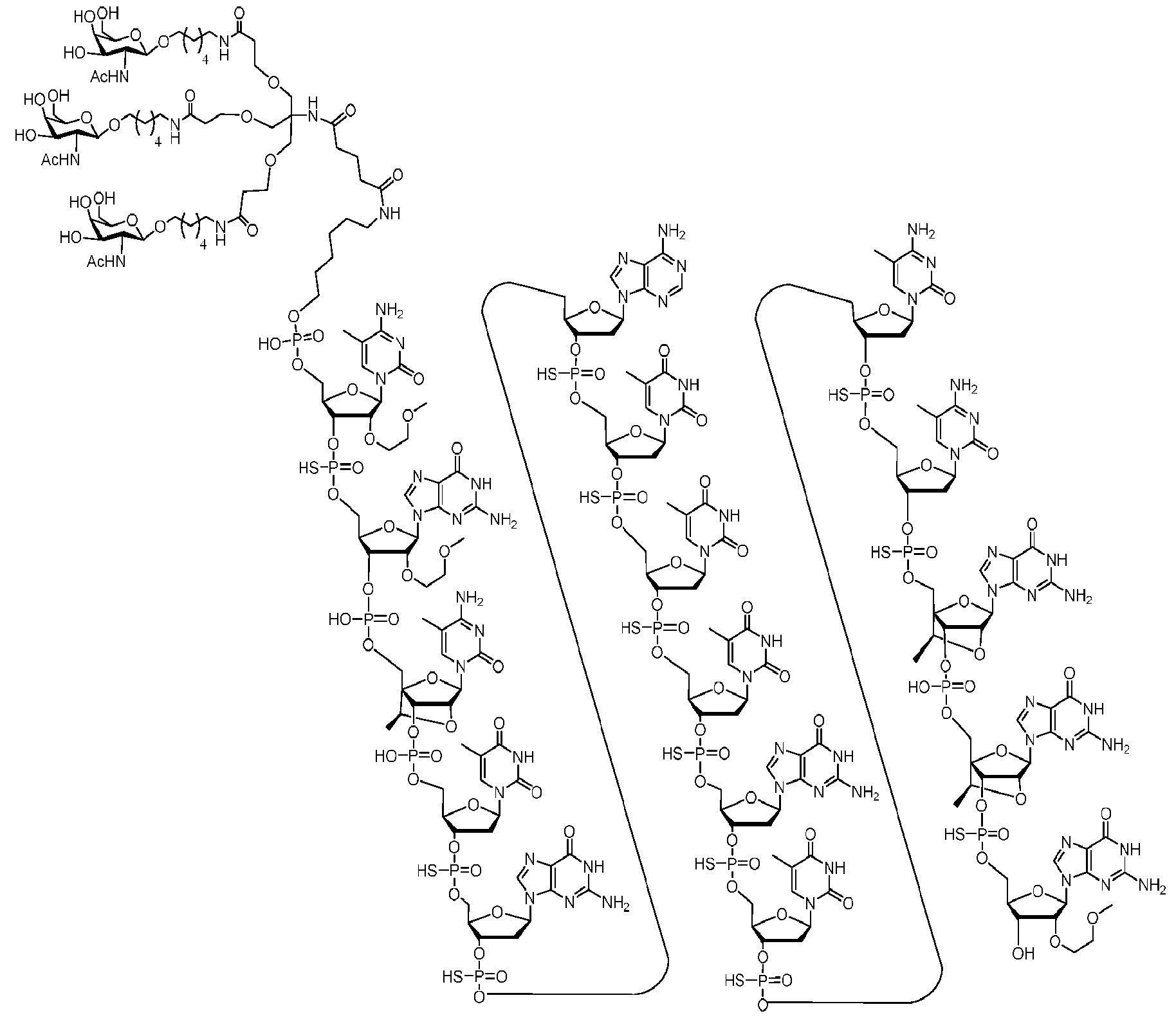 mg, mg mg, mg mg, mg mg, mg mg, mg to 100 mg, 60 mg to 80 mg, 60 mg to 70 mg, 70 mg to 150 mg, 70 mg to 140 mg, 70 mg to 120 mg, 70 mg to 110 mg, 70 mg to 100 mg, 70 mg to 80 mg, 80 mg to 150 mg, 80 mg to 140 mg, 80 mg to 120 mg, 80 mg to 110 mg, 80 mg to 100 mg, 80 mg to 90 mg, 90 mg to 150 mg, 90 mg to 140 mg, 90 mg to 120 mg, 90 mg to 110 mg, 90 mg to 100 mg, 100 mg to 150 mg, 100 mg to 140 mg, 100 mg to 120 mg, 100 mg to 110 mg, 110 mg to 150 mg, 110 mg to 140 mg, 110 mg to 130 mg, 110 mg to 120 mg, 120 mg to 150 mg, 120 mg to 140 mg, 120 mg to 130 mg, 130 mg to 150 mg, 130 mg to 140 mg, 140 mg to 150 mg, 55 mg to 125 mg, 55 mg to 115 mg, 55 mg to 105 mg, 55 mg to 95 mg, 55 mg to 85 mg, 55 mg to 75 mg, 55 mg to 65 mg, 65 mg to 125 mg, 65 mg to 115 mg, 65 mg to 105 mg, or 65 mg to 95 mg, 65 mg to 85 mg, 65 mg to 75 mg, 75 mg to 125 mg, 75 mg to 115 mg, 52 57983492.1
Attorney Docket: 277023/BIOL0479WO/556906 PCT Application 75 mg to 105 mg, 75 mg to 95 mg, 75 mg to 85 mg, 85 mg to 125 mg, 85 mg to 115 mg, 85 mg to 105 amount of about 50 50 mg to about 60 mg, mg, 60 mg to about 80 mg, mg, 90 mg mg to to about 140 150 mg, mg,
mg, mg mg, mg mg, mg mg, mg mg, mg to 100 mg, 60 mg to 80 mg, 60 mg to 70 mg, 70 mg to 150 mg, 70 mg to 140 mg, 70 mg to 120 mg, 70 mg to 110 mg, 70 mg to 100 mg, 70 mg to 80 mg, 80 mg to 150 mg, 80 mg to 140 mg, 80 mg to 120 mg, 80 mg to 110 mg, 80 mg to 100 mg, 80 mg to 90 mg, 90 mg to 150 mg, 90 mg to 140 mg, 90 mg to 120 mg, 90 mg to 110 mg, 90 mg to 100 mg, 100 mg to 150 mg, 100 mg to 140 mg, 100 mg to 120 mg, 100 mg to 110 mg, 110 mg to 150 mg, 110 mg to 140 mg, 110 mg to 130 mg, 110 mg to 120 mg, 120 mg to 150 mg, 120 mg to 140 mg, 120 mg to 130 mg, 130 mg to 150 mg, 130 mg to 140 mg, 140 mg to 150 mg, 55 mg to 125 mg, 55 mg to 115 mg, 55 mg to 105 mg, 55 mg to 95 mg, 55 mg to 85 mg, 55 mg to 75 mg, 55 mg to 65 mg, 65 mg to 125 mg, 65 mg to 115 mg, 65 mg to 105 mg, or 65 mg to 95 mg, 65 mg to 85 mg, 65 mg to 75 mg, 75 mg to 125 mg, 75 mg to 115 mg, 52 57983492.1
Attorney Docket: 277023/BIOL0479WO/556906 PCT Application 75 mg to 105 mg, 75 mg to 95 mg, 75 mg to 85 mg, 85 mg to 125 mg, 85 mg to 115 mg, 85 mg to 105 amount of about 50 50 mg to about 60 mg, mg, 60 mg to about 80 mg, mg, 90 mg mg to to about 140 150 mg, mg,
 about 55 mg to about 95 mg, about 55 mg to about 85 mg, about 55 mg to about 75 mg, about 55 mg to about 65 mg, about 65 mg to about 125 mg, about 65 mg to about 115 mg, about 65 mg to about 105 mg, or about 65 mg to about 95 mg, about 65 mg to about 85 mg, about 65 mg to about 75 mg, about 75 mg to about 125 mg, about 75 mg to about 115 mg, about 75 mg to about 105 mg, about 75 mg to about 95 mg, about 75 mg to about 85 mg, about 85 mg to about 125 mg, about 85 mg to about 115 mg, about 85 mg to about 105 mg, or about 85 mg to about 95 mg. [0234] Embodiment 115. The unit dose of any one of embodiments 109-112, comprising at least about 50 mg and less than about 150 mg, at least about 50 mg and less than about 145 mg, at least about 50 mg and less than about 140 mg, at least about 50 mg and less than about 135 mg, at least about 50 mg and less than about 130 mg, at least about 50 mg and less than about 125 mg, at least about 50 mg and less than about 120 mg, at least about 50 mg and less than about 115 mg, at least about 50 mg and less than about 110 mg, at least about 50 mg and less than about 105 mg, at least about 50 mg and less than about 100 mg, at least about 50 mg and less than about 95 mg, at least 53 57983492.1
Attorney Docket: 277023/BIOL0479WO/556906 PCT Application about 50 mg and less than about 90 mg, at least about 50 mg and less than about 85 mg, at least about 50 mg and less than about 80 mg, at least about 50 mg and less than about 75 mg, at least about 50 mg and less than about 70 mg, at least about 50 mg and less than about 65 mg, at least about 55 mg and less than about 65 mg, at least about 60 mg and less than about 150 mg, at least about 60 mg and less than about 145 mg, at least about 60 mg and less than about 140 mg, at least about 60 mg and less than about 135 mg, at least about 60 mg and less than about 130 mg, at least about 60 mg and less than about 125 mg, at least about 60 mg and less than about 120 mg, at least about 60 mg and less than about 115 mg, at least about 60 mg and less than about 110 mg, at least about 60 mg and less than about 105 mg, at least about 60 mg and less than about 100 mg, at least about 60 mg and less than about 95 mg, at least about 70 mg and less than about 150 mg, at least about 70 mg and less than about 145 mg, at least about 70 mg and less than about 140 mg, at least about 70 mg and less than about 135 mg, at least about 70 mg and less than about 130 mg, at least about 70 mg and less than about 125 mg, at least about 70 mg and less than about 120 mg, at least about 70 mg and less than about 115 mg, at least about 70 mg and less than about 110 mg, at least about 70 mg and less than about 105 mg, at least about 70 mg and less than about 100 mg, at least about 70 mg and less than about 95 mg, at least about 80 mg and less than about 150 mg, at least about 80 mg and less than about 145 mg, at least about 80 mg and less than about 140 mg, at least about 80 mg and less than about 135 mg, at least about 80 mg and less than about 130 mg, at least about 80 mg and less than about 125 mg, at least about 80 mg and less than about 120 mg, at least about 80 mg and less than about 115 mg, at least about 80 mg and less than about 110 mg, at least about 80 mg and less than about 105 mg, at least about 80 mg and less than about 100 mg, at least about 80 mg and less than about 95 mg, or at least about 85 mg and less than about 95 mg of the oligomeric compound or salt thereof. [0235] Embodiment 116. The unit dose of any one of embodiments 109-112, comprising about 50 mg, about 55 mg, about 60 mg, about 65 mg, about 70 mg, about 75 mg, about 80 mg, about 85 mg, about 90 mg, about 95 mg, about 100 mg, about 105 mg, about 110 mg, about 115 mg, about 120 mg, about 125 mg, about 130 mg, about 135 mg, about 140 mg, about 145 mg, or about 150 mg of the oligomeric compound or salt thereof. [0236] Embodiment 117. The unit dose of any one of embodiments 109-112, comprising 50 mg, 55 mg, 60 mg, 65 mg, 70 mg, 75 mg, 80 mg, 85 mg, 90 mg, 95 mg, 100 mg, 105 mg, 110 mg, 115 mg, 120 mg, 125 mg, 130 mg, 135 mg, 140 mg, 145 mg, or 150 mg of the oligomeric compound or salt thereof. 54 57983492.1
Attorney Docket: 277023/BIOL0479WO/556906 PCT Application [0237] Embodiment 118. The unit dose of any one of embodiments 109-112, comprising about 55 mg, about 60 mg, about 65 mg, about 70 mg, about 75 mg, about 80 mg, about 85 mg, about 90 mg, about 95 mg, or about 100 mg of the oligomeric compound or salt thereof. [0238] Embodiment 119. The unit dose of any one of embodiments 109-112, comprising 55 mg, 60 mg, 65 mg, 70 mg, 75 mg, 80 mg, 85 mg, 90 mg, 95 mg, or 100 mg of the oligomeric compound or salt thereof. [0239] Embodiment 120. The unit dose of any one of embodiments 109-112, comprising an amount of the oligomeric compound or salt thereof within the range of about 55 mg to about 100 mg, about 60 mg to about 100 mg, about 65 mg to about 100 mg, about 70 mg to about 100 mg, about 75 mg to about 100 mg, about 80 mg to about 100 mg, about 85 mg to about 100 mg, about 85 mg to about 100 mg, or about 85 mg to about 95 mg. [0240] Embodiment 121. The unit dose of any one of embodiments 109-112, comprising about 55 mg of the oligomeric compound or salt thereof. [0241] Embodiment 122. The unit dose of any one of embodiments 109-112, comprising about 60 mg of the oligomeric compound or salt thereof. [0242] Embodiment 123. The unit dose of any one of embodiments 109-112, comprising about 65 mg of the oligomeric compound or salt thereof. [0243] Embodiment 124. The unit dose of any one of embodiments 109-112, comprising about 70 mg of the oligomeric compound or salt thereof. [0244] Embodiment 125. The unit dose of any one of embodiments 109-112, comprising about 75 mg of the oligomeric compound or salt thereof. [0245] Embodiment 126. The unit dose of any one of embodiments 109-112, comprising about 80 mg of the oligomeric compound or salt thereof. [0246] Embodiment 127. The unit dose of any one of embodiments 109-112, comprising about 85 mg of the oligomeric compound or salt thereof. [0247] Embodiment 128. The unit dose of any one of embodiments 109-112, comprising about 90 mg of the oligomeric compound or salt thereof. [0248] Embodiment 129. The unit dose of any one of embodiments 109-112, comprising about 95 mg of the oligomeric compound or salt thereof. [0249] Embodiment 130. The unit dose of any one of embodiments 109-112, comprising about 100 mg of the oligomeric compound or salt thereof. 55 57983492.1
Attorney Docket: 277023/BIOL0479WO/556906 PCT Application [0250] Embodiment 131. The unit dose of any one of embodiments 109-112, comprising 55 mg to 95 mg of the oligomeric compound or salt thereof. [0251] Embodiment 132. The unit dose of any one of embodiments 109-131, further comprising a neprilysin inhibitor. [0252] Embodiment 133. The unit dose of embodiment 132, wherein the neprilysin inhibitor is sacubitril. [0253] Embodiment 134. The unit dose of any one of embodiments 109-133, further comprising an ACEi, ARB, ARNi or MRA. [0254] Embodiment 135. The unit dose of any embodiment 132 or embodiment 133, further comprising an ARB which is valsartan. [0255] Embodiment 136. The unit dose of embodiment 134 or embodiment 135, wherein the dose of the ACEi, ARB, ARNi or MRA is lower than the Guideline-recommended, target dose for treating HFrEF. [0256] Embodiment 137. The unit dose of embodiment 136, wherein the dose of the ACEi, ARB, ARNi or MRA is less than about 80%, 70%, 60%, 55%, 50%, 45%, or 40% of the Guideline- recommendedtarget dose for treating HFrEF. [0257] Embodiment 138. The unit dose of any one of embodiments 109-131, wherein the unit dose does not contain any other RAAS inhibitor. [0258] Embodiment 139. The unit dose of any one of embodiments 109-138, further comprising a pharmaceutically acceptable carrier, adjuvant or excipient. [0259] Embodiment 140. The unit dose of embodiments 139, consisting of the oligomeric compound or salt thereof and a pharmaceutically acceptable carrier or excipient. [0260] Embodiment 141. The unit dose of embodiment 139, wherein the pharmaceutically acceptable carrier or excipient is sterile water or sterile saline or phosphate buffered saline. [0261] Embodiment 142. The unit dose of embodiment 141, consisting of the oligomeric compound or salt thereof and sterile water or sterile saline or phosphate buffered saline. [0262] Embodiment 143. The unit dose of any one of embodiments 109-142, formulated for parenteral administration. [0263] Embodiment 144. The unit dose of embodiment 143, formulated for subcutaneous, intramuscular, or intravenous administration. [0264] Embodiment 145. The unit dose of embodiment 143, formulated for subcutaneous administration. 56 57983492.1
Attorney Docket: 277023/BIOL0479WO/556906 PCT Application [0265] Embodiment 146. The unit dose of any one of embodiments 109-145, contained in a single- dose vial. [0266] Embodiment 147. The unit dose of any one of embodiments 109-145, provided in multi-dose vials. [0267] Embodiment 148. The unit dose of any one of embodiments 109-145, contained in a prefilled syringe. [0268] Embodiment 149. The unit dose of any one of embodiments 109-145, contained in a single- dose prefilled syringe. [0269] Embodiment 150. The unit dose of any one of embodiments 109-145, contained in an autoinjector device. [0270] Embodiment 151. A kit, comprising: (a) the unit dose of any one of embodiments 109-150, and (b) instructions for use, and, optionally, (c) means for administering the unit dose. [0271] Embodiment 152. The kit of embodiment 151, wherein the instructions are for use in reducing the amount of AGT RNA and/or AGT protein in a subject having or at risk for heart failure. [0272] Embodiment 153. The kit of embodiment 151, wherein the instructions are for use in treating, or ameliorating one or more symptoms of, heart failure in a subject having or at risk for heart failure. [0273] Embodiment 154: The method or use or unit dose of any one of embodiments 1-153, wherein the modified oligonucleotide is single-stranded. [0274] Embodiment 155: The method or use or unit dose of any one of embodiments 1-153, wherein the modified oligonucleotide is the only oligonucleotide in the oligomeric compound. [0275] Embodiment 156: The method or use or unit dose of any one of embodiments 1-153, wherein the modified oligonucleotide is double-stranded. [0276] Embodiment 157. A unit dose comprising 55 mg to 100 mg of an oligomeric compound represented by the following sodium salt: 57 57983492.1
Attorney Docket: 277023/BIOL0479WO/556906 PCT Application (SEQ ID NO: 5), and a pharmaceutically acceptable carrier or excipient selected from sterile water or sterile saline or phosphate buffered saline, formulated for parenteral administration. [0277] Embodiment 158. The unit dose of embodiment 157, formulated for subcutaneous administration and contained in a single use vial, pre-filled syringe or an autoinjector device. [0278] Embodiment 159. A method for reducing the amount of angiotensinogen (AGT) RNA and/or AGT protein in a subject who is or is at risk of being intolerant to treatment with a renin- angiotensin-aldosterone system (RAAS) inhibitor, comprising administering about 15 mg to about 200 mg of an oligomeric agent or salt thereof to a subject having or at risk for heart failure, wherein the oligomeric agent comprises a modified oligonucleotide consisting of 16-30 linked nucleosides, and wherein the modified oligonucleotide comprises a nucleobase sequence of at least 16 contiguous nucleosides at least 80% complementary to the nucleobase sequence of an equal length region of nucleobases 2046-2061 of SEQ ID NO: 1 or nucleobases 14940-14955 of SEQ ID NO: 2; wherein: 58 57983492.1
Attorney Docket: 277023/BIOL0479WO/556906 PCT Application the amount of AGT RNA and/or AGT protein in the subject is decreased by at least 70%, at least 75%, at least 80% or at least 85% and less than 95% compared to the baseline amount of AGT RNA and/or AGT protein in the subject prior to any administration of the oligomeric agent. heart at least 75%, at having or at at least
about 55 mg to about 95 mg, about 55 mg to about 85 mg, about 55 mg to about 75 mg, about 55 mg to about 65 mg, about 65 mg to about 125 mg, about 65 mg to about 115 mg, about 65 mg to about 105 mg, or about 65 mg to about 95 mg, about 65 mg to about 85 mg, about 65 mg to about 75 mg, about 75 mg to about 125 mg, about 75 mg to about 115 mg, about 75 mg to about 105 mg, about 75 mg to about 95 mg, about 75 mg to about 85 mg, about 85 mg to about 125 mg, about 85 mg to about 115 mg, about 85 mg to about 105 mg, or about 85 mg to about 95 mg. [0234] Embodiment 115. The unit dose of any one of embodiments 109-112, comprising at least about 50 mg and less than about 150 mg, at least about 50 mg and less than about 145 mg, at least about 50 mg and less than about 140 mg, at least about 50 mg and less than about 135 mg, at least about 50 mg and less than about 130 mg, at least about 50 mg and less than about 125 mg, at least about 50 mg and less than about 120 mg, at least about 50 mg and less than about 115 mg, at least about 50 mg and less than about 110 mg, at least about 50 mg and less than about 105 mg, at least about 50 mg and less than about 100 mg, at least about 50 mg and less than about 95 mg, at least 53 57983492.1
Attorney Docket: 277023/BIOL0479WO/556906 PCT Application about 50 mg and less than about 90 mg, at least about 50 mg and less than about 85 mg, at least about 50 mg and less than about 80 mg, at least about 50 mg and less than about 75 mg, at least about 50 mg and less than about 70 mg, at least about 50 mg and less than about 65 mg, at least about 55 mg and less than about 65 mg, at least about 60 mg and less than about 150 mg, at least about 60 mg and less than about 145 mg, at least about 60 mg and less than about 140 mg, at least about 60 mg and less than about 135 mg, at least about 60 mg and less than about 130 mg, at least about 60 mg and less than about 125 mg, at least about 60 mg and less than about 120 mg, at least about 60 mg and less than about 115 mg, at least about 60 mg and less than about 110 mg, at least about 60 mg and less than about 105 mg, at least about 60 mg and less than about 100 mg, at least about 60 mg and less than about 95 mg, at least about 70 mg and less than about 150 mg, at least about 70 mg and less than about 145 mg, at least about 70 mg and less than about 140 mg, at least about 70 mg and less than about 135 mg, at least about 70 mg and less than about 130 mg, at least about 70 mg and less than about 125 mg, at least about 70 mg and less than about 120 mg, at least about 70 mg and less than about 115 mg, at least about 70 mg and less than about 110 mg, at least about 70 mg and less than about 105 mg, at least about 70 mg and less than about 100 mg, at least about 70 mg and less than about 95 mg, at least about 80 mg and less than about 150 mg, at least about 80 mg and less than about 145 mg, at least about 80 mg and less than about 140 mg, at least about 80 mg and less than about 135 mg, at least about 80 mg and less than about 130 mg, at least about 80 mg and less than about 125 mg, at least about 80 mg and less than about 120 mg, at least about 80 mg and less than about 115 mg, at least about 80 mg and less than about 110 mg, at least about 80 mg and less than about 105 mg, at least about 80 mg and less than about 100 mg, at least about 80 mg and less than about 95 mg, or at least about 85 mg and less than about 95 mg of the oligomeric compound or salt thereof. [0235] Embodiment 116. The unit dose of any one of embodiments 109-112, comprising about 50 mg, about 55 mg, about 60 mg, about 65 mg, about 70 mg, about 75 mg, about 80 mg, about 85 mg, about 90 mg, about 95 mg, about 100 mg, about 105 mg, about 110 mg, about 115 mg, about 120 mg, about 125 mg, about 130 mg, about 135 mg, about 140 mg, about 145 mg, or about 150 mg of the oligomeric compound or salt thereof. [0236] Embodiment 117. The unit dose of any one of embodiments 109-112, comprising 50 mg, 55 mg, 60 mg, 65 mg, 70 mg, 75 mg, 80 mg, 85 mg, 90 mg, 95 mg, 100 mg, 105 mg, 110 mg, 115 mg, 120 mg, 125 mg, 130 mg, 135 mg, 140 mg, 145 mg, or 150 mg of the oligomeric compound or salt thereof. 54 57983492.1
Attorney Docket: 277023/BIOL0479WO/556906 PCT Application [0237] Embodiment 118. The unit dose of any one of embodiments 109-112, comprising about 55 mg, about 60 mg, about 65 mg, about 70 mg, about 75 mg, about 80 mg, about 85 mg, about 90 mg, about 95 mg, or about 100 mg of the oligomeric compound or salt thereof. [0238] Embodiment 119. The unit dose of any one of embodiments 109-112, comprising 55 mg, 60 mg, 65 mg, 70 mg, 75 mg, 80 mg, 85 mg, 90 mg, 95 mg, or 100 mg of the oligomeric compound or salt thereof. [0239] Embodiment 120. The unit dose of any one of embodiments 109-112, comprising an amount of the oligomeric compound or salt thereof within the range of about 55 mg to about 100 mg, about 60 mg to about 100 mg, about 65 mg to about 100 mg, about 70 mg to about 100 mg, about 75 mg to about 100 mg, about 80 mg to about 100 mg, about 85 mg to about 100 mg, about 85 mg to about 100 mg, or about 85 mg to about 95 mg. [0240] Embodiment 121. The unit dose of any one of embodiments 109-112, comprising about 55 mg of the oligomeric compound or salt thereof. [0241] Embodiment 122. The unit dose of any one of embodiments 109-112, comprising about 60 mg of the oligomeric compound or salt thereof. [0242] Embodiment 123. The unit dose of any one of embodiments 109-112, comprising about 65 mg of the oligomeric compound or salt thereof. [0243] Embodiment 124. The unit dose of any one of embodiments 109-112, comprising about 70 mg of the oligomeric compound or salt thereof. [0244] Embodiment 125. The unit dose of any one of embodiments 109-112, comprising about 75 mg of the oligomeric compound or salt thereof. [0245] Embodiment 126. The unit dose of any one of embodiments 109-112, comprising about 80 mg of the oligomeric compound or salt thereof. [0246] Embodiment 127. The unit dose of any one of embodiments 109-112, comprising about 85 mg of the oligomeric compound or salt thereof. [0247] Embodiment 128. The unit dose of any one of embodiments 109-112, comprising about 90 mg of the oligomeric compound or salt thereof. [0248] Embodiment 129. The unit dose of any one of embodiments 109-112, comprising about 95 mg of the oligomeric compound or salt thereof. [0249] Embodiment 130. The unit dose of any one of embodiments 109-112, comprising about 100 mg of the oligomeric compound or salt thereof. 55 57983492.1
Attorney Docket: 277023/BIOL0479WO/556906 PCT Application [0250] Embodiment 131. The unit dose of any one of embodiments 109-112, comprising 55 mg to 95 mg of the oligomeric compound or salt thereof. [0251] Embodiment 132. The unit dose of any one of embodiments 109-131, further comprising a neprilysin inhibitor. [0252] Embodiment 133. The unit dose of embodiment 132, wherein the neprilysin inhibitor is sacubitril. [0253] Embodiment 134. The unit dose of any one of embodiments 109-133, further comprising an ACEi, ARB, ARNi or MRA. [0254] Embodiment 135. The unit dose of any embodiment 132 or embodiment 133, further comprising an ARB which is valsartan. [0255] Embodiment 136. The unit dose of embodiment 134 or embodiment 135, wherein the dose of the ACEi, ARB, ARNi or MRA is lower than the Guideline-recommended, target dose for treating HFrEF. [0256] Embodiment 137. The unit dose of embodiment 136, wherein the dose of the ACEi, ARB, ARNi or MRA is less than about 80%, 70%, 60%, 55%, 50%, 45%, or 40% of the Guideline- recommendedtarget dose for treating HFrEF. [0257] Embodiment 138. The unit dose of any one of embodiments 109-131, wherein the unit dose does not contain any other RAAS inhibitor. [0258] Embodiment 139. The unit dose of any one of embodiments 109-138, further comprising a pharmaceutically acceptable carrier, adjuvant or excipient. [0259] Embodiment 140. The unit dose of embodiments 139, consisting of the oligomeric compound or salt thereof and a pharmaceutically acceptable carrier or excipient. [0260] Embodiment 141. The unit dose of embodiment 139, wherein the pharmaceutically acceptable carrier or excipient is sterile water or sterile saline or phosphate buffered saline. [0261] Embodiment 142. The unit dose of embodiment 141, consisting of the oligomeric compound or salt thereof and sterile water or sterile saline or phosphate buffered saline. [0262] Embodiment 143. The unit dose of any one of embodiments 109-142, formulated for parenteral administration. [0263] Embodiment 144. The unit dose of embodiment 143, formulated for subcutaneous, intramuscular, or intravenous administration. [0264] Embodiment 145. The unit dose of embodiment 143, formulated for subcutaneous administration. 56 57983492.1
Attorney Docket: 277023/BIOL0479WO/556906 PCT Application [0265] Embodiment 146. The unit dose of any one of embodiments 109-145, contained in a single- dose vial. [0266] Embodiment 147. The unit dose of any one of embodiments 109-145, provided in multi-dose vials. [0267] Embodiment 148. The unit dose of any one of embodiments 109-145, contained in a prefilled syringe. [0268] Embodiment 149. The unit dose of any one of embodiments 109-145, contained in a single- dose prefilled syringe. [0269] Embodiment 150. The unit dose of any one of embodiments 109-145, contained in an autoinjector device. [0270] Embodiment 151. A kit, comprising: (a) the unit dose of any one of embodiments 109-150, and (b) instructions for use, and, optionally, (c) means for administering the unit dose. [0271] Embodiment 152. The kit of embodiment 151, wherein the instructions are for use in reducing the amount of AGT RNA and/or AGT protein in a subject having or at risk for heart failure. [0272] Embodiment 153. The kit of embodiment 151, wherein the instructions are for use in treating, or ameliorating one or more symptoms of, heart failure in a subject having or at risk for heart failure. [0273] Embodiment 154: The method or use or unit dose of any one of embodiments 1-153, wherein the modified oligonucleotide is single-stranded. [0274] Embodiment 155: The method or use or unit dose of any one of embodiments 1-153, wherein the modified oligonucleotide is the only oligonucleotide in the oligomeric compound. [0275] Embodiment 156: The method or use or unit dose of any one of embodiments 1-153, wherein the modified oligonucleotide is double-stranded. [0276] Embodiment 157. A unit dose comprising 55 mg to 100 mg of an oligomeric compound represented by the following sodium salt: 57 57983492.1
Attorney Docket: 277023/BIOL0479WO/556906 PCT Application (SEQ ID NO: 5), and a pharmaceutically acceptable carrier or excipient selected from sterile water or sterile saline or phosphate buffered saline, formulated for parenteral administration. [0277] Embodiment 158. The unit dose of embodiment 157, formulated for subcutaneous administration and contained in a single use vial, pre-filled syringe or an autoinjector device. [0278] Embodiment 159. A method for reducing the amount of angiotensinogen (AGT) RNA and/or AGT protein in a subject who is or is at risk of being intolerant to treatment with a renin- angiotensin-aldosterone system (RAAS) inhibitor, comprising administering about 15 mg to about 200 mg of an oligomeric agent or salt thereof to a subject having or at risk for heart failure, wherein the oligomeric agent comprises a modified oligonucleotide consisting of 16-30 linked nucleosides, and wherein the modified oligonucleotide comprises a nucleobase sequence of at least 16 contiguous nucleosides at least 80% complementary to the nucleobase sequence of an equal length region of nucleobases 2046-2061 of SEQ ID NO: 1 or nucleobases 14940-14955 of SEQ ID NO: 2; wherein: 58 57983492.1
Attorney Docket: 277023/BIOL0479WO/556906 PCT Application the amount of AGT RNA and/or AGT protein in the subject is decreased by at least 70%, at least 75%, at least 80% or at least 85% and less than 95% compared to the baseline amount of AGT RNA and/or AGT protein in the subject prior to any administration of the oligomeric agent. heart at least 75%, at having or at at least
 amount of AGT RNA and/or AGT protein in the subject is decreased by at least 70%, at least 75%, at least 80% or at least 85% and less than 95% compared to the baseline amount of AGT RNA and/or AGT protein in the subject prior to any administration of the oligomeric agent. [0281] Embodiment 162. Use of an oligomeric agent or salt thereof for treating heart failure in a subject having or at risk for heart failure who is or is at risk of being intolerant to treatment with a renin-angiotensin-aldosterone system (RAAS) inhibitor, wherein: the oligomeric agent comprises a modified oligonucleotide consisting of 16-30 linked nucleosides and wherein the modified oligonucleotide comprises a nucleobase sequence of at least 16 contiguous nucleosides at least 80% complementary to the nucleobase sequence of an equal length region of nucleobases 2046-2061 of SEQ ID NO: 1 or nucleobases 14940-14955 of SEQ ID NO: 2, or salt thereof to a subject having or at risk for heart failure; and 59 57983492.1
Attorney Docket: 277023/BIOL0479WO/556906 PCT Application wherein the oligomeric agent decreases the amount of AGT RNA and/or AGT protein in a subject by at least 70%, at least 75%, at least 80% or at least 85% and less than 95% compared to the baseline amount of AGT RNA and/or AGT protein in the subject prior to any administration of the oligomeric agent. [0282] Embodiment 163. Use of an oligomeric agent or salt thereof in the manufacture of a medicament for reducing the amount of AGT RNA and/or AGT protein in a subject or for treating heart failure and/or ameliorating one or more symptoms of heart failure, wherein: [0283] the oligomeric agent comprises a modified oligonucleotide consisting of 16-50 linked nucleosides, wherein the modified oligonucleotide comprises at least 13 contiguous nucleosides at least 80% complementary to the nucleobase sequence of an equal length region of nucleobases 2046-2061 of SEQ ID NO: 1 or nucleobases 14940-14955 of SEQ ID NO: 2; and [0284] the oligomeric agent decreases the amount of AGT RNA and/or AGT protein in a subject by at least 70%, at least 75%, at least 80% or at least 85% and less than 95% compared to the baseline amount of AGT RNA and/or AGT protein in the subject prior to any administration of the oligomeric agent or salt thereof. [0285] Embodiment 164. Use of 60 mg to 120 mg of an oligomeric agent or a salt thereof for reducing AGT RNA and/or AGT protein in a subject having or at risk for heart failure with reduced ejection fraction (HFrEF); wherein the oligomeric agent comprises a modified oligonucleotide consisting of 16-30 linked nucleosides, and wherein the modified oligonucleotide comprises a nucleobase sequence of at least 16 contiguous nucleosides at least 80% complementary to the nucleobase sequence of an equal length region of nucleobases 2046-2061 of SEQ ID NO: 1 or nucleobases 14940-14955 of SEQ ID NO: 2; and wherein the amount of AGT RNA and/or AGT protein in the subject is decreased by at least 70%, at least 75%, at least 80% or at least 85% and less than 95% compared to the baseline amount of AGT RNA and/or AGT protein in the subject prior to any administration of the oligomeric agent. [0286] Embodiment 165. The method or use of any one of embodiments 159-164, wherein the subject has or is at risk for, or the heart failure is, heart failure with reduced ejection fraction (HFrEF), heart failure with mid-range ejection fraction (HFmrEF), heart failure with improved ejection fraction (HFimpEF), or heart failure with preserved ejection fraction (HFpEF). [0287] Embodiment 166. The method or use of any one of embodiments 159-164, wherein the subject has a left ventricular ejection fraction of about 50% or less, about 40% or less, or about 35% or less, or about 30% or less. 60 57983492.1
Attorney Docket: 277023/BIOL0479WO/556906 PCT Application [0288] Embodiment 167. The method or use of any one of embodiments 159-164, wherein the subject has one or more of asymptomatic left ventricular dysfunction (ALVD), asymptomatic or symptomatic valvular heart disease, left ventricular hypertrophy, left ventricular fibrosis, left ventricular dilatation, and left ventricular hypocontractility. [0289] Embodiment 168. The method or use of any one of embodiments 159-167, wherein the amount of AGT protein in the liver of the subject is reduced. [0290] Embodiment 169. The method or use of any one of embodiments 159-167, wherein the amount of AGT protein in the blood, serum or plasma of the subject is reduced. [0291] Embodiment 170. The method or use of any one of embodiments 159-169, wherein a decrease in the amount of AGT RNA and/or AGT protein in the subject is less than 95%, or less than 94%, or less than 93%, or less than 92%, or less than 91%, or less than 90% compared to the baseline amount of AGT RNA and/or AGT protein in the subject prior to any administration of the oligomeric agent or salt thereof. [0292] Embodiment 171. The method or use of any one of embodiments 159-169, wherein the amount of AGT RNA and/or AGT protein in the subject is decreased by no more than 85%, or no more than 86%, or no more than 87%, or no more than 88%, or no more than 89%, or no more than 90%, or no more than 91%, or no more than 92%, or no more than 93%, or no more than 94%, or no more than 95% compared to the baseline amount of AGT RNA and/or AGT protein in the subject prior to any administration of the oligomeric agent or salt thereof. [0293] Embodiment 172. The method or use of any one of embodiments 159-169, wherein the amount of AGT RNA and/or AGT protein is decreased by at least 75%, at least 80% or at least 85% and less than 95% compared to the amount of AGT protein prior to administering the oligomeric agent or salt thereof. [0294] Embodiment 173. The method or use of any one of embodiments 159-169, wherein the amount of AGT RNA and/or AGT protein is decreased by at least 70% or at least 75%, at least 80% or at least 85% and less than 90% compared to the baseline amount of AGT RNA and/or AGT protein in the subject prior to any administration of the oligomeric agent or salt thereof. [0295] Embodiment 174. The method or use of any one of embodiments 159-169, wherein the amount of AGT RNA and/or AGT protein in the subject is decreased by at least 70% or at least 75% and less than 95%, less than 94%, less than 93%, less than 92%, less than 91%, less than 90%, less than 89%, less than 88%, or less than 85% compared to the baseline amount of AGT RNA and/or AGT protein in the subject prior to any administration of the oligomeric agent or salt thereof. 61 57983492.1
Attorney Docket: 277023/BIOL0479WO/556906 PCT Application [0296] Embodiment 175. The method or use of any one of embodiments 159-174, wherein the nucleobase sequence comprises at least 13, at least 14, at least 15 or at least 16 contiguous nucleobases at least 85%, at least 90%, at least 95%, or 100% complementary to the nucleobase sequence of an equal length region of nucleobases 2046-2061 of SEQ ID NO: 1 or nucleobases 14940-14955 of SEQ ID NO: 2. [0297] Embodiment 176. The method or use of any one of embodiments 159-174, wherein the nucleobase sequence comprises at least 13, at least 14, at least 15, or at least 16 contiguous nucleobases of any one of the nucleobase sequence of SEQ ID NOs: 3-5. [0298] Embodiment 177. The method or use of any one of embodiments 159-174, wherein the modified oligonucleotide consists of 16 to 17, 16 to 18,16 to 20, 16 to 25, 16 to 30, 17 to 20, 17 to 25, 17 to 30, 18 to 20, 18 to 25, 18 to 30, 19 to 20, 19 to 25, 19 to 30, 20 to 25, 20 to 30, 21-23, 21 to 25, 21 to 30, 22 to 25, 22 to 30, 23 to 25, or 23 to 30 linked nucleosides. [0299] Embodiment 178 The method or use of any one of embodiments 159-174, wherein the modified oligonucleotide consists of 16 to 30 linked nucleosides and comprises or consists of a nucleobase sequence comprising the nucleobase sequence of any one of SEQ ID NOs: 3-5. [0300] Embodiment 179. The method or use of any one of embodiments 159-178, wherein the modified oligonucleotide comprises one or more i) modified nucleosides comprising a modified sugar moiety, ii) cyclic sugar surrogate, iii) acyclic sugar surrogate, iii) modified internucleoside linkage, and/or iv) modified nucleobase. [0301] Embodiment 180. The method or use of embodiment 179, wherein the modified sugar moiety is a modified furanosyl sugar moiety or a sugar surrogate. [0302] Embodiment 181. The method or use of embodiment 179, wherein the modified nucleoside comprises a bicyclic modified sugar moiety comprising a 4’-2’ bridge selected from 4'-CH2-O-2' and 4'-CH(CH3)-O-2'. [0303] Embodiment 182. The method or use of embodiment 179, wherein the modified nucleoside comprises a non-bicyclic modified sugar moiety selected from a 2’-MOE sugar moiety, 2’-OMe sugar moiety, a 2’-F sugar moiety, or a 2’-NMA sugar moiety. [0304] Embodiment 183. The method or use of embodiment 179, wherein each internucleoside linkage of the modified oligonucleotide is independently selected from a phosphodiester internucleoside linkage, a phosphorothioate internucleoside linkage, and a mesyl phosphoramidate internucleoside. 62 57983492.1
Attorney Docket: 277023/BIOL0479WO/556906 PCT Application [0305] Embodiment 184. The method or use of embodiment 179, wherein the modified nucleobase is 5-methylcytosine or hypoxanthine. [0306] Embodiment 185. The method or use of embodiment 179, wherein each nucleoside of the modified oligonucleotide comprises a nucleobase. [0307] Embodiment 186. The method or use of embodiment 179, wherein each nucleoside of the modified oligonucleotide is independently selected from a furanosyl nucleoside, a cyclic sugar surrogate nucleoside, and an acyclic sugar surrogate nucleoside comprising a nucleobase. [0308] Embodiment 187. The method or use of embodiment 179, wherein at least one nucleoside of the modified oligonucleotide comprises an unmodified sugar moiety. [0309] Embodiment 188. The method or use of embodiment 179, wherein at least one nucleoside of the modified oligonucleotide comprises an unmodified DNA sugar moiety. [0310] Embodiment 189. The method or use of any one of embodiments 1-188, wherein the oligomeric agent or salt thereof comprises a conjugate group comprising a conjugate linker and a conjugate moiety comprising a cell-targeting moiety. [0311] Embodiment 190. The method or use of embodiment 189, wherein the cell-targeting moiety comprises a moiety that interacts with or binds to a liver cell. [0312] Embodiment 191. The method or use embodiment 190, wherein the conjugate group comprises a N-acetyl galactosamine (GalNAc) moiety. [0313] Embodiment 192. The method or use of embodiment 191, wherein the conjugate group comprises the following structure: , or 63 57983492.1
Attorney Docket: 277023/BIOL0479WO/556906 PCT Application . [0314] Embodiment 193. The method or use of any one of embodiments 189-192, wherein the conjugate group comprises a conjugate linker consisting of a single bond and/or comprises a cleavable linker. [0315] Embodiment 194. The method or use of any one of embodiments 189-193, wherein the conjugate group is attached to the 5’-terminal nucleoside or to the 3’-terminal nucleoside of the modified oligonucleotide. [0316] Embodiment 195. The method or use of any one of embodiments 159-194, wherein the modified oligonucleotide comprises a deoxy region consisting of 5-12 linked nucleosides. [0317] Embodiment 196. The method or use of embodiment 195, wherein the deoxy region consists of 6, 7, 8, 9, 10, or 6-10 linked nucleosides. [0318] Embodiment 197. The method or use of embodiment 195 or embodiment 196, wherein each nucleoside immediately adjacent to the deoxy region comprises a modified sugar moiety. [0319] Embodiment 198. The method or use of embodiment 196, wherein the deoxy region is flanked on the 5’-side by a 5’-region consisting of 1-6 nucleosides and on the 3’-side by a 3’-region consisting of 1-6 linked nucleosides; wherein the 3’-most nucleoside of the 5’-region comprises a modified sugar moiety and the 5’-most nucleoside of the 3’-region comprises a modified sugar moiety. [0320] Embodiment 199. The method or use of embodiment 198, wherein each nucleoside of the 3’- region comprises a modified sugar moiety and/or wherein each nucleoside of the 5’-region comprises a modified sugar moiety. [0321] Embodiment 200. The method or use of any one of embodiments 199, wherein each nucleoside of the 5’-region independently is a cEt nucleoside, a 2’-OMe nucleoside, or a 2’-MOE 64 57983492.1
Attorney Docket: 277023/BIOL0479WO/556906 PCT Application nucleoside and each nucleoside of the 3’-region independently is a cEt nucleoside, a 2’-OMe nucleoside, or a [0322] wherein the modified region consisting of 6- [0323] wherein the modified sugar moiety, ‘k’ represents a cEt ‘y’ represents a 2’-OMe sugar [0324] wherein each internucleoside from a phosphodiester [0325] wherein the modified wherein s is a linkage. [0326] RNA and/or AGT protein in a renin-
amount of AGT RNA and/or AGT protein in the subject is decreased by at least 70%, at least 75%, at least 80% or at least 85% and less than 95% compared to the baseline amount of AGT RNA and/or AGT protein in the subject prior to any administration of the oligomeric agent. [0281] Embodiment 162. Use of an oligomeric agent or salt thereof for treating heart failure in a subject having or at risk for heart failure who is or is at risk of being intolerant to treatment with a renin-angiotensin-aldosterone system (RAAS) inhibitor, wherein: the oligomeric agent comprises a modified oligonucleotide consisting of 16-30 linked nucleosides and wherein the modified oligonucleotide comprises a nucleobase sequence of at least 16 contiguous nucleosides at least 80% complementary to the nucleobase sequence of an equal length region of nucleobases 2046-2061 of SEQ ID NO: 1 or nucleobases 14940-14955 of SEQ ID NO: 2, or salt thereof to a subject having or at risk for heart failure; and 59 57983492.1
Attorney Docket: 277023/BIOL0479WO/556906 PCT Application wherein the oligomeric agent decreases the amount of AGT RNA and/or AGT protein in a subject by at least 70%, at least 75%, at least 80% or at least 85% and less than 95% compared to the baseline amount of AGT RNA and/or AGT protein in the subject prior to any administration of the oligomeric agent. [0282] Embodiment 163. Use of an oligomeric agent or salt thereof in the manufacture of a medicament for reducing the amount of AGT RNA and/or AGT protein in a subject or for treating heart failure and/or ameliorating one or more symptoms of heart failure, wherein: [0283] the oligomeric agent comprises a modified oligonucleotide consisting of 16-50 linked nucleosides, wherein the modified oligonucleotide comprises at least 13 contiguous nucleosides at least 80% complementary to the nucleobase sequence of an equal length region of nucleobases 2046-2061 of SEQ ID NO: 1 or nucleobases 14940-14955 of SEQ ID NO: 2; and [0284] the oligomeric agent decreases the amount of AGT RNA and/or AGT protein in a subject by at least 70%, at least 75%, at least 80% or at least 85% and less than 95% compared to the baseline amount of AGT RNA and/or AGT protein in the subject prior to any administration of the oligomeric agent or salt thereof. [0285] Embodiment 164. Use of 60 mg to 120 mg of an oligomeric agent or a salt thereof for reducing AGT RNA and/or AGT protein in a subject having or at risk for heart failure with reduced ejection fraction (HFrEF); wherein the oligomeric agent comprises a modified oligonucleotide consisting of 16-30 linked nucleosides, and wherein the modified oligonucleotide comprises a nucleobase sequence of at least 16 contiguous nucleosides at least 80% complementary to the nucleobase sequence of an equal length region of nucleobases 2046-2061 of SEQ ID NO: 1 or nucleobases 14940-14955 of SEQ ID NO: 2; and wherein the amount of AGT RNA and/or AGT protein in the subject is decreased by at least 70%, at least 75%, at least 80% or at least 85% and less than 95% compared to the baseline amount of AGT RNA and/or AGT protein in the subject prior to any administration of the oligomeric agent. [0286] Embodiment 165. The method or use of any one of embodiments 159-164, wherein the subject has or is at risk for, or the heart failure is, heart failure with reduced ejection fraction (HFrEF), heart failure with mid-range ejection fraction (HFmrEF), heart failure with improved ejection fraction (HFimpEF), or heart failure with preserved ejection fraction (HFpEF). [0287] Embodiment 166. The method or use of any one of embodiments 159-164, wherein the subject has a left ventricular ejection fraction of about 50% or less, about 40% or less, or about 35% or less, or about 30% or less. 60 57983492.1
Attorney Docket: 277023/BIOL0479WO/556906 PCT Application [0288] Embodiment 167. The method or use of any one of embodiments 159-164, wherein the subject has one or more of asymptomatic left ventricular dysfunction (ALVD), asymptomatic or symptomatic valvular heart disease, left ventricular hypertrophy, left ventricular fibrosis, left ventricular dilatation, and left ventricular hypocontractility. [0289] Embodiment 168. The method or use of any one of embodiments 159-167, wherein the amount of AGT protein in the liver of the subject is reduced. [0290] Embodiment 169. The method or use of any one of embodiments 159-167, wherein the amount of AGT protein in the blood, serum or plasma of the subject is reduced. [0291] Embodiment 170. The method or use of any one of embodiments 159-169, wherein a decrease in the amount of AGT RNA and/or AGT protein in the subject is less than 95%, or less than 94%, or less than 93%, or less than 92%, or less than 91%, or less than 90% compared to the baseline amount of AGT RNA and/or AGT protein in the subject prior to any administration of the oligomeric agent or salt thereof. [0292] Embodiment 171. The method or use of any one of embodiments 159-169, wherein the amount of AGT RNA and/or AGT protein in the subject is decreased by no more than 85%, or no more than 86%, or no more than 87%, or no more than 88%, or no more than 89%, or no more than 90%, or no more than 91%, or no more than 92%, or no more than 93%, or no more than 94%, or no more than 95% compared to the baseline amount of AGT RNA and/or AGT protein in the subject prior to any administration of the oligomeric agent or salt thereof. [0293] Embodiment 172. The method or use of any one of embodiments 159-169, wherein the amount of AGT RNA and/or AGT protein is decreased by at least 75%, at least 80% or at least 85% and less than 95% compared to the amount of AGT protein prior to administering the oligomeric agent or salt thereof. [0294] Embodiment 173. The method or use of any one of embodiments 159-169, wherein the amount of AGT RNA and/or AGT protein is decreased by at least 70% or at least 75%, at least 80% or at least 85% and less than 90% compared to the baseline amount of AGT RNA and/or AGT protein in the subject prior to any administration of the oligomeric agent or salt thereof. [0295] Embodiment 174. The method or use of any one of embodiments 159-169, wherein the amount of AGT RNA and/or AGT protein in the subject is decreased by at least 70% or at least 75% and less than 95%, less than 94%, less than 93%, less than 92%, less than 91%, less than 90%, less than 89%, less than 88%, or less than 85% compared to the baseline amount of AGT RNA and/or AGT protein in the subject prior to any administration of the oligomeric agent or salt thereof. 61 57983492.1
Attorney Docket: 277023/BIOL0479WO/556906 PCT Application [0296] Embodiment 175. The method or use of any one of embodiments 159-174, wherein the nucleobase sequence comprises at least 13, at least 14, at least 15 or at least 16 contiguous nucleobases at least 85%, at least 90%, at least 95%, or 100% complementary to the nucleobase sequence of an equal length region of nucleobases 2046-2061 of SEQ ID NO: 1 or nucleobases 14940-14955 of SEQ ID NO: 2. [0297] Embodiment 176. The method or use of any one of embodiments 159-174, wherein the nucleobase sequence comprises at least 13, at least 14, at least 15, or at least 16 contiguous nucleobases of any one of the nucleobase sequence of SEQ ID NOs: 3-5. [0298] Embodiment 177. The method or use of any one of embodiments 159-174, wherein the modified oligonucleotide consists of 16 to 17, 16 to 18,16 to 20, 16 to 25, 16 to 30, 17 to 20, 17 to 25, 17 to 30, 18 to 20, 18 to 25, 18 to 30, 19 to 20, 19 to 25, 19 to 30, 20 to 25, 20 to 30, 21-23, 21 to 25, 21 to 30, 22 to 25, 22 to 30, 23 to 25, or 23 to 30 linked nucleosides. [0299] Embodiment 178 The method or use of any one of embodiments 159-174, wherein the modified oligonucleotide consists of 16 to 30 linked nucleosides and comprises or consists of a nucleobase sequence comprising the nucleobase sequence of any one of SEQ ID NOs: 3-5. [0300] Embodiment 179. The method or use of any one of embodiments 159-178, wherein the modified oligonucleotide comprises one or more i) modified nucleosides comprising a modified sugar moiety, ii) cyclic sugar surrogate, iii) acyclic sugar surrogate, iii) modified internucleoside linkage, and/or iv) modified nucleobase. [0301] Embodiment 180. The method or use of embodiment 179, wherein the modified sugar moiety is a modified furanosyl sugar moiety or a sugar surrogate. [0302] Embodiment 181. The method or use of embodiment 179, wherein the modified nucleoside comprises a bicyclic modified sugar moiety comprising a 4’-2’ bridge selected from 4'-CH2-O-2' and 4'-CH(CH3)-O-2'. [0303] Embodiment 182. The method or use of embodiment 179, wherein the modified nucleoside comprises a non-bicyclic modified sugar moiety selected from a 2’-MOE sugar moiety, 2’-OMe sugar moiety, a 2’-F sugar moiety, or a 2’-NMA sugar moiety. [0304] Embodiment 183. The method or use of embodiment 179, wherein each internucleoside linkage of the modified oligonucleotide is independently selected from a phosphodiester internucleoside linkage, a phosphorothioate internucleoside linkage, and a mesyl phosphoramidate internucleoside. 62 57983492.1
Attorney Docket: 277023/BIOL0479WO/556906 PCT Application [0305] Embodiment 184. The method or use of embodiment 179, wherein the modified nucleobase is 5-methylcytosine or hypoxanthine. [0306] Embodiment 185. The method or use of embodiment 179, wherein each nucleoside of the modified oligonucleotide comprises a nucleobase. [0307] Embodiment 186. The method or use of embodiment 179, wherein each nucleoside of the modified oligonucleotide is independently selected from a furanosyl nucleoside, a cyclic sugar surrogate nucleoside, and an acyclic sugar surrogate nucleoside comprising a nucleobase. [0308] Embodiment 187. The method or use of embodiment 179, wherein at least one nucleoside of the modified oligonucleotide comprises an unmodified sugar moiety. [0309] Embodiment 188. The method or use of embodiment 179, wherein at least one nucleoside of the modified oligonucleotide comprises an unmodified DNA sugar moiety. [0310] Embodiment 189. The method or use of any one of embodiments 1-188, wherein the oligomeric agent or salt thereof comprises a conjugate group comprising a conjugate linker and a conjugate moiety comprising a cell-targeting moiety. [0311] Embodiment 190. The method or use of embodiment 189, wherein the cell-targeting moiety comprises a moiety that interacts with or binds to a liver cell. [0312] Embodiment 191. The method or use embodiment 190, wherein the conjugate group comprises a N-acetyl galactosamine (GalNAc) moiety. [0313] Embodiment 192. The method or use of embodiment 191, wherein the conjugate group comprises the following structure: , or 63 57983492.1
Attorney Docket: 277023/BIOL0479WO/556906 PCT Application . [0314] Embodiment 193. The method or use of any one of embodiments 189-192, wherein the conjugate group comprises a conjugate linker consisting of a single bond and/or comprises a cleavable linker. [0315] Embodiment 194. The method or use of any one of embodiments 189-193, wherein the conjugate group is attached to the 5’-terminal nucleoside or to the 3’-terminal nucleoside of the modified oligonucleotide. [0316] Embodiment 195. The method or use of any one of embodiments 159-194, wherein the modified oligonucleotide comprises a deoxy region consisting of 5-12 linked nucleosides. [0317] Embodiment 196. The method or use of embodiment 195, wherein the deoxy region consists of 6, 7, 8, 9, 10, or 6-10 linked nucleosides. [0318] Embodiment 197. The method or use of embodiment 195 or embodiment 196, wherein each nucleoside immediately adjacent to the deoxy region comprises a modified sugar moiety. [0319] Embodiment 198. The method or use of embodiment 196, wherein the deoxy region is flanked on the 5’-side by a 5’-region consisting of 1-6 nucleosides and on the 3’-side by a 3’-region consisting of 1-6 linked nucleosides; wherein the 3’-most nucleoside of the 5’-region comprises a modified sugar moiety and the 5’-most nucleoside of the 3’-region comprises a modified sugar moiety. [0320] Embodiment 199. The method or use of embodiment 198, wherein each nucleoside of the 3’- region comprises a modified sugar moiety and/or wherein each nucleoside of the 5’-region comprises a modified sugar moiety. [0321] Embodiment 200. The method or use of any one of embodiments 199, wherein each nucleoside of the 5’-region independently is a cEt nucleoside, a 2’-OMe nucleoside, or a 2’-MOE 64 57983492.1
Attorney Docket: 277023/BIOL0479WO/556906 PCT Application nucleoside and each nucleoside of the 3’-region independently is a cEt nucleoside, a 2’-OMe nucleoside, or a [0322] wherein the modified region consisting of 6- [0323] wherein the modified sugar moiety, ‘k’ represents a cEt ‘y’ represents a 2’-OMe sugar [0324] wherein each internucleoside from a phosphodiester [0325] wherein the modified wherein s is a linkage. [0326] RNA and/or AGT protein in a renin-
 angiotensin- system 15 mg to about 200 mg an oligomeric agent or salt thereof to a subject having or at risk for heart failure, wherein the oligomeric agent comprises a modified oligonucleotide consisting of 16-30 linked nucleosides, and wherein the modified oligonucleotide comprises a nucleobase sequence of at least 16 contiguous nucleosides at least 80% complementary to the nucleobase sequence of an equal length region of SEQ ID NO: 1 or SEQ ID NO: 2; [0327] wherein: the amount of AGT RNA and/or AGT protein in the subject is decreased by at least 70%, at least 75%, at least 80% or at least 85% and less than 95% compared to the baseline amount of AGT RNA and/or AGT protein in the subject prior to any administration of the oligomeric agent; and [0328] wherein the subject has or is at risk for heart failure with reduced ejection fraction (HFrEF), heart failure with mid-range ejection fraction (HFmrEF), heart failure with improved ejection fraction (HFimpEF), or heart failure with preserved ejection fraction (HFpEF). 65 57983492.1
Attorney Docket: 277023/BIOL0479WO/556906 PCT Application [0329] Embodiment 206. A method of treating heart failure in a subject having or at risk for heart failure who is or is at risk of being intolerant to treatment with a renin-angiotensin-aldosterone system (RAAS) inhibitor, comprising administering about 15 mg to about 200 mg of an oligomeric agent or salt thereof to a subject having or at risk for heart failure, wherein the oligomeric agent comprises a modified oligonucleotide consisting of 16-30 linked nucleosides, and wherein the modified oligonucleotide comprises a nucleobase sequence of at least 16 contiguous nucleosides at least 80% complementary to the nucleobase sequence of an equal length region of SEQ ID NO: 1 or SEQ ID NO: 2; and wherein the amount of AGT RNA and/or AGT protein in the subject is decreased by at least 70%, at least 75%, at least 80% or at least 85% and less than 95% compared to the baseline amount of AGT RNA and/or AGT protein in the subject prior to any administration of the oligomeric agent; and wherein the subject has or is at risk for heart failure with reduced ejection fraction (HFrEF), heart failure with mid-range ejection fraction (HFmrEF), heart failure with improved ejection fraction (HFimpEF), or heart failure with preserved ejection fraction (HFpEF). [0330] Embodiment 207. Use of an oligomeric agent or salt thereof for treating heart failure in a subject having or at risk for heart failure who is or is at risk of being intolerant to treatment with a renin-angiotensin-aldosterone system (RAAS) inhibitor, wherein: [0331] the oligomeric agent comprises a modified oligonucleotide consisting of 16-30 linked nucleosides, wherein the modified oligonucleotide comprises a nucleobase sequence of at least 16 contiguous nucleosides and wherein the modified oligonucleotide is at least 80% complementary to the nucleobase sequence of an equal length region of SEQ ID NO: 1 or SEQ ID NO: 2, or salt thereof to a subject having or at risk for heart failure; and [0332] wherein the oligomeric agent decreases the amount of AGT RNA and/or AGT protein in a subject by at least 70%, at least 75%, at least 80% or at least 85% and less than 95% compared to the baseline amount of AGT RNA and/or AGT protein in the subject prior to any administration of the oligomeric agent; and wherein the subject has or is at risk for heart failure with reduced ejection fraction (HFrEF), heart failure with mid-range ejection fraction (HFmrEF), heart failure with improved ejection fraction (HFimpEF), or heart failure with preserved ejection fraction (HFpEF). [0333] Embodiment 208. Use of an oligomeric agent or salt thereof in the manufacture of a medicament for reducing the amount of AGT RNA and/or AGT protein in a subject or for treating heart failure and/or ameliorating one or more symptoms of heart failure, wherein: [0334] the oligomeric agent comprises a modified oligonucleotide consisting of 12-80 linked nucleosides, wherein the modified oligonucleotide comprises at least 16 contiguous nucleosides at 66 57983492.1
Attorney Docket: 277023/BIOL0479WO/556906 PCT Application least 80% complementary to the nucleobase sequence of an equal length region of SEQ ID NO: 1 or SEQ ID NO: 2; and [0335] the oligomeric agent decreases the amount of AGT RNA and/or AGT protein in a subject by at least 70%, at least 75%, at least 80% or at least 85% and less than 95% compared to the baseline amount of AGT RNA and/or AGT protein in the subject prior to any administration of the oligomeric agent or salt thereof; and wherein the subject has or is at risk for heart failure with reduced ejection fraction (HFrEF), heart failure with mid-range ejection fraction (HFmrEF), heart failure with improved ejection fraction (HFimpEF), or heart failure with preserved ejection fraction (HFpEF). [0336] Embodiment 209. A method for reducing AGT RNA and/or AGT protein in a subject, comprising administering 60 mg to 120 mg of an oligomeric agent or salt thereof to a subject having or at risk for heart failure with reduced ejection fraction (HFrEF); wherein the oligomeric agent comprises a modified oligonucleotide consisting of 12-80 linked nucleosides, wherein the modified oligonucleotide comprises at least 16 contiguous nucleosides at least 80% complementary to the nucleobase sequence of an equal length region of SEQ ID NO: 1 or SEQ ID NO: 2; and wherein the oligomeric agent decreases the amount of AGT RNA and/or AGT protein in a subject by at least 70%, at least 75%, at least 80% or at least 85% and less than 95% compared to the baseline amount of AGT RNA and/or AGT protein in the subject prior to any administration of the oligomeric agent or salt thereof. [0337] Embodiment 210. Use of 60 mg to 120 mg of an oligomeric agent or a salt thereof for reducing AGT RNA and/or AGT protein in a subject having or at risk for heart failure with reduced ejection fraction (HFrEF); wherein the oligomeric agent comprises a modified oligonucleotide consisting of 12-80 linked nucleosides, wherein the modified oligonucleotide comprises at least 16 contiguous nucleosides at least 80% complementary to the nucleobase sequence of an equal length region of SEQ ID NO: 1 or SEQ ID NO: 2; and wherein the oligomeric agent decreases the amount of AGT RNA and/or AGT protein in a subject by at least 70%, at least 75%, at least 80% or at least 85% and less than 95% compared to the baseline amount of AGT RNA and/or AGT protein in the subject prior to any administration of the oligomeric agent or salt thereof. [0338] A. Angiotensinogen (AGT) [0339] Angiotensinogen (AGT) has been proposed as a genetic target for treating hypertension and cardiovascular disorders because chronic overactivity of the renin-angiotensin-aldosterone system (RAAS) pathway is a major contributor to the pathogenesis of cardiovascular disorders, including 67 57983492.1
Attorney Docket: 277023/BIOL0479WO/556906 PCT Application hypertension, chronic kidney disease and heart failure. A representative nucleobase sequence for a human AGT gene (encoding human AGT RNA, wherein angiotensinogen protein is the expression product) is the complement of the nucleotides of GenBank Accession No. NC_000001.11 truncated from nucleotides 230700001 to 230718000 (designated herein as SEQ ID NO: 2). A representative nucleobase sequence for a human AGT RNA is GENBANK Accession No. NM_000029.3 (designated herein as SEQ ID NO: 1). The systemic RAAS cascade begins with renin-mediated cleavage of angiotensinogen (AGT), whose plasma levels are primarily liver derived, to generate angiotensin I, which is converted to the potent vasoactive peptide angiotensin II (Ang II), which mediates vasoconstriction of vascular smooth muscle cells and aldosterone release from the adrenal cortex. The RAAS pathway acts as a key regulator of acute hemodynamic changes in the body and is responsive to decreases in cardiac output that occur during heart failure, but persistent overactivation results in excessive vasoconstriction, salt and water retention, cardiac remodeling and hypertrophy, and fibrosis. Thus, inhibition of the most proximal prohormone in the RAAS pathway is proposed to mitigate effects of RAAS overactivity. [0340] For instance, methods have been described of treating hypertension by administering antisense oligonucleotides, for example, compound 757456 (also referred to as IONIS-AGT-LRX), which targets human AGT (see, e.g., WO2017/062816). Several clinical trials of compound 757456 have been conducted to evaluate safety, efficacy in reducing AGT levels, and lowering blood pressure in hypertensive subjects (see, e.g., Morgan et al. (2021) J Am Coll Cardiol Basic Science 6(6):485-496). A phase 1 (NCT03101878) and three phase 2 trials of compound 757456 were conducted to evaluate treatment of subjects having controlled hypertension with the compound as a monotherapy (NCT03714776) and treatment of subjects having uncontrolled hypertension with the compound as an add-on therapy to 2-3 antihypertensive medications (NCT04083222) or 3 or more antihypertensive medications (NCT04714320). Results of all four studies of compound 757456 demonstrated safety and tolerability of the compound at single doses up to 80 mg and weekly doses at 80 mg or 120 mg. Results indicated a higher reduction in systolic and diastolic blood pressure (as compared to placebo) that was clinically meaningful (> 5 mmHg) though not statistically significant in studies. The maximum mean reduction in plasma AGT in these trials was 67% as compared to baseline. Another phase 2 trial was conducted to evaluate compound 757456 safety, tolerability and effect of weekly subcutaneous (SC) injection of compound 757456 on plasma AGT concentration in subjects with chronic heart failure with reduced ejection fraction (HFrEF) receiving standard of care therapy (e.g., an ACEi, ARB or sacubitril/valsartan, or a beta-blocker or an MRA) 68 57983492.1
Attorney Docket: 277023/BIOL0479WO/556906 PCT Application (see Example 1B). No hypotension, hepatic, renal or potassium safety signals were observed in this study, and dose-dependent reductions in plasma AGT were observed in all treated subjects. No significant change in NT-proBNP levels in treatment groups was observed compared to the placebo group, though the study was not powered for significance to detect changes in NT-proBNP. Similar to earlier studies, reduction in plasma AGT was 63% as compared to baseline, and no significant change in blood pressure was observed, though the study was not powered to detect changes in blood pressure. [0341] Additionally, methods of treating hypertension by administering siRNAs which target human AGT have been proposed, including, e.g., zilebesiran (also referred to as ALN-AGT01), see, e.g., WO2019/222166; Ranasinghe et al. (2022) J Am Heart Assoc.11(20); e027694 (Ranasinghe et al. (2022). It has been postulated that essentially complete depletion of AGT by siRNA therapy could prevent RAAS escape (such as occurs with a compensatory increase in renin levels due to decreased blood pressure and loss of negative feedback mediated by Ang II when standard RAAS inhibitors, e.g., ACEi and ARB, are used), yielding more effective RAAS inhibition and long-term blood pressure control (see, e.g., Ren et al. (2020) Curr Opin Nephrol Hypertens 29(2):180-189). It has also been suggested that a major advantage of RNAi-based therapeutic applications over antisense oligonucleotide (ASO)-based therapies is a purported relatively more potent and longer inhibitory effect of RNAi-based therapeutics (see, e.g., Ren et al. (2020) Curr Opin Nephrol Hypertens 29(2):180-189). A report of a phase 1 study of zilebesiran involving subjects with hypertension describes decreases in serum AGT levels and blood pressure after single subcutaneous doses (up to 800 mg) of the compound were sustained for up to 4 weeks (See Desai et al. (2023) N Eng J Med 389(3):228-238 (Desai et al. (2023)). Mean decreases in AGT levels of more than 90% (zilebesiran doses of 100 mg or more) sustained from week 3 through week 12, or through week 24 (800 mg zilebesiran) were observed. Hypotension, hyperkalemia, or worsening of renal function resulting in medical intervention was not reported; however, the study was not large enough or of sufficient duration to assess uncommon serious events (enrollment was restricted to younger persons with stage 1-2 hypertension who did not have serious co-existing medical conditions). Blood pressure changes after zilebesiran treatment could be reversed through high dietary salt intake and were augmented by coadministration of an ARB (irbesartan). It has been noted that recovery of zilebesiran-associated decreases in blood pressure after exposure to high dietary salt intake suggests that development of hypotension during zilebesiran treatment could be partially reversed by raising salt intake as an adjunct to standard interventions, including volume resuscitation and pressor 69 57983492.1
Attorney Docket: 277023/BIOL0479WO/556906 PCT Application support (Desai et al. (2023)). Ranasinghe et al. (2022) also note that results suggest that oral sodium (or if severe, intravenous, alongside vasopressors) could be used clinically where hypotension and hypovolemia must be reversed. Based on the potential for clinical need to reverse effects of AGT- targeting siRNA, strategies to overcome the blood pressure-lowering effects of these agents have been examined in spontaneously hypertensive rats: AGT-targeting siRNA caused a near complete depletion of AGT (by 99.2±0.1%) and a reduction in mean arterial pressure by 19mm Hg, similar to results observed with zilebesiran (800 mg) in the phase 1 trial; and effects could be reversed by continuous infusion of intravenous vasopressors (Ang II or norepinephrine) ((Uijl et al. (2022) J Am Heart Assoc 11(15); e026426); Ranasinghe et al. (2022)). [0342] Additional antisense oligonucleotides, including compound 1205407, have been described previously wherein compound 1205407 (also known as ION904) was identified to be more potent than earlier identified compounds. (see WO2022/109139). As described herein, studies of ION904 in healthy subject and in subjects with uncontrolled hypertension maintaining their existing antihypertension medication regimen demonstrated that it is well tolerated with no drug related SAEs, no AE signals, no clinically meaningful changes in laboratory assessments, no hypotensive events, no acute renal changes or changes in renal function, no clinically relevant hyperkalemia, and no thrombocytopenia; and while reduction in plasma AGT protein level was significantly greater than reported for compound 757456, and achieved up to 86% reduction as compared to baseline, insignificant reduction in systolic blood pressure was observed in the treatment groups compared to placebo. (see Examples 3 and 4). Without being bound by theory, it is believed compositions and methods provided herein sufficiently reduce the amount or level of AGT RNA and/or AGT protein in a subject having or at risk for heart failure to provide a therapeutic benefit but with limited effect on blood pressure (and other cardiovascular/renal parameters affected by the RAAS), thereby markedly reducing risk of adverse events or side effects associated with other RAAS inhibitors. [0343] Thus, provided herein, are compositions and methods for reducing AGT RNA and/or AGT protein in a subject having or at risk for heart failure and for treating, or ameliorating at least one symptom of heart failure in, a subject having or at risk for heart failure. In certain embodiments, the heart failure is HFrEF. In certain embodiments, compositions and methods are provided for reducing AGT RNA and/or AGT protein in a subject having or at risk for heart failure (e.g., HFrEF) and for treating a subject having or at risk for heart failure (e.g., HFrEF) wherein the subject is, or is at risk of being, susceptible to adverse side effects of existing RAAS inhibitor therapies, including, but not limited to, ACE inhibitors (ACEi), ARBs, ARNi, and MRAs. In certain embodiments, a subject is 70 57983492.1
Attorney Docket: 277023/BIOL0479WO/556906 PCT Application unable to tolerate treatment with optimal, Guideline-recommended target doses or dosing regimens of RAAS inhibitors (e.g., ACEi, ARB, ARNi, MRA) for treatment of heart failure. In certain embodiments, a subject has hyperkalemia, renal dysfunction, renal insufficiency (including AKI and CKD), hypotension, and/or pulmonary disease. In certain embodiments, a subject has or is at risk of having angioedema, asthma or chronic obstructive pulmonary disease (COPD). In certain embodiments, compositions provided herein, and methods for reducing AGT RNA and/or AGT protein or for treating a subject having or at risk for heart failure, provide for at least a 70%, at least a 75%, at least an 80%, or at least an 85% decrease in the amount or level of AGT RNA and/or AGT RNA and/or AGT protein in the subject (e.g., the amount of AGT plasma protein of the subject, or circulating level of AGT protein) compared to the level of AGT RNA and/or AGT protein prior to any treatment with the compositions and methods (i.e., baseline AGT RNA or AGT protein levels) wherein the maximum decrease in the amount of AGT RNA and/or AGT protein is less than 95%, or less 94%, or less than 93%, or less than 92%, or less than 91%, or less than of 90%, or less than 88%, or less than 86%, or less than 85%, compared to the amount or level of AGT RNA and/or AGT protein prior to any treatment with the compositions and methods (i.e., baseline level). In certain embodiments of the compositions and methods, the composition contains or consists essentially of, or the method for reducing AGT RNA and/or AGT protein, or for treating a subject having or at risk for heart failure (e.g., HFrEF) includes administration of, a single-stranded oligomeric agent (such as, for example, a single-stranded modified oligonucleotide, e.g., a single- stranded modified antisense oligonucleotide) having a nucleobase sequence complementary to a target region sequence in an AGT nucleic acid. In certain embodiments, the oligomeric agent is ION904. In certain embodiments, the amount of ION904 is within the range of about 60 mg to about 120 mg, about 75 mg to about 120 mg, about 80 mg to about 120 mg, or about 90 to about 100 mg. In certain embodiments, ION904 is administered once every 4 weeks or once a month. In certain embodiments, ION904 or a composition containing ION904 is administered for a period of about 1 month to about 12 months, or about 6 months to about 36 months, or about 12 months to about 60 months or more. [0344] B. Oligomeric Agents [0345] In certain embodiments of compositions and methods described herein, a composition contains, or a method includes administering to a cell or subject, an oligomeric agent comprising or consisting of at least one modified oligonucleotide and optionally one or more additional associated features selected from: (a) one or more additional oligonucleotides, each of which may be modified 71 57983492.1
Attorney Docket: 277023/BIOL0479WO/556906 PCT Application or unmodified, hybridized to or covalently linked to the at least one modified oligonucleotide and/or to each other; (b) one or more conjugate groups, which may be covalently attached directly or indirectly to an oligonucleotide of such oligomeric agent; and (c) one or more terminal groups. In certain embodiments, an oligomeric agent comprises or consists of a modified oligonucleotide comprising a nucleobase sequence that is complementary to an equal length target region of a target nucleic acid, such as an AGT target nucleic acid (e.g., a human AGT target nucleic acid). In certain embodiments, the AGT nucleic acid has the sequence set forth in SEQ ID NO: 1 or SEQ ID NO: 2. [0346] In certain embodiments, an oligomeric agent contains or consists of a modified oligonucleotide, such as, for example, an antisense oligonucleotide, containing a nucleobase sequence complementary to an AGT RNA, e.g., a human AGT RNA, such as a mature AGT mRNA or an AGT pre-mRNA, including intronic, exonic, and untranslated regions. In certain embodiments, the modified oligonucleotide, is single-stranded. In certain embodiments, the modified oligonucleotide, is double-stranded. In certain embodiments, contacting a cell with an oligomeric agent containing a modified oligonucleotide, containing a nucleobase sequence that is complementary to an equal-length target region of SEQ ID NOs: 1 or 2 decreases the amount or level of AGT RNA in the cell, and in certain embodiments decreases the amount or level of AGT protein produced in the cell. In certain embodiments, the oligonucleotide is attached to a conjugate group, e.g., a conjugate group containing a cell-targeting moiety that interacts with or binds to a cell surface protein of a hepatic cell. In certain embodiments, the oligonucleotide is attached to a conjugate group containing one or more N-acetyl galactosamine (GalNAc) moieties. In certain embodiments, the oligomeric agent consists of an oligonucleotide attached to a conjugate group, e.g., a conjugate group containing one or more GalNAc moieties. In certain embodiments, the conjugate group is attached to a terminus of the oligonucleotide, e.g., the 5’ terminal nucleobase of the oligonucleotide. In certain embodiments, a modified oligonucleotide of the oligomeric agent is an antisense oligonucleotide. In certain embodiments, the oligomeric agent comprises or consists of an antisense oligonucleotide. In certain embodiments, the oligomeric agent comprises or consists of an antisense oligonucleotide and a conjugate group. In certain embodiments, the oligomeric agent consists of an antisense oligonucleotide attached to a conjugate group, e.g., a conjugate group containing one or more GalNAc moieties. In certain embodiments, the oligomeric agent comprises or consists of an antisense oligonucleotide and one or more terminal group(s). In certain embodiments, the oligomeric agent comprises or consists of an antisense oligonucleotide, a conjugate group, and one or more terminal group(s). In certain embodiments, the oligomeric agent 72 57983492.1
Attorney Docket: 277023/BIOL0479WO/556906 PCT Application comprises or consists of an antisense oligonucleotide comprising a nucleobase sequence that is complementary to a target region of an AGT nucleic acid, and a sense oligonucleotide comprising a duplexing region that is complementary to the antisense oligonucleotide, or a region thereof. In certain embodiments, one or both of the antisense and sense oligonucleotides is/are modified. In certain embodiments, the antisense oligonucleotide and/or the sense oligonucleotide is attached to a conjugate group and/or a terminal group. Modified antisense and/or sense oligonucleotides comprise at least one modified nucleoside (comprising a modified sugar moiety and/or a modified nucleobase and/or lacking a nucleobase) and/or at least one modified internucleoside linkage. Examples of certain modified nucleosides and modified internucleoside linkages suitable for use in modified antisense and/or sense oligonucleotides are described herein. In certain embodiments, an oligomeric agent is an RNase H agent. In certain embodiments, an oligomeric agent is an RNAi agent. [0347] In certain embodiments, the oligomeric agent containing a modified oligonucleotide (such as, for example, a single-stranded modified oligonucleotide), containing a nucleobase sequence complementary to an equal length target region of an AGT target nucleic acid (e.g., a human AGT target nucleic acid, such as, for example, the AGT nucleic acid having the sequence set forth in SEQ ID NO: 1 or SEQ ID NO: 2), when administered to a cell or subject, decreases the amount of AGT RNA and/or AGT protein in the cell or subject (e.g., the amount of AGT protein in the blood, serum or plasma of the subject, or the circulating level of AGT RNA and/or AGT protein) by at least 70%, at least 75%, at least 80%, or at least 85% and less than 95% compared to the amount or level of AGT RNA and/or AGT protein prior to any administration of the oligomeric agent (i.e., the baseline level or amount of AGT RNA and/or AGT protein in the cell or subject). In certain embodiments, the maximum decrease in the amount or level of AGT RNA and/or AGT protein in the cell or subject (e.g., the amount of AGT protein in the blood, serum or plasma of the subject, or the circulating level of AGT protein) is less than 95%, or less than 94%, or less than 93%, or less than 92%, or less than 91%, or less than 90% compared to the amount or level of AGT RNA and/or AGT protein prior to any administration of the oligomeric agent. In certain embodiments, the amount or level of AGT RNA and/or AGT protein in the cell or subject (e.g., the amount of AGT protein in the blood, serum or plasma of the subject, or the circulating level of AGT protein) decreases no more than 85%, or no more than 86%, or no more than 87%, or no more than 88%, or no more than 89%, or no more than 90%, or no more than 91%, or no more than 92%, or no more than 93%, or no more than 94% compared to the amount or level of AGT RNA and/or AGT protein prior to any administration of the oligomeric agent. In certain embodiments, the oligomeric agent, when 73 57983492.1
Attorney Docket: 277023/BIOL0479WO/556906 PCT Application administered to a cell or subject, decreases the amount of AGT RNA and/or AGT protein in the cell or subject (e.g., the amount of AGT protein in the blood, serum or plasma of the subject, or the circulating level of AGT RNA and/or AGT protein) by at least 70%, at least 75%, at least 80% or at least 85% and less than 95% compared to the amount or level of AGT RNA and/or AGT protein prior to any administration of the oligomeric agent (i.e., the baseline level or amount of AGT RNA and/or AGT protein in the cell or subject). In certain embodiments, the oligomeric agent, when administered to a cell or subject, decreases the amount of AGT RNA and/or AGT protein in the cell or subject (e.g., the amount of AGT protein in the blood, serum or plasma of the subject, or the circulating level of AGT RNA and/or AGT protein) by at least 70%, at least 75%, at least 80% or at least 85% and less than 94% compared to the amount or level of AGT RNA and/or AGT protein prior to any administration of the oligomeric agent (i.e., the baseline level or amount of AGT RNA and/or AGT protein in a cell or subject). In certain embodiments, the oligomeric agent, when administered to a cell or subject, decreases the amount of AGT RNA and/or AGT protein in the cell or subject (e.g., the amount of AGT protein in the blood, serum or plasma of the subject, or the circulating level of AGT RNA and/or AGT protein) by at least 70%, at least 75%, at least 80% or at least 85% and less than 93% compared to the amount or level of AGT RNA and/or AGT protein prior to any administration of the oligomeric agent (i.e., the baseline level or amount of AGT RNA and/or AGT protein in a cell or subject). In certain embodiments, the oligomeric agent, when administered to a cell or subject, decreases the amount of AGT RNA and/or AGT protein in the cell or subject (e.g., the amount of AGT protein in the blood, serum or plasma of the subject, or the circulating level of AGT RNA and/or AGT protein) by at least 70%, at least 75%, at least 80% or at least 85% and less than 92% compared to the amount or level of AGT RNA and/or AGT protein prior to any administration of the oligomeric agent (i.e., the baseline level or amount of AGT RNA and/or AGT protein in the cell or subject). In certain embodiments, the oligomeric agent, when administered to a cell or subject, decreases the amount of AGT RNA and/or AGT protein in the cell or subject (e.g., the amount of AGT protein in the blood, serum or plasma of the subject, or the circulating level of AGT RNA and/or AGT protein) by at least 70%, at least 75%, at least 80% or at least 85% and less than 91% compared to the amount or level of AGT RNA and/or AGT protein prior to any administration of the oligomeric agent (i.e., the baseline level or amount of AGT RNA and/or AGT protein in a cell or subject). In certain embodiments, the oligomeric agent, when administered to a cell or subject, decreases the amount of AGT RNA and/or AGT protein in the cell or subject (e.g., the amount of AGT protein in the blood, serum or plasma of the subject, or the 74 57983492.1
Attorney Docket: 277023/BIOL0479WO/556906 PCT Application circulating level of AGT RNA and/or AGT protein) by at least 70%, at least 75%, at least 80% or at least 85% and less than 90% compared to the amount or level of AGT RNA and/or AGT protein prior to any administration of the oligomeric agent (i.e., the baseline level or amount of AGT RNA and/or AGT protein in the cell or subject). In certain embodiments, the oligomeric agent, when administered to a cell or subject, decreases the amount of AGT RNA and/or AGT protein in the cell or subject (e.g., the amount of AGT protein in the blood, serum or plasma of the subject, or the circulating level of AGT RNA and/or AGT protein) by at least 70%, at least 75%, at least 80% or at least 85% and less than 89% compared to the amount or level of AGT RNA and/or AGT protein prior to any administration of the oligomeric agent (i.e., the baseline level or amount of AGT RNA and/or AGT protein in the cell or subject). In certain embodiments, the oligomeric agent, when administered to a cell or subject, decreases the amount of AGT RNA and/or AGT protein in the cell or subject (e.g., the amount of AGT protein in the blood, serum or plasma of the subject, or the circulating level of AGT RNA and/or AGT protein) by at least 70% but less than 95%, less than 94%, less than 93%, less than 92%, less than 91%, less than 90%, less than 89%, less than 88%, less than 87%, less than 86%, or less than 85% compared to the baseline level or amount of AGT RNA and/or AGT protein in the cell or subject. In certain embodiments, the oligomeric agent, when administered to a cell or subject, decreases the amount of AGT RNA and/or AGT protein in the cell or subject (e.g., the amount of AGT protein in the blood, serum or plasma of the subject, or the circulating level of AGT RNA and/or AGT protein) by at least 75% but less than 95%, less than 94%, less than 93%, less than 92%, less than 91%, less than 90%, less than 89%, less than 88%, less than 87%, less than 86%, or less than 85% compared to the baseline level or amount of AGT RNA and/or AGT protein in the cell or subject. In certain embodiments, the oligomeric agent, when administered to a cell or subject, decreases the amount of AGT RNA and/or AGT protein in the cell or subject (e.g., the amount of AGT protein in the blood, serum or plasma of the subject, or the circulating level of AGT RNA and/or AGT protein) by at least 80% but 95%, less than 94%, less than 93%, less than 92%, less than 91%, less than 90%, less than 89%, less than 88%, less than 87%, less than 86%, or less than 85% compared to the baseline level or amount of AGT RNA and/or AGT protein in the cell or subject. In certain embodiments, the oligomeric agent, when administered to a cell or subject, decreases the amount of AGT RNA and/or AGT protein in the cell or subject (e.g., the amount of AGT protein in the blood, serum or plasma of the subject, or the circulating level of AGT RNA and/or AGT protein) by at least 85% but less than 95%, less than 94%, less than 93%, less than 92%, less than 91%, less than 90%, or less than 89% compared to the baseline level 75 57983492.1
Attorney Docket: 277023/BIOL0479WO/556906 PCT Application or amount of AGT RNA and/or AGT protein in the cell or subject. In certain embodiments, the oligomeric agent, when administered to a cell or subject, decreases the amount of AGT RNA and/or AGT protein in the cell or subject (e.g., the amount of AGT protein in the blood, serum or plasma of the subject, or the circulating level of AGT RNA and/or AGT protein) by 70%-90%, 70%-89%, 70%-88%, 70%-87%, 70%-86%, 70%-85%, 70%-84%, 70%-83%, 70%-82%, 70%-81%, 70%-80%, 75%-90%, 75%-89%, 75%-88%, 75%-87%, 75%-86%, 75%-85%, 75%-84%, 75%-83%, 75%-82%, 75%-81%, 75%-80%, 76%-90%, 76%-89%, 76%-88%, 76%-87%, 76%-86%, 76%-85%, 76%-84%, 76%-83%, 76%-82%, 76%-81%, 76%-80%, 77%-90%, 77%-89%, 77%-88%, 77%-87%, 77%-86%, 77%-85%, 77%-84%, 77%-83%, 77%-82%, 77%-81%, 77%-80%, 78%-90%, 78%-89%, 78%-88%, 78%-87%, 78%-86%, 78%-85%, 78%-84%, 78%-83%, 78%-82%, 78%-81%, 78%-80%, 79%-90%, 79%-89%, 79%-88%, 79%-87%, 79%-86%, 79%-85%, 79%-84%, 79%-83%, 79%-82%, 79%-81%, 79%-80%, 80%-90%, 80%-89%, 80%-88%, 80%-87%, 80%-86%, 80%-85%, 80%-84%, 80%-83%, 80%-82%, 81%-90%, 81%-89%, 81%-88%, 81%-87%, 81%-86%, 81%-85%, 81%-84%, 81%-83%, 81%-82%, 82%-90%, 82%-89%, 82%-88%, 82%-87%, 82%-86%, 82%-85%, 82%-84%, 82%-83%, 83%-90%, 83%-89%, 83%-88%, 83%-87%, 83%-86%, 83%-85%, 83%-84%, 84%-90%, 84%-89%, 84%-88%, 84%-87%, 84%-86%, 84%-85%, 85%-90%, 85%-89%, 85%-88%, 85%-87%, 85-86%, 86%-90%, 86%-89%, 86%-88%, 86%-87%, 87%-90%, 87%-89%, 87%-88%, 88%-90%, or 88%- 89% compared to the baseline level or amount of AGT RNA and/or AGT protein in the cell or subject. [0348] In certain embodiments of compositions and methods described herein, a composition contains, or a method includes administering to a cell or subject, an oligomeric agent comprising or consisting of a modified oligonucleotide, containing a nucleobase sequence at least 80% complementary to an equal length region of nucleobases 2046-2061 of SEQ ID NO: 1 or nucleobases 14940-14955 of SEQ ID NO: 2. In certain embodiments, the oligomeric agent contains a conjugate group. In certain embodiments, the oligomeric agent consists of a modified oligonucleotide, containing a nucleobase sequence at least 80% complementary to an equal length region of nucleobases 2046-2061 of SEQ ID NO: 1 or nucleobases 14940-14955 of SEQ ID NO: 2 attached to a conjugate group. In certain embodiments, the conjugate group contains a cell-targeting moiety that interacts with or binds to a cell surface protein of a hepatic cell. In certain embodiments, the oligonucleotide is attached to a conjugate group containing one or more GalNAc moieties. In certain embodiments, the conjugate group is attached to a terminus of the oligonucleotide, e.g., the 5’ terminal nucleobase of the oligonucleotide. 76 57983492.1
Attorney Docket: 277023/BIOL0479WO/556906 PCT Application [0349] In certain embodiments of compositions and methods described herein, a composition contains, or a method includes administering to a cell or subject, an oligomeric agent comprising or consisting of a modified oligonucleotide, having a nucleobase sequence of SEQ ID NO: 3. In certain embodiments, the oligomeric agent contains a conjugate group. In certain embodiments, the oligomeric agent consists of a modified oligonucleotide, having a nucleobase sequence of SEQ ID NOs: 3, 4 or 5 attached to a conjugate group. In certain embodiments, the conjugate group contains a cell-targeting moiety that interacts with or binds to a cell surface protein of a hepatic cell. In certain embodiments, the oligonucleotide is attached to a conjugate group containing one or more GalNAc moieties. In certain embodiments, the conjugate group is attached to a terminus of the oligonucleotide, e.g., the 5’ terminal nucleobase of the oligonucleotide. [0350] In certain embodiments of compositions and methods described herein, a composition contains or consists of, or a method includes administering to a cell or subject, a compound comprising or consisting of a modified oligonucleotide according to the following chemical notation (5’ to 3’): mCesGeomCkoTdsGdsAdsTdsTdsTdsGdsTdsmCdsmCdsGkoGksGe (SEQ ID NO: 4); wherein, A = an adenine nucleobase, mC = a 5-methyl cytosine nucleobase, G = a guanine nucleobase, T = a thymine nucleobase, e = a 2’-MOE sugar moiety, k = a cEt sugar moiety, d = an unmodified DNA sugar moiety, s = a phosphorothioate internucleoside linkage, and o = a phosphodiester internucleoside linkage. [0351] In certain embodiments of compositions and methods described herein, a composition contains or consists of, or a method includes administering to a cell or subject, ION904. In certain embodiments, ION904 is represented by the following chemical notation (5’ to 3’): [0352] THA-C6-GalNAc3-mCesGeomCkoTdsGdsAdsTdsTdsTdsGdsTdsmCdsmCdsGkoGksGe (SEQ ID NO: 5); wherein, A = an adenine nucleobase, mC = a 5-methyl cytosine nucleobase, G = a guanine nucleobase, 77 57983492.1
Attorney Docket: 277023/BIOL0479WO/556906 PCT Application T = a thymine nucleobase, e = a 2’-MOE sugar moiety, k = a cEt sugar moiety, d = an unmodified DNA sugar moiety, s = a phosphorothioate internucleoside linkage, o = a phosphodiester internucleoside linkage, and THA-C6-GalNAc3= . [0353] In certain embodiments, ION904 is represented by the following chemical structure: 78 57983492.1
Attorney Docket: 277023/BIOL0479WO/556906 PCT Application (SEQ ID NO: 5 having the nucleobase sequence of SEQ ID NO: 3) (Structure 1), or a salt thereof. [0354] Under certain conditions, an oligomeric agent, e.g., ION904, acts as an acid. For example, although an oligomeric agent such as ION904 may be drawn or described in protonated (free acid) form, or ionized and in association with a cation (salt) form, aqueous solutions of the oligomeric agent, e.g., ION904, exist in equilibrium among such forms. For example, a phosphate linkage of ION904 in aqueous solution exists in equilibrium among free acid, anion, and salt forms. Unless otherwise indicated, the term, “ION904,” is intended to include all such forms. Moreover, ION904 has several such linkages, each of which is in equilibrium. Thus, ION904 exists in solution in an ensemble of forms at multiple positions all at equilibrium. The term “ION904” is intended to include all such forms. Drawn structures necessarily depict a single form. Nevertheless, unless otherwise indicated, such drawings are likewise intended to include corresponding forms. Herein, a structure depicting the free acid of ION904 followed by the term “or a salt thereof” expressly 79 57983492.1
Attorney Docket: 277023/BIOL0479WO/556906 PCT Application includes all such forms that may be fully or partially protonated/de-protonated/in association with a cation. In certain instances, one or more specific cation is identified. [0355] In certain embodiments, is in phosphate- embodiments, [0356] In certain or more cations ION904 is a [0357] In certain following
angiotensin- system 15 mg to about 200 mg an oligomeric agent or salt thereof to a subject having or at risk for heart failure, wherein the oligomeric agent comprises a modified oligonucleotide consisting of 16-30 linked nucleosides, and wherein the modified oligonucleotide comprises a nucleobase sequence of at least 16 contiguous nucleosides at least 80% complementary to the nucleobase sequence of an equal length region of SEQ ID NO: 1 or SEQ ID NO: 2; [0327] wherein: the amount of AGT RNA and/or AGT protein in the subject is decreased by at least 70%, at least 75%, at least 80% or at least 85% and less than 95% compared to the baseline amount of AGT RNA and/or AGT protein in the subject prior to any administration of the oligomeric agent; and [0328] wherein the subject has or is at risk for heart failure with reduced ejection fraction (HFrEF), heart failure with mid-range ejection fraction (HFmrEF), heart failure with improved ejection fraction (HFimpEF), or heart failure with preserved ejection fraction (HFpEF). 65 57983492.1
Attorney Docket: 277023/BIOL0479WO/556906 PCT Application [0329] Embodiment 206. A method of treating heart failure in a subject having or at risk for heart failure who is or is at risk of being intolerant to treatment with a renin-angiotensin-aldosterone system (RAAS) inhibitor, comprising administering about 15 mg to about 200 mg of an oligomeric agent or salt thereof to a subject having or at risk for heart failure, wherein the oligomeric agent comprises a modified oligonucleotide consisting of 16-30 linked nucleosides, and wherein the modified oligonucleotide comprises a nucleobase sequence of at least 16 contiguous nucleosides at least 80% complementary to the nucleobase sequence of an equal length region of SEQ ID NO: 1 or SEQ ID NO: 2; and wherein the amount of AGT RNA and/or AGT protein in the subject is decreased by at least 70%, at least 75%, at least 80% or at least 85% and less than 95% compared to the baseline amount of AGT RNA and/or AGT protein in the subject prior to any administration of the oligomeric agent; and wherein the subject has or is at risk for heart failure with reduced ejection fraction (HFrEF), heart failure with mid-range ejection fraction (HFmrEF), heart failure with improved ejection fraction (HFimpEF), or heart failure with preserved ejection fraction (HFpEF). [0330] Embodiment 207. Use of an oligomeric agent or salt thereof for treating heart failure in a subject having or at risk for heart failure who is or is at risk of being intolerant to treatment with a renin-angiotensin-aldosterone system (RAAS) inhibitor, wherein: [0331] the oligomeric agent comprises a modified oligonucleotide consisting of 16-30 linked nucleosides, wherein the modified oligonucleotide comprises a nucleobase sequence of at least 16 contiguous nucleosides and wherein the modified oligonucleotide is at least 80% complementary to the nucleobase sequence of an equal length region of SEQ ID NO: 1 or SEQ ID NO: 2, or salt thereof to a subject having or at risk for heart failure; and [0332] wherein the oligomeric agent decreases the amount of AGT RNA and/or AGT protein in a subject by at least 70%, at least 75%, at least 80% or at least 85% and less than 95% compared to the baseline amount of AGT RNA and/or AGT protein in the subject prior to any administration of the oligomeric agent; and wherein the subject has or is at risk for heart failure with reduced ejection fraction (HFrEF), heart failure with mid-range ejection fraction (HFmrEF), heart failure with improved ejection fraction (HFimpEF), or heart failure with preserved ejection fraction (HFpEF). [0333] Embodiment 208. Use of an oligomeric agent or salt thereof in the manufacture of a medicament for reducing the amount of AGT RNA and/or AGT protein in a subject or for treating heart failure and/or ameliorating one or more symptoms of heart failure, wherein: [0334] the oligomeric agent comprises a modified oligonucleotide consisting of 12-80 linked nucleosides, wherein the modified oligonucleotide comprises at least 16 contiguous nucleosides at 66 57983492.1
Attorney Docket: 277023/BIOL0479WO/556906 PCT Application least 80% complementary to the nucleobase sequence of an equal length region of SEQ ID NO: 1 or SEQ ID NO: 2; and [0335] the oligomeric agent decreases the amount of AGT RNA and/or AGT protein in a subject by at least 70%, at least 75%, at least 80% or at least 85% and less than 95% compared to the baseline amount of AGT RNA and/or AGT protein in the subject prior to any administration of the oligomeric agent or salt thereof; and wherein the subject has or is at risk for heart failure with reduced ejection fraction (HFrEF), heart failure with mid-range ejection fraction (HFmrEF), heart failure with improved ejection fraction (HFimpEF), or heart failure with preserved ejection fraction (HFpEF). [0336] Embodiment 209. A method for reducing AGT RNA and/or AGT protein in a subject, comprising administering 60 mg to 120 mg of an oligomeric agent or salt thereof to a subject having or at risk for heart failure with reduced ejection fraction (HFrEF); wherein the oligomeric agent comprises a modified oligonucleotide consisting of 12-80 linked nucleosides, wherein the modified oligonucleotide comprises at least 16 contiguous nucleosides at least 80% complementary to the nucleobase sequence of an equal length region of SEQ ID NO: 1 or SEQ ID NO: 2; and wherein the oligomeric agent decreases the amount of AGT RNA and/or AGT protein in a subject by at least 70%, at least 75%, at least 80% or at least 85% and less than 95% compared to the baseline amount of AGT RNA and/or AGT protein in the subject prior to any administration of the oligomeric agent or salt thereof. [0337] Embodiment 210. Use of 60 mg to 120 mg of an oligomeric agent or a salt thereof for reducing AGT RNA and/or AGT protein in a subject having or at risk for heart failure with reduced ejection fraction (HFrEF); wherein the oligomeric agent comprises a modified oligonucleotide consisting of 12-80 linked nucleosides, wherein the modified oligonucleotide comprises at least 16 contiguous nucleosides at least 80% complementary to the nucleobase sequence of an equal length region of SEQ ID NO: 1 or SEQ ID NO: 2; and wherein the oligomeric agent decreases the amount of AGT RNA and/or AGT protein in a subject by at least 70%, at least 75%, at least 80% or at least 85% and less than 95% compared to the baseline amount of AGT RNA and/or AGT protein in the subject prior to any administration of the oligomeric agent or salt thereof. [0338] A. Angiotensinogen (AGT) [0339] Angiotensinogen (AGT) has been proposed as a genetic target for treating hypertension and cardiovascular disorders because chronic overactivity of the renin-angiotensin-aldosterone system (RAAS) pathway is a major contributor to the pathogenesis of cardiovascular disorders, including 67 57983492.1
Attorney Docket: 277023/BIOL0479WO/556906 PCT Application hypertension, chronic kidney disease and heart failure. A representative nucleobase sequence for a human AGT gene (encoding human AGT RNA, wherein angiotensinogen protein is the expression product) is the complement of the nucleotides of GenBank Accession No. NC_000001.11 truncated from nucleotides 230700001 to 230718000 (designated herein as SEQ ID NO: 2). A representative nucleobase sequence for a human AGT RNA is GENBANK Accession No. NM_000029.3 (designated herein as SEQ ID NO: 1). The systemic RAAS cascade begins with renin-mediated cleavage of angiotensinogen (AGT), whose plasma levels are primarily liver derived, to generate angiotensin I, which is converted to the potent vasoactive peptide angiotensin II (Ang II), which mediates vasoconstriction of vascular smooth muscle cells and aldosterone release from the adrenal cortex. The RAAS pathway acts as a key regulator of acute hemodynamic changes in the body and is responsive to decreases in cardiac output that occur during heart failure, but persistent overactivation results in excessive vasoconstriction, salt and water retention, cardiac remodeling and hypertrophy, and fibrosis. Thus, inhibition of the most proximal prohormone in the RAAS pathway is proposed to mitigate effects of RAAS overactivity. [0340] For instance, methods have been described of treating hypertension by administering antisense oligonucleotides, for example, compound 757456 (also referred to as IONIS-AGT-LRX), which targets human AGT (see, e.g., WO2017/062816). Several clinical trials of compound 757456 have been conducted to evaluate safety, efficacy in reducing AGT levels, and lowering blood pressure in hypertensive subjects (see, e.g., Morgan et al. (2021) J Am Coll Cardiol Basic Science 6(6):485-496). A phase 1 (NCT03101878) and three phase 2 trials of compound 757456 were conducted to evaluate treatment of subjects having controlled hypertension with the compound as a monotherapy (NCT03714776) and treatment of subjects having uncontrolled hypertension with the compound as an add-on therapy to 2-3 antihypertensive medications (NCT04083222) or 3 or more antihypertensive medications (NCT04714320). Results of all four studies of compound 757456 demonstrated safety and tolerability of the compound at single doses up to 80 mg and weekly doses at 80 mg or 120 mg. Results indicated a higher reduction in systolic and diastolic blood pressure (as compared to placebo) that was clinically meaningful (> 5 mmHg) though not statistically significant in studies. The maximum mean reduction in plasma AGT in these trials was 67% as compared to baseline. Another phase 2 trial was conducted to evaluate compound 757456 safety, tolerability and effect of weekly subcutaneous (SC) injection of compound 757456 on plasma AGT concentration in subjects with chronic heart failure with reduced ejection fraction (HFrEF) receiving standard of care therapy (e.g., an ACEi, ARB or sacubitril/valsartan, or a beta-blocker or an MRA) 68 57983492.1
Attorney Docket: 277023/BIOL0479WO/556906 PCT Application (see Example 1B). No hypotension, hepatic, renal or potassium safety signals were observed in this study, and dose-dependent reductions in plasma AGT were observed in all treated subjects. No significant change in NT-proBNP levels in treatment groups was observed compared to the placebo group, though the study was not powered for significance to detect changes in NT-proBNP. Similar to earlier studies, reduction in plasma AGT was 63% as compared to baseline, and no significant change in blood pressure was observed, though the study was not powered to detect changes in blood pressure. [0341] Additionally, methods of treating hypertension by administering siRNAs which target human AGT have been proposed, including, e.g., zilebesiran (also referred to as ALN-AGT01), see, e.g., WO2019/222166; Ranasinghe et al. (2022) J Am Heart Assoc.11(20); e027694 (Ranasinghe et al. (2022). It has been postulated that essentially complete depletion of AGT by siRNA therapy could prevent RAAS escape (such as occurs with a compensatory increase in renin levels due to decreased blood pressure and loss of negative feedback mediated by Ang II when standard RAAS inhibitors, e.g., ACEi and ARB, are used), yielding more effective RAAS inhibition and long-term blood pressure control (see, e.g., Ren et al. (2020) Curr Opin Nephrol Hypertens 29(2):180-189). It has also been suggested that a major advantage of RNAi-based therapeutic applications over antisense oligonucleotide (ASO)-based therapies is a purported relatively more potent and longer inhibitory effect of RNAi-based therapeutics (see, e.g., Ren et al. (2020) Curr Opin Nephrol Hypertens 29(2):180-189). A report of a phase 1 study of zilebesiran involving subjects with hypertension describes decreases in serum AGT levels and blood pressure after single subcutaneous doses (up to 800 mg) of the compound were sustained for up to 4 weeks (See Desai et al. (2023) N Eng J Med 389(3):228-238 (Desai et al. (2023)). Mean decreases in AGT levels of more than 90% (zilebesiran doses of 100 mg or more) sustained from week 3 through week 12, or through week 24 (800 mg zilebesiran) were observed. Hypotension, hyperkalemia, or worsening of renal function resulting in medical intervention was not reported; however, the study was not large enough or of sufficient duration to assess uncommon serious events (enrollment was restricted to younger persons with stage 1-2 hypertension who did not have serious co-existing medical conditions). Blood pressure changes after zilebesiran treatment could be reversed through high dietary salt intake and were augmented by coadministration of an ARB (irbesartan). It has been noted that recovery of zilebesiran-associated decreases in blood pressure after exposure to high dietary salt intake suggests that development of hypotension during zilebesiran treatment could be partially reversed by raising salt intake as an adjunct to standard interventions, including volume resuscitation and pressor 69 57983492.1
Attorney Docket: 277023/BIOL0479WO/556906 PCT Application support (Desai et al. (2023)). Ranasinghe et al. (2022) also note that results suggest that oral sodium (or if severe, intravenous, alongside vasopressors) could be used clinically where hypotension and hypovolemia must be reversed. Based on the potential for clinical need to reverse effects of AGT- targeting siRNA, strategies to overcome the blood pressure-lowering effects of these agents have been examined in spontaneously hypertensive rats: AGT-targeting siRNA caused a near complete depletion of AGT (by 99.2±0.1%) and a reduction in mean arterial pressure by 19mm Hg, similar to results observed with zilebesiran (800 mg) in the phase 1 trial; and effects could be reversed by continuous infusion of intravenous vasopressors (Ang II or norepinephrine) ((Uijl et al. (2022) J Am Heart Assoc 11(15); e026426); Ranasinghe et al. (2022)). [0342] Additional antisense oligonucleotides, including compound 1205407, have been described previously wherein compound 1205407 (also known as ION904) was identified to be more potent than earlier identified compounds. (see WO2022/109139). As described herein, studies of ION904 in healthy subject and in subjects with uncontrolled hypertension maintaining their existing antihypertension medication regimen demonstrated that it is well tolerated with no drug related SAEs, no AE signals, no clinically meaningful changes in laboratory assessments, no hypotensive events, no acute renal changes or changes in renal function, no clinically relevant hyperkalemia, and no thrombocytopenia; and while reduction in plasma AGT protein level was significantly greater than reported for compound 757456, and achieved up to 86% reduction as compared to baseline, insignificant reduction in systolic blood pressure was observed in the treatment groups compared to placebo. (see Examples 3 and 4). Without being bound by theory, it is believed compositions and methods provided herein sufficiently reduce the amount or level of AGT RNA and/or AGT protein in a subject having or at risk for heart failure to provide a therapeutic benefit but with limited effect on blood pressure (and other cardiovascular/renal parameters affected by the RAAS), thereby markedly reducing risk of adverse events or side effects associated with other RAAS inhibitors. [0343] Thus, provided herein, are compositions and methods for reducing AGT RNA and/or AGT protein in a subject having or at risk for heart failure and for treating, or ameliorating at least one symptom of heart failure in, a subject having or at risk for heart failure. In certain embodiments, the heart failure is HFrEF. In certain embodiments, compositions and methods are provided for reducing AGT RNA and/or AGT protein in a subject having or at risk for heart failure (e.g., HFrEF) and for treating a subject having or at risk for heart failure (e.g., HFrEF) wherein the subject is, or is at risk of being, susceptible to adverse side effects of existing RAAS inhibitor therapies, including, but not limited to, ACE inhibitors (ACEi), ARBs, ARNi, and MRAs. In certain embodiments, a subject is 70 57983492.1
Attorney Docket: 277023/BIOL0479WO/556906 PCT Application unable to tolerate treatment with optimal, Guideline-recommended target doses or dosing regimens of RAAS inhibitors (e.g., ACEi, ARB, ARNi, MRA) for treatment of heart failure. In certain embodiments, a subject has hyperkalemia, renal dysfunction, renal insufficiency (including AKI and CKD), hypotension, and/or pulmonary disease. In certain embodiments, a subject has or is at risk of having angioedema, asthma or chronic obstructive pulmonary disease (COPD). In certain embodiments, compositions provided herein, and methods for reducing AGT RNA and/or AGT protein or for treating a subject having or at risk for heart failure, provide for at least a 70%, at least a 75%, at least an 80%, or at least an 85% decrease in the amount or level of AGT RNA and/or AGT RNA and/or AGT protein in the subject (e.g., the amount of AGT plasma protein of the subject, or circulating level of AGT protein) compared to the level of AGT RNA and/or AGT protein prior to any treatment with the compositions and methods (i.e., baseline AGT RNA or AGT protein levels) wherein the maximum decrease in the amount of AGT RNA and/or AGT protein is less than 95%, or less 94%, or less than 93%, or less than 92%, or less than 91%, or less than of 90%, or less than 88%, or less than 86%, or less than 85%, compared to the amount or level of AGT RNA and/or AGT protein prior to any treatment with the compositions and methods (i.e., baseline level). In certain embodiments of the compositions and methods, the composition contains or consists essentially of, or the method for reducing AGT RNA and/or AGT protein, or for treating a subject having or at risk for heart failure (e.g., HFrEF) includes administration of, a single-stranded oligomeric agent (such as, for example, a single-stranded modified oligonucleotide, e.g., a single- stranded modified antisense oligonucleotide) having a nucleobase sequence complementary to a target region sequence in an AGT nucleic acid. In certain embodiments, the oligomeric agent is ION904. In certain embodiments, the amount of ION904 is within the range of about 60 mg to about 120 mg, about 75 mg to about 120 mg, about 80 mg to about 120 mg, or about 90 to about 100 mg. In certain embodiments, ION904 is administered once every 4 weeks or once a month. In certain embodiments, ION904 or a composition containing ION904 is administered for a period of about 1 month to about 12 months, or about 6 months to about 36 months, or about 12 months to about 60 months or more. [0344] B. Oligomeric Agents [0345] In certain embodiments of compositions and methods described herein, a composition contains, or a method includes administering to a cell or subject, an oligomeric agent comprising or consisting of at least one modified oligonucleotide and optionally one or more additional associated features selected from: (a) one or more additional oligonucleotides, each of which may be modified 71 57983492.1
Attorney Docket: 277023/BIOL0479WO/556906 PCT Application or unmodified, hybridized to or covalently linked to the at least one modified oligonucleotide and/or to each other; (b) one or more conjugate groups, which may be covalently attached directly or indirectly to an oligonucleotide of such oligomeric agent; and (c) one or more terminal groups. In certain embodiments, an oligomeric agent comprises or consists of a modified oligonucleotide comprising a nucleobase sequence that is complementary to an equal length target region of a target nucleic acid, such as an AGT target nucleic acid (e.g., a human AGT target nucleic acid). In certain embodiments, the AGT nucleic acid has the sequence set forth in SEQ ID NO: 1 or SEQ ID NO: 2. [0346] In certain embodiments, an oligomeric agent contains or consists of a modified oligonucleotide, such as, for example, an antisense oligonucleotide, containing a nucleobase sequence complementary to an AGT RNA, e.g., a human AGT RNA, such as a mature AGT mRNA or an AGT pre-mRNA, including intronic, exonic, and untranslated regions. In certain embodiments, the modified oligonucleotide, is single-stranded. In certain embodiments, the modified oligonucleotide, is double-stranded. In certain embodiments, contacting a cell with an oligomeric agent containing a modified oligonucleotide, containing a nucleobase sequence that is complementary to an equal-length target region of SEQ ID NOs: 1 or 2 decreases the amount or level of AGT RNA in the cell, and in certain embodiments decreases the amount or level of AGT protein produced in the cell. In certain embodiments, the oligonucleotide is attached to a conjugate group, e.g., a conjugate group containing a cell-targeting moiety that interacts with or binds to a cell surface protein of a hepatic cell. In certain embodiments, the oligonucleotide is attached to a conjugate group containing one or more N-acetyl galactosamine (GalNAc) moieties. In certain embodiments, the oligomeric agent consists of an oligonucleotide attached to a conjugate group, e.g., a conjugate group containing one or more GalNAc moieties. In certain embodiments, the conjugate group is attached to a terminus of the oligonucleotide, e.g., the 5’ terminal nucleobase of the oligonucleotide. In certain embodiments, a modified oligonucleotide of the oligomeric agent is an antisense oligonucleotide. In certain embodiments, the oligomeric agent comprises or consists of an antisense oligonucleotide. In certain embodiments, the oligomeric agent comprises or consists of an antisense oligonucleotide and a conjugate group. In certain embodiments, the oligomeric agent consists of an antisense oligonucleotide attached to a conjugate group, e.g., a conjugate group containing one or more GalNAc moieties. In certain embodiments, the oligomeric agent comprises or consists of an antisense oligonucleotide and one or more terminal group(s). In certain embodiments, the oligomeric agent comprises or consists of an antisense oligonucleotide, a conjugate group, and one or more terminal group(s). In certain embodiments, the oligomeric agent 72 57983492.1
Attorney Docket: 277023/BIOL0479WO/556906 PCT Application comprises or consists of an antisense oligonucleotide comprising a nucleobase sequence that is complementary to a target region of an AGT nucleic acid, and a sense oligonucleotide comprising a duplexing region that is complementary to the antisense oligonucleotide, or a region thereof. In certain embodiments, one or both of the antisense and sense oligonucleotides is/are modified. In certain embodiments, the antisense oligonucleotide and/or the sense oligonucleotide is attached to a conjugate group and/or a terminal group. Modified antisense and/or sense oligonucleotides comprise at least one modified nucleoside (comprising a modified sugar moiety and/or a modified nucleobase and/or lacking a nucleobase) and/or at least one modified internucleoside linkage. Examples of certain modified nucleosides and modified internucleoside linkages suitable for use in modified antisense and/or sense oligonucleotides are described herein. In certain embodiments, an oligomeric agent is an RNase H agent. In certain embodiments, an oligomeric agent is an RNAi agent. [0347] In certain embodiments, the oligomeric agent containing a modified oligonucleotide (such as, for example, a single-stranded modified oligonucleotide), containing a nucleobase sequence complementary to an equal length target region of an AGT target nucleic acid (e.g., a human AGT target nucleic acid, such as, for example, the AGT nucleic acid having the sequence set forth in SEQ ID NO: 1 or SEQ ID NO: 2), when administered to a cell or subject, decreases the amount of AGT RNA and/or AGT protein in the cell or subject (e.g., the amount of AGT protein in the blood, serum or plasma of the subject, or the circulating level of AGT RNA and/or AGT protein) by at least 70%, at least 75%, at least 80%, or at least 85% and less than 95% compared to the amount or level of AGT RNA and/or AGT protein prior to any administration of the oligomeric agent (i.e., the baseline level or amount of AGT RNA and/or AGT protein in the cell or subject). In certain embodiments, the maximum decrease in the amount or level of AGT RNA and/or AGT protein in the cell or subject (e.g., the amount of AGT protein in the blood, serum or plasma of the subject, or the circulating level of AGT protein) is less than 95%, or less than 94%, or less than 93%, or less than 92%, or less than 91%, or less than 90% compared to the amount or level of AGT RNA and/or AGT protein prior to any administration of the oligomeric agent. In certain embodiments, the amount or level of AGT RNA and/or AGT protein in the cell or subject (e.g., the amount of AGT protein in the blood, serum or plasma of the subject, or the circulating level of AGT protein) decreases no more than 85%, or no more than 86%, or no more than 87%, or no more than 88%, or no more than 89%, or no more than 90%, or no more than 91%, or no more than 92%, or no more than 93%, or no more than 94% compared to the amount or level of AGT RNA and/or AGT protein prior to any administration of the oligomeric agent. In certain embodiments, the oligomeric agent, when 73 57983492.1
Attorney Docket: 277023/BIOL0479WO/556906 PCT Application administered to a cell or subject, decreases the amount of AGT RNA and/or AGT protein in the cell or subject (e.g., the amount of AGT protein in the blood, serum or plasma of the subject, or the circulating level of AGT RNA and/or AGT protein) by at least 70%, at least 75%, at least 80% or at least 85% and less than 95% compared to the amount or level of AGT RNA and/or AGT protein prior to any administration of the oligomeric agent (i.e., the baseline level or amount of AGT RNA and/or AGT protein in the cell or subject). In certain embodiments, the oligomeric agent, when administered to a cell or subject, decreases the amount of AGT RNA and/or AGT protein in the cell or subject (e.g., the amount of AGT protein in the blood, serum or plasma of the subject, or the circulating level of AGT RNA and/or AGT protein) by at least 70%, at least 75%, at least 80% or at least 85% and less than 94% compared to the amount or level of AGT RNA and/or AGT protein prior to any administration of the oligomeric agent (i.e., the baseline level or amount of AGT RNA and/or AGT protein in a cell or subject). In certain embodiments, the oligomeric agent, when administered to a cell or subject, decreases the amount of AGT RNA and/or AGT protein in the cell or subject (e.g., the amount of AGT protein in the blood, serum or plasma of the subject, or the circulating level of AGT RNA and/or AGT protein) by at least 70%, at least 75%, at least 80% or at least 85% and less than 93% compared to the amount or level of AGT RNA and/or AGT protein prior to any administration of the oligomeric agent (i.e., the baseline level or amount of AGT RNA and/or AGT protein in a cell or subject). In certain embodiments, the oligomeric agent, when administered to a cell or subject, decreases the amount of AGT RNA and/or AGT protein in the cell or subject (e.g., the amount of AGT protein in the blood, serum or plasma of the subject, or the circulating level of AGT RNA and/or AGT protein) by at least 70%, at least 75%, at least 80% or at least 85% and less than 92% compared to the amount or level of AGT RNA and/or AGT protein prior to any administration of the oligomeric agent (i.e., the baseline level or amount of AGT RNA and/or AGT protein in the cell or subject). In certain embodiments, the oligomeric agent, when administered to a cell or subject, decreases the amount of AGT RNA and/or AGT protein in the cell or subject (e.g., the amount of AGT protein in the blood, serum or plasma of the subject, or the circulating level of AGT RNA and/or AGT protein) by at least 70%, at least 75%, at least 80% or at least 85% and less than 91% compared to the amount or level of AGT RNA and/or AGT protein prior to any administration of the oligomeric agent (i.e., the baseline level or amount of AGT RNA and/or AGT protein in a cell or subject). In certain embodiments, the oligomeric agent, when administered to a cell or subject, decreases the amount of AGT RNA and/or AGT protein in the cell or subject (e.g., the amount of AGT protein in the blood, serum or plasma of the subject, or the 74 57983492.1
Attorney Docket: 277023/BIOL0479WO/556906 PCT Application circulating level of AGT RNA and/or AGT protein) by at least 70%, at least 75%, at least 80% or at least 85% and less than 90% compared to the amount or level of AGT RNA and/or AGT protein prior to any administration of the oligomeric agent (i.e., the baseline level or amount of AGT RNA and/or AGT protein in the cell or subject). In certain embodiments, the oligomeric agent, when administered to a cell or subject, decreases the amount of AGT RNA and/or AGT protein in the cell or subject (e.g., the amount of AGT protein in the blood, serum or plasma of the subject, or the circulating level of AGT RNA and/or AGT protein) by at least 70%, at least 75%, at least 80% or at least 85% and less than 89% compared to the amount or level of AGT RNA and/or AGT protein prior to any administration of the oligomeric agent (i.e., the baseline level or amount of AGT RNA and/or AGT protein in the cell or subject). In certain embodiments, the oligomeric agent, when administered to a cell or subject, decreases the amount of AGT RNA and/or AGT protein in the cell or subject (e.g., the amount of AGT protein in the blood, serum or plasma of the subject, or the circulating level of AGT RNA and/or AGT protein) by at least 70% but less than 95%, less than 94%, less than 93%, less than 92%, less than 91%, less than 90%, less than 89%, less than 88%, less than 87%, less than 86%, or less than 85% compared to the baseline level or amount of AGT RNA and/or AGT protein in the cell or subject. In certain embodiments, the oligomeric agent, when administered to a cell or subject, decreases the amount of AGT RNA and/or AGT protein in the cell or subject (e.g., the amount of AGT protein in the blood, serum or plasma of the subject, or the circulating level of AGT RNA and/or AGT protein) by at least 75% but less than 95%, less than 94%, less than 93%, less than 92%, less than 91%, less than 90%, less than 89%, less than 88%, less than 87%, less than 86%, or less than 85% compared to the baseline level or amount of AGT RNA and/or AGT protein in the cell or subject. In certain embodiments, the oligomeric agent, when administered to a cell or subject, decreases the amount of AGT RNA and/or AGT protein in the cell or subject (e.g., the amount of AGT protein in the blood, serum or plasma of the subject, or the circulating level of AGT RNA and/or AGT protein) by at least 80% but 95%, less than 94%, less than 93%, less than 92%, less than 91%, less than 90%, less than 89%, less than 88%, less than 87%, less than 86%, or less than 85% compared to the baseline level or amount of AGT RNA and/or AGT protein in the cell or subject. In certain embodiments, the oligomeric agent, when administered to a cell or subject, decreases the amount of AGT RNA and/or AGT protein in the cell or subject (e.g., the amount of AGT protein in the blood, serum or plasma of the subject, or the circulating level of AGT RNA and/or AGT protein) by at least 85% but less than 95%, less than 94%, less than 93%, less than 92%, less than 91%, less than 90%, or less than 89% compared to the baseline level 75 57983492.1
Attorney Docket: 277023/BIOL0479WO/556906 PCT Application or amount of AGT RNA and/or AGT protein in the cell or subject. In certain embodiments, the oligomeric agent, when administered to a cell or subject, decreases the amount of AGT RNA and/or AGT protein in the cell or subject (e.g., the amount of AGT protein in the blood, serum or plasma of the subject, or the circulating level of AGT RNA and/or AGT protein) by 70%-90%, 70%-89%, 70%-88%, 70%-87%, 70%-86%, 70%-85%, 70%-84%, 70%-83%, 70%-82%, 70%-81%, 70%-80%, 75%-90%, 75%-89%, 75%-88%, 75%-87%, 75%-86%, 75%-85%, 75%-84%, 75%-83%, 75%-82%, 75%-81%, 75%-80%, 76%-90%, 76%-89%, 76%-88%, 76%-87%, 76%-86%, 76%-85%, 76%-84%, 76%-83%, 76%-82%, 76%-81%, 76%-80%, 77%-90%, 77%-89%, 77%-88%, 77%-87%, 77%-86%, 77%-85%, 77%-84%, 77%-83%, 77%-82%, 77%-81%, 77%-80%, 78%-90%, 78%-89%, 78%-88%, 78%-87%, 78%-86%, 78%-85%, 78%-84%, 78%-83%, 78%-82%, 78%-81%, 78%-80%, 79%-90%, 79%-89%, 79%-88%, 79%-87%, 79%-86%, 79%-85%, 79%-84%, 79%-83%, 79%-82%, 79%-81%, 79%-80%, 80%-90%, 80%-89%, 80%-88%, 80%-87%, 80%-86%, 80%-85%, 80%-84%, 80%-83%, 80%-82%, 81%-90%, 81%-89%, 81%-88%, 81%-87%, 81%-86%, 81%-85%, 81%-84%, 81%-83%, 81%-82%, 82%-90%, 82%-89%, 82%-88%, 82%-87%, 82%-86%, 82%-85%, 82%-84%, 82%-83%, 83%-90%, 83%-89%, 83%-88%, 83%-87%, 83%-86%, 83%-85%, 83%-84%, 84%-90%, 84%-89%, 84%-88%, 84%-87%, 84%-86%, 84%-85%, 85%-90%, 85%-89%, 85%-88%, 85%-87%, 85-86%, 86%-90%, 86%-89%, 86%-88%, 86%-87%, 87%-90%, 87%-89%, 87%-88%, 88%-90%, or 88%- 89% compared to the baseline level or amount of AGT RNA and/or AGT protein in the cell or subject. [0348] In certain embodiments of compositions and methods described herein, a composition contains, or a method includes administering to a cell or subject, an oligomeric agent comprising or consisting of a modified oligonucleotide, containing a nucleobase sequence at least 80% complementary to an equal length region of nucleobases 2046-2061 of SEQ ID NO: 1 or nucleobases 14940-14955 of SEQ ID NO: 2. In certain embodiments, the oligomeric agent contains a conjugate group. In certain embodiments, the oligomeric agent consists of a modified oligonucleotide, containing a nucleobase sequence at least 80% complementary to an equal length region of nucleobases 2046-2061 of SEQ ID NO: 1 or nucleobases 14940-14955 of SEQ ID NO: 2 attached to a conjugate group. In certain embodiments, the conjugate group contains a cell-targeting moiety that interacts with or binds to a cell surface protein of a hepatic cell. In certain embodiments, the oligonucleotide is attached to a conjugate group containing one or more GalNAc moieties. In certain embodiments, the conjugate group is attached to a terminus of the oligonucleotide, e.g., the 5’ terminal nucleobase of the oligonucleotide. 76 57983492.1
Attorney Docket: 277023/BIOL0479WO/556906 PCT Application [0349] In certain embodiments of compositions and methods described herein, a composition contains, or a method includes administering to a cell or subject, an oligomeric agent comprising or consisting of a modified oligonucleotide, having a nucleobase sequence of SEQ ID NO: 3. In certain embodiments, the oligomeric agent contains a conjugate group. In certain embodiments, the oligomeric agent consists of a modified oligonucleotide, having a nucleobase sequence of SEQ ID NOs: 3, 4 or 5 attached to a conjugate group. In certain embodiments, the conjugate group contains a cell-targeting moiety that interacts with or binds to a cell surface protein of a hepatic cell. In certain embodiments, the oligonucleotide is attached to a conjugate group containing one or more GalNAc moieties. In certain embodiments, the conjugate group is attached to a terminus of the oligonucleotide, e.g., the 5’ terminal nucleobase of the oligonucleotide. [0350] In certain embodiments of compositions and methods described herein, a composition contains or consists of, or a method includes administering to a cell or subject, a compound comprising or consisting of a modified oligonucleotide according to the following chemical notation (5’ to 3’): mCesGeomCkoTdsGdsAdsTdsTdsTdsGdsTdsmCdsmCdsGkoGksGe (SEQ ID NO: 4); wherein, A = an adenine nucleobase, mC = a 5-methyl cytosine nucleobase, G = a guanine nucleobase, T = a thymine nucleobase, e = a 2’-MOE sugar moiety, k = a cEt sugar moiety, d = an unmodified DNA sugar moiety, s = a phosphorothioate internucleoside linkage, and o = a phosphodiester internucleoside linkage. [0351] In certain embodiments of compositions and methods described herein, a composition contains or consists of, or a method includes administering to a cell or subject, ION904. In certain embodiments, ION904 is represented by the following chemical notation (5’ to 3’): [0352] THA-C6-GalNAc3-mCesGeomCkoTdsGdsAdsTdsTdsTdsGdsTdsmCdsmCdsGkoGksGe (SEQ ID NO: 5); wherein, A = an adenine nucleobase, mC = a 5-methyl cytosine nucleobase, G = a guanine nucleobase, 77 57983492.1
Attorney Docket: 277023/BIOL0479WO/556906 PCT Application T = a thymine nucleobase, e = a 2’-MOE sugar moiety, k = a cEt sugar moiety, d = an unmodified DNA sugar moiety, s = a phosphorothioate internucleoside linkage, o = a phosphodiester internucleoside linkage, and THA-C6-GalNAc3= . [0353] In certain embodiments, ION904 is represented by the following chemical structure: 78 57983492.1
Attorney Docket: 277023/BIOL0479WO/556906 PCT Application (SEQ ID NO: 5 having the nucleobase sequence of SEQ ID NO: 3) (Structure 1), or a salt thereof. [0354] Under certain conditions, an oligomeric agent, e.g., ION904, acts as an acid. For example, although an oligomeric agent such as ION904 may be drawn or described in protonated (free acid) form, or ionized and in association with a cation (salt) form, aqueous solutions of the oligomeric agent, e.g., ION904, exist in equilibrium among such forms. For example, a phosphate linkage of ION904 in aqueous solution exists in equilibrium among free acid, anion, and salt forms. Unless otherwise indicated, the term, “ION904,” is intended to include all such forms. Moreover, ION904 has several such linkages, each of which is in equilibrium. Thus, ION904 exists in solution in an ensemble of forms at multiple positions all at equilibrium. The term “ION904” is intended to include all such forms. Drawn structures necessarily depict a single form. Nevertheless, unless otherwise indicated, such drawings are likewise intended to include corresponding forms. Herein, a structure depicting the free acid of ION904 followed by the term “or a salt thereof” expressly 79 57983492.1
Attorney Docket: 277023/BIOL0479WO/556906 PCT Application includes all such forms that may be fully or partially protonated/de-protonated/in association with a cation. In certain instances, one or more specific cation is identified. [0355] In certain embodiments, is in phosphate- embodiments, [0356] In certain or more cations ION904 is a [0357] In certain following
 (SEQ ID NO: 5 having the nucleobase sequence of SEQ ID NO: 3) (Structure 2). [0358] C. Oligonucleotides 80 57983492.1
Attorney Docket: 277023/BIOL0479WO/556906 PCT Application [0359] In certain embodiments, modified oligonucleotides useful in the methods and compositions a is the at
(SEQ ID NO: 5 having the nucleobase sequence of SEQ ID NO: 3) (Structure 2). [0358] C. Oligonucleotides 80 57983492.1
Attorney Docket: 277023/BIOL0479WO/556906 PCT Application [0359] In certain embodiments, modified oligonucleotides useful in the methods and compositions a is the at
 or an sequence of nucleobases 2046-2061 of SEQ ID NO: 1 or nucleobases 14940-14955 of SEQ ID NO: 2. In certain embodiments, a modified oligonucleotide comprises or consists of a nucleobase sequence that is 100% complementary to a nucleobase sequence of SEQ ID NOs: 1 or 2. In certain embodiments, a modified oligonucleotide comprises or consists of a nucleobase sequence that is 100% complementary to an equal length sequence of nucleobases 2046-2061 of SEQ ID NO: 1 or nucleobases 14940-14955 of SEQ ID NO: 2. In certain embodiments, a modified oligonucleotide, has a nucleobase sequence comprising or consisting of any of SEQ ID NOs: 3, 4 or 5, with 0, 1 or 2 mismatches. In certain embodiments, a modified oligonucleotide, has a nucleobase sequence comprising or consisting of any of SEQ ID NOs: 3, 4 or 5. [0362] In certain embodiments, the oligonucleotide (e.g., modified oligonucleotide) is complementary to a target region of an AGT nucleic acid over the entire length of the 81 57983492.1
Attorney Docket: 277023/BIOL0479WO/556906 PCT Application oligonucleotide. In certain embodiments, a modified oligonucleotide) is at least 99%, at least 95%, at least 90%, at least 85%, or at least 80% complementary to an equal length portion of the AGT nucleic acid. In certain embodiments, the modified oligonucleotide is at least 80% complementary to a region of the AGT nucleic acid over the entire length of the oligonucleotide and comprises a nucleobase sequence that is 100% or fully complementary to a target region of the AGT nucleic acid. [0363] In certain embodiments, a targeting region nucleobase sequence of a modified oligonucleotide is from 6 to 20, 10 to 18, 14 to 18, 15 to 16, 16 to 17, 16 to 20, or 18 to 20 nucleosides in length. In certain embodiments, the targeting region nucleobase sequence comprises at least 8, at least 9, at least 10, at least 11, at least 12, at least 13, at least 14, at least 15, at least 16, at least 17, at least 18, at least 19, at least 20, at least 21, at least 22, or at least 23 contiguous nucleosides. In certain embodiments, the targeting region nucleobase sequence is 8, 9, 10, 11, 12, in In at of a 11 of
or an sequence of nucleobases 2046-2061 of SEQ ID NO: 1 or nucleobases 14940-14955 of SEQ ID NO: 2. In certain embodiments, a modified oligonucleotide comprises or consists of a nucleobase sequence that is 100% complementary to a nucleobase sequence of SEQ ID NOs: 1 or 2. In certain embodiments, a modified oligonucleotide comprises or consists of a nucleobase sequence that is 100% complementary to an equal length sequence of nucleobases 2046-2061 of SEQ ID NO: 1 or nucleobases 14940-14955 of SEQ ID NO: 2. In certain embodiments, a modified oligonucleotide, has a nucleobase sequence comprising or consisting of any of SEQ ID NOs: 3, 4 or 5, with 0, 1 or 2 mismatches. In certain embodiments, a modified oligonucleotide, has a nucleobase sequence comprising or consisting of any of SEQ ID NOs: 3, 4 or 5. [0362] In certain embodiments, the oligonucleotide (e.g., modified oligonucleotide) is complementary to a target region of an AGT nucleic acid over the entire length of the 81 57983492.1
Attorney Docket: 277023/BIOL0479WO/556906 PCT Application oligonucleotide. In certain embodiments, a modified oligonucleotide) is at least 99%, at least 95%, at least 90%, at least 85%, or at least 80% complementary to an equal length portion of the AGT nucleic acid. In certain embodiments, the modified oligonucleotide is at least 80% complementary to a region of the AGT nucleic acid over the entire length of the oligonucleotide and comprises a nucleobase sequence that is 100% or fully complementary to a target region of the AGT nucleic acid. [0363] In certain embodiments, a targeting region nucleobase sequence of a modified oligonucleotide is from 6 to 20, 10 to 18, 14 to 18, 15 to 16, 16 to 17, 16 to 20, or 18 to 20 nucleosides in length. In certain embodiments, the targeting region nucleobase sequence comprises at least 8, at least 9, at least 10, at least 11, at least 12, at least 13, at least 14, at least 15, at least 16, at least 17, at least 18, at least 19, at least 20, at least 21, at least 22, or at least 23 contiguous nucleosides. In certain embodiments, the targeting region nucleobase sequence is 8, 9, 10, 11, 12, in In at of a 11 of
 X 82 57983492.1
Attorney Docket: 277023/BIOL0479WO/556906 PCT Application represents the fewest number of nucleosides in the range and Y represents the largest number nucleosides in the range. In certain embodiments, X and Y are each independently selected from 8, 9, 10, 11, 12, 13, 14, 15, 16, 17, 18, 19, 20, 21, 22, 23, 24, 25, 26, 27, 28, 29, 30, 31, 32, 33, 34, 35, -0& -1& -2& -3& .*& .+& .,& .-& ..& ./& .0& .1& .2& .3& P]S /*5 _a^eXSTS cWPc Nl O( >^a TgP\_[T& X] certain embodiments, oligonucleotides consist of 12 to 13, 12 to 14, 12 to 15, 12 to 16, 12 to 17, 12 to 18, 12 to 19, 12 to 20, 12 to 21, 12 to 22, 12 to 23, 12 to 24, 12 to 25, 12 to 26, 12 to 27, 12 to 28, 12 to 29, 12 to 30, 13 to 14, 13 to 15, 13 to 16, 13 to 17, 13 to 18, 13 to 19, 13 to 20, 13 to 21, 13 to 22, 13 to 23, 13 to 24, 13 to 25, 13 to 26, 13 to 27, 13 to 28, 13 to 29, 13 to 30, 14 to 15, 14 to 16, 14 to 17, 14 to 18, 14 to 19, 14 to 20, 14 to 21, 14 to 22, 14 to 23, 14 to 24, 14 to 25, 14 to 26, 14 to 27, 14 to 28, 14 to 29, 14 to 30, 15 to 16, 15 to 17, 15 to 18, 15 to 19, 15 to 20, 15 to 21, 15 to 22, 15 to 23, 15 to 24, 15 to 25, 15 to 26, 15 to 27, 15 to 28, 15 to 29, 15 to 30, 16 to 17, 16 to 18, 16 to 19, 16 to 20, 16 to 21, 16 to 22, 16 to 23, 16 to 24, 16 to 25, 16 to 26, 16 to 27, 16 to 28, 16 to 29, 16 to 30, 17 to 18, 17 to 19, 17 to 20, 17 to 21, 17 to 22, 17 to 23, 17 to 24, 17 to 25, 17 to 26, 17 to 27, 17 to 28, 17 to 29, 17 to 30, 18 to 19, 18 to 20, 18 to 21, 18 to 22, 18 to 23, 18 to 24, 18 to 25, 18 to 26, 18 to 27, 18 to 28, 18 to 29, 18 to 30, 19 to 20, 19 to 21, 19 to 22, 19 to 23, 19 to 24, 19 to 25, 19 to 26, 19 to 27, 19 to 28, 19 to 29, 19 to 30, 20 to 21, 20 to 22, 20 to 23, 20 to 24, 20 to 25, 20 to 26, 20 to 27, 20 to 28, 20 to 29, 20 to 30, 21 to 22, 21 to 23, 21 to 24, 21 to 25, 21 to 26, 21 to 27, 21 to 28, 21 to 29, 21 to 30, 22 to 23, 22 to 24, 22 to 25, 22 to 26, 22 to 27, 22 to 28, 22 to 29, 22 to 30, 23 to 24, 23 to 25, 23 to 26, 23 to 27, 23 to 28, 23 to 29, 23 to 30, 24 to 25, 24 to 26, 24 to 27, 24 to 28, 24 to 29, 24 to 30, 25 to 26, 25 to 27, 25 to 28, 25 to 29, 25 to 30, 26 to 27, 26 to 28, 26 to 29, 26 to 30, 27 to 28, 27 to 29, 27 to 30, 28 to 29, 28 to 30, or 29 to 30 linked nucleosides. [0366] In certain embodiments, modified oligonucleotides consist of 16 linked nucleosides. In certain embodiments, oligonucleotides modified oligonucleotides consist of 14 linked nucleosides. In certain embodiments, modified oligonucleotides consist of 15 linked nucleosides. In certain embodiments, modified oligonucleotides consist of 17 linked nucleosides. In certain embodiments, modified oligonucleotides consist of 18 linked nucleosides. In certain embodiments, modified oligonucleotides consist of 19 linked nucleosides. In certain embodiments, modified oligonucleotides consist of 20 linked nucleosides. In certain embodiments, modified oligonucleotides consist of 21 linked nucleosides. In certain embodiments, modified oligonucleotides consist of 22 linked nucleosides. In certain embodiments, modified oligonucleotides consist of 23 linked nucleosides. In certain embodiments, modified oligonucleotides have no more than 1 to 3 mismatches to a target nucleic acid. 83 57983492.1
Attorney Docket: 277023/BIOL0479WO/556906 PCT Application [0367] In certain embodiments, modified oligonucleotides consist of 12-30 linked nucleosides. In certain embodiments, modified oligonucleotides consist of 14-25 linked nucleosides. In certain embodiments, modified oligonucleotides consist of 14-23 linked nucleosides. In certain embodiments modified oligonucleotides consist of 14-20 linked nucleosides. In certain embodiments, modified oligonucleotides consist of 14-18 linked nucleosides. In certain embodiments, modified oligonucleotides consist of 14-17 linked nucleosides. In certain embodiments, modified oligonucleotides consist of 14-16 linked nucleosides. In certain embodiments, modified oligonucleotides consist of 16-23 linked nucleosides. In certain embodiments, modified oligonucleotides consist of 16-20 linked nucleosides. In certain embodiments, modified oligonucleotides consist of 16-30 linked nucleosides. In certain embodiments, modified oligonucleotides consist of 19-30 linked nucleosides. In certain embodiments, modified oligonucleotides consist of 23-30 linked nucleosides. In certain embodiments, modified oligonucleotides consist of 18-25 linked nucleosides. In certain embodiments, modified oligonucleotides consist of 16-22 linked nucleosides. In certain embodiments, modified oligonucleotides consist of 18-19 linked nucleosides. In certain embodiments, modified oligonucleotides consist of 21-23 linked nucleosides. In certain embodiments, modified oligonucleotides consist of 23-24 linked nucleosides. In certain embodiments, modified oligonucleotides consist of 16 linked nucleosides. In certain embodiments, modified oligonucleotides consist of 17 linked nucleosides. In certain embodiments, modified oligonucleotides consist of 18 linked nucleosides. In certain embodiments, modified oligonucleotides consist of 19 linked nucleosides. In certain embodiments, modified oligonucleotides consist of 20 linked nucleosides. In certain embodiments, modified oligonucleotides consist of 21 linked nucleosides. In certain embodiments, modified oligonucleotides consist of 22 linked nucleosides. In certain embodiments, modified oligonucleotides consist of 23 linked nucleosides. [0368] In certain embodiments, a modified oligonucleotide contains one or more mismatches relative to the nucleobase sequence of the target AGT nucleic acid. In certain embodiments, the oligonucleotide is an antisense oligonucleotide. In certain embodiments, antisense activity against the target nucleic acid is reduced by such a mismatch, and activity against a non-target nucleic acid is reduced. In certain embodiments, activity against the non-target nucleic acid is reduced by a greater amount than activity against the target nucleic acid. Thus, in certain embodiments selectivity of the antisense oligonucleotide is improved. In certain embodiments, the oligonucleotide, e.g., 84 57983492.1
Attorney Docket: 277023/BIOL0479WO/556906 PCT Application antisense oligonucleotide, is at least 80% complementary to the target region of the AGT nucleic acid over the entire length of the oligonucleotide and comprises no more than one to three mismatches with the AGT nucleic acid. In certain embodiments, the oligonucleotide comprises a nucleobase sequence that is at least 80% complementary to a nucleobase sequence of the AGT nucleic acid over the entire length, and comprises no more than one to three mismatches with the target nucleic acid. In certain embodiments, the oligonucleotide, e.g., an antisense oligonucleotide, comprises a nucleobase sequence that is at least 80%, at least 85%, at least 90%, at least 95%, or 100% complementary to a the AGT nucleic acid over the entire length of the nucleobase sequence. In certain embodiments, a mismatch is specifically positioned within an oligonucleotide, e.g., an antisense oligonucleotide. In certain embodiments, a mismatch is at position 3, 4, 5, 6, 7, 8, 9, 10, ++& ^a +, Ua^\ cWT /u'T]S ^U cWT ^[XV^]dR[T^cXST( A] RTacPX] T\Q^SX\T]cb& P \Xb\PcRW Xb Pc _^bXcX^] ++& +*& 3& 2& 1& 0& /& .& -& ^a , Ua^\ cWT -u'T]S ^U cWT ^[XV^]dR[T^cXST( A] RTacPX] T\Q^SX\T]cb& +', additional mismatches may be present at a terminus or at both termini of the oligonucleotide. In RTacPX] T\Q^SX\T]cb& P \Xb\PcRW Xb Pc _^bXcX^] +& ,& -& ^a . Ua^\ cWT /u'T]S ^U cWT ^[XV^]dR[T^cXST( A] RTacPX] T\Q^SX\T]cb& P \Xb\PcRW Xb Pc _^bXcX^] .& -& ,& ^a + Ua^\ cWT -u'T]S ^U cWT oligonucleotide. [0369] In certain embodiments, a modified oligonucleotide (such as, for example, a single-stranded modified oligonucleotide), containing a nucleobase sequence complementary to an equal length target region of an AGT target nucleic acid (e.g., a human AGT target nucleic acid, such as, for example, the AGT nucleic acid having the sequence set forth in SEQ ID NO: 1 or SEQ ID NO: 2), when administered to a cell or subject, decreases the amount of AGT RNA and/or AGT protein in the cell or subject (e.g., the amount of AGT protein in the blood, serum or plasma of the subject, or the circulating level of AGT RNA and/or AGT protein) by at least 70%, at least 75%, at least 80%, or at least 85% compared to the amount or level of AGT RNA and/or AGT protein prior to any administration of the oligomeric agent (i.e., the baseline level or amount of AGT RNA and/or AGT protein in the cell or subject). In certain embodiments, the maximum decrease in the amount or level of AGT RNA and/or AGT protein in the cell or subject (e.g., the amount of AGT protein in the blood, serum or plasma of the subject, or the circulating level of AGT protein) is less than less than 95%, or less than 94%, or less than 93%, or less than 92%, or less than 91%, or less than 90% compared to the baseline level or amount of AGT RNA and/or AGT protein in the cell or subject. In certain embodiments, the amount or level of AGT RNA and/or AGT protein in the cell or subject (e.g., the amount of AGT protein in the blood, serum or plasma of the subject, or the circulating 85 57983492.1
Attorney Docket: 277023/BIOL0479WO/556906 PCT Application level of AGT protein) decreases no more than 85%, or no more than 86%, or no more than 87%, or no more than 88%, or no more than 89%, or no more than 90%, or no more than 91%, or no more than 92%, or no more than 93%, or no more than 94%, or no more than 95%, compared to the baseline level or amount of AGT RNA and/or AGT protein in the cell or subject. In certain embodiments, the oligonucleotide, e.g., modified oligonucleotide (such as, for example, a single- stranded modified oligonucleotide), when administered to a cell or subject, decreases the amount of AGT RNA and/or AGT protein in the cell or subject (e.g., the amount of AGT protein in the blood, serum or plasma of the subject, or the circulating level of AGT RNA and/or AGT protein) by at least 70%, at least 75%, at least 80% or at least 85% and less than 95% compared to the baseline level or amount of AGT RNA and/or AGT protein in the cell or subject. In certain embodiments, the oligonucleotide, when administered to a cell or subject, decreases the amount of AGT RNA and/or AGT protein in the cell or subject (e.g., the amount of AGT protein in the blood, serum or plasma of the subject, or the circulating level of AGT RNA and/or AGT protein) by at least 70%, at least 75%, at least 80% or at least 85% and less than 94% compared to the baseline level or amount of AGT RNA and/or AGT protein in the cell or subject. In certain embodiments, the oligonucleotide, e.g., modified oligonucleotide (such as, for example, a single-stranded modified oligonucleotide), when administered to a cell or subject, decreases the amount of AGT RNA and/or AGT protein in the cell or subject (e.g., the amount of AGT protein in the blood, serum or plasma of the subject, or the circulating level of AGT RNA and/or AGT protein) by at least 70%, at least 75%, at least 80% or at least 85% and less than 93% compared to the baseline level or amount of AGT RNA and/or AGT protein in the cell or subject. In certain embodiments, the oligonucleotide, e.g., modified oligonucleotide (such as, for example, a single-stranded modified oligonucleotide), when administered to a cell or subject, decreases the amount of AGT RNA and/or AGT protein in the cell or subject (e.g., the amount of AGT protein in the blood, serum or plasma of the subject, or the circulating level of AGT RNA and/or AGT protein) by at least 70%, at least 75%, at least 80% or at least 85% and less than 92% compared to the baseline level or amount of AGT RNA and/or AGT protein in the cell or subject. In certain embodiments, the oligonucleotide, e.g., modified oligonucleotide (such as, for example, a single-stranded modified oligonucleotide), when administered to a cell or subject, decreases the amount of AGT RNA and/or AGT protein in the cell or subject (e.g., the amount of AGT protein in the blood, serum or plasma of the subject, or the circulating level of AGT RNA and/or AGT protein) by at least 70%, at least 75%, at least 80% or at least 85% and less than 91% compared to the baseline level or amount of AGT RNA and/or AGT 86 57983492.1
Attorney Docket: 277023/BIOL0479WO/556906 PCT Application protein in the cell or subject. In certain embodiments, the oligonucleotide, e.g., modified oligonucleotide (such as, for example, a single-stranded modified oligonucleotide), when administered to a cell or subject, decreases the amount of AGT RNA and/or AGT protein in the cell or subject (e.g., the amount of AGT protein in the blood, serum or plasma of the subject, or the circulating level of AGT RNA and/or AGT protein) by at least 70%, at least 75%, at least 80% or at least 85% and less than 90% compared to the baseline level or amount of AGT RNA and/or AGT protein in the cell or subject. In certain embodiments, the oligonucleotide, e.g., modified oligonucleotide (such as, for example, a single-stranded modified oligonucleotide), when administered to a cell or subject, decreases the amount of AGT RNA and/or AGT protein in the cell or subject (e.g., the amount of AGT protein in the blood, serum or plasma of the subject, or the circulating level of AGT RNA and/or AGT protein) by at least 70%, at least 75%, at least 80% or at least 85% and less than 89% compared to the baseline level or amount of AGT RNA and/or AGT protein in the cell or subject. In certain embodiments, the oligonucleotide, e.g., modified oligonucleotide (such as, for example, a single-stranded modified oligonucleotide), when administered to a cell or subject, decreases the amount of AGT RNA and/or AGT protein in the cell or subject (e.g., the amount of AGT protein in the blood, serum or plasma of the subject, or the circulating level of AGT RNA and/or AGT protein) by at least 70% but less than 95%, less than 94%, less than 93%, less than 92%, less than 91%, less than 90%, less than 89%, less than 88%, less than 87%, less than 86%, or less than 85% compared to the baseline level or amount of AGT RNA and/or AGT protein in the cell or subject. In certain embodiments, the oligonucleotide, e.g., modified oligonucleotide (such as, for example, a single-stranded modified oligonucleotide), when administered to a cell or subject, decreases the amount of AGT RNA and/or AGT protein in the cell or subject (e.g., the amount of AGT protein in the blood, serum or plasma of the subject, or the circulating level of AGT RNA and/or AGT protein) by at least 75% but less than 95%, less than 94%, less than 93%, less than 92%, less than 91%, less than 90%, less than 89%, less than 88%, less than 87%, less than 86%, or less than 85% compared to the baseline level or amount of AGT RNA and/or AGT protein in the cell or subject. In certain embodiments, the oligonucleotide, e.g., modified oligonucleotide (such as, for example, a single-stranded modified oligonucleotide), when administered to a cell or subject, decreases the amount of AGT RNA and/or AGT protein in the cell or subject (e.g., the amount of AGT protein in the blood, serum or plasma of the subject, or the circulating level of AGT RNA and/or AGT protein) by at least 80% but less than 95%, less than 94%, less than 93%, less than 92%, less than 91%, less than 90%, less than 89%, less than 88%, less 87 57983492.1
Attorney Docket: 277023/BIOL0479WO/556906 PCT Application than 87%, less than 86%, or less than 85% compared to the baseline level or amount of AGT RNA and/or AGT protein in the cell or subject. In certain embodiments, the oligonucleotide, e.g., modified oligonucleotide (such as, for example, a single-stranded modified oligonucleotide), when administered to a cell or subject, decreases the amount of AGT RNA and/or AGT protein in the cell or subject (e.g., the amount of AGT protein in the blood, serum or plasma of the subject, or the circulating level of AGT RNA and/or AGT protein) by at least 85% but less than 95%, less than 94%, less than 93%, less than 92%, less than 91%, less than 90%, or less than 89% compared to the baseline level or amount of AGT RNA and/or AGT protein in the cell or subject. In certain embodiments, the oligonucleotide, e.g., modified oligonucleotide (such as, for example, a single- stranded modified oligonucleotide), when administered to a cell or subject, decreases the amount of AGT RNA and/or AGT protein in the cell or subject (e.g., the amount of AGT protein in the blood, serum or plasma of the subject, or the circulating level of AGT RNA and/or AGT protein) by 70%- 90%, 70%-89%, 70%-88%, 70%-87%, 70%-86%, 70%-85%, 70%-84%, 70%-83%, 70%-82%, 70%-81%, 70%-80%, 75%-90%, 75%-89%, 75%-88%, 75%-87%, 75%-86%, 75%-85%, 75%-84%, 75%-83%, 75%-82%, 75%-81%, 75%-80%, 76%-90%, 76%-89%, 76%-88%, 76%-87%, 76%-86%, 76%-85%, 76%-84%, 76%-83%, 76%-82%, 76%-81%, 76%-80%, 77%-90%, 77%-89%, 77%-88%, 77%-87%, 77%-86%, 77%-85%, 77%-84%, 77%-83%, 77%-82%, 77%-81%, 77%-80%, 78%-90%, 78%-89%, 78%-88%, 78%-87%, 78%-86%, 78%-85%, 78%-84%, 78%-83%, 78%-82%, 78%-81%, 78%-80%, 79%-90%, 79%-89%, 79%-88%, 79%-87%, 79%-86%, 79%-85%, 79%-84%, 79%-83%, 79%-82%, 79%-81%, 79%-80%, 80%-90%, 80%-89%, 80%-88%, 80%-87%, 80%-86%, 80%-85%, 80%-84%, 80%-83%, 80%-82%, 81%-90%, 81%-89%, 81%-88%, 81%-87%, 81%-86%, 81%-85%, 81%-84%, 81%-83%, 81%-82%, 82%-90%, 82%-89%, 82%-88%, 82%-87%, 82%-86%, 82%-85%, 82%-84%, 82%-83%, 83%-90%, 83%-89%, 83%-88%, 83%-87%, 83%-86%, 83%-85%, 83%-84%, 84%-90%, 84%-89%, 84%-88%, 84%-87%, 84%-86%, 84%-85%, 85%-90%, 85%-89%, 85%-88%, 85%-87%, 85-86%, 86%-90%, 86%-89%, 86%-88%, 86%-87%, 87%-90%, 87%-89%, 87%-88%, 88%-90%, or 88%-89% compared to the baseline level or amount of AGT RNA and/or AGT protein in the cell or subject. [0370] In certain embodiments, a modified oligonucleotide contains a nucleobase sequence complementary to an equal length region within nucleobases 2046-2061 of SEQ ID NO: 1 or within nucleobases 14940-14955 of SEQ ID NO: 2. In certain embodiments, a modified oligonucleotide contains a nucleobase sequence that is at least 80%, at least 85%, at least 90%, at least 95%, or at least 99% complementary to an equal length region within nucleobases 2046-2061 of SEQ ID NO: 1 88 57983492.1
Attorney Docket: 277023/BIOL0479WO/556906 PCT Application or within nucleobases 14940-14955 of SEQ ID NO: 2. In certain embodiments, a modified oligonucleotide contains a nucleobase sequence that is 100% complementary to an equal length region within nucleobases 2046-2061 of SEQ ID NO: 1 or within nucleobases 14940-14955 of SEQ ID NO: 2. [0371] In certain embodiments, the nucleobase sequence of the oligonucleotide, e.g., modified oligonucleotide, containing a nucleobase sequence that is complementary to an equal length target region of an AGT target nucleic acid contains at least 12, at least 13, at least 14, at least 15, or at least 16 contiguous nucleobases of a nucleobase sequence provided in Table 1. In certain embodiments, the nucleobase sequence of the oligonucleotide, e.g., modified oligonucleotide, containing a nucleobase sequence that is complementary to an equal length target region of an AGT target nucleic acid consists of a nucleobase sequence provided in Table 1. [0372] Table 1: Examples of nucleobase sequences. SEQ ID NO: 1 SEQ ID NO: 2 NUCLEOBASE SEQ Start Site-Stop Start Site-Stop SEQUENCE ID NO: Site Site 2046-2061 14940-14955 CGCTGATTTGTCCGGG 3 2047-2062 14941-14956 TCGCTGATTTGTCCGG 6 2048-2063 14942-14957 ATCGCTGATTTGTCCG 7 2049-2064 14943-14958 CATCGCTGATTTGTCC 8 2050-2065 14944-14959 ACATCGCTGATTTGTC 9 2051-2066 14945-14960 CACATCGCTGATTTGT 10 [0373] D. Modified Oligonucleotides [0374] In certain embodiments of compositions and methods described herein comprise an oligomeric agent comprising or consisting of a modified oligonucleotide targeting AGT. Modified oligonucleotides comprise at least one modified nucleoside (comprising a modified sugar moiety and/or a modified nucleobase and/or lacking a nucleobase) and/or at least one modified internucleoside linkage. Examples of certain modified nucleosides and modified internucleoside linkages suitable for use in modified oligonucleotides are described herein. In certain embodiments, modified nucleosides comprising the following modified sugar moieties and/or the following 89 57983492.1
Attorney Docket: 277023/BIOL0479WO/556906 PCT Application modified nucleobases, and internucleoside linkages comprising the following modifications, may be incorporated into modified oligonucleotides described herein. [0375] 1. Modified Sugar Moieties [0376] Modified sugar moieties include modified furanosyl sugar moieties, sugar surrogates (e.g., cyclic sugar surrogates, acyclic sugar surrogates), and sugar mimics. In certain embodiments, modified sugar moieties are non-bicyclic modified furanosyl sugar moieties. In certain embodiments, modified sugar moieties are bicyclic or tricyclic furanosyl sugar moieties. In certain embodiments, modified sugar moieties are sugar surrogates. Sugar surrogates may comprise one or more substitutions corresponding to those of other types of modified sugar moieties. [0377] In certain embodiments, modified sugar moieties are non-bicyclic modified furanosyl sugar moieties comprising one or more substituent groups including, but not limited to, substituents at the ,u& -u& .u& P]S)^a /u _^bXcX^]b( A] RTacPX] T\Q^SX\T]cb& cWT \^SXUXTS UdaP]^bh[ bdVPa \^XTch Xb P aXQ^bh[ sugar moiety that is not an unmodified sugar moiety (i.e., an unmodified RNA or unmodified DNA moiety). In certain embodiments, the modified furanosyl sugar moiety is a xylosyl, lyxosyl, or arabinosyl sugar moiety. [0378] A] RTacPX] T\Q^SX\T]cb& ]^]'QXRhR[XR \^SXUXTS bdVPa \^XTcXTb PaT ,u'bdQbcXcdcTS bdVPa \^XTcXTb P]S R^\_aXbT P bdQbcXcdT]c Va^d_ Pc cWT ,u'_^bXcX^]( A] RTacPX] T\Q^SX\T]cb ^]T ^a \^aT ]^]' bridging substituent of non-bicyclic modified sugar moieties is branched. Examples of substituent Va^d_b bdXcPQ[T U^a cWT ,u'_^bXcX^] ^U \^SXUXTS bdVPa \^XTcXTb X]R[dST Qdc PaT ]^c [X\XcTS c^4 ,u'>& ,u' OCH3 $nECTo ^a nE'\TcWh[o%& P]S ,u'E$;@2)2OCH3 (“MOE” or “O-methoxyethyl”). In certain T\Q^SX\T]cb& ,u'bdQbcXcdT]c Va^d_b PaT bT[TRcTS Ua^\4 WP[^& P[[h[& P\X]^& PiXS^& I@& ;D& E;D& ;>3, OCF3, C1-C10 alkoxy, C1-C10 substituted alkoxy, C1-C10 alkyl, C1-C10 substituted alkyl, S-alkyl, N(Rm)-alkyl, O-alkenyl, S-alkenyl, N(Rm)-alkenyl, O-alkynyl, S-alkynyl, N(Rm)-alkynyl, O- alkylenyl-O-alkyl, alkynyl, alkaryl, aralkyl, O-alkaryl, O-aralkyl, O(CH2)2SCH3, O(CH2)2ON(Rm)(Rn) or OCH2C(=O)-N(Rm)(Rn), where each Rm and Rn is, independently, H, an amino protecting group, or substituted or unsubstituted C1-C10 alkyl, O(CH2)2ON(CH3)2 (“DMAOE”), ^a ,u'E$;@2)2O(CH2)2N(CH3)2 $n<C9=E=o%( Ih]cWTcXR \TcW^Sb U^a b^\T ^U cWTbT ,u'bdQbcXcdT]c groups may be found, e.g., in Cook et al., U.S.6,531,584; Cook et al., U.S.5,859,221; and Cook et al.& K(I( 0&**/&*21( ;TacPX] T\Q^SX\T]cb ^U cWTbT ,u'bdQbcXcdT]c Va^d_b \Ph QT UdacWTa bdQbcXcdcTS with one or more substituent groups independently selected from: halo, cyano, ORa2, NO2, NH2, NHRa2, N(Ra2)2, C1-C6 alkyl, C1-C6 haloalkyl, C2-C6 alkenyl, C2-C6 alkynyl, C3-C10 cycloalkyl, C6-C10 aryl, heteroaryl, heterocyclyl, C1-C6 alkylene-NH2, C1-C6alkylene-NHRa2, C1-C6 alkylene-N(Ra2)2, 90 57983492.1
Attorney Docket: 277023/BIOL0479WO/556906 PCT Application C(O)Ra3, C(O)ORa3, C(O)NHRa3, C(O)N(C1-C4 alkyl)Ra3, SRa3, S(O)2Ra3, S(O)Ra3, NHC(O)Ra3, N(C1-C4 alkyl)C(O)Ra3, NHS(O)Ra3, N(C1-C4alkyl)S(O)Ra3, NHS(O)2Ra3, and N(C1-C4 alkyl)S(O)2Ra3; each Ra2 is independently selected from C2-C6 alkyl, C2-C6 alkenyl, C2-C6 alkynyl, C3- C10 cycloalkyl, C6-C10 aryl, heteroaryl, and heterocyclyl; each Ra3 is independently hydrogen, OH, C1- C6 alkyl, C1-C6 haloalkyl, C3-C10 cycloalkyl, C6-C10 aryl, heteroaryl, or heterocyclyl. In certain T\Q^SX\T]cb& P bdVPa \^XTch R^\_aXbTb cf^ ^U cWT PQ^eT bdQbcXcdT]cb Pc cWT ,u'_^bXcX^]( A] RTacPX] T\Q^SX\T]cb& P bdVPa \^XTch R^\_aXbTb P ,u'U[d^a^ P]S P bTR^]S ,u'bdQbcXcdT]c( A] RTacPX] T\Q^SX\T]cb& P ,u'bdQbcXcdcTS bdVPa \^XTch R^\_aXbTb P ]^]'QaXSVX]V ,u'bdQbcXcdT]c Va^d_ bT[TRcTS from: F, NH2, N3, OCF3, OCH3, O(CH2)3NH2, CH2CH=CH2, OCH2CH=CH2, OCH2CH2OCH3, O(CH2)2SCH3, O(CH2)2ON(Rm)(Rn), O(CH2)2O(CH2)2N(CH3)2, and N-substituted acetamide (OCH2C(=O)-N(Rm)(Rn)), where each Rm and Rn is, independently, H, an amino protecting group, or substituted or unsubstituted C1-C10 P[Zh[( A] RTacPX] T\Q^SX\T]cb& P ,u'bdQbcXcdcTS bdVPa \^XTch R^\_aXbTb P ]^]'QaXSVX]V ,u'bdQbcXcdT]c Va^d_ bT[TRcTS Ua^\4 >& E;>3, OCH3, OCH2CH2OCH3, O(CH2)2SCH3, O(CH2)2ON(CH3)2, O(CH2)2O(CH2)2N(CH3)2, O(CH2)2ON(CH3)2 (“DMAOE”), O(CH2)2O(CH2)2N(CH3)2 (“DMAEOE”), and OCH2C(=O)-N(H)CH3 (“NMA”). In certain T\Q^SX\T]cb& P ,u'bdQbcXcdcTS bdVPa \^XTch R^\_aXbTb P ,u'bdQbcXcdT]c Va^d_ bT[TRcTS Ua^\4 >& E;@3, and OCH2CH2OCH3. [0379] In certain embodiments, modified furanosyl sugar moieties and nucleosides incorporating such modified furanosyl sugar moieties are further defined by stereochemical configuration. For example, P ,u'ST^ghUdaP]^bh[ bdVPa \^XTch $i.e.& ,u'$@%@ UdaP]^bh[ bdVPa \^XTch% \Ph QT X] bTeT] Xb^\TaXR R^]UXVdaPcX^]b ^cWTa cWP] cWT ]PcdaP[[h ^RRdaaX]V w'<'ST^ghaXQ^bh[ R^]UXVdaPcX^]( IdRW \^SXUXTS sugar moieties are described in, e.g.& ME ,*,*)*1,33+& X]R^a_^aPcTS Qh aTUTaT]RT WTaTX]( 9 ,u' \^SXUXTS bdVPa \^XTch WPb P] PSSXcX^]P[ bcTaT^RT]cTa Pc cWT ,u'_^bXcX^] aT[PcXeT c^ P ,u'ST^ghUdaP]^bh[ sible stereochemical X] cWT w'<'aXQ^bh[ a substituent group at SXUXTS bdVPa \^XTcXTb in Manoharan et al.,
X 82 57983492.1
Attorney Docket: 277023/BIOL0479WO/556906 PCT Application represents the fewest number of nucleosides in the range and Y represents the largest number nucleosides in the range. In certain embodiments, X and Y are each independently selected from 8, 9, 10, 11, 12, 13, 14, 15, 16, 17, 18, 19, 20, 21, 22, 23, 24, 25, 26, 27, 28, 29, 30, 31, 32, 33, 34, 35, -0& -1& -2& -3& .*& .+& .,& .-& ..& ./& .0& .1& .2& .3& P]S /*5 _a^eXSTS cWPc Nl O( >^a TgP\_[T& X] certain embodiments, oligonucleotides consist of 12 to 13, 12 to 14, 12 to 15, 12 to 16, 12 to 17, 12 to 18, 12 to 19, 12 to 20, 12 to 21, 12 to 22, 12 to 23, 12 to 24, 12 to 25, 12 to 26, 12 to 27, 12 to 28, 12 to 29, 12 to 30, 13 to 14, 13 to 15, 13 to 16, 13 to 17, 13 to 18, 13 to 19, 13 to 20, 13 to 21, 13 to 22, 13 to 23, 13 to 24, 13 to 25, 13 to 26, 13 to 27, 13 to 28, 13 to 29, 13 to 30, 14 to 15, 14 to 16, 14 to 17, 14 to 18, 14 to 19, 14 to 20, 14 to 21, 14 to 22, 14 to 23, 14 to 24, 14 to 25, 14 to 26, 14 to 27, 14 to 28, 14 to 29, 14 to 30, 15 to 16, 15 to 17, 15 to 18, 15 to 19, 15 to 20, 15 to 21, 15 to 22, 15 to 23, 15 to 24, 15 to 25, 15 to 26, 15 to 27, 15 to 28, 15 to 29, 15 to 30, 16 to 17, 16 to 18, 16 to 19, 16 to 20, 16 to 21, 16 to 22, 16 to 23, 16 to 24, 16 to 25, 16 to 26, 16 to 27, 16 to 28, 16 to 29, 16 to 30, 17 to 18, 17 to 19, 17 to 20, 17 to 21, 17 to 22, 17 to 23, 17 to 24, 17 to 25, 17 to 26, 17 to 27, 17 to 28, 17 to 29, 17 to 30, 18 to 19, 18 to 20, 18 to 21, 18 to 22, 18 to 23, 18 to 24, 18 to 25, 18 to 26, 18 to 27, 18 to 28, 18 to 29, 18 to 30, 19 to 20, 19 to 21, 19 to 22, 19 to 23, 19 to 24, 19 to 25, 19 to 26, 19 to 27, 19 to 28, 19 to 29, 19 to 30, 20 to 21, 20 to 22, 20 to 23, 20 to 24, 20 to 25, 20 to 26, 20 to 27, 20 to 28, 20 to 29, 20 to 30, 21 to 22, 21 to 23, 21 to 24, 21 to 25, 21 to 26, 21 to 27, 21 to 28, 21 to 29, 21 to 30, 22 to 23, 22 to 24, 22 to 25, 22 to 26, 22 to 27, 22 to 28, 22 to 29, 22 to 30, 23 to 24, 23 to 25, 23 to 26, 23 to 27, 23 to 28, 23 to 29, 23 to 30, 24 to 25, 24 to 26, 24 to 27, 24 to 28, 24 to 29, 24 to 30, 25 to 26, 25 to 27, 25 to 28, 25 to 29, 25 to 30, 26 to 27, 26 to 28, 26 to 29, 26 to 30, 27 to 28, 27 to 29, 27 to 30, 28 to 29, 28 to 30, or 29 to 30 linked nucleosides. [0366] In certain embodiments, modified oligonucleotides consist of 16 linked nucleosides. In certain embodiments, oligonucleotides modified oligonucleotides consist of 14 linked nucleosides. In certain embodiments, modified oligonucleotides consist of 15 linked nucleosides. In certain embodiments, modified oligonucleotides consist of 17 linked nucleosides. In certain embodiments, modified oligonucleotides consist of 18 linked nucleosides. In certain embodiments, modified oligonucleotides consist of 19 linked nucleosides. In certain embodiments, modified oligonucleotides consist of 20 linked nucleosides. In certain embodiments, modified oligonucleotides consist of 21 linked nucleosides. In certain embodiments, modified oligonucleotides consist of 22 linked nucleosides. In certain embodiments, modified oligonucleotides consist of 23 linked nucleosides. In certain embodiments, modified oligonucleotides have no more than 1 to 3 mismatches to a target nucleic acid. 83 57983492.1
Attorney Docket: 277023/BIOL0479WO/556906 PCT Application [0367] In certain embodiments, modified oligonucleotides consist of 12-30 linked nucleosides. In certain embodiments, modified oligonucleotides consist of 14-25 linked nucleosides. In certain embodiments, modified oligonucleotides consist of 14-23 linked nucleosides. In certain embodiments modified oligonucleotides consist of 14-20 linked nucleosides. In certain embodiments, modified oligonucleotides consist of 14-18 linked nucleosides. In certain embodiments, modified oligonucleotides consist of 14-17 linked nucleosides. In certain embodiments, modified oligonucleotides consist of 14-16 linked nucleosides. In certain embodiments, modified oligonucleotides consist of 16-23 linked nucleosides. In certain embodiments, modified oligonucleotides consist of 16-20 linked nucleosides. In certain embodiments, modified oligonucleotides consist of 16-30 linked nucleosides. In certain embodiments, modified oligonucleotides consist of 19-30 linked nucleosides. In certain embodiments, modified oligonucleotides consist of 23-30 linked nucleosides. In certain embodiments, modified oligonucleotides consist of 18-25 linked nucleosides. In certain embodiments, modified oligonucleotides consist of 16-22 linked nucleosides. In certain embodiments, modified oligonucleotides consist of 18-19 linked nucleosides. In certain embodiments, modified oligonucleotides consist of 21-23 linked nucleosides. In certain embodiments, modified oligonucleotides consist of 23-24 linked nucleosides. In certain embodiments, modified oligonucleotides consist of 16 linked nucleosides. In certain embodiments, modified oligonucleotides consist of 17 linked nucleosides. In certain embodiments, modified oligonucleotides consist of 18 linked nucleosides. In certain embodiments, modified oligonucleotides consist of 19 linked nucleosides. In certain embodiments, modified oligonucleotides consist of 20 linked nucleosides. In certain embodiments, modified oligonucleotides consist of 21 linked nucleosides. In certain embodiments, modified oligonucleotides consist of 22 linked nucleosides. In certain embodiments, modified oligonucleotides consist of 23 linked nucleosides. [0368] In certain embodiments, a modified oligonucleotide contains one or more mismatches relative to the nucleobase sequence of the target AGT nucleic acid. In certain embodiments, the oligonucleotide is an antisense oligonucleotide. In certain embodiments, antisense activity against the target nucleic acid is reduced by such a mismatch, and activity against a non-target nucleic acid is reduced. In certain embodiments, activity against the non-target nucleic acid is reduced by a greater amount than activity against the target nucleic acid. Thus, in certain embodiments selectivity of the antisense oligonucleotide is improved. In certain embodiments, the oligonucleotide, e.g., 84 57983492.1
Attorney Docket: 277023/BIOL0479WO/556906 PCT Application antisense oligonucleotide, is at least 80% complementary to the target region of the AGT nucleic acid over the entire length of the oligonucleotide and comprises no more than one to three mismatches with the AGT nucleic acid. In certain embodiments, the oligonucleotide comprises a nucleobase sequence that is at least 80% complementary to a nucleobase sequence of the AGT nucleic acid over the entire length, and comprises no more than one to three mismatches with the target nucleic acid. In certain embodiments, the oligonucleotide, e.g., an antisense oligonucleotide, comprises a nucleobase sequence that is at least 80%, at least 85%, at least 90%, at least 95%, or 100% complementary to a the AGT nucleic acid over the entire length of the nucleobase sequence. In certain embodiments, a mismatch is specifically positioned within an oligonucleotide, e.g., an antisense oligonucleotide. In certain embodiments, a mismatch is at position 3, 4, 5, 6, 7, 8, 9, 10, ++& ^a +, Ua^\ cWT /u'T]S ^U cWT ^[XV^]dR[T^cXST( A] RTacPX] T\Q^SX\T]cb& P \Xb\PcRW Xb Pc _^bXcX^] ++& +*& 3& 2& 1& 0& /& .& -& ^a , Ua^\ cWT -u'T]S ^U cWT ^[XV^]dR[T^cXST( A] RTacPX] T\Q^SX\T]cb& +', additional mismatches may be present at a terminus or at both termini of the oligonucleotide. In RTacPX] T\Q^SX\T]cb& P \Xb\PcRW Xb Pc _^bXcX^] +& ,& -& ^a . Ua^\ cWT /u'T]S ^U cWT ^[XV^]dR[T^cXST( A] RTacPX] T\Q^SX\T]cb& P \Xb\PcRW Xb Pc _^bXcX^] .& -& ,& ^a + Ua^\ cWT -u'T]S ^U cWT oligonucleotide. [0369] In certain embodiments, a modified oligonucleotide (such as, for example, a single-stranded modified oligonucleotide), containing a nucleobase sequence complementary to an equal length target region of an AGT target nucleic acid (e.g., a human AGT target nucleic acid, such as, for example, the AGT nucleic acid having the sequence set forth in SEQ ID NO: 1 or SEQ ID NO: 2), when administered to a cell or subject, decreases the amount of AGT RNA and/or AGT protein in the cell or subject (e.g., the amount of AGT protein in the blood, serum or plasma of the subject, or the circulating level of AGT RNA and/or AGT protein) by at least 70%, at least 75%, at least 80%, or at least 85% compared to the amount or level of AGT RNA and/or AGT protein prior to any administration of the oligomeric agent (i.e., the baseline level or amount of AGT RNA and/or AGT protein in the cell or subject). In certain embodiments, the maximum decrease in the amount or level of AGT RNA and/or AGT protein in the cell or subject (e.g., the amount of AGT protein in the blood, serum or plasma of the subject, or the circulating level of AGT protein) is less than less than 95%, or less than 94%, or less than 93%, or less than 92%, or less than 91%, or less than 90% compared to the baseline level or amount of AGT RNA and/or AGT protein in the cell or subject. In certain embodiments, the amount or level of AGT RNA and/or AGT protein in the cell or subject (e.g., the amount of AGT protein in the blood, serum or plasma of the subject, or the circulating 85 57983492.1
Attorney Docket: 277023/BIOL0479WO/556906 PCT Application level of AGT protein) decreases no more than 85%, or no more than 86%, or no more than 87%, or no more than 88%, or no more than 89%, or no more than 90%, or no more than 91%, or no more than 92%, or no more than 93%, or no more than 94%, or no more than 95%, compared to the baseline level or amount of AGT RNA and/or AGT protein in the cell or subject. In certain embodiments, the oligonucleotide, e.g., modified oligonucleotide (such as, for example, a single- stranded modified oligonucleotide), when administered to a cell or subject, decreases the amount of AGT RNA and/or AGT protein in the cell or subject (e.g., the amount of AGT protein in the blood, serum or plasma of the subject, or the circulating level of AGT RNA and/or AGT protein) by at least 70%, at least 75%, at least 80% or at least 85% and less than 95% compared to the baseline level or amount of AGT RNA and/or AGT protein in the cell or subject. In certain embodiments, the oligonucleotide, when administered to a cell or subject, decreases the amount of AGT RNA and/or AGT protein in the cell or subject (e.g., the amount of AGT protein in the blood, serum or plasma of the subject, or the circulating level of AGT RNA and/or AGT protein) by at least 70%, at least 75%, at least 80% or at least 85% and less than 94% compared to the baseline level or amount of AGT RNA and/or AGT protein in the cell or subject. In certain embodiments, the oligonucleotide, e.g., modified oligonucleotide (such as, for example, a single-stranded modified oligonucleotide), when administered to a cell or subject, decreases the amount of AGT RNA and/or AGT protein in the cell or subject (e.g., the amount of AGT protein in the blood, serum or plasma of the subject, or the circulating level of AGT RNA and/or AGT protein) by at least 70%, at least 75%, at least 80% or at least 85% and less than 93% compared to the baseline level or amount of AGT RNA and/or AGT protein in the cell or subject. In certain embodiments, the oligonucleotide, e.g., modified oligonucleotide (such as, for example, a single-stranded modified oligonucleotide), when administered to a cell or subject, decreases the amount of AGT RNA and/or AGT protein in the cell or subject (e.g., the amount of AGT protein in the blood, serum or plasma of the subject, or the circulating level of AGT RNA and/or AGT protein) by at least 70%, at least 75%, at least 80% or at least 85% and less than 92% compared to the baseline level or amount of AGT RNA and/or AGT protein in the cell or subject. In certain embodiments, the oligonucleotide, e.g., modified oligonucleotide (such as, for example, a single-stranded modified oligonucleotide), when administered to a cell or subject, decreases the amount of AGT RNA and/or AGT protein in the cell or subject (e.g., the amount of AGT protein in the blood, serum or plasma of the subject, or the circulating level of AGT RNA and/or AGT protein) by at least 70%, at least 75%, at least 80% or at least 85% and less than 91% compared to the baseline level or amount of AGT RNA and/or AGT 86 57983492.1
Attorney Docket: 277023/BIOL0479WO/556906 PCT Application protein in the cell or subject. In certain embodiments, the oligonucleotide, e.g., modified oligonucleotide (such as, for example, a single-stranded modified oligonucleotide), when administered to a cell or subject, decreases the amount of AGT RNA and/or AGT protein in the cell or subject (e.g., the amount of AGT protein in the blood, serum or plasma of the subject, or the circulating level of AGT RNA and/or AGT protein) by at least 70%, at least 75%, at least 80% or at least 85% and less than 90% compared to the baseline level or amount of AGT RNA and/or AGT protein in the cell or subject. In certain embodiments, the oligonucleotide, e.g., modified oligonucleotide (such as, for example, a single-stranded modified oligonucleotide), when administered to a cell or subject, decreases the amount of AGT RNA and/or AGT protein in the cell or subject (e.g., the amount of AGT protein in the blood, serum or plasma of the subject, or the circulating level of AGT RNA and/or AGT protein) by at least 70%, at least 75%, at least 80% or at least 85% and less than 89% compared to the baseline level or amount of AGT RNA and/or AGT protein in the cell or subject. In certain embodiments, the oligonucleotide, e.g., modified oligonucleotide (such as, for example, a single-stranded modified oligonucleotide), when administered to a cell or subject, decreases the amount of AGT RNA and/or AGT protein in the cell or subject (e.g., the amount of AGT protein in the blood, serum or plasma of the subject, or the circulating level of AGT RNA and/or AGT protein) by at least 70% but less than 95%, less than 94%, less than 93%, less than 92%, less than 91%, less than 90%, less than 89%, less than 88%, less than 87%, less than 86%, or less than 85% compared to the baseline level or amount of AGT RNA and/or AGT protein in the cell or subject. In certain embodiments, the oligonucleotide, e.g., modified oligonucleotide (such as, for example, a single-stranded modified oligonucleotide), when administered to a cell or subject, decreases the amount of AGT RNA and/or AGT protein in the cell or subject (e.g., the amount of AGT protein in the blood, serum or plasma of the subject, or the circulating level of AGT RNA and/or AGT protein) by at least 75% but less than 95%, less than 94%, less than 93%, less than 92%, less than 91%, less than 90%, less than 89%, less than 88%, less than 87%, less than 86%, or less than 85% compared to the baseline level or amount of AGT RNA and/or AGT protein in the cell or subject. In certain embodiments, the oligonucleotide, e.g., modified oligonucleotide (such as, for example, a single-stranded modified oligonucleotide), when administered to a cell or subject, decreases the amount of AGT RNA and/or AGT protein in the cell or subject (e.g., the amount of AGT protein in the blood, serum or plasma of the subject, or the circulating level of AGT RNA and/or AGT protein) by at least 80% but less than 95%, less than 94%, less than 93%, less than 92%, less than 91%, less than 90%, less than 89%, less than 88%, less 87 57983492.1
Attorney Docket: 277023/BIOL0479WO/556906 PCT Application than 87%, less than 86%, or less than 85% compared to the baseline level or amount of AGT RNA and/or AGT protein in the cell or subject. In certain embodiments, the oligonucleotide, e.g., modified oligonucleotide (such as, for example, a single-stranded modified oligonucleotide), when administered to a cell or subject, decreases the amount of AGT RNA and/or AGT protein in the cell or subject (e.g., the amount of AGT protein in the blood, serum or plasma of the subject, or the circulating level of AGT RNA and/or AGT protein) by at least 85% but less than 95%, less than 94%, less than 93%, less than 92%, less than 91%, less than 90%, or less than 89% compared to the baseline level or amount of AGT RNA and/or AGT protein in the cell or subject. In certain embodiments, the oligonucleotide, e.g., modified oligonucleotide (such as, for example, a single- stranded modified oligonucleotide), when administered to a cell or subject, decreases the amount of AGT RNA and/or AGT protein in the cell or subject (e.g., the amount of AGT protein in the blood, serum or plasma of the subject, or the circulating level of AGT RNA and/or AGT protein) by 70%- 90%, 70%-89%, 70%-88%, 70%-87%, 70%-86%, 70%-85%, 70%-84%, 70%-83%, 70%-82%, 70%-81%, 70%-80%, 75%-90%, 75%-89%, 75%-88%, 75%-87%, 75%-86%, 75%-85%, 75%-84%, 75%-83%, 75%-82%, 75%-81%, 75%-80%, 76%-90%, 76%-89%, 76%-88%, 76%-87%, 76%-86%, 76%-85%, 76%-84%, 76%-83%, 76%-82%, 76%-81%, 76%-80%, 77%-90%, 77%-89%, 77%-88%, 77%-87%, 77%-86%, 77%-85%, 77%-84%, 77%-83%, 77%-82%, 77%-81%, 77%-80%, 78%-90%, 78%-89%, 78%-88%, 78%-87%, 78%-86%, 78%-85%, 78%-84%, 78%-83%, 78%-82%, 78%-81%, 78%-80%, 79%-90%, 79%-89%, 79%-88%, 79%-87%, 79%-86%, 79%-85%, 79%-84%, 79%-83%, 79%-82%, 79%-81%, 79%-80%, 80%-90%, 80%-89%, 80%-88%, 80%-87%, 80%-86%, 80%-85%, 80%-84%, 80%-83%, 80%-82%, 81%-90%, 81%-89%, 81%-88%, 81%-87%, 81%-86%, 81%-85%, 81%-84%, 81%-83%, 81%-82%, 82%-90%, 82%-89%, 82%-88%, 82%-87%, 82%-86%, 82%-85%, 82%-84%, 82%-83%, 83%-90%, 83%-89%, 83%-88%, 83%-87%, 83%-86%, 83%-85%, 83%-84%, 84%-90%, 84%-89%, 84%-88%, 84%-87%, 84%-86%, 84%-85%, 85%-90%, 85%-89%, 85%-88%, 85%-87%, 85-86%, 86%-90%, 86%-89%, 86%-88%, 86%-87%, 87%-90%, 87%-89%, 87%-88%, 88%-90%, or 88%-89% compared to the baseline level or amount of AGT RNA and/or AGT protein in the cell or subject. [0370] In certain embodiments, a modified oligonucleotide contains a nucleobase sequence complementary to an equal length region within nucleobases 2046-2061 of SEQ ID NO: 1 or within nucleobases 14940-14955 of SEQ ID NO: 2. In certain embodiments, a modified oligonucleotide contains a nucleobase sequence that is at least 80%, at least 85%, at least 90%, at least 95%, or at least 99% complementary to an equal length region within nucleobases 2046-2061 of SEQ ID NO: 1 88 57983492.1
Attorney Docket: 277023/BIOL0479WO/556906 PCT Application or within nucleobases 14940-14955 of SEQ ID NO: 2. In certain embodiments, a modified oligonucleotide contains a nucleobase sequence that is 100% complementary to an equal length region within nucleobases 2046-2061 of SEQ ID NO: 1 or within nucleobases 14940-14955 of SEQ ID NO: 2. [0371] In certain embodiments, the nucleobase sequence of the oligonucleotide, e.g., modified oligonucleotide, containing a nucleobase sequence that is complementary to an equal length target region of an AGT target nucleic acid contains at least 12, at least 13, at least 14, at least 15, or at least 16 contiguous nucleobases of a nucleobase sequence provided in Table 1. In certain embodiments, the nucleobase sequence of the oligonucleotide, e.g., modified oligonucleotide, containing a nucleobase sequence that is complementary to an equal length target region of an AGT target nucleic acid consists of a nucleobase sequence provided in Table 1. [0372] Table 1: Examples of nucleobase sequences. SEQ ID NO: 1 SEQ ID NO: 2 NUCLEOBASE SEQ Start Site-Stop Start Site-Stop SEQUENCE ID NO: Site Site 2046-2061 14940-14955 CGCTGATTTGTCCGGG 3 2047-2062 14941-14956 TCGCTGATTTGTCCGG 6 2048-2063 14942-14957 ATCGCTGATTTGTCCG 7 2049-2064 14943-14958 CATCGCTGATTTGTCC 8 2050-2065 14944-14959 ACATCGCTGATTTGTC 9 2051-2066 14945-14960 CACATCGCTGATTTGT 10 [0373] D. Modified Oligonucleotides [0374] In certain embodiments of compositions and methods described herein comprise an oligomeric agent comprising or consisting of a modified oligonucleotide targeting AGT. Modified oligonucleotides comprise at least one modified nucleoside (comprising a modified sugar moiety and/or a modified nucleobase and/or lacking a nucleobase) and/or at least one modified internucleoside linkage. Examples of certain modified nucleosides and modified internucleoside linkages suitable for use in modified oligonucleotides are described herein. In certain embodiments, modified nucleosides comprising the following modified sugar moieties and/or the following 89 57983492.1
Attorney Docket: 277023/BIOL0479WO/556906 PCT Application modified nucleobases, and internucleoside linkages comprising the following modifications, may be incorporated into modified oligonucleotides described herein. [0375] 1. Modified Sugar Moieties [0376] Modified sugar moieties include modified furanosyl sugar moieties, sugar surrogates (e.g., cyclic sugar surrogates, acyclic sugar surrogates), and sugar mimics. In certain embodiments, modified sugar moieties are non-bicyclic modified furanosyl sugar moieties. In certain embodiments, modified sugar moieties are bicyclic or tricyclic furanosyl sugar moieties. In certain embodiments, modified sugar moieties are sugar surrogates. Sugar surrogates may comprise one or more substitutions corresponding to those of other types of modified sugar moieties. [0377] In certain embodiments, modified sugar moieties are non-bicyclic modified furanosyl sugar moieties comprising one or more substituent groups including, but not limited to, substituents at the ,u& -u& .u& P]S)^a /u _^bXcX^]b( A] RTacPX] T\Q^SX\T]cb& cWT \^SXUXTS UdaP]^bh[ bdVPa \^XTch Xb P aXQ^bh[ sugar moiety that is not an unmodified sugar moiety (i.e., an unmodified RNA or unmodified DNA moiety). In certain embodiments, the modified furanosyl sugar moiety is a xylosyl, lyxosyl, or arabinosyl sugar moiety. [0378] A] RTacPX] T\Q^SX\T]cb& ]^]'QXRhR[XR \^SXUXTS bdVPa \^XTcXTb PaT ,u'bdQbcXcdcTS bdVPa \^XTcXTb P]S R^\_aXbT P bdQbcXcdT]c Va^d_ Pc cWT ,u'_^bXcX^]( A] RTacPX] T\Q^SX\T]cb ^]T ^a \^aT ]^]' bridging substituent of non-bicyclic modified sugar moieties is branched. Examples of substituent Va^d_b bdXcPQ[T U^a cWT ,u'_^bXcX^] ^U \^SXUXTS bdVPa \^XTcXTb X]R[dST Qdc PaT ]^c [X\XcTS c^4 ,u'>& ,u' OCH3 $nECTo ^a nE'\TcWh[o%& P]S ,u'E$;@2)2OCH3 (“MOE” or “O-methoxyethyl”). In certain T\Q^SX\T]cb& ,u'bdQbcXcdT]c Va^d_b PaT bT[TRcTS Ua^\4 WP[^& P[[h[& P\X]^& PiXS^& I@& ;D& E;D& ;>3, OCF3, C1-C10 alkoxy, C1-C10 substituted alkoxy, C1-C10 alkyl, C1-C10 substituted alkyl, S-alkyl, N(Rm)-alkyl, O-alkenyl, S-alkenyl, N(Rm)-alkenyl, O-alkynyl, S-alkynyl, N(Rm)-alkynyl, O- alkylenyl-O-alkyl, alkynyl, alkaryl, aralkyl, O-alkaryl, O-aralkyl, O(CH2)2SCH3, O(CH2)2ON(Rm)(Rn) or OCH2C(=O)-N(Rm)(Rn), where each Rm and Rn is, independently, H, an amino protecting group, or substituted or unsubstituted C1-C10 alkyl, O(CH2)2ON(CH3)2 (“DMAOE”), ^a ,u'E$;@2)2O(CH2)2N(CH3)2 $n<C9=E=o%( Ih]cWTcXR \TcW^Sb U^a b^\T ^U cWTbT ,u'bdQbcXcdT]c groups may be found, e.g., in Cook et al., U.S.6,531,584; Cook et al., U.S.5,859,221; and Cook et al.& K(I( 0&**/&*21( ;TacPX] T\Q^SX\T]cb ^U cWTbT ,u'bdQbcXcdT]c Va^d_b \Ph QT UdacWTa bdQbcXcdcTS with one or more substituent groups independently selected from: halo, cyano, ORa2, NO2, NH2, NHRa2, N(Ra2)2, C1-C6 alkyl, C1-C6 haloalkyl, C2-C6 alkenyl, C2-C6 alkynyl, C3-C10 cycloalkyl, C6-C10 aryl, heteroaryl, heterocyclyl, C1-C6 alkylene-NH2, C1-C6alkylene-NHRa2, C1-C6 alkylene-N(Ra2)2, 90 57983492.1
Attorney Docket: 277023/BIOL0479WO/556906 PCT Application C(O)Ra3, C(O)ORa3, C(O)NHRa3, C(O)N(C1-C4 alkyl)Ra3, SRa3, S(O)2Ra3, S(O)Ra3, NHC(O)Ra3, N(C1-C4 alkyl)C(O)Ra3, NHS(O)Ra3, N(C1-C4alkyl)S(O)Ra3, NHS(O)2Ra3, and N(C1-C4 alkyl)S(O)2Ra3; each Ra2 is independently selected from C2-C6 alkyl, C2-C6 alkenyl, C2-C6 alkynyl, C3- C10 cycloalkyl, C6-C10 aryl, heteroaryl, and heterocyclyl; each Ra3 is independently hydrogen, OH, C1- C6 alkyl, C1-C6 haloalkyl, C3-C10 cycloalkyl, C6-C10 aryl, heteroaryl, or heterocyclyl. In certain T\Q^SX\T]cb& P bdVPa \^XTch R^\_aXbTb cf^ ^U cWT PQ^eT bdQbcXcdT]cb Pc cWT ,u'_^bXcX^]( A] RTacPX] T\Q^SX\T]cb& P bdVPa \^XTch R^\_aXbTb P ,u'U[d^a^ P]S P bTR^]S ,u'bdQbcXcdT]c( A] RTacPX] T\Q^SX\T]cb& P ,u'bdQbcXcdcTS bdVPa \^XTch R^\_aXbTb P ]^]'QaXSVX]V ,u'bdQbcXcdT]c Va^d_ bT[TRcTS from: F, NH2, N3, OCF3, OCH3, O(CH2)3NH2, CH2CH=CH2, OCH2CH=CH2, OCH2CH2OCH3, O(CH2)2SCH3, O(CH2)2ON(Rm)(Rn), O(CH2)2O(CH2)2N(CH3)2, and N-substituted acetamide (OCH2C(=O)-N(Rm)(Rn)), where each Rm and Rn is, independently, H, an amino protecting group, or substituted or unsubstituted C1-C10 P[Zh[( A] RTacPX] T\Q^SX\T]cb& P ,u'bdQbcXcdcTS bdVPa \^XTch R^\_aXbTb P ]^]'QaXSVX]V ,u'bdQbcXcdT]c Va^d_ bT[TRcTS Ua^\4 >& E;>3, OCH3, OCH2CH2OCH3, O(CH2)2SCH3, O(CH2)2ON(CH3)2, O(CH2)2O(CH2)2N(CH3)2, O(CH2)2ON(CH3)2 (“DMAOE”), O(CH2)2O(CH2)2N(CH3)2 (“DMAEOE”), and OCH2C(=O)-N(H)CH3 (“NMA”). In certain T\Q^SX\T]cb& P ,u'bdQbcXcdcTS bdVPa \^XTch R^\_aXbTb P ,u'bdQbcXcdT]c Va^d_ bT[TRcTS Ua^\4 >& E;@3, and OCH2CH2OCH3. [0379] In certain embodiments, modified furanosyl sugar moieties and nucleosides incorporating such modified furanosyl sugar moieties are further defined by stereochemical configuration. For example, P ,u'ST^ghUdaP]^bh[ bdVPa \^XTch $i.e.& ,u'$@%@ UdaP]^bh[ bdVPa \^XTch% \Ph QT X] bTeT] Xb^\TaXR R^]UXVdaPcX^]b ^cWTa cWP] cWT ]PcdaP[[h ^RRdaaX]V w'<'ST^ghaXQ^bh[ R^]UXVdaPcX^]( IdRW \^SXUXTS sugar moieties are described in, e.g.& ME ,*,*)*1,33+& X]R^a_^aPcTS Qh aTUTaT]RT WTaTX]( 9 ,u' \^SXUXTS bdVPa \^XTch WPb P] PSSXcX^]P[ bcTaT^RT]cTa Pc cWT ,u'_^bXcX^] aT[PcXeT c^ P ,u'ST^ghUdaP]^bh[ sible stereochemical X] cWT w'<'aXQ^bh[ a substituent group at SXUXTS bdVPa \^XTcXTb in Manoharan et al.,
 Attorney Docket: 277023/BIOL0479WO/556906 PCT Application [0381] In certain embodiments, non-bicyclic modified sugar moieties comprise a substituent group at cWT -u'_^bXcX^]( =gP\_[Tb ^U bdQbcXcdT]c Va^d_b bdXcPQ[T U^a cWT -u'_^bXcX^] ^U \^SXUXTS bdVPa \^XTcXTb include, but are not limited to, alkoxy (e.g., methoxy), alkyl (e.g., methyl, ethyl). [0382] In certain embodiments, non-bicyclic modified sugar moieties comprise a substituent group at cWT /u'_^bXcX^]( =gP\_[Tb ^U bdQbcXcdT]c Va^d_b bdXcPQ[T U^a cWT /u'_^bXcX^] ^U \^SXUXTS bdVPa \^XTcXTb include, but are not limited to, vinyl, alkoxy (e.g., methoxy), alkynyl, allyl, and alkyl (e.g., methyl (R or S), ethyl (R or S)). [0383] In certain embodiments, non-bicyclic modified sugar moieties comprise more than one non- QaXSVX]V bdVPa bdQbcXcdT]c& U^a TgP\_[T& ,u'>'/u'\TcWh[ bdVPa \^XTcXTb& bdRW Pb STbRaXQTS X] CXVPfP et al.& KI ,*+*)*+3*2-1& fWXRW Xb X]R^a_^aPcTS WTaTX] Qh aTUTaT]RT& ^a P[cTa]PcXeT ,u' P]S /u'\^SXUXTS sugar moieties as described in Rajeev et al., US 2013/0203836, which is incorporated herein by reference. [0384] Certain modified sugar moieties are bicyclic sugar moieties and comprise a substituent that bridges two atoms of the furanosyl ring to form a second ring. In certain embodiments, the bicyclic bdVPa \^XTch R^\_aXbTb P QaXSVT QTcfTT] cWT .u P]S cWT ,u UdaP]^bT aX]V Pc^\b( =gP\_[Tb ^U bdRW .u c^ ,u QaXSVX]V bdVPa bdQbcXcdT]cb X]R[dST& Qdc PaT ]^c [X\XcTS c^4.u';@2',u& .u'$;@2)2',u& .u'$;@2)3',u& .u';@2'E',u $nBD9o%& .u';@2'I',u& .u'$;@2)2'E',u $n=D9o%& .u';@$;@3%'E',u $aTUTaaTS c^ Pb “constrained ethyl” or “cEt” when in the S R^]UXVdaPcX^]%& .u';@2-O-CH2',u& .u';@2'D$H%',u& .u' CH(CH2OCH3%'E',u $nR^]bcaPX]TS CE=o ^a nRCE=o% P]S P]P[^Vb cWTaT^U& .u';$;@3)(CH3%'E',u P]S P]P[^Vb cWTaT^U& .u';@2-N(OCH3%',u P]S P]P[^Vb cWTaT^U& .u';@2-O-N(CH3%',u& .u';@2- C(H)(CH3%',u& .u';@2-C(=CH2%',u P]S P]P[^Vb cWTaT^U& .u';$HaRb%'D$H%'E',u& .u';$HaRb)-O-N(R)- ,u& .u';@2'E'D$H%',u& P]S .u';@2'D$H%'E',u& fWTaTX] TPRW H& Ha, and Rb is, independently, H, a protecting group, or C1-C12 alkyl. Representative U.S. patents that teach the preparation of such bicyclic sugar moieties include, but are not limited to: Imanishi et al., U.S.7,427,672; Swayze et al., U.S. 7,741,457; Swayze et al., U.S. 8,022,193; Seth et al., U.S. 8,278,283; Prakash et al., U.S. 8,278,425; and Seth et al., U.S.8,278,426, each of which are incorporated herein by reference. [0385] A] RTacPX] T\Q^SX\T]cb& bdRW .u c^ ,u QaXSVTb X]ST_T]ST]c[h R^\_aXbT Ua^\ + c^ . [X]ZTS groups independently selected from: -[C(Ra)(Rb)]n-, -[C(Ra)(Rb)]n-O-, -C(Ra)=C(Rb)-, -C(Ra)=N-, - C(=NRa)-, -C(=O)-, -C(=S)-, -O-, -Si(Ra)2-, -S(=O)x-, and -N(Ra)-; wherein x is 0, 1, or 2; n is 1, 2, 3, or 4; each Ra and Rb is, independently, halo, cyano, ORa2, NO2, NH2, NHRa2, N(Ra2)2, C1- C6 alkyl, C1-C6 haloalkyl, C2-C6 alkenyl, C2-C6 alkynyl, C3-C10 cycloalkyl, C6-10 aryl, heteroaryl, heterocyclyl, C1-C6 alkylene-NH2, C1-C6 alkylene-NHRa2, C1-C6 alkylene-N(Ra2)2, C(O)Ra3, 92 57983492.1
Attorney Docket: 277023/BIOL0479WO/556906 PCT Application C(O)ORa3, C(O)NHRa3, C(O)N(C1-C4 alkyl)Ra3, SRa3, S(O)2Ra3, S(O)Ra3, NHC(O)Ra3, N(C1-C4 alkyl)C(O)Ra3, NHS(O)Ra3, N(C1-C4 alkyl)S(O)Ra3, NHS(O)2Ra3, and N(C1-C4 alkyl)S(O)2Ra3; each Ra2 is independently selected from C1-C6 alkyl, C2-C6 alkenyl, C2-C6 alkynyl, C3-C10 cycloalkyl, C6- C10 aryl, heteroaryl, and heterocyclyl; each Ra3 is independently hydrogen, OH, C1-C6 alkyl, C1-C6 haloalkyl, C3-C10 cycloalkyl, C6-C10 aryl, heteroaryl, or heterocyclyl. [0386] A] RTacPX] T\Q^SX\T]cb& cWT QXRhR[XR bdVPa \^XTch R^\_aXbTb P QaXSVT QTcfTT] cWT /u P]S cWT -u UdaP]^bT aX]V Pc^\b( =gP\_[Tb ^U bdRW /u c^ -u QaXSVX]V bdVPa bdQbcXcdT]cb X]R[dST& Qdc PaT ]^c [X\XcTS c^& /u'$;@2)2'-u $QR<D9%& /u'$;@2)3'-u $QR4,3<D9%& /u';$>%7;@';@2'-u& P]S /u';@2-CHQ- -u& fWTaTX] G Xb P] PccPRW\T]c c^ P] X]cTa]dR[T^bXST [X]ZPVT( 9SSXcX^]P[ QXRhR[XR bdVPa \^XTcXTb PaT known in the art, see, for example: Wan, et al., J. Medicinal Chemistry, 2016, 59, 9645-9667; Wengel et al., U.S.8,080,644; Ramasamy et al., U.S.6,525,191; Seth et al., U.S.7,547,684; and Seth et al., U.S. 7,666,854, which are each incorporated herein by reference. In certain embodiments, bicyclic sugar moieties and nucleosides incorporating such bicyclic sugar moieties are further defined by bcTaT^RWT\XRP[ R^]UXVdaPcX^]( >^a TgP\_[T& P] BD9 ]dR[T^bXST $STbRaXQTS WTaTX]% \Ph QT X] cWT t'B R^]UXVdaPcX^] ^a X] cWT w'< R^]UXVdaPcX^]( t'B'\TcWh[T]T^gh $.u';@2'E',u% ^a t'B'BD9 QXRhR[XR nucleosides have been incorporated into oligonucleotides that showed antisense activity (Frieden et al. Nucleic Acids Res.2003, 21, 6365-6372). The addition of locked nucleic acids to siRNAs has been shown, in certain studies, to increase siRNA stability in serum, and to reduce off-target effects (Elmén, J. et al. Nucleic Acids Res.2005, 33(1), 439-447; Mook, O. R. et al. Mol. Canc. Ther.2007, 6(3), 833- 843; Grunweller, A. et al. Nucleic Acids Res.2003, 31(12), 3185-3193). Herein, general descriptions of bicyclic nucleosides include both stereochemical configurations. When the positions of specific bicyclic nucleosides (e.g., LNA or cEt) are identified in exemplified embodiments herein, they are in cWT w'< bcTaT^RWT\XRP[ R^]UXVdaPcX^]& d][Tbb ^cWTafXbT b_TRXUXTS( [0387] In certain embodiments, modified sugar moieties comprise one or more non-bridging sugar substituent and one or more bridging sugar substituent (e.g.& /u'bdQbcXcdcTS P]S .u',u QaXSVTS bdVPab%( [0388] In certain embodiments, modified sugar moieties are sugar surrogates, selected from cyclic sugar surrogates and acyclic sugar surrogates. [0389] In certain embodiments, the oxygen atom of the sugar moiety is replaced, e.g., with a sulfur, carbon or nitrogen atom (X is S, C(R1R2), or N(R3)). In certain such embodiments, such modified sugar moieties also comprise bridging and/or non-bridging substituents as described herein. For TgP\_[T& RTacPX] bdVPa bdaa^VPcTb R^\_aXbT P .u'bd[Uda Pc^\ P]S P bdQbcXcdcX^] Pc cWT ,u'_^bXcX^] P]S)^a cWT /u _^bXcX^]( 93 57983492.1
Attorney Docket: 277023/BIOL0479WO/556906 PCT Application [0390] In certain embodiments, sugar surrogates comprise rings having other than 5 atoms. For example, in certain embodiments, a sugar surrogate comprises a six-membered tetrahydropyran (“THP”), where X is O-C(R1R2), p is 1, Q is CH, Z is C(G1G2), and m is 0. Such tetrahydropyrans may be further modified or substituted. Nucleosides comprising such modified tetrahydropyrans include but are not limited to hexitol nucleic acid (“HNA”), altritol nucleic acid (G1=OH; G2=H; “ANA”), and fluoro HNA “FHNA”, see e.g., Egli, M. et al. J. Am. Chem. Soc.2011, 133(41), 16642- 16649; Swayze et al., U.S.8,088,904; and Swayze et al., U.S.8,440,803); FHNA can also be referred c^ Pb P >'J@F ^a -u'U[d^a^ cTcaPWhSa^_haP] ^a -u'>@D9% & fWXRW PaT TPRW X]R^a_^aPcTS WTaTX] Qh reference. [0391] In certain embodiments, sugar surrogates comprise rings having more than 5 atoms and more than one heteroatom. For example, nucleosides comprising morpholino sugar moieties and their use in oligonucleotides have been reported. As used here, the term “morpholino” means a sugar surrogate having Formula Ia, above, wherein X is O, Y and Z are each CH2, and Q is N. In certain embodiments, a morpholino is modified, for example by adding or altering various substituent groups from the above morpholino structure. Such sugar surrogates are referred to herein as “modified morpholinos.” [0392] In certain embodiments, sugar surrogates are acyclic sugar surrogates In certain embodiments, acyclic sugar surrogates are the “unlocked” sugar structure of UNA (“unlocked nucleic acid”) nucleosides. Representative U.S. publications that teach the preparation of UNA include, but are not limited to, U.S. Patent Publication No. 2011/0313020. In certain embodiments, acyclic sugar surrogates are the glycerol as found in GNA (“glycol nucleic acid”) nucleosides. Further acyclic sugar surrogates include those described in Manoharan et al., U.S. 10,913,767; US patent publication US 2021/0238595; and PCT publication WO 2023/109940. [0393] In certain embodiments, modified oligonucleotides include one or more sugar mimic, in which a group of atoms other than a “furanosyl sugar moiety” or a “sugar surrogate” form the portion of a ]dR[T^bXST R^aaTb_^]SX]V c^ cWT w'<'aXQ^bh[ bdVPa X] HD9( A] RTacPX] T\Q^SX\T]cb& P bdVPa \X\XR Xb a portion of the backbone of a peptide nucleic acid, while the remainder of the backbone of the peptide nucleic acid is an internucleoside linkage. Representative U.S. patents that teach the preparation of PNA compounds include, but are not limited to, U.S. Patent Nos. 5,539,082; 5,714,331; and 5,719,262. [0394] 2. Modified Nucleobases [0395] In certain embodiments, modified oligonucleotides comprise one or more nucleoside comprising an unmodified nucleobase. In certain embodiments, modified oligonucleotides comprise 94 57983492.1
Attorney Docket: 277023/BIOL0479WO/556906 PCT Application one or more nucleoside comprising a modified nucleobase. In certain embodiments, modified oligonucleotides comprise one or more nucleoside that does not comprise a nucleobase, referred to as an abasic nucleoside. In certain embodiments, modified oligonucleotides contain no abasic nucleosides. In certain embodiments, modified oligonucleotides comprise one or more inosine nucleosides (i.e., nucleosides comprising a hypoxanthine nucleobase). An “unmodified nucleobase” is unmodified adenine (A), unmodified thymine (T), unmodified cytosine (C), unmodified uracil (U), or unmodified guanine (G). A modified nucleobase is a group of atoms other than unmodified A, T, C, U, or G capable of pairing with at least one other nucleobase. A 5-methylcytosine is an example of a modified nucleobase. A universal base is a modified nucleobase that can pair with any one of the five unmodified nucleobases, e.g., inosine (I). [0396] In certain embodiments, modified nucleobases of a modified oligonucleotide are selected from: 5-substituted pyrimidines, 6-azapyrimidines, alkyl or alkynyl substituted pyrimidines, alkyl substituted purines, and N-2, N-6, and O-6 substituted purines. In certain embodiments, modified nucleobases are selected from: 5-methylcytosine, hypoxanthine, 1-methylpseudouridine, 2- aminopropyladenine, 5-hydroxymethyl cytosine, xanthine, 2-aminoadenine, 6-N-methylguanine, 6- N-methyladenine, 2-propyladenine, 2-thiouracil, 2-thiothymine and 2-thiocytosine, 5-propynyl (-CºC-CH3) uracil, 5-propynylcytosine, 6-azouracil, 6-azocytosine, 6-azothymine, 5-ribosyluracil (pseudouracil), 4-thiouracil, 8-halo, 8-amino, 8-thiol, 8-thioalkyl, 8-hydroxyl, 8-aza and other 8- substituted purines, 5-halo (particularly 5-bromo), 5-trifluoromethyl, 5-halouracil, and 5- halocytosine, 7-methylguanine, 7-methyladenine, 2-F-adenine, 2-aminoadenine, 7-deazaguanine, 7- deazaadenine, 3-deazaguanine, 3-deazaadenine, 6-N-benzoyladenine, 2-N-isobutyrylguanine, 4-N- benzoylcytosine, 4-N-benzoyluracil, 5-methyl 4-N-benzoylcytosine, 5-methyl 4-N-benzoyluracil, universal bases, hydrophobic bases, promiscuous bases, size-expanded bases, and fluorinated bases. Further modified nucleobases include tricyclic pyrimidines, such as 1,3-diazaphenoxazine-2-one, 1,3- diazaphenothiazine-2-one, and 9-(2-aminoethoxy)-1,3-diazaphenoxazine-2-one (G-clamp). Modified nucleobases may also include those in which the purine or pyrimidine base is replaced with other heterocycles, for example, 7-deaza-adenine, 7-deazaguanosine, 2-aminopyridine, and 2-pyridone. Further nucleobases include those disclosed in Englisch, U. et al., Angew. Chem. Int. Ed. 1991, 30, 613; Sanghvi, Y.S., Chapter 15, Antisense Research and Applications, Crooke, S. T. and Lebleu, B., Eds., CRC Press, 1993, 273-288; and those disclosed in Chapters 6 and 15, Antisense Drug Technology, Crooke S.T., Ed., CRC Press, 2008, 163-166 and 442-443. 95 57983492.1
Attorney Docket: 277023/BIOL0479WO/556906 PCT Application [0397] Preparation of certain of the above noted modified nucleobases, as well as other modified nucleobases are known in the art and can be readily identified in publications that include without limitation, Rogers et al., U.S. 5,134,066 ; Benner et al., U.S. 5,432,272; Matteucci et al., U.S. 5,502,177 ; Froehler et al., U.S.5,594,121 ; and Cook et al., U.S.5,681,941. [0398] In certain embodiments, each nucleobase of a modified oligonucleotide is selected from unmodified A, unmodified G, unmodified C, unmodified T, unmodified U, and mC. In certain embodiments, each nucleobase of a modified oligonucleotide is selected from unmodified A, unmodified G, unmodified C, unmodified T, unmodified U, mC, or hypoxanthine. In certain embodiments, there are no modified nucleobases in a modified oligonucleotide and each nucleobase of a modified oligonucleotide is selected from unmodified A, unmodified G, unmodified C, unmodified T, and unmodified U. [0399] 3. Modified Internucleoside Linkages [0400] In In certain embodiments, oligomeric agents provided herein comprise or consist of a modified oligonucleotide comprising at least one modified internucleoside linkage. The naturally ^RRdaaX]V X]cTa]dR[T^bXST [X]ZPVT ^U HD9 P]S <D9 Xb P -u c^ /u _W^b_W^SXTbcTa [X]ZPVT( @TaTX]& P[[ X]cTa]dR[T^bXST [X]ZPVTb QTcfTT] UdaP]^bh[ bdVPa \^XTcXTb PaT -u c^ /u X]cTa]dR[T^bXST [X]ZPVTb d][Tbb otherwise indicated. In certain embodiments, nucleosides of modified oligonucleotides are linked together using one or more modified internucleoside linkages. The two main classes of internucleoside linkages are defined by the presence or absence of a phosphorus atom. Representative phosphorus-containing internucleoside linkages include but are not limited to phosphates, which contain a phosphodiester bond (“P=O”) (also referred to as unmodified linkages), phosphotriesters, methylphosphonates, phosphoramidates, phosphorothioates (“P=S”), and phosphorodithioates (“HS- P=S”). Representative non-phosphorus containing internucleoside linkages include but are not limited to methylenemethylimino (-CH2-N(CH3)-O-CH2-), thiodiester, thionocarbamate (-O- C(=O)(NH)-S-), siloxane (-O-SiH2'E'%& P]S D&Du'SX\TcWh[WhSaPiX]T $';@2-N(CH3)-N(CH3)-). Modified internucleoside linkages, compared to naturally occurring phosphodiester linkages, may be used to alter, typically increase, nuclease resistance of the oligonucleotide. [0401] In certain embodiments, a modified internucleoside linkage is any of those described in WO 2021/030778, incorporated by reference herein. Certain internucleoside linkages having reduced charge (referred to as “neutral internucleoside linkages”) have been described. Such neutral X]cTa]dR[T^bXST [X]ZPVTb X]R[dST& fXcW^dc [X\XcPcX^]& _W^b_W^caXTbcTab& \TcWh[_W^b_W^]PcTb& CCA $-u' CH2-N(CH3%'E'/u%& P\XST'- $-u';@2';$7E%'D$@%'/u%& P\XST'. $-u';@2'D$@%';$7E%'/u%& U^a\PRTcP[ 96 57983492.1
Attorney Docket: 277023/BIOL0479WO/556906 PCT Application $-u'E';@2'E'/u%& \TcW^gh_a^_h[ $CEF% $bTT KI 3&3,0&//0%& P]S cWX^U^a\PRTcP[ $-#'I';@2-O-5'). Further neutral internucleoside linkages include nonionic linkages comprising siloxane (dialkylsiloxane), carboxylate ester, carboxamide, sulfide, sulfonate ester and amides (See for example: Carbohydrate Modifications in Antisense Research; Y.S. Sanghvi and P.D. Cook, Eds., ACS Symposium Series 580; Chapters 3 and 4, 40-65). Further neutral internucleoside linkages include nonionic linkages comprising mixed N, O, S and CH2 component parts. [0402] In certain embodiments, a modified oligonucleotide comprises an internucleoside linkage comprising a triazole, alkyne, or cyclic guanidine moiety. In certain embodiments, internucleoside [X]ZPVTb PaT ]^c -u'c^'/u X]cTa]dR[T^bXST [X]ZPVTb( [0403] In certain embodiments, modified oligonucleotides comprise one or more inverted nucleoside. In certain embodiments, an inverted nucleoside is terminal (i.e., the last nucleoside on one end of an oligonucleotide) and so only one internucleoside linkage depicted above will be present. In certain embodiments, additional features (e.g., a conjugate group) are attached to the inverted nucleoside. Such terminal inverted nucleosides may be attached to either or both ends of an oligonucleotide. In certain embodiments, inverted nucleosides lack a nucleobase (are abasic nucleosides). In certain such embodiments, additional features (e.g., a conjugate group) are attached to the inverted abasic nucleoside. A terminal inverted nucleoside may be attached to either or both ends of an oligonucleotide. [0404] A] RTacPX] T\Q^SX\T]cb& ]dR[T^bXSTb PaT [X]ZTS ,u c^ /u aPcWTa cWP] cWT -u c^ /u [X]ZPVT( [0405] In certain embodiments, a bicyclic sugar moiety may be linked via an atom on the non- furanosyl ring. In certain such embodiments, a bicyclic sugar moiety is linked 7’ to 5’. [0406] In certain embodiments, internucleoside linkages have at least one chiral center. In such embodiments, a chiral atom can be prepared as a racemic mixture, or as separate enantiomers. Representative internucleoside linkages having a chiral center include but are not limited to alkylphosphonates, mesyl phosphoramidates, and phosphorothioates. [0407] D. Motifs [0408] In certain embodiments, modified oligonucleotides comprise one or more modified nucleosides comprising a modified sugar moiety. In certain embodiments, modified oligonucleotides comprise one or more modified nucleosides comprising a modified nucleobase. In certain embodiments, modified oligonucleotides comprise one or more modified internucleoside linkage. In certain embodiments, the modified, unmodified, and differently modified sugar moieties, nucleobases, and/or internucleoside linkages of a modified oligonucleotide define a pattern or motif. 97 57983492.1
Attorney Docket: 277023/BIOL0479WO/556906 PCT Application In certain embodiments, the patterns of sugar moieties, nucleobases, and internucleoside linkages are each independent of one another. Thus, a modified oligonucleotide may be described by its sugar motif, nucleobase motif, and/or internucleoside linkage motif (as used herein, nucleobase motif describes the modifications to the nucleobases independent of the nucleobase sequence). [0409] 1. Sugar Motifs [0410] In certain embodiments, oligonucleotides comprise one or more type of modified sugar and/or unmodified sugar moiety arranged along the oligonucleotide or region thereof in a defined pattern or sugar motif. In certain instances, a sugar motif includes but is not limited to any of the sugar modifications discussed herein. In certain embodiments, the sugar moiety of at least one nucleoside of a modified oligonucleotide is a modified sugar moiety. In certain embodiments, modified oligonucleotides comprise or consist of a region having a fully modified sugar motif. In such embodiments, each nucleoside of the fully modified region of the modified oligonucleotide comprises a modified sugar moiety. In certain embodiments, each nucleoside of the entire modified oligonucleotide comprises a modified sugar moiety and the oligonucleotide is referred to as a fully modified oligonucleotide. In certain embodiments, modified oligonucleotides comprise or consist of a region having a fully modified sugar motif, wherein each nucleoside within the fully modified region comprises the same modified sugar moiety, referred to herein as a uniformly modified sugar motif. A] RTacPX] T\Q^SX\T]cb& TPRW ]dR[T^bXST ^U P d]XU^a\[h \^SXUXTS ^[XV^]dR[T^cXST Xb P ,u'bdQbcXcdcTS ]dR[T^bXST R^\_aXbX]V cWT bP\T ,u'bdQbcXcdT]c( A] RTacPX] T\Q^SX\T]cb& TeTah ^cWTa ]dR[T^bXST ^U P Ud[[h \^SXUXTS ^[XV^]dR[T^cXST R^\_aXbTb cWT bP\T ,u'bdQbcXcdcT]c& aTbd[cX]V X] P[cTa]PcX]V ,u' substituents. In certain embodiments, at least one nucleoside of a modified oligonucleotide comprises P ,u'ECT bdVPa \^XTch $i.e.& Xb P ,u'ECT \^SXUXTS ]dR[T^bXST%( A] RTacPX] T\Q^SX\T]cb& Pc [TPbc ^]T ]dR[T^bXST ^U P \^SXUXTS ^[XV^]dR[T^cXST R^\_aXbTb P ,u'> bdVPa \^XTch $i.e.& Xb P ,u'> \^SXUXTS nucleoside). In certain embodiments, at least one nucleoside of a modified oligonucleotide comprises a cEt sugar moiety In certain embodiments, a sugar moiety of an antisense oligonucleotide is modified, fWTaTX] cWT \^SXUXTS ]dR[T^bXST R^\_aXbTb P bdVPa \^XTch bT[TRcTS Ua^\ ,u'>& ,u'CE=& ,u'ECT& ,u' DC9& ,u'ST^gh& R=c& P]S >@D9( [0411] A] RTacPX] T\Q^SX\T]cb& Pc [TPbc ^]T ]dR[T^bXST ^U P \^SXUXTS ^[XV^]dR[T^cXST R^\_aXbTb P ,u' deoxy sugar moiety. In certain embodiments, a modified oligonucleotide comprises a deoxy region. In certain embodiments, the deoxy region consists of 5-12 or 7-12 linked nucleosides. In certain embodiments, the deoxy region consists of 6, 7, 8, 9, 10, or 6-10 linked nucleosides. In certain embodiments, at least one nucleoside within the deoxy region comprises a modified sugar moiety. In 98 57983492.1
Attorney Docket: 277023/BIOL0479WO/556906 PCT Application certain embodiments, each nucleoside of the deoxy region is a deoxynucleoside. In certain T\Q^SX\T]cb& TPRW ]dR[T^bXST ^U cWT ST^gh aTVX^] Xb P ,u'w'<'ST^gh]dR[T^bXST( A] RTacPX] T\Q^SX\T]cb& cWT ST^gh aTVX^] Xb U[P]ZTS ^] cWT /u'bXST Qh P /u'aTVX^] R^]bXbcX]V ^U [X]ZTS /u'aTVX^] ]dR[T^bXSTb P]S ^] cWT -u'bXST Qh P -u'aTVX^] R^]bXbcX]V ^U [X]ZTS -u'aTVX^] ]dR[T^bXSTb5 fWTaTX] cWT -u'\^bc ]dR[T^bXST ^U cWT /u'aTVX^] R^\_aXbTb P \^SXUXTS bdVPa \^XTch P]S cWT /u'\^bc ]dR[T^bXST ^U cWT -u'aTVX^] Xb R^\_aXbTb P \^SXUXTS bdVPa \^XTch( A] RTacPX] T\Q^SX\T]cb& cWT bdVPa \^XTch ^U cWT -u'\^bc ]dR[T^bXST ^U cWT /u'aTVX^] P]S cWT bdVPa \^XTch ^U cWT /u'\^bc ]dR[T^bXST ^U cWT -u'aTVX^] each differ from the sugar moiety of the respective adjacent nucleoside of the deoxy region, thus STUX]X]V cWT Q^d]SPah QTcfTT] cWT /u'aTVX^]& cWT ST^gh aTVX^]& P]S cWT -u'aTVX^]( A] RTacPX] T\Q^SX\T]cb& TPRW ]dR[T^bXST ^U cWT /u'aTVX^] P]S TPRW ]dR[T^bXST ^U cWT -u'aTVX^] R^\_aXbTb P modified sugar moiety. [0412] A] RTacPX] T\Q^SX\T]cb& \^SXUXTS ^[XV^]dR[T^cXSTb WPeT P bdVPa \^cXU Ua^\ /u c^ -u4 TTZSSSSSSSSSSZZT5 fWTaTX] TPRW nSo aT_aTbT]cb P ,u'w'<'ST^ghaXQ^bh[ bdVPa \^XTch& TPRW nZo aT_aTbT]cb P R=c bdVPa \^XTch P]S TPRW nTo aT_aTbT]cb P ,u'CE= bdVPa \^XTch( [0413] 2. Nucleobase Motifs [0414] In certain embodiments, oligonucleotides comprise modified and/or unmodified nucleobases arranged along the oligonucleotide or region thereof in a defined pattern or motif. In certain embodiments, at least one nucleobase is modified. In certain embodiments, none of the nucleobases are modified. In certain embodiments, at least one purine and/or at least pyrimidine is modified. In certain embodiments, at least one adenine is modified. In certain embodiments, at least one guanine is modified. In certain embodiments, at least one thymine is modified. In certain embodiments, at least one uracil is modified. In certain embodiments, at least one cytosine is modified. In certain embodiments, at least one of the cytosine nucleobases in a modified oligonucleotide is 5- methylcytosine. In certain embodiments, all of the cytosine nucleobases are 5-methylcytosines and all of the other nucleobases of the modified oligonucleotide are unmodified nucleobases. In certain embodiments, one or two of the cytosine nucleobases are 5-methylcytosines and all of the other nucleobases of the modified oligonucleotide are unmodified nucleobases. [0415] 3. Internucleoside Linkage Motifs [0416] In certain embodiments, oligonucleotides comprise modified and unmodified internucleoside linkages arranged along the oligonucleotide or region thereof in a defined pattern or motif. In certain embodiments, each internucleoside linkage is a phosphodiester internucleoside linkage. In certain embodiments, each internucleoside linkage of a modified oligonucleotide is a phosphorothioate 99 57983492.1
Attorney Docket: 277023/BIOL0479WO/556906 PCT Application internucleoside linkage. In certain embodiments, each internucleoside linkage of a modified oligonucleotide is independently selected from a phosphorothioate internucleoside linkage, a mesyl phosphoramidate internucleoside linkage, and a phosphodiester internucleoside linkage. In certain embodiments, each internucleoside linkage of a modified oligonucleotide is independently selected from a phosphorothioate internucleoside linkage and a phosphodiester internucleoside linkage. In certain embodiments, each internucleoside linkage of a modified oligonucleotide is independently selected from a mesyl phosphoramidate internucleoside linkage and a phosphorothioate internucleoside linkage. In certain embodiments, each phosphorothioate internucleoside linkage is independently selected from a stereorandom phosphorothioate, a (Sp) phosphorothioate, and a (Rp) phosphorothioate. In certain embodiments, each mesyl phosphoramidate internucleoside linkage is independently selected from a stereorandom mesyl phosphoramidate, a (Sp) mesyl phosphoramidate, and a (Rp) mesyl phosphoramidate. In certain embodiments an antisense oligonucleotide has an X]cTa]dR[T^bXST [X]ZPVT \^cXU $Ua^\ /u c^ -u% ^U4 b^^bbbbbbbbbb^b& fWTaTX] TPRW p^q aT_aTbT]cb P phosphodiester internucleoside linkage and each ‘s’ represents a phosphorothioate internucleoside linkage. [0417] In certain embodiments, a modified oligonucleotide is characterized by sequence, modification motif(s) and overall length. In certain embodiments, such parameters are each independent of one another. Thus, unless otherwise indicated, each internucleoside linkage of a modified oligonucleotide having one or more modified sugar moiety and/or sugar motif, independently, is modified or unmodified and may or may not follow the modification pattern of the sugar modifications or sugar motif. For example, internucleoside linkages within a region of a modified oligonucleotide comprising certain sugar modifications may be the same or different from one another and may be the same or different from the internucleoside linkages of the region of the modified oligonucleotide comprising different sugar modifications. Likewise, such modified oligonucleotides may comprise one or more modified nucleobase independent of the pattern of the sugar modifications or sugar motif and independent of the internucleoside linkages or internucleoside linkage motif. Unless specifically indicated, all modifications are independent of nucleobase sequence. Furthermore, each modification, whether internucleoside linkage, modified sugar moiety, or modified nucleobase, of a modified oligonucleotide, e.g., a modified antisense oligonucleotide, is independent of each modification of a paired oligonucleotide, e.g., sense oligonucleotide, unless specifically indicated otherwise. [0418] E. Antisense Oligonucleotides 100 57983492.1
Attorney Docket: 277023/BIOL0479WO/556906 PCT Application [0419] In certain embodiments, an oligomeric agent comprises a modified oligonucleotide that is an antisense oligonucleotide, e.g., modified antisense oligonucleotide; wherein such oligomeric agent is an antisense agent. In certain embodiments, an oligomeric agent comprises a modified single- stranded antisense oligonucleotide. In certain embodiments, the oligomeric agent is an RNase H agent. In certain embodiments, a single-stranded oligonucleotide, e.g., modified oligonucleotide, comprises at least 12, at least 13, at least 14, at least 15, or at least 16 contiguous nucleosides complementary to an equal length region within nucleobases 2046-2061 of SEQ ID NO: 1 or within nucleobases 14940-14955 of SEQ ID NO: 2. In certain embodiments, the single-stranded oligonucleotide, e.g., modified oligonucleotide, consists of 16 to 25, 16 to 23, 16 to 20, 16 to 18, 16 to 17, or 16 linked nucleosides, wherein at least 12, at least 13, at least 14, at least 15, or at least 16 contiguous nucleosides complementary to an equal length region within nucleobases 2046-2061 of SEQ ID NO: 1 or within nucleobases 14940-14955 of SEQ ID NO: 2. [0420] In certain embodiments, an oligomeric agent comprising a modified oligonucleotide, e.g., modified antisense oligonucleotide is a duplex wherein a modified antisense oligonucleotide is paired with a second oligonucleotide, e.g., a second modified oligonucleotide, to form an oligomeric duplex. In certain embodiments, an oligomeric duplex comprises a first modified oligonucleotide comprising at least 12, at least 13, at least 14, at least 15, or at least 16 contiguous nucleosides complementary to an equal length region within nucleobases 2046-2061 of SEQ ID NO: 1 or within nucleobases 14940- 14955 of SEQ ID NO: 2. In certain embodiments, an oligomeric duplex comprises a first modified oligonucleotide comprising modified oligonucleotide consisting of 16 to 25, 16 to 23, 16 to 20, 16 to 18, 16 to 17, or 16 linked nucleosides, wherein at least 12, at least 13, at least 14, at least 15, or at least 16 contiguous nucleosides complementary to an equal length region within nucleobases 2046- 2061 of SEQ ID NO: 1 or within nucleobases 14940-14955 of SEQ ID NO: 2. In certain embodiments, an oligomeric agent comprises an oligomeric duplex, wherein the oligomeric agent comprises or consists of: (1) a first modified oligonucleotide (e.g., an antisense oligonucleotide), (2) a second oligonucleotide (e.g., a sense oligonucleotide), and (3) optionally a terminal group and/or a conjugate group. Either or both oligonucleotides of an oligomeric duplex may be linked to a conjugate group. Either or both oligonucleotides of an oligomeric duplex may comprise a terminal group. Each oligonucleotide of an oligomeric duplex may include non-complementary or unpaired overhanging nucleosides. In certain embodiments, the nucleobase of the non-complementary or unpaired overhanging nucleosides is adenine or thymine. In certain embodiments, the two oligonucleotides have at least one mismatch relative to one another. In certain embodiments, a first modified 101 57983492.1
Attorney Docket: 277023/BIOL0479WO/556906 PCT Application oligonucleotide of an oligomeric duplex is an antisense oligonucleotide and a second oligonucleotide of the oligomeric duplex is a sense oligonucleotide and the oligomeric duplex is an antisense agent. In certain embodiments, the antisense activity of the oligomeric duplex involves loading of the antisense oligonucleotide into an RNA-induced silencing complex (RISC), ultimately resulting in cleavage of the target nucleic acid. For example, certain antisense oligonucleotides result in cleavage of the target nucleic acid by Argonaute. Antisense agents that comprise an antisense oligonucleotide that is loaded into RISC are RNAi agents. RNAi agents may be double-stranded (siRNA or dsRNAi) or single-stranded (ssRNA). In certain embodiments, RNAi agents are capable of RISC-mediated modulation of a target nucleic acid in a cell. [0421] F. Antisense Activity [0422] Antisense activities may be observed directly or indirectly. In certain embodiments, antisense activity involves a decrease in an amount or level of AGT RNA and/or AGT protein (e.g., human AGT RNA and/or human AGT protein) in a cell or subject. Methods for detecting a change in an amount or level of AGT RNA and/or AGT protein in a cell or subject include, for example, measuring the amount of AGT RNA and/or AGT protein in a cell or in a sample from a subject (e.g., blood, plasma, or serum) at different times or under different conditions and comparing the amounts, which, if different, indicates a change in the amount or level or AGT RNA and/or AGT protein. For example, the amount or level of AGT RNA and/or AGT protein in a cell or a sample from a subject may be measured before administering an oligomeric agent described herein, e.g., ION904 (e.g., baseline amount or level of AGT RNA and/or AGT protein), and the amount compared to the level or amount of AGT RNA and/or AGT protein measured after administering an oligomeric agent described herein, e.g., ION904. Methods of measuring AGT RNA and AGT protein are known in the art and/or described herein (see, e.g., International Application PCT/US2021/059896 publication WO2022/109139). For example, AGT RNA (e.g., human AGT RNA) can be measured by extracting RNA from cells or tissues and performing real-time PCR analysis using a primer probe set (e.g., human AGT primer probe) One such human AGT primer probe set is RTS3721 (forward sequence CCCTGATGGGAGCCAGTGT, designated herein as SEQ ID NO: 11; reverse sequence AGCAGGGAGAAGCCCTTCA, designated herein as SEQ ID NO: 12; and probe sequence CCCTGGCTTTCAACACCTACGTCCACTX, where X is a fluorescent label, designated herein as SEQ ID NO: 13). Results can be normalized to total RNA content, for example, measure by RIBOGREEN® and/or to GAPDH (e.g., human GAPDH) using PCR. AGT protein (e.g., human AGT protein) in a sample, e.g., plasma, can be measured, e.g., using an ELISA method. For example, 102 57983492.1
Attorney Docket: 277023/BIOL0479WO/556906 PCT Application ELISA kits are available for performing ELISA measurements (Human Total Angiotensinogen Assay Kit, IBL (Immuno-Biological Laboratories Co., Ltd.), Cat #27412) according to the manufacturer’s instructions. [0423] G. Conjugate and Terminal Groups [0424] In certain embodiments, provided herein are oligomeric compounds comprising one or more modified oligonucleotide and one or more conjugate groups. In certain embodiments, an oligomeric compound optionally further comprises one or more terminal groups. Conjugate groups comprise or R^]bXbc ^U P R^]YdVPcT \^XTch P]S P R^]YdVPcT [X]ZTa( 9 R^]YdVPcT Va^d_ \Ph QT PccPRWTS Pc cWT -u T]S P]S)^a cWT /u T]S ^U P] ^[XV^]dR[T^cXST P]S)^a Pc P]h X]cTa]P[ _^bXcX^]( A] RTacPX] T\Q^SX\T]cb& conjugate groups are attached through a modified sugar moiety or a modified internucleoside linkage. In certain embodiments, oligomeric compounds comprise a modified oligonucleotide, a cell-targeting moiety, and a conjugate linker. [0425] 1. Conjugate Groups [0426] In certain embodiments, a conjugate group comprises a conjugate moiety and a conjugate linker. [0427] a. Conjugate Moieties [0428] In certain embodiments, a conjugate moiety modifies one or more properties of an attached oligonucleotide, including but not limited to pharmacodynamics, pharmacokinetics, stability, binding, absorption, tissue distribution, cellular distribution, cellular uptake, charge and clearance. In certain embodiments, a conjugate moiety imparts a new property on the attached oligonucleotide. [0429] In certain embodiments, a conjugate moiety comprises or consists of a cell-targeting moiety. In certain embodiments, a cell-targeting moiety is capable of binding the cell-surface receptor or the cell-surface moiety. In certain embodiments, an agent comprising a cell-targeting moiety is capable of being internalized when it interacts with or binds the cell-surface receptor or the cell-surface moiety. In certain embodiments, a cell-targeting moiety comprises a liver cell targeting moiety or a liver cell ligand. In certain embodiments, a liver cell-targeting moiety consists of a cell-targeting moiety having affinity for the hepatic asialoglycoprotein receptor (ASGP-R). In certain embodiments, the cell-targeting moiety comprises more than one ligand, and each ligand has affinity for the ASGP- R. In certain embodiments, each ligand is a carbohydrate. In certain embodiments, each ligand is 103 57983492.1
Attorney Docket: 277023/BIOL0479WO/556906 PCT Application independently selected from galactose, N-acetyl galactosamine (GalNAc), mannose, glucose, glucosamine, and fucose. [0430] In certain embodiments, each ligand of a cell-targeting moiety is a carbohydrate, carbohydrate derivative, modified carbohydrate, polysaccharide, modified polysaccharide, or polysaccharide derivative. In certain embodiments, the conjugate group comprises a carbohydrate cluster (see, e.g., Maier et al., “Synthesis of Antisense Oligonucleotides Conjugated to a Multivalent Carbohydrate Cluster for Cellular Targeting,” Bioconjugate Chemistry, 2003, 14, 18-29 or Rensen et al., “Design and Synthesis of Novel N-Acetylgalactosamine-Terminated Glycolipids for Targeting of Lipoproteins to the Hepatic Asiaglycoprotein Receptor,” J. Med. Chem. 2004, 47, 5798-5808). In certain embodiments, each ligand is an amino sugar or a thio sugar. For example, amino sugars may be bT[TRcTS Ua^\ P]h ]d\QTa ^U R^\_^d]Sb Z]^f] X] cWT Pac& bdRW Pb bXP[XR PRXS& t'<'VP[PRc^bP\X]T& w' muramic acid, 2-deoxy-2-methylamino-L-glucopyranose, 4,6-dideoxy-4-formamido-2,3-di-O- methyl-D-mannopyranose, 2-deoxy-2-sulfoamino-D-glucopyranose and N-sulfo-D-glucosamine, and N'V[hR^[^h['t']TdaP\X]XR PRXS( >^a TgP\_[T& cWX^ bdVPab \Ph QT bT[TRcTS Ua^\ /'JWX^'w'<' glucopyranose, methyl 2,3,4-tri-O-acetyl-1-thio-6-O'caXch['t'<'V[dR^_haP]^bXST& .'cWX^'w'<' galactopyranose, and ethyl 3,4,6,7-tetra-O'PRTch[','ST^gh'+&/'SXcWX^'t'<'gluco-heptopyranoside. [0431] In certain embodiments, each ligand is N-acetyl galactosamine (GalNAc). In certain embodiments, the cell-targeting moiety comprises one GalNAc ligand. In certain embodiments, the cell-targeting moiety comprises two GalNAc ligands. In certain embodiments, the cell-targeting moiety comprises three GalNAc ligands. In certain embodiments, the cell-targeting moiety comprises a GalNAc ligand cluster. In certain embodiments, the cell-targeting moiety comprises a three GalNAc ligand cluster. In certain embodiments, the cell-targeting moiety is any one of those described in US 9,127,276, the entire contents of which is incorporated herein by reference. In certain embodiments, a conjugate group comprises a cell-targeting moiety selected from any one of the formula set forth in Table 2: [0432] Table 2: Conjugate groups. 104 57983492.1
Attorney Docket: 277023/BIOL0479WO/556906 PCT Application Structure: Name: GalNAc3- 7 HO OH GalNAc3- O H HO O N 10 4 AcHN O HO OH O H O N H HO 4 N AcHN O HO OH O H HO O N 4 AcHN O GalNAc3- 1 105 57983492.1
Attorney Docket: 277023/BIOL0479WO/556906 PCT Application Structure: Name: HO OH GalNAc3- HO O O H 3 AcHN N H O N O O H H O N O N (CH HO OH O NH N 2)6 O O O H O O O HO NHAc HN N H O OH O O HO O HO NHAc GalNAc3- 23 (with a cleavable linker moiety) GalNAc3- 8 (with a cleavable linker moiety) 106 57983492.1
Attorney Docket: 277023/BIOL0479WO/556906 PCT Application Structure: Name: GalNAc3- 5 (with a cleavable linker moiety) GalNAc3- 13 (with a cleavable 3- e
Attorney Docket: 277023/BIOL0479WO/556906 PCT Application [0381] In certain embodiments, non-bicyclic modified sugar moieties comprise a substituent group at cWT -u'_^bXcX^]( =gP\_[Tb ^U bdQbcXcdT]c Va^d_b bdXcPQ[T U^a cWT -u'_^bXcX^] ^U \^SXUXTS bdVPa \^XTcXTb include, but are not limited to, alkoxy (e.g., methoxy), alkyl (e.g., methyl, ethyl). [0382] In certain embodiments, non-bicyclic modified sugar moieties comprise a substituent group at cWT /u'_^bXcX^]( =gP\_[Tb ^U bdQbcXcdT]c Va^d_b bdXcPQ[T U^a cWT /u'_^bXcX^] ^U \^SXUXTS bdVPa \^XTcXTb include, but are not limited to, vinyl, alkoxy (e.g., methoxy), alkynyl, allyl, and alkyl (e.g., methyl (R or S), ethyl (R or S)). [0383] In certain embodiments, non-bicyclic modified sugar moieties comprise more than one non- QaXSVX]V bdVPa bdQbcXcdT]c& U^a TgP\_[T& ,u'>'/u'\TcWh[ bdVPa \^XTcXTb& bdRW Pb STbRaXQTS X] CXVPfP et al.& KI ,*+*)*+3*2-1& fWXRW Xb X]R^a_^aPcTS WTaTX] Qh aTUTaT]RT& ^a P[cTa]PcXeT ,u' P]S /u'\^SXUXTS sugar moieties as described in Rajeev et al., US 2013/0203836, which is incorporated herein by reference. [0384] Certain modified sugar moieties are bicyclic sugar moieties and comprise a substituent that bridges two atoms of the furanosyl ring to form a second ring. In certain embodiments, the bicyclic bdVPa \^XTch R^\_aXbTb P QaXSVT QTcfTT] cWT .u P]S cWT ,u UdaP]^bT aX]V Pc^\b( =gP\_[Tb ^U bdRW .u c^ ,u QaXSVX]V bdVPa bdQbcXcdT]cb X]R[dST& Qdc PaT ]^c [X\XcTS c^4.u';@2',u& .u'$;@2)2',u& .u'$;@2)3',u& .u';@2'E',u $nBD9o%& .u';@2'I',u& .u'$;@2)2'E',u $n=D9o%& .u';@$;@3%'E',u $aTUTaaTS c^ Pb “constrained ethyl” or “cEt” when in the S R^]UXVdaPcX^]%& .u';@2-O-CH2',u& .u';@2'D$H%',u& .u' CH(CH2OCH3%'E',u $nR^]bcaPX]TS CE=o ^a nRCE=o% P]S P]P[^Vb cWTaT^U& .u';$;@3)(CH3%'E',u P]S P]P[^Vb cWTaT^U& .u';@2-N(OCH3%',u P]S P]P[^Vb cWTaT^U& .u';@2-O-N(CH3%',u& .u';@2- C(H)(CH3%',u& .u';@2-C(=CH2%',u P]S P]P[^Vb cWTaT^U& .u';$HaRb%'D$H%'E',u& .u';$HaRb)-O-N(R)- ,u& .u';@2'E'D$H%',u& P]S .u';@2'D$H%'E',u& fWTaTX] TPRW H& Ha, and Rb is, independently, H, a protecting group, or C1-C12 alkyl. Representative U.S. patents that teach the preparation of such bicyclic sugar moieties include, but are not limited to: Imanishi et al., U.S.7,427,672; Swayze et al., U.S. 7,741,457; Swayze et al., U.S. 8,022,193; Seth et al., U.S. 8,278,283; Prakash et al., U.S. 8,278,425; and Seth et al., U.S.8,278,426, each of which are incorporated herein by reference. [0385] A] RTacPX] T\Q^SX\T]cb& bdRW .u c^ ,u QaXSVTb X]ST_T]ST]c[h R^\_aXbT Ua^\ + c^ . [X]ZTS groups independently selected from: -[C(Ra)(Rb)]n-, -[C(Ra)(Rb)]n-O-, -C(Ra)=C(Rb)-, -C(Ra)=N-, - C(=NRa)-, -C(=O)-, -C(=S)-, -O-, -Si(Ra)2-, -S(=O)x-, and -N(Ra)-; wherein x is 0, 1, or 2; n is 1, 2, 3, or 4; each Ra and Rb is, independently, halo, cyano, ORa2, NO2, NH2, NHRa2, N(Ra2)2, C1- C6 alkyl, C1-C6 haloalkyl, C2-C6 alkenyl, C2-C6 alkynyl, C3-C10 cycloalkyl, C6-10 aryl, heteroaryl, heterocyclyl, C1-C6 alkylene-NH2, C1-C6 alkylene-NHRa2, C1-C6 alkylene-N(Ra2)2, C(O)Ra3, 92 57983492.1
Attorney Docket: 277023/BIOL0479WO/556906 PCT Application C(O)ORa3, C(O)NHRa3, C(O)N(C1-C4 alkyl)Ra3, SRa3, S(O)2Ra3, S(O)Ra3, NHC(O)Ra3, N(C1-C4 alkyl)C(O)Ra3, NHS(O)Ra3, N(C1-C4 alkyl)S(O)Ra3, NHS(O)2Ra3, and N(C1-C4 alkyl)S(O)2Ra3; each Ra2 is independently selected from C1-C6 alkyl, C2-C6 alkenyl, C2-C6 alkynyl, C3-C10 cycloalkyl, C6- C10 aryl, heteroaryl, and heterocyclyl; each Ra3 is independently hydrogen, OH, C1-C6 alkyl, C1-C6 haloalkyl, C3-C10 cycloalkyl, C6-C10 aryl, heteroaryl, or heterocyclyl. [0386] A] RTacPX] T\Q^SX\T]cb& cWT QXRhR[XR bdVPa \^XTch R^\_aXbTb P QaXSVT QTcfTT] cWT /u P]S cWT -u UdaP]^bT aX]V Pc^\b( =gP\_[Tb ^U bdRW /u c^ -u QaXSVX]V bdVPa bdQbcXcdT]cb X]R[dST& Qdc PaT ]^c [X\XcTS c^& /u'$;@2)2'-u $QR<D9%& /u'$;@2)3'-u $QR4,3<D9%& /u';$>%7;@';@2'-u& P]S /u';@2-CHQ- -u& fWTaTX] G Xb P] PccPRW\T]c c^ P] X]cTa]dR[T^bXST [X]ZPVT( 9SSXcX^]P[ QXRhR[XR bdVPa \^XTcXTb PaT known in the art, see, for example: Wan, et al., J. Medicinal Chemistry, 2016, 59, 9645-9667; Wengel et al., U.S.8,080,644; Ramasamy et al., U.S.6,525,191; Seth et al., U.S.7,547,684; and Seth et al., U.S. 7,666,854, which are each incorporated herein by reference. In certain embodiments, bicyclic sugar moieties and nucleosides incorporating such bicyclic sugar moieties are further defined by bcTaT^RWT\XRP[ R^]UXVdaPcX^]( >^a TgP\_[T& P] BD9 ]dR[T^bXST $STbRaXQTS WTaTX]% \Ph QT X] cWT t'B R^]UXVdaPcX^] ^a X] cWT w'< R^]UXVdaPcX^]( t'B'\TcWh[T]T^gh $.u';@2'E',u% ^a t'B'BD9 QXRhR[XR nucleosides have been incorporated into oligonucleotides that showed antisense activity (Frieden et al. Nucleic Acids Res.2003, 21, 6365-6372). The addition of locked nucleic acids to siRNAs has been shown, in certain studies, to increase siRNA stability in serum, and to reduce off-target effects (Elmén, J. et al. Nucleic Acids Res.2005, 33(1), 439-447; Mook, O. R. et al. Mol. Canc. Ther.2007, 6(3), 833- 843; Grunweller, A. et al. Nucleic Acids Res.2003, 31(12), 3185-3193). Herein, general descriptions of bicyclic nucleosides include both stereochemical configurations. When the positions of specific bicyclic nucleosides (e.g., LNA or cEt) are identified in exemplified embodiments herein, they are in cWT w'< bcTaT^RWT\XRP[ R^]UXVdaPcX^]& d][Tbb ^cWTafXbT b_TRXUXTS( [0387] In certain embodiments, modified sugar moieties comprise one or more non-bridging sugar substituent and one or more bridging sugar substituent (e.g.& /u'bdQbcXcdcTS P]S .u',u QaXSVTS bdVPab%( [0388] In certain embodiments, modified sugar moieties are sugar surrogates, selected from cyclic sugar surrogates and acyclic sugar surrogates. [0389] In certain embodiments, the oxygen atom of the sugar moiety is replaced, e.g., with a sulfur, carbon or nitrogen atom (X is S, C(R1R2), or N(R3)). In certain such embodiments, such modified sugar moieties also comprise bridging and/or non-bridging substituents as described herein. For TgP\_[T& RTacPX] bdVPa bdaa^VPcTb R^\_aXbT P .u'bd[Uda Pc^\ P]S P bdQbcXcdcX^] Pc cWT ,u'_^bXcX^] P]S)^a cWT /u _^bXcX^]( 93 57983492.1
Attorney Docket: 277023/BIOL0479WO/556906 PCT Application [0390] In certain embodiments, sugar surrogates comprise rings having other than 5 atoms. For example, in certain embodiments, a sugar surrogate comprises a six-membered tetrahydropyran (“THP”), where X is O-C(R1R2), p is 1, Q is CH, Z is C(G1G2), and m is 0. Such tetrahydropyrans may be further modified or substituted. Nucleosides comprising such modified tetrahydropyrans include but are not limited to hexitol nucleic acid (“HNA”), altritol nucleic acid (G1=OH; G2=H; “ANA”), and fluoro HNA “FHNA”, see e.g., Egli, M. et al. J. Am. Chem. Soc.2011, 133(41), 16642- 16649; Swayze et al., U.S.8,088,904; and Swayze et al., U.S.8,440,803); FHNA can also be referred c^ Pb P >'J@F ^a -u'U[d^a^ cTcaPWhSa^_haP] ^a -u'>@D9% & fWXRW PaT TPRW X]R^a_^aPcTS WTaTX] Qh reference. [0391] In certain embodiments, sugar surrogates comprise rings having more than 5 atoms and more than one heteroatom. For example, nucleosides comprising morpholino sugar moieties and their use in oligonucleotides have been reported. As used here, the term “morpholino” means a sugar surrogate having Formula Ia, above, wherein X is O, Y and Z are each CH2, and Q is N. In certain embodiments, a morpholino is modified, for example by adding or altering various substituent groups from the above morpholino structure. Such sugar surrogates are referred to herein as “modified morpholinos.” [0392] In certain embodiments, sugar surrogates are acyclic sugar surrogates In certain embodiments, acyclic sugar surrogates are the “unlocked” sugar structure of UNA (“unlocked nucleic acid”) nucleosides. Representative U.S. publications that teach the preparation of UNA include, but are not limited to, U.S. Patent Publication No. 2011/0313020. In certain embodiments, acyclic sugar surrogates are the glycerol as found in GNA (“glycol nucleic acid”) nucleosides. Further acyclic sugar surrogates include those described in Manoharan et al., U.S. 10,913,767; US patent publication US 2021/0238595; and PCT publication WO 2023/109940. [0393] In certain embodiments, modified oligonucleotides include one or more sugar mimic, in which a group of atoms other than a “furanosyl sugar moiety” or a “sugar surrogate” form the portion of a ]dR[T^bXST R^aaTb_^]SX]V c^ cWT w'<'aXQ^bh[ bdVPa X] HD9( A] RTacPX] T\Q^SX\T]cb& P bdVPa \X\XR Xb a portion of the backbone of a peptide nucleic acid, while the remainder of the backbone of the peptide nucleic acid is an internucleoside linkage. Representative U.S. patents that teach the preparation of PNA compounds include, but are not limited to, U.S. Patent Nos. 5,539,082; 5,714,331; and 5,719,262. [0394] 2. Modified Nucleobases [0395] In certain embodiments, modified oligonucleotides comprise one or more nucleoside comprising an unmodified nucleobase. In certain embodiments, modified oligonucleotides comprise 94 57983492.1
Attorney Docket: 277023/BIOL0479WO/556906 PCT Application one or more nucleoside comprising a modified nucleobase. In certain embodiments, modified oligonucleotides comprise one or more nucleoside that does not comprise a nucleobase, referred to as an abasic nucleoside. In certain embodiments, modified oligonucleotides contain no abasic nucleosides. In certain embodiments, modified oligonucleotides comprise one or more inosine nucleosides (i.e., nucleosides comprising a hypoxanthine nucleobase). An “unmodified nucleobase” is unmodified adenine (A), unmodified thymine (T), unmodified cytosine (C), unmodified uracil (U), or unmodified guanine (G). A modified nucleobase is a group of atoms other than unmodified A, T, C, U, or G capable of pairing with at least one other nucleobase. A 5-methylcytosine is an example of a modified nucleobase. A universal base is a modified nucleobase that can pair with any one of the five unmodified nucleobases, e.g., inosine (I). [0396] In certain embodiments, modified nucleobases of a modified oligonucleotide are selected from: 5-substituted pyrimidines, 6-azapyrimidines, alkyl or alkynyl substituted pyrimidines, alkyl substituted purines, and N-2, N-6, and O-6 substituted purines. In certain embodiments, modified nucleobases are selected from: 5-methylcytosine, hypoxanthine, 1-methylpseudouridine, 2- aminopropyladenine, 5-hydroxymethyl cytosine, xanthine, 2-aminoadenine, 6-N-methylguanine, 6- N-methyladenine, 2-propyladenine, 2-thiouracil, 2-thiothymine and 2-thiocytosine, 5-propynyl (-CºC-CH3) uracil, 5-propynylcytosine, 6-azouracil, 6-azocytosine, 6-azothymine, 5-ribosyluracil (pseudouracil), 4-thiouracil, 8-halo, 8-amino, 8-thiol, 8-thioalkyl, 8-hydroxyl, 8-aza and other 8- substituted purines, 5-halo (particularly 5-bromo), 5-trifluoromethyl, 5-halouracil, and 5- halocytosine, 7-methylguanine, 7-methyladenine, 2-F-adenine, 2-aminoadenine, 7-deazaguanine, 7- deazaadenine, 3-deazaguanine, 3-deazaadenine, 6-N-benzoyladenine, 2-N-isobutyrylguanine, 4-N- benzoylcytosine, 4-N-benzoyluracil, 5-methyl 4-N-benzoylcytosine, 5-methyl 4-N-benzoyluracil, universal bases, hydrophobic bases, promiscuous bases, size-expanded bases, and fluorinated bases. Further modified nucleobases include tricyclic pyrimidines, such as 1,3-diazaphenoxazine-2-one, 1,3- diazaphenothiazine-2-one, and 9-(2-aminoethoxy)-1,3-diazaphenoxazine-2-one (G-clamp). Modified nucleobases may also include those in which the purine or pyrimidine base is replaced with other heterocycles, for example, 7-deaza-adenine, 7-deazaguanosine, 2-aminopyridine, and 2-pyridone. Further nucleobases include those disclosed in Englisch, U. et al., Angew. Chem. Int. Ed. 1991, 30, 613; Sanghvi, Y.S., Chapter 15, Antisense Research and Applications, Crooke, S. T. and Lebleu, B., Eds., CRC Press, 1993, 273-288; and those disclosed in Chapters 6 and 15, Antisense Drug Technology, Crooke S.T., Ed., CRC Press, 2008, 163-166 and 442-443. 95 57983492.1
Attorney Docket: 277023/BIOL0479WO/556906 PCT Application [0397] Preparation of certain of the above noted modified nucleobases, as well as other modified nucleobases are known in the art and can be readily identified in publications that include without limitation, Rogers et al., U.S. 5,134,066 ; Benner et al., U.S. 5,432,272; Matteucci et al., U.S. 5,502,177 ; Froehler et al., U.S.5,594,121 ; and Cook et al., U.S.5,681,941. [0398] In certain embodiments, each nucleobase of a modified oligonucleotide is selected from unmodified A, unmodified G, unmodified C, unmodified T, unmodified U, and mC. In certain embodiments, each nucleobase of a modified oligonucleotide is selected from unmodified A, unmodified G, unmodified C, unmodified T, unmodified U, mC, or hypoxanthine. In certain embodiments, there are no modified nucleobases in a modified oligonucleotide and each nucleobase of a modified oligonucleotide is selected from unmodified A, unmodified G, unmodified C, unmodified T, and unmodified U. [0399] 3. Modified Internucleoside Linkages [0400] In In certain embodiments, oligomeric agents provided herein comprise or consist of a modified oligonucleotide comprising at least one modified internucleoside linkage. The naturally ^RRdaaX]V X]cTa]dR[T^bXST [X]ZPVT ^U HD9 P]S <D9 Xb P -u c^ /u _W^b_W^SXTbcTa [X]ZPVT( @TaTX]& P[[ X]cTa]dR[T^bXST [X]ZPVTb QTcfTT] UdaP]^bh[ bdVPa \^XTcXTb PaT -u c^ /u X]cTa]dR[T^bXST [X]ZPVTb d][Tbb otherwise indicated. In certain embodiments, nucleosides of modified oligonucleotides are linked together using one or more modified internucleoside linkages. The two main classes of internucleoside linkages are defined by the presence or absence of a phosphorus atom. Representative phosphorus-containing internucleoside linkages include but are not limited to phosphates, which contain a phosphodiester bond (“P=O”) (also referred to as unmodified linkages), phosphotriesters, methylphosphonates, phosphoramidates, phosphorothioates (“P=S”), and phosphorodithioates (“HS- P=S”). Representative non-phosphorus containing internucleoside linkages include but are not limited to methylenemethylimino (-CH2-N(CH3)-O-CH2-), thiodiester, thionocarbamate (-O- C(=O)(NH)-S-), siloxane (-O-SiH2'E'%& P]S D&Du'SX\TcWh[WhSaPiX]T $';@2-N(CH3)-N(CH3)-). Modified internucleoside linkages, compared to naturally occurring phosphodiester linkages, may be used to alter, typically increase, nuclease resistance of the oligonucleotide. [0401] In certain embodiments, a modified internucleoside linkage is any of those described in WO 2021/030778, incorporated by reference herein. Certain internucleoside linkages having reduced charge (referred to as “neutral internucleoside linkages”) have been described. Such neutral X]cTa]dR[T^bXST [X]ZPVTb X]R[dST& fXcW^dc [X\XcPcX^]& _W^b_W^caXTbcTab& \TcWh[_W^b_W^]PcTb& CCA $-u' CH2-N(CH3%'E'/u%& P\XST'- $-u';@2';$7E%'D$@%'/u%& P\XST'. $-u';@2'D$@%';$7E%'/u%& U^a\PRTcP[ 96 57983492.1
Attorney Docket: 277023/BIOL0479WO/556906 PCT Application $-u'E';@2'E'/u%& \TcW^gh_a^_h[ $CEF% $bTT KI 3&3,0&//0%& P]S cWX^U^a\PRTcP[ $-#'I';@2-O-5'). Further neutral internucleoside linkages include nonionic linkages comprising siloxane (dialkylsiloxane), carboxylate ester, carboxamide, sulfide, sulfonate ester and amides (See for example: Carbohydrate Modifications in Antisense Research; Y.S. Sanghvi and P.D. Cook, Eds., ACS Symposium Series 580; Chapters 3 and 4, 40-65). Further neutral internucleoside linkages include nonionic linkages comprising mixed N, O, S and CH2 component parts. [0402] In certain embodiments, a modified oligonucleotide comprises an internucleoside linkage comprising a triazole, alkyne, or cyclic guanidine moiety. In certain embodiments, internucleoside [X]ZPVTb PaT ]^c -u'c^'/u X]cTa]dR[T^bXST [X]ZPVTb( [0403] In certain embodiments, modified oligonucleotides comprise one or more inverted nucleoside. In certain embodiments, an inverted nucleoside is terminal (i.e., the last nucleoside on one end of an oligonucleotide) and so only one internucleoside linkage depicted above will be present. In certain embodiments, additional features (e.g., a conjugate group) are attached to the inverted nucleoside. Such terminal inverted nucleosides may be attached to either or both ends of an oligonucleotide. In certain embodiments, inverted nucleosides lack a nucleobase (are abasic nucleosides). In certain such embodiments, additional features (e.g., a conjugate group) are attached to the inverted abasic nucleoside. A terminal inverted nucleoside may be attached to either or both ends of an oligonucleotide. [0404] A] RTacPX] T\Q^SX\T]cb& ]dR[T^bXSTb PaT [X]ZTS ,u c^ /u aPcWTa cWP] cWT -u c^ /u [X]ZPVT( [0405] In certain embodiments, a bicyclic sugar moiety may be linked via an atom on the non- furanosyl ring. In certain such embodiments, a bicyclic sugar moiety is linked 7’ to 5’. [0406] In certain embodiments, internucleoside linkages have at least one chiral center. In such embodiments, a chiral atom can be prepared as a racemic mixture, or as separate enantiomers. Representative internucleoside linkages having a chiral center include but are not limited to alkylphosphonates, mesyl phosphoramidates, and phosphorothioates. [0407] D. Motifs [0408] In certain embodiments, modified oligonucleotides comprise one or more modified nucleosides comprising a modified sugar moiety. In certain embodiments, modified oligonucleotides comprise one or more modified nucleosides comprising a modified nucleobase. In certain embodiments, modified oligonucleotides comprise one or more modified internucleoside linkage. In certain embodiments, the modified, unmodified, and differently modified sugar moieties, nucleobases, and/or internucleoside linkages of a modified oligonucleotide define a pattern or motif. 97 57983492.1
Attorney Docket: 277023/BIOL0479WO/556906 PCT Application In certain embodiments, the patterns of sugar moieties, nucleobases, and internucleoside linkages are each independent of one another. Thus, a modified oligonucleotide may be described by its sugar motif, nucleobase motif, and/or internucleoside linkage motif (as used herein, nucleobase motif describes the modifications to the nucleobases independent of the nucleobase sequence). [0409] 1. Sugar Motifs [0410] In certain embodiments, oligonucleotides comprise one or more type of modified sugar and/or unmodified sugar moiety arranged along the oligonucleotide or region thereof in a defined pattern or sugar motif. In certain instances, a sugar motif includes but is not limited to any of the sugar modifications discussed herein. In certain embodiments, the sugar moiety of at least one nucleoside of a modified oligonucleotide is a modified sugar moiety. In certain embodiments, modified oligonucleotides comprise or consist of a region having a fully modified sugar motif. In such embodiments, each nucleoside of the fully modified region of the modified oligonucleotide comprises a modified sugar moiety. In certain embodiments, each nucleoside of the entire modified oligonucleotide comprises a modified sugar moiety and the oligonucleotide is referred to as a fully modified oligonucleotide. In certain embodiments, modified oligonucleotides comprise or consist of a region having a fully modified sugar motif, wherein each nucleoside within the fully modified region comprises the same modified sugar moiety, referred to herein as a uniformly modified sugar motif. A] RTacPX] T\Q^SX\T]cb& TPRW ]dR[T^bXST ^U P d]XU^a\[h \^SXUXTS ^[XV^]dR[T^cXST Xb P ,u'bdQbcXcdcTS ]dR[T^bXST R^\_aXbX]V cWT bP\T ,u'bdQbcXcdT]c( A] RTacPX] T\Q^SX\T]cb& TeTah ^cWTa ]dR[T^bXST ^U P Ud[[h \^SXUXTS ^[XV^]dR[T^cXST R^\_aXbTb cWT bP\T ,u'bdQbcXcdcT]c& aTbd[cX]V X] P[cTa]PcX]V ,u' substituents. In certain embodiments, at least one nucleoside of a modified oligonucleotide comprises P ,u'ECT bdVPa \^XTch $i.e.& Xb P ,u'ECT \^SXUXTS ]dR[T^bXST%( A] RTacPX] T\Q^SX\T]cb& Pc [TPbc ^]T ]dR[T^bXST ^U P \^SXUXTS ^[XV^]dR[T^cXST R^\_aXbTb P ,u'> bdVPa \^XTch $i.e.& Xb P ,u'> \^SXUXTS nucleoside). In certain embodiments, at least one nucleoside of a modified oligonucleotide comprises a cEt sugar moiety In certain embodiments, a sugar moiety of an antisense oligonucleotide is modified, fWTaTX] cWT \^SXUXTS ]dR[T^bXST R^\_aXbTb P bdVPa \^XTch bT[TRcTS Ua^\ ,u'>& ,u'CE=& ,u'ECT& ,u' DC9& ,u'ST^gh& R=c& P]S >@D9( [0411] A] RTacPX] T\Q^SX\T]cb& Pc [TPbc ^]T ]dR[T^bXST ^U P \^SXUXTS ^[XV^]dR[T^cXST R^\_aXbTb P ,u' deoxy sugar moiety. In certain embodiments, a modified oligonucleotide comprises a deoxy region. In certain embodiments, the deoxy region consists of 5-12 or 7-12 linked nucleosides. In certain embodiments, the deoxy region consists of 6, 7, 8, 9, 10, or 6-10 linked nucleosides. In certain embodiments, at least one nucleoside within the deoxy region comprises a modified sugar moiety. In 98 57983492.1
Attorney Docket: 277023/BIOL0479WO/556906 PCT Application certain embodiments, each nucleoside of the deoxy region is a deoxynucleoside. In certain T\Q^SX\T]cb& TPRW ]dR[T^bXST ^U cWT ST^gh aTVX^] Xb P ,u'w'<'ST^gh]dR[T^bXST( A] RTacPX] T\Q^SX\T]cb& cWT ST^gh aTVX^] Xb U[P]ZTS ^] cWT /u'bXST Qh P /u'aTVX^] R^]bXbcX]V ^U [X]ZTS /u'aTVX^] ]dR[T^bXSTb P]S ^] cWT -u'bXST Qh P -u'aTVX^] R^]bXbcX]V ^U [X]ZTS -u'aTVX^] ]dR[T^bXSTb5 fWTaTX] cWT -u'\^bc ]dR[T^bXST ^U cWT /u'aTVX^] R^\_aXbTb P \^SXUXTS bdVPa \^XTch P]S cWT /u'\^bc ]dR[T^bXST ^U cWT -u'aTVX^] Xb R^\_aXbTb P \^SXUXTS bdVPa \^XTch( A] RTacPX] T\Q^SX\T]cb& cWT bdVPa \^XTch ^U cWT -u'\^bc ]dR[T^bXST ^U cWT /u'aTVX^] P]S cWT bdVPa \^XTch ^U cWT /u'\^bc ]dR[T^bXST ^U cWT -u'aTVX^] each differ from the sugar moiety of the respective adjacent nucleoside of the deoxy region, thus STUX]X]V cWT Q^d]SPah QTcfTT] cWT /u'aTVX^]& cWT ST^gh aTVX^]& P]S cWT -u'aTVX^]( A] RTacPX] T\Q^SX\T]cb& TPRW ]dR[T^bXST ^U cWT /u'aTVX^] P]S TPRW ]dR[T^bXST ^U cWT -u'aTVX^] R^\_aXbTb P modified sugar moiety. [0412] A] RTacPX] T\Q^SX\T]cb& \^SXUXTS ^[XV^]dR[T^cXSTb WPeT P bdVPa \^cXU Ua^\ /u c^ -u4 TTZSSSSSSSSSSZZT5 fWTaTX] TPRW nSo aT_aTbT]cb P ,u'w'<'ST^ghaXQ^bh[ bdVPa \^XTch& TPRW nZo aT_aTbT]cb P R=c bdVPa \^XTch P]S TPRW nTo aT_aTbT]cb P ,u'CE= bdVPa \^XTch( [0413] 2. Nucleobase Motifs [0414] In certain embodiments, oligonucleotides comprise modified and/or unmodified nucleobases arranged along the oligonucleotide or region thereof in a defined pattern or motif. In certain embodiments, at least one nucleobase is modified. In certain embodiments, none of the nucleobases are modified. In certain embodiments, at least one purine and/or at least pyrimidine is modified. In certain embodiments, at least one adenine is modified. In certain embodiments, at least one guanine is modified. In certain embodiments, at least one thymine is modified. In certain embodiments, at least one uracil is modified. In certain embodiments, at least one cytosine is modified. In certain embodiments, at least one of the cytosine nucleobases in a modified oligonucleotide is 5- methylcytosine. In certain embodiments, all of the cytosine nucleobases are 5-methylcytosines and all of the other nucleobases of the modified oligonucleotide are unmodified nucleobases. In certain embodiments, one or two of the cytosine nucleobases are 5-methylcytosines and all of the other nucleobases of the modified oligonucleotide are unmodified nucleobases. [0415] 3. Internucleoside Linkage Motifs [0416] In certain embodiments, oligonucleotides comprise modified and unmodified internucleoside linkages arranged along the oligonucleotide or region thereof in a defined pattern or motif. In certain embodiments, each internucleoside linkage is a phosphodiester internucleoside linkage. In certain embodiments, each internucleoside linkage of a modified oligonucleotide is a phosphorothioate 99 57983492.1
Attorney Docket: 277023/BIOL0479WO/556906 PCT Application internucleoside linkage. In certain embodiments, each internucleoside linkage of a modified oligonucleotide is independently selected from a phosphorothioate internucleoside linkage, a mesyl phosphoramidate internucleoside linkage, and a phosphodiester internucleoside linkage. In certain embodiments, each internucleoside linkage of a modified oligonucleotide is independently selected from a phosphorothioate internucleoside linkage and a phosphodiester internucleoside linkage. In certain embodiments, each internucleoside linkage of a modified oligonucleotide is independently selected from a mesyl phosphoramidate internucleoside linkage and a phosphorothioate internucleoside linkage. In certain embodiments, each phosphorothioate internucleoside linkage is independently selected from a stereorandom phosphorothioate, a (Sp) phosphorothioate, and a (Rp) phosphorothioate. In certain embodiments, each mesyl phosphoramidate internucleoside linkage is independently selected from a stereorandom mesyl phosphoramidate, a (Sp) mesyl phosphoramidate, and a (Rp) mesyl phosphoramidate. In certain embodiments an antisense oligonucleotide has an X]cTa]dR[T^bXST [X]ZPVT \^cXU $Ua^\ /u c^ -u% ^U4 b^^bbbbbbbbbb^b& fWTaTX] TPRW p^q aT_aTbT]cb P phosphodiester internucleoside linkage and each ‘s’ represents a phosphorothioate internucleoside linkage. [0417] In certain embodiments, a modified oligonucleotide is characterized by sequence, modification motif(s) and overall length. In certain embodiments, such parameters are each independent of one another. Thus, unless otherwise indicated, each internucleoside linkage of a modified oligonucleotide having one or more modified sugar moiety and/or sugar motif, independently, is modified or unmodified and may or may not follow the modification pattern of the sugar modifications or sugar motif. For example, internucleoside linkages within a region of a modified oligonucleotide comprising certain sugar modifications may be the same or different from one another and may be the same or different from the internucleoside linkages of the region of the modified oligonucleotide comprising different sugar modifications. Likewise, such modified oligonucleotides may comprise one or more modified nucleobase independent of the pattern of the sugar modifications or sugar motif and independent of the internucleoside linkages or internucleoside linkage motif. Unless specifically indicated, all modifications are independent of nucleobase sequence. Furthermore, each modification, whether internucleoside linkage, modified sugar moiety, or modified nucleobase, of a modified oligonucleotide, e.g., a modified antisense oligonucleotide, is independent of each modification of a paired oligonucleotide, e.g., sense oligonucleotide, unless specifically indicated otherwise. [0418] E. Antisense Oligonucleotides 100 57983492.1
Attorney Docket: 277023/BIOL0479WO/556906 PCT Application [0419] In certain embodiments, an oligomeric agent comprises a modified oligonucleotide that is an antisense oligonucleotide, e.g., modified antisense oligonucleotide; wherein such oligomeric agent is an antisense agent. In certain embodiments, an oligomeric agent comprises a modified single- stranded antisense oligonucleotide. In certain embodiments, the oligomeric agent is an RNase H agent. In certain embodiments, a single-stranded oligonucleotide, e.g., modified oligonucleotide, comprises at least 12, at least 13, at least 14, at least 15, or at least 16 contiguous nucleosides complementary to an equal length region within nucleobases 2046-2061 of SEQ ID NO: 1 or within nucleobases 14940-14955 of SEQ ID NO: 2. In certain embodiments, the single-stranded oligonucleotide, e.g., modified oligonucleotide, consists of 16 to 25, 16 to 23, 16 to 20, 16 to 18, 16 to 17, or 16 linked nucleosides, wherein at least 12, at least 13, at least 14, at least 15, or at least 16 contiguous nucleosides complementary to an equal length region within nucleobases 2046-2061 of SEQ ID NO: 1 or within nucleobases 14940-14955 of SEQ ID NO: 2. [0420] In certain embodiments, an oligomeric agent comprising a modified oligonucleotide, e.g., modified antisense oligonucleotide is a duplex wherein a modified antisense oligonucleotide is paired with a second oligonucleotide, e.g., a second modified oligonucleotide, to form an oligomeric duplex. In certain embodiments, an oligomeric duplex comprises a first modified oligonucleotide comprising at least 12, at least 13, at least 14, at least 15, or at least 16 contiguous nucleosides complementary to an equal length region within nucleobases 2046-2061 of SEQ ID NO: 1 or within nucleobases 14940- 14955 of SEQ ID NO: 2. In certain embodiments, an oligomeric duplex comprises a first modified oligonucleotide comprising modified oligonucleotide consisting of 16 to 25, 16 to 23, 16 to 20, 16 to 18, 16 to 17, or 16 linked nucleosides, wherein at least 12, at least 13, at least 14, at least 15, or at least 16 contiguous nucleosides complementary to an equal length region within nucleobases 2046- 2061 of SEQ ID NO: 1 or within nucleobases 14940-14955 of SEQ ID NO: 2. In certain embodiments, an oligomeric agent comprises an oligomeric duplex, wherein the oligomeric agent comprises or consists of: (1) a first modified oligonucleotide (e.g., an antisense oligonucleotide), (2) a second oligonucleotide (e.g., a sense oligonucleotide), and (3) optionally a terminal group and/or a conjugate group. Either or both oligonucleotides of an oligomeric duplex may be linked to a conjugate group. Either or both oligonucleotides of an oligomeric duplex may comprise a terminal group. Each oligonucleotide of an oligomeric duplex may include non-complementary or unpaired overhanging nucleosides. In certain embodiments, the nucleobase of the non-complementary or unpaired overhanging nucleosides is adenine or thymine. In certain embodiments, the two oligonucleotides have at least one mismatch relative to one another. In certain embodiments, a first modified 101 57983492.1
Attorney Docket: 277023/BIOL0479WO/556906 PCT Application oligonucleotide of an oligomeric duplex is an antisense oligonucleotide and a second oligonucleotide of the oligomeric duplex is a sense oligonucleotide and the oligomeric duplex is an antisense agent. In certain embodiments, the antisense activity of the oligomeric duplex involves loading of the antisense oligonucleotide into an RNA-induced silencing complex (RISC), ultimately resulting in cleavage of the target nucleic acid. For example, certain antisense oligonucleotides result in cleavage of the target nucleic acid by Argonaute. Antisense agents that comprise an antisense oligonucleotide that is loaded into RISC are RNAi agents. RNAi agents may be double-stranded (siRNA or dsRNAi) or single-stranded (ssRNA). In certain embodiments, RNAi agents are capable of RISC-mediated modulation of a target nucleic acid in a cell. [0421] F. Antisense Activity [0422] Antisense activities may be observed directly or indirectly. In certain embodiments, antisense activity involves a decrease in an amount or level of AGT RNA and/or AGT protein (e.g., human AGT RNA and/or human AGT protein) in a cell or subject. Methods for detecting a change in an amount or level of AGT RNA and/or AGT protein in a cell or subject include, for example, measuring the amount of AGT RNA and/or AGT protein in a cell or in a sample from a subject (e.g., blood, plasma, or serum) at different times or under different conditions and comparing the amounts, which, if different, indicates a change in the amount or level or AGT RNA and/or AGT protein. For example, the amount or level of AGT RNA and/or AGT protein in a cell or a sample from a subject may be measured before administering an oligomeric agent described herein, e.g., ION904 (e.g., baseline amount or level of AGT RNA and/or AGT protein), and the amount compared to the level or amount of AGT RNA and/or AGT protein measured after administering an oligomeric agent described herein, e.g., ION904. Methods of measuring AGT RNA and AGT protein are known in the art and/or described herein (see, e.g., International Application PCT/US2021/059896 publication WO2022/109139). For example, AGT RNA (e.g., human AGT RNA) can be measured by extracting RNA from cells or tissues and performing real-time PCR analysis using a primer probe set (e.g., human AGT primer probe) One such human AGT primer probe set is RTS3721 (forward sequence CCCTGATGGGAGCCAGTGT, designated herein as SEQ ID NO: 11; reverse sequence AGCAGGGAGAAGCCCTTCA, designated herein as SEQ ID NO: 12; and probe sequence CCCTGGCTTTCAACACCTACGTCCACTX, where X is a fluorescent label, designated herein as SEQ ID NO: 13). Results can be normalized to total RNA content, for example, measure by RIBOGREEN® and/or to GAPDH (e.g., human GAPDH) using PCR. AGT protein (e.g., human AGT protein) in a sample, e.g., plasma, can be measured, e.g., using an ELISA method. For example, 102 57983492.1
Attorney Docket: 277023/BIOL0479WO/556906 PCT Application ELISA kits are available for performing ELISA measurements (Human Total Angiotensinogen Assay Kit, IBL (Immuno-Biological Laboratories Co., Ltd.), Cat #27412) according to the manufacturer’s instructions. [0423] G. Conjugate and Terminal Groups [0424] In certain embodiments, provided herein are oligomeric compounds comprising one or more modified oligonucleotide and one or more conjugate groups. In certain embodiments, an oligomeric compound optionally further comprises one or more terminal groups. Conjugate groups comprise or R^]bXbc ^U P R^]YdVPcT \^XTch P]S P R^]YdVPcT [X]ZTa( 9 R^]YdVPcT Va^d_ \Ph QT PccPRWTS Pc cWT -u T]S P]S)^a cWT /u T]S ^U P] ^[XV^]dR[T^cXST P]S)^a Pc P]h X]cTa]P[ _^bXcX^]( A] RTacPX] T\Q^SX\T]cb& conjugate groups are attached through a modified sugar moiety or a modified internucleoside linkage. In certain embodiments, oligomeric compounds comprise a modified oligonucleotide, a cell-targeting moiety, and a conjugate linker. [0425] 1. Conjugate Groups [0426] In certain embodiments, a conjugate group comprises a conjugate moiety and a conjugate linker. [0427] a. Conjugate Moieties [0428] In certain embodiments, a conjugate moiety modifies one or more properties of an attached oligonucleotide, including but not limited to pharmacodynamics, pharmacokinetics, stability, binding, absorption, tissue distribution, cellular distribution, cellular uptake, charge and clearance. In certain embodiments, a conjugate moiety imparts a new property on the attached oligonucleotide. [0429] In certain embodiments, a conjugate moiety comprises or consists of a cell-targeting moiety. In certain embodiments, a cell-targeting moiety is capable of binding the cell-surface receptor or the cell-surface moiety. In certain embodiments, an agent comprising a cell-targeting moiety is capable of being internalized when it interacts with or binds the cell-surface receptor or the cell-surface moiety. In certain embodiments, a cell-targeting moiety comprises a liver cell targeting moiety or a liver cell ligand. In certain embodiments, a liver cell-targeting moiety consists of a cell-targeting moiety having affinity for the hepatic asialoglycoprotein receptor (ASGP-R). In certain embodiments, the cell-targeting moiety comprises more than one ligand, and each ligand has affinity for the ASGP- R. In certain embodiments, each ligand is a carbohydrate. In certain embodiments, each ligand is 103 57983492.1
Attorney Docket: 277023/BIOL0479WO/556906 PCT Application independently selected from galactose, N-acetyl galactosamine (GalNAc), mannose, glucose, glucosamine, and fucose. [0430] In certain embodiments, each ligand of a cell-targeting moiety is a carbohydrate, carbohydrate derivative, modified carbohydrate, polysaccharide, modified polysaccharide, or polysaccharide derivative. In certain embodiments, the conjugate group comprises a carbohydrate cluster (see, e.g., Maier et al., “Synthesis of Antisense Oligonucleotides Conjugated to a Multivalent Carbohydrate Cluster for Cellular Targeting,” Bioconjugate Chemistry, 2003, 14, 18-29 or Rensen et al., “Design and Synthesis of Novel N-Acetylgalactosamine-Terminated Glycolipids for Targeting of Lipoproteins to the Hepatic Asiaglycoprotein Receptor,” J. Med. Chem. 2004, 47, 5798-5808). In certain embodiments, each ligand is an amino sugar or a thio sugar. For example, amino sugars may be bT[TRcTS Ua^\ P]h ]d\QTa ^U R^\_^d]Sb Z]^f] X] cWT Pac& bdRW Pb bXP[XR PRXS& t'<'VP[PRc^bP\X]T& w' muramic acid, 2-deoxy-2-methylamino-L-glucopyranose, 4,6-dideoxy-4-formamido-2,3-di-O- methyl-D-mannopyranose, 2-deoxy-2-sulfoamino-D-glucopyranose and N-sulfo-D-glucosamine, and N'V[hR^[^h['t']TdaP\X]XR PRXS( >^a TgP\_[T& cWX^ bdVPab \Ph QT bT[TRcTS Ua^\ /'JWX^'w'<' glucopyranose, methyl 2,3,4-tri-O-acetyl-1-thio-6-O'caXch['t'<'V[dR^_haP]^bXST& .'cWX^'w'<' galactopyranose, and ethyl 3,4,6,7-tetra-O'PRTch[','ST^gh'+&/'SXcWX^'t'<'gluco-heptopyranoside. [0431] In certain embodiments, each ligand is N-acetyl galactosamine (GalNAc). In certain embodiments, the cell-targeting moiety comprises one GalNAc ligand. In certain embodiments, the cell-targeting moiety comprises two GalNAc ligands. In certain embodiments, the cell-targeting moiety comprises three GalNAc ligands. In certain embodiments, the cell-targeting moiety comprises a GalNAc ligand cluster. In certain embodiments, the cell-targeting moiety comprises a three GalNAc ligand cluster. In certain embodiments, the cell-targeting moiety is any one of those described in US 9,127,276, the entire contents of which is incorporated herein by reference. In certain embodiments, a conjugate group comprises a cell-targeting moiety selected from any one of the formula set forth in Table 2: [0432] Table 2: Conjugate groups. 104 57983492.1
Attorney Docket: 277023/BIOL0479WO/556906 PCT Application Structure: Name: GalNAc3- 7 HO OH GalNAc3- O H HO O N 10 4 AcHN O HO OH O H O N H HO 4 N AcHN O HO OH O H HO O N 4 AcHN O GalNAc3- 1 105 57983492.1
Attorney Docket: 277023/BIOL0479WO/556906 PCT Application Structure: Name: HO OH GalNAc3- HO O O H 3 AcHN N H O N O O H H O N O N (CH HO OH O NH N 2)6 O O O H O O O HO NHAc HN N H O OH O O HO O HO NHAc GalNAc3- 23 (with a cleavable linker moiety) GalNAc3- 8 (with a cleavable linker moiety) 106 57983492.1
Attorney Docket: 277023/BIOL0479WO/556906 PCT Application Structure: Name: GalNAc3- 5 (with a cleavable linker moiety) GalNAc3- 13 (with a cleavable 3- e
 107 57983492.1
Attorney Docket: 277023/BIOL0479WO/556906 PCT Application Structure: Name:
107 57983492.1
Attorney Docket: 277023/BIOL0479WO/556906 PCT Application Structure: Name:
 4- e ate ain ain hed ker
 108 57983492.1
Attorney Docket: 277023/BIOL0479WO/556906 PCT Application comprises one or more atoms. In certain embodiments, the conjugate linker comprises a chemical byl . In yl, ain xo, ups e or ker s at tral ein, ate nal to ide not ith ore n a s, a ate xed ble led ion
108 57983492.1
Attorney Docket: 277023/BIOL0479WO/556906 PCT Application comprises one or more atoms. In certain embodiments, the conjugate linker comprises a chemical byl . In yl, ain xo, ups e or ker s at tral ein, ate nal to ide not ith ore n a s, a ate xed ble led ion
 , , ied oligonucleotide, maleimide-thiol Michael addition, ketol/hydroxylamine ligation, the Staudinger ligation, reductive amination, thio ether formation, disulfide formation, reductive alkylation, catalyst- 109 57983492.1
Attorney Docket: 277023/BIOL0479WO/556906 PCT Application free N-arylation, sulfur fluoride exchange click reaction (SuFEx), and inverse demand Diels Alder ion , et ew. n,” ion al., ers, es., S. n”, ew. 01; and , et al., ials of
, , ied oligonucleotide, maleimide-thiol Michael addition, ketol/hydroxylamine ligation, the Staudinger ligation, reductive amination, thio ether formation, disulfide formation, reductive alkylation, catalyst- 109 57983492.1
Attorney Docket: 277023/BIOL0479WO/556906 PCT Application free N-arylation, sulfur fluoride exchange click reaction (SuFEx), and inverse demand Diels Alder ion , et ew. n,” ion al., ers, es., S. n”, ew. 01; and , et al., ials of
 p g py , 3,6- dioxaoctanoic acid (ADO), succinimidyl 4-(N-maleimidomethyl) cyclohexane-1-carboxylate (SMCC) and 6-aminohexanoic acid (AHEX or AHA). Other conjugate linkers include but are not limited to substituted or unsubstituted C1-C10 alkyl, substituted or unsubstituted C2-C10 alkenyl or substituted or unsubstituted C2-C10 alkynyl, wherein a nonlimiting list of preferred substituent groups includes hydroxyl, amino, alkoxy, carboxy, benzyl, phenyl, nitro, thiol, thioalkoxy, halogen, alkyl, aryl, alkenyl and alkynyl. [0439] In certain embodiments, conjugate linkers comprise 1-5 linker-nucleosides. In certain embodiments, conjugate linkers comprise 2-5 linker-nucleosides. In certain embodiments, conjugate linkers comprise exactly 3 linker-nucleosides. In certain embodiments, conjugate linkers comprise the TCA motif. In certain embodiments, such linker-nucleosides are modified nucleosides. In certain embodiments such linker-nucleosides comprise a modified sugar moiety. In certain embodiments, linker-nucleosides are unmodified. In certain embodiments, linker-nucleosides comprise an 110 57983492.1
Attorney Docket: 277023/BIOL0479WO/556906 PCT Application optionally protected heterocyclic base selected from a purine, substituted purine, pyrimidine or om ne, er- gly, eric are gly, f a o a ing ide nce ing ous s in rise of ise nts, ate ers no the g a
p g py , 3,6- dioxaoctanoic acid (ADO), succinimidyl 4-(N-maleimidomethyl) cyclohexane-1-carboxylate (SMCC) and 6-aminohexanoic acid (AHEX or AHA). Other conjugate linkers include but are not limited to substituted or unsubstituted C1-C10 alkyl, substituted or unsubstituted C2-C10 alkenyl or substituted or unsubstituted C2-C10 alkynyl, wherein a nonlimiting list of preferred substituent groups includes hydroxyl, amino, alkoxy, carboxy, benzyl, phenyl, nitro, thiol, thioalkoxy, halogen, alkyl, aryl, alkenyl and alkynyl. [0439] In certain embodiments, conjugate linkers comprise 1-5 linker-nucleosides. In certain embodiments, conjugate linkers comprise 2-5 linker-nucleosides. In certain embodiments, conjugate linkers comprise exactly 3 linker-nucleosides. In certain embodiments, conjugate linkers comprise the TCA motif. In certain embodiments, such linker-nucleosides are modified nucleosides. In certain embodiments such linker-nucleosides comprise a modified sugar moiety. In certain embodiments, linker-nucleosides are unmodified. In certain embodiments, linker-nucleosides comprise an 110 57983492.1
Attorney Docket: 277023/BIOL0479WO/556906 PCT Application optionally protected heterocyclic base selected from a purine, substituted purine, pyrimidine or om ne, er- gly, eric are gly, f a o a ing ide nce ing ous s in rise of ise nts, ate ers no the g a
 eric compound has been taken up, it is desirable that the conjugate moiety be cleaved to release the unconjugated or parent oligonucleotide. Thus, certain conjugate linkers may comprise one or more cleavable moieties. In certain embodiments, a cleavable moiety is a cleavable bond. In certain embodiments, a cleavable moiety is a group of atoms comprising at least one cleavable bond. In 111 57983492.1
Attorney Docket: 277023/BIOL0479WO/556906 PCT Application certain embodiments, a cleavable moiety comprises a group of atoms having one, two, three, four, or more than four cleavable bonds. In certain embodiments, a cleavable moiety is selectively cleaved inside a cell or subcellular compartment, such as a lysosome. In certain embodiments, a cleavable moiety is selectively cleaved by endogenous enzymes, such as nucleases. [0442] In certain embodiments, a cleavable bond is selected from among: an amide, an ester, an ether, one or both esters of a phosphodiester, a phosphate ester, a carbamate, or a disulfide. In certain embodiments, a cleavable bond is one or both of the esters of a phosphodiester. In certain embodiments, a cleavable moiety comprises a phosphate or phosphodiester. In certain embodiments, the cleavable moiety is a phosphodiester linkage between an oligonucleotide and a conjugate moiety. [0443] In certain embodiments, a cleavable moiety comprises or consists of one or more linker- nucleosides. In certain embodiments, the one or more linker-nucleosides are linked to one another and/or to the remainder of the oligomeric compound through cleavable bonds. In certain embodiments, such cleavable bonds are unmodified phosphodiester bonds. In certain embodiments, a cleavable moiety is 2'-deoxy nucleoside that is attached to either the 3' or 5'-terminal nucleoside of an oligonucleotide by a phosphate internucleoside linkage and covalently attached to the remainder of the conjugate linker or conjugate moiety by a phosphate or phosphorothioate linkage. In certain embodiments, the cleavable moiety is 2'-deoxyadenosine. [0444] In certain embodiments, oligomeric compounds described herein comprise an oligonucleotide linked to a conjugate moiety by a conjugate linker, wherein the oligomeric compound is prepared using Click chemistry known in the art. Compounds have been prepared using Click chemistry wherein alkynyl phosphonate internucleoside linkages on an oligomeric compound attached to a solid support are converted into the 1,2,3-triazolylphosphonate internucleoside linkages and then cleaved from the solid support (Krishna et al., J. Am. Chem. Soc. 2012, 134(28), 11618-11631), which is incorporated by reference herein in its entirety. Additional conjugate linkers suitable for use in several embodiments are prepared by Click chemistry described in “Click Chemistry for Biotechnology and Materials Science” Ed. Joerg Laham, Wiley 2009, which is incorporated by reference herein in its entirety. [0445] In certain embodiments, compounds comprise an oligonucleotide, a cell-targeting moiety, and a conjugate linker. In certain embodiments, oligomeric compounds comprise an oligonucleotide, a hepatic asialoglycoprotein receptor (ASGP-R) ligand, and a conjugate linker. In certain embodiments, oligomeric compounds comprise an oligonucleotide, a N-acetyl galactosamine (GalNAc) ligand, and a conjugate linker. In certain embodiments, oligomeric compounds comprise an oligonucleotide, a 112 57983492.1
Attorney Docket: 277023/BIOL0479WO/556906 PCT Application GalNAc trimer, a branching group, a conjugate linker, and optionally modifications to the GalNAc ligands. In certain embodiments, oligomeric compounds comprise an oligonucleotide, two or more GalNAc ligands, a branching group, a conjugate linker, and optionally modifications to the GalNAc ligands. In certain embodiments, a conjugate linker connects GalNAc ligand to an oligonucleotide. [0446] In certain embodiments, two or more GalNAc ligands are covalently connected to a conjugate linker, and the conjugate linker is covalently connected to the 3’ end of an oligonucleotide. In certain embodiments, a three GalNAc cluster is covalently connected to a conjugate linker, and the conjugate linker is covalently connected to the 3’ end of an oligonucleotide. In certain embodiments, two or more GalNAc ligands are covalently connected to a conjugate linker, and the conjugate linker is covalently connected to the 5’ end of an oligonucleotide. In certain embodiments, a three GalNAc cluster is covalently connected to a conjugate linker, and the conjugate linker is covalently connected to the 5’ end of an oligonucleotide. In certain embodiments, two or more GalNAc ligands are covalently connected to a conjugate linker, and the conjugate linker is covalently connected to an internal position of an oligonucleotide. In certain embodiments, a three GalNAc cluster is covalently connected to a conjugate linker, and the conjugate linker is covalently connected to an internal position of an oligonucleotide. In certain embodiments, an internal position of an oligonucleotide is a 2’- position of a modified sugar moiety of a nucleoside within the internal region of an oligonucleotide that is not the 5’ terminal nucleoside or the 3’ terminal nucleoside. In certain embodiments, an internal position of an oligonucleotide is a modified internucleoside linkage of the oligonucleotide. [0447] In certain embodiments, a conjugate group comprises a conjugate trishexylamino (THA)-C6 linker. In certain embodiments, a conjugate group comprises GalNAc is trishexylamino-(THA)-C6 GalNAc3. In certain embodiments, the trishexylamino-(THA)-C6 GalNAc3 is attached to the 5’- terminal nucleoside of an oligonucleotide. In certain embodiments, a 5'-Trishexylamino-(THA)-C6 GalNAc3 conjugate group has the formula: 113 57983492.1
Attorney Docket: 277023/BIOL0479WO/556906 PCT Application . [0448] In certain embodiments, a modified oligonucleotide is linked to the Trishexylamino-(THA)- C6 GalNAc3 conjugate by a cleavable moiety. In certain embodiments, the cleavable moiety is a phosphate group. In certain embodiments, the phosphate group is attached to the 5’-oxygen atom of the 5’-nucleoside of the oligonucleotide. In certain embodiments, a 5'-Trishexylamino-(THA)-C6 GalNAc3 conjugate group containing a cleavable moiety has the formula: . [0449] In certain embodiments, a GalNAc-containing conjugate group is HPPO-GalNAc. In certain embodiments, the HPPO-GalNAc-containing conjugate group is attached to the 3’-terminal nucleoside of an oligonucleotide. In certain embodiments, HPPO-GalNAc conjugate group containing a cleavable moiety has the formula: 114 57983492.1
Attorney Docket: 277023/BIOL0479WO/556906 PCT Application . [0450] 2. Terminal Groups [0451] As used herein, “terminal group” means a group of atoms that is covalently linked to a terminus of an oligonucleotide. Examples of a terminal group include, but are not limited to, a capping group, a phosphate moiety, a stabilized phosphate group, and a protecting group, wherein one or more groups is attached to either or both ends of an oligonucleotide. In certain embodiments, one or more terminal groups is attached to either or both ends of an oligonucleotide. In certain embodiments, an oligonucleotide is linked to a terminal group comprising a stabilized 5’-phosphate. A] RTacPX] T\Q^SX\T]cb& ^]T ^a \^aT cTa\X]P[ Va^d_b Xb PccPRWTS Pc cWT -u P]S)^a /u'T]S ^U cWT ^[XV^]dR[T^cXST( A] RTacPX] T\Q^SX\T]cb& ^]T ^a \^aT cTa\X]P[ Va^d_b Xb PccPRWTS Pc cWT -u'T]S ^U cWT ^[XV^]dR[T^cXST( A] RTacPX] T\Q^SX\T]cb& ^]T ^a \^aT cTa\X]P[ Va^d_b Xb PccPRWTS Pc cWT /u'T]S ^U cWT ^[XV^]dR[T^cXST( A] RTacPX] T\Q^SX\T]cb& ^]T ^a \^aT cTa\X]P[ Va^d_b Xb PccPRWTS Pc cWT -u'T]S ^U cWT ^[XV^]dR[T^cXST P]S ^]T ^a \^aT cTa\X]P[ Va^d_b Xb PccPRWTS Pc cWT /u'T]S ^U cWT ^[XV^]dR[T^cXST( A] RTacPX] T\Q^SX\T]cb& P cTa\X]P[ Va^d_ Xb PccPRWTS Pc cWT -u P]S)^a /u'T]S ^U cWT ^[XV^]dR[T^cXST( A] RTacPX] T\Q^SX\T]cb& P cTa\X]P[ Va^d_ Xb PccPRWTS Pc cWT -u'T]S ^U cWT ^[XV^]dR[T^cXST( A] RTacPX] T\Q^SX\T]cb& P cTa\X]P[ Va^d_ Xb PccPRWTS ]TPa cWT -u'T]S ^U cWT ^[XV^]dR[T^cXST( A] RTacPX] T\Q^SX\T]cb& P cTa\X]P[ Va^d_ Xb PccPRWTS Pc cWT /u'T]S ^U cWT ^[XV^]dR[T^cXST( A] RTacPX] T\Q^SX\T]cb& P cTa\X]P[ Va^d_ Xb PccPRWTS ]TPa cWT /u'T]S ^U cWT ^[XV^]dR[T^cXST( A] RTacPX] T\Q^SX\T]cb& P cTa\X]P[ Va^d_ Xb PccPRWTS Pc cWT -u'T]S ^U cWT ^[XV^]dR[T^cXST P]S P cTa\X]P[ Va^d_ Xb PccPRWTS Pc cWT /u'T]S ^U cWT ^[XV^]dR[T^cXST( [0452] In certain embodiments, a modified oligonucleotide is linked to a terminal group comprising a stabilized phosphate moiety attached to the 5’-end of the oligonucleotide. The stabilized phosphate moiety results in stabilization of a 5’-phosphate moiety of the 5’-terminal nucleoside of an 115 57983492.1
Attorney Docket: 277023/BIOL0479WO/556906 PCT Application oligonucleotide, relative to the stability of an unmodified 5’-phosphate of an unmodified nucleoside under biologic conditions. Such stabilization of a 5’-phosphate group includes but is not limited to resistance to removal by phosphatases. Stabilized phosphate moieties, but are not limited to 5’- phosphonates, including, but not limited to 5’-vinylphosphonate, 5’-methylphosphonate, and 5’- cyclopropyl phosphonate. In certain embodiments, the stabilized phosphate moiety is a cyclopropyl phosphonate or an (E)-vinyl phosphonate. [0453] III. COMPOSITIONS [0454] A. Pharmaceutical Compositions [0455] In certain embodiments, described herein are compositions comprising or consisting of, or consisting essentially of, an oligomeric agent. In certain embodiments, an oligomeric agent (e.g., a unit dose) contains a modified oligonucleotide (e.g., comprising a nucleobase sequence consisting of 16-30 nucleosides) having a nucleobase sequence complementary to a nucleobase sequence of an equal length target region in an AGT nucleic acid, e.g., a human AGT nucleic acid such as, e.g., SEQ ID NO: 1 or 2. In certain embodiments, the oligomeric agent is any such oligomeric agent described herein and/or containing any such oligonucleotide described herein. In certain embodiments, a composition containing an oligomeric agent is a pharmaceutical composition, e.g., a pharmaceutical formulation. In certain embodiments, the composition contains a pharmaceutically acceptable carrier or excipient. In certain embodiments, the pharmaceutical composition consists of the oligomeric agent and a pharmaceutically acceptable carrier or excipient. In certain embodiments, the oligonucleotide of the oligomeric agent is single-stranded. In certain embodiments, the oligonucleotide of the oligomeric agent is a single-stranded antisense agent, and in certain embodiments is a single-stranded RNase H agent. In certain embodiments, the composition is a pharmaceutical composition consisting of an oligomeric agent consisting of a single-stranded antisense agent, and optionally a conjugate group, and a pharmaceutically acceptable carrier or excipient. In certain embodiments, the nucleobase sequence of the modified oligonucleotide includes at least 12, at least 13, at least 14, at least 15, or at least 16 contiguous nucleobases complementary to an equal length portion of nucleobases 2046-2061 of SEQ ID NO: 1 or nucleobases 14940-14955 of SEQ ID NO: 2. In certain embodiments, the nucleobase sequence of the modified oligonucleotide includes at least 112, at least 13, at least 14, at least 15, or at least 16 contiguous nucleobases of SEQ ID NO: 3, 4 or 5. In certain embodiments of the oligomeric agent- containing compositions provided herein, the nucleobase sequence of the modified oligonucleotide is SEQ ID NO: 3, 4 or 5. In certain embodiments, the oligomeric agent contains a conjugate group 116 57983492.1
Attorney Docket: 277023/BIOL0479WO/556906 PCT Application attached to the modified oligonucleotide. In certain embodiments, the conjugate group includes one or more the oligomeric and the conjugate of a modified A = mC G = T = e = a
eric compound has been taken up, it is desirable that the conjugate moiety be cleaved to release the unconjugated or parent oligonucleotide. Thus, certain conjugate linkers may comprise one or more cleavable moieties. In certain embodiments, a cleavable moiety is a cleavable bond. In certain embodiments, a cleavable moiety is a group of atoms comprising at least one cleavable bond. In 111 57983492.1
Attorney Docket: 277023/BIOL0479WO/556906 PCT Application certain embodiments, a cleavable moiety comprises a group of atoms having one, two, three, four, or more than four cleavable bonds. In certain embodiments, a cleavable moiety is selectively cleaved inside a cell or subcellular compartment, such as a lysosome. In certain embodiments, a cleavable moiety is selectively cleaved by endogenous enzymes, such as nucleases. [0442] In certain embodiments, a cleavable bond is selected from among: an amide, an ester, an ether, one or both esters of a phosphodiester, a phosphate ester, a carbamate, or a disulfide. In certain embodiments, a cleavable bond is one or both of the esters of a phosphodiester. In certain embodiments, a cleavable moiety comprises a phosphate or phosphodiester. In certain embodiments, the cleavable moiety is a phosphodiester linkage between an oligonucleotide and a conjugate moiety. [0443] In certain embodiments, a cleavable moiety comprises or consists of one or more linker- nucleosides. In certain embodiments, the one or more linker-nucleosides are linked to one another and/or to the remainder of the oligomeric compound through cleavable bonds. In certain embodiments, such cleavable bonds are unmodified phosphodiester bonds. In certain embodiments, a cleavable moiety is 2'-deoxy nucleoside that is attached to either the 3' or 5'-terminal nucleoside of an oligonucleotide by a phosphate internucleoside linkage and covalently attached to the remainder of the conjugate linker or conjugate moiety by a phosphate or phosphorothioate linkage. In certain embodiments, the cleavable moiety is 2'-deoxyadenosine. [0444] In certain embodiments, oligomeric compounds described herein comprise an oligonucleotide linked to a conjugate moiety by a conjugate linker, wherein the oligomeric compound is prepared using Click chemistry known in the art. Compounds have been prepared using Click chemistry wherein alkynyl phosphonate internucleoside linkages on an oligomeric compound attached to a solid support are converted into the 1,2,3-triazolylphosphonate internucleoside linkages and then cleaved from the solid support (Krishna et al., J. Am. Chem. Soc. 2012, 134(28), 11618-11631), which is incorporated by reference herein in its entirety. Additional conjugate linkers suitable for use in several embodiments are prepared by Click chemistry described in “Click Chemistry for Biotechnology and Materials Science” Ed. Joerg Laham, Wiley 2009, which is incorporated by reference herein in its entirety. [0445] In certain embodiments, compounds comprise an oligonucleotide, a cell-targeting moiety, and a conjugate linker. In certain embodiments, oligomeric compounds comprise an oligonucleotide, a hepatic asialoglycoprotein receptor (ASGP-R) ligand, and a conjugate linker. In certain embodiments, oligomeric compounds comprise an oligonucleotide, a N-acetyl galactosamine (GalNAc) ligand, and a conjugate linker. In certain embodiments, oligomeric compounds comprise an oligonucleotide, a 112 57983492.1
Attorney Docket: 277023/BIOL0479WO/556906 PCT Application GalNAc trimer, a branching group, a conjugate linker, and optionally modifications to the GalNAc ligands. In certain embodiments, oligomeric compounds comprise an oligonucleotide, two or more GalNAc ligands, a branching group, a conjugate linker, and optionally modifications to the GalNAc ligands. In certain embodiments, a conjugate linker connects GalNAc ligand to an oligonucleotide. [0446] In certain embodiments, two or more GalNAc ligands are covalently connected to a conjugate linker, and the conjugate linker is covalently connected to the 3’ end of an oligonucleotide. In certain embodiments, a three GalNAc cluster is covalently connected to a conjugate linker, and the conjugate linker is covalently connected to the 3’ end of an oligonucleotide. In certain embodiments, two or more GalNAc ligands are covalently connected to a conjugate linker, and the conjugate linker is covalently connected to the 5’ end of an oligonucleotide. In certain embodiments, a three GalNAc cluster is covalently connected to a conjugate linker, and the conjugate linker is covalently connected to the 5’ end of an oligonucleotide. In certain embodiments, two or more GalNAc ligands are covalently connected to a conjugate linker, and the conjugate linker is covalently connected to an internal position of an oligonucleotide. In certain embodiments, a three GalNAc cluster is covalently connected to a conjugate linker, and the conjugate linker is covalently connected to an internal position of an oligonucleotide. In certain embodiments, an internal position of an oligonucleotide is a 2’- position of a modified sugar moiety of a nucleoside within the internal region of an oligonucleotide that is not the 5’ terminal nucleoside or the 3’ terminal nucleoside. In certain embodiments, an internal position of an oligonucleotide is a modified internucleoside linkage of the oligonucleotide. [0447] In certain embodiments, a conjugate group comprises a conjugate trishexylamino (THA)-C6 linker. In certain embodiments, a conjugate group comprises GalNAc is trishexylamino-(THA)-C6 GalNAc3. In certain embodiments, the trishexylamino-(THA)-C6 GalNAc3 is attached to the 5’- terminal nucleoside of an oligonucleotide. In certain embodiments, a 5'-Trishexylamino-(THA)-C6 GalNAc3 conjugate group has the formula: 113 57983492.1
Attorney Docket: 277023/BIOL0479WO/556906 PCT Application . [0448] In certain embodiments, a modified oligonucleotide is linked to the Trishexylamino-(THA)- C6 GalNAc3 conjugate by a cleavable moiety. In certain embodiments, the cleavable moiety is a phosphate group. In certain embodiments, the phosphate group is attached to the 5’-oxygen atom of the 5’-nucleoside of the oligonucleotide. In certain embodiments, a 5'-Trishexylamino-(THA)-C6 GalNAc3 conjugate group containing a cleavable moiety has the formula: . [0449] In certain embodiments, a GalNAc-containing conjugate group is HPPO-GalNAc. In certain embodiments, the HPPO-GalNAc-containing conjugate group is attached to the 3’-terminal nucleoside of an oligonucleotide. In certain embodiments, HPPO-GalNAc conjugate group containing a cleavable moiety has the formula: 114 57983492.1
Attorney Docket: 277023/BIOL0479WO/556906 PCT Application . [0450] 2. Terminal Groups [0451] As used herein, “terminal group” means a group of atoms that is covalently linked to a terminus of an oligonucleotide. Examples of a terminal group include, but are not limited to, a capping group, a phosphate moiety, a stabilized phosphate group, and a protecting group, wherein one or more groups is attached to either or both ends of an oligonucleotide. In certain embodiments, one or more terminal groups is attached to either or both ends of an oligonucleotide. In certain embodiments, an oligonucleotide is linked to a terminal group comprising a stabilized 5’-phosphate. A] RTacPX] T\Q^SX\T]cb& ^]T ^a \^aT cTa\X]P[ Va^d_b Xb PccPRWTS Pc cWT -u P]S)^a /u'T]S ^U cWT ^[XV^]dR[T^cXST( A] RTacPX] T\Q^SX\T]cb& ^]T ^a \^aT cTa\X]P[ Va^d_b Xb PccPRWTS Pc cWT -u'T]S ^U cWT ^[XV^]dR[T^cXST( A] RTacPX] T\Q^SX\T]cb& ^]T ^a \^aT cTa\X]P[ Va^d_b Xb PccPRWTS Pc cWT /u'T]S ^U cWT ^[XV^]dR[T^cXST( A] RTacPX] T\Q^SX\T]cb& ^]T ^a \^aT cTa\X]P[ Va^d_b Xb PccPRWTS Pc cWT -u'T]S ^U cWT ^[XV^]dR[T^cXST P]S ^]T ^a \^aT cTa\X]P[ Va^d_b Xb PccPRWTS Pc cWT /u'T]S ^U cWT ^[XV^]dR[T^cXST( A] RTacPX] T\Q^SX\T]cb& P cTa\X]P[ Va^d_ Xb PccPRWTS Pc cWT -u P]S)^a /u'T]S ^U cWT ^[XV^]dR[T^cXST( A] RTacPX] T\Q^SX\T]cb& P cTa\X]P[ Va^d_ Xb PccPRWTS Pc cWT -u'T]S ^U cWT ^[XV^]dR[T^cXST( A] RTacPX] T\Q^SX\T]cb& P cTa\X]P[ Va^d_ Xb PccPRWTS ]TPa cWT -u'T]S ^U cWT ^[XV^]dR[T^cXST( A] RTacPX] T\Q^SX\T]cb& P cTa\X]P[ Va^d_ Xb PccPRWTS Pc cWT /u'T]S ^U cWT ^[XV^]dR[T^cXST( A] RTacPX] T\Q^SX\T]cb& P cTa\X]P[ Va^d_ Xb PccPRWTS ]TPa cWT /u'T]S ^U cWT ^[XV^]dR[T^cXST( A] RTacPX] T\Q^SX\T]cb& P cTa\X]P[ Va^d_ Xb PccPRWTS Pc cWT -u'T]S ^U cWT ^[XV^]dR[T^cXST P]S P cTa\X]P[ Va^d_ Xb PccPRWTS Pc cWT /u'T]S ^U cWT ^[XV^]dR[T^cXST( [0452] In certain embodiments, a modified oligonucleotide is linked to a terminal group comprising a stabilized phosphate moiety attached to the 5’-end of the oligonucleotide. The stabilized phosphate moiety results in stabilization of a 5’-phosphate moiety of the 5’-terminal nucleoside of an 115 57983492.1
Attorney Docket: 277023/BIOL0479WO/556906 PCT Application oligonucleotide, relative to the stability of an unmodified 5’-phosphate of an unmodified nucleoside under biologic conditions. Such stabilization of a 5’-phosphate group includes but is not limited to resistance to removal by phosphatases. Stabilized phosphate moieties, but are not limited to 5’- phosphonates, including, but not limited to 5’-vinylphosphonate, 5’-methylphosphonate, and 5’- cyclopropyl phosphonate. In certain embodiments, the stabilized phosphate moiety is a cyclopropyl phosphonate or an (E)-vinyl phosphonate. [0453] III. COMPOSITIONS [0454] A. Pharmaceutical Compositions [0455] In certain embodiments, described herein are compositions comprising or consisting of, or consisting essentially of, an oligomeric agent. In certain embodiments, an oligomeric agent (e.g., a unit dose) contains a modified oligonucleotide (e.g., comprising a nucleobase sequence consisting of 16-30 nucleosides) having a nucleobase sequence complementary to a nucleobase sequence of an equal length target region in an AGT nucleic acid, e.g., a human AGT nucleic acid such as, e.g., SEQ ID NO: 1 or 2. In certain embodiments, the oligomeric agent is any such oligomeric agent described herein and/or containing any such oligonucleotide described herein. In certain embodiments, a composition containing an oligomeric agent is a pharmaceutical composition, e.g., a pharmaceutical formulation. In certain embodiments, the composition contains a pharmaceutically acceptable carrier or excipient. In certain embodiments, the pharmaceutical composition consists of the oligomeric agent and a pharmaceutically acceptable carrier or excipient. In certain embodiments, the oligonucleotide of the oligomeric agent is single-stranded. In certain embodiments, the oligonucleotide of the oligomeric agent is a single-stranded antisense agent, and in certain embodiments is a single-stranded RNase H agent. In certain embodiments, the composition is a pharmaceutical composition consisting of an oligomeric agent consisting of a single-stranded antisense agent, and optionally a conjugate group, and a pharmaceutically acceptable carrier or excipient. In certain embodiments, the nucleobase sequence of the modified oligonucleotide includes at least 12, at least 13, at least 14, at least 15, or at least 16 contiguous nucleobases complementary to an equal length portion of nucleobases 2046-2061 of SEQ ID NO: 1 or nucleobases 14940-14955 of SEQ ID NO: 2. In certain embodiments, the nucleobase sequence of the modified oligonucleotide includes at least 112, at least 13, at least 14, at least 15, or at least 16 contiguous nucleobases of SEQ ID NO: 3, 4 or 5. In certain embodiments of the oligomeric agent- containing compositions provided herein, the nucleobase sequence of the modified oligonucleotide is SEQ ID NO: 3, 4 or 5. In certain embodiments, the oligomeric agent contains a conjugate group 116 57983492.1
Attorney Docket: 277023/BIOL0479WO/556906 PCT Application attached to the modified oligonucleotide. In certain embodiments, the conjugate group includes one or more the oligomeric and the conjugate of a modified A = mC G = T = e = a
 k = a cEt sugar moiety, d = an unmodified DNA sugar moiety, s = a phosphorothioate internucleoside linkage, and o = a phosphodiester internucleoside linkage. [0456] In certain embodiments, the oligomeric agent is ION904 (represented in certain any salt (e.g., and sodium [0457] In (5’ to 3’): THA-C6- 5); wherein, A mC G T =
 e = a 2’-MOE sugar moiety, k = a cEt sugar moiety, d = an unmodified DNA sugar moiety, s = a phosphorothioate internucleoside linkage, o = a phosphodiester internucleoside linkage, and 117 57983492.1
Attorney Docket: 277023/BIOL0479WO/556906 PCT Application THA-C6-GalNAc3 =
e = a 2’-MOE sugar moiety, k = a cEt sugar moiety, d = an unmodified DNA sugar moiety, s = a phosphorothioate internucleoside linkage, o = a phosphodiester internucleoside linkage, and 117 57983492.1
Attorney Docket: 277023/BIOL0479WO/556906 PCT Application THA-C6-GalNAc3 =
 . [0458] In certain embodiments, compositions containing an oligomeric agent that contains a modified oligonucleotide having a nucleobase sequence complementary to a nucleobase sequence of an equal length in an AGT nucleic acid (e.g., a human AGT nucleic acid such as, e.g., SEQ ID NO: 1 or 2), for example, ION904, are used in methods provided herein for reducing the amount of AGT RNA and/or AGT protein in a cell or a subject having or at risk for heart failure, or for treating a subject having or at risk for heart failure. In certain embodiments, a composition containing the oligomeric agent is a pharmaceutical composition. In certain embodiments, the pharmaceutical composition comprises a pharmaceutically acceptable carrier or excipient. In certain embodiments, the pharmaceutical composition consists of, or consists essentially of, the oligomeric agent, e.g., ION904, and a pharmaceutically acceptable carrier or excipient. In certain embodiments, the pharmaceutical composition comprises, consists of, or consists essentially of a sterile saline solution and the oligomeric agent, e.g., ION904. In certain embodiments, the pharmaceutical composition comprises, consists of, or consists essentially of a buffered sterile saline solution and the oligomeric agent, e.g., ION904. In certain embodiments, the sterile saline is pharmaceutical grade saline. In certain embodiments, the pharmaceutical composition comprises, consists of, or consists essentially of sterile water and the oligomeric agent, e.g., ION904. In certain embodiments, the sterile water is pharmaceutical grade water. In certain embodiments, the pharmaceutical composition comprises, consists of, or consists essentially of the oligomeric agent, e.g., ION904, in 2mM phosphate buffered isotonic saline, pH 7.4. [0459] In certain embodiments, a composition, e.g., pharmaceutical compositions, comprising the 118 57983492.1
Attorney Docket: 277023/BIOL0479WO/556906 PCT Application oligomeric agent, e.g., ION904, encompass any salt, e.g., any pharmaceutically acceptable salt, of the oligomeric agent, e.g., ION904, esters of the oligomeric agent, e.g., ION904, or salts of such esters. In certain embodiments, pharmaceutical compositions comprising an oligomeric agent, e.g., ION904, are capable of providing (directly or indirectly) the biologically active metabolite or residue thereof upon administration to a human subject. Accordingly, for example, the disclosure is also drawn to salts, e.g., pharmaceutically acceptable salts, of the oligomeric agent, e.g., ION904, prodrugs of the oligomeric agent, e.g., ION904, pharmaceutically acceptable salts of such prodrugs, and other bioequivalents. Suitable pharmaceutically acceptable salts include, but are not limited to, sodium and potassium salts. [0460] Under certain conditions, an oligomeric agent, e.g., ION904, acts as an acid in a composition. For example, although an oligomeric agent such as ION904 may be drawn or described in protonated (free acid) form, and/or ionized and/or in association with a cation (salt) form, aqueous solutions of the oligomeric agent, e.g., ION904, exist in equilibrium among such forms when in an aqueous composition. For example, a phosphate linkage of ION904 in aqueous solution exists in equilibrium among free acid, anion, and salt forms. Unless otherwise indicated, the term, “ION904,” is intended to include all such forms. Moreover, ION904 has several such linkages, each of which is in equilibrium. Thus, ION904 exists in solution in an ensemble of forms at multiple positions all at equilibrium. The term “ION904” is intended to include all such forms. Drawn structures necessarily depict a single form. Nevertheless, unless otherwise indicated, such drawings are likewise intended to include corresponding forms. Herein, a structure depicting the free acid of ION904 followed by the term “or a salt thereof” expressly includes all such forms that may be fully or partially protonated/de-protonated/in association with a cation. In certain instances, one or more specific cation is identified. [0461] In certain embodiments, ION904 is in aqueous solution composition with sodium. In certain embodiments, ION904 is in aqueous solution composition with potassium. In certain embodiments, ION904 is in phosphate-buffered saline (PBS). In certain embodiments, ION904 is in water. In certain embodiments, the pH of the solution is adjusted with NaOH and/or HCl to achieve a desired pH. [0462] Certain pharmaceutical compositions are formulated based on a mode of delivery. Pharmaceutical compositions described herein can be administered in a number of different ways, e.g., depending on whether local or systemic treatment is desired and upon the area to be treated. Administration can be, for example, transdermal, epidermal, oral or parenteral. Parenteral 119 57983492.1
Attorney Docket: 277023/BIOL0479WO/556906 PCT Application administration includes intravenous, intraarterial, subcutaneous, intraperitoneal or intramuscular injection or infusion. In certain embodiments, a composition (e.g., pharmaceutical composition) containing an oligomeric agent, e.g., ION904, is administered by subcutaneous injection. In certain embodiments, a composition containing an oligomeric agent, e.g., ION904, is administered by a syringe. [0463] 2. Doses [0464] Herein, certain specific doses or quantities are described. For clarity, a dose or quantity of an oligomeric agent, e.g., ION904, in milligrams indicates the mass of the free acid form of the oligomeric agent, e.g., ION904. As described above, in aqueous solution, a free acid is in equilibrium with anionic and salt forms. However, for simplicity of calculating dose or quantity, it is assumed that an oligomeric agent, e.g., ION904, exists as a solvent-free, sodium-acetate free, anhydrous, free acid. For example, where ION904 is in solution comprising sodium (e.g., saline), ION904 may be partially or fully de-protonated and in association with Na+ ions, including equilibrium over a combination of multiple different sites throughout the oligomeric compound. However, a mass of proton forms is nevertheless counted toward weight of the dose, and the mass of Na+ ions are not counted toward the weight of the dose. Thus, for example, a dose or quantity of 80 mg of ION904 equals the number of fully protonated molecules that weighs 80 mg. This would be equivalent to 83.8 mg of solvent-free, sodium-acetate free, anhydrous sodiated ION904. [0465] In certain embodiments, provided herein are unit doses of an oligomeric agent containing an oligomeric agent (e.g., a unit dose) that contains a modified oligonucleotide (e.g., comprising a nucleobase sequence consisting of 16-30 nucleosides) having a nucleobase sequence complementary to a nucleobase sequence of an equal length target region in an AGT nucleic acid, e.g., a human AGT nucleic acid such as, e.g., SEQ ID NO: 1 or 2. In certain embodiments, the oligomeric agent is any such oligomeric agent described herein containing any such oligonucleotide described herein. Also provided are unit doses of a composition, e.g., pharmaceutical composition, containing such oligomeric agents. In certain embodiments, the composition contains ION904 in any or all forms, including any salt (e.g., pharmaceutically acceptable salt) of ION904, e.g., potassium, calcium, magnesium, and sodium salts (see, e.g., Structure 2), ester of ION904, or salts of such esters. In certain embodiments, the composition containing an oligomeric agent, e.g., ION904, that contains a oligomeric agent (e.g., a modified oligonucleotide comprising a nucleobase sequence consisting of 16-30 nucleosides) having a nucleobase sequence complementary to a nucleobase sequence of an equal length in an AGT nucleic acid, e.g., a human AGT nucleic acid such as, e.g., SEQ ID NO: 1 or 120 57983492.1
Attorney Docket: 277023/BIOL0479WO/556906 PCT Application 2, does not contain any other any RAAS inhibitor, e.g., an ACEi, ARB, ARNI, renin inhibitor or MRA. In certain embodiments, the composition does not contain a neprilysin inhibitor. In certain embodiments, the composition does not contain any GDMT for heart failure. In certain embodiments, the composition does not contain any other active agent. [0466] In certain embodiments, a composition, e.g., pharmaceutical composition, containing an oligomeric a to a nucleic acid such as, the is an ACEi, ARB, In certain certain at a dose that is less target
. [0458] In certain embodiments, compositions containing an oligomeric agent that contains a modified oligonucleotide having a nucleobase sequence complementary to a nucleobase sequence of an equal length in an AGT nucleic acid (e.g., a human AGT nucleic acid such as, e.g., SEQ ID NO: 1 or 2), for example, ION904, are used in methods provided herein for reducing the amount of AGT RNA and/or AGT protein in a cell or a subject having or at risk for heart failure, or for treating a subject having or at risk for heart failure. In certain embodiments, a composition containing the oligomeric agent is a pharmaceutical composition. In certain embodiments, the pharmaceutical composition comprises a pharmaceutically acceptable carrier or excipient. In certain embodiments, the pharmaceutical composition consists of, or consists essentially of, the oligomeric agent, e.g., ION904, and a pharmaceutically acceptable carrier or excipient. In certain embodiments, the pharmaceutical composition comprises, consists of, or consists essentially of a sterile saline solution and the oligomeric agent, e.g., ION904. In certain embodiments, the pharmaceutical composition comprises, consists of, or consists essentially of a buffered sterile saline solution and the oligomeric agent, e.g., ION904. In certain embodiments, the sterile saline is pharmaceutical grade saline. In certain embodiments, the pharmaceutical composition comprises, consists of, or consists essentially of sterile water and the oligomeric agent, e.g., ION904. In certain embodiments, the sterile water is pharmaceutical grade water. In certain embodiments, the pharmaceutical composition comprises, consists of, or consists essentially of the oligomeric agent, e.g., ION904, in 2mM phosphate buffered isotonic saline, pH 7.4. [0459] In certain embodiments, a composition, e.g., pharmaceutical compositions, comprising the 118 57983492.1
Attorney Docket: 277023/BIOL0479WO/556906 PCT Application oligomeric agent, e.g., ION904, encompass any salt, e.g., any pharmaceutically acceptable salt, of the oligomeric agent, e.g., ION904, esters of the oligomeric agent, e.g., ION904, or salts of such esters. In certain embodiments, pharmaceutical compositions comprising an oligomeric agent, e.g., ION904, are capable of providing (directly or indirectly) the biologically active metabolite or residue thereof upon administration to a human subject. Accordingly, for example, the disclosure is also drawn to salts, e.g., pharmaceutically acceptable salts, of the oligomeric agent, e.g., ION904, prodrugs of the oligomeric agent, e.g., ION904, pharmaceutically acceptable salts of such prodrugs, and other bioequivalents. Suitable pharmaceutically acceptable salts include, but are not limited to, sodium and potassium salts. [0460] Under certain conditions, an oligomeric agent, e.g., ION904, acts as an acid in a composition. For example, although an oligomeric agent such as ION904 may be drawn or described in protonated (free acid) form, and/or ionized and/or in association with a cation (salt) form, aqueous solutions of the oligomeric agent, e.g., ION904, exist in equilibrium among such forms when in an aqueous composition. For example, a phosphate linkage of ION904 in aqueous solution exists in equilibrium among free acid, anion, and salt forms. Unless otherwise indicated, the term, “ION904,” is intended to include all such forms. Moreover, ION904 has several such linkages, each of which is in equilibrium. Thus, ION904 exists in solution in an ensemble of forms at multiple positions all at equilibrium. The term “ION904” is intended to include all such forms. Drawn structures necessarily depict a single form. Nevertheless, unless otherwise indicated, such drawings are likewise intended to include corresponding forms. Herein, a structure depicting the free acid of ION904 followed by the term “or a salt thereof” expressly includes all such forms that may be fully or partially protonated/de-protonated/in association with a cation. In certain instances, one or more specific cation is identified. [0461] In certain embodiments, ION904 is in aqueous solution composition with sodium. In certain embodiments, ION904 is in aqueous solution composition with potassium. In certain embodiments, ION904 is in phosphate-buffered saline (PBS). In certain embodiments, ION904 is in water. In certain embodiments, the pH of the solution is adjusted with NaOH and/or HCl to achieve a desired pH. [0462] Certain pharmaceutical compositions are formulated based on a mode of delivery. Pharmaceutical compositions described herein can be administered in a number of different ways, e.g., depending on whether local or systemic treatment is desired and upon the area to be treated. Administration can be, for example, transdermal, epidermal, oral or parenteral. Parenteral 119 57983492.1
Attorney Docket: 277023/BIOL0479WO/556906 PCT Application administration includes intravenous, intraarterial, subcutaneous, intraperitoneal or intramuscular injection or infusion. In certain embodiments, a composition (e.g., pharmaceutical composition) containing an oligomeric agent, e.g., ION904, is administered by subcutaneous injection. In certain embodiments, a composition containing an oligomeric agent, e.g., ION904, is administered by a syringe. [0463] 2. Doses [0464] Herein, certain specific doses or quantities are described. For clarity, a dose or quantity of an oligomeric agent, e.g., ION904, in milligrams indicates the mass of the free acid form of the oligomeric agent, e.g., ION904. As described above, in aqueous solution, a free acid is in equilibrium with anionic and salt forms. However, for simplicity of calculating dose or quantity, it is assumed that an oligomeric agent, e.g., ION904, exists as a solvent-free, sodium-acetate free, anhydrous, free acid. For example, where ION904 is in solution comprising sodium (e.g., saline), ION904 may be partially or fully de-protonated and in association with Na+ ions, including equilibrium over a combination of multiple different sites throughout the oligomeric compound. However, a mass of proton forms is nevertheless counted toward weight of the dose, and the mass of Na+ ions are not counted toward the weight of the dose. Thus, for example, a dose or quantity of 80 mg of ION904 equals the number of fully protonated molecules that weighs 80 mg. This would be equivalent to 83.8 mg of solvent-free, sodium-acetate free, anhydrous sodiated ION904. [0465] In certain embodiments, provided herein are unit doses of an oligomeric agent containing an oligomeric agent (e.g., a unit dose) that contains a modified oligonucleotide (e.g., comprising a nucleobase sequence consisting of 16-30 nucleosides) having a nucleobase sequence complementary to a nucleobase sequence of an equal length target region in an AGT nucleic acid, e.g., a human AGT nucleic acid such as, e.g., SEQ ID NO: 1 or 2. In certain embodiments, the oligomeric agent is any such oligomeric agent described herein containing any such oligonucleotide described herein. Also provided are unit doses of a composition, e.g., pharmaceutical composition, containing such oligomeric agents. In certain embodiments, the composition contains ION904 in any or all forms, including any salt (e.g., pharmaceutically acceptable salt) of ION904, e.g., potassium, calcium, magnesium, and sodium salts (see, e.g., Structure 2), ester of ION904, or salts of such esters. In certain embodiments, the composition containing an oligomeric agent, e.g., ION904, that contains a oligomeric agent (e.g., a modified oligonucleotide comprising a nucleobase sequence consisting of 16-30 nucleosides) having a nucleobase sequence complementary to a nucleobase sequence of an equal length in an AGT nucleic acid, e.g., a human AGT nucleic acid such as, e.g., SEQ ID NO: 1 or 120 57983492.1
Attorney Docket: 277023/BIOL0479WO/556906 PCT Application 2, does not contain any other any RAAS inhibitor, e.g., an ACEi, ARB, ARNI, renin inhibitor or MRA. In certain embodiments, the composition does not contain a neprilysin inhibitor. In certain embodiments, the composition does not contain any GDMT for heart failure. In certain embodiments, the composition does not contain any other active agent. [0466] In certain embodiments, a composition, e.g., pharmaceutical composition, containing an oligomeric a to a nucleic acid such as, the is an ACEi, ARB, In certain certain at a dose that is less target
 that is less than about 70%, less than about 60%, less than about 50%, or less than about 40% of the Guideline- recommended target dose. [0467] Guideline-directed medical therapy (GDMT) definitions were developed by the American (American College of Cardiology (ACC), American Heart Association, (AHA) and Heart Failure Society of America (HFSA)) and European (European Society of Cardiology; ESC) societies based on the results of multiple landmark randomized controlled clinical trials and, using this evidence- based approach, provided guideline recommendations for the management of heart failure, including HFrEF, HFmrEF and HFpEF. A recent statement of GDMT for heart failure developed by the American College of Cardiology/American Heart Association Joint Committee on Clinical Practice Guidelines describes four classes of drugs (1) RAASi (ARNi as a first line, though ACEi and/or 9H: RP] QT dbTS XU RP]]^c c^[TaPcT 9HDX%& $,% CH9& $-% w'Q[^RZTab P]S $.% I?BJ, X]WXQXc^ab (Heidenreich et al (2022) Circulation 145(18):e895-e1032, 2022 AHA/ACC/HFSA Guideline for the Management of Heart Failure: A Report of the American College of Cardiology/American Heart Association Joint Committee on Clinical Practice Guidelines) recommended for use in treating heart failure (e.g., HFrEF). The professional society guidelines advise against use of ACEi in patients with a history of angioedema and advise use of ARB in these cases, although some very rare cases 121 57983492.1
Attorney Docket: 277023/BIOL0479WO/556906 PCT Application of angioedema have been reported with ARB use in landmark trials. ACEi use is also associated with chronic cough in some patients, and society guidelines recommend use of ARB in these cases. The professional societies also direct that ACEi, ARB, ARNi and MRA should be administered with caution to patients with low systemic blood pressures, renal insufficiency or elevated serum potassium (> 5.0 mEq/L), and, if maximal doses are not tolerated, intermediate doses should be tried. Table 14 of the 2022 GDMT (an excerpt of which is shown in Table 3, provides initial and cPaVTc S^bTb ^U 9;=X& 9H:& 9HDX& CH9& w'Q[^RZTab P]S I?BJ, X]WXQXc^a SadVb dbTS U^a @>a=>( [0468] Table 3: Guideline recommended doses of drugs used for treating HFrEF. Drug ESC Target Dose ACC/AHA/HFSA < 50% Target Dose (mg Target Dose daily) Captopril 50 mg 3 times 50 mg 3 times daily <75 (25 mg 3 times daily) daily Enalapril 10-20 mg twice 10-20 mg twice daily <10 (5 mg twice daily) daily Fosinopril 40 mg once daily <20 mg daily Lisinopril 20-35 mg once 20-40 mg once daily <10 mg daily daily Perindopril 8-16 mg once daily <4 mg daily Quinapril 20 mg twice daily <20 (10 mg twice daily) Ramipril 5 mg twice daily 10 mg once daily <5 mg daily (2.5 mg twice daily) Trandolipril 4 mg once daily 4 mg once daily <2 mg daily Candesartan 32 mg once daily 32 mg once daily <16 mg daily Losartan 150 mg once daily 50-150 mg once daily <25 mg daily Valsartan 160 mg twice 160 mg twice daily <160 mg (80 mg twice daily) daily 122 57983492.1
Attorney Docket: 277023/BIOL0479WO/556906 PCT Application Drug ESC Target Dose ACC/AHA/HFSA < 50% Target Dose (mg Target Dose daily) Sacubitril- 97 mg sacubitril 97 mg sacubitril and <200 mg (24 mg sacubitril and Valsartan and 103 mg 103 mg valsartan 26 mg valsartan twice daily) valsartan twice twice daily daily Spironolactone 50 mg once daily 25-50 mg once daily <12.5 mg daily Eplerenone 50 mg once daily 50 mg once daily <25 mg daily Bisoprolol 10 mg once daily Carvedilol 25-50 mg twice daily Carvedilol CR 80 mg once daily Metoprolol 200 mg once daily succinate extended release (metoprolol CR/XL) Dapagliflozin 10 mg once daily Empagliflozin 10 mg once daily [0469] In certain embodiments of a unit dose of a composition provided herein, the quantity of the oligomeric agent, e.g., ION904, in the unit dose is effective to, when administered to a cell or subject, decrease the amount of AGT RNA and/or AGT protein in the cell or subject (e.g., the amount of AGT protein in the blood, serum or plasma of the subject, or the circulating level of AGT RNA and/or AGT protein) by at least 70%, at least 75%, at least 80%, or at least 85% compared to the amount or level of AGT RNA and/or AGT protein prior to any administration of the oligomeric agent (e.g., the baseline level or amount, or pre-administration level, of AGT RNA and/or AGT protein in the cell or subject). In certain embodiments, the maximum decrease in the amount or level 123 57983492.1
Attorney Docket: 277023/BIOL0479WO/556906 PCT Application of AGT RNA and/or AGT protein in the cell or subject (e.g., the amount of AGT protein in the blood, serum or plasma of the subject, or the circulating level of AGT protein) is less than 95%, or less than 94%, or less than 93%, or less than 92%, or less than 91%, or less than 90% compared to the baseline level or amount of AGT RNA and/or AGT protein in the cell or subject. In certain embodiments, the amount or level of AGT RNA and/or AGT protein in the cell or subject (e.g., the amount of AGT protein in the blood, serum or plasma of the subject, or the circulating level of AGT protein) decreases no more than 85%, or no more than 86%, or no more than 87%, or no more than 88%, or no more than 89%, or no more than 90%, or no more than 91%, or no more than 92%, or no more than 93%, or no more than 94%, or no more than 95%, compared to the baseline level or amount of AGT RNA and/or AGT protein in the cell or subject. In certain embodiments, the quantity of the oligomeric agent, e.g., ION904, in the unit dose is effective to, when administered to a cell or subject, decrease the amount of AGT RNA and/or AGT protein in the cell or subject (e.g., the amount of AGT protein in the blood, serum or plasma of the subject, or the circulating level of AGT RNA and/or AGT protein) by at least 70%, at least 75%, at least 80% or at least 85% and less than 95% compared the baseline level or amount of AGT RNA and/or AGT protein in the cell or subject. In certain embodiments, the quantity of the oligomeric agent, e.g., ION904, in the unit dose is effective to, when administered to a cell or subject, decrease the amount of AGT RNA and/or AGT protein in the cell or subject (e.g., the amount of AGT protein in the blood, serum or plasma of the subject, or the circulating level of AGT RNA and/or AGT protein) by at least 70%, at least 75%, at least 80% or at least 85% and less than 94% compared to the amount or level of AGT RNA and/or AGT protein prior to any administration of the oligomeric agent (i.e., the baseline level or amount of AGT RNA and/or AGT protein in a cell or subject). In certain embodiments, the quantity of the oligomeric agent, e.g., ION904, in the unit dose is effective to, when administered to a cell or subject, decrease the amount of AGT RNA and/or AGT protein in the cell or subject (e.g., the amount of AGT protein in the blood, serum or plasma of the subject, or the circulating level of AGT RNA and/or AGT protein) by at least 70%, at least 75%, at least 80% or at least 85% and less than 93% compared to the amount or level of AGT RNA and/or AGT protein prior to any administration of the oligomeric agent (i.e., the baseline level or amount of AGT RNA and/or AGT protein in a cell or subject). In certain embodiments, the quantity of the oligomeric agent, e.g., ION904, in the unit dose is effective to, when administered to a cell or subject, decrease the amount of AGT RNA and/or AGT protein in the cell or subject (e.g., the amount of AGT protein in the blood, serum or plasma of the subject, or the circulating level of AGT RNA and/or AGT protein) by at least 70%, at 124 57983492.1
Attorney Docket: 277023/BIOL0479WO/556906 PCT Application least 75%, at least 80% or at least 85% and less than 92% compared to the amount or level of AGT RNA and/or AGT protein prior to any administration of the oligomeric agent (i.e., the baseline level or amount of AGT RNA and/or AGT protein in the cell or subject). In certain embodiments, the quantity of the oligomeric agent, e.g., ION904, in the unit dose is effective to, when administered to a cell or subject, decrease the amount of AGT RNA and/or AGT protein in the cell or subject (e.g., the amount of AGT protein in the blood, serum or plasma of the subject, or the circulating level of AGT RNA and/or AGT protein) by at least 70%, at least 75%, at least 80% or at least 85% and less than 91% compared to the amount or level of AGT RNA and/or AGT protein prior to any administration of the oligomeric agent (i.e., the baseline level or amount of AGT RNA and/or AGT protein in a cell or subject). In certain embodiments, the quantity of the oligomeric agent, e.g., ION904, in the unit dose is effective to, when administered to a cell or subject, decrease the amount of AGT RNA and/or AGT protein in the cell or subject (e.g., the amount of AGT protein in the blood, serum or plasma of the subject, or the circulating level of AGT RNA and/or AGT protein) by at least 70%, at least 75%, at least 80% or at least 85% and less than 90% compared to the amount or level of AGT RNA and/or AGT protein prior to any administration of the oligomeric agent (i.e., the baseline level or amount of AGT RNA and/or AGT protein in the cell or subject). In certain the e at A e of n ess nt
that is less than about 70%, less than about 60%, less than about 50%, or less than about 40% of the Guideline- recommended target dose. [0467] Guideline-directed medical therapy (GDMT) definitions were developed by the American (American College of Cardiology (ACC), American Heart Association, (AHA) and Heart Failure Society of America (HFSA)) and European (European Society of Cardiology; ESC) societies based on the results of multiple landmark randomized controlled clinical trials and, using this evidence- based approach, provided guideline recommendations for the management of heart failure, including HFrEF, HFmrEF and HFpEF. A recent statement of GDMT for heart failure developed by the American College of Cardiology/American Heart Association Joint Committee on Clinical Practice Guidelines describes four classes of drugs (1) RAASi (ARNi as a first line, though ACEi and/or 9H: RP] QT dbTS XU RP]]^c c^[TaPcT 9HDX%& $,% CH9& $-% w'Q[^RZTab P]S $.% I?BJ, X]WXQXc^ab (Heidenreich et al (2022) Circulation 145(18):e895-e1032, 2022 AHA/ACC/HFSA Guideline for the Management of Heart Failure: A Report of the American College of Cardiology/American Heart Association Joint Committee on Clinical Practice Guidelines) recommended for use in treating heart failure (e.g., HFrEF). The professional society guidelines advise against use of ACEi in patients with a history of angioedema and advise use of ARB in these cases, although some very rare cases 121 57983492.1
Attorney Docket: 277023/BIOL0479WO/556906 PCT Application of angioedema have been reported with ARB use in landmark trials. ACEi use is also associated with chronic cough in some patients, and society guidelines recommend use of ARB in these cases. The professional societies also direct that ACEi, ARB, ARNi and MRA should be administered with caution to patients with low systemic blood pressures, renal insufficiency or elevated serum potassium (> 5.0 mEq/L), and, if maximal doses are not tolerated, intermediate doses should be tried. Table 14 of the 2022 GDMT (an excerpt of which is shown in Table 3, provides initial and cPaVTc S^bTb ^U 9;=X& 9H:& 9HDX& CH9& w'Q[^RZTab P]S I?BJ, X]WXQXc^a SadVb dbTS U^a @>a=>( [0468] Table 3: Guideline recommended doses of drugs used for treating HFrEF. Drug ESC Target Dose ACC/AHA/HFSA < 50% Target Dose (mg Target Dose daily) Captopril 50 mg 3 times 50 mg 3 times daily <75 (25 mg 3 times daily) daily Enalapril 10-20 mg twice 10-20 mg twice daily <10 (5 mg twice daily) daily Fosinopril 40 mg once daily <20 mg daily Lisinopril 20-35 mg once 20-40 mg once daily <10 mg daily daily Perindopril 8-16 mg once daily <4 mg daily Quinapril 20 mg twice daily <20 (10 mg twice daily) Ramipril 5 mg twice daily 10 mg once daily <5 mg daily (2.5 mg twice daily) Trandolipril 4 mg once daily 4 mg once daily <2 mg daily Candesartan 32 mg once daily 32 mg once daily <16 mg daily Losartan 150 mg once daily 50-150 mg once daily <25 mg daily Valsartan 160 mg twice 160 mg twice daily <160 mg (80 mg twice daily) daily 122 57983492.1
Attorney Docket: 277023/BIOL0479WO/556906 PCT Application Drug ESC Target Dose ACC/AHA/HFSA < 50% Target Dose (mg Target Dose daily) Sacubitril- 97 mg sacubitril 97 mg sacubitril and <200 mg (24 mg sacubitril and Valsartan and 103 mg 103 mg valsartan 26 mg valsartan twice daily) valsartan twice twice daily daily Spironolactone 50 mg once daily 25-50 mg once daily <12.5 mg daily Eplerenone 50 mg once daily 50 mg once daily <25 mg daily Bisoprolol 10 mg once daily Carvedilol 25-50 mg twice daily Carvedilol CR 80 mg once daily Metoprolol 200 mg once daily succinate extended release (metoprolol CR/XL) Dapagliflozin 10 mg once daily Empagliflozin 10 mg once daily [0469] In certain embodiments of a unit dose of a composition provided herein, the quantity of the oligomeric agent, e.g., ION904, in the unit dose is effective to, when administered to a cell or subject, decrease the amount of AGT RNA and/or AGT protein in the cell or subject (e.g., the amount of AGT protein in the blood, serum or plasma of the subject, or the circulating level of AGT RNA and/or AGT protein) by at least 70%, at least 75%, at least 80%, or at least 85% compared to the amount or level of AGT RNA and/or AGT protein prior to any administration of the oligomeric agent (e.g., the baseline level or amount, or pre-administration level, of AGT RNA and/or AGT protein in the cell or subject). In certain embodiments, the maximum decrease in the amount or level 123 57983492.1
Attorney Docket: 277023/BIOL0479WO/556906 PCT Application of AGT RNA and/or AGT protein in the cell or subject (e.g., the amount of AGT protein in the blood, serum or plasma of the subject, or the circulating level of AGT protein) is less than 95%, or less than 94%, or less than 93%, or less than 92%, or less than 91%, or less than 90% compared to the baseline level or amount of AGT RNA and/or AGT protein in the cell or subject. In certain embodiments, the amount or level of AGT RNA and/or AGT protein in the cell or subject (e.g., the amount of AGT protein in the blood, serum or plasma of the subject, or the circulating level of AGT protein) decreases no more than 85%, or no more than 86%, or no more than 87%, or no more than 88%, or no more than 89%, or no more than 90%, or no more than 91%, or no more than 92%, or no more than 93%, or no more than 94%, or no more than 95%, compared to the baseline level or amount of AGT RNA and/or AGT protein in the cell or subject. In certain embodiments, the quantity of the oligomeric agent, e.g., ION904, in the unit dose is effective to, when administered to a cell or subject, decrease the amount of AGT RNA and/or AGT protein in the cell or subject (e.g., the amount of AGT protein in the blood, serum or plasma of the subject, or the circulating level of AGT RNA and/or AGT protein) by at least 70%, at least 75%, at least 80% or at least 85% and less than 95% compared the baseline level or amount of AGT RNA and/or AGT protein in the cell or subject. In certain embodiments, the quantity of the oligomeric agent, e.g., ION904, in the unit dose is effective to, when administered to a cell or subject, decrease the amount of AGT RNA and/or AGT protein in the cell or subject (e.g., the amount of AGT protein in the blood, serum or plasma of the subject, or the circulating level of AGT RNA and/or AGT protein) by at least 70%, at least 75%, at least 80% or at least 85% and less than 94% compared to the amount or level of AGT RNA and/or AGT protein prior to any administration of the oligomeric agent (i.e., the baseline level or amount of AGT RNA and/or AGT protein in a cell or subject). In certain embodiments, the quantity of the oligomeric agent, e.g., ION904, in the unit dose is effective to, when administered to a cell or subject, decrease the amount of AGT RNA and/or AGT protein in the cell or subject (e.g., the amount of AGT protein in the blood, serum or plasma of the subject, or the circulating level of AGT RNA and/or AGT protein) by at least 70%, at least 75%, at least 80% or at least 85% and less than 93% compared to the amount or level of AGT RNA and/or AGT protein prior to any administration of the oligomeric agent (i.e., the baseline level or amount of AGT RNA and/or AGT protein in a cell or subject). In certain embodiments, the quantity of the oligomeric agent, e.g., ION904, in the unit dose is effective to, when administered to a cell or subject, decrease the amount of AGT RNA and/or AGT protein in the cell or subject (e.g., the amount of AGT protein in the blood, serum or plasma of the subject, or the circulating level of AGT RNA and/or AGT protein) by at least 70%, at 124 57983492.1
Attorney Docket: 277023/BIOL0479WO/556906 PCT Application least 75%, at least 80% or at least 85% and less than 92% compared to the amount or level of AGT RNA and/or AGT protein prior to any administration of the oligomeric agent (i.e., the baseline level or amount of AGT RNA and/or AGT protein in the cell or subject). In certain embodiments, the quantity of the oligomeric agent, e.g., ION904, in the unit dose is effective to, when administered to a cell or subject, decrease the amount of AGT RNA and/or AGT protein in the cell or subject (e.g., the amount of AGT protein in the blood, serum or plasma of the subject, or the circulating level of AGT RNA and/or AGT protein) by at least 70%, at least 75%, at least 80% or at least 85% and less than 91% compared to the amount or level of AGT RNA and/or AGT protein prior to any administration of the oligomeric agent (i.e., the baseline level or amount of AGT RNA and/or AGT protein in a cell or subject). In certain embodiments, the quantity of the oligomeric agent, e.g., ION904, in the unit dose is effective to, when administered to a cell or subject, decrease the amount of AGT RNA and/or AGT protein in the cell or subject (e.g., the amount of AGT protein in the blood, serum or plasma of the subject, or the circulating level of AGT RNA and/or AGT protein) by at least 70%, at least 75%, at least 80% or at least 85% and less than 90% compared to the amount or level of AGT RNA and/or AGT protein prior to any administration of the oligomeric agent (i.e., the baseline level or amount of AGT RNA and/or AGT protein in the cell or subject). In certain the e at A e of n ess nt
 Attorney Docket: 277023/BIOL0479WO/556906 PCT Application blood, serum or plasma of the subject, or the circulating level of AGT RNA and/or AGT protein) by nt e GT d the e he the e %, %, %, %, %, %, %, %, %, %, %,
 , , , , , , , , %, 84%-86%, 84%-85%, 85%-90%, 85%-89%, 85%-88%, 85%-87%, 85-86%, 86%-90%, 86%-89%, 126 57983492.1
Attorney Docket: 277023/BIOL0479WO/556906 PCT Application 86%-88%, 86%-87%, 87%-90%, 87%-89%, 87%-88%, 88%-90%, or 88%-89% compared to the baseline level or amount of AGT RNA and/or AGT protein in the cell or subject. [0471] In certain embodiments of the unit doses of a composition provided herein, the quantity of the oligomeric agent, e.g., ION904, in the unit dose is effective to treat, and/or ameliorate one or more symptoms of, heart failure, such as HFrEF, HFmrEF or HFpEF, but does not significantly alter (e.g., decrease) systemic blood pressure (e.g., systolic blood or diastolic blood pressure) in a subject having, or at risk for, heart failure, including, e.g., a subject having, or at risk for heart failure who has hypotension (low blood pressure) or normal blood pressure (normotension). In certain embodiments, a significant alteration in systolic or diastolic blood pressure is a greater than about 10 mm Hg change in blood pressure, or a greater than about 11 mm Hg change in blood pressure, or a greater than about 12 mm Hg change in blood pressure, or a greater than about 13 mm Hg change in blood pressure, or a greater than about 14 mm Hg change in blood pressure, or a greater than about 15 mm Hg change in blood pressure. In certain embodiments, normal systolic blood pressure is within the range of about 90 mm Hg or 100 mm Hg to about 120 mm Hg or 125 mm Hg, and normal diastolic blood pressure is within the range of about 60 mm Hg and about 80 mm Hg. In certain embodiments, low systolic blood pressure is less than about 90 mm Hg and low diastolic blood pressure is less than about 60 mm Hg. In certain embodiments, elevated systolic blood pressure is about 125 mm Hg to about 129 mm Hg and high systolic blood pressure (i.e., hypertension) is about 130 mm Hg or higher. In certain embodiments, the quantity of oligomeric agent, e.g., ION904, in the unit dose is effective in treating, and/or ameliorating one or more symptoms of, HFrEF, but does not significantly alter (e.g., decrease) systemic blood pressure (e.g., systolic blood or diastolic blood pressure) in a subject having, or at risk for, HFrEF, including, e.g., a subject having, or at risk for heart failure who has hypotension or normal blood pressure. [0472] In certain embodiments, the quantity of oligomeric agent, e.g., ION904, in the unit dose is effective in treating, and/or ameliorating one or more symptoms of, heart failure, such as HFrEF, HFmrEF or HFpEF, but does not significantly alter (e.g., increase) potassium levels (e.g., blood, serum or plasma potassium levels) in a subject having, or at risk for heart failure (such as HFrEF, HFmrEF or HFpEF), including, for example, a subject having, or at risk for, heart failure who has hyperkalemia, renal dysfunction, or renal insufficiency, acute kidney injury (AKI), or chronic kidney disease (CKD). In certain embodiments, hyperkalemia is a high potassium level (e.g., serum potassium level) of greater than about 5.0 mEq/L or about 5.5 mEq/L, elevated serum potassium level is greater than about 4.0 mEq/L, and normal potassium levels are within the range of about 3.5 127 57983492.1
Attorney Docket: 277023/BIOL0479WO/556906 PCT Application mEq/L to about 5.0 mEq/L. In certain embodiments, renal insufficiency is associated with an eGFR of less than about 90 ml/min/1.73 m² or about 100 ml/min/1.73 m² (or eGFR between 30 and 90 ml/min/1.73 m2& l.* \[)\X])+(1- \2& l-/ \[)\X])+(1- \2& ^a l-* \[)\X])+(1- \2), stage 2 kidney disease is associated with an eGFR within the range of about 60 ml/min/1.73 m² to about 89 ml/min/1.73 m², stage 3 kidney disease is associated with an eGFR within the range of about 30 ml/min/1.73 m² to about 59 ml/min/1.73 m², stage 4 kidney disease is associated with an eGFR within the range of about 15 ml/min/1.73 m² to about 29 ml/min/1.73 m², and stage 5 kidney disease (kidney failure) is associated with an eGFR of less than about 15 ml/min/1.73 m². In certain embodiments, the quantity of oligomeric agent e.g., ION904, in the unit dose is effective in treating, and/or ameliorating one or more symptoms of, HFrEF, but does not significantly alter (e.g., increase) potassium levels (e.g., blood, serum or plasma potassium levels) in a subject having, or at risk for HFrEF, including, e.g., a subject having, or at risk for HFrEF who has renal insufficiency. [0473] In certain embodiments, the amount of oligomeric agent e.g., ION904, in the unit dose is effective in treating, and/or ameliorating one or more symptoms of, heart failure, such as HFrEF, HFmrEF or HFpEF, but does not significantly alter bradykinin homeostasis and/or increase bradykinin levels (e.g., blood, serum, or plasma bradykinin levels) in a subject having, or at risk for heart failure (such as HFrEF, HFmrEF or HFpEF), including, for example, a subject having, or at risk for heart failure who has pulmonary disease or angioedema. In certain embodiments, the quantity of oligomeric agent e.g., ION904, in the unit dose is effective in treating, and/or ameliorating one or more symptoms of, HFrEF, but does not significantly alter bradykinin homeostasis and/or increase bradykinin levels (e.g., blood, serum, or plasma bradykinin levels)in a subject having, or at risk for HFrEF, including, e.g., a subject having, or at risk for heart failure who has pulmonary disease or angioedema. Bradykinin homeostasis is maintained through balanced levels of bradykinin formation and degradation. Alteration of bradykinin homeostasis can result in relatively elevated bradykinin levels which leads to increased vascular permeability. Increased vascular permeability allows for increased fluid leakage from blood vessels into tissues which can result in angioedema (e.g., non-allergic angioedema). Additionally, bradykinin can trigger bronchoconstriction in the respiratory tract, which may lead to cough development. [0474] In certain embodiments, the quantity of oligomeric agent e.g., ION904, in the unit dose improves cardiac function, reduces cardiac dilation, reduces cardiac fibrosis, reverses or attenuates cardiac remodeling, and/or increases LVEF in a subject having, or at risk for, heart failure (such as HFrEF, HFmrEF or HFpEF). In certain embodiments the quantity of oligomeric agent e.g., ION904, 128 57983492.1
Attorney Docket: 277023/BIOL0479WO/556906 PCT Application in the unit dose improves cardiac function, reduces cardiac dilation, reduces cardiac fibrosis, reverses or attenuates cardiac remodeling, and/or increases LVEF in a subject having, or at risk for, HFrEF. In certain embodiments, the quantity of oligomeric agent e.g., ION904, in the unit dose improves improve left ventricular end diastolic volume (LVEDV), improves left ventricle (LV) strain, improves 6-minute walk test, and/or improves quality of life as assessed by patient reported outcomes of a subject having, or at risk for, heart failure. In certain embodiments, the quantity of oligomeric agent e.g., ION904, in the unit dose improves left ventricular indexed end systolic volume (ESVi) or left ventricular end systolic volume (LVESV) of a subject having, or at risk for, heart failure (such as HFrEF, HFmrEF, HFimpEF or HFpEF). In certain embodiments, the quantity of oligomeric agent e.g., ION904, in the unit dose improves ESVi or LVESV of a subject having, or at risk for, HFrEF. In certain embodiments, the quantity of oligomeric agent e.g., ION904, in the unit dose decreases the level of N-terminal prohormone B-type natriuretic peptide (NT-proBNP), B- type natriuretic peptide (BNP), high-sensitive cardiac troponin T (hs-cTnT), and/or cardiac troponin T (cTnT) in plasma of a subject having, or at risk for, heart failure (such as HFrEF, HFmrEF or HFpEF) compared to the level prior to administration of the unit dose, or to the baseline level in a subject before any administration of the oligomeric agent, e.g., ION904. In certain embodiments, the quantity of oligomeric agent e.g., ION904, in the unit dose decreases the level NT-proBNP, BNP, high-sensitive cardiac troponin T (hs-cTnT) and/or cTnT in plasma of a subject having, or at risk for, HFrEF compared to the level prior to administration of the unit dose, or to the baseline level in a subject before any administration of the oligomeric agent, e.g., ION904. [0475] In certain embodiments of the unit doses of a composition provided herein, the unit dose is administered as a loading dose. In certain embodiments, administration of one or more loading dose is effective in achieving a desired condition in a subject, for example, a desired initial concentration of oligomeric agent, e.g., ION904. In certain embodiments, administration of the loading dose(s) is/are effective in decreasing the amount or level of AGT RNA and/or AGT protein in the subject (e.g., the amount of AGT protein in the blood, serum or plasma of the subject, or the circulating level of AGT RNA and/or AGT protein) compared to the amount or level of AGT RNA and/or AGT protein prior to administration of the loading dose of the oligomeric agent (e.g., the baseline or pre- administration level of AGT). In certain embodiments, a unit dose, e.g., a loading dose, is effective to decrease the amount or level of AGT RNA and/or AGT protein in the subject (e.g., the amount of AGT protein in the blood, serum or plasma of the subject, or the circulating level of AGT RNA and/or AGT protein) by 20%-95%, 20%-90%, 20%-89%, 20%-88%, 20%-87%, 20%-86%, 20%- 129 57983492.1
Attorney Docket: 277023/BIOL0479WO/556906 PCT Application 85%, 20%-84%, 20%-83%, 20%-82%, 20%-81%, 20%-80%, 20%-79%, 20%-78%, 20%-77%, 20%-76%, 20%-75%, 20%-74%, 20%-73%, 20%-72%, 20%-71%, 20%-70%, 20%-65%, 20%-60%, 20%-55%, 20%-50%, 50%-95%, 50%-90%, 50%-89%, 50%-88%, 50%-87%, 50%-86%, 50%-85%, 50%-84%, 50%-83%, 50%-82%, 50%-81%, 50%-80%, 50%-79%, 50%-78%, 50%-77%, 50%-76%, 50%-75%, 50%-74%, 50%-73%, 50%-72%, 50%-71%, 50%-70%, 50%-65%, 50%-60%, 60%-95%, 60%-90%, 60%-89%, 60%-88%, 60%-87%, 60%-86%, 60%-85%, 60%-84%, 60%-83%, 60%-82%, 60%-81%, 60%-80%, 60%-79%, 60%-78%, 60%-77%, 60%-76%, 60%-75%, 60%-74%, 60%-73%, 60%-72%, 60%-71%, 60%-70%, 60%-65%, 70%-95%, 70%-90%, 70%-89%, 70%-88%, 70%-87%, 70%-86%, 70%-85%, 70%-84%, 70%-83%, 70%-82%, 70%-81%, 70%-80%, 80%-95%, 80%-90%, 80%-89%, 80%-88%, 80%-87%, 80%-86%, 80%-85%, 90%-95%, 90%-94%, 90%-93%, or 90%- 92% compared to the amount or level of AGT RNA and/or AGT protein prior to administration of the loading dose of the oligomeric agent. In certain embodiments, administration of the loading dose(s) is more effective to decrease the amount or level of AGT RNA and/or AGT protein in the subject (e.g., the amount of AGT protein in the blood, serum or plasma of the subject, or the circulating level of AGT RNA and/or AGT protein) than administration of a maintenance dose is to decrease the amount or level of AGT RNA and/or AGT protein in the subject (e.g., the amount of AGT protein in the blood, serum or plasma of the subject, or the circulating level of AGT RNA and/or AGT protein). In certain embodiments, administration of a loading dose(s) is less effective in decreasing the amount or level of AGT RNA and/or AGT protein in the subject (e.g., the amount of AGT protein in the blood, serum or plasma of the subject, or the circulating level of AGT RNA and/or AGT protein) than administration of a maintenance dose is to decrease the amount or level of AGT RNA and/or AGT protein in the subject (e.g., the amount of AGT protein in the blood, serum or plasma of the subject, or the circulating level of AGT RNA and/or AGT protein). In certain embodiments, the quantity of the oligomeric agent, e.g., ION904, in a unit dose that is a loading dose is greater than the quantity of the oligomeric agent, e.g., ION904, in a unit dose that is a maintenance dose. In certain embodiments, the quantity of the oligomeric agent, e.g., ION904, in a unit dose that is a loading dose is less than the quantity of the oligomeric agent, e.g., ION904, in a unit dose that is a maintenance dose. [0476] In certain embodiments of the unit doses of a composition provided herein, the unit dose is administered as a maintenance dose. In certain embodiments, administration of the maintenance dose is effective in maintaining a desired condition in a subject that results from administration of the loading dose. In certain embodiments, administration of the maintenance dose is effective in 130 57983492.1
Attorney Docket: 277023/BIOL0479WO/556906 PCT Application maintaining an amount or level of AGT RNA and/or AGT protein in the subject (e.g., the amount of AGT protein in the blood, serum or plasma of the subject, or the circulating level of AGT RNA and/or AGT protein) that is less than the amount or level of AGT RNA and/or AGT protein prior to administration of the loading dose of the oligomeric agent (e.g., the baseline or pre-administration level of AGT). In certain embodiments, administration of the maintenance dose is effective in maintaining an amount or level of AGT RNA and/or AGT protein in the subject (e.g., the amount of AGT protein in the blood, serum or plasma of the subject, or the circulating level of AGT RNA and/or AGT protein) that is about the same as the amount or level of AGT RNA and/or AGT protein after administration of the loading dose, that is less than the amount or level of AGT RNA and/or AGT protein after administration of the loading dose, or that is more than the amount or level of AGT RNA and/or AGT protein after administration of the loading dose but less than the amount or level of AGT RNA and/or AGT protein prior to administration of the loading dose of the oligomeric agent (e.g., the baseline or pre-administration level of AGT). In certain embodiments, the quantity of the oligomeric agent, e.g., ION904, in a unit dose that is a maintenance dose is greater than the quantity of the oligomeric agent, e.g., ION904, in a unit dose that is a loading dose. In certain embodiments, the quantity of the oligomeric agent, e.g., ION904, in a unit does that is a maintenance dose is less than the quantity of the oligomeric agent, e.g., ION904, in a unit dose that is a loading dose. [0477] In certain embodiments of the unit doses of a composition provided herein, the quantity of the oligomeric agent, e.g., ION904, in a unit dose is within the range of about 15 mg to about 200 mg, about 20 mg to about 200 mg, about 40 mg to about 150 mg, about 60 mg to about 150 mg, about 60 mg to about 140 mg, about 65 mg to about 140 mg, about 70 mg to about 140 mg, about 75 mg to about 120 mg, about 80 mg to about 120 mg, about 85 mg to about 120 mg, about 90 mg to about 120 mg, about 95 mg to about 120 mg, about 100 mg to about 120 mg, about 60 mg to about 110 mg, about 65 mg to about 110 mg, about 70 mg to about 110 mg, about 75 mg to about 110 mg, about 80 mg to about 110 mg, about 85 mg to about 110 mg, about 90 mg to about 110 mg, about 95 mg to about 110 mg, about 100 mg to about 110 mg, about 60 mg to about 100 mg, about 65 mg to about 100 mg, about 70 mg to about 100 mg, about 75 mg to about 100 mg, about 80 mg to about 100 mg, about 85 mg to about 100 mg, about 90 mg to about 100 mg, or about 95 mg to about 100 mg. [0478] In certain embodiments of the unit doses of a composition provided herein, the quantity of the oligomeric agent, e.g., ION904, in a unit dose is within the range of about 40 mg to 200 mg, 40 131 57983492.1
Attorney Docket: 277023/BIOL0479WO/556906 PCT Application mg to 190 mg, 40 mg to 180 mg, 40 mg to 170 mg, from 40 mg to 160 mg, 40 mg to 150 mg, 40 mg to 140 mg, 40 mg to 120 mg, 40 mg to 110 mg, 40 mg to 100 mg, 40 mg to 80 mg, 40 mg to 70 mg, 40 mg to 60 mg, 40 mg to 50 mg, 50 mg to 200 mg, 50 mg to 190 mg, 50 mg to 180 mg, 50 mg to 170 mg, 50 mg to 160 mg, 50 mg to 150 mg, 50 mg to 140 mg, 50 mg to 120 mg, 50 mg to 110 mg, 50 mg to 100 mg, 50 mg to 80 mg, 50 mg to 70 mg, 50 mg to 60 mg, 60 mg to 200 mg, 60 mg to 190 mg, 60 mg to 180 mg, 60 mg to 170 mg, 60 mg to 160 mg, 60 mg to 150 mg, 60 mg to 140 mg, 60 mg to 120 mg, 60 mg to 110 mg, 60 mg to 100 mg, 60 mg to 80 mg, 60 mg to 70 mg, 70 mg to 200 mg, 70 mg to 190 mg, 70 mg to 180 mg, 70 mg to 170 mg, 70 mg to 160 mg, 70 mg to 150 mg, 70 mg to 140 mg, 70 mg to 120 mg, 70 mg to 110 mg, 70 mg to 100 mg, 70 mg to 80 mg, 80 mg to 200 mg, 80 mg to 190 mg, 80 mg to 180 mg, 80 mg to 170 mg, 80 mg to 160 mg, 80 mg to 150 mg, 80 mg to 140 mg, 80 mg to 120 mg, 80 mg to 110 mg, 80 mg to 100 mg, 80 mg to 90 mg, 90 mg to 200 mg, 90 mg to 190 mg, 90 mg to 180 mg, 90 mg to 170 mg, 90 mg to 160 mg, 90 mg to 150 mg, 90 mg to 140 mg, 90 mg to 120 mg, 90 mg to 110 mg, 90 mg to 100 mg, 100 mg to 200 mg, 100 mg to 190 mg, 100 mg to 180 mg, 100 mg to 170 mg, 100 mg to 160 mg, 100 mg to 150 mg, 100 mg to 140 mg, 100 mg to 120 mg, 100 mg to 110 mg, 110 mg to 200 mg, 110 mg to 190 mg, 110 mg to 180 mg, 110 mg to 170 mg, 110 mg to 160 mg, 110 mg to 150 mg, 110 mg to 140 mg, 110 mg to 130 mg, 110 mg to 120 mg, 120 mg to 200 mg, 120 mg to 190 mg, 120 mg to 180 mg, 120 mg to 170 mg, 120 mg to 160 mg, 120 mg to 150 mg, 120 mg to 140 mg, 120 mg to 130 mg, 130 mg to 200 mg, 130 mg to 190 mg, 130 mg to 180 mg, 130 mg to 170 mg, 130 mg to 160 mg, 130 mg to 150 mg, 130 mg to 140 mg, 140 mg to 200 mg, 140 mg to 190 mg, 140 mg to 180 mg, 140 mg to 170 mg, 140 mg to 160 mg, 140 mg to 150 mg, 150 mg to 200 mg, 150 mg to 190 mg, 150 mg to 180 mg, 150 mg to 170 mg, 150 mg to 160 mg, 160 mg to 200 mg, 160 mg to 190 mg, 160 mg to 180 mg, 160 mg to 170 mg, 180 mg to 200 mg, 180 mg to 190 mg, 190 mg to 200 mg, 105 mg to 135 mg, 105 mg to 130 mg, 105 mg to 125 mg 105 mg to 120 mg, 110 mg to 135 mg, 110 mg to 130 mg, 110 mg to 125 mg, 110 mg to 120 mg, 115 mg to 135 mg, 115 mg to 130 mg, 115 mg to 125 mg, 115 mg to 120 mg, 115 mg to 125 mg, 115 mg to 120 mg, 120 mg to 135 mg, 120 mg to 125 mg, 125 mg to 140 mg, 125 mg to 130 mg, 130 mg to 135 mg, or 135 mg to 140 mg. [0479] In certain embodiments of the unit doses of a composition provided herein, the quantity of the oligomeric agent, e.g., ION904, in a unit dose is at least about 20 mg and less than 200 mg, at least about 20 mg and less than 195 mg, at least about 20 mg and less than 190 mg, at least about 20 mg and less than 185 mg, at least about 20 mg and less than 180 mg, at least about 20 mg and less 132 57983492.1
Attorney Docket: 277023/BIOL0479WO/556906 PCT Application than 175 mg, at least about 20 mg and less than 170 mg, at least about 20 mg and less than 165 mg, at least about 20 mg and less than 160 mg, at least about 20 mg and less than 155 mg, at least about 20 mg and less than 150 mg, at least about 20 mg and less than 145 mg, at least about 20 mg and less than 140 mg, at least about 20 mg and less than 135 mg, at least about 20 mg and less than 130 mg, at least about 20 mg and less than 125 mg, at least about 20 mg and less than 120 mg, at least about 20 mg and less than 115 mg, at least about 20 mg and less than 110 mg, at least about 20 mg and less than 105 mg, at least about 20 mg and less than 100 mg, at least about 20 mg and less than 95 mg, at least about 20 mg and less than 90 mg, at least about 20 mg and less than 85 mg, at least about 20 mg and less than 80 mg, at least about 20 mg and less than 75 mg, at least about 20 mg and less than 70 mg, at least about 20 mg and less than 65 mg, at least about 20 mg and less than 60 mg, at least about 20 mg and less than 55 mg, at least about 20 mg and less than 50 mg, at least about 20 mg and less than 45 mg, at least about 20 mg and less than 40 mg, at least about 20 mg and less than 35 mg, or at least about 20 mg and less than 30 mg. [0480] In certain embodiments of the unit doses of a composition provided herein, the quantity of the oligomeric agent, e.g., ION904, in a unit dose is at least about 20 mg and less than about 200 mg, at least about 20 mg and less than about 195 mg, at least about 20 mg and less than about 190 mg, at least about 20 mg and less than about 185 mg, at least about 20 mg and less than about 180 mg, at least about 20 mg and less than about 175 mg, at least about 20 mg and less than about 170 mg, at least about 20 mg and less than about 165 mg, at least about 20 mg and less than about 160 mg, at least about 20 mg and less than about 155 mg, at least about 20 mg and less than about 150 mg, at least about 20 mg and less than about 145 mg, at least about 20 mg and less than about 140 mg, at least about 20 mg and less than about 135 mg, at least about 20 mg and less than about 130 mg, at least about 20 mg and less than about 125 mg, at least about 20 mg and less than about 120 mg, at least about 20 mg and less than about 115 mg, at least about 20 mg and less than about 110 mg, at least about 20 mg and less than about 105 mg, at least about 20 mg and less than about 100 mg, at least about 20 mg and less than about 95 mg, at least about 20 mg and less than about 90 mg, at least about 20 mg and less than about 85 mg, at least about 20 mg and less than about 80 mg, at least about 20 mg and less than about 75 mg, at least about 20 mg and less than about 70 mg, at least about 20 mg and less than about 65 mg, at least about 20 mg and less than about 60 mg, at least about 20 mg and less than about 55 mg, at least about 20 mg and less than about 50 mg, at least about 20 mg and less than about 45 mg, at least about 20 mg and less than about 40 mg, at least about 20 mg and less than about 35 mg, or at least about 20 mg and less than about 30 mg. 133 57983492.1
Attorney Docket: 277023/BIOL0479WO/556906 PCT Application [0481] In certain embodiments of the unit doses of a composition provided herein, the quantity of the oligomeric agent, e.g., ION904, in a unit dose is about 15 mg, about 20 mg, about 30 mg, about 40 mg, about 50 mg, about 55 mg, about 60 mg, about 65 mg, about 70 mg, about 75 mg, about 80 mg, about 85 mg, about 90 mg, about 95 mg, about 100 mg, about 105 mg, about 110 mg, about 115 mg, about 120 mg, about 125 mg, about 130 mg, about 135 mg, about 140 mg, about 145 mg, or about 150 mg. In certain embodiments of the unit doses of a composition provided herein, the quantity of the oligomeric agent, e.g., ION904, in the unit dose is about 60 mg, about 65 mg, about 70 mg, about 75 mg, about 80 mg, about 85 mg, about 90 mg, about 95 mg, about 100 mg, or about 110 mg. [0482] In certain embodiments of the unit doses of a composition provided herein, the quantity of the oligomeric agent, e.g., ION904, in a unit dose is 15 mg, 20 mg, 30 mg, 40 mg, 50 mg, 55 mg, 60 mg, 65 mg, 70 mg, 75 mg, 80 mg, 85 mg, 90 mg, 95 mg, 100 mg, 105 mg, 110 mg, 115 mg, 120 mg, 125 mg, 130 mg, 135 mg, 140 mg, 145 mg, or 150 mg. In certain embodiments of the unit doses of a composition provided herein, the quantity of the oligomeric agent, e.g., ION904, in the unit dose is 60 mg, 65 mg, 70 mg, 75 mg, 80 mg, 85 mg, 90 mg, 95 mg, 100 mg, or 110 mg. [0483] In certain embodiments of the unit doses of a composition provided herein, the quantity of the oligomeric agent, e.g., ION904, in a unit dose is within the range of about 60 mg to about 110 mg, about 75 mg to about 110 mg, about 85 mg to about 110 mg, about 90 mg to about 110 mg, about 95 mg to about 110 mg, about 100 mg to about 110 mg, about 80 mg to about 100 mg, about 85 mg to about 100 mg, or about 90 mg to about 100 mg. In certain embodiments of the unit doses of a composition provided herein, the quantity of the oligomeric agent, e.g., ION904, in the unit dose is about 60 mg, about 65 mg, about 70 mg, about 75 mg, about 80 mg, about 85 mg, about 90 mg, about 95 mg, about 100 mg, about 105 mg, about 110 mg, or about 120 mg. In certain embodiments of the unit doses of a composition provided herein, the quantity of the oligomeric agent, e.g., ION904, in the unit dose is 60 mg, 65 mg, 70 mg, 75 mg, 80 mg, 85 mg, 90 mg, 95 mg, 100 mg, 105 mg, 110 mg, or 120 mg. In certain embodiments of the unit doses of a composition provided herein, the quantity of the oligomeric agent, e.g., ION904, in the unit dose is 60 mg to 120 mg. [0484] In certain embodiments of the unit doses of a composition, e.g., pharmaceutical composition, containing an oligomeric agent, e.g., ION04, that contains a modified oligonucleotide (e.g., comprising a nucleobase sequence consisting of 12-40 nucleosides) having a nucleobase sequence complementary to a nucleobase sequence of an equal length target region in an AGT nucleic acid, 134 57983492.1
Attorney Docket: 277023/BIOL0479WO/556906 PCT Application e.g., a human AGT nucleic acid such as, e.g., SEQ ID NO: 1 or 2, the unit dose is in a single-dose container or the unit dose is in a multi-dose container. In certain embodiments, the container is a vial, tube or ampule. In certain embodiments, the unit dose is in a single dose container, such as, for example, a syringe, e.g., a pre-filled syringe, or cartridge. In certain embodiments, a unit dose is contained within a medical device, e.g., an autoinjector or pen injector. In certain embodiments, a multi-dose container contains 2-12 unit doses, 2-11 unit doses, 2-10 unit doses, 2-9 unit doses, 2-8 unit doses, 2-7 unit doses, 2-6 unit doses, 2-5 unit doses, 2-4 unit doses, 2-3 unit doses, 12 unit doses, 11 unit doses, 10 unit doses, 9 unit doses, 8 unit doses, 7 unit doses, 6 unit doses, 5 unit doses, 4 unit doses, 3 unit doses, or 2 unit doses. In certain embodiments, an autoinjector or pen injector contains 1-12 unit doses, 1-11 unit doses, 1-10 unit doses, 1-9 unit doses, 1-8 unit doses, 1-7 unit doses, 1-6 unit doses, 1-5 unit doses, 1-4 unit doses, 1-3 unit doses, 1-2 unit doses, 12 unit doses, 11 unit doses, 10 unit doses, 9 unit doses, 8 unit doses, 7 unit doses, 6 unit doses, 5 unit doses, 4 unit doses, 3 unit doses, 2 unit doses or 1 unit dose. [0485] C. Kits [0486] Also provided herein are kits containing any unit dose described herein of an oligomeric agent (or salt thereof), e.g., ION904, that contains a modified oligonucleotide (e.g., comprising a nucleobase sequence consisting of 12-40 nucleosides) having a nucleobase sequence complementary to a nucleobase sequence of an equal length target region in an AGT nucleic acid, e.g., a human AGT nucleic acid such as, e.g., SEQ ID NO: 1 or 2. Further provided herein are kits containing any unit dose described herein of a composition, e.g., pharmaceutical composition, comprising or consisting of, or consisting essentially of, an oligomeric agent, e.g., ION904, that contains a modified oligonucleotide (e.g., comprising a nucleobase sequence consisting of 12-40 nucleosides) having a nucleobase sequence complementary to a nucleobase sequence of an equal length target region in an AGT nucleic acid, e.g., a human AGT nucleic acid such as, e.g., SEQ ID NO: 1 or 2. In certain embodiments, a kit contains the unit dose and instructions for use of the unit dose. In certain embodiments, a kit contains the unit dose, instructions for use of the unit dose, and means for administering the unit dose. In certain embodiments, the instructions are for use in reducing the amount of AGT RNA and/or AGT protein in a subject having or at risk for heart failure (such as HFrEF, HFmrEF, HFimpEF or HFpEF). In certain embodiments, the instructions are for use in reducing the amount of AGT RNA and/or AGT protein in a subject having or at risk for HFrEF. In certain embodiments, the instructions are for use in in treating, or ameliorating one or more symptoms of, heart failure in a subject having or at risk for heart failure (such as HFrEF, HFmrEF, 135 57983492.1
Attorney Docket: 277023/BIOL0479WO/556906 PCT Application HFimpEF or HFpEF). In certain embodiments, the instructions are for use in in treating, or ameliorating one or more symptoms of, heart failure in a subject having or at risk for HFrEF, HFmrEF. [0487] IV. METHODS [0488] In certain embodiments, methods described herein include administering an oligomeric agent (e.g., a unit dose) that contains a modified oligonucleotide (e.g., comprising a nucleobase sequence consisting of 16-30 nucleosides) having a nucleobase sequence complementary to a nucleobase sequence of an equal length target region in an AGT nucleic acid, e.g., a human AGT nucleic acid such as, e.g., SEQ ID NO: 1 or 2, to a cell or subject. In certain embodiments, the oligomeric agent is any such oligomeric agent described herein and/or containing any such oligonucleotide described herein. In certain embodiments, a certain dose of the oligomeric agent is administered to the cell or subject. [0489] In certain embodiments, provided herein are methods of administering an oligomeric agent, e.g., ION904, that contains a modified oligonucleotide (e.g., comprising a nucleobase sequence consisting of 16-30 nucleosides) having a nucleobase sequence complementary to a nucleobase sequence of an equal length target region in an AGT nucleic acid, e.g., a human AGT nucleic acid such as, e.g., SEQ ID NO: 1 or 2, which include administering a certain dose (e.g., a unit dose) of the oligomeric agent to a cell or subject. In certain embodiments, the oligomeric agent is ION904. In certain embodiments, the dose of the oligomeric agent, e.g., ION904, is a fixed dose. In certain embodiments, the dose of the oligomeric agent, e.g., ION904, is a weight-based dose. Also provided are methods for reducing the amount of AGT RNA and/or AGT protein in a cell or a subject having or at risk for heart failure, or for treating, and/or ameliorating at least one symptom of heart failure in, a subject having or at risk for heart failure, that include administering a certain dose (e.g., a unit dose) of such an oligomeric agent, e.g., ION904, to the subject. In certain embodiments, the dose of the oligomeric agent, e.g., ION904, is a fixed dose. In certain embodiments, the dose of the oligomeric agent, e.g., ION904, is a weight-based dose. [0490] In certain embodiments, the oligomeric agent is contained in a composition such as a pharmaceutical composition, e.g., a pharmaceutical formulation. In certain embodiments, the composition contains a pharmaceutically acceptable carrier or excipient. In certain embodiments, the pharmaceutical composition consists of an oligomeric agent and a pharmaceutically acceptable carrier or excipient. In certain embodiments, the oligonucleotide of the oligomeric agent is single- stranded. In certain embodiments, the oligonucleotide of the oligomeric agent is a single-stranded 136 57983492.1
Attorney Docket: 277023/BIOL0479WO/556906 PCT Application antisense agent, and in certain embodiments is a single-stranded RNase H agent. In certain embodiments, the composition is a pharmaceutical composition consisting of an oligomeric agent consisting of a single-stranded antisense agent, and optionally a conjugate group, and a pharmaceutically acceptable carrier or excipient. [0491] In certain embodiments, the methods include administering an oligomeric agent that contains a modified oligonucleotide (e.g., comprising a nucleobase sequence consisting of 16-30 nucleosides) having a nucleobase sequence at least 12, at least 13, at least 14, at least 15, or at least 16 contiguous nucleobases complementary to an equal length portion of nucleobases 2046-2061 of SEQ ID NO: 1 or nucleobases 14940-14955 of SEQ ID NO: 2. In certain embodiments, the nucleobase sequence of the modified oligonucleotide includes at least 12, at least 13, at least 14, at least 15, or at least 16 contiguous nucleobases of SEQ ID NO: 3, 4 or 5. In certain embodiments, the nucleobase sequence of the modified oligonucleotide is SEQ ID NO: 3, 4 or 5. In certain embodiments, the oligomeric agent contains a conjugate group attached to the modified oligonucleotide. In certain embodiments, the conjugate group includes one or more GalNAc moieties (e.g., trishexylamino-(THA)-C6 GalNAc3). In certain embodiments, the oligomeric agent consists of, or consists essentially of, the modified oligonucleotide and the conjugate group. In certain embodiments, the oligomeric agent comprises or consists of a modified oligonucleotide according to the following chemical notation (5’ to 3’): mCesGeomCkoTdsGdsAdsTdsTdsTdsGdsTdsmCdsmCdsGkoGksGe (SEQ ID NO: 4); wherein, A = an adenine nucleobase, mC = a 5-methyl cytosine nucleobase, G = a guanine nucleobase, T = a thymine nucleobase, e = a 2’-MOE sugar moiety, k = a cEt sugar moiety, d = an unmodified DNA sugar moiety, s = a phosphorothioate internucleoside linkage, and ^ = a phosphodiester internucleoside linkage. [0492] In certain embodiments, the methods include administering ION904 (represented in certain embodiments by Structure 1). ION904, and compositions containing ION904, includes any salt (e.g., pharmaceutically acceptable salt) of ION904, e.g., potassium, calcium, magnesium, and sodium salts (see, e.g., Structure 2), ester of ION904, or salts of such esters. 137 57983492.1
Attorney Docket: 277023/BIOL0479WO/556906 PCT Application [0493] In certain embodiments, ION904 is represented by the following chemical notation (5’ to 3’): THA-C6-GalNAc3-mCesGeo mCkoTdsGdsAdsTdsTdsTdsGdsTds mCds mCdsGkoGksGe (SEQ ID NO: 5); wherein, A = an adenine nucleobase, mC = a 5-methyl cytosine nucleobase, G = a guanine nucleobase, T = a thymine nucleobase, e = a 2’-MOE sugar moiety, k = a cEt sugar moiety, d = an unmodified DNA sugar moiety, s = a phosphorothioate internucleoside linkage, ^ = a phosphodiester internucleoside linkage, and THA-C6-GalNAc3= . [0494] In certain embodiments, an oligomeric agent, e.g., ION904, is administered in a pharmaceutical composition. In certain embodiments, the pharmaceutical composition comprises a pharmaceutically acceptable carrier or excipient. In certain embodiments, the pharmaceutical composition consists of, or consists essentially of, the oligomeric agent, e.g., ION904, and a pharmaceutically acceptable carrier or excipient. In certain embodiments, the pharmaceutical composition comprises, consists of, or consists essentially of a sterile saline solution and the oligomeric agent, e.g., ION904. In certain embodiments, the sterile saline is pharmaceutical grade 138 57983492.1
Attorney Docket: 277023/BIOL0479WO/556906 PCT Application saline. In certain embodiments, the pharmaceutical composition comprises, consists of, or consists essentially of sterile water and the oligomeric agent, e.g., ION904. In certain embodiments, the sterile water is pharmaceutical grade water. In certain embodiments, the pharmaceutical composition comprises, consists of, or consists essentially of the oligomeric agent, e.g., ION904, in 2mM phosphate buffered isotonic saline, pH 7.4. As described herein, a dose or quantity of an oligomeric agent, e.g., ION904, in milligrams indicates the mass of the free acid form of the oligomeric agent, e.g., ION904. In aqueous solution, the free acid is in equilibrium with anionic and salt forms. However, for the purpose of calculating dose or quantity, it is assumed that the oligomeric agent, e.g., ION904, exists as a solvent-free, sodium-acetate free, anhydrous, free acid. For example, where an oligomeric agent, e.g., ION904, is in solution comprising sodium (e.g., saline), the oligomeric agent, e.g., ION904, may be partially or fully de-protonated and in association with Na+ ions. However, the mass of the protons is nevertheless counted toward the weight of the dose, and the mass of the Na+ ions are not counted toward the weight of the dose. [0495] In certain embodiments, a dose (e.g., a unit dose) of an oligomeric agent provided herein, is a quantity of the oligomeric agent, e.g., ION904, effective to, when administered to a cell or subject, decrease the amount of AGT RNA and/or AGT protein in the cell or subject (e.g., the amount of AGT protein in the blood, serum or plasma of the subject, or the circulating level of AGT RNA and/or AGT protein) by at least 70%, at least 75%, at least 80%, or at least 85% compared to the amount or level of AGT RNA and/or AGT protein prior to any administration of the oligomeric agent (e.g., the baseline or pre-administration level of AGT in the cell or subject). In certain embodiments, the maximum decrease in the amount or level of AGT RNA and/or AGT protein in the cell or subject (e.g., the amount of AGT protein in the blood, serum or plasma of the subject, or the circulating level of AGT protein) is less than 95%, or less than 94%, or less than 93%, or less than 92%, or less than 91%, or less than 90% compared to the baseline level or amount of AGT RNA and/or AGT protein in the cell or subject. In certain embodiments, the amount or level of AGT RNA and/or AGT protein in the cell or subject (e.g., the amount of AGT protein in the blood, serum or plasma of the subject, or the circulating level of AGT protein) decreases no more than 85%, or no more than 86%, or no more than 87%, or no more than 88%, or no more than 89%, or no more than 90%, or no more than 91%, or no more than 92%, or no more than 93%, or no more than 94%, or no more than 95%, compared to the baseline level or amount of AGT RNA and/or AGT protein in the cell or subject. In certain embodiments, a dose (e.g., a unit dose) of the oligomeric agent, e.g., ION904, is a quantity of the oligomeric agent effective to, when administered to a cell or subject, 139 57983492.1
Attorney Docket: 277023/BIOL0479WO/556906 PCT Application decrease the amount of AGT RNA and/or AGT protein in the cell or subject (e.g., the amount of AGT protein in the blood, serum or plasma of the subject, or the circulating level of AGT RNA and/or AGT protein) by at least 70%, at least 75%, at least 80% or at least 85% and less than 95% compared the baseline level or amount of AGT RNA and/or AGT protein in the cell or subject. In certain embodiments, a dose (e.g., a unit dose) of the oligomeric agent, e.g., ION904, is a quantity of the oligomeric agent effective to, when administered to a cell or subject, decrease the amount of AGT RNA and/or AGT protein in the cell or subject (e.g., the amount of AGT protein in the blood, serum or plasma of the subject, or the circulating level of AGT RNA and/or AGT protein) by at least 70%, at least 75%, at least 80% or at least 85% and less than 94% compared to the baseline amount or level of AGT RNA and/or AGT protein in a cell or subject. In certain embodiments, a dose (e.g., a unit dose) of the oligomeric agent, e.g., ION904, is a quantity of the oligomeric agent effective to, when administered to a cell or subject, decrease the amount of AGT RNA and/or AGT protein in the cell or subject (e.g., the amount of AGT protein in the blood, serum or plasma of the subject, or the circulating level of AGT RNA and/or AGT protein) by at least 70%, at least 75%, at least 80% or at least 85% and less than 93% compared to the baseline amount or level of AGT RNA and/or AGT protein in a cell or subject. In certain embodiments, a dose (e.g., a unit dose) of the oligomeric agent, e.g., ION904, is a quantity of the oligomeric agent effective to, when administered to a cell or subject, decrease the amount of AGT RNA and/or AGT protein in the cell or subject (e.g., the amount of AGT protein in the blood, serum or plasma of the subject, or the circulating level of AGT RNA and/or AGT protein) by at least 70%, at least 75%, at least 80% or at least 85% and less than 92% compared to the baseline amount or level of AGT RNA and/or AGT protein in the cell or subject. In certain embodiments, a dose (e.g., a unit dose) of the oligomeric agent, e.g., ION904, is a quantity of the oligomeric agent effective to, when administered to a cell or subject, decrease the amount of AGT RNA and/or AGT protein in the cell or subject (e.g., the amount of AGT protein in the blood, serum or plasma of the subject, or the circulating level of AGT RNA and/or AGT protein) by at least 70%, at least 75%, at least 80% or at least 85% and less than 91% compared to the baseline amount or level of AGT RNA and/or AGT protein in a cell or subject. In certain embodiments, a dose (e.g., a unit dose) of the oligomeric agent, e.g., ION904, is a quantity of the oligomeric agent effective to, when administered to a cell or subject, decrease the amount of AGT RNA and/or AGT protein in the cell or subject (e.g., the amount of AGT protein in the blood, serum or plasma of the subject, or the circulating level of AGT RNA and/or AGT protein) by at least 70%, at least 75%, at least 80% or at least 85% and less than 90% compared to the baseline amount or 140 57983492.1
Attorney Docket: 277023/BIOL0479WO/556906 PCT Application level of AGT RNA and/or AGT protein in the cell or subject. In certain embodiments, a dose (e.g., a unit dose) of the oligomeric agent, e.g., ION904, is a quantity of the oligomeric agent effective to, when administered to a cell or subject, decrease the amount of AGT RNA and/or AGT protein in the cell or subject (e.g., the amount of AGT protein in the blood, serum or plasma of the subject, or the circulating level of AGT RNA and/or AGT protein) by at least 70%, at least 75%, at least 80% or at least 85% and less than 89% compared to the baseline amount or level of AGT RNA and/or AGT protein in the cell or subject. [0496] In certain embodiments, a dose (e.g., a unit dose) of the oligomeric agent, e.g., ION904, is a quantity of the oligomeric agent effective to, when administered to a cell or subject, decrease the amount of AGT RNA and/or AGT protein in the cell or subject (e.g., the amount of AGT protein in the blood, serum or plasma of the subject, or the circulating level of AGT RNA and/or AGT protein) by at least 70% but less than 95%, less than 94%, less than 93%, less than 92%, less than 91%, less than 90%, less than 89%, less than 88%, or less than 85% compared to the baseline level or amount of AGT RNA and/or AGT protein in the cell or subject. In certain embodiments, a dose (e.g., a unit dose) of the oligomeric agent, e.g., ION904, is a quantity of the oligomeric agent effective to, when administered to a cell or subject, decrease the amount of AGT RNA and/or AGT protein in the cell or subject (e.g., the amount of AGT protein in the blood, serum or plasma of the subject, or the circulating level of AGT RNA and/or AGT protein) by at least 75% but less than 95%, less than 94%, less than 93%, less than 92%, less than 91%, less than 90%, less than 89%, less than 88%, or less than 85% compared to the baseline level or amount of AGT RNA and/or AGT protein in the cell or subject. In certain embodiments, a dose (e.g., a unit dose) of the oligomeric agent, e.g., ION904, is a quantity of the oligomeric agent effective to, when administered to a cell or subject, decrease the amount of AGT RNA and/or AGT protein in the cell or subject (e.g., the amount of AGT protein in the blood, serum or plasma of the subject, or the circulating level of AGT RNA and/or AGT protein) by at least 80% but less than 95%, less than 94%, less than 93%, less than 92%, less than 91%, less than 90%, less than 89%, less than 88%, or less than 85% compared to the baseline level or amount of AGT RNA and/or AGT protein in the cell or subject. In certain embodiments, a dose (e.g., a unit dose) of the oligomeric agent, e.g., ION904, is a quantity of the oligomeric agent effective to, when administered to a cell or subject, decrease the amount of AGT RNA and/or AGT protein in the cell or subject (e.g., the amount of AGT protein in the blood, serum or plasma of the subject, or the circulating level of AGT RNA and/or AGT protein) by at least 85% but less than 95%, less than 94%, less than 93%, less than 92%, less than 91%, less than 90%, or 141 57983492.1
Attorney Docket: 277023/BIOL0479WO/556906 PCT Application less than 89% compared to the baseline level or amount of AGT RNA and/or AGT protein in the cell or subject. In certain embodiments, a dose (e.g., a unit dose) of the oligomeric agent, e.g., ION904, is a quantity of the oligomeric agent effective to, when administered to a cell or subject, decrease the amount of AGT RNA and/or AGT protein in the cell or subject (e.g., the amount of AGT protein in the blood, serum or plasma of the subject, or the circulating level of AGT RNA and/or AGT protein) by 70%-90%, 70%-89%, 70%-88%, 70%-87%, 70%-86%, 70%-85%, 70%- 84%, 70%-83%, 70%-82%, 70%-81%, 70%-80%, 75%-90%, 75%-89%, 75%-88%, 75%-87%, 75%-86%, 76%-89%, 76%-88%, 76%-80%, 77%-90%, 77%-82%, 77%-81%, 78%-84%, 78%-83%, 79%-86%, 79%-85%, 80%-88%, 80%-87%, 81%-88%, 81%-87%, 82%-88%, 82%-87%, 83%-87%, 83%-86%, 84%-85%, 85%-90%,
, , , , , , , , %, 84%-86%, 84%-85%, 85%-90%, 85%-89%, 85%-88%, 85%-87%, 85-86%, 86%-90%, 86%-89%, 126 57983492.1
Attorney Docket: 277023/BIOL0479WO/556906 PCT Application 86%-88%, 86%-87%, 87%-90%, 87%-89%, 87%-88%, 88%-90%, or 88%-89% compared to the baseline level or amount of AGT RNA and/or AGT protein in the cell or subject. [0471] In certain embodiments of the unit doses of a composition provided herein, the quantity of the oligomeric agent, e.g., ION904, in the unit dose is effective to treat, and/or ameliorate one or more symptoms of, heart failure, such as HFrEF, HFmrEF or HFpEF, but does not significantly alter (e.g., decrease) systemic blood pressure (e.g., systolic blood or diastolic blood pressure) in a subject having, or at risk for, heart failure, including, e.g., a subject having, or at risk for heart failure who has hypotension (low blood pressure) or normal blood pressure (normotension). In certain embodiments, a significant alteration in systolic or diastolic blood pressure is a greater than about 10 mm Hg change in blood pressure, or a greater than about 11 mm Hg change in blood pressure, or a greater than about 12 mm Hg change in blood pressure, or a greater than about 13 mm Hg change in blood pressure, or a greater than about 14 mm Hg change in blood pressure, or a greater than about 15 mm Hg change in blood pressure. In certain embodiments, normal systolic blood pressure is within the range of about 90 mm Hg or 100 mm Hg to about 120 mm Hg or 125 mm Hg, and normal diastolic blood pressure is within the range of about 60 mm Hg and about 80 mm Hg. In certain embodiments, low systolic blood pressure is less than about 90 mm Hg and low diastolic blood pressure is less than about 60 mm Hg. In certain embodiments, elevated systolic blood pressure is about 125 mm Hg to about 129 mm Hg and high systolic blood pressure (i.e., hypertension) is about 130 mm Hg or higher. In certain embodiments, the quantity of oligomeric agent, e.g., ION904, in the unit dose is effective in treating, and/or ameliorating one or more symptoms of, HFrEF, but does not significantly alter (e.g., decrease) systemic blood pressure (e.g., systolic blood or diastolic blood pressure) in a subject having, or at risk for, HFrEF, including, e.g., a subject having, or at risk for heart failure who has hypotension or normal blood pressure. [0472] In certain embodiments, the quantity of oligomeric agent, e.g., ION904, in the unit dose is effective in treating, and/or ameliorating one or more symptoms of, heart failure, such as HFrEF, HFmrEF or HFpEF, but does not significantly alter (e.g., increase) potassium levels (e.g., blood, serum or plasma potassium levels) in a subject having, or at risk for heart failure (such as HFrEF, HFmrEF or HFpEF), including, for example, a subject having, or at risk for, heart failure who has hyperkalemia, renal dysfunction, or renal insufficiency, acute kidney injury (AKI), or chronic kidney disease (CKD). In certain embodiments, hyperkalemia is a high potassium level (e.g., serum potassium level) of greater than about 5.0 mEq/L or about 5.5 mEq/L, elevated serum potassium level is greater than about 4.0 mEq/L, and normal potassium levels are within the range of about 3.5 127 57983492.1
Attorney Docket: 277023/BIOL0479WO/556906 PCT Application mEq/L to about 5.0 mEq/L. In certain embodiments, renal insufficiency is associated with an eGFR of less than about 90 ml/min/1.73 m² or about 100 ml/min/1.73 m² (or eGFR between 30 and 90 ml/min/1.73 m2& l.* \[)\X])+(1- \2& l-/ \[)\X])+(1- \2& ^a l-* \[)\X])+(1- \2), stage 2 kidney disease is associated with an eGFR within the range of about 60 ml/min/1.73 m² to about 89 ml/min/1.73 m², stage 3 kidney disease is associated with an eGFR within the range of about 30 ml/min/1.73 m² to about 59 ml/min/1.73 m², stage 4 kidney disease is associated with an eGFR within the range of about 15 ml/min/1.73 m² to about 29 ml/min/1.73 m², and stage 5 kidney disease (kidney failure) is associated with an eGFR of less than about 15 ml/min/1.73 m². In certain embodiments, the quantity of oligomeric agent e.g., ION904, in the unit dose is effective in treating, and/or ameliorating one or more symptoms of, HFrEF, but does not significantly alter (e.g., increase) potassium levels (e.g., blood, serum or plasma potassium levels) in a subject having, or at risk for HFrEF, including, e.g., a subject having, or at risk for HFrEF who has renal insufficiency. [0473] In certain embodiments, the amount of oligomeric agent e.g., ION904, in the unit dose is effective in treating, and/or ameliorating one or more symptoms of, heart failure, such as HFrEF, HFmrEF or HFpEF, but does not significantly alter bradykinin homeostasis and/or increase bradykinin levels (e.g., blood, serum, or plasma bradykinin levels) in a subject having, or at risk for heart failure (such as HFrEF, HFmrEF or HFpEF), including, for example, a subject having, or at risk for heart failure who has pulmonary disease or angioedema. In certain embodiments, the quantity of oligomeric agent e.g., ION904, in the unit dose is effective in treating, and/or ameliorating one or more symptoms of, HFrEF, but does not significantly alter bradykinin homeostasis and/or increase bradykinin levels (e.g., blood, serum, or plasma bradykinin levels)in a subject having, or at risk for HFrEF, including, e.g., a subject having, or at risk for heart failure who has pulmonary disease or angioedema. Bradykinin homeostasis is maintained through balanced levels of bradykinin formation and degradation. Alteration of bradykinin homeostasis can result in relatively elevated bradykinin levels which leads to increased vascular permeability. Increased vascular permeability allows for increased fluid leakage from blood vessels into tissues which can result in angioedema (e.g., non-allergic angioedema). Additionally, bradykinin can trigger bronchoconstriction in the respiratory tract, which may lead to cough development. [0474] In certain embodiments, the quantity of oligomeric agent e.g., ION904, in the unit dose improves cardiac function, reduces cardiac dilation, reduces cardiac fibrosis, reverses or attenuates cardiac remodeling, and/or increases LVEF in a subject having, or at risk for, heart failure (such as HFrEF, HFmrEF or HFpEF). In certain embodiments the quantity of oligomeric agent e.g., ION904, 128 57983492.1
Attorney Docket: 277023/BIOL0479WO/556906 PCT Application in the unit dose improves cardiac function, reduces cardiac dilation, reduces cardiac fibrosis, reverses or attenuates cardiac remodeling, and/or increases LVEF in a subject having, or at risk for, HFrEF. In certain embodiments, the quantity of oligomeric agent e.g., ION904, in the unit dose improves improve left ventricular end diastolic volume (LVEDV), improves left ventricle (LV) strain, improves 6-minute walk test, and/or improves quality of life as assessed by patient reported outcomes of a subject having, or at risk for, heart failure. In certain embodiments, the quantity of oligomeric agent e.g., ION904, in the unit dose improves left ventricular indexed end systolic volume (ESVi) or left ventricular end systolic volume (LVESV) of a subject having, or at risk for, heart failure (such as HFrEF, HFmrEF, HFimpEF or HFpEF). In certain embodiments, the quantity of oligomeric agent e.g., ION904, in the unit dose improves ESVi or LVESV of a subject having, or at risk for, HFrEF. In certain embodiments, the quantity of oligomeric agent e.g., ION904, in the unit dose decreases the level of N-terminal prohormone B-type natriuretic peptide (NT-proBNP), B- type natriuretic peptide (BNP), high-sensitive cardiac troponin T (hs-cTnT), and/or cardiac troponin T (cTnT) in plasma of a subject having, or at risk for, heart failure (such as HFrEF, HFmrEF or HFpEF) compared to the level prior to administration of the unit dose, or to the baseline level in a subject before any administration of the oligomeric agent, e.g., ION904. In certain embodiments, the quantity of oligomeric agent e.g., ION904, in the unit dose decreases the level NT-proBNP, BNP, high-sensitive cardiac troponin T (hs-cTnT) and/or cTnT in plasma of a subject having, or at risk for, HFrEF compared to the level prior to administration of the unit dose, or to the baseline level in a subject before any administration of the oligomeric agent, e.g., ION904. [0475] In certain embodiments of the unit doses of a composition provided herein, the unit dose is administered as a loading dose. In certain embodiments, administration of one or more loading dose is effective in achieving a desired condition in a subject, for example, a desired initial concentration of oligomeric agent, e.g., ION904. In certain embodiments, administration of the loading dose(s) is/are effective in decreasing the amount or level of AGT RNA and/or AGT protein in the subject (e.g., the amount of AGT protein in the blood, serum or plasma of the subject, or the circulating level of AGT RNA and/or AGT protein) compared to the amount or level of AGT RNA and/or AGT protein prior to administration of the loading dose of the oligomeric agent (e.g., the baseline or pre- administration level of AGT). In certain embodiments, a unit dose, e.g., a loading dose, is effective to decrease the amount or level of AGT RNA and/or AGT protein in the subject (e.g., the amount of AGT protein in the blood, serum or plasma of the subject, or the circulating level of AGT RNA and/or AGT protein) by 20%-95%, 20%-90%, 20%-89%, 20%-88%, 20%-87%, 20%-86%, 20%- 129 57983492.1
Attorney Docket: 277023/BIOL0479WO/556906 PCT Application 85%, 20%-84%, 20%-83%, 20%-82%, 20%-81%, 20%-80%, 20%-79%, 20%-78%, 20%-77%, 20%-76%, 20%-75%, 20%-74%, 20%-73%, 20%-72%, 20%-71%, 20%-70%, 20%-65%, 20%-60%, 20%-55%, 20%-50%, 50%-95%, 50%-90%, 50%-89%, 50%-88%, 50%-87%, 50%-86%, 50%-85%, 50%-84%, 50%-83%, 50%-82%, 50%-81%, 50%-80%, 50%-79%, 50%-78%, 50%-77%, 50%-76%, 50%-75%, 50%-74%, 50%-73%, 50%-72%, 50%-71%, 50%-70%, 50%-65%, 50%-60%, 60%-95%, 60%-90%, 60%-89%, 60%-88%, 60%-87%, 60%-86%, 60%-85%, 60%-84%, 60%-83%, 60%-82%, 60%-81%, 60%-80%, 60%-79%, 60%-78%, 60%-77%, 60%-76%, 60%-75%, 60%-74%, 60%-73%, 60%-72%, 60%-71%, 60%-70%, 60%-65%, 70%-95%, 70%-90%, 70%-89%, 70%-88%, 70%-87%, 70%-86%, 70%-85%, 70%-84%, 70%-83%, 70%-82%, 70%-81%, 70%-80%, 80%-95%, 80%-90%, 80%-89%, 80%-88%, 80%-87%, 80%-86%, 80%-85%, 90%-95%, 90%-94%, 90%-93%, or 90%- 92% compared to the amount or level of AGT RNA and/or AGT protein prior to administration of the loading dose of the oligomeric agent. In certain embodiments, administration of the loading dose(s) is more effective to decrease the amount or level of AGT RNA and/or AGT protein in the subject (e.g., the amount of AGT protein in the blood, serum or plasma of the subject, or the circulating level of AGT RNA and/or AGT protein) than administration of a maintenance dose is to decrease the amount or level of AGT RNA and/or AGT protein in the subject (e.g., the amount of AGT protein in the blood, serum or plasma of the subject, or the circulating level of AGT RNA and/or AGT protein). In certain embodiments, administration of a loading dose(s) is less effective in decreasing the amount or level of AGT RNA and/or AGT protein in the subject (e.g., the amount of AGT protein in the blood, serum or plasma of the subject, or the circulating level of AGT RNA and/or AGT protein) than administration of a maintenance dose is to decrease the amount or level of AGT RNA and/or AGT protein in the subject (e.g., the amount of AGT protein in the blood, serum or plasma of the subject, or the circulating level of AGT RNA and/or AGT protein). In certain embodiments, the quantity of the oligomeric agent, e.g., ION904, in a unit dose that is a loading dose is greater than the quantity of the oligomeric agent, e.g., ION904, in a unit dose that is a maintenance dose. In certain embodiments, the quantity of the oligomeric agent, e.g., ION904, in a unit dose that is a loading dose is less than the quantity of the oligomeric agent, e.g., ION904, in a unit dose that is a maintenance dose. [0476] In certain embodiments of the unit doses of a composition provided herein, the unit dose is administered as a maintenance dose. In certain embodiments, administration of the maintenance dose is effective in maintaining a desired condition in a subject that results from administration of the loading dose. In certain embodiments, administration of the maintenance dose is effective in 130 57983492.1
Attorney Docket: 277023/BIOL0479WO/556906 PCT Application maintaining an amount or level of AGT RNA and/or AGT protein in the subject (e.g., the amount of AGT protein in the blood, serum or plasma of the subject, or the circulating level of AGT RNA and/or AGT protein) that is less than the amount or level of AGT RNA and/or AGT protein prior to administration of the loading dose of the oligomeric agent (e.g., the baseline or pre-administration level of AGT). In certain embodiments, administration of the maintenance dose is effective in maintaining an amount or level of AGT RNA and/or AGT protein in the subject (e.g., the amount of AGT protein in the blood, serum or plasma of the subject, or the circulating level of AGT RNA and/or AGT protein) that is about the same as the amount or level of AGT RNA and/or AGT protein after administration of the loading dose, that is less than the amount or level of AGT RNA and/or AGT protein after administration of the loading dose, or that is more than the amount or level of AGT RNA and/or AGT protein after administration of the loading dose but less than the amount or level of AGT RNA and/or AGT protein prior to administration of the loading dose of the oligomeric agent (e.g., the baseline or pre-administration level of AGT). In certain embodiments, the quantity of the oligomeric agent, e.g., ION904, in a unit dose that is a maintenance dose is greater than the quantity of the oligomeric agent, e.g., ION904, in a unit dose that is a loading dose. In certain embodiments, the quantity of the oligomeric agent, e.g., ION904, in a unit does that is a maintenance dose is less than the quantity of the oligomeric agent, e.g., ION904, in a unit dose that is a loading dose. [0477] In certain embodiments of the unit doses of a composition provided herein, the quantity of the oligomeric agent, e.g., ION904, in a unit dose is within the range of about 15 mg to about 200 mg, about 20 mg to about 200 mg, about 40 mg to about 150 mg, about 60 mg to about 150 mg, about 60 mg to about 140 mg, about 65 mg to about 140 mg, about 70 mg to about 140 mg, about 75 mg to about 120 mg, about 80 mg to about 120 mg, about 85 mg to about 120 mg, about 90 mg to about 120 mg, about 95 mg to about 120 mg, about 100 mg to about 120 mg, about 60 mg to about 110 mg, about 65 mg to about 110 mg, about 70 mg to about 110 mg, about 75 mg to about 110 mg, about 80 mg to about 110 mg, about 85 mg to about 110 mg, about 90 mg to about 110 mg, about 95 mg to about 110 mg, about 100 mg to about 110 mg, about 60 mg to about 100 mg, about 65 mg to about 100 mg, about 70 mg to about 100 mg, about 75 mg to about 100 mg, about 80 mg to about 100 mg, about 85 mg to about 100 mg, about 90 mg to about 100 mg, or about 95 mg to about 100 mg. [0478] In certain embodiments of the unit doses of a composition provided herein, the quantity of the oligomeric agent, e.g., ION904, in a unit dose is within the range of about 40 mg to 200 mg, 40 131 57983492.1
Attorney Docket: 277023/BIOL0479WO/556906 PCT Application mg to 190 mg, 40 mg to 180 mg, 40 mg to 170 mg, from 40 mg to 160 mg, 40 mg to 150 mg, 40 mg to 140 mg, 40 mg to 120 mg, 40 mg to 110 mg, 40 mg to 100 mg, 40 mg to 80 mg, 40 mg to 70 mg, 40 mg to 60 mg, 40 mg to 50 mg, 50 mg to 200 mg, 50 mg to 190 mg, 50 mg to 180 mg, 50 mg to 170 mg, 50 mg to 160 mg, 50 mg to 150 mg, 50 mg to 140 mg, 50 mg to 120 mg, 50 mg to 110 mg, 50 mg to 100 mg, 50 mg to 80 mg, 50 mg to 70 mg, 50 mg to 60 mg, 60 mg to 200 mg, 60 mg to 190 mg, 60 mg to 180 mg, 60 mg to 170 mg, 60 mg to 160 mg, 60 mg to 150 mg, 60 mg to 140 mg, 60 mg to 120 mg, 60 mg to 110 mg, 60 mg to 100 mg, 60 mg to 80 mg, 60 mg to 70 mg, 70 mg to 200 mg, 70 mg to 190 mg, 70 mg to 180 mg, 70 mg to 170 mg, 70 mg to 160 mg, 70 mg to 150 mg, 70 mg to 140 mg, 70 mg to 120 mg, 70 mg to 110 mg, 70 mg to 100 mg, 70 mg to 80 mg, 80 mg to 200 mg, 80 mg to 190 mg, 80 mg to 180 mg, 80 mg to 170 mg, 80 mg to 160 mg, 80 mg to 150 mg, 80 mg to 140 mg, 80 mg to 120 mg, 80 mg to 110 mg, 80 mg to 100 mg, 80 mg to 90 mg, 90 mg to 200 mg, 90 mg to 190 mg, 90 mg to 180 mg, 90 mg to 170 mg, 90 mg to 160 mg, 90 mg to 150 mg, 90 mg to 140 mg, 90 mg to 120 mg, 90 mg to 110 mg, 90 mg to 100 mg, 100 mg to 200 mg, 100 mg to 190 mg, 100 mg to 180 mg, 100 mg to 170 mg, 100 mg to 160 mg, 100 mg to 150 mg, 100 mg to 140 mg, 100 mg to 120 mg, 100 mg to 110 mg, 110 mg to 200 mg, 110 mg to 190 mg, 110 mg to 180 mg, 110 mg to 170 mg, 110 mg to 160 mg, 110 mg to 150 mg, 110 mg to 140 mg, 110 mg to 130 mg, 110 mg to 120 mg, 120 mg to 200 mg, 120 mg to 190 mg, 120 mg to 180 mg, 120 mg to 170 mg, 120 mg to 160 mg, 120 mg to 150 mg, 120 mg to 140 mg, 120 mg to 130 mg, 130 mg to 200 mg, 130 mg to 190 mg, 130 mg to 180 mg, 130 mg to 170 mg, 130 mg to 160 mg, 130 mg to 150 mg, 130 mg to 140 mg, 140 mg to 200 mg, 140 mg to 190 mg, 140 mg to 180 mg, 140 mg to 170 mg, 140 mg to 160 mg, 140 mg to 150 mg, 150 mg to 200 mg, 150 mg to 190 mg, 150 mg to 180 mg, 150 mg to 170 mg, 150 mg to 160 mg, 160 mg to 200 mg, 160 mg to 190 mg, 160 mg to 180 mg, 160 mg to 170 mg, 180 mg to 200 mg, 180 mg to 190 mg, 190 mg to 200 mg, 105 mg to 135 mg, 105 mg to 130 mg, 105 mg to 125 mg 105 mg to 120 mg, 110 mg to 135 mg, 110 mg to 130 mg, 110 mg to 125 mg, 110 mg to 120 mg, 115 mg to 135 mg, 115 mg to 130 mg, 115 mg to 125 mg, 115 mg to 120 mg, 115 mg to 125 mg, 115 mg to 120 mg, 120 mg to 135 mg, 120 mg to 125 mg, 125 mg to 140 mg, 125 mg to 130 mg, 130 mg to 135 mg, or 135 mg to 140 mg. [0479] In certain embodiments of the unit doses of a composition provided herein, the quantity of the oligomeric agent, e.g., ION904, in a unit dose is at least about 20 mg and less than 200 mg, at least about 20 mg and less than 195 mg, at least about 20 mg and less than 190 mg, at least about 20 mg and less than 185 mg, at least about 20 mg and less than 180 mg, at least about 20 mg and less 132 57983492.1
Attorney Docket: 277023/BIOL0479WO/556906 PCT Application than 175 mg, at least about 20 mg and less than 170 mg, at least about 20 mg and less than 165 mg, at least about 20 mg and less than 160 mg, at least about 20 mg and less than 155 mg, at least about 20 mg and less than 150 mg, at least about 20 mg and less than 145 mg, at least about 20 mg and less than 140 mg, at least about 20 mg and less than 135 mg, at least about 20 mg and less than 130 mg, at least about 20 mg and less than 125 mg, at least about 20 mg and less than 120 mg, at least about 20 mg and less than 115 mg, at least about 20 mg and less than 110 mg, at least about 20 mg and less than 105 mg, at least about 20 mg and less than 100 mg, at least about 20 mg and less than 95 mg, at least about 20 mg and less than 90 mg, at least about 20 mg and less than 85 mg, at least about 20 mg and less than 80 mg, at least about 20 mg and less than 75 mg, at least about 20 mg and less than 70 mg, at least about 20 mg and less than 65 mg, at least about 20 mg and less than 60 mg, at least about 20 mg and less than 55 mg, at least about 20 mg and less than 50 mg, at least about 20 mg and less than 45 mg, at least about 20 mg and less than 40 mg, at least about 20 mg and less than 35 mg, or at least about 20 mg and less than 30 mg. [0480] In certain embodiments of the unit doses of a composition provided herein, the quantity of the oligomeric agent, e.g., ION904, in a unit dose is at least about 20 mg and less than about 200 mg, at least about 20 mg and less than about 195 mg, at least about 20 mg and less than about 190 mg, at least about 20 mg and less than about 185 mg, at least about 20 mg and less than about 180 mg, at least about 20 mg and less than about 175 mg, at least about 20 mg and less than about 170 mg, at least about 20 mg and less than about 165 mg, at least about 20 mg and less than about 160 mg, at least about 20 mg and less than about 155 mg, at least about 20 mg and less than about 150 mg, at least about 20 mg and less than about 145 mg, at least about 20 mg and less than about 140 mg, at least about 20 mg and less than about 135 mg, at least about 20 mg and less than about 130 mg, at least about 20 mg and less than about 125 mg, at least about 20 mg and less than about 120 mg, at least about 20 mg and less than about 115 mg, at least about 20 mg and less than about 110 mg, at least about 20 mg and less than about 105 mg, at least about 20 mg and less than about 100 mg, at least about 20 mg and less than about 95 mg, at least about 20 mg and less than about 90 mg, at least about 20 mg and less than about 85 mg, at least about 20 mg and less than about 80 mg, at least about 20 mg and less than about 75 mg, at least about 20 mg and less than about 70 mg, at least about 20 mg and less than about 65 mg, at least about 20 mg and less than about 60 mg, at least about 20 mg and less than about 55 mg, at least about 20 mg and less than about 50 mg, at least about 20 mg and less than about 45 mg, at least about 20 mg and less than about 40 mg, at least about 20 mg and less than about 35 mg, or at least about 20 mg and less than about 30 mg. 133 57983492.1
Attorney Docket: 277023/BIOL0479WO/556906 PCT Application [0481] In certain embodiments of the unit doses of a composition provided herein, the quantity of the oligomeric agent, e.g., ION904, in a unit dose is about 15 mg, about 20 mg, about 30 mg, about 40 mg, about 50 mg, about 55 mg, about 60 mg, about 65 mg, about 70 mg, about 75 mg, about 80 mg, about 85 mg, about 90 mg, about 95 mg, about 100 mg, about 105 mg, about 110 mg, about 115 mg, about 120 mg, about 125 mg, about 130 mg, about 135 mg, about 140 mg, about 145 mg, or about 150 mg. In certain embodiments of the unit doses of a composition provided herein, the quantity of the oligomeric agent, e.g., ION904, in the unit dose is about 60 mg, about 65 mg, about 70 mg, about 75 mg, about 80 mg, about 85 mg, about 90 mg, about 95 mg, about 100 mg, or about 110 mg. [0482] In certain embodiments of the unit doses of a composition provided herein, the quantity of the oligomeric agent, e.g., ION904, in a unit dose is 15 mg, 20 mg, 30 mg, 40 mg, 50 mg, 55 mg, 60 mg, 65 mg, 70 mg, 75 mg, 80 mg, 85 mg, 90 mg, 95 mg, 100 mg, 105 mg, 110 mg, 115 mg, 120 mg, 125 mg, 130 mg, 135 mg, 140 mg, 145 mg, or 150 mg. In certain embodiments of the unit doses of a composition provided herein, the quantity of the oligomeric agent, e.g., ION904, in the unit dose is 60 mg, 65 mg, 70 mg, 75 mg, 80 mg, 85 mg, 90 mg, 95 mg, 100 mg, or 110 mg. [0483] In certain embodiments of the unit doses of a composition provided herein, the quantity of the oligomeric agent, e.g., ION904, in a unit dose is within the range of about 60 mg to about 110 mg, about 75 mg to about 110 mg, about 85 mg to about 110 mg, about 90 mg to about 110 mg, about 95 mg to about 110 mg, about 100 mg to about 110 mg, about 80 mg to about 100 mg, about 85 mg to about 100 mg, or about 90 mg to about 100 mg. In certain embodiments of the unit doses of a composition provided herein, the quantity of the oligomeric agent, e.g., ION904, in the unit dose is about 60 mg, about 65 mg, about 70 mg, about 75 mg, about 80 mg, about 85 mg, about 90 mg, about 95 mg, about 100 mg, about 105 mg, about 110 mg, or about 120 mg. In certain embodiments of the unit doses of a composition provided herein, the quantity of the oligomeric agent, e.g., ION904, in the unit dose is 60 mg, 65 mg, 70 mg, 75 mg, 80 mg, 85 mg, 90 mg, 95 mg, 100 mg, 105 mg, 110 mg, or 120 mg. In certain embodiments of the unit doses of a composition provided herein, the quantity of the oligomeric agent, e.g., ION904, in the unit dose is 60 mg to 120 mg. [0484] In certain embodiments of the unit doses of a composition, e.g., pharmaceutical composition, containing an oligomeric agent, e.g., ION04, that contains a modified oligonucleotide (e.g., comprising a nucleobase sequence consisting of 12-40 nucleosides) having a nucleobase sequence complementary to a nucleobase sequence of an equal length target region in an AGT nucleic acid, 134 57983492.1
Attorney Docket: 277023/BIOL0479WO/556906 PCT Application e.g., a human AGT nucleic acid such as, e.g., SEQ ID NO: 1 or 2, the unit dose is in a single-dose container or the unit dose is in a multi-dose container. In certain embodiments, the container is a vial, tube or ampule. In certain embodiments, the unit dose is in a single dose container, such as, for example, a syringe, e.g., a pre-filled syringe, or cartridge. In certain embodiments, a unit dose is contained within a medical device, e.g., an autoinjector or pen injector. In certain embodiments, a multi-dose container contains 2-12 unit doses, 2-11 unit doses, 2-10 unit doses, 2-9 unit doses, 2-8 unit doses, 2-7 unit doses, 2-6 unit doses, 2-5 unit doses, 2-4 unit doses, 2-3 unit doses, 12 unit doses, 11 unit doses, 10 unit doses, 9 unit doses, 8 unit doses, 7 unit doses, 6 unit doses, 5 unit doses, 4 unit doses, 3 unit doses, or 2 unit doses. In certain embodiments, an autoinjector or pen injector contains 1-12 unit doses, 1-11 unit doses, 1-10 unit doses, 1-9 unit doses, 1-8 unit doses, 1-7 unit doses, 1-6 unit doses, 1-5 unit doses, 1-4 unit doses, 1-3 unit doses, 1-2 unit doses, 12 unit doses, 11 unit doses, 10 unit doses, 9 unit doses, 8 unit doses, 7 unit doses, 6 unit doses, 5 unit doses, 4 unit doses, 3 unit doses, 2 unit doses or 1 unit dose. [0485] C. Kits [0486] Also provided herein are kits containing any unit dose described herein of an oligomeric agent (or salt thereof), e.g., ION904, that contains a modified oligonucleotide (e.g., comprising a nucleobase sequence consisting of 12-40 nucleosides) having a nucleobase sequence complementary to a nucleobase sequence of an equal length target region in an AGT nucleic acid, e.g., a human AGT nucleic acid such as, e.g., SEQ ID NO: 1 or 2. Further provided herein are kits containing any unit dose described herein of a composition, e.g., pharmaceutical composition, comprising or consisting of, or consisting essentially of, an oligomeric agent, e.g., ION904, that contains a modified oligonucleotide (e.g., comprising a nucleobase sequence consisting of 12-40 nucleosides) having a nucleobase sequence complementary to a nucleobase sequence of an equal length target region in an AGT nucleic acid, e.g., a human AGT nucleic acid such as, e.g., SEQ ID NO: 1 or 2. In certain embodiments, a kit contains the unit dose and instructions for use of the unit dose. In certain embodiments, a kit contains the unit dose, instructions for use of the unit dose, and means for administering the unit dose. In certain embodiments, the instructions are for use in reducing the amount of AGT RNA and/or AGT protein in a subject having or at risk for heart failure (such as HFrEF, HFmrEF, HFimpEF or HFpEF). In certain embodiments, the instructions are for use in reducing the amount of AGT RNA and/or AGT protein in a subject having or at risk for HFrEF. In certain embodiments, the instructions are for use in in treating, or ameliorating one or more symptoms of, heart failure in a subject having or at risk for heart failure (such as HFrEF, HFmrEF, 135 57983492.1
Attorney Docket: 277023/BIOL0479WO/556906 PCT Application HFimpEF or HFpEF). In certain embodiments, the instructions are for use in in treating, or ameliorating one or more symptoms of, heart failure in a subject having or at risk for HFrEF, HFmrEF. [0487] IV. METHODS [0488] In certain embodiments, methods described herein include administering an oligomeric agent (e.g., a unit dose) that contains a modified oligonucleotide (e.g., comprising a nucleobase sequence consisting of 16-30 nucleosides) having a nucleobase sequence complementary to a nucleobase sequence of an equal length target region in an AGT nucleic acid, e.g., a human AGT nucleic acid such as, e.g., SEQ ID NO: 1 or 2, to a cell or subject. In certain embodiments, the oligomeric agent is any such oligomeric agent described herein and/or containing any such oligonucleotide described herein. In certain embodiments, a certain dose of the oligomeric agent is administered to the cell or subject. [0489] In certain embodiments, provided herein are methods of administering an oligomeric agent, e.g., ION904, that contains a modified oligonucleotide (e.g., comprising a nucleobase sequence consisting of 16-30 nucleosides) having a nucleobase sequence complementary to a nucleobase sequence of an equal length target region in an AGT nucleic acid, e.g., a human AGT nucleic acid such as, e.g., SEQ ID NO: 1 or 2, which include administering a certain dose (e.g., a unit dose) of the oligomeric agent to a cell or subject. In certain embodiments, the oligomeric agent is ION904. In certain embodiments, the dose of the oligomeric agent, e.g., ION904, is a fixed dose. In certain embodiments, the dose of the oligomeric agent, e.g., ION904, is a weight-based dose. Also provided are methods for reducing the amount of AGT RNA and/or AGT protein in a cell or a subject having or at risk for heart failure, or for treating, and/or ameliorating at least one symptom of heart failure in, a subject having or at risk for heart failure, that include administering a certain dose (e.g., a unit dose) of such an oligomeric agent, e.g., ION904, to the subject. In certain embodiments, the dose of the oligomeric agent, e.g., ION904, is a fixed dose. In certain embodiments, the dose of the oligomeric agent, e.g., ION904, is a weight-based dose. [0490] In certain embodiments, the oligomeric agent is contained in a composition such as a pharmaceutical composition, e.g., a pharmaceutical formulation. In certain embodiments, the composition contains a pharmaceutically acceptable carrier or excipient. In certain embodiments, the pharmaceutical composition consists of an oligomeric agent and a pharmaceutically acceptable carrier or excipient. In certain embodiments, the oligonucleotide of the oligomeric agent is single- stranded. In certain embodiments, the oligonucleotide of the oligomeric agent is a single-stranded 136 57983492.1
Attorney Docket: 277023/BIOL0479WO/556906 PCT Application antisense agent, and in certain embodiments is a single-stranded RNase H agent. In certain embodiments, the composition is a pharmaceutical composition consisting of an oligomeric agent consisting of a single-stranded antisense agent, and optionally a conjugate group, and a pharmaceutically acceptable carrier or excipient. [0491] In certain embodiments, the methods include administering an oligomeric agent that contains a modified oligonucleotide (e.g., comprising a nucleobase sequence consisting of 16-30 nucleosides) having a nucleobase sequence at least 12, at least 13, at least 14, at least 15, or at least 16 contiguous nucleobases complementary to an equal length portion of nucleobases 2046-2061 of SEQ ID NO: 1 or nucleobases 14940-14955 of SEQ ID NO: 2. In certain embodiments, the nucleobase sequence of the modified oligonucleotide includes at least 12, at least 13, at least 14, at least 15, or at least 16 contiguous nucleobases of SEQ ID NO: 3, 4 or 5. In certain embodiments, the nucleobase sequence of the modified oligonucleotide is SEQ ID NO: 3, 4 or 5. In certain embodiments, the oligomeric agent contains a conjugate group attached to the modified oligonucleotide. In certain embodiments, the conjugate group includes one or more GalNAc moieties (e.g., trishexylamino-(THA)-C6 GalNAc3). In certain embodiments, the oligomeric agent consists of, or consists essentially of, the modified oligonucleotide and the conjugate group. In certain embodiments, the oligomeric agent comprises or consists of a modified oligonucleotide according to the following chemical notation (5’ to 3’): mCesGeomCkoTdsGdsAdsTdsTdsTdsGdsTdsmCdsmCdsGkoGksGe (SEQ ID NO: 4); wherein, A = an adenine nucleobase, mC = a 5-methyl cytosine nucleobase, G = a guanine nucleobase, T = a thymine nucleobase, e = a 2’-MOE sugar moiety, k = a cEt sugar moiety, d = an unmodified DNA sugar moiety, s = a phosphorothioate internucleoside linkage, and ^ = a phosphodiester internucleoside linkage. [0492] In certain embodiments, the methods include administering ION904 (represented in certain embodiments by Structure 1). ION904, and compositions containing ION904, includes any salt (e.g., pharmaceutically acceptable salt) of ION904, e.g., potassium, calcium, magnesium, and sodium salts (see, e.g., Structure 2), ester of ION904, or salts of such esters. 137 57983492.1
Attorney Docket: 277023/BIOL0479WO/556906 PCT Application [0493] In certain embodiments, ION904 is represented by the following chemical notation (5’ to 3’): THA-C6-GalNAc3-mCesGeo mCkoTdsGdsAdsTdsTdsTdsGdsTds mCds mCdsGkoGksGe (SEQ ID NO: 5); wherein, A = an adenine nucleobase, mC = a 5-methyl cytosine nucleobase, G = a guanine nucleobase, T = a thymine nucleobase, e = a 2’-MOE sugar moiety, k = a cEt sugar moiety, d = an unmodified DNA sugar moiety, s = a phosphorothioate internucleoside linkage, ^ = a phosphodiester internucleoside linkage, and THA-C6-GalNAc3= . [0494] In certain embodiments, an oligomeric agent, e.g., ION904, is administered in a pharmaceutical composition. In certain embodiments, the pharmaceutical composition comprises a pharmaceutically acceptable carrier or excipient. In certain embodiments, the pharmaceutical composition consists of, or consists essentially of, the oligomeric agent, e.g., ION904, and a pharmaceutically acceptable carrier or excipient. In certain embodiments, the pharmaceutical composition comprises, consists of, or consists essentially of a sterile saline solution and the oligomeric agent, e.g., ION904. In certain embodiments, the sterile saline is pharmaceutical grade 138 57983492.1
Attorney Docket: 277023/BIOL0479WO/556906 PCT Application saline. In certain embodiments, the pharmaceutical composition comprises, consists of, or consists essentially of sterile water and the oligomeric agent, e.g., ION904. In certain embodiments, the sterile water is pharmaceutical grade water. In certain embodiments, the pharmaceutical composition comprises, consists of, or consists essentially of the oligomeric agent, e.g., ION904, in 2mM phosphate buffered isotonic saline, pH 7.4. As described herein, a dose or quantity of an oligomeric agent, e.g., ION904, in milligrams indicates the mass of the free acid form of the oligomeric agent, e.g., ION904. In aqueous solution, the free acid is in equilibrium with anionic and salt forms. However, for the purpose of calculating dose or quantity, it is assumed that the oligomeric agent, e.g., ION904, exists as a solvent-free, sodium-acetate free, anhydrous, free acid. For example, where an oligomeric agent, e.g., ION904, is in solution comprising sodium (e.g., saline), the oligomeric agent, e.g., ION904, may be partially or fully de-protonated and in association with Na+ ions. However, the mass of the protons is nevertheless counted toward the weight of the dose, and the mass of the Na+ ions are not counted toward the weight of the dose. [0495] In certain embodiments, a dose (e.g., a unit dose) of an oligomeric agent provided herein, is a quantity of the oligomeric agent, e.g., ION904, effective to, when administered to a cell or subject, decrease the amount of AGT RNA and/or AGT protein in the cell or subject (e.g., the amount of AGT protein in the blood, serum or plasma of the subject, or the circulating level of AGT RNA and/or AGT protein) by at least 70%, at least 75%, at least 80%, or at least 85% compared to the amount or level of AGT RNA and/or AGT protein prior to any administration of the oligomeric agent (e.g., the baseline or pre-administration level of AGT in the cell or subject). In certain embodiments, the maximum decrease in the amount or level of AGT RNA and/or AGT protein in the cell or subject (e.g., the amount of AGT protein in the blood, serum or plasma of the subject, or the circulating level of AGT protein) is less than 95%, or less than 94%, or less than 93%, or less than 92%, or less than 91%, or less than 90% compared to the baseline level or amount of AGT RNA and/or AGT protein in the cell or subject. In certain embodiments, the amount or level of AGT RNA and/or AGT protein in the cell or subject (e.g., the amount of AGT protein in the blood, serum or plasma of the subject, or the circulating level of AGT protein) decreases no more than 85%, or no more than 86%, or no more than 87%, or no more than 88%, or no more than 89%, or no more than 90%, or no more than 91%, or no more than 92%, or no more than 93%, or no more than 94%, or no more than 95%, compared to the baseline level or amount of AGT RNA and/or AGT protein in the cell or subject. In certain embodiments, a dose (e.g., a unit dose) of the oligomeric agent, e.g., ION904, is a quantity of the oligomeric agent effective to, when administered to a cell or subject, 139 57983492.1
Attorney Docket: 277023/BIOL0479WO/556906 PCT Application decrease the amount of AGT RNA and/or AGT protein in the cell or subject (e.g., the amount of AGT protein in the blood, serum or plasma of the subject, or the circulating level of AGT RNA and/or AGT protein) by at least 70%, at least 75%, at least 80% or at least 85% and less than 95% compared the baseline level or amount of AGT RNA and/or AGT protein in the cell or subject. In certain embodiments, a dose (e.g., a unit dose) of the oligomeric agent, e.g., ION904, is a quantity of the oligomeric agent effective to, when administered to a cell or subject, decrease the amount of AGT RNA and/or AGT protein in the cell or subject (e.g., the amount of AGT protein in the blood, serum or plasma of the subject, or the circulating level of AGT RNA and/or AGT protein) by at least 70%, at least 75%, at least 80% or at least 85% and less than 94% compared to the baseline amount or level of AGT RNA and/or AGT protein in a cell or subject. In certain embodiments, a dose (e.g., a unit dose) of the oligomeric agent, e.g., ION904, is a quantity of the oligomeric agent effective to, when administered to a cell or subject, decrease the amount of AGT RNA and/or AGT protein in the cell or subject (e.g., the amount of AGT protein in the blood, serum or plasma of the subject, or the circulating level of AGT RNA and/or AGT protein) by at least 70%, at least 75%, at least 80% or at least 85% and less than 93% compared to the baseline amount or level of AGT RNA and/or AGT protein in a cell or subject. In certain embodiments, a dose (e.g., a unit dose) of the oligomeric agent, e.g., ION904, is a quantity of the oligomeric agent effective to, when administered to a cell or subject, decrease the amount of AGT RNA and/or AGT protein in the cell or subject (e.g., the amount of AGT protein in the blood, serum or plasma of the subject, or the circulating level of AGT RNA and/or AGT protein) by at least 70%, at least 75%, at least 80% or at least 85% and less than 92% compared to the baseline amount or level of AGT RNA and/or AGT protein in the cell or subject. In certain embodiments, a dose (e.g., a unit dose) of the oligomeric agent, e.g., ION904, is a quantity of the oligomeric agent effective to, when administered to a cell or subject, decrease the amount of AGT RNA and/or AGT protein in the cell or subject (e.g., the amount of AGT protein in the blood, serum or plasma of the subject, or the circulating level of AGT RNA and/or AGT protein) by at least 70%, at least 75%, at least 80% or at least 85% and less than 91% compared to the baseline amount or level of AGT RNA and/or AGT protein in a cell or subject. In certain embodiments, a dose (e.g., a unit dose) of the oligomeric agent, e.g., ION904, is a quantity of the oligomeric agent effective to, when administered to a cell or subject, decrease the amount of AGT RNA and/or AGT protein in the cell or subject (e.g., the amount of AGT protein in the blood, serum or plasma of the subject, or the circulating level of AGT RNA and/or AGT protein) by at least 70%, at least 75%, at least 80% or at least 85% and less than 90% compared to the baseline amount or 140 57983492.1
Attorney Docket: 277023/BIOL0479WO/556906 PCT Application level of AGT RNA and/or AGT protein in the cell or subject. In certain embodiments, a dose (e.g., a unit dose) of the oligomeric agent, e.g., ION904, is a quantity of the oligomeric agent effective to, when administered to a cell or subject, decrease the amount of AGT RNA and/or AGT protein in the cell or subject (e.g., the amount of AGT protein in the blood, serum or plasma of the subject, or the circulating level of AGT RNA and/or AGT protein) by at least 70%, at least 75%, at least 80% or at least 85% and less than 89% compared to the baseline amount or level of AGT RNA and/or AGT protein in the cell or subject. [0496] In certain embodiments, a dose (e.g., a unit dose) of the oligomeric agent, e.g., ION904, is a quantity of the oligomeric agent effective to, when administered to a cell or subject, decrease the amount of AGT RNA and/or AGT protein in the cell or subject (e.g., the amount of AGT protein in the blood, serum or plasma of the subject, or the circulating level of AGT RNA and/or AGT protein) by at least 70% but less than 95%, less than 94%, less than 93%, less than 92%, less than 91%, less than 90%, less than 89%, less than 88%, or less than 85% compared to the baseline level or amount of AGT RNA and/or AGT protein in the cell or subject. In certain embodiments, a dose (e.g., a unit dose) of the oligomeric agent, e.g., ION904, is a quantity of the oligomeric agent effective to, when administered to a cell or subject, decrease the amount of AGT RNA and/or AGT protein in the cell or subject (e.g., the amount of AGT protein in the blood, serum or plasma of the subject, or the circulating level of AGT RNA and/or AGT protein) by at least 75% but less than 95%, less than 94%, less than 93%, less than 92%, less than 91%, less than 90%, less than 89%, less than 88%, or less than 85% compared to the baseline level or amount of AGT RNA and/or AGT protein in the cell or subject. In certain embodiments, a dose (e.g., a unit dose) of the oligomeric agent, e.g., ION904, is a quantity of the oligomeric agent effective to, when administered to a cell or subject, decrease the amount of AGT RNA and/or AGT protein in the cell or subject (e.g., the amount of AGT protein in the blood, serum or plasma of the subject, or the circulating level of AGT RNA and/or AGT protein) by at least 80% but less than 95%, less than 94%, less than 93%, less than 92%, less than 91%, less than 90%, less than 89%, less than 88%, or less than 85% compared to the baseline level or amount of AGT RNA and/or AGT protein in the cell or subject. In certain embodiments, a dose (e.g., a unit dose) of the oligomeric agent, e.g., ION904, is a quantity of the oligomeric agent effective to, when administered to a cell or subject, decrease the amount of AGT RNA and/or AGT protein in the cell or subject (e.g., the amount of AGT protein in the blood, serum or plasma of the subject, or the circulating level of AGT RNA and/or AGT protein) by at least 85% but less than 95%, less than 94%, less than 93%, less than 92%, less than 91%, less than 90%, or 141 57983492.1
Attorney Docket: 277023/BIOL0479WO/556906 PCT Application less than 89% compared to the baseline level or amount of AGT RNA and/or AGT protein in the cell or subject. In certain embodiments, a dose (e.g., a unit dose) of the oligomeric agent, e.g., ION904, is a quantity of the oligomeric agent effective to, when administered to a cell or subject, decrease the amount of AGT RNA and/or AGT protein in the cell or subject (e.g., the amount of AGT protein in the blood, serum or plasma of the subject, or the circulating level of AGT RNA and/or AGT protein) by 70%-90%, 70%-89%, 70%-88%, 70%-87%, 70%-86%, 70%-85%, 70%- 84%, 70%-83%, 70%-82%, 70%-81%, 70%-80%, 75%-90%, 75%-89%, 75%-88%, 75%-87%, 75%-86%, 76%-89%, 76%-88%, 76%-80%, 77%-90%, 77%-82%, 77%-81%, 78%-84%, 78%-83%, 79%-86%, 79%-85%, 80%-88%, 80%-87%, 81%-88%, 81%-87%, 82%-88%, 82%-87%, 83%-87%, 83%-86%, 84%-85%, 85%-90%,
 86%-87%, 87%-90%, 87%-89%, 87%-88%, 88%-90%, or 88%-89% compared to the baseline level or amount of AGT RNA and/or AGT protein in the cell or subject. In certain embodiments, the dose (e.g., a unit dose) of the oligomeric agent is administered once every month (or once every four weeks), or once every 28 days, or once every two weeks, or once every week. [0497] In certain embodiments, a dose (e.g., a unit dose) of the oligomeric agent, e.g., ION904, is a quantity of the oligomeric agent effective to treat, and/or ameliorate one or more symptoms of, heart failure, such as HFrEF, HFmrEF or HFpEF, but that does not significantly alter (e.g., decrease) systemic blood pressure (e.g., systolic blood or diastolic blood pressure) in a subject having, or at risk for, heart failure, including, for example, a subject having, or at risk for, heart failure who has hypotension (low blood pressure) or normotension (normal blood pressure). In certain embodiments, a significant alteration in systolic or diastolic blood pressure is a greater than about 10 mm Hg change in blood pressure, or a greater than about 11 mm Hg change in blood pressure, or a greater than about 12 mm Hg change in blood pressure, or a greater than about 13 mm Hg change in blood pressure, or a greater than about 14 mm Hg change in blood pressure, or a greater than about 15 mm 142 57983492.1
Attorney Docket: 277023/BIOL0479WO/556906 PCT Application Hg change in blood pressure. In certain embodiments, normal systolic blood pressure is within the range of about 90 mm Hg or 100 mm Hg to about 120 mm Hg or 125 mm Hg, and normal diastolic blood pressure is within the range of about 60 mm Hg and about 80 mm Hg. In certain embodiments, low systolic blood pressure is less than about 90 mm Hg and low diastolic blood pressure is less than about 60 mm Hg. In certain embodiments, elevated systolic blood pressure is about 125 mm Hg to about 129 mm Hg and high systolic blood pressure (i.e., hypertension) is about 130 mm Hg or higher. In certain embodiments, a dose of the oligomeric agent, e.g., ION904, is a quantity of the oligomeric agent effective in treating, and/or ameliorating one or more symptoms of, HFrEF, but does not significantly alter (e.g., decrease) systemic blood pressure (e.g., systolic blood or diastolic blood pressure) in a subject having, or at risk for, HFrEF, including, for example, a subject having, or at risk for, heart failure who has hypotension or normal blood pressure. [0498] In certain embodiments, a dose (e.g., a unit dose) of oligomeric agent, e.g., ION904, is a quantity of the oligomeric agent effective in treating, and/or ameliorating one or more symptoms of, heart failure, such as HFrEF, HFmrEF or HFpEF, but that does not significantly alter (e.g., increase) potassium levels (e.g., blood, serum or plasma potassium levels) in a subject having, or at risk for, heart failure (such as HFrEF, HFmrEF or HFpEF), including, for example, a subject having, or at risk for, heart failure who has hyperkalemia, renal dysfunction, or renal insufficiency, acute kidney injury (AKI), or chronic kidney disease (CKD). In certain embodiments, hyperkalemia is a high potassium level (e.g., serum potassium level) of greater than about 5.0 mEq/L or about 5.5 mEq/L, elevated serum potassium level is greater than about 4.0 mEq/L, and normal potassium levels are within the range of about 3.5 mEq/L to about 5.0 mEq/L. In certain embodiments, renal insufficiency is associated with an eGFR of less than about 90 ml/min/1.73 m² or less than about 100 ml/min/1.73 m² (or eGFR between 30 and 90 ml/min/1.73 m2& l.* \[)\X])+(1- \2& l-/ ml/min/1.73 m2& ^a l-* \[)\X])+(1- \2), stage 2 kidney disease is associated with an eGFR within the range of about 60 ml/min/1.73 m² to about 89 ml/min/1.73 m², stage 3 kidney disease is associated with an eGFR within the range of about 30 ml/min/1.73 m² to about 59 ml/min/1.73 m², stage 4 kidney disease is associated with an eGFR within the range of about 15 ml/min/1.73 m² to about 29 ml/min/1.73 m², and stage 5 kidney disease (kidney failure) is associated with an eGFR of less than about 15 ml/min/1.73 m². In certain embodiments, a dose (e.g., a unit dose) of oligomeric agent e.g., ION904, is a quantity of the oligomeric agent effective in treating, and/or ameliorating one or more symptoms of, HFrEF, but that does not significantly alter (e.g., increase) potassium levels (e.g., blood, serum or plasma potassium levels) in a subject having, or at risk for, HFrEF, 143 57983492.1
Attorney Docket: 277023/BIOL0479WO/556906 PCT Application including, for example, a subject having, or at risk for, HFrEF who has hyperkalemia, renal dysfunction, or renal insufficiency, acute kidney injury (AKI), or chronic kidney disease (CKD). [0499] In certain embodiments, a dose (e.g., a unit dose) of oligomeric agent e.g., ION904, is a quantity of the oligomeric agent effective in treating, and/or ameliorating one or more symptoms of, heart failure, such as HFrEF, HFmrEF or HFpEF, but that does not significantly alter bradykinin homeostasis and/or increase bradykinin levels (e.g., blood, serum, or plasma bradykinin levels) in a subject having, or at risk for heart failure (such as HFrEF, HFmrEF or HFpEF), including, for example, a subject having, or at risk for heart failure who has pulmonary disease or angioedema. In certain embodiments, the dose (e.g., a unit dose) of oligomeric agent e.g., ION904, is a quantity of the oligomeric agent effective in treating, and/or ameliorating one or more symptoms of, HFrEF, but that does not significantly alter bradykinin homeostasis and/or increase bradykinin levels (e.g., blood, serum, or plasma bradykinin levels) in a subject having, or at risk for, HFrEF, including, e.g., a subject having, or at risk for heart failure who has pulmonary disease or angioedema. [0500] In certain embodiments, a dose (e.g., a unit dose) of oligomeric agent e.g., ION904, is a quantity of the oligomeric agent that improves cardiac function, reduces cardiac dilation, reduces cardiac fibrosis, reverses or attenuates cardiac remodeling, and/or increases LVEF in a subject having, or at risk for, heart failure (such as HFrEF, HFmrEF or HFpEF). In certain embodiments a dose (e.g., a unit dose) of oligomeric agent e.g., ION904, is a quantity of the oligomeric agent that improves cardiac function, reduces cardiac dilation, reduces cardiac fibrosis, reverses or attenuates cardiac remodeling, and/or increases LVEF in a subject having, or at risk for, HFrEF. In certain embodiments, a dose (e.g., a unit dose) of oligomeric agent, e.g., ION904, is a quantity of the oligomeric agent that improves left ventricular end diastolic volume (LVEDV), improves left ventricle (LV) strain, improves a 6-minute walk test, and/or improves quality of life as assessed by patient reported outcomes of a subject having, or at risk for, heart failure. In certain embodiments, a dose (e.g., a unit dose) of oligomeric agent e.g., ION904, is a quantity of the oligomeric agent that improves left ventricular ESVi or LVESV of a subject having, or at risk for, heart failure (such as HFrEF, HFmrEF or HFpEF). In certain embodiments, a dose (e.g., a unit dose) of oligomeric agent e.g., ION904, is an amount of the oligomeric agent that improves ESVi or LVESV of a subject having, or at risk for, HFrEF. In certain embodiments, a dose (e.g., a unit dose) of oligomeric agent e.g., ION904, is a quantity of the oligomeric agent that decreases the level of NT-proBNP, BNP, high-sensitive cardiac troponin T (hs-cTnT), and/or cTnT in plasma of a subject having, or at risk for, heart failure (such as HFrEF, HFmrEF or HFpEF) compared to the level prior to administration 144 57983492.1
Attorney Docket: 277023/BIOL0479WO/556906 PCT Application of the oligomeric agent, or to the baseline level in a subject before any administration of the oligomeric agent, e.g., ION904. In certain embodiments, a dose (e.g., a unit dose) of oligomeric agent e.g., ION904, is a quantity of the oligomeric agent that decreases the level of NT-proBNP, BNP, high-sensitive cardiac troponin T (hs-cTnT), and/or cTnT in plasma of a subject having, or at risk for, HFrEF compared to the level prior to administration of the oligomeric agent, or to the baseline level in a subject before any administration of the oligomeric agent, e.g., ION904. In certain embodiments, the dose (e.g., a unit dose) of the oligomeric agent is administered once every month (or once every four weeks), or once every 28 days, or once every two weeks, or once every week. [0501] In certain embodiments, a dose (e.g., a unit dose) of an oligomeric agent, e.g., ION904, is a quantity of the oligomeric agent administered as a loading dose. In certain embodiments, administration of one or more loading dose is effective in achieving a desired condition in a subject, for example, a desired initial concentration of oligomeric agent, e.g., ION904. In certain embodiments, the quantity of oligomeric agent in a loading dose(s) is/are effective in decreasing the amount or level of AGT RNA and/or AGT protein in the subject (e.g., the amount of AGT protein in the blood, serum or plasma of the subject, or the circulating level of AGT RNA and/or AGT protein) compared to the amount or level of AGT RNA and/or AGT protein prior to administration of the loading dose of the oligomeric agent (e.g., the baseline or pre-administration level of AGT). In certain embodiments, a dose, e.g., a loading dose(s), is effective to decrease the amount or level of AGT RNA and/or AGT protein in the subject (e.g., the amount of AGT protein in the blood, serum or plasma of the subject, or the circulating level of AGT RNA and/or AGT protein) by 20%-95%, 20%-90%, 20%-89%, 20%-88%, 20%-87%, 20%-86%, 20%-85%, 20%-84%, 20%-83%, 20%-82%, 20%-81%, 20%-80%, 20%-79%, 20%-78%, 20%-77%, 20%-76%, 20%-75%, 20%-74%, 20%-73%, 20%-72%, 20%-71%, 20%-70%, 20%-65%, 20%-60%, 20%-55%, 20%-50%, 50%-95%, 50%-90%, 50%-89%, 50%-88%, 50%-87%, 50%-86%, 50%-85%, 50%-84%, 50%-83%, 50%-82%, 50%-81%, 50%-80%, 50%-79%, 50%-78%, 50%-77%, 50%-76%, 50%-75%, 50%-74%, 50%-73%, 50%-72%, 50%-71%, 50%-70%, 50%-65%, 50%-60%, 60%-95%, 60%-90%, 60%-89%, 60%-88%, 60%-87%, 60%-86%, 60%-85%, 60%-84%, 60%-83%, 60%-82%, 60%-81%, 60%-80%, 60%-79%, 60%-78%, 60%-77%, 60%-76%, 60%-75%, 60%-74%, 60%-73%, 60%-72%, 60%-71%, 60%-70%, 60%-65%, 70%-95%, 70%-90%, 70%-89%, 70%-88%, 70%-87%, 70%-86%, 70%-85%, 70%-84%, 70%-83%, 70%-82%, 70%-81%, 70%-80%, 80%-95%, 80%-90%, 80%-89%, 80%-88%, 80%-87%, 80%-86%, 80%-85%, 90%-95%, 90%-94%, 90%-93%, or 90%-92% compared to the amount or level of AGT 145 57983492.1
Attorney Docket: 277023/BIOL0479WO/556906 PCT Application RNA and/or AGT protein prior to administration of the loading dose of the oligomeric agent. In certain embodiments, administration of the loading dose(s) is more effective to decrease the amount or level of AGT RNA and/or AGT protein in the subject (e.g., the amount of AGT protein in the blood, serum or plasma of the subject, or the circulating level of AGT RNA and/or AGT protein) than administration of a maintenance dose is to decrease the amount or level of AGT RNA and/or AGT protein in the subject (e.g., the amount of AGT protein in the blood, serum or plasma of the subject, or the circulating level of AGT RNA and/or AGT protein). In certain embodiments, administration of a loading dose(s) is less effective in decreasing the amount or level of AGT RNA and/or AGT protein in the subject (e.g., the amount of AGT protein in the blood, serum or plasma of the subject, or the circulating level of AGT RNA and/or AGT protein) than administration of a maintenance dose is to decrease the amount or level of AGT RNA and/or AGT protein in the subject (e.g., the amount of AGT protein in the blood, serum or plasma of the subject, or the circulating level of AGT RNA and/or AGT protein). In certain embodiments, the quantity of the oligomeric agent, e.g., ION904, in a loading dose is greater than the quantity of the oligomeric agent, e.g., ION904, in a maintenance dose. In certain embodiments, the quantity of the oligomeric agent, e.g., ION904, in a loading dose is less than the quantity of the oligomeric agent, e.g., ION904, in a maintenance dose. In certain embodiments, a loading dose of the oligomeric agent is administered once every month (or once every four weeks), or once every 28 days, or once every two weeks, or once every week. In certain embodiments, 2 or more loading doses of the oligomeric agent are administered, for example, one loading dose administered each week or each 14 days. [0502] In certain embodiments, a dose (e.g., a unit dose) of an oligomeric agent, e.g., ION904, is a quantity of the oligomeric agent administered as a maintenance dose. In certain embodiments, administration of the maintenance dose is effective in maintaining a desired condition in a subject that results from administration of the loading dose(s). In certain embodiments, administration of the maintenance dose is effective in maintaining an amount or level of AGT RNA and/or AGT protein in the subject (e.g., the amount of AGT protein in the blood, serum or plasma of the subject, or the circulating level of AGT RNA and/or AGT protein) that is less than the amount or level of AGT RNA and/or AGT protein prior to administration of the loading dose of the oligomeric agent (e.g., the baseline or pre-administration level of AGT). In certain embodiments, administration of the maintenance dose is effective in maintaining an amount or level of AGT RNA and/or AGT protein in the subject (e.g., the amount of AGT protein in the blood, serum or plasma of the subject, or the circulating level of AGT RNA and/or AGT protein) that is about the same as the amount or level of 146 57983492.1
Attorney Docket: 277023/BIOL0479WO/556906 PCT Application AGT RNA and/or AGT protein after administration of the loading dose, that is less than the amount or level of AGT RNA and/or AGT protein after administration of the loading dose, or that is more than the amount or level of AGT RNA and/or AGT protein after administration of the loading dose but less than the amount or level of AGT RNA and/or AGT protein prior to administration of the loading dose of the oligomeric agent (e.g., the baseline or pre-administration level of AGT). In certain embodiments, the quantity of the oligomeric agent, e.g., ION904, in a maintenance dose is greater than the quantity of the oligomeric agent, e.g., ION904, in a loading dose. In certain embodiments, the quantity of the oligomeric agent, e.g., ION904, in a maintenance dose is less than the quantity of the oligomeric agent, e.g., ION904, in a loading dose. In certain embodiments, a maintenance dose of an oligomeric agent is administered once every month (or once every four weeks), or once every 28 days, or once every two weeks, or once every week. [0503] In certain embodiments, the quantity of an oligomeric agent, e.g., ION904, in a dose (e.g., a unit dose) is within the range of about 15 mg to about 200 mg, about 20 mg to about 200 mg, about 40 mg to about 150 mg, about 60 mg to about 150 mg, about 60 mg to about 140 mg, about 65 mg to about 140 mg, about 70 mg to about 140 mg, about 75 mg to about 120 mg, about 80 mg to about 120 mg, about 85 mg to about 120 mg, about 90 mg to about 120 mg, about 95 mg to about 120 mg, about 100 mg to about 120 mg, about 60 mg to about 110 mg, about 65 mg to about 110 mg, about 70 mg to about 110 mg, about 75 mg to about 110 mg, about 80 mg to about 110 mg, about 85 mg to about 110 mg, about 90 mg to about 110 mg, about 95 mg to about 110 mg, about 100 mg to about 110 mg, about 60 mg to about 100 mg, about 65 mg to about 100 mg, about 70 mg to about 100 mg, about 75 mg to about 100 mg, about 80 mg to about 100 mg, about 85 mg to about 100 mg, about 90 mg to about 100 mg, or about 95 mg to about 100 mg. In certain embodiments, the dose (e.g., a unit dose) of the oligomeric agent, e.g., ION904, is administered once every month (or once every four weeks), or once every 28 days, or once every two weeks, or once every week. [0504] In certain embodiments, the quantity of an oligomeric agent, e.g., ION904, in a dose (e.g., a unit dose) is within the range of about 40 mg to 200 mg, 40 mg to 190 mg, 40 mg to 180 mg, 40 mg to 170 mg, from 40 mg to 160 mg, 40 mg to 150 mg, 40 mg to 140 mg, 40 mg to 120 mg, 40 mg to 110 mg, 40 mg to 100 mg, 40 mg to 80 mg, 40 mg to 70 mg, 40 mg to 60 mg, 40 mg to 50 mg, 50 mg to 200 mg, 50 mg to 190 mg, 50 mg to 180 mg, 50 mg to 170 mg, 50 mg to 160 mg, 50 mg to 150 mg, 50 mg to 140 mg, 50 mg to 120 mg, 50 mg to 110 mg, 50 mg to 100 mg, 50 mg to 80 mg, 50 mg to 70 mg, 50 mg to 60 mg, 60 mg to 200 mg, 60 mg to 190 mg, 60 mg to 180 mg, 60 mg to 170 mg, 60 mg to 160 mg, 60 mg to 150 mg, 60 mg to 140 mg, 60 mg to 120 mg, 60 mg to 110 mg, 147 57983492.1
Attorney Docket: 277023/BIOL0479WO/556906 PCT Application 60 mg to 100 mg, 60 mg to 80 mg, 60 mg to 70 mg, 70 mg to 200 mg, 70 mg to 190 mg, 70 mg to 180 mg, 70 mg to 170 mg, 70 mg to 160 mg, 70 mg to 150 mg, 70 mg to 140 mg, 70 mg to 120 mg, 70 mg to 110 mg, 70 mg to 100 mg, 70 mg to 80 mg, 80 mg to 200 mg, 80 mg to 190 mg, 80 mg to 180 mg, 80 mg to 170 mg, 80 mg to 160 mg, 80 mg to 150 mg, 80 mg to 140 mg, 80 mg to 120 mg, 80 mg to 110 mg, 80 mg to 100 mg, 80 mg to 90 mg, 90 mg to 200 mg, 90 mg to 190 mg, 90 mg to 180 mg, 90 mg to 170 mg, 90 mg to 160 mg, 90 mg to 150 mg, 90 mg to 140 mg, 90 mg to 120 mg, 90 mg to 110 mg, 90 mg to 100 mg, 100 mg to 200 mg, 100 mg to 190 mg, 100 mg to 180 mg, 100 mg to 170 mg, 100 mg to 160 mg, 100 mg to 150 mg, 100 mg to 140 mg, 100 mg to 120 mg, 100 mg to 110 mg, 110 mg to 200 mg, 110 mg to 190 mg, 110 mg to 180 mg, 110 mg to 170 mg, 110 mg to 160 mg, 110 mg to 150 mg, 110 mg to 140 mg, 110 mg to 130 mg, 110 mg to 120 mg, 120 mg to 200 mg, 120 mg to 190 mg, 120 mg to 180 mg, 120 mg to 170 mg, 120 mg to 160 mg, 120 mg to 150 mg, 120 mg to 140 mg, 120 mg to 130 mg, 130 mg to 200 mg, 130 mg to 190 mg, 130 mg to 180 mg, 130 mg to 170 mg, 130 mg to 160 mg, 130 mg to 150 mg, 130 mg to 140 mg, 140 mg to 200 mg, 140 mg to 190 mg, 140 mg to 180 mg, 140 mg to 170 mg, 140 mg to 160 mg, 140 mg to 150 mg, 150 mg to 200 mg, 150 mg to 190 mg, 150 mg to 180 mg, 150 mg to 170 mg, 150 mg to 160 mg, 160 mg to 200 mg, 160 mg to 190 mg, 160 mg to 180 mg, 160 mg to 170 mg, 180 mg to 200 mg, 180 mg to 190 mg, 190 mg to 200 mg, 105 mg to 135 mg, 105 mg to 130 mg, 105 mg to 125 mg 105 mg to 120 mg, 110 mg to 135 mg, 110 mg to 130 mg, 110 mg to 125 mg, 110 mg to 120 mg, 115 mg to 135 mg, 115 mg to 130 mg, 115 mg to 125 mg, 115 mg to 120 mg, 115 mg to 125 mg, 115 mg to 120 mg, 120 mg to 135 mg, 120 mg to 125 mg, 125 mg to 140 mg, 125 mg to 130 mg, 130 mg to 135 mg, or 135 mg to 140 mg. In certain embodiments, the dose (e.g., a unit dose) of the oligomeric agent, e.g., ION904, is administered once every month (or once every four weeks), or once every 28 days, or once every two weeks, or once every week. [0505] In certain embodiments, the quantity of an oligomeric agent, e.g., ION904, in a dose (e.g., a unit dose) is at least about 20 mg and less than 200 mg, at least about 20 mg and less than 195 mg, at least about 20 mg and less than 190 mg, at least about 20 mg and less than 185 mg, at least about 20 mg and less than 180 mg, at least about 20 mg and less than 175 mg, at least about 20 mg and less than 170 mg, at least about 20 mg and less than 165 mg, at least about 20 mg and less than 160 mg, at least about 20 mg and less than 155 mg, at least about 20 mg and less than 150 mg, at least about 20 mg and less than 145 mg, at least about 20 mg and less than 140 mg, at least about 20 mg and less than 135 mg, at least about 20 mg and less than 130 mg, at least about 20 mg and less than 125 mg, at least about 20 mg and less than 120 mg, at least about 20 mg and less than 115 mg, at least 148 57983492.1
Attorney Docket: 277023/BIOL0479WO/556906 PCT Application about 20 mg and less than 110 mg, at least about 20 mg and less than 105 mg, at least about 20 mg and less than 100 mg, at least about 20 mg and less than 95 mg, at least about 20 mg and less than 90 mg, at least about 20 mg and less than 85 mg, at least about 20 mg and less than 80 mg, at least about 20 mg and less than 75 mg, at least about 20 mg and less than 70 mg, at least about 20 mg and less than 65 mg, at least about 20 mg and less than 60 mg, at least about 20 mg and less than 55 mg, at least about 20 mg and less than 50 mg, at least about 20 mg and less than 45 mg, at least about 20 mg and less than 40 mg, at least about 20 mg and less than 35 mg, or at least about 20 mg and less than 30 mg. In certain embodiments, the dose (e.g., a unit dose) of the oligomeric agent, e.g., ION904, is administered every month (or once every four weeks), or once every 28 days, or once every two weeks, or once every week. [0506] In certain embodiments, the quantity of an oligomeric agent, e.g., ION904, in a dose (e.g., a unit dose) is at least about 20 mg and less than about 200 mg, at least about 20 mg and less than about 195 mg, at least about 20 mg and less than about 190 mg, at least about 20 mg and less than about 185 mg, at least about 20 mg and less than about 180 mg, at least about 20 mg and less than about 175 mg, at least about 20 mg and less than about 170 mg, at least about 20 mg and less than about 165 mg, at least about 20 mg and less than about 160 mg, at least about 20 mg and less than about 155 mg, at least about 20 mg and less than about 150 mg, at least about 20 mg and less than about 145 mg, at least about 20 mg and less than about 140 mg, at least about 20 mg and less than about 135 mg, at least about 20 mg and less than about 130 mg, at least about 20 mg and less than about 125 mg, at least about 20 mg and less than about 120 mg, at least about 20 mg and less than about 115 mg, at least about 20 mg and less than about 110 mg, at least about 20 mg and less than about 105 mg, at least about 20 mg and less than about 100 mg, at least about 20 mg and less than about 95 mg, at least about 20 mg and less than about 90 mg, at least about 20 mg and less than about 85 mg, at least about 20 mg and less than about 80 mg, at least about 20 mg and less than about 75 mg, at least about 20 mg and less than about 70 mg, at least about 20 mg and less than about 65 mg, at least about 20 mg and less than about 60 mg, at least about 20 mg and less than about 55 mg, at least about 20 mg and less than about 50 mg, at least about 20 mg and less than about 45 mg, at least about 20 mg and less than about 40 mg, at least about 20 mg and less than about 35 mg, or at least about 20 mg and less than about 30 mg. In certain embodiments, the dose (e.g., a unit dose) of the oligomeric agent, e.g., ION904, is administered once every month (or once every four weeks), or once every 28 days, or once every two weeks, or once every week. 149 57983492.1
Attorney Docket: 277023/BIOL0479WO/556906 PCT Application [0507] In certain embodiments, the quantity of the oligomeric agent, e.g., ION904, in a dose (e.g., a unit dose) is about 15 mg, is or is about 20 mg, about 30 mg, about 40 mg, about 50 mg, about 55 mg, about 60 mg, about 65 mg, about 70 mg, about 75 mg, about 80 mg, about 85 mg, about 90 mg, about 95 mg, about 100 mg, about 105 mg, about 110 mg, about 115 mg, about 120 mg, about 125 mg, about 130 mg, about 135 mg, about 140 mg, about 145 mg, or about 150 mg. In certain embodiments of doses provided herein, the quantity of the oligomeric agent, e.g., ION904, in the dose is about 60 mg, about 65 mg, about 70 mg, about 75 mg, about 80 mg, about 85 mg, about 90 mg, about 95 mg, about 100 mg, or about 110 mg. In certain embodiments, the dose (e.g., a unit dose) of the oligomeric agent, e.g., ION904, is administered once every month (or once every four weeks), or once every 28 days, or once every two weeks, or once every week. [0508] In certain embodiments, the quantity of the oligomeric agent, e.g., ION904, in a dose (e.g., a unit dose) is 15 mg, 20 mg, 30 mg, 40 mg, 50 mg, 55 mg, 60 mg, 65 mg, 70 mg, 75 mg, 80 mg, 85 mg, 90 mg, 95 mg, 100 mg, 105 mg, 110 mg, 115 mg, 120 mg, 125 mg, 130 mg, 135 mg, 140 mg, 145 mg, or 150 mg. In certain embodiments of doses provided herein, the quantity of the oligomeric agent, e.g., ION904, in the dose is 60 mg, 65 mg, 70 mg, 75 mg, 80 mg, 85 mg, 90 mg, 95 mg, 100 mg, or 110 mg. In certain embodiments, the dose (e.g., a unit dose) of the oligomeric agent, e.g., ION904, is administered once every month (or once every four weeks), or once every 28 days, or once every two weeks, or once every week. [0509] In certain embodiments, the quantity of the oligomeric agent, e.g., ION904, in a dose (e.g., a unit dose) is within the range of about 60 mg to about 110 mg, about 75 mg to about 110 mg, about 85 mg to about 110 mg, about 90 mg to about 110 mg, about 95 mg to about 110 mg, about 100 mg to about 110 mg, about 80 mg to about 100 mg, about 85 mg to about 100 mg, or about 90 mg to about 100 mg. In certain embodiments, the quantity of the oligomeric agent, e.g., ION904, in a dose (e.g., a unit dose) is about 60 mg, about 65 mg, about 70 mg, about 75 mg, about 80 mg, about 85 mg, about 90 mg, about 95 mg, about 100 mg, about 105 mg, about 110 mg, or about 120 mg. In certain embodiments, the quantity of the oligomeric agent, e.g., ION904, in a dose (e.g., a unit dose) is 60 mg, 65 mg, 70 mg, 75 mg, 80 mg, 85 mg, 90 mg, 95 mg, 100 mg, 105 mg, 110 mg, or 120 mg. In certain embodiments, the quantity of the oligomeric agent, e.g., ION904, in a dose (e.g., a unit dose) is 80 mg to 120 mg. In certain embodiments, the dose (e.g., a unit dose) of the oligomeric agent is administered once every month, once every four weeks, or once every 28 days. [0510] A. Dosing Regimens 150 57983492.1
Attorney Docket: 277023/BIOL0479WO/556906 PCT Application [0511] In certain embodiments, provided herein are methods (and compositions for use in the methods) of administering an oligomeric agent that contains a modified oligonucleotide (e.g., comprising a nucleobase sequence consisting of 16-30 nucleosides) having a nucleobase sequence complementary to a nucleobase sequence of an equal length target region in an AGT nucleic acid, e.g., a human AGT nucleic acid such as, e.g., SEQ ID NO: 1 or 2, which include administering a quantity (e.g., dose, e.g., a unit dose) of the oligomeric agent, e.g., ION904, to a subject one time, at least two times, two or more times, or a plurality of times. In certain embodiments, the oligomeric agent, e.g., ION904, is administered to a subject more than once, e.g., at least two times or two or more times, and the administrations of the oligomeric agent are separated by a period of time in a dosing regimen. In certain embodiments, the doses of oligomeric agent, e.g., ION904, administered at separate times can be the same or different. In certain embodiments, the oligomeric agent is administered repeatedly for a certain period of time (e.g., treatment period or treatment duration). In certain embodiments, the oligomeric agent is administered repeatedly for an indeterminate period of time (e.g., no defined end time). In certain embodiments, the dose(s) (e.g., a unit dose) is/are any of the particular doses or amounts described herein. In certain embodiments, methods for (and compositions for use in the methods) of administering an oligomeric agent, e.g., ION904, provide a dosing regimen for reducing the level or amount of AGT RNA and/or AGT protein in a subject (e.g., the amount of AGT protein in the blood, serum or plasma of the subject, or the circulating level of AGT RNA and/or AGT protein). In certain embodiments, methods (and compositions for use in the methods) of administering an oligomeric agent, e.g., ION904, provide a dosing regimen for treating a subject having or at risk for heart failure, such as HFrEF, HFpEF, or HFmrEF. In certain embodiments, a subject has or is at risk for HFrEF. In certain embodiments of the methods of administering an oligomeric agent, e.g., that contains a modified oligonucleotide (e.g., comprising a nucleobase sequence consisting of 16-30 nucleosides) having a nucleobase sequence complementary to a nucleobase sequence of an equal length target region in an AGT nucleic acid, e.g., a human AGT nucleic acid such as, e.g., SEQ ID NO: 1 or 2, to a subject, the subject has or is at risk for heart failure, such as HFrEF, HFpEF, or HFmrEF. In certain embodiments, the subject has or is at risk for HFrEF. In certain embodiments, the subject is, or is at risk of being, susceptible to adverse side effects of existing RAAS inhibitor therapies, including, but not limited to, ACE inhibitors (ACEi), ARB, ARNi, and MRA. In certain embodiments, the subject is unable to tolerate treatment with optimal, Guideline-recommended target doses and/or dosing frequencies of RAAS inhibitors (e.g., ACEi, ARB, ARNi, MRA). In certain embodiments, the subject has renal 151 57983492.1
Attorney Docket: 277023/BIOL0479WO/556906 PCT Application dysfunction, renal insufficiency (including, e.g., AKI, CKD), hypotension, low-to-normal blood pressure, and/or pulmonary disease. In certain embodiments, the subject has or is at risk of having hyperkalemia, angioedema or asthma. [0512] In certain embodiments of methods of administering an oligomeric agent (e.g., a unit dose of an oligomeric agent) that contains a modified oligonucleotide (e.g., comprising a nucleobase sequence consisting of 16-30 nucleosides) having a nucleobase sequence complementary to a nucleobase sequence of an equal length target region in an AGT nucleic acid, e.g., a human AGT nucleic acid such as, e.g., SEQ ID NO: 1 or 2, the oligomeric agent, e.g., ION904, or composition containing it, is administered once every month. In certain embodiments, the oligomeric agent, e.g., ION904, or composition containing it, is administered once every 4 weeks. In certain embodiments, the oligomeric agent, e.g., ION904, is administered to a subject at an interval of once a month, an interval of once a quarter, or an interval of biannually. In certain embodiments, the oligomeric agent, e.g., ION904, is administered to a subject at an interval of about once a week, an interval of about once every 2 weeks, an interval of about once every 3 weeks, an interval of about once every 4 weeks, an interval of about once every 5 weeks, or an interval of about once every 6 weeks. In certain embodiments, the oligomeric agent, e.g., ION904, or composition containing it, is administered once every week, once every 2 weeks, once every 3 weeks, once every 4 weeks, once every 5 weeks, once every 6 weeks, once every 7 weeks, once every 8 weeks, once every 9 weeks, once every 10 weeks, once every 11 once every 12 weeks. In certain embodiments, the oligomeric agent, e.g., ION904, or composition containing it, is administered once every 28 days. In certain embodiments, the oligomeric agent, e.g., ION904, or composition containing it, is administered once every 84 days, once every 56 days, once every 30 days, once every 28 days, once every 20 days, or once every 14 days. In certain embodiments, the oligomeric agent, e.g., ION904, or composition containing it, is administered at least 1, 2, 3, 4, 5, 6, 7, 8, 9, 10, 11 or 12 times or more. [0513] In certain embodiments, the quantity of the oligomeric agent, e.g., ION904, administered according to any regimen described herein is within the range of about 60 mg to about 120 mg, about 65 mg to about 120 mg, about 70 mg to about 120 mg, about 75 mg to about 120 mg, about 80 mg to about 120 mg, about 85 mg to about 120 mg, about 90 mg to about 120 mg, about 95 mg to about 120 mg, about 100 mg to about 120 mg, 60 mg to about 110 mg, about 65 mg to about 110 mg, about 70 mg to about 110 mg, about 75 mg to about 110 mg, about 80 mg to about 110 mg, about 85 mg to about 110 mg, about 90 mg to about 110 mg, about 95 mg to about 110 mg, about 100 mg to about 110 mg, about 60 mg to about 100 mg, about 65 mg to about 100 mg, about 70 mg 152 57983492.1
Attorney Docket: 277023/BIOL0479WO/556906 PCT Application to about 100 mg, about 75 mg to about 100 mg, about 80 mg to about 100 mg, about 85 mg to about 100 mg, about 90 mg to about 100 mg, or about 95 mg to about 100 mg. In certain embodiments, the quantity of the oligomeric agent, e.g., ION904, administered about 60 mg, about 65 mg, about 70 mg, about 75 mg, about 80 mg, about 85 mg, about 90 mg, about 95 mg, about 100 mg, about 105 mg, about 110 mg, or about 120 mg. In certain embodiments, the quantity of the oligomeric agent, e.g., ION904, administered is 60 mg, 65 mg, 70 mg, 75 mg, 80 mg, 85 mg, 90 mg, 95 mg, 100 mg, 105 mg, 110 mg, or 120 mg. In any of the foregoing embodiments, the oligomeric agent, e.g., ION904, or composition containing it, can be administered by a syringe. In any of the foregoing embodiments, the oligomeric agent, e.g., ION904, or composition containing it, can be administered subcutaneously. [0514] In certain embodiments of the methods of administering an oligomeric agent (e.g., a unit dose of an oligomeric agent) that contains a modified oligonucleotide (e.g., comprising a nucleobase sequence consisting of 16-30 nucleosides) having a nucleobase sequence complementary to a nucleobase sequence of an equal length target region in an AGT nucleic acid, e.g., a human AGT nucleic acid such as, e.g., SEQ ID NO: 1 or 2, the oligomeric agent, e.g., ION904, or composition containing it, is administered to a subject about once every 2 weeks for at least about 52 weeks, at least about 26 weeks, or at least about 13 weeks. In certain embodiments, the oligomeric agent, e.g., ION904, is administered to a subject about once every 3 weeks for at least about 52 weeks, at least about 26 weeks, or at least about 13 weeks. In certain embodiments, the oligomeric agent, e.g., ION904, is administered to a subject about once every 4 weeks for at least about 52 weeks, at least about 26 weeks, or at least about 13 weeks. In certain embodiments, the oligomeric agent, e.g., ION904, is administered to a subject about once every 5 weeks for at least about 52 weeks, or at least about 26 weeks. In certain embodiments, the oligomeric agent, e.g., ION904, is administered to a subject about every 6 weeks for at least about 52 weeks, at least about 26 weeks, or at least about 13 weeks. In certain embodiments, the oligomeric agent, e.g., ION904, is administered to a subject about once every 4 weeks for an indeterminate period of time. In certain embodiments, administration of the oligomeric agent, e.g., ION904, is repeated monthly. In certain embodiments, the oligomeric agent, e.g., ION904, is administered to a subject once a month for at least about 3 months. In certain embodiments, the oligomeric agent, e.g., ION904, is administered to a subject once a month for at least about 6 months. In certain embodiments, the oligomeric agent, e.g., ION904, is administered to a subject once a month for at least about 9 months. In certain embodiments, the oligomeric agent, e.g., ION904, is administered to a subject once a month for at 153 57983492.1
Attorney Docket: 277023/BIOL0479WO/556906 PCT Application least about 12 months. In certain embodiments, the oligomeric agent, e.g., ION904, is administered to a subject once a month for at least about 15 months. In certain embodiments, the oligomeric agent, e.g., ION904, is administered to a subject once a month for at least about 24 months. In certain embodiments, the oligomeric agent, e.g., ION904, is administered to a subject once a month for an indeterminate amount of time. [0515] In certain embodiments of the methods of administering an oligomeric agent (e.g., a unit dose of an oligomeric agent) that contains a modified oligonucleotide (e.g., comprising a nucleobase sequence consisting of 16-30 nucleosides) having a nucleobase sequence complementary to a nucleobase sequence of an equal length target region in an AGT nucleic acid, e.g., a human AGT nucleic acid such as, e.g., SEQ ID NO: 1 or 2, the oligomeric agent, e.g., ION904, or composition containing it, is administered to a subject once about every 21 days, once about every 28 days, or once every 30 days. In certain embodiments, the oligomeric agent, e.g., ION904, is administered to a subject about every 21-28 days for at least about 90 days, at least about 120 days, at least about 180 days or at least about 365 days. In certain embodiments, the oligomeric agent, e.g., ION904, is administered to a subject every 28 days for at least about 90 days, at least about 120 days, at least about 180 days or at least about 365 days. In certain embodiments, the oligomeric agent, e.g., ION904, is administered to a subject every 28 days for an indeterminate period of time. [0516] In certain embodiments, a method comprises administering to a subject about 60 mg of oligomeric agent, e.g., ION904, about once every 4 weeks. In certain embodiments, a method comprises administering to a subject 60 mg of oligomeric agent, e.g., ION904, once every 4 weeks. In certain embodiments a method comprises administering to a subject about 80 mg of oligomeric agent, e.g., ION904, about once every 4 weeks. In certain embodiments a method comprises administering to a subject 80 mg of oligomeric agent, e.g., ION904, once every 4 weeks. In certain embodiments a method comprises administering to a subject about 60 mg of oligomeric agent, e.g., ION904, subcutaneously about once every 4 weeks. In certain embodiments a method comprises administering to a subject 60 mg of oligomeric agent, e.g., ION904, subcutaneously once every 4 weeks. In certain embodiments a method comprises administering to a subject about 80 mg of oligomeric agent, e.g., ION904, subcutaneously about once every 4 weeks. In certain embodiments a method comprises administering to a subject 80 mg of oligomeric agent, e.g., ION904, subcutaneously once every 4 weeks. [0517] In certain embodiments, a method comprises administering to a subject about 90 mg of oligomeric agent, e.g., ION904, about once every 4 weeks. In certain embodiments, a method 154 57983492.1
Attorney Docket: 277023/BIOL0479WO/556906 PCT Application comprises administering to a subject 90 mg of oligomeric agent, e.g., ION904, once every 4 weeks. In certain embodiments a method comprises administering to a subject about 100 mg of oligomeric agent, e.g., ION904, about once every 4 weeks. In certain embodiments a method comprises administering to a subject 100 mg of oligomeric agent, e.g., ION904, once every 4 weeks. In certain embodiments a method comprises administering to a subject about 90 mg of oligomeric agent, e.g., ION904, subcutaneously about once every 4 weeks. In certain embodiments a method comprises administering to a subject 90 mg of oligomeric agent, e.g., ION904, subcutaneously once every 4 weeks. In certain embodiments a method comprises administering to a subject about 100 mg of oligomeric agent, e.g., ION904, subcutaneously about once every 4 weeks. In certain embodiments a method comprises administering to a subject 100 mg of oligomeric agent, e.g., ION904, subcutaneously once every 4 weeks. [0518] In certain embodiments, methods comprise administering the oligomeric agent, e.g., ION904 (e.g., a unit dose of the oligomeric agent), for as long as required to decrease the amount or level of AGT RNA and/or AGT protein in the subject (e.g., the amount of AGT protein in the blood, serum or plasma of the subject, or the circulating level of AGT RNA and/or AGT protein) to a desired level and/or to maintain a desired amount or level of AGT RNA and/or AGT protein in the subject (e.g., the amount of AGT protein in the blood, serum or plasma of the subject, or the circulating level of AGT RNA and/or AGT protein). In certain embodiments, methods comprise administering the oligomeric agent, e.g., ION904 (e.g., a unit dose of the oligomeric agent), for as long as the subject needs treatment for, and/or amelioration of one or more symptoms of, heart failure, such as HFrEF, HFpEF, or HFmrEF. [0519] In certain embodiments of the methods of administering an oligomeric agent, e.g., ION904 (e.g., a unit dose of the oligomeric agent), the method includes administration of first loading and subsequent maintenance doses of the oligomeric agent which are the same dose. In certain embodiments, the oligomeric agent (e.g., a unit dose), e.g., ION904, is administered one or more, at least two, two or more, or a plurality of times over a period of time (e.g., the treatment period). In certain embodiments, the quantity of oligomeric agent, e.g., ION904, administered each time is the same, i.e., the same dose is administered each time. [0520] In certain embodiments, the quantity of oligomeric agent, e.g., ION904, at different time is not the same, i.e., different doses are administered at different times. For example, in certain embodiments, the quantity of oligomeric agent in the doses administered increases over time or decreases over time in the treatment period. In certain embodiments, a loading dose of the 155 57983492.1
Attorney Docket: 277023/BIOL0479WO/556906 PCT Application oligomeric agent, e.g., ION904, is administered at the start of treatment period and the dose reduces an amount or level of AGT RNA and/or AGT protein in the subject compared to the amount or level of AGT RNA and/or AGT protein in the subject (e.g., the amount of AGT protein in the blood, serum or plasma of the subject, or the circulating level of AGT RNA and/or AGT protein) prior to administration of the dose (e.g., a baseline or pre-administration amount or level of AGT RNA and/or AGT protein). The number of administrations of the oligomeric agent, e.g., ION904, during a period of time can vary depending on the desired outcome, for example, reducing the amount or level of AGT RNA and/or AGT protein in the subject (e.g., the amount of AGT protein in the blood, serum or plasma of the subject, or the circulating level of AGT RNA and/or AGT protein) or ameliorating one or more symptoms of heart failure in the subject. In certain embodiments, the amount or level of AGT RNA and/or AGT protein in the subject (e.g., the amount of AGT protein in the blood, serum or plasma of the subject, or the circulating level of AGT RNA and/or AGT protein) decreases about 60%-90%, about 60%-89%, about 60%-85%, about 60%-80%, about 60%-75%, about 65%-90%, about 65%-89%, about 65%-85%, about 65%-80%, about 65%-75%, about 70%- 90%, about 70%-89%, about 70%-85%, about 70%-80%, or about 70%-75% within about 2-3 weeks after administration of a dose compared to the amount or level of AGT protein in the subject prior to any administration of the dose (e.g., the baseline amount or level). In certain embodiments, a dose of the oligomeric agent is administered to the subject one or more times during a treatment period. In certain embodiments, a loading dose of oligomeric agent is administered once, about 2 times, about 3 times, about 4 times, to achieve the level of AGT protein in the subject. In certain embodiments, subsequence maintenance dose(s) are regularly administered to maintain the effect. In certain embodiments, the same dose is administered each time. In certain embodiments, different doses may be administered at different times in the loading treatment period, followed by same doses administered at same interval in the maintenance treatment period. In certain embodiments, the duration of the period of time (treatment period) is about 3 months, about 6 months, about 9 months, about 12 months, about 15 months, about 24 months, about 2 years, about 3 years, about 4 years, or about 5 years or more. In certain embodiments, the amount or level of AGT RNA and/or AGT protein in the subject (e.g., the amount of AGT protein in the blood, serum or plasma of the subject, or the circulating level of AGT RNA and/or AGT protein) decreases about 60%-90%, about 60%-89%, about 60%-85%, about 60%-80%, about 60%-75%, about 65%-90%, about 65%-89%, about 65%-85%, about 65%-80%, about 65%-75%, about 70%-90%, about 70%-89%, about 70%- 85%, about 70%-80%, or about 70%-75% within about 2-3 weeks after administration of a first dose 156 57983492.1
Attorney Docket: 277023/BIOL0479WO/556906 PCT Application compared to the amount or level of AGT RNA and/or AGT protein in the subject prior to administration of the first dose. In certain embodiments, the amount or level of AGT RNA and/or AGT protein in the subject (e.g., the amount of AGT protein in the blood, serum or plasma of the subject, or the circulating level of AGT RNA and/or AGT protein) is maintained through the duration of the period of subsequently administered doses at about the same level as, or a lower level than, the level achieved about 2-3 weeks after the first administration of the dose of oligomeric agent. In certain embodiments, a method comprises administering to a subject about 60 mg of ION904 about once every 4 weeks. In certain embodiments, a method comprises administering to a subject 60 mg of ION904 once every 4 weeks. In certain embodiments a method comprises administering to a subject about 80 mg of ION904 about once every 4 weeks. In certain embodiments a method comprises administering to a subject 80 mg of ION904 once every 4 weeks. In certain embodiments, a method comprises administering to a subject about 90 mg of ION904 about once every 4 weeks. In certain embodiments, a method comprises administering to a subject 90 mg of ION904 once every 4 weeks. In certain embodiments a method comprises administering to a subject about 100 mg of ION904 about once every 4 weeks. In certain embodiments a method comprises administering to a subject 100 mg of ION904 once every 4 weeks. [0521] In certain embodiments, the oligomeric agent, e.g., ION904, or composition containing it, is administered parenterally. In certain embodiments, the oligomeric agent, e.g., ION904, is administered subcutaneously. [0522] 1. Loading and Maintenance Doses [0523] In certain embodiments of the methods (and compositions for use in the methods) of administering an oligomeric agent, e.g., ION904 (e.g., a unit dose) that contains a modified oligonucleotide (e.g., comprising a nucleobase sequence consisting of 16-30 nucleosides) having a nucleobase sequence complementary to a nucleobase sequence of an equal length target region in an AGT nucleic acid, e.g., a human AGT nucleic acid such as, e.g., SEQ ID NO: 1 or 2, a quantity of the oligomeric agent is administered as a loading dose and/or a maintenance dose. In certain embodiments, methods comprise administering one or more loading dose of the oligomeric agent, e.g., ION904, to a subject and subsequently administering one or more maintenance dose to the subject. In certain embodiments, the quantity of oligomeric agent in a loading dose and a maintenance dose is the same. In certain embodiments, the quantity of oligomeric agent in a loading dose and the quantity of oligomeric agent in a maintenance dose are different. In certain embodiments, the quantity of oligomeric agent in a loading dose is greater than the quantity of 157 57983492.1
Attorney Docket: 277023/BIOL0479WO/556906 PCT Application oligomeric agent in a maintenance dose. In certain embodiments, the quantity of oligomeric agent in a loading dose is less than the quantity of oligomeric agent in a maintenance dose. In certain embodiments, the quantity of oligomeric agent in each maintenance dose administered to a subject is the same. In certain embodiments, the quantity of oligomeric agent in two or more of the maintenance doses administered to a subject is not the same. In certain embodiments, the quantity of oligomeric agent in a maintenance dose administered to a subject two or more, or at least two, times differs and increases in one or more additional administrations given over time or decreases in one or more additional administrations given over time. [0524] In certain embodiments, methods comprise administering at least 1 loading dose, at least 2 loading doses, at least 3 loading doses, at least 4 loading doses, at least 5 loading doses, or at least 6 loading doses of the oligomeric agent, e.g., ION904. In certain embodiments, methods comprise administering 1, 2, 3, 4, or 5, loading doses of the oligomeric agent, e.g., ION904. In certain embodiments, methods comprise administering a loading dose of the oligomeric agent, e.g., ION904, about every day, every two days, every three days, every week, about every 2 weeks, or about every 3 weeks. In certain embodiments, methods comprise administering an initial loading dose of the oligomeric agent, e.g., ION904, and administering a second loading dose about 1 week after administering the initial loading dose. In certain embodiments, a first loading dose is the sole loading dose of the oligomeric agent. [0525] In certain embodiments, methods comprise administering at least 1 maintenance dose, at least 2 maintenance doses, at least 3 maintenance doses, at least 4 maintenance doses, at least 5 maintenance doses, at least 6 maintenance doses of the oligomeric agent, at least 9 maintenance doses, at least 12 maintenance doses, at least 18 maintenance doses of the oligomeric agent, at least 24 maintenance doses, at least 36 maintenance doses, or at least 60 maintenance doses or more of the oligomeric agent e.g., ION904. In certain embodiments, methods comprise administering 1, 2, 3, 4, 5, 6, 7, 8, 9, 10, 11, 12, 18, 24, 36, or 60 maintenance doses of the oligomeric agent, e.g., ION904. In certain embodiments, methods comprise administering a maintenance dose of the oligomeric agent, e.g., ION904, about once every 4 weeks, about once every 5 weeks, about once every 6 weeks, about once every 7 weeks, or about once every 8 weeks. In certain embodiments, methods comprise administering a first maintenance dose of the oligomeric agent, e.g., ION904, and administering a second maintenance dose about 4 weeks, about 5 weeks, about 6 weeks, about 7 weeks, or about 8 weeks after administering the first maintenance dose. [0526] In certain embodiments of the methods (and compositions for use in the methods) of 158 57983492.1
Attorney Docket: 277023/BIOL0479WO/556906 PCT Application administering an oligomeric agent, e.g., ION904 (e.g., a unit dose), that contains a modified oligonucleotide (e.g., comprising a nucleobase sequence consisting of 16-30 nucleosides) having a nucleobase sequence complementary to a nucleobase sequence of an equal length target region in an AGT nucleic acid, e.g., a human AGT nucleic acid such as, e.g., SEQ ID NO: 1 or 2, the first dose of oligomeric agent that is administered is a loading dose. In certain embodiments, the amount or level of AGT RNA and/or AGT protein in the subject (e.g., the amount of AGT protein in the blood, serum or plasma of the subject, or the circulating level of AGT RNA and/or AGT protein) decreases about 60%-90%, about 60%-89%, about 60%-85%, about 60%-80%, about 60%-75%, about 65%- 90%, about 65%-89%, about 65%-85%, about 65%-80%, about 65%-75%, about 70%-90%, about 70%-89%, about 70%-85%, about 70%-80%, or about 70%-75% within about 2-3 weeks after administration of the loading dose compared to the amount or level of AGT RNA and/or AGT protein in the subject prior to administration of the loading dose. [0527] In certain embodiments, one or more maintenance doses of oligomeric agent, e.g., ION904, are administered to the subject during a period of time (e.g., a maintenance period) after administration of one or more loading doses. In certain embodiments, the period of time during which one or more loading doses is/are administered and the period of time during which one or more maintenance doses is/are administered overlap. In certain embodiments, the period of time during which one or more loading doses is/are administered and the period of time during which one or more maintenance doses is/are administered do not overlap. In certain embodiments, a maintenance dose is administered after the only or last loading dose is administered. The number of maintenance doses administered can vary depending on the desired outcome, for example, reducing the amount or level of AGT RNA and/or AGT protein in the subject (e.g., the amount of AGT protein in the blood, serum or plasma of the subject, or the circulating level of AGT RNA and/or AGT protein) or ameliorating one or more symptoms of heart failure in the subject. In certain embodiments, about 1, about 2, about 3, about 4, about 5, about 6, about 7, about 8, about 9, about 10, about 11, about 12, about 13, about 14, about 15, about 16, about 17, about 18, about 19, or about 20 or more maintenance doses are administered during the period of time. In certain embodiments, the duration of the period of time is about 3 months, about 6 months, about 9 months, about 12 months, about 15 months, about 24 months, about 2 years, about 3 years, about 4 years, or about 5 years or more. In certain embodiments, the amount or level of AGT RNA and/or AGT protein in the subject (e.g., the amount of AGT protein in the blood, serum or plasma of the subject, or the circulating level of AGT RNA and/or AGT protein) decreases about 60%-90%, about 60%- 159 57983492.1
Attorney Docket: 277023/BIOL0479WO/556906 PCT Application 89%, about 60%-85%, about 60%-80%, about 60%-75%, about 65%-90%, about 65%-89%, about 65%-85%, about 65%-80%, about 65%-75%, about 70%-90%, about 70%-89%, about 70%-85%, about 70%-80%, or about 70%-75% within about 2-3 weeks after administration of a loading dose compared to the amount or level of AGT RNA and/or AGT protein in the subject prior to administration of the loading dose. In certain embodiments, the amount or level of AGT RNA and/or AGT protein in the subject (e.g., the amount of AGT protein in the blood, serum or plasma of the subject, or the circulating level of AGT RNA and/or AGT protein) is maintained through the duration of the period of subsequently administered maintenance doses (e.g., the maintenance period) at about the same level as, or a lower level than, the level achieved about 2 weeks after administration of the loading dose(s). In certain embodiments, a method comprises administering to a subject a loading dose of about 60 mg of oligomeric agent, e.g., ION904, followed by a maintenance doses of about 60 mg each of oligomeric agent, e.g., ION904, about once every 4 weeks. In certain embodiments a method comprises administering to a subject a loading dose of about 80 mg of oligomeric agent, e.g., ION904, followed by about 5 or about 7 maintenance doses of about 80 mg each of oligomeric agent, e.g., ION904, about once every 4 weeks. In certain embodiments, a method comprises administering to a subject a loading dose of about 80 mg of oligomeric agent, e.g., ION904, followed by about 5 or about 7 maintenance doses of about 60 mg each of oligomeric agent, e.g., ION904, about once every 4 weeks. [0528] In certain embodiments, a method comprises administering to a subject a loading dose of about 90 mg of oligomeric agent, e.g., ION904, followed by a maintenance doses of about 90 mg each of oligomeric agent, e.g., ION904, about once every 4 weeks. In certain embodiments a method comprises administering to a subject a loading dose of about 100 mg of oligomeric agent, e.g., ION904, followed by about 5 or about 7 maintenance doses of about 100 mg each of oligomeric agent, e.g., ION904, about once every 4 weeks. In certain embodiments, a method comprises administering to a subject a loading dose of about 100 mg of oligomeric agent, e.g., ION904, followed by about 5 or about 7 maintenance doses of about 90 mg each of oligomeric agent, e.g., ION904, about once every 4 weeks. [0529] In certain embodiments, methods comprise administering a loading dose of the oligomeric agent, e.g., ION904, once about every 2 weeks, and subsequently administering a maintenance dose of the oligomeric agent, e.g., ION904, once about every 4 weeks. In certain embodiments, methods comprise administering a loading dose once about every 4 weeks, and subsequently administering a maintenance dose once about every 4 weeks. 160 57983492.1
Attorney Docket: 277023/BIOL0479WO/556906 PCT Application [0530] In certain embodiments, methods comprise administering a first maintenance dose or doses of the oligomeric agent, e.g., ION904, about 3 weeks, about 4 weeks, about 5 weeks, about 6 weeks, about 7 weeks, about 8 weeks, about 9 weeks, about 10 weeks, about 11 weeks, or about 12 weeks, after administering the last loading dose of the oligomeric agent, e.g., ION904. [0531] In certain embodiments, methods comprise administering a loading dose of about 5 mg to about 120 mg of the oligomeric agent, e.g., ION904, in the same week as administering a maintenance dose of about 5 mg to about 120 mg of the oligomeric agent, e.g., ION904. In certain embodiments, the loading dose is about 5 mg, 10 mg, 20 mg, 40 mg, 60 mg, 65 mg, 70 mg, 75 mg, 80 mg, 85 mg, 90 mg, 95 mg, 100 mg, 105 mg, 110 mg, 115 mg, or 120 mg of the oligomeric agent, e.g., ION904. In certain embodiments, the maintenance dose is about 5 mg, 10 mg, 20 mg, 40 mg, 60 mg, 65 mg, 70 mg, 75 mg, 80 mg, 85 mg, 90 mg, 95 mg, 100 mg, 105 mg, 110 mg, 115 mg, or 120 mg of the oligomeric agent, e.g., ION904. In certain embodiments, the loading dose is about 90 mg of the oligomeric agent, e.g., ION904. In certain embodiments, a maintenance dose is about 90 mg of the oligomeric agent, e.g., ION904. In certain embodiments, a loading dose is about 100 mg of the oligomeric agent, e.g., ION904. In certain embodiments, a maintenance dose is about 100 mg of the oligomeric agent, e.g., ION904. In certain embodiments, the loading dose is administered once in the first week and the maintenance dose is administered for as long as the subject needs treatment. [0532] 2. Dose Titration [0533] In certain embodiments of the methods (and compositions for use in the methods) of administering an oligomeric agent, e.g., ION904 that contains a modified oligonucleotide (e.g., comprising a nucleobase sequence consisting of 16-30 nucleosides) having a nucleobase sequence complementary to a nucleobase sequence of an equal length target region in an AGT nucleic acid, e.g., a human AGT nucleic acid such as, e.g., SEQ ID NO: 1 or 2, the oligomeric agent is administered to a subject more than once (e.g., two or more times or at least two times) over a certain time period or duration of treatment (e.g., treatment period). In certain embodiments, the quantity of the oligomeric agent in each dose administered over the time period and/or the frequency of administration of the oligomeric agent over time, or for a certain time period, may be adjusted or changed depending on certain factors. For example, in certain embodiments, the quantity of the oligomeric agent, e.g., ION904, in each dose administered over time (or the frequency of administration of oligomeric agent) may be increased or decreased, for example, in response to a clinical or laboratory parameter, in order to reduce, mitigate, alleviate or prevent undesired side 161 57983492.1
Attorney Docket: 277023/BIOL0479WO/556906 PCT Application effects or adverse effects, or based on a subject’s status. In certain embodiments of the methods (and compositions for use in the methods) of administering an oligomeric agent, e.g., ION904, the quantity, or dose, of the oligomeric agent administered to the subject at each administration is increased over time or for a certain time period. In certain embodiments of the methods (and compositions for use in the methods) of administering an oligomeric agent, e.g., ION904, the quantity of the oligomeric agent administered to the subject at each administration is decreased over time or for a certain time period. [0534] In certain embodiments of the methods (and compositions for use in the methods) of administering an oligomeric agent, e.g., ION904, in which the oligomeric agent is administered to a subject more than once (e.g., two or more times or at least two times) over a certain time period or duration of treatment, the quantity of the oligomeric agent administered at any particular time is changed depending on the level of AGT RNA and/or AGT protein in the subject (e.g., the amount of AGT protein in the blood, serum or plasma of the subject, or the circulating level of AGT RNA and/or AGT protein). In certain embodiments, the method includes administering a quantity (e.g., a unit dose) of the oligomeric agent, e.g., ION904, to the subject, and, after a period of time, and before administering another unit dose of the oligomeric agent, determining, or measuring, the amount of AGT RNA and/or AGT protein in the subject (e.g., the amount of AGT protein in the blood, serum or plasma of the subject, or the circulating level of AGT RNA and/or AGT protein). If the amount of AGT RNA and/or AGT protein in the subject is less than a predetermined level, then the quantity of the oligomeric agent in the next unit dose administered to the subject is decreased (i.e., the dose of oligomeric agent is decreased) relative to the previous dose and/or the administration of the next unit dose is delayed until the amount of AGT RNA and/or AGT protein in the subject increases. If, instead, the amount of AGT RNA and/or AGT protein in the subject is greater than a predetermined level, then the quantity of the oligomeric agent in the next unit dose administered to the subject is increased (i.e., the dose of oligomeric agent is increased) relative to the previous dose and/or the administration of one or more subsequent unit doses is moved up in time or the frequency of administration of subsequent unit doses is increased at least until the amount of AGT RNA and/or AGT protein in the subject decreases. [0535] In certain embodiments of the methods, the method includes administering a dose of an oligomeric agent, e.g., ION904 (e.g., a unit dose) that contains a modified oligonucleotide (e.g., comprising a nucleobase sequence consisting of 16-30 nucleosides) having a nucleobase sequence complementary to a nucleobase sequence of an equal length target region in an AGT nucleic acid, 162 57983492.1
Attorney Docket: 277023/BIOL0479WO/556906 PCT Application e.g., a human AGT nucleic acid such as, e.g., SEQ ID NO: 1 or 2, to a subject, determining or measuring the amount AGT RNA and/or AGT protein in the subject (e.g., the amount of AGT protein in the blood, serum or plasma of the subject, or the circulating level of AGT RNA and/or AGT protein) after a period of time following the administration of the oligomeric agent, and administering a subsequent unit dose of the oligomeric agent that is a lower dose than the preceding dose of the oligomeric agent if the amount of AGT RNA and/or AGT protein in the subject (e.g., the amount of AGT protein in the blood, serum or plasma of the subject, or the circulating level of AGT RNA and/or AGT protein) is less than a predetermined level. In certain embodiments, the predetermined level is about 30%, about 29%, about 28%, about 27%, about 26%, about 25%, about 24%, about 23%, about 22%, about 21%, about 20%, about 19%, about 18%, about 17%, about 16%, about 15%, about 14%, about 13%, about 12%, about 11%, about 10%, about 9%, about 8%, about 7%, about 6%, about 5%, about 4%, about 3%, about 2% or about 1% of the amount of AGT RNA and/or AGT protein in the subject prior to any administration of the oligomeric agent (e.g., the baseline level of AGT RNA and/or AGT protein in the subject). In certain embodiments, the predetermined level is about 30%, about 25%, about 20%, about 18%, about 15%, about 14%, about 13%, about 12%, about 11%, about 10%, about 9%, about 8%, about 7%, about 6%, or about 5% of the amount of AGT RNA and/or AGT protein in the subject prior to any administration of the oligomeric agent (e.g., the baseline level of AGT RNA and/or AGT protein in the subject). In certain embodiments, the predetermined level is 30%, 29%, 28%, 27%, 26%, 25%, 24%, 23%, 22%, 21%, 20%, 19%, 18%, 17%, 16%, 15%, 14%, 13%, 12%, 11%, 10%, 9%, 8%, 7%, 6%, 5%, 4%, 3%, 2% or 1% of the amount of AGT RNA and/or AGT protein in the subject prior to any administration of the oligomeric agent (e.g., the baseline level of AGT RNA and/or AGT protein in the subject). In certain embodiments, the predetermined level is 20%, 19%, 18%, 17%, 16%, 15%, 14%, 13%, 12%, 11%, 10%, 9%, 8%, 7%, 6%, or 5% of the amount of AGT RNA and/or AGT protein in the subject prior to any administration of the oligomeric agent (e.g., the baseline level of AGT RNA and/or AGT protein in the subject). In certain embodiments, the predetermined level is 15%, 14%, 13%, 12%, 11%, or 10% of the amount of AGT RNA and/or AGT protein in the subject prior to any administration of the oligomeric agent (e.g., the baseline level of AGT RNA and/or AGT protein in the subject). In certain embodiments, the amount of AGT RNA and/or AGT protein is measured no earlier than 14 days, 3 days, 12 days, 11 days, 10 days, 9 days, 8 days, 7 days, 6 days, 5 days, 4 days, 3 days, 2 days or 1 day before the time of the subsequent administration of the oligomeric agent, e.g., ION904. In certain embodiments, the amount of AGT RNA and/or AGT 163 57983492.1
Attorney Docket: 277023/BIOL0479WO/556906 PCT Application protein is measured at least 2 weeks or at least 3 weeks after the time of the administration of the oligomeric agent, e.g., ION904, that preceded the subsequent administration of the oligomeric agent. In certain embodiments, the oligomeric agent, e.g., ION904, is administered every 4 weeks. [0536] In certain embodiments of the methods, the method includes administering a dose of an oligomeric agent, e.g., ION904 (e.g., a unit dose amount) that contains a modified oligonucleotide (e.g., comprising a nucleobase sequence consisting of 16-30 nucleosides) having a nucleobase sequence complementary to a nucleobase sequence of an equal length target region in an AGT nucleic acid, e.g., a human AGT nucleic acid such as, e.g., SEQ ID NO: 1 or 2, to a subject, determining or measuring the amount AGT RNA and/or AGT protein in the subject (e.g., the amount of AGT protein in the blood, serum or plasma of the subject, or the circulating level of AGT RNA and/or AGT protein) after a period of time following the administration of the oligomeric agent, and administering a subsequent dose of the oligomeric agent that is higher than the preceding dose if the amount of AGT RNA and/or AGT protein in the subject (e.g., the amount of AGT protein in the blood, serum or plasma of the subject, or the circulating level of AGT RNA and/or AGT protein) is greater than a predetermined level. In certain embodiments, the predetermined level is about 25%, about 24%, about 23%, about 22%, about 21%, about 20%, about 19%, about 18%, about 17%, about 16%, about 15%, about 14%, about 13%, about 12%, about 11%, or about 10% of the amount of AGT RNA and/or AGT protein in the subject prior to any administration of the oligomeric agent (e.g., the baseline level of AGT RNA and/or AGT protein in the subject). In certain embodiments, the predetermined level is about 20%, about 19%, about 18%, about 17%, about 16%, about 15%, about 14%, about 13%, about 12%, about 11%, or about 10%, of the amount of AGT RNA and/or AGT protein in the subject prior to any administration of the oligomeric agent (e.g., the baseline level of AGT RNA and/or AGT protein in the subject). In certain embodiments, the predetermined level is about 20%, about 19%, about 18%, about 17%, about 16%, about 15%, about 14%, about 13%, or about 12%, of the amount of AGT RNA and/or AGT protein in the subject prior to any administration of the oligomeric agent (e.g., the baseline level of AGT RNA and/or AGT protein in the subject). In certain embodiments, the predetermined level is 25%, 24%, 23%, 22%, 21%, 20%, 19%, 18%, 17%, 16%, 15%, 14%, 13%, 12%, 11%, or 10% of the amount of AGT RNA and/or AGT protein in the subject prior to any administration of the oligomeric agent (e.g., the baseline level of AGT RNA and/or AGT protein in the subject). In certain embodiments, the predetermined level is 20%, 19%, 18%, 17%, 16%, 15%, 14%, 13%, or 12% of the amount of AGT RNA and/or AGT protein in the subject prior to any administration of the oligomeric agent 164 57983492.1
Attorney Docket: 277023/BIOL0479WO/556906 PCT Application (e.g., the baseline level of AGT RNA and/or AGT protein in the subject). In certain embodiments, the predetermined level is 10%, 9%, 8%, 7%, 6%, or 5% of the amount of AGT RNA and/or AGT protein in the subject prior to any administration of the oligomeric agent (e.g., the baseline level of AGT RNA and/or AGT protein in the subject). In certain embodiments, the predetermined level is 15%, 14%, 13%, 12%, or 11% of the amount of AGT RNA and/or AGT protein in the subject prior to any administration of the oligomeric agent (e.g., the baseline level of AGT RNA and/or AGT protein in the subject). In certain embodiments, the amount of AGT RNA and/or AGT protein is measured no earlier than 14 days, 13 days, 12 days, 11 days, 10 days, 9 days, 8 days, 7 days, 6 days, 5 days, 4 days, 3 days, 2 days or 1 day before the time of the subsequent administration of the oligomeric agent, e.g., ION904. In certain embodiments, the amount of AGT RNA and/or AGT protein is measured at least 2 weeks or at least 3 weeks after the time of the administration of the oligomeric agent, e.g., ION904, that preceded the subsequent administration of the oligomeric agent. In certain embodiments, the oligomeric agent, e.g., ION904, is administered every 4 weeks. [0537] In certain embodiments of the methods, a method includes administering a first quantity of an oligomeric agent, e.g., ION904 (e.g., a unit dose) that contains a modified oligonucleotide (e.g., comprising a nucleobase sequence consisting of 16-30 nucleosides) having a nucleobase sequence complementary to a nucleobase sequence of an equal length target region in an AGT nucleic acid, e.g., a human AGT nucleic acid such as, e.g., SEQ ID NO: 1 or 2, to a subject one or more (e.g., two or more, at least two, or a plurality of) times for a first period of time followed by administering a second quantity of the oligomeric agent one or more times (e.g., two or more, at least two, or a plurality of unit doses) for a second period of time, wherein the second quantity is smaller than the first quantity (i.e., the second unit dose quantity is a lower dose than that of the first quantity). In certain embodiments, the first period of time and the second period of time do not overlap. In certain embodiments, a method comprises administering about 90 mg or 100 mg of the oligomeric agent, e.g., ION904, to a subject one or more (e.g., two or more, at least two, or a plurality of) times for a first period of time followed by administering about 60 mg, about 65 mg, about 70 mg, about 75 mg, about 80 mg, about 85 mg, or about 90 mg of the oligomeric agent, e.g., ION904, to the subject one or more (e.g., two or more, at least two, or a plurality of) doses of for a second period of time. In certain embodiments, a method comprises administering to a subject about 90 mg or 100 mg of the oligomeric agent, e.g., ION904, once every 4 weeks for a first period of time followed by administering to the subject about 60 mg, about 65 mg, about 70 mg, about 75 mg, about 80 mg, about 85 mg, or about 90 mg of the oligomeric agent, e.g., ION904, once every 4 weeks for a second 165 57983492.1
Attorney Docket: 277023/BIOL0479WO/556906 PCT Application period of time. In certain embodiments, the first period of time and the second period of time do not overlap. In a certain embodiments, the first period of time is about 9 to about 13 weeks and the second period of time is about 9 to about 13 weeks, or the first period of time is about 21 to about 25 weeks and the second period of time is about 26 to about 52 weeks or an indeterminate period of time. [0538] V. CERTAIN THERAPIES [0539] In certain embodiments, methods and compositions are provided for reducing the amount of AGT RNA and/or AGT protein in a subject having or at risk for heart failure (HF), such as heart failure with reduced ejection fraction (HFrEF), heart failure with preserved ejection fraction (HFpEF), heart failure with mid-range ejection fraction (HFmrEF) or heart failure with improved ejection fraction (HFimpEF). Also provided herein are methods and compositions for treating, one or more symptoms of HF in a subject having or at risk for heart failure, such as HFrEF, HFpEF, HFmrEF or HFimpEF; as well as methods and compositions for ameliorating one or more symptoms of HF in a subject having or at risk for heart failure, such as HFrEF, HFpEF, HFmrEF or HFimpEF. In certain provided methods, the method includes administration of an oligomeric agent comprising a modified oligonucleotide having a nucleobase sequence complementary to a nucleobase sequence of an equal length target region in an angiotensinogen (AGT) nucleic acid, e.g., a human AGT nucleic acid such as, e.g., SEQ ID NO: 1 or 2. In certain embodiments, the modified oligonucleotide comprises at least 13 contiguous nucleosides at least 80%, 85%, 90%, 95% or 100% complementary to the nucleobase sequence of an equal length region of nucleobases 2046-2061 of SEQ ID NO: 1 or nucleobases 14940-14955 of SEQ ID NO: 2. In certain embodiments, the oligomeric agent comprises a cell-targeting ligand, that interacts with a receptor on the surface of a liver cell. In certain embodiments, the cell-targeting moiety contains a carbohydrate, e.g., N-acetyl galactosamine (GalNAc). In certain embodiments the method includes administering to a cell, tissue, or subject a unit dose of ION904; and in certain embodiments the composition comprises, consists essentially of or consists of a unit dose of ION904. In certain embodiments, the method includes administering a pharmaceutically acceptable carrier or excipient and the oligomeric agent, e.g., ION904. In certain embodiments, the composition comprises or consists of a pharmaceutically acceptable carrier or excipient and the oligomeric agent, e.g., ION904. [0540] In certain embodiments of the methods and compositions for reducing the amount of AGT RNA and/or AGT protein in a subject having or at risk for heart failure, or the methods and 166 57983492.1
Attorney Docket: 277023/BIOL0479WO/556906 PCT Application compositions for treating, and/or ameliorating one or more symptoms of HF in, a subject having or at risk for heart failure, the heart failure is HFrEF. In certain embodiments of the methods and compositions for reducing the amount of AGT RNA and/or AGT protein in a subject having or at risk for heart failure, or the methods and compositions for treating a subject having or at risk for heart failure, the subject has a left ventricular ejection fraction of about 40%, about 35% or less, or about 30% or less. In certain embodiments of the methods and compositions for reducing the amount of AGT RNA and/or AGT protein in a subject having or at risk for heart failure, or the methods and compositions for treating a subject having or at risk for heart failure, the subject has or is at risk for HFmrEF. In certain embodiments of the methods and compositions for reducing the amount of AGT RNA and/or AGT protein in a subject having or at risk for heart failure, or the methods and compositions for treating a subject having or at risk for heart failure, the subject has a left ventricular ejection fraction of about 41% to about 49%. In certain embodiments of the methods and compositions for reducing the amount of AGT RNA and/or AGT protein in a subject having or at risk for heart failure, or the methods and compositions for treating a subject having or at risk for heart failure, the subject has asymptomatic left ventricular dysfunction (ALVD). In certain embodiments of the methods and compositions for reducing the amount of AGT RNA and/or AGT protein in a subject having or at risk for heart failure, or the methods and compositions for treating a subject having or at risk for heart failure, the subject has structural and/or functional abnormalities of the pericardium, myocardium and/or a cardiac valve. In certain embodiments of the methods and compositions for reducing the amount of AGT RNA and/or AGT protein in a subject having or at risk for heart failure, or the methods and compositions for treating a subject having or at risk for heart failure, the subject has one or more of asymptomatic or symptomatic valvular heart disease, left ventricular hypertrophy, left ventricular fibrosis, left ventricular dilatation, and left ventricular hypocontractility. In certain embodiments of the methods and compositions for reducing the amount of AGT RNA and/or AGT protein in a subject having or at risk for heart failure, or the methods and compositions for treating a subject having or at risk for heart failure, the subject has normal blood pressure, or does not have hypertension, and/or is not being treated with an anti-hypertensive treatment. [0541] In certain embodiments of the methods and compositions provided herein for reducing the amount of AGT RNA and/or AGT protein in a subject having or at risk for heart failure, or the methods and compositions provided herein for treating a subject having or at risk for heart failure, the amount of AGT RNA and/or AGT protein in a subject to whom (or in a cell to which) an 167 57983492.1
Attorney Docket: 277023/BIOL0479WO/556906 PCT Application oligomeric agent (or salt thereof) or ION904 as described herein is administered is reduced. In certain embodiments, the amount of AGT RNA and/or AGT protein in the subject (e.g., the amount of AGT protein in the blood, serum or plasma of the subject, or the circulating level of AGT RNA and/or AGT protein) is decreased by at least 70%, at least 75%, at least 80%, or at least 85% compared to the amount or level of AGT RNA and/or AGT protein prior to any administration of an oligomeric agent or ION904, or a composition containing it. In certain embodiments, the maximum decrease in the amount or level of AGT RNA and/or AGT protein in the subject (e.g., the amount of AGT protein in the blood, serum or plasma of the subject, or the circulating level of AGT protein) is less than 95%, or less than 90%, or no more than 85%, or no more than 86%, or no more than 87%, or no more than 88%, or no more than 89%, or no more than 90%, or no more than 91%, or no more than 92%, or no more than 93%, or no more than 94%, or no more than 95% compared to the amount or level of AGT RNA and/or AGT protein prior to any administration of an oligomeric agent or ION904, or a composition containing (or consisting of a pharmaceutically acceptable carrier and) it. In certain embodiments, the amount of oligomeric agent (or salt thereof) or ION904 administered to the subject in the method is about 60 to about 120 mg, or about 75 to about 110 mg, or about 80 mg to about 110 mg, or about 90 to about 100 mg, or about 90 mg, or about 100 mg. In certain embodiments of the methods and compositions provided herein for reducing the amount of AGT RNA and/or AGT protein in a subject having or at risk for heart failure, or the methods and compositions provided herein for treating a subject having or at risk for heart failure, the oligomeric agent is ION904, or the composition contains ION904, or the method includes administering ION904 or a composition containing ION904. In certain embodiments, the composition consists of ION904 and a pharmaceutically acceptable carrier. [0542] In certain embodiments of the methods and compositions provided herein for reducing the amount of AGT RNA and/or AGT protein in a subject having or at risk for heart failure, or the methods and compositions provided herein for treating a subject having or at risk for heart failure, the subject is, or is at risk of being, intolerant to treatment with one or more existing renin- angiotensin-aldosterone system (RAAS) inhibitor therapies, including, but not limited to, angiotensin converting enzyme (ACE) inhibitors (ACEi), angiotensin II type 1 (AT1) receptor blockers (ARB), ARB-neprilysin inhibitors (ARNi), mineralocorticoid receptor antagonists (MRA) and renin inhibitors. In certain embodiments, the subject is unable to tolerate treatment with a guideline-recommended target dose, less than a guideline-recommended initial dose, less than a guideline-recommended dose, or less than an optimal dose of a RAAS inhibitor (e.g., ACEi, ARB, 168 57983492.1
Attorney Docket: 277023/BIOL0479WO/556906 PCT Application ARNi, MRA). In certain embodiments, the subject has hyperkalemia, renal dysfunction, renal insufficiency (including, e.g., AKI and CKD), hypotension, and/or pulmonary disease. In certain embodiments, the subject has or is at risk of having angioedema, chronic obstructive pulmonary disease (COPD), or asthma. In certain embodiments, the subject does not have hypertension, is not being treated concurrently with an anti-hypertensive treatment, and/or is not being treated concurrently with an ACEi or ARB, or with any RAAS inhibitor. In certain embodiments, the subject is not being treated concurrently with any GDMT for heart failure. In certain embodiments, the subject is being treated with a dose and/or dosing regimen of an ACEi and/or an ARB, or any RAAS inhibitor, that is less than the guideline-recommended target dose, or less than an optimal dose of RAAS inhibitor treatment of HFrEF (e.g., a dose that is less than 60%, or less than 50%, or less than 40% of the guideline-recommended target dose for treatment of HFrEF and/or an administration frequency or duration of treatment that is less than that a recommended administration schedule). In certain embodiments, the subject is not being treated concurrently with a neprilysin inhibitor. In certain embodiments, the subject has been previously treated with but is no longer being treated with a GDMT for heart failure. In certain embodiments, the subject has been previously treated with but is no longer being treated with a RAAS inhibitor. In certain embodiments, the subject has been previously treated with but is no longer being treated with and ACEi, ARB, ARNi, or MRA. In certain embodiments of the methods for reducing the amount of AGT RNA and/or AGT protein in a subject having or at risk for heart failure, or the methods for treating a subject having or at risk for heart failure, that include administration of an oligomeric agent or ION904 as described herein, the method is effective in treating, or ameliorating one or more symptoms of, heart failure, e.g., HFrEF, without causing hypotension, or at risk for heart failure (such as HFrEF), or does not significantly alter (e.g., increase) potassium levels (e.g., blood, serum, or plasma potassium levels) in a subject having, or at risk for heart failure (such as HFrEF), or does not significantly alter bradykinin homeostasis or increase bradykinin levels (e.g., blood, serum, or plasma bradykinin levels) in a subject having, or at risk for heart failure (such as HFrEF). [0543] In certain embodiments of the methods and compositions for reducing the amount or level of AGT RNA and/or AGT protein in a subject having, or at risk for, heart failure, or the methods and compositions for treating a subject having, or at risk for, heart failure, in which the method includes administration of (or the composition contains, consists essentially of, or consists of) an oligomeric agent (or salt thereof) or ION904 as described herein, administration of the oligomeric agent or ION904 improves cardiac function, reduces cardiac dilation, reduces cardiac fibrosis, reverses or 169 57983492.1
Attorney Docket: 277023/BIOL0479WO/556906 PCT Application attenuates cardiac remodeling, and/or increases LVEF in the subject. In certain embodiments, administration of the oligomeric agent or ION904 improves left ventricular end diastolic volume (LVEDV), improves LV strain, improves a 6-minute walk test, and/or improves quality of life as assessed by patient reported outcomes of a subject having, or at risk for, heart failure. In certain embodiments, administration of the oligomeric agent or ION904 improves ESVi or LVESV of the subject. In certain embodiments, the level of N-terminal prohormone B-type natriuretic peptide (NT- proBNP), B-type natriuretic peptide (BNP), high-sensitive cardiac troponin T (hs-cTnT), and/or cardiac troponin T (cTnT) in blood, plasma or serum, of a subject to whom the oligomeric agent or ION904, or a composition containing the oligomeric agent or ION904, is administered decreases compared to the baseline level prior to any administration of the oligomeric agent or ION904. [0544] In certain embodiments of the methods provided herein for reducing the amount of AGT RNA and/or AGT protein in a subject having or at risk for heart failure, or the methods provided herein for treating, and/or ameliorating one or more symptoms of heart failure in, a subject having or at risk for heart failure, the method includes administering an oligomeric agent (or salt thereof) or ION904 as described herein and no other active agent for the treatment of heart failure and/or suppression or inhibition of the RAAS is administered to the subject for the duration of the oligomeric agent treatment period. In certain embodiments of the methods provided herein for reducing the amount of AGT RNA and/or AGT protein in a subject having or at risk for heart failure, or the methods provided herein for treating, and/or ameliorating one or more symptoms of heart failure in, a subject having or at risk for heart failure, the method includes administering an oligomeric agent (or salt thereof) or ION904 as described herein and administering active agent. In certain embodiments, the method includes administering an oligomeric agent or ION904 as described herein and administering a GDMT for heart failure, e.g., HFrEF. In certain embodiments, the GDMT for heart failure is one or more of an ACEi, ARB, ARNi, MRA, beta blocker and SGLT2. In certain embodiments, the dose of the GDMT for heart failure is the Guideline- recommended initial dose or target dose. In certain embodiments, the method includes administering the oligomeric agent or ION904 to the subject and administering a dose of an ACEi, ARB, ARNi and/or an MRA that is less than the Guideline-recommended dose (or dose recognized by the medical community as therapeutic, efficacious, optimal, or fully or maximally efficacious) and/or dosing regimen for treatment of heart failure, e.g., HFrEF (e.g., a dose that is less than 60%, or less than 50%, or less than 40% of the Guideline-recommended dose and/or optimal dose for treatment of HFrEF and/or an administration frequency or duration of treatment that is less than the Guideline- 170 57983492.1
Attorney Docket: 277023/BIOL0479WO/556906 PCT Application recommended dose or optimal administration frequency or treatment period. In certain embodiments, the method includes administering an oligomeric agent or ION904 as described herein and administering a neprilysin inhibitor. In certain embodiments the neprilysin inhibitor is sacubitril or a modified oligonucleotide (such as, for example, a single-stranded modified oligonucleotide) having a nucleobase sequence complementary to a sequence in a neprilysin nucleic acid (e.g., a modified antisense oligonucleotide targeting a human neprilysin (MME) RNA). [0545] In certain embodiments of the methods and compositions for administering an oligomeric agent or ION904 provided herein, or the methods and compositions for reducing the amount or level of AGT RNA and/or AGT protein in a subject having, or at risk for, heart failure, or the methods and compositions for treating a subject having, or at risk for, heart failure, the method includes administering (or the composition contains, consists essentially of, or consists of) a quantity (or a dose, fixed dose, a unit dose) of the oligomeric agent (or salt thereof) or ION904 within the range of about 5 mg to about 200 mg. In certain embodiments, the amount of oligomeric agent or ION904, is or is about 60 mg, or is or is about 65 mg, or is or is about 70 mg, or is or is about 75 mg, or is or is about 80 mg, or is or is about 85 mg, or is or is about 90 mg, or is or is about 95 mg, or is or is about 100 mg, or is or is about 105 mg, or is or is about 110 mg, or is or is about 115 mg, or is or is about 120 mg. In certain embodiments, the quantity of oligomeric agent (or salt thereof) or ION904 is in a pharmaceutical composition. In certain embodiments, the pharmaceutical composition contains a pharmaceutically acceptable carrier or excipient. In certain embodiments, a composition contains, or consists of a pharmaceutically acceptable carrier and, 90 mg or 100 mg of the oligomeric agent or ION904. In certain embodiments, the quantity of oligomeric agent (or salt thereof) or ION904 is in a unit dose form. In certain embodiments, the unit dose contains, or consists of a pharmaceutically acceptable carrier and, 50-120 mg, or 60-120 mg, or 70-110 mg, or 80-100 mg, or 90-100 mg of the oligomeric agent or ION904, or 50 mg, 55 mg, 60 mg, 65 mg, 70 mg, 75 mg, 80 mg, 85 mg, 90 mg, 95 mg, 100 mg, 105 mg, 110 mg, 115 mg, or 120 mg of the oligomeric agent or ION904. In certain embodiments, the unit dose is formulated for parenteral administration, e.g., subcutaneous administration, to a subject, such as a subject having or at risk for heart failure, such as HFrEF. In certain embodiments, a composition contains an oligomeric agent (or salt thereof) or ION904 and another active agent. In certain embodiments, the composition contains a neprilysin inhibitor. In certain embodiments, the neprilysin inhibitor is sacubitril. In certain embodiments of the methods and compositions, the amount of the oligomeric agent (or salt thereof) or ION904 administered in the method, or contained in the composition, is effective in treating, or ameliorating one or more 171 57983492.1
Attorney Docket: 277023/BIOL0479WO/556906 PCT Application symptoms of, heart failure, e.g., HFrEF, but does not significantly alter (e.g., decrease) systemic (e.g., systolic and/or diastolic) blood pressure in a subject having, or at risk for heart failure (such as HFrEF), or does not significantly alter (e.g., increase) potassium levels (e.g., blood, serum, or plasma potassium levels) in a subject having, or at risk for heart failure (such as HFrEF), or but does not significantly alter bradykinin homeostasis or increase bradykinin levels (e.g., blood, serum, or plasma bradykinin levels) in a subject having, or at risk for heart failure (such as HFrEF). [0546] In certain embodiments of the methods for administering an oligomeric agent (or salt thereof) or ION904 provided herein, or the methods for reducing the amount or level of AGT RNA and/or AGT protein in a subject having, or at risk for, heart failure, or the methods for treating a subject having, or at risk for, heart failure, the oligomeric agent (or salt thereof) or ION904, or composition containing it, is administered at least 1, 2, 3, 4, 5, 6, 7, 8, 9, 10, 11 or 12 times or more. In certain embodiments, the oligomeric agent (or salt thereof) or ION904, or composition containing it, is administered once every 84 days, once every 56 days, once every 30 days, once every 28 days, once every 20 days, once every 10 days, once every 7 days, once every 6 days, once every 5 days, once every 4 days, once every 3 days, once every 2 days, once every other day, or once each day. In certain embodiments, the oligomeric agent or ION904, or composition containing it, is administered once every 3 weeks, once every 4 weeks, once every 5 weeks, once every 6 weeks, once every 7 weeks, once every 8 weeks, once every 9 weeks, once every 10 weeks, once every 11 weeks, or once every 12 weeks. In certain embodiments, the oligomeric agent (or salt thereof) or ION904 is administered over a period of about 13 weeks, about 14 weeks, about 15 weeks, about 16 weeks, about 17 weeks, about 18 weeks, about 19 weeks, about 20 weeks, about 21 weeks, about 22 weeks, about 23 weeks, about 24 weeks, about 25 weeks, about 26 weeks, about 27 weeks, about 28 weeks, or more. In certain embodiments, the oligomeric agent (or salt thereof) or ION904, or composition containing it, is administered about once every 4 weeks for at least about 13 weeks, at least about 17 weeks, at least about 21 weeks, at least about 25 weeks, at least about 26 weeks, at least about 27 weeks, at least about 29 weeks, at least about 33 weeks, at least about 37 weeks, at least about 41 weeks, at least about 45 weeks, at least about 49 weeks, at least about 52 weeks, or at least about 53 weeks. In certain embodiments, the oligomeric agent (or salt thereof) or ION904, or composition containing it, can be administered by a syringe. In certain embodiments, the oligomeric agent (or salt thereof) or ION904, or composition containing it, can be administered subcutaneously. [0547] In certain embodiments of the methods for administering an oligomeric agent (or salt thereof) or ION904 provided herein, or the methods for reducing the amount or level of AGT RNA 172 57983492.1
Attorney Docket: 277023/BIOL0479WO/556906 PCT Application and/or AGT protein in a subject having, or at risk for, heart failure, or the methods for treating a subject having, or at risk for, heart failure, the method includes administering a quantity (e.g., dose, unit dose) of the oligomeric agent or ION904, to a subject, and, after a period of time, and before administering another unit dose or quantity of the oligomeric agent, determining, or measuring, the amount of AGT RNA and/or AGT protein in the subject (e.g., the amount of AGT protein in the blood, serum or plasma of the subject, or the circulating level of AGT RNA and/or AGT protein). If the amount of AGT RNA and/or AGT protein in the subject is less than a predetermined level, then the quantity of the oligomeric agent or ION904 in the next unit dose administered to the subject is decreased (i.e., the dose of oligomeric agent is decreased) relative to the previous dose and/or the administration of the next unit dose is delayed until the amount of AGT RNA and/or AGT protein in the subject increases. If, instead, the amount of AGT RNA and/or AGT protein in the subject is greater than a predetermined level, then the quantity of the oligomeric agent or ION904 in the next unit dose administered to the subject is increased (i.e., the dose of oligomeric agent is increased) relative to the previous dose and/or the administration of one or more subsequent unit doses is moved up in time or the frequency of administration of subsequent unit doses is increased at least until the amount of AGT RNA and/or AGT protein in the subject decreases. [0548] In certain embodiments of the methods and compositions provided herein methods include administering (or the composition contains, consists essentially of, or consists of) an oligomeric agent containing an oligonucleotide (e.g., a modified oligonucleotide) having a nucleobase sequence complementary to a nucleobase sequence of an equal length target region in an AGT nucleic acid, having at least 13 contiguous nucleosides at least 80%, 85%, 90%, or 95% complementary to the nucleobase sequence of an equal region of nucleobases 2046-2061 of SEQ ID NO: 1 or nucleobases 14940-14955 of SEQ ID NO: 2. In certain embodiments, the nucleobase sequence comprises at least 13, at least 14, at least 15 or at least 16 contiguous nucleobases complementary to an equal length region of nucleobases 2046-2061 of SEQ ID NO: 1 or nucleobases 14940-14955 of SEQ ID NO: 2. In certain embodiments, the nucleobase sequence contains least 12, at least 13, at least 14, at least 15 or at least 16 contiguous nucleobases of SEQ ID NO: 3. In certain embodiments, the oligonucleotide (e.g., modified oligonucleotide) consists of the nucleobase sequence of SEQ ID NO: 3. In certain embodiments, the oligonucleotide is a modified oligonucleotide containing at least one, at least two, at least three, at least four, at least 5 or at least 6 modified nucleosides containing a modified sugar moiety, or has 1 to 6 modified nucleosides containing a modified sugar moiety. In certain embodiments, each modified sugar moiety is independently selected from a 2’-MOE sugar moiety 173 57983492.1
Attorney Docket: 277023/BIOL0479WO/556906 PCT Application and a bicyclic sugar moiety (e.g., cET sugar moiety). In certain embodiments, at least one, or at least two, or at least three of the nucleosides contains a cEt sugar moiety, or 1-3 of the nucleosides contains a cEt sugar moiety. In certain embodiments in which the modified oligonucleotide contains at least 1, at least 2, at least 3, at least 4, at least 5 or at least 6 modified nucleosides containing a modified sugar moiety, the remainder of the nucleosides in the modified oligonucleotide are DNA nucleosides. In certain embodiments, the modified includes a deoxy region. In certain embodiments, TPRW ]dR[T^bXST ^U cWT ST^gh aTVX^] Xb P ,u'ST^gh]dR[T^bXST& T(V(& P <D9 ]dR[T^bXST( A] RTacPX] T\Q^SX\T]cb& cWT ST^gh aTVX^] Xb U[P]ZTS ^] cWT /u'bXST Qh P /u'aTVX^] R^]bXbcX]V ^U [X]ZTS /u'aTVX^] ]dR[T^bXSTb P]S ^] cWT -u'bXST Qh P -u'aTVX^] R^]bXbcX]V ^U [X]ZTS -u'aTVX^] ]dR[T^bXSTb5 fWTaTX] cWT -u'\^bc ]dR[T^bXST ^U cWT /u'aTVX^] R^]cPX]b P \^SXUXTS bdVPa \^XTch P]S cWT /u'\^bc ]dR[T^bXST ^U cWT -u'aTVX^] R^]cPX]b P \^SXUXTS bdVPa \^XTch( JWT cWaTT aTVX^]b $cWT /u'aTVX^]& cWT ST^gh aTVX^]& P]S cWT -u'aTVX^]% U^a\ P R^]cXVd^db bT`dT]RT ^U ]dR[T^bXSTb( A] RTacPX] T\Q^SX\T]cb& TPRW ]dR[T^bXST ^U cWT /u'aTVX^] P]S TPRW ]dR[T^bXST ^U cWT -u'aTVX^] R^]cPX]b P \^SXUXTS bdVPa \^XTch( A] certain embodiments, each internucleoside linkage between adjacent nucleosides in the deoxy region is a phosphorothioate internucleoside linkage and the internucleoside linkages between nucleosides of the 5’- region, nucleosides of the 3’-region, and between the 3’-most nucleoside of the 5’-region and the 5’-most nucleoside of the deoxy region, and between the 5’-most nucleoside of the 3’-region and the 3’-most nucleoside of the deoxy region are each independently a phosphorothioate internucleoside linkage or a phosphodiester internucleoside linkage. [0549] In certain embodiments of the methods (and compositions for use in the methods) of administering an oligomeric agent, e.g., ION904 (e.g., a unit dose) that contains a modified oligonucleotide (e.g., comprising a nucleobase sequence consisting of 16-30 nucleosides) having a nucleobase sequence complementary to a nucleobase sequence of an equal length target region in an AGT nucleic acid, e.g., a human AGT nucleic acid such as, e.g., SEQ ID NO: 1 or 2, to a subject, no other active agent for the treatment of heart failure and/or suppression or inhibition of the RAAS is administered to the subject for the duration of the oligomeric agent treatment period. In certain embodiments, no other active agent for the treatment of heart failure and/or suppression or inhibition of the RAAS is administered to the subject simultaneously (i.e., within the same 24-hr period of administration of the oligomeric agent, e.g., ION904. In certain embodiments of the methods, the oligomeric agent, e.g., ION904, is administered as a monotherapy for reducing AGT RNA and AGT protein levels, suppression or inhibition of the RAAS and/or treatment of heart failure. In certain embodiments of the methods, the subject is not being treated concurrently with an anti-hypertensive 174 57983492.1
Attorney Docket: 277023/BIOL0479WO/556906 PCT Application treatment, and/or is not being treated concurrently with an ACEi or ARB, or with any RAAS inhibitor. Antihypertensive treatments include, for example, thiazide-type diuretics, calcium channel blockers, ACEi, ARB, beta blockers, alpha-1 blocker, centrally acting sympatholytic agents, and direct acting vasodilators (e.g., hydralazine). In certain embodiments, the subject is not being treated concurrently with any GDMT for heart failure, e.g., HFrEF. [0550] In certain embodiments of the methods (and compositions for use in the methods) of administering an oligomeric agent, e.g., ION904 (e.g., a unit dose) that contains a modified oligonucleotide (e.g., comprising a nucleobase sequence consisting of 16-30 nucleosides) having a nucleobase sequence complementary to a nucleobase sequence of an equal length target region in an AGT nucleic acid, e.g., a human AGT nucleic acid such as, e.g., SEQ ID NO: 1 or 2, the method includes administering to the subject the oligomeric agent and administering to the subject a GDMT for heart failure, e.g., HFrEF. In certain embodiments, the GDMT for heart failure is one or more of an ACEi, ARB, ARNi, MRA, beta blocker and SGLT2. In certain embodiments, the method includes administering the oligomeric agent, e.g.,, ION904, to the subject and administering a dose of an ACEi, ARB, ARNi and/or an MRA that is less than the guideline-recommended dose (or dose recognized by the medical community as therapeutic, efficacious, optimal, or fully or maximally efficacious) and/or dosing regimen for treatment of heart failure, e.g., HFrEF (e.g., a dose that is less than 60%, or less than 50%, or less than 40% of the guideline-recommended dose and/or optimal dose for treatment of HFrEF and/or an administration frequency or duration of treatment that is less than the guideline-recommended dose or optimal administration frequency or treatment period. In certain embodiments, the method includes administering the oligomeric agent, e.g., ION904, to the subject and administering to the subject a neprilysin inhibitor. In certain embodiments, the subject is being treated concurrently with a neprilysin inhibitor and is not being treated concurrently with an ACEi or ARB, or with any other RAAS inhibitor. In certain embodiments, the method includes administering the oligomeric agent, e.g.,, ION904, to the subject and administering a neprilysin inhibitor to the subject wherein the subject is not being treated concurrently with any other GDMT for heart failure. [0551] In certain embodiments of the methods (and compositions for use in the methods) of administering an oligomeric agent, e.g., ION904 (e.g., a unit dose) that contains a modified oligonucleotide (e.g., comprising a nucleobase sequence consisting of 16-30 nucleosides) having a nucleobase sequence complementary to a nucleobase sequence of an equal length target region in an AGT nucleic acid, e.g., a human AGT nucleic acid such as, e.g., SEQ ID NO: 1 or 2, the method 175 57983492.1
Attorney Docket: 277023/BIOL0479WO/556906 PCT Application includes concurrently administering the oligomeric agent, e.g., ION904, and at least one other active agent. In certain embodiments, the at least one other active agent treats heart failure, e.g., HFrEF, HFmrEF or HFpEF, or a symptom thereof. In certain embodiments, the at least one other active agent treats HFrEF, or a symptom thereof. In certain embodiments, the oligomeric agent, e.g., ION904, is administered concurrently with the at least one other active agent to produce a combinational effect. In certain embodiments, the oligomeric agent, e.g., ION904, is administered concurrently with the at least one other active agent to produce a synergistic effect. Concurrent administration of an oligomeric agent, e.g., ION904, and at least one other active agent means the oligomeric agent, e.g., ION904, is administered and at least one other active agent is also administered to the subject. In certain embodiments, at least a period of time during the total treatment time period (duration) comprises concurrent administration. In certain embodiments, concurrent administration of at least one other active agent spans the total treatment time period of the oligomeric agent, e.g., ION904. In certain embodiments, concurrent administration with at least one other active agent comprises at least one other active agent that is the same throughout concurrent administration. In certain embodiments, concurrent administration with at least one other active agent comprises at least one other active agent that change over concurrent administration. [0552] In certain embodiments of concurrent administration, the oligomeric agent, e.g., ION904, and the at least one other active agent are administered simultaneously (i.e., within the same 24-hour period). In certain embodiments, the oligomeric agent, e.g., ION904, and the at least one other active agent may be contained together in a single formulation or composition, or may be separate compositions. In certain embodiments of concurrent administration, the oligomeric agent, e.g., ION904, and the at least one other active agent are administered sequentially (i.e., a first administration followed by a second administration). In certain embodiments administration is minutes apart. In some embodiments, administration is hours apart. In some embodiments administration is 1, 2, 3, 4, or 5 hours apart. In some embodiments, administration is half a day or a day apart. [0553] In certain embodiments, an active agent that may be administered concurrently with the oligomeric agent, e.g., ION904, is an ACE inhibitor (e.g., lisinopril, ramipril, perindopril, enalapril, benazepril, quinapril, captopril, fosinopril, trandolapril, moexipril, enalaprilat, trandolapril), an ARB (e.g., losartan, olmesartan, valsartan, candesartan, irbesartan, telmisartan, azilsartan, eprosartan), a beta blocker (e.g., bisoprolol, carvedilol, carvedilol CR, metoprolol), a calcium channel blocker, a 176 57983492.1
Attorney Docket: 277023/BIOL0479WO/556906 PCT Application loopdiuretic, an alpha-1 blocker, centrally acting sympatholytic agent, SGLT2 inhibitor (SGLT2i, e.g., empaglifozin, canaglifozin, dapaglifozin, ertuglifozin), a direct acting vasodilator (e.g. hydralazine), or a neprilysin inhibitor (e.g., sacubitril), or combination of any of the agents. [0554] In certain embodiments of the methods (and compositions for use in the methods) of administering an oligomeric agent, e.g., ION904 (e.g., a unit dose) that contains a modified oligonucleotide (e.g., comprising a nucleobase sequence consisting of 16-30 nucleosides) having a nucleobase sequence complementary to a nucleobase sequence of an equal length target region in an AGT nucleic acid, e.g., a human AGT nucleic acid such as, e.g., SEQ ID NO: 1 or 2, the method includes administering the oligomeric agent, e.g., ION904, and administering a neprilysin inhibitor. In certain embodiments the neprilysin inhibitor is sacubitril (e.g., about 40 to about 100 mg) or a modified oligonucleotide (such as, for example, a single-stranded modified oligonucleotide) having a nucleobase sequence complementary to a sequence in a neprilysin nucleic acid (e.g., a modified antisense oligonucleotide targeting a human neprilysin (MME) RNA). In certain embodiments, the oligomeric agent, e.g., ION904, and the neprilysin inhibitor are administered simultaneously (i.e., within the same 24-hour period). In certain embodiments, the oligomeric agent, e.g., ION904, and the neprilysin inhibitor are administered sequentially (i.e., more than 24 hours apart). In certain embodiments, the oligomeric agent, e.g., ION904, and the neprilysin inhibitor are administered in a single composition containing both molecules. In certain embodiments, the oligomeric agent, e.g., ION904, and the neprilysin inhibitor are administered in separate compositions. [0555] A. Methods [0556] In certain embodiments, provided are methods that include administering an oligomeric agent to a cell or subject. Also provided herein are methods for reducing the amount of AGT RNA and/or AGT protein in a cell or subject. Further provided herein are methods for reducing the amount of AGT RNA and/or AGT protein in a subject having or at risk for heart failure, such as HFrEF, HFpEF, HFimpEF, or HFmrEF. Also provided are methods for treating a subject having or at risk for heart failure, such as HFrEF, HFpEF, HFimpEF, or HFmrEF, or for ameliorating one or more symptoms of heart failure, e.g., HFrEF, HFpEF, HFimpEF, or HFmrEF. In certain embodiments, provided herein are methods for reducing the amount of AGT RNA and/or AGT protein in a subject having or at risk for HFrEF, and methods for treating a subject having or at risk for HFrEF and/or or for ameliorating one or more symptoms of HFrEF. [0557] In certain embodiments of any of the methods, the method includes administering an oligomeric agent, or salt thereof (e.g., a unit dose), e.g., ION904, that contains an oligonucleotide 177 57983492.1
Attorney Docket: 277023/BIOL0479WO/556906 PCT Application (e.g., comprising a nucleobase sequence consisting of 16-30 nucleosides), e.g., a modified oligonucleotide, having a nucleobase sequence complementary to a nucleobase sequence of an equal length target region in an AGT nucleic acid, e.g., a human AGT nucleic acid such as, e.g., SEQ ID NO: 1 or 2, to a cell or subject. In certain embodiments, the oligomeric agent is any one of such oligomeric agents described herein and/or containing any of the oligonucleotides described herein. In certain embodiments, the oligonucleotide, e.g., modified oligonucleotide, of the oligomeric agent comprises or consists of a nucleobase sequence that is at least 80%, at least 85%, at least 90%, at least 95%, or at least 99% complementary to a region of SEQ ID NOs: 1 or 2. In certain embodiments, the oligonucleotide of the oligomeric agent is any one of such oligonucleotides, e.g., modified oligonucleotides, described herein. In certain embodiments, the nucleobase sequence of the modified oligonucleotide, is 8, 9, 10, 11, 12, 13, 14, 15, 16, 17, 18, 19, 20, 21, 22, or 23 contiguous nucleosides in length. In certain embodiments, the oligomeric agent comprises or consists of a modified oligonucleotide, containing a nucleobase sequence complementary to an equal length region of nucleobases 2046-2061 of SEQ ID NO: 1 or nucleobases 14940-14955 of SEQ ID NO: 2. In certain embodiments, the oligomeric agent contains a conjugate group. In certain embodiments, the oligomeric agent consists of a modified oligonucleotide, containing a nucleobase sequence complementary to an equal length region of nucleobases 2046-2061 of SEQ ID NO: 1 or nucleobases 14940-14955 of SEQ ID NO: 2 attached to a conjugate group. In certain embodiments, the conjugate group contains a cell-targeting moiety that interacts with or binds to a cell surface protein of a hepatic cell. In certain embodiments, the oligonucleotide is attached to a conjugate group containing one or more GalNAc moieties, e.g., trishexylamino-(THA)-C6 GalNAc3. In certain embodiments, the conjugate group is attached to a terminus of the oligonucleotide, e.g., the 5’ terminal nucleobase of the oligonucleotide. In certain embodiments, the nucleobase sequence of the modified oligonucleotide of the oligomeric agent includes at least 12, at least 13, at least 14, at least 15, or at least 16 contiguous nucleobases complementary to an equal length region of nucleobases 2046-2061 of SEQ ID NO: 1 (GENBANK Accession No. NM_000029.3). In certain embodiments, the nucleobase sequence of the modified oligonucleotide includes at least 12, at least 13, at least 14, at least 15, or at least 16 contiguous nucleobases of SEQ ID NO: 3. In certain embodiments, the modified oligonucleotide of the oligomeric agent consists of SEQ ID NO: 3. In certain embodiments, the oligomeric agent consists of a modified oligonucleotide, having a nucleobase sequence of SEQ ID NOs: 3, 4 or 5 attached to a conjugate group. In certain embodiments, the oligomeric agent is ION904 (represented in certain embodiments by Structure 1), including any salt 178 57983492.1
Attorney Docket: 277023/BIOL0479WO/556906 PCT Application (e.g., pharmaceutically acceptable salt) of ION904, e.g., potassium, calcium, magnesium, and sodium salts (see, e.g., Structure 2), ester of ION904, or salts of such esters. [0558] In certain embodiments of the methods that include administering to a subject an oligomeric agent (or salt thereof), e.g., ION904, the subject is one having, or at risk for, heart failure. Subjects having heart failure have a structural or functional impairment of ventricular filling or ejection of blood and have signs or symptoms associated with the structural and/or functional impairment. Structural impairments (e.g., structural heart disease) include, for example, LV chamber dilation, eT]caXRd[Pa Wh_Taca^_Wh& BL fP[[ cWXRZ]Tbb m +, \\& fP[[ \^cX^] PQ]^a\P[XcXTb& P]S eP[ed[Pa WTPac disease. Functional impairments include, for example, reduced ventricular systolic function, reduced ejection fraction, reduced (<16%) global longitudinal strain, increased filling pressure, and valve aTVdaVXcPcX^]( IXV]b P]S bh\_c^\b ^U WTPac UPX[daT X]R[dST T[TePcTS :DF $T(V(& m -/ _V)\[%& T[TePcTS DJ'_a^:DF $T(V(& m+,/ _V)\[%& aP_XS ^a XaaTVd[Pa WTPacQTPc& _P[_XcPcX^]& bW^ac]Tbb ^U QaTPcW& RWTbc pain, dizziness, weakness, dyspnea, orthopnea, edema, hepatic congestion, and ascites. Asymptomatic subjects having structural or functional heart disease (e.g., asymptomatic left ventricular dysfunction (ALVD)) or cardiomyopathies are considered to be at risk for heart failure. Risk factors for development of heart failure include diabetes, prediabetes, atherosclerotic cardiovascular disease (CVD), obesity, and hypertension. Causes of heart failure include ischemic heart disease, myocardial infarction, genetic cardiomyopathies, amyloidosis, tachycardia, hypertension and valvular heart disease. [0559] In certain embodiments of the methods that include administering to a subject an oligomeric agent (or salt thereof), e.g., ION904, the subject to whom the oligomeric agent is administered is one having, or at risk for, HFrEF, HFmrEF, HFimpEF or HFpEF. Left ventricular ejection fraction $BL=>% eP[dTb dbTS U^a R[PbbXUXRPcX^] ^U WTPac UPX[daT X] cWT ?<CJ PaT4 @>a=> 7 BL=> l.*"5 @>\a=> 7 BL=> .+"'.3"5 @>_=> 7 BL=> m/*"5 P]S @>X\_=> $aTUTaaTS c^ Pb P bdQVa^d_ ^U @>a=>% 7 _aTeX^db BL=> l.*" P]S P U^[[^f'd_ \TPbdaT\T]c ^U BL=> 8.*" $@TXST]aTXRW Tc P[ (2022) Circulation 145(18):e895-e1032, 2022 AHA/ACC/HFSA Guideline for the Management of Heart Failure: A Report of the American College of Cardiology/American Heart Association Joint Committee on Clinical Practice Guidelines). The GDMT also include additional criteria for diagnosis of HFmrEF and HFpEF which are evidence of increased LV filling pressures (e.g., elevated levels of natriuretic peptides, echocardiographic diastolic parameters, invasive hemodynamic measurements and structural alterations, such as an increase in left atrial size and volume (left atrial volume index) and/or an increase in LV mass (LV mass index)). In certain 179 57983492.1
Attorney Docket: 277023/BIOL0479WO/556906 PCT Application embodiments of the methods provided herein that include administering an oligomeric agent, e.g., ION904, to a subject having, or at risk for, heart failure, the subject has an LVEF of greater than about 50%, or about 50% or less, about 40% or less, or about 35% or less, or about 30% or less. In certain embodiments, the subject has an LVEF of about 40% or less. In certain embodiments, the subject has an LVEF of about 35% or less. In certain embodiments, the subject has an LVEF of about 41%-49%. In certain embodiments, the subject has an LVEF greater than 40% but previously had an LVEF of about 40% or less. In certain embodiments, the subject has an LVEF greater than 40% but previously had an LVEF of about 40% or less and has an at least 10-point increase in LVEF from baseline LVEF. In certain embodiments, the subject has an LVEF of greater than about 50% and has an elevated left ventricle (LV) filling pressure, elevated left atrial size and/or volume and/or an elevated LF mass. [0560] In certain embodiments, methods include administering to a subject an oligomeric agent (or salt thereof), e.g., ION904, wherein a subject has, or is at risk for, heart failure, and has asymptomatic left ventricular dysfunction (ALVD). In certain embodiments, a subject has, or is at risk for, heart failure, and has structural and/or functional abnormalities of the pericardium, myocardium and/or a cardiac valve. In certain embodiments of the methods, a subject has, or is at risk for, heart failure, and has one or more of asymptomatic or symptomatic valvular heart disease, left ventricular hypertrophy, left ventricular fibrosis, left ventricular dilatation, and left ventricular hypocontractility. [0561] In certain embodiments of methods provided herein that include administering to a subject an oligomeric agent (or salt thereof), e.g., ION904, a subject has, or is at risk for, heart failure, and has normal systemic blood pressure (e.g., normotension) or does not have hypertension. In certain embodiments, normal systolic blood pressure is within the range of about 90 mm Hg to about 120 mm Hg, about 90 mm Hg to about 125 mm Hg, about 100 mm Hg to about 120 mm Hg, or about 100 mm Hg to about 125 mm Hg, and normal diastolic blood pressure is within the range of about 60 mm Hg and about 80 mm Hg. In certain embodiments, a subject has, or is at risk for, heart failure, and has elevated systemic blood pressure or high systemic blood pressure (e.g., hypertension). In certain embodiments, elevated systolic blood pressure is about 125 mm Hg to about 129 mm Hg and high systolic blood pressure (i.e., hypertension) is about 130 mm Hg or higher. [0562] In certain embodiments of methods provided herein that include administering to a subject an oligomeric agent (or salt thereof), e.g., ION904, a subject has, or is at risk for, heart failure, and 180 57983492.1
Attorney Docket: 277023/BIOL0479WO/556906 PCT Application is, or is at risk of being, intolerant to treatment with a renin-angiotensin-aldosterone system (RAAS) inhibitor. Examples of RAAS inhibitors include ACEi, ARB, ARNi, renin inhibitors and MRA. Such subjects have an inability to tolerate or have a diminished tolerance to certain effects (e.g., adverse or side effects) that may occur with inhibition or suppression of the RAAS and/or treatment with a RAAS inhibitor, particularly treatment with a therapeutically effective, efficacious, optimal or Guideline-recommended dose of a RAAS inhibitor for a given indication, e.g., heart failure, such as e.g., HFrEF. For example, in some RAAS inhibitor intolerant subjects, treatment with a RAAS inhibitor is associated with adverse effects such as cough, hypotension or hypotensive symptoms, hyperkalemia, renal dysfunction and angioedema. In some cases, the extent or severity of the adverse effect is such that RAAS inhibitor treatment is either discontinued, switched, or continued at doses and/or dosing regimens that are lower and/or have a decreased frequency of administration than that recommended in GDMT and/or recognized as therapeutic, efficacious, optimal, or fully or maximally efficacious. Thus, many RAAS inhibitor intolerant subjects are suboptimally dosed (e.g., taking no RAAS inhibitor or less than a Guideline-recommended target dose, such as less than about 80%, 70%, 60%, 55%, 50%, 45%, or 40% of such a recommended dose). [0563] In certain embodiments of methods provided herein that include administering to a subject an oligomeric agent (or salt thereof), e.g., ION904, a subject has, or is at risk for, heart failure, and is being treated with a RAAS inhibitor. In certain embodiments, the RAAS inhibitor is one or more of an ACEi, ARB, ARNi, renin inhibitor and MRA. In certain embodiments, the RAAS inhibitor is one or more of an ACEi, ARB, ARNi, and MRA. In certain embodiments, the subject is being treated with a dose of RAAS inhibitor that is less than the Guideline-recommended target dose for treatment of HF, e.g., HFrEF, and/or is being treated with the RAAS inhibitor less frequently or for a shorter duration than the Guideline-recommended dosing frequency or duration. In certain embodiments, the dose of the RAAS inhibitor (e.g., ACE inhibitor, ARB, ARNi, MRA or renin inhibitor) is less than about 80%, 70%, 60%, 55%, 50%, 45%, or 40% of the Guideline-recommended dose for treatment of HF, e.g., HFrEF. In certain embodiments of methods provided herein that include administering to a subject an oligomeric agent, e.g., ION904, a subject has, or is at risk for, heart failure, and has been previously treated with a RAAS inhibitor but is no longer being treated with a RAAS inhibitor. In certain embodiments, the RAAS inhibitor is one or more of an ACEi, ARB, ARNi, renin inhibitor and MRA. In certain embodiments, the RAAS inhibitor is one or more of an ACEi, ARB, ARNi, and MRA. In certain embodiments, the subject was treated with a dose of RAAS inhibitor that is less than the Guideline-recommended dose for treatment of HF, e.g., HFrEF, 181 57983492.1
Attorney Docket: 277023/BIOL0479WO/556906 PCT Application and/or was treated with the RAAS inhibitor less frequently or for a shorter duration than the Guideline-recommended dosing frequency or duration. In certain embodiments, the dose of the RAAS inhibitor (e.g., ACE inhibitor, ARB, ARNi, MRA or renin inhibitor) was less than about 80%, 70%, 60%, 55%, 50%, 45%, or 40% of the Guideline-recommended dose for treatment of HF, e.g., HFrEF. In certain embodiments of methods provided herein that include administering an oligomeric agent, e.g., ION904, to a subject having, or at risk for, heart failure, the subject is not being treated concurrently with a RAAS inhibitor. In certain embodiments of methods provided herein that include administering an oligomeric agent, e.g., ION904, to a subject having, or at risk for, heart failure, the subject is not being treated concurrently with an ACE inhibitor, an ARB, an ARNi, a MRA or a renin inhibitor. In certain embodiments of methods provided herein that include administering an oligomeric agent, e.g., ION904, to a subject having, or at risk for, heart failure, the subject is not being treated concurrently with any guideline-directed medical therapy (GDMT) for heart failure. In certain embodiments of methods provided herein that include administering an oligomeric agent, e.g., ION904, to a subject having, or at risk for, heart failure, the subject is not being treated concurrently with any guideline-directed medical therapy (GDMT) for HFrEF. In certain embodiments of methods provided herein that include administering an oligomeric agent, e.g., ION904, to a subject having, or at risk for, heart failure, the subject has been previously treated with but is no longer being treated with a GDMT for heart failure. In certain embodiments of methods provided herein that include administering an oligomeric agent, e.g., ION904, to a subject having, or at risk for, heart failure, the subject has been previously treated with but is no longer being treated with a GDMT for HFrEF. [0564] In certain embodiments, a subject having or at risk for heart failure who may benefit from RAAS inhibitor therapy has a greater risk for, susceptibility to, or sensitivity to, potential adverse effects of a RAAS inhibitor or RAAS inhibitor treatment. Such subjects include, for example, those who have normal-to-low systemic blood pressure, hypotension, hyperkalemia, renal dysfunction, renal insufficiency (including, e.g., AKI and CKD), angioedema or history of angioedema, and/or pulmonary disease, e.g., asthma or COPD. Such subjects have conditions that could be exacerbated by effects of RAAS inhibitors. [0565] In certain embodiments of methods provided herein that include administering to a subject an oligomeric agent (or salt thereof), e.g., ION904, a subject has, or is at risk for, heart failure, and has a systolic blood pressure less than about 130 mm Hg, or less than about 125 mm Hg, or less than about 120 mm Hg, or less than about 110 mm Hg, or within the range of about 90 mm Hg to about 182 57983492.1
Attorney Docket: 277023/BIOL0479WO/556906 PCT Application 130 mm Hg, or about 100 mm Hg to about 130 mm Hg, or about 110 mm Hg to about 130 mm Hg, or about 90 mm Hg to about 125 mm Hg, or about 100 mm Hg to about 125 mm Hg, or about 110 mm Hg to about 125 mm Hg, or about 90 mm Hg to about 120 mm Hg, or about 100 mm Hg to about 120 mm Hg, or about 110 mm Hg to about 120 mm Hg, or about 90 mm Hg to about 110 mm Hg or about 90 mm Hg to about 100 mm Hg. In certain embodiments of methods provided herein that include administering to a subject an oligomeric agent, e.g., ION904, a subject has, or is at risk for, heart failure, and has a systolic blood pressure less than about 90 mm Hg. In certain embodiments of methods provided herein that include administering to a subject an oligomeric agent, e.g., ION904, the subject is not being treated concurrently with an anti-hypertensive treatment. [0566] In certain embodiments of methods provided herein that include administering to a subject an oligomeric agent (or salt thereof), e.g., ION904, a subject has, or is at risk for, heart failure, and has an elevated or high potassium level (e.g., blood, plasma or serum potassium level). In certain embodiments, the subject has a serum potassium level greater than about 4.0 mEq/L, greater than about 4.5 mEq/L, greater than about 5.0 mEq/L, or about 5.5 mEq/L or more. [0567] In certain embodiments of methods provided herein that include administering to a subject an oligomeric agent (or salt thereof), e.g., ION904, a subject has, or is at risk for, heart failure, and has renal dysfunction or renal insufficiency. In certain embodiments, the subject has an estimated glomerular filtration rate (eGFR) between 30 and 90 ml/min/1.73 m2, between 30 and 89 ml/min/1.73 m2, between 30 and 80 ml/min/1.73 m2, between 20 and 89 ml/min/1.73 m2, between 20 and 80 ml/min/1.73 m2, between 45 and 89 ml/min/1.73 m2, between 40 and 89 ml/min/1.73 m2, between 40 and 80 ml/min/1.73 m2, between 60 and 89 ml/min/1.73 m2, between 30 and 60 ml/min/1.73 m2, between 30 and 59 ml/min/1.73 m2, between 40 and 60 ml/min/1.73 m2, between 30 and 44 ml/min/1.73 m2, between 35 and 45 ml/min/1.73 m2, between 15 and 44 ml/min/1.73 m2, or between 15 and 29 ml/min/1.73 m2. In certain embodiments, the subject has an eGFR less than about 90 ml/min/1.73 m2, less than about 89 ml/min/1.73 m2, less than about 80 ml/min/1.73 m2, less than about 70 ml/min/1.73 m2, less than about 60 ml/min/1.73 m2, less than about 59 ml/min/1.73 m2, less than about 45 ml/min/1.73 m2, less than about 44 ml/min/1.73 m2, less than about 40 ml/min/1.73 m2, less than about 30 ml/min/1.73 m2, less than about 29 ml/min/1.73 m2, or less than about 15 ml/min/1.73 m2. [0568] In certain embodiments of methods provided herein that include administering to a subject an oligomeric agent (or salt thereof), e.g., ION904, a subject has, or is at risk for, heart failure, and 183 57983492.1
Attorney Docket: 277023/BIOL0479WO/556906 PCT Application has angioedema or a history of angioedema. In certain embodiments of methods provided herein that include administering to a subject an oligomeric agent, e.g., ION904, a subject has, or is at risk for, heart failure, and has pulmonary disease. In certain embodiments of methods provided herein that include administering to a subject an oligomeric agent, e.g., ION904, a subject has, or is at risk for, heart failure, and has asthma or chronic obstructive pulmonary disease (COPD). [0569] Methods of reducing the amount of AGT RNA and/or AGT protein in a cell or subject are also provided herein. In certain embodiments, such methods include administering an oligomeric agent or salt thereof (e.g., a unit dose), e.g., ION904, that contains an oligonucleotide (e.g., comprising a nucleobase sequence consisting of 16-30 nucleosides), e.g., a modified oligonucleotide, having a nucleobase sequence complementary to a nucleobase sequence of an equal length target region in an AGT nucleic acid, e.g., a human AGT nucleic acid such as, e.g., SEQ ID NO: 1 or 2, to a cell or subject. In certain embodiments, the oligomeric agent is any one of such oligomeric agents described herein and/or containing any of the oligonucleotides described herein. In certain embodiments, the methods of reducing the amount of AGT RNA and/or AGT protein include administering the oligomeric agent, e.g., ION904, to a subject having or at risk for heart failure, e.g., HFrEF, HFmrEF, HFimpEF or HFpEF. In certain embodiments, the subject is any subject having or at risk for heart failure described herein, including, for example, a subject having or at risk for heart failure and who is, or is at risk of being, intolerant to treatment with a renin- angiotensin-aldosterone system (RAAS) inhibitor. In certain embodiments of the methods, the amount of AGT RNA and/or AGT protein in the cell or subject is decreased after administering the oligomeric agent, e.g., ION904, compared to the baseline amount of AGT RNA and/or AGT protein in the cell or subject prior to any administration of the oligomeric agent. In certain embodiments, the amount or level of AGT RNA and/or AGT protein in the cell or subject (e.g., the amount of AGT protein in the blood, serum or plasma of the subject, or the circulating level of AGT RNA and/or AGT protein) decreases by at least 70%, at least 75%, at least 80%, or at least 85% compared to the amount or level of AGT RNA and/or AGT protein compared to the baseline amount of AGT RNA and/or AGT protein in the cell or subject prior to any administration of the oligomeric agent. In certain embodiments, the maximum decrease in the amount or level of AGT RNA and/or AGT protein in the cell or subject (e.g., the amount of AGT protein in the blood, serum or plasma of the subject, or the circulating level of AGT protein) is less than 95%, or less than 94%, or less than 93%, or less than 92%, or less than 91%, or less than 90% compared to the baseline level or amount of AGT RNA and/or AGT protein in the cell or subject. In certain embodiments, the amount or level 184 57983492.1
Attorney Docket: 277023/BIOL0479WO/556906 PCT Application of AGT RNA and/or AGT protein in the cell or subject (e.g., the amount of AGT protein in the blood, serum or plasma of the subject, or the circulating level of AGT protein) decreases no more than 85%, or no more than 86%, or no more than 87%, or no more than 88%, or no more than 89%, or no more than 90%, or no more than 91%, or no more than 92%, or no more than 93%, or no more than 94%, or no more than 95%, compared to the baseline level or amount of AGT RNA and/or AGT protein in the cell or subject. In certain embodiments, the amount of AGT RNA and/or AGT protein in the cell or subject (e.g., the amount of AGT protein in the blood, serum or plasma of the subject, or the circulating level of AGT RNA and/or AGT protein) decreases by at least 70%, at least 75%, at least 80% or at least 85% and less than 95% compared the baseline level or amount of AGT RNA and/or AGT protein in the cell or subject. In certain embodiments, the amount of AGT RNA and/or AGT protein in the cell or subject (e.g., the amount of AGT protein in the blood, serum or plasma of the subject, or the circulating level of AGT RNA and/or AGT protein) decreases by at least 70%, at least 75%, at least 80% or at least 85% and less than 94% compared to the baseline amount or level of AGT RNA and/or AGT protein in a cell or subject. In certain embodiments, the amount of AGT RNA and/or AGT protein in the cell or subject (e.g., the amount of AGT protein in the blood, serum or plasma of the subject, or the circulating level of AGT RNA and/or AGT protein) decreases by at least 70%, at least 75%, at least 80% or at least 85% and less than 93% compared to the baseline amount or level of AGT RNA and/or AGT protein in a cell or subject. In certain embodiments, the amount of AGT RNA and/or AGT protein in the cell or subject (e.g., the amount of AGT protein in the blood, serum or plasma of the subject, or the circulating level of AGT RNA and/or AGT protein) decreases by at least 70%, at least 75%, at least 80% or at least 85% and less than 92% compared to the baseline amount or level of AGT RNA and/or AGT protein in the cell or subject. In certain embodiments, the amount of AGT RNA and/or AGT protein in the cell or subject (e.g., the amount of AGT protein in the blood, serum or plasma of the subject, or the circulating level of AGT RNA and/or AGT protein) decreases by at least 70%, at least 75%, at least 80% or at least 85% and less than 91% compared to the baseline amount or level of AGT RNA and/or AGT protein in a cell or subject. In certain embodiments, the amount of AGT RNA and/or AGT protein in the cell or subject (e.g., the amount of AGT protein in the blood, serum or plasma of the subject, or the circulating level of AGT RNA and/or AGT protein) decreases by at least 70%, at least 75%, at least 80% or at least 85% and less than 90% compared to the baseline amount or level of AGT RNA and/or AGT protein in the cell or subject. In certain embodiments, the amount of AGT RNA and/or AGT protein in the cell or subject (e.g., the amount of AGT protein in the blood, serum or plasma of 185 57983492.1
Attorney Docket: 277023/BIOL0479WO/556906 PCT Application the subject, or the circulating level of AGT RNA and/or AGT protein) decreases by at least 70%, at least 75%, at least 80% or at least 85% and less than 89% compared to the baseline amount or level of AGT RNA and/or AGT protein in the cell or subject. [0570] In certain embodiments methods of reducing the amount of AGT RNA and/or AGT protein in a cell or subject include administering an oligomeric agent or salt thereof (e.g., a unit dose), e.g., ION904, to a cell or subject, wherein the amount of AGT RNA and/or AGT protein in the cell or subject (e.g., the amount of AGT protein in the blood, serum or plasma of the subject, or the circulating level of AGT RNA and/or AGT protein) decreases by at least 70% but less than 95%, less than 94%, less than 93%, less than 92%, less than 91%, less than 90%, less than 89%, less than 88%, or less than 85% compared to the baseline level or amount of AGT RNA and/or AGT protein in the cell or subject. In certain embodiments, the amount of AGT RNA and/or AGT protein in the cell or subject (e.g., the amount of AGT protein in the blood, serum or plasma of the subject, or the circulating level of AGT RNA and/or AGT protein) decreases by at least 75% but less than 95%, less than 94%, less than 93%, less than 92%, less than 91%, less than 90%, less than 89%, less than 88%, or less than 85% compared to the baseline level or amount of AGT RNA and/or AGT protein in the cell or subject. In certain embodiments, the amount of AGT RNA and/or AGT protein in the cell or subject (e.g., the amount of AGT protein in the blood, serum or plasma of the subject, or the circulating level of AGT RNA and/or AGT protein) decreases by at least 80% but less than 95%, less than 94%, less than 93%, less than 92%, less than 91%, less than 90%, less than 89%, less than 88%, or less than 85% compared to the baseline level or amount of AGT RNA and/or AGT protein in the cell or subject. In certain embodiments, the amount of AGT RNA and/or AGT protein in the cell or subject (e.g., the amount of AGT protein in the blood, serum or plasma of the subject, or the circulating level of AGT RNA and/or AGT protein) decreases by at least 85% but less than 95%, less than 94%, less than 93%, less than 92%, less than 91%, less than 90%, or less than 89% compared to the baseline level or amount of AGT RNA and/or AGT protein in the cell or subject. In certain embodiments, the amount of AGT RNA and/or AGT protein in the cell or subject (e.g., the amount of AGT protein in the blood, serum or plasma of the subject, or the circulating level of AGT RNA and/or AGT protein) decreases by 70%-90%, 70%-89%, 70%-88%, 70%-87%, 70%-86%, 70%-85%, 70%-84%, 70%-83%, 70%-82%, 70%-81%, 70%-80%, 75%-90%, 75%-89%, 75%-88%, 75%-87%, 75%-86%, 75%-85%, 75%-84%, 75%-83%, 75%-82%, 75%-81%, 75%-80%, 76%-90%, 76%-89%, 76%-88%, 76%-87%, 76%-86%, 76%-85%, 76%-84%, 76%-83%, 76%-82%, 76%-81%, 76%-80%, 77%-90%, 77%-89%, 77%-88%, 77%-87%, 77%-86%, 77%-85%, 77%-84%, 77%-83%, 186 57983492.1
Attorney Docket: 277023/BIOL0479WO/556906 PCT Application 77%-82%, 77%-81%, 77%-80%, 78%-90%, 78%-89%, 78%-88%, 78%-87%, 78%-86%, 78%-85%, 78%-84%, 78%-83%, 78%-82%, 78%-81%, 78%-80%, 79%-90%, 79%-89%, 79%-88%, 79%-87%, 79%-86%, 79%-85%, 79%-84%, 79%-83%, 79%-82%, 79%-81%, 79%-80%, 80%-90%, 80%-89%, 80%-88%, 80%-87%, 80%-86%, 80%-85%, 80%-84%, 80%-83%, 80%-82%, 81%-90%, 81%-89%, 81%-88%, 81%-87%, 81%-86%, 81%-85%, 81%-84%, 81%-83%, 81%-82%, 82%-90%, 82%-89%, 82%-88%, 82%-87%, 82%-86%, 82%-85%, 82%-84%, 82%-83%, 83%-90%, 83%-89%, 83%-88%, 83%-87%, 83%-86%, 83%-85%, 83%-84%, 84%-90%, 84%-89%, 84%-88%, 84%-87%, 84%-86%, 84%-85%, 85%-90%, 85%-89%, 85%-88%, 85%-87%, 85-86%, 86%-90%, 86%-89%, 86%-88%, 86%-87%, 87%-90%, 87%-89%, 87%-88%, 88%-90%, or 88%-89% compared to the baseline level or amount of AGT RNA and/or AGT protein in the cell or subject. In certain embodiments, the oligomeric agent is administered once every month (or once every four weeks), or once every 28 days, or once every two weeks, or once every week. [0571] Methods of treating heart failure and/or ameliorating one or more symptoms of heart failure are also provided herein. In certain embodiments of such methods, at least one symptom of fatigue, rapid or irregular heartbeat, palpitation, shortness of breath, chest pain, dizziness, weakness, dyspnea, orthopnea, edema, hepatic congestion, or ascites is ameliorated or prevented. In certain embodiments, treatment delays the onset of, slows the progression of, or prevents heart failure or a symptom thereof. In certain embodiments, such methods include administering an oligomeric agent or salt thereof (e.g., a unit dose), e.g., ION904, that contains an oligonucleotide (e.g., comprising a nucleobase sequence consisting of 16-30 nucleosides), e.g., a modified oligonucleotide, having a nucleobase sequence complementary to a nucleobase sequence of an equal length target region in an AGT nucleic acid, e.g., a human AGT nucleic acid such as, e.g., SEQ ID NO: 1 or 2, to subject. In certain embodiments, the oligomeric agent is any one of such oligomeric agents described herein and/or containing any of the oligonucleotides described herein. In certain embodiments, the methods of treating heart failure and/or ameliorating one or more symptoms of heart failure include administering the oligomeric agent, e.g., ION904, to a subject having or at risk for heart failure, e.g., HFrEF, HFmrEF, HFimpEF or HFpEF. In certain embodiments, the subject is any subject having or at risk for heart failure described herein, including, for example, a subject having or at risk for heart failure and who is, or is at risk of being, intolerant to treatment with a renin-angiotensin-aldosterone system (RAAS) inhibitor. In certain embodiments of the methods of treating heart failure and/or ameliorating one or more symptoms of heart failure, the amount of AGT RNA and/or AGT protein in the subject (e.g., the amount of AGT protein in the blood, serum or plasma of the subject, or the 187 57983492.1
Attorney Docket: 277023/BIOL0479WO/556906 PCT Application circulating level of AGT RNA and/or AGT protein) is reduced, for example, by any of the percentages described herein. In certain embodiments of the methods treating heart failure and/or ameliorating one or more symptoms of heart failure, and of the methods of reducing the amount of AGT RNA and/or AGT protein in a subject, administration of the oligomeric agent, e.g., ION904, treats, and/or ameliorates one or more symptoms of, heart failure in the subject but does not significantly alter (e.g., decrease) systemic blood pressure (e.g., systolic blood or diastolic blood pressure) in the subject having, or at risk for, heart failure, e.g., HFrEF. In certain embodiments, the subject having, or at risk for, heart failure, has hypotension (low blood pressure) or normotension (normal blood pressure). In certain embodiments, the oligomeric agent, e.g., ION904, is administered once every month (or once every four weeks), once every 28 days, or once every two weeks, or once every week. In certain embodiments, a significant alteration in systolic or diastolic blood pressure is a greater than about 10 mm Hg change in blood pressure, or a greater than about 11 mm Hg change in blood pressure, or a greater than about 12 mm Hg change in blood pressure, or a greater than about 13 mm Hg change in blood pressure, or a greater than about 14 mm Hg change in blood pressure, or a greater than about 15 mm Hg change in blood pressure. In certain embodiments, normal systolic blood pressure is within the range of about 90 mm Hg or 100 mm Hg to about 120 mm Hg or 125 mm Hg, and normal diastolic blood pressure is within the range of about 60 mm Hg and about 80 mm Hg. In certain embodiments, low systolic blood pressure is less than about 90 mm Hg and low diastolic blood pressure is less than about 60 mm Hg. In certain embodiments, elevated systolic blood pressure is about 125 mm Hg to about 129 mm Hg and high systolic blood pressure (i.e., hypertension) is about 130 mm Hg or higher. [0572] In certain embodiments of the methods treating heart failure and/or ameliorating one or more symptoms of heart failure, and of the methods of reducing the amount of AGT RNA and/or AGT protein in a subject, administration of the oligomeric agent (or salt thereof), e.g., ION904, treats, and/or ameliorates one or more symptoms of, heart failure in the subject but does not significantly alter (e.g., increase) potassium levels (e.g., blood, serum or plasma potassium levels) in the subject having, or at risk for, heart failure, e.g., HFrEF. In certain embodiments, the subject having, or at risk for, heart failure has hyperkalemia, renal dysfunction, or renal insufficiency, acute kidney injury (AKI), or chronic kidney disease (CKD). In certain embodiments, the oligomeric agent, e.g., ION904, is administered once every month (or once every four weeks), once every 28 days, or once every two weeks, or once every week. In certain embodiments, hyperkalemia is a high potassium level (e.g., serum potassium level) of greater than about 5.0 mEq/L or about 5.5 mEq/L, elevated 188 57983492.1
Attorney Docket: 277023/BIOL0479WO/556906 PCT Application serum potassium level is greater than about 4.0 mEq/L, and normal potassium levels are within the range of about 3.5 mEq/L to about 5.0 mEq/L. In certain embodiments, renal insufficiency is associated with an eGFR of less than about 90 ml/min/1.73 m² or less than about 100 ml/min/1.73 m² (or eGFR between 30 and 90 ml/min/1.73 m2& l.* \[)\X])+(1- \2& l-/ \[)\X])+(1- \2& ^a l-* ml/min/1.73 m2), stage 2 kidney disease is associated with an eGFR within the range of about 60 ml/min/1.73 m² to about 89 ml/min/1.73 m², stage 3 kidney disease is associated with an eGFR within the range of about 30 ml/min/1.73 m² to about 59 ml/min/1.73 m², stage 4 kidney disease is associated with an eGFR within the range of about 15 ml/min/1.73 m² to about 29 ml/min/1.73 m², and stage 5 kidney disease (kidney failure) is associated with an eGFR of less than about 15 ml/min/1.73 m². [0573] In certain embodiments of the methods treating heart failure and/or ameliorating one or more symptoms of heart failure, and of the methods of reducing the amount of AGT RNA and/or AGT protein in a subject, administration of the oligomeric agent (or salt thereof), e.g., ION904, treats, and/or ameliorates one or more symptoms of, heart failure in the subject but does not significantly alter bradykinin homeostasis and/or increase bradykinin levels (e.g., blood, serum, or plasma bradykinin levels) in the subject having, or at risk for heart failure, e.g., HFrEF. In certain embodiments, the subject having, or at risk for heart failure has pulmonary disease or angioedema. In certain embodiments, the oligomeric agent, e.g., ION904, is administered once every month (or once every four weeks), once every 28 days, or once every two weeks, or once every week. [0574] In certain embodiments of the methods treating heart failure and/or ameliorating one or more symptoms of heart failure, and of the methods of reducing the amount of AGT RNA and/or AGT protein in a subject, administration of the oligomeric agent (or salt thereof), e.g., ION904, improves cardiac function, reduces cardiac dilation, reduces cardiac fibrosis, reverses or attenuates cardiac remodeling, and/or increases LVEF in a subject having, or at risk for, heart failure (such as HFrEF, HFmrEF or HFpEF). In certain embodiments, administration of the oligomeric agent, e.g., ION904, improves left ventricular end diastolic volume (LVEDV), improves left ventricle (LV) strain, improves a 6-minute walk test, and/or improves quality of life as assessed by patient reported outcomes of a subject having, or at risk for, heart failure. In certain embodiments administration of the oligomeric agent, e.g., ION904, improves left ventricular ESVi or LVESV of a subject having, or at risk for, heart failure (such as HFrEF, HFmrEF or HFpEF). In certain embodiments, administration of the oligomeric agent, e.g., ION904, decreases the level of NT-proBNP, BNP, high-sensitive cardiac troponin T (hs-cTnT), and/or cTnT in plasma of a subject having, or at risk 189 57983492.1
Attorney Docket: 277023/BIOL0479WO/556906 PCT Application for, heart failure (such as HFrEF, HFmrEF or HFpEF) compared to the baseline level in a subject before any administration of the oligomeric agent, e.g., ION904. In certain embodiments, the oligomeric agent, e.g., ION904, is administered once every month (or once every four weeks), once every 28 days, or once every two weeks, or once every week. [0575] In certain embodiments of the methods that include administering an oligomeric agent or salt thereof (e.g., a unit dose), e.g., ION904, that contains an oligonucleotide (e.g., comprising a nucleobase sequence consisting of 16-30 nucleosides), e.g., a modified oligonucleotide, having a nucleobase sequence complementary to a nucleobase sequence of an equal length target region in an AGT nucleic acid, e.g., a human AGT nucleic acid such as, e.g., SEQ ID NO: 1 or 2, to a cell or subject, a certain quantity, unit dose, or dose of the oligomeric agent is administered to the cell or subject. Included in such methods are embodiments of methods provided herein for treating heart failure and/or ameliorating one or more symptoms of heart failure, and methods of reducing the amount of AGT RNA and/or AGT protein in a cell or subject. In certain embodiments, the quantity of the oligomeric agent, or the quantity of oligomeric agent in the dose or unit dose, is about 15 mg to about 200 mg of ION904. In certain embodiments, a dose of an oligomeric agent, e.g., ION904, administered is a fixed dose. In certain embodiments, a dose of an oligomeric agent, e.g., ION904, is a loading dose or maintenance dose as described herein. In certain embodiments, a quantity, unit dose, or dose of an oligomeric agent, e.g., ION904, is a specific quantity of the oligomeric agent, e.g., ION904, as described herein. For example, in certain embodiments of the methods that include administering an oligomeric agent (e.g., a unit dose), e.g., ION904, the methods for treating heart failure and/or ameliorating one or more symptoms of heart failure, and the methods of reducing the amount of AGT RNA and/or AGT protein in a cell or subject, the quantity of an oligomeric agent, e.g., ION904, administered is within the range of about 60 mg to about 110 mg, about 75 mg to about 110 mg, about 85 mg to about 110 mg, about 90 mg to about 110 mg, about 95 mg to about 110 mg, about 100 mg to about 110 mg, about 80 mg to about 100 mg, about 85 mg to about 100 mg, or about 90 mg to about 100 mg. In certain embodiments, the quantity of the oligomeric agent, e.g., ION904, in a dose (e.g., a unit dose) is about 60 mg, about 65 mg, about 70 mg, about 75 mg, about 80 mg, about 85 mg, about 90 mg, about 95 mg, about 100 mg, about 105 mg, about 110 mg, or about 120 mg. In certain embodiments, the quantity of the oligomeric agent, e.g., ION904, in a dose (e.g., a unit dose) is 60 mg, 65 mg, 70 mg, 75 mg, 80 mg, 85 mg, 90 mg, 95 mg, 100 mg, 105 mg, 110 mg, or 120 mg. In certain embodiments, the quantity of the oligomeric agent, e.g., ION904, is 80 mg to 120 mg. In certain embodiments, the quantity of the oligomeric agent is administered 190 57983492.1
Attorney Docket: 277023/BIOL0479WO/556906 PCT Application once every month, once every four weeks, or once every 28 days. [0576] In certain embodiments of the methods that include administering an oligomeric agent or salt thereof (e.g., a unit dose), e.g., ION904, the methods for treating heart failure and/or ameliorating one or more symptoms of heart failure, and the methods of reducing the amount of AGT RNA and/or AGT protein in a cell or subject, the oligomeric agent, e.g., ION904, is administered to cell or subject one time, at least two times, two or more times, or a plurality of times. In certain embodiments, the oligomeric agent, e.g., ION904, is administered to a subject more than once, e.g., at least two times or two or more times, and the administrations of the oligomeric agent are separated by a period of time in a dosing regimen. In certain embodiments, the doses of oligomeric agent, e.g., ION904, administered at separate times can be the same or different. In certain embodiments, the oligomeric agent is administered repeatedly for a certain period of time (e.g., treatment period or treatment duration). In certain embodiments, the quantity or dose (e.g., a unit dose) is any of the particular doses or amounts described herein. In certain embodiments, the oligomeric agent, e.g., ION904, is administered in a dosing regimen for reducing the level or amount of AGT RNA and/or AGT protein in a subject (e.g., the amount of AGT protein in the blood, serum or plasma of the subject, or the circulating level of AGT RNA and/or AGT protein), for example, for reducing the level or amount of AGT RNA and/or AGT protein in a subject by certain percentages described herein. In certain embodiments, the oligomeric agent, e.g., ION904, is administered in a dosing regimen for treating, and/or ameliorating one or more symptoms of heart failure in, a subject having or at risk for heart failure, such as HFrEF, HFpEF, HFimpEF, or HFmrEF. In certain embodiments, the subject has or is at risk for HFrEF. In certain embodiments of the methods that include administering an oligomeric agent (e.g., a unit dose), e.g., ION904, the methods for treating heart failure and/or ameliorating one or more symptoms of heart failure, and the methods of reducing the amount of AGT RNA and/or AGT protein in a cell or subject, the oligomeric agent, e.g., ION904, the oligomeric agent, e.g., ION904, is administered at any of the frequencies, durations of time (e.g., treatment periods) and in any of the quantities, unit doses or doses described herein. For example, in certain embodiments, the oligomeric agent, e.g., ION904, is administered about once every 4 weeks. In certain embodiments, a method comprises administering to a subject 90 mg of oligomeric agent, e.g., ION904, once every 4 weeks. In certain embodiments a method comprises administering to a subject about 100 mg of oligomeric agent, e.g., ION904, about once every 4 weeks. In certain embodiments a method comprises administering to a subject 100 mg of oligomeric agent, e.g., ION904, once every 4 weeks. In certain embodiments a method comprises 191 57983492.1
Attorney Docket: 277023/BIOL0479WO/556906 PCT Application administering to a subject about 90 mg of oligomeric agent, e.g., ION904, subcutaneously about once every 4 weeks. In certain embodiments a method comprises administering to a subject 90 mg of oligomeric agent, e.g., ION904, subcutaneously once every 4 weeks. In certain embodiments a method comprises administering to a subject about 100 mg of oligomeric agent, e.g., ION904, subcutaneously about once every 4 weeks. In certain embodiments a method comprises administering to a subject 100 mg of oligomeric agent, e.g., ION904, subcutaneously once every 4 weeks. In certain embodiments, methods comprise administering the oligomeric agent, e.g., ION904 (e.g., a unit dose of the oligomeric agent), for as long as required to decrease the amount or level of AGT RNA and/or AGT protein in the subject (e.g., the amount of AGT protein in the blood, serum or plasma of the subject, or the circulating level of AGT RNA and/or AGT protein) to a desired level and/or to maintain a desired amount or level of AGT RNA and/or AGT protein in the subject (e.g., the amount of AGT protein in the blood, serum or plasma of the subject, or the circulating level of AGT RNA and/or AGT protein). In certain embodiments, methods comprise administering the oligomeric agent, e.g., ION904 (e.g., a unit dose of the oligomeric agent), for as long as the subject needs treatment for, and/or amelioration of one or more symptoms of, heart failure, such as HFrEF, HFpEF, or HFmrEF. [0577] In certain embodiments of the methods that include administering an oligomeric agent or salt thereof (e.g., a unit dose), e.g., ION904, the methods for treating heart failure and/or ameliorating one or more symptoms of heart failure, and the methods of reducing the amount of AGT RNA and/or AGT protein in a cell or subject, in which the oligomeric agent, e.g., ION904, is administered to a cell or subject more than once (e.g., two or more times or at least two times) over a certain time period or duration of treatment or treatment time period, the quantity of the oligomeric agent administered at any particular time is changed depending on the level of AGT RNA and/or AGT protein in the cell or subject (e.g., the amount of AGT protein in the blood, serum or plasma of the subject, or the circulating level of AGT RNA and/or AGT protein). In certain embodiments, the method includes administering a quantity (e.g., dose, unit dose) of the oligomeric agent, e.g., ION904, to a subject, and, after a period of time, and before administering another unit dose or quantity of the oligomeric agent, determining, or measuring, the amount of AGT RNA and/or AGT protein in the subject (e.g., the amount of AGT protein in the blood, serum or plasma of the subject, or the circulating level of AGT RNA and/or AGT protein). If the amount of AGT RNA and/or AGT protein in the subject is less than a predetermined level, then the quantity of the oligomeric agent in the next unit dose administered to the subject is decreased (i.e., the dose of oligomeric agent is 192 57983492.1
Attorney Docket: 277023/BIOL0479WO/556906 PCT Application decreased) relative to the previous dose and/or the administration of the next unit dose is delayed until the amount of AGT RNA and/or AGT protein in the subject increases. If, instead, the amount of AGT RNA and/or AGT protein in the subject is greater than a predetermined level, then the quantity of the oligomeric agent in the next unit dose administered to the subject is increased (i.e., the dose of oligomeric agent is increased) relative to the previous dose and/or the administration of one or more subsequent unit doses is moved up in time or the frequency of administration of subsequent unit doses is increased at least until the amount of AGT RNA and/or AGT protein in the subject decreases. In certain embodiments of these methods, the predetermined level of AGT RNA and/or AGT protein, represented, for example, as a certain percentage of the amount of AGT RNA and/or AGT protein in the subject prior to any administration of the oligomeric agent (e.g., the baseline level of AGT RNA and/or AGT protein in the subject), is any of the predetermined levels described for such methods herein. In certain embodiments of these methods, the period of time after administering the oligomeric agent, and before administering another unit dose or quantity of the oligomeric agent, at which the amount of AGT RNA and/or AGT protein is measured is any such time periods described for such methods herein. In certain embodiments of these methods, the subject is any subject having or at risk for heart failure described herein, including, for example, a subject having or at risk for heart failure and who is, or is at risk of being, intolerant to treatment with a renin-angiotensin-aldosterone system (RAAS) inhibitor. [0578] In certain embodiments of any of the methods (including embodiments of methods for treating heart failure and/or ameliorating one or more symptoms of heart failure, and methods of reducing the amount of AGT RNA and/or AGT protein in a cell or subject) that include administering an oligomeric agent or salt thereof (e.g., a unit dose), e.g., ION904, that contains an oligonucleotide (e.g., comprising a nucleobase sequence consisting of 16-30 nucleosides), e.g., a modified oligonucleotide, having a nucleobase sequence complementary to a nucleobase sequence of an equal length target region in an AGT nucleic acid, e.g., a human AGT nucleic acid such as, e.g., SEQ ID NO: 1 or 2, to a cell or subject, the oligomeric agent is contained within a composition, e.g., a pharmaceutical composition. In certain embodiments, a pharmaceutical composition comprises a pharmaceutically acceptable carrier or excipient. In certain embodiments, the pharmaceutical composition consists of, or consists essentially of, the oligomeric agent (e.g., a unit dose), e.g., ION904, and a pharmaceutically acceptable carrier or excipient. In certain embodiments, the pharmaceutical composition comprises, consists of, or consists essentially of a sterile saline solution (e.g., pharmaceutical grade saline) and the oligomeric agent. In certain embodiments, the 193 57983492.1
Attorney Docket: 277023/BIOL0479WO/556906 PCT Application pharmaceutical composition comprises, consists of, or consists essentially of sterile water (e.g., pharmaceutical grade water) and the oligomeric agent, ION904. In certain embodiments, the pharmaceutical composition comprises, consists of, or consists essentially of the oligomeric agent, e.g., ION904, in 2mM phosphate buffered isotonic saline, pH 7.4. In certain embodiments of the methods of administering an oligomeric agent (or salt thereof), e.g., ION904, the methods for treating heart failure and/or ameliorating one or more symptoms of heart failure, and the methods of reducing the amount of AGT RNA and/or AGT protein in a cell or subject, the oligomeric agent or salt thereof, ION904, or pharmaceutical composition is administered parenterally. In certain embodiments, the oligomeric agent or salt thereof, ION904, or pharmaceutical composition is administered subcutaneously. In certain embodiments, the oligomeric agent or salt thereof, ION904, or pharmaceutical composition is administered by a syringe. In certain embodiments, the oligomeric agent or salt thereof, ION904, or pharmaceutical composition is administered by an autoinjector device. [0579] In certain embodiments of the methods provided herein for administering an oligomeric agent or salt thereof (e.g., a unit dose), e.g., ION904, the methods for treating heart failure and/or ameliorating one or more symptoms of heart failure, and the methods of reducing the amount of AGT RNA and/or AGT protein in a cell or subject, the method comprises administering the oligomeric agent and administering a different active agent. In certain embodiments, the oligomeric agent and the different active agent are administered concurrently. In certain embodiments, the different agent is one that, together with the oligomeric agent that contains a modified oligonucleotide having a nucleobase sequence complementary to a nucleobase sequence of an equal length target region in an AGT nucleic acid, e.g., a human AGT nucleic acid such as, e.g., SEQ ID NO: 1 or 2, produces a combinational effect or a synergistic effect, for example, in reducing the amount of AGT RNA and/or AGT protein in the subject or in treating heart failure and/or ameliorating one or more symptoms of heart failure. In certain embodiments, the method includes administering to the subject the oligomeric agent, e.g., ION904, and administering to the subject another RAAS inhibitor. In certain embodiments, the method includes administering to the subject the oligomeric agent, e.g., ION904, and administering to the subject one or more of an ACEi, ARB, ARNi or MRA. In certain embodiments, the method includes administering to the subject the oligomeric agent, e.g., ION904, and administering to the subject a GDMT for heart failure, e.g., HFrEF. In certain embodiments, the GDMT for heart failure is one from each category of: i) ACEi, ARB, ARNi, ii) MRA, iii) beta blocker and iv) SGLT2. In certain embodiments, the method 194 57983492.1
Attorney Docket: 277023/BIOL0479WO/556906 PCT Application includes administering the oligomeric agent, e.g.,, ION904, to the subject and administering a dose of an ACEi, ARB, ARNi and/or an MRA that is less than the Guideline-recommended dose (or dose recognized by the medical community as therapeutic, efficacious, optimal, or fully or maximally efficacious) and/or dosing regimen for treatment of heart failure, e.g., HFrEF (e.g., a dose that is less than 60%, or less than 50%, or less than 40% of the Guideline-recommended dose and/or optimal dose for treatment of HFrEF and/or an administration frequency or duration of treatment that is less than the Guideline-recommended dose or optimal administration frequency or treatment period). In certain embodiments, the method includes administering the oligomeric agent, e.g., ION904, to the subject and administering to the subject a neprilysin inhibitor, such as, for example, sacubitril (e.g., about 40 to about 100 mg) or a modified oligonucleotide (such as, for example, a single-stranded modified oligonucleotide) having a nucleobase sequence complementary to a sequence in a neprilysin nucleic acid (e.g., a modified antisense oligonucleotide targeting a human neprilysin (MME) RNA). In certain embodiments, the subject is being treated concurrently with a neprilysin inhibitor and is not being treated concurrently with an ACEi or ARB, or with any other RAAS inhibitor. In certain embodiments, the method includes administering the oligomeric agent, e.g., ION904, to the subject and administering a neprilysin inhibitor to the subject wherein the subject is not being treated concurrently with any other GDMT for heart failure. In certain embodiments of concurrent administration, the oligomeric agent, e.g., ION904, and the at least one other active agent are administered simultaneously (i.e., within the same 24-hour period). In certain embodiments, the oligomeric agent, e.g., ION904, and the at least one other active agent may be contained together in a single formulation or composition, or may be separate compositions. In certain embodiments of concurrent administration, the oligomeric agent, e.g., ION904, and the at least one other active agent are administered sequentially (i.e., more than 24 hours apart). In certain embodiments, the method includes administering the oligomeric agent, e.g., ION904, to the subject and administering to the subject an angiotensin receptor blocker-neprilysin inhibitor (ARNi), such as, for example, the ARB valsartan with sacubitril, a neprilysin inhibitor Ni (e.g., about 25 to about 100 mg, e.g., about 24-26 mg, 48-52 mg, 96-104 mg). In certain embodiments, the subject is being treated concurrently with a ARNi and is not being treated concurrently with an ACEi or with any other RAAS inhibitor. In certain embodiments, the method includes administering the oligomeric agent, e.g., ION904, to the subject and administering a ARNi to the subject wherein the subject is not being treated concurrently with any other GDMT for heart failure. In certain embodiments of concurrent administration, the oligomeric agent, e.g., ION904, and the at least one other active agent are 195 57983492.1
Attorney Docket: 277023/BIOL0479WO/556906 PCT Application administered simultaneously (i.e., within the same 24-hour period). In certain embodiments, the oligomeric agent, e.g., ION904, and the at ARNi active agent may be contained together in a single formulation or composition, or may be separate compositions. In certain embodiments of concurrent administration, the oligomeric agent, e.g., ION904, and the ARNi active agent are administered sequentially (i.e., more than 24 hours apart). [0580] In certain embodiments, an active agent that may be administered concurrently with an oligomeric agent, e.g., ION904, is an ACE inhibitor (e.g., lisinopril, ramipril, perindopril, enalapril, benazepril, quinapril, captopril, fosinopril, trandolapril, moexipril, enalaprilat, trandolapril), an ARB (e.g., losartan, olmesartan, valsartan, candesartan, irbesartan, telmisartan, azilsartan, eprosartan), a beta blocker (e.g., bisoprolol, carvedilol, carvedilol CR, metoprolol), a calcium channel blocker, a non-potassium sparing diuretic, an alpha-1 blocker, centrally acting sympatholytic agent, SGLT2 inhibitor (SGLT2i, e.g., empaglifozin, canaglifozin, dapaglifozin, ertuglifozin), a direct acting vasodilator (e.g. hydralazine), or a neprilysin inhibitor (e.g., sacubitril), or combination of any of the agents. [0581] In certain embodiments, methods described herein, including methods for administering an oligomeric agent or salt thereof (e.g., a unit dose), e.g., ION904, for treating heart failure and/or ameliorating one or more symptoms of heart failure, or for reducing the amount of AGT RNA and/or AGT protein in a cell or subject, are sufficiently effective to treat heart failure, such as HFrEF, HFpEF, HFimpEF, or HFmrEF, in a human subject. In certain embodiments, methods described herein, including methods for administering an oligomeric agent or salt thereof (e.g., a unit dose), e.g., ION904, for treating heart failure and/or ameliorating one or more symptoms of heart failure, or for reducing the amount of AGT RNA and/or AGT protein in a cell or subject, are sufficiently effective to treat HFrEF in a human subject. In certain embodiments, methods described herein, including methods for administering an oligomeric agent or salt thereof (e.g., a unit dose), e.g., ION904, for treating heart failure and/or ameliorating one or more symptoms of heart failure, or for reducing the amount of AGT RNA and/or AGT protein in a cell or subject, are sufficiently effective to ameliorate or prevent one or more symptoms of heart failure, such as HFrEF, HFpEF, HFimpEF, or HFmrEF, in a human subject. In certain embodiments, methods described herein, including methods for administering an oligomeric agent or salt thereof (e.g., a unit dose), e.g., ION904, for treating heart failure and/or ameliorating one or more symptoms of heart failure, or for reducing the amount of AGT RNA and/or AGT protein in a cell or subject, are sufficiently effective to ameliorate or prevent one or more symptoms of HFrEF in a human subject. 196 57983492.1
Attorney Docket: 277023/BIOL0479WO/556906 PCT Application [0582] In certain embodiments, a method of treating, and/or ameliorating one or more symptoms of, heart failure, such as HFrEF, HFpEF, HFimpEF, or HFmrEF, comprises administering ION904 (e.g., a unit dose of ION904) once every 4 weeks to a subject having or at risk for heart failure, thereby treating, and/or ameliorating one or more symptoms of, heart failure in the subject. In certain embodiments, a method of treating, and/or ameliorating one or more symptoms of HFrEF comprises administering ION904 (e.g., a unit dose of ION904) once every 4 weeks to a subject having or at risk for HFrEF, thereby treating, and/or ameliorating one or more symptoms of, HFrEF in the subject. [0583] In certain embodiments, a method of treating, and/or ameliorating one or more symptoms of, heart failure, such as HFrEF, HFpEF, HFimpEF, or HFmrEF, comprises administering to a subject having or at risk for heart failure about 60 mg of ION904 once every 4 weeks. In certain embodiments, a method of treating, and/or ameliorating one or more symptoms of HFrEF comprises administering to a subject having or at risk for HFrEF about 60 mg of ION904 once every 4 weeks. In certain embodiments, a method of treating, and/or ameliorating one or more symptoms of, heart failure, such as HFrEF, HFpEF, HFimpEF, or HFmrEF, comprises administering to a subject having or at risk for heart failure 60 mg of ION904 once every 4 weeks. In certain embodiments, a method of treating, and/or ameliorating one or more symptoms of, HFrEF comprises administering to a subject having or at risk for heart failure 60 mg of ION904 once every 4 weeks. [0584] In certain embodiments, a method of treating, and/or ameliorating one or more symptoms of, heart failure, such as HFrEF, HFpEF, HFimpEF, or HFmrEF, comprises administering to a subject having or at risk for heart failure about 80 mg of ION904 once every 4 weeks. In certain embodiments, a method of treating, and/or ameliorating one or more symptoms of, HFrEF comprises administering to a subject having or at risk for HFrEF about 80 mg of ION904 once every 4 weeks. In certain embodiments, a method of treating, and/or ameliorating one or more symptoms of, heart failure, such as HFrEF, HFpEF, HFimpEF, or HFmrEF, comprises administering to a subject having or at risk for heart failure 80 mg of ION904 once every 4 weeks. In certain embodiments, a method of treating, and/or ameliorating one or more symptoms of, HFrEF comprises administering to a subject having or at risk for HFrEF 80 mg of ION904 once every 4 weeks. [0585] In certain embodiments, a method of treating, and/or ameliorating one or more symptoms of, heart failure, such as HFrEF, HFpEF, HFimpEF, or HFmrEF, comprises administering to a subject having or at risk for heart failure about 60 mg of ION904 subcutaneously once every 4 weeks. In 197 57983492.1
Attorney Docket: 277023/BIOL0479WO/556906 PCT Application certain embodiments, a method of treating, and/or ameliorating one or more symptoms of, HFrEF comprises administering to a subject having or at risk for HFrEF about 60 mg of ION904 subcutaneously once every 4 weeks. In certain embodiments, a method of treating, and/or ameliorating one or more symptoms of, heart failure, such as HFrEF, HFpEF, HFimpEF, or HFmrEF, comprises administering to a subject having or at risk for heart failure 60 mg of ION904 subcutaneously once every 4 weeks. In certain embodiments, a method of treating, and/or ameliorating one or more symptoms of, HFrEF comprises administering to a subject having or at risk for HFrEF 60 mg of ION904 subcutaneously once every 4 weeks. [0586] In certain embodiments, a method of treating, and/or ameliorating one or more symptoms of, heart failure, such as HFrEF, HFpEF, HFimpEF, or HFmrEF, comprises administering to a subject having or at risk for heart failure about 80 mg of ION904 subcutaneously once every 4 weeks. In certain embodiments, a method of treating, and/or ameliorating one or more symptoms of, HFrEF comprises administering to a subject having or at risk for HFrEF about 80 mg of ION904 subcutaneously once every 4 weeks. In certain embodiments, a method of treating, and/or ameliorating one or more symptoms of, heart failure, such as HFrEF, HFpEF, HFimpEF, or HFmrEF, comprises administering to a subject having or at risk for heart failure 80 mg of ION904 subcutaneously once every 4 weeks. In certain embodiments, a method of treating, and/or ameliorating one or more symptoms of, HFrEF comprises administering to a subject having or at risk for HFrEF 80 mg of ION904 subcutaneously once every 4 weeks. [0587] In certain embodiments, a method of treating, and/or ameliorating one or more symptoms of, heart failure, such as HFrEF, HFpEF, HFimpEF, or HFmrEF, comprises administering to a subject having or at risk for heart failure about 90 mg of ION904 once every 4 weeks. In certain embodiments, a method of treating, and/or ameliorating one or more symptoms of HFrEF comprises administering to a subject having or at risk for HFrEF about 90 mg of ION904 once every 4 weeks. In certain embodiments, a method of treating, and/or ameliorating one or more symptoms of, heart failure, such as HFrEF, HFpEF, HFimpEF, or HFmrEF, comprises administering to a subject having or at risk for heart failure 90 mg of ION904 once every 4 weeks. In certain embodiments, a method of treating, and/or ameliorating one or more symptoms of, HFrEF comprises administering to a subject having or at risk for heart failure 90 mg of ION904 once every 4 weeks. [0588] In certain embodiments, a method of treating, and/or ameliorating one or more symptoms of, heart failure, such as HFrEF, HFpEF, HFimpEF, or HFmrEF, comprises administering to a subject having or at risk for heart failure about 100 mg of ION904 once every 4 weeks. In certain 198 57983492.1
Attorney Docket: 277023/BIOL0479WO/556906 PCT Application embodiments, a method of treating, and/or ameliorating one or more symptoms of, HFrEF comprises administering to a subject having or at risk for HFrEF about 100 mg of ION904 once every 4 weeks. In certain embodiments, a method of treating, and/or ameliorating one or more symptoms of, heart failure, such as HFrEF, HFpEF, HFimpEF, or HFmrEF, comprises administering to a subject having or at risk for heart failure 100 mg of ION904 once every 4 weeks. In certain embodiments, a method of treating, and/or ameliorating one or more symptoms of, HFrEF comprises administering to a subject having or at risk for HFrEF 100 mg of ION904 once every 4 weeks. [0589] In certain embodiments, a method of treating, and/or ameliorating one or more symptoms of, heart failure, such as HFrEF, HFpEF, HFimpEF, or HFmrEF, comprises administering to a subject having or at risk for heart failure about 90 mg of ION904 subcutaneously once every 4 weeks. In certain embodiments, a method of treating, and/or ameliorating one or more symptoms of, HFrEF comprises administering to a subject having or at risk for HFrEF about 90 mg of ION904 subcutaneously once every 4 weeks. In certain embodiments, a method of treating, and/or ameliorating one or more symptoms of, heart failure, such as HFrEF, HFpEF, HFimpEF, or HFmrEF, comprises administering to a subject having or at risk for heart failure 90 mg of ION904 subcutaneously once every 4 weeks. In certain embodiments, a method of treating, and/or ameliorating one or more symptoms of, HFrEF comprises administering to a subject having or at risk for HFrEF 90 mg of ION904 subcutaneously once every 4 weeks. [0590] In certain embodiments, a method of treating, and/or ameliorating one or more symptoms of, heart failure, such as HFrEF, HFpEF, HFimpEF, or HFmrEF, comprises administering to a subject having or at risk for heart failure about 100 mg of ION904 subcutaneously once every 4 weeks. In certain embodiments, a method of treating, and/or ameliorating one or more symptoms of, HFrEF comprises administering to a subject having or at risk for HFrEF about 100 mg of ION904 subcutaneously once every 4 weeks. In certain embodiments, a method of treating, and/or ameliorating one or more symptoms of, heart failure, such as HFrEF, HFpEF, HFimpEF, or HFmrEF, comprises administering to a subject having or at risk for heart failure 100 mg of ION904 subcutaneously once every 4 weeks. In certain embodiments, a method of treating, and/or ameliorating one or more symptoms of, HFrEF comprises administering to a subject having or at risk for HFrEF 100 mg of ION904 subcutaneously once every 4 weeks. 199 57983492.1
Attorney Docket: 277023/BIOL0479WO/556906 PCT Application [0591] Nonlimiting Disclosure and Incorporation by Reference [0592] All documents, or portions of documents, cited in this application, including, but not limited to, literature publications, patent publications, patents, patent applications, articles, books, and treatises, are hereby expressly incorporated-by-reference for the portions of the document discussed herein, as well as in their entirety. [0593] While certain compounds, compositions, and methods have been described herein with [0594] specificity in accordance with certain embodiments, the following examples serve only to illustrate the [0595] compounds described herein and are not intended to limit the same. Each of the references, GenBank [0596] accession numbers, ENSEMBL identifiers, and the like recited in the present application is incorporated herein by reference in its entirety. [0597] The sequence listing accompanying this filing identifies each nucleic acid sequence as either “RNA” or “DNA” as required; however, one of skill in the art will readily appreciate that designation of “RNA” or “DNA” to describe modified oligonucleotides is, in certain instances, arbitrary. For example, an oligonucleotide comprising a nucleoside comprising a 2’-OH sugar moiety and a thymine base could be described as a DNA having a modified sugar (i.e., 2’-OH in place of one 2’-H of DNA) or as an RNA having a modified base (i.e., thymine (5-methyl uracil) in place of an uracil of RNA); and certain nucleic acid compounds described herein comprise one or more nucleosides comprising modified sugar moieties having 2’-substituent(s) that are neither OH nor H. One of skill in the art will readily appreciate that labeling such nucleic acid compounds “RNA” or “DNA” does not alter or limit the description of such nucleic acid compounds. [0598] Herein, the description of compounds as having “the nucleobase sequence of” a SEQ ID NO. describes only the nucleobase sequence. Accordingly, absent additional description, such description of compounds by reference to a nucleobase sequence of a SEQ ID NO. does not limit sugar or internucleoside linkage modifications or presence or absence of additional substituents such as a conjugate group. Further, absent additional description, the nucleobases of a compound “having the nucleobase sequence of” a SEQ ID NO. include such compounds having modified forms of the identified nucleobases as described herein. [0599] Herein, the description of compounds by chemical notation (subscripts and/or superscripts to indicate chemical modifications) without reference to a specific Compound No. include only each noted modification, but may include additional substituents, such as a conjugate group, unless 200 57983492.1
Attorney Docket: 277023/BIOL0479WO/556906 PCT Application otherwise indicated. For example, the chemical notation of “AesTko mCezGdsCd” indicates a compound wherein the first nucleoside, which comprises a 2’-MOE sugar moiety (indicated by the “e” subscript) and an unmodified adenine nucleobase, is linked to the second nucleoside via a phosphorothioate linkage (indicated by the “s” subscript); the second nucleoside, which comprises a cEt sugar moiety (indicated by the “k” subscript) and an unmodified thymine nucleobase, is linked to the third nucleoside via a phosphodiester linkage (indicated by the “o” subscript); the third nucleoside, which comprises a 2’-MOE sugar moiety and a 5-methyl modified cytosine nucleobase (indicated by the “m” superscript), is linked to the fourth nucleoside via a mesyl phosphoramidate [X]ZPVT $X]SXRPcTS Qh cWT nio bdQbRaX_c%5 cWT U^dacW ]dR[T^bXST& fWXRW R^\_aXbTb P ,q'w'<' deoxyribosyl sugar moiety (indicated by the “d” subscript) and an unmodified guanine nucleobase, is linked to the fifth nucleoside with a phosphorothioate linkage; and the fifth nucleoside comprises P ,q'w'<'ST^ghaXQ^bh[ bdVPa \^XTch P]S P] d]\^SXUXTS Rhc^bX]T ]dR[T^QPbT5 P]S cWT R^\_^d]S \Ph include additional substituents, such as a conjugate group. [0600] Herein, where a specific compound (e.g., with reference to a Compound No.) is described by chemical notation, each nucleobase, sugar, and internucleoside linkage of such specific compound is modified only as indicated. Accordingly, in the context of a description of a specific compound having a particular Compound No., “AesTko mCezGdsCd” indicates a compound wherein the first nucleoside, which comprises a 2’-MOE sugar moiety (indicated by the “e” subscript) and an unmodified adenine nucleobase, is linked to the second nucleoside via a phosphorothioate linkage (indicated by the “s” subscript); the second nucleoside, which comprises a cEt sugar moiety (indicated by the “k” subscript) and an unmodified thymine nucleobase, is linked to the third nucleoside via a phosphodiester linkage (indicated by the “o” subscript); the third nucleoside, which comprises a 2’-MOE sugar moiety and a 5-methyl modified cytosine nucleobase (indicated by the “m” superscript), is linked to the fourth nucleoside via a mesyl phosphoramidate linkage (indicated Qh cWT nio bdQbRaX_c%5 cWT U^dacW ]dR[T^bXST& fWXRW R^\_aXbTb P ,q'w'<'ST^ghaXQ^bh[ bdVPa \^XTch (indicated by the “d” subscript) and an unmodified guanine nucleobase, is linked to the fifth ]dR[T^bXST fXcW P _W^b_W^a^cWX^PcT [X]ZPVT5 P]S cWT UXUcW ]dR[T^bXST R^\_aXbTb P ,q'w'<' deoxyribosyl sugar moiety and an unmodified cytosine nucleobase; and the compound does not include additional substituents. [0601] Herein, sugar, internucleoside linkage, and nucleobase modifications may be indicated within a nucleotide or nucleobase sequence (e.g., by superscript or subscript, as shown above) or 201 57983492.1
Attorney Docket: 277023/BIOL0479WO/556906 PCT Application may be indicated in text accompanying a sequence (e.g., in separate text that appears within or above or below a table of compounds). [0602] Where a specific compound is described herein by way of a drawn chemical structure, each nucleobase, sugar, and internucleoside linkage of such a specific compound includes only the modifications indicated in the drawn chemical structure. One of skill will appreciate, however, that drawn compounds may exist in equilibrium between tautomeric forms and/or as salts in equilibrium with protonated or ionic forms. Drawn structures are intended to capture all such forms of such compounds. [0603] While effort has been made to accurately describe compounds in the accompanying sequence listing, should there be any discrepancies between a description in this specification and in the accompanying sequence listing, the description in the specification and not in the sequence listing is the accurate description. [0604] The compounds described herein include variations in which one or more atoms are replaced with a non-radioactive isotope or radioactive isotope of the indicated element. For example, compounds herein that comprise hydrogen atoms encompass all possible deuterium substitutions for each of the 1H hydrogen atoms. Isotopic substitutions encompassed by the compounds herein include but are not limited to: 2H or 3H in place of 1H, 13C or 14C in place of 12C, 15N in place of 14N, 17O or 18O in place of 16O, and 33S, 34S, 35S, or 36S in place of 32S. In certain embodiments, non- radioactive isotopic substitutions may impart new properties on the compound that are beneficial for use as a therapeutic or research tool. In certain embodiments, radioactive isotopic substitutions may make the compound suitable for research or diagnostic purposes such as imaging. [0605] VI. EXAMPLES [0606] The following examples illustrate certain embodiments of the present disclosure and are not limiting. Moreover, where specific embodiments are provided, the inventors have contemplated generic application of those specific embodiments. [0607] Example 1: Effects of ISIS 757456 [0608] Subjects with Uncontrolled Hypertension [0609] A double-blind, randomized, placebo-controlled phase 2B trial of compound ISIS 757456 (ClinicalTrials.gov Identifier NCT04714320) was conducted with subjects having uncontrolled Wh_TacT]bX^] $T(V(& P bhbc^[XR Q[^^S _aTbbdaT $I:F% 8 +-* \\ @V P]S l+1* \\ @V ^] Wh_TacT]bXeT medication), on three (3) or more antihypertensive medications. See also WO2022/232650. Subjects were on a stable, maximally tolerated regimen (per Investigator judgement) for at least 1 202 57983492.1
Attorney Docket: 277023/BIOL0479WO/556906 PCT Application month prior to screening and were required to maintain such regimen throughout the study. Combinations of antihypertensive medications were selected from: a) angiotensin-converting enzyme inhibitor (ACEi) or Ang II receptor blocker (ARB), b) beta blocker, c) calcium channel blocker, d) diuretic, e) alpha-1 blocker, f) centrally acting sympatholytic agent, and/or g) direct acting vasodilators (e.g. hydralazine). Participants (randomized 2:1) received once-weekly subcutaneous (SC) treatment with either compound ISIS 757456 (80 mg or 120 mg) or matching placebo. Length of participation in the study was 31 weeks, comprising a 6-week screening period, 12-week treatment period, and a 13-week post-treatment period. [0610] Primary outcome measure was change in seated automated office systolic blood pressure (SBP) from baseline to study day 85; and secondary outcome measures were changes from baseline in plasma AGT protein for each scheduled post-baseline visit, changes from baseline to day 85 in 24-hour mean SBP measured by ambulatory blood pressure monitoring (ABPM), changes from baseline to day 85 in seated automated office diastolic blood pressure (DBP), and in 24-hour mean DBP measured by ABPM. Similar and significant mean percent plasma AGT protein reductions were observed in subjects receiving 80 mg and 120 mg at study day 85 as compared to placebo. Maximum plasma AGT protein reduction of ~60% was achieved by day 29 after 5 doses of 120 mg of compound ISIS 757456, and a similar maximum reduction of plasma AGT protein was achieved by day 43 after 7 doses of 80 mg of compound ISIS 757456; however, reductions in plasma AGT protein did not result in statistically significant changes in blood pressure, whether SBP, DBP (seated or ambulatory). [0611] Subjects with Chronic Heart Failure with Reduced Ejection Fraction [0612] A double-blind, randomized, placebo-controlled phase 2 study (ClinicalTrials.gov Identifier NCT04836182) was conducted to evaluate safety and tolerability and an effect of weekly subcutaneous (SC) injection of compound ISIS 757456 (40 mg, 80 mg, or 120 mg) on plasma AGT protein concentration from baseline to Study Day 85 (Week 13), one week after administration of the final dose of ISIS 757456, in chronic heart failure participants with reduced ejection fraction (HFrEF). See also WO2022/232650. Participants were receiving background standard of care for @>a=> fWTaTX] cWTaP_h fPb X]SXeXSdP[[h ^_cX\XiTS P]S bcPQ[T U^a m. fTTZb QTU^aT aP]S^\XiPcX^]( Each participant was receiving an ACEi, ARB or sacubitril/valsartan. Some participants were also receiving a beta-blocker and/or an MRA. The majority of subjects (52%) enrolled in the study were receiving <50% of the guideline-directed medical therapy (GDMT; Heidenreich et al (2022) Circulation 145(18):e895-e1032, 2022 AHA/ACC/HFSA Guideline for the Management of Heart 203 57983492.1
Attorney Docket: 277023/BIOL0479WO/556906 PCT Application Failure: A Report of the American College of Cardiology/American Heart Association Joint Committee on Clinical Practice Guidelines) dose of standard of care RAAS inhibitor therapy (i.e., ACEi, ARB or sacubitril/valsartan) for HFrEF. Inclusion criteria also included an NT-proBNP level ^U m 0** _V)\[ P]S 62/** _V)\[& [TUc eT]caXRd[Pa TYTRcX^] UaPRcX^] $BL=>% l.* P]S P DTf O^aZ Heart Association (NYHA) functional classification (a system used to characterize symptoms of patients with HF) of class I, II or III (The Criteria Committee of the New York Heart Association (1994) Nomenclature and Criteria for Diagnosis of Diseases of the Heart and Great Vessels, A Little Brown handbook, 9th edition, no.57, Dolgin, M., ed.). Primary outcome measure was percent change in plasma AGT protein from baseline to day 85; and secondary outcome measures and exploratory assessments were change (and percent change) from baseline in plasma AGT protein to each scheduled post-baseline visit, absolute level of NT-proBNP, change (and percent change) in NT-proBNP from baseline to each scheduled post-baseline visit, and Kansas City Cardiomyopathy Questionnaire (KCCQ; Spertus et al. (2020) J Am Coll Cardiol 76(20):2379-2390 and DDT COA #000084: [0613] Kansas City Cardiomyopathy Questionnaire (KCCQ). April 16, 2020 available at: https://www.fda.gov/drugs/ddt-coa-000084-kansascity-cardiomyopathy-questionnaire-kccq). [0614] Dose-dependent reduction in plasma AGT protein compared to baseline was observed in all treated subjects at day 85 (40 mg cohort: 45%, 80 mg cohort: 49%, and 120 mg cohort: 61% reduction in mean plasma AGT protein compared to baseline level). A maximum reduction of 63% in plasma AGT protein was achieved by day 57 after 8 doses of 120 mg of compound ISIS 757456; and a maximum reduction of 49% in plasma AGT protein was achieved by day 85 after 12 doses of 80 mg of compound ISIS 757456 (Table 4, Table 5; values based on analysis of per protocol population n=58). There was no significant change in NT-proBNP levels in any of three treatment groups as compared to placebo group at day 85 (Table 6), and there was also no blood pressure effect, although the number of subjects in the treatment groups was less than the number required in order to identify a statistically significant change in NT-proBNP and blood pressure. There was no hypotension signal observed in mean SBP over time. Furthermore, no hepatic, renal or potassium safety signals were observed. [0615] Table 4: AGT protein levels in plasma of subjects with HFrEF over time. 204 57983492.1
Attorney Docket: 277023/BIOL0479WO/556906 PCT Application Subject Group – Plasma Angiotensinogen (nmol/L) Time Placebo ISIS 757456 ISIS 757456 ISIS 757456 ISIS 757456 Point (40 mg) (80 mg) (120 mg) Total Baseline (n=17) (n=9) (n=19) (n=13) (n=41) Mean 909.8 799.6 772.7 704.2 756.9 (357.2, 86.6)a (294.3, 98.1)a (187.7, 43.1)a (347.3, 96.3)a (266.1, 41.6)a Median 899.0 782.8 762.1 561.3 723.8 (688.4, (651.8, (662.3, 895.3)b (533.0, 735.1)b (587.8, 893.9)b 1083.8)b 1068.9)b min/max 379.3/1728.7 266.4/1162.6 350.5/1066.6 187.8/1463.7 187.8/1463.7 Day 15 (n=17) (n=9) (n=19) (n=13) (n=41) Mean 874.8 653.7 558.5 448.8 544.6 (293.2, 71.1)a (239.3, 79.8)a (185.1, 42.)a (212.7, 59.0)a (214.9, 33.6)a Median 910.3 676.5 577.2 407.3 537.8 (699.2, (631.7, 785.8)b (443.3, 622.5)b (315.7, 537.8)b (405.6, 667.5)b 1077.3)b min/max 376.0/1398.6 195.4/990.8 326.0/1174.5 98.8 - 923.1 7.35/9.08 Day 29 (n=16) (n=9) (n=19) (n=13) (n=41) Mean 790.7 516.5 446.7 291.5 412.8 (255.3, 63.8)a (216.9, 72.3)a (197.7, 45.4)a (123.3, 34.2)a (198.3, 31.0)a Median 828.3 523.9 480.9 270.4 367.9 (666.0, 936.2)b (482.1, 630.1)b (307.0, 549.7)b (258.2, 318.4)b (266.5, 535.1)b min/max 313.4/1149.6 186.0/873.9 119.2/944.1 70.6/625.1 70.6/944.1 Day 43 (n=17) (n=9) (n=18) (n=13) (n=40) Mean 842.9 490.9 438.2 264.5 393.6 (305.2, 74.0)a (187.0, 62.3)a (193.9, 45.7)a (100.1, 27.8)a (187.9, 29.7)a Median 783.2 471.8 480.7 252.2 382.6 (730.9, (446.7, 633.3)b (270.3, 540.8)b (224.5, 294.8)b (237.1, 503.2)b 1081.6)b min/max 333.1/1404.2 213.8/770.6 123.5/860.5 81.8/511.1 81.8/860.5 Day 57 (n=15) (n=9) (n=17) (n=13) (n=39) Mean 764.4 426.3 402.7 245.8 355.8 (223.4, 57.7)a (169.9, 56.6)a (147.9, 35.9)a (87.5, 24.3)a (154.9, 24.8)a Median 781.0 401.9 421.4 237.1 345.0 (631.2, 892.7)b (351.1, 513.8)b (299.3, 533.9)b (201.1, 298.0)b (217.4, 454.6)b min/max 349.8/1185.0 197.4/708.5 115.1/617.0 60.9/408.3 60.9/708.5 Day 71 (n=17) (n=9) (n=19) (n=13) (n=41) Mean 793.3 392.6 390.7 292.3 359.9 (283.5, 68.8)a (152.7, 50.9)a (162.9, 37.4)a (148.8, 41.3)a (159.5, 24.9)a Median 732.3 402.0 426.9 262.6 359.7 (612.5, 944.8)b (327.4, 436.1)b (224.0, 504.5)b (236.5, 359.7)b (236.5, 459.1)b min/max 391.6/1431.1 130.5/603.4 153.7/644.7 59.8/668.3 59.8/668.3 205 57983492.1
Attorney Docket: 277023/BIOL0479WO/556906 PCT Application Subject Group – Plasma Angiotensinogen (nmol/L) Time Placebo ISIS 757456 ISIS 757456 ISIS 757456 ISIS 757456 Point (40 mg) (80 mg) (120 mg) Total Day 85 (n=17) (n=9) (n=19) (n=13) (n=41) Mean 807.3 413.7 380.2 260.6 349.6 (274.1, 66.5)a (167.6, 55.9)a (159.5, 36.6)a (91.2, 25.3)a (153.3, 23.9)a Median 796.1 378.9 436.1 257.4 370.8 (682.2, 960.0)b (370.8, 399.6)b (186.6, 525.1)b (229.7, 279.5)b (229.9, 450.2)b min/max 381.1/1381.7 171.8/729.7 86.0/572.7 56.4/438.9 56.4/729.7 Day 92 (n=17) (n=9) (n=19) (n=12) (n=40) Mean 752.0 456.9 422.6 298.4 393.1 (269.5, 65.4)a (163.2, 54.4)a (181.7, 41.7)a (109.7, 31.7)a (168.0, 26.6)a Median 727.0 477.0 402.1 288.4 350.3 (558.3, 823.8)b (446.2, 575.8)b (276.3, 570.1)b (250.7, 343.7)b (268.8, 541.7)b min/max 375.6/1304.5 167.6/642.4 106.2/733.4 77.6/546.1 77.6/733.4 Day 99 (n=17) (n=9) (n=19) (n=13) (n=41) Mean 786.4 496.3 452.5 390.3 442.4 (239.3, 58.0)a (158.5, 52.8)a (172.5, 39.6)a (131.2, 36.4)a (158.6, 24.8)a Median 757.3 534.9 441.8 397.9 428.7 (639.5, 876.6)b (428.7, 577.9)b (306.9, 618.9)b (315.3, 464.7)b (315.3, 548.1)b min/max 455.2/1353.1 206.9/745.5 186.6/716.9 105.3/660.4 105.3/745.5 Day 120 (n=16) (n=9) (n=19) (n=13) (n=41) Mean 765.3 695.6 568.0 509.2 577.4 (242.3, 60.6)a (271.4, 90.5)a (164.1, 37.7)a (204.6, 56.7)a (210.0, 32.8)a Median 763.3 757.0 570.5 476.0 571.5 (620.2, 847.2)b (578.3, 916.3)b (470.1, 649.3)b (413.7, 577.0)b (431.3, 693.4)b min/max 269.7/1303.0 185.7/968.2 275.0/915.2 78.7/908.2 78.7/968.2 Day 148 (n=16) (n=9) (n=19) (n=13) (n=41) Mean 816.9 715.4 729.5 539.0 666.0 (326.7, 81.7)a (263.5, 87.8)a (282.4, 64.8)a (171.9, 47.7)a (257.6, 40.2)a Median 797.5 712.3 688.3 560.1 663.9 (580.2, (644.1, 899.3)b (546.9, 869.5)b (473.1, 641.5)b (546.9, 770.8)b 1044.5)b min/max 276.9/1526.1 130.4/1025.1 285.4/1426.0 141.5/826.9 130.4/1426.0 a(SD, SEM), b(P25, P75) 206 57983492.1
Attorney Docket: 277023/BIOL0479WO/556906 PCT Application [0616] Table 5: Percent change in plasma AGT protein levels of subjects with HFrEF over time. Subject Group – Percent Change in Plasma Angiotensinogen from Baseline Time Placebo ISIS 757456 ISIS 757456 ISIS 757456 ISIS 757456 Point (40 mg) (80 mg) (120 mg) Total Day 15 (n=17) (n=9) (n=19) (n=13) (n=41) Mean 1.8 -17.4 -25.6 -33.5 -26.3 (34.7, 8.4)a (17.5, 5.8)a (19.8, 4.5)a (21.9, 6.1)a (20.4, 3.2)a Median -10.1 -15.5 -23.6 -44.2 -26.7 (-15.1, 2.2)b (-27.5, -12.7)b (-36.1, -10.9)b (-47.4, -23.6)b (-42.9, -12.7)b min/max -29.8/103.2 -42.1/15.1 -69.4/16.6 -63.1/4.7 -69.4/16.6 P-valuec 0.103 0.003 0.004 Day 29 (n=16) (n=9) (n=19) (n=13) (n=41) Mean -5.8 -32.9 -40.9 -56.4 -44.0 (34.6, 8.7)a (24.6, 8.2)a (22.5, 5.2)a (9.6, 2.7)a (21.4, 3.3)a Median -11.3 -30.2 -41.0 -54.7 -47.9 (-25.1, 4.1)b (-51.0, -18.0)b (-58.9, -21.8)b (-58.9, -50.0)b (-57.5, -27.9)b min/max -54.2/94.3 -68.4/10.7 -88.8/-6.3 -82.4/-45.5 -88.8/10.7 P-valuec 0.012 0.001 <0.001 Day 43 (n=17) (n=9) (n=18) (n=13) (n=40) Mean -2.3 -33.5 -40.9 -60.2 -45.5 (32.6, 7.9)a (27.6, 9.2)a (24.0, 5.7)a (8.6, 2.4)a (23.3, 3.7)a Median -6.6 -34.8 -39.6 -61.0 -51.6 (-22.3, 7.9)b (-58.2, -13.6)b (-58.2, -30.7)b (-65.5, -56.4)b (-61.2, -32.3)b min/max -44.4/94.2 -63.8/7.7 -85.6/12.9 -75.8/-42.6 -85.6/12.9 P-valuec 0.035 <0.001 <0.001 Day 57 (n=15) (n=9) (n=17) (n=13) (n=39) Mean -13.7 -41.4 -44.1 -63.0 -49.8 (21.2, 5.5)a (25.7, 8.6)a (20.8, 5.1)a (9.1, 2.5)a (20.9, 3.4)a Median -16.5 -47.4 -38.7 -62.7 -56.0 (-31.5, -6.0)b (-62.4, -18.4)b (-56.0, -29.4)b (-67.7, -58.3)b (-67.7, -32.6)b min/max -41.8/30.1 -69.8/-10.3 -77.6/-13.2 -80.9/-44.0 -80.9/-10.3 P-valuec <0.001 <0.001 <0.001 Day 71 (n=17) (n=9) (n=19) (n=13) (n=41) Mean -8.3 -48.2 -47.2 -58.3 -50.9 (23.8, 5.8)a (19.0, 6.3)a (22.9, 5.3)a (9.5, 2.6)a (19.0, 3.0)a Median -8.4 -51.0 -43.5 -56.1 -51.0 (-26.5, 5.1)b (-63.8, -26.5)b (-69.1, -29.0)b (-68.4, -50.1)b (-68.2, -41.6)b min/max -46.8/53.1 -71.8/-22.9 -84.4/-10.7 -70.4/-45.3 -84.4/-10.7 P-valuec <0.001 <0.001 <0.001 Day 85 (n=17) (n=9) (n=19) (n=13) (n=41) Mean -4.2 -44.6 -48.7 -60.9 -51.7 (36.7, 8.9)a (21.3, 7.1)a (21.0, 4.8)a (9.7, 2.7)a (19.0, 3.0)a Median -14.9 -47.6 -46.6 -63.0 -53.8 (-27.9, 6.8)b (-62.6, -35.5)b (-56.0, -33.2)b (-69.5, -54.9)b (-66.9, -41.2)b min/max -55.0/105.8 -67.4/-6.8 -91.9/-16.0 -74.6/-43.5 -91.9/-6.8 P-valuec 0.002 <0.001 <0.001 207 57983492.1
Attorney Docket: 277023/BIOL0479WO/556906 PCT Application Subject Group – Percent Change in Plasma Angiotensinogen from Baseline Time Placebo ISIS 757456 ISIS 757456 ISIS 757456 ISIS 757456 Point (40 mg) (80 mg) (120 mg) Total Day 92 (n=17) (n=9) (n=19) (n=12) (n=40) Mean -10.8 -39.2 -43.9 -55.6 -46.4 (31.5, 7.6)a (22.4, 7.5)a (21.3, 4.9)a (11.9, 3.4)a (19.8, 3.1)a Median -14.3 -37.1 -41.5 -58.7 -48.9 (-31.6, 2.2)b (-58.3, -20.5)b (-56.6, -27.2)b (-61.4, -50.3)b (-59.3, -31.1)b min/max -55.3/70.5 -64.3/-2.0 -90.0/-10.9 -74.5/-28.1 -90.0/-2.0 P-valuec <0.001 <0.001 <0.001 Day 99 (n=17) (n=9) (n=19) (n=13) (n=41) Mean -5.3 -34.6 -40.1 -41.0 -39.1 (33.0, 8.0)a (17.5, 5.8)a (19.7, 4.5)a (12.5, 3.5)a (17.0, 2.7)a Median -3.9 -40.8 -36.5 -42.9 -40.1 (-22.9, 5.6)b (-48.7, -22.0)b (-54.0, -28.6)b (-46.5, -38.1)b (-48.7, -28.6)b min/max -53.8/87.5 -54.0/-4.8 -82.5/-0.9 -68.0/-19.7 -82.5/-0.9 P-valuec 0.019 <0.001 0.001 Day 120 (n=16) (n=9) (n=19) (n=13) (n=41) Mean -8.8 -13.2 -23.9 -25.8 -22.2 (32.2, 8.1)a (19.1, 6.4)a (23.7, 5.4)a (19.3, 5.4)a (21.5, 3.4)a Median -11.2 -14.2 -26.3 -31.0 -26.3 (-29.1, 1.9)b (-30.3, -1.6)b (-44.7, -8.7)b (-35.2, -20.1)b (-36.0, -9.4)b min/max -52.1/88.6 -37.5/17.1 -52.9/32.0 -58.1/17.9 -58.1/32.0 P-valuec 0.429 0.020 0.012 Day 148 (n=16) (n=9) (n=19) (n=13) (n=41) Mean -8.4 -10.8 -5.7 -16.6 -10.3 (30.6, 7.7)a (23.4, 7.8)a (28.8, 6.6)a (24.8, 6.9)a (26.3, 4.1)a Median -4.5 -6.9 -13.9 -15.7 -11.8 (-30.6, 16.1)b (-15.9, 1.0)b (-23.1, 0.7)b (-32.6, 1.9)b (-24.7, 1.0)b min/max -57.2/44.7 -51.1/22.0 -42.6/68.5 -56.7/29.0 -56.7/68.5 P-valuec 0.590 0.833 0.166 a(SD, SEM), b(P25, P75), cP-value of ANCOVA with treatment, screening NT-proBNP stratification factor and baseline lab result. If data departs substantially from normality, Van Elteren test was used. 208 57983492.1
Attorney Docket: 277023/BIOL0479WO/556906 PCT Application [0617] Table 6: Change in NT-proBNP levels (measured in pg/ml) in plasma of HFrEF subjects. Subject Group - Percent Change in NT-proBNP Level from Baseline to Day 85 Placebo 40 mg 80 mg 120 mg TOTAL (n=17) 757456 (n=9) 757456 757456 757456 (n=19) (n=13) (n=41) Mean Percent 19.0 29.4 15.3 9.5 16.6 Change (SD, (78.9, 19.1) (89.3, 29.8) (86.9, 19.9) (45.1, 12.5) (75.2, 11.7) SEM) Median -8.9 -7.2 -3.7 -3.0 -3.7 Percent (-21.5, 19.0) (-28.8, 55.7) (-23.7, 23.0) (-22.9, 23.8) (-23.7, 23.8) Change (P25, P75) [0618] Example 2: Effect of ION904 in Healthy Volunteers. [0619] Study Design [0620] A double blind, randomized, placebo-controlled phase 1 study of ION904 (ClinicalTrials.gov Identifier NCT04731623) was conducted with healthy volunteers assessing safety and tolerability of ION904 in 5 single-ascending dose cohorts (10 mg, 30 mg, 60 mg, 90 mg, and 120 mg). Following a screening period, eligible healthy participants were randomized to treatment (30 subjects treated with ION904 and 10 with placebo) and received a single, subcutaneous (SC) dose of ION904 (or placebo) at day 1, then followed for 13 weeks. The primary objective was to assess safety, tolerability, pharmacokinetics (PK), and pharmacodynamics (PD) of subcutaneously administered ION904. Plasma AGT protein levels over time were also measured. Other objectives were to evaluate the effects of ION904 on aldosterone, angiotensin II, plasma renin activity (PRA), renin mass, NT-pro B-type natriuretic peptide (BNP), and urinary angiotensinogen, and to assess potential pharmacokinetic/pharmacodynamic correlations on relevant biomarkers. [0621] Laboratory Parameters [0622] Chemistry and hematology parameters were measured by an automatic analyzer. Angiotensinogen and exploratory RAAS metabolites aldosterone, angiotensin I, and angiotensin II were measured at Attoquant Diagnostics GmbH (Wien Austria). The angiotensinogen method utilized lithium-heparin plasma samples after full conversion of angiotensinogen with excess renin after a 60-minute incubation. The concentration of angiotensin I was measured by LC-MS/MS analysis using stable isotope labeled angiotensin I for internal standardization. Since it was assumed 209 57983492.1
Attorney Docket: 277023/BIOL0479WO/556906 PCT Application that the conversion is 100% and there is a 1:1 molar relationship of angiotensin I to angiotensinogen, the angiotensin I concentration was equivalent to the angiotensinogen concentration. The lower limit of quantification, 2 nmol/L, was determined by the signal-to-noise ratio >10 of angiotensin I. The upper limit of quantification was 1975 nmol/L. Quality control (QC) samples were prepared using human angiotensinogen (IBL, Gunma, Japan) and were compared by cross-batch validation. In order to ensure that the entire angiotensinogen was metabolized by recombinant renin during the X]RdQPcX^] _TaX^S $0* \X]%& cWT _WhbX^[^VXRP[ R^]RT]caPcX^] ^U Wd\P] P]VX^cT]bX]^VT] $/* yV)\[% was spiked to surrogate sample matrix and incubated for 60 min, 120 min, and 180 min in independent technical replicates (triplicates). The measured angiotensinogen concentration following 120- and 180-min incubation did not exceed the measured concentration following 60- min incubation by >5%. Plasma renin activity was measured as the rate of formation of angiotensin I at 37 ^C detected by LC-MS/MS in serum samples after incubation with renin (Attoquant Diagnostics). Angiotensin II and aldosterone were measured at Attoquant Diagnostics using similar LC/MS-MS using a stable isotope labelled internal standards for angiotensin II and aldosterone. Plasma renin mass and BNP levels were analyzed with established assays at Medpace Reference Laboratories (Cincinnati, OH). [0623] Angiotensinogen was also measured at MedPace Reference Laboratories (MRL, Cincinnati, Ohio, U.S.A.) using an enzyme-linked immunoassay. Angiotensinogen levels of EDTA-plasma samples were detected with horse radish perioxidase mouse anti-human AGT monoclonal Fab’ fragment (IBL-America). [0624] Statistical Analysis [0625] The safety set included all participants who were randomized and received at least 1 dose of ION904. The per protocol set included all participants who were randomized and received the protocol-specified ION904 drug exposure. The pharmacodynamics analysis was conducted in the per protocol set. The change and percent change from baseline in angiotensinogen and other parameters were summarized and compared between ION904 treatments and pooled placebo using 1-way analysis of variance (ANOVA) or, if data departed substantially from a normal distribution, the Wilcoxon Rank Sum test. The normality was tested by applying Kolmogorov-Smirnov test on the residuals at the 0.05 significance level. 210 57983492.1
Attorney Docket: 277023/BIOL0479WO/556906 PCT Application [0626] Results le , ute on, - nt se as 4) ^] o, ted on T at s
86%-87%, 87%-90%, 87%-89%, 87%-88%, 88%-90%, or 88%-89% compared to the baseline level or amount of AGT RNA and/or AGT protein in the cell or subject. In certain embodiments, the dose (e.g., a unit dose) of the oligomeric agent is administered once every month (or once every four weeks), or once every 28 days, or once every two weeks, or once every week. [0497] In certain embodiments, a dose (e.g., a unit dose) of the oligomeric agent, e.g., ION904, is a quantity of the oligomeric agent effective to treat, and/or ameliorate one or more symptoms of, heart failure, such as HFrEF, HFmrEF or HFpEF, but that does not significantly alter (e.g., decrease) systemic blood pressure (e.g., systolic blood or diastolic blood pressure) in a subject having, or at risk for, heart failure, including, for example, a subject having, or at risk for, heart failure who has hypotension (low blood pressure) or normotension (normal blood pressure). In certain embodiments, a significant alteration in systolic or diastolic blood pressure is a greater than about 10 mm Hg change in blood pressure, or a greater than about 11 mm Hg change in blood pressure, or a greater than about 12 mm Hg change in blood pressure, or a greater than about 13 mm Hg change in blood pressure, or a greater than about 14 mm Hg change in blood pressure, or a greater than about 15 mm 142 57983492.1
Attorney Docket: 277023/BIOL0479WO/556906 PCT Application Hg change in blood pressure. In certain embodiments, normal systolic blood pressure is within the range of about 90 mm Hg or 100 mm Hg to about 120 mm Hg or 125 mm Hg, and normal diastolic blood pressure is within the range of about 60 mm Hg and about 80 mm Hg. In certain embodiments, low systolic blood pressure is less than about 90 mm Hg and low diastolic blood pressure is less than about 60 mm Hg. In certain embodiments, elevated systolic blood pressure is about 125 mm Hg to about 129 mm Hg and high systolic blood pressure (i.e., hypertension) is about 130 mm Hg or higher. In certain embodiments, a dose of the oligomeric agent, e.g., ION904, is a quantity of the oligomeric agent effective in treating, and/or ameliorating one or more symptoms of, HFrEF, but does not significantly alter (e.g., decrease) systemic blood pressure (e.g., systolic blood or diastolic blood pressure) in a subject having, or at risk for, HFrEF, including, for example, a subject having, or at risk for, heart failure who has hypotension or normal blood pressure. [0498] In certain embodiments, a dose (e.g., a unit dose) of oligomeric agent, e.g., ION904, is a quantity of the oligomeric agent effective in treating, and/or ameliorating one or more symptoms of, heart failure, such as HFrEF, HFmrEF or HFpEF, but that does not significantly alter (e.g., increase) potassium levels (e.g., blood, serum or plasma potassium levels) in a subject having, or at risk for, heart failure (such as HFrEF, HFmrEF or HFpEF), including, for example, a subject having, or at risk for, heart failure who has hyperkalemia, renal dysfunction, or renal insufficiency, acute kidney injury (AKI), or chronic kidney disease (CKD). In certain embodiments, hyperkalemia is a high potassium level (e.g., serum potassium level) of greater than about 5.0 mEq/L or about 5.5 mEq/L, elevated serum potassium level is greater than about 4.0 mEq/L, and normal potassium levels are within the range of about 3.5 mEq/L to about 5.0 mEq/L. In certain embodiments, renal insufficiency is associated with an eGFR of less than about 90 ml/min/1.73 m² or less than about 100 ml/min/1.73 m² (or eGFR between 30 and 90 ml/min/1.73 m2& l.* \[)\X])+(1- \2& l-/ ml/min/1.73 m2& ^a l-* \[)\X])+(1- \2), stage 2 kidney disease is associated with an eGFR within the range of about 60 ml/min/1.73 m² to about 89 ml/min/1.73 m², stage 3 kidney disease is associated with an eGFR within the range of about 30 ml/min/1.73 m² to about 59 ml/min/1.73 m², stage 4 kidney disease is associated with an eGFR within the range of about 15 ml/min/1.73 m² to about 29 ml/min/1.73 m², and stage 5 kidney disease (kidney failure) is associated with an eGFR of less than about 15 ml/min/1.73 m². In certain embodiments, a dose (e.g., a unit dose) of oligomeric agent e.g., ION904, is a quantity of the oligomeric agent effective in treating, and/or ameliorating one or more symptoms of, HFrEF, but that does not significantly alter (e.g., increase) potassium levels (e.g., blood, serum or plasma potassium levels) in a subject having, or at risk for, HFrEF, 143 57983492.1
Attorney Docket: 277023/BIOL0479WO/556906 PCT Application including, for example, a subject having, or at risk for, HFrEF who has hyperkalemia, renal dysfunction, or renal insufficiency, acute kidney injury (AKI), or chronic kidney disease (CKD). [0499] In certain embodiments, a dose (e.g., a unit dose) of oligomeric agent e.g., ION904, is a quantity of the oligomeric agent effective in treating, and/or ameliorating one or more symptoms of, heart failure, such as HFrEF, HFmrEF or HFpEF, but that does not significantly alter bradykinin homeostasis and/or increase bradykinin levels (e.g., blood, serum, or plasma bradykinin levels) in a subject having, or at risk for heart failure (such as HFrEF, HFmrEF or HFpEF), including, for example, a subject having, or at risk for heart failure who has pulmonary disease or angioedema. In certain embodiments, the dose (e.g., a unit dose) of oligomeric agent e.g., ION904, is a quantity of the oligomeric agent effective in treating, and/or ameliorating one or more symptoms of, HFrEF, but that does not significantly alter bradykinin homeostasis and/or increase bradykinin levels (e.g., blood, serum, or plasma bradykinin levels) in a subject having, or at risk for, HFrEF, including, e.g., a subject having, or at risk for heart failure who has pulmonary disease or angioedema. [0500] In certain embodiments, a dose (e.g., a unit dose) of oligomeric agent e.g., ION904, is a quantity of the oligomeric agent that improves cardiac function, reduces cardiac dilation, reduces cardiac fibrosis, reverses or attenuates cardiac remodeling, and/or increases LVEF in a subject having, or at risk for, heart failure (such as HFrEF, HFmrEF or HFpEF). In certain embodiments a dose (e.g., a unit dose) of oligomeric agent e.g., ION904, is a quantity of the oligomeric agent that improves cardiac function, reduces cardiac dilation, reduces cardiac fibrosis, reverses or attenuates cardiac remodeling, and/or increases LVEF in a subject having, or at risk for, HFrEF. In certain embodiments, a dose (e.g., a unit dose) of oligomeric agent, e.g., ION904, is a quantity of the oligomeric agent that improves left ventricular end diastolic volume (LVEDV), improves left ventricle (LV) strain, improves a 6-minute walk test, and/or improves quality of life as assessed by patient reported outcomes of a subject having, or at risk for, heart failure. In certain embodiments, a dose (e.g., a unit dose) of oligomeric agent e.g., ION904, is a quantity of the oligomeric agent that improves left ventricular ESVi or LVESV of a subject having, or at risk for, heart failure (such as HFrEF, HFmrEF or HFpEF). In certain embodiments, a dose (e.g., a unit dose) of oligomeric agent e.g., ION904, is an amount of the oligomeric agent that improves ESVi or LVESV of a subject having, or at risk for, HFrEF. In certain embodiments, a dose (e.g., a unit dose) of oligomeric agent e.g., ION904, is a quantity of the oligomeric agent that decreases the level of NT-proBNP, BNP, high-sensitive cardiac troponin T (hs-cTnT), and/or cTnT in plasma of a subject having, or at risk for, heart failure (such as HFrEF, HFmrEF or HFpEF) compared to the level prior to administration 144 57983492.1
Attorney Docket: 277023/BIOL0479WO/556906 PCT Application of the oligomeric agent, or to the baseline level in a subject before any administration of the oligomeric agent, e.g., ION904. In certain embodiments, a dose (e.g., a unit dose) of oligomeric agent e.g., ION904, is a quantity of the oligomeric agent that decreases the level of NT-proBNP, BNP, high-sensitive cardiac troponin T (hs-cTnT), and/or cTnT in plasma of a subject having, or at risk for, HFrEF compared to the level prior to administration of the oligomeric agent, or to the baseline level in a subject before any administration of the oligomeric agent, e.g., ION904. In certain embodiments, the dose (e.g., a unit dose) of the oligomeric agent is administered once every month (or once every four weeks), or once every 28 days, or once every two weeks, or once every week. [0501] In certain embodiments, a dose (e.g., a unit dose) of an oligomeric agent, e.g., ION904, is a quantity of the oligomeric agent administered as a loading dose. In certain embodiments, administration of one or more loading dose is effective in achieving a desired condition in a subject, for example, a desired initial concentration of oligomeric agent, e.g., ION904. In certain embodiments, the quantity of oligomeric agent in a loading dose(s) is/are effective in decreasing the amount or level of AGT RNA and/or AGT protein in the subject (e.g., the amount of AGT protein in the blood, serum or plasma of the subject, or the circulating level of AGT RNA and/or AGT protein) compared to the amount or level of AGT RNA and/or AGT protein prior to administration of the loading dose of the oligomeric agent (e.g., the baseline or pre-administration level of AGT). In certain embodiments, a dose, e.g., a loading dose(s), is effective to decrease the amount or level of AGT RNA and/or AGT protein in the subject (e.g., the amount of AGT protein in the blood, serum or plasma of the subject, or the circulating level of AGT RNA and/or AGT protein) by 20%-95%, 20%-90%, 20%-89%, 20%-88%, 20%-87%, 20%-86%, 20%-85%, 20%-84%, 20%-83%, 20%-82%, 20%-81%, 20%-80%, 20%-79%, 20%-78%, 20%-77%, 20%-76%, 20%-75%, 20%-74%, 20%-73%, 20%-72%, 20%-71%, 20%-70%, 20%-65%, 20%-60%, 20%-55%, 20%-50%, 50%-95%, 50%-90%, 50%-89%, 50%-88%, 50%-87%, 50%-86%, 50%-85%, 50%-84%, 50%-83%, 50%-82%, 50%-81%, 50%-80%, 50%-79%, 50%-78%, 50%-77%, 50%-76%, 50%-75%, 50%-74%, 50%-73%, 50%-72%, 50%-71%, 50%-70%, 50%-65%, 50%-60%, 60%-95%, 60%-90%, 60%-89%, 60%-88%, 60%-87%, 60%-86%, 60%-85%, 60%-84%, 60%-83%, 60%-82%, 60%-81%, 60%-80%, 60%-79%, 60%-78%, 60%-77%, 60%-76%, 60%-75%, 60%-74%, 60%-73%, 60%-72%, 60%-71%, 60%-70%, 60%-65%, 70%-95%, 70%-90%, 70%-89%, 70%-88%, 70%-87%, 70%-86%, 70%-85%, 70%-84%, 70%-83%, 70%-82%, 70%-81%, 70%-80%, 80%-95%, 80%-90%, 80%-89%, 80%-88%, 80%-87%, 80%-86%, 80%-85%, 90%-95%, 90%-94%, 90%-93%, or 90%-92% compared to the amount or level of AGT 145 57983492.1
Attorney Docket: 277023/BIOL0479WO/556906 PCT Application RNA and/or AGT protein prior to administration of the loading dose of the oligomeric agent. In certain embodiments, administration of the loading dose(s) is more effective to decrease the amount or level of AGT RNA and/or AGT protein in the subject (e.g., the amount of AGT protein in the blood, serum or plasma of the subject, or the circulating level of AGT RNA and/or AGT protein) than administration of a maintenance dose is to decrease the amount or level of AGT RNA and/or AGT protein in the subject (e.g., the amount of AGT protein in the blood, serum or plasma of the subject, or the circulating level of AGT RNA and/or AGT protein). In certain embodiments, administration of a loading dose(s) is less effective in decreasing the amount or level of AGT RNA and/or AGT protein in the subject (e.g., the amount of AGT protein in the blood, serum or plasma of the subject, or the circulating level of AGT RNA and/or AGT protein) than administration of a maintenance dose is to decrease the amount or level of AGT RNA and/or AGT protein in the subject (e.g., the amount of AGT protein in the blood, serum or plasma of the subject, or the circulating level of AGT RNA and/or AGT protein). In certain embodiments, the quantity of the oligomeric agent, e.g., ION904, in a loading dose is greater than the quantity of the oligomeric agent, e.g., ION904, in a maintenance dose. In certain embodiments, the quantity of the oligomeric agent, e.g., ION904, in a loading dose is less than the quantity of the oligomeric agent, e.g., ION904, in a maintenance dose. In certain embodiments, a loading dose of the oligomeric agent is administered once every month (or once every four weeks), or once every 28 days, or once every two weeks, or once every week. In certain embodiments, 2 or more loading doses of the oligomeric agent are administered, for example, one loading dose administered each week or each 14 days. [0502] In certain embodiments, a dose (e.g., a unit dose) of an oligomeric agent, e.g., ION904, is a quantity of the oligomeric agent administered as a maintenance dose. In certain embodiments, administration of the maintenance dose is effective in maintaining a desired condition in a subject that results from administration of the loading dose(s). In certain embodiments, administration of the maintenance dose is effective in maintaining an amount or level of AGT RNA and/or AGT protein in the subject (e.g., the amount of AGT protein in the blood, serum or plasma of the subject, or the circulating level of AGT RNA and/or AGT protein) that is less than the amount or level of AGT RNA and/or AGT protein prior to administration of the loading dose of the oligomeric agent (e.g., the baseline or pre-administration level of AGT). In certain embodiments, administration of the maintenance dose is effective in maintaining an amount or level of AGT RNA and/or AGT protein in the subject (e.g., the amount of AGT protein in the blood, serum or plasma of the subject, or the circulating level of AGT RNA and/or AGT protein) that is about the same as the amount or level of 146 57983492.1
Attorney Docket: 277023/BIOL0479WO/556906 PCT Application AGT RNA and/or AGT protein after administration of the loading dose, that is less than the amount or level of AGT RNA and/or AGT protein after administration of the loading dose, or that is more than the amount or level of AGT RNA and/or AGT protein after administration of the loading dose but less than the amount or level of AGT RNA and/or AGT protein prior to administration of the loading dose of the oligomeric agent (e.g., the baseline or pre-administration level of AGT). In certain embodiments, the quantity of the oligomeric agent, e.g., ION904, in a maintenance dose is greater than the quantity of the oligomeric agent, e.g., ION904, in a loading dose. In certain embodiments, the quantity of the oligomeric agent, e.g., ION904, in a maintenance dose is less than the quantity of the oligomeric agent, e.g., ION904, in a loading dose. In certain embodiments, a maintenance dose of an oligomeric agent is administered once every month (or once every four weeks), or once every 28 days, or once every two weeks, or once every week. [0503] In certain embodiments, the quantity of an oligomeric agent, e.g., ION904, in a dose (e.g., a unit dose) is within the range of about 15 mg to about 200 mg, about 20 mg to about 200 mg, about 40 mg to about 150 mg, about 60 mg to about 150 mg, about 60 mg to about 140 mg, about 65 mg to about 140 mg, about 70 mg to about 140 mg, about 75 mg to about 120 mg, about 80 mg to about 120 mg, about 85 mg to about 120 mg, about 90 mg to about 120 mg, about 95 mg to about 120 mg, about 100 mg to about 120 mg, about 60 mg to about 110 mg, about 65 mg to about 110 mg, about 70 mg to about 110 mg, about 75 mg to about 110 mg, about 80 mg to about 110 mg, about 85 mg to about 110 mg, about 90 mg to about 110 mg, about 95 mg to about 110 mg, about 100 mg to about 110 mg, about 60 mg to about 100 mg, about 65 mg to about 100 mg, about 70 mg to about 100 mg, about 75 mg to about 100 mg, about 80 mg to about 100 mg, about 85 mg to about 100 mg, about 90 mg to about 100 mg, or about 95 mg to about 100 mg. In certain embodiments, the dose (e.g., a unit dose) of the oligomeric agent, e.g., ION904, is administered once every month (or once every four weeks), or once every 28 days, or once every two weeks, or once every week. [0504] In certain embodiments, the quantity of an oligomeric agent, e.g., ION904, in a dose (e.g., a unit dose) is within the range of about 40 mg to 200 mg, 40 mg to 190 mg, 40 mg to 180 mg, 40 mg to 170 mg, from 40 mg to 160 mg, 40 mg to 150 mg, 40 mg to 140 mg, 40 mg to 120 mg, 40 mg to 110 mg, 40 mg to 100 mg, 40 mg to 80 mg, 40 mg to 70 mg, 40 mg to 60 mg, 40 mg to 50 mg, 50 mg to 200 mg, 50 mg to 190 mg, 50 mg to 180 mg, 50 mg to 170 mg, 50 mg to 160 mg, 50 mg to 150 mg, 50 mg to 140 mg, 50 mg to 120 mg, 50 mg to 110 mg, 50 mg to 100 mg, 50 mg to 80 mg, 50 mg to 70 mg, 50 mg to 60 mg, 60 mg to 200 mg, 60 mg to 190 mg, 60 mg to 180 mg, 60 mg to 170 mg, 60 mg to 160 mg, 60 mg to 150 mg, 60 mg to 140 mg, 60 mg to 120 mg, 60 mg to 110 mg, 147 57983492.1
Attorney Docket: 277023/BIOL0479WO/556906 PCT Application 60 mg to 100 mg, 60 mg to 80 mg, 60 mg to 70 mg, 70 mg to 200 mg, 70 mg to 190 mg, 70 mg to 180 mg, 70 mg to 170 mg, 70 mg to 160 mg, 70 mg to 150 mg, 70 mg to 140 mg, 70 mg to 120 mg, 70 mg to 110 mg, 70 mg to 100 mg, 70 mg to 80 mg, 80 mg to 200 mg, 80 mg to 190 mg, 80 mg to 180 mg, 80 mg to 170 mg, 80 mg to 160 mg, 80 mg to 150 mg, 80 mg to 140 mg, 80 mg to 120 mg, 80 mg to 110 mg, 80 mg to 100 mg, 80 mg to 90 mg, 90 mg to 200 mg, 90 mg to 190 mg, 90 mg to 180 mg, 90 mg to 170 mg, 90 mg to 160 mg, 90 mg to 150 mg, 90 mg to 140 mg, 90 mg to 120 mg, 90 mg to 110 mg, 90 mg to 100 mg, 100 mg to 200 mg, 100 mg to 190 mg, 100 mg to 180 mg, 100 mg to 170 mg, 100 mg to 160 mg, 100 mg to 150 mg, 100 mg to 140 mg, 100 mg to 120 mg, 100 mg to 110 mg, 110 mg to 200 mg, 110 mg to 190 mg, 110 mg to 180 mg, 110 mg to 170 mg, 110 mg to 160 mg, 110 mg to 150 mg, 110 mg to 140 mg, 110 mg to 130 mg, 110 mg to 120 mg, 120 mg to 200 mg, 120 mg to 190 mg, 120 mg to 180 mg, 120 mg to 170 mg, 120 mg to 160 mg, 120 mg to 150 mg, 120 mg to 140 mg, 120 mg to 130 mg, 130 mg to 200 mg, 130 mg to 190 mg, 130 mg to 180 mg, 130 mg to 170 mg, 130 mg to 160 mg, 130 mg to 150 mg, 130 mg to 140 mg, 140 mg to 200 mg, 140 mg to 190 mg, 140 mg to 180 mg, 140 mg to 170 mg, 140 mg to 160 mg, 140 mg to 150 mg, 150 mg to 200 mg, 150 mg to 190 mg, 150 mg to 180 mg, 150 mg to 170 mg, 150 mg to 160 mg, 160 mg to 200 mg, 160 mg to 190 mg, 160 mg to 180 mg, 160 mg to 170 mg, 180 mg to 200 mg, 180 mg to 190 mg, 190 mg to 200 mg, 105 mg to 135 mg, 105 mg to 130 mg, 105 mg to 125 mg 105 mg to 120 mg, 110 mg to 135 mg, 110 mg to 130 mg, 110 mg to 125 mg, 110 mg to 120 mg, 115 mg to 135 mg, 115 mg to 130 mg, 115 mg to 125 mg, 115 mg to 120 mg, 115 mg to 125 mg, 115 mg to 120 mg, 120 mg to 135 mg, 120 mg to 125 mg, 125 mg to 140 mg, 125 mg to 130 mg, 130 mg to 135 mg, or 135 mg to 140 mg. In certain embodiments, the dose (e.g., a unit dose) of the oligomeric agent, e.g., ION904, is administered once every month (or once every four weeks), or once every 28 days, or once every two weeks, or once every week. [0505] In certain embodiments, the quantity of an oligomeric agent, e.g., ION904, in a dose (e.g., a unit dose) is at least about 20 mg and less than 200 mg, at least about 20 mg and less than 195 mg, at least about 20 mg and less than 190 mg, at least about 20 mg and less than 185 mg, at least about 20 mg and less than 180 mg, at least about 20 mg and less than 175 mg, at least about 20 mg and less than 170 mg, at least about 20 mg and less than 165 mg, at least about 20 mg and less than 160 mg, at least about 20 mg and less than 155 mg, at least about 20 mg and less than 150 mg, at least about 20 mg and less than 145 mg, at least about 20 mg and less than 140 mg, at least about 20 mg and less than 135 mg, at least about 20 mg and less than 130 mg, at least about 20 mg and less than 125 mg, at least about 20 mg and less than 120 mg, at least about 20 mg and less than 115 mg, at least 148 57983492.1
Attorney Docket: 277023/BIOL0479WO/556906 PCT Application about 20 mg and less than 110 mg, at least about 20 mg and less than 105 mg, at least about 20 mg and less than 100 mg, at least about 20 mg and less than 95 mg, at least about 20 mg and less than 90 mg, at least about 20 mg and less than 85 mg, at least about 20 mg and less than 80 mg, at least about 20 mg and less than 75 mg, at least about 20 mg and less than 70 mg, at least about 20 mg and less than 65 mg, at least about 20 mg and less than 60 mg, at least about 20 mg and less than 55 mg, at least about 20 mg and less than 50 mg, at least about 20 mg and less than 45 mg, at least about 20 mg and less than 40 mg, at least about 20 mg and less than 35 mg, or at least about 20 mg and less than 30 mg. In certain embodiments, the dose (e.g., a unit dose) of the oligomeric agent, e.g., ION904, is administered every month (or once every four weeks), or once every 28 days, or once every two weeks, or once every week. [0506] In certain embodiments, the quantity of an oligomeric agent, e.g., ION904, in a dose (e.g., a unit dose) is at least about 20 mg and less than about 200 mg, at least about 20 mg and less than about 195 mg, at least about 20 mg and less than about 190 mg, at least about 20 mg and less than about 185 mg, at least about 20 mg and less than about 180 mg, at least about 20 mg and less than about 175 mg, at least about 20 mg and less than about 170 mg, at least about 20 mg and less than about 165 mg, at least about 20 mg and less than about 160 mg, at least about 20 mg and less than about 155 mg, at least about 20 mg and less than about 150 mg, at least about 20 mg and less than about 145 mg, at least about 20 mg and less than about 140 mg, at least about 20 mg and less than about 135 mg, at least about 20 mg and less than about 130 mg, at least about 20 mg and less than about 125 mg, at least about 20 mg and less than about 120 mg, at least about 20 mg and less than about 115 mg, at least about 20 mg and less than about 110 mg, at least about 20 mg and less than about 105 mg, at least about 20 mg and less than about 100 mg, at least about 20 mg and less than about 95 mg, at least about 20 mg and less than about 90 mg, at least about 20 mg and less than about 85 mg, at least about 20 mg and less than about 80 mg, at least about 20 mg and less than about 75 mg, at least about 20 mg and less than about 70 mg, at least about 20 mg and less than about 65 mg, at least about 20 mg and less than about 60 mg, at least about 20 mg and less than about 55 mg, at least about 20 mg and less than about 50 mg, at least about 20 mg and less than about 45 mg, at least about 20 mg and less than about 40 mg, at least about 20 mg and less than about 35 mg, or at least about 20 mg and less than about 30 mg. In certain embodiments, the dose (e.g., a unit dose) of the oligomeric agent, e.g., ION904, is administered once every month (or once every four weeks), or once every 28 days, or once every two weeks, or once every week. 149 57983492.1
Attorney Docket: 277023/BIOL0479WO/556906 PCT Application [0507] In certain embodiments, the quantity of the oligomeric agent, e.g., ION904, in a dose (e.g., a unit dose) is about 15 mg, is or is about 20 mg, about 30 mg, about 40 mg, about 50 mg, about 55 mg, about 60 mg, about 65 mg, about 70 mg, about 75 mg, about 80 mg, about 85 mg, about 90 mg, about 95 mg, about 100 mg, about 105 mg, about 110 mg, about 115 mg, about 120 mg, about 125 mg, about 130 mg, about 135 mg, about 140 mg, about 145 mg, or about 150 mg. In certain embodiments of doses provided herein, the quantity of the oligomeric agent, e.g., ION904, in the dose is about 60 mg, about 65 mg, about 70 mg, about 75 mg, about 80 mg, about 85 mg, about 90 mg, about 95 mg, about 100 mg, or about 110 mg. In certain embodiments, the dose (e.g., a unit dose) of the oligomeric agent, e.g., ION904, is administered once every month (or once every four weeks), or once every 28 days, or once every two weeks, or once every week. [0508] In certain embodiments, the quantity of the oligomeric agent, e.g., ION904, in a dose (e.g., a unit dose) is 15 mg, 20 mg, 30 mg, 40 mg, 50 mg, 55 mg, 60 mg, 65 mg, 70 mg, 75 mg, 80 mg, 85 mg, 90 mg, 95 mg, 100 mg, 105 mg, 110 mg, 115 mg, 120 mg, 125 mg, 130 mg, 135 mg, 140 mg, 145 mg, or 150 mg. In certain embodiments of doses provided herein, the quantity of the oligomeric agent, e.g., ION904, in the dose is 60 mg, 65 mg, 70 mg, 75 mg, 80 mg, 85 mg, 90 mg, 95 mg, 100 mg, or 110 mg. In certain embodiments, the dose (e.g., a unit dose) of the oligomeric agent, e.g., ION904, is administered once every month (or once every four weeks), or once every 28 days, or once every two weeks, or once every week. [0509] In certain embodiments, the quantity of the oligomeric agent, e.g., ION904, in a dose (e.g., a unit dose) is within the range of about 60 mg to about 110 mg, about 75 mg to about 110 mg, about 85 mg to about 110 mg, about 90 mg to about 110 mg, about 95 mg to about 110 mg, about 100 mg to about 110 mg, about 80 mg to about 100 mg, about 85 mg to about 100 mg, or about 90 mg to about 100 mg. In certain embodiments, the quantity of the oligomeric agent, e.g., ION904, in a dose (e.g., a unit dose) is about 60 mg, about 65 mg, about 70 mg, about 75 mg, about 80 mg, about 85 mg, about 90 mg, about 95 mg, about 100 mg, about 105 mg, about 110 mg, or about 120 mg. In certain embodiments, the quantity of the oligomeric agent, e.g., ION904, in a dose (e.g., a unit dose) is 60 mg, 65 mg, 70 mg, 75 mg, 80 mg, 85 mg, 90 mg, 95 mg, 100 mg, 105 mg, 110 mg, or 120 mg. In certain embodiments, the quantity of the oligomeric agent, e.g., ION904, in a dose (e.g., a unit dose) is 80 mg to 120 mg. In certain embodiments, the dose (e.g., a unit dose) of the oligomeric agent is administered once every month, once every four weeks, or once every 28 days. [0510] A. Dosing Regimens 150 57983492.1
Attorney Docket: 277023/BIOL0479WO/556906 PCT Application [0511] In certain embodiments, provided herein are methods (and compositions for use in the methods) of administering an oligomeric agent that contains a modified oligonucleotide (e.g., comprising a nucleobase sequence consisting of 16-30 nucleosides) having a nucleobase sequence complementary to a nucleobase sequence of an equal length target region in an AGT nucleic acid, e.g., a human AGT nucleic acid such as, e.g., SEQ ID NO: 1 or 2, which include administering a quantity (e.g., dose, e.g., a unit dose) of the oligomeric agent, e.g., ION904, to a subject one time, at least two times, two or more times, or a plurality of times. In certain embodiments, the oligomeric agent, e.g., ION904, is administered to a subject more than once, e.g., at least two times or two or more times, and the administrations of the oligomeric agent are separated by a period of time in a dosing regimen. In certain embodiments, the doses of oligomeric agent, e.g., ION904, administered at separate times can be the same or different. In certain embodiments, the oligomeric agent is administered repeatedly for a certain period of time (e.g., treatment period or treatment duration). In certain embodiments, the oligomeric agent is administered repeatedly for an indeterminate period of time (e.g., no defined end time). In certain embodiments, the dose(s) (e.g., a unit dose) is/are any of the particular doses or amounts described herein. In certain embodiments, methods for (and compositions for use in the methods) of administering an oligomeric agent, e.g., ION904, provide a dosing regimen for reducing the level or amount of AGT RNA and/or AGT protein in a subject (e.g., the amount of AGT protein in the blood, serum or plasma of the subject, or the circulating level of AGT RNA and/or AGT protein). In certain embodiments, methods (and compositions for use in the methods) of administering an oligomeric agent, e.g., ION904, provide a dosing regimen for treating a subject having or at risk for heart failure, such as HFrEF, HFpEF, or HFmrEF. In certain embodiments, a subject has or is at risk for HFrEF. In certain embodiments of the methods of administering an oligomeric agent, e.g., that contains a modified oligonucleotide (e.g., comprising a nucleobase sequence consisting of 16-30 nucleosides) having a nucleobase sequence complementary to a nucleobase sequence of an equal length target region in an AGT nucleic acid, e.g., a human AGT nucleic acid such as, e.g., SEQ ID NO: 1 or 2, to a subject, the subject has or is at risk for heart failure, such as HFrEF, HFpEF, or HFmrEF. In certain embodiments, the subject has or is at risk for HFrEF. In certain embodiments, the subject is, or is at risk of being, susceptible to adverse side effects of existing RAAS inhibitor therapies, including, but not limited to, ACE inhibitors (ACEi), ARB, ARNi, and MRA. In certain embodiments, the subject is unable to tolerate treatment with optimal, Guideline-recommended target doses and/or dosing frequencies of RAAS inhibitors (e.g., ACEi, ARB, ARNi, MRA). In certain embodiments, the subject has renal 151 57983492.1
Attorney Docket: 277023/BIOL0479WO/556906 PCT Application dysfunction, renal insufficiency (including, e.g., AKI, CKD), hypotension, low-to-normal blood pressure, and/or pulmonary disease. In certain embodiments, the subject has or is at risk of having hyperkalemia, angioedema or asthma. [0512] In certain embodiments of methods of administering an oligomeric agent (e.g., a unit dose of an oligomeric agent) that contains a modified oligonucleotide (e.g., comprising a nucleobase sequence consisting of 16-30 nucleosides) having a nucleobase sequence complementary to a nucleobase sequence of an equal length target region in an AGT nucleic acid, e.g., a human AGT nucleic acid such as, e.g., SEQ ID NO: 1 or 2, the oligomeric agent, e.g., ION904, or composition containing it, is administered once every month. In certain embodiments, the oligomeric agent, e.g., ION904, or composition containing it, is administered once every 4 weeks. In certain embodiments, the oligomeric agent, e.g., ION904, is administered to a subject at an interval of once a month, an interval of once a quarter, or an interval of biannually. In certain embodiments, the oligomeric agent, e.g., ION904, is administered to a subject at an interval of about once a week, an interval of about once every 2 weeks, an interval of about once every 3 weeks, an interval of about once every 4 weeks, an interval of about once every 5 weeks, or an interval of about once every 6 weeks. In certain embodiments, the oligomeric agent, e.g., ION904, or composition containing it, is administered once every week, once every 2 weeks, once every 3 weeks, once every 4 weeks, once every 5 weeks, once every 6 weeks, once every 7 weeks, once every 8 weeks, once every 9 weeks, once every 10 weeks, once every 11 once every 12 weeks. In certain embodiments, the oligomeric agent, e.g., ION904, or composition containing it, is administered once every 28 days. In certain embodiments, the oligomeric agent, e.g., ION904, or composition containing it, is administered once every 84 days, once every 56 days, once every 30 days, once every 28 days, once every 20 days, or once every 14 days. In certain embodiments, the oligomeric agent, e.g., ION904, or composition containing it, is administered at least 1, 2, 3, 4, 5, 6, 7, 8, 9, 10, 11 or 12 times or more. [0513] In certain embodiments, the quantity of the oligomeric agent, e.g., ION904, administered according to any regimen described herein is within the range of about 60 mg to about 120 mg, about 65 mg to about 120 mg, about 70 mg to about 120 mg, about 75 mg to about 120 mg, about 80 mg to about 120 mg, about 85 mg to about 120 mg, about 90 mg to about 120 mg, about 95 mg to about 120 mg, about 100 mg to about 120 mg, 60 mg to about 110 mg, about 65 mg to about 110 mg, about 70 mg to about 110 mg, about 75 mg to about 110 mg, about 80 mg to about 110 mg, about 85 mg to about 110 mg, about 90 mg to about 110 mg, about 95 mg to about 110 mg, about 100 mg to about 110 mg, about 60 mg to about 100 mg, about 65 mg to about 100 mg, about 70 mg 152 57983492.1
Attorney Docket: 277023/BIOL0479WO/556906 PCT Application to about 100 mg, about 75 mg to about 100 mg, about 80 mg to about 100 mg, about 85 mg to about 100 mg, about 90 mg to about 100 mg, or about 95 mg to about 100 mg. In certain embodiments, the quantity of the oligomeric agent, e.g., ION904, administered about 60 mg, about 65 mg, about 70 mg, about 75 mg, about 80 mg, about 85 mg, about 90 mg, about 95 mg, about 100 mg, about 105 mg, about 110 mg, or about 120 mg. In certain embodiments, the quantity of the oligomeric agent, e.g., ION904, administered is 60 mg, 65 mg, 70 mg, 75 mg, 80 mg, 85 mg, 90 mg, 95 mg, 100 mg, 105 mg, 110 mg, or 120 mg. In any of the foregoing embodiments, the oligomeric agent, e.g., ION904, or composition containing it, can be administered by a syringe. In any of the foregoing embodiments, the oligomeric agent, e.g., ION904, or composition containing it, can be administered subcutaneously. [0514] In certain embodiments of the methods of administering an oligomeric agent (e.g., a unit dose of an oligomeric agent) that contains a modified oligonucleotide (e.g., comprising a nucleobase sequence consisting of 16-30 nucleosides) having a nucleobase sequence complementary to a nucleobase sequence of an equal length target region in an AGT nucleic acid, e.g., a human AGT nucleic acid such as, e.g., SEQ ID NO: 1 or 2, the oligomeric agent, e.g., ION904, or composition containing it, is administered to a subject about once every 2 weeks for at least about 52 weeks, at least about 26 weeks, or at least about 13 weeks. In certain embodiments, the oligomeric agent, e.g., ION904, is administered to a subject about once every 3 weeks for at least about 52 weeks, at least about 26 weeks, or at least about 13 weeks. In certain embodiments, the oligomeric agent, e.g., ION904, is administered to a subject about once every 4 weeks for at least about 52 weeks, at least about 26 weeks, or at least about 13 weeks. In certain embodiments, the oligomeric agent, e.g., ION904, is administered to a subject about once every 5 weeks for at least about 52 weeks, or at least about 26 weeks. In certain embodiments, the oligomeric agent, e.g., ION904, is administered to a subject about every 6 weeks for at least about 52 weeks, at least about 26 weeks, or at least about 13 weeks. In certain embodiments, the oligomeric agent, e.g., ION904, is administered to a subject about once every 4 weeks for an indeterminate period of time. In certain embodiments, administration of the oligomeric agent, e.g., ION904, is repeated monthly. In certain embodiments, the oligomeric agent, e.g., ION904, is administered to a subject once a month for at least about 3 months. In certain embodiments, the oligomeric agent, e.g., ION904, is administered to a subject once a month for at least about 6 months. In certain embodiments, the oligomeric agent, e.g., ION904, is administered to a subject once a month for at least about 9 months. In certain embodiments, the oligomeric agent, e.g., ION904, is administered to a subject once a month for at 153 57983492.1
Attorney Docket: 277023/BIOL0479WO/556906 PCT Application least about 12 months. In certain embodiments, the oligomeric agent, e.g., ION904, is administered to a subject once a month for at least about 15 months. In certain embodiments, the oligomeric agent, e.g., ION904, is administered to a subject once a month for at least about 24 months. In certain embodiments, the oligomeric agent, e.g., ION904, is administered to a subject once a month for an indeterminate amount of time. [0515] In certain embodiments of the methods of administering an oligomeric agent (e.g., a unit dose of an oligomeric agent) that contains a modified oligonucleotide (e.g., comprising a nucleobase sequence consisting of 16-30 nucleosides) having a nucleobase sequence complementary to a nucleobase sequence of an equal length target region in an AGT nucleic acid, e.g., a human AGT nucleic acid such as, e.g., SEQ ID NO: 1 or 2, the oligomeric agent, e.g., ION904, or composition containing it, is administered to a subject once about every 21 days, once about every 28 days, or once every 30 days. In certain embodiments, the oligomeric agent, e.g., ION904, is administered to a subject about every 21-28 days for at least about 90 days, at least about 120 days, at least about 180 days or at least about 365 days. In certain embodiments, the oligomeric agent, e.g., ION904, is administered to a subject every 28 days for at least about 90 days, at least about 120 days, at least about 180 days or at least about 365 days. In certain embodiments, the oligomeric agent, e.g., ION904, is administered to a subject every 28 days for an indeterminate period of time. [0516] In certain embodiments, a method comprises administering to a subject about 60 mg of oligomeric agent, e.g., ION904, about once every 4 weeks. In certain embodiments, a method comprises administering to a subject 60 mg of oligomeric agent, e.g., ION904, once every 4 weeks. In certain embodiments a method comprises administering to a subject about 80 mg of oligomeric agent, e.g., ION904, about once every 4 weeks. In certain embodiments a method comprises administering to a subject 80 mg of oligomeric agent, e.g., ION904, once every 4 weeks. In certain embodiments a method comprises administering to a subject about 60 mg of oligomeric agent, e.g., ION904, subcutaneously about once every 4 weeks. In certain embodiments a method comprises administering to a subject 60 mg of oligomeric agent, e.g., ION904, subcutaneously once every 4 weeks. In certain embodiments a method comprises administering to a subject about 80 mg of oligomeric agent, e.g., ION904, subcutaneously about once every 4 weeks. In certain embodiments a method comprises administering to a subject 80 mg of oligomeric agent, e.g., ION904, subcutaneously once every 4 weeks. [0517] In certain embodiments, a method comprises administering to a subject about 90 mg of oligomeric agent, e.g., ION904, about once every 4 weeks. In certain embodiments, a method 154 57983492.1
Attorney Docket: 277023/BIOL0479WO/556906 PCT Application comprises administering to a subject 90 mg of oligomeric agent, e.g., ION904, once every 4 weeks. In certain embodiments a method comprises administering to a subject about 100 mg of oligomeric agent, e.g., ION904, about once every 4 weeks. In certain embodiments a method comprises administering to a subject 100 mg of oligomeric agent, e.g., ION904, once every 4 weeks. In certain embodiments a method comprises administering to a subject about 90 mg of oligomeric agent, e.g., ION904, subcutaneously about once every 4 weeks. In certain embodiments a method comprises administering to a subject 90 mg of oligomeric agent, e.g., ION904, subcutaneously once every 4 weeks. In certain embodiments a method comprises administering to a subject about 100 mg of oligomeric agent, e.g., ION904, subcutaneously about once every 4 weeks. In certain embodiments a method comprises administering to a subject 100 mg of oligomeric agent, e.g., ION904, subcutaneously once every 4 weeks. [0518] In certain embodiments, methods comprise administering the oligomeric agent, e.g., ION904 (e.g., a unit dose of the oligomeric agent), for as long as required to decrease the amount or level of AGT RNA and/or AGT protein in the subject (e.g., the amount of AGT protein in the blood, serum or plasma of the subject, or the circulating level of AGT RNA and/or AGT protein) to a desired level and/or to maintain a desired amount or level of AGT RNA and/or AGT protein in the subject (e.g., the amount of AGT protein in the blood, serum or plasma of the subject, or the circulating level of AGT RNA and/or AGT protein). In certain embodiments, methods comprise administering the oligomeric agent, e.g., ION904 (e.g., a unit dose of the oligomeric agent), for as long as the subject needs treatment for, and/or amelioration of one or more symptoms of, heart failure, such as HFrEF, HFpEF, or HFmrEF. [0519] In certain embodiments of the methods of administering an oligomeric agent, e.g., ION904 (e.g., a unit dose of the oligomeric agent), the method includes administration of first loading and subsequent maintenance doses of the oligomeric agent which are the same dose. In certain embodiments, the oligomeric agent (e.g., a unit dose), e.g., ION904, is administered one or more, at least two, two or more, or a plurality of times over a period of time (e.g., the treatment period). In certain embodiments, the quantity of oligomeric agent, e.g., ION904, administered each time is the same, i.e., the same dose is administered each time. [0520] In certain embodiments, the quantity of oligomeric agent, e.g., ION904, at different time is not the same, i.e., different doses are administered at different times. For example, in certain embodiments, the quantity of oligomeric agent in the doses administered increases over time or decreases over time in the treatment period. In certain embodiments, a loading dose of the 155 57983492.1
Attorney Docket: 277023/BIOL0479WO/556906 PCT Application oligomeric agent, e.g., ION904, is administered at the start of treatment period and the dose reduces an amount or level of AGT RNA and/or AGT protein in the subject compared to the amount or level of AGT RNA and/or AGT protein in the subject (e.g., the amount of AGT protein in the blood, serum or plasma of the subject, or the circulating level of AGT RNA and/or AGT protein) prior to administration of the dose (e.g., a baseline or pre-administration amount or level of AGT RNA and/or AGT protein). The number of administrations of the oligomeric agent, e.g., ION904, during a period of time can vary depending on the desired outcome, for example, reducing the amount or level of AGT RNA and/or AGT protein in the subject (e.g., the amount of AGT protein in the blood, serum or plasma of the subject, or the circulating level of AGT RNA and/or AGT protein) or ameliorating one or more symptoms of heart failure in the subject. In certain embodiments, the amount or level of AGT RNA and/or AGT protein in the subject (e.g., the amount of AGT protein in the blood, serum or plasma of the subject, or the circulating level of AGT RNA and/or AGT protein) decreases about 60%-90%, about 60%-89%, about 60%-85%, about 60%-80%, about 60%-75%, about 65%-90%, about 65%-89%, about 65%-85%, about 65%-80%, about 65%-75%, about 70%- 90%, about 70%-89%, about 70%-85%, about 70%-80%, or about 70%-75% within about 2-3 weeks after administration of a dose compared to the amount or level of AGT protein in the subject prior to any administration of the dose (e.g., the baseline amount or level). In certain embodiments, a dose of the oligomeric agent is administered to the subject one or more times during a treatment period. In certain embodiments, a loading dose of oligomeric agent is administered once, about 2 times, about 3 times, about 4 times, to achieve the level of AGT protein in the subject. In certain embodiments, subsequence maintenance dose(s) are regularly administered to maintain the effect. In certain embodiments, the same dose is administered each time. In certain embodiments, different doses may be administered at different times in the loading treatment period, followed by same doses administered at same interval in the maintenance treatment period. In certain embodiments, the duration of the period of time (treatment period) is about 3 months, about 6 months, about 9 months, about 12 months, about 15 months, about 24 months, about 2 years, about 3 years, about 4 years, or about 5 years or more. In certain embodiments, the amount or level of AGT RNA and/or AGT protein in the subject (e.g., the amount of AGT protein in the blood, serum or plasma of the subject, or the circulating level of AGT RNA and/or AGT protein) decreases about 60%-90%, about 60%-89%, about 60%-85%, about 60%-80%, about 60%-75%, about 65%-90%, about 65%-89%, about 65%-85%, about 65%-80%, about 65%-75%, about 70%-90%, about 70%-89%, about 70%- 85%, about 70%-80%, or about 70%-75% within about 2-3 weeks after administration of a first dose 156 57983492.1
Attorney Docket: 277023/BIOL0479WO/556906 PCT Application compared to the amount or level of AGT RNA and/or AGT protein in the subject prior to administration of the first dose. In certain embodiments, the amount or level of AGT RNA and/or AGT protein in the subject (e.g., the amount of AGT protein in the blood, serum or plasma of the subject, or the circulating level of AGT RNA and/or AGT protein) is maintained through the duration of the period of subsequently administered doses at about the same level as, or a lower level than, the level achieved about 2-3 weeks after the first administration of the dose of oligomeric agent. In certain embodiments, a method comprises administering to a subject about 60 mg of ION904 about once every 4 weeks. In certain embodiments, a method comprises administering to a subject 60 mg of ION904 once every 4 weeks. In certain embodiments a method comprises administering to a subject about 80 mg of ION904 about once every 4 weeks. In certain embodiments a method comprises administering to a subject 80 mg of ION904 once every 4 weeks. In certain embodiments, a method comprises administering to a subject about 90 mg of ION904 about once every 4 weeks. In certain embodiments, a method comprises administering to a subject 90 mg of ION904 once every 4 weeks. In certain embodiments a method comprises administering to a subject about 100 mg of ION904 about once every 4 weeks. In certain embodiments a method comprises administering to a subject 100 mg of ION904 once every 4 weeks. [0521] In certain embodiments, the oligomeric agent, e.g., ION904, or composition containing it, is administered parenterally. In certain embodiments, the oligomeric agent, e.g., ION904, is administered subcutaneously. [0522] 1. Loading and Maintenance Doses [0523] In certain embodiments of the methods (and compositions for use in the methods) of administering an oligomeric agent, e.g., ION904 (e.g., a unit dose) that contains a modified oligonucleotide (e.g., comprising a nucleobase sequence consisting of 16-30 nucleosides) having a nucleobase sequence complementary to a nucleobase sequence of an equal length target region in an AGT nucleic acid, e.g., a human AGT nucleic acid such as, e.g., SEQ ID NO: 1 or 2, a quantity of the oligomeric agent is administered as a loading dose and/or a maintenance dose. In certain embodiments, methods comprise administering one or more loading dose of the oligomeric agent, e.g., ION904, to a subject and subsequently administering one or more maintenance dose to the subject. In certain embodiments, the quantity of oligomeric agent in a loading dose and a maintenance dose is the same. In certain embodiments, the quantity of oligomeric agent in a loading dose and the quantity of oligomeric agent in a maintenance dose are different. In certain embodiments, the quantity of oligomeric agent in a loading dose is greater than the quantity of 157 57983492.1
Attorney Docket: 277023/BIOL0479WO/556906 PCT Application oligomeric agent in a maintenance dose. In certain embodiments, the quantity of oligomeric agent in a loading dose is less than the quantity of oligomeric agent in a maintenance dose. In certain embodiments, the quantity of oligomeric agent in each maintenance dose administered to a subject is the same. In certain embodiments, the quantity of oligomeric agent in two or more of the maintenance doses administered to a subject is not the same. In certain embodiments, the quantity of oligomeric agent in a maintenance dose administered to a subject two or more, or at least two, times differs and increases in one or more additional administrations given over time or decreases in one or more additional administrations given over time. [0524] In certain embodiments, methods comprise administering at least 1 loading dose, at least 2 loading doses, at least 3 loading doses, at least 4 loading doses, at least 5 loading doses, or at least 6 loading doses of the oligomeric agent, e.g., ION904. In certain embodiments, methods comprise administering 1, 2, 3, 4, or 5, loading doses of the oligomeric agent, e.g., ION904. In certain embodiments, methods comprise administering a loading dose of the oligomeric agent, e.g., ION904, about every day, every two days, every three days, every week, about every 2 weeks, or about every 3 weeks. In certain embodiments, methods comprise administering an initial loading dose of the oligomeric agent, e.g., ION904, and administering a second loading dose about 1 week after administering the initial loading dose. In certain embodiments, a first loading dose is the sole loading dose of the oligomeric agent. [0525] In certain embodiments, methods comprise administering at least 1 maintenance dose, at least 2 maintenance doses, at least 3 maintenance doses, at least 4 maintenance doses, at least 5 maintenance doses, at least 6 maintenance doses of the oligomeric agent, at least 9 maintenance doses, at least 12 maintenance doses, at least 18 maintenance doses of the oligomeric agent, at least 24 maintenance doses, at least 36 maintenance doses, or at least 60 maintenance doses or more of the oligomeric agent e.g., ION904. In certain embodiments, methods comprise administering 1, 2, 3, 4, 5, 6, 7, 8, 9, 10, 11, 12, 18, 24, 36, or 60 maintenance doses of the oligomeric agent, e.g., ION904. In certain embodiments, methods comprise administering a maintenance dose of the oligomeric agent, e.g., ION904, about once every 4 weeks, about once every 5 weeks, about once every 6 weeks, about once every 7 weeks, or about once every 8 weeks. In certain embodiments, methods comprise administering a first maintenance dose of the oligomeric agent, e.g., ION904, and administering a second maintenance dose about 4 weeks, about 5 weeks, about 6 weeks, about 7 weeks, or about 8 weeks after administering the first maintenance dose. [0526] In certain embodiments of the methods (and compositions for use in the methods) of 158 57983492.1
Attorney Docket: 277023/BIOL0479WO/556906 PCT Application administering an oligomeric agent, e.g., ION904 (e.g., a unit dose), that contains a modified oligonucleotide (e.g., comprising a nucleobase sequence consisting of 16-30 nucleosides) having a nucleobase sequence complementary to a nucleobase sequence of an equal length target region in an AGT nucleic acid, e.g., a human AGT nucleic acid such as, e.g., SEQ ID NO: 1 or 2, the first dose of oligomeric agent that is administered is a loading dose. In certain embodiments, the amount or level of AGT RNA and/or AGT protein in the subject (e.g., the amount of AGT protein in the blood, serum or plasma of the subject, or the circulating level of AGT RNA and/or AGT protein) decreases about 60%-90%, about 60%-89%, about 60%-85%, about 60%-80%, about 60%-75%, about 65%- 90%, about 65%-89%, about 65%-85%, about 65%-80%, about 65%-75%, about 70%-90%, about 70%-89%, about 70%-85%, about 70%-80%, or about 70%-75% within about 2-3 weeks after administration of the loading dose compared to the amount or level of AGT RNA and/or AGT protein in the subject prior to administration of the loading dose. [0527] In certain embodiments, one or more maintenance doses of oligomeric agent, e.g., ION904, are administered to the subject during a period of time (e.g., a maintenance period) after administration of one or more loading doses. In certain embodiments, the period of time during which one or more loading doses is/are administered and the period of time during which one or more maintenance doses is/are administered overlap. In certain embodiments, the period of time during which one or more loading doses is/are administered and the period of time during which one or more maintenance doses is/are administered do not overlap. In certain embodiments, a maintenance dose is administered after the only or last loading dose is administered. The number of maintenance doses administered can vary depending on the desired outcome, for example, reducing the amount or level of AGT RNA and/or AGT protein in the subject (e.g., the amount of AGT protein in the blood, serum or plasma of the subject, or the circulating level of AGT RNA and/or AGT protein) or ameliorating one or more symptoms of heart failure in the subject. In certain embodiments, about 1, about 2, about 3, about 4, about 5, about 6, about 7, about 8, about 9, about 10, about 11, about 12, about 13, about 14, about 15, about 16, about 17, about 18, about 19, or about 20 or more maintenance doses are administered during the period of time. In certain embodiments, the duration of the period of time is about 3 months, about 6 months, about 9 months, about 12 months, about 15 months, about 24 months, about 2 years, about 3 years, about 4 years, or about 5 years or more. In certain embodiments, the amount or level of AGT RNA and/or AGT protein in the subject (e.g., the amount of AGT protein in the blood, serum or plasma of the subject, or the circulating level of AGT RNA and/or AGT protein) decreases about 60%-90%, about 60%- 159 57983492.1
Attorney Docket: 277023/BIOL0479WO/556906 PCT Application 89%, about 60%-85%, about 60%-80%, about 60%-75%, about 65%-90%, about 65%-89%, about 65%-85%, about 65%-80%, about 65%-75%, about 70%-90%, about 70%-89%, about 70%-85%, about 70%-80%, or about 70%-75% within about 2-3 weeks after administration of a loading dose compared to the amount or level of AGT RNA and/or AGT protein in the subject prior to administration of the loading dose. In certain embodiments, the amount or level of AGT RNA and/or AGT protein in the subject (e.g., the amount of AGT protein in the blood, serum or plasma of the subject, or the circulating level of AGT RNA and/or AGT protein) is maintained through the duration of the period of subsequently administered maintenance doses (e.g., the maintenance period) at about the same level as, or a lower level than, the level achieved about 2 weeks after administration of the loading dose(s). In certain embodiments, a method comprises administering to a subject a loading dose of about 60 mg of oligomeric agent, e.g., ION904, followed by a maintenance doses of about 60 mg each of oligomeric agent, e.g., ION904, about once every 4 weeks. In certain embodiments a method comprises administering to a subject a loading dose of about 80 mg of oligomeric agent, e.g., ION904, followed by about 5 or about 7 maintenance doses of about 80 mg each of oligomeric agent, e.g., ION904, about once every 4 weeks. In certain embodiments, a method comprises administering to a subject a loading dose of about 80 mg of oligomeric agent, e.g., ION904, followed by about 5 or about 7 maintenance doses of about 60 mg each of oligomeric agent, e.g., ION904, about once every 4 weeks. [0528] In certain embodiments, a method comprises administering to a subject a loading dose of about 90 mg of oligomeric agent, e.g., ION904, followed by a maintenance doses of about 90 mg each of oligomeric agent, e.g., ION904, about once every 4 weeks. In certain embodiments a method comprises administering to a subject a loading dose of about 100 mg of oligomeric agent, e.g., ION904, followed by about 5 or about 7 maintenance doses of about 100 mg each of oligomeric agent, e.g., ION904, about once every 4 weeks. In certain embodiments, a method comprises administering to a subject a loading dose of about 100 mg of oligomeric agent, e.g., ION904, followed by about 5 or about 7 maintenance doses of about 90 mg each of oligomeric agent, e.g., ION904, about once every 4 weeks. [0529] In certain embodiments, methods comprise administering a loading dose of the oligomeric agent, e.g., ION904, once about every 2 weeks, and subsequently administering a maintenance dose of the oligomeric agent, e.g., ION904, once about every 4 weeks. In certain embodiments, methods comprise administering a loading dose once about every 4 weeks, and subsequently administering a maintenance dose once about every 4 weeks. 160 57983492.1
Attorney Docket: 277023/BIOL0479WO/556906 PCT Application [0530] In certain embodiments, methods comprise administering a first maintenance dose or doses of the oligomeric agent, e.g., ION904, about 3 weeks, about 4 weeks, about 5 weeks, about 6 weeks, about 7 weeks, about 8 weeks, about 9 weeks, about 10 weeks, about 11 weeks, or about 12 weeks, after administering the last loading dose of the oligomeric agent, e.g., ION904. [0531] In certain embodiments, methods comprise administering a loading dose of about 5 mg to about 120 mg of the oligomeric agent, e.g., ION904, in the same week as administering a maintenance dose of about 5 mg to about 120 mg of the oligomeric agent, e.g., ION904. In certain embodiments, the loading dose is about 5 mg, 10 mg, 20 mg, 40 mg, 60 mg, 65 mg, 70 mg, 75 mg, 80 mg, 85 mg, 90 mg, 95 mg, 100 mg, 105 mg, 110 mg, 115 mg, or 120 mg of the oligomeric agent, e.g., ION904. In certain embodiments, the maintenance dose is about 5 mg, 10 mg, 20 mg, 40 mg, 60 mg, 65 mg, 70 mg, 75 mg, 80 mg, 85 mg, 90 mg, 95 mg, 100 mg, 105 mg, 110 mg, 115 mg, or 120 mg of the oligomeric agent, e.g., ION904. In certain embodiments, the loading dose is about 90 mg of the oligomeric agent, e.g., ION904. In certain embodiments, a maintenance dose is about 90 mg of the oligomeric agent, e.g., ION904. In certain embodiments, a loading dose is about 100 mg of the oligomeric agent, e.g., ION904. In certain embodiments, a maintenance dose is about 100 mg of the oligomeric agent, e.g., ION904. In certain embodiments, the loading dose is administered once in the first week and the maintenance dose is administered for as long as the subject needs treatment. [0532] 2. Dose Titration [0533] In certain embodiments of the methods (and compositions for use in the methods) of administering an oligomeric agent, e.g., ION904 that contains a modified oligonucleotide (e.g., comprising a nucleobase sequence consisting of 16-30 nucleosides) having a nucleobase sequence complementary to a nucleobase sequence of an equal length target region in an AGT nucleic acid, e.g., a human AGT nucleic acid such as, e.g., SEQ ID NO: 1 or 2, the oligomeric agent is administered to a subject more than once (e.g., two or more times or at least two times) over a certain time period or duration of treatment (e.g., treatment period). In certain embodiments, the quantity of the oligomeric agent in each dose administered over the time period and/or the frequency of administration of the oligomeric agent over time, or for a certain time period, may be adjusted or changed depending on certain factors. For example, in certain embodiments, the quantity of the oligomeric agent, e.g., ION904, in each dose administered over time (or the frequency of administration of oligomeric agent) may be increased or decreased, for example, in response to a clinical or laboratory parameter, in order to reduce, mitigate, alleviate or prevent undesired side 161 57983492.1
Attorney Docket: 277023/BIOL0479WO/556906 PCT Application effects or adverse effects, or based on a subject’s status. In certain embodiments of the methods (and compositions for use in the methods) of administering an oligomeric agent, e.g., ION904, the quantity, or dose, of the oligomeric agent administered to the subject at each administration is increased over time or for a certain time period. In certain embodiments of the methods (and compositions for use in the methods) of administering an oligomeric agent, e.g., ION904, the quantity of the oligomeric agent administered to the subject at each administration is decreased over time or for a certain time period. [0534] In certain embodiments of the methods (and compositions for use in the methods) of administering an oligomeric agent, e.g., ION904, in which the oligomeric agent is administered to a subject more than once (e.g., two or more times or at least two times) over a certain time period or duration of treatment, the quantity of the oligomeric agent administered at any particular time is changed depending on the level of AGT RNA and/or AGT protein in the subject (e.g., the amount of AGT protein in the blood, serum or plasma of the subject, or the circulating level of AGT RNA and/or AGT protein). In certain embodiments, the method includes administering a quantity (e.g., a unit dose) of the oligomeric agent, e.g., ION904, to the subject, and, after a period of time, and before administering another unit dose of the oligomeric agent, determining, or measuring, the amount of AGT RNA and/or AGT protein in the subject (e.g., the amount of AGT protein in the blood, serum or plasma of the subject, or the circulating level of AGT RNA and/or AGT protein). If the amount of AGT RNA and/or AGT protein in the subject is less than a predetermined level, then the quantity of the oligomeric agent in the next unit dose administered to the subject is decreased (i.e., the dose of oligomeric agent is decreased) relative to the previous dose and/or the administration of the next unit dose is delayed until the amount of AGT RNA and/or AGT protein in the subject increases. If, instead, the amount of AGT RNA and/or AGT protein in the subject is greater than a predetermined level, then the quantity of the oligomeric agent in the next unit dose administered to the subject is increased (i.e., the dose of oligomeric agent is increased) relative to the previous dose and/or the administration of one or more subsequent unit doses is moved up in time or the frequency of administration of subsequent unit doses is increased at least until the amount of AGT RNA and/or AGT protein in the subject decreases. [0535] In certain embodiments of the methods, the method includes administering a dose of an oligomeric agent, e.g., ION904 (e.g., a unit dose) that contains a modified oligonucleotide (e.g., comprising a nucleobase sequence consisting of 16-30 nucleosides) having a nucleobase sequence complementary to a nucleobase sequence of an equal length target region in an AGT nucleic acid, 162 57983492.1
Attorney Docket: 277023/BIOL0479WO/556906 PCT Application e.g., a human AGT nucleic acid such as, e.g., SEQ ID NO: 1 or 2, to a subject, determining or measuring the amount AGT RNA and/or AGT protein in the subject (e.g., the amount of AGT protein in the blood, serum or plasma of the subject, or the circulating level of AGT RNA and/or AGT protein) after a period of time following the administration of the oligomeric agent, and administering a subsequent unit dose of the oligomeric agent that is a lower dose than the preceding dose of the oligomeric agent if the amount of AGT RNA and/or AGT protein in the subject (e.g., the amount of AGT protein in the blood, serum or plasma of the subject, or the circulating level of AGT RNA and/or AGT protein) is less than a predetermined level. In certain embodiments, the predetermined level is about 30%, about 29%, about 28%, about 27%, about 26%, about 25%, about 24%, about 23%, about 22%, about 21%, about 20%, about 19%, about 18%, about 17%, about 16%, about 15%, about 14%, about 13%, about 12%, about 11%, about 10%, about 9%, about 8%, about 7%, about 6%, about 5%, about 4%, about 3%, about 2% or about 1% of the amount of AGT RNA and/or AGT protein in the subject prior to any administration of the oligomeric agent (e.g., the baseline level of AGT RNA and/or AGT protein in the subject). In certain embodiments, the predetermined level is about 30%, about 25%, about 20%, about 18%, about 15%, about 14%, about 13%, about 12%, about 11%, about 10%, about 9%, about 8%, about 7%, about 6%, or about 5% of the amount of AGT RNA and/or AGT protein in the subject prior to any administration of the oligomeric agent (e.g., the baseline level of AGT RNA and/or AGT protein in the subject). In certain embodiments, the predetermined level is 30%, 29%, 28%, 27%, 26%, 25%, 24%, 23%, 22%, 21%, 20%, 19%, 18%, 17%, 16%, 15%, 14%, 13%, 12%, 11%, 10%, 9%, 8%, 7%, 6%, 5%, 4%, 3%, 2% or 1% of the amount of AGT RNA and/or AGT protein in the subject prior to any administration of the oligomeric agent (e.g., the baseline level of AGT RNA and/or AGT protein in the subject). In certain embodiments, the predetermined level is 20%, 19%, 18%, 17%, 16%, 15%, 14%, 13%, 12%, 11%, 10%, 9%, 8%, 7%, 6%, or 5% of the amount of AGT RNA and/or AGT protein in the subject prior to any administration of the oligomeric agent (e.g., the baseline level of AGT RNA and/or AGT protein in the subject). In certain embodiments, the predetermined level is 15%, 14%, 13%, 12%, 11%, or 10% of the amount of AGT RNA and/or AGT protein in the subject prior to any administration of the oligomeric agent (e.g., the baseline level of AGT RNA and/or AGT protein in the subject). In certain embodiments, the amount of AGT RNA and/or AGT protein is measured no earlier than 14 days, 3 days, 12 days, 11 days, 10 days, 9 days, 8 days, 7 days, 6 days, 5 days, 4 days, 3 days, 2 days or 1 day before the time of the subsequent administration of the oligomeric agent, e.g., ION904. In certain embodiments, the amount of AGT RNA and/or AGT 163 57983492.1
Attorney Docket: 277023/BIOL0479WO/556906 PCT Application protein is measured at least 2 weeks or at least 3 weeks after the time of the administration of the oligomeric agent, e.g., ION904, that preceded the subsequent administration of the oligomeric agent. In certain embodiments, the oligomeric agent, e.g., ION904, is administered every 4 weeks. [0536] In certain embodiments of the methods, the method includes administering a dose of an oligomeric agent, e.g., ION904 (e.g., a unit dose amount) that contains a modified oligonucleotide (e.g., comprising a nucleobase sequence consisting of 16-30 nucleosides) having a nucleobase sequence complementary to a nucleobase sequence of an equal length target region in an AGT nucleic acid, e.g., a human AGT nucleic acid such as, e.g., SEQ ID NO: 1 or 2, to a subject, determining or measuring the amount AGT RNA and/or AGT protein in the subject (e.g., the amount of AGT protein in the blood, serum or plasma of the subject, or the circulating level of AGT RNA and/or AGT protein) after a period of time following the administration of the oligomeric agent, and administering a subsequent dose of the oligomeric agent that is higher than the preceding dose if the amount of AGT RNA and/or AGT protein in the subject (e.g., the amount of AGT protein in the blood, serum or plasma of the subject, or the circulating level of AGT RNA and/or AGT protein) is greater than a predetermined level. In certain embodiments, the predetermined level is about 25%, about 24%, about 23%, about 22%, about 21%, about 20%, about 19%, about 18%, about 17%, about 16%, about 15%, about 14%, about 13%, about 12%, about 11%, or about 10% of the amount of AGT RNA and/or AGT protein in the subject prior to any administration of the oligomeric agent (e.g., the baseline level of AGT RNA and/or AGT protein in the subject). In certain embodiments, the predetermined level is about 20%, about 19%, about 18%, about 17%, about 16%, about 15%, about 14%, about 13%, about 12%, about 11%, or about 10%, of the amount of AGT RNA and/or AGT protein in the subject prior to any administration of the oligomeric agent (e.g., the baseline level of AGT RNA and/or AGT protein in the subject). In certain embodiments, the predetermined level is about 20%, about 19%, about 18%, about 17%, about 16%, about 15%, about 14%, about 13%, or about 12%, of the amount of AGT RNA and/or AGT protein in the subject prior to any administration of the oligomeric agent (e.g., the baseline level of AGT RNA and/or AGT protein in the subject). In certain embodiments, the predetermined level is 25%, 24%, 23%, 22%, 21%, 20%, 19%, 18%, 17%, 16%, 15%, 14%, 13%, 12%, 11%, or 10% of the amount of AGT RNA and/or AGT protein in the subject prior to any administration of the oligomeric agent (e.g., the baseline level of AGT RNA and/or AGT protein in the subject). In certain embodiments, the predetermined level is 20%, 19%, 18%, 17%, 16%, 15%, 14%, 13%, or 12% of the amount of AGT RNA and/or AGT protein in the subject prior to any administration of the oligomeric agent 164 57983492.1
Attorney Docket: 277023/BIOL0479WO/556906 PCT Application (e.g., the baseline level of AGT RNA and/or AGT protein in the subject). In certain embodiments, the predetermined level is 10%, 9%, 8%, 7%, 6%, or 5% of the amount of AGT RNA and/or AGT protein in the subject prior to any administration of the oligomeric agent (e.g., the baseline level of AGT RNA and/or AGT protein in the subject). In certain embodiments, the predetermined level is 15%, 14%, 13%, 12%, or 11% of the amount of AGT RNA and/or AGT protein in the subject prior to any administration of the oligomeric agent (e.g., the baseline level of AGT RNA and/or AGT protein in the subject). In certain embodiments, the amount of AGT RNA and/or AGT protein is measured no earlier than 14 days, 13 days, 12 days, 11 days, 10 days, 9 days, 8 days, 7 days, 6 days, 5 days, 4 days, 3 days, 2 days or 1 day before the time of the subsequent administration of the oligomeric agent, e.g., ION904. In certain embodiments, the amount of AGT RNA and/or AGT protein is measured at least 2 weeks or at least 3 weeks after the time of the administration of the oligomeric agent, e.g., ION904, that preceded the subsequent administration of the oligomeric agent. In certain embodiments, the oligomeric agent, e.g., ION904, is administered every 4 weeks. [0537] In certain embodiments of the methods, a method includes administering a first quantity of an oligomeric agent, e.g., ION904 (e.g., a unit dose) that contains a modified oligonucleotide (e.g., comprising a nucleobase sequence consisting of 16-30 nucleosides) having a nucleobase sequence complementary to a nucleobase sequence of an equal length target region in an AGT nucleic acid, e.g., a human AGT nucleic acid such as, e.g., SEQ ID NO: 1 or 2, to a subject one or more (e.g., two or more, at least two, or a plurality of) times for a first period of time followed by administering a second quantity of the oligomeric agent one or more times (e.g., two or more, at least two, or a plurality of unit doses) for a second period of time, wherein the second quantity is smaller than the first quantity (i.e., the second unit dose quantity is a lower dose than that of the first quantity). In certain embodiments, the first period of time and the second period of time do not overlap. In certain embodiments, a method comprises administering about 90 mg or 100 mg of the oligomeric agent, e.g., ION904, to a subject one or more (e.g., two or more, at least two, or a plurality of) times for a first period of time followed by administering about 60 mg, about 65 mg, about 70 mg, about 75 mg, about 80 mg, about 85 mg, or about 90 mg of the oligomeric agent, e.g., ION904, to the subject one or more (e.g., two or more, at least two, or a plurality of) doses of for a second period of time. In certain embodiments, a method comprises administering to a subject about 90 mg or 100 mg of the oligomeric agent, e.g., ION904, once every 4 weeks for a first period of time followed by administering to the subject about 60 mg, about 65 mg, about 70 mg, about 75 mg, about 80 mg, about 85 mg, or about 90 mg of the oligomeric agent, e.g., ION904, once every 4 weeks for a second 165 57983492.1
Attorney Docket: 277023/BIOL0479WO/556906 PCT Application period of time. In certain embodiments, the first period of time and the second period of time do not overlap. In a certain embodiments, the first period of time is about 9 to about 13 weeks and the second period of time is about 9 to about 13 weeks, or the first period of time is about 21 to about 25 weeks and the second period of time is about 26 to about 52 weeks or an indeterminate period of time. [0538] V. CERTAIN THERAPIES [0539] In certain embodiments, methods and compositions are provided for reducing the amount of AGT RNA and/or AGT protein in a subject having or at risk for heart failure (HF), such as heart failure with reduced ejection fraction (HFrEF), heart failure with preserved ejection fraction (HFpEF), heart failure with mid-range ejection fraction (HFmrEF) or heart failure with improved ejection fraction (HFimpEF). Also provided herein are methods and compositions for treating, one or more symptoms of HF in a subject having or at risk for heart failure, such as HFrEF, HFpEF, HFmrEF or HFimpEF; as well as methods and compositions for ameliorating one or more symptoms of HF in a subject having or at risk for heart failure, such as HFrEF, HFpEF, HFmrEF or HFimpEF. In certain provided methods, the method includes administration of an oligomeric agent comprising a modified oligonucleotide having a nucleobase sequence complementary to a nucleobase sequence of an equal length target region in an angiotensinogen (AGT) nucleic acid, e.g., a human AGT nucleic acid such as, e.g., SEQ ID NO: 1 or 2. In certain embodiments, the modified oligonucleotide comprises at least 13 contiguous nucleosides at least 80%, 85%, 90%, 95% or 100% complementary to the nucleobase sequence of an equal length region of nucleobases 2046-2061 of SEQ ID NO: 1 or nucleobases 14940-14955 of SEQ ID NO: 2. In certain embodiments, the oligomeric agent comprises a cell-targeting ligand, that interacts with a receptor on the surface of a liver cell. In certain embodiments, the cell-targeting moiety contains a carbohydrate, e.g., N-acetyl galactosamine (GalNAc). In certain embodiments the method includes administering to a cell, tissue, or subject a unit dose of ION904; and in certain embodiments the composition comprises, consists essentially of or consists of a unit dose of ION904. In certain embodiments, the method includes administering a pharmaceutically acceptable carrier or excipient and the oligomeric agent, e.g., ION904. In certain embodiments, the composition comprises or consists of a pharmaceutically acceptable carrier or excipient and the oligomeric agent, e.g., ION904. [0540] In certain embodiments of the methods and compositions for reducing the amount of AGT RNA and/or AGT protein in a subject having or at risk for heart failure, or the methods and 166 57983492.1
Attorney Docket: 277023/BIOL0479WO/556906 PCT Application compositions for treating, and/or ameliorating one or more symptoms of HF in, a subject having or at risk for heart failure, the heart failure is HFrEF. In certain embodiments of the methods and compositions for reducing the amount of AGT RNA and/or AGT protein in a subject having or at risk for heart failure, or the methods and compositions for treating a subject having or at risk for heart failure, the subject has a left ventricular ejection fraction of about 40%, about 35% or less, or about 30% or less. In certain embodiments of the methods and compositions for reducing the amount of AGT RNA and/or AGT protein in a subject having or at risk for heart failure, or the methods and compositions for treating a subject having or at risk for heart failure, the subject has or is at risk for HFmrEF. In certain embodiments of the methods and compositions for reducing the amount of AGT RNA and/or AGT protein in a subject having or at risk for heart failure, or the methods and compositions for treating a subject having or at risk for heart failure, the subject has a left ventricular ejection fraction of about 41% to about 49%. In certain embodiments of the methods and compositions for reducing the amount of AGT RNA and/or AGT protein in a subject having or at risk for heart failure, or the methods and compositions for treating a subject having or at risk for heart failure, the subject has asymptomatic left ventricular dysfunction (ALVD). In certain embodiments of the methods and compositions for reducing the amount of AGT RNA and/or AGT protein in a subject having or at risk for heart failure, or the methods and compositions for treating a subject having or at risk for heart failure, the subject has structural and/or functional abnormalities of the pericardium, myocardium and/or a cardiac valve. In certain embodiments of the methods and compositions for reducing the amount of AGT RNA and/or AGT protein in a subject having or at risk for heart failure, or the methods and compositions for treating a subject having or at risk for heart failure, the subject has one or more of asymptomatic or symptomatic valvular heart disease, left ventricular hypertrophy, left ventricular fibrosis, left ventricular dilatation, and left ventricular hypocontractility. In certain embodiments of the methods and compositions for reducing the amount of AGT RNA and/or AGT protein in a subject having or at risk for heart failure, or the methods and compositions for treating a subject having or at risk for heart failure, the subject has normal blood pressure, or does not have hypertension, and/or is not being treated with an anti-hypertensive treatment. [0541] In certain embodiments of the methods and compositions provided herein for reducing the amount of AGT RNA and/or AGT protein in a subject having or at risk for heart failure, or the methods and compositions provided herein for treating a subject having or at risk for heart failure, the amount of AGT RNA and/or AGT protein in a subject to whom (or in a cell to which) an 167 57983492.1
Attorney Docket: 277023/BIOL0479WO/556906 PCT Application oligomeric agent (or salt thereof) or ION904 as described herein is administered is reduced. In certain embodiments, the amount of AGT RNA and/or AGT protein in the subject (e.g., the amount of AGT protein in the blood, serum or plasma of the subject, or the circulating level of AGT RNA and/or AGT protein) is decreased by at least 70%, at least 75%, at least 80%, or at least 85% compared to the amount or level of AGT RNA and/or AGT protein prior to any administration of an oligomeric agent or ION904, or a composition containing it. In certain embodiments, the maximum decrease in the amount or level of AGT RNA and/or AGT protein in the subject (e.g., the amount of AGT protein in the blood, serum or plasma of the subject, or the circulating level of AGT protein) is less than 95%, or less than 90%, or no more than 85%, or no more than 86%, or no more than 87%, or no more than 88%, or no more than 89%, or no more than 90%, or no more than 91%, or no more than 92%, or no more than 93%, or no more than 94%, or no more than 95% compared to the amount or level of AGT RNA and/or AGT protein prior to any administration of an oligomeric agent or ION904, or a composition containing (or consisting of a pharmaceutically acceptable carrier and) it. In certain embodiments, the amount of oligomeric agent (or salt thereof) or ION904 administered to the subject in the method is about 60 to about 120 mg, or about 75 to about 110 mg, or about 80 mg to about 110 mg, or about 90 to about 100 mg, or about 90 mg, or about 100 mg. In certain embodiments of the methods and compositions provided herein for reducing the amount of AGT RNA and/or AGT protein in a subject having or at risk for heart failure, or the methods and compositions provided herein for treating a subject having or at risk for heart failure, the oligomeric agent is ION904, or the composition contains ION904, or the method includes administering ION904 or a composition containing ION904. In certain embodiments, the composition consists of ION904 and a pharmaceutically acceptable carrier. [0542] In certain embodiments of the methods and compositions provided herein for reducing the amount of AGT RNA and/or AGT protein in a subject having or at risk for heart failure, or the methods and compositions provided herein for treating a subject having or at risk for heart failure, the subject is, or is at risk of being, intolerant to treatment with one or more existing renin- angiotensin-aldosterone system (RAAS) inhibitor therapies, including, but not limited to, angiotensin converting enzyme (ACE) inhibitors (ACEi), angiotensin II type 1 (AT1) receptor blockers (ARB), ARB-neprilysin inhibitors (ARNi), mineralocorticoid receptor antagonists (MRA) and renin inhibitors. In certain embodiments, the subject is unable to tolerate treatment with a guideline-recommended target dose, less than a guideline-recommended initial dose, less than a guideline-recommended dose, or less than an optimal dose of a RAAS inhibitor (e.g., ACEi, ARB, 168 57983492.1
Attorney Docket: 277023/BIOL0479WO/556906 PCT Application ARNi, MRA). In certain embodiments, the subject has hyperkalemia, renal dysfunction, renal insufficiency (including, e.g., AKI and CKD), hypotension, and/or pulmonary disease. In certain embodiments, the subject has or is at risk of having angioedema, chronic obstructive pulmonary disease (COPD), or asthma. In certain embodiments, the subject does not have hypertension, is not being treated concurrently with an anti-hypertensive treatment, and/or is not being treated concurrently with an ACEi or ARB, or with any RAAS inhibitor. In certain embodiments, the subject is not being treated concurrently with any GDMT for heart failure. In certain embodiments, the subject is being treated with a dose and/or dosing regimen of an ACEi and/or an ARB, or any RAAS inhibitor, that is less than the guideline-recommended target dose, or less than an optimal dose of RAAS inhibitor treatment of HFrEF (e.g., a dose that is less than 60%, or less than 50%, or less than 40% of the guideline-recommended target dose for treatment of HFrEF and/or an administration frequency or duration of treatment that is less than that a recommended administration schedule). In certain embodiments, the subject is not being treated concurrently with a neprilysin inhibitor. In certain embodiments, the subject has been previously treated with but is no longer being treated with a GDMT for heart failure. In certain embodiments, the subject has been previously treated with but is no longer being treated with a RAAS inhibitor. In certain embodiments, the subject has been previously treated with but is no longer being treated with and ACEi, ARB, ARNi, or MRA. In certain embodiments of the methods for reducing the amount of AGT RNA and/or AGT protein in a subject having or at risk for heart failure, or the methods for treating a subject having or at risk for heart failure, that include administration of an oligomeric agent or ION904 as described herein, the method is effective in treating, or ameliorating one or more symptoms of, heart failure, e.g., HFrEF, without causing hypotension, or at risk for heart failure (such as HFrEF), or does not significantly alter (e.g., increase) potassium levels (e.g., blood, serum, or plasma potassium levels) in a subject having, or at risk for heart failure (such as HFrEF), or does not significantly alter bradykinin homeostasis or increase bradykinin levels (e.g., blood, serum, or plasma bradykinin levels) in a subject having, or at risk for heart failure (such as HFrEF). [0543] In certain embodiments of the methods and compositions for reducing the amount or level of AGT RNA and/or AGT protein in a subject having, or at risk for, heart failure, or the methods and compositions for treating a subject having, or at risk for, heart failure, in which the method includes administration of (or the composition contains, consists essentially of, or consists of) an oligomeric agent (or salt thereof) or ION904 as described herein, administration of the oligomeric agent or ION904 improves cardiac function, reduces cardiac dilation, reduces cardiac fibrosis, reverses or 169 57983492.1
Attorney Docket: 277023/BIOL0479WO/556906 PCT Application attenuates cardiac remodeling, and/or increases LVEF in the subject. In certain embodiments, administration of the oligomeric agent or ION904 improves left ventricular end diastolic volume (LVEDV), improves LV strain, improves a 6-minute walk test, and/or improves quality of life as assessed by patient reported outcomes of a subject having, or at risk for, heart failure. In certain embodiments, administration of the oligomeric agent or ION904 improves ESVi or LVESV of the subject. In certain embodiments, the level of N-terminal prohormone B-type natriuretic peptide (NT- proBNP), B-type natriuretic peptide (BNP), high-sensitive cardiac troponin T (hs-cTnT), and/or cardiac troponin T (cTnT) in blood, plasma or serum, of a subject to whom the oligomeric agent or ION904, or a composition containing the oligomeric agent or ION904, is administered decreases compared to the baseline level prior to any administration of the oligomeric agent or ION904. [0544] In certain embodiments of the methods provided herein for reducing the amount of AGT RNA and/or AGT protein in a subject having or at risk for heart failure, or the methods provided herein for treating, and/or ameliorating one or more symptoms of heart failure in, a subject having or at risk for heart failure, the method includes administering an oligomeric agent (or salt thereof) or ION904 as described herein and no other active agent for the treatment of heart failure and/or suppression or inhibition of the RAAS is administered to the subject for the duration of the oligomeric agent treatment period. In certain embodiments of the methods provided herein for reducing the amount of AGT RNA and/or AGT protein in a subject having or at risk for heart failure, or the methods provided herein for treating, and/or ameliorating one or more symptoms of heart failure in, a subject having or at risk for heart failure, the method includes administering an oligomeric agent (or salt thereof) or ION904 as described herein and administering active agent. In certain embodiments, the method includes administering an oligomeric agent or ION904 as described herein and administering a GDMT for heart failure, e.g., HFrEF. In certain embodiments, the GDMT for heart failure is one or more of an ACEi, ARB, ARNi, MRA, beta blocker and SGLT2. In certain embodiments, the dose of the GDMT for heart failure is the Guideline- recommended initial dose or target dose. In certain embodiments, the method includes administering the oligomeric agent or ION904 to the subject and administering a dose of an ACEi, ARB, ARNi and/or an MRA that is less than the Guideline-recommended dose (or dose recognized by the medical community as therapeutic, efficacious, optimal, or fully or maximally efficacious) and/or dosing regimen for treatment of heart failure, e.g., HFrEF (e.g., a dose that is less than 60%, or less than 50%, or less than 40% of the Guideline-recommended dose and/or optimal dose for treatment of HFrEF and/or an administration frequency or duration of treatment that is less than the Guideline- 170 57983492.1
Attorney Docket: 277023/BIOL0479WO/556906 PCT Application recommended dose or optimal administration frequency or treatment period. In certain embodiments, the method includes administering an oligomeric agent or ION904 as described herein and administering a neprilysin inhibitor. In certain embodiments the neprilysin inhibitor is sacubitril or a modified oligonucleotide (such as, for example, a single-stranded modified oligonucleotide) having a nucleobase sequence complementary to a sequence in a neprilysin nucleic acid (e.g., a modified antisense oligonucleotide targeting a human neprilysin (MME) RNA). [0545] In certain embodiments of the methods and compositions for administering an oligomeric agent or ION904 provided herein, or the methods and compositions for reducing the amount or level of AGT RNA and/or AGT protein in a subject having, or at risk for, heart failure, or the methods and compositions for treating a subject having, or at risk for, heart failure, the method includes administering (or the composition contains, consists essentially of, or consists of) a quantity (or a dose, fixed dose, a unit dose) of the oligomeric agent (or salt thereof) or ION904 within the range of about 5 mg to about 200 mg. In certain embodiments, the amount of oligomeric agent or ION904, is or is about 60 mg, or is or is about 65 mg, or is or is about 70 mg, or is or is about 75 mg, or is or is about 80 mg, or is or is about 85 mg, or is or is about 90 mg, or is or is about 95 mg, or is or is about 100 mg, or is or is about 105 mg, or is or is about 110 mg, or is or is about 115 mg, or is or is about 120 mg. In certain embodiments, the quantity of oligomeric agent (or salt thereof) or ION904 is in a pharmaceutical composition. In certain embodiments, the pharmaceutical composition contains a pharmaceutically acceptable carrier or excipient. In certain embodiments, a composition contains, or consists of a pharmaceutically acceptable carrier and, 90 mg or 100 mg of the oligomeric agent or ION904. In certain embodiments, the quantity of oligomeric agent (or salt thereof) or ION904 is in a unit dose form. In certain embodiments, the unit dose contains, or consists of a pharmaceutically acceptable carrier and, 50-120 mg, or 60-120 mg, or 70-110 mg, or 80-100 mg, or 90-100 mg of the oligomeric agent or ION904, or 50 mg, 55 mg, 60 mg, 65 mg, 70 mg, 75 mg, 80 mg, 85 mg, 90 mg, 95 mg, 100 mg, 105 mg, 110 mg, 115 mg, or 120 mg of the oligomeric agent or ION904. In certain embodiments, the unit dose is formulated for parenteral administration, e.g., subcutaneous administration, to a subject, such as a subject having or at risk for heart failure, such as HFrEF. In certain embodiments, a composition contains an oligomeric agent (or salt thereof) or ION904 and another active agent. In certain embodiments, the composition contains a neprilysin inhibitor. In certain embodiments, the neprilysin inhibitor is sacubitril. In certain embodiments of the methods and compositions, the amount of the oligomeric agent (or salt thereof) or ION904 administered in the method, or contained in the composition, is effective in treating, or ameliorating one or more 171 57983492.1
Attorney Docket: 277023/BIOL0479WO/556906 PCT Application symptoms of, heart failure, e.g., HFrEF, but does not significantly alter (e.g., decrease) systemic (e.g., systolic and/or diastolic) blood pressure in a subject having, or at risk for heart failure (such as HFrEF), or does not significantly alter (e.g., increase) potassium levels (e.g., blood, serum, or plasma potassium levels) in a subject having, or at risk for heart failure (such as HFrEF), or but does not significantly alter bradykinin homeostasis or increase bradykinin levels (e.g., blood, serum, or plasma bradykinin levels) in a subject having, or at risk for heart failure (such as HFrEF). [0546] In certain embodiments of the methods for administering an oligomeric agent (or salt thereof) or ION904 provided herein, or the methods for reducing the amount or level of AGT RNA and/or AGT protein in a subject having, or at risk for, heart failure, or the methods for treating a subject having, or at risk for, heart failure, the oligomeric agent (or salt thereof) or ION904, or composition containing it, is administered at least 1, 2, 3, 4, 5, 6, 7, 8, 9, 10, 11 or 12 times or more. In certain embodiments, the oligomeric agent (or salt thereof) or ION904, or composition containing it, is administered once every 84 days, once every 56 days, once every 30 days, once every 28 days, once every 20 days, once every 10 days, once every 7 days, once every 6 days, once every 5 days, once every 4 days, once every 3 days, once every 2 days, once every other day, or once each day. In certain embodiments, the oligomeric agent or ION904, or composition containing it, is administered once every 3 weeks, once every 4 weeks, once every 5 weeks, once every 6 weeks, once every 7 weeks, once every 8 weeks, once every 9 weeks, once every 10 weeks, once every 11 weeks, or once every 12 weeks. In certain embodiments, the oligomeric agent (or salt thereof) or ION904 is administered over a period of about 13 weeks, about 14 weeks, about 15 weeks, about 16 weeks, about 17 weeks, about 18 weeks, about 19 weeks, about 20 weeks, about 21 weeks, about 22 weeks, about 23 weeks, about 24 weeks, about 25 weeks, about 26 weeks, about 27 weeks, about 28 weeks, or more. In certain embodiments, the oligomeric agent (or salt thereof) or ION904, or composition containing it, is administered about once every 4 weeks for at least about 13 weeks, at least about 17 weeks, at least about 21 weeks, at least about 25 weeks, at least about 26 weeks, at least about 27 weeks, at least about 29 weeks, at least about 33 weeks, at least about 37 weeks, at least about 41 weeks, at least about 45 weeks, at least about 49 weeks, at least about 52 weeks, or at least about 53 weeks. In certain embodiments, the oligomeric agent (or salt thereof) or ION904, or composition containing it, can be administered by a syringe. In certain embodiments, the oligomeric agent (or salt thereof) or ION904, or composition containing it, can be administered subcutaneously. [0547] In certain embodiments of the methods for administering an oligomeric agent (or salt thereof) or ION904 provided herein, or the methods for reducing the amount or level of AGT RNA 172 57983492.1
Attorney Docket: 277023/BIOL0479WO/556906 PCT Application and/or AGT protein in a subject having, or at risk for, heart failure, or the methods for treating a subject having, or at risk for, heart failure, the method includes administering a quantity (e.g., dose, unit dose) of the oligomeric agent or ION904, to a subject, and, after a period of time, and before administering another unit dose or quantity of the oligomeric agent, determining, or measuring, the amount of AGT RNA and/or AGT protein in the subject (e.g., the amount of AGT protein in the blood, serum or plasma of the subject, or the circulating level of AGT RNA and/or AGT protein). If the amount of AGT RNA and/or AGT protein in the subject is less than a predetermined level, then the quantity of the oligomeric agent or ION904 in the next unit dose administered to the subject is decreased (i.e., the dose of oligomeric agent is decreased) relative to the previous dose and/or the administration of the next unit dose is delayed until the amount of AGT RNA and/or AGT protein in the subject increases. If, instead, the amount of AGT RNA and/or AGT protein in the subject is greater than a predetermined level, then the quantity of the oligomeric agent or ION904 in the next unit dose administered to the subject is increased (i.e., the dose of oligomeric agent is increased) relative to the previous dose and/or the administration of one or more subsequent unit doses is moved up in time or the frequency of administration of subsequent unit doses is increased at least until the amount of AGT RNA and/or AGT protein in the subject decreases. [0548] In certain embodiments of the methods and compositions provided herein methods include administering (or the composition contains, consists essentially of, or consists of) an oligomeric agent containing an oligonucleotide (e.g., a modified oligonucleotide) having a nucleobase sequence complementary to a nucleobase sequence of an equal length target region in an AGT nucleic acid, having at least 13 contiguous nucleosides at least 80%, 85%, 90%, or 95% complementary to the nucleobase sequence of an equal region of nucleobases 2046-2061 of SEQ ID NO: 1 or nucleobases 14940-14955 of SEQ ID NO: 2. In certain embodiments, the nucleobase sequence comprises at least 13, at least 14, at least 15 or at least 16 contiguous nucleobases complementary to an equal length region of nucleobases 2046-2061 of SEQ ID NO: 1 or nucleobases 14940-14955 of SEQ ID NO: 2. In certain embodiments, the nucleobase sequence contains least 12, at least 13, at least 14, at least 15 or at least 16 contiguous nucleobases of SEQ ID NO: 3. In certain embodiments, the oligonucleotide (e.g., modified oligonucleotide) consists of the nucleobase sequence of SEQ ID NO: 3. In certain embodiments, the oligonucleotide is a modified oligonucleotide containing at least one, at least two, at least three, at least four, at least 5 or at least 6 modified nucleosides containing a modified sugar moiety, or has 1 to 6 modified nucleosides containing a modified sugar moiety. In certain embodiments, each modified sugar moiety is independently selected from a 2’-MOE sugar moiety 173 57983492.1
Attorney Docket: 277023/BIOL0479WO/556906 PCT Application and a bicyclic sugar moiety (e.g., cET sugar moiety). In certain embodiments, at least one, or at least two, or at least three of the nucleosides contains a cEt sugar moiety, or 1-3 of the nucleosides contains a cEt sugar moiety. In certain embodiments in which the modified oligonucleotide contains at least 1, at least 2, at least 3, at least 4, at least 5 or at least 6 modified nucleosides containing a modified sugar moiety, the remainder of the nucleosides in the modified oligonucleotide are DNA nucleosides. In certain embodiments, the modified includes a deoxy region. In certain embodiments, TPRW ]dR[T^bXST ^U cWT ST^gh aTVX^] Xb P ,u'ST^gh]dR[T^bXST& T(V(& P <D9 ]dR[T^bXST( A] RTacPX] T\Q^SX\T]cb& cWT ST^gh aTVX^] Xb U[P]ZTS ^] cWT /u'bXST Qh P /u'aTVX^] R^]bXbcX]V ^U [X]ZTS /u'aTVX^] ]dR[T^bXSTb P]S ^] cWT -u'bXST Qh P -u'aTVX^] R^]bXbcX]V ^U [X]ZTS -u'aTVX^] ]dR[T^bXSTb5 fWTaTX] cWT -u'\^bc ]dR[T^bXST ^U cWT /u'aTVX^] R^]cPX]b P \^SXUXTS bdVPa \^XTch P]S cWT /u'\^bc ]dR[T^bXST ^U cWT -u'aTVX^] R^]cPX]b P \^SXUXTS bdVPa \^XTch( JWT cWaTT aTVX^]b $cWT /u'aTVX^]& cWT ST^gh aTVX^]& P]S cWT -u'aTVX^]% U^a\ P R^]cXVd^db bT`dT]RT ^U ]dR[T^bXSTb( A] RTacPX] T\Q^SX\T]cb& TPRW ]dR[T^bXST ^U cWT /u'aTVX^] P]S TPRW ]dR[T^bXST ^U cWT -u'aTVX^] R^]cPX]b P \^SXUXTS bdVPa \^XTch( A] certain embodiments, each internucleoside linkage between adjacent nucleosides in the deoxy region is a phosphorothioate internucleoside linkage and the internucleoside linkages between nucleosides of the 5’- region, nucleosides of the 3’-region, and between the 3’-most nucleoside of the 5’-region and the 5’-most nucleoside of the deoxy region, and between the 5’-most nucleoside of the 3’-region and the 3’-most nucleoside of the deoxy region are each independently a phosphorothioate internucleoside linkage or a phosphodiester internucleoside linkage. [0549] In certain embodiments of the methods (and compositions for use in the methods) of administering an oligomeric agent, e.g., ION904 (e.g., a unit dose) that contains a modified oligonucleotide (e.g., comprising a nucleobase sequence consisting of 16-30 nucleosides) having a nucleobase sequence complementary to a nucleobase sequence of an equal length target region in an AGT nucleic acid, e.g., a human AGT nucleic acid such as, e.g., SEQ ID NO: 1 or 2, to a subject, no other active agent for the treatment of heart failure and/or suppression or inhibition of the RAAS is administered to the subject for the duration of the oligomeric agent treatment period. In certain embodiments, no other active agent for the treatment of heart failure and/or suppression or inhibition of the RAAS is administered to the subject simultaneously (i.e., within the same 24-hr period of administration of the oligomeric agent, e.g., ION904. In certain embodiments of the methods, the oligomeric agent, e.g., ION904, is administered as a monotherapy for reducing AGT RNA and AGT protein levels, suppression or inhibition of the RAAS and/or treatment of heart failure. In certain embodiments of the methods, the subject is not being treated concurrently with an anti-hypertensive 174 57983492.1
Attorney Docket: 277023/BIOL0479WO/556906 PCT Application treatment, and/or is not being treated concurrently with an ACEi or ARB, or with any RAAS inhibitor. Antihypertensive treatments include, for example, thiazide-type diuretics, calcium channel blockers, ACEi, ARB, beta blockers, alpha-1 blocker, centrally acting sympatholytic agents, and direct acting vasodilators (e.g., hydralazine). In certain embodiments, the subject is not being treated concurrently with any GDMT for heart failure, e.g., HFrEF. [0550] In certain embodiments of the methods (and compositions for use in the methods) of administering an oligomeric agent, e.g., ION904 (e.g., a unit dose) that contains a modified oligonucleotide (e.g., comprising a nucleobase sequence consisting of 16-30 nucleosides) having a nucleobase sequence complementary to a nucleobase sequence of an equal length target region in an AGT nucleic acid, e.g., a human AGT nucleic acid such as, e.g., SEQ ID NO: 1 or 2, the method includes administering to the subject the oligomeric agent and administering to the subject a GDMT for heart failure, e.g., HFrEF. In certain embodiments, the GDMT for heart failure is one or more of an ACEi, ARB, ARNi, MRA, beta blocker and SGLT2. In certain embodiments, the method includes administering the oligomeric agent, e.g.,, ION904, to the subject and administering a dose of an ACEi, ARB, ARNi and/or an MRA that is less than the guideline-recommended dose (or dose recognized by the medical community as therapeutic, efficacious, optimal, or fully or maximally efficacious) and/or dosing regimen for treatment of heart failure, e.g., HFrEF (e.g., a dose that is less than 60%, or less than 50%, or less than 40% of the guideline-recommended dose and/or optimal dose for treatment of HFrEF and/or an administration frequency or duration of treatment that is less than the guideline-recommended dose or optimal administration frequency or treatment period. In certain embodiments, the method includes administering the oligomeric agent, e.g., ION904, to the subject and administering to the subject a neprilysin inhibitor. In certain embodiments, the subject is being treated concurrently with a neprilysin inhibitor and is not being treated concurrently with an ACEi or ARB, or with any other RAAS inhibitor. In certain embodiments, the method includes administering the oligomeric agent, e.g.,, ION904, to the subject and administering a neprilysin inhibitor to the subject wherein the subject is not being treated concurrently with any other GDMT for heart failure. [0551] In certain embodiments of the methods (and compositions for use in the methods) of administering an oligomeric agent, e.g., ION904 (e.g., a unit dose) that contains a modified oligonucleotide (e.g., comprising a nucleobase sequence consisting of 16-30 nucleosides) having a nucleobase sequence complementary to a nucleobase sequence of an equal length target region in an AGT nucleic acid, e.g., a human AGT nucleic acid such as, e.g., SEQ ID NO: 1 or 2, the method 175 57983492.1
Attorney Docket: 277023/BIOL0479WO/556906 PCT Application includes concurrently administering the oligomeric agent, e.g., ION904, and at least one other active agent. In certain embodiments, the at least one other active agent treats heart failure, e.g., HFrEF, HFmrEF or HFpEF, or a symptom thereof. In certain embodiments, the at least one other active agent treats HFrEF, or a symptom thereof. In certain embodiments, the oligomeric agent, e.g., ION904, is administered concurrently with the at least one other active agent to produce a combinational effect. In certain embodiments, the oligomeric agent, e.g., ION904, is administered concurrently with the at least one other active agent to produce a synergistic effect. Concurrent administration of an oligomeric agent, e.g., ION904, and at least one other active agent means the oligomeric agent, e.g., ION904, is administered and at least one other active agent is also administered to the subject. In certain embodiments, at least a period of time during the total treatment time period (duration) comprises concurrent administration. In certain embodiments, concurrent administration of at least one other active agent spans the total treatment time period of the oligomeric agent, e.g., ION904. In certain embodiments, concurrent administration with at least one other active agent comprises at least one other active agent that is the same throughout concurrent administration. In certain embodiments, concurrent administration with at least one other active agent comprises at least one other active agent that change over concurrent administration. [0552] In certain embodiments of concurrent administration, the oligomeric agent, e.g., ION904, and the at least one other active agent are administered simultaneously (i.e., within the same 24-hour period). In certain embodiments, the oligomeric agent, e.g., ION904, and the at least one other active agent may be contained together in a single formulation or composition, or may be separate compositions. In certain embodiments of concurrent administration, the oligomeric agent, e.g., ION904, and the at least one other active agent are administered sequentially (i.e., a first administration followed by a second administration). In certain embodiments administration is minutes apart. In some embodiments, administration is hours apart. In some embodiments administration is 1, 2, 3, 4, or 5 hours apart. In some embodiments, administration is half a day or a day apart. [0553] In certain embodiments, an active agent that may be administered concurrently with the oligomeric agent, e.g., ION904, is an ACE inhibitor (e.g., lisinopril, ramipril, perindopril, enalapril, benazepril, quinapril, captopril, fosinopril, trandolapril, moexipril, enalaprilat, trandolapril), an ARB (e.g., losartan, olmesartan, valsartan, candesartan, irbesartan, telmisartan, azilsartan, eprosartan), a beta blocker (e.g., bisoprolol, carvedilol, carvedilol CR, metoprolol), a calcium channel blocker, a 176 57983492.1
Attorney Docket: 277023/BIOL0479WO/556906 PCT Application loopdiuretic, an alpha-1 blocker, centrally acting sympatholytic agent, SGLT2 inhibitor (SGLT2i, e.g., empaglifozin, canaglifozin, dapaglifozin, ertuglifozin), a direct acting vasodilator (e.g. hydralazine), or a neprilysin inhibitor (e.g., sacubitril), or combination of any of the agents. [0554] In certain embodiments of the methods (and compositions for use in the methods) of administering an oligomeric agent, e.g., ION904 (e.g., a unit dose) that contains a modified oligonucleotide (e.g., comprising a nucleobase sequence consisting of 16-30 nucleosides) having a nucleobase sequence complementary to a nucleobase sequence of an equal length target region in an AGT nucleic acid, e.g., a human AGT nucleic acid such as, e.g., SEQ ID NO: 1 or 2, the method includes administering the oligomeric agent, e.g., ION904, and administering a neprilysin inhibitor. In certain embodiments the neprilysin inhibitor is sacubitril (e.g., about 40 to about 100 mg) or a modified oligonucleotide (such as, for example, a single-stranded modified oligonucleotide) having a nucleobase sequence complementary to a sequence in a neprilysin nucleic acid (e.g., a modified antisense oligonucleotide targeting a human neprilysin (MME) RNA). In certain embodiments, the oligomeric agent, e.g., ION904, and the neprilysin inhibitor are administered simultaneously (i.e., within the same 24-hour period). In certain embodiments, the oligomeric agent, e.g., ION904, and the neprilysin inhibitor are administered sequentially (i.e., more than 24 hours apart). In certain embodiments, the oligomeric agent, e.g., ION904, and the neprilysin inhibitor are administered in a single composition containing both molecules. In certain embodiments, the oligomeric agent, e.g., ION904, and the neprilysin inhibitor are administered in separate compositions. [0555] A. Methods [0556] In certain embodiments, provided are methods that include administering an oligomeric agent to a cell or subject. Also provided herein are methods for reducing the amount of AGT RNA and/or AGT protein in a cell or subject. Further provided herein are methods for reducing the amount of AGT RNA and/or AGT protein in a subject having or at risk for heart failure, such as HFrEF, HFpEF, HFimpEF, or HFmrEF. Also provided are methods for treating a subject having or at risk for heart failure, such as HFrEF, HFpEF, HFimpEF, or HFmrEF, or for ameliorating one or more symptoms of heart failure, e.g., HFrEF, HFpEF, HFimpEF, or HFmrEF. In certain embodiments, provided herein are methods for reducing the amount of AGT RNA and/or AGT protein in a subject having or at risk for HFrEF, and methods for treating a subject having or at risk for HFrEF and/or or for ameliorating one or more symptoms of HFrEF. [0557] In certain embodiments of any of the methods, the method includes administering an oligomeric agent, or salt thereof (e.g., a unit dose), e.g., ION904, that contains an oligonucleotide 177 57983492.1
Attorney Docket: 277023/BIOL0479WO/556906 PCT Application (e.g., comprising a nucleobase sequence consisting of 16-30 nucleosides), e.g., a modified oligonucleotide, having a nucleobase sequence complementary to a nucleobase sequence of an equal length target region in an AGT nucleic acid, e.g., a human AGT nucleic acid such as, e.g., SEQ ID NO: 1 or 2, to a cell or subject. In certain embodiments, the oligomeric agent is any one of such oligomeric agents described herein and/or containing any of the oligonucleotides described herein. In certain embodiments, the oligonucleotide, e.g., modified oligonucleotide, of the oligomeric agent comprises or consists of a nucleobase sequence that is at least 80%, at least 85%, at least 90%, at least 95%, or at least 99% complementary to a region of SEQ ID NOs: 1 or 2. In certain embodiments, the oligonucleotide of the oligomeric agent is any one of such oligonucleotides, e.g., modified oligonucleotides, described herein. In certain embodiments, the nucleobase sequence of the modified oligonucleotide, is 8, 9, 10, 11, 12, 13, 14, 15, 16, 17, 18, 19, 20, 21, 22, or 23 contiguous nucleosides in length. In certain embodiments, the oligomeric agent comprises or consists of a modified oligonucleotide, containing a nucleobase sequence complementary to an equal length region of nucleobases 2046-2061 of SEQ ID NO: 1 or nucleobases 14940-14955 of SEQ ID NO: 2. In certain embodiments, the oligomeric agent contains a conjugate group. In certain embodiments, the oligomeric agent consists of a modified oligonucleotide, containing a nucleobase sequence complementary to an equal length region of nucleobases 2046-2061 of SEQ ID NO: 1 or nucleobases 14940-14955 of SEQ ID NO: 2 attached to a conjugate group. In certain embodiments, the conjugate group contains a cell-targeting moiety that interacts with or binds to a cell surface protein of a hepatic cell. In certain embodiments, the oligonucleotide is attached to a conjugate group containing one or more GalNAc moieties, e.g., trishexylamino-(THA)-C6 GalNAc3. In certain embodiments, the conjugate group is attached to a terminus of the oligonucleotide, e.g., the 5’ terminal nucleobase of the oligonucleotide. In certain embodiments, the nucleobase sequence of the modified oligonucleotide of the oligomeric agent includes at least 12, at least 13, at least 14, at least 15, or at least 16 contiguous nucleobases complementary to an equal length region of nucleobases 2046-2061 of SEQ ID NO: 1 (GENBANK Accession No. NM_000029.3). In certain embodiments, the nucleobase sequence of the modified oligonucleotide includes at least 12, at least 13, at least 14, at least 15, or at least 16 contiguous nucleobases of SEQ ID NO: 3. In certain embodiments, the modified oligonucleotide of the oligomeric agent consists of SEQ ID NO: 3. In certain embodiments, the oligomeric agent consists of a modified oligonucleotide, having a nucleobase sequence of SEQ ID NOs: 3, 4 or 5 attached to a conjugate group. In certain embodiments, the oligomeric agent is ION904 (represented in certain embodiments by Structure 1), including any salt 178 57983492.1
Attorney Docket: 277023/BIOL0479WO/556906 PCT Application (e.g., pharmaceutically acceptable salt) of ION904, e.g., potassium, calcium, magnesium, and sodium salts (see, e.g., Structure 2), ester of ION904, or salts of such esters. [0558] In certain embodiments of the methods that include administering to a subject an oligomeric agent (or salt thereof), e.g., ION904, the subject is one having, or at risk for, heart failure. Subjects having heart failure have a structural or functional impairment of ventricular filling or ejection of blood and have signs or symptoms associated with the structural and/or functional impairment. Structural impairments (e.g., structural heart disease) include, for example, LV chamber dilation, eT]caXRd[Pa Wh_Taca^_Wh& BL fP[[ cWXRZ]Tbb m +, \\& fP[[ \^cX^] PQ]^a\P[XcXTb& P]S eP[ed[Pa WTPac disease. Functional impairments include, for example, reduced ventricular systolic function, reduced ejection fraction, reduced (<16%) global longitudinal strain, increased filling pressure, and valve aTVdaVXcPcX^]( IXV]b P]S bh\_c^\b ^U WTPac UPX[daT X]R[dST T[TePcTS :DF $T(V(& m -/ _V)\[%& T[TePcTS DJ'_a^:DF $T(V(& m+,/ _V)\[%& aP_XS ^a XaaTVd[Pa WTPacQTPc& _P[_XcPcX^]& bW^ac]Tbb ^U QaTPcW& RWTbc pain, dizziness, weakness, dyspnea, orthopnea, edema, hepatic congestion, and ascites. Asymptomatic subjects having structural or functional heart disease (e.g., asymptomatic left ventricular dysfunction (ALVD)) or cardiomyopathies are considered to be at risk for heart failure. Risk factors for development of heart failure include diabetes, prediabetes, atherosclerotic cardiovascular disease (CVD), obesity, and hypertension. Causes of heart failure include ischemic heart disease, myocardial infarction, genetic cardiomyopathies, amyloidosis, tachycardia, hypertension and valvular heart disease. [0559] In certain embodiments of the methods that include administering to a subject an oligomeric agent (or salt thereof), e.g., ION904, the subject to whom the oligomeric agent is administered is one having, or at risk for, HFrEF, HFmrEF, HFimpEF or HFpEF. Left ventricular ejection fraction $BL=>% eP[dTb dbTS U^a R[PbbXUXRPcX^] ^U WTPac UPX[daT X] cWT ?<CJ PaT4 @>a=> 7 BL=> l.*"5 @>\a=> 7 BL=> .+"'.3"5 @>_=> 7 BL=> m/*"5 P]S @>X\_=> $aTUTaaTS c^ Pb P bdQVa^d_ ^U @>a=>% 7 _aTeX^db BL=> l.*" P]S P U^[[^f'd_ \TPbdaT\T]c ^U BL=> 8.*" $@TXST]aTXRW Tc P[ (2022) Circulation 145(18):e895-e1032, 2022 AHA/ACC/HFSA Guideline for the Management of Heart Failure: A Report of the American College of Cardiology/American Heart Association Joint Committee on Clinical Practice Guidelines). The GDMT also include additional criteria for diagnosis of HFmrEF and HFpEF which are evidence of increased LV filling pressures (e.g., elevated levels of natriuretic peptides, echocardiographic diastolic parameters, invasive hemodynamic measurements and structural alterations, such as an increase in left atrial size and volume (left atrial volume index) and/or an increase in LV mass (LV mass index)). In certain 179 57983492.1
Attorney Docket: 277023/BIOL0479WO/556906 PCT Application embodiments of the methods provided herein that include administering an oligomeric agent, e.g., ION904, to a subject having, or at risk for, heart failure, the subject has an LVEF of greater than about 50%, or about 50% or less, about 40% or less, or about 35% or less, or about 30% or less. In certain embodiments, the subject has an LVEF of about 40% or less. In certain embodiments, the subject has an LVEF of about 35% or less. In certain embodiments, the subject has an LVEF of about 41%-49%. In certain embodiments, the subject has an LVEF greater than 40% but previously had an LVEF of about 40% or less. In certain embodiments, the subject has an LVEF greater than 40% but previously had an LVEF of about 40% or less and has an at least 10-point increase in LVEF from baseline LVEF. In certain embodiments, the subject has an LVEF of greater than about 50% and has an elevated left ventricle (LV) filling pressure, elevated left atrial size and/or volume and/or an elevated LF mass. [0560] In certain embodiments, methods include administering to a subject an oligomeric agent (or salt thereof), e.g., ION904, wherein a subject has, or is at risk for, heart failure, and has asymptomatic left ventricular dysfunction (ALVD). In certain embodiments, a subject has, or is at risk for, heart failure, and has structural and/or functional abnormalities of the pericardium, myocardium and/or a cardiac valve. In certain embodiments of the methods, a subject has, or is at risk for, heart failure, and has one or more of asymptomatic or symptomatic valvular heart disease, left ventricular hypertrophy, left ventricular fibrosis, left ventricular dilatation, and left ventricular hypocontractility. [0561] In certain embodiments of methods provided herein that include administering to a subject an oligomeric agent (or salt thereof), e.g., ION904, a subject has, or is at risk for, heart failure, and has normal systemic blood pressure (e.g., normotension) or does not have hypertension. In certain embodiments, normal systolic blood pressure is within the range of about 90 mm Hg to about 120 mm Hg, about 90 mm Hg to about 125 mm Hg, about 100 mm Hg to about 120 mm Hg, or about 100 mm Hg to about 125 mm Hg, and normal diastolic blood pressure is within the range of about 60 mm Hg and about 80 mm Hg. In certain embodiments, a subject has, or is at risk for, heart failure, and has elevated systemic blood pressure or high systemic blood pressure (e.g., hypertension). In certain embodiments, elevated systolic blood pressure is about 125 mm Hg to about 129 mm Hg and high systolic blood pressure (i.e., hypertension) is about 130 mm Hg or higher. [0562] In certain embodiments of methods provided herein that include administering to a subject an oligomeric agent (or salt thereof), e.g., ION904, a subject has, or is at risk for, heart failure, and 180 57983492.1
Attorney Docket: 277023/BIOL0479WO/556906 PCT Application is, or is at risk of being, intolerant to treatment with a renin-angiotensin-aldosterone system (RAAS) inhibitor. Examples of RAAS inhibitors include ACEi, ARB, ARNi, renin inhibitors and MRA. Such subjects have an inability to tolerate or have a diminished tolerance to certain effects (e.g., adverse or side effects) that may occur with inhibition or suppression of the RAAS and/or treatment with a RAAS inhibitor, particularly treatment with a therapeutically effective, efficacious, optimal or Guideline-recommended dose of a RAAS inhibitor for a given indication, e.g., heart failure, such as e.g., HFrEF. For example, in some RAAS inhibitor intolerant subjects, treatment with a RAAS inhibitor is associated with adverse effects such as cough, hypotension or hypotensive symptoms, hyperkalemia, renal dysfunction and angioedema. In some cases, the extent or severity of the adverse effect is such that RAAS inhibitor treatment is either discontinued, switched, or continued at doses and/or dosing regimens that are lower and/or have a decreased frequency of administration than that recommended in GDMT and/or recognized as therapeutic, efficacious, optimal, or fully or maximally efficacious. Thus, many RAAS inhibitor intolerant subjects are suboptimally dosed (e.g., taking no RAAS inhibitor or less than a Guideline-recommended target dose, such as less than about 80%, 70%, 60%, 55%, 50%, 45%, or 40% of such a recommended dose). [0563] In certain embodiments of methods provided herein that include administering to a subject an oligomeric agent (or salt thereof), e.g., ION904, a subject has, or is at risk for, heart failure, and is being treated with a RAAS inhibitor. In certain embodiments, the RAAS inhibitor is one or more of an ACEi, ARB, ARNi, renin inhibitor and MRA. In certain embodiments, the RAAS inhibitor is one or more of an ACEi, ARB, ARNi, and MRA. In certain embodiments, the subject is being treated with a dose of RAAS inhibitor that is less than the Guideline-recommended target dose for treatment of HF, e.g., HFrEF, and/or is being treated with the RAAS inhibitor less frequently or for a shorter duration than the Guideline-recommended dosing frequency or duration. In certain embodiments, the dose of the RAAS inhibitor (e.g., ACE inhibitor, ARB, ARNi, MRA or renin inhibitor) is less than about 80%, 70%, 60%, 55%, 50%, 45%, or 40% of the Guideline-recommended dose for treatment of HF, e.g., HFrEF. In certain embodiments of methods provided herein that include administering to a subject an oligomeric agent, e.g., ION904, a subject has, or is at risk for, heart failure, and has been previously treated with a RAAS inhibitor but is no longer being treated with a RAAS inhibitor. In certain embodiments, the RAAS inhibitor is one or more of an ACEi, ARB, ARNi, renin inhibitor and MRA. In certain embodiments, the RAAS inhibitor is one or more of an ACEi, ARB, ARNi, and MRA. In certain embodiments, the subject was treated with a dose of RAAS inhibitor that is less than the Guideline-recommended dose for treatment of HF, e.g., HFrEF, 181 57983492.1
Attorney Docket: 277023/BIOL0479WO/556906 PCT Application and/or was treated with the RAAS inhibitor less frequently or for a shorter duration than the Guideline-recommended dosing frequency or duration. In certain embodiments, the dose of the RAAS inhibitor (e.g., ACE inhibitor, ARB, ARNi, MRA or renin inhibitor) was less than about 80%, 70%, 60%, 55%, 50%, 45%, or 40% of the Guideline-recommended dose for treatment of HF, e.g., HFrEF. In certain embodiments of methods provided herein that include administering an oligomeric agent, e.g., ION904, to a subject having, or at risk for, heart failure, the subject is not being treated concurrently with a RAAS inhibitor. In certain embodiments of methods provided herein that include administering an oligomeric agent, e.g., ION904, to a subject having, or at risk for, heart failure, the subject is not being treated concurrently with an ACE inhibitor, an ARB, an ARNi, a MRA or a renin inhibitor. In certain embodiments of methods provided herein that include administering an oligomeric agent, e.g., ION904, to a subject having, or at risk for, heart failure, the subject is not being treated concurrently with any guideline-directed medical therapy (GDMT) for heart failure. In certain embodiments of methods provided herein that include administering an oligomeric agent, e.g., ION904, to a subject having, or at risk for, heart failure, the subject is not being treated concurrently with any guideline-directed medical therapy (GDMT) for HFrEF. In certain embodiments of methods provided herein that include administering an oligomeric agent, e.g., ION904, to a subject having, or at risk for, heart failure, the subject has been previously treated with but is no longer being treated with a GDMT for heart failure. In certain embodiments of methods provided herein that include administering an oligomeric agent, e.g., ION904, to a subject having, or at risk for, heart failure, the subject has been previously treated with but is no longer being treated with a GDMT for HFrEF. [0564] In certain embodiments, a subject having or at risk for heart failure who may benefit from RAAS inhibitor therapy has a greater risk for, susceptibility to, or sensitivity to, potential adverse effects of a RAAS inhibitor or RAAS inhibitor treatment. Such subjects include, for example, those who have normal-to-low systemic blood pressure, hypotension, hyperkalemia, renal dysfunction, renal insufficiency (including, e.g., AKI and CKD), angioedema or history of angioedema, and/or pulmonary disease, e.g., asthma or COPD. Such subjects have conditions that could be exacerbated by effects of RAAS inhibitors. [0565] In certain embodiments of methods provided herein that include administering to a subject an oligomeric agent (or salt thereof), e.g., ION904, a subject has, or is at risk for, heart failure, and has a systolic blood pressure less than about 130 mm Hg, or less than about 125 mm Hg, or less than about 120 mm Hg, or less than about 110 mm Hg, or within the range of about 90 mm Hg to about 182 57983492.1
Attorney Docket: 277023/BIOL0479WO/556906 PCT Application 130 mm Hg, or about 100 mm Hg to about 130 mm Hg, or about 110 mm Hg to about 130 mm Hg, or about 90 mm Hg to about 125 mm Hg, or about 100 mm Hg to about 125 mm Hg, or about 110 mm Hg to about 125 mm Hg, or about 90 mm Hg to about 120 mm Hg, or about 100 mm Hg to about 120 mm Hg, or about 110 mm Hg to about 120 mm Hg, or about 90 mm Hg to about 110 mm Hg or about 90 mm Hg to about 100 mm Hg. In certain embodiments of methods provided herein that include administering to a subject an oligomeric agent, e.g., ION904, a subject has, or is at risk for, heart failure, and has a systolic blood pressure less than about 90 mm Hg. In certain embodiments of methods provided herein that include administering to a subject an oligomeric agent, e.g., ION904, the subject is not being treated concurrently with an anti-hypertensive treatment. [0566] In certain embodiments of methods provided herein that include administering to a subject an oligomeric agent (or salt thereof), e.g., ION904, a subject has, or is at risk for, heart failure, and has an elevated or high potassium level (e.g., blood, plasma or serum potassium level). In certain embodiments, the subject has a serum potassium level greater than about 4.0 mEq/L, greater than about 4.5 mEq/L, greater than about 5.0 mEq/L, or about 5.5 mEq/L or more. [0567] In certain embodiments of methods provided herein that include administering to a subject an oligomeric agent (or salt thereof), e.g., ION904, a subject has, or is at risk for, heart failure, and has renal dysfunction or renal insufficiency. In certain embodiments, the subject has an estimated glomerular filtration rate (eGFR) between 30 and 90 ml/min/1.73 m2, between 30 and 89 ml/min/1.73 m2, between 30 and 80 ml/min/1.73 m2, between 20 and 89 ml/min/1.73 m2, between 20 and 80 ml/min/1.73 m2, between 45 and 89 ml/min/1.73 m2, between 40 and 89 ml/min/1.73 m2, between 40 and 80 ml/min/1.73 m2, between 60 and 89 ml/min/1.73 m2, between 30 and 60 ml/min/1.73 m2, between 30 and 59 ml/min/1.73 m2, between 40 and 60 ml/min/1.73 m2, between 30 and 44 ml/min/1.73 m2, between 35 and 45 ml/min/1.73 m2, between 15 and 44 ml/min/1.73 m2, or between 15 and 29 ml/min/1.73 m2. In certain embodiments, the subject has an eGFR less than about 90 ml/min/1.73 m2, less than about 89 ml/min/1.73 m2, less than about 80 ml/min/1.73 m2, less than about 70 ml/min/1.73 m2, less than about 60 ml/min/1.73 m2, less than about 59 ml/min/1.73 m2, less than about 45 ml/min/1.73 m2, less than about 44 ml/min/1.73 m2, less than about 40 ml/min/1.73 m2, less than about 30 ml/min/1.73 m2, less than about 29 ml/min/1.73 m2, or less than about 15 ml/min/1.73 m2. [0568] In certain embodiments of methods provided herein that include administering to a subject an oligomeric agent (or salt thereof), e.g., ION904, a subject has, or is at risk for, heart failure, and 183 57983492.1
Attorney Docket: 277023/BIOL0479WO/556906 PCT Application has angioedema or a history of angioedema. In certain embodiments of methods provided herein that include administering to a subject an oligomeric agent, e.g., ION904, a subject has, or is at risk for, heart failure, and has pulmonary disease. In certain embodiments of methods provided herein that include administering to a subject an oligomeric agent, e.g., ION904, a subject has, or is at risk for, heart failure, and has asthma or chronic obstructive pulmonary disease (COPD). [0569] Methods of reducing the amount of AGT RNA and/or AGT protein in a cell or subject are also provided herein. In certain embodiments, such methods include administering an oligomeric agent or salt thereof (e.g., a unit dose), e.g., ION904, that contains an oligonucleotide (e.g., comprising a nucleobase sequence consisting of 16-30 nucleosides), e.g., a modified oligonucleotide, having a nucleobase sequence complementary to a nucleobase sequence of an equal length target region in an AGT nucleic acid, e.g., a human AGT nucleic acid such as, e.g., SEQ ID NO: 1 or 2, to a cell or subject. In certain embodiments, the oligomeric agent is any one of such oligomeric agents described herein and/or containing any of the oligonucleotides described herein. In certain embodiments, the methods of reducing the amount of AGT RNA and/or AGT protein include administering the oligomeric agent, e.g., ION904, to a subject having or at risk for heart failure, e.g., HFrEF, HFmrEF, HFimpEF or HFpEF. In certain embodiments, the subject is any subject having or at risk for heart failure described herein, including, for example, a subject having or at risk for heart failure and who is, or is at risk of being, intolerant to treatment with a renin- angiotensin-aldosterone system (RAAS) inhibitor. In certain embodiments of the methods, the amount of AGT RNA and/or AGT protein in the cell or subject is decreased after administering the oligomeric agent, e.g., ION904, compared to the baseline amount of AGT RNA and/or AGT protein in the cell or subject prior to any administration of the oligomeric agent. In certain embodiments, the amount or level of AGT RNA and/or AGT protein in the cell or subject (e.g., the amount of AGT protein in the blood, serum or plasma of the subject, or the circulating level of AGT RNA and/or AGT protein) decreases by at least 70%, at least 75%, at least 80%, or at least 85% compared to the amount or level of AGT RNA and/or AGT protein compared to the baseline amount of AGT RNA and/or AGT protein in the cell or subject prior to any administration of the oligomeric agent. In certain embodiments, the maximum decrease in the amount or level of AGT RNA and/or AGT protein in the cell or subject (e.g., the amount of AGT protein in the blood, serum or plasma of the subject, or the circulating level of AGT protein) is less than 95%, or less than 94%, or less than 93%, or less than 92%, or less than 91%, or less than 90% compared to the baseline level or amount of AGT RNA and/or AGT protein in the cell or subject. In certain embodiments, the amount or level 184 57983492.1
Attorney Docket: 277023/BIOL0479WO/556906 PCT Application of AGT RNA and/or AGT protein in the cell or subject (e.g., the amount of AGT protein in the blood, serum or plasma of the subject, or the circulating level of AGT protein) decreases no more than 85%, or no more than 86%, or no more than 87%, or no more than 88%, or no more than 89%, or no more than 90%, or no more than 91%, or no more than 92%, or no more than 93%, or no more than 94%, or no more than 95%, compared to the baseline level or amount of AGT RNA and/or AGT protein in the cell or subject. In certain embodiments, the amount of AGT RNA and/or AGT protein in the cell or subject (e.g., the amount of AGT protein in the blood, serum or plasma of the subject, or the circulating level of AGT RNA and/or AGT protein) decreases by at least 70%, at least 75%, at least 80% or at least 85% and less than 95% compared the baseline level or amount of AGT RNA and/or AGT protein in the cell or subject. In certain embodiments, the amount of AGT RNA and/or AGT protein in the cell or subject (e.g., the amount of AGT protein in the blood, serum or plasma of the subject, or the circulating level of AGT RNA and/or AGT protein) decreases by at least 70%, at least 75%, at least 80% or at least 85% and less than 94% compared to the baseline amount or level of AGT RNA and/or AGT protein in a cell or subject. In certain embodiments, the amount of AGT RNA and/or AGT protein in the cell or subject (e.g., the amount of AGT protein in the blood, serum or plasma of the subject, or the circulating level of AGT RNA and/or AGT protein) decreases by at least 70%, at least 75%, at least 80% or at least 85% and less than 93% compared to the baseline amount or level of AGT RNA and/or AGT protein in a cell or subject. In certain embodiments, the amount of AGT RNA and/or AGT protein in the cell or subject (e.g., the amount of AGT protein in the blood, serum or plasma of the subject, or the circulating level of AGT RNA and/or AGT protein) decreases by at least 70%, at least 75%, at least 80% or at least 85% and less than 92% compared to the baseline amount or level of AGT RNA and/or AGT protein in the cell or subject. In certain embodiments, the amount of AGT RNA and/or AGT protein in the cell or subject (e.g., the amount of AGT protein in the blood, serum or plasma of the subject, or the circulating level of AGT RNA and/or AGT protein) decreases by at least 70%, at least 75%, at least 80% or at least 85% and less than 91% compared to the baseline amount or level of AGT RNA and/or AGT protein in a cell or subject. In certain embodiments, the amount of AGT RNA and/or AGT protein in the cell or subject (e.g., the amount of AGT protein in the blood, serum or plasma of the subject, or the circulating level of AGT RNA and/or AGT protein) decreases by at least 70%, at least 75%, at least 80% or at least 85% and less than 90% compared to the baseline amount or level of AGT RNA and/or AGT protein in the cell or subject. In certain embodiments, the amount of AGT RNA and/or AGT protein in the cell or subject (e.g., the amount of AGT protein in the blood, serum or plasma of 185 57983492.1
Attorney Docket: 277023/BIOL0479WO/556906 PCT Application the subject, or the circulating level of AGT RNA and/or AGT protein) decreases by at least 70%, at least 75%, at least 80% or at least 85% and less than 89% compared to the baseline amount or level of AGT RNA and/or AGT protein in the cell or subject. [0570] In certain embodiments methods of reducing the amount of AGT RNA and/or AGT protein in a cell or subject include administering an oligomeric agent or salt thereof (e.g., a unit dose), e.g., ION904, to a cell or subject, wherein the amount of AGT RNA and/or AGT protein in the cell or subject (e.g., the amount of AGT protein in the blood, serum or plasma of the subject, or the circulating level of AGT RNA and/or AGT protein) decreases by at least 70% but less than 95%, less than 94%, less than 93%, less than 92%, less than 91%, less than 90%, less than 89%, less than 88%, or less than 85% compared to the baseline level or amount of AGT RNA and/or AGT protein in the cell or subject. In certain embodiments, the amount of AGT RNA and/or AGT protein in the cell or subject (e.g., the amount of AGT protein in the blood, serum or plasma of the subject, or the circulating level of AGT RNA and/or AGT protein) decreases by at least 75% but less than 95%, less than 94%, less than 93%, less than 92%, less than 91%, less than 90%, less than 89%, less than 88%, or less than 85% compared to the baseline level or amount of AGT RNA and/or AGT protein in the cell or subject. In certain embodiments, the amount of AGT RNA and/or AGT protein in the cell or subject (e.g., the amount of AGT protein in the blood, serum or plasma of the subject, or the circulating level of AGT RNA and/or AGT protein) decreases by at least 80% but less than 95%, less than 94%, less than 93%, less than 92%, less than 91%, less than 90%, less than 89%, less than 88%, or less than 85% compared to the baseline level or amount of AGT RNA and/or AGT protein in the cell or subject. In certain embodiments, the amount of AGT RNA and/or AGT protein in the cell or subject (e.g., the amount of AGT protein in the blood, serum or plasma of the subject, or the circulating level of AGT RNA and/or AGT protein) decreases by at least 85% but less than 95%, less than 94%, less than 93%, less than 92%, less than 91%, less than 90%, or less than 89% compared to the baseline level or amount of AGT RNA and/or AGT protein in the cell or subject. In certain embodiments, the amount of AGT RNA and/or AGT protein in the cell or subject (e.g., the amount of AGT protein in the blood, serum or plasma of the subject, or the circulating level of AGT RNA and/or AGT protein) decreases by 70%-90%, 70%-89%, 70%-88%, 70%-87%, 70%-86%, 70%-85%, 70%-84%, 70%-83%, 70%-82%, 70%-81%, 70%-80%, 75%-90%, 75%-89%, 75%-88%, 75%-87%, 75%-86%, 75%-85%, 75%-84%, 75%-83%, 75%-82%, 75%-81%, 75%-80%, 76%-90%, 76%-89%, 76%-88%, 76%-87%, 76%-86%, 76%-85%, 76%-84%, 76%-83%, 76%-82%, 76%-81%, 76%-80%, 77%-90%, 77%-89%, 77%-88%, 77%-87%, 77%-86%, 77%-85%, 77%-84%, 77%-83%, 186 57983492.1
Attorney Docket: 277023/BIOL0479WO/556906 PCT Application 77%-82%, 77%-81%, 77%-80%, 78%-90%, 78%-89%, 78%-88%, 78%-87%, 78%-86%, 78%-85%, 78%-84%, 78%-83%, 78%-82%, 78%-81%, 78%-80%, 79%-90%, 79%-89%, 79%-88%, 79%-87%, 79%-86%, 79%-85%, 79%-84%, 79%-83%, 79%-82%, 79%-81%, 79%-80%, 80%-90%, 80%-89%, 80%-88%, 80%-87%, 80%-86%, 80%-85%, 80%-84%, 80%-83%, 80%-82%, 81%-90%, 81%-89%, 81%-88%, 81%-87%, 81%-86%, 81%-85%, 81%-84%, 81%-83%, 81%-82%, 82%-90%, 82%-89%, 82%-88%, 82%-87%, 82%-86%, 82%-85%, 82%-84%, 82%-83%, 83%-90%, 83%-89%, 83%-88%, 83%-87%, 83%-86%, 83%-85%, 83%-84%, 84%-90%, 84%-89%, 84%-88%, 84%-87%, 84%-86%, 84%-85%, 85%-90%, 85%-89%, 85%-88%, 85%-87%, 85-86%, 86%-90%, 86%-89%, 86%-88%, 86%-87%, 87%-90%, 87%-89%, 87%-88%, 88%-90%, or 88%-89% compared to the baseline level or amount of AGT RNA and/or AGT protein in the cell or subject. In certain embodiments, the oligomeric agent is administered once every month (or once every four weeks), or once every 28 days, or once every two weeks, or once every week. [0571] Methods of treating heart failure and/or ameliorating one or more symptoms of heart failure are also provided herein. In certain embodiments of such methods, at least one symptom of fatigue, rapid or irregular heartbeat, palpitation, shortness of breath, chest pain, dizziness, weakness, dyspnea, orthopnea, edema, hepatic congestion, or ascites is ameliorated or prevented. In certain embodiments, treatment delays the onset of, slows the progression of, or prevents heart failure or a symptom thereof. In certain embodiments, such methods include administering an oligomeric agent or salt thereof (e.g., a unit dose), e.g., ION904, that contains an oligonucleotide (e.g., comprising a nucleobase sequence consisting of 16-30 nucleosides), e.g., a modified oligonucleotide, having a nucleobase sequence complementary to a nucleobase sequence of an equal length target region in an AGT nucleic acid, e.g., a human AGT nucleic acid such as, e.g., SEQ ID NO: 1 or 2, to subject. In certain embodiments, the oligomeric agent is any one of such oligomeric agents described herein and/or containing any of the oligonucleotides described herein. In certain embodiments, the methods of treating heart failure and/or ameliorating one or more symptoms of heart failure include administering the oligomeric agent, e.g., ION904, to a subject having or at risk for heart failure, e.g., HFrEF, HFmrEF, HFimpEF or HFpEF. In certain embodiments, the subject is any subject having or at risk for heart failure described herein, including, for example, a subject having or at risk for heart failure and who is, or is at risk of being, intolerant to treatment with a renin-angiotensin-aldosterone system (RAAS) inhibitor. In certain embodiments of the methods of treating heart failure and/or ameliorating one or more symptoms of heart failure, the amount of AGT RNA and/or AGT protein in the subject (e.g., the amount of AGT protein in the blood, serum or plasma of the subject, or the 187 57983492.1
Attorney Docket: 277023/BIOL0479WO/556906 PCT Application circulating level of AGT RNA and/or AGT protein) is reduced, for example, by any of the percentages described herein. In certain embodiments of the methods treating heart failure and/or ameliorating one or more symptoms of heart failure, and of the methods of reducing the amount of AGT RNA and/or AGT protein in a subject, administration of the oligomeric agent, e.g., ION904, treats, and/or ameliorates one or more symptoms of, heart failure in the subject but does not significantly alter (e.g., decrease) systemic blood pressure (e.g., systolic blood or diastolic blood pressure) in the subject having, or at risk for, heart failure, e.g., HFrEF. In certain embodiments, the subject having, or at risk for, heart failure, has hypotension (low blood pressure) or normotension (normal blood pressure). In certain embodiments, the oligomeric agent, e.g., ION904, is administered once every month (or once every four weeks), once every 28 days, or once every two weeks, or once every week. In certain embodiments, a significant alteration in systolic or diastolic blood pressure is a greater than about 10 mm Hg change in blood pressure, or a greater than about 11 mm Hg change in blood pressure, or a greater than about 12 mm Hg change in blood pressure, or a greater than about 13 mm Hg change in blood pressure, or a greater than about 14 mm Hg change in blood pressure, or a greater than about 15 mm Hg change in blood pressure. In certain embodiments, normal systolic blood pressure is within the range of about 90 mm Hg or 100 mm Hg to about 120 mm Hg or 125 mm Hg, and normal diastolic blood pressure is within the range of about 60 mm Hg and about 80 mm Hg. In certain embodiments, low systolic blood pressure is less than about 90 mm Hg and low diastolic blood pressure is less than about 60 mm Hg. In certain embodiments, elevated systolic blood pressure is about 125 mm Hg to about 129 mm Hg and high systolic blood pressure (i.e., hypertension) is about 130 mm Hg or higher. [0572] In certain embodiments of the methods treating heart failure and/or ameliorating one or more symptoms of heart failure, and of the methods of reducing the amount of AGT RNA and/or AGT protein in a subject, administration of the oligomeric agent (or salt thereof), e.g., ION904, treats, and/or ameliorates one or more symptoms of, heart failure in the subject but does not significantly alter (e.g., increase) potassium levels (e.g., blood, serum or plasma potassium levels) in the subject having, or at risk for, heart failure, e.g., HFrEF. In certain embodiments, the subject having, or at risk for, heart failure has hyperkalemia, renal dysfunction, or renal insufficiency, acute kidney injury (AKI), or chronic kidney disease (CKD). In certain embodiments, the oligomeric agent, e.g., ION904, is administered once every month (or once every four weeks), once every 28 days, or once every two weeks, or once every week. In certain embodiments, hyperkalemia is a high potassium level (e.g., serum potassium level) of greater than about 5.0 mEq/L or about 5.5 mEq/L, elevated 188 57983492.1
Attorney Docket: 277023/BIOL0479WO/556906 PCT Application serum potassium level is greater than about 4.0 mEq/L, and normal potassium levels are within the range of about 3.5 mEq/L to about 5.0 mEq/L. In certain embodiments, renal insufficiency is associated with an eGFR of less than about 90 ml/min/1.73 m² or less than about 100 ml/min/1.73 m² (or eGFR between 30 and 90 ml/min/1.73 m2& l.* \[)\X])+(1- \2& l-/ \[)\X])+(1- \2& ^a l-* ml/min/1.73 m2), stage 2 kidney disease is associated with an eGFR within the range of about 60 ml/min/1.73 m² to about 89 ml/min/1.73 m², stage 3 kidney disease is associated with an eGFR within the range of about 30 ml/min/1.73 m² to about 59 ml/min/1.73 m², stage 4 kidney disease is associated with an eGFR within the range of about 15 ml/min/1.73 m² to about 29 ml/min/1.73 m², and stage 5 kidney disease (kidney failure) is associated with an eGFR of less than about 15 ml/min/1.73 m². [0573] In certain embodiments of the methods treating heart failure and/or ameliorating one or more symptoms of heart failure, and of the methods of reducing the amount of AGT RNA and/or AGT protein in a subject, administration of the oligomeric agent (or salt thereof), e.g., ION904, treats, and/or ameliorates one or more symptoms of, heart failure in the subject but does not significantly alter bradykinin homeostasis and/or increase bradykinin levels (e.g., blood, serum, or plasma bradykinin levels) in the subject having, or at risk for heart failure, e.g., HFrEF. In certain embodiments, the subject having, or at risk for heart failure has pulmonary disease or angioedema. In certain embodiments, the oligomeric agent, e.g., ION904, is administered once every month (or once every four weeks), once every 28 days, or once every two weeks, or once every week. [0574] In certain embodiments of the methods treating heart failure and/or ameliorating one or more symptoms of heart failure, and of the methods of reducing the amount of AGT RNA and/or AGT protein in a subject, administration of the oligomeric agent (or salt thereof), e.g., ION904, improves cardiac function, reduces cardiac dilation, reduces cardiac fibrosis, reverses or attenuates cardiac remodeling, and/or increases LVEF in a subject having, or at risk for, heart failure (such as HFrEF, HFmrEF or HFpEF). In certain embodiments, administration of the oligomeric agent, e.g., ION904, improves left ventricular end diastolic volume (LVEDV), improves left ventricle (LV) strain, improves a 6-minute walk test, and/or improves quality of life as assessed by patient reported outcomes of a subject having, or at risk for, heart failure. In certain embodiments administration of the oligomeric agent, e.g., ION904, improves left ventricular ESVi or LVESV of a subject having, or at risk for, heart failure (such as HFrEF, HFmrEF or HFpEF). In certain embodiments, administration of the oligomeric agent, e.g., ION904, decreases the level of NT-proBNP, BNP, high-sensitive cardiac troponin T (hs-cTnT), and/or cTnT in plasma of a subject having, or at risk 189 57983492.1
Attorney Docket: 277023/BIOL0479WO/556906 PCT Application for, heart failure (such as HFrEF, HFmrEF or HFpEF) compared to the baseline level in a subject before any administration of the oligomeric agent, e.g., ION904. In certain embodiments, the oligomeric agent, e.g., ION904, is administered once every month (or once every four weeks), once every 28 days, or once every two weeks, or once every week. [0575] In certain embodiments of the methods that include administering an oligomeric agent or salt thereof (e.g., a unit dose), e.g., ION904, that contains an oligonucleotide (e.g., comprising a nucleobase sequence consisting of 16-30 nucleosides), e.g., a modified oligonucleotide, having a nucleobase sequence complementary to a nucleobase sequence of an equal length target region in an AGT nucleic acid, e.g., a human AGT nucleic acid such as, e.g., SEQ ID NO: 1 or 2, to a cell or subject, a certain quantity, unit dose, or dose of the oligomeric agent is administered to the cell or subject. Included in such methods are embodiments of methods provided herein for treating heart failure and/or ameliorating one or more symptoms of heart failure, and methods of reducing the amount of AGT RNA and/or AGT protein in a cell or subject. In certain embodiments, the quantity of the oligomeric agent, or the quantity of oligomeric agent in the dose or unit dose, is about 15 mg to about 200 mg of ION904. In certain embodiments, a dose of an oligomeric agent, e.g., ION904, administered is a fixed dose. In certain embodiments, a dose of an oligomeric agent, e.g., ION904, is a loading dose or maintenance dose as described herein. In certain embodiments, a quantity, unit dose, or dose of an oligomeric agent, e.g., ION904, is a specific quantity of the oligomeric agent, e.g., ION904, as described herein. For example, in certain embodiments of the methods that include administering an oligomeric agent (e.g., a unit dose), e.g., ION904, the methods for treating heart failure and/or ameliorating one or more symptoms of heart failure, and the methods of reducing the amount of AGT RNA and/or AGT protein in a cell or subject, the quantity of an oligomeric agent, e.g., ION904, administered is within the range of about 60 mg to about 110 mg, about 75 mg to about 110 mg, about 85 mg to about 110 mg, about 90 mg to about 110 mg, about 95 mg to about 110 mg, about 100 mg to about 110 mg, about 80 mg to about 100 mg, about 85 mg to about 100 mg, or about 90 mg to about 100 mg. In certain embodiments, the quantity of the oligomeric agent, e.g., ION904, in a dose (e.g., a unit dose) is about 60 mg, about 65 mg, about 70 mg, about 75 mg, about 80 mg, about 85 mg, about 90 mg, about 95 mg, about 100 mg, about 105 mg, about 110 mg, or about 120 mg. In certain embodiments, the quantity of the oligomeric agent, e.g., ION904, in a dose (e.g., a unit dose) is 60 mg, 65 mg, 70 mg, 75 mg, 80 mg, 85 mg, 90 mg, 95 mg, 100 mg, 105 mg, 110 mg, or 120 mg. In certain embodiments, the quantity of the oligomeric agent, e.g., ION904, is 80 mg to 120 mg. In certain embodiments, the quantity of the oligomeric agent is administered 190 57983492.1
Attorney Docket: 277023/BIOL0479WO/556906 PCT Application once every month, once every four weeks, or once every 28 days. [0576] In certain embodiments of the methods that include administering an oligomeric agent or salt thereof (e.g., a unit dose), e.g., ION904, the methods for treating heart failure and/or ameliorating one or more symptoms of heart failure, and the methods of reducing the amount of AGT RNA and/or AGT protein in a cell or subject, the oligomeric agent, e.g., ION904, is administered to cell or subject one time, at least two times, two or more times, or a plurality of times. In certain embodiments, the oligomeric agent, e.g., ION904, is administered to a subject more than once, e.g., at least two times or two or more times, and the administrations of the oligomeric agent are separated by a period of time in a dosing regimen. In certain embodiments, the doses of oligomeric agent, e.g., ION904, administered at separate times can be the same or different. In certain embodiments, the oligomeric agent is administered repeatedly for a certain period of time (e.g., treatment period or treatment duration). In certain embodiments, the quantity or dose (e.g., a unit dose) is any of the particular doses or amounts described herein. In certain embodiments, the oligomeric agent, e.g., ION904, is administered in a dosing regimen for reducing the level or amount of AGT RNA and/or AGT protein in a subject (e.g., the amount of AGT protein in the blood, serum or plasma of the subject, or the circulating level of AGT RNA and/or AGT protein), for example, for reducing the level or amount of AGT RNA and/or AGT protein in a subject by certain percentages described herein. In certain embodiments, the oligomeric agent, e.g., ION904, is administered in a dosing regimen for treating, and/or ameliorating one or more symptoms of heart failure in, a subject having or at risk for heart failure, such as HFrEF, HFpEF, HFimpEF, or HFmrEF. In certain embodiments, the subject has or is at risk for HFrEF. In certain embodiments of the methods that include administering an oligomeric agent (e.g., a unit dose), e.g., ION904, the methods for treating heart failure and/or ameliorating one or more symptoms of heart failure, and the methods of reducing the amount of AGT RNA and/or AGT protein in a cell or subject, the oligomeric agent, e.g., ION904, the oligomeric agent, e.g., ION904, is administered at any of the frequencies, durations of time (e.g., treatment periods) and in any of the quantities, unit doses or doses described herein. For example, in certain embodiments, the oligomeric agent, e.g., ION904, is administered about once every 4 weeks. In certain embodiments, a method comprises administering to a subject 90 mg of oligomeric agent, e.g., ION904, once every 4 weeks. In certain embodiments a method comprises administering to a subject about 100 mg of oligomeric agent, e.g., ION904, about once every 4 weeks. In certain embodiments a method comprises administering to a subject 100 mg of oligomeric agent, e.g., ION904, once every 4 weeks. In certain embodiments a method comprises 191 57983492.1
Attorney Docket: 277023/BIOL0479WO/556906 PCT Application administering to a subject about 90 mg of oligomeric agent, e.g., ION904, subcutaneously about once every 4 weeks. In certain embodiments a method comprises administering to a subject 90 mg of oligomeric agent, e.g., ION904, subcutaneously once every 4 weeks. In certain embodiments a method comprises administering to a subject about 100 mg of oligomeric agent, e.g., ION904, subcutaneously about once every 4 weeks. In certain embodiments a method comprises administering to a subject 100 mg of oligomeric agent, e.g., ION904, subcutaneously once every 4 weeks. In certain embodiments, methods comprise administering the oligomeric agent, e.g., ION904 (e.g., a unit dose of the oligomeric agent), for as long as required to decrease the amount or level of AGT RNA and/or AGT protein in the subject (e.g., the amount of AGT protein in the blood, serum or plasma of the subject, or the circulating level of AGT RNA and/or AGT protein) to a desired level and/or to maintain a desired amount or level of AGT RNA and/or AGT protein in the subject (e.g., the amount of AGT protein in the blood, serum or plasma of the subject, or the circulating level of AGT RNA and/or AGT protein). In certain embodiments, methods comprise administering the oligomeric agent, e.g., ION904 (e.g., a unit dose of the oligomeric agent), for as long as the subject needs treatment for, and/or amelioration of one or more symptoms of, heart failure, such as HFrEF, HFpEF, or HFmrEF. [0577] In certain embodiments of the methods that include administering an oligomeric agent or salt thereof (e.g., a unit dose), e.g., ION904, the methods for treating heart failure and/or ameliorating one or more symptoms of heart failure, and the methods of reducing the amount of AGT RNA and/or AGT protein in a cell or subject, in which the oligomeric agent, e.g., ION904, is administered to a cell or subject more than once (e.g., two or more times or at least two times) over a certain time period or duration of treatment or treatment time period, the quantity of the oligomeric agent administered at any particular time is changed depending on the level of AGT RNA and/or AGT protein in the cell or subject (e.g., the amount of AGT protein in the blood, serum or plasma of the subject, or the circulating level of AGT RNA and/or AGT protein). In certain embodiments, the method includes administering a quantity (e.g., dose, unit dose) of the oligomeric agent, e.g., ION904, to a subject, and, after a period of time, and before administering another unit dose or quantity of the oligomeric agent, determining, or measuring, the amount of AGT RNA and/or AGT protein in the subject (e.g., the amount of AGT protein in the blood, serum or plasma of the subject, or the circulating level of AGT RNA and/or AGT protein). If the amount of AGT RNA and/or AGT protein in the subject is less than a predetermined level, then the quantity of the oligomeric agent in the next unit dose administered to the subject is decreased (i.e., the dose of oligomeric agent is 192 57983492.1
Attorney Docket: 277023/BIOL0479WO/556906 PCT Application decreased) relative to the previous dose and/or the administration of the next unit dose is delayed until the amount of AGT RNA and/or AGT protein in the subject increases. If, instead, the amount of AGT RNA and/or AGT protein in the subject is greater than a predetermined level, then the quantity of the oligomeric agent in the next unit dose administered to the subject is increased (i.e., the dose of oligomeric agent is increased) relative to the previous dose and/or the administration of one or more subsequent unit doses is moved up in time or the frequency of administration of subsequent unit doses is increased at least until the amount of AGT RNA and/or AGT protein in the subject decreases. In certain embodiments of these methods, the predetermined level of AGT RNA and/or AGT protein, represented, for example, as a certain percentage of the amount of AGT RNA and/or AGT protein in the subject prior to any administration of the oligomeric agent (e.g., the baseline level of AGT RNA and/or AGT protein in the subject), is any of the predetermined levels described for such methods herein. In certain embodiments of these methods, the period of time after administering the oligomeric agent, and before administering another unit dose or quantity of the oligomeric agent, at which the amount of AGT RNA and/or AGT protein is measured is any such time periods described for such methods herein. In certain embodiments of these methods, the subject is any subject having or at risk for heart failure described herein, including, for example, a subject having or at risk for heart failure and who is, or is at risk of being, intolerant to treatment with a renin-angiotensin-aldosterone system (RAAS) inhibitor. [0578] In certain embodiments of any of the methods (including embodiments of methods for treating heart failure and/or ameliorating one or more symptoms of heart failure, and methods of reducing the amount of AGT RNA and/or AGT protein in a cell or subject) that include administering an oligomeric agent or salt thereof (e.g., a unit dose), e.g., ION904, that contains an oligonucleotide (e.g., comprising a nucleobase sequence consisting of 16-30 nucleosides), e.g., a modified oligonucleotide, having a nucleobase sequence complementary to a nucleobase sequence of an equal length target region in an AGT nucleic acid, e.g., a human AGT nucleic acid such as, e.g., SEQ ID NO: 1 or 2, to a cell or subject, the oligomeric agent is contained within a composition, e.g., a pharmaceutical composition. In certain embodiments, a pharmaceutical composition comprises a pharmaceutically acceptable carrier or excipient. In certain embodiments, the pharmaceutical composition consists of, or consists essentially of, the oligomeric agent (e.g., a unit dose), e.g., ION904, and a pharmaceutically acceptable carrier or excipient. In certain embodiments, the pharmaceutical composition comprises, consists of, or consists essentially of a sterile saline solution (e.g., pharmaceutical grade saline) and the oligomeric agent. In certain embodiments, the 193 57983492.1
Attorney Docket: 277023/BIOL0479WO/556906 PCT Application pharmaceutical composition comprises, consists of, or consists essentially of sterile water (e.g., pharmaceutical grade water) and the oligomeric agent, ION904. In certain embodiments, the pharmaceutical composition comprises, consists of, or consists essentially of the oligomeric agent, e.g., ION904, in 2mM phosphate buffered isotonic saline, pH 7.4. In certain embodiments of the methods of administering an oligomeric agent (or salt thereof), e.g., ION904, the methods for treating heart failure and/or ameliorating one or more symptoms of heart failure, and the methods of reducing the amount of AGT RNA and/or AGT protein in a cell or subject, the oligomeric agent or salt thereof, ION904, or pharmaceutical composition is administered parenterally. In certain embodiments, the oligomeric agent or salt thereof, ION904, or pharmaceutical composition is administered subcutaneously. In certain embodiments, the oligomeric agent or salt thereof, ION904, or pharmaceutical composition is administered by a syringe. In certain embodiments, the oligomeric agent or salt thereof, ION904, or pharmaceutical composition is administered by an autoinjector device. [0579] In certain embodiments of the methods provided herein for administering an oligomeric agent or salt thereof (e.g., a unit dose), e.g., ION904, the methods for treating heart failure and/or ameliorating one or more symptoms of heart failure, and the methods of reducing the amount of AGT RNA and/or AGT protein in a cell or subject, the method comprises administering the oligomeric agent and administering a different active agent. In certain embodiments, the oligomeric agent and the different active agent are administered concurrently. In certain embodiments, the different agent is one that, together with the oligomeric agent that contains a modified oligonucleotide having a nucleobase sequence complementary to a nucleobase sequence of an equal length target region in an AGT nucleic acid, e.g., a human AGT nucleic acid such as, e.g., SEQ ID NO: 1 or 2, produces a combinational effect or a synergistic effect, for example, in reducing the amount of AGT RNA and/or AGT protein in the subject or in treating heart failure and/or ameliorating one or more symptoms of heart failure. In certain embodiments, the method includes administering to the subject the oligomeric agent, e.g., ION904, and administering to the subject another RAAS inhibitor. In certain embodiments, the method includes administering to the subject the oligomeric agent, e.g., ION904, and administering to the subject one or more of an ACEi, ARB, ARNi or MRA. In certain embodiments, the method includes administering to the subject the oligomeric agent, e.g., ION904, and administering to the subject a GDMT for heart failure, e.g., HFrEF. In certain embodiments, the GDMT for heart failure is one from each category of: i) ACEi, ARB, ARNi, ii) MRA, iii) beta blocker and iv) SGLT2. In certain embodiments, the method 194 57983492.1
Attorney Docket: 277023/BIOL0479WO/556906 PCT Application includes administering the oligomeric agent, e.g.,, ION904, to the subject and administering a dose of an ACEi, ARB, ARNi and/or an MRA that is less than the Guideline-recommended dose (or dose recognized by the medical community as therapeutic, efficacious, optimal, or fully or maximally efficacious) and/or dosing regimen for treatment of heart failure, e.g., HFrEF (e.g., a dose that is less than 60%, or less than 50%, or less than 40% of the Guideline-recommended dose and/or optimal dose for treatment of HFrEF and/or an administration frequency or duration of treatment that is less than the Guideline-recommended dose or optimal administration frequency or treatment period). In certain embodiments, the method includes administering the oligomeric agent, e.g., ION904, to the subject and administering to the subject a neprilysin inhibitor, such as, for example, sacubitril (e.g., about 40 to about 100 mg) or a modified oligonucleotide (such as, for example, a single-stranded modified oligonucleotide) having a nucleobase sequence complementary to a sequence in a neprilysin nucleic acid (e.g., a modified antisense oligonucleotide targeting a human neprilysin (MME) RNA). In certain embodiments, the subject is being treated concurrently with a neprilysin inhibitor and is not being treated concurrently with an ACEi or ARB, or with any other RAAS inhibitor. In certain embodiments, the method includes administering the oligomeric agent, e.g., ION904, to the subject and administering a neprilysin inhibitor to the subject wherein the subject is not being treated concurrently with any other GDMT for heart failure. In certain embodiments of concurrent administration, the oligomeric agent, e.g., ION904, and the at least one other active agent are administered simultaneously (i.e., within the same 24-hour period). In certain embodiments, the oligomeric agent, e.g., ION904, and the at least one other active agent may be contained together in a single formulation or composition, or may be separate compositions. In certain embodiments of concurrent administration, the oligomeric agent, e.g., ION904, and the at least one other active agent are administered sequentially (i.e., more than 24 hours apart). In certain embodiments, the method includes administering the oligomeric agent, e.g., ION904, to the subject and administering to the subject an angiotensin receptor blocker-neprilysin inhibitor (ARNi), such as, for example, the ARB valsartan with sacubitril, a neprilysin inhibitor Ni (e.g., about 25 to about 100 mg, e.g., about 24-26 mg, 48-52 mg, 96-104 mg). In certain embodiments, the subject is being treated concurrently with a ARNi and is not being treated concurrently with an ACEi or with any other RAAS inhibitor. In certain embodiments, the method includes administering the oligomeric agent, e.g., ION904, to the subject and administering a ARNi to the subject wherein the subject is not being treated concurrently with any other GDMT for heart failure. In certain embodiments of concurrent administration, the oligomeric agent, e.g., ION904, and the at least one other active agent are 195 57983492.1
Attorney Docket: 277023/BIOL0479WO/556906 PCT Application administered simultaneously (i.e., within the same 24-hour period). In certain embodiments, the oligomeric agent, e.g., ION904, and the at ARNi active agent may be contained together in a single formulation or composition, or may be separate compositions. In certain embodiments of concurrent administration, the oligomeric agent, e.g., ION904, and the ARNi active agent are administered sequentially (i.e., more than 24 hours apart). [0580] In certain embodiments, an active agent that may be administered concurrently with an oligomeric agent, e.g., ION904, is an ACE inhibitor (e.g., lisinopril, ramipril, perindopril, enalapril, benazepril, quinapril, captopril, fosinopril, trandolapril, moexipril, enalaprilat, trandolapril), an ARB (e.g., losartan, olmesartan, valsartan, candesartan, irbesartan, telmisartan, azilsartan, eprosartan), a beta blocker (e.g., bisoprolol, carvedilol, carvedilol CR, metoprolol), a calcium channel blocker, a non-potassium sparing diuretic, an alpha-1 blocker, centrally acting sympatholytic agent, SGLT2 inhibitor (SGLT2i, e.g., empaglifozin, canaglifozin, dapaglifozin, ertuglifozin), a direct acting vasodilator (e.g. hydralazine), or a neprilysin inhibitor (e.g., sacubitril), or combination of any of the agents. [0581] In certain embodiments, methods described herein, including methods for administering an oligomeric agent or salt thereof (e.g., a unit dose), e.g., ION904, for treating heart failure and/or ameliorating one or more symptoms of heart failure, or for reducing the amount of AGT RNA and/or AGT protein in a cell or subject, are sufficiently effective to treat heart failure, such as HFrEF, HFpEF, HFimpEF, or HFmrEF, in a human subject. In certain embodiments, methods described herein, including methods for administering an oligomeric agent or salt thereof (e.g., a unit dose), e.g., ION904, for treating heart failure and/or ameliorating one or more symptoms of heart failure, or for reducing the amount of AGT RNA and/or AGT protein in a cell or subject, are sufficiently effective to treat HFrEF in a human subject. In certain embodiments, methods described herein, including methods for administering an oligomeric agent or salt thereof (e.g., a unit dose), e.g., ION904, for treating heart failure and/or ameliorating one or more symptoms of heart failure, or for reducing the amount of AGT RNA and/or AGT protein in a cell or subject, are sufficiently effective to ameliorate or prevent one or more symptoms of heart failure, such as HFrEF, HFpEF, HFimpEF, or HFmrEF, in a human subject. In certain embodiments, methods described herein, including methods for administering an oligomeric agent or salt thereof (e.g., a unit dose), e.g., ION904, for treating heart failure and/or ameliorating one or more symptoms of heart failure, or for reducing the amount of AGT RNA and/or AGT protein in a cell or subject, are sufficiently effective to ameliorate or prevent one or more symptoms of HFrEF in a human subject. 196 57983492.1
Attorney Docket: 277023/BIOL0479WO/556906 PCT Application [0582] In certain embodiments, a method of treating, and/or ameliorating one or more symptoms of, heart failure, such as HFrEF, HFpEF, HFimpEF, or HFmrEF, comprises administering ION904 (e.g., a unit dose of ION904) once every 4 weeks to a subject having or at risk for heart failure, thereby treating, and/or ameliorating one or more symptoms of, heart failure in the subject. In certain embodiments, a method of treating, and/or ameliorating one or more symptoms of HFrEF comprises administering ION904 (e.g., a unit dose of ION904) once every 4 weeks to a subject having or at risk for HFrEF, thereby treating, and/or ameliorating one or more symptoms of, HFrEF in the subject. [0583] In certain embodiments, a method of treating, and/or ameliorating one or more symptoms of, heart failure, such as HFrEF, HFpEF, HFimpEF, or HFmrEF, comprises administering to a subject having or at risk for heart failure about 60 mg of ION904 once every 4 weeks. In certain embodiments, a method of treating, and/or ameliorating one or more symptoms of HFrEF comprises administering to a subject having or at risk for HFrEF about 60 mg of ION904 once every 4 weeks. In certain embodiments, a method of treating, and/or ameliorating one or more symptoms of, heart failure, such as HFrEF, HFpEF, HFimpEF, or HFmrEF, comprises administering to a subject having or at risk for heart failure 60 mg of ION904 once every 4 weeks. In certain embodiments, a method of treating, and/or ameliorating one or more symptoms of, HFrEF comprises administering to a subject having or at risk for heart failure 60 mg of ION904 once every 4 weeks. [0584] In certain embodiments, a method of treating, and/or ameliorating one or more symptoms of, heart failure, such as HFrEF, HFpEF, HFimpEF, or HFmrEF, comprises administering to a subject having or at risk for heart failure about 80 mg of ION904 once every 4 weeks. In certain embodiments, a method of treating, and/or ameliorating one or more symptoms of, HFrEF comprises administering to a subject having or at risk for HFrEF about 80 mg of ION904 once every 4 weeks. In certain embodiments, a method of treating, and/or ameliorating one or more symptoms of, heart failure, such as HFrEF, HFpEF, HFimpEF, or HFmrEF, comprises administering to a subject having or at risk for heart failure 80 mg of ION904 once every 4 weeks. In certain embodiments, a method of treating, and/or ameliorating one or more symptoms of, HFrEF comprises administering to a subject having or at risk for HFrEF 80 mg of ION904 once every 4 weeks. [0585] In certain embodiments, a method of treating, and/or ameliorating one or more symptoms of, heart failure, such as HFrEF, HFpEF, HFimpEF, or HFmrEF, comprises administering to a subject having or at risk for heart failure about 60 mg of ION904 subcutaneously once every 4 weeks. In 197 57983492.1
Attorney Docket: 277023/BIOL0479WO/556906 PCT Application certain embodiments, a method of treating, and/or ameliorating one or more symptoms of, HFrEF comprises administering to a subject having or at risk for HFrEF about 60 mg of ION904 subcutaneously once every 4 weeks. In certain embodiments, a method of treating, and/or ameliorating one or more symptoms of, heart failure, such as HFrEF, HFpEF, HFimpEF, or HFmrEF, comprises administering to a subject having or at risk for heart failure 60 mg of ION904 subcutaneously once every 4 weeks. In certain embodiments, a method of treating, and/or ameliorating one or more symptoms of, HFrEF comprises administering to a subject having or at risk for HFrEF 60 mg of ION904 subcutaneously once every 4 weeks. [0586] In certain embodiments, a method of treating, and/or ameliorating one or more symptoms of, heart failure, such as HFrEF, HFpEF, HFimpEF, or HFmrEF, comprises administering to a subject having or at risk for heart failure about 80 mg of ION904 subcutaneously once every 4 weeks. In certain embodiments, a method of treating, and/or ameliorating one or more symptoms of, HFrEF comprises administering to a subject having or at risk for HFrEF about 80 mg of ION904 subcutaneously once every 4 weeks. In certain embodiments, a method of treating, and/or ameliorating one or more symptoms of, heart failure, such as HFrEF, HFpEF, HFimpEF, or HFmrEF, comprises administering to a subject having or at risk for heart failure 80 mg of ION904 subcutaneously once every 4 weeks. In certain embodiments, a method of treating, and/or ameliorating one or more symptoms of, HFrEF comprises administering to a subject having or at risk for HFrEF 80 mg of ION904 subcutaneously once every 4 weeks. [0587] In certain embodiments, a method of treating, and/or ameliorating one or more symptoms of, heart failure, such as HFrEF, HFpEF, HFimpEF, or HFmrEF, comprises administering to a subject having or at risk for heart failure about 90 mg of ION904 once every 4 weeks. In certain embodiments, a method of treating, and/or ameliorating one or more symptoms of HFrEF comprises administering to a subject having or at risk for HFrEF about 90 mg of ION904 once every 4 weeks. In certain embodiments, a method of treating, and/or ameliorating one or more symptoms of, heart failure, such as HFrEF, HFpEF, HFimpEF, or HFmrEF, comprises administering to a subject having or at risk for heart failure 90 mg of ION904 once every 4 weeks. In certain embodiments, a method of treating, and/or ameliorating one or more symptoms of, HFrEF comprises administering to a subject having or at risk for heart failure 90 mg of ION904 once every 4 weeks. [0588] In certain embodiments, a method of treating, and/or ameliorating one or more symptoms of, heart failure, such as HFrEF, HFpEF, HFimpEF, or HFmrEF, comprises administering to a subject having or at risk for heart failure about 100 mg of ION904 once every 4 weeks. In certain 198 57983492.1
Attorney Docket: 277023/BIOL0479WO/556906 PCT Application embodiments, a method of treating, and/or ameliorating one or more symptoms of, HFrEF comprises administering to a subject having or at risk for HFrEF about 100 mg of ION904 once every 4 weeks. In certain embodiments, a method of treating, and/or ameliorating one or more symptoms of, heart failure, such as HFrEF, HFpEF, HFimpEF, or HFmrEF, comprises administering to a subject having or at risk for heart failure 100 mg of ION904 once every 4 weeks. In certain embodiments, a method of treating, and/or ameliorating one or more symptoms of, HFrEF comprises administering to a subject having or at risk for HFrEF 100 mg of ION904 once every 4 weeks. [0589] In certain embodiments, a method of treating, and/or ameliorating one or more symptoms of, heart failure, such as HFrEF, HFpEF, HFimpEF, or HFmrEF, comprises administering to a subject having or at risk for heart failure about 90 mg of ION904 subcutaneously once every 4 weeks. In certain embodiments, a method of treating, and/or ameliorating one or more symptoms of, HFrEF comprises administering to a subject having or at risk for HFrEF about 90 mg of ION904 subcutaneously once every 4 weeks. In certain embodiments, a method of treating, and/or ameliorating one or more symptoms of, heart failure, such as HFrEF, HFpEF, HFimpEF, or HFmrEF, comprises administering to a subject having or at risk for heart failure 90 mg of ION904 subcutaneously once every 4 weeks. In certain embodiments, a method of treating, and/or ameliorating one or more symptoms of, HFrEF comprises administering to a subject having or at risk for HFrEF 90 mg of ION904 subcutaneously once every 4 weeks. [0590] In certain embodiments, a method of treating, and/or ameliorating one or more symptoms of, heart failure, such as HFrEF, HFpEF, HFimpEF, or HFmrEF, comprises administering to a subject having or at risk for heart failure about 100 mg of ION904 subcutaneously once every 4 weeks. In certain embodiments, a method of treating, and/or ameliorating one or more symptoms of, HFrEF comprises administering to a subject having or at risk for HFrEF about 100 mg of ION904 subcutaneously once every 4 weeks. In certain embodiments, a method of treating, and/or ameliorating one or more symptoms of, heart failure, such as HFrEF, HFpEF, HFimpEF, or HFmrEF, comprises administering to a subject having or at risk for heart failure 100 mg of ION904 subcutaneously once every 4 weeks. In certain embodiments, a method of treating, and/or ameliorating one or more symptoms of, HFrEF comprises administering to a subject having or at risk for HFrEF 100 mg of ION904 subcutaneously once every 4 weeks. 199 57983492.1
Attorney Docket: 277023/BIOL0479WO/556906 PCT Application [0591] Nonlimiting Disclosure and Incorporation by Reference [0592] All documents, or portions of documents, cited in this application, including, but not limited to, literature publications, patent publications, patents, patent applications, articles, books, and treatises, are hereby expressly incorporated-by-reference for the portions of the document discussed herein, as well as in their entirety. [0593] While certain compounds, compositions, and methods have been described herein with [0594] specificity in accordance with certain embodiments, the following examples serve only to illustrate the [0595] compounds described herein and are not intended to limit the same. Each of the references, GenBank [0596] accession numbers, ENSEMBL identifiers, and the like recited in the present application is incorporated herein by reference in its entirety. [0597] The sequence listing accompanying this filing identifies each nucleic acid sequence as either “RNA” or “DNA” as required; however, one of skill in the art will readily appreciate that designation of “RNA” or “DNA” to describe modified oligonucleotides is, in certain instances, arbitrary. For example, an oligonucleotide comprising a nucleoside comprising a 2’-OH sugar moiety and a thymine base could be described as a DNA having a modified sugar (i.e., 2’-OH in place of one 2’-H of DNA) or as an RNA having a modified base (i.e., thymine (5-methyl uracil) in place of an uracil of RNA); and certain nucleic acid compounds described herein comprise one or more nucleosides comprising modified sugar moieties having 2’-substituent(s) that are neither OH nor H. One of skill in the art will readily appreciate that labeling such nucleic acid compounds “RNA” or “DNA” does not alter or limit the description of such nucleic acid compounds. [0598] Herein, the description of compounds as having “the nucleobase sequence of” a SEQ ID NO. describes only the nucleobase sequence. Accordingly, absent additional description, such description of compounds by reference to a nucleobase sequence of a SEQ ID NO. does not limit sugar or internucleoside linkage modifications or presence or absence of additional substituents such as a conjugate group. Further, absent additional description, the nucleobases of a compound “having the nucleobase sequence of” a SEQ ID NO. include such compounds having modified forms of the identified nucleobases as described herein. [0599] Herein, the description of compounds by chemical notation (subscripts and/or superscripts to indicate chemical modifications) without reference to a specific Compound No. include only each noted modification, but may include additional substituents, such as a conjugate group, unless 200 57983492.1
Attorney Docket: 277023/BIOL0479WO/556906 PCT Application otherwise indicated. For example, the chemical notation of “AesTko mCezGdsCd” indicates a compound wherein the first nucleoside, which comprises a 2’-MOE sugar moiety (indicated by the “e” subscript) and an unmodified adenine nucleobase, is linked to the second nucleoside via a phosphorothioate linkage (indicated by the “s” subscript); the second nucleoside, which comprises a cEt sugar moiety (indicated by the “k” subscript) and an unmodified thymine nucleobase, is linked to the third nucleoside via a phosphodiester linkage (indicated by the “o” subscript); the third nucleoside, which comprises a 2’-MOE sugar moiety and a 5-methyl modified cytosine nucleobase (indicated by the “m” superscript), is linked to the fourth nucleoside via a mesyl phosphoramidate [X]ZPVT $X]SXRPcTS Qh cWT nio bdQbRaX_c%5 cWT U^dacW ]dR[T^bXST& fWXRW R^\_aXbTb P ,q'w'<' deoxyribosyl sugar moiety (indicated by the “d” subscript) and an unmodified guanine nucleobase, is linked to the fifth nucleoside with a phosphorothioate linkage; and the fifth nucleoside comprises P ,q'w'<'ST^ghaXQ^bh[ bdVPa \^XTch P]S P] d]\^SXUXTS Rhc^bX]T ]dR[T^QPbT5 P]S cWT R^\_^d]S \Ph include additional substituents, such as a conjugate group. [0600] Herein, where a specific compound (e.g., with reference to a Compound No.) is described by chemical notation, each nucleobase, sugar, and internucleoside linkage of such specific compound is modified only as indicated. Accordingly, in the context of a description of a specific compound having a particular Compound No., “AesTko mCezGdsCd” indicates a compound wherein the first nucleoside, which comprises a 2’-MOE sugar moiety (indicated by the “e” subscript) and an unmodified adenine nucleobase, is linked to the second nucleoside via a phosphorothioate linkage (indicated by the “s” subscript); the second nucleoside, which comprises a cEt sugar moiety (indicated by the “k” subscript) and an unmodified thymine nucleobase, is linked to the third nucleoside via a phosphodiester linkage (indicated by the “o” subscript); the third nucleoside, which comprises a 2’-MOE sugar moiety and a 5-methyl modified cytosine nucleobase (indicated by the “m” superscript), is linked to the fourth nucleoside via a mesyl phosphoramidate linkage (indicated Qh cWT nio bdQbRaX_c%5 cWT U^dacW ]dR[T^bXST& fWXRW R^\_aXbTb P ,q'w'<'ST^ghaXQ^bh[ bdVPa \^XTch (indicated by the “d” subscript) and an unmodified guanine nucleobase, is linked to the fifth ]dR[T^bXST fXcW P _W^b_W^a^cWX^PcT [X]ZPVT5 P]S cWT UXUcW ]dR[T^bXST R^\_aXbTb P ,q'w'<' deoxyribosyl sugar moiety and an unmodified cytosine nucleobase; and the compound does not include additional substituents. [0601] Herein, sugar, internucleoside linkage, and nucleobase modifications may be indicated within a nucleotide or nucleobase sequence (e.g., by superscript or subscript, as shown above) or 201 57983492.1
Attorney Docket: 277023/BIOL0479WO/556906 PCT Application may be indicated in text accompanying a sequence (e.g., in separate text that appears within or above or below a table of compounds). [0602] Where a specific compound is described herein by way of a drawn chemical structure, each nucleobase, sugar, and internucleoside linkage of such a specific compound includes only the modifications indicated in the drawn chemical structure. One of skill will appreciate, however, that drawn compounds may exist in equilibrium between tautomeric forms and/or as salts in equilibrium with protonated or ionic forms. Drawn structures are intended to capture all such forms of such compounds. [0603] While effort has been made to accurately describe compounds in the accompanying sequence listing, should there be any discrepancies between a description in this specification and in the accompanying sequence listing, the description in the specification and not in the sequence listing is the accurate description. [0604] The compounds described herein include variations in which one or more atoms are replaced with a non-radioactive isotope or radioactive isotope of the indicated element. For example, compounds herein that comprise hydrogen atoms encompass all possible deuterium substitutions for each of the 1H hydrogen atoms. Isotopic substitutions encompassed by the compounds herein include but are not limited to: 2H or 3H in place of 1H, 13C or 14C in place of 12C, 15N in place of 14N, 17O or 18O in place of 16O, and 33S, 34S, 35S, or 36S in place of 32S. In certain embodiments, non- radioactive isotopic substitutions may impart new properties on the compound that are beneficial for use as a therapeutic or research tool. In certain embodiments, radioactive isotopic substitutions may make the compound suitable for research or diagnostic purposes such as imaging. [0605] VI. EXAMPLES [0606] The following examples illustrate certain embodiments of the present disclosure and are not limiting. Moreover, where specific embodiments are provided, the inventors have contemplated generic application of those specific embodiments. [0607] Example 1: Effects of ISIS 757456 [0608] Subjects with Uncontrolled Hypertension [0609] A double-blind, randomized, placebo-controlled phase 2B trial of compound ISIS 757456 (ClinicalTrials.gov Identifier NCT04714320) was conducted with subjects having uncontrolled Wh_TacT]bX^] $T(V(& P bhbc^[XR Q[^^S _aTbbdaT $I:F% 8 +-* \\ @V P]S l+1* \\ @V ^] Wh_TacT]bXeT medication), on three (3) or more antihypertensive medications. See also WO2022/232650. Subjects were on a stable, maximally tolerated regimen (per Investigator judgement) for at least 1 202 57983492.1
Attorney Docket: 277023/BIOL0479WO/556906 PCT Application month prior to screening and were required to maintain such regimen throughout the study. Combinations of antihypertensive medications were selected from: a) angiotensin-converting enzyme inhibitor (ACEi) or Ang II receptor blocker (ARB), b) beta blocker, c) calcium channel blocker, d) diuretic, e) alpha-1 blocker, f) centrally acting sympatholytic agent, and/or g) direct acting vasodilators (e.g. hydralazine). Participants (randomized 2:1) received once-weekly subcutaneous (SC) treatment with either compound ISIS 757456 (80 mg or 120 mg) or matching placebo. Length of participation in the study was 31 weeks, comprising a 6-week screening period, 12-week treatment period, and a 13-week post-treatment period. [0610] Primary outcome measure was change in seated automated office systolic blood pressure (SBP) from baseline to study day 85; and secondary outcome measures were changes from baseline in plasma AGT protein for each scheduled post-baseline visit, changes from baseline to day 85 in 24-hour mean SBP measured by ambulatory blood pressure monitoring (ABPM), changes from baseline to day 85 in seated automated office diastolic blood pressure (DBP), and in 24-hour mean DBP measured by ABPM. Similar and significant mean percent plasma AGT protein reductions were observed in subjects receiving 80 mg and 120 mg at study day 85 as compared to placebo. Maximum plasma AGT protein reduction of ~60% was achieved by day 29 after 5 doses of 120 mg of compound ISIS 757456, and a similar maximum reduction of plasma AGT protein was achieved by day 43 after 7 doses of 80 mg of compound ISIS 757456; however, reductions in plasma AGT protein did not result in statistically significant changes in blood pressure, whether SBP, DBP (seated or ambulatory). [0611] Subjects with Chronic Heart Failure with Reduced Ejection Fraction [0612] A double-blind, randomized, placebo-controlled phase 2 study (ClinicalTrials.gov Identifier NCT04836182) was conducted to evaluate safety and tolerability and an effect of weekly subcutaneous (SC) injection of compound ISIS 757456 (40 mg, 80 mg, or 120 mg) on plasma AGT protein concentration from baseline to Study Day 85 (Week 13), one week after administration of the final dose of ISIS 757456, in chronic heart failure participants with reduced ejection fraction (HFrEF). See also WO2022/232650. Participants were receiving background standard of care for @>a=> fWTaTX] cWTaP_h fPb X]SXeXSdP[[h ^_cX\XiTS P]S bcPQ[T U^a m. fTTZb QTU^aT aP]S^\XiPcX^]( Each participant was receiving an ACEi, ARB or sacubitril/valsartan. Some participants were also receiving a beta-blocker and/or an MRA. The majority of subjects (52%) enrolled in the study were receiving <50% of the guideline-directed medical therapy (GDMT; Heidenreich et al (2022) Circulation 145(18):e895-e1032, 2022 AHA/ACC/HFSA Guideline for the Management of Heart 203 57983492.1
Attorney Docket: 277023/BIOL0479WO/556906 PCT Application Failure: A Report of the American College of Cardiology/American Heart Association Joint Committee on Clinical Practice Guidelines) dose of standard of care RAAS inhibitor therapy (i.e., ACEi, ARB or sacubitril/valsartan) for HFrEF. Inclusion criteria also included an NT-proBNP level ^U m 0** _V)\[ P]S 62/** _V)\[& [TUc eT]caXRd[Pa TYTRcX^] UaPRcX^] $BL=>% l.* P]S P DTf O^aZ Heart Association (NYHA) functional classification (a system used to characterize symptoms of patients with HF) of class I, II or III (The Criteria Committee of the New York Heart Association (1994) Nomenclature and Criteria for Diagnosis of Diseases of the Heart and Great Vessels, A Little Brown handbook, 9th edition, no.57, Dolgin, M., ed.). Primary outcome measure was percent change in plasma AGT protein from baseline to day 85; and secondary outcome measures and exploratory assessments were change (and percent change) from baseline in plasma AGT protein to each scheduled post-baseline visit, absolute level of NT-proBNP, change (and percent change) in NT-proBNP from baseline to each scheduled post-baseline visit, and Kansas City Cardiomyopathy Questionnaire (KCCQ; Spertus et al. (2020) J Am Coll Cardiol 76(20):2379-2390 and DDT COA #000084: [0613] Kansas City Cardiomyopathy Questionnaire (KCCQ). April 16, 2020 available at: https://www.fda.gov/drugs/ddt-coa-000084-kansascity-cardiomyopathy-questionnaire-kccq). [0614] Dose-dependent reduction in plasma AGT protein compared to baseline was observed in all treated subjects at day 85 (40 mg cohort: 45%, 80 mg cohort: 49%, and 120 mg cohort: 61% reduction in mean plasma AGT protein compared to baseline level). A maximum reduction of 63% in plasma AGT protein was achieved by day 57 after 8 doses of 120 mg of compound ISIS 757456; and a maximum reduction of 49% in plasma AGT protein was achieved by day 85 after 12 doses of 80 mg of compound ISIS 757456 (Table 4, Table 5; values based on analysis of per protocol population n=58). There was no significant change in NT-proBNP levels in any of three treatment groups as compared to placebo group at day 85 (Table 6), and there was also no blood pressure effect, although the number of subjects in the treatment groups was less than the number required in order to identify a statistically significant change in NT-proBNP and blood pressure. There was no hypotension signal observed in mean SBP over time. Furthermore, no hepatic, renal or potassium safety signals were observed. [0615] Table 4: AGT protein levels in plasma of subjects with HFrEF over time. 204 57983492.1
Attorney Docket: 277023/BIOL0479WO/556906 PCT Application Subject Group – Plasma Angiotensinogen (nmol/L) Time Placebo ISIS 757456 ISIS 757456 ISIS 757456 ISIS 757456 Point (40 mg) (80 mg) (120 mg) Total Baseline (n=17) (n=9) (n=19) (n=13) (n=41) Mean 909.8 799.6 772.7 704.2 756.9 (357.2, 86.6)a (294.3, 98.1)a (187.7, 43.1)a (347.3, 96.3)a (266.1, 41.6)a Median 899.0 782.8 762.1 561.3 723.8 (688.4, (651.8, (662.3, 895.3)b (533.0, 735.1)b (587.8, 893.9)b 1083.8)b 1068.9)b min/max 379.3/1728.7 266.4/1162.6 350.5/1066.6 187.8/1463.7 187.8/1463.7 Day 15 (n=17) (n=9) (n=19) (n=13) (n=41) Mean 874.8 653.7 558.5 448.8 544.6 (293.2, 71.1)a (239.3, 79.8)a (185.1, 42.)a (212.7, 59.0)a (214.9, 33.6)a Median 910.3 676.5 577.2 407.3 537.8 (699.2, (631.7, 785.8)b (443.3, 622.5)b (315.7, 537.8)b (405.6, 667.5)b 1077.3)b min/max 376.0/1398.6 195.4/990.8 326.0/1174.5 98.8 - 923.1 7.35/9.08 Day 29 (n=16) (n=9) (n=19) (n=13) (n=41) Mean 790.7 516.5 446.7 291.5 412.8 (255.3, 63.8)a (216.9, 72.3)a (197.7, 45.4)a (123.3, 34.2)a (198.3, 31.0)a Median 828.3 523.9 480.9 270.4 367.9 (666.0, 936.2)b (482.1, 630.1)b (307.0, 549.7)b (258.2, 318.4)b (266.5, 535.1)b min/max 313.4/1149.6 186.0/873.9 119.2/944.1 70.6/625.1 70.6/944.1 Day 43 (n=17) (n=9) (n=18) (n=13) (n=40) Mean 842.9 490.9 438.2 264.5 393.6 (305.2, 74.0)a (187.0, 62.3)a (193.9, 45.7)a (100.1, 27.8)a (187.9, 29.7)a Median 783.2 471.8 480.7 252.2 382.6 (730.9, (446.7, 633.3)b (270.3, 540.8)b (224.5, 294.8)b (237.1, 503.2)b 1081.6)b min/max 333.1/1404.2 213.8/770.6 123.5/860.5 81.8/511.1 81.8/860.5 Day 57 (n=15) (n=9) (n=17) (n=13) (n=39) Mean 764.4 426.3 402.7 245.8 355.8 (223.4, 57.7)a (169.9, 56.6)a (147.9, 35.9)a (87.5, 24.3)a (154.9, 24.8)a Median 781.0 401.9 421.4 237.1 345.0 (631.2, 892.7)b (351.1, 513.8)b (299.3, 533.9)b (201.1, 298.0)b (217.4, 454.6)b min/max 349.8/1185.0 197.4/708.5 115.1/617.0 60.9/408.3 60.9/708.5 Day 71 (n=17) (n=9) (n=19) (n=13) (n=41) Mean 793.3 392.6 390.7 292.3 359.9 (283.5, 68.8)a (152.7, 50.9)a (162.9, 37.4)a (148.8, 41.3)a (159.5, 24.9)a Median 732.3 402.0 426.9 262.6 359.7 (612.5, 944.8)b (327.4, 436.1)b (224.0, 504.5)b (236.5, 359.7)b (236.5, 459.1)b min/max 391.6/1431.1 130.5/603.4 153.7/644.7 59.8/668.3 59.8/668.3 205 57983492.1
Attorney Docket: 277023/BIOL0479WO/556906 PCT Application Subject Group – Plasma Angiotensinogen (nmol/L) Time Placebo ISIS 757456 ISIS 757456 ISIS 757456 ISIS 757456 Point (40 mg) (80 mg) (120 mg) Total Day 85 (n=17) (n=9) (n=19) (n=13) (n=41) Mean 807.3 413.7 380.2 260.6 349.6 (274.1, 66.5)a (167.6, 55.9)a (159.5, 36.6)a (91.2, 25.3)a (153.3, 23.9)a Median 796.1 378.9 436.1 257.4 370.8 (682.2, 960.0)b (370.8, 399.6)b (186.6, 525.1)b (229.7, 279.5)b (229.9, 450.2)b min/max 381.1/1381.7 171.8/729.7 86.0/572.7 56.4/438.9 56.4/729.7 Day 92 (n=17) (n=9) (n=19) (n=12) (n=40) Mean 752.0 456.9 422.6 298.4 393.1 (269.5, 65.4)a (163.2, 54.4)a (181.7, 41.7)a (109.7, 31.7)a (168.0, 26.6)a Median 727.0 477.0 402.1 288.4 350.3 (558.3, 823.8)b (446.2, 575.8)b (276.3, 570.1)b (250.7, 343.7)b (268.8, 541.7)b min/max 375.6/1304.5 167.6/642.4 106.2/733.4 77.6/546.1 77.6/733.4 Day 99 (n=17) (n=9) (n=19) (n=13) (n=41) Mean 786.4 496.3 452.5 390.3 442.4 (239.3, 58.0)a (158.5, 52.8)a (172.5, 39.6)a (131.2, 36.4)a (158.6, 24.8)a Median 757.3 534.9 441.8 397.9 428.7 (639.5, 876.6)b (428.7, 577.9)b (306.9, 618.9)b (315.3, 464.7)b (315.3, 548.1)b min/max 455.2/1353.1 206.9/745.5 186.6/716.9 105.3/660.4 105.3/745.5 Day 120 (n=16) (n=9) (n=19) (n=13) (n=41) Mean 765.3 695.6 568.0 509.2 577.4 (242.3, 60.6)a (271.4, 90.5)a (164.1, 37.7)a (204.6, 56.7)a (210.0, 32.8)a Median 763.3 757.0 570.5 476.0 571.5 (620.2, 847.2)b (578.3, 916.3)b (470.1, 649.3)b (413.7, 577.0)b (431.3, 693.4)b min/max 269.7/1303.0 185.7/968.2 275.0/915.2 78.7/908.2 78.7/968.2 Day 148 (n=16) (n=9) (n=19) (n=13) (n=41) Mean 816.9 715.4 729.5 539.0 666.0 (326.7, 81.7)a (263.5, 87.8)a (282.4, 64.8)a (171.9, 47.7)a (257.6, 40.2)a Median 797.5 712.3 688.3 560.1 663.9 (580.2, (644.1, 899.3)b (546.9, 869.5)b (473.1, 641.5)b (546.9, 770.8)b 1044.5)b min/max 276.9/1526.1 130.4/1025.1 285.4/1426.0 141.5/826.9 130.4/1426.0 a(SD, SEM), b(P25, P75) 206 57983492.1
Attorney Docket: 277023/BIOL0479WO/556906 PCT Application [0616] Table 5: Percent change in plasma AGT protein levels of subjects with HFrEF over time. Subject Group – Percent Change in Plasma Angiotensinogen from Baseline Time Placebo ISIS 757456 ISIS 757456 ISIS 757456 ISIS 757456 Point (40 mg) (80 mg) (120 mg) Total Day 15 (n=17) (n=9) (n=19) (n=13) (n=41) Mean 1.8 -17.4 -25.6 -33.5 -26.3 (34.7, 8.4)a (17.5, 5.8)a (19.8, 4.5)a (21.9, 6.1)a (20.4, 3.2)a Median -10.1 -15.5 -23.6 -44.2 -26.7 (-15.1, 2.2)b (-27.5, -12.7)b (-36.1, -10.9)b (-47.4, -23.6)b (-42.9, -12.7)b min/max -29.8/103.2 -42.1/15.1 -69.4/16.6 -63.1/4.7 -69.4/16.6 P-valuec 0.103 0.003 0.004 Day 29 (n=16) (n=9) (n=19) (n=13) (n=41) Mean -5.8 -32.9 -40.9 -56.4 -44.0 (34.6, 8.7)a (24.6, 8.2)a (22.5, 5.2)a (9.6, 2.7)a (21.4, 3.3)a Median -11.3 -30.2 -41.0 -54.7 -47.9 (-25.1, 4.1)b (-51.0, -18.0)b (-58.9, -21.8)b (-58.9, -50.0)b (-57.5, -27.9)b min/max -54.2/94.3 -68.4/10.7 -88.8/-6.3 -82.4/-45.5 -88.8/10.7 P-valuec 0.012 0.001 <0.001 Day 43 (n=17) (n=9) (n=18) (n=13) (n=40) Mean -2.3 -33.5 -40.9 -60.2 -45.5 (32.6, 7.9)a (27.6, 9.2)a (24.0, 5.7)a (8.6, 2.4)a (23.3, 3.7)a Median -6.6 -34.8 -39.6 -61.0 -51.6 (-22.3, 7.9)b (-58.2, -13.6)b (-58.2, -30.7)b (-65.5, -56.4)b (-61.2, -32.3)b min/max -44.4/94.2 -63.8/7.7 -85.6/12.9 -75.8/-42.6 -85.6/12.9 P-valuec 0.035 <0.001 <0.001 Day 57 (n=15) (n=9) (n=17) (n=13) (n=39) Mean -13.7 -41.4 -44.1 -63.0 -49.8 (21.2, 5.5)a (25.7, 8.6)a (20.8, 5.1)a (9.1, 2.5)a (20.9, 3.4)a Median -16.5 -47.4 -38.7 -62.7 -56.0 (-31.5, -6.0)b (-62.4, -18.4)b (-56.0, -29.4)b (-67.7, -58.3)b (-67.7, -32.6)b min/max -41.8/30.1 -69.8/-10.3 -77.6/-13.2 -80.9/-44.0 -80.9/-10.3 P-valuec <0.001 <0.001 <0.001 Day 71 (n=17) (n=9) (n=19) (n=13) (n=41) Mean -8.3 -48.2 -47.2 -58.3 -50.9 (23.8, 5.8)a (19.0, 6.3)a (22.9, 5.3)a (9.5, 2.6)a (19.0, 3.0)a Median -8.4 -51.0 -43.5 -56.1 -51.0 (-26.5, 5.1)b (-63.8, -26.5)b (-69.1, -29.0)b (-68.4, -50.1)b (-68.2, -41.6)b min/max -46.8/53.1 -71.8/-22.9 -84.4/-10.7 -70.4/-45.3 -84.4/-10.7 P-valuec <0.001 <0.001 <0.001 Day 85 (n=17) (n=9) (n=19) (n=13) (n=41) Mean -4.2 -44.6 -48.7 -60.9 -51.7 (36.7, 8.9)a (21.3, 7.1)a (21.0, 4.8)a (9.7, 2.7)a (19.0, 3.0)a Median -14.9 -47.6 -46.6 -63.0 -53.8 (-27.9, 6.8)b (-62.6, -35.5)b (-56.0, -33.2)b (-69.5, -54.9)b (-66.9, -41.2)b min/max -55.0/105.8 -67.4/-6.8 -91.9/-16.0 -74.6/-43.5 -91.9/-6.8 P-valuec 0.002 <0.001 <0.001 207 57983492.1
Attorney Docket: 277023/BIOL0479WO/556906 PCT Application Subject Group – Percent Change in Plasma Angiotensinogen from Baseline Time Placebo ISIS 757456 ISIS 757456 ISIS 757456 ISIS 757456 Point (40 mg) (80 mg) (120 mg) Total Day 92 (n=17) (n=9) (n=19) (n=12) (n=40) Mean -10.8 -39.2 -43.9 -55.6 -46.4 (31.5, 7.6)a (22.4, 7.5)a (21.3, 4.9)a (11.9, 3.4)a (19.8, 3.1)a Median -14.3 -37.1 -41.5 -58.7 -48.9 (-31.6, 2.2)b (-58.3, -20.5)b (-56.6, -27.2)b (-61.4, -50.3)b (-59.3, -31.1)b min/max -55.3/70.5 -64.3/-2.0 -90.0/-10.9 -74.5/-28.1 -90.0/-2.0 P-valuec <0.001 <0.001 <0.001 Day 99 (n=17) (n=9) (n=19) (n=13) (n=41) Mean -5.3 -34.6 -40.1 -41.0 -39.1 (33.0, 8.0)a (17.5, 5.8)a (19.7, 4.5)a (12.5, 3.5)a (17.0, 2.7)a Median -3.9 -40.8 -36.5 -42.9 -40.1 (-22.9, 5.6)b (-48.7, -22.0)b (-54.0, -28.6)b (-46.5, -38.1)b (-48.7, -28.6)b min/max -53.8/87.5 -54.0/-4.8 -82.5/-0.9 -68.0/-19.7 -82.5/-0.9 P-valuec 0.019 <0.001 0.001 Day 120 (n=16) (n=9) (n=19) (n=13) (n=41) Mean -8.8 -13.2 -23.9 -25.8 -22.2 (32.2, 8.1)a (19.1, 6.4)a (23.7, 5.4)a (19.3, 5.4)a (21.5, 3.4)a Median -11.2 -14.2 -26.3 -31.0 -26.3 (-29.1, 1.9)b (-30.3, -1.6)b (-44.7, -8.7)b (-35.2, -20.1)b (-36.0, -9.4)b min/max -52.1/88.6 -37.5/17.1 -52.9/32.0 -58.1/17.9 -58.1/32.0 P-valuec 0.429 0.020 0.012 Day 148 (n=16) (n=9) (n=19) (n=13) (n=41) Mean -8.4 -10.8 -5.7 -16.6 -10.3 (30.6, 7.7)a (23.4, 7.8)a (28.8, 6.6)a (24.8, 6.9)a (26.3, 4.1)a Median -4.5 -6.9 -13.9 -15.7 -11.8 (-30.6, 16.1)b (-15.9, 1.0)b (-23.1, 0.7)b (-32.6, 1.9)b (-24.7, 1.0)b min/max -57.2/44.7 -51.1/22.0 -42.6/68.5 -56.7/29.0 -56.7/68.5 P-valuec 0.590 0.833 0.166 a(SD, SEM), b(P25, P75), cP-value of ANCOVA with treatment, screening NT-proBNP stratification factor and baseline lab result. If data departs substantially from normality, Van Elteren test was used. 208 57983492.1
Attorney Docket: 277023/BIOL0479WO/556906 PCT Application [0617] Table 6: Change in NT-proBNP levels (measured in pg/ml) in plasma of HFrEF subjects. Subject Group - Percent Change in NT-proBNP Level from Baseline to Day 85 Placebo 40 mg 80 mg 120 mg TOTAL (n=17) 757456 (n=9) 757456 757456 757456 (n=19) (n=13) (n=41) Mean Percent 19.0 29.4 15.3 9.5 16.6 Change (SD, (78.9, 19.1) (89.3, 29.8) (86.9, 19.9) (45.1, 12.5) (75.2, 11.7) SEM) Median -8.9 -7.2 -3.7 -3.0 -3.7 Percent (-21.5, 19.0) (-28.8, 55.7) (-23.7, 23.0) (-22.9, 23.8) (-23.7, 23.8) Change (P25, P75) [0618] Example 2: Effect of ION904 in Healthy Volunteers. [0619] Study Design [0620] A double blind, randomized, placebo-controlled phase 1 study of ION904 (ClinicalTrials.gov Identifier NCT04731623) was conducted with healthy volunteers assessing safety and tolerability of ION904 in 5 single-ascending dose cohorts (10 mg, 30 mg, 60 mg, 90 mg, and 120 mg). Following a screening period, eligible healthy participants were randomized to treatment (30 subjects treated with ION904 and 10 with placebo) and received a single, subcutaneous (SC) dose of ION904 (or placebo) at day 1, then followed for 13 weeks. The primary objective was to assess safety, tolerability, pharmacokinetics (PK), and pharmacodynamics (PD) of subcutaneously administered ION904. Plasma AGT protein levels over time were also measured. Other objectives were to evaluate the effects of ION904 on aldosterone, angiotensin II, plasma renin activity (PRA), renin mass, NT-pro B-type natriuretic peptide (BNP), and urinary angiotensinogen, and to assess potential pharmacokinetic/pharmacodynamic correlations on relevant biomarkers. [0621] Laboratory Parameters [0622] Chemistry and hematology parameters were measured by an automatic analyzer. Angiotensinogen and exploratory RAAS metabolites aldosterone, angiotensin I, and angiotensin II were measured at Attoquant Diagnostics GmbH (Wien Austria). The angiotensinogen method utilized lithium-heparin plasma samples after full conversion of angiotensinogen with excess renin after a 60-minute incubation. The concentration of angiotensin I was measured by LC-MS/MS analysis using stable isotope labeled angiotensin I for internal standardization. Since it was assumed 209 57983492.1
Attorney Docket: 277023/BIOL0479WO/556906 PCT Application that the conversion is 100% and there is a 1:1 molar relationship of angiotensin I to angiotensinogen, the angiotensin I concentration was equivalent to the angiotensinogen concentration. The lower limit of quantification, 2 nmol/L, was determined by the signal-to-noise ratio >10 of angiotensin I. The upper limit of quantification was 1975 nmol/L. Quality control (QC) samples were prepared using human angiotensinogen (IBL, Gunma, Japan) and were compared by cross-batch validation. In order to ensure that the entire angiotensinogen was metabolized by recombinant renin during the X]RdQPcX^] _TaX^S $0* \X]%& cWT _WhbX^[^VXRP[ R^]RT]caPcX^] ^U Wd\P] P]VX^cT]bX]^VT] $/* yV)\[% was spiked to surrogate sample matrix and incubated for 60 min, 120 min, and 180 min in independent technical replicates (triplicates). The measured angiotensinogen concentration following 120- and 180-min incubation did not exceed the measured concentration following 60- min incubation by >5%. Plasma renin activity was measured as the rate of formation of angiotensin I at 37 ^C detected by LC-MS/MS in serum samples after incubation with renin (Attoquant Diagnostics). Angiotensin II and aldosterone were measured at Attoquant Diagnostics using similar LC/MS-MS using a stable isotope labelled internal standards for angiotensin II and aldosterone. Plasma renin mass and BNP levels were analyzed with established assays at Medpace Reference Laboratories (Cincinnati, OH). [0623] Angiotensinogen was also measured at MedPace Reference Laboratories (MRL, Cincinnati, Ohio, U.S.A.) using an enzyme-linked immunoassay. Angiotensinogen levels of EDTA-plasma samples were detected with horse radish perioxidase mouse anti-human AGT monoclonal Fab’ fragment (IBL-America). [0624] Statistical Analysis [0625] The safety set included all participants who were randomized and received at least 1 dose of ION904. The per protocol set included all participants who were randomized and received the protocol-specified ION904 drug exposure. The pharmacodynamics analysis was conducted in the per protocol set. The change and percent change from baseline in angiotensinogen and other parameters were summarized and compared between ION904 treatments and pooled placebo using 1-way analysis of variance (ANOVA) or, if data departed substantially from a normal distribution, the Wilcoxon Rank Sum test. The normality was tested by applying Kolmogorov-Smirnov test on the residuals at the 0.05 significance level. 210 57983492.1
Attorney Docket: 277023/BIOL0479WO/556906 PCT Application [0626] Results le , ute on, - nt se as 4) ^] o, ted on T at s
 observed as decreases in AngI and AngII were observed at day 29 (Tables 11 and 12; values based 211 57983492.1
Attorney Docket: 277023/BIOL0479WO/556906 PCT Application on analysis of a per protocol population of n=40) following single dose administration of ION904. in
observed as decreases in AngI and AngII were observed at day 29 (Tables 11 and 12; values based 211 57983492.1
Attorney Docket: 277023/BIOL0479WO/556906 PCT Application on analysis of a per protocol population of n=40) following single dose administration of ION904. in
 . . . . . . P-valued 0.063 0.009 Day 22 (n=9) (n=6) (n=6) Mean 1183.3 904.6 516.9 (298.9, 99.6)a (342.2, 139.7)a (201.1, 82.1)a Median 1103.8 800.9 462.6 (1051.5, 1246.0)b (775.4, 838.1)b (367.3, 597.4)b min/max 701.2/1741.2 625.8/1586.7 342.9/868.4 P-valuee 0.088 <0.001 212 57983492.1
Attorney Docket: 277023/BIOL0479WO/556906 PCT Application Subject Group – Plasma Angiotensinogen (nmol/L) Time Point Placebo ION90410 mg ION90430 mg D 29 ( =10) ( =6) ( =6) m t
. . . . . . P-valued 0.063 0.009 Day 22 (n=9) (n=6) (n=6) Mean 1183.3 904.6 516.9 (298.9, 99.6)a (342.2, 139.7)a (201.1, 82.1)a Median 1103.8 800.9 462.6 (1051.5, 1246.0)b (775.4, 838.1)b (367.3, 597.4)b min/max 701.2/1741.2 625.8/1586.7 342.9/868.4 P-valuee 0.088 <0.001 212 57983492.1
Attorney Docket: 277023/BIOL0479WO/556906 PCT Application Subject Group – Plasma Angiotensinogen (nmol/L) Time Point Placebo ION90410 mg ION90430 mg D 29 ( =10) ( =6) ( =6) m t
 213 57983492.1
Attorney Docket: 277023/BIOL0479WO/556906 PCT Application [0634] Table 8: AGT protein levels in plasma of healthy subjects over time for 60 mg ION904-
213 57983492.1
Attorney Docket: 277023/BIOL0479WO/556906 PCT Application [0634] Table 8: AGT protein levels in plasma of healthy subjects over time for 60 mg ION904-
 214 57983492.1
Attorney Docket: 277023/BIOL0479WO/556906 PCT Application Subject Group – Plasma Angiotensinogen (nmol/L) Time Point ION90460 mg ION90490 mg ION904120 mg Day 29 (n=6) (n=6) (n=6) Mean 373.9 285.6 320.8
214 57983492.1
Attorney Docket: 277023/BIOL0479WO/556906 PCT Application Subject Group – Plasma Angiotensinogen (nmol/L) Time Point ION90460 mg ION90490 mg ION904120 mg Day 29 (n=6) (n=6) (n=6) Mean 373.9 285.6 320.8
 Mean 541.7 414.5 512.9 (160.9, 65.7)a (210.9, 86.1)a (132.1, 53.9)a Median 491.9 346.5 483.7 (454.0, 710.1)b (234.2, 608.1)b (411.2, 635.8)b min/max 341.5/760.7 230.5/721.3 359.5/703.8 P-valued 0.009 0.007 0.007 Day 71 (n=6) (n=6) (n=6) Mean 618.7 480.7 607.7 (121.8, 49.7)a (217.7, 88.9)a (145.0, 59.2)a Median 591.1 405.3 562.1 (559.8, 746.8)b (312.9, 590.1)b (523.5, 744.0)b min/max 449.6/774.0 306.8/863.6 437.1/817.4 P-valuec <0.001 <0.001 <0.001 Day 85 (n=6) (n=6) (n=6) Mean 846.2 544.4 709.2 (267.9, 109.4)a (190.2, 77.6)a (183.2, 74.8)a Median 697.2 436.5 697.2 (689.1, 980.8)b (432.0, 775.8)b (526.3, 877.2)b min/max 674.8/1338.4 384.4/800.9 514.8/942.8 P-valuec 0.123 <0.001 0.016 a(SD, SEM), b(P25, P75), cP-value of one-way ANOVA with treatment, d Wilcoxon rank sum t approximation test two-sided P-value, e Wilcoxon rank sum exact test two-sided P-value 215 57983492.1
Attorney Docket: 277023/BIOL0479WO/556906 PCT Application [0635] Table 9: Percent change in plasma AGT protein levels of healthy subjects over time for placebo-treated, 10 mg ION904-treated, and 30 mg ION904-treated subjects. Subject Group – Percent Change in Plasma Angiotensinogen from Baseline Time Point Placebo ION90410 mg ION904 30 mg Day 4 (n=10) (n=6) (n=6) Mean -4.0 (10.8, 3.4)a -5.6 ( 8.5, 3.5)a -13.4 (10.8, 4.4)a Median -5.2 (-15.5, 3.7)b -7.7 (-12.4, -1.5)b -14.3 (-23.3, -2.6)b min/max -16.6/17.0 -13.6/9.1 -26.2/0.3 P-valuec 0.761 0.086 Day 8 (n=10) (n=6) (n=6) Mean -10.5 (14.9, 4.7)a -13.3 (15.9, 6.5)a -36.0 (15.1, 6.2)a Median -5.8 (-19.0, -2.7)b -7.1 (-15.6, -6.5)b -37.6 (-48.8, -29.7)b min/max -42.6/8.0 -44.0/0.8 -51.6/-10.6 P-valuec 0.758 0.006 Day 15 (n=10) (n=6) (n=6) Mean -3.3 (8.3, 2.6)a -23.5 (21.7, 8.8)a -43.3 (23.4, 9.5)a Median -4.6 (-8.4, 5.9)b -17.4 (-25.7, -11.8)b -50.6 (-61.2, -32.9)b min/max -16.5/8.9 -64.8/-4.0 -62.6/-2.1 P-valuec 0.019 <0.001 Day 22 (n=9) (n=6) (n=6) Mean 8.5 (7.8, 2.6)a -16.8 (14.5, 5.9)a -41.2 (20.7, 8.5)a Median 9.8 (-0.1, 14.4)b -16.1 (-23.1, -2.4)b -46.2 (-58.9, -29.6)b min/max -0.9/19.2 -41.1/-2.3 -59.5/-6.7 P-valued <0.001 <0.001 Day 29 (n=10) (n=6) (n=6) Mean -0.5 (7.9, 2.5)a -21.5 (15.5, 6.3)a -39.1 (22.3, 9.1)a Median 1.9 (-8.5, 5.3)b -20.0 (-32.4, -8.6)b -45.0 (-55.6, -27.5)b min/max -12.9/11.1 -44.2/-4.1 -59.5/-1.9 P-valuec 0.009 <0.001 Day 43 (n=10) (n=6) (n=6) Mean -1.6 (7.2, 2.3)a -22.9 (17.8, 7.3)a -31.7 (19.6, 8.0)a Median -2.8 (-4.4, 0.8)b -20.7 (-24.8, -8.9)b -34.9 (-50.6, -18.5)b min/max -13.5/13.9 -55.9/-6.5 -50.9/-0.6 P-valuec 0.023 0.002 Day 57 (n=10) (n=6) (n=6) Mean -4.4 (6.9, 2.2)a -9.3 (14.9, 6.1)a -26.2 (15.3, 6.2)a Median -2.5 (-9.2, 2.0)b -7.8 (-16.4, -3.3)b -25.0 (-38.8, -15.1)b min/max -15.3/4.2 -32.7/12.2 -45.8/-7.5 P-valuec 0.549 0.012 Day 71 (n=10) (n=5) (n=6) Mean -2.3 (7.1, 2.2)a -8.9 (17.0, 7.6)a -19.8 (12.5, 5.1)a Median -3.5 (-8.6, 2.2)b -9.6 (-21.9, -3.1)b -20.8 (-29.9, -7.3)b min/max -9.8/12.7 -26.3/16.6 -34.3/-5.8 P-valuec 0.448 0.036 216 57983492.1
Attorney Docket: 277023/BIOL0479WO/556906 PCT Application Subject Group – Percent Change in Plasma Angiotensinogen from Baseline Time Point Placebo ION90410 mg ION904 30 mg Day 85 (n=10) (n=6) (n=6) Mean -2.8 (11.0, 3.5)a -4.1 (16.0, 6.5)a -11.2 (16.2, 6.6)a Median -3.3 (-12.0, 4.8)b 0.7 (-15.3, 6.0)b -8.6 (-21.9, -6.7)b min/max -17.5/19.2 -30.3/13.7 -34.9/13.3 P-valuec 0.896 0.393 a(SD, SEM), b(P25, P75), cP-value of one-way ANOVA with treatment, d Wilcoxon rank sum exact test two-sided P-value [0636] Table 10: Percent change in plasma AGT protein levels of healthy subjects over time for 60 mg ION904-treated, 90 mg ION904-treated, and 120 mg ION904-treated subjects. Subject Group – Percent Change in Plasma Angiotensinogen from Baseline Time Point ION90460 mg ION90490 mg ION904120 mg Day 4 (n=6) (n=6) (n=6) Mean -24.5 (6.8, 2.8)a -34.0 (13.0, 5.3)a -38.3 (10.1, 4.1)a Median -23.9 (-31.0, -18.2)b -35.3 (-40.3, -28.0)b -39.5 (-48.2, -27.0)b min/max -31.9/-17.9 -52.1/-13.3 -49.0/-26.4 P-valuec <0.001 <0.001 <0.001 Day 8 (n=6) (n=6) (n=6) Mean -38.3 (27.9, 11.4)a -62.6 (15.7, 6.4)a -65.3 (6.6, 2.7)a Median -43.2 (-62.7, -7.3)b -63.1 (-77.5, -50.2)b -64.5 (-72.1, -60.9)b min/max -68.9/-4.8 -78.9/-42.7 -73.5/-56.2 P-valuec 0.003 <0.001 <0.001 Day 15 (n=6) (n=6) (n=5) Mean -66.6 (15.4, 6.3)a -72.7 (16.6, 6.8)a -75.2 (5.6, 2.5)a Median -70.3 (-72.2, -61.5)b -73.7 (-87.1, -60.1)b -74.4 (-79.9, -73.5)b min/max -85.9/-39.7 -89.8/-51.9 -81.1/-67.3 P-valuec <0.001 <0.001 <0.001 Day 22 (n=6) (n=6) (n=6) Mean -66.6 (12.7, 5.2)a -68.2 (20.9, 8.5)a -70.1 (10.3, 4.2)a Median -67.5 (-72.1, -62.8)b -69.7 (-86.8, -52.1)b -71.5 (-79.4, -66.9)b min/max -84.3/-45.6 -89.9/-41.1 -79.7/-51.7 P-valued <0.001 <0.001 <0.001 Day 29 (n=6) (n=6) (n=6) Mean -63.2 (13.3, 5.4)a -67.2 (19.9, 8.1)a -68.9 (8.5, 3.5)a Median -63.9 (-68.3, -62.1)b -70.5 (-85.0, -47.0)b -68.9 (-77.2, -62.5)b min/max -81.1/-40.2 -85.6/-44.7 -79.0/-56.8 P-valuec <0.001 <0.001 <0.001 Day 43 (n=6) (n=6) (n=6) Mean -48.6 (18.1, 7.4)a -57.9 (24.9, 10.2)a -53.4 (17.3, 7.1)a Median -51.2 (-56.7, -44.6)b -62.3 (-79.4, -44.6)b -51.9 (-71.8, -38.1)b min/max -70.8/-17.2 -81.5/-17.0 -73.6/-33.1 P-valuec <0.001 <0.001 <0.001 217 57983492.1
Attorney Docket: 277023/BIOL0479WO/556906 PCT Application Subject Group – Percent Change in Plasma Angiotensinogen from Baseline Time Point ION90460 mg ION904 90 mg ION904 120 mg Day 57 (n=6) (n=6) (n=6) Mean -46.9 (17.2, 7.0)a -53.0 (26.5, 10.8)a -50.6 (12.8, 5.2)a Median -47.2 (-58.3, -40.7)b -56.4 (-74.5, -30.1)b -49.3 (-60.2, -38.7)b min/max -69.4/-18.4 -80.6/-19.9 -68.5/-37.5 P-valuec <0.001 <0.001 <0.001 Day 71 (n=6) (n=6) (n=6) Mean -39.3 (14.2, 5.8)a -46.0 (27.2, 11.1)a -41.7 (12.9, 5.3)a Median -36.6 (-51.2, -31.6)b -49.4 (-69.8, -32.1)b -39.9 (-51.8, -30.5)b min/max -59.7/-19.9 -71.3/-4.1 -60.0/-28.3 P-valuec <0.001 <0.001 <0.001 act cts )
Mean 541.7 414.5 512.9 (160.9, 65.7)a (210.9, 86.1)a (132.1, 53.9)a Median 491.9 346.5 483.7 (454.0, 710.1)b (234.2, 608.1)b (411.2, 635.8)b min/max 341.5/760.7 230.5/721.3 359.5/703.8 P-valued 0.009 0.007 0.007 Day 71 (n=6) (n=6) (n=6) Mean 618.7 480.7 607.7 (121.8, 49.7)a (217.7, 88.9)a (145.0, 59.2)a Median 591.1 405.3 562.1 (559.8, 746.8)b (312.9, 590.1)b (523.5, 744.0)b min/max 449.6/774.0 306.8/863.6 437.1/817.4 P-valuec <0.001 <0.001 <0.001 Day 85 (n=6) (n=6) (n=6) Mean 846.2 544.4 709.2 (267.9, 109.4)a (190.2, 77.6)a (183.2, 74.8)a Median 697.2 436.5 697.2 (689.1, 980.8)b (432.0, 775.8)b (526.3, 877.2)b min/max 674.8/1338.4 384.4/800.9 514.8/942.8 P-valuec 0.123 <0.001 0.016 a(SD, SEM), b(P25, P75), cP-value of one-way ANOVA with treatment, d Wilcoxon rank sum t approximation test two-sided P-value, e Wilcoxon rank sum exact test two-sided P-value 215 57983492.1
Attorney Docket: 277023/BIOL0479WO/556906 PCT Application [0635] Table 9: Percent change in plasma AGT protein levels of healthy subjects over time for placebo-treated, 10 mg ION904-treated, and 30 mg ION904-treated subjects. Subject Group – Percent Change in Plasma Angiotensinogen from Baseline Time Point Placebo ION90410 mg ION904 30 mg Day 4 (n=10) (n=6) (n=6) Mean -4.0 (10.8, 3.4)a -5.6 ( 8.5, 3.5)a -13.4 (10.8, 4.4)a Median -5.2 (-15.5, 3.7)b -7.7 (-12.4, -1.5)b -14.3 (-23.3, -2.6)b min/max -16.6/17.0 -13.6/9.1 -26.2/0.3 P-valuec 0.761 0.086 Day 8 (n=10) (n=6) (n=6) Mean -10.5 (14.9, 4.7)a -13.3 (15.9, 6.5)a -36.0 (15.1, 6.2)a Median -5.8 (-19.0, -2.7)b -7.1 (-15.6, -6.5)b -37.6 (-48.8, -29.7)b min/max -42.6/8.0 -44.0/0.8 -51.6/-10.6 P-valuec 0.758 0.006 Day 15 (n=10) (n=6) (n=6) Mean -3.3 (8.3, 2.6)a -23.5 (21.7, 8.8)a -43.3 (23.4, 9.5)a Median -4.6 (-8.4, 5.9)b -17.4 (-25.7, -11.8)b -50.6 (-61.2, -32.9)b min/max -16.5/8.9 -64.8/-4.0 -62.6/-2.1 P-valuec 0.019 <0.001 Day 22 (n=9) (n=6) (n=6) Mean 8.5 (7.8, 2.6)a -16.8 (14.5, 5.9)a -41.2 (20.7, 8.5)a Median 9.8 (-0.1, 14.4)b -16.1 (-23.1, -2.4)b -46.2 (-58.9, -29.6)b min/max -0.9/19.2 -41.1/-2.3 -59.5/-6.7 P-valued <0.001 <0.001 Day 29 (n=10) (n=6) (n=6) Mean -0.5 (7.9, 2.5)a -21.5 (15.5, 6.3)a -39.1 (22.3, 9.1)a Median 1.9 (-8.5, 5.3)b -20.0 (-32.4, -8.6)b -45.0 (-55.6, -27.5)b min/max -12.9/11.1 -44.2/-4.1 -59.5/-1.9 P-valuec 0.009 <0.001 Day 43 (n=10) (n=6) (n=6) Mean -1.6 (7.2, 2.3)a -22.9 (17.8, 7.3)a -31.7 (19.6, 8.0)a Median -2.8 (-4.4, 0.8)b -20.7 (-24.8, -8.9)b -34.9 (-50.6, -18.5)b min/max -13.5/13.9 -55.9/-6.5 -50.9/-0.6 P-valuec 0.023 0.002 Day 57 (n=10) (n=6) (n=6) Mean -4.4 (6.9, 2.2)a -9.3 (14.9, 6.1)a -26.2 (15.3, 6.2)a Median -2.5 (-9.2, 2.0)b -7.8 (-16.4, -3.3)b -25.0 (-38.8, -15.1)b min/max -15.3/4.2 -32.7/12.2 -45.8/-7.5 P-valuec 0.549 0.012 Day 71 (n=10) (n=5) (n=6) Mean -2.3 (7.1, 2.2)a -8.9 (17.0, 7.6)a -19.8 (12.5, 5.1)a Median -3.5 (-8.6, 2.2)b -9.6 (-21.9, -3.1)b -20.8 (-29.9, -7.3)b min/max -9.8/12.7 -26.3/16.6 -34.3/-5.8 P-valuec 0.448 0.036 216 57983492.1
Attorney Docket: 277023/BIOL0479WO/556906 PCT Application Subject Group – Percent Change in Plasma Angiotensinogen from Baseline Time Point Placebo ION90410 mg ION904 30 mg Day 85 (n=10) (n=6) (n=6) Mean -2.8 (11.0, 3.5)a -4.1 (16.0, 6.5)a -11.2 (16.2, 6.6)a Median -3.3 (-12.0, 4.8)b 0.7 (-15.3, 6.0)b -8.6 (-21.9, -6.7)b min/max -17.5/19.2 -30.3/13.7 -34.9/13.3 P-valuec 0.896 0.393 a(SD, SEM), b(P25, P75), cP-value of one-way ANOVA with treatment, d Wilcoxon rank sum exact test two-sided P-value [0636] Table 10: Percent change in plasma AGT protein levels of healthy subjects over time for 60 mg ION904-treated, 90 mg ION904-treated, and 120 mg ION904-treated subjects. Subject Group – Percent Change in Plasma Angiotensinogen from Baseline Time Point ION90460 mg ION90490 mg ION904120 mg Day 4 (n=6) (n=6) (n=6) Mean -24.5 (6.8, 2.8)a -34.0 (13.0, 5.3)a -38.3 (10.1, 4.1)a Median -23.9 (-31.0, -18.2)b -35.3 (-40.3, -28.0)b -39.5 (-48.2, -27.0)b min/max -31.9/-17.9 -52.1/-13.3 -49.0/-26.4 P-valuec <0.001 <0.001 <0.001 Day 8 (n=6) (n=6) (n=6) Mean -38.3 (27.9, 11.4)a -62.6 (15.7, 6.4)a -65.3 (6.6, 2.7)a Median -43.2 (-62.7, -7.3)b -63.1 (-77.5, -50.2)b -64.5 (-72.1, -60.9)b min/max -68.9/-4.8 -78.9/-42.7 -73.5/-56.2 P-valuec 0.003 <0.001 <0.001 Day 15 (n=6) (n=6) (n=5) Mean -66.6 (15.4, 6.3)a -72.7 (16.6, 6.8)a -75.2 (5.6, 2.5)a Median -70.3 (-72.2, -61.5)b -73.7 (-87.1, -60.1)b -74.4 (-79.9, -73.5)b min/max -85.9/-39.7 -89.8/-51.9 -81.1/-67.3 P-valuec <0.001 <0.001 <0.001 Day 22 (n=6) (n=6) (n=6) Mean -66.6 (12.7, 5.2)a -68.2 (20.9, 8.5)a -70.1 (10.3, 4.2)a Median -67.5 (-72.1, -62.8)b -69.7 (-86.8, -52.1)b -71.5 (-79.4, -66.9)b min/max -84.3/-45.6 -89.9/-41.1 -79.7/-51.7 P-valued <0.001 <0.001 <0.001 Day 29 (n=6) (n=6) (n=6) Mean -63.2 (13.3, 5.4)a -67.2 (19.9, 8.1)a -68.9 (8.5, 3.5)a Median -63.9 (-68.3, -62.1)b -70.5 (-85.0, -47.0)b -68.9 (-77.2, -62.5)b min/max -81.1/-40.2 -85.6/-44.7 -79.0/-56.8 P-valuec <0.001 <0.001 <0.001 Day 43 (n=6) (n=6) (n=6) Mean -48.6 (18.1, 7.4)a -57.9 (24.9, 10.2)a -53.4 (17.3, 7.1)a Median -51.2 (-56.7, -44.6)b -62.3 (-79.4, -44.6)b -51.9 (-71.8, -38.1)b min/max -70.8/-17.2 -81.5/-17.0 -73.6/-33.1 P-valuec <0.001 <0.001 <0.001 217 57983492.1
Attorney Docket: 277023/BIOL0479WO/556906 PCT Application Subject Group – Percent Change in Plasma Angiotensinogen from Baseline Time Point ION90460 mg ION904 90 mg ION904 120 mg Day 57 (n=6) (n=6) (n=6) Mean -46.9 (17.2, 7.0)a -53.0 (26.5, 10.8)a -50.6 (12.8, 5.2)a Median -47.2 (-58.3, -40.7)b -56.4 (-74.5, -30.1)b -49.3 (-60.2, -38.7)b min/max -69.4/-18.4 -80.6/-19.9 -68.5/-37.5 P-valuec <0.001 <0.001 <0.001 Day 71 (n=6) (n=6) (n=6) Mean -39.3 (14.2, 5.8)a -46.0 (27.2, 11.1)a -41.7 (12.9, 5.3)a Median -36.6 (-51.2, -31.6)b -49.4 (-69.8, -32.1)b -39.9 (-51.8, -30.5)b min/max -59.7/-19.9 -71.3/-4.1 -60.0/-28.3 P-valuec <0.001 <0.001 <0.001 act cts )
 P-valuec 0.195 0.873 218 57983492.1
Attorney Docket: 277023/BIOL0479WO/556906 PCT Application Subject Group – Serum Ang I and Ang II Levels and Changes Tim P int ) b of
P-valuec 0.195 0.873 218 57983492.1
Attorney Docket: 277023/BIOL0479WO/556906 PCT Application Subject Group – Serum Ang I and Ang II Levels and Changes Tim P int ) b of
 57983492.1
Attorney Docket: 277023/BIOL0479WO/556906 PCT Application [0638] Table 12: Serum AngI and Ang II and change in levels from baseline in healthy subjects at Day 29 for 60 mg ION904-treated, 90 mg ION904-treated, and 120 mg ION904-treated subjects. Subject Group – Serum Ang I and Ang II Levels and Changes Time Point ION90460 mg (n=6) ION90490 mg (n=6) ION904120 mg (n=6) Angiotensin I (pmol/L)
57983492.1
Attorney Docket: 277023/BIOL0479WO/556906 PCT Application [0638] Table 12: Serum AngI and Ang II and change in levels from baseline in healthy subjects at Day 29 for 60 mg ION904-treated, 90 mg ION904-treated, and 120 mg ION904-treated subjects. Subject Group – Serum Ang I and Ang II Levels and Changes Time Point ION90460 mg (n=6) ION90490 mg (n=6) ION904120 mg (n=6) Angiotensin I (pmol/L)
 220 57983492.1
Attorney Docket: 277023/BIOL0479WO/556906 PCT Application Subject Group – Serum Ang I and Ang II Levels and Changes Tim P int 6) of and to ose the ble r a ent ma )
220 57983492.1
Attorney Docket: 277023/BIOL0479WO/556906 PCT Application Subject Group – Serum Ang I and Ang II Levels and Changes Tim P int 6) of and to ose the ble r a ent ma )
 (ug*h/mL) 0.32 (17.8) 1.22 (25.1) 2.56 (16.3) 4.31 (39.2) 5.49 (14.3) AUC$"( h/mL) NC 1.1 d e f (ug* 5 (5.63) 2.61 (18.3) 4.40 (39.3) 5.68 (17.0) CL0-24h/Fb (L/h) 36.1 (20.2) 29.7 (26.3) 32.6 (22.9) 27.9 (34.3) 27.8 (21.0) 221 57983492.1
Attorney Docket: 277023/BIOL0479WO/556906 PCT Application Cohort @ Study Day 1 (Dose (mg)) A B C D E (10 mg) (30 mg) (60 mg) (90 mg) (120 mg) f )f f ian ded ata ma an the sue ted 14 on on ^]b
(ug*h/mL) 0.32 (17.8) 1.22 (25.1) 2.56 (16.3) 4.31 (39.2) 5.49 (14.3) AUC$"( h/mL) NC 1.1 d e f (ug* 5 (5.63) 2.61 (18.3) 4.40 (39.3) 5.68 (17.0) CL0-24h/Fb (L/h) 36.1 (20.2) 29.7 (26.3) 32.6 (22.9) 27.9 (34.3) 27.8 (21.0) 221 57983492.1
Attorney Docket: 277023/BIOL0479WO/556906 PCT Application Cohort @ Study Day 1 (Dose (mg)) A B C D E (10 mg) (30 mg) (60 mg) (90 mg) (120 mg) f )f f ian ded ata ma an the sue ted 14 on on ^]b
 Attorney Docket: 277023/BIOL0479WO/556906 PCT Application [0643] Changes in RAAS biomarkers and B-type Natriuretic Peptide 6), was at %, NP,
 as shown in Table 14. [0645] Table 14: Effect of ION904 on RAAS metabolites and BNP. Metabolite, mean % change from baseline at Place ION904 ION904 Day 22 bo 10 mg 30 mg (SD) Aldosterone 11.3 (38.8) 13.7 (78.4) -24.7 (20.5) as
 ly, ION904 reductions were more potent and more durable as compared to ISIS 757456. 223 57983492.1
Attorney Docket: 277023/BIOL0479WO/556906 PCT Application [0647] Example 3: Effects of ION904 in Subjects with Uncontrolled Hypertension y in lel o a t nt
ly, ION904 reductions were more potent and more durable as compared to ISIS 757456. 223 57983492.1
Attorney Docket: 277023/BIOL0479WO/556906 PCT Application [0647] Example 3: Effects of ION904 in Subjects with Uncontrolled Hypertension y in lel o a t nt
 [0650] Table 15: Design of Phase 2 Study according to Example 3. [0651] Period Duration Screening Period 4 weeks Eligible Patients Only Treatment Period1 13 weeks End of treatment (EOT) visit/Early termination from treatment2 2 weeks after last dose Post-Treatment Period 13 weeks End of stud (EOS) rocedures/earl ing d.
 [0652] The primary objective was to evaluate the effect of ION904 on plasma angiotensinogen in patients with uncontrolled hypertension. The primary endpoint was percent change in plasma 224 57983492.1
Attorney Docket: 277023/BIOL0479WO/556906 PCT Application angiotensinogen from Baseline to Study Day 99 in ION904-treated patients compared to placebo. e of n, er. II zed 60- ing the the t of per an to ion c^ cal min ma MS nt, use
[0652] The primary objective was to evaluate the effect of ION904 on plasma angiotensinogen in patients with uncontrolled hypertension. The primary endpoint was percent change in plasma 224 57983492.1
Attorney Docket: 277023/BIOL0479WO/556906 PCT Application angiotensinogen from Baseline to Study Day 99 in ION904-treated patients compared to placebo. e of n, er. II zed 60- ing the the t of per an to ion c^ cal min ma MS nt, use
 of ACEi/ARB) as independent variables. Least square mean (LSM) difference with 95% confidence 225 57983492.1
Attorney Docket: 277023/BIOL0479WO/556906 PCT Application interval (CI) and p-values between each treatment group and the pooled placebo were provided based on the ANCOVA model. The normality assumption was assessed by the Shapiro-Wilk test based on the residuals from ANCOVA modeling. If data departed substantially from normality, the nonparametric van Elteren test was used instead, with treatment and randomization stratification factor (current use of ACEi/ARB vs. no current use of ACEi/ARB) as independent variables. [0657] Results 7%
of ACEi/ARB) as independent variables. Least square mean (LSM) difference with 95% confidence 225 57983492.1
Attorney Docket: 277023/BIOL0479WO/556906 PCT Application interval (CI) and p-values between each treatment group and the pooled placebo were provided based on the ANCOVA model. The normality assumption was assessed by the Shapiro-Wilk test based on the residuals from ANCOVA modeling. If data departed substantially from normality, the nonparametric van Elteren test was used instead, with treatment and randomization stratification factor (current use of ACEi/ARB vs. no current use of ACEi/ARB) as independent variables. [0657] Results 7%
 57983492.1
Attorney Docket: 277023/BIOL0479WO/556906 PCT Application Patient Placebo ION904 ION904 ION904
57983492.1
Attorney Docket: 277023/BIOL0479WO/556906 PCT Application Patient Placebo ION904 ION904 ION904
 Continuous data is presented as mean (SD). The angiotensinogen baseline values were defined as the averaged values collected between Day -7 and prior to the first dose of placebo or ION904. [0661] Including new initiation during the study, the use of ACEi or ARB was 75.0% for the placebo group and 80.6% for the ION904-treated group overall. Subjects maintained pre-existing (baseline) and initiated (after baseline) antihypertension medication regimen throughout the study (Table 17; full analysis set). The majority of subjects being treated with an ACEi or ARB were taking low doses (Tables 18 and 19). [0662] Table 17: Hypertensive medication treatments of subjects with uncontrolled hypertension. Subject Group and Number of Subjects Existing ION904 ION904 ION904 I ication Pl ON904 Med acebo (N=12) 30 mg 60 mg 90 mg Total (N=11) (N=13) (N=12) (N=36) ACEi 6 (50% of 8 (73% of 4 (31% of 5 (42% of 17 (47% of group) group) group) group) total) ARB 3 (25% of 2 (18% of 6 (46% of 4 (33% of 12 (33% of group) group) group) group) total)
 Attorney Docket: 277023/BIOL0479WO/556906 PCT Application Subject Group and Number of Subjects
 ACEi or ARB Low 9 (75.0%) 7 (63.6%) 7 (53.8%) 6 (50.0%) 20 (55.6%) Dose ACEi or ARB No 3 (25.0%) 1 (9.1%) 3 (23.1%) 4 (33.3%) 8 (22.2%) Dose [0664] Table 19: ACE inhibitor and ARB dose stratum. ACEi/ARB Low Dose Stratum High Dose Stratum (total mg per day) (total mg per day) ACEi benazepril l,* >20 captopril l1/ >75 enalapril l+* >10 fosinopril l,* >20 lisinopril l,* >20 perinodpril <8 m2 quinapril <40 m.* ramipril l+* >10 trandolapril l. >4 ARB azilsartan l.* >40 candesartan <16 m+0 eprosartan l.** >400 irbesartan l+/* >150 228 57983492.1
Attorney Docket: 277023/BIOL0479WO/556906 PCT Application ACEi/ARB Low Dose Stratum High Dose Stratum (total mg per day) (total mg per day) losartan l/* >50 olmesartan l,* >20 telmisartan l.* >40 valsartan l+0* >160 [0665] Primary Endpoint: Plasma Angiotensinogen Levels [0666] Dose-dependent reductions in plasma AGT protein were observed in all ION904 treated subjects at day 99 (week 15), with PBO group: -6% v.30 mg cohort: -71%, 60 mg cohort: -70%, and 90 mg cohort: -79% reduction in mean plasma AGT protein compared to baseline level. See Tables 20 and 21 (values based on full analysis of a population of n=48), and FIG. 5 (values based on an analysis of a per protocol population of n=39). Robust median plasma AGT protein reductions were observed at the primary endpoint, as maximum median percent reduction of 86% in plasma AGT ian of and ver )a )b )a b
ACEi or ARB Low 9 (75.0%) 7 (63.6%) 7 (53.8%) 6 (50.0%) 20 (55.6%) Dose ACEi or ARB No 3 (25.0%) 1 (9.1%) 3 (23.1%) 4 (33.3%) 8 (22.2%) Dose [0664] Table 19: ACE inhibitor and ARB dose stratum. ACEi/ARB Low Dose Stratum High Dose Stratum (total mg per day) (total mg per day) ACEi benazepril l,* >20 captopril l1/ >75 enalapril l+* >10 fosinopril l,* >20 lisinopril l,* >20 perinodpril <8 m2 quinapril <40 m.* ramipril l+* >10 trandolapril l. >4 ARB azilsartan l.* >40 candesartan <16 m+0 eprosartan l.** >400 irbesartan l+/* >150 228 57983492.1
Attorney Docket: 277023/BIOL0479WO/556906 PCT Application ACEi/ARB Low Dose Stratum High Dose Stratum (total mg per day) (total mg per day) losartan l/* >50 olmesartan l,* >20 telmisartan l.* >40 valsartan l+0* >160 [0665] Primary Endpoint: Plasma Angiotensinogen Levels [0666] Dose-dependent reductions in plasma AGT protein were observed in all ION904 treated subjects at day 99 (week 15), with PBO group: -6% v.30 mg cohort: -71%, 60 mg cohort: -70%, and 90 mg cohort: -79% reduction in mean plasma AGT protein compared to baseline level. See Tables 20 and 21 (values based on full analysis of a population of n=48), and FIG. 5 (values based on an analysis of a per protocol population of n=39). Robust median plasma AGT protein reductions were observed at the primary endpoint, as maximum median percent reduction of 86% in plasma AGT ian of and ver )a )b )a b
 Attorney Docket: 277023/BIOL0479WO/556906 PCT Application Subject Group - Angiotensinogen (nmol/L) Time Pooled Placebo ION90430 mg ION904 60 mg ION90490 mg Point Day 29 (n=12) (n=10) (n=13) (n=12) Mean 767.56 387.12 374.18 288.08 (200.448, 57.864)a (107.492, 33.992)a (160.538, 44.525)a (149.256, 43.087)a Median 726.75 375.55 337.70 285.45 (603.05, 902.85)b (307.80, 435.20)b (217.80, 481.50)b (178.60, 338.90)b min/max 515.0/1216.5 253.7/573.7 171.4/684.7 120.4/676.8 Day 43 (n=11) (n=10) (n=13) (n=12) Mean 836.55 290.45 285.57 214.43 (240.847, 72.618)a (116.156, 36.732)a (158.359, 43.921)a (173.032, 49.950)a Median 782.90 254.05 261.40 150.10 (615.80, 994.40)b (197.50, 349.90)b (154.60, 393.20)b (124.55, 247.40)b min/max 510.0/1279.6 178.7/500.2 93.8/583.2 81.0/715.1 Day 57 (n=11) (n=9) (n=11) (n=11) Mean 795.73 300.94 343.67 245.45 (211.201, 63.679)a (94.627, 31.542)a (172.517, 52.016)a (196.412, 59.221)a Median 756.80 282.40 343.80 185.40 (656.70, 896.50)b (237.80, 341.40)b (201.50, 503.10)b (130.90, 295.20)b min/max 539.1/1316.3 195.7/453.1 147.7/677.9 91.7/798.1 Day 71 (n=11) (n=9) (n=11) (n=10) Mean 769.14 242.98 294.15 218.87 (250.698, 75.588)a (99.948, 33.316)a (174.852, 52.720)a (199.598, 63.119)a Median 671.10 216.20 277.80 169.15 (562.50, 962.00)b (172.10, 296.20)b (141.00, 362.30)b (106.60, 259.10)b min/max 500.1/1351.3 123.3/438.8 71.8/668.2 64.0/748.5 Day 85 (n=10) (n=9) (n=9) (n=8) Mean 714.77 281.84 307.94 260.00 (230.709, 72.957)a (124.432, 41.477)a (146.360, 48.787)a (226.431, 80.056)a Median 699.05 292.70 312.40 217.25 (620.40, 825.10) (172.50, 354.20) (192.50, 370.50) (132.80, 230.70) min/max 331.4/1169.8 118.4/451.8 88.2/552.3 112.1/806.4 Day 99 (n=10) (n=9) (n=9) (n=8) Mean 815.64 213.07 260.23 191.70 (201805 63816)a (81710 27237)a (203000 67667)a (224061 79218)a )a b
 230 57983492.1
Attorney Docket: 277023/BIOL0479WO/556906 PCT Application Subject Group - Angiotensinogen (nmol/L) Time Pooled Placebo ION90430 mg ION90460 mg ION90490 mg Point Day 127 (n=10) (n=10) (n=11) (n=12) Mean 745.04 298.57 416.72 344.68 (156.523, 49.497)a (132.307, 41.839)a (221.629, 66.824)a (207.290, 59.839)a Median 777.10 319.45 416.80 252.65 (595.20, 865.70)b (153.20, 397.70)b (256.10, 524.70) (219.80, 477.35) min/max 514.8/966.4 130.9/513.4 134.3/899.2 125.0/805.3 Day 155 (n=10) (n=10) (n=12) (n=12) Mean 807.51 457.47 507.73 463.49 (159.937, 50.576)a (242.508, 76.688)a (194.806, 56.236)a (208.782, 60.270)a Median 761.15 390.50 541.70 434.30 (751.70, 836.50)b (342.40, 568.80)b (330.70, 604.15)b (325.60, 556.90)b min/max 608.5/1198.2 188.4/1039.6 232.1/823.8 158.8/829.4 Day 176 (n=10) (n=10) (n=11) (n=12) Mean 813.11 477.89 589.02 467.78 (172.768, 54.634)a (247.822, 78.368)a (210.647, 63.512)a (168.284, 48.580)a Median 832.65 434.80 685.30 512.05 (634.00, 950.40)b (336.20, 500.40)b (375.10, 761.70)b (334.95, 585.70)b min/max 583.0/1086.5 204.0/1056.9 327.8/921.4 188.8/699.7 a(SD, SEM), b(P25, P75) [0668] Table 21: Percent change in plasma AGT protein levels from baseline over time. Subject Group - Percent Change in Plasma AGT Protein from Baseline Time Pooled Placebo ION90430 mg ION90460 mg ION90490 mg Point Day 15 (n=12) (n=10) (n=13) (n=12) Mean -10.1 -49.8 -58.4 -71.5 (13.2, 3.8)a (19.8, 6.3)a (22.7, 6.3)a (17.7, 5.1)a Median -10.6 -47.6 -70.0 -73.7 (-20.8, -0.6)b (-66.4, -35.1)b (-75.3, -42.2)b (-85.8, -65.0)b min/max -30.0/15.2 -80.7/-13.7 -80.6/-12.1 -88.4, -31.7 P-valuec <0.001 <0.001 <0.001 Day 29 (n=12) (n=10) (n=13) (n=12) Mean -9.9 -47.6 -60.2 -68.9 (15.6, 4.5)a (14.3, 4.5)a (18.5, 5.1)a (16.4, 4.7)a Median -11.7 -48.1 -65.7 -70.7 (-19.9, 2.7)b (-62.8, -32.9)b (-74.4, -56.2)b (-80.7, -63.7)b min/max -37.5/13.2 -67.4,-31.0 -79.7/-27.1 -84.8, -25.3 P-valuec <0.001 <0.001 <0.001 231 57983492.1
Attorney Docket: 277023/BIOL0479WO/556906 PCT Application Subject Group - Percent Change in Plasma AGT Protein from Baseline Time Pooled Placebo ION90430 mg ION90460 mg ION90490 mg Point Day 43 (n=11) (n=10) (n=13) (n=12) Mean -3.1 -58.0 -68.9 -76.1 (16.6, 5.0)a (21.6, 6.8)a (20.2, 5.6)a (19.8, 5.7)a Median -3.8 -59.4 -74.4 -83.1 (-21.4, 14.2)b (-76.9, -40.1)b (-82.0, -57.2)b (-88.7, -72.1)b min/max -24.2/23.8 -84.7/-23.7 -90.0/-21.5 -90.5/-21.0 P-valuec <0.001 <0.001 <0.001 Day 57 (n=11) (n=9) (n=11) (n=11) Mean -5.7 -56.9 -60.1 -72.8 (22.0, 6.6)a (18.1, 6.0)a (21.2, 6.4)a (22.2, 6.7)a Median 1.4 -49.1 -72.1 -77.4 (-29.5, 10.2)b (-72.5, -44.2)b (-75.8, -38.0)b (-88.2, -69.3)b min/max -40.9/27.8 -79.2/-32.3 -83.4/-28.1 -89.9/-11.9 P-valuec <0.001 <0.001 <0.001 Day 71 (n=11) (n=9) (n=11) (n=10) Mean -10.4 -66.0 -65.6 -75.6 (19.8, 6.0)a (14.8, 4.9)a (21.3, 6.4)a (22.0, 6.9)a Median -8.7 -66.6 -62.8 -80.4 (-27.0, 5.6)b (-75.0, -56.3)b (-85.0, -50.8)b (-90.6, -73.6)b min/max -44.6/20.6 -85.6/-43.1 -91.5/-29.1 -93.1/-17.3 P-valuec <0.001 <0.001 <0.001 Day 85 (n=10) (n=9) (n=9) (n=8) Mean -18.1 -62.5 -63.7 -70.9 (19.9, 6.3)a (14.2, 4.7)a (19.0, 6.3)a (25.2, 8.9)a Median -16.7 -63.7 -69.9 -76.5 (-23.9, -4.7)b (-74.1, -48.5)b (-78.8, -44.3)b (-85.0, -71.6)b min/max -65.2/4.4 -82.0/-41.5 -89.5/-38.3 -90.5/-10.9 P-valuec <0.001 <0.001 <0.001
230 57983492.1
Attorney Docket: 277023/BIOL0479WO/556906 PCT Application Subject Group - Angiotensinogen (nmol/L) Time Pooled Placebo ION90430 mg ION90460 mg ION90490 mg Point Day 127 (n=10) (n=10) (n=11) (n=12) Mean 745.04 298.57 416.72 344.68 (156.523, 49.497)a (132.307, 41.839)a (221.629, 66.824)a (207.290, 59.839)a Median 777.10 319.45 416.80 252.65 (595.20, 865.70)b (153.20, 397.70)b (256.10, 524.70) (219.80, 477.35) min/max 514.8/966.4 130.9/513.4 134.3/899.2 125.0/805.3 Day 155 (n=10) (n=10) (n=12) (n=12) Mean 807.51 457.47 507.73 463.49 (159.937, 50.576)a (242.508, 76.688)a (194.806, 56.236)a (208.782, 60.270)a Median 761.15 390.50 541.70 434.30 (751.70, 836.50)b (342.40, 568.80)b (330.70, 604.15)b (325.60, 556.90)b min/max 608.5/1198.2 188.4/1039.6 232.1/823.8 158.8/829.4 Day 176 (n=10) (n=10) (n=11) (n=12) Mean 813.11 477.89 589.02 467.78 (172.768, 54.634)a (247.822, 78.368)a (210.647, 63.512)a (168.284, 48.580)a Median 832.65 434.80 685.30 512.05 (634.00, 950.40)b (336.20, 500.40)b (375.10, 761.70)b (334.95, 585.70)b min/max 583.0/1086.5 204.0/1056.9 327.8/921.4 188.8/699.7 a(SD, SEM), b(P25, P75) [0668] Table 21: Percent change in plasma AGT protein levels from baseline over time. Subject Group - Percent Change in Plasma AGT Protein from Baseline Time Pooled Placebo ION90430 mg ION90460 mg ION90490 mg Point Day 15 (n=12) (n=10) (n=13) (n=12) Mean -10.1 -49.8 -58.4 -71.5 (13.2, 3.8)a (19.8, 6.3)a (22.7, 6.3)a (17.7, 5.1)a Median -10.6 -47.6 -70.0 -73.7 (-20.8, -0.6)b (-66.4, -35.1)b (-75.3, -42.2)b (-85.8, -65.0)b min/max -30.0/15.2 -80.7/-13.7 -80.6/-12.1 -88.4, -31.7 P-valuec <0.001 <0.001 <0.001 Day 29 (n=12) (n=10) (n=13) (n=12) Mean -9.9 -47.6 -60.2 -68.9 (15.6, 4.5)a (14.3, 4.5)a (18.5, 5.1)a (16.4, 4.7)a Median -11.7 -48.1 -65.7 -70.7 (-19.9, 2.7)b (-62.8, -32.9)b (-74.4, -56.2)b (-80.7, -63.7)b min/max -37.5/13.2 -67.4,-31.0 -79.7/-27.1 -84.8, -25.3 P-valuec <0.001 <0.001 <0.001 231 57983492.1
Attorney Docket: 277023/BIOL0479WO/556906 PCT Application Subject Group - Percent Change in Plasma AGT Protein from Baseline Time Pooled Placebo ION90430 mg ION90460 mg ION90490 mg Point Day 43 (n=11) (n=10) (n=13) (n=12) Mean -3.1 -58.0 -68.9 -76.1 (16.6, 5.0)a (21.6, 6.8)a (20.2, 5.6)a (19.8, 5.7)a Median -3.8 -59.4 -74.4 -83.1 (-21.4, 14.2)b (-76.9, -40.1)b (-82.0, -57.2)b (-88.7, -72.1)b min/max -24.2/23.8 -84.7/-23.7 -90.0/-21.5 -90.5/-21.0 P-valuec <0.001 <0.001 <0.001 Day 57 (n=11) (n=9) (n=11) (n=11) Mean -5.7 -56.9 -60.1 -72.8 (22.0, 6.6)a (18.1, 6.0)a (21.2, 6.4)a (22.2, 6.7)a Median 1.4 -49.1 -72.1 -77.4 (-29.5, 10.2)b (-72.5, -44.2)b (-75.8, -38.0)b (-88.2, -69.3)b min/max -40.9/27.8 -79.2/-32.3 -83.4/-28.1 -89.9/-11.9 P-valuec <0.001 <0.001 <0.001 Day 71 (n=11) (n=9) (n=11) (n=10) Mean -10.4 -66.0 -65.6 -75.6 (19.8, 6.0)a (14.8, 4.9)a (21.3, 6.4)a (22.0, 6.9)a Median -8.7 -66.6 -62.8 -80.4 (-27.0, 5.6)b (-75.0, -56.3)b (-85.0, -50.8)b (-90.6, -73.6)b min/max -44.6/20.6 -85.6/-43.1 -91.5/-29.1 -93.1/-17.3 P-valuec <0.001 <0.001 <0.001 Day 85 (n=10) (n=9) (n=9) (n=8) Mean -18.1 -62.5 -63.7 -70.9 (19.9, 6.3)a (14.2, 4.7)a (19.0, 6.3)a (25.2, 8.9)a Median -16.7 -63.7 -69.9 -76.5 (-23.9, -4.7)b (-74.1, -48.5)b (-78.8, -44.3)b (-85.0, -71.6)b min/max -65.2/4.4 -82.0/-41.5 -89.5/-38.3 -90.5/-10.9 P-valuec <0.001 <0.001 <0.001
 Attorney Docket: 277023/BIOL0479WO/556906 PCT Application Subject Group - Percent Change in Plasma AGT Protein from Baseline of
 ACEi/ARB), treatment, and baseline measure are included in the Analysis of Covariate (ANCOVA) model as independent variables, dthe stratification factor (current use of ACEi/ARB vs. no current use of ACEi/ARB) and treatment are included in the Van Elteren Test. [0669] For the per protocol set, the results at Baseline and Study Day 99 are summarized in Table 22. For the primary endpoint, the mean percent change in plasma angiotensinogen from Baseline to Study Day 99/Week 15 was a reduction of -71%, -70%, and -79% for ION904 at 30 mg, 60 mg, and 90 mg, aTb_TRcXeT[h& R^\_PaTS c^ '0" U^a _[PRTQ^ $_ l *(**+ U^a P[[ AED3*. S^bTb%( JWT R^aaTb_^]SX]V median percent change was 74% (p<0.001) for ION904 at 30 mg, 79% (p<0.001) for ION904 at 60 mg, and 86% (p=0.001) for ION904 at 90 mg, compared to -5% for placebo. The majority of patients (75%) who received ION90490 mg had a reduction in plasma angiotensinogen of >80% at Study Day 99. 233 57983492.1
Attorney Docket: 277023/BIOL0479WO/556906 PCT Application [0670] Table 22: Per Protocol Set absolute levels, change, and percent change from Baseline to Day 99 in plasma AGT protein levels. Per Protocol Set (N=39) ) ) ) )
ACEi/ARB), treatment, and baseline measure are included in the Analysis of Covariate (ANCOVA) model as independent variables, dthe stratification factor (current use of ACEi/ARB vs. no current use of ACEi/ARB) and treatment are included in the Van Elteren Test. [0669] For the per protocol set, the results at Baseline and Study Day 99 are summarized in Table 22. For the primary endpoint, the mean percent change in plasma angiotensinogen from Baseline to Study Day 99/Week 15 was a reduction of -71%, -70%, and -79% for ION904 at 30 mg, 60 mg, and 90 mg, aTb_TRcXeT[h& R^\_PaTS c^ '0" U^a _[PRTQ^ $_ l *(**+ U^a P[[ AED3*. S^bTb%( JWT R^aaTb_^]SX]V median percent change was 74% (p<0.001) for ION904 at 30 mg, 79% (p<0.001) for ION904 at 60 mg, and 86% (p=0.001) for ION904 at 90 mg, compared to -5% for placebo. The majority of patients (75%) who received ION90490 mg had a reduction in plasma angiotensinogen of >80% at Study Day 99. 233 57983492.1
Attorney Docket: 277023/BIOL0479WO/556906 PCT Application [0670] Table 22: Per Protocol Set absolute levels, change, and percent change from Baseline to Day 99 in plasma AGT protein levels. Per Protocol Set (N=39) ) ) ) )
 7) Median (P25, P75) -4.6 -73.8 -78.5 -85.7 (-22.8, 4.8) (-75.5, -61.9) (-85.0, -58.7) (-92.0, -82.1) Normality test P-value 0004 0004 0004 the om and ent
 The stratification factor (current use of ACE/ARB vs. no current use of ACE/ARB) and treatment was included in the Van Elteren Test.
 Attorney Docket: 277023/BIOL0479WO/556906 PCT Application [0671] Change and percent change from Baseline in mean plasma angiotensinogen showed a ^bc' sis ing %. nts ian s is ely @V 904 in ues was
 an exploratory endpoint because, in general, the number of subjects in the treatment groups was less than the number required in order to definitively identify a statistically significant change in blood pressure. A confirmed systolic blood pressure less than 90 mmHg was not observed. DBP data are set forth in Table 26 and shown in FIG.9. Results for the full analysis set were similar to those for the per protocol set. [0675] Table 23: Seated automated SBP in subjects with uncontrolled blood pressure. Subject Group - Seated Automated Systolic Blood Pressure (mmHg) Time Point Pooled Placebo ION90430 mg ION90460 mg ION90490 mg Baseline (n=11) (n=9) (n=10) (n=9) Mean 146.1 141.4 146.1 144.6 (8.36, 2.52)a (10.82, 3.61)a (11.95, 3.78)a (13.29, 4.43)a Median 144.0 136.0 148.5 141.0 (140.0, 150.0)b (134.0, 144.0)b (133.0, 153.0)b (134.0, 155.0)b min/max 133/162 131/163 131/164 130/168 235 57983492.1
Attorney Docket: 277023/BIOL0479WO/556906 PCT Application Subject Group - Seated Automated Systolic Blood Pressure (mmHg) Time Point Pooled Placebo ION90430 mg ION90460 mg ION90490 mg Day 15 (n=11) (n=8) (n=10) (n=9)
an exploratory endpoint because, in general, the number of subjects in the treatment groups was less than the number required in order to definitively identify a statistically significant change in blood pressure. A confirmed systolic blood pressure less than 90 mmHg was not observed. DBP data are set forth in Table 26 and shown in FIG.9. Results for the full analysis set were similar to those for the per protocol set. [0675] Table 23: Seated automated SBP in subjects with uncontrolled blood pressure. Subject Group - Seated Automated Systolic Blood Pressure (mmHg) Time Point Pooled Placebo ION90430 mg ION90460 mg ION90490 mg Baseline (n=11) (n=9) (n=10) (n=9) Mean 146.1 141.4 146.1 144.6 (8.36, 2.52)a (10.82, 3.61)a (11.95, 3.78)a (13.29, 4.43)a Median 144.0 136.0 148.5 141.0 (140.0, 150.0)b (134.0, 144.0)b (133.0, 153.0)b (134.0, 155.0)b min/max 133/162 131/163 131/164 130/168 235 57983492.1
Attorney Docket: 277023/BIOL0479WO/556906 PCT Application Subject Group - Seated Automated Systolic Blood Pressure (mmHg) Time Point Pooled Placebo ION90430 mg ION90460 mg ION90490 mg Day 15 (n=11) (n=8) (n=10) (n=9)
 236 57983492.1
Attorney Docket: 277023/BIOL0479WO/556906 PCT Application Subject Group - Seated Automated Systolic Blood Pressure (mmHg) A)
236 57983492.1
Attorney Docket: 277023/BIOL0479WO/556906 PCT Application Subject Group - Seated Automated Systolic Blood Pressure (mmHg) A)
 237 57983492.1
Attorney Docket: 277023/BIOL0479WO/556906 PCT Application [0676] Table 24: Change in seated automated systolic blood pressure (ANCOVA) from baseline over time.
237 57983492.1
Attorney Docket: 277023/BIOL0479WO/556906 PCT Application [0676] Table 24: Change in seated automated systolic blood pressure (ANCOVA) from baseline over time.
 238 57983492.1
Attorney Docket: 277023/BIOL0479WO/556906 PCT Application Subject Group - Change in Seated Automated Systolic Blood Pressure from
238 57983492.1
Attorney Docket: 277023/BIOL0479WO/556906 PCT Application Subject Group - Change in Seated Automated Systolic Blood Pressure from
 Attorney Docket: 277023/BIOL0479WO/556906 PCT Application a(SD, SEM), b(P25, P75), cthe stratification factor (current use of ACEi/ARB vs. no current use of ACEi/ARB), treatment, and baseline measure are included in the Analysis of Covariate (ANCOVA) model as independent variables [0677] Table 25: Mean (± SEM) change from Baseline in seated automated office SBP over time (Per-Protocol Set). Per Protocol Set (N=39) Systolic Blood Pooled ION904 ION904 ION904 Pressure Placebo 30 mg 60 mg 90 mg (N=11) (N=9) (N=10) (N=9) Baseline Mean (SD, SEM)a 146 141 146 145 (8.36, 2.52) (10.8, 3.61) (12, 3.78) (13.29, 4.43) Day 99 Mean (SD, SEM) 144 134 132 142 (11.5, 3.62) (10.7, 3.56) (9.65, 3.22) (12.2, 4.33) Day 99 Change from Baseline Mean (SD, SEM) -1.9 -7.2 -12.0 -4.0 (14.3, 4.53) (11.6, 3.87) (10.1, 3.38) (19.7, 6.96) LS Mean (95% CI) 0.1 -8.1 -10.8 -1.8 (-7.2, 7.4) (-16.2, 0.0) (-18.7, -2.9) (-9.9, 6.2) LS Mean of the -8.2 -10.9 -2.0 ug. om and ent
 .
Attorney Docket: 277023/BIOL0479WO/556906 PCT Application [0678] Table 26: Mean (± SEM) change from Baseline in seated automated office DBP over time
.
Attorney Docket: 277023/BIOL0479WO/556906 PCT Application [0678] Table 26: Mean (± SEM) change from Baseline in seated automated office DBP over time
 Mean (SD, SEM) 81.9 78.1 77.9 78.6 (6.90, 2.18) (8.46, 2.82) (11.7, 3.89) (10.6, 3.76) Day 99 Change from Baseline Mean (SD, SEM) -2.5 (8.59, 2.72) -8.4 (10.4, 3.48) -5.6 (5.27, 1.76) -3.4 (13.4, 4.73) Median (P25, P75) 0.5 -6.0 -4.0 -3.5 (-5.0, 3.0) (-13.0, -4.0) (-10.0, -1.0) (-7.5, 1.5) Min, Max -23, 4 -31, 5 -15, 0 -28, 20 LS Mean (95% CI) -2.2 -7.0 -5.6 -4.3 (-7.3, 2.9) (-12.5, -1.5) (-11.2, -0.1) (-10.0, 1.3) LS Mean of the -4.8 -3.5 -2.2 difference (95% CI) (-12.0, 2.4) (-10.7, 3.8) (-9.6, 5.3) Normality test P-value (Shapiro-Wilk)b 0.111 0.111 0.111 P-value 0.187c 0.337c 0.561c a The baseline was defined as the last non-missing measurement prior to the first dose of Study Drug. b The normality assumption was assessed by the Shapiro-Wilk test based on the residuals from 9D;EL9( AU cWT ]^a\P[Xch _'eP[dT fPb bXV]XUXRP]c $l *(*+%& cWT LP] =[cTaT] cTbc fPb dbTS( c The stratification factor (current use of ACEi/ARB vs. no current use of ACEi/ARB), treatment, and baseline measure was included in the analysis of covariate (ANCOVA) model as an independent variable. [0679] Pharmacokinetics and Immunogenicity [0680] Plasma exposure was dose-dependent with concentrations appearing to reach steady-state by the end of the 12-week dosing period for the lower dose cohorts and approaching steady-state for the highest dose cohort. The plasma elimination half-life of ION904 was approximately 3 to 4 weeks, reflecting the long tissue half-life of ION904. In addition, the overall incidence of treatment-emergent immunogenicity was relatively low (16.7%), as was the median peak titer of 300, while median onset was observed at 60 days. There did not appear to be any notable impact of ADA positivity on PK 241 57983492.1
Attorney Docket: 277023/BIOL0479WO/556906 PCT Application measures, however, the number of patients with positive ADA in each cohort was low, making a comparison difficult. [0681] Safety and Tolerability [0682] ION904 was generally well-tolerated. A summary of TEAEs is provided in Tables 27 and 28. The most frequently reported TEAEs for patients who received ION904 were injection site erythema (0% placebo, 19.4% ION904), headache (8.3% placebo, 11.1% ION904), and injection site pruritus (0% placebo, 8.3% ION904). Most TEAEs were reported as mild or moderate, and no dose dependency was noted for TEAEs. No flu-like reactions and no adverse events of special interest (AESIs) were reported.6 TEAEs were reported as severe for 3 ION904-treated patients. No clinically i f l ltlt i l th b t i b d ith ION904 t t t N liially nal ths um or bo-
Mean (SD, SEM) 81.9 78.1 77.9 78.6 (6.90, 2.18) (8.46, 2.82) (11.7, 3.89) (10.6, 3.76) Day 99 Change from Baseline Mean (SD, SEM) -2.5 (8.59, 2.72) -8.4 (10.4, 3.48) -5.6 (5.27, 1.76) -3.4 (13.4, 4.73) Median (P25, P75) 0.5 -6.0 -4.0 -3.5 (-5.0, 3.0) (-13.0, -4.0) (-10.0, -1.0) (-7.5, 1.5) Min, Max -23, 4 -31, 5 -15, 0 -28, 20 LS Mean (95% CI) -2.2 -7.0 -5.6 -4.3 (-7.3, 2.9) (-12.5, -1.5) (-11.2, -0.1) (-10.0, 1.3) LS Mean of the -4.8 -3.5 -2.2 difference (95% CI) (-12.0, 2.4) (-10.7, 3.8) (-9.6, 5.3) Normality test P-value (Shapiro-Wilk)b 0.111 0.111 0.111 P-value 0.187c 0.337c 0.561c a The baseline was defined as the last non-missing measurement prior to the first dose of Study Drug. b The normality assumption was assessed by the Shapiro-Wilk test based on the residuals from 9D;EL9( AU cWT ]^a\P[Xch _'eP[dT fPb bXV]XUXRP]c $l *(*+%& cWT LP] =[cTaT] cTbc fPb dbTS( c The stratification factor (current use of ACEi/ARB vs. no current use of ACEi/ARB), treatment, and baseline measure was included in the analysis of covariate (ANCOVA) model as an independent variable. [0679] Pharmacokinetics and Immunogenicity [0680] Plasma exposure was dose-dependent with concentrations appearing to reach steady-state by the end of the 12-week dosing period for the lower dose cohorts and approaching steady-state for the highest dose cohort. The plasma elimination half-life of ION904 was approximately 3 to 4 weeks, reflecting the long tissue half-life of ION904. In addition, the overall incidence of treatment-emergent immunogenicity was relatively low (16.7%), as was the median peak titer of 300, while median onset was observed at 60 days. There did not appear to be any notable impact of ADA positivity on PK 241 57983492.1
Attorney Docket: 277023/BIOL0479WO/556906 PCT Application measures, however, the number of patients with positive ADA in each cohort was low, making a comparison difficult. [0681] Safety and Tolerability [0682] ION904 was generally well-tolerated. A summary of TEAEs is provided in Tables 27 and 28. The most frequently reported TEAEs for patients who received ION904 were injection site erythema (0% placebo, 19.4% ION904), headache (8.3% placebo, 11.1% ION904), and injection site pruritus (0% placebo, 8.3% ION904). Most TEAEs were reported as mild or moderate, and no dose dependency was noted for TEAEs. No flu-like reactions and no adverse events of special interest (AESIs) were reported.6 TEAEs were reported as severe for 3 ION904-treated patients. No clinically i f l ltlt i l th b t i b d ith ION904 t t t N liially nal ths um or bo-
 Attorney Docket: 277023/BIOL0479WO/556906 PCT Application Placebo ION904 ION904 04-
 Attorney Docket: 277023/BIOL0479WO/556906 PCT Application ION904 ION904 System Organ 90 mg Total Class (N=12) (N=36) Patients Patients (%) Events (%) Events Respiratory, thoracic and mediastinal disorders ein ure the ore 904 eks eas 120 ved um ed, in nal
 dysfunction. Safety and efficacy of ION904 in treating heart failure with reduced ejection fraction (HFrEF, i.e., EF <40%) will be evaluated in subjects having an NYHA functional class II-III R[PbbXUXRPcX^]& WP[U ^U fWXRW fX[[ WPeT P] T?>H l./ \[)\X])+(1- \2 and half of which will have an 244 57983492.1
Attorney Docket: 277023/BIOL0479WO/556906 PCT Application eGFR >45 ml/min/1.73 m2. The primary endpoint will be end systolic cardiac volume indexed to body Vi) in LV iac ers lly ted ns. on, of 0% FR ine ach art 60 iod nal e at iac irst all t to ose ma vel, P), and
dysfunction. Safety and efficacy of ION904 in treating heart failure with reduced ejection fraction (HFrEF, i.e., EF <40%) will be evaluated in subjects having an NYHA functional class II-III R[PbbXUXRPcX^]& WP[U ^U fWXRW fX[[ WPeT P] T?>H l./ \[)\X])+(1- \2 and half of which will have an 244 57983492.1
Attorney Docket: 277023/BIOL0479WO/556906 PCT Application eGFR >45 ml/min/1.73 m2. The primary endpoint will be end systolic cardiac volume indexed to body Vi) in LV iac ers lly ted ns. on, of 0% FR ine ach art 60 iod nal e at iac irst all t to ose ma vel, P), and
 Attorney Docket: 277023/BIOL0479WO/556906 PCT Application percent change in high-sensitive cardiac troponin T (hs-cTnT) from baseline to each scheduled, post- iac els, ach nge 5L; as

 246 57983492.1
c The stratification factor (current use of ACEi/ARB vs. no current use of ACEi/ARB), treatment, and baseline measure was included in the analysis of covariate (ANCOVA) model as an independent variable.
246 57983492.1
c The stratification factor (current use of ACEi/ARB vs. no current use of ACEi/ARB), treatment, and baseline measure was included in the analysis of covariate (ANCOVA) model as an independent variable.
[0678] Table 26: Mean (± SEM) change from Baseline in seated automated office DBP over time
(Per-Protocol Set).
 a The baseline was defined as the last non-missing measurement prior to the first dose of Study Drug. b The normality assumption was assessed by the Shapiro-Wilk test based on the residuals from ANCOVA. If the normality p-value was significant (< 0.01), the Van Elteren test was used. c The stratification factor (current use of ACEi/ARB vs. no current use of ACEi/ARB), treatment, and baseline measure was included in the analysis of covariate (ANCOVA) model as an independent variable.
[0679] Pharmacokinetics and Immunogenicity
[0680] Plasma exposure was dose-dependent with concentrations appearing to reach steady-state by the end of the 12-week dosing period for the lower dose cohorts and approaching steady-state for the
247
SUBSTITUTE SHEET (RULE 26)
highest dose cohort. The plasma elimination half-life of ION904 was approximately 3 to 4 weeks, reflecting the long tissue half-life of ION904. In addition, the overall incidence of treatment-emergent immunogenicity was relatively low (16.7%), as was the median peak titer of 300, while median onset was observed at 60 days. There did not appear to be any notable impact of ADA positivity on PK measures, however, the number of patients with positive ADA in each cohort was low, making a comparison difficult.
[0681] Safety and Tolerability
[0682] ION904 was generally well-tolerated. A summary of TEAEs is provided in Tables 27 and 28. The most frequently reported TEAEs for patients who received ION904 were injection site erythema (0% placebo, 19.4% ION904), headache (8.3% placebo, 11.1% ION904), and injection site pruritus (0% placebo, 8.3% ION904). Most TEAEs were reported as mild or moderate, and no dose dependency was noted for TEAEs. No flu-like reactions and no adverse events of special interest (AESIs) were reported. 6 TEAEs were reported as severe for 3 ION904-treated patients. No clinically meaningful platelet signal or thrombocytopenia was observed with ION904 treatment. No clinically meaningful liver signal (ALT/AST > 3X ULN) was observed with ION904 treatment. No renal signal related to ION904 treatment was observed. No AEs were reported for hyperkalemia. No deaths occurred during the study. In summary, clinically meaningful decreases in eGFR, increases in serum potassium, signals for hyperkalemia, renal dysfunction, hypotension, liver dysfunction, or thrombocytopenia were not observed; and no drug-related serious adverse events occurred.
[0683] Table 27: Treatment-emergent adverse events reported for at least 5% of placebo- treated, 30 mg ION904-treated, and 60 mg ION904-treated patients.

248
SUBSTITUTE SHEET (RULE 26)

[0684] Table 28: Treatment-emergent adverse events reported for at least 5% of 90 mg ION904- treated and all ION904-treated patients.

249
SUBSTITUTE SHEET (RULE 26)

[0685] Results of ION904 administration demonstrated significant reductions in plasma AGT protein levels, with a favorable safety and tolerability profile, though no significant impact on blood pressure in subjects with uncontrolled hypertension on one or more antihypertensive medications, however the study was not powered to detect changes in blood pressure. Notably, ION904 reductions were more potent and more durable as compared to ISIS 757456. Further, fewer, lower doses of ION904 achieved greater reductions in plasma AGT protein (e.g., 4 doses of 90 mg of ION904 over 15 weeks achieved a maximum median percent reduction of 86% in plasma AGT compared to baseline; whereas a maximum reduction of 63% in plasma AGT protein was achieved by day 57 after 8 doses of 120 mg of compound ISIS 757456, and a maximum reduction of 49% in plasma AGT protein was achieved by day 85 after 12 doses of 80 mg of compound ISIS 757456 (see Example 1), and up to a maximum reduction of 67% in AGT protein was seen in earlier studies).
[0686] Example 4: Study to Assess the Effect of ION904 in Patients with Heart Failure
[0687] Based on results from phase 1 and phase 2 studies, a multicenter, double-blind, randomized, placebo-controlled, dose-ranging study is designed to assess the effect of ION904 administration in subjects with heart failure and will include a subset of patients with moderate to severe renal dysfunction. Safety and efficacy of ION904 in treating heart failure with reduced ejection fraction 250
SUBSTITUTE SHEET (RULE 26)
(HFrEF, i.e., EF <40%) will be evaluated in subjects having an NYHA functional class II-III classification, half of which will have an eGFR <45 ml/min/1.73 m2 and half of which will have an eGFR >45 ml/min/1.73 m2. The primary endpoint will be end systolic cardiac volume indexed to body surface area (ESVi) and/or end diastolic cardiac volume indexed to body surface area (EDVi) measured by echocardiogram; and secondary/exploratory end points will include percent change in plasma AGT protein level from baseline over time, cardiac function (EF, global longitudinal LV strain), serum biomarkers associated with remodeling (NT -proBNP and hs-Troponin), cardiac functional status (NYHA functional class), and patient-reported outcomes (KCCQ).
[0688] Subjects will be required to be on a stable regimen of guideline-recommended beta blockers and SGLT-2 inhibitors (in countries where they are approved) and they should be on maximally tolerated doses of RAAS inhibitors (ACE/ARB/ARNi or MRA), unless they have prior documented contraindication to one of these compounds, for at least 4 weeks prior to screening evaluations. Investigators will continue the stable regimen throughout the duration of study with some variation, as a change in any life-saving heart failure medications after Day 1 may be allowed at discretion of the investigator if warranted by the subject's condition. Subjects will be stratified by eGFR with 50% of the population having an eGFR >45 ml/min/1.73 m2 and 50% of the population having an eGFR <45 ml/min/1.73 m2. Further stratification will include NYHA class (i.e., II or III). Baseline demographic and disease characteristics as well as subjects’ NYHA class will be summarized for each treatment group.
[0689] Effects of monthly subcutaneous injection of ION904 for six (6) months in patients with heart failure with reduced ejection fraction (HFrEF) stratified by glomerular filtration rate is evaluated. 60 mg of ION904 or 90 mg of ION904 is administered every four weeks over a study treatment period of 36 weeks or 52 weeks, beginning with a first dose of ION904 (or placebo) on day 1, and additional doses administered monthly (e.g, every 28 days or 4 weeks) and will culminate with a final dose at week 24. At week 28, effect of ION904 is evaluated by echocardiography to assess cardiac dimensions indicative of the extent of remodeling.
[0690] Additional evaluations will also be carried out throughout in-clinic visits at weeks prior to first dose and up to and including weeks 32 and 36. Baseline plasma AGT protein is the average of all values prior to a first dose of ION904. Baseline eGFR is the average of the pre-dose result closest to day 1 and day 1 result. Baseline for all other assessments is the last measurement prior to a first dose of ION904. Additional analyses include: (1) absolute levels, change, and percent change in plasma
251
SUBSTITUTE SHEET (RULE 26)
AGT protein from baseline to each scheduled, post-baseline visit, up to week 36, (2) absolute level, change, and percent change in N-terminal prohormone of B-type natriuretic peptide (NT -proBNP), from baseline to each scheduled, post-baseline visit, up to week 36, (3) absolute levels, change, and percent change in high-sensitive cardiac troponin T (hs-cTnT) from baseline to each scheduled, postbaseline visit, up to week 36, (4) cardiac dimension measurements via echocardiography; cardiac function (EF, strain) and dimensions (ESVi, EDVi) on echocardiography, and (5) absolute levels, change and percent change of angiotensin II, renin (PRA, direct renin) from baseline to each scheduled, post-baseline visit, up to week 36. In addition, subject reported results including change in subject reported outcomes, Kansas City Cardiomyopathy Questionnaire (KCCQ) and EQ-5D-5L; and proportion of subjects reported CV mortality, HF hospitalization and urgent visits for HF as clinical outcomes are summarized by treatment group.
252
SUBSTITUTE SHEET (RULE 26)
Claims
Attorney Docket: 277023/BIOL0479WO/556906 PCT Application CLAIMS: 1. A method for reducing AGT RNA and/or AGT protein in a subject intolerant, or at risk of being intolerant, to treatment with a renin-angiontensin-aldosterone system (RAAS) inhibitor, comprising administering an oligomeric compound or salt thereof to a subject having or at risk for heart failure; wherein the subject is intolerant, or is at risk of being intolerant, to treatment with a RAAS inhibitor; and wherein the amount of AGT protein in the subject is reduced by at least 70%, at least 75%, at least 80% or at least 85% but less than 95% in the subject; wherein the oligomeric compound is a GalNAc-conjugated modified oligonucleotide, wherein the modified oligonucleotide is represented by the following chemical notation (5’ to 3’): mCesGeomCkoTdsGdsAdsTdsTdsTdsGdsTdsmCdsmCdsGkoGksGe (SEQ ID NO: 4) or a salt thereof; wherein: A = an adenine nucleobase, mC = a 5-methyl cytosine nucleobase, G = a guanine nucleobase, T = a thymine nucleobase, e = a 2’-MOE sugar moiety, k = a cEt sugar moiety, d = an unmodified DNA sugar moiety, s = a phosphorothioate internucleoside linkage, and o = a phosphodiester internucleoside linkage; and wherein GalNAc is an N-acetyl galactosamine conjugate moiety. 2. A method of treating heart failure in a subject, comprising administering an oligomeric compound or a salt thereof to a subject having or at risk of having heart failure, wherein the subject is or is at risk of being intolerant to treatment with a RAAS inhibitor; wherein treatment results in amelioration of one or more symptoms and/or lack of progression of heart failure; wherein the oligomeric compound is a GalNAc-conjugated modified oligonucleotide, wherein the modified oligonucleotide is represented by the following chemical notation (5’ to 3’): mCesGeo mCkoTdsGdsAdsTdsTdsTdsGdsTds mCds mCdsGkoGksGe (SEQ ID NO: 4) or a salt thereof; wherein: A = an adenine nucleobase, mC = a 5-methyl cytosine nucleobase, G = a guanine nucleobase, T = a thymine nucleobase, e = a 2’-MOE sugar moiety, k = a cEt sugar moiety, d = an unmodified DNA sugar moiety, 247 57983492.1
Attorney Docket: 277023/BIOL0479WO/556906 PCT Application s = a phosphorothioate internucleoside linkage, and o = a phosphodiester internucleoside linkage; and wherein GalNAc is an N-acetyl galactosamine conjugate moiety. 3. A method of treating heart failure in a subject, comprising administering about 50 mg to about 200 mg an oligomeric compound or a salt thereof to a subject; wherein administering oligomeric compound results in amelioration of one or more symptoms and/or lack of progression of heart failure; wherein the oligomeric compound is a GalNAc-conjugated modified oligonucleotide, wherein the modified oligonucleotide is represented by the following chemical notation (5’ to 3’): mCesGeomCkoTdsGdsAdsTdsTdsTdsGdsTdsmCdsmCdsGkoGksGe (SEQ ID NO: 4) or a salt thereof; wherein: A = an adenine nucleobase, mC = a 5-methyl cytosine nucleobase, G = a guanine nucleobase, T = a thymine nucleobase, e = a 2’-MOE sugar moiety, k = a cEt sugar moiety, d = an unmodified DNA sugar moiety, s = a phosphorothioate internucleoside linkage, and o = a phosphodiester internucleoside linkage; and wherein GalNAc is an N-acetyl galactosamine conjugate moiety. 4. Use of an oligomeric compound or a salt thereof for treating heart failure in a subject intolerant to, or at risk of being intolerant to, treatment with a RAAS inhibitor, wherein: heart failure in the subject does not progress or one or more symptoms are ameliorated; wherein the oligomeric compound is a GalNAc-conjugated modified oligonucleotide, wherein the modified oligonucleotide is represented by the following chemical notation (5’ to 3’): mCesGeomCkoTdsGdsAdsTdsTdsTdsGdsTdsmCdsmCdsGkoGksGe (SEQ ID NO: 4) or a salt thereof; wherein: A = an adenine nucleobase, mC = a 5-methyl cytosine nucleobase, G = a guanine nucleobase, T = a thymine nucleobase, e = a 2’-MOE sugar moiety, k = a cEt sugar moiety, d = an unmodified DNA sugar moiety, s = a phosphorothioate internucleoside linkage, and o = a phosphodiester internucleoside linkage; and wherein GalNAc is an N-acetyl galactosamine conjugate moiety. 248 57983492.1
Attorney Docket: 277023/BIOL0479WO/556906 PCT Application 5. Use of 50 mg to 200 mg of an oligomeric compound or a salt thereof for treating heart failure in a subject having or at risk for heart failure; wherein the oligomeric compound is a GalNAc-conjugated modified oligonucleotide, wherein the modified oligonucleotide is represented by the following chemical notation (5’ to 3’): mCesGeo mCkoTdsGdsAdsTdsTdsTdsGdsTds mCds mCdsGkoGksGe (SEQ ID NO: 4) or a salt thereof; wherein: A = an adenine nucleobase, mC = a 5-methyl cytosine nucleobase, G = a guanine nucleobase, T = a thymine nucleobase, e = a 2’-MOE sugar moiety, k = a cEt sugar moiety, d = an unmodified DNA sugar moiety, s = a phosphorothioate internucleoside linkage, and o = a phosphodiester internucleoside linkage; and wherein GalNAc is an N-acetyl galactosamine conjugate moiety. 6. Use of an oligomeric compound or a salt thereof for reducing AGT RNA and/or AGT protein in a subject intolerant, or at risk of being intolerant, to treatment with a renin-angiontensin-aldosterone system (RAAS) inhibitor; wherein the oligomeric compound is a GalNAc conjugated modified oligonucleotide, wherein the modified oligonucleotide is represented by the following chemical notation (5’ to 3’): mCesGeomCkoTdsGdsAdsTdsTdsTdsGdsTdsmCdsmCdsGkoGksGe (SEQ ID NO: 4) or a salt thereof; wherein: A = an adenine nucleobase, mC = a 5-methyl cytosine nucleobase, G = a guanine nucleobase, T = a thymine nucleobase, e = a 2’-MOE sugar moiety, k = a cEt sugar moiety, d = an unmodified DNA sugar moiety, s = a phosphorothioate internucleoside linkage, and o = a phosphodiester internucleoside linkage; wherein GalNAc= is an N-acetyl galactosamine conjugate moiety; and wherein the oligomeric compound reduces AGT protein in a subject by at least 70%, at least 75%, at least 80% or at least 85% but less than 95%. 7. A method for administering an oligomeric compound to a subject, comprising administering 60 mg to 120 mg of an oligomeric compound or salt thereof to a subject having or at risk for heart failure with 249 57983492.1
Attorney Docket: 277023/BIOL0479WO/556906 PCT Application reduced ejection fraction (HFrEF); wherein the oligomeric compound is a GalNAc-conjugated modified oligonucleotide, wherein the modified oligonucleotide is represented by the following chemical notation (5’ to 3’): mCesGeo mCkoTdsGdsAdsTdsTdsTdsGdsTds mCds mCdsGkoGksGe (SEQ ID NO: 4) or a salt thereof; wherein: A = an adenine nucleobase, mC = a 5-methyl cytosine nucleobase, G = a guanine nucleobase, T = a thymine nucleobase, e = a 2’-MOE sugar moiety, k = a cEt sugar moiety, d = an unmodified DNA sugar moiety, s = a phosphorothioate internucleoside linkage, and o = a phosphodiester internucleoside linkage; and wherein GalNAc is an N-acetyl galactosamine conjugate moiety. 8. A method for reducing AGT RNA and/or AGT protein in a subject, comprising administering 60 mg to 120 mg of an oligomeric compound or salt thereof to a subject having or at risk for heart failure with reduced ejection fraction (HFrEF); wherein the oligomeric compound is a GalNAc-conjugated modified oligonucleotide, wherein the modified oligonucleotide is represented by the following chemical notation (5’ to 3’): mCesGeomCkoTdsGdsAdsTdsTdsTdsGdsTdsmCdsmCdsGkoGksGe (SEQ ID NO: 4) or a salt thereof; wherein: A = an adenine nucleobase, mC = a 5-methyl cytosine nucleobase, G = a guanine nucleobase, T = a thymine nucleobase, e = a 2’-MOE sugar moiety, k = a cEt sugar moiety, d = an unmodified DNA sugar moiety, s = a phosphorothioate internucleoside linkage, and o = a phosphodiester internucleoside linkage; and wherein GalNAc is an N-acetyl galactosamine conjugate moiety. 9. Use of 60 mg to 120 mg of an oligomeric compound or a salt thereof for treating a subject having or at risk for heart failure with reduced ejection fraction (HFrEF); wherein the oligomeric compound is a GalNAc conjugated modified oligonucleotide, wherein the modified oligonucleotide is represented by the following chemical notation (5’ to 3’): mCesGeo mCkoTdsGdsAdsTdsTdsTdsGdsTds mCds mCdsGkoGksGe (SEQ ID NO: 4) or a salt thereof; wherein: A = an adenine nucleobase, mC = a 5-methyl cytosine nucleobase, 250 57983492.1
Attorney Docket: 277023/BIOL0479WO/556906 PCT Application G = a guanine nucleobase, T = a thymine nucleobase, e = a 2’-MOE sugar moiety, k = a cEt sugar moiety, d = an unmodified DNA sugar moiety, s = a phosphorothioate internucleoside linkage, and o = a phosphodiester internucleoside linkage; wherein GalNAc= is an N-acetyl galactosamine conjugate moiety 10. Use of 60 mg to 120 mg of an oligomeric compound or a salt thereof for reducing AGT RNA and/or AGT protein in a subject having or at risk for heart failure with reduced ejection fraction (HFrEF); wherein the oligomeric compound is a GalNAc conjugated modified oligonucleotide, wherein the modified oligonucleotide is represented by the following chemical notation (5’ to 3’): mCesGeomCkoTdsGdsAdsTdsTdsTdsGdsTdsmCdsmCdsGkoGksGe (SEQ ID NO: 4) or a salt thereof; wherein: A = an adenine nucleobase, mC = a 5-methyl cytosine nucleobase, G = a guanine nucleobase, T = a thymine nucleobase, e = a 2’-MOE sugar moiety, k = a cEt sugar moiety, d = an unmodified DNA sugar moiety, s = a phosphorothioate internucleoside linkage, and o = a phosphodiester internucleoside linkage; wherein GalNAc= is an N-acetyl galactosamine conjugate moiety. 11. The method or use of any one of claims 1-10, wherein the oligomeric compound is represented by the following chemical notation (5’ to 3’): THA-C6-GalNAc3-mCesGeo mCkoTdsGdsAdsTdsTdsTdsGdsTds mCds mCdsGkoGksGe (SEQ ID NO: 5) or a salt thereof; wherein, A = an adenine nucleobase, mC = a 5-methyl cytosine nucleobase, G = a guanine nucleobase, T = a thymine nucleobase, e = a 2’-MOE sugar moiety, k = a cEt sugar moiety, d = an unmodified DNA sugar moiety, s = a phosphorothioate internucleoside linkage, 251 57983492.1
Attorney Docket: 277023/BIOL0479WO/556906 PCT Application o = a phosphodiester internucleoside linkage, and THA-C6-GalNAc3= . 12. The compound is represented by the following
 (SEQ ID NO: 5) or a salt thereof. 13. The method or use of any one of claims 1-12, wherein the oligomeric compound is a sodium salt or a potassium salt. 252 57983492.1
Attorney Docket: 277023/BIOL0479WO/556906 PCT Application 14. The method or use of any one of claims 1-10, wherein the oligomeric compound is a sodium salt
(SEQ ID NO: 5) or a salt thereof. 13. The method or use of any one of claims 1-12, wherein the oligomeric compound is a sodium salt or a potassium salt. 252 57983492.1
Attorney Docket: 277023/BIOL0479WO/556906 PCT Application 14. The method or use of any one of claims 1-10, wherein the oligomeric compound is a sodium salt
 (SEQ ID NO: 5). 15. The method or use of any one of claims 1-10, wherein the conjugate group comprises the following structure: 253 57983492.1
Attorney Docket: 277023/BIOL0479WO/556906 PCT Application or 16. The terminal oligonucleotide. 17. The the subject is 18. The serum or plasma 19. The or the heart ejection fraction preserved 20. The fraction of about 21. The asymptomatic ventricular
(SEQ ID NO: 5). 15. The method or use of any one of claims 1-10, wherein the conjugate group comprises the following structure: 253 57983492.1
Attorney Docket: 277023/BIOL0479WO/556906 PCT Application or 16. The terminal oligonucleotide. 17. The the subject is 18. The serum or plasma 19. The or the heart ejection fraction preserved 20. The fraction of about 21. The asymptomatic ventricular
 hypocontractility. 22. The method or use of any one of claims 1-21, wherein a decrease in the amount of AGT RNA and/or AGT protein in the subject is less than 95%, or less than 94%, or less than 93%, or less than 92%, or 254 57983492.1
 Attorney Docket: 277023/BIOL0479WO/556906 PCT Application less than 91%, or less than 90% compared to the baseline amount of AGT RNA and/or AGT protein in the subject prior to any administration of the oligomeric compound or salt thereof. wherein the amount of AGT RNA and/or AGT or no more than 86%, or no more than 87%, or no or no more than 91%, or no more than 92%, or 95% compared to the baseline amount of AGT of the oligomeric compound or salt wherein the amount of AGT RNA and/or AGT 80% or at least 85% and less than 95% compared compound or salt thereof. wherein the amount of AGT RNA and/or AGT 80% or at least 85% and less than 90% compared in the subject prior to any administration of the
 wherein the amount of AGT RNA and/or AGT protein in the subject is decreased by at least 75% and less than 95%, less than 94%, less than 93%, less than 92%, less than 91%, less than 90%, less than 89%, less than 88%, or less than 85% compared to the baseline amount of AGT RNA and/or AGT protein in the subject prior to any administration of the oligomeric compound or salt thereof. 27. The method or use of any one of claims 1-26, wherein the oligomeric compound or salt thereof is the only RAAS inhibitor administered to the subject. 28. The method or use of any one of claims 1-26, wherein the subject has been previously treated with a GDMT for heart failure. 29. The method or use of any one of claims 1-26, wherein the subject has been previously treated with a RAAS inhibitor. 30. The method or use of any one of claims 1-26, wherein the subject has been previously treated with an ACE inhibitor, an ARB, an ARNi, a MRA and/or a direct renin inhibitor. 31. The method or use of any one of claims 1-26, wherein the subject is being treated concurrently with a RAAS inhibitor in addition to the oligomeric compound. 32. The method or use of any one of claims 1-26, wherein the subject is being treated concurrently with an ACE inhibitor, ARB an ARNi, a MRA and/or a renin inhibitor. 33. The method of any one of claims 1-26, comprising administering the oligomeric compound or salt thereof and simultaneously or sequentially administering: (i) a RAAS inhibitor or (ii) an ACE inhibitor, ARB, ARNi, MRA or direct renin inhibitor to the subject. 255 57983492.1
Attorney Docket: 277023/BIOL0479WO/556906 PCT Application 34. The method of claim 33, wherein the oligomeric compound or salt thereof and (i) or (ii) are administered simultaneously in a single composition. 35. The method or use of any one of claims 31-34, wherein the RAAS inhibitor, ACE inhibitor, ARB, ARNi, MRA or a direct renin inhibitor is administered at less than the Guideline-recommended target dosefor treatment of HFrEF. 36. The method or use of claim 35, wherein the RAAS inhibitor, ACE inhibitor, ARB, ARNi, MRA or renin inhibitor is administered at less than about 70%, less than about 60%, less than about 50%, or less than about 40% of the Guideline-recommended target dose for treatment of HFrEF. 37. The method or use of any one of claims 28-36, wherein the RAAS inhibitor, ACE inhibitor, ARB, ARNi, MRA or renin inhibitor is administered at a frequency that is less than the Guideline- recommended,dosing regimen for treatment of HFrEF. 38. The method or use of any one of claims 1-27, wherein the subject is treated concurrently with a neprilysin inhibitor. 39. The method or use of any one of claims 1-27, further comprising simultaneously or sequentially administering a neprilysin inhibitor to the subject. 40. The method or use of claim 38 or claim 39, wherein the neprilysin inhibitor is sacubitril. 41. The method or use of claim 39 or claim 40, further comprising simultaneously or sequentially administering an ARB to the subject. 42. The method or use of claim 41, wherein the ARB is valsartan. 43. The method or use of any one of claims 1-42, wherein the subject has asymptomatic left ventricular dysfunction (ALVD). 44. The method or use of any one of claims 1-42, wherein the subject has structural and/or functional abnormalities of the pericardium, myocardium and/or a cardiac valve. 45. The method or use of any one of claims 1-42, wherein the subject has one or more of asymptomatic or symptomatic valvular heart disease, left ventricular hypertrophy, left ventricular fibrosis, left ventricular dilatation, and left ventricular hypocontractility. 46. The method or use of any one of claims 1-45, wherein the subject has or is at risk of having angioedema or asthma. 47. The method or use of any one of claims 1-46, wherein the subject has renal insufficiency. 48. The method or use of claim 47, wherein the subject has an estimated glomerular filtration rate (eGFR) of between 30 and 90 ml/min/1.73 m2, between 30 and 89 ml/min/1.73 m2, between 30 and 80 ml/min/1.73 m2, between 20 and 89 ml/min/1.73 m2, between 20 and 80 ml/min/1.73 m2, between 45 and 89 ml/min/1.73 m2, between 40 and 89 ml/min/1.73 m2, between 40 and 80 ml/min/1.73 m2, between 60 and 89 ml/min/1.73 m2, between 30 and 60 ml/min/1.73 m2, between 30 and 59 ml/min/1.73 m2, between 40 and 60 ml/min/1.73 m2, between 30 and 44 ml/min/1.73 m2, between 35 and 45 ml/min/1.73 m2, between 15 and 44 256 57983492.1
Attorney Docket: 277023/BIOL0479WO/556906 PCT Application ml/min/1.73 m2, between 15 and 29 ml/min/1.73 m2, less than about 90 ml/min/1.73 m2, less than about 89 ml/min/1.73 m2, less than about 80 ml/min/1.73 m2, less than about 70 ml/min/1.73 m2, less than about 60 ml/min/1.73 m2, less than about 59 ml/min/1.73 m2, less than about 45 ml/min/1.73 m2, less than about 44 ml/min/1.73 m2, less than about 40 ml/min/1.73 m2, less than about 30 ml/min/1.73 m2, less than about 29 ml/min/1.73 m2, or less than about 15 ml/min/1.73 m2. 49: The method or use of any one of claims 1-48, wherein administering or use of the oligomeric compound or salt thereof comprises administering or use of a fixed dose of the oligomeric compound or salt thereof within the range of about 50 mg to 150 mg, 50 mg to 140 mg, 50 mg to 120 mg, 50 mg to 110 mg, 50 mg to 100 mg, 50 mg to 80 mg, 50 mg to 70 mg, 50 mg to 60 mg, 60 mg to 150 mg, 60 mg to 140 mg, 60 mg to 120 mg, 60 mg to 110 mg, 60 mg to 100 mg, 60 mg to 80 mg, 60 mg to 70 mg, 70 mg to 150 mg, 70 mg to 140 mg, 70 mg to 120 mg, 70 mg to 110 mg, 70 mg to 100 mg, 70 mg to 80 mg, 80 mg to 150 mg, 80 mg to 140 mg, 80 mg to 120 mg, 80 mg to 110 mg, 80 mg to 100 mg, 80 mg to 90 mg, 90 mg to 150 mg, 90 mg to 140 mg, 90 mg to 120 mg, 90 mg to 110 mg, 90 mg to 100 mg, 100 mg to 150 mg, 100 mg to 140 mg, 100 mg to 120 mg, 100 mg to 110 mg, 110 mg to 150 mg, 110 mg to 140 mg, 110 mg to 130 mg, 110 mg to 120 mg, 120 mg to 150 mg, 120 mg to 140 mg, 120 mg to 130 mg, 130 mg to 150 mg, 130 mg to 140 mg, 140 mg to 150 mg, 55 mg to 125 mg, 55 mg to 115 mg, 55 mg to 105 mg, 55 mg to 95 mg, 55 mg to 85 mg, 55 mg to 75 mg, 55 mg to 65 mg, 65 mg to 125 mg, 65 mg to 115 mg, 65 mg to 105 mg, or 65 mg to 95 mg, 65 mg to 85 mg, 65 mg to 75 mg, 75 mg to 125 mg, 75 mg to 115 mg, 75 mg to 105 mg, 75 mg to 95 mg, 75 mg to 85 mg, 85 mg to 125 mg, 85 mg to 115 mg, 85 mg to 105 mg, or 85 mg to 95 mg. 50: The method or use of any one of claims 1-48, wherein administering or use of the oligomeric compound or salt thereof comprises administering or use of a fixed dose of the oligomeric compound or salt thereof within the range of about 50 mg to about 150 mg, about 50 mg to about 140 mg, about 50 mg to about 120 mg, about 50 mg to about 110 mg, about 50 mg to about 100 mg, about 50 mg to about 80 mg, about 50 mg to about 70 mg, about 50 mg to about 60 mg, about 60 mg to about 150 mg, about 60 mg to about 140 mg, about 60 mg to about 120 mg, about 60 mg to about 110 mg, about 60 mg to about 100 mg, about 60 mg to about 80 mg, about 60 mg to about 70 mg, about 70 mg to about 150 mg, about 70 mg to about 140 mg, about 70 mg to about 120 mg, about 70 mg to about 110 mg, about 70 mg to about 100 mg, about 70 mg to about 80 mg, about 80 mg to about 150 mg, about 80 mg to about 140 mg, about 80 mg to about 120 mg, about 80 mg to about 110 mg, about 80 mg to about 100 mg, about 80 mg to about 90 mg, about 90 mg to about 150 mg, about 90 mg to about 140 mg, about 90 mg to about 120 mg, about 90 mg to about 110 mg, about 90 mg to about 100 mg, about 100 mg to about 150 mg, about 100 mg to about 140 mg, about 100 mg to about 120 mg, about 100 mg to about 110 mg, about 110 mg to about 150 mg, about 110 mg to about 140 mg, about 110 mg to about 130 mg, about 110 mg to about 120 mg, about 120 mg to about 150 mg, about 120 mg to about 140 mg, about 120 mg to about 130 mg, about 130 mg to about 150 mg, about 130 mg to about 140 mg, about 140 mg to about 150 mg, about 55 mg to about 125 mg, about 55 mg to about 115 mg, 257 57983492.1
Attorney Docket: 277023/BIOL0479WO/556906 PCT Application about 55 mg to about 105 mg, about 55 mg to about 95 mg, about 55 mg to about 85 mg, about 55 mg to about 75 mg, about 55 mg to about 65 mg, about 65 mg to about 125 mg, about 65 mg to about 115 mg, about 65 mg to about 105 mg, or about 65 mg to about 95 mg, about 65 mg to about 85 mg, about 65 mg to about 75 mg, about 75 mg to about 125 mg, about 75 mg to about 115 mg, about 75 mg to about 105 mg, about 75 mg to about 95 mg, about 75 mg to about 85 mg, about 85 mg to about 125 mg, about 85 mg to about 115 mg, about 85 mg to about 105 mg, or about 85 mg to about 95 mg. 51. The method or use of any one of claims 1-48, wherein administering or use of the oligomeric compound or salt thereof comprises administering or use of a fixed dose of at least about 50 mg and less than about 150 mg, at least about 50 mg and less than about 145 mg, at least about 50 mg and less than about 140 mg, at least about 50 mg and less than about 135 mg, at least about 50 mg and less than about 130 mg, at least about 50 mg and less than about 125 mg, at least about 50 mg and less than about 120 mg, at least about 50 mg and less than about 115 mg, at least about 50 mg and less than about 110 mg, at least about 50 mg and less than about 105 mg, at least about 50 mg and less than about 100 mg, at least about 50 mg and less than about 95 mg, at least about 50 mg and less than about 90 mg, at least about 50 mg and less than about 85 mg, at least about 50 mg and less than about 80 mg, at least about 50 mg and less than about 75 mg, at least about 50 mg and less than about 70 mg, at least about 50 mg and less than about 65 mg, at least about 55 mg and less than about 65 mg, at least about 60 mg and less than about 150 mg, at least about 60 mg and less than about 145 mg, at least about 60 mg and less than about 140 mg, at least about 60 mg and less than about 135 mg, at least about 60 mg and less than about 130 mg, at least about 60 mg and less than about 125 mg, at least about 60 mg and less than about 120 mg, at least about 60 mg and less than about 115 mg, at least about 60 mg and less than about 110 mg, at least about 60 mg and less than about 105 mg, at least about 60 mg and less than about 100 mg, at least about 60 mg and less than about 95 mg, at least about 70 mg and less than about 150 mg, at least about 70 mg and less than about 145 mg, at least about 70 mg and less than about 140 mg, at least about 70 mg and less than about 135 mg, at least about 70 mg and less than about 130 mg, at least about 70 mg and less than about 125 mg, at least about 70 mg and less than about 120 mg, at least about 70 mg and less than about 115 mg, at least about 70 mg and less than about 110 mg, at least about 70 mg and less than about 105 mg, at least about 70 mg and less than about 100 mg, at least about 70 mg and less than about 95 mg, at least about 80 mg and less than about 150 mg, at least about 80 mg and less than about 145 mg, at least about 80 mg and less than about 140 mg, at least about 80 mg and less than about 135 mg, at least about 80 mg and less than about 130 mg, at least about 80 mg and less than about 125 mg, at least about 80 mg and less than about 120 mg, at least about 80 mg and less than about 115 mg, at least about 80 mg and less than about 110 mg, at least about 80 mg and less than about 105 mg, at least about 80 mg and less than about 100 mg, at least about 80 mg and less than about 95 mg, or at least about 85 mg and less than about 95 mg of the oligomeric compound or salt thereof. 258 57983492.1
Attorney Docket: 277023/BIOL0479WO/556906 PCT Application 52. The method or use of any one of claims 1-48, wherein administering or use of the oligomeric compound or salt thereof comprises administering or use of a fixed dose of about 50 mg, about 55 mg, about 60 mg, about 65 mg, about 70 mg, about 75 mg, about 80 mg, about 85 mg, about 90 mg, about 95 mg, about 100 mg, about 105 mg, about 110 mg, about 115 mg, about 120 mg, about 125 mg, about 130 mg, about 135 mg, about 140 mg, about 145 mg, or about 150 mg of the oligomeric compound or salt thereof. 53. The method or use of any one of claims 1-48, wherein administering or use of the oligomeric compound or salt thereof comprises administering or use of a fixed dose of 50 mg, 55 mg, 60 mg, 65 mg, 70 mg, 75 mg, 80 mg, 85 mg, 90 mg, 95 mg, 100 mg, 105 mg, 110 mg, 115 mg, 120 mg, 125 mg, 130 mg, 135 mg, 140 mg, 145 mg, or 150 mg of the oligomeric compound or salt thereof. 54. The method or use of any one of claims 1-48, wherein administering or use comprises administering or use of a fixed dose of about 55 mg, about 60 mg, about 65 mg, about 70 mg, about 75 mg, about 80 mg, about 85 mg, about 90 mg, about 95 mg, or about 100 mg of the oligomeric compound or salt thereof. 55. The method or use of any one of claims 1-48, wherein the administering or use comprises administering or use of a fixed dose of 55 mg, 60 mg, 65 mg, 70 mg, 75 mg, 80 mg, 85 mg, 90 mg, 95 mg, or 100 mg of the oligomeric compound or salt thereof. 56. The method or use of any one of claims 1-48, wherein the administering or use comprises administering or use of a fixed dose of the oligomeric compound or salt thereof within the range of about 55 mg to about 100 mg, about 60 mg to about 100 mg, about 65 mg to about 100 mg, about 70 mg to about 100 mg, about 75 mg to about 100 mg, about 80 mg to about 100 mg, about 85 mg to about 100 mg, about 85 mg to about 100 mg, or about 85 mg to about 95 mg. 57. The method or use of any one of claims 1-48, comprising administering or use of a fixed dose of about 55 mg of the oligomeric compound or salt thereof. 58. The method or use of any one of claims 1-48, comprising administering or use of a fixed dose of about 60 mg of the oligomeric compound or salt thereof. 59. The method or use of any one of claims 1-48, comprising administering or use of a fixed dose of about 65 mg of the oligomeric compound or salt thereof. 60. The method or use of any one of claims 1-48, comprising administering or use of a fixed dose of about 70 mg of the oligomeric compound or salt thereof. 61. The method or use of any one of claims 1-48, comprising administering or use of a fixed dose of about 75 mg of the oligomeric compound or salt thereof. 62. The method or use of any one of claims 1-48, comprising administering or use of a fixed dose of about 80 mg of the oligomeric compound or salt thereof. 63. The method or use of any one of claims 1-48, comprising administering or use of a fixed dose of about 85 mg of the oligomeric compound or salt thereof. 259 57983492.1
Attorney Docket: 277023/BIOL0479WO/556906 PCT Application 64. The method or use of any one of claims 1-48, comprising administering or use of a fixed dose of about 90 mg of the oligomeric compound or salt thereof. 65. The method or use of any one of claims 1-48, comprising administering or use of a fixed dose of about 95 mg of the oligomeric compound or salt thereof. 66. The method or use of any one of claims 1-48, comprising administering or use of a fixed dose of about 100 mg of the oligomeric compound or salt thereof. 67. The method or use of any one of claims 1-48, comprising administering or use of a fixed dose of 55 mg to 105 mg of the oligomeric compound or salt thereof. 68. The method or use of any one of claims 1-48, comprising administering or use of a unit dose of 60 mg of the oligomeric compound or salt thereof. 69. The method or use of any one of claims 1-48, comprising administering or use of a fixed dose of 65 mg of the oligomeric compound or salt thereof. 70. The method or use of any one of claims 1-48, comprising administering or use of a fixed dose of 70 mg of the oligomeric compound or salt thereof. 71. The method or use of any one of claims 1-48, comprising administering or use of a fixed dose of 75 mg of the oligomeric compound or salt thereof. 72. The method or use of any one of claims 1-48, comprising administering or use of a fixed dose of 80 mg of the oligomeric compound or salt thereof. 73. The method or use of any one of claims 1-48, comprising administering or use of a fixed dose of 85 mg of the oligomeric compound or salt thereof. 74. The method or use of any one of claims 1-48, comprising administering or use of a fixed dose of 90 mg of the oligomeric compound or salt thereof. 75. The method or use of any one of claims 1-48, comprising administering or use of a fixed dose of 95 mg of the oligomeric compound or salt thereof. 76. The method or use of any one of claims 1-48, comprising administering or use of a fixed dose of 100 mg of the oligomeric compound or salt thereof. 77. The method or use of any one of claims 1-48, wherein the oligomeric compound or salt thereof is ION904 or a salt thereof. 78. The method of any one of claims 1-77, wherein the oligomeric compound or salt thereof is administered once about every 4 weeks or once about every 28 days. 79. The method of any one of claims 1-77, wherein the oligomeric compound or salt thereof is administered at an interval of about once a month, about once every two months, or about once every three months. 80. The method of any one of claims 1-77, wherein the oligomeric compound or salt thereof is administered about once every 2 weeks, about once every 3 weeks, about once every 4 weeks, about once 260 57983492.1
Attorney Docket: 277023/BIOL0479WO/556906 PCT Application every 5 weeks, about once every 6 weeks, about once every 7 weeks, about once every 8 weeks, about once every 9 weeks, or about once every 10 weeks. 81. The method of any one of claims 1-77, wherein the oligomeric compound or salt thereof is administered once every 4 weeks or once every 28 days. 82. The method of any one of claims 1-77, wherein the oligomeric compound or salt thereof is administered at an interval of once a month, once every two months, or once every three months. 83. The method of any one of claims 1-77, wherein the oligomeric compound or salt thereof is administered once every 2 weeks, once every 3 weeks, once every 4 weeks, once every 5 weeks, once every 6 weeks, once every 7 weeks, once every 8 weeks, once every 9 weeks, or once every 10 weeks. 84. The method or use of any one of claims 1-83, wherein administering or use comprises administering or use of a fixed dose of 55 mg, 60 mg, 65 mg, 70 mg, 75 mg, 80 mg, 85 mg, 90 mg, 95 mg, or 100 mg of the oligomeric compound or salt thereof once every 3 weeks, once every 4 weeks, once every 5 weeks or once every 6 weeks. 85. The method or use of any one of claims 1-83, wherein administering or use comprises administering or use of a fixed dose of about 55 mg, about 60 mg, about 65 mg, about 70 mg, about 75 mg, about 80 mg, about 85 mg, about 90 mg, about 95 mg, or about 100 mg of the oligomeric compound or salt thereof once about every 3 weeks, once about every 4 weeks, once about every 5 weeks or once about every 6 weeks, wherein the oligomeric compound is formulated for parenteral administration. 86. The method or use of claim 85, wherein administering or use comprises administering or use of a fixed dose of about 60 mg, about 70 mg, about 80 mg, about 90 mg, or about 100 mg of the oligomeric compound or salt thereof once about every 25 days, once about every 26 days, once about every 27 days, once about every 28 days, once about every 29 days, once about every 30 days, or once about every 31 days, wherein the oligomeric compound is formulated for parenteral administration. 87. The method or use of claim 85, wherein administering or use comprises administering or use of a fixed dose of 60 mg or about 60 mg, or 90 mg or about 90 mg of the oligomeric compound or salt thereof once every 28 days or about every 28 days, or once every 4 weeks or about every 4 weeks, or once a month or about once a month, wherein the oligomeric compound is formulated for subcutaneous administration. 88. The method or use of claim 85, wherein administering or use comprises administering or use of a fixed dose of about 60 mg or about 90 mg of the oligomeric compound or salt thereof once about every 28 days or once about every 4 weeks, or once about every month, wherein the oligomeric compound is formulated for subcutaneous administration. 89. The method or use of any one of claims 1-88, wherein the oligomeric compound or salt thereof comprises administering or use of a loading dose. 90. The method or use of claim 89, wherein the administering or use comprises one or more maintenance doses of the oligomeric compound or salt thereof. 261 57983492.1
Attorney Docket: 277023/BIOL0479WO/556906 PCT Application 91. The method or use of claim 90, wherein the loading dose comprises a greater amount of the oligomeric compound or salt thereof than a maintenance dose. 92. The method or use of claim 90, wherein the loading dose and the maintenance dose comprises the same amount of the oligomeric compound or salt thereof. 93. The method or use of any one of claims 1-92, wherein the administration or use of the oligomeric compound or salt thereof is effective to decrease the amount of AGT RNA and/or AGT protein in the subject by at least 70%, at least 75%, at least 80%, or at least 85% compared to the baseline amount of AGT RNA and/or AGT protein in the subject prior to any administration or use of the oligomeric compound or salt thereof. 94. The method or use of any one of claims 1-93, wherein such method or use is effective to treat heart failure and/or ameliorate one or more symptoms of heart failure, but does not significantly reduce systolic blood pressure and/or diastolic blood pressure in a subject having, or at risk for, heart failure. 95. The method or use of any one of claims 1-93, wherein such method or use improves cardiac function, reduces cardiac dilation, reduces cardiac fibrosis, reverses or attenuates cardiac remodeling, increases LVEF, improves left ventricular end systolic volume (LVESV) or left ventricular indexed end systolic volume (LVESVi), improves left ventricular end diastolic volume (LVEDV), improves left ventricle (LV) strain, improves 6-minute walk test, and/or improves quality of life in the subject having, or at risk for, heart failure. 96. The method or use of any one of claims 1-93, wherein such method or use decreases the level of NT-proBNP, BNP, high-sensitive cardiac troponin T (hs-cTnT), and/or cTnT in blood, plasma, or serum of the subject having, or at risk for, heart failure 97. The method or use of any one of claims 1-93, wherein such method or use ameliorates at least one symptom of heart failure selected from fatigue, rapid or irregular heartbeat, palpitation, shortness of breath, chest pain, dizziness, weakness, dyspnea, orthopnea, edema, hepatic congestion, or ascites in the subject having, or at risk for, heart failure. 98. The method or use of any one of claims 1-93, wherein such method or use slows or prevents progression of one or more symptoms or signs of heart failure in the subject having, or at risk for, heart failure. 99. The method or use of any one of claims 1-93, wherein such method or use improves or eliminates one or more symptoms or signs of heart failure in the subject having, or at risk for, heart failure. 100. The method or use of any one of claims 1-99, wherein the oligomeric compound or salt thereof is administered in a pharmaceutical composition comprising a pharmaceutically acceptable carrier. 101. The method or use of claim 100, wherein the pharmaceutical composition comprises water, saline, or 2mM phosphate buffered isotonic saline, pH 7.4. 262 57983492.1
Attorney Docket: 277023/BIOL0479WO/556906 PCT Application 102. The method or use of any one of claims 1-101, wherein the oligomeric compound or salt thereof, or pharmaceutical composition is administered parenterally. 103. The method or use of claim 102, wherein the oligomeric compound or salt thereof, or pharmaceutical composition is administered subcutaneously. 104. The method or use of claim 103wherein the oligomeric compound or salt thereof, or pharmaceutical composition is administered by a syringe. 105. The method or use of claim 103, wherein the oligomeric compound or salt thereof, or pharmaceutical composition is administered by an autoinjector device. 106. A method of treating heart failure in a subject, comprising administering a fixed dose of 55 mg to 100 mg of an oligomeric compound or a salt thereof to a subject; wherein administering the oligomeric compound results in amelioration of one or more symptoms and/or lack of progression of heart failure; wherein the oligomeric compound is represented by the following sodium salt: (SEQ ID NO: 5), wherein the oligomeric compound is formulated with a pharmaceutically acceptable carrier or excipient selected from sterile water or sterile saline or phosphate buffered saline, formulated for parenteral administration. 107. Use of a fixed dose of 55 mg to 100 mg of an oligomeric compound or a salt thereof for 263 57983492.1
Attorney Docket: 277023/BIOL0479WO/556906 PCT Application reducing AGT RNA and/or AGT protein in a subject intolerant, or at risk of being intolerant, to treatment with a renin-angiontensin-aldosterone system (RAAS) inhibitor; wherein the oligomeric compound is compound represented by the following sodium salt: (SEQ ID NO: 5), and wherein the oligomeric compound is formulated with a pharmaceutically acceptable carrier or excipient selected from sterile water or sterile saline or phosphate buffered saline, formulated for parenteral administration. 108. The method of claim 106 or the use of claim 107, wherein the fixed dose is formulated for subcutaneous administration and contained in a single use vial, pre-filled syringe or an autoinjector device. 109. A unit dose comprising 50 mg to 200 mg of an oligomeric compound comprising a GalNAc- conjugated modified oligonucleotide represented by the following chemical notation (5’ to 3’): mCesGeo mCkoTdsGdsAdsTdsTdsTdsGdsTds mCds mCdsGkoGksGe (SEQ ID NO: 4) or a salt thereof; wherein: A = an adenine nucleobase, mC = a 5-methyl cytosine nucleobase, G = a guanine nucleobase, T = a thymine nucleobase, e = a 2’-MOE sugar moiety, 264 57983492.1
Attorney Docket: 277023/BIOL0479WO/556906 PCT Application k = a cEt sugar moiety,
wherein the amount of AGT RNA and/or AGT protein in the subject is decreased by at least 75% and less than 95%, less than 94%, less than 93%, less than 92%, less than 91%, less than 90%, less than 89%, less than 88%, or less than 85% compared to the baseline amount of AGT RNA and/or AGT protein in the subject prior to any administration of the oligomeric compound or salt thereof. 27. The method or use of any one of claims 1-26, wherein the oligomeric compound or salt thereof is the only RAAS inhibitor administered to the subject. 28. The method or use of any one of claims 1-26, wherein the subject has been previously treated with a GDMT for heart failure. 29. The method or use of any one of claims 1-26, wherein the subject has been previously treated with a RAAS inhibitor. 30. The method or use of any one of claims 1-26, wherein the subject has been previously treated with an ACE inhibitor, an ARB, an ARNi, a MRA and/or a direct renin inhibitor. 31. The method or use of any one of claims 1-26, wherein the subject is being treated concurrently with a RAAS inhibitor in addition to the oligomeric compound. 32. The method or use of any one of claims 1-26, wherein the subject is being treated concurrently with an ACE inhibitor, ARB an ARNi, a MRA and/or a renin inhibitor. 33. The method of any one of claims 1-26, comprising administering the oligomeric compound or salt thereof and simultaneously or sequentially administering: (i) a RAAS inhibitor or (ii) an ACE inhibitor, ARB, ARNi, MRA or direct renin inhibitor to the subject. 255 57983492.1
Attorney Docket: 277023/BIOL0479WO/556906 PCT Application 34. The method of claim 33, wherein the oligomeric compound or salt thereof and (i) or (ii) are administered simultaneously in a single composition. 35. The method or use of any one of claims 31-34, wherein the RAAS inhibitor, ACE inhibitor, ARB, ARNi, MRA or a direct renin inhibitor is administered at less than the Guideline-recommended target dosefor treatment of HFrEF. 36. The method or use of claim 35, wherein the RAAS inhibitor, ACE inhibitor, ARB, ARNi, MRA or renin inhibitor is administered at less than about 70%, less than about 60%, less than about 50%, or less than about 40% of the Guideline-recommended target dose for treatment of HFrEF. 37. The method or use of any one of claims 28-36, wherein the RAAS inhibitor, ACE inhibitor, ARB, ARNi, MRA or renin inhibitor is administered at a frequency that is less than the Guideline- recommended,dosing regimen for treatment of HFrEF. 38. The method or use of any one of claims 1-27, wherein the subject is treated concurrently with a neprilysin inhibitor. 39. The method or use of any one of claims 1-27, further comprising simultaneously or sequentially administering a neprilysin inhibitor to the subject. 40. The method or use of claim 38 or claim 39, wherein the neprilysin inhibitor is sacubitril. 41. The method or use of claim 39 or claim 40, further comprising simultaneously or sequentially administering an ARB to the subject. 42. The method or use of claim 41, wherein the ARB is valsartan. 43. The method or use of any one of claims 1-42, wherein the subject has asymptomatic left ventricular dysfunction (ALVD). 44. The method or use of any one of claims 1-42, wherein the subject has structural and/or functional abnormalities of the pericardium, myocardium and/or a cardiac valve. 45. The method or use of any one of claims 1-42, wherein the subject has one or more of asymptomatic or symptomatic valvular heart disease, left ventricular hypertrophy, left ventricular fibrosis, left ventricular dilatation, and left ventricular hypocontractility. 46. The method or use of any one of claims 1-45, wherein the subject has or is at risk of having angioedema or asthma. 47. The method or use of any one of claims 1-46, wherein the subject has renal insufficiency. 48. The method or use of claim 47, wherein the subject has an estimated glomerular filtration rate (eGFR) of between 30 and 90 ml/min/1.73 m2, between 30 and 89 ml/min/1.73 m2, between 30 and 80 ml/min/1.73 m2, between 20 and 89 ml/min/1.73 m2, between 20 and 80 ml/min/1.73 m2, between 45 and 89 ml/min/1.73 m2, between 40 and 89 ml/min/1.73 m2, between 40 and 80 ml/min/1.73 m2, between 60 and 89 ml/min/1.73 m2, between 30 and 60 ml/min/1.73 m2, between 30 and 59 ml/min/1.73 m2, between 40 and 60 ml/min/1.73 m2, between 30 and 44 ml/min/1.73 m2, between 35 and 45 ml/min/1.73 m2, between 15 and 44 256 57983492.1
Attorney Docket: 277023/BIOL0479WO/556906 PCT Application ml/min/1.73 m2, between 15 and 29 ml/min/1.73 m2, less than about 90 ml/min/1.73 m2, less than about 89 ml/min/1.73 m2, less than about 80 ml/min/1.73 m2, less than about 70 ml/min/1.73 m2, less than about 60 ml/min/1.73 m2, less than about 59 ml/min/1.73 m2, less than about 45 ml/min/1.73 m2, less than about 44 ml/min/1.73 m2, less than about 40 ml/min/1.73 m2, less than about 30 ml/min/1.73 m2, less than about 29 ml/min/1.73 m2, or less than about 15 ml/min/1.73 m2. 49: The method or use of any one of claims 1-48, wherein administering or use of the oligomeric compound or salt thereof comprises administering or use of a fixed dose of the oligomeric compound or salt thereof within the range of about 50 mg to 150 mg, 50 mg to 140 mg, 50 mg to 120 mg, 50 mg to 110 mg, 50 mg to 100 mg, 50 mg to 80 mg, 50 mg to 70 mg, 50 mg to 60 mg, 60 mg to 150 mg, 60 mg to 140 mg, 60 mg to 120 mg, 60 mg to 110 mg, 60 mg to 100 mg, 60 mg to 80 mg, 60 mg to 70 mg, 70 mg to 150 mg, 70 mg to 140 mg, 70 mg to 120 mg, 70 mg to 110 mg, 70 mg to 100 mg, 70 mg to 80 mg, 80 mg to 150 mg, 80 mg to 140 mg, 80 mg to 120 mg, 80 mg to 110 mg, 80 mg to 100 mg, 80 mg to 90 mg, 90 mg to 150 mg, 90 mg to 140 mg, 90 mg to 120 mg, 90 mg to 110 mg, 90 mg to 100 mg, 100 mg to 150 mg, 100 mg to 140 mg, 100 mg to 120 mg, 100 mg to 110 mg, 110 mg to 150 mg, 110 mg to 140 mg, 110 mg to 130 mg, 110 mg to 120 mg, 120 mg to 150 mg, 120 mg to 140 mg, 120 mg to 130 mg, 130 mg to 150 mg, 130 mg to 140 mg, 140 mg to 150 mg, 55 mg to 125 mg, 55 mg to 115 mg, 55 mg to 105 mg, 55 mg to 95 mg, 55 mg to 85 mg, 55 mg to 75 mg, 55 mg to 65 mg, 65 mg to 125 mg, 65 mg to 115 mg, 65 mg to 105 mg, or 65 mg to 95 mg, 65 mg to 85 mg, 65 mg to 75 mg, 75 mg to 125 mg, 75 mg to 115 mg, 75 mg to 105 mg, 75 mg to 95 mg, 75 mg to 85 mg, 85 mg to 125 mg, 85 mg to 115 mg, 85 mg to 105 mg, or 85 mg to 95 mg. 50: The method or use of any one of claims 1-48, wherein administering or use of the oligomeric compound or salt thereof comprises administering or use of a fixed dose of the oligomeric compound or salt thereof within the range of about 50 mg to about 150 mg, about 50 mg to about 140 mg, about 50 mg to about 120 mg, about 50 mg to about 110 mg, about 50 mg to about 100 mg, about 50 mg to about 80 mg, about 50 mg to about 70 mg, about 50 mg to about 60 mg, about 60 mg to about 150 mg, about 60 mg to about 140 mg, about 60 mg to about 120 mg, about 60 mg to about 110 mg, about 60 mg to about 100 mg, about 60 mg to about 80 mg, about 60 mg to about 70 mg, about 70 mg to about 150 mg, about 70 mg to about 140 mg, about 70 mg to about 120 mg, about 70 mg to about 110 mg, about 70 mg to about 100 mg, about 70 mg to about 80 mg, about 80 mg to about 150 mg, about 80 mg to about 140 mg, about 80 mg to about 120 mg, about 80 mg to about 110 mg, about 80 mg to about 100 mg, about 80 mg to about 90 mg, about 90 mg to about 150 mg, about 90 mg to about 140 mg, about 90 mg to about 120 mg, about 90 mg to about 110 mg, about 90 mg to about 100 mg, about 100 mg to about 150 mg, about 100 mg to about 140 mg, about 100 mg to about 120 mg, about 100 mg to about 110 mg, about 110 mg to about 150 mg, about 110 mg to about 140 mg, about 110 mg to about 130 mg, about 110 mg to about 120 mg, about 120 mg to about 150 mg, about 120 mg to about 140 mg, about 120 mg to about 130 mg, about 130 mg to about 150 mg, about 130 mg to about 140 mg, about 140 mg to about 150 mg, about 55 mg to about 125 mg, about 55 mg to about 115 mg, 257 57983492.1
Attorney Docket: 277023/BIOL0479WO/556906 PCT Application about 55 mg to about 105 mg, about 55 mg to about 95 mg, about 55 mg to about 85 mg, about 55 mg to about 75 mg, about 55 mg to about 65 mg, about 65 mg to about 125 mg, about 65 mg to about 115 mg, about 65 mg to about 105 mg, or about 65 mg to about 95 mg, about 65 mg to about 85 mg, about 65 mg to about 75 mg, about 75 mg to about 125 mg, about 75 mg to about 115 mg, about 75 mg to about 105 mg, about 75 mg to about 95 mg, about 75 mg to about 85 mg, about 85 mg to about 125 mg, about 85 mg to about 115 mg, about 85 mg to about 105 mg, or about 85 mg to about 95 mg. 51. The method or use of any one of claims 1-48, wherein administering or use of the oligomeric compound or salt thereof comprises administering or use of a fixed dose of at least about 50 mg and less than about 150 mg, at least about 50 mg and less than about 145 mg, at least about 50 mg and less than about 140 mg, at least about 50 mg and less than about 135 mg, at least about 50 mg and less than about 130 mg, at least about 50 mg and less than about 125 mg, at least about 50 mg and less than about 120 mg, at least about 50 mg and less than about 115 mg, at least about 50 mg and less than about 110 mg, at least about 50 mg and less than about 105 mg, at least about 50 mg and less than about 100 mg, at least about 50 mg and less than about 95 mg, at least about 50 mg and less than about 90 mg, at least about 50 mg and less than about 85 mg, at least about 50 mg and less than about 80 mg, at least about 50 mg and less than about 75 mg, at least about 50 mg and less than about 70 mg, at least about 50 mg and less than about 65 mg, at least about 55 mg and less than about 65 mg, at least about 60 mg and less than about 150 mg, at least about 60 mg and less than about 145 mg, at least about 60 mg and less than about 140 mg, at least about 60 mg and less than about 135 mg, at least about 60 mg and less than about 130 mg, at least about 60 mg and less than about 125 mg, at least about 60 mg and less than about 120 mg, at least about 60 mg and less than about 115 mg, at least about 60 mg and less than about 110 mg, at least about 60 mg and less than about 105 mg, at least about 60 mg and less than about 100 mg, at least about 60 mg and less than about 95 mg, at least about 70 mg and less than about 150 mg, at least about 70 mg and less than about 145 mg, at least about 70 mg and less than about 140 mg, at least about 70 mg and less than about 135 mg, at least about 70 mg and less than about 130 mg, at least about 70 mg and less than about 125 mg, at least about 70 mg and less than about 120 mg, at least about 70 mg and less than about 115 mg, at least about 70 mg and less than about 110 mg, at least about 70 mg and less than about 105 mg, at least about 70 mg and less than about 100 mg, at least about 70 mg and less than about 95 mg, at least about 80 mg and less than about 150 mg, at least about 80 mg and less than about 145 mg, at least about 80 mg and less than about 140 mg, at least about 80 mg and less than about 135 mg, at least about 80 mg and less than about 130 mg, at least about 80 mg and less than about 125 mg, at least about 80 mg and less than about 120 mg, at least about 80 mg and less than about 115 mg, at least about 80 mg and less than about 110 mg, at least about 80 mg and less than about 105 mg, at least about 80 mg and less than about 100 mg, at least about 80 mg and less than about 95 mg, or at least about 85 mg and less than about 95 mg of the oligomeric compound or salt thereof. 258 57983492.1
Attorney Docket: 277023/BIOL0479WO/556906 PCT Application 52. The method or use of any one of claims 1-48, wherein administering or use of the oligomeric compound or salt thereof comprises administering or use of a fixed dose of about 50 mg, about 55 mg, about 60 mg, about 65 mg, about 70 mg, about 75 mg, about 80 mg, about 85 mg, about 90 mg, about 95 mg, about 100 mg, about 105 mg, about 110 mg, about 115 mg, about 120 mg, about 125 mg, about 130 mg, about 135 mg, about 140 mg, about 145 mg, or about 150 mg of the oligomeric compound or salt thereof. 53. The method or use of any one of claims 1-48, wherein administering or use of the oligomeric compound or salt thereof comprises administering or use of a fixed dose of 50 mg, 55 mg, 60 mg, 65 mg, 70 mg, 75 mg, 80 mg, 85 mg, 90 mg, 95 mg, 100 mg, 105 mg, 110 mg, 115 mg, 120 mg, 125 mg, 130 mg, 135 mg, 140 mg, 145 mg, or 150 mg of the oligomeric compound or salt thereof. 54. The method or use of any one of claims 1-48, wherein administering or use comprises administering or use of a fixed dose of about 55 mg, about 60 mg, about 65 mg, about 70 mg, about 75 mg, about 80 mg, about 85 mg, about 90 mg, about 95 mg, or about 100 mg of the oligomeric compound or salt thereof. 55. The method or use of any one of claims 1-48, wherein the administering or use comprises administering or use of a fixed dose of 55 mg, 60 mg, 65 mg, 70 mg, 75 mg, 80 mg, 85 mg, 90 mg, 95 mg, or 100 mg of the oligomeric compound or salt thereof. 56. The method or use of any one of claims 1-48, wherein the administering or use comprises administering or use of a fixed dose of the oligomeric compound or salt thereof within the range of about 55 mg to about 100 mg, about 60 mg to about 100 mg, about 65 mg to about 100 mg, about 70 mg to about 100 mg, about 75 mg to about 100 mg, about 80 mg to about 100 mg, about 85 mg to about 100 mg, about 85 mg to about 100 mg, or about 85 mg to about 95 mg. 57. The method or use of any one of claims 1-48, comprising administering or use of a fixed dose of about 55 mg of the oligomeric compound or salt thereof. 58. The method or use of any one of claims 1-48, comprising administering or use of a fixed dose of about 60 mg of the oligomeric compound or salt thereof. 59. The method or use of any one of claims 1-48, comprising administering or use of a fixed dose of about 65 mg of the oligomeric compound or salt thereof. 60. The method or use of any one of claims 1-48, comprising administering or use of a fixed dose of about 70 mg of the oligomeric compound or salt thereof. 61. The method or use of any one of claims 1-48, comprising administering or use of a fixed dose of about 75 mg of the oligomeric compound or salt thereof. 62. The method or use of any one of claims 1-48, comprising administering or use of a fixed dose of about 80 mg of the oligomeric compound or salt thereof. 63. The method or use of any one of claims 1-48, comprising administering or use of a fixed dose of about 85 mg of the oligomeric compound or salt thereof. 259 57983492.1
Attorney Docket: 277023/BIOL0479WO/556906 PCT Application 64. The method or use of any one of claims 1-48, comprising administering or use of a fixed dose of about 90 mg of the oligomeric compound or salt thereof. 65. The method or use of any one of claims 1-48, comprising administering or use of a fixed dose of about 95 mg of the oligomeric compound or salt thereof. 66. The method or use of any one of claims 1-48, comprising administering or use of a fixed dose of about 100 mg of the oligomeric compound or salt thereof. 67. The method or use of any one of claims 1-48, comprising administering or use of a fixed dose of 55 mg to 105 mg of the oligomeric compound or salt thereof. 68. The method or use of any one of claims 1-48, comprising administering or use of a unit dose of 60 mg of the oligomeric compound or salt thereof. 69. The method or use of any one of claims 1-48, comprising administering or use of a fixed dose of 65 mg of the oligomeric compound or salt thereof. 70. The method or use of any one of claims 1-48, comprising administering or use of a fixed dose of 70 mg of the oligomeric compound or salt thereof. 71. The method or use of any one of claims 1-48, comprising administering or use of a fixed dose of 75 mg of the oligomeric compound or salt thereof. 72. The method or use of any one of claims 1-48, comprising administering or use of a fixed dose of 80 mg of the oligomeric compound or salt thereof. 73. The method or use of any one of claims 1-48, comprising administering or use of a fixed dose of 85 mg of the oligomeric compound or salt thereof. 74. The method or use of any one of claims 1-48, comprising administering or use of a fixed dose of 90 mg of the oligomeric compound or salt thereof. 75. The method or use of any one of claims 1-48, comprising administering or use of a fixed dose of 95 mg of the oligomeric compound or salt thereof. 76. The method or use of any one of claims 1-48, comprising administering or use of a fixed dose of 100 mg of the oligomeric compound or salt thereof. 77. The method or use of any one of claims 1-48, wherein the oligomeric compound or salt thereof is ION904 or a salt thereof. 78. The method of any one of claims 1-77, wherein the oligomeric compound or salt thereof is administered once about every 4 weeks or once about every 28 days. 79. The method of any one of claims 1-77, wherein the oligomeric compound or salt thereof is administered at an interval of about once a month, about once every two months, or about once every three months. 80. The method of any one of claims 1-77, wherein the oligomeric compound or salt thereof is administered about once every 2 weeks, about once every 3 weeks, about once every 4 weeks, about once 260 57983492.1
Attorney Docket: 277023/BIOL0479WO/556906 PCT Application every 5 weeks, about once every 6 weeks, about once every 7 weeks, about once every 8 weeks, about once every 9 weeks, or about once every 10 weeks. 81. The method of any one of claims 1-77, wherein the oligomeric compound or salt thereof is administered once every 4 weeks or once every 28 days. 82. The method of any one of claims 1-77, wherein the oligomeric compound or salt thereof is administered at an interval of once a month, once every two months, or once every three months. 83. The method of any one of claims 1-77, wherein the oligomeric compound or salt thereof is administered once every 2 weeks, once every 3 weeks, once every 4 weeks, once every 5 weeks, once every 6 weeks, once every 7 weeks, once every 8 weeks, once every 9 weeks, or once every 10 weeks. 84. The method or use of any one of claims 1-83, wherein administering or use comprises administering or use of a fixed dose of 55 mg, 60 mg, 65 mg, 70 mg, 75 mg, 80 mg, 85 mg, 90 mg, 95 mg, or 100 mg of the oligomeric compound or salt thereof once every 3 weeks, once every 4 weeks, once every 5 weeks or once every 6 weeks. 85. The method or use of any one of claims 1-83, wherein administering or use comprises administering or use of a fixed dose of about 55 mg, about 60 mg, about 65 mg, about 70 mg, about 75 mg, about 80 mg, about 85 mg, about 90 mg, about 95 mg, or about 100 mg of the oligomeric compound or salt thereof once about every 3 weeks, once about every 4 weeks, once about every 5 weeks or once about every 6 weeks, wherein the oligomeric compound is formulated for parenteral administration. 86. The method or use of claim 85, wherein administering or use comprises administering or use of a fixed dose of about 60 mg, about 70 mg, about 80 mg, about 90 mg, or about 100 mg of the oligomeric compound or salt thereof once about every 25 days, once about every 26 days, once about every 27 days, once about every 28 days, once about every 29 days, once about every 30 days, or once about every 31 days, wherein the oligomeric compound is formulated for parenteral administration. 87. The method or use of claim 85, wherein administering or use comprises administering or use of a fixed dose of 60 mg or about 60 mg, or 90 mg or about 90 mg of the oligomeric compound or salt thereof once every 28 days or about every 28 days, or once every 4 weeks or about every 4 weeks, or once a month or about once a month, wherein the oligomeric compound is formulated for subcutaneous administration. 88. The method or use of claim 85, wherein administering or use comprises administering or use of a fixed dose of about 60 mg or about 90 mg of the oligomeric compound or salt thereof once about every 28 days or once about every 4 weeks, or once about every month, wherein the oligomeric compound is formulated for subcutaneous administration. 89. The method or use of any one of claims 1-88, wherein the oligomeric compound or salt thereof comprises administering or use of a loading dose. 90. The method or use of claim 89, wherein the administering or use comprises one or more maintenance doses of the oligomeric compound or salt thereof. 261 57983492.1
Attorney Docket: 277023/BIOL0479WO/556906 PCT Application 91. The method or use of claim 90, wherein the loading dose comprises a greater amount of the oligomeric compound or salt thereof than a maintenance dose. 92. The method or use of claim 90, wherein the loading dose and the maintenance dose comprises the same amount of the oligomeric compound or salt thereof. 93. The method or use of any one of claims 1-92, wherein the administration or use of the oligomeric compound or salt thereof is effective to decrease the amount of AGT RNA and/or AGT protein in the subject by at least 70%, at least 75%, at least 80%, or at least 85% compared to the baseline amount of AGT RNA and/or AGT protein in the subject prior to any administration or use of the oligomeric compound or salt thereof. 94. The method or use of any one of claims 1-93, wherein such method or use is effective to treat heart failure and/or ameliorate one or more symptoms of heart failure, but does not significantly reduce systolic blood pressure and/or diastolic blood pressure in a subject having, or at risk for, heart failure. 95. The method or use of any one of claims 1-93, wherein such method or use improves cardiac function, reduces cardiac dilation, reduces cardiac fibrosis, reverses or attenuates cardiac remodeling, increases LVEF, improves left ventricular end systolic volume (LVESV) or left ventricular indexed end systolic volume (LVESVi), improves left ventricular end diastolic volume (LVEDV), improves left ventricle (LV) strain, improves 6-minute walk test, and/or improves quality of life in the subject having, or at risk for, heart failure. 96. The method or use of any one of claims 1-93, wherein such method or use decreases the level of NT-proBNP, BNP, high-sensitive cardiac troponin T (hs-cTnT), and/or cTnT in blood, plasma, or serum of the subject having, or at risk for, heart failure 97. The method or use of any one of claims 1-93, wherein such method or use ameliorates at least one symptom of heart failure selected from fatigue, rapid or irregular heartbeat, palpitation, shortness of breath, chest pain, dizziness, weakness, dyspnea, orthopnea, edema, hepatic congestion, or ascites in the subject having, or at risk for, heart failure. 98. The method or use of any one of claims 1-93, wherein such method or use slows or prevents progression of one or more symptoms or signs of heart failure in the subject having, or at risk for, heart failure. 99. The method or use of any one of claims 1-93, wherein such method or use improves or eliminates one or more symptoms or signs of heart failure in the subject having, or at risk for, heart failure. 100. The method or use of any one of claims 1-99, wherein the oligomeric compound or salt thereof is administered in a pharmaceutical composition comprising a pharmaceutically acceptable carrier. 101. The method or use of claim 100, wherein the pharmaceutical composition comprises water, saline, or 2mM phosphate buffered isotonic saline, pH 7.4. 262 57983492.1
Attorney Docket: 277023/BIOL0479WO/556906 PCT Application 102. The method or use of any one of claims 1-101, wherein the oligomeric compound or salt thereof, or pharmaceutical composition is administered parenterally. 103. The method or use of claim 102, wherein the oligomeric compound or salt thereof, or pharmaceutical composition is administered subcutaneously. 104. The method or use of claim 103wherein the oligomeric compound or salt thereof, or pharmaceutical composition is administered by a syringe. 105. The method or use of claim 103, wherein the oligomeric compound or salt thereof, or pharmaceutical composition is administered by an autoinjector device. 106. A method of treating heart failure in a subject, comprising administering a fixed dose of 55 mg to 100 mg of an oligomeric compound or a salt thereof to a subject; wherein administering the oligomeric compound results in amelioration of one or more symptoms and/or lack of progression of heart failure; wherein the oligomeric compound is represented by the following sodium salt: (SEQ ID NO: 5), wherein the oligomeric compound is formulated with a pharmaceutically acceptable carrier or excipient selected from sterile water or sterile saline or phosphate buffered saline, formulated for parenteral administration. 107. Use of a fixed dose of 55 mg to 100 mg of an oligomeric compound or a salt thereof for 263 57983492.1
Attorney Docket: 277023/BIOL0479WO/556906 PCT Application reducing AGT RNA and/or AGT protein in a subject intolerant, or at risk of being intolerant, to treatment with a renin-angiontensin-aldosterone system (RAAS) inhibitor; wherein the oligomeric compound is compound represented by the following sodium salt: (SEQ ID NO: 5), and wherein the oligomeric compound is formulated with a pharmaceutically acceptable carrier or excipient selected from sterile water or sterile saline or phosphate buffered saline, formulated for parenteral administration. 108. The method of claim 106 or the use of claim 107, wherein the fixed dose is formulated for subcutaneous administration and contained in a single use vial, pre-filled syringe or an autoinjector device. 109. A unit dose comprising 50 mg to 200 mg of an oligomeric compound comprising a GalNAc- conjugated modified oligonucleotide represented by the following chemical notation (5’ to 3’): mCesGeo mCkoTdsGdsAdsTdsTdsTdsGdsTds mCds mCdsGkoGksGe (SEQ ID NO: 4) or a salt thereof; wherein: A = an adenine nucleobase, mC = a 5-methyl cytosine nucleobase, G = a guanine nucleobase, T = a thymine nucleobase, e = a 2’-MOE sugar moiety, 264 57983492.1
Attorney Docket: 277023/BIOL0479WO/556906 PCT Application k = a cEt sugar moiety,
 . 265 57983492.1
Attorney Docket: 277023/BIOL0479WO/556906 PCT Application 111. A unit dose comprising 50 mg to 150 mg of an oligomeric compound represented by the following
. 265 57983492.1
Attorney Docket: 277023/BIOL0479WO/556906 PCT Application 111. A unit dose comprising 50 mg to 150 mg of an oligomeric compound represented by the following
 (SEQ ID NO: 5) or a salt thereof. 266 57983492.1
Attorney Docket: 277023/BIOL0479WO/556906 PCT Application 112. A unit dose comprising 50 mg to 150 mg an oligomeric compound represented by the following sodium salt Structure 2: (SEQ ID NO: 5). 113: The compound or salt mg to 120 mg, 50 mg to 110 mg, 50 to 150 mg, 60 mg to 140 mg, 60 mg to 70 mg, 70 mg to 150 mg, 70 mg to to 80 mg, 80 mg to 150 mg, 80 mg to to 90 mg, 90 mg to 150 mg, 90 mg to
(SEQ ID NO: 5) or a salt thereof. 266 57983492.1
Attorney Docket: 277023/BIOL0479WO/556906 PCT Application 112. A unit dose comprising 50 mg to 150 mg an oligomeric compound represented by the following sodium salt Structure 2: (SEQ ID NO: 5). 113: The compound or salt mg to 120 mg, 50 mg to 110 mg, 50 to 150 mg, 60 mg to 140 mg, 60 mg to 70 mg, 70 mg to 150 mg, 70 mg to to 80 mg, 80 mg to 150 mg, 80 mg to to 90 mg, 90 mg to 150 mg, 90 mg to
 to 150 mg, 100 mg to 140 mg, 100 mg to 120 mg, 100 mg to 110 mg, 110 mg to 150 mg, 110 mg to 140 mg, 110 mg to 130 mg, 110 mg to 120 mg, 120 mg to 150 mg, 120 mg to 140 mg, 120 mg to 130 mg, 130 mg to 150 mg, 130 mg to 140 mg, 140 mg to 150 mg, 55 mg to 125 mg, 55 mg to 115 mg, 55 mg to 105 mg, 55 mg to 95 mg, 55 mg to 85 mg, 55 mg to 75 mg, 55 mg to 65 mg, 65 mg to 125 mg, 65 mg to 115 mg, 65 mg to 105 mg, or 65 mg to 95 mg, 65 mg to 85 mg, 65 mg to 75 mg, 75 mg to 125 mg, 75 mg to 115 mg, 75 mg to 105 mg, 75 mg to 95 mg, 75 mg to 85 mg, 85 mg to 125 mg, 85 mg to 115 mg, 85 mg to 105 mg, or 85 mg to 95 mg. 267 57983492.1
Attorney Docket: 277023/BIOL0479WO/556906 PCT Application 114: The unit dose of any one of claims 109-112, comprising an amount of the oligomeric compound or salt thereof within the range of about 50 mg to about 150 mg, about 50 mg to about 140 mg, about 50 mg to about 80 mg, 60 mg to about 100 mg, about 60 mg to about 140 mg, about 70 mg to about 120 mg, about 90 mg to about 110 mg, about 100 mg to to about 140 mg, mg, about 120 mg 130 mg to about 115 mg, about 55 mg to about 75 mg, about 65 mg to about 75 mg, about 75 mg to about 115 mg, 115. The about 150 mg, at mg, at least about about 50 mg and mg and less than less than about about 95 mg, at
to 150 mg, 100 mg to 140 mg, 100 mg to 120 mg, 100 mg to 110 mg, 110 mg to 150 mg, 110 mg to 140 mg, 110 mg to 130 mg, 110 mg to 120 mg, 120 mg to 150 mg, 120 mg to 140 mg, 120 mg to 130 mg, 130 mg to 150 mg, 130 mg to 140 mg, 140 mg to 150 mg, 55 mg to 125 mg, 55 mg to 115 mg, 55 mg to 105 mg, 55 mg to 95 mg, 55 mg to 85 mg, 55 mg to 75 mg, 55 mg to 65 mg, 65 mg to 125 mg, 65 mg to 115 mg, 65 mg to 105 mg, or 65 mg to 95 mg, 65 mg to 85 mg, 65 mg to 75 mg, 75 mg to 125 mg, 75 mg to 115 mg, 75 mg to 105 mg, 75 mg to 95 mg, 75 mg to 85 mg, 85 mg to 125 mg, 85 mg to 115 mg, 85 mg to 105 mg, or 85 mg to 95 mg. 267 57983492.1
Attorney Docket: 277023/BIOL0479WO/556906 PCT Application 114: The unit dose of any one of claims 109-112, comprising an amount of the oligomeric compound or salt thereof within the range of about 50 mg to about 150 mg, about 50 mg to about 140 mg, about 50 mg to about 80 mg, 60 mg to about 100 mg, about 60 mg to about 140 mg, about 70 mg to about 120 mg, about 90 mg to about 110 mg, about 100 mg to to about 140 mg, mg, about 120 mg 130 mg to about 115 mg, about 55 mg to about 75 mg, about 65 mg to about 75 mg, about 75 mg to about 115 mg, 115. The about 150 mg, at mg, at least about about 50 mg and mg and less than less than about about 95 mg, at
 at least about 50 mg and less than about 80 mg, at least about 50 mg and less than about 75 mg, at least about 50 mg and less than about 70 mg, at least about 50 mg and less than about 65 mg, at least about 55 mg and less than about 65 mg, at least about 60 mg and less than about 150 mg, at least about 60 mg and less than about 145 mg, at least about 60 mg and less than about 140 mg, at least about 60 mg and less than about 135 mg, at least about 60 mg and less than about 130 mg, at least about 60 mg and less than about 125 mg, at least about 60 mg and less than about 120 mg, at least about 60 mg and less than about 115 mg, at least about 60 mg and less than about 110 mg, at least about 60 mg and less than about 105 mg, at least about 60 mg and 268 57983492.1
 Attorney Docket: 277023/BIOL0479WO/556906 PCT Application less than about 100 mg, at least about 60 mg and less than about 95 mg, at least about 70 mg and less than about 150 mg, at least about 70 mg and less than about 145 mg, at least about 70 mg and less than about 140 mg, at least about 70 mg and less than about 135 mg, at least about 70 mg and less than about 130 mg, at least 70 than 145 at least 80 than 95 60 135 mg, mg, 65 of the
 119. The unit dose of any one of claims 109-112, comprising 55 mg, 60 mg, 65 mg, 70 mg, 75 mg, 80 mg, 85 mg, 90 mg, 95 mg, or 100 mg of the oligomeric compound or salt thereof. 120. The unit dose of any one of claims 109-112, comprising an amount of the oligomeric compound or salt thereof within the range of about 55 mg to about 100 mg, about 60 mg to about 100 mg, about 65 mg to about 100 mg, about 70 mg to about 100 mg, about 75 mg to about 100 mg, about 80 mg to about 100 mg, about 85 mg to about 100 mg, about 85 mg to about 100 mg, or about 85 mg to about 95 mg. 121. The unit dose of any one of claims 109-112, comprising about 55 mg of the oligomeric compound or salt thereof. 122. The unit dose of any one of claims 109-112, comprising about 60 mg of the oligomeric compound or salt thereof. 123. The unit dose of any one of claims 109-112, comprising about 65 mg of the oligomeric compound or salt thereof. 269 57983492.1
Attorney Docket: 277023/BIOL0479WO/556906 PCT Application 124. The unit dose of any one of claims 109-112, comprising about 70 mg of the oligomeric compound or salt thereof. 125. The unit dose of any one of claims 109-112, comprising about 75 mg of the oligomeric compound or salt thereof. 126. The unit dose of any one of claims 109-112, comprising about 80 mg of the oligomeric compound or salt thereof. 127. The unit dose of any one of claims 109-112, comprising about 85 mg of the oligomeric compound or salt thereof. 128. The unit dose of any one of claims 109-112, comprising about 90 mg of the oligomeric compound or salt thereof. 129. The unit dose of any one of claims 109-112, comprising about 95 mg of the oligomeric compound or salt thereof. 130. The unit dose of any one of claims 109-112, comprising about 100 mg of the oligomeric compound or salt thereof. 131. The unit dose of any one of claims 109-112, comprising 55 mg to 95 mg of the oligomeric compound or salt thereof. 132. The unit dose of any one of claims 109-131, further comprising a neprilysin inhibitor. 133. The unit dose of claim 132, wherein the neprilysin inhibitor is sacubitril. 134. The unit dose of any one of claims 109-133, further comprising an ACEi, ARB, ARNi or MRA. 135. The unit dose of any claim 132 or claim 133, further comprising an ARB which is valsartan. 136. The unit dose of claim 134 or claim 135, wherein the dose of the ACEi, ARB, ARNi or MRA is lower than the Guideline-recommended, target dose for treating HFrEF. 137. The unit dose of claim 136, wherein the dose of the ACEi, ARB, ARNi or MRA is less than about 80%, 70%, 60%, 55%, 50%, 45%, or 40% of the Guideline-recommendedtarget dose for treating HFrEF. 138. The unit dose of any one of claims 109-131, wherein the unit dose does not contain any other RAAS inhibitor. 139. The unit dose of any one of claims 109-138, further comprising a pharmaceutically acceptable carrier, adjuvant or excipient. 140. The unit dose of claims 139, consisting of the oligomeric compound or salt thereof and a pharmaceutically acceptable carrier or excipient. 141. The unit dose of claim 139, wherein the pharmaceutically acceptable carrier or excipient is sterile water or sterile saline or phosphate buffered saline. 142. The unit dose of claim 141, consisting of the oligomeric compound or salt thereof and sterile water or sterile saline or phosphate buffered saline. 270 57983492.1
Attorney Docket: 277023/BIOL0479WO/556906 PCT Application 143. The unit dose of any one of claims 109-142, formulated for parenteral administration. 144. The unit dose of claim 143, formulated for subcutaneous, intramuscular, or intravenous administration. 145. The unit dose of claim 143, formulated for subcutaneous administration. 146. The unit dose of any one of claims 109-145, contained in a single-dose vial. 147. The unit dose of any one of claims 109-145, provided in multi-dose vials. 148. The unit dose of any one of claims 109-145, contained in a prefilled syringe. 149. The unit dose of any one of claims 109-145, contained in a single-dose prefilled syringe. 150. The unit dose of any one of claims 109-145, contained in an autoinjector device. 151. A kit, comprising: (a) the unit dose of any one of claims 109-150, and (b) instructions for use, and, optionally, (c) means for administering the unit dose. 152. The kit of claim 151, wherein the instructions are for use in reducing the amount of AGT RNA and/or AGT protein in a subject having or at risk for heart failure. 153. The kit of claim 151, wherein the instructions are for use in treating, or ameliorating one or more symptoms of, heart failure in a subject having or at risk for heart failure. 154: The method or use or unit dose of any one of claims 1-153, wherein the modified oligonucleotide is single-stranded. 155: The method or use or unit dose of any one of claims 1-153, wherein the modified oligonucleotide is the only oligonucleotide in the oligomeric compound. 156: The method or use or unit dose of any one of claims 1-153, wherein the modified oligonucleotide is double-stranded. 271 57983492.1
Attorney Docket: 277023/BIOL0479WO/556906 PCT Application 157. A unit dose comprising 55 mg to 100 mg of an oligomeric compound represented by the following sodium salt: (SEQ ID NO: 5), and a pharmaceutically acceptable carrier or excipient selected from sterile water or sterile saline or phosphate buffered saline, formulated for parenteral administration. 158. The unit dose of claim 157, formulated for subcutaneous administration and contained in a single use vial, pre-filled syringe or an autoinjector device. 159. A method for reducing the amount of angiotensinogen (AGT) RNA and/or AGT protein in a subject who is or is at risk of being intolerant to treatment with a renin-angiotensin-aldosterone system (RAAS) inhibitor, comprising administering about 15 mg to about 200 mg of an oligomeric agent or salt thereof to a subject having or at risk for heart failure, wherein the oligomeric agent comprises a modified oligonucleotide consisting of 16-30 linked nucleosides, and wherein the modified oligonucleotide comprises a nucleobase sequence of at least 16 contiguous nucleosides at least 80% complementary to the nucleobase sequence of an equal length region of nucleobases 2046-2061 of SEQ ID NO: 1 or nucleobases 14940-14955 of SEQ ID NO: 2; wherein: 272 57983492.1
Attorney Docket: 277023/BIOL0479WO/556906 PCT Application the amount of AGT RNA and/or AGT protein in the subject is decreased by at least 70%, at least 75%, at least 80% or at least 85% and less than 95% compared to the baseline amount of AGT RNA and/or AGT protein in the subject prior to any administration of the oligomeric agent. 160. A method of treating heart failure in a subject having or at risk for heart failure who is or is at risk of being intolerant to treatment with a renin-angiotensin-aldosterone system (RAAS) inhibitor, comprising administering about 15 mg to about 200 mg of an oligomeric agent or salt thereof to a subject having or at risk for heart failure, wherein the oligomeric agent comprises a modified oligonucleotide consisting of 16-30 linked nucleosides, and wherein the modified oligonucleotide comprises a nucleobase sequence of at least 16 contiguous nucleosides at least 80% complementary to the nucleobase sequence of an equal length region of nucleobases 2046-2061 of SEQ ID NO: 1 or nucleobases 14940-14955 of SEQ ID NO: 2; and wherein the amount of AGT RNA and/or AGT protein in the subject is decreased by at least 70%, at least 75%, at least 80% or at least 85% and less than 95% compared to the baseline amount of AGT RNA and/or AGT protein in the subject prior to any administration of the oligomeric agent. 161. A method for reducing AGT RNA and/or AGT protein in a subject, comprising administering 60 mg to 120 mg of an oligomeric agent or salt thereof to a subject having or at risk for heart failure with reduced ejection fraction (HFrEF); wherein the oligomeric agent comprises a modified oligonucleotide consisting of 16-30 linked nucleosides, and wherein the modified oligonucleotide comprises a nucleobase sequence of at least 16 contiguous nucleosides at least 80% complementary to the nucleobase sequence of an equal length region of nucleobases 2046-2061 of SEQ ID NO: 1 or nucleobases 14940-14955 of SEQ ID NO: 2; and wherein the amount of AGT RNA and/or AGT protein in the subject is decreased by at least 70%, at least 75%, at least 80% or at least 85% and less than 95% compared to the baseline amount of AGT RNA and/or AGT protein in the subject prior to any administration of the oligomeric agent. 162. Use of an oligomeric agent or salt thereof for treating heart failure in a subject having or at risk for heart failure who is or is at risk of being intolerant to treatment with a renin-angiotensin-aldosterone system (RAAS) inhibitor, wherein: the oligomeric agent comprises a modified oligonucleotide consisting of 16-30 linked nucleosides, wherein the modified oligonucleotide comprises a nucleobase sequence of at least 16 contiguous nucleosides and wherein the modified oligonucleotide is at least 80% complementary to the nucleobase sequence of an equal length region of nucleobases 2046-2061 of SEQ ID NO: 1 or nucleobases 14940-14955 of SEQ ID NO: 2, or salt thereof to a subject having or at risk for heart failure; and wherein the oligomeric agent decreases the amount of AGT RNA and/or AGT protein in a subject by at least 70%, at least 75%, at least 80% or at least 85% and less than 95% compared to the baseline amount of AGT RNA and/or AGT protein in the subject prior to any administration of the oligomeric agent. 273 57983492.1
Attorney Docket: 277023/BIOL0479WO/556906 PCT Application 163. Use of an oligomeric agent or salt thereof in the manufacture of a medicament for reducing the amount of AGT RNA and/or AGT protein in a subject or for treating heart failure and/or ameliorating one or more symptoms of heart failure, wherein: ID least 2061 and any or the
119. The unit dose of any one of claims 109-112, comprising 55 mg, 60 mg, 65 mg, 70 mg, 75 mg, 80 mg, 85 mg, 90 mg, 95 mg, or 100 mg of the oligomeric compound or salt thereof. 120. The unit dose of any one of claims 109-112, comprising an amount of the oligomeric compound or salt thereof within the range of about 55 mg to about 100 mg, about 60 mg to about 100 mg, about 65 mg to about 100 mg, about 70 mg to about 100 mg, about 75 mg to about 100 mg, about 80 mg to about 100 mg, about 85 mg to about 100 mg, about 85 mg to about 100 mg, or about 85 mg to about 95 mg. 121. The unit dose of any one of claims 109-112, comprising about 55 mg of the oligomeric compound or salt thereof. 122. The unit dose of any one of claims 109-112, comprising about 60 mg of the oligomeric compound or salt thereof. 123. The unit dose of any one of claims 109-112, comprising about 65 mg of the oligomeric compound or salt thereof. 269 57983492.1
Attorney Docket: 277023/BIOL0479WO/556906 PCT Application 124. The unit dose of any one of claims 109-112, comprising about 70 mg of the oligomeric compound or salt thereof. 125. The unit dose of any one of claims 109-112, comprising about 75 mg of the oligomeric compound or salt thereof. 126. The unit dose of any one of claims 109-112, comprising about 80 mg of the oligomeric compound or salt thereof. 127. The unit dose of any one of claims 109-112, comprising about 85 mg of the oligomeric compound or salt thereof. 128. The unit dose of any one of claims 109-112, comprising about 90 mg of the oligomeric compound or salt thereof. 129. The unit dose of any one of claims 109-112, comprising about 95 mg of the oligomeric compound or salt thereof. 130. The unit dose of any one of claims 109-112, comprising about 100 mg of the oligomeric compound or salt thereof. 131. The unit dose of any one of claims 109-112, comprising 55 mg to 95 mg of the oligomeric compound or salt thereof. 132. The unit dose of any one of claims 109-131, further comprising a neprilysin inhibitor. 133. The unit dose of claim 132, wherein the neprilysin inhibitor is sacubitril. 134. The unit dose of any one of claims 109-133, further comprising an ACEi, ARB, ARNi or MRA. 135. The unit dose of any claim 132 or claim 133, further comprising an ARB which is valsartan. 136. The unit dose of claim 134 or claim 135, wherein the dose of the ACEi, ARB, ARNi or MRA is lower than the Guideline-recommended, target dose for treating HFrEF. 137. The unit dose of claim 136, wherein the dose of the ACEi, ARB, ARNi or MRA is less than about 80%, 70%, 60%, 55%, 50%, 45%, or 40% of the Guideline-recommendedtarget dose for treating HFrEF. 138. The unit dose of any one of claims 109-131, wherein the unit dose does not contain any other RAAS inhibitor. 139. The unit dose of any one of claims 109-138, further comprising a pharmaceutically acceptable carrier, adjuvant or excipient. 140. The unit dose of claims 139, consisting of the oligomeric compound or salt thereof and a pharmaceutically acceptable carrier or excipient. 141. The unit dose of claim 139, wherein the pharmaceutically acceptable carrier or excipient is sterile water or sterile saline or phosphate buffered saline. 142. The unit dose of claim 141, consisting of the oligomeric compound or salt thereof and sterile water or sterile saline or phosphate buffered saline. 270 57983492.1
Attorney Docket: 277023/BIOL0479WO/556906 PCT Application 143. The unit dose of any one of claims 109-142, formulated for parenteral administration. 144. The unit dose of claim 143, formulated for subcutaneous, intramuscular, or intravenous administration. 145. The unit dose of claim 143, formulated for subcutaneous administration. 146. The unit dose of any one of claims 109-145, contained in a single-dose vial. 147. The unit dose of any one of claims 109-145, provided in multi-dose vials. 148. The unit dose of any one of claims 109-145, contained in a prefilled syringe. 149. The unit dose of any one of claims 109-145, contained in a single-dose prefilled syringe. 150. The unit dose of any one of claims 109-145, contained in an autoinjector device. 151. A kit, comprising: (a) the unit dose of any one of claims 109-150, and (b) instructions for use, and, optionally, (c) means for administering the unit dose. 152. The kit of claim 151, wherein the instructions are for use in reducing the amount of AGT RNA and/or AGT protein in a subject having or at risk for heart failure. 153. The kit of claim 151, wherein the instructions are for use in treating, or ameliorating one or more symptoms of, heart failure in a subject having or at risk for heart failure. 154: The method or use or unit dose of any one of claims 1-153, wherein the modified oligonucleotide is single-stranded. 155: The method or use or unit dose of any one of claims 1-153, wherein the modified oligonucleotide is the only oligonucleotide in the oligomeric compound. 156: The method or use or unit dose of any one of claims 1-153, wherein the modified oligonucleotide is double-stranded. 271 57983492.1
Attorney Docket: 277023/BIOL0479WO/556906 PCT Application 157. A unit dose comprising 55 mg to 100 mg of an oligomeric compound represented by the following sodium salt: (SEQ ID NO: 5), and a pharmaceutically acceptable carrier or excipient selected from sterile water or sterile saline or phosphate buffered saline, formulated for parenteral administration. 158. The unit dose of claim 157, formulated for subcutaneous administration and contained in a single use vial, pre-filled syringe or an autoinjector device. 159. A method for reducing the amount of angiotensinogen (AGT) RNA and/or AGT protein in a subject who is or is at risk of being intolerant to treatment with a renin-angiotensin-aldosterone system (RAAS) inhibitor, comprising administering about 15 mg to about 200 mg of an oligomeric agent or salt thereof to a subject having or at risk for heart failure, wherein the oligomeric agent comprises a modified oligonucleotide consisting of 16-30 linked nucleosides, and wherein the modified oligonucleotide comprises a nucleobase sequence of at least 16 contiguous nucleosides at least 80% complementary to the nucleobase sequence of an equal length region of nucleobases 2046-2061 of SEQ ID NO: 1 or nucleobases 14940-14955 of SEQ ID NO: 2; wherein: 272 57983492.1
Attorney Docket: 277023/BIOL0479WO/556906 PCT Application the amount of AGT RNA and/or AGT protein in the subject is decreased by at least 70%, at least 75%, at least 80% or at least 85% and less than 95% compared to the baseline amount of AGT RNA and/or AGT protein in the subject prior to any administration of the oligomeric agent. 160. A method of treating heart failure in a subject having or at risk for heart failure who is or is at risk of being intolerant to treatment with a renin-angiotensin-aldosterone system (RAAS) inhibitor, comprising administering about 15 mg to about 200 mg of an oligomeric agent or salt thereof to a subject having or at risk for heart failure, wherein the oligomeric agent comprises a modified oligonucleotide consisting of 16-30 linked nucleosides, and wherein the modified oligonucleotide comprises a nucleobase sequence of at least 16 contiguous nucleosides at least 80% complementary to the nucleobase sequence of an equal length region of nucleobases 2046-2061 of SEQ ID NO: 1 or nucleobases 14940-14955 of SEQ ID NO: 2; and wherein the amount of AGT RNA and/or AGT protein in the subject is decreased by at least 70%, at least 75%, at least 80% or at least 85% and less than 95% compared to the baseline amount of AGT RNA and/or AGT protein in the subject prior to any administration of the oligomeric agent. 161. A method for reducing AGT RNA and/or AGT protein in a subject, comprising administering 60 mg to 120 mg of an oligomeric agent or salt thereof to a subject having or at risk for heart failure with reduced ejection fraction (HFrEF); wherein the oligomeric agent comprises a modified oligonucleotide consisting of 16-30 linked nucleosides, and wherein the modified oligonucleotide comprises a nucleobase sequence of at least 16 contiguous nucleosides at least 80% complementary to the nucleobase sequence of an equal length region of nucleobases 2046-2061 of SEQ ID NO: 1 or nucleobases 14940-14955 of SEQ ID NO: 2; and wherein the amount of AGT RNA and/or AGT protein in the subject is decreased by at least 70%, at least 75%, at least 80% or at least 85% and less than 95% compared to the baseline amount of AGT RNA and/or AGT protein in the subject prior to any administration of the oligomeric agent. 162. Use of an oligomeric agent or salt thereof for treating heart failure in a subject having or at risk for heart failure who is or is at risk of being intolerant to treatment with a renin-angiotensin-aldosterone system (RAAS) inhibitor, wherein: the oligomeric agent comprises a modified oligonucleotide consisting of 16-30 linked nucleosides, wherein the modified oligonucleotide comprises a nucleobase sequence of at least 16 contiguous nucleosides and wherein the modified oligonucleotide is at least 80% complementary to the nucleobase sequence of an equal length region of nucleobases 2046-2061 of SEQ ID NO: 1 or nucleobases 14940-14955 of SEQ ID NO: 2, or salt thereof to a subject having or at risk for heart failure; and wherein the oligomeric agent decreases the amount of AGT RNA and/or AGT protein in a subject by at least 70%, at least 75%, at least 80% or at least 85% and less than 95% compared to the baseline amount of AGT RNA and/or AGT protein in the subject prior to any administration of the oligomeric agent. 273 57983492.1
Attorney Docket: 277023/BIOL0479WO/556906 PCT Application 163. Use of an oligomeric agent or salt thereof in the manufacture of a medicament for reducing the amount of AGT RNA and/or AGT protein in a subject or for treating heart failure and/or ameliorating one or more symptoms of heart failure, wherein: ID least 2061 and any or the
 166. The method or use of any one of claims 159-164, wherein the subject has a left ventricular ejection fraction of about 50% or less, about 40% or less, or about 35% or less, or about 30% or less. 167. The method or use of any one of claims 159-164, wherein the subject has one or more of asymptomatic left ventricular dysfunction (ALVD), asymptomatic or symptomatic valvular heart disease, left ventricular hypertrophy, left ventricular fibrosis, left ventricular dilatation, and left ventricular hypocontractility. 168. The method or use of any one of claims 159-167, wherein the amount of AGT protein in the liver of the subject is reduced. 169. The method or use of any one of claims 159-167, wherein the amount of AGT protein in the blood, serum or plasma of the subject is reduced. 170. The method or use of any one of claims 159-169, wherein a decrease in the amount of AGT RNA and/or AGT protein in the subject is less than 95%, or less than 94%, or less than 93%, or less than 274 57983492.1
Attorney Docket: 277023/BIOL0479WO/556906 PCT Application 92%, or less than 91%, or less than 90% compared to the baseline amount of AGT RNA and/or AGT protein in the subject prior to any administration of the oligomeric agent or salt thereof. 171. The method or use of any one of claims 159-169, wherein the amount of AGT RNA and/or AGT protein in the subject is decreased by no more than 85%, or no more than 86%, or no more than 87%, or no more than 88%, or no more than 89%, or no more than 90%, or no more than 91%, or no more than 92%, or no more than 93%, or no more than 94%, or no more than 95% compared to the baseline amount of AGT RNA and/or AGT protein in the subject prior to any administration of the oligomeric agent or salt thereof. 172. The method or use of any one of claims 159-169, wherein the amount of AGT RNA and/or AGT protein is decreased by at least 75%, at least 80% or at least 85% and less than 95% compared to the amount of AGT protein prior to administering the oligomeric agent or salt thereof. 173. The method or use of any one of claims 159-169, wherein the amount of AGT RNA and/or AGT protein is decreased by at least 70% or at least 75%, at least 80% or at least 85% and less than 90% compared to the baseline amount of AGT RNA and/or AGT protein in the subject prior to any administration of the oligomeric agent or salt thereof. 174. The method or use of any one of claims 159-169, wherein the amount of AGT RNA and/or AGT protein in the subject is decreased by at least 70% or at least 75% and less than 95%, less than 94%, less than 93%, less than 92%, less than 91%, less than 90%, less than 89%, less than 88%, or less than 85% compared to the baseline amount of AGT RNA and/or AGT protein in the subject prior to any administration of the oligomeric agent or salt thereof. 175. The method or use of any one of claims 159-174, wherein the nucleobase sequence comprises at least 13, at least 14, at least 15 or at least 16 contiguous nucleobases at least 85%, at least 90%, at least 95%, or 100% complementary to the nucleobase sequence of an equal length region of nucleobases 2046- 2061 of SEQ ID NO: 1 or nucleobases 14940-14955 of SEQ ID NO: 2. 176. The method or use of any one of claims 159-174, wherein the nucleobase sequence comprises at least 13, at least 14, at least 15, or at least 16 contiguous nucleobases of any one of the nucleobase sequence of SEQ ID NOs: 3-5. 177. The method or use of any one of claims 159-174, wherein the modified oligonucleotide consists of 16 to 17, 16 to 18,16 to 20, 16 to 25, 16 to 30, 17 to 20, 17 to 25, 17 to 30, 18 to 20, 18 to 25, 18 to 30, 19 to 20, 19 to 25, 19 to 30, 20 to 25, 20 to 30, 21-23, 21 to 25, 21 to 30, 22 to 25, 22 to 30, 23 to 25, or 23 to 30 linked nucleosides. 178. The method or use of any one of claims 159-174, wherein the modified oligonucleotide consists of 16 to 30 linked nucleosides and comprises or consists of a nucleobase sequence comprising the nucleobase sequence of any one of SEQ ID NOs: 3-5. 275 57983492.1
Attorney Docket: 277023/BIOL0479WO/556906 PCT Application 179. The method or use of any one of claims 159-178, wherein the modified oligonucleotide comprises one or more i) modified nucleosides comprising a modified sugar moiety, ii) cyclic sugar surrogate, iii) acyclic sugar surrogate, iii) modified internucleoside linkage, and/or iv) modified nucleobase. 180. The method or use of claim 179, wherein the modified sugar moiety is a modified furanosyl sugar moiety or a sugar surrogate. 181. The method or use of claim 179, wherein the modified nucleoside comprises a bicyclic modified sugar moiety comprising a 4’-2’ bridge selected from 4'-CH2-O-2' and 4'-CH(CH3)-O-2'. 182. The method or use of claim 179, wherein the modified nucleoside comprises a non-bicyclic modified sugar moiety selected from a 2’-MOE sugar moiety, 2’-OMe sugar moiety, a 2’-F sugar moiety, or a 2’-NMA sugar moiety. 183. The method or use of claim 179, wherein each internucleoside linkage of the modified oligonucleotide is independently selected from a phosphodiester internucleoside linkage, a phosphorothioate internucleoside linkage, and a mesyl phosphoramidate internucleoside. 184. The method or use of claim 179, wherein the modified nucleobase is 5-methylcytosine or hypoxanthine. 185. The method or use of claim 179, wherein each nucleoside of the modified oligonucleotide comprises a nucleobase. 186. The method or use of claim 179, wherein each nucleoside of the modified oligonucleotide is independently selected from a furanosyl nucleoside, a cyclic sugar surrogate nucleoside, and an acyclic sugar surrogate nucleoside comprising a nucleobase. 187. The method or use of claim 179, wherein at least one nucleoside of the modified oligonucleotide comprises an unmodified sugar moiety. 188. The method or use of claim 179, wherein at least one nucleoside of the modified oligonucleotide comprises an unmodified DNA sugar moiety. 189. The method or use of any one of claims 1-188, wherein the oligomeric agent or salt thereof comprises a conjugate group comprising a conjugate linker and a conjugate moiety comprising a cell- targeting moiety. 190. The method or use of claim 189, wherein the cell-targeting moiety comprises a moiety that interacts with or binds to a liver cell. 191. The method or use claim 190, wherein the conjugate group comprises a N-acetyl galactosamine (GalNAc) moiety. 192. The method or use of claim 191, wherein the conjugate group comprises the following structure: 276 57983492.1
Attorney Docket: 277023/BIOL0479WO/556906 PCT Application or . 193. The method or use of any one of claims 189-192, wherein the conjugate group comprises a conjugate linker consisting of a single bond and/or comprises a cleavable linker. 194. The method or use of any one of claims 189-193, wherein the conjugate group is attached to the 5’-terminal nucleoside or to the 3’-terminal nucleoside of the modified oligonucleotide. 195. The method or use of any one of claims 159-194, wherein the modified oligonucleotide comprises a deoxy region consisting of 5-12 linked nucleosides. 196. The method or use of claim 195, wherein the deoxy region consists of 6, 7, 8, 9, 10, or 6-10 linked nucleosides. 197. The method or use of claim 195 or claim 196, wherein each nucleoside immediately adjacent to the deoxy region comprises a modified sugar moiety. 198. The method or use of claim 196, wherein the deoxy region is flanked on the 5’-side by a 5’- region consisting of 1-6 nucleosides and on the 3’-side by a 3’-region consisting of 1-6 linked nucleosides; wherein the 3’-most nucleoside of the 5’-region comprises a modified sugar moiety and the 5’-most nucleoside of the 3’-region comprises a modified sugar moiety. 199. The method or use of claim 198, wherein each nucleoside of the 3’-region comprises a modified sugar moiety and/or wherein each nucleoside of the 5’-region comprises a modified sugar moiety. 200. The method or use of any one of claims 199, wherein each nucleoside of the 5’-region independently is a cEt nucleoside, a 2’-OMe nucleoside, or a 2’-MOE nucleoside and each nucleoside of the 3’-region independently is a cEt nucleoside, a 2’-OMe nucleoside, or a 2’-MOE nucleoside. 201. The method or use of any one of claims 195-200, wherein the modified oligonucleotide has a 5’-region consisting of 3 linked nucleosides, a deoxy region consisting of 6-10 linked nucleosides, and a 3’- region consisting of 1-6 linked nucleosides. 202. The method or use of any one of claims 195-200, wherein the modified oligonucleotide has a sugar motif (5’ to 3’) selected from: eekddddddddddkke, ekkddddddddddkke, kkkdyddddddddkkk, kkkddydddddddkkk, kkkdddyddddddkkk, kkkddddddddddkkk, or eeeeeddddddddddeeeee; wherein ‘e’ represents a 2’-MOE sugar moiety, ‘k’ represents a cEt sugar moiety, ‘d’ represents an unmodified DNA sugar moiety, and ‘y’ represents a 2’-OMe sugar moiety. 277 57983492.1
Attorney Docket: 277023/BIOL0479WO/556906 PCT Application 203. The method or use of any one of claims 159-202, wherein each internucleoside linkage of the modified oligonucleotide is independently selected from a phosphodiester internucleoside linkage and a phosphorothioate internucleoside linkage. 204. The method or use of any one of claims 159-202, wherein the modified oligonucleotide has an internucleoside linkage motif of soossssssssssos; wherein s is a phosphorothioate internucleoside linkage and o is a phosphodiester internucleoside linkage. 205. A method for reducing the amount of angiotensinogen (AGT) RNA and/or AGT protein in a subject who is or is at risk of being intolerant to treatment with a renin-angiotensin-aldosterone system (RAAS) inhibitor, comprising administering about 15 mg to about 200 mg an oligomeric agent or salt thereof to a subject having or at risk for heart failure, wherein the oligomeric agent comprises a modified oligonucleotide consisting of 16-30 linked nucleosides, and wherein the modified oligonucleotide comprises a nucleobase sequence of at least 16 contiguous nucleosides at least 80% complementary to the nucleobase sequence of an equal length region of SEQ ID NO: 1 or SEQ ID NO: 2; wherein: the amount of AGT RNA and/or AGT protein in the subject is decreased by at least 70%, at least 75%, at least 80% or at least 85% and less than 95% compared to the baseline amount of AGT RNA and/or AGT protein in the subject prior to any administration of the oligomeric agent; and wherein the subject has or is at risk for heart failure with reduced ejection fraction (HFrEF), heart failure with mid-range ejection fraction (HFmrEF), heart failure with improved ejection fraction (HFimpEF), or heart failure with preserved ejection fraction (HFpEF). 206. A method of treating heart failure in a subject having or at risk for heart failure who is or is at risk of being intolerant to treatment with a renin-angiotensin-aldosterone system (RAAS) inhibitor, comprising administering about 15 mg to about 200 mg of an oligomeric agent or salt thereof to a subject having or at risk for heart failure, wherein the oligomeric agent comprises a modified oligonucleotide consisting of 16-30 linked nucleosides, and wherein the modified oligonucleotide comprises a nucleobase sequence of at least 16 contiguous nucleosides at least 80% complementary to the nucleobase sequence of an equal length region of SEQ ID NO: 1 or SEQ ID NO: 2; and wherein the amount of AGT RNA and/or AGT protein in the subject is decreased by at least 70%, at least 75%, at least 80% or at least 85% and less than 95% compared to the baseline amount of AGT RNA and/or AGT protein in the subject prior to any administration of the oligomeric agent; and wherein the subject has or is at risk for heart failure with reduced ejection fraction (HFrEF), heart failure with mid-range ejection fraction (HFmrEF), heart failure with improved ejection fraction (HFimpEF), or heart failure with preserved ejection fraction (HFpEF). 207. Use of an oligomeric agent or salt thereof for treating heart failure in a subject having or at risk for heart failure who is or is at risk of being intolerant to treatment with a renin-angiotensin-aldosterone system (RAAS) inhibitor, wherein: 278 57983492.1
Attorney Docket: 277023/BIOL0479WO/556906 PCT Application the oligomeric agent comprises a modified oligonucleotide consisting of 16-30 linked nucleosides wherein the modified oligonucleotide comprises a nucleobase sequence of at least 16 contiguous nucleosides and wherein the modified oligonucleotide is at least 80% complementary to the nucleobase sequence of an heart by of with
166. The method or use of any one of claims 159-164, wherein the subject has a left ventricular ejection fraction of about 50% or less, about 40% or less, or about 35% or less, or about 30% or less. 167. The method or use of any one of claims 159-164, wherein the subject has one or more of asymptomatic left ventricular dysfunction (ALVD), asymptomatic or symptomatic valvular heart disease, left ventricular hypertrophy, left ventricular fibrosis, left ventricular dilatation, and left ventricular hypocontractility. 168. The method or use of any one of claims 159-167, wherein the amount of AGT protein in the liver of the subject is reduced. 169. The method or use of any one of claims 159-167, wherein the amount of AGT protein in the blood, serum or plasma of the subject is reduced. 170. The method or use of any one of claims 159-169, wherein a decrease in the amount of AGT RNA and/or AGT protein in the subject is less than 95%, or less than 94%, or less than 93%, or less than 274 57983492.1
Attorney Docket: 277023/BIOL0479WO/556906 PCT Application 92%, or less than 91%, or less than 90% compared to the baseline amount of AGT RNA and/or AGT protein in the subject prior to any administration of the oligomeric agent or salt thereof. 171. The method or use of any one of claims 159-169, wherein the amount of AGT RNA and/or AGT protein in the subject is decreased by no more than 85%, or no more than 86%, or no more than 87%, or no more than 88%, or no more than 89%, or no more than 90%, or no more than 91%, or no more than 92%, or no more than 93%, or no more than 94%, or no more than 95% compared to the baseline amount of AGT RNA and/or AGT protein in the subject prior to any administration of the oligomeric agent or salt thereof. 172. The method or use of any one of claims 159-169, wherein the amount of AGT RNA and/or AGT protein is decreased by at least 75%, at least 80% or at least 85% and less than 95% compared to the amount of AGT protein prior to administering the oligomeric agent or salt thereof. 173. The method or use of any one of claims 159-169, wherein the amount of AGT RNA and/or AGT protein is decreased by at least 70% or at least 75%, at least 80% or at least 85% and less than 90% compared to the baseline amount of AGT RNA and/or AGT protein in the subject prior to any administration of the oligomeric agent or salt thereof. 174. The method or use of any one of claims 159-169, wherein the amount of AGT RNA and/or AGT protein in the subject is decreased by at least 70% or at least 75% and less than 95%, less than 94%, less than 93%, less than 92%, less than 91%, less than 90%, less than 89%, less than 88%, or less than 85% compared to the baseline amount of AGT RNA and/or AGT protein in the subject prior to any administration of the oligomeric agent or salt thereof. 175. The method or use of any one of claims 159-174, wherein the nucleobase sequence comprises at least 13, at least 14, at least 15 or at least 16 contiguous nucleobases at least 85%, at least 90%, at least 95%, or 100% complementary to the nucleobase sequence of an equal length region of nucleobases 2046- 2061 of SEQ ID NO: 1 or nucleobases 14940-14955 of SEQ ID NO: 2. 176. The method or use of any one of claims 159-174, wherein the nucleobase sequence comprises at least 13, at least 14, at least 15, or at least 16 contiguous nucleobases of any one of the nucleobase sequence of SEQ ID NOs: 3-5. 177. The method or use of any one of claims 159-174, wherein the modified oligonucleotide consists of 16 to 17, 16 to 18,16 to 20, 16 to 25, 16 to 30, 17 to 20, 17 to 25, 17 to 30, 18 to 20, 18 to 25, 18 to 30, 19 to 20, 19 to 25, 19 to 30, 20 to 25, 20 to 30, 21-23, 21 to 25, 21 to 30, 22 to 25, 22 to 30, 23 to 25, or 23 to 30 linked nucleosides. 178. The method or use of any one of claims 159-174, wherein the modified oligonucleotide consists of 16 to 30 linked nucleosides and comprises or consists of a nucleobase sequence comprising the nucleobase sequence of any one of SEQ ID NOs: 3-5. 275 57983492.1
Attorney Docket: 277023/BIOL0479WO/556906 PCT Application 179. The method or use of any one of claims 159-178, wherein the modified oligonucleotide comprises one or more i) modified nucleosides comprising a modified sugar moiety, ii) cyclic sugar surrogate, iii) acyclic sugar surrogate, iii) modified internucleoside linkage, and/or iv) modified nucleobase. 180. The method or use of claim 179, wherein the modified sugar moiety is a modified furanosyl sugar moiety or a sugar surrogate. 181. The method or use of claim 179, wherein the modified nucleoside comprises a bicyclic modified sugar moiety comprising a 4’-2’ bridge selected from 4'-CH2-O-2' and 4'-CH(CH3)-O-2'. 182. The method or use of claim 179, wherein the modified nucleoside comprises a non-bicyclic modified sugar moiety selected from a 2’-MOE sugar moiety, 2’-OMe sugar moiety, a 2’-F sugar moiety, or a 2’-NMA sugar moiety. 183. The method or use of claim 179, wherein each internucleoside linkage of the modified oligonucleotide is independently selected from a phosphodiester internucleoside linkage, a phosphorothioate internucleoside linkage, and a mesyl phosphoramidate internucleoside. 184. The method or use of claim 179, wherein the modified nucleobase is 5-methylcytosine or hypoxanthine. 185. The method or use of claim 179, wherein each nucleoside of the modified oligonucleotide comprises a nucleobase. 186. The method or use of claim 179, wherein each nucleoside of the modified oligonucleotide is independently selected from a furanosyl nucleoside, a cyclic sugar surrogate nucleoside, and an acyclic sugar surrogate nucleoside comprising a nucleobase. 187. The method or use of claim 179, wherein at least one nucleoside of the modified oligonucleotide comprises an unmodified sugar moiety. 188. The method or use of claim 179, wherein at least one nucleoside of the modified oligonucleotide comprises an unmodified DNA sugar moiety. 189. The method or use of any one of claims 1-188, wherein the oligomeric agent or salt thereof comprises a conjugate group comprising a conjugate linker and a conjugate moiety comprising a cell- targeting moiety. 190. The method or use of claim 189, wherein the cell-targeting moiety comprises a moiety that interacts with or binds to a liver cell. 191. The method or use claim 190, wherein the conjugate group comprises a N-acetyl galactosamine (GalNAc) moiety. 192. The method or use of claim 191, wherein the conjugate group comprises the following structure: 276 57983492.1
Attorney Docket: 277023/BIOL0479WO/556906 PCT Application or . 193. The method or use of any one of claims 189-192, wherein the conjugate group comprises a conjugate linker consisting of a single bond and/or comprises a cleavable linker. 194. The method or use of any one of claims 189-193, wherein the conjugate group is attached to the 5’-terminal nucleoside or to the 3’-terminal nucleoside of the modified oligonucleotide. 195. The method or use of any one of claims 159-194, wherein the modified oligonucleotide comprises a deoxy region consisting of 5-12 linked nucleosides. 196. The method or use of claim 195, wherein the deoxy region consists of 6, 7, 8, 9, 10, or 6-10 linked nucleosides. 197. The method or use of claim 195 or claim 196, wherein each nucleoside immediately adjacent to the deoxy region comprises a modified sugar moiety. 198. The method or use of claim 196, wherein the deoxy region is flanked on the 5’-side by a 5’- region consisting of 1-6 nucleosides and on the 3’-side by a 3’-region consisting of 1-6 linked nucleosides; wherein the 3’-most nucleoside of the 5’-region comprises a modified sugar moiety and the 5’-most nucleoside of the 3’-region comprises a modified sugar moiety. 199. The method or use of claim 198, wherein each nucleoside of the 3’-region comprises a modified sugar moiety and/or wherein each nucleoside of the 5’-region comprises a modified sugar moiety. 200. The method or use of any one of claims 199, wherein each nucleoside of the 5’-region independently is a cEt nucleoside, a 2’-OMe nucleoside, or a 2’-MOE nucleoside and each nucleoside of the 3’-region independently is a cEt nucleoside, a 2’-OMe nucleoside, or a 2’-MOE nucleoside. 201. The method or use of any one of claims 195-200, wherein the modified oligonucleotide has a 5’-region consisting of 3 linked nucleosides, a deoxy region consisting of 6-10 linked nucleosides, and a 3’- region consisting of 1-6 linked nucleosides. 202. The method or use of any one of claims 195-200, wherein the modified oligonucleotide has a sugar motif (5’ to 3’) selected from: eekddddddddddkke, ekkddddddddddkke, kkkdyddddddddkkk, kkkddydddddddkkk, kkkdddyddddddkkk, kkkddddddddddkkk, or eeeeeddddddddddeeeee; wherein ‘e’ represents a 2’-MOE sugar moiety, ‘k’ represents a cEt sugar moiety, ‘d’ represents an unmodified DNA sugar moiety, and ‘y’ represents a 2’-OMe sugar moiety. 277 57983492.1
Attorney Docket: 277023/BIOL0479WO/556906 PCT Application 203. The method or use of any one of claims 159-202, wherein each internucleoside linkage of the modified oligonucleotide is independently selected from a phosphodiester internucleoside linkage and a phosphorothioate internucleoside linkage. 204. The method or use of any one of claims 159-202, wherein the modified oligonucleotide has an internucleoside linkage motif of soossssssssssos; wherein s is a phosphorothioate internucleoside linkage and o is a phosphodiester internucleoside linkage. 205. A method for reducing the amount of angiotensinogen (AGT) RNA and/or AGT protein in a subject who is or is at risk of being intolerant to treatment with a renin-angiotensin-aldosterone system (RAAS) inhibitor, comprising administering about 15 mg to about 200 mg an oligomeric agent or salt thereof to a subject having or at risk for heart failure, wherein the oligomeric agent comprises a modified oligonucleotide consisting of 16-30 linked nucleosides, and wherein the modified oligonucleotide comprises a nucleobase sequence of at least 16 contiguous nucleosides at least 80% complementary to the nucleobase sequence of an equal length region of SEQ ID NO: 1 or SEQ ID NO: 2; wherein: the amount of AGT RNA and/or AGT protein in the subject is decreased by at least 70%, at least 75%, at least 80% or at least 85% and less than 95% compared to the baseline amount of AGT RNA and/or AGT protein in the subject prior to any administration of the oligomeric agent; and wherein the subject has or is at risk for heart failure with reduced ejection fraction (HFrEF), heart failure with mid-range ejection fraction (HFmrEF), heart failure with improved ejection fraction (HFimpEF), or heart failure with preserved ejection fraction (HFpEF). 206. A method of treating heart failure in a subject having or at risk for heart failure who is or is at risk of being intolerant to treatment with a renin-angiotensin-aldosterone system (RAAS) inhibitor, comprising administering about 15 mg to about 200 mg of an oligomeric agent or salt thereof to a subject having or at risk for heart failure, wherein the oligomeric agent comprises a modified oligonucleotide consisting of 16-30 linked nucleosides, and wherein the modified oligonucleotide comprises a nucleobase sequence of at least 16 contiguous nucleosides at least 80% complementary to the nucleobase sequence of an equal length region of SEQ ID NO: 1 or SEQ ID NO: 2; and wherein the amount of AGT RNA and/or AGT protein in the subject is decreased by at least 70%, at least 75%, at least 80% or at least 85% and less than 95% compared to the baseline amount of AGT RNA and/or AGT protein in the subject prior to any administration of the oligomeric agent; and wherein the subject has or is at risk for heart failure with reduced ejection fraction (HFrEF), heart failure with mid-range ejection fraction (HFmrEF), heart failure with improved ejection fraction (HFimpEF), or heart failure with preserved ejection fraction (HFpEF). 207. Use of an oligomeric agent or salt thereof for treating heart failure in a subject having or at risk for heart failure who is or is at risk of being intolerant to treatment with a renin-angiotensin-aldosterone system (RAAS) inhibitor, wherein: 278 57983492.1
Attorney Docket: 277023/BIOL0479WO/556906 PCT Application the oligomeric agent comprises a modified oligonucleotide consisting of 16-30 linked nucleosides wherein the modified oligonucleotide comprises a nucleobase sequence of at least 16 contiguous nucleosides and wherein the modified oligonucleotide is at least 80% complementary to the nucleobase sequence of an heart by of with
 failure with preserved ejection fraction (HFpEF). 208. Use of an oligomeric agent or salt thereof in the manufacture of a medicament for reducing the amount of AGT RNA and/or AGT protein in a subject or for treating heart failure and/or ameliorating one or more symptoms of heart failure, wherein: the oligomeric agent comprises a modified oligonucleotide consisting of 12-80 linked nucleosides, wherein the modified oligonucleotide comprises at least 16 contiguous nucleosides at least 80% complementary to the nucleobase sequence of an equal length region of SEQ ID NO: 1 or SEQ ID NO: 2; and the oligomeric agent decreases the amount of AGT RNA and/or AGT protein in a subject by at least 70%, at least 75%, at least 80% or at least 85% and less than 95% compared to the baseline amount of AGT RNA and/or AGT protein in the subject prior to any administration of the oligomeric agent or salt thereof; and wherein the subject has or is at risk for heart failure with reduced ejection fraction (HFrEF), heart failure with mid-range ejection fraction (HFmrEF), heart failure with improved ejection fraction (HFimpEF), or heart failure with preserved ejection fraction (HFpEF). 209. A method for reducing AGT RNA and/or AGT protein in a subject, comprising administering 60 mg to 120 mg of an oligomeric agent or salt thereof to a subject having or at risk for heart failure with reduced ejection fraction (HFrEF); wherein the oligomeric agent comprises a modified oligonucleotide consisting of 12-80 linked nucleosides, wherein the modified oligonucleotide comprises at least 16 contiguous nucleosides at least 80% complementary to the nucleobase sequence of an equal length region of SEQ ID NO: 1 or SEQ ID NO: 2; and wherein the oligomeric agent decreases the amount of AGT RNA and/or AGT protein in a subject by at least 70%, at least 75%, at least 80% or at least 85% and less than 95% compared to the baseline amount of AGT RNA and/or AGT protein in the subject prior to any administration of the oligomeric agent or salt thereof. 210. Use of 60 mg to 120 mg of an oligomeric agent or a salt thereof for reducing AGT RNA and/or AGT protein in a subject having or at risk for heart failure with reduced ejection fraction (HFrEF); wherein the 279 57983492.1
Attorney Docket: 277023/BIOL0479WO/556906 PCT Application oligomeric agent comprises a modified oligonucleotide consisting of 12-80 linked nucleosides, wherein the modified oligonucleotide comprises at least 16 contiguous nucleosides at least 80% complementary to the nucleobase sequence of an equal length region of SEQ ID NO: 1 or SEQ ID NO: 2; and wherein the oligomeric agent decreases the amount of AGT RNA and/or AGT protein in a subject by at least 70%, at least 75%, at least 80% or at least 85% and less than 95% compared to the baseline amount of AGT RNA and/or AGT protein in the subject prior to any administration of the oligomeric agent or salt thereof. 280 57983492.1
failure with preserved ejection fraction (HFpEF). 208. Use of an oligomeric agent or salt thereof in the manufacture of a medicament for reducing the amount of AGT RNA and/or AGT protein in a subject or for treating heart failure and/or ameliorating one or more symptoms of heart failure, wherein: the oligomeric agent comprises a modified oligonucleotide consisting of 12-80 linked nucleosides, wherein the modified oligonucleotide comprises at least 16 contiguous nucleosides at least 80% complementary to the nucleobase sequence of an equal length region of SEQ ID NO: 1 or SEQ ID NO: 2; and the oligomeric agent decreases the amount of AGT RNA and/or AGT protein in a subject by at least 70%, at least 75%, at least 80% or at least 85% and less than 95% compared to the baseline amount of AGT RNA and/or AGT protein in the subject prior to any administration of the oligomeric agent or salt thereof; and wherein the subject has or is at risk for heart failure with reduced ejection fraction (HFrEF), heart failure with mid-range ejection fraction (HFmrEF), heart failure with improved ejection fraction (HFimpEF), or heart failure with preserved ejection fraction (HFpEF). 209. A method for reducing AGT RNA and/or AGT protein in a subject, comprising administering 60 mg to 120 mg of an oligomeric agent or salt thereof to a subject having or at risk for heart failure with reduced ejection fraction (HFrEF); wherein the oligomeric agent comprises a modified oligonucleotide consisting of 12-80 linked nucleosides, wherein the modified oligonucleotide comprises at least 16 contiguous nucleosides at least 80% complementary to the nucleobase sequence of an equal length region of SEQ ID NO: 1 or SEQ ID NO: 2; and wherein the oligomeric agent decreases the amount of AGT RNA and/or AGT protein in a subject by at least 70%, at least 75%, at least 80% or at least 85% and less than 95% compared to the baseline amount of AGT RNA and/or AGT protein in the subject prior to any administration of the oligomeric agent or salt thereof. 210. Use of 60 mg to 120 mg of an oligomeric agent or a salt thereof for reducing AGT RNA and/or AGT protein in a subject having or at risk for heart failure with reduced ejection fraction (HFrEF); wherein the 279 57983492.1
Attorney Docket: 277023/BIOL0479WO/556906 PCT Application oligomeric agent comprises a modified oligonucleotide consisting of 12-80 linked nucleosides, wherein the modified oligonucleotide comprises at least 16 contiguous nucleosides at least 80% complementary to the nucleobase sequence of an equal length region of SEQ ID NO: 1 or SEQ ID NO: 2; and wherein the oligomeric agent decreases the amount of AGT RNA and/or AGT protein in a subject by at least 70%, at least 75%, at least 80% or at least 85% and less than 95% compared to the baseline amount of AGT RNA and/or AGT protein in the subject prior to any administration of the oligomeric agent or salt thereof. 280 57983492.1
207. Use of an oligomeric agent or salt thereof for treating heart failure in a subject having or at risk for heart failure who is or is at risk of being intolerant to treatment with a renin-angiotensin-aldosterone system (RAAS) inhibitor, wherein: the oligomeric agent comprises a modified oligonucleotide consisting of 16-30 linked nucleosides wherein the modified oligonucleotide comprises a nucleobase sequence of at least 16 contiguous nucleosides and wherein the modified oligonucleotide is at least 80% complementary to the nucleobase sequence of an equal length region of SEQ ID NO: 1 or SEQ ID NO: 2, or salt thereof to a subject having or at risk for heart failure; and wherein the oligomeric agent decreases the amount of AGT RNA and/or AGT protein in a subject by at least 70%, at least 75%, at least 80% or at least 85% and less than 95% compared to the baseline amount of AGT RNA and/or AGT protein in the subject prior to any administration of the oligomeric agent; and wherein the subject has or is at risk for heart failure with reduced ejection fraction (HFrEF), heart failure with mid-range ejection fraction (HFmrEF), heart failure with improved ejection fraction (HFimpEF), or heart failure with preserved ejection fraction (HFpEF).
208. Use of an oligomeric agent or salt thereof in the manufacture of a medicament for reducing the amount of AGT RNA and/or AGT protein in a subject or for treating heart failure and/or ameliorating one or more symptoms of heart failure, wherein: the oligomeric agent comprises a modified oligonucleotide consisting of 12-80 linked nucleosides, wherein the modified oligonucleotide comprises at least 16 contiguous nucleosides at least 80% complementary to the nucleobase sequence of an equal length region of SEQ ID NO: 1 or SEQ ID NO: 2; and the oligomeric agent decreases the amount of AGT RNA and/or AGT protein in a subject by at least 70%, at least 75%, at least 80% or at least 85% and less than 95% compared to the baseline amount of AGT RNA and/or AGT protein in the subject prior to any administration of the oligomeric agent or salt thereof; and wherein the subject has or is at risk for heart failure with reduced ejection fraction (HFrEF), heart failure with mid-range ejection fraction (HFmrEF), heart failure with improved ejection fraction (HFimpEF), or heart failure with preserved ejection fraction (HFpEF).
209. A method for reducing AGT RNA and/or AGT protein in a subject, comprising administering 60 mg to 120 mg of an oligomeric agent or salt thereof to a subject having or at risk for heart failure with reduced ejection fraction (HFrEF); wherein the oligomeric agent comprises a modified oligonucleotide consisting of 12-80 linked nucleosides, wherein the modified oligonucleotide comprises at least 16 contiguous nucleosides at least 80% complementary to the nucleobase sequence of an equal length region of SEQ ID NO: 1 or SEQ ID NO: 2; and wherein the oligomeric agent decreases the amount of AGT RNA and/or AGT protein in a subject by at least 70%, at least 75%, at least 80% or at least 85% and less than 95%
287
SUBSTITUTE SHEET (RULE 26)
compared to the baseline amount of AGT RNA and/or AGT protein in the subject prior to any administration of the oligomeric agent or salt thereof.
210. Use of 60 mg to 120 mg of an oligomeric agent or a salt thereof for reducing AGT RNA and/or AGT protein in a subject having or at risk for heart failure with reduced ejection fraction (HFrEF); wherein the oligomeric agent comprises a modified oligonucleotide consisting of 12-80 linked nucleosides, wherein the modified oligonucleotide comprises at least 16 contiguous nucleosides at least 80% complementary to the nucleobase sequence of an equal length region of SEQ ID NO: 1 or SEQ ID NO: 2; and wherein the oligomeric agent decreases the amount of AGT RNA and/or AGT protein in a subject by at least 70%, at least 75%, at least 80% or at least 85% and less than 95% compared to the baseline amount of AGT RNA and/or AGT protein in the subject prior to any administration of the oligomeric agent or salt thereof.
288
SUBSTITUTE SHEET (RULE 26)
Applications Claiming Priority (2)
| Application Number | Priority Date | Filing Date | Title |
|---|---|---|---|
| US202363596175P | 2023-11-03 | 2023-11-03 | |
| US63/596,175 | 2023-11-03 |
Publications (1)
| Publication Number | Publication Date |
|---|---|
| WO2025097040A1 true WO2025097040A1 (en) | 2025-05-08 |
Family
ID=95581493
Family Applications (1)
| Application Number | Title | Priority Date | Filing Date |
|---|---|---|---|
| PCT/US2024/054244 Pending WO2025097040A1 (en) | 2023-11-03 | 2024-11-01 | Methods and compositions for reducing angiotensinogen |
Country Status (1)
| Country | Link |
|---|---|
| WO (1) | WO2025097040A1 (en) |
Citations (4)
| Publication number | Priority date | Publication date | Assignee | Title |
|---|---|---|---|---|
| US20210310006A1 (en) * | 2018-05-14 | 2021-10-07 | Alnylam Pharmaceuticals, Inc. | ANGIOTENSINOGEN (AGT) iRNA COMPOSITIONS AND METHODS OF USE THEREOF |
| US20220000901A1 (en) * | 2015-10-08 | 2022-01-06 | Ionis Pharmaceuticals, Inc. | Compounds and methods for modulating angiotensinogen expression |
| US20220298200A1 (en) * | 2020-11-18 | 2022-09-22 | Ionis Pharmaceuticals, Inc. | Compounds and methods for modulating angiotensinogen expression |
| WO2023278576A1 (en) * | 2021-06-30 | 2023-01-05 | Alnylam Pharmaceuticals, Inc. | Methods and compositions for treating an angiotensinogen- (agt-) associated disorder |
-
2024
- 2024-11-01 WO PCT/US2024/054244 patent/WO2025097040A1/en active Pending
Patent Citations (4)
| Publication number | Priority date | Publication date | Assignee | Title |
|---|---|---|---|---|
| US20220000901A1 (en) * | 2015-10-08 | 2022-01-06 | Ionis Pharmaceuticals, Inc. | Compounds and methods for modulating angiotensinogen expression |
| US20210310006A1 (en) * | 2018-05-14 | 2021-10-07 | Alnylam Pharmaceuticals, Inc. | ANGIOTENSINOGEN (AGT) iRNA COMPOSITIONS AND METHODS OF USE THEREOF |
| US20220298200A1 (en) * | 2020-11-18 | 2022-09-22 | Ionis Pharmaceuticals, Inc. | Compounds and methods for modulating angiotensinogen expression |
| WO2023278576A1 (en) * | 2021-06-30 | 2023-01-05 | Alnylam Pharmaceuticals, Inc. | Methods and compositions for treating an angiotensinogen- (agt-) associated disorder |
Non-Patent Citations (1)
| Title |
|---|
| STOLFO DAVIDE, SAVARESE GIANLUIGI: "Use of Renin–Angiotensin–Aldosterone System Inhibitors in Older Patients with Heart Failure and Reduced Ejection Fraction", CARDIAC FAILURE REVIEW, vol. 5, no. 2, pages 70 - 73, XP093312079, ISSN: 2057-7540, DOI: 10.15420/cfr.2019.6.2 * |
Similar Documents
| Publication | Publication Date | Title |
|---|---|---|
| US9181547B2 (en) | MicroRNA compounds and methods for modulating MIR-21 activity | |
| KR102214740B1 (en) | Microrna compounds and methods for modulating mir-122 | |
| EA038478B1 (en) | Compositions and methods for inhibiting gene expression of lpa | |
| TW202233837A (en) | Methods for treating atherosclerotic cardiovascular disease with lpa-targeted rnai constructs | |
| JP6952366B2 (en) | Antisense nucleic acid targeting PCSK9 | |
| TW202334422A (en) | Composition and method for inhibiting angiotensinogen (AGT) protein expression | |
| WO2011126842A2 (en) | Targeting micrornas for the treatment of cardiac disorders | |
| US20240401045A1 (en) | Angiotensinogen-modulating compositions and methods of use thereof | |
| CA3230670A1 (en) | Conjugated oligonucleotides and uses thereof | |
| TW202417020A (en) | Methods for the treatment of angptl3-related diseases and disorders | |
| JP2020537653A (en) | RNAi agents and compositions for inhibiting the expression of asialoglycoprotein receptor 1 | |
| WO2025097040A1 (en) | Methods and compositions for reducing angiotensinogen | |
| WO2023192630A2 (en) | Angiotensinogen-modulating compositions and methods of use thereof | |
| KR20190093207A (en) | How to treat polycystic kidney disease | |
| JP2022506958A (en) | MicroRNA compounds and methods for regulating MIR-10B activity | |
| IL323704A (en) | Compounds and methods for reducing pln expression | |
| US20220298200A1 (en) | Compounds and methods for modulating angiotensinogen expression | |
| US20210170034A1 (en) | Galnac Conjugated Modified Oligonucleotides as MIR-122 Inhibitor Having HCV Antiviral Activity with Reduced Hyperbilirubinemia Side-Effect | |
| JP2021531278A (en) | Methods for oral delivery of oligonucleotides | |
| WO2025255411A1 (en) | Methods and compositions for reducing diacyglycerol acyltransferase 2 (dgat2) | |
| WO2025178854A2 (en) | Rnai agents targeting cideb and related methods | |
| WO2025250953A1 (en) | Linkage modified oligomeric agents and uses thereof |
Legal Events
| Date | Code | Title | Description |
|---|---|---|---|
| 121 | Ep: the epo has been informed by wipo that ep was designated in this application |
Ref document number: 24887040 Country of ref document: EP Kind code of ref document: A1 |