WO2025075693A1 - Shp2 degraders for cancer therapy - Google Patents
Shp2 degraders for cancer therapy Download PDFInfo
- Publication number
- WO2025075693A1 WO2025075693A1 PCT/US2024/037795 US2024037795W WO2025075693A1 WO 2025075693 A1 WO2025075693 A1 WO 2025075693A1 US 2024037795 W US2024037795 W US 2024037795W WO 2025075693 A1 WO2025075693 A1 WO 2025075693A1
- Authority
- WO
- WIPO (PCT)
- Prior art keywords
- compound
- shp2
- alkyl
- cancer
- patient
- Prior art date
- Legal status (The legal status is an assumption and is not a legal conclusion. Google has not performed a legal analysis and makes no representation as to the accuracy of the status listed.)
- Pending
Links
Classifications
-
- A—HUMAN NECESSITIES
- A61—MEDICAL OR VETERINARY SCIENCE; HYGIENE
- A61K—PREPARATIONS FOR MEDICAL, DENTAL OR TOILETRY PURPOSES
- A61K31/00—Medicinal preparations containing organic active ingredients
- A61K31/33—Heterocyclic compounds
- A61K31/395—Heterocyclic compounds having nitrogen as a ring hetero atom, e.g. guanethidine or rifamycins
- A61K31/495—Heterocyclic compounds having nitrogen as a ring hetero atom, e.g. guanethidine or rifamycins having six-membered rings with two or more nitrogen atoms as the only ring heteroatoms, e.g. piperazine or tetrazines
- A61K31/4965—Non-condensed pyrazines
- A61K31/497—Non-condensed pyrazines containing further heterocyclic rings
Definitions
- the present disclosure relates to Src homology 2 domain-containing phosphatase 2 (SHP2) degraders, pharmaceutical compositions comprising the same, and their use in treating cancer and other SHP2-mediated diseases.
- SHP2 Src homology 2 domain-containing phosphatase 2
- Protein tyrosine phosphatases cooperate with protein tyrosine kinases (PTK) in regulating the level of protein tyrosine phosphorylation, which is crucial in cell signal transduction.
- Src homology 2 domain-containing phosphatase 2 (SHP2), encoded by PTPN11, is a member of the PTP family that regulates cellular proliferation, survival, migration, and differentiation by participating in numerous cell-signaling cascades, such as, RAS-ERK1/2, PI3K-AKT and JAK- STAT.
- Germline mutations in PTPN11 cause Noonan and LEOPARD syndromes, which have overlapping clinical features.
- PTPN11 Autosomal dominant activating mutations in PTPN11 fuel excess RAS/ERK1/2 signaling that drives certain human RASopathies and cancers. Somatic mutations of PTPN11 have been found in patients with myelodysplastic syndrome (10%), juvenile acute myeloid leukemia (AML) (5%), and B-cell acute lymphoblastic leukemia (7%). PTPN11 mutations also occur in sporadic solid tumors, including lung cancer, colon cancer, neuroblastoma, and melanoma. Moreover, accumulating evidence suggests that SHP2 may play an important role in immune evasion and in the T-cell programmed cell death/check point pathway (PD1/PD-L1). Regarded as an appealing target for human cancer therapies, significant endeavors have been dedicated to the development of SHP2 inhibitors.
- PD1/PD-L1 T-cell programmed cell death/check point pathway
- SHP099 is the first potent, selective, and orally bioavailable SHP2 inhibitor, which targets an allosteric binding site in SHP2 and stabilizes the inactive conformation of the enzyme (Garcia et al., J. Med. Chem. 2016, 59, 7773-7782; Chen et al., Nature 2016, 535, 148-152). Subsequently, several allosteric SHP2 inhibitors with superior pharmaceutical properties were developed and progressed to clinical trials for treating advanced or metastatic solid tumors. Despite the clinical promise of the allosteric SHP2 inhibitors, one drawback is the possibility of non-mutational resistance mechanisms (Yuan et al., J. Med. Chem. 2020, 63, 11368-11396).
- R is alkyl, cycloalkyl, aryl, or heteroaryl, wherein R is substituted with one or more groups selected from halo, nitro, cyano, CF3, OH, and alkoxy;
- Ri is NR5R6, wherein each Rs and Re is independently selected from hydrogen, alkyl, and cycloalkyl, wherein alkyl and cycloalkyl are optionally substituted;
- R2 is -(C1-C4 alkyl)-Rs, -(C1-C4 alkyl)-NRsR 6 , -(C1-C4 alkyl)-SRs, or -(C1-C4 alkyl)-ORs, wherein Rs and Re are as defined above;
- E is an E3 ligase ligand selected from Ei and E2, wherein Ei is represented by a structure: wherein X is CO or CH2;
- Ri is fluoro, hydrogen, or deuterium; and the bond designated with represents the point of attachment of linker L; and
- E2 is represented by a structure: wherein R4 is methyl, hydrogen, or deuterium; and the bond designated with " jjJ ' 1 " is attached to the linker.
- R-A is: wherein A is C, N, O, or S.
- the compound of formula (I) is a compound of formula (IA): wherein R3, L, and E are as defined above; or a pharmaceutically acceptable salt, hydrate, tautomer, or stereoisomer thereof.
- E is E2: wherein R4 is methyl, hydrogen, or deuterium; and the bond designated with " jJ ' r ’ " is attached to the linker.
- R3 is Ci-Cs alkyl.
- E is Ei: wherein X is CH2;
- Ri is hydrogen or deuterium; and the bond designated with represents the point of attachment of linker L.
- the compound of formula (I) is: or a pharmaceutically acceptable salt, hydrate, tautomer, or stereoisomer thereof.
- composition comprising a compound of formula (I) or (IA) or a pharmaceutically acceptable salt, hydrate, tautomer, or stereoisomer of either of the foregoing, and a pharmaceutically acceptable carrier, excipient, or diluent.
- a method of treating or inhibiting cancer comprises administering to a patient in need thereof an effective amount of a compound of formula (I) or (IA) or a pharmaceutically acceptable salt, hydrate, tautomer, or stereoisomer of either of the foregoing, or a pharmaceutical composition comprising the compound and a pharmaceutically acceptable carrier excipient, or diluent, whereupon the cancer in the patient is treated or inhibited.
- the cancer is colon cancer, lung adenocarcinoma, squamous cell carcinoma, neuroblastoma, or melanoma.
- the compound is administered orally.
- SHP2 Src homology 2 domain-containing phosphatase 2
- the method comprises administering to the patient an effective amount of a compound of formula (I) or (IA) or a pharmaceutically acceptable salt, hydrate, tautomer, or stereoisomer of either of the foregoing or a pharmaceutical composition comprising the compound and a pharmaceutically acceptable carrier, excipient, or diluent, whereupon SHP2 in the patient is degraded.
- the patient has cancer.
- a method of treating or inhibiting a disease or condition responsive to SHP2 degradation comprises administering to a patient in need thereof an effective amount of a compound of formula (I) or (IA) or a pharmaceutical composition comprising the compound, whereupon the disease or condition responsive to SHP2 degradation in the patient is treated or inhibited.
- Fig. 1A shows the reported Src homology 2 domain-containing phosphatase 2 (SHP2) PROTACs compounds.
- Fig. IB shows the co-crystal structure of ligand 1 bound to the SHP2 allosteric pocket with the interacting structural water represented by a black sphere (PDB 7JVN). Hydrogen bonds are depicted by grey dashes, and the cation-7t interaction is shown with black dashes from Ri l l. Piperidine region of the scaffold bound to SHP2 in surface representation colored by element. The solvent-exposed methyl exploited in proteolysis targeting chimera (PROTAC) design is circled in black.
- PROTAC proteolysis targeting chimera
- Fig. 2A shows compound P9 induces degradation of SHP2 in a dose-dependent manner in HEK293 cells within 16 hours of treatment.
- Fig. 2B shows compound P9 induces degradation of SHP2 in a time-dependent manner (0- 24 hours) in HEK293 cells.
- Fig. 2C shows compound P9 treatment does not affect the protein level of other protein tyrosine phosphatases (PTPs) and common proteins in HEK293 cells. Cells were treated with 1 pM compound P9 for 16 hours.
- PTPs protein tyrosine phosphatases
- Fig. 3A shows control experiments show that compound P9-induced SHP2 degradation requires the formation of SHP2-P9-VHL ternary complex and is ubiquitination- and proteasome- dependent.
- HEK 293 cells were treated for 16 hours with DMSO, 250 nM compound P9, or DMSO/compound P9 in combination with 1 pM of compound 3, 10 pM of MG132, 1 pM MLN4924, 40 pM VHL-2, or 40 pM Lenalidomide.
- Fig. 3B shows compound P9 suppresses cancer cell growth by inducing degradation of SHP2 by western blotting analysis in KYSE-520 cells after treatment with compound P9 for 16 hours.
- Fig. 4A shows the CCK-8 cell proliferation assay in KYSE-520 cells with the treatment of compound P9 for seven days.
- Fig. 4B shows the colony formation assay of KYSE-520, SKBR3, U2OS, MCF7, H358, and A549 treated with DMSO, compound P9, or compound 3.
- Fig. 5A shows the pharmacokinetic curves of compound P9 in mice.
- Fig. 5B shows compound P9 treatment dose-dependently attenuates tumor growth in a KYSE-520 xenograft model.
- Fig. 5C shows compound P9 treatment has no significant effect on mice body weight.
- Fig. 6A shows compound P9 induces SHP2 degradation and decreases pERKl/2 levels in KYSE-520 tumor homogenates.
- Fig. 6B shows compound P9 suppresses tumor growth in vivo by inducing the degradation of SHP2.
- Fig. 6C shows compound P9 suppresses tumor growth in vivo by inducing the decrease of pERK level.
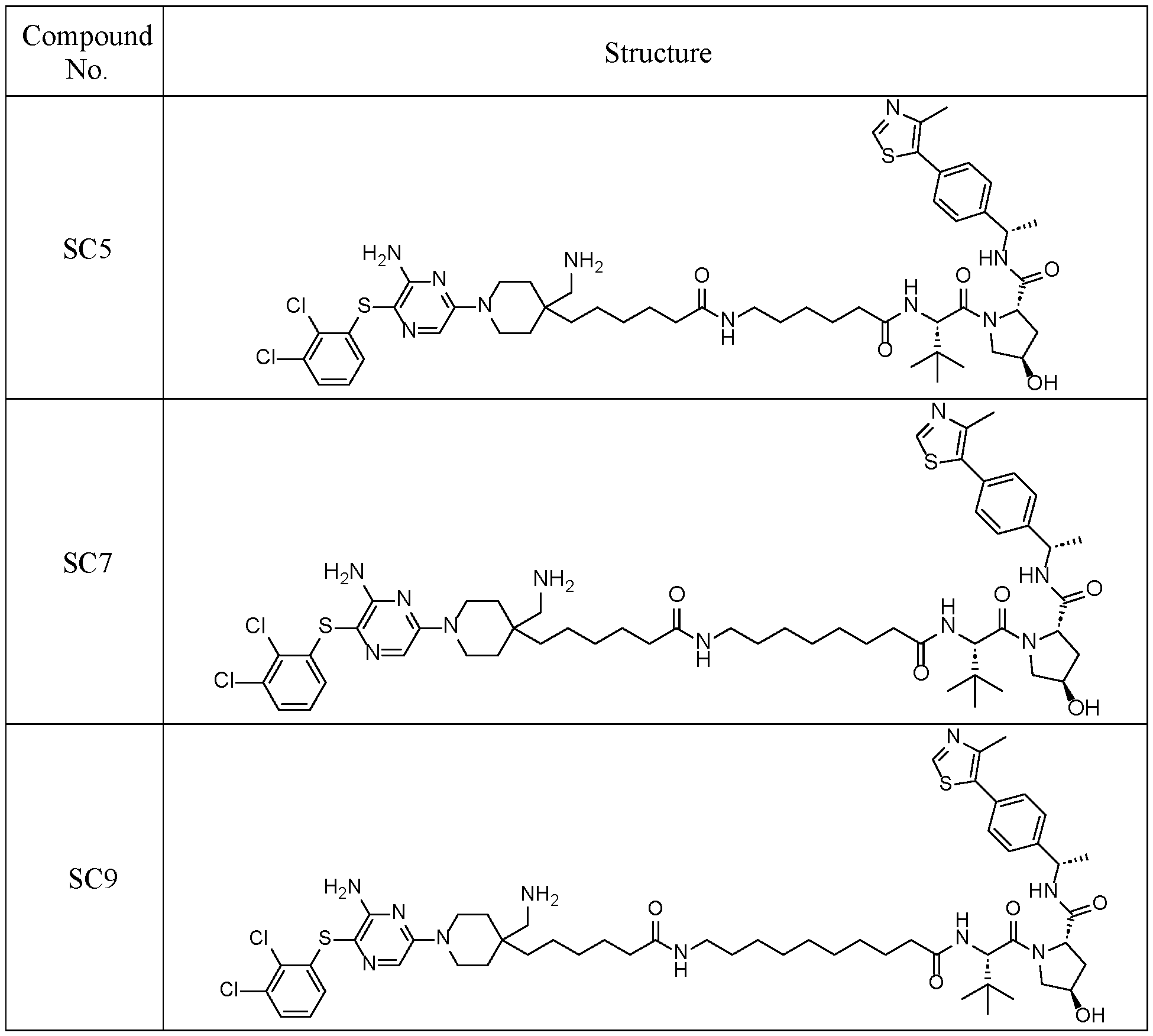
- Fig. 7A shows the degradation assay of SHP2 PROTAC compounds SC5, SC7, SC9, SC11, SP3, SP4, and SP5 (Table 1) at 1 pM for 16 hours in HEK293 cells.
- Fig. 7B shows the degradation assay of SHP2 PROTAC compounds SC5, SC7, SC9, SC11, SP3, SP4, and SP5 (Table 1) at 10 pM for 16 hours in HEK293 cells.
- Fig. 7C shows the degradation assay of SHP2 PROTAC compounds SCIO, P7, P8, P9, and P10 (Table 2) at 1 pM for 16 hours in HEK293 cells.
- Fig. 8 shows the colony formation assay of H1957, H358, and A549 cancer cells treated with DMSO, compound P9 or compound 3.
- the colony formation assay was performed to evaluate the anti-tumor activity of the SHP2 degrader compound P9.
- Compound P9 showed improved inhibitory activity on tumor cell growth at low micromolar levels in the non-small cell lung cancer cell lines H1975 and H358, and the adenocarcinomic cells A549.
- Fig. 9 shows CCK-8 cell proliferation assay in H1975 cancer cells with the treatment of compound 3 or compound P9 for 7 days.
- the cell proliferation assay indicated that compound P9 restrains the growth of H1975 cancer cells with the ICso of 4.45 ⁇ 0.11 pM, while the compound 3, SHP2 inhibitor, showed an ICso of 15.79 ⁇ 0.07 pM, suggesting that the compound P9 attenuates the tumor cell growth with improved efficacy than that of the parent inhibitor compound 3.
- SHP2 degrader refers to a compound that degrades Src homology 2 domaincontaining phosphatase 2 (SHP2, also called PTPN11; SH-PTP2; BPTP3; SH-PTP3; CFC; JMML; NS1; SH2 Domain-Containing Protein Tyrosine Phosphatase 2; Tyrosine-Protein Phosphatase Non-Receptor Type 11; Protein Tyrosine Phosphatase Non-Receptor Type 1 1; Protein-Tyrosine Phosphatase ID; Protein-Tyrosine Phosphatase 2C (PTP-2C)).
- SHP2 degrader refers to a compound that degrades Src homology 2 domaincontaining phosphatase 2 (SHP2, also called PTPN11; SH-PTP2; BPTP3; SH-PTP3; CFC; JMML; NS1; SH2 Domain-Containing Protein Tyrosine
- protein degrader or "proteolysis targeting chimera (PROTAC)” refers to a heterobifunctional compound composed of three components: a ligand that binds to a specific target protein meant for degradation, a linker that can remove specific unwanted proteins and a protein binding moiety that binds E3 ubiquitin ligase ligand.
- PROTACs require the formation of a ternary complex of target protein, PROTAC, and E3 ligase (target protein- PROTAC-E3 ligase) and protein-protein interactions between the E3 ubiquitin ligase and the target protein, and this mechanism can provide another layer of target selectivity and other distinct benefits, including the extended efficacy and catalytic concentrations.
- cereblon E3 ligand refers to compounds that bind to ubiquitin ligase cereblon and redirect its ubiquitination activity.
- VHL von Hippel-Lindau
- VHL E3 ligase ligand “(S,R,S)-AHPC-Me” refers to the following compound:
- a compound that is a protein degrader for SHP2 is a PROTAC compound, which comprises a targeting ligand, which is an SHP2 allosteric inhibitor, which binds to the target protein SHP2 selectively, a ligand that binds to the E3 ligase system, and a chemical linker that tethers the first and second ligands.
- R is alkyl, cycloalkyl, aryl, or heteroaryl, wherein R is substituted with one or more groups selected from halo, nitro, cyano, CF3, OH, and alkoxy;
- A is C, N, O, or S
- Ri is NR5R6, wherein each Rs and Re is independently selected from hydrogen, alkyl, and cycloalkyl, wherein alkyl and cycloalkyl are optionally substituted;
- R2 is -(C1-C4 alkyl)-Rs, -(C1-C4 alkyl)-NRsR 6 , -(C1-C4 alkyl)-SRs, or -(C1-C4 alkyl)-ORs, wherein Rs and Re are as defined above;
- R3 is Ci-Cs alkyl or Ci-Cs heteroalkyl, wherein alkyl and heteroalkyl are optionally substituted; wherein x is 1-15, w is 1-5, and each a and b is independently 0-12; the bonds designated with " " and represent the points of attachment; and
- E is an E3 ligase ligand selected from Ei and E2, wherein
- Ei is represented by a structure: wherein X is CO or CH2;
- Ri is fluoro, hydrogen, or deuterium; and the bond designated with represents the point of attachment of linker L; and
- E2 is represented by a structure: wherein R4 is methyl, hydrogen, or deuterium; and the bond designated with " " is attached to the linker.
- the R-A is: wherein A is C, N, O, or S.
- the compound of formula (I) is: wherein R3, L, and E are as defined above; or a pharmaceutically acceptable salt, hydrate, tautomer, or stereoisomer thereof.
- SHP2 degraders are heterobifunctional small molecules containing a first ligand that binds SHP2 selectively, a second E3 ligand that binds an E3 ligase that exploits the cell’s ubiquitin-proteasome system to achieve selective target protein degradation, and a linker that tethers the first and second ligands. They induce the formation of a ternary complex of target protein-protac-E3 ligase by simultaneously binding to an E3 ligase and SHP2, thereby bringing the SHP2 into proximity of the E3 ligase for efficient ubiquitination and subsequent proteasome- mediated degradation.
- SHP2 inhibitor moiety can be converted to potent and selective SHP2 degrader using such PROTAC technology.
- E3 ligase ligand is E2.
- E2 is VHL E3 ubiquitin ligase.
- Ri is NH2
- R2 is -CH2NH2
- R3 is Ci-Cs alkyl.
- E3 ligase ligand is El, wherein El is: wherein X is CH2;
- Ri is hydrogen or deuterium; and the bond designated with represents the point of attachment of linker L.
- the compound of formula (I) is:
- the compounds of formula (I) and intermediates used for the preparation thereof are enantiomerically enriched, e.g., the enantiomeric excess or “ee” of the compound is about 5% or more as measured by chiral HPLC.
- the ee is about 95%. In some embodiments, the ee is about 96%. In some embodiments, the ee is about 97%. In some embodiments, the ee is about 98%. In some embodiments, the ee is about 99%.
- E is the E3 ligase binding moiety of the molecule that can be enantiomerically enriched.
- the E3 ligase binding portion of the molecule is racemic.
- the present disclosure encompasses all possible stereoisomeric compounds, e.g., diastereomeric, forms of compounds of formula (I) or (IA).
- salts of the above-described compounds and the preparation and use thereof. Salts can be prepared during the final isolation and purification of the compound or separately by reacting the compound with a suitable acid.
- salts and “pharmaceutically acceptable salt” refer to derivatives of the compounds wherein the parent compound is modified by making acid or base salts thereof.
- pharmaceutically acceptable salts include, but are not limited to, mineral or organic acid salts of basic groups such as amines; and alkali or organic salts of acidic groups such as carboxylic acids.
- Pharmaceutically acceptable salts include the conventional non-toxic salts or the quaternary ammonium salts of the parent compound formed, for example, from non-toxic inorganic or organic acids.
- the salts can be acid addition salts formed with pharmaceutically acceptable acids.
- inorganic acids which can be employed to form pharmaceutically acceptable salts, include, but are not limited to, nitric acid, boric acid, hydrochloric acid, hydrobromic acid, sulfuric acid, and phosphoric acid.
- organic acids include, but are not limited to, oxalic acid, maleic acid, succinic acid, and citric acid.
- Examples of the salts of the compounds described herein include, but are not limited to, hydrochloride salt, hydrobromide salt, hydroiodide salt, sulfate salt, bisulfate salt, 2- hydroxyethansulfonate salt, phosphate salt, hydrogen phosphate salt, acetate salt, adipate salt, alginate salt, aspartate salt, benzoate salt, bisulfate salt, butyrate salt, camphorate salt, camphorsulfonate salt, di gluconate salt, glycerolphosphate salt, hemi sulfate salt, heptanoate salt, hexanoate salt, formate salt, succinate salt, fumarate salt, maleate salt, ascorbate salt, isethionate salt, salicylate salt, methanesulfonate salt, mesitylenesulfonate salt, naphthylenesulfonate salt, nicotinate salt, 2-naphthalenesulf
- the amino groups in the compounds described herein can be quaternized with methyl chloride, ethyl chloride, propyl chloride, butyl chloride; methyl bromide, ethyl bromide, propyl bromide, butyl bromide; methyl iodide, ethyl iodide, propyl iodide, butyl iodide; dimethyl sulfate, diethyl sulfate, dibutyl sulfate, diamyl sulfates; decyl chloride, lauryl chloride, myristyl chloride, steryl chloride; decyl bromide, lauryl bromide, myristyl bromide, steryl bromide; decyl iodide, lauryl iodide, myristyl iodide, steryl iodide; benzyl bromide and
- solvates of the above-descibed compounds and preparation and use thereof. Solvates typically do not significantly alter the physiological activity or toxicity of the compounds and, as such, may function as pharmacological equivalents.
- the term "solvate” refers to a combination, physical association, and/or solvation of a compound described herein with a solvent molecule such as, e.g., a disolvate, monosolvate, or hemisolvate, where the ratio of the solvent molecule to a compound described is about 2:1, about 1 : 1 or about 1 :2, respectively. This physical association involves varying degrees of ionic and covalent bonding, including hydrogen bonding.
- solvate can be isolated, such as when one or more solvent molecules are incorporated into the crystal lattice of a crystalline solid.
- solvent encompasses both solution-phase and isolatable solvates.
- Solvated forms of the compounds can be prepared with a pharmaceutically acceptable solvent.
- the solvents include, but are not limited to, water, methanol, and ethanol, and it is intended that the disclosure includes both solvated and unsolvated forms of above-described compounds.
- One type of solvate is a hydrate.
- a "hydrate” relates to a particular subgroup of solvates where the solvent molecule is water.
- Solvates typically can function as pharmacological equivalents.
- the preparation of solvates is known in the art. For example, M.
- a typical, non-limiting, process of preparing a solvate would involve dissolving a compound in a desired solvent (organic, water, or a mixture thereof) at temperatures above 20°C to about 25°C, then cooling the solution at a rate sufficient to form crystals, and isolating the crystals by known methods, e.g., filtration.
- Analytical techniques such as infrared spectroscopy, can be used to confirm the presence of the solvate in a crystal of the solvate.
- Any reference compounds of the present disclosure appearing herein are intended to include compounds of the present disclosure as well as pharmaceutically acceptable salts or hydrates thereof.
- substituents or functional groups include, but are not limited to, a halo (e.g., F, Cl, Br, and I); an oxygen atom in groups such as hydroxyl groups, alkoxy groups, aryloxy groups, aralkyloxy groups, oxo(carbonyl) groups, carboxyl groups including carboxylic acids, carboxylates, and carboxylate esters; a sulfur atom in groups such as thiol groups, alkyl and aryl sulfide groups, sulfoxide groups, sulfone groups, sulfonyl groups, and sulfonamide groups; a nitrogen atom in groups such as amines, azides, hydroxylamines, cyano, nitro groups, N-oxides, hydrazides, and enamines; and other heteroatoms in various other groups.
- a halo e.g., F, Cl, Br, and I
- an oxygen atom in groups such as hydroxyl groups,
- alkyl refers to substituted or unsubstituted straight-chain and branched alkyl groups and cycloalkyl groups having from 1 to about 20 carbon atoms (e.g., C1-C20), 1 to 12 carbons (e.g., C1-C12), 1 to 8 carbon atoms (e.g., Ci-Cs), or, in some embodiments, from 1 to 6 carbon atoms (e.g., Ci-Ce).
- straight-chain alkyl groups include those with from 1 to 8 carbon atoms such as methyl, ethyl, n-propyl, n-butyl, n-pentyl, n-hexyl, n-heptyl, and n-octyl groups.
- branched alkyl groups include, but are not limited to, isopropyl, iso-butyl, sec-butyl, tert-butyl, neopentyl, isopentyl, and 2,2-dimethylpropyl groups.
- alkyl encompasses n-alkyl, isoalkyl, and anteisoalkyl groups as well as other branched chain forms of alkyl.
- Representative substituted alkyl groups can be substituted one or more times with any of the groups listed herein, for example, amino, hydroxy, cyano, carboxy, nitro, thio, alkoxy, carbonyl, and halogen groups.
- Heteroalkyl refers to a straight- or branched-chain alkyl group preferably having from 2 to 14 carbons, more preferably 2 to 10 carbons in the chain, one or more of which has been replaced by a heteroatom selected from S, O, P and N.
- heteroalkyls include alkyl ethers, secondary and tertiary alkyl amines, amides, alkyl sulfides, and the like.
- the group may be a terminal group or a bridging group.
- reference to the normal chain when used in the context of a bridging group refers to the direct chain of atoms linking the two terminal positions of the bridging group.
- alkynyl refers to an unsaturated monovalent chain of carbon atoms, including at least one triple bond, which may be optionally branched.
- alkynyl illustrative examples include lower alkynyl, such as C2-C6, C2-C4 alkynyl, and the like.
- hydroxyalkyl refers to alkyl groups substituted with at least one hydroxyl (- OH) group.
- cycloalkyl refers to substituted or unsubstituted cyclic alkyl groups such as, but not limited to, cyclopropyl, cyclobutyl, cyclopentyl, cyclohexyl, cycloheptyl, and cyclooctyl groups.
- the cycloalkyl group can have 3 to about 8-12 ring members, whereas in other embodiments, the number of ring carbon atoms ranges from 3 to 4, 5, 6, or 7.
- cycloalkyl groups can have 3 to 6 carbon atoms (e.g., Cs-Ce).
- An acyl group can include 0 to about 12-40, 6-10, 1-5 or 2-5 additional carbon atoms bonded to the carbonyl group.
- An acryloyl group is an example of an acyl group.
- An acyl group can also include heteroatoms within the meaning herein.
- a nicotinoyl group (pyridyl-3 -carbonyl) is an example of an acyl group within the meaning herein.
- Other examples include acetyl, benzoyl, phenylacetyl, pyridyl acetyl, cinnamoyl, and cryloyl groups and the like.
- the group containing the carbon atom that is bonded to the carbonyl carbon atom contains a halogen, the group is termed a "haloacyl" group.
- An example is a trifluoroacetyl group.
- aryl refers to substituted or unsubstituted cyclic aromatic hydrocarbons that do not contain heteroatoms in the ring.
- aryl groups include, but are not limited to, phenyl, azulenyl, heptalenyl, biphenyl, indacenyl, fluorenyl, phenanthrenyl, triphenylenyl, pyrenyl, naphthacenyl, chrysenyl, biphenylenyl, anthracenyl, and naphthyl groups.
- aryl groups contain about 6 to about 14 carbons (e.g., Ce-Cu) or from 6 to 10 carbon atoms (e.g., Ce-Cio) in the ring portions of the groups.
- Aryl groups can be unsubstituted or substituted, as defined herein.
- Representative substituted aryl groups can be mono-substituted or substituted more than once, such as, but not limited to, 2-, 3-, 4-, 5-, or 6-substituted phenyl or 2-8 substituted naphthyl groups, which can be substituted with carbon or non-carbon groups such as those listed herein.
- heteroaryl represents aromatic ring comprising at least one hetero atom such as N, S, O, or Se.
- Heteroaryl in the present disclosure may be any hetero aryl.
- Heteroaryl includes, but is not limited to, pyrrolidinyl, azetidinyl, piperidynyl, piperazinyl, morpholinyl, chromanyl, indolinonyl, isoindolinonyl, furanyl, pyrrolidinyl, pyridinyl, pyrazinyl, pyrimidinyl, triazinyl, thiophenyl, tetrahydrofuranyl, pyrrolyl, oxazolyl, oxadiazolyl, imidazolyl, triazyolyl, tetrazolyl, benzoxazolinyl, benzthiazolinyl, benzimidazolinyl groups, or any combination thereof
- heterocycloalkyl refers to a non-aromatic heterocycle where one or more of the ring-forming atoms is/are a heteroatom, such as an O, N, or S atom.
- Heterocycloalkyl groups can include mono- or polycyclic (e.g., having 2, 3 or 4 fused rings) ring systems as well as spirocycles.
- Example heterocycloalkyl groups include morpholino, thiomorpholino, piperazinyl, tetrahydrofuranyl, tetrahydrothienyl, 2,3-dihydrobenzofuryl, 1,3 -benzodi oxole, benzo-1,4- dioxane, piperidinyl, pyrrolidinyl, isoxazolidinyl, isothiazolidinyl, pyrazolidinyl, oxazolidinyl, thiazolidinyl, imidazolidinyl, and the like.
- heterocycloalkyl moi eties that have one or more aromatic rings fused (i.e., having a bond in common with) to the nonaromatic heterocyclic ring, for example phthalimidyl, naphthalimidyl, and benzo derivatives of heterocycles.
- a heterocycloalkyl group having one or more fused aromatic rings can be attached though either the aromatic or non-aromatic portion.
- moieties where one or more ring-forming atoms are substituted by 1 or 2 oxo or sulfido groups.
- the heterocycloalkyl group has from 1 to about 20 carbon atoms, and in further embodiments from about 3 to about 20 carbon atoms. In some embodiments, the heterocycloalkyl group contains 3 to about 20, 3 to about 14, 3 to about 7, or 5 to 6 ringforming atoms. In some embodiments, the heterocycloalkyl group has 1 to about 4, 1 to about 3, or 1 to 2 heteroatoms. In some embodiments, the heterocycloalkyl group contains O to 3 double bonds. In some embodiments, the heterocycloalkyl group contains 0 to 2 triple bonds.
- each of alkyl, cycloalkyl, alkenyl, cycloalkenyl, alkylene, and heterocycle may be optionally substituted with independently selected groups such as alkyl, haloalkyl, hydroxyalkyl, aminoalkyl, carboxylic acid and derivatives thereof, including esters, amides, and nitrites, hydroxy, alkoxy, acyloxy, amino, alky and dialky-lamino, acylamino, thio, and the like, and combinations thereof.
- amine refers to primary, secondary, and tertiary amines having, e.g., the formula N(group)3 wherein each group can independently be H or non-H, such as alkyl, aryl, and the like.
- Amines include, but are not limited to, R-NH2, for example, alkylamines, arylamines, alkylarylamines; R2NH, wherein each R is independently selected, such as dialkylamines, diarylamines, aralkylamines, heterocyclylamines and the like; and R3N, wherein each R is independently selected, such as trialkylamines, dialkylarylamines, alkyldiarylamines, triarylamines, and the like.
- R-NH2 alkylamines, arylamines, alkylarylamines
- R2NH wherein each R is independently selected, such as dialkylamines, diarylamines, aralkylamines, heterocyclylamines and the like
- R3N wherein each R is independently selected, such as trialkylamines, dialkylarylamines, alkyldiarylamines, triarylamines, and the like.
- amine also includes ammonium ions.
- amino group refers to a substituent of the form -NH2, -NHR, -NR2, -NR3 + , wherein each R is independently selected, and protonated forms of each, except for -NR? + , which cannot be protonated. Accordingly, any compound substituted with an amino group can be viewed as an amine.
- An “amino group” can be a primary, secondary, tertiary, or quaternary amino group.
- alkylamino includes a monoalkylamino, a dialkylamino, and a trialkylamino group.
- the above compounds include isotopic variants and compounds in which one or more hydrogen atoms have been substituted with deuterium.
- the compounds may contain one or more chiral centers, or may otherwise be capable of existing as multiple stereoisomers.
- the compounds are not limited to any particular stereochemical requirement, and the compounds, and compositions, methods, uses, and medicaments that include them may be optically pure or any of a variety of stereoisomeric mixtures, including racemic and other mixtures of enantiomers, other mixtures of diastereomers, and the like.
- Such mixtures of stereoisomers may include a single stereochemical configuration at one or more chiral centers, while including mixtures of stereochemical configuration at one or more other chiral centers.
- the compounds described herein may include geometric centers, such as cis, trans, E, and Z double bonds.
- the compounds are not limited to any particular geometric isomer requirement, and the compounds, and compositions, methods, uses, and medicaments that include them, may be pure or any of a variety of geometric isomer mixtures.
- Such mixtures of geometric isomers may include a single configuration at one or more double bonds, while including mixtures of geometry at one or more other double bonds.
- the compounds disclosed herein can suppress tumor growth in vivo by inducing the degradation of SHP2.
- the compounds can induce degradation of SHP2 with low nanomolar DCsos (compound concentration needed to induce target protein degradation by 50 %).
- Compounds disclosed herein typically have DC50 values about 0.1 to about 10000 nM, such as about 0.1 to 10000 nM or 0.1 to about 10000 nM or 0.1 to 10000 nM.
- the compounds selectively degrade SHP2 protein with % degradation from about less than 5% to about greater than 95%.
- SHP2 protein is reduced by about 50% or less, e.g., 1%, about 2%, about 4%, about 5%, about 10%, about 15%, about 20%, about 25%, about 35%, about 40%, about 48%.
- SHP2 protein is reduced by about 50% or more, about 51%, about 60%, about 64%, about 70%, about 74%, about 80%, about 84%, about 90%, about 94%, about 95%.
- a pharmaceutical composition comprising a compound of formula (I) or (IA) or a pharmaceutically acceptable salt, hydrate, tautomer, or stereoisomer of either of the foregoing, and a pharmaceutically acceptable carrier, excipient, or diluent.
- the carrier, excipient, or diluent can vary based on the particular route of administration (see, e.g., Remington’s The Science and Practice of Pharmacy, 23 rd ed. (2020)).
- a pharmaceutical composition further comprises at least one additional pharmaceutically active agent.
- Pharmaceutical compositions can be prepared by combining one or more compounds of formula (I) or (IA) or a pharmaceutically acceptable salt, hydrate, tautomer, or stereoisomer of either of the foregoing, with a pharmaceutically acceptable carrier, excipient, or diluent and, optionally, one or more additional pharmaceutically active agents.
- composition comprising (i) one or more compounds of formula (I) or (IA) or a pharmaceutically acceptable salt, hydrate, tautomer, or stereoisomer of either of the foregoing, and (ii) one or more other prophylactic or therapeutic agents, and a pharmaceutically acceptable carrier, excipient, or diluent.
- the compound and one or more other prophylactic or therapeutic agents can be administered as two separate compositions, simultaneously or sequentially, in either order by the same or different routes.
- a method of treating or inhibiting cancer comprises administering to a patient in need thereof an effective amount of a compound of formula (I) or (IA) or a pharmaceutically acceptable salt, hydrate, tautomer, or stereoisomer of either of the foregoing, optionally as a pharmaceutical composition comprising the compound and a pharmaceutically acceptable carrier, excipient, or diluent.
- the cancer is colon cancer, lung adenocarcinoma, squamous cell carcinoma, neuroblastoma, or melanoma.
- a method of degrading SHP2 proteins in a patient comprises administering to the patient in need thereof an effective amount of a compound of formula (I) or (IA) or a pharmaceutically acceptable salt, hydrate, tautomer, or stereoisomer of either of foregoing, or a pharmaceutical composition comprising the same and a pharmaceutically acceptable carrier, excipient, or diluent, whereupon SHP2 in the patient is degraded.
- the method comprises administering a therapeutically effective amount of a compound of formula (I) or (IA) as a neat compound or as a pharmaceutical composition.
- the compound or a pharmaceutical composition can be administered during or after the onset of the disease or condition.
- the pharmaceutical compositions are sterile and contain no toxic, carcinogenic, or mutagenic compounds, which would cause an adverse reaction when administered.
- the other therapeutic agent(s) can be administered simultaneously or sequentially, by the same or a different route, to achieve the desired effect.
- the compound described herein and one or more other prophylactic or therapeutic agents can be administered from a single composition or two separate compositions, such as by the same or different routes.
- the prophylactic or therapeutic agent can be administered in an amount to provide its desired prophylactic or therapeutic effect.
- the effective dosage range for each prophylactic or therapeutic agent is well-known in the art or can be determined in accordance with dosage range-determining methods known to those of ordinary skill in the art, and the therapeutic agent can be administered to a patient in need thereof within such established ranges.
- An effective amount of the compound is typically formulated in accordance with pharmaceutical practice.
- the effective amount depends on the individual case, and it is subject to medical assessment (diagnosis) that considers signs, symptoms, and/or malfunctions that are present, the risks of developing particular signs, symptoms, and/or malfunctions, and other factors.
- the term "effective amount” or “effective dose” refers to an amount of the active ingredient(s) that is(are) sufficient, when administered, to deliver efficaciously the active ingredient(s) for the treatment of a disease or condition of interest to a subject in need thereof.
- the prophylactically or therapeutically effective amount of such compound will vary depending upon the patient and the disease or condition being treated, the weight and age of the patient, the severity of the disease or condition, the manner of administration, and the like, which can readily be determined by one of ordinary skill in the art.
- the prophylactically or therapeutically effective amount of the agent may reduce (z.e., inhibit to some extent or stop) unwanted cellular proliferation; reduce the number of cancer cells; reduce the tumor size; inhibit (or stop) cancer cell infiltration into peripheral organs; inhibit (or stop) tumor metastasis; inhibit, e.g., to some extent, tumor growth; and/or relieve, to some extent, one or more of the signs or symptoms associated with the cancer.
- the administered compound or composition prevents growth and/or kills existing cancer cells, it may be cytostatic and/or cytotoxic.
- the compounds can be typically administered in admixture with a pharmaceutical carrier to give a pharmaceutical composition selected with regard to the intended route of administration and standard pharmaceutical practice.
- Pharmaceutical compositions can be formulated in a conventional manner using one or more physiologically acceptable carriers comprising excipients and/or auxiliaries that facilitate the processing of the compound.
- the pharmaceutical compositions can be manufactured, for example, by conventional mixing, dissolving, granulating, drageemaking, emulsifying, encapsulating, entrapping, or lyophilizing processes. Proper formulation is dependent upon the route of administration chosen.
- the composition typically is in the form of a tablet, capsule, powder, solution, or elixir.
- the composition When administered in tablet form, the composition additionally can contain a solid carrier, such as a gelatin or an adjuvant.
- a solid carrier such as a gelatin or an adjuvant.
- the tablet, capsule, and powder can contain about 0.01% to about 95%, and preferably from about 1% to about 50%, of the compound.
- a liquid carrier can be added, such as water, petroleum, or oils of animal or plant origin.
- the liquid form of the composition can further contain the physiological saline solution, dextrose or other saccharide solutions, or glycols.
- the composition When administered in liquid form, the composition contains about 0.1% to about 90%, and preferably about 1% to about 50%, by weight, of the compound.
- compositions comprising an effective amount of the compound are determined by an individual physician in view of the diagnosed condition or disease.
- dosage amount and interval can be adjusted individually to provide levels of the compound that are sufficient to maintain a prophylactic or therapeutic effect.
- Toxicity and therapeutic efficacy of the compounds can be determined by standard pharmaceutical procedures in cell cultures or experimental animals, e.g., for determining the maximum tolerated dose (MTD) of a compound, which is defined as the highest dose that causes no toxicity in animals.
- the therapeutic index is the dose ratio between the maximum tolerated dose and therapeutic effects (e.g., inhibition of tumor growth).
- the dosage can vary within this range depending upon the dosage form employed and the route of administration utilized. The determination of a therapeutically effective amount is well within the capability of those ordinarily skilled in the art, especially in light of the detailed disclosure provided herein.
- a effective amount of a compound required for use in therapy varies with the nature of the condition being treated, the length of time that activity is desired, and the age and the condition of the patient, and ultimately is determined by the attendant physician. Dosage amounts and intervals can be adjusted individually to provide plasma levels of the SHP2 degrader that are sufficient to maintain the desired prophylactic or therapeutic effect.
- the desired dose can be administered in a single dose or as multiple doses administered at appropriate intervals, for example, as one, two, three, four, or more sub-doses per day. Multiple doses often are desired or required.
- the compound can be administered at a frequency of four doses delivered as one dose per day at four-day intervals (q4d x 4).
- a compound can be administered in an amount of about 0.005 to about 500 milligrams per dose, about 0.05 to about 250 milligrams per dose, or about 0.5 to about 100 milligrams per dose.
- the compound can be administered, per dose, in an amount of about 0.005, about 0.05, about 0.5, about 5, about 10, about 20, about 30, about 40, about 50, about 100, about 150, about 200, about 250, about 300, about 350, about 400, about 450, or about 500 milligrams, including all doses between 0.005 and 500 milligrams.
- the compositions comprising the compound (s) can be formulated in a unit dosage form, each dosage containing from about 5 to about 1,000 mg (1 g), more usually about 100 nig to about 500 mg, of the active ingredient.
- the dosage of a composition comprising a compound described herein can range from about 1 mg/kg to about 200 mg/kg, about 1 mg/kg to about 100 mg/kg, or about 1 mg/kg to about 50 mg/kg.
- the above dosages are exemplary of the average case, but there can be individual instances in which higher or lower dosages are merited, and such are within the scope of this disclosure.
- the physician determines the actual dosing regimen that is most suitable for an individual patient, which can vary with the age, weight, and response of the particular patient.
- a disease or condition wherein degradation of SHP2 provides a benefit pertains to a disease or condition in which SHP2 is important or necessary, e.g., for the onset, progress, expression of that disease or condition, or a disease or a condition which is known to be treated by a SHP2 inhibitor or degrader.
- additional prophylactic or therapeutic agent refers to a prophylactic or therapeutic agent different from a compound of the disclosure and that is known to treat the disease or condition of interest.
- disease or "condition” denotes disturbances and/or anomalies that as a rule are regarded as being pathological conditions or functions, and that can manifest themselves in the form of particular signs, symptoms, and/or malfunctions.
- the terms “treat,” “treating,” “treatment,” and the like refer to eliminating, reducing, or ameliorating a disease or condition, and/or symptoms associated therewith. Although not precluded, treating a disease or condition does not require that the disease, condition, or symptoms associated therewith be completely eliminated.
- the term “treat” and synonyms contemplate administering a prophylactic or therapeutically effective amount of a compound described herein to a subject in need of such treatment.
- the treatment can be orientated symptomatically, for example, to suppress symptoms. It can be effected over a short period, be oriented over a medium term, or can be a long-term treatment, for example, within the context of maintenance therapy.
- prevent refers to a method of preventing the onset of a disease or condition and/or its attendant symptoms or barring a subject from acquiring a disease.
- prevent also include delaying the onset of a disease and/or its attendant symptoms and reducing a subject's risk of acquiring a disease.
- prevent may include “prophylactic treatment,” which refers to reducing the probability of redeveloping a disease or condition, or of a recurrence of a previously- controlled disease or condition, in a subject who does not have, but is at risk of or is susceptible to, redeveloping a disease or condition or a recurrence of the disease or condition.
- terapéuticaally effective amount refers to an amount of the active ingredient(s) that is(are) sufficient, when administered by a method of the disclosure, to efficaciously deliver the active ingredient(s) for the treatment of condition or disease of interest to a subject in need thereof.
- the therapeutically effective amount of the agent may reduce (i.e., retard to some extent or stop) unwanted cellular proliferation; reduce the number of cancer cells; reduce the tumor size; inhibit (i.e., retard to some extent or stop) cancer cell infiltration into peripheral organs; inhibit (i.e., retard to some extent or stop) tumor metastasis; inhibit, to some extent, tumor growth; and/or relieve, to some extent, one or more of the symptoms associated with cancer.
- the administered compound or composition prevents growth and/or kills existing cancer cells, it may be cytostatic and/or cytotoxic.
- the therapeutically active agent (s) is an immune checkpoint inhibitor.
- immune checkpoint inhibitors include, but are not limited to, PD-1 inhibitors, PD-L1 inhibitors, CTLA-4 inhibitors, LAG3 inhibitors, TIM3 inhibitors, cd47 inhibitors, and B7-H1 inhibitors.
- the immune checkpoint inhibitor is a programmed cell death (PD- 1) inhibitor.
- PD-1 is a T-cell coinhibitory receptor that plays a pivotal role in the ability of tumor cells to evade the host's immune system.
- PD- 1 inhibitors specifically include, but are not limited to, antibodies that specifically bind to PD-1.
- the anti-PD-1 antibodies selected from the group consisting of nivolumab, pembrolizumab, STI- A1014, and pidilzumab.
- the availability, methods of production, mechanism of action, and clinical studies of anti-PD-1 antibodies are described in U.S. Pat. Appl. Pub. No. 2013/0309250, U.S. Pat. No. 7,595,048, U.S. Pat. No. 8,728,474, U.S. Pat. No.
- the immune checkpoint inhibitor is a PD-L1 (also known as B7-H1 or CD274) inhibitor.
- PD-L1 inhibitors include antibodies that specifically bind to PD-L1.
- anti-PD-Ll antibodies include, but are not limited to, avelumab, atezolizumab, durvalumab, and BMS-936559.
- Anti-PD-Ll antibodies ’s availability, methods of production, mechanism of action, and clinical studies are described in U.S. Pat. No. 8,217,149, U.S. Pat. App. Pub. No. 2014/0341917, U.S. Pat. App. Pub. No. 2013/0071403, Int’l Pat. App. Pub. No. WO 2015036499, andNaido et al., British Journal of Cancer 2014, 7772214-19, all of which are hereby specifically incorporated by reference for their teachings regarding same.
- the immune checkpoint inhibitor is a CTLA-4 inhibitor.
- CTLA-4 also known as cytotoxic T-lymphocyte antigen 4
- CTLA-4 is a protein receptor that down-regulates the immune system.
- CTLA-4 is characterized as a "brake” that binds costimulatory molecules on antigen-presenting cells, which prevents interaction with CD28 on T cells and also generates an overtly inhibitory signal that constrains T cell activation.
- CTLA-4 inhibitors include antibodies that specifically bind to CTLA-4.
- Particular anti-CTLA-4 antibodies include, but are not limited to, ipilimumab and tremelimumab.
- the availability, methods of production, mechanism of action, and clinical studies of CTLA-4 antibodies are described in U.S. Pat. No. 6,984,720, U.S. Pat. No. 6,207,156, and Naido et al., British Journal of Cancer 2014, 7772214-19, all of which are hereby specifically incorporated by reference for their teachings regarding same.
- the immune checkpoint inhibitor is a LAG-3 inhibitor.
- LAG-3 Lymphocyte Activation Gene 3
- T cell homeostatis proliferation, and activation.
- LAG-3 has been reported to participate in regulatory T cells (Tregs) suppressive function. A large proportion of LAG-3 molecules are retained in the cell close to the microtubule organizing center and only induced following antigenspecific T cell activation, (see U.S. Pat. App. Pub. No. 2014/0286935).
- LAG-3 inhibitors include antibodies that specifically bind to LAG-3. Examples of anti -LAG-3 antibodies include, but are not limited to, GSK2831781.
- the immune checkpoint inhibitor is a TIM-3 inhibitor.
- TIM-3 T- cell immunoglobulin and mucin domain 3
- the TIM-3 pathway is considered a target for anticancer immunotherapy due to its expression on dysfunctional CD8+ T cells and Tregs, which are two reported immune cell populations that constitute immunosuppression in tumor tissue (Anderson, Cancer Immunology Research 2014, 2, 393-98).
- TIM3 inhibitors include antibodies that specifically bind to TIM-3.
- the immune checkpoint inhibitor is a CD47 inhibitor (see Unanue, E.R., PNAS 2013,110: 10886-87, which is specifically incorporated herein by reference for its teachings regarding same).
- antibody refers to intact monoclonal antibodies, polyclonal antibodies, multispecific antibodies formed from at least two intact antibodies, and antibody fragments, so long as they exhibit the desired biological activity.
- antibody refers to include soluble receptors that do not possess the Fc portion of the antibody.
- the antibodies are humanized monoclonal antibodies and fragments thereof made by means of recombinant genetic engineering.
- Another class of immune checkpoint inhibitors includes polypeptides that bind to and block PD-1 receptors on T-cells without triggering inhibitor signal transduction.
- B7-DC polypeptides including B7-DC polypeptides, B7-H1 polypeptides, B7-1 polypeptides, and B7-2 polypeptides, and soluble fragments thereof.
- Another class of immune checkpoint inhibitors includes compounds with peptide moi eties that inhibit PD-1 signaling as disclosed in U.S. Pat. No. 8,907,053, which is specifically incorporated herein by reference for its teachings regarding same.
- Another class of immune checkpoint inhibitors includes inhibitors of certain metabolic enzymes, such as indoleamine 2,3 dioxygenase (IDO), which is expressed by infiltrating myeloid cells and tumor cells.
- IDO indoleamine 2,3 dioxygenase
- the IDO enzyme inhibits immune responses by depleting amino acids that are necessary for anabolic functions in T cells or through the synthesis of particular natural ligands for cytosolic receptors that are able to alter lymphocyte functions (Lob, Cancer Immunol Immunother, 2009, 58.T53-57).
- IDO blocking agents include, but are not limited to, levo-1 -methyl typtophan (L-1MT) and 1-methyl-tryptophan (1MT) ( Lob et al., Cancer Immunol Immunother 2009, 58.T53-7; specifically incorporated herein by reference for its teachings regarding same).
- the immune checkpoint inhibitor is nivolumab, pembrolizumab, pidilizumab, STI-A1110, avelumab, atezolizumab, durvalumab, STLA1014, ipilimumab, tremelimumab, GSK2831781, BMS-936559 or MED14736.
- LCMS analysis showed that over 90% of the compounds (11 and 12) were converted into ring-opened products 13 within 3 hours in the DMEM cell media at room temperature. This observation is consistent with the fact that phthalimides can be smoothly hydrolyzed in the presence of water and an organic base, as these PROTAC compounds contain a basic aliphatic amino group. Therefore, pomalidomide or lenalidomide-based CRBN ligands are not suitable for the development of in vivo efficacious SHP2 degraders due to stability considerations.
- VHL Von Hippel-Lindau
- E3 ligase were tested.
- An initial set of PROTACs were synthesized and evaluated with varied linear alkyl chains and polyethylene glycols using VHL-2 as the VHL ligand to reveal the favorable linker length (Table 1).
- These PROTAC candidates were surveyed by western blotting in the HEK293 human embryonic kidney cell line for their ability to induce degradation of SHP2 protein at 1 and 10 pM (Table 1 and Figs. 7A-7C).
- Compound SC11 which consists of a n-undecane linker between compound 4 and the VHL ligand (12-atom long), induced 27% and 64% degradation of SHP2 at 1 pM and 10 pM, respectively.
- the SHP2 protein (Aa 1-528) was cloned into pET-21a(+) vector.
- Bacterial BL21(DE3) (Novagen) was used as an expression host, and the induction of protein expression was carried out in LB media with 1 mM IPTG at 18 °C overnight.
- Cell pellets were stored at -80 °C for subsequent protein purification. Protein purification was conducted at 4 °C. Frozen cell pellets were lysed by sonication in 40 ml cold lysis buffer (50 mM Tris-HCl, pH 8.0, 150 mM NaCl, 5 mM imidazole, and 1 mM PMSF) per liter cell pellet.
- 40 ml cold lysis buffer 50 mM Tris-HCl, pH 8.0, 150 mM NaCl, 5 mM imidazole, and 1 mM PMSF
- HIS-protein-containing fractions were concentrated, loaded onto a HiLoad 26/600 Superdex 75 column, and eluted with storage buffer (50 mM Tris-HCl, pH 8.0, 150 mM NaCl, 1 mM DTT, 10% glycerol). Proteins used for inhibition assays were purified using Ni-NTA resin followed by size exclusion column chromatography and the purity was determined to be >95% by SDS-PAGE and Coomassie staining. The protein was aliquoted and stored at -80 °C.
- Catalytic activity of SHP2 (1-528) was assayed with 6,8-Difluoro-4-Methylumbelliferyl Phosphate as a substrate in 3, 3 -Dimethylglutaric acid (DMG) buffer (50 mM DMG, pH 7.0, 1 mM EDTA, 18 mM NaCl, 0.01% Triton X-100) at 25 °C.
- DMG 3 -Dimethylglutaric acid
- the assays were performed in 96-well plates to determine the ICso values.
- the fluorescence signal was monitored with a CLARIOstar Plus Microplate Spectrophotometer using excitation and emission wavelengths of 340 and 450 nm, respectively.
- the inhibitor dose-response curves were analyzed using normalized ICso regression curve fitting with control-based normalization. Data was fitted using Prism GraphPad 9.2.0.
- PTP activity was assayed using p-nitrophenyl phosphate (pNPP) as a substrate in DMG buffer (50 mM DMG, pH 7.0, 1 mM EDTA, 150 mM NaCl, 2 mM DTT, 0.1 mg/mL BSA) at 25 °C.
- DMG buffer 50 mM DMG, pH 7.0, 1 mM EDTA, 150 mM NaCl, 2 mM DTT, 0.1 mg/mL BSA
- the assays were performed in 96-well plates.
- the reaction rate was measured using a SpectraMax Plus 384 Microplate Spectrophotometer. Data were fitted using SigmaPlot Enzyme Kinetics Module.
- Anti-p-ERKl/2 (T202/Y204), anti-ERKl/2 were purchased from Cell Signaling Technology.
- Anti-GAPDH, anti-SHP2, anti-SHPl, anti -Actin antibodies were purchased from.
- Anti-PTPIB antibody was purchased from Abeam.
- HEK293, SKBR3, U2OS, MCF7 and A549 cells were grown in DMEM supplemented with 10% FBS, penicillin (50 units/mL), and streptomycin (50 pg/mL) in a 37°C incubator containing 5% CO2.
- KYSE-520 and H358 cells were grown in RPMI-1640 supplemented with 10% FBS, penicillin (50 units/mL), and streptomycin (50 pg/mL) in a 37°C incubator containing 5% CO2.
- the cell proliferation inhibition EC50 was determined by CCK-8 assay.
- KYSE-520 cells were seeded at 5 x 10³ cells/well in 96 well plate. After 24 hours, compound P9 was added to the medium starting at 80 pM in a 2-fold dilution rate to 0.16 pM. After 7 days, 10 pL of CCK-8 test solution was added into each well and incubated for 2 h at 37 °C. The optical density (OD) at 450 nm was measured with a microplate reader. The cell viability rate at different concentrations of compound P9 treatment was determined with Prism, version 9.5.1 (GraphPad).
- mice were carried out in accordance with the regulations of the Institutional Animal Care and Use Committees at Purdue University. All mice were housed under pathogen- free conditions in the animal facility and received autoclaved water and food. Eight to ten weeks old Nude mice were used in the study. For pharmacokinetic studies, mice were administered a single dose of compound P9 at 25 or 50 mg/kg via IP injection. Blood samples were collected through tail vein at indicated time points after injection. Isoflurane was used as an anesthetic.
- compound P9 showed improved efficacy on inhibiting the growth of these cancer cells in the colony formation assay (Fig. 4B). These data suggested that P9 is more potent than its parent SHP2 inhibitor compound 3 in inhibition of cell growth in colony formation assay.
- PK pharmacokinetics
- Enzymatic ICsos of the degraders were measured with full-length SHP2 (Table 6).
- Peak multiplicities are reported using the following abbreviations: s (singlet), d (doublet), t (triplet), q (quartet), m (multiplet), or br (broad singlet).
- a solution of l-benzylpiperidine-4-carbonitrile (2.00 g, 10 mmol) in dry THF (17.8 mL) was prepared in a three-necked round-bottomed flask equipped with a stir bar and argon inlet adaptor. The solution was cooled to -78 °C, and a solution of lithium diisopropylamide (LDA) (1 M) in THF (10.5 mL) was added dropwise. The mixture was warmed to 0 °C, stirred for 30 min, and then cooled to -78 °C.
- LDA lithium diisopropylamide
- L1-L12 were synthesized according to a method known in the art (e.g., Wang et al., J. Med. Chem. 2020, 63, 7510-7528, which is specifically incorporated herein by reference for its teachings regarding same).
- L13 and L14 were synthesized using a methods known in the art (Li et al., Eur. J. Med. Chem. 2018, 151, 237-247 and Kaur et al., Eur. J. Med. Chem. 2019, 166, 339-350). Characterization of L1-L7, L9,-L11, and L13-L14 matches well with reported data.
- the term "about” can allow for a degree of variability in a value or range, for example, within 10%, within 5%, or within 1% of a stated value or of a stated limit of a range.
- the term “substantially” can allow for a degree of variability in a value or range, for example, within 90%, within 95%, or within 99% of a stated value or of a stated limit of a range.
Landscapes
- Health & Medical Sciences (AREA)
- Chemical & Material Sciences (AREA)
- Medicinal Chemistry (AREA)
- Pharmacology & Pharmacy (AREA)
- Epidemiology (AREA)
- Life Sciences & Earth Sciences (AREA)
- Animal Behavior & Ethology (AREA)
- General Health & Medical Sciences (AREA)
- Public Health (AREA)
- Veterinary Medicine (AREA)
- Pharmaceuticals Containing Other Organic And Inorganic Compounds (AREA)
Abstract
Compounds that degrade of Src homology 2 domain-containing phosphatase 2 (SHP2); compositions comprising the same; and their use for treating cancer and other diseases or conditions mediated by SHP2.
Description
SHP2 DEGRADERS FOR CANCER THERAPY
CROSS-REFERENCE TO RELATED APPLICATIONS
[0001] This application claims priority to U.S. provisional patent application no. 63/542,009, which was filed October 2, 2023, and which is hereby incorporated by reference in its entirety.
GOVERNMENT RIGHTS
[0002] This invention was made with government support under 069202 awarded by the National Institutes of Health. The government has certain rights in the invention.
TECHNICAL FIELD
[0003] The present disclosure relates to Src homology 2 domain-containing phosphatase 2 (SHP2) degraders, pharmaceutical compositions comprising the same, and their use in treating cancer and other SHP2-mediated diseases.
BACKGROUND
[0004] T 'his section introduces aspects that may help facilitate a better understanding of the disclosure. Accordingly, these statements are to be read in this light and are not to be construed as admissions about what is or is not prior art.
[0005] Protein tyrosine phosphatases (PTP) cooperate with protein tyrosine kinases (PTK) in regulating the level of protein tyrosine phosphorylation, which is crucial in cell signal transduction. Src homology 2 domain-containing phosphatase 2 (SHP2), encoded by PTPN11, is a member of the PTP family that regulates cellular proliferation, survival, migration, and differentiation by participating in numerous cell-signaling cascades, such as, RAS-ERK1/2, PI3K-AKT and JAK- STAT. Germline mutations in PTPN11 cause Noonan and LEOPARD syndromes, which have overlapping clinical features. Autosomal dominant activating mutations in PTPN11 fuel excess RAS/ERK1/2 signaling that drives certain human RASopathies and cancers. Somatic mutations of PTPN11 have been found in patients with myelodysplastic syndrome (10%), juvenile acute myeloid leukemia (AML) (5%), and B-cell acute lymphoblastic leukemia (7%). PTPN11 mutations also occur in sporadic solid tumors, including lung cancer, colon cancer, neuroblastoma, and melanoma. Moreover, accumulating evidence suggests that SHP2 may play an important role in immune evasion and in the T-cell programmed cell death/check point pathway (PD1/PD-L1).
Regarded as an appealing target for human cancer therapies, significant endeavors have been dedicated to the development of SHP2 inhibitors.
[0006] SHP099 is the first potent, selective, and orally bioavailable SHP2 inhibitor, which targets an allosteric binding site in SHP2 and stabilizes the inactive conformation of the enzyme (Garcia et al., J. Med. Chem. 2016, 59, 7773-7782; Chen et al., Nature 2016, 535, 148-152). Subsequently, several allosteric SHP2 inhibitors with superior pharmaceutical properties were developed and progressed to clinical trials for treating advanced or metastatic solid tumors. Despite the clinical promise of the allosteric SHP2 inhibitors, one drawback is the possibility of non-mutational resistance mechanisms (Yuan et al., J. Med. Chem. 2020, 63, 11368-11396).
[0007] Thus, there is an unmet need for a compound that overcomes mutational resistance to SHP2 inhibitors with high efficacy in blocking tumor growth at cellular and in vivo levels. It is an object of the present disclosure to provide such compounds. This and the other objects and advantages, as well as inventive feaures, will be apparent from the detailed description.
SUMMARY
[0008] Provided is a compound of formula (I), or a pharmaceutically acceptable salt, hydrate, tautomer, or stereoisomer thereof:
 wherein
R is alkyl, cycloalkyl, aryl, or heteroaryl, wherein R is substituted with one or more groups selected from halo, nitro, cyano, CF3, OH, and alkoxy;
A is C, N, O, or S;
Ri is NR5R6, wherein each Rs and Re is independently selected from hydrogen, alkyl, and cycloalkyl, wherein alkyl and cycloalkyl are optionally substituted;
R2 is -(C1-C4 alkyl)-Rs, -(C1-C4 alkyl)-NRsR6, -(C1-C4 alkyl)-SRs, or -(C1-C4 alkyl)-ORs, wherein Rs and Re are as defined above;
R3 is Ci-Cs alkyl or Ci-Cs heteroalkyl, wherein alkyl and heteroalkyl are optionally substituted;
L is a linker selected from:
 wherein x is 1-15, w is 1-5, and each a and b is independently 0-12; the bonds designated with "
 " and represent the points of attachment; and
E is an E3 ligase ligand selected from Ei and E2, wherein Ei is represented by a structure:
 wherein X is CO or CH2;
Ri is fluoro, hydrogen, or deuterium; and the bond designated with represents the point of attachment of linker L; and
E2 is represented by a structure:
 wherein R4 is methyl, hydrogen, or deuterium; and the bond designated with " jjJ'1 " is attached to the linker.
[0009] In some embodiments, the R-A is:
wherein R4 is methyl, hydrogen, or deuterium; and the bond designated with " jjJ'1 " is attached to the linker.
[0009] In some embodiments, the R-A is:
 wherein A is C, N, O, or S.
[0010] In some embodiments, the compound of formula (I) is a compound of formula (IA):
 wherein R3, L, and E are as defined above; or a pharmaceutically acceptable salt, hydrate, tautomer, or stereoisomer thereof.
[0011] In some embodiments of the compound of formula (I) or (IA), E is E2:
 wherein R4 is methyl, hydrogen, or deuterium; and the bond designated with " jJ'r’ " is attached to the linker.
[0012] In some embodiments of the compound of formula (I) or (IA), R3 is Ci-Cs alkyl.
wherein R4 is methyl, hydrogen, or deuterium; and the bond designated with " jJ'r’ " is attached to the linker.
[0012] In some embodiments of the compound of formula (I) or (IA), R3 is Ci-Cs alkyl.
[0013] In some embodiments of the compound of formula (I) or (IA), E is Ei:
 wherein X is CH2;
Ri is hydrogen or deuterium; and the bond designated with represents the point of attachment of linker L.
[0014] In some embodiments, the compound of formula (I) is:


 or a pharmaceutically acceptable salt, hydrate, tautomer, or stereoisomer thereof.
[0015] Provided is a pharmaceutical composition comprising a compound of formula (I) or (IA) or a pharmaceutically acceptable salt, hydrate, tautomer, or stereoisomer of either of the foregoing, and a pharmaceutically acceptable carrier, excipient, or diluent.
[0016] Provided is a method of treating or inhibiting cancer, wherein the method comprises administering to a patient in need thereof an effective amount of a compound of formula (I) or (IA) or a pharmaceutically acceptable salt, hydrate, tautomer, or stereoisomer of either of the foregoing, or a pharmaceutical composition comprising the compound and a pharmaceutically acceptable carrier excipient, or diluent, whereupon the cancer in the patient is treated or inhibited.
[0017] In some embodiments, the cancer is colon cancer, lung adenocarcinoma, squamous cell carcinoma, neuroblastoma, or melanoma. In some embodiments, the compound is administered orally.
[0018] Further provided is a method of degrading Src homology 2 domain-containing phosphatase 2 (SHP2) in a patient, wherein the method comprises administering to the patient an effective amount of a compound of formula (I) or (IA) or a pharmaceutically acceptable salt, hydrate, tautomer, or stereoisomer of either of the foregoing or a pharmaceutical composition comprising the compound and a pharmaceutically acceptable carrier, excipient, or diluent, whereupon SHP2 in the patient is degraded. In some embodiments, the patient has cancer.
[0019] Further provided is a method of treating or inhibiting a disease or condition responsive to SHP2 degradation, wherein the method comprises administering to a patient in need thereof an effective amount of a compound of formula (I) or (IA) or a pharmaceutical composition comprising the compound, whereupon the disease or condition responsive to SHP2 degradation in the patient is treated or inhibited.
BRIEF DESCRIPTION OF THE DRAWINGS
[0020] The present disclosure will be more readily understood from the detailed description of embodiments presented below considered in conjunction with the attached drawings of which:
[0021] Fig. 1A shows the reported Src homology 2 domain-containing phosphatase 2 (SHP2) PROTACs compounds.
[0022] Fig. IB shows the co-crystal structure of ligand 1 bound to the SHP2 allosteric pocket with the interacting structural water represented by a black sphere (PDB 7JVN). Hydrogen bonds are depicted by grey dashes, and the cation-7t interaction is shown with black dashes from Ri l l. Piperidine region of the scaffold bound to SHP2 in surface representation colored by element. The solvent-exposed methyl exploited in proteolysis targeting chimera (PROTAC) design is circled in black.
[0023] Fig. 2A shows compound P9 induces degradation of SHP2 in a dose-dependent manner in HEK293 cells within 16 hours of treatment.
[0024] Fig. 2B shows compound P9 induces degradation of SHP2 in a time-dependent manner (0- 24 hours) in HEK293 cells.
[0025] Fig. 2C shows compound P9 treatment does not affect the protein level of other protein tyrosine phosphatases (PTPs) and common proteins in HEK293 cells. Cells were treated with 1 pM compound P9 for 16 hours.
[0026] Fig. 3A shows control experiments show that compound P9-induced SHP2 degradation requires the formation of SHP2-P9-VHL ternary complex and is ubiquitination- and proteasome- dependent. HEK 293 cells were treated for 16 hours with DMSO, 250 nM compound P9, or DMSO/compound P9 in combination with 1 pM of compound 3, 10 pM of MG132, 1 pM MLN4924, 40 pM VHL-2, or 40 pM Lenalidomide.
[0027] Fig. 3B shows compound P9 suppresses cancer cell growth by inducing degradation of SHP2 by western blotting analysis in KYSE-520 cells after treatment with compound P9 for 16 hours.
[0028] Fig. 4A shows the CCK-8 cell proliferation assay in KYSE-520 cells with the treatment of compound P9 for seven days.
[0029] Fig. 4B shows the colony formation assay of KYSE-520, SKBR3, U2OS, MCF7, H358, and A549 treated with DMSO, compound P9, or compound 3.
[0030] Fig. 5A shows the pharmacokinetic curves of compound P9 in mice.
[0031] Fig. 5B shows compound P9 treatment dose-dependently attenuates tumor growth in a KYSE-520 xenograft model.
[0032] Fig. 5C shows compound P9 treatment has no significant effect on mice body weight.
[0033] Fig. 6A shows compound P9 induces SHP2 degradation and decreases pERKl/2 levels in KYSE-520 tumor homogenates.
[0034] Fig. 6B shows compound P9 suppresses tumor growth in vivo by inducing the degradation of SHP2.
[0035] Fig. 6C shows compound P9 suppresses tumor growth in vivo by inducing the decrease of pERK level.
[0036] Fig. 7A shows the degradation assay of SHP2 PROTAC compounds SC5, SC7, SC9, SC11, SP3, SP4, and SP5 (Table 1) at 1 pM for 16 hours in HEK293 cells.
[0037] Fig. 7B shows the degradation assay of SHP2 PROTAC compounds SC5, SC7, SC9, SC11, SP3, SP4, and SP5 (Table 1) at 10 pM for 16 hours in HEK293 cells.
[0038] Fig. 7C shows the degradation assay of SHP2 PROTAC compounds SCIO, P7, P8, P9, and P10 (Table 2) at 1 pM for 16 hours in HEK293 cells.
[0039] Fig. 8 shows the colony formation assay of H1957, H358, and A549 cancer cells treated with DMSO, compound P9 or compound 3. The colony formation assay was performed to evaluate the anti-tumor activity of the SHP2 degrader compound P9. Compared to the parent SHP2 inhibitor compound 3, Compound P9 showed improved inhibitory activity on tumor cell growth at low micromolar levels in the non-small cell lung cancer cell lines H1975 and H358, and the adenocarcinomic cells A549.
[0040] Fig. 9 shows CCK-8 cell proliferation assay in H1975 cancer cells with the treatment of compound 3 or compound P9 for 7 days. The cell proliferation assay indicated that compound P9 restrains the growth of H1975 cancer cells with the ICso of 4.45 ± 0.11 pM, while the compound 3, SHP2 inhibitor, showed an ICso of 15.79 ± 0.07 pM, suggesting that the compound P9 attenuates the tumor cell growth with improved efficacy than that of the parent inhibitor compound 3.
DETAILED DESCRIPTION
[0041] For the purposes of promoting an understanding of the principles of the present disclosure, reference will now be made to the embodiments illustrated in the drawings, and specific language will be used to describe the same. It will nevertheless be understood that no limitation of the scope of the claimed invention is thereby intended.
[0042] The term "SHP2 degrader" refers to a compound that degrades Src homology 2 domaincontaining phosphatase 2 (SHP2, also called PTPN11; SH-PTP2; BPTP3; SH-PTP3; CFC; JMML; NS1; SH2 Domain-Containing Protein Tyrosine Phosphatase 2; Tyrosine-Protein Phosphatase Non-Receptor Type 11; Protein Tyrosine Phosphatase Non-Receptor Type 1 1; Protein-Tyrosine Phosphatase ID; Protein-Tyrosine Phosphatase 2C (PTP-2C)).
[0043] The term "protein degrader" or "proteolysis targeting chimera (PROTAC)" refers to a heterobifunctional compound composed of three components: a ligand that binds to a specific target protein meant for degradation, a linker that can remove specific unwanted proteins and a protein binding moiety that binds E3 ubiquitin ligase ligand. The function of PROTACs requires the formation of a ternary complex of target protein, PROTAC, and E3 ligase (target protein- PROTAC-E3 ligase) and protein-protein interactions between the E3 ubiquitin ligase and the target protein, and this mechanism can provide another layer of target selectivity and other distinct benefits, including the extended efficacy and catalytic concentrations.
[0044] The term "cereblon E3 ligand" refers to compounds that bind to ubiquitin ligase cereblon and redirect its ubiquitination activity.
[0045] The term von Hippel-Lindau (VHL) E3 ligase ligand "(S,R,S)-AHPC" refers to the following compound:

[0046] The term VHL E3 ligase ligand “(S,R,S)-AHPC-Me” refers to the following compound:

[0047] Provided is a compound that is a protein degrader for SHP2. The compound is a PROTAC compound, which comprises a targeting ligand, which is an SHP2 allosteric inhibitor, which binds to the target protein SHP2 selectively, a ligand that binds to the E3 ligase system, and a chemical linker that tethers the first and second ligands.
[0048] Provided is a compound of formula (I), or a pharmaceutically acceptable salt, hydrate, tautomer, or stereoisomer thereof:
 wherein
R is alkyl, cycloalkyl, aryl, or heteroaryl, wherein R is substituted with one or more groups selected from halo, nitro, cyano, CF3, OH, and alkoxy;
A is C, N, O, or S;
Ri is NR5R6, wherein each Rs and Re is independently selected from hydrogen, alkyl, and cycloalkyl, wherein alkyl and cycloalkyl are optionally substituted;
R2 is -(C1-C4 alkyl)-Rs, -(C1-C4 alkyl)-NRsR6, -(C1-C4 alkyl)-SRs, or -(C1-C4 alkyl)-ORs, wherein Rs and Re are as defined above;
R3 is Ci-Cs alkyl or Ci-Cs heteroalkyl, wherein alkyl and heteroalkyl are optionally substituted;
 wherein x is 1-15, w is 1-5, and each a and b is independently 0-12; the bonds designated with "
 " and represent the points of attachment; and
E is an E3 ligase ligand selected from Ei and E2, wherein
Ei is represented by a structure:
 wherein X is CO or CH2;
Ri is fluoro, hydrogen, or deuterium; and the bond designated with represents the point of attachment of linker L; and
E2 is represented by a structure:
 wherein R4 is methyl, hydrogen, or deuterium; and the bond designated with " " is attached to the linker.
[0049] In some embodiments, the R-A is:
 wherein A is C, N, O, or S.
[0050] In some embodiments, the compound of formula (I) is:
 wherein R3, L, and E are as defined above; or a pharmaceutically acceptable salt, hydrate, tautomer, or stereoisomer thereof.
[0051] In some embodiments, SHP2 degraders are heterobifunctional small molecules containing a first ligand that binds SHP2 selectively, a second E3 ligand that binds an E3 ligase that exploits the cell’s ubiquitin-proteasome system to achieve selective target protein degradation, and a linker that tethers the first and second ligands. They induce the formation of a ternary complex of target protein-protac-E3 ligase by simultaneously binding to an E3 ligase and SHP2, thereby bringing the SHP2 into proximity of the E3 ligase for efficient ubiquitination and subsequent proteasome-
mediated degradation. Thus, SHP2 inhibitor moiety can be converted to potent and selective SHP2 degrader using such PROTAC technology.
[0052] In some embodiments, E3 ligase ligand is E2. E2 is VHL E3 ubiquitin ligase.
[0053] In some embodiments,

[0054] In some embodiments, Ri is NH2, R2 is -CH2NH2 and R3 is Ci-Cs alkyl.
[0055] In some embodiments, E3 ligase ligand is El, wherein El is:
 wherein X is CH2;
Ri is hydrogen or deuterium; and the bond designated with represents the point of attachment of linker L.
[0056] In some embodiments, the compound of formula (I) is:


[0057] The compounds of formula (I) and intermediates used for the preparation thereof, are enantiomerically enriched, e.g., the enantiomeric excess or “ee” of the compound is about 5% or more as measured by chiral HPLC.
[0058] In some embodiments, the ee is about 10%. In some embodiments, the ee is about 20%. In some embodiments, the ee is about 30%. In some embodiments, the ee is about 40%. In some embodiments, the ee is about 50%. In some embodiments, the ee is about 60%. In some embodiments, the ee is about 70%. In some embodiments, the ee is about 80%. In some embodiments, the ee is about 85%. In some embodiments, the ee is about 90%. In some embodiments, the ee is about 91%. In some embodiments, the ee is about 92%. In some embodiments, the ee is about 93%. In some embodiments, the ee is about 94%. In some embodiments, the ee is about 95%. In some embodiments, the ee is about 96%. In some embodiments, the ee is about 97%. In some embodiments, the ee is about 98%. In some embodiments, the ee is about 99%.
[0059] In some embodiments, E is the E3 ligase binding moiety of the molecule that can be enantiomerically enriched. In exemplary embodiments, the E3 ligase binding portion of the
molecule is racemic. The present disclosure encompasses all possible stereoisomeric compounds, e.g., diastereomeric, forms of compounds of formula (I) or (IA).
[0060] Provided are pharmaceutically acceptable salts of the above-described compounds and the preparation and use thereof. Salts can be prepared during the final isolation and purification of the compound or separately by reacting the compound with a suitable acid.
[0061] The term "salt" and "pharmaceutically acceptable salt" refer to derivatives of the compounds wherein the parent compound is modified by making acid or base salts thereof. Examples of pharmaceutically acceptable salts include, but are not limited to, mineral or organic acid salts of basic groups such as amines; and alkali or organic salts of acidic groups such as carboxylic acids. Pharmaceutically acceptable salts include the conventional non-toxic salts or the quaternary ammonium salts of the parent compound formed, for example, from non-toxic inorganic or organic acids. In some embodiments, the salts can be acid addition salts formed with pharmaceutically acceptable acids. Examples of inorganic acids, which can be employed to form pharmaceutically acceptable salts, include, but are not limited to, nitric acid, boric acid, hydrochloric acid, hydrobromic acid, sulfuric acid, and phosphoric acid. Examples of organic acids include, but are not limited to, oxalic acid, maleic acid, succinic acid, and citric acid.
[0062] Examples of the salts of the compounds described herein include, but are not limited to, hydrochloride salt, hydrobromide salt, hydroiodide salt, sulfate salt, bisulfate salt, 2- hydroxyethansulfonate salt, phosphate salt, hydrogen phosphate salt, acetate salt, adipate salt, alginate salt, aspartate salt, benzoate salt, bisulfate salt, butyrate salt, camphorate salt, camphorsulfonate salt, di gluconate salt, glycerolphosphate salt, hemi sulfate salt, heptanoate salt, hexanoate salt, formate salt, succinate salt, fumarate salt, maleate salt, ascorbate salt, isethionate salt, salicylate salt, methanesulfonate salt, mesitylenesulfonate salt, naphthylenesulfonate salt, nicotinate salt, 2-naphthalenesulfonate salt, oxalate salt, pamoate salt, pectinate salt, persulfate salt, 3-phenylproprionate salt, picrate salt, pivalate salt, propionate salt, tri chloroacetate salt, trifluoroacetate salt, phosphate salt, glutamate salt, bicarbonate salt, paratoluenesulfonate salt, undecanoate salt, lactate salt, citrate salt, tartrate salt, gluconate salt, methanesulfonate salt, ethanedi sulfonate salt, benzene sulfonate salt, and p-toluenesulfonate salt.
[0063] The amino groups in the compounds described herein can be quaternized with methyl chloride, ethyl chloride, propyl chloride, butyl chloride; methyl bromide, ethyl bromide, propyl bromide, butyl bromide; methyl iodide, ethyl iodide, propyl iodide, butyl iodide; dimethyl sulfate,
diethyl sulfate, dibutyl sulfate, diamyl sulfates; decyl chloride, lauryl chloride, myristyl chloride, steryl chloride; decyl bromide, lauryl bromide, myristyl bromide, steryl bromide; decyl iodide, lauryl iodide, myristyl iodide, steryl iodide; benzyl bromide and phenethyl bromide.
[0064] Provided are solvates of the above-descibed compounds and preparation and use thereof. Solvates typically do not significantly alter the physiological activity or toxicity of the compounds and, as such, may function as pharmacological equivalents. The term "solvate" refers to a combination, physical association, and/or solvation of a compound described herein with a solvent molecule such as, e.g., a disolvate, monosolvate, or hemisolvate, where the ratio of the solvent molecule to a compound described is about 2:1, about 1 : 1 or about 1 :2, respectively. This physical association involves varying degrees of ionic and covalent bonding, including hydrogen bonding. In certain instances, the solvate can be isolated, such as when one or more solvent molecules are incorporated into the crystal lattice of a crystalline solid. Thus, "solvate" encompasses both solution-phase and isolatable solvates. Solvated forms of the compounds can be prepared with a pharmaceutically acceptable solvent. Examples of the solvents include, but are not limited to, water, methanol, and ethanol, and it is intended that the disclosure includes both solvated and unsolvated forms of above-described compounds. One type of solvate is a hydrate. A "hydrate" relates to a particular subgroup of solvates where the solvent molecule is water. Solvates typically can function as pharmacological equivalents. The preparation of solvates is known in the art. For example, M. Caira et al., J. Pharmaceut. Sci., 2004, 93(3): 601-611, describes the preparation of solvates of fluconazole with ethyl acetate and with water. Similar preparation of solvates, hemisolvates, hydrates, and the like are described by E.C. van Tender et al., AAPS Pharm. Sci. Tech., 2004, 5(1): Article 12, and A.L. Bingham et al., 200, Chem. Commun., 603-604. A typical, non-limiting, process of preparing a solvate would involve dissolving a compound in a desired solvent (organic, water, or a mixture thereof) at temperatures above 20°C to about 25°C, then cooling the solution at a rate sufficient to form crystals, and isolating the crystals by known methods, e.g., filtration. Analytical techniques, such as infrared spectroscopy, can be used to confirm the presence of the solvate in a crystal of the solvate.
[0065] Any reference compounds of the present disclosure appearing herein are intended to include compounds of the present disclosure as well as pharmaceutically acceptable salts or hydrates thereof.
[0066] The term "substituted" refers to a functional group in which one or more hydrogen atoms contained therein are replaced by one or more non-hydrogen atoms. The term "functional group"
or "substituent" refers to a group that can be or is substituted onto a molecule. Examples of substituents or functional groups include, but are not limited to, a halo (e.g., F, Cl, Br, and I); an oxygen atom in groups such as hydroxyl groups, alkoxy groups, aryloxy groups, aralkyloxy groups, oxo(carbonyl) groups, carboxyl groups including carboxylic acids, carboxylates, and carboxylate esters; a sulfur atom in groups such as thiol groups, alkyl and aryl sulfide groups, sulfoxide groups, sulfone groups, sulfonyl groups, and sulfonamide groups; a nitrogen atom in groups such as amines, azides, hydroxylamines, cyano, nitro groups, N-oxides, hydrazides, and enamines; and other heteroatoms in various other groups.
[0067] Non-limiting examples of substituents, which can be bonded to a substituted carbon atom (or other atom, such as nitrogen) include F, Cl, Br, I, OR, OC(O)N(R)2, CN, NO, NO2, ONO2, azido, CF3, OCF3, R, O (oxo), S (thiono), C(O), S(O), methylenedioxy, ethylenedioxy, N(R)2, SR, SOR, SO2R, SO2N(R)2, SO3R, (CH2)O-2P(0)OR2, C(O)R, C(O)C(O)R, C(O)CH2C(O)R, C(S)R, C(O)OR, OC(O)R, C(O)N(R)2, OC(O)N(R)2, C(S)N(R)2, (CH2)O-2N(R)C(0)R, (CH2)O- 2N(R)C(O)OR, (CH2)O-2N(R)N(R)2, N(R)N(R)C(O)R, N(R)N(R)C(O)OR, N(R)N(R)CON(R)2, N(R)SO2R, N(R)SO2N(R)2, N(R)C(O)OR, N(R)C(O)R, N(R)C(S)R, N(R)C(O)N(R)2, N(R)C(S)N(R)2, N(COR)COR, N(0R)R, C(=NH)N(R)2, C(O)N(OR)R, and C(=NOR)R wherein R can be hydrogen or a carbon-based moiety, and wherein the carbon-based moiety can itself be further substituted; for example, where R can be hydrogen, alkyl, acyl, cycloalkyl, aryl, aralkyl, heterocyclyl, heteroaryl, or heteroarylalkyl, any alkyl, acyl, cycloalkyl, aryl, aralkyl, heterocyclyl, heteroaryl, or heteroarylalkyl or R can be independently mono- or multi-substituted; or when two R groups bonded to a nitrogen atom or to adjacent nitrogen atoms can, together with the nitrogen atom or atoms to which they are bonded, form a heterocyclyl, the heterocycle can be mono- or independently multi-substituted.
[0068] The term "alkyl" refers to substituted or unsubstituted straight-chain and branched alkyl groups and cycloalkyl groups having from 1 to about 20 carbon atoms (e.g., C1-C20), 1 to 12 carbons (e.g., C1-C12), 1 to 8 carbon atoms (e.g., Ci-Cs), or, in some embodiments, from 1 to 6 carbon atoms (e.g., Ci-Ce). Examples of straight-chain alkyl groups include those with from 1 to 8 carbon atoms such as methyl, ethyl, n-propyl, n-butyl, n-pentyl, n-hexyl, n-heptyl, and n-octyl groups. Examples of branched alkyl groups include, but are not limited to, isopropyl, iso-butyl, sec-butyl, tert-butyl, neopentyl, isopentyl, and 2,2-dimethylpropyl groups. The term "alkyl" encompasses n-alkyl, isoalkyl, and anteisoalkyl groups as well as other branched chain forms of alkyl. Representative substituted alkyl groups can be substituted one or more times with any of the groups listed herein, for example, amino, hydroxy, cyano, carboxy, nitro, thio, alkoxy, carbonyl, and halogen groups.
[0069] The term "Heteroalkyl” refers to a straight- or branched-chain alkyl group preferably having from 2 to 14 carbons, more preferably 2 to 10 carbons in the chain, one or more of which has been replaced by a heteroatom selected from S, O, P and N. Exemplary heteroalkyls include alkyl ethers, secondary and tertiary alkyl amines, amides, alkyl sulfides, and the like. The group may be a terminal group or a bridging group. As used herein reference to the normal chain when used in the context of a bridging group refers to the direct chain of atoms linking the two terminal positions of the bridging group.
[0070] The term "alkenyl" refers to substituted or unsubstituted straight-chain and branched divalent alkenyl and cycloalkenyl groups having from 2 to 20 carbon atoms(e.g., C2-C20), 2 to 12 carbons (e.g., C2-C12), 2 to 8 carbon atoms (e.g., C2-C8) or, in some embodiments, from 2 to 4 carbon atoms (e.g., C2-C4) and at least one carbon-carbon double bond. Examples of straight-chain alkenyl groups include those with from 2 to 8 carbon atoms such as -CH=CH-, -CH=CHCH2-, and the like. Examples of branched alkenyl groups include, but are not limited to, -CH=C(CH3)- and the like.
[0071] The term "alkynyl" refers to an unsaturated monovalent chain of carbon atoms, including at least one triple bond, which may be optionally branched. In various embodiments that include alkynyl, illustrative examples include lower alkynyl, such as C2-C6, C2-C4 alkynyl, and the like.
[0072] The term "hydroxyalkyl" refers to alkyl groups substituted with at least one hydroxyl (- OH) group.
[0073] The term "cycloalkyl" refers to substituted or unsubstituted cyclic alkyl groups such as, but not limited to, cyclopropyl, cyclobutyl, cyclopentyl, cyclohexyl, cycloheptyl, and cyclooctyl groups. In some embodiments, the cycloalkyl group can have 3 to about 8-12 ring members, whereas in other embodiments, the number of ring carbon atoms ranges from 3 to 4, 5, 6, or 7. In some embodiments, cycloalkyl groups can have 3 to 6 carbon atoms (e.g., Cs-Ce). Cycloalkyl groups further include polycyclic cycloalkyl groups such as, but not limited to, norbornyl, adamantyl, bornyl, camphenyl, isocamphenyl, and carenyl groups, and fused rings such as, but not limited to, decalinyl, and the like.
[0074] The term "acyl" refers to a group containing a carbonyl moiety wherein the group is bonded via the carbonyl carbon atom. The carbonyl carbon atom is also bonded to another carbon atom, which can be part of a substituted or unsubstituted alkyl, aryl, aralkyl, cycloalkyl, cycloalkylalkyl, heterocyclyl, heterocyclylalkyl, heteroaryl, heteroarylalkyl group or the like. In the special case
wherein the carbonyl carbon atom is bonded to a hydrogen, the group is a "formyl" group, an acyl group as the term is defined herein. An acyl group can include 0 to about 12-40, 6-10, 1-5 or 2-5 additional carbon atoms bonded to the carbonyl group. An acryloyl group is an example of an acyl group. An acyl group can also include heteroatoms within the meaning herein. A nicotinoyl group (pyridyl-3 -carbonyl) is an example of an acyl group within the meaning herein. Other examples include acetyl, benzoyl, phenylacetyl, pyridyl acetyl, cinnamoyl, and cryloyl groups and the like. When the group containing the carbon atom that is bonded to the carbonyl carbon atom contains a halogen, the group is termed a "haloacyl" group. An example is a trifluoroacetyl group.
[0075] The term "aryl" refers to substituted or unsubstituted cyclic aromatic hydrocarbons that do not contain heteroatoms in the ring. Thus aryl groups include, but are not limited to, phenyl, azulenyl, heptalenyl, biphenyl, indacenyl, fluorenyl, phenanthrenyl, triphenylenyl, pyrenyl, naphthacenyl, chrysenyl, biphenylenyl, anthracenyl, and naphthyl groups. In some embodiments, aryl groups contain about 6 to about 14 carbons (e.g., Ce-Cu) or from 6 to 10 carbon atoms (e.g., Ce-Cio) in the ring portions of the groups. Aryl groups can be unsubstituted or substituted, as defined herein. Representative substituted aryl groups can be mono-substituted or substituted more than once, such as, but not limited to, 2-, 3-, 4-, 5-, or 6-substituted phenyl or 2-8 substituted naphthyl groups, which can be substituted with carbon or non-carbon groups such as those listed herein.
[0076] The term "heteroaryl" represents aromatic ring comprising at least one hetero atom such as N, S, O, or Se. Heteroaryl in the present disclosure may be any hetero aryl. Heteroaryl includes, but is not limited to, pyrrolidinyl, azetidinyl, piperidynyl, piperazinyl, morpholinyl, chromanyl, indolinonyl, isoindolinonyl, furanyl, pyrrolidinyl, pyridinyl, pyrazinyl, pyrimidinyl, triazinyl, thiophenyl, tetrahydrofuranyl, pyrrolyl, oxazolyl, oxadiazolyl, imidazolyl, triazyolyl, tetrazolyl, benzoxazolinyl, benzthiazolinyl, benzimidazolinyl groups, or any combination thereof.
[0077] The term "halo" is used to describe chemical compounds which contain one or more halogen atoms, such as fluorine, chlorine, bromine, and iodine.
[0078] The term "heterocycloalkyl" refers to a non-aromatic heterocycle where one or more of the ring-forming atoms is/are a heteroatom, such as an O, N, or S atom. Heterocycloalkyl groups can include mono- or polycyclic (e.g., having 2, 3 or 4 fused rings) ring systems as well as spirocycles. Example heterocycloalkyl groups include morpholino, thiomorpholino, piperazinyl, tetrahydrofuranyl, tetrahydrothienyl, 2,3-dihydrobenzofuryl, 1,3 -benzodi oxole, benzo-1,4-
dioxane, piperidinyl, pyrrolidinyl, isoxazolidinyl, isothiazolidinyl, pyrazolidinyl, oxazolidinyl, thiazolidinyl, imidazolidinyl, and the like. Also included in the definition of heterocycloalkyl are moi eties that have one or more aromatic rings fused (i.e., having a bond in common with) to the nonaromatic heterocyclic ring, for example phthalimidyl, naphthalimidyl, and benzo derivatives of heterocycles. A heterocycloalkyl group having one or more fused aromatic rings can be attached though either the aromatic or non-aromatic portion. Also included in the definition of hetero-cycloalkyl are moieties where one or more ring-forming atoms are substituted by 1 or 2 oxo or sulfido groups. In some embodiments, the heterocycloalkyl group has from 1 to about 20 carbon atoms, and in further embodiments from about 3 to about 20 carbon atoms. In some embodiments, the heterocycloalkyl group contains 3 to about 20, 3 to about 14, 3 to about 7, or 5 to 6 ringforming atoms. In some embodiments, the heterocycloalkyl group has 1 to about 4, 1 to about 3, or 1 to 2 heteroatoms. In some embodiments, the heterocycloalkyl group contains O to 3 double bonds. In some embodiments, the heterocycloalkyl group contains 0 to 2 triple bonds.
[0079] It is understood that each of alkyl, cycloalkyl, alkenyl, cycloalkenyl, alkylene, and heterocycle may be optionally substituted with independently selected groups such as alkyl, haloalkyl, hydroxyalkyl, aminoalkyl, carboxylic acid and derivatives thereof, including esters, amides, and nitrites, hydroxy, alkoxy, acyloxy, amino, alky and dialky-lamino, acylamino, thio, and the like, and combinations thereof.
[0080] The terms "optionally substituted" and "optional substituents" indicate that the groups in question are either unsubstituted or substituted with one or more of the substituents specified. When the groups in question are substituted with more than one substituent, the substituents may be the same or different. When used with the terms "independently", "independently are," and "independently selected from," the groups in question may be the same or different. Certain of the herein defined terms may occur more than once in the structure and, upon such occurrence, each term shall be defined independently of the other.
[0081] The term "amine" refers to primary, secondary, and tertiary amines having, e.g., the formula N(group)3 wherein each group can independently be H or non-H, such as alkyl, aryl, and the like. Amines include, but are not limited to, R-NH2, for example, alkylamines, arylamines, alkylarylamines; R2NH, wherein each R is independently selected, such as dialkylamines, diarylamines, aralkylamines, heterocyclylamines and the like; and R3N, wherein each R is independently selected, such as trialkylamines, dialkylarylamines, alkyldiarylamines, triarylamines, and the like. The term "amine" also includes ammonium ions.
[0082] The term "amino group" refers to a substituent of the form -NH2, -NHR, -NR2, -NR3 +, wherein each R is independently selected, and protonated forms of each, except for -NR? +, which cannot be protonated. Accordingly, any compound substituted with an amino group can be viewed as an amine. An "amino group" can be a primary, secondary, tertiary, or quaternary amino group. An "alkylamino" group includes a monoalkylamino, a dialkylamino, and a trialkylamino group.
[0083] The above compounds include isotopic variants and compounds in which one or more hydrogen atoms have been substituted with deuterium. The compounds may contain one or more chiral centers, or may otherwise be capable of existing as multiple stereoisomers. In various embodiments, the compounds are not limited to any particular stereochemical requirement, and the compounds, and compositions, methods, uses, and medicaments that include them may be optically pure or any of a variety of stereoisomeric mixtures, including racemic and other mixtures of enantiomers, other mixtures of diastereomers, and the like. Such mixtures of stereoisomers may include a single stereochemical configuration at one or more chiral centers, while including mixtures of stereochemical configuration at one or more other chiral centers.
Similarly, the compounds described herein may include geometric centers, such as cis, trans, E, and Z double bonds. In various embodiments, the compounds are not limited to any particular geometric isomer requirement, and the compounds, and compositions, methods, uses, and medicaments that include them, may be pure or any of a variety of geometric isomer mixtures. Such mixtures of geometric isomers may include a single configuration at one or more double bonds, while including mixtures of geometry at one or more other double bonds.
[0084] The term "compound" as used herein, is meant to include all stereoisomers, geometric isomers, and tautomers of the structures depicted.
[0085] In some embodiments, the compounds disclosed herein can suppress tumor growth in vivo by inducing the degradation of SHP2. In some embodiments, the compounds can induce degradation of SHP2 with low nanomolar DCsos (compound concentration needed to induce target protein degradation by 50 %). Compounds disclosed herein typically have DC50 values about 0.1 to about 10000 nM, such as about 0.1 to 10000 nM or 0.1 to about 10000 nM or 0.1 to 10000 nM.
[0086] The compounds selectively degrade SHP2 protein with % degradation from about less than 5% to about greater than 95%. In some embodiments, SHP2 protein is reduced by about 50% or less, e.g., 1%, about 2%, about 4%, about 5%, about 10%, about 15%, about 20%, about 25%,
about 35%, about 40%, about 48%. In some embodiments, SHP2 protein is reduced by about 50% or more, about 51%, about 60%, about 64%, about 70%, about 74%, about 80%, about 84%, about 90%, about 94%, about 95%.
[0087] In some embodiments, provided is a pharmaceutical composition comprising a compound of formula (I) or (IA) or a pharmaceutically acceptable salt, hydrate, tautomer, or stereoisomer of either of the foregoing, and a pharmaceutically acceptable carrier, excipient, or diluent. The carrier, excipient, or diluent can vary based on the particular route of administration (see, e.g., Remington’s The Science and Practice of Pharmacy, 23rd ed. (2020)).
[0088] In some embodiments, a pharmaceutical composition further comprises at least one additional pharmaceutically active agent. Pharmaceutical compositions can be prepared by combining one or more compounds of formula (I) or (IA) or a pharmaceutically acceptable salt, hydrate, tautomer, or stereoisomer of either of the foregoing, with a pharmaceutically acceptable carrier, excipient, or diluent and, optionally, one or more additional pharmaceutically active agents.
[0089] Provided is a pharmaceutical composition comprising (i) one or more compounds of formula (I) or (IA) or a pharmaceutically acceptable salt, hydrate, tautomer, or stereoisomer of either of the foregoing, and (ii) one or more other prophylactic or therapeutic agents, and a pharmaceutically acceptable carrier, excipient, or diluent.
[0090] The compound and one or more other prophylactic or therapeutic agents can be administered as two separate compositions, simultaneously or sequentially, in either order by the same or different routes.
[0091] Compounds of the formula (I) or (IA) or a pharmaceutically acceptable salt, hydrate, tautomer, or stereoisomer thereof can degrade SHP2. Thus, they can treat or inhibit various diseases and conditions mediated by SHP2. In some embodiments, the disease or condition is cancer.
[0092] Provided is a method of treating or inhibiting cancer. The method comprises administering to a patient in need thereof an effective amount of a compound of formula (I) or (IA) or a pharmaceutically acceptable salt, hydrate, tautomer, or stereoisomer of either of the foregoing,
optionally as a pharmaceutical composition comprising the compound and a pharmaceutically acceptable carrier, excipient, or diluent.
[0093] Further provided is a method of treating or inhibiting cancer. The method comprises administering to a patient in need thereof an effective amount of (i) a compound of formula (I) or (IA) or a pharmaceutically acceptable salt, hydrate, tautomer, or stereoisomer of either of the foregoing, and (ii) one or more other prophylactic or therapeutic agents, optionally as a pharmaceutical composition comprising (i) and (ii) and a pharmaceutically acceptable carrier, excipient, or diluent. The other prophylactic or therapeutic agent can be selected from drugs known to inhibit or treat cancer, e.g., a monoclonal antibody useful in treating a particular cancer.
[0094] In some embodiments, the cancer is colon cancer, lung adenocarcinoma, squamous cell carcinoma, neuroblastoma, or melanoma.
[0095] Further provided is a method of degrading SHP2 proteins in a patient, which method comprises administering to the patient in need thereof an effective amount of a compound of formula (I) or (IA) or a pharmaceutically acceptable salt, hydrate, tautomer, or stereoisomer of either of foregoing, or a pharmaceutical composition comprising the same and a pharmaceutically acceptable carrier, excipient, or diluent, whereupon SHP2 in the patient is degraded.
[0096] Since compounds described herein are degraders of SHP2 protein, a number of diseases and conditions mediated by SHP2 can be treated (e.g., prophylactically or therapeutically) by employing these compounds.
[0097] Still further provided is a method of treating or inhibiting a disease or condition responsive to SHP2 degradation. The method comprises administering to a patient in need thereof an effective amount of an above-described compound, or a pharmaceutically acceptable salt, hydrate, tautomer, or stereoisomer of either of the foregoing, optionally as a pharmaceutical composition comprising the compound and a pharmaceutically acceptable carrier or excipient. The effective amount of the compound can be optionally administered with one or more other prophylactic or therapeutic agents. The other prophylactic or therapeutic agent can be selected from drugs known to prevent or treat the disease or condition.
[0098] The method comprises administering a therapeutically effective amount of a compound of formula (I) or (IA) as a neat compound or as a pharmaceutical composition. The compound or a
pharmaceutical composition can be administered during or after the onset of the disease or condition. Typically, the pharmaceutical compositions are sterile and contain no toxic, carcinogenic, or mutagenic compounds, which would cause an adverse reaction when administered.
[0099] Still further provided are kits comprising a compound of formula (I) or (IA) and, optionally, one or more other therapeutic agents, packaged separately or together, and an insert having instructions for using these active agents.
[0100] The other therapeutic agent(s), including specifically, but not limited to, a compound that can be used in the treatment of a disease or condition wherein degradation of SHP2 provides a benefit. Examples of the therapeutic agent (s) are not limited to anticancer agents.
[0101] The other therapeutic agent(s) can be administered simultaneously or sequentially, by the same or a different route, to achieve the desired effect. The compound described herein and one or more other prophylactic or therapeutic agents can be administered from a single composition or two separate compositions, such as by the same or different routes. The prophylactic or therapeutic agent can be administered in an amount to provide its desired prophylactic or therapeutic effect. The effective dosage range for each prophylactic or therapeutic agent is well-known in the art or can be determined in accordance with dosage range-determining methods known to those of ordinary skill in the art, and the therapeutic agent can be administered to a patient in need thereof within such established ranges. The compound described herein, and one or more other prophylactic or therapeutic agents can be administered together as a single unit dose or separately as multi-unit doses, wherein the compound can be administered before the other prophylactic or therapeutic agent (s) or vice versa. One or more doses of the compound and/or one or more doses of the second prophylactic or therapeutic agent can be administered.
[0102] An effective amount of the compound is typically formulated in accordance with pharmaceutical practice. The effective amount depends on the individual case, and it is subject to medical assessment (diagnosis) that considers signs, symptoms, and/or malfunctions that are present, the risks of developing particular signs, symptoms, and/or malfunctions, and other factors.
[0103] The term "effective amount" or "effective dose" refers to an amount of the active ingredient(s) that is(are) sufficient, when administered, to deliver efficaciously the active ingredient(s) for the treatment of a disease or condition of interest to a subject in need thereof. The
prophylactically or therapeutically effective amount of such compound will vary depending upon the patient and the disease or condition being treated, the weight and age of the patient, the severity of the disease or condition, the manner of administration, and the like, which can readily be determined by one of ordinary skill in the art. In the case of a cancer or other proliferative disorder, the prophylactically or therapeutically effective amount of the agent may reduce (z.e., inhibit to some extent or stop) unwanted cellular proliferation; reduce the number of cancer cells; reduce the tumor size; inhibit (or stop) cancer cell infiltration into peripheral organs; inhibit (or stop) tumor metastasis; inhibit, e.g., to some extent, tumor growth; and/or relieve, to some extent, one or more of the signs or symptoms associated with the cancer. To the extent the administered compound or composition prevents growth and/or kills existing cancer cells, it may be cytostatic and/or cytotoxic.
[0104] The compounds can be typically administered in admixture with a pharmaceutical carrier to give a pharmaceutical composition selected with regard to the intended route of administration and standard pharmaceutical practice. Pharmaceutical compositions can be formulated in a conventional manner using one or more physiologically acceptable carriers comprising excipients and/or auxiliaries that facilitate the processing of the compound. The pharmaceutical compositions can be manufactured, for example, by conventional mixing, dissolving, granulating, drageemaking, emulsifying, encapsulating, entrapping, or lyophilizing processes. Proper formulation is dependent upon the route of administration chosen. When a therapeutically effective amount of a compound described herein is administered orally, the composition typically is in the form of a tablet, capsule, powder, solution, or elixir. When administered in tablet form, the composition additionally can contain a solid carrier, such as a gelatin or an adjuvant. The tablet, capsule, and powder can contain about 0.01% to about 95%, and preferably from about 1% to about 50%, of the compound. When administered in liquid form, a liquid carrier can be added, such as water, petroleum, or oils of animal or plant origin. The liquid form of the composition can further contain the physiological saline solution, dextrose or other saccharide solutions, or glycols. When administered in liquid form, the composition contains about 0.1% to about 90%, and preferably about 1% to about 50%, by weight, of the compound.
[0105] The compounds can be administered by any suitable route, for example, oral, buccal, inhalation, sublingual, rectal, vaginal, intracistemal, intrathecal through a lumbar puncture, transurethral, nasal, percutaneous, i.e., transdermal, or parenteral including intravenous, intramuscular, subcutaneous, intracoronary, intradermal, intramammary, intraperitoneal, intraarticular, intrathecal, retrobulbar, intrapulmonary injection and/or surgical implantation at a
particular site administration. Parenteral administration can be accomplished using a needle and syringe or using a high-pressure technique.
[0106] For oral administration, the compounds can be formulated readily by combining the active compound(s) with pharmaceutically acceptable carriers, excipients, or diluents well-known in the art. Such carriers, excipients, or diluents enable the compounds to be formulated as tablets, pills, powders, dragees, capsules, liquids, gels, syrups, slurries, suspensions, solutions, and the like for oral ingestion by a subject to be treated.
[0107] The exact formulation, route of administration, and dosage of a pharmaceutical composition comprising an effective amount of the compound are determined by an individual physician in view of the diagnosed condition or disease. The dosage amount and interval can be adjusted individually to provide levels of the compound that are sufficient to maintain a prophylactic or therapeutic effect.
[0108] Toxicity and therapeutic efficacy of the compounds can be determined by standard pharmaceutical procedures in cell cultures or experimental animals, e.g., for determining the maximum tolerated dose (MTD) of a compound, which is defined as the highest dose that causes no toxicity in animals. The therapeutic index is the dose ratio between the maximum tolerated dose and therapeutic effects (e.g., inhibition of tumor growth). The dosage can vary within this range depending upon the dosage form employed and the route of administration utilized. The determination of a therapeutically effective amount is well within the capability of those ordinarily skilled in the art, especially in light of the detailed disclosure provided herein.
[0109] A effective amount of a compound required for use in therapy varies with the nature of the condition being treated, the length of time that activity is desired, and the age and the condition of the patient, and ultimately is determined by the attendant physician. Dosage amounts and intervals can be adjusted individually to provide plasma levels of the SHP2 degrader that are sufficient to maintain the desired prophylactic or therapeutic effect. The desired dose can be administered in a single dose or as multiple doses administered at appropriate intervals, for example, as one, two, three, four, or more sub-doses per day. Multiple doses often are desired or required. For example, the compound can be administered at a frequency of four doses delivered as one dose per day at four-day intervals (q4d x 4). Four doses delivered as one dose per day at three-day intervals (q3d x 4); one dose delivered per day at five-day intervals (qd x 5); one dose per week for three weeks
(qwk3); five daily doses, with two days rest, and another five daily doses (5/2/5); or, any dose regimen determined to be appropriate for the circumstance.
[0110] A compound can be administered in an amount of about 0.005 to about 500 milligrams per dose, about 0.05 to about 250 milligrams per dose, or about 0.5 to about 100 milligrams per dose. For example, the compound can be administered, per dose, in an amount of about 0.005, about 0.05, about 0.5, about 5, about 10, about 20, about 30, about 40, about 50, about 100, about 150, about 200, about 250, about 300, about 350, about 400, about 450, or about 500 milligrams, including all doses between 0.005 and 500 milligrams. The compositions comprising the compound (s) can be formulated in a unit dosage form, each dosage containing from about 5 to about 1,000 mg (1 g), more usually about 100 nig to about 500 mg, of the active ingredient.
[OHl] The dosage of a composition comprising a compound described herein, can range from about 1 mg/kg to about 200 mg/kg, about 1 mg/kg to about 100 mg/kg, or about 1 mg/kg to about 50 mg/kg. The above dosages are exemplary of the average case, but there can be individual instances in which higher or lower dosages are merited, and such are within the scope of this disclosure. In practice, the physician determines the actual dosing regimen that is most suitable for an individual patient, which can vary with the age, weight, and response of the particular patient.
[0112] The term "a disease or condition wherein degradation of SHP2 provides a benefit" and the like pertains to a disease or condition in which SHP2 is important or necessary, e.g., for the onset, progress, expression of that disease or condition, or a disease or a condition which is known to be treated by a SHP2 inhibitor or degrader.
[0113] The term "additional prophylactic or therapeutic agent" refers to a prophylactic or therapeutic agent different from a compound of the disclosure and that is known to treat the disease or condition of interest.
[0114] The term "disease" or "condition" denotes disturbances and/or anomalies that as a rule are regarded as being pathological conditions or functions, and that can manifest themselves in the form of particular signs, symptoms, and/or malfunctions.
[0115] As used herein, the terms "treat," "treating," "treatment," and the like refer to eliminating, reducing, or ameliorating a disease or condition, and/or symptoms associated therewith. Although not precluded, treating a disease or condition does not require that the disease, condition, or
symptoms associated therewith be completely eliminated. The term "treat" and synonyms contemplate administering a prophylactic or therapeutically effective amount of a compound described herein to a subject in need of such treatment. The treatment can be orientated symptomatically, for example, to suppress symptoms. It can be effected over a short period, be oriented over a medium term, or can be a long-term treatment, for example, within the context of maintenance therapy.
[0116] The terms "prevent," "preventing," and "prevention" refer to a method of preventing the onset of a disease or condition and/or its attendant symptoms or barring a subject from acquiring a disease. As used herein, "prevent," "preventing," and "prevention" also include delaying the onset of a disease and/or its attendant symptoms and reducing a subject's risk of acquiring a disease. The terms "prevent," "preventing" and "prevention" may include "prophylactic treatment," which refers to reducing the probability of redeveloping a disease or condition, or of a recurrence of a previously- controlled disease or condition, in a subject who does not have, but is at risk of or is susceptible to, redeveloping a disease or condition or a recurrence of the disease or condition.
[0117] The term "therapeutically effective amount" or "effective dose" as used herein refers to an amount of the active ingredient(s) that is(are) sufficient, when administered by a method of the disclosure, to efficaciously deliver the active ingredient(s) for the treatment of condition or disease of interest to a subject in need thereof. In the case of a cancer or other proliferation disorder, the therapeutically effective amount of the agent may reduce (i.e., retard to some extent or stop) unwanted cellular proliferation; reduce the number of cancer cells; reduce the tumor size; inhibit (i.e., retard to some extent or stop) cancer cell infiltration into peripheral organs; inhibit (i.e., retard to some extent or stop) tumor metastasis; inhibit, to some extent, tumor growth; and/or relieve, to some extent, one or more of the symptoms associated with cancer. To the extent the administered compound or composition prevents growth and/or kills existing cancer cells, it may be cytostatic and/or cytotoxic.
[0118] As stated above, a compound described herein can be administered in combination with one or more other therapeutically active agents. In some embodiments, the therapeutically active agent (s) is an immune checkpoint inhibitor. Examples of immune checkpoint inhibitors include, but are not limited to, PD-1 inhibitors, PD-L1 inhibitors, CTLA-4 inhibitors, LAG3 inhibitors, TIM3 inhibitors, cd47 inhibitors, and B7-H1 inhibitors.
[0119] In some embodiments, the immune checkpoint inhibitor is a programmed cell death (PD- 1) inhibitor. PD-1 is a T-cell coinhibitory receptor that plays a pivotal role in the ability of tumor cells to evade the host's immune system. Blockage of interactions between PD-1 and PD-L1, a ligand of PD-1, enhances immune function and mediates the antitumor activity. Examples of PD- 1 inhibitors specifically include, but are not limited to, antibodies that specifically bind to PD-1. The anti-PD-1 antibodies selected from the group consisting of nivolumab, pembrolizumab, STI- A1014, and pidilzumab. The availability, methods of production, mechanism of action, and clinical studies of anti-PD-1 antibodies are described in U.S. Pat. Appl. Pub. No. 2013/0309250, U.S. Pat. No. 7,595,048, U.S. Pat. No. 8,728,474, U.S. Pat. No. 8,779,105, U.S. Pat. No. 8,952,136, U.S. Pat. No. 8,900,587, U.S. Pat. No. 9,073,994, and U.S. Pat. No. 9,084,776, all of which are hereby specifically incorporated by reference for their teachings regarding same.
[0120] In some embodiments, the immune checkpoint inhibitor is a PD-L1 (also known as B7-H1 or CD274) inhibitor. PD-L1 inhibitors include antibodies that specifically bind to PD-L1. Examples of anti-PD-Ll antibodies include, but are not limited to, avelumab, atezolizumab, durvalumab, and BMS-936559. Anti-PD-Ll antibodies’s availability, methods of production, mechanism of action, and clinical studies are described in U.S. Pat. No. 8,217,149, U.S. Pat. App. Pub. No. 2014/0341917, U.S. Pat. App. Pub. No. 2013/0071403, Int’l Pat. App. Pub. No. WO 2015036499, andNaido et al., British Journal of Cancer 2014, 7772214-19, all of which are hereby specifically incorporated by reference for their teachings regarding same.
[0121] In some embodiments, the immune checkpoint inhibitor is a CTLA-4 inhibitor. CTLA-4, also known as cytotoxic T-lymphocyte antigen 4, is a protein receptor that down-regulates the immune system. CTLA-4 is characterized as a "brake" that binds costimulatory molecules on antigen-presenting cells, which prevents interaction with CD28 on T cells and also generates an overtly inhibitory signal that constrains T cell activation. Examples of CTLA-4 inhibitors include antibodies that specifically bind to CTLA-4. Particular anti-CTLA-4 antibodies include, but are not limited to, ipilimumab and tremelimumab. The availability, methods of production, mechanism of action, and clinical studies of CTLA-4 antibodies are described in U.S. Pat. No. 6,984,720, U.S. Pat. No. 6,207,156, and Naido et al., British Journal of Cancer 2014, 7772214-19, all of which are hereby specifically incorporated by reference for their teachings regarding same.
[0122] In some embodiments, the immune checkpoint inhibitor is a LAG-3 inhibitor. LAG-3, Lymphocyte Activation Gene 3, is a negative co-simulatory receptor that modulates T cell homeostatis, proliferation, and activation. In addition, LAG-3 has been reported to participate in
regulatory T cells (Tregs) suppressive function. A large proportion of LAG-3 molecules are retained in the cell close to the microtubule organizing center and only induced following antigenspecific T cell activation, (see U.S. Pat. App. Pub. No. 2014/0286935). LAG-3 inhibitors include antibodies that specifically bind to LAG-3. Examples of anti -LAG-3 antibodies include, but are not limited to, GSK2831781. For a general discussion of the availability, methods of production, mechanism of action, and studies, see U.S. Pat. App. Pub. No. 2011/0150892, U.S. Pat. App. Pub. No. 2014/0093511, U.S. Pat. App. Pub. No. 2015/0259420, and Huang et al., Immunity, 2004, 21, 503-13, all of which are hereby specifically incorporated by reference for their teachings regarding same.
[0123] In some embodiments, the immune checkpoint inhibitor is a TIM-3 inhibitor. TIM-3, T- cell immunoglobulin and mucin domain 3, is an immune checkpoint receptor that functions to limit the duration and magnitude of TH1 and TCI T-cell responses. The TIM-3 pathway is considered a target for anticancer immunotherapy due to its expression on dysfunctional CD8+ T cells and Tregs, which are two reported immune cell populations that constitute immunosuppression in tumor tissue (Anderson, Cancer Immunology Research 2014, 2, 393-98). Examples of TIM3 inhibitors include antibodies that specifically bind to TIM-3. For a general discussion of the availability, methods of production, mechanism of action, and studies of TIM-3 inhibitors, see U.S. Pat. App. Pub. No. 2015/0225457, U.S. Pat. App. Pub. No. 2013/0022623, U.S. Pat. No. 8,522,156, Ngiow et al., Cancer Res 201, 7, 6567-71, Ngiow, et al., Cancer Res 201, 7, 3540-51, and Anderson, Cancer Immunology Res., 2014, 2, 393-98, all of which are hereby specifically incorporated by reference for their teachings regarding same.
[0124] In some embodiment, the immune checkpoint inhibitor is a CD47 inhibitor (see Unanue, E.R., PNAS 2013,110: 10886-87, which is specifically incorporated herein by reference for its teachings regarding same).
[0125] The term "antibody" refers to intact monoclonal antibodies, polyclonal antibodies, multispecific antibodies formed from at least two intact antibodies, and antibody fragments, so long as they exhibit the desired biological activity. In some embodiments, "antibody" refers to include soluble receptors that do not possess the Fc portion of the antibody. In some embodiments, the antibodies are humanized monoclonal antibodies and fragments thereof made by means of recombinant genetic engineering.
[0126] Another class of immune checkpoint inhibitors includes polypeptides that bind to and block PD-1 receptors on T-cells without triggering inhibitor signal transduction. U.S. Pat. No. 8,114,845 (specifically incorporated herein by reference for its teachings regarding same) describes such peptides, including B7-DC polypeptides, B7-H1 polypeptides, B7-1 polypeptides, and B7-2 polypeptides, and soluble fragments thereof.
[0127] Another class of immune checkpoint inhibitors includes compounds with peptide moi eties that inhibit PD-1 signaling as disclosed in U.S. Pat. No. 8,907,053, which is specifically incorporated herein by reference for its teachings regarding same.
[0128] Another class of immune checkpoint inhibitors includes inhibitors of certain metabolic enzymes, such as indoleamine 2,3 dioxygenase (IDO), which is expressed by infiltrating myeloid cells and tumor cells. The IDO enzyme inhibits immune responses by depleting amino acids that are necessary for anabolic functions in T cells or through the synthesis of particular natural ligands for cytosolic receptors that are able to alter lymphocyte functions (Lob, Cancer Immunol Immunother, 2009, 58.T53-57). Particular IDO blocking agents include, but are not limited to, levo-1 -methyl typtophan (L-1MT) and 1-methyl-tryptophan (1MT) ( Lob et al., Cancer Immunol Immunother 2009, 58.T53-7; specifically incorporated herein by reference for its teachings regarding same).
[0129] In some embodiments, the immune checkpoint inhibitor is nivolumab, pembrolizumab, pidilizumab, STI-A1110, avelumab, atezolizumab, durvalumab, STLA1014, ipilimumab, tremelimumab, GSK2831781, BMS-936559 or MED14736.
[0130] The above-described other prophylactically or therapeutically active agents, one or more of which can be used in combination with a compound of formula (I) are prepared and administered as described in the art.
[0131] It will be appreciated by persons skilled in the art that the present disclosure is not limited by what has been particularly shown and described herein above. Rather the scope of the present disclosure includes both combinations and sub-combinations of the various features described hereinabove as well as variations and modifications which would occur to persons skilled in the art upon reading the specification and which are not in the prior art.
EXAMPLES
[0132] The following examples serve to illustrate the present disclosure. The examples are not intended to limit the scope of the claimed invention.
[0133] Design of SHP2 PROTACs
The considerations for the rational design of PROTAC molecules included the target protein recruiting elements and the tethering site for anchoring the linkers. Co-crystal structure of SHP2 complexed with compound 1, a close analog of SHP099, showed that the terminal methyl group on the piperidine ring is solvent-exposed and, therefore, is suitable for linker attachment (Fig. IB)
(LaMarche et al., J. Med Chem. 2020, 63, 13578-13594)).

Furthermore, another analogous allosteric inhibitor compound 2, which has a longer alkyl group chain in the place of methyl group in compound 1, was reported to be a potent SHP2 inhibitor (ICso = 17 nM) (Pedocone et al., J. Cell Sci. 2020,133 (5)). Based on these observations, it was reasoned that the linker could tether on the terminal ethyl group on the piperidine ring in compound 1 without diminishing the binding affinity to SHP2. In consideration of synthesis complexity, a potent and highly cell-active SHP2 inhibitor compound 3 (SHP2 IC50 = 17 nM, pERKl/2 IC50 = 88 nM) (LaMarche et al., J. Med Chem. 2020, 63, 13578-13594)) was selected as the starting point to ligand for SHP2 protein recruitment in this study. Compound 4 was designed and synthesized, as described in Scheme 1, which contains hexanoic acid serving as an anchor in the place of methyl group in compound 1.

Scheme 1
[0134] The synthesis started with the alkylation of the l-benzylpiperidine-4-carbonitrile (5) with the 6-bromohexanoic acid, followed by the protection of the carboxylic acid to give the ester 6. The reduction of this intermediate 6 with cobalt chloride and sodium borohydride and the subsequent Boc protection afforded the intermediate 7. Removal of the piperidyl benzyl group followed by the nucleophilic substitution to a chloro-pyrazine gave the intermediate 9, which was then converted to compound 4 by the deprotection of the carboxylic acid (intermediate 10) and the amine. Compound 4 displayed a low ICso (90 nM) against full-length SHP2 in the in vitro enzymatic assay, suggesting that it is a suitable ligand to construct SHP2 PROTAC molecules.
[0135] Exploration of E3 ligands and linkers
PROTAC molecules were synthesized with the SHP2 ligand 4 and using pomalidomide or lenalidomide as a ligand of the E3 ligase cereblon (CRBN). However, the synthesized PROTAC compounds did not induce significant activity of SHP2 degradation in cells. These compounds were steadily hydrolyzed and oxidized in cell mediums or in the presence of water at room temperature (see Scheme 2)

Scheme 2
[0136] LCMS analysis showed that over 90% of the compounds (11 and 12) were converted into ring-opened products 13 within 3 hours in the DMEM cell media at room temperature. This observation is consistent with the fact that phthalimides can be smoothly hydrolyzed in the presence of water and an organic base, as these PROTAC compounds contain a basic aliphatic
amino group. Therefore, pomalidomide or lenalidomide-based CRBN ligands are not suitable for the development of in vivo efficacious SHP2 degraders due to stability considerations.
[0137] Von Hippel-Lindau (VHL), E3 ligase were tested. An initial set of PROTACs were synthesized and evaluated with varied linear alkyl chains and polyethylene glycols using VHL-2 as the VHL ligand to reveal the favorable linker length (Table 1). These PROTAC candidates were surveyed by western blotting in the HEK293 human embryonic kidney cell line for their ability to induce degradation of SHP2 protein at 1 and 10 pM (Table 1 and Figs. 7A-7C). Compound SC11, which consists of a n-undecane linker between compound 4 and the VHL ligand (12-atom long), induced 27% and 64% degradation of SHP2 at 1 pM and 10 pM, respectively. Other compounds with different alkyl chain linkers (SC5, SC7, SC9) showed negligible to modest degradation at these concentrations, suggesting that the compound SC11 has the most favored linker in this series. Compounds with polyethylene glycol linkers (SP3, SP34, SP35) did not induce significant degradation of SHP2, although the linker in compound SP3 has the same atom numbers as that of comound SC11.

Compound , . . t Linker Length Degradation Degradation
Linker Structure , ,
(atom) at IpM at lOpM

Table 1
[0138] The length and chemical composition of the linkers were further optimized to achieve high efficiency of SHP2 degradation by synthesizing and evaluating the second set of PROTACs with a total linker length similar to that in compound SC11 (Table 2). First, synthesized compound SCIO with an n-decane chain to make the linker length 1 atom shorter than that of compound SC11. After 16 hours of treatment, compound SCIO induced 36% SHP2 degradation at 1 pM, suggesting that the 11-atom long carbon chain might be preferred to the 12-atom. With the aim of modulating lipophilicity, solubility, and rigidity and, therefore, improving the permeability of the PROTACs, the conformation of the linkers was restrained by introducing a positively charged piperazinyl group, yielding compounds P7 P8, P9, and PIO. Western blotting data revealed that both compounds P7 and P8 induce higher degree of SHP2 degradation compared to their counter PROATCs with alkyl chain linkers (SCIO and SC11), while compound P9 achieved nearly complete depletion of SHP2 at 1 pM. Compound PIO with a linker length of 14-atom appeared to be less effective than compound P9, indicating that 13-atom length is optimal under the circumstances. Overall, the potency of compound P9 is significantly higher than any other PROTACs, making it the lead compound.

Compound . . . Linker Degradation
Linker Structure . . iD Length at IpM

Table 2 : Degradation results of SHP2 PROTACs
[0139] Cloning, expression, and purification of SHP2 protein
The SHP2 protein (Aa 1-528) was cloned into pET-21a(+) vector. Bacterial BL21(DE3) (Novagen) was used as an expression host, and the induction of protein expression was carried out in LB media with 1 mM IPTG at 18 °C overnight. Cell pellets were stored at -80 °C for subsequent protein purification. Protein purification was conducted at 4 °C. Frozen cell pellets were lysed by sonication in 40 ml cold lysis buffer (50 mM Tris-HCl, pH 8.0, 150 mM NaCl, 5 mM imidazole, and 1 mM PMSF) per liter cell pellet. Cell lysates were clarified by centrifuging for 15 min at 6,000 rpm. The supernatant was incubated with HisPur Ni-NTA resin for 2 h, and then packed onto a column and washed with 50 resin volume of buffer A (50 mM Tris-HCl, pH 8.0, 500 mM NaCl, 5 mM imidazole). The HIS-tagged proteins were eluted with Buffer B (50 mM Tris-HCl, pH=8.0, 500 mM NaCl, 300 mM imidazole,). Pooled HIS-protein-containing fractions were concentrated, loaded onto a HiLoad 26/600 Superdex 75 column, and eluted with storage buffer (50 mM Tris-HCl, pH 8.0, 150 mM NaCl, 1 mM DTT, 10% glycerol). Proteins used for inhibition assays were purified using Ni-NTA resin followed by size exclusion column chromatography and the purity was determined to be >95% by SDS-PAGE and Coomassie staining. The protein was aliquoted and stored at -80 °C.
[0140] SHP2 allosteric inhibition assay and determination of IC50 values
Catalytic activity of SHP2 (1-528) was assayed with 6,8-Difluoro-4-Methylumbelliferyl Phosphate as a substrate in 3, 3 -Dimethylglutaric acid (DMG) buffer (50 mM DMG, pH 7.0, 1 mM EDTA, 18 mM NaCl, 0.01% Triton X-100) at 25 °C. The assays were performed in 96-well plates to determine the ICso values. Series diluted compounds were incubated with 0.5 nM of SHP2 and 0.5 pM of peptide IRSl_pY1172(dPEG8)pY1222 (sequence H2N- LN(pY)IDLDLV(dPEG8)LST(pY)ASINFQK-amide). After 30 min incubation at room temperature, the substrate DiFMUP was added to the reaction (200 pM final concentration, total reaction volume is 200 pM) and incubated at 25 °C for 10 min. The reaction was then quenched by adding 40 pL of 160 pM bpV(Phen) solution. The fluorescence signal was monitored with a CLARIOstar Plus Microplate Spectrophotometer using excitation and emission wavelengths of 340 and 450 nm, respectively. The inhibitor dose-response curves were analyzed using normalized ICso regression curve fitting with control-based normalization. Data was fitted using Prism GraphPad 9.2.0.
[0141] PTP inhibition assay and determination of IC50 values
PTP activity was assayed using p-nitrophenyl phosphate (pNPP) as a substrate in DMG buffer (50 mM DMG, pH 7.0, 1 mM EDTA, 150 mM NaCl, 2 mM DTT, 0.1 mg/mL BSA) at 25 °C. The
assays were performed in 96-well plates. To determine the IC50 values, the reaction was initiated by the addition of enzyme (final concentration =10 nM) to a reaction mixture (0.2 mL) containing pNPP (at final concentration close to the Kms of tested enzymes, in specific: 0.05 mM for CDC- 14A; 0.5 mM for FAP-1; 2 mM for TC-PTP, PTP1B, STEP, LWM-PTP, and PTPa; 3 mM for SHP1; 4 mM for Laforin; 5 mM for LYP, CD45, and VHR; 6 mM for PTP-MEG2 and HePTP) with various concentrations of inhibitors. The reaction rate was measured using a SpectraMax Plus 384 Microplate Spectrophotometer. Data were fitted using SigmaPlot Enzyme Kinetics Module.
[0142] Cell culture, western-blot analysis, and colony formation assay
Anti-p-ERKl/2 (T202/Y204), anti-ERKl/2 were purchased from Cell Signaling Technology. Anti-GAPDH, anti-SHP2, anti-SHPl, anti -Actin antibodies were purchased from. Anti-PTPIB antibody was purchased from Abeam.
HEK293, SKBR3, U2OS, MCF7 and A549 cells were grown in DMEM supplemented with 10% FBS, penicillin (50 units/mL), and streptomycin (50 pg/mL) in a 37°C incubator containing 5% CO2. KYSE-520 and H358 cells were grown in RPMI-1640 supplemented with 10% FBS, penicillin (50 units/mL), and streptomycin (50 pg/mL) in a 37°C incubator containing 5% CO2. For western-blot analysis, protein samples were separated by SDS-PAGE, transferred to nitrocellulose membranes, and incubated overnight at 4 °C with corresponding primary antibodies diluted in 5% BSA in phosphate-buffered saline Tween (PBST). SuperSignal™ West Pico PLUS (PI34580; Thermo Scientific) was used to visualize the antibodies in the bioanalytical imaging system. For colony formation assay, a total of approximately 200-500 cells were seeded to each well in a 12-well plate. The wells were then treated with DMSO, compound P9 and 3 at 37°C for 3 weeks, gently washed, and stained with crystal violet.
[0143] Cell proliferation assay
The cell proliferation inhibition EC50 was determined by CCK-8 assay. KYSE-520 cells were seeded at 5 x 10³ cells/well in 96 well plate. After 24 hours, compound P9 was added to the medium starting at 80 pM in a 2-fold dilution rate to 0.16 pM. After 7 days, 10 pL of CCK-8 test solution was added into each well and incubated for 2 h at 37 °C. The optical density (OD) at 450 nm was measured with a microplate reader. The cell viability rate at different concentrations of compound P9 treatment was determined with Prism, version 9.5.1 (GraphPad).
[0144] Mouse study
Experiments on mice were carried out in accordance with the regulations of the Institutional Animal Care and Use Committees at Purdue University. All mice were housed under pathogen-
free conditions in the animal facility and received autoclaved water and food. Eight to ten weeks old Nude mice were used in the study. For pharmacokinetic studies, mice were administered a single dose of compound P9 at 25 or 50 mg/kg via IP injection. Blood samples were collected through tail vein at indicated time points after injection. Isoflurane was used as an anesthetic. All blood samples were centrifuged at 1,500 g for 5 minutes, and plasma was separated and stored at -80°C until analysis by a validated method based on reversed-phase liquid chromatography coupled to mass-spectrometric detection (LC/MS) using a reported procedure (Leblanc et al., J. Clin. Invest. 2018, 128, 816-825). For the xenograft tumor study, KYSE-520 cells were suspended in PBS, and a total of 3 * 106 cells (100 pL) were subcutaneously implanted into both the left and right flank using a 27-gauge needle. Tumor volume was calculated using the formula V = (W2 x L)/2 for caliper measurements. Once the tumor volume reaches 200 mm3, daily intraperitoneal injection of either control, 25 mg/kg or 50 mg/kg of compound P9 was performed. Mice were sacrificed after injection for 18 days, and tumors were collected for biochemical analysis.
Results:
[0145] Dose- and time-dependency study of compound P9
Western blotting was used to analyze the levels of SHP2 in HEK293 cells incubated with different concentrations of the degrader (Fig. 2A). The results clearly illustrated that SHP2 protein levels were reduced in a dose-dependent manner, and quantification of the data gave the DCso (concentration required for 50% degradation of protein) of 35.2 ± 1.5 nM. To determine the kinetics of compound P9-mediated degradation of SHP2 in cells, the abundance of SHP2 protein was assessed at a series of time points after the addition of the compound (Fig. 2B). Over 90% of SHP2 protein was degraded within 6 hours of compound P9 treatment, and the maximal SHP2 depletion was achieved in 16 hours.
[0146] Selectivity evaluation and mechanism of action study of P9
To investigate the binding affinity of compound P9 to SHP2 and selectivity towards other PTPs, its enzymatic ICsos against a panel of 15 representative PTP family members, including receptorlike, nonreceptor-like, and dual-specific PTPs (Table 3) were determined. The results indicated that compound P9 showed an ICso of no significant inhibition towards other PTPs even at up to 10 pM compound P9 concentration. Next, the selectivity of compound P9 as a degrader for SHP2 over other PTP family members and different classes of enzymes was investigated (Fig. 2C). Western blots showed that treatment of HEK293 cells with 1 pM compound P9 for 16 hours led to almost complete degradation of SHP2, whereas none of the other PTPs including SHP1, LYP, TC-PTP, PTP1B, PRL1, PRL2, and PTEN, were affected. In addition, under the same conditions,
compound P9 did not induce any appreciable degradation of other signaling proteins, including AKT, ERK1/2, VCP, and Actin. Taken together, the above results validated compound P9 as a selective SHP2 degrader. With the aim to verify the mechanism of action for compound P9, a series of control experiments were performed in cells. Western blotting analysis (Fig. 3A) demonstrated the addition of excess amount of either the SHP2 inhibitor compound 3 or VHL ligand VHL-2 prohibited compound P9 induced SHP2 degradation, indicating that simultaneous binding of the degrader to their receptors respectively was required for the efficient SHP2 protein degradation. Furthermore, the ubiquitination- and proteasome-dependency of the degradation was assessed by the addition of the NEDD8 El ubiquitin-activating enzyme inhibitor MLN-4924 and the proteasome inhibitor MG-132 to the assay conditions. Pretreatment with either MLN-4924 or MG-132 markedly reduced the extent of SHP2 degradation, demonstrating that the El and 26S proteasome was indeed implicated in the degradation. In addition, the CRBN ligand lenalidomide did not affect the SHP2 degradation induced by compound P9. Collectively, these observations illustrate that P9 is a genuine SHP2 PROTAC degrader.
Table 3. Enzymatic ICsos of compound P9 for a panel of 15 PTPs

[0147] Tumor cell growth inhibition study
To determine the effect of the SHP2 degrader in a cellular context, first evaluated the cellular effects of compound P9 in squamous cell carcinoma KYSE-520 (EGFR amplified) cells. Western
blotting analysis showed that the SHP2 and pERKl/2 levels in KYSE-520 cells were reduced by compound P9 in a dose-dependent manner, with a SHP2 degradation DCso of -130 nM and pERKl/2 inhibition ECso of -240 nM (Fig. 3B). Notably, the protein levels of PTP1B and SHP1, a close homologue of SHP2, were not affected by compound P9, which further demonstrates the selectivity of the degrader over other closely related PTP family members. Consistently, cell proliferation assay indicated that compound P9 restrains the growth of KYSE-520 with the IC50 of 0.64 ± 0.13 pM, suggesting that the PROTAC attenuates the tumor growth by degrading SHP2 and therefore inhibiting the RASZERK1/2 signaling pathway (Fig. 4A). The activity of compound P9 to compound 3 was compared on cancer cell growth inhibition in several cell lines previously demonstrated to be sensitive to SHP2 inhibition, including KYSE-520 (EGFR amplified), SKBR3 (HER2 amplified), U2OS, MCF7 (PIK3CAE545K), H358 (KRASG12C) and A549 (KRASG12S). Compared with the parent SHP2 allosteric inhibitor compound 3, compound P9 showed improved efficacy on inhibiting the growth of these cancer cells in the colony formation assay (Fig. 4B). These data suggested that P9 is more potent than its parent SHP2 inhibitor compound 3 in inhibition of cell growth in colony formation assay.
[0148] Evaluation of compound P9 in a mouse xenograft model
The antitumor activity of compound P9 in vivo was assessed, pharmacokinetics (PK) studies in mice was carried out, and the results are shown in Fig. 5A. The data indicates that a single intraperitoneal injection of compound P9 at 25 and 50 mg/kg achieved a peak plasma concentration (Cmax) of 1.2 ± 0.1 and 2.5 ± 0.2 pM with half-lives of 3.7 ± 0.7 and 3.0 ± 0.5 hours, respectively (Tables 4 and 5). At both doses, the plasma concentrations of compound P9 were maintained above 0.5 pM, which is above its effective concentration for pERKl/2 inhibition (shown in Fig. 3B), for at least 6 hours. Based on the pharmacokinetic analysis, we evaluated the tolerability and antitumor efficacy of compound P9 in a murine xenograft model of KYSE-520 cells exogenously. After 18 days of treatment, intraperitoneal administration of compound P9 alleviated tumor progression in a dose-dependent manner as determined by serial volumetric measurement (Fig. 5B). A decrease in tumor burden was observed in the SHP2 degrader P9 treated mice at 25 mg/kg and the nearly complete tumor regression was induced following injections of compound P9 at 50 mg/kg. Notably, the given compound was well tolerated in mice at the doses of 25 mg/kg or 50 mg/kg and the animal weight was preserved during the treatment procedure above (Fig. 5C). Furthermore, Western blots showed that SHP2 and pERKl/2 levels are reduced to 34 ± 18 % and 24 ± 12 % of control group in whole tumor homogenates after 50 mg/kg compound P9 treatment, respectively (Fig. 6A), indicating that the degrader attenuates the tumor growth by inducing degradation of SHP2 and inhibiting RAS/ERK1/2 signaling pathway. Taken
together, the SHP2 PROTAC P9 efficiently degrades SHP2 in the tumor tissue and effectively suppresses tumor growth in a KYSE-520 xenograft mice model. Considering that previously reported SHP2 degrader D26 alone only exerted moderate inhibition of xenograft tumor growth, compound P9 may represent the best SHP2 degrader exhibiting in vivo activity so far.
Table 4: Plasma concentrations of P9 (pM) in pharmacokinetic studies

Table 5: Pharmacokinetic analysis of P9

[0149] Enzymatic ICsos of the degraders were measured with full-length SHP2 (Table 6).

Table 6. Enzymatic ICsos of SHP2 PROTACs against full length SHP2

Experimental
[0150] General Information
Unless otherwise noted, all reagents were purchased from commercial suppliers and used without further purification. SHP099 and compound 3 were prepared following the literature procedures. Thin-layer chromatography was performed using glass precoated Merck silica gel 60 F254 plates. Flash column chromatography was performed on Biotage prepacked columns using the automated flash chromatography system Biotage Isolera One. Normal phase column chromatography was performed using KP-SIL silica gel (Biotage, USA), and reverse phase column chromatography was performed using Teledyne Isco RediSepRf Gold columns. HPLC purification was performed
using column: Phenomenex Kinetex C18 5 pm 150 x 21.2 mm; Eluent A: water + 0.1% formic acid (99%), Eluent B: methanol; DAD scan: 210-400 nm). 1 H and 13C NMR spectra were recorded on a Bruker AVANCE 500 MHz spectrometer using chloroform-D (CDCh) or dimethyl sulfoxide (DMSO-d6) as the solvents. Chemical shifts are expressed in ppm (5 scale) and referenced to the residual protonated solvent. Peak multiplicities are reported using the following abbreviations: s (singlet), d (doublet), t (triplet), q (quartet), m (multiplet), or br (broad singlet). Mass spectra and purity data were obtained using an Agilent Technologies 6470 series, triple quadrupole LC-MS. The purity of all final tested compounds was determined to be >95% (UV, X = 254 nm). High- resolution mass analysis was performed on an Agilent 6550 iFunnel Q-TOF mass LC-MS. DIFMUP was purchased from Thermo Fisher Scientific.
[0151] Synthesis of compound 4, SHP2 ligand i) Intermediate 6

Intermediate 6
[0152] A solution of l-benzylpiperidine-4-carbonitrile (2.00 g, 10 mmol) in dry THF (17.8 mL) was prepared in a three-necked round-bottomed flask equipped with a stir bar and argon inlet adaptor. The solution was cooled to -78 °C, and a solution of lithium diisopropylamide (LDA) (1 M) in THF (10.5 mL) was added dropwise. The mixture was warmed to 0 °C, stirred for 30 min, and then cooled to -78 °C. A solution of 6-bromohexanoic acid (1.95 g, 10 mmol) in THF (20 mL) was added at -78 °C and then stirred at 0 °C for 30 min. The mixture was gradually warmed to ambient temperature and quenched with water (10 mL), and then concentrated by rotary evaporation. The residue was redissolved with MeOH, and thionyl chloride (1.6 mL, 21 mmol) was slowly added at 0 °C. The mixture was stirred at ambient temperature for 12 hours, and then concentrated by rotary evaporation. The residue was purified by reverse phase flash column chromatography (60-95% gradient of methanol in water) to give methyl 6-(l-benzyl-4- cyanopiperidin-4-yl)hexanoate as a yellow solid (Intermediate 6) (Yield: 1.91 g, 58%). ’H NMR (500 MHz, CDCh) 5 7.68-7.63 (m, 2H), 7.49-7.41 (m, 3H), 3.66 (s, 3H), 3.49 (d, J= 12.6 Hz, 2H), 2.99-2.89 (m, 2H), 2.60-2.43 (m, 2H), 2.31 (t, J = 7.4 Hz, 2H), 2.04 (d, J = 13.4 Hz, 2H), 1.71-1.57 (m, 4H), 1.54-1.44 (m, 4H), 1.41-1.32 (m, 2H). LC/MS m/z calculated [M+H]+ 329.22, found 329.35. ii) Intermediate 7

Intermediate 7
[0153] The intermediate 6 (1.64 g, 5 mol) and cobaltous chloride hexahydrate (2.74 g, 10 mmol) were dissolved in methanol (50 mL), and sodium borohydride (1.89g, 50 mol) was added in portions while stirring at ambient temperature. The evolution of hydrogen gas was observed, and then black precipitates appeared during the addition of sodium borohydride. When the addition was complete, stirring was continued for 1 hour at ambient temperature. Then di-tert-butyl dicarbonate (1.30 g, 6 mmol) and triethylamine (1.39 mL, 10 mmol) were added, and the mixture was stirred for 12 hours. The mixture was then filtered through a pad of celite with the aid of methanol (100 ml). The filtrate was concentrated by rotary evaporation and purified by reverse phase flash column chromatography (40-80 % gradient of methanol in water) to give methyl 6-(l- benzyl-4-(((tert-butoxycarbonyl)amino)methyl)piperidin-4-yl)hexanoate as a pale yellow solid (Intermediate 7), (Yield: 0.80 g, 37%). 'H NMR (500 MHz, CDCh) 5 7.65 (dt, J = 7.7, 3.4 Hz, 2H), 7.53-7.36 (m, 3H), 3.65 (s, 3H), 3.49 (d, J= 12.4 Hz, 2H), 2.99-2.88 (m, 4H), 2.60-2.43 (m, 2H), 2.31 (t, J= 7.4 Hz, 2H), 2.04 (d, J= 13.4 Hz, 2H), 1.70-1.54 (m, 4H), 1.52-1.41 (m, 4H), 1.41-1.32 (m, 11H). LC/MS m/z calculated [M+H]+433.31, found. 433.40. iii) Intermediate 9

Intermediate 9
[0154] A solution of Intermediate 7 (0.80 g, 1.85 mmol) and palladium 10% on carbon (80 mg) in ethanol (20 mL) were stirred at 70 °C for 12 hours under hydrogen gas. The mixture was cooled to ambient temperature and filtered through a pad of Celite. The filtrate was concentrated by rotary evaporation, and the resulting yellow oil (Intermediate 8, 601 mg, 95%) was directly used in the next step without further purification. LC/MS m/z calculated [M+H]+ 343.26, found.343.36.
A mixture of 6-chloro-3-((2,3-dichlorophenyl)thio)pyrazin-2-amine (644 mg, 2.1 mmol) and Intermediate 8 (601 mg, 1.75 mmol) in DMSO (5 mL) and DIPEA (5 mL) was stirred for 12 hours
at 130 °C. After cooling to RT, the volatiles were removed under reduced pressure, and the residue was purified by flash column chromatography (5-50% gradient of MeOH in DCM) to give Intermediate 9 as a yellow solid (793 mg, 74%). 'HNMR (500 MHz, DMSO) 57.60 (s, 1H), 7.45- 7.34 (m, 1H), 7.18 (t, .7= 8.0 Hz, 1H), 6.80 (t, J= 6.5 Hz, 1H), 6.57 (dd, J= 8.1, 1.4 Hz, 1H), 3.66 -3.56 (m, 5H), 3.55-3.46 (m, 2H), 2.94 (d, J = 6.3 Hz, 2H), 2.16 (t, J= 13 Hz, 2H), 1.54-1.48 (m, 2H), 1.41-1.28 (m, 13H), 1.27-1.16 (m, 6H). LC/MS m/z calculated [M+H]+ 612.20, found 612.24. iv) Intermediate 10

Intermediate 10
[0155] A solution of Intermediate 9 (793 mg, 1.3 mmol) in a mixture of THF (10 mL) and IM aqueous Li OH (10 mL) was stirred at 60 °C for 4 hours. After cooling to RT, the volatiles were removed under reduced pressure, and the resulting mixture was purified by reverse phase flash column chromatography (50-90% gradient of MeOH/H2O) to give Intermediate 10 as a yellow solid (661 mg, 85%). 'HNMR (500 MHz, DMSO) 5 'HNMR (500 MHz, DMSO) 5 7.59 (s, 1H), 7.38-7.35 (m, 1H), 7.19 (t, J= 8.1 Hz, 1H), 6.82 (t, J= 6.4 Hz, 1H), 6.56 (dd, = 8.1, 1.5 Hz, 1H), 3.65-3.56 (m, 2H), 3.54-3.46 (m, 2H), 2.95 (d, J= 6.4 Hz, 2H), 2.17 (t, J= 7.4 Hz, 2H), 1.53- 1.47 (m, 2H), 1.41-1.29 (m, 13H), 1.27-1.16 (m, 6H). LC/MS m/z calculated [M-H]’ 596.19, found 596.24.
[0156] To a solution of Intermediate 10 (60 mg, 0.10 mmol) in DCM (3 mL) was added TFA (0.3 mL), and the mixture was stirred at ambient temperature for 6 hours. The volatiles were removed under reduced pressure, and the residue was purified by HPLC (40-80% gradient of MeOH in 5%TFA/H2O) to give compound 4 (45 mg, 90%) as a pale-yellow solid. 'H NMR (500 MHz, DMSO) 5 7.60 (s, 1H), 7.44-7.34 (m, 1H), 7.18 (t, J = 8.1 Hz, 1H), 6.82 (t, J= 6.4 Hz, 1H), 6.56 (dd, J= 8.1, 1.5 Hz, 1H), 3.65-3.56 (m, 2H), 3.54-3.46 (m, 2H), 2.94 (d, J = 6.4 Hz, 2H), 2.17 (t, J = 7.4 Hz, 2H), 1.53-1.46 (m, 2H), 1.41-1.28 (m, 4H), 1.27-1.16 (m, 6H). LC/MS m/z calculated [M+H]+ 498.15, found 498.20.
[0157] Preparation of SHP2 PROTAC linkers with E3 ligands

Structures of SHP2 PROTAC linkers with E3 ligands
[0158] Compounds L1-L12 were synthesized according to a method known in the art (e.g., Wang et al., J. Med. Chem. 2020, 63, 7510-7528, which is specifically incorporated herein by reference for its teachings regarding same). L13 and L14 were synthesized using a methods known in the art (Li et al., Eur. J. Med. Chem. 2018, 151, 237-247 and Kaur et al., Eur. J. Med. Chem. 2019, 166, 339-350). Characterization of L1-L7, L9,-L11, and L13-L14 matches well with reported data.
Characterization of L8 as a hydrochloride salt. 'H NMR (500 MHz, DMSO) 5 9.03 (s, 1H), 8.48 (d, J = 8.0 Hz, 1H), 7.94 (brs, 3H), 7.91 (d, J = 8.0 Hz, 1H), 7.46-7.38 (m, 4H), 4.94-4.87 (m, 1H), 4.53 (d, J = 8.6 Hz, 1H), 4.47-4.40 (m, 1H), 4.27-4.20 (m, 1H), 3.67-3.45 (m, 22H), 2.97-2.92 (m, 2H), 2.46 (s, 3H), 2.39-2.32 (m, 1H), 2.08-2.03 (m, 1H), 1.86-1.79(m, 1H), 1.37 (d, J= 7.2 Hz, 3H), 0.94 (s, 9H). LC/MS m/z calculated [M+H]+ 736.40, found 736.25.
Characterization of Lil as a hydrochloride salt. *HNMR (500 MHz, DMSO) 5 8.97 (s, 1H), 8.35 (d, J = 7.8 Hz, 1H), 7.76 (d, J = 9.1 Hz, 1H), 7.45 - 7.35 (m, 4H), 4.94-4.87 (m, 1H), 4.50 (d, J = 9.1 Hz, 1H), 4.40 (t, J = 8.0 Hz, 1H), 4.30-4.24 (m, 1H), 3.63-3.53 (m, 3H), 3.50-3.25 (m, 6H), 3.12 - 3.05 (m, 2H), 2.51 - 2.46 (m, 3H), 2.28-2.18 (m, 1H), 2.12-2.04 (m, 1H), 2.03 - 1.96 (m, 1H), 1.82-1.74 (m, 1H), 1.64-1.54 (m, 2H), 1.52-1.40 (m, 2H), 1.36 (d, J = 7.0 Hz, 3H), 1.31 - 1.17 (m, 10H), 0.92 (s, 9H). 13C NMR (126 MHz, DMSO) 5 172.51, 171.09, 170.07, 151.98, 148.22, 145.13, 131.61, 130.17, 129.30, 126.86, 69.22, 59.02, 56.80, 56.71, 56.19, 49.06, 48.47, 48.17, 40.77, 38.22, 35.68, 35.37, 29.13, 28.92, 26.90, 26.29, 25.87, 25.42, 23.66, 22.87, 16.44. LC/MS m/z calculated [M+H]+ 683.43, found 683.00.
Characterization of L12 as a hydrochloride salt. 'H NMR (500 MHz, DMSO) 5 8.99 (s, 1H), 8.34 (d, J= 8.0 Hz, 1H), 7.77 (d, J = 8.6 Hz, 1H), 7.48-7.37 (m, 4H), 4.96-4.90 (m, 1H), 4.51 (d, J = 8.6 Hz, 1H), 4.44-4.39 (m, 1H), 4.31-4.27 (m, 1H), 3.63-3.55 (m, 3H), 3.52-3.22 (m, 6H), 3.17-3.10 (m, 3H), 2.46 (s, 3H), 2.33-1.99 (m, 3H), 1.82-1.75 (m, 1H), 1.64-1.55 (m, 2H), 1.50-1.44 (m, 2H), 1.37 (d, J = 7.2 Hz, 3H), 1.31-1.25 (m, 12H), 0.93 (s, 9H). LC/MS m/z calculated [M+H]+ 697.45, found 697.50.
[0159] Synthesis of Cereblon (CRBN)-based SHP2 PROTACs

Scheme 3: Synthesis of CRBN-based SHP2 PROTACs
[0160] General method: To a stirred solution of carboxylic acid 10 (29.9 mg, 0.05 mmol) and DIPEA (28 pL, 0.15 mmol) in DMF (2 mL) at ambient temperature was added the corresponding primary amine L13 or L14 (0.075 mmol) and HATU (28 mg, 0.075 mmol). The reaction mixture was stirred for 1 hour. After quenched with water (5 mL) and extracted with EtOAc (5 mL x 3), the organic layers were washed with brine (15 mL), dried over anhydrous Na2SO4, and concentrated under reduced pressure. To this residue was added DCM (2 mL) and trifluoracetic acid (0.2 mL) at 0 °C. The reaction was stirred for 6 hours at ambient temperature, and the volatiles were removed under reduced pressure. The residue was purified by HPLC (40-85% gradient of MeOH in 5%TFA/H2O) to yield the corresponding product.
[0161] Synthesis of compound 11 and compound 12
[0162] Example 1
6-(l-(6-amino-5-((2,3-dichlorophenyl)thio)pyrazin-2-yl)-4-(aminomethyl)piperidin-4-yl)-N-(6- ((2-(2,6-dioxopiperidin-3-yl)-l,3-dioxoisoindolin-4-yl)amino)-6-oxohexyl)hexanamide (11)
 Compound 11 was prepared with L13 using the general method, yield 62%, white solid. 'H NMR (500 MHz, DMSO) 5 9.79 (s, 1H), 8.43 (d, J= 8.4 Hz, 1H), 7.83 (t, J= 7.9 Hz, 1H), 7.64-7.57 (m, 2H), 7.44-7.34 (m, 1H), 7.18 (t, J= 8.1 Hz, 1H), 6.56 (dd, J= 8.1, 1.5 Hz, 1H), 5.15 (dd, J= 12.8, 5.4 Hz, 1H), 3.65-3.56 (m, 2H), 3.54-3.46 (m, 2H), 2.99-2.84 (m, 4H), 2.79-2.64 (m, 2H), 2.64-2.51 (m, 2H), 2.50-2.43 (m, 2H), 2.17-2.09 (m, 2H), 1.65-1.46 (m, 6H), 1.43-1.28 (m, 6H), 1.27-1.16 (m, 6H). LC/MS m/z calculated [M+H]’. 866.30, found 866.34.
[0163] Example 2
6-(l-(6-amino-5-((2,3-dichlorophenyl)thio)pyrazin-2-yl)-4-(aminomethyl)piperidin-4-yl)-N-(6- ((2-(2,6-dioxopiperidin-3-yl)-l-oxoisoindolin-4-yl)amino)-6-oxohexyl)hexanamide (12)
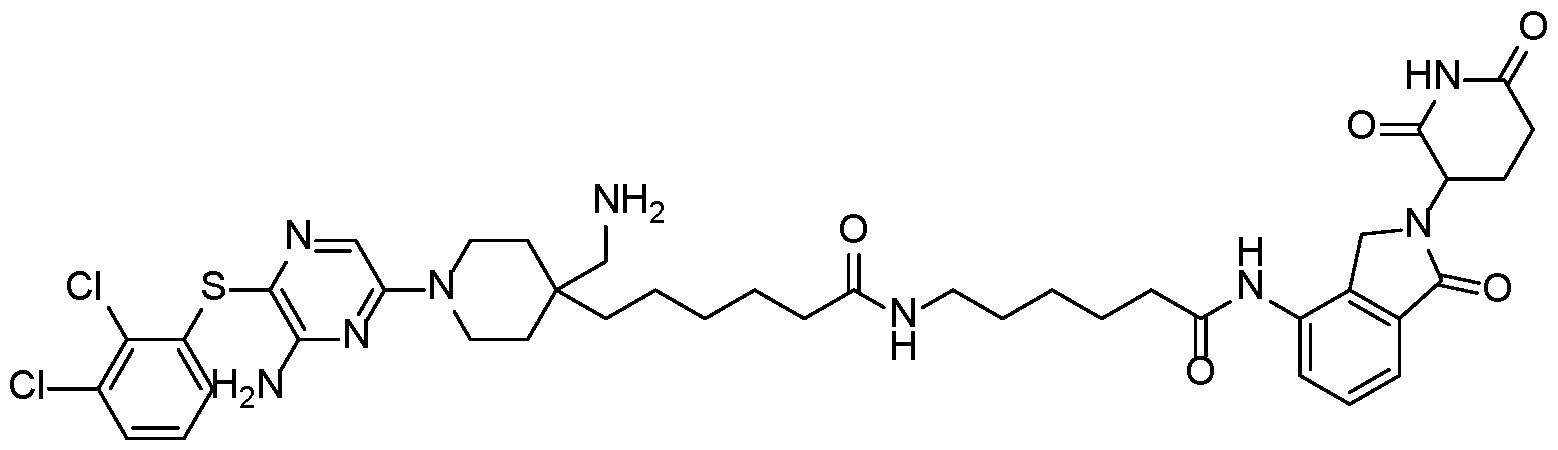
Compound 12 was prepared with L14 using the general method, yield 46%, white solid. 'H NMR (500 MHz, DMSO) 5 ‘HNMR (500 MHz, DMSO) 5 9.83 (s, 1H), 8.43 (d, J= 8.4 Hz, 1H), 7.83 (t, J= 7.9 Hz, 1H), 7.64-7.57 (m, 2H), 7.44-7.34 (m, 1H), 7.18 (t, J= 8.1 Hz, 1H), 6.56 (dd, J = 8.1, 1.5 Hz, 1H), 5.15 (dd, J= 12.8, 5.4 Hz, 1H), 4.43-4.27 (m, 2H), 3.65-3.56 (m, 2H), 3.54- 3.46 (m, 2H), 2.98-2.83 (m, 4H), 2.83-2.66 (m, 2H), 2.64-2.51 (m, 2H), 2.50-2.43 (m, 2H), 2.17-2.09 (m, 2H), 1.65-1.46 (m, 6H), 1.44-1.29 (m, 6H), 1.28-1.16 (m, 6H). LC/MS m/z calculated [M+H]+. 852.32, found 852.35.
[0164] Synthesis of VHL-based SHP2 PROTACs

Scheme 4. Synthesis of VHL-based SHP2 PROTACs
General method: To a stirred solution of carboxylic acid 10 (29.9 mg, 0.05 mmol) and DIPEA (28 pL, 0.15 mmol) in DMF (2 mL) at ambient temperature was added the corresponding primary amine (0.075 mmol) and HATU (28 mg, 0.075 mmol). The reaction mixture was stirred for 1 hour. After quenched with water (5 mL) and extracted with EtOAc (5 mL x 3), the organic layers were washed with brine (15 mL), dried over anhydrous Na2SO4, and concentrated under reduced
pressure. To this residue was added DCM (2 mL), and trifluoracetic acid (0.5 mL) at 0 °C. The reaction was stirred for 6 hours at ambient temperature, and the volatiles were removed under reduced pressure. The residue was purified by HPLC (40-90% gradient of MeOH in 5%TFA/H2O) to yield the corresponding product.
[0165] Example 3
[0166] (2S,4R)-l-((S)-2-(6-(6-(l-(6-amino-5-((2,3-dichlorophenyl)thio)pyrazin-2-yl)-4- (aminomethyl)piperidin-4-yl)hexanamido)hexanamido)-3,3-dimethylbutanoyl)-4-hydroxy-N- ((S)-l-(4-(4-methylthiazol-5-yl)phenyl)ethyl)pyrrolidine-2-carboxamide (SC5)

Compound SC5 was prepared with LI using the above general method. Yield: 48%, yellow solid. ‘H NMR (500 MHz, DMSO) 5 9.06 (s, 1H), 8.43(d, J =8.0 Hz, 1H), 7.82 (d, J = 8.7 Hz, 1H), 5 7.60 (s, 1H), 7.53-7.34 (m, 5H), 7.17 (t, J= 8.1 Hz, 1H), 6.55 (dd, J= 8.0, 1.4 Hz, 1H), 4.95-4.89 (m, 1H), 4.51 (d, J= 8.8Hz, 1H), 4.44-4.40 (m, 1H), 4.29-4.27 (m, 1H), 3.66-3.55 (m, 3H), 3.53- 3.45 (m, 2H), 2.91 (d, J = 6.5 Hz, 2H), 2.76-2.70 (m, 2H), 2.46 (s, 3H), 2.28-2.09 (m, 4H), 2.06-1.98 (m, 1H), 1.81-1.74 (m, 1H), 1.59-1.42 (m, 7H), 1.41-1.16 (m, 15H), 0.93 (s, 9H). LC/MS m/z calculated [M+H]+ 1037.44, found 1037.39.
[0167] Example 4
(2S,4R)-l-((S)-2-(8-(6-(l-(6-amino-5-((2,3-dichlorophenyl)thio)pyrazin-2-yl)-4-
(aminomethyl)piperidin-4-yl)hexanamido)octanamido)-3,3-dimethylbutanoyl)-4-hydroxy-N-
((S)-l-(4-(4-methylthiazol-5-yl)phenyl)ethyl)pyrrolidine-2-carboxamide (SC7)
 Compound SC7 was prepared with L2 using the general method. Yield: 45%, yellow solid. 'H NMR (500 MHz, DMSO) 5 9.07 (s, 1H), 8.43(d, J =8.0 Hz, 1H), 7.82 (d, J= 8.7 Hz, 1H), 5 7.60 (s, 1H), 7.47-7.34 (m, 5H), 7.17 (t, J= 8.1 Hz, 1H), 6.55 (dd, J= 8.0, 1.4 Hz, 1H), 4.95-4.89 (m, 1H), 4.51 (d, J= 8.8Hz, 1H), 4.44-4.40 (m, 1H), 4.29-4.25 (m, 1H), 3.62-3.55 (m, 3H), 3.53- 3.45 (m, 2H), 2.91 (d, J = 6.5 Hz, 2H), 2.77-2.71 (m, 2H), 2.46 (s, 3H), 2.28-2.08 (m, 4H), 2.05-1.98 (m, 1H), 1.81-1.74 (m, 1H), 1.54-1.43 (m, 7H), 1.41-1.16 (m, 19H), 0.93 (s, 9H). LC/MS m/z calculated [M+H]+ 1065.47, found 1065.45.
[0168] Example 5
(2S,4R)-l-((S)-2-(10-(6-(l-(6-amino-5-((2,3-dichlorophenyl)thio)pyrazin-2-yl)-4-
(aminomethyl)piperidin-4-yl)hexanamido)decanamido)-3,3-dimethylbutanoyl)-4-hydroxy-N- ((S)-l-(4-(4-methylthiazol-5-yl)phenyl)ethyl)pyrrolidine-2-carboxamide (SC9)

Compound SC9 was prepared with L3 using the general method. Yield: 50%, yellow solid. 'H NMR (500 MHz, DMSO) 5 9.06 (s, 1H), 8.42 (d, J =8.0 Hz, 1H), 7.79 (d, J= 8.8 Hz, 1H), 5 7.60 (s, 1H), 7.48-7.34 (m, 5H), 7.16 (t, J= 8.1 Hz, 1H), 6.55 (dd, J= 8.0, 1.4 Hz, 1H), 4.95-4.87 (m, 1H), 4.51 (d, J= 8.8 Hz, 1H), 4.42-4.39 (m, 1H), 4.29-4.25 (m, 1H), 3.63-3.55 (m, 3H), 3.53- 3.45 (m, 2H), 3.15-3.08 (m, 1H), 2.91 (d, J = 6.5 Hz, 2H), 2.76-2.69 (m, 2H), 2.46 (s, 3H), 2.28-2.06 (m, 4H), 2.04-1.98 (m, 1H), 1.81-1.74 (m, 1H), 1.54-1.43 (m, 7H), 1.41-1.16 (m, 23H), 0.93 (s, 9H). LC/MS m/z calculated [M+H]+ 1093.50, found 1093.48.
[0169] Example 6
(2S,4R)-l-((S)-2-(12-(6-(l-(6-amino-5-((2,3-dichlorophenyl)thio)pyrazin-2-yl)-4- (aminomethyl)piperidin-4-yl)hexanamido)dodecanamido)-3,3-dimethylbutanoyl)-4-hydroxy-N- ((S)-l-(4-(4-methylthiazol-5-yl)phenyl)ethyl)pyrrolidine-2-carboxamide (SC11)

Compound SC11 was prepared with L5 using the general method. Yield: 41%, yellow solid. 'H NMR (500 MHz, DMSO) 5 9.00 (s, 1H), 8.37 (d, J =8.0 Hz, 1H), 7.79 (d, J= 8.8 Hz, 1H), 5 7.59 (s, 1H), 7.46-7.33 (m, 5H), 7.15 (t, J= 8.1 Hz, 1H), 6.55 (dd, J= 8.0, 1.4 Hz, 1H), 4.95-4.88 (m, 1H), 4.51 (d, J= 8.8 Hz, 1H), 4.42-4.39 (m, 1H), 4.29-4.26 (m, 1H), 3.65-3.56 (m, 3H), 3.53- 3.45 (m, 2H), 3.16-3.09 (m, 1H), 2.90 (d, J = 6.4 Hz, 2H), 2.79-2.71 (m, 2H), 2.45 (s, 3H), 2.32-1.98 (m, 5H), 1.82-1.75 (m, 1H), 1.51-1.43 (m, 7H), 1.41-1.16 (m, 27H), 0.93 (s, 9H). LC/MS m/z calculated [M+H]+ 1121.54, found 1121.54.
[0170] Example 7
(2S,4R)-l-((S)-22-(l-(6-amino-5-((2,3-dichlorophenyl)thio)pyrazin-2-yl)-4-
(aminomethyl)piperidin-4-yl)-2-(tert-butyl)-4,17-dioxo-7,10,13-trioxa-3,16-diazadocosanoyl)-4- hydroxy-N-((S)-l-(4-(4-methylthiazol-5-yl)phenyl)ethyl)pyrrolidine-2-carboxamide (SP3)

Compound SP3 was prepared with L6 using the general method. Yield: 55%, yellow solid. 'H NMR (500 MHz, DMSO) 5 9.10 (s, 1H), 8.42 (d, J= 8.0 Hz, 1H), 7.88 (d, J= 8.0 Hz, 1H), 7.61 (s, 1H), 7.46-7.34 (m, 5H), 7.18 (t, J= 8.1 Hz, 1H), 6.57 (dd, J= 8.1, 1.5 Hz, 1H), 4.95-4.88 (m, 1H), 4.52 (d, J= 8.8 Hz, 1H), 4.44-4.40 (m, 1H), 4.29-4.26 (m, 1H), 3.65-3.46 (m, 17H), 2.97- 2.91 (m, 3H), 2.46 (s, 3H), 2.39-2.33 (m, 1H), 2.17 (t, J= 7.4 Hz, 2H), 2.05-2.00 (m, 1H), 1.81- 1.74 (m, 1H), 1.53-1.45 (m, 2H), 1.42-1.28 (m, 7H), 1.27-1.16 (m, 6H), 0.94 (s, 9H). LC/MS m/z calculated [M+H]+ 1127.47, found 1127.49.
[0171] Example 8
(2S,4R)-l-((S)-25-(l-(6-amino-5-((2,3-dichlorophenyl)thio)pyrazin-2-yl)-4- (aminomethyl)piperidin-4-yl)-2-(tert-butyl)-4,20-di oxo-7, 10,13,16-tetraoxa-3 , 19-
diazapentacosanoyl)-4-hydroxy-N-((S)-l-(4-(4-methylthiazol-5-yl)phenyl)ethyl)pyrrolidine-2- carboxamide (SP4)

Compound SP4 was prepared with L7 using the general method. Yield: 51%, yellow solid. 'H NMR (500 MHz, DMSO) 59.05 (s, 1H), 8.46 (d, J= 8.0 Hz, 1H), 7.61 (s, 1H), 7.45-7.34 (m, 5H), 7.18 (t, J= 8.1 Hz, 1H), 6.56 (dd, J = 8.1, 1.5 Hz, 1H), 4.94-4.87 (m, 1H), 4.53 (d, J= 8.8 Hz, 1H), 4.46-4.41 (m, 1H), 4.31-4.27 (m, 1H), 3.65-3.46 (m, 20H), 2.98-2.91 (m, 2H), 2.46 (s, 3H), 2.39-2.33 (m, 1H), 2.17 (t, J= 7.4 Hz, 2H), 2.08-2.03 (m, 1H), 1.82-1.74 (m, 1H), 1.53-1.45 (m, 2H), 1.43-1.27 (m, 7H), 1.27-1.15 (m, 6H), 0.94 (s, 9H). LC/MS m/z calculated [M+H]+.1171.50, found 1171.52.
[0172] Example 9
(2S,4R)-l-((S)-28-(l-(6-amino-5-((2,3-dichlorophenyl)thio)pyrazin-2-yl)-4- (aminomethyl)piperidin-4-yl)-2-(tert-butyl)-4,23-dioxo-7,10,13,16,19-pentaoxa-3,22- diazaoctacosanoyl)-4-hydroxy-N-((S)-l-(4-(4-methylthiazol-5-yl)phenyl)ethyl)pyrrolidine-2- carboxamide (SP5)

Compound SP5 was prepared with L8 using the general method. Yield: 56%, yellow solid. 'H NMR (500 MHz, DMSO) 59.03 (s, 1H), 8.45 (d, J= 8.0 Hz, 1H), 7.61 (s, 1H), 7.44-7.34 (m, 5H), 7.18 (t, J= 8.1 Hz, 1H), 6.56 (dd, J = 8.1, 1.5 Hz, 1H), 4.95-4.87 (m, 1H), 4.53 (d, J= 8.8 Hz, 1H), 4.46-4.41 (m, 1H), 4.31-4.27 (m, 1H), 3.65-3.46 (m, 23H), 2.98-2.91 (m, 3H), 2.46 (s, 3H), 2.39-2.33 (m, 1H), 2.17 (t, J= 7.4 Hz, 2H), 2.09-2.03 (m, 1H), 1.83-1.75 (m, 1H), 1.54-1.45 (m, 2H), 1.43-1.27 (m, 7H), 1.27-1.16 (m, 6H), 0.94 (s, 9H). LC/MS m/z calculated [M+H]+ 1215.53, found 1215.57.
[0173] Example 10
(2S,4R)-l-((S)-2-(l l-(6-(l-(6-amino-5-((2,3-dichlorophenyl)thio)pyrazin-2-yl)-4-
(aminomethyl)piperidin-4-yl)hexanamido)undecanamido)-3,3-dimethylbutanoyl)-4-hydroxy-N-
((S)-l-(4-(4-methylthiazol-5-yl)phenyl)ethyl)pyrrolidine-2-carboxamide (SCIO)

Compund SCIO was prepared with L4 using the general method. Yield: 40%, yellow solid. 'H NMR (500 MHz, DMSO) 5 9.02 (s, 1H), 8.39 (d, J =8.0 Hz, 1H), 7.79 (d, J= 8.8 Hz, 1H), 5 7.60 (s, 1H), 7.48-7.34 (m, 5H), 7.16 (t, J= 8.1 Hz, 1H), 6.55 (dd, J= 8.0, 1.4 Hz, 1H), 4.95-4.87 (m, 1H), 4.51 (d, J= 8.8 Hz, 1H), 4.42-4.38 (m, 1H), 4.27-4.24 (m, 1H), 3.63-3.55 (m, 3H), 3.53- 3.45 (m, 2H), 3.16-3.09 (m, 1H), 2.90 (d, J = 6.4 Hz, 2H), 2.77-2.71 (m, 2H), 2.46 (s, 3H), 2.28-2.08 (m, 4H), 2.02-1.96 (m, 1H), 1.82-1.76 (m, 1H), 1.54-1.43 (m, 7H), 1.41-1.15 (m, 25H), 0.93 (s, 9H). LC/MS m/z calculated [M+H]+. 1107.52, found 1107.50.
[0174] Example 11
(2S,4R)-l-((S)-2-(8-(4-(6-(l-(6-amino-5-((2,3-dichlorophenyl)thio)pyrazin-2-yl)-4- (aminomethyl)piperidin-4-yl)hexanoyl)piperazin-l-yl)octanamido)-3,3-dimethylbutanoyl)-4- hydroxy-N-((S)-l-(4-(4-methylthiazol-5-yl)phenyl)ethyl)pyrrolidine-2-carboxamide (P7)

Compound P7 was prepared with L9 using the general method. Yield: 47%, yellow solid. 'H NMR (500 MHz, DMSO) 5 8.96 (s, 1H), 8.34 (d, J= 7.8 Hz, 1H), 7.82-7.73 (m, 3H), 7.62 (s, 1H), 7.47- 7.34 (m, 4H), 7.20 (t, J = 7.9 Hz, 1H), 6.55 (dd, J= 8.1, 1.5 Hz, 1H), 4.93-4.86 (m, 1H), 4.51 (d, J = 9.4 Hz, 1H), 4.43-4.36 (m, 1H), 4.29-4.24 (m, 1H), 3.67-3.29 (m, 9H), 3.09- 3.01 (m, 2H), 2.99- 2.81 (m, 5H), 2.44 (s, 3H), 2.36-2.29 (m, 2H), 2.28-2.20 (m, 1H), 2.14-2.06 (m, 1H), 2.04-
1.96 (m, 1H), 1.81-1.75 (m, 1H), 1.65-1.55 (m, 2H), 1.55-1.32 (m, 12H), 1.30-1.17 (m, 10H), 0.92 (s, 9H). LC/MS m/z calculated [M+H]+. 1134.53, found 1134.54.
[0175] Example 12
(2S,4R)-l-((S)-2-(9-(4-(6-(l-(6-amino-5-((2,3-dichlorophenyl)thio)pyrazin-2-yl)-4-
(aminomethyl)piperidin-4-yl)hexanoyl)piperazin-l-yl)nonanamido)-3,3-dimethylbutanoyl)-4- hydroxy-N-((S)-l-(4-(4-methylthiazol-5-yl)phenyl)ethyl)pyrrolidine-2-carboxamide (P8)

Compound P8 was prepared with L10 using the general method,. Yield: 49%, yellow solid. 'H NMR (500 MHz, DMSO) 5 8.96 (s, 1H), 8.35 (d, J= 7.8 Hz, 1H), 7.82-7.73 (m, 3H), 7.62 (s, 1H), 7.46-7.34 (m, 4H), 7.19 (t, J= 8.0 Hz, 1H), 6.55 (dd, J= 8.1, 1.5 Hz, 1H), 4.93-4.86 (m, 1H), 4.51 (d, J= 9.4 Hz, 1H), 4.43-4.36 (m, 1H), 4.29-4.24 (m, 1H), 3.67-3.29 (m, 9H), 3.09- 3.01 (m, 2H), 2.99- 2.81 (m, 5H), 2.44 (s, 3H), 2.36-2.30 (m, 2H), 2.29-2.20 (m, 1H), 2.14-2.06 (m, 1H), 2.04-1.96 (m, 1H), 1.81-1.75 (m, 1H), 1.65-1.55 (m, 2H), 1.55-1.32 (m, 12H), 1.30-1.17 (m, 12H), 0.92 (s, 9H). LC/MS m/z calculated [M+H]+. 1148.55, found 1148.51.
[0176] Example 13
(2S,4R)-l-((S)-2-(10-(4-(6-(l-(6-amino-5-((2,3-dichlorophenyl)thio)pyrazin-2-yl)-4-
(aminomethyl)piperidin-4-yl)hexanoyl)piperazin-l-yl)decanamido)-3,3-dimethylbutanoyl)-4- hydroxy-N-((S)-l-(4-(4-methylthiazol-5-yl)phenyl)ethyl)pyrrolidine-2-carboxamide (P9)

Compound P9 was prepared with Lil using the general method. Yield: 50%, yellow solid. 'H NMR (500 MHz, DMSO) 5 8.97 (s, 1H), 8.35 (d, J= 7.8 Hz, 1H), 7.82-7.73 (m, 3H), 7.62 (s, 1H), 7.45-7.34 (m, 4H), 7.19 (t, J= 8.0 Hz, 1H), 6.55 (dd, J= 8.1, 1.4 Hz, 1H), 4.93-4.86 (m, 1H), 4.50 (d, J= 9.4 Hz, 1H), 4.43-4.37 (m, 1H), 4.28-4.24 (m, 1H), 3.67-3.30 (m, 9H), 3.09- 3.02
(m, 2H), 2.99- 2.81 (m, 5H), 2.44 (s, 3H), 2.36-2.30 (m, 2H), 2.29-2.19 (m, 1H), 2.13-2.05 (m, 1H), 2.03-1.96 (m, 1H), 1.81-1.74 (m, 1H), 1.65-1.56 (m, 2H), 1.54-1.33 (m, 12H), 1.30-1.16 (m, 14H), 0.92 (s, 9H). 13C NMR (126 MHz, DMSO) 5 172.49, 171.42, 171.08, 170.07, 156.33, 154.35, 151.98, 148.19, 145.13, 140.21, 132.62, 131.60, 130.16, 128.72, 127.79, 127.02, 124.92, 120.88, 117.67, 115.35, 112.70, 69.22, 59.02, 56.79, 56.71, 56.05, 51.44, 51.07, 48.17, 44.26, 42.27, 38.42, 38.23, 36.25, 35.37, 34.05, 33.73, 32.38, 31.85, 29.83, 29.13, 28.91, 26.91, 26.38, 25.87, 24.99, 23.57, 22.87, 22.42, 16.43. LC/MS m/z calculated [M+H]+ 1162.56, found 1162.70. HRMS m/z [M+H]+ Calcd for C59H86CI2N11O5S2 1162.5627; found 1162.5635.
[0177] Example 14
(2S,4R)-l-((S)-2-(l l-(4-(6-(l-(6-amino-5-((2,3-dichlorophenyl)thio)pyrazin-2-yl)-4- (aminomethyl)piperidin-4-yl)hexanoyl)piperazin-l-yl)undecanamido)-3,3-dimethylbutanoyl)-4- hydroxy-N-((S)-l-(4-(4-methylthiazol-5-yl)phenyl)ethyl)pyrrolidine-2-carboxamide (P10)

Compound PIO was prepared with L12 using the general method. Yield: 44%, yellow solid. 'H NMR (500 MHz, DMSO) 5 8.98 (s, 1H), 8.35 (d, J= 7.8 Hz, 1H), 7.81-7.72 (m, 3H), 7.62 (s, 1H), 7.44-7.29 (m, 4H), 7.19 (t, J= 8.0 Hz, 1H), 6.55 (dd, J= 8.1, 1.5 Hz, 1H), 4.93-4.86 (m, 1H), 4.50 (d, J= 9.4 Hz, 1H), 4.43-4.37 (m, 1H), 4.28-4.24 (m, 1H), 3.68-3.28 (m, 9H), 3.08-3.01 (m, 2H), 2.98-2.80 (m, 5H), 2.43 (s, 3H), 2.33 (t, J= 7.4 Hz, 2H), 2.28-2.19 (m, 1H), 2.12-2.04 (m, 1H), 2.02-1.96 (m, 1H), 1.81-1.74 (m, 1H), 1.65-1.56 (m, 2H), 1.55-1.32 (m, 12H), 1.31-1.17 (m, 16H), 0.91 (s, 9H). LC/MS m/z calculated [M+H]+. 1176.58, found 1176.54.
[0178] As used herein, the following terms and phrases shall have the meanings set forth below. Unless defined otherwise, all technical and scientific terms used herein have the same meaning as commonly understood to one of ordinary skill in the art.
[0179] The term "about" can allow for a degree of variability in a value or range, for example, within 10%, within 5%, or within 1% of a stated value or of a stated limit of a range.
[0180] The term "substantially" can allow for a degree of variability in a value or range, for example, within 90%, within 95%, or within 99% of a stated value or of a stated limit of a range.
[0181] The terms "a," "an," or "the" are used to include one or more than one unless the context clearly dictates otherwise. The term "or" is used to refer to a nonexclusive "or" unless otherwise indicated. In addition, the phraseology or terminology employed herein, and not otherwise defined, is for the purpose of description only and not of limitation. Any use of section headings is intended to aid the reading of the document and is not to be interpreted as limiting. Further, information that is relevant to a section heading may occur within or outside of that particular section. The terms "including" and "having" are defined as comprising (i.e., open language).
[0182] All patents, patent application publications, journal articles, textbooks, and other publications mentioned in the specification are indicative of the level of skill of those in the art to which the disclosure pertains. All such publications are incorporated herein by reference to the same extent as if each individual publication were specifically and individually indicated to be incorporated by reference.
Claims
WE CLAIM
1. A compound of formula (I), or a pharmaceutically acceptable salt, hydrate, tautomer, or stereoisomer thereof:
 wherein
R is alkyl, cycloalkyl, aryl, or heteroaryl, wherein R is substituted with one or more groups selected from halo, nitro, cyano, CF3, OH, and alkoxy;
A is C, N, O, or S;
Ri is NR5R6, wherein each Rs and Re is independently selected from hydrogen, alkyl, and cycloalkyl, wherein alkyl and cycloalkyl are optionally substituted;
R2 is -(C1-C4 alkyl)-Rs, -(C1-C4 alkyl)-NRsR6, -(C1-C4 alkyl)-SRs, or -(C1-C4 alkyl)-ORs, wherein Rs and Re are as defined above;
R3 is Ci-Cs alkyl or Ci-Cs heteroalkyl, wherein alkyl and heteroalkyl are optionally substituted;
L is a linker selected from:
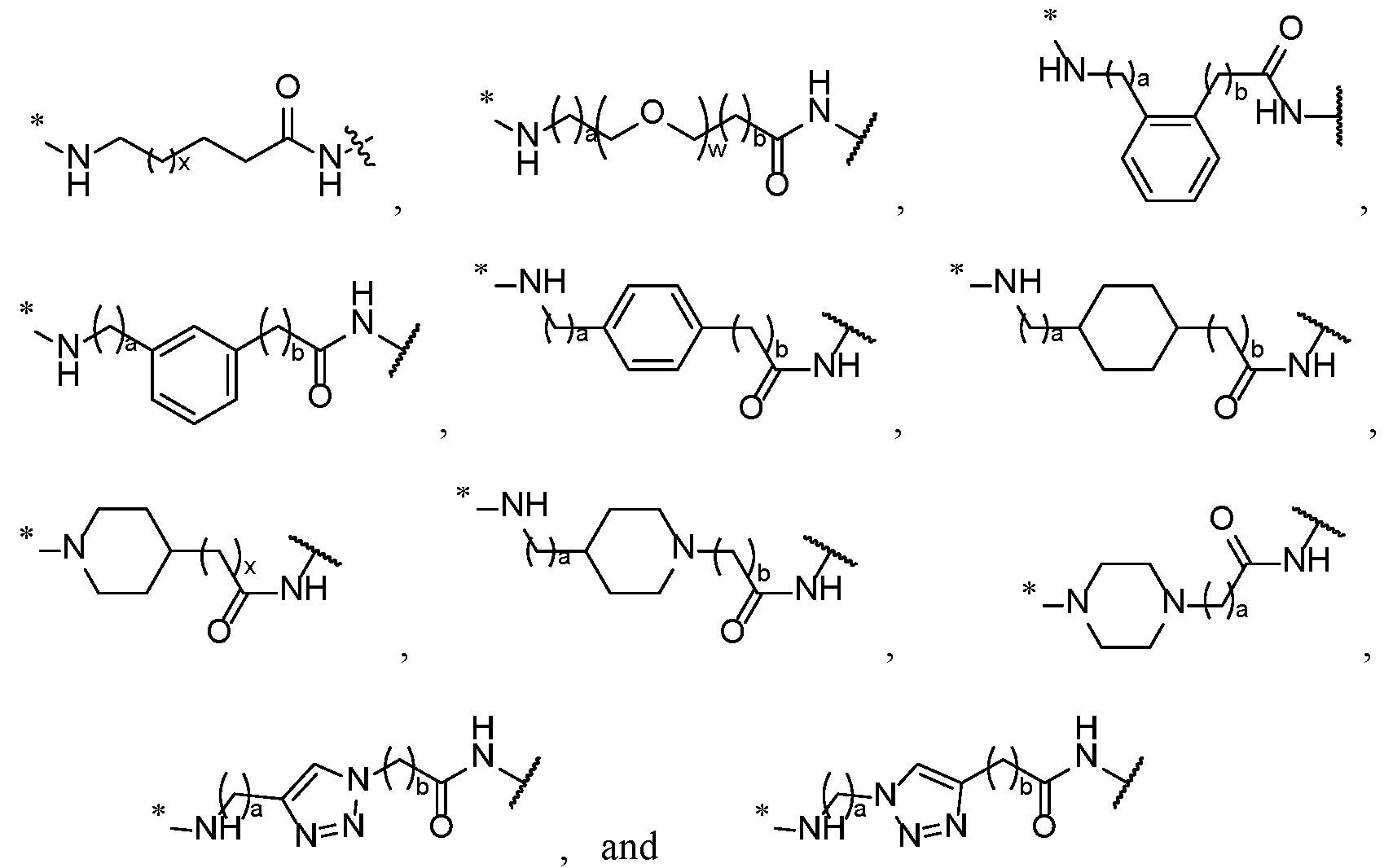 wherein x is 1-15, w is 1-5, and each a and b is independently 0-12; the bond designated with
 " and represent the points of attachment; and
E is an E3 ligase ligand selected from Ei and E2, wherein
Ei is represented by a structure:
 wherein X is CO or CH2;
Ri is fluoro, hydrogen, or deuterium; and the bond designated with represents the point of attachment of linker L; and
E2 is represented by a structure:
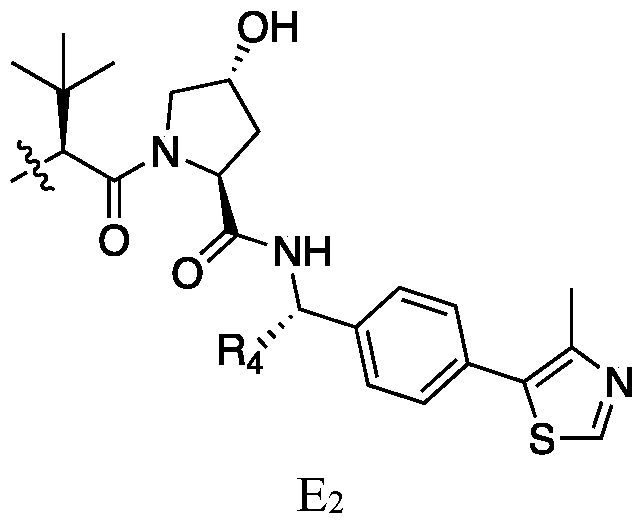 wherein R4 is methyl, hydrogen, or deuterium; and the bond designated with "
 " is attached to the linker.
 wherein A is C, N, O, or S.
3. The compound of claim 1, wherein the compound of formula (I) is a compound of formula
(IA):
 wherein R3, L, and E are as defined above; or a pharmaceutically acceptable salt, hydrate, tautomer, or stereoisomer thereof.
4. The compound of claim 1 or 3, wherein the E is E2:
 wherein R4 is methyl, hydrogen, or deuterium; and the bond designated with "
 " is attached to the linker.
5. The compound of claim 1 or 3, wherein R3 is Ci-Cs alkyl.
6. The compound of claim 1 or 3, wherein E is Ei:
 wherein X is CEE;
Ri is hydrogen or deuterium; and the bond designated with represents the point of attachment of linker L.
7. The compound of claim 1, wherein the compound of formula (I) is:


8. A pharmaceutical composition comprising a compound of any one of claims 1-7 or a pharmaceutically acceptable salt, hydrate, tautomer, or stereoisomer thereof, and a pharmaceutically acceptable carrier, excipient, or diluent.
9. A method of treating or preventing cancer, wherein the method comprises administering to a patient in need thereof an effective amount of a compound of any one of claims 1-7 or a pharmaceutical composition of claim 8, whereupon the cancer in the patient is treated or prevented.
10. The method of claim 9, wherein the cancer is colon cancer, lung adenocarcinoma, squamous cell carcinoma, neuroblastoma, or melanoma.
11. The method of claim 9 or 10, wherein the compound is administered orally.
12. A method of degrading Src homology 2 domain-containing phosphatase 2 ( SHP2) in a patient, wherein the method comprises administering to the patient an effective amount of a compound of any one of claims 1-7 or a pharmaceutical composition of claim 8, whereupon SHP2 in the patient is degraded.
13. The method of claim 12, wherein the patient has cancer.
14. The method of claim 13, wherein the cancer is colon cancer, lung adenocarcinoma, squamous cell carcinoma, neuroblastoma, or melanoma.
15. A method of treating or preventing a disease or condition responsive to SHP2 degradation, wherein the method comprises administering to a patient in need thereof an effective amount of a compound of any one of claims 1-7 or a pharmaceutical composition of claim 8, whereupon the disease or condition responsive to SHP2 degradation in the patient is treated or prevented.
16. The method of claim 15, wherein the patient has cancer.
17. The method of claim 15, wherein the cancer is colon cancer, lung adenocarcinoma, squamous cell carcinoma, neuroblastoma, or melanoma.
Applications Claiming Priority (2)
| Application Number | Priority Date | Filing Date | Title |
|---|---|---|---|
| US202363542009P | 2023-10-02 | 2023-10-02 | |
| US63/542,009 | 2023-10-02 |
Publications (1)
| Publication Number | Publication Date |
|---|---|
| WO2025075693A1 true WO2025075693A1 (en) | 2025-04-10 |
Family
ID=95283872
Family Applications (1)
| Application Number | Title | Priority Date | Filing Date |
|---|---|---|---|
| PCT/US2024/037795 Pending WO2025075693A1 (en) | 2023-10-02 | 2024-07-12 | Shp2 degraders for cancer therapy |
Country Status (1)
| Country | Link |
|---|---|
| WO (1) | WO2025075693A1 (en) |
Cited By (12)
| Publication number | Priority date | Publication date | Assignee | Title |
|---|---|---|---|---|
| WO2025240847A1 (en) | 2024-05-17 | 2025-11-20 | Revolution Medicines, Inc. | Ras inhibitors |
| WO2025255438A1 (en) | 2024-06-07 | 2025-12-11 | Revolution Medicines, Inc. | Methods of treating a ras protein-related disease or disorder |
| WO2025265060A1 (en) | 2024-06-21 | 2025-12-26 | Revolution Medicines, Inc. | Therapeutic compositions and methods for managing treatment-related effects |
| WO2026006747A1 (en) | 2024-06-28 | 2026-01-02 | Revolution Medicines, Inc. | Ras inhibitors |
| WO2026015801A1 (en) | 2024-07-12 | 2026-01-15 | Revolution Medicines, Inc. | Methods of treating a ras related disease or disorder |
| WO2026015790A1 (en) | 2024-07-12 | 2026-01-15 | Revolution Medicines, Inc. | Methods of treating a ras related disease or disorder |
| WO2026015796A1 (en) | 2024-07-12 | 2026-01-15 | Revolution Medicines, Inc. | Methods of treating a ras related disease or disorder |
| WO2026015825A1 (en) | 2024-07-12 | 2026-01-15 | Revolution Medicines, Inc. | Use of ras inhibitor for treating pancreatic cancer |
| WO2026050446A1 (en) | 2024-08-29 | 2026-03-05 | Revolution Medicines, Inc. | Ras inhibitors |
| WO2026072904A2 (en) | 2024-09-26 | 2026-04-02 | Revolution Medicines, Inc. | Compositions and methods for treating lung cancer |
| WO2026090127A1 (en) | 2024-10-22 | 2026-04-30 | Revolution Medicines, Inc. | Methods of treating a ras protein-related disease or disorder |
| WO2026090245A1 (en) | 2024-10-22 | 2026-04-30 | Revolution Medicines, Inc. | Use of ras inhibitors for treating cancer |
Citations (5)
| Publication number | Priority date | Publication date | Assignee | Title |
|---|---|---|---|---|
| WO2015107494A1 (en) * | 2014-01-17 | 2015-07-23 | Novartis Ag | 1 -(triazin-3-yi_/pyridazin-3-yl)-piper(-azine)idine derivatives and compositions thereof for inhibiting the activity of shp2 |
| WO2018057884A1 (en) * | 2016-09-22 | 2018-03-29 | Relay Therapeutics, Inc. | Shp2 phosphatase inhibitors and methods of use thereof |
| WO2021236775A1 (en) * | 2020-05-19 | 2021-11-25 | The Regents Of The University Ofmichigan | Small molecule degraders of shp2 protein |
| US11426422B2 (en) * | 2018-01-30 | 2022-08-30 | Research Development Foundation | SHP2 inhibitors and methods of use thereof |
| US20230183209A1 (en) * | 2017-01-31 | 2023-06-15 | Arvinas Operations, Inc. | Cereblon ligands and bifunctional compounds comprising the same |
-
2024
- 2024-07-12 WO PCT/US2024/037795 patent/WO2025075693A1/en active Pending
Patent Citations (5)
| Publication number | Priority date | Publication date | Assignee | Title |
|---|---|---|---|---|
| WO2015107494A1 (en) * | 2014-01-17 | 2015-07-23 | Novartis Ag | 1 -(triazin-3-yi_/pyridazin-3-yl)-piper(-azine)idine derivatives and compositions thereof for inhibiting the activity of shp2 |
| WO2018057884A1 (en) * | 2016-09-22 | 2018-03-29 | Relay Therapeutics, Inc. | Shp2 phosphatase inhibitors and methods of use thereof |
| US20230183209A1 (en) * | 2017-01-31 | 2023-06-15 | Arvinas Operations, Inc. | Cereblon ligands and bifunctional compounds comprising the same |
| US11426422B2 (en) * | 2018-01-30 | 2022-08-30 | Research Development Foundation | SHP2 inhibitors and methods of use thereof |
| WO2021236775A1 (en) * | 2020-05-19 | 2021-11-25 | The Regents Of The University Ofmichigan | Small molecule degraders of shp2 protein |
Non-Patent Citations (1)
| Title |
|---|
| DANDAN YU, MENGZHU ZHENG, YANG LIU, LIXIA CHEN: "Proteolysis-Targeting Chimera Molecules Targeting SHP2 in Future Medicinal Chemistry", FUTURE MEDICINAL CHEMISTRY, FUTURE SCIENCE, vol. 14, no. 8, 17 March 2022 (2022-03-17), pages 587 - 600, XP009562359, ISSN: 1756-8919, DOI: 10.4155/fmc-2021-0324 * |
Cited By (12)
| Publication number | Priority date | Publication date | Assignee | Title |
|---|---|---|---|---|
| WO2025240847A1 (en) | 2024-05-17 | 2025-11-20 | Revolution Medicines, Inc. | Ras inhibitors |
| WO2025255438A1 (en) | 2024-06-07 | 2025-12-11 | Revolution Medicines, Inc. | Methods of treating a ras protein-related disease or disorder |
| WO2025265060A1 (en) | 2024-06-21 | 2025-12-26 | Revolution Medicines, Inc. | Therapeutic compositions and methods for managing treatment-related effects |
| WO2026006747A1 (en) | 2024-06-28 | 2026-01-02 | Revolution Medicines, Inc. | Ras inhibitors |
| WO2026015801A1 (en) | 2024-07-12 | 2026-01-15 | Revolution Medicines, Inc. | Methods of treating a ras related disease or disorder |
| WO2026015790A1 (en) | 2024-07-12 | 2026-01-15 | Revolution Medicines, Inc. | Methods of treating a ras related disease or disorder |
| WO2026015796A1 (en) | 2024-07-12 | 2026-01-15 | Revolution Medicines, Inc. | Methods of treating a ras related disease or disorder |
| WO2026015825A1 (en) | 2024-07-12 | 2026-01-15 | Revolution Medicines, Inc. | Use of ras inhibitor for treating pancreatic cancer |
| WO2026050446A1 (en) | 2024-08-29 | 2026-03-05 | Revolution Medicines, Inc. | Ras inhibitors |
| WO2026072904A2 (en) | 2024-09-26 | 2026-04-02 | Revolution Medicines, Inc. | Compositions and methods for treating lung cancer |
| WO2026090127A1 (en) | 2024-10-22 | 2026-04-30 | Revolution Medicines, Inc. | Methods of treating a ras protein-related disease or disorder |
| WO2026090245A1 (en) | 2024-10-22 | 2026-04-30 | Revolution Medicines, Inc. | Use of ras inhibitors for treating cancer |
Similar Documents
| Publication | Publication Date | Title |
|---|---|---|
| US12384792B2 (en) | Solid forms of isoquinolinones, and process of making, composition comprising, and methods of using the same | |
| US9872853B2 (en) | 2,3-dihydro-1H-indole compounds | |
| CA3120383A1 (en) | Compounds and methods of use thereof for treatment of cancer | |
| KR20210118812A (en) | Inhibitors of cyclin-dependent kinase 7 (CDK7) | |
| CA3172987A1 (en) | Small molecule inhibitors of oncogenic chd1l with preclinical activity against colorectal cancer | |
| CA2982360A1 (en) | Fused-tricyclic inhibitors of kras and methods of use thereof | |
| EA019566B1 (en) | Small molecule inhibitors of mdm2 | |
| CA2966559A1 (en) | Thieno[2,3-c]pyrrol-4-one derivatives as erk inhibitors | |
| CN109790166A (en) | Imidazopyridine compounds for the treatment of cancer | |
| EA037103B1 (en) | Pyridine derivatives having selective inhibitory activity on ret kinase | |
| WO2021074251A1 (en) | Pyrrolo[2,3-d]pyrimidine derivatives and their use in the treatment of cancer | |
| US10501466B2 (en) | WDR5 inhibitors and modulators | |
| AU2022203204A1 (en) | Use of heterocyclic pdk1 inhibitors | |
| Gomez-Monterrey et al. | Heat shock protein 90 inhibitors as therapeutic agents | |
| EP4293029B1 (en) | Azaheteroaryl compound, preparation method therefor, and application thereof | |
| CA3231240A1 (en) | Ink4 tumor suppressor proteins mediate resistance to cdk4/6 kinase inhibitors | |
| JP7629452B2 (en) | Pharmaceutical Compounds | |
| CA3233398A1 (en) | Small molecule inhibitors of oncogenic chd1l with preclinical activity against colorectal cancer | |
| WO2025075947A1 (en) | Selective tc-ptp degraders for cancer immunotherapy | |
| US20240140908A1 (en) | A pharmaceutical salt of an arylpyrrole derivative | |
| HK40129489A (en) | Solid forms of isoquinolinone derivatives, process of making, compositions comprising, and methods of using the same | |
| WO2025213129A1 (en) | Novel small molecule inhibitors of interleukin-4 and uses thereof | |
| Perkins | A novel approach to the design of selective inhibitors for cell cycle cyclin dependent kinases | |
| WO2021005222A1 (en) | Inhibitors of indoleamine 2,3-dioxygenase and/or tryptophan 2,3-dioxygenase | |
| HK1262631B (en) | 1-tetrahydropyranylcarbonyl-2,3-dihydro-1h-indole compounds for treating cancer |
Legal Events
| Date | Code | Title | Description |
|---|---|---|---|
| 121 | Ep: the epo has been informed by wipo that ep was designated in this application |
Ref document number: 24875110 Country of ref document: EP Kind code of ref document: A1 |