WO2025041582A1 - 第1コネクタ、第2コネクタおよびコネクタアセンブリ - Google Patents
第1コネクタ、第2コネクタおよびコネクタアセンブリ Download PDFInfo
- Publication number
- WO2025041582A1 WO2025041582A1 PCT/JP2024/027928 JP2024027928W WO2025041582A1 WO 2025041582 A1 WO2025041582 A1 WO 2025041582A1 JP 2024027928 W JP2024027928 W JP 2024027928W WO 2025041582 A1 WO2025041582 A1 WO 2025041582A1
- Authority
- WO
- WIPO (PCT)
- Prior art keywords
- terminal
- bolt
- connector
- housing
- fall
- Prior art date
- Legal status (The legal status is an assumption and is not a legal conclusion. Google has not performed a legal analysis and makes no representation as to the accuracy of the status listed.)
- Pending
Links
Images




Classifications
-
- H—ELECTRICITY
- H01—ELECTRIC ELEMENTS
- H01R—ELECTRICALLY-CONDUCTIVE CONNECTIONS; STRUCTURAL ASSOCIATIONS OF A PLURALITY OF MUTUALLY-INSULATED ELECTRICAL CONNECTING ELEMENTS; COUPLING DEVICES; CURRENT COLLECTORS
- H01R13/00—Details of coupling devices of the kinds covered by groups H01R12/70 or H01R24/00 - H01R33/00
- H01R13/62—Means for facilitating engagement or disengagement of coupling parts or for holding them in engagement
- H01R13/621—Bolt, set screw or screw clamp
-
- H—ELECTRICITY
- H01—ELECTRIC ELEMENTS
- H01R—ELECTRICALLY-CONDUCTIVE CONNECTIONS; STRUCTURAL ASSOCIATIONS OF A PLURALITY OF MUTUALLY-INSULATED ELECTRICAL CONNECTING ELEMENTS; COUPLING DEVICES; CURRENT COLLECTORS
- H01R4/00—Electrically-conductive connections between two or more conductive members in direct contact, i.e. touching one another; Means for effecting or maintaining such contact; Electrically-conductive connections having two or more spaced connecting locations for conductors and using contact members penetrating insulation
- H01R4/28—Clamped connections, spring connections
- H01R4/30—Clamped connections, spring connections utilising a screw or nut clamping member
- H01R4/34—Conductive members located under head of screw
Definitions
- the present disclosure relates to a first connector, a second connector, and a connector assembly.
- a vehicle is equipped with a connector assembly that includes a first connector attached to the end of an electric wire and a second connector that is mounted on a case of an electrical device and electrically connected to the first connector (see, for example, Patent Document 1).
- the first connector has a first terminal connected to the end of the electric wire and a first housing that holds the first terminal.
- the second connector has a second terminal and a second housing that holds the second terminal.
- the first housing When connecting the first connector and the second connector, first, the first housing is fitted into the second housing, and the first bolt hole in the first terminal is aligned with the second bolt hole in the second terminal. Next, a bolt is inserted into the second housing through a working opening in the second housing, and the bolt passes through the first bolt hole and the second bolt hole. Next, the bolt is screwed into a nut, electrically connecting the first terminal and the second terminal to each other by bolt tightening.
- An object of the present disclosure is to provide a first connector, a second connector, and a connector assembly that can improve assembly workability.
- the first connector of the present disclosure has a first terminal, a first housing that holds the first terminal, a first bolt hole that penetrates the first terminal in a first direction, and a fall prevention bolt assembled to the first terminal, and the fall prevention bolt penetrates the first bolt hole before the first connector is connected to the mating second connector.
- the first connector, second connector, and connector assembly disclosed herein have the effect of improving assembly workability.
- FIG. 1 is a perspective view showing a connector assembly according to one embodiment.
- FIG. 2 is a plan view showing a connector assembly of one embodiment.
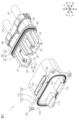
- FIG. 3 is an exploded perspective view of a connector assembly according to one embodiment.
- FIG. 4 is an exploded perspective view of a connector assembly according to one embodiment.
- FIG. 5 is an exploded perspective view illustrating the first connector of one embodiment.
- FIG. 6 is an exploded perspective view illustrating the second connector of one embodiment.
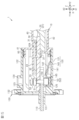
- FIG. 7 is a cross-sectional view (cross-sectional view taken along line 7-7 in FIG. 2) showing the connector assembly according to one embodiment.
- FIG. 8 is an exploded cross-sectional view of one embodiment of a connector assembly.
- FIG. 9 is a cross-sectional view (cross-sectional view taken along line 9-9 in FIG.
- a first connector of the present disclosure has a first terminal, a first housing that holds the first terminal, a first bolt hole that penetrates the first terminal in a first direction, and an anti-disconnection bolt assembled to the first terminal, wherein the anti-disconnection bolt penetrates the first bolt hole before the first connector is connected to a mating connector, a second connector.
- the nut is accommodated in the accommodation portion provided in the housing body, and the opening of the accommodation portion that opens in the second opposite direction is blocked by the restricting portion provided in the guide member. Therefore, the movement of the nut inside the accommodation portion can be appropriately restricted by the inner peripheral surface of the accommodation portion and the restricting portion.
- the housing body has a fitting tubular portion that houses the second terminal therein, and a positioning protrusion that is provided inside the fitting tubular portion and extends along the second direction, the guide member is formed so as to be insertable into the fitting tubular portion along the second direction, the guide member has a positioning groove that extends along the second direction, and the positioning groove may be capable of inserting the positioning protrusion therein.
- the positioning protrusion of the housing body is inserted into the positioning groove of the guide member, so that when attaching the guide member to the housing body, the guide member can be easily positioned relative to the housing body. This improves the ease of attaching the guide member to the housing body.
- the connector assembly of the present disclosure comprises a first connector as described in any one of [1] to [3] above, and a second connector as described in any one of [4] to [9] above, and the first terminal is bolted to the second terminal by the anti-disconnection bolt and the nut.
- Each drawing illustrates a second direction Y1, which is a direction in the Y-axis direction along the Y-axis, and a second opposite direction Y2, which is the opposite direction of the second direction Y1.
- Each drawing illustrates a third direction Z1, which is a direction in the Z-axis direction along the Z-axis, and a third opposite direction Z2, which is the opposite direction of the third direction Z1. Note that the present invention is not limited to these examples, but is intended to include all modifications within the meaning and scope of the claims, as indicated by the claims.
- the first connector 10 has one or more (two in this embodiment) first terminals 30 connected to the ends of one or more (two in this embodiment) electric wires 20, respectively, and a first housing 40 that holds the first terminals 30.
- the first connector 10 has an anti-fall-out bolt 50 assembled to the first terminal 30.
- the first connector 10 has a seal member 60 that fits around the outer periphery of the first housing 40, one or more (two in this embodiment) seal members 70 that fit inside the first housing 40, and a retainer 80 that prevents the seal members 70 from falling out.
- the second connector 100 has one or more (two in this embodiment) second terminals 110, a second housing 120 that holds the second terminals 110, and a nut 150.
- the first connector 10 and the second connector 100 are assembled together along the second direction Y1.
- the first connector 10 is mated with the second connector 100 along the second direction Y1, for example.
- the first housing 40 of the first connector 10 is mated with the inside of the second housing 120 of the second connector 100 along the second direction Y1.
- the directions in each drawing do not necessarily represent the postures of the first connector 10 and the second connector 100 when in use.
- the directions in the second connector 100 are described based on the state in which the first connector 10 is assembled to the second connector 100.
- the electric wire connection part 31 is connected to the end of the core wire 21 exposed from the insulating coating 22.
- the electric wire connection part 31 is formed, for example, in a flat plate shape.
- the electric wire connection part 31 is connected to the core wire 21, for example, by crimping or ultrasonic welding. This electrically and mechanically connects the electric wire connection part 31 and the core wire 21.
- the first bolt hole 33 has, for example, a first hole portion 34 provided at the end of the first bolt hole 33 in the first direction X1, and a second hole portion 35 provided at the end of the first bolt hole 33 in the first opposite direction X2.
- the first hole portion 34 and the second hole portion 35 are formed to communicate with each other.
- the opening width of the first hole portion 34 is formed to be larger than the opening width of the second hole portion 35.
- the minimum inner circumferential dimension of the first hole portion 34 is formed to be larger than the minimum inner circumferential dimension of the second hole portion 35.
- a female thread portion is formed on the inner circumferential surface of the second hole portion 35.
- the end of the second hole portion 35 in the first opposite direction X2 has, for example, a guide portion 36.
- the guide portion 36 is formed so that the opening width, i.e., the inner circumferential dimension, of the second hole portion 35 increases as it approaches the opening end of the second hole portion 35 in the first opposite direction X2.
- the guide portion 36 is formed, for example, by the inner circumferential surface of the second hole portion 35 inclining radially outward as it approaches the opening end of the second hole portion 35 in the first opposite direction X2.
- the guide portion 36 is formed, for example, over the entire circumferential circumference of the second hole portion 35.
- the guide portion 36 has the function of smoothly guiding the fall-prevention bolt 50 into the first bolt hole 33 when the fall-prevention bolt 50 is inserted into the first bolt hole 33 in the first direction X1.
- the terminal connection portion 32 has, for example, an engagement recess 37.
- the engagement recess 37 is formed so as to be recessed from the end face of the terminal connection portion 32 in the first opposite direction X2 toward the first direction X1. In this embodiment, the engagement recess 37 penetrates the terminal connection portion 32 in the first direction X1.
- the engagement recess 37 is provided in the end region of the terminal connection portion 32 in the second opposite direction Y2.
- the fall-prevention bolt 50 is assembled to the first terminal 30 by being inserted through the first bolt hole 33.
- the fall-prevention bolt 50 is inserted through the first bolt hole 33 before the first connector 10 is connected to the second connector 100.
- the first connector 10 is fitted to the second connector 100 with the fall-prevention bolt 50 inserted through the first bolt hole 33.
- the fall-prevention bolt 50 is inserted into the first bolt hole 33 by, for example, screwing the male threaded portion 53 into a female threaded portion provided on the inner circumferential surface of the second hole portion 35 .
- the capsulation prevention bolt 50 has a head 51, a shank 52 extending from the head 51 in the first direction X1, and a male threaded portion 53 provided in a tip region of the shank 52.
- the male threaded portion 53 is provided only in the tip region of the shank 52.
- the shank 52 has an unthreaded portion 54 between the head 51 and the male threaded portion 53.
- the capsulation prevention bolt 50 is made of metal.
- the outer circumferential dimension of the head 51 is larger than the inner circumferential dimension of the first bolt hole 33.
- the maximum outer circumferential dimension of the head 51 is larger than the minimum inner circumferential dimension of the second hole portion 35.
- the maximum outer circumferential dimension of the head 51 is larger than, for example, the minimum inner circumferential dimension of the first hole portion 34.
- the end face of the head 51 in the first direction X1 is formed so as to be able to engage with the end face of the terminal connection portion 32 in the first opposite direction X2. This makes it possible to prevent the anti-fall-out bolt 50 from falling out of the first bolt hole 33 along the first direction X1 after the anti-fall-out bolt 50 is assembled into the first bolt hole 33.
- the shaft portion 52 protrudes in the first direction X1 from the end face of the head portion 51 in the first direction X1.
- the shaft portion 52 extends, for example, straight along the first direction X1.
- the maximum outer circumferential dimension of the unthreaded portion 54 of the shaft portion 52 is smaller than the minimum inner circumferential dimension of the first bolt hole 33.
- the maximum outer circumferential dimension of the unthreaded portion 54 is smaller than, for example, the minimum inner circumferential dimension of the second hole portion 35.
- the male threaded portion 53 is formed to correspond to the female threaded portion formed on the inner peripheral surface of the second hole portion 35.
- the male threaded portion 53 is formed to correspond to the female threaded portion formed on the inner peripheral surface of the nut 150 provided on the second connector 100.
- the maximum outer peripheral dimension of the male threaded portion 53 is larger than the maximum outer peripheral dimension of the unthreaded portion 54.
- the maximum outer peripheral dimension of the male threaded portion 53 is smaller than the maximum outer peripheral dimension of the head portion 51.
- the maximum outer peripheral dimension of the male threaded portion 53 is set to be smaller than the minimum inner peripheral dimension of the first hole portion 34 and larger than the minimum inner peripheral dimension of the second hole portion 35.
- the male threaded portion 53 is formed so as to be able to engage with the end surface of the peripheral wall constituting the second hole portion 35 in the first direction X1. This makes it possible to prevent the fall-off prevention bolt 50 from falling off the first bolt hole 33 along the first opposite direction X2 after the fall-off prevention bolt 50 is assembled in the first bolt hole 33.
- the first housing 40 has, for example, a main body 41, an electric wire holding portion 42 protruding from the main body 41 in the second opposite direction Y2, and a terminal holding portion 43 protruding from the main body 41 in the second direction Y1.
- the first housing 40 is, for example, a single component in which the main body 41, the electric wire holding portion 42, and the terminal holding portion 43 are continuously and integrally formed.
- the first housing 40 is made of, for example, a synthetic resin.
- the main body 41 is formed in a cylindrical shape.
- the main body 41 is formed, for example, in a flat shape that is longer in the Z-axis direction than in the X-axis direction.
- a seal member 60 is attached to the outer circumferential surface of the main body 41.
- the seal member 60 is formed continuously around the entire circumferential direction of the main body 41.
- the seal member 60 seals between the outer circumferential surface of the first housing 40 and the inner circumferential surface of the second housing 120.
- the seal member 60 is made of, for example, rubber.
- Each electric wire 20 passes through the seal member 70 and the retainer 80 in the second opposite direction Y2 and is drawn out to the outside of the first housing 40.
- the two second terminals 110 are arranged side by side along the third direction Z1, for example.
- the two second terminals 110 are integrally formed with the second housing 120 by, for example, insert molding.
- the material of each second terminal 110 may be, for example, a copper-based or aluminum-based metal material.
- the fitting tube portion 122 is formed in a cylindrical shape.
- the fitting tube portion 122 is formed in a flat shape that is longer in the Z-axis direction than in the X-axis direction.
- the fitting tube portion 122 is formed in a size that allows a part of the main body portion 41 and the terminal holding portion 43 of the first housing 40 to be inserted therein.
- the fitting tube portion 122 accommodates the end portion of the second terminal 110 in the second opposite direction Y2 therein.
- the housing main body 121 has, for example, a plurality of terminal accommodating portions 131 (two in this embodiment) aligned in the third direction Z1.
- Each terminal accommodating portion 131 is formed, for example, in a cylindrical shape. As shown in FIG. 7, each terminal accommodating portion 131 is formed so as to surround the outer periphery of the second terminal 110. For example, each terminal accommodating portion 131 surrounds the outer periphery of the second terminal 110 over the entire circumferential direction.
- Each second terminal 110 penetrates the terminal accommodating portion 131 in the second direction Y1 and is drawn out to the outside of the second housing 120.
- the inclined surface 142 is inclined from the first direction X1 toward the first opposite direction X2 as it moves from the end of the main body 141 in the second opposite direction Y2 toward the end of the main body 141 in the second direction Y1.
- the inclined surface 142 is formed, for example, over the entire width of the main body 141 (here, the Z-axis direction). Note that the end surface of the main body 141 in the second direction Y1 extends along the first direction X1.
- the main body 141 has, for example, a positioning groove 144.
- the positioning groove 144 is formed so as to be recessed from the end face 143 toward the first direction X1.
- the positioning groove 144 extends along the second direction Y1.
- the positioning groove 144 extends, for example, from the end face of the main body 141 in the second direction Y1 along the second opposite direction Y2.
- the positioning groove 144 is provided, for example, at the center of the main body 141 in the width direction of the main body 141 (here, the Z-axis direction). As shown in FIG. 10, the positioning groove 144 is formed so that the positioning protrusion 129 can be inserted therein.
- the positioning protrusion 129 By inserting the positioning protrusion 129 into the positioning groove 144, it is possible to easily position the guide member 140 in the Z-axis direction when attaching the guide member 140 to the housing main body 121. In addition, by inserting the positioning protrusion 129 into the positioning groove 144, it is possible to suppress rattling of the guide member 140.
- each of the regulating portions 145 protrudes from the end face of the main body 141 in the second direction Y1 toward the second direction Y1.
- Two regulating portions 145 are provided corresponding to two accommodating portions 125, respectively.
- Each regulating portion 145 is provided so as to be inserted into the accommodating portion 125 when the guide member 140 is attached to the housing main body 121.
- Each regulating portion 145 is provided so as to block the opening 126 of the accommodating portion 125.
- Each regulating portion 145 blocks the opening 126, thereby restricting the movement of the nut 150 accommodated in the accommodating portion 125 in the second opposite direction Y2. As shown in FIG.
- each regulating portion 145 in the first opposite direction X2 is formed, for example, flush with the end face 143 of the main body 141 in the first opposite direction X2.
- Each regulating portion 145 is formed, for example, over the entire length of the main body 141 in the X-axis direction.
- a first connector 10 is prepared, which includes a first terminal 30 to which a fall-prevention bolt 50 is assembled, a first housing 40 that holds the first terminal 30, and a seal member 60 attached to the outer periphery of the first housing 40.
- the fall-prevention bolt 50 is inserted into the first bolt hole 33 and assembled to the first terminal 30 before being connected to the second connector 100. More specifically, the shaft 52 of the fall-prevention bolt 50 is screwed into the first bolt hole 33 along the first direction X1 from a position in the first opposite direction X2 from the first terminal 30.
- the male thread 53 of the fall-prevention bolt 50 is screwed into the female thread provided on the inner circumferential surface of the second hole portion 35 of the first bolt hole 33.
- the fall-prevention bolt 50 is moved along the first direction X1 until the head portion 51 engages with the end face of the first terminal 30 in the first opposite direction X2. This causes the shaft portion 52 of the fall-prevention bolt 50 to pass through the first bolt hole 33, and the fall-prevention bolt 50 is assembled to the first terminal 30.
- a second connector 100 is prepared, which includes a second terminal 110, a second housing 120 that holds the second terminal 110, and a nut 150 accommodated in the accommodation portion 125 of the second housing 120.
- the nut 150 is inserted in the second direction Y1 into the accommodation portion 125 of the housing main body 121 with which the second terminal 110 is integrally configured. That is, as shown in FIG. 6, the nut 150 is accommodated inside the accommodation portion 125 through the opening 126 of the accommodation portion 125.
- the guide member 140 is inserted in the second direction Y1 into the fitting tube portion 122 of the housing main body 121. As shown in FIG.
- the fitting of the first housing 40 to the second housing 120 is further advanced, and the first housing 40 is fitted to the second housing 120 to the correct position.
- the fall-prevention bolt 50 is guided to a position where it can be fastened to the nut 150.
- the fall-prevention bolt 50 slides in the second direction Y1 while contacting the end face of the regulating portion 145 in the first opposite direction X2.
- the fall-prevention bolt 50 is guided directly above (directly above) the nut 150, and the tip of the fall-prevention bolt 50 is inserted into the through hole 151 of the nut 150.
- the fall-prevention bolt 50 is disposed in a position where the central axis of the fall-prevention bolt 50 coincides with the central axis of the nut 150. In this way, when the first housing 40 and the second housing 120 are completely fitted together, the fall-prevention bolt 50 is guided to a position where the central axis of the fall-prevention bolt 50 coincides with the central axis of the nut 150.
- the head 51 of the fall-prevention bolt 50 is positioned so as to overlap the opening 123 of the second housing 120 in a plan view seen from the first direction X1.
- the first terminal 30 and the second terminal 110 are overlapped in the first direction X1, and the gap between the outer peripheral surface of the first housing 40 and the inner peripheral surface of the second housing 120 is sealed by the seal member 60.
- the anti-fall-out bolt 50 can be guided directly above the nut 150 simply by fitting the first housing 40 into the second housing 120.
- the fall-prevention bolt 50 is screwed into the nut 150.
- a tool for tightening the fall-prevention bolt 50 and the nut 150 is inserted into the second housing 120 through the opening 123 of the second connector 100, for example.
- the fall-prevention bolt 50 is screwed into the nut 150, the nut 150, whose rotation is restricted by the accommodating portion 125 and the restricting portion 145, is moved in the first opposite direction X2.
- the first terminal 30 and the second terminal 110 are bolted together by the fall-prevention bolt 50 and the nut 150, and the first terminal 30 and the second terminal 110 are electrically connected to each other.
- the second terminal 110 is a fork-type terminal
- the second terminal 110 and the first terminal 30 can be suitably connected to each other by the frictional force due to the high axial force of the fall-prevention bolt 50 and the nut 150 generated when the bolt is tightened.
- the connector assembly 1 of the present embodiment can be manufactured. (Effects of this embodiment) Next, the effects of this embodiment will be described.
- the first connector 10 has a first terminal 30, a first housing 40 that holds the first terminal 30, a first bolt hole 33 that passes through the first terminal 30 in the first direction X1, and a fall prevention bolt 50 that is assembled to the first terminal 30.
- the fall prevention bolt 50 passes through the first bolt hole 33 before the first connector 10 is connected to the second connector 100, which is the mating connector.
- the fall-prevention bolt 50 is inserted through the first bolt hole 33 and assembled to the first terminal 30. That is, the fall-prevention bolt 50 is assembled to the first terminal 30 in advance. Therefore, when connecting the second terminal 110 and the first terminal 30 of the second connector 100, the fall-prevention bolt 50 assembled to the first terminal 30 in advance can be used to bolt the first terminal 30 and the second terminal 110. Therefore, when bolting the first terminal 30 and the second terminal 110, the work of assembling the bolt prepared separately from the first terminal 30 and the second terminal 110 to the first terminal 30 and the second terminal 110 can be omitted. As a result, the assembly workability of the connector assembly 1 can be improved.
- the maximum outer circumferential dimension of the head 51 of the fall-off prevention bolt 50 is formed to be larger than the minimum inner circumferential dimension of the second hole portion 35 of the first bolt hole 33. Therefore, the head 51 can be prevented from slipping out of the second hole portion 35 along the first direction X1.
- the maximum outer circumferential dimension of the male thread portion 53 provided in the tip region of the shaft portion 52 of the fall-off prevention bolt 50 is formed to be larger than the minimum inner circumferential dimension of the second hole portion 35. Therefore, the male thread portion 53 can be prevented from slipping out of the second hole portion 35 along the first opposite direction X2.
- the fall-off prevention bolt 50 that is inserted through the first bolt hole 33 and assembled to the first terminal 30 can be suitably prevented from falling out of the first bolt hole 33.
- the maximum outer circumferential dimension of the male thread portion 53 is formed to be smaller than the minimum inner circumferential dimension of the first hole portion 34. Therefore, the male thread portion 53 can be accommodated in the first hole portion 34 of the first bolt hole 33. Therefore, for example, when the fall-prevention bolt 50 is moved in the first opposite direction X2 by the inclined surface 142, the male thread portion 53 can escape into the first hole portion 34.
- the fall-prevention bolt 50 is assembled to the first terminal 30 in advance.
- the second terminal 110 is formed in a fork shape, and the second housing 120 that holds the second terminal 110 is provided with an inclined surface 142.
- the fall-prevention bolt 50 can be guided directly above the nut 150 by moving the first housing 40 in the second direction Y1 so as to fit the first housing 40 to the second housing 120, by the inclined surface 142.
- the fall-prevention bolt 50 can be guided to a position where it can be fastened to the nut 150 simply by the action of fitting the first housing 40 to the second housing 120. This makes it easier to automate the bolt fastening operation between the first terminal 30 and the second terminal 110.
- the guide member 140 having the inclined surface 142 is formed as a separate part from the housing body 121. This allows the guide member 140 to be manufactured separately from the housing body 121. This allows for greater freedom in designing the guide member 140 and the housing body 121 compared to when the guide member 140 and the housing body 121 are integrally formed.
- the relatively long unthreaded portion 54 of the anti-dropout bolt 50 allows the unthreaded portion 54 of the anti-dropout bolt 50 to move freely in the axial direction with a limited amount of axial movement relative to the first bolt hole 33 when the unthreaded portion 54 of the anti-dropout bolt 50 is accommodated in the first bolt hole 33 of the terminal connection portion 32.
- the inclined surface 142 of the guide member 140 comes into direct contact with the tip of the fall-prevention bolt 50, and the fall-prevention bolt 50 is lifted relative to the terminal connection portion 32 of the first terminal 30.
Landscapes
- Details Of Connecting Devices For Male And Female Coupling (AREA)
- Connections By Means Of Piercing Elements, Nuts, Or Screws (AREA)
Priority Applications (1)
| Application Number | Priority Date | Filing Date | Title |
|---|---|---|---|
| CN202480052625.4A CN121713340A (zh) | 2023-08-23 | 2024-08-05 | 第1连接器、第2连接器以及连接器组件 |
Applications Claiming Priority (2)
| Application Number | Priority Date | Filing Date | Title |
|---|---|---|---|
| JP2023135660A JP2025030396A (ja) | 2023-08-23 | 2023-08-23 | 第1コネクタ、第2コネクタおよびコネクタアセンブリ |
| JP2023-135660 | 2023-08-23 |
Publications (1)
| Publication Number | Publication Date |
|---|---|
| WO2025041582A1 true WO2025041582A1 (ja) | 2025-02-27 |
Family
ID=94732070
Family Applications (1)
| Application Number | Title | Priority Date | Filing Date |
|---|---|---|---|
| PCT/JP2024/027928 Pending WO2025041582A1 (ja) | 2023-08-23 | 2024-08-05 | 第1コネクタ、第2コネクタおよびコネクタアセンブリ |
Country Status (3)
| Country | Link |
|---|---|
| JP (1) | JP2025030396A (https=) |
| CN (1) | CN121713340A (https=) |
| WO (1) | WO2025041582A1 (https=) |
Citations (4)
| Publication number | Priority date | Publication date | Assignee | Title |
|---|---|---|---|---|
| JPH05326052A (ja) * | 1992-05-18 | 1993-12-10 | Fujitsu Ltd | 接続端子及びそれを接続する端子ブロック |
| JP2004056924A (ja) * | 2002-07-19 | 2004-02-19 | Honda Motor Co Ltd | 車両用電気接続構造及び端子接続部構造 |
| JP2011113943A (ja) * | 2009-11-30 | 2011-06-09 | Hitachi Cable Ltd | 車両用接続構造 |
| JP2016115675A (ja) * | 2014-12-12 | 2016-06-23 | ヤザキ・ヨーロッパ・リミテッド | 電気コネクタアセンブリおよび接続構成 |
-
2023
- 2023-08-23 JP JP2023135660A patent/JP2025030396A/ja active Pending
-
2024
- 2024-08-05 CN CN202480052625.4A patent/CN121713340A/zh active Pending
- 2024-08-05 WO PCT/JP2024/027928 patent/WO2025041582A1/ja active Pending
Patent Citations (4)
| Publication number | Priority date | Publication date | Assignee | Title |
|---|---|---|---|---|
| JPH05326052A (ja) * | 1992-05-18 | 1993-12-10 | Fujitsu Ltd | 接続端子及びそれを接続する端子ブロック |
| JP2004056924A (ja) * | 2002-07-19 | 2004-02-19 | Honda Motor Co Ltd | 車両用電気接続構造及び端子接続部構造 |
| JP2011113943A (ja) * | 2009-11-30 | 2011-06-09 | Hitachi Cable Ltd | 車両用接続構造 |
| JP2016115675A (ja) * | 2014-12-12 | 2016-06-23 | ヤザキ・ヨーロッパ・リミテッド | 電気コネクタアセンブリおよび接続構成 |
Also Published As
| Publication number | Publication date |
|---|---|
| CN121713340A (zh) | 2026-03-20 |
| JP2025030396A (ja) | 2025-03-07 |
Similar Documents
| Publication | Publication Date | Title |
|---|---|---|
| JP5370872B2 (ja) | 電線保持装置 | |
| JP5733573B2 (ja) | 機器用コネクタ | |
| US9806436B2 (en) | Terminal base having an elctrical connector to connect a coil-side terminal of an elctric motor to an inverter-side terminal of an inverter | |
| US20180076534A1 (en) | Connector | |
| JP7055783B2 (ja) | 嵌合コネクタ | |
| WO2011007607A1 (ja) | 防水構造 | |
| US20200161925A1 (en) | Electric motor | |
| WO2025041582A1 (ja) | 第1コネクタ、第2コネクタおよびコネクタアセンブリ | |
| JP6722412B2 (ja) | 端末覆い体及びコネクタ | |
| JP6159218B2 (ja) | シールドシェル | |
| WO2022181751A1 (ja) | コネクタ | |
| WO2022092078A1 (ja) | コネクタ | |
| JP2025033448A (ja) | 中継コネクタ | |
| WO2024162033A1 (ja) | コネクタおよびワイヤハーネス | |
| WO2025154591A1 (ja) | コネクタおよびコネクタアセンブリ | |
| US20210249815A1 (en) | Lever type connector | |
| JP2025122940A (ja) | コネクタアセンブリ | |
| WO2025154593A1 (ja) | コネクタおよびコネクタアセンブリ | |
| JP5839296B2 (ja) | 電線保持装置 | |
| JP2016149278A (ja) | ワイヤーハーネス | |
| JPH08106932A (ja) | 点火プラグ用プラグキャップ | |
| JP7563122B2 (ja) | コネクタ | |
| JP7832237B2 (ja) | コネクタ | |
| JP7832238B2 (ja) | コネクタ | |
| JP2003282189A (ja) | シールド電線の取付構造 |
Legal Events
| Date | Code | Title | Description |
|---|---|---|---|
| 121 | Ep: the epo has been informed by wipo that ep was designated in this application |
Ref document number: 24856273 Country of ref document: EP Kind code of ref document: A1 |