WO2025035152A2 - Thermoset materials and methods of making and using same - Google Patents
Thermoset materials and methods of making and using same Download PDFInfo
- Publication number
- WO2025035152A2 WO2025035152A2 PCT/US2024/041973 US2024041973W WO2025035152A2 WO 2025035152 A2 WO2025035152 A2 WO 2025035152A2 US 2024041973 W US2024041973 W US 2024041973W WO 2025035152 A2 WO2025035152 A2 WO 2025035152A2
- Authority
- WO
- WIPO (PCT)
- Prior art keywords
- polymerization
- groups
- group
- independently
- monomer
- Prior art date
- Legal status (The legal status is an assumption and is not a legal conclusion. Google has not performed a legal analysis and makes no representation as to the accuracy of the status listed.)
- Ceased
Links
Classifications
-
- C—CHEMISTRY; METALLURGY
- C08—ORGANIC MACROMOLECULAR COMPOUNDS; THEIR PREPARATION OR CHEMICAL WORKING-UP; COMPOSITIONS BASED THEREON
- C08G—MACROMOLECULAR COMPOUNDS OBTAINED OTHERWISE THAN BY REACTIONS ONLY INVOLVING UNSATURATED CARBON-TO-CARBON BONDS
- C08G61/00—Macromolecular compounds obtained by reactions forming a carbon-to-carbon link in the main chain of the macromolecule
- C08G61/02—Macromolecular compounds containing only carbon atoms in the main chain of the macromolecule, e.g. polyxylylenes
- C08G61/04—Macromolecular compounds containing only carbon atoms in the main chain of the macromolecule, e.g. polyxylylenes only aliphatic carbon atoms
- C08G61/06—Macromolecular compounds containing only carbon atoms in the main chain of the macromolecule, e.g. polyxylylenes only aliphatic carbon atoms prepared by ring-opening of carbocyclic compounds
- C08G61/08—Macromolecular compounds containing only carbon atoms in the main chain of the macromolecule, e.g. polyxylylenes only aliphatic carbon atoms prepared by ring-opening of carbocyclic compounds of carbocyclic compounds containing one or more carbon-to-carbon double bonds in the ring
-
- C—CHEMISTRY; METALLURGY
- C08—ORGANIC MACROMOLECULAR COMPOUNDS; THEIR PREPARATION OR CHEMICAL WORKING-UP; COMPOSITIONS BASED THEREON
- C08L—COMPOSITIONS OF MACROMOLECULAR COMPOUNDS
- C08L65/00—Compositions of macromolecular compounds obtained by reactions forming a carbon-to-carbon link in the main chain; Compositions of derivatives of such polymers
-
- C—CHEMISTRY; METALLURGY
- C09—DYES; PAINTS; POLISHES; NATURAL RESINS; ADHESIVES; COMPOSITIONS NOT OTHERWISE PROVIDED FOR; APPLICATIONS OF MATERIALS NOT OTHERWISE PROVIDED FOR
- C09D—COATING COMPOSITIONS, e.g. PAINTS, VARNISHES OR LACQUERS; FILLING PASTES; CHEMICAL PAINT OR INK REMOVERS; INKS; CORRECTING FLUIDS; WOODSTAINS; PASTES OR SOLIDS FOR COLOURING OR PRINTING; USE OF MATERIALS THEREFOR
- C09D165/00—Coating compositions based on macromolecular compounds obtained by reactions forming a carbon-to-carbon link in the main chain; Coating compositions based on derivatives of such polymers
-
- C—CHEMISTRY; METALLURGY
- C08—ORGANIC MACROMOLECULAR COMPOUNDS; THEIR PREPARATION OR CHEMICAL WORKING-UP; COMPOSITIONS BASED THEREON
- C08G—MACROMOLECULAR COMPOUNDS OBTAINED OTHERWISE THAN BY REACTIONS ONLY INVOLVING UNSATURATED CARBON-TO-CARBON BONDS
- C08G2261/00—Macromolecular compounds obtained by reactions forming a carbon-to-carbon link in the main chain of the macromolecule
- C08G2261/30—Monomer units or repeat units incorporating structural elements in the main chain
- C08G2261/33—Monomer units or repeat units incorporating structural elements in the main chain incorporating non-aromatic structural elements in the main chain
- C08G2261/332—Monomer units or repeat units incorporating structural elements in the main chain incorporating non-aromatic structural elements in the main chain containing only carbon atoms
-
- C—CHEMISTRY; METALLURGY
- C08—ORGANIC MACROMOLECULAR COMPOUNDS; THEIR PREPARATION OR CHEMICAL WORKING-UP; COMPOSITIONS BASED THEREON
- C08G—MACROMOLECULAR COMPOUNDS OBTAINED OTHERWISE THAN BY REACTIONS ONLY INVOLVING UNSATURATED CARBON-TO-CARBON BONDS
- C08G2261/00—Macromolecular compounds obtained by reactions forming a carbon-to-carbon link in the main chain of the macromolecule
- C08G2261/40—Polymerisation processes
- C08G2261/41—Organometallic coupling reactions
- C08G2261/418—Ring opening metathesis polymerisation [ROMP]
Definitions
- thermosets are an important class of materials, constituting 15-20% of all polymers produced.
- Crosslinks imbue thermosets with robust thermophysical properties making them suitable for high-demand applications like aerospace coatings and biomedical scaffolds. These properties can be tuned by controlling the crosslink density and polymeric architecture within thermosets.
- synthetic control is difficult to achieve and requires moderating the concentration of custom multifunctional monomers in a one-pot process or several polymerization, purification, and crosslinking steps.
- Crosslinks also render materials resistant to degradation and recycling.
- the 60 million tons of petroleum-based thermosets generated annually are discarded in landfills or combusted for energy because there are no efficient methods for reprocessing/recycling. On this basis, the development of thermosets with tuned physical properties from a single biosourced monomer, which can be degraded and recycled, remains a grand challenge.
- Orthogonal monomers multifunctional species containing reactive groups that polymerize via different mechanisms — could be a powerful strategy for manufacturing nextgeneration thermoset materials. Because the polymerizations are triggered by distinct stimuli, these monomers offer precise control over cross-linking. Though orthogonal monomers are well-suited for manufacturing complex multimaterials, the synthesis of the monomers themselves and their thermosets are laborious, often involving multi-step reactions. Many groups have designed bifunctional monomers that are active for multiple polymerization types; however, these monomers can be laborious to synthesize and generate materials that are not easily recycled.
- thermoset materials and the like.
- present disclosure also provides methods of making and using the thermoset materials.
- thermoset materials comprises a plurality of polymeric groups and a plurality of crosslinking groups (such as, for example, interchain crosslinking groups, intrachain crosslinking groups, or both) (e.g., crosslinking groups formed from a thermal or photochemical cationic polymerization, a thermal or radical polymerization, or the like).
- crosslinking groups such as, for example, interchain crosslinking groups, intrachain crosslinking groups, or both
- crosslinking groups formed from a thermal or photochemical cationic polymerization, a thermal or radical polymerization, or the like.
- the polymeric groups comprise the following structure:
- R is independently an aliphatic or an aromatic group, or a structural analog thereof.
- the crosslinking groups are independently covalently bonded to the backbone of a polymeric group or the backbones of two different polymeric groups and/or are at least partially formed from the same monomer(s) used to form the polymeric groups.
- thermoset materials comprises a first polymerization of one or more monomer(s), where the first polymerization forms an uncrosslinked thermoplastic material or the like.
- an un-crosslinked thermoplastic material or the like comprises a plurality of polymerizable groups (or a plurality of repeat units independently comprising a polymerizable group, which is suitable for polymerization in a second polymerization) (w hich may be in the backbone of the thermoset material).
- thermoset material comprising a first polymerization of one or more first monomer(s), where the first polymerization forms one or more or a plurality of polymeric group(s) (or un-crosslinked thermoplastic polymer material comprising a plurality of polymerizable groups (or a plurality of repeat units independently comprising a polymerizable group) (which may be in the backbone of the thermoset material), and a second polymerization of one or more first monomer(s).
- thermoset material where the second polymerization forms one or more or a plurality of crosslinking groups and the crosslinking groups are independently covalently bonded to the backbone of a polymeric group or two different polymeric groups (or un-crosslinked thermoplastic polymer material comprising a plurality of polymerizable groups (or a plurality of repeat units independently comprising a polymerizable group) (which may be in the backbone of the thermoset material)), where the thermoset material is formed.
- a composition comprises one or more thermoset material(s) of the present disclosure.
- a composition comprises two or more structurally and/or compositionally (e.g.. primary composition or the like) distinct thermoset materials.
- thermoset materials of the present disclosure provides uses of thermoset materials of the present disclosure.
- an article of manufacture comprises one or more thermoset material(s) of the present disclosure.
- the instant methods allowed for thermoset materials to be synthesized in a spatially and temporally controlled manner in one reaction vessel from a single commercially available, bio-renewable monomer (e.g., FIGS 34 and 35). In addition to being made from a simple, accessible monomer, these bio-derived products can be degraded to small molecules and recycled to monomer by various mechanisms.
- FIG. 1 shows one-pot degradable thermoset synthesis from DHF.
- ROMP of DHF is performed to incomplete conversion in the presence of photolatent catalysts. Light irradiation triggers cationic polymerization of the remaining DHF and crosslinking to a thermoset, which can be recycled to monomer following acid degradation and/or thermal depolymerization,
- Distinct material domains can be produced from a single feedstock through photopatteming.
- FIG. 2 shows modulation of mechanical properties
- DHF thermosets exhibit comparable properties to commercial thermosets (all values used to make the graph can be found in Table 4).
- FIG. 3 shows spatiotemporal control over DHF thermosets, (a) Patterning a DHF thermoset material with spatially resolved domains using a photomask, (b) Stiff and elastic domains are produced in a single material through photopatteming. (c) Voids can be patterned into films by thermal depolymerization of the non-crosslinked areas.
- FIG. 4 shows degradation and recycling of DHF thermosets.
- DHF can be sequentially degraded by heat, acid, and oxidation to target poly(r-DHF) chain ends, internal poly(r-DHF) segments, and poly(c-DHF), respectively.
- FIG. 5 shows 'H NMR spectra of the ROMP of DHF monitored over time (1.3 mmol DHF, 0.1 mol % G2, 0.5 mol % PAG, 0.5 mol % CQ, dark, N 2 ).
- FIG. 6 shows GPC chromatograms of poly(r-DHF) monitored over time (1.3 mmol DHF, 0.1 mol % G2, 0.5 mol % PAG, 0.5 mol % CQ, dark, N 2 ).
- FIG. 7 shows conversion and molecular weight of poly(r-DHF) monitored over time (1.3 mmol eq DHF, 0.1 mol % G2, 0.5 mol % PAG, 0.5 mol % CQ, dark, N 2 ).
- FIG. 8 shows conversion and molecular weight of poly(r-DHF) with varying amounts of G2 (1.3 mmol DHF, 0.5 mol % PAG, 0.5 mol % CQ, dark, N 2 , 10 min).
- FIG. 9 shows conversion (left bar of each pair) and molecular weight (right bar of each pair) of poly(/'-DHF) with varying amounts of PAG and CQ (1.3 mmol DHF, 0.1 mol % G2. 10 min, dark, N 2 ).
- FIG. 10 shows r H NMR spectra of the cationic polymerization of DHF monitored over time (2.6 mmol DHF. 0.5 mol % PAG, 0.5 mol % CQ. N 2 ).
- Poly(c-DHF) 'H NMR 500 MHz, CDCE) 5 4.5-3.52 (3H), 2.87-1.59 (3H).
- FIG. 11 shows GPC chromatograms of the cationic polymerization of DHF monitored over time (2.6 mmol DHF, 0.5 mol % PAG, 0.5 mol % CQ, N 2 ).
- FIG. 12 shows conversion and molecular weight of poly(c-DHF) with irradiation time (2.6 mmol DHF, 0. 1 mol % G2, 0.5 mol % PAG, 0.5 mol % CQ, 10 min dark, N 2 ).
- FIG. 13 show s conversion (left bar of each pair) and molecular weight (right bar of each pair) of poly(c-DHF) with varying amounts of PAG and CQ (6 min irradiation, N 2 ).
- the amount of DHF added to the polymerization was equal to the amount of DHF remaining after ROMP with the same amounts of PAG and CQ according to FIG. 9.
- FIG. 18 shows stress-strain curves of thermosets synthesized with (A) 1, (B) 2, (C) 6, and (D) 10 minutes of irradiation with blue light (1 1 mmol DHF, 0. 1 mol % G2, 0.5 mol % PAG, 0.5 mol % CQ, 10 mins pre-irradiation).
- FIG. 19 shows stress-strain curves of thermosets synthesized with (A) 0.125, (B) 0.25, (C) 1. and (D) 2 mol % PAG and CQ (11 mmol DHF, 0.1 mol % G2, 10 mins preirradiation, 6 mins irradiation).
- FIG. 20 show s stress-strain curves of thermosets synthesized with (A) 0.05, (B) 0.075, (C) 0.25, and (D) 0.5 mol % G2 (11 mmol DHF, 0.5 mol % PAG, 0.5 mol % CQ, 10 mins pre-irradiation, 6 mins irradiation).
- FIG. 21 shows stress-strain curves of thermosets synthesized with (A) 2 and (B) 6 minutes of pre-irradiation time (11 mmol DHF, 0.1 mol % G2, 0.5 mol % PAG, 0.5 mol % CQ, 6 mins irradiation).
- FIG. 22 shows stress-strain curves of poly(r-DHF) that was isolated, cast into a film with photocatalysts, and cross-linked without exogenous monomer.
- FIG. 23 shows cyclic tests of thermosets synthesized with 2 minutes (left) or 6 minutes (right) of irradiation.
- FIG. 24 shows an example of a collimated photopatteming setup.
- FIG. 25 shows an example of spatial control of thermoset synthesis via irradiation through a photomask.
- FIG. 26 shows stress-strain curves of thermosets synthesized with 1 minute of irradiation from a blue Kessil lamp followed by 4 minutes of irradiation through a striped photomask (1 1 mmol DHF, 0.1 mol % G2, 0.5 mol % PAG, 0.5 mol % CQ).
- FIG. 27 shows NMR spectra of the distillate collected from thermal depolymerization of DHF thermoset alone (top) and in the presence of mixed waste (bottom).
- the mixed waste stream was comprised of 700 mg DHF thermoset, and 500 mg each of the following materials: nitrile rubber (Microflex® Cobalt gloves), Epoxy resin (EasyCast® Clear Casting Epoxy), butyl rubber (HoneywellTM butyl glove box gloves), neoprene rubber (Mapa NL-34 StanZoil Chemical Resistant gloves), silicone (Let's Resin® Silicone Mold Making Kit), styrene-butadiene rubber (Vans® shoe soles), polyurethane rubber (Chaco® shoe soles).
- nitrile rubber Microflex® Cobalt gloves
- Epoxy resin Epoxy resin
- butyl rubber HoneywellTM butyl glove box gloves
- neoprene rubber Mapa NL-34 StanZoil Chemical Resistant gloves
- FIG. 28 shows stress-strain curves of thermosets (11 mmol DHF, 0. 1 mol % G2, 0.5 mol % PAG, 0.5 mol % CQ, 10 min ROMP, N2, 2 or 6 min hv) after thermal depolymerization.
- FIG. 29 shows 1 H NMR spectra of the acid-catalyzed hydrolysis supernatant.
- FIG. 30 shows FTIR spectra of poly(r-DHF), DHF thermoset, hydrolyzed thermoset, and poly(c-DHF).
- FIG. 31 shows stress-strain curves of thermosets (11 mmol DHF, 0. 1 mol % G2, 0.5 mol % PAG, 0.5 mol% CQ, 10 min ROMP, N2, 2 or 6 min hv) after thermal depolymerization and acid hydrolysis.
- FIG. 32 shows 1 H NMR spectrum of the oxidative degradation supernatant.
- FIG. 33 shows a DHF thermoset is thermally recycled (same synthetic conditions as Table 6, entry 4) in a combined waste stream without contamination from commercial additives.
- FIG. 34 shows synthesis of thermosets by one-pot ROMP and photo-cationic polymerization of DHF.
- FIG. 35 shows spatial control over thermoset synthesis to produce (A) the Cornell crest. (B) a hollow ring, (C) a patterned dog bone with both stiff and stretchy domains. [0048]
- FIG. 36 shows an example of films with dry reagents from box, but reactions open to air retain good properties. Both steps — ROMP and photo-crosslinking — can occur under air and produce the same matenals as under nitrogen.
- FIG. 37 shows an example of linear VEs decreasing toughness and Young’s Modulus.
- FIG. 38 shows an example of Di-VEs yielding comparable tensile properties.
- FIG. 39 shows G2: k p , N2 kp.air.
- Grubbs G2 leads to slower initial polymer propagation in air. After 10 mins ROMP, the polymer conversions and molecular weights are roughly equal under N2 and air.
- FIG. 40 shows that HG1 gives slower, more controlled polymer growth.
- Hoveyda- Grubbs 1 (HG1) is known to have closer matched initiation and propagation rates, leading to more even growth of polymer over time.
- poly(r-DHF) is the same MW as with G2 under air and N2.
- FIG. 41 shows HG2 has similar conversion to G2; more controlled polymer growth.
- Hovey da-Grubbs 2 (HG2) is also known to have closer matched initiation and propagation rates and is more active, leading to more even growth of polymer over time and higher conversions than HG1.
- poly(r-DHF) is the same MW other catalysts.
- FIG. 42 shows cyclic acetals copolymerize cationically with DHF and allow the cationic backbone to be acid degradable.
- Fully DHF-based thermosets are not fully degradable due to the recalcitrant linkages of cationically polymerized DHF [poly(c-DHF)].
- Adding a comonomer that will polymerize cationically and leads to a degradable polymeric backbone unit will allow for full acid hydrolysis of the thermosets.
- moderate molecular weight (MW) co-polymers are reduced to low MW oligomers under thermoset hydrolysis conditions.
- FIG. 43 shows cyclic acetals copolymerize cationically with DHF and allow the cationic backbone of thermosets to be acid degradable.
- PMP-DOX methoxyphenyl dioxane
- a thermoset was made with the PMP-DOX comonomer, tensile tested, and subjected to acid hydrolysis. Comparable tensile properties were obtained to the original thermoset, but it was fully acid hydrolysable where the original thermoset was not.
- FIG. 44 shows an example of a fully light-responsive (3D-printable) resin.
- a ROMP catalyst is light-based and (2) ROMP proceeds before cationic polymerization.
- a photoacid-activated ROMP catalyst in the presence of a weak base allows both polymerizations to be initiated by light and separated based on amount of light irradiation.
- FIG. 45 shows an example of a fully light-responsive (3D-printable) resin.
- a latent Grubbs catalyst (LatMet) becomes active upon addition of HC1.
- a photobuffer comprising a chloride salt, irradiation of the mixture produces HC1 first, which coordinates to LatMet and initiates ROMP.
- FIG. 46 shows 3.5 eq TBA-C1 as a photobuffer enabled separation of ROMP of COE and cationic polymerization of CHO.
- Monomers that do not cross-link with each other were used.
- cyclooctene (COE) was used and for cationic polymerization, cyclohexene oxide (CHO) was used.
- Tetrabutylammonium chloride (TBA-C1) was used as a Cl- source (photobuffer).
- TBA-C1 Tetrabutylammonium chloride
- the plots track the conversion of monomers under the same light irradiation time but with different amounts of TBA-C1.
- TBA-C1 Tetrabutylammonium chloride
- FIG. 47 shows that thermosets maintain their mechanical properties over time. Alkenes in the backbone of polymers are susceptible to cross-linking and degradation over time. Materials aged a week and a month appear to exhibit increases in stiffness (Young’s Modulus) and toughness, but do not suffer degradation of their mechanical properties.
- FIG. 48 shows that adding a cross-linking comonomer maintains toughness while modulating stress- and strain-at-break.
- DCPD dicyclopentadiene
- FIG. 49 shows that a G2 catalyst can be degraded out of the film.
- G2 catalyst is on the poly(r-DHF) chain ends. It leads to brown coloring of the films and is responsible for the thermal depolymerization of poly(r-DHF segments). G2 is hard to remove.
- Known methods of removing G2 from the poly(r-DHF) chain end involves oxidation, but this oxidation also degrades the poly(c-DHF) chains. Instead of oxidizing it, degrading the catalyst via primary amines (which should not degrade poly(r-DHF) or poly(c-DHF) removes the G2 without sacrificing material properties. To demonstrate this, a thermoset film was produced and separated into two pieces.
- FIG. 50 shows that G2 degradation/removal makes materials more resistant to thermal and mechanical forces.
- the thermoset with G2 degraded (with PCys and H2NB11) demonstrated greater thermal stability, reaching 5% and 10% mass loss at significantly higher temperatures.
- the thermoset that had been swollen in THF and the thermoset with G2 degraded demonstrate greater stress and strain at break. Swelling out plasticizing oligomers with THF has toughened the material, and G2 degradation has not degraded any of the thermoset chains that contribute to mechanical toughness.
- FIG. 51 shows that G2 catalyst can be degraded and removed from films without sacrificing their acid-degradability. Acid degradation can degrade these thermosets. Products of acid degradation (4-hydroxy-butanal and 2-hydroxy-tetrahydrofuran) can be dehydrated to re-form DHF monomer, enabling circular recycling. Compared to the original thermoset, the thermoset that had been swollen in THF and the thermoset with G2 degraded (with PCy? and H2NBU) are similarly acid-degradable, making comparable amounts of products that can be used to re-make DHF monomer.
- FIG. 52 shows an example of thermoset material production via ADMET polymerization and radical polymerization.
- a measurable variable such as. for example, a parameter, an amount, a temporal duration, or the like
- a measurable variable such as. for example, a parameter, an amount, a temporal duration, or the like
- a given confidence interval e.g. 90%, 95%, or more confidence interval from the mean
- the term "‘about” may mean that the amount or value in question is the exact value or a value that provides equivalent results or effects as recited in the claims or taught herein. That is, it is understood that amounts, sizes, compositions, parameters, and other quantities and characteristics are not and need not be exact, but may be approximate and/or larger or smaller, as desired, reflecting tolerances, conversion factors, rounding off. measurement error, or the like, or other factors known to those of skill in the art such that equivalent results or effects are obtained.
- an amount, size, composition, parameter, or other quantity or characteristic, or alternative is “about” or “the like,” whether or not expressly stated to be such. It is understood that where “about,” is used before a quantitative value, the parameter also includes the specific quantitative value itself, unless specifically stated otherwise.
- Ranges of values are disclosed herein.
- the ranges set out a lower limit value and an upper limit value. Unless otherwise stated, the ranges include the lower limit value, the upper limit value, and all values between the lower limit value and the upper limit value, including, but not limited to. all values to the magnitude of the smallest value (either the lower limit value or the upper limit value) of a range. It is to be understood that such a range format is used for convenience and brevity, and thus, should be interpreted in a flexible manner to include not only the numerical values explicitly recited as the limits of the range, but also to include all the individual numerical values or sub-ranges encompassed within that range as if each numerical value and sub-range is explicitly recited.
- a numerical range of “0.1% to 5%” should be interpreted to include not only the explicitly recited values of 0.1% to 5%, but also, unless otherwise stated, include individual values (e g., 1%, 2%, 3%, and 4%) and the sub-ranges (e.g., 0.5% to 1.1%; 0.5% to 2.4%; 0.5% to 3.2%, and 0.5% to 4.4%, and other possible sub-ranges) within the indicated range. It is also understood (as presented above) that there are a number of values disclosed herein, and that each value is also herein disclosed as “about” that particular value in addition to the value itself. For example, if the value “10” is disclosed, then “about 10” is also disclosed.
- Ranges can be expressed herein as from “about” one particular value, and/or to “about” another particular value. Similarly, when values are expressed as approximations, by use of the antecedent “about,” it will be understood that the particular value forms a further disclosure. For example, if the value “about 10” is disclosed, then “10” is also disclosed.
- group refers to a chemical entity that is monovalent (i.e. , has one terminus that can be (is) covalently bonded to other chemical species), divalent, or polyvalent (i.e., has two or more termini that can be (are) covalently bonded to other chemical species).
- group also includes radicals (e.g., monovalent radicals and multivalent radicals, such as, for example, divalent radicals, trivalent radicals, and the like).
- radicals e.g., monovalent radicals and multivalent radicals, such as, for example, divalent radicals, trivalent radicals, and the like.
- Illustrative examples of groups include: the like.
- aliphatic refers to branched or unbranched hydrocarbon groups that, optionally, contain one or more degree(s) of unsaturation. Degrees of unsaturation can arise from, but are not limited to. carbon-carbon double bond group(s), carbon-carbon triple bond group(s), cyclic aliphatic group(s), or the like, or any combination thereof.
- the aliphatic groups/moieties are a Ci to C12 aliphatic group, including all integer numbers of carbons and ranges of numbers of carbons therebetween (e.g.. Ci, C2, C3, C4, C5, Cs, C7, Cs, C9, C10, Cn, or C12).
- Aliphatic groups include, but are not limited to, alkyl groups, alkene groups, and alkyne groups, and the like.
- an aliphatic group is unsubstituted or substituted with one or more substituent(s).
- substituents include, but are not limited to, various substituents such as, for example, halogen groups (-F, -Cl, -Br, and -I), aliphatic groups (e.g., alky l groups, alkenyl groups, alkynyl groups, and the like), halogenated aliphatic groups (e.g..
- aryl groups e.g., alky l silane groups, aryl silane groups, alkyl/aryl silane groups, or the like
- silane groups e.g., alky l silane groups, aryl silane groups, alkyl/aryl silane groups, or the like
- alkoxide groups alcohol groups, ether groups, ketone groups, carboxylate groups, carboxylic acid groups, ester groups, amide groups, thioether groups, thioester groups, and the like, and any combination thereof.
- alkyl group refers to branched or unbranched hydrocarbon groups that include only single bonds between carbon atoms (not including substituent(s), if any).
- an alkyl group is a Ci to C12 alkyl group (e g., Ci, C2, C3, C4, C5, C6, C7, C8, C9, C10, Cn, or C12), including all integer numbers of carbons and ranges of numbers of carbons therebetween.
- an alky l group is a saturated group.
- an alkyl group is a cyclic alkyl group, which may be a heterocyclic alkyl group, e.g..
- alkyl groups include, but are not limited to, methyl groups, ethvl groups, propyl groups, butvl groups, isopropyl groups, tert-but l groups, cyclohexyl groups, adamantx l groups, benzyl groups and the like.
- an alky l group is unsubstituted or substituted with one or more substituent(s).
- substituents include, but are not limited to, various substituents such as, for example, halogen groups (-F, -Cl, -Br, and -I), aliphatic groups (e.g., alkyl groups, alkenyl groups, alkynyl groups, and the like), halogenated aliphatic groups (e.g., trifluoromethyl group and the like), ary l groups, halogenated aryl groups, hydroxyl group, amine groups, nitro group, cyano groups, isocyano groups, azide group, silane groups (e.g..).
- halogen groups e.g., -Cl, -Br, and -I
- aliphatic groups e.g., alkyl groups, alkenyl groups, alkynyl groups, and the like
- halogenated aliphatic groups e.g., trifluoromethyl group and the like
- ary l groups e.g.,
- alkyl silane groups aryl silane groups, alkyl/aryl silane groups, or the like
- alkoxide groups alcohol groups, ether groups, ketone groups, carboxylate groups, carboxylic acid groups, ester groups, amide groups, thioether groups, thioester groups, and the like, and any combination thereof.
- aryl group refers to Cs to C30 fully aromatic or partially aromatic carbocyclic groups.
- an aryl group is a C5 to C30 aromatic or partially aromatic carbocyclic group (e.g., C5, Ce, C7, Cs, C9, C10, C11, C12, C13, C14, C15, C16, C17, C18, C19, C20, C2I, C22, C23, C24, C25, C26, C27, C28, C29, and C30), including all integer numbers of carbons and ranges of numbers of carbons therebetween.
- an aryl group comprises (or is) one or more polyaryl group(s) (such as, for example, fused ring group(s), biaryl group(s), or the like, or any combination thereof) or the like, or any combination thereof.
- an ary l group is unsubstituted or substituted with one or more substituent(s). Examples of substituents include, but are not limited to, substituents such as.
- halogen groups for example, halogen groups (-F, -CL -Br, and -I), aliphatic groups (e.g., alkyl groups, alkenyl groups, alkynyl groups, and the like), halogenated aliphatic groups (e.g., trifluoromethyl group and the like), aryl groups, halogenated ary l groups, hydroxyl group, amine groups, nitro group, cyano groups, isocyano groups, azide group, silane groups (e.g., alkyl silane groups, aryl silane groups, alkyl/aryl silane groups, or the like), alkoxide groups, alcohol groups, ether groups, ketone groups, carboxylate groups, carboxylic acid groups, ester groups, amide groups, thioether groups, thioester groups, and the like, and any combination thereof .
- silane groups e.g., alkyl silane groups, aryl silane groups, alkyl
- an aryl groups comprises one or more heteroatom(s) (such as, for example, oxygen(s), nitrogen(s) (e.g.. pyridinyl groups and the like), sulfur(s). and the like, and any combination thereof), which may be referred to as heteroaryl groups.
- heteroatom(s) such as, for example, oxygen(s), nitrogen(s) (e.g.. pyridinyl groups and the like), sulfur(s). and the like, and any combination thereof
- aryl groups include, but are not limited to, phenyl groups, biaryl groups (e.g., biphenyl groups and the like), fused ring groups (e.g., naphthyl groups and the like), hy droxybenzyl groups, tolyl groups, xylyl groups, furanyl groups, pyrrolyl groups, thiophenyl groups, benzofuranyl groups, indolyl groups, imidazolyl groups, benzimidazolyl groups, pyridinyl groups, and the like.
- structural analog' refers to any monomer, thermoset material, or the like, or any portion thereof (such as.
- structural analog refers to any group that is derived from an original monomer, thermoset material, or the like or portion thereof (such as.
- an alkyl group (such as, for example, a C2 to C20 alkyl group, including all integer number of carbons and ranges therebetween) that forms a cyclic group.
- an alkenyl group (such as, for example, a C2 to C20 alkyenyl group, including all integer number of carbons and ranges therebetween) that forms a cyclic group.
- aliphatic group or aryl group such as, for example, a C2 to C20 aliphatic group, including all integer number of carbons and ranges therebetween
- aryl group such as, for example, a C2 to C20 aliphatic group, including all integer number of carbons and ranges therebetween
- thermoset materials the like and methods of making same.
- present disclosure also provides uses of the thermoset materials and the like.
- thermoset materials comprises repeat units comprising a photochemically reactive group (e.g., photochemically crosslinkable group).
- a thermoset material comprises a plurality of crosslinking groups (such as, for example, crosslinking groups formed by photochemical crosslinking of two photochemically reactive groups).
- the crosslinking groups are interchain crosslinking groups, intrachain crosslinking groups, or both.
- a thermoset material is a structural analog of an example of a thermoset material disclosed herein.
- a thermoset material may be referred to as a thermoset, a thermoset polymer material, or the like.
- thermoset material is a soft, flexible, and optionally, recyclable material or a stiff, tough, and optionally, recyclable material.
- a thermoset material is a thermoset elastomer material.
- a thermoset material is formed by a method of the present disclosure. Non-limiting examples of thermoset materials are provided herein.
- a thermoset material comprises a plurality 7 of reactive groups (such as, for example, photochemically reactive groups (e.g., groups reactive in a photochemical cationic polymerization or the like) or the like).
- a thermoset material comprises a plurality of crosslinking groups (such as, for example, interchain crosslinking groups, intrachain crosslinking groups, or both) (e.g., groups formed from a photochemical cationic polymerization or the like).
- a thermoset material comprises a plurality of repeat units that do not comprise a reactive group.
- a thermoset material comprises a plurality of polymeric groups and a plurality of crosslinking groups (such as, for example, interchain crosslinking groups, intrachain crosslinking groups, or both) (e.g., crosslinking groups formed from a thermal or photochemical cationic polymerization, a thermal or radical polymerization, or the like).
- the polymeric groups comprise the following structure:
- R is independently an aliphatic or an aromatic group, or a structural analog thereof.
- the crosslinking groups are independently covalently bonded to the backbone of a polymeric group or the backbones of two different polymeric groups and/or are at least partially formed from one or more or the same monomer(s) used to form the polymeric groups.
- the thermoset material comprises the following structure: group, CLG 2 is a crosslinking group (e.g., a crosslinking group independently covalently- bonded to the backbone of a polymeric group or the backbones of two different polymeric groups and/or formed from a different monomer or different monomers than those used to form the polymeric groups), PG is a polymeric group.
- x is 1 to 1,000,000, including all integer values and ranges therebetween (e.g., 1 to 2,000 or 1 to 10,000) and/or a is 1 to 500,000, including all integer values and ranges therebetween (e.g., 1 to 500 or 1 to 5,000) and/or y is 1 to 1,000,000, including all integer values and ranges therebetween (e.g., 1 to 2,000 or 1 to 10,000), and b is 0 to 500,000, including all integer values and ranges therebetween (e.g., 0 to 500 or 0 to 5,000).
- the thermoset material comprises the following structure: crosslinking group and PG is a polymeric group.
- thermoset material comprises the following structure: first repeat unit of a polymeric group.
- X 2 is a second repeat unit of a polymeric group,
- CLG 1 is a crosslinking group,
- CLG 2 is a crosslinking group independently covalently bonded to the backbone of a polymeric group or the backbones of two different polymeric groups and/or are formed from a different monomer or different monomers than those used to form the polymeric groups.
- r is 0 to 1,000,000, including all integer values and ranges therebetween (e.g., 1 to 2,000 or 1 to 10,000), and/or s is 1 to 1,000,000, including all integer values and ranges therebetween (e.g., 1 to 2,000 or 1 to 10,000), and/or e is 1 to 500,000, including all integer values and ranges therebetween (e.g...
- t is 0 to 1,000,000, including all integer values and ranges therebetween (e.g., 1 to 2.000 or 1 to 10,000), and/or u is 0 to 1,000.000, including all integer values and ranges therebetween (e.g., 0 to 2,000 or 0 to 10,000), and/or f is 1 to 500,000, including all integer values and ranges therebetween (e.g., 1 to 500 or 1 to 5,000).
- thermoset material can comprise various polymeric groups.
- all the polymeric groups of a thermoset material are substantially the same or the same.
- a thermoset material comprises two or more different (such as, for example, structurally and/or compositionally different) polymeric groups.
- a polymeric group is (or comprises a plurality of repeat units) formed from one or more first monomer(s) and, optionally, optionally one or more comonomer(s).
- Non-limiting examples, of polymeric groups include: e, . where in each example including an R group, R is independently an aliphatic or an aromatic group, or a structural analog thereof, or a combination thereof.
- thermoset material can comprise various crosslinking groups.
- a crosslinking group comprises a plurality of repeat units formed by a second polymerization.
- a crosslinking group is covalently bonded to the backbone of a polymeric group or the backbones of two different polymeric groups and/or is at least partially or completely formed from the same monomer(s) used to form the polymeric groups.
- thermoset material comprises two or more different (such as, for example, structurally and/or compositionally different) crosslinking groups.
- a crosslinking group is (or comprises a plurality of repeat units) formed from one or more first monomer(s) and/optionally one or more comonomer(s).
- Non-limiting examples, of crosslinking groups include: , p p y p atic or an aromatic group, or a structural analog thereof, or any combination thereof.
- w is independently at each occurrence 1 to 1,000,000, including all integer values and ranges therebetween (e.g., 1 to 2,000 or 1 to 10,000), including all integer values and ranges therebetween.
- thermoset material may comprise various other crosslinking groups.
- An other crosslinking group is covalently bonded to the backbone of a polymeric group or the backbones of two different polymeric groups and/or is not at least partially or completely formed from the same monomer(s) used to form the polymeric groups.
- all the other crosslinking groups of a thermoset material are substantially the same or the same.
- a thermoset material comprises two or more different (such as. for example, structurally and/or compositionally different) other crosslinking groups.
- Nonlimiting examples, of other crosslinking groups include: n and m are independently 1 to 20, including all integer values and ranges therebetween);
- thermoset material is a hydrogel.
- a hydrogel thermoset material compnses about 10% (by weight based on the total weight of thermoset material(s) and solvents )) to about 80% of one or more thermoset material(s), including all 0.1% values and ranges therebetween (e.g., about 10% to about 60%, about 10% to about 70%, about 20% to about 60%, about 20% to about 70%, about 20% to about 80%, about 30% to about 60%, about 30% to about 70%, or about 30% to about 80%).
- thermoset material can have various forms.
- a thermoset material is a monolith, a powder, a fiber, a film, or the like.
- a thermoset material is subjected to post-polymerization processing to provide a desired form of the thermoset material.
- a thermoset material may be at least partially, substantially, or completely degradable.
- a thermoset material is at least partially, substantially, or completely hydrolyically degradable or oxidatively degradable, or the like, or any combination thereof.
- thermoset material can have desirable properties.
- a thermoset material exhibits a strain-at-break of about 0.5% to about 10.000%, including all 0. 1% values and ranges therebetween (e.g., about 0.5% to about 5,000% or about 0.5% to about 1,000%) and/or an ultimate tensile strength of about 0.001 MPa to about 350 MPa, including all 0.0005 MPa values and ranges therebetween (e.g., about 0.001 MPa to about 200 MPa or about 0.001 MPa to about 100 MPa) and/or a Young's Modulus of about 0.01 MPa to about 5 GPa.
- a dielectric constant of about 1 to about 40 including all 0. 1 values and ranges therebetween (e.g., about 1 to about 10 or about 1 to about 5) and/or a water absorption of 0.01% (by weight based on the total weight of the thermoset material) to about 600%, including all 0.005% values and ranges therebetween (e.g., about 0.01% to about 100% or about 0.01% to about 30%) and/or an acid degradability of about 0% to 100%, including all 0.1% values and ranges therebetween and/or an oxidative degradability of about 0% to about 100%, including all 0. 1% values and ranges therebetween (e.g...
- thermoset material is optically clear.
- a thermoset material is colored. Without intending to be bound by any particular theory', it is considered that in certain cases the color of a thermoset material results from residual metal catalyst or a portion thereof, which may be removed as described herein.
- thermoset material is at least partially or completely recyclable.
- a thermoset material is recyclable by depolymerization, hydrolysis (such as, for example, acid hydrolysis or the like), thermal treatment, oxidation, or the like, or any combination thereof, of the thermoset material.
- a thermoset material e.g., one or more, substantially all, or all the polymeric group(s) of a thermoset material
- One of ordinary skill in the art would appreciate the nature of the end groups can be dependent on the polymerization methods used.
- an end group is formed from an initiator. The following are non-limiting, representative examples of end groups: d initiation and termination with basic methanol);
- poly(r-DHF) with chain ends derived from a G2 initiator followed by oxidative removal of Ru omega chain end The presence or absence or structure of an end group can be determined by methods known in the art. In various example, presence or absence or structure of an end group is determined by nuclear magnetic resonance (NMR) (such as, for example NMR, 1? C NMR, or and the like, and any combination thereof).
- NMR nuclear magnetic resonance
- thermoset materials In an aspect, the present disclosure provides methods of making thermoset materials.
- a method comprises polymerization of one or more monomer(s), where at least one or more or all of the monomer(s) each independently comprises at least two orthogonal reactive groups (such as, for example, a polymerizble group and crosslinking group).
- a method comprises polymerization of one or more monomer(s), where at least one or more of the monomer(s) each independently forms a polymerizable group (e g., a photochemically polymerizable group or the like) (which may be in the backbone of the thermoset material) after polymerization of the monomer(s).
- a method forms a thermoset material of the present disclosure. Non-limiting examples of methods of making thermoset materials are provided herein.
- a method of making a thermoset material comprises a first polymerization of one or more monomer(s), where the first polymerization forms an uncrosslinked thermoplastic material or the like.
- an un-crosslinked thermoplastic material or the like comprises a plurality of polymerizable groups (or a plurality of repeat units independently comprising a polymerizable group, which is suitable for polymerization in a second polymerization) (which may be in the backbone of the thermoset material).
- a method comprises polymerization of one or more monomer(s).
- each monomer comprising a photochemically reactive group, where substantially all, or all of the photochemically reactive groups are not reacted (e.g., are substantially unaffected or unaffected by the polymerization (e.g., the first polymerization or the like).
- a method further comprises photochemically or thermally crosslinking the product of the first polymerization, where the photochemical or thermal crosslinking forms a plurality of crosslinking groups (such as, for example, interchain crosslinking groups, intrachain crosslinking groups, or both).
- a photochemical crosslinking comprises irradiation of the product of the first polymerization.
- an irradiation initiates a crosslinking reaction between a reactive group and a crosslinking agent (such as, for example, an exogenous crosslinking agent (e g., unreacted monomer or the like) or the like).
- a crosslinking agent such as, for example, an exogenous crosslinking agent (e g., unreacted monomer or the like) or the like).
- a method further comprises a second polymerization of the polymeric material resulting from the first polymerization comprising polymerizable groups (or a plurality of repeat units independently comprising a polymerizable group) formed from the first polymerization (or a portion thereof, such as, for example, a polymerization comprising reaction of at least a portion of the reactive groups of the product of the first polymerization), wherein the second polymerization forms a plurality 7 of crosslinking groups (such as, for example, interchain crosslinking groups, intrachain crosslinking groups, or both).
- a second polymerization is carried out between reactive groups of the thermoset material (such as, for example, vinyl ether groups of independent repeat units of the thermoset material).
- a second polymerization is carried out between reactive groups of the thermoset material and one or more crosslinking monomer(s) (which may be unreacted monomer(s) from the first polymerization or the like).
- a second polymerization is carried out by irradiation of a product of a first polymerization.
- a second polymerization is carried out by irradiation of a product of the first polymerization (such as, for example, ROMP or the like) which initiates a second polymerization (cationic polymerization or the like) or the like.
- thermoset material comprising a first polymerization of one or more first monomer(s), where the first polymerization forms one or more or a plurality of polymeric group(s) (or un-crosslinked thermoplastic polymer material comprising a plurality of polymerizable groups (or a plurality of repeat units independently comprising a polymerizable group) (which may be in the backbone of the thermoset material), and a second polymerization of one or more first monomer(s), where the second polymerization forms one or more or a plurality of crosslinking groups and the crosslinking groups are independently covalently bonded to the backbone of a polymeric group or two different polymeric groups (or un-crosslinked thermoplastic polymer material comprising a plurality of polymerizable groups (or a plurality of repeat units independently comprising a polymerizable group) (which may be in the backbone of the thermoset material)), where the thermoset material is formed.
- a method of making a thermoset material comprises a first polymerization of one or more first monomer(s), wherein the first polymerization forms one or more or a plurality of polymeric group(s), and a second polymerization of one or more first monomer(s), where the second polymerization forms one or more or a plurality of crosslinking groups and the crosslinking groups are independently covalently bonded to the backbone of a polymeric group or two different polymeric groups and are formed from the same monomer(s) used to form the polymeric groups, where the thermoset material is formed.
- a method is (e.g., a first polymerization and a second polymerization are) carried out without isolation of an intermediate polymer product.
- a first polymerization and a second polymerization are substantially orthogonal or orthogonal.
- a first polymerization is a ROMP or an ADMET polymerization and a second polymerization is a cationic polymerization, a radical polymerization, or the like.
- orthogonal it is meant that a first polymerization and a second polymerization have distinct polymerization mechanisms.
- the initiating species an initiator and formed from an initiator
- the first and second polymerizations are carried out independently or at the same time without substantial or complete adverse effect on the other polymerization (e.g..
- a first polymerization can be various polymerizations.
- a first polymerization is a ring opening metathesis polymerization (ROMP), an acyclic diene metathesis (ADMET) polymerization, or the like.
- the first polymerization is carried out prior to initiation of the second polymerization.
- a first polymerization does not polymerize all or substantially all the first monomer(s).
- the first monomer(s) and. optionally, the comonomer(s) are present at the initiation of the first polymerization and/or the first monomer(s) are present at the initiation of the second polymerization.
- a first polymerization is carried out such that a desired degree of polymerization is realized prior to initiation of the second polymerization.
- a first polymerization is carried to a degree of polymerization of about 0% to about 99%, including all 0.1% values and ranges therebetween (e.g., about 2% to about 30%), and then the second polymerization is initiated.
- Degree of polymerization can be determined by methods known in the art. In various example, degree of polymerization is determined by nuclear magnetic resonance (NMR) (such as, for example NMR. 13 C NMR, or and the like, and any combination thereof), chromatography (such as, for example, gel permeation chromatography, size exclusion chromatography, or the like), or the like, or any combination thereof.
- NMR nuclear magnetic resonance
- chromatography such as, for example, gel permeation chromatography, size exclusion chromatography, or the like
- a fist polymerization is thermally-initiated, photochemically- initiated, or the like, or a combination thereof.
- a first polymerization comprises irradiating with a first electromagnetic radiation or a heating to a first temperature a reaction mixture comprising the first monomer(s), comonomer(s), if present, and initiator(s), if present to initiate the first polymerization.
- a second polymerization can be various polymerizations.
- a second polymerization is a cationic polymerization, a radical polymerization, or the like.
- a second polymerization polymerizes (e.g., polymerizes through) a functional group (such as, for example, an alkenyl group or the like) of the polymeric group or the intermediate material (such as, for example, an un-crosslinked thermoplastic material comprising repeat units that each comprise a functional group that can be polymerized in a second polymerization) formed in the first polymerization.
- a functional group such as, for example, an alkenyl group or the like
- the intermediate material such as, for example, an un-crosslinked thermoplastic material comprising repeat units that each comprise a functional group that can be polymerized in a second polymerization
- a second polymerization forms a crosslinking group covalently bonded to the backbone of a polymeric group or two different polymeric groups and are formed from the same monomer(s) used to form the polymeric groups.
- a second polymerization is thermally-initiated, photochemically- initiated, or the like, or a combination thereof.
- a second polymerization comprises irradiating with a second electromagnetic radiation or a heating to a second temperature a reaction mixture comprising the first monomer(s), comonomer(s), if present, and initiator(s), if present (such as, for example, a reaction mixture that has proceeded to a desired degree of polymerization) to initiate the second polymerization.
- a method can comprise various combinations of first and second polymerizations.
- combinations of first and second polymerizations include (i) the first polymerization is a thermal or photochemical ROMP polymerization and the second polymerization is a thermal or photochemical cationic polymerization; (ii) the first polymerization is a thermal or photochemical ROMP polymerization and the second polymerization is a thermal or photochemical radical polymerization; (iii) the first polymerization is a thermal or photochemical ADMET poly merization and the second polymerization is a thermal or photochemical cationic polymerization; and (iv) the first polymerization is a thermal or photochemical ADMET polymerization and the second polymerization is a thermal or photochemical radical polymerization.
- a first polymerization and/or a second polymerization can be carried out in a reaction mixture.
- a reaction mixture comprises one or more first monomer(s), optionally, one or more comonomer(s), optionally one or more initiator(s) (e.g., first initiator(s) that initiate a first polymerization and second initiator(s) that initiate a second polymerization).
- a first polymerization and/or a second polymerization is/are carried out neat.
- a first polymerization and/or a second polymerization is/are carried out in a solvent or a mixture of solvents (e.g., a reaction mixture comprises a solvent or a mixture of solvents).
- the thermoset material is a hydrogel (e.g., a hydrogel with about 10% (by weight based on the total weight of thermoset material and solvent(s)) to about 80% of one or more thermoset materials ), including all 0. 1% values and ranges therebetween (e g., about 10% to about 60%, about 10% to about 70%, about 20% to about 60%, about 20% to about 70%, about 20% to about 80%, about 30% to about 60%, about 30% to about 70%. or about 30% to about 80%).
- a hydrogel e.g., a hydrogel with about 10% (by weight based on the total weight of thermoset material and solvent(s)) to about 80% of one or more thermoset materials ), including all 0. 1% values and ranges therebetween (e g., about 10% to about 60%, about 10% to about 70%, about 20% to about 60%, about 20% to about 70%, about 20% to about 80%, about 30% to about 60%, about 30% to about 70%. or about 30% to about 80%).
- a method may be carried out in a single reaction vessel.
- a first polymerization and a second polymerization are carried out in a single reaction vessel.
- a first polymerization and a second polymerization are carried out in a single reaction vessel and the first momomer(s) are present in the single reaction vessel when the first polymerization is initiated.
- a first polymerization and a second polymerization are carried out in a single reaction vessel, there is no isolation and/or purification of the polymerization products(s) during and/or between the first and second polymerizations.
- a first polymerization and/or a second polymerization is/are independently thermally -initiated, photochemically-initiated, or the like, or a combination thereof.
- a reaction mixture comprises one or more initiator(s).
- a first polymerization and/or a second polymerizastion comprises irradiating with a first electromagnetic radiation (which initiates the polymerization) or a heating to a first temperature a reaction mixture comprising the first monomer(s) and, comonomer(s), if present, and initiator(s), if present to initiate the first polymerization.
- first polymerization and second polymerization are each photochemically initiated.
- a buffering salt is used (e.g., a reaction mixture further comprises one or more buffering salt(s)) to control initiation of second polymerization.
- a buffering salt comprises one or more noncoordinating anion(s) (such as. for example, tetrafluoroborate or the like, or any combination thereof) or one or more weakly coordinating anion(s) (such as, for example, chloride or the like).
- a first polymerization is an initiated ROMP (such as, for example, a thermally-initiated ROMP, a photochemically -initiated ROMP or the like).
- Suitable ROMP initiators e.g., thermal and photochemical ROMP initiators
- a ROMP initiator is a ruthenium catalyst, a molybdenum catalysts, a tungsten catalysts, or the like.
- a ROMP initiator is a Grubbs catalyst (such as.
- ROMP catalysts include:
- a first polymerization is an initiated ADMET polymerization (such as, for example, a thermally -initiated ADMET polymerization, a photochemically- initiated ADMET polymerization or the like).
- Suitable ADMET initiators are known in the art. Combinations of ADMET initiators may be used. Non-limiting examples of ADMET initiators include ruthenium catalysts, a molybdenum catalysts, tungsten catalysts, and the like. Non-limiting examples of ADMET initiators include olefin metathesis catalysts, and the like. In various examples, an ADMET initiator is an olefin catalyst or the like.
- a second polymerization is an initiated cationic polymerization (such as, for example, a thermally -initiated cationic polymerization, a photochemically -initiated cationic polymerization or the like).
- Suitable cationic polymerization initiators e.g., thermal and photochemical cationic polymerization initiators
- Combinations of cationic initiators may be used.
- Nonlimiting examples of cationic polymerization initiators include photoacid generators, Lewis acids, Bronsted acids, and the like.
- Non-limiting examples of photoacid generator anions include , and structural analogs thereof. Suitable cations are known in the art.
- Non-limiting examples of photoacid generating cores include:
- a second polymerization is a radical polymerization (such as, for example, a thermally-initiated radical polymerization, a photochemically-initiated radical polymerization or the like).
- Suitable radical polymerization initiators e.g., thermal and photochemical radical initiators
- Combinations of radical polymerization initiators may be used.
- Non-limiting examples of radical polymerization initiators include Norrish Type 1 photoinitators (which cleave into two radical fragments upon light exposure) and Norrish Type II (which abstract a hydrogen or electron from a donor molecule, and the resulting radical can initiate a reaction), and the like.
- Nonlimiting examples of Norrish Type 1 photoinitators include benzoylphosphine oxide (BAPO). hydroxyacetophenones, and the like.
- Examples of Norrish Type 2 photoinitators include camphorquinone, 2-isopropylthioxanthonem and the like.
- a first polymerization and/or a second polymerization can polymerize various first monomers and, optionally, comonomers.
- a first polymerization and/or a second polymerization polymerizes one or more first monomer(s) and, optionally, one or more comonomer(s).
- a first monomer comprises at least two polymerizable groups (e.g., a first polymerizable group that can be polymerized in a first polymerization and a second polymenzable group that can be polymerized in a second polymerization).
- a polymerizable group is substantially unaffected by the first polymerization or the polymerizable group is formed by the first polymerization, or the like.
- a first polymerization comprises polymerization of monomers, each monomer independently comprising a polymerizable group that is substantially unaffected or unaffected by the first polymerization or the polymerization forms a polymerizable group.
- a first polymerizable group can be polymerized in ROMP or the like and a second polymerizable group can be polymerized in a photochemical cationic polymerization.
- a first monomer is suitable for polymerization in first polymerization (e.g., a ring opening metathesis polymerization (ROMP) or an acyclic diene metathesis (ADMET) polymerization, or the like) and second polymerization (e.g.. a cationic polymerization, a radical polymerization, or the like).
- a first monomer is suitable for polymerization to form a polymeric group (or an intermediate material (such as, for example, an un-crosslinked thermoplastic material comprising repeat units that each comprise a functional group that can be polymerized in a second polymerization) formed in the first polymerization) in first polymerization and polymerization to form a crosslinking group covalently bonded to the backbone of a polymeric group or two different polymeric groups.
- first monomer(s) include cyclic alkene monomers, acyclic diene monomers, and the like, and any combination thereof.
- Non-limiting examples, of cyclic alkene monomers include , where Z is O or S. and substituted analogs thereof.
- Nonlimiting examples of acyclic diene monomers include , where R is independently an aliphatic group, an aryl group, or the like, and substituted analogs thereof.
- one or more or all of the first monomer(s) is 2,3-dihydrofuran (DHF).
- DHF is commercially available and can be bioderived.
- Non-limiting examples of first monomers include: and structural analogs thereof. These monomers result in polymer groups that are at least partially degradable.
- a first polymerization and/or a second polymerization further comprises polymerization of one or more comonomer(s).
- a first polymerization and/or a second polymerization further comprises polymerization of one or more other monomer(s) (comonomer(s) (e.g.. by the same polymerization method or mechanism as the first polymerization or second polymerization, respectively), where the other monomer(s) do not comprise a polymerizable group that is polymerizable in a poly merization other than the first polymerization or second polymerization, respectively.
- a comonomer is polymerized in a first polymerization and forms at least a portion of a polymeric group (e.g., by the same polymerization method or mechanism as the first polymerization). In various examples, a comonomer does not form a crosslinking group covalently bonded to the backbone of a polymeric group or two different polymeric groups that is formed from the first monomer(s).
- a comonomer is polymerized in a second polymerization and forms at least a portion of a crosslinking group covalently bonded to the backbone of a polymeric group or two different polymeric groups that is formed from the first monomer(s) (e.g., by the same polymerization method or mechanism as the first polymerization).
- a comonomer does not form a polymeric group (or an intermediate material (such as. for example, an un-crosslinked thermoplastic material comprising repeat units that each comprise a functional group that can be polymerized in a second polymerization).
- a comonomer can comprise one or more polymerizable group(s) (functional groups suitable for polymerization in a first polymerization and/or a second polymerization).
- a crosslinking comonomer comprises two or more polymerizable groups.
- Non-limiting examples of comonomers include (e.g., where R 2 is chosen from H and aliphatic groups and/or R 3 is chosen from aliphatic groups and aryl groups) each R 4 is independently at each occurrence chosen from H and aliphatic groups);
- R 5 is chosen from aliphatic groups and/or R 6 is optional and each R 6 is independently at each occurrence chosen from aliphatic groups and aryl groups and x is 1, 2.
- r the like and/or Y is C or Si or the like, and/or R 7 and/or each R 8 are independently chosen from H, aliphatic groups, and aryl ence chosen from H, aliphatic groups, and aryl groups); wherein R 12 is chosen from aliphatic groups and aryl groups); r the like and/or each R 13 is independently at each occurrence chosen from H and aliphatic groups); (e.g., where each Y is independently at each occurrence O, C, or S, or the
- each Z ⁇ Z like, and/or n is 1, 2, 3, or 4); (e.g., where each Z is independently at each occurrence O or S or the like and/or each R 14 is independently at each occurrence chosen from H, aliphatic groups, and aryl groups); the like); each R 13 is independently at each occurrence chosen from H, aliphatic groups, and aryl groups) (e.g., where each A is independently at each occurrence C or O or the like and/or R 16 is chosen from aliphatic groups and aryl groups); (e.g., where R 17 is chosen from aliphatic groups and aryl groups), where R 18 is chosen from aliphatic groups and aryl groups); each R 19 is independently at each occurrence chosen from aliphatic groups and aryl groups and/or X is
- each R 20 and/or each R 21 independently at each occurrence is chosen from aliphatic groups and aryl groups) each R 23 independently at each occurrence is chosen from aliphatic groups and aryl groups and/or each X is
- HS ⁇ 24 SH independently at each occurrence O or N or the like); R (e g., where R 24 is chosen and/or R 25 is chosen from aliphatic groups and aryl groups); (e.g., where Z is O or
- R 28 is chosen from H, aliphatic groups, and ary l groups
- e each Y is independently at each occurrence O, C, or S, or the like and/or R 29 is chosen from aliphatic groups and aryl groups
- each Z is independently O or S or the like and/or R 30 is chosen from aliphatic groups and aryl b- R ; • - ' 31 ⁇ ]> groups
- * - e.g. where each Z is independently at each occurrence O or S or the like and/or R 31 is chosen from aliphatic groups and aryl groups
- R 32 and/or each R 33 independently at each occurrence is chosen from aliphatic groups and aryl groups); and structural analogs thereof.
- a crosslinking comonomer may form other crosslinking groups.
- a crosslinking comonomer forms crosslinking groups other than crosslinking groups at least partially formed from first monomer(s).
- Non-limiting examples of comonomers for cationic copolymerization with a cyclic alkene monomer or monomers.
- Non-limiting examples of comonomers include norbomenes, enynes, the like (such as, for example, structural analogs thereof.
- R, Ri, R2, or R? are independently chosen from aliphatic groups (such as, for example, alkyl groups or the like) and the like.
- a photosensitizer or photosensitizer may be used (e.g., a reaction mixture may further comprise one or more photosensitizers or the like) to activate UV-absorbing catalysts, such as, for example, diphenyl iodonium salts or the like, under visible light irradiation.
- UV-absorbing catalysts such as, for example, diphenyl iodonium salts or the like.
- photosensitizers include:
- Eosin B NO 2
- first monomer(s) and/or comonomers can be used.
- first monomer(s) is/are present (e.g., independently or in the aggregate) (e.g., in a reaction mixture or a single reaction vessel) at about 5% (by weight based on the total weight of the monomer(s) (e.g., first monomer(s), comonomer(s), if present) and solvent(s), if present) to about 100%, including all 0.1 %values and ranges therebetween (e.g., about 10% to about 100% or about 50% to about 100%).
- comonomers(s) is/are present (e.g., independently or in the aggregate) (e.g., in a reaction mixture or a single reaction vessel) at about 0% (by weight based on the total weight of the monomer(s) (e.g., first monomer(s), comonomer(s), if present) and solvent(s), if present) to about 95%, including all 0.1% values and ranges therebetween (e.g. about 0% to about 90%, about 0% to about 50%, about 0.01% to about 95%, about 0.01% to about 90%, or about 0.01% to about 50%).
- a method can be carried out at various temperatures.
- a method e.g., a first polymerization and/or a second polymerization
- about room temperature e.g., from about 18 °C to about 30 °C, including all 0.1 °C values and ranges therebetween, such as, for example, from about 20°C to about 30 °C or about 22 °C.
- a method is carried out below room temperature (e.g..
- a method is carried out at about minus 60 °C to about 80 °C, including all 0.1 °C values and ranges therebetween (e.g., from about minus 20 °C to about 30 °C).
- a method is carried out without heating a reaction mixture with an exogeneous heat source. In various examples, a reaction mixture is heated with an exogeneous heat source. In various examples, a method is carried out without cooling a reaction mixture with an exogeneous cooling source. In various examples, a reaction mixture is cooled with an exogeneous cooling source.
- a method can be carried out at various reaction pressures.
- a method e g., a first polymerization and/or a second polymerization
- atmospheric pressure e.g., 1 standard atmosphere (atm) at sea level
- greater than atmospheric pressure e.g. heating in a sealed pressurized reaction vessel and the like
- below atmospheric pressure e.g., under vacuum (e.g., from about 75 torr to less than about 760 torr), or any combination thereof (e.g., where each step is performed at the same or a different pressure as other steps).
- a method e.g., a first polymerization and/or a second polymerization
- the reaction time can depend on factors such as. for example, temperature, pressure, presence and/or efficiency of an initiator, presence and/or intensity of an applied energy source, mixing (e g., stirring or the like), or the like, or a combination thereof.
- reaction times range from about seconds (e.g., 0.1 minute) to about 30 hours or greater, including all integer second values and ranges therebetween (e.g.. from about 0. 1 minute to about 24 hours or the like), or any combination thereof (e.g., where each step is performed at the same time or a different time as other steps).
- a reaction mixture is held for a time sufficient to achieve a desired degree of polymerization, or the like, or any combination thereof.
- a first and/or second polymerization is terminated by quenching a reaction mixture (e.g., after a desired degree of polymerization). Quenching conditions are known in the art.
- a reaction time depends on equivalent(s) of initiator(s), ty pe of monomer(s), and the like.
- a method can be carried out in various atmospheres.
- a method e g., a first polymerization and/or a second polymerization
- an inert atmosphere e.g., a first polymerization and/or a second polymerization
- a method is carried out in an inert atmosphere.
- a method is carried out in ambient conditions (e.g., in air or the like).
- a first polymerization and/or the second polymerization may be carried out to form the thermoset material in a pre-determined pattern, shape, or form, or the like.
- a first polymerization and/or a second polymerization is carried out to form a crosslinked thermoset material in a pre-determined pattern, shape, or form, or the like.
- a first polymerization and/or a second polymerization is/are carried out by irradiation of selected portions (which may be in a pre-determined pattern) of a product of the first polymerization (or a layer or film comprising a product of the first polymerization).
- a first polymerization and/or a second polymerization is/are carried out by irradiation of a selected portion or portions (which may be in a pre-determined pattern) of the first monomer(s) and comonomer(s) if present (e.g.. to initiate polymerization in the irradiated area).
- a selected portion or portions which may be in a pre-determined pattern
- the nonirradiated monomer(s) and/or un-polymerized monomer(s) is/are removed and voids are created the product.
- a method may further comprise a hydrogenation.
- a thermoset material formed by the second polymerization comprises one or more or a plurality of alkenyl groups and a hydrogenation hydrogenates a least a portion, substantially all, or all of the alkenyl groups.
- at least a portion, substantially all, or all of a thermoset material is hydrogenated to form a hydrogenated thermoset material.
- the method further comprises hydrogenation of at least a portion, substantially all, or all the carbon-carbon double bonds in the thermoset material. Suitable hydrogenations are known in the art.
- a method may further comprise removal of at least a portion, substantially all, or all of the initiator(s).
- an initiator such as, for example, a metal catalyst or the like
- removal of at least a portion, substantially all, or all of the initiator(s) comprises degradation of at least a portion, substantially all, or all of the initiator(s).
- degradation of at least a portion, substantially all, or all of the initiator(s) comprises contacting a thermoset material with one or more primary amine(s), one or more tertiary phosphine(s) (such as, for example, a trialkylphosphine, a triarylphosphine, or the like), or the like, or any combination thereof.
- a thermoset material with one or more primary amine(s), one or more tertiary phosphine(s) (such as, for example, a trialkylphosphine, a triarylphosphine, or the like), or the like, or any combination thereof.
- thermoset material is contacted with one or more solution(s) comprising primary amine(s), tertiary phosphine(s), or the like), or the like, or any combination thereof, and one or more organic solvent(s) (such as, for example, cyclic ethers (e.g., tetrahydrofuran and the like); chlorinated solvents (e.g., di chloromethane and the like), alkyl aryl solvents (e.g., toluene and the like), and the like).
- the contacting may also remove least a portion, substantially all, or all of any oligomers present in the thermoset material.
- the contacting may improve one or more propert(ies) of the thermoset materials.
- removal of at least a portion, substantially all. or all of the initiator(s) does not result in substantial oxidation or any oxidation of the thermoset material(s)).
- compositions comprising one or more thermoset material(s) of the present disclosure.
- thermoset material(s) of the present disclosure.
- Nonlimiting examples of compositions are provided herein.
- a composition can have various combinations of thermoset material(s).
- a composition may comprise two or more thermoset material(s).
- a composition comprises two or more structurally and/or compositionally (e.g., primary' composition or the like) distinct thermoset materials.
- a composition can have various amounts of thermoset matenal(s).
- a composition comprises about 0 to about 100% (by weight based on the total weight of the composition), including all 0.1% values and ranges therebetw een.
- a composition may further comprise various additives.
- a composition further comprises one or more solvent(s) or the like.
- additives include radical scavengers, opaquing agents, carbon fibers, glass fibers, antioxidants, foaming agents, and the like.
- an additive is an additive typically used in 3-D printing or the like (such as, for example, a radical scavenger, an opaquing agent, or the like, or any combination thereof).
- Compositions can have various uses.
- a composition is an adhesive, a coating, an additive manufacturing composition (such as, for example, a three- dimensional printing resin or the like), antifoaming agents, wetting agents, levelling agents, and slip agents, or the like.
- thermoset materials of the present disclosure provides uses of thermoset materials of the present disclosure.
- Non-limiting examples of uses of thermoset materials are provided herein.
- an article of manufacture comprises one or more thermoset material(s) of the present disclosure.
- a soft grip, a packaging material, a tube, a container, a barrier or the like comprises one or more thermoset material(s).
- thermoset material(s) is/are used in adhesive applications, in coating applications, as insulators, as composites, as building materials, as molding materials, as elastomers, as automotive materials, in additive manufacturing applications (such as, for example, 3-D printing (e.g., sterolithography (SLA), digital light processing (DLP), or the like)or the like) or the like.
- 3-D printing e.g., sterolithography (SLA), digital light processing (DLP), or the like
- DLP digital light processing
- thermoset materials are not intended to be in any way limiting:
- thermoset material comprising a plurality of polymeric groups (such as, for example, polymeric groups independently comprising the following structure:
- R is independently an aliphatic or an aromatic group, or a structural analog thereof); a plurality 7 of crosslinking groups (such as, for example, interchain crosslinking groups, intrachain crosslinking groups, or both) (e.g., crosslinking groups formed from a thermal or photochemical cationic polymerization, a thermal or radical polymerization, or the like), where the crosslinking groups are independently covalently bonded to the backbone of a polymeric group or the backbones of two different polymeric groups and are at least partially formed from the same monomer(s) used to form the polymeric groups.
- crosslinking groups such as, for example, interchain crosslinking groups, intrachain crosslinking groups, or both
- crosslinking groups formed from a thermal or photochemical cationic polymerization, a thermal or radical polymerization, or the like
- thermoset material comprises the following structure: crosslinking group independently covalently bonded to the backbone of a polymeric group or the backbones of two different polymeric groups and are formed from the same monomer(s) used to form the polymeric groups
- CLG 2 is a crosslinking group independently covalently bonded to the backbone of a polymenc group or the backbones of two different polymeric groups and are formed from a different monomer or different monomers than those used to form the polymeric groups
- PG is a polymeric group
- x is 1 to 1,000,000, including all integer values and ranges therebetween (e.g., 1 to 2.000 or 1 to 10,000).
- a is 1 to 500,000.
- y is 1 to 1 ,000,000, including all integer values and ranges therebetween (e.g., 1 to 2,000 or 1 to 10,000), and b is 0 to 500,000, including all integer values and ranges therebetween (e.g., 0 to 500 or 0 to 5,000).
- thermoset material according to Statement 1 or 2, where the thermoset material comprises the following structure: crosslinking group independently covalently bonded to the backbone of a polymeric group or the backbones of two different polymeric groups and are formed from the same monomer(s) used to form the polymeric groups, PG is a polymeric group, and c is 1 to 1,000,000, including all integer values and ranges therebetween (e.g.. 1 to 2,000 or 1 to 10,000).
- thermoset material according to any one of the preceding Statements, where the thermoset material comprises the following structure: first repeat unit of a polymenc group,
- X 2 is a second repeat unit of a polymeric group
- CLG 1 is a crosslinking group independently covalently bonded to the backbone of a polymeric group or the backbones of two different polymeric groups and are formed from the same monomer(s) used to form the polymeric groups.
- CLG 2 is a crosslinking group independently covalently bonded to the backbone of a polymeric group or the backbones of two different polymeric groups and are formed from a different monomer or different monomers than those used to form the polymeric groups
- r is 0 to 1,000,000, including all integer values and ranges therebetween (e.g., 1 to 2,000 or 1 to 10.000)
- s is 1 to 1,000,000, including all integer values and ranges therebetween (e.g., 1 to 2,000 or 1 to 10,000)
- e is 1 to 500,000, including all integer values and ranges therebetween (e.g., 1 to 500 or 1 to 5.000)
- t is 0 to 1,000,000, including all integer values and ranges therebetween (e.g., 1 to 2,000 or 1 to 10.000)
- u is 0 to 1,000,000. including all integer values and ranges therebetween (e.g., 0 to 2,000 or 0 to 10,000)
- f is 1 to 500,000, including all integer values and ranges there
- thermoset material according to any one of the preceding Statements, where one or more or all of the polymeric group(s) comprises or independently comprise the following structure: r the like, or , where R is independently an aliphatic or an aromatic group, where x is 1 to 1.000,000, including all integer values and ranges therebetween (e.g., 1 to 2,000 or 1 to 10,000), and y is 1 to 1,000,000. including all integer values and ranges therebetween (e g., 1 to 2,000 or 1 to 10,000), or a structural analog thereof, or any combination thereof.
- thermoset material according to any one of the preceding Statements, where one or more or all of the crosslinking group(s) comprises or independently comprise the following structure:
- R is independently at each occurrence an aliphatic or an aromatic group and w is independently at each occurrence 1 to 1.000,000, including all integer values and ranges therebetween (e g., 1 to 2,000 or 1 to 10,000), including all integer values and ranges therebetween, or a structural analog thereof, or any combination thereof.
- thermoset material according to any one of the preceding Statements, where the thermoset material further comprises one or more other crosslinking group(s).
- thermoset material comprises or independently comprise the following structure: aliphatic group aliphatic group or an alkyl group; a p g p y g p ethyl group or the like, X is O or N or the like, and R is an aliphatic group or an alkyl group; , where R is an aliphatic group or an alkyl group; where R is an aliphatic group or an alkyl group; where Z is O or S or the like and R is an aliphatic group or an alkyl group; where Z is
- R is an aliphatic group or an alkyl group
- Y is O, C, or S, or the like and R is independently at each occurrence an aliphatic group or an alkyl group
- p is 1 to 500,000, including all integer values and ranges therebetween (e.g.. 1 to 500 or 1 to 5,000)
- q is 1 to 500,000, including all integer values and ranges therebetween (e.g., 1 to 500 or 1 to 5,000), structural analogs thereof, and any combination thereof.
- thermoset material according to any one of the preceding Statements, where the thermoset material is in the form of a monolith, a powder, a fiber, a film, or the like.
- Statement 10 A thermoset material according to any one of the preceding Statements, where the thermoset material or at least a portion thereof is at least partially, substantially, or completely degradable (e.g.. hydrolyically degradable, oxidatively degradable or the like).
- thermoset material exhibits one or more or all of the following: a strain-at-break of about 0.5% to about 10,000%, including all 0.1% values and ranges therebetween (e.g...
- thermoset material such as, for example, one or more thermoset material(s) of the present disclosure (e.g. thermoset material(s) of any one of Statements 1 to 11 or the like) comprising a first polymerization of one or more first monomer(s), where the first polymerization forms one or more or a plurality of polymeric group(s), and a second polymerization of one or more first monomer(s), where the second polymerization forms one or more or a plurality of crosslinking groups and the crosslinking groups are independently covalently bonded to the backbone of a polymeric group or two different polymeric groups and are formed from the same monomer(s) used to form the polymeric groups, where the thermoset material material is formed.
- a thermoset material such as, for example, one or more thermoset material(s) of the present disclosure (e.g.. thermoset material(s) of any one of Statements 1 to 11 or the like) comprising a first polymerization of one or more first monomer(s), where the first polymer
- Statement 13 A method according to Statement 12. where the first polymerization comprises irradiating with a first electromagnetic radiation or a heating to a first temperature a reaction mixture comprising the first monomer(s) and second monomer(s) to initiate the first polymerization and/or the second polymerization comprises irradiating with a second electromagnetic radiation or a heating the reaction mixture to a second temperature to initiate the second polymerization.
- Statement 14 A method according to Statement 12 or 13, where the first polymerization is carried out such that a desired degree of polymerization (e.g., about 0% to about 99%, including all 0.1% values and ranges therebetween (e.g., about 2% to about 30%) is realized prior to initiation of the second polymerization.
- a desired degree of polymerization e.g., about 0% to about 99%, including all 0.1% values and ranges therebetween (e.g., about 2% to about 30%) is realized prior to initiation of the second polymerization.
- Statement 15 A method according to any one of Statements 12-14, where the first polymerization is chosen from a ring opening metathesis polymerization (ROMP) an acyclic diene metathesis (ADMET) polymerization, or the like and the second polymerization is chosen from is chosen from a cationic polymerization, a radical polymerization, or the like.
- the first polymerization is a thermal or photochemical ROMP polymerization and the second polymerization is a thermal or photochemical cationic polymerization;
- the first polymerization is a thermal or photochemical ROMP polymerization and the second polymerization is a thermal or photochemical radical polymerization;
- the first polymerization is a thermal or photochemical ADMET polymerization and the second polymerization is a thermal or photochemical cationic polymerization; or
- the first polymerization is a thermal or photochemical ADMET polymerization and the second polymerization is a thermal or photochemical radical polymerization, or the like.
- Statement 17 A method according to any one of Statements 12-16, where the first polymerization and the second polymerization are carried out in a single reaction vessel and the first momomer(s) are present in the single reaction vessel when the first polymerization is initiated.
- Statement 18 A method according to any one of Statements 12-17, where at least a portion or all of the first polymerization is earned out prior to initiation of the second polymerization.
- Statement 19 A method according to any one of Statements 12-18, where the first polymerization and the second polymerization are carried out without isolation of an intermediate polymer product.
- Statement 20 A method according to any one of Statements 12-19. where the first monomer(s) is/are independently chosen from cyclic alkene monomers, acyclic diene monomer, or the like, or any combination thereof.
- Statement 21 A method according to any one of Statements 12-20, where the cyclic alkene monomer(s) independently comprise(s) the following structure: , where Z is independently for each first monomer O or S, or a substituted analog thereof, and/or the acyclic diene monomer(s) independently comprise(s) the following structure:
- R is independently for each first monomer an aliphatic group, an aryl group, or the like, or a substituted analog thereof.
- Statement 22 A method according to any one of Statements 12-21, where the first polymerization further comprises polymerization of one or more comonomer(s) (e.g., by the same polymerization method or mechanism as the first polymerization).
- Statement 23 A method according to any one of Statements 12-22. where the comonomer(s) is/are independently chosen from the following: , where R 2 is chosen from H and aliphatic groups and R 3 is chosen from aliphatic groups and aryl groups; , where each R 4 is independently at each occurrence chosen from H and aliphatic groups; chosen from aliphatic groups and R 6 is optional and each R 6 is independently at each occurrence chosen from aliphatic groups and aryl groups r the like, Y is C or Si or the like, and R 7 and each R 8 are independently chosen from H, aliphatic groups, and aryl , m
- R 12 is chosen from aliphatic groups and ara’l groups: , where A is C or O or the like and each R 13 is independently at each occurrence chosen from H and aliphatic groups; where each Y is independently at each occurrence O, C, or S, or the like, and n is 1, 2, 3, or 4; where each Z is independently at each occurrence O or S or the like and each R 14 is independently at each occurrence chosen from H, aliphatic groups, and aryl groups;
- each R 15 is independently at each occurrence chosen from H, aliphatic groups, and aryl groups; . where each A is independently at each occurrence C or O or the like and R 16 is chosen from aliphatic groups and aryl groups; g p . , p g p g p where each R 19 is independently at each occurrence chosen from aliphatic groups and aryl groups and X is O or N or the like; . where R 20 and each R 21 independently at each occurrence is chosen from aliphatic groups and aryl groups; where R 22 and each R 23 independently at each occurrence is chosen from aliphatic groups and
- HS ⁇ 24 SH aryl groups and each X is independently at each occurrence O or N or the like; R where R 24 is chosen from aliphatic groups and aryl groups; yr25 , where Y is O, C, or S, or the like, and R 25 is chosen from aliphatic groups and aryl groups; , where Z is
- R 29 is chosen from aliphatic groups and aryl groups; , where each Z is independently O or S or the like and R 30 is chosen from aliphatic groups and aryl groups; , where each Z is independently at each occurrence O or S or the like and R 31 is chosen from aliphatic groups and aryl groups; , where each Y is independently at each occurrence O. C, or S or the like and R 32 and each R 33 independently at each occurrence is chosen from aliphatic groups and aryl groups, and structural analogs thereof.
- Statement 24 A method according to any one of Statements 12-23, where the first monomer(s) is/are present (e.g., independently or in the aggregate) at about 5% (by weight based on the total weight of the monomer(s) (e.g., first monomer(s), comonomer(s), if present, and solvent(s), if present) to about 100%, including all 0.1 %values and ranges therebetween (e.g.. about 10% to about 100% or about 50% to about 100%).
- the first monomer(s) is/are present (e.g., independently or in the aggregate) at about 5% (by weight based on the total weight of the monomer(s) (e.g., first monomer(s), comonomer(s), if present, and solvent(s), if present) to about 100%, including all 0.1 %values and ranges therebetween (e.g.. about 10% to about 100% or about 50% to about 100%).
- Statement 25 A method according to any one of Statements 12-24, where the comonomers(s) is/are present (e.g., independently or in the aggregate) at about 0% to about 95% (e g., first monomer(s), comonomer(s), and solvent(s), if present), including all 0.1% values and ranges therebetween (e.g. about 0% to about 90%. about 0% to about 50%, about 0.01% to about 95%, about 0.01% to about 90%, or about 0.01% to about 50%).
- the comonomers(s) is/are present (e.g., independently or in the aggregate) at about 0% to about 95% (e.g., first monomer(s), comonomer(s), and solvent(s), if present), including all 0.1% values and ranges therebetween (e.g. about 0% to about 90%. about 0% to about 50%, about 0.01% to about 95%, about 0.01% to about 90%, or about 0.01% to about 50%).
- Statement 26 A method according to any one of Statements 12-25, where the first monomer(s) and, optionally, the comonomer(s) are present at the initiation of the first polymerization and/or the first monomer(s) are present at the initiation of the second polymerization.
- thermoset material is a hydrogel (e.g.. a hydrogel with about 10% (by weight based on the total weight of thermoset material and solvent(s)) to about 80% thermoset material(s), including all 0.1% values and ranges therebetween (e.g., about 10% to about 60%, about 10% to about 70%, about 20% to about 60%, about 20% to about 70%, about 20% to about 80%, about 30% to about 60%, about 30% to about 70%, or about 30% to about 80%).
- a hydrogel e.g. a hydrogel with about 10% (by weight based on the total weight of thermoset material and solvent(s)
- thermoset material(s) including all 0.1% values and ranges therebetween (e.g., about 10% to about 60%, about 10% to about 70%, about 20% to about 60%, about 20% to about 70%, about 20% to about 80%, about 30% to about 60%, about 30% to about 70%, or about 30% to about 80%).
- Statement 28 A method according to any one of Statements 12-27, where in the first polymerization and/or the second polymerization is/are carried out to form the thermoset material in a pre-determined pattern, shape, or form, or the like.
- thermoset material comprises one or more carbon-carbon double bonds
- the method further comprising hydrogenation of at least a portion, substantially all, or all the carbon-carbon double bonds in the thermoset material.
- Statement 30 A method according to any one of Statements 12-29, in the case where first polymerization and/or second polymerization comprises use of one or more initiator(s), the method further comprising, removing at least a portion, substantially all, or all of the initiator(s).
- thermoset material (s) of the present disclosure such as, for example, thermoset material(s) of any one of Statements 1 to 11, thermoset material(s) made by a method of the present disclosure (e.g., thermoset material(s) made by a method of any one of Statements 12 to 30), or the like).
- composition according to Statement 32 where the composition is an adhesive, a coating, an insulator, a building material, an elastomeric material, an additive manufacturing material (such, as, for example, a three-dimensional printing resin or the like), or the like.
- thermoset material(s) of the present disclosure such as, for example, thermoset material(s) of any one of Statements 1 to 11, thermoset material(s) made by a method of the present disclosure (e.g., thermoset material(s) made by a method of any one of Statements 12 to 30), or the like
- adhesive applications such as, for example, thermoset material(s) of any one of Statements 1 to 11, thermoset material(s) made by a method of the present disclosure (e.g., thermoset material(s) made by a method of any one of Statements 12 to 30), or the like
- coating applications such as insulators, as composites, as building materials, as molding materials, as elastomers, as automotive materials, in additive manufacturing applications, or the like.
- thermoset material comprising a plurality of reactive groups (such as, for example, photochemically reactive groups (e.g., groups reactive in a photochemical cationic polymerization or the like) or the like).
- reactive groups such as, for example, photochemically reactive groups (e.g., groups reactive in a photochemical cationic polymerization or the like) or the like).
- thermoset material according to Statement 34 further comprising a plurality of crosslinking groups (such as, for example, interchain crosslinking groups, intrachain crosslinking groups, or both) (e.g., groups formed from a photochemical cationic polymerization or the like).
- crosslinking groups such as, for example, interchain crosslinking groups, intrachain crosslinking groups, or both
- groups formed from a photochemical cationic polymerization or the like e.g., groups formed from a photochemical cationic polymerization or the like.
- thermoset polymer material according to Statement 34 or 35 further comprising a plurality of repeat units that do not comprise a reactive group.
- thermoset polymer material comprising a first polymerization of one or more monomer(s), where the first polymerization forms a thermoset polymer material comprising a plurality of polymerizable groups (or a plurality of repeat units independently comprising a polymerizable group) (which may be in the backbone of the thermoset polymer material).
- Statement 38 A method according to Statement 37, where the first polymerization further comprises polymerization of one or more other monomer(s) (e.g., by the same polymerization method or mechanism as the first polymerization), where the other monomer(s) do not comprise a polymerizable group that is polymerizable in a polymerization other than the first polymerization.
- the first polymerization further comprises polymerization of one or more other monomer(s) (e.g., by the same polymerization method or mechanism as the first polymerization), where the other monomer(s) do not comprise a polymerizable group that is polymerizable in a polymerization other than the first polymerization.
- Statement 39 A method according to Statement 37 or 38, further comprising photochemically crosslinking the product of the first polymerization, where the photochemical crosslinking forms a plurality' of crosslinking groups (such as, for example, interchain crosslinking groups, intrachain crosslinking groups, or both).
- crosslinking groups such as, for example, interchain crosslinking groups, intrachain crosslinking groups, or both.
- Statement 40 A method according to any one of Statements 37 to 39. further comprising a second polymerization of the thermoset polymer comprising polymerizable groups (or a plurality of repeat units independently comprising a polymerizable group) formed from the first polymerization (or a portion thereof, such as, for example, a polymerization comprising reaction of at least a portion of the reactive groups of the product of the first polymerization), where the second polymerization forms a plurality’ of crosslinking groups (such as, for example, interchain crosslinking groups, intrachain crosslinking groups, or both).
- crosslinking groups such as, for example, interchain crosslinking groups, intrachain crosslinking groups, or both.
- Statement 41 A method according to Statement 40, where in the second polymerization is carried out to form a crosslinked thermoset polymer in a pre-determined pattern, shape, or form, or the like.
- thermoset materials or the like, or any combination thereof or carry out a method of the present disclosure.
- a method consists essentially of a combination of the steps of the methods disclosed herein. In another embodiment, a method consists of such steps.
- thermoset materials of the present disclosure and methods of making and using same
- DHF 2,3-dihydrofuran
- Ru catalyst and photoacid generator DHF undergoes slow ring-opening metathesis polymerization to give a soft polymer; then, exposure to light triggers strong acid generation and promotes the cationic polymerization of the same DHF monomer to spatially cross-link and strengthen the material.
- the DHF-based thermosets undergo stimuli-selective degradation and can be recycled to monomer under mild heating.
- the use of two distinct polymerization mechanisms on a single monomer allows the synthesis of degradable and recyclable thermoset materials with precisely controlled properties.
- DHF 2,3-dihydrofuran
- the resulting poly(r-DHF) is a rubbery polymer (T g — 50 °C) that can be hydrolyzed to small molecules and thermally recycled to monomer.
- the vinyl ether is preserved in poly(r-DHF) backbone, and it is considered that the cationic polymerization of additional DHF monomer reacts through this backbone functionality, creating a cross-linked material.
- a one-pot synthesis of thermosets with multiple material domains via ROMP and cationic polymerization of DHF (FIG. 1). Additionally, the resulting thermosets are susceptible to multiple degradation pathways, thus providing bio-based thermosets that are simple to produce and degrade on-demand to regenerate monomer.
- Grubbs 2 nd Generation catalyst (G2) was used for ROMP, which features slow polymerization rates, and for cationic polymerization, the photoacid generator (PAG) diphenyloctyl iodonium hexafluoroantimonate and the photosensitizer camphorquinone (CQ) were used as coinitiators. Blue light irradiation of the PAG/CQ pair produces the superacid HSbFe, which initiates rapid polymerization of vinyl ethers to near full conversion within minutes.
- PAG photoacid generator
- CQ photosensitizer camphorquinone
- thermoset formation needs to yield materials with a variety of properties. It was considered that the final composition of the thermoset could be controlled by both irradiation time as well as the Ru catalyst concentration. Tuning the crosslink density and poly(c-DHF) content should yield materials with stiffnesses and toughnesses that are proportional to these two variables.
- light dosage affects the concentration of strong acid generated, which will control the rate of cationic polymerization and the amount of cross-linking in the final material.
- thermosets Another way to affect the poly(c-DHF) content and crosslink density of the thermosets is by altering the initiator concentrations.
- Prior studies have shown that increasing the initiator for a crosslinking reaction induces greater crosslinking density, bringing about higher E and tensile strength but lower strain-at-break. Initiating two polymerizations from a single monomer complicates this system, as the initial ROMP step reduces the amount of monomer available for the second crosslinking step.
- G2 or PAG/CQ concentrations were varied and the tensile properties and swelling behavior of resulting polymers were investigated.
- Photopatteming In addition to enabling temporal control, photoinitiated polymerizations afford spatial control over polymer properties, driving the rise of light-based additive manufacturing for synthesizing complex architectures. It is considered that photocuring in this system will also enable spatial control and give rise to materials with spatially resolved physical properties. Furthermore, because ROMP is reversible, it is considered that portions of the final material that have undergone ROMP but not cationic polymerization will thermally depolymerize to monomer, allowing for the creation of voids within films. This was shown by utilization of binary 7 photomasks made on transparencysheets with a laser printer to spatially control the formation of the strong acid and cationic polymerization process.
- thermosets After the primary ROMP step, irradiation through a geometrically patterned photomask resulted in millimeter-sized patterning, as viewed through an optical microscope (FIG. 3A, FIG. 25).
- the transparency masks effectively produced unique domains in the thermoset. Importantly, the dark regions of these masks were not opaque, resulting in variable crosslinking in the two regions. This result suggests that light dosage influences the final crosslinking and material properties in these thermosets.
- thermosets are created from a single monomeric functional group via spatial control over orthogonal polymerization reactions.
- voids were patterned into the film by completely blocking portions of the DHF resin from irradiation; regions that receive no light will consist of poly(r-DHF) and unreacted monomer only, which can be depolymerizes back to monomer by heating the sample above the ceiling temperature, ft was considered that areas containing crosslinks would not undergo depolymerization via ROMP and would remain intact.
- a metal photomask was used that allowed light to reach a thin ring on a film of the resin. After 6 minutes of irradiation through the mask, the film was immediately placed under vacuum to lower the ceiling temperature of the poly(r-DHF) and promote the depolymerization of the non-irradiated areas back to monomer.
- thermosets In addition to these thermosets being biorenewable, they should also be chemically recyclable and degradable through thermal, hydrolytic, and oxidative degradation mechanisms. Above, the thermo-reversibility 7 of ROMP was harnessed to depolymerize non-irradiated regions within a spatially patterned thermoset, but it was expected the thermosets themselves were partially recyclable to monomer. The amount of thermal recycling is limited by the amount of poly(c-DHF) and crosslinks in the material, where sp 3 hybridized carbons at crosslinks would prevent G2 from performing ringclosing metathesis (FIG. 4). Several films were synthesized with vary ing properties and directly heated to 40 °C for 45 minutes under vacuum.
- poly(r-DHF) In addition to being thermally recyclable, poly(r-DHF) rapidly and completely hydrolyzes in dilute acid, affording the isomers 4-hydroxybutanal and 2- hydroxy tetrahydrofuran, which can be dehydrated back to DHF (FIG. 4).
- the ’H-NMR spectrum of the supernatant showed the expected 4-hydroxybutanal and 2-hydroxytetrahydrofuran products (FIG. 20).
- thermosets [0152] Table 4. Data points used in the property comparison of DHF thermosets with commercial thermosets in FIG. 2C. Points included in the plot are bolded. [0153] Table 5. Degradation of thermosets via sequential thermal depolymerization and acid-catalyzed hydrolysis, a. Degradation is reported as mass loss (%). b. Distilled DHF reported in parentheses as wt% with respect to initial thermoset, c. Combined yield of 2- hydroxy tetrahydrofuran and 4-hydroxy butanal reported in parentheses as NMR yield with respect to cyclododecane internal standard.
- Equation 1 [0156] To degrade the poly(c-DHF) left behind after treatment with heat or acid. chemical oxidation was used. Fenton’s reagent accelerates the oxidative degradation of dissolved poly(c-DHF), reducing a 50 kg/mol polymer to ⁇ 1 kg/mol oligomers over 48 hours. When the same methodology was applied to pristine thermosets, complete solubilization was not observed due to the persistent crosslinks. Still, films lost a significant amount of mass through oxidation, -29 wt% on average (Table 1). When the same methodology was applied to acid-degraded thermoset residue, an average mass reduction of 26 wt% was still achieved (FIG. 4, Table 6).
- thermoset When applied in tandem with other degradation methods, a thermoset that had already undergone thermal depolymerization and acid hydrolysis was subject to oxidation, further reducing its mass by 15 wt% for a total mass loss of 71% (FIG. 4, Table 5, Equation 1). Taken together, these results demonstrate that degradation strategies can be used individually to selectively depolymerize DHF thermosets or in tandem to achieve greater recycling/degradation.
- a challenge in post-consumer recycling is contamination from mixed waste streams, necessitating costly separation of polymer types prior to chemical treatment.
- Gentle thermal depolymerization can be leveraged in this context to depolymerize the material in a mixed waste stream.
- a DHF thermoset was combined with other commodity thermosets — including nitrile laboratory gloves, epoxy resin earrings, and polyurethane rubber shoe soles — and heated to 40 °C under vacuum (FIG. 4B). After 45 minutes, pristine DHF was recovered, matching the amount collected when this same thermoset was depolymerized on its own (FIG. 27).
- DHF can be recovered from mixed waste without contamination from dyes, plasticizers, and stabilizers in other commercial products.
- thermosets from renewable monomer DHF through orthogonal polymerization mechanisms.
- Altering catalyst loading, reaction time, and irradiation area produces materials with a wide range of thermophysical properties and material domains in a single pot.
- Selective, sequential degradation of thermosets into small molecules was demonstrated, which can be repolymerized in a closed-loop process.
- Binary reactivity of simple building blocks was compatibilized to generate useful, complex structures. It is considered that this technology 7 can push the boundaries of multimaterial 3D printing, eliminating the need for support structures in hollow prints and multiple resins/processes for unique domains.
- Grubbs catalyst 2nd generation (99.9%, Umicore), ( ⁇ ) camphorquinone (CQ) (98%, TCI), [4-(octyloxy)phenyl]phenyliodonium hexafluoroantimonate (PAG) (95%. AstaTech).
- tricyclohexylphosphine PCy?) (96%. VWR) were dried under vacuum and stored in the glovebox.
- Tetrabut l ammonium hexafluoroantimonate (TBASbFe) was prepared according to known procedure. Tetrahydrofuran (THF) was purchased from J.T.
- FTIR Fourier Transform Infrared
- TGA Thermogravimetric Analysis
- DSC Differential Scanning Calorimetry
- the polymerization was quenched by dissolution into 40 mM PCys in CDCh. Conversion was calculated by comparing the integrals of the monomer peak at 4.92 ppm with the polymer peaks at 6.05-5.97 ppm and 4.78-4.66 ppm. which are the cis and trans olefins in the backbone.
- Isolated poly(r-DHF) (0.2 g, 2.9 mmol DHF units) was dissolved in DCM and cast into a film inside a silicone mold (2.5 x 2.5 cm). The film was dried inside a vacuum oven overnight and transferred into a nitrogen-filled glovebox. PAG (34 mg, 53 pmol). and CQ (8.8 mg, 53 pmol) were dissolved in isobutyl vinyl ether (IBVE, 0.58 mL, 4.5 mmol,) or butanediol vinyl ether (BDVE, 0.58 mL, 3.7 mmol).
- IBVE isobutyl vinyl ether
- BDVE butanediol vinyl ether
- the poly(r-DHF) film was swelled in this solution, capped in a petri dish, and removed from the glovebox.
- the swelled film was and irradiated with a Kessil lamp (456 nm, 25% light intensity) while standing in a water bath with air cooling to prevent overheating. After 6 minutes of irradiation, the reaction was opened to air, quenched with 5% NEts in MeOH (0.2 mL) and 40 rnM PCy? in TEIF (0.5 mL). The films were removed from the mold and dried overnight open to air before any subsequent testing.
- the mold and petri dish were removed from the glovebox and irradiated through a photomask with a blue Thorlabs collimated LED (455 nm, 500 mW, 9. 1 mW/cm 2 ) equipped with two convex lenses to focus light in a pattern onto the polymer film. After 6 minutes of irradiation, the reaction was opened to air, quenched with 5% NEt?, in MeOH (0.2 mL) and 40 mM PCys in THF (0.5 mL). The film was removed from the mold and dried overnight open to air. Over this time, portions of the film that had not been irradiated darkened considerably or depolymerized to a brown goo, which was then washed away with solvent.
- a blue Thorlabs collimated LED (455 nm, 500 mW, 9. 1 mW/cm 2 ) equipped with two convex lenses to focus light in a pattern onto the polymer film.
- the reaction was opened to air, quenched
- thermoset without quenching
- the flask was fitted onto a short path distillation apparatus, and vacuum was pulled to -100 mTorr prior to submerging the sample flask into a 40 °C oil bath and the receiving flask into a -78 °C cooling bath.
- the distillation proceeded for 45 minutes, over which time the thermoset darkened in color and a clear distillate was collected.
- thermoset materials of the present disclosure and methods of making and using same.
- thermoset materials were prepared as described in EXAMPLE 1.
- Linear vinyl ether (VE) co-monomers were included in the original resin to provide different mechanical properties, as (1) linear VEs act as chain transfer agents to regulate the chain grow th ROMP process and (2) the cationic polymerization of linear VEs results in polymers with lower glass transition temperatures (T g s) than poly(c-DHF).
- T g s glass transition temperatures
- poly(c-DHF) poly(c-DHF)
- Difunctional linear VEs act as crosslinking comonomers to form crosslinking groups (e.g., CLG 2 ) during the second polymerization, and the resulting thermosets display comparable tensile properties to the original thermoset (FIG. 38).
- thermosets were made entirely open to air, retaining the same qualities as those made under nitrogen (FIG. 36).
- Kinetic analysis of the first polymerization (ROMP) catalyzed by Grubbs G2 under air revealed a slightly slower rate of conversion of DHF to poly(r-DHF) and lower molecular weights (ALs) throughout the polymerization. However, by 10 minutes, the conversion and AL equilibrated to the same values as those when the polymerization is run under air (FIG. 39).
- Alternative catalysts were used, such as, for example, the Hoveyda Grubbs Gen. 1 and Gen. 2 catalysts (HG1 and HG2).
- the ROMP of DHF by HG1 When run under air, the ROMP of DHF by HG1 showed a faster initial rate of polymerization than G2, but this rate plateaus around 5 minutes. HG1 also shows slower growth of molecular weight, since the k t is more closely matched to k p for HG1 (FIG. 40). With HG2 as catalyst, the ROMP of DHF shows more similar conversion kinetics as G2, but similar molecular weight behavior to HG1 (FIG. 41). The difference in kinetics and molecular weight grow th compared to G2 would be another way to tune the properties of DHF thermosets.
- VEs act as chain transfer agents during ROMP, yielding smaller poly(r- DHF) chains.
- thermoset materials of the present disclosure and methods of making and using same.
- thermosets from 2,3-dihydrofuran (DHF) using acid-degradable comonomers for the cationic cross-linking polymerization or an acid- activated Grubbs catalyst and buffering salt to render the entire process (polymerizations 1 and 2) photo-initiated were demonstrated.
- DHF 2,3-dihydrofuran
- Grubbs catalyst and buffering salt to render the entire process (polymerizations 1 and 2) photo-initiated were demonstrated.
- data describing the thermoset properties with material aging, as well as a process for the degradation and removal of the Grubbs catalyst from the thermosets and the properties of the resulting materials were demonstrated.
- thermosets To impart full acid degradability to the thermosets, it is desirable to install an acid-degradable unit into the backbone of the crosslinking group (e.g., CLG 1 ) that results from the cationic polymerization of through the backbone of poly(r-DHF).
- an acid-degradable unit into the backbone of the crosslinking group (e.g., CLG 1 ) that results from the cationic polymerization of through the backbone of poly(r-DHF).
- the resulting polymers were subject to acid hydrolysis in THF, and aliquots were taken over the course of 16 hours to monitor molecular weight changes via gel permeation chromatography (GPC).
- GPC gel permeation chromatography
- thermosetting A ratio of 250 equiv. DHF to 10 equiv. PMP-DOX was chosen for thermosetting as this minimized the amount of co-monomer required while maximizing the degradation.
- thermosets were fabricated with 1 min ROMP and 6 min irradiation. Tensile curves show that properties are largely maintained when compared to thermosets without PMP-DOX (FIG. 43, Table 8).
- thermosets made with PMP- DOX exhibit full acid degradability 7 (Table 8). While other co-monomers still need to be explored, these experiments are proof-of-concept that DHF thermosets can be fully acid- degradable when an acid-sensitive co-monomer is incorporated into the thermosetting resin.
- HC1 would activate the Grubbs catalyst, initiating ROMP.
- HSbFr Upon saturation of CP with protons at longer light exposure, HSbFr, would form and initiate cationic polymerization (FIG. 44, FIG. 45).
- LatMet was chosen as an HCl-latent catalyst, tetrabutylammonium chloride (TBAC1) as a PB, and monomers cyclooctene (COE) and cyclohexene oxide (CHO), which are active for ROMP and cationic polymerization, respectively.
- thermoset properties were maintained over time.
- two DHF thermosets were synthesized and quenched one with the usual PCy? in THF and NEts in MeOH solutions and the other in those solutions with added Irganox (an antioxidant).
- Irganox an antioxidant
- Tensile tests were conducted after 1 week and 1 month, displaying that the Young’s Moduli and toughness slightly increase over time, with no difference betw een the thermosets containing or lacking Irganox.
- ROMP crosslinkers can be included in DHF thermosets to modulate tensile properties within the same toughness regime.
- a method was developed to degrade and remove the Grubbs catalyst from DHF thermosets.
- Grubbs G2 is an end group of the poly(r-DHF) units, resulting in a red-brown color of the thermosets.
- the only reported method to remove G2 is to oxidize it off the chain end, but oxidation will also degrade the poly(c-DHF) crosslinking groups (e.g., CLG 1 ).
- Amine-mediated degradation was used as a way to remove the catalyst without interfering with any of the polymer chains in the thermoset.
- a DHF thermoset was immersed in THF with tricyclohexylphosphine (PCy?) and n-buty lamine (FbNBu). Immediately, the material turned a green color, characteristic of amine coordination to the catalyst. After swelling in this solution overnight, the material was colorless, indicating successful break down and removal of the catalyst (FIG. 49). Evaluation of this material revealed increased thermal degradation temperature, Young’s Modulus, and toughness compared to the starting thermoset (FIG. 50). Acid degradation of this material also revealed that the degradability was conserved compared to the original thermoset (FIG. 51). Therefore, amine-mediated degradation is an effective way to remove the Grubbs catalyst from DHF thermosets without sacrificing material properties.
- PCy tricyclohexylphosphine
- FbNBu n-buty lamine
- Cyclic monomers other than 2,2-dimethyl dioxolane were synthesized by the condensation reaction of the appropriate aldehyde and diol. The following is a typical procedure, using 5 -phenyl- 1,3 -dioxane (Ph-DOX) as an example:
- Benzaldehyde (15 mL, 0.15 mol, 1 eq), propane-1, 3-diol (13 mL, 0.18 mol, 1.2 eq), and jC-toluenesulfonic acid monohydrate (100 mg, 0.53 mmol, 0.0036 eq) were dissolved in benzene (15 mL) in a round-bottom flask with a Dean-Stark trap. The mixture was stirred at 120 °C for 6 hours. The reaction mixture was added to 30 mL sat. NaHCCL, washed with water and brine, dried over anhydrous MgSCL, and concentrated under reduced pressure.
- the crude product was dissolved in MeOH (40 mL) and combined with saturated NaHSCE (60 mL) in a separatory funnel. The mixture was shaken vigorously for 30 seconds and diluted with H2O (-200 mL) until the aqueous and organic layers separated. The product was extracted with 10% ethyl acetate in hexanes (40 mL), dried over MgSCL. and concentrated under reduced pressure. This process w as repeated until all starting aldehyde had been removed.
- the mold and petri dish w ere removed from the glovebox and irradiated with a Kessil lamp (456 nm, 25% light intensity, 15 cm distance) while standing in a water bath with air cooling to prevent overheating. After 6 minutes of irradiation, the reaction was opened to air, quenched with 5% NEt3 in MeOH (0.2 mL) and 40 mM PCy3 in THF (0.5 mL). The films were removed from the mold and dried overnight open to air before any subsequent testing.
- a Kessil lamp (456 nm, 25% light intensity, 15 cm distance
- thermoset was neutralized by swelling in 40 mM HC1 in THF for 15 mins and dried under vacuum overnight prior to subsequent testing.
- the vial was cycled with N2 and vacuum three times before (Z)-cyclooctene (47 pL, 0.36 mmol, 100 eq) and cyclohexene oxide (37 pL, 0.36 mmol, 100 eq) were added to the vial.
- the vial was irradiated by a Kessil lamp (456 nm, 25% light intensity, 15 cm distance) overnight. Aliquots were taken at 0.16, 0.33, 1, 2, 3, 4, and 16 hours and were quenched with 0.02 mL ethyl vinyl ether and 0.02 mL 5% NEL in MeOH before NMR analysis.
Landscapes
- Chemical & Material Sciences (AREA)
- Organic Chemistry (AREA)
- Chemical Kinetics & Catalysis (AREA)
- Polymers & Plastics (AREA)
- Health & Medical Sciences (AREA)
- Medicinal Chemistry (AREA)
- Materials Engineering (AREA)
- Wood Science & Technology (AREA)
- Engineering & Computer Science (AREA)
- Life Sciences & Earth Sciences (AREA)
- Addition Polymer Or Copolymer, Post-Treatments, Or Chemical Modifications (AREA)
- Adhesives Or Adhesive Processes (AREA)
- Compositions Of Macromolecular Compounds (AREA)
- Paints Or Removers (AREA)
Abstract
Thermoset materials and compositions thereof, and methods of making and using same. A thermoset material comprises one or more polymeric group(s) and one or more crosslinking groups. The polymeric group(s) and crosslinking group(s) are least partially formed from the same monomer(s). In various examples, a thermoset material is formed by a method comprising a first polymerization (such as, for example a ring-opening metathesis polymerization (ROMP), an acyclic diene metathesis (ADMET) polymerization, or the like) and a second polymerization (such as, for example, a cationic polymerization, a radical polymerization, or the like). In various examples, a thermoset material (or a composition comprising one or more thermoset material(s) is an article of manufacture, an adhesive, a coating, an insulator, a building material, an elastomeric material, or an additive manufacturing material.
Description
THERMOSET MATERIALS AND METHODS OF MAKING AND USING SAME
CROSS REFERENCE TO RELATED APPLICATIONS
[0001] This application claims the benefit of U.S. Provisional Application No. 63/518.791, filed August 10. 2023; the contents of the above-identified application are hereby fully incorporated herein by reference in their entirety.
STATEMENT REGARDING FEDERALLY SPONSORED RESEARCH
[0002] This invention was made with government support under grant number CHE2203758 awarded by the National Science Foundation. The government has certain rights in the invention.
BACKGROUND
[0003] Crosslinked polymers, otherwise known as thermosets, are an important class of materials, constituting 15-20% of all polymers produced. Crosslinks imbue thermosets with robust thermophysical properties making them suitable for high-demand applications like aerospace coatings and biomedical scaffolds. These properties can be tuned by controlling the crosslink density and polymeric architecture within thermosets. However, synthetic control is difficult to achieve and requires moderating the concentration of custom multifunctional monomers in a one-pot process or several polymerization, purification, and crosslinking steps. Crosslinks also render materials resistant to degradation and recycling. The 60 million tons of petroleum-based thermosets generated annually are discarded in landfills or combusted for energy because there are no efficient methods for reprocessing/recycling. On this basis, the development of thermosets with tuned physical properties from a single biosourced monomer, which can be degraded and recycled, remains a grand challenge.
[0004] Orthogonal monomers — multifunctional species containing reactive groups that polymerize via different mechanisms — could be a powerful strategy for manufacturing nextgeneration thermoset materials. Because the polymerizations are triggered by distinct stimuli, these monomers offer precise control over cross-linking. Though orthogonal monomers are well-suited for manufacturing complex multimaterials, the synthesis of the monomers themselves and their thermosets are laborious, often involving multi-step reactions. Many groups have designed bifunctional monomers that are active for multiple polymerization types; however, these monomers can be laborious to synthesize and generate materials that are not easily recycled. In the few instances where orthogonal monomers were reported to make crosslinked materials, polymerizations required chlorinated solvents, high
temperatures, and long reaction times (2-12h), and the potential for thermoset degradation was either nonexistent or not explored. Thus, an accessible monomer that can be easily polymerized via two mechanisms to give degradable/recyclable thermosets remains unidentified.
[0005] The development of degradable/recyclable thermosets from readily available sources is a grand societal challenge. Many strategies to access cross-linked polymers that are bio-derived or degradable-by-design have been proposed, but they require multiple resource intensive synthesis and purification steps and are not yet feasible alternatives to conventional consumer materials.
SUMMARY OF THE DISCLOSURE
[0006] The present disclosure provides, inter alia, thermoset materials and the like. The present disclosure also provides methods of making and using the thermoset materials.
[0007] In an aspect, the present disclosure provides thermoset materials. In various examples, a thermoset material comprises a plurality of polymeric groups and a plurality of crosslinking groups (such as, for example, interchain crosslinking groups, intrachain crosslinking groups, or both) (e.g., crosslinking groups formed from a thermal or photochemical cationic polymerization, a thermal or radical polymerization, or the like). In various examples, the polymeric groups comprise the following structure:

R is independently an aliphatic or an aromatic group, or a structural analog thereof. In various examples, the crosslinking groups are independently covalently bonded to the backbone of a polymeric group or the backbones of two different polymeric groups and/or are at least partially formed from the same monomer(s) used to form the polymeric groups.
[0008] In an aspect, the present disclosure provides methods of making thermoset materials. In various examples, a method of making a thermoset material comprises a first polymerization of one or more monomer(s), where the first polymerization forms an uncrosslinked thermoplastic material or the like. In various examples, an un-crosslinked thermoplastic material or the like comprises a plurality of polymerizable groups (or a plurality of repeat units independently comprising a polymerizable group, which is suitable for polymerization in a second polymerization) (w hich may be in the backbone of the
thermoset material). In various examples, a method of making a thermoset material comprising a first polymerization of one or more first monomer(s), where the first polymerization forms one or more or a plurality of polymeric group(s) (or un-crosslinked thermoplastic polymer material comprising a plurality of polymerizable groups (or a plurality of repeat units independently comprising a polymerizable group) (which may be in the backbone of the thermoset material), and a second polymerization of one or more first monomer(s). where the second polymerization forms one or more or a plurality of crosslinking groups and the crosslinking groups are independently covalently bonded to the backbone of a polymeric group or two different polymeric groups (or un-crosslinked thermoplastic polymer material comprising a plurality of polymerizable groups (or a plurality of repeat units independently comprising a polymerizable group) (which may be in the backbone of the thermoset material)), where the thermoset material is formed.
[0009] In an aspect, the present disclosure provides compositions. In various examples, a composition comprises one or more thermoset material(s) of the present disclosure. In various examples, a composition comprises two or more structurally and/or compositionally (e.g.. primary composition or the like) distinct thermoset materials.
[0010] In an aspect, the present disclosure provides uses of thermoset materials of the present disclosure. In various examples, an article of manufacture comprises one or more thermoset material(s) of the present disclosure. In various examples, one or more thermoset material(s) in adhesive applications, in coating applications, as insulators, as composites, as building materials, as molding materials, as elastomers, as automotive materials, or the like. [0011] In various examples, the instant methods allowed for thermoset materials to be synthesized in a spatially and temporally controlled manner in one reaction vessel from a single commercially available, bio-renewable monomer (e.g., FIGS 34 and 35). In addition to being made from a simple, accessible monomer, these bio-derived products can be degraded to small molecules and recycled to monomer by various mechanisms.
BRIEF DESCRIPTION OF THE FIGURES
[0012] For a fuller understanding of the nature and objects of the disclosure, reference should be made to the following detailed description taken in conjunction with the accompanying figures.
[0013] FIG. 1 shows one-pot degradable thermoset synthesis from DHF. (a) ROMP of DHF is performed to incomplete conversion in the presence of photolatent catalysts. Light irradiation triggers cationic polymerization of the remaining DHF and crosslinking to a
thermoset, which can be recycled to monomer following acid degradation and/or thermal depolymerization, (b) Structures of catalysts for ROMP and photo-cationic polymerization.
(c) Distinct material domains can be produced from a single feedstock through photopatteming.
[0014] FIG. 2 shows modulation of mechanical properties, (a) Representative stressstrain curves from uniaxial tensile testing of a single variable alteration. Increasing irradiation time stiffens and toughens thermosets, (b) Observed extremes in tensile properties bychanging reaction conditions away from baseline (1 1 mmol DHF, 10 min ROMP, 0.1 mol % G2, 0.5 mol % PAG and CQ, 6 min 455 nm hv). Decreased ROMP time, 2 min ROMP; increased G2, 0.5 mol% G2; increased PAG, 2 mol% PAG and CQ; decreased hv time. 1 min hv. (c) DHF thermosets exhibit comparable properties to commercial thermosets (all values used to make the graph can be found in Table 4).
[0015] FIG. 3 shows spatiotemporal control over DHF thermosets, (a) Patterning a DHF thermoset material with spatially resolved domains using a photomask, (b) Stiff and elastic domains are produced in a single material through photopatteming. (c) Voids can be patterned into films by thermal depolymerization of the non-crosslinked areas.
[0016] FIG. 4 shows degradation and recycling of DHF thermosets. DHF can be sequentially degraded by heat, acid, and oxidation to target poly(r-DHF) chain ends, internal poly(r-DHF) segments, and poly(c-DHF), respectively.
[0017] FIG. 5 shows 'H NMR spectra of the ROMP of DHF monitored over time (1.3 mmol DHF, 0.1 mol % G2, 0.5 mol % PAG, 0.5 mol % CQ, dark, N2). Poly(r-DHF) ‘H NMR (500 MHz, CDCh) 5 6.35-6.25 (m, 1H), 6.05-5.97 (m, 1H), 4.78-4.66 (m, 1H), 4.42-4.30 (m, 1H), 3.75-3.55 (m, 4H), 2.46-2.34 (m, 2H), 2.28-2.19 (m, 2H).
[0018] FIG. 6 shows GPC chromatograms of poly(r-DHF) monitored over time (1.3 mmol DHF, 0.1 mol % G2, 0.5 mol % PAG, 0.5 mol % CQ, dark, N2).
[0019] FIG. 7 shows conversion and molecular weight of poly(r-DHF) monitored over time (1.3 mmol eq DHF, 0.1 mol % G2, 0.5 mol % PAG, 0.5 mol % CQ, dark, N2).
[0020] FIG. 8 shows conversion and molecular weight of poly(r-DHF) with varying amounts of G2 (1.3 mmol DHF, 0.5 mol % PAG, 0.5 mol % CQ, dark, N2, 10 min).
[0021] FIG. 9 shows conversion (left bar of each pair) and molecular weight (right bar of each pair) of poly(/'-DHF) with varying amounts of PAG and CQ (1.3 mmol DHF, 0.1 mol % G2. 10 min, dark, N2).
[0022] FIG. 10 shows rH NMR spectra of the cationic polymerization of DHF monitored over time (2.6 mmol DHF. 0.5 mol % PAG, 0.5 mol % CQ. N2). Poly(c-DHF) 'H NMR (500 MHz, CDCE) 5 4.5-3.52 (3H), 2.87-1.59 (3H).
[0023] FIG. 11 shows GPC chromatograms of the cationic polymerization of DHF monitored over time (2.6 mmol DHF, 0.5 mol % PAG, 0.5 mol % CQ, N2).
[0024] FIG. 12 shows conversion and molecular weight of poly(c-DHF) with irradiation time (2.6 mmol DHF, 0. 1 mol % G2, 0.5 mol % PAG, 0.5 mol % CQ, 10 min dark, N2).
[0025] FIG. 13 show s conversion (left bar of each pair) and molecular weight (right bar of each pair) of poly(c-DHF) with varying amounts of PAG and CQ (6 min irradiation, N2). The amount of DHF added to the polymerization was equal to the amount of DHF remaining after ROMP with the same amounts of PAG and CQ according to FIG. 9.
[0026] FIG. 14 show's thermogravimetric analysis of DHF thermoset synthesized with standard conditions. Ta, 5% = 292 °C, Ta, 10% = 354 °C.
[0027] FIG. 15 shows DSC thermograms of isolated poly(r-DHF) (Tg = -28 °C), poly(c- DHF) (Tg = 135 °C, and DHF thermoset (Tg = 109 °C) synthesized with standard conditions. [0028] FIG. 16 shows DSC thermogram of isolated poly(r-DHF) cast with PAG and CQ and cross-linked without exogenous monomer (Tg = 24 °C).
[0029] FIG. 17 shows DSC thermograms of poly(r-DHF) crosslinked with IBVE (bottom, Tg = 70 °C) and BDVE (top, Tg = 63 °C).
[0030] FIG. 18 shows stress-strain curves of thermosets synthesized with (A) 1, (B) 2, (C) 6, and (D) 10 minutes of irradiation with blue light (1 1 mmol DHF, 0. 1 mol % G2, 0.5 mol % PAG, 0.5 mol % CQ, 10 mins pre-irradiation).
[0031] FIG. 19 shows stress-strain curves of thermosets synthesized with (A) 0.125, (B) 0.25, (C) 1. and (D) 2 mol % PAG and CQ (11 mmol DHF, 0.1 mol % G2, 10 mins preirradiation, 6 mins irradiation).
[0032] FIG. 20 show s stress-strain curves of thermosets synthesized with (A) 0.05, (B) 0.075, (C) 0.25, and (D) 0.5 mol % G2 (11 mmol DHF, 0.5 mol % PAG, 0.5 mol % CQ, 10 mins pre-irradiation, 6 mins irradiation).
[0033] FIG. 21 shows stress-strain curves of thermosets synthesized with (A) 2 and (B) 6 minutes of pre-irradiation time (11 mmol DHF, 0.1 mol % G2, 0.5 mol % PAG, 0.5 mol % CQ, 6 mins irradiation).
[0034] FIG. 22 shows stress-strain curves of poly(r-DHF) that was isolated, cast into a film with photocatalysts, and cross-linked without exogenous monomer.
[0035] FIG. 23 shows cyclic tests of thermosets synthesized with 2 minutes (left) or 6 minutes (right) of irradiation.
[0036] FIG. 24 shows an example of a collimated photopatteming setup.
[0037] FIG. 25 shows an example of spatial control of thermoset synthesis via irradiation through a photomask.
[0038] FIG. 26 shows stress-strain curves of thermosets synthesized with 1 minute of irradiation from a blue Kessil lamp followed by 4 minutes of irradiation through a striped photomask (1 1 mmol DHF, 0.1 mol % G2, 0.5 mol % PAG, 0.5 mol % CQ).
[0039] FIG. 27 shows
 NMR spectra of the distillate collected from thermal depolymerization of DHF thermoset alone (top) and in the presence of mixed waste (bottom). The mixed waste stream was comprised of 700 mg DHF thermoset, and 500 mg each of the following materials: nitrile rubber (Microflex® Cobalt gloves), Epoxy resin (EasyCast® Clear Casting Epoxy), butyl rubber (Honeywell™ butyl glove box gloves), neoprene rubber (Mapa NL-34 StanZoil Chemical Resistant gloves), silicone (Let's Resin® Silicone Mold Making Kit), styrene-butadiene rubber (Vans® shoe soles), polyurethane rubber (Chaco® shoe soles).
[0040] FIG. 28 shows stress-strain curves of thermosets (11 mmol DHF, 0. 1 mol % G2, 0.5 mol % PAG, 0.5 mol % CQ, 10 min ROMP, N2, 2 or 6 min hv) after thermal depolymerization.
[0041] FIG. 29 shows 1 H NMR spectra of the acid-catalyzed hydrolysis supernatant.
[0042] FIG. 30 shows FTIR spectra of poly(r-DHF), DHF thermoset, hydrolyzed thermoset, and poly(c-DHF).
[0043] FIG. 31 shows stress-strain curves of thermosets (11 mmol DHF, 0. 1 mol % G2, 0.5 mol % PAG, 0.5 mol% CQ, 10 min ROMP, N2, 2 or 6 min hv) after thermal depolymerization and acid hydrolysis.
[0044] FIG. 32 shows 1 H NMR spectrum of the oxidative degradation supernatant.
[0045] FIG. 33 shows a DHF thermoset is thermally recycled (same synthetic conditions as Table 6, entry 4) in a combined waste stream without contamination from commercial additives.
[0046] FIG. 34 shows synthesis of thermosets by one-pot ROMP and photo-cationic polymerization of DHF.
[0047] FIG. 35 shows spatial control over thermoset synthesis to produce (A) the Cornell crest. (B) a hollow ring, (C) a patterned dog bone with both stiff and stretchy domains.
[0048] FIG. 36 shows an example of films with dry reagents from box, but reactions open to air retain good properties. Both steps — ROMP and photo-crosslinking — can occur under air and produce the same matenals as under nitrogen.
[0049] FIG. 37 shows an example of linear VEs decreasing toughness and Young’s Modulus.
[0050] FIG. 38 shows an example of Di-VEs yielding comparable tensile properties.
[0051] FIG. 39 shows G2: kp , N2 kp.air. Grubbs G2 leads to slower initial polymer propagation in air. After 10 mins ROMP, the polymer conversions and molecular weights are roughly equal under N2 and air.
[0052] FIG. 40 shows that HG1 gives slower, more controlled polymer growth. Hoveyda- Grubbs 1 (HG1) is known to have closer matched initiation and propagation rates, leading to more even growth of polymer over time. Again, by 10 minutes, poly(r-DHF) is the same MW as with G2 under air and N2.
[0053] FIG. 41 shows HG2 has similar conversion to G2; more controlled polymer growth. Hovey da-Grubbs 2 (HG2) is also known to have closer matched initiation and propagation rates and is more active, leading to more even growth of polymer over time and higher conversions than HG1. Again, by 10 minutes, poly(r-DHF) is the same MW other catalysts.
[0054] FIG. 42 shows cyclic acetals copolymerize cationically with DHF and allow the cationic backbone to be acid degradable. Fully DHF-based thermosets are not fully degradable due to the recalcitrant linkages of cationically polymerized DHF [poly(c-DHF)]. Adding a comonomer that will polymerize cationically and leads to a degradable polymeric backbone unit will allow for full acid hydrolysis of the thermosets. In these experiments, moderate molecular weight (MW) co-polymers are reduced to low MW oligomers under thermoset hydrolysis conditions.
[0055] FIG. 43 shows cyclic acetals copolymerize cationically with DHF and allow the cationic backbone of thermosets to be acid degradable. In the last experiments- methoxyphenyl dioxane (PMP-DOX) comonomer incorporated the best, leading to the best hydrolysis compared to the other comonomers tried. In these experiments, a thermoset was made with the PMP-DOX comonomer, tensile tested, and subjected to acid hydrolysis. Comparable tensile properties were obtained to the original thermoset, but it was fully acid hydrolysable where the original thermoset was not.
[0056] FIG. 44 shows an example of a fully light-responsive (3D-printable) resin. In an illustrative example (1) a ROMP catalyst is light-based and (2) ROMP proceeds before
cationic polymerization. In the illustrative scheme, a photoacid-activated ROMP catalyst (in the presence of a weak base) allows both polymerizations to be initiated by light and separated based on amount of light irradiation.
[0057] FIG. 45 shows an example of a fully light-responsive (3D-printable) resin. A latent Grubbs catalyst (LatMet) becomes active upon addition of HC1. With a photobuffer comprising a chloride salt, irradiation of the mixture produces HC1 first, which coordinates to LatMet and initiates ROMP.
[0058] FIG. 46 shows 3.5 eq TBA-C1 as a photobuffer enabled separation of ROMP of COE and cationic polymerization of CHO. Monomers that do not cross-link with each other were used. For ROMP, cyclooctene (COE) was used and for cationic polymerization, cyclohexene oxide (CHO) was used. Tetrabutylammonium chloride (TBA-C1) was used as a Cl- source (photobuffer). The plots track the conversion of monomers under the same light irradiation time but with different amounts of TBA-C1. With 3.5 eq TBA-C1, ROMP of COE proceeded to full conversion before cationic polymerization of CHO. This same system could be used for ROMP of DHF followed by cationic polymerization/crosslinking of DHF.
[0059] FIG. 47 shows that thermosets maintain their mechanical properties over time. Alkenes in the backbone of polymers are susceptible to cross-linking and degradation over time. Materials aged a week and a month appear to exhibit increases in stiffness (Young’s Modulus) and toughness, but do not suffer degradation of their mechanical properties.
[0060] FIG. 48 shows that adding a cross-linking comonomer maintains toughness while modulating stress- and strain-at-break. Adding dicyclopentadiene (DCPD) cross-linker to the film appears to change the stress and/or strain at break while maintaining the toughness compared to the film without any DCPD. Film conditions: (100-x) mol% DHF, x mol% DCPD, 5 mol % PAG, 5 mol% CQ, 1 mol% G2. 10 min ROMP, 6 min hv.
[0061] FIG. 49 shows that a G2 catalyst can be degraded out of the film. G2 catalyst is on the poly(r-DHF) chain ends. It leads to brown coloring of the films and is responsible for the thermal depolymerization of poly(r-DHF segments). G2 is hard to remove. Known methods of removing G2 from the poly(r-DHF) chain end involves oxidation, but this oxidation also degrades the poly(c-DHF) chains. Instead of oxidizing it, degrading the catalyst via primary amines (which should not degrade poly(r-DHF) or poly(c-DHF) removes the G2 without sacrificing material properties. To demonstrate this, a thermoset film was produced and separated into two pieces. One piece was the "control" and was immersed in solvent. The other piece was immersed in solvent, as well as the phosphine + amine pair needed for degradation. Immediately, this film turned green, indicating that the amine complexed to the
G2 catalyst. After soaking overnight and removing the solvent, this film was clear compared to the control film, which was still brown and still contained G2 catalyst.
[0062] FIG. 50 shows that G2 degradation/removal makes materials more resistant to thermal and mechanical forces. Compared to the thermoset that had been swollen in THF, the thermoset with G2 degraded (with PCys and H2NB11) demonstrated greater thermal stability, reaching 5% and 10% mass loss at significantly higher temperatures. Compared to the original thermoset, the thermoset that had been swollen in THF and the thermoset with G2 degraded (with PCys and H2NBU) demonstrate greater stress and strain at break. Swelling out plasticizing oligomers with THF has toughened the material, and G2 degradation has not degraded any of the thermoset chains that contribute to mechanical toughness.
[0063] FIG. 51 shows that G2 catalyst can be degraded and removed from films without sacrificing their acid-degradability. Acid degradation can degrade these thermosets. Products of acid degradation (4-hydroxy-butanal and 2-hydroxy-tetrahydrofuran) can be dehydrated to re-form DHF monomer, enabling circular recycling. Compared to the original thermoset, the thermoset that had been swollen in THF and the thermoset with G2 degraded (with PCy? and H2NBU) are similarly acid-degradable, making comparable amounts of products that can be used to re-make DHF monomer.
[0064] FIG. 52 shows an example of thermoset material production via ADMET polymerization and radical polymerization.
DETAILED DESCRIPTION OF THE DISCLOSURE
|0065] Although subject matter of the present disclosure is described in terms of certain embodiments and examples, other embodiments and examples, including embodiments and examples that do not provide all of the benefits and features set forth herein, are also within the scope of this disclosure. For example, various structural, logical, and process step changes may be made without departing from the scope of the disclosure.
[0066] As used herein, unless otherwise indicated, "about", “substantially”, or “the like”, when used in connection w ith a measurable variable (such as. for example, a parameter, an amount, a temporal duration, or the like) or a list of alternatives, is meant to encompass variations of and from the specified value including, but not limited to, those within experimental error (which can be determined by, e.g., a given data set, an art accepted standard, etc. and/or with, e.g., a given confidence interval (e.g., 90%, 95%, or more confidence interval from the mean), such as, for example, variations of +/- 10% or less. +/-5% or less, +/-!% or less, and +/-0.1% or less of and from the specified value), insofar such
variations in a variable and/or variations in the alternatives are appropriate to perform in the instant disclosure. As used herein, the term "‘about” may mean that the amount or value in question is the exact value or a value that provides equivalent results or effects as recited in the claims or taught herein. That is, it is understood that amounts, sizes, compositions, parameters, and other quantities and characteristics are not and need not be exact, but may be approximate and/or larger or smaller, as desired, reflecting tolerances, conversion factors, rounding off. measurement error, or the like, or other factors known to those of skill in the art such that equivalent results or effects are obtained. In general, an amount, size, composition, parameter, or other quantity or characteristic, or alternative is “about” or “the like,” whether or not expressly stated to be such. It is understood that where “about,” is used before a quantitative value, the parameter also includes the specific quantitative value itself, unless specifically stated otherwise.
|0067] Ranges of values are disclosed herein. The ranges set out a lower limit value and an upper limit value. Unless otherwise stated, the ranges include the lower limit value, the upper limit value, and all values between the lower limit value and the upper limit value, including, but not limited to. all values to the magnitude of the smallest value (either the lower limit value or the upper limit value) of a range. It is to be understood that such a range format is used for convenience and brevity, and thus, should be interpreted in a flexible manner to include not only the numerical values explicitly recited as the limits of the range, but also to include all the individual numerical values or sub-ranges encompassed within that range as if each numerical value and sub-range is explicitly recited. To illustrate, a numerical range of “0.1% to 5%” should be interpreted to include not only the explicitly recited values of 0.1% to 5%, but also, unless otherwise stated, include individual values (e g., 1%, 2%, 3%, and 4%) and the sub-ranges (e.g., 0.5% to 1.1%; 0.5% to 2.4%; 0.5% to 3.2%, and 0.5% to 4.4%, and other possible sub-ranges) within the indicated range. It is also understood (as presented above) that there are a number of values disclosed herein, and that each value is also herein disclosed as “about” that particular value in addition to the value itself. For example, if the value “10” is disclosed, then “about 10” is also disclosed. Ranges can be expressed herein as from “about” one particular value, and/or to “about” another particular value. Similarly, when values are expressed as approximations, by use of the antecedent “about,” it will be understood that the particular value forms a further disclosure. For example, if the value “about 10” is disclosed, then “10” is also disclosed.
|0068] As used herein, unless otherwise stated, the term “group” refers to a chemical entity that is monovalent (i.e. , has one terminus that can be (is) covalently bonded to other
chemical species), divalent, or polyvalent (i.e., has two or more termini that can be (are) covalently bonded to other chemical species). The term “group” also includes radicals (e.g., monovalent radicals and multivalent radicals, such as, for example, divalent radicals, trivalent radicals, and the like). Illustrative examples of groups include:
 the like.
[0069] As used herein, unless otherwise indicated, the term “aliphatic” refers to branched or unbranched hydrocarbon groups that, optionally, contain one or more degree(s) of unsaturation. Degrees of unsaturation can arise from, but are not limited to. carbon-carbon double bond group(s), carbon-carbon triple bond group(s), cyclic aliphatic group(s), or the like, or any combination thereof. For example, the aliphatic groups/moieties are a Ci to C12 aliphatic group, including all integer numbers of carbons and ranges of numbers of carbons therebetween (e.g.. Ci, C2, C3, C4, C5, Cs, C7, Cs, C9, C10, Cn, or C12). Aliphatic groups include, but are not limited to, alkyl groups, alkene groups, and alkyne groups, and the like. In various examples, an aliphatic group is unsubstituted or substituted with one or more substituent(s). Examples of substituents include, but are not limited to, various substituents such as, for example, halogen groups (-F, -Cl, -Br, and -I), aliphatic groups (e.g., alky l groups, alkenyl groups, alkynyl groups, and the like), halogenated aliphatic groups (e.g.. trifluoromethyl group and the like), aryl groups, halogenated aryl groups, hydroxyl group, amine groups, nitro group, cyano groups, isocyano groups, azide group, silane groups (e.g., alky l silane groups, aryl silane groups, alkyl/aryl silane groups, or the like), alkoxide groups, alcohol groups, ether groups, ketone groups, carboxylate groups, carboxylic acid groups, ester groups, amide groups, thioether groups, thioester groups, and the like, and any combination thereof.
|0070] As used herein, unless otherwise indicated, the term “alkyl group” refers to branched or unbranched hydrocarbon groups that include only single bonds between carbon atoms (not including substituent(s), if any). In various examples, an alkyl group is a Ci to C12 alkyl group (e g., Ci, C2, C3, C4, C5, C6, C7, C8, C9, C10, Cn, or C12), including all integer numbers of carbons and ranges of numbers of carbons therebetween. In various examples, an alky l group is a saturated group. In various examples, an alkyl group is a cyclic alkyl group, which may be a heterocyclic alkyl group, e.g.. a monocyclic alkyl group or a polycyclic alkyl group or the like. Examples of alkyl groups include, but are not limited to, methyl groups, ethvl groups, propyl groups, butvl groups, isopropyl groups, tert-but l groups, cyclohexyl
groups, adamantx l groups, benzyl groups and the like. In various examples, an alky l group is unsubstituted or substituted with one or more substituent(s). Examples of substituents include, but are not limited to, various substituents such as, for example, halogen groups (-F, -Cl, -Br, and -I), aliphatic groups (e.g., alkyl groups, alkenyl groups, alkynyl groups, and the like), halogenated aliphatic groups (e.g., trifluoromethyl group and the like), ary l groups, halogenated aryl groups, hydroxyl group, amine groups, nitro group, cyano groups, isocyano groups, azide group, silane groups (e.g.. alkyl silane groups, aryl silane groups, alkyl/aryl silane groups, or the like), alkoxide groups, alcohol groups, ether groups, ketone groups, carboxylate groups, carboxylic acid groups, ester groups, amide groups, thioether groups, thioester groups, and the like, and any combination thereof.
[0071] As used herein, unless otherwise indicated, the term “aryl group” refers to Cs to C30 fully aromatic or partially aromatic carbocyclic groups. In various examples, an aryl group is a C5 to C30 aromatic or partially aromatic carbocyclic group (e.g., C5, Ce, C7, Cs, C9, C10, C11, C12, C13, C14, C15, C16, C17, C18, C19, C20, C2I, C22, C23, C24, C25, C26, C27, C28, C29, and C30), including all integer numbers of carbons and ranges of numbers of carbons therebetween. In various examples, an aryl group comprises (or is) one or more polyaryl group(s) (such as, for example, fused ring group(s), biaryl group(s), or the like, or any combination thereof) or the like, or any combination thereof. In various examples, an ary l group is unsubstituted or substituted with one or more substituent(s). Examples of substituents include, but are not limited to, substituents such as. for example, halogen groups (-F, -CL -Br, and -I), aliphatic groups (e.g., alkyl groups, alkenyl groups, alkynyl groups, and the like), halogenated aliphatic groups (e.g., trifluoromethyl group and the like), aryl groups, halogenated ary l groups, hydroxyl group, amine groups, nitro group, cyano groups, isocyano groups, azide group, silane groups (e.g., alkyl silane groups, aryl silane groups, alkyl/aryl silane groups, or the like), alkoxide groups, alcohol groups, ether groups, ketone groups, carboxylate groups, carboxylic acid groups, ester groups, amide groups, thioether groups, thioester groups, and the like, and any combination thereof . In various examples, an aryl groups comprises one or more heteroatom(s) (such as, for example, oxygen(s), nitrogen(s) (e.g.. pyridinyl groups and the like), sulfur(s). and the like, and any combination thereof), which may be referred to as heteroaryl groups. Examples of aryl groups include, but are not limited to, phenyl groups, biaryl groups (e.g., biphenyl groups and the like), fused ring groups (e.g., naphthyl groups and the like), hy droxybenzyl groups, tolyl groups, xylyl groups, furanyl groups, pyrrolyl groups, thiophenyl groups, benzofuranyl groups, indolyl groups, imidazolyl groups, benzimidazolyl groups, pyridinyl groups, and the like.
[0072] As used herein, unless otherwise stated, the term “structural analog'’ refers to any monomer, thermoset material, or the like, or any portion thereof (such as. for example, one or more group(s) thereof or the like) or group if one atom or group of atoms, functional group or functional groups, or substructure or substructures is/are replaced with another atom or group of atoms, functional group or functional groups, substructure or substructures, or the like. In various examples, the term “structural analog” refers to any group that is derived from an original monomer, thermoset material, or the like or portion thereof (such as. for example, one or more group(s) thereof or the like) or the like by a chemical reaction, where the monomer, thermoset material, or the like or portion thereof (such as, for example, one or more group(s) thereof or the like) or the like is modified or partially substituted such that at least one structural feature of the monomer, thermoset material, or the like or portion thereof (such as, for example, one or more group(s) thereof or the like) or the like is retained.
|0073] In the structures herein, unless otherwise stated,
 an alkyl group (such as, for example, a C2 to C20 alkyl group, including all integer number of carbons and ranges therebetween) that forms a cyclic group. In the structures herein, unless otherwise stated,
 an alkenyl group (such as, for example, a C2 to C20 alkyenyl group, including all integer number of carbons and ranges therebetween) that forms a cyclic group. In the
 structures herein, unless otherwise stated,
 is an optional aliphatic group or aryl group (such as, for example, a C2 to C20 aliphatic group, including all integer number of carbons and ranges therebetween) that forms a cyclic aliphatic group or cyclic ary l group.
[0074] The present disclosure describes, inter alia, thermoset materials the like and methods of making same. In various examples, the present disclosure also provides uses of the thermoset materials and the like.
[0075] In an aspect, the present disclosure provides thermoset materials. In various examples, a thermoset material comprises repeat units comprising a photochemically reactive group (e.g., photochemically crosslinkable group). In various examples, a thermoset material comprises a plurality of crosslinking groups (such as, for example, crosslinking groups formed by photochemical crosslinking of two photochemically reactive groups). In various examples, the crosslinking groups are interchain crosslinking groups, intrachain crosslinking groups, or both. In various examples, a thermoset material is a structural analog of an example of a thermoset material disclosed herein. A thermoset material may be referred to as a thermoset, a thermoset polymer material, or the like. In various examples, a thermoset
material is a soft, flexible, and optionally, recyclable material or a stiff, tough, and optionally, recyclable material. In various examples, a thermoset material is a thermoset elastomer material. In various examples, a thermoset material is formed by a method of the present disclosure. Non-limiting examples of thermoset materials are provided herein.
10076] In various examples, a thermoset material comprises a plurality7 of reactive groups (such as, for example, photochemically reactive groups (e.g., groups reactive in a photochemical cationic polymerization or the like) or the like). In various examples, a thermoset material comprises a plurality of crosslinking groups (such as, for example, interchain crosslinking groups, intrachain crosslinking groups, or both) (e.g., groups formed from a photochemical cationic polymerization or the like). In various examples, a thermoset material comprises a plurality of repeat units that do not comprise a reactive group.
[0077] In various examples, a thermoset material comprises a plurality of polymeric groups and a plurality of crosslinking groups (such as, for example, interchain crosslinking groups, intrachain crosslinking groups, or both) (e.g., crosslinking groups formed from a thermal or photochemical cationic polymerization, a thermal or radical polymerization, or the like). In various examples, the polymeric groups comprise the following structure:

R is independently an aliphatic or an aromatic group, or a structural analog thereof. In various examples, the crosslinking groups are independently covalently bonded to the backbone of a polymeric group or the backbones of two different polymeric groups and/or are at least partially formed from one or more or the same monomer(s) used to form the polymeric groups. In various examples, the thermoset material comprises the following structure:
 group, CLG2 is a crosslinking group (e.g., a crosslinking group independently covalently- bonded to the backbone of a polymeric group or the backbones of two different polymeric groups and/or formed from a different monomer or different monomers than those used to form the polymeric groups), PG is a polymeric group. In various examples, x is 1 to 1,000,000, including all integer values and ranges therebetween (e.g., 1 to 2,000 or 1 to
10,000) and/or a is 1 to 500,000, including all integer values and ranges therebetween (e.g., 1 to 500 or 1 to 5,000) and/or y is 1 to 1,000,000, including all integer values and ranges therebetween (e.g., 1 to 2,000 or 1 to 10,000), and b is 0 to 500,000, including all integer values and ranges therebetween (e.g., 0 to 500 or 0 to 5,000). In various examples, the thermoset material comprises the following structure:
 crosslinking group and PG is a polymeric group. In various examples, c is 1 to 1,000,000, including all integer values and ranges therebetween (e.g.. 1 to 2,000 or 1 to 10,000). In various examples, the thermoset material comprises the following structure:
 first repeat unit of a polymeric group. X2 is a second repeat unit of a polymeric group, CLG1 is a crosslinking group, CLG2 is a crosslinking group independently covalently bonded to the backbone of a polymeric group or the backbones of two different polymeric groups and/or are formed from a different monomer or different monomers than those used to form the polymeric groups. In various examples, r is 0 to 1,000,000, including all integer values and ranges therebetween (e.g., 1 to 2,000 or 1 to 10,000), and/or s is 1 to 1,000,000, including all integer values and ranges therebetween (e.g., 1 to 2,000 or 1 to 10,000), and/or e is 1 to 500,000, including all integer values and ranges therebetween (e.g.. 1 to 500 or 1 to 5,000), and/or t is 0 to 1,000,000, including all integer values and ranges therebetween (e.g., 1 to 2.000 or 1 to 10,000), and/or u is 0 to 1,000.000, including all integer values and ranges therebetween (e.g., 0 to 2,000 or 0 to 10,000), and/or f is 1 to 500,000, including all integer values and ranges therebetween (e.g., 1 to 500 or 1 to 5,000).
|0078] A thermoset material can comprise various polymeric groups. In various examples, all the polymeric groups of a thermoset material are substantially the same or the same. In various examples, a thermoset material comprises two or more different (such as, for example, structurally and/or compositionally different) polymeric groups. In various examples, a polymeric group is (or comprises a plurality of repeat units) formed from one or
more first monomer(s) and, optionally, optionally one or more comonomer(s). Non-limiting examples, of polymeric groups include:
 e,
 . where in each example including an R group, R is independently an aliphatic or an aromatic group, or a structural analog thereof, or a combination thereof. In various examples, x is 1 to 1 ,000,000, including all integer values and ranges therebetween (e.g., 1 to 2,000 or 1 to 10,000), and y is 1 to 1,000,000, including all integer values and ranges therebetween (e.g., 1 to 2,000 or 1 to 10,000). [0079] A thermoset material can comprise various crosslinking groups. In various examples, a crosslinking group comprises a plurality of repeat units formed by a second polymerization. A crosslinking group is covalently bonded to the backbone of a polymeric group or the backbones of two different polymeric groups and/or is at least partially or completely formed from the same monomer(s) used to form the polymeric groups. In various examples, all the crosslinking groups of a thermoset material are substantially the same or the same. In various examples, a thermoset material comprises two or more different (such as, for example, structurally and/or compositionally different) crosslinking groups. In various examples, a crosslinking group is (or comprises a plurality of repeat units) formed from one or more first monomer(s) and/optionally one or more comonomer(s). Non-limiting examples, of crosslinking groups include:
 , p p y p atic or an aromatic group, or a structural analog thereof, or any combination thereof. In various examples, w is independently at each occurrence 1 to 1,000,000, including all integer values and ranges therebetween (e.g., 1 to 2,000 or 1 to 10,000), including all integer values and ranges therebetween.
|0080] A thermoset material may comprise various other crosslinking groups. An other crosslinking group is covalently bonded to the backbone of a polymeric group or the backbones of two different polymeric groups and/or is not at least partially or completely formed from the same monomer(s) used to form the polymeric groups. In various examples, all the other crosslinking groups of a thermoset material are substantially the same or the same. In various examples, a thermoset material comprises two or more different (such as. for example, structurally and/or compositionally different) other crosslinking groups. Nonlimiting examples, of other crosslinking groups include:
 n and m are independently 1 to 20, including all integer values and ranges therebetween);


O or S or the like;
 , where Y is O, C, or S, or the like, where in each example including an R group, R is independently an aliphatic or an aromatic group, or a structural analog thereof, or a combination thereof. In various examples, p is 1 to 500,000, including all integer values and ranges therebetween (e.g., 1 to 500 or 1 to 5,000) and/or q is 1 to 500,000, including all integer values and ranges therebetween (e.g., 1 to 500 or 1 to 5,000). [0081] In various examples, a thermoset material is a hydrogel. In various example, a hydrogel thermoset material compnses about 10% (by weight based on the total weight of thermoset material(s) and solvents )) to about 80% of one or more thermoset material(s), including all 0.1% values and ranges therebetween (e.g., about 10% to about 60%, about 10% to about 70%, about 20% to about 60%, about 20% to about 70%, about 20% to about 80%, about 30% to about 60%, about 30% to about 70%, or about 30% to about 80%).
|«082] A thermoset material can have various forms. In various examples, a thermoset material is a monolith, a powder, a fiber, a film, or the like. In various examples, a thermoset material is subjected to post-polymerization processing to provide a desired form of the thermoset material.
[0083] A thermoset material may be at least partially, substantially, or completely degradable. In various examples, a thermoset material is at least partially, substantially, or completely hydrolyically degradable or oxidatively degradable, or the like, or any combination thereof.
10084] A thermoset material can have desirable properties. In various examples, a thermoset material exhibits a strain-at-break of about 0.5% to about 10.000%, including all 0. 1% values and ranges therebetween (e.g., about 0.5% to about 5,000% or about 0.5% to about 1,000%) and/or an ultimate tensile strength of about 0.001 MPa to about 350 MPa, including all 0.0005 MPa values and ranges therebetween (e.g., about 0.001 MPa to about 200 MPa or about 0.001 MPa to about 100 MPa) and/or a Young's Modulus of about 0.01 MPa to about 5 GPa. including all 0.01 MPa values and ranges therebetween (e.g., about 0.01 MPa to about 2 GPa or about 0.01 MPa to about 1 GPa) and/or a toughness of about 0.01 MPa to about 5 GPa, including all 0.005 MPa values and ranges therebetween (e.g., about 0.01 MPa to about 0.1 MPa or about 0.01 MPa to about 0.05 GPa) and/or a decomposition temperature (Ta,io%) of about 250 °C to about 650 °C, including all 0.1 °C values and ranges therebetween (e.g.. about 250 °C to about 500 °C or about 250 °C to about 400 °C) and/or a dielectric constant of about 1 to about 40, including all 0. 1 values and ranges therebetween (e.g., about 1 to about 10 or about 1 to about 5) and/or a water absorption of 0.01% (by weight based on the total weight of the thermoset material) to about 600%, including all 0.005% values and ranges therebetween (e.g., about 0.01% to about 100% or about 0.01% to about 30%) and/or an acid degradability of about 0% to 100%, including all 0.1% values and ranges therebetween and/or an oxidative degradability of about 0% to about 100%, including all 0. 1% values and ranges therebetween (e.g.. about 0.1% to about 80% or about 0.01% to about 60%) and/or a recyclability to monomer (e.g.. through ring-closing metathesis or the like) of about 0% to about 95%, including all 0. 1% values and ranges therebetween (e.g., about 0. 1 % to about 60% or about 0.1 % to about 40%).
[0085] In various examples, a thermoset material is optically clear. In various examples, a thermoset material is colored. Without intending to be bound by any particular theory', it is considered that in certain cases the color of a thermoset material results from residual metal catalyst or a portion thereof, which may be removed as described herein.
[0086] In various examples, a thermoset material is at least partially or completely recyclable. In various examples, a thermoset material is recyclable by depolymerization, hydrolysis (such as, for example, acid hydrolysis or the like), thermal treatment, oxidation, or the like, or any combination thereof, of the thermoset material.
[0087] A thermoset material (e.g., one or more, substantially all, or all the polymeric group(s) of a thermoset material) can independently comprise various end groups. One of ordinary skill in the art would appreciate the nature of the end groups can be dependent on the polymerization methods used. In various examples, an end group is formed from an initiator. The following are non-limiting, representative examples of end groups:
 d initiation and termination with basic methanol);

(poly(r-DHF) with chain ends derived from a G2 initiator followed by oxidative removal of Ru omega chain end). The presence or absence or structure of an end group can be determined by methods known in the art. In various example, presence or absence or structure of an end group is determined by nuclear magnetic resonance (NMR) (such as, for example NMR, 1?C NMR, or and the like, and any combination thereof).
[0088] In an aspect, the present disclosure provides methods of making thermoset materials. In various examples, a method comprises polymerization of one or more monomer(s), where at least one or more or all of the monomer(s) each independently comprises at least two orthogonal reactive groups (such as, for example, a polymerizble group and crosslinking group). In various examples, a method comprises polymerization of one or more monomer(s), where at least one or more of the monomer(s) each independently forms a polymerizable group (e g., a photochemically polymerizable group or the like) (which may be in the backbone of the thermoset material) after polymerization of the monomer(s). In various examples, a method forms a thermoset material of the present
disclosure. Non-limiting examples of methods of making thermoset materials are provided herein.
[0089] In various examples, a method of making a thermoset material comprises a first polymerization of one or more monomer(s), where the first polymerization forms an uncrosslinked thermoplastic material or the like. In various examples, an un-crosslinked thermoplastic material or the like comprises a plurality of polymerizable groups (or a plurality of repeat units independently comprising a polymerizable group, which is suitable for polymerization in a second polymerization) (which may be in the backbone of the thermoset material).
[0090] In various examples, a method comprises polymerization of one or more monomer(s). In various examples, each monomer comprising a photochemically reactive group, where substantially all, or all of the photochemically reactive groups are not reacted (e.g., are substantially unaffected or unaffected by the polymerization (e.g., the first polymerization or the like). In various examples, a method further comprises photochemically or thermally crosslinking the product of the first polymerization, where the photochemical or thermal crosslinking forms a plurality of crosslinking groups (such as, for example, interchain crosslinking groups, intrachain crosslinking groups, or both). In various examples, a photochemical crosslinking comprises irradiation of the product of the first polymerization. In various examples, an irradiation initiates a crosslinking reaction between a reactive group and a crosslinking agent (such as, for example, an exogenous crosslinking agent (e g., unreacted monomer or the like) or the like). In various examples, a method further comprises a second polymerization of the polymeric material resulting from the first polymerization comprising polymerizable groups (or a plurality of repeat units independently comprising a polymerizable group) formed from the first polymerization (or a portion thereof, such as, for example, a polymerization comprising reaction of at least a portion of the reactive groups of the product of the first polymerization), wherein the second polymerization forms a plurality7 of crosslinking groups (such as, for example, interchain crosslinking groups, intrachain crosslinking groups, or both). In various examples, a second polymerization is carried out between reactive groups of the thermoset material (such as, for example, vinyl ether groups of independent repeat units of the thermoset material). In various examples, a second polymerization is carried out between reactive groups of the thermoset material and one or more crosslinking monomer(s) (which may be unreacted monomer(s) from the first polymerization or the like). In various examples, a second polymerization is carried out by irradiation of a product of a first polymerization. In various examples, a second
polymerization is carried out by irradiation of a product of the first polymerization (such as, for example, ROMP or the like) which initiates a second polymerization (cationic polymerization or the like) or the like.
[0091] In various examples, a method of making a thermoset material comprising a first polymerization of one or more first monomer(s), where the first polymerization forms one or more or a plurality of polymeric group(s) (or un-crosslinked thermoplastic polymer material comprising a plurality of polymerizable groups (or a plurality of repeat units independently comprising a polymerizable group) (which may be in the backbone of the thermoset material), and a second polymerization of one or more first monomer(s), where the second polymerization forms one or more or a plurality of crosslinking groups and the crosslinking groups are independently covalently bonded to the backbone of a polymeric group or two different polymeric groups (or un-crosslinked thermoplastic polymer material comprising a plurality of polymerizable groups (or a plurality of repeat units independently comprising a polymerizable group) (which may be in the backbone of the thermoset material)), where the thermoset material is formed. In various examples, a method of making a thermoset material comprises a first polymerization of one or more first monomer(s), wherein the first polymerization forms one or more or a plurality of polymeric group(s), and a second polymerization of one or more first monomer(s), where the second polymerization forms one or more or a plurality of crosslinking groups and the crosslinking groups are independently covalently bonded to the backbone of a polymeric group or two different polymeric groups and are formed from the same monomer(s) used to form the polymeric groups, where the thermoset material is formed. In various examples, a method is (e.g., a first polymerization and a second polymerization are) carried out without isolation of an intermediate polymer product.
[0092] In various examples, a first polymerization and a second polymerization are substantially orthogonal or orthogonal. In various examples, a first polymerization is a ROMP or an ADMET polymerization and a second polymerization is a cationic polymerization, a radical polymerization, or the like. By "orthogonal" it is meant that a first polymerization and a second polymerization have distinct polymerization mechanisms. In various examples, the initiating species (an initiator and formed from an initiator) for the first and second polymerizations are different. In various examples, the first and second polymerizations are carried out independently or at the same time without substantial or complete adverse effect on the other polymerization (e.g.. substantially or completely terminating the other polymerization or the like).
[0093] A first polymerization can be various polymerizations. In various examples, a first polymerization is a ring opening metathesis polymerization (ROMP), an acyclic diene metathesis (ADMET) polymerization, or the like.
[0094] In various examples, at least a portion or all of the first polymerization is carried out prior to initiation of the second polymerization. In various examples, a first polymerization does not polymerize all or substantially all the first monomer(s). In various examples, the first monomer(s) and. optionally, the comonomer(s) are present at the initiation of the first polymerization and/or the first monomer(s) are present at the initiation of the second polymerization. In various example, a first polymerization is carried out such that a desired degree of polymerization is realized prior to initiation of the second polymerization. In various examples, a first polymerization is carried to a degree of polymerization of about 0% to about 99%, including all 0.1% values and ranges therebetween (e.g., about 2% to about 30%), and then the second polymerization is initiated. Degree of polymerization can be determined by methods known in the art. In various example, degree of polymerization is determined by nuclear magnetic resonance (NMR) (such as, for example NMR. 13C NMR, or and the like, and any combination thereof), chromatography (such as, for example, gel permeation chromatography, size exclusion chromatography, or the like), or the like, or any combination thereof.
[0095] In various examples, a fist polymerization is thermally-initiated, photochemically- initiated, or the like, or a combination thereof. In various examples, a first polymerization comprises irradiating with a first electromagnetic radiation or a heating to a first temperature a reaction mixture comprising the first monomer(s), comonomer(s), if present, and initiator(s), if present to initiate the first polymerization.
[0096] A second polymerization can be various polymerizations. In various examples, a second polymerization is a cationic polymerization, a radical polymerization, or the like. In various examples, a second polymerization polymerizes (e.g., polymerizes through) a functional group (such as, for example, an alkenyl group or the like) of the polymeric group or the intermediate material (such as, for example, an un-crosslinked thermoplastic material comprising repeat units that each comprise a functional group that can be polymerized in a second polymerization) formed in the first polymerization. In various examples, a second polymerization forms a crosslinking group covalently bonded to the backbone of a polymeric group or two different polymeric groups and are formed from the same monomer(s) used to form the polymeric groups.
[0097] In various examples, a second polymerization is thermally-initiated, photochemically- initiated, or the like, or a combination thereof. In various examples, a second polymerization comprises irradiating with a second electromagnetic radiation or a heating to a second temperature a reaction mixture comprising the first monomer(s), comonomer(s), if present, and initiator(s), if present (such as, for example, a reaction mixture that has proceeded to a desired degree of polymerization) to initiate the second polymerization.
[0098] A method can comprise various combinations of first and second polymerizations. Non-limiting examples, of combinations of first and second polymerizations include (i) the first polymerization is a thermal or photochemical ROMP polymerization and the second polymerization is a thermal or photochemical cationic polymerization; (ii) the first polymerization is a thermal or photochemical ROMP polymerization and the second polymerization is a thermal or photochemical radical polymerization; (iii) the first polymerization is a thermal or photochemical ADMET poly merization and the second polymerization is a thermal or photochemical cationic polymerization; and (iv) the first polymerization is a thermal or photochemical ADMET polymerization and the second polymerization is a thermal or photochemical radical polymerization.
[0099] A first polymerization and/or a second polymerization can be carried out in a reaction mixture. In various examples, a reaction mixture comprises one or more first monomer(s), optionally, one or more comonomer(s), optionally one or more initiator(s) (e.g., first initiator(s) that initiate a first polymerization and second initiator(s) that initiate a second polymerization). In various examples, a first polymerization and/or a second polymerization is/are carried out neat. In various examples, a first polymerization and/or a second polymerization is/are carried out in a solvent or a mixture of solvents (e.g., a reaction mixture comprises a solvent or a mixture of solvents).
|0100] In the case where a solvent or solvent(s) are present in the first polymerization and/or the second polymerization, the thermoset material is a hydrogel (e.g., a hydrogel with about 10% (by weight based on the total weight of thermoset material and solvent(s)) to about 80% of one or more thermoset materials ), including all 0. 1% values and ranges therebetween (e g., about 10% to about 60%, about 10% to about 70%, about 20% to about 60%, about 20% to about 70%, about 20% to about 80%, about 30% to about 60%, about 30% to about 70%. or about 30% to about 80%).
|0101] A method may be carried out in a single reaction vessel. In various examples, a first polymerization and a second polymerization are carried out in a single reaction vessel. In
various examples, a first polymerization and a second polymerization are carried out in a single reaction vessel and the first momomer(s) are present in the single reaction vessel when the first polymerization is initiated. In various examples, a first polymerization and a second polymerization are carried out in a single reaction vessel, there is no isolation and/or purification of the polymerization products(s) during and/or between the first and second polymerizations.
[0102] In various examples, a first polymerization and/or a second polymerization is/are independently thermally -initiated, photochemically-initiated, or the like, or a combination thereof. In this case, as an illustrative example, a reaction mixture comprises one or more initiator(s). In various examples, a first polymerization and/or a second polymerizastion comprises irradiating with a first electromagnetic radiation (which initiates the polymerization) or a heating to a first temperature a reaction mixture comprising the first monomer(s) and, comonomer(s), if present, and initiator(s), if present to initiate the first polymerization.
[0103] In various examples, the first polymerization and second polymerization are each photochemically initiated. In the case where first polymerization is a ROMP and the second polymerization is a cationic polymerization, a buffering salt is used (e.g., a reaction mixture further comprises one or more buffering salt(s)) to control initiation of second polymerization. In various examples, a buffering salt comprises one or more noncoordinating anion(s) (such as. for example, tetrafluoroborate or the like, or any combination thereof) or one or more weakly coordinating anion(s) (such as, for example, chloride or the like).
[0104] In various examples, a first polymerization is an initiated ROMP (such as, for example, a thermally-initiated ROMP, a photochemically -initiated ROMP or the like). Suitable ROMP initiators (e.g., thermal and photochemical ROMP initiators) are known in the art. Combinations of ROMP initiators may be used. In various examples, a ROMP initiator is a ruthenium catalyst, a molybdenum catalysts, a tungsten catalysts, or the like. In various examples, a ROMP initiator is a Grubbs catalyst (such as. for example, a First- Generation Grubbs (Gl) catalyst, a Second-Generation Grubbs (G2) catalyst, a Third- Generation Grubbs (G3) catalyst, Hoveyda-Grubbs catalysts, latent olefin metathesis catalysts (e.g., HeatMet catalysts and the like) or the like or the like) or the like. Non-limiting examples of ROMP catalysts include:

G3 (X = Br) HG-2 (X = SIMes) HeatMetSIPr (X = SIPr)
G1 G3’ (X= H) and structural analogs thereof.
[0105] In various examples, a first polymerization is an initiated ADMET polymerization (such as, for example, a thermally -initiated ADMET polymerization, a photochemically- initiated ADMET polymerization or the like). Suitable ADMET initiators are known in the art. Combinations of ADMET initiators may be used. Non-limiting examples of ADMET initiators include ruthenium catalysts, a molybdenum catalysts, tungsten catalysts, and the like. Non-limiting examples of ADMET initiators include olefin metathesis catalysts, and the like. In various examples, an ADMET initiator is an olefin catalyst or the like. [0106] In various examples, a second polymerization is an initiated cationic polymerization (such as, for example, a thermally -initiated cationic polymerization, a photochemically -initiated cationic polymerization or the like). Suitable cationic polymerization initiators (e.g., thermal and photochemical cationic polymerization initiators) are known in the art. Combinations of cationic initiators may be used. Nonlimiting examples of cationic polymerization initiators include photoacid generators, Lewis acids, Bronsted acids, and the like. Non-limiting examples of photoacid generator anions include
 , and structural analogs thereof. Suitable cations are known in the art. Non-limiting examples of photoacid generating cores include:

|0107] In various examples, a second polymerization is a radical polymerization (such as, for example, a thermally-initiated radical polymerization, a photochemically-initiated radical polymerization or the like). Suitable radical polymerization initiators (e.g., thermal and photochemical radical initiators) are known in the art. Combinations of radical polymerization initiators may be used. Non-limiting examples of radical polymerization initiators include Norrish Type 1 photoinitators (which cleave into two radical fragments upon light exposure) and Norrish Type II (which abstract a hydrogen or electron from a donor molecule, and the resulting radical can initiate a reaction), and the like. Nonlimiting examples of Norrish Type 1 photoinitators include benzoylphosphine oxide (BAPO). hydroxyacetophenones, and the like. Examples of Norrish Type 2 photoinitators include camphorquinone, 2-isopropylthioxanthonem and the like.
[0108] A first polymerization and/or a second polymerization can polymerize various first monomers and, optionally, comonomers. In various examples, a first polymerization and/or a second polymerization polymerizes one or more first monomer(s) and, optionally, one or more comonomer(s).
|0109] In various examples, a first monomer comprises at least two polymerizable groups (e.g., a first polymerizable group that can be polymerized in a first polymerization and a second polymenzable group that can be polymerized in a second polymerization). In various examples, a polymerizable group is substantially unaffected by the first polymerization or the polymerizable group is formed by the first polymerization, or the like. In various examples, a first polymerization comprises polymerization of monomers, each monomer independently comprising a polymerizable group that is substantially unaffected or unaffected by the first
polymerization or the polymerization forms a polymerizable group. In various examples, a first polymerizable group can be polymerized in ROMP or the like and a second polymerizable group can be polymerized in a photochemical cationic polymerization. [0110] In various examples, a first monomer is suitable for polymerization in first polymerization (e.g., a ring opening metathesis polymerization (ROMP) or an acyclic diene metathesis (ADMET) polymerization, or the like) and second polymerization (e.g.. a cationic polymerization, a radical polymerization, or the like). In various examples, a first monomer is suitable for polymerization to form a polymeric group (or an intermediate material (such as, for example, an un-crosslinked thermoplastic material comprising repeat units that each comprise a functional group that can be polymerized in a second polymerization) formed in the first polymerization) in first polymerization and polymerization to form a crosslinking group covalently bonded to the backbone of a polymeric group or two different polymeric groups. Non-limiting examples of first monomer(s) include cyclic alkene monomers, acyclic diene monomers, and the like, and any combination thereof. Non-limiting examples, of cyclic alkene monomers include
 , where Z is O or S. and substituted analogs thereof. Nonlimiting examples of acyclic diene monomers include
 , where R is independently an aliphatic group, an aryl group, or the like, and substituted analogs thereof. In various examples, one or more or all of the first monomer(s) is 2,3-dihydrofuran (DHF). DHF is commercially available and can be bioderived.
[0111] Non-limiting examples of first monomers (e.g., monomers that undergo separate ROMP and cationic polymerizations or have functional groups capable of being polymerized through both methods) include:
 and structural analogs thereof. These monomers result in polymer groups that are at least partially degradable.
[0112] Various comonomers may be used. In various examples, a first polymerization and/or a second polymerization further comprises polymerization of one or more comonomer(s). In various examples, a first polymerization and/or a second polymerization further comprises polymerization of one or more other monomer(s) (comonomer(s) (e.g.. by the same polymerization method or mechanism as the first polymerization or second polymerization, respectively), where the other monomer(s) do not comprise a polymerizable group that is polymerizable in a poly merization other than the first polymerization or second polymerization, respectively. In various examples, a comonomer is polymerized in a first polymerization and forms at least a portion of a polymeric group (e.g., by the same polymerization method or mechanism as the first polymerization). In various examples, a comonomer does not form a crosslinking group covalently bonded to the backbone of a polymeric group or two different polymeric groups that is formed from the first monomer(s). In various examples, a comonomer is polymerized in a second polymerization and forms at least a portion of a crosslinking group covalently bonded to the backbone of a polymeric group or two different polymeric groups that is formed from the first monomer(s) (e.g., by the same polymerization method or mechanism as the first polymerization). In various examples, a comonomer does not form a polymeric group (or an intermediate material (such as. for example, an un-crosslinked thermoplastic material comprising repeat units that each comprise a functional group that can be polymerized in a second polymerization). A comonomer can comprise one or more polymerizable group(s) (functional groups suitable for polymerization in a first polymerization and/or a second polymerization). A crosslinking comonomer comprises two or more polymerizable groups. Non-limiting examples of comonomers include
 (e.g., where R2 is chosen from H and aliphatic groups and/or R3 is chosen from aliphatic groups and aryl groups)
 each R4 is
independently at each occurrence chosen from H and aliphatic groups);

(e.g., where R5 is chosen from aliphatic groups and/or R6 is optional and each R6 is independently at each occurrence chosen from aliphatic groups and aryl groups and x is 1, 2.
 r the like and/or Y is C or Si or the like, and/or R7 and/or each R8 are independently chosen from H, aliphatic groups, and aryl
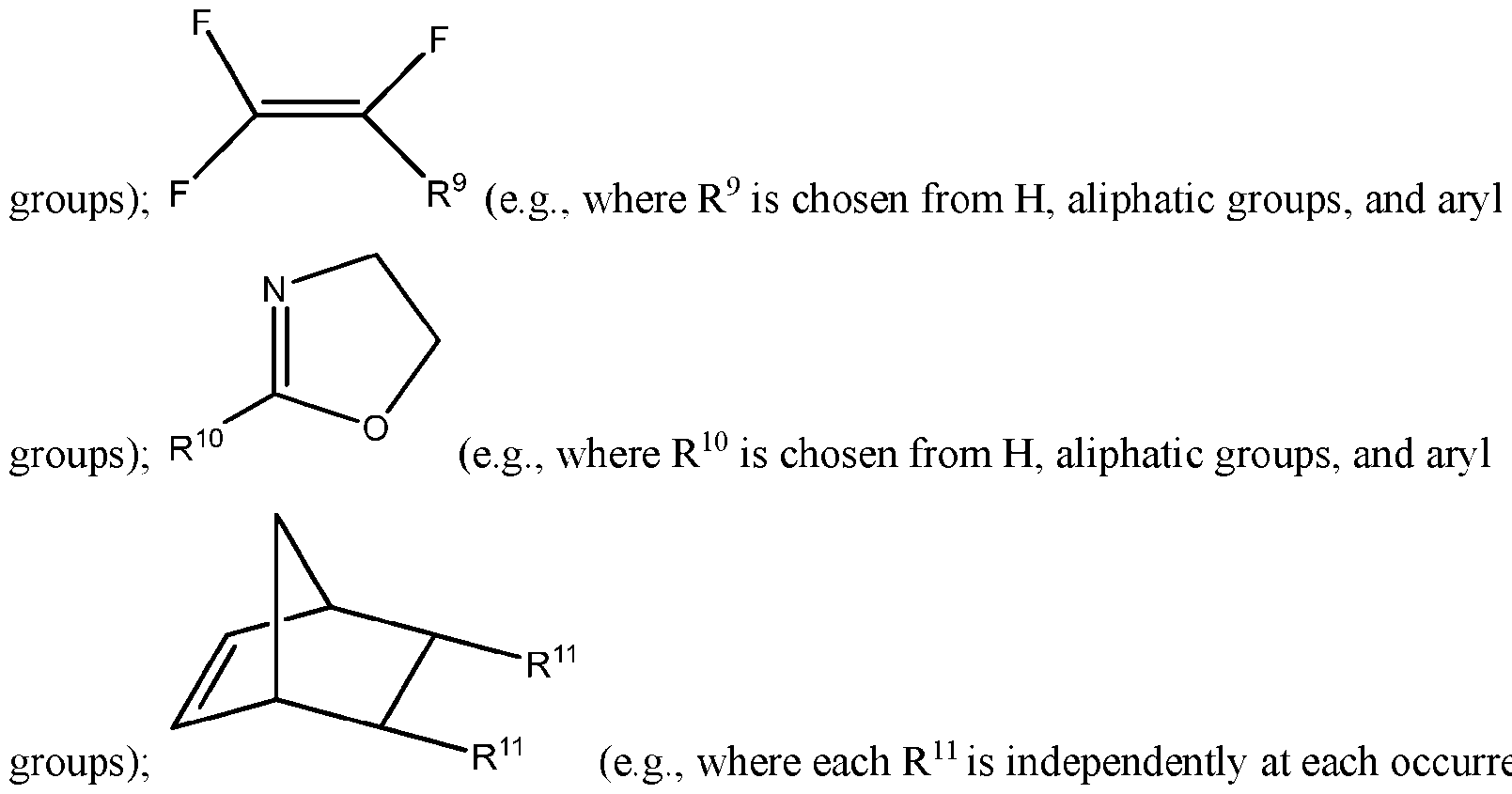 ence chosen from H, aliphatic groups, and aryl groups);
 wherein R12
is chosen from aliphatic groups and aryl groups);
 r the like and/or each R13 is independently at each occurrence chosen from H and aliphatic groups);
 (e.g., where each Y is independently at each occurrence O, C, or S, or the
R14 R14
Z^Z like, and/or n is 1, 2, 3, or 4); (e.g., where each Z is independently at each occurrence O or S or the like and/or each R14 is independently at each occurrence chosen from H, aliphatic groups, and aryl groups);
 the like);
 each R13 is independently at each occurrence chosen from H, aliphatic groups, and aryl groups)

 (e.g., where each A is independently at each occurrence C or O or the like and/or R16 is chosen from aliphatic groups and aryl groups);

 (e.g., where R17 is chosen from aliphatic groups and aryl groups),
 where R18 is chosen from aliphatic groups and aryl groups);
 each R19
is independently at each occurrence chosen from aliphatic groups and aryl groups and/or X is

R20 and/or each R21 independently at each occurrence is chosen from aliphatic groups and aryl groups)
 each R23 independently at each occurrence is chosen from aliphatic groups and aryl groups and/or each X is
HS^ 24SH independently at each occurrence O or N or the like); R (e g., where R24 is chosen
 and/or R25 is chosen from aliphatic groups and aryl groups);
 (e.g., where Z is O or
S or the like);
 (e.g., where Z is O or S or the like and/or R26 is chosen from
 aliphatic groups and aryl groups);
 (e.g., where Z is O or S or the like); where each Y is independently at each occurrence O, C. or S. or the like, and
 independently at each occurrence chosen from aliphatic groups and aryl groups); R28 is chosen from H, aliphatic groups, and ary l groups);
 e each Y is independently at each occurrence O, C, or S, or the like and/or R29 is chosen from aliphatic groups and aryl groups);
 (e.g., where each Z is independently O or S or the like and/or R30 is chosen from aliphatic groups and aryl
b- R ; • - ' 31^ ]> groups)
 * - (e.g.. where each Z is independently at each occurrence O or S or the like and/or R31 is chosen from aliphatic groups and aryl groups);

C, or S or the like and/or R32 and/or each R33 independently at each occurrence is chosen from aliphatic groups and aryl groups); and structural analogs thereof.
[0113] A crosslinking comonomer may form other crosslinking groups. In various examples, a crosslinking comonomer forms crosslinking groups other than crosslinking groups at least partially formed from first monomer(s).
10114] Non-limiting examples of comonomers (for cationic copolymerization with a cyclic alkene monomer or monomers) include

Non-limiting examples of comonomers (for ROMP copolymerization with a cyclic alkene monomer or monomers) include norbomenes, enynes, the like (such as, for example,
 structural analogs thereof. In these examples, R, Ri, R2, or R? are independently chosen from aliphatic groups (such as, for example, alkyl groups or the like) and the like.
[0115] In the case where an initiator is a UV absorbing catalyst, a photosensitizer or photosensitizer may be used (e.g., a reaction mixture may further comprise one or more photosensitizers or the like) to activate UV-absorbing catalysts, such as, for example,
diphenyl iodonium salts or the like, under visible light irradiation. Non-limiting examples of photosensitizers include:

Eosin B (X = NO2) Erythrosin B Eosin Y (X = Br) Rose Bengal
 I nioxantnone , and structural analogs thereof, and any combination thereof.
[0116] Various amounts of first monomer(s) and/or comonomers can be used. In various examples, first monomer(s) is/are present (e.g., independently or in the aggregate) (e.g., in a reaction mixture or a single reaction vessel) at about 5% (by weight based on the total weight of the monomer(s) (e.g., first monomer(s), comonomer(s), if present) and solvent(s), if present) to about 100%, including all 0.1 %values and ranges therebetween (e.g., about 10% to about 100% or about 50% to about 100%). In various examples, comonomers(s) is/are present (e.g., independently or in the aggregate) (e.g., in a reaction mixture or a single reaction vessel) at about 0% (by weight based on the total weight of the monomer(s) (e.g., first monomer(s), comonomer(s), if present) and solvent(s), if present) to about 95%, including all 0.1% values and ranges therebetween (e.g. about 0% to about 90%, about 0% to
about 50%, about 0.01% to about 95%, about 0.01% to about 90%, or about 0.01% to about 50%).
[0117] A method can be carried out at various temperatures. In various examples, a method (e.g., a first polymerization and/or a second polymerization) is carried out at about room temperature (e.g., from about 18 °C to about 30 °C, including all 0.1 °C values and ranges therebetween, such as, for example, from about 20°C to about 30 °C or about 22 °C). In various examples, a method is carried out below room temperature (e.g.. below about room temperature, such as, for example, from about minus 60 °C to about room temperature, including all 0.1 °C values and ranges therebetween) or above room temperature (e.g., above about room temperature, such as, for example, from about room temperature to about 80 °C, including all 0.1 °C values and ranges therebetween) or any combination thereof (e.g., where each step is performed at the same or a different temperature as other steps). In various examples, a method is carried out at about minus 60 °C to about 80 °C, including all 0.1 °C values and ranges therebetween (e.g., from about minus 20 °C to about 30 °C). In various examples, a method is carried out without heating a reaction mixture with an exogeneous heat source. In various examples, a reaction mixture is heated with an exogeneous heat source. In various examples, a method is carried out without cooling a reaction mixture with an exogeneous cooling source. In various examples, a reaction mixture is cooled with an exogeneous cooling source.
[0118] A method can be carried out at various reaction pressures. In various examples, a method (e g., a first polymerization and/or a second polymerization) is carried out at atmospheric pressure (e.g., 1 standard atmosphere (atm) at sea level), at greater than atmospheric pressure (e.g. heating in a sealed pressurized reaction vessel and the like), at below atmospheric pressure (e.g., under vacuum (e.g., from about 75 torr to less than about 760 torr), or any combination thereof (e.g., where each step is performed at the same or a different pressure as other steps).
[0119] A method (e.g., a first polymerization and/or a second polymerization) can be carried out for various reaction times. The reaction time can depend on factors such as. for example, temperature, pressure, presence and/or efficiency of an initiator, presence and/or intensity of an applied energy source, mixing (e g., stirring or the like), or the like, or a combination thereof. In various examples, reaction times range from about seconds (e.g., 0.1 minute) to about 30 hours or greater, including all integer second values and ranges therebetween (e.g.. from about 0. 1 minute to about 24 hours or the like), or any combination thereof (e.g., where each step is performed at the same time or a different time as other steps).
In various examples, a reaction mixture is held for a time sufficient to achieve a desired degree of polymerization, or the like, or any combination thereof. In various examples, a first and/or second polymerization is terminated by quenching a reaction mixture (e.g., after a desired degree of polymerization). Quenching conditions are known in the art. In various examples, a reaction time depends on equivalent(s) of initiator(s), ty pe of monomer(s), and the like.
[0120] A method can be carried out in various atmospheres. In various examples, a method (e g., a first polymerization and/or a second polymerization) is carried out in an inert atmosphere. In various examples, a method is carried out in ambient conditions (e.g., in air or the like).
[0121] A first polymerization and/or the second polymerization may be carried out to form the thermoset material in a pre-determined pattern, shape, or form, or the like. In various examples, a first polymerization and/or a second polymerization is carried out to form a crosslinked thermoset material in a pre-determined pattern, shape, or form, or the like. In various examples, a first polymerization and/or a second polymerization is/are carried out by irradiation of selected portions (which may be in a pre-determined pattern) of a product of the first polymerization (or a layer or film comprising a product of the first polymerization). In various examples, a first polymerization and/or a second polymerization is/are carried out by irradiation of a selected portion or portions (which may be in a pre-determined pattern) of the first monomer(s) and comonomer(s) if present (e.g.. to initiate polymerization in the irradiated area). In various examples, at least a portion, substantially all, or all the nonirradiated monomer(s) and/or un-polymerized monomer(s) is/are removed and voids are created the product.
[0122] A method may further comprise a hydrogenation. In various examples, a thermoset material formed by the second polymerization comprises one or more or a plurality of alkenyl groups and a hydrogenation hydrogenates a least a portion, substantially all, or all of the alkenyl groups. In various examples, at least a portion, substantially all, or all of a thermoset material is hydrogenated to form a hydrogenated thermoset material. In the case where the thermoset material comprises one or more carbon-carbon double bonds, the method further comprises hydrogenation of at least a portion, substantially all, or all the carbon-carbon double bonds in the thermoset material. Suitable hydrogenations are known in the art.
|0123] In the case where a first polymerization and/or a second polymerization are initiated by one or more initiator(s), a method may further comprise removal of at least a
portion, substantially all, or all of the initiator(s). As an illustrative example, an initiator (such as, for example, a metal catalyst or the like) is chemically bonded to a polymeric group. In various examples, removal of at least a portion, substantially all, or all of the initiator(s) comprises degradation of at least a portion, substantially all, or all of the initiator(s). In various examples, degradation of at least a portion, substantially all, or all of the initiator(s) comprises contacting a thermoset material with one or more primary amine(s), one or more tertiary phosphine(s) (such as, for example, a trialkylphosphine, a triarylphosphine, or the like), or the like, or any combination thereof. In various examples, a thermoset material is contacted with one or more solution(s) comprising primary amine(s), tertiary phosphine(s), or the like), or the like, or any combination thereof, and one or more organic solvent(s) (such as, for example, cyclic ethers (e.g., tetrahydrofuran and the like); chlorinated solvents (e.g., di chloromethane and the like), alkyl aryl solvents (e.g., toluene and the like), and the like). The contacting may also remove least a portion, substantially all, or all of any oligomers present in the thermoset material. Without intending to be bound by any particular theory', it is considered the contacting may improve one or more propert(ies) of the thermoset materials. In various examples, removal of at least a portion, substantially all. or all of the initiator(s) does not result in substantial oxidation or any oxidation of the thermoset material(s)).
[0124] In an aspect, the present disclosure provides compositions. In various examples, a composition comprises one or more thermoset material(s) of the present disclosure. Nonlimiting examples of compositions are provided herein.
[0125] A composition can have various combinations of thermoset material(s). A composition may comprise two or more thermoset material(s). In various examples, a composition comprises two or more structurally and/or compositionally (e.g., primary' composition or the like) distinct thermoset materials.
[0126] A composition can have various amounts of thermoset matenal(s). In various examples, a composition comprises about 0 to about 100% (by weight based on the total weight of the composition), including all 0.1% values and ranges therebetw een.
[0127] A composition may further comprise various additives. In various examples, a composition further comprises one or more solvent(s) or the like. Non-limiting, illustrative examples of additives include radical scavengers, opaquing agents, carbon fibers, glass fibers, antioxidants, foaming agents, and the like. In various examples, an additive is an additive typically used in 3-D printing or the like (such as, for example, a radical scavenger, an opaquing agent, or the like, or any combination thereof).
[0128] Compositions can have various uses. In various examples, a composition is an adhesive, a coating, an additive manufacturing composition (such as, for example, a three- dimensional printing resin or the like), antifoaming agents, wetting agents, levelling agents, and slip agents, or the like.
10129] In an aspect, the present disclosure provides uses of thermoset materials of the present disclosure. Non-limiting examples of uses of thermoset materials are provided herein. [0130] In various examples, an article of manufacture comprises one or more thermoset material(s) of the present disclosure. In various examples, a soft grip, a packaging material, a tube, a container, a barrier or the like comprises one or more thermoset material(s). In various examples, one or more thermoset material(s) is/are used in adhesive applications, in coating applications, as insulators, as composites, as building materials, as molding materials, as elastomers, as automotive materials, in additive manufacturing applications (such as, for example, 3-D printing (e.g., sterolithography (SLA), digital light processing (DLP), or the like)or the like) or the like.
[0131] The following Statements describe various examples of thermoset materials, methods of making thermoset materials, compositions, and uses of the thermoset materials of the present disclosure and are not intended to be in any way limiting:
Statement 1. A thermoset material comprising a plurality of polymeric groups (such as, for example, polymeric groups independently comprising the following structure:

R is independently an aliphatic or an aromatic group, or a structural analog thereof); a plurality7 of crosslinking groups (such as, for example, interchain crosslinking groups, intrachain crosslinking groups, or both) (e.g., crosslinking groups formed from a thermal or photochemical cationic polymerization, a thermal or radical polymerization, or the like), where the crosslinking groups are independently covalently bonded to the backbone of a polymeric group or the backbones of two different polymeric groups and are at least partially formed from the same monomer(s) used to form the polymeric groups.
Statement 2. A thermoset material according to Statement 1, where the thermoset material comprises the following structure:
 crosslinking group independently covalently bonded to the backbone of a polymeric group or the backbones of two different polymeric groups and are formed from the same monomer(s) used to form the polymeric groups, CLG2 is a crosslinking group independently covalently bonded to the backbone of a polymenc group or the backbones of two different polymeric groups and are formed from a different monomer or different monomers than those used to form the polymeric groups, PG is a polymeric group, x is 1 to 1,000,000, including all integer values and ranges therebetween (e.g., 1 to 2.000 or 1 to 10,000). a is 1 to 500,000. including all integer values and ranges therebetween (e.g., 1 to 500 or 1 to 5,000), y is 1 to 1 ,000,000, including all integer values and ranges therebetween (e.g., 1 to 2,000 or 1 to 10,000), and b is 0 to 500,000, including all integer values and ranges therebetween (e.g., 0 to 500 or 0 to 5,000).
Statement 3. A thermoset material according to Statement 1 or 2, where the thermoset material comprises the following structure:
 crosslinking group independently covalently bonded to the backbone of a polymeric group or the backbones of two different polymeric groups and are formed from the same monomer(s) used to form the polymeric groups, PG is a polymeric group, and c is 1 to 1,000,000, including all integer values and ranges therebetween (e.g.. 1 to 2,000 or 1 to 10,000).
Statement 4. A thermoset material according to any one of the preceding Statements, where the thermoset material comprises the following structure:
 first repeat unit of a polymenc group,
X2 is a second repeat unit of a polymeric group, CLG1 is a crosslinking group independently covalently bonded to the backbone of a polymeric group or the backbones of two different
polymeric groups and are formed from the same monomer(s) used to form the polymeric groups.
CLG2 is a crosslinking group independently covalently bonded to the backbone of a polymeric group or the backbones of two different polymeric groups and are formed from a different monomer or different monomers than those used to form the polymeric groups, r is 0 to 1,000,000, including all integer values and ranges therebetween (e.g., 1 to 2,000 or 1 to 10.000), s is 1 to 1,000,000, including all integer values and ranges therebetween (e.g., 1 to 2,000 or 1 to 10,000), e is 1 to 500,000, including all integer values and ranges therebetween (e.g., 1 to 500 or 1 to 5.000), t is 0 to 1,000,000, including all integer values and ranges therebetween (e.g., 1 to 2,000 or 1 to 10.000), u is 0 to 1,000,000. including all integer values and ranges therebetween (e.g., 0 to 2,000 or 0 to 10,000), and f is 1 to 500,000, including all integer values and ranges therebetween (e.g., 1 to 500 or 1 to 5,000),
Statement 5. A thermoset material according to any one of the preceding Statements, where one or more or all of the polymeric group(s) comprises or independently comprise the following structure:
 r the like, or
 , where R is independently an aliphatic or an aromatic group, where x is 1 to 1.000,000, including all integer values and ranges therebetween (e.g., 1 to 2,000 or 1 to 10,000), and y is 1 to 1,000,000. including all integer values and ranges therebetween (e g., 1 to 2,000 or 1 to 10,000), or a structural analog thereof, or any combination thereof.
Statement 6. A thermoset material according to any one of the preceding Statements, where one or more or all of the crosslinking group(s) comprises or independently comprise the following structure:


Statement 7. A thermoset material according to any one of the preceding Statements, where the thermoset material further comprises one or more other crosslinking group(s).
Statement 8. A thermoset material according to Statement 7, where the one or more other crosslinking group(s) comprises or independently comprise the following structure:
 aliphatic group

 aliphatic group or an alkyl group; a
 p g p y g p ethyl group or the like, X is O or N or the like, and R is an aliphatic group or an alkyl group;
 , where R is an aliphatic group or an alkyl group;
 where R is an aliphatic group or an alkyl group;
 where Z is O or S or the like and R is an aliphatic group or an alkyl group;
 where Z is
O or S or the like and R is an aliphatic group or an alkyl group;

, where Y is O, C, or S, or the like and R is independently at each occurrence an aliphatic group or an alkyl group, where p is 1 to 500,000, including all integer values and ranges therebetween (e.g.. 1 to 500 or 1 to 5,000), and
q is 1 to 500,000, including all integer values and ranges therebetween (e.g., 1 to 500 or 1 to 5,000), structural analogs thereof, and any combination thereof.
Statement 9. A thermoset material according to any one of the preceding Statements, where the thermoset material is in the form of a monolith, a powder, a fiber, a film, or the like. Statement 10. A thermoset material according to any one of the preceding Statements, where the thermoset material or at least a portion thereof is at least partially, substantially, or completely degradable (e.g.. hydrolyically degradable, oxidatively degradable or the like). Statement 11 . A thermoset material according to any one of the preceding Statements, where the thermoset material exhibits one or more or all of the following: a strain-at-break of about 0.5% to about 10,000%, including all 0.1% values and ranges therebetween (e.g.. about 0.5% to about 5.000% or about 0.5% to about 1,000%); an ultimate tensile strength of about 0.001 MPa to about 350 MPa, including all 0.0005 MPa values and ranges therebetween (e.g., about 0.001 MPa to about 200 MPa or about 0.001 MPa to about 100 MPa); a Young’s Modulus of about 0.01 MPa to about 5 GPa, including all 0.01 MPa values and ranges therebetween (e g., about 0.01 MPa to about 2 GPa or about 0.01 MPa to about 1 GPa); a toughness of about 0.01 MPa to about 5 GPa, including all 0.005 MPa values and ranges therebetween (e.g., about 0.01 MPa to about 0. 1 MPa or about 0.01 MPa to about 0.05 GPa); a decomposition temperature (Ta,io%) of about 250 °C to about 650 °C, including all 0. 1 °C values and ranges therebetween (e.g., about 250 °C to about 500 °C or about 250 °C to about 400 °C); a dielectric constant of about 1 to about 40, including all 0.1 values and ranges therebetween (e.g., about 1 to about 10 or about 1 to about 5); a water absorption of 0.01% (by weight based on the total weight of the thermoset material) to about 600%, including all 0.005% values and ranges therebetween (e.g., about 0.01% to about 100% or about 0.01% to about 30%); an acid degradability of about 0% to 100%, including all 0.1% values and ranges therebetween; an oxidative degradability of about 0% to about 100%, including all 0.1% values and ranges therebetween (e.g., about 0.1% to about 80% or about 0.01% to about 60%); or a recyclability to monomer (e.g., through ring-closing metathesis or the like) of about 0% to about 95%, including all 0.1% values and ranges therebetween (e.g., about 0.1% to about 60% or about 0. 1 % to about 40%).
Statement 12. A method of making a thermoset material (such as, for example, one or more thermoset material(s) of the present disclosure (e.g.. thermoset material(s) of any one of Statements 1 to 11 or the like) comprising a first polymerization of one or more first
monomer(s), where the first polymerization forms one or more or a plurality of polymeric group(s), and a second polymerization of one or more first monomer(s), where the second polymerization forms one or more or a plurality of crosslinking groups and the crosslinking groups are independently covalently bonded to the backbone of a polymeric group or two different polymeric groups and are formed from the same monomer(s) used to form the polymeric groups, where the thermoset material material is formed.
Statement 13. A method according to Statement 12. where the first polymerization comprises irradiating with a first electromagnetic radiation or a heating to a first temperature a reaction mixture comprising the first monomer(s) and second monomer(s) to initiate the first polymerization and/or the second polymerization comprises irradiating with a second electromagnetic radiation or a heating the reaction mixture to a second temperature to initiate the second polymerization.
Statement 14. A method according to Statement 12 or 13, where the first polymerization is carried out such that a desired degree of polymerization (e.g., about 0% to about 99%, including all 0.1% values and ranges therebetween (e.g., about 2% to about 30%) is realized prior to initiation of the second polymerization.
Statement 15. A method according to any one of Statements 12-14, where the first polymerization is chosen from a ring opening metathesis polymerization (ROMP) an acyclic diene metathesis (ADMET) polymerization, or the like and the second polymerization is chosen from is chosen from a cationic polymerization, a radical polymerization, or the like. Statement 16. A method according to any one of Statements 12-15, where (i) the first polymerization is a thermal or photochemical ROMP polymerization and the second polymerization is a thermal or photochemical cationic polymerization; (ii) the first polymerization is a thermal or photochemical ROMP polymerization and the second polymerization is a thermal or photochemical radical polymerization; (iii) the first polymerization is a thermal or photochemical ADMET polymerization and the second polymerization is a thermal or photochemical cationic polymerization; or (iv) the first polymerization is a thermal or photochemical ADMET poly merization and the second polymerization is a thermal or photochemical radical polymerization, or the like.
Statement 17. A method according to any one of Statements 12-16, where the first polymerization and the second polymerization are carried out in a single reaction vessel and the first momomer(s) are present in the single reaction vessel when the first polymerization is initiated.
Statement 18. A method according to any one of Statements 12-17, where at least a portion or all of the first polymerization is earned out prior to initiation of the second polymerization.
Statement 19. A method according to any one of Statements 12-18, where the first polymerization and the second polymerization are carried out without isolation of an intermediate polymer product.
Statement 20. A method according to any one of Statements 12-19. where the first monomer(s) is/are independently chosen from cyclic alkene monomers, acyclic diene monomer, or the like, or any combination thereof.
Statement 21. A method according to any one of Statements 12-20, where the cyclic alkene monomer(s) independently comprise(s) the following structure:
 , where Z is independently for each first monomer O or S, or a substituted analog thereof, and/or the acyclic diene monomer(s) independently comprise(s) the following structure:

, where R is independently for each first monomer an aliphatic group, an aryl group, or the like, or a substituted analog thereof.
Statement 22. A method according to any one of Statements 12-21, where the first polymerization further comprises polymerization of one or more comonomer(s) (e.g., by the same polymerization method or mechanism as the first polymerization).
Statement 23. A method according to any one of Statements 12-22. where the comonomer(s) is/are independently chosen from the following:
 , where R2 is chosen from H and aliphatic groups and R3 is chosen from aliphatic groups and aryl groups;
 , where each R4 is independently at each occurrence chosen from H and aliphatic groups;
 chosen from aliphatic groups and R6 is optional and each R6 is independently at each occurrence chosen from aliphatic groups and
aryl groups
 r the like, Y is C or Si or the like, and R7 and each R8 are independently chosen from H, aliphatic groups, and aryl
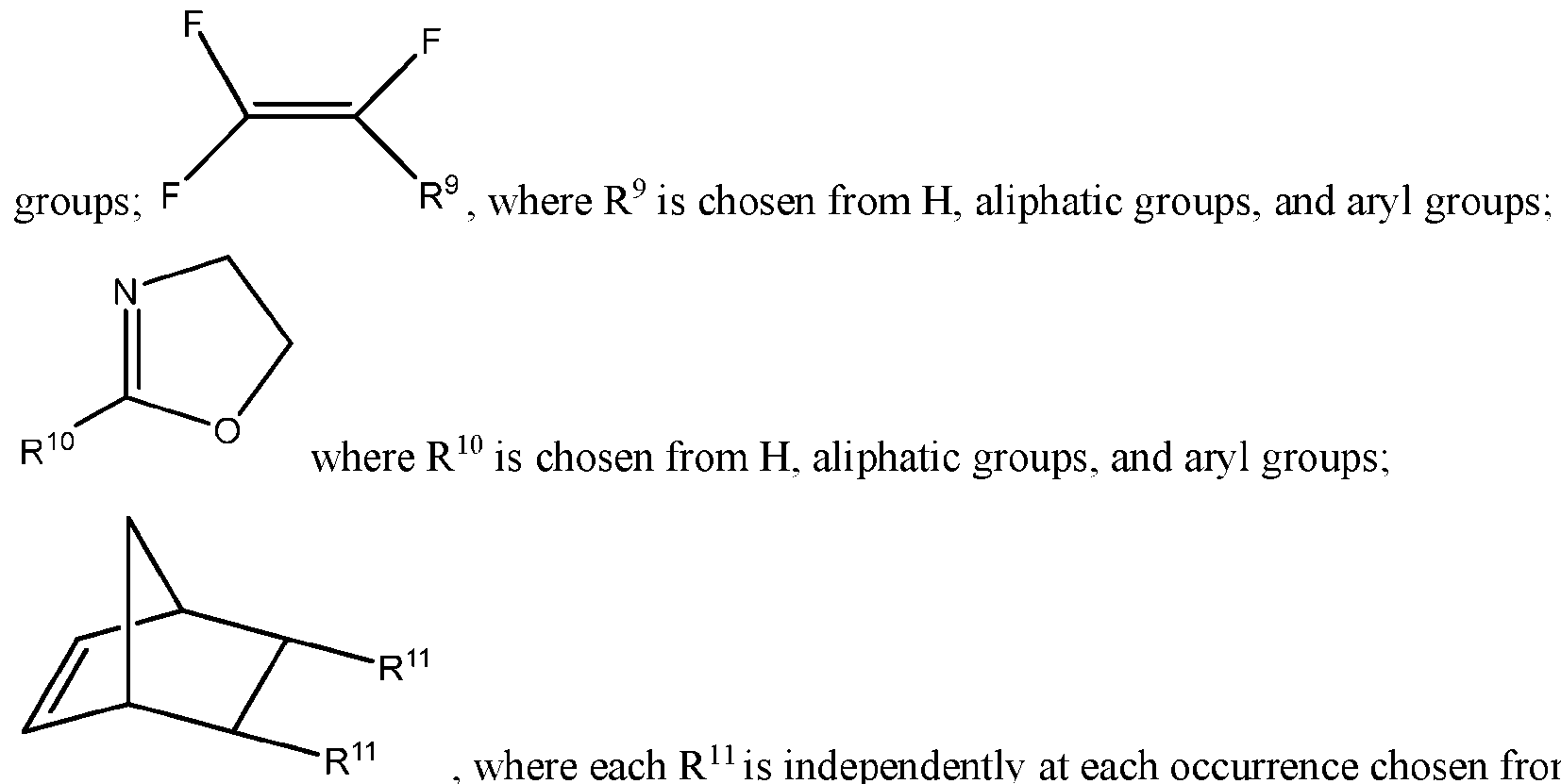 , m
H, aliphatic groups, and aryl groups;
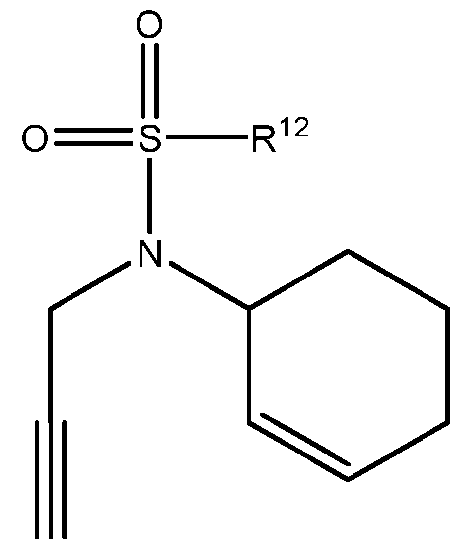 , where R12is chosen from aliphatic groups and ara’l groups:
 , where A is C or O or the like and each R13 is independently at each occurrence chosen from H and aliphatic groups;
 where each
Y is independently at each occurrence O, C, or S, or the like, and n is 1, 2, 3, or 4;
 where each Z is independently at each occurrence O or S or the like and each R14 is independently at each occurrence chosen from H, aliphatic groups, and aryl groups;

, where B is C, O, or Si, or the like;
 , where each R15 is independently at each occurrence chosen from H, aliphatic groups, and aryl groups;

 . where each A is independently at each occurrence C or O or the like and R16 is chosen from aliphatic groups and aryl groups; g
 p . , p g p g p where each R19 is independently at each occurrence chosen from aliphatic groups and aryl groups and X is O or N or the like;

 . where R20 and each R21 independently at each
occurrence is chosen from aliphatic groups and aryl groups;
 where R22 and each R23 independently at each occurrence is chosen from aliphatic groups and
HS^ 24SH aryl groups and each X is independently at each occurrence O or N or the like; R
 where R24 is chosen from aliphatic groups and aryl groups; yr25 , where Y is O, C, or S, or the like, and R25 is chosen from aliphatic groups and aryl groups;
 , where Z is
O or S or the like;
 , where Z is O or S or the like and R26 is chosen from aliphatic
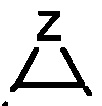 groups and aryl groups;
 wherein Z is O or S or the like;
 where each Y is independently at each occurrence O. C, or S, or the like, and each R27 is independently at each occurrence chosen from aliphatic groups and aryl groups;
 where R28 is chosen from H, aliphatic groups, and aryl groups;
 . wh . ere eac ih x Yz i ■s independently at each occurrence O, C, or S, or the like and R29 is chosen from aliphatic groups and aryl groups;
 , where each Z is independently O or S or the like and R30 is chosen from aliphatic groups and aryl groups;
 , where each Z is independently at each occurrence O or S or the like and R31 is chosen from aliphatic groups and aryl groups;
 , where each Y is independently at
each occurrence O. C, or S or the like and R32 and each R33 independently at each occurrence is chosen from aliphatic groups and aryl groups, and structural analogs thereof.
Statement 24. A method according to any one of Statements 12-23, where the first monomer(s) is/are present (e.g., independently or in the aggregate) at about 5% (by weight based on the total weight of the monomer(s) (e.g., first monomer(s), comonomer(s), if present, and solvent(s), if present) to about 100%, including all 0.1 %values and ranges therebetween (e.g.. about 10% to about 100% or about 50% to about 100%).
Statement 25. A method according to any one of Statements 12-24, where the comonomers(s) is/are present (e.g., independently or in the aggregate) at about 0% to about 95% (e g., first monomer(s), comonomer(s), and solvent(s), if present), including all 0.1% values and ranges therebetween (e.g. about 0% to about 90%. about 0% to about 50%, about 0.01% to about 95%, about 0.01% to about 90%, or about 0.01% to about 50%).
Statement 26. A method according to any one of Statements 12-25, where the first monomer(s) and, optionally, the comonomer(s) are present at the initiation of the first polymerization and/or the first monomer(s) are present at the initiation of the second polymerization.
Statement 27. A method according to any one of Statements 12-26, where, in the case where a solvent or solvent(s) are present in the first polymerization and/or the second polymerization, the thermoset material is a hydrogel (e.g.. a hydrogel with about 10% (by weight based on the total weight of thermoset material and solvent(s)) to about 80% thermoset material(s), including all 0.1% values and ranges therebetween (e.g., about 10% to about 60%, about 10% to about 70%, about 20% to about 60%, about 20% to about 70%, about 20% to about 80%, about 30% to about 60%, about 30% to about 70%, or about 30% to about 80%).
Statement 28. A method according to any one of Statements 12-27, where in the first polymerization and/or the second polymerization is/are carried out to form the thermoset material in a pre-determined pattern, shape, or form, or the like.
Statement 29. A method according to any one of Statements 12-28. in the case where the thermoset material comprises one or more carbon-carbon double bonds, the method further comprising hydrogenation of at least a portion, substantially all, or all the carbon-carbon double bonds in the thermoset material.
Statement 30. A method according to any one of Statements 12-29, in the case where first polymerization and/or second polymerization comprises use of one or more initiator(s), the
method further comprising, removing at least a portion, substantially all, or all of the initiator(s).
Statement 31. A composition comprising one or more thermoset material (s) of the present disclosure (such as, for example, thermoset material(s) of any one of Statements 1 to 11, thermoset material(s) made by a method of the present disclosure (e.g., thermoset material(s) made by a method of any one of Statements 12 to 30), or the like).
Statement 32. A composition according to Statement 31, where the composition is an adhesive, a coating, an insulator, a building material, an elastomeric material, an additive manufacturing material (such, as, for example, a three-dimensional printing resin or the like), or the like.
Statement 33. Use of one or more thermoset material(s) of the present disclosure (such as, for example, thermoset material(s) of any one of Statements 1 to 11, thermoset material(s) made by a method of the present disclosure (e.g., thermoset material(s) made by a method of any one of Statements 12 to 30), or the like) in adhesive applications, coating applications, as insulators, as composites, as building materials, as molding materials, as elastomers, as automotive materials, in additive manufacturing applications, or the like.
Statement 34. A thermoset material comprising a plurality of reactive groups (such as, for example, photochemically reactive groups (e.g., groups reactive in a photochemical cationic polymerization or the like) or the like).
Statement 35. A thermoset material according to Statement 34, further comprising a plurality of crosslinking groups (such as, for example, interchain crosslinking groups, intrachain crosslinking groups, or both) (e.g., groups formed from a photochemical cationic polymerization or the like).
Statement 36. A thermoset polymer material according to Statement 34 or 35, further comprising a plurality of repeat units that do not comprise a reactive group.
Statement 37. A method of making a thermoset polymer material comprising a first polymerization of one or more monomer(s), where the first polymerization forms a thermoset polymer material comprising a plurality of polymerizable groups (or a plurality of repeat units independently comprising a polymerizable group) (which may be in the backbone of the thermoset polymer material).
Statement 38. A method according to Statement 37, where the first polymerization further comprises polymerization of one or more other monomer(s) (e.g., by the same polymerization method or mechanism as the first polymerization), where the other monomer(s) do not
comprise a polymerizable group that is polymerizable in a polymerization other than the first polymerization.
Statement 39. A method according to Statement 37 or 38, further comprising photochemically crosslinking the product of the first polymerization, where the photochemical crosslinking forms a plurality' of crosslinking groups (such as, for example, interchain crosslinking groups, intrachain crosslinking groups, or both).
Statement 40. A method according to any one of Statements 37 to 39. further comprising a second polymerization of the thermoset polymer comprising polymerizable groups (or a plurality of repeat units independently comprising a polymerizable group) formed from the first polymerization (or a portion thereof, such as, for example, a polymerization comprising reaction of at least a portion of the reactive groups of the product of the first polymerization), where the second polymerization forms a plurality’ of crosslinking groups (such as, for example, interchain crosslinking groups, intrachain crosslinking groups, or both).
Statement 41. A method according to Statement 40, where in the second polymerization is carried out to form a crosslinked thermoset polymer in a pre-determined pattern, shape, or form, or the like.
[0132] The steps of the methods described in the various embodiments and examples disclosed herein are sufficient to produce one or more thermoset materials, or the like, or any combination thereof or carry out a method of the present disclosure. Thus, in an embodiment, a method consists essentially of a combination of the steps of the methods disclosed herein. In another embodiment, a method consists of such steps.
[0133] The following Examples are presented to illustrate the present disclosure. The Examples is not intended to be limiting in any manner.
EXAMPLE 1
[0134| This example provides examples of thermoset materials of the present disclosure, and methods of making and using same
[0135] Provided is a modular, one-pot synthesis of degradable thermosets from the commercially available, bio-sourced monomer 2,3-dihydrofuran (DHF). In the presence of a Ru catalyst and photoacid generator. DHF undergoes slow ring-opening metathesis polymerization to give a soft polymer; then, exposure to light triggers strong acid generation and promotes the cationic polymerization of the same DHF monomer to spatially cross-link and strengthen the material. By manipulating catalyst loading and light exposure, it is possible to access materials with physical properties spanning orders of magnitude and
achieve spatially resolved material domains. Importantly, the DHF-based thermosets undergo stimuli-selective degradation and can be recycled to monomer under mild heating. The use of two distinct polymerization mechanisms on a single monomer allows the synthesis of degradable and recyclable thermoset materials with precisely controlled properties.
10136] To circumvent synthetic challenges and progress towards a circular thermoset economy, the bio-sourced, commercially available cyclic vinyl ether, 2,3-dihydrofuran (DHF) was used as an orthogonal monomer to make degradable/recyclable thermosets with tunable physical properties. DHF has been polymerized cationically through the vinyl ether to yield poly(c-DHF), a rigid material with a glass transition temperature ( 7/.) of 135 °C. Additionally, this polymer can also be oxidatively degraded. Feist and Xia demonstrated that the same vinyl ether that enables DHF to undergo cationic polymerization is also active for ring-opening metathesis polymerization (ROMP). The resulting poly(r-DHF) is a rubbery polymer (Tg — 50 °C) that can be hydrolyzed to small molecules and thermally recycled to monomer. Importantly, the vinyl ether is preserved in poly(r-DHF) backbone, and it is considered that the cationic polymerization of additional DHF monomer reacts through this backbone functionality, creating a cross-linked material. Provided herein is a one-pot synthesis of thermosets with multiple material domains via ROMP and cationic polymerization of DHF (FIG. 1). Additionally, the resulting thermosets are susceptible to multiple degradation pathways, thus providing bio-based thermosets that are simple to produce and degrade on-demand to regenerate monomer.
[0137] One-Pot Thermoset Synthesis. To achieve facile thermoset synthesis through sequential ROMP and cationic polymerization of DHF, it is considered that 1) ROMP must be slow, leaving residual DHF for subsequent cationic crosslinking; 2) the initiation of cationic polymerization should be stimulus-triggered to provide spatial control of crosslinking; and 3) once triggered, cationic polymerization must be rapid. On this basis, Grubbs 2nd Generation catalyst (G2) was used for ROMP, which features slow polymerization rates, and for cationic polymerization, the photoacid generator (PAG) diphenyloctyl iodonium hexafluoroantimonate and the photosensitizer camphorquinone (CQ) were used as coinitiators. Blue light irradiation of the PAG/CQ pair produces the superacid HSbFe, which initiates rapid polymerization of vinyl ethers to near full conversion within minutes.
[0138] Initial studies showed that G2 catalyzed the ROMP of DHF in the presence of PAG and CQ with characteristic equilibrium behavior. At 2 minutes (9% conversion), the poly(r-DHF) /V/„ = 229 kg/mol, whereas at 10 minutes (37% conversion) the Mn had reduced to 22.0 kg/mol (FIG. 7). Together, these results suggest that G2 would provide a suitable
window of time to tune the poly(r-DHF) content and to initiate cationic polymerization to cure the thermoset. To investigate photo-cationic polymerization. DHF was combined with PAG and CQ. In the absence of blue light and G2, and no consumption of DHF was observed for 10 minutes. Upon irradiation with a 456 nm Kessil lamp, rapid conversion to poly(c- DHF) was observed, with 89% monomer consumed in 5 minutes, yielding a polymer with Mn = 26.0 kg/mol (FIG. 12). When all three initiating species were present, 10 minutes of ROMP in the dark followed by 6 minutes of irradiation produced an insoluble material (gel fraction = 75%) with a single, broad Ts (109 °C) between that of the two homopolymers (FIG. 12). Taken together, these results show that in the dark G2 catalyzes the ROMP of DHF in the presence of PAG and CQ, and that irradiation initiates cationic polymerization to afford a crosslinked material in a single reaction vessel (FIG. 1 A).
[0139] Manipulation of Tensile Properties. To be relevant to several applications, a thermoset formation needs to yield materials with a variety of properties. It was considered that the final composition of the thermoset could be controlled by both irradiation time as well as the Ru catalyst concentration. Tuning the crosslink density and poly(c-DHF) content should yield materials with stiffnesses and toughnesses that are proportional to these two variables. In photoinitiated cationic polymerization, light dosage affects the concentration of strong acid generated, which will control the rate of cationic polymerization and the amount of cross-linking in the final material. Kinetic studies of the PAG-initiated cationic polymerization of DHF showed an increase in DHF conversion rate over 5 minutes of irradiation, after which the polymerization plateaued (FIG. 12). When thermosets were synthesized with a constant ROMP time of 10 minutes, it was observed that increasing the irradiation time from 2 to 6 minutes increased crosslinking and the gel fraction from 67% to 75% (Table 3). The higher degree of crosslinking was accompanied by an increase in the stiffness of the material (Young’s modulus, E), from 44 to 207 MPa, as well as toughness, from 0.8 to 1.6 MPa (FIG. 2A, FIG. 18). No increase in toughness or E was observed in films made with more than 6 minutes of irradiation (FIG. 18).
[0140] Another way to affect the poly(c-DHF) content and crosslink density of the thermosets is by altering the initiator concentrations. Prior studies have shown that increasing the initiator for a crosslinking reaction induces greater crosslinking density, bringing about higher E and tensile strength but lower strain-at-break. Initiating two polymerizations from a single monomer complicates this system, as the initial ROMP step reduces the amount of monomer available for the second crosslinking step. To elucidate initiator effects, G2 or PAG/CQ concentrations were varied and the tensile properties and swelling behavior of
resulting polymers were investigated. Increasing the amount of G2 relative to DHF and PAG leads to similar consumption of DHF before irradiation but smaller poly (r -DHF) chains, producing overall weaker materials (FIG. 8). Indeed, a fivefold increase in G2 from 0. 1 to 0.5 mol% reduced the E from 207 MPa to 55 MPa and lowered the toughness from 1.6 MPa to 0.36 MPa (FIG. 2B, FIG. 20). When G2 was lowered beyond 0.1 mol%, a significant increase in DHF conversion and poly(r-DHF) Mn was observed before irradiation; thus, it is considered that decreasing G2 would also not lead to tougher thermosets, as there would be a low er amount of monomer available for crosslinking (FIG. 8). Indeed, reducing G2 from 0.1 to 0.05 mol% decreased both E (69 MPa) and toughness (1.02 MPa) (FIG. 18, FIG. 20). On the basis of the above results, the synthesis of stiff and tough thermosets calls for a moderate amount of G2 to balance monomer conversion and soft phase chain length before crosslinking.
|0141] The influence of PAG on tensile properties is less predictable. In control studies it was found that the PAG slows the ROMP of DHF (FIG. 9). It is known that linear a,P- disubstituted vinyl ethers, like those found in the poly(r-DHF) repeat unit are less reactive in cationic co-polymerization than DHF. Therefore, it is not guaranteed that more PAG will produce more crosslinks. As PAG was increased from 0.125 to 2 mol%, a decrease in gel fraction from 90% to 62% was observed, indicating that poly(c-DHF) chains terminate before adding into poly(r-DHF) chains (Table 3). While tensile strength and were maximized at 0.5 mol% PAG, the strain-at-break continuously increased up to 2 mol% PAG. leading to an overall plateau in toughness from 0.5 to 2 mol% PAG (FIG. 2B, FIG. 19). Because the PAG affects both ROMP and cationic polymerization, and because P-substituted vinyl ethers are recalcitrant tow ards cationic co-polymerization, DHF thermosets do not display trends typical of photo-crosslinked materials with respect to PAG concentration.
[0142] The above experiments indicate that poly(c-DHF) content and polymer chain length affected the stiffness and toughness of DHF thermosets. It w as considered that decreasing the ROMP time w ould maximize these variables and enhance the tensile properties by keeping ROMP conversion low and the Mn of poly(/'-DHF) high (FIG. 7). Thermosets with ROMP times of 2, 6. and 10 minutes (91%, 77%, 73% monomer remaining before irradiation) were produced, followed by 6 minutes of irradiation. The most crosslinking occurred in the samples with 2 and 6 minutes of ROMP, and these films w ere also tougher and stiffer than the film irradiated after 10 minutes of ROMP (FIG. 2B, FIG. 21). The thermoset with 2 minutes of ROMP time (91% monomer remaining, M„,ROMP = 229 kg/mol) displayed the highest toughness of any thermoset produced, displaying a near 6-fold
increase in toughness (9.1 MPa) compared to the 10-minute sample (1.6 MPa) without a significant change in E (FIG. 2B).
[0143] To highlight the importance of residual monomer on thermoset formation and properties during the cationic polymerization, poly(r-DHF) was isolated and cast this polymer into a film with PAG and CQ. Irradiation of this film lacking DHF monomer produced a very weak material with a toughness of 0.01 MPa and a Ts of 24 °C (FIG. 16. FIG. 22). This result suggests that residual monomer is critical for cationic crosslinking with poly(c-DHF) to create a tough material and that the cationic homopolymerization of the vinyl ether in the polymer backbone is an inefficient process. Importantly, the above results show that tougher materials can be obtained by (1) balancing PAG:G2 and minimizing the ROMP time to leave the maximal amount of DHF available for photo-crosslinking and (2) irradiating for longer times to fully convert residual monomer to poly(c-DHF). Through judicious choice of reaction parameters, diverse materials can be obtained from the one-pot polymerization of DHF, with properties comparable to silicone, polyurethane, and ethylene propylene rubber, among others (FIG. 2C).
[0144] Photopatteming. In addition to enabling temporal control, photoinitiated polymerizations afford spatial control over polymer properties, driving the rise of light-based additive manufacturing for synthesizing complex architectures. It is considered that photocuring in this system will also enable spatial control and give rise to materials with spatially resolved physical properties. Furthermore, because ROMP is reversible, it is considered that portions of the final material that have undergone ROMP but not cationic polymerization will thermally depolymerize to monomer, allowing for the creation of voids within films. This was shown by utilization of binary7 photomasks made on transparencysheets with a laser printer to spatially control the formation of the strong acid and cationic polymerization process. After the primary ROMP step, irradiation through a geometrically patterned photomask resulted in millimeter-sized patterning, as viewed through an optical microscope (FIG. 3A, FIG. 25). The transparency masks effectively produced unique domains in the thermoset. Importantly, the dark regions of these masks were not opaque, resulting in variable crosslinking in the two regions. This result suggests that light dosage influences the final crosslinking and material properties in these thermosets.
[0145] To further explore the temporal control in this system, a binary metal photomask was applied during the patterning step. By irradiating an entire dog bone-shaped film for 1 minute, followed by irradiation of only a portion of the material through a striped photomask for 4 additional minutes, a crosslinked material was created with two hard domains in the
neck (FIG. 3B). Tensile testing of the dog bone showed that only the soft regions elongated under stress and displayed similar tensile properties to a film made with only 1 minute of irradiation (E = 8.5 MPa; toughness = 0.46 MPa; FIG. 18, FIG. 26). This experiment demonstrates that the dosage of light can spatially control the amount of acid produced and, hence, the amount of poly(c-DHF) and cross-linking in the material. These multi-material thermosets are created from a single monomeric functional group via spatial control over orthogonal polymerization reactions.
[0146] Next, voids were patterned into the film by completely blocking portions of the DHF resin from irradiation; regions that receive no light will consist of poly(r-DHF) and unreacted monomer only, which can be depolymerizes back to monomer by heating the sample above the ceiling temperature, ft was considered that areas containing crosslinks would not undergo depolymerization via ROMP and would remain intact. To demonstrate this, a metal photomask was used that allowed light to reach a thin ring on a film of the resin. After 6 minutes of irradiation through the mask, the film was immediately placed under vacuum to lower the ceiling temperature of the poly(r-DHF) and promote the depolymerization of the non-irradiated areas back to monomer. After 8 hours, only the crosslinked ring was left behind and pristine monomer was recovered from the depolymerization of the rest of the film (FIG. 3C). The reversibility of ROMP uniquely poises the DHF thermoset to undergo depolymerization after spatial patterning, allowing for non-irradiated regions to be cleanly recycled back to monomer. This type of recycling would help to reduce the waste currently associated with light-based 3D printing, which currently does not separate unused monomer from photocatalysts, and where monomer trapped within cured parts must be washed away with excess solvent and ultimately disposed.
[0147] Thermoset Degradation and Recycling. In addition to these thermosets being biorenewable, they should also be chemically recyclable and degradable through thermal, hydrolytic, and oxidative degradation mechanisms. Above, the thermo-reversibility7 of ROMP was harnessed to depolymerize non-irradiated regions within a spatially patterned thermoset, but it was expected the thermosets themselves were partially recyclable to monomer. The amount of thermal recycling is limited by the amount of poly(c-DHF) and crosslinks in the material, where sp3 hybridized carbons at crosslinks would prevent G2 from performing ringclosing metathesis (FIG. 4). Several films were synthesized with vary ing properties and directly heated to 40 °C for 45 minutes under vacuum. 111-NMR analysis of the collected distillate confirmed that pure DHF was recovered, with up to 34 wt% collected when the film was synthesized with 0.125 mol% PAG (Table 1, entry 3; Table 5; FIG. 27). The greatest
amount of depolymerization was observed in samples with the lowest gel fractions (Table 1, entries 3-5; Table 6). Tensile testing of thermally treated films showed increased toughness, arising from the lack of plasticizing components and possible crosslinking due to thermal activation of PAG (FIG. 18, FIG. 28). |0148] Table 1. Degradation/depolymerization of pristine thermosets catalyzed by mild heating under vacuum, dilute HC1 in THF, or accelerated oxidation with Fenton’s reagent (reported as mass loss).

[0149] Table 2. Polymerization data for the ROMP of DHF in the presence of various additives (1.3 mmol DHF, 0.1 mol % G2, 10 min, dark, N2).
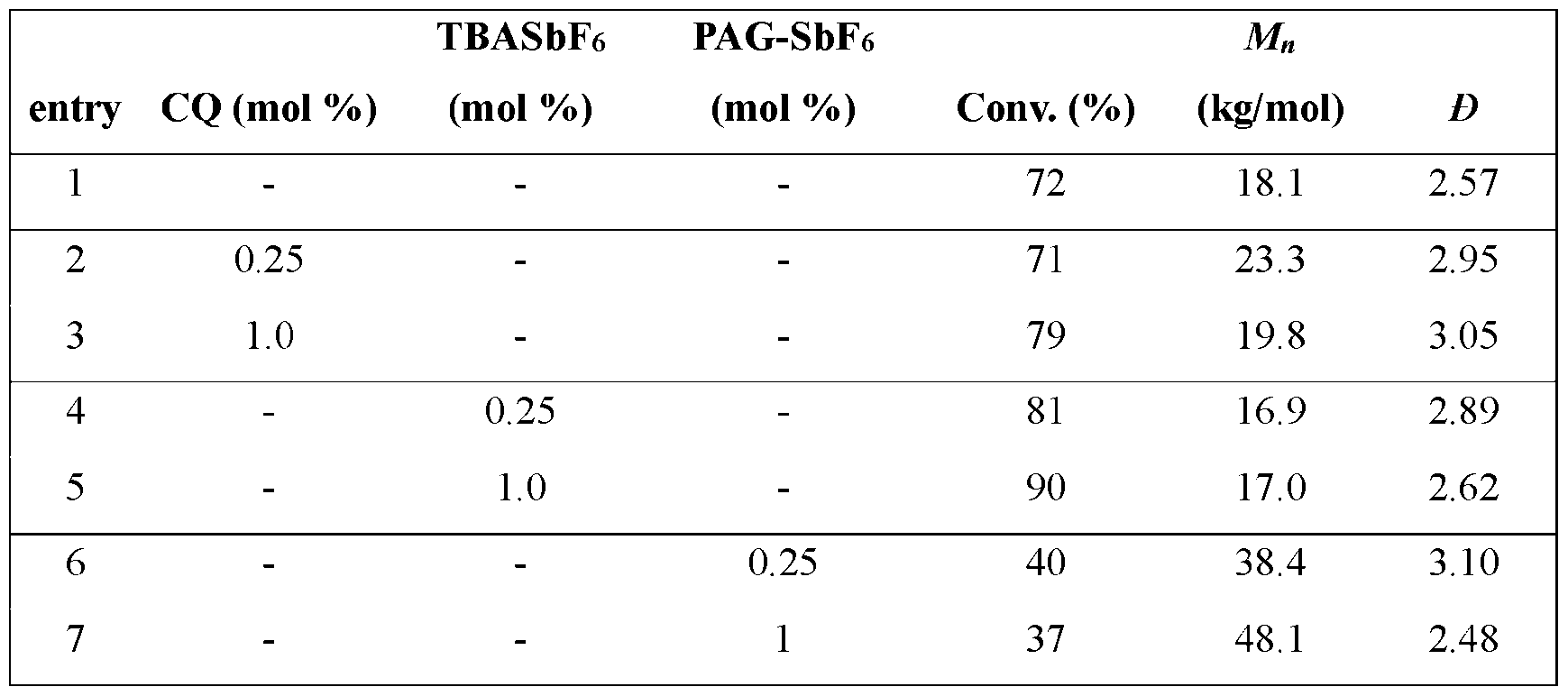 [0150] Table 3. Gel fractions DHF thermosets. Standard conditions are bolded.

[0151] In addition to being thermally recyclable, poly(r-DHF) rapidly and completely hydrolyzes in dilute acid, affording the isomers 4-hydroxybutanal and 2- hydroxy tetrahydrofuran, which can be dehydrated back to DHF (FIG. 4). Immersion of a heat-treated thermoset in 25 mM HC1 in THF for 16 hours at 40 °C resulted in 57% mass loss. The remaining material, now 34% of the original mass, was likely cross-linked poly(c- DHF) (FIG. 4, Table 5, Equation 1). The ’H-NMR spectrum of the supernatant showed the expected 4-hydroxybutanal and 2-hydroxytetrahydrofuran products (FIG. 20). FTIR analysis of the remaining thermoset supports the degradation of the poly(r-DHF) portions of the thermoset: the C-H stretch at 3097 cm'1, C=C band at 1689 cm'1, and C-0 stretch at 1203 cm' 1 associated with poly(r-DHF) all disappeared after hydrolysis. Additionally, the spectrum of the insoluble material remaining matches that of poly(c-DHF) (FIG. 30). Tensile testing of the residue showed a 12-fold increase in E and 2.6-fold decrease in toughness, consistent with the film being comprised of crosslinked low-A7n poly(c-DHF) (FIG. 31). It was considered that the degradability would be inversely proportional to the poly(c-DHF) content and crosslink density. Indeed, films made with low PAG concentrations, high G2 concentrations, and short irradiation times were the most acid-degradable (Table 1, Table 6). A film with 2
minutes of irradiation experienced 70% mass loss upon hydrolysis, while a fdm with 10 minutes of irradiation underwent a 40% decrease (Table 1, entries 2, 5).
[0152] Table 4. Data points used in the property comparison of DHF thermosets with commercial thermosets in FIG. 2C. Points included in the plot are bolded.
 [0153] Table 5. Degradation of thermosets via sequential thermal depolymerization and acid-catalyzed hydrolysis, a. Degradation is reported as mass loss (%). b. Distilled DHF reported in parentheses as wt% with respect to initial thermoset, c. Combined yield of 2- hydroxy tetrahydrofuran and 4-hydroxy butanal reported in parentheses as NMR yield with respect to cyclododecane internal standard.

[0154] Table 6. Degradation of thermosets from thermal recycling and tandem hydrolysis and oxidation, reported as mass loss (wt%). Combined hydrolytic and oxidative degradation was calculated according to Equation 1.

[0155] Equation 1:
 [0156] To degrade the poly(c-DHF) left behind after treatment with heat or acid. chemical oxidation was used. Fenton’s reagent accelerates the oxidative degradation of
dissolved poly(c-DHF), reducing a 50 kg/mol polymer to <1 kg/mol oligomers over 48 hours. When the same methodology was applied to pristine thermosets, complete solubilization was not observed due to the persistent crosslinks. Still, films lost a significant amount of mass through oxidation, -29 wt% on average (Table 1). When the same methodology was applied to acid-degraded thermoset residue, an average mass reduction of 26 wt% was still achieved (FIG. 4, Table 6). When applied in tandem with other degradation methods, a thermoset that had already undergone thermal depolymerization and acid hydrolysis was subject to oxidation, further reducing its mass by 15 wt% for a total mass loss of 71% (FIG. 4, Table 5, Equation 1). Taken together, these results demonstrate that degradation strategies can be used individually to selectively depolymerize DHF thermosets or in tandem to achieve greater recycling/degradation.
[0157] A challenge in post-consumer recycling is contamination from mixed waste streams, necessitating costly separation of polymer types prior to chemical treatment. Gentle thermal depolymerization can be leveraged in this context to depolymerize the material in a mixed waste stream. A DHF thermoset was combined with other commodity thermosets — including nitrile laboratory gloves, epoxy resin earrings, and polyurethane rubber shoe soles — and heated to 40 °C under vacuum (FIG. 4B). After 45 minutes, pristine DHF was recovered, matching the amount collected when this same thermoset was depolymerized on its own (FIG. 27). Thus, DHF can be recovered from mixed waste without contamination from dyes, plasticizers, and stabilizers in other commercial products.
[0158] Provided is a dual initiator platform for the modular photo-curing of thermosets from renewable monomer DHF through orthogonal polymerization mechanisms. Altering catalyst loading, reaction time, and irradiation area produces materials with a wide range of thermophysical properties and material domains in a single pot. Selective, sequential degradation of thermosets into small molecules was demonstrated, which can be repolymerized in a closed-loop process. Binary reactivity of simple building blocks was compatibilized to generate useful, complex structures. It is considered that this technology7 can push the boundaries of multimaterial 3D printing, eliminating the need for support structures in hollow prints and multiple resins/processes for unique domains.
[0159] Methods.
[0160] General Reagent Information. All polymerizations were set up using Schlenk technique or in a Unilab MBraun glovebox with a nitrogen atmosphere and irradiated with a blue Kessil lamp (PR160L 456 nm, 23 mW/cm2 at reaction surface) or a blue Thorlabs collimated LED (455 nm, 500 mW, 86 mW/cm2 at reaction surface) under a nitrogen
atmosphere outside the glovebox. Monomers dihydrofuran (DHF) (98%, TCI), isobutyl vinyl ether (IBVE) (99%, TCI), and cyclohexyl vinyl ether (CyVE) (98%, TCI) were dried over calcium hydride (CaTE) (ACROS organics, 93% extra pure, 0-2 mm grain size) overnight, distilled under vacuum, degassed by 3 freeze-pump-thaw cycles, and then stored in the glovebox freezer (-35 °C). Grubbs catalyst 2nd generation (G2) (99.9%, Umicore), (±) camphorquinone (CQ) (98%, TCI), [4-(octyloxy)phenyl]phenyliodonium hexafluoroantimonate (PAG) (95%. AstaTech). tricyclohexylphosphine (PCy?) (96%. VWR) were dried under vacuum and stored in the glovebox. Tetrabut l ammonium hexafluoroantimonate (TBASbFe) was prepared according to known procedure. Tetrahydrofuran (THF) was purchased from J.T. Baker and purified with vigorous purging with argon for 2 hours, followed by passing through two packed columns of neutral alumina under argon gas on the J.C. Meyer solvent system. All other reagents were purchased from commercial vendors and used as received. Silicone molds (2.5 cm x 2.5 cm) were purchased on Amazon and used as received.
[0161] General Analytical Information. Nuclear Magnetic Resonance (NMR) Spectroscopy. NMR spectra were recorded on a Varian 400 MHz or a Bruker 500 MHz instrument. 'H NMR were carried out coupled and referenced to the CDCh chemical shift at 7.26 ppm.
[0162] Gel Permeation Chromatography (GPC). Polymer samples were analyzed using a Tosoh Ecosec HLC 8320 GPC system with two Super HM-M columns in series at a flow rate of 0.350 mL/min. THF was used as the eluent. Number-average molecular weights (MJ and dispersities (£>) were calculated from refractive index chromatograms against TSK gel polystyrene standards.
[0163] Fourier Transform Infrared (FTIR) Spectroscopy. FTIR spectra were collected on a Bruker Tensor II IR spectrometer with a diamond attenuated total reflectance (ATR) attachment.
[0164] Thermogravimetric Analysis (TGA). TGA was performed using a TA Instruments Q500. Samples were heated at a rate of 20 °C/min from 25 °C to 600 °C.
[0165] Differential Scanning Calorimetry (DSC). DSC was performed using a TA Instruments Q1000. Samples were placed in T-zero aluminum pans and heated to 200 °C at 10 °C/min to erase thermal history, cooled to -50 °C at a rate of 5 °C/min, and re-heated to 200 °C at 10 °C/min, during which thermal data was collected.
|0166] Gel Fraction Measurements: Thermosets were dried in a vacuum oven overnight at 40 °C before being massed into 1-dram vials. The samples were swollen in toluene (2 mL)
for 24 hours, after which the supernatant was removed. The residual solids were dried in a vacuum oven at 70 °C for 16 hours and weighed again. Swelling tests were performed in duplicate and the data were averaged. Gel fractions were calculated with the following equation:
 where Wo and W, are the masses before and after the swelling tests, respectively.
[0167] Tensile Testing. Uniaxial tensile testing and cyclic testing studies were performed using a Shimadzu Autograph AGS-X tensile tester with pneumatic grips and 500 N load cell. All cross-linked films were cut into three strips [5.0 mm (W) x 1.5 mm (T) x 20 mm (L)] with gauge lengths measured from grip to grip. For tensile testing, film strips were elongated at 22 mm/min until break. For cyclic testing, a cyclic loading of 20% strain at 20 mm/min was applied for 10 cycles. Data analysis was performed using TrapeziumX v. 1.5.1 software. Young's modulus (£) was calculated using the slope of the linear elastic region at low strain, and toughness was calculated using the area under the stress-strain curve.
[0168] Synthesis, Depolymerization, and Product Characterization. Detailed procedures and characterization (spectra, chromatograms, etc.) for synthesis and degradation of polymers are provided below.
|0169] Preparation and Characterization of DHF Thermoplastics.
[0170] General Procedure for ROMP of DHF: G2 (1.1 mg, 1.3 pmol, 0.1 mol %), PAG (8.5 mg, 13 pmol, 1 mol %), and CQ (2.2 mg, 13 pmol, 1 mol %) were combined in a 1-dram vial wrapped in foil and dried under vacuum. Then, the vial was charged and backfilled with N2 3 times. DHF (0.1 mL, 1.3 mmol) was added to the vial, and the polymerization proceeded for 1, 2, 5, or 10 minutes before being quenched for GPC and 'H-NMR. For GPC, the polymerization was quenched by dissolution into 40 mM PCys in THF. For NMR, the polymerization was quenched by dissolution into 40 mM PCys in CDCh. Conversion was calculated by comparing the integrals of the monomer peak at 4.92 ppm with the polymer peaks at 6.05-5.97 ppm and 4.78-4.66 ppm. which are the cis and trans olefins in the backbone.
[0171] Removal of G2 and isolation of poly(r-DHF) via oxidation of the chain end was performed according to the procedure reported by Feist and Xia.
[0172] Poly
 6.25 (m, 1H), 6.05-5.97 (m, 1H), 4.78-4.66 (m. 1H), 4.42-4.30 (m, 1H). 3.75-3.55 (m, 4H), 2.46-2.34 (m, 2H), 2.28-2.19 (m, 2H).
[0173] General Procedure for Photo-Initiated Cationic Polymerization of DHF: A dram vial was charged with CQ (2.2 mg, 13 pmol, 0.5 mol %) and PAG (8.5 mg, 13 pmol, 0.5 mol %). wrapped with foil, and dried under vacuum. Then vial was charged and backfilled with N2 3 times before DHF (0.2 mL. 2.6 mmol) was added to the vial. The foil was removed and the vial was irradiated for 1, 2, 5, or 10 minutes before being quenched for GPC and H-NMR with 5% NEt3 in MeOH. Conversion was calculated by comparing the integrals of the monomer peak at 6.32 ppm (1H) with the polymer peak at 4.25-3.52 ppm (3H). Poly(c-DHF) 'H NMR (500 MHz, CDCh) 5 4.5-3.52 (3H), 2.87-1.59 (3H).
[0174] Preparation and Characterization of DHF Thermosets.
|0175] General Procedure for Dual ROMP - Cationic Polymerizations of DHF: Inside a nitrogen-filled glovebox, G2 (9.0 mg, 11 pmol, 0.1 mol %), PAG (34 mg, 53 pmol, 0.5 mol %). and CQ (8.8 mg. 53 pmol. 0.5 mol %) were combined in a silicone mold (2.5 x 2.5 cm). DHF (0.8 mL, 11 mmol) was added, and the reaction solution was mixed until homogenous. Within 1 minute, the mixture became gelled. The mold was capped with a petri dish and covered in foil for 10 minutes. The mold and petri dish were removed from the glovebox and irradiated with a Kessil lamp (456 nm. 25% light intensity) while standing in a water bath with air cooling to prevent overheating. After 6 minutes of irradiation, the reaction was opened to air, quenched with 5% NEts in MeOH (0.2 mL) and 40 mM PCys in THF (0.5 mL). The fdms were removed from the mold and dried overnight open to air before any subsequent testing.
[0176] General Procedure for Crosslinking of Isolated Poly(r-DHF): Inside a nitrogen- filled glovebox, isolated poly (r -DHF) (0.74 g, 11 mmol DHF units), PAG (34 mg, 53 pmol, 0.5 mol%), and CQ (8.8 mg, 53 pmol, 0.5 mol %) were dissolved in DCM in a 20 mL vial covered in foil. The solution was poured into a silicone mold (2.5 x 2.5 cm). The mold was capped with a petri dish, removed from the glovebox, and irradiated with a Kessil lamp (456 nm, 25% light intensity) while standing in a water bath with air cooling to prevent overheating. After 6 minutes of irradiation, the reaction was opened to air, quenched with 5% NEts in MeOH (0.2 mL) and 40 mM PCys in THF (0.5 mL). The films were removed from the mold and dried overnight open to air before any subsequent testing.
|0177] General Procedure for Crosslinking of Isolated Poly(r-DHF) with Exogenous Monomer: Isolated poly(r-DHF) (0.2 g, 2.9 mmol DHF units) was dissolved in DCM and
cast into a film inside a silicone mold (2.5 x 2.5 cm). The film was dried inside a vacuum oven overnight and transferred into a nitrogen-filled glovebox. PAG (34 mg, 53 pmol). and CQ (8.8 mg, 53 pmol) were dissolved in isobutyl vinyl ether (IBVE, 0.58 mL, 4.5 mmol,) or butanediol vinyl ether (BDVE, 0.58 mL, 3.7 mmol). The poly(r-DHF) film was swelled in this solution, capped in a petri dish, and removed from the glovebox. The swelled film was and irradiated with a Kessil lamp (456 nm, 25% light intensity) while standing in a water bath with air cooling to prevent overheating. After 6 minutes of irradiation, the reaction was opened to air, quenched with 5% NEts in MeOH (0.2 mL) and 40 rnM PCy? in TEIF (0.5 mL). The films were removed from the mold and dried overnight open to air before any subsequent testing.
[0178] Mechanical Characterization.
[0179] Spatial Control over Crosslinking
|0180] General Procedure for Photopatteming Thermosets: Inside a nitrogen-filled glovebox, G2 (9.0 mg, 11 pmol, 0.1 mol %), PAG (34 mg, 53 pmol, 0.5 mol %), and CQ (8.8 mg, 53 pmol, 0.5 mol %) were combined in a silicone mold (2.5 x 2.5 cm). DHF (0.8 mL, 11 mmol) was added, and the reaction solution was mixed until homogenous. Within 1 minute, the mixture became gelled. The mold was capped with a petri dish and covered in foil. The mold and petri dish were removed from the glovebox and irradiated through a photomask with a blue Thorlabs collimated LED (455 nm, 500 mW, 9. 1 mW/cm2) equipped with two convex lenses to focus light in a pattern onto the polymer film. After 6 minutes of irradiation, the reaction was opened to air, quenched with 5% NEt?, in MeOH (0.2 mL) and 40 mM PCys in THF (0.5 mL). The film was removed from the mold and dried overnight open to air. Over this time, portions of the film that had not been irradiated darkened considerably or depolymerized to a brown goo, which was then washed away with solvent.
[0181] Depolymerization of DHF Thermosets.
|0182] General Procedure for Thermal Depolymerization: A freshly made thermoset, without quenching, was massed into a round bottom flask. The flask was fitted onto a short path distillation apparatus, and vacuum was pulled to -100 mTorr prior to submerging the sample flask into a 40 °C oil bath and the receiving flask into a -78 °C cooling bath. The distillation proceeded for 45 minutes, over which time the thermoset darkened in color and a clear distillate was collected.
[0183] Recovered DHF
 NMR (500 MHz, CDCh) 5 6.32 (d, 1H, J = 2.48 Hz), 4.95 (d, 1H. J = 2.59 Hz), 4.30 (t, 2H, J = 9.55 Hz), 2.60 (dt. 2H, J = 2.40. 9.55 Hz).
[0184] Procedure for Acid Hydrolysis: A vacuum-dried thermoset (10-40 mg) was added to a dram vial and swollen with 25 mM HC1 and 135 mM H2O in THF (2 mL) at 40 °C for 16 h. The supernatant was removed, and the residual solids were dried in a vacuum oven at 40 °C overnight before measuring the final mass.
10185] Procedure for Accelerated Oxidative Depolymerization: Vacuum-dried hydrolysis residue (10 mg, 0. 14 mmol DHF units, 1 eq)) was added to a dram vial and swollen with DCM (1 mL) for 30 minutes. 30 wt% H2O2 in water (1 mL. 9.8 mmol, 68.7 eq) was added, followed by (NH4)2Fe(SO4)2* H2O (11.2 mg, 29 pmol, 0.1 eq). The vial was quickly capped with a septum, pierced with a needle, and stirred rapidly at room temperature for 48 h. The mixture appeared red-brown and faded to a faint, transparent yellow over the course of the reaction. After 48 h, the supernatant was removed, and the solids were dried in a vacuum oven at 70 °C overnight before weighing.
EXAMPLE 2
|0186] This example provides examples of thermoset materials of the present disclosure, and methods of making and using same.
[0187] Methods for making degradable thermoset materials from 2,3 -dihydrofuran (DHF) using different atmosphere, ROMP catalysts, and cationically polymerizable comonomers as well as their resulting materials were demonstrated. The thermoset materials were prepared as described in EXAMPLE 1.
[0188] Linear vinyl ether (VE) co-monomers were included in the original resin to provide different mechanical properties, as (1) linear VEs act as chain transfer agents to regulate the chain grow th ROMP process and (2) the cationic polymerization of linear VEs results in polymers with lower glass transition temperatures (Tgs) than poly(c-DHF). The inclusion of monofunctional linear VEs resulted in thermosets with lower Young’s Moduli and toughness than the all-DHF thermosets (FIG. 37). Difunctional linear VEs act as crosslinking comonomers to form crosslinking groups (e.g., CLG2) during the second polymerization, and the resulting thermosets display comparable tensile properties to the original thermoset (FIG. 38).
[0189] When using dried/distilled reagents, thermosets were made entirely open to air, retaining the same qualities as those made under nitrogen (FIG. 36). Kinetic analysis of the first polymerization (ROMP) catalyzed by Grubbs G2 under air revealed a slightly slower rate of conversion of DHF to poly(r-DHF) and lower molecular weights (ALs) throughout the polymerization. However, by 10 minutes, the conversion and AL equilibrated to the same
values as those when the polymerization is run under air (FIG. 39). Alternative catalysts were used, such as, for example, the Hoveyda Grubbs Gen. 1 and Gen. 2 catalysts (HG1 and HG2). When run under air, the ROMP of DHF by HG1 showed a faster initial rate of polymerization than G2, but this rate plateaus around 5 minutes. HG1 also shows slower growth of molecular weight, since the kt is more closely matched to kp for HG1 (FIG. 40). With HG2 as catalyst, the ROMP of DHF shows more similar conversion kinetics as G2, but similar molecular weight behavior to HG1 (FIG. 41). The difference in kinetics and molecular weight grow th compared to G2 would be another way to tune the properties of DHF thermosets.
[0190] Table 7. VEs act as chain transfer agents during ROMP, yielding smaller poly(r- DHF) chains.
PAG (0.5 eq) CQ(0 5 eq)

 EXAMPLE 3
[0191] This example provides examples of thermoset materials of the present disclosure, and methods of making and using same.
[0192] Methods for making degradable thermosets from 2,3-dihydrofuran (DHF) using acid-degradable comonomers for the cationic cross-linking polymerization or an acid- activated Grubbs catalyst and buffering salt to render the entire process (polymerizations 1 and 2) photo-initiated were demonstrated. Provided are data describing the thermoset properties with material aging, as well as a process for the degradation and removal of the Grubbs catalyst from the thermosets and the properties of the resulting materials.
[0193] To impart full acid degradability to the thermosets, it is desirable to install an acid-degradable unit into the backbone of the crosslinking group (e.g., CLG1) that results from the cationic polymerization of through the backbone of poly(r-DHF).
10194] First, whether cyclic acetals could copolymerize cationically with DHF and whether the resulting copolymer was acid degradable was explored. Monomers 5-(p- methoxy phenyl)- 1,3 -di oxane (PMP-DOX) and 5-phenyl-l,3-dioxane (Ph-DOX) were synthesized according to literature procedures, and evaluated alongside the commercially available 2, 2, -dimethyl- 1,3 -dioxolane (DiMe-DOL). These co-monomers were combined with var ing amounts of DHF and constant amount of PAG and CQ, and irradiated for 6 minutes. The resulting polymers were subject to acid hydrolysis in THF, and aliquots were taken over the course of 16 hours to monitor molecular weight changes via gel permeation chromatography (GPC). The resulting GPC traces show that of the three monomers, PMP- DOX co-polymerized the best (minimizing chain transfer) and therefore resulted in the most efficient hydrolysis (FIG. 42).
[0195] A ratio of 250 equiv. DHF to 10 equiv. PMP-DOX was chosen for thermosetting as this minimized the amount of co-monomer required while maximizing the degradation. Using this monomer mixture, thermosets were fabricated with 1 min ROMP and 6 min irradiation. Tensile curves show that properties are largely maintained when compared to thermosets without PMP-DOX (FIG. 43, Table 8). Furthermore, thermosets made with PMP- DOX exhibit full acid degradability7 (Table 8). While other co-monomers still need to be explored, these experiments are proof-of-concept that DHF thermosets can be fully acid- degradable when an acid-sensitive co-monomer is incorporated into the thermosetting resin. [0196] As latent ROMP catalysts are commercially available, development of a system to temporally separate photo-initiated ROMP and cationic polymerizations was sought.
Specifically, whether an acid-latent Grubb’s catalyst could be activated by a photoacid generator (PAG) was investigated. To temporally separate ROMP and cationic polymerizations, it was envisioned that a PAG with a weakly coordinating anion (SbF ') could be combined with a salt photobuffer (PB) containing a more coordinating anion (Cl’) and the latent Grubbs catalyst. Upon light exposure, any protons generated from the PAG would combine with Cl", delaying cationic polymerization. The resulting HC1 would activate the Grubbs catalyst, initiating ROMP. Upon saturation of CP with protons at longer light exposure, HSbFr, would form and initiate cationic polymerization (FIG. 44, FIG. 45). [0197] To explore the feasibility of this approach, LatMet was chosen as an HCl-latent catalyst, tetrabutylammonium chloride (TBAC1) as a PB, and monomers cyclooctene (COE) and cyclohexene oxide (CHO), which are active for ROMP and cationic polymerization, respectively. These components were mixed with a blue-light active photoiniator system (PAG, camphorquinone (CQ), 4-ethyl-dimethylaminobenzoate (EDMAB)). Mixtures with different amounts of TBAC1 were irradiated for 16 hours, and aliquots were taken throughout the polymerizations to monitor monomer conversion (FIG. 46). Results showed that 3.5 equiv TBAC1 were sufficient to temporally separate the ROMP of COE and cationic polymerization of CHO. It is expected that this catalyst/TBACl system will be applicable for enabling full photolatency for DHF thermosetting.
[0198] To ensure that thermoset properties are maintained over time, two DHF thermosets were synthesized and quenched one with the usual PCy? in THF and NEts in MeOH solutions and the other in those solutions with added Irganox (an antioxidant). Tensile tests were conducted after 1 week and 1 month, displaying that the Young’s Moduli and toughness slightly increase over time, with no difference betw een the thermosets containing or lacking Irganox.
[0199] How a multi-functional ROMP co-monomer would impact the material properties of DHF thermoset was also explored. Dicyclopentadiene (DCPD) is a common ROMP crosslinking monomer, containing two cyclic alkenes which are each polymerizable. DHF thermosets were made with 2-10 mol% DCPD as comonomer, which created additional crosslinking groups (CLG2) in the material. Tensile tests of the thermosets showed that increasing DCPD let to increased Young’s Moduli and stress-at-break, but lower strain-at- break, resulting in maintained toughness for all thermosets. Thus, ROMP crosslinkers can be included in DHF thermosets to modulate tensile properties within the same toughness regime. |0200] Finally, a method was developed to degrade and remove the Grubbs catalyst from DHF thermosets. In these materials, Grubbs G2 is an end group of the poly(r-DHF) units,
resulting in a red-brown color of the thermosets. The only reported method to remove G2 is to oxidize it off the chain end, but oxidation will also degrade the poly(c-DHF) crosslinking groups (e.g., CLG1). Amine-mediated degradation was used as a way to remove the catalyst without interfering with any of the polymer chains in the thermoset. A DHF thermoset was immersed in THF with tricyclohexylphosphine (PCy?) and n-buty lamine (FbNBu). Immediately, the material turned a green color, characteristic of amine coordination to the catalyst. After swelling in this solution overnight, the material was colorless, indicating successful break down and removal of the catalyst (FIG. 49). Evaluation of this material revealed increased thermal degradation temperature, Young’s Modulus, and toughness compared to the starting thermoset (FIG. 50). Acid degradation of this material also revealed that the degradability was conserved compared to the original thermoset (FIG. 51). Therefore, amine-mediated degradation is an effective way to remove the Grubbs catalyst from DHF thermosets without sacrificing material properties.
[0201] Synthesis of Cyclic Acetal Comonomers.
[0202] Cyclic monomers other than 2,2-dimethyl dioxolane (DiMe-DOL) were synthesized by the condensation reaction of the appropriate aldehyde and diol. The following is a typical procedure, using 5 -phenyl- 1,3 -dioxane (Ph-DOX) as an example:
[0203] Benzaldehyde (15 mL, 0.15 mol, 1 eq), propane-1, 3-diol (13 mL, 0.18 mol, 1.2 eq), and jC-toluenesulfonic acid monohydrate (100 mg, 0.53 mmol, 0.0036 eq) were dissolved in benzene (15 mL) in a round-bottom flask with a Dean-Stark trap. The mixture was stirred at 120 °C for 6 hours. The reaction mixture was added to 30 mL sat. NaHCCL, washed with water and brine, dried over anhydrous MgSCL, and concentrated under reduced pressure. To remove the aldehyde starting material, the crude product was dissolved in MeOH (40 mL) and combined with saturated NaHSCE (60 mL) in a separatory funnel. The mixture was shaken vigorously for 30 seconds and diluted with H2O (-200 mL) until the aqueous and organic layers separated. The product was extracted with 10% ethyl acetate in hexanes (40 mL), dried over MgSCL. and concentrated under reduced pressure. This process w as repeated until all starting aldehyde had been removed. The product crystallized after resting on the benchtop for -1-2 days and was washed with cold methanol to yield Ph-DOX as a transparent crystalline solid (14.8 g, 0.09 mol, 61% yield). 'H-NMR spectrum matched literature reports.
2-(4-Methoxyphenyl)-l ,3-dioxane (PMP-DOX).
[0204] Synthesized from p-methoxybenzaldehyde (22 g, 0.16 mo!) and propane-1, 3-diol (14 mL, 0.20 mol, 1.2 eq). Final yield after crystallization: 16% 'H NMR spectrum matched literature reports.
[0205] Incorporation of Co-Monomers for Cationic Polymerization. General Procedure for Preparation of Co-Polymers via Photopolymerization.
[0206] Inside a nitrogen-filled glovebox, cyclic acetal (65 pmol, 10 eq) was dissolved in DHF (0.12 ml, 1.6 mmol, 250 eq). The monomer solution was added to a vial containing PAG-SbFe (4.2 mg, 6.5 pmol, 1 eq) and CQ (1.1 mg, 6.5 pmol, 1 eq). Tire vial sealed with a rubber septum, transferred out of the glovebox, and irradiated with a blue Kessil lamp (456 nm, 25% light intensity, 15 cm distance) for 6 minutes. Polymenzations were quenched with 5% NEts in MeOH (0.02 mL) and analyzed by GPC.
[0207] General Procedure for Preparation of Thermosets Containing Co-Monomer. Inside a nitrogen-filled glovebox, G2 (8.0 mg, 9.4 pmol, 0.1 mol% w.r.t. DHF), PAG (24 mg. 38 pmol, 0.4 mol%), CQ (6.3 mg, 38 pmol. 0.4 mol%), and cyclic acetal (0.38 mmol, 40 mol%) were combined in a silicone mold (2.5 x 2.5 cm). DHF (0.71 mL, 9.4 mmol) was added, and the reaction solution was mixed until homogenous. The mold was capped with a petri dish and covered in foil for 1 minutes. The mold and petri dish w ere removed from the glovebox and irradiated with a Kessil lamp (456 nm, 25% light intensity, 15 cm distance) while standing in a water bath with air cooling to prevent overheating. After 6 minutes of irradiation, the reaction was opened to air, quenched with 5% NEt3 in MeOH (0.2 mL) and 40 mM PCy3 in THF (0.5 mL). The films were removed from the mold and dried overnight open to air before any subsequent testing.
[0208] Incorporation of Co-Monomers for ROMP. General Procedure for Preparation of Thermosets Containing Co-Monomer. Inside a nitrogen-filled glovebox, G2 (8.0 mg, 9.4 pmol, 1 eq), PAG (30 mg, 47 pmol, 5 eq), and CQ (7.8 mg, 47 pmol, 5 eq) were combined in a silicone mold (2.5 x 2.5 cm). In a separate vial, DHF (0.90 mL, 11.8 mmol) and di cyclopentadiene (DCPD) (32 pL, 0.24 mmol) were combined. 7.3 mL of this solution (containing 9.2 mmol DHF and 0. 19 mmol DCPD) was added to the mold, and the reaction solution was mixed until homogenous. The mold was capped with a petri dish and covered in foil for 10 minutes. The mold and petri dish were removed from the glovebox and irradiated with a Kessil lamp (456 nm, 25% light intensity, 15 cm distance) while standing in a water bath with air cooling to prevent overheating. After 6 minutes of irradiation, the reaction was opened to air, quenched with 5% NEt3 in MeOH (0.2 mL) and 40 mM PCy3 in THF (0.5 mL). The films were removed from the mold and dried overnight open to air before any subsequent testing.
|0209] Removal of Grubbs G2 Catalyst from Thermosets. General Procedure for Degradation and Removal of G2 from Thermoset Films. A 50 mg strip of thermoset was
immersed in 40 mM PCys and 40 mM /7-butylamine in THF (2 mL). Upon immersion, the thermoset turned green, indicating amine complexation to the Ru catalyst. After swelling overnight, the supernatant had turned green and was removed, leaving behind a clear film. The thermoset was neutralized by swelling in 40 mM HC1 in THF for 15 mins and dried under vacuum overnight prior to subsequent testing.
[0210] Photo-switching ROMP and Cationic Polymerizations. General Procedure for Temporal Separation of ROMP and Cationic Polymerizations. LatMet (3.0 mg. 3.6 pmol, 1 eq), PAG-SbFe (9.3 mg, 14 pmol, 4 eq), CQ (2.4 mg, 15 pmol, 4 eq), ethyl-4- (dimethylamino)benzoate (2.8 mg, 14 pmol, 4 eq), and tetrabutylammonium chloride (3.5 mg, 13 pmol, 3.5 eq) were massed into a dram vial. The vial was cycled with N2 and vacuum three times before (Z)-cyclooctene (47 pL, 0.36 mmol, 100 eq) and cyclohexene oxide (37 pL, 0.36 mmol, 100 eq) were added to the vial. The vial was irradiated by a Kessil lamp (456 nm, 25% light intensity, 15 cm distance) overnight. Aliquots were taken at 0.16, 0.33, 1, 2, 3, 4, and 16 hours and were quenched with 0.02 mL ethyl vinyl ether and 0.02 mL 5% NEL in MeOH before NMR analysis.
[0211] Table 8. Incorporation of PMP-DOX comonomer into DHF thermosets maintains mechanical properties and enables full acid degradability.

[0212] Although the present disclosure has been described with respect to one or more particular embodiments and/or examples, it will be understood that other embodiments and/or examples of the present disclosure may be made without departing from the scope of the present disclosure.
Claims
1. A thermoset material comprising a plurality of polymeric groups comprising the following structure:
 wherein R is independently an aliphatic or an aromatic group, or a structural analog thereof; and a plurality of crosslinking groups, wherein the crosslinking groups are independently covalently bonded to the backbone of a polymeric group or the backbones of two different polymeric groups and are at least partially formed from the same monomer(s) used to form the polymeric groups.
2. The thermoset material of claim 1, wherein the thermoset material comprises the following structure:

CLG1 is a crosslinking group independently covalently bonded to the backbone of a polymeric group or the backbones of two different polymeric groups and is formed from the same monomer(s) used to form the polymeric groups,
CLG2 is a crosslinking group independently covalently bonded to the backbone of a polymeric group or the backbones of two different polymeric groups and is formed from a different monomer or different monomers than those used to form the polymeric groups, PG is a polymeric group. x is 1 to 1,000,000, a is 1 to 500,000, y is 1 to 1,000,000, and b is 0 to 500,000.
3. The thermoset material of claim 1, wherein the thermoset material comprises the following structure:
 , wherein
CLG is a crosslinking group independently covalently bonded to the backbone of a polymeric group or the backbones of two different polymeric groups and are formed from the same monomer(s) used to form the polymeric groups, PG is a polymeric group, and c is 1 to 1,000,000.
4. The thermoset material of claim 1, wherein the thermoset material comprises the following structure:
 , wherein
X1 is a first repeat unit of a polymeric group, X2 is a second repeat unit of a polymeric group.
CLG1 is a crosslinking group independently covalently bonded to the backbone of a polymeric group or the backbones of two different polymeric groups and are formed from the same monomer(s) used to form the polymeric groups,
CLG2 is a crosslinking group independently covalently bonded to the backbone of a polymeric group or the backbones of two different polymeric groups and are formed from a different monomer or different monomers than those used to form the polymeric groups, r is 0 to 1,000,000, s is 1 to 1,000,000. e is 1 to 500.000. t is 0 to 1,000,000, u is 0 to 1,000,000, and f is 1 to 500,000.
5. The thermoset material of claim 1, wherein one or more or all of the polymeric group(s) comprises or independently comprise the following structure:
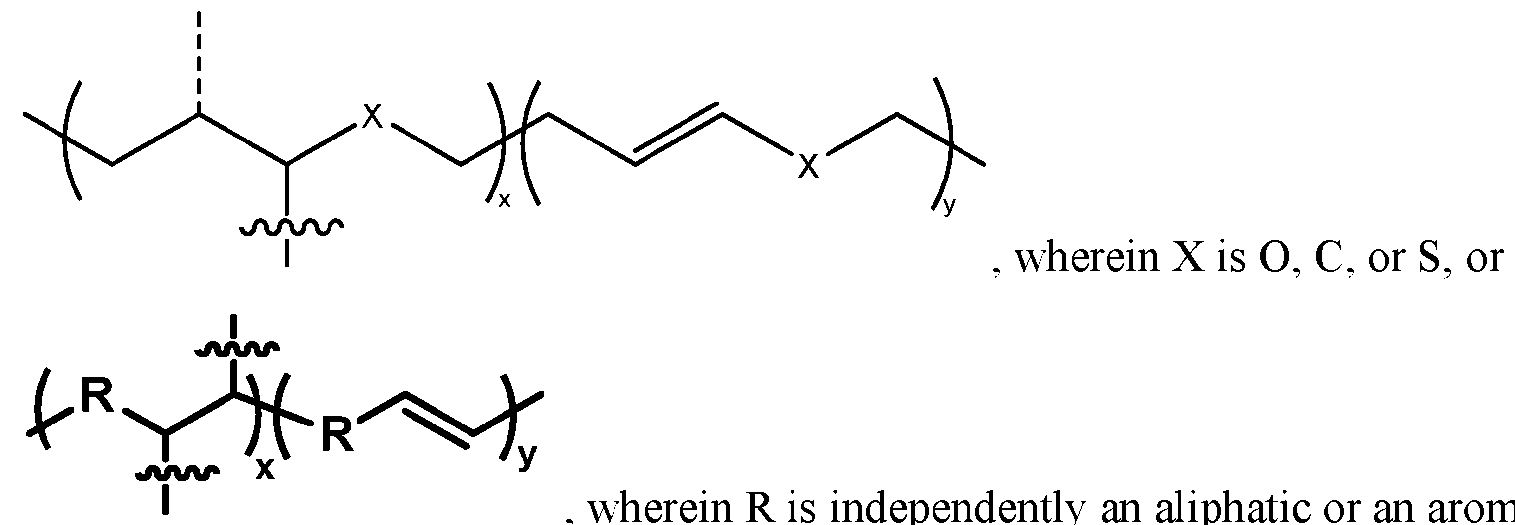 . p y p matic group, wherein x is 1 to 1,000,000, and y is 1 to 1,000,000, or a structural analog thereof, or any combination thereof.
6. The thermoset material of claim 1, wherein one or more or all of the crosslinking group(s) comprises or independently comprise the following structure:

 , wherein R is independently at each occurrence an aliphatic or an aromatic group and w is independently at each occurrence 1 to 1,000,000, or a structural analog thereof, or any combination thereof.
7. The thermoset material of claim 1, wherein the thermoset material further comprises one or more other crosslinking group(s).
8. The thermoset material of claim 7, wherein the one or more other crosslinking group(s) comprises or independently comprise the following structure:
 , wherein R is an aliphatic group

 . wherein R is an aliphatic group or an alkyl group;
 hyl group, X is O or N, and R is an aliphatic group or an aryl group;
 wherein R is an aliphatic group or an aryl group;
 , wherein R is an aliphatic
group or an aryl group;
 . wherein Z is O or S and R is an aliphatic group or an ary l group;
 , wherein Z is O or S and R is an aliphatic group or an ary l group;
 , wherein Y is O, C, or S and R is independently at each occurrence an aliphatic group or an aryl group, wherein p is 1 to 500,000, and q is 1 to 500,000, or a structural analog thereof, or any7 combination thereof.
9. The thermoset material of claim 1, wherein the thermoset material is in the form of a monolith, a powder, a fiber, or a film.
10. The thermoset material of claim 1, wherein the thermoset material or at least a portion thereof is at least partially, substantially, or completely degradable.
11. The thermoset material of claim 1, wherein the thermoset material exhibits one or more or all of the following: a strain-at-break of about 0.5% to about 10,000; an ultimate tensile strength of about 0.001 MPa to about 350 MPa; a Young’s Modulus of about 0.01 MPa to about 5 GPa; a toughness of about 0.01 MPa to about 5 GPa; a decomposition temperature (Td,io%) of about 250 °C to about 650 °C; a dielectric constant of about 1 to about 40, including all 0. 1 values and ranges therebetween; a water absorption of 0.01% (by weight based on the total weight of the thermoset material) to about 600%;
an acid degradability of about 0% to 100%; an oxidative degradability of about 0% to about 100%; or a recyclability to monomer of about 0% to about 95%.
12. A method of making a thermoset material comprising a first polymerization of one or more first monomer(s), wherein the first polymerization forms one or more or a plurality of polymeric group(s). and a second polymerization of one or more first monomer(s), wherein the second polymerization forms one or more or a plurality of crosslinking groups and the crosslinking groups are independently covalently bonded to the backbone of a polymeric group or two different polymeric groups and are formed from the same monomer(s) used to form the polymeric groups, wherein the thermoset material is formed.
13. The method of claim 12, wherein the first polymerization comprises irradiating with a first electromagnetic radiation or a heating to a first temperature a reaction mixture comprising the first monomer(s) to initiate the first polymerization and/or the second polymerization comprises irradiating with a second electromagnetic radiation or a heating the reaction mixture to a second temperature to initiate the second polymerization.
14. The method of claim 12, wherein the first polymerization is carried out such that a desired degree of polymerization is realized prior to initiation of the second polymerization.
15. The method of claim 12, wherein the first polymerization is chosen from a ring opening metathesis polymerizations (ROMPs), acyclic diene metathesis (ADMET) polymerizations and the second polymerization is chosen from cationic polymerizations, radical polymerizations, and the like.
16. The method of claim 12, wherein
(i) the first polymerization is athermal or photochemical ROMP polymerization and the second polymerization is a thermal or photochemical cationic polymerization;
(ii) the first polymerization is a thermal or photochemical ROMP polymerization and the second polymerization is a thermal or photochemical radical polymerization;
(iii) the first polymerization is a thermal or photochemical ADMET polymerization and the second polymerization is a thermal or photochemical cationic polymerization; or
(iv) the first polymerization is a thermal or photochemical ADMET polymerization and the second polymerization is a thermal or photochemical radical polymerization.
17. The method of claim 12, wherein the first polymerization and the second polymerization are carried out in a single reaction vessel and the first momomer(s) are present in the single reaction vessel when the first polymerization is initiated.
18. The method of claim 12, wherein at least a portion or all of the first polymerization is carried out prior to initiation of the second polymerization.
19. The method of claim 12, wherein the first polymerization and the second polymerization are carried out without isolation of an intermediate poly mer product.
20. The method of claim 12, wherein the first monomer(s) is/are independently chosen from cyclic alkene monomers, acyclic diene monomers, and any combination thereof.
21. The method of claim 20, wherein the cyclic alkene monomer(s) independently comprise(s) the following structure:
 , wherein Z is independently for each first monomer O or S, or a substituted analog thereof, and/or the acyclic diene monomer(s) independently comprise(s) the following structure:
 , wherein R is independently for each first monomer an aliphatic group, an aryl group, or a substituted analog thereof.
22. The method of claim 12, wherein the first polymerization further comprises polymerization of one or more comonomer(s).
23. The method of claim 22, wherein the comonomer(s) is/are independently chosen from the following:
 , wherein R2 is chosen from H and aliphatic groups and R3 is chosen from aliphatic groups and and groups;
 , wherein each R4 is independently at each occurrence chosen from H and aliphatic groups;
 wherein R5 is chosen from aliphatic groups and R6 is optional and each R6 is independently at each occurrence chosen from aliphatic groups and aryl groups and x is 1. 2. 3, 4. or 5;
 , wherein X is O or S, Y is C or Si, and R7 and each R8 are independently chosen from H, aliphatic groups, and an groups;
 , wherein R9 is chosen from H, aliphatic groups, and aryl groups;
 wherein R10 is chosen from H, aliphatic groups, and aryl groups;
 , wherein each R11 is independently at each occurrence chosen from H, aliphatic groups, and aryl groups;
, wherein R12is chosen from aliphatic groups and ary l groups;
 u , A is C or O and each R is independently at each occurrence chosen from H and aliphatic groups;
 , wherein each Y is independently at each occurrence
O, C, or S and n is 1, 2, 3, or 4;
 , wherein each Z is independently at each occurrence O or S and each R14 is independently at each occurrence chosen from H, aliphatic groups, and aryl groups;
 wherein each R15 is
 independently at each occurrence chosen from H, aliphatic groups, and aryl groups;
 , wherein each A is independently at each occurrence C or O and R16 is chosen from aliphatic groups and aryl groups; g
 . , y
 i r19 , wherein each R19 is independently at each occurrence chosen from aliphatic groups and ary l groups

 , wherein R20 and each R21 independently at each occurrence is chosen from aliphatic groups and aryl groups;
 wherein R22 and each R23 independently at each occurrence is chosen from aliphatic groups
HS^ 24SH and aryl groups and each X is independently at each occurrence O or N; R
 wherein R24 is chosen from aliphatic groups and aryl groups; yr25 , wherein Y is O, C, or

S and R25 is chosen from aliphatic groups and aryl groups;
 , wherein Z is O or S;
Z
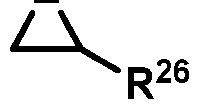 , wherein Z is O or S and R26 is chosen from aliphatic groups and ar l groups;
 , wherein each Y is independently at each occurrence O, C, or S and each R27 is independently at each occurrence chosen from aliphatic groups and aryl groups; wherein R28 is chosen from H, aliphatic groups, and aryl groups;
 , wherein each Y is independently at each occurrence O, C, or S and R29 is
Z Z^ chosen from aliphatic groups and aryl groups; r3° , wherein each Z is independently at each occurrence O or S and R30 is chosen from aliphatic groups and aryl groups;
 , wherein each Z is independently at each occurrence O or
S and R is chosen from aliphatic groups and aryl groups;
 wherein each Y is independently at each occurrence O, C, or S and R32 and each R33 independently at each occurrence is chosen from aliphatic groups and aryl groups, and structural analogs thereof.
24. The method of claim 12, wherein the first monomer(s) is/are present (independently or in the aggregate) at about 5% (by weight based on the total weight of the monomer(s) and solvent(s), if present) to about 100%.
25. The method of claim 12, wherein the comonomers(s) is/are present (independently or in the aggregate) at about 0% to about 95% (by weight based on the total weight of the monomer(s), comonomer(s), and solvent(s), if present).
26. The method of claim 12, wherein the first monomer(s) and, optionally, the comonomer(s) are present at the initiation of the first polymerization and/or the first monomer(s) are present at the initiation of the second polymerization.
27. The method of claim 12, wherein, in the case where a solvent or solvent(s) are present in the first polymerization and/or the second polymerization, the thermoset material is a hydrogel.
28. The method of claim 12, wherein in the first polymerization and/or the second polymerization is/are carried out to form the thermoset material in a pre-determined pattern, shape, or form.
29. The method of claim 12, in the case where the thermoset material comprises one or more carbon-carbon double bonds, the method further comprising hydrogenation of at least a portion, substantially all, or all the carbon-carbon double bonds in the thermoset material.
30. The method of claim 12, in the case where first polymerization and/or second polymerization comprises use of one or more initiator(s), the method further comprising, removing at least a portion, substantially all, or all of the initiator(s).
31. A composition comprising one or more thermoset material (s) of claim 1.
32. The composition of claim 31, wherein the composition is an adhesive, a coating, an insulator, a building material, an elastomeric material, or an additive manufacturing material.
33. Use of one or more thermoset material (s) of claim 1 in adhesive applications, in coating applications, as insulators, as composites, as building materials, as molding materials, as elastomers, as automotive materials, or in additive manufacturing applications.
Applications Claiming Priority (2)
| Application Number | Priority Date | Filing Date | Title |
|---|---|---|---|
| US202363518791P | 2023-08-10 | 2023-08-10 | |
| US63/518,791 | 2023-08-10 |
Publications (2)
| Publication Number | Publication Date |
|---|---|
| WO2025035152A2 true WO2025035152A2 (en) | 2025-02-13 |
| WO2025035152A3 WO2025035152A3 (en) | 2025-04-03 |
Family
ID=94535321
Family Applications (1)
| Application Number | Title | Priority Date | Filing Date |
|---|---|---|---|
| PCT/US2024/041973 Ceased WO2025035152A2 (en) | 2023-08-10 | 2024-08-12 | Thermoset materials and methods of making and using same |
Country Status (1)
| Country | Link |
|---|---|
| WO (1) | WO2025035152A2 (en) |
Family Cites Families (3)
| Publication number | Priority date | Publication date | Assignee | Title |
|---|---|---|---|---|
| EP2510036A2 (en) * | 2009-12-11 | 2012-10-17 | Promerus LLC | Norbornene-type polymers having quaternary ammonium functionality |
| US9627722B1 (en) * | 2013-09-16 | 2017-04-18 | American Lithium Energy Corporation | Positive temperature coefficient film, positive temperature coefficient electrode, positive temperature coefficient separator, and battery comprising the same |
| US20240239958A1 (en) * | 2021-04-01 | 2024-07-18 | The Board Of Trustees Of The Leland Stanford Junior University | Degradable copolymers of enol ethers with olefinic monomers |
-
2024
- 2024-08-12 WO PCT/US2024/041973 patent/WO2025035152A2/en not_active Ceased
Also Published As
| Publication number | Publication date |
|---|---|
| WO2025035152A3 (en) | 2025-04-03 |
Similar Documents
| Publication | Publication Date | Title |
|---|---|---|
| Jang et al. | Chemically recyclable linear and branched polyethylenes synthesized from stoichiometrically self-balanced telechelic polyethylenes | |
| Breslow | Metathesis polymerization | |
| Miao et al. | Water-phase synthesis of a biobased allyl compound for building uv-curable flexible thiol–ene polymer networks with high mechanical strength and transparency | |
| WO2008044640A1 (en) | β-PINENE POLYMER AND PROCESS FOR PRODUCTION THEREOF | |
| Tuba et al. | Synthesis of recyclable tire additives via equilibrium ring-opening metathesis polymerization | |
| Duque-Ingunza et al. | Synthesis of unsaturated polyester resin from glycolysed postconsumer PET wastes | |
| JP2023527426A (en) | Cyclic olefin production method from polymer and its repolymerization method | |
| Xia et al. | Ring-opening metathesis polymerization (ROMP) of norbornenyl-functionalized fatty alcohols | |
| Stouten et al. | UV-curable biobased polyacrylates based on a multifunctional monomer derived from furfural | |
| de Espinosa et al. | Phosphorus‐containing renewable polyester‐polyols via ADMET polymerization: Synthesis, functionalization, and radical crosslinking | |
| Yarolimek et al. | Ring-opening metathesis polymerization of δ-pinene: Well-defined polyolefins from pine sap | |
| Rio et al. | Polyurethanes from polyols obtained by ADMET polymerization of a castor oil‐based diene: characterization and shape memory properties | |
| Luo et al. | Reversible addition–fragmentation chain transfer polymerization of myrcene derivatives: an efficient access to fully bio-sourced functional elastomers with recyclable, shape memory and self-healing properties | |
| Leitgeb et al. | Two commercially available initiators for the retarded ring-opening metathesis polymerization of dicyclopentadiene | |
| Thomas et al. | Cationic copolymers of norbornylized seed oils for fiber-reinforced composite applications | |
| Petrović et al. | Epoxy resins and composites from epoxidized linseed oil copolymers with cyclohexene oxide | |
| Sample et al. | Cross-linked polyolefins through tandem ROMP/hydrogenation | |
| JP4186213B2 (en) | Cyclic olefin copolymer, process for producing the same, crosslinkable composition thereof, and crosslinked body | |
| WO2005019277A1 (en) | Process for producing cycloolefin addition polymer | |
| WO2003099887A1 (en) | Cycloolefin addition copolymer and optical transparent material | |
| US10808084B2 (en) | Methods for making renewable and chemically recyclable crosslinked polyester elastomers | |
| Zeng et al. | Synthesis of CO2-based elastomers with tunable glass transition temperatures via a Zinc–Cobalt (III) double metal cyanide catalyst | |
| Yang et al. | Multicatalytic Access to Renewable Poly (Silyl Ether) s with Tunable Properties | |
| JP6145937B2 (en) | β-ferrandylene polymer, production method thereof and molded product | |
| Li et al. | Substantially reinforcing plant oil-based materials via cycloaliphatic epoxy with double bond-bridged structure |
Legal Events
| Date | Code | Title | Description |
|---|---|---|---|
| 121 | Ep: the epo has been informed by wipo that ep was designated in this application |
Ref document number: 24852920 Country of ref document: EP Kind code of ref document: A2 |
|
| NENP | Non-entry into the national phase |
Ref country code: DE |
|
| 122 | Ep: pct application non-entry in european phase |
Ref document number: 24852920 Country of ref document: EP Kind code of ref document: A2 |