WO2025019776A2 - Interleukin-13 receptor subunit alpha-2 antibody-drug conjugates and uses thereof - Google Patents
Interleukin-13 receptor subunit alpha-2 antibody-drug conjugates and uses thereof Download PDFInfo
- Publication number
- WO2025019776A2 WO2025019776A2 PCT/US2024/038754 US2024038754W WO2025019776A2 WO 2025019776 A2 WO2025019776 A2 WO 2025019776A2 US 2024038754 W US2024038754 W US 2024038754W WO 2025019776 A2 WO2025019776 A2 WO 2025019776A2
- Authority
- WO
- WIPO (PCT)
- Prior art keywords
- substituted
- seq
- amino acid
- acid sequence
- alkyl
- Prior art date
- Legal status (The legal status is an assumption and is not a legal conclusion. Google has not performed a legal analysis and makes no representation as to the accuracy of the status listed.)
- Pending
Links
Classifications
-
- A—HUMAN NECESSITIES
- A61—MEDICAL OR VETERINARY SCIENCE; HYGIENE
- A61K—PREPARATIONS FOR MEDICAL, DENTAL OR TOILETRY PURPOSES
- A61K47/00—Medicinal preparations characterised by the non-active ingredients used, e.g. carriers or inert additives; Targeting or modifying agents chemically bound to the active ingredient
- A61K47/50—Medicinal preparations characterised by the non-active ingredients used, e.g. carriers or inert additives; Targeting or modifying agents chemically bound to the active ingredient the non-active ingredient being chemically bound to the active ingredient, e.g. polymer-drug conjugates
- A61K47/51—Medicinal preparations characterised by the non-active ingredients used, e.g. carriers or inert additives; Targeting or modifying agents chemically bound to the active ingredient the non-active ingredient being chemically bound to the active ingredient, e.g. polymer-drug conjugates the non-active ingredient being a modifying agent
- A61K47/68—Medicinal preparations characterised by the non-active ingredients used, e.g. carriers or inert additives; Targeting or modifying agents chemically bound to the active ingredient the non-active ingredient being chemically bound to the active ingredient, e.g. polymer-drug conjugates the non-active ingredient being a modifying agent the modifying agent being an antibody, an immunoglobulin or a fragment thereof, e.g. an Fc-fragment
- A61K47/6835—Medicinal preparations characterised by the non-active ingredients used, e.g. carriers or inert additives; Targeting or modifying agents chemically bound to the active ingredient the non-active ingredient being chemically bound to the active ingredient, e.g. polymer-drug conjugates the non-active ingredient being a modifying agent the modifying agent being an antibody, an immunoglobulin or a fragment thereof, e.g. an Fc-fragment the modifying agent being an antibody or an immunoglobulin bearing at least one antigen-binding site
- A61K47/6849—Medicinal preparations characterised by the non-active ingredients used, e.g. carriers or inert additives; Targeting or modifying agents chemically bound to the active ingredient the non-active ingredient being chemically bound to the active ingredient, e.g. polymer-drug conjugates the non-active ingredient being a modifying agent the modifying agent being an antibody, an immunoglobulin or a fragment thereof, e.g. an Fc-fragment the modifying agent being an antibody or an immunoglobulin bearing at least one antigen-binding site the antibody targeting a receptor, a cell surface antigen or a cell surface determinant
-
- A—HUMAN NECESSITIES
- A61—MEDICAL OR VETERINARY SCIENCE; HYGIENE
- A61K—PREPARATIONS FOR MEDICAL, DENTAL OR TOILETRY PURPOSES
- A61K47/00—Medicinal preparations characterised by the non-active ingredients used, e.g. carriers or inert additives; Targeting or modifying agents chemically bound to the active ingredient
- A61K47/50—Medicinal preparations characterised by the non-active ingredients used, e.g. carriers or inert additives; Targeting or modifying agents chemically bound to the active ingredient the non-active ingredient being chemically bound to the active ingredient, e.g. polymer-drug conjugates
- A61K47/51—Medicinal preparations characterised by the non-active ingredients used, e.g. carriers or inert additives; Targeting or modifying agents chemically bound to the active ingredient the non-active ingredient being chemically bound to the active ingredient, e.g. polymer-drug conjugates the non-active ingredient being a modifying agent
- A61K47/68—Medicinal preparations characterised by the non-active ingredients used, e.g. carriers or inert additives; Targeting or modifying agents chemically bound to the active ingredient the non-active ingredient being chemically bound to the active ingredient, e.g. polymer-drug conjugates the non-active ingredient being a modifying agent the modifying agent being an antibody, an immunoglobulin or a fragment thereof, e.g. an Fc-fragment
- A61K47/6801—Drug-antibody or immunoglobulin conjugates defined by the pharmacologically or therapeutically active agent
- A61K47/6803—Drugs conjugated to an antibody or immunoglobulin, e.g. cisplatin-antibody conjugates
- A61K47/68031—Drugs conjugated to an antibody or immunoglobulin, e.g. cisplatin-antibody conjugates the drug being an auristatin
-
- A—HUMAN NECESSITIES
- A61—MEDICAL OR VETERINARY SCIENCE; HYGIENE
- A61K—PREPARATIONS FOR MEDICAL, DENTAL OR TOILETRY PURPOSES
- A61K47/00—Medicinal preparations characterised by the non-active ingredients used, e.g. carriers or inert additives; Targeting or modifying agents chemically bound to the active ingredient
- A61K47/50—Medicinal preparations characterised by the non-active ingredients used, e.g. carriers or inert additives; Targeting or modifying agents chemically bound to the active ingredient the non-active ingredient being chemically bound to the active ingredient, e.g. polymer-drug conjugates
- A61K47/51—Medicinal preparations characterised by the non-active ingredients used, e.g. carriers or inert additives; Targeting or modifying agents chemically bound to the active ingredient the non-active ingredient being chemically bound to the active ingredient, e.g. polymer-drug conjugates the non-active ingredient being a modifying agent
- A61K47/68—Medicinal preparations characterised by the non-active ingredients used, e.g. carriers or inert additives; Targeting or modifying agents chemically bound to the active ingredient the non-active ingredient being chemically bound to the active ingredient, e.g. polymer-drug conjugates the non-active ingredient being a modifying agent the modifying agent being an antibody, an immunoglobulin or a fragment thereof, e.g. an Fc-fragment
- A61K47/6835—Medicinal preparations characterised by the non-active ingredients used, e.g. carriers or inert additives; Targeting or modifying agents chemically bound to the active ingredient the non-active ingredient being chemically bound to the active ingredient, e.g. polymer-drug conjugates the non-active ingredient being a modifying agent the modifying agent being an antibody, an immunoglobulin or a fragment thereof, e.g. an Fc-fragment the modifying agent being an antibody or an immunoglobulin bearing at least one antigen-binding site
- A61K47/6851—Medicinal preparations characterised by the non-active ingredients used, e.g. carriers or inert additives; Targeting or modifying agents chemically bound to the active ingredient the non-active ingredient being chemically bound to the active ingredient, e.g. polymer-drug conjugates the non-active ingredient being a modifying agent the modifying agent being an antibody, an immunoglobulin or a fragment thereof, e.g. an Fc-fragment the modifying agent being an antibody or an immunoglobulin bearing at least one antigen-binding site the antibody targeting a determinant of a tumour cell
- A61K47/6865—Medicinal preparations characterised by the non-active ingredients used, e.g. carriers or inert additives; Targeting or modifying agents chemically bound to the active ingredient the non-active ingredient being chemically bound to the active ingredient, e.g. polymer-drug conjugates the non-active ingredient being a modifying agent the modifying agent being an antibody, an immunoglobulin or a fragment thereof, e.g. an Fc-fragment the modifying agent being an antibody or an immunoglobulin bearing at least one antigen-binding site the antibody targeting a determinant of a tumour cell the tumour determinant being from skin, nerves or brain cancer cell
Definitions
- the present disclosure relates generally to antibody-drug conjugates (ADCs) that bind to interleukin- 13 receptor subunit alpha-2 (IL13Ra2, e.g., human IL13Ra2) and methods of their use.
- ADCs antibody-drug conjugates
- Interleukin- 13 receptor subunit alpha-2 (IL-13Ra2 or IL13Ra2), also known as CD213A2 (cluster of differentiation 213 A2), is a membrane-bound protein that in humans is encoded by the IL13Ra2 gene.
- IL13Ra2 is a high-affinity membrane receptor for the antiinflammatory cytokine interleukin 13 (IL-13).
- IL- 13 -mediated IL13Ra2 signaling occurs via STAT6-independent pathways, involving activation of activator protein 1 (AP-1) and extracellular signal-related kinase (ERK), promoting tumor invasion, metastasis, and production of transforming growth factor beta (TGFP).
- IL13Ra2 has been found to be overexpressed in a variety of cancers, including pancreatic, ovarian, melanomas, and malignant gliomas.
- ADCs that can target IL13Ra2 to treat, prevent, or alleviate IL 13Ra2 -mediated diseases, disorders, or conditions, such as cancer.
- the present disclosure provides ADCs comprising an antibody that binds interleukin- 13 receptor subunit alpha-2 (“IL13Ra2-ADC”). Such IL13Ra2-ADCs, in some embodiments, bind to the same epitope of human IL13Ra2 as an antibody comprising a heavy chain variable region (VH) and a light chain variable region (VL) described herein.
- IL13Ra2-ADC binds to the same epitope of human IL13Ra2 as an antibody comprising a heavy chain variable region (VH) and a light chain variable region (VL) described herein.
- the present disclosure also provides pharmaceutical compositions comprising an IL13Ra2-ADC that comprises an antibody or fragment thereof that binds to IL13Ra2 (“IL13Roc2 antibody”) and a drug conjugated (directly or indirectly) thereto.
- compositions include IL13Ra2-ADCs comprising an antibody or fragment thereof that binds to essentially the same epitope of human IL I 3Ra2 as an antibody comprising a VH and a VL described herein.
- the present disclosure also provides methods of treating, preventing, or alleviating an IL 13Ra2 -mediated disease, disorder, or condition, such as alleviating one or more symptoms of the IL 13Ra2 -mediated disease, disorder, or condition with an IL13Ra2-ADC.
- an IL13Ra2-ADC comprising (a) an IL13Ra2 antibody and (b) one or more pyridazine-pyrrolo coupling moi eties comprising a drug conjugated to the pyridazine-pyrrolo coupling moiety through a linker, for example, using the Hydrazino-/.w-Pictet-Spengler (HIPS) conjugation method.
- HIPS Hydrazino-/.w-Pictet-Spengler
- an IL13Ra2-ADC as disclosed herein comprises branched HIPS linkers that carry two (or more) molecules of the same or different payload per one HIPS moiety and are therefore capable of conjugating two (or more) small molecule payloads per one aldehyde group in a protein in a single conjugation step.
- the present disclosure provides IL13Ra2-ADC structures, each of which comprises (a) an antibody that binds to interleukin- 13 receptor subunit alpha-2 (IL13Ra2), (b) an unbranched or branched HIPS linker, and (c) a drug.
- the disclosure also encompasses compounds and methods for production of such conjugates, as well as methods of using the conjugates.
- an IL13Ra2-ADC comprising (a) an IL13Ra2 antibody; and (b) one or more pyridazine-pyrrolo coupling moieties comprising one or more drugs conjugated to the pyridazine-pyrrolo coupling moiety via one or more linkers.
- Ab represents an antibody that binds to IL13Ra2 and Ab comprises any one or more of (i)-(iii): (i) a heavy chain variable region (VH) complementarity determining region 1 (CDR1), a VH complementarity determining region 2 (CDR2), and a VH complementarity determining region 3 (CDR3) as set forth in a VH comprising the amino acid sequence of SEQ ID NO:25 and a light chain variable region (VL) CDR1, a VL CDR2, and a VL CDR3 as set forth in a VL comprising the amino acid sequence of SEQ ID NO:26; or (ii) a VH CDR1, a VH CDR2, and a VH CDR3 as set forth in a VH comprising the amino acid sequence of SEQ ID NO:48 and a VL CDR1, a VL CDR2, and a VL CDR3 as set forth in a VL comprising the amino acid sequence of SEQ ID NO:49
- L represents a linker
- s is an integer from 1 to 10
- W 1 represents a drug
- L comprises a pyridazine-pyrrolo coupling moiety, such as a hydrazinyl-indolyl or a hydrazinyl-pyrrolo-pyridinyl compound, or a derivative of each thereof.
- L comprises linker (L-I’):
- # represents the point of attachment to W 1 ;
- Z 1 , Z 2 , Z 3 , and Z 4 are each independently selected from CR 4 , N, and C-L B -$, and $ represents the point of attachment to a second drug W 2 ;
- R 1 , R 2 , R 3 , and R 4 are each selected from hydrogen and alkyl
- L A is a first linker comprising: -(T 1 -V 1 )a-(T 2 -V 2 )b-(T 3 -V 3 )c-(T 4 -V 4 )d-(T 5 -V 5 ) e -(T 6 -V 6 )f-, wherein: a, b, c, d, e, and f are each independently 0 or 1, provided at least one of a, b, c, d, e, and f are 1 ;
- T 1 , T 2 , T 3 , T 4 , T 5 and T 6 are each independently selected from a covalent bond, (Ci-Ci2)alkyl, substituted (Ci-Ci2)alkyl, aryl, substituted aryl, heteroaryl, substituted heteroaryl, cycloalkyl, substituted cycloalkyl, heterocyclyl, and substituted heterocyclyl, (EDA)w, (PEG) n , (AA) P , -(CR 13 OH) X -, 4-amino-piperidine (4AP), meta-amino-benzyloxy (MABO), meta-amino-benzyloxycarbonyl (MABC), para-amino-benzyloxy (PABO), para-amino-benzyloxycarbonyl (PABC), para-aminobenzyl (PAB), para-amino- benzylamino (PAB A), para-amino-phenyl (PAP), para
- V 1 , V 2 , V 3 , V 4 , V 5 and V 6 are each independently selected from the group consisting of a covalent bond, -CO-, -NR 15 -, -NR 15 (CH2) q -, -NR 15 (CeH4)-, -CONR 15 -, -NR 15 CO-, -C(O)O-, -OC(O)-, -O-, -S-, -S(O)-, -SO2-, -SO2NR 15 -, -NR 15 SO 2 - and -P(O)OH-, wherein each q is an integer from 1 to 6; each R 13 is independently selected from hydrogen, an alkyl, a substituted alkyl, an aryl, and a substituted aryl; and each R 15 is independently selected from hydrogen, alkyl, substituted alkyl, alkenyl, substituted alkenyl, alkynyl, substituted alkynyl, carboxyl, carb
- L B is a second linker comprising: -(T 7 -V 7 ) g -(T 8 -V 8 )h-(T 9 -V 9 )i-(T 10 -V 10 )j-(T 11 -V 11 )k-(T 12 -V 12 )i-(T 13 -V 13 )m-, wherein: g, h, i, j, k, 1, and m are each independently 0 or 1, provided that at least one of g, h, i, j, k, 1, and m is 1;
- T 7 , T 8 , T 9 , T 10 , T 11 , T 12 and T 13 are each independently selected from a covalent bond, (Ci-Ci2)alkyl, substituted (Ci-Ci2)alkyl, aryl, substituted aryl, heteroaryl, substituted heteroaryl, cycloalkyl, substituted cycloalkyl, heterocyclyl, and substituted heterocyclyl, (EDA)w, (PEG) n , (AA) P , -(CR 13 OH) X -, 4-amino-piperidine (4AP), meta-amino-benzyloxy (MABO), meta-amino-benzyloxycarbonyl (MABC), para-amino-benzyloxy (PABO), para-amino-benzyloxycarbonyl (PABC), para-aminobenzyl (PAB), para-amino- benzylamino (PAB A), para-amino-phenyl (
- V 7 , V 8 , V 9 , V 10 , V 11 , V 12 and V 13 are each independently selected from the group consisting of a covalent bond, -CO-, -NR 15 -, -NR 15 (CH2) q -, -NR 15 (CeH4)-, -CONR 15 -, - NR 15 CO-, -C(O)O-, -OC(O)-, -O-, -S-, -S(O)-, -SO2-, -SO2NR 15 -, -NR 15 SO 2 - and - P(O)OH-, wherein each q is an integer from 1 to 6; each R 13 is independently selected from hydrogen, an alkyl, a substituted alkyl, an aryl, and a substituted aryl; and each R 15 is independently selected from hydrogen, alkyl, substituted alkyl, alkenyl, substituted alkenyl, alkynyl, substituted alkynyl,
- At least one of Z 1 , Z 2 , Z 3 , and Z 4 is C-L B -$, and $ represents the point of attachment to a second drug W 2 .
- Z 3 is C-L B -$.
- W 2 comprises: (i) a camptothecin or an analog thereof, such as belotecan; or (ii) an auristatin or an analog thereof, such as MMAE.
- W 2 comprises belotecan.
- W 2 comprises MMAE.
- W 1 and W 2 are the same. In other embodiments, W 1 and W 2 are different.
- an IL13Ra2-ADC is represented by Formula (I):
- Ab represents an antibody that binds to IL13Ra2
- Z 1 , Z 2 , and Z 4 are each independently CR 4 ;
- Z 3 is C-L B -W 2 ;
- R 1 , R 2 , R 3 , and R 4 are each selected from hydrogen and alkyl
- L A is a first linker comprising:
- T 1 , T 2 , T 3 , T 4 , T 5 and T 6 are each independently selected from a covalent bond, (Ci-Ci2)alkyl, substituted (Ci-Ci2)alkyl, aryl, substituted aryl, heteroaryl, substituted heteroaryl, cycloalkyl, substituted cycloalkyl, heterocyclyl, and substituted heterocyclyl, (EDA)w, (PEG) n , (AA) P , -(CR 13 OH) X -, 4-amino-piperidine (4AP), meta-amino-benzyloxy (MABO), meta-amino-benzyloxycarbonyl (MABC), para-amino-benzyloxy (PABO), para-amino-benzyloxycarbonyl (PABC), para-aminobenzyl (PAB), para-amino- benzylamino (PAB A), para-amino-phenyl (PAP), para
- V 1 , V 2 , V 3 , V 4 , V 5 and V 6 are each independently selected from the group consisting of a covalent bond, -CO-, -NR 15 -, -NR 15 (CH2) q -, -NR 15 (CeH4)-, -CONR 15 -, -NR 15 CO-, -C(O)O-, -OC(O)-, -O-, -S-, -S(O)-, -SO2-, -SO2NR 15 -, -NR 15 SO 2 - and - P(O)OH-, wherein each q is an integer from 1 to 6; each R 13 is independently selected from hydrogen, an alkyl, a substituted alkyl, an aryl, and a substituted aryl; and each R 15 is independently selected from hydrogen, alkyl, substituted alkyl, alkenyl, substituted alkenyl, alkynyl, substituted alkynyl, carboxyl, carb
- L B is a second linker comprising: -(T 7 -V 7 ) g -(T 8 -V 8 )h-(T 9 -V 9 )i-(T 10 -V 10 )j-(T 11 -V 11 )k-(T 12 -V 12 )i-(T 13 -V 13 )m-, wherein: g, h, i, j, k, 1, and m are each independently 0 or 1, provided that at least one of g, h, i, j, k, 1, and m is 1;
- T 7 , T 8 , T 9 , T 10 , T 11 , T 12 and T 13 are each independently selected from a covalent bond, (Ci-Ci2)alkyl, substituted (Ci-Ci2)alkyl, aryl, substituted aryl, heteroaryl, substituted heteroaryl, cycloalkyl, substituted cycloalkyl, heterocyclyl, and substituted heterocyclyl, (EDA)w, (PEG) n , (AA) P , -(CR 13 OH) X -, 4-amino-piperidine (4AP), meta-amino-benzyloxy (MABO), meta-amino-benzyloxycarbonyl (MABC), para-amino-benzyloxy (PABO), para-amino-benzyloxycarbonyl (PABC), para-aminobenzyl (PAB), para-amino- benzylamino (PAB A), para-amino-phenyl (
- V 7 , V 8 , V 9 , V 10 , V 11 , V 12 and V 13 are each independently selected from the group consisting of a covalent bond, -CO-, -NR 15 -, -NR 15 (CH2) q -, -NR 15 (CeH4)-, -CONR 15 -, -NR 15 CO-, -C(O)O-, -OC(O)-, -O-, -S-, -S(O)-, -SO2-, -SO2NR 15 -, -NR 15 SO2- and -P(O)OH-, wherein each q is an integer from 1 to 6; each R 13 is independently selected from hydrogen, an alkyl, a substituted alkyl, an aryl, and a substituted aryl; and each R 15 is independently selected from hydrogen, alkyl, substituted alkyl, alkenyl, substituted alkenyl, alkynyl, substituted alkynyl, carboxyl
- W 1 is a first drug
- W 2 is a second drug
- the IL13Ra2-ADC comprises (a), an antibody that binds to interleukin- 13 receptor subunit alpha-2 (IL13Ra2); and (b). two or more drugs conjugated to a pyridazine-pyrrolo coupling moiety, each via a linker.
- IL13Ra2-ADC represented by Formula (II):
- Ab represents an antibody that binds to IL13Ra2; and s is an integer from 1 to 10.
- s is an integer from 1 to 8. In some embodiments, s is 2. In some embodiments, s is 4.
- an IL13Ra2-ADC is represented by Formula (III):
- Ab represents the antibody that binds to IL13Ra2
- W 1 is the drug; s is an integer from 1 to 10; t is 0 or 1;
- R 2 and R 3 are each independently selected from the group consisting of hydrogen, alkyl, substituted alkyl, alkenyl, substituted alkenyl, alkynyl, substituted alkynyl, alkoxy, substituted alkoxy, amino, substituted amino, carboxyl, carboxyl ester, acyl, acyloxy, acyl amino, amino acyl, alkylamide, substituted alkylamide, sulfonyl, thioalkoxy, substituted thioalkoxy, aryl, substituted aryl, heteroaryl, substituted heteroaryl, cycloalkyl, substituted cycloalkyl, heterocyclyl, and substituted heterocyclyl; or R 2 and R 3 are cyclically linked to form a 5- or 6-membered heterocyclyl;
- X 1 , X 2 , X 3 , and X 4 are each independently selected from the group consisting of C, N, O and S;
- Y 1 , Y 2 , Y 3 , and Y 4 are each independently selected from the group consisting of hydrogen, halogen, alkyl, substituted alkyl, alkenyl, substituted alkenyl, alkynyl, substituted alkynyl, alkoxy, substituted alkoxy, amino, substituted amino, carboxyl, carboxyl ester, acyl, acyloxy, acyl amino, amino acyl, alkylamide, substituted alkylamide, sulfonyl, thioalkoxy, substituted thioalkoxy, aryl, substituted aryl, heteroaryl, substituted heteroaryl, cycloalkyl, substituted cycloalkyl, heterocyclyl substituted heterocyclyl, and absent when adjacent to N; or Y 1 and Y 2 , Y 2 and Y 3 , or Y 3 and Y 4 are cyclically linked; wherein: represents attachment to the nitrogen of the pyrida
- each R 5 is independently hydrogen, alkyl, substituted alkyl, alkenyl, substituted alkenyl, alkynyl, substituted alkynyl, aryl, substituted aryl, heteroaryl, substituted heteroaryl, cycloalkyl, substituted cycloalkyl, heterocyclyl, or substituted heterocyclyl;
- each R 6 is independently selected from alkyl, substituted alkyl, alkenyl, substituted alkenyl, alkynyl, substituted alkynyl, aryl, substituted aryl, heteroaryl, substituted heteroaryl, cycloalkyl, substituted cycloalkyl, heterocyclyl, and substituted heterocyclyl;
- R 7 is a cleavable moiety
- k is an integer from 1 to 10;
- L la comprises -(T 1 -V 1 )a-(T 2 -V 2 )b-(T 3 -V 3 ) c -(T 4 -V 4 )d-;
- L 2a comprises -(T 5 -V 5 ) e -(T 6 -V 6 ) f -(T 7 -V 7 ) g -(T 8 -V 8 )h-; each of a, b, c, d, e, f, g, and h are independently 1 or 0;
- T 1 , T 2 , T 3 T 4 , T 5 , T 6 , T 7 , and T 8 are each independently selected from the group consisting of a covalent bond, C1-C12 alkyl, substituted C1-C12 alkyl, aryl, substituted aryl, heteroaryl, substituted heteroaryl, cycloalkyl, substituted cycloalkyl, heterocyclyl, and substituted heterocyclyl, (EDA) W , (PEG) n , (AA) P , -(CR 13 OH) m -, P4A-R 12 , acetal, a hydrazine, a disulfide, and an ester; each w is an integer from 1 to 20; each n is an integer from 1 to 30; each p is an integer from 1 to 20; each m is an integer from 1 to 12;
- V 1 , V 2 , V 3 , V 4 , V 5 , V 6 , V 7 , and V 8 are each independently selected from the group consisting of a covalent bond, -CO-, -NR 15 -, -NR 15 (CH2) q -, -NR 15 (CeH4)-, -CONR 15 -, - NR 15 CO-, -C(O)O-, -OC(O)-, -O-, -S-, -S(O)-, -SO2-, -SO2NR 15 -, -NR 15 SO 2 -, and -P(O)OH-; each q is an integer from 1 to 6;
- the IL13Ra2-ADC comprises: (a), an antibody that binds to IL13Ra2; and (b). two or more drugs conjugated to a pyridazine-pyrrolo coupling moiety, each via a linker.
- s is an integer from 1 to 8. In some embodiments, s is 2. In some embodiments, s is 4.
- an IL13Ra2-ADC is represented by Formula (V-3):
- an IL13Ra2-ADC is represented by Formula (IV-5):
- R 6 and R 6 are each independently alkyl, substituted alkyl, alkenyl, substituted alkenyl, alkynyl, substituted alkynyl, aryl, substituted aryl, heteroaryl, substituted heteroaryl, cycloalkyl, substituted cycloalkyl, heterocyclyl, or substituted heterocyclyl.
- an IL13Ra2-ADC is represented by Formula (V-5):
- R 6 and R 6 are each independently alkyl, substituted alkyl, alkenyl, substituted alkenyl, alkynyl, substituted alkynyl, aryl, substituted aryl, heteroaryl, substituted heteroaryl, cycloalkyl, substituted cycloalkyl, heterocyclyl, or substituted heterocyclyl.
- an IL13Ra2-ADC is represented by Formula (V-6):
- an IL13Ra2-ADC is represented by Formula (V-7):
- an IL13Ra2-ADC is represented by Formula (Vb-82):
- an IL13Ra2-ADC is represented by Formula (Vb-82-1):
- an IL13Ra2-ADC is represented by any one or more of Formula (I), Formula (II), Formula (III), Formula (IV), Formula (FV-5), Formula (V), Formula (V-3), Formula (V-5), Formula (V-6), Formula (V-7), Formula (A), or Formula (Vb- 82), wherein s is an integer from 1 to 8. In some embodiments, s is 2. In further embodiments, an IL13Ra2-ADC is represented by Formula (Vb-82-1). In some embodiments, s is 4.
- an IL13Ra2-ADC is represented by any one or more of Formula (I), Formula (II), Formula (III), Formula (IV), Formula (FV-5), Formula (V), Formula (V-3), Formula (V-5), Formula (V-6), Formula (V-7), or Formula (A), wherein W 1 comprises: (i) a camptothecin or an analog thereof, such as belotecan; or (ii) an auristatin or an analog thereof, such as MMAE. In further embodiments, W 1 comprises belotecan. In other embodiments, W 1 comprises MMAE.
- an IL13Ra2-ADC is represented by any one or more of Formula (I), Formula (II), Formula (III), Formula (IV), Formula (FV-5), Formula (V), Formula (V-3), Formula (V-5), Formula (V-6), Formula (V-7), Formula (A), Formula (Vb- 82), or Formula (Vb-82-1), wherein the antibody (Ab) comprises any one or more of (i)-(ii):
- a VH CDR1, a VH CDR2, and a VH CDR3 as set forth in a VH comprising the amino acid sequence of SEQ ID NO:25 and a VL CDR1, a VL CDR2, and a VL CDR3 as set forth in a VL comprising the amino acid sequence of SEQ ID NO:26; or (ii) a VH CDR1, a VH CDR2, and a VH CDR3 as set forth in a VH comprising the amino acid sequence of SEQ ID NO:48 and a VL CDR1, a VL CDR2, and a VL CDR3 as set forth in a VL comprising the amino acid sequence of SEQ ID NO:49; or
- VH CDR1, a VH CDR2, and a VH CDR3 as set forth in a VH comprising the amino acid sequence of SEQ ID NO:73 and a VL CDR1, a VL CDR2, and a VL CDR3 as set forth in a VL comprising the amino acid sequence of SEQ ID NO:74.
- an IL13Ra2-ADC is represented by any one or more of Formula (I), Formula (II), Formula (III), Formula (IV), Formula (IV-5), Formula (V), Formula (V-3), Formula (V-5), Formula (V-6), Formula (V-7), Formula (A), Formula (Vb- 82), or Formula (Vb-82-1), wherein the antibody (Ab) comprises:
- VH CDR1 comprising an amino acid sequence selected from the group consisting of SEQ ID NOs: 1, 2, 3, 4, and 5;
- VH CDR2 comprising an amino acid sequence selected from the group consisting of SEQ ID NOs: 6, 7, 8, 9, and 10;
- VH CDR3 comprising an amino acid sequence selected from the group consisting of SEQ ID NOs: 11, 12, 13, and 14;
- VL CDR1 comprising an amino acid sequence selected from the group consisting of SEQ ID NOs: 15, 16, 17, and 18;
- VL CDR2 comprising an amino acid sequence selected from the group consisting of SEQ ID NOs: 19, 20, and 21;
- VL CDR3 comprising an amino acid sequence selected from the group consisting of SEQ ID NOs: 22, 23, and 24.
- an IL13Ra2-ADC is represented by any one or more of Formula (I), Formula (II), Formula (III), Formula (IV), Formula (IV-5), Formula (V), Formula (V-3), Formula (V-5), Formula (V-6), Formula (V-7), Formula (A), Formula (Vb- 82), or Formula (Vb-82-1), wherein the antibody (Ab) comprises:
- VH CDR1 comprising an amino acid sequence selected from the group consisting of SEQ ID NOs: 27, 28, 29, 30, and 31
- VH CDR2 comprising an amino acid sequence selected from the group consisting of SEQ ID NOs: 32, 33, 34, 35, and 36;
- VH CDR3 comprising an amino acid sequence selected from the group consisting of SEQ ID NOs: 37, 38, 39, and 40;
- VL CDR1 comprising an amino acid sequence selected from the group consisting of SEQ ID NOs: 41, 42, 43, and 44;
- VL CDR2 comprising an amino acid sequence selected from the group consisting of SEQ ID NOs: 19, 20, and 21;
- VL CDR3 comprising an amino acid sequence selected from the group consisting of SEQ ID NOs: 45, 46, and 47.
- an IL13Ra2-ADC is represented by any one or more of Formula (I), Formula (II), Formula (III), Formula (IV), Formula (IV-5), Formula (V), Formula (V-3), Formula (V-5), Formula (V-6), Formula (V-7), Formula (A), Formula (Vb- 82), or Formula (Vb-82-1), wherein the antibody (Ab) comprises:
- VH CDR1 comprising an amino acid sequence selected from the group consisting of SEQ ID NOs: 50, 51, 52, 53, and 54;
- VH CDR2 comprising an amino acid sequence selected from the group consisting of SEQ ID NOs: 55, 56, 57, 58, and 59;
- VH CDR3 comprising an amino acid sequence selected from the group consisting of SEQ ID NOs: 60, 61, 62, and 63;
- VL CDR1 comprising an amino acid sequence selected from the group consisting of SEQ ID NOs: 64, 65, 66, and 67;
- VL CDR2 comprising an amino acid sequence selected from the group consisting of SEQ ID NOs: 68, 20, and 69;
- VL CDR3 comprising an amino acid sequence selected from the group consisting of SEQ ID NOs: 70, 71, and 72.
- an IL13Ra2-ADC is represented by any one or more of Formula (I), Formula (II), Formula (III), Formula (IV), Formula (IV-5), Formula (V), Formula (V-3), Formula (V-5), Formula (V-6), Formula (V-7), Formula (A), Formula (Vb- 82), or Formula (Vb-82-1), wherein Ab comprises a framework 1 (FR1), a framework 2 (FR2), a framework 3 (FR3) and/or a framework 4 (FR4) sequence, for example, as set forth in any one of SEQ ID NOs: 25, 26, 48, 49, 73 and 74.
- FR1 framework 1
- FR2 framework 2
- FR3 framework 3
- FR4 framework 4
- an IL13Ra2-ADC is represented by any one or more of Formula (I), Formula (II), Formula (III), Formula (IV), Formula (IV-5), Formula (V), Formula (V-3), Formula (V-5), Formula (V-6), Formula (V-7), Formula (A), Formula (Vb- 82), or Formula (Vb-82-1), wherein Ab comprises human framework sequences.
- an IL13Ra2-ADC is represented by any one or more of Formula (I), Formula (II), Formula (III), Formula (IV), Formula (IV-5), Formula (V), Formula (V-3), Formula (V-5), Formula (V-6), Formula (V-7), Formula (A), Formula (Vb- 82), or Formula (Vb-82-1), wherein Ab comprises:
- VH comprising the amino acid sequence of SEQ ID NO:48 and a VL comprising the amino acid sequence of SEQ ID NO:49;
- an IL13Ra2-ADC is represented by any one or more of Formula (I), Formula (II), Formula (III), Formula (IV), Formula (IV-5), Formula (V), Formula (V-3), Formula (V-5), Formula (V-6), Formula (V-7), Formula (A), Formula (Vb- 82), or Formula (Vb-82-1), wherein Ab further comprises a sequence of Formula (X)
- Z 20 is either a proline (P) or alanine (A) residue
- Z 30 is a basic amino acid residue optionally selected from the group consisting of: arginine (R), lysine (K), and histidine (H), or an aliphatic amino acid residue optionally selected from the group consisting of: alanine (A), glycine (G), leucine (L), valine (V), isoleucine (I), and proline (P);
- X 1 is present or absent and, when present, can be any amino acid residue, with the proviso that when the sequence of Formula (X) is at the N-terminus of the antibody Ab, X 1 is present;
- X 2 and X 3 independently is any amino acid residue.
- the sequence of Formula (X) is selected from the group consisting of: L(fGly’)TPSR (SEQ ID NO: 146), M(fGly’)TPSR (SEQ ID NO: 147), V(fGly’)TPSR (SEQ ID NO: 148), L(fGly’)SPSR (SEQ ID NO: 149), L(fGly’)APSR (SEQ ID NO: 150), L(fGly’)VPSR (SEQ ID NO: 151), L(fGly’)GPSR (SEQ ID NO: 152), I(fGly’)TPAR (SEQ ID NO: 153), L(fGly’)TPSK (SEQ ID NO: 154), M(fGly’)TPSK (SEQ ID NO: 155), V(fGly’)TPSK (SEQ ID NO: 156), L(fGly’)SPSK (SEQ ID NO: 157), L
- an IL13Ra2-ADC is represented by any one or more of Formula (I), Formula (II), Formula (III), Formula (IV), Formula (IV-5), Formula (V), Formula (V-3), Formula (V-5), Formula (V-6), Formula (V-7), Formula (A), Formula (Vb- 82), or Formula (Vb-82-1), wherein Ab comprises:
- an IL13Ra2-ADC is represented by Formula (II), wherein s is 4, and wherein Ab comprises:
- an IL13Ra2-ADC is represented by Formula (Vb-82), and wherein Ab comprises:
- an IL13Ra2-ADC is represented by Formula (Vb-82), wherein s is 2 and wherein Ab comprises:
- the present disclosure also provides a pharmaceutical composition comprising an IL13Ra2-ADC, wherein the IL13Ra2-ADC is represented by any one or more of Formula (I), Formula (II), Formula (III), Formula (IV), Formula (FV-5), Formula (V), Formula (V-3), Formula (V-5), Formula (V-6), Formula (V-7), Formula (A), Formula (Vb-82), or Formula (Vb-82- 1), and a pharmaceutically acceptable excipient, wherein the IL13Ra2 antibody (IL13Ra2 Ab or Ab) is as described in any embodiment described herein.
- the IL13Ra2 antibody IL13Ra2 Ab or Ab
- such a pharmaceutical composition has a drug-to-antibody ratio (DAR) of the IL13Ra2-ADC of about 1 to about 20, for example, a DAR of about 2 to about 8, about 1 to about 4, about 2 to about 4, about 3 to about 4, about 4, about 1 to about 8, about 2 to about 8, about 3 to about 8, about 4 to about 8, about 5 to about 8, about 6 to about 8, about 6.5 to about 8, about 6 to about 7, about 6.5 to about 7.5, about 7 to about 8, about 6.5, about 7, about 7.5, or about 8.
- DAR drug-to-antibody ratio
- the present disclosure also provides a method for treating a cancer or a tumor in a subject comprising administering to the subject the IL13Ra2-ADC, wherein the IL I 3Ra2- ADC is represented by any one or more of Formula (I), Formula (II), Formula (III), Formula (IV), Formula (IV-5), Formula (V), Formula (V-3), Formula (V-5), Formula (V-6), Formula (V-7), Formula (A), Formula (Vb-82), or Formula (Vb-82-1) or a pharmaceutical composition comprising an IL13Roc2-ADC of any one or more of Formula (I), Formula (II), Formula (III), Formula (IV), Formula (IV-5), Formula (V), Formula (V-3), Formula (V-5), Formula (V-6), Formula (V-7), Formula (A), Formula (Vb-82), or Formula (Vb-82-1) and a pharmaceutically acceptable excipient, wherein the IL13Ra2 antibody is as described in any embodiment herein.
- the IL13Ra2 antibody is as described in any embodiment
- kits comprising the antibody-drug conjugate as disclosed herein or the pharmaceutical composition as disclosed herein, and instructions for use.
- FIGs. 1A-1E provide exemplary monovalent Kd results of A22 (FIG. 1A), A33 (FIG. IB), A52 (FIG. 1C), benchmark antibody 1 (FIG. ID), and benchmark antibody 2 (FIG. IE), as further illustrated in Example 2.
- FIGs. 2A-2E provide exemplary SEC results of A22 (FIG. 2A), A33 (FIG. 2B), A52 (FIG. 2C), benchmark antibody 1 (FIG. 2D), and benchmark antibody 2 (FIG. 2E), as further illustrated in Example 4.
- FIGs. 3A-3E provide exemplary SCX results of A22 (FIG. 3A), A33 (FIG. 3B), A52 (FIG. 3C), benchmark antibody 1 (FIG. 3D), and benchmark antibody 2 (FIG. 3E), as further illustrated in Example 4.
- FIGs. 4A-4E provide exemplary SMAC results of A22 (FIG. 4A), A33 (FIG. 4B), A52 (FIG. 4C), benchmark antibody 1 (FIG. 4D), and benchmark antibody 2 (FIG. 4E), as further illustrated in Example 4.
- FIGs. 5A-5E provide exemplary HIC results of A22 (FIG. 5A), A33 (FIG. 5B), A52 (FIG. 5C), benchmark antibody 1 (FIG. 5D), and benchmark antibody 2 (FIG. 5E), as further illustrated in Example 4.
- FIGs. 6A-6E provide exemplary binding results of A22 (FIG. 6A), A33 (FIG. 6B), A52 (FIG. 6C), benchmark antibody 1 (FIG. 6D), and benchmark antibody 2 (FIG. 6E), to IL13Ra2 endogenously expressed on A375 cells, as further illustrated in Example 5.
- FIGs. 7A-7E provide exemplary binding results of A22 (FIG. 7A), A33 (FIG. 7B), A52 (FIG. 7C), benchmark antibody 1 (FIG. 7D), and benchmark antibody 2 (FIG. 7E), to human IL13Ra2 expressed on HEK cells, as further illustrated in Example 5.
- FIGs. 10A-10E provide exemplary binding results of A22 (FIG. 10A), A33 (FIG. 10B), A52 (FIG. 10C), benchmark antibody 1 (FIG. 10D), and benchmark antibody 2 (FIG. 10E), to human IL13Ra2 expressed on HEK cells pretreated with human IL13, as further illustrated in Example 5.
- FIGs. 11A-11E provide exemplary ADC piggy-back assay results of A22 (FIG.
- FIGs. 12A-12E provide exemplary ADC piggy-back assay results of A22 (FIG. 12A), A33 (FIG. 12B), A52 (FIG. 12C), benchmark antibody 1 (FIG. 12D), and benchmark antibody 2 (FIG. 12E), in A375 cells endogenously expressing IL13Ra2 and pretreated with human IL 13, as further illustrated in Example 6.
- FIGs. 14A-14E provide exemplary binding results of A22 (FIG. 14A), A33 (FIG. 14B), A52 (FIG. 14C), benchmark antibody 1 (FIG. 14D), and benchmark antibody 2 (FIG. 14E), to human IL13Ral expressed on HEK cells, as further illustrated in Example 5.
- FIGs. 15A-15E provide exemplary ADC piggy-back assay results of A22 (FIG. 15A), A33 (FIG. 15B), A52 (FIG. 15C), benchmark antibody 1 (FIG. 15D), and benchmark antibody 2 (FIG. 15E), in HEK cells expressing human IL13Ral, as further illustrated in Example 6.
- FIGs. 16A-16E provide exemplary SDS-PAGE results of A22 (FIG. 16A), A33 (FIG. 16B), A52 (FIG. 16C), benchmark antibody 1 (FIG. 16D), and benchmark antibody 2 (FIG. 16E), as further illustrated in Example 4.
- FIGs. 17A-17B illustrate analysis results comparing the ECsos between to free IL13Ra2 on A375 cells vs. to IL13Ra2: lL-13 on A375 cells.
- FIG. 17A plots all ECsos in the y axis
- FIG. 17B plots the ECsos of IL13Ra2 along the y axis and the ECsos of IL13Ra2: lL-13 along the x axis.
- FIG. 18 illustrates analysis results comparing the ECsos between to free human IL13Ra2 on A375 vs. to free cyno IL13Ra2 on cyno IL13Ra2 over-expressing cells.
- FIGs. 19A-19B compares the BmaxS of indicated groups.
- FIG. 19A illustrates analysis results comparing the BmaxS between to free IL13Ra2 on A375 vs. IL-13 bound IL13Ra2 on A375.
- FIG. 19B illustrates analysis results comparing the BmaxS between to free human IL13Ra2 on A375 vs. to free cyno IL13Ra2 on cyno IL13Ra2 over-expressing cells.
- FIGs. 20A-20B illustrates analysis results comparing the cytotoxicity ICsos between to free IL13Ra2 on A375 cells vs. to IL13Ra2: lL-13 on A375 cells.
- FIG. 19A illustrates analysis results comparing the BmaxS between to free IL13Ra2 on A375 vs. IL-13 bound IL13Ra2 on A375.
- FIG. 19B illustrates analysis results comparing the BmaxS between to free human IL13R
- FIG. 20A plots all ICsos in the y axis
- FIG. 20B plots the ICsos of IL13Ra2 along the y axis and the ICsos of IL13Ra2: lL-13 along the x axis.
- FIGs. 21A-21B compares cell binding vs. cytotoxicity capability.
- FIG. 21A illustrates analysis results between the cell binding ECsos vs. the cytotoxicity ICsos, both of which are to the free IL13Ra2 on A375 cells.
- FIG. 21B illustrates analysis results between the cell binding ECsos vs. the cytotoxicity ICsos, both of which are to the IL 13 bound IL13Ra2 on A375 cells.
- FIGs. 22A-22B illustrate analysis results comparing the ICsos between to free human IL13Ra2 on A375 vs. to free cyno IL13Ra2 on cyno IL13Ra2 over-expressing cells (FIG. 22A), and between the cell binding ECsos vs. the cytotoxicity ICsos, both of which are to free cyno IL13Ra2 on cyno IL13Ra2 over-expressing cells (FIG. 22B).
- FIGs. 23A-23B illustrate analysis results between A375 cell binding ECsos vs. Kd affinity of binding to free human IL13Ra2.
- FIG. 23A plots both ECsos and Kd in the y axis, while FIG. 23B plots the Kd along the y axis and the ECsos along the x axis.
- FIGs. 24A-24B illustrate analysis results between ECsos of binding to IL13-treated A375 cells vs. Kd affinity of binding to human IL13Ra2:IL13 complex.
- FIG. 24A plots both ECsos and Kd in the y axis
- FIG. 24B plots the Kd along the y axis and the ECsos along the x axis.
- FIGs. 25A-25B illustrate analysis results between ECsos of binding to cyno IL13Ra2 over-expressed on HEK cells vs. Kd affinity of binding to free cyno IL13Ra2.
- FIG. 25A plots both ECsos and Kd in the y axis
- FIG. 25B plots the Kd along the y axis and the ECsos along the x axis.
- FIG. 26 provides an exemplary FACS result assessing the binding of the indicated antibodies and ADCs to A375 (the left bar for each group) and HEK293-IL13Ra2 (the right bar for each group) cells as further illustrated in Example 11.
- FIGs. 27A-27B provide exemplary in vitro cytotoxicity results of the tested ADCs against A375 cells as further illustrated in Example 12.
- FIG. 27A plots cells’ survival percentages, while FIG. 27B is a table listing the calculated ICsos.
- FIGs. 28A-28B provide exemplary in vitro cytotoxicity results of the tested ADCs against Hl 792 cells as further illustrated in Example 12.
- FIG. 28A plots the data obtained from the indicated MMAE ADCs
- FIG. 28B plots the data obtained from the indicated belotecan ADCs.
- FIGs. 29A-29B provide exemplary in vitro cytotoxicity results of the tested ADCs against H2228 cells as further illustrated in Example 12.
- FIG. 29A plots the data obtained from the indicated MMAE ADCs
- FIG. 29B plots the data obtained from the indicated belotecan ADCs.
- FIGs. 30A-30B provide exemplary in vitro cytotoxicity results of the tested ADCs against SK-MES-1 cells as further illustrated in Example 12.
- FIG. 30A plots the data obtained from the indicated MMAE ADCs
- FIG. 30B plots the data obtained from the indicated belotecan ADCs.
- FIGs. 31A-31C compare in vitro cytotoxicity results of the tested ADCs against A375 vs human primary corneal epithelial cells (HCE) as further illustrated in Example 12.
- FIG. 31A plots the data obtained from the indicated MMAE ADCs
- FIG. 31B plots the data obtained from the indicated belotecan ADCs.
- FIG. 31C compares data from HCE, IL13Roc2 knock-out A375 (A375 KO), A375, and HEK overexpressing IL13Ra2 (HEK IL13Ra2).
- FIGs. 32A-32B provide exemplary in vitro cytotoxicity results of the tested ADCs against HCE cells as further illustrated in Example 12.
- FIG. 32A plots the data obtained from the indicated MMAE ADCs
- FIG. 32B plots the data obtained from the indicated belotecan ADCs.
- FIGs. 33A-33C provide exemplary off-target toxicity results in erythroid (FIG. 33A), CFU-GM (FIG. 33B), and neutrophil (FIG. 33C) as further illustrated in Example 12.
- FIGs. 34A-34F provide exemplary in vivo efficacy results of IL13Ra2 MMAE ADCs at a single dose of 10 mg/kg as further illustrated in Example 13.
- FIG. 34A plots body weights, while FIG. 34B plots tumor volumes of all animals.
- FIGs. 34C-34F plot tumor volumes of each of the animals in the treatment groups of ADC FITC-2, ADC 22-2, ADC 33- 2, and ADC 52-2, respectively.
- 35A-35F provide exemplary in vivo efficacy results of IL13Ra2 belotecan ADCs at a single dose of 10 mg/kg as further illustrated in Example 13.
- FIG. 35A plots body weights, while FIG. 35B plots tumor volumes of all animals.
- FIGs. 35C-35F plot tumor volumes of each of the animals in the treatment groups of ADC FITC-8, ADC 22-8, ADC 33- 8, and ADC 52-8, respectively.
- FIG. 36 compares in vivo efficacy of all ADCs, including IL13Ra2 MMAE and belotecan ones.
- FIGs. 37A-37B provide exemplary in vivo efficacy results of IL13Ra2 ADCs at a lower dose (3 mg/kg) in the A375 CDX model as further illustrated in Example 13.
- FIG. 37A plots body weights, while FIG. 37B plots tumor volumes of all animals.
- FIGs. 38A-38D provide exemplary rat pharmacokinetics results of IL13Ra2 MMAE ADCs as further illustrated in Example 14.
- FIG. 38A plots total antibody and total ADC concentrations in plasma.
- FIG. 38B plots total exposure.
- FIG. 38C plots clearance.
- FIG. 38D plots terminal half-lives (HL).
- FIGs. 39A-39D provide exemplary rat pharmacokinetics results of IL13Ra2 belotecan ADCs as further illustrated in Example 14.
- FIG. 39A plots total antibody and total ADC concentrations in plasma.
- FIG. 39B plots total exposure.
- FIG. 39C plots clearance.
- FIG. 39D plots terminal half-lives (HL).
- FIGs. 40A-40F provide exemplary in vivo efficacy results of IL13Ra2 ADCs in the SK-MES-1 CDX model as further illustrated in Example 15.
- FIGs. 40A, 40C, and 40E plot body weights, while FIGs. 40B, 40D, and 40F plot tumor volumes of all animals.
- FIGs. 40A-40B provide data obtained with a single dose of 10 mg/kg
- FIGs. 40C-40F compare data with a single dose of 10 mg/kg, 6 mg/kg, 3 mg/kg, or 1 mg/kg (FIGs. 40C-40D: MMAE ADCs; FIGs. 40E-40F belotecan ADCs).
- FIGs. 41A-41B provide exemplary in vivo efficacy results of IL13Ra2 ADCs at a single dose of 10 mg/kg in the H2228 CDX model as further illustrated in Example 16.
- FIG. 41A plots body weights, while FIG. 41B plots tumor volumes of all animals.
- FIGs. 42A-42B provide exemplary in vivo efficacy results of IL13Ra2 ADCs at a single dose of 10 mg/kg in the Hl 792 CDX model as further illustrated in Example 17.
- FIG. 42A plots body weights, while FIG. 42B plots tumor volumes of all animals.
- FIGs. 43A-43C provide exemplary in vivo efficacy results of IL13Ra2 ADC 33-8 at a single dose of 10 mg/kg or 5 mg/kg in the PDX models as further illustrated in Example 18.
- FIG. 43A plots data from an NSCLC PDX model
- FIGs. 43B-43C plot data from two HNSCC PDX models. 7.
- the present disclosure provides antibody-drug conjugates (ADCs) that bind to IL13Ra2 (or an IL13Ra2:IL13 complex) and a drug conjugated (directly or indirectly) thereto.
- ADCs antibody-drug conjugates
- Such IL13Ra2-ADCs are useful in compositions and in methods of treating, preventing, or alleviating an IL13Ra2-mediated disease, disorder, or condition, including one or more symptoms of the disease, disorder, or condition.
- IL13Ra2-mediated diseases, disorders, and conditions include a variety of cancers, including, but not limited to, any cancer wherein the tumor cells express or overexpress IL13Ra2.
- IL13Ra2-ADCs are useful for the killing and/or removal of tumor cells.
- IL13Ra2-ADCs described herein are useful in compositions and in methods for treating cancer.
- IL13Ra2 An exemplary amino acid sequence of human IL13Ra2 is provided below: MAFVCLAIGCLYTFLISTTFGCTSSSDTEIKVNPPQDFEIVDPGYLGYLYLQWQPPLSL DHFKECTVEYELKYRNIGSETWKTIITKNLHYKDGFDLNKGIEAKIHTLLPWQCTNGS EVQSSWAETTYWISPQGIPETKVQDMDCVYYNWQYLLCSWKPGIGVLLDTNYNLFY WYEGLDHALQCVDYIKADGQNIGCRFPYLEASDYKDFYICVNGSSENKPIRSSYFTFQ LQNIVKPLPPVYLTFTRESSCEIKLKWSIPLGPIPARCFDYEIEIREDDTTLVTATVENET YTLKTTNETRQLCFVVRSKVNIYCSDDGIWSEWSDKQCWEGEDLSKKTLLRFWLPFG FILILVIFVTGLLLRKPNTYPKMIPE
- an exemplary amino acid sequence of human IL13Ra2 is amino acid (aa) 27 to aa 380 of SEQ ID NO:83.
- the extracellular domain (ECD) of human IL13Ra2 is aa 1 to aa 343 of SEQ ID NO:83.
- the ECD of human IL13Ra2 is aa 27 to aa 343 of SEQ ID NO:83.
- an exemplary amino acid sequence of cyno/rhesus IL13Ra2 is aa 26 to aa 388 of SEQ ID NO:84.
- the extracellular domain (ECD) of cyno/rhesus IL13Ra2 is aa 1 to aa 340 of SEQ ID NO:84.
- the ECD of cyno/rhesus IL13Ra2 is aa 26 to aa 340 of SEQ ID NO:84.
- mice (ms) IL13Ra2 An exemplary amino acid sequence of mouse (ms) IL13Ra2 is provided below: MAFVHIRCLCFILLCTITGYSLEIKVNPPQDFEILDPGLLGYLYLQWKPPVVIEKFKGCT LEYELKYRNVDSDSWKTIITRNLIYKDGFDLNKGIEGKIRTHLSEHCTNGSEVQSPWIE ASYGISDEGSLETKIQDMKCIYYNWQYLVCSWKPGKTVYSDTNYTMFFWYEGLDHA LQCADYLQHDEKNVGCKLSNLDSSDYKDFFICVNGSSKLEPIRSSYTVFQLQNIVKPL PPEFLHISVENSIDIRMKWSTPGGPIPPRCYTYEIVIREDDISWESATDKNDMKLKRRA NESEDLCFFVRCKVNIYCADDGIWSEWSEEECWEGYTGPDSKIIFIVPVCLFFIFLLLLL CLIVEKEEPEPTL
- an exemplary amino acid sequence of mouse IL13Ra2 is aa 21 to aa 383 of SEQ ID NO:85. In some embodiments, an exemplary amino acid sequence of mouse IL13Ra2 is aa 22 to aa 383 of SEQ ID NO:85. In some embodiments, the ECD of mouse IL13Ra2 is aa 1 to aa 334 of SEQ ID NO:85. In some embodiments, the ECD of mouse IL13Ra2 is aa 21 to aa 334 of SEQ ID NO:85. In some embodiments, the ECD of mouse IL13Ra2 is aa 22 to aa 334 of SEQ ID NO:85.
- the ECD of mouse IL13Ra2 is aa 1 to aa 344 of SEQ ID NO:85. In some embodiments, the ECD of mouse IL13Ra2 is aa 21 to aa 344 of SEQ ID NO:85. In some embodiments, the ECD of mouse IL13Ra2 is aa 22 to aa 344 of SEQ ID NO:85.
- an exemplary amino acid sequence of rat IL13Ra2 is aa 24 to aa 385 of SEQ ID NO:86.
- the ECD of rat IL13Ra2 is aa 1 to aa 336 of SEQ ID NO:86.
- the ECD of rat IL13Ra2 is aa 24 to aa 336 of SEQ ID NO:86.
- IL13Ra2 is a single-pass type I transmembrane protein comprising three fibronectin type III (FNIII)-like domains (101, 97, and 94 aa), a single transmembrane (TM) domain (20 aa), and a short cytoplasmic domain (17 aa).
- FNIII fibronectin type III
- TM transmembrane
- W111R Four N- linked glycosylation sites are predicted, including: N115, N215, N290, and N299.
- IL13Ra2 is primarily tumor-restricted with protein expression in normal spermatocytes. It is also upregulated in malignant melanomas, malignant gliomas, pancreatic, ovarian, breast, liver, head and neck, and renal cancers.
- IL13Ra2 is a high affinity (fM) Th2 cytokine receptor for IL-13, has been thought to be a decoy receptor, inhibits IL- 13 signaling, regulates serum and tissues levels of IL-13, and can mediate biological effects such as tumor proliferation, cell survival, cell adhesion and metastasis.
- IL13Ra2 binds IL-13 with extremely high affinity ( ⁇ 10' 15 M), although it does not bind IL-4. It can act as a negative regulator of IL-4, but not IL- 13 induced signaling through the Type II IL-4R, but unclear how.
- the term IL13Ra2 as used herein refers to an IL13Ra2 epitope. In further embodiments, the term IL13Ra2 as used herein refers to an epitope of the ECD of IL13Ra2. In some embodiments, the term IL13Ra2 as used herein refers to a complex comprising IL13Ra2 and IL13. In further embodiments, the term IL13Ra2 as used herein refers to a complex comprising the ECD of IL13Ra2 and IL13. In yet further embodiments, the term IL13Ra2 as used herein refers to an epitope of a complex comprising the ECD of IL13Ra2 and IL13.
- an exemplary amino acid sequence of human IL13Ral is aa 22 to aa 427 of SEQ ID NO:87. In some embodiments, an exemplary amino acid sequence of the ECD of human IL13Ral is aa 1 to aa 343 of SEQ ID NO:87. In some embodiments, an exemplary amino acid sequence of the ECD of human IL13Ral is aa 22 to aa 343 of SEQ ID NO:87], In some embodiments, the term IL13Ral as used herein refers to an IL13Ral epitope. In yet further embodiments, the term IL13Ral as used herein refers to the ECD of IL13Ral. In yet further embodiments, the term IL13Ral as used herein refers to an epitope of the ECD of IL13Ral.
- an exemplary amino acid sequence of human IL13 is provided below: MHPLLNPLLLALGLMALLLTTVIALTCLGGFASPGPVPPSTALRELIEELVNITQNQKA PLCNGSMVWSINLT AGMYC AALESLINVSGC S AIEKTQRMLSGFCPHKVS AGQF S SL HVRDTKIEVAQFVKDLLLHLKKLFREGRFN (SEQ ID NO:88, UniProt: P35225).
- an exemplary amino acid sequence of human IL13 is aa 25 to aa 146 of SEQ ID NO:88.
- an exemplary amino acid sequence of human IL 13 is provided below: MALLLTTVIALTCLGGFASPGPVPPSTALRELIEELVNITQNQKAPLCNGSMVWSINLT AGMYCAALESLINVSGCSAIEKTQRMLSGFCPHKVSAGQFSSLHVRDTKIEVAQFVK DLLLHLKKLFREGRFN (SEQ ID NO:89, GenBank: AAK53823.1).
- cyno IL 13 An exemplary amino acid sequence of cyno IL 13 is provided below: MALLLTMVIALTCLGGFASPSPVPPSTALKELIEELVNITQNQKAPLCNGSMVWSINLT AGVYCAALESLINVSGCSAIEKTQRMLNGFCPHKVSAGQFSSLRVRDTKIEVAQFVK DLLVHLKKLFREGQFN (SEQ ID NO:90, GenBank: BG75889.1).
- binding agent refers to a molecule (e.g., antibody) with one or more antigen-binding sites that binds an antigen.
- an IL13Ra2 binding agent as described herein is an antibody (including an antibody fragment, such as an antigen-binding fragment or an epitope-binding fragment) or other peptide-based molecule as well as a conjugate of an antibody, antibody fragment, or peptide-based molecule (e.g., an antibody-drug conjugate) that binds to IL13Ra2, such as human IL13Ra2.
- antibody immunoglobulin
- immunoglobulin immunoglobulin
- Ig immunoglobulin
- polyclonal antibodies monoclonal antibodies (including agonist, antagonist, neutralizing antibodies, full- length monoclonal antibodies), antibody compositions with polyepitopic or monoepitopic specificity, recombinantly produced antibodies, single domain (e.g., VHH) antibodies, monospecific antibodies, multispecific antibodies (including bispecific antibodies), synthetic antibodies, chimeric antibodies, humanized antibodies, or human versions of antibodies having full-length heavy and/or light chains.
- VHH refers to a domain antibody derived from a variable region of a heavy chain only antibody.
- Exemplary single domain antibodies include, but are not limited to, antibodies naturally devoid of light chains such as those from Camelidae species (e.g., llama), single domain antibodies derived from conventional 4-chain antibodies, engineered antibodies, and single domain scaffolds other than those derived from antibodies.
- Single domain antibodies may be derived from any species including, but not limited to mouse, human, camel, llama, goat, rabbit, and bovine.
- VHH can also be derived from other species besides Camelidae that may produce heavy chain antibodies naturally devoid of light chain.
- Antibodies also include antibody fragments (and/or polypeptides that comprise antibody fragments) that retain IL13Ra2 binding characteristics.
- Non-limiting examples of antibody fragments include antigen-binding regions and/or effector regions of the antibody, e.g., Fab, Fab’, F(ab’)2, Fv, scFv, (scFv)2, single chain antibody molecule, dual variable domain antibody, single variable domain, linear antibody, V region, a multispecific antibody formed from antibody fragments, F(ab)2, Fd, Fc, diabody, di-diabody, disulfide-linked Fvs (dsFv), single-domain antibody (e.g., nanobody) or other fragments e.g., fragments consisting of the variable regions of the heavy and light chains that are non- covalently coupled).
- variable region domain may be any suitable arrangement of immunoglobulin heavy (VH) and/or light (VL) variable domains.
- VH immunoglobulin heavy
- VL light
- antibodies also include tetrameric antibodies comprising two heavy chain and two light chain molecules, an antibody light chain monomer, and an antibody heavy chain monomer.
- the V region domain may be dimeric and contain VHH-VHH, VH-VH, VH-VL, or VL-VL dimers that bind IL13Ra2.
- the VH and VL may be covalently coupled either directly or through a linker to form a single chain Fv (scFv).
- scFv proteins are referred to herein as included in the category “antibody fragments.”
- Another form of an antibody fragment is a peptide comprising one or more complementarity determining regions (CDRs) of an antibody.
- CDRs also termed “minimal recognition units” or “hypervariable regions” can be obtained by constructing polynucleotides that encode one or more CDRs of interest.
- Such polynucleotides are prepared, for example, by using the polymerase chain reaction to synthesize the variable region using mRNA of antibody-producing cells as a template (see, for example, Larrick et al., Methods: A Companion to Methods in Enzymology, 2:106 (1991); Courtenay-Luck, “Genetic Manipulation of Monoclonal Antibodies,” in Monoclonal Antibodies Production, Engineering and Clinical Application, Ritter et al.
- Antibody fragments may be incorporated, for example, into single domain antibodies, maxibodies, minibodies, intrabodies, diabodies, triabodies, tetrabodies, variable domains of new antigen receptors (v-NAR), and bis-single chain Fv regions (see, e.g., Hollinger and Hudson, Nature Biotechnology, 23(9): 1126-1136, 2005).
- antibodies comprising a VH and/or VL further contain a light chain and/or a heavy chain constant region, such as one or more constant regions, including one or more IgGl, IgG2, IgG3 and/or IgG4 constant regions.
- antibodies can include epitope-binding fragments of any of the above.
- the antibodies described herein can be of any class (e.g., IgG, IgE, IgM, IgD, and IgA) or any subclass (e.g., IgGl, IgG2, IgG3, IgG4, IgAl, and IgA2) of immunoglobulin molecule.
- the term “humanized antibody” or “humanized immunoglobulin” refers to a nonhuman (e.g., mouse or rabbit) antibody containing one or more amino acids (in a framework region, a constant region or a CDR, for example) that have been substituted with a correspondingly positioned amino acid from a human antibody.
- humanized antibodies produce a reduced immune response in a human host, as compared to a nonhumanized version of the same antibody.
- Antibodies can be humanized using a variety of techniques known in the art including, for example, CDR-grafting (EP 239,400; PCT publication WO 91/09967; U.S. Pat. Nos. 5,225,539; 5,530,101; and 5,585,089), veneering or resurfacing (EP 592,106; EP 519,596; Padlan, Molecular Immunology 28(4/5):489-498 (1991); Studnicka et al., Protein Engineering 7(6):805-814 (1994); Roguska.
- framework substitutions are identified by modeling of the interactions of the CDR and framework residues to identify framework residues important for antigen binding and sequence comparison to identify unusual framework residues at particular positions (see, e.g., U.S. Pat. No. 5,585,089; Riechmann et al., Nature 332:323 (1988)). Additional methods for humanizing antibodies contemplated for use in the present invention are described in U.S. Pat. Nos. 5,750,078; 5,502,167; 5,705,154; 5,770,403; 5,698,417; 5,693,493; 5,558,864;
- a subject rabbit antibody may be humanized according to the methods set forth in US20040086979 and US20050033031. Accordingly, the antibodies described above may be humanized using methods that are well known in the art.
- chimeric antibodies refer to antibodies whose light and heavy chain genes have been constructed, typically by genetic engineering, from antibody variable and constant region genes belonging to different species.
- the variable segments of the genes from a mouse monoclonal antibody may be joined to human constant segments, such as gamma 1 and gamma 3.
- An example of a therapeutic chimeric antibody is a hybrid protein composed of the variable or antigen-binding domain from a mouse antibody and the constant or effector domain from a human antibody, although domains from other mammalian species may be used.
- binding agent e.g., an antibody
- a binding agent that has one or more binding sites each of which binds to the same epitope of the same antigen.
- multispecific when used in reference to a binding agent (e.g., an antibody) means that the binding agent is able to specifically bind to at least two distinct epitopes, for example two binding sites each formed by a pair of an antibody heavy chain variable domain (VH) and an antibody light chain variable domain (VL) or each formed by a pair of VHH domains binding to different antigens or to different epitopes on the same antigen.
- a bispecific binding agent e.g., an antibody
- bispecific binding agent (e.g., an antibody) formats may be 2+1 or 1+2 formats (comprising two binding sites for a first antigen or epitope and one binding site for a second antigen or epitope) or 2+2 format (comprising two binding sites for a first antigen or epitope and two binding sites for a second antigen or epitope).
- a bispecific binding agent e.g., an antibody
- comprises two antigen-binding sites each may bind to a different epitope.
- Such a bispecific binding agent (e.g., an antibody) may bind to two different epitopes on the same antigen (e.g., epitopes on IL13Ra2).
- nucleic acids or polypeptides refer to two or more sequences or subsequences that are the same or have a specified percentage of nucleotides or amino acid residues that are the same, when compared and aligned (introducing gaps, if necessary) for maximum correspondence, not considering any conservative amino acid substitutions as part of the sequence identity.
- the percent identity can be measured using sequence comparison software or algorithms or by visual inspection.
- Various algorithms and software that can be used to obtain alignments of amino acid or nucleotide sequences are well-known in the art. These include, but are not limited to, BLAST, ALIGN, Megalign, BestFit, GCG Wisconsin Package, and variants thereof.
- two nucleic acids or polypeptides are substantially identical, meaning they have at least 70%, at least 75%, at least 80%, at least 85%, or at least 90%, and in some embodiments at least 95%, 96%, 97%, 98%, or 99% nucleotide or amino acid residue identity, when compared and aligned for maximum correspondence, as measured using a sequence comparison algorithm or by visual inspection.
- identity exists over a region of the amino acid sequences that is at least about 10 residues, at least about 20 residues, at least about 40-60 residues, at least about 60-80 residues in length or any integral value there between.
- identity exists over a longer region than 60-80 residues, such as at least about 80-100 residues, and in some embodiments the sequences are substantially identical over the full length of the sequences being compared, such as the coding region of a target protein or an antibody. In some embodiments, identity exists over a region of the nucleotide sequences that is at least about 10 bases, at least about 20 bases, at least about 40-60 bases, at least about 60-80 bases in length or any integral value there between.
- identity exists over a longer region than 60-80 bases, such as at least about 80-1000 bases or more, and in some embodiments the sequences are substantially identical over the full-length of the sequences being compared, such as a nucleotide sequence encoding a protein of interest.
- a “conservative amino acid substitution” is one in which one amino acid residue is replaced with another amino acid residue having a side chain with similar chemical characteristics. Families of amino acid residues having similar side chains have been generally defined in the art, including basic side chains (e.g., lysine, arginine, histidine), acidic side chains (e.g., aspartic acid, glutamic acid), uncharged polar side chains (e.g., glycine, asparagine, glutamine, serine, threonine, tyrosine, cysteine), nonpolar side chains (e.g., alanine, valine, leucine, isoleucine, proline, phenylalanine, methionine, tryptophan), betabranched side chains (e.g., threonine, valine, isoleucine) and aromatic side chains (e.g., tyrosine, phenylalanine, tryptophan, histidine).
- basic side chains
- substitution of a phenylalanine for a tyrosine is a conservative substitution.
- conservative substitutions in the sequences of the polypeptides, soluble proteins, and/or antibodies of the disclosure do not abrogate the binding of the polypeptide, soluble protein, or antibody containing the amino acid sequence, to the target binding site.
- Methods of identifying amino acid conservative substitutions which do not eliminate binding are well-known in the art.
- polypeptide refers to polymers of amino acids of any length.
- the polymer can be linear or branched, it can comprise modified amino acids, and it can include (e.g., be interrupted by) non-amino acids.
- the terms also encompass an amino acid polymer that has been modified naturally or by intervention; for example, disulfide bond formation, glycosylation, lipidation, acetylation, phosphorylation, or any other manipulation or modification, such as linkage to or conjugation with (directly or indirectly) a moiety such as a labeling component or a drug (e.g., toxin).
- polypeptides containing one or more analogs of an amino acid including, for example, unnatural amino acids
- polypeptides of this disclosure can be based upon antibodies or other members of the immunoglobulin superfamily, in some embodiments, the polypeptides can occur as single chains or dimers of single chains.
- an “antigen” is a moiety or molecule that contains an epitope to which a binding agent (e.g., an antibody) can bind.
- a binding agent e.g., an antibody
- an antigen can be bound by an antibody.
- the antigen, to which a binding agent (e.g., an antibody) described herein binds is IL13Ra2 (e.g., human IL13Ra2), or a fragment thereof, including a fragment that comprises one or more domains of IL13Ra2.
- an “epitope” is a term in the art and refers to a localized region of an antigen to which an antibody can bind.
- An epitope can be a linear epitope or a conformational, non-linear, or discontinuous, epitope.
- an epitope can be contiguous amino acids of the polypeptide (a “linear” epitope), or an epitope can comprise amino acids from two or more non-contiguous regions of the polypeptide (a “conformational,” “non-linear” or “discontinuous” epitope), e.g., human IL13Ra2.
- a linear epitope may or may not be dependent on secondary, tertiary, or quaternary structure.
- an antibody binds to a group of amino acids regardless of whether they are folded in a natural three-dimensional protein structure.
- an antibody requires amino acid residues making up the epitope to exhibit a particular conformation (e.g., bend, twist, turn or fold) in order to recognize and bind the epitope.
- An antibody binds “an epitope” or “essentially the same epitope” or “the same epitope” as a reference antibody, when the two antibodies recognize identical, overlapping, or adjacent epitopes in a three-dimensional space.
- the most widely used and rapid methods for determining whether two antibodies bind to identical, overlapping, or adjacent epitopes in a three-dimensional space are competition assays, which can be configured in a number of different formats, for example, using either labeled antigen or labeled antibody.
- the antigen is immobilized on a 96-well plate, or expressed on a cell surface, and the ability of unlabeled antibodies to block the binding of labeled antibodies is measured using radioactive, fluorescent or enzyme labels.
- Epitope binning is the process of grouping antibodies based on the epitopes they recognize. More particularly, epitope binning comprises methods and systems for discriminating the epitope recognition properties of different antibodies, using competition assays combined with computational processes for clustering antibodies based on their epitope recognition properties and identifying antibodies having distinct binding specificities.
- the terms “specifically binds,” “specifically recognizes,” “immunospecifically binds,” “selectively binds,” “immunospecifically recognizes” and “immunospecific” are analogous terms in the context of antibodies and refer to molecules that bind to an antigen (e.g., epitope) as such binding is understood by one skilled in the art.
- “specifically binds” means, for instance that a polypeptide or molecule interacts more frequently, more rapidly, with greater duration, with greater affinity, or with some combination of the above to the epitope, protein, or target molecule than with alternative substances, including related and unrelated proteins.
- a molecule that specifically binds to an antigen may bind to other peptides or polypeptides, generally with lower affinity as determined by, e.g., immunoassays, BIACORETM, KinExA 3000 instrument (Sapidyne Instruments, Boise, ID), the OctetQK384 system (ForteBio, Menlo Park, CA), or other assays known in the art.
- immunoassays e.g., immunoassays, BIACORETM, KinExA 3000 instrument (Sapidyne Instruments, Boise, ID), the OctetQK384 system (ForteBio, Menlo Park, CA), or other assays known in the art.
- an antibody or antigen-binding domain binds to or specifically binds to an antigen when it binds to the antigen with higher affinity than to any cross-reactive antigen as determined using experimental techniques, such as radioimmunoassays (RIAs) and enzyme linked immunosorbent assays (ELISAs).
- RIAs radioimmunoassays
- ELISAs enzyme linked immunosorbent assays
- a specific or selective reaction will be at least twice background signal or noise and may be more than 10 times background. See, e.g., Fundamental Immunology 332-36 (Paul ed., 2d ed. 1989) for a discussion regarding binding specificity.
- the extent of binding of an antibody or antigen-binding domain to a “non-targef ’ protein is less than about 10% of the binding of the antibody or antigen-binding domain to its particular target antigen, for example, as determined by fluorescence activated cell sorting (FACS) analysis or RIAs.
- FACS fluorescence activated cell sorting
- molecules that specifically bind to an antigen bind to the antigen with a Ka that is at least 2 logs, 2.5 logs, 3 logs, 4 logs or greater than the Ka when the molecules bind to another antigen.
- molecules that specifically bind to an antigen do not cross react with other proteins.
- molecules that specifically bind to an antigen do not cross react with other non-IL13Ra2 proteins.
- “specifically binds” means, for instance, that a polypeptide or molecule binds a protein or target with a Ka of about 0.1 mM or less, but more usually less than about 1 pM. In some embodiments, “specifically binds” means that a polypeptide or molecule binds a target with a Ka of at least about 0.1 pM or less, at least about 0.01 pM or less, or at least about 1 nM or less. Because of the sequence identity between homologous proteins in different species, specific binding can include a polypeptide or molecule that recognizes a protein or target in more than one species.
- specific binding can include a polypeptide or molecule that recognizes more than one protein or target. It is understood that, in some embodiments, a polypeptide or molecule that specifically binds a first target may or may not specifically bind a second target. As such, “specific binding” does not necessarily require (although it can include) exclusive binding, e.g., binding to a single target. Thus, a polypeptide or molecule can, in some embodiments, specifically bind more than one target. In some embodiments, multiple targets can be bound by the same antigen-binding site on the polypeptide or molecule.
- an antibody can, in certain instances, comprise two identical antigen-binding sites, each of which specifically binds the same epitope on two or more proteins.
- an antibody can be bispecific and comprise at least two antigen-binding sites with differing specificities.
- binding means “specific binding.”
- Binding affinity generally refers to the strength of the sum total of noncovalent interactions between a single binding site of a molecule (e.g., a binding agent such as an antibody) and its binding partner (e.g., an antigen such as IL13Ra2). Unless indicated otherwise, as used herein, “binding affinity” refers to intrinsic binding affinity which reflects a 1 : 1 interaction between members of a binding pair (c.g, antibody and antigen). The affinity of a binding molecule X for its binding partner Y can generally be represented by the dissociation constant (Kd). Affinity can be measured by common methods known in the art, including those described herein.
- the “Kd” or “Kd value” may be measured by biolayer interferometry (BLI) using, for example, the OctetQK384 system (ForteBio, Menlo Park, CA).
- the Kd may also be measured in a radiolabeled antigen-binding assay (RIA), for example, performed with the Fab version of an antibody of interest and its antigen (Chen, et al.. (1999) J.
- BIACORETM surface plasmon resonance (SPR) assays by BIACORETM, using, for example, a BIACORETM-2000 or a BIACORETM-3000 (BIACORETM, Inc., Piscataway, NJ).
- SPR surface plasmon resonance
- an “on- rate” or “rate of association” or “association rate” or “k on ,” as well as an “off-rate” or “rate of dissociation” or “dissociation rate” or “koir,” can also be determined with the same SPR or BLI techniques described above using, for example, the OctetQK384 system (ForteBio, Menlo Park, CA) or a BIACORETM-2000 or a BIACORETM-3000 (BIACORETM, Inc., Piscataway, NJ), respectively.
- IL13Ra2 binding agents e.g., antibodies
- binding agents that compete for the same epitope or binding site on a target, which includes competition between such binding agents as determined by an assay in which the binding agent under study prevents or inhibits the specific binding of a reference molecule (e.g., a reference ligand, or reference antigen-binding protein, such as a reference antibody) to a common antigen (e.g., IL13Ra2).
- a reference molecule e.g., a reference ligand, or reference antigen-binding protein, such as a reference antibody
- IL13Ra2 e.g., human IL13Ra2
- assays examples include solid phase direct or indirect radioimmunoassay (RIA); solid phase direct or indirect enzyme immunoassay (EIA), sandwich competition assay (see, e.g., Stahli et al., (1983) Methods in Enzymology 9:242-253); solid phase direct biotin-avidin EIA (see, e.g., Kirkland et al., (1986) J. Immunol.
- RIA solid phase direct or indirect radioimmunoassay
- EIA enzyme immunoassay
- sandwich competition assay see, e.g., Stahli et al., (1983) Methods in Enzymology 9:242-253
- solid phase direct biotin-avidin EIA see, e.g., Kirkland et al., (1986) J. Immunol.
- solid phase direct labeled assay solid phase direct labeled sandwich assay (see, e.g., Harlow and Lane, (1988) Antibodies, A Laboratory Manual, Cold Spring Harbor Press); solid phase direct label RIA using 1-125 label (see, e.g., Morel et al., (1988) Molec. Immunol. 25:7-15); and direct labeled RIA (Moldenhauer et al., (1990) Scand. J. Immunol. 32:77-82).
- such an assay involves the use of a purified antigen (e.g., IL13Ra2, such as human IL13Ra2) bound to a solid surface or cells bearing either of an unlabeled test antigen-binding protein (e.g., test IL13Ra2 antibody) or a labeled reference antigen-binding protein (e.g., reference IL13Ra2 antibody).
- a purified antigen e.g., IL13Ra2, such as human IL13Ra2
- an unlabeled test antigen-binding protein e.g., test IL13Ra2 antibody
- a labeled reference antigen-binding protein e.g., reference IL13Ra2 antibody
- Competitive inhibition may be measured by determining the amount of label bound to the solid surface or cells in the presence of the test antigen-binding protein.
- the test antigen-binding protein is present in excess.
- the term “constant region” or “constant domain” is a well-known antibody term of art and refers to an antibody portion, for example, a carboxyl terminal portion of a light and/or heavy chain which is not directly involved in binding of an antibody to an antigen, but which can exhibit various effector functions, such as interaction with an Fc receptor.
- the term includes the portion of an immunoglobulin molecule having a generally more conserved amino acid sequence relative to an immunoglobulin variable domain.
- Antibody effector functions refer to those biological activities attributable to the Fc region (e.g., a native sequence Fc region or amino acid sequence variant Fc region) of an antibody and vary with the antibody isotype.
- Examples of antibody effector functions include: Clq binding and complement dependent cytotoxicity; Fc receptor binding; antibody- dependent cell-mediated cytotoxicity (ADCC); phagocytosis; down regulation of cell surface receptors (e.g., B cell receptor); and B cell activation.
- Fc region herein is used to define a C-terminal region of an immunoglobulin heavy chain, including, for example, native sequence Fc regions, recombinant Fc regions, and variant Fc regions. Although the boundaries of the Fc region of an immunoglobulin heavy chain might vary, the human IgG heavy chain Fc region is often defined to stretch from an amino acid residue at position Cys226 (according to the EU numbering system), or from Pro230 (according to the EU numbering system) to the carboxylterminus thereof.
- a “functional Fc region” possesses an “effector function” of a native sequence Fc region.
- effector functions include Clq binding; complement dependent cytotoxicity (CDC); Fc receptor binding; antibody-dependent cell-mediated cytotoxicity (ADCC); phagocytosis (such as antibody-dependent cellular phagocytosis, e.g., ADCP); down regulation of cell surface receptors (e.g., B cell receptor; BCR), etc.
- effector functions generally require the Fc region to be combined with a binding region or binding domain (e.g., an antibody variable region or domain) and can be assessed using various assays as disclosed.
- a “native sequence Fc region” comprises an amino acid sequence identical to the amino acid sequence of an Fc region found in nature, and not manipulated, modified, and/or changed (e.g., isolated, purified, selected, including or combining with other sequences such as variable region sequences) by a human.
- Native sequence human Fc regions include a native sequence human IgGl Fc region (non-A and A allotypes); native sequence human IgG2 Fc region; native sequence human IgG3 Fc region; and native sequence human IgG4 Fc region as well as naturally occurring variants thereof.
- a “variant Fc region” comprises an amino acid sequence which differs from that of a native sequence Fc region by virtue of at least one amino acid modification (e.g., substituting, addition, or deletion), for example, one or more amino acid substitution(s).
- the variant Fc region has at least one amino acid substitution compared to a native sequence Fc region or to the Fc region of a parent polypeptide, for example, from about one to about ten amino acid substitutions, or from about one to about five amino acid substitutions in a native sequence Fc region or in the Fc region of the parent polypeptide.
- the variant Fc region described herein can possess at least about 80% homology with a native sequence Fc region and/or with an Fc region of a parent polypeptide, or at least about 90% homology therewith, for example, at least about 95% homology therewith.
- the variant Fc region herein described herein may have a loss of an effector function (e.g., silent F c(also referred to herein as “sFc”)).
- a sFc comprises an alanine (Ala, A) residue at position Leu234 (L234) according to the EU numbering system, an alanine (Ala, A) residue at position Leu235 (L235) according to the EU numbering system, and a lysine (Lys, K) residue at position Pro329 (P329) according to the EU numbering system (also referred to herein as “LALAPK” or “L234A/L235A/P329K”).
- a variant Fc region has a reduced potential immunogenicity.
- a variant Fc region comprises a glutamic acid (Glu, E) residue at position Asp356 (D356) according to the EU numbering system, a glutamic acid (Glu, E) residue at position Glu357 (E357) according to the EU numbering system, and a methionine (Met, M) residue position Leu358 (L358) according to the EU numbering system (also referred to herein as “EEM” or “D356E/E357E/L358M”).
- a variant Fc region has a reduced potential immunogenicity.
- a variant Fc region comprises a glutamic acid (Glu, E) residue at position Asp356 (D356) of the EU numbering system, a glutamic acid (Glu, E) residue at position Glu357 (E357) of the EU numbering system, and a methionine (Met, M) residue position Leu358 (L358) of the EU numbering system (also referred to herein as “EEM” or “D356E/E357E/L358M”).
- the “heavy chain” can refer to any distinct types, e.g., for example, alpha (a), delta (5), epsilon (a), gamma (y) and mu (p), based on the amino acid sequence of the constant domain, which give rise to IgA, IgD, IgE, IgG and IgM classes of antibodies, respectively, including subclasses of IgG, e.g., IgGl, IgG2, IgG3 and IgG4.
- the term “light chain” when used in reference to an antibody can refer to a polypeptide chain of about 25 kDa, wherein the amino-terminal portion includes a variable region of about 100 to about 110 or more amino acids, and a carboxy -terminal portion includes a constant region.
- the approximate length of a light chain is 211 to 217 amino acids.
- Light chain amino acid sequences are well known in the art.
- antigen-binding fragment refers to that portion of an antibody, which comprises the amino acid residues that interact with an antigen and confer on the binding fragment, domain, or region its specificity and affinity for the antigen (e.g., the CDRs).
- Antigen-binding fragment as used herein includes “antibody fragment,” which comprises a portion of an antibody including one or more CDRs, such as the antigen-binding or variable region of the antibody.
- Antibodies described herein include, but are not limited to, synthetic antibodies, monoclonal antibodies, recombinantly produced antibodies, multispecific antibodies (e.g., bispecific antibodies), human antibodies, humanized antibodies, chimeric antibodies, intrabodies, single-chain Fvs (scFv) (e.g., including monospecific, bispecific, etc.), camelized antibodies, Fab fragments, F(ab’) fragments, disulfide-linked Fvs (sdFv), anti -idiotypic (anti- id) antibodies, and epitope-binding fragments of any of the above.
- scFv single-chain Fvs
- antibodies described herein include immunoglobulin molecules and immunologically active portions of immunoglobulin molecules, including molecules that contain one or more antigen-binding sites that bind to an IL13Ra2 antigen.
- Antibodies can be of any type (e.g., IgG, IgE, IgM, IgD, IgA or IgY), any class (e.g., IgGl, IgG2, IgG3, IgG4, IgAl or IgA2), or any subclass (e.g., IgG2a or IgG2b) of immunoglobulin molecule.
- an antibody comprises a first H / L chain pair and a second H / L chain pair, wherein the first H / L chain pair binds to an IL13Ra2 antigen and the second H/ L chain pair binds to another IL13Ra2 antigen or a non-IL13Ra2 antigen.
- an antibody is a 2-chain antibody unit comprising a VHH-VHH pair.
- the amino acid sequences of the VHH are identical.
- the amino acid sequence of the VHH is different from each other.
- an antibody comprises a first VHH and a second VHH, wherein the first VHH binds to an IL13Ra2 antigen and the second VHH binds to another IL13Ra2 antigen or a non-IL13Ra2 antigen.
- the H and/or L chains comprise constant regions, for example, human constant regions.
- the L chain constant region of such antibodies is a kappa or lambda light chain constant region, for example, a human kappa or lambda light chain constant region.
- the H chain constant region of such antibodies comprises a gamma heavy chain constant region, for example, a human gamma heavy chain constant region.
- such antibodies comprise IgG constant regions, for example, human IgG constant regions (e.g., IgGl, IgG2, IgG3, and/or IgG4 constant regions).
- An antibody or fragment thereof may preferentially bind to IL13Ra2 (or an IL13Ra2:IL13 complex), such as human IL13Ra2, meaning that the antibody or fragment thereof binds IL13Ra2 with greater affinity than it binds to a control protein (e.g., unrelated control proteins such as hen egg white lysozyme) and/or binds human IL13Ra2 with greater affinity than it binds to an unrelated control protein.
- a control protein e.g., unrelated control proteins such as hen egg white lysozyme
- the antibody or fragment thereof may specifically recognize and bind IL13Ra2 or a portion thereof.
- Specific binding means that the antibody or fragment thereof binds to IL13Ra2 with an affinity that is at least 5, 10, 15, 20, 25, 50, 100, 250, 500, 1000, or 10,000 times greater than the affinity for an unrelated control protein (e.g., hen egg white lysozyme).
- the antibody or fragment thereof may bind IL13Ra2 substantially exclusively (e.g., is able to distinguish IL13Ra2 from other known polypeptides, for example, by virtue of measurable differences in binding affinity).
- an IL13Ra2 binding agent may react with IL13Ra2 sequences other than human IL13Ra2 sequences (e.g., cynomolgus monkey IL13Ra2 sequences).
- an IL13Ra2 binding agent e.g., an antibody
- variable region refers to a portion of the light or heavy chains of an antibody that is generally located at the amino-terminal of the light or heavy chain, has a length of about 120 to 130 amino acids in the heavy chain and about 100 to 110 amino acids in the light chain, and is used in the binding and specificity of each particular antibody for its particular antigen.
- the variable region of the heavy chain may be referred to as “VH .”
- the variable region of the light chain may be referred to as “VL.”
- variable refers to the fact that certain segments of the variable regions differ extensively in sequence among antibodies. The V region mediates antigen binding and defines specificity of a particular antibody for its particular antigen.
- variable regions consist of less variable (e.g., relatively invariant) stretches called framework regions (FRs) of about 15-30 amino acids separated by shorter regions of greater variability (e.g., extreme variability) called “hypervariable regions” or alternatively called “complementarity determining regions (CDRs) ”
- FRs framework regions
- CDRs complementarity determining regions
- the variable regions of heavy and light chains each comprise four frameworks (FR1, FR2, FR3 and FR4), largely adopting a P sheet configuration, connected by three hypervariable regions, which form loops connecting, and in some cases forming part of, the P sheet structure.
- the hypervariable regions in each chain are held together in close proximity by the frameworks and, with the hypervariable regions from the other chain, contribute to the formation of the antigen-binding site of antibodies (see, e.g., Kabat et al., Sequences of Proteins of Immunological Inter es t, 5th Ed. Public Health Service, National Institutes of Health, Bethesda, MD, (1991)).
- the constant regions are not involved directly in binding an antibody to an antigen, but exhibit various effector functions, such as participation of the antibody in antibody dependent cellular cytotoxicity (ADCC) and complement dependent cytotoxicity (CDC).
- the variable regions differ extensively in sequence between different antibodies.
- variable region is a human variable region.
- hypervariable region refers to the regions of an antibody variable region that are hypervariable in sequence and/or form structurally defined loops.
- antibodies comprise six hypervariable regions: three in the VH (Hl or VH CDR1, H2 or VH CDR2, and H3 or VH CDR3), and three in the VL (LI or VL CDR1, L2 or VL CDR2, and L3 or VL CDR3).
- VH Hl or VH CDR1, H2 or VH CDR2, and H3 or VH CDR3
- VL VL CDR1, L2 or VL CDR2, and L3 or VL CDR3
- the Kabat CDRs are based on sequence variability and are the most commonly used (see, e.g., Kabat etal., Sequences of Proteins of Immunological Inter cs t, 5th Ed. Public Health Service, National Institutes of Health, Bethesda, MD. (1991)). Chothia refers instead to the location of the structural loops (see, e.g., Chothia and Lesk, J. Mol. Biol. 196:901-917 (1987)).
- the end of the Chothia CDR-H1 loop when numbered using the Kabat numbering convention varies between H32 and H34 depending on the length of the loop (this is because the Kabat numbering scheme places the insertions at H35A and H35B; if neither 35 A nor 35B is present, the loop ends at 32; if only 35A is present, the loop ends at 33; if both 35A and 35B are present, the loop ends at 34).
- the AbM hypervariable regions represent a compromise between the Kabat CDRs and Chothia structural loops and are used by Oxford Molecular’s AbM antibody modeling software (see, e.g., Martin, in Antibody Engineering, Vol. 2, Chapter 3, Springer Verlag).
- the “contact” hypervariable regions are based on an analysis of the available complex crystal structures. The residues from each of these hypervariable regions or CDRs are noted below.
- IMGT ImMunoGeneTics
- IG immunoglobulins
- TR T cell receptors
- MHC major histocompatibility complex
- Hypervariable regions may comprise “extended hypervariable regions” as follows: 24-36 or 24-34 (LI), 46-56 or 50-56 (L2) and 89-97 or 89-96 (L3) in the VL and 26-35 or 26- 35A (Hl), 50-65 or 49-65 (H2) and 93-102, 94-102, or 95-102 (H3) in the VH.
- hypervariable region As used herein, the terms “hypervariable region,” “HVR,” “HV,” “complementarity determining region,” or “CDR” are used interchangeably.
- isolated is meant to describe a compound of interest that is in an environment different from that in which the compound naturally occurs. “Isolated” is meant to include compounds that are within samples that are substantially enriched for the compound of interest and/or in which the compound of interest is partially or substantially purified.
- Polynucleotide or “nucleic acid,” as used interchangeably herein, refers to polymers of nucleotides of any length and includes DNA and RNA.
- the nucleotides can be deoxyribonucleotides, ribonucleotides, modified nucleotides, or bases, and/or their analogs, or any substrate that can be incorporated into a polymer by DNA or RNA polymerase or by a synthetic reaction.
- a polynucleotide may comprise modified nucleotides, such as methylated nucleotides and their analogs.
- a cell that produces a binding molecule of the present disclosure may include a parent hybridoma cell, as well as bacterial and eukaryotic host cells into which nucleic acids encoding the antibodies have been introduced.
- the left-hand end of any single-stranded polynucleotide sequence disclosed herein is the 5’ end; the left-hand direction of double-stranded polynucleotide sequences is referred to as the 5’ direction.
- RNA transcripts The direction of 5’ to 3’ addition of nascent RNA transcripts is referred to as the transcription direction; sequence regions on the DNA strand having the same sequence as the RNA transcript that are 5’ to the 5’ end of the RNA transcript are referred to as “upstream sequences”; sequence regions on the DNA strand having the same sequence as the RNA transcript that are 3 ’ to the 3 ’ end of the RNA transcript are referred to as “downstream sequences.”
- vector refers to a substance that is used to carry or include a nucleic acid sequence, including for example, in order to introduce a nucleic acid sequence into a host cell.
- Vectors applicable for use include, for example, expression vectors, plasmids, phage vectors, viral vectors, episomes and artificial chromosomes, which can include selection sequences or markers operable for stable integration into a host cell’s chromosome. Additionally, the vectors can include one or more selectable marker genes and appropriate expression control sequences. Selectable marker genes that can be included, for example, provide resistance to antibiotics or toxins, complement auxotrophic deficiencies, or supply critical nutrients not in the culture media.
- Expression control sequences can include constitutive and/or inducible promoters, transcription enhancers, transcription terminators, and the like which are well known in the art.
- two or more nucleic acid molecules are to be co-expressed (e.g., both an antibody heavy and light chain or an antibody VH and VL) both nucleic acid molecules can be inserted, for example, into a single expression vector or in separate expression vectors.
- the encoding nucleic acids can be operationally linked to one common expression control sequence or linked to different expression control sequences, such as one inducible promoter and one constitutive promoter.
- the introduction of nucleic acid molecules into a host cell can be confirmed using methods well known in the art.
- nucleic acid analysis such as Northern blots or polymerase chain reaction (PCR) amplification of mRNA, or immunoblotting for expression of gene products, or other suitable analytical methods to test the expression of an introduced nucleic acid sequence or its corresponding gene product.
- PCR polymerase chain reaction
- suitable analytical methods to test the expression of an introduced nucleic acid sequence or its corresponding gene product.
- the nucleic acid molecules are expressed in a sufficient amount to produce a desired product (e.g., an IL13Ra2 binding agent as described herein), and it is further understood that expression levels can be optimized to obtain sufficient expression using methods well known in the art.
- pharmaceutically acceptable means being approved by a regulatory agency of the federal or a state government, or listed in the U.S. Pharmacopeia, European Pharmacopeia or other generally recognized Pharmacopeia for use in animals, and more particularly in humans.
- Excipient means a pharmaceutically acceptable material, composition, or vehicle, such as a liquid or solid filler, diluent, solvent, or encapsulating material.
- Excipients include, for example, encapsulating materials or additives such as absorption accelerators, antioxidants, binders, buffers, carriers, coating agents, coloring agents, diluents, disintegrating agents, emulsifiers, extenders, fillers, flavoring agents, humectants, lubricants, perfumes, preservatives, propellants, releasing agents, sterilizing agents, sweeteners, solubilizers, wetting agents and mixtures thereof.
- encapsulating materials or additives such as absorption accelerators, antioxidants, binders, buffers, carriers, coating agents, coloring agents, diluents, disintegrating agents, emulsifiers, extenders, fillers, flavoring agents, humectants, lubricants, perfumes, preservatives, propellants, releasing agents,
- excipient can also refer to a diluent, adjuvant (e.g., Freunds’ adjuvant (complete or incomplete)) or vehicle.
- excipients are pharmaceutically acceptable excipients.
- pharmaceutically acceptable excipients include buffers, such as phosphate, citrate, and other organic acids; antioxidants, including ascorbic acid; low molecular weight (e.g., fewer than about 10 amino acid residues) polypeptide; proteins, such as serum albumin, gelatin, or immunoglobulins; hydrophilic polymers, such as polyvinylpyrrolidone; amino acids, such as glycine, glutamine, asparagine, arginine, or lysine; monosaccharides, disaccharides, and other carbohydrates, including glucose, mannose, or dextrins; chelating agents, such as EDTA; sugar alcohols, such as mannitol or sorbitol; salt-forming counterions, such as sodium; and
- each component is “pharmaceutically acceptable” in the sense of being compatible with the other ingredients of a pharmaceutical formulation, and suitable for use in contact with the tissue or organ of humans and animals without excessive toxicity, irritation, allergic response, immunogenicity, or other problems or complications, commensurate with a reasonable benefit/risk ratio.
- pharmaceutically acceptable excipients are nontoxic to the cell or mammal being exposed thereto at the dosages and concentrations employed.
- a pharmaceutically acceptable excipient is an aqueous pH buffered solution.
- excipients are sterile liquids, such as water and oils, including those of petroleum, animal, vegetable, or synthetic origin, such as peanut oil, soybean oil, mineral oil, sesame oil, and the like.
- Water is an exemplary excipient when a composition (e.g., a pharmaceutical composition) is administered intravenously.
- Saline solutions and aqueous dextrose and glycerol solutions can also be employed as liquid excipients, particularly for injectable solutions.
- An excipient can also include starch, glucose, lactose, sucrose, gelatin, malt, rice, flour, chalk, silica gel, sodium stearate, glycerol monostearate, talc, sodium chloride, dried skim milk, glycerol, propylene, glycol, water, ethanol, and the like.
- the composition if desired, can also contain minor amounts of wetting or emulsifying agents, or pH buffering agents.
- Compositions can take the form of solutions, suspensions, emulsion, tablets, pills, capsules, powders, sustained-release formulations, and the like.
- compositions can include standard excipients such as pharmaceutical grades of mannitol, lactose, starch, magnesium stearate, sodium saccharine, cellulose, magnesium carbonate, etc.
- Compositions, including pharmaceutical compounds may contain a prophylactically or therapeutically effective amount of an IL13Ra2 binding agent (e.g., an antibody), for example, in isolated or purified form, together with a suitable amount of excipient so as to provide the form for proper administration to the subject (e.g., patient).
- an IL13Ra2 binding agent e.g., an antibody
- the formulation should suit the mode of administration.
- an “effective amount” is generally an amount sufficient to reduce the severity and/or frequency of symptoms, eliminate the symptoms and/or underlying cause, prevent or delay the occurrence of symptoms and/or their underlying cause, and/or improve or remediate the damage that results from or is associated with a disease, disorder, or condition.
- the effective amount is a therapeutically effective amount or a prophylactically effective amount.
- terapéuticaally effective amount refers to the amount of an agent (e.g., an antibody described herein or any other agent described herein) that is sufficient to reduce and/or ameliorate the severity and/or duration of a given disease, disorder, or condition, and/or a symptom related thereto.
- an agent e.g., an antibody described herein or any other agent described herein
- a therapeutically effective amount of an agent can be an amount necessary for (i) reduction, delay or amelioration of the advancement or progression of a given disease, disorder, or condition, (ii) reduction, delay or amelioration of the recurrence, development or onset of a given disease, disorder or conditions, and/or (iii) to improve or enhance the prophylactic or therapeutic effect of another therapy (e.g, a therapy other than the administration of an agent described herein).
- another therapy e.g, a therapy other than the administration of an agent described herein.
- a “therapeutically effective amount” of a substance/molecule/agent of the present disclosure may vary according to factors such as the disease state, age, sex, and weight of the individual, and the ability of the substance/molecule/agent, to elicit a desired response in the individual.
- a therapeutically effective amount encompasses an amount in which any toxic or detrimental effects of the substance/molecule/agent are outweighed by the therapeutically beneficial effects.
- the term “therapeutically effective amount” refers to an amount of an agent effective to “treat” a disease, disorder, or condition, in a subject or mammal.
- a “prophylactically effective amount” is an amount of a pharmaceutical composition that, when administered to a subject, will have the intended prophylactic effect, e.g., preventing or delaying the onset (or reoccurrence) of a disease, disorder or condition, or reducing the likelihood of the onset (or reoccurrence) of a disease, disorder, or condition or associated symptom(s).
- the full therapeutic or prophylactic effect does not necessarily occur by administration of one dose and may occur only after administration of a series of doses.
- a therapeutically or prophylactically effective amount may be administered in one or more administrations.
- comparative terms as used herein can refer to certain variation from the reference. In some embodiments, such variation can refer to about 10%, or about 20%, or about 30%, or about 40%, or about 50%, or about 60%, or about 70%, or about 80%, or about 90%, or about 1 fold, or about 2 fold, or about 3 fold, or about 4 fold, or about 5 fold, or about 10 fold, or about 20 fold, or about 30 fold, or about 40 fold, or about 100 fold or higher than the reference.
- such variation can refer to about 1%, or about 2%, or about 3%, or about 4%, or about 5%, or about 6%, or about 7%, or about 8%, or about 9%, or about 10%, or about 20%, or about 30%, or about 40%, or about 50%, or about 60%, or about 70%, or about 80%, or about 90%, or about 95%, or about 96%, or about 97%, or about 98%, or about 99% of the reference.
- first,” “second,” “third,” “fourth” and similar in a component name are used to distinguish and identify more than one component sharing certain identity in their names.
- first antibody and second antibody are used to distinguish two antibodies.
- the term “and/or” as used in a phrase such as “A and/or B” herein is intended to include both A and B; A or B; A (alone); and B (alone).
- the term “and/or” as used in a phrase such as “A, B, and/or C” is intended to encompass each of the following embodiments: A, B, and C; A, B, or C; A or C; A or B; B or C; A and C; A and B; B and C; A (alone); B (alone); and C (alone).
- Alkyl refers to monovalent saturated aliphatic hydrocarbyl groups having from 1 to 10 carbon atoms and such as 1 to 6 carbon atoms, or 1 to 5, or 1 to 4, or 1 to 3 carbon atoms. This term includes, by way of example, linear and branched hydrocarbyl groups such as methyl (CH3-), ethyl (CH3CH2-), n-propyl (CH3CH2CH2-), isopropyl ((CH3)2CH-), n-butyl (CH3CH2CH2CH2-), isobutyl ((CH 3 ) 2 CHCH2-), sec-butyl ((CH3)(CH 3 CH 2 )CH-), t-butyl ((CH 3 ) 3 C-), n-pentyl (CH3CH2CH2CH2CH2-), and neopentyl ((CJfc ⁇ CCTfc-).
- substituted alkyl refers to an alkyl group as defined herein wherein one or more carbon atoms in the alkyl chain (except the Ci carbon atom) have been optionally replaced with a heteroatom such as -O-, -N-, -S-, -S(O) n - (where n is 0 to 2), -NR- (where R is hydrogen or alkyl) and having from 1 to 5 substituents selected from the group consisting of alkoxy, substituted alkoxy, cycloalkyl, substituted cycloalkyl, cycloalkenyl, substituted cycloalkenyl, acyl, acylamino, acyloxy, amino, aminoacyl, aminoacyloxy, oxyaminoacyl, azido, cyano, halogen, hydroxyl, oxo, thioketo, carboxyl, carboxylalkyl, thioaryloxy, thiohe
- Alkylene refers to divalent aliphatic hydrocarbyl groups having from 1 to 6, or 1 to 3 carbon atoms that are either straight-chained or branched, and which are optionally interrupted with one or more groups selected from -O-, -NR 10 -, -NR 10 C(O)-, -C(O)NR 10 - and the like.
- This term includes, by way of example, methylene (-CH2-), ethylene (-CH2CH2-), n- propylene (-CH2CH2CH2-), iso-propylene (-CH2CH(CH3)-), (-C(CH3)2CH2CH2-), (-C(CH3) 2 CH 2 C(O)-), (-C(CH3) 2 CH 2 C(O)NH-), (-CH(CH 3 )CH 2 -), and the like.
- Substituted alkylene refers to an alkylene group having from 1 to 3 hydrogens replaced with substituents as described for carbons in the definition of “substituted” below.
- alkane refers to alkyl group and alkylene group, as defined herein.
- alkylaminoalkyl refers to the groups R’NHR”- where R’ is alkyl group as defined herein and R” is alkylene, alkenylene or alkynylene group as defined herein.
- Alkoxy refers to the group -O-alkyl, wherein alkyl is as defined herein. Alkoxy includes, by way of example, methoxy, ethoxy, n-propoxy, isopropoxy, n-butoxy, t-butoxy, sec-butoxy, n-pentoxy, and the like.
- alkoxy also refers to alkenyl-O-, cycloalkyl- O-, cycloalkenyl-O-, and alkynyl-O-, where alkenyl, cycloalkyl, cycloalkenyl, and alkynyl are as defined herein.
- substituted alkoxy refers to the groups substituted alkyl-O-, substituted alkenyl-O-, substituted cycloalkyl-O-, substituted cycloalkenyl-O-, and substituted alkynyl-O- where substituted alkyl, substituted alkenyl, substituted cycloalkyl, substituted cycloalkenyl and substituted alkynyl are as defined herein.
- alkoxyamino refers to the group -NH-alkoxy, wherein alkoxy is defined herein.
- haloalkoxy refers to alkyl-O- wherein one or more hydrogen atoms on the alkyl group have been substituted with a halo group and include, by way of examples, groups such as trifluoromethoxy, and the like.
- haloalkyl refers to a substituted alkyl group as described above, wherein one or more hydrogen atoms on the alkyl group have been substituted with a halo group.
- groups include, without limitation, fluoroalkyl groups, such as trifluoromethyl, difluoromethyl, trifluoroethyl and the like.
- alkylalkoxy refers to the groups -alkylene-O-alkyl, alkylene-O- substituted alkyl, substituted alkylene-O-alkyl, and substituted alkylene-O-substituted alkyl wherein alkyl, substituted alkyl, alkylene and substituted alkylene are as defined herein.
- alkylthioalkoxy refers to the group -alkylene-S-alkyl, alkylene-S- substituted alkyl, substituted alkylene-S-alkyl and substituted alkylene-S-substituted alkyl wherein alkyl, substituted alkyl, alkylene and substituted alkylene are as defined herein.
- Alkenyl refers to straight chain or branched hydrocarbyl groups having from 2 to 6 carbon atoms, or 2 to 4 carbon atoms and having at least 1 or from 1 to 2 sites of double bond unsaturation. This term includes, by way of example, bi-vinyl, allyl, and but-3-en-l-yl. Included within this term are the cis and trans isomers or mixtures of these isomers.
- substituted alkenyl refers to an alkenyl group as defined herein having from 1 to 5 substituents, or from 1 to 3 substituents, selected from alkoxy, substituted alkoxy, cycloalkyl, substituted cycloalkyl, cycloalkenyl, substituted cycloalkenyl, acyl, acylamino, acyloxy, amino, substituted amino, aminoacyl, aminoacyloxy, oxyaminoacyl, azido, cyano, halogen, hydroxyl, oxo, thioketo, carboxyl, carboxylalkyl, thioaryloxy, thioheteroaryloxy, thioheterocyclooxy, thiol, thioalkoxy, substituted thioalkoxy, aryl, aryloxy, heteroaryl, heteroaryloxy, heterocyclyl, heterocyclooxy, hydroxyamino, alkoxy
- substituted alkynyl refers to an alkynyl group as defined herein having from 1 to 5 substituents, or from 1 to 3 substituents, selected from alkoxy, substituted alkoxy, cycloalkyl, substituted cycloalkyl, cycloalkenyl, substituted cycloalkenyl, acyl, acylamino, acyloxy, amino, substituted amino, aminoacyl, aminoacyloxy, oxyaminoacyl, azido, cyano, halogen, hydroxyl, oxo, thioketo, carboxyl, carboxylalkyl, thioaryloxy, thioheteroaryloxy, thioheterocyclooxy, thiol, thioalkoxy, substituted thioalkoxy, aryl, aryloxy, heteroaryl, heteroaryloxy, heterocyclyl, heterocyclooxy, hydroxyamino, al
- Alkynyloxy refers to the group -O-alkynyl, wherein alkynyl is as defined herein. Alkynyloxy includes, by way of example, ethynyloxy, propynyloxy, and the like.
- Aminocarbonyl or the term “aminoacyl” refers to the group -C(O)NR 21 R 22 , wherein R 21 and R 22 independently are selected from the group consisting of hydrogen, alkyl, substituted alkyl, alkenyl, substituted alkenyl, alkynyl, substituted alkynyl, aryl, substituted aryl, cycloalkyl, substituted cycloalkyl, cycloalkenyl, substituted cycloalkenyl, heteroaryl, substituted heteroaryl, heterocyclic, and substituted heterocyclic and where R 21 and R 22 are optionally joined together with the nitrogen bound thereto to form a heterocyclic or substituted heterocyclic group, and wherein alkyl, substituted alkyl, alkenyl, substituted alkenyl, alkynyl, substituted alkynyl, cycloalkyl, substituted cycloalkyl, cycloalkenyl, substituted
- Aminocarbonylamino refers to the group -NR 21 C(O)NR 22 R 23 where R 21 , R 22 , and R 23 are independently selected from hydrogen, alkyl, aryl or cycloalkyl, or where two R groups are joined to form a heterocyclyl group.
- alkoxycarbonylamino refers to the group -NRC(O)OR where each R is independently hydrogen, alkyl, substituted alkyl, aryl, heteroaryl, or heterocyclyl wherein alkyl, substituted alkyl, aryl, heteroaryl, and heterocyclyl are as defined herein.
- acyloxy refers to the groups alkyl-C(O)O-, substituted alkyl-C(O)O-, cycloalkyl-C(O)O-, substituted cycloalkyl-C(O)O-, aryl-C(O)O-, heteroaryl-C(O)O-, and heterocyclyl-C(O)O- wherein alkyl, substituted alkyl, cycloalkyl, substituted cycloalkyl, aryl, heteroaryl, and heterocyclyl are as defined herein.
- Aminosulfonyl refers to the group -SO2NR 21 R 22 , wherein R 21 and R 22 independently are selected from the group consisting of hydrogen, alkyl, substituted alkyl, alkenyl, substituted alkenyl, alkynyl, substituted alkynyl, aryl, substituted aryl, cycloalkyl, substituted cycloalkyl, cycloalkenyl, substituted cycloalkenyl, heteroaryl, substituted heteroaryl, heterocyclic, substituted heterocyclic and where R 21 and R 22 are optionally joined together with the nitrogen bound thereto to form a heterocyclic or substituted heterocyclic group and alkyl, substituted alkyl, alkenyl, substituted alkenyl, alkynyl, substituted alkynyl, cycloalkyl, substituted cycloalkyl, cycloalkenyl, substituted cycloalkenyl, aryl, substituted
- “Sulfonylamino” refers to the group -NR 21 SO2R 22 , wherein R 21 and R 22 independently are selected from the group consisting of hydrogen, alkyl, substituted alkyl, alkenyl, substituted alkenyl, alkynyl, substituted alkynyl, aryl, substituted aryl, cycloalkyl, substituted cycloalkyl, cycloalkenyl, substituted cycloalkenyl, heteroaryl, substituted heteroaryl, heterocyclic, and substituted heterocyclic and where R 21 and R 22 are optionally joined together with the atoms bound thereto to form a heterocyclic or substituted heterocyclic group, and wherein alkyl, substituted alkyl, alkenyl, substituted alkenyl, alkynyl, substituted alkynyl, cycloalkyl, substituted cycloalkyl, cycloalkenyl, substituted cycloalkenyl, substituted
- Aryl refers to a monovalent aromatic carbocyclic group of from 6 to 18 carbon atoms having a single ring (such as is present in a phenyl group) or a ring system that has multiple condensed rings (examples of such aromatic ring systems include naphthyl, anthryl and indanyl) which condensed rings may or may not be aromatic, provided that the point of attachment is through an atom of an aromatic ring. This term includes, by way of example, phenyl and naphthyl.
- such aryl groups can optionally be substituted with from 1 to 5 substituents, or from 1 to 3 substituents, selected from acyloxy, hydroxy, thiol, acyl, alkyl, alkoxy, alkenyl, alkynyl, cycloalkyl, cycloalkenyl, substituted alkyl, substituted alkoxy, substituted alkenyl, substituted alkynyl, substituted cycloalkyl, substituted cycloalkenyl, amino, substituted amino, aminoacyl, acylamino, alkaryl, aryl, aryloxy, azido, carboxyl, carboxylalkyl, cyano, halogen, nitro, heteroaryl, heteroaryloxy, heterocyclyl, heterocyclooxy, aminoacyloxy, oxyacylamino, thioalkoxy, substituted thioalkoxy, thioaryloxy, thi
- Aryloxy refers to the group -O-aryl, wherein aryl is as defined herein, including, by way of example, phenoxy, naphthoxy, and the like, including optionally substituted aryl groups as also defined herein.
- Amino refers to the group -NH2.
- substituted amino refers to the group -NRR where each R is independently selected from the group consisting of hydrogen, alkyl, substituted alkyl, cycloalkyl, substituted cycloalkyl, alkenyl, substituted alkenyl, cycloalkenyl, substituted cycloalkenyl, alkynyl, substituted alkynyl, aryl, heteroaryl, and heterocyclyl provided that at least one R is not hydrogen.
- Carboxyl ester or “carboxy ester” or the terms “carboxyalkyl” or “carboxylalkyl” refers to the groups -C(O)O-alkyl, -C(O)O-substituted alkyl, -C(O)O-alkenyl, -C(O)O-substituted alkenyl, -C(O)O-alkynyl, -C(O)O-substituted alkynyl, -C(O)O-aryl, -C(O)O-substituted aryl, -C(O)O-cycloalkyl, -C(O)O-substituted cycloalkyl, -C(O)O-cycloalkenyl, -C(O)O-substituted cycloalkenyl, -C(O)O-heteroaryl, -C(C(O)O
- (Carboxyl ester)oxy” or “carbonate” refers to the groups -O-C(O)O- alkyl, -O-C(O)O-substituted alkyl, -O-C(O)O-alkenyl, -O-C(O)O-substituted alkenyl, -O- C(O)O-alkynyl, -O-C(O)O-substituted alkynyl, -O-C(O)O-aryl, -O-C(O)O-substituted aryl, -O-C(O)O-cycloalkyl, -O-C(O)O-substituted cycloalkyl, -O-C(O)O-cycloalkenyl, -O-C(O)O- substituted cycloalkenyl, -O-C(O)O-heteroaryl, -
- Cyano or “nitrile” refers to the group -CN.
- Cycloalkyl refers to cyclic alkyl groups of from 3 to 10 carbon atoms having single or multiple cyclic rings including fused, bridged, and spiro ring systems. Examples of suitable cycloalkyl groups include, for instance, adamantyl, cyclopropyl, cyclobutyl, cyclopentyl, cyclooctyl and the like.
- Such cycloalkyl groups include, by way of example, single ring structures such as cyclopropyl, cyclobutyl, cyclopentyl, cyclooctyl, and the like, or multiple ring structures such as adamantanyl, and the like.
- substituted cycloalkyl refers to cycloalkyl groups having from 1 to 5 substituents, or from 1 to 3 substituents, selected from alkyl, substituted alkyl, alkoxy, substituted alkoxy, cycloalkyl, substituted cycloalkyl, cycloalkenyl, substituted cycloalkenyl, acyl, acylamino, acyloxy, amino, substituted amino, aminoacyl, aminoacyloxy, oxyaminoacyl, azido, cyano, halogen, hydroxyl, oxo, thioketo, carboxyl, carboxylalkyl, thioaryloxy, thioheteroaryloxy, thioheterocyclooxy, thiol, thioalkoxy, substituted thioalkoxy, aryl, aryloxy, heteroaryl, heteroaryloxy, heterocyclyl, heterocyclooxy,
- Cycloalkenyl refers to non-aromatic cyclic alkyl groups of from 3 to 10 carbon atoms having single or multiple rings and having at least one double bond, or from 1 to 2 double bonds.
- substituted cycloalkenyl refers to cycloalkenyl groups having from 1 to 5 substituents, or from 1 to 3 substituents, selected from alkoxy, substituted alkoxy, cycloalkyl, substituted cycloalkyl, cycloalkenyl, substituted cycloalkenyl, acyl, acylamino, acyloxy, amino, substituted amino, aminoacyl, aminoacyloxy, oxyaminoacyl, azido, cyano, halogen, hydroxyl, keto, thioketo, carboxyl, carboxylalkyl, thioaryloxy, thioheteroaryloxy, thioheterocyclooxy, thiol, thioalkoxy, substituted thioalkoxy, aryl, aryloxy, heteroaryl, heteroaryloxy, heterocyclyl, heterocyclooxy, hydroxyamino, alkoxyamin
- Cycloalkynyl refers to non-aromatic cycloalkyl groups of from 5 to 10 carbon atoms having single or multiple rings and having at least one triple bond.
- Cycloalkoxy refers to -O-cycloalkyl.
- Cycloalkenyloxy refers to -O-cycloalkenyl.
- Halo or “halogen” refers to fluoro, chloro, bromo, and iodo.
- Heteroaryl refers to an aromatic group of from 1 to 15 carbon atoms, such as from 1 to 10 carbon atoms and 1 to 10 heteroatoms selected from the group consisting of oxygen, nitrogen, and sulfur within the ring.
- Such heteroaryl groups can have a single ring (such as, pyridinyl, imidazolyl or furyl) or multiple condensed rings in a ring system (for example as in groups such as, indolizinyl, quinolinyl, benzofuran, benzimidazolyl or benzothienyl), wherein at least one ring within the ring system is aromatic.
- any heteroatoms in such heteroaryl rings may or may not be bonded to H or a substituent group, e.g., an alkyl group or other substituent as described herein.
- the nitrogen and/or sulfur ring atom(s) of the heteroaryl group are optionally oxidized to provide for the N-oxide (N— >0), sulfinyl, or sulfonyl moieties.
- This term includes, by way of example, pyridinyl, pyrrolyl, indolyl, thiophenyl, and furanyl.
- heteroaryl groups can be optionally substituted with 1 to 5 substituents, or from 1 to 3 substituents, selected from acyloxy, hydroxy, thiol, acyl, alkyl, alkoxy, alkenyl, alkynyl, cycloalkyl, cycloalkenyl, substituted alkyl, substituted alkoxy, substituted alkenyl, substituted alkynyl, substituted cycloalkyl, substituted cycloalkenyl, amino, substituted amino, aminoacyl, acylamino, alkaryl, aryl, aryloxy, azido, carboxyl, carboxylalkyl, cyano, halogen, nitro, heteroaryl, heteroaryloxy, heterocyclyl, heterocyclooxy, aminoacyloxy, oxyacylamino, thioalkoxy, substituted thioalkoxy, thioaryloxy, thio
- heteroarylkyl refers to the groups -alkylene-heteroaryl where alkylene and heteroaryl are defined herein. This term includes, by way of example, pyridylmethyl, pyridylethyl, indolylmethyl, and the like.
- Heteroaryl oxy refers to -O-heteroaryl.
- Heterocycle refers to a saturated or unsaturated group having a single ring or multiple condensed rings, including fused bridged and spiro ring systems, and having from 3 to 20 ring atoms, including 1 to 10 hetero atoms. These ring atoms are selected from nitrogen, sulfur, or oxygen, where, in fused ring systems, one or more of the rings can be cycloalkyl, aryl, or heteroaryl, provided that the point of attachment is through the non-aromatic ring.
- the nitrogen and/or sulfur atom(s) of the heterocyclic group are optionally oxidized to provide for the N- oxide, -S(O)-, or -SO2- moieties.
- any heteroatoms in such heterocyclic rings may or may not be bonded to one or more H or one or more substituent group(s), e.g., an alkyl group or other substituent as described herein.
- heterocycles and heteroaryls include, but are not limited to, azetidine, pyrrole, imidazole, pyrazole, pyridine, pyrazine, pyrimidine, pyridazine, indolizine, isoindole, indole, dihydroindole, indazole, purine, quinolizine, isoquinoline, quinoline, phthalazine, naphthylpyridine, quinoxaline, quinazoline, cinnoline, pteridine, carbazole, carboline, phenanthridine, acridine, phenanthroline, isothiazole, phenazine, isoxazole, phenoxazine, phenothiazine, imidazolidine, imidazoline, piperidine, piperazine, indoline, phthalimide, 1,2,3,4-tetrahydroisoquinoline
- heterocyclic groups can be optionally substituted with 1 to 5, or from 1 to 3 substituents, selected from alkoxy, substituted alkoxy, cycloalkyl, substituted cycloalkyl, cycloalkenyl, substituted cycloalkenyl, acyl, acylamino, acyloxy, amino, substituted amino, aminoacyl, aminoacyloxy, oxyaminoacyl, azido, cyano, halogen, hydroxyl, oxo, thioketo, carboxyl, carboxylalkyl, thioaryloxy, thioheteroaryloxy, thioheterocyclooxy, thiol, thioalkoxy, substituted thioalkoxy, aryl, aryloxy, heteroaryl, heteroaryloxy, heterocyclyl, heterocyclooxy, hydroxyamino, alkoxyamino,
- Heterocyclyloxy refers to the group -O-heterocyclyl.
- heterocyclylthio refers to the group heterocyclic-S-.
- heterocyclene refers to the diradical group formed from a heterocycle, as defined herein.
- hydroxyamino refers to the group -NHOH.
- Niro refers to the group -NO2.
- “Sulfonyl” refers to the group -SO2-alkyl, -SO2-substituted alkyl, -SO2-alkenyl, -SO2-substituted alkenyl, -SO2-cycloalkyl, -SO2-substituted cylcoalkyl, -SO2-cycloalkenyl, -SO2-substituted cylcoalkenyl, -SO2-aryl, -SO2-substituted aryl, -SO2-heteroaryl, -SO2- substituted heteroaryl, -SO2-heterocyclic, and -SO2-substituted heterocyclic, wherein alkyl, substituted alkyl, alkenyl, substituted alkenyl, alkynyl, substituted alkynyl, cycloalkyl, substituted cycloalkyl, cycloalkenyl, substituted cycloalkenyl, substituted
- “Sulfonyloxy” refers to the group -OSCh-alkyl, -OSCh-substituted alkyl, -OSO2- alkenyl, -OSCh-substituted alkenyl, -OSCh-cycloalkyl, -OSCh-substituted cylcoalkyl, -OSO2- cycloalkenyl, -OSCh-substituted cylcoalkenyl, -OSO2-aryl, -OSO2-substituted aryl, -OSO2- heteroaryl, -OSO2-substituted heteroaryl, -OSO2-heterocyclic, and -OSO2-substituted heterocyclic, wherein alkyl, substituted alkyl, alkenyl, substituted alkenyl, alkynyl, substituted alkynyl, cycloalkyl, substituted cycloalkyl, wherein alky
- “Sulfate” or “sulfate ester” refers the group -O-SO2-OH, -O-SO2-O-alkyl, -O-SO2- O-substituted alkyl, -O-SO2-O-alkenyl, -O-SO2-O-substituted alkenyl, -O-SO2-O-cycloalkyl, -O-SO2-O-substituted cylcoalkyl, -O-SO2-O-cycloalkenyl, -O-SO2-O-substituted cylcoalkenyl, -O-SO2-O-aryl, -O-SO2-O-substituted aryl, -O-SO2-O-heteroaryl, -O-SO2-O- substituted heteroaryl, -O-SO2-O-heterocyclic, and -O-SO2-O-substituted heterocyclic, where
- aminocarbonyloxy refers to the group -0C(0)NRR where each R is independently hydrogen, alkyl, substituted alkyl, aryl, heteroaryl, or heterocyclic wherein alkyl, substituted alkyl, aryl, heteroaryl and heterocyclic are as defined herein.
- Thiol refers to the group -SH.
- Alkylthio or the term “thioalkoxy” refers to the group -S-alkyl, wherein alkyl is as defined herein.
- sulfur may be oxidized to -S(O)-.
- the sulfoxide may exist as one or more stereoisomers.
- substituted thioalkoxy refers to the group -S-substituted alkyl.
- thioaryloxy refers to the group aryl-S- wherein the aryl group is as defined herein including optionally substituted aryl groups also defined herein.
- thioheteroaryloxy refers to the group heteroaryl-S- wherein the heteroaryl group is as defined herein including optionally substituted aryl groups as also defined herein.
- heterocyclooxy refers to the group heterocyclyl-S- wherein the heterocyclyl group is as defined herein including optionally substituted heterocyclyl groups as also defined herein.
- Each M + may independently be, for example, an alkali ion, such as K + , Na + , Li + ; an ammonium ion, such as + N(R 60 )4; or an alkaline earth ion, such as [Ca 2+ ]o.s, [Mg 2+ ]o.s, or [Ba 2+ ]o.s (“subscript 0.5 means that one of the counter ions for such divalent alkali earth ions can be an ionized form of a compound of the invention and the other a typical counter ion such as chloride, or two ionized compounds disclosed herein can serve as counter ions for such divalent alkali earth ions, or a doubly ionized compound of the invention can serve as the counter ion for such divalent alkali earth ions).
- -NR 80 R 80 is meant to include -NH2
- substituent groups for hydrogens on unsaturated carbon atoms in “substituted” alkene, alkyne, aryl and heteroaryl groups are, unless otherwise specified, -R 60 , halo, -O M + , -OR 70 , -SR 70 , -S M + , -NR 80 R 80 , trihalomethyl, -CF3, -CN, -OCN, -SCN, -NO, -NO2, -N3, -SO2R 70 , -SO 3 M + , -SO3R 70 , -OSO2R 70 , -OSO3 M + , -OSO3R 70 , -PO 3 - 2 (M + )2, -P(O)(OR 70 )O M + , -P(O)(OR 70 )2, -C(O)R 70 , -C(S)R 70 , -C(NR 70
- substituent groups for hydrogens on nitrogen atoms in “substituted” heteroalkyl and cycloheteroalkyl groups are, unless otherwise specified, -R 60 , -O M + , -OR 70 , -SR 70 , -S'M + , -NR 80 R 80 , trihalomethyl, -CF3, -CN, -NO, -NO2, -S(O) 2 R 70 , -S(O) 2 O-M + , -S(O) 2 OR 70 , -OS(O) 2 R 70 , -OS(O) 2 O M + , -OS(O) 2 OR 70 , -P(O)(O ) 2 (M + )2, -P(O)(OR 70 )O M + , -P(O)(OR 70 )(OR 70 ), -C(O)R 70 , -C(O)R 70 , -C(O)R 70 , -C
- a group that is substituted has 1, 2, 3, or 4 substituents, 1, 2, or 3 substituents, 1 or 2 substituents, or 1 substituent.
- arylalkyloxycarbonyl refers to the group (aryl)-(alkyl)-O-C(O)-.
- any of the groups disclosed herein which contain one or more substituents it is understood, of course, that such groups do not contain any substitution or substitution patterns which are sterically impractical and/or synthetically non-feasible.
- the subject compounds include all stereochemical isomers arising from the substitution of these compounds.
- salt means a salt which is acceptable for administration to a patient, such as a mammal (salts with counterions having acceptable mammalian safety for a given dosage regime). Such salts can be derived from pharmaceutically acceptable inorganic or organic bases and from pharmaceutically acceptable inorganic or organic acids.
- “Pharmaceutically acceptable salt” refers to pharmaceutically acceptable salts of a compound, which salts are derived from a variety of organic and inorganic counter ions well known in the art and include, by way of example only, sodium, potassium, calcium, magnesium, ammonium, tetraalkylammonium, and the like; and when the molecule contains a basic functionality, salts of organic or inorganic acids, such as hydrochloride, hydrobromide, formate, tartrate, besylate, mesylate, acetate, maleate, oxalate, and the like.
- salt thereof means a compound formed when a proton of an acid is replaced by a cation, such as a metal cation or an organic cation and the like.
- the salt is a pharmaceutically acceptable salt, although this is not required for salts of intermediate compounds that are not intended for administration to a patient.
- salts of the present compounds include those wherein the compound is protonated by an inorganic or organic acid to form a cation, with the conjugate base of the inorganic or organic acid as the anionic component of the salt.
- Solvate refers to a complex formed by combination of solvent molecules with molecules or ions of the solute.
- the solvent can be an organic compound, an inorganic compound, or a mixture of both.
- Some examples of solvents include, but are not limited to, methanol, A, r -di methyl form am ide, tetrahydrofuran, dimethylsulfoxide, and water. When the solvent is water, the solvate formed is a hydrate.
- Stereoisomer and “stereoisomers” refer to compounds that have same atomic connectivity but different atomic arrangement in space. Stereoisomers include cis-trans isomers, E and Z isomers, enantiomers, and diastereomers.
- pyrazoles imidazoles, benzimidazoles, triazoles, and tetrazoles.
- “Pharmaceutically effective amount” and “therapeutically effective amount” refer to an amount of a compound sufficient to treat a specified disorder or disease or one or more of its symptoms and/or to prevent the occurrence of the disease or disorder.
- a pharmaceutically or therapeutically effective amount comprises an amount sufficient to, among other things, cause the tumor to shrink or decrease the growth rate of the tumor.
- Patient refers to human and non-human subjects, especially mammalian subjects.
- substantially purified refers to a compound that is removed from its natural environment and is at least 60% free, at least 75% free, at least 80% free, at least 85% free, at least 90% free, at least 95% free, at least 98% free, or more than 98% free, from other components with which it is naturally associated.
- physiological conditions is meant to encompass those conditions compatible with living cells, e.g., predominantly aqueous conditions of a temperature, pH, salinity, etc. that are compatible with living cells.
- reactive partner is meant a molecule or molecular moiety that specifically reacts with another reactive partner to produce a reaction product.
- exemplary reactive partners include a cysteine or serine of a sulfatase motif and Formylglycine Generating Enzyme (FGE), which react to form a reaction product of a converted aldehyde tag containing a formylglycine (fGly) in lieu of cysteine or serine in the motif.
- FGE Formylglycine Generating Enzyme
- exemplary reactive partners include an aldehyde of an fGly residue of a converted aldehyde tag (e.g., a reactive aldehyde group) and an “aldehyde-reactive reactive partner,” which comprises an aldehydereactive group and a moiety of interest, and which reacts to form a reaction product of a polypeptide having the moiety of interest conjugated to the polypeptide through the fGly residue.
- a converted aldehyde tag e.g., a reactive aldehyde group
- aldehyde-reactive reactive partner which comprises an aldehydereactive group and a moiety of interest
- subject refers to human and non-human subjects, especially mammalian subjects.
- treating means the treating or treatment of a disease or medical condition in a subject, such as a mammal (particularly a human) that includes: (a) preventing the disease or medical condition from occurring, such as, prophylactic treatment of a subject; (b) ameliorating the disease or medical condition, such as, eliminating or causing regression of the disease or medical condition in a subject; (c) suppressing the disease or medical condition, for example by, slowing or arresting the development of the disease or medical condition in a subject; or (d) alleviating a symptom of the disease or medical condition in a subject.
- the term “treating,” or “treatment” excludes a prophylactic treatment.
- interleukin- 13 receptor subunit alpha-2 and “IL13Ra2,” are used interchangeably herein to refer to IL13Ra2, or any variants (e.g., splice variants and allelic variants), isoforms, and species homologs of IL13Ra2 that are naturally expressed by cells, or that are expressed by cells transfected with an IL13Ra2 gene.
- the IL13Ra2 protein is an IL13Ra2 protein naturally expressed by a primate (e.g., a monkey or a human), a rodent (e.g., a mouse or a rat), a dog, a camel, a cat, a cow, a goat, a horse, a pig, or a sheep.
- a primate e.g., a monkey or a human
- a rodent e.g., a mouse or a rat
- IL13Ra2-mediated disease e.g., IL13Ra2-mediated disorder
- IL13Ra2-mediated condition are used interchangeably and refer to any disease, disorder or condition associated with or characterized by IL13Ra2-expressing cells, such as IL13Ra2- expressing tumor cells.
- AN IL 13Ra2 -mediated disease includes a cancer including, but not limited to, cancers that express or overexpress IL13Ra2.
- tumor in any embodiment herein, refers to any neoplastic cell growth or proliferation, whether malignant or benign, and to all pre-cancerous and cancerous cells and tissues.
- cancer and “cancerous” refer to or describe the physiological condition in mammals that is typically characterized by unregulated cell growth.
- ADC refers to an antibody-drug conjugate, which in the context of the present invention refers to an IL13Ra2 antibody, which is coupled to another moiety which includes a drug, as described herein.
- drug refers to a compound that has biological activity, such as a cytotoxic compound (e.g., a cytotoxic small molecule, a cytotoxic synthetic peptide, and the like).
- drugs include small molecule drugs, such as a cancer chemotherapeutic agent.
- a cancer chemotherapeutic agent such as an antibody (or fragment thereof) that has specificity for a tumor cell
- the antibody can be modified as described herein to include a modified amino acid, which can be subsequently conjugated to a cancer chemotherapeutic agent.
- Cancer chemotherapeutic agents include non-peptidic (e.g., non- proteinaceous) compounds that reduce proliferation of cancer cells and encompass cytotoxic agents and cytostatic agents.
- Non-limiting examples of chemotherapeutic agents include alkylating agents, nitrosoureas, antimetabolites, antitumor antibiotics, plant (vinca) alkaloids, and steroid hormones. Peptidic compounds can also be used.
- Suitable cancer chemotherapeutic agents include dolastatin and active analogs and derivatives thereof; and auristatin and active analogs and derivatives thereof (e.g., Monomethyl auristatin D (MMAD), monomethyl auristatin E (MMAE), monomethyl auristatin F (MMAF), and the like). See, e.g., WO 96/33212, WO 96/14856, and U.S. 6,323,315.
- dolastatin 10 or auristatin PE can be included in an IL13Ra2-ADC of the present disclosure.
- Suitable cancer chemotherapeutic agents also include maytansinoids and active analogs and derivatives thereof (see, e.g, EP 1391213; and Liu et al (1996) Proc. Natl. Acad. Set. USA 93:8618-8623); duocarmycins and active analogs and derivatives thereof (e.g, including the synthetic analogues, KW-2189 and CB 1-TM1); and benzodiazepines and active analogs and derivatives thereof (e.g., pyrrol Whyzodiazepine (PBD)).
- PBD pyrroleauzodiazepine
- Agents that act to reduce cellular proliferation are known in the art and widely used.
- Such agents include alkylating agents, such as nitrogen mustards, nitrosoureas, ethylenimine derivatives, alkyl sulfonates, and triazenes, including, but not limited to, mechlorethamine, cyclophosphamide (CYNOTANTM), melphalan (L-sarcolysin), carmustine (BCNU), lomustine (CCNU), semustine (methyl-CCNU), streptozocin, chlorozotocin, uracil mustard, chlormethine, ifosfamide, chlorambucil, pipobroman, triethylenemelamine, triethylenethiophosphoramine, busulfan, dacarbazine, and temozolomide.
- alkylating agents such as nitrogen mustards, nitrosoureas, ethylenimine derivatives, alkyl sulfonates, and triazenes,
- Antimetabolite agents include folic acid analogs, pyrimidine analogs, purine analogs, and adenosine deaminase inhibitors, including, but not limited to, cytarabine (CYTOSAR-U®), cytosine arabinoside, fluorouracil (5-FU), floxuridine (FudR), 6- thioguanine, 6-mercaptopurine (6-MP), pentostatin, 5 -fluorouracil (5-FU), methotrexate, 10- propargyl-5,8-dideazafolate (PDDF, CB3717), 5,8-dideazatetrahydrofolic acid (DDATHF), leucovorin, fludarabine phosphate, pentostatin, and gemcitabine.
- CYTOSAR-U® cytosine arabinoside
- fluorouracil (5-FU) floxuridine
- 6-MP 6-mercaptopurine
- pentostatin 5 -fluorouraci
- Suitable natural products and their derivatives include, but are not limited to, Ara-C, paclitaxel (TAXOL®), docetaxel (TAXOTERE®), deoxycoformycin, mitomycin-C, L- asparaginase, azathioprine; brequinar; alkaloids, e.g. vincristine, vinblastine, vinorelbine, vindesine, and the like; podophyllotoxins, e.g. etoposide, teniposide, and the like; antibiotics, e.g.
- anthracycline daunorubicin hydrochloride (daunomycin, rubidomycin, cerubidine), idarubicin, doxorubicin, epirubicin and morpholino derivatives, and the like; phenoxizone biscyclopeptides, e.g. dactinomycin; basic glycopeptides, e.g. bleomycin; anthraquinone glycosides, e.g. plicamycin (mithramycin); anthracenediones, e.g. mitoxantrone; azirinopyrrolo indolediones, e.g. mitomycin; macrocyclic immunosuppressants, e.g. cyclosporine, FK-506 (tacrolimus, prograf), rapamycin, and the like; and the like.
- phenoxizone biscyclopeptides e.g. dactinomycin
- basic glycopeptides e.g
- anti -proliferative cytotoxic agents are navelbene, CPT-11, anastrazole, letrazole, capecitabine, reloxafine, cyclophosphamide, ifosamide, and droloxafine.
- Microtubule affecting agents that have antiproliferative activity are also suitable for use and include, but are not limited to, allocolchicine (NSC 406042), Halichondrin B (NSC 609395), colchicine (NSC 757), colchicine derivatives (e.g., NSC 33410), dolstatin 10 (NSC 376128), maytansine (NSC 153858), rhizoxin (NSC 332598), paclitaxel (TAXOL®), TAXOL® derivatives, docetaxel (TAXOTERE®), thiocolchicine (NSC 361792), trityl cysterin, vinblastine sulfate, vincristine sulfate, natural and synthetic epothilones including but not limited to, eopthilone A, epothilone B, discodermolide; estramustine, nocodazole, and the like.
- Hormone modulators and steroids that are suitable for use include, but are not limited to, adrenocorticosteroids, e.g. prednisone, dexamethasone, and the like; estrogens and pregestins, e.g. hydroxyprogesterone caproate, medroxyprogesterone acetate, megestrol acetate, estradiol, clomiphene, tamoxifen; and the like; adrenocortical suppressants, e.g.
- estradiosteroids aminoglutethimide; 17a-ethinylestradiol; di ethylstilbestrol, testosterone, fluoxymesterone, dromostanolone propionate, testolactone, methylprednisolone, methyltestosterone, prednisolone, triamcinolone, chlorotrianisene, hydroxyprogesterone, aminoglutethimide, estramustine, medroxyprogesterone acetate, leuprolide, flutamide (DROGENIL®), toremifene (FARESTON®), and goserelin (ZOLADEX®), and the like.
- Estrogens stimulate proliferation and differentiation; therefore, compounds that bind to the estrogen receptor are used to block this activity. Corticosteroids can inhibit T cell proliferation.
- chemotherapeutic agents include metal complexes, e.g. cisplatin (cis- DDP), carboplatin, and the like; ureas, e.g. hydroxyurea; hydrazines, e.g. N-methylhydrazine; epidophyllotoxin; a topoisomerase inhibitor; procarbazine; mitoxantrone; leucovorin; tegafur; and the like
- metal complexes e.g. cisplatin (cis- DDP), carboplatin, and the like
- ureas e.g. hydroxyurea
- hydrazines e.g. N-methylhydrazine
- epidophyllotoxin e.g. N-methylhydrazine
- a topoisomerase inhibitor e.g. N-methylhydrazine
- procarbazine mitoxantrone
- leucovorin tegafur
- mycophenolic acid mycophenolic acid, thalidomide, desoxyspergualin, azasporine, leflunomide, mizoribine, azaspirane (SKF 105685); gefitinib (IRESSA®, ZD 1839, 4-(3-chloro-4-fluorophenylamino)- 7-methoxy-6-(3-(4-morpholinyl)propoxy)quinazoline); and the like.
- Taxanes are suitable for use.
- “Taxanes” include paclitaxel, as well as any active taxane derivative or pro-drug.
- “Paclitaxel” (which should be understood herein to include analogues, formulations, and derivatives such as, for example, docetaxel, TAXOL®, TAXOTERE® (a formulation of docetaxel), 10-desacetyl analogs of paclitaxel and 3’N- desbenzoyl-3’N-t-butoxycarbonyl analogs of paclitaxel) can be readily prepared utilizing techniques known to those skilled in the art (see also WO 94/07882, WO 94/07881, WO 94/07880, WO 94/07876, WO 93/23555, WO 93/10076; U.S.
- Paclitaxel should be understood to refer to not only the common chemically available form of paclitaxel, but analogs and derivatives (e.g., TAXOTERE® docetaxel, as noted herein) and paclitaxel conjugates (e.g., paclitaxel-PEG, paclitaxel-dextran, or paclitaxel -xylose).
- analogs and derivatives e.g., TAXOTERE® docetaxel, as noted herein
- paclitaxel conjugates e.g., paclitaxel-PEG, paclitaxel-dextran, or paclitaxel -xylose.
- Taxane also included within the term “taxane” are a variety of known derivatives, including both hydrophilic derivatives, and hydrophobic derivatives. Taxane derivatives include, but are not limited to, galactose and mannose derivatives described in International Patent Application No. WO 99/18113; piperazino and other derivatives described in WO 99/14209; taxane derivatives described in WO 99/09021, WO 98/22451, and U.S. Patent No. 5,869,680; 6-thio derivatives described in WO 98/28288; sulfenamide derivatives described in U.S. Patent No. 5,821,263; and taxol derivative described in U.S. Patent No. 5,415,869. It further includes prodrugs of paclitaxel including, but not limited to, those described in WO 98/58927; WO 98/13059; and U.S. Patent No. 5,824,701.
- Biological response modifiers suitable for use include, but are not limited to, (1) inhibitors of tyrosine kinase (RTK) activity; (2) inhibitors of serine/threonine kinase activity; (3) tumor-associated antigen antagonists, such as antibodies that bind specifically to a tumor antigen; (4) apoptosis receptor agonists; (5) interleukin-2; (6) IFN-a; (7) IFN-y; (8) colonystimulating factors; and (9) inhibitors of angiogenesis.
- RTK tyrosine kinase
- the drug is a microtubule affecting agent that has antiproliferative activity, such as a maytansinoid.
- the drug is an antimitotic agent, such as an auristatin or an active auristatin analog or derivative thereof.
- the drug is a DNA alkylating agent.
- pharmaceutically acceptable means being approved by a regulatory agency of the federal or a state government, or listed in the U.S. Pharmacopeia, European Pharmacopeia, or other generally recognized Pharmacopeia for use in animals, and more particularly in humans.
- Excipients include carriers, excipients, preservatives, or stabilizers that are nontoxic to the cell or mammal being exposed thereto at the dosages and concentrations employed and can be included, for example, to affect stability, bulk up formulations, or to confer a therapeutic enhancement on the active ingredient in the final dosage form (e.g., facilitating absorption, reducing viscosity, enhancing solubility).
- An “excipient” can be an organic or inorganic ingredient, natural or synthetic with which the active ingredient is combined to facilitate the use of the active ingredient, e.g., the administration of the active ingredient to a subject.
- excipients include buffers such as phosphate, citrate, and other organic acids; antioxidants such as ascorbic acid; low molecular weight (e.g., less than about ten amino acid residues) polypeptide; proteins, such as serum albumin, gelatin, or immunoglobulins; hydrophilic polymers such as polyvinylpyrrolidone; amino acids such as glycine, glutamine, asparagine, arginine or lysine; monosaccharides, disaccharides, and other carbohydrates such as glucose, mannose, or dextrins; chelating agents such as EDTA; sugar alcohols such as mannitol or sorbitol; salt-forming counterions such as sodium; and/or nonionic surfactants such as TWEENTM, polyethylene glycol (PEG), and PLURONICSTM.
- buffers such as phosphate, citrate, and other organic acids
- antioxidants such as ascorbic acid
- excipient can also refer to a diluent, adjuvant (e.g., Freund’s adjuvant (complete or incomplete)), excipient, or vehicle with which the therapeutic is administered.
- excipients can be sterile liquids, such as water and oils, such as those of petroleum, animal, vegetable, or synthetic origin, such as peanut oil, soybean oil, mineral oil, sesame oil, and the like.
- Water is an exemplary excipient when a composition (e.g., a pharmaceutical composition) is administered intravenously.
- Saline solutions and aqueous dextrose and glycerol solutions can also be employed as liquid excipients, particularly for injectable solutions.
- Suitable excipients include starch, glucose, lactose, sucrose, gelatin, malt, rice, flour, chalk, silica gel, sodium stearate, glycerol monostearate, talc, sodium chloride, dried skim milk, glycerol, propylene, glycol, water, ethanol, and the like.
- the composition in any embodiment, can also contain minor amounts of wetting or emulsifying agents, or pH buffering agents.
- Compositions can take the form of solutions, suspensions, emulsion, tablets, pills, capsules, powders, sustained-release formulations, and the like.
- Oral compositions can include standard excipients such as pharmaceutical grades of mannitol, lactose, starch, magnesium stearate, sodium saccharine, cellulose, magnesium carbonate, and the like.
- suitable excipients are described in Remington: The Science and Practice of Pharmacy (2020) (Elsevier Science, Amsterdam, Netherlands), including pharmaceutical compounds, can contain an effective amount or therapeutically effective amount of an IL13Ra2-ADC, for example, in isolated or purified form, together with a suitable amount of excipient to provide the form for proper administration to the subject.
- the formulation should suit the mode of administration.
- an antibody that binds to interleukin- 13 receptor subunit alpha-2 (also referred to herein as “IL13Ra2 antibody,” “anti-IL13Ra2 antibody,” “IL13Ra2 Ab,” “Ab” or “antibody”) and a drug can be linked directly or indirectly to each other via a pyridazine- pyrrolo coupling moiety to form an IL13Ra2-ADC as described herein.
- the IL13Ra2 antibody and the two or more drugs or active agents are bound to each other through one or more functional groups and covalent bonds.
- the one or more functional groups and covalent bonds can include a branched linker as described herein.
- Moi eties of interest can be conjugated to the IL13Ra2 antibody at any desired site of the antibody.
- the present disclosure provides, for example, an IL13Ra2 antibody that has moieties conjugated at two or more sites on the antibody, such as a site at or near the C-terminus of the antibody, a position at or near the N- terminus of the antibody, and a position between the C-terminus and the N-terminus of the antibody (e.g., at an internal site of the antibody). Combinations of the above conjugation sites are also possible.
- a conjugate of the present disclosure includes one (or more, such as two) drugs or active agents conjugated to an amino acid residue of an IL13Ra2 antibody at the a-carbon of an amino acid residue.
- a conjugate includes an IL13Ra2 antibody where the side chain of an amino acid residue in the antibody has been modified and attached to one (or more, such as two) drugs or active agents (e.g., attached to two drugs or active agents through a branched linker as described herein).
- a conjugate includes an IL13Ra2 antibody where the a-carbon of an amino acid residue in the antibody has been modified and attached to one or two drugs or active agents (e.g., attached to two drugs or active agents through a branched linker as described herein).
- Embodiments of the present disclosure include conjugates where an IL13Ra2 antibody is conjugated to two or more moieties, such as 2 moieties, 3 moieties, 4 moieties, 5 moieties, 6 moieties, 7 moieties, 8 moieties, 9 moieties, 10 moieties, 11 moieties, 12 moieties, 13 moieties, 14 moieties, 15 moieties, 16 moieties, 17 moieties, 18 moieties, 19 moieties, or 20 or more moieties.
- the moieties may be conjugated to the IL13Ra2 antibody at multiple sites in the antibody. In some embodiments, two moieties may be conjugated to a single amino acid residue of the IL13Ra2 antibody.
- two moieties may be conjugated to the same amino acid residue of the IL13Ra2 antibody.
- two moieties are conjugated to a first amino acid residue of the IL13Ra2 antibody, and two other moieties are conjugated to a second amino acid residue of the IL13Ra2 antibody.
- an IL13Ra2 antibody can be conjugated to first and second moieties at a first amino acid residue and conjugated to third and fourth moieties at a second amino acid residue, etc.
- two or more amino acid residues in the IL13Ra2 antibody are each conjugated to a pair of moieties (e.g., two moieties), where each pair of moieties is conjugated to the IL13Ra2 antibody through a branched linker as described herein.
- 1 amino acid residue in the IL13Ra2 antibody is conjugated to a pair of moi eties through a branched linker as described herein.
- 2 or more amino acid residues, such as 3, 4, 5, 6, 7, 8, 9, or 10 or more amino acid residues in the IL13Ra2 antibody are each conjugated to a pair of moieties through a branched linker as described herein.
- one moiety may be conjugated to a single amino acid residue of the IL13Ra2 antibody.
- the one or more amino acid residues of the IL13Ra2 antibody that are conjugated to the moieties of interest may be naturally occurring amino acids, unnatural amino acids, or combinations thereof.
- the conjugate may include moieties of interest (e.g., drugs or active agents) conjugated to a naturally occurring amino acid residue of the IL13Ra2 antibody.
- the conjugate may include moieties of interest conjugated to an unnatural amino acid residue of the IL13Ra2 antibody.
- the moieties of interest may be conjugated to the IL13Ra2 antibody at a single natural or unnatural amino acid residue as described above.
- One or more natural or unnatural amino acid residues in the IL13Ra2 antibody may be conjugated to the moieties of interest as described herein.
- two (or more) amino acid residues (e.g., natural or unnatural amino acid residues) in the IL13Ra2 antibody may each be conjugated to two moieties through a branched linker, such that multiple sites in the IL13Ra2 antibody are conjugated to the moieties of interest.
- an IL13Ra2 antibody may be conjugated to two or more moieties of interest.
- the moiety of interest is a payload, for instance, a chemical entity, such as a drug, an active agent, or a detectable label.
- drugs or active agents, such as cytokines
- detectable labels may be conjugated to the IL13Ra2 antibody.
- combinations of different payloads may be conjugated to the IL13Ra2 antibody.
- embodiments of the present disclosure include, but are not limited to, the following: a conjugate of an IL13Ra2 antibody and two or more drugs; a conjugate of an IL13Ra2 antibody and two or more active agents, such as cytokines; a conjugate of an IL13Ra2 antibody and two or more detectable labels; and combinations thereof.
- the IL13Ra2 antibody and the moieties of interest are conjugated through a conjugation moiety.
- the IL13Ra2 antibody and the moieties of interest may each be bound (e.g., covalently bonded) to the conjugation moiety, thus indirectly binding the IL13Ra2 antibody and the moieties of interest together through the conjugation moiety.
- the conjugation moiety includes a hydrazinyl-indolyl or a hydrazinyl-pyrrolo-pyridinyl compound, or a derivative of a hydrazinyl-indolyl or a hydrazinyl-pyrrolo-pyridinyl compound.
- a general scheme for coupling moi eties of interest to an IL13Ra2 antibody through a hydrazinyl-indolyl or a hydrazinyl-pyrrolo-pyridinyl conjugation moiety is shown in the general reaction scheme below.
- Hydrazinyl-indolyl and hydrazinyl-pyrrolo-pyridinyl conjugation moieties are also referred to herein as a hydrazino-/.w-Pictet-Spengler (HIPS) conjugation moiety and an aza- hydrazino-/.w-Pictet-Spengler (azaHIPS) conjugation moiety, respectively.
- HIPS hydrazino-/.w-Pictet-Spengler
- azaHIPS aza- hydrazino-/.w-Pictet-Spengler
- each R independently includes a moiety of interest (e.g., drug or active agent) that is conjugated to the IL13Ra2 antibody (e.g., conjugated to the IL13Ra2 antibody through a linker as described herein), where n is an integer from 1 to 4.
- a conjugation moiety e.g., a hydrazinyl-indolyl or a hydrazinyl-pyrrolo-pyridinyl conjugation moiety
- R is attached to two or more drugs or active agents, R.
- An IL13Ra2 antibody that includes a 2-formylglycine residue (fGly) is reacted with the conjugation moiety to produce an IL13Ra2 antibody conjugate, thus attaching the two or more drugs or active agents to the IL13Ra2 antibody through the conjugation moiety.
- the reacted fGly residue in the produced conjugate is referred to herein as fGly’.
- the moieties can be any of a variety of moieties such as, but not limited to, chemical entities, such as detectable labels, or drugs or active agents.
- R’ and R may each independently be any desired substituent, such as, but not limited to, hydrogen, alkyl, substituted alkyl, alkenyl, substituted alkenyl, alkynyl, substituted alkynyl, alkoxy, substituted alkoxy, amino, substituted amino, carboxyl, carboxyl ester, acyl, acyloxy, acyl amino, amino acyl, alkylamide, substituted alkylamide, sulfonyl, thioalkoxy, substituted thioalkoxy, aryl, substituted aryl, heteroaryl, substituted heteroaryl, cycloalkyl, substituted cycloalkyl, heterocyclyl, and substituted heterocyclyl.
- Z may be CR 21 , NR 22 , N, O or
- hydrazinyl-indolyl or hydrazinyl-pyrrolo-pyridinyl conjugation moieties are also possible, as shown in the conjugates and compounds described herein.
- the hydrazinyl-indolyl or hydrazinyl-pyrrolo-pyridinyl conjugation moieties may be attached (e.g., covalently attached) to two or more linkers.
- embodiments of the present disclosure include a hydrazinyl-indolyl or hydrazinyl-pyrrolo-pyridinyl conjugation moiety attached to two or more drugs or active agents each through a corresponding linker.
- conjugates of the present disclosure may include two or more linkers, where each linker attaches a corresponding drug or active agent to the hydrazinyl-indolyl or hydrazinyl-pyrrolo- pyridinyl conjugation moiety.
- each linker attaches a corresponding drug or active agent to the hydrazinyl-indolyl or hydrazinyl-pyrrolo- pyridinyl conjugation moiety.
- the hydrazinyl-indolyl or hydrazinyl-pyrrolo- pyridinyl conjugation moiety and two or more linkers may be viewed overall as a “branched linker,” where the hydrazinyl-indolyl or hydrazinyl-pyrrolo-pyridinyl conjugation moiety is attached to two of more “branches,” where each branch includes a linker attached to a drug or active agent.
- Combinations of the same or different payloads may be conjugated to the IL13Ra2 antibody through the branched linker.
- the two payloads (e.g., drugs, active agents, or detectable labels) attached to the branched linker are the same payload (e.g., drug, active agent, or detectable label).
- a first branch of a branched linker may be attached to a payload (e.g., drug, active agent, or detectable label) and a second branch of the branched linker may be attached to the same payload (e.g., drug, active agent, or detectable label) as the first branch.
- the two payloads (e.g., drugs, active agents, or detectable labels) attached to the branched linker are different payloads (e.g, drugs, active agents, or detectable labels).
- a first branch of a branched linker may be attached to a first payload (e.g, a first drug, active agent, or detectable label) and a second branch of the branched linker may be attached to a second payload (e.g., a second drug, active agent or detectable label) different from the first payload (e.g., the first drug, active agent or detectable label) attached to the first branch.
- the drugs or active agents may be selected from drugs and active agents that provide an enhanced therapeutic benefit as compared to the use of the drugs or active agents separately,
- the drugs or active agents may provide an increased effect on drug delivery of the ADC e.g., some payloads, such as the iRGD peptide, can increase extravasation into tissues and augment tumor penetration).
- the drugs or active agents may be selected from drugs and active agents that use different mechanisms of action. In some cases, this may provide a decrease in tumor drug resistance by targeting multiple pathways.
- payload combinations can include, but are not limited to, cytotoxic drugs, immunomodulatory molecules to activate or inhibit immune cell populations, cytokines, hormones, chelating agents loaded with radioisotopes, and the like.
- the payloads may be selected from combinations of drugs or active agents and detectable labels.
- a first payload may be a detectable label that is used as an imaging agent or tracer to detect the location of the ADC in vivo
- a second payload may be a drug or active agent that provides a therapeutic activity.
- the IL13Ra2 antibody may include one or more modified amino acid residues to provide one or more reactive groups suitable for conjugation to the moieties of interest (e.g., where two or more moieties are attached to a conjugation moiety, such as a hydrazinyl-indolyl or a hydrazinyl- pyrrolo-pyridinyl conjugation moiety as described above).
- an amino acid of the IL13Ra2 antibody may be modified to include a reactive aldehyde group (e.g., a reactive aldehyde).
- a reactive aldehyde may be included in an “aldehyde tag” or “aid-tag”, which, as used herein, refers to an amino acid sequence derived from a sulfatase motif (e.g., L(C/S)TPSR, SEQ ID NO:99) that has been converted by action of a formylglycine generating enzyme (FGE) to contain a 2-formylglycine residue (referred to herein as “fGly”).
- FGE formylglycine generating enzyme
- the fGly residue generated by an FGE may also be referred to as a “formylglycine.”
- aldehyde tag is used herein to refer to an amino acid sequence that includes a “converted” sulfatase motif (e.g., a sulfatase motif in which a cysteine or serine residue has been converted to fGly by action of an FGE, e.g., L(fGly)TPSR, SEQ ID NO: 123).
- a converted sulfatase motif may be produced from an amino acid sequence that includes an “unconverted” sulfatase motif (e.g., a sulfatase motif in which the cysteine or serine residue has not been converted to fGly by an FGE, but is capable of being converted, e.g., an unconverted sulfatase motif with the sequence: LCTPSR, SEQ ID NO: 100).
- an “unconverted” sulfatase motif e.g., a sulfatase motif in which the cysteine or serine residue has not been converted to fGly by an FGE, but is capable of being converted, e.g., an unconverted sulfatase motif with the sequence: LCTPSR, SEQ ID NO: 100.
- conversion as used in the context of action of a formylglycine generating enzyme (FGE) on a sulfatase motif refers to biochemical modification of a cysteine or serine residue in a sulfatase motif to a formylglycine (fGly) residue (e.g., Cys to fGly, or Ser to fGly). Additional aspects of aldehyde tags and uses thereof in site-specific protein modification are described in U.S. Patent No. 7,985,783 and U.S. Patent No. 8,729,232, the disclosures of each of which are incorporated herein by reference.
- the IL13Ra2 antibody containing the fGly residue may be conjugated to the moieties of interest by reaction of the fGly with a compound (e.g., a compound containing a hydrazinyl-indolyl or a hydrazinyl-pyrrolo-pyridinyl conjugation moiety, as described above).
- a compound e.g., a compound containing a hydrazinyl-indolyl or a hydrazinyl-pyrrolo-pyridinyl conjugation moiety, as described above.
- an fGly-containing IL13Ra2 antibody may be contacted with a reactive partner under conditions suitable to provide for conjugation of two or more drugs to the IL13Ra2 antibody.
- the reactive partner may include a hydrazinyl-indolyl or a hydrazinyl-pyrrolo-pyridinyl conjugation moiety as described above.
- two or more drugs or active agents may be attached to a hydrazinyl-indolyl or a hydrazinyl-pyrrolo-pyridinyl conjugation moiety.
- the drugs or active agents are attached to a hydrazinyl-indolyl or a hydrazinyl-pyrrolo-pyridinyl conjugation moiety, such as covalently attached to a hydrazinyl-indolyl or a hydrazinyl- pyrrolo-pyridinyl, where each drug or active agent is attached through a corresponding linker to the hydrazinyl-indolyl or a hydrazinyl-pyrrolo-pyridinyl conjugation moiety.
- fGly residue conjugated to the moieties of interest after the reaction is referred to herein as fGly’.
- a conjugate of the present disclosure includes an IL13Ra2 antibody having at least one amino acid residue that has been attached to two or more moieties of interest (e.g., drugs or active agents).
- an amino acid residue of the IL13Ra2 antibody may be modified and then coupled to two or more drugs or active agents attached to a hydrazinyl-indolyl or a hydrazinyl-pyrrolo-pyridinyl conjugation moiety as described above.
- an amino acid residue of the IL13Ra2 antibody is a cysteine or serine residue that is modified to an fGly residue, as described above.
- the modified amino acid residue (e.g., fGly residue) is conjugated to two or more drugs or active agents containing a hydrazinyl-indolyl or a hydrazinyl-pyrrolo- pyridinyl conjugation moiety as described above to provide a conjugate of the present disclosure where the two or more drugs or active agents are conjugated to the IL13Ra2 antibody through the hydrazinyl-indolyl or hydrazinyl-pyrrolo-pyridinyl conjugation moiety.
- the term fGly refers to the amino acid residue of the IL13Ra2 antibody that is coupled to the moieties of interest (e.g., drugs or active agents).
- a conjugate of the present disclosure includes an IL13Ra2 antibody having at least one amino acid residue that has been attached to one or more (such as two) moieties of interest (e.g., drugs or active agents).
- an amino acid residue of the IL13Ra2 antibody may be modified and then coupled to one or more drugs or active agents (such as two) attached to a hydrazinyl-indolyl or a hydrazinyl- pyrrolo-pyridinyl conjugation moiety as described above.
- an IL13Ra2 antibody is modified to comprise an unconverted sulfatase motif, which in turn comprises a cysteine or serine residue that can be modified to an fGly residue, as described above.
- an amino acid residue of the IL13Ra2 antibody is a cysteine or serine residue that is modified to an fGly residue, as described above.
- the modified amino acid residue (e.g., fGly residue) is conjugated to two or more drugs or active agents containing a hydrazinyl-indolyl or a hydrazinyl-pyrrolo-pyridinyl conjugation moiety as described above to provide a conjugate of the present disclosure where the two or more drugs or active agents are conjugated to the IL13Ra2 antibody through the hydrazinyl-indolyl or hydrazinyl-pyrrolo-pyridinyl conjugation moiety.
- the term fGly refers to the amino acid residue of the IL13Ra2 antibody that is coupled to the moieties of interest (e.g., drugs or active agents).
- the conjugate includes an IL13Ra2 antibody having at least one amino acid residue attached to a branched linker as described herein, which in turn is attached to two or more drugs or active agents.
- the conjugate may include an IL13Ra2 antibody having at least one amino acid residue (fGly’) that is conjugated to the moieties of interest (e.g., drugs or active agents) as described above.
- the conjugate includes an IL13Ra2 antibody having at least one amino acid residue attached to a branched linker as described herein, which in turn is attached to one or more drugs or active agents (such as two).
- the conjugate may include an IL13Ra2 antibody having at least one amino acid residue (fGly’) that is conjugated to the moieties of interest (e.g., drugs or active agents) as described above.
- ADCs Antibody Drug Conjugates
- Ab represents an antibody that binds to interleukin- 13 receptor subunit alpha-2 (IL13Ra2); L represents a linker; s is an integer from 1 to 20; and W 1 represents a drug.
- Ab comprises any one or more of (i)-(iii): (i) a heavy chain variable region (VH) complementarity determining region 1 (CDR1), a VH complementarity determining region 2 (CDR2), and a VH complementarity determining region 3 (CDR3) as set forth in a VH comprising the amino acid sequence of SEQ ID NO:25 and a light chain variable region (VL) CDR1, a VL CDR2, and a VL CDR3 as set forth in a VL comprising the amino acid sequence of SEQ ID NO:26; or (ii) a VH CDR1, a VH CDR2, and a VH CDR3 as set forth in a VH comprising the amino acid sequence of SEQ ID NO:48 and a VL CDR1, a VL CDR2, and a VL CDR3 as set forth in a VL comprising the amino acid sequence of SEQ ID NO:49; or (iii)
- s is an integer from 1 to 10, for example 1 to 8. In some embodiments, s is 2. In some embodiments, s is 4.
- L comprises a conjugation moiety as disclosed herein.
- L comprises a pyridazine-pyrrolo coupling moiety.
- the conjugation moiety is a pyridazine-pyrrolo coupling moiety.
- the conjugation moiety is a hydrazinyl-indolyl compound or a derivative thereof.
- the conjugation moiety is a hydrazinyl-pyrrolo-pyridinyl compound, or a derivative thereof.
- L comprises linker (L-I’):
- L-E wherein represents the point of attachment to Ab; and# represents the point of attachment to W 1 .
- t is 0 or 1.
- Z 1 , Z 2 , Z 3 , and Z 4 are each independently selected from CR 4 , N, OR 4 , SR 4 , and C-L B -$, and $ represents the point of attachment to a second drug W 2 .
- Z 1 , Z 2 , Z 3 , and Z 4 are each independently selected from CR 4 , N, and C-L B -$, and $ represents the point of attachment to a second drug W 2 .
- R 1 , R 2 , R 3 , and R 4 are each selected from hydrogen and alkyl.
- L A is a first linker comprising:
- T 1 , T 2 , T 3 , T 4 , T 5 and T 6 are each independently selected from a covalent bond, (Ci-Ci2)alkyl, substituted (Ci-Ci2)alkyl, aryl, substituted aryl, heteroaryl, substituted heteroaryl, cycloalkyl, substituted cycloalkyl, heterocyclyl, and substituted heterocyclyl, (EDA)w, (PEG) n , (AA) P , -(CR 13 OH) X -, 4-amino-piperidine (4AP), meta-amino-benzyloxy (MABO), meta-amino-benzyloxycarbonyl (MABC), para-amino-benzyloxy (PABO), para-amino-benzyloxycarbonyl (PABC), para-aminobenzyl (PAB), para-amino- benzylamino (PAB A), para-amino-phenyl (PAP), para
- V 1 , V 2 , V 3 , V 4 , V 5 and V 6 are each independently selected from the group consisting of a covalent bond, -CO-, -NR 15 -, -NR 15 (CH2) q -, -NR 15 (CeH4)-, -CONR 15 -, -NR 15 CO-, -C(0)0-, -0C(0)-, -0-, -S-, -S(0)-, -SO2-, -SO2NR 15 -, -NR 15 SO 2 - and -P(O)OH-, wherein each q is an integer from 1 to 6; each R 13 is independently selected from hydrogen, an alkyl, a substituted alkyl, an aryl, and a substituted aryl; and each R 15 is independently selected from hydrogen, alkyl, substituted alkyl, alkenyl, substituted alkenyl, alkynyl, substituted alkynyl, carboxyl, carboxyl ester, acy
- L B is a second linker comprising:
- T 7 , T 8 , T 9 , T 10 , T 11 , T 12 and T 13 are each independently selected from a covalent bond, (Ci-Ci2)alkyl, substituted (Ci-Ci2)alkyl, aryl, substituted aryl, heteroaryl, substituted heteroaryl, cycloalkyl, substituted cycloalkyl, heterocyclyl, and substituted heterocyclyl, (EDA)w, (PEG) n , (AA) P , -(CR 13 OH) X -, 4-amino-piperidine (4AP), meta-amino-benzyloxy (MABO), meta-amino-benzyloxycarbonyl (MABC), para-amino-benzyloxy (PABO), para-amino-benzyloxycarbonyl (PABC), para-aminobenzyl (PAB), para-amino- benzylamino (PAB A), para-amino-phenyl (
- V 7 , V 8 , V 9 , V 10 , V 11 , V 12 and V 13 are each independently selected from the group consisting of a covalent bond, -CO-, -NR 15 -, -NR 15 (CH2) q -, -NR 15 (CeH4)-, -CONR 15 -, - NR 15 CO-, -C(O)O-, -OC(O)-, -O-, -S-, -S(O)-, -SO2-, -SO2NR 15 -, -NR 15 SO 2 - and - P(O)OH-, wherein each q is an integer from 1 to 6; each R 13 is independently selected from hydrogen, an alkyl, a substituted alkyl, an aryl, and a substituted aryl; and each R 15 is independently selected from hydrogen, alkyl, substituted alkyl, alkenyl, substituted alkenyl, alkynyl, substituted alkynyl,
- At least one of Z 1 , Z 2 , Z 3 , and Z 4 is C-L B -$, and $ represents the point of attachment to a second drug W 2 .
- Z 3 is C- L B -$.
- t is 1.
- Z 1 , Z 2 , and Z 4 are each independently CR 4 .
- Z 3 is C-L B -W 2 .
- L comprises a conjugation moiety as described herein, such as a hydrazinyl-indolyl compound or a derivative thereof.
- L comprises Linker (L-I):
- one or more of the components (such as R 1 , R 2 , R 3 , Z 1 , Z 2 , Z 3 , Z 4 , L A , W 1 , L B , or W 2 ) of an ADC which is represented by Formula (A) and comprises an L represented by Formula (L-I) are further detailed below in Section 7.2.2, For example, see the descriptions and embodiments relating to Formula (I).
- Z 1 is X ⁇ Y 1
- Z 2 is X 2 -Y 2
- Z 3 is X 3 -Y 3
- Z 4 is X 4 -Y 4
- each of X 1 , X 2 , X 3 , and X 4 represents an atom in the ring of Formula (L-F).
- R 1 is hydrogen.
- L comprises Linker (L- III):
- one or more of the components (such as R 2 , R 3 , X 1 , X 2 , X 3 , X 4 , Y 1 , Y 2 , Y 3 , Y 4 , L A , W 1 ) of an ADC which is represented by Formula (A) and comprises an L represented by Formula (L-III) are further detailed below in Section 7.2.3, For example, see the descriptions and embodiments relating to Formula (III).
- L comprises a conjugation moiety as described herein, such as a hydrazinyl-pyrrolo-pyridinyl compound, or a derivative of each thereof.
- W 1 comprises: (i) a camptothecin or an analog thereof, such as belotecan; or (ii) an auristatin or an analog thereof, such as MMAE.
- W 1 comprises belotecan.
- W 1 comprises MMAE.
- W 2 comprises: (i) a camptothecin or an analog thereof, such as belotecan; or (ii) an auristatin or an analog thereof, such as MMAE.
- W 2 comprises belotecan.
- W 2 comprises MMAE.
- W 1 and W 2 are the same. In other embodiments, W 1 and W 2 are different.
- the present disclosure provides an IL13Ra2-ADC of Formula (I):
- Ab represents the antibody that binds to IL13Ra2
- Z 1 , Z 2 , Z 3 and Z 4 are each independently selected from CR 4 , N and C-L B -W 2 , wherein at least one of Z 1 , Z 2 , Z 3 and Z 4 is C-L B -W 2 ;
- R 1 is selected from hydrogen, alkyl, substituted alkyl, alkenyl, substituted alkenyl, alkynyl, substituted alkynyl, aryl, substituted aryl, heteroaryl, substituted heteroaryl, cycloalkyl, substituted cycloalkyl, heterocyclyl, and substituted heterocyclyl;
- R 2 and R 3 are each independently selected from hydrogen, alkyl, substituted alkyl, alkenyl, substituted alkenyl, alkynyl, substituted alkynyl, alkoxy, substituted alkoxy, amino, substituted amino, carboxyl, carboxyl ester, acyl, acyloxy, acyl amino, amino acyl, alkylamide, substituted alkylamide, sulfonyl, thioalkoxy, substituted thioalkoxy, aryl, substituted aryl, heteroaryl, substituted heteroaryl, cycloalkyl, substituted cycloalkyl, heterocyclyl, and substituted heterocyclyl, or R 2 and R 3 are optionally cyclically linked to form a 5 or 6-membered heterocyclyl; each R 4 is independently selected from hydrogen, halogen, alkyl, substituted alkyl, alkenyl, substituted alkenyl, alkynyl, substituted alkynyl
- L A is a first linker
- L B is a second linker; s is an integer from 1 to 10;
- W 1 is a first drug
- W 2 is a second drug.
- the substituents related to conjugates of Formula (I) are described in more detail below.
- Z 1 , Z 2 , Z 3 and Z 4 are each independently selected from CR 4 , N and C-L B -W 2 , wherein at least one of Z 1 , Z 2 , Z 3 and Z 4 is C-L B -W 2 .
- Z 1 is CR 4 .
- Z 1 is N.
- Z 1 is C- L B -W 2 .
- Z 2 is CR 4 .
- Z 2 is N.
- Z 2 is C-L B -W 2 .
- Z 3 is CR 4 .
- Z 3 is N.
- Z 3 is C-L B -W 2 .
- Z 4 is CR 4 .
- Z 4 is N.
- Z 4 is C-L B -W 2 .
- each of Z 1 , Z 3 , and Z 4 is CR 4 .
- Z 3 is C-L B -W 2 .
- Z 1 is C-L B -W 2
- Z 2 is CR 4
- Z 3 is CR 4
- Z 4 is CR 4
- Z 1 is CR 4
- Z 2 is C-L B -W 2
- Z 3 is CR 4
- Z 4 is CR 4
- Z 1 is CR 4
- Z 2 is CR 4
- Z 3 is C-L B -W 2
- Z 4 is CR 4
- Z 1 is CR 4
- Z 2 is CR 4
- Z 3 is C-L B -W 2
- Z 4 is CR 4
- Z 1 is CR 4
- Z 2 is CR 4
- Z 3 is CR 4
- Z 4 is C-L B -W 2 .
- R 1 is selected from hydrogen, alkyl, substituted alkyl, alkenyl, substituted alkenyl, alkynyl, substituted alkynyl, aryl, substituted aryl, heteroaryl, substituted heteroaryl, cycloalkyl, substituted cycloalkyl, heterocyclyl, substituted heterocyclyl.
- R 1 is hydrogen.
- R 1 is alkyl or substituted alkyl, such as Ci-6 alkyl or Ci-6 substituted alkyl, or Ci-4 alkyl or Ci-4 substituted alkyl, or C1-3 alkyl or C1-3 substituted alkyl.
- R 1 is alkenyl or substituted alkenyl, such as C2-6 alkenyl or C2-6 substituted alkenyl, or C2-4 alkenyl or C2-4 substituted alkenyl, or C2-3 alkenyl or C2-3 substituted alkenyl.
- R 1 is alkynyl or substituted alkynyl, such as C2-6 alkenyl or C2-6 substituted alkenyl, or C2-4 alkenyl or C2-4 substituted alkenyl, or C2-3 alkenyl or C2-3 substituted alkenyl.
- R 1 is aryl or substituted aryl, such as C5-8 aryl or C5-8 substituted aryl, such as a Cs aryl or Cs substituted aryl, or a Ce aryl or Ce substituted aryl.
- R 1 is heteroaryl or substituted heteroaryl, such as C5-8 heteroaryl or C5-8 substituted heteroaryl, such as a Cs heteroaryl or Cs substituted heteroaryl, or a Ce heteroaryl or Ce substituted heteroaryl.
- R 1 is cycloalkyl or substituted cycloalkyl, such as C3-8 cycloalkyl or C3-8 substituted cycloalkyl, such as a C3-6 cycloalkyl or C3-6 substituted cycloalkyl, or a C3-5 cycloalkyl or C3-5 substituted cycloalkyl.
- R 1 is heterocyclyl or substituted heterocyclyl, such as C3-8 heterocyclyl or C3-8 substituted heterocyclyl, such as a C3-6 heterocyclyl or C3-6 substituted heterocyclyl, or a C3-5 heterocyclyl or C3-5 substituted heterocyclyl.
- R 2 and R 3 are each independently selected from hydrogen, alkyl, substituted alkyl, alkenyl, substituted alkenyl, alkynyl, substituted alkynyl, alkoxy, substituted alkoxy, amino, substituted amino, carboxyl, carboxyl ester, acyl, acyloxy, acyl amino, amino acyl, alkylamide, substituted alkylamide, sulfonyl, thioalkoxy, substituted thioalkoxy, aryl, substituted aryl, heteroaryl, substituted heteroaryl, cycloalkyl, substituted cycloalkyl, heterocyclyl, and substituted heterocyclyl, or R 2 and R 3 are optionally cyclically linked to form a 5 or 6-membered heterocyclyl.
- R 2 is selected from hydrogen, alkyl, substituted alkyl, alkenyl, substituted alkenyl, alkynyl, substituted alkynyl, alkoxy, substituted alkoxy, amino, substituted amino, carboxyl, carboxyl ester, acyl, acyloxy, acyl amino, amino acyl, alkylamide, substituted alkylamide, sulfonyl, thioalkoxy, substituted thioalkoxy, aryl, substituted aryl, heteroaryl, substituted heteroaryl, cycloalkyl, substituted cycloalkyl, heterocyclyl, and substituted heterocyclyl.
- R 2 is hydrogen. In certain embodiments, R 2 is alkyl or substituted alkyl, such as Ci-6 alkyl or Ci-6 substituted alkyl, or Ci-4 alkyl or Ci-4 substituted alkyl, or C1-3 alkyl or C1-3 substituted alkyl. In certain embodiments, R 2 is methyl. In certain embodiments, R 2 is alkenyl or substituted alkenyl, such as C2-6 alkenyl or C2-6 substituted alkenyl, or C2-4 alkenyl or C2-4 substituted alkenyl, or C2-3 alkenyl or C2-3 substituted alkenyl. In certain embodiments, R 2 is alkynyl or substituted alkynyl.
- R 2 is alkoxy or substituted alkoxy. In certain embodiments, R 2 is amino or substituted amino. In certain embodiments, R 2 is carboxyl or carboxyl ester. In certain embodiments, R 2 is acyl or acyloxy. In certain embodiments, R 2 is acyl amino or amino acyl. In certain embodiments, R 2 is alkylamide or substituted alkylamide. In certain embodiments, R 2 is sulfonyl. In certain embodiments, R 2 is thioalkoxy or substituted thioalkoxy.
- R 2 is aryl or substituted aryl, such as C5-8 aryl or C5-8 substituted aryl, such as a Cs aryl or Cs substituted aryl, or a Ce aryl or Ce substituted aryl.
- R 2 is heteroaryl or substituted heteroaryl, such as C5-8 heteroaryl or C5-8 substituted heteroaryl, such as a Cs heteroaryl or Cs substituted heteroaryl, or a Ce heteroaryl or Ce substituted heteroaryl.
- R 2 is cycloalkyl or substituted cycloalkyl, such as C3-8 cycloalkyl or C3-8 substituted cycloalkyl, such as a C3-6 cycloalkyl or C3-6 substituted cycloalkyl, or a C3-5 cycloalkyl or C3-5 substituted cycloalkyl.
- R 2 is heterocyclyl or substituted heterocyclyl, such as a C3-6 heterocyclyl or C3-6 substituted heterocyclyl, or a C3-5 heterocyclyl or C3-5 substituted heterocyclyl.
- R 3 is selected from hydrogen, alkyl, substituted alkyl, alkenyl, substituted alkenyl, alkynyl, substituted alkynyl, alkoxy, substituted alkoxy, amino, substituted amino, carboxyl, carboxyl ester, acyl, acyloxy, acyl amino, amino acyl, alkylamide, substituted alkylamide, sulfonyl, thioalkoxy, substituted thioalkoxy, aryl, substituted aryl, heteroaryl, substituted heteroaryl, cycloalkyl, substituted cycloalkyl, heterocyclyl, and substituted heterocyclyl.
- R 3 is hydrogen.
- R 3 is alkyl or substituted alkyl, such as Ci-6 alkyl or Ci-6 substituted alkyl, or Ci-4 alkyl or Ci-4 substituted alkyl, or C1-3 alkyl or C1-3 substituted alkyl. In certain embodiments, R 3 is methyl. In certain embodiments, R 3 is alkenyl or substituted alkenyl, such as C2-6 alkenyl or C2-6 substituted alkenyl, or C2-4 alkenyl or C2-4 substituted alkenyl, or C2-3 alkenyl or C2-3 substituted alkenyl. In certain embodiments, R 3 is alkynyl or substituted alkynyl. In certain embodiments, R 3 is alkoxy or substituted alkoxy.
- R 3 is amino or substituted amino. In certain embodiments, R 3 is carboxyl or carboxyl ester. In certain embodiments, R 3 is acyl or acyloxy. In certain embodiments, R 3 is acyl amino or amino acyl. In certain embodiments, R 3 is alkylamide or substituted alkylamide. In certain embodiments, R 3 is sulfonyl. In certain embodiments, R 3 is thioalkoxy or substituted thioalkoxy.
- R 3 is aryl or substituted aryl, such as C5-8 aryl or C5-8 substituted aryl, such as a Cs aryl or Cs substituted aryl, or a Ce aryl or Ce substituted aryl.
- R 3 is heteroaryl or substituted heteroaryl, such as C5-8 heteroaryl or C5-8 substituted heteroaryl, such as a Cs heteroaryl or Cs substituted heteroaryl, or a Ce heteroaryl or Ce substituted heteroaryl.
- R 3 is cycloalkyl or substituted cycloalkyl, such as C3-8 cycloalkyl or C3-8 substituted cycloalkyl, such as a C3-6 cycloalkyl or C3-6 substituted cycloalkyl, or a C3-5 cycloalkyl or C3-5 substituted cycloalkyl.
- R 3 is heterocyclyl or substituted heterocyclyl, such as C3-8 heterocyclyl or C3-8 substituted heterocyclyl, such as a C3-6 heterocyclyl or C3-6 substituted heterocyclyl, or a C3-5 heterocyclyl or C3-5 substituted heterocyclyl.
- both R 2 and R 3 are methyl.
- R 2 and R 3 are optionally cyclically linked to form a 5 or 6- membered heterocyclyl. In certain embodiments, R 2 and R 3 are cyclically linked to form a 5 or 6-membered heterocyclyl. In certain embodiments, R 2 and R 3 are cyclically linked to form a 5-membered heterocyclyl. In certain embodiments, R 2 and R 3 are cyclically linked to form a 6-membered heterocyclyl.
- each R 4 is independently selected from hydrogen, halogen, alkyl, substituted alkyl, alkenyl, substituted alkenyl, alkynyl, substituted alkynyl, alkoxy, substituted alkoxy, amino, substituted amino, carboxyl, carboxyl ester, acyl, acyloxy, acyl amino, amino acyl, alkylamide, substituted alkylamide, sulfonyl, thioalkoxy, substituted thioalkoxy, aryl, substituted aryl, heteroaryl, substituted heteroaryl, cycloalkyl, substituted cycloalkyl, heterocyclyl, and substituted heterocyclyl.
- R 4 is alkenyl or substituted alkenyl, such as C2-6 alkenyl or C2-6 substituted alkenyl, or C2-4 alkenyl or C2-4 substituted alkenyl, or C2-3 alkenyl or C2-3 substituted alkenyl.
- R 4 is alkynyl or substituted alkynyl.
- R 4 is alkoxy or substituted alkoxy.
- R 4 is amino or substituted amino.
- R 4 is carboxyl or carboxyl ester.
- R 4 is acyl or acyloxy.
- R 4 is acyl amino or amino acyl.
- R 4 is heteroaryl or substituted heteroaryl, such as C5-8 heteroaryl or C5-8 substituted heteroaryl, such as a Cs heteroaryl or Cs substituted heteroaryl, or a Ce heteroaryl or Ce substituted heteroaryl.
- R 4 is cycloalkyl or substituted cycloalkyl, such as C3-8 cycloalkyl or C3-8 substituted cycloalkyl, such as a C3-6 cycloalkyl or C3-6 substituted cycloalkyl, or a C3-5 cycloalkyl or C3-5 substituted cycloalkyl.
- R 4 is heterocyclyl or substituted heterocyclyl, such as C3-8 heterocyclyl or C3-8 substituted heterocyclyl, such as a C3-6 heterocyclyl or C3-6 substituted heterocyclyl, or a C3-5 heterocyclyl or C3-5 substituted heterocyclyl.
- L A is a first linker. Examples of linkers that can be used in the conjugates of the present disclosure are described in more detail below.
- L B is a second linker. Examples of linkers that can be used in the conjugates of the present disclosure are described in more detail below.
- W 1 is a first drug (or a first active agent). Examples of drugs and active agents that can be used in the conjugates of the present disclosure are described in more detail below. [00324] In certain embodiments, W 2 is a second drug (or a second active agent). Examples of drugs and active agents that can be used in the conjugates of the present disclosure are described in more detail below.
- Ab represents an antibody that binds to IL13Ra2 (“IL13Ra2 antibody”).
- Ab comprises one or more fGly’ residues as described herein.
- the IL13Ra2 antibody is attached to the rest of the conjugate through an fGly’ residue as described herein. Examples of IL13Ra2 antibodies that can be used in the conjugates of the present disclosure are described in more detail below.
- the conjugate of Formula (I) includes a first linker, L A .
- the first linker, L A may be utilized to bind a first moiety of interest (e.g., a first drug or active agent) to an IL13Ra2 antibody through a conjugation moiety.
- the first linker, L A may be bound (e.g., covalently bonded) to the conjugation moiety (e.g., as described herein).
- the first linker, L A may attach a hydrazinyl-indolyl or a hydrazinyl-pyrrolo- pyridinyl conjugation moiety to a first drug.
- the hydrazinyl-indolyl or hydrazinyl-pyrrolo- pyridinyl conjugation moiety may be used to conjugate the first linker, L A , (and thus the first drug) to an IL13Ra2 antibody.
- L A is attached to Ab through a conjugation moiety, and thus Ab is indirectly bonded to the linker L A through the hydrazinyl- indolyl or a hydrazinyl-pyrrolo-pyridinyl conjugation moiety.
- the first linker L A may include an alkyl or substituted alkyl group. In certain embodiments, the first linker L A may include an alkenyl or substituted alkenyl group. In certain embodiments, the first linker L A may include an alkynyl or substituted alkynyl group. In certain embodiments, the first linker L A may include an alkoxy or substituted alkoxy group. In certain embodiments, the first linker L A may include an amino or substituted amino group. In certain embodiments, the first linker L A may include a carboxyl or carboxyl ester group. In certain embodiments, the first linker L A may include an acyl amino group.
- the first linker L A may include an alkylamide or substituted alkylamide group. In certain embodiments, the first linker L A may include an aryl or substituted aryl group. In certain embodiments, the first linker L A may include a heteroaryl or substituted heteroaryl group. In certain embodiments, the first linker L A may include a cycloalkyl or substituted cycloalkyl group. In certain embodiments, the first linker L A may include a heterocyclyl or substituted heterocyclyl group.
- the first linker L A may include a polymer.
- the polymer may include a polyalkylene glycol and derivatives thereof, including polyethylene glycol, methoxypolyethylene glycol, polyethylene glycol homopolymers, polypropylene glycol homopolymers, copolymers of ethylene glycol with propylene glycol (e.g., where the homopolymers and copolymers are unsubstituted or substituted at one end with an alkyl group), polyvinyl alcohol, polyvinyl ethyl ethers, polyvinylpyrrolidone, combinations thereof, and the like.
- the polymer is a polyalkylene glycol.
- the polymer is a polyethylene glycol.
- Other linkers are also possible, as shown in the conjugates and compounds described in more detail below.
- L A is a first linker described by the formula: wherein L 1 , L 2 , L 3 , L 4 , L 5 and L 6 are each independently a linker subunit, and a, b, c, d, e, and f are each independently 0 or 1, provided that at least one of a, b, c, d, e, and f is 1.
- the sum of a, b, c, d, e, and f is 1 to 6. In certain embodiments, the sum of a, b, c, d, e, and f is 1. In certain embodiments, the sum of a, b, c, d, e, and f is 2. In certain embodiments, the sum of a, b, c, d, e, and f is 3. In certain embodiments, the sum of a, b, c, d, e, and f is 4. In certain embodiments, the sum of a, b, c, d, e, and f is 5.
- the sum of a, b, c, d, e, and f is 6.
- a, b, c, d, e, and f are each 1.
- a, b, c, d, and e are each 1 and f is 0.
- a, b, c, and d are each 1 and e and f are each 0.
- a, b, and c are each 1 and d, e and f are each 0.
- a and b are each 1 and c, d, e, and f are each 0.
- a is 1 and b, c, d, e, and f are each 0.
- the linker subunit L 1 is attached to the hydrazinyl-indolyl or a hydrazinyl-pyrrolo-pyridinyl conjugation moiety (e.g., as shown in Formula (I) above).
- the linker subunit L 2 if present, is attached to the first drug or active agent W 1 .
- the linker subunit L 3 if present, is attached to the first drug or active agent W 1 .
- the linker subunit L 4 if present, is attached to the first drug or active agent W 1 .
- the linker subunit L 5 if present, is attached to the first drug or active agent W 1 .
- the linker subunit L 6 if present, is attached to the first drug or active agent W 1 .
- Linker subunits may be utilized in the first linker L A .
- Linker subunits of interest include, but are not limited to, units of polymers such as polyethylene glycols, polyethylenes and polyacrylates, amino acid residue(s), carbohydrate-based polymers or carbohydrate residues and derivatives thereof, polynucleotides, alkyl groups, aryl groups, heterocyclic groups, combinations thereof, and substituted versions thereof.
- each of L 1 , L 2 , L 3 , L 4 , L 5 and L 6 (if present) comprise one or more groups independently selected from a polyethylene glycol, a modified polyethylene glycol, an amino acid residue, an alkyl group, a substituted alkyl, an aryl group, a substituted aryl group, and a diamine (e.g., a linking group that includes an alkylene diamine).
- L 1 (if present) comprises a polyethylene glycol, a modified polyethylene glycol, an amino acid residue, an alkyl group, a substituted alkyl, an aryl group, a substituted aryl group, or a diamine.
- L 1 comprises a polyethylene glycol.
- L 1 comprises a modified polyethylene glycol.
- L 1 comprises an amino acid residue.
- L 1 comprises an alkyl group or a substituted alkyl.
- L 1 comprises an aryl group or a substituted aryl group.
- L 1 comprises a diamine (e.g., a linking group comprising an alkylene diamine).
- L 2 (if present) comprises a polyethylene glycol, a modified polyethylene glycol, an amino acid residue, an alkyl group, a substituted alkyl, an aryl group, a substituted aryl group, or a diamine.
- L 2 comprises a polyethylene glycol.
- L 2 comprises a modified polyethylene glycol.
- L 2 comprises an amino acid residue.
- L 2 comprises an alkyl group or a substituted alkyl.
- L 2 comprises an aryl group or a substituted aryl group.
- L 2 comprises a diamine (e.g., a linking group comprising an alkylene diamine).
- L 3 (if present) comprises a polyethylene glycol, a modified polyethylene glycol, an amino acid residue, an alkyl group, a substituted alkyl, an aryl group, a substituted aryl group, or a diamine.
- L 3 comprises a polyethylene glycol.
- L 3 comprises a modified polyethylene glycol.
- L 3 comprises an amino acid residue.
- L 3 comprises an alkyl group or a substituted alkyl.
- L 3 comprises an aryl group or a substituted aryl group.
- L 3 comprises a diamine (e.g., a linking group comprising an alkylene diamine).
- L 4 (if present) comprises a polyethylene glycol, a modified polyethylene glycol, an amino acid residue, an alkyl group, a substituted alkyl, an aryl group, a substituted aryl group, or a diamine.
- L 4 comprises a polyethylene glycol.
- L 4 comprises a modified polyethylene glycol.
- L 4 comprises an amino acid residue.
- L 4 comprises an alkyl group or a substituted alkyl.
- L 4 comprises an aryl group or a substituted aryl group.
- L 4 comprises a diamine (e.g., a linking group comprising an alkylene diamine).
- L 5 (if present) comprises a polyethylene glycol, a modified polyethylene glycol, an amino acid residue, an alkyl group, a substituted alkyl, an aryl group, a substituted aryl group, or a diamine.
- L 5 comprises a polyethylene glycol.
- L 5 comprises a modified polyethylene glycol.
- L 5 comprises an amino acid residue.
- L 5 comprises an alkyl group or a substituted alkyl.
- L 5 comprises an aryl group or a substituted aryl group.
- L 5 comprises a diamine (e.g., a linking group comprising an alkylene diamine).
- L 6 (if present) comprises a polyethylene glycol, a modified polyethylene glycol, an amino acid residue, an alkyl group, a substituted alkyl, an aryl group, a substituted aryl group, or a diamine.
- L 6 comprises a polyethylene glycol.
- L 6 comprises a modified polyethylene glycol.
- L 6 comprises an amino acid residue.
- L 6 comprises an alkyl group or a substituted alkyl.
- L 6 comprises an aryl group or a substituted aryl group.
- L 6 comprises a diamine (e.g., a linking group comprising an alkylene diamine).
- L A is a first linker comprising: -(L 1 )a-(L 2 )b-(L 3 )c-(L 4 )d-(L 5 )e-(L 6 )f-, wherein:
- -(L 3 ) c - is -(T 3 -V 3 ) C -;
- -(L 4 ) d - is -(T 4 -V 4 )d-;
- T 1 , T 2 , T 3 , T 4 , T 5 and T 6 are tether groups
- V 1 , V 2 , V 3 , V 4 , V 5 and V 6 are covalent bonds or linking functional groups; and a, b, c, d, e, and f are each independently 0 or 1, provided that at least one of a, b, c, d, e, and f is 1.
- the sum of a, b, c, d, e, and f is 1 to 6. In certain embodiments, the sum of a, b, c, d, e, and f is 1. In certain embodiments, the sum of a, b, c, d, e, and f is 2. In certain embodiments, the sum of a, b, c, d, e, and f is 3. In certain embodiments, the sum of a, b, c, d, e, and f is 4. In certain embodiments, the sum of a, b, c, d, e, and f is 5.
- the sum of a, b, c, d, e, and f is 6.
- a, b, c, d, e, and f are each 1.
- a, b, c, d, and e are each 1 and f is 0.
- a, b, c, and d are each 1 and e and f are each 0.
- a, b, and c are each 1 and d, e and f are each 0.
- a and b are each 1 and c, d, e, and f are each 0.
- a is 1 and b, c, d, e, and f are each 0.
- L 1 is attached to the hydrazinyl- indolyl or a hydrazinyl-pyrrolo-pyridinyl conjugation moiety (e.g., as shown in Formula (I) above).
- T 1 is attached to the hydrazinyl-indolyl or a hydrazinyl-pyrrolo-pyridinyl conjugation moiety (e.g., as shown in Formula (I) above).
- V 1 is attached to the first drug or active agent.
- L 2 if present, is attached to the first drug or active agent.
- T 2 is attached to the first drug or active agent, or V 2 , if present, is attached to the first drug or active agent.
- L 3 if present, is attached to the first drug or active agent.
- T 3 if present, is attached to the first drug or active agent, or V 3 , if present, is attached to the first drug or active agent.
- L 4 if present, is attached to the first drug or active agent.
- T 4 if present, is attached to the first drug or active agent, or V 4 , if present, is attached to the first drug or active agent.
- L 5 if present, is attached to the first drug or active agent.
- T 5 if present, is attached to the first drug or active agent, or V 5 , if present, is attached to the first drug or active agent.
- L 6 if present, is attached to the first drug or active agent.
- T 6 if present, is attached to the first drug or active agent, or V 6 , if present, is attached to the first drug or active agent.
- the conjugate of Formula (I) includes a second linker, L B .
- the second linker, L B may be utilized to bind a second moiety of interest (e.g., a second drug or active agent) to an IL13Ra2 antibody through a conjugation moiety.
- the second linker, L B may be bound (e.g., covalently bonded) to the conjugation moiety (e.g., as described herein).
- the second linker, L B may attach a hydrazinyl-indolyl or a hydrazinyl-pyrrolo- pyridinyl conjugation moiety to a second drug.
- the hydrazinyl-indolyl or hydrazinyl-pyrrolo- pyridinyl conjugation moiety may be used to conjugate the second linker, L B , (and thus the second drug) to an IL13Ra2 antibody.
- L B is attached to Ab through a conjugation moiety, and thus Ab is indirectly bonded to the second linker L B through the hydrazinyl-indolyl or a hydrazinyl-pyrrolo-pyridinyl conjugation moiety.
- Ab is an IL13Ra2 antibody, and thus L B is attached through the hydrazinyl-indolyl or a hydrazinyl-pyrrolo-pyridinyl conjugation moiety to the IL13Ra2 antibody, e.g., the linker L B is indirectly bonded to the IL13Ra2 antibody through the hydrazinyl-indolyl or a hydrazinyl- pyrrolo-pyridinyl conjugation moiety.
- the second linker L B may include a group selected from alkyl, substituted alkyl, alkenyl, substituted alkenyl, alkynyl, substituted alkynyl, alkoxy, substituted alkoxy, amino, substituted amino, carboxyl, carboxyl ester, acyl amino, alkylamide, substituted alkylamide, aryl, substituted aryl, heteroaryl, substituted heteroaryl, cycloalkyl, substituted cycloalkyl, heterocyclyl, and substituted heterocyclyl.
- the second linker L B may include an alkyl or substituted alkyl group. In certain embodiments, the second linker L B may include an alkenyl or substituted alkenyl group. In certain embodiments, the second linker L B may include an alkynyl or substituted alkynyl group. In certain embodiments, the second linker L B may include an alkoxy or substituted alkoxy group. In certain embodiments, the second linker L B may include an amino or substituted amino group. In certain embodiments, the second linker L B may include a carboxyl or carboxyl ester group. In certain embodiments, the second linker L B may include an acyl amino group.
- the second linker L B may include an alkylamide or substituted alkylamide group. In certain embodiments, the second linker L B may include an aryl or substituted aryl group. In certain embodiments, the second linker L B may include a heteroaryl or substituted heteroaryl group. In certain embodiments, the second linker L B may include a cycloalkyl or substituted cycloalkyl group. In certain embodiments, the second linker L B may include a heterocyclyl or substituted heterocyclyl group.
- the second linker L B may include a polymer.
- the polymer may include a polyalkylene glycol and derivatives thereof, including polyethylene glycol, methoxypolyethylene glycol, polyethylene glycol homopolymers, polypropylene glycol homopolymers, copolymers of ethylene glycol with propylene glycol (e.g., where the homopolymers and copolymers are unsubstituted or substituted at one end with an alkyl group), polyvinyl alcohol, polyvinyl ethyl ethers, polyvinylpyrrolidone, combinations thereof, and the like.
- the polymer is a polyalkylene glycol.
- the polymer is a polyethylene glycol.
- Other linkers are also possible, as shown in the conjugates and compounds described in more detail below.
- L B is a second linker described by the formula: wherein L 7 , L 8 , L 9 , L 10 , L 11 , L 12 and L 13 are each independently a linker subunit, and g, h, i, j, k, 1, and m are each independently 0 or 1, provided at least one of g, h, i, j, k, 1, and m is 1.
- the sum of g, h, i, j, k, 1, and m is 1 to 7. In certain embodiments, the sum of g, h, i, j, k, 1, and m is 1.
- the sum of g, h, i, j, k, 1, and m is 2. In certain embodiments, the sum of g, h, i, j, k, 1, and m is 3. In certain embodiments, the sum of g, h, i, j, k, 1, and m is 4. In certain embodiments, the sum of g, h, i, j, k, 1, and m is 5. In certain embodiments, the sum of g, h, i, j, k, 1, and m is 6. In certain embodiments, the sum of g, h, i, j, k, 1, and m is 7.
- g, h, i, j, k, 1, and m are each 1. In certain embodiments, g, h, i, j, k and 1 are each 1 and m is 0. In certain embodiments, g, h, i, j and k are each 1 and 1 and m are each 0. In certain embodiments, g, h, i and j are each 1 and k, 1 and m are each 0. In certain embodiments, g, h, and i are each 1 and j, k, 1, and m are each 0. In certain embodiments, g and h are each 1 and i, j, k, 1, and m are each 0. In certain embodiments, g is 1 and h, i, j, k, 1, and m are each 0. In certain embodiments, g, h, i, j, k, 1, and m are each 0. In certain embodiments, g, h, i, j, k, 1, and m are each
- the linker subunit L 7 is attached to the hydrazinyl-indolyl or a hydrazinyl-pyrrolo-pyridinyl conjugation moiety (e.g., as shown in Formula (I) above).
- the linker subunit L 8 if present, is attached to the second drug or active agent W 2 .
- the linker subunit L 9 if present, is attached to the second drug or active agent W 2 .
- the linker subunit L 10 if present, is attached to the second drug or active agent W 2 .
- the linker subunit L 11 if present, is attached to the second drug or active agent W 2 .
- the linker subunit L 12 if present, is attached to the second drug or active agent W 2 .
- the linker subunit L 13 if present, is attached to the second drug or active agent W 2 .
- Linker subunits may be utilized in the second linker L B .
- Linker subunits of interest include, but are not limited to, units of polymers such as polyethylene glycols, polyethylenes and polyacrylates, amino acid residue(s), carbohydrate-based polymers or carbohydrate residues and derivatives thereof, polynucleotides, alkyl groups, aryl groups, heterocyclic groups, combinations thereof, and substituted versions thereof.
- each of L 7 , L 8 , L 9 , L 10 , L 11 , L 12 and L 13 comprise one or more groups independently selected from a polyethylene glycol, a modified polyethylene glycol, an amino acid residue, an alkyl group, a substituted alkyl, an aryl group, a substituted aryl group, and a diamine (e.g., a linking group that includes an alkylene diamine).
- L 7 (if present) comprises a polyethylene glycol, a modified polyethylene glycol, an amino acid residue, an alkyl group, a substituted alkyl, an aryl group, a substituted aryl group, or a diamine.
- L 7 comprises a polyethylene glycol.
- L 7 comprises a modified polyethylene glycol.
- L 7 comprises an amino acid residue.
- L 7 comprises an alkyl group or a substituted alkyl.
- L 7 comprises an aryl group or a substituted aryl group.
- L 7 comprises a diamine (e.g., a linking group comprising an alkylene diamine).
- L 8 (if present) comprises a polyethylene glycol, a modified polyethylene glycol, an amino acid residue, an alkyl group, a substituted alkyl, an aryl group, a substituted aryl group, or a diamine.
- L 8 comprises a polyethylene glycol.
- L 8 comprises a modified polyethylene glycol.
- L 8 comprises an amino acid residue.
- L 8 comprises an alkyl group or a substituted alkyl.
- L 8 comprises an aryl group or a substituted aryl group.
- L 8 comprises a diamine (e.g., a linking group comprising an alkylene diamine).
- L 9 (if present) comprises a polyethylene glycol, a modified polyethylene glycol, an amino acid residue, an alkyl group, a substituted alkyl, an aryl group, a substituted aryl group, or a diamine.
- L 9 comprises a polyethylene glycol.
- L 9 comprises a modified polyethylene glycol.
- L 9 comprises an amino acid residue.
- L 9 comprises an alkyl group or a substituted alkyl.
- L 9 comprises an aryl group or a substituted aryl group.
- L 9 comprises a diamine (e.g., a linking group comprising an alkylene diamine).
- L 10 (if present) comprises a polyethylene glycol, a modified polyethylene glycol, an amino acid residue, an alkyl group, a substituted alkyl, an aryl group, a substituted aryl group, or a diamine.
- L 10 comprises a polyethylene glycol.
- L 10 comprises a modified polyethylene glycol.
- L 10 comprises an amino acid residue.
- L 10 comprises an alkyl group or a substituted alkyl.
- L 10 comprises an aryl group or a substituted aryl group.
- L 10 comprises a diamine (e.g., a linking group comprising an alkylene diamine).
- L 11 (if present) comprises a polyethylene glycol, a modified polyethylene glycol, an amino acid residue, an alkyl group, a substituted alkyl, an aryl group, a substituted aryl group, or a diamine.
- L 11 comprises a polyethylene glycol.
- L 11 comprises a modified polyethylene glycol.
- L 11 comprises an amino acid residue.
- L 11 comprises an alkyl group or a substituted alkyl.
- L 11 comprises an aryl group or a substituted aryl group.
- L 11 comprises a diamine (e.g., a linking group comprising an alkylene diamine).
- L 12 (if present) comprises a polyethylene glycol, a modified polyethylene glycol, an amino acid residue, an alkyl group, a substituted alkyl, an aryl group, a substituted aryl group, or a diamine.
- L 12 comprises a polyethylene glycol.
- L 12 comprises a modified polyethylene glycol.
- L 12 comprises an amino acid residue.
- L 12 comprises an alkyl group or a substituted alkyl.
- L 12 comprises an aryl group or a substituted aryl group.
- L 12 comprises a diamine (e.g., a linking group comprising an alkylene diamine).
- L 13 (if present) comprises a polyethylene glycol, a modified polyethylene glycol, an amino acid residue, an alkyl group, a substituted alkyl, an aryl group, a substituted aryl group, or a diamine.
- L 13 comprises a polyethylene glycol.
- L 13 comprises a modified polyethylene glycol.
- L 13 comprises an amino acid residue.
- L 13 comprises an alkyl group or a substituted alkyl.
- L 13 comprises an aryl group or a substituted aryl group.
- L 13 comprises a diamine (e.g., a linking group comprising an alkylene diamine).
- L B is a second linker comprising: wherein:
- T 7 , T 8 , T 9 , T 10 , T 11 , T 12 and T 13 if present, are tether groups
- V 7 , V 8 , V 9 , V 10 , V 11 , V 12 and V 13 are covalent bonds or linking functional groups; and g, h, i, j, k, 1, and m are each independently 0 or 1, provided at least one of g, h, i, j, k, 1, and m is 1.
- the sum of g, h, i, j, k, 1, and m is 1 to 7. In certain embodiments, the sum of g, h, i, j, k, 1, and m is 1. In certain embodiments, the sum of g, h, i, j, k, 1, and m is 2. In certain embodiments, the sum of g, h, i, j, k, 1, and m is 3. In certain embodiments, the sum of g, h, i, j, k, 1, and m is 4. In certain embodiments, the sum of g, h, i, j, k, 1, and m is 5.
- the sum of g, h, i, j, k, 1, and m is 6. In certain embodiments, the sum of g, h, i, j, k, 1, and m is 7. In certain embodiments, g, h, i, j, k, 1, and m are each 1. In certain embodiments, g, h, i, j, k and 1 are each 1 and m is 0. In certain embodiments, g, h, i, j and k are each 1 and 1 and m are each 0. In certain embodiments, g, h, i and j are each 1 and k, 1 and m are each 0.
- g, h, and i are each 1 and j, k, 1, and m are each 0. In certain embodiments, g and h are each 1 and i, j, k, 1, and m are each 0. In certain embodiments, g is 1 and h, i, j, k, 1, and m are each 0. In certain embodiments, g, h, i, j, k, 1, and m are each 0.
- L 7 is attached to the hydrazinyl- indolyl or a hydrazinyl-pyrrolo-pyridinyl conjugation moiety (e.g., as shown in Formula (I) above).
- T 7 is attached to the hydrazinyl-indolyl or a hydrazinyl-pyrrolo-pyridinyl conjugation moiety (e.g., as shown in Formula (I) above).
- V 7 is attached to the second drug or active agent.
- L 8 if present, is attached to the second drug or active agent.
- T 8 is attached to the second drug or active agent, or V 8 , if present, is attached to the second drug or active agent.
- L 9 is attached to the second drug or active agent.
- T 9 is attached to the second drug or active agent, or V 9 , if present, is attached to the second drug or active agent.
- L 10 is attached to the second drug or active agent.
- T 10 is attached to the second drug or active agent, or VI 0 4 , if present, is attached to the second drug or active agent.
- L 11 if present, is attached to the second drug or active agent.
- T 11 if present, is attached to the second drug or active agent, or V 11 , if present, is attached to the second drug or active agent.
- L 12 if present, is attached to the second drug or active agent.
- T 12 if present, is attached to the second drug or active agent, or V 12 , if present, is attached to the second drug or active agent.
- L 13 if present, is attached to the second drug or active agent.
- T 13 if present, is attached to the second drug or active agent, or V 13 , if present, is attached to the second drug or active agent.
- any convenient tether groups may be utilized in the subject linkers.
- T 1 , T 2 , T 3 , T 4 , T 5 , T 6 , T 7 , T 8 , T 9 , T 10 , T 11 , T 12 and T 13 each comprise one or more groups independently selected from a covalent bond, a (Ci-Cnjalkyl, a substituted (Ci-Cnjalkyl, aryl, substituted aryl, heteroaryl, substituted heteroaryl, cycloalkyl, substituted cycloalkyl, heterocyclyl, and substituted heterocyclyl, (EDA) W , (PEG)n, (AA) P , -(CR 13 OH) X -, 4-amino- piperidine (4AP), meta-amino-benzyloxy (MABO), meta-amino-benzyloxycarbonyl (MABC), para-amino-benzyloxy (PABO), para-amino-benzyloxycarbonyl (PABC), para-amino-benzy
- the tether group (e.g., T 1 , T 2 , T 3 , T 4 , T 5 , T 6 , T 7 , T 8 , T 9 , T 10 , T 11 , T 12 and/or T 13 ) includes a (Ci-Ci2)alkyl or a substituted (Ci-Ci2)alkyl.
- (Ci-Ci2)alkyl is a straight chain or branched alkyl group that includes from 1 to 12 carbon atoms, such as 1 to 10 carbon atoms, or 1 to 8 carbon atoms, or 1 to 6 carbon atoms, or 1 to 5 carbon atoms, or 1 to 4 carbon atoms, or 1 to 3 carbon atoms.
- (Ci- Cn)alkyl may be an alkyl or substituted alkyl, such as C1-C12 alkyl, or C1-C10 alkyl, or Ci-Ce alkyl, or C1-C3 alkyl.
- (Ci-Ci2)alkyl is a C2-alkyl.
- (Ci- Cn)alkyl may be an alkylene or substituted alkylene, such as C1-C12 alkylene, or C1-C10 alkylene, or Ci-Ce alkylene, or C1-C3 alkylene.
- (Ci-Ci2)alkyl is a Ci- alkylene (e.g., CH2).
- (Ci-Ci2)alkyl is a C2-alkylene (e.g., CH2CH2).
- (Ci-Ci2)alkyl is a C3-alkylene (e.g., CH2CH2CH2).
- substituted (Ci-Ci2)alkyl is a straight chain or branched substituted alkyl group that includes from 1 to 12 carbon atoms, such as 1 to 10 carbon atoms, or 1 to 8 carbon atoms, or 1 to 6 carbon atoms, or 1 to 5 carbon atoms, or 1 to 4 carbon atoms, or 1 to 3 carbon atoms.
- substituted (Ci-Ci2)alkyl may be a substituted alkyl, such as substituted C1-C12 alkyl, or substituted C1-C10 alkyl, or substituted Ci-Ce alkyl, or substituted C1-C3 alkyl.
- substituted (Ci-Ci2)alkyl is a substituted C2- alkyl.
- substituted (Ci-Ci2)alkyl may be a substituted alkylene, such as substituted C1-C12 alkylene, or substituted C1-C10 alkylene, or substituted Ci-Ce alkylene, or substituted C1-C3 alkylene.
- substituted (Ci-Ci2)alkyl is a substituted Ci- alkylene (e.g., Ci-alkylene substituted with -SO3H).
- substituted (Ci- Cn)alkyl is a substituted C2-alkylene.
- substituted (Ci-Ci2)alkyl is a substituted C3-alkylene.
- substituted (Ci-Ci2)alkyl may include C1-C12 alkylene (e.g., C3-alkylene or Cs-alkylene) substituted with a (PEG)ki group as described herein (e.g., - CONH(PEG)ki, such as -CONH(PEG) 3 or -CONH(PEG) 5 ; or -NHCO(PEG)ki, such as - NHCO(PEG)?), or may include C1-C12 alkylene (e.g., C3-alkylene) substituted with a - CONHCH2CH2SO3H group, or may include C1-C12 alkylene (e.g, Cs-alkylene) substituted with a -NHCOCH2SO3H group.
- substituted (Ci-Ci2)alkyl may include C1-C12 alkylene (e.g, C3-alkylene or Cs-alkylene) substituted with a (PEG)k’ group as described herein (e.g.,
- the tether group (e.g., T 1 , T 2 , T 3 , T 4 , T 5 , T 6 , T 7 , T 8 , T 9 , T 10 , T 11 , T 12 and/or T 13 ) includes an aryl, substituted aryl, heteroaryl, substituted heteroaryl, cycloalkyl, substituted cycloalkyl, heterocyclyl, or substituted heterocyclyl.
- the tether group (e.g., T 1 , T 2 , T 3 , T 4 , T 5 , T 6 , T 7 , T 8 , T 9 , T 10 , T 11 , T 12 and/or T 13 ) includes an aryl or substituted aryl.
- the aryl can be phenyl.
- the substituted aryl is a substituted phenyl.
- the substituted phenyl can be substituted with one or more substituents selected from (Ci-Ci2)alkyl, a substituted (Ci-Ci2)alkyl, aryl, substituted aryl, heteroaryl, substituted heteroaryl, cycloalkyl, substituted cycloalkyl, heterocyclyl, and substituted heterocyclyl.
- the substituted aryl is a substituted phenyl, where the substituent includes a cleavable moiety as described herein (e.g., an enzymatically cleavable moiety, such as a glycoside or glycoside derivative).
- the tether group (e.g., T 1 , T 2 , T 3 , T 4 , T 5 , T 6 , T 7 , T 8 , T 9 , T 10 , T 11 , T 12 and/or T 13 ) includes a heteroaryl or substituted heteroaryl, such triazolyl (e.g., 1,2,3- triazolyl).
- triazolyl e.g., 1,2,3- triazolyl
- the tether group (e.g., T 1 , T 2 , T 3 , T 4 , T 5 , T 6 , T 7 , T 8 , T 9 , T 10 , T 11 , T 12 and/or T 13 ) includes a cycloalkyl or substituted cycloalkyl. In some instances, the tether group (e.g., T 1 , T 2 , T 3 , T 4 , T 5 , T 6 , T 7 , T 8 , T 9 , T 10 , T 11 , T 12 and/or T 13 ) includes a heterocyclyl or substituted heterocyclyl.
- the substituent on the substituted heteroaryl, substituted cycloalkyl or substituted heterocyclyl includes a cleavable moiety as described herein (e.g., an enzymatically cleavable moiety, such as a glycoside or glycoside derivative).
- the tether group e.g., T 1 , T 2 , T 3 , T 4 , T 5 , T 6 , T 7 , T 8 , T 9 , T 10 , T 11 , T 12 and/or T 13
- EDA ethylene diamine
- (EDA) W includes one or more EDA moieties, such as where w is an integer from 1 to 50, such as from 1 to 40, from 1 to 30, from 1 to 20, from 1 to 12 or from 1 to 6, such as 1, 2, 3, 4, 5 or 6).
- the linked ethylene diamine (EDA) moieties may optionally be substituted at one or more convenient positions with any convenient substituents, e.g, with an alkyl, a substituted alkyl, an acyl, a substituted acyl, an aryl, or a substituted aryl.
- the EDA moiety is described by the structure: where y is an integer from 1 to 6, r is 0 or 1, and each R 12 is independently selected from hydrogen, alkyl, substituted alkyl, alkenyl, substituted alkenyl, alkynyl, substituted alkynyl, alkoxy, substituted alkoxy, amino, substituted amino, carboxyl, carboxyl ester, acyl, acyloxy, acyl amino, amino acyl, alkylamide, substituted alkylamide, sulfonyl, thioalkoxy, substituted thioalkoxy, aryl, substituted aryl, heteroaryl, substituted heteroaryl, cycloalkyl, substituted cycloalkyl, heterocyclyl, and substituted heterocyclyl.
- each R 12 is independently selected from hydrogen, an alkyl, a substituted alkyl, an aryl, and a substituted aryl.
- any two adjacent R 12 groups of the EDA may be cyclically linked, e.g., to form a piperazinyl ring.
- y is 1 and the two adjacent R 12 groups are an alkyl group, cyclically linked to form a piperazinyl ring.
- y is 1 and the adjacent R 12 groups are selected from hydrogen, an alkyl (e.g., methyl) and a substituted alkyl (e.g., lower alkyl-OH, such as ethyl-OH or propyl-OH).
- an alkyl e.g., methyl
- a substituted alkyl e.g., lower alkyl-OH, such as ethyl-OH or propyl-OH.
- the tether group (e.g., T 1 , T 2 , T 3 , T 4 , T 5 , T 6 , T 7 , T 8 , T 9 , T 10 , T 11 , T 12 and/or T 13 ) includes a 4-amino-piperidine (4AP) moiety (also referred to herein as piperidin-4-amino, P4A).
- the 4AP moiety may optionally be substituted at one or more convenient positions with any convenient substituents, e.g., with an alkyl, a substituted alkyl, a polyethylene glycol moiety, an acyl, a substituted acyl, an aryl, or a substituted aryl.
- the 4AP moiety is described by the structure: wherein R 12 is selected from hydrogen, alkyl, substituted alkyl, a polyethylene glycol moiety (e.g., a polyethylene glycol or a modified polyethylene glycol), alkenyl, substituted alkenyl, alkynyl, substituted alkynyl, alkoxy, substituted alkoxy, amino, substituted amino, carboxyl, carboxyl ester, acyl, acyloxy, acyl amino, amino acyl, alkylamide, substituted alkylamide, sulfonyl, thioalkoxy, substituted thioalkoxy, aryl, substituted aryl, heteroaryl, substituted heteroaryl, cycloalkyl, substituted cycloalkyl, heterocyclyl, and substituted heterocyclyl.
- R 12 is a polyethylene glycol moiety.
- R 12 is a carboxy modified polyethylene glycol.
- R 12 includes a polyethylene glycol moiety described by the formula: (PEG)ki, which may be represented by the structure: where kl is an integer from 1 to 20, such as from 1 to 18, or from 1 to 16, or from 1 to 14, or from 1 to 12, or from 1 to 10, or from 1 to 8, or from 1 to 6, or from 1 to 4, or 1 or 2, such as 1, 2, 3, 4, 5, 6, 7, 8, 9, 10, 11, 12, 13, 14, 15, 16, 17, 18, 19 or 20. In some instances, kl is 2.
- R 17 is selected from OH, COOH, OR, or COOR, where R is selected from alkyl, substituted alkyl, alkenyl, substituted alkenyl, alkynyl, substituted alkynyl, aryl, substituted aryl, heteroaryl, substituted heteroaryl, cycloalkyl, substituted cycloalkyl, heterocyclyl, and substituted heterocyclyl.
- R 17 is COOH.
- R 17 is OH.
- R 17 is OCH3.
- (PEG)ki is (PEG)k’ having the following structure: wherein k’ is an integer from 2 to 10. In certain embodiments, k’ is 8.
- a tether group (e.g., T 1 , T 2 , T 3 , T 4 , T 5 , T 6 , T 7 , T 8 , T 9 , T 10 , T 11 , T 12 and/or T 13 ) includes (PEG)n, where (PEG)n is a polyethylene glycol or a modified polyethylene glycol linking unit.
- (PEG)n is described by the structure: where n is an integer from 1 to 50, such as from 1 to 40, from 1 to 30, from 1 to 20, from 1 to 12 or from I to 6, such as 1, 2, 3, 4, 5, 6, 7, 8, 9, 10, 11, 12, 13, 14, 15, 16, 17, 18, 19 or 20.
- n is 2.
- n is 3.
- n is 6.
- n is 12.
- a tether group (e.g, T 1 , T 2 , T 3 , T 4 , T 5 , T 6 , T 7 , T 8 , T 9 , T 10 , T 11 , T 12 and/or T 13 ) includes (AA) P , where AA is an amino acid residue. Any convenient amino acids may be utilized.
- Amino acids of interest include but are not limited to, L- and D- amino acids, naturally occurring amino acids such as any of the 20 primary alpha-amino acids and beta-alanine, non-naturally occurring amino acids (e.g, amino acid analogs), such as a non-naturally occurring alpha-amino acid or a non-naturally occurring beta-amino acid, etc.
- p is an integer from 1 to 50, such as from 1 to 40, from 1 to 30, from 1 to 20, from 1 to 12 or from 1 to 6, such as 1, 2, 3, 4, 5, 6, 7, 8, 9, 10, 11, 12, 13, 14, 15, 16, 17, 18, 19 or 20.
- p is 1.
- p is 2.
- (AA) P comprises a dipeptide of valine-alanine.
- the two amino acids of (AA)2 are valine and citrulline.
- a tether group (e.g., T 1 , T 2 , T 3 , T 4 , T 5 , T 6 , T 7 , T 8 , T 9 , T 10 , T 11 , T 12 and/or T 13 ) includes an amino acid analog.
- Amino acid analogs include compounds that are similar in structure and/or overall shape to one or more amino acids commonly found in naturally occurring proteins (e.g., Ala or A, Cys or C, Asp or D, Glu or E, Phe or F, Gly or G, His or H, He or I, Lys or K, Leu or L, Met or M, Asn or N, Pro or P, Gin or Q, Arg or R, Ser or S, Thr or T, Vai or V, Trp or W, Tyr or Y).
- Amino acid analogs also include natural amino acids with modified side chains or backbones.
- Amino acid analogs also include amino acid analogs with the same stereochemistry as in the naturally occurring D-form, as well as the L-form of amino acid analogs.
- the amino acid analogs share backbone structures, and/or the side chain structures of one or more natural amino acids, with difference(s) being one or more modified groups in the molecule.
- modification may include, but is not limited to, substitution of an atom (such as N) for a related atom (such as S), addition of a group (such as methyl, or hydroxyl, etc.) or an atom (such as Cl or Br, etc.), deletion of a group, substitution of a covalent bond (single bond for double bond, etc.), or combinations thereof.
- amino acid analogs may include a-hydroxy acids, and a- amino acids, and the like. Examples of amino acid analogs include, but are not limited to, sulfoalanine, and the like.
- a tether group (e.g., T 1 , T 2 , T 3 , T 4 , T 5 , T 6 , T 7 , T 8 , T 9 , T 10 , T 11 , T 12 and/or T 13 ) includes a moiety described by the formula -(CR 13 OH) X -, where x is 0 or x is an integer from 1 to 50, such as from 1 to 40, from 1 to 30, from 1 to 20, from 1 to 12 or from 1 to 6, such as 1, 2, 3, 4, 5, 6, 7, 8, 9, 10, 11 or 12. In certain embodiments, x is 1. In certain embodiments, x is 2.
- R 13 is selected from hydrogen, alkyl, substituted alkyl, alkenyl, substituted alkenyl, alkynyl, substituted alkynyl, alkoxy, substituted alkoxy, amino, substituted amino, carboxyl, carboxyl ester, acyl, acyloxy, acyl amino, amino acyl, alkylamide, substituted alkylamide, sulfonyl, thioalkoxy, substituted thioalkoxy, aryl, substituted aryl, heteroaryl, substituted heteroaryl, cycloalkyl, substituted cycloalkyl, heterocyclyl, and substituted heterocyclyl. In certain embodiments, R 13 is hydrogen.
- R 13 is alkyl or substituted alkyl, such as Ci-6 alkyl or Ci-6 substituted alkyl, or Ci-4 alkyl or Ci-4 substituted alkyl, or C1-3 alkyl or C1-3 substituted alkyl.
- R 13 is alkenyl or substituted alkenyl, such as C2-6 alkenyl or C2-6 substituted alkenyl, or C2-4 alkenyl or C2-4 substituted alkenyl, or C2-3 alkenyl or C2-3 substituted alkenyl.
- R 13 is alkynyl or substituted alkynyl.
- R 13 is alkoxy or substituted alkoxy.
- R 13 is amino or substituted amino. In certain embodiments, R 13 is carboxyl or carboxyl ester. In certain embodiments, R 13 is acyl or acyloxy. In certain embodiments, R 13 is acyl amino or amino acyl. In certain embodiments, R 13 is alkylamide or substituted alkylamide. In certain embodiments, R 13 is sulfonyl. In certain embodiments, R 13 is thioalkoxy or substituted thioalkoxy.
- R 13 is aryl or substituted aryl, such as C5-8 aryl or C5-8 substituted aryl, such as a Cs aryl or Cs substituted aryl, or a Ce aryl or Ce substituted aryl.
- R 13 is heteroaryl or substituted heteroaryl, such as C5-8 heteroaryl or C5-8 substituted heteroaryl, such as a Cs heteroaryl or Cs substituted heteroaryl, or a Ce heteroaryl or Ce substituted heteroaryl.
- R 13 is cycloalkyl or substituted cycloalkyl, such as C3-8 cycloalkyl or C3- 8 substituted cycloalkyl, such as a C3-6 cycloalkyl or C3-6 substituted cycloalkyl, or a C3-5 cycloalkyl or C3-5 substituted cycloalkyl.
- R 13 is heterocyclyl or substituted heterocyclyl, such as C3-8 heterocyclyl or C3-8 substituted heterocyclyl, such as a C3-6 heterocyclyl or C3-6 substituted heterocyclyl, or a C3-5 heterocyclyl or C3-5 substituted heterocyclyl.
- R 13 is selected from hydrogen, alkyl, substituted alkyl, aryl, and substituted aryl.
- alkyl, substituted alkyl, aryl, and substituted aryl are as described above for R 13 .
- the tether group (e.g., T 1 , T 2 , T 3 , T 4 , T 5 , T 6 , T 7 , T 8 , T 9 , T 10 , T 11 , T 12 and/or T 13 ) includes an acetal group, a disulfide, a hydrazine, or an ester.
- the tether group includes an acetal group.
- the tether group includes a hydrazine.
- the tether group includes a disulfide.
- the tether group includes an ester.
- a tether group (e.g., T 1 , T 2 , T 3 , T 4 , T 5 , T 6 , T 7 , T 8 , T 9 , T 10 , T 11 , T 12 and/or T 13 ) includes a meta-amino-benzyloxy (MABO), meta-amino- benzyloxycarbonyl (MABC), para-amino-benzyloxy (PABO), para-amino-benzyloxycarbonyl (PABC), para-aminobenzyl (PAB), para-amino-benzylamino (PABA), para-amino-phenyl (PAP), or para-hydroxy-phenyl (PHP).
- MABO meta-amino-benzyloxy
- MABC meta-amino-benzyloxycarbonyl
- PABO para-amino-benzyloxycarbonyl
- PABC para-amino-benzyloxycarbonyl
- PAB para-
- a tether group includes a MABO group described by the following structure:
- a tether group includes a MABC group described by the following structure:
- a tether group includes a PABO group described by the following structure:
- a tether group includes a PABC group described by the following structure:
- a tether group includes a PAB group described by the following structure:
- a tether group includes a PAB A group described by the following structure:
- a tether group includes a PAP group described by the following structure:
- a tether group includes a PHP group described by the following structure:
- each R 14 is independently selected from hydrogen, alkyl, substituted alkyl, alkenyl, substituted alkenyl, alkynyl, substituted alkynyl, alkoxy, substituted alkoxy, amino, substituted amino, carboxyl, carboxyl ester, acyl, acyloxy, acyl amino, amino acyl, alkylamide, substituted alkylamide, sulfonyl, thioalkoxy, substituted thioalkoxy, aryl, substituted aryl, heteroaryl, substituted heteroaryl, cycloalkyl, substituted cycloalkyl, heterocyclyl, and substituted heterocyclyl.
- R 14 is hydrogen. In certain embodiments, each R 14 is hydrogen. In certain embodiments, R 14 is alkyl or substituted alkyl, such as Ci-6 alkyl or Ci-6 substituted alkyl, or Ci-4 alkyl or Ci-4 substituted alkyl, or C1-3 alkyl or C1-3 substituted alkyl. In certain embodiments, R 14 is alkenyl or substituted alkenyl, such as C2-6 alkenyl or C2-6 substituted alkenyl, or C2-4 alkenyl or C2-4 substituted alkenyl, or C2-3 alkenyl or C2-3 substituted alkenyl. In certain embodiments, R 14 is alkynyl or substituted alkynyl.
- R 14 is alkoxy or substituted alkoxy. In certain embodiments, R 14 is amino or substituted amino. In certain embodiments, R 14 is carboxyl or carboxyl ester. In certain embodiments, R 14 is acyl or acyloxy. In certain embodiments, R 14 is acyl amino or amino acyl. In certain embodiments, R 14 is alkylamide or substituted alkylamide. In certain embodiments, R 14 is sulfonyl. In certain embodiments, R 14 is thioalkoxy or substituted thioalkoxy.
- R 14 is aryl or substituted aryl, such as C5-8 aryl or C5-8 substituted aryl, such as a Cs aryl or Cs substituted aryl, or a Ce aryl or Ce substituted aryl.
- R 14 is heteroaryl or substituted heteroaryl, such as C5-8 heteroaryl or C5-8 substituted heteroaryl, such as a Cs heteroaryl or Cs substituted heteroaryl, or a Ce heteroaryl or Ce substituted heteroaryl.
- R 14 is cycloalkyl or substituted cycloalkyl, such as C3-8 cycloalkyl or C3-8 substituted cycloalkyl, such as a C3-6 cycloalkyl or C3-6 substituted cycloalkyl, or a C3-5 cycloalkyl or C3-5 substituted cycloalkyl.
- R 14 is heterocyclyl or substituted heterocyclyl, such as C3-8 heterocyclyl or C3-8 substituted heterocyclyl, such as a C3-6 heterocyclyl or C3-6 substituted heterocyclyl, or a C3-5 heterocyclyl or C3-5 substituted heterocyclyl.
- the phenyl ring may be substituted with one or more additional groups selected from halogen, alkyl, substituted alkyl, alkenyl, substituted alkenyl, alkynyl, substituted alkynyl, alkoxy, substituted alkoxy, amino, substituted amino, carboxyl, carboxyl ester, acyl, acyloxy, acyl amino, amino acyl, alkylamide, substituted alkylamide, sulfonyl, thioalkoxy, substituted thioalkoxy, aryl, substituted aryl, heteroaryl, substituted heteroaryl, cycloalkyl, substituted cycloalkyl, heterocyclyl, and substituted heterocyclyl.
- one or more of the tether groups T 1 , T 2 , T 3 , T 4 , T 5 , T 6 , T 7 , T 8 , T 9 , T 10 , T 11 , T 12 and/or T 13 is each optionally substituted with a glycoside or glycoside derivative.
- T 1 , T 2 , T 3 , T 4 , T 5 and T 6 are each optionally substituted with a glycoside.
- T 7 , T 8 , T 9 , T 10 , T 11 , T 12 and T 13 are each optionally substituted with a glycoside.
- the glycoside or glycoside derivative is selected from a glucuronide, a galactoside, a glucoside, a mannoside, a fucoside, O-GlcNAc, and O-GalNAc.
- the MABO, MABC, PABO, PABC, PAB, PABA, PAP, and PHP tether structures shown above may be substituted with one or more additional groups selected from a glycoside and a glycoside derivative.
- the phenyl ring may be substituted with one or more additional groups selected from a glycoside and a glycoside derivative.
- the glycoside or glycoside derivative is selected from a glucuronide, a galactoside, a glucoside, a mannoside, a fucoside, O-GlcNAc, and O-GalNAc.
- the PABC is substituted with a glycoside, for example, a hydrogen of PABC is replaced with a glycoside, such as a glucuronide, a galactoside, a glucoside, a mannoside, a fucoside, O-GlcNAc, and O-GalNAc.
- the glycoside or glycoside derivative is selected from the following structures:
- linking functional groups V 1 , V 2 , V 3 , V 4 , V 5 , V 6 , V 7 , V 8 , V 9 , V 10 , V 11 , V 12 and V 13 any convenient linking functional groups may be utilized in the subject linkers.
- Linking functional groups of interest include, but are not limited to, amino, carbonyl, amido, oxycarbonyl, carboxy, sulfonyl, sulfoxide, sulfonylamino, aminosulfonyl, thio, oxy, phospho, phosphoramidate, thiophosphoraidate, and the like.
- V 1 , V 2 , V 3 , V 4 , V 5 , V 6 , V 7 , V 8 , V 9 , V 10 , V 11 , V 12 and V 13 are each independently selected from a covalent bond, -CO-, -NR 15 -, -NR 15 (CH 2 ) q -, -NR 15 (C 6 H 4 )-, -CONR 15 -, -NR 15 CO-, -C(O)O-, -OC(O)-, -O-, -S-, -S(O)-, -SO2-, -SO2NR 15 -, -NR 15 SO2- and -P(O)OH-, where q is an integer from 1 to 6.
- q is an integer from 1 to 6 (e.g., 1, 2, 3, 4, 5 or 6). In certain embodiments, q is 1. In certain embodiments, q is 2. In certain embodiments, q is 3. In certain embodiments, q is 4. In certain embodiments, q is 5. In certain embodiments, q is 6.
- each R 15 is independently selected from hydrogen, alkyl, substituted alkyl, alkenyl, substituted alkenyl, alkynyl, substituted alkynyl, alkoxy, substituted alkoxy, amino, substituted amino, carboxyl, carboxyl ester, acyl, acyloxy, acyl amino, amino acyl, alkylamide, substituted alkylamide, sulfonyl, thioalkoxy, substituted thioalkoxy, aryl, substituted aryl, heteroaryl, substituted heteroaryl, cycloalkyl, substituted cycloalkyl, heterocyclyl, and substituted heterocyclyl.
- R 15 is hydrogen. In certain embodiments, each R 15 is hydrogen. In certain embodiments, R 15 is alkyl or substituted alkyl, such as Ci-6 alkyl or Ci-6 substituted alkyl, or Ci-4 alkyl or Ci-4 substituted alkyl, or C1-3 alkyl or C1-3 substituted alkyl. In certain embodiments, R 15 is alkenyl or substituted alkenyl, such as C2-6 alkenyl or C2-6 substituted alkenyl, or C2-4 alkenyl or C2-4 substituted alkenyl, or C2-3 alkenyl or C2-3 substituted alkenyl. In certain embodiments, R 15 is alkynyl or substituted alkynyl.
- R 15 is alkoxy or substituted alkoxy. In certain embodiments, R 15 is amino or substituted amino. In certain embodiments, R 15 is carboxyl or carboxyl ester. In certain embodiments, R 15 is acyl or acyloxy. In certain embodiments, R 15 is acyl amino or amino acyl. In certain embodiments, R 15 is alkylamide or substituted alkylamide. In certain embodiments, R 15 is sulfonyl. In certain embodiments, R 15 is thioalkoxy or substituted thioalkoxy.
- R 15 is aryl or substituted aryl, such as C5-8 aryl or C5-8 substituted aryl, such as a Cs aryl or Cs substituted aryl, or a Ce aryl or Ce substituted aryl.
- R 15 is heteroaryl or substituted heteroaryl, such as C5-8 heteroaryl or C5-8 substituted heteroaryl, such as a Cs heteroaryl or Cs substituted heteroaryl, or a Ce heteroaryl or Ce substituted heteroaryl.
- R 15 is cycloalkyl or substituted cycloalkyl, such as C3-8 cycloalkyl or C3-8 substituted cycloalkyl, such as a C3-6 cycloalkyl or C3-6 substituted cycloalkyl, or a C3-5 cycloalkyl or C3-5 substituted cycloalkyl.
- R 15 is heterocyclyl or substituted heterocyclyl, such as C3-8 heterocyclyl or C3-8 substituted heterocyclyl, such as a C3-6 heterocyclyl or C3-6 substituted heterocyclyl, or a C3-5 heterocyclyl or C3-5 substituted heterocyclyl.
- each R 15 is independently selected from hydrogen, alkyl, substituted alkyl, alkenyl, substituted alkenyl, alkynyl, substituted alkynyl, carboxyl, carboxyl ester, acyl, aryl, substituted aryl, heteroaryl, substituted heteroaryl, cycloalkyl, substituted cycloalkyl, heterocyclyl, and substituted heterocyclyl.
- alkyl, substituted alkyl, alkenyl, substituted alkenyl, alkynyl, substituted alkynyl, carboxyl, carboxyl ester, acyl, aryl, substituted aryl, heteroaryl, substituted heteroaryl, cycloalkyl, substituted cycloalkyl, heterocyclyl, and substituted heterocyclyl are as described above for R 15 .
- L A is a first linker comprising: -(T 1 -V 1 )a-(T 2 -V 2 )b-(T 3 -V 3 )c-(T 4 -V 4 )d-(T 5 -V 5 ) e -(T 6 -V 6 )f-, where a, b, c, d, e, and f are each independently 0 or 1, provided at least one of a, b, c, d, e, and f is 1.
- T 1 is selected from a (Ci-Cnjalkyl and a substituted (Ci-Ci2)alkyl;
- T 2 , T 3 , T 4 , T 5 and T 6 are each independently selected from (Ci-Ci2)alkyl, substituted (Ci-Ci2)alkyl, aryl, substituted aryl, heteroaryl, substituted heteroaryl, cycloalkyl, substituted cycloalkyl, heterocyclyl, and substituted heterocyclyl, (EDA) W , (PEG)n, (AA) P , -(CR 13 OH)X-, 4-amino-piperidine (4AP), MABO, MABC, PABO, PABC, PAB, PABA, PAP, PHP, an acetal group, a disulfide, a hydrazine, and an ester; and
- V 1 , V 2 , V 3 , V 4 , V 5 and V 6 are each independently selected from a covalent bond, -CO-, -NR 15 -, -NR 15 (CH 2 ) q -, -NR 15 (C 6 H 4 )-, -CONR 15 -, -NR 15 CO-, -C(O)O-, -OC(O)-, -O-, -S-, -S(O)-, -SO2-, -SO2NR 15 -, -NR 15 SO2- and -P(O)OH-, wherein q is an integer from 1 to 6; wherein: integer from 1 to 30;
- EDA is an ethylene diamine moiety having the following structure: where y is an integer from 1 to 6 and r is 0 or 1;
- AA is an amino acid residue, where p is an integer from 1 to 20; and each R 12 is independently selected from hydrogen, an alkyl, a substituted alkyl, a polyethylene glycol moiety, an aryl, and a substituted aryl, wherein any two adjacent R 12 groups may be cyclically linked to form a piperazinyl ring; each R 13 is independently selected from hydrogen, alkyl, substituted alkyl, aryl, and substituted aryl; and each R 15 is independently selected from hydrogen, alkyl, substituted alkyl, alkenyl, substituted alkenyl, alkynyl, substituted alkynyl, carboxyl, carboxyl ester, acyl, aryl, substituted aryl, heteroaryl, substituted heteroaryl, cycloalkyl, substituted cycloalkyl, heterocyclyl, and substituted heterocyclyl. [00399] In some embodiments, L A comprises:
- T 1 , T 2 , T 3 , T 4 , T 5 and T 6 are each independently selected from a covalent bond, (Ci- Cn)alkyl, substituted (Ci-Ci2)alkyl, aryl, substituted aryl, heteroaryl, substituted heteroaryl, cycloalkyl, substituted cycloalkyl, heterocyclyl, and substituted heterocyclyl, (EDA) W , (PEG) n , (AA) P , -(CR 13 OH) X -, 4-amino-piperidine (4AP), meta-amino-benzyloxy (MABO), meta-amino-benzyloxycarbonyl (MABC), para-amino-benzyloxy (PABO), para-amino- benzyloxycarbonyl (PABC), para-aminobenzyl (PAB), para-amino-benzylamino (PABA), para-amino-phenyl (PAP), para
- V 1 , V 2 , V 3 , V 4 , V 5 and V 6 are each independently selected from the group consisting of a covalent bond, -CO-, -NR 15 -, -NR 15 (CH 2 ) q -, -NR 15 (C 6 H 4 )-, -CONR 15 -, -NR 15 CO-, -C(O)O-, -OC(O)-, -O-, -S-, -S(O)-, -SO2-, -SO2NR 15 -, -NR 15 SO 2 - and -P(O)OH-, wherein each q is an integer from 1 to 6; each R 13 is independently selected from hydrogen, an alkyl, a substituted alkyl, an aryl, and a substituted aryl; and each R 15 is independently selected from hydrogen, alkyl, substituted alkyl, alkenyl, substituted alkenyl, alkynyl, substituted alkynyl, carb
- T 1 is selected from a (Ci-Ci2)alkyl and a substituted (Ci-Ci2)alkyl;
- T 2 , T 3 , T 4 , T 5 and T 6 are each independently selected from a covalent bond, (Ci- Cn)alkyl, substituted (Ci-Ci2)alkyl, aryl, substituted aryl, heteroaryl, substituted heteroaryl, cycloalkyl, substituted cycloalkyl, heterocyclyl, and substituted heterocyclyl, (EDA) W , (PEG)n, (AA)p, -(CR 13 OH)X-, 4-amino-piperidine (4AP), MABO, MABC, PABO, PABC, PAB, PABA, PAP, PHP, an acetal group, a hydrazine, and an ester; and
- V 1 , V 2 , V 3 , V 4 , V 5 and V 6 are each independently selected from the group consisting of a covalent bond, -CO-, -NR 15 -, -NR 15 (CH2) q -, -NR 15 (CeH4)-, -CONR 15 -, -NR 15 CO-, -C(O)O-, -OC(O)-, -O-, -S-, -S(O)-, -SO2-, -SO2NR 15 -, -NR 15 SO 2 -, and -P(O)OH-; wherein: integer from 1 to 30;
- EDA is an ethylene diamine moiety having the following structure: where y is an integer from 1 to 6 and r is 0 or 1;
- each R 12 is independently selected from hydrogen, an alkyl, a substituted alkyl, a polyethylene glycol moiety, an aryl, and a substituted aryl, wherein any two adjacent R 12 groups may be cyclically linked to form a piperazinyl ring; a, b, c, and d are each 1; and e and f are 0.
- T 1 , T 2 , T 3 , T 4 , T 5 and T 6 are each optionally substituted with a glycoside.
- MABO, MABC, PABO, PABC, PAB, PABA, PAP and PHP are each optionally substituted with a glycoside.
- the glycoside is selected from a glucuronide, a galactoside, a glucoside, a mannoside, a fucoside, O-GlcNAc, and O-GalNAc.
- T 1 , T 2 , T 3 , T 4 , T 5 and T 6 and V 1 , V 2 , V 3 , V 4 , V 5 and V 6 are selected from the following: wherein:
- T 1 is (Ci-Ci 2 )alkyl and V 1 is -CO-;
- T 2 is (AA) P and V 2 is absent (e.g., a covalent bond); T 3 is PABC and V 3 is absent (e.g., a covalent bond); p is an integer from 1 to 10; and d, e, and f are each 0; or wherein:
- T 1 is (Ci-Ci2)alkyl and V 1 is -CONH-;
- T 3 is (AA) P and V 3 is absent (e.g., a covalent bond);
- T 4 is PABC and V 4 is absent (e.g., a covalent bond); p is an integer from 1 to 10; and e and f are each 0; or wherein:
- T 1 is (Ci-Ci 2 )alkyl and V 1 is -CO-;
- T 2 is an amino acid analog and V 2 is -NH-;
- T 3 is (PEG) n and V 3 is -CO-;
- T 4 is (AA) P and V 4 is absent (e.g., a covalent bond);
- T 5 is PABC and V 5 is absent (e.g., a covalent bond); p is an integer from 1 to 10; and f is 0; or wherein:
- T 1 is (Ci-Ci2)alkyl and V 1 is -CONH-;
- T 2 is (PEG) n and V 2 is -CO-;
- T 3 is (AA) P and V 3 is absent (e.g., a covalent bond);
- T 4 is PABC and V 4 is absent (e.g., a covalent bond); p is an integer from 1 to 10; and e and f are each 0; or wherein:
- T 1 is (Ci-Ci2)alkyl and V 1 is -CONH-;
- T 2 is substituted (Ci-Ci2)alkyl and V 2 is -CO-;
- T 3 is (AA) P and V 3 is absent (e.g., a covalent bond);
- T 4 is PABC and V 4 is absent (e.g., a covalent bond); p is an integer from 1 to 10; and e and f are each 0; or wherein:
- T 1 is (Ci-Ci2)alkyl and V 1 is -CONH-;
- T 2 is (PEG)n and V 2 is -CO-;
- T 4 is PABA and V 4 is -CO-;
- T 5 is (Ci-Ci2)alkyl and V 5 is absent (e.g., a covalent bond); p is an integer from 1 to 10; and f is 0; or wherein:
- T 2 is 4AP and V 2 is -CO-;
- T 3 is (Ci-Ci 2 )alkyl and V 3 is -CO-;
- T 5 is PABC and V 5 is absent (e.g., a covalent bond); p is an integer from 1 to 10; and f is 0; or wherein:
- T 1 is (Ci-Ci 2 )alkyl and V 1 is -CO-;
- T 2 is 4AP and V 2 is -CO-;
- T 3 is (Ci-Ci2)alkyl and V 3 is -O-;
- T 5 is (AA) P and V 5 is absent (e.g., a covalent bond); p is an integer from 1 to 10; and
- T 6 is PABC and V 6 is absent (e.g., a covalent bond); or wherein:
- T 2 is an amino acid analog and V 2 is absent (e.g., a covalent bond);
- T 3 is (AA) P and V 3 is absent (e.g., a covalent bond);
- T 4 is PABC and V 4 is absent (e.g., a covalent bond); p is an integer from 1 to 10; and e and f are each 0; or wherein:
- T 1 is (Ci-Ci2)alkyl and V 1 is -CONH-;
- T 2 is (PEG)n and V 2 is -CONH-;
- T 3 is substituted (Ci-Ci2)alkyl and V 3 is -CO-;
- T 4 is (AA) P and V 4 is absent (e.g., a covalent bond);
- I l l T 5 is PABC and V 5 is absent (e.g., a covalent bond); p is an integer from 1 to 10; and f is 0; or wherein:
- T 1 is (Ci-Ci 2 )alkyl and V 1 is -CO-;
- T 2 is an (AA) P and V 2 is -NH-;
- T 3 is (PEG) n and V 3 is -CO-;
- T 4 is (AA) P and V 4 is absent (e.g., a covalent bond);
- T 5 is PABC and V 5 is absent (e.g., a covalent bond); p is an integer from 1 to 10; and f is 0; or wherein:
- T 1 is (Ci-Ci2)alkyl and V 1 is -CONH-;
- T 2 is (PEG) n and V 2 is -CO-;
- T 3 is (AA) P and V 3 is absent (e.g., a covalent bond);
- T 4 is PAP and V 4 is -C(O)O-; p is an integer from 1 to 10; and e and f are each 0; or wherein:
- T 2 is substituted (Ci-Ci2)alkyl and V 2 is -CO-;
- T 3 is (AA) P and V 3 is absent (e.g., a covalent bond);
- T 4 is PABC and V 4 is absent (e.g., a covalent bond); p is an integer from 1 to 10; and e and f are each 0; or wherein:
- T 1 is (Ci-Ci2)alkyl and V 1 is -CONH-;
- T 2 is substituted (Ci-Ci2)alkyl and V 2 is -CO-;
- T 3 is PABC and V 3 is absent (e.g., a covalent bond); and d, e, and f are each 0.
- the left-hand side of the above linker structure for the first linker L A is attached to the hydrazinyl-indolyl or a hydrazinyl-pyrrolo-pyridinyl conjugation moiety, and the right-hand side of the above linker structure for the first linker L A is attached to the first drug or active agent.
- L B is a second linker comprising: -(T 7 -V 7 ) g -(T 8 -V 8 )h-(T 9 -V 9 )i-(T 10 -V 10 )j-(T 11 -V 11 )k-(T 12 -V 12 )i-(T 13 -V 13 )m-, wherein g, h, i, j, k, 1, and m are each independently 0 or 1, provided that at least one of g, h, i, j, k, 1, and m is 1.
- T 7 is selected from a (Ci-Cnjalkyl and a substituted (Ci-Ci2)alkyl;
- T 8 , T 9 , T 10 , T 11 , T 12 and T 13 are each independently selected from (Ci-Ci2)alkyl, substituted (Ci-Ci2)alkyl, aryl, substituted aryl, heteroaryl, substituted heteroaryl, cycloalkyl, substituted cycloalkyl, heterocyclyl, and substituted heterocyclyl, (EDA) W , (PEG)n, (AA) P , -(CR 13 OH)X-, 4AP, MABO, MABC, PABO, PABC, PAB, PABA, PAP, PHP, an acetal group, a disulfide, a hydrazine, and an ester; and
- V 7 , V 8 , V 9 , V 10 , V 11 , V 12 and V 13 are each independently selected from a covalent bond, -CO-, -NR 15 -, -NR 15 (CH 2 ) q -, -NR 15 (C 6 H 4 )-, -CONR 15 -, -NR 15 CO-, -C(O)O-, -OC(O)-, -O-, -S-, -S(O)-, -SO2-, -SO2NR 15 -, -NR 15 SO2- and -P(O)OH-, wherein q is an integer from 1 to 6; wherein: integer from 1 to 30;
- EDA is an ethylene diamine moiety having the following structure: where y is an integer from 1 to 6 and r is 0 or 1;
- AA is an amino acid residue, where p is an integer from 1 to 20; and each R 12 is independently selected from hydrogen, an alkyl, a substituted alkyl, a polyethylene glycol moiety, an aryl, and a substituted aryl, wherein any two adjacent R 12 groups may be cyclically linked to form a piperazinyl ring; each R 13 is independently selected from hydrogen, alkyl, substituted alkyl, aryl, and substituted aryl; and each R 15 is independently selected from hydrogen, alkyl, substituted alkyl, alkenyl, substituted alkenyl, alkynyl, substituted alkynyl, carboxyl, carboxyl ester, acyl, aryl, substituted aryl, heteroaryl, substituted heteroaryl, cycloalkyl, substituted cycloalkyl, heterocyclyl, and substituted heterocyclyl.
- any convenient tether groups may be utilized for T 7 , T 8 , T 9 , T 10 , T 11 , T 12 and T 13 .
- any of the tether groups described above in relation to T 1 , T 2 , T 3 , T 4 , T 5 and T 6 may be used for the tether groups T 7 , T 8 , T 9 , T 10 , T 11 , T 12 and T 13 .
- Any convenient linking functional groups may be utilized for V 7 , V 8 , V 9 , V 10 , V 11 , V 12 and V 13 .
- any of the linking functional groups described above in relation to V 1 , V 2 , V 3 , V 4 , V 5 and V 6 may be used for the linking functional groups V 7 , V 8 , V 9 , V 10 , V 11 , V 12 and V 13 .
- each R 13 is independently selected from hydrogen, alkyl, substituted alkyl, aryl, and substituted aryl.
- alkyl, substituted alkyl, aryl, and substituted aryl are as described above for R 13 .
- each R 15 is independently selected from hydrogen, alkyl, substituted alkyl, alkenyl, substituted alkenyl, alkynyl, substituted alkynyl, carboxyl, carboxyl ester, acyl, aryl, substituted aryl, heteroaryl, substituted heteroaryl, cycloalkyl, substituted cycloalkyl, heterocyclyl, and substituted heterocyclyl.
- alkyl, substituted alkyl, alkenyl, substituted alkenyl, alkynyl, substituted alkynyl, carboxyl, carboxyl ester, acyl, aryl, substituted aryl, heteroaryl, substituted heteroaryl, cycloalkyl, substituted cycloalkyl, heterocyclyl, and substituted heterocyclyl are as described above for R 15 .
- various possible substituents are as described above for R 15 .
- one or more of the tether groups T 7 , T 8 , T 9 , T 10 , T 11 , T 12 and T 13 is each optionally substituted with a glycoside or glycoside derivative.
- the glycoside or glycoside derivative is selected from a glucuronide, a galactoside, a glucoside, a mannoside, a fucoside, O-GlcNAc, and O-GalNAc.
- the MABO, MABC, PABO, PABC, PAB, PABA, PAP, and PHP tether structures shown above may be substituted with one or more additional groups selected from a glycoside and a glycoside derivative.
- the phenyl ring may be substituted with one or more additional groups selected from a glycoside and a glycoside derivative.
- the glycoside or glycoside derivative is selected from a glucuronide, a galactoside, a glucoside, a mannoside, a fucoside, O-GlcNAc, and O-GalNAc.
- T 7 , T 8 , T 9 , T 10 , T 11 , T 12 and T 13 are each optionally substituted with a glycoside.
- MABO, MABC, PABO, PABC, PAB, PABA, PAP and PHP are each optionally substituted with a glycoside.
- the glycoside is selected from a glucuronide, a galactoside, a glucoside, a mannoside, a fucoside, O-GlcNAc, and O-GalNAc.
- L B In some embodiments of L B : g, h, i, j, and k are each 1;
- T 7 is a covalent bond
- T 8 , T 9 , T 10 , T 11 and T 12 are each independently selected from a covalent bond, (Ci- Cn)alkyl, substituted (Ci-Ci2)alkyl, aryl, substituted aryl, heteroaryl, substituted heteroaryl, cycloalkyl, substituted cycloalkyl, heterocyclyl, and substituted heterocyclyl, (EDA) W , (PEG)n, (AA)p, -(CR 13 OH)X-, 4-amino-piperidine (4AP), MABO, MABC, PABO, PABC, PAB, PABA, PAP, PHP, an acetal group, a hydrazine, and an ester; and
- V 7 , V 8 , V 9 , V 10 , V 11 and V 12 are each independently selected from the group consisting of a covalent bond, -CO-, -NR 15 -, -NR 15 (CH2) q -, -NR 15 (CeH4)-, -CONR 15 -, -NR 15 CO-, -C(O)O-, -OC(O)-, -O-, -S-, -S(O)-, -SO2-, -SO2NR 15 -, -NR 15 SO 2 -, and -P(O)OH-; wherein: integer from 1 to 30;
- EDA is an ethylene diamine moiety having the following structure: where y is an integer from 1 to 6 and r is 0 or 1;
- each R 12 is independently selected from hydrogen, an alkyl, a substituted alkyl, a polyethylene glycol moiety, an aryl, and a substituted aryl, wherein any two adjacent R 12 groups may be cyclically linked to form a piperazinyl ring.
- T 1 , T 2 , T 3 , T 4 , T 5 , T 6 , T 7 , T 8 , T 9 , T 10 , T 11 , and T 12 are each optionally substituted with a glycoside.
- MABO, MABC, PABO, PABC, PAB, PABA, PAP and PHP are each optionally substituted with a glycoside.
- the glycoside is selected from a glucuronide, a galactoside, a glucoside, a mannoside, a fucoside, O-GlcNAc, and O-GalNAc.
- V 12 and V 13 are selected from the following: wherein:
- T 7 is absent (e.g., a covalent bond) and V 7 is -NHCO-;
- T 8 is (Ci-Ci 2 )alkyl and V 8 is -CO-;
- T 9 is (AA) P and V 9 is absent (e.g., a covalent bond);
- T 10 is PABC and V 10 is absent (e.g., a covalent bond); and k, 1, and m are each 0; or wherein:
- T 7 is absent (e.g., a covalent bond) and V 7 is -NHCO-;
- T 8 is (Ci-Ci 2 )alkyl and V 8 is -CONH-;
- T 9 is (PEG) n and V 9 is -CO-;
- T 10 is (AA) P and V 10 is absent (e.g., a covalent bond);
- T 11 is PABC and V 11 is absent (e.g., a covalent bond);
- T 7 is absent (e.g., a covalent bond) and V 7 is -NHCO-;
- T 8 is (Ci-Ci 2 )alkyl and V 8 is -CO-;
- T 9 is an amino acid analog and V 9 is -NH-;
- T 10 is (PEG) n and V 10 is -CO-;
- T 11 is (AA) P and V 11 is absent (e.g., a covalent bond);
- T 12 is PABC and V 12 is absent (e.g., a covalent bond); and m is 0; or wherein:
- T 7 is absent (e.g., a covalent bond) and V 7 is -NHCO-;
- T 8 is (Ci-Ci 2 )alkyl and V 8 is -CONH-;
- T 9 is (PEG) n and V 9 is -CO-;
- T 10 is (AA) P and V 10 is absent (e.g., a covalent bond);
- T 11 is PABC and V 11 is absent (e.g., a covalent bond);
- T 7 is absent (e.g., a covalent bond) and V 7 is -NHCO-;
- T 8 is (Ci-Ci 2 )alkyl and V 8 is -CONH-;
- T 9 is substituted (Ci-Ci2)alkyl and V 9 is -CO-;
- T 10 is (AA) P and V 10 is absent (e.g., a covalent bond);
- T 11 is PABC and V 11 is absent (e.g., a covalent bond);
- T 7 is absent (e.g., a covalent bond) and V 7 is -NHCO-;
- T 8 is (Ci-Ci 2 )alkyl and V 8 is -CONH-;
- T 9 is (PEG) n and V 9 is -CO-;
- T 10 is (AA) P and V 10 is absent (e.g., a covalent bond);
- T 11 is PABA and V 11 is -CO-;
- T 12 is (Ci-Ci2)alkyl and V 12 is absent (e.g., a covalent bond); and m is 0; or wherein:
- T 7 is absent (e.g., a covalent bond) and V 7 is -NHCO-;
- T 8 is (Ci-Ci 2 )alkyl and V 8 is -CO-;
- T 9 is 4AP and V 9 is -CO-;
- T 10 is (Ci-Ci 2 )alkyl and V 10 is -CO-;
- T 11 is (AA) P and V 11 is absent (e.g., a covalent bond);
- T 12 is PABC and V 12 is absent (e.g., a covalent bond); and m is 0; or wherein:
- T 7 is absent (e.g., a covalent bond) and V 7 is -NHCO-;
- T 8 is (Ci-Ci 2 )alkyl and V 8 is -CO-;
- T 9 is 4AP and V 9 is -CO-;
- T 10 is (Ci-Ci 2 )alkyl and V 10 is -O-;
- T 11 is (Ci-Ci 2 )alkyl and V 11 is -CO-;
- T 12 is (AA) P and V 12 is absent (e.g., a covalent bond);
- T 13 PABC and V 13 is absent (e.g., a covalent bond); or wherein:
- T 7 is absent (e.g., a covalent bond) and V 7 is -NHCO-;
- T 8 is (Ci-Ci 2 )alkyl and V 8 is -CO-; T 9 is an amino acid analog and V 9 is absent (e.g., a covalent bond);
- T 10 is (AA) P and V 10 is absent (e.g., a covalent bond);
- T 11 is PABC and V 11 is absent (e.g., a covalent bond);
- T 7 is absent (e.g., a covalent bond) and V 7 is -NHCO-;
- T 8 is (Ci-Ci 2 )alkyl and V 8 is -CONH-;
- T 9 is (PEG)n and V 9 is -CONH-;
- T 10 is substituted (Ci-Ci2)alkyl and V 10 is -CO-;
- T 11 is (AA) P and V 11 is absent (e.g., a covalent bond);
- T 12 is PABC and V 12 is absent (e.g., a covalent bond); and m is 0; or wherein:
- T 7 is absent (e.g., a covalent bond) and V 7 is -NHCO-;
- T 8 is (Ci-Ci 2 )alkyl and V 8 is -CO-;
- T 9 is (AA) P and V 9 is -NH-;
- T 10 is (PEG) n and V 10 is -CO-;
- T 11 is (AA) P and V 11 is absent (e.g., a covalent bond);
- T 12 is PABC and V 12 is absent (e.g., a covalent bond); and m is 0; or wherein:
- T 7 is absent (e.g., a covalent bond) and V 7 is -NHCO-;
- T 8 is (Ci-Ci 2 )alkyl and V 8 is -CONH-;
- T 9 is (PEG) n and V 9 is -CO-;
- T 10 is (AA) P and V 10 is absent (e.g., a covalent bond);
- T 11 is PAP and V 11 is -C(O)O-;
- T 7 is absent (e.g., a covalent bond) and V 7 is -NHCO-;
- T 8 is (Ci-Ci 2 )alkyl and V 8 is -CO-;
- T 9 is (AA) P and V 9 is absent (e.g., a covalent bond);
- T 10 is PABC and V 10 is absent (e.g., a covalent bond);
- T 11 is PAP and V 11 is -C(O)O-;
- T 7 is absent (e.g., a covalent bond) and V 7 is -NHCO-;
- T 8 is (Ci-Ci 2 )alkyl and V 8 is -CONH-;
- T 7 is absent (e.g., a covalent bond) and V 7 is -NHCO-;
- T 8 is (Ci-Ci2)alkyl and V 8 is absent (e.g., a covalent bond);
- T 9 is heteroaryl and V 9 is absent (e.g., a covalent bond);
- T 11 is (PEG) n and V 11 is -CO-;
- T 9 is heteroaryl and V 9 is absent (e.g., a covalent bond);
- T 10 is (Ci-Ci 2 )alkyl and V 10 is -CONH-;
- T 11 is substituted (Ci-Ci2)alkyl and V 11 is -CO-;
- T 12 is (AA) P and V 12 is absent (e.g., a covalent bond);
- T 13 PAB and V 13 is absent (e.g., a covalent bond); or wherein:
- T 7 is absent (e.g., a covalent bond) and V 7 is -NHCO-;
- T 10 is (Ci-Ci 2 )alkyl and V 10 is -CONH-;
- T 11 is substituted (Ci-Ci2)alkyl and V 11 is -CO-;
- T 12 is (AA) P and V 12 is absent (e.g., a covalent bond);
- T 13 PABC and V 13 is absent (e.g., a covalent bond).
- the left-hand side of the above linker structure for the second linker L B is attached to the hydrazinyl-indolyl or a hydrazinyl-pyrrolo-pyridinyl conjugation moiety, and the right-hand side of the above linker structure for the second linker L B is attached to the second drug or active agent.
- the conjugate is an antibody-drug conjugate where the IL13Ra2 antibody and the drugs are linked together by linkers as described above.
- the linker m e.g., L A and/or L B
- the linker m is a cleavable linker.
- a cleavable linker is a linker that includes one or more cleavable moieties, where the cleavable moiety includes one or more bonds that can dissociate under certain conditions, thus separating the cleavable linker into two or more separable portions.
- the cleavable moiety may include one or more covalent bonds, which under certain conditions, can dissociate or break apart to separate the cleavable linker into two or more portions.
- the linkers that are included in an antibody-drug conjugate can be cleavable linkers, such that under appropriate conditions, the cleavable linker is cleaved to separate or release the drug from the antibody at a desired target site of action for the drug.
- a cleavable linker includes two cleavable moieties, such as a first cleavable moiety and a second cleavable moiety.
- the cleavable moieties can be configured such that cleavage of both cleavable moieties is needed in order to separate or release the drug from the IL13Ra2 antibody at a desired target site of action for the drug.
- cleavage of a cleavable linker can be achieved by initially cleaving one of the two cleavable moieties and then cleaving the other of the two cleavable moieties.
- the hinderance of cleavage of the first cleavable moiety by the presence of the second cleavable moiety substantially reduces the amount or prevents the release of the drug from the antibody.
- the premature release of the drug from the antibody can be substantially reduced or prevented until the antibody-drug conjugate is at or near the desired target site of action for the drug.
- cleavage of the cleavable linker can be achieved by initially cleaving the second cleavable moiety and then cleaving the first cleavable moiety. Cleavage of the second cleavable moiety can reduce or eliminate the hinderance on the cleavage of the first cleavable moiety, thus allowing the first cleavable moiety to be cleaved.
- Cleavage of the first cleavable moiety can result in the cleavable linker dissociating or separating into two or more portions as described above to release the drug from the antibody-drug conjugate. In some instances, cleavage of the first cleavable moiety does not substantially occur in the presence of an uncleaved second cleavable moiety.
- substantially means that about 10% or less cleavage of the first cleavable moiety occurs in the presence of an uncleaved second cleavable moiety, such as about 9% or less, or about 8% or less, or about 7% or less, or about 6% or less, or about 5% or less, or about 4% or less, or about 3% or less, or about 2% or less, or about 1% or less, or about 0.5% or less, or about 0.1% or less cleavage of the first cleavable moiety occurs in the presence of an uncleaved second cleavable moiety.
- an uncleaved second cleavable moiety such as about 9% or less, or about 8% or less, or about 7% or less, or about 6% or less, or about 5% or less, or about 4% or less, or about 3% or less, or about 2% or less, or about 1% or less, or about 0.5% or less, or about 0.1% or less cleavage of the first cleavable
- the second cleavable moiety can protect the first cleavable moiety from cleavage.
- the presence of uncleaved second cleavable moiety can protect the first cleavable moiety from cleavage, and thus substantially reduce or prevent premature release of the drug from the antibody until the antibody-drug conjugate is at or near the desired target site of action for the drug.
- cleavage of the second cleavable moiety exposes the first cleavable moiety (e.g., deprotects the first cleavable moiety), thus allowing the first cleavable moiety to be cleaved, which results in cleavage of the cleavable linker, which, in turn, separates or releases the drug from the antibody at a desired target site of action for the drug as described above.
- cleavage of the second cleavable moiety exposes the first cleavable moiety to subsequent cleavage, but cleavage of the second cleavable moiety does not in and of itself result in cleavage of the cleavable linker (e.g., cleavage of the first cleavable moiety is still needed in order to cleave the cleavable linker).
- the cleavable moieties included in the cleavable linker may each be an enzymatically cleavable moiety.
- the first cleavable moiety can be a first enzymatically cleavable moiety and the second cleavable moiety can be a second enzymatically cleavable moiety.
- An enzymatically cleavable moiety is a cleavable moiety that can be separated into two or more portions as described above through the enzymatic action of an enzyme.
- the enzymatically cleavable moiety can be any cleavable moiety that can be cleaved through the enzymatic action of an enzyme, such as, but not limited to, an ester, a peptide, a glycoside, and the like.
- the enzyme that cleaves the enzymatically cleavable moiety is present at a desired target site of action, such as the desired target site of action of the drug that is to be released from the antibody-drug conjugate.
- the enzyme that cleaves the enzymatically cleavable moiety is not present in a significant amount in other areas, such as in whole blood, plasma, or serum.
- the cleavage of an enzymatically cleavable moiety can be controlled such that substantial cleavage occurs at the desired site of action, whereas cleavage does not significantly occur in other areas or before the antibody-drug conjugate reaches the desired site of action.
- antibody-drug conjugates of the present disclosure can be used for the treatment of cancer, such as for the delivery of a cancer therapeutic drug to a desired site of action where the cancer cells are present.
- enzymes such as an esterase that cleaves ester bonds or a glycosidase that cleaves glycosidic bonds, can be a biomarker for cancer that is overexpressed in cancer cells.
- the overexpression, and thus localization, of certain enzymes in cancer can be used in the context of the enzymatically cleavable moieties included in the cleavable linkers of the antibody-drug conjugates of the present disclosure to specifically release the drug at the desired site of action (e.g., the site of the cancer (and overexpressed enzyme)).
- the enzymatically cleavable moiety is a cleavable moiety (e.g., an ester or a glycoside) that can be cleaved by an enzyme that is overexpressed in cancer cells.
- the enzyme can be an esterase.
- the enzymatically cleavable moiety is a cleavable moiety (e.g., an ester) that can be cleaved by an esterase enzyme.
- the enzyme can be a glycosidase.
- the enzymatically cleavable moiety is a cleavable moiety (e.g, a glycoside or glycoside derivative) that can be cleaved by a glycosidase enzyme.
- the enzymatically cleavable moiety is an ester bond.
- the first cleavable moiety described above e.g, the cleavable moiety protected from premature cleavage by the second cleavable moiety
- the presence of uncleaved second cleavable moiety can protect the first cleavable moiety (ester) from cleavage by an esterase enzyme, and thus substantially reduce or prevent premature release of the drug from the antibody until the antibody-drug conjugate is at or near the desired target site of action for the drug.
- a portion of the linker adjacent to the first cleavable moiety is linked to or includes a substituent, where the substituent comprises the second cleavable moiety.
- the second cleavable moiety includes a glycoside or glycoside derivative.
- the enzymatically cleavable moiety is sugar moiety, such as a glycoside (or glyosyl) or glycoside derivative.
- the glycoside or glycoside derivative can facilitate an increase in the hydrophilicity of the cleavable linker as compared to a cleavable linker that does not include the glycoside or glycoside derivative.
- the glycoside or glycoside derivative can be any glycoside or glycoside derivative suitable for use in the cleavable linker and that can be cleaved through the enzymatic action of an enzyme.
- the second cleavable moiety (e.g., the cleavable moiety that protects the first cleavable moiety from premature cleavage) can be a glycoside or glycoside derivative.
- the first cleavable moiety includes an ester
- the second cleavable moiety includes a glycoside or glycoside derivative.
- the second cleavable moiety is a glycoside or glycoside derivative selected from a glucuronide, a galactoside, a glucoside, a mannoside, a fucoside, O-GlcNAc, and O-GalNAc.
- the second cleavable moiety is a glucuronide. In some instances, the second cleavable moiety is a galactoside. In some instances, the second cleavable moiety is a glucoside. In some instances, the second cleavable moiety is a mannoside. In some instances, the second cleavable moiety is a fucoside. In some instances, the second cleavable moiety is O-GlcNAc. In some instances, the second cleavable moiety is O-GalNAc.
- the glycoside or glycoside derivative can be attached (covalently bonded) to the cleavable linker through a glycosidic bond.
- the glycosidic bond can link the glycoside or glycoside derivative to the cleavable linker through various types of bonds, such as, but not limited to, an O-glycosidic bond (an O-glycoside), an N-glycosidic bond (a glycosylamine), an S-glycosidic bond (a thioglycoside), or C-glycosidic bond (a C-glycoside or C-glycosyl).
- the glycosidic bond is an O-glycosidic bond (an O-glycoside).
- the glycoside or glycoside derivative can be cleaved from the cleavable linker it is attached to by an enzyme (e.g., through enzymatically mediated hydrolysis of the glycosidic bond).
- a glycoside or glycoside derivative can be removed or cleaved from the cleavable linker by any convenient enzyme that is able to carry out the cleavage (hydrolysis) of the glycosidic bond that attaches the glycoside or glycoside derivative to the cleavable linker.
- an enzyme that can be used to mediate the cleavage (hydrolysis) of the glycosidic bond that attaches the glycoside or glycoside derivative to the cleavable linker is a glycosidase, such as a glucuronidase, a galactosidase, a glucosidase, a mannosidase, a fucosidase, and the like.
- a glycosidase such as a glucuronidase, a galactosidase, a glucosidase, a mannosidase, a fucosidase, and the like.
- Other suitable enzymes may also be used to mediate the cleavage (hydrolysis) of the glycosidic bond that attaches the glycoside or glycoside derivative to the cleavable linker.
- the enzyme used to mediate the cleavage (hydrolysis) of the glycosidic bond that attaches the glycoside or glycoside derivative to the cleavable linker is found at or near the desired site of action for the drug of the antibody-drug conjugate.
- the enzyme can be a lysosomal enzyme, such as a lysosomal glycosidase, found in cells at or near the desired site of action for the drug of the antibody-drug conjugate.
- the enzyme is an enzyme found at or near the target site where the enzyme that mediates cleavage of the first cleavable moiety is found.
- an IL13Ra2-ADC is represented by Formula (I): wherein:
- Ab represents the antibody that binds to IL13Ra2
- Z 1 , Z 2 , and Z 4 are each independently CR 4 ;
- Z 3 is C-L B -W 2 ;
- R 1 , R 2 , R 3 and R 4 are each selected from hydrogen and (Ci-Ci2)alkyl;
- L A is a first linker comprising:
- T 1 is (Ci-Ci2)alkyl and V 1 is -CONH-;
- T 2 is substituted (Ci-Ci2)alkyl and V 2 is -CO-;
- T 3 is (AA) P where p is an integer from 1-20 and V 3 is a covalent bond;
- T 4 is PABC and V 4 is a covalent bond; a, b, c, and d are each 1; e and f are each 0; and
- L B is a second linker comprising:
- T 7 is a covalent bond and V 7 is -NHCO-;
- T 8 is (Ci-Ci 2 )alkyl and V 8 is -CONH-;
- T 9 is substituted (Ci-Ci2)alkyl and V 9 is -CO-;
- T 10 is (AA) P where p is an integer from 1-20 and V 10 is a covalent bond;
- T 11 is PABC and V 11 is a covalent bond; and h, i, j, and k are each 1; and
- 1 and m are each 0; s is an integer from 1 to 10;
- W 1 is a first drug
- W 2 is a second drug.
- W 1 and W 2 are camptothecin analogues, for example, belotecan.
- an IL13Ra2-ADC is represented by Formula (I): wherein:
- Ab represents the antibody that binds to IL13Ra2
- Z 1 , Z 2 , and Z 4 are each independently CR 4 ;
- Z 3 is C-L B -W 2 ;
- R 1 , R 2 , R 3 and R 4 are each selected from hydrogen and (Ci-Ci2)alkyl;
- L A is a first linker comprising:
- T 1 is (Ci-Ce)alkyl and V 1 is -CONH-;
- T 2 is (Ci-Ce)alkylene substituted with -NHCO(PEG)ki, wherein kl is an integer from 2 to 10 and V 2 is -CO-;
- T 3 is (AA) 2 and V 3 is a covalent bond
- T 4 is PABC substituted with a glycoside and V 4 is a covalent bond; a, b, c, and d are each 1; and e and f are each 0; and
- L B is a second linker comprising:
- T 7 is a covalent bond and V 7 is -NHCO-;
- T 8 is (Ci-Ce)alkyl and V 8 is -CONH-;
- T 9 is (Ci-Ce)alkylene substituted with -NHCO(PEG)ki, wherein kl is an integer from 2 to 10 and V 9 is -CO-;
- T 10 is (AA)2 and V 10 is a covalent bond
- T 11 is PABC substituted with a glycoside and V 11 is a covalent bond; h, i, j , and k are each 1; and
- 1 and m are each 0; s is an integer from 1 to 10;
- W 1 is a first drug
- W 2 is a second drug.
- an IL13Ra2-ADC is represented by Formula (I): wherein:
- Z 1 , Z 2 , and Z 4 are each independently CR 4 ;
- Z 3 is C-L B -W 2 ;
- L A is a first linker comprising:
- T 1 is (Ci-Ce)alkyl and V 1 is -CONH-;
- T 2 is (Ci-Ce)alkylene substituted with -NHCO(PEG)k’, wherein (PEG)k’ is and k’ is an integer from 2 to 10, optionally 8, and V 2 is -CO-;
- T 3 is (AA)2 and V 3 is a covalent bond
- T 4 is PABC substituted with a glycoside and V 4 is a covalent bond; a, b, c, and d are each 1; and e and f are each 0; and
- L B is a second linker comprising:
- T 10 is (AA)2 and V 10 is a covalent bond
- 1 and m are each 0; s is an integer from 1 to 10;
- W 1 is a first drug
- W 2 is a second drug.
- the PABC of one or both of T 4 and T 11 is substituted with a glucuronide.
- one or both of T 1 and T 8 is ethyl.
- one or both of T 2 and T 9 is Cs alkylene substituted with -NHCO(PEG)ki, wherein kl is an integer from 5 to 10.
- one or both of W 1 and W 2 are camptothecin analogues, for example, belotecan.
- the PABC of one or both of T 4 and T 11 is substituted with a glucuronide.
- one or both of T 1 and T 8 is ethyl.
- one or both of T 2 and T 9 is Cs alkylene substituted with -NHCO(PEG)k’, wherein (PEG)k’ is and k’ is an integer from 5 to 10, optionally 8.
- one or both of W 1 and W 2 are camptothecin analogues, for example, belotecan.
- linker (L-3) and linker (L-3-b) each represents the point of attachment to a pyridazine-pyrrolo coupling moiety as described herein (e.g., in any of Formulas as disclosed herein);
- L la comprises -(T 1 -V 1 )a-(T 2 -V 2 )b-(T 3 -V 3 ) c -(T 4 -V 4 )d-,
- L lb comprises -(T 1 -V 1 )a-(T 2 -V 2 )b-(T 3 -V 3 ) c -(T 4 -V 4 )d-,
- L 2a comprises -(T 5 -V 5 ) e -(T 6 -V 6 ) f -(T 7 -V 7 ) g -(T 8 -V 8 )h-;
- L 2b comprises -(T 5 -V 5 ) e -(T 6 -V 6 ) f -(T 7 -V 7 ) g -(T 8 -V 8 )h-;
- T 1 , T 2 , T 3 , T 4 , T 5 , T 6 , T 7 , and T 8 are each independently a covalent bond, C1-C12 alkyl, substituted C1-C12 alkyl, aryl, substituted aryl, heteroaryl, substituted heteroaryl, cycloalkyl, substituted cycloalkyl, heterocyclyl, and substituted heterocyclyl, (EDA) W , (PEG) n , (AA) P , -(CR 13 OH) m -, P4A-R 12 , acetal, a hydrazine, a disulfide, or an ester;
- V 1 , V 2 , V 3 , V 4 , V 5 , V 6 , V 7 , and V 8 are each independently a covalent bond, -CO-, -NR 15 -, -NR 15 (CH 2 ) q -, -NR 15 (C 6 H 4 )-, -CONR 15 -, -NR 15 CO-, -C(O)O-, -OC(O)-, -O-, -S-, -S(O)-, -SO2-, -SO2NR 15 -, -NR 15 SO 2 -, or -P(O)OH-; each of a, b, c, d, e, f, g, and h is independently 1 or 0; each m is independently an integer from 1 to 12; each n is independently an integer from 1 to 30; each p is independently an integer from 1 to 20; each q is independently an integer from 1 to 6; each w is independently an integer from 1 to 20
- the IL13Ra2-ADC is represented by Formula (XIV-3):
- L la comprises -(T 1 -V 1 )a-(T 2 -V 2 )b-,
- L 2a comprises -(T 5 -V 5 ) e -(T 6 -V 6 )f-;
- L lb comprises -(T 7 -V 7 ) g -(T 8 -V 9 )h-,
- L 2b comprises -(T 12 -V 12 )i-(T 13 -V 13 ) m -;
- T 1 , T 2 , T 5 , and T 6 are each independently a covalent bond, C1-C12 alkyl, substituted Ci- C12 alkyl, aryl, substituted aryl, heteroaryl, substituted heteroaryl, cycloalkyl, substituted cycloalkyl, heterocyclyl, and substituted heterocyclyl, EDA, (PEG) n , (AA) P , -(CR 13 OH) V -, 4AP, acetal, a hydrazine, a disulfide, or an ester;
- V 1 , V 2 , V 5 , and V 6 are each independently a covalent bond, -CO-, -NR 15 -, -NR 15 (CH 2 ) q -, -NR 15 (C 6 H 4 )-, -CONR 15 -, -NR 15 CO-, -C(O)O-, -OC(O)-, -O-, -S-, -S(O)-, -SO2-, -SO2NR 15 -, -NR 15 SO 2 -, or -P(O)OH-;
- T 7 , T 8 , T 12 , and T 13 are each independently selected from a covalent bond, (Ci- Cn)alkyl, substituted (Ci-Ci2)alkyl, aryl, substituted aryl, heteroaryl, substituted heteroaryl, cycloalkyl, substituted cycloalkyl, heterocyclyl, and substituted heterocyclyl, (EDA) W , (PEG) n , (AA) P , -(CR 13 OH) X -, 4-amino-piperidine (4AP), meta-amino-benzyloxy (MABO), meta-amino-benzyloxycarbonyl (MABC), para-amino-benzyloxy (PABO), para-amino- benzyloxycarbonyl (PABC), para-aminobenzyl (PAB), para-amino-benzylamino (PABA), para-amino-phenyl (PAP), para-hydroxy-phenyl
- V 7 , V 8 , V 12 , and V 13 are each independently selected from the group consisting of a covalent bond, -CO-, -NR 15 -, -NR 15 (CH 2 ) q -, -NR 15 (C 6 H 4 )-, -CONR 15 -, -NR 15 CO-, -C(O)O-, -OC(O)-, -O-, -S-, -S(O)-, -SO2-, -SO2NR 15 -, -NR 15 SO 2 - and -P(O)OH-; each of a, b, e, g, h, 1, and m is independently 1 or 0; each k is an integer from 1 to 10; each p is independently an integer from 1 to 20; each q is independently an integer from 1 to 6; each v is independently an integer from 1 to 12; each z is an integer from 1 to 10;each R 12 is independently hydrogen, alkyl, substituted alky
- each R 5 is independently hydrogen, alkyl, substituted alkyl, alkenyl, substituted alkenyl, alkynyl, substituted alkynyl, aryl, substituted aryl, heteroaryl, substituted heteroaryl, cycloalkyl, substituted cycloalkyl, heterocyclyl, or substituted heterocyclyl;
- R 6 and R 6 are each independently alkyl, substituted alkyl, alkenyl, substituted alkenyl, alkynyl, substituted alkynyl, aryl, substituted aryl, heteroaryl, substituted heteroaryl, cycloalkyl, substituted cycloalkyl, heterocyclyl, or substituted heterocyclyl; each R 7 is a cleavable moiety; and
- L la , L 2a , L lb , and L 2b are as defined herein, such as for linker (L-3) or (L-3-b).
- each substituent is as defined herein, such as with respect to Formula (I) or Formula (II).
- the IL13Ra2-ADC is represented by Formula (XIV-4): wherein each substituent is as defined with respect to Formula (XIV-3).
- R 7 is an enzymatically cleavable moiety comprising a sugar moiety, such as a glycoside or glycosyl.
- each substituent is as defined herein, such as with respect to Formula (I) or Formula (II).
- each R 5 is independently hydrogen, alkyl, substituted alkyl, alkenyl, substituted alkenyl, alkynyl, substituted alkynyl, aryl, substituted aryl, heteroaryl, substituted heteroaryl, cycloalkyl, substituted cycloalkyl, heterocyclyl, or substituted heterocyclyl;
- R 6 and R 6 are independently alkyl, substituted alkyl, alkenyl, substituted alkenyl, alkynyl, substituted alkynyl, aryl, substituted aryl, heteroaryl, substituted heteroaryl, cycloalkyl, substituted cycloalkyl, heterocyclyl, or substituted heterocyclyl; and
- L la , L 2a , L lb , and L 2b are as defined herein, such as for linker (L-3) or (L-3-b).
- each substituent is as defined herein, such as with respect to Formula (I) or Formula (II).
- the IL13Ra2-ADC is represented by Formula (XIV-5): wherein each substituent is as defined with respect to Formula (XIV-3).
- each substituent is as defined herein, such as with respect to Formula (I) or Formula (II).
Landscapes
- Health & Medical Sciences (AREA)
- Engineering & Computer Science (AREA)
- Life Sciences & Earth Sciences (AREA)
- Bioinformatics & Cheminformatics (AREA)
- Immunology (AREA)
- Medicinal Chemistry (AREA)
- Veterinary Medicine (AREA)
- Public Health (AREA)
- Cell Biology (AREA)
- General Health & Medical Sciences (AREA)
- Chemical & Material Sciences (AREA)
- Animal Behavior & Ethology (AREA)
- Pharmacology & Pharmacy (AREA)
- Epidemiology (AREA)
- Neurology (AREA)
- Biomedical Technology (AREA)
- Oncology (AREA)
- Neurosurgery (AREA)
- Peptides Or Proteins (AREA)
Abstract
The present disclosure provides interleukin-13 receptor subunit alpha-2 antibody drug conjugate structures. The antibody-drug conjugate structures include a branched linker, where two or more payloads per branched linker are attached to an antibody. In addition, the disclosure also encompasses compounds and methods for production of such conjugates. In addition, the disclosure also encompasses methods of using the conjugates.
Description
INTERLEUKIN-13 RECEPTOR SUBUNIT ALPHA-2 ANTIBODY-DRUG
CONJUGATES AND USES THEREOF
1. CROSS REFERENCE TO RELATED APPLICATIONS
[0001] This application claims the benefit of U.S. Provisional Patent Application No. 63/514,794, filed July 20, 2023, the disclosure of which is incorporated by reference herein in its entirety.
2. SEQUENCE LISTING
[0002] This application contains an electronic Sequence Listing which has been submitted in XML file format with this application, the entire content of which is incorporated by reference herein in its entirety. The Sequence Listing XML file submitted with this application is entitled “14529-145-228_SEQ_LISTING.xml”, was created on July 17, 2024, and is 265,790 bytes in size.
3. FIELD
[0003] The present disclosure relates generally to antibody-drug conjugates (ADCs) that bind to interleukin- 13 receptor subunit alpha-2 (IL13Ra2, e.g., human IL13Ra2) and methods of their use.
4. BACKGROUND
[0004] Interleukin- 13 receptor subunit alpha-2 (IL-13Ra2 or IL13Ra2), also known as CD213A2 (cluster of differentiation 213 A2), is a membrane-bound protein that in humans is encoded by the IL13Ra2 gene. IL13Ra2 is a high-affinity membrane receptor for the antiinflammatory cytokine interleukin 13 (IL-13). IL- 13 -mediated IL13Ra2 signaling occurs via STAT6-independent pathways, involving activation of activator protein 1 (AP-1) and extracellular signal-related kinase (ERK), promoting tumor invasion, metastasis, and production of transforming growth factor beta (TGFP). IL13Ra2 has been found to be overexpressed in a variety of cancers, including pancreatic, ovarian, melanomas, and malignant gliomas.
[0005] There remains a need in the art for ADCs that can target IL13Ra2 to treat, prevent, or alleviate IL 13Ra2 -mediated diseases, disorders, or conditions, such as cancer.
5. SUMMARY
[0006] The present disclosure provides ADCs comprising an antibody that binds interleukin- 13 receptor subunit alpha-2 (“IL13Ra2-ADC”). Such IL13Ra2-ADCs, in some embodiments, bind to the same epitope of human IL13Ra2 as an antibody comprising a heavy chain variable region (VH) and a light chain variable region (VL) described herein.
[0007] The present disclosure also provides pharmaceutical compositions comprising an IL13Ra2-ADC that comprises an antibody or fragment thereof that binds to IL13Ra2 (“IL13Roc2 antibody”) and a drug conjugated (directly or indirectly) thereto. Such pharmaceutical compositions, in some embodiments, include IL13Ra2-ADCs comprising an antibody or fragment thereof that binds to essentially the same epitope of human IL I 3Ra2 as an antibody comprising a VH and a VL described herein.
[0008] The present disclosure also provides methods of treating, preventing, or alleviating an IL 13Ra2 -mediated disease, disorder, or condition, such as alleviating one or more symptoms of the IL 13Ra2 -mediated disease, disorder, or condition with an IL13Ra2-ADC. [0009] More specifically, the present disclosure provides an IL13Ra2-ADC comprising (a) an IL13Ra2 antibody and (b) one or more pyridazine-pyrrolo coupling moi eties comprising a drug conjugated to the pyridazine-pyrrolo coupling moiety through a linker, for example, using the Hydrazino-/.w-Pictet-Spengler (HIPS) conjugation method.
[0010] Traditionally, the HIPS conjugation method has been used to produce conjugates carrying one payload per HIPS moiety per aldehyde tag, which produces antibody conjugates with DAR values of up to 4. In some embodiments, an IL13Ra2-ADC as disclosed herein comprises branched HIPS linkers that carry two (or more) molecules of the same or different payload per one HIPS moiety and are therefore capable of conjugating two (or more) small molecule payloads per one aldehyde group in a protein in a single conjugation step. Consequently, the usage of such branched linkers allows the generation of higher DAR sitespecific conjugates (e.g., DAR up to 8) with controlled payload placement, which in the context of therapeutic ADCs would result in larger quantities of pharmaceutical agent delivered to the targeted tissue.
[0011] The present disclosure provides IL13Ra2-ADC structures, each of which comprises (a) an antibody that binds to interleukin- 13 receptor subunit alpha-2 (IL13Ra2), (b) an unbranched or branched HIPS linker, and (c) a drug. The disclosure also encompasses compounds and methods for production of such conjugates, as well as methods of using the conjugates.
[0012] Aspects of the present disclosure include an IL13Ra2-ADC comprising (a) an IL13Ra2 antibody; and (b) one or more pyridazine-pyrrolo coupling moieties comprising one or more drugs conjugated to the pyridazine-pyrrolo coupling moiety via one or more linkers. [0013] In some embodiments, provided is an ADC of Formula (A):
 wherein:
Ab represents an antibody that binds to IL13Ra2 and Ab comprises any one or more of (i)-(iii): (i) a heavy chain variable region (VH) complementarity determining region 1 (CDR1), a VH complementarity determining region 2 (CDR2), and a VH complementarity determining region 3 (CDR3) as set forth in a VH comprising the amino acid sequence of SEQ ID NO:25 and a light chain variable region (VL) CDR1, a VL CDR2, and a VL CDR3 as set forth in a VL comprising the amino acid sequence of SEQ ID NO:26; or (ii) a VH CDR1, a VH CDR2, and a VH CDR3 as set forth in a VH comprising the amino acid sequence of SEQ ID NO:48 and a VL CDR1, a VL CDR2, and a VL CDR3 as set forth in a VL comprising the amino acid sequence of SEQ ID NO:49; or (iii) a VH CDR1, a VH CDR2, and a VH CDR3 as set forth in a VH comprising the amino acid sequence of SEQ ID NO:73 and a VL CDR1, a VL CDR2, and a VL CDR3 as set forth in a VL comprising the amino acid sequence of SEQ ID NO: 74;
L represents a linker; s is an integer from 1 to 10; and
W1 represents a drug.
[0014] In further embodiments, L comprises a pyridazine-pyrrolo coupling moiety, such as a hydrazinyl-indolyl or a hydrazinyl-pyrrolo-pyridinyl compound, or a derivative of each thereof.
[0015] In yet further embodiments, L comprises linker (L-I’):

(L-E) wherein:
t is 0 or 1;
•~w represents the point of attachment to Ab;
# represents the point of attachment to W1;
Z1, Z2, Z3, and Z4 are each independently selected from CR4, N, and C-LB-$, and $ represents the point of attachment to a second drug W2;
R1, R2, R3, and R4 are each selected from hydrogen and alkyl;
LA is a first linker comprising: -(T1-V1)a-(T2-V2)b-(T3-V3)c-(T4-V4)d-(T5-V5)e-(T6-V6)f-, wherein: a, b, c, d, e, and f are each independently 0 or 1, provided at least one of a, b, c, d, e, and f are 1 ;
T1, T2, T3, T4, T5 and T6 are each independently selected from a covalent bond, (Ci-Ci2)alkyl, substituted (Ci-Ci2)alkyl, aryl, substituted aryl, heteroaryl, substituted heteroaryl, cycloalkyl, substituted cycloalkyl, heterocyclyl, and substituted heterocyclyl, (EDA)w, (PEG)n, (AA)P, -(CR13OH)X-, 4-amino-piperidine (4AP), meta-amino-benzyloxy (MABO), meta-amino-benzyloxycarbonyl (MABC), para-amino-benzyloxy (PABO), para-amino-benzyloxycarbonyl (PABC), para-aminobenzyl (PAB), para-amino- benzylamino (PAB A), para-amino-phenyl (PAP), para-hydroxy-phenyl (PHP), an acetal group, a hydrazine, a disulfide, and an ester, wherein EDA is an ethylene diamine moiety, PEG is a polyethylene glycol, and AA is an amino acid residue or an amino acid analog, wherein each w is an integer from 1 to 20, each n is an integer from 1 to 30, each p is an integer from 1 to 20, and each x is an integer from 1 to 12;
V1, V2, V3, V4, V5 and V6 are each independently selected from the group consisting of a covalent bond, -CO-, -NR15-, -NR15(CH2)q-, -NR15(CeH4)-, -CONR15-, -NR15CO-, -C(O)O-, -OC(O)-, -O-, -S-, -S(O)-, -SO2-, -SO2NR15-, -NR15SO2- and -P(O)OH-, wherein each q is an integer from 1 to 6; each R13 is independently selected from hydrogen, an alkyl, a substituted alkyl, an aryl, and a substituted aryl; and each R15 is independently selected from hydrogen, alkyl, substituted alkyl, alkenyl, substituted alkenyl, alkynyl, substituted alkynyl, carboxyl, carboxyl ester, acyl, aryl, substituted aryl, heteroaryl, substituted heteroaryl, cycloalkyl, substituted cycloalkyl, heterocyclyl, and substituted heterocyclyl;
LB is a second linker comprising: -(T7-V7)g-(T8-V8)h-(T9-V9)i-(T10-V10)j-(T11-V11)k-(T12-V12)i-(T13-V13)m-,
wherein: g, h, i, j, k, 1, and m are each independently 0 or 1, provided that at least one of g, h, i, j, k, 1, and m is 1;
T7, T8, T9, T10, T11, T12 and T13 are each independently selected from a covalent bond, (Ci-Ci2)alkyl, substituted (Ci-Ci2)alkyl, aryl, substituted aryl, heteroaryl, substituted heteroaryl, cycloalkyl, substituted cycloalkyl, heterocyclyl, and substituted heterocyclyl, (EDA)w, (PEG)n, (AA)P, -(CR13OH)X-, 4-amino-piperidine (4AP), meta-amino-benzyloxy (MABO), meta-amino-benzyloxycarbonyl (MABC), para-amino-benzyloxy (PABO), para-amino-benzyloxycarbonyl (PABC), para-aminobenzyl (PAB), para-amino- benzylamino (PAB A), para-amino-phenyl (PAP), para-hydroxy-phenyl (PHP), an acetal group, a hydrazine, a disulfide, and an ester, wherein EDA is an ethylene diamine moiety, PEG is a polyethylene glycol, and AA is an amino acid residue or an amino acid analog, wherein each w is an integer from 1 to 20, each n is an integer from 1 to 30, each p is an integer from 1 to 20, and each x is an integer from 1 to 12;
V7, V8, V9, V10, V11, V12 and V13 are each independently selected from the group consisting of a covalent bond, -CO-, -NR15-, -NR15(CH2)q-, -NR15(CeH4)-, -CONR15-, - NR15CO-, -C(O)O-, -OC(O)-, -O-, -S-, -S(O)-, -SO2-, -SO2NR15-, -NR15SO2- and - P(O)OH-, wherein each q is an integer from 1 to 6; each R13 is independently selected from hydrogen, an alkyl, a substituted alkyl, an aryl, and a substituted aryl; and each R15 is independently selected from hydrogen, alkyl, substituted alkyl, alkenyl, substituted alkenyl, alkynyl, substituted alkynyl, carboxyl, carboxyl ester, acyl, aryl, substituted aryl, heteroaryl, substituted heteroaryl, cycloalkyl, substituted cycloalkyl, heterocyclyl, and substituted heterocyclyl.
[0016] Additionally or alternatively, at least one of Z1, Z2, Z3, and Z4 is C-LB-$, and $ represents the point of attachment to a second drug W2. In further embodiments, Z3 is C-LB-$. Additionally or alternatively, W2 comprises: (i) a camptothecin or an analog thereof, such as belotecan; or (ii) an auristatin or an analog thereof, such as MMAE. In yet further embodiments, W2 comprises belotecan. In other embodiments, W2 comprises MMAE. Additionally or alternatively, W1 and W2 are the same. In other embodiments, W1 and W2 are different.
[0017] In some embodiments, an IL13Ra2-ADC is represented by Formula (I):

Ab represents an antibody that binds to IL13Ra2;
Z1, Z2, and Z4 are each independently CR4;
Z3 is C-LB-W2;
R1, R2, R3, and R4 are each selected from hydrogen and alkyl;
LA is a first linker comprising:
-(T1-V1)a-(T2-V2)b-(T3-V3)c-(T4-V4)d-(T5-V5)e-(T6-V6)f-, wherein: a, b, c, d, e, and f are each independently 0 or 1, provided at least one of a, b, c, d, e, and f are 1 ;
T1, T2, T3, T4, T5 and T6 are each independently selected from a covalent bond, (Ci-Ci2)alkyl, substituted (Ci-Ci2)alkyl, aryl, substituted aryl, heteroaryl, substituted heteroaryl, cycloalkyl, substituted cycloalkyl, heterocyclyl, and substituted heterocyclyl, (EDA)w, (PEG)n, (AA)P, -(CR13OH)X-, 4-amino-piperidine (4AP), meta-amino-benzyloxy (MABO), meta-amino-benzyloxycarbonyl (MABC), para-amino-benzyloxy (PABO), para-amino-benzyloxycarbonyl (PABC), para-aminobenzyl (PAB), para-amino- benzylamino (PAB A), para-amino-phenyl (PAP), para-hydroxy-phenyl (PHP), an acetal group, a hydrazine, a disulfide, and an ester, wherein EDA is an ethylene diamine moiety, PEG is a polyethylene glycol, and AA is an amino acid residue or an amino acid analog, wherein each w is an integer from 1 to 20, each n is an integer from 1 to 30, each p is an integer from 1 to 20, and each x is an integer from 1 to 12;
V1, V2, V3, V4, V5 and V6 are each independently selected from the group consisting of a covalent bond, -CO-, -NR15-, -NR15(CH2)q-, -NR15(CeH4)-, -CONR15-, -NR15CO-, -C(O)O-, -OC(O)-, -O-, -S-, -S(O)-, -SO2-, -SO2NR15-, -NR15SO2- and - P(O)OH-, wherein each q is an integer from 1 to 6;
each R13 is independently selected from hydrogen, an alkyl, a substituted alkyl, an aryl, and a substituted aryl; and each R15 is independently selected from hydrogen, alkyl, substituted alkyl, alkenyl, substituted alkenyl, alkynyl, substituted alkynyl, carboxyl, carboxyl ester, acyl, aryl, substituted aryl, heteroaryl, substituted heteroaryl, cycloalkyl, substituted cycloalkyl, heterocyclyl, and substituted heterocyclyl;
LB is a second linker comprising: -(T7-V7)g-(T8-V8)h-(T9-V9)i-(T10-V10)j-(T11-V11)k-(T12-V12)i-(T13-V13)m-, wherein: g, h, i, j, k, 1, and m are each independently 0 or 1, provided that at least one of g, h, i, j, k, 1, and m is 1;
T7, T8, T9, T10, T11, T12 and T13 are each independently selected from a covalent bond, (Ci-Ci2)alkyl, substituted (Ci-Ci2)alkyl, aryl, substituted aryl, heteroaryl, substituted heteroaryl, cycloalkyl, substituted cycloalkyl, heterocyclyl, and substituted heterocyclyl, (EDA)w, (PEG)n, (AA)P, -(CR13OH)X-, 4-amino-piperidine (4AP), meta-amino-benzyloxy (MABO), meta-amino-benzyloxycarbonyl (MABC), para-amino-benzyloxy (PABO), para-amino-benzyloxycarbonyl (PABC), para-aminobenzyl (PAB), para-amino- benzylamino (PAB A), para-amino-phenyl (PAP), para-hydroxy-phenyl (PHP), an acetal group, a hydrazine, a disulfide, and an ester, wherein EDA is an ethylene diamine moiety, PEG is a polyethylene glycol, and AA is an amino acid residue or an amino acid analog, wherein each w is an integer from 1 to 20, each n is an integer from 1 to 30, each p is an integer from 1 to 20, and each x is an integer from 1 to 12;
V7, V8, V9, V10, V11, V12 and V13 are each independently selected from the group consisting of a covalent bond, -CO-, -NR15-, -NR15(CH2)q-, -NR15(CeH4)-, -CONR15-, -NR15CO-, -C(O)O-, -OC(O)-, -O-, -S-, -S(O)-, -SO2-, -SO2NR15-, -NR15SO2- and -P(O)OH-, wherein each q is an integer from 1 to 6; each R13 is independently selected from hydrogen, an alkyl, a substituted alkyl, an aryl, and a substituted aryl; and each R15 is independently selected from hydrogen, alkyl, substituted alkyl, alkenyl, substituted alkenyl, alkynyl, substituted alkynyl, carboxyl, carboxyl ester, acyl, aryl, substituted aryl, heteroaryl, substituted heteroaryl, cycloalkyl, substituted cycloalkyl, heterocyclyl, and substituted heterocyclyl; s is an integer from 1 to 10;
W1 is a first drug; and
W2 is a second drug.
[0018] In further embodiments, the IL13Ra2-ADC comprises (a), an antibody that binds to interleukin- 13 receptor subunit alpha-2 (IL13Ra2); and (b). two or more drugs conjugated to a pyridazine-pyrrolo coupling moiety, each via a linker.
[0019] In further embodiments, provided is an IL13Ra2-ADC represented by Formula (II):

Ab represents an antibody that binds to IL13Ra2; and s is an integer from 1 to 10.
[0020] Additionally or alternatively, s is an integer from 1 to 8. In some embodiments, s is 2. In some embodiments, s is 4.
[0021] In some embodiments, an IL13Ra2-ADC is represented by Formula (III):

Ab represents the antibody that binds to IL13Ra2;
W1 is the drug; s is an integer from 1 to 10; t is 0 or 1;
R2 and R3 are each independently selected from the group consisting of hydrogen, alkyl, substituted alkyl, alkenyl, substituted alkenyl, alkynyl, substituted alkynyl, alkoxy, substituted alkoxy, amino, substituted amino, carboxyl, carboxyl ester, acyl, acyloxy, acyl amino, amino acyl, alkylamide, substituted alkylamide, sulfonyl, thioalkoxy, substituted thioalkoxy, aryl, substituted aryl, heteroaryl, substituted heteroaryl, cycloalkyl, substituted cycloalkyl, heterocyclyl, and substituted heterocyclyl; or R2 and R3 are cyclically linked to form a 5- or 6-membered heterocyclyl;
X1, X2, X3, and X4 are each independently selected from the group consisting of C, N, O and S;
Y1, Y2, Y3, and Y4 are each independently selected from the group consisting of hydrogen, halogen, alkyl, substituted alkyl, alkenyl, substituted alkenyl, alkynyl, substituted alkynyl, alkoxy, substituted alkoxy, amino, substituted amino, carboxyl, carboxyl ester, acyl, acyloxy, acyl amino, amino acyl, alkylamide, substituted alkylamide, sulfonyl, thioalkoxy, substituted thioalkoxy, aryl, substituted aryl, heteroaryl, substituted heteroaryl, cycloalkyl, substituted cycloalkyl, heterocyclyl substituted heterocyclyl, and absent when adjacent to N; or Y1 and Y2, Y2 and Y3, or Y3 and Y4 are cyclically linked;
 wherein: represents attachment to the nitrogen of the pyridazine-pyrrolo coupling moiety;
* represents attachment to W1; each R5 is independently hydrogen, alkyl, substituted alkyl, alkenyl, substituted alkenyl, alkynyl, substituted alkynyl, aryl, substituted aryl, heteroaryl, substituted heteroaryl, cycloalkyl, substituted cycloalkyl, heterocyclyl, or substituted heterocyclyl; each R6 is independently selected from alkyl, substituted alkyl, alkenyl, substituted alkenyl, alkynyl, substituted alkynyl, aryl, substituted aryl, heteroaryl, substituted heteroaryl, cycloalkyl, substituted cycloalkyl, heterocyclyl, and substituted heterocyclyl;
R7 is a cleavable moiety; k is an integer from 1 to 10;
Lla comprises -(T1-V1)a-(T2-V2)b-(T3-V3)c-(T4-V4)d-;
L2a comprises -(T5-V5)e-(T6-V6)f-(T7-V7)g-(T8-V8)h-; each of a, b, c, d, e, f, g, and h are independently 1 or 0;
T1, T2, T3 T4, T5, T6, T7, and T8 are each independently selected from the group consisting of a covalent bond, C1-C12 alkyl, substituted C1-C12 alkyl, aryl, substituted aryl, heteroaryl, substituted heteroaryl, cycloalkyl, substituted cycloalkyl, heterocyclyl, and substituted heterocyclyl, (EDA)W, (PEG)n, (AA)P, -(CR13OH)m-, P4A-R12, acetal, a hydrazine, a disulfide, and an ester; each w is an integer from 1 to 20; each n is an integer from 1 to 30; each p is an integer from 1 to 20; each m is an integer from 1 to 12;
V1, V2, V3, V4, V5, V6, V7, and V8 are each independently selected from the group consisting of a covalent bond, -CO-, -NR15-, -NR15(CH2)q-, -NR15(CeH4)-, -CONR15-, - NR15CO-, -C(O)O-, -OC(O)-, -O-, -S-, -S(O)-, -SO2-, -SO2NR15-, -NR15SO2-, and -P(O)OH-; each q is an integer from 1 to 6;
R12 is selected from the group consisting of hydrogen, alkyl, substituted alkyl, a polyethylene glycol moiety, alkenyl, substituted alkenyl, alkynyl, substituted alkynyl, alkoxy, substituted alkoxy, amino, substituted amino, carboxyl, carboxyl ester, acyl, acyloxy, acyl
amino, amino acyl, alkylamide, substituted alkylamide, sulfonyl, thioalkoxy, substituted thioalkoxy, aryl, substituted aryl, heteroaryl, substituted heteroaryl, cycloalkyl, substituted cycloalkyl, heterocyclyl, and substituted heterocyclyl; each R13 is independently selected from the group consisting of hydrogen, alkyl, substituted alkyl, aryl, and substituted aryl; and each R15 is independently selected from the group consisting of hydrogen, alkyl, substituted alkyl, alkenyl, substituted alkenyl, alkynyl, substituted alkynyl, carboxyl, carboxyl ester, acyl, aryl, substituted aryl, heteroaryl, substituted heteroaryl, cycloalkyl, substituted cycloalkyl, heterocyclyl, and substituted heterocyclyl.
In further embodiments, the IL13Ra2-ADC comprises: (a), an antibody that binds to IL13Ra2; and (b). two or more drugs conjugated to a pyridazine-pyrrolo coupling moiety, each via a linker.
[0022] In further embodiments, s is an integer from 1 to 8. In some embodiments, s is 2. In some embodiments, s is 4.
[0023] In further embodiments, an IL13Ra2-ADC is represented by Formula (V-3):

[0024] In further embodiments, an IL13Ra2-ADC is represented by Formula (IV-5):

(IV-5),
wherein R6 and R6 are each independently alkyl, substituted alkyl, alkenyl, substituted alkenyl, alkynyl, substituted alkynyl, aryl, substituted aryl, heteroaryl, substituted heteroaryl, cycloalkyl, substituted cycloalkyl, heterocyclyl, or substituted heterocyclyl.
[0025] In further embodiments, an IL13Ra2-ADC is represented by Formula (V-5):

(V-5), wherein R6 and R6 are each independently alkyl, substituted alkyl, alkenyl, substituted alkenyl, alkynyl, substituted alkynyl, aryl, substituted aryl, heteroaryl, substituted heteroaryl, cycloalkyl, substituted cycloalkyl, heterocyclyl, or substituted heterocyclyl.
[0026] In further embodiments, an IL13Ra2-ADC is represented by Formula (V-6):

[0027] In further embodiments, an IL13Ra2-ADC is represented by Formula (V-7):

[0028] In further embodiments, an IL13Ra2-ADC is represented by Formula (Vb-82):

(Vb-82).
[0029] In further embodiments, an IL13Ra2-ADC is represented by Formula (Vb-82-1):

(Vb-82-1).
[0030] In some embodiments, an IL13Ra2-ADC is represented by any one or more of Formula (I), Formula (II), Formula (III), Formula (IV), Formula (FV-5), Formula (V), Formula (V-3), Formula (V-5), Formula (V-6), Formula (V-7), Formula (A), or Formula (Vb- 82), wherein s is an integer from 1 to 8. In some embodiments, s is 2. In further embodiments, an IL13Ra2-ADC is represented by Formula (Vb-82-1). In some embodiments, s is 4.
[0031] In some embodiments, an IL13Ra2-ADC is represented by any one or more of Formula (I), Formula (II), Formula (III), Formula (IV), Formula (FV-5), Formula (V), Formula (V-3), Formula (V-5), Formula (V-6), Formula (V-7), or Formula (A), wherein W1 comprises: (i) a camptothecin or an analog thereof, such as belotecan; or (ii) an auristatin or an analog thereof, such as MMAE. In further embodiments, W1 comprises belotecan. In other embodiments, W1 comprises MMAE.
[0032] In some embodiments, an IL13Ra2-ADC is represented by any one or more of Formula (I), Formula (II), Formula (III), Formula (IV), Formula (FV-5), Formula (V), Formula (V-3), Formula (V-5), Formula (V-6), Formula (V-7), Formula (A), Formula (Vb- 82), or Formula (Vb-82-1), wherein the antibody (Ab) comprises any one or more of (i)-(ii):
(i) a VH CDR1, a VH CDR2, and a VH CDR3 as set forth in a VH comprising the amino acid sequence of SEQ ID NO:25 and a VL CDR1, a VL CDR2, and a VL CDR3 as set forth in a VL comprising the amino acid sequence of SEQ ID NO:26; or
(ii) a VH CDR1, a VH CDR2, and a VH CDR3 as set forth in a VH comprising the amino acid sequence of SEQ ID NO:48 and a VL CDR1, a VL CDR2, and a VL CDR3 as set forth in a VL comprising the amino acid sequence of SEQ ID NO:49; or
(iii) a VH CDR1, a VH CDR2, and a VH CDR3 as set forth in a VH comprising the amino acid sequence of SEQ ID NO:73 and a VL CDR1, a VL CDR2, and a VL CDR3 as set forth in a VL comprising the amino acid sequence of SEQ ID NO:74.
[0033] In some embodiments, an IL13Ra2-ADC is represented by any one or more of Formula (I), Formula (II), Formula (III), Formula (IV), Formula (IV-5), Formula (V), Formula (V-3), Formula (V-5), Formula (V-6), Formula (V-7), Formula (A), Formula (Vb- 82), or Formula (Vb-82-1), wherein the antibody (Ab) comprises:
(a) a VH comprising:
(1) a VH CDR1 comprising an amino acid sequence selected from the group consisting of SEQ ID NOs: 1, 2, 3, 4, and 5;
(2) a VH CDR2 comprising an amino acid sequence selected from the group consisting of SEQ ID NOs: 6, 7, 8, 9, and 10; and
(3) a VH CDR3 comprising an amino acid sequence selected from the group consisting of SEQ ID NOs: 11, 12, 13, and 14; and
(b) a VL comprising:
(1) a VL CDR1 comprising an amino acid sequence selected from the group consisting of SEQ ID NOs: 15, 16, 17, and 18;
(2) a VL CDR2 comprising an amino acid sequence selected from the group consisting of SEQ ID NOs: 19, 20, and 21; and
(3) a VL CDR3 comprising an amino acid sequence selected from the group consisting of SEQ ID NOs: 22, 23, and 24.
[0034] In some embodiments, an IL13Ra2-ADC is represented by any one or more of Formula (I), Formula (II), Formula (III), Formula (IV), Formula (IV-5), Formula (V), Formula (V-3), Formula (V-5), Formula (V-6), Formula (V-7), Formula (A), Formula (Vb- 82), or Formula (Vb-82-1), wherein the antibody (Ab) comprises:
(a) a VH comprising:
(1) a VH CDR1 comprising an amino acid sequence selected from the group consisting of SEQ ID NOs: 27, 28, 29, 30, and 31;
(2) a VH CDR2 comprising an amino acid sequence selected from the group consisting of SEQ ID NOs: 32, 33, 34, 35, and 36; and
(3) a VH CDR3 comprising an amino acid sequence selected from the group consisting of SEQ ID NOs: 37, 38, 39, and 40; and
(b) a VL comprising:
(1) a VL CDR1 comprising an amino acid sequence selected from the group consisting of SEQ ID NOs: 41, 42, 43, and 44;
(2) a VL CDR2 comprising an amino acid sequence selected from the group consisting of SEQ ID NOs: 19, 20, and 21; and
(3) a VL CDR3 comprising an amino acid sequence selected from the group consisting of SEQ ID NOs: 45, 46, and 47.
[0035] In some embodiments, an IL13Ra2-ADC is represented by any one or more of Formula (I), Formula (II), Formula (III), Formula (IV), Formula (IV-5), Formula (V), Formula (V-3), Formula (V-5), Formula (V-6), Formula (V-7), Formula (A), Formula (Vb- 82), or Formula (Vb-82-1), wherein the antibody (Ab) comprises:
(a) a VH comprising:
(1) a VH CDR1 comprising an amino acid sequence selected from the group consisting of SEQ ID NOs: 50, 51, 52, 53, and 54;
(2) a VH CDR2 comprising an amino acid sequence selected from the group consisting of SEQ ID NOs: 55, 56, 57, 58, and 59; and
(3) a VH CDR3 comprising an amino acid sequence selected from the group consisting of SEQ ID NOs: 60, 61, 62, and 63; and
(b) a VL comprising:
(1) a VL CDR1 comprising an amino acid sequence selected from the group consisting of SEQ ID NOs: 64, 65, 66, and 67;
(2) a VL CDR2 comprising an amino acid sequence selected from the group consisting of SEQ ID NOs: 68, 20, and 69; and
(3) a VL CDR3 comprising an amino acid sequence selected from the group consisting of SEQ ID NOs: 70, 71, and 72.
[0036] In some embodiments, an IL13Ra2-ADC is represented by any one or more of Formula (I), Formula (II), Formula (III), Formula (IV), Formula (IV-5), Formula (V),
Formula (V-3), Formula (V-5), Formula (V-6), Formula (V-7), Formula (A), Formula (Vb- 82), or Formula (Vb-82-1), wherein Ab comprises a framework 1 (FR1), a framework 2 (FR2), a framework 3 (FR3) and/or a framework 4 (FR4) sequence, for example, as set forth in any one of SEQ ID NOs: 25, 26, 48, 49, 73 and 74.
[0037] In some embodiments, an IL13Ra2-ADC is represented by any one or more of Formula (I), Formula (II), Formula (III), Formula (IV), Formula (IV-5), Formula (V), Formula (V-3), Formula (V-5), Formula (V-6), Formula (V-7), Formula (A), Formula (Vb- 82), or Formula (Vb-82-1), wherein Ab comprises human framework sequences.
[0038] In some embodiments, an IL13Ra2-ADC is represented by any one or more of Formula (I), Formula (II), Formula (III), Formula (IV), Formula (IV-5), Formula (V), Formula (V-3), Formula (V-5), Formula (V-6), Formula (V-7), Formula (A), Formula (Vb- 82), or Formula (Vb-82-1), wherein Ab comprises:
(i) a VH comprising the amino acid sequence of SEQ ID NO:48 and a VL comprising the amino acid sequence of SEQ ID NO:49; or
(ii) a VH comprising the amino acid sequence of SEQ ID NO:73 and a VL comprising the amino acid sequence of SEQ ID NO:74; or
(iii) a VH comprising the amino acid sequence of SEQ ID NO:25 and a VL comprising the amino acid sequence of SEQ ID NO:26.
[0039] Additionally or alternatively, an IL13Ra2-ADC is represented by any one or more of Formula (I), Formula (II), Formula (III), Formula (IV), Formula (IV-5), Formula (V), Formula (V-3), Formula (V-5), Formula (V-6), Formula (V-7), Formula (A), Formula (Vb- 82), or Formula (Vb-82-1), wherein Ab further comprises a sequence of Formula (X)
X'(fGly’)X2Z20X3Z 0 (X) wherein: fGly’ is the amino acid residue coupled to the drug through a linker;
Z20 is either a proline (P) or alanine (A) residue;
Z30 is a basic amino acid residue optionally selected from the group consisting of: arginine (R), lysine (K), and histidine (H), or an aliphatic amino acid residue optionally selected from the group consisting of: alanine (A), glycine (G), leucine (L), valine (V), isoleucine (I), and proline (P);
X1 is present or absent and, when present, can be any amino acid residue, with the proviso that when the sequence of Formula (X) is at the N-terminus of the antibody Ab, X1 is present; and
X2 and X3 independently is any amino acid residue.
[0040] In further embodiments, the sequence of Formula (X) is selected from the group consisting of: L(fGly’)TPSR (SEQ ID NO: 146), M(fGly’)TPSR (SEQ ID NO: 147), V(fGly’)TPSR (SEQ ID NO: 148), L(fGly’)SPSR (SEQ ID NO: 149), L(fGly’)APSR (SEQ ID NO: 150), L(fGly’)VPSR (SEQ ID NO: 151), L(fGly’)GPSR (SEQ ID NO: 152), I(fGly’)TPAR (SEQ ID NO: 153), L(fGly’)TPSK (SEQ ID NO: 154), M(fGly’)TPSK (SEQ ID NO: 155), V(fGly’)TPSK (SEQ ID NO: 156), L(fGly’)SPSK (SEQ ID NO: 157), L(fGly’)APSK (SEQ ID NO: 158), L(fGly’)VPSK (SEQ ID NO: 159), L(fGly’)GPSK (SEQ ID NO: 160), L(fGly’)TPSA (SEQ ID NO: 161), I(fGly’)TPAA (SEQ ID NO: 162), M(fGly’)TPSA (SEQ ID NO: 163), V(fGly’)TPSA (SEQ ID NO: 164), L(fGly’)SPSA (SEQ ID NO: 165), L(fGly’)APSA (SEQ ID NO: 166), L(fGly’)VPSA (SEQ ID NO: 167), and L(fGly’)GPSA (SEQ ID NO: 168). In yet further embodiments, the sequence of Formula (X) comprises L(fGly’)TPSR (SEQ ID NO: 146).
[0041] In some embodiments, an IL13Ra2-ADC is represented by any one or more of Formula (I), Formula (II), Formula (III), Formula (IV), Formula (IV-5), Formula (V), Formula (V-3), Formula (V-5), Formula (V-6), Formula (V-7), Formula (A), Formula (Vb- 82), or Formula (Vb-82-1), wherein Ab comprises:
(i) a heavy chain comprising the amino acid sequence of any one of SEQ ID NO:201, or SEQ ID NO:203, or SEQ ID NO:205, and a light chain comprising the amino acid sequence of SEQ ID NO:76; or
(ii) a heavy chain comprising the amino acid sequence of any one of SEQ ID NO:208, or SEQ ID NO:211, or SEQ ID NO:214, and a light chain comprising the amino acid sequence of SEQ ID NO: 80; or
(iii) a heavy chain comprising the amino acid sequence of any one of SEQ ID NO:217, or SEQ ID NO:220, or SEQ ID NO:223, and a light chain comprising the amino acid sequence of SEQ ID NO:82.
[0042] In some embodiments, an IL13Ra2-ADC is represented by Formula (II), wherein s is 4, and wherein Ab comprises:
(i) a heavy chain comprising the amino acid sequence of SEQ ID NO:201, and a light chain comprising the amino acid sequence of SEQ ID NO:76; or
(ii) a heavy chain comprising the amino acid sequence of SEQ ID NO:208, and a light chain comprising the amino acid sequence of SEQ ID NO:80; or
(iii) a heavy chain comprising the amino acid sequence of SEQ ID NO:217, and a light chain comprising the amino acid sequence of SEQ ID NO:82.
[0043] In some embodiments, an IL13Ra2-ADC is represented by Formula (Vb-82), and wherein Ab comprises:
(i) a heavy chain comprising the amino acid sequence of SEQ ID NO:203, and a light chain comprising the amino acid sequence of SEQ ID NO:76; or
(ii) a heavy chain comprising the amino acid sequence of SEQ ID NO:211, and a light chain comprising the amino acid sequence of SEQ ID NO:80; or
(iii) a heavy chain comprising the amino acid sequence of SEQ ID NO:220, and a light chain comprising the amino acid sequence of SEQ ID NO:82.
[0044] In some embodiments, an IL13Ra2-ADC is represented by Formula (Vb-82), wherein s is 2 and wherein Ab comprises:
(i) a heavy chain comprising the amino acid sequence of SEQ ID NO:205, and a light chain comprising the amino acid sequence of SEQ ID NO:76; or
(ii) a heavy chain comprising the amino acid sequence of SEQ ID NO:214, and a light chain comprising the amino acid sequence of SEQ ID NO:80; or
(iii) a heavy chain comprising the amino acid sequence of SEQ ID NO:223, and a light chain comprising the amino acid sequence of SEQ ID NO:82.
[0045] The present disclosure also provides a pharmaceutical composition comprising an IL13Ra2-ADC, wherein the IL13Ra2-ADC is represented by any one or more of Formula (I), Formula (II), Formula (III), Formula (IV), Formula (FV-5), Formula (V), Formula (V-3), Formula (V-5), Formula (V-6), Formula (V-7), Formula (A), Formula (Vb-82), or Formula (Vb-82- 1), and a pharmaceutically acceptable excipient, wherein the IL13Ra2 antibody (IL13Ra2 Ab or Ab) is as described in any embodiment described herein. In some embodiments, such a pharmaceutical composition has a drug-to-antibody ratio (DAR) of the IL13Ra2-ADC of about 1 to about 20, for example, a DAR of about 2 to about 8, about 1 to about 4, about 2 to about 4, about 3 to about 4, about 4, about 1 to about 8, about 2 to about 8, about 3 to about 8, about 4 to about 8, about 5 to about 8, about 6 to about 8, about 6.5 to about 8, about 6 to about 7, about 6.5 to about 7.5, about 7 to about 8, about 6.5, about 7, about 7.5, or about 8.
[0046] The present disclosure also provides a method for treating a cancer or a tumor in a subject comprising administering to the subject the IL13Ra2-ADC, wherein the IL I 3Ra2- ADC is represented by any one or more of Formula (I), Formula (II), Formula (III), Formula (IV), Formula (IV-5), Formula (V), Formula (V-3), Formula (V-5), Formula (V-6), Formula (V-7), Formula (A), Formula (Vb-82), or Formula (Vb-82-1) or a pharmaceutical composition
comprising an IL13Roc2-ADC of any one or more of Formula (I), Formula (II), Formula (III), Formula (IV), Formula (IV-5), Formula (V), Formula (V-3), Formula (V-5), Formula (V-6), Formula (V-7), Formula (A), Formula (Vb-82), or Formula (Vb-82-1) and a pharmaceutically acceptable excipient, wherein the IL13Ra2 antibody is as described in any embodiment herein.
[0047] Provided herein is a kit comprising the antibody-drug conjugate as disclosed herein or the pharmaceutical composition as disclosed herein, and instructions for use.
6. BRIEF DESCRIPTION OF THE DRAWINGS
[0048] FIGs. 1A-1E provide exemplary monovalent Kd results of A22 (FIG. 1A), A33 (FIG. IB), A52 (FIG. 1C), benchmark antibody 1 (FIG. ID), and benchmark antibody 2 (FIG. IE), as further illustrated in Example 2.
[0049] FIGs. 2A-2E provide exemplary SEC results of A22 (FIG. 2A), A33 (FIG. 2B), A52 (FIG. 2C), benchmark antibody 1 (FIG. 2D), and benchmark antibody 2 (FIG. 2E), as further illustrated in Example 4.
[0050] FIGs. 3A-3E provide exemplary SCX results of A22 (FIG. 3A), A33 (FIG. 3B), A52 (FIG. 3C), benchmark antibody 1 (FIG. 3D), and benchmark antibody 2 (FIG. 3E), as further illustrated in Example 4.
[0051] FIGs. 4A-4E provide exemplary SMAC results of A22 (FIG. 4A), A33 (FIG. 4B), A52 (FIG. 4C), benchmark antibody 1 (FIG. 4D), and benchmark antibody 2 (FIG. 4E), as further illustrated in Example 4.
[0052] FIGs. 5A-5E provide exemplary HIC results of A22 (FIG. 5A), A33 (FIG. 5B), A52 (FIG. 5C), benchmark antibody 1 (FIG. 5D), and benchmark antibody 2 (FIG. 5E), as further illustrated in Example 4.
[0053] FIGs. 6A-6E provide exemplary binding results of A22 (FIG. 6A), A33 (FIG. 6B), A52 (FIG. 6C), benchmark antibody 1 (FIG. 6D), and benchmark antibody 2 (FIG. 6E), to IL13Ra2 endogenously expressed on A375 cells, as further illustrated in Example 5.
[0054] FIGs. 7A-7E provide exemplary binding results of A22 (FIG. 7A), A33 (FIG. 7B), A52 (FIG. 7C), benchmark antibody 1 (FIG. 7D), and benchmark antibody 2 (FIG. 7E), to human IL13Ra2 expressed on HEK cells, as further illustrated in Example 5.
[0055] FIGs. 8A-8E provide exemplary binding results of A22 (FIG. 8A), A33 (FIG. 8B), A52 (FIG. 8C), benchmark antibody 1 (FIG. 8D), and benchmark antibody 2 (FIG. 8E), to cyno IL13Ra2 expressed on HEK cells, as further illustrated in Example 5.
[0056] FIGs. 9A-9E provide exemplary binding results of A22 (FIG. 9A), A33 (FIG. 9B), A52 (FIG. 9C), benchmark antibody 1 (FIG. 9D), and benchmark antibody 2 (FIG. 9E), to IL13Ra2 endogenously expressed on A375 cells pretreated with human IL13, as further illustrated in Example 5.
[0057] FIGs. 10A-10E provide exemplary binding results of A22 (FIG. 10A), A33 (FIG. 10B), A52 (FIG. 10C), benchmark antibody 1 (FIG. 10D), and benchmark antibody 2 (FIG. 10E), to human IL13Ra2 expressed on HEK cells pretreated with human IL13, as further illustrated in Example 5.
[0058] FIGs. 11A-11E provide exemplary ADC piggy-back assay results of A22 (FIG.
11 A), A33 (FIG. 11B), A52 (FIG. 11C), benchmark antibody 1 (FIG. 11D), and benchmark antibody 2 (FIG. HE), in A375 cells endogenously expressing IL13Ra2, as further illustrated in Example 6.
[0059] FIGs. 12A-12E provide exemplary ADC piggy-back assay results of A22 (FIG. 12A), A33 (FIG. 12B), A52 (FIG. 12C), benchmark antibody 1 (FIG. 12D), and benchmark antibody 2 (FIG. 12E), in A375 cells endogenously expressing IL13Ra2 and pretreated with human IL 13, as further illustrated in Example 6.
[0060] FIGs. 13A-13E provide exemplary ADC piggy-back assay results of A22 (FIG. 13A), A33 (FIG. 13B), A52 (FIG. 13C), benchmark antibody 1 (FIG. 13D), and benchmark antibody 2 (FIG. 13E), in HEK cells expressing cyno IL13Ra2, as further illustrated in Example 6.
[0061] FIGs. 14A-14E provide exemplary binding results of A22 (FIG. 14A), A33 (FIG. 14B), A52 (FIG. 14C), benchmark antibody 1 (FIG. 14D), and benchmark antibody 2 (FIG. 14E), to human IL13Ral expressed on HEK cells, as further illustrated in Example 5.
[0062] FIGs. 15A-15E provide exemplary ADC piggy-back assay results of A22 (FIG. 15A), A33 (FIG. 15B), A52 (FIG. 15C), benchmark antibody 1 (FIG. 15D), and benchmark antibody 2 (FIG. 15E), in HEK cells expressing human IL13Ral, as further illustrated in Example 6.
[0063] FIGs. 16A-16E provide exemplary SDS-PAGE results of A22 (FIG. 16A), A33 (FIG. 16B), A52 (FIG. 16C), benchmark antibody 1 (FIG. 16D), and benchmark antibody 2 (FIG. 16E), as further illustrated in Example 4.
[0064] FIGs. 17A-17B illustrate analysis results comparing the ECsos between to free IL13Ra2 on A375 cells vs. to IL13Ra2: lL-13 on A375 cells. FIG. 17A plots all ECsos in the y axis, while FIG. 17B plots the ECsos of IL13Ra2 along the y axis and the ECsos of IL13Ra2: lL-13 along the x axis.
[0065] FIG. 18 illustrates analysis results comparing the ECsos between to free human IL13Ra2 on A375 vs. to free cyno IL13Ra2 on cyno IL13Ra2 over-expressing cells.
[0066] FIGs. 19A-19B compares the BmaxS of indicated groups. FIG. 19A illustrates analysis results comparing the BmaxS between to free IL13Ra2 on A375 vs. IL-13 bound IL13Ra2 on A375. FIG. 19B illustrates analysis results comparing the BmaxS between to free human IL13Ra2 on A375 vs. to free cyno IL13Ra2 on cyno IL13Ra2 over-expressing cells. [0067] FIGs. 20A-20B illustrates analysis results comparing the cytotoxicity ICsos between to free IL13Ra2 on A375 cells vs. to IL13Ra2: lL-13 on A375 cells. FIG. 20A plots all ICsos in the y axis, while FIG. 20B plots the ICsos of IL13Ra2 along the y axis and the ICsos of IL13Ra2: lL-13 along the x axis.
[0068] FIGs. 21A-21B compares cell binding vs. cytotoxicity capability. FIG. 21A illustrates analysis results between the cell binding ECsos vs. the cytotoxicity ICsos, both of which are to the free IL13Ra2 on A375 cells. FIG. 21B illustrates analysis results between the cell binding ECsos vs. the cytotoxicity ICsos, both of which are to the IL 13 bound IL13Ra2 on A375 cells.
[0069] FIGs. 22A-22B illustrate analysis results comparing the ICsos between to free human IL13Ra2 on A375 vs. to free cyno IL13Ra2 on cyno IL13Ra2 over-expressing cells (FIG. 22A), and between the cell binding ECsos vs. the cytotoxicity ICsos, both of which are to free cyno IL13Ra2 on cyno IL13Ra2 over-expressing cells (FIG. 22B).
[0070] FIGs. 23A-23B illustrate analysis results between A375 cell binding ECsos vs. Kd affinity of binding to free human IL13Ra2. FIG. 23A plots both ECsos and Kd in the y axis, while FIG. 23B plots the Kd along the y axis and the ECsos along the x axis.
[0071] FIGs. 24A-24B illustrate analysis results between ECsos of binding to IL13-treated A375 cells vs. Kd affinity of binding to human IL13Ra2:IL13 complex. FIG. 24A plots both ECsos and Kd in the y axis, while FIG. 24B plots the Kd along the y axis and the ECsos along the x axis.
[0072] FIGs. 25A-25B illustrate analysis results between ECsos of binding to cyno IL13Ra2 over-expressed on HEK cells vs. Kd affinity of binding to free cyno IL13Ra2. FIG. 25A plots both ECsos and Kd in the y axis, while FIG. 25B plots the Kd along the y axis and the ECsos along the x axis.
[0073] FIG. 26 provides an exemplary FACS result assessing the binding of the indicated antibodies and ADCs to A375 (the left bar for each group) and HEK293-IL13Ra2 (the right bar for each group) cells as further illustrated in Example 11.
[0074] FIGs. 27A-27B provide exemplary in vitro cytotoxicity results of the tested ADCs against A375 cells as further illustrated in Example 12. FIG. 27A plots cells’ survival percentages, while FIG. 27B is a table listing the calculated ICsos.
[0075] FIGs. 28A-28B provide exemplary in vitro cytotoxicity results of the tested ADCs against Hl 792 cells as further illustrated in Example 12. FIG. 28A plots the data obtained from the indicated MMAE ADCs, while FIG. 28B plots the data obtained from the indicated belotecan ADCs.
[0076] FIGs. 29A-29B provide exemplary in vitro cytotoxicity results of the tested ADCs against H2228 cells as further illustrated in Example 12. FIG. 29A plots the data obtained from the indicated MMAE ADCs, while FIG. 29B plots the data obtained from the indicated belotecan ADCs.
[0077] FIGs. 30A-30B provide exemplary in vitro cytotoxicity results of the tested ADCs against SK-MES-1 cells as further illustrated in Example 12. FIG. 30A plots the data obtained from the indicated MMAE ADCs, while FIG. 30B plots the data obtained from the indicated belotecan ADCs.
[0078] FIGs. 31A-31C compare in vitro cytotoxicity results of the tested ADCs against A375 vs human primary corneal epithelial cells (HCE) as further illustrated in Example 12. FIG. 31A plots the data obtained from the indicated MMAE ADCs, while FIG. 31B plots the data obtained from the indicated belotecan ADCs. FIG. 31C compares data from HCE, IL13Roc2 knock-out A375 (A375 KO), A375, and HEK overexpressing IL13Ra2 (HEK IL13Ra2).
[0079] FIGs. 32A-32B provide exemplary in vitro cytotoxicity results of the tested ADCs against HCE cells as further illustrated in Example 12. FIG. 32A plots the data obtained from the indicated MMAE ADCs, while FIG. 32B plots the data obtained from the indicated belotecan ADCs.
[0080] FIGs. 33A-33C provide exemplary off-target toxicity results in erythroid (FIG. 33A), CFU-GM (FIG. 33B), and neutrophil (FIG. 33C) as further illustrated in Example 12. [0081] FIGs. 34A-34F provide exemplary in vivo efficacy results of IL13Ra2 MMAE ADCs at a single dose of 10 mg/kg as further illustrated in Example 13. FIG. 34A plots body weights, while FIG. 34B plots tumor volumes of all animals. FIGs. 34C-34F plot tumor volumes of each of the animals in the treatment groups of ADC FITC-2, ADC 22-2, ADC 33- 2, and ADC 52-2, respectively.
[0082] FIGs. 35A-35F provide exemplary in vivo efficacy results of IL13Ra2 belotecan ADCs at a single dose of 10 mg/kg as further illustrated in Example 13. FIG. 35A plots body weights, while FIG. 35B plots tumor volumes of all animals. FIGs. 35C-35F plot tumor volumes of each of the animals in the treatment groups of ADC FITC-8, ADC 22-8, ADC 33- 8, and ADC 52-8, respectively.
[0083] FIG. 36 compares in vivo efficacy of all ADCs, including IL13Ra2 MMAE and belotecan ones.
[0084] FIGs. 37A-37B provide exemplary in vivo efficacy results of IL13Ra2 ADCs at a lower dose (3 mg/kg) in the A375 CDX model as further illustrated in Example 13. FIG. 37A plots body weights, while FIG. 37B plots tumor volumes of all animals.
[0085] FIGs. 38A-38D provide exemplary rat pharmacokinetics results of IL13Ra2 MMAE ADCs as further illustrated in Example 14. FIG. 38A plots total antibody and total ADC concentrations in plasma. FIG. 38B plots total exposure. FIG. 38C plots clearance. FIG. 38D plots terminal half-lives (HL).
[0086] FIGs. 39A-39D provide exemplary rat pharmacokinetics results of IL13Ra2 belotecan ADCs as further illustrated in Example 14. FIG. 39A plots total antibody and total ADC concentrations in plasma. FIG. 39B plots total exposure. FIG. 39C plots clearance. FIG. 39D plots terminal half-lives (HL).
[0087] FIGs. 40A-40F provide exemplary in vivo efficacy results of IL13Ra2 ADCs in the SK-MES-1 CDX model as further illustrated in Example 15. FIGs. 40A, 40C, and 40E plot body weights, while FIGs. 40B, 40D, and 40F plot tumor volumes of all animals. Further, FIGs. 40A-40B provide data obtained with a single dose of 10 mg/kg, while FIGs. 40C-40F compare data with a single dose of 10 mg/kg, 6 mg/kg, 3 mg/kg, or 1 mg/kg (FIGs. 40C-40D: MMAE ADCs; FIGs. 40E-40F belotecan ADCs).
[0088] FIGs. 41A-41B provide exemplary in vivo efficacy results of IL13Ra2 ADCs at a single dose of 10 mg/kg in the H2228 CDX model as further illustrated in Example 16. FIG. 41A plots body weights, while FIG. 41B plots tumor volumes of all animals.
[0089] FIGs. 42A-42B provide exemplary in vivo efficacy results of IL13Ra2 ADCs at a single dose of 10 mg/kg in the Hl 792 CDX model as further illustrated in Example 17. FIG. 42A plots body weights, while FIG. 42B plots tumor volumes of all animals.
[0090] FIGs. 43A-43C provide exemplary in vivo efficacy results of IL13Ra2 ADC 33-8 at a single dose of 10 mg/kg or 5 mg/kg in the PDX models as further illustrated in Example 18. FIG. 43A plots data from an NSCLC PDX model, while FIGs. 43B-43C plot data from two HNSCC PDX models.
7. DETAILED DESCRIPTION
[0091] The present disclosure provides antibody-drug conjugates (ADCs) that bind to IL13Ra2 (or an IL13Ra2:IL13 complex) and a drug conjugated (directly or indirectly) thereto. Such IL13Ra2-ADCs are useful in compositions and in methods of treating, preventing, or alleviating an IL13Ra2-mediated disease, disorder, or condition, including one or more symptoms of the disease, disorder, or condition. IL13Ra2-mediated diseases, disorders, and conditions include a variety of cancers, including, but not limited to, any cancer wherein the tumor cells express or overexpress IL13Ra2. In addition, IL13Ra2-ADCs are useful for the killing and/or removal of tumor cells. IL13Ra2-ADCs described herein are useful in compositions and in methods for treating cancer.
7.1 Definitions
[0092] The following terms have the following meanings unless otherwise indicated. Any undefined terms have their art-recognized meanings.
[0093] Techniques and procedures described or referenced herein include those that are generally well understood and/or commonly employed using conventional methodology by those skilled in the art, such as, for example, the widely utilized methodologies described in Sambrook et cd.. Molecular Cloning: A Laboratory Manual (3d ed. 2001); Current Protocols in Molecular Biology (Ausubel et al. eds., 2003); Therapeutic Monoclonal Antibodies: From Bench to Clinic (An ed. 2009); Monoclonal Antibodies: Methods and Protocols (Albitar ed. 2010); and Antibody Engineering Vols 1 and 2 (Kontermann and Diibel eds., 2d ed. 2010). Unless otherwise defined herein, technical and scientific terms used in the present description have the meanings that are commonly understood by those of ordinary skill in the art. For purposes of interpreting this specification, the following description of terms will apply and whenever appropriate, terms used in the singular will also include the plural and vice versa. In the event that any description of a term set forth conflicts with any document incorporated herein by reference, the description of the term set forth below shall control.
[0094] The term “IL13Ra2” refers to a polypeptide (“polypeptide” and “protein” are used interchangeably herein) or any native IL13Ra2 from any vertebrate source, including mammals such as primates (e.g., humans, cynomolgus monkey (cyno)), dogs, and rodents (e.g., mice and rats), unless otherwise indicated. An exemplary amino acid sequence of human IL13Ra2 is provided below: MAFVCLAIGCLYTFLISTTFGCTSSSDTEIKVNPPQDFEIVDPGYLGYLYLQWQPPLSL DHFKECTVEYELKYRNIGSETWKTIITKNLHYKDGFDLNKGIEAKIHTLLPWQCTNGS
EVQSSWAETTYWISPQGIPETKVQDMDCVYYNWQYLLCSWKPGIGVLLDTNYNLFY WYEGLDHALQCVDYIKADGQNIGCRFPYLEASDYKDFYICVNGSSENKPIRSSYFTFQ LQNIVKPLPPVYLTFTRESSCEIKLKWSIPLGPIPARCFDYEIEIREDDTTLVTATVENET YTLKTTNETRQLCFVVRSKVNIYCSDDGIWSEWSDKQCWEGEDLSKKTLLRFWLPFG FILILVIFVTGLLLRKPNTYPKMIPEFFCDT (SEQ ID NO:83, UniProt: Q14627). In some embodiments, an exemplary amino acid sequence of human IL13Ra2 is amino acid (aa) 27 to aa 380 of SEQ ID NO:83. In some embodiments, the extracellular domain (ECD) of human IL13Ra2 is aa 1 to aa 343 of SEQ ID NO:83. In some embodiments, the ECD of human IL13Ra2 is aa 27 to aa 343 of SEQ ID NO:83.
[0095] An exemplary amino acid sequence of extracellular domain of cynomolgus monkey (cyno) IL13Ra2 (which is identical to a rhesus macaque IL13Ra2) is provided below:
MDF VYL AIRCLCTFLISTTFGYTS S SDTEIKVNPPQDFEIVDPGYLGYLYLQWQPPLSL DNFKECTVEYELKYRNIGSETWTTIITKNLHYKDGFDLNKGIEAKIHTLLPWQCTNGS EVQSSWAEATYWISPQGIPETKVQDMDCVYYNWQYLLCSWKPGIGVLLDTNYNLFY WYEGLDRALQCVDYIKVDGQNIGCRFPYLESSDYKDFYICVNGSSETKPIRSSYFTFQ LQNIVKPLPPVCLTCTQESLYEIKLKWSIPLGPIPARCFVYEIEIREDDTTLVTTTVENET YTLKITNETRQLCFVVRSKVNIYCSDDGIWSEWSDKQCWEVEELLKKTLLLFLLPFGF ILILVIFVTGLLLCKRDSYPKMNFSVIDEDFPYQETWY (SEQ ID NO:84, UniProt: F6Z890). In some embodiments, an exemplary amino acid sequence of cyno/rhesus IL13Ra2 is aa 26 to aa 388 of SEQ ID NO:84. In some embodiments, the extracellular domain (ECD) of cyno/rhesus IL13Ra2 is aa 1 to aa 340 of SEQ ID NO:84. In some embodiments, the ECD of cyno/rhesus IL13Ra2 is aa 26 to aa 340 of SEQ ID NO:84.
[0096] An exemplary amino acid sequence of mouse (ms) IL13Ra2 is provided below: MAFVHIRCLCFILLCTITGYSLEIKVNPPQDFEILDPGLLGYLYLQWKPPVVIEKFKGCT LEYELKYRNVDSDSWKTIITRNLIYKDGFDLNKGIEGKIRTHLSEHCTNGSEVQSPWIE ASYGISDEGSLETKIQDMKCIYYNWQYLVCSWKPGKTVYSDTNYTMFFWYEGLDHA LQCADYLQHDEKNVGCKLSNLDSSDYKDFFICVNGSSKLEPIRSSYTVFQLQNIVKPL PPEFLHISVENSIDIRMKWSTPGGPIPPRCYTYEIVIREDDISWESATDKNDMKLKRRA NESEDLCFFVRCKVNIYCADDGIWSEWSEEECWEGYTGPDSKIIFIVPVCLFFIFLLLLL CLIVEKEEPEPTLSLHVDLNKEVCAYEDTLC (SEQ ID NO:85, UniProt: 088786). In some embodiments, an exemplary amino acid sequence of mouse IL13Ra2 is aa 21 to aa 383 of SEQ ID NO:85. In some embodiments, an exemplary amino acid sequence of mouse IL13Ra2 is aa 22 to aa 383 of SEQ ID NO:85. In some embodiments, the ECD of mouse IL13Ra2 is aa 1 to aa 334 of SEQ ID NO:85. In some embodiments, the ECD of mouse
IL13Ra2 is aa 21 to aa 334 of SEQ ID NO:85. In some embodiments, the ECD of mouse IL13Ra2 is aa 22 to aa 334 of SEQ ID NO:85. In some embodiments, the ECD of mouse IL13Ra2 is aa 1 to aa 344 of SEQ ID NO:85. In some embodiments, the ECD of mouse IL13Ra2 is aa 21 to aa 344 of SEQ ID NO:85. In some embodiments, the ECD of mouse IL13Ra2 is aa 22 to aa 344 of SEQ ID NO:85.
[0097] An exemplary amino acid sequence of extracellular domain of rat (rt) IL13Ra2 is provided below: MALMAVNTRCLCLFLLCTITGHSLEIKVNPPQDFEILDPGLLGYLYLQWKPPVVMDN FKECKLEYELKYRNVDSDSWKTIITRNLIYKDGFDLNKGIEGKIRTHLSEHCTNGSEV QSPWTEASYGIADEGSLGTKIQDMKCIYYNWQYLVCSWKPGKTVHSDTNYTMFFW YEGLDHALQCADYLQDNEKNVGCKLSNLDSSDYKDFFIRVNGSSKLEPIRSSYMVFQ LQNIVKPLPPEFLHISVENSIDIRMKWSTPGGPIPPSCYTYEIVVREDDISWESATDKND MKLKRRANESEDLCFFVRCKINIYCADDGIWSEWSEEECWEGYTGPDSKIVFIVPVCL FFIFLLLLLCLIVEKEDPEPTLSLHVDLNKEMYAYEETLC (SEQ ID NO:86, UniProt: Q8VHK6). In some embodiments, an exemplary amino acid sequence of rat IL13Ra2 is aa 24 to aa 385 of SEQ ID NO:86. In some embodiments, the ECD of rat IL13Ra2 is aa 1 to aa 336 of SEQ ID NO:86. In some embodiments, the ECD of rat IL13Ra2 is aa 24 to aa 336 of SEQ ID NO:86.
[0098] IL13Ra2 is a single-pass type I transmembrane protein comprising three fibronectin type III (FNIII)-like domains (101, 97, and 94 aa), a single transmembrane (TM) domain (20 aa), and a short cytoplasmic domain (17 aa). There is one natural variant W111R. Four N- linked glycosylation sites are predicted, including: N115, N215, N290, and N299. IL13Ra2 is primarily tumor-restricted with protein expression in normal spermatocytes. It is also upregulated in malignant melanomas, malignant gliomas, pancreatic, ovarian, breast, liver, head and neck, and renal cancers. Its soluble form is detected in human and mouse serum/plasma (ng/mL), but conflicting reports are found on detection in human. Its soluble form is produced in mice by alternative splicing and MMP-8 cleavage, while in humans only by MMP-8 cleavage. IL13Ra2 is a high affinity (fM) Th2 cytokine receptor for IL-13, has been thought to be a decoy receptor, inhibits IL- 13 signaling, regulates serum and tissues levels of IL-13, and can mediate biological effects such as tumor proliferation, cell survival, cell adhesion and metastasis. The classic pathway for IL- 13 activation is JAK/STAT via binding heterodimer of IL13Ral and IL-4Ra (Type II complex), not IL13Ra2. In other words, IL13Ra2 binds IL-13 with extremely high affinity (< 10'15 M), although it does not bind IL-4.
It can act as a negative regulator of IL-4, but not IL- 13 induced signaling through the Type II IL-4R, but unclear how.
[0099] In some embodiments, the term IL13Ra2 as used herein refers to an IL13Ra2 epitope. In further embodiments, the term IL13Ra2 as used herein refers to an epitope of the ECD of IL13Ra2. In some embodiments, the term IL13Ra2 as used herein refers to a complex comprising IL13Ra2 and IL13. In further embodiments, the term IL13Ra2 as used herein refers to a complex comprising the ECD of IL13Ra2 and IL13. In yet further embodiments, the term IL13Ra2 as used herein refers to an epitope of a complex comprising the ECD of IL13Ra2 and IL13.
[00100] IL13Ral belongs to the same family as IL13Ra2 but shares a low sequence identity (20%). An exemplary amino acid sequence of human IL13Ral is provided below: MEWPARLCGLWALLLCAGGGGGGGGAAPTETQPPVTNLSVSVENLCTVIWTWNPPE GASSNCSLWYFSHFGDKQDKKIAPETRRSIEVPLNERICLQVGSQCSTNESEKPSILVE KCISPPEGDPESAVTELQCIWHNLSYMKCSWLPGRNTSPDTNYTLYYWHRSLEKIHQ CENIFREGQYFGCSFDLTKVKDSSFEQHSVQIMVKDNAGKIKPSFNIVPLTSRVKPDPP HIKNLSFHNDDLYVQWENPQNFISRCLFYEVEVNNSQTETHNVFYVQEAKCENPEFE RNVENTSCFMVPGVLPDTLNTVRIRVKTNKLCYEDDKLWSNWSQEMSIGKKRNSTL YITMLLIVPVIVAGAIIVLLLYLKRLKIIIFPPIPDPGKIFKEMFGDQNDDTLHWKKYDIY EKQTKEETDSVVLIENLKKASQ (SEQ ID NO:87, UniProt: P78552). In some embodiments, an exemplary amino acid sequence of human IL13Ral is aa 22 to aa 427 of SEQ ID NO:87. In some embodiments, an exemplary amino acid sequence of the ECD of human IL13Ral is aa 1 to aa 343 of SEQ ID NO:87. In some embodiments, an exemplary amino acid sequence of the ECD of human IL13Ral is aa 22 to aa 343 of SEQ ID NO:87], In some embodiments, the term IL13Ral as used herein refers to an IL13Ral epitope. In yet further embodiments, the term IL13Ral as used herein refers to the ECD of IL13Ral. In yet further embodiments, the term IL13Ral as used herein refers to an epitope of the ECD of IL13Ral.
[00101] An exemplary amino acid sequence of human IL13 is provided below: MHPLLNPLLLALGLMALLLTTVIALTCLGGFASPGPVPPSTALRELIEELVNITQNQKA PLCNGSMVWSINLT AGMYC AALESLINVSGC S AIEKTQRMLSGFCPHKVS AGQF S SL HVRDTKIEVAQFVKDLLLHLKKLFREGRFN (SEQ ID NO:88, UniProt: P35225). In some embodiments, an exemplary amino acid sequence of human IL13 is aa 25 to aa 146 of SEQ ID NO:88.
[00102] In some embodiments, an exemplary amino acid sequence of human IL 13 is provided below: MALLLTTVIALTCLGGFASPGPVPPSTALRELIEELVNITQNQKAPLCNGSMVWSINLT AGMYCAALESLINVSGCSAIEKTQRMLSGFCPHKVSAGQFSSLHVRDTKIEVAQFVK DLLLHLKKLFREGRFN (SEQ ID NO:89, GenBank: AAK53823.1).
[00103] An exemplary amino acid sequence of cyno IL 13 is provided below: MALLLTMVIALTCLGGFASPSPVPPSTALKELIEELVNITQNQKAPLCNGSMVWSINLT AGVYCAALESLINVSGCSAIEKTQRMLNGFCPHKVSAGQFSSLRVRDTKIEVAQFVK DLLVHLKKLFREGQFN (SEQ ID NO:90, GenBank: BG75889.1).
[00104] As used herein, the term “binding agent” or a grammatical equivalent thereof refers to a molecule (e.g., antibody) with one or more antigen-binding sites that binds an antigen. In some embodiments, an IL13Ra2 binding agent as described herein is an antibody (including an antibody fragment, such as an antigen-binding fragment or an epitope-binding fragment) or other peptide-based molecule as well as a conjugate of an antibody, antibody fragment, or peptide-based molecule (e.g., an antibody-drug conjugate) that binds to IL13Ra2, such as human IL13Ra2.
[00105] The terms “antibody,” “immunoglobulin,” and “Ig” are used interchangeably herein, and are used in the broadest sense and specifically cover, for example polyclonal antibodies, monoclonal antibodies (including agonist, antagonist, neutralizing antibodies, full- length monoclonal antibodies), antibody compositions with polyepitopic or monoepitopic specificity, recombinantly produced antibodies, single domain (e.g., VHH) antibodies, monospecific antibodies, multispecific antibodies (including bispecific antibodies), synthetic antibodies, chimeric antibodies, humanized antibodies, or human versions of antibodies having full-length heavy and/or light chains. “VHH,” as used herein, refers to a domain antibody derived from a variable region of a heavy chain only antibody. Exemplary single domain antibodies include, but are not limited to, antibodies naturally devoid of light chains such as those from Camelidae species (e.g., llama), single domain antibodies derived from conventional 4-chain antibodies, engineered antibodies, and single domain scaffolds other than those derived from antibodies. Single domain antibodies may be derived from any species including, but not limited to mouse, human, camel, llama, goat, rabbit, and bovine. VHH can also be derived from other species besides Camelidae that may produce heavy chain antibodies naturally devoid of light chain. Antibodies also include antibody fragments (and/or polypeptides that comprise antibody fragments) that retain IL13Ra2 binding characteristics. Non-limiting examples of antibody fragments include antigen-binding regions and/or effector
regions of the antibody, e.g., Fab, Fab’, F(ab’)2, Fv, scFv, (scFv)2, single chain antibody molecule, dual variable domain antibody, single variable domain, linear antibody, V region, a multispecific antibody formed from antibody fragments, F(ab)2, Fd, Fc, diabody, di-diabody, disulfide-linked Fvs (dsFv), single-domain antibody (e.g., nanobody) or other fragments e.g., fragments consisting of the variable regions of the heavy and light chains that are non- covalently coupled). In general terms, a variable (V) region domain may be any suitable arrangement of immunoglobulin heavy (VH) and/or light (VL) variable domains. For example, antibodies also include tetrameric antibodies comprising two heavy chain and two light chain molecules, an antibody light chain monomer, and an antibody heavy chain monomer. Thus, for example, the V region domain may be dimeric and contain VHH-VHH, VH-VH, VH-VL, or VL-VL dimers that bind IL13Ra2. If desired, the VH and VL may be covalently coupled either directly or through a linker to form a single chain Fv (scFv). For ease of reference, scFv proteins are referred to herein as included in the category “antibody fragments.” Another form of an antibody fragment is a peptide comprising one or more complementarity determining regions (CDRs) of an antibody. CDRs (also termed “minimal recognition units” or “hypervariable regions”) can be obtained by constructing polynucleotides that encode one or more CDRs of interest. Such polynucleotides are prepared, for example, by using the polymerase chain reaction to synthesize the variable region using mRNA of antibody-producing cells as a template (see, for example, Larrick et al., Methods: A Companion to Methods in Enzymology, 2:106 (1991); Courtenay-Luck, “Genetic Manipulation of Monoclonal Antibodies,” in Monoclonal Antibodies Production, Engineering and Clinical Application, Ritter et al. (eds.), page 166, Cambridge University Press (1995); and Ward et al., “Genetic Manipulation and Expression of Antibodies,” in Monoclonal Antibodies: Principles and Applications, Birch et al., (eds.), page 137, Wiley-Liss, Inc.
(1995)). Antibody fragments may be incorporated, for example, into single domain antibodies, maxibodies, minibodies, intrabodies, diabodies, triabodies, tetrabodies, variable domains of new antigen receptors (v-NAR), and bis-single chain Fv regions (see, e.g., Hollinger and Hudson, Nature Biotechnology, 23(9): 1126-1136, 2005). In some embodiments, antibodies comprising a VH and/or VL further contain a light chain and/or a heavy chain constant region, such as one or more constant regions, including one or more IgGl, IgG2, IgG3 and/or IgG4 constant regions. In some embodiments, antibodies can include epitope-binding fragments of any of the above. The antibodies described herein can be of any class (e.g., IgG, IgE, IgM, IgD, and IgA) or any subclass (e.g., IgGl, IgG2, IgG3, IgG4, IgAl, and IgA2) of immunoglobulin molecule.
[00106] The term “humanized antibody” or “humanized immunoglobulin” refers to a nonhuman (e.g., mouse or rabbit) antibody containing one or more amino acids (in a framework region, a constant region or a CDR, for example) that have been substituted with a correspondingly positioned amino acid from a human antibody. In general, humanized antibodies produce a reduced immune response in a human host, as compared to a nonhumanized version of the same antibody. Antibodies can be humanized using a variety of techniques known in the art including, for example, CDR-grafting (EP 239,400; PCT publication WO 91/09967; U.S. Pat. Nos. 5,225,539; 5,530,101; and 5,585,089), veneering or resurfacing (EP 592,106; EP 519,596; Padlan, Molecular Immunology 28(4/5):489-498 (1991); Studnicka et al., Protein Engineering 7(6):805-814 (1994); Roguska. et al., PNAS 91 :969-973 (1994)), and chain shuffling (U.S. Pat. No. 5,565,332). In certain embodiments, framework substitutions are identified by modeling of the interactions of the CDR and framework residues to identify framework residues important for antigen binding and sequence comparison to identify unusual framework residues at particular positions (see, e.g., U.S. Pat. No. 5,585,089; Riechmann et al., Nature 332:323 (1988)). Additional methods for humanizing antibodies contemplated for use in the present invention are described in U.S. Pat. Nos. 5,750,078; 5,502,167; 5,705,154; 5,770,403; 5,698,417; 5,693,493; 5,558,864;
4,935,496; and 4,816,567, and PCT publications WO 98/45331 and WO 98/45332. In particular embodiments, a subject rabbit antibody may be humanized according to the methods set forth in US20040086979 and US20050033031. Accordingly, the antibodies described above may be humanized using methods that are well known in the art.
[00107] The term “chimeric antibodies” refer to antibodies whose light and heavy chain genes have been constructed, typically by genetic engineering, from antibody variable and constant region genes belonging to different species. For example, the variable segments of the genes from a mouse monoclonal antibody may be joined to human constant segments, such as gamma 1 and gamma 3. An example of a therapeutic chimeric antibody is a hybrid protein composed of the variable or antigen-binding domain from a mouse antibody and the constant or effector domain from a human antibody, although domains from other mammalian species may be used.
[00108] The term “monospecific” when used in reference to a binding agent (e.g., an antibody) as used herein denotes a binding agent that has one or more binding sites each of which binds to the same epitope of the same antigen.
[00109] The term “multispecific” when used in reference to a binding agent (e.g., an antibody) means that the binding agent is able to specifically bind to at least two distinct
epitopes, for example two binding sites each formed by a pair of an antibody heavy chain variable domain (VH) and an antibody light chain variable domain (VL) or each formed by a pair of VHH domains binding to different antigens or to different epitopes on the same antigen. Such a bispecific binding agent (e.g., an antibody) may have a 1+1 format (comprising one binding site for a first antigen or epitope and one binding site for a second antigen or epitope). Other bispecific binding agent (e.g., an antibody) formats may be 2+1 or 1+2 formats (comprising two binding sites for a first antigen or epitope and one binding site for a second antigen or epitope) or 2+2 format (comprising two binding sites for a first antigen or epitope and two binding sites for a second antigen or epitope). When a bispecific binding agent (e.g., an antibody) comprises two antigen-binding sites, each may bind to a different epitope. Such a bispecific binding agent (e.g., an antibody) may bind to two different epitopes on the same antigen (e.g., epitopes on IL13Ra2).
[00110] The terms “identical” or percent “identity” in the context of two or more nucleic acids or polypeptides, refer to two or more sequences or subsequences that are the same or have a specified percentage of nucleotides or amino acid residues that are the same, when compared and aligned (introducing gaps, if necessary) for maximum correspondence, not considering any conservative amino acid substitutions as part of the sequence identity. The percent identity can be measured using sequence comparison software or algorithms or by visual inspection. Various algorithms and software that can be used to obtain alignments of amino acid or nucleotide sequences are well-known in the art. These include, but are not limited to, BLAST, ALIGN, Megalign, BestFit, GCG Wisconsin Package, and variants thereof. In some embodiments, two nucleic acids or polypeptides are substantially identical, meaning they have at least 70%, at least 75%, at least 80%, at least 85%, or at least 90%, and in some embodiments at least 95%, 96%, 97%, 98%, or 99% nucleotide or amino acid residue identity, when compared and aligned for maximum correspondence, as measured using a sequence comparison algorithm or by visual inspection. In some embodiments, identity exists over a region of the amino acid sequences that is at least about 10 residues, at least about 20 residues, at least about 40-60 residues, at least about 60-80 residues in length or any integral value there between. In some embodiments, identity exists over a longer region than 60-80 residues, such as at least about 80-100 residues, and in some embodiments the sequences are substantially identical over the full length of the sequences being compared, such as the coding region of a target protein or an antibody. In some embodiments, identity exists over a region of the nucleotide sequences that is at least about 10 bases, at least about 20 bases, at least about 40-60 bases, at least about 60-80 bases in length or any integral value there
between. In some embodiments, identity exists over a longer region than 60-80 bases, such as at least about 80-1000 bases or more, and in some embodiments the sequences are substantially identical over the full-length of the sequences being compared, such as a nucleotide sequence encoding a protein of interest.
[00111] A “conservative amino acid substitution” is one in which one amino acid residue is replaced with another amino acid residue having a side chain with similar chemical characteristics. Families of amino acid residues having similar side chains have been generally defined in the art, including basic side chains (e.g., lysine, arginine, histidine), acidic side chains (e.g., aspartic acid, glutamic acid), uncharged polar side chains (e.g., glycine, asparagine, glutamine, serine, threonine, tyrosine, cysteine), nonpolar side chains (e.g., alanine, valine, leucine, isoleucine, proline, phenylalanine, methionine, tryptophan), betabranched side chains (e.g., threonine, valine, isoleucine) and aromatic side chains (e.g., tyrosine, phenylalanine, tryptophan, histidine). For example, substitution of a phenylalanine for a tyrosine is a conservative substitution. Generally, conservative substitutions in the sequences of the polypeptides, soluble proteins, and/or antibodies of the disclosure do not abrogate the binding of the polypeptide, soluble protein, or antibody containing the amino acid sequence, to the target binding site. Methods of identifying amino acid conservative substitutions which do not eliminate binding are well-known in the art.
[00112] The term “polypeptide” refers to polymers of amino acids of any length. The polymer can be linear or branched, it can comprise modified amino acids, and it can include (e.g., be interrupted by) non-amino acids. The terms also encompass an amino acid polymer that has been modified naturally or by intervention; for example, disulfide bond formation, glycosylation, lipidation, acetylation, phosphorylation, or any other manipulation or modification, such as linkage to or conjugation with (directly or indirectly) a moiety such as a labeling component or a drug (e.g., toxin). Also included within the definition are, for example, polypeptides containing one or more analogs of an amino acid (including, for example, unnatural amino acids), as well as other modifications known in the art. It is understood that, because the polypeptides of this disclosure can be based upon antibodies or other members of the immunoglobulin superfamily, in some embodiments, the polypeptides can occur as single chains or dimers of single chains.
[00113] As used herein, an “antigen” is a moiety or molecule that contains an epitope to which a binding agent (e.g., an antibody) can bind. As such, an antigen can be bound by an antibody. In some embodiments, the antigen, to which a binding agent (e.g., an antibody)
described herein binds, is IL13Ra2 (e.g., human IL13Ra2), or a fragment thereof, including a fragment that comprises one or more domains of IL13Ra2.
[00114] As used herein, an “epitope” is a term in the art and refers to a localized region of an antigen to which an antibody can bind. An epitope can be a linear epitope or a conformational, non-linear, or discontinuous, epitope. In the case of a polypeptide antigen, for example, an epitope can be contiguous amino acids of the polypeptide (a “linear” epitope), or an epitope can comprise amino acids from two or more non-contiguous regions of the polypeptide (a “conformational,” “non-linear” or “discontinuous” epitope), e.g., human IL13Ra2. It will be appreciated by one of skill in the art that, in general, a linear epitope may or may not be dependent on secondary, tertiary, or quaternary structure. For example, in some embodiments, an antibody binds to a group of amino acids regardless of whether they are folded in a natural three-dimensional protein structure. In other embodiments, an antibody requires amino acid residues making up the epitope to exhibit a particular conformation (e.g., bend, twist, turn or fold) in order to recognize and bind the epitope.
[00115] An antibody binds “an epitope” or “essentially the same epitope” or “the same epitope” as a reference antibody, when the two antibodies recognize identical, overlapping, or adjacent epitopes in a three-dimensional space. The most widely used and rapid methods for determining whether two antibodies bind to identical, overlapping, or adjacent epitopes in a three-dimensional space are competition assays, which can be configured in a number of different formats, for example, using either labeled antigen or labeled antibody. In some assays, the antigen is immobilized on a 96-well plate, or expressed on a cell surface, and the ability of unlabeled antibodies to block the binding of labeled antibodies is measured using radioactive, fluorescent or enzyme labels.
[00116] “Epitope binning” is the process of grouping antibodies based on the epitopes they recognize. More particularly, epitope binning comprises methods and systems for discriminating the epitope recognition properties of different antibodies, using competition assays combined with computational processes for clustering antibodies based on their epitope recognition properties and identifying antibodies having distinct binding specificities.
[00117] As used herein, the terms “specifically binds,” “specifically recognizes,” “immunospecifically binds,” “selectively binds,” “immunospecifically recognizes” and “immunospecific” are analogous terms in the context of antibodies and refer to molecules that bind to an antigen (e.g., epitope) as such binding is understood by one skilled in the art. In some embodiments, “specifically binds” means, for instance that a polypeptide or molecule interacts more frequently, more rapidly, with greater duration, with greater affinity, or with
some combination of the above to the epitope, protein, or target molecule than with alternative substances, including related and unrelated proteins. For example, a molecule that specifically binds to an antigen may bind to other peptides or polypeptides, generally with lower affinity as determined by, e.g., immunoassays, BIACORE™, KinExA 3000 instrument (Sapidyne Instruments, Boise, ID), the OctetQK384 system (ForteBio, Menlo Park, CA), or other assays known in the art. In some embodiments, an antibody or antigen-binding domain binds to or specifically binds to an antigen when it binds to the antigen with higher affinity than to any cross-reactive antigen as determined using experimental techniques, such as radioimmunoassays (RIAs) and enzyme linked immunosorbent assays (ELISAs). Typically, a specific or selective reaction will be at least twice background signal or noise and may be more than 10 times background. See, e.g., Fundamental Immunology 332-36 (Paul ed., 2d ed. 1989) for a discussion regarding binding specificity. In some embodiments, the extent of binding of an antibody or antigen-binding domain to a “non-targef ’ protein is less than about 10% of the binding of the antibody or antigen-binding domain to its particular target antigen, for example, as determined by fluorescence activated cell sorting (FACS) analysis or RIAs. In some embodiments, molecules that specifically bind to an antigen bind to the antigen with a Ka that is at least 2 logs, 2.5 logs, 3 logs, 4 logs or greater than the Ka when the molecules bind to another antigen. In some embodiments, molecules that specifically bind to an antigen do not cross react with other proteins. In another specific embodiment, molecules that specifically bind to an antigen do not cross react with other non-IL13Ra2 proteins. In some embodiments “specifically binds” means, for instance, that a polypeptide or molecule binds a protein or target with a Ka of about 0.1 mM or less, but more usually less than about 1 pM. In some embodiments, “specifically binds” means that a polypeptide or molecule binds a target with a Ka of at least about 0.1 pM or less, at least about 0.01 pM or less, or at least about 1 nM or less. Because of the sequence identity between homologous proteins in different species, specific binding can include a polypeptide or molecule that recognizes a protein or target in more than one species. Likewise, because of homology within certain regions of polypeptide sequences of different proteins, specific binding can include a polypeptide or molecule that recognizes more than one protein or target. It is understood that, in some embodiments, a polypeptide or molecule that specifically binds a first target may or may not specifically bind a second target. As such, “specific binding” does not necessarily require (although it can include) exclusive binding, e.g., binding to a single target. Thus, a polypeptide or molecule can, in some embodiments, specifically bind more than one target. In some embodiments, multiple targets can be bound by the same antigen-binding site on the
polypeptide or molecule. For example, an antibody can, in certain instances, comprise two identical antigen-binding sites, each of which specifically binds the same epitope on two or more proteins. In certain alternative embodiments, an antibody can be bispecific and comprise at least two antigen-binding sites with differing specificities. Generally, but not necessarily, reference to “binding” means “specific binding.”
[00118] “Binding affinity” generally refers to the strength of the sum total of noncovalent interactions between a single binding site of a molecule (e.g., a binding agent such as an antibody) and its binding partner (e.g., an antigen such as IL13Ra2). Unless indicated otherwise, as used herein, “binding affinity” refers to intrinsic binding affinity which reflects a 1 : 1 interaction between members of a binding pair (c.g, antibody and antigen). The affinity of a binding molecule X for its binding partner Y can generally be represented by the dissociation constant (Kd). Affinity can be measured by common methods known in the art, including those described herein. Low-affinity antibodies generally bind antigen slowly and tend to dissociate readily, whereas high-affinity antibodies generally bind antigen faster and tend to remain bound longer. A variety of methods of measuring binding affinity are known in the art, any of which can be used for purposes of the present disclosure. In one embodiment, the “Kd” or “Kd value” may be measured by biolayer interferometry (BLI) using, for example, the OctetQK384 system (ForteBio, Menlo Park, CA). Alternatively, the Kd may also be measured in a radiolabeled antigen-binding assay (RIA), for example, performed with the Fab version of an antibody of interest and its antigen (Chen, et al.. (1999) J. Mol Biol 293:865- 881) or using surface plasmon resonance (SPR) assays by BIACORE™, using, for example, a BIACORE™-2000 or a BIACORE™-3000 (BIACORE™, Inc., Piscataway, NJ). An “on- rate” or “rate of association” or “association rate” or “kon,” as well as an “off-rate” or “rate of dissociation” or “dissociation rate” or “koir,” can also be determined with the same SPR or BLI techniques described above using, for example, the OctetQK384 system (ForteBio, Menlo Park, CA) or a BIACORE™-2000 or a BIACORE™-3000 (BIACORE™, Inc., Piscataway, NJ), respectively.
[00119] The term “compete” or any grammatical variation thereof when used in the context of IL13Ra2 binding agents (e.g., antibodies) means binding agents that compete for the same epitope or binding site on a target, which includes competition between such binding agents as determined by an assay in which the binding agent under study prevents or inhibits the specific binding of a reference molecule (e.g., a reference ligand, or reference antigen-binding protein, such as a reference antibody) to a common antigen (e.g., IL13Ra2). Numerous types of competitive binding assays can be used to determine if a test binding agent competes with a
reference molecule for binding to IL13Ra2 (e.g., human IL13Ra2). Examples of assays that can be employed include solid phase direct or indirect radioimmunoassay (RIA); solid phase direct or indirect enzyme immunoassay (EIA), sandwich competition assay (see, e.g., Stahli et al., (1983) Methods in Enzymology 9:242-253); solid phase direct biotin-avidin EIA (see, e.g., Kirkland et al., (1986) J. Immunol. 137:3614-3619 or Cheung, et al, (1990) Virology 176:546-552); solid phase direct labeled assay; solid phase direct labeled sandwich assay (see, e.g., Harlow and Lane, (1988) Antibodies, A Laboratory Manual, Cold Spring Harbor Press); solid phase direct label RIA using 1-125 label (see, e.g., Morel et al., (1988) Molec. Immunol. 25:7-15); and direct labeled RIA (Moldenhauer et al., (1990) Scand. J. Immunol. 32:77-82). Typically, such an assay involves the use of a purified antigen (e.g., IL13Ra2, such as human IL13Ra2) bound to a solid surface or cells bearing either of an unlabeled test antigen-binding protein (e.g., test IL13Ra2 antibody) or a labeled reference antigen-binding protein (e.g., reference IL13Ra2 antibody). Competitive inhibition may be measured by determining the amount of label bound to the solid surface or cells in the presence of the test antigen-binding protein. Usually, the test antigen-binding protein is present in excess. Antibodies identified by competition assay (competing antibodies) include antibodies binding to the same epitope as the reference antibody and/or antibodies binding to an adjacent epitope sufficiently proximal to the epitope bound by the reference for antibodies steric hindrance to occur (e.g., similar epitope or overlapping epitope). Usually, when a competing antibody is present in excess, it will inhibit specific binding of a reference antibody to a common antigen by at least 20%, for example, at least 20%, 25%, 30%, 35%, 40%, 45%, 50%, 55%, 60%, 65%, 70% or 75%. In some instance, binding is inhibited by at least 80%, 85%, 90%, 95%, 96%, 97%, 98%, 99% or more.
[00120] As used herein, the term “constant region” or “constant domain” is a well-known antibody term of art and refers to an antibody portion, for example, a carboxyl terminal portion of a light and/or heavy chain which is not directly involved in binding of an antibody to an antigen, but which can exhibit various effector functions, such as interaction with an Fc receptor. The term includes the portion of an immunoglobulin molecule having a generally more conserved amino acid sequence relative to an immunoglobulin variable domain.
[00121] Antibody “effector functions” refer to those biological activities attributable to the Fc region (e.g., a native sequence Fc region or amino acid sequence variant Fc region) of an antibody and vary with the antibody isotype. Examples of antibody effector functions include: Clq binding and complement dependent cytotoxicity; Fc receptor binding; antibody-
dependent cell-mediated cytotoxicity (ADCC); phagocytosis; down regulation of cell surface receptors (e.g., B cell receptor); and B cell activation.
[00122] The term “Fc region” herein is used to define a C-terminal region of an immunoglobulin heavy chain, including, for example, native sequence Fc regions, recombinant Fc regions, and variant Fc regions. Although the boundaries of the Fc region of an immunoglobulin heavy chain might vary, the human IgG heavy chain Fc region is often defined to stretch from an amino acid residue at position Cys226 (according to the EU numbering system), or from Pro230 (according to the EU numbering system) to the carboxylterminus thereof. The C-terminal lysine (residue 447 according to the EU numbering system) of the Fc region may be removed, for example, during production or purification of the antibody, or by recombinantly engineering the nucleic acid encoding a heavy chain of the antibody. An exemplary Fc region sequence is provided below (CH2 domain = bold text with amino acid changes underlined; CH3 domain = underline text):
CPPCPAPELLGGPSVFLFPPKPKDTLMISRTPEVTCVVVDVSHEDPEVKFNWYVD GVEVHNAKTKPREEQYNSTYRVVSVLTVLHQDWLNGKEYKCKVSNKALPAPIE KTISKAKGOPREPQVYTLPPSREEMTKNOVSLTCLVKGFYPSDIAVEWESNGOPENN YKTTPPVLDSDGSFFLYSKLTVDKSRWOOGNVFSCSVMHEALHNHYTQKSLSLSPGK (SEQ ID NO:97).
[00123] A “functional Fc region” possesses an “effector function” of a native sequence Fc region. Exemplary “effector functions” include Clq binding; complement dependent cytotoxicity (CDC); Fc receptor binding; antibody-dependent cell-mediated cytotoxicity (ADCC); phagocytosis (such as antibody-dependent cellular phagocytosis, e.g., ADCP); down regulation of cell surface receptors (e.g., B cell receptor; BCR), etc. Such effector functions generally require the Fc region to be combined with a binding region or binding domain (e.g., an antibody variable region or domain) and can be assessed using various assays as disclosed. [00124] A “native sequence Fc region” comprises an amino acid sequence identical to the amino acid sequence of an Fc region found in nature, and not manipulated, modified, and/or changed (e.g., isolated, purified, selected, including or combining with other sequences such as variable region sequences) by a human. Native sequence human Fc regions include a native sequence human IgGl Fc region (non-A and A allotypes); native sequence human IgG2 Fc region; native sequence human IgG3 Fc region; and native sequence human IgG4 Fc region as well as naturally occurring variants thereof.
[00125] A “variant Fc region” comprises an amino acid sequence which differs from that of a native sequence Fc region by virtue of at least one amino acid modification (e.g.,
substituting, addition, or deletion), for example, one or more amino acid substitution(s). In some embodiments, the variant Fc region has at least one amino acid substitution compared to a native sequence Fc region or to the Fc region of a parent polypeptide, for example, from about one to about ten amino acid substitutions, or from about one to about five amino acid substitutions in a native sequence Fc region or in the Fc region of the parent polypeptide. The variant Fc region described herein can possess at least about 80% homology with a native sequence Fc region and/or with an Fc region of a parent polypeptide, or at least about 90% homology therewith, for example, at least about 95% homology therewith. The variant Fc region herein described herein may have a loss of an effector function (e.g., silent F c(also referred to herein as “sFc”)).
[00126] In some embodiments, a sFc comprises an alanine (Ala, A) residue at position Leu234 (L234) according to the EU numbering system, an alanine (Ala, A) residue at position Leu235 (L235) according to the EU numbering system, and a lysine (Lys, K) residue at position Pro329 (P329) according to the EU numbering system (also referred to herein as “LALAPK” or “L234A/L235A/P329K”).
[00127] An exemplary variant Fc region (“silent Fc”) sequence is provided below (CH2 domain = bold text with amino acid changes underlined; CH3 domain = underline text): CPPCPAPEAAGGPSVFLFPPKPKDTLMISRTPEVTCVVVDVSHEDPEVKFNWYVD GVEVHNAKTKPREEQYNSTYRVVSVLTVLHQDWLNGKEYKCKVSNKALKAPIE KTISKAKGOPREPQVYTLPPSREEMTKNOVSLTCLVKGFYPSDIAVEWESNGOPENN YKTTPPVLDSDGSFFLYSKLTVDKSRWOOGNVFSCSVMHEALHNHYTQKSLSLSPGK (SEQ ID NO:98).
[00128] Additionally or alternatively, a variant Fc region has a reduced potential immunogenicity. In further embodiments, a variant Fc region comprises a glutamic acid (Glu, E) residue at position Asp356 (D356) according to the EU numbering system, a glutamic acid (Glu, E) residue at position Glu357 (E357) according to the EU numbering system, and a methionine (Met, M) residue position Leu358 (L358) according to the EU numbering system (also referred to herein as “EEM” or “D356E/E357E/L358M”).
[00129] Additionally or alternatively, a variant Fc region has a reduced potential immunogenicity. In further embodiments, a variant Fc region comprises a glutamic acid (Glu, E) residue at position Asp356 (D356) of the EU numbering system, a glutamic acid (Glu, E) residue at position Glu357 (E357) of the EU numbering system, and a methionine (Met, M) residue position Leu358 (L358) of the EU numbering system (also referred to herein as “EEM” or “D356E/E357E/L358M”).
[00130] As used herein, the term “heavy chain” when used in reference to an antibody refers to a polypeptide chain of about 50-70 kDa, wherein the amino-terminal portion includes a variable region of about 120 to 130 or more amino acids, and a carboxy -terminal portion includes one or more constant regions. The “heavy chain” can refer to any distinct types, e.g., for example, alpha (a), delta (5), epsilon (a), gamma (y) and mu (p), based on the amino acid sequence of the constant domain, which give rise to IgA, IgD, IgE, IgG and IgM classes of antibodies, respectively, including subclasses of IgG, e.g., IgGl, IgG2, IgG3 and IgG4.
[00131] As used herein, the term “light chain” when used in reference to an antibody can refer to a polypeptide chain of about 25 kDa, wherein the amino-terminal portion includes a variable region of about 100 to about 110 or more amino acids, and a carboxy -terminal portion includes a constant region. The approximate length of a light chain is 211 to 217 amino acids. There are two distinct types, e.g., kappa (K) or lambda (X) based on the amino acid sequence of the constant domains. Light chain amino acid sequences are well known in the art.
[00132] The terms “antigen-binding fragment,” “antigen-binding domain,” “antigen-binding region,” and similar terms refer to that portion of an antibody, which comprises the amino acid residues that interact with an antigen and confer on the binding fragment, domain, or region its specificity and affinity for the antigen (e.g., the CDRs). “Antigen-binding fragment” as used herein includes “antibody fragment,” which comprises a portion of an antibody including one or more CDRs, such as the antigen-binding or variable region of the antibody. [00133] Antibodies described herein include, but are not limited to, synthetic antibodies, monoclonal antibodies, recombinantly produced antibodies, multispecific antibodies (e.g., bispecific antibodies), human antibodies, humanized antibodies, chimeric antibodies, intrabodies, single-chain Fvs (scFv) (e.g., including monospecific, bispecific, etc.), camelized antibodies, Fab fragments, F(ab’) fragments, disulfide-linked Fvs (sdFv), anti -idiotypic (anti- id) antibodies, and epitope-binding fragments of any of the above.
[00134] In some embodiments, antibodies described herein include immunoglobulin molecules and immunologically active portions of immunoglobulin molecules, including molecules that contain one or more antigen-binding sites that bind to an IL13Ra2 antigen. [00135] Antibodies can be of any type (e.g., IgG, IgE, IgM, IgD, IgA or IgY), any class (e.g., IgGl, IgG2, IgG3, IgG4, IgAl or IgA2), or any subclass (e.g., IgG2a or IgG2b) of immunoglobulin molecule. In some embodiments, antibodies described herein are IgG antibodies (e.g., human IgG), or a class (e.g., human IgGl, IgG2, IgG3 or IgG4) or a subclass thereof.
[00136] In some embodiments, an antibody is a 4-chain antibody unit comprising two heavy (H) chain / light (L) chain pairs. In further embodiments, the amino acid sequences of the H chains are identical and the amino acid sequences of the L chains are identical. In other embodiments, the amino acid sequences of the H chains are different from each other.
Additionally or alternatively, the amino acid sequences of the L chains are different from each other. For example, an antibody comprises a first H / L chain pair and a second H / L chain pair, wherein the first H / L chain pair binds to an IL13Ra2 antigen and the second H/ L chain pair binds to another IL13Ra2 antigen or a non-IL13Ra2 antigen. In some embodiments, an antibody is a 2-chain antibody unit comprising a VHH-VHH pair. In further embodiments, the amino acid sequences of the VHH are identical. In other embodiments, the amino acid sequence of the VHH is different from each other. For example, an antibody comprises a first VHH and a second VHH, wherein the first VHH binds to an IL13Ra2 antigen and the second VHH binds to another IL13Ra2 antigen or a non-IL13Ra2 antigen. In some embodiments, the H and/or L chains comprise constant regions, for example, human constant regions. In some embodiments, the L chain constant region of such antibodies is a kappa or lambda light chain constant region, for example, a human kappa or lambda light chain constant region. In some embodiments, the H chain constant region of such antibodies comprises a gamma heavy chain constant region, for example, a human gamma heavy chain constant region. In some embodiments, such antibodies comprise IgG constant regions, for example, human IgG constant regions (e.g., IgGl, IgG2, IgG3, and/or IgG4 constant regions).
[00137] An antibody or fragment thereof may preferentially bind to IL13Ra2 (or an IL13Ra2:IL13 complex), such as human IL13Ra2, meaning that the antibody or fragment thereof binds IL13Ra2 with greater affinity than it binds to a control protein (e.g., unrelated control proteins such as hen egg white lysozyme) and/or binds human IL13Ra2 with greater affinity than it binds to an unrelated control protein. For example, the antibody or fragment thereof may specifically recognize and bind IL13Ra2 or a portion thereof. “Specific binding” means that the antibody or fragment thereof binds to IL13Ra2 with an affinity that is at least 5, 10, 15, 20, 25, 50, 100, 250, 500, 1000, or 10,000 times greater than the affinity for an unrelated control protein (e.g., hen egg white lysozyme). In some embodiments, the antibody or fragment thereof may bind IL13Ra2 substantially exclusively (e.g., is able to distinguish IL13Ra2 from other known polypeptides, for example, by virtue of measurable differences in binding affinity). In some embodiments, an IL13Ra2 binding agent (e.g., an antibody) may react with IL13Ra2 sequences other than human IL13Ra2 sequences (e.g., cynomolgus
monkey IL13Ra2 sequences). In other embodiments, an IL13Ra2 binding agent (e.g., an antibody) does not react with non-human (such as cynomolgus monkey).
[00138] The term “variable region” or “variable domain” refers to a portion of the light or heavy chains of an antibody that is generally located at the amino-terminal of the light or heavy chain, has a length of about 120 to 130 amino acids in the heavy chain and about 100 to 110 amino acids in the light chain, and is used in the binding and specificity of each particular antibody for its particular antigen. The variable region of the heavy chain may be referred to as “VH .” The variable region of the light chain may be referred to as “VL.” The term “variable” refers to the fact that certain segments of the variable regions differ extensively in sequence among antibodies. The V region mediates antigen binding and defines specificity of a particular antibody for its particular antigen. However, the variability is not evenly distributed across the 110-amino acid span of the variable regions. Instead, the V regions consist of less variable (e.g., relatively invariant) stretches called framework regions (FRs) of about 15-30 amino acids separated by shorter regions of greater variability (e.g., extreme variability) called “hypervariable regions” or alternatively called “complementarity determining regions (CDRs) ” The variable regions of heavy and light chains each comprise four frameworks (FR1, FR2, FR3 and FR4), largely adopting a P sheet configuration, connected by three hypervariable regions, which form loops connecting, and in some cases forming part of, the P sheet structure. The hypervariable regions in each chain are held together in close proximity by the frameworks and, with the hypervariable regions from the other chain, contribute to the formation of the antigen-binding site of antibodies (see, e.g., Kabat et al., Sequences of Proteins of Immunological Interest, 5th Ed. Public Health Service, National Institutes of Health, Bethesda, MD, (1991)). The constant regions are not involved directly in binding an antibody to an antigen, but exhibit various effector functions, such as participation of the antibody in antibody dependent cellular cytotoxicity (ADCC) and complement dependent cytotoxicity (CDC). The variable regions differ extensively in sequence between different antibodies. The variability in sequence is concentrated in the CDRs while the less variable portions in the variable region are referred to as framework regions (FR). The CDRs of the light and heavy chains are primarily responsible for the interaction of the antibody with its antigen. In specific embodiments, the variable region is a human variable region.
[00139] The term “hypervariable region,” “HVR,” “HV,” “complementarity determining region,” or “CDR” when used herein refers to the regions of an antibody variable region that are hypervariable in sequence and/or form structurally defined loops. Generally, antibodies
comprise six hypervariable regions: three in the VH (Hl or VH CDR1, H2 or VH CDR2, and H3 or VH CDR3), and three in the VL (LI or VL CDR1, L2 or VL CDR2, and L3 or VL CDR3). A number of hypervariable region delineations are in use and are encompassed herein. The Kabat CDRs are based on sequence variability and are the most commonly used (see, e.g., Kabat etal., Sequences of Proteins of Immunological Intercst, 5th Ed. Public Health Service, National Institutes of Health, Bethesda, MD. (1991)). Chothia refers instead to the location of the structural loops (see, e.g., Chothia and Lesk, J. Mol. Biol. 196:901-917 (1987)). The end of the Chothia CDR-H1 loop when numbered using the Kabat numbering convention varies between H32 and H34 depending on the length of the loop (this is because the Kabat numbering scheme places the insertions at H35A and H35B; if neither 35 A nor 35B is present, the loop ends at 32; if only 35A is present, the loop ends at 33; if both 35A and 35B are present, the loop ends at 34). The AbM hypervariable regions represent a compromise between the Kabat CDRs and Chothia structural loops and are used by Oxford Molecular’s AbM antibody modeling software (see, e.g., Martin, in Antibody Engineering, Vol. 2, Chapter 3, Springer Verlag). The “contact” hypervariable regions are based on an analysis of the available complex crystal structures. The residues from each of these hypervariable regions or CDRs are noted below.
[00140] A universal numbering system has been developed and widely adopted, ImMunoGeneTics (IMGT®) Information System (Lefranc et al., Dev. Comp. Immunol. 27(l):55-77 (2003)). IMGT is an integrated information system specializing in immunoglobulins (IG), T cell receptors (TR) and major histocompatibility complex (MHC) of human and other vertebrates. Herein, the CDRs are referred to in terms of both the amino acid sequence and the location within the light or heavy chain. As the “location” of the CDRs within the structure of the immunoglobulin variable domain is conserved between species and present in structures called loops, by using numbering systems that align variable domain sequences according to structural features, CDR and framework residues and are readily identified. This information can be used in grafting and replacement of CDR residues from immunoglobulins of one species into an acceptor framework from, typically, a human antibody. An additional numbering system (AHon) has been developed by Honegger and Pliickthun, J. Mol. Biol. 309: 657-670 (2001). Correspondence between the numbering system, including, for example, the Kabat numbering and the IMGT unique numbering system, is well known to one skilled in the art (see, e.g., Kabat, supra, Chothia and Lesk, supra, Martin, supra, Lefranc et al., supra) and is also illustrated below. Various systems known in the art or described herein represent different ways of delineating CDRs, and when
they are used to define the same antibody, they are often considered equivalent. An Exemplary system, shown herein, combines Kabat and Chothia. The residues from each of these hypervariable regions or CDRs are exemplified in the table below.
Exemplary CDRs According to Various Numbering Systems

[00141] Hypervariable regions may comprise “extended hypervariable regions” as follows: 24-36 or 24-34 (LI), 46-56 or 50-56 (L2) and 89-97 or 89-96 (L3) in the VL and 26-35 or 26- 35A (Hl), 50-65 or 49-65 (H2) and 93-102, 94-102, or 95-102 (H3) in the VH. As used herein, the terms “hypervariable region,” “HVR,” “HV,” “complementarity determining region,” or “CDR” are used interchangeably.
[00142] As used herein the term “isolated” is meant to describe a compound of interest that is in an environment different from that in which the compound naturally occurs. “Isolated” is meant to include compounds that are within samples that are substantially enriched for the compound of interest and/or in which the compound of interest is partially or substantially purified.
[00143] “Polynucleotide” or “nucleic acid,” as used interchangeably herein, refers to polymers of nucleotides of any length and includes DNA and RNA. The nucleotides can be deoxyribonucleotides, ribonucleotides, modified nucleotides, or bases, and/or their analogs, or any substrate that can be incorporated into a polymer by DNA or RNA polymerase or by a synthetic reaction. A polynucleotide may comprise modified nucleotides, such as methylated nucleotides and their analogs. A cell that produces a binding molecule of the present disclosure may include a parent hybridoma cell, as well as bacterial and eukaryotic host cells into which nucleic acids encoding the antibodies have been introduced. Unless specified otherwise, the left-hand end of any single-stranded polynucleotide sequence disclosed herein is the 5’ end; the left-hand direction of double-stranded polynucleotide sequences is referred to as the 5’ direction. The direction of 5’ to 3’ addition of nascent RNA transcripts is referred to as the transcription direction; sequence regions on the DNA strand having the same sequence as the RNA transcript that are 5’ to the 5’ end of the RNA transcript are referred to as “upstream sequences”; sequence regions on the DNA strand having the same sequence as
the RNA transcript that are 3 ’ to the 3 ’ end of the RNA transcript are referred to as “downstream sequences.”
[00144] The term “vector” refers to a substance that is used to carry or include a nucleic acid sequence, including for example, in order to introduce a nucleic acid sequence into a host cell. Vectors applicable for use include, for example, expression vectors, plasmids, phage vectors, viral vectors, episomes and artificial chromosomes, which can include selection sequences or markers operable for stable integration into a host cell’s chromosome. Additionally, the vectors can include one or more selectable marker genes and appropriate expression control sequences. Selectable marker genes that can be included, for example, provide resistance to antibiotics or toxins, complement auxotrophic deficiencies, or supply critical nutrients not in the culture media. Expression control sequences can include constitutive and/or inducible promoters, transcription enhancers, transcription terminators, and the like which are well known in the art. When two or more nucleic acid molecules are to be co-expressed (e.g., both an antibody heavy and light chain or an antibody VH and VL) both nucleic acid molecules can be inserted, for example, into a single expression vector or in separate expression vectors. For single vector expression, the encoding nucleic acids can be operationally linked to one common expression control sequence or linked to different expression control sequences, such as one inducible promoter and one constitutive promoter. The introduction of nucleic acid molecules into a host cell can be confirmed using methods well known in the art. Such methods include, for example, nucleic acid analysis such as Northern blots or polymerase chain reaction (PCR) amplification of mRNA, or immunoblotting for expression of gene products, or other suitable analytical methods to test the expression of an introduced nucleic acid sequence or its corresponding gene product. It is understood by those skilled in the art that the nucleic acid molecules are expressed in a sufficient amount to produce a desired product (e.g., an IL13Ra2 binding agent as described herein), and it is further understood that expression levels can be optimized to obtain sufficient expression using methods well known in the art.
[00145] The term “pharmaceutically acceptable” as used herein means being approved by a regulatory agency of the federal or a state government, or listed in the U.S. Pharmacopeia, European Pharmacopeia or other generally recognized Pharmacopeia for use in animals, and more particularly in humans.
[00146] “Excipient” means a pharmaceutically acceptable material, composition, or vehicle, such as a liquid or solid filler, diluent, solvent, or encapsulating material. Excipients include, for example, encapsulating materials or additives such as absorption accelerators,
antioxidants, binders, buffers, carriers, coating agents, coloring agents, diluents, disintegrating agents, emulsifiers, extenders, fillers, flavoring agents, humectants, lubricants, perfumes, preservatives, propellants, releasing agents, sterilizing agents, sweeteners, solubilizers, wetting agents and mixtures thereof. The term “excipient” can also refer to a diluent, adjuvant (e.g., Freunds’ adjuvant (complete or incomplete)) or vehicle. In some embodiments, excipients are pharmaceutically acceptable excipients. Examples of pharmaceutically acceptable excipients include buffers, such as phosphate, citrate, and other organic acids; antioxidants, including ascorbic acid; low molecular weight (e.g., fewer than about 10 amino acid residues) polypeptide; proteins, such as serum albumin, gelatin, or immunoglobulins; hydrophilic polymers, such as polyvinylpyrrolidone; amino acids, such as glycine, glutamine, asparagine, arginine, or lysine; monosaccharides, disaccharides, and other carbohydrates, including glucose, mannose, or dextrins; chelating agents, such as EDTA; sugar alcohols, such as mannitol or sorbitol; salt-forming counterions, such as sodium; and/or nonionic surfactants, such as TWEEN™, polyethylene glycol (PEG), and PLURONICS™. Other examples of pharmaceutically acceptable excipients are described in Remington and Gennaro, Remington’s Pharmaceutical Sclences (18th ed. 1990). In one embodiment, each component is “pharmaceutically acceptable” in the sense of being compatible with the other ingredients of a pharmaceutical formulation, and suitable for use in contact with the tissue or organ of humans and animals without excessive toxicity, irritation, allergic response, immunogenicity, or other problems or complications, commensurate with a reasonable benefit/risk ratio. See, e.g., Lippincott Williams & Wilkins: Philadelphia, PA, 2005; Handbook of Pharmaceutical Exclpients, 6th ed.; Rowe etal., Eds.; The Pharmaceutical Press and the American Pharmaceutical Association: 2009; Handbook of Pharmaceutical Additives, 3rd ed.; Ash and Ash Eds.; Gower Publishing Company: 2007; Pharmaceutical Preformulation and Formi'lation, 2nd ed.; Gibson Ed.; CRC Press LLC: Boca Raton, FL, 2009. In some embodiments, pharmaceutically acceptable excipients are nontoxic to the cell or mammal being exposed thereto at the dosages and concentrations employed. In some embodiments, a pharmaceutically acceptable excipient is an aqueous pH buffered solution. In some embodiments, excipients are sterile liquids, such as water and oils, including those of petroleum, animal, vegetable, or synthetic origin, such as peanut oil, soybean oil, mineral oil, sesame oil, and the like. Water is an exemplary excipient when a composition (e.g., a pharmaceutical composition) is administered intravenously. Saline solutions and aqueous dextrose and glycerol solutions can also be employed as liquid excipients, particularly for injectable solutions. An excipient can also include starch, glucose, lactose, sucrose, gelatin,
malt, rice, flour, chalk, silica gel, sodium stearate, glycerol monostearate, talc, sodium chloride, dried skim milk, glycerol, propylene, glycol, water, ethanol, and the like. The composition, if desired, can also contain minor amounts of wetting or emulsifying agents, or pH buffering agents. Compositions can take the form of solutions, suspensions, emulsion, tablets, pills, capsules, powders, sustained-release formulations, and the like. Oral compositions, including formulations, can include standard excipients such as pharmaceutical grades of mannitol, lactose, starch, magnesium stearate, sodium saccharine, cellulose, magnesium carbonate, etc. Compositions, including pharmaceutical compounds, may contain a prophylactically or therapeutically effective amount of an IL13Ra2 binding agent (e.g., an antibody), for example, in isolated or purified form, together with a suitable amount of excipient so as to provide the form for proper administration to the subject (e.g., patient). The formulation should suit the mode of administration.
[00147] An “effective amount” is generally an amount sufficient to reduce the severity and/or frequency of symptoms, eliminate the symptoms and/or underlying cause, prevent or delay the occurrence of symptoms and/or their underlying cause, and/or improve or remediate the damage that results from or is associated with a disease, disorder, or condition. In some embodiments, the effective amount is a therapeutically effective amount or a prophylactically effective amount.
[00148] The term “therapeutically effective amount” as used herein refers to the amount of an agent (e.g., an antibody described herein or any other agent described herein) that is sufficient to reduce and/or ameliorate the severity and/or duration of a given disease, disorder, or condition, and/or a symptom related thereto. A therapeutically effective amount of an agent, including a therapeutic agent, can be an amount necessary for (i) reduction, delay or amelioration of the advancement or progression of a given disease, disorder, or condition, (ii) reduction, delay or amelioration of the recurrence, development or onset of a given disease, disorder or conditions, and/or (iii) to improve or enhance the prophylactic or therapeutic effect of another therapy (e.g, a therapy other than the administration of an agent described herein). A “therapeutically effective amount” of a substance/molecule/agent of the present disclosure (e.g, an IL13Ra2 antibody) may vary according to factors such as the disease state, age, sex, and weight of the individual, and the ability of the substance/molecule/agent, to elicit a desired response in the individual. A therapeutically effective amount encompasses an amount in which any toxic or detrimental effects of the substance/molecule/agent are outweighed by the therapeutically beneficial effects. In certain embodiments, the term “therapeutically
effective amount” refers to an amount of an agent effective to “treat” a disease, disorder, or condition, in a subject or mammal.
[00149] A “prophylactically effective amount” is an amount of a pharmaceutical composition that, when administered to a subject, will have the intended prophylactic effect, e.g., preventing or delaying the onset (or reoccurrence) of a disease, disorder or condition, or reducing the likelihood of the onset (or reoccurrence) of a disease, disorder, or condition or associated symptom(s).
[00150] The full therapeutic or prophylactic effect does not necessarily occur by administration of one dose and may occur only after administration of a series of doses. Thus, a therapeutically or prophylactically effective amount may be administered in one or more administrations.
[00151] The terms “about” and “approximately” mean within 20%, within 15%, within 10%, within 9%, within 8%, within 7%, within 6%, within 5%, within 4%, within 3%, within 2%, within 1%, or less variation of a given value or range.
[00152] As used herein, comparative terms as used herein, such as reduce, decrease, increase, or any grammatical variation thereof, can refer to certain variation from the reference. In some embodiments, such variation can refer to about 10%, or about 20%, or about 30%, or about 40%, or about 50%, or about 60%, or about 70%, or about 80%, or about 90%, or about 1 fold, or about 2 fold, or about 3 fold, or about 4 fold, or about 5 fold, or about 10 fold, or about 20 fold, or about 30 fold, or about 40 fold, or about 100 fold or higher than the reference. In some embodiments, such variation can refer to about 1%, or about 2%, or about 3%, or about 4%, or about 5%, or about 6%, or about 7%, or about 8%, or about 9%, or about 10%, or about 20%, or about 30%, or about 40%, or about 50%, or about 60%, or about 70%, or about 80%, or about 90%, or about 95%, or about 96%, or about 97%, or about 98%, or about 99% of the reference.
[00153] As used in the present disclosure and claims, the singular forms “a,” “an” and “the” include plural forms unless the context clearly dictates otherwise.
[00154] In some embodiments, the terms “first,” “second,” “third,” “fourth” and similar in a component name are used to distinguish and identify more than one component sharing certain identity in their names. For example, “first antibody” and “second antibody” are used to distinguish two antibodies.
[00155] It is understood that wherever embodiments are described herein with the term “comprising” otherwise analogous embodiments described in terms of “consisting of’ and/or “consisting essentially of’ are also provided. It is also understood that wherever embodiments
are described herein with the phrase “consisting essentially of’ otherwise analogous embodiments described in terms of “consisting of’ are also provided.
[00156] The term “between” as used in a phrase as such “between A and B” or “between A- B” refers to a range including both A and B.
[00157] The term “and/or” as used in a phrase such as “A and/or B” herein is intended to include both A and B; A or B; A (alone); and B (alone). Likewise, the term “and/or” as used in a phrase such as “A, B, and/or C” is intended to encompass each of the following embodiments: A, B, and C; A, B, or C; A or C; A or B; B or C; A and C; A and B; B and C; A (alone); B (alone); and C (alone).
[00158] The term “optional” or “optionally” means that the subsequently described circumstance may or may not occur, so that the description includes instances wherein the circumstance occurs, and the instances wherein the circumstance does not occur.
[00159] “Alkyl” refers to monovalent saturated aliphatic hydrocarbyl groups having from 1 to 10 carbon atoms and such as 1 to 6 carbon atoms, or 1 to 5, or 1 to 4, or 1 to 3 carbon atoms. This term includes, by way of example, linear and branched hydrocarbyl groups such as methyl (CH3-), ethyl (CH3CH2-), n-propyl (CH3CH2CH2-), isopropyl ((CH3)2CH-), n-butyl (CH3CH2CH2CH2-), isobutyl ((CH3)2CHCH2-), sec-butyl ((CH3)(CH3CH2)CH-), t-butyl ((CH3)3C-), n-pentyl (CH3CH2CH2CH2CH2-), and neopentyl ((CJfc^CCTfc-).
[00160] The term “substituted alkyl” refers to an alkyl group as defined herein wherein one or more carbon atoms in the alkyl chain (except the Ci carbon atom) have been optionally replaced with a heteroatom such as -O-, -N-, -S-, -S(O)n- (where n is 0 to 2), -NR- (where R is hydrogen or alkyl) and having from 1 to 5 substituents selected from the group consisting of alkoxy, substituted alkoxy, cycloalkyl, substituted cycloalkyl, cycloalkenyl, substituted cycloalkenyl, acyl, acylamino, acyloxy, amino, aminoacyl, aminoacyloxy, oxyaminoacyl, azido, cyano, halogen, hydroxyl, oxo, thioketo, carboxyl, carboxylalkyl, thioaryloxy, thioheteroaryloxy, thioheterocyclooxy, thiol, thioalkoxy, substituted thioalkoxy, aryl, aryloxy, heteroaryl, heteroaryloxy, heterocyclyl, heterocyclooxy, hydroxyamino, alkoxyamino, nitro, -SO-alkyl, -SO-aryl, -SO-heteroaryl, -SCh-alkyl, -SCh-aryl, -SCh-heteroaryl, and -NRaRb, wherein R and R may be the same or different and are chosen from hydrogen, optionally substituted alkyl, cycloalkyl, alkenyl, cycloalkenyl, alkynyl, aryl, heteroaryl and heterocyclic. [00161] In one embodiment, a substituted alkyl includes an alkyl group substituted with SO3H.
[00162] “Alkylene” refers to divalent aliphatic hydrocarbyl groups having from 1 to 6, or 1 to 3 carbon atoms that are either straight-chained or branched, and which are optionally
interrupted with one or more groups selected from -O-, -NR10-, -NR10C(O)-, -C(O)NR10- and the like. This term includes, by way of example, methylene (-CH2-), ethylene (-CH2CH2-), n- propylene (-CH2CH2CH2-), iso-propylene (-CH2CH(CH3)-), (-C(CH3)2CH2CH2-), (-C(CH3)2CH2C(O)-), (-C(CH3)2CH2C(O)NH-), (-CH(CH3)CH2-), and the like.
[00163] “ Substituted alkylene” refers to an alkylene group having from 1 to 3 hydrogens replaced with substituents as described for carbons in the definition of “substituted” below. [00164] The term “alkane” refers to alkyl group and alkylene group, as defined herein. [00165] The term “alkylaminoalkyl,” “alkylaminoalkenyl” and “alkylaminoalkynyl” refers to the groups R’NHR”- where R’ is alkyl group as defined herein and R” is alkylene, alkenylene or alkynylene group as defined herein.
[00166] The term “alkaryl” or “aralkyl” refers to the groups -alkylene-aryl and -substituted alkylene-aryl where alkylene, substituted alkylene and aryl are defined herein.
[00167] “Alkoxy” refers to the group -O-alkyl, wherein alkyl is as defined herein. Alkoxy includes, by way of example, methoxy, ethoxy, n-propoxy, isopropoxy, n-butoxy, t-butoxy, sec-butoxy, n-pentoxy, and the like. The term “alkoxy” also refers to alkenyl-O-, cycloalkyl- O-, cycloalkenyl-O-, and alkynyl-O-, where alkenyl, cycloalkyl, cycloalkenyl, and alkynyl are as defined herein.
[00168] The term “substituted alkoxy” refers to the groups substituted alkyl-O-, substituted alkenyl-O-, substituted cycloalkyl-O-, substituted cycloalkenyl-O-, and substituted alkynyl-O- where substituted alkyl, substituted alkenyl, substituted cycloalkyl, substituted cycloalkenyl and substituted alkynyl are as defined herein.
[00169] The term “alkoxyamino” refers to the group -NH-alkoxy, wherein alkoxy is defined herein.
[00170] The term “haloalkoxy” refers to alkyl-O- wherein one or more hydrogen atoms on the alkyl group have been substituted with a halo group and include, by way of examples, groups such as trifluoromethoxy, and the like.
[00171] The term “haloalkyl” refers to a substituted alkyl group as described above, wherein one or more hydrogen atoms on the alkyl group have been substituted with a halo group. Examples of such groups include, without limitation, fluoroalkyl groups, such as trifluoromethyl, difluoromethyl, trifluoroethyl and the like.
[00172] The term “alkylalkoxy” refers to the groups -alkylene-O-alkyl, alkylene-O- substituted alkyl, substituted alkylene-O-alkyl, and substituted alkylene-O-substituted alkyl wherein alkyl, substituted alkyl, alkylene and substituted alkylene are as defined herein.
[00173] The term “alkylthioalkoxy” refers to the group -alkylene-S-alkyl, alkylene-S- substituted alkyl, substituted alkylene-S-alkyl and substituted alkylene-S-substituted alkyl wherein alkyl, substituted alkyl, alkylene and substituted alkylene are as defined herein. [00174] “Alkenyl” refers to straight chain or branched hydrocarbyl groups having from 2 to 6 carbon atoms, or 2 to 4 carbon atoms and having at least 1 or from 1 to 2 sites of double bond unsaturation. This term includes, by way of example, bi-vinyl, allyl, and but-3-en-l-yl. Included within this term are the cis and trans isomers or mixtures of these isomers.
[00175] The term “substituted alkenyl” refers to an alkenyl group as defined herein having from 1 to 5 substituents, or from 1 to 3 substituents, selected from alkoxy, substituted alkoxy, cycloalkyl, substituted cycloalkyl, cycloalkenyl, substituted cycloalkenyl, acyl, acylamino, acyloxy, amino, substituted amino, aminoacyl, aminoacyloxy, oxyaminoacyl, azido, cyano, halogen, hydroxyl, oxo, thioketo, carboxyl, carboxylalkyl, thioaryloxy, thioheteroaryloxy, thioheterocyclooxy, thiol, thioalkoxy, substituted thioalkoxy, aryl, aryloxy, heteroaryl, heteroaryloxy, heterocyclyl, heterocyclooxy, hydroxyamino, alkoxyamino, nitro, -SO-alkyl, -SO-substituted alkyl, -SO-aryl, -SO-heteroaryl, -SCh-alkyl, -SCh-substituted alkyl, -SCh-aryl and -SCh-heteroaryl.
[00176] “Alkynyl” refers to straight or branched monovalent hydrocarbyl groups having from 2 to 6 carbon atoms, or 2 to 3 carbon atoms, and having at least 1, or from 1 to 2 sites of triple bond unsaturation. Examples of such alkynyl groups include acetylenyl (-C=CH), and propargyl (-CH2OCH).
[00177] The term “substituted alkynyl” refers to an alkynyl group as defined herein having from 1 to 5 substituents, or from 1 to 3 substituents, selected from alkoxy, substituted alkoxy, cycloalkyl, substituted cycloalkyl, cycloalkenyl, substituted cycloalkenyl, acyl, acylamino, acyloxy, amino, substituted amino, aminoacyl, aminoacyloxy, oxyaminoacyl, azido, cyano, halogen, hydroxyl, oxo, thioketo, carboxyl, carboxylalkyl, thioaryloxy, thioheteroaryloxy, thioheterocyclooxy, thiol, thioalkoxy, substituted thioalkoxy, aryl, aryloxy, heteroaryl, heteroaryloxy, heterocyclyl, heterocyclooxy, hydroxyamino, alkoxyamino, nitro, -SO-alkyl, -SO-substituted alkyl, -SO-aryl, -SO-heteroaryl, -SO2-alkyl, -SO2-substituted alkyl, -SO2-aryl, and -SO2-heteroaryl.
[00178] “Alkynyloxy” refers to the group -O-alkynyl, wherein alkynyl is as defined herein. Alkynyloxy includes, by way of example, ethynyloxy, propynyloxy, and the like.
[00179] “Acyl” refers to the groups H-C(O)-, alkyl-C(O)-, substituted alkyl-C(O)-, alkenyl- C(O)-, substituted alkenyl-C(O)-, alkynyl-C(O)-, substituted alkynyl-C(O)-, cycloalkyl-C(O)-, substituted cycloalkyl-C(O)-, cycloalkenyl-C(O)-, substituted cycloalkenyl-C(O)-, aryl-C(O)-,
substituted aryl-C(O)-, heteroaryl-C(O)-, substituted heteroaryl-C(O)-, heterocyclyl-C(O)-, and substituted heterocyclyl-C(O)-, wherein alkyl, substituted alkyl, alkenyl, substituted alkenyl, alkynyl, substituted alkynyl, cycloalkyl, substituted cycloalkyl, cycloalkenyl, substituted cycloalkenyl, aryl, substituted aryl, heteroaryl, substituted heteroaryl, heterocyclic, and substituted heterocyclic are as defined herein. For example, acyl includes the “acetyl” group CH3C(0)-.
[00180] “Acylamino” refers to the groups -NR20C(O)alkyl, -NR20C(O)substituted alkyl, NR20C(O)cycloalkyl, -NR20C(O) substituted cycloalkyl, -NR20C(O)cycloalkenyl, -NR20C(O)substituted cycloalkenyl, -NR20C(O)alkenyl, -NR20C(O)substituted alkenyl, -NR20C(O)alkynyl, -NR20C(O)substituted alkynyl, -NR20C(O)aryl, -NR20C(O)substituted aryl, -NR20C(O)heteroaryl, -NR20C(O)substituted heteroaryl, -NR20C(O)heterocyclic, and -NR20C(O) substituted heterocyclic, wherein R20 is hydrogen or alkyl and wherein alkyl, substituted alkyl, alkenyl, substituted alkenyl, alkynyl, substituted alkynyl, cycloalkyl, substituted cycloalkyl, cycloalkenyl, substituted cycloalkenyl, aryl, substituted aryl, heteroaryl, substituted heteroaryl, heterocyclic, and substituted heterocyclic are as defined herein.
[00181] “Aminocarbonyl” or the term “aminoacyl” refers to the group -C(O)NR21R22, wherein R21 and R22 independently are selected from the group consisting of hydrogen, alkyl, substituted alkyl, alkenyl, substituted alkenyl, alkynyl, substituted alkynyl, aryl, substituted aryl, cycloalkyl, substituted cycloalkyl, cycloalkenyl, substituted cycloalkenyl, heteroaryl, substituted heteroaryl, heterocyclic, and substituted heterocyclic and where R21 and R22 are optionally joined together with the nitrogen bound thereto to form a heterocyclic or substituted heterocyclic group, and wherein alkyl, substituted alkyl, alkenyl, substituted alkenyl, alkynyl, substituted alkynyl, cycloalkyl, substituted cycloalkyl, cycloalkenyl, substituted cycloalkenyl, aryl, substituted aryl, heteroaryl, substituted heteroaryl, heterocyclic, and substituted heterocyclic are as defined herein.
[00182] “Aminocarbonylamino” refers to the group -NR21C(O)NR22R23 where R21, R22, and R23 are independently selected from hydrogen, alkyl, aryl or cycloalkyl, or where two R groups are joined to form a heterocyclyl group.
[00183] The term “alkoxycarbonylamino” refers to the group -NRC(O)OR where each R is independently hydrogen, alkyl, substituted alkyl, aryl, heteroaryl, or heterocyclyl wherein alkyl, substituted alkyl, aryl, heteroaryl, and heterocyclyl are as defined herein.
[00184] The term “acyloxy” refers to the groups alkyl-C(O)O-, substituted alkyl-C(O)O-, cycloalkyl-C(O)O-, substituted cycloalkyl-C(O)O-, aryl-C(O)O-, heteroaryl-C(O)O-, and
heterocyclyl-C(O)O- wherein alkyl, substituted alkyl, cycloalkyl, substituted cycloalkyl, aryl, heteroaryl, and heterocyclyl are as defined herein.
[00185] “Aminosulfonyl” refers to the group -SO2NR21R22, wherein R21 and R22 independently are selected from the group consisting of hydrogen, alkyl, substituted alkyl, alkenyl, substituted alkenyl, alkynyl, substituted alkynyl, aryl, substituted aryl, cycloalkyl, substituted cycloalkyl, cycloalkenyl, substituted cycloalkenyl, heteroaryl, substituted heteroaryl, heterocyclic, substituted heterocyclic and where R21 and R22 are optionally joined together with the nitrogen bound thereto to form a heterocyclic or substituted heterocyclic group and alkyl, substituted alkyl, alkenyl, substituted alkenyl, alkynyl, substituted alkynyl, cycloalkyl, substituted cycloalkyl, cycloalkenyl, substituted cycloalkenyl, aryl, substituted aryl, heteroaryl, substituted heteroaryl, heterocyclic and substituted heterocyclic are as defined herein.
[00186] “Sulfonylamino” refers to the group -NR21SO2R22, wherein R21 and R22 independently are selected from the group consisting of hydrogen, alkyl, substituted alkyl, alkenyl, substituted alkenyl, alkynyl, substituted alkynyl, aryl, substituted aryl, cycloalkyl, substituted cycloalkyl, cycloalkenyl, substituted cycloalkenyl, heteroaryl, substituted heteroaryl, heterocyclic, and substituted heterocyclic and where R21 and R22 are optionally joined together with the atoms bound thereto to form a heterocyclic or substituted heterocyclic group, and wherein alkyl, substituted alkyl, alkenyl, substituted alkenyl, alkynyl, substituted alkynyl, cycloalkyl, substituted cycloalkyl, cycloalkenyl, substituted cycloalkenyl, aryl, substituted aryl, heteroaryl, substituted heteroaryl, heterocyclic, and substituted heterocyclic are as defined herein.
[00187] “Aryl” or “Ar” refers to a monovalent aromatic carbocyclic group of from 6 to 18 carbon atoms having a single ring (such as is present in a phenyl group) or a ring system that has multiple condensed rings (examples of such aromatic ring systems include naphthyl, anthryl and indanyl) which condensed rings may or may not be aromatic, provided that the point of attachment is through an atom of an aromatic ring. This term includes, by way of example, phenyl and naphthyl. Unless otherwise constrained by the definition for the aryl substituent, such aryl groups can optionally be substituted with from 1 to 5 substituents, or from 1 to 3 substituents, selected from acyloxy, hydroxy, thiol, acyl, alkyl, alkoxy, alkenyl, alkynyl, cycloalkyl, cycloalkenyl, substituted alkyl, substituted alkoxy, substituted alkenyl, substituted alkynyl, substituted cycloalkyl, substituted cycloalkenyl, amino, substituted amino, aminoacyl, acylamino, alkaryl, aryl, aryloxy, azido, carboxyl, carboxylalkyl, cyano, halogen, nitro, heteroaryl, heteroaryloxy, heterocyclyl, heterocyclooxy, aminoacyloxy, oxyacylamino,
thioalkoxy, substituted thioalkoxy, thioaryloxy, thioheteroaryloxy, -SO-alkyl, -SO-substituted alkyl, -SO-aryl, -SO-heteroaryl, -SCh-alkyl, -SCh-substituted alkyl, -SCh-aryl, -SCh-heteroaryl and trihalom ethyl.
[00188] “Aryloxy” refers to the group -O-aryl, wherein aryl is as defined herein, including, by way of example, phenoxy, naphthoxy, and the like, including optionally substituted aryl groups as also defined herein.
[00189] “Amino” refers to the group -NH2.
[00190] The term “substituted amino” refers to the group -NRR where each R is independently selected from the group consisting of hydrogen, alkyl, substituted alkyl, cycloalkyl, substituted cycloalkyl, alkenyl, substituted alkenyl, cycloalkenyl, substituted cycloalkenyl, alkynyl, substituted alkynyl, aryl, heteroaryl, and heterocyclyl provided that at least one R is not hydrogen.
[00191] The term “azido” refers to the group -N3.
[00192] “Carboxyl,” “carboxy” or “carboxylate” refers to -CO2H or salts thereof.
[00193] “Carboxyl ester” or “carboxy ester” or the terms “carboxyalkyl” or “carboxylalkyl” refers to the groups -C(O)O-alkyl, -C(O)O-substituted alkyl, -C(O)O-alkenyl, -C(O)O-substituted alkenyl, -C(O)O-alkynyl, -C(O)O-substituted alkynyl, -C(O)O-aryl, -C(O)O-substituted aryl, -C(O)O-cycloalkyl, -C(O)O-substituted cycloalkyl, -C(O)O-cycloalkenyl, -C(O)O-substituted cycloalkenyl, -C(O)O-heteroaryl, -C(O)O-substituted heteroaryl, -C(O)O-heterocyclic, and -C(O)O-substituted heterocyclic, wherein alkyl, substituted alkyl, alkenyl, substituted alkenyl, alkynyl, substituted alkynyl, cycloalkyl, substituted cycloalkyl, cycloalkenyl, substituted cycloalkenyl, aryl, substituted aryl, heteroaryl, substituted heteroaryl, heterocyclic, and substituted heterocyclic are as defined herein.
[00194] “(Carboxyl ester)oxy” or “carbonate” refers to the groups -O-C(O)O- alkyl, -O-C(O)O-substituted alkyl, -O-C(O)O-alkenyl, -O-C(O)O-substituted alkenyl, -O- C(O)O-alkynyl, -O-C(O)O-substituted alkynyl, -O-C(O)O-aryl, -O-C(O)O-substituted aryl, -O-C(O)O-cycloalkyl, -O-C(O)O-substituted cycloalkyl, -O-C(O)O-cycloalkenyl, -O-C(O)O- substituted cycloalkenyl, -O-C(O)O-heteroaryl, -O-C(O)O-substituted heteroaryl, -O-C(O)O- heterocyclic, and -O-C(O)O-substituted heterocyclic, wherein alkyl, substituted alkyl, alkenyl, substituted alkenyl, alkynyl, substituted alkynyl, cycloalkyl, substituted cycloalkyl, cycloalkenyl, substituted cycloalkenyl, aryl, substituted aryl, heteroaryl, substituted heteroaryl, heterocyclic, and substituted heterocyclic are as defined herein.
[00195] “Cyano” or “nitrile” refers to the group -CN.
[00196] “Cycloalkyl” refers to cyclic alkyl groups of from 3 to 10 carbon atoms having single or multiple cyclic rings including fused, bridged, and spiro ring systems. Examples of suitable cycloalkyl groups include, for instance, adamantyl, cyclopropyl, cyclobutyl, cyclopentyl, cyclooctyl and the like. Such cycloalkyl groups include, by way of example, single ring structures such as cyclopropyl, cyclobutyl, cyclopentyl, cyclooctyl, and the like, or multiple ring structures such as adamantanyl, and the like.
[00197] The term “substituted cycloalkyl” refers to cycloalkyl groups having from 1 to 5 substituents, or from 1 to 3 substituents, selected from alkyl, substituted alkyl, alkoxy, substituted alkoxy, cycloalkyl, substituted cycloalkyl, cycloalkenyl, substituted cycloalkenyl, acyl, acylamino, acyloxy, amino, substituted amino, aminoacyl, aminoacyloxy, oxyaminoacyl, azido, cyano, halogen, hydroxyl, oxo, thioketo, carboxyl, carboxylalkyl, thioaryloxy, thioheteroaryloxy, thioheterocyclooxy, thiol, thioalkoxy, substituted thioalkoxy, aryl, aryloxy, heteroaryl, heteroaryloxy, heterocyclyl, heterocyclooxy, hydroxyamino, alkoxyamino, nitro, -SO-alkyl, -SO-substituted alkyl, -SO-aryl, -SO-heteroaryl, -SCh-alkyl, -SCh-substituted alkyl, -SCh-aryl and -SCh-heteroaryl.
[00198] “Cycloalkenyl” refers to non-aromatic cyclic alkyl groups of from 3 to 10 carbon atoms having single or multiple rings and having at least one double bond, or from 1 to 2 double bonds.
[00199] The term “substituted cycloalkenyl” refers to cycloalkenyl groups having from 1 to 5 substituents, or from 1 to 3 substituents, selected from alkoxy, substituted alkoxy, cycloalkyl, substituted cycloalkyl, cycloalkenyl, substituted cycloalkenyl, acyl, acylamino, acyloxy, amino, substituted amino, aminoacyl, aminoacyloxy, oxyaminoacyl, azido, cyano, halogen, hydroxyl, keto, thioketo, carboxyl, carboxylalkyl, thioaryloxy, thioheteroaryloxy, thioheterocyclooxy, thiol, thioalkoxy, substituted thioalkoxy, aryl, aryloxy, heteroaryl, heteroaryloxy, heterocyclyl, heterocyclooxy, hydroxyamino, alkoxyamino, nitro, -SO- alkyl, -SO-substituted alkyl, -SO-aryl, -SO-heteroaryl, -SO2-alkyl, -SO2-substituted alkyl, -SO2-aryl and -SO2-heteroaryl.
[00200] “Cycloalkynyl” refers to non-aromatic cycloalkyl groups of from 5 to 10 carbon atoms having single or multiple rings and having at least one triple bond.
[00201] “Cycloalkoxy” refers to -O-cycloalkyl.
[00202] “Cycloalkenyloxy” refers to -O-cycloalkenyl.
[00203] “Halo” or “halogen” refers to fluoro, chloro, bromo, and iodo.
[00204] “Hydroxy” or “hydroxyl” refers to the group -OH.
[00205] “Heteroaryl” refers to an aromatic group of from 1 to 15 carbon atoms, such as from 1 to 10 carbon atoms and 1 to 10 heteroatoms selected from the group consisting of oxygen, nitrogen, and sulfur within the ring. Such heteroaryl groups can have a single ring (such as, pyridinyl, imidazolyl or furyl) or multiple condensed rings in a ring system (for example as in groups such as, indolizinyl, quinolinyl, benzofuran, benzimidazolyl or benzothienyl), wherein at least one ring within the ring system is aromatic. To satisfy valence requirements, any heteroatoms in such heteroaryl rings may or may not be bonded to H or a substituent group, e.g., an alkyl group or other substituent as described herein. In certain embodiments, the nitrogen and/or sulfur ring atom(s) of the heteroaryl group are optionally oxidized to provide for the N-oxide (N— >0), sulfinyl, or sulfonyl moieties. This term includes, by way of example, pyridinyl, pyrrolyl, indolyl, thiophenyl, and furanyl. Unless otherwise constrained by the definition for the heteroaryl substituent, such heteroaryl groups can be optionally substituted with 1 to 5 substituents, or from 1 to 3 substituents, selected from acyloxy, hydroxy, thiol, acyl, alkyl, alkoxy, alkenyl, alkynyl, cycloalkyl, cycloalkenyl, substituted alkyl, substituted alkoxy, substituted alkenyl, substituted alkynyl, substituted cycloalkyl, substituted cycloalkenyl, amino, substituted amino, aminoacyl, acylamino, alkaryl, aryl, aryloxy, azido, carboxyl, carboxylalkyl, cyano, halogen, nitro, heteroaryl, heteroaryloxy, heterocyclyl, heterocyclooxy, aminoacyloxy, oxyacylamino, thioalkoxy, substituted thioalkoxy, thioaryloxy, thioheteroaryloxy, -SO-alkyl, -SO-substituted alkyl, -SO-aryl, -SO- heteroaryl, -SCh-alkyl, -SCh-substituted alkyl, -SCh-aryl and -SCh-heteroaryl, and trihalom ethyl.
[00206] The term “heteroaralkyl” refers to the groups -alkylene-heteroaryl where alkylene and heteroaryl are defined herein. This term includes, by way of example, pyridylmethyl, pyridylethyl, indolylmethyl, and the like.
[00207] “Heteroaryl oxy” refers to -O-heteroaryl.
[00208] “Heterocycle,” “heterocyclic,” “heterocycloalkyl,” and “heterocyclyl” refer to a saturated or unsaturated group having a single ring or multiple condensed rings, including fused bridged and spiro ring systems, and having from 3 to 20 ring atoms, including 1 to 10 hetero atoms. These ring atoms are selected from nitrogen, sulfur, or oxygen, where, in fused ring systems, one or more of the rings can be cycloalkyl, aryl, or heteroaryl, provided that the point of attachment is through the non-aromatic ring. In certain embodiments, the nitrogen and/or sulfur atom(s) of the heterocyclic group are optionally oxidized to provide for the N- oxide, -S(O)-, or -SO2- moieties. To satisfy valence requirements, any heteroatoms in such
heterocyclic rings may or may not be bonded to one or more H or one or more substituent group(s), e.g., an alkyl group or other substituent as described herein.
[00209] Examples of heterocycles and heteroaryls include, but are not limited to, azetidine, pyrrole, imidazole, pyrazole, pyridine, pyrazine, pyrimidine, pyridazine, indolizine, isoindole, indole, dihydroindole, indazole, purine, quinolizine, isoquinoline, quinoline, phthalazine, naphthylpyridine, quinoxaline, quinazoline, cinnoline, pteridine, carbazole, carboline, phenanthridine, acridine, phenanthroline, isothiazole, phenazine, isoxazole, phenoxazine, phenothiazine, imidazolidine, imidazoline, piperidine, piperazine, indoline, phthalimide, 1,2,3,4-tetrahydroisoquinoline, 4,5,6,7-tetrahydrobenzo[b]thiophene, thiazole, thiazolidine, thiophene, benzo[b]thiophene, morpholinyl, thiomorpholinyl (also referred to as thiamorpholinyl), 1,1-dioxothiomorpholinyl, piperidinyl, pyrrolidine, tetrahydrofuranyl, and the like.
[00210] Unless otherwise constrained by the definition for the heterocyclic substituent, such heterocyclic groups can be optionally substituted with 1 to 5, or from 1 to 3 substituents, selected from alkoxy, substituted alkoxy, cycloalkyl, substituted cycloalkyl, cycloalkenyl, substituted cycloalkenyl, acyl, acylamino, acyloxy, amino, substituted amino, aminoacyl, aminoacyloxy, oxyaminoacyl, azido, cyano, halogen, hydroxyl, oxo, thioketo, carboxyl, carboxylalkyl, thioaryloxy, thioheteroaryloxy, thioheterocyclooxy, thiol, thioalkoxy, substituted thioalkoxy, aryl, aryloxy, heteroaryl, heteroaryloxy, heterocyclyl, heterocyclooxy, hydroxyamino, alkoxyamino, nitro, -SO-alkyl, -SO-substituted alkyl, -SO-aryl, -SO- heteroaryl, -SCh-alkyl, -SCh-substituted alkyl, -SCh-aryl, -SCh-heteroaryl, and fused heterocycle.
[00211] “Heterocyclyloxy” refers to the group -O-heterocyclyl.
[00212] The term “heterocyclylthio” refers to the group heterocyclic-S-.
[00213] The term “heterocyclene” refers to the diradical group formed from a heterocycle, as defined herein.
[00214] The term “hydroxyamino” refers to the group -NHOH.
[00215] “Nitro” refers to the group -NO2.
[00216] “ Oxo” refers to the atom (=0).
[00217] “Sulfonyl” refers to the group -SO2-alkyl, -SO2-substituted alkyl, -SO2-alkenyl, -SO2-substituted alkenyl, -SO2-cycloalkyl, -SO2-substituted cylcoalkyl, -SO2-cycloalkenyl, -SO2-substituted cylcoalkenyl, -SO2-aryl, -SO2-substituted aryl, -SO2-heteroaryl, -SO2- substituted heteroaryl, -SO2-heterocyclic, and -SO2-substituted heterocyclic, wherein alkyl, substituted alkyl, alkenyl, substituted alkenyl, alkynyl, substituted alkynyl, cycloalkyl,
substituted cycloalkyl, cycloalkenyl, substituted cycloalkenyl, aryl, substituted aryl, heteroaryl, substituted heteroaryl, heterocyclic, and substituted heterocyclic are as defined herein. Sulfonyl includes, by way of example, methyl-SCh-, phenyl-SCh-, and 4- methylphenyl-SCh-.
[00218] “Sulfonyloxy” refers to the group -OSCh-alkyl, -OSCh-substituted alkyl, -OSO2- alkenyl, -OSCh-substituted alkenyl, -OSCh-cycloalkyl, -OSCh-substituted cylcoalkyl, -OSO2- cycloalkenyl, -OSCh-substituted cylcoalkenyl, -OSO2-aryl, -OSO2-substituted aryl, -OSO2- heteroaryl, -OSO2-substituted heteroaryl, -OSO2-heterocyclic, and -OSO2-substituted heterocyclic, wherein alkyl, substituted alkyl, alkenyl, substituted alkenyl, alkynyl, substituted alkynyl, cycloalkyl, substituted cycloalkyl, cycloalkenyl, substituted cycloalkenyl, aryl, substituted aryl, heteroaryl, substituted heteroaryl, heterocyclic, and substituted heterocyclic are as defined herein.
[00219] “Sulfate” or “sulfate ester” refers the group -O-SO2-OH, -O-SO2-O-alkyl, -O-SO2- O-substituted alkyl, -O-SO2-O-alkenyl, -O-SO2-O-substituted alkenyl, -O-SO2-O-cycloalkyl, -O-SO2-O-substituted cylcoalkyl, -O-SO2-O-cycloalkenyl, -O-SO2-O-substituted cylcoalkenyl, -O-SO2-O-aryl, -O-SO2-O-substituted aryl, -O-SO2-O-heteroaryl, -O-SO2-O- substituted heteroaryl, -O-SO2-O-heterocyclic, and -O-SO2-O-substituted heterocyclic, wherein alkyl, substituted alkyl, alkenyl, substituted alkenyl, alkynyl, substituted alkynyl, cycloalkyl, substituted cycloalkyl, cycloalkenyl, substituted cycloalkenyl, aryl, substituted aryl, heteroaryl, substituted heteroaryl, heterocyclic, and substituted heterocyclic are as defined herein.
[00220] The term “aminocarbonyloxy” refers to the group -0C(0)NRR where each R is independently hydrogen, alkyl, substituted alkyl, aryl, heteroaryl, or heterocyclic wherein alkyl, substituted alkyl, aryl, heteroaryl and heterocyclic are as defined herein.
[00221] “ Thiol” refers to the group -SH.
[00222] “ Thioxo” or the term “thioketo” refers to the atom (=S).
[00223] “Alkylthio” or the term “thioalkoxy” refers to the group -S-alkyl, wherein alkyl is as defined herein. In certain embodiments, sulfur may be oxidized to -S(O)-. The sulfoxide may exist as one or more stereoisomers.
[00224] The term “substituted thioalkoxy” refers to the group -S-substituted alkyl.
[00225] The term “thioaryloxy” refers to the group aryl-S- wherein the aryl group is as defined herein including optionally substituted aryl groups also defined herein.
[00226] The term “thioheteroaryloxy” refers to the group heteroaryl-S- wherein the heteroaryl group is as defined herein including optionally substituted aryl groups as also defined herein.
[00227] The term “thioheterocyclooxy” refers to the group heterocyclyl-S- wherein the heterocyclyl group is as defined herein including optionally substituted heterocyclyl groups as also defined herein.
[00228] In the disclosure herein, the term “substituted,” when used to modify a specified group or radical, can also mean that one or more hydrogen atoms of the specified group or radical are each, independently of one another, replaced with the same or different substituent groups as defined below.
[00229] In addition to the groups disclosed with respect to the individual terms herein, substituent groups for substituting for one or more hydrogens (any two hydrogens on a single carbon can be replaced with =0, =NR70, =N-OR70, =N2 or =S) on saturated carbon atoms in the specified group or radical are, unless otherwise specified, -R60, halo, =0, -OR70, -SR70, -NR80R80, trihalomethyl, -CN, -OCN, -SCN, -NO, -NO2, =N2, -N3, -SO2R70, -SO2O M+, -SO2OR70, -OSO2R70, -OSO2O M+, -OSO2OR70, -P(O)(O )2(M+)2, -P(O)(OR70)O M+, -P(O)(OR70)2,
-C(O)R70, -C(S)R70, -C(NR70)R70, -C(O)O M+, -C(O)OR70, -C(S)OR70, -C(O)NR80R80, -C(NR70)NR80R80, -OC(O)R70, -OC(S)R70, -0C(0)0 M+, -OC(O)OR70, -OC(S)OR70, -NR70C( O)R70, -NR70C(S)R70, -NR70C02 M+, -NR70CO2R70, -NR70C(S)OR70, -NR70C(O)NR80R80, -NR70C(NR70)R70 and -NR70C(NR70)NR80R80, where R60 is selected from the group consisting of optionally substituted alkyl, cycloalkyl, heteroalkyl, heterocycloalkylalkyl, cycloalkylalkyl, aryl, arylalkyl, heteroaryl and heteroarylalkyl, each R70 is independently hydrogen or R60; each R80 is independently R70 or alternatively, two R80 s, taken together with the nitrogen atom to which they are bonded, form a 5-, 6- or 7-membered heterocycloalkyl which may optionally include from 1 to 4 of the same or different additional heteroatoms selected from the group consisting of O, N and S, of which N may have -H or C1-C3 alkyl substitution; and each M+ is a counter ion with a net single positive charge. Each M+ may independently be, for example, an alkali ion, such as K+, Na+, Li+; an ammonium ion, such as +N(R60)4; or an alkaline earth ion, such as [Ca2+]o.s, [Mg2+]o.s, or [Ba2+]o.s (“subscript 0.5 means that one of the counter ions for such divalent alkali earth ions can be an ionized form of a compound of the invention and the other a typical counter ion such as chloride, or two ionized compounds disclosed herein can serve as counter ions for such divalent alkali earth ions, or a doubly ionized compound of the invention can serve as the counter ion for such divalent alkali earth
ions). As specific examples, -NR80R80 is meant to include -NH2,
-NH-alkyl, 7V-pyrrolidinyl, 7V-piperazinyl, 47V-methyl-piperazin-l-yl and TV-morpholinyl.
[00230] In addition to the disclosure herein, substituent groups for hydrogens on unsaturated carbon atoms in “substituted” alkene, alkyne, aryl and heteroaryl groups are, unless otherwise specified, -R60, halo, -O M+, -OR70, -SR70, -S M+, -NR80R80, trihalomethyl, -CF3, -CN, -OCN, -SCN, -NO, -NO2, -N3, -SO2R70, -SO3M+, -SO3R70, -OSO2R70, -OSO3 M+, -OSO3R70, -PO3-2(M+)2, -P(O)(OR70)O M+, -P(O)(OR70)2, -C(O)R70, -C(S)R70, -C(NR70)R70, -CO2 M+, -CO2R70, -C(S)OR70, -C(O)NR80R80, -C(NR70)NR80R80, -OC(O)R70, -OC(S)R70, -OCO2 M+, -OCO2R70, -OC(S)OR70, -NR70C(O)R70, -NR70C(S)R70, -NR70C02 M+, -NR70CO2R70, -NR70C(S)OR70, -NR70C(O)NR80R80, -NR70C(NR70)R70 and -NR70C(NR70)NR80R80, where R60, R70, R80 and M+ are as previously defined, provided that in case of substituted alkene or alkyne, the substituents are not -O M+, -OR70, -SR70, or -S M .
[00231] In addition to the groups disclosed with respect to the individual terms herein, substituent groups for hydrogens on nitrogen atoms in “substituted” heteroalkyl and cycloheteroalkyl groups are, unless otherwise specified, -R60, -O M+, -OR70, -SR70, -S'M+, -NR80R80, trihalomethyl, -CF3, -CN, -NO, -NO2, -S(O)2R70, -S(O)2O-M+, -S(O)2OR70, -OS(O)2R70, -OS(O)2O M+, -OS(O)2OR70, -P(O)(O )2(M+)2, -P(O)(OR70)O M+, -P(O)(OR70)(OR70), -C(O)R70, -C(S)R70, -C(NR7O)R70, -C(O)OR70, -C(S)OR70, -C(O)NR80R80, -C(NR70)NR80R80, -OC(O)R70, -OC(S)R70, -OC(O)OR70, -OC(S)OR70, -NR70C(O)R70, -NR7OC(S)R70, -NR70C(0)OR70, -NR70C(S)OR70, -NR70C(O)NR80R80, -NR70C(NR70)R70 and -NR70C( R70)NR80R80, where R60, R70, R80 and M+ are as previously defined.
[00232] In addition to the disclosure herein, in a certain embodiment, a group that is substituted has 1, 2, 3, or 4 substituents, 1, 2, or 3 substituents, 1 or 2 substituents, or 1 substituent.
[00233] It is understood that in all substituted groups defined above, polymers arrived at by defining substituents with further substituents to themselves (e.g., substituted aryl having a substituted aryl group as a substituent which is itself substituted with a substituted aryl group, which is further substituted by a substituted aryl group, etc.) are not intended for inclusion herein. In such cases, the maximum number of such substitutions is three. For example, serial substitutions of substituted aryl groups specifically contemplated herein are limited to substituted aryl-(substituted aryl)-substituted aryl.
[00234] Unless indicated otherwise, the nomenclature of substituents that are not explicitly defined herein are arrived at by naming the terminal portion of the functionality followed by the adjacent functionality toward the point of attachment. For example, the substituent “arylalkyloxycarbonyl” refers to the group (aryl)-(alkyl)-O-C(O)-.
[00235] As to any of the groups disclosed herein which contain one or more substituents, it is understood, of course, that such groups do not contain any substitution or substitution patterns which are sterically impractical and/or synthetically non-feasible. In addition, the subject compounds include all stereochemical isomers arising from the substitution of these compounds.
[00236] The term “pharmaceutically acceptable salt” means a salt which is acceptable for administration to a patient, such as a mammal (salts with counterions having acceptable mammalian safety for a given dosage regime). Such salts can be derived from pharmaceutically acceptable inorganic or organic bases and from pharmaceutically acceptable inorganic or organic acids. “Pharmaceutically acceptable salt” refers to pharmaceutically acceptable salts of a compound, which salts are derived from a variety of organic and inorganic counter ions well known in the art and include, by way of example only, sodium, potassium, calcium, magnesium, ammonium, tetraalkylammonium, and the like; and when the molecule contains a basic functionality, salts of organic or inorganic acids, such as hydrochloride, hydrobromide, formate, tartrate, besylate, mesylate, acetate, maleate, oxalate, and the like.
[00237] The term “salt thereof’ means a compound formed when a proton of an acid is replaced by a cation, such as a metal cation or an organic cation and the like. Where applicable, the salt is a pharmaceutically acceptable salt, although this is not required for salts of intermediate compounds that are not intended for administration to a patient. By way of example, salts of the present compounds include those wherein the compound is protonated by an inorganic or organic acid to form a cation, with the conjugate base of the inorganic or organic acid as the anionic component of the salt.
[00238] “ Solvate” refers to a complex formed by combination of solvent molecules with molecules or ions of the solute. The solvent can be an organic compound, an inorganic compound, or a mixture of both. Some examples of solvents include, but are not limited to, methanol, A, r-di methyl form am ide, tetrahydrofuran, dimethylsulfoxide, and water. When the solvent is water, the solvate formed is a hydrate.
[00239] “ Stereoisomer” and “stereoisomers” refer to compounds that have same atomic connectivity but different atomic arrangement in space. Stereoisomers include cis-trans isomers, E and Z isomers, enantiomers, and diastereomers.
[00240] “ Tautomer” refers to alternate forms of a molecule that differ only in electronic bonding of atoms and/or in the position of a proton, such as enol-keto and imine-enamine tautomers, or the tautomeric forms of heteroaryl groups containing a -N=C(H)-NH- ring atom arrangement, such as pyrazoles, imidazoles, benzimidazoles, triazoles, and tetrazoles. A person of ordinary skill in the art would recognize that other tautomeric ring atom arrangements are possible.
[00241] It will be appreciated that the term “or a salt or solvate or stereoisomer thereof’ is intended to include all permutations of salts, solvates and stereoisomers, such as a solvate of a pharmaceutically acceptable salt of a stereoisomer of subject compound.
[00242] “Pharmaceutically effective amount” and “therapeutically effective amount” refer to an amount of a compound sufficient to treat a specified disorder or disease or one or more of its symptoms and/or to prevent the occurrence of the disease or disorder. In reference to tumorigenic proliferative disorders, a pharmaceutically or therapeutically effective amount comprises an amount sufficient to, among other things, cause the tumor to shrink or decrease the growth rate of the tumor.
[00243] “Patient” refers to human and non-human subjects, especially mammalian subjects.
[00244] As used herein, the term “substantially purified” refers to a compound that is removed from its natural environment and is at least 60% free, at least 75% free, at least 80% free, at least 85% free, at least 90% free, at least 95% free, at least 98% free, or more than 98% free, from other components with which it is naturally associated.
[00245] The term “physiological conditions” is meant to encompass those conditions compatible with living cells, e.g., predominantly aqueous conditions of a temperature, pH, salinity, etc. that are compatible with living cells.
[00246] By “reactive partner” is meant a molecule or molecular moiety that specifically reacts with another reactive partner to produce a reaction product. Exemplary reactive partners include a cysteine or serine of a sulfatase motif and Formylglycine Generating Enzyme (FGE), which react to form a reaction product of a converted aldehyde tag containing a formylglycine (fGly) in lieu of cysteine or serine in the motif. Other exemplary reactive partners include an aldehyde of an fGly residue of a converted aldehyde tag (e.g., a reactive aldehyde group) and an “aldehyde-reactive reactive partner,” which comprises an aldehydereactive group and a moiety of interest, and which reacts to form a reaction product of a
polypeptide having the moiety of interest conjugated to the polypeptide through the fGly residue.
[00247] The term “subject” refers to human and non-human subjects, especially mammalian subjects.
[00248] The term “treating” or “treatment” as used herein means the treating or treatment of a disease or medical condition in a subject, such as a mammal (particularly a human) that includes: (a) preventing the disease or medical condition from occurring, such as, prophylactic treatment of a subject; (b) ameliorating the disease or medical condition, such as, eliminating or causing regression of the disease or medical condition in a subject; (c) suppressing the disease or medical condition, for example by, slowing or arresting the development of the disease or medical condition in a subject; or (d) alleviating a symptom of the disease or medical condition in a subject. In some embodiments, the term “treating,” or “treatment” excludes a prophylactic treatment.
[00249] The terms “interleukin- 13 receptor subunit alpha-2,” and “IL13Ra2,” are used interchangeably herein to refer to IL13Ra2, or any variants (e.g., splice variants and allelic variants), isoforms, and species homologs of IL13Ra2 that are naturally expressed by cells, or that are expressed by cells transfected with an IL13Ra2 gene. In some aspects, the IL13Ra2 protein is an IL13Ra2 protein naturally expressed by a primate (e.g., a monkey or a human), a rodent (e.g., a mouse or a rat), a dog, a camel, a cat, a cow, a goat, a horse, a pig, or a sheep. [00250] The terms “IL13Ra2-mediated disease,” “IL13Ra2-mediated disorder,” and “IL13Ra2-mediated condition” are used interchangeably and refer to any disease, disorder or condition associated with or characterized by IL13Ra2-expressing cells, such as IL13Ra2- expressing tumor cells. AN IL 13Ra2 -mediated disease includes a cancer including, but not limited to, cancers that express or overexpress IL13Ra2.
[00251] The term “tumor,” in any embodiment herein, refers to any neoplastic cell growth or proliferation, whether malignant or benign, and to all pre-cancerous and cancerous cells and tissues.
[00252] The terms “cancer” and “cancerous” refer to or describe the physiological condition in mammals that is typically characterized by unregulated cell growth.
[00253] The term “ADC” refers to an antibody-drug conjugate, which in the context of the present invention refers to an IL13Ra2 antibody, which is coupled to another moiety which includes a drug, as described herein.
[00254] As used herein, “drug” refers to a compound that has biological activity, such as a cytotoxic compound (e.g., a cytotoxic small molecule, a cytotoxic synthetic peptide, and the like).
[00255] Examples of drugs include small molecule drugs, such as a cancer chemotherapeutic agent. For example, where the polypeptide is an antibody (or fragment thereof) that has specificity for a tumor cell, the antibody can be modified as described herein to include a modified amino acid, which can be subsequently conjugated to a cancer chemotherapeutic agent. Cancer chemotherapeutic agents include non-peptidic (e.g., non- proteinaceous) compounds that reduce proliferation of cancer cells and encompass cytotoxic agents and cytostatic agents. Non-limiting examples of chemotherapeutic agents include alkylating agents, nitrosoureas, antimetabolites, antitumor antibiotics, plant (vinca) alkaloids, and steroid hormones. Peptidic compounds can also be used.
[00256] Suitable cancer chemotherapeutic agents include dolastatin and active analogs and derivatives thereof; and auristatin and active analogs and derivatives thereof (e.g., Monomethyl auristatin D (MMAD), monomethyl auristatin E (MMAE), monomethyl auristatin F (MMAF), and the like). See, e.g., WO 96/33212, WO 96/14856, and U.S. 6,323,315. For example, dolastatin 10 or auristatin PE can be included in an IL13Ra2-ADC of the present disclosure. Suitable cancer chemotherapeutic agents also include maytansinoids and active analogs and derivatives thereof (see, e.g, EP 1391213; and Liu et al (1996) Proc. Natl. Acad. Set. USA 93:8618-8623); duocarmycins and active analogs and derivatives thereof (e.g, including the synthetic analogues, KW-2189 and CB 1-TM1); and benzodiazepines and active analogs and derivatives thereof (e.g., pyrrol obenzodiazepine (PBD)).
[00257] Agents that act to reduce cellular proliferation are known in the art and widely used. Such agents include alkylating agents, such as nitrogen mustards, nitrosoureas, ethylenimine derivatives, alkyl sulfonates, and triazenes, including, but not limited to, mechlorethamine, cyclophosphamide (CYNOTAN™), melphalan (L-sarcolysin), carmustine (BCNU), lomustine (CCNU), semustine (methyl-CCNU), streptozocin, chlorozotocin, uracil mustard, chlormethine, ifosfamide, chlorambucil, pipobroman, triethylenemelamine, triethylenethiophosphoramine, busulfan, dacarbazine, and temozolomide.
[00258] Antimetabolite agents include folic acid analogs, pyrimidine analogs, purine analogs, and adenosine deaminase inhibitors, including, but not limited to, cytarabine (CYTOSAR-U®), cytosine arabinoside, fluorouracil (5-FU), floxuridine (FudR), 6- thioguanine, 6-mercaptopurine (6-MP), pentostatin, 5 -fluorouracil (5-FU), methotrexate, 10-
propargyl-5,8-dideazafolate (PDDF, CB3717), 5,8-dideazatetrahydrofolic acid (DDATHF), leucovorin, fludarabine phosphate, pentostatin, and gemcitabine.
[00259] Suitable natural products and their derivatives, (e.g., vinca alkaloids, antitumor antibiotics, enzymes, lymphokines, and epipodophyllotoxins), include, but are not limited to, Ara-C, paclitaxel (TAXOL®), docetaxel (TAXOTERE®), deoxycoformycin, mitomycin-C, L- asparaginase, azathioprine; brequinar; alkaloids, e.g. vincristine, vinblastine, vinorelbine, vindesine, and the like; podophyllotoxins, e.g. etoposide, teniposide, and the like; antibiotics, e.g. anthracycline, daunorubicin hydrochloride (daunomycin, rubidomycin, cerubidine), idarubicin, doxorubicin, epirubicin and morpholino derivatives, and the like; phenoxizone biscyclopeptides, e.g. dactinomycin; basic glycopeptides, e.g. bleomycin; anthraquinone glycosides, e.g. plicamycin (mithramycin); anthracenediones, e.g. mitoxantrone; azirinopyrrolo indolediones, e.g. mitomycin; macrocyclic immunosuppressants, e.g. cyclosporine, FK-506 (tacrolimus, prograf), rapamycin, and the like; and the like.
[00260] Other anti -proliferative cytotoxic agents are navelbene, CPT-11, anastrazole, letrazole, capecitabine, reloxafine, cyclophosphamide, ifosamide, and droloxafine.
[00261] Microtubule affecting agents that have antiproliferative activity are also suitable for use and include, but are not limited to, allocolchicine (NSC 406042), Halichondrin B (NSC 609395), colchicine (NSC 757), colchicine derivatives (e.g., NSC 33410), dolstatin 10 (NSC 376128), maytansine (NSC 153858), rhizoxin (NSC 332598), paclitaxel (TAXOL®), TAXOL® derivatives, docetaxel (TAXOTERE®), thiocolchicine (NSC 361792), trityl cysterin, vinblastine sulfate, vincristine sulfate, natural and synthetic epothilones including but not limited to, eopthilone A, epothilone B, discodermolide; estramustine, nocodazole, and the like.
[00262] Hormone modulators and steroids (including synthetic analogs) that are suitable for use include, but are not limited to, adrenocorticosteroids, e.g. prednisone, dexamethasone, and the like; estrogens and pregestins, e.g. hydroxyprogesterone caproate, medroxyprogesterone acetate, megestrol acetate, estradiol, clomiphene, tamoxifen; and the like; adrenocortical suppressants, e.g. aminoglutethimide; 17a-ethinylestradiol; di ethylstilbestrol, testosterone, fluoxymesterone, dromostanolone propionate, testolactone, methylprednisolone, methyltestosterone, prednisolone, triamcinolone, chlorotrianisene, hydroxyprogesterone, aminoglutethimide, estramustine, medroxyprogesterone acetate, leuprolide, flutamide (DROGENIL®), toremifene (FARESTON®), and goserelin (ZOLADEX®), and the like. Estrogens stimulate proliferation and differentiation; therefore, compounds that bind to the
estrogen receptor are used to block this activity. Corticosteroids can inhibit T cell proliferation.
[00263] Other suitable chemotherapeutic agents include metal complexes, e.g. cisplatin (cis- DDP), carboplatin, and the like; ureas, e.g. hydroxyurea; hydrazines, e.g. N-methylhydrazine; epidophyllotoxin; a topoisomerase inhibitor; procarbazine; mitoxantrone; leucovorin; tegafur; and the like Other anti-proliferative agents of interest include immunosuppressants, e.g. mycophenolic acid, thalidomide, desoxyspergualin, azasporine, leflunomide, mizoribine, azaspirane (SKF 105685); gefitinib (IRESSA®, ZD 1839, 4-(3-chloro-4-fluorophenylamino)- 7-methoxy-6-(3-(4-morpholinyl)propoxy)quinazoline); and the like.
[00264] Taxanes are suitable for use. “Taxanes” include paclitaxel, as well as any active taxane derivative or pro-drug. “Paclitaxel” (which should be understood herein to include analogues, formulations, and derivatives such as, for example, docetaxel, TAXOL®, TAXOTERE® (a formulation of docetaxel), 10-desacetyl analogs of paclitaxel and 3’N- desbenzoyl-3’N-t-butoxycarbonyl analogs of paclitaxel) can be readily prepared utilizing techniques known to those skilled in the art (see also WO 94/07882, WO 94/07881, WO 94/07880, WO 94/07876, WO 93/23555, WO 93/10076; U.S. Pat. Nos. 5,294,637; 5,283,253; 5,279,949; 5,274,137; 5,202,448; 5,200,534; 5,229,529; and EP 590,267), or obtained from a variety of commercial sources, including for example, Sigma Chemical Co., St. Louis, Mo. (T7402 from Taxus brevifolia or T-1912 from Taxus yannanensis). Paclitaxel should be understood to refer to not only the common chemically available form of paclitaxel, but analogs and derivatives (e.g., TAXOTERE® docetaxel, as noted herein) and paclitaxel conjugates (e.g., paclitaxel-PEG, paclitaxel-dextran, or paclitaxel -xylose).
[00265] Also included within the term “taxane” are a variety of known derivatives, including both hydrophilic derivatives, and hydrophobic derivatives. Taxane derivatives include, but are not limited to, galactose and mannose derivatives described in International Patent Application No. WO 99/18113; piperazino and other derivatives described in WO 99/14209; taxane derivatives described in WO 99/09021, WO 98/22451, and U.S. Patent No. 5,869,680; 6-thio derivatives described in WO 98/28288; sulfenamide derivatives described in U.S. Patent No. 5,821,263; and taxol derivative described in U.S. Patent No. 5,415,869. It further includes prodrugs of paclitaxel including, but not limited to, those described in WO 98/58927; WO 98/13059; and U.S. Patent No. 5,824,701.
[00266] Biological response modifiers suitable for use include, but are not limited to, (1) inhibitors of tyrosine kinase (RTK) activity; (2) inhibitors of serine/threonine kinase activity; (3) tumor-associated antigen antagonists, such as antibodies that bind specifically to a tumor
antigen; (4) apoptosis receptor agonists; (5) interleukin-2; (6) IFN-a; (7) IFN-y; (8) colonystimulating factors; and (9) inhibitors of angiogenesis.
[00267] In some embodiments, the drug is a microtubule affecting agent that has antiproliferative activity, such as a maytansinoid. In some embodiments, the drug is an antimitotic agent, such as an auristatin or an active auristatin analog or derivative thereof. In some embodiments, the drug is a DNA alkylating agent.
[00268] The term “pharmaceutically acceptable” as used herein means being approved by a regulatory agency of the federal or a state government, or listed in the U.S. Pharmacopeia, European Pharmacopeia, or other generally recognized Pharmacopeia for use in animals, and more particularly in humans.
[00269] “Excipients” include carriers, excipients, preservatives, or stabilizers that are nontoxic to the cell or mammal being exposed thereto at the dosages and concentrations employed and can be included, for example, to affect stability, bulk up formulations, or to confer a therapeutic enhancement on the active ingredient in the final dosage form (e.g., facilitating absorption, reducing viscosity, enhancing solubility). An "excipient" can be an organic or inorganic ingredient, natural or synthetic with which the active ingredient is combined to facilitate the use of the active ingredient, e.g., the administration of the active ingredient to a subject. Examples of excipients include buffers such as phosphate, citrate, and other organic acids; antioxidants such as ascorbic acid; low molecular weight (e.g., less than about ten amino acid residues) polypeptide; proteins, such as serum albumin, gelatin, or immunoglobulins; hydrophilic polymers such as polyvinylpyrrolidone; amino acids such as glycine, glutamine, asparagine, arginine or lysine; monosaccharides, disaccharides, and other carbohydrates such as glucose, mannose, or dextrins; chelating agents such as EDTA; sugar alcohols such as mannitol or sorbitol; salt-forming counterions such as sodium; and/or nonionic surfactants such as TWEEN™, polyethylene glycol (PEG), and PLURONICS™. The term “excipient” can also refer to a diluent, adjuvant (e.g., Freund’s adjuvant (complete or incomplete)), excipient, or vehicle with which the therapeutic is administered. Such excipients can be sterile liquids, such as water and oils, such as those of petroleum, animal, vegetable, or synthetic origin, such as peanut oil, soybean oil, mineral oil, sesame oil, and the like. Water is an exemplary excipient when a composition (e.g., a pharmaceutical composition) is administered intravenously. Saline solutions and aqueous dextrose and glycerol solutions can also be employed as liquid excipients, particularly for injectable solutions. Suitable excipients (e.g., pharmaceutical excipients) include starch, glucose, lactose, sucrose, gelatin, malt, rice, flour, chalk, silica gel, sodium stearate, glycerol monostearate, talc, sodium chloride, dried
skim milk, glycerol, propylene, glycol, water, ethanol, and the like. The composition, in any embodiment, can also contain minor amounts of wetting or emulsifying agents, or pH buffering agents. Compositions can take the form of solutions, suspensions, emulsion, tablets, pills, capsules, powders, sustained-release formulations, and the like. Oral compositions, such as formulations, can include standard excipients such as pharmaceutical grades of mannitol, lactose, starch, magnesium stearate, sodium saccharine, cellulose, magnesium carbonate, and the like. Examples of suitable excipients are described in Remington: The Science and Practice of Pharmacy (2020) (Elsevier Science, Amsterdam, Netherlands), including pharmaceutical compounds, can contain an effective amount or therapeutically effective amount of an IL13Ra2-ADC, for example, in isolated or purified form, together with a suitable amount of excipient to provide the form for proper administration to the subject. The formulation should suit the mode of administration.
[00270] Before the present invention is further described, it is to be understood that this invention is not limited to particular embodiments described, as such may, of course, vary. It is also to be understood that the terminology used herein is for the purpose of describing particular embodiments only, and is not intended to be limiting, since the scope of the present invention will be limited only by the appended claims.
[00271] Where a range of values is provided, it is understood that each intervening value, to the tenth of the unit of the lower limit unless the context clearly dictates otherwise, between the upper and lower limit of that range and any other stated or intervening value in that stated range, is encompassed within the invention. The upper and lower limits of these smaller ranges may independently be included in the smaller ranges, and are also encompassed within the invention, subject to any specifically excluded limit in the stated range. Where the stated range includes one or both of the limits, ranges excluding either or both of those included limits are also included in the invention.
[00272] It is appreciated that certain features of the invention, which are, for clarity, described in the context of separate embodiments, may also be provided in combination in a single embodiment. Conversely, various features of the invention, which are, for brevity, described in the context of a single embodiment, may also be provided separately or in any suitable sub-combination. All combinations of the embodiments pertaining to the invention are specifically embraced by the present invention and are disclosed herein just as if each and every combination was individually and explicitly disclosed, to the extent that such combinations embrace subject matter that are, for example, compounds that are stable compounds (e.g., compounds that can be made, isolated, characterized, and tested for
biological activity). In addition, all sub-combinations of the various embodiments and elements thereof (e.g., elements of the chemical groups listed in the embodiments describing such variables) are also specifically embraced by the present invention and are disclosed herein just as if each and every such sub-combination was individually and explicitly disclosed herein.
[00273] Unless defined otherwise, all technical and scientific terms used herein have the same meaning as commonly understood by one of ordinary skill in the art to which this invention belongs. Although any methods and materials similar or equivalent to those described herein can also be used in the practice or testing of the present invention, the preferred methods and materials are now described. All publications mentioned herein are incorporated herein by reference to disclose and describe the methods and/or materials in connection with which the publications are cited.
[00274] It must be noted that as used herein and in the appended claims, the singular forms “a,” “an,” and “the” include plural referents unless the context clearly dictates otherwise. It is further noted that the claims may be drafted to exclude any optional element. As such, this statement is intended to serve as antecedent basis for use of such exclusive terminology as “solely,” “only” and the like in connection with the recitation of claim elements, or use of a “negative” limitation.
[00275] It is appreciated that certain features of the invention, which are, for clarity, described in the context of separate embodiments, may also be provided in combination in a single embodiment. Conversely, various features of the invention, which are, for brevity, described in the context of a single embodiment, may also be provided separately or in any suitable sub-combination.
[00276] The publications discussed herein are provided solely for their disclosure prior to the filing date of the present application. Nothing herein is to be construed as an admission that the present invention is not entitled to antedate such publication by virtue of prior invention. Further, the dates of publication provided may be different from the actual publication dates which may need to be independently confirmed.
7.2 IL13Ra2-ADCs
[00277] An antibody that binds to interleukin- 13 receptor subunit alpha-2 (IL13Ra2) (also referred to herein as “IL13Ra2 antibody,” “anti-IL13Ra2 antibody,” “IL13Ra2 Ab,” “Ab” or “antibody”) and a drug can be linked directly or indirectly to each other via a pyridazine- pyrrolo coupling moiety to form an IL13Ra2-ADC as described herein. In certain
embodiments, the IL13Ra2 antibody and the two or more drugs or active agents are bound to each other through one or more functional groups and covalent bonds. For example, the one or more functional groups and covalent bonds can include a branched linker as described herein. [00278] Moi eties of interest (e.g., drugs or active agents) can be conjugated to the IL13Ra2 antibody at any desired site of the antibody. Thus, the present disclosure provides, for example, an IL13Ra2 antibody that has moieties conjugated at two or more sites on the antibody, such as a site at or near the C-terminus of the antibody, a position at or near the N- terminus of the antibody, and a position between the C-terminus and the N-terminus of the antibody (e.g., at an internal site of the antibody). Combinations of the above conjugation sites are also possible.
[00279] In certain embodiments, a conjugate of the present disclosure includes one (or more, such as two) drugs or active agents conjugated to an amino acid residue of an IL13Ra2 antibody at the a-carbon of an amino acid residue. Stated another way, a conjugate includes an IL13Ra2 antibody where the side chain of an amino acid residue in the antibody has been modified and attached to one (or more, such as two) drugs or active agents (e.g., attached to two drugs or active agents through a branched linker as described herein). For example, a conjugate includes an IL13Ra2 antibody where the a-carbon of an amino acid residue in the antibody has been modified and attached to one or two drugs or active agents (e.g., attached to two drugs or active agents through a branched linker as described herein).
[00280] Embodiments of the present disclosure include conjugates where an IL13Ra2 antibody is conjugated to two or more moieties, such as 2 moieties, 3 moieties, 4 moieties, 5 moieties, 6 moieties, 7 moieties, 8 moieties, 9 moieties, 10 moieties, 11 moieties, 12 moieties, 13 moieties, 14 moieties, 15 moieties, 16 moieties, 17 moieties, 18 moieties, 19 moieties, or 20 or more moieties. The moieties may be conjugated to the IL13Ra2 antibody at multiple sites in the antibody. In some embodiments, two moieties may be conjugated to a single amino acid residue of the IL13Ra2 antibody. For instance, two moieties may be conjugated to the same amino acid residue of the IL13Ra2 antibody. In other embodiments, two moieties are conjugated to a first amino acid residue of the IL13Ra2 antibody, and two other moieties are conjugated to a second amino acid residue of the IL13Ra2 antibody. For example, an IL13Ra2 antibody can be conjugated to first and second moieties at a first amino acid residue and conjugated to third and fourth moieties at a second amino acid residue, etc. In some cases, two or more amino acid residues in the IL13Ra2 antibody are each conjugated to a pair of moieties (e.g., two moieties), where each pair of moieties is conjugated to the IL13Ra2 antibody through a branched linker as described herein. In some cases, 1 amino acid residue in
the IL13Ra2 antibody is conjugated to a pair of moi eties through a branched linker as described herein. In other instances, 2 or more amino acid residues, such as 3, 4, 5, 6, 7, 8, 9, or 10 or more amino acid residues in the IL13Ra2 antibody are each conjugated to a pair of moieties through a branched linker as described herein.
[00281] In certain embodiments, one moiety may be conjugated to a single amino acid residue of the IL13Ra2 antibody.
[00282] The one or more amino acid residues of the IL13Ra2 antibody that are conjugated to the moieties of interest may be naturally occurring amino acids, unnatural amino acids, or combinations thereof. For instance, the conjugate may include moieties of interest (e.g., drugs or active agents) conjugated to a naturally occurring amino acid residue of the IL13Ra2 antibody. In other instances, the conjugate may include moieties of interest conjugated to an unnatural amino acid residue of the IL13Ra2 antibody. The moieties of interest may be conjugated to the IL13Ra2 antibody at a single natural or unnatural amino acid residue as described above. One or more natural or unnatural amino acid residues in the IL13Ra2 antibody may be conjugated to the moieties of interest as described herein. For example, two (or more) amino acid residues (e.g., natural or unnatural amino acid residues) in the IL13Ra2 antibody may each be conjugated to two moieties through a branched linker, such that multiple sites in the IL13Ra2 antibody are conjugated to the moieties of interest.
[00283] As described herein, an IL13Ra2 antibody may be conjugated to two or more moieties of interest. In certain embodiments, the moiety of interest is a payload, for instance, a chemical entity, such as a drug, an active agent, or a detectable label. For example, drugs (or active agents, such as cytokines) may be conjugated to the IL13Ra2 antibody, or in other embodiments, detectable labels may be conjugated to the IL13Ra2 antibody. In other embodiments, combinations of different payloads may be conjugated to the IL13Ra2 antibody. Thus, for instance, embodiments of the present disclosure include, but are not limited to, the following: a conjugate of an IL13Ra2 antibody and two or more drugs; a conjugate of an IL13Ra2 antibody and two or more active agents, such as cytokines; a conjugate of an IL13Ra2 antibody and two or more detectable labels; and combinations thereof.
[00284] In certain embodiments, the IL13Ra2 antibody and the moieties of interest (e.g., drugs or active agents) are conjugated through a conjugation moiety. For example, the IL13Ra2 antibody and the moieties of interest may each be bound (e.g., covalently bonded) to the conjugation moiety, thus indirectly binding the IL13Ra2 antibody and the moieties of interest together through the conjugation moiety. In some cases, the conjugation moiety
includes a hydrazinyl-indolyl or a hydrazinyl-pyrrolo-pyridinyl compound, or a derivative of a hydrazinyl-indolyl or a hydrazinyl-pyrrolo-pyridinyl compound. For instance, a general scheme for coupling moi eties of interest to an IL13Ra2 antibody through a hydrazinyl-indolyl or a hydrazinyl-pyrrolo-pyridinyl conjugation moiety is shown in the general reaction scheme below. Hydrazinyl-indolyl and hydrazinyl-pyrrolo-pyridinyl conjugation moieties are also referred to herein as a hydrazino-/.w-Pictet-Spengler (HIPS) conjugation moiety and an aza- hydrazino-/.w-Pictet-Spengler (azaHIPS) conjugation moiety, respectively.

[00285] In the reaction scheme above, each R independently includes a moiety of interest (e.g., drug or active agent) that is conjugated to the IL13Ra2 antibody (e.g., conjugated to the IL13Ra2 antibody through a linker as described herein), where n is an integer from 1 to 4. As shown in the reaction scheme above, a conjugation moiety (e.g., a hydrazinyl-indolyl or a hydrazinyl-pyrrolo-pyridinyl conjugation moiety) is attached to two or more drugs or active agents, R. An IL13Ra2 antibody that includes a 2-formylglycine residue (fGly) is reacted with the conjugation moiety to produce an IL13Ra2 antibody conjugate, thus attaching the two or more drugs or active agents to the IL13Ra2 antibody through the conjugation moiety. The reacted fGly residue in the produced conjugate is referred to herein as fGly’.
[00286] As described herein, the moieties can be any of a variety of moieties such as, but not limited to, chemical entities, such as detectable labels, or drugs or active agents. R’ and R” may each independently be any desired substituent, such as, but not limited to, hydrogen, alkyl, substituted alkyl, alkenyl, substituted alkenyl, alkynyl, substituted alkynyl, alkoxy, substituted alkoxy, amino, substituted amino, carboxyl, carboxyl ester, acyl, acyloxy, acyl amino, amino acyl, alkylamide, substituted alkylamide, sulfonyl, thioalkoxy, substituted thioalkoxy, aryl, substituted aryl, heteroaryl, substituted heteroaryl, cycloalkyl, substituted cycloalkyl, heterocyclyl, and substituted heterocyclyl. Z may be CR21, NR22, N, O or S, where R21 and R22 are each independently selected from any of the substituents described for R’ and R” above.
[00287] Other hydrazinyl-indolyl or hydrazinyl-pyrrolo-pyridinyl conjugation moieties are also possible, as shown in the conjugates and compounds described herein. For example, the hydrazinyl-indolyl or hydrazinyl-pyrrolo-pyridinyl conjugation moieties may be attached (e.g., covalently attached) to two or more linkers. As such, embodiments of the present
disclosure include a hydrazinyl-indolyl or hydrazinyl-pyrrolo-pyridinyl conjugation moiety attached to two or more drugs or active agents each through a corresponding linker. Thus, conjugates of the present disclosure may include two or more linkers, where each linker attaches a corresponding drug or active agent to the hydrazinyl-indolyl or hydrazinyl-pyrrolo- pyridinyl conjugation moiety. Accordingly, the hydrazinyl-indolyl or hydrazinyl-pyrrolo- pyridinyl conjugation moiety and two or more linkers may be viewed overall as a “branched linker,” where the hydrazinyl-indolyl or hydrazinyl-pyrrolo-pyridinyl conjugation moiety is attached to two of more “branches,” where each branch includes a linker attached to a drug or active agent.
[00288] Combinations of the same or different payloads may be conjugated to the IL13Ra2 antibody through the branched linker. In certain embodiments, the two payloads (e.g., drugs, active agents, or detectable labels) attached to the branched linker are the same payload (e.g., drug, active agent, or detectable label). For example, a first branch of a branched linker may be attached to a payload (e.g., drug, active agent, or detectable label) and a second branch of the branched linker may be attached to the same payload (e.g., drug, active agent, or detectable label) as the first branch.
[00289] In other embodiments, the two payloads (e.g., drugs, active agents, or detectable labels) attached to the branched linker are different payloads (e.g, drugs, active agents, or detectable labels). For example, a first branch of a branched linker may be attached to a first payload (e.g, a first drug, active agent, or detectable label) and a second branch of the branched linker may be attached to a second payload (e.g., a second drug, active agent or detectable label) different from the first payload (e.g., the first drug, active agent or detectable label) attached to the first branch.
[00290] In some embodiments, where two different drugs or active agents are attached to the branched linker, the drugs or active agents may be selected from drugs and active agents that have a synergistic therapeutic effect. By “synergistic,” “synergism” or “synergy” is meant a therapeutic effect that is greater than the sum of the effects of the drugs or active agents taken separately. For example, in some instances, the use of two different drugs or active agents attached to the branched linker may provide a lower therapeutically effective concentration at which both payloads act, thereby increasing overall potency of the ADC. [00291] In some embodiments, where two different drugs or active agents are attached to the branched linker, the drugs or active agents may be selected from drugs and active agents that provide an enhanced therapeutic benefit as compared to the use of the drugs or active agents separately, For example, the drugs or active agents may provide an increased effect on
drug delivery of the ADC e.g., some payloads, such as the iRGD peptide, can increase extravasation into tissues and augment tumor penetration).
[00292] In some embodiments, where two different drugs or active agents are attached to the branched linker, the drugs or active agents may be selected from drugs and active agents that use different mechanisms of action. In some cases, this may provide a decrease in tumor drug resistance by targeting multiple pathways. Examples of payload combinations can include, but are not limited to, cytotoxic drugs, immunomodulatory molecules to activate or inhibit immune cell populations, cytokines, hormones, chelating agents loaded with radioisotopes, and the like.
[00293] In some embodiments, where two different payloads are attached to the branched linker, the payloads may be selected from combinations of drugs or active agents and detectable labels. For example, a first payload may be a detectable label that is used as an imaging agent or tracer to detect the location of the ADC in vivo, while a second payload may be a drug or active agent that provides a therapeutic activity.
[00294] Various embodiments of the linkers that may couple the hydrazinyl-indolyl or hydrazinyl-pyrrolo-pyridinyl conjugation moiety to the drugs or active agents are described in detail herein. For example, in some instances, the linker is a cleavable linker, such as a cleavable linker as described herein.
[00295] In certain embodiments, the IL13Ra2 antibody may be conjugated to two or more moieties of interest, where one or more amino acids of the IL13Ra2 antibody are modified before conjugation to the moieties of interest. Modification of one or more amino acids of the IL13Ra2 antibody may produce an IL13Ra2 antibody that contains one or more reactive groups suitable for conjugation to the moieties of interest. In some cases, the IL13Ra2 antibody may include one or more modified amino acid residues to provide one or more reactive groups suitable for conjugation to the moieties of interest (e.g., where two or more moieties are attached to a conjugation moiety, such as a hydrazinyl-indolyl or a hydrazinyl- pyrrolo-pyridinyl conjugation moiety as described above). For example, an amino acid of the IL13Ra2 antibody may be modified to include a reactive aldehyde group (e.g., a reactive aldehyde). A reactive aldehyde may be included in an “aldehyde tag” or “aid-tag”, which, as used herein, refers to an amino acid sequence derived from a sulfatase motif (e.g., L(C/S)TPSR, SEQ ID NO:99) that has been converted by action of a formylglycine generating enzyme (FGE) to contain a 2-formylglycine residue (referred to herein as “fGly”). The fGly residue generated by an FGE may also be referred to as a “formylglycine.” Stated differently, the term “aldehyde tag” is used herein to refer to an amino acid sequence that
includes a “converted” sulfatase motif (e.g., a sulfatase motif in which a cysteine or serine residue has been converted to fGly by action of an FGE, e.g., L(fGly)TPSR, SEQ ID NO: 123). A converted sulfatase motif may be produced from an amino acid sequence that includes an “unconverted” sulfatase motif (e.g., a sulfatase motif in which the cysteine or serine residue has not been converted to fGly by an FGE, but is capable of being converted, e.g., an unconverted sulfatase motif with the sequence: LCTPSR, SEQ ID NO: 100). By “conversion” as used in the context of action of a formylglycine generating enzyme (FGE) on a sulfatase motif refers to biochemical modification of a cysteine or serine residue in a sulfatase motif to a formylglycine (fGly) residue (e.g., Cys to fGly, or Ser to fGly). Additional aspects of aldehyde tags and uses thereof in site-specific protein modification are described in U.S. Patent No. 7,985,783 and U.S. Patent No. 8,729,232, the disclosures of each of which are incorporated herein by reference.
[00296] In some cases, to produce the conjugate, the IL13Ra2 antibody containing the fGly residue may be conjugated to the moieties of interest by reaction of the fGly with a compound (e.g., a compound containing a hydrazinyl-indolyl or a hydrazinyl-pyrrolo-pyridinyl conjugation moiety, as described above). For example, an fGly-containing IL13Ra2 antibody may be contacted with a reactive partner under conditions suitable to provide for conjugation of two or more drugs to the IL13Ra2 antibody. In some instances, the reactive partner may include a hydrazinyl-indolyl or a hydrazinyl-pyrrolo-pyridinyl conjugation moiety as described above. For example, two or more drugs or active agents may be attached to a hydrazinyl-indolyl or a hydrazinyl-pyrrolo-pyridinyl conjugation moiety. In some cases, the drugs or active agents are attached to a hydrazinyl-indolyl or a hydrazinyl-pyrrolo-pyridinyl conjugation moiety, such as covalently attached to a hydrazinyl-indolyl or a hydrazinyl- pyrrolo-pyridinyl, where each drug or active agent is attached through a corresponding linker to the hydrazinyl-indolyl or a hydrazinyl-pyrrolo-pyridinyl conjugation moiety. Accordingly, the fGly residue conjugated to the moieties of interest after the reaction is referred to herein as fGly’.
[00297] In certain embodiments, a conjugate of the present disclosure includes an IL13Ra2 antibody having at least one amino acid residue that has been attached to two or more moieties of interest (e.g., drugs or active agents). In order to make the conjugate, an amino acid residue of the IL13Ra2 antibody may be modified and then coupled to two or more drugs or active agents attached to a hydrazinyl-indolyl or a hydrazinyl-pyrrolo-pyridinyl conjugation moiety as described above. In certain embodiments, an amino acid residue of the IL13Ra2 antibody is a cysteine or serine residue that is modified to an fGly residue, as described above.
In certain embodiments, the modified amino acid residue (e.g., fGly residue) is conjugated to two or more drugs or active agents containing a hydrazinyl-indolyl or a hydrazinyl-pyrrolo- pyridinyl conjugation moiety as described above to provide a conjugate of the present disclosure where the two or more drugs or active agents are conjugated to the IL13Ra2 antibody through the hydrazinyl-indolyl or hydrazinyl-pyrrolo-pyridinyl conjugation moiety. As used herein, the term fGly’ refers to the amino acid residue of the IL13Ra2 antibody that is coupled to the moieties of interest (e.g., drugs or active agents).
[00298] In certain embodiments, a conjugate of the present disclosure includes an IL13Ra2 antibody having at least one amino acid residue that has been attached to one or more (such as two) moieties of interest (e.g., drugs or active agents). In order to make the conjugate, an amino acid residue of the IL13Ra2 antibody may be modified and then coupled to one or more drugs or active agents (such as two) attached to a hydrazinyl-indolyl or a hydrazinyl- pyrrolo-pyridinyl conjugation moiety as described above. In certain embodiments, an IL13Ra2 antibody is modified to comprise an unconverted sulfatase motif, which in turn comprises a cysteine or serine residue that can be modified to an fGly residue, as described above. In certain embodiments, an amino acid residue of the IL13Ra2 antibody is a cysteine or serine residue that is modified to an fGly residue, as described above. In certain embodiments, the modified amino acid residue (e.g., fGly residue) is conjugated to two or more drugs or active agents containing a hydrazinyl-indolyl or a hydrazinyl-pyrrolo-pyridinyl conjugation moiety as described above to provide a conjugate of the present disclosure where the two or more drugs or active agents are conjugated to the IL13Ra2 antibody through the hydrazinyl-indolyl or hydrazinyl-pyrrolo-pyridinyl conjugation moiety. As used herein, the term fGly’ refers to the amino acid residue of the IL13Ra2 antibody that is coupled to the moieties of interest (e.g., drugs or active agents).
[00299] In certain embodiments, the conjugate includes an IL13Ra2 antibody having at least one amino acid residue attached to a branched linker as described herein, which in turn is attached to two or more drugs or active agents. For instance, the conjugate may include an IL13Ra2 antibody having at least one amino acid residue (fGly’) that is conjugated to the moieties of interest (e.g., drugs or active agents) as described above.
[00300] In certain embodiments, the conjugate includes an IL13Ra2 antibody having at least one amino acid residue attached to a branched linker as described herein, which in turn is attached to one or more drugs or active agents (such as two). For instance, the conjugate may include an IL13Ra2 antibody having at least one amino acid residue (fGly’) that is conjugated to the moieties of interest (e.g., drugs or active agents) as described above.
7.2.1 Antibody Drug Conjugates (ADCs)
[00301] In some embodiments, provided herein is an IL13Ra2-ADC of Formula (A):
 wherein Ab represents an antibody that binds to interleukin- 13 receptor subunit alpha-2 (IL13Ra2); L represents a linker; s is an integer from 1 to 20; and W1 represents a drug. [00286] In further embodiments, Ab comprises any one or more of (i)-(iii): (i) a heavy chain variable region (VH) complementarity determining region 1 (CDR1), a VH complementarity determining region 2 (CDR2), and a VH complementarity determining region 3 (CDR3) as set forth in a VH comprising the amino acid sequence of SEQ ID NO:25 and a light chain variable region (VL) CDR1, a VL CDR2, and a VL CDR3 as set forth in a VL comprising the amino acid sequence of SEQ ID NO:26; or (ii) a VH CDR1, a VH CDR2, and a VH CDR3 as set forth in a VH comprising the amino acid sequence of SEQ ID NO:48 and a VL CDR1, a VL CDR2, and a VL CDR3 as set forth in a VL comprising the amino acid sequence of SEQ ID NO:49; or (iii) a VH CDR1, a VH CDR2, and a VH CDR3 as set forth in a VH comprising the amino acid sequence of SEQ ID NO:73 and a VL CDR1, a VL CDR2, and a VL CDR3 as set forth in a VL comprising the amino acid sequence of SEQ ID NO:74. In yet further embodiments, Ab is an IL13Ra2 antibody as disclosed herein. For example, see the descriptions and embodiments relating to an IL13Ra2 antibody detailed below in Sections 7.3 and 7.4.
[00287] Additionally or alternatively, s is an integer from 1 to 10, for example 1 to 8. In some embodiments, s is 2. In some embodiments, s is 4.
[00288] Additionally or alternatively, L comprises a conjugation moiety as disclosed herein. In some embodiments, L comprises a pyridazine-pyrrolo coupling moiety. In some embodiments, the conjugation moiety is a pyridazine-pyrrolo coupling moiety. In some embodiments, the conjugation moiety is a hydrazinyl-indolyl compound or a derivative thereof. In some embodiments, the conjugation moiety is a hydrazinyl-pyrrolo-pyridinyl compound, or a derivative thereof. In further embodiments, L comprises linker (L-I’):

(L-E) wherein represents the point of attachment to Ab; and# represents the point of attachment to W1. In yet further embodiments, t is 0 or 1. In some embodiments, Z1, Z2, Z3, and Z4 are each independently selected from CR4, N, OR4, SR4, and C-LB-$, and $ represents the point of attachment to a second drug W2. In some embodiments, Z1, Z2, Z3, and Z4 are each independently selected from CR4, N, and C-LB-$, and $ represents the point of attachment to a second drug W2. In some embodiments, R1, R2, R3, and R4 are each selected from hydrogen and alkyl. In some embodiments, LA is a first linker comprising:
-(T1-V1)a-(T2-V2)b-(T3-V3)c-(T4-V4)d-(T5-V5)e-(T6-V6)f-, wherein: a, b, c, d, e, and f are each independently 0 or 1, provided at least one of a, b, c, d, e, and f are 1 ;
T1, T2, T3, T4, T5 and T6 are each independently selected from a covalent bond, (Ci-Ci2)alkyl, substituted (Ci-Ci2)alkyl, aryl, substituted aryl, heteroaryl, substituted heteroaryl, cycloalkyl, substituted cycloalkyl, heterocyclyl, and substituted heterocyclyl, (EDA)w, (PEG)n, (AA)P, -(CR13OH)X-, 4-amino-piperidine (4AP), meta-amino-benzyloxy (MABO), meta-amino-benzyloxycarbonyl (MABC), para-amino-benzyloxy (PABO), para-amino-benzyloxycarbonyl (PABC), para-aminobenzyl (PAB), para-amino- benzylamino (PAB A), para-amino-phenyl (PAP), para-hydroxy-phenyl (PHP), an acetal group, a hydrazine, a disulfide, and an ester, wherein EDA is an ethylene diamine moiety, PEG is a polyethylene glycol, and AA is an amino acid residue or an amino acid analog, wherein each w is an integer from 1 to 20, each n is an integer from 1 to 30, each p is an integer from 1 to 20, and each x is an integer from 1 to 12;
V1, V2, V3, V4, V5 and V6 are each independently selected from the group consisting of a covalent bond, -CO-, -NR15-, -NR15(CH2)q-, -NR15(CeH4)-, -CONR15-,
-NR15CO-, -C(0)0-, -0C(0)-, -0-, -S-, -S(0)-, -SO2-, -SO2NR15-, -NR15SO2- and -P(O)OH-, wherein each q is an integer from 1 to 6; each R13 is independently selected from hydrogen, an alkyl, a substituted alkyl, an aryl, and a substituted aryl; and each R15 is independently selected from hydrogen, alkyl, substituted alkyl, alkenyl, substituted alkenyl, alkynyl, substituted alkynyl, carboxyl, carboxyl ester, acyl, aryl, substituted aryl, heteroaryl, substituted heteroaryl, cycloalkyl, substituted cycloalkyl, heterocyclyl, and substituted heterocyclyl.
In some embodiments, LB is a second linker comprising:
-(T7-V7)g-(T8-V8)h-(T9-V9)i-(T10-V10)j-(T11-V11)k-(T12-V12)i-(T13-V13)m-, wherein: g, h, i, j, k, 1, and m are each independently 0 or 1, provided that at least one of g, h, i, j, k, 1, and m is 1;
T7, T8, T9, T10, T11, T12 and T13 are each independently selected from a covalent bond, (Ci-Ci2)alkyl, substituted (Ci-Ci2)alkyl, aryl, substituted aryl, heteroaryl, substituted heteroaryl, cycloalkyl, substituted cycloalkyl, heterocyclyl, and substituted heterocyclyl, (EDA)w, (PEG)n, (AA)P, -(CR13OH)X-, 4-amino-piperidine (4AP), meta-amino-benzyloxy (MABO), meta-amino-benzyloxycarbonyl (MABC), para-amino-benzyloxy (PABO), para-amino-benzyloxycarbonyl (PABC), para-aminobenzyl (PAB), para-amino- benzylamino (PAB A), para-amino-phenyl (PAP), para-hydroxy-phenyl (PHP), an acetal group, a hydrazine, a disulfide, and an ester, wherein EDA is an ethylene diamine moiety, PEG is a polyethylene glycol, and AA is an amino acid residue or an amino acid analog, wherein each w is an integer from 1 to 20, each n is an integer from 1 to 30, each p is an integer from 1 to 20, and each x is an integer from 1 to 12;
V7, V8, V9, V10, V11, V12 and V13 are each independently selected from the group consisting of a covalent bond, -CO-, -NR15-, -NR15(CH2)q-, -NR15(CeH4)-, -CONR15-, - NR15CO-, -C(O)O-, -OC(O)-, -O-, -S-, -S(O)-, -SO2-, -SO2NR15-, -NR15SO2- and - P(O)OH-, wherein each q is an integer from 1 to 6; each R13 is independently selected from hydrogen, an alkyl, a substituted alkyl, an aryl, and a substituted aryl; and each R15 is independently selected from hydrogen, alkyl, substituted alkyl, alkenyl, substituted alkenyl, alkynyl, substituted alkynyl, carboxyl, carboxyl ester, acyl, aryl, substituted aryl, heteroaryl, substituted heteroaryl, cycloalkyl, substituted cycloalkyl, heterocyclyl, and substituted heterocyclyl.
[00302] In further embodiments, at least one of Z1, Z2, Z3, and Z4 is C-LB-$, and $ represents the point of attachment to a second drug W2. In yet further embodiments, Z3 is C- LB-$. In some embodiments, t is 1. In further embodiments, Z1, Z2, and Z4 are each independently CR4. In yet further embodiments, Z3 is C-LB-W2. In some embodiments, L comprises a conjugation moiety as described herein, such as a hydrazinyl-indolyl compound or a derivative thereof.
[00303] Accordingly, in some embodiments, L comprises Linker (L-I):

[00304] In further embodiments, one or more of the components (such as R1, R2, R3, Z1, Z2, Z3, Z4, LA, W1, LB, or W2) of an ADC which is represented by Formula (A) and comprises an L represented by Formula (L-I) are further detailed below in Section 7.2.2, For example, see the descriptions and embodiments relating to Formula (I).
[00305] In some embodiments, Z1 is X^Y1, Z2 is X2-Y2, Z3 is X3-Y3, and Z4 is X4-Y4, wherein each of X1, X2, X3, and X4 represents an atom in the ring of Formula (L-F). In further embodiments, R1 is hydrogen. Accordingly, in some embodiments, L comprises Linker (L- III):

(L-III).
[00306] In further embodiments, one or more of the components (such as R2, R3, X1, X2, X3, X4, Y1, Y2, Y3, Y4, LA, W1) of an ADC which is represented by Formula (A) and comprises an L represented by Formula (L-III) are further detailed below in Section 7.2.3, For example, see the descriptions and embodiments relating to Formula (III). In some embodiments, L comprises a conjugation moiety as described herein, such as a hydrazinyl-pyrrolo-pyridinyl compound, or a derivative of each thereof.
[00307] In some embodiments, W1 comprises: (i) a camptothecin or an analog thereof, such as belotecan; or (ii) an auristatin or an analog thereof, such as MMAE. In further embodiments, W1 comprises belotecan. In other embodiments, W1 comprises MMAE.
[00308] In some embodiments, W2 comprises: (i) a camptothecin or an analog thereof, such as belotecan; or (ii) an auristatin or an analog thereof, such as MMAE. In yet further embodiments, W2 comprises belotecan. In other embodiments, W2 comprises MMAE. Additionally or alternatively, W1 and W2 are the same. In other embodiments, W1 and W2 are different.
7.2.2 Dual Drug Linker Payloads
[00309] In one embodiment, the present disclosure provides an IL13Ra2-ADC of Formula (I):

Ab represents the antibody that binds to IL13Ra2;
Z1, Z2, Z3 and Z4 are each independently selected from CR4, N and C-LB-W2, wherein at least one of Z1, Z2, Z3 and Z4 is C-LB-W2;
R1 is selected from hydrogen, alkyl, substituted alkyl, alkenyl, substituted alkenyl, alkynyl, substituted alkynyl, aryl, substituted aryl, heteroaryl, substituted heteroaryl, cycloalkyl, substituted cycloalkyl, heterocyclyl, and substituted heterocyclyl;
R2 and R3 are each independently selected from hydrogen, alkyl, substituted alkyl, alkenyl, substituted alkenyl, alkynyl, substituted alkynyl, alkoxy, substituted alkoxy, amino, substituted amino, carboxyl, carboxyl ester, acyl, acyloxy, acyl amino, amino acyl, alkylamide, substituted alkylamide, sulfonyl, thioalkoxy, substituted thioalkoxy, aryl, substituted aryl, heteroaryl, substituted heteroaryl, cycloalkyl, substituted cycloalkyl, heterocyclyl, and substituted heterocyclyl, or R2 and R3 are optionally cyclically linked to form a 5 or 6-membered heterocyclyl; each R4 is independently selected from hydrogen, halogen, alkyl, substituted alkyl, alkenyl, substituted alkenyl, alkynyl, substituted alkynyl, alkoxy, substituted alkoxy, amino, substituted amino, carboxyl, carboxyl ester, acyl, acyloxy, acyl amino, amino acyl, alkylamide, substituted alkylamide, sulfonyl, thioalkoxy, substituted thioalkoxy, aryl, substituted aryl, heteroaryl, substituted heteroaryl, cycloalkyl, substituted cycloalkyl, heterocyclyl, and substituted heterocyclyl;
LA is a first linker;
LB is a second linker; s is an integer from 1 to 10;
W1 is a first drug; and
W2 is a second drug.
[00310] The substituents related to conjugates of Formula (I) are described in more detail below.
[00311] In certain embodiments, Z1, Z2, Z3 and Z4 are each independently selected from CR4, N and C-LB-W2, wherein at least one of Z1, Z2, Z3 and Z4 is C-LB-W2. In certain embodiments, Z1 is CR4. In certain embodiments, Z1 is N. In certain embodiments, Z1 is C- LB-W2. In certain embodiments, Z2 is CR4. In certain embodiments, Z2 is N. In certain embodiments, Z2 is C-LB-W2. In certain embodiments, Z3 is CR4. In certain embodiments, Z3 is N. In certain embodiments, Z3 is C-LB-W2. In certain embodiments, Z4 is CR4. In certain embodiments, Z4 is N. In certain embodiments, Z4 is C-LB-W2. In some embodiments, each of Z1, Z3, and Z4 is CR4. In some embodiments, Z3 is C-LB-W2.
[00312] Combinations of various Z1, Z2, Z3 and Z4 are possible. For example, in some instances, Z1 is C-LB-W2, Z2 is CR4, Z3 is CR4, and Z4 is CR4. In some instances, Z1 is CR4, Z2 is C-LB-W2, Z3 is CR4, and Z4 is CR4. In some instances, Z1 is CR4, Z2 is CR4, Z3 is C-LB-W2, and Z4 is CR4. In some instances, Z1 is CR4, Z2 is CR4, Z3 is CR4, and Z4 is C-LB-W2.
[00313] In certain embodiments, R1 is selected from hydrogen, alkyl, substituted alkyl, alkenyl, substituted alkenyl, alkynyl, substituted alkynyl, aryl, substituted aryl, heteroaryl, substituted heteroaryl, cycloalkyl, substituted cycloalkyl, heterocyclyl, substituted heterocyclyl. In certain embodiments, R1 is hydrogen. In certain embodiments, R1 is alkyl or substituted alkyl, such as Ci-6 alkyl or Ci-6 substituted alkyl, or Ci-4 alkyl or Ci-4 substituted alkyl, or C1-3 alkyl or C1-3 substituted alkyl. In certain embodiments, R1 is alkenyl or substituted alkenyl, such as C2-6 alkenyl or C2-6 substituted alkenyl, or C2-4 alkenyl or C2-4 substituted alkenyl, or C2-3 alkenyl or C2-3 substituted alkenyl. In certain embodiments, R1 is alkynyl or substituted alkynyl, such as C2-6 alkenyl or C2-6 substituted alkenyl, or C2-4 alkenyl or C2-4 substituted alkenyl, or C2-3 alkenyl or C2-3 substituted alkenyl. In certain embodiments, R1 is aryl or substituted aryl, such as C5-8 aryl or C5-8 substituted aryl, such as a Cs aryl or Cs substituted aryl, or a Ce aryl or Ce substituted aryl. In certain embodiments, R1 is heteroaryl or substituted heteroaryl, such as C5-8 heteroaryl or C5-8 substituted heteroaryl, such as a Cs heteroaryl or Cs substituted heteroaryl, or a Ce heteroaryl or Ce substituted heteroaryl. In certain embodiments, R1 is cycloalkyl or substituted cycloalkyl, such as C3-8 cycloalkyl or C3-8 substituted cycloalkyl, such as a C3-6 cycloalkyl or C3-6 substituted cycloalkyl, or a C3-5 cycloalkyl or C3-5 substituted cycloalkyl. In certain embodiments, R1 is heterocyclyl or substituted heterocyclyl, such as C3-8 heterocyclyl or C3-8 substituted heterocyclyl, such as a C3-6 heterocyclyl or C3-6 substituted heterocyclyl, or a C3-5 heterocyclyl or C3-5 substituted heterocyclyl.
[00314] In certain embodiments, R2 and R3 are each independently selected from hydrogen, alkyl, substituted alkyl, alkenyl, substituted alkenyl, alkynyl, substituted alkynyl, alkoxy, substituted alkoxy, amino, substituted amino, carboxyl, carboxyl ester, acyl, acyloxy, acyl amino, amino acyl, alkylamide, substituted alkylamide, sulfonyl, thioalkoxy, substituted thioalkoxy, aryl, substituted aryl, heteroaryl, substituted heteroaryl, cycloalkyl, substituted cycloalkyl, heterocyclyl, and substituted heterocyclyl, or R2 and R3 are optionally cyclically linked to form a 5 or 6-membered heterocyclyl.
[00315] In certain embodiments, R2 is selected from hydrogen, alkyl, substituted alkyl, alkenyl, substituted alkenyl, alkynyl, substituted alkynyl, alkoxy, substituted alkoxy, amino, substituted amino, carboxyl, carboxyl ester, acyl, acyloxy, acyl amino, amino acyl, alkylamide, substituted alkylamide, sulfonyl, thioalkoxy, substituted thioalkoxy, aryl, substituted aryl, heteroaryl, substituted heteroaryl, cycloalkyl, substituted cycloalkyl, heterocyclyl, and substituted heterocyclyl. In certain embodiments, R2 is hydrogen. In certain embodiments, R2 is alkyl or substituted alkyl, such as Ci-6 alkyl or Ci-6 substituted alkyl, or Ci-4 alkyl or Ci-4 substituted alkyl, or C1-3 alkyl or C1-3 substituted alkyl. In certain embodiments, R2 is methyl. In certain embodiments, R2 is alkenyl or substituted alkenyl, such as C2-6 alkenyl or C2-6 substituted alkenyl, or C2-4 alkenyl or C2-4 substituted alkenyl, or C2-3 alkenyl or C2-3 substituted alkenyl. In certain embodiments, R2 is alkynyl or substituted alkynyl. In certain embodiments, R2 is alkoxy or substituted alkoxy. In certain embodiments, R2 is amino or substituted amino. In certain embodiments, R2 is carboxyl or carboxyl ester. In certain embodiments, R2 is acyl or acyloxy. In certain embodiments, R2 is acyl amino or amino acyl. In certain embodiments, R2 is alkylamide or substituted alkylamide. In certain embodiments, R2 is sulfonyl. In certain embodiments, R2 is thioalkoxy or substituted thioalkoxy. In certain embodiments, R2 is aryl or substituted aryl, such as C5-8 aryl or C5-8 substituted aryl, such as a Cs aryl or Cs substituted aryl, or a Ce aryl or Ce substituted aryl. In certain embodiments, R2 is heteroaryl or substituted heteroaryl, such as C5-8 heteroaryl or C5-8 substituted heteroaryl, such as a Cs heteroaryl or Cs substituted heteroaryl, or a Ce heteroaryl or Ce substituted heteroaryl. In certain embodiments, R2 is cycloalkyl or substituted cycloalkyl, such as C3-8 cycloalkyl or C3-8 substituted cycloalkyl, such as a C3-6 cycloalkyl or C3-6 substituted cycloalkyl, or a C3-5 cycloalkyl or C3-5 substituted cycloalkyl. In certain embodiments, R2 is heterocyclyl or substituted heterocyclyl, such as a C3-6 heterocyclyl or C3-6 substituted heterocyclyl, or a C3-5 heterocyclyl or C3-5 substituted heterocyclyl.
[00316] In certain embodiments, R3 is selected from hydrogen, alkyl, substituted alkyl, alkenyl, substituted alkenyl, alkynyl, substituted alkynyl, alkoxy, substituted alkoxy, amino,
substituted amino, carboxyl, carboxyl ester, acyl, acyloxy, acyl amino, amino acyl, alkylamide, substituted alkylamide, sulfonyl, thioalkoxy, substituted thioalkoxy, aryl, substituted aryl, heteroaryl, substituted heteroaryl, cycloalkyl, substituted cycloalkyl, heterocyclyl, and substituted heterocyclyl. In certain embodiments, R3 is hydrogen. In certain embodiments, R3 is alkyl or substituted alkyl, such as Ci-6 alkyl or Ci-6 substituted alkyl, or Ci-4 alkyl or Ci-4 substituted alkyl, or C1-3 alkyl or C1-3 substituted alkyl. In certain embodiments, R3 is methyl. In certain embodiments, R3 is alkenyl or substituted alkenyl, such as C2-6 alkenyl or C2-6 substituted alkenyl, or C2-4 alkenyl or C2-4 substituted alkenyl, or C2-3 alkenyl or C2-3 substituted alkenyl. In certain embodiments, R3 is alkynyl or substituted alkynyl. In certain embodiments, R3 is alkoxy or substituted alkoxy. In certain embodiments, R3 is amino or substituted amino. In certain embodiments, R3 is carboxyl or carboxyl ester. In certain embodiments, R3 is acyl or acyloxy. In certain embodiments, R3 is acyl amino or amino acyl. In certain embodiments, R3 is alkylamide or substituted alkylamide. In certain embodiments, R3 is sulfonyl. In certain embodiments, R3 is thioalkoxy or substituted thioalkoxy. In certain embodiments, R3 is aryl or substituted aryl, such as C5-8 aryl or C5-8 substituted aryl, such as a Cs aryl or Cs substituted aryl, or a Ce aryl or Ce substituted aryl. In certain embodiments, R3 is heteroaryl or substituted heteroaryl, such as C5-8 heteroaryl or C5-8 substituted heteroaryl, such as a Cs heteroaryl or Cs substituted heteroaryl, or a Ce heteroaryl or Ce substituted heteroaryl. In certain embodiments, R3 is cycloalkyl or substituted cycloalkyl, such as C3-8 cycloalkyl or C3-8 substituted cycloalkyl, such as a C3-6 cycloalkyl or C3-6 substituted cycloalkyl, or a C3-5 cycloalkyl or C3-5 substituted cycloalkyl. In certain embodiments, R3 is heterocyclyl or substituted heterocyclyl, such as C3-8 heterocyclyl or C3-8 substituted heterocyclyl, such as a C3-6 heterocyclyl or C3-6 substituted heterocyclyl, or a C3-5 heterocyclyl or C3-5 substituted heterocyclyl.
[00317] In certain embodiments, both R2 and R3 are methyl.
[00318] In certain embodiments, R2 and R3 are optionally cyclically linked to form a 5 or 6- membered heterocyclyl. In certain embodiments, R2 and R3 are cyclically linked to form a 5 or 6-membered heterocyclyl. In certain embodiments, R2 and R3 are cyclically linked to form a 5-membered heterocyclyl. In certain embodiments, R2 and R3 are cyclically linked to form a 6-membered heterocyclyl.
[00319] In certain embodiments, each R4 is independently selected from hydrogen, halogen, alkyl, substituted alkyl, alkenyl, substituted alkenyl, alkynyl, substituted alkynyl, alkoxy, substituted alkoxy, amino, substituted amino, carboxyl, carboxyl ester, acyl, acyloxy, acyl amino, amino acyl, alkylamide, substituted alkylamide, sulfonyl, thioalkoxy, substituted
thioalkoxy, aryl, substituted aryl, heteroaryl, substituted heteroaryl, cycloalkyl, substituted cycloalkyl, heterocyclyl, and substituted heterocyclyl.
[00320] The various possibilities for each R4 are described in more detail as follows. In certain embodiments, R4 is hydrogen. In certain embodiments, each R4 is hydrogen. In certain embodiments, R4 is halogen, such as F, Cl, Br, or I. In certain embodiments, R4 is F. In certain embodiments, R4 is Cl. In certain embodiments, R4 is Br. In certain embodiments, R4 is I. In certain embodiments, R4 is alkyl or substituted alkyl, such as Ci-6 alkyl or Ci-6 substituted alkyl, or Ci-4 alkyl or Ci-4 substituted alkyl, or C1-3 alkyl or C1-3 substituted alkyl. In certain embodiments, R4 is methyl. In certain embodiments, R4 is alkenyl or substituted alkenyl, such as C2-6 alkenyl or C2-6 substituted alkenyl, or C2-4 alkenyl or C2-4 substituted alkenyl, or C2-3 alkenyl or C2-3 substituted alkenyl. In certain embodiments, R4 is alkynyl or substituted alkynyl. In certain embodiments, R4 is alkoxy or substituted alkoxy. In certain embodiments, R4 is amino or substituted amino. In certain embodiments, R4 is carboxyl or carboxyl ester. In certain embodiments, R4 is acyl or acyloxy. In certain embodiments, R4 is acyl amino or amino acyl. In certain embodiments, R4 is alkylamide or substituted alkylamide. In certain embodiments, R4 is sulfonyl. In certain embodiments, R4 is thioalkoxy or substituted thioalkoxy. In certain embodiments, R4 is aryl or substituted aryl, such as C5-8 aryl or C5-8 substituted aryl, such as a Cs aryl or Cs substituted aryl, or a Ce aryl or Ce substituted aryl (e.g., phenyl or substituted phenyl). In certain embodiments, R4 is heteroaryl or substituted heteroaryl, such as C5-8 heteroaryl or C5-8 substituted heteroaryl, such as a Cs heteroaryl or Cs substituted heteroaryl, or a Ce heteroaryl or Ce substituted heteroaryl. In certain embodiments, R4 is cycloalkyl or substituted cycloalkyl, such as C3-8 cycloalkyl or C3-8 substituted cycloalkyl, such as a C3-6 cycloalkyl or C3-6 substituted cycloalkyl, or a C3-5 cycloalkyl or C3-5 substituted cycloalkyl. In certain embodiments, R4 is heterocyclyl or substituted heterocyclyl, such as C3-8 heterocyclyl or C3-8 substituted heterocyclyl, such as a C3-6 heterocyclyl or C3-6 substituted heterocyclyl, or a C3-5 heterocyclyl or C3-5 substituted heterocyclyl.
[00321] In certain embodiments, LA is a first linker. Examples of linkers that can be used in the conjugates of the present disclosure are described in more detail below.
[00322] In certain embodiments, LB is a second linker. Examples of linkers that can be used in the conjugates of the present disclosure are described in more detail below.
[00323] In certain embodiments, W1 is a first drug (or a first active agent). Examples of drugs and active agents that can be used in the conjugates of the present disclosure are described in more detail below.
[00324] In certain embodiments, W2 is a second drug (or a second active agent). Examples of drugs and active agents that can be used in the conjugates of the present disclosure are described in more detail below.
[00325] In certain embodiments, Ab represents an antibody that binds to IL13Ra2 (“IL13Ra2 antibody”). In certain embodiments, Ab comprises one or more fGly’ residues as described herein. In certain embodiments, the IL13Ra2 antibody is attached to the rest of the conjugate through an fGly’ residue as described herein. Examples of IL13Ra2 antibodies that can be used in the conjugates of the present disclosure are described in more detail below. [00326] In certain embodiments, the conjugate of Formula (I) includes a first linker, LA. The first linker, LA, may be utilized to bind a first moiety of interest (e.g., a first drug or active agent) to an IL13Ra2 antibody through a conjugation moiety. The first linker, LA, may be bound (e.g., covalently bonded) to the conjugation moiety (e.g., as described herein). For example, the first linker, LA, may attach a hydrazinyl-indolyl or a hydrazinyl-pyrrolo- pyridinyl conjugation moiety to a first drug. The hydrazinyl-indolyl or hydrazinyl-pyrrolo- pyridinyl conjugation moiety may be used to conjugate the first linker, LA, (and thus the first drug) to an IL13Ra2 antibody.
[00327] For example, as shown in Formula (I) above, LA is attached to Ab through a conjugation moiety, and thus Ab is indirectly bonded to the linker LA through the hydrazinyl- indolyl or a hydrazinyl-pyrrolo-pyridinyl conjugation moiety. As described above, Ab is an IL13Ra2 antibody, and thus LA is attached through the hydrazinyl-indolyl or a hydrazinyl- pyrrolo-pyridinyl conjugation moiety to the IL13Ra2 antibody, e.g, the linker LA is indirectly bonded to the IL13Ra2 antibody through the hydrazinyl-indolyl or a hydrazinyl-pyrrolo- pyridinyl conjugation moiety.
[00328] Any convenient linker may be utilized for the first linker LA in the subject conjugates and compounds. In certain embodiments, the first linker LA may include a group selected from alkyl, substituted alkyl, alkenyl, substituted alkenyl, alkynyl, substituted alkynyl, alkoxy, substituted alkoxy, amino, substituted amino, carboxyl, carboxyl ester, acyl amino, alkylamide, substituted alkylamide, aryl, substituted aryl, heteroaryl, substituted heteroaryl, cycloalkyl, substituted cycloalkyl, heterocyclyl, and substituted heterocyclyl. In certain embodiments, the first linker LA may include an alkyl or substituted alkyl group. In certain embodiments, the first linker LA may include an alkenyl or substituted alkenyl group. In certain embodiments, the first linker LA may include an alkynyl or substituted alkynyl group. In certain embodiments, the first linker LA may include an alkoxy or substituted alkoxy group. In certain embodiments, the first linker LA may include an amino or substituted amino
group. In certain embodiments, the first linker LA may include a carboxyl or carboxyl ester group. In certain embodiments, the first linker LA may include an acyl amino group. In certain embodiments, the first linker LA may include an alkylamide or substituted alkylamide group. In certain embodiments, the first linker LA may include an aryl or substituted aryl group. In certain embodiments, the first linker LA may include a heteroaryl or substituted heteroaryl group. In certain embodiments, the first linker LA may include a cycloalkyl or substituted cycloalkyl group. In certain embodiments, the first linker LA may include a heterocyclyl or substituted heterocyclyl group.
[00329] In certain embodiments, the first linker LA may include a polymer. For example, the polymer may include a polyalkylene glycol and derivatives thereof, including polyethylene glycol, methoxypolyethylene glycol, polyethylene glycol homopolymers, polypropylene glycol homopolymers, copolymers of ethylene glycol with propylene glycol (e.g., where the homopolymers and copolymers are unsubstituted or substituted at one end with an alkyl group), polyvinyl alcohol, polyvinyl ethyl ethers, polyvinylpyrrolidone, combinations thereof, and the like. In certain embodiments, the polymer is a polyalkylene glycol. In certain embodiments, the polymer is a polyethylene glycol. Other linkers are also possible, as shown in the conjugates and compounds described in more detail below.
[00330] In some embodiments, LA is a first linker described by the formula:
 wherein L1, L2, L3, L4, L5 and L6 are each independently a linker subunit, and a, b, c, d, e, and f are each independently 0 or 1, provided that at least one of a, b, c, d, e, and f is 1.
[00331] In certain embodiments, the sum of a, b, c, d, e, and f is 1 to 6. In certain embodiments, the sum of a, b, c, d, e, and f is 1. In certain embodiments, the sum of a, b, c, d, e, and f is 2. In certain embodiments, the sum of a, b, c, d, e, and f is 3. In certain embodiments, the sum of a, b, c, d, e, and f is 4. In certain embodiments, the sum of a, b, c, d, e, and f is 5. In certain embodiments, the sum of a, b, c, d, e, and f is 6. In certain embodiments, a, b, c, d, e, and f are each 1. In certain embodiments, a, b, c, d, and e are each 1 and f is 0. In certain embodiments, a, b, c, and d are each 1 and e and f are each 0. In certain embodiments, a, b, and c are each 1 and d, e and f are each 0. In certain embodiments, a and b are each 1 and c, d, e, and f are each 0. In certain embodiments, a is 1 and b, c, d, e, and f are each 0.
[00332] In certain embodiments, the linker subunit L1 is attached to the hydrazinyl-indolyl or a hydrazinyl-pyrrolo-pyridinyl conjugation moiety (e.g., as shown in Formula (I) above). In certain embodiments, the linker subunit L2, if present, is attached to the first drug or active
agent W1. In certain embodiments, the linker subunit L3, if present, is attached to the first drug or active agent W1. In certain embodiments, the linker subunit L4, if present, is attached to the first drug or active agent W1. In certain embodiments, the linker subunit L5, if present, is attached to the first drug or active agent W1. In certain embodiments, the linker subunit L6, if present, is attached to the first drug or active agent W1.
[00333] Any convenient linker subunits may be utilized in the first linker LA. Linker subunits of interest include, but are not limited to, units of polymers such as polyethylene glycols, polyethylenes and polyacrylates, amino acid residue(s), carbohydrate-based polymers or carbohydrate residues and derivatives thereof, polynucleotides, alkyl groups, aryl groups, heterocyclic groups, combinations thereof, and substituted versions thereof. In some embodiments, each of L1, L2, L3, L4, L5 and L6 (if present) comprise one or more groups independently selected from a polyethylene glycol, a modified polyethylene glycol, an amino acid residue, an alkyl group, a substituted alkyl, an aryl group, a substituted aryl group, and a diamine (e.g., a linking group that includes an alkylene diamine).
[00334] In some embodiments, L1 (if present) comprises a polyethylene glycol, a modified polyethylene glycol, an amino acid residue, an alkyl group, a substituted alkyl, an aryl group, a substituted aryl group, or a diamine. In some embodiments, L1 comprises a polyethylene glycol. In some embodiments, L1 comprises a modified polyethylene glycol. In some embodiments, L1 comprises an amino acid residue. In some embodiments, L1 comprises an alkyl group or a substituted alkyl. In some embodiments, L1 comprises an aryl group or a substituted aryl group. In some embodiments, L1 comprises a diamine (e.g., a linking group comprising an alkylene diamine).
[00335] In some embodiments, L2 (if present) comprises a polyethylene glycol, a modified polyethylene glycol, an amino acid residue, an alkyl group, a substituted alkyl, an aryl group, a substituted aryl group, or a diamine. In some embodiments, L2 comprises a polyethylene glycol. In some embodiments, L2 comprises a modified polyethylene glycol. In some embodiments, L2 comprises an amino acid residue. In some embodiments, L2 comprises an alkyl group or a substituted alkyl. In some embodiments, L2 comprises an aryl group or a substituted aryl group. In some embodiments, L2 comprises a diamine (e.g., a linking group comprising an alkylene diamine).
[00336] In some embodiments, L3 (if present) comprises a polyethylene glycol, a modified polyethylene glycol, an amino acid residue, an alkyl group, a substituted alkyl, an aryl group, a substituted aryl group, or a diamine. In some embodiments, L3 comprises a polyethylene glycol. In some embodiments, L3 comprises a modified polyethylene glycol. In some
embodiments, L3 comprises an amino acid residue. In some embodiments, L3 comprises an alkyl group or a substituted alkyl. In some embodiments, L3 comprises an aryl group or a substituted aryl group. In some embodiments, L3 comprises a diamine (e.g., a linking group comprising an alkylene diamine).
[00337] In some embodiments, L4 (if present) comprises a polyethylene glycol, a modified polyethylene glycol, an amino acid residue, an alkyl group, a substituted alkyl, an aryl group, a substituted aryl group, or a diamine. In some embodiments, L4 comprises a polyethylene glycol. In some embodiments, L4 comprises a modified polyethylene glycol. In some embodiments, L4 comprises an amino acid residue. In some embodiments, L4 comprises an alkyl group or a substituted alkyl. In some embodiments, L4 comprises an aryl group or a substituted aryl group. In some embodiments, L4 comprises a diamine (e.g., a linking group comprising an alkylene diamine).
[00338] In some embodiments, L5 (if present) comprises a polyethylene glycol, a modified polyethylene glycol, an amino acid residue, an alkyl group, a substituted alkyl, an aryl group, a substituted aryl group, or a diamine. In some embodiments, L5 comprises a polyethylene glycol. In some embodiments, L5 comprises a modified polyethylene glycol. In some embodiments, L5 comprises an amino acid residue. In some embodiments, L5 comprises an alkyl group or a substituted alkyl. In some embodiments, L5 comprises an aryl group or a substituted aryl group. In some embodiments, L5 comprises a diamine (e.g., a linking group comprising an alkylene diamine).
[00339] In some embodiments, L6 (if present) comprises a polyethylene glycol, a modified polyethylene glycol, an amino acid residue, an alkyl group, a substituted alkyl, an aryl group, a substituted aryl group, or a diamine. In some embodiments, L6 comprises a polyethylene glycol. In some embodiments, L6 comprises a modified polyethylene glycol. In some embodiments, L6 comprises an amino acid residue. In some embodiments, L6 comprises an alkyl group or a substituted alkyl. In some embodiments, L6 comprises an aryl group or a substituted aryl group. In some embodiments, L6 comprises a diamine (e.g., a linking group comprising an alkylene diamine).
[00340] In some embodiments, LA is a first linker comprising: -(L1)a-(L2)b-(L3)c-(L4)d-(L5)e-(L6)f-, wherein:

-(L3)c- is -(T3-V3)C-;
-(L4)d- is -(T4-V4)d-;
-(L5)e- is -(T5-V5)e-; and -(L6)f- is -(T6-V6)f-, wherein:
T1, T2, T3, T4, T5 and T6, if present, are tether groups;
V1, V2, V3, V4, V5 and V6, if present, are covalent bonds or linking functional groups; and a, b, c, d, e, and f are each independently 0 or 1, provided that at least one of a, b, c, d, e, and f is 1.
[00341] In certain embodiments, the sum of a, b, c, d, e, and f is 1 to 6. In certain embodiments, the sum of a, b, c, d, e, and f is 1. In certain embodiments, the sum of a, b, c, d, e, and f is 2. In certain embodiments, the sum of a, b, c, d, e, and f is 3. In certain embodiments, the sum of a, b, c, d, e, and f is 4. In certain embodiments, the sum of a, b, c, d, e, and f is 5. In certain embodiments, the sum of a, b, c, d, e, and f is 6. In certain embodiments, a, b, c, d, e, and f are each 1. In certain embodiments, a, b, c, d, and e are each 1 and f is 0. In certain embodiments, a, b, c, and d are each 1 and e and f are each 0. In certain embodiments, a, b, and c are each 1 and d, e and f are each 0. In certain embodiments, a and b are each 1 and c, d, e, and f are each 0. In certain embodiments, a is 1 and b, c, d, e, and f are each 0.
[00342] As described above, in certain embodiments, L1 is attached to the hydrazinyl- indolyl or a hydrazinyl-pyrrolo-pyridinyl conjugation moiety (e.g., as shown in Formula (I) above). As such, in certain embodiments, T1 is attached to the hydrazinyl-indolyl or a hydrazinyl-pyrrolo-pyridinyl conjugation moiety (e.g., as shown in Formula (I) above). In certain embodiments, V1 is attached to the first drug or active agent. In certain embodiments, L2, if present, is attached to the first drug or active agent. As such, in certain embodiments, T2, if present, is attached to the first drug or active agent, or V2, if present, is attached to the first drug or active agent. In certain embodiments, L3, if present, is attached to the first drug or active agent. As such, in certain embodiments, T3, if present, is attached to the first drug or active agent, or V3, if present, is attached to the first drug or active agent. In certain embodiments, L4, if present, is attached to the first drug or active agent. As such, in certain embodiments, T4, if present, is attached to the first drug or active agent, or V4, if present, is attached to the first drug or active agent. In certain embodiments, L5, if present, is attached to the first drug or active agent. As such, in certain embodiments, T5, if present, is attached to the first drug or active agent, or V5, if present, is attached to the first drug or active agent. In
certain embodiments, L6, if present, is attached to the first drug or active agent. As such, in certain embodiments, T6, if present, is attached to the first drug or active agent, or V6, if present, is attached to the first drug or active agent.
[00343] In certain embodiments, the conjugate of Formula (I) includes a second linker, LB. The second linker, LB, may be utilized to bind a second moiety of interest (e.g., a second drug or active agent) to an IL13Ra2 antibody through a conjugation moiety. The second linker, LB, may be bound (e.g., covalently bonded) to the conjugation moiety (e.g., as described herein). For example, the second linker, LB, may attach a hydrazinyl-indolyl or a hydrazinyl-pyrrolo- pyridinyl conjugation moiety to a second drug. The hydrazinyl-indolyl or hydrazinyl-pyrrolo- pyridinyl conjugation moiety may be used to conjugate the second linker, LB, (and thus the second drug) to an IL13Ra2 antibody.
[00344] For example, as shown in Formula (I) above, LB is attached to Ab through a conjugation moiety, and thus Ab is indirectly bonded to the second linker LB through the hydrazinyl-indolyl or a hydrazinyl-pyrrolo-pyridinyl conjugation moiety. As described above, Ab is an IL13Ra2 antibody, and thus LB is attached through the hydrazinyl-indolyl or a hydrazinyl-pyrrolo-pyridinyl conjugation moiety to the IL13Ra2 antibody, e.g., the linker LB is indirectly bonded to the IL13Ra2 antibody through the hydrazinyl-indolyl or a hydrazinyl- pyrrolo-pyridinyl conjugation moiety.
[00345] Any convenient linker may be utilized for the second linker LB in the subject conjugates and compounds. In certain embodiments, the second linker LB may include a group selected from alkyl, substituted alkyl, alkenyl, substituted alkenyl, alkynyl, substituted alkynyl, alkoxy, substituted alkoxy, amino, substituted amino, carboxyl, carboxyl ester, acyl amino, alkylamide, substituted alkylamide, aryl, substituted aryl, heteroaryl, substituted heteroaryl, cycloalkyl, substituted cycloalkyl, heterocyclyl, and substituted heterocyclyl. In certain embodiments, the second linker LB may include an alkyl or substituted alkyl group. In certain embodiments, the second linker LB may include an alkenyl or substituted alkenyl group. In certain embodiments, the second linker LB may include an alkynyl or substituted alkynyl group. In certain embodiments, the second linker LB may include an alkoxy or substituted alkoxy group. In certain embodiments, the second linker LB may include an amino or substituted amino group. In certain embodiments, the second linker LB may include a carboxyl or carboxyl ester group. In certain embodiments, the second linker LB may include an acyl amino group. In certain embodiments, the second linker LB may include an alkylamide or substituted alkylamide group. In certain embodiments, the second linker LB may include an aryl or substituted aryl group. In certain embodiments, the second linker LB may include a
heteroaryl or substituted heteroaryl group. In certain embodiments, the second linker LB may include a cycloalkyl or substituted cycloalkyl group. In certain embodiments, the second linker LB may include a heterocyclyl or substituted heterocyclyl group.
[00346] In certain embodiments, the second linker LB may include a polymer. For example, the polymer may include a polyalkylene glycol and derivatives thereof, including polyethylene glycol, methoxypolyethylene glycol, polyethylene glycol homopolymers, polypropylene glycol homopolymers, copolymers of ethylene glycol with propylene glycol (e.g., where the homopolymers and copolymers are unsubstituted or substituted at one end with an alkyl group), polyvinyl alcohol, polyvinyl ethyl ethers, polyvinylpyrrolidone, combinations thereof, and the like. In certain embodiments, the polymer is a polyalkylene glycol. In certain embodiments, the polymer is a polyethylene glycol. Other linkers are also possible, as shown in the conjugates and compounds described in more detail below.
[00347] In some embodiments, LB is a second linker described by the formula:
 wherein L7, L8, L9, L10, L11, L12 and L13 are each independently a linker subunit, and g, h, i, j, k, 1, and m are each independently 0 or 1, provided at least one of g, h, i, j, k, 1, and m is 1. [00348] In certain embodiments, the sum of g, h, i, j, k, 1, and m is 1 to 7. In certain embodiments, the sum of g, h, i, j, k, 1, and m is 1. In certain embodiments, the sum of g, h, i, j, k, 1, and m is 2. In certain embodiments, the sum of g, h, i, j, k, 1, and m is 3. In certain embodiments, the sum of g, h, i, j, k, 1, and m is 4. In certain embodiments, the sum of g, h, i, j, k, 1, and m is 5. In certain embodiments, the sum of g, h, i, j, k, 1, and m is 6. In certain embodiments, the sum of g, h, i, j, k, 1, and m is 7. In certain embodiments, g, h, i, j, k, 1, and m are each 1. In certain embodiments, g, h, i, j, k and 1 are each 1 and m is 0. In certain embodiments, g, h, i, j and k are each 1 and 1 and m are each 0. In certain embodiments, g, h, i and j are each 1 and k, 1 and m are each 0. In certain embodiments, g, h, and i are each 1 and j, k, 1, and m are each 0. In certain embodiments, g and h are each 1 and i, j, k, 1, and m are each 0. In certain embodiments, g is 1 and h, i, j, k, 1, and m are each 0. In certain embodiments, g, h, i, j, k, 1, and m are each 0.
[00349] In certain embodiments, the linker subunit L7 is attached to the hydrazinyl-indolyl or a hydrazinyl-pyrrolo-pyridinyl conjugation moiety (e.g., as shown in Formula (I) above). In certain embodiments, the linker subunit L8, if present, is attached to the second drug or active agent W2. In certain embodiments, the linker subunit L9, if present, is attached to the second drug or active agent W2. In certain embodiments, the linker subunit L10, if present, is attached to the second drug or active agent W2. In certain embodiments, the linker subunit L11, if
present, is attached to the second drug or active agent W2. In certain embodiments, the linker subunit L12, if present, is attached to the second drug or active agent W2. In certain embodiments, the linker subunit L13, if present, is attached to the second drug or active agent W2.
[00350] Any convenient linker subunits may be utilized in the second linker LB. Linker subunits of interest include, but are not limited to, units of polymers such as polyethylene glycols, polyethylenes and polyacrylates, amino acid residue(s), carbohydrate-based polymers or carbohydrate residues and derivatives thereof, polynucleotides, alkyl groups, aryl groups, heterocyclic groups, combinations thereof, and substituted versions thereof. In some embodiments, each of L7, L8, L9, L10, L11, L12 and L13 (if present) comprise one or more groups independently selected from a polyethylene glycol, a modified polyethylene glycol, an amino acid residue, an alkyl group, a substituted alkyl, an aryl group, a substituted aryl group, and a diamine (e.g., a linking group that includes an alkylene diamine).
[00351] In some embodiments, L7 (if present) comprises a polyethylene glycol, a modified polyethylene glycol, an amino acid residue, an alkyl group, a substituted alkyl, an aryl group, a substituted aryl group, or a diamine. In some embodiments, L7 comprises a polyethylene glycol. In some embodiments, L7 comprises a modified polyethylene glycol. In some embodiments, L7 comprises an amino acid residue. In some embodiments, L7 comprises an alkyl group or a substituted alkyl. In some embodiments, L7 comprises an aryl group or a substituted aryl group. In some embodiments, L7 comprises a diamine (e.g., a linking group comprising an alkylene diamine).
[00352] In some embodiments, L8 (if present) comprises a polyethylene glycol, a modified polyethylene glycol, an amino acid residue, an alkyl group, a substituted alkyl, an aryl group, a substituted aryl group, or a diamine. In some embodiments, L8 comprises a polyethylene glycol. In some embodiments, L8 comprises a modified polyethylene glycol. In some embodiments, L8 comprises an amino acid residue. In some embodiments, L8 comprises an alkyl group or a substituted alkyl. In some embodiments, L8 comprises an aryl group or a substituted aryl group. In some embodiments, L8 comprises a diamine (e.g., a linking group comprising an alkylene diamine).
[00353] In some embodiments, L9 (if present) comprises a polyethylene glycol, a modified polyethylene glycol, an amino acid residue, an alkyl group, a substituted alkyl, an aryl group, a substituted aryl group, or a diamine. In some embodiments, L9 comprises a polyethylene glycol. In some embodiments, L9 comprises a modified polyethylene glycol. In some embodiments, L9 comprises an amino acid residue. In some embodiments, L9 comprises an
alkyl group or a substituted alkyl. In some embodiments, L9 comprises an aryl group or a substituted aryl group. In some embodiments, L9 comprises a diamine (e.g., a linking group comprising an alkylene diamine).
[00354] In some embodiments, L10 (if present) comprises a polyethylene glycol, a modified polyethylene glycol, an amino acid residue, an alkyl group, a substituted alkyl, an aryl group, a substituted aryl group, or a diamine. In some embodiments, L10 comprises a polyethylene glycol. In some embodiments, L10 comprises a modified polyethylene glycol. In some embodiments, L10 comprises an amino acid residue. In some embodiments, L10 comprises an alkyl group or a substituted alkyl. In some embodiments, L10 comprises an aryl group or a substituted aryl group. In some embodiments, L10 comprises a diamine (e.g., a linking group comprising an alkylene diamine).
[00355] In some embodiments, L11 (if present) comprises a polyethylene glycol, a modified polyethylene glycol, an amino acid residue, an alkyl group, a substituted alkyl, an aryl group, a substituted aryl group, or a diamine. In some embodiments, L11 comprises a polyethylene glycol. In some embodiments, L11 comprises a modified polyethylene glycol. In some embodiments, L11 comprises an amino acid residue. In some embodiments, L11 comprises an alkyl group or a substituted alkyl. In some embodiments, L11 comprises an aryl group or a substituted aryl group. In some embodiments, L11 comprises a diamine (e.g., a linking group comprising an alkylene diamine).
[00356] In some embodiments, L12 (if present) comprises a polyethylene glycol, a modified polyethylene glycol, an amino acid residue, an alkyl group, a substituted alkyl, an aryl group, a substituted aryl group, or a diamine. In some embodiments, L12 comprises a polyethylene glycol. In some embodiments, L12 comprises a modified polyethylene glycol. In some embodiments, L12 comprises an amino acid residue. In some embodiments, L12 comprises an alkyl group or a substituted alkyl. In some embodiments, L12 comprises an aryl group or a substituted aryl group. In some embodiments, L12 comprises a diamine (e.g., a linking group comprising an alkylene diamine).
[00357] In some embodiments, L13 (if present) comprises a polyethylene glycol, a modified polyethylene glycol, an amino acid residue, an alkyl group, a substituted alkyl, an aryl group, a substituted aryl group, or a diamine. In some embodiments, L13 comprises a polyethylene glycol. In some embodiments, L13 comprises a modified polyethylene glycol. In some embodiments, L13 comprises an amino acid residue. In some embodiments, L13 comprises an alkyl group or a substituted alkyl. In some embodiments, L13 comprises an aryl group or a
substituted aryl group. In some embodiments, L13 comprises a diamine (e.g., a linking group comprising an alkylene diamine).
[00358] In some embodiments, LB is a second linker comprising:
 wherein:
-(L7)g- is -(T7-V7)g-;
-(L8)h- is -(T8-V8)h-;
-(L9)i- is -(T9-V9)i-;
-(L10)j- is -(T10-V10)j-;
 wherein:
T7, T8, T9, T10, T11, T12 and T13 if present, are tether groups;
V7, V8, V9, V10, V11, V12 and V13, if present, are covalent bonds or linking functional groups; and g, h, i, j, k, 1, and m are each independently 0 or 1, provided at least one of g, h, i, j, k, 1, and m is 1.
[00359] In certain embodiments, the sum of g, h, i, j, k, 1, and m is 1 to 7. In certain embodiments, the sum of g, h, i, j, k, 1, and m is 1. In certain embodiments, the sum of g, h, i, j, k, 1, and m is 2. In certain embodiments, the sum of g, h, i, j, k, 1, and m is 3. In certain embodiments, the sum of g, h, i, j, k, 1, and m is 4. In certain embodiments, the sum of g, h, i, j, k, 1, and m is 5. In certain embodiments, the sum of g, h, i, j, k, 1, and m is 6. In certain embodiments, the sum of g, h, i, j, k, 1, and m is 7. In certain embodiments, g, h, i, j, k, 1, and m are each 1. In certain embodiments, g, h, i, j, k and 1 are each 1 and m is 0. In certain embodiments, g, h, i, j and k are each 1 and 1 and m are each 0. In certain embodiments, g, h, i and j are each 1 and k, 1 and m are each 0. In certain embodiments, g, h, and i are each 1 and j, k, 1, and m are each 0. In certain embodiments, g and h are each 1 and i, j, k, 1, and m are each 0. In certain embodiments, g is 1 and h, i, j, k, 1, and m are each 0. In certain embodiments, g, h, i, j, k, 1, and m are each 0.
[00360] As described above, in certain embodiments, L7 is attached to the hydrazinyl- indolyl or a hydrazinyl-pyrrolo-pyridinyl conjugation moiety (e.g., as shown in Formula (I) above). As such, in certain embodiments, T7 is attached to the hydrazinyl-indolyl or a hydrazinyl-pyrrolo-pyridinyl conjugation moiety (e.g., as shown in Formula (I) above). In
certain embodiments, V7 is attached to the second drug or active agent. In certain embodiments, L8, if present, is attached to the second drug or active agent. As such, in certain embodiments, T8, if present, is attached to the second drug or active agent, or V8, if present, is attached to the second drug or active agent. In certain embodiments, L9, if present, is attached to the second drug or active agent. As such, in certain embodiments, T9, if present, is attached to the second drug or active agent, or V9, if present, is attached to the second drug or active agent. In certain embodiments, L10, if present, is attached to the second drug or active agent. As such, in certain embodiments, T10, if present, is attached to the second drug or active agent, or VI 04, if present, is attached to the second drug or active agent. In certain embodiments, L11, if present, is attached to the second drug or active agent. As such, in certain embodiments, T11, if present, is attached to the second drug or active agent, or V11, if present, is attached to the second drug or active agent. In certain embodiments, L12, if present, is attached to the second drug or active agent. As such, in certain embodiments, T12, if present, is attached to the second drug or active agent, or V12, if present, is attached to the second drug or active agent. In certain embodiments, L13, if present, is attached to the second drug or active agent. As such, in certain embodiments, T13, if present, is attached to the second drug or active agent, or V13, if present, is attached to the second drug or active agent.
[00361] Regarding the tether groups, T1, T2, T3, T4, T5, T6, T7, T8, T9, T10, T11, T12 and T13, any convenient tether groups may be utilized in the subject linkers. In some embodiments, T1, T2, T3, T4, T5, T6, T7, T8, T9, T10, T11, T12 and T13 each comprise one or more groups independently selected from a covalent bond, a (Ci-Cnjalkyl, a substituted (Ci-Cnjalkyl, aryl, substituted aryl, heteroaryl, substituted heteroaryl, cycloalkyl, substituted cycloalkyl, heterocyclyl, and substituted heterocyclyl, (EDA)W, (PEG)n, (AA)P, -(CR13OH)X-, 4-amino- piperidine (4AP), meta-amino-benzyloxy (MABO), meta-amino-benzyloxycarbonyl (MABC), para-amino-benzyloxy (PABO), para-amino-benzyloxycarbonyl (PABC), para-aminobenzyl (PAB), para-amino-benzylamino (PABA), para-amino-phenyl (PAP), para-hydroxy-phenyl (PHP), an acetal group, a hydrazine, a disulfide, and an ester, where each w is an integer from 1 to 20, each n is an integer from 1 to 30, each p is an integer from 1 to 20, and each x is an integer from 1 to 12.
[00362] In certain embodiments, the tether group (e.g., T1, T2, T3, T4, T5, T6, T7, T8, T9, T10, T11, T12 and/or T13) includes a (Ci-Ci2)alkyl or a substituted (Ci-Ci2)alkyl. In certain embodiments, (Ci-Ci2)alkyl is a straight chain or branched alkyl group that includes from 1 to 12 carbon atoms, such as 1 to 10 carbon atoms, or 1 to 8 carbon atoms, or 1 to 6 carbon atoms, or 1 to 5 carbon atoms, or 1 to 4 carbon atoms, or 1 to 3 carbon atoms. In some instances, (Ci-
Cn)alkyl may be an alkyl or substituted alkyl, such as C1-C12 alkyl, or C1-C10 alkyl, or Ci-Ce alkyl, or C1-C3 alkyl. In some instances, (Ci-Ci2)alkyl is a C2-alkyl. For example, (Ci- Cn)alkyl may be an alkylene or substituted alkylene, such as C1-C12 alkylene, or C1-C10 alkylene, or Ci-Ce alkylene, or C1-C3 alkylene. In some instances, (Ci-Ci2)alkyl is a Ci- alkylene (e.g., CH2). In some instances, (Ci-Ci2)alkyl is a C2-alkylene (e.g., CH2CH2). In some instances, (Ci-Ci2)alkyl is a C3-alkylene (e.g., CH2CH2CH2).
[00363] In certain embodiments, substituted (Ci-Ci2)alkyl is a straight chain or branched substituted alkyl group that includes from 1 to 12 carbon atoms, such as 1 to 10 carbon atoms, or 1 to 8 carbon atoms, or 1 to 6 carbon atoms, or 1 to 5 carbon atoms, or 1 to 4 carbon atoms, or 1 to 3 carbon atoms. In some instances, substituted (Ci-Ci2)alkyl may be a substituted alkyl, such as substituted C1-C12 alkyl, or substituted C1-C10 alkyl, or substituted Ci-Ce alkyl, or substituted C1-C3 alkyl. In some instances, substituted (Ci-Ci2)alkyl is a substituted C2- alkyl. For example, substituted (Ci-Ci2)alkyl may be a substituted alkylene, such as substituted C1-C12 alkylene, or substituted C1-C10 alkylene, or substituted Ci-Ce alkylene, or substituted C1-C3 alkylene. In some instances, substituted (Ci-Ci2)alkyl is a substituted Ci- alkylene (e.g., Ci-alkylene substituted with -SO3H). In some instances, substituted (Ci- Cn)alkyl is a substituted C2-alkylene. In some instances, substituted (Ci-Ci2)alkyl is a substituted C3-alkylene. For example, substituted (Ci-Ci2)alkyl may include C1-C12 alkylene (e.g., C3-alkylene or Cs-alkylene) substituted with a (PEG)ki group as described herein (e.g., - CONH(PEG)ki, such as -CONH(PEG)3 or -CONH(PEG)5; or -NHCO(PEG)ki, such as - NHCO(PEG)?), or may include C1-C12 alkylene (e.g., C3-alkylene) substituted with a - CONHCH2CH2SO3H group, or may include C1-C12 alkylene (e.g, Cs-alkylene) substituted with a -NHCOCH2SO3H group.
[00364] In some embodiments, substituted (Ci-Ci2)alkyl may include C1-C12 alkylene (e.g, C3-alkylene or Cs-alkylene) substituted with a (PEG)k’ group as described herein (e.g.,
-NHCO(PEG)k’, wherein (
 integer), such as
-NHCO(CH2CH2O)3CH3 or -NHCO(CH2CH2O)5CH3 or -NHCO(CH2CH2O)8CH3.
[00365] In certain embodiments, the tether group (e.g., T1, T2, T3, T4, T5, T6, T7, T8, T9, T10, T11, T12 and/or T13) includes an aryl, substituted aryl, heteroaryl, substituted heteroaryl, cycloalkyl, substituted cycloalkyl, heterocyclyl, or substituted heterocyclyl. In some instances, the tether group (e.g., T1, T2, T3, T4, T5, T6, T7, T8, T9, T10, T11, T12 and/or T13) includes an aryl or substituted aryl. For example, the aryl can be phenyl. In some cases, the substituted
aryl is a substituted phenyl. The substituted phenyl can be substituted with one or more substituents selected from (Ci-Ci2)alkyl, a substituted (Ci-Ci2)alkyl, aryl, substituted aryl, heteroaryl, substituted heteroaryl, cycloalkyl, substituted cycloalkyl, heterocyclyl, and substituted heterocyclyl. In some instances, the substituted aryl is a substituted phenyl, where the substituent includes a cleavable moiety as described herein (e.g., an enzymatically cleavable moiety, such as a glycoside or glycoside derivative).
[00366] In some instances, the tether group (e.g., T1, T2, T3, T4, T5, T6, T7, T8, T9, T10, T11, T12 and/or T13) includes a heteroaryl or substituted heteroaryl, such triazolyl (e.g., 1,2,3- triazolyl). In some instances, the tether group (e.g., T1, T2, T3, T4, T5, T6, T7, T8, T9, T10, T11, T12 and/or T13) includes a cycloalkyl or substituted cycloalkyl. In some instances, the tether group (e.g., T1, T2, T3, T4, T5, T6, T7, T8, T9, T10, T11, T12 and/or T13) includes a heterocyclyl or substituted heterocyclyl. In some instances, the substituent on the substituted heteroaryl, substituted cycloalkyl or substituted heterocyclyl includes a cleavable moiety as described herein (e.g., an enzymatically cleavable moiety, such as a glycoside or glycoside derivative). [00367] In certain embodiments, the tether group (e.g., T1, T2, T3, T4, T5, T6, T7, T8, T9, T10, T11, T12 and/or T13) includes an ethylene diamine (EDA) moiety, e.g., an EDA containing tether group. In certain embodiments, (EDA)W includes one or more EDA moieties, such as where w is an integer from 1 to 50, such as from 1 to 40, from 1 to 30, from 1 to 20, from 1 to 12 or from 1 to 6, such as 1, 2, 3, 4, 5 or 6). The linked ethylene diamine (EDA) moieties may optionally be substituted at one or more convenient positions with any convenient substituents, e.g, with an alkyl, a substituted alkyl, an acyl, a substituted acyl, an aryl, or a substituted aryl. In certain embodiments, the EDA moiety is described by the structure:
 where y is an integer from 1 to 6, r is 0 or 1, and each R12 is independently selected from hydrogen, alkyl, substituted alkyl, alkenyl, substituted alkenyl, alkynyl, substituted alkynyl, alkoxy, substituted alkoxy, amino, substituted amino, carboxyl, carboxyl ester, acyl, acyloxy, acyl amino, amino acyl, alkylamide, substituted alkylamide, sulfonyl, thioalkoxy, substituted thioalkoxy, aryl, substituted aryl, heteroaryl, substituted heteroaryl, cycloalkyl, substituted cycloalkyl, heterocyclyl, and substituted heterocyclyl. In certain embodiments, y is 1, 2, 3, 4, 5 or 6. In certain embodiments, y is 1 and r is 0. In certain embodiments, y is 1 and r is 1. In certain embodiments, y is 2 and r is 0. In certain embodiments, y is 2 and r is 1. In certain
embodiments, each R12 is independently selected from hydrogen, an alkyl, a substituted alkyl, an aryl, and a substituted aryl. In certain embodiments, any two adjacent R12 groups of the EDA may be cyclically linked, e.g., to form a piperazinyl ring. In certain embodiments, y is 1 and the two adjacent R12 groups are an alkyl group, cyclically linked to form a piperazinyl ring. In certain embodiments, y is 1 and the adjacent R12 groups are selected from hydrogen, an alkyl (e.g., methyl) and a substituted alkyl (e.g., lower alkyl-OH, such as ethyl-OH or propyl-OH).
where y is an integer from 1 to 6, r is 0 or 1, and each R12 is independently selected from hydrogen, alkyl, substituted alkyl, alkenyl, substituted alkenyl, alkynyl, substituted alkynyl, alkoxy, substituted alkoxy, amino, substituted amino, carboxyl, carboxyl ester, acyl, acyloxy, acyl amino, amino acyl, alkylamide, substituted alkylamide, sulfonyl, thioalkoxy, substituted thioalkoxy, aryl, substituted aryl, heteroaryl, substituted heteroaryl, cycloalkyl, substituted cycloalkyl, heterocyclyl, and substituted heterocyclyl. In certain embodiments, y is 1, 2, 3, 4, 5 or 6. In certain embodiments, y is 1 and r is 0. In certain embodiments, y is 1 and r is 1. In certain embodiments, y is 2 and r is 0. In certain embodiments, y is 2 and r is 1. In certain
embodiments, each R12 is independently selected from hydrogen, an alkyl, a substituted alkyl, an aryl, and a substituted aryl. In certain embodiments, any two adjacent R12 groups of the EDA may be cyclically linked, e.g., to form a piperazinyl ring. In certain embodiments, y is 1 and the two adjacent R12 groups are an alkyl group, cyclically linked to form a piperazinyl ring. In certain embodiments, y is 1 and the adjacent R12 groups are selected from hydrogen, an alkyl (e.g., methyl) and a substituted alkyl (e.g., lower alkyl-OH, such as ethyl-OH or propyl-OH).
[00368] In certain embodiments, the tether group (e.g., T1, T2, T3, T4, T5, T6, T7, T8, T9, T10, T11, T12 and/or T13) includes a 4-amino-piperidine (4AP) moiety (also referred to herein as piperidin-4-amino, P4A). The 4AP moiety may optionally be substituted at one or more convenient positions with any convenient substituents, e.g., with an alkyl, a substituted alkyl, a polyethylene glycol moiety, an acyl, a substituted acyl, an aryl, or a substituted aryl. In certain embodiments, the 4AP moiety is described by the structure:
 wherein R12 is selected from hydrogen, alkyl, substituted alkyl, a polyethylene glycol moiety (e.g., a polyethylene glycol or a modified polyethylene glycol), alkenyl, substituted alkenyl, alkynyl, substituted alkynyl, alkoxy, substituted alkoxy, amino, substituted amino, carboxyl, carboxyl ester, acyl, acyloxy, acyl amino, amino acyl, alkylamide, substituted alkylamide, sulfonyl, thioalkoxy, substituted thioalkoxy, aryl, substituted aryl, heteroaryl, substituted heteroaryl, cycloalkyl, substituted cycloalkyl, heterocyclyl, and substituted heterocyclyl. In certain embodiments, R12 is a polyethylene glycol moiety. In certain embodiments, R12 is a carboxy modified polyethylene glycol.
[00369] In certain embodiments, R12 includes a polyethylene glycol moiety described by the formula: (PEG)ki, which may be represented by the structure:
 where kl is an integer from 1 to 20, such as from 1 to 18, or from 1 to 16, or from 1 to 14, or from 1 to 12, or from 1 to 10, or from 1 to 8, or from 1 to 6, or from 1 to 4, or 1 or 2, such as 1, 2, 3, 4, 5, 6, 7, 8, 9, 10, 11, 12, 13, 14, 15, 16, 17, 18, 19 or 20. In some instances, kl is 2. In certain embodiments, R17 is selected from OH, COOH, OR, or COOR, where R is selected from alkyl, substituted alkyl, alkenyl, substituted alkenyl, alkynyl, substituted alkynyl, aryl, substituted aryl, heteroaryl, substituted heteroaryl, cycloalkyl, substituted cycloalkyl,
heterocyclyl, and substituted heterocyclyl. In certain embodiments, R17 is COOH. In certain embodiments, R17 is OH. In certain embodiments, R17 is OCH3.
where kl is an integer from 1 to 20, such as from 1 to 18, or from 1 to 16, or from 1 to 14, or from 1 to 12, or from 1 to 10, or from 1 to 8, or from 1 to 6, or from 1 to 4, or 1 or 2, such as 1, 2, 3, 4, 5, 6, 7, 8, 9, 10, 11, 12, 13, 14, 15, 16, 17, 18, 19 or 20. In some instances, kl is 2. In certain embodiments, R17 is selected from OH, COOH, OR, or COOR, where R is selected from alkyl, substituted alkyl, alkenyl, substituted alkenyl, alkynyl, substituted alkynyl, aryl, substituted aryl, heteroaryl, substituted heteroaryl, cycloalkyl, substituted cycloalkyl,
heterocyclyl, and substituted heterocyclyl. In certain embodiments, R17 is COOH. In certain embodiments, R17 is OH. In certain embodiments, R17 is OCH3.
[00370] In certain embodiments, (PEG)ki is (PEG)k’ having the following structure:
 wherein k’ is an integer from 2 to 10. In certain embodiments, k’ is 8.
[00371] In certain embodiments, a tether group (e.g., T1, T2, T3, T4, T5, T6, T7, T8, T9, T10, T11, T12 and/or T13) includes (PEG)n, where (PEG)n is a polyethylene glycol or a modified polyethylene glycol linking unit. In certain embodiments, (PEG)n is described by the structure:
 where n is an integer from 1 to 50, such as from 1 to 40, from 1 to 30, from 1 to 20, from 1 to 12 or from I to 6, such as 1, 2, 3, 4, 5, 6, 7, 8, 9, 10, 11, 12, 13, 14, 15, 16, 17, 18, 19 or 20. In some instances, n is 2. In some instances, n is 3. In some instances, n is 6. In some instances, n is 12.
[00372] In certain embodiments, a tether group (e.g, T1, T2, T3, T4, T5, T6, T7, T8, T9, T10, T11, T12 and/or T13) includes (AA)P, where AA is an amino acid residue. Any convenient amino acids may be utilized. Amino acids of interest include but are not limited to, L- and D- amino acids, naturally occurring amino acids such as any of the 20 primary alpha-amino acids and beta-alanine, non-naturally occurring amino acids (e.g, amino acid analogs), such as a non-naturally occurring alpha-amino acid or a non-naturally occurring beta-amino acid, etc. In certain embodiments, p is an integer from 1 to 50, such as from 1 to 40, from 1 to 30, from 1 to 20, from 1 to 12 or from 1 to 6, such as 1, 2, 3, 4, 5, 6, 7, 8, 9, 10, 11, 12, 13, 14, 15, 16, 17, 18, 19 or 20. In certain embodiments, p is 1. In certain embodiments, p is 2.
[00373] In further embodiments, (AA)P comprises a dipeptide of valine-alanine. In some embodiments, the two amino acids of (AA)2 are valine and citrulline.
[00374] In certain embodiments, a tether group (e.g., T1, T2, T3, T4, T5, T6, T7, T8, T9, T10, T11, T12 and/or T13) includes an amino acid analog. Amino acid analogs include compounds that are similar in structure and/or overall shape to one or more amino acids commonly found in naturally occurring proteins (e.g., Ala or A, Cys or C, Asp or D, Glu or E, Phe or F, Gly or G, His or H, He or I, Lys or K, Leu or L, Met or M, Asn or N, Pro or P, Gin or Q, Arg or R, Ser or S, Thr or T, Vai or V, Trp or W, Tyr or Y). Amino acid analogs also include natural
amino acids with modified side chains or backbones. Amino acid analogs also include amino acid analogs with the same stereochemistry as in the naturally occurring D-form, as well as the L-form of amino acid analogs. In some instances, the amino acid analogs share backbone structures, and/or the side chain structures of one or more natural amino acids, with difference(s) being one or more modified groups in the molecule. Such modification may include, but is not limited to, substitution of an atom (such as N) for a related atom (such as S), addition of a group (such as methyl, or hydroxyl, etc.) or an atom (such as Cl or Br, etc.), deletion of a group, substitution of a covalent bond (single bond for double bond, etc.), or combinations thereof. For example, amino acid analogs may include a-hydroxy acids, and a- amino acids, and the like. Examples of amino acid analogs include, but are not limited to, sulfoalanine, and the like.
[00375] In certain embodiments, a tether group (e.g., T1, T2, T3, T4, T5, T6, T7, T8, T9, T10, T11, T12 and/or T13) includes a moiety described by the formula -(CR13OH)X-, where x is 0 or x is an integer from 1 to 50, such as from 1 to 40, from 1 to 30, from 1 to 20, from 1 to 12 or from 1 to 6, such as 1, 2, 3, 4, 5, 6, 7, 8, 9, 10, 11 or 12. In certain embodiments, x is 1. In certain embodiments, x is 2. In certain embodiments, R13 is selected from hydrogen, alkyl, substituted alkyl, alkenyl, substituted alkenyl, alkynyl, substituted alkynyl, alkoxy, substituted alkoxy, amino, substituted amino, carboxyl, carboxyl ester, acyl, acyloxy, acyl amino, amino acyl, alkylamide, substituted alkylamide, sulfonyl, thioalkoxy, substituted thioalkoxy, aryl, substituted aryl, heteroaryl, substituted heteroaryl, cycloalkyl, substituted cycloalkyl, heterocyclyl, and substituted heterocyclyl. In certain embodiments, R13 is hydrogen. In certain embodiments, R13 is alkyl or substituted alkyl, such as Ci-6 alkyl or Ci-6 substituted alkyl, or Ci-4 alkyl or Ci-4 substituted alkyl, or C1-3 alkyl or C1-3 substituted alkyl. In certain embodiments, R13 is alkenyl or substituted alkenyl, such as C2-6 alkenyl or C2-6 substituted alkenyl, or C2-4 alkenyl or C2-4 substituted alkenyl, or C2-3 alkenyl or C2-3 substituted alkenyl. In certain embodiments, R13 is alkynyl or substituted alkynyl. In certain embodiments, R13 is alkoxy or substituted alkoxy. In certain embodiments, R13 is amino or substituted amino. In certain embodiments, R13 is carboxyl or carboxyl ester. In certain embodiments, R13 is acyl or acyloxy. In certain embodiments, R13 is acyl amino or amino acyl. In certain embodiments, R13 is alkylamide or substituted alkylamide. In certain embodiments, R13 is sulfonyl. In certain embodiments, R13 is thioalkoxy or substituted thioalkoxy. In certain embodiments, R13 is aryl or substituted aryl, such as C5-8 aryl or C5-8 substituted aryl, such as a Cs aryl or Cs substituted aryl, or a Ce aryl or Ce substituted aryl. In certain embodiments, R13 is heteroaryl or substituted heteroaryl, such as C5-8 heteroaryl or C5-8 substituted heteroaryl, such as a Cs
heteroaryl or Cs substituted heteroaryl, or a Ce heteroaryl or Ce substituted heteroaryl. In certain embodiments, R13 is cycloalkyl or substituted cycloalkyl, such as C3-8 cycloalkyl or C3- 8 substituted cycloalkyl, such as a C3-6 cycloalkyl or C3-6 substituted cycloalkyl, or a C3-5 cycloalkyl or C3-5 substituted cycloalkyl. In certain embodiments, R13 is heterocyclyl or substituted heterocyclyl, such as C3-8 heterocyclyl or C3-8 substituted heterocyclyl, such as a C3-6 heterocyclyl or C3-6 substituted heterocyclyl, or a C3-5 heterocyclyl or C3-5 substituted heterocyclyl.
[00376] In certain embodiments, R13 is selected from hydrogen, alkyl, substituted alkyl, aryl, and substituted aryl. In these embodiments, alkyl, substituted alkyl, aryl, and substituted aryl are as described above for R13.
[00377] In certain embodiments, the tether group (e.g., T1, T2, T3, T4, T5, T6, T7, T8, T9, T10, T11, T12 and/or T13) includes an acetal group, a disulfide, a hydrazine, or an ester. In some embodiments, the tether group includes an acetal group. In some embodiments, the tether group includes a hydrazine. In some embodiments, the tether group includes a disulfide. In some embodiments, the tether group includes an ester.
[00378] In certain embodiments, a tether group (e.g., T1, T2, T3, T4, T5, T6, T7, T8, T9, T10, T11, T12 and/or T13) includes a meta-amino-benzyloxy (MABO), meta-amino- benzyloxycarbonyl (MABC), para-amino-benzyloxy (PABO), para-amino-benzyloxycarbonyl (PABC), para-aminobenzyl (PAB), para-amino-benzylamino (PABA), para-amino-phenyl (PAP), or para-hydroxy-phenyl (PHP).
[00379] In some embodiments, a tether group includes a MABO group described by the following structure:

[00380] In some embodiments, a tether group includes a MABC group described by the following structure:

[00381] In some embodiments, a tether group includes a PABO group described by the following structure:

[00382] In some embodiments, a tether group includes a PABC group described by the following structure:

[00383] In some embodiments, a tether group includes a PAB group described by the following structure:

[00384] In some embodiments, a tether group includes a PAB A group described by the following structure:

[00385] In some embodiments, a tether group includes a PAP group described by the following structure:
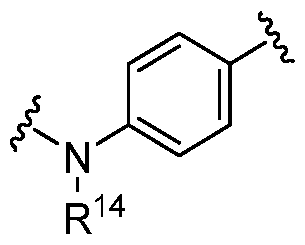
[00386] In some embodiments, a tether group includes a PHP group described by the following structure:

[00387] In certain embodiments, each R14 is independently selected from hydrogen, alkyl, substituted alkyl, alkenyl, substituted alkenyl, alkynyl, substituted alkynyl, alkoxy, substituted alkoxy, amino, substituted amino, carboxyl, carboxyl ester, acyl, acyloxy, acyl amino, amino acyl, alkylamide, substituted alkylamide, sulfonyl, thioalkoxy, substituted thioalkoxy, aryl,
substituted aryl, heteroaryl, substituted heteroaryl, cycloalkyl, substituted cycloalkyl, heterocyclyl, and substituted heterocyclyl.
[00388] In certain embodiments, R14 is hydrogen. In certain embodiments, each R14 is hydrogen. In certain embodiments, R14 is alkyl or substituted alkyl, such as Ci-6 alkyl or Ci-6 substituted alkyl, or Ci-4 alkyl or Ci-4 substituted alkyl, or C1-3 alkyl or C1-3 substituted alkyl. In certain embodiments, R14 is alkenyl or substituted alkenyl, such as C2-6 alkenyl or C2-6 substituted alkenyl, or C2-4 alkenyl or C2-4 substituted alkenyl, or C2-3 alkenyl or C2-3 substituted alkenyl. In certain embodiments, R14 is alkynyl or substituted alkynyl. In certain embodiments, R14 is alkoxy or substituted alkoxy. In certain embodiments, R14 is amino or substituted amino. In certain embodiments, R14 is carboxyl or carboxyl ester. In certain embodiments, R14 is acyl or acyloxy. In certain embodiments, R14 is acyl amino or amino acyl. In certain embodiments, R14 is alkylamide or substituted alkylamide. In certain embodiments, R14 is sulfonyl. In certain embodiments, R14 is thioalkoxy or substituted thioalkoxy. In certain embodiments, R14 is aryl or substituted aryl, such as C5-8 aryl or C5-8 substituted aryl, such as a Cs aryl or Cs substituted aryl, or a Ce aryl or Ce substituted aryl. In certain embodiments, R14 is heteroaryl or substituted heteroaryl, such as C5-8 heteroaryl or C5-8 substituted heteroaryl, such as a Cs heteroaryl or Cs substituted heteroaryl, or a Ce heteroaryl or Ce substituted heteroaryl. In certain embodiments, R14 is cycloalkyl or substituted cycloalkyl, such as C3-8 cycloalkyl or C3-8 substituted cycloalkyl, such as a C3-6 cycloalkyl or C3-6 substituted cycloalkyl, or a C3-5 cycloalkyl or C3-5 substituted cycloalkyl. In certain embodiments, R14 is heterocyclyl or substituted heterocyclyl, such as C3-8 heterocyclyl or C3-8 substituted heterocyclyl, such as a C3-6 heterocyclyl or C3-6 substituted heterocyclyl, or a C3-5 heterocyclyl or C3-5 substituted heterocyclyl.
[00389] In some embodiments of the MABO, MABC, PABO, PABC, PAB, PAB A, PAP, and PHP tether structures shown above, the phenyl ring may be substituted with one or more additional groups selected from halogen, alkyl, substituted alkyl, alkenyl, substituted alkenyl, alkynyl, substituted alkynyl, alkoxy, substituted alkoxy, amino, substituted amino, carboxyl, carboxyl ester, acyl, acyloxy, acyl amino, amino acyl, alkylamide, substituted alkylamide, sulfonyl, thioalkoxy, substituted thioalkoxy, aryl, substituted aryl, heteroaryl, substituted heteroaryl, cycloalkyl, substituted cycloalkyl, heterocyclyl, and substituted heterocyclyl. [00390] In certain embodiments, one or more of the tether groups T1, T2, T3, T4, T5, T6, T7, T8, T9, T10, T11, T12 and/or T13 is each optionally substituted with a glycoside or glycoside derivative. For example, in some instances, T1, T2, T3, T4, T5 and T6 are each optionally substituted with a glycoside. In some instances, T7, T8, T9, T10, T11, T12 and T13 are each
optionally substituted with a glycoside. In certain embodiments, the glycoside or glycoside derivative is selected from a glucuronide, a galactoside, a glucoside, a mannoside, a fucoside, O-GlcNAc, and O-GalNAc.
[00391] In certain embodiments, the MABO, MABC, PABO, PABC, PAB, PABA, PAP, and PHP tether structures shown above may be substituted with one or more additional groups selected from a glycoside and a glycoside derivative. For example, in some embodiments of the MABO, MABC, PABO, PABC, PAB, PABA, PAP, and PHP tether structures shown above, the phenyl ring may be substituted with one or more additional groups selected from a glycoside and a glycoside derivative. In certain embodiments, the glycoside or glycoside derivative is selected from a glucuronide, a galactoside, a glucoside, a mannoside, a fucoside, O-GlcNAc, and O-GalNAc. In some embodiments, the PABC is substituted with a glycoside, for example, a hydrogen of PABC is replaced with a glycoside, such as a glucuronide, a galactoside, a glucoside, a mannoside, a fucoside, O-GlcNAc, and O-GalNAc.
[00392] For example, in some embodiments, the glycoside or glycoside derivative is selected from the following structures:

[00393] Regarding the linking functional groups, V1, V2, V3, V4, V5, V6, V7, V8, V9, V10, V11, V12 and V13 any convenient linking functional groups may be utilized in the subject linkers. Linking functional groups of interest include, but are not limited to, amino, carbonyl, amido, oxycarbonyl, carboxy, sulfonyl, sulfoxide, sulfonylamino, aminosulfonyl, thio, oxy, phospho, phosphoramidate, thiophosphoraidate, and the like. In some embodiments, V1, V2, V3, V4, V5, V6, V7, V8, V9, V10, V11, V12 and V13 are each independently selected from a covalent bond, -CO-, -NR15-, -NR15(CH2)q-, -NR15(C6H4)-, -CONR15-, -NR15CO-, -C(O)O-, -OC(O)-, -O-, -S-, -S(O)-, -SO2-, -SO2NR15-, -NR15SO2- and -P(O)OH-, where q is an integer from 1 to 6. In certain embodiments, q is an integer from 1 to 6 (e.g., 1, 2, 3, 4, 5 or 6). In certain embodiments, q is 1. In certain embodiments, q is 2. In certain embodiments, q is 3. In
certain embodiments, q is 4. In certain embodiments, q is 5. In certain embodiments, q is 6. In some embodiments, each R15 is independently selected from hydrogen, alkyl, substituted alkyl, alkenyl, substituted alkenyl, alkynyl, substituted alkynyl, alkoxy, substituted alkoxy, amino, substituted amino, carboxyl, carboxyl ester, acyl, acyloxy, acyl amino, amino acyl, alkylamide, substituted alkylamide, sulfonyl, thioalkoxy, substituted thioalkoxy, aryl, substituted aryl, heteroaryl, substituted heteroaryl, cycloalkyl, substituted cycloalkyl, heterocyclyl, and substituted heterocyclyl.
[00395] In certain embodiments, R15 is hydrogen. In certain embodiments, each R15 is hydrogen. In certain embodiments, R15 is alkyl or substituted alkyl, such as Ci-6 alkyl or Ci-6 substituted alkyl, or Ci-4 alkyl or Ci-4 substituted alkyl, or C1-3 alkyl or C1-3 substituted alkyl. In certain embodiments, R15 is alkenyl or substituted alkenyl, such as C2-6 alkenyl or C2-6 substituted alkenyl, or C2-4 alkenyl or C2-4 substituted alkenyl, or C2-3 alkenyl or C2-3 substituted alkenyl. In certain embodiments, R15 is alkynyl or substituted alkynyl. In certain embodiments, R15 is alkoxy or substituted alkoxy. In certain embodiments, R15 is amino or substituted amino. In certain embodiments, R15 is carboxyl or carboxyl ester. In certain embodiments, R15 is acyl or acyloxy. In certain embodiments, R15 is acyl amino or amino acyl. In certain embodiments, R15 is alkylamide or substituted alkylamide. In certain embodiments, R15 is sulfonyl. In certain embodiments, R15 is thioalkoxy or substituted thioalkoxy. In certain embodiments, R15 is aryl or substituted aryl, such as C5-8 aryl or C5-8 substituted aryl, such as a Cs aryl or Cs substituted aryl, or a Ce aryl or Ce substituted aryl. In certain embodiments, R15 is heteroaryl or substituted heteroaryl, such as C5-8 heteroaryl or C5-8 substituted heteroaryl, such as a Cs heteroaryl or Cs substituted heteroaryl, or a Ce heteroaryl or Ce substituted heteroaryl. In certain embodiments, R15 is cycloalkyl or substituted cycloalkyl, such as C3-8 cycloalkyl or C3-8 substituted cycloalkyl, such as a C3-6 cycloalkyl or C3-6 substituted cycloalkyl, or a C3-5 cycloalkyl or C3-5 substituted cycloalkyl. In certain embodiments, R15 is heterocyclyl or substituted heterocyclyl, such as C3-8 heterocyclyl or C3-8 substituted heterocyclyl, such as a C3-6 heterocyclyl or C3-6 substituted heterocyclyl, or a C3-5 heterocyclyl or C3-5 substituted heterocyclyl.
[00396] In certain embodiments, each R15 is independently selected from hydrogen, alkyl, substituted alkyl, alkenyl, substituted alkenyl, alkynyl, substituted alkynyl, carboxyl, carboxyl ester, acyl, aryl, substituted aryl, heteroaryl, substituted heteroaryl, cycloalkyl, substituted cycloalkyl, heterocyclyl, and substituted heterocyclyl. In these embodiments, alkyl, substituted alkyl, alkenyl, substituted alkenyl, alkynyl, substituted alkynyl, carboxyl, carboxyl
ester, acyl, aryl, substituted aryl, heteroaryl, substituted heteroaryl, cycloalkyl, substituted cycloalkyl, heterocyclyl, and substituted heterocyclyl are as described above for R15.
[00397] As described above, in some embodiments, LA is a first linker comprising: -(T1-V1)a-(T2-V2)b-(T3-V3)c-(T4-V4)d-(T5-V5)e-(T6-V6)f-, where a, b, c, d, e, and f are each independently 0 or 1, provided at least one of a, b, c, d, e, and f is 1.
[00398] In some embodiments, in the first linker LA:
T1 is selected from a (Ci-Cnjalkyl and a substituted (Ci-Ci2)alkyl;
T2, T3, T4, T5 and T6 are each independently selected from (Ci-Ci2)alkyl, substituted (Ci-Ci2)alkyl, aryl, substituted aryl, heteroaryl, substituted heteroaryl, cycloalkyl, substituted cycloalkyl, heterocyclyl, and substituted heterocyclyl, (EDA)W, (PEG)n, (AA)P, -(CR13OH)X-, 4-amino-piperidine (4AP), MABO, MABC, PABO, PABC, PAB, PABA, PAP, PHP, an acetal group, a disulfide, a hydrazine, and an ester; and
V1, V2, V3, V4, V5 and V6 are each independently selected from a covalent bond, -CO-, -NR15-, -NR15(CH2)q-, -NR15(C6H4)-, -CONR15-, -NR15CO-, -C(O)O-, -OC(O)-, -O-, -S-, -S(O)-, -SO2-, -SO2NR15-, -NR15SO2- and -P(O)OH-, wherein q is an integer from 1 to 6; wherein:
 integer from 1 to 30;
EDA is an ethylene diamine moiety having the following structure:
 where y is an integer from 1 to 6 and r is 0 or 1;
4-amino-piperidine

AA is an amino acid residue, where p is an integer from 1 to 20; and each R12 is independently selected from hydrogen, an alkyl, a substituted alkyl, a polyethylene glycol moiety, an aryl, and a substituted aryl, wherein any two adjacent R12 groups may be cyclically linked to form a piperazinyl ring; each R13 is independently selected from hydrogen, alkyl, substituted alkyl, aryl, and substituted aryl; and
each R15 is independently selected from hydrogen, alkyl, substituted alkyl, alkenyl, substituted alkenyl, alkynyl, substituted alkynyl, carboxyl, carboxyl ester, acyl, aryl, substituted aryl, heteroaryl, substituted heteroaryl, cycloalkyl, substituted cycloalkyl, heterocyclyl, and substituted heterocyclyl. [00399] In some embodiments, LA comprises:
-(T1-V1)a-(T2-V2)b-(T3-V3)c-(T4-V4)d-(T5-V5)e-(T6-V6)f-, wherein: a, b, c, d, e, and f are each independently 0 or 1, provided at least one of a, b, c, d, e, and f is 1;
T1, T2, T3, T4, T5 and T6 are each independently selected from a covalent bond, (Ci- Cn)alkyl, substituted (Ci-Ci2)alkyl, aryl, substituted aryl, heteroaryl, substituted heteroaryl, cycloalkyl, substituted cycloalkyl, heterocyclyl, and substituted heterocyclyl, (EDA)W, (PEG)n, (AA)P, -(CR13OH)X-, 4-amino-piperidine (4AP), meta-amino-benzyloxy (MABO), meta-amino-benzyloxycarbonyl (MABC), para-amino-benzyloxy (PABO), para-amino- benzyloxycarbonyl (PABC), para-aminobenzyl (PAB), para-amino-benzylamino (PABA), para-amino-phenyl (PAP), para-hydroxy-phenyl (PHP), an acetal group, a hydrazine, a disulfide, and an ester, wherein EDA is an ethylene diamine moiety, PEG is a polyethylene glycol, and AA is an amino acid residue or an amino acid analog, wherein each w is an integer from 1 to 20, each n is an integer from 1 to 30, each p is an integer from 1 to 20, and each x is an integer from 1 to 12;
V1, V2, V3, V4, V5 and V6 are each independently selected from the group consisting of a covalent bond, -CO-, -NR15-, -NR15(CH2)q-, -NR15(C6H4)-, -CONR15-, -NR15CO-, -C(O)O-, -OC(O)-, -O-, -S-, -S(O)-, -SO2-, -SO2NR15-, -NR15SO2- and -P(O)OH-, wherein each q is an integer from 1 to 6; each R13 is independently selected from hydrogen, an alkyl, a substituted alkyl, an aryl, and a substituted aryl; and each R15 is independently selected from hydrogen, alkyl, substituted alkyl, alkenyl, substituted alkenyl, alkynyl, substituted alkynyl, carboxyl, carboxyl ester, acyl, aryl, substituted aryl, heteroaryl, substituted heteroaryl, cycloalkyl, substituted cycloalkyl, heterocyclyl, and substituted heterocyclyl. [00400] In some embodiments of LA:
T1 is selected from a (Ci-Ci2)alkyl and a substituted (Ci-Ci2)alkyl;
T2, T3, T4, T5 and T6 are each independently selected from a covalent bond, (Ci- Cn)alkyl, substituted (Ci-Ci2)alkyl, aryl, substituted aryl, heteroaryl, substituted heteroaryl,
cycloalkyl, substituted cycloalkyl, heterocyclyl, and substituted heterocyclyl, (EDA)W, (PEG)n, (AA)p, -(CR13OH)X-, 4-amino-piperidine (4AP), MABO, MABC, PABO, PABC, PAB, PABA, PAP, PHP, an acetal group, a hydrazine, and an ester; and
V1, V2, V3, V4, V5 and V6 are each independently selected from the group consisting of a covalent bond, -CO-, -NR15-, -NR15(CH2)q-, -NR15(CeH4)-, -CONR15-, -NR15CO-, -C(O)O-, -OC(O)-, -O-, -S-, -S(O)-, -SO2-, -SO2NR15-, -NR15SO2-, and -P(O)OH-; wherein:
 integer from 1 to 30;
EDA is an ethylene diamine moiety having the following structure:
 where y is an integer from 1 to 6 and r is 0 or 1;
4-amino-piperidine
 each R12 is independently selected from hydrogen, an alkyl, a substituted alkyl, a polyethylene glycol moiety, an aryl, and a substituted aryl, wherein any two adjacent R12 groups may be cyclically linked to form a piperazinyl ring; a, b, c, and d are each 1; and e and f are 0.
[00401] In some embodiments, T1, T2, T3, T4, T5 and T6 are each optionally substituted with a glycoside.
[00402] In some embodiments, MABO, MABC, PABO, PABC, PAB, PABA, PAP and PHP are each optionally substituted with a glycoside.
[00403] In some embodiments, the glycoside is selected from a glucuronide, a galactoside, a glucoside, a mannoside, a fucoside, O-GlcNAc, and O-GalNAc.
[00404] In certain embodiments, T1, T2, T3, T4, T5 and T6 and V1, V2, V3, V4, V5 and V6 are selected from the following: wherein:
T1 is (Ci-Ci2)alkyl and V1 is -CO-;
T2 is (AA)P and V2 is absent (e.g., a covalent bond);
T3 is PABC and V3 is absent (e.g., a covalent bond); p is an integer from 1 to 10; and d, e, and f are each 0; or wherein:
T1 is (Ci-Ci2)alkyl and V1 is -CONH-;
T2 is (PEG)n and V2 is -CO-;
T3 is (AA)P and V3 is absent (e.g., a covalent bond);
T4 is PABC and V4 is absent (e.g., a covalent bond); p is an integer from 1 to 10; and e and f are each 0; or wherein:
T1 is (Ci-Ci2)alkyl and V1 is -CO-;
T2 is an amino acid analog and V2 is -NH-;
T3 is (PEG)n and V3 is -CO-;
T4 is (AA)P and V4 is absent (e.g., a covalent bond);
T5 is PABC and V5 is absent (e.g., a covalent bond); p is an integer from 1 to 10; and f is 0; or wherein:
T1 is (Ci-Ci2)alkyl and V1 is -CONH-;
T2 is (PEG)n and V2 is -CO-;
T3 is (AA)P and V3 is absent (e.g., a covalent bond);
T4 is PABC and V4 is absent (e.g., a covalent bond); p is an integer from 1 to 10; and e and f are each 0; or wherein:
T1 is (Ci-Ci2)alkyl and V1 is -CONH-;
T2 is substituted (Ci-Ci2)alkyl and V2 is -CO-;
T3 is (AA)P and V3 is absent (e.g., a covalent bond);
T4 is PABC and V4 is absent (e.g., a covalent bond); p is an integer from 1 to 10; and e and f are each 0; or wherein:
T1 is (Ci-Ci2)alkyl and V1 is -CONH-;
T2 is (PEG)n and V2 is -CO-;
T3 is (AA)P and V3 is absent (e.g., a covalent bond);
T4 is PABA and V4 is -CO-;
T5 is (Ci-Ci2)alkyl and V5 is absent (e.g., a covalent bond); p is an integer from 1 to 10; and f is 0; or wherein:
T1 is (Ci-Ci2)alkyl and V1 is -CO-;
T2 is 4AP and V2 is -CO-;
T3 is (Ci-Ci2)alkyl and V3 is -CO-;
T4 is (AA)P and V4 is absent (e.g., a covalent bond);
T5 is PABC and V5 is absent (e.g., a covalent bond); p is an integer from 1 to 10; and f is 0; or wherein:
T1 is (Ci-Ci2)alkyl and V1 is -CO-;
T2 is 4AP and V2 is -CO-;
T3 is (Ci-Ci2)alkyl and V3 is -O-;
T4 is (Ci-Ci2)alkyl and V4 is -CO-;
T5 is (AA)P and V5 is absent (e.g., a covalent bond); p is an integer from 1 to 10; and
T6 is PABC and V6 is absent (e.g., a covalent bond); or wherein:
T1 is (Ci-Ci2)alkyl and V1 is -CO-;
T2 is an amino acid analog and V2 is absent (e.g., a covalent bond);
T3 is (AA)P and V3 is absent (e.g., a covalent bond);
T4 is PABC and V4 is absent (e.g., a covalent bond); p is an integer from 1 to 10; and e and f are each 0; or wherein:
T1 is (Ci-Ci2)alkyl and V1 is -CONH-;
T2 is (PEG)n and V2 is -CONH-;
T3 is substituted (Ci-Ci2)alkyl and V3 is -CO-;
T4 is (AA)P and V4 is absent (e.g., a covalent bond);
I l l
T5 is PABC and V5 is absent (e.g., a covalent bond); p is an integer from 1 to 10; and f is 0; or wherein:
T1 is (Ci-Ci2)alkyl and V1 is -CO-;
T2 is an (AA)P and V2 is -NH-;
T3 is (PEG)n and V3 is -CO-;
T4 is (AA)P and V4 is absent (e.g., a covalent bond);
T5 is PABC and V5 is absent (e.g., a covalent bond); p is an integer from 1 to 10; and f is 0; or wherein:
T1 is (Ci-Ci2)alkyl and V1 is -CONH-;
T2 is (PEG)n and V2 is -CO-;
T3 is (AA)P and V3 is absent (e.g., a covalent bond);
T4 is PAP and V4 is -C(O)O-; p is an integer from 1 to 10; and e and f are each 0; or wherein:
T1 is (Ci-Ci2)alkyl and V1 is -CONH-;
T2 is substituted (Ci-Ci2)alkyl and V2 is -CO-;
T3 is (AA)P and V3 is absent (e.g., a covalent bond);
T4 is PABC and V4 is absent (e.g., a covalent bond); p is an integer from 1 to 10; and e and f are each 0; or wherein:
T1 is (Ci-Ci2)alkyl and V1 is -CONH-;
T2 is substituted (Ci-Ci2)alkyl and V2 is -CO-;
T3 is PABC and V3 is absent (e.g., a covalent bond); and d, e, and f are each 0.
[00405] In certain embodiments, the left-hand side of the above linker structure for the first linker LA is attached to the hydrazinyl-indolyl or a hydrazinyl-pyrrolo-pyridinyl conjugation moiety, and the right-hand side of the above linker structure for the first linker LA is attached to the first drug or active agent.
[00406] As described above, in some embodiments, LB is a second linker comprising: -(T7-V7)g-(T8-V8)h-(T9-V9)i-(T10-V10)j-(T11-V11)k-(T12-V12)i-(T13-V13)m-, wherein g, h, i, j, k, 1, and m are each independently 0 or 1, provided that at least one of g, h, i, j, k, 1, and m is 1.
[00407] In some embodiments, in the second linker LB:
T7 is selected from a (Ci-Cnjalkyl and a substituted (Ci-Ci2)alkyl;
T8, T9, T10, T11, T12 and T13 are each independently selected from (Ci-Ci2)alkyl, substituted (Ci-Ci2)alkyl, aryl, substituted aryl, heteroaryl, substituted heteroaryl, cycloalkyl, substituted cycloalkyl, heterocyclyl, and substituted heterocyclyl, (EDA)W, (PEG)n, (AA)P, -(CR13OH)X-, 4AP, MABO, MABC, PABO, PABC, PAB, PABA, PAP, PHP, an acetal group, a disulfide, a hydrazine, and an ester; and
V7, V8, V9, V10, V11, V12 and V13 are each independently selected from a covalent bond, -CO-, -NR15-, -NR15(CH2)q-, -NR15(C6H4)-, -CONR15-, -NR15CO-, -C(O)O-, -OC(O)-, -O-, -S-, -S(O)-, -SO2-, -SO2NR15-, -NR15SO2- and -P(O)OH-, wherein q is an integer from 1 to 6; wherein:
 integer from 1 to 30;
EDA is an ethylene diamine moiety having the following structure:
 where y is an integer from 1 to 6 and r is 0 or 1;
4-amino-piperidine

AA is an amino acid residue, where p is an integer from 1 to 20; and each R12 is independently selected from hydrogen, an alkyl, a substituted alkyl, a polyethylene glycol moiety, an aryl, and a substituted aryl, wherein any two adjacent R12 groups may be cyclically linked to form a piperazinyl ring; each R13 is independently selected from hydrogen, alkyl, substituted alkyl, aryl, and substituted aryl; and each R15 is independently selected from hydrogen, alkyl, substituted alkyl, alkenyl, substituted alkenyl, alkynyl, substituted alkynyl, carboxyl, carboxyl ester, acyl, aryl,
substituted aryl, heteroaryl, substituted heteroaryl, cycloalkyl, substituted cycloalkyl, heterocyclyl, and substituted heterocyclyl.
[00408] Any convenient tether groups may be utilized for T7, T8, T9, T10, T11, T12 and T13. For example, any of the tether groups described above in relation to T1, T2, T3, T4, T5 and T6 may be used for the tether groups T7, T8, T9, T10, T11, T12 and T13.
[00409] Any convenient linking functional groups may be utilized for V7, V8, V9, V10, V11, V12 and V13. For example, any of the linking functional groups described above in relation to V1, V2, V3, V4, V5 and V6 may be used for the linking functional groups V7, V8, V9, V10, V11, V12 and V13.
[00410] In certain embodiments, each R13 is independently selected from hydrogen, alkyl, substituted alkyl, aryl, and substituted aryl. In these embodiments, alkyl, substituted alkyl, aryl, and substituted aryl are as described above for R13.
[00411] In certain embodiments, each R15 is independently selected from hydrogen, alkyl, substituted alkyl, alkenyl, substituted alkenyl, alkynyl, substituted alkynyl, carboxyl, carboxyl ester, acyl, aryl, substituted aryl, heteroaryl, substituted heteroaryl, cycloalkyl, substituted cycloalkyl, heterocyclyl, and substituted heterocyclyl. In these embodiments, alkyl, substituted alkyl, alkenyl, substituted alkenyl, alkynyl, substituted alkynyl, carboxyl, carboxyl ester, acyl, aryl, substituted aryl, heteroaryl, substituted heteroaryl, cycloalkyl, substituted cycloalkyl, heterocyclyl, and substituted heterocyclyl are as described above for R15. In these embodiments, various possible substituents are as described above for R15.
[00412] In certain embodiments of the second linker LB, one or more of the tether groups T7, T8, T9, T10, T11, T12 and T13 is each optionally substituted with a glycoside or glycoside derivative. In certain embodiments, the glycoside or glycoside derivative is selected from a glucuronide, a galactoside, a glucoside, a mannoside, a fucoside, O-GlcNAc, and O-GalNAc. [00413] In certain embodiments of the second linker LB, the MABO, MABC, PABO, PABC, PAB, PABA, PAP, and PHP tether structures shown above may be substituted with one or more additional groups selected from a glycoside and a glycoside derivative. For example, in some embodiments of the MABO, MABC, PABO, PABC, PAB, PABA, PAP, and PHP tether structures shown above, the phenyl ring may be substituted with one or more additional groups selected from a glycoside and a glycoside derivative. In certain embodiments, the glycoside or glycoside derivative is selected from a glucuronide, a galactoside, a glucoside, a mannoside, a fucoside, O-GlcNAc, and O-GalNAc.
[00414] In some embodiments, T7, T8, T9, T10, T11, T12 and T13 are each optionally substituted with a glycoside.
[00415] In some embodiments, MABO, MABC, PABO, PABC, PAB, PABA, PAP and PHP are each optionally substituted with a glycoside.
[00416] In some embodiments, the glycoside is selected from a glucuronide, a galactoside, a glucoside, a mannoside, a fucoside, O-GlcNAc, and O-GalNAc.
[00417] In some embodiments of LB: g, h, i, j, and k are each 1;
1 and m are each 0;
T7 is a covalent bond;
T8, T9, T10, T11 and T12 are each independently selected from a covalent bond, (Ci- Cn)alkyl, substituted (Ci-Ci2)alkyl, aryl, substituted aryl, heteroaryl, substituted heteroaryl, cycloalkyl, substituted cycloalkyl, heterocyclyl, and substituted heterocyclyl, (EDA)W, (PEG)n, (AA)p, -(CR13OH)X-, 4-amino-piperidine (4AP), MABO, MABC, PABO, PABC, PAB, PABA, PAP, PHP, an acetal group, a hydrazine, and an ester; and
V7, V8, V9, V10, V11 and V12 are each independently selected from the group consisting of a covalent bond, -CO-, -NR15-, -NR15(CH2)q-, -NR15(CeH4)-, -CONR15-, -NR15CO-, -C(O)O-, -OC(O)-, -O-, -S-, -S(O)-, -SO2-, -SO2NR15-, -NR15SO2-, and -P(O)OH-; wherein:
 integer from 1 to 30;
EDA is an ethylene diamine moiety having the following structure:
 where y is an integer from 1 to 6 and r is 0 or 1;
4-amino-piperidine
 each R12 is independently selected from hydrogen, an alkyl, a substituted alkyl, a polyethylene glycol moiety, an aryl, and a substituted aryl, wherein any two adjacent R12 groups may be cyclically linked to form a piperazinyl ring.
[00418] In some embodiments, T1, T2, T3, T4, T5, T6, T7, T8, T9, T10, T11, and T12 are each optionally substituted with a glycoside.
[00419] In some embodiments, MABO, MABC, PABO, PABC, PAB, PABA, PAP and PHP are each optionally substituted with a glycoside.
[00420] In some embodiments, the glycoside is selected from a glucuronide, a galactoside, a glucoside, a mannoside, a fucoside, O-GlcNAc, and O-GalNAc.
[00421] In certain embodiments, T7, T8, T9, T10, T11, T12 and T13 and V7, V8, V9, V10, V11,
V12 and V13 are selected from the following: wherein:
T7 is absent (e.g., a covalent bond) and V7 is -NHCO-;
T8 is (Ci-Ci2)alkyl and V8 is -CO-;
T9 is (AA)P and V9 is absent (e.g., a covalent bond);
T10 is PABC and V10 is absent (e.g., a covalent bond); and k, 1, and m are each 0; or wherein:
T7 is absent (e.g., a covalent bond) and V7 is -NHCO-;
T8 is (Ci-Ci2)alkyl and V8 is -CONH-;
T9 is (PEG)n and V9 is -CO-;
T10 is (AA)P and V10 is absent (e.g., a covalent bond); and
T11 is PABC and V11 is absent (e.g., a covalent bond); and
1 and m are each 0; or wherein:
T7 is absent (e.g., a covalent bond) and V7 is -NHCO-;
T8 is (Ci-Ci2)alkyl and V8 is -CO-;
T9 is an amino acid analog and V9 is -NH-;
T10 is (PEG)n and V10 is -CO-;
T11 is (AA)P and V11 is absent (e.g., a covalent bond);
T12 is PABC and V12 is absent (e.g., a covalent bond); and m is 0; or wherein:
T7 is absent (e.g., a covalent bond) and V7 is -NHCO-;
T8 is (Ci-Ci2)alkyl and V8 is -CONH-;
T9 is (PEG)n and V9 is -CO-;
T10 is (AA)P and V10 is absent (e.g., a covalent bond);
T11 is PABC and V11 is absent (e.g., a covalent bond); and
1 and m are each 0; or
wherein:
T7 is absent (e.g., a covalent bond) and V7 is -NHCO-;
T8 is (Ci-Ci2)alkyl and V8 is -CONH-;
T9 is substituted (Ci-Ci2)alkyl and V9 is -CO-;
T10 is (AA)P and V10 is absent (e.g., a covalent bond);
T11 is PABC and V11 is absent (e.g., a covalent bond); and
1 and m are each 0; or wherein:
T7 is absent (e.g., a covalent bond) and V7 is -NHCO-;
T8 is (Ci-Ci2)alkyl and V8 is -CONH-;
T9 is (PEG)n and V9 is -CO-;
T10 is (AA)P and V10 is absent (e.g., a covalent bond);
T11 is PABA and V11 is -CO-;
T12 is (Ci-Ci2)alkyl and V12 is absent (e.g., a covalent bond); and m is 0; or wherein:
T7 is absent (e.g., a covalent bond) and V7 is -NHCO-;
T8 is (Ci-Ci2)alkyl and V8 is -CO-;
T9 is 4AP and V9 is -CO-;
T10 is (Ci-Ci2)alkyl and V10 is -CO-;
T11 is (AA)P and V11 is absent (e.g., a covalent bond);
T12 is PABC and V12 is absent (e.g., a covalent bond); and m is 0; or wherein:
T7 is absent (e.g., a covalent bond) and V7 is -NHCO-;
T8 is (Ci-Ci2)alkyl and V8 is -CO-;
T9 is 4AP and V9 is -CO-;
T10 is (Ci-Ci2)alkyl and V10 is -O-;
T11 is (Ci-Ci2)alkyl and V11 is -CO-;
T12 is (AA)P and V12 is absent (e.g., a covalent bond); and
T13 PABC and V13 is absent (e.g., a covalent bond); or wherein:
T7 is absent (e.g., a covalent bond) and V7 is -NHCO-;
T8 is (Ci-Ci2)alkyl and V8 is -CO-;
T9 is an amino acid analog and V9 is absent (e.g., a covalent bond);
T10 is (AA)P and V10 is absent (e.g., a covalent bond);
T11 is PABC and V11 is absent (e.g., a covalent bond); and
1 and m are each 0; or wherein:
T7 is absent (e.g., a covalent bond) and V7 is -NHCO-;
T8 is (Ci-Ci2)alkyl and V8 is -CONH-;
T9 is (PEG)n and V9 is -CONH-;
T10 is substituted (Ci-Ci2)alkyl and V10 is -CO-;
T11 is (AA)P and V11 is absent (e.g., a covalent bond);
T12 is PABC and V12 is absent (e.g., a covalent bond); and m is 0; or wherein:
T7 is absent (e.g., a covalent bond) and V7 is -NHCO-;
T8 is (Ci-Ci2)alkyl and V8 is -CO-;
T9 is (AA)P and V9 is -NH-;
T10 is (PEG)n and V10 is -CO-;
T11 is (AA)P and V11 is absent (e.g., a covalent bond);
T12 is PABC and V12 is absent (e.g., a covalent bond); and m is 0; or wherein:
T7 is absent (e.g., a covalent bond) and V7 is -NHCO-;
T8 is (Ci-Ci2)alkyl and V8 is -CONH-;
T9 is (PEG)n and V9 is -CO-;
T10 is (AA)P and V10 is absent (e.g., a covalent bond);
T11 is PAP and V11 is -C(O)O-; and
1 and m are each 0; or wherein:
T7 is absent (e.g., a covalent bond) and V7 is -NHCO-;
T8 is (Ci-Ci2)alkyl and V8 is -CO-;
T9 is (AA)P and V9 is absent (e.g., a covalent bond);
T10 is PABC and V10 is absent (e.g., a covalent bond);
T11 is PAP and V11 is -C(O)O-; and
1 and m are each 0; or
wherein:
T7 is absent (e.g., a covalent bond) and V7 is -NHCO-;
T8 is (Ci-Ci2)alkyl and V8 is -CONH-;
T9 is substituted (Ci-Ci2)alkyl and V9 is -CO-;
T10 is PABC and V10 is absent (e.g., a covalent bond); and k, 1, and m are each 0; or wherein:
T7 is absent (e.g., a covalent bond) and V7 is -NHCO-;
T8 is (Ci-Ci2)alkyl and V8 is absent (e.g., a covalent bond);
T9 is heteroaryl and V9 is absent (e.g., a covalent bond);
T10 is (Ci-Ci2)alkyl and V10 is -CONH-;
T11 is (PEG)n and V11 is -CO-; and
1 and m are each 0; or wherein:
T7 is absent (e.g., a covalent bond) and V7 is -NHCO-;
T8 is (Ci-Ci2)alkyl and V8 is absent (e.g., a covalent bond);
T9 is heteroaryl and V9 is absent (e.g., a covalent bond);
T10 is (Ci-Ci2)alkyl and V10 is -CONH-;
T11 is substituted (Ci-Ci2)alkyl and V11 is -CO-;
T12 is (AA)P and V12 is absent (e.g., a covalent bond); and
T13 PAB and V13 is absent (e.g., a covalent bond); or wherein:
T7 is absent (e.g., a covalent bond) and V7 is -NHCO-;
T8 is (Ci-Ci2)alkyl and V8 is absent (e.g., a covalent bond);
T9 is heteroaryl and V9 is absent (e.g., a covalent bond);
T10 is (Ci-Ci2)alkyl and V10 is -CONH-;
T11 is substituted (Ci-Ci2)alkyl and V11 is -CO-;
T12 is (AA)P and V12 is absent (e.g., a covalent bond); and
T13 PABC and V13 is absent (e.g., a covalent bond).
[00422] In certain embodiments, the left-hand side of the above linker structure for the second linker LB is attached to the hydrazinyl-indolyl or a hydrazinyl-pyrrolo-pyridinyl conjugation moiety, and the right-hand side of the above linker structure for the second linker LB is attached to the second drug or active agent.
[00423] In certain embodiments, the conjugate is an antibody-drug conjugate where the IL13Ra2 antibody and the drugs are linked together by linkers as described above. In some instances, the linker m (e.g., LA and/or LB) is a cleavable linker. A cleavable linker is a linker that includes one or more cleavable moieties, where the cleavable moiety includes one or more bonds that can dissociate under certain conditions, thus separating the cleavable linker into two or more separable portions. For example, the cleavable moiety may include one or more covalent bonds, which under certain conditions, can dissociate or break apart to separate the cleavable linker into two or more portions. As such the linkers that are included in an antibody-drug conjugate can be cleavable linkers, such that under appropriate conditions, the cleavable linker is cleaved to separate or release the drug from the antibody at a desired target site of action for the drug.
[00424] In some instances, a cleavable linker includes two cleavable moieties, such as a first cleavable moiety and a second cleavable moiety. The cleavable moieties can be configured such that cleavage of both cleavable moieties is needed in order to separate or release the drug from the IL13Ra2 antibody at a desired target site of action for the drug. For example, cleavage of a cleavable linker can be achieved by initially cleaving one of the two cleavable moieties and then cleaving the other of the two cleavable moieties. In certain embodiments, a cleavable linker includes a first cleavable moiety and a second cleavable moiety that hinders cleavage of the first cleavable moiety. By “hinders cleavage” is meant that the presence of an uncleaved second cleavable moiety reduces the likelihood or substantially inhibits the cleavage of the first cleavable moiety, thus substantially reducing the amount or preventing the cleavage of the cleavable linker. For instance, the presence of uncleaved second cleavable moiety can hinder cleavage of the first cleavable moiety. The hinderance of cleavage of the first cleavable moiety by the presence of the second cleavable moiety, in turn, substantially reduces the amount or prevents the release of the drug from the antibody. For example, the premature release of the drug from the antibody can be substantially reduced or prevented until the antibody-drug conjugate is at or near the desired target site of action for the drug.
[00425] In some cases, since the second cleavable moiety hinders cleavage of the first cleavable moiety, cleavage of the cleavable linker can be achieved by initially cleaving the second cleavable moiety and then cleaving the first cleavable moiety. Cleavage of the second cleavable moiety can reduce or eliminate the hinderance on the cleavage of the first cleavable moiety, thus allowing the first cleavable moiety to be cleaved. Cleavage of the first cleavable moiety can result in the cleavable linker dissociating or separating into two or more portions as described above to release the drug from the antibody-drug conjugate. In some instances,
cleavage of the first cleavable moiety does not substantially occur in the presence of an uncleaved second cleavable moiety. By substantially is meant that about 10% or less cleavage of the first cleavable moiety occurs in the presence of an uncleaved second cleavable moiety, such as about 9% or less, or about 8% or less, or about 7% or less, or about 6% or less, or about 5% or less, or about 4% or less, or about 3% or less, or about 2% or less, or about 1% or less, or about 0.5% or less, or about 0.1% or less cleavage of the first cleavable moiety occurs in the presence of an uncleaved second cleavable moiety.
[00426] Stated another way, the second cleavable moiety can protect the first cleavable moiety from cleavage. For instance, the presence of uncleaved second cleavable moiety can protect the first cleavable moiety from cleavage, and thus substantially reduce or prevent premature release of the drug from the antibody until the antibody-drug conjugate is at or near the desired target site of action for the drug. As such, cleavage of the second cleavable moiety exposes the first cleavable moiety (e.g., deprotects the first cleavable moiety), thus allowing the first cleavable moiety to be cleaved, which results in cleavage of the cleavable linker, which, in turn, separates or releases the drug from the antibody at a desired target site of action for the drug as described above. In certain instances, cleavage of the second cleavable moiety exposes the first cleavable moiety to subsequent cleavage, but cleavage of the second cleavable moiety does not in and of itself result in cleavage of the cleavable linker (e.g., cleavage of the first cleavable moiety is still needed in order to cleave the cleavable linker). [00427] The cleavable moieties included in the cleavable linker may each be an enzymatically cleavable moiety. For example, the first cleavable moiety can be a first enzymatically cleavable moiety and the second cleavable moiety can be a second enzymatically cleavable moiety. An enzymatically cleavable moiety is a cleavable moiety that can be separated into two or more portions as described above through the enzymatic action of an enzyme. The enzymatically cleavable moiety can be any cleavable moiety that can be cleaved through the enzymatic action of an enzyme, such as, but not limited to, an ester, a peptide, a glycoside, and the like. In some instances, the enzyme that cleaves the enzymatically cleavable moiety is present at a desired target site of action, such as the desired target site of action of the drug that is to be released from the antibody-drug conjugate. In some cases, the enzyme that cleaves the enzymatically cleavable moiety is not present in a significant amount in other areas, such as in whole blood, plasma, or serum. As such, the cleavage of an enzymatically cleavable moiety can be controlled such that substantial cleavage occurs at the desired site of action, whereas cleavage does not significantly occur in other areas or before the antibody-drug conjugate reaches the desired site of action.
[00428] For example, as described herein, antibody-drug conjugates of the present disclosure can be used for the treatment of cancer, such as for the delivery of a cancer therapeutic drug to a desired site of action where the cancer cells are present. In some cases, enzymes, such as an esterase that cleaves ester bonds or a glycosidase that cleaves glycosidic bonds, can be a biomarker for cancer that is overexpressed in cancer cells. The overexpression, and thus localization, of certain enzymes in cancer can be used in the context of the enzymatically cleavable moieties included in the cleavable linkers of the antibody-drug conjugates of the present disclosure to specifically release the drug at the desired site of action (e.g., the site of the cancer (and overexpressed enzyme)). Thus, in some embodiments, the enzymatically cleavable moiety is a cleavable moiety (e.g., an ester or a glycoside) that can be cleaved by an enzyme that is overexpressed in cancer cells. For instance, the enzyme can be an esterase. As such, in some instances, the enzymatically cleavable moiety is a cleavable moiety (e.g., an ester) that can be cleaved by an esterase enzyme. In some instances, the enzyme can be a glycosidase. As such, in some instances, the enzymatically cleavable moiety is a cleavable moiety (e.g, a glycoside or glycoside derivative) that can be cleaved by a glycosidase enzyme.
[00429] In certain embodiments, the enzymatically cleavable moiety is an ester bond. For example, the first cleavable moiety described above (e.g, the cleavable moiety protected from premature cleavage by the second cleavable moiety) can include an ester. The presence of uncleaved second cleavable moiety can protect the first cleavable moiety (ester) from cleavage by an esterase enzyme, and thus substantially reduce or prevent premature release of the drug from the antibody until the antibody-drug conjugate is at or near the desired target site of action for the drug. In some instances, a portion of the linker adjacent to the first cleavable moiety is linked to or includes a substituent, where the substituent comprises the second cleavable moiety. In some instances, the second cleavable moiety includes a glycoside or glycoside derivative.
[00430] In some embodiments, the enzymatically cleavable moiety is sugar moiety, such as a glycoside (or glyosyl) or glycoside derivative. In some cases, the glycoside or glycoside derivative can facilitate an increase in the hydrophilicity of the cleavable linker as compared to a cleavable linker that does not include the glycoside or glycoside derivative. The glycoside or glycoside derivative can be any glycoside or glycoside derivative suitable for use in the cleavable linker and that can be cleaved through the enzymatic action of an enzyme. For example, the second cleavable moiety (e.g., the cleavable moiety that protects the first cleavable moiety from premature cleavage) can be a glycoside or glycoside derivative. For
instance, in some embodiments, the first cleavable moiety includes an ester, and the second cleavable moiety includes a glycoside or glycoside derivative. In certain embodiments, the second cleavable moiety is a glycoside or glycoside derivative selected from a glucuronide, a galactoside, a glucoside, a mannoside, a fucoside, O-GlcNAc, and O-GalNAc. In some instances, the second cleavable moiety is a glucuronide. In some instances, the second cleavable moiety is a galactoside. In some instances, the second cleavable moiety is a glucoside. In some instances, the second cleavable moiety is a mannoside. In some instances, the second cleavable moiety is a fucoside. In some instances, the second cleavable moiety is O-GlcNAc. In some instances, the second cleavable moiety is O-GalNAc.
[00431] The glycoside or glycoside derivative can be attached (covalently bonded) to the cleavable linker through a glycosidic bond. The glycosidic bond can link the glycoside or glycoside derivative to the cleavable linker through various types of bonds, such as, but not limited to, an O-glycosidic bond (an O-glycoside), an N-glycosidic bond (a glycosylamine), an S-glycosidic bond (a thioglycoside), or C-glycosidic bond (a C-glycoside or C-glycosyl). In some instances, the glycosidic bond is an O-glycosidic bond (an O-glycoside). In some cases, the glycoside or glycoside derivative can be cleaved from the cleavable linker it is attached to by an enzyme (e.g., through enzymatically mediated hydrolysis of the glycosidic bond). A glycoside or glycoside derivative can be removed or cleaved from the cleavable linker by any convenient enzyme that is able to carry out the cleavage (hydrolysis) of the glycosidic bond that attaches the glycoside or glycoside derivative to the cleavable linker. An example of an enzyme that can be used to mediate the cleavage (hydrolysis) of the glycosidic bond that attaches the glycoside or glycoside derivative to the cleavable linker is a glycosidase, such as a glucuronidase, a galactosidase, a glucosidase, a mannosidase, a fucosidase, and the like. Other suitable enzymes may also be used to mediate the cleavage (hydrolysis) of the glycosidic bond that attaches the glycoside or glycoside derivative to the cleavable linker. In some cases, the enzyme used to mediate the cleavage (hydrolysis) of the glycosidic bond that attaches the glycoside or glycoside derivative to the cleavable linker is found at or near the desired site of action for the drug of the antibody-drug conjugate. For instance, the enzyme can be a lysosomal enzyme, such as a lysosomal glycosidase, found in cells at or near the desired site of action for the drug of the antibody-drug conjugate. In some cases, the enzyme is an enzyme found at or near the target site where the enzyme that mediates cleavage of the first cleavable moiety is found.
[00432] In some embodiments, an IL13Ra2-ADC is represented by Formula (I):
 wherein:
Ab represents the antibody that binds to IL13Ra2;
Z1, Z2, and Z4 are each independently CR4;
Z3 is C-LB-W2;
R1, R2, R3 and R4 are each selected from hydrogen and (Ci-Ci2)alkyl;
LA is a first linker comprising:
-(T1-V1)a-(T2-V2)b-(T3-V3)c-(T4-V4)d-(T5-V5)e-(T6-V6)f-, wherein:
T1 is (Ci-Ci2)alkyl and V1 is -CONH-;
T2 is substituted (Ci-Ci2)alkyl and V2 is -CO-;
T3 is (AA)P where p is an integer from 1-20 and V3 is a covalent bond;
T4 is PABC and V4 is a covalent bond; a, b, c, and d are each 1; e and f are each 0; and
LBis a second linker comprising:
-(T7-V7)g-(T8-V8)h-(T9-V9)i-(T10-V10)j-(T11-V11)k-(T12-V12)i-(T13-V13)m-, wherein:
T7 is a covalent bond and V7 is -NHCO-;
T8 is (Ci-Ci2)alkyl and V8 is -CONH-;
T9 is substituted (Ci-Ci2)alkyl and V9 is -CO-;
T10 is (AA)P where p is an integer from 1-20 and V10 is a covalent bond;
T11 is PABC and V11 is a covalent bond; and h, i, j, and k are each 1; and
1 and m are each 0; s is an integer from 1 to 10;
W1 is a first drug; and
W2 is a second drug.
[00433] In some embodiments, one or both of W1 and W2 are camptothecin analogues, for example, belotecan.
[00434] In some embodiments, an IL13Ra2-ADC is represented by Formula (I):
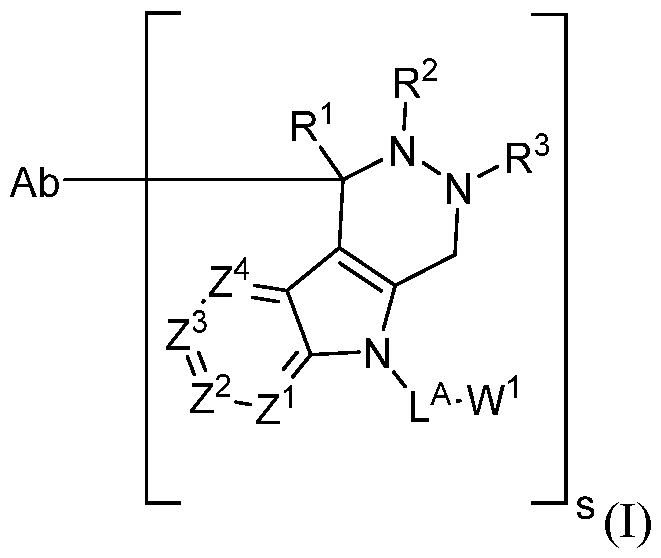 wherein:
Ab represents the antibody that binds to IL13Ra2;
Z1, Z2, and Z4 are each independently CR4;
Z3 is C-LB-W2;
R1, R2, R3 and R4 are each selected from hydrogen and (Ci-Ci2)alkyl;
LA is a first linker comprising:
-(T1-V1)a-(T2-V2)b-(T3-V3)c-(T4-V4)d-(T5-V5)e-(T6-V6)f-, wherein:
T1 is (Ci-Ce)alkyl and V1 is -CONH-;
T2 is (Ci-Ce)alkylene substituted with -NHCO(PEG)ki, wherein kl is an integer from 2 to 10 and V2 is -CO-;
T3 is (AA)2 and V3 is a covalent bond;
T4 is PABC substituted with a glycoside and V4 is a covalent bond; a, b, c, and d are each 1; and e and f are each 0; and
LBis a second linker comprising:
-(T7-V7)g-(T8-V8)h-(T9-V9)i-(T10-V10)j-(T11-V11)k-(T12-V12)i-(T13-V13)m-, wherein:
T7 is a covalent bond and V7 is -NHCO-;
T8 is (Ci-Ce)alkyl and V8 is -CONH-;
T9 is (Ci-Ce)alkylene substituted with -NHCO(PEG)ki, wherein kl is an integer from 2 to 10 and V9 is -CO-;
T10 is (AA)2 and V10 is a covalent bond;
T11 is PABC substituted with a glycoside and V11 is a covalent bond;
h, i, j , and k are each 1; and
1 and m are each 0; s is an integer from 1 to 10;
W1 is a first drug; and
W2 is a second drug.
[00435] In some embodiments, an IL13Ra2-ADC is represented by Formula (I):
 wherein:
Ab represents the antibody that binds to IL13Ra2;
Z1, Z2, and Z4 are each independently CR4;
Z3 is C-LB-W2;
R1, R2, R3 and R4 are each selected from hydrogen and (Ci-Ci2)alkyl;
LA is a first linker comprising:
-(T1-V1)a-(T2-V2)b-(T3-V3)c-(T4-V4)d-(T5-V5)e-(T6-V6)f-, wherein:
T1 is (Ci-Ce)alkyl and V1 is -CONH-;
T2 is (Ci-Ce)alkylene substituted with -NHCO(PEG)k’, wherein (PEG)k’ is
 and k’ is an integer from 2 to 10, optionally 8, and V2 is -CO-;
T3 is (AA)2 and V3 is a covalent bond;
T4 is PABC substituted with a glycoside and V4 is a covalent bond; a, b, c, and d are each 1; and e and f are each 0; and
LBis a second linker comprising:
-(T7-V7)g-(T8-V8)h-(T9-V9)i-(T10-V10)j-(T11-V11)k-(T12-V12)i-(T13-V13)m-, wherein:
T7 is a covalent bond and V7 is -NHCO-;
T8 is (Ci-Ce)alkyl and V8 is -CONH-;
T9 is (Ci-Ce)alkylene substituted with -NHCO(PEG)k’, wherein (PEG)k’ is
 and k’ is an integer from 2 to 10, optionally 8, and V9 is -CO-;
T10 is (AA)2 and V10 is a covalent bond;
T11 is PABC substituted with a glycoside and V11 is a covalent bond; h, i, j, and k are each 1; and
1 and m are each 0; s is an integer from 1 to 10;
W1 is a first drug; and
W2 is a second drug.
[00436] In some embodiments, the PABC of one or both of T4 and T11 is substituted with a glucuronide. In some embodiments, one or both of T1 and T8 is ethyl. In some embodiments, one or both of T2 and T9 is Cs alkylene substituted with -NHCO(PEG)ki, wherein kl is an integer from 5 to 10. In some embodiments, one or both of W1 and W2 are camptothecin analogues, for example, belotecan.
[00437] In some embodiments, the PABC of one or both of T4 and T11 is substituted with a glucuronide. In some embodiments, one or both of T1 and T8 is ethyl. In some embodiments, one or both of T2 and T9 is Cs alkylene substituted with -NHCO(PEG)k’, wherein (PEG)k’ is
 and k’ is an integer from 5 to 10, optionally 8. In some embodiments, one or both of W1 and W2 are camptothecin analogues, for example, belotecan.
[00438] In some embodiments, provided is an ADC of Formula (I), wherein R1 is hydrogen; Z1 is X^Y1, wherein X1 represents an atom in the ring of Formula (I); Z2 is C-Y2; Z4 is CH; Z3 is C-LB-W2; LA is linker (L-3); and LB is linker (L-3-b)

(L-3),

(L-3-b).
In some embodiments of linker (L-3) and linker (L-3-b), each represents the point of attachment to a pyridazine-pyrrolo coupling moiety as described herein (e.g., in any of Formulas as disclosed herein);
* in linker (L-3) represents the point of attachment to W1;
* in linker (L-3-b) represents the point of attachment to W2; each R5 is independently hydrogen, alkyl, substituted alkyl, alkenyl, substituted alkenyl, alkynyl, substituted alkynyl, aryl, substituted aryl, heteroaryl, substituted heteroaryl, cycloalkyl, substituted cycloalkyl, heterocyclyl, or substituted heterocyclyl; each R6 is independently alkyl, substituted alkyl, alkenyl, substituted alkenyl, alkynyl, substituted alkynyl, aryl, substituted aryl, heteroaryl, substituted heteroaryl, cycloalkyl, substituted cycloalkyl, heterocyclyl, or substituted heterocyclyl; each R7 is a cleavable moiety; each k is an integer from 1 to 10;
Lla comprises -(T1-V1)a-(T2-V2)b-(T3-V3)c-(T4-V4)d-,
Llb comprises -(T1-V1)a-(T2-V2)b-(T3-V3)c-(T4-V4)d-,
L2a comprises -(T5-V5)e-(T6-V6)f-(T7-V7)g-(T8-V8)h-;
L2b comprises -(T5-V5)e-(T6-V6)f-(T7-V7)g-(T8-V8)h-;
T1, T2, T3, T4, T5, T6, T7, and T8 are each independently a covalent bond, C1-C12 alkyl, substituted C1-C12 alkyl, aryl, substituted aryl, heteroaryl, substituted heteroaryl, cycloalkyl, substituted cycloalkyl, heterocyclyl, and substituted heterocyclyl, (EDA)W, (PEG)n, (AA)P, -(CR13OH)m-, P4A-R12, acetal, a hydrazine, a disulfide, or an ester;
V1, V2, V3, V4, V5, V6, V7, and V8 are each independently a covalent bond, -CO-, -NR15-, -NR15(CH2)q-, -NR15(C6H4)-, -CONR15-, -NR15CO-, -C(O)O-, -OC(O)-, -O-, -S-, -S(O)-, -SO2-, -SO2NR15-, -NR15SO2-, or -P(O)OH-; each of a, b, c, d, e, f, g, and h is independently 1 or 0; each m is independently an integer from 1 to 12; each n is independently an integer from 1 to 30;
each p is independently an integer from 1 to 20; each q is independently an integer from 1 to 6; each w is independently an integer from 1 to 20; each R12 is independently hydrogen, alkyl, substituted alkyl, a polyethylene glycol moiety (e.g., a polyethylene glycol or a modified polyethylene glycol), alkenyl, substituted alkenyl, alkynyl, substituted alkynyl, alkoxy, substituted alkoxy, amino, substituted amino, carboxyl, carboxyl ester, acyl, acyloxy, acyl amino, amino acyl, alkylamide, substituted alkylamide, sulfonyl, thioalkoxy, substituted thioalkoxy, aryl, substituted aryl, heteroaryl, substituted heteroaryl, cycloalkyl, substituted cycloalkyl, heterocyclyl, or substituted heterocyclyl; each R13 is independently hydrogen, alkyl, substituted alkyl, aryl, or substituted aryl; and each R15 is independently hydrogen, alkyl, substituted alkyl, alkenyl, substituted alkenyl, alkynyl, substituted alkynyl, carboxyl, carboxyl ester, acyl, aryl, substituted aryl, heteroaryl, substituted heteroaryl, cycloalkyl, substituted cycloalkyl, heterocyclyl, or substituted heterocyclyl. In some embodiments, each substituent is as defined herein, such as with respect to Formula (I) or Formula (II).
[00439] Accordingly, in some embodiments, the IL13Ra2-ADC is represented by Formula (XIV-3):

(XIV-3)
wherein: each R5 is independently hydrogen, alkyl, substituted alkyl, alkenyl, substituted alkenyl, alkynyl, substituted alkynyl, aryl, substituted aryl, heteroaryl, substituted heteroaryl, cycloalkyl, substituted cycloalkyl, heterocyclyl, or substituted heterocyclyl; each R6 is independently alkyl, substituted alkyl, alkenyl, substituted alkenyl, alkynyl, substituted alkynyl, aryl, substituted aryl, heteroaryl, substituted heteroaryl, cycloalkyl, substituted cycloalkyl, heterocyclyl, or substituted heterocyclyl; each R7 is a cleavable moiety;
Lla comprises -(T1-V1)a-(T2-V2)b-,
L2a comprises -(T5-V5)e-(T6-V6)f-;
Llb comprises -(T7-V7)g-(T8-V9)h-,
L2b comprises -(T12-V12)i-(T13-V13)m-;
T1, T2, T5, and T6 are each independently a covalent bond, C1-C12 alkyl, substituted Ci- C12 alkyl, aryl, substituted aryl, heteroaryl, substituted heteroaryl, cycloalkyl, substituted cycloalkyl, heterocyclyl, and substituted heterocyclyl, EDA, (PEG)n, (AA)P, -(CR13OH)V-, 4AP, acetal, a hydrazine, a disulfide, or an ester;
V1, V2, V5, and V6 are each independently a covalent bond, -CO-, -NR15-, -NR15(CH2)q-, -NR15(C6H4)-, -CONR15-, -NR15CO-, -C(O)O-, -OC(O)-, -O-, -S-, -S(O)-, -SO2-, -SO2NR15-, -NR15SO2-, or -P(O)OH-;
T7, T8, T12, and T13 are each independently selected from a covalent bond, (Ci- Cn)alkyl, substituted (Ci-Ci2)alkyl, aryl, substituted aryl, heteroaryl, substituted heteroaryl, cycloalkyl, substituted cycloalkyl, heterocyclyl, and substituted heterocyclyl, (EDA)W, (PEG)n, (AA)P, -(CR13OH)X-, 4-amino-piperidine (4AP), meta-amino-benzyloxy (MABO), meta-amino-benzyloxycarbonyl (MABC), para-amino-benzyloxy (PABO), para-amino- benzyloxycarbonyl (PABC), para-aminobenzyl (PAB), para-amino-benzylamino (PABA), para-amino-phenyl (PAP), para-hydroxy-phenyl (PHP), an acetal group, a hydrazine, a disulfide, and an ester, wherein EDA is an ethylene diamine moiety, PEG is a polyethylene glycol, and AA is an amino acid residue or an amino acid analog, wherein each w is an integer from 1 to 20, each n is an integer from 1 to 30, each p is an integer from 1 to 20, and each x is an integer from 1 to 12;
V7, V8, V12, and V13 are each independently selected from the group consisting of a covalent bond, -CO-, -NR15-, -NR15(CH2)q-, -NR15(C6H4)-, -CONR15-, -NR15CO-, -C(O)O-, -OC(O)-, -O-, -S-, -S(O)-, -SO2-, -SO2NR15-, -NR15SO2- and -P(O)OH-; each of a, b, e, g, h, 1, and m is independently 1 or 0;
each k is an integer from 1 to 10; each p is independently an integer from 1 to 20; each q is independently an integer from 1 to 6; each v is independently an integer from 1 to 12; each z is an integer from 1 to 10;each R12 is independently hydrogen, alkyl, substituted alkyl, a polyethylene glycol moiety (e.g., a polyethylene glycol or a modified polyethylene glycol), alkenyl, substituted alkenyl, alkynyl, substituted alkynyl, alkoxy, substituted alkoxy, amino, substituted amino, carboxyl, carboxyl ester, acyl, acyloxy, acyl amino, amino acyl, alkylamide, substituted alkylamide, sulfonyl, thioalkoxy, substituted thioalkoxy, aryl, substituted aryl, heteroaryl, substituted heteroaryl, cycloalkyl, substituted cycloalkyl, heterocyclyl, or substituted heterocyclyl; each R13 is independently hydrogen, alkyl, substituted alkyl, aryl, or substituted aryl; and each R15 is independently hydrogen, alkyl, substituted alkyl, alkenyl, substituted alkenyl, alkynyl, substituted alkynyl, carboxyl, carboxyl ester, acyl, aryl, substituted aryl, heteroaryl, substituted heteroaryl, cycloalkyl, substituted cycloalkyl, heterocyclyl, or substituted heterocyclyl.
[00440] In some embodiments, provided is an ADC of Formula (I), wherein R1 is hydrogen; Z1 is X^Y1, wherein X1 represents an atom in the ring of Formula (I); Z2 is C-Y2; Z4 is CH; Z3 is C-LB-W2; LA is linker (L-4); and LB is linker (L-4-b)

(L-4-b), wherein: each represents the point of attachment to a pyridazine-pyrrolo coupling moiety as described herein (e.g., any of Formulas as disclosed herein);
* in linker (L-4) represents the point of attachment to W1;
* in linker (L-4-b) represents the point of attachment to W2; each R5 is independently hydrogen, alkyl, substituted alkyl, alkenyl, substituted alkenyl, alkynyl, substituted alkynyl, aryl, substituted aryl, heteroaryl, substituted heteroaryl, cycloalkyl, substituted cycloalkyl, heterocyclyl, or substituted heterocyclyl;
R6 and R6 are each independently alkyl, substituted alkyl, alkenyl, substituted alkenyl, alkynyl, substituted alkynyl, aryl, substituted aryl, heteroaryl, substituted heteroaryl, cycloalkyl, substituted cycloalkyl, heterocyclyl, or substituted heterocyclyl; each R7 is a cleavable moiety; and
Lla, L2a, Llb, and L2b are as defined herein, such as for linker (L-3) or (L-3-b). In some embodiments, each substituent is as defined herein, such as with respect to Formula (I) or Formula (II).
[00441] Accordingly, in some embodiments, the IL13Ra2-ADC is represented by Formula (XIV-4):
 wherein each substituent is as defined with respect to Formula (XIV-3). In some embodiments, R7 is an enzymatically cleavable moiety comprising a sugar moiety, such as a glycoside or glycosyl. In some embodiments, each substituent is as defined herein, such as with respect to Formula (I) or Formula (II).
[00442] In some embodiments, provided is an ADC of Formula (I), wherein R1 is hydrogen; Z1 is X^Y1, wherein X1 represents an atom in the ring of Formula (I); Z2 is C-Y2; Z4 is CH; Z3 is C-LB-W2; LA is linker (L-5); and LB is linker (L-5-b):
wherein each substituent is as defined with respect to Formula (XIV-3). In some embodiments, R7 is an enzymatically cleavable moiety comprising a sugar moiety, such as a glycoside or glycosyl. In some embodiments, each substituent is as defined herein, such as with respect to Formula (I) or Formula (II).
[00442] In some embodiments, provided is an ADC of Formula (I), wherein R1 is hydrogen; Z1 is X^Y1, wherein X1 represents an atom in the ring of Formula (I); Z2 is C-Y2; Z4 is CH; Z3 is C-LB-W2; LA is linker (L-5); and LB is linker (L-5-b):

(L-5-b). wherein: each represents the point of attachment to a pyridazine-pyrrolo coupling moiety as described herein (e.g., any of Formulas as disclosed herein);
* in linker (L-5) represents the point of attachment to W1;
* in linker (L-5-b) represents the point of attachment to W2; each R5 is independently hydrogen, alkyl, substituted alkyl, alkenyl, substituted alkenyl, alkynyl, substituted alkynyl, aryl, substituted aryl, heteroaryl, substituted heteroaryl, cycloalkyl, substituted cycloalkyl, heterocyclyl, or substituted heterocyclyl;
R6 and R6 are independently alkyl, substituted alkyl, alkenyl, substituted alkenyl, alkynyl, substituted alkynyl, aryl, substituted aryl, heteroaryl, substituted heteroaryl, cycloalkyl, substituted cycloalkyl, heterocyclyl, or substituted heterocyclyl; and
Lla, L2a, Llb, and L2b are as defined herein, such as for linker (L-3) or (L-3-b). In some embodiments, each substituent is as defined herein, such as with respect to Formula (I) or Formula (II).
[00443] Accordingly, in some embodiments, the IL13Ra2-ADC is represented by Formula (XIV-5):
 wherein each substituent is as defined with respect to Formula (XIV-3). In some embodiments, each substituent is as defined herein, such as with respect to Formula (I) or Formula (II).
[00444] In some embodiments, provided is an ADC of Formula (I), wherein R1 is hydrogen; Z1 is X^Y1, wherein X1 represents an atom in the ring of Formula (I); Z2 is C-Y2; Z4 is CH; Z3 is C-LB-W2; LA is linker (L-6); and LB is linker (L-6-b):

(L-6),

(L-6-b), wherein: each represents the point of attachment to a pyridazine-pyrrolo coupling moiety (e.g., any of Formulas as disclosed herein);
* in linker (L-6) represents the point of attachment to W1;
* in linker (L-6-b) represents the point of attachment to W2; and
Lla, L2a, Llb, and L2b are as defined herein, such as for linker (L-3) or (L-3-b). In some embodiments, each substituent is as defined herein, such as with respect to Formula (I) or Formula (II).
[00445] Accordingly, in some embodiments, the IL13Ra2-ADC is represented by Formula (XIV-6):
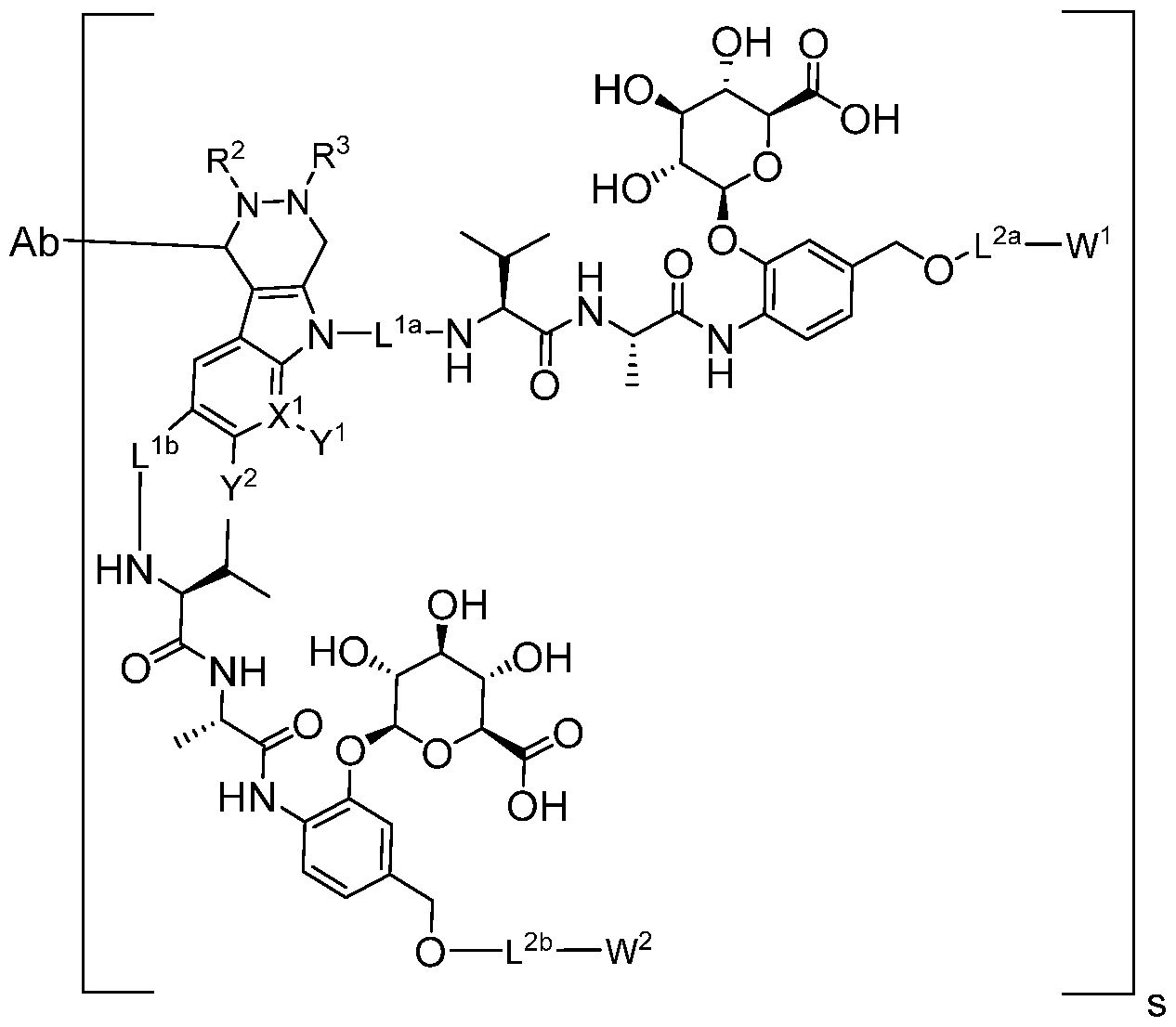
(XIV-6)
wherein each substituent is as defined with respect to Formula (XIV-3). In some embodiments, each substituent is as defined herein, such as with respect to Formula (I) or Formula (II).
[00446] In some embodiments, provided is an ADC of Formula (I), wherein R1 is hydrogen; Z1 is X^Y1, wherein X1 represents an atom in the ring of Formula (I); Z2 is C-Y2; Z4 is CH; Z3 is C-LB-W2; LA is linker (L-7-a); and LB is linker (L-7-b):

(L-7-b), wherein: each represents the point of attachment to a pyridazine-pyrrolo coupling moiety (e.g., any of Formulas as disclosed herein);
* in linker (L-7-a) represents the point of attachment to W1;
* in linker (L-7-b) represents the point of attachment to W2; and
L2a and L2b are as defined herein, such as for linker (L-3) or (L-3-b). In some embodiments, each substituent is as defined herein, such as with respect to Formula (I) or Formula (II).
[00447] Accordingly, in some embodiments, the IL13Ra2-ADC is represented by Formula (XIV-7):
 wherein each substituent is as defined with respect to Formula (XIV-3). In some embodiments, each substituent is as defined herein, such as with respect to Formula (I) or Formula (II).
[00448] In some embodiments of any Formula as disclosed herein (such as Formula (I), (XIV-3), (XIV-4), (XIV-5), (XIV-6), or (XIV-7)), L2a is -CO-. Additionally or alternatively, L2b is -CO-. In some embodiments, both L2a and L2b are -CO-.
[00449] In certain embodiments, at least one of W1 and W2 (e.g., in Formula XIV-3, XIV-4, XIV-5, XIV-6, or XIV-7) is belotecan. In some embodiments, both W1 and W2 are belotecan. [00450] In some embodiments of any Formula as disclosed herein (such as Formula (I), (XIV-3), (XIV-4), (XIV-5), (XIV-6), or (XIV-7)), W1 comprises: (i) a camptothecin or an
analog thereof, such as belotecan; or (ii) an auristatin or an analog thereof, such as MMAE. In further embodiments, W1 comprises belotecan. In other embodiments, W1 comprises MMAE. [00451] In some embodiments of any Formula as disclosed herein (such as Formula (I), (XIV-3), (XIV-4), (XIV-5), (XIV-6), or (XIV-7)), W2 comprises: (i) a camptothecin or an analog thereof, such as belotecan; or (ii) an auristatin or an analog thereof, such as MMAE. In yet further embodiments, W2 comprises belotecan. In other embodiments, W2 comprises MMAE. Additionally or alternatively, W1 and W2 are the same. In other embodiments, W1 and W2 are different.
[00452] In some embodiments, the IL13Ra2-ADC is conjugated to a linker-payload of Formula (Ila):

[00453] In some embodiments, the IL13Ra2-ADC is represented by Formula (II):

Ab represents an antibody that binds to IL13Ra2; and s is an integer from 1 to 10.
In some embodiments, s is an integer from 1 to 4.
[00454] In some embodiments of any Formula as disclosed herein (such as Formula (I), (II), (XIV-3), (XIV-4), (XIV-5), (XIV-6), or (XIV-7)), s is an integer from 1 to 10, for example 1 to 8. In some embodiments, s is 2. In some embodiments, s is 4.
[00455] In some embodiments of any Formula as disclosed herein (such as Formula (I), (II), (XIV-3), (XIV-4), (XIV-5), (XIV-6), or (XIV-7)), Ab is an IL13Ra2 antibody as disclosed herein. For example, see the descriptions and embodiments relating to an IL13Ra2 antibody detailed below in Sections 7.3 and 7.4.
7.2.3 Single Drug Linker Payloads
[00456] In some embodiments, an IL13Ra2-ADC is represented by Formula (III):

Ab is an antibody that binds to IL13Ra2; s is an integer from 1 to 10; t is 0 or 1;
R2 and R3 are each independently hydrogen, alkyl, substituted alkyl, alkenyl, substituted alkenyl, alkynyl, substituted alkynyl, alkoxy, substituted alkoxy, amino, substituted amino, carboxyl, carboxyl ester, acyl, acyloxy, acyl amino, amino acyl, alkylamide, substituted alkylamide, sulfonyl, thioalkoxy, substituted thioalkoxy, aryl, substituted aryl, heteroaryl, substituted heteroaryl, cycloalkyl, substituted cycloalkyl, heterocyclyl, or substituted heterocyclyl; or R2 and R3 are cyclically linked to form a 5- or 6- membered heterocyclyl;
X1, X2, X3, and X4 are each independently C, N, O, or S;
Y1, Y2, Y3, and Y4 are each independently hydrogen, halogen, alkyl, substituted alkyl, alkenyl, substituted alkenyl, alkynyl, substituted alkynyl, alkoxy, substituted alkoxy, amino, substituted amino, carboxyl, carboxyl ester, acyl, acyloxy, acyl amino, amino acyl, alkylamide, substituted alkylamide, sulfonyl, thioalkoxy, substituted thioalkoxy, aryl, substituted aryl, heteroaryl, substituted heteroaryl, cycloalkyl, substituted cycloalkyl, heterocyclyl, substituted heterocyclyl, or absent when adjacent to N; or Y1 and Y2, Y2 and Y3, or Y3 and Y4 are cyclically linked;
LA is a linker as described herein; and
W1 is a drug.
[00457] Formula (III) has been previously described in WO 2015/081282, which is herein incorporated by reference in its entirety.
[00458] In some embodiments, t is 0 or 1 and R2 and R3 are each alkyl. For example, R2 and R3 can independently each be Ci-Cio alkyl (e.g., Ci-Ce alkyl). In some embodiments, R2 and R3 are each independently methyl, ethyl, w-propyl, iso-propyl, //-butyl, ec-butyl, isobutyl, or /-butyl. In some embodiments, at least one of R2 and R3 is methyl. In some embodiments, both of R2 and R3 are methyl. In some embodiments, each of X1, X2, X3, and X4 is independently C or N. In some embodiments, X1 is C. In some embodiments, X1 is N. In some embodiments, X2 is C or N. In some embodiments, X2 is C. In some embodiments, X3 is C or N. In some embodiments, X3 is C. In some embodiments, X4 is C or N. In some embodiments, X4 is C. Various combinations of X1, X2, X3, and X4 are possible. For example, in some embodiments, each of X1, X2, X3, and X4 is C. In other embodiments, three of X1, X2, X3, and X4 are C and one of X1, X2, X3, and X4 is N. In some embodiments, each of Y1, Y2, Y3, and Y4 is hydrogen. [00459] In some embodiments, each of Y1, Y2, Y3, and Y4 is absent when adjacent to N.
[00460] In the context of an IL13Ra2-ADC of Formula (III), in some embodiments, the linker-drug of Formula (III) is represented by Formula (XIII), below:
 wherein represents the point of attachment to the antibody that binds to IL13Ra2, for example, residue (fGly’) of SEQ ID NOs: 146, 147, 148, 149, 150, 151, 152, 153, 154, 155, 156, 157, 158, 159, 160, 161, 162, 163, 164, 165, 166, 167, or 168. All other variables of the linker-drug of Formula (XIII) can be as defined herein, such as for Formula (III) and/or as described herein.
[00461] In some embodiments, an IL13Ra2 ADC is represented by Formula (IV):

Ab is an antibody that binds to IL13Ra2; s is an integer from 1 to 10;
R2 and R3 are each independently hydrogen, alkyl, substituted alkyl, alkenyl, substituted alkenyl, alkynyl, substituted alkynyl, alkoxy, substituted alkoxy, amino, substituted amino, carboxyl, carboxyl ester, acyl, acyloxy, acyl amino, amino acyl, alkylamide, substituted alkylamide, sulfonyl, thioalkoxy, substituted thioalkoxy, aryl, substituted aryl, heteroaryl, substituted heteroaryl, cycloalkyl, substituted cycloalkyl, heterocyclyl, or substituted heterocyclyl; or R2 and R3 are cyclically linked to form a 5- or 6- membered heterocyclyl;
X1 is C or N;
Y1, Y2, Y3, and Y4 are each independently hydrogen, halogen, alkyl, substituted alkyl, alkenyl, substituted alkenyl, alkynyl, substituted alkynyl, alkoxy, substituted alkoxy, amino, substituted amino, carboxyl, carboxyl ester, acyl, acyloxy, acyl amino, amino acyl, alkylamide, substituted alkylamide, sulfonyl, thioalkoxy, substituted thioalkoxy, aryl, substituted aryl, heteroaryl, substituted heteroaryl, cycloalkyl, substituted cycloalkyl, heterocyclyl, substituted heterocyclyl, or absent when adjacent to N; or Y1 and Y2, Y2 and Y3, or Y3 and Y4 are cyclically linked;
LA is a linker as described herein; and
W1 is a drug.
[00462] Formula (IV) has been previously described in WO 2015/081282, which is herein incorporated by reference in its entirety.
[00463] In some embodiments, R2 and R3 are each alkyl. For example, R2 and R3 can independently each be Ci-Cio alkyl (e.g., Ci-Ce alkyl). In some embodiments, R2 and R3 are
each independently methyl, ethyl, //-propyl, iso-propyl, //-butyl, ec-butyl, isobutyl, or /-butyl. In some embodiments, at least one of R2 and R3 is methyl. In some embodiments, both of R2 and R3 are methyl. In some embodiments, each of Y1, Y2, Y3, and Y4 is hydrogen.
[00464] In some embodiments, each of Y1, Y2, Y3, and Y4 is absent when adjacent to N. [00465] In some embodiments of an IL13Ra2-ADC of Formula (IV), the linker-drug of Formula (IV) is represented by Formula (XIV), below:
 wherein represents the point of attachment to the antibody that binds to IL13Ra2, for example, residue (fGly’) of SEQ ID NOs: 146, 147, 148, 149, 150, 151, 152, 153, 154, 155, 156, 157, 158, 159, 160, 161, 162, 163, 164, 165, 166, 167, or 168. All other variables of the linker-drug of Formula (XIV) can be as defined herein, such as for Formula (IV) and/or as described herein.
[00466] In some embodiments, an IL13Ra2 ADC is represented by Formula (V):
 wherein:
Ab is an antibody that binds to IL13Ra2; s is an integer from 1 to 10;
X1 is CH or N;
LA is a linker as described herein; and
W1 is a drug.
[00467] Formula (V) has been previously described in WO 2015/081282, which is herein incorporated by reference in its entirety.
[00468] In some embodiments of an IL13Ra2 ADC of Formula (V), the linker-drug of
Formula (V) is represented by Formula (XV), below:

(XV), wherein — represents the point of attachment to an antibody that binds to IL13Ra2, for example, residue (fGly’) of SEQ ID NOs: 146, 147, 148, 149, 150, 151, 152, 153, 154, 155, 156, 157, 158, 159, 160, 161, 162, 163, 164, 165, 166, 167, or 168. All other variables of the linker-drug of Formula (XV) can be as defined herein, such as for Formula (V) and/or as described herein.
[00469] In some embodiments, an IL13Ra2 ADC can comprise a linker (LA) moiety that links a pyridazine-pyrrolo coupling moiety, as described herein, to a drug. In any embodiment, linker LA can be represented by the following structure:
-(T1-V1)a-(T2-V2)b-(T3-V3)c-(T4-V4)d-(T5-V5)e-, wherein a, b, c, d, and e are each independently 0 or 1 and wherein the sum of a, b, c, d, and e is 1 to 5. In some embodiments, the sum of a, b, c, d, and e is 3. In some embodiments, the sum of a, b, c, d, and e is 5.
[00470] In a linker LA, T1, T2, T3, T4, and T5 are each independently C1-C12 alkyl, substituted C1-C12 alkyl, (EDA)W, (PEG)n, (AA)P, -(CR13OH)h-, a piperidin-4-amine (P4A), MABC, MABO, PABO, PABC, PAB, acetal, a disulfide, a hydrazine, a protease-cleavable moiety, a glucuronidase cleavable moiety, a beta-lactamase cleavable moiety, an ester, (AA)P- MABC-(AA)P, (AA)p-MABO-(AA)P, (AA)P-PABO-(AA)P, or (AA)P-PABC-(AA)P, wherein w is an integer from 1 to 20, n is an integer from 1 to 30, each p is independently zero or an
integer from 1 to 20, h is an integer from 1 to 12, each R13 is independently hydrogen, alkyl, substituted alkyl, aryl, or substituted aryl.
[00471] In a linker LA, “(EDA)W” is an ethylene diamine moiety that has the following structure:
 wherein y is an integer from 1 to 6, r is 0 or 1, w is an integer from 1 to 20, and each R14 is independently hydrogen, alkyl, substituted alkyl, PEG, aryl, or substituted aryl and wherein any two adjacent R14 groups can be cyclically linked to form a piperazinyl ring, wherein each represents a point of attachment in any direction to an adjacent chemical moiety.
[00472] A piperidin-4-amine moiety can optionally be substituted at one or more positions with any substituent, e.g., alkyl, substituted alkyl, a polyethylene glycol moiety, acyl, substituted acyl, aryl, or substituted aryl. As such, as used herein, piperidin-4-amine, as used herein, can be described by the term “P4A-R12” or “4AP” which corresponds to the following structure:
 wherein R12 is independently hydrogen, alkyl, substituted alkyl, a polyethylene glycol moiety (e.g., a polyethylene glycol or a modified polyethylene glycol), alkenyl, substituted alkenyl, alkynyl, substituted alkynyl, alkoxy, substituted alkoxy, amino, substituted amino, carboxyl, carboxyl ester, acyl, acyloxy, acyl amino, amino acyl, alkylamide, substituted alkylamide, sulfonyl, thioalkoxy, substituted thioalkoxy, aryl, substituted aryl, heteroaryl, substituted heteroaryl, cycloalkyl, substituted cycloalkyl, heterocyclyl, or substituted heterocyclyl, wherein each represents a point of attachment in any direction to an adjacent chemical moiety.
[00473] In a linker LA, (PEG)n is polyethylene glycol having the following structure:
 wherein n is an integer from 1 to 50, such as from 1 to 40, from 1 to 30, from 1 to 20, from 1 to 12 or from 1 to 6, such as 1, 2, 3, 4, 5, 6, 7, 8, 9, 10, 11, 12, 13, 14, 15, 16, 17, 18, 19, or 20, wherein each represents a point of attachment in any direction to an adjacent chemical moiety.
[00474] In a linker LA, “AA” refers to an amino acid as described herein, including, but not limited to, any naturally occurring amino acids, naturally occurring amino acid analogs, enantiomers of naturally occurring amino acids, and non-naturally occurring amino acids. In (AA)P, each amino acid residue can independently be chosen from those described herein and p can be an integer from 1 to 50, such as from 1 to 40, from 1 to 30, from 1 to 20, from 1 to 12, or from 1 to 6, such as 1, 2, 3, 4, 5, 6, 7, 8, 9, 10, 11, 12, 13, 14, 15, 16, 17, 18, 19, or 20. [00475] In a linker LA, an MABC group can be described by the term “MABC-R16” and by following structure:

[00476] In a linker LA, a MABO group can be described by the term “MABO-R16” and by the following structure:

[00477] In a linker LA, a PABC group can be described by the term “PABC-R16” and by the following structure:

[00478] In a linker L, a PABO group can be described by the term “PABO-R16” and by the following structure:

[00479] In a linker LA, a para-aminobenzyl (PAB) group can be described by the term “PAB-R16” and by the following structure:

[00480] In MABC-R16, MABO-R16, PABC-R16, PABO-R16, and PAB-R16, each represents a point of attachment in any direction to an adjacent chemical moiety, and R16 is independently hydrogen, alkyl, substituted alkyl, alkenyl, substituted alkenyl, alkynyl, substituted alkynyl, alkoxy, substituted alkoxy, amino, substituted amino, carboxyl, carboxyl ester, acyl, acyloxy, acyl amino, amino acyl, alkylamide, substituted alkylamide, sulfonyl, thioalkoxy, substituted thioalkoxy, aryl, substituted aryl, heteroaryl, substituted heteroaryl, cycloalkyl, substituted cycloalkyl, heterocyclyl, or substituted heterocyclyl.
[00481] In some embodiments, one or more of T1, T2, T3, T4, and T5 is Ci-Ce alkyl. In some embodiments, T1 independently is Ci-Ce alkyl. In some embodiments, T1 is ethyl. In some embodiments, each of T1 and T3 is Ci-Ce alkyl. In some embodiments, each of T1 and T3 is ethyl.
[00482] In some embodiments, one or more of T1, T2, T3, T4, and T5 is P4A-R12. In some embodiments, each R12 is independently a polyethylene glycol moiety. In some embodiments, each R12 is independently a carboxylic acid-modified polyethylene glycol. In some embodiments, T2 is P4A-R12 wherein R12 is a carboxylic acid-modified polyethylene glycol. [00483] In some embodiments, one or more of T1, T2, T3, T4, and T5 is (PEG)n. In some embodiments, n is 2. In some embodiments, T3 is (PEG)n wherein n is 2.
[00484] In some embodiments, one or more of T1, T2, T3, T4, and T5 is (AA)P. In some embodiments, p is 1. In some embodiments, T2 is (AA)P wherein p is 1. In some embodiments, AA of (AA)P is an amino acid with a polar uncharged side chain (e.g., serine, threonine, asparagine, or glutamine). In some embodiments, AA of (AA)P is glutamine.
[00485] In some embodiments, one or more of T1, T2, T3, T4, and T5 is (AA)P-(PABC-R16)- (AA)P. In some embodiments, R16 is hydrogen. In some embodiments, p is 0. In some embodiments, R16 is hydrogen, and p is 0. In some embodiments, therefore, one or more of T1, T2, T3, T4, and T5 is an AA-PABC described by the following structure:
 wherein each "w represents a point of attachment in any direction to an adjacent chemical moiety in the linker.
[00486] In some embodiments, p of AA-PABC is 2. In some embodiments, T4 is AA- PABC, wherein p is 2. In some embodiments, the two amino acids of (AA)2 are valine and citrulline.
[00487] V1, V2, V3, V4, and V5 of linker LA can each independently be a covalent bond, amino, carbonyl, amido, oxycarbonyl, carboxy, sulfonyl, sulfoxide, sulfonylamino, aminosulfonyl, thio, oxy, phospho, phosphoramidate, or thiophosphoraidate. In some embodiments, V1, V2, V3, V4, and V5 are each independently a covalent bond, -C(=O)-, -NR11-, -C(=O)NRn-, -NRnC(=O)-, -C(=O)O-, -OC(=O)-, -O-, -S-, -S(=O)-, -SO2-, -SO2NR11-, -NRnSO2- and -P(=O)OH-, wherein R11 is hydrogen, alkyl, substituted alkyl, a PEG, aryl, or substituted aryl. In some embodiments, V1, V2, and V3 are independently C(=O) or -NR11-, wherein R11 is independently hydrogen or Ci-Ce alkyl.
[00488] In some embodiments, linker LA is represented by the following structure: -(T1V1)a-(T2V2)b-(T3V3)c-(T4V4)d-(T5V5)e-, wherein: a, b, c, d, and e are each independently 0 or 1, wherein the sum of a, b, c, d, and e is 1 to 5;
T1 is Ci-C6 alkyl;
T2, T3, T4, and T5 are each independently (PEG)n, Ci-Ce alkyl, (AA)P, P4A-R12, (AA)P- (PABO-R16)-(AA)P, (AA)P-(PABC-R16)-(AA)P, (AA)p-(PABO-R16), or (AA)p-(PABC-R16);
V1, V2, V3, V4, and V5 are each independently a covalent bond, -CO-, or -NR11-; each R11 is independently hydrogen, alkyl, substituted alkyl, a polyethylene glycol, aryl, or substituted aryl; each R12 is independently hydrogen, alkyl, substituted alkyl, or a modified or unmodified polyethylene glycol moiety;
R16 is hydrogen; n is an integer from 1 to 30; and p is an integer from 1 to 20.
[00489] In some embodiments, R12 is (PEG)n. In some embodiments, R12 is (PEG)n terminally modified with a carboxylic acid. In some embodiments, R11 is hydrogen or C1-C12 alkyl. In some embodiments, p is 1. In some embodiments, p is 2. In some embodiments, p is 1 at one position in the linker and p is 2 at another position in the linker. In some embodiments, n is an integer from 1 to 5. In some embodiments, n is 2.
[00490] In some embodiments, the antibody and drug are conjugated to each other through a cleavable linker. A cleavable linker is a linker that includes one or more cleavable moieties, wherein the cleavable moiety includes one or more bonds that can dissociate under some conditions, thus separating the cleavable linker into two or more separable portions. For example, the cleavable moiety can include one or more covalent bonds, which under some conditions, can dissociate or break apart to separate the cleavable linker into two or more portions. As such, a cleavable linker can be included in an IL13Ra2-ADC, such that under certain conditions, the cleavable linker is cleaved to separate or release the drug from the antibody at a desired target site of action for the drug.
[00491] In some embodiments, the cleavable linker can be an enzymatically cleavable linker. An enzymatically cleavable linker can be separated into two or more portions as described above through the enzymatic action of an enzyme. The enzymatically cleavable linker can comprise any cleavable moiety that can be cleaved through the enzymatic action of an enzyme, such as, but not limited to, a peptide, a glycoside, and the like. In some instances, the enzyme that cleaves the enzymatically cleavable linker is present at a desired target site of action, such as the desired target site of action of the drug that is to be released from the antibody-drug conjugate. In some cases, the enzyme that cleaves the enzymatically cleavable linker is not present in a significant amount in other areas, such as in whole blood, plasma, or serum. As such, the cleavage of an enzymatically cleavable moiety can be controlled such that substantial cleavage occurs at the desired site of action, whereas cleavage does not significantly occur in other areas or before the antibody-drug conjugate reaches the desired site of action.
[00492] In some embodiments, an enzymatically cleavable linker comprises a peptide. The peptide can be any peptide suitable for use in the cleavable linker and that can be cleaved through the enzymatic action of an enzyme. Non-limiting examples of peptides that can be used as an enzymatically cleavable moiety include, for example, Vai-Ala; Phe-Lys; and the like.
[00493] In some embodiments, linker LA is cleavable and is represented by the following structure:
-(T1-V1)a-(T2-V2)b-(T3-V3)c-(T4-V4)d-(T5-V5)e-, wherein: a, b, c, d, and e are each independently 0 or 1, wherein the sum of a, b, c, d, and e is 1 to 5;
T1 and T5 are each Ci-Ce alkyl;
T2, T3, and T4 are each independently (PEG)n, (AA)P, or (AA)p-PABC-R16;
V1, V2, V3, V4, and V5 are each independently a covalent bond, -CO-, or -NR11-;
R11 is as described herein;
R16 is as described herein; each n is independently an integer from 1 to 30; and each p is independently an integer from 1 to 20.
[00494] In some embodiments, a cleavable linker includes two cleavable moieties, such as a first cleavable moiety and a second cleavable moiety. The cleavable moieties can be configured such that cleavage of both cleavable moieties is needed in order to separate or release the drug from the antibody, for example, at a desired target site of action for the drug. For example, cleavage of the cleavable linker can be achieved by initially cleaving one of the two cleavable moieties and then cleaving the other of the two cleavable moieties. In some embodiments, the cleavable linker includes a first cleavable moiety and a second cleavable moiety that hinders cleavage of the first cleavable moiety. By “hinders cleavage” is meant that the presence of an uncleaved second cleavable moiety reduces the likelihood or substantially inhibits the cleavage of the first cleavable moiety, thus substantially reducing the amount or preventing the cleavage of the cleavable linker. For embodiment, the presence of uncleaved second cleavable moiety can hinder enzymatic and/or chemical cleavage of the first cleavable moiety. The hindrance of cleavage of the first cleavable moiety by the presence of the second cleavable moiety, in turn, substantially reduces the amount or prevents the release of the drug from the antibody. For example, the premature release of the drug from the antibody can be substantially reduced or prevented until the IL13Ra2-ADC is at or near the desired target site of action for the drug.
[00495] In some embodiments, the second cleavable moiety hinders cleavage of the first cleavable moiety, and cleavage of the cleavable linker can be achieved by initially cleaving the second cleavable moiety and then cleaving the first cleavable moiety. Cleavage of the second cleavable moiety can reduce or eliminate the hindrance on the cleavage of the first cleavable moiety, thus allowing the first cleavable moiety to be cleaved. Cleavage of the first cleavable moiety can result in the cleavable linker dissociating or separating into two or more portions as described herein to release the drug from the IL13Ra2-ADC. In some embodiments, cleavage of the first cleavable moiety does not substantially occur in the presence of an uncleaved second cleavable moiety. The term “substantially” in this context, means that about 10% or less cleavage of the first cleavable moiety occurs in the presence of an uncleaved second cleavable moiety, such as about 9% or less, or about 8% or less, or about
7% or less, or about 6% or less, or about 5% or less, or about 4% or less, or about 3% or less, or about 2% or less, or about 1% or less, or about 0.5% or less, or about 0.1% or less cleavage of the first cleavable moiety occurs in the presence of an uncleaved second cleavable moiety. [00496] Stated another way, the second cleavable moiety can protect the first cleavable moiety from cleavage. For embodiment, the presence of uncleaved second cleavable moiety can protect the first cleavable moiety from cleavage, and thus substantially reduce or prevent premature release of the drug from the IL13Ra2 antibody until the IL13Ra2-ADC is at or near the desired target site of action for the drug. As such, cleavage of the second cleavable moiety exposes the first cleavable moiety (e.g., deprotects the first cleavable moiety), thus allowing the first cleavable moiety to be cleaved, which results in cleavage of the cleavable linker, which, in turn, separates or releases the drug from the antibody at a desired target site of action for the drug as described herein. In some embodiments, cleavage of the second cleavable moiety exposes the first cleavable moiety to subsequent cleavage, but cleavage of the second cleavable moiety does not in and of itself result in cleavage of the cleavable linker (e.g., cleavage of the first cleavable moiety is still needed in order to cleave the cleavable linker).
[00497] Examples of cleavable moieties that are suitable for use in a cleavable linker include chemically cleavable moieties and enzymatically cleavable moieties. For example, a first cleavable moiety can be a chemically cleavable moiety and a second cleavable moiety can be a chemically cleavable moiety, which can be the same or different from the first cleavable moiety. In other embodiments, a first cleavable moiety can be an enzymatically cleavable moiety and a second cleavable moiety can be a chemically cleavable moiety. In yet other embodiments, a first cleavable moiety can be a chemically cleavable moiety and a second cleavable moiety can be an enzymatically cleavable moiety. In yet further embodiments, a first cleavable moiety can be an enzymatically cleavable moiety and a second cleavable moiety can be an enzymatically cleavable moiety, which is the same or different from the first cleavable moiety.
[00498] Chemically cleavable moieties include cleavable moieties that can be cleaved in the presence of certain chemical conditions. In some embodiments, a chemically cleavable moiety includes one or more bonds that can dissociate in the presence of certain chemical conditions, thus separating the cleavable moiety into two or more separable portions. For example, a chemically cleavable moiety can be cleaved in the presence of chemical conditions, such as acidic conditions or alkali conditions, which can lead to hydrolysis of the chemically cleavable moiety. In some embodiments, the chemical conditions under which the chemically
cleavable moiety is cleaved can be present at a desired target site of action, such as the desired target site of action of the drug that is to be released from the IL13Ra2-ADC. In some embodiments, the chemical conditions found at a desired site of cleavage of the chemically cleavable moiety are not significantly present in other areas, such as in whole blood, plasma, or serum. As such, cleavage of a chemically cleavable moiety can be controlled such that substantial cleavage occurs at a desired site of action, whereas cleavage does not significantly occur in other areas or before the IL13Ra2-ADC reaches the desired site of action.
[00499] In some embodiments, the cleavable moiety can be an enzymatically cleavable moiety. An enzymatically cleavable moiety is a cleavable moiety that can be separated into two or more portions as described herein through the enzymatic action of an enzyme. The enzymatically cleavable moiety can be any cleavable moiety that can be cleaved through the enzymatic action of an enzyme, such as, but not limited to, a peptide, a glycoside, and the like. In some embodiments, the enzyme that cleaves the enzymatically cleavable moiety is present at a desired target site of action, such as the desired target site of action of the drug that is to be released from an IL13Ra2-ADC. In some embodiments, the enzyme that cleaves the enzymatically cleavable moiety is not present in a significant amount in other areas, such as in whole blood, plasma, or serum. As such, the cleavage of an enzymatically cleavable moiety can be controlled such that substantial cleavage occurs at the desired site of action, whereas cleavage does not significantly occur in other areas or before the IL13Ra2-ADC reaches the desired site of action, for example, a cancer cell.
[00500] In some embodiments, linker LA can be linker (L-3):

(L-3), wherein:
— represents the point of attachment to a pyridazine-pyrrolo coupling moiety as described herein (e.g., any of Formulas III, IV, V, XIII, XIV, and XV);
* represents the point of attachment to W1;
each R5 is independently hydrogen, alkyl, substituted alkyl, alkenyl, substituted alkenyl, alkynyl, substituted alkynyl, aryl, substituted aryl, heteroaryl, substituted heteroaryl, cycloalkyl, substituted cycloalkyl, heterocyclyl, or substituted heterocyclyl; each R6 is independently alkyl, substituted alkyl, alkenyl, substituted alkenyl, alkynyl, substituted alkynyl, aryl, substituted aryl, heteroaryl, substituted heteroaryl, cycloalkyl, substituted cycloalkyl, heterocyclyl, or substituted heterocyclyl;
R7 is a cleavable moiety; k is an integer from 1 to 10;
Lla comprises -(T1-V1)a-(T2-V2)b-(T3-V3)c-(T4-V4)d-,
L2a comprises -(T5-V5)e-(T6-V6)f-(T7-V7)g-(T8-V8)h-;
T1, T2, T3, T4, T5, T6, T7, and T8 are each independently a covalent bond, C1-C12 alkyl, substituted C1-C12 alkyl, aryl, substituted aryl, heteroaryl, substituted heteroaryl, cycloalkyl, substituted cycloalkyl, heterocyclyl, and substituted heterocyclyl, (EDA)W, (PEG)n, (AA)P, -(CR13OH)m-, P4A-R12, acetal, a hydrazine, a disulfide, or an ester;
V1, V2, V3, V4, V5, V6, V7, and V8 are each independently a covalent bond, -CO-, -NR15-, -NR15(CH2)q-, -NR15(C6H4)-, -CONR15-, -NR15CO-, -C(O)O-, -OC(O)-, -O-, -S-, -S(O)-, -SO2-, -SO2NR15-, -NR15SO2-, or -P(O)OH-; each of a, b, c, d, e, f, g, and h is independently 1 or 0; m is independently an integer from 1 to 12; n is independently an integer from 1 to 30; p is independently an integer from 1 to 20; q is independently an integer from 1 to 6; w is independently an integer from 1 to 20; each R12 is independently hydrogen, alkyl, substituted alkyl, a polyethylene glycol moiety (e.g., a polyethylene glycol or a modified polyethylene glycol), alkenyl, substituted alkenyl, alkynyl, substituted alkynyl, alkoxy, substituted alkoxy, amino, substituted amino, carboxyl, carboxyl ester, acyl, acyloxy, acyl amino, amino acyl, alkylamide, substituted alkylamide, sulfonyl, thioalkoxy, substituted thioalkoxy, aryl, substituted aryl, heteroaryl, substituted heteroaryl, cycloalkyl, substituted cycloalkyl, heterocyclyl, or substituted heterocyclyl; each R13 is independently hydrogen, alkyl, substituted alkyl, aryl, or substituted aryl; and each R15 is independently hydrogen, alkyl, substituted alkyl, alkenyl, substituted alkenyl, alkynyl, substituted alkynyl, carboxyl, carboxyl ester, acyl, aryl, substituted aryl,
heteroaryl, substituted heteroaryl, cycloalkyl, substituted cycloalkyl, heterocyclyl, or substituted heterocyclyl.
[00501] In some embodiments, an IL13Ra2-ADC of Formula (IV) includes linker (L-3).
Accordingly, in some embodiments, an IL13Ra2-ADC is represented by Formula (IV-3)
 wherein:
Ab is an antibody that binds to IL13Ra2; s is an integer from 1 to 10;
X1 is C or N;
W1 is a drug;
R2, R3, Y1, Y2, Y3, and Y4 are as defined herein, such as for Formula (IV); and Lla, L2a, R5, R6, R7, and k are as defined herein, such as for linker (L-3).
[00502] In some embodiments, s is an integer from 1 to 4. In some embodiments, s is an integer from 1 to 2.
[00503] In some embodiments, an IL13Ra2-ADC of Formula (V) includes linker (L-3). Accordingly, in some embodiments, an IL13Ra2-ADC is represented by Formula (V-3):
 wherein:
Ab is an antibody that binds to IL13Ra2; s is an integer from 1 to 10;
X1 is CH or N;
W1 is a drug; and
Lla, L2a, R5, R6, R7, and k are as defined herein, such as for linker (L-3).
[00504] In some embodiments, s is an integer from 1 to 4. In some embodiments, s is 1 or 2.
[00505] In some embodiments of linker (L-3), k is 2. Accordingly, linker LA can be linker (L-4):
 wherein: represents the point of attachment to a pyridazine-pyrrolo coupling moiety as described herein (e.g., any of Formulas III, IV, V, XIII, XIV, and XV);
* represents the point of attachment to W1; each R5 is independently hydrogen, alkyl, substituted alkyl, alkenyl, substituted alkenyl, alkynyl, substituted alkynyl, aryl, substituted aryl, heteroaryl, substituted heteroaryl, cycloalkyl, substituted cycloalkyl, heterocyclyl, or substituted heterocyclyl;
R6 and R6 are each independently alkyl, substituted alkyl, alkenyl, substituted alkenyl, alkynyl, substituted alkynyl, aryl, substituted aryl, heteroaryl, substituted heteroaryl, cycloalkyl, substituted cycloalkyl, heterocyclyl, or substituted heterocyclyl;
R7 is a cleavable moiety; and
Lla and L2a are as defined herein, such as for linker (L-3).
[00506] In some embodiments, an IL13Ra2-ADC of Formula (IV) includes linker (L-4). Accordingly, in some embodiments, an IL13Ra2-ADC is represented by Formula (IV-4):

(IV-4), wherein:
Ab is an antibody that binds to IL13Ra2; s is an integer from 1 to 10;
X1 is C or N;
W1 is a drug;
R2, R3, Y1, Y2, Y3, and Y4 are as defined herein, such as for Formula (IV);
Lla, L2a, R5, R6 , R6 , and R7 are as defined herein, such as for linker (L-4).
[00507] In some embodiments, s is an integer from 1 to 4. In some embodiments, s is 1 or 2. [00508] In some embodiments, an IL13Ra2-ADC of Formula (V) includes linker (L-4). In some embodiments, an IL13Ra2-ADC is represented by Formula (V-4):

(V-4), wherein:
Ab is an antibody that binds to IL13Ra2; s is an integer from 1 to 10;
X1 is CH or N;
W1 is a drug;
Lla, L2a, R5, R6 , R6 , and R7 are as defined herein, such as for linker (L-4).
[00509] In some embodiments, s is an integer from 1 to 4. In some embodiments, s is 1 or 2. [00510] In some embodiments, R7 is an enzymatically cleavable moiety comprising a sugar moiety, such as a glycoside or glycosyl. In some embodiments, the glycoside can facilitate an increase in the hydrophilicity of the cleavable linker as compared to a cleavable linker that does not include the glycoside. The glycoside can be any glycoside suitable for use in the cleavable linker and that can be cleaved through the enzymatic action of an enzyme.
[00511] A glycoside of a R7 moiety can be attached to the rest of the IL13Ra2-ADC through a glycosidic bond. The glycosidic bond can link the glycoside to the IL13Ra2-ADC through various types of bonds, such as, but not limited to, an O-glycosidic bond (an O-gly coside), an N-glycosidic bond (a glycosylamine), an S-glycosidic bond (a thioglycoside), or C-glycosidic bond (a C-glycoside or C-glycosyl). In some embodiments, the glycosidic bond is an O- glycosidic bond (an O-glycoside).
[00512] In some embodiments,
 wherein ** represents the point of attachment to the phenyl group described herein, such as in Formula (IV-3), (V-3), (IV-4), or (V-4). Accordingly, linker LA can be linker (L-5):

(L-5), wherein: represents the point of attachment to a pyridazine-pyrrolo coupling moiety as described herein (e.g., any of Formulas III, IV, V, XIII, XIV, and XV);
* represents the point of attachment to W1; each R5 is independently hydrogen, alkyl, substituted alkyl, alkenyl, substituted alkenyl, alkynyl, substituted alkynyl, aryl, substituted aryl, heteroaryl, substituted heteroaryl, cycloalkyl, substituted cycloalkyl, heterocyclyl, or substituted heterocyclyl;
R6 and R6 are independently alkyl, substituted alkyl, alkenyl, substituted alkenyl, alkynyl, substituted alkynyl, aryl, substituted aryl, heteroaryl, substituted heteroaryl, cycloalkyl, substituted cycloalkyl, heterocyclyl, or substituted heterocyclyl; and
Lla and L2a are as defined herein, such as for linker (L-3).
[00513] In some embodiments, linker (L-5) is attached to Formula (IV). In some embodiments, an IL13Ra2-ADC is represented by Formula (FV-5):
 wherein:
Ab is an antibody that binds to IL13Ra2; s is an integer from 1 to 10;
X1 is C or N;
W1 is a drug;
R2, R3, Y1, Y2, Y3, and Y4 are as defined herein, such as for Formula (IV);
Lla, L2a, R5, R6 , and R6 are as defined herein, such as for linker (L-5).
[00514] In some embodiments, s is an integer from 1 to 4. In some embodiments, s is 1 or 2.
[00515] In some embodiments, an IL13Ra2-ADC of Formula (V) can include linker (L-5).
Accordingly, in some embodiments, an IL13Ra2-ADC is represented by Formula (V-5):
 wherein:
Ab is an antibody that binds to IL13Ra2; s is an integer from 1 to 10;
X1 is CH or N;
W1 is a drug;
Lla, L2a, R5, R6 , and R6 are as defined herein, such as for linker (L-5).
[00516] In some embodiments, s is an integer from 1 to 4. In some embodiments, s is 1 or 2.
[00517] In some embodiments of linker (L-5), R5 is hydrogen, R6 is isopropyl and R6 is methyl. Accordingly, in some embodiments, linker LA can be linker (L-6):

(L-6), wherein:
— represents the point of attachment to a pyridazine-pyrrolo coupling moiety (e.g., any of Formulas III, IV, V, XIII, XIV, and XV);
* represents the point of attachment to W1; and
Lla and L2a are as defined herein, such as for linker (L-5).
[00518] In some embodiments, an IL13Ra2-ADC of Formula (IV) includes linker (L-6).
Accordingly, in some embodiments, an IL13Ra2-ADC is represented by Formula (IV-6):

(IV-6), wherein:
Ab is an antibody that binds to IL13Ra2; s is an integer from 1 to 10;
X1 is C or N;
R2, R3, Y1, Y2, Y3, and Y4 are as defined herein, such as for Formula (IV);
W1 is a drug; and
Lla and L2a are as defined herein, such as for linker (L-6).
[00519] In some embodiments, s is an integer from 1 to 4. In some embodiments, s is 1 or 2.
[00520] In some embodiments, an IL13Ra2-ADC of Formula (V) includes linker (L-6).
Accordingly, in some embodiments, an IL13Ra2-ADC is represented by Formula (V-6):

(V-6), wherein:
Ab is an antibody that binds to IL13Ra2; s is an integer from 1 to 10;
X1 is CH or N;
W1 is a drug; and
Lla and L2a are as defined herein, such as for linker (L-6).
[00521] In some embodiments, s is an integer from 1 to 4. In some embodiments, s is 1 or 2. [00522] In some embodiments, in an IL13Ra2-ADC represented by Formula (TV-3), (IV-4), (IV-5), (IV-6), (V-3), (V-4), (V-5), or (V-6)
Lla comprises -(T1-V1)a-(T2-V2)b-(T3-V3)c-(T4-V4)d-;
L2a comprises -(T5-V5)e-(T6-V6)f-(T7-V7)g-(T8-V8)h-;
T1, T2, and T3 are each independently C1-C12 alkyl, (PEG)n, or (AA)P;
T5, T6, T7, and T8 are each independently a covalent bond, C1-C12 alkyl, substituted Ci-
C12 alkyl, aryl, substituted aryl, heteroaryl, substituted heteroaryl, cycloalkyl, substituted cycloalkyl, heterocyclyl, and substituted heterocyclyl, (EDA)W, (PEG)n, (AA)P, -(CR13OH)m-, P4A-R12, acetal, a hydrazine, a disulfide, and an ester;
V1, V2, V3, V4, V5, V6, V7, and V8 are each independently-C(=O)- or -NR11-; a, b, and c are each 1; d is 0 and therefore T4 and V4 are absent (e.g., a covalent bond); each of e, f, g, and h is independently 1 or 0; n is an integer from 1 to 10; p is an integer from 1 to 10; and
R11 is hydrogen, alkyl, substituted alkyl, a polyethylene glycol moiety, aryl, or substituted aryl.
[00523] In some embodiments, in an IL13Ra2-ADC represented by Formula (IV-3), (IV-4),
(IV-5), (IV-6), (V-3), (V-4), (V-5), or (V-6),
Lla comprises -(T1-V1)a-(T2-V2)b-(T3-V3)c-(T4-V4)d-; a, b, and c are each 1; d is 0 and therefore T4 and V4 are absent;
T1, T2, and T3 are each independently selected from the group consisting of C1-C12 alkyl, substituted C1-C12 alkyl, and (PEG)n, n is an integer from 1 to 10;
V1, V2, and V3 are each independently selected from the group consisting of -C(=O)- )-, -CONR15-, and -NR15CO-; and
R15 is selected from hydrogen, alkyl, substituted alkyl, and alkenyl.
[00524] In some embodiments, in an IL13Ra2-ADC represented by Formula (TV-3), (IV-4), (IV-5), (IV-6), (V-3), (V-4), (V-5), or (V-6), T1, T2, and T3 are Ci-C6 alkyl, (AA)P, or (PEG)n, and p and n are independently integers from 1 to 10. In some embodiments, p is 1. In some embodiments, n is 2. In some embodiments, (AA)P can include a non-naturally occurring amino acid, such as a cysteine sulfonic acid amino acid. In some embodiments, V1, V2, and V3 are independently -C(=O)- or -NR11-, wherein R11 is hydrogen.
[00525] In any embodiment described herein, L1 can be as follows:
-(Ci-C6 alkyl)- Vk(AA)P- V2-(PEG)n-V3- wherein V1, V2, V3, AA, p, and n are as described herein, such as for linker (L-3). In some embodiments, V1, V2, and V3 are -C(=O) or -NR11-, wherein R11 is hydrogen. In some embodiments, p is 1 and n is 2. In some embodiments, (AA)P can include a non-naturally occurring amino acid, such as a cysteine sulfonic acid amino acid.
[00526]
 wherein each
— represents a point of attachment in any direction to an adjacent chemical moiety in the linker. Accordingly, in some embodiments, linker LA can be linker (L-7):

(L-7), wherein: represents the point of attachment to a pyridazine-pyrrolo coupling moiety as described herein (e.g., any of Formulas III, IV, V, XIII, XIV, and XV);
* represents the point of attachment to W1; and
L2a is as defined herein, such as for linker (L-3).
[00527] In some embodiments, an IL13Ra2-ADC is represented by Formula (IV-7):

(IV-7), wherein:
Ab is an antibody that binds to IL13Ra2; s is an integer from 1 to 10;
X1 is C or N;
R2, R3, Y1, Y2, Y3, and Y4 are as defined herein, such as for Formula (IV);
W1 is a drug; and
L2a is as defined herein, such as for linker (L-7).
[00528] In some embodiments, s is an integer from 1 to 4. In some embodiments, s is 1 or 2.
[00529] In some embodiments, an IL13Ra2-ADC is represented by Formula (V-7):

(V-7), wherein:
Ab is an antibody that binds to IL13Ra2; s is an integer from 1 to 10;
X1 is CH or N;
W1 is a drug; and
L2a is as defined herein, such as for linker (L-7).
[00530] In some embodiments, s is an integer from 1 to 4. In some embodiments, s is 1 or 2. [00531] In some embodiments of L2a, e is 1, T5 is a covalent bond, V5 is carbonyl, and each of f, g, and h is 0. In some embodiments, L2a is carbonyl (C=O). Accordingly, in some embodiments, linker LA can be linker (L-8):

(L-8), wherein: represents the point of attachment to a pyridazine-pyrrolo coupling moiety as described herein (e.g., any of Formulas III, IV, V, XIII, XIV, and XV); and
* represents the point of attachment to W1.
[00532] In some embodiments, linker (LA) in the IL13Ra2-ADC of Formula (IV) can be linker (L-8). Accordingly, in some embodiments, an IL13Ra2-ADC is represented by Formula (IV-8):

(IV-8), wherein:
Ab is an antibody that binds to IL13Ra2; s is an integer from 1 to 10;
X1 is C or N;
R2, R3, Y1, Y2, Y3, and Y4 are as defined herein, such as for Formula (IV); and W1 is a drug.
[00533] In some embodiments, s is an integer from 1 to 4. In some embodiments, s is 1 or 2.
[00534] In some embodiments, linker (LA) in the IL13Ra2-ADC of Formula (V) can be linker (L-8). Accordingly, in some embodiments, an IL13Ra2-ADC is represented by Formula (V-8):

(V-8), wherein:
Ab is an antibody that binds to IL13Ra2; s is an integer from 1 to 10;
X1 is CH or N; and
W1 is a drug.
[00535] In some embodiments, s is an integer from 1 to 4. In some embodiments, s is 1 or 2. [00536] In some embodiments, an IL13Ra2-ADC is represented by Formula (V-8), wherein X1 is CH. Accordingly, in some embodiments, an IL13Ra2-ADC is represented by Formula
(Va-8):

(Va-8), wherein:
Ab is an antibody that binds to IL13Ra2; s is an integer from 1 to 10; and
W1 is a drug.
[00537] In some embodiments, s is an integer from 1 to 4. In some embodiments, s is 1 or 2.
[00538] In some embodiments, an IL13Ra2-ADC is" by Formula (V-8), wherein X1 is N.
Accordingly, in some embodiments, an IL13Ra2-ADC is represented by Formula (Vb-8):

(Vb-8), wherein:
Ab is an antibody that binds to IL13Ra2; s is an integer from 1 to 10; and W1 is a drug.
[00539] In some embodiments, s is an integer from 1 to 4. In some embodiments, s is 1 or 2. [00540] The drug useful for use in an IL13Ra2-ADC as described herein, represented as W1 in each of the formulas provided herein, is not particularly limited. Examples of suitable drugs include, but are not limited to, small molecule drugs, such as cancer chemotherapeutic agents. For example, the drug can be a microtubule-affecting agent. In some embodiments, the drug is a microtubule-affecting agent that has antiproliferative activity, such as a maytansinoid or an auri statin.
[00541] In some embodiments, the drug is an antimitotic agent, such as an auristatin or an active auristatin analog or derivative thereof (e.g., monomethyl auristatin D (MMAD), monomethyl auristatin E (MMAE), monomethyl auristatin F (MMAF), and the like).
[00542] In some embodiments of any Formula as disclosed herein (such as Formula (III), (XIII), (IV), (XIV), (V), (XV), (IV-3), (V-3), (IV-4), (V-4), (IV-5), (V-5), (IV-6), (V-6), (IV- 7), (V-7), (IV-8), or (V-8)), W1 comprises: (i) a camptothecin or an analog thereof, such as belotecan; or (ii) an auristatin or an analog thereof, such as MMAE. In further embodiments, W1 comprises belotecan. In other embodiments, W1 comprises MMAE.
[00543] In some embodiments, W1 is MMAE, which has the following structure (W-2):

(W-2), wherein — indicates the point of attachment between MMAE and a linker, such as an L2a moiety as disclosed herein, in an IL13Ra2-ADC.
[00544] In some embodiments, MMAE has the following structure (W-2):

(W-2), wherein — indicates the point of attachment between MMAE and the rest of the ADC as disclosed herein.
[00545] In some embodiments, MMAE can be included in an IL13Ra2-ADC comprising linker (L-5). Accordingly in some embodiments, an IL13Ra2-ADC is represented by Formula (V-52):

(V-52), wherein:
Ab is an antibody that binds to IL13Ra2; s is an integer from 1 to 10;
X1 is CH or N; and
Lla and L2a are as defined herein, such as for linker (L-3).
[00546] In some embodiments, s is an integer from 1 to 4. In some embodiments, s is 1 or 2. [00547] In some embodiments, MMAE can be included in an IL13Ra2-ADC comprising linker (L-6). Accordingly in some embodiments, an IL13Ra2-ADC is represented by Formula (V-62) or (V-62a):

(V-62a) wherein:
Ab is an antibody that binds to IL13Ra2; s is an integer from 1 to 10;
X1 is CH or N; and
Lla and L2a are as defined herein, such as for linker (L-3).
[00548] In some embodiments, s is an integer from 1 to 4. In some embodiments, s is 1 or 2. [00549] In some embodiments, an IL13Ra2-ADC is represented by Formula (V-52), or (V- 62), wherein X1 is N. In some embodiments, an IL13Ra2-ADC is represented by Formula (Vb-52), Formula (Vb-62), or Formula (Vb-62a):

(Vb-62a) wherein:
Ab is an antibody that binds to IL13Ra2; s is an integer from 1 to 10;
R5, R6 , R6 , Lla, and L2a are as defined herein, such as for linker (L-5).
[00550] In some embodiments, s is an integer from 1 to 4. In some embodiments, s is 1 or 2.
[00551] In some embodiments, MMAE can be included in an IL13Ra2-ADC comprising linker (L-7). Accordingly, in some embodiments, an IL13Ra2-ADC is represented by Formula (V-72):

(V-72),
wherein:
Ab is an antibody that binds to IL13Ra2; s is an integer from 1 to 10;
X1 is as defined herein, such as in Formula (V); and L2a is as defined herein, such as for linker (L-6).
[00552] In some embodiments, s is an integer from 1 to 4. In some embodiments, s is 1 or 2. [00553] In some embodiments, MMAE can be included in an IL13Ra2-ADC comprising linker (L-8). Accordingly, in some embodiments, an IL13Ra2-ADC is represented by Formula (Vb-82):

(Vb-82), wherein:
Ab is an antibody that binds to IL13Ra2; and s is an integer from 1 to 10.
[00554] In some embodiments, s is 2. Accordingly, in some embodiments, an IL13Ra2- ADC is represented by Formula (Vb-82-1):

(Vb-82-1), wherein Ab is an antibody that binds to IL13Ra2.
[00555] In some embodiments, s is an integer from 1 to 4. In some embodiments, s is 1 or 2.
[00556] In some embodiments of any Formula as disclosed herein (such as Formula (III), (XIII), (IV), (XIV), (V), (XV), (IV-3), (V-3), (IV-4), (V-4), (IV-5), (V-5), (IV-6), (V-6), (IV- 7), (V-7), (IV-8), (V-8), (Va-8), (Vb-8), (V-52), (V-62), (Vb-52), (Vb-62), (V-72), or (Vb-
82), s is an integer from 1 to 10, for example, 1 to 8. In some embodiments, s is 2. In some embodiments, s is 4.
[00557] In some embodiments of any Formula as disclosed herein (such as Formula (III), (XIII), (IV), (XIV), (V), (XV), (IV-3), (V-3), (IV-4), (V-4), (IV-5), (V-5), (IV-6), (V-6), (IV- 7), (V-7), (IV-8), (V-8), (Va-8), (Vb-8), (V-52), (V-62), (Vb-52), (Vb-62), (V-72), (Vb-82), or (Vb-82-1)), Ab is an IL13Ra2 antibody as disclosed herein. For example, see the descriptions and embodiments relating to an IL13Ra2 antibody detailed below in Sections 7.3 and 7.4.
[00558] Any of the chemical entities, linkers and conjugation moieties set forth in the structures above may be adapted for use in the subject compounds and conjugates.
[00559] Additional disclosure related to hydrazinyl-indolyl and hydrazinyl-pyrrolo- pyridinyl compounds and methods for producing a conjugate is found in U.S. Patent No. 9,310,374, U.S. Patent No. 9,493,413, U.S. Patent NO. 11,564,989, and International Publication Number WO 2022/187370, the disclosures of each of which are incorporated herein by reference.
7.3 Interleukin-13 Receptor Subunit Alpha-2 (IL13R«2) Antibodies
[00560] As noted above, a subject conjugate comprises an antibody (Ab) that binds to IL13Ra2. The amino acid sequence of the antibody can be modified to include a 2- formylglycine (fGly) residue. As used herein, amino acids may be referred to by their standard name, their standard three letter abbreviation and/or their standard one letter abbreviation, such as: Alanine or Ala or A; Cysteine or Cys or C; Aspartic acid or Asp or D; Glutamic acid or Glu or E; Phenylalanine or Phe or F; Glycine or Gly or G; Histidine or His or H; Isoleucine or He or I; Lysine or Lys or K; Leucine or Leu or L; Methionine or Met or M; Asparagine or Asn or N; Proline or Pro or P; Glutamine or Gin or Q; Arginine or Arg or R; Serine or Ser or S; Threonine or Thr or T; Valine or Vai or V; Tryptophan or Trp or W; and Tyrosine or Tyr or Y.
[00561] In some embodiments, the IL13Ra2 antibodies bind to IL13Ra2, including an IL13Ra2 polypeptide, an IL13Ra2 polypeptide fragment, an IL13Ra2 peptide, an IL13Ra2:IL13 complex, or an IL13Ra2 epitope. In some embodiments, the IL13Ra2 antibodies are human or humanized antibodies (e.g., comprising human constant regions) that bind IL13Ra2, including an IL13Ra2 polypeptide, an IL13Ra2 polypeptide fragment, an IL13Ra2 peptide or an IL13Ra2 epitope. In some embodiments, an IL13Ra2 antibody, such as a human IL13Ra2 antibody, can bind to IL13Ra2 expressed on the surface of a mammalian
(e.g., human) cell, including an IL13Ra2 expressing cancer cell. In some embodiments, an IL13Ra2 antibody, such as a human IL13Ra2 antibody, can bind to IL13Ra2 expressed on the surface of a mammalian (e.g., human) cell, including an IL13Ra2 overexpressing cancer cell. In some embodiments, an IL13Ra2 antibody binds an IL13Ra2 extracellular epitope exposed on a cell such as a cancer cell. In some embodiments, an IL13Ra2 binding agent (e.g., an antibody) binds to a complex comprising IL13Ra2 and IL 13. In some embodiments, an IL13Ra2 binding agent (e.g., an antibody) binds to a complex comprising the extracellular domain (ECD) of IL13Ra2 and IL13. In yet further embodiments, an IL13Ra2 binding agent (e.g., an antibody) binds to an epitope of a complex comprising the ECD of IL13Ra2 and IL 13. In some embodiments, described herein is an IL13Ra2 antibody that binds to IL13Ra2, such as human IL13Ra2 or a portion thereof. In some embodiments, IL13Ra2 binding antibodies bind to both human and cyno IL13Ra2. In other embodiments, IL13Ra2 antibodies bind to human IL13Ra2 but not to cyno IL13Ra2.
[00562] In some embodiments, the IL13Ra2 antibody provided herein binds to IL13Ra2 (e.g., human IL13Ra2 and/or cyno IL13Ra2) with a dissociation constant (Ka) of < 1 pM, < 100 nM, < 10 nM, < 1 nM, < 0.1 nM, < 0.01 nM, or < 0.001 nM (e.g., 10'8 M or less, e.g., from 10'8M to 10'13 M, e.g., from 10'9M to 10'13 M). A variety of methods of measuring binding affinity are known in the art, any of which can be used for purposes of the present disclosure, including by RIA, for example, performed with the Fab version of an antibody of interest and its antigen (Chen et al., 1999, J. Mol Biol 293:865-81); by biolayer interferometry (BLI) or surface plasmon resonance (SPR) assays by OCTET®, using, for example, an OCTET®Red96 system, or by BIACORE®, using, for example, a BIACORE®TM-2000 or a BIACORE®TM-3000. An “on-rate” or “rate of association” or “association rate” or “kon” may also be determined with the same biolayer interferometry (BLI) or surface plasmon resonance (SPR) techniques described above using, for example, the OCTET®Red96, the BIACORE®TM-2000, the BIACORE®TM-3000 system, the BIACORE®TM-8K, or the BIACORE®TM-8K+ system.
[00563] In some embodiments, the IL13Ra2 binding antibody provided herein does not bind to IL13Ral (e.g., human IL13Ral and/or cyno IL13Ral). In some embodiments, the IL13Ra2 antibody provided herein does not bind to human IL13RaL In some embodiments, the IL13Ra2 antibody provided herein does not bind to human IL13Ral or cyno IL13RaL In other embodiments, the IL13Ra2 antibody provided herein binds to IL13Ra2 (e.g., human IL13Ra2) with higher affinity than to IL13Ral (e.g., human IL13Ral). In some embodiments, the binding affinity of the IL13Ra2 antibody provided herein to IL13Ra2 (e.g.,
human IL13Ra2) is at least 2-fold of that to IL13Ral (e.g., human IL13Ral). In some embodiments, the binding affinity of the IL13Ra2 antibody provided herein to IL13Ra2 (e.g., human IL13Ra2) is at least 5-fold of that to IL13Ral (e.g., human IL13Ral). In some embodiments, the binding affinity of the IL13Ra2 antibody provided herein to IL13Ra2 (e.g., human IL13Ra2) is at least 10-fold of that to IL13Ral (e.g., human IL13Ral). In some embodiments, the binding affinity of the IL13Ra2 antibody provided herein to IL13Ra2 (e.g., human IL13Ra2) is at least 100-fold of that to IL13Ral (e.g., human IL13Ral). In some embodiments, the binding affinity of the IL13Ra2 antibody provided herein to IL13Ra2 (e.g., human IL13Ra2) is at least 1000-fold of that to IL13Ral (e.g., human IL13Ral).
[00564] In some embodiments, the IL13Ra2 binding antibody provided herein blocks the binding between IL13 and IL13Ra2 (e.g., human IL13Ra2 and/or cyno IL13Ra2).
[00565] Additionally or alternatively, the IL13Ra2 binding antibody provided herein does not block the binding between IL13 and IL13Ral (e.g., human IL13Ral and/or cyno IL13Ral).
[00566] In some embodiments, the IL13Ra2 binding antibody provided herein does not block the binding between IL13 and IL13Ra2 (e.g., human IL13Ra2 and/or cyno IL13Ra2). [00567] In some embodiments, the IL13Ra2 antibodies described herein comprise a VH region, VL region, VH CDR1, VH CDR2, VH CDR3, VL CDR1, VL CDR2, and/or VL CDR3 of any one of the antibodies described herein, such as an amino acid sequence of a VH region, VL region, VH CDR1, VH CDR2, VH CDR3, VL CDR1, VL CDR2, and/or VL CDR3 depicted in Tables 1-3. Accordingly, in some embodiments, an IL13Ra2 antibody described herein comprises any one, any two, and/or all three heavy chain CDRs and/or any one, any two, and/or all three light chain CDRs from: (a) the antibody designated A22; (b) the antibody designated A33; and (c) the antibody designated A52, as shown in Tables 1-3. In some embodiments, an IL13Ra2 antibody described herein comprises any one, any two, and/or all three heavy chain CDRs and any one, any two, and/or all three light chain CDRs from: (a) the antibody designated A22; (b) the antibody designated A33; and (c) the antibody designated A52, as shown in Tables 1-3.
[00568] In some embodiments, an IL13Ra2 antibody comprises a VH region, which comprises a VH CDR1, a VH CDR2, and/or a VH CDR3, and/or a VL region, which comprises a VL CDR1, a VL CDR2, and/or a VL CDR3, of any one of the antibodies described herein (see, e.g., any one of Tables 1-3). Accordingly, in some embodiments, an IL13Ra2 antibody described herein comprises any one, any two, and/or all three heavy chain CDRs and/or any one, any two, and/or all three light chain CDRs from Table 1. In some
embodiments, an IL13Ra2 antibody described herein comprises any one, any two, and/or all three heavy chain CDRs and/or any one, any two, and/or all three light chain CDRs from Table 2. In some embodiments, an IL13Ra2 antibody described herein comprises any one, any two, and/or all three heavy chain CDRs and/or any one, any two, and/or all three light chain CDRs from Table 3.
Table 1: Antibody Clone A22


Table 2: Antibody Clone A33


Table 3: Antibody Clone A52


[00569] In some embodiments, the IL13Ra2 antibody comprises (i) a VH CDR1, a VH CDR2, and a VH CDR3 as set forth in a VH comprising the amino acid sequence of SEQ ID NO:25, SEQ ID NO:48, or SEQ ID NO:73 and/or (ii) a VL CDR1, a VL CDR2, and a VL CDR3 as set forth in a VL comprising the amino acid sequence of SEQ ID NO:26, SEQ ID NO:49, or SEQ ID NO:74.
[00570] In some embodiments, the IL13Ra2 antibody comprises a VH CDR1, a VH CDR2, and/or a VH CDR3 as set forth in a VH comprising the amino acid sequence of SEQ ID NO:25 and/or a VL CDR1, a VL CDR2, and/or a VL CDR3 as set forth in a VL comprising the amino acid sequence of SEQ ID NO:26. In some embodiments, the IL13Ra2 antibody comprises a VH CDR1, a VH CDR2, and a VH CDR3 as set forth in a VH comprising the amino acid sequence of SEQ ID NO:25 and a VL CDR1, a VL CDR2, and a VL CDR3 as set forth in a VL comprising the amino acid sequence of SEQ ID NO:26. CDR sequences can be determined according to well-known numbering systems or a combination thereof. In some embodiments, the CDRs are according to IMGT numbering. In some embodiments, the CDRs are according to Kabat numbering. In some embodiments, the CDRs are according to AbM numbering. In other embodiments, the CDRs are according to Chothia numbering. In other embodiments, the CDRs are according to Contact numbering. In some embodiments, the CDR sequences are determined according to a combination of any two or more of the above-mentioned numbering systems, for example, a combination of Kabat and Chothia. Various exemplary CDR numbering systems are described and illustrated above.
[00571] In some embodiments, the IL13Ra2 antibody comprises (a) a VH region comprising a VH CDR1 having an amino acid sequence selected from the group consisting of SEQ ID NOs: 1, 2, 3, 4, and 5; a VH CDR2 having an amino acid sequence selected from the group consisting of SEQ ID NOs: 6, 7, 8, 9, and 10; and a VH CDR3 having an amino acid sequence selected from the group consisting of SEQ ID NOs: 11, 12, 13, and 14; and/or (b) a VL region comprising a VL CDR1 having an amino acid sequence selected from the group consisting of SEQ ID NOs: 15, 16, 17, and 18; a VL CDR2 having an amino acid sequence selected from the group consisting of SEQ ID NOs: 19, 20, and 21; and a VL CDR3 having an amino acid sequence selected from the group consisting of SEQ ID NOs: 22, 23, and 24. [00572] In some embodiments, the IL13Ra2 antibody comprises a VH region comprising a VH CDR1 comprising the amino acid sequence of SEQ ID NO: 1, a VH CDR2 comprising the amino acid sequence of SEQ ID NO:6, and a VH CDR3 comprising the amino acid sequence of SEQ ID NO: 11; and a VL region comprising a VL CDR1 comprising the amino
acid sequence of SEQ ID NO: 15, a VL CDR2 comprising the amino acid sequence of SEQ ID NO: 19, and a VL CDR3 comprising the amino acid sequence of SEQ ID NO:22.
[00573] In some embodiments, the IL13Ra2 antibody comprises a VH region comprising a VH CDR1 comprising the amino acid sequence of SEQ ID NO:2, a VH CDR2 comprising the amino acid sequence of SEQ ID NO:7, and a VH CDR3 comprising the amino acid sequence of SEQ ID NO: 12; and a VL region comprising a VL CDR1 comprising the amino acid sequence of SEQ ID NO: 16, a VL CDR2 comprising the amino acid sequence of SEQ ID NO:20, and a VL CDR3 comprising the amino acid sequence of SEQ ID NO:22.
[00574] In some embodiments, the IL13Ra2 antibody comprises a VH region comprising a VH CDR1 comprising the amino acid sequence of SEQ ID NO:3, a VH CDR2 comprising the amino acid sequence of SEQ ID NO:6, and a VH CDR3 comprising the amino acid sequence of SEQ ID NO: 11; and a VL region comprising a VL CDR1 comprising the amino acid sequence of SEQ ID NO: 15, a VL CDR2 comprising the amino acid sequence of SEQ ID NO: 19, and a VL CDR3 comprising the amino acid sequence of SEQ ID NO:22.
[00575] In some embodiments, the IL13Ra2 antibody comprises a VH region comprising a VH CDR1 comprising the amino acid sequence of SEQ ID NON, a VH CDR2 comprising the amino acid sequence of SEQ ID NO:8, and a VH CDR3 comprising the amino acid sequence of SEQ ID NO: 13; and a VL region comprising a VL CDR1 comprising the amino acid sequence of SEQ ID NO: 17, a VL CDR2 comprising the amino acid sequence of SEQ ID NO:20, and a VL CDR3 comprising the amino acid sequence of SEQ ID NO:23.
[00576] In some embodiments, the IL13Ra2 antibody comprises a VH region comprising a VH CDR1 comprising the amino acid sequence of SEQ ID NO:5, a VH CDR2 comprising the amino acid sequence of SEQ ID NOV, and a VH CDR3 comprising the amino acid sequence of SEQ ID NO: 14; and a VL region comprising a VL CDR1 comprising the amino acid sequence of SEQ ID NO: 18, a VL CDR2 comprising the amino acid sequence of SEQ ID NO:21, and a VL CDR3 comprising the amino acid sequence of SEQ ID NO:24.
[00577] In some embodiments, the IL13Ra2 antibody comprises a VH region comprising a VH CDR1 comprising the amino acid sequence of SEQ ID NO: 1, a VH CDR2 comprising the amino acid sequence of SEQ ID NO: 10, and a VH CDR3 comprising the amino acid sequence of SEQ ID NO: 11; and a VL region comprising a VL CDR1 comprising the amino acid sequence of SEQ ID NO: 15, a VL CDR2 comprising the amino acid sequence of SEQ ID NO: 19, and a VL CDR3 comprising the amino acid sequence of SEQ ID NO:22.
[00578] In some embodiments, the IL13Ra2 antibody comprises a VH CDR1, a VH CDR2, and/or a VH CDR3 as set forth in a VH comprising the amino acid sequence of SEQ ID
NO:48 and/or a VL CDR1, a VL CDR2, and/or a VL CDR3 as set forth in a VL comprising the amino acid sequence of SEQ ID NO:49. In some embodiments, the IL13Ra2 antibody comprises a VH CDR1, a VH CDR2, and a VH CDR3 as set forth in a VH comprising the amino acid sequence of SEQ ID NO:48 and a VL CDR1, a VL CDR2, and a VL CDR3 as set forth in a VL comprising the amino acid sequence of SEQ ID NO:49. CDR sequences can be determined according to well-known numbering systems or a combination thereof. In some embodiments, the CDRs are according to IMGT numbering. In some embodiments, the CDRs are according to Kabat numbering. In some embodiments, the CDRs are according to AbM numbering. In other embodiments, the CDRs are according to Chothia numbering. In other embodiments, the CDRs are according to Contact numbering. In some embodiments, the CDR sequences are determined according to a combination of any two or more of the above-mentioned numbering systems, for example, a combination of Kabat and Chothia. [00579] In some embodiments, the IL13Ra2 antibody comprises (a) a VH region comprising a VH CDR1 having an amino acid sequence selected from the group consisting of SEQ ID NOs: 27, 28, 29, 30, and 31; a VH CDR2 having an amino acid sequence selected from the group consisting of SEQ ID NOs: 32, 33, 34, 35, and 36; and a VH CDR3 having an amino acid sequence selected from the group consisting of SEQ ID NOs: 37, 38, 39, and 40; and/or (b) a VL region comprising a VL CDR1 having an amino acid sequence selected from the group consisting of SEQ ID NOs: 41, 42, 43, and 44; a VL CDR2 having an amino acid sequence selected from the group consisting of SEQ ID NOs: 19, 20, and 21; and a VL CDR3 having an amino acid sequence selected from the group consisting of SEQ ID NOs: 45, 46, and 47.
[00580] In some embodiments, the IL13Ra2 antibody comprises a VH region comprising a VH CDR1 comprising the amino acid sequence of SEQ ID NO:27, a VH CDR2 comprising the amino acid sequence of SEQ ID NO:32, and a VH CDR3 comprising the amino acid sequence of SEQ ID NO:37; and a VL region comprising a VL CDR1 comprising the amino acid sequence of SEQ ID NO:41, a VL CDR2 comprising the amino acid sequence of SEQ ID NO: 19, and a VL CDR3 comprising the amino acid sequence of SEQ ID NO:45.
[00581] In some embodiments, the IL13Ra2 antibody comprises a VH region comprising a VH CDR1 comprising the amino acid sequence of SEQ ID NO:28, a VH CDR2 comprising the amino acid sequence of SEQ ID NO:33, and a VH CDR3 comprising the amino acid sequence of SEQ ID NO:38; and a VL region comprising a VL CDR1 comprising the amino acid sequence of SEQ ID NO:42, a VL CDR2 comprising the amino acid sequence of SEQ ID NO:20, and a VL CDR3 comprising the amino acid sequence of SEQ ID NO:45.
[00582] In some embodiments, the IL13Ra2 antibody comprises a VH region comprising a VH CDR1 comprising the amino acid sequence of SEQ ID NO:29, a VH CDR2 comprising the amino acid sequence of SEQ ID NO:32, and a VH CDR3 comprising the amino acid sequence of SEQ ID NO:37; and a VL region comprising a VL CDR1 comprising the amino acid sequence of SEQ ID NO:41, a VL CDR2 comprising the amino acid sequence of SEQ ID NO: 19, and a VL CDR3 comprising the amino acid sequence of SEQ ID NO:45.
[00583] In some embodiments, the IL13Ra2 antibody comprises a VH region comprising a VH CDR1 comprising the amino acid sequence of SEQ ID NO:30, a VH CDR2 comprising the amino acid sequence of SEQ ID NO:34, and a VH CDR3 comprising the amino acid sequence of SEQ ID NO:39; and a VL region comprising a VL CDR1 comprising the amino acid sequence of SEQ ID NO:43, a VL CDR2 comprising the amino acid sequence of SEQ ID NO:20, and a VL CDR3 comprising the amino acid sequence of SEQ ID NO:46.
[00584] In some embodiments, the IL13Ra2 antibody comprises a VH region comprising a VH CDR1 comprising the amino acid sequence of SEQ ID NO:31, a VH CDR2 comprising the amino acid sequence of SEQ ID NO:35, and a VH CDR3 comprising the amino acid sequence of SEQ ID NO:40; and a VL region comprising a VL CDR1 comprising the amino acid sequence of SEQ ID NO:44, a VL CDR2 comprising the amino acid sequence of SEQ ID NO:21, and a VL CDR3 comprising the amino acid sequence of SEQ ID NO:47.
[00585] In some embodiments, the IL13Ra2 antibody comprises a VH region comprising a VH CDR1 comprising the amino acid sequence of SEQ ID NO:27, a VH CDR2 comprising the amino acid sequence of SEQ ID NO:36, and a VH CDR3 comprising the amino acid sequence of SEQ ID NO:37; and a VL region comprising a VL CDR1 comprising the amino acid sequence of SEQ ID NO:41, a VL CDR2 comprising the amino acid sequence of SEQ ID NO: 19, and a VL CDR3 comprising the amino acid sequence of SEQ ID NO:45.
[00586] In some embodiments, the IL13Ra2 antibody comprises a VH CDR1, a VH CDR2, and/or a VH CDR3 as set forth in a VH comprising the amino acid sequence of SEQ ID NO:73 and/or a VL CDR1, a VL CDR2, and/or a VL CDR3 as set forth in a VL comprising the amino acid sequence of SEQ ID NO:74. In some embodiments, the IL13Ra2 antibody comprises a VH CDR1, a VH CDR2, and a VH CDR3 as set forth in a VH comprising the amino acid sequence of SEQ ID NO:73 and a VL CDR1, a VL CDR2, and a VL CDR3 as set forth in a VL comprising the amino acid sequence of SEQ ID NO:74. CDR sequences can be determined according to well-known numbering systems or a combination thereof. In some embodiments, the CDRs are according to IMGT numbering. In some embodiments, the CDRs are according to Kabat numbering. In some embodiments, the CDRs are according to
AbM numbering. In other embodiments, the CDRs are according to Chothia numbering. In other embodiments, the CDRs are according to Contact numbering. In some embodiments, the CDR sequences are determined according to a combination of any two or more of the above-mentioned numbering systems, for example, a combination of Kabat and Chothia. [00587] In some embodiments, the IL13Ra2 antibody comprises (a) a VH region comprising a VH CDR1 having an amino acid sequence selected from the group consisting of SEQ ID NOs: 50, 51, 52, 53, and 54; a VH CDR2 having an amino acid sequence selected from the group consisting of SEQ ID NOs: 55, 56, 57, 58, and 59; and a VH CDR3 having an amino acid sequence selected from the group consisting of SEQ ID NOs: 60, 61, 62, and 63; and/or (b) a VL region comprising a VL CDR1 having an amino acid sequence selected from the group consisting of SEQ ID NOs: 64, 65, 66, and 67; a VL CDR2 having an amino acid sequence selected from the group consisting of SEQ ID NOs: 68, 20, and 69; and a VL CDR3 having an amino acid sequence selected from the group consisting of SEQ ID NOs: 70, 71, and 72.
[00588] In some embodiments, the IL13Ra2 antibody comprises a VH region comprising a VH CDR1 comprising the amino acid sequence of SEQ ID NO:50, a VH CDR2 comprising the amino acid sequence of SEQ ID NO:55, and a VH CDR3 comprising the amino acid sequence of SEQ ID NO:60; and a VL region comprising a VL CDR1 comprising the amino acid sequence of SEQ ID NO:64, a VL CDR2 comprising the amino acid sequence of SEQ ID NO:68, and a VL CDR3 comprising the amino acid sequence of SEQ ID NO:70.
[00589] In some embodiments, the IL13Ra2 antibody comprises a VH region comprising a VH CDR1 comprising the amino acid sequence of SEQ ID NO:51, a VH CDR2 comprising the amino acid sequence of SEQ ID NO:56, and a VH CDR3 comprising the amino acid sequence of SEQ ID NO:61; and a VL region comprising a VL CDR1 comprising the amino acid sequence of SEQ ID NO:65, a VL CDR2 comprising the amino acid sequence of SEQ ID NO:20, and a VL CDR3 comprising the amino acid sequence of SEQ ID NO:70.
[00590] In some embodiments, the IL13Ra2 antibody comprises a VH region comprising a VH CDR1 comprising the amino acid sequence of SEQ ID NO:52, a VH CDR2 comprising the amino acid sequence of SEQ ID NO:55, and a VH CDR3 comprising the amino acid sequence of SEQ ID NO:60; and a VL region comprising a VL CDR1 comprising the amino acid sequence of SEQ ID NO:64, a VL CDR2 comprising the amino acid sequence of SEQ ID NO:68, and a VL CDR3 comprising the amino acid sequence of SEQ ID NO:70.
[00591] In some embodiments, the IL13Ra2 antibody comprises a VH region comprising a VH CDR1 comprising the amino acid sequence of SEQ ID NO:53, a VH CDR2 comprising
the amino acid sequence of SEQ ID NO:57, and a VH CDR3 comprising the amino acid sequence of SEQ ID NO:62; and a VL region comprising a VL CDR1 comprising the amino acid sequence of SEQ ID NO:66, a VL CDR2 comprising the amino acid sequence of SEQ ID NO:20, and a VL CDR3 comprising the amino acid sequence of SEQ ID NO:71.
[00592] In some embodiments, the IL13Ra2 antibody comprises a VH region comprising a VH CDR1 comprising the amino acid sequence of SEQ ID NO:54, a VH CDR2 comprising the amino acid sequence of SEQ ID NO:58, and a VH CDR3 comprising the amino acid sequence of SEQ ID NO:63; and a VL region comprising a VL CDR1 comprising the amino acid sequence of SEQ ID NO:67, a VL CDR2 comprising the amino acid sequence of SEQ ID NO:69, and a VL CDR3 comprising the amino acid sequence of SEQ ID NO:72.
[00593] In some embodiments, the IL13Ra2 antibody comprises a VH region comprising a VH CDR1 comprising the amino acid sequence of SEQ ID NO:50, a VH CDR2 comprising the amino acid sequence of SEQ ID NO:59, and a VH CDR3 comprising the amino acid sequence of SEQ ID NO:60; and a VL region comprising a VL CDR1 comprising the amino acid sequence of SEQ ID NO:64, a VL CDR2 comprising the amino acid sequence of SEQ ID NO:68, and a VL CDR3 comprising the amino acid sequence of SEQ ID NO:70.
[00594] In some embodiments, the antibody further comprises one or more framework regions of SEQ ID NOs:25, 26, 48, 49, 73, and/or 74. In some embodiments, the antibody or fragment thereof further comprises a framework 1 (FR1), a framework 2 (FR2), a framework 3 (FR3) and/or a framework 4 (FR4) sequence as set forth in any one of SEQ ID NOs: 25, 26, 48, 49, 73, and 74. In some embodiments, the antibody provided herein is a humanized antibody. Framework regions described herein are determined based upon the boundaries of the CDR numbering system. In other words, if the CDRs are determined by, e.g., Kabat, IMGT, or Chothia, then the framework regions are the amino acid residues surrounding the CDRs in the variable region in the format, from the N-terminus to C-terminus: FR1-CDR1- FR2-CDR2-FR3-CDR3-FR4. For example, FR1 is defined as the amino acid residues N- terminal to the CDR1 amino acid residues as defined by, e.g., the Kabat numbering system, the IMGT numbering system, or the Chothia numbering system, FR2 is defined as the amino acid residues between CDR1 and CDR2 amino acid residues as defined by, e.g., the Kabat numbering system, the IMGT numbering system, or the Chothia numbering system, FR3 is defined as the amino acid residues between CDR2 and CDR3 amino acid residues as defined by, e.g., the Kabat numbering system, the IMGT numbering system, or the Chothia numbering system, and FR4 is defined as the amino acid residues C-terminal to the CDR3
amino acid residues as defined by, e.g., the Kabat numbering system, the IMGT numbering system, or the Chothia numbering system.
[00595] In some embodiments, IL13Ra2 antibodies (e.g., monospecific or bispecific antibodies), including human IL13Ra2 antibodies, described herein comprise a VH region or VH domain. Additionally or alternatively, in some embodiments, IL13Ra2 antibodies (e.g., monospecific or bispecific antibodies), including human IL13Ra2 antibodies, described herein comprise a VL region or VL domain. In some embodiments, IL13Ra2 antibodies (e.g., monospecific or bispecific antibodies), including human IL13Ra2 antibodies, described herein have a combination of (i) a VH domain or VH region; and (ii) a VL domain or VL region.
[00596] In some embodiments, the IL13Ra2 antibody comprises a VH comprising the amino acid sequence of SEQ ID NO:25. In some embodiments, the IL13Ra2 antibody comprises a VL comprising the amino acid sequence of SEQ ID NO:26. In some embodiments, the IL13Ra2 antibody comprises a VH comprising the amino acid sequence of SEQ ID NO:25 and a VL comprising the amino acid sequence of SEQ ID NO:26.
[00597] In some embodiments, the IL13Ra2 antibody comprises a VH comprising the amino acid sequence of SEQ ID NO:48. In some embodiments, the IL13Ra2 antibody comprises a VL comprising the amino acid sequence of SEQ ID NO:49. In some embodiments, the IL13Ra2 antibody comprises a VH comprising the amino acid sequence of SEQ ID NO:48 and a VL comprising the amino acid sequence of SEQ ID NO:49.
[00598] In some embodiments, the IL13Ra2 antibody comprises a VH comprising the amino acid sequence of SEQ ID NO: 73. In some embodiments, the IL13Ra2 antibody comprises a VL comprising the amino acid sequence of SEQ ID NO:74. In some embodiments, the IL13Ra2 antibody comprises a VH comprising the amino acid sequence of SEQ ID NO:73 and a VL comprising the amino acid sequence of SEQ ID NO:74.
[00599] In certain embodiments, the IL13Ra2 antibody (e.g., an antibody of a fragment thereof) provided herein comprises amino acid sequences with certain percent identity (such as at least about 80%, or at least about 81%, or at least about 82%, or at least about 83%, or at least about 84%, or at least about 85%, or at least about 86%, or at least about 87%, or at least about 88%, or at least about 89%, or as at least about 90%, or at least about 91%, or at least about 92%, or at least about 93%, or at least about 94%, or at least about 95%, or at least about 96%, or at least about 97%, or at least about 98%, or at least about 99%, or higher) relative to any antibody or fragment thereof provided herein, for example, a CDR, VH or VL in Tables 1-3, or any full-length antibody chain as disclosed herein. In some embodiments,
the IL13Ra2 antibody (e.g., an antibody of a fragment thereof) provided herein comprises CDRs of any antibody or fragment thereof provided herein, for example in Tables 1-3. In further embodiments, the IL13Ra2 antibody provided herein comprises amino acid sequences with certain percent identity (such as at least about 80%, or at least about 81%, or at least about 82%, or at least about 83%, or at least about 84%, or at least about 85%, or at least about 86%, or at least about 87%, or at least about 88%, or at least about 89%, or as at least about 90%, or at least about 91%, or at least about 92%, or at least about 93%, or at least about 94%, or at least about 95%, or at least about 96%, or at least about 97%, or at least about 98%, or at least about 99%, or higher) relative to any antibody or fragment thereof provided herein, for example, a VH or VL in Tables 1-3, or any full-length antibody chain as disclosed herein.
[00600] The determination of percent identity between two sequences (e.g., amino acid sequences or nucleic acid sequences) can be accomplished using a mathematical algorithm. A non-limiting example of a mathematical algorithm utilized for the comparison of two sequences is the algorithm of Karlin and Altschul, Proc. Natl. Acad. Sci. U.S.A. 87:2264 2268 (1990), modified as in Karlin and Altschul, Proc. Natl. Acad. Sci. U.S.A. 90:5873 5877 (1993). Such an algorithm is incorporated into the NBLAST and XBLAST programs of Altschul et al., J. Mol. Biol. 215:403 (1990). BLAST nucleotide searches can be performed with the NBLAST nucleotide program parameters set, e.g., for score=100, word length=12 to obtain nucleotide sequences homologous to a nucleic acid molecule described herein. BLAST protein searches can be performed with the XBLAST program parameters set, e.g., to score 50, word length=3 to obtain amino acid sequences homologous to a protein molecule described herein. To obtain gapped alignments for comparison purposes, Gapped BLAST can be utilized as described in Altschul etal., Nucleic Acids Res. 25:3389 3402 (1997). In some embodiments, the percent identity between two sequences is calculated by dividing the number of residue(s) varied (excluding or including conservative amino acid substitution(s) or degenerate nucleotide substitution(s)) between the two sequences in the alignment with the residue number of any one of the following: (i) full length of the shorter sequence, (ii) full length of the longer sequence, (iii) mean length of the two sequences, (iv) total length of the non-gap portion of the alignment, (v) length of the alignment excluding overhangs, or (vi) length of the alignment including overhangs. Overhangs as used herein with respect to a sequence alignment refer to either or both ends of the alignment where residues of one sequence are considered as aligning to no residues (e.g., gap) in the other sequence. Alternatively, PSI BLAST can be used to perform an iterated search which detects distant
relationships between molecules (Id.). When utilizing BLAST, Gapped BLAST, and PSI Blast programs, the default parameters of the respective programs (e.g., of XBLAST and NBLAST) can be used (see, e.g., National Center for Biotechnology Information (NCBI) on the worldwide web, ncbi.nlm.nih.gov). Another non-limiting example of a mathematical algorithm utilized for the comparison of sequences is the algorithm of Myers and Miller, CAB IOS 4: 11-17 (1998). Such an algorithm is incorporated in the ALIGN program (version 2.0) which is part of the GCG sequence alignment software package. When utilizing the ALIGN program for comparing amino acid sequences, a PAM120 weight residue table, a gap length penalty of 12, and a gap penalty of 4 can be used. The percent identity between two sequences can be determined using techniques similar to those described above, with or without allowing gaps. In calculating percent identity, typically only exact matches are counted.
[00601] In some embodiments, the antibody provided herein contains substitutions (e.g., conservative substitutions), insertions, or deletions relative to the reference sequence, but the antibody comprising that sequence retains the ability to bind to IL13Ra2. In some embodiments, a total of 1 to 10 amino acids have been substituted, inserted and/or deleted in a reference amino acid sequence. In some embodiments, substitutions, insertions, or deletions occur in regions outside the CDRs (e.g., in the FRs and/or constant regions).
[00602] In some embodiments, the position of one or more CDRs along the VH (e.g., CDR1, CDR2, or CDR3) and/or VL (e.g., CDR1, CDR2, or CDR3) region of an IL13Ra2 antibody (e.g., an antibody), including a human IL13Ra2 antibody, described herein may vary by one, two, three, four, five, or six amino acid positions so long as binding to IL13Ra2 (e.g., human IL13Ra2) is maintained (e.g., substantially maintained, for example, at least 50%, at least 60%, at least 70%, at least 80%, at least 90%, or at least 95%). For example, in some embodiments, the position defining a CDR of any of Table 1, 2, or 3 may vary by shifting the N-terminal and/or C-terminal boundary of the CDR by one, two, three, four, five, or six amino acids, relative to the current CDR position, so long as binding to IL13Ra2 (e.g., human IL13Ra2) is maintained (e.g., substantially maintained, for example, at least 50%, at least 60%, at least 70%, at least 80%, at least 90%, or at least 95%). Additionally or alternatively, in some embodiments, the length of one or more CDRs along the VH (e.g., CDR1, CDR2, or CDR3) and/or VL (e.g., CDR1, CDR2, or CDR3) region of an IL13Ra2 antibody (e.g., an antibody), including a human IL13Ra2 antibody, described herein may vary (e.g., be shorter or longer) by one, two, three, four, five, or more amino acids, so long as binding to IL13Ra2 (e.g., human IL13Ra2) is maintained (e.g., substantially maintained, for
example, at least 50%, at least 60%, at least 70%, at least 80%, at least 90%, or at least 95%). For example, in some embodiments, a VH and/or VL CDR1, CDR2, and/or CDR3 described herein may be one, two, three, four, five or more amino acids shorter than one or more of the CDRs described by SEQ ID NOS: 1-24, 27-47, or 50-72, so long as binding to IL13Ra2 (e.g., human IL13Ra2) is maintained (e.g., substantially maintained, for example, at least 50%, at least 60%, at least 70%, at least 80%, at least 90%, or at least 95%). In other embodiments, a VH and/or VL CDR1, CDR2, and/or CDR3 described herein may be one, two, three, four, five or more amino acids longer than one or more of the CDRs described by SEQ ID NOS: 1- 24, 27-47, or 50-72, so long as binding to IL13Ra2 (e.g., human IL13Ra2) is maintained (e.g., substantially maintained, for example, at least 50%, at least 60%, at least 70%, at least 80%, at least 90%, or at least 95%). In some embodiments, the amino terminus of a VH and/or VL CDR1, CDR2, and/or CDR3 described herein may be extended or shortened by one, two, three, four, five or more amino acids compared to one or more of the CDRs described by SEQ ID NOS: 1-24, 27-47, or 50-72, so long as binding to IL13Ra2 (e.g., human IL13Ra2) is maintained (e.g., substantially maintained, for example, at least 50%, at least 60%, at least 70%, at least 80%, at least 90%, or at least 95%). Additionally or alternatively, in some embodiments, the carboxy terminus of a VH and/or VL CDR1, CDR2, and/or CDR3 described herein may be extended or shortened by one, two, three, four, five or more amino acids compared to one or more of the CDRs described by SEQ ID NOS: 1-24, 27-47, or 50-72, so long as binding to IL13Ra2 (e.g., human IL13Ra2) is maintained (e.g., substantially maintained, for example, at least 50%, at least 60%, at least 70%, at least 80%, at least 90%, or at least 95%). Any method known in the art can be used to ascertain whether binding to IL13Ra2 (e.g., human IL13Ra2) is maintained, for example, the binding assays and conditions described in the “Examples” section described herein.
[00603] In other embodiments, the IL13Ra2 antibodies (e.g., antibodies), including human IL13Ra2 antibodies, presented herein that bind to IL13Ra2, further comprise conservative sequence modifications. With respect to polypeptides that are IL13Ra2 antibodies (e.g., antibodies), such as human IL13Ra2 antibodies, conservative sequence modifications include conservative amino acid substitutions that include ones in which the amino acid residue is replaced with an amino acid residue having a similar side chain. Families of amino acid residues having similar side chains have been defined in the art. Thus, in some embodiments, a predicted nonessential amino acid residue in an IL13Ra2 is replaced with another amino acid residue from the same side chain family. Methods of identifying amino acid conservative substitutions which do not eliminate antigen binding and nucleotides encoding thereof are
well-known in the art (see, e.g., Brummell et al., Biochem. 32: 1180-1187 (1993); Kobayashi et al. Protein Eng. 12(10):879-884 (1999); and Burks et al. Proc. Natl. Acad. Sci. USA 94:412-417 (1997)). In some embodiments, the conservative sequence modifications described herein modify the amino acid sequences of the IL13Ra2 antibodies (e.g., antibodies), including human IL13Ra2 antibodies, by 50%, or 55%, or 60%, or 65%, or 70%, or 75%, or 80%, or 85%, or 90%, or 95%, or 98%, or 99%. In some embodiments, the amino acid sequence modifications refer to at most 1, 2, 3, 4, 5, or 6 amino acid substitutions to the CDRs, such as those described in any one of Tables 1-3. Thus, for example, each such CDR may contain up to 5 conservative amino acid substitutions, for example up to (not more than) 4 conservative amino acid substitutions, for example up to (not more than) 3 conservative amino acid substitutions, for example up to (not more than) 2 conservative amino acid substitutions, or no more than 1 conservative amino acid substitution. In some embodiments, an IL13Ra2 antibody (e.g., an antibody), including a human IL13Ra2 antibody, contains one or more, including six, CDRs having at least 75%, 80%, 85%, 90%, 95%, 96%, 97%, 98%, or 99% identity to the CDRs of A22, A33, or A52 (see, e.g., Tables 1, 2, or 3).
[00604] In some embodiments, an IL13Ra2 antibody (e.g., an antibody), including a human IL13Ra2 antibody, contains a VH and a VL comprising CDRs identical to those of A22, A33, or A52 (see, e.g., Tables 1, 2, or 3). In some embodiments, the amino acid sequence modifications do not include any modification within an SDR. In some embodiments, the amino acid sequence modifications do not include any modification within a CDR (such as CDR1, CDR2, CDR3, or any combination thereof). Additionally or alternatively, the amino acid sequence modifications are in the framework, constant region, and/or fragment crystallizable region (Fc).
[00605] In some embodiments, the antibody or fragment provided herein comprises a VH domain having at least 75%, at least 80%, at least 85%, at least 90%, at least 91%, at least 92%, at least 93%, at least 94%, at least 95%, at least 96%, at least 97%, at least 98%, or at least 99% sequence identity to the amino acid sequence of SEQ ID NO:25, and/or a VL domain having at least 75%, at least 80%, at least 85%, at least 90%, at least 91%, at least 92%, at least 93%, at least 94%, at least 95%, at least 96%, at least 97%, at least 98%, or at least 99% sequence identity to the amino acid sequence of SEQ ID NO:26, and the binding of the antibody or fragment thereof to IL13Ra2 (e.g., human IL13Ra2) is maintained (e.g., substantially maintained, for example, at least 50%, at least 60%, at least 70%, at least 80%, at least 90%, or at least 95%).
[00606] In some embodiments, the antibody or fragment provided herein comprises a VH domain having at least 75%, at least 80%, at least 85%, at least 90%, at least 91%, at least 92%, at least 93%, at least 94%, at least 95%, at least 96%, at least 97%, at least 98%, or at least 99% sequence identity to the amino acid sequence of SEQ ID NO:48, and/or a VL domain having at least 75%, at least 80%, at least 85%, at least 90%, at least 91%, at least 92%, at least 93%, at least 94%, at least 95%, at least 96%, at least 97%, at least 98%, or at least 99% sequence identity to the amino acid sequence of SEQ ID NO:49, and the binding of the antibody or fragment thereof to IL13Ra2 (e.g., human IL13Ra2) is maintained (e.g., substantially maintained, for example, at least 50%, at least 60%, at least 70%, at least 80%, at least 90%, or at least 95%).
[00607] In some embodiments, the antibody or fragment provided herein comprises a VH domain having at least 75%, at least 80%, at least 85%, at least 90%, at least 91%, at least 92%, at least 93%, at least 94%, at least 95%, at least 96%, at least 97%, at least 98%, or at least 99% sequence identity to the amino acid sequence of SEQ ID NO:73, and/or a VL domain having at least 75%, at least 80%, at least 85%, at least 90%, at least 91%, at least 92%, at least 93%, at least 94%, at least 95%, at least 96%, at least 97%, at least 98%, or at least 99% sequence identity to the amino acid sequence of SEQ ID NO:74, and the binding of the antibody or fragment thereof to IL13Ra2 (e.g., human IL13Ra2) is maintained (e.g., substantially maintained, for example, at least 50%, at least 60%, at least 70%, at least 80%, at least 90%, or at least 95%).
[00608] In some embodiments, functional epitopes can be mapped, e.g., by combinatorial alanine scanning, to identify amino acids in the IL13Ra2 protein that are necessary for interaction with IL13Ra2 antibodies (such as antibodies) provided herein. In some embodiments, conformational and crystal structure of IL13Ra2 antibodies (such as antibodies) bound to IL13Ra2 may be employed to identify the epitopes. In some embodiments, the present disclosure provides an antibody that specifically binds to the same epitope as any of the IL13Ra2 antibodies (such as antibodies or fragments thereof) provided herein.
[00609] For example, in some embodiments, the IL13Ra2 antibody binds to the same epitope as an anti-IL13Ra2 antibody comprising a VH CDR1, a VH CDR2, and a VH CDR3 as set forth in a VH comprising the amino acid sequence of SEQ ID NO:25 and a VL CDR1, a VL CDR2, and a VL CDR3 as set forth in a VL comprising the amino acid sequence of SEQ ID NO:26. In some embodiments, the IL13Ra2 antibody binds to the same epitope as an
anti-IL13Ra2 antibody comprising a VH comprising the amino acid sequence of SEQ ID NO:25, and a VL comprising the amino acid sequence of SEQ ID NO:26.
[00610] In some embodiments, the IL13Ra2 antibody binds to the same epitope as an anti- IL13Ra2 antibody comprising a VH CDR1, a VH CDR2, and a VH CDR3 as set forth in a VH comprising the amino acid sequence of SEQ ID NO:48 and a VL CDR1, a VL CDR2, and a VL CDR3 as set forth in a VL comprising the amino acid sequence of SEQ ID NO:49. In some embodiments, the IL13Ra2 antibody binds to the same epitope as an anti-IL13Ra2 antibody comprising a VH comprising the amino acid sequence of SEQ ID NO:48, and a VL comprising the amino acid sequence of SEQ ID NO:49.
[00611] In some embodiments, the IL13Ra2 antibody binds to the same epitope as an anti- IL13Ra2 antibody comprising a VH CDR1, a VH CDR2, and a VH CDR3 as set forth in a VH comprising the amino acid sequence of SEQ ID NO:73 and a VL CDR1, a VL CDR2, and a VL CDR3 as set forth in a VL comprising the amino acid sequence of SEQ ID NO:74. In some embodiments, the IL13Ra2 antibody binds to the same epitope as an anti-IL13Ra2 antibody comprising a VH comprising the amino acid sequence of SEQ ID NO:73, and a VL comprising the amino acid sequence of SEQ ID NO:74.
[00612] In some embodiments, the IL13Ra2 antibody provided herein further comprises an Fc or a variant thereof. In some embodiments, the Fc comprises an amino acid sequence as set forth in SEQ ID NO: 97. In other embodiments, the Fc variant is a silent Fc (sFc). In further embodiments, the silent Fc comprises an alanine (Ala, A) residue at position Leu234 (L234) according to the EU numbering system and an alanine (Ala, A) residue at position Leu235 (L235) according to the EU numbering system. In some embodiments, the silent Fc comprises an alanine (Ala, A) residue at position Leu234 (L234) according to the EU numbering system and an alanine (Ala, A) residue at position Leu235 (L235) according to the EU numbering system, and a lysine (Lys, K) residue at position Pro329 (P329) according to the EU numbering system (also referred to herein as “LALAPK” or“L234A/L235A/P329K”). In some embodiments, the silent Fc comprises an amino acid sequence as set forth in SEQ ID NO: 98. Additionally or alternatively, a variant Fc region has a reduced potential immunogenicity. In further embodiments, a variant Fc region comprises a glutamic acid (Glu, E) residue at position Asp356 (D356) according to the EU numbering system, a glutamic acid (Glu, E) residue at position Glu357 (E357) according to the EU numbering system, and a methionine (Met, M) residue position Leu358 (L358) according to the EU numbering system (also referred to herein as “EEM” or “D356E/E357E/L358M”). Other suitable Fc can be
found, for example in US20230071196 and US20220389055, each of which is incorporated herein by reference in its entirety.
[00613] In some embodiments, the IL13Ra2 antibody specifically binds to IL13Ra2 competitively with any one of the anti-IL13Ra2 antibodies or fragments thereof described herein.
[00614] In some embodiments, the IL13Ra2 antibody specifically binds to IL13Ra2 competitively with an anti-IL13Ra2 antibody comprising a VH CDR1, a VH CDR2, and a VH CDR3 as set forth in a VH comprising the amino acid sequence of SEQ ID NO:25 and a VL CDR1, a VL CDR2, and a VL CDR3 as set forth in a VL comprising the amino acid sequence of SEQ ID NO:26. In some embodiments, the IL13Ra2 antibody specifically binds to IL13Ra2 competitively with an anti-IL13Ra2 antibody comprising a VH comprising the amino acid sequence of SEQ ID NO:25, and a VL comprising the amino acid sequence of SEQ ID NO:26.
[00615] In some embodiments, the IL13Ra2 antibody specifically binds to IL13Ra2 competitively with an anti-IL13Ra2 antibody comprising a VH CDR1, a VH CDR2, and a VH CDR3 as set forth in a VH comprising the amino acid sequence of SEQ ID NO:48 and a VL CDR1, a VL CDR2, and a VL CDR3 as set forth in a VL comprising the amino acid sequence of SEQ ID NO:49. In some embodiments, the IL13Ra2 antibody specifically binds to IL13Ra2 competitively with an anti-IL13Ra2 antibody comprising a VH comprising the amino acid sequence of SEQ ID NO:48, and a VL comprising the amino acid sequence of SEQ ID NO:49.
[00616] In some embodiments, the IL13Ra2 antibody specifically binds to IL13Ra2 competitively with an anti-IL13Ra2 antibody comprising a VH CDR1, a VH CDR2, and a VH CDR3 as set forth in a VH comprising the amino acid sequence of SEQ ID NO:73 and a VL CDR1, a VL CDR2, and a VL CDR3 as set forth in a VL comprising the amino acid sequence of SEQ ID NO:74. In some embodiments, the IL13Ra2 antibody specifically binds to IL13Ra2 competitively with an anti-IL13Ra2 antibody comprising a VH comprising the amino acid sequence of SEQ ID NO:73, and a VL comprising the amino acid sequence of SEQ ID NO:74.
[00617] In some embodiments, the IL13Ra2 antibody comprises six CDRs of the antibody designated A22. In yet further embodiments, the IL13Ra2 antibody comprises six CDRs as listed in one column of Table 1. In some embodiments, the IL13Ra2 antibody comprises three CDRs of the heavy chain variable region as set forth in SEQ ID NO:25 and three CDRs of the light chain variable regions as set forth in SEQ ID NO:26. In some embodiments, the
IL13Ra2 antibody comprises the heavy chain variable region as set forth in SEQ ID NO:25 and the light chain variable regions as set forth in SEQ ID NO:26.
[00618] In some embodiments, the IL13Ra2 antibody comprises six CDRs of the antibody designated A33. In yet further embodiments, the IL13Ra2 antibody comprises six CDRs as listed in one column of Table 2. In some embodiments, the IL13Ra2 antibody comprises three CDRs of the heavy chain variable region as set forth in SEQ ID NO:48 and three CDRs of the light chain variable regions as set forth in SEQ ID NO:49. In some embodiments, the IL13Ra2 antibody comprises the heavy chain variable region as set forth in SEQ ID NO:48 and the light chain variable regions as set forth in SEQ ID NO:49.
[00619] In some embodiments, the IL13Ra2 antibody comprises six CDRs of the antibody designated A52. In yet further embodiments, the IL13Ra2 antibody comprises six CDRs as listed in one column of Table 3. In some embodiments, the IL13Ra2 antibody comprises three CDRs of the heavy chain variable region as set forth in SEQ ID NO:73 and three CDRs of the light chain variable regions as set forth in SEQ ID NO:74. In some embodiments, the IL13Ra2 antibody comprises the heavy chain variable region as set forth in SEQ ID NO:73 and the light chain variable regions as set forth in SEQ ID NO:74.
[00620] In some embodiments, the IL13Ra2 antibody is an IgG, for example IgGl, IgG2, IgG3, or IgG4. In further embodiments, the IL13Ra2 antibody is an IgGl. Additionally or alternatively, the IL13Ra2 antibody comprises a kappa (K) light chain (e.g., an K antibody). In other embodiments, the IL13Ra2 antibody comprises a lambda ( ) light chain (e.g., a lambda ( ) antibody). In some embodiments, the IL13Ra2 antibody is an IgGl kappa antibody.
[00621] In some embodiments, the antibodies are superior developability based on a known assay in the art, for example, various chromatographic methods, including size exclusion chromatography (SEC), hydrophobic interaction chromatography (HIC), and standup monolayer adsorption chromatography (SMAC). In some embodiments, the antibodies are superior developability based on measurement of monomer percentage, solubility, and/or antibody aggregation or precipitation.
[00622] In some embodiments, IL13Ra2 antibodies (e.g., monospecific or bispecific antibodies), including human IL13Ra2 antibodies, described herein comprise a heavy chain having a combination of (i) a VH described herein, such as in any one of Tables 1-3; and (ii) one or more heavy chain constant domains (e.g., CHI, Hinge, CH2, and CH3). An exemplary IgG heavy chain comprises any VH sequence as described herein and the following CHI, Hinge, CH2, and CH3 amino acid sequence:
ASTKGPSVFPLAPSSKSTSGGTAALGCLVKDYFPEPVTVSWNSGALTSGVHTFPAVL QSSGLYSLSSVVTVPSSSLGTQTYICNVNHKPSNTKVDKKVEPKSCDKTHTCPPCPAP ELLGGPSVFLFPPKPKDTLMISRTPEVTCVVVDVSHEDPEVKFNWYVDGVEVHNAK TKPREEQYNSTYRVVSVLTVLHQDWLNGKEYKCKVSNKALPAPIEKTISKAKGQPR EPQVYTLPPSREEMTKNQVSLTCLVKGFYPSDIAVEWESNGQPENNYKTTPPVLDSD GSFFLYSKLTVDKSRWQQGNVFSCSVMHEALHNHYTQKSLSLSPGK (SEQ ID NO: 77)
[00623] In some embodiments, the antibody that binds to IL13Ra2 comprises a heavy chain which has been modified to include unconverted sulfatase motifs. In some embodiments, the unconverted sulfatase motif comprises the amino acid sequence of LCTPSR (SEQ ID NO: 100).
[00624] In some embodiments, the antibody that binds to IL13Ra2 comprises a heavy chain which has been modified to include unconverted sulfatase motifs in the CHI region and in the CT region. An exemplary IgG heavy chain comprises any VH sequence as described herein and the following CHI, Hinge, CH2, and CH3 amino acid sequence:
ASTKGPSVFPLAPSSKSTSGGTAALGCLVKDYFPEPVTVSWNSGALCTPSRGVHTFPA VLQSSGLYSLSSVVTVPSSSLGTQTYICNVNHKPSNTKVDKKVEPKSCDKTHTCPPCP APELLGGPSVFLFPPKPKDTLMISRTPEVTCVVVDVSHEDPEVKFNWYVDGVEVHNA KTKPREEQYNSTYRVVSVLTVLHQDWLNGKEYKCKVSNKALPAPIEKTISKAKGQP REPQVYTLPPSREEMTKNQVSLTCLVKGFYPSDIAVEWESNGQPENNYKTTPPVLDS DGSFFLYSKLTVDKSRWQQGNVFSCSVMHEALHNHYTQKSLSLSPGSLCTPSRGS (SEQ ID NO:91)
[00625] In some embodiments, the antibody that binds to IL13Ra2 comprises a heavy chain which has been modified to include unconverted sulfatase motif in the CHI (9 IN) region. An exemplary IgG heavy chain comprises any VH sequence as described herein and the following CHI, Hinge, CH2, and CH3 amino acid sequence:
ASTKGPSVFPLAPSSKSTSGGTAALGCLVKDYFPEPVTVSWNSGALTSGVHTFPAVL QS SGLYSLS S VVTVPS S SLGTQTYICNVNHKPSLCTPSRNTKVDKKVEPKSCDKTHTC PPCPAPELLGGPSVFLFPPKPKDTLMISRTPEVTCVVVDVSHEDPEVKFNWYVDGVE VHNAKTKPREEQYNSTYRVVSVLTVLHQDWLNGKEYKCKVSNKALPAPIEKTISKA KGQPREPQVYTLPPSREEMTKNQVSLTCLVKGFYPSDIAVEWESNGQPENNYKTTPP VLDSDGSFFLYSKLTVDKSRWQQGNVFSCSVMHEALHNHYTQKSLSLSPGK (SEQ ID NO: 92)
[00626] In some embodiments, the antibody that binds to IL13Ra2 comprises a heavy chain which has been modified to include unconverted sulfatase motif in the CT region. An exemplary IgG heavy chain comprises any VH sequence as described herein and the following CHI, Hinge, CH2, and CH3 amino acid sequence: ASTKGPSVFPLAPSSKSTSGGTAALGCLVKDYFPEPVTVSWNSGALTSGVHTFPAVL QSSGLYSLSSVVTVPSSSLGTQTYICNVNHKPSNTKVDKKVEPKSCDKTHTCPPCPAP ELLGGPSVFLFPPKPKDTLMISRTPEVTCVVVDVSHEDPEVKFNWYVDGVEVHNAK TKPREEQYNSTYRVVSVLTVLHQDWLNGKEYKCKVSNKALPAPIEKTISKAKGQPR EPQVYTLPPSREEMTKNQVSLTCLVKGFYPSDIAVEWESNGQPENNYKTTPPVLDSD GSFFLYSKLTVDKSRWQQGNVFSCSVMHEALHNHYTQKSLSLSPGSLCTPSRGS (SEQ ID NO:93)
[00627] In further embodiments, the carboxyl terminus (C terminus) of the VH is conjugated directly or indirectly to the amino terminus (N terminus) of the one or more heavy chain constant domains.
[00628] In some embodiments, IL13Ra2 antibodies (e.g., monospecific or bispecific antibodies), including human IL13Ra2 antibodies, described herein comprise a light chain having a combination of (i) a VL domain described herein, such as in any one of Tables 1-3; and (ii) a light chain constant domain (CL). An exemplary light chain (e.g., for pairing with an IgG heavy chain) comprises any VL sequence described herein and the following CL amino acid sequence: RTVAAPSVFIFPPSDEQLKSGTASVVCLLNNFYPREAKVQWKVDNALQSGNSQESVT EQDSKDSTYSLSSTLTLSKADYEKHKVYACEVTHQGLSSPVTKSFNRGEC (SEQ ID NO:78)
[00629] In further embodiments, the C terminus of the VL is conjugated directly or indirectly to the N terminus of the CL.
[00630] In some embodiments, IL13Ra2 antibodies (e.g., monospecific or bispecific antibodies), including human IL13Ra2 antibodies, described herein comprise (a) a heavy chain having a combination of (i) a VH described herein, such as in any one of Tables 1-3, and (ii) one or more heavy chain constant domains (e.g., CHI, Hinge, CH2, and CH3); and (b) a light chain having a combination of (i) a VL described herein, such as in any one of Tables 1-3, and (ii) a light chain constant domain in an IgG format (CL or CL1). In some embodiments, the IL13Ra2 antibody (e.g., an antibody) comprises an IgG heavy chain comprising any VH sequence as described herein and the amino acid sequence of SEQ ID NO:77, and a light chain comprising any VL sequence as described herein and the amino acid
sequence of SEQ ID NO:78. In some embodiments, the IL13Ra2 antibody (e.g., an antibody) comprises an IgG heavy chain comprising any VH sequence as described herein and the amino acid sequence of SEQ ID NO:92, and a light chain comprising any VL sequence as described herein and the amino acid sequence of SEQ ID NO:78. In some embodiments, the IL13Ra2 antibody (e.g., an antibody) comprises an IgG heavy chain comprising any VH sequence as described herein and the amino acid sequence of SEQ ID NO: 93, and a light chain comprising any VL sequence as described herein and the amino acid sequence of SEQ ID NO:78. In some embodiments, the IL13Ra2 antibody (e.g., an antibody) comprises an IgG heavy chain comprising any VH sequence as described herein and the amino acid sequence of SEQ ID NO:91, and a light chain comprising any VL sequence as described herein and the amino acid sequence of SEQ ID NO:78.
[00631] In some embodiments, IL13Ra2 antibodies (e.g., monospecific or bispecific antibodies), including human IL13Ra2 antibodies, described herein comprise: (a) a heavy chain having the amino acid sequence of SEQ ID NO:75, and (b) a light chain having the amino acid sequence of SEQ ID NO:76. In some embodiments, IL13Ra2 antibodies (e.g., monospecific or bispecific antibodies), including human IL13Ra2 antibodies, described herein comprise: (a) a heavy chain having the amino acid sequence of SEQ ID NO:79, and (b) a light chain having the amino acid sequence of SEQ ID NO:80. In some embodiments, IL13Ra2 antibodies (e.g., monospecific or bispecific antibodies), including human IL13Ra2 antibodies, described herein comprise: (a) a heavy chain having the amino acid sequence of SEQ ID NO:81, and (b) a light chain having the amino acid sequence of SEQ ID NO:82. [00632] In some embodiments, provided herein is an IL13Ra2 binding protein comprising any one of the anti-IL13Ra2 antibodies described herein. In some embodiments, the IL13Ra2 binding protein is an antibody comprising two heavy chains and two light chains. In some embodiments, the IL13Ra2 binding protein is an antibody comprising two heavy chains comprising a same VH region and two light chains comprising a same VL region.
[00633] In some embodiments, the IL13Ra2 binding protein is a monoclonal antibody, including a mouse, chimeric, humanized, or human antibody. In some embodiments, the anti- IL13Ra2 antibody is an antibody fragment, e.g., an scFv. In some embodiments, the IL13Ra2 binding protein is a fusion protein comprising the anti-IL13Ra2 antibody provided herein. In other embodiments, the IL13Ra2 binding protein is a multispecific antibody comprising the anti-IL13Ra2 antibody or fragment thereof provided herein.
[00634] Other exemplary IL13Ra2 binding molecules are described in more detail in the following sections. In some embodiments, the anti-IL13Ra2 antibody or antigen-binding
protein according to any of the above embodiments may incorporate any of the features, singly or in combination, as described in the sections below.
7.4 Conjugation
[00635] In certain embodiments, the amino acid sequence of an IL13Ra2 antibody is modified to include a sulfatase motif that contains a serine or cysteine residue that is capable of being converted (oxidized) to a 2-formylglycine (fGly) residue by action of a formylglycine generating enzyme (FGE) either in vivo (e.g., at the time of translation of an aldehyde tag-containing protein in a cell) or in vitro (e.g., by contacting an aldehyde tagcontaining protein with an FGE in a cell-free system). Such sulfatase motifs may also be referred to herein as an FGE-modification site.
7.4.1 Sulfatase motifs
[00636] A minimal sulfatase motif of an aldehyde tag is usually 5 or 6 amino acid residues in length, usually no more than 6 amino acid residues in length. Sulfatase motifs provided in an Ig polypeptide are at least 5 or 6 amino acid residues, and can be, for example, from 5 to 16, 6-16, 5-15, 6-15, 5-14, 6-14, 5-13, 6-13, 5-12, 6-12, 5-11, 6-11, 5-10, 6-10, 5-9, 6-9, 5-8, or 6-8 amino acid residues in length, so as to define a sulfatase motif of less than 16, 15, 14, 13, 12, 11, 10, 9, 8, 7 or 6 amino acid residues in length.
[00637] In certain embodiments, IL13Ra2 antibodies of interest include those where one or more amino acid residues, such as 2 or more, or 3 or more, or 4 or more, or 5 or more, or 6 or more, or 7 or more, or 8 or more, or 9 or more, or 10 or more, or 11 or more, or 12 or more, or 13 or more, or 14 or more, or 15 or more, or 16 or more, or 17 or more, or 18 or more, or 19 or more, or 20 or more amino acid residues have been inserted, deleted, substituted (replaced) relative to the native amino acid sequence to provide for a sequence of a sulfatase motif in the IL13Ra2 antibody. In certain embodiments, the IL13Ra2 antibody includes a modification (insertion, addition, deletion, and/or substitution/replacement) of less than 20, 19, 18, 17, 16, 15, 14, 13, 12, 11, 10, 9, 8, 7, 6, 5, 4, 3 or 2 amino acid residues of the amino acid sequence relative to the native amino acid sequence of the IL13Ra2 antibody. Where an amino acid sequence native to the IL13Ra2 antibody contains one or more residues of the desired sulfatase motif, the total number of modifications of residues can be reduced, e.g., by site-specification modification (insertion, addition, deletion, substitution/replacement) of amino acid residues flanking the native amino acid residues to provide a sequence of the desired sulfatase motif. In certain embodiments, the extent of modification of the native amino acid sequence of the target antibody is minimized, so as to minimize the number of
amino acid residues that are inserted, deleted, substituted (replaced), or added (e.g., to the N- or C-terminus). Minimizing the extent of amino acid sequence modification of the target antibody may minimize the impact such modifications may have upon antibody function and/or structure.
[00638] It should be noted that while aldehyde tags of particular interest are those comprising at least a minimal sulfatase motif (also referred to a “consensus sulfatase motif’), it will be readily appreciated that longer aldehyde tags are both contemplated and encompassed by the present disclosure and can find use in the compositions and methods of the present disclosure. Aldehyde tags can thus comprise a minimal sulfatase motif of 5 or 6 residues or can be longer and comprise a minimal sulfatase motif which can be flanked at the N- and/or C-terminal sides of the motif by additional amino acid residues. Aldehyde tags of, for example, 5 or 6 amino acid residues are contemplated, as well as longer amino acid sequences of more than 5, 6, 7, 8, 9, 10, 11, 12, 13, 14, 15, 16, 17, 18, 19, 20 or more amino acid residues.
[00639] An aldehyde tag can be present at or near the C-terminus of an Ig heavy chain; e.g., an aldehyde tag can be present within 1, 2, 3, 4, 5, 6, 7, 8, 9, or 10 amino acids of the C- terminus of a native, wild-type Ig heavy chain. An aldehyde tag can be present within a CHI domain of an Ig heavy chain. An aldehyde tag can be present within a CH2 domain of an Ig heavy chain. An aldehyde tag can be present within a CH3 domain of an Ig heavy chain. An aldehyde tag can be present in an Ig light chain constant region, e.g., in a kappa light chain constant region or a lambda light chain constant region.
[00640] In some embodiments, the IL13Ra2 antibody as disclosed herein comprises a sulfatase motif.
[00641] In certain embodiments, the sulfatase motif used may be described by the formula: X'Zl 0X2Z20X Z 0 (VII) wherein:
Z10 is cysteine or serine (which can also be represented by (C/S));
Z20 is either a proline or alanine residue (which can also be represented by (P/A)); Z30 is a basic amino acid (e.g., arginine (R), and may be lysine (K) or histidine (H), e.g., lysine), or an aliphatic amino acid (alanine (A), glycine (G), leucine (L), valine (V), isoleucine (I), or proline (P), e.g., A, G, L, V, or I;
X1 is present or absent and, when present, can be any amino acid, e.g., an aliphatic amino acid, a sulfur-containing amino acid, or a polar, uncharged amino acid, (e.g., other than an aromatic amino acid or a charged amino acid), e.g., L, M, V, S or T,
e.g., L, M, S or V, with the proviso that when the sulfatase motif is at the N-terminus of the target IL13Ra2 antibody, X1 is present; and
X2 and X3 independently can be any amino acid, though usually an aliphatic amino acid, a polar, uncharged amino acid, or a sulfur containing amino acid (e.g., other than an aromatic amino acid or a charged amino acid), e.g., S, T, A, V, G or C, e.g., S, T, A, V or G.
[00642] The amino acid sequence of an antibody heavy and/or light chain can be modified to provide a sequence of at least 5 amino acids of the formula X1Z10X2Z20X3Z30, wherein:
Z10 is cysteine or serine;
Z20 is a proline or alanine residue;
Z30 is an aliphatic amino acid or a basic amino acid;
X1 is present or absent and, when present, is any amino acid, with the proviso that when the heterologous sulfatase motif is at an N-terminus of the IL13Ra2 antibody, X1 is present;
X2 and X3 are each independently any amino acid.
[00643] The sulfatase motif is generally selected so as to be capable of conversion by a selected FGE, e.g., an FGE present in a host cell in which the aldehyde-tagged antibody is expressed or an FGE which is to be contacted with the aldehyde-tagged antibody in a cell- free in vitro method.
[00644] For example, where the FGE is a eukaryotic FGE (e.g., a mammalian FGE, including a human FGE), the sulfatase motif can be of the formula:
X1CX2PX3Z30 (VIII) wherein:
X1 may be present or absent and, when present, can be any amino acid, e.g., an aliphatic amino acid, a sulfur-containing amino acid, or a polar, uncharged amino acid, (e.g., other than an aromatic amino acid or a charged amino acid), e.g., L, M, S or V, with the proviso that when the sulfatase motif is at the N-terminus of the target IL13Ra2 antibody, X1 is present;
X2 and X3 independently can be any amino acid, e.g., an aliphatic amino acid, a sulfur-containing amino acid, or a polar, uncharged amino acid, (e.g., other than an aromatic amino acid or a charged amino acid), e.g., S, T, A, V, G, or C, e.g., S, T, A, V or G; and
Z30 is a basic amino acid (e.g., arginine (R), and may be lysine (K) or histidine (H), e.g., lysine), or an aliphatic amino acid (alanine (A), glycine (G), leucine (L), valine (V), isoleucine (I), or proline (P), e.g., A, G, L, V, or I.
[00645] Specific examples of sulfatase motifs include LCTPSR (SEQ ID NO: 100), MCTPSR (SEQ ID NO: 101), VCTPSR (SEQ ID NO: 102), LCSPSR (SEQ ID NO: 103), LCAPSR (SEQ ID NO: 104), LCVPSR (SEQ ID NO: 105), LCGPSR (SEQ ID NO: 106), ICTPAR (SEQ ID NO: 107), LCTPSK (SEQ ID NO: 108), MCTPSK (SEQ ID NO: 109), VCTPSK (SEQ ID NO: 110), LCSPSK (SEQ ID NO: 111), LCAPSK (SEQ ID NO: 112), LCVPSK (SEQ ID NO: 113), LCGPSK (SEQ ID NO: 114), LCTPSA (SEQ ID NO: 115), ICTPAA (SEQ ID NO: 116), MCTPSA (SEQ ID NO: 117), VCTPSA (SEQ ID NO: 118), LCSPSA (SEQ ID NO: 119), LCAPSA (SEQ ID NO: 120), LCVPSA (SEQ ID NO: 121), and LCGPSA (SEQ ID NO: 122).
7.4.2 fGly-containing Sequences
[00646] In some embodiments, the IL13Ra2 antibody as disclosed herein comprises a fGly- containing sulfatase motif.
[00647] Upon action of FGE on the antibody heavy and/or light chain, the serine or the cysteine in the sulfatase motif is modified to fGly. Thus, the fGly-containing sulfatase motif can be of the formula:
X1(fGly)X2Z20X3Z30 (IX) wherein: fGly is the formylglycine residue;
Z20 is either a proline or alanine residue (which can also be represented by (P/A));
Z30 is a basic amino acid (e.g., arginine (R), and may be lysine (K) or histidine (H), usually lysine), or an aliphatic amino acid (alanine (A), glycine (G), leucine (L), valine (V), isoleucine (I), or proline (P), e.g., A, G, L, V, or I;
X1 may be present or absent and, when present, can be any amino acid, e.g., an aliphatic amino acid, a sulfur-containing amino acid, or a polar, uncharged amino acid, (e.g., other than an aromatic amino acid or a charged amino acid), e.g., L, M, V, S or T, e.g., L, M or V, with the proviso that when the sulfatase motif is at the N- terminus of the target IL13Ra2 antibody, X1 is present; and
X2 and X3 independently can be any amino acid, e.g., an aliphatic amino acid, a sulfur-containing amino acid, or a polar, uncharged amino acid, (e.g., other than an
aromatic amino acid or a charged amino acid), e.g, S, T, A, V, G or C, e.g, S, T, A, V or G.
[00648] Specific examples of fGly-containing sulfatase motifs include L(fGly)TPSR (SEQ ID NO: 123), M(fGly)TPSR (SEQ ID NO: 124), V(fGly)TPSR (SEQ ID NO: 125), L(fGly)SPSR (SEQ ID NO: 126), L(fGly)APSR (SEQ ID NO: 127), L(fGly)VPSR (SEQ ID NO: 128), L(fGly)GPSR (SEQ ID NO: 129), I(fGly)TPAR (SEQ ID NO: 130), L(fGly)TPSK (SEQ ID NO: 131), M(fGly)TPSK (SEQ ID NO: 132), V(fGly)TPSK (SEQ ID NO: 133), L(fGly)SPSK (SEQ ID NO: 134), L(fGly)APSK (SEQ ID NO: 135), L(fGly)VPSK (SEQ ID NO: 136), L(fGly)GPSK (SEQ ID NO: 137), L(fGly)TPSA (SEQ ID NO: 138), I(fGly)TPAA (SEQ ID NO: 139), M(fGly)TPSA (SEQ ID NO: 140), V(fGly)TPSA (SEQ ID NO: 141), L(fGly)SPSA (SEQ ID NO: 142), L(fGly)APSA (SEQ ID NO: 143), L(fGly)VPSA (SEQ ID NO: 144), and L(fGly)GPSA (SEQ ID NO: 145).
[00649] In some embodiments, the IL13Ra2 antibody as disclosed herein comprises a fGly’ -containing sulfatase motif.
[00650] As described above, to produce the conjugate, the IL13Ra2 antibody containing the fGly residue may be conjugated to a drug or active agent by reaction of the fGly with a reactive moiety (e.g, a hydrazinyl-indolyl or a hydrazinyl-pyrrolo-pyridinyl conjugation moiety, as described above) of a linker attached to the drug or active agent to produce an fGly’ -containing sulfatase motif. As used herein, the term fGly’ refers to the amino acid residue of the sulfatase motif that is coupled to the drug or active agent through a linker (e.g, a branched linker) as described herein. Thus, the fGly ’-containing sulfatase motif can be of the formula:
Xl(fGly’)X2Z20X Z 0 (X) wherein: fGly’ is the amino acid residue coupled to the drug or active agent through a linker (e.g., a branched linker) as described herein;
Z20 is either a proline or alanine residue (which can also be represented by (P/A));
Z30 is a basic amino acid (e.g., arginine (R), and may be lysine (K) or histidine (H), usually lysine), or an aliphatic amino acid (alanine (A), glycine (G), leucine (L), valine (V), isoleucine (I), or proline (P), e.g., A, G, L, V, or I;
X1 may be present or absent and, when present, can be any amino acid, e.g., an aliphatic amino acid, a sulfur-containing amino acid, or a polar, uncharged amino acid, (e.g., other than an aromatic amino acid or a charged amino acid), e.g., L, M, V,
S or T, e.g., L, M or V, with the proviso that when the sulfatase motif is at the N- terminus of the target IL13Ra2 antibody, X1 is present; and
X2 and X3 independently can be any amino acid, e.g., an aliphatic amino acid, a sulfur-containing amino acid, or a polar, uncharged amino acid, (e.g., other than an aromatic amino acid or a charged amino acid), e.g., S, T, A, V, G or C, e.g., S, T, A, V or G.
[00651] Specific examples of fGly’ -containing sulfatase motifs include L(fGly’)TPSR (SEQ ID NO: 146), M(fGly’)TPSR (SEQ ID NO: 147), V(fGly’)TPSR (SEQ ID NO: 148), L(fGly’)SPSR (SEQ ID NO: 149), L(fGly’)APSR (SEQ ID NO: 150), L(fGly’)VPSR (SEQ ID NO: 151), L(fGly’)GPSR (SEQ ID NO: 152), I(fGly’)TPAR (SEQ ID NO: 153), L(fGly’)TPSK (SEQ ID NO: 154), M(fGly’)TPSK (SEQ ID NO: 155), V(fGly’)TPSK (SEQ ID NO: 156), L(fGly’)SPSK (SEQ ID NO: 157), L(fGly’)APSK (SEQ ID NO: 158), L(fGly’)VPSK (SEQ ID NO: 159), L(fGly’)GPSK (SEQ ID NO: 160), L(fGly’)TPSA (SEQ ID NO: 161), I(fGly’)TPAA (SEQ ID NO: 162), M(fGly’)TPSA (SEQ ID NO: 163), V(fGly’)TPSA (SEQ ID NO: 164), L(fGly’)SPSA (SEQ ID NO: 165), L(fGly’)APSA (SEQ ID NO: 166), L(fGly’)VPSA (SEQ ID NO: 167), and L(fGly’)GPSA (SEQ ID NO: 168). [00652] As noted above, the amino acid sequence of an antibody is modified to include a sulfatase motif that contains a serine or cysteine residue that is capable of being converted (oxidized) to an fGly residue by action of an FGE either in vivo e.g., at the time of translation of an aldehyde tag-containing protein in a cell) or in vitro e.g., by contacting an aldehyde tag-containing protein with an FGE in a cell-free system). The antibody used to generate a conjugate of the present disclosure include at least an Ig constant region, e.g., an Ig heavy chain constant region e.g., at least a CHI domain; at least a CHI and a CH2 domain; a CHI, a CH2, and a CH3 domain; or a CHI, a CH2, a CH3, and a CH4 domain), or an Ig light chain constant region. Such Ig antibodies are referred to herein as “target Ig polypeptides” or “target antibodies.”
[00653] The site in an antibody into which a sulfatase motif is introduced can be any convenient site. As noted above, in some instances, the extent of modification of the native amino acid sequence of the target polypeptide is minimized, so as to minimize the number of amino acid residues that are inserted, deleted, substituted (replaced), and/or added e.g., to the N- or C-terminus). Minimizing the extent of amino acid sequence modification of the target antibody may minimize the impact such modifications may have upon antibody function and/or structure.
[00654] An antibody heavy chain constant region can include Ig constant regions of any heavy chain isotype, non-naturally occurring Ig heavy chain constant regions (including consensus Ig heavy chain constant regions). An Ig constant region amino acid sequence can be modified to include an aldehyde tag, where the aldehyde tag is present in or adjacent a solvent-accessible loop region of the Ig constant region. An Ig constant region amino acid sequence can be modified by insertion and/or substitution of 1, 2, 3, 4, 5, 6, 7, 8, 9, 10, 11, 12, 13, 14, 15, or 16 amino acids, or more than 16 amino acids, to provide an amino acid sequence of a sulfatase motif as described above.
[00655] In some cases, an aldehyde-tagged antibody comprises an aldehyde-tagged Ig heavy chain constant region (e.g., at least a CHI domain; at least a CHI and a CH2 domain; a CHI, a CH2, and a CH3 domain; or a CHI, a CH2, a CH3, and a CH4 domain). The aldehyde-tagged Ig heavy chain constant region can include heavy chain constant region sequences of an IgA, IgM, IgD, IgE, IgGl, IgG2, IgG3, or IgG4 isotype heavy chain or any allotypic variant of same, e.g., human heavy chain constant region sequences or mouse heavy chain constant region sequences, a hybrid heavy chain constant region, a synthetic heavy chain constant region, or a consensus heavy chain constant region sequence, etc., modified to include at least one sulfatase motif that can be modified by an FGE to generate an fGly- modified Ig polypeptide. Allotypic variants of Ig heavy chains are known in the art. See, e.g., Jefferis and Lefranc (2009) MAbs 1 :4.
[00656] In some cases, an aldehyde-tagged antibody comprises an aldehyde-tagged Ig light chain constant region. The aldehyde-tagged Ig light chain constant region can include constant region sequences of a kappa light chain, a lambda light chain, e.g., human kappa or lambda light chain constant regions, a hybrid light chain constant region, a synthetic light chain constant region, or a consensus light chain constant region sequence, etc., modified to include at least one sulfatase motif that can be modified by an FGE to generate an fGly- modified antibody. Exemplary constant regions include human gamma 1 and gamma 3 regions. With the exception of the sulfatase motif, a constant region may have a wild-type amino acid sequence, or it may have an amino acid sequence that is at least 70% identical (e.g., at least 80%, at least 90% or at least 95% identical) to a wild-type amino acid sequence. [00657] In some embodiments the sulfatase motif is at a position other than, or in addition to, the C-terminus of the Ig polypeptide heavy chain. As noted above, an isolated aldehyde- tagged antibody can comprise a heavy chain constant region amino acid sequence modified to include a sulfatase motif as described above, where the sulfatase motif is in or adjacent to a surface-accessible loop region of the antibody heavy chain constant region.
[00658] A sulfatase motif can be provided within or adjacent to one or more of these amino acid sequences of such modification sites of an Ig heavy chain. For example, an Ig heavy chain polypeptide amino acid sequence can be modified (e.g., where the modification includes one or more amino acid residue insertions, deletions, and/or substitutions) at one or more of these amino acid sequences to provide a sulfatase motif adjacent and N-terminal and/or adjacent and C-terminal to these modification sites. Alternatively, or in addition, an Ig heavy chain polypeptide amino acid sequence can be modified (e.g., where the modification includes one or more amino acid residue insertions, deletions, and/or substitutions) at one or more of these amino acid sequences to provide a sulfatase motif between any two residues of the Ig heavy chain modifications sites. In some embodiments, an Ig heavy chain polypeptide amino acid sequence may be modified to include two motifs, which may be adjacent to one another, or which may be separated by one, two, three, four or more (e.g., from about 1 to about 25, from about 25 to about 50, or from about 50 to about 100, or more, amino acids. Alternatively, or in addition, where a native amino acid sequence provides for one or more amino acid residues of a sulfatase motif sequence, selected amino acid residues of the modification sites of an Ig heavy chain polypeptide amino acid sequence can be modified (e.g., where the modification includes one or more amino acid residue insertions, deletions, and/or substitutions) so as to provide a sulfatase motif at the modification site.
[00659] An antibody used in an antibody-drug conjugate of the present disclosure can have any of a variety of antigen-binding specificities, including but not limited to, e.g., an antigen present on a cancer cell; an antigen present on an autoimmune cell; an antigen present on a pathogenic microorganism; an antigen present on a virus-infected cell (e.g., a human immunodeficiency virus-infected cell); an antigen present on a diseased cell; and the like. For example, an antibody conjugate can bind an antigen, where the antigen is present on the surface of the cell. An antibody conjugate of the present disclosure can bind antigen with a suitable binding affinity, e.g, from 5 x 10'6 M to 10'7 M, from 10'7 M to 5 x 10'7 M, from 5 x 10'7 M to 10'8 M, from 10'8 M to 5 x 10'8 M, from 5 x 10'8 M to 10'9 M, or a binding affinity greater than 10'9 M.
[00660] As non-limiting examples, a subject antibody conjugate can bind an antigen present on a cancer cell (e.g., a tumor-specific antigen; an antigen that is over-expressed on a cancer cell; etc.), and the conjugated moiety can be a drug, such as a cytotoxic compound (e.g, a cytotoxic small molecule, a cytotoxic synthetic peptide, etc.). For example, a subject antibody conjugate can be specific for an antigen on a cancer cell, where the conjugated
moiety is a drug, such as a cytotoxic compound (e.g., a cytotoxic small molecule, a cytotoxic synthetic peptide, etc.).
[00661] As further non-limiting examples, a subject antibody conjugate can bind an antigen present on a cell infected with a virus (e.g., where the antigen is encoded by the virus; where the antigen is expressed on a cell type that is infected by a virus; etc.), and the conjugated moiety can be a drug, such as a viral fusion inhibitor. For example, a subject antibody conjugate can bind an antigen present on a cell infected with a virus, and the conjugated moiety can be a drug, such as a viral fusion inhibitor.
[00662] In some embodiments, the antibody that binds to IL13Ra2 comprises a heavy chain which has been modified to include unconverted sulfatase motifs (e.g., any one of SEQ ID NOs: 100-122) in the CHI region and in the CT region, and therefore comprises the amino acid sequence of: QVTLRESGGGLVKPGGSLRLSCAASGFTFSTYSMNWVRQAPGKGLEWVSSITTSSSY IYYADSVKGRFTISRDNAKNSLYLQMNSLRAEDTAVYYCARRSLEWKYFDYWGQG TLVTVSSASTKGPSVFPLAPSSKSTSGGTAALGCLVKDYFPEPVTVSWNSGALCTPSR GVHTFPAVLQSSGLYSLSSVVTVPSSSLGTQTYICNVNHKPSNTKVDKKVEPKSCDK THTCPPCPAPELLGGPSVFLFPPKPKDTLMISRTPEVTCVVVDVSHEDPEVKFNWYVD GVEVHNAI<TI<PREEQYNSTYRVVSVLTVLHQDWLNGI<EYI<CI<VSNI<ALPAPIEI<TI SKAKGQPREPQVYTLPPSREEMTKNQVSLTCLVKGFYPSDIAVEWESNGQPENNYKT TPPVLDSDGSFFLYSKLTVDKSRWQQGNVFSCSVMHEALHNHYTQKSLSLSPGSLCT PSRGS (SEQ ID NO:94), wherein each underline portion comprises the unconverted sulfatase motif of SEQ ID NO: 100 but, in any embodiment, may be independently replaced with any one of SEQ ID NOs: 101-122.
[00663] In further embodiments, the antibody further comprises a light chain comprising an amino acid sequence of SEQ ID NO:76. Additionally or alternatively, there may or may not be an additional K at the C terminal of the heavy chain. As it would be understood by one of skill in the art, the C-terminal K residue of the heavy chain can be removed, for example, during production of the antibody. Additionally or alternatively, either or both of the sulfatase motifs are converted and conjugated to a linker-payload in an IL13Ra2-ADC as disclosed herein.
[00664] In some embodiments, the antibody that binds to IL13Ra2 comprises a heavy chain which has been modified to include formylglycine residues in the CHI and CT regions and therefore comprises the amino acid sequence of:
QVTLRESGGGLVKPGGSLRLSCAASGFTFSTYSMNWVRQAPGKGLEWVSSITTSSSY IYYADSVKGRFTISRDNAKNSLYLQMNSLRAEDTAVYYCARRSLEWKYFDYWGQG TLVTVSSASTKGPSVFPLAPSSKSTSGGTAALGCLVKDYFPEPVTVSWNSGAL(fGl )T PSRGVHTFPAVLQSSGLYSLSSVVTVPSSSLGTQTYICNVNHKPSNTKVDKKVEPKSC DKTHTCPPCPAPELLGGPSVFLFPPKPKDTLMISRTPEVTCVVVDVSHEDPEVKFNWY VDGVEVHNAI<TI<PREEQYNSTYRVVSVLTVLHQDWLNGI<EYI<CI<VSNI<ALPAPIE KTISKAKGQPREPQVYTLPPSREEMTKNQVSLTCLVKGFYPSDIAVEWESNGQPENN YKTTPPVLDSDGSFFLYSKLTVDKSRWQQGNVFSCSVMHEALHNHYTQKSLSLSPGS L(fGly)TPSRGS (SEQ ID N0:200), wherein fGly indicates a formylglycine residue, wherein each underline portion comprises the fGly-containing sulfatase motif of SEQ ID NO: 123 but, in any embodiment, may be independently replaced with any one of SEQ ID NOs: 124-145. [00665] In further embodiments, the antibody further comprises a light chain comprising an amino acid sequence of SEQ ID NO:76. Additionally or alternatively, there may or may not be an additional K at the C terminal of the heavy chain. As it would be understood by one of skill in the art, the C-terminal K residue of the heavy chain can be removed, for example, during production of the antibody. Additionally or alternatively, either or both of the sulfatase motifs are conjugated to a linker-payload in an IL13Ra2-ADC as disclosed herein.
[00666] In some embodiments, an IL13Ra2-ADC comprises a heavy chain comprising the amino acid sequence of:
QVTLRESGGGLVKPGGSLRLSCAASGFTFSTYSMNWVRQAPGKGLEWVSSITTSSSY IYYADSVKGRFTISRDNAKNSLYLQMNSLRAEDTAVYYCARRSLEWKYFDYWGQG TLVTVSSASTKGPSVFPLAPSSKSTSGGTAALGCLVKDYFPEPVTVSWNSGAL0Glx3 TPSRGVHTFPAVLQSSGLYSLSSVVTVPSSSLGTQTYICNVNHKPSNTKVDKKVEPKS CDKTHTCPPCPAPELLGGPSVFLFPPKPKDTLMISRTPEVTCVVVDVSHEDPEVKFNW YVDGVEVHNAI<TI<PREEQYNSTYRVVSVLTVLHQDWLNGI<EYI<CI<VSNI<ALPAPI EKTISKAKGQPREPQVYTLPPSREEMTKNQVSLTCLVKGFYPSDIAVEWESNGQPEN NYKTTPPVLDSDGSFFLYSKLTVDKSRWQQGNVFSCSVMHEALHNHYTQKSLSLSP GSL(fGly’)TPSRGS (SEQ ID NO:201), wherein each (fGly’) is an amino acid (a formylglycine residue) having its side chain replaced by a linker-drug as disclosed herein, for example, in an ADC as disclosed herein (such as an ADC of Formula (I), Formula (II), Formula (III), Formula (IV), Formula (V), or Formula (Vb-82)). In SEQ ID NO:201, each underline portion comprises the fGly ’-containing sulfatase motif of SEQ ID NO: 146 but, in any embodiment, may be independently replaced with any one of SEQ ID NOs: 147-168.
[00667] In further embodiments, the IL13Ra2-ADC comprises an IL13Ra2 antibody, wherein the IL13Ra2 antibody comprises a heavy chain comprising an amino acid sequence as set forth in SEQ ID NO: 201, and the IL13Ra2 antibody further comprises a light chain comprising an amino acid sequence of SEQ ID NO:76. Additionally or alternatively, there may or may not be an additional K at the C terminal of the heavy chain. As it would be understood by one of skill in the art, the C-terminal K residue of the heavy chain can be removed, for example, during production of the antibody.
[00668] In certain embodiments, (fGly’) is an amino acid (a formylglycine residue) having its side chain replaced by a linker-drug as disclosed herein, for example, in an ADC of Formula (I), Formula (XIV-3), Formula (XIV-4), Formula (XIV-5), Formula (XIV-6), Formula (XIV-7), Formula (II), Formula (III), Formula (XIII), Formula (IV), Formula (XIV), Formula (V), Formula (XV), Formula (IV-3), Formula (V-3), Formula (IV-4), Formula (V- 4), Formula (IV-5), Formula (V-5), Formula (IV-6), Formula (V-6), Formula (IV-7), Formula (V-7), Formula (IV-8), Formula (V-8), Formula (Va-8), Formula (Vb-8), Formula (V-52), Formula (V-62), Formula (Vb-52), Formula (Vb-62), Formula (V-72), Formula (Vb-82), or Formula (Vb-82-1).
[00669] In some embodiments, the antibody that binds to IL13Ra2 comprises a heavy chain which has been modified to include an unconverted sulfatase motif at 9 IN in the CHI region (e.g., any one of SEQ ID NOs: 100-122), and therefore comprises the amino acid sequence of: QVTLRESGGGLVKPGGSLRLSCAASGFTFSTYSMNWVRQAPGKGLEWVSSITTSSSY IYYADSVKGRFTISRDNAKNSLYLQMNSLRAEDTAVYYCARRSLEWKYFDYWGQG TLVTVSSASTKGPSVFPLAPSSKSTSGGTAALGCLVKDYFPEPVTVSWNSGALTSGV HTFPAVLQSSGLYSLSSVVTVPSSSLGTQTYICNVNHKPSLCTPSRNTKVDKKVEPKS CDKTHTCPPCPAPELLGGPSVFLFPPKPKDTLMISRTPEVTCVVVDVSHEDPEVKFNW YVDGVEVHNAI<TI<PREEQYNSTYRVVSVLTVLHQDWLNGI<EYI<CI<VSNI<ALPAPI EKTISKAKGQPREPQVYTLPPSREEMTKNQVSLTCLVKGFYPSDIAVEWESNGQPEN NYKTTPPVLDSDGSFFLYSKLTVDKSRWQQGNVFSCSVMHEALHNHYTQKSLSLSP GK (SEQ ID NO:95), wherein the underline portion comprises the unconverted sulfatase motif of SEQ ID NO: 100 but, in any embodiment, may be replaced with any one of SEQ ID NOs: 101-122.
[00670] In further embodiments, the antibody further comprises a light chain comprising an amino acid sequence of SEQ ID NO:76. Additionally or alternatively, the C-terminal K residue of the heavy chain can be removed, for example, during production of the antibody.
Additionally or alternatively, the sulfatase motif is converted and conjugated to a linkerpayload in an IL13Ra2-ADC as disclosed herein.
[00671] In some embodiments, the antibody that binds to IL13Ra2 comprises a heavy chain which has been modified to include a formylglycine residue and therefore comprises the amino acid sequence of:
QVTLRESGGGLVKPGGSLRLSCAASGFTFSTYSMNWVRQAPGKGLEWVSSITTSSSY IYYADSVKGRFTISRDNAKNSLYLQMNSLRAEDTAVYYCARRSLEWKYFDYWGQG TLVTVSSASTKGPSVFPLAPSSKSTSGGTAALGCLVKDYFPEPVTVSWNSGALTSGV HTFPAVLQSSGLYSLSSVVTVPSSSLGTQTYICNVNHKPSL(fGly)TPSRNTKVDKKVE PKSCDKTHTCPPCPAPELLGGPSVFLFPPKPKDTLMISRTPEVTCVVVDVSHEDPEVK FNWYVDGVEVHNAI<TI<PREEQYNSTYRVVSVLTVLHQDWLNGI<EYI<CI<VSNI<AL PAPIEKTISKAKGQPREPQVYTLPPSREEMTKNQVSLTCLVKGFYPSDIAVEWESNGQ PENNYKTTPPVLDSDGSFFLYSKLTVDKSRWQQGNVFSCSVMHEALHNHYTQKSLS LSPGK (SEQ ID NO:202), wherein fGly is a formylglycine residue, wherein the underline portion comprises the fGly-containing sulfatase motif of SEQ ID NO: 123 but, in any embodiment, may be replaced with any one of SEQ ID NOs: 124-145.
[00672] In further embodiments, the antibody further comprises a light chain comprising an amino acid sequence of SEQ ID NO:76. Additionally or alternatively, the C-terminal K residue of the heavy chain can be removed, for example, during production of the antibody. Additionally or alternatively, the sulfatase motif is conjugated to a linker-payload in an IL13Ra2-ADC as disclosed herein.
[00673] In some embodiments, an IL13Ra2-ADC comprises a heavy chain comprising the amino acid sequence of:
QVTLRESGGGLVKPGGSLRLSCAASGFTFSTYSMNWVRQAPGKGLEWVSSITTSSSY IYYADSVKGRFTISRDNAKNSLYLQMNSLRAEDTAVYYCARRSLEWKYFDYWGQG TLVTVSSASTKGPSVFPLAPSSKSTSGGTAALGCLVKDYFPEPVTVSWNSGALTSGV HTFPAVLQSSGLYSLSSVVTVPSSSLGTQTYICNVNHKPSL(fGly’)TPSRNTKVDKKVE PKSCDKTHTCPPCPAPELLGGPSVFLFPPKPKDTLMISRTPEVTCVVVDVSHEDPEVK FNWYVDGVEVHNAI<TI<PREEQYNSTYRVVSVLTVLHQDWLNGI<EYI<CI<VSNI<AL PAPIEKTISKAKGQPREPQVYTLPPSREEMTKNQVSLTCLVKGFYPSDIAVEWESNGQ PENNYKTTPPVLDSDGSFFLYSKLTVDKSRWQQGNVFSCSVMHEALHNHYTQKSLS LSPGK (SEQ ID NO:203), wherein (fGly’) is an amino acid (a formylglycine residue) having its side chain replaced by a linker-drug as disclosed herein, for example, in an ADC as disclosed herein (for example an ADC of Formula (I), Formula (II), Formula (III), Formula
(IV), Formula (V), or Formula (Vb-82)). In SEQ ID NO:203, the underline portion comprises the fGly’ -containing sulfatase motif of SEQ ID NO: 146 but, in any embodiment, may be replaced with any one of SEQ ID NOs: 147-168.
[00674] In further embodiments, the IL13Ra2-ADC comprises an IL13Ra2 antibody, wherein the IL13Ra2 antibody comprises a heavy chain comprising an amino acid sequence as set forth in SEQ ID NO: 203, and the IL13Ra2 antibody further comprises a light chain comprising an amino acid sequence of SEQ ID NO:76. Additionally or alternatively, the C- terminal K residue of the heavy chain can be removed, for example, during production of the antibody.
[00675] In certain embodiments, (fGly’) is an amino acid (a formylglycine residue) having its side chain replaced by a linker-drug as disclosed herein, for example, in an ADC of Formula (I), Formula (XIV-3), Formula (XIV-4), Formula (XIV-5), Formula (XIV-6), Formula (XIV-7), Formula (II), Formula (III), Formula (XIII), Formula (IV), Formula (XIV), Formula (V), Formula (XV), Formula (IV-3), Formula (V-3), Formula (IV-4), Formula (V- 4), Formula (IV-5), Formula (V-5), Formula (IV-6), Formula (V-6), Formula (IV-7), Formula (V-7), Formula (IV-8), Formula (V-8), Formula (Va-8), Formula (Vb-8), Formula (V-52), Formula (V-62), Formula (Vb-52), Formula (Vb-62), Formula (V-72), Formula (Vb-82), or Formula (Vb-82-1).
[00676] In some embodiments, the antibody that binds to IL13Ra2 comprises a heavy chain which has been modified to include an unconverted sulfatase motif in the c-terminal (CT) region (e.g., any one of SEQ ID NOs: 100-122), and therefore comprises the amino acid sequence of: QVTLRESGGGLVKPGGSLRLSCAASGFTFSTYSMNWVRQAPGKGLEWVSSITTSSSY IYYADSVKGRFTISRDNAKNSLYLQMNSLRAEDTAVYYCARRSLEWKYFDYWGQG TLVTVSSASTKGPSVFPLAPSSKSTSGGTAALGCLVKDYFPEPVTVSWNSGALTSGV HTFPAVLQSSGLYSLSSVVTVPSSSLGTQTYICNVNHKPSNTKVDKKVEPKSCDKTHT CPPCPAPELLGGPSVFLFPPKPKDTLMISRTPEVTCVVVDVSHEDPEVKFNWYVDGV EVHNAKTKPREEQYNSTYRVVSVLTVLHQDWLNGKEYKCKVSNKALPAPIEKTISK AKGQPREPQVYTLPPSREEMTKNQVSLTCLVKGFYPSDIAVEWESNGQPENNYKTTP PVLDSDGSFFLYSKLTVDKSRWQQGNVFSCSVMHEALHNHYTQKSLSLSPGSLCTPS RGS (SEQ ID NO:96), wherein the underline portion comprises the unconverted sulfatase motif of SEQ ID NO: 100 but, in any embodiment, may be replaced with any one of SEQ ID NOs:101-122.
[00677] In further embodiments, the antibody further comprises a light chain comprising an amino acid sequence of SEQ ID NO:76. Additionally or alternatively, there may or may not be an additional K at the C terminal of the heavy chain. As it would be understood by one of skill in the art, the C-terminal K residue of the heavy chain can be removed, for example, during production of the antibody. Additionally or alternatively, the sulfatase motif is converted and conjugated to a linker-payload in an IL13Ra2-ADC as disclosed herein.
[00678] In some embodiments, the antibody that binds to IL13Ra2 comprises a heavy chain which has been modified to include a formylglycine residue and therefore comprises the amino acid sequence of: QVTLRESGGGLVKPGGSLRLSCAASGFTFSTYSMNWVRQAPGKGLEWVSSITTSSSY IYYADSVKGRFTISRDNAKNSLYLQMNSLRAEDTAVYYCARRSLEWKYFDYWGQG TLVTVSSASTKGPSVFPLAPSSKSTSGGTAALGCLVKDYFPEPVTVSWNSGALTSGV HTFPAVLQSSGLYSLSSVVTVPSSSLGTQTYICNVNHKPSNTKVDKKVEPKSCDKTHT CPPCPAPELLGGPSVFLFPPKPKDTLMISRTPEVTCVVVDVSHEDPEVKFNWYVDGV EVHNAKTKPREEQYNSTYRVVSVLTVLHQDWLNGKEYKCKVSNKALPAPIEKTISK AKGQPREPQVYTLPPSREEMTKNQVSLTCLVKGFYPSDIAVEWESNGQPENNYKTTP PVLDSDGSFFLYSKLTVDKSRWQQGNVFSCSVMHEALHNHYTQKSLSLSPGSL(fGl ) TPSRGS (SEQ ID NO:204), wherein fGly is a formylglycine residue, wherein the underline portion comprises the fGly-containing sulfatase motif of SEQ ID NO: 123 but, in any embodiment, may be replaced with any one of SEQ ID NOs: 124-145.
[00679] In further embodiments, the antibody further comprises a light chain comprising an amino acid sequence of SEQ ID NO:76. Additionally or alternatively, there may or may not be an additional K at the C terminal of the heavy chain. As it would be understood by one of skill in the art, the C-terminal K residue of the heavy chain can be removed, for example, during production of the antibody. Additionally or alternatively, the sulfatase motif is conjugated to a linker-payload in an IL13Ra2-ADC as disclosed herein.
[00680] In some embodiments, an IL13Ra2-ADC comprises a heavy chain comprising the amino acid sequence of: QVTLRESGGGLVKPGGSLRLSCAASGFTFSTYSMNWVRQAPGKGLEWVSSITTSSSY IYYADSVKGRFTISRDNAKNSLYLQMNSLRAEDTAVYYCARRSLEWKYFDYWGQG TLVTVSSASTKGPSVFPLAPSSKSTSGGTAALGCLVKDYFPEPVTVSWNSGALTSGV HTFPAVLQSSGLYSLSSVVTVPSSSLGTQTYICNVNHKPSNTKVDKKVEPKSCDKTHT CPPCPAPELLGGPSVFLFPPKPKDTLMISRTPEVTCVVVDVSHEDPEVKFNWYVDGV EVHNAKTKPREEQYNSTYRVVSVLTVLHQDWLNGKEYKCKVSNKALPAPIEKTISK
AKGQPREPQVYTLPPSREEMTKNQVSLTCLVKGFYPSDIAVEWESNGQPENNYKTTP PVLDSDGSFFLYSKLTVDKSRWQQGNVFSCSVMHEALHNHYTQKSLSLSPGSL(fGlxi )TPSRGS (SEQ ID NO:205), wherein (fGly’) is an amino acid (formylglycine residue) having its side chain replaced by a linker-drug as disclosed herein, for example, in an ADC as disclosed herein (such as an ADC of Formula (I), Formula (II), Formula (III), Formula (IV), Formula (V), or Formula (Vb-82)). In SEQ ID NO:205, the underline portion comprises the fGly ’-containing sulfatase motif of SEQ ID NO: 146 but, in any embodiment, may be replaced with any one of SEQ ID NOs: 147-168.
[00681] In further embodiments, the IL13Ra2-ADC comprises an IL13Ra2 antibody, wherein the IL13Ra2 antibody comprises a heavy chain comprising an amino acid sequence as set forth in SEQ ID NO: 205, and the IL13Ra2 antibody further comprises a light chain comprising an amino acid sequence of SEQ ID NO:76. Additionally or alternatively, there may or may not be an additional K at the C terminal of the heavy chain. As it would be understood by one of skill in the art, the C-terminal K residue of the heavy chain can be removed, for example, during production of the antibody.
[00682] In certain embodiments, (fGly’) is an amino acid (a formylglycine residue) having its side chain replaced by a linker-drug as disclosed herein, for example, in an ADC of Formula (I), Formula (XIV-3), Formula (XIV-4), Formula (XIV-5), Formula (XIV-6), Formula (XIV-7), Formula (II), Formula (III), Formula (XIII), Formula (IV), Formula (XIV), Formula (V), Formula (XV), Formula (IV-3), Formula (V-3), Formula (IV-4), Formula (V- 4), Formula (IV-5), Formula (V-5), Formula (IV-6), Formula (V-6), Formula (IV-7), Formula (V-7), Formula (IV-8), Formula (V-8), Formula (Va-8), Formula (Vb-8), Formula (V-52), Formula (V-62), Formula (Vb-52), Formula (Vb-62), Formula (V-72), Formula (Vb-82), or Formula (Vb-82-1).
[00683] In some embodiments, the antibody that binds to IL13Ra2 comprises a heavy chain which has been modified to include unconverted sulfatase motifs (e.g., any one of SEQ ID NOs: 100-122) in the CHI region and in the CT region, and therefore comprises the amino acid sequence of:
QMQL VQSGGGLVKPGGSLRLSC AASGFTF SGYSMNWVRQAPGKGLEWVS SISS S S S FIYYADSVKGRFTISRDNAKNSLYLQMNSLRAEDTAMYYCARRFLEWFPLDHWGQ GTLVTVSSASTKGPSVFPLAPSSKSTSGGTAALGCLVKDYFPEPVTVSWNSGALCTPS RGVHTFPAVLQSSGLYSLSSVVTVPSSSLGTQTYICNVNHKPSNTKVDKKVEPKSCD KTHTCPPCPAPELLGGPSVFLFPPKPKDTLMISRTPEVTCVVVDVSHEDPEVKFNWYV DGVEVHNAKTKPREEQYNSTYRVVSVLTVLHQDWLNGKEYKCKVSNKALPAPIEK
TISKAKGQPREPQVYTLPPSREEMTKNQVSLTCLVKGFYPSDIAVEWESNGQPENNY KTTPPVLDSDGSFFLYSKLTVDKSRWQQGNVFSCSVMHEALHNHYTQKSLSLSPGSL CTPSRGS (SEQ ID NO:206), wherein each underline portion comprises the unconverted sulfatase motif of SEQ ID NO: 100 but, in any embodiment, may be independently replaced with any one of SEQ ID NOs: 101-122.
[00684] In further embodiments, the antibody further comprises a light chain comprising an amino acid sequence of SEQ ID NO:80. Additionally or alternatively, there may or may not be an additional K at the C terminal of the heavy chain. As it would be understood by one of skill in the art, the C-terminal K residue of the heavy chain can be removed, for example, during production of the antibody. Additionally or alternatively, either or both of the sulfatase motifs are converted and conjugated to a linker-payload in an IL13Ra2-ADC as disclosed herein.
[00685] In some embodiments, the antibody that binds to IL13Ra2 comprises a heavy chain which has been modified to include formylglycine residues in the CHI and CT regions and therefore comprises the amino acid sequence of:
QMQL VQSGGGLVKPGGSLRLSC AASGFTF SGYSMNWVRQAPGKGLEWVS SISS S S S FIYYADSVKGRFTISRDNAKNSLYLQMNSLRAEDTAMYYCARRFLEWFPLDHWGQ GTLVTVSSASTKGPSVFPLAPSSKSTSGGTAALGCLVKDYFPEPVTVSWNSGALffGly) TPSRGVHTFPAVLQSSGLYSLSSVVTVPSSSLGTQTYICNVNHKPSNTKVDKKVEPKS CDKTHTCPPCPAPELLGGPSVFLFPPKPKDTLMISRTPEVTCVVVDVSHEDPEVKFNW YVDGVEVHNAI<TI<PREEQYNSTYRVVSVLTVLHQDWLNGI<EYI<CI<VSNI<ALPAPI EKTISKAKGQPREPQVYTLPPSREEMTKNQVSLTCLVKGFYPSDIAVEWESNGQPEN NYKTTPPVLDSDGSFFLYSKLTVDKSRWQQGNVFSCSVMHEALHNHYTQKSLSLSP GSLffGly )TP SRGS (SEQ ID NO:207), wherein fGly indicates a formylglycine residue, wherein each underline portion comprises the fGly-containing sulfatase motif of SEQ ID NO: 123 but, in any embodiment, may be independently replaced with any one of SEQ ID NOs: 124-145.
[00686] In further embodiments, the antibody further comprises a light chain comprising an amino acid sequence of SEQ ID NO:80. Additionally or alternatively, there may or may not be an additional K at the C terminal of the heavy chain. As it would be understood by one of skill in the art, the C-terminal K residue of the heavy chain can be removed, for example, during production of the antibody. Additionally or alternatively, either or both of the sulfatase motifs are conjugated to a linker-payload in an IL13Ra2-ADC as disclosed herein.
[00687] In some embodiments, an IL13Ra2-ADC comprises a heavy chain comprising the amino acid sequence of:
QMQL VQSGGGLVKPGGSLRLSC AASGFTF SGYSMNWVRQAPGKGLEWVS SISS S S S FIYYADSVKGRFTISRDNAKNSLYLQMNSLRAEDTAMYYCARRFLEWFPLDHWGQ GTLVTVSSASTKGPSVFPLAPSSKSTSGGTAALGCLVKDYFPEPVTVSWNSGAL(fGlxl ITPSRGVHTFP A VLQ S SGL YSL S S V VT VPS S SLGTQT YICNVNHKP SNTK VDKKVEPK SCDKTHTCPPCPAPELLGGPSVFLFPPKPKDTLMISRTPEVTCVVVDVSHEDPEVKFN WYVDGVEVHNAI<TI<PREEQYNSTYRVVSVLTVLHQDWLNGI<EYI<CI<VSNI<ALPA PIEKTISKAKGQPREPQVYTLPPSREEMTKNQVSLTCLVKGFYPSDIAVEWESNGQPE NNYKTTPPVLDSDGSFFLYSKLTVDKSRWQQGNVFSCSVMHEALHNHYTQKSLSLS PGSL(fGly’)TPSRGS (SEQ ID NO:208), wherein each (fGly’) is an amino acid (formylglycine residue) having its side chain replaced by a linker-drug as disclosed herein, for example, in an ADC as disclosed herein (such as an ADC of Formula (I), Formula (II), Formula (III), Formula (IV), Formula (V), or Formula (Vb-82)). In SEQ ID NO:208, each underline portion comprises the fGly ’-containing sulfatase motif of SEQ ID NO: 146 but, in any embodiment, may be independently replaced with any one of SEQ ID NOs: 147-168. [00688] In further embodiments, the IL13Ra2-ADC comprises an IL13Ra2 antibody, wherein the IL13Ra2 antibody comprises a heavy chain comprising an amino acid sequence as set forth in SEQ ID NO: 208, and the IL13Ra2 antibody further comprises a light chain comprising an amino acid sequence of SEQ ID NO:80. Additionally or alternatively, there may or may not be an additional K at the C terminal of the heavy chain. As it would be understood by one of skill in the art, the C-terminal K residue of the heavy chain can be removed, for example, during production of the antibody.
[00689] In certain embodiments, (fGly’) is an amino acid (a formylglycine residue) having its side chain replaced by a linker-drug as disclosed herein, for example, in an ADC of Formula (I), Formula (XIV-3), Formula (XIV-4), Formula (XIV-5), Formula (XIV-6), Formula (XIV-7), Formula (II), Formula (III), Formula (XIII), Formula (IV), Formula (XIV), Formula (V), Formula (XV), Formula (IV-3), Formula (V-3), Formula (IV-4), Formula (V- 4), Formula (IV-5), Formula (V-5), Formula (IV-6), Formula (V-6), Formula (IV-7), Formula (V-7), Formula (IV-8), Formula (V-8), Formula (Va-8), Formula (Vb-8), Formula (V-52), Formula (V-62), Formula (Vb-52), Formula (Vb-62), Formula (V-72), Formula (Vb-82), or Formula (Vb-82-1).
[00690] In some embodiments, the antibody that binds to IL13Ra2 comprises a heavy chain which has been modified to include an unconverted sulfatase motif at 9 IN in the CHI region
(e.g., any one of SEQ ID NOs: 100-122), and therefore comprises the amino acid sequence of: QMQL VQSGGGLVKPGGSLRLSC AASGFTF SGYSMNWVRQAPGKGLEWVS SIS S S SS FIYYADSVKGRFTISRDNAKNSLYLQMNSLRAEDTAMYYCARRFLEWFPLDHWGQ GTLVTVSSASTKGPSVFPLAPSSKSTSGGTAALGCLVKDYFPEPVTVSWNSGALTSG VHTFP AVLQ S SGL YSLS S VVT VPS S SLGTQT YICNVNHKP SLCTPSRNTKVDKKVEPK SCDKTHTCPPCPAPELLGGPSVFLFPPKPKDTLMISRTPEVTCVVVDVSHEDPEVKFN WYVDGVEVHNAI<TI<PREEQYNSTYRVVSVLTVLHQDWLNGI<EYI<CI<VSNI<ALPA PIEKTISKAKGQPREPQVYTLPPSREEMTKNQVSLTCLVKGFYPSDIAVEWESNGQPE NNYKTTPPVLDSDGSFFLYSKLTVDKSRWQQGNVFSCSVMHEALHNHYTQKSLSLS PGK (SEQ ID NO:209), wherein the underline portion comprises the unconverted sulfatase motif of SEQ ID NO: 100 but, in any embodiment, may be replaced with any one of SEQ ID NOs: 101-122.
[00691] In further embodiments, the antibody further comprises a light chain comprising an amino acid sequence of SEQ ID NO:80. Additionally or alternatively, the C-terminal K residue of the heavy chain can be removed, for example, during production of the antibody. Additionally or alternatively, the sulfatase motif is converted and conjugated to a linkerpayload in an IL13Ra2-ADC as disclosed herein.
[00692] In some embodiments, the antibody that binds to IL13Ra2 comprises a heavy chain which has been modified to include a formylglycine residue and therefore comprises the amino acid sequence of:
QMQL VQSGGGLVKPGGSLRLSC AASGFTF SGYSMNWVRQAPGKGLEWVS SISS S S S FIYYADSVKGRFTISRDNAKNSLYLQMNSLRAEDTAMYYCARRFLEWFPLDHWGQ GTLVTVSSASTKGPSVFPLAPSSKSTSGGTAALGCLVKDYFPEPVTVSWNSGALTSG VHTFP AVLQ S SGL YSLS SWT VPS S SLGTQT YICNVNHKP SL(fGly)TPSRNTKVDKK V EPKSCDKTHTCPPCPAPELLGGPSVFLFPPKPKDTLMISRTPEVTCVVVDVSHEDPEV I<FNWYVDGVEVHNAI<TI<PREEQYNSTYRVVSVLTVLHQDWLNGI<EYI<CI<VSNI<A LPAPIEKTISKAKGQPREPQVYTLPPSREEMTKNQVSLTCLVKGFYPSDIAVEWESNG QPENNYKTTPPVLDSDGSFFLYSKLTVDKSRWQQGNVFSCSVMHEALHNHYTQKSL SLSPGK (SEQ ID NO:210), wherein fGly is the formylglycine residue, wherein the underline portion comprises the fGly-containing sulfatase motif of SEQ ID NO: 123 but, in any embodiment, may be replaced with any one of SEQ ID NOs: 124-145.
[00693] In further embodiments, the antibody further comprises a light chain comprising an amino acid sequence of SEQ ID NO:80. Additionally or alternatively, the C-terminal K residue of the heavy chain can be removed, for example, during production of the antibody.
Additionally or alternatively, the sulfatase motif is conjugated to a linker-payload in an IL13Ra2-ADC as disclosed herein.
[00694] In some embodiments, an IL13Ra2-ADC comprises a heavy chain comprising the amino acid sequence of:
QMQL VQSGGGLVKPGGSLRLSC AASGFTF SGYSMNWVRQAPGKGLEWVS SISS S S S FIYYADSVKGRFTISRDNAKNSLYLQMNSLRAEDTAMYYCARRFLEWFPLDHWGQ GTLVTVSSASTKGPSVFPLAPSSKSTSGGTAALGCLVKDYFPEPVTVSWNSGALTSG VHTFP AVLQ S SGL YSLS S VVT VPS S SLGTQT YICNVNHKP SLffGly’ (TPSRNTK VDKK VEPKSCDKTHTCPPCPAPELLGGPSVFLFPPKPKDTLMISRTPEVTCVVVDVSHEDPE VI<FNWYVDGVEVHNAI<TI<PREEQYNSTYRVVSVLTVLHQDWLNGI<EYI<CI<VSNI< ALPAPIEKTISKAKGQPREPQVYTLPPSREEMTKNQVSLTCLVKGFYPSDIAVEWESN GQPENNYKTTPPVLDSDGSFFLYSKLTVDKSRWQQGNVFSCSVMHEALHNHYTQKS LSLSPGK (SEQ ID NO:211), wherein (fGly’) is an amino acid (formylglycine residue) having its side chain replaced by a linker-drug as disclosed herein, for example, in an ADC as disclosed herein (such as an ADC of Formula (I), Formula (II), Formula (III), Formula (IV), Formula (V), or Formula (Vb-82)). In SEQ ID NO:211, the underline portion comprises the fGly ’-containing sulfatase motif of SEQ ID NO: 146 but, in any embodiment, may be replaced with any one of SEQ ID NOs: 147-168.
[00695] In further embodiments, the IL13Ra2-ADC comprises an IL13Ra2 antibody, wherein the IL13Ra2 antibody comprises a heavy chain comprising an amino acid sequence as set forth in SEQ ID NO: 211, and the IL13Ra2 antibody further comprises a light chain comprising an amino acid sequence of SEQ ID NO:80. Additionally or alternatively, the C- terminal K residue of the heavy chain can be removed, for example, during production of the antibody.
[00696] In certain embodiments, (fGly’) is an amino acid (a formylglycine residue) having its side chain replaced by a linker-drug as disclosed herein, for example, in an ADC of Formula (I), Formula (XIV-3), Formula (XIV-4), Formula (XIV-5), Formula (XIV-6), Formula (XIV-7), Formula (II), Formula (III), Formula (XIII), Formula (IV), Formula (XIV), Formula (V), Formula (XV), Formula (IV-3), Formula (V-3), Formula (IV-4), Formula (V- 4), Formula (IV-5), Formula (V-5), Formula (IV-6), Formula (V-6), Formula (IV-7), Formula (V-7), Formula (IV-8), Formula (V-8), Formula (Va-8), Formula (Vb-8), Formula (V-52), Formula (V-62), Formula (Vb-52), Formula (Vb-62), Formula (V-72), Formula (Vb-82), or Formula (Vb-82-1).
[00697] In some embodiments, the antibody that binds to IL13Ra2 comprises a heavy chain which has been modified to include an unconverted sulfatase motif in the c-terminal (CT) region (e.g., any one of SEQ ID NOs: 100-122), and therefore comprises the amino acid sequence of
QMQL VQSGGGLVKPGGSLRLSC AASGFTF SGYSMNWVRQAPGKGLEWVS SISS S S S FIYYADSVKGRFTISRDNAKNSLYLQMNSLRAEDTAMYYCARRFLEWFPLDHWGQ GTLVTVSSASTKGPSVFPLAPSSKSTSGGTAALGCLVKDYFPEPVTVSWNSGALTSG VHTFP AVLQS SGL YSLS S VVTVPS S SLGTQT YICNVNHKPSNTKVDKKVEPKSCDKT HTCPPCPAPELLGGPSVFLFPPKPKDTLMISRTPEVTCVVVDVSHEDPEVKFNWYVD GVEVHNAI<TI<PREEQYNSTYRVVSVLTVLHQDWLNGI<EYI<CI<VSNI<ALPAPIEI<TI SKAKGQPREPQVYTLPPSREEMTKNQVSLTCLVKGFYPSDIAVEWESNGQPENNYKT TPPVLDSDGSFFLYSKLTVDKSRWQQGNVFSCSVMHEALHNHYTQKSLSLSPGSLCT PSRGS (SEQ ID NO:212), wherein the underline portion comprises the unconverted sulfatase motif of SEQ ID NO: 100 but, in any embodiment, may be replaced with any one of SEQ ID NOs: 101-122.
[00698] In further embodiments, the antibody further comprises a light chain comprising an amino acid sequence of SEQ ID NO:80. Additionally or alternatively, there may or may not be an additional K at the C terminal of the heavy chain. As it would be understood by one of skill in the art, the C-terminal K residue of the heavy chain can be removed, for example, during production of the antibody. Additionally or alternatively, the sulfatase motif is converted and conjugated to a linker-payload in an IL13Ra2-ADC as disclosed herein.
[00699] In some embodiments, the antibody that binds to IL13Ra2 comprises a heavy chain which has been modified to include a formylglycine residue and therefore comprises the amino acid sequence of:
QMQL VQSGGGLVKPGGSLRLSC AASGFTF SGYSMNWVRQAPGKGLEWVS SISS S S S FIYYADSVKGRFTISRDNAKNSLYLQMNSLRAEDTAMYYCARRFLEWFPLDHWGQ GTLVTVSSASTKGPSVFPLAPSSKSTSGGTAALGCLVKDYFPEPVTVSWNSGALTSG VHTFP AVLQS SGL YSLS S VVTVPS S SLGTQT YICNVNHKPSNTKVDKKVEPKSCDKT HTCPPCPAPELLGGPSVFLFPPKPKDTLMISRTPEVTCVVVDVSHEDPEVKFNWYVD GVEVHNAI<TI<PREEQYNSTYRVVSVLTVLHQDWLNGI<EYI<CI<VSNI<ALPAPIEI<TI SKAKGQPREPQVYTLPPSREEMTKNQVSLTCLVKGFYPSDIAVEWESNGQPENNYKT TPPVLDSDGSFFLYSKLTVDKSRWQQGNVFSCSVMHEALHNHYTQKSLSLSPGSL(fG lyjTPSRGS (SEQ ID NO:213), wherein fGly is the formylglycine residue, wherein the
underline portion comprises the fGly-containing sulfatase motif of SEQ ID NO: 123 but, in any embodiment, may be replaced with any one of SEQ ID NOs: 124-145.
[00700] In further embodiments, the antibody further comprises a light chain comprising an amino acid sequence of SEQ ID NO:80. Additionally or alternatively, there may or may not be an additional K at the C terminal of the heavy chain. As it would be understood by one of skill in the art, the C-terminal K residue of the heavy chain can be removed, for example, during production of the antibody. Additionally or alternatively, the sulfatase motif is conjugated to a linker-payload in an IL13Ra2-ADC as disclosed herein.
[00701] In some embodiments, an IL13Ra2-ADC comprises a heavy chain comprising the amino acid sequence of:
QMQL VQSGGGLVKPGGSLRLSC AASGFTF SGYSMNWVRQAPGKGLEWVS SISS S S S FIYYADSVKGRFTISRDNAKNSLYLQMNSLRAEDTAMYYCARRFLEWFPLDHWGQ GTLVTVSSASTKGPSVFPLAPSSKSTSGGTAALGCLVKDYFPEPVTVSWNSGALTSG VHTFP AVLQS SGL YSLS S VVTVPS S SLGTQT YICNVNHKPSNTKVDKKVEPKSCDKT HTCPPCPAPELLGGPSVFLFPPKPKDTLMISRTPEVTCVVVDVSHEDPEVKFNWYVD GVEVHNAI<TI<PREEQYNSTYRVVSVLTVLHQDWLNGI<EYI<CI<VSNI<ALPAPIEI<TI SKAKGQPREPQVYTLPPSREEMTKNQVSLTCLVKGFYPSDIAVEWESNGQPENNYKT TPPVLDSDGSFFLYSKLTVDKSRWQQGNVFSCSVMHEALHNHYTQKSLSLSPGSL(fG ly’ITPSRGS (SEQ ID NO:214), wherein (fGly’) is an amino acid (formylglycine residue) having its side chain replaced by a linker-drug as disclosed herein, for example, in an ADC as disclosed herein (such as an ADC of Formula (I), Formula (II), Formula (III), Formula (IV), Formula (V), or Formula (Vb-82)). In SEQ ID NO:214, the underline portion comprises the fGly ’-containing sulfatase motif of SEQ ID NO: 146 but, in any embodiment, may be replaced with any one of SEQ ID NOs: 147-168.
[00702] In further embodiments, the IL13Ra2-ADC comprises an IL13Ra2 antibody, wherein the IL13Ra2 antibody comprises a heavy chain comprising an amino acid sequence as set forth in SEQ ID NO: 214, and the IL13Ra2 antibody further comprises a light chain comprising an amino acid sequence of SEQ ID NO:80. Additionally or alternatively, there may or may not be an additional K at the C terminal of the heavy chain. As it would be understood by one of skill in the art, the C-terminal K residue of the heavy chain can be removed, for example, during production of the antibody.
[00703] In certain embodiments, (fGly’) is an amino acid (a formylglycine residue) having its side chain replaced by a linker-drug as disclosed herein, for example, in an ADC of Formula (I), Formula (XIV-3), Formula (XIV-4), Formula (XIV-5), Formula (XIV-6),
Formula (XIV-7), Formula (II), Formula (III), Formula (XIII), Formula (IV), Formula (XIV), Formula (V), Formula (XV), Formula (IV-3), Formula (V-3), Formula (IV-4), Formula (V- 4), Formula (IV-5), Formula (V-5), Formula (IV-6), Formula (V-6), Formula (IV-7), Formula (V-7), Formula (IV-8), Formula (V-8), Formula (Va-8), Formula (Vb-8), Formula (V-52), Formula (V-62), Formula (Vb-52), Formula (Vb-62), Formula (V-72), Formula (Vb-82), or Formula (Vb-82-1).
[00704] In some embodiments, the antibody that binds to IL13Ra2 comprises a heavy chain which has been modified to include unconverted sulfatase motifs (e.g., any one of SEQ ID NOs: 100-122) in the CHI region and in the CT region, and therefore comprises the amino acid sequence of QMQLVQSGTEVKKPGASVTVSCKASGYTFTGYYVDWVRQAPGQGLEWMGWINPY SGGTSYAQRFQGRVTMTRDTSVSTAYMELSRLRSDDTAVYYCARGGQQLARRWFD PWGQGTLVTVSSASTKGPSVFPLAPSSKSTSGGTAALGCLVKDYFPEPVTVSWNSGA LCTPSRGVHTFPAVLQSSGLYSLSSVVTVPSSSLGTQTYICNVNHKPSNTKVDKKVEP KSCDKTHTCPPCPAPELLGGPSVFLFPPKPKDTLMISRTPEVTCVVVDVSHEDPEVKF NWYVDGVEVHNAI<TI<PREEQYNSTYRVVSVLTVLHQDWLNGI<EYI<CI<VSNI<ALP APIEKTISKAKGQPREPQVYTLPPSREEMTKNQVSLTCLVKGFYPSDIAVEWESNGQP ENNYKTTPPVLDSDGSFFLYSKLTVDKSRWQQGNVFSCSVMHEALHNHYTQKSLSL SPGSLCTP SRGS (SEQ ID NO:215), wherein each underline portion comprises the unconverted sulfatase motif of SEQ ID NO: 100 but, in any embodiment, may be independently replaced with any one of SEQ ID NOs: 101-122.
[00705] In further embodiments, the antibody further comprises a light chain comprising an amino acid sequence of SEQ ID NO:82. Additionally or alternatively, there may or may not be an additional K at the C terminal of the heavy chain. As it would be understood by one of skill in the art, the C-terminal K residue of the heavy chain can be removed, for example, during production of the antibody. Additionally or alternatively, either or both of the sulfatase motifs are converted and conjugated to a linker-payload in an IL13Ra2-ADC as disclosed herein.
[00706] In some embodiments, the antibody that binds to IL13Ra2 comprises a heavy chain which has been modified to include formylglycine residues in the CHI and CT regions and therefore comprises the amino acid sequence of: QMQLVQSGTEVKKPGASVTVSCKASGYTFTGYYVDWVRQAPGQGLEWMGWINPY SGGTSYAQRFQGRVTMTRDTSVSTAYMELSRLRSDDTAVYYCARGGQQLARRWFD PWGQGTLVTVSSASTKGPSVFPLAPSSKSTSGGTAALGCLVKDYFPEPVTVSWNSGA
L(fGly)TPSRGVHTFP AVLQ S SGL YSLS S VVTVP S S SLGTQT YICNVNHKP SNTKVDKK VEPKSCDKTHTCPPCPAPELLGGPSVFLFPPKPKDTLMISRTPEVTCVVVDVSHEDPE VI<FNWYVDGVEVHNAI<TI<PREEQYNSTYRVVSVLTVLHQDWLNGI<EYI<CI<VSNI< ALPAPIEKTISKAKGQPREPQVYTLPPSREEMTKNQVSLTCLVKGFYPSDIAVEWESN GQPENNYKTTPPVLDSDGSFFLYSKLTVDKSRWQQGNVFSCSVMHEALHNHYTQKS LSLSPGSL(fGly)TPSRGS (SEQ ID NO:216), wherein fGly indicates a formylglycine residue, wherein each underline portion comprises the fGly-containing sulfatase motif of SEQ ID NO: 123 but, in any embodiment, may be independently replaced with any one of SEQ ID NOs: 124-145.
[00707] In further embodiments, the antibody further comprises a light chain comprising an amino acid sequence of SEQ ID NO:82. Additionally or alternatively, there may or may not be an additional K at the C terminal of the heavy chain. As it would be understood by one of skill in the art, the C-terminal K residue of the heavy chain can be removed, for example, during production of the antibody. Additionally or alternatively, either or both of the sulfatase motifs are conjugated to a linker-payload in an IL13Ra2-ADC as disclosed herein.
[00708] In some embodiments, an IL13Ra2-ADC comprises a heavy chain comprising the amino acid sequence of:
QMQLVQSGTEVKKPGASVTVSCKASGYTFTGYYVDWVRQAPGQGLEWMGWINPY SGGTSYAQRFQGRVTMTRDTSVSTAYMELSRLRSDDTAVYYCARGGQQLARRWFD PWGQGTLVTVSSASTKGPSVFPLAPSSKSTSGGTAALGCLVKDYFPEPVTVSWNSGA L(fGlv’)TPSRGVHTFPAVLQSSGLYSLSSVVTVPSSSLGTQTYICNVNHKPSNTKVDK KVEPKSCDKTHTCPPCPAPELLGGPSVFLFPPKPKDTLMISRTPEVTCVVVDVSHEDP EVKFNWYVDGVEVHNAKTKPREEQYNSTYRVVSVLTVLHQDWLNGKEYKCKVSN KALPAPIEKTISKAKGQPREPQVYTLPPSREEMTKNQVSLTCLVKGFYPSDIAVEWES NGQPENNYKTTPPVLDSDGSFFLYSKLTVDKSRWQQGNVFSCSVMHEALHNHYTQ KSLSLSPGSL(fGly’)TPSRGS (SEQ ID NO:217), wherein each (fGly’) is an amino acid (formylglycine residue) having its side chain replaced by a linker-drug as disclosed herein, for example, in an ADC as disclosed herein (such as an ADC of Formula (I), Formula (II), Formula (III), Formula (IV), Formula (V), or Formula (Vb-82)). In SEQ ID NO:217, each underline portion comprises the fGly ’-containing sulfatase motif of SEQ ID NO: 146 but, in any embodiment, may be independently replaced with any one of SEQ ID NOs: 147-168. [00709] In further embodiments, the IL13Ra2-ADC comprises an IL13Ra2 antibody, wherein the IL13Ra2 antibody comprises a heavy chain comprising an amino acid sequence as set forth in SEQ ID NO: 217, and the IL13Ra2 antibody further comprises a light chain
comprising an amino acid sequence of SEQ ID NO:82. Additionally or alternatively, there may or may not be an additional K at the C terminal of the heavy chain. As it would be understood by one of skill in the art, the C-terminal K residue of the heavy chain can be removed, for example, during production of the antibody.
[00710] In certain embodiments, (fGly’) is an amino acid (a formylglycine residue) having its side chain replaced by a linker-drug as disclosed herein, for example, in an ADC of Formula (I), Formula (XIV-3), Formula (XIV-4), Formula (XIV-5), Formula (XIV-6), Formula (XIV-7), Formula (II), Formula (III), Formula (XIII), Formula (IV), Formula (XIV), Formula (V), Formula (XV), Formula (IV-3), Formula (V-3), Formula (IV-4), Formula (V- 4), Formula (IV-5), Formula (V-5), Formula (IV-6), Formula (V-6), Formula (IV-7), Formula (V-7), Formula (IV-8), Formula (V-8), Formula (Va-8), Formula (Vb-8), Formula (V-52), Formula (V-62), Formula (Vb-52), Formula (Vb-62), Formula (V-72), Formula (Vb-82), or Formula (Vb-82-1).
[00711] In some embodiments, the antibody that binds to IL13Ra2 comprises a heavy chain which has been modified to include an unconverted sulfatase motif at 9 IN in the CHI region (e.g., any one of SEQ ID NOs: 100-122), and therefore comprises the amino acid sequence of: QMQLVQSGTEVKKPGASVTVSCKASGYTFTGYYVDWVRQAPGQGLEWMGWINPY SGGTSYAQRFQGRVTMTRDTSVSTAYMELSRLRSDDTAVYYCARGGQQLARRWFD PWGQGTLVTVSSASTKGPSVFPLAPSSKSTSGGTAALGCLVKDYFPEPVTVSWNSGA LTSGVHTFPAVLQSSGLYSLSSVVTVPSSSLGTQTYICNVNHKPSLCTPSRNTKVDKK VEPKSCDKTHTCPPCPAPELLGGPSVFLFPPKPKDTLMISRTPEVTCVVVDVSHEDPE VI<FNWYVDGVEVHNAI<TI<PREEQYNSTYRVVSVLTVLHQDWLNGI<EYI<CI<VSNI< ALPAPIEKTISKAKGQPREPQVYTLPPSREEMTKNQVSLTCLVKGFYPSDIAVEWESN GQPENNYKTTPPVLDSDGSFFLYSKLTVDKSRWQQGNVFSCSVMHEALHNHYTQKS LSLSPGK (SEQ ID NO:218), wherein the underline portion comprises the unconverted sulfatase motif of SEQ ID NO: 100 but, in any embodiment, may be replaced with any one of SEQ ID NOs: 101-122.
[00712] In further embodiments, the antibody further comprises a light chain comprising an amino acid sequence of SEQ ID NO:82. Additionally or alternatively, the C-terminal K residue of the heavy chain can be removed, for example, during production of the antibody. Additionally or alternatively, the sulfatase motif is converted and conjugated to a linkerpayload in an IL13Ra2-ADC as disclosed herein.
[00713] In some embodiments, the antibody that binds to IL13Ra2 comprises a heavy chain which has been modified to include a formylglycine residue and therefore comprises the amino acid sequence of
QMQLVQSGTEVKKPGASVTVSCKASGYTFTGYYVDWVRQAPGQGLEWMGWINPY SGGTSYAQRFQGRVTMTRDTSVSTAYMELSRLRSDDTAVYYCARGGQQLARRWFD PWGQGTLVTVSSASTKGPSVFPLAPSSKSTSGGTAALGCLVKDYFPEPVTVSWNSGA LTSGVHTFPAVLQSSGLYSLSSVVTVPSSSLGTQTYICNVNHKPSL(fGly)TPSRNTKV DKKVEPKSCDKTHTCPPCPAPELLGGPSVFLFPPKPKDTLMISRTPEVTCVVVDVSHE DPEVI<FNWYVDGVEVHNAI<TI<PREEQYNSTYRVVSVLTVLHQDWLNGI<EYI<CI<V SNKALPAPIEKTISKAKGQPREPQVYTLPPSREEMTKNQVSLTCLVKGFYPSDIAVEW ESNGQPENNYKTTPPVLDSDGSFFLYSKLTVDKSRWQQGNVFSCSVMHEALHNHYT QKSLSLSPGK (SEQ ID NO:219), wherein fGly is a formylglycine residue, wherein the underline portion comprises the fGly-containing sulfatase motif of SEQ ID NO: 123 but, in any embodiment, may be replaced with any one of SEQ ID NOs: 124-145.
[00714] In further embodiments, the antibody further comprises a light chain comprising an amino acid sequence of SEQ ID NO:82. Additionally or alternatively, the C-terminal K residue of the heavy chain can be removed, for example, during production of the antibody. Additionally or alternatively, the sulfatase motif is conjugated to a linker-payload in an IL13Ra2-ADC as disclosed herein.
[00715] In some embodiments, an IL13Ra2-ADC comprises a heavy chain comprising the amino acid sequence of
QMQLVQSGTEVKKPGASVTVSCKASGYTFTGYYVDWVRQAPGQGLEWMGWINPY SGGTSYAQRFQGRVTMTRDTSVSTAYMELSRLRSDDTAVYYCARGGQQLARRWFD PWGQGTLVTVSSASTKGPSVFPLAPSSKSTSGGTAALGCLVKDYFPEPVTVSWNSGA LTSGVHTFPAVLQSSGLYSLSSVVTVPSSSLGTQTYICNVNHKPSL(fGly’)TPSRNTKV DKKVEPKSCDKTHTCPPCPAPELLGGPSVFLFPPKPKDTLMISRTPEVTCVVVDVSHE DPEVI<FNWYVDGVEVHNAI<TI<PREEQYNSTYRVVSVLTVLHQDWLNGI<EYI<CT<V SNKALPAPIEKTISKAKGQPREPQVYTLPPSREEMTKNQVSLTCLVKGFYPSDIAVEW ESNGQPENNYKTTPPVLDSDGSFFLYSKLTVDKSRWQQGNVFSCSVMHEALHNHYT QKSLSLSPGK (SEQ ID NO:220), wherein (fGly’) is an amino acid (formylglycine residue) having its side chain replaced by a linker-drug as disclosed herein, for example, in an ADC as disclosed herein (such as an ADC of Formula (I), Formula (II), Formula (III), Formula (IV), Formula (V), or Formula (Vb-82)). In SEQ ID NO:220, the underline portion comprises the
fGly’ -containing sulfatase motif of SEQ ID NO: 146 but, in any embodiment, may be replaced with any one of SEQ ID NOs: 147-168.
[00716] In further embodiments, the IL13Ra2-ADC comprises an IL13Ra2 antibody, wherein the IL13Ra2 antibody comprises a heavy chain comprising an amino acid sequence as set forth in SEQ ID NO: 220, and the IL13Ra2 antibody further comprises a light chain comprising an amino acid sequence of SEQ ID NO:82. Additionally or alternatively, the C- terminal K residue of the heavy chain can be removed, for example, during production of the antibody.
[00717] In certain embodiments, (fGly’) is an amino acid (a formylglycine residue) having its side chain replaced by a linker-drug as disclosed herein, for example, in an ADC of Formula (I), Formula (XIV-3), Formula (XIV-4), Formula (XIV-5), Formula (XIV-6), Formula (XIV-7), Formula (II), Formula (III), Formula (XIII), Formula (IV), Formula (XIV), Formula (V), Formula (XV), Formula (IV-3), Formula (V-3), Formula (IV-4), Formula (V- 4), Formula (IV-5), Formula (V-5), Formula (IV-6), Formula (V-6), Formula (IV-7), Formula (V-7), Formula (IV-8), Formula (V-8), Formula (Va-8), Formula (Vb-8), Formula (V-52), Formula (V-62), Formula (Vb-52), Formula (Vb-62), Formula (V-72), Formula (Vb-82), or Formula (Vb-82-1).
[00718] In some embodiments, the antibody that binds to IL13Ra2 comprises a heavy chain which has been modified to include an unconverted sulfatase motif in the c-terminal (CT) region (e.g., any one of SEQ ID Nos: 100-122), and therefore comprises the amino acid sequence of: QMQLVQSGTEVKKPGASVTVSCKASGYTFTGYYVDWVRQAPGQGLEWMGWINPY SGGTSYAQRFQGRVTMTRDTSVSTAYMELSRLRSDDTAVYYCARGGQQLARRWFD PWGQGTLVTVSSASTKGPSVFPLAPSSKSTSGGTAALGCLVKDYFPEPVTVSWNSGA LTSGVHTFPAVLQSSGLYSLSSVVTVPSSSLGTQTYICNVNHKPSNTKVDKKVEPKSC DKTHTCPPCPAPELLGGPSVFLFPPKPKDTLMISRTPEVTCVVVDVSHEDPEVKFNWY VDGVEVHNAI<TI<PREEQYNSTYRVVSVLTVLHQDWLNGI<EYI<CI<VSNI<ALPAPIE KTISKAKGQPREPQVYTLPPSREEMTKNQVSLTCLVKGFYPSDIAVEWESNGQPENN YKTTPPVLDSDGSFFLYSKLTVDKSRWQQGNVFSCSVMHEALHNHYTQKSLSLSPGS LCTPSRGS (SEQ ID NO:221), wherein the underline portion comprises the unconverted sulfatase motif of SEQ ID NO: 100 but, in any embodiment, may be replaced with any one of SEQ ID Nos: 101-122.
[00719] In further embodiments, the antibody further comprises a light chain comprising an amino acid sequence of SEQ ID NO:82. Additionally or alternatively, there may or may not
be an additional K at the C terminal of the heavy chain. As it would be understood by one of skill in the art, the C-terminal K residue of the heavy chain can be removed, for example, during production of the antibody. Additionally or alternatively, the sulfatase motif is converted and conjugated to a linker-payload in an IL13Ra2-ADC as disclosed herein. [00720] In some embodiments, the antibody that binds to IL13Ra2 comprises a heavy chain which has been modified to include a formylglycine residue and therefore comprises the amino acid sequence of: QMQLVQSGTEVKKPGASVTVSCKASGYTFTGYYVDWVRQAPGQGLEWMGWINPY SGGTSYAQRFQGRVTMTRDTSVSTAYMELSRLRSDDTAVYYCARGGQQLARRWFD PWGQGTLVTVSSASTKGPSVFPLAPSSKSTSGGTAALGCLVKDYFPEPVTVSWNSGA LTSGVHTFPAVLQSSGLYSLSSVVTVPSSSLGTQTYICNVNHKPSNTKVDKKVEPKSC DKTHTCPPCPAPELLGGPSVFLFPPKPKDTLMISRTPEVTCVVVDVSHEDPEVKFNWY VDGVEVHNAI<TI<PREEQYNSTYRVVSVLTVLHQDWLNGI<EYI<CI<VSNI<ALPAPIE KTISKAKGQPREPQVYTLPPSREEMTKNQVSLTCLVKGFYPSDIAVEWESNGQPENN YKTTPPVLDSDGSFFLYSKLTVDKSRWQQGNVFSCSVMHEALHNHYTQKSLSLSPGS L(TGly)TPSRGS (SEQ ID NO:222), wherein fGly is a formylglycine residue, wherein the underline portion comprises the fGly-containing sulfatase motif of SEQ ID NO: 123 but, in any embodiment, may be replaced with any one of SEQ ID Nos: 124-145.
[00721] In further embodiments, the antibody further comprises a light chain comprising an amino acid sequence of SEQ ID NO:82. Additionally or alternatively, there may or may not be an additional K at the C terminal of the heavy chain. As it would be understood by one of skill in the art, the C-terminal K residue of the heavy chain can be removed, for example, during production of the antibody. Additionally or alternatively, the sulfatase motif is conjugated to a linker-payload in an IL13Ra2-ADC as disclosed herein.
[00722] In some embodiments, an IL13Ra2-ADC comprises a heavy chain comprising the amino acid sequence of:
QMQLVQSGTEVKKPGASVTVSCKASGYTFTGYYVDWVRQAPGQGLEWMGWINPY SGGTSYAQRFQGRVTMTRDTSVSTAYMELSRLRSDDTAVYYCARGGQQLARRWFD PWGQGTLVTVSSASTKGPSVFPLAPSSKSTSGGTAALGCLVKDYFPEPVTVSWNSGA LTSGVHTFPAVLQSSGLYSLSSVVTVPSSSLGTQTYICNVNHKPSNTKVDKKVEPKSC DKTHTCPPCPAPELLGGPSVFLFPPKPKDTLMISRTPEVTCVVVDVSHEDPEVKFNWY VDGVEVHNAI<TI<PREEQYNSTYRVVSVLTVLHQDWLNGI<EYI<CI<VSNI<ALPAPIE KTISKAKGQPREPQVYTLPPSREEMTKNQVSLTCLVKGFYPSDIAVEWESNGQPENN YKTTPPVLDSDGSFFLYSKLTVDKSRWQQGNVFSCSVMHEALHNHYTQKSLSLSPGS
L(fGly’)TPSRGS (SEQ ID NO:223), wherein (fGly’) is an amino acid (formylglycine residue) having its side chain replaced by a linker-drug as disclosed herein, for example, in an ADC as disclosed herein (such as an ADC of Formula (I), Formula (II), Formula (III), Formula (IV), Formula (V), or Formula (Vb-82)). In SEQ ID NO:223, the underline portion comprises the fGly’ -containing sulfatase motif of SEQ ID NO: 146 but, in any embodiment, may be replaced with any one of SEQ ID Nos: 147-168.
[00723] In further embodiments, the IL13Ra2-ADC comprises an IL13Ra2 antibody, wherein the IL13Ra2 antibody comprises a heavy chain comprising an amino acid sequence as set forth in SEQ ID NO: 223, and the IL13Ra2 antibody further comprises a light chain comprising an amino acid sequence of SEQ ID NO:82. Additionally or alternatively, there may or may not be an additional K at the C terminal of the heavy chain. As it would be understood by one of skill in the art, the C-terminal K residue of the heavy chain can be removed, for example, during production of the antibody.
[00724] In certain embodiments, (fGly’) is an amino acid (a formylglycine residue) having its side chain replaced by a linker-drug as disclosed herein, for example, in an ADC of Formula (I), Formula (XIV-3), Formula (XIV-4), Formula (XIV-5), Formula (XIV-6), Formula (XIV-7), Formula (II), Formula (III), Formula (XIII), Formula (IV), Formula (XIV), Formula (V), Formula (XV), Formula (IV-3), Formula (V-3), Formula (IV-4), Formula (V- 4), Formula (IV-5), Formula (V-5), Formula (IV-6), Formula (V-6), Formula (IV-7), Formula (V-7), Formula (IV-8), Formula (V-8), Formula (Va-8), Formula (Vb-8), Formula (V-52), Formula (V-62), Formula (Vb-52), Formula (Vb-62), Formula (V-72), Formula (Vb-82), or Formula (Vb-82-1).
[00725] Other suitable sulfatase motif and their location in an antibody can also be used, such as International Publication Nos. WO2012097333, WO2017189432, and WO2018169953, each of which is incorporated herein by reference in its entirety.
[00726] In some embodiments, an IL13Ra2-ADC is prepared from an IL13Ra2 antibody, wherein the antibody comprises (i) a heavy chain that is inserted with one or more fGly- containing sulfatase motifs, such as a heavy chain comprising an amino acid sequence as set forth in any one of SEQ ID No: 200, 202 or 204, and (ii) a light chain, such as the one comprising an amino acid sequence as set forth in SEQ ID NO: 76.
[00727] In some embodiments, an IL13Ra2-ADC is prepared from an IL13Ra2 antibody, wherein the antibody comprises (i) a heavy chain that is inserted with one or more fGly- containing sulfatase motifs, such as a heavy chain comprising an amino acid sequence as set
forth in any one of SEQ ID No: 207, 210 or 213, and (ii) a light chain, such as the one comprising an amino acid sequence as set forth in SEQ ID NO: 80.
[00728] In some embodiments, an IL13Ra2-ADC is prepared from an IL13Ra2 antibody, wherein the antibody comprises (i) a heavy chain that is inserted with one or more fGly- containing sulfatase motifs, such as a heavy chain comprising an amino acid sequence as set forth in any one of SEQ ID No: 216, 219 or 222, and (ii) a light chain, such as the one comprising an amino acid sequence as set forth in SEQ ID NO: 82.
[00729] In some embodiments, any IL13Ra2-ADC as disclosed herein comprises an IL13Ra2 antibody conjugated to a linker-payload as disclosed herein (such as (la) or (Ila) or (Vb-82a)), wherein the antibody comprises (i) a heavy chain that is inserted with one or more fGly’ -containing sulfatase motifs, such as a heavy chain comprising an amino acid sequence as set forth in any one of SEQ ID NO: 201, 203, or 205, and (ii) a light chain, such as the one comprising an amino acid sequence as set forth in SEQ ID NO: 76.
[00730] In some embodiments, any IL13Ra2-ADC as disclosed herein comprises an IL13Ra2 antibody conjugated to a linker-payload as disclosed herein (such as (la) or (Ila) or (Vb-82a)), wherein the antibody comprises (i) a heavy chain that is inserted with one or more fGly ’-containing sulfatase motifs, such as a heavy chain comprising an amino acid sequence as set forth in any one of SEQ ID NO: 208, 211, or 214, and (ii) a light chain, such as the one comprising an amino acid sequence as set forth in SEQ ID NO: 80.
[00731] In some embodiments, any IL13Ra2-ADC as disclosed herein comprises an IL13Ra2 antibody conjugated to a linker-payload as disclosed herein (such as (la) or (Ila) or (Vb-82a)), wherein the antibody comprises (i) a heavy chain that is inserted with one or more fGly ’-containing sulfatase motifs, such as a heavy chain comprising an amino acid sequence as set forth in any one of SEQ ID NO: 217, 220, or 223, and (ii) a light chain, such as the one comprising an amino acid sequence as set forth in SEQ ID NO: 82.
[00732] In some embodiments, Ab of any ADC formula as disclosed herein (such as Formula (A), Formula (I), Formula (XIV-3), Formula (XIV-4), Formula (XIV-5), Formula (XIV-6), Formula (XIV-7), Formula (II), Formula (III), Formula (XIII), Formula (IV), Formula (XIV), Formula (V), Formula (XV), Formula (IV-3), Formula (V-3), Formula (IV- 4), Formula (V-4), Formula (FV-5), Formula (V-5), Formula (IV-6), Formula (V-6), Formula (IV-7), Formula (V-7), Formula (IV-8), Formula (V-8), Formula (Va-8), Formula (Vb-8), Formula (V-52), Formula (V-62), Formula (Vb-52), Formula (Vb-62), Formula (V-72), Formula (Vb-82), or Formula (Vb-82-1)) comprises (i) a heavy chain that is inserted with one or more fGly’ -containing sulfatase motifs, such as a heavy chain comprising an amino acid
sequence as set forth in any one of SEQ ID NO: 201, 203, or 205, and (ii) a light chain, such as the one comprising an amino acid sequence as set forth in SEQ ID NO: 76.
[00733] In some embodiments, Ab of any ADC formula as disclosed herein (such as Formula (A), Formula (I), Formula (XIV-3), Formula (XIV-4), Formula (XIV-5), Formula (XIV-6), Formula (XIV-7), Formula (II), Formula (III), Formula (XIII), Formula (IV), Formula (XIV), Formula (V), Formula (XV), Formula (IV-3), Formula (V-3), Formula (IV- 4), Formula (V-4), Formula (FV-5), Formula (V-5), Formula (IV-6), Formula (V-6), Formula (IV-7), Formula (V-7), Formula (IV-8), Formula (V-8), Formula (Va-8), Formula (Vb-8), Formula (V-52), Formula (V-62), Formula (Vb-52), Formula (Vb-62), Formula (V-72), Formula (Vb-82), or Formula (Vb-82-1)) comprises (i) a heavy chain that is inserted with one or more fGly’ -containing sulfatase motifs, such as a heavy chain comprising an amino acid sequence as set forth in any one of SEQ ID NO: 208, 211, or 214, and (ii) a light chain, such as the one comprising an amino acid sequence as set forth in SEQ ID NO: 80.
[00734] In some embodiments, Ab of any ADC formula as disclosed herein (such as Formula (A), Formula (I), Formula (XIV-3), Formula (XIV-4), Formula (XIV-5), Formula (XIV-6), Formula (XIV-7), Formula (II), Formula (III), Formula (XIII), Formula (IV), Formula (XIV), Formula (V), Formula (XV), Formula (IV-3), Formula (V-3), Formula (IV- 4), Formula (V-4), Formula (FV-5), Formula (V-5), Formula (IV-6), Formula (V-6), Formula (IV-7), Formula (V-7), Formula (IV-8), Formula (V-8), Formula (Va-8), Formula (Vb-8), Formula (V-52), Formula (V-62), Formula (Vb-52), Formula (Vb-62), Formula (V-72), Formula (Vb-82), or Formula (Vb-82-1)) comprises (i) a heavy chain that is inserted with one or more fGly’ -containing sulfatase motifs, such as a heavy chain comprising an amino acid sequence as set forth in any one of SEQ ID NO: 217, 220, or 223, and (ii) a light chain, such as the one comprising an amino acid sequence as set forth in SEQ ID NO: 82.
[00735] A general scheme for coupling an antibody to a pyridazine-pyrrolo coupling moiety is shown below.
 azaHIPS Antibody with fGly Conjugated Antibody residue
[00736] A hydrazinyl-pyrrolo coupling moiety, which can interchangeably be referred to herein as an aza-hydrazino-Ao-Pictet-Spengler (azaHIPS) coupling moiety, upon conjugation to a formyl-glycine, forms a pyridazine-pyrrolo coupling moiety as shown above. AN IL13Ra2 antibody can include a 2-formylglycine residue (fGly) that is reacted with azaHIPS coupling moiety, thus conjugating the two together. To generate an IL13Ra2-ADC, a drug can be coupled directly or indirectly (e.g., through a linker moiety) to the azaHIPS moiety at any location of the azaHIPs moiety (e.g., Z1, Z2, Z3, Z4, or Q1). R2 and R3 can each independently be any desired substituent, such as, but not limited to, hydrogen, alkyl, substituted alkyl, alkenyl, substituted alkenyl, alkynyl, substituted alkynyl, alkoxy, substituted alkoxy, amino, substituted amino, carboxyl, carboxyl ester, acyl, acyloxy, acyl amino, amino acyl, alkylamide, substituted alkylamide, sulfonyl, thioalkoxy, substituted thioalkoxy, aryl, substituted aryl, heteroaryl, substituted heteroaryl, cycloalkyl, substituted cycloalkyl, heterocyclyl, or substituted heterocyclyl. Z1, Z2, Z3, and Z4 can be as described herein, such as for Formula (I). Q1 may be -l W1, as described herein, such as for Formula (I).
azaHIPS Antibody with fGly Conjugated Antibody residue
[00736] A hydrazinyl-pyrrolo coupling moiety, which can interchangeably be referred to herein as an aza-hydrazino-Ao-Pictet-Spengler (azaHIPS) coupling moiety, upon conjugation to a formyl-glycine, forms a pyridazine-pyrrolo coupling moiety as shown above. AN IL13Ra2 antibody can include a 2-formylglycine residue (fGly) that is reacted with azaHIPS coupling moiety, thus conjugating the two together. To generate an IL13Ra2-ADC, a drug can be coupled directly or indirectly (e.g., through a linker moiety) to the azaHIPS moiety at any location of the azaHIPs moiety (e.g., Z1, Z2, Z3, Z4, or Q1). R2 and R3 can each independently be any desired substituent, such as, but not limited to, hydrogen, alkyl, substituted alkyl, alkenyl, substituted alkenyl, alkynyl, substituted alkynyl, alkoxy, substituted alkoxy, amino, substituted amino, carboxyl, carboxyl ester, acyl, acyloxy, acyl amino, amino acyl, alkylamide, substituted alkylamide, sulfonyl, thioalkoxy, substituted thioalkoxy, aryl, substituted aryl, heteroaryl, substituted heteroaryl, cycloalkyl, substituted cycloalkyl, heterocyclyl, or substituted heterocyclyl. Z1, Z2, Z3, and Z4 can be as described herein, such as for Formula (I). Q1 may be -l W1, as described herein, such as for Formula (I).
[00737] In come embodiments, Formula XXI below represents a hydrazinyl-pyrrolo coupling moiety that can be used to link an IL13Ra2 antibody and a drug in a IL13Ra2- ADC:

(XXI) wherein:
Z1, Z2, Z3 and Z4 are each independently selected from CR4, N and C-LB-W2, wherein at least one Z1, Z2, Z3 and Z4 is C-LB-W2;
R1 is selected from hydrogen, alkyl, substituted alkyl, alkenyl, substituted alkenyl, alkynyl, substituted alkynyl, aryl, substituted aryl, heteroaryl, substituted heteroaryl, cycloalkyl, substituted cycloalkyl, heterocyclyl, and substituted heterocyclyl;
R2 and R3 are each independently selected from hydrogen, alkyl, substituted alkyl, alkenyl, substituted alkenyl, alkynyl, substituted alkynyl, alkoxy, substituted alkoxy, amino,
substituted amino, carboxyl, carboxyl ester, acyl, acyloxy, acyl amino, amino acyl, alkylamide, substituted alkylamide, sulfonyl, thioalkoxy, substituted thioalkoxy, aryl, substituted aryl, heteroaryl, substituted heteroaryl, cycloalkyl, substituted cycloalkyl, heterocyclyl, and substituted heterocyclyl, or R2 and R3 are optionally cyclically linked to form a 5 or 6-membered heterocyclyl; each R4 is independently selected from hydrogen, halogen, alkyl, substituted alkyl, alkenyl, substituted alkenyl, alkynyl, substituted alkynyl, alkoxy, substituted alkoxy, amino, substituted amino, carboxyl, carboxyl ester, acyl, acyloxy, acyl amino, amino acyl, alkylamide, substituted alkylamide, sulfonyl, thioalkoxy, substituted thioalkoxy, aryl, substituted aryl, heteroaryl, substituted heteroaryl, cycloalkyl, substituted cycloalkyl, heterocyclyl, and substituted heterocyclyl;
LA is a first linker as described herein;
LB is a second linker as described herein;
W1 is a first drug as described herein; and
W2 is a second drug as described herein.
[00738] Formula (la) below represents a hydrazinyl-pyrrolo coupling moiety that can be used to link an IL13Ra2-ADC antibody and a drug in an IL13Ra2-ADC -ADC.

(la)
Accordingly, provided is an ADC produced by conjugating an IL13Ra2 antibody as disclosed herein to one or more of a linker-payload represented by Formula (la). In some embodiments, one or more of the components (such as R2, R3, Z1, Z2, Z3, Z4, LA, or W1) of Formula (la) are each as defined herein, such as for Formula (I). In further embodiments, R30 is selected from hydrogen, alkyl, substituted alkyl, alkenyl, substituted alkenyl, alkynyl, substituted alkynyl, aryl, substituted aryl, heteroaryl, substituted heteroaryl, cycloalkyl, substituted cycloalkyl, heterocyclyl, and substituted heterocyclyl. In some embodiments of Formula (la),
Z1, Z2, Z3 and Z4 are each independently selected from CR4, N and C-LB-W2, wherein at least one of Z1, Z2, Z3 and Z4 is C-LB-W2;
R30 is selected from hydrogen, alkyl, substituted alkyl, alkenyl, substituted alkenyl, alkynyl, substituted alkynyl, aryl, substituted aryl, heteroaryl, substituted heteroaryl, cycloalkyl, substituted cycloalkyl, heterocyclyl, and substituted heterocyclyl;
R2 and R3 are each independently selected from hydrogen, alkyl, substituted alkyl, alkenyl, substituted alkenyl, alkynyl, substituted alkynyl, alkoxy, substituted alkoxy, amino, substituted amino, carboxyl, carboxyl ester, acyl, acyloxy, acyl amino, amino acyl, alkylamide, substituted alkylamide, sulfonyl, thioalkoxy, substituted thioalkoxy, aryl, substituted aryl, heteroaryl, substituted heteroaryl, cycloalkyl, substituted cycloalkyl, heterocyclyl, and substituted heterocyclyl, or R2 and R3 are optionally cyclically linked to form a 5 or 6-membered heterocyclyl; each R4 is independently selected from hydrogen, halogen, alkyl, substituted alkyl, alkenyl, substituted alkenyl, alkynyl, substituted alkynyl, alkoxy, substituted alkoxy, amino, substituted amino, carboxyl, carboxyl ester, acyl, acyloxy, acyl amino, amino acyl, alkylamide, substituted alkylamide, sulfonyl, thioalkoxy, substituted thioalkoxy, aryl, substituted aryl, heteroaryl, substituted heteroaryl, cycloalkyl, substituted cycloalkyl, heterocyclyl, and substituted heterocyclyl;
LA is a first linker as described herein;
LB is a second linker as described herein;
W1 is a first drug as described herein; and
W2 is a second drug as described herein.
[00739] For example, in one embodiment, an IL13Ra2-ADC of Formula (II) may be prepared by conjugating one or more linker-payloads of Formula (Ila), shown below, to an IL13Ra2 antibody:

[00740] In another embodiment, an IL13Ra2-ADC of Formula (II) may be prepared by conjugating one or more linker-payloads of Formula (Vb-82a), shown below, to an IL13Ra2 antibody:

(Vb-82a).
[00741] An exemplary scheme for making an IL13Ra2-ADC is shown in Scheme A:

Scheme A
Site-specifically conjugated ADC (DAR 8)
[00742] In Scheme A, two linker-drugs, each with two drug moieties, are conjugated to each heavy chain of an IL13Ra2 antibody. The IL13Ra2 antibody has a recognition motif, for example, a L(C/S)TPSR (SEQ ID NO:99) recognition motif in each of the CHI constant region and c-terminus (CT) of the heavy chain, (e.g., SEQ ID NO:94, 206, or 215 as described above). The cysteine residue of a L(C/S)TPSR (SEQ ID NO:99) recognition motif can be converted to a formylglycine (fGly) and subsequently conjugated to an azaHIPs moiety through a Pictet-Spengler reaction. See, for example, SEQ ID NO:200, 207, 216, 201, 208, or 217. In one embodiment, ADC depicted in Scheme A is Formula (II), wherein s is 4. Accordingly, the DAR of the ADC is 8.
[00743] In some embodiments, the IL13Ra2 antibody comprises a heavy chain comprising an amino acid sequence as set forth in SEQ ID NO: 201 and a light chain comprising an amino acid sequence as set forth in SEQ ID NO: 76. In some embodiments, the IL13Ra2 antibody comprises a heavy chain comprising an amino acid sequence as set forth in SEQ ID NO: 208 and a light chain comprising an amino acid sequence as set forth in SEQ ID NO: 80. In some embodiments, the IL13Ra2 antibody comprises a heavy chain comprising an amino acid sequence as set forth in SEQ ID NO: 217 and a light chain comprising an amino acid sequence as set forth in SEQ ID NO: 82.
[00744] Another exemplary scheme for making an IL13Ra2-ADC is shown in Scheme A’:

Scheme A' Site-specifically conjugated ADC (DAR 4)
[00745] In Scheme A’, two linker-drugs, each with one drug moiety, are conjugated to each heavy chain of an IL13Ra2 antibody. The IL13Ra2 antibody has a recognition motif, for
example, a L(C/S)TPSR (SEQ ID NO:99) recognition motif in each of the CHI constant region and c-terminus (CT) of the heavy chain, (e.g., SEQ ID NO:94, 206, or 215 as described above). The cysteine residue of a L(C/S)TPSR (SEQ ID NO:99) recognition motif can be converted to a formylglycine (fGly) and subsequently conjugated to an azaHIPs moiety through a Pictet-Spengler reaction. See, for example SEQ ID NO:200, 207, 216, 201, 208, or 217. In one embodiment, ADC depicted in Scheme A’ is Formula (Vb-82), wherein s is 4. Accordingly, the DAR of the ADC is 4.
[00746] In some embodiments, the IL13Ra2 antibody comprises a heavy chain comprising an amino acid sequence as set forth in SEQ ID NO: 201 and a light chain comprising an amino acid sequence as set forth in SEQ ID NO: 76. In some embodiments, the IL13Ra2 antibody comprises a heavy chain comprising an amino acid sequence as set forth in SEQ ID NO: 208 and a light chain comprising an amino acid sequence as set forth in SEQ ID NO: 80. In some embodiments, the IL13Ra2 antibody comprises a heavy chain comprising an amino acid sequence as set forth in SEQ ID NO: 217 and a light chain comprising an amino acid sequence as set forth in SEQ ID NO: 82.
[00747] Another exemplary scheme for making an IL13Ra2-ADC is shown in Scheme B:

Scheme B Site-specifically conjugated ADC (DAR 4)
[00748] In Scheme B, one linker-drug with two drug moieties is conjugated to each heavy chain of an IL13Ra2 antibody. The IL13Ra2 antibody has a recognition motif, for example, a LCTPSR (SEQ ID NO: 100) recognition motif in the CHI (91N) constant region of the heavy chain (e.g., SEQ ID NO:95, 209, or 218). The cysteine residue of a LCTPSR (SEQ ID NO: 100) recognition motif can be converted to a formylglycine (fGly) and subsequently
conjugated to an azaHIPs moiety through a Pictet-Spengler reaction. See, for example, SEQ ID NO:202, 210, 219, 203, 211, or 220. In one embodiment, ADC depicted in Scheme B is Formula (II), wherein s is 2. Accordingly, the DAR of the ADC is 4.
[00749] In some embodiments, the IL13Ra2 antibody comprises a heavy chain comprising an amino acid sequence as set forth in SEQ ID NO: 203 and a light chain comprising an amino acid sequence as set forth in SEQ ID NO: 76. In some embodiments, the IL13Ra2 antibody comprises a heavy chain comprising an amino acid sequence as set forth in SEQ ID NO: 211 and a light chain comprising an amino acid sequence as set forth in SEQ ID NO: 80. In some embodiments, the IL13Ra2 antibody comprises a heavy chain comprising an amino acid sequence as set forth in SEQ ID NO: 220 and a light chain comprising an amino acid sequence as set forth in SEQ ID NO: 82.
[00750] Another exemplary scheme for making an IL13Ra2-ADC is shown in Scheme B’:


Scheme B*
CH1 conjugated ADC (DAR 2)
[00751] In Scheme B’, a linker-drug having one drug moiety is conjugated to each heavy chain of an IL13Ra2 antibody. The IL13Ra2 antibody has a recognition motif, for example, a LCTPSR (SEQ ID NO: 100) recognition motif in the CHI (91N) constant region of the heavy chain (e.g., SEQ ID NO:95, 209, or 218). The cysteine residue of a LCTPSR (SEQ ID NO: 100) recognition motif can be converted to a formylglycine (fGly) and subsequently conjugated to an azaHIPs moiety through a Pictet-Spengler reaction. See, for example, SEQ ID NO:202, 210, 219, 203, 211, or 220. In one embodiment, ADC depicted in Scheme B’ is Formula (Vb-82), wherein s is 2. Accordingly, the DAR of the ADC is 2. In one embodiment, ADC depicted in Scheme B’ is Formula (Vb-82-1).
[00752] In some embodiments, the IL13Ra2 antibody comprises a heavy chain comprising an amino acid sequence as set forth in SEQ ID NO: 205 and a light chain comprising an amino acid sequence as set forth in SEQ ID NO: 76. In some embodiments, the IL13Ra2 antibody comprises a heavy chain comprising an amino acid sequence as set forth in SEQ ID NO: 214 and a light chain comprising an amino acid sequence as set forth in SEQ ID NO: 80. In some embodiments, the IL13Ra2 antibody comprises a heavy chain comprising an amino acid sequence as set forth in SEQ ID NO: 223 and a light chain comprising an amino acid sequence as set forth in SEQ ID NO: 82.
[00753] Another exemplary scheme for making an IL13Ra2-ADC is shown in Scheme C:

Scheme C Site-specifically conjugated ADC (DAR 4)
[00754] In Scheme C, a linker-drug having two drug moieties is conjugated to each heavy chain an IL13Ra2 antibody. The IL13Ra2 antibody has a recognition motif, for example, a LCTPSR (SEQ ID NO: 100) recognition motif in the c-terminal constant region of the heavy chain (e.g., SEQ ID NO:96, 212, or 221 as described above). The cysteine residue of a LCTPSR (SEQ ID NO: 100) recognition motif can be converted to a formylglycine (fGly) and
subsequently conjugated to an azaHIPs moiety through a Pictet-Spengler reaction. See, for example, SEQ ID NO:204, 213, 222, 205, 214, or 223. In one embodiment, ADC depicted in Scheme C is Formula (II), wherein s is 2. Accordingly, the DAR of the ADC is 4.
[00755] In some embodiments, the IL13Ra2 antibody comprises a heavy chain comprising an amino acid sequence as set forth in SEQ ID NO: 205 and a light chain comprising an amino acid sequence as set forth in SEQ ID NO: 76. In some embodiments, the IL13Ra2 antibody comprises a heavy chain comprising an amino acid sequence as set forth in SEQ ID NO: 214 and a light chain comprising an amino acid sequence as set forth in SEQ ID NO: 80. In some embodiments, the IL13Ra2 antibody comprises a heavy chain comprising an amino acid sequence as set forth in SEQ ID NO: 223 and a light chain comprising an amino acid sequence as set forth in SEQ ID NO: 82.
[00756] Another exemplary scheme for making an IL13Ra2-ADC is shown in Scheme C’:


Scheme C
Site-specifically conjugated ADC (DAR 2)
[00757] In Scheme C’, a linker-drug having one drug moiety is conjugated to each heavy chain an IL13Ra2 antibody. The IL13Ra2 antibody has a recognition motif, for example, a LCTPSR (SEQ ID NO: 100) recognition motif in the c-terminal constant region of the heavy chain (e.g., SEQ ID NO:96, 212, or 221 as described above). The cysteine residue of a LCTPSR (SEQ ID NO: 100) recognition motif can be converted to a formylglycine (fGly) and subsequently conjugated to an azaEUPs moiety through a Pictet-Spengler reaction. See, for example, SEQ ID NO:204, 213, 222, 205, 214, or 223. In one embodiment, ADC depicted in Scheme C’ is Formula (Vb-82), wherein s is 2. Accordingly, the DAR of the ADC is 2. In one embodiment, ADC depicted in Scheme B’ is Formula (Vb-82-1).
[00758] In some embodiments, the IL13Ra2 antibody comprises a heavy chain comprising an amino acid sequence as set forth in SEQ ID NO: 205 and a light chain comprising an amino acid sequence as set forth in SEQ ID NO: 76. In some embodiments, the IL13Ra2 antibody comprises a heavy chain comprising an amino acid sequence as set forth in SEQ ID NO: 214 and a light chain comprising an amino acid sequence as set forth in SEQ ID NO: 80. In some embodiments, the IL13Ra2 antibody comprises a heavy chain comprising an amino acid sequence as set forth in SEQ ID NO: 223 and a light chain comprising an amino acid sequence as set forth in SEQ ID NO: 82.
[00759] In some embodiments, the IL13Ra2-ADC is as described in Table 4 below:
Table 4

[00760] In some embodiments, the IL13Ra2-ADC is ADC 22-8, wherein the IL13Ra2- ADC is of Formula (II), s is 4, antibody Ab is A22 as described herein, and the conjugation sites of the pyridazine-pyrrolo moiety to the antibody are in the CHI and CT regions of each heavy chain of the antibody, as shown in Scheme A.
[00761] In some embodiments, the antibody Ab of ADC 22-8 comprises a heavy chain comprising the amino acid sequence as set forth in SEQ ID NO:201 and a light chain comprising the amino acid sequence as set forth in SEQ ID NO:76.
[00762] In some embodiments, the IL13Ra2-ADC is ADC 33-8, wherein the IL13Ra2- ADC is of Formula (II), s is 4, antibody Ab is A33 as described herein, and the conjugation sites of the pyridazine-pyrrolo moiety to the antibody are in the CHI and CT regions of each heavy chain of the antibody, as shown in Scheme A.
[00763] In some embodiments, the antibody Ab of ADC 33-8 comprises a heavy chain comprising the amino acid sequence as set forth in SEQ ID NO:208 and a light chain comprising the amino acid sequence as set forth in SEQ ID NO:80.
[00764] In some embodiments, the IL13Ra2-ADC is ADC 52-8, wherein the IL13Ra2- ADC is of Formula (II), s is 4, antibody Ab is A52 as described herein, and the conjugation sites of the pyridazine-pyrrolo moiety to the antibody are in the CHI and CT regions of each heavy chain of the antibody, as shown in Scheme A.
[00765] In some embodiments, the antibody Ab of ADC 52-8 comprises a heavy chain comprising the amino acid sequence as set forth in SEQ ID NO:217 and a light chain comprising the amino acid sequence as set forth in SEQ ID NO:82.
[00766] In some embodiments, the IL13Ra2-ADC is of Formula (Vb-82), s is 4, antibody Ab is A22 as described herein, and the conjugation sites of the pyridazine-pyrrolo moiety to the antibody are in the CHI and CT regions of each heavy chain of the antibody, as shown in Scheme A’. In some embodiments, the antibody Ab of this ADC comprises a heavy chain comprising the amino acid sequence as set forth in SEQ ID NO:201 and a light chain comprising the amino acid sequence as set forth in SEQ ID NO:76.
[00767] In some embodiments, the IL13Ra2-ADC is of Formula (Vb-82), s is 4, antibody Ab is A33 as described herein, and the conjugation sites of the pyridazine-pyrrolo moiety to the antibody are in the CHI and CT regions of each heavy chain of the antibody, as shown in Scheme A’. In some embodiments, the antibody Ab of this ADC comprises a heavy chain comprising the amino acid sequence as set forth in SEQ ID NO:208 and a light chain comprising the amino acid sequence as set forth in SEQ ID NO:80.
[00768] In some embodiments, the IL13Ra2-ADC is of Formula (Vb-82), s is 4, antibody Ab is A52 as described herein, and the conjugation sites of the pyridazine-pyrrolo moiety to the antibody are in the CHI and CT regions of each heavy chain of the antibody, as shown in Scheme A’. In some embodiments, the antibody Ab of this ADC comprises a heavy chain comprising the amino acid sequence as set forth in SEQ ID NO:217 and a light chain comprising the amino acid sequence as set forth in SEQ ID NO:82.
[00769] In some embodiments, the IL13Ra2-ADC is of Formula (II), s is 2, antibody Ab is A22 as described herein, and the conjugation sites of the pyridazine-pyrrolo moiety to the antibody are in the CHI (9 IN) region of each heavy chain of the antibody, as shown in Scheme B.
[00770] In some embodiments, the antibody Ab of this ADC comprises a heavy chain comprising the amino acid sequence as set forth in SEQ ID NO:203 and a light chain comprising the amino acid sequence as set forth in SEQ ID NO:76.
[00771] In some embodiments, the IL13Ra2-ADC is of Formula (II), s is 2, antibody Ab is A33 as described herein, and the conjugation sites of the pyridazine-pyrrolo moiety to the antibody are in the CHI (9 IN) region of each heavy chain of the antibody, as shown in Scheme B.
[00772] In some embodiments, the antibody Ab of this ADC comprises a heavy chain comprising the amino acid sequence as set forth in SEQ ID NO:211 and a light chain comprising the amino acid sequence as set forth in SEQ ID NO:80.
[00773] In some embodiments, the IL13Ra2-ADC is of Formula (II), s is 2, antibody Ab is A52 as described herein, and the conjugation sites of the pyridazine-pyrrolo moiety to the antibody are in the CHI (9 IN) region of each heavy chain of the antibody, as shown in Scheme B.
[00774] In some embodiments, the antibody Ab of this ADC comprises a heavy chain comprising the amino acid sequence as set forth in SEQ ID NO:220 and a light chain comprising the amino acid sequence as set forth in SEQ ID NO:82.
[00775] In some embodiments, the IL13Ra2-ADC is ADC 22-2, wherein the IL13Ra2- ADC is of Formula (Vb-82), s is 2, antibody Ab is A22 as described herein, and the conjugation sites of the pyridazine-pyrrolo moiety to the antibody are in the CHI (9 IN) region of each heavy chain of the antibody, as shown in Scheme B’. In some embodiments, the antibody Ab of ADC 22-2 comprises a heavy chain comprising the amino acid sequence as set forth in SEQ ID NO:203 and a light chain comprising the amino acid sequence as set forth in SEQ ID NO:76.
[00776] In some embodiments, the IL13Ra2-ADC is ADC 33-2, wherein the IL13Ra2- ADC is of Formula (Vb-82), s is 2, antibody Ab is A33 as described herein, and the conjugation sites of the pyridazine-pyrrolo moiety to the antibody are in the CHI (9 IN) region of each heavy chain of the antibody, as shown in Scheme B’. In some embodiments, the antibody Ab of ADC 33-2 comprises a heavy chain comprising the amino acid sequence as set forth in SEQ ID NO:211 and a light chain comprising the amino acid sequence as set forth in SEQ ID NO:80.
[00777] In some embodiments, the IL13Ra2-ADC is ADC 52-2, wherein the IL13Ra2- ADC is of Formula (Vb-82), s is 2, antibody Ab is A52 as described herein, and the conjugation sites of the pyridazine-pyrrolo moiety to the antibody are in the CHI (9 IN) region of each heavy chain of the antibody, as shown in Scheme B’. In some embodiments, the antibody Ab of ADC 52-2 comprises a heavy chain comprising the amino acid sequence as set forth in SEQ ID NO:220 and a light chain comprising the amino acid sequence as set forth in SEQ ID NO:82.
[00778] In some embodiments, the IL13Ra2-ADC is ADC 22-4, wherein the IL13Ra2- ADC is of Formula (II), s is 2, antibody Ab is A22 as described herein, and the conjugation sites of the pyridazine-pyrrolo moiety to the antibody are in the c-terminal (CT) region of each heavy chain of the antibody, as shown in Scheme C.
[00779] In some embodiments, the antibody Ab of this ADC comprises a heavy chain comprising the amino acid sequence as set forth in SEQ ID NO:205 and a light chain comprising the amino acid sequence as set forth in SEQ ID NO:76.
[00780] In some embodiments, the IL13Ra2-ADC is ADC 33-4, wherein the IL13Ra2- ADC is of Formula (II), s is 2, antibody Ab is A33 as described herein, and the conjugation sites of the pyridazine-pyrrolo moiety to the antibody are in the CT region of each heavy chain of the antibody, as shown in Scheme C.
[00781] In some embodiments, the antibody Ab of this ADC comprises a heavy chain comprising the amino acid sequence as set forth in SEQ ID NO:214 and a light chain comprising the amino acid sequence as set forth in SEQ ID NO:80.
[00782] In some embodiments, the IL13Ra2-ADC is ADC 52-4, wherein the IL13Ra2- ADC is of Formula (II), s is 2, antibody Ab is A52 as described herein, and the conjugation sites of the pyridazine-pyrrolo moiety to the antibody are in the CT region of each heavy chain of the antibody, as shown in Scheme C.
[00783] In some embodiments, the antibody Ab of this ADC comprises a heavy chain comprising the amino acid sequence as set forth in SEQ ID NO:223 and a light chain comprising the amino acid sequence as set forth in SEQ ID NO:82.
[00784] In some embodiments, the IL13Ra2-ADC is of Formula (Vb-82), s is 2, antibody Ab is A22 as described herein, and the conjugation sites of the pyridazine-pyrrolo moiety to the antibody are in the c-terminal (CT) region of each heavy chain of the antibody, as shown in Scheme C’. In some embodiments, the antibody Ab of this ADC comprises a heavy chain comprising the amino acid sequence as set forth in SEQ ID NO:205 and a light chain comprising the amino acid sequence as set forth in SEQ ID NO:76.
[00785] In some embodiments, the IL13Ra2-ADC is of Formula (Vb-82), s is 2, antibody Ab is A33 as described herein, and the conjugation sites of the pyridazine-pyrrolo moiety to the antibody are in the CT region of each heavy chain of the antibody, as shown in Scheme C’. In some embodiments, the antibody Ab of this ADC comprises a heavy chain comprising the amino acid sequence as set forth in SEQ ID NO:214 and a light chain comprising the amino acid sequence as set forth in SEQ ID NO:80.
[00786] In some embodiments, the IL13Ra2-ADC is of Formula (Vb-82), s is 2, antibody Ab is A52 as described herein, and the conjugation sites of the pyridazine-pyrrolo moiety to the antibody are in the CT region of each heavy chain of the antibody, as shown in Scheme C’. In some embodiments, the antibody Ab of this ADC comprises a heavy chain comprising the amino acid sequence as set forth in SEQ ID NO: 223 and a light chain comprising the amino acid sequence as set forth in SEQ ID NO: 82.
[00787] In some embodiments, an IL13Ra2-ADC includes one or more linker-drug conjugated to each heavy chain constant region of an IL13Ra2 antibody via a pyridazine- pyrrolo coupling moiety and can be characterized by a stoichiometric ratio of antibody to linker-drug of about 1 to about 20, for example, a DAR of about 2 to about 8, about 1 to about 4, about 2 to about 4, about 3 to about 4, about 4, about 1 to about 8, about 2 to about 8, about 3 to about 8, about 4 to about 8, about 5 to about 8, about 6 to about 8, about 6.5 to
about 8, about 6 to about 7, about 6.5 to about 7.5, about 7 to about 8, about 6.5, about 7, about 7.5, or about 8.
7.5 Drugs For Conjugation
[00788] As noted above, a conjugate or a compound of the present disclosure can include as substituents W1 and W2 a drug or active agent. Any of a number of drugs are suitable for use or can be modified to be rendered suitable for use, as a reactive partner to conjugate to an antibody. Examples of drugs include small molecule drugs and peptide drugs.
[00789] “ Small molecule drug” as used herein refers to a compound, e.g., an organic compound, which exhibits a pharmaceutical activity of interest and which is generally of a molecular weight of 800 Da or less, or 2000 Da or less, but can encompass molecules of up to 5kDa and can be as large as 10 kDa. A small inorganic molecule refers to a molecule containing no carbon atoms, while a small organic molecule refers to a compound containing at least one carbon atom.
[00790] For example, the drug or active agent can be a topoisomerase inhibitor (e.g., a topoisomerase I inhibitor), such as a camptothecin, or an analog or derivative thereof, or a pharmaceutically active camptothecin moiety and/or a portion thereof. A topoisomerase inhibitor (e.g., camptothecin, or analog or derivative thereof) conjugated to the IL13Ra2 antibody can be any of a variety of topoisomerase inhibitors, for example camptothecin or camptothecin moieties such as, but not limited to, camptothecin and analogs and derivatives thereof as described herein. Examples of drugs that find use in the conjugates and compounds described herein include, but are not limited to, a topoisomerase inhibitor, for example camptothecin or a camptothecin derivative, such as SN-38, Belotecan, Exatecan, 9- aminocamptothecin (9-AC), topotecan, t/c.s-Me-topotecan, derivatives thereof, and the like. Additional examples of topoisomerase inhibitors that find use in the present disclosure are described in PCT/US2022/012325, the disclosure of which is incorporated herein by reference.
[00791] In other embodiments, the drug or active agent can be a maytansine. “Maytansine,” “maytansine moiety,” “maytansine active agent moiety” and “maytansinoid” refer to a maytansine and analogs and derivatives thereof, and pharmaceutically active maytansine moieties and/or portions thereof. A maytansine conjugated to the IL13Ra2 antibody can be any of a variety of maytansinoid moieties such as, but not limited to, maytansine and analogs and derivatives thereof as described herein (e.g., deacylmaytansine).
[00792] In other instances, the drug or active agent can be an auristatin, or an analog or derivative thereof, or a pharmaceutically active auristatin moiety and/or a portion thereof. An auristatin conjugated to the IL13Ra2 antibody can be any of a variety of auristatin moi eties such as, but not limited to, an auristatin and analogs and derivatives thereof as described herein. Examples of drugs that find use in the conjugates and compounds described herein include but are not limited to an auristatin or an auristatin derivative, such as monomethyl auristatin D (MMAD), monomethyl auristatin E (MMAE), monomethyl auristatin F (MMAF), derivatives thereof, and the like.
[00793] In other cases, the drug or active agent can be a duocarmycin, or an analog or derivative thereof, or a pharmaceutically active duocarmycin moiety and/or a portion thereof. A duocarmycin conjugated to the IL13Ra2 antibody can be any of a variety of duocarmycin moieties such as, but not limited to, a duocarmycin and analogs and derivatives thereof as described herein. Examples of drugs that find use in the conjugates and compounds described herein include but are not limited to a duocarmycin or a duocarmycin derivative, such as duocarmycin A, duocarmycin Bl, duocarmycin B2, duocarmycin Cl, duocarmycin C2, duocarmycin D, duocarmycin SA, and CC-1065, derivatives thereof, and the like. In some embodiments, the duocarmycin is a duocarmycin analog, such as, but not limited to, adozelesin, bizelesin, or carzelesin.
[00794] In certain embodiments, the drug is selected from a cytotoxin, a kinase inhibitor, a selective estrogen receptor modulator, an immunostimulatory agent, a toll-like receptor (TLR) agonist, an oligonucleotide, an aptamer, a cytokine, a steroid, and a peptide.
[00795] For example, a cytotoxin can include any compound that leads to cell death (e.g., necrosis or apoptosis) or a decrease in cell viability.
[00796] Kinase inhibitors can include, but are not limited to, Adavosertib, Afatinib, Axitinib, Bosutinib, Cetuximab, Cobimetinib, Crizotinib, Cabozantinib, Dacomitinib, Dasatinib, Entrectinib, Erdafitinib, Erlotinib, Fostamatinib, Gefitinib, Ibrutinib, Imatinib, Lapatinib, Lenvatinib, Mubritinib, Nilotinib, Pazopanib, Pegaptanib, Ruxolitinib, Sorafenib, Sunitinib, Tucatinib, Vandetanib, Vemurafenib, and the like.
[00797] For example, selective estrogen receptor modulators include, but are not limited to, Endoxifen, Tamoxifen, Afimoxifene, Toremifene, and the like.
[00798] Immunostimulatory agents can include, but are not limited to, vaccines (e.g., bacterial or viral vaccines), colony stimulating factors, interferons, interleukins, and the like. TLR agonists include, but are not limited to, imiquimod, resiquimod, and the like.
[00799] Oligonucleotide dugs include, but are not limited to, fomivirsen, pegaptanib, mipomersen, eteplirsen, defibrotide, nusinersen, golodirsen, viltolarsen, volanesorsen, inotersen, tofersen, tominersen, and the like.
[00800] Aptamer drugs include, but are not limited to, pegaptanib, AS 1411, REG1, ARC1779, NU172, ARC1905, E10030, N0X-A12, NOX-E36, and the like.
[00801] Cytokines include, but are not limited to, Albinterferon Alfa-2B, Aldesleukin, ALT-801, Anakinra, Ancestim, Avotermin, Balugrastim, Bempegaldesleukin, Binetrakin, Cintredekin Besudotox, CTCE-0214, Darbepoetin alfa, Denileukin diftitox, Dulanermin, Edodekin alfa, Emfilermin, Epoetin delta, Erythropoietin, Human interleukin-2, Interferon alfa, Interferon alfa-2c, Interferon alfa-nl, Interferon alfa-n3, Interferon alfacon-1, Interferon beta-la, Interferon beta-lb, Interferon gamma-lb, Interferon Kappa, Interleukin-1 alpha, Interleukin- 10, Interleukin-7, Lenograstim, Leridistim, Lipegfilgrastim, Lorukafusp alfa, Maxy-G34, Methoxy polyethylene glycol-epoetin beta, Molgramostim, Muplestim, Nagrestipen, Oprelvekin, Pegfilgrastim, Pegilodecakin, Peginterferon alfa-2a, Peginterferon alfa-2b, Peginterferon beta- la, Peginterferon lambda- la, Recombinant CD40-ligand, Regramostim, Romiplostim, Sargramostim, Thrombopoietin, Tucotuzumab celmoleukin, Viral Macrophage-Inflammatory Protein, and the like.
[00802] Steroid drugs include, but are not limited to, prednisolone, betamethasone, dexamethasone, hydrocortisone, methylprednisolone, deflazacort, and the like.
[00803] “Peptide drug” as used herein refers to amino acid-containing polymeric compounds and is meant to encompass naturally occurring and non-naturally occurring peptides, oligopeptides, cyclic peptides, polypeptides, and proteins, as well as peptide mimetics. The peptide drugs may be obtained by chemical synthesis or be produced from a genetically encoded source (e.g., recombinant source). Peptide drugs can range in molecular weight and can be from 200 Da to 10 kDa or greater in molecular weight. Suitable peptides include, but are not limited to, cytotoxic peptides; angiogenic peptides; anti-angiogenic peptides; peptides that activate B cells; peptides that activate T cells; anti-viral peptides; peptides that inhibit viral fusion; peptides that increase production of one or more lymphocyte populations; anti-microbial peptides; growth factors; growth hormone-releasing factors; vasoactive peptides; anti-inflammatory peptides; peptides that regulate glucose metabolism; an anti-thrombotic peptide; an anti-nociceptive peptide; a vasodilator peptide; a platelet aggregation inhibitor; an analgesic; and the like.
[00804] Additional examples of drugs that find use in the conjugates and compounds described herein include, but are not limited to Tubulysin M, Calicheamicin, a STAT3 inhibitor, alpha- Amanitin, IL13Ra2a kinase inhibitor, belotecan, and an anthracy cline. [00805] Other examples of drugs include small molecule drugs, such as a cancer chemotherapeutic agent. For example, where a tumor cell expresses or overexpresses IL13Ra2, the IL13Ra2 antibody can be produced as described herein to include a modified amino acid, which can be subsequently conjugated to a cancer chemotherapeutic agent. Cancer chemotherapeutic agents include non-peptidic (e.g., non-proteinaceous) compounds that reduce proliferation of cancer cells and encompass cytotoxic agents and cytostatic agents. Non-limiting examples of chemotherapeutic agents include alkylating agents, nitrosoureas, antimetabolites, antitumor antibiotics, plant (vinca) alkaloids, and steroid hormones. Peptidic compounds can also be used.
[00806] Suitable cancer chemotherapeutic agents include dolastatin and active analogs and derivatives thereof; and auristatin and active analogs and derivatives thereof (e.g., Monomethyl auristatin D (MMAD), monomethyl auristatin E (MMAE), monomethyl auristatin F (MMAF), and the like). See, e.g., WO 96/33212, WO 96/14856, and U.S. 6,323,315. For example, dolastatin 10 or auristatin PE can be included in an antibody-drug conjugate of the present disclosure. Suitable cancer chemotherapeutic agents also include maytansinoids and active analogs and derivatives thereof (see, e.g., EP 1391213; and Liu et al (1996) Proc. Natl. Acad. Sci. USA 93:8618-8623); duocarmycins and active analogs and derivatives thereof (e.g., including the synthetic analogues, KW-2189 and CB 1-TM1); and benzodiazepines and active analogs and derivatives thereof (e.g., pyrrol obenzodiazepine (PBD).
[00807] Agents that act to reduce cellular proliferation are known in the art and widely used. Such agents include alkylating agents, such as nitrogen mustards, nitrosoureas, ethylenimine derivatives, alkyl sulfonates, and triazenes, including, but not limited to, mechlorethamine, cyclophosphamide (Cytoxan™), melphalan (L-sarcolysin), carmustine (BCNU), lomustine (CCNU), semustine (methyl-CCNU), streptozocin, chlorozotocin, uracil mustard, chlormethine, ifosfamide, chlorambucil, pipobroman, triethylenemelamine, triethylenethiophosphoramine, busulfan, dacarbazine, and temozolomide.
[00808] Antimetabolite agents include folic acid analogs, pyrimidine analogs, purine analogs, and adenosine deaminase inhibitors, including, but not limited to, cytarabine (CYTOSAR-U), cytosine arabinoside, fluorouracil (5-FU), floxuridine (FudR), 6- thioguanine, 6-mercaptopurine (6-MP), pentostatin, 5 -fluorouracil (5-FU), methotrexate, 10-
propargyl-5,8-dideazafolate (PDDF, CB3717), 5,8-dideazatetrahydrofolic acid (DDATHF), leucovorin, fludarabine phosphate, pentostatine, and gemcitabine.
[00809] Suitable natural products and their derivatives, (e.g., vinca alkaloids, antitumor antibiotics, enzymes, lymphokines, and epipodophyllotoxins), include, but are not limited to, Ara-C, paclitaxel (Taxol®), docetaxel (Taxotere®), deoxy coformycin, mitomycin-C, L- asparaginase, azathioprine; brequinar; alkaloids, e.g. vincristine, vinblastine, vinorelbine, vindesine, etc.; podophyllotoxins, e.g. etoposide, teniposide, etc.; antibiotics, e.g. anthracycline, daunorubicin hydrochloride (daunomycin, rubidomycin, cerubidine), idarubicin, doxorubicin, epirubicin and morpholino derivatives, etc.; phenoxizone biscyclopeptides, e.g. dactinomycin; basic glycopeptides, e.g. bleomycin; anthraquinone glycosides, e.g. plicamycin (mithramycin); anthracenediones, e.g. mitoxantrone; azirinopyrrolo indolediones, e.g. mitomycin; macrocyclic immunosuppressants, e.g. cyclosporine, FK-506 (tacrolimus, prograf), rapamycin, etc.; and the like.
[00810] Other anti -proliferative cytotoxic agents are navelbene, CPT-11, anastrazole, letrazole, capecitabine, reloxafine, cyclophosphamide, ifosamide, and droloxafine.
[00811] Microtubule affecting agents that have antiproliferative activity are also suitable for use and include, but are not limited to, allocolchicine (NSC 406042), Halichondrin B (NSC 609395), colchicine (NSC 757), colchicine derivatives (e.g., NSC 33410), dolstatin 10 (NSC 376128), maytansine (NSC 153858), rhizoxin (NSC 332598), paclitaxel (Taxol®), Taxol® derivatives, docetaxel (Taxotere®), thiocolchicine (NSC 361792), trityl cysterin, vinblastine sulfate, vincristine sulfate, natural and synthetic epothilones including but not limited to, eopthilone A, epothilone B, discodermolide; estramustine, nocodazole, and the like.
[00812] Hormone modulators and steroids (including synthetic analogs) that are suitable for use include, but are not limited to, adrenocorticosteroids, e.g. prednisone, dexamethasone, etc.; estrogens and pregestins, e.g. hydroxyprogesterone caproate, medroxyprogesterone acetate, megestrol acetate, estradiol, clomiphene, tamoxifen; etc.; and adrenocortical suppressants, e.g. aminoglutethimide; 17a-ethinylestradiol; di ethylstilbestrol, testosterone, fluoxymesterone, dromostanolone propionate, testolactone, methylprednisolone, methyltestosterone, prednisolone, triamcinolone, chlorotrianisene, hydroxyprogesterone, aminoglutethimide, estramustine, medroxyprogesterone acetate, leuprolide, Flutamide (Drogenil), Toremifene (Fareston), and Zoladex®. Estrogens stimulate proliferation and differentiation; therefore, compounds that bind to the estrogen receptor are used to block this activity. Corticosteroids may inhibit T cell proliferation.
[00813] Other suitable chemotherapeutic agents include metal complexes, e.g., cisplatin (cis-DDP), carboplatin, etc.; ureas, e.g., hydroxyurea; and hydrazines, e.g., N- methylhydrazine; epidophyllotoxin; a topoisomerase inhibitor; procarbazine; mitoxantrone; leucovorin; tegafur; etc. Other anti-proliferative agents of interest include immunosuppressants, e.g., mycophenolic acid, thalidomide, desoxy spergualin, azasporine, leflunomide, mizoribine, azaspirane (SKF 105685); Iressa® (ZD 1839, 4-(3-chloro-4- fluorophenylamino)-7-methoxy-6-(3-(4-morpholinyl)propoxy)quinazoline); etc.
[00814] Taxanes are suitable for use. “Taxanes” include paclitaxel, as well as any active taxane derivative or pro-drug. “Paclitaxel” (which should be understood herein to include analogues, formulations, and derivatives such as, for example, docetaxel, TAXOL™, TAXOTERE™ (a formulation of docetaxel), 10-desacetyl analogs of paclitaxel and 3’N- desbenzoyl-3’N-t-butoxycarbonyl analogs of paclitaxel) may be readily prepared utilizing techniques known to those skilled in the art (see also WO 94/07882, WO 94/07881, WO 94/07880, WO 94/07876, WO 93/23555, WO 93/10076; U.S. Pat. Nos. 5,294,637;
5,283,253; 5,279,949; 5,274,137; 5,202,448; 5,200,534; 5,229,529; and EP 590,267), or obtained from a variety of commercial sources, including for example, Sigma Chemical Co., St. Louis, Mo. (T7402 from Taxus brevifolia, or T-1912 from Taxus yannanensis).
[00815] Paclitaxel should be understood to refer to not only the common chemically available form of paclitaxel, but analogs and derivatives (e.g., TAXOTERE™, docetaxel, as noted above) and paclitaxel conjugates (e.g., paclitaxel -PEG, paclitaxel-dextran, or paclitaxel-xylose).
[00816] Also included within the term “taxane” are a variety of known derivatives, including both hydrophilic derivatives, and hydrophobic derivatives. Taxane derivatives include, but not limited to, galactose and mannose derivatives described in International Patent Application No. WO 99/18113; piperazino and other derivatives described in WO 99/14209; taxane derivatives described in WO 99/09021, WO 98/22451, and U.S. Patent No. 5,869,680; 6-thio derivatives described in WO 98/28288; sulfenamide derivatives described in U.S. Patent No. 5,821,263; and taxol derivative described in U.S. Patent No. 5,415,869. It further includes prodrugs of paclitaxel including, but not limited to, those described in WO 98/58927; WO 98/13059; and U.S. Patent No. 5,824,701.
[00817] Biological response modifiers suitable for use include, but are not limited to, (1) inhibitors of tyrosine kinase (RTK) activity; (2) inhibitors of serine/threonine kinase activity; (3) tumor-associated antigen antagonists, such as antibodies that bind specifically to a tumor
antigen; (4) apoptosis receptor agonists; (5) interleukin-2; (6) IFN-a; (7) IFN-y; (8) colonystimulating factors; and (9) inhibitors of angiogenesis.
[00818] Examples of drugs include small molecule drugs, such as a cancer chemotherapeutic agent. For example, where a tumor cell expresses or overexpresses IL13Ra2, the IL13Ra2 antibody can be produced as described herein to include a modified amino acid, which can be subsequently conjugated to a cancer chemotherapeutic agent, such as a microtubule affecting agent. In certain embodiments, the drug is a microtubule affecting agent that has antiproliferative activity, such as a maytansinoid.
[00819] Embodiments of the present disclosure include conjugates where an antibody is conjugated to two or more drug moieties, such as 3 drug moieties, 4 drug moieties, 5 drug moi eties, 6 drug moieties, 7 drug moieties, 8 drug moieties, 9 drug moieties, 10 drug moieties, 11 drug moieties, 12 drug moieties, 13 drug moieties, 14 drug moieties, 15 drug moieties, 16 drug moieties, 17 drug moieties, 18 drug moieties, 19 drug moieties, or 20 or more drug moieties. The drug moieties may be conjugated to the antibody at one or more sites in the antibody, as described herein. In certain embodiments, the conjugates have an average drug-to-antibody ratio (DAR) (molar ratio) in the range of from 0.1 to 20, or from 0.5 to 20, or from 1 to 20, such as from 1 to 19, or from 1 to 18, or from 1 to 17, or from 1 to 16, or from 1 to 15, or from 1 to 14, or from 1 to 13, or from 1 to 12, or from 1 to 11, or from 1 to 10, or from 1 to 9, or from 1 to 8, or from 1 to 7, or from 1 to 6, or from 1 to 5, or from 1 to 4, or from 1 to 3, or from 1 to 2. In certain embodiments, the conjugates have an average DAR from 1 to 10, such as 1, 2, 3, 4, 5, 6, 7, 8, 9, or 10. In certain embodiments, the conjugates have an average DAR of 1 to 10. In certain embodiments, the conjugates have an average DAR of 1 to 5 e.g., 4). In certain embodiments, the conjugates have an average DAR of 5 to 10 (e.g., 8). By average is meant the arithmetic mean.
[00820] In certain embodiments, the two drugs or active agents attached to the branched linker are the same drug or active agent. For example, a first branch of a branched linker may be attached to a drug, or an active agent and a second branch of the branched linker may be attached to the same drug or the same active agent as the first branch. In other embodiments, the two drugs or active agents attached to the branched linker are different drugs or active agents. For example, a first branch of a branched linker may be attached to a first drug, or a first active agent and a second branch of the branched linker may be attached to a second drug or a second active agent different from the first drug or the first active agent attached to the first branch.
[00821] In some embodiments, where two different drugs or active agents are attached to the branched linker, the drugs or active agents may be selected from drugs and active agents that have a synergistic therapeutic effect. For example, in some instances, the use of two different drugs or active agents attached to the branched linker may provide a lower therapeutically effective concentration at which both payloads act, thereby increasing overall potency of the ADC.
[00822] In some embodiments, where two different drugs or active agents are attached to the branched linker, the drugs or active agents may be selected from drugs and active agents that provide an enhanced therapeutic benefit as compared to the use of the drugs or active agents separately, For example, the drugs or active agents may provide an increased effect on drug delivery of the ADC (e.g., some payloads, such as the iRGD peptide, can increase extravasation into tissues and augment tumor penetration).
[00823] In some embodiments, where two different drugs or active agents are attached to the branched linker, the drugs or active agents may be selected from drugs and active agents that use different mechanisms of action. In some cases, this may provide a decrease in tumor drug resistance by targeting multiple pathways. Examples of payload combinations can include, but are not limited to, cytotoxic drugs, immunomodulatory molecules to activate or inhibit immune cell populations, cytokines, hormones, chelating agents loaded with radioisotopes, and the like.
[00824] In some embodiments, where two different drugs or active agents are attached to the branched linker, the two different drugs or active agents are a topoisomerase inhibitor (e.g., belotecan) as described herein and an auristatin (e.g., MMAE) as described herein. In some embodiments, where two different drugs or active agents are attached to the branched linker, the two different drugs or active agents are a topoisomerase inhibitor (e.g., belotecan) as described herein and an iRGD peptide as described herein. In some embodiments, where two different drugs or active agents are attached to the branched linker, the two different drugs or active agents are an auristatin (e.g., MMAE) as described herein and an iRGD peptide as described herein. In some embodiments, where two different drugs or active agents are attached to the branched linker, the two different drugs or active agents are an auristatin (e.g., MMAE) as described herein and a kinase inhibitor (e.g., Sorafenib, Lapatinib, Gefitinib, and the like) as described herein. In some embodiments, where two different drugs or active agents are attached to the branched linker, the two different drugs or active agents are a topoisomerase inhibitor (e.g., belotecan) as described herein and a kinase inhibitor (e.g., Sorafenib, Lapatinib, Gefitinib, and the like) as described herein. In some embodiments,
where two different drugs or active agents are attached to the branched linker, the two different drugs or active agents are an auristatin (e.g., MMAE) as described herein and a selective estrogen receptor modulator (e.g., Endoxifen) as described herein. In some embodiments, where two different drugs or active agents are attached to the branched linker, the two different drugs or active agents are a topoisomerase inhibitor (e.g., belotecan) as described herein and a selective estrogen receptor modulator (e.g., Endoxifen) as described herein.
[00825] Drugs to be conjugated to an IL13Ra2 antibody may be modified to incorporate a reactive partner for reaction with the IL13Ra2 antibody. Where the drug is a peptide drug, the reactive moiety (e.g, aminooxy or hydrazide can be positioned at an N-terminal region, the N-terminus, a C-terminal region, the C-terminus, or at a position internal to the peptide. For example, an example of a method involves synthesizing a peptide drug having an aminooxy group. In this example, the peptide is synthesized from a Boc-protected precursor. An amino group of a peptide can react with a compound comprising a carboxylic acid group and oxy-N- Boc group. As an example, the amino group of the peptide reacts with 3-(2,5- dioxopyrrolidin-l-yloxy)propanoic acid. Other variations on the compound comprising a carboxylic acid group and oxy-N-protecting group can include different number of carbons in the alkylene linker and substituents on the alkylene linker. The reaction between the amino group of the peptide and the compound comprising a carboxylic acid group and oxy-N- protecting group occurs through standard peptide coupling chemistry. Examples of peptide coupling reagents that can be used include, but not limited to, DCC (dicyclohexylcarbodiimide), DIC (diisopropylcarbodiimide), di-p-toluoylcarbodiimide, BDP (1 -benzotriazole diethylphosphate-l-cyclohexyl-3-(2-morpholinylethyl)carbodiimide), EDC (l-(3-dimethylaminopropyl-3-ethyl-carbodiimide hydrochloride), cyanuric fluoride, cyanuric chloride, TFFH (tetramethyl fluoroformamidinium hexafluorophosphosphate), DPPA (diphenylphosphorazidate), BOP (benzotriazol- l-yloxytris(dimethylamino)phosphonium hexafluorophosphate), HBTU (O-benzotriazol- 1 -yl-N,N,N’ ,N’ -tetramethyluronium hexafluorophosphate), TBTU (O-benzotriazol- l-yl-N,N,N’,N’ -tetramethyluronium tetrafluoroborate), TSTU (O-(N-succinimidyl)-N,N,N’ ,N’ -tetramethyluronium tetrafluoroborate), HATU (N-[(dimethylamino)-l-H-l,2,3-triazolo[4,5,6]-pyridin-l- ylmethylene]- -N-methylmethanaminium hexafluorophosphate N-oxide), BOP-CI (bis(2-oxo- 3-oxazolidinyl)phosphinic chloride), PyBOP ((l-H-l,2,3-benzotriazol-l-yloxy)- tris(pyrrolidino)phosphonium tetrafluorophopsphate), BrOP (bromotris(dimethylamino)phosphonium hexafluorophosphate), DEPBT (3-
(di ethoxyphosphoryloxy)- 1,2, 3-benzotriazin-4(3H)-one) PyBrOP (bromotris(pyrrolidino)phosphonium hexafluorophosphate). As a non-limiting example, HOBt and DIC can be used as peptide coupling reagents.
[00826] Deprotection to expose the amino-oxy functionality is performed on the peptide comprising an N-protecting group. Deprotection of the N-oxysuccinimide group, for example, occurs according to standard deprotection conditions for a cyclic amide group. Deprotecting conditions can be found in Greene and Wuts, Protective Groups in Organic Chemistry, 3rd Ed., 1999, John Wiley & Sons, NY and Harrison et al. Certain deprotection conditions include a hydrazine reagent, amino reagent, or sodium borohydride. Deprotection of a Boc protecting group can occur with TFA. Other reagents for deprotection include, but are not limited to, hydrazine, methylhydrazine, phenylhydrazine, sodium borohydride, and methylamine. The product and intermediates can be purified by conventional means, such as HPLC purification.
[00827] The ordinarily skilled artisan will appreciate that factors such as pH and steric hindrance (e.g., the accessibility of the amino acid residue to reaction with a reactive partner of interest) are of importance, modifying reaction conditions to provide for optimal conjugation conditions is well within the skill of the ordinary artisan, and is routine in the art. Where conjugation is conducted with an IL13Ra2 antibody present in or on a living cell, the conditions are selected so as to be physiologically compatible. For example, the pH can be dropped temporarily for a time sufficient to allow for the reaction to occur but within a period tolerated by the cell (e.g., from about 30 min to 1 hour). Physiological conditions for conducting modification of antibodies on a cell surface can be similar to those used in a ketone-azide reaction in modification of cells bearing cell-surface azides (see, e.g., U.S. 6,570,040).
[00828] Small molecule compounds containing, or modified to contain, an a-nucleophilic group that serves as a reactive partner with a compound or conjugate disclosed herein are also contemplated for use as drugs in the antibody-drug conjugates of the present disclosure. General methods are known in the art for chemical synthetic schemes and conditions useful for synthesizing a compound of interest (see, e.g., Smith and March, March’s Advanced Organic Chemistry: Reactions, Mechanisms, and Structure, Fifth Edition, Wiley-Interscience, 2001; or Vogel, A Textbook of Practical Organic Chemistry, Including Qualitative Organic Analysis, Fourth Edition, New York: Longman, 1978).
7.6 Formulations & Compositions
[00829] Provided herein is a pharmaceutical composition comprising an ADC as disclosed herein, and a pharmaceutically acceptable excipient.
[00830] IL13Ra2-ADCs can be included in a pharmaceutical composition for administration, e.g., to a subject for treating a disease, disorder, or condition. A pharmaceutical composition can comprise IL13Ra2-ADCs which, on average, can exhibit a drug-to-antibody ratio (“DAR”) of about 0.1 to about 20, or from 0.5 to 20, or from 1 to 20. In other words, each antibody is conjugated to one or two linker-drug conjugates. Methods to determine DAR are well known to the skilled person and include methods using Reverse Phase Chromatography, or HPLC-MS.
[00831] For example, in any embodiment, a pharmaceutical composition comprising an IL13Ra2-ADC can exhibit a DAR of about 0.1 to about 20, or from 0.5 to 20, or from 1 to 20, such as from 1 to 19, or from 1 to 18, or from 1 to 17, or from 1 to 16, or from 1 to 15, or from 1 to 14, or from 1 to 13, or from 1 to 12, or from 1 to 11, or from 1 to 10, or from 1 to 9, or from 1 to 8, or from 1 to 7, or from 1 to 6, or from 1 to 5, or from 1 to 4, or from 1 to 3, or from 1 to 2, or from 2 to 20, or from 2 to 19, or from 2 to 18, or from 2 to 17, or from 2 to 16, or from 2 to 15, or from 2 to 14, or from 2 to 13, or from 2 to 12, or from 2 to 11, or from 2 to 10, or from 2 to 9, or from 2 to 8, or from 2 to 7, or from 2 to 6, or from 2 to 5, or from 2 to 4, or from 2 to 3, or from 3 to 20, or from 3 to 19, or from 3 to 18, or from 3 to 17, or from 3 to 16, or from 3 to 15, or from 3 to 14, or from 3 to 13, or from 3 to 12, or from 3 to 11, or from 3 to 10, or from 3 to 9, or from 3 to 8, or from 3 to 7, or from 3 to 6, or from 3 to 5, or from 3 to 4, or from 4 to 20, or from 4 to 19, or from 4 to 18, or from 4 to 17, or from 4 to 16, or from 4 to 15, or from 4 to 14, or from 4 to 13, or from 4 to 12, or from 4 to 11, or from 4 to 10, or from 4 to 9, or from 4 to 8, or from 4 to 7, or from 4 to 6, or from 4 to 5, or from 5 to 20, or from 5 to 19, or from 5 to 18, or from 5 to 17, or from 5 to 16, or from 5 to 15, or from 5 to 14, or from 5 to 13, or from 5 to 12, or from 5 to 11, or from 5 to 10, or from 5 to 9, or from 5 to 8, or from 5 to 7, or from 5 to 6, or from 6 to 20, or from 6 to 19, or from 6 to 18, or from 6 to 17, or from 6 to 16, or from 6 to 15, or from 6 to 14, or from 6 to 13, or from 6 to 12, or from 6 to 11, or from 6 to 10, or from 6 to 9, or from 6 to 8, or from 6 to 7, or from 7 to 20, or from 7 to 19, or from 7 to 18, or from 7 to 17, or from 7 to 16, or from 7 to 15, or from 7 to 14, or from 7 to 13, or from 7 to 12, or from 7 to 11, or from 7 to 10, or from 7 to 9, or from 7 to 8. In certain embodiments, the composition exhibits a DAR from 1 to 10, such as 1, 2, 3, 4, 5, 6, 7, 8, 9, or 10. In certain embodiments, the composition exhibits a DAR of 1 to 10. In certain embodiments, the composition exhibits a DAR of 1 to 5 (e.g., 3 or 3.5 or 4). In
certain embodiments, the composition exhibits a DAR of 5 to 10 e.g., 6, or 6.5, or 7, or 7.5 or 8). In some embodiments, a pharmaceutical composition comprises an IL13Ra2-ADC comprising an IL13Ra2 antibody as described herein, including A22, A33, or A52 (see, e.g., Tables 1-3), and a pharmaceutically acceptable excipient.
[00832] In some embodiments, provided herein is a pharmaceutical composition comprising an IL13Ra2-ADC of any formula as disclosed herein (such as Formula (A), Formula (I), (II), (XIV-3), (XIV-4), (XIV-5), (XIV-6), or (XIV-7)) and a pharmaceutically acceptable excipient. In some embodiments, provided herein is a pharmaceutical composition comprising a population of IL13Ra2-ADCs, wherein the IL13Ra2-ADCs are of a same formula as disclosed herein (such as any one of Formula (A), Formula (I), (II), (XIV-3), (XIV-4), (XIV-5), (XIV-6), or (XIV-7)), yet, their s are different. Accordingly, the pharmaceutical composition may exhibit various DAR, such as about 1 to about 10, about 1 to about 8, about 1, about 2, about 3, about 4, about 5, about 6, about 7, about 8, about 9, about 10, about 1.0, about 1.1, about 1.2, about 1.3, about 1.4, about 1.5, about 1.6, about 1.7, about 1.8, about 1.9, about 2.0, about 2.1, about 2.2, about 2.3, about 2.4, about 2.5, about
2.6, about 2.7, about 2.8, about 2.9, about 3.0, about 3.1, about 3.2, about 3.3, about 3.4, about 3.5, about 3.6, about 3.7, about 3.8, about 3.9, about 4.0, about 4.1, about 4.2, about
4.3, about 4.4, about 4.5, about 4.6, about 4.7, about 4.8, about 4.9, about 5.0, about 5.1, about 5.2, about 5.3, about 5.4, about 5.5, about 5.6, about 5.7, about 5.8, about 5.9, about 6.0, about 6.1, about 6.2, about 6.3, about 6.4, about 6.5, about 6.6, about 6.7, about 6.8, about 6.9, about 7.0, about 7.1, about 7.2, about 7.3, about 7.4, about 7.5, about 7.6, about
7.7, about 7.8, about 7.9, about 8.0, about 8.1, about 8.2, about 8.3, about 8.4, about 8.5, about 8.6, about 8.7, about 8.8, about 8.9, about 9.0, about 9.1, about 9.2, about 9.3, about
9.4, about 9.5, about 9.6, about 9.7, about 9.8, about 9.9, about 10.0.
[00833] An IL13Ra2-ADC can be formulated in any of a variety of different ways. An IL13Ra2-ADC of the present disclosure can be provided in any suitable form, e.g., in the form of a pharmaceutically acceptable salt, and can be formulated for any suitable route of administration, e.g., oral, topical, or parenteral administration. Where an IL13Ra2-ADC is provided as a liquid injectable (such as in those embodiments where they it can be administered intravenously or directly into a tissue), an IL13Ra2-ADC can be provided as a ready -to-use dosage form, or as a storage-stable powder for reconstitution or liquid composed of pharmaceutically acceptable excipients and excipients.
[00834] Methods for formulating an IL13Ra2-ADC can be adapted from those available in the art. For example, IL13Ra2-ADCs can be provided in a pharmaceutical composition
comprising an effective amount of an IL13Ra2-ADC and a pharmaceutically acceptable excipient (e.g., saline). The pharmaceutical composition can optionally include other additives (e.g., buffers, stabilizers, preservatives, and the like). In some embodiments, the formulations are suitable for administration to a mammal, such as those that are suitable for administration to a human.
[00835] Also provided herein are pharmaceutical compositions that contain an effective amount of an IL13Ra2-ADC described herein and a pharmaceutically acceptable excipient. In some embodiments, the IL13Ra2-ADC comprises an IL13Ra2 antibody as described herein, including A22, A33, and/or A52, as described in any one of Tables 1-3. In some embodiments, a pharmaceutical composition comprises an effective amount of an IL13Ra2- ADC of Formula (II) and a pharmaceutically acceptable excipient.
[00836] In some embodiments, a pharmaceutical composition comprises an effective amount of an IL13Ra2-ADC of Formula (A), Formula (I), Formula (XIV-3), Formula (XIV- 4), Formula (XIV-5), Formula (XIV-6), Formula (XIV-7), Formula (II), Formula (III), Formula (XIII), Formula (IV), Formula (XIV), Formula (V), Formula (XV), Formula (IV-3), Formula (V-3), Formula (IV-4), Formula (V-4), Formula (IV-5), Formula (V-5), Formula (IV-6), Formula (V-6), Formula (IV-7), Formula (V-7), Formula (IV-8), Formula (V-8), Formula (Va-8), Formula (Vb-8), Formula (V-52), Formula (V-62), Formula (Vb-52), Formula (Vb-62), Formula (V-72), Formula (Vb-82), or Formula (Vb-82-1) and a pharmaceutically acceptable excipient.
[00837] The pharmaceutically acceptable excipient can be one or more compatible solid or liquid fillers, diluents, other excipients, or encapsulating substances that are suitable for administration into a human or veterinary subject (e.g., a physiologically acceptable and/or pharmacologically acceptable). The pharmaceutically acceptable excipient can be co-mingled with one or more of the active components, e.g, a hybrid molecule, and with each other, when more than one pharmaceutically acceptable excipient is present in the pharmaceutical composition, in a manner so as not to substantially impair the desired pharmaceutical efficacy. Pharmaceutically acceptable materials typically are capable of administration to a subject without the production of significant undesirable physiological effects such as nausea, dizziness, rash, or gastric upset. It is, for example, desirable for a composition comprising a pharmaceutically acceptable excipient not to be immunogenic when administered to a human subject for therapeutic purposes.
[00838] Pharmaceutical compositions of the invention can additionally contain suitable buffering agents, including, for example, acetic acid in a salt, citric acid in a salt, boric acid in
a salt, and phosphoric acid in a salt. The pharmaceutical compositions can also optionally contain suitable preservatives, such as benzalkonium chloride, chlorobutanol, parabens, and thimerosal. Pharmaceutical compositions of the invention can be presented in unit dosage form and can be prepared by any suitable method, many of which are well known in the art of pharmacy. Such methods include the step of bringing the antibody or antigen-binding fragment of the invention into association with an excipient that constitutes one or more accessory ingredients. In general, the pharmaceutical composition is prepared by uniformly and intimately bringing the active agent into association with a liquid excipient, a finely divided solid excipient, or both, and then, if necessary, shaping the product.
[00839] A composition suitable for parenteral administration conveniently comprises a sterile aqueous preparation of the composition, which in certain embodiments, is isotonic with the blood of the recipient. This aqueous preparation can be formulated of known methods using suitable dispersing or wetting agents and suspending agents. The sterile injectable preparation also can be a sterile injectable solution or suspension in a non-toxic parenterally acceptable diluent or solvent, for example, as a solution in 1,3 -butane diol. Among the acceptable vehicles and solvents that can be employed are water, Ringer's solution, and isotonic sodium chloride solution. In addition, sterile, fixed oils are conventionally employed as a solvent or suspending medium. For this purpose, any bland fixed oil can be employed, such as synthetic mono-or di-glycerides. In addition, fatty acids such as oleic acid can be used in the preparation of injectables. Excipient formulations suitable for oral, subcutaneous, intravenous, intramuscular, and the like, administrations can be found in Remington's Pharmaceutical Sciences, Mack Publishing Co., Easton, PA.
[00840] Preparation of pharmaceutical compositions of the invention and their various routes of administration can be carried out in accordance with methods well known in the art. The delivery systems useful in the context of the invention include time-released, delayed release, and sustained release systems such that the delivery of the composition occurs prior to, and with sufficient time to cause, sensitization of the site to be treated. The composition can be used in conjunction with other therapeutic agents or therapies. Such systems can avoid repeated administrations of the composition, thereby increasing convenience to the subject and the physician, and can be particularly suitable for some compositions of the invention. [00841] Many types of release delivery systems are available and known to those of ordinary skill in the art. Suitable release delivery systems include polymer base systems such as poly(lactide-glycolide), copolyoxalates, polycaprolactones, polyesteramides, polyorthoesters, polyhydroxybutyric acid, and polyanhydrides. Microcapsules of the
foregoing polymers containing drugs are described in, for example, U.S. Patent 5,075,109. Delivery systems also include non-polymer systems that are lipids such as sterols such as cholesterol, cholesterol esters, and fatty acids or neutral fats such as mono-di-and triglycerides; hydrogel release systems; sylastic systems; peptide-based systems; wax coatings; compressed tablets using conventional binders and excipients; partially fused implants; and the like. Specific examples include but are not limited to: (a) erosional systems in which the active composition is contained in a form within a matrix such as those described in U.S. Patents 4,452,775, 4,667,014, 4,748,034, and 5,239,660 and (b) diffusional systems in which an active component permeates at a controlled rate from a polymer such as described in U.S. Patents 3,832,253 and 3,854,480. In addition, pump-based hardware delivery systems can be used, some of which are adapted for implantation.
[00842] Generally, an IL13Ra2-ADC or pharmaceutical composition is suitably packaged, e.g., in a vial, pouch, ampoule, and/or any container appropriate for a therapeutic method. Components can be provided as concentrates (including lyophilized compositions), which can be further diluted prior to use, or they can be provided at the concentration of use. For use of an IL13Ra2-ADC in vivo, single dosages can be provided in sterilized containers having the desired amount and concentration of components.
7.7 Methods Of Treatment
[00843] Also provided herein are methods of treating, preventing, or alleviating an IL 13Ra2 -mediated disease, disorder, or condition, including one or more symptoms of the IL 13Ra2 -mediated disease, disorder, or condition with an IL13Ra2-ADC comprising an IL13Ra2 antibody, such as anti-human IL13Ra2, and a drug conjugated directly or indirectly thereto. Also provided herein are methods of killing tumor cells with an IL13Ra2-ADC comprising an IL13Ra2 antibody, such as human IL13Ra2, and a drug conjugated directly or indirectly thereto.
[00844] The antibody that binds to IL13Ra2 can include any as described herein, such as A22, A33, and/or A52, as described in any one of Tables 1-3. In some embodiments, a method of killing a tumor cell comprises contacting the tumor cell with an IL13Ra2-ADC of Formula (II). In some embodiments, a method of killing a tumor cell comprises contacting the tumor cell with an IL13Ra2-ADC comprising a camptothecin analogue (e.g., belotecan), or any derivative thereof. In some embodiments, a method of killing a tumor cell comprises contacting the tumor cell with an IL13Ra2-ADC of Formula (I), Formula (II), Formula (III), Formula (IV), Formula (V), or Formula (Vb-82). In some embodiments, a method of killing a
tumor cell comprises contacting the tumor cell with ADC 22-8, ADC 33-8, ADC 52-8, ADC 22-2, ADC 33-2, ADC 52-2, ADC 22-4, ADC 33-4 , or ADC 52-4. In some embodiments, the contacting is in vivo or in vitro.
[00845] Additionally or alternatively, the antibody that binds to IL13Ra2 can include any as described herein, such as A22, A33, and/or A52, as described in any one of Tables 1-3. In some embodiments, a method of killing a tumor cell comprises contacting the tumor cell with an IL13Ra2-ADC as disclosed herein (such as of Formula (A), Formula (I), Formula (XIV- 3), Formula (XIV-4), Formula (XIV-5), Formula (XIV-6), Formula (XIV-7), Formula (II), Formula (III), Formula (XIII), Formula (IV), Formula (XIV), Formula (V), Formula (XV), Formula (IV-3), Formula (V-3), Formula (IV-4), Formula (V-4), Formula (IV-5), Formula (V-5), Formula (IV-6), Formula (V-6), Formula (IV-7), Formula (V-7), Formula (IV-8), Formula (V-8), Formula (Va-8), Formula (Vb-8), Formula (V-52), Formula (V-62), Formula (Vb-52), Formula (Vb-62), Formula (V-72), Formula (Vb-82), or Formula (Vb-82-1)). In some embodiments, a method of killing a tumor cell comprises contacting the tumor cell with an IL13Ra2-ADC comprising a camptothecin analogue (e.g., belotecan), or any derivative thereof. In some embodiments, a method of killing a tumor cell comprises contacting the tumor cell with an IL13Ra2-ADC of Formula (A), Formula (I), Formula (XIV-3), Formula (XIV-4), Formula (XIV-5), Formula (XIV-6), Formula (XIV-7), Formula (II), Formula (III), Formula (XIII), Formula (IV), Formula (XIV), Formula (V), Formula (XV), Formula (IV-3), Formula (V-3), Formula (IV-4), Formula (V-4), Formula (IV-5), Formula (V-5), Formula (IV-6), Formula (V-6), Formula (IV-7), Formula (V-7), Formula (IV-8), Formula (V-8), Formula (Va-8), Formula (Vb-8), Formula (V-52), Formula (V-62), Formula (Vb-52), Formula (Vb-62), Formula (V-72), Formula (Vb-82), or Formula (Vb-82-1)). In some embodiments, a method of killing a tumor cell comprises contacting the tumor cell with ADC 22-8, ADC 33-8, ADC 52-8, ADC 22-2, ADC 33-2, ADC 52-2, ADC 22-4, ADC 33-4, or ADC 52-4. In some embodiments, the contacting is in vivo or in vitro.
[00846] In any embodiment, the method of contacting the tumor cell with an IL13Ra2- ADC comprises contacting the tumor cell with a composition comprising the IL13Ra2-ADC and one or more pharmaceutically acceptable excipients. In some embodiments, the IL13Ra2-ADC in the composition can be characterized by a DAR of about 1 to about 20, about 1 to about 10, about 2 to about 4, about 3 to about 4, about 5 to about 8, about 6 to about 8, about 6 to about 7, or about 7 to about 8.
[00847] Also provided herein is a method of treating a cancer in a subject in need thereof comprising administering an effective amount of an IL13Ra2-ADC to the subject, wherein
the IL13Ra2-ADC comprises an IL13Ra2 antibody, and a drug conjugated thereto via a linker, as described herein. In some embodiments, the IL13Ra2 antibody is A22, A33, and/or A52, as described herein, such as in any one of Tables 1-3.
[00848] In some embodiments, a method of treating cancer in a subject in need thereof comprises administering to the subject an effective amount of an IL13Ra2-ADC of Formula (II) or Formula (Vb-82)). In some embodiments, the IL13Ra2-ADC is ADC 22-8, ADC 33- 8, ADC 52-8, ADC 22-2, ADC 33-2, ADC 52-2, ADC 22-4, ADC 33-4, or ADC 52-4 [00849] Additionally or alternatively, in some embodiments, a method of treating cancer in a subject in need thereof comprises administering to the subject an effective amount of an IL13Ra2-ADC as disclosed herein (such as of Formula (I), Formula (XIV-3), Formula (XIV- 4), Formula (XIV-5), Formula (XIV-6), Formula (XIV-7), Formula (II), Formula (III), Formula (XIII), Formula (IV), Formula (XIV), Formula (V), Formula (XV), Formula (IV-3), Formula (V-3), Formula (IV-4), Formula (V-4), Formula (IV-5), Formula (V-5), Formula (IV-6), Formula (V-6), Formula (IV-7), Formula (V-7), Formula (IV-8), Formula (V-8), Formula (Va-8), Formula (Vb-8), Formula (V-52), Formula (V-62), Formula (Vb-52), Formula (Vb-62), Formula (V-72), Formula (XI), Formula (Vb-82), or Formula (Vb-82-1)). In some embodiments, the IL13Ra2-ADC is ADC 22-8, ADC 33-8, ADC 52-8, ADC 22-2, ADC 33-2, ADC 52-2, ADC 22-4, ADC 33-4, or ADC 52-4
[00850] In any embodiment, the method of treating cancer in a subject in need thereof comprises administering to the subject a pharmaceutical composition comprising the IL13Ra2-ADC and a pharmaceutically acceptable excipient. In some embodiments, the IL13Ra2-ADC in the pharmaceutical composition can be characterized by a DAR of about 1 to about 20, about 1 to about 10, about 2 to about 4, about 3 to about 4, about 5 to about 8, about 6 to about 8, about 6 to about 7, or about 7 to about 8.
[00851] In some embodiments, the method of treating cancer in a subject in need thereof is effective to enhance the removal of the cancer cells, for example, tumor cells, in the subject. [00852] “Enhancing” the removal of cancer or tumor cells does not require a 100% enhancement of removal. Any enhancement in the rate of removal is contemplated. Similarly, “modulating” tumor growth refers to reducing the size of the tumor, slowing tumor growth, or inhibiting an increase in the size of an existing tumor. Complete abolition of a tumor is not required; any decrease in tumor size or slowing of tumor growth constitutes a beneficial biological effect in a subject. In this regard, tumor cell removal can be enhanced by, for example, at least about 5%, at least about 10% or at least about 20% compared to levels of removal observed in the absence of the method (e.g., in a biologically matched control
subject or specimen that is not exposed to the agent of the method). The effect is detected by, for example, a reduction in tumor size, a decrease or maintenance of the levels of tumor markers, or reduction or maintenance of a tumor cell population. In some embodiments, removal of tumor cells is enhanced by, for example, at least about 30%, at least about 40%, at least about 50%, at least about 60%, at least about 70%, at least about 80%, at least about 90%, or more (about 100%) compared to the removal of tumor cells in the absence of an IL13Ra2 antibody of the method.
[00853] The present disclosure also provides a method of modulating (e.g., inhibiting, reducing, preventing) tumor growth in a subject in need thereof, the method comprising administering to the subject an IL13Ra2-ADC comprising an IL13Ra2 antibody, and a drug linked thereto via a linker, as described herein, in an amount effective to modulate the tumor growth in the subject. In some embodiments, a method of modulating tumor growth in a subject in need thereof comprising administering an effective amount of an IL13Ra2-ADC comprising an IL13Ra2 antibody and a drug conjugated thereto via a linker, as described herein. In some embodiments, the antibody that binds to IL13Ra2 is A22, A33, and/or A52, as described in any one of Tables 1-3. In some embodiments, a method of modulating tumor growth in a subject in need thereof comprises administering to the subject an effective amount of an IL13Ra2-ADC of Formula (II) or Formula (Vb-82). In some embodiments, a method of modulating tumor growth in a subject in need thereof comprises administering to the subject an effective amount of ADC 22-8, ADC 33-8, ADC 52-8, ADC 22-2, ADC 33-2, ADC 52-2, ADC 22-4, ADC 33-4, or ADC 52-4
[00854] Additionally or alternatively, the present disclosure also provides a method of modulating (e.g., inhibiting, reducing, preventing) tumor growth in a subject in need thereof, the method comprising administering to the subject an IL13Ra2-ADC comprising an IL13Ra2 antibody, and a drug linked thereto via a linker, as described herein, in an amount effective to modulate the tumor growth in the subject. In some embodiments, a method of modulating tumor growth in a subject in need thereof comprising administering an effective amount of an IL13Ra2-ADC comprising an IL13Ra2 antibody and a drug conjugated thereto via a linker, as described herein. In some embodiments, the antibody that binds to IL13Ra2 is A22, A33, and/or A52, as described in any one of Tables 1-3. In some embodiments, a method of modulating tumor growth in a subject in need thereof comprises administering to the subject an effective amount of an IL13Ra2-ADC of Formula (A), Formula (I), Formula (XIV-3), Formula (XIV-4), Formula (XIV-5), Formula (XIV-6), Formula (XIV-7), Formula (II), Formula (III), Formula (XIII), Formula (IV), Formula (XIV), Formula (V), Formula
(XV), Formula (IV-3), Formula (V-3), Formula (IV-4), Formula (V-4), Formula (IV-5), Formula (V-5), Formula (IV-6), Formula (V-6), Formula (IV-7), Formula (V-7), Formula (IV-8), Formula (V-8), Formula (Va-8), Formula (Vb-8), Formula (V-52), Formula (V-62), Formula (Vb-52), Formula (Vb-62), Formula (V-72), Formula (Vb-82), or Formula (Vb-82- 1). In some embodiments, a method of modulating tumor growth in a subject in need thereof comprises administering to the subject an effective amount of ADC 22-8, ADC 33-8, ADC 52-8, ADC 22-2, ADC 33-2, ADC 52-2, ADC 22-4, ADC 33-4, or ADC 52-4
[00855] In any embodiment, the method of modulating tumor growth in a subject in need thereof can comprise administering to the subject a pharmaceutical composition comprising an IL13Ra2-ADC and one or more pharmaceutically acceptable excipients. In some embodiments, the IL13Ra2-ADC in the pharmaceutical composition can be characterized by a DAR of about 1 to about 20, about 1 to about 10, about 2 to about 4, about 3 to about 4, about 5 to about 8, about 6 to about 8, about 6 to about 7, or about 7 to about 8.
[00856] In some embodiments, the cancer and tumor cells described herein that may be treated and/or killed by the methods described herein express IL13Ra2, for example, as on a surface of the cancer or tumor cell. In some embodiments, a tumor or cancer cell may overexpress IL13Ra2. As used herein, the term “overexpress” means to transcribe and translate more genetic product than normal (such as in normal cells), the process of which is often a characteristic of cancer cells.
[00857] Examples of cancers that can be treated with an IL13Ra2-ADC described herein include, but are not limited to melanomas, malignant gliomas, pancreatic, ovarian, breast, liver, head and neck, lung cancer (including non-small cell lung cancer, NSCLC), colorectal (CRC) and renal cancers.
[00858] In some embodiments, the cancer is selected from the group consisting of melanoma, lung cancer, breast cancer, colon cancer, ovarian cancer, and head and neck cancer. In further embodiments, the cancer is non-small cell lung cancer (NSCLC), or head and neck squamous cell carcinoma (HNSCC).
[00859] Additionally, an IL13Ra2-ADC comprising an IL13Ra2 antibody can be used to alleviate or reduce side effects associated with cancer such as, for example, bone deterioration, vertebral collapse, and paralysis. In one embodiment, the subject suffers from or is at risk of suffering from bone metastases and an IL13Ra2-ADC comprising an IL13Ra2 antibody is administered in an amount to reduce deterioration of surrounding bone.
Accordingly, in some embodiments, an IL13Ra2-ADC comprising an IL13Ra2 antibody prevents bone deterioration due to bone metastases, wherein tumor cell proliferation is or is
not reduced. In some embodiments, an IL13Ra2 antibody or ADC an IL13Ra2-ADC comprising an IL13Ra2 antibody both prevents bone deterioration due to bone metastases and reduces tumor cell proliferation. In general, the effect on tumor cell proliferation (e.g., inhibition of proliferation or no effect on proliferation) depends on the microenvironment of a particular metastasis. For example, proliferation of metastases located in microenvironments with substantial amounts of type 1 collagen can be inhibited. In contrast, proliferation of metastases located in microenvironments lacking substantial amounts of type 1 collagen cannot be inhibited, yet bone deterioration near the metastasis is reduced or prevented. [00860] Therefore, the present disclosure also provides a method of alleviating or reducing side effects associated with cancer comprising administering an effective amount of an IL13Ra2-ADC to a subject in need thereof. In some embodiments, a method of alleviating or reducing side effects associated with cancer comprises administering an effective amount of an IL13Ra2-ADC comprising an IL13Ra2 antibody and a drug conjugated thereto via a linker, as described herein. In some embodiments, the antibody that binds to IL13Ra2 is A22, A33, and/or A52, as described in any one of Tables 1-3. In some embodiments, a method of alleviating or reducing side effects associated with cancer comprises administering to the subject an effective amount of an IL13Ra2-ADC of Formula (II). In some embodiments, a method of alleviating or reducing side effects associated with cancer comprises administering to the subject an effective amount of ADC 22-8, ADC 33-8, ADC 52-8, ADC 22-2, ADC 33- 2, ADC 52-2, ADC 22-4, ADC 33-4, or ADC 52-4
[00861] Additionally or alternatively, the present disclosure also provides a method of alleviating or reducing side effects associated with cancer comprising administering an effective amount of an IL13Ra2-ADC to a subject in need thereof. In some embodiments, a method of alleviating or reducing side effects associated with cancer comprises administering an effective amount of an IL13Ra2-ADC comprising an IL13Ra2 antibody and a drug conjugated thereto via a linker, as described herein. In some embodiments, the antibody that binds to IL13Ra2 is A22, A33, and/or A52, as described in any one of Tables 1-3. In some embodiments, a method of alleviating or reducing side effects associated with cancer comprises administering to the subject an effective amount of an IL13Ra2-ADC of Formula (A), Formula (I), Formula (XIV-3), Formula (XIV-4), Formula (XIV-5), Formula (XIV-6), Formula (XIV-7), Formula (II), Formula (III), Formula (XIII), Formula (IV), Formula (XIV), Formula (V), Formula (XV), Formula (IV-3), Formula (V-3), Formula (IV-4), Formula (V- 4), Formula (IV-5), Formula (V-5), Formula (IV-6), Formula (V-6), Formula (IV-7), Formula (V-7), Formula (IV-8), Formula (V-8), Formula (Va-8), Formula (Vb-8), Formula (V-52),
Formula (V-62), Formula (Vb-52), Formula (Vb-62), Formula (V-72), Formula (Vb-82), or Formula (Vb-82-1). In some embodiments, a method of alleviating or reducing side effects associated with cancer comprises administering to the subject an effective amount of ADC 22-8, ADC 33-8, ADC 52-8, ADC 22-2, ADC 33-2, ADC 52-2, ADC 22-4, ADC 33-4, or ADC 52-4
[00862] In any embodiment, the method of alleviating or reducing side effects associated with cancer in a subject in need thereof comprises administering to the subject a pharmaceutical composition comprising an IL13Ra2-ADC as disclosed herein and one or more pharmaceutically acceptable excipients. In some embodiments, the IL13Ra2-ADC in the pharmaceutical composition can be characterized by a DAR of about 1 to about 20, about 1 to about 10, about 2 to about 4, about 3 to about 4, about 5 to about 8, about 6 to about 8, about 6 to about 7, or about 7 to about 8.
[00863] Additionally, an IL13Ra2-ADC comprising an IL13Ra2 antibody can be used to treating, preventing, or alleviating an IL 13Ra2 -mediated disease, disorder, or condition, including one or more symptoms of the IL13Ra2-mediated disease, disorder, or condition with an IL13Ra2-ADC comprising an IL13Ra2 antibody.
[00864] In some embodiments, the disease or condition is cancer. In some embodiments, the cancer is a tumor.
[00865] In some embodiments, the tumor is a solid tumor. In some embodiments, the tumor or cancer is not a solid tumor. In further embodiments, the cancer is a leukemia cancer. In some embodiments, the tumor or cancer is a relapsed tumor or cancer. In some embodiments, the tumor or cancer is a metastatic tumor or cancer. In some embodiments, the tumor or cancer is a primary tumor or cancer. In some embodiments, the tumor or cancer reaches a remission, but can relapse. In some embodiments, the tumor or cancer is unresectable.
Additionally or alternatively, the tumor or cancer is resistant to a chemotherapy or other anticancer therapy. In further embodiments, the cancer or tumor expresses IL13Ra2. In further embodiments, the cancer or tumor overexpresses IL13Ra2.
[00866] Additionally, an IL13Ra2-ADC as disclosed herein may be used to alleviate or reduce side effects associated with cancer such as, for example, bone deterioration, vertebral collapse, and paralysis. In one aspect, the subject suffers from or is at risk of suffering from bone metastases and an IL13Ra2-ADC as disclosed herein is administered in an amount to reduce deterioration of surrounding bone. Accordingly, in some aspects, an IL13Ra2-ADC as disclosed herein agent prevents bone deterioration due to bone metastases, wherein tumor cell proliferation is or is not reduced. In some aspects, an IL13Ra2-ADC as disclosed herein both
prevents bone deterioration due to bone metastases and reduces tumor cell proliferation. In general, the effect on tumor cell proliferation (e.g., inhibition of proliferation or no effect on proliferation) depends on the microenvironment of a particular metastasis. For example, proliferation of metastases located in microenvironments with substantial amounts of type 1 collagen may be inhibited. In contrast, proliferation of metastases located in microenvironments lacking substantial amounts of type 1 collagen may not be inhibited, yet bone deterioration in the vicinity of the metastasis is reduced or prevented.
[00867] Also provided is a method of treating a disease or disorder (e.g., a cancer) by administering an IL13Ra2-ADC, or a pharmaceutical composition as disclosed herein, to a subject in need thereof, alone or in combination with another agent.
[00868] The subject of a method described herein can be administered one or more additional therapeutic agents in combination with an IL13Ra2-ADC described herein or fragment thereof or a pharmaceutical composition described herein. An additional agent can be an agent that targets a tumor or a cancer cell. An additional agent can also be an agent that targets an immune cell (e.g., an NK cell or a T cell). In some embodiments, the IL13Ra2- ADC or pharmaceutical composition provided herein increases a therapeutic effect of the additional agent by about 10% - 90% or about 2-100 folds. In some embodiments, the IL13Ra2-ADC or pharmaceutical composition provided herein increases a therapeutic effect of the additional agent by at least 10%. In some embodiments, the IL13Ra2-ADC or pharmaceutical composition provided herein increases a therapeutic effect of the additional agent by at least 20%. In some embodiments, the IL13Ra2-ADC or pharmaceutical composition provided herein increases a therapeutic effect of the additional agent by at least 30%. In some embodiments, the IL13Ra2-ADC or pharmaceutical composition provided herein increases a therapeutic effect of the additional agent by at least 40%. In some embodiments, the IL13Ra2-ADC or pharmaceutical composition provided herein increases a therapeutic effect of the additional agent by at least 50%. In some embodiments, the IL13Ra2-ADC or pharmaceutical composition provided herein increases a therapeutic effect of the additional agent by at least 60%. In some embodiments, the IL13Ra2-ADC or pharmaceutical composition provided herein increases a therapeutic effect of the additional agent by at least 70%. In some embodiments, the IL13Ra2-ADC or pharmaceutical composition provided herein increases a therapeutic effect of the additional agent by at least 80%. In some embodiments, the IL13Ra2-ADC or pharmaceutical composition provided herein increases a therapeutic effect of the additional agent by at least 90%. In some embodiments, the IL13Ra2-ADC or pharmaceutical composition provided herein increases a
therapeutic effect of the additional agent by at least 2-fold. In some embodiments, the IL13Ra2-ADC or pharmaceutical composition provided herein increases a therapeutic effect of the additional agent by at least 5-fold. In some embodiments, the IL13Ra2-ADC or pharmaceutical composition provided herein increases a therapeutic effect of the additional agent by at least 10-fold. In some embodiments, the IL13Ra2-ADC or pharmaceutical composition provided herein increases a therapeutic effect of the additional agent by at least 20-fold. In some embodiments, the IL13Ra2-ADC or pharmaceutical composition provided herein increases a therapeutic effect of the additional agent by more than 50-fold.
[00869] A particular administration regimen of an IL13Ra2-ADC or pharmaceutical composition as disclosed herein for a particular subject will depend, in part, upon the agent used, the amount of agent administered, the route of administration, and the cause and extent of any side effects. The amount of agent (e.g, an ADC) administered to a subject (e.g, a mammal, such as a human) should be sufficient to effect the desired response over a reasonable time frame. According, in some embodiments, the amount of an IL13Ra2-ADC or pharmaceutical composition described herein administered to a subject is an effective amount.
[00870] Suitable routes of administering an IL13Ra2-ADC or a composition described herein, are well known in the art, such as intravenous injection (such as intravenous infusion), intratumoral injection, or injection adjacent to a tumor or cancer. Although more than one route can be used to administer an agent (e.g., an ADC), a particular route can provide a more immediate and more effective reaction than another route.
5.8 Kits
[00871] Also provided herein are kits comprising an IL13Ra2-ADC provided herein, or a composition (e.g., a pharmaceutical composition) provided herein, packaged into suitable packaging material. A kit optionally includes a label or packaging insert including a description of the components or instructions for use in vitro, in vivo, or ex vivo, of the components therein.
[00872] The term “packaging material” refers to a physical structure housing the components of the kit. The packaging material can maintain the components sterilely and can be made of material commonly used for such purposes (e.g., paper, corrugated fiber, glass, plastic, foil, ampoules, vials, tubes, etc.).
[00873] Kits provided herein can include labels or inserts. Labels or inserts include “printed matter,” e.g., paper or cardboard, separate or affixed to a component, a kit or packing
material (e.g., a box), or attached to, for example, an ampoule, tube, or vial containing a kit component. Labels or inserts can additionally include a computer readable medium, such as a disk e.g., hard disk, card, memory disk), optical disk such as CD- or DVD-ROM/RAM, DVD, MP3, magnetic tape, or an electrical storage media such as RAM and ROM or hybrids of these such as magnetic/optical storage media, FLASH media, or memory type cards. Labels or inserts can include information identifying manufacturer information, lot numbers, manufacturer location, and date.
[00874] Kits provided herein can additionally include other components. Each component of the kit can be enclosed within an individual container, and all of the various containers can be within a single package. Kits can also be designed for cold storage. A kit can further be designed to contain antibodies provided herein, or cells that contain nucleic acids encoding the antibodies provided herein. The cells in the kit can be maintained under appropriate storage conditions until ready to use.
[00875] Unless otherwise defined, all technical and scientific terms used herein have the same meaning as commonly understood by one of ordinary skill in the art to which this invention belongs. Although methods and materials similar or equivalent to those described herein can be used in the practice or testing of the invention, suitable methods and materials are described herein.
[00876] As used herein, numerical values are often presented in a range format throughout this document. The use of a range format is merely for convenience and brevity and should not be construed as an inflexible limitation on the scope of the invention unless the context clearly indicates otherwise. Accordingly, the use of a range expressly includes all possible subranges, all individual numerical values within that range, and all numerical values or numerical ranges including integers within such ranges and fractions of the values or the integers within ranges unless the context clearly indicates otherwise. This construction applies regardless of the breadth of the range and in all contexts throughout this patent document. Thus, for example, reference to a range of 90-100% includes 91-99%, 92-98%, 93-95%, 91-98%, 91-97%, 91-96%, 91-95%, 91-94%, 91-93%, and so forth. Reference to a range of 90-100% also includes 91%, 92%, 93%, 94%, 95%, 95%, 97%, etc., as well as 91.1%, 91.2%, 91.3%, 91.4%, 91.5%, etc., 92.1%, 92.2%, 92.3%, 92.4%, 92.5%, etc., and so forth.
[00877] In addition, reference to a range of 1-3, 3-5, 5-10, 10-20, 20-30, 30-40, 40-50, 50- 60, 60-70, 70-80, 80-90, 90-100, 100-110, 110-120, 120-130, 130-140, 140-150, 150-160, 160-170, 170-180, 180-190, 190-200, 200-225, 225-250 includes 1, 2, 3, 4, 5, 6, 7, 8, 9, 10,
11, 12, 13, 14, 15, 16, 17, 18, 19, 20, etc. In a further example, reference to a range of 25- 250, 250-500, 500-1,000, 1,000-2,500, 2,500-5,000, 5,000-25,000, 25,000-50,000 includes any numerical value or range within or encompassing such values, e.g., 25, 26, 27, 28, 29. ..250, 251, 252, 253, 254. ..500, 501, 502, 503, 504..., etc.
[00878] As also used herein a series of ranges are disclosed throughout this document. The use of a series of ranges includes combinations of the upper and lower ranges to provide another range. This construction applies regardless of the breadth of the range and in all contexts throughout this patent document. Thus, for example, reference to a series of ranges such as 5-10, 10-20, 20-30, 30-40, 40-50, 50-75, 75-100, 100-150, includes ranges such as 5- 20, 5-30, 5-40, 5-50, 5-75, 5-100, 5-150, and 10-30, 10-40, 10-50, 10-75, 10-100, 10-150, and 20-40, 20-50, 20-75, 20-100, 20-150, and so forth.
[00879] It is understood that modifications that do not substantially affect the activity of the various embodiments described herein are also provided within the definition of the subject matter described herein. Accordingly, the following examples are intended to illustrate but not limit the present disclosure.
8. EXAMPLES
[00880] The following examples are put forth so as to provide those of ordinary skill in the art with a complete disclosure and description of how to make and use the present invention and are not intended to limit the scope of what the inventors regard as their invention nor are they intended to represent that the experiments below are all or the only experiments performed. Efforts have been made to ensure accuracy with respect to numbers used (e.g., amounts, temperature, etc.) but some experimental errors and deviations should be accounted for. Unless indicated otherwise, parts are parts by weight, molecular weight is weight average molecular weight, temperature is in degrees Celsius, and pressure is at or near atmospheric. By “average” is meant the arithmetic mean. Standard abbreviations may be used, e.g., bp, base pair(s); kb, kilobase(s); pl, picoliter(s); s or sec, second(s); min, minute(s); h or hr, hour(s); aa, amino acid(s); kb, kilobase(s); bp, base pair(s); nt, nucleotide(s); i.m., intramuscular(ly); i.p., intraperitoneal(ly); s.c., subcutaneous(ly); and the like.
General Synthetic Procedures
[00881] Many general references providing commonly known chemical synthetic schemes and conditions useful for synthesizing the disclosed compounds are available (see, e.g., Smith and March, March’s Advanced Organic Chemistry: Reactions, Mechanisms, and Structure, Fifth Edition, Wiley-Interscience, 2001; or Vogel, A Textbook of Practical Organic
Chemistry, Including Qualitative Organic Analysis, Fourth Edition, New York: Longman, 1978).
[00882] Compounds as described herein can be purified by any purification protocol known in the art, including chromatography, such as HPLC, preparative thin layer chromatography, flash column chromatography and ion exchange chromatography. Any suitable stationary phase can be used, including normal and reversed phases as well as ionic resins. In certain embodiments, the disclosed compounds are purified via silica gel and/or alumina chromatography. See, e.g., Introduction to Modern Liquid Chromatography, 2nd Edition, ed. L. R. Snyder and J. J. Kirkland, John Wiley and Sons, 1979; and Thin Layer Chromatography, ed E. Stahl, Springer-Verlag, New York, 1969.
[00883] During any of the processes for preparation of the subject compounds, it may be necessary and/or desirable to protect sensitive or reactive groups on any of the molecules concerned. This may be achieved by means of conventional protecting groups as described in standard works, such as J. F. W. McOmie, “Protective Groups in Organic Chemistry”, Plenum Press, London and New York 1973, in T. W. Greene and P. G. M. Wuts, “Protective Groups in Organic Synthesis”, Third edition, Wiley, New York 1999, in “The Peptides”; Volume 3 (editors: E. Gross and J. Meienhofer), Academic Press, London and New York 1981, in “Methoden der organischen Chemie”, Houben-Weyl, 4th edition, Vol. 15/1, Georg Thieme Verlag, Stuttgart 1974, in H.-D. Jakubke and H. Jescheit, “Aminosauren, Peptide, Proteine”, Verlag Chemie, Weinheim, Deerfield Beach, and Basel 1982, and/or in Jochen Lehmann, “Chemie der Kohlenhydrate: Monosaccharide and Derivate”, Georg Thieme Verlag, Stuttgart 1974. The protecting groups may be removed at a convenient subsequent stage using methods known from the art.
[00884] The subject compounds can be synthesized via a variety of different synthetic routes using commercially available starting materials and/or starting materials prepared by conventional synthetic methods. A variety of examples of synthetic routes that can be used to synthesize the compounds disclosed herein are described in the schemes below.
[00885] Example 1. Antibody Generation
[00886] To obtain binders for human IL13Ra2, antibody discovery was conducted by phage display and by immunization.
[00887] A. Phage Display
[00888] To obtain binders for human IL13Ra2, antibody discovery was conducted by phage display of human Fab libraries and was carried out using standard protocols. The full- length human IL13Ra2 and IL13Ra2:IL13 complex were purchased (e.g., Biotinylated
Human IL-13 (aa 21-132 with C-term His-Avi tag) at Aero IL3-H82E5, Biotinylated Human IL13Ral ECD (aa 1-343 with C-term His tag) at SinoBiological 10943-H08H-
B, Biotinylated Human IL13Ra2 ECD (aa 27-343 with C-term His-Avi tag) at Aero IL2- H82E6, and Human IL13 (aa 1-132) at SinoBiological 10369-HNAC) or produced internally (e.g., Biotinylated Cyno IL13Ra2 ECD (aa 27-343 with C-term cleavable FcKnob-Avi tag & FcHole dummy, monovalent), Biotinylated Mouse IL13Ra2 ECD (aa 21-344 with C-term cleavable HislO-Avi tag), and Biotinylated Rat IL13Ra2 ECD (aa 24-336 with C-term cleavable HislO-Avi tag)).
[00889] Phage clones were screened for the ability to bind to biotinylated full-length human IL13Ra2, IL13Ra2:IL13 complex, or both. Briefly, Fab-formatted phage libraries were constructed using expression vectors capable of replication and expression in phage (also referred to as a phagemid). Both the heavy chain and the light chain were encoded in the same expression vector, where the heavy chain was fused to a truncated variant of the phage coat protein pill. The light chain and heavy chain-pill fusion were expressed as separate polypeptides and assembled in the bacterial periplasm, where the redox potential enables disulfide bond formation, to form the antigen binding domain (Fab) of the candidate antibody.
[00890] The library was created using sequences derived from a specific human heavy chain variable domain and a specific human light chain variable domain (Vk-1). Light chain variable domains within the screened library were generated with diversity introduced into the VL CDR3 (L3), where the light chain VL CDR1 (LI) and CDR2 (L2) remained the human germline sequence. For the screened library, all three CDRs of the VH domain were diversified to match the positional amino acid frequency by CDR length found in the human antibody repertoire. The phage displays heavy chain (SEQ ID NO: 169) and light chain (SEQ ID NO: 170) scaffolds used in the library are listed below, where an “X” represents CDR amino acids that were varied to create the library, and bold italic represents the CDR sequences that were constant.
[00891] The sequence for SEQ ID NO: 169 was EVQLVESGGGLVQPGGSLRLSCAASGFTFSXXXXXWVRQAPGKGLEWVAXXXXXX XXXXXXXXXXXRFTISADTSKNTAYLQMNSLRAEDTAVYYCARXXXXXXXXXXX XXXWGQGTLVTVSSASTKGPSVFPLAPSSKSTSGGTAALGCLVKDYFPEPVTVSWNS GALTSGVHTFPAVLQSSGLYSLSSVVTVPSSSLGTQTYICNVNHKPSNTKVDKKVEP KSC.
[00892] The sequence for SEQ ID NO: 170 was
DIQMTQSPSSLSASVGDRVTITC^/l.S’CJ.S’ESA’/l EdWYQQKPGKAPKLLIY.S’/lXS’LES’GV PSRFSGSRSGTDFTLTISSLQPEDFATYYCXXXXXXXXXFGQGTKVEIKRTVAAPSVF IFPPSDSQLKSGTASVVCLLNNFYPREAKVQWKVDNALQSGNSQESVTEQDSKDSTY SLS STLTLSKADYEKHKVYACEVTHQGLS SPVTKSFNRGEC .
[00893] Diversity was created through mutagenesis using degenerate DNA oligonucleotide primers to introduce diversity into VL CDR3 and VH CDR1 (Hl), CDR2 (H2), and CDR3 (H3) to mimic the diversity found in the natural antibody repertoire, as described in more detail in Kunkel, TA (PNAS January 1, 1985. 82 (2) 488-492), herein incorporated by reference in its entirety. Briefly, uracil-incorporated single-stranded circular DNA was prepared from isolated phage using standard procedures, and Kunkel mutagenesis was carried out to introduce diversity to the four CDRs. Chemically synthesized DNA was then electroporated into TGI cells, followed by recovery. Recovered cells were sub-cultured and infected with M13K07 helper phage to produce the phage library.
[00894] Phage panning was performed using standard procedures. Briefly, the first round of phage panning was performed with target immobilized on streptavidin magnetic beads which were subjected to approximately IxlO12 phages from the prepared library in a volume of 1 mL in PBST-2% BSA. After a one-hour incubation, the bead-bound phage was separated from the supernatant using a magnetic stand. Beads were washed three times to remove non- specifically bound phage and were then added to ER2738 cells (5 mL) at ODeoo of approximately 0.6. After 20 minutes incubation at room temperature, infected cells were subcultured in 25 mL 2xYT + Ampicillin and M13K07 helper phage (final concentration of approximately lxlOlo pfu/ml) and allowed to grow overnight at 37 °C with vigorous shaking. The next day, phage was prepared using standard procedures by PEG precipitation. Preclearance of phage specific to SAV-coated beads was performed prior to panning. The second round of panning was performed using the KingFisher magnetic bead handler with 50 or 100 nM bead-immobilized antigen (IL13Ra2, or IL13Ra2:IL13 complex) using standard procedures (100 nM antigen for round 3, 50 nM antigen for round 4). In total, 3-4 rounds of phage panning were performed to enrich in phage displaying Fabs specific for the antigen. Antigen-specific enrichment was confirmed using polyclonal ELISA and individual clones were isolated and further verified by performing monoclonal phage ELISA. DNA sequencing was used to determine the sequence of the CDRs of isolated Fab clones containing a candidate antibody.
[00895] The genes encoding heavy chain and light chain variable domains of the candidate antibodies were cloned separately into mammalian expression vectors for expression as full- length IgGs in mammalian cells.
[00896] For the full-length IgGs, the heavy chain constant regions (e.g., CHI = regular text; Hinge = italicized text; CH2 = bold text; and CH3 = underline text) included the following amino acid sequence:
ASTKGPSVFPLAPSSKSTSGGTAALGCLVKDYFPEPVTVSWNSGALTSGVHTFPAVL QSSGLYSLSSVVTVPSSSLGTQTYICNVNHI<PSNTI<VDI< I<VEPI<SC/J 7/7C 7JAP
ELLGGPSVFLFPPKPKDTLMISRTPEVTCVVVDVSHEDPEVKFNWYVDGVEVHN AKTKPREEQYNSTYRVVSVLTVLHQDWLNGKEYKCKVSNKALPAPIEKTISKA KGOPREPQVYTLPPSRDELTKNOVSLTCLVKGFYPSDIAVEWESNGOPENNYKTTPP VLDSDGSFFLYSKLTVDKSRWOOGNVFSCSVMHEALHNHYTQKSLSLSPGK (SEQ ID NO: 171).
[00897] For the full-length IgGs, the light chain constant region (e.g., CL) included the following amino acid sequence: RTVAAPSVFIFPPSDSQLKSGTASVVCLLNNFYPREAKVQWKVDNALQSGNSQESVT EQDSKDSTYSLSSTLTLSKADYEKHKVYACEVTHQGLSSPVTKSFNRGEC (SEQ ID NO: 172).
[00898] The IgG antibodies were purified from culture supernatant using Protein A resin. [00899] Using this method, a total of 19 IL13Ra2 binders were identified.
[00900] B. Immunization
[00901] To obtain binders for the human IL13Ra2 antigen (full-length human IL13Ra2 or IL13Ra2:IL13 complex), antibody discovery was conducted by immunization. Alloy mice were immunized with length human IL13Ra2 or IL13Ra2:IL13 complex.
[00902] The antigen was kept frozen at -80°C until needed for immunization. Prior to immunization, a 10 mL pre-bleed was taken and stored for determining titer from later bleeds. For immunizations, an aliquot was thawed on ice, and diluted with Complete Freund's Adjuvant (CFA). Alloy mice were primed with the antigen and boosted twice every 14 days with the same antigen and Incomplete Freund’s Adjuvant (IF A).
[00903] In one embodiment, a test bleed was taken at 6 weeks, and serum antigen response measured by ELISA to full length IL13Ra2. Production bleeds of 500 mL were taken at 10 and 12 weeks, and ELISA titer re-checked. Peripheral blood mononuclear cells (PBMC’s) were isolated from whole blood within 4 hours of drawing, and then pooled from both blood draws, as well as the PBMC’s from a second animal immunized against a different target
antigen to build one VHH library. The cDNA needed to build the VHH library was isolated with a proprietary primer set (Abcore) from greater than IxlO7 cells from the antigen immunization specifically. The library was then cloned into the pADL phagemid vector for production of a phage display library where the VHH is tethered to the P3 protein. Midiprepped library DNA, as well as glycerol E. coli cell stock were prepared. Following phage panning, positive clones identified by monoclonal ELISA were amplified out of the phagemid and cloned into a mammalian expression vector containing a human Fc-tag. VHH- Fc constructs were transiently expressed using the Expi293 protein expression system (Thermo Fisher) and purified using Protein A affinity chromatography. Following phage panning, positive clones identified by monoclonal ELISA were amplified out of the phagemid and cloned into a mammalian expression vector containing a human Fc-tag. VHH- Fc constructs were transiently expressed using the Expi293 protein expression system (Thermo Fisher) and purified using Protein A affinity chromatography.
[00904] Affinity Purification using Anti IgG-CHl resin (15 mL supernatant volume): Clarified supernatants were affinity purified using CaptureSelect™ CHI -XL Affinity Matrix bulk resin (ThermoFisher Scientific PN 19434620 IL; dynamic binding capacity = 19 mg IgG Fab or 30 mg IgG per mL of resin). Resin was washed free of storage buffer with Dulbecco’s PBS (pH 7.4, without Ca2+/Mg2+) by gravity filtration and resuspended in PBS as a 50% slurry. Bulk resin was aliquoted on a scale of 700 pL of resin slurry per 15 mL of supernatant. Supernatant was incubated with resin for a minimum of 1 hr at room temperature on a tube rotator. Resin was captured on a gravity filtration column and washed with 7 mL PBS. The wash step was repeated one additional time. Bound antibody was eluted from the gravity column using 6 mL 0.1 M sodium acetate (pH 3.5) into 1.5 mL neutralization buffer (2 M Tris-HCl, pH 7.5; Sigma PN T2944). Samples were buffer exchanged into PBS using 30 kDa molecular weight cutoff centrifugal filters (Amicon Ultra-15; EMD-Millipore, PN UFC903096). Alternatively, samples in neutralized elution buffer were dialyzed into PBS overnight at 4°C using a dialysis cassette with a 3.5 kDa molecular weight cutoff (Slide-A- Lyzer; ThermoFisher Scientific, PN 66110). Resin and solution volumes were scaled appropriately when typical expression levels were known.
[00905] Affinity Purification using Protein A resin (15 mL supernatant volume):
Clarified supernatants were affinity purified using Mab Select SuRe™ bulk resin (GE Healthcare Life Sciences, PN 17543801; 85 pm particle diameter, dynamic binding capacity = ~ 35 mg IgG/mL resin). Resin was washed free of storage buffer with Dulbecco’s PBS (pH 7.4, without Ca2+/Mg2+) by gravity filtration and resuspended in PBS as a 50% slurry. Bulk
resin was aliquoted on a scale of 700 pL of resin slurry per 15 mL of supernatant.
Supernatant was incubated with resin for a minimum of 1 hr at room temperature on a tube rotator. Resin was captured on a gravity filtration column and washed with 7 mL PBS. The wash step was repeated one additional time. Bound antibody was eluted from the gravity column using 6 mL 0.1 M sodium acetate (pH 3.5) into 1.5 mL neutralization buffer (2 M Tris-HCl, pH 7.5; Sigma-Aldrich, PN T2944). Samples were buffer exchanged into Dulbecco’s PBS (pH 7.4, without Ca2+/Mg2+) using 30 kDa molecular weight cutoff centrifugal filters (Amicon Ultra-15; EMD-Millipore, PN UFC903096). Alternatively, samples in neutralized elution buffer were dialyzed into PBS overnight at 4°C using a dialysis cassette with a 3.5 kDa molecular weight cutoff (Slide- A-Lyzer; ThermoFisher Scientific, PN 66110). Resin and solution volumes were scaled appropriately when typical expression levels were known.
[00906] Affinity Purification using Nickel-charged Immobilized Metal Affinity Chromatography (IMAC) Resin (15 mL supernatant volume): Clarified supernatants were affinity purified using Ni Sepharose 6 Fast Flow bulk IMAC resin (Cytiva Life Sciences, PN 17-5318-01; 90 pm particle diameter, dynamic binding capacity = ~ 40 mg His- tagged protein/mL resin). Resin was washed free of storage buffer with Dulbecco’s PBS (pH 7.4, without Ca2+/Mg2+) by gravity filtration and resuspended in PBS as a 50% slurry. Bulk resin was aliquoted on a scale of 500 pL of resin slurry per 15 mL of supernatant.
Supernatant was incubated with resin for a minimum of 1 hr at room temperature on a tube rotator. Resin was captured on a gravity filtration column and washed with 5 mL PBS. The wash step was repeated one additional time. Bound antibody was eluted from the gravity column using 7.5 mL 300 mM imidazole in Dulbecco’s PBS (pH 7.4, without Ca2+/Mg2+). Samples were buffer exchanged into Dulbecco’s PBS (pH 7.4, without Ca2+/Mg2+) using 30 kDa molecular weight cutoff centrifugal filters (Amicon Ultra- 15; EMD-Millipore, PN UFC903096) or a cutoff filter appropriate for the molecular weight of the protein. Alternatively, samples in neutralized elution buffer were dialyzed into PBS overnight at 4°C using a dialysis cassette with a 3.5 kDa molecular weight cutoff (Slide- A-Lyzer;
ThermoFisher Scientific, PN 66110). Resin and solution volumes were scaled appropriately when typical expression levels were known.
[00907] Strong-Cation Exchange (SCX) Polishing of Affinity Purified Antibodies - High-throughput Semi Preparative Scale: Affinity-purified antibodies were polished by SCX using an Agilent 1100 HPLC equipped with a microplate-compatible fraction collector and autosampler configured for large-volume injections. Antibodies formulated in
Dulbecco’s PBS (pH 7.4, without Ca2+/Mg2+) were diluted a minimum of 5-fold into mobile phase A (20 mM MES, 20 mM NaCl, pH 6.0) to reduce ionic strength and permit binding to the column [MES = (2-(N-morpholino)ethanesulfonic acid]. Up to 900 pL of buffer- exchanged sample was loaded onto a Capto HiRes S 5/50 SCX column (0.5 cm x 5 cm, 1 mL bed volume, 9 pm particle diameter; Cytiva Life Sciences, PN 29275877) or a Capto HiRes S 10/100 SCX column (1.0 cm x 10 cm, 8 mL bed volume, 9 pm particle diameter; Cytiva Life Sciences, PN 29275879) at 1.0 mL/min using 100% mobile phase A. Additional sample loading steps of up to 900 pL/step were employed as required to bind the target amount of protein for polishing (1 to 40 mg). Sample loading steps utilized a 5-min hold at 100% mobile phase A (1.0 mL/min) to ensure protein cleared the sample loop and was concentrated on the column before proceeding with additional sample loading steps or the fraction collection gradient. Custom fraction collection gradients were created for samples guided by analytical HPLC-SCX profiles all collected with the same gradient. In general, gradients from 0% mobile phase B (20 mM MES, 500 mM NaCl, pH 6.0) up to 50% mobile phase B over 45 min at a flow rate of 1.0 mL/min were sufficient to allow for effective polishing. During gradient elution, fractions were collected at 0.5 min or 1.0 min intervals into 500 pL or 1000 pL 96-well deepwell plates (Eppendorf PN 89085-644 and 89085-628, respectively). Up to 96 fractions were collected for each sample; however, collection of 48 fractions was typical. The peak(s) of interest were combined and samples comprising pooled fractions were buffer exchanged into Dulbecco’s PBS (pH 7.4, without Ca2+/Mg2+) using 30 kDa molecular weight cutoff centrifugal filters (Amicon Ultra-15; EMD-Millipore, PN UFC903096; Amicon Ultra- 4; EMD-Millipore, PN UFC803096). Data analysis was performed using Agilent ChemStation (OpenLab CDS ChemStation C.01.10 or ChemStation B.04.03 SP1).
[00908] A total of 48 IL13Ra2 binders were identified, including A22, A33, and A52 as described herein.
[00909] Example 2. Monovalent Affinities
[00910] Octet-based qualitative binding curve generation:
[00911] To generate qualitative binding curves for each monoclonal antibody, biotinylated IL13Ra2 was bound onto streptavidin sensors at 25nM concentration, with and without the presence of IL13, also at 25nM concentration. Each antibody, at a concentration of lOOnM, was then allowed to bind to the antigen for 300 seconds, and then allowed to dissociate for 600 seconds. Binding assay analyses were performed using lOx kinetics buffer (lOx KB). Generated binding curves were then compared to curves of the two benchmark antibodies (benchmark antibody 1 comprising a VH of CAS# 1609497-96-2 and a VL of CAS#
1609497-97-3, while benchmark antibody 2 comprises a VH of CAS# 2613403-75-9 and a VL of CAS# 2613403-77-1) to qualitatively judge binding avidity.
[00912] Carterra Monovalent Kd Method Protocol:
[00913] For each chip location, the intrinsic on-rate (kon) and off-rates (koff) were obtained by measuring the association and dissociation events using optimal conditions in which the time constant for the process exceeded 30 seconds, such that it is within the instrument resolution. This generally resulted in analyzing sensorgrams employing [A] of 100 nM or less, koff was determined directly from sensorgrams as the observed dissociation rate constant, while kon was determined from combined analysis of multiple association process according to the reversible pseudo-first order process rate equation kon = kObs[A] + koff. Kd could then be calculated from the rate constants according to koff/kon. For processes with rapid dissociations, kinetics could not be determined beyond a lower limit for koff of approximately 0.2 s'1. For such binding interactions, Kd was calculated using the equilibrium Response Units (RU) value during the association phase to report total binding according to RU = RUmax[A]/(Kd + [A]).
[00914] Reported uncertainties for all kinetics and binding parameters reflect the standard deviation across determinations at different chip locations. Curves plotted on top of the sensorgrams in the slides were generated by simulating from the optimal averaged parameters, and the faded bands surrounding these curves display the impact of toggling these parameters by their respective standard deviations.
[00915] Binding interactions with maximum RU < 100 were ranked as nonbinders, since this is not significantly above some baseline/bulk shifts.
[00916] R2 values were determined from averaging values from the top 3 antigen concentrations used in the determination of the Kd. The significance and thresholds for R2 vary with signal amplitude and intrinsic noise, but for this dataset, R2 values less than 0.75 denote increasingly inadequate description of the binding process by one-step kinetic model and therefore the obtained parameters are highly uncertain well outside of the listed standard deviations.
[00917] Experiments on the Carterra LSA were performed by chemically linking the antibodies to an HC30M chip using standard amine chemistry with running buffer 25 mM MES, pH 5.5. Each antibody was printed to the chip at four separate locations. For kinetics and epitope binning experiments, all materials were prepared using running buffer IX HBSTE (10 mM HEPES, 150 mM NaCl, 3mM EDTA, 0.01% Tween-20, pH 7.4) with 0.5
mg/mL BSA added. Between each condition, regeneration using pH 2.8 Glycine buffer was performed to deplete residually bound antigen.
[00918] Kinetics were determined for human and cynomolgus IL13Ra2 (e.g., human IL13Ra2 ECD (aa 27-343 with C-term His tag) at Aero IL2-H52H5 and rhesus macaque IL13Ra2 ECD (aa 26-340 with C-term His tag) at Aero IL2-R52H5, while cyno- and Rhesus IL13Ra2 ECD sequences are identical) using antigen concentrations ([A]) of 0.4, 1.2, 3.7, 11.1, 33.3, 100, 300 and 900 nM. For assessment of binding to the human Ra2-IL13 complex, IL13Ra2 was pre-incubated with equimolar IL13 (e.g., human IL13 (aa 1-132) at SinoBiological 10369-HNAC, and cyno IL13 (aa 1-132) at SinoBiological 11057-CNAH) for 30 minutes or longer, then kinetics experiments were conducted in the same manner as for the free IL13Ra2. For each concentration, association kinetics were observed by flowing antigen across the chip surface for a 10-minute association interval; subsequently, dissociation was observed from a 25-minute buffer-only interval. Binding data were recovered by doublereferencing to subtract the closest reference cell and blank injection. For binding to IL 13, a set of antigen concentrations ranging up 500nM was employed to determine the existence or absence of binding (Kd< 1 pM).
[00919] Antibodies generated in Example 1 were evaluated as described above. The exemplary results of A22, A33, A52, and the two benchmark antibodies are shown in FIGs. 1A-1E and summarized in Table El below.
Table El. Carterra Kinetics Results of Antibodies A22, A33, A52, Benchmark Antibody 1, and Benchmark Antibody 2.

[00920] Example 3. Epitope Binning Assay
[00921] Classical epitope binning of the antibodies generated in Example 1 was performed with human IL13Ra2. For every antibody, the following steps were carried out in succession: a one-minute pre-incubation baseline, a five-minute association of 100 nM IL13Ra2 with all antibodies on the Carterra chip surface, then an injection of the antibody of interest at 20 pg/mL to determine which bound antibody -bound antigens with which it could associate.
[00922] Binding affinity (Ka) and epitope binning were measured for 67 binders against free IL13a2 and IL13Ra2:IL-13 complex and Cyno IL13Ra2 receptor. 5 unique bins were identified, while 4 bins met success criteria and had at least one unique binder capable of binding IL13a2 and IL13a2:IL-13 complex, Cyno IL13a2, while not binding to IL-13 and IL13Ral. The results further show that A22 was specifically bound to epitope bin 2 of human IL13Ra2, and A52 was specifically bound to epitope bin 1. A33 and the benchmark antibodies were specifically bound to epitope bin 1.9 of human IL13Ra2, while bin 1.9 largely overlapped with bin 2, and with bin 1 to a lesser extent.
[00923] Example 4. Developability Assays
[00924] Further evaluated were transient expression titers, size exclusion chromatography (SEC), hydrophobic interaction chromatography (HIC), standup monolayer adsorption chromatography (SMAC), UNCLE (melting temperature (Tm), aggregation temperature (Tagg), and poly dispersity index (PDI)), freeze and thaw (F/T) stabilities, and sequence liabilities of the antibodies generated in Example 1.
[00925] Analytical Size-Exclusion Chromatography (SEC): SEC analysis was performed using a 7.8 mm ID x 30 cm TSKgel G3000SWXL SEC column (Tosoh Bioscience LLC, PN 08541) with a 6 mm x 4 cm guard column (PN 08543) on an Agilent 1100 HPLC. Antibodies were normalized to 1.0 mg/mL concentration in Dulbecco’s PBS (pH 7.4, without Ca2+/Mg2+) and clarified via centrifugation to pellet particulates while still retaining soluble aggregates. The mobile phase buffer was Dulbecco’s PBS (pH 7.4, without Ca2+/Mg2+) at 2X concentration (diluted from 10X stock concentration. For each sample, 10 pL was loaded and isocratically eluted at 1.0 mL/min over 20 min at ambient temperature. Absorbance was monitored at 280 nm. Chromatographic peaks were integrated to determine % homogeneity and retention time. The column stationary phase along with choice of mobile phase supports hydrophobic and electrostatic interactions in addition to molecular sizing (secondary interactions much milder compared to SMAC). Data analysis was performed using Agilent ChemStation (OpenLab CDS ChemStation C.01.10 or ChemStation B.04.03 SP1).
[00926] Exemplary results of A22, A33, A52, and the two benchmark antibodies are provided in FIGs. 2A-2E, showing that A22, A33, and A52 (among other tested antibodies) had strong developability based on SEC analysis.
[00927] Analytical Strong-Cation Exchange Chromatography (SCX): SCX analysis was performed using a 4.0 mm ID x 250 mm MabPac SCX- 10 analytical column (Thermo Scientific, PN 074625) with a 4.0 mm x 50 mm guard column (PN 074631) on an Agilent 1100 HPLC. Antibodies were normalized to 1.0 mg/mL concentration in Dulbecco’s PBS
(pH 7.4, without Ca2+/Mg2+) and clarified via centrifugation to pellet particulates. The column was equilibrated with 100% mobile phase Buffer A (20 mM MES, 20 mM NaCl, pH 6.0) at a flow rate of 1 mL/min with the column compartment held at 30°C. For each sample, 10 pL was loaded and eluted using a gradient from 100% mobile phase buffer A to 100% mobile phase buffer B (20 mM MES, 500 mM NaCl, pH 6.0) at 1.0 mL/min over 20 min, held at 100% B for 2 min to wash the column, returned 100% A over 1 min, and then held 8 min for equilibration. Absorbance was monitored at 280 nm. Sample retention time was calculated and compared to a set of standard controls to characterize relative basicity, survey the presence of multiple species, and evaluate the potential for polishing by SCX at semipreparative scales. Data analysis was performed using Agilent ChemStation (OpenLab CDS ChemStation C.01.10 or ChemStation B.04.03 SP1).
[00928] The exemplary results of A22, A33, A52, and the two benchmark antibodies are provided in FIGs. 3A-3E, showing that all A22 (moderately to highly basic), A33, and A52 (among other tested antibodies) had strong developability based on SCX analysis.
[00929] Analytical Standup Monolayer Adsorption Chromatography (SMAC): SMAC analysis was performed using a 4.6 mm ID x 300 mm Zenix SEC 300 column (Sepax Technologies, PN 213300P-4630) with a 4.6 mm x 50 mm guard column (PN 213300P-4605) on an Agilent 1100 HPLC. Antibodies were normalized to 1.0 mg/mL concentration in Dulbecco’s PBS (pH 7.4, without Ca2+/Mg2+) and clarified via centrifugation to pellet particulates while still retaining soluble aggregates. The mobile phase buffer was Dulbecco’s PBS (pH 7.4, without Ca2+/Mg2+) at 2X concentration (diluted from 10X stock concentration). For each sample, 10 pL was loaded and isocratically eluted at 0.4 mL/min over 32 min at ambient temperature. Absorbance was monitored at 280 nm. Sample retention time was calculated and compared to a set of standard controls to identify antibodies with increased retention time (increased propensity to form aggregates and/or increased hydrophobic/electrostatic interactions) as the column stationary phase along with mobile phase selection promotes secondary interactions in addition to molecular sizing. Data analysis was performed using Agilent ChemStation (OpenLab CDS ChemStation C.01.10 or ChemStation B.04.03 SP1).
[00930] Analytical Size-Exclusion Chromatography (SEC) with Multi-angled Light Scattering (MALS) Detection: SEC-MALS analysis was performed using a 7.8 mm ID x 30 cm TSKgel G3000SWXL SEC column (Tosoh Bioscience LLC, PN 08541) with a 6 mm x 4 cm guard column (PN 08543) on an Agilent 1100 HPLC equipped with a diode-array detector and MALS detector (MiniDawn Treos or MiniDawn Tristar, Wyatt Technologies).
Antibodies were normalized to 1.0 mg/mL concentration in Dulbecco’s PBS (pH 7.4, without Ca2+/Mg2+) and clarified via centrifugation to pellet particulates while still retaining soluble aggregates. The mobile phase buffer was Dulbecco’s PBS (pH 7.4, without Ca2+/Mg2+) at 2X concentration (diluted from 10X stock concentration. For each sample, 10-100 pL was loaded and isocratically eluted at 1.0 mL/min over 20 min at ambient temperature. Absorbance was monitored at 280 nm and the analog signal from the diode-array detector was fed into the auxiliary input port of the MALS detector. Molecular weight estimates derived from light scattering and UV absorbance were calculated using Astra software v 6.1 (Wyatt Technologies) and MALS normalization, band broadening, and alignment procedures were performed against the monomer of bovine serum albumin (50 pL injection, 2 mg/mL concentration; Thermo Scientific PN 23209) and applied across all samples.
[00931] The exemplary SMAC results of A22, A33, A52, and the two benchmark antibodies are provided in FIGs. 4A-4E, showing that A33 and A52 (among other tested antibodies) had strong developability based on SMAC analysis, while A22 showed medium developability (having a split peak).
[00932] Analytical Hydrophobic Interaction Chromatography (HIC): HIC analysis was performed using a 4.6 mm ID x 3.5 cm TSKgel Butyl-NPR HIC column (Tosoh Bioscience LLC, PN 14947) on an Agilent 1100 HPLC. Antibodies were normalized to 1.0 mg/mL concentration in Dulbecco’s PBS (pH 7.4, without Ca2+/Mg2+). The column was equilibrated with 100% mobile phase Buffer A (2 M ammonium sulfate/20 mM sodium phosphate, pH 7.0) at a flow rate of 1 mL/min at ambient temperature. For each sample, 10 pL was loaded and eluted using a gradient from 100% mobile phase buffer A to 100% mobile phase buffer B (20 mM sodium phosphate, pH 7.0) at 1.0 mL/min over 15 min, held at 100% B for 3 min to wash the column, and returned 100% A for 2 min for equilibration. Absorbance was monitored at 280 nm. Sample retention time was calculated and compared to a set of standard controls to identify antibodies with increased retention time (increased hydrophobicity) and the presence of multiple species. Data analysis was performed using Agilent ChemStation (OpenLab CDS ChemStation C.01.10 or ChemStation B.04.03 SP1).
[00933] The exemplary HIC results of A22, A33, A52, and the two benchmark antibodies are provided in FIGs. 5A-5E, showing that A33 and A52 (among other tested antibodies) had strong developability based on HIC analysis, while A22 showed medium developability (having a split peak).
[00934] In the above-described analysis, the following criteria were used to characterize an antibody’s developability as strong, medium, or weak.
Table E2. Developability Characterization.

[00935] Further, the following considerations were taken into account upon evaluating the antibodies generated in Example 1 based on their SMAC, SCX, SEC, and HIC results. [00936] SMAC was weighted less heavily in developability evaluations relative to SEC and HIC. Without wishing to be bound by the theory, Interpretation of SMAC profiles could be complicated by the design of the stationary phase as it was engineered to interrogate the propensity of protein to aggregate and/or self-associate in addition to providing molecular size. If secondary interactions with the stationary phase existed, they were layered upon molecular sizing and caused delayed elution that hinted at physicochemical property extremes such as high isoelectric point and/or increased hydrophobicity - properties that could cause colloidal instability, but there might be other reasons driving these interactions that could not be readily explained by simple sequence attributes. This technique was also more sensitive to mobile phase conditions relative to SEC and changes in mobile phase composition could dramatically alter elution characteristics. In general, SMAC profiles evaluated as green or yellow did not pose appreciable developability liabilities. Antibodies evaluated as red should be deprioritized, but still hold potential to generate an antibody with acceptable developability attributes once properly formulated.
[00937] SCX profiles were most valuable for assessing the number of major species beyond simple charge variants, estimating relative basicity species, and these profiles could also provide insight regarding the feasibility of preparative-scale polishing by SCX.
[00938] Often, hydrophobic samples showed delayed elution profiles due to secondary interactions with the SCX stationary phase. SCX and HIC profiles were evaluated together to help determine if late eluting peaks were likely caused by basicity, hydrophobicity, or both. Having the theoretical isoelectric point available from Pepstats could also help guide the evaluation as there was reasonable correlation with predicted isoelectric point and retentiveness by SCX.
[00939] UNCLE Polydispersity Index (PDI), Hydrodynamic Diameter, Melting Temperature (Tm), and Aggregation Temperature (Tagg): PDI, hydrodynamic diameter (Z-average diameter), Tm, and Tagg were interrogated using the UNcle analytical instrument (Unchained Labs) capable of measuring dynamic light scattering (DLS), static light scattering (SLS), and intrinsic fluorescence. Antibodies were assayed at concentrations ranging from 0.5-1.0 mg/mL formulated in Dulbecco’s PBS (pH 7.4, without Ca2+/Mg2+) and clarified via centrifugation to pellet large particulates while still retaining soluble aggregates. Clarified samples were aliquoted into UNcle's 9 pL quartz capillary cuvette device (Uni) and sealed. PDI and hydrodynamic diameter were measured by DLS at 15°C. The temperature was ramped from 15°C to 95°C at 0.5°C/min during which Tm and Tagg were measured by fluorescence and SLS (266 nm, filter 4; 473 nm, filter 3), respectively. Data were analyzed using UNcle Analysis Software v 4.0 and v 5.04.
[00940] The exemplary results of A22, A33, A52, and the two benchmark antibodies are provided in Table E3 below, showing good stability and expression of A22, A33, and A52 (among other tested antibodies).
Table E3. Stability and Expression Results of Antibodies A22, A33, A52, Benchmark Antibody 1, and Benchmark Antibody 2.
 [00941] Sodium Dodecyl Sulfate Polyacrylamide Gel Electrophoresis (SDS-PAGE) - Non-Reducing: Non-reducing SDS-PAGE was performed using 2 pg of purified protein ranging from ~0.2 to 1.0 mg/mL formulated in Dulbecco’s PBS (pH 7.4, without Ca2+/Mg2+) and directly from cell culture supernatants. Sample, up to 10 pL, was mixed with 4 pL 2X Laemmli Sample Buffer (Bio-Rad Laboratories) in 200 pL PCR tubes. To a separate tube was added 4 pL molecular weight ladder (Precision Plus Protein Dual Color Standards, BioRad). PCR tubes were incubated at 70°C for 10 min and cooled to 4°C using a thermocycler. Tubes were centrifuged and the entire volume of each tube was loaded into individual wells of a 4-15% Bis-Tris Gel (Mini-PROTEAN TGX, Bio-Rad Laboratories). Samples were electrophoresed over 30 min using a Bio-Rad Mini-PROTEAN Tetra System with Tris/Glycine/SDS running buffer (diluted from 10X to IX) operated at constant voltage (220 V) using an external power supply. Gels were washed with deionized water and stained with Coomassie dye (GelCode Blue Safe Protein Stain, ThermoFisher Scientific) for a minimum of 15 min. Gels were subsequently destained with deionized water for a minimum of 30 min and imaged with a ChemiDoc instrument and processed with ImageLab software v 6.0.1 (Bio-Rad Laboratories).
[00942] Sodium Dodecyl Sulfate Polyacrylamide Gel Electrophoresis (SDS-PAGE) - Reducing: Reducing SDS-PAGE was performed using 3 pg of purified protein ranging from -0.3 to 1.5 mg/mL formulated in Dulbecco’s PBS (pH 7.4, without Ca2+/Mg2+). Sample, up to 10 pL, was mixed with 4 pL 2X Laemmli Sample Buffer (Bio-Rad Laboratories) in 200 pL PCR tubes and 5 pL of 10X reducing agent (NuPage, ThermoFisher Scientific). To a separate tube was added 4 pL molecular weight ladder (Precision Plus Protein Dual Color Standards, Bio-Rad Laboratories). PCR tubes were incubated at 70°C for 10 min and cooled to 4°C using a thermocycler. Tubes were centrifuged and up to 14 pL of sample was loaded into individual wells of a 4-15% Bis-Tris Gel (Mini-PROTEAN TGX, Bio-Rad Laboratories). Samples were electrophoresed over 30 min using a Bio-Rad Mini-PROTEAN Tetra System with Tris/Glycine/SDS running buffer (diluted from 10X to IX) operated at constant voltage (220 V) using an external power supply. Gels were washed with deionized water and stained with Coomassie dye (GelCode Blue Safe Protein Stain, ThermoFisher Scientific) for a minimum of 15 min. Gels were subsequently destained with deionized water for a minimum of 30 min and imaged with a ChemiDoc instrument and processed with ImageLab software v 6.0.1 (Bio-Rad Laboratories).
[00943] Native (non-denaturing) Polyacrylamide Gel Electrophoresis (Native PAGE) or Antigen Characterization: Native PAGE was performed using 200 ng of purified antigen
ranging from ~0.1 to 1.0 mg/mL formulated in Dulbecco’s PBS (pH 7.4, without Ca2+/Mg2+) and directly from cell culture supernatants. Samples were diluted to 0.2 pg/pL, in PBS, and 1 pL was mixed with 2.5 pL NativePAGE™ 4X Sample Buffer (Thermo Scientific) in 200 pL PCR tubes. NativeMark™ Unstained Protein Standard (Thermo Scientific) was diluted 1 :20;
5 pL was mixed with 95 pL NativePAGE™ 4X Sample Buffer (Thermo Scientific). 5 pL was then loaded into separate PCR tubes. PCR tubes were centrifuged, and the entire volume of each tube was loaded into individual wells of NativePAGE™ 4 to 16%, Bis-Tris (1.0 mm, Mini Protein Gel, 15-well, Thermo Scientific). Samples were electrophoresed over 1 hr 45 min using a ThermoFisher Mini Gel Tank with NativePAGE™ Running Buffer (diluted from 20X to IX) added to the anode compartment and IX NativePAGE™ Running Buffer with 0.5% NativePAGE™ Cathode Buffer Additive was added to the cathode compartment. Operated at a constant voltage (150V) using an external power supply. Gels were washed with deionized water and stained following instructions in Pierce™ Silver Stain Kit (Pierce PN 24612) then imaged with a ChemiDoc instrument and processed with ImageLab software v 6.0.1 (Bio-Rad Laboratories).
[00944] In addition, the antibodies generated in Example 1 were tested via reducing and non-reducing SDS-PAGE. The exemplary results of A22, A33, A52, and the two benchmark antibodies are provided in FIGs. 16A-16E, showing one clear band of the tested antibodies in the non-reducing gels and two representing the light chain (lower band) and the heavy chain (higher band) of the tested antibodies in the reducing gels.
[00945] Example 5. Cell Binding Assay
[00946] The antibodies generated in Example 1 were evaluated for binding to IL13Ra2 expressed on various cell, including (1) human IL13Ra2 endogenously expressed on A375; (2) human IL13Ra2 over-expressed on HEK cells; (3) cyno IL13Ra2 over-expressed on HEK cells; (4) human IL13Ra2 endogenously expressed on human-IL 13 -treated A375; (5) human IL13Ra2 over-expressed on human-IL 13 -treated HEK cells; and (6) human IL13Ral overexpressed on HEK cells.
[00947] The tested cell lines include A375 malignant melanoma (ATCC CRL-1619), human IL13a2 over-expressing HEK293T, cyno IL13Ra2 over-expressing HEK293T, and human IL13al over-expressing HEK293T cells. To better understand the results obtained, IL13Ra2 copy number range for each of the IL13Ra2-expressing cell lines used was evaluated, while IL13Ral copy number was assessed in the human IL13al over-expressing HEK293T cells. The results are provided in Table E4 below.
Table E4. Copy Numbers of the Cell Lines Used.

[00948] Briefly, indicated cell lines were harvested at 70 to 90% confluence on the day of assay. The cells were collected at 125 x g for 5 minutes and the supernatant was removed. The cells were then resuspended at 2 x 10⁶ cells/mL in cold BD stain buffer. A 12-point, % antibody dilution series, at 2X concentration (e.g., lead stock cone. 200nM), was prepared in cold BD stain buffer, covering the expected binding affinities of the antibodies being tested. 50 pL per well of the antibody dilution was plated into a 96-well V-bottom plate (Costar 3897). 50 pL per well of the prepared cell suspension prepared was added (lead working cone. lOOnM). Plate(s) was placed at 4°C for 60 minutes. The cells were collected at 400 x g for 5 minutes and the supernatant was discarded. 200 pL per well of cold BD stain buffer was added to wash the cells. The cells were then collected at 400 x g for 5 minutes and the supernatant was discarded. Secondary antibody, AF488 or AF647 Goat Anti-Human IgG Fab Fragment (Jackson Immuno Research), was prepared at 1 : 100 dilution in cold BD stain buffer. 100 pL per well of the secondary antibody was added. Plate(s) were placed at 4°C for 30 minutes. The cells were then collected at 400 x g for 5 minutes and the supernatant was added. 200 pL per well of cold BD stain buffer was added to wash cells. The cells were collected at 400 x g for 5 minutes and the supernatant was discarded. The cells were then suspended in 50 to 100 pL per well of cold BD stain buffer and ran on Flow Cytometer. Binding curves were calculated using the MFI (median) of the signal on the cells.
[00949] In the groups treated with human IL13, the cells were pretreated with 100 nM of human IL 13 for 30 minutes at 37°C and 5% CO2 in an incubator prior to the antibody treatment.
[00950] Generally, an EC50 less than 25 nM was considered as having strong binding; an EC50 equal to or higher than 26 nM and less than 200 nM was considered as having medium binding; and an EC50 equal to or higher than 201 nM was considered as having poor medium binding.
[00951] The exemplary results of A22, A33, A52, and the two benchmark antibodies are provided in FIGs. 6A-10E and 14A-14E and Table E5 below, showing binding to human
and cyno IL13Ra2 with or without IL-13 treatment, while no binding to IL13Ral-expressing HEK293 cells was found.
Table E5. Cell Binding Results of Antibodies A22, A33, A52, Benchmark Antibody 1, and Benchmark Antibody 2.

[00952] Further analysis of the binding properties was performed by comparing, for example, (1) the ECsos between to free IL13Ra2 on A375 cells vs. to IL13Ra2: lL-13 on A375 cells (FIGs. 17A-17B), (2) the ECsos between to free human IL13Ra2 on A375 vs. to free cyno IL13Ra2 on cyno IL13Ra2 over-expressing cells (FIG. 18), (3) the BmaxS between to free IL13Ra2 on A375 vs. IL-13 bound IL13Ra2 on A375 (FIG. 19A), (4) the BmaxS between to free human IL13Ra2 on A375 vs. to free cyno IL13Ra2 on cyno IL13Ra2 overexpressing cells (FIG. 19B), (5) between A375 cell binding ECsos vs. Kd affinity of binding to free human IL13Ra2 (FIGs. 23A-23B), (6) between ECsos of binding to IL 13 -treated A375 cells vs. Kd affinity of binding to human IL13Ra2:IL13 complex (FIGs. 24A-24B), and (6) between ECsos of binding to cyno IL13Ra2 over-expressed on HEK cells vs. Kd affinity of binding to free cyno IL13Ra2 (FIGs. 25A-25B).
[00953] Example 6. Functional Assay
[00954] 20 antibodies showing good binding properties in Example 5 along with the two benchmark antibodies were further evaluated using various functional assays, including Incucyte internalization and piggy-back ADC cytotoxicity, and on several cell lines, including (1) A375 endogenously expressing human IL13Ra2; (2) human-IL 13 -treated A375 endogenously expressing human IL13Ra2; (3) HEK over-expressing cyno IL13Ra2; and (4) HEK over-expressing cyno IL13RaL 4 of these 20 selected antibodies were generated by
phage display as described in Example 1, while the rest 16 were generated by immunization. To better understand the results obtained, IL13Ra2 copy number range for each of the IL13Ra2-expressing cell lines used was evaluated, while IL13Ral copy number was assessed in the human IL13al over-expressing HEK293T cells. The results are provided in Table E4 above.
[00955] Briefly, the indicated cell line was harvested at 70 to 90% confluence on the day of assay. The cells were then collected at 125 x g for 5 minutes and the supernatant was removed. The cells were resuspended at 4 x 10⁵ cells/mL in complete cell culture media. A 9- point, % antibody dilution series, at 2X concentration (e.g., lead stock cone. 200nM) was prepared in cell culture media plus 8 pg/mL fAb-anti-HFc-Cl-MMAE, that covers the expected affinities of the antibodies being tested. 25 pL per well of the antibody dilution (e.g., lead working cone. lOOnM) was plated into a 96-well black walled clear bottom half area plate. 25 pL per well of the cell suspension prepared was added. The plate(s) was placed at 37°C for 72 h. 5 pL per well of PrestoBlue™ was added. The samples were incubated at 37°C for 5 to 10 minutes. The results were then read on a fluorescent plate reader (EX. 560 nm EM. 590 nm). A treatment with MMAE secondary antibody at 8 pg/mL alone without any anti-IL13Ra2 antibody was also tested in parallel and served as a negative control.
[00956] In the groups treated with human IL13, the cells were pretreated with 100 nM of human IL 13 for 30 minutes at 37°C and 5% CO2 in an incubator prior to the antibody treatment.
[00957] The 20 tested antibodies were internalized and induced high levels of cytotoxicity in Human and Cyno IL13a2-expressing cells as well as IL13-bound IL13a2 on endogenous A375 cells via ADC piggy-back assay. Over 72h and using a fixed concentration of MMAE secondary antibody at 8 pg/mL, the 20 selected binders were internalized and elicited ADC- induced cytotoxicity in A375 (metastatic melanoma) cells in the presence and absence of IL- 13 at varying ICsos compared to the two benchmark antibodies.
[00958] The exemplary results of A22, A33, A52, and the two benchmark antibodies are provided in FIGs. 11A-13E and 15A-15E and Table E6 below, showing cytotoxicity to human and cyno IL13Ra2 with or without IL- 13 treatment, while no cytotoxicity to IL13Ral-expressing cells was found. In the figures, the dashed lines represent the average % cell death of the secondary antibody conjugated to MMAE alone group (8 pg/mL).
Table E6. Cytotoxicity Results of Antibodies A22, A33, A52, Benchmark Antibody 1, and Benchmark Antibody 2.

[00959] Further analysis of the functional and binding properties was performed by comparing, for example, (1) the cytotoxicity ICsos between to free IL13Ra2 on A375 cells vs. to IL13Ra2: lL-13 on A375 cells (FIGs. 20A-20B), (2) between the cell binding ECsos vs. the cytotoxicity ICsos, both of which are to the free IL13Ra2 on A375 cells (FIG. 21A), (3) between the cell binding ECsos vs. the cytotoxicity ICsos, both of which are to the IL 13 bound IL13Ra2 on A375 cells (FIG. 21B), (4) the ICsos between to free human IL13Ra2 on A375 vs. to free cyno IL13Ra2 on cyno IL13Ra2 over-expressing cells (FIG. 22A), and (5) between the cell binding ECsos vs. the cytotoxicity ICsos, both of which are to free cyno IL13Ra2 on cyno IL13Ra2 over-expressing cells (FIG. 22B).
[00960] Example 7. Antibody Selection
[00961] Based on the data presented herein, A22, A33, and A52 were selected as recommended binder candidates, for example, drawn from the cluster of binders (Example 3), observed in the comparative analysis, with low ICso and ECso values, when tested against endogenous IL13Ra2 expressing, A375 cells bound or unbound to IL-13 (Examples 5-6).
[00962] Example 8. Aldehyde-Tagged Antibodies: Preparation
[00963] Tagged antibodies were prepared according to methods known in the art, such as those described in Rabuka D. et al., “Site-specific chemical protein conjugation using genetically encoded aldehyde tags,” Nat Protoc., 2012; 7(6): 1052-1067 and in U.S. Patent No. 7,985,783 B2, each of which is incorporated in its entirety herein by reference. Briefly, an antibody containing a heterologous sulfatase motif was contacted with a formylglycine- generating enzyme to convert a cysteine or serine in the motif to a formylglycine having an aldehyde moiety, thereby generating an “aldehyde-tagged antibody.” Any formylglycine- generating enzyme can be used, such as Mycobacterium tuberculosis o Mycobacterium tuberculosis .
[00964] Example 9. Linker-Payload: Preparation
[00965] A. Linker Payload (Vb-82a)

[00966] Compound 8-1 and 2,3,4,5,6-pentafluorophenol were obtained commercially from Shanghai Medicilon and used as received. Monomethyl auristatin E (MMAE) was purchased from BroadPharm (San Diego, CA, USA). All other reagents were obtained from commercial sources and used without purification.
[00967] Compound 8-1 (1.33 g, 1.67 mmol) was combined with 2,3,4,5,6- pentafluorophenol (1.23 g, 6.68 mmol) in 6.5 mL of anhydrous DMF. This mixture was treated with l-ethyl-3-(3-dimethylaminopropyl)carbodiimide (“EDCI-HC1,” 0.64 g, 3.34 mmol) in one portion at room temperature and stirred for 20 hours until Compound 8-1 was fully consumed, as evidenced by HPLC analysis. The reaction mixture was loaded onto a Cl 8 column (BIOTAGE®, 60 g with a samplet) and eluted with a 0-80% gradient (10 column volumes) of ACN/water + 0.05% TFA. Pure fractions were combined, concentrated on a rotary evaporator until slightly murky, and lyophilized to give intermediate 8-2 (1.40 g, 1.46 mmol, 87% yield) as a tan powder, which was stored under nitrogen at -20 °C until further use. LRMS (ESI) analysis of the tan powder revealed a peak at m/z 961.2 [M+H]+, as expected for C44H45F5N6O11S.
 MMAE
MMAE
 [00968] In a 20 mL glass vial, MMAE (720 mg, 1.0 mmol), 5 mL of anhydrous DMF, and 0.35 mL of DIPEA (2.0 mmol) were combined at room temperature. The resulting mixture was stirred and treated with compound 8-3 (1014 mg, 1.0 mmol) as a solid in a few small portions, followed by the addition of HO At (136 mg, 1.0 mmol) in one portion at room temperature. The reaction mixture was stirred for 6 hours until the reaction was complete, as evidenced by HPLC analysis. The reaction mixture was poured into 30 mL of water. The resulting white precipitate was separated by spinning and collected, washed with 5 mL of water, and dried briefly under high vacuum to give 1.87 g of intermediate 8-4 as a yellow solid, which was further reacted according to the disclosure below without purification.

[00969] A solution of intermediate 8-4 (1.87 g) in 15 mL of THF was cooled down to 0 °C in an ice bath and treated slowly with 1 M aqueous lithium hydroxide solution (3 mL). The reaction mixture was stirred at 0 °C for 3 hours, then warmed up to ambient temperature, treated with 3 mL of 1 M aqueous lithium hydroxide and diluted with 3 mL of methanol. The resulting mixture was stirred at room temperature for 3 hours until hydrolysis was complete, as evidenced by HPLC analysis. The reaction was then quenched by adding 1 M aqueous HC1 solution to bring the reaction mixture to a pH of 7. The reaction mixture was then concentrated under reduced pressure and washed with 10 mL of methyl tert-butyl ether (“MTBE”). The aqueous layer was purified by reversed-phase chromatography (Cl 8 column, 0-40% acetonitrile-water + 0.05% TFA). Pure product fractions were combined, concentrated under reduced pressure, and lyophilized to give intermediate 8-5 as a white powder (735 mg, 0.60 mmol, 60% yield over two steps). LRMS (ESI) analysis of the white powder revealed a peak at m/z \ 9.1 [M+H]+, as expected for CeiHgeNsOis.

[00970] DIPEA (0.21 mL, 1.2 mmol) and a solution of intermediate 8-2 (575 mg, 0.60 mmol) in 2 mL of DMA were added to a stirred solution of intermediate 8-5 (735 mg, 0.60 mmol) in 3 mL of anhydrous DMA at room temperature. l-Hydroxy-7-azabenzotriazole (“HOAt,” 84 mg, 0.60 mmol) was then added. The resulting mixture was stirred for 30 minutes until coupling was complete, as evidenced by HPLC. The reaction mixture was then treated with 1.2 mL of piperidine at room temperature. After 15 minutes, the reaction mixture was purified by reversed-phase chromatography (Cl 8 column, 0-40% gradient of acetonitrile-water). Pure fractions were combined, concentrated under reduced pressure and room temperature, and lyophilized to give linker-drug Vb-82a (808 mg, 0.45 mmol, 75% yield) as a white fluffy powder. LRMS (ESI) analysis of the white powder revealed a peak at 1783.9 [M+H]+, as expected for C84H130N14O26S m/z.
[00971] B. Linker Payload (Ila)
[00972] Synthetic reagents were purchased from Sigma-Aldrich, Acros, AK Scientific, or other commercial sources and used as received. Anhydrous solvents were obtained from commercial sources in sealed bottles. Compound 12 (previously reported in Chuprakov et al. Bioconjugate Chem. 2021, 32, 746-754) was obtained commercially from Shanghai Medicilon and used without purification. Belotecan 13 as well as compounds 16 and 17 were obtained from commercial sources and used as received. Column chromatography was performed using a Biotage Isolera or Biotage Selekt chromatography system. Low-resolution mass spectra (LRMS) were acquired on Agilent Technology 6120 Quadrupole LC/MS, equipped with Agilent 1260 Infinity HPLC system, G1314 variable wavelength detector, and Agilent Poroshell 120 SB C18, 4.6 mm x 50 mm column at room temperature using 10-100% gradient of water and acetonitrile containing 0.1% formic acid. HPLCs were monitored at 254 or 205 nm.

SCHEME 1
[00973] Preparation of (5-nitro-lH-indol-2-yl)methanol (2)
[00974] To an oven-dried round-bottom flask were added ethyl 5-nitro-17/-indole-2- carboxylate (1, 25 g, 107 mmol) and 250 mL of anhydrous THF. The resulting solution was cooled down to 0 °C and treated with lithium aluminum hydride (4.9 g, 129 mmol) in small portions over 30 minutes with vigorous stirring under nitrogen. Reaction mixture was stirred at room temperature for 2 h, poured into 100 mL of water, and extracted with ethyl acetate (400 mL). Organic layer was concentrated under vacuum and purified on silica gel (75% v/v EtOAc/hexane) to afford 14 g (73 mmol, 68% yield) of product 2 as a brown solid. LRMS (ESI): m/z 192.9 [M+H]+, calculated for C9H8N2O3 m/z 193.1.
[00975] Preparation of tert-butyl 3-(2-(hydroxymethyl)-5-nitro-lH-indol-l-yl)propanoate (3)
[00976] In an oven-dried round-bottom flask were combined 5-nitro- lrt-indol-2- yl)methanol (2, 14 g, 73 mmol), 140 mL of acetonitrile, and 12 g (94 mmol) of tert-butyl acrylate. The resulting solution was treated with DBU (16.6 g, 109 mmol) at room temperature over 30 minutes. Reaction mixture was stirred at 80 °C for 3 h, then poured into 100 mL of water and concentrated under reduced pressure to remove acetonitrile. Aqueous residue was then extracted with dichloromethane (300 mL). Organic layer was washed with brine, dried over sodium sulfate, concentrated under vacuum, and purified on silica gel (25% v/v EtOAc-hexane) to give 18 g (56 mmol, 77 % yield) of product 3 as a yellow solid. LRMS (ESI): m/z 320.9 [M+H]+, calculated for C16H20N2O5 m/z 321.1.
[00977] Preparation of tert-butyl 3-(2-formyl-5-nitro-lH-indol-l-yl)propanoate (4) [00978] To a stirred solution of compound 3 (18 g, 56 mmol) in 200 mL of anhydrous DCM were added Dess-Martin periodinane (28 g, 66 mmol) in small portions over 15 minutes at room temperature. The resulting mixture was stirred for 1 h at RT and quenched by adding 100 mL of water. Aqueous layer was extracted with DCM (200 mL), combined organic layers were washed with brined and dried over sodium sulfate. After removal of solvents, the residue was purified on silica gel (0-25% v/v EtOAc-hexanes) to give 14 g (41 mmol, 73% yield) of aldehyde 4 as a yellow solid. LRMS (ESI): m/z 340.9 [M+Na]+, calculated for C16H18N2O5 m/z 341.1.
[00979] Preparation of (9H-fluoren-9-yl)methyl 1,2-dimethylhydrazine-l -carboxylate (5) [00980] To a solution of 1,2-dimethylhydrazine dihydrochloride (20 g, 150 mmol) in DCM (200 mL) at 25 °C were added tri ethylamine (45.6 g, 452 mmol) slowly over 10 min. The mixture was stirred at 25°C for 30 min and treated with (9H-fluoren-9-yl)methyl carb onochlori date (Fmoc chloride, 19.4 g, 75 mmol) at room temperature and stirred for 3 h. Reaction mixture was poured into water (300 mL) and extracted with ethyl acetate (200 mL). Combined organic phase was dried over sodium sulfate, concentrated under vacuum, and purified by silica-gel chromatography (eluting with 30% v/v EtOAc-hexanes) to give compound 5 (20 g, 71 mmol, 95% yield) as a yellow low-melting solid. LRMS (ESI): m/z 283.2 [M+H]+, calculated for C17H18N2O2 m/z 283.1.
[00981] Preparation of (9H-fluoren-9-yl)methyl 2-((l-(3-(tert-butoxy)-3-oxopropyl)-5- nitro-lH-indol-2-yl)methyl)-l , 2-dimethylhydrazine-l -carboxylate (6)
[00982] In an oven-dried round-bottom flask were combined aldehyde 4 (14 g, 41 mmol) and hydrazine 5 (11 g, 39 mmol) in 140 mL of anhydrous DCE at ambient temperature. The mixture was stirred for 1 h and then treated with STAB (17 g, 80 mmol) in portions over 30 minutes. Stirring continued for 2 h at room temperature, then reaction mixture was quenched with 100 mL of water, aqueous layer was extracted with DCM (300 mL). Combined organic layer was washed with brine and dried over sodium sulfate. After removal of solvents, the residue was purified on silica gel (0-25% v/v EtOAc-hexane) to obtain 18 g (31 mmol, 80 % yield) of compound 6 as a brown solid. LRMS (ESI): m/z 584.9 [M+H]+, calculated for C33H36N4O6 m/z 585.3.
[00983] Preparation of (9H-fluoren-9-yl)methyl 2-((5-amino-l-(3-(tert-butoxy)-3- oxopropyl)-lH-indol-2-yl)methyl)-l, 2-dimethylhydrazine-l -carboxylate (7)
[00984] A solution of nitro compound 6 (18 g, 31 mmol) in 180 mL of THF was combined with a solution of ammonium chloride (13 g, 243 mmol) in 180 mL of water, and 90 mL of
methanol at ambient temperature. The resulting mixture was treated with zinc powder (16 g, 245 mmol) in several portions at room temperature. Reaction mixture was stirred vigorously for 2 hours, solids were filtered off, filtrate was concentrated under vacuum and partitioned between saturated aqueous ammonium chloride (100 mL) and ethyl acetate (100 mL). Aqueous layer was separated and extracted with ethyl acetate (100 mL). Combined organic layer was washed with brine and dried over sodium sulfate. Removal of solvents under vacuum afforded 15 g of crude product 7 as a brown oil which was used further without purification. LRMS (ESI): m/z 555.3 [M+H]+, calculated for C33H38N4O4 m/z 555.3.
[00985] Preparation of 4-((2-((2-(((9H-fluoren-9-yl)methoxy)carbonyl)-l,2- dimethylhydrazineyl)methyl)-l-(3-(tert-butoxy)-3-oxopropyl)-lH-indol-5-yl)amino)-4- oxobutanoic acid (9)
[00986] To a solution of compound 7 (1.0 g, 1.8 mmol) in MeCN (10 mL) were added succinic anhydride (905 mg, 5.0 equiv., 9 mmol) and triethylamine (1.2 mL, 9 mmol). Reaction mixture was stirred for 3 hours at room temperature and purified by reversed-phase chromatography (Cl 8 column, 0-100% v/v MeCN/H2O with 0.05% TFA). Pure fractions were combined, concentrated under reduced pressure until murky, and lyophilized to give 0.95 g of product 9 (1.5 mmol, 83% yield) as an off-white solid. LRMS (ESI): m/z 677.3 [M+Na]+, calculated for C37H42N4O7 m/z 677.3.
[00987] Preparation of 4-((2-((2-(((9H-fluoren-9-yl)methoxy)carbonyl)-l,2- dimethylhydrazinyl)methyl)- l-(2-carboxy ethyl)- lH-indol-5-yl)amino)-4-oxobutanoic acid (10)
[00988] Compound 9 (9 g, 14 mmol) was dissolved in 90 mL of hexafluoro isopropanol and treated with 10 mL of concentrated HC1 at room temperature. Reaction mixture was stirred for 1 h at room temperature, then solvent was removed in vacuum, and the residue was purified by reversed-phase flash chromatography (C18, 0-100% v/v CH3CN-H2O with 0.05% TFA). Fractions containing product were combined and lyophilized to give diacid 10 (6.5 g, 11 mmol, 79% yield) as a tan solid. LRMS (ESI): m/z 621.3 [M+Na]+, calculated for C33H34N4O7 m/z 621.2.
[00989] Preparation of (9H-fluoren-9-yl)methyl 1 ,2-dimethyl-2-((l-(3-oxo-3- (perfluorophenoxy)propyl)-5-(4-oxo-4-(perfluorophenoxy)butanamido)-lH-indol-2- yl)methyl)hydrazine-l -carboxylate (11)
[00990] A solution of diacid 10 (2.0 g, 3.34 mmol) in 40 mL of anhydrous THF was combined with 6.2 g (33.4 mmol) of pentafluorophenol. The mixture was stirred and treated with DCC (2.0 g, 10 mmol) in a few small portions at room temperature. Reaction mixture
was stirred for 48 hours at RT, then all solids were removed by filtration and washed with THF on filter. Combined filtrates were concentrated under vacuum and purified by silica gel chromatography (0-25-35% gradient of EtOAc-Hexanes) to give 2.4 g of bis-PFP ester 11 (2.6 mmol, 77% yield) as a white foaming solid. LRMS (ESI): m/z 931.2 [M+H]+, calculated for C45H32F 10N4O7 m/z 931.2.
[00991] Preparation of (2S,3S,4S,5R,6S)-6-(2-((S)-2-((S)-2-amino-3- methylbutanamido)propanamido)-5-( ( ((2-( (S)-4-ethyl-4-hydroxy-3, 14-dioxo-3, 4, 12, 14- tetrahydro-lH-pyrano[ 3 4 6, 7 ]indolizino[ 1, 2-b ]quinolin-l 1- yl)ethyl)(isopropyl)carbamoyl)oxy)methyl)phenoxy)-3, 4, 5-trihydroxytetrahydro-2H-pyran-2- car boxy lie acid (15)

[00992] Belotecan hydrochloride 13 (2.35 g, 5.0 mmol) was suspended in a mixture of 30 mL of anhydrous DMF and 1.75 mL of DIPEA (10 mmol). The resulting mixture was stirred and treated with HO At (0.68 g, 5 mmol), followed by PNP-carbonate 12 (5.1 g, 5 mmol) in small portions at room temperature. Reaction mixture was stirred at RT for 8 h until starting materials were judged fully consumed based on HPLC analysis. The mixture was poured onto 300 mL of ice with vigorous stirring, the resulting yellowish precipitate was collected by filtration, washed with 30 mL of water twice, dried on air overnight to give 6.7 g of crude coupling product 14 as a light-yellow powder. LRMS (ESI): m/z 1307.5 [M+H]+, calculated for C69H74N6O20 m/z 1307.5.
[00993] A solution of crude intermediate 14 (6.7 g) in 30 mL of THF was cooled down to 0 °C in an ice bath and treated slowly with 2 M aqueous lithium hydroxide solution (10 mL). Reaction mixture was stirred at 0 °C for 1 h, then another 10 mL of 2 M LiOH solution was added and stirring continued for 15 minutes before warming the reaction mixture to room
temperature and adding another 10 mL of 2 M lithium hydroxide and 5 mL of methanol. The resulting mixture was stirred for 1 h at room temperature, then quenched by adding 2 M aqueous HC1 solution to pH 2-3 and let stir for 30 minutes. The mixture was transferred to a separatory funnel and washed with MTBE (2x50 mL). Aqueous layer was separated and directly purified by reversed-phase chromatography (Cl 8 column, 0-40% CH3CN-H2O with 0.05% TFA). Pure fractions were combined, concentrated under reduced pressure, and lyophilized to give 3.4 g of product 15 (3.6 mmol, 72% yield over 2 steps) as a bright-yellow fluffy powder. LRMS (ESI): m/z 945.4 [M+H]+, calculated for C47H56N6O15 m/z 945.4. [00994] Preparation of N6-( ( (9H-fluoren-9-yl)methoxy)carbonyl)-N2-( 3-(2-(2- methoxyethoxy)ethoxy)propanoyl)-L-lysine (18)

[00995] Carboxylic acid 16 (5.0 g, 12 mmol) was dissolved in anhydrous DMF (10 mL) and treated with DIPEA (2.1 mL, 12 mmol), followed by HATU (4.6 g, 12 mmol) at ambient temperature. The resulting mixture was stirred for 30 minutes and then combined with solid H-Lys(Fmoc)-OH 17 (4.5 g, 12 mmol). Reaction mixture was stirred for 1 h at RT and then directly purified by reversed-phase chromatography (Cl 8 column, 0-70% CH3CN-H2O with 0.05% TFA). Fractions containing product were combined and solvents were removed in vacuum. The residue was dried under high vacuum overnight to give product 18 (5.5 g, 7.2 mmol, 60% yield) as a clear colorless oil. LRMS (ESI): m/z 763.4 [M+H]+, calculated for C39H58N2O13 m/z 763.4.
[00996] Preparation of (2S,3S,4S,5R,6S)-6-(2-((28S,3 lS,34S)-28-(4-aminobutyl)-31- isopropyl-34-methyl-26, 29, 32-trioxo-2, 5, 8,11,14,17, 20, 23-octaoxa-27,30, 33- triazapentatriacontan-35-amido)-5-( ( ((2-((S)-4-ethyl-4-hydroxy-3, 14-dioxo-3, 4, 12, 14- tetrahydro-lH-pyrano[ 3 ', 4 6, 7 ]indolizino[ 1, 2-b ]quinolin-l 1- yl)ethyl)(isopropyl)carbamoyl)oxy)methyl)phenoxy)-3, 4, 5-trihydroxytetrahydro-2H-pyran-2- carboxylic acid (19)

[00997] Carboxylic acid 18 (2.9 g, 3.8 mmol) was combined with DIPEA (1.3 mL, 7.6 mmol) and HATU (1.45 g, 3.8 mmol) in 12 mL of anhydrous DMF at room temperature. The mixture was stirred for 20 minutes before combining with a solution of compound 15 (3.3 g, 3.5 mmol) in 15 mL of DMF. The resulting mixture was stirred at room temperature for 1 hour, then treated with 13 mL of tri ethylamine and stirred at room temperature for 7 h until reaction was judged complete by LCMS analysis. Reaction mixture was then concentrated under reduced pressure to remove triethylamine and purified by reversed-phase chromatography (C18 column, 0-40% CH3CN-H2O with 0.05% TFA). Pure fractions were combined, concentrated under reduced pressure to -100 mL final volume, and lyophilized to give 3.5 g of product 19 as a bright-yellow light powder (2.4 mmol, 69% yield over 2 steps). LRMS (ESI): m/z 1467.7 [M+H]+, calculated for C71H102N8O25 m/z 1467.7.
[00998] Preparation of (2S, 3S, 4S, 5R, 6S)-6-(2-((28S, 3 IS, 34S)-28-(4-(3-(5-((S)-28-(((S)-l- (((S)-l-((2-(((2S, 3R, 4S, 5S, 6S)-6-car boxy-3, 4, 5-trihydroxytetrahydro-2H-pyran-2-yl)oxy)-4- ( ( ((2-( (S)-4-ethyl-4-hydr oxy-3, 14-dioxo-3, 4, 12, 14-tetrahydro-lH- pyrano[ 3 ', 4 6, 7 ]indolizino[ 1, 2-b ] quinolin- 11- yl)ethyl)(isopropyl)carbamoyl)oxy)methyl)phenyl)amino)-l-oxopropan-2-yl)amino)-3- methyl-l-oxobutan-2-yl)carbamoyl)-26, 34-dioxo-2, 5, 8,11,14,17,20, 23-octaoxa-27, 33- diazaheptatriacontan-37-amido)-2-( ( 1, 2-dimethylhydrazineyl)methyl)-lH-indol-l- yl)propanamido)butyl)-31-isopropyl-34-methyl-26, 29, 32-trioxo-2,5, 8,11, 14, 17, 20,23- octaoxa-27,30, 33-triazapentatriacontan-35-amido)-5-( ( (2-( (S)-4-ethyl-4-hydr oxy-3, 14- dioxo-3, 4, 12, 14-tetrahydro-lH-pyrano [ 3 ', 4 6, 7 ]indolizino[ 1, 2-b ]quinolin-l 1- yl)ethyl)(isopropyl)carbamoyl)oxy)methyl)phenoxy)-3, 4, 5-trihydroxytetrahydro-2H-pyran-2- carboxylic acid (Ila)

[00999] To a stirred solution of compound 19 (3.5 g, 2.4 mmol) in 16 mL of anhydrous DMA were added DIPEA (0.84 mL, 4.8 mmol) and HO At (0.33 g, 2.4 mmol) at room temperature. The resulting mixture was treated with a separately prepared solution of bis-PFP ester 11 ester (1.0 g, 1.1 mmol in 2 mL of DMA) in a few small portions with 10 minutes intervals between additions. After the addition was complete, reaction mixture was stirred for 15 minutes at room temperature and treated with 2.1 mL of piperidine (22 mmol). After 20 minutes, reaction mixture was directly purified by reversed-phase chromatography (Cl 8 column, 0-40% CH3CN-H2O with 0.05% TFA). Pure fractions were combined, concentrated under reduced pressure at 30 °C, and lyophilized to obtain 3.2 g of linker-payload (Ila) as a bright-yellow fluffy powder (0.98 mmol, 89% yield of two steps based on 11). LRMS (ESI): m/z 1638.3 [M+H]2+, calculated for C160H224N20O53 m/z 1638.8.
[001000] Example 10. ADC: Preparation
[001001] A. Linker Payload (Vb-82a)
[001002] Aldehyde-tagged antibodies (15 mg/mL) were conjugated to synthesized linkerdrugs (8 mol. equivalents drug: antibody) by reacting the linker-drug and aldehyde-tagged antibody for 72 hours at 37 °C in 20 mM sodium citrate, pH 5.5, 50 mM sodium chloride containing 0.85% DMA. In some cases, to improve linker-drug solubility, 0.25 TX- 100 and/or up to a maximum of 10% vol/vol DMA was added.
[001003] After conjugation, residual free drug was removed by diafiltration using a 115V Labscale Tangential Flow Filtration (TFF) system (Millipore, Cat. No. XX42LSS11) with a 30 kDa TFF cassette (Sigma- Aldrich, Cat. No. P3C030C00) and exchanging for 12 diavolumes (600 mL) into 20 mM sodium citrate, pH 5.5, 50 mM
NaCl. Alternatively, residual free drug was removed using multiple rounds of dilution into 20 mM sodium citrate, pH 5.5, 50 mM sodium chloride and concentration using AMICON® 0.5
mL 30 kD molecular weight cut off (MWCO) centrifugal filters (Millipore Sigma, Cat. No. #UFC5030BK) or ZEBA® desalting columns (Fisher Scientific, Cat. No. PI87766).
[001004] To determine the drug-to-antibody ratio (DAR) of the final product, antibody-drug conjugates were examined by analytical hydrophobic interaction chromatography (HIC) or polymeric reverse phase chromatography (PLRP). The HIC column (Tosoh Bioscience, Cat. No. 14947) was run with 1.5 M ammonium sulfate and 25 mM sodium phosphate (pH 7.0) as mobile phase A and 25% isopropanol andl8.75 mM sodium phosphate (pH 7.0) as mobile phase B. The PLRP column (Agilent, Cat. No. PL1912-1802) was run with 0.1% trifluoroacetic acid in H2O as mobile phase A and 0.1% trifluoroacetic acid in CH3CN for mobile phase B, with the column heated to 80 °C.
[001005] To determine aggregation, samples were analyzed using analytical size exclusion chromatography (Tosoh Bioscience, Cat. No. 08541) using a mobile phase of 300 mM NaCl, 25 mM sodium phosphate, and 5% isopropanol (pH 6.8).
[001006] B. Linker Payload (Ila)
[001007] Aldehyde-tagged antibodies (15 mg/mL) were conjugated to synthesized linkerdrugs (17.5 mol. equivalents drug:antibody for DAR8) by reacting the linker-drug and aldehyde-tagged antibody for 72 hours at 37 °C in 67 mM sodium citrate, pH 5.5, 43 mM sodium chloride containing 3.5 or 4.5% DMA.
[001008] After conjugation, residual free drug was removed by diafiltration using a 115V Labscale Tangential Flow Filtration (TFF) system (Millipore, Cat. No. XX42LSS11) with a 30 kDa TFF cassette (Sigma-Aldrich, Cat. No. P3C030C00, filtration area 88 cm2, NMWCO 30 kDa) and exchanging for 12 diavolumes (600 mL) into 20 mM sodium citrate, pH 5.5, 50 mM NaCl.
[001009] In some embodiments, residual free drug was further removed using SEC-FPLC (HiLoad 26/600 Superdex® 200) followed by concentration using AMICON® 0.5 mL 30 kD molecular weight cut off (MWCO) centrifugal filters (Millipore Sigma, Cat. No.
#UFC5030BK). After the FPLC purification, the TF-ADC samples were measured as having about 1.4% free payload.
[001010] In some embodiments, ion exchange chromatography is further used to purify the TF-ADC samples.
[001011] To determine the drug-to-antibody ratio (DAR) of the final product, antibody-drug conjugates were examined by analytical hydrophobic interaction chromatography (HIC) or polymeric reverse phase chromatography (PLRP).
[001012] The HIC column (Tosoh Bioscience, Cat. No. 14947) was run with 1.5 M ammonium sulfate and 25 mM sodium phosphate (pH 7.0) as mobile phase A and 25% isopropanol and 18.75 mM sodium phosphate (pH 7.0) as mobile phase B. The PLRP column (Agilent, Cat. No. PL1912-1802) was run with 0.1% trifluoroacetic acid in H2O as mobile phase A and 0.1% trifluoroacetic acid in CH3CN for mobile phase B, with the column heated to 80 °C.
[001013] In some embodiments, analytical Hydrophobic Interaction Chromatography (HIC) was performed as described below: Samples were analyzed on an Agilent 1100 Instrument equipped with a 4.6 mm x 35 mm TSK gel butyl-NPR column from Tosoh (#14947) held at 25 °C. Samples were prepared by adding 20 pL of 50 mM NaCl (pH 5.5) and 20 pL of Mobile Phase A to 20 pg of sample and were injected at room temperature. Gradient elution utilized mobile phase A (0.1% trifluoroacetic acid in H2O) and Mobile Phase B ( 0.1% trifluoroacetic acid in CH3CN) in the program reported in Table E7 below at a flow rate of 1.0 mL/minute. Detection was via UV at 215 nm, 252 nm, and 280 nm.
[001014] In some embodiments, analytical Hydrophobic Interaction Chromatography (HIC) (Tosoh #14947) with UV/Vis detection was performed. The reduced form of the final product was analyzed by reverse phase liquid chromatography (RP-HPLC)( Agilent Cat. No. PL1912- 1802) with UV/Vis detection to verify DAR.
Table E7. RP-HPLC Gradient Program

[001015] In some embodiments, Reverse Phase HPLC was performed as described below: Samples were analyzed on an Agilent 1100 Instrument equipped with a 50 x 2.1 mm PL1912- 1802 (8 pm, 1000A) column from Agilent held at 80 °C. Samples were prepared by adding 10 pL of a mixture of 0.5 mM DTT, 50 pL of 8 M guanidine HC1, 130 mM tris, and 1 mM EDTA (pH 7.6) to a 20 pg sample and adding PBS to a final volume of 100 pL. Samples were incubated at 37 °C for 30 minutes after preparation. Gradient elution utilized mobile phase A (25 mM Na3PO4, 1.5 M (NH^SC , pH 7.0) and Mobile Phase B (18.75 mM
NasPCh, pH 7.0, 25% isopropyl alcohol) in the program reported in the table below at a flow rate of 2.0 mL/minute. Detection was via UV at 215 nm, 252 nm, and 280 nm.
Table E8. RP-HPLC Gradient Program

[001016] To determine aggregation, samples were analyzed using analytical size exclusion chromatography (Tosoh Bioscience, Cat. No. 08541) using a mobile phase of 300 mM NaCl, 25 mM sodium phosphate, and 5% isopropanol (pH 6.8).
[001017] Example 11. Antibodies and ADCs: Binding Affinity
[001018] ELISA was performed to assess the binding profiles of the ADCs produced as described above and their parental antibodies to human IL13Ra2-His protein, while FACS was used to evaluate the binding profiles of the same to cells expressing IL13Ra2, such as A375 and HEK293 engineered to express IL13Ra2 (referred to herein as HEK293-IL13Ra2). [001019] ELISA: An ELISA Plate was prepared as follows. The antigen (hIL13 Ra2, His tagged, Aero, Catalog # IL2-H52H5) was prepared at 1 pg/mL in PBS and 100 pL/well was added to a Maxisorp plate (VWR, Catalog # 62409-024). The plate was incubated overnight (or up to several days) at 4 °C or 1 hour at room temperature. Using a plate washer (BioTek ELx405), the plate was washed twice with PBS-T (0.1% Tween-20). The plate was flipped 180 degrees repeatedly and blocked using the casein blocking buffer (Thermo Fisher (Pierce), Catalog # 37528). 200 pL of the blocking buffer was added to each well. The plate was shaken at 700 rpm at room temperature for 1 hour or overnight at 4 °C. Using the plate washer, the plate was washed twice with PBS-T, and flipped 180 degrees repeatedly. The plates were ready for sample addition.
[001020] The antibody and ADC samples were prepared as follows: Dilution was performed in deep well plates (Fisher, Catalog # 12566121). The purified antibody or ADC was started at 3 pg/mL, and seven 1 :3 serial dilutions were further performed in PBS.
[001021] 100 pL/well of the prepared samples were transferred to the prepared ELISA plate. The plate was shaken at 700 rpm at room temperature for 1 hour, and all samples were tested in duplicate. Using the plate washer, the plate was washed for three times, including a 5- second soaking step and a 5-second shaking step. The plate was flipped 180 degrees repeatedly. The detection reagent was prepared by diluting the HRP-conjugated secondary
antibody (goat anti-human IgG Fc gamma specific HRP conjugate, Jackson Immunoresearch, Catalog # 109-035-098) 1 : 15,000 into PBS. 100 pL of the secondary antibody was added to each well. The plate was shaken at 700 rpm at room temperature for 30 min. Using the plate washer, the plate was washed three times, including a 5-second soaking step and a 5-second shaking step. The plate was flipped 180 degrees repeatedly, and then was ready for signal detection.
[001022] At the beginning of the experiment, the TMB substrate (Ultra TMB One-Step ELISA substrate, Thermo Fisher (Pierce), Catalog # 34028) was taken out of the refrigerator so that it could warm up to room temperature on the benchtop. 100 pL of room-temperature TMB substrate was added to each well. The color was allowed to develop until the most concentrated wells in the standard curve were medium blue/turquoise (in preferred embodiments, an absorbance in the 150 ng/mL standard curve wells reached 1.8-2.0 at 450 nm when quenched), the reaction was quenched with the addition of 100 pL 2 N H2SO4 (Sigma, Catalog # 320501) to each well. The absorbance was read by using the TMB and HRP program on the Molecular Devices plate reader (SpectraMax M5 with SoftMaxPro software). The acquired data was analyzed in Prism by importing the data into excel; transferring the data into Prism, along with information on the curve concentration values; averaging the results obtained for each sample using the duplicate curves; transforming the data using X = log (x); and assessing binding by comparing the calculated EC50 values using a sigmoidal 4-parameter fit.
[001023] FACS: Fresh ice-cold PBS/2% FBS was prepared to use for sample washes. IL13Ra2 positive cells (e.g., HEK293-IL13Ra2 and A375) were used and counted. 4 x 10⁵ to 1 x 10⁶ cells (e.g., 5 x 10⁵) per test were used. Dissociation Buffer (Versene, Gibco cat# 15040-066) was used to lift the adherent cells. The cells were resuspended in PBS+2% FBS at a high concentration (for example 5 x 10⁶ /ml so that 100 pL containing 5 x 10⁵ cells per test could be used). The cells were aliquoted as 100 pL/test into FACs tubes and placed on ice. The tested antibody or ADC (1 pg/test) was added. The samples were vortexed to mix and incubated on ice for 20-30 min. The cells were washed once. 3-4 mL of PBS/2% FBS was added per tube and the tubes were centrifuged at 1200 RPM for 3 min. The washing solution was poured out and the cells were resuspended using the residual buffer in the tube. The washing step was repeated if necessary. 5 pL/test of anti-human IgG Alexa 488 secondary antibody (Jackson Immuno Research, cat# 709-546-149) was added to each tube and incubated on ice for 20-30 min. The cells were washed twice: 3-4 mL of PBS/2% FBS was added per tube; the tubes were centrifuged at 1200 RPM for 3 min; the washing solution
was poured out; and the cells were resuspended using the residual buffer in the tube. The washing step was repeated if necessary. The samples were then read by flow cytometry. [001024] All antibodies and ADCs showed similar binding to IL13Ra2 protein (ECso: 0.15- 0.3 nM) (Table E9) and to A375 and HEK293-IL13Ra2 cells (FIG. 26).
Table E9. ECso (nM) of A22, ADC 22-8, A33, ADC 33-8, A52, and ADC 52-8 measured by ELISA.

[001025] Example 12. ADC: In Vitro Cytotoxicity
[001026] Various cancer cell lines were assessed for their IL13Ra2 expression levels. Briefly, the copy numbers of IL13Ra2 protein on the surface of cell lines (such as lung cancer cells, H2228, SK-MES-1, and Hl 792) were quantified using quantitative flow cytometry. A375 cells and IL13Ra2 knock-out A375 (A375 KO) cells were used as controls. [001027] H2228 and H1792 cells were cultured in RPMI + 10% FBS + 1%P/S, while SK- MES-1 cells were cultured in EMEM + 10% FBS + 1%P/S. Both A375 and A375 KO were cultured in DMEM + 10% FBS + 1%P/S. The cell lines were harvested at 70 to 90% confluence on the day of assay and counted using ViCell. 1 x 10⁵ cells/well in 100 pL (cells at 1 x 10⁶ cells/mL) were seeded in a v-bottom 96-well assay plate and centrifuged at 350 x g for 5 minutes. After removing the supernatant, the cells were resuspended in 50 pL/well of antibodies (IL13Ra2 PE, Clone SHM38, Biolegend, 1 :25). The plate was placed on ice in the dark for 30 minutes. The cells were then washed by adding 150 pL of FACS buffer (DPBS without Ca2+ or Mg2+ with 2% FBS added) to each well, spinning at 350 x g for 5 minutes, and discarding the supernatant. The cells were further washed using 200 pL per well of cold PBS or indicated buffer and spun down at 350 x g for 5 minutes. After discarding the supernatant, the cells were resuspended in 50 pL cold BD stain buffer. Beads (BD QuantiBrite beads quantification, Catalog number PE 340495) were prepared according to manufacturing protocol. 50 pL of beads were added into each well. Data was acquired on the flow cytometer, CytoFlex, and the MFI (geometric mean) signal on the cells and beads was analyzed and copy numbers were calculated from the calibration curve.
[001028] The results are provided in Table E10 below. A general correlation between gene expression and copy number was observed.
Table E10. Cancer cell lines and their expression level of IL13Ra2.

[001029] Accordingly, the following cell lines were selected for testing the in vitro potency of an ADC as disclosed herein: A375, HEK293-IL13Ra2 (HEK293 cells engineered to express human IL13Ra2), H1792, H2228, and SK-MES-1.
[001030] Briefly, the cytotoxic activity of ADC 22-2, ADC 22-8, ADC 33-2, ADC 33-8, ADC 52-2, and ADC 52-8 was determined against lung cancer cell lines. FITC and anti-Hen egg-white lysozyme isotype control antibody (HEWL) conjugated to the same linker payloads (referred to herein as ADC FITC-2, ADC FITC-8, ADC HEWL-2, and ADC HEWL-8) were tested in parallel and served as controls. ADC 22-2, ADC 33-2, ADC 52-2, ADC FITC-2, and ADC HEWL-2 shared the same linker payload, while ADC 22-8, ADC 33-8, ADC 52-8, ADC FITC-8, and ADC HEWL-8 utilized the same linker payload.
[001031] H2228 and H1792 cells were cultured in RPMI + 10% FBS + 1%P/S, while SK- MES-1 cells were cultured in EMEM + 10% FBS + 1%P/S. Both A375 and A375 KO were cultured in DMEM + 10% FBS + 1%P/S. 1500 cells/well were plated for all cells (except from A375 which was 1000 cells/well) in 100 pL volume in Costar (Corning®) 96-well Flat Clear Bottom White Polystyrene TC-treated Microplates, Product # 3610. For the A375 cell
line, 1000 cells/well were plated in 100 pL growing media. After an overnight incubation, the cells were treated. Serial dilutions of test compounds (ADC 22-2, ADC 33-2, ADC 52-2, ADC FITC-2, ADC HEWL-2, ADC 22-8, ADC 33-8, ADC 52-8, ADC FITC-8, and ADC HEWL-8) were made. The top concentration was six times the final concentration. 20 pL of each sample was added to the cells, and the cells were incubated for 96 hours. Viability reading was taken using Cell Titer-Gio (Promega, cat# G7573).
[001032] The data were analyzed as follows. Corrected “Live cells %of control” values were obtained with the formula: Live cells % of vehicle control = # Live cells LUM level test articles / # Live cells LUM level average of untreated cells. The data were plotted in GraphPad Prism® as Live cells % of control versus [ADC], Curves were fitted and ECso of antibody response was determined by GraphPad Prism® version 9.0.0, using a “sigmoidal dose-response.” Values higher than 150% were considered outliers and ignored. ADCs having a max inhibition < 50% or ICso > lOOnM were marked as “not active.”
[001033] The corresponding results are provided in Table Ell below and in FIGs. 27A- 30B, showing in vitro cytotoxicity of the tested ADCs. Also, a correlation was observed between IL13Ra2 expression and ADC activities. Without wishing to be bound by the theory, a high copy number might be necessary but not sufficient for sensitivity to IL13Ra2 ADCs.
Table Ell. Potency of IL13Ra2 ADCs in cancer cell lines.

[001034] In addition, target-dependent cytotoxicity of IL13Ra2 ADCs was tested in vitro by comparing tumor cell killing activities in the A375 cells and human primary corneal epithelial cells (HCE).
[001035] Briefly, the cytotoxic activity of ADC 22-2, ADC 22-8, ADC 33-2, ADC 33-8, ADC 52-2, and ADC 52-8 was also determined against HCE. FITC and HEWL conjugated to the same linker payloads along with free MMAE and belotecan were tested in parallel and served as controls.
[001036] HCE cells (ATCC PCS-700-010, P-2) were cultured using Epithelial Cell Basal Medium plus Epithelial Cell Growth Kit. 1000 cells/well were plated in 100 pL media. After an overnight incubation, the cells were treated. Serial dilutions of test compounds were made.
The top concentration was six times the final concentration. 20 pL of each sample was added to the cells, and the cells were incubated for 96 hours. Viability reading was taken using Cell Titer-Gio (Promega, cat# G7573) at 0 hour and 96 hours post-treatment. CTG was read in SpectraMax i3x.
[001037] The data were analyzed as follows. Corrected “Live cells %of control” values were obtained with the formula: Live cells % of vehicle control = # Live cells LUM level test articles / # Live cells LUM level average of untreated cells. The data were plotted in GraphPad Prism® as Live cells % of control versus [ADC], Curves were fitted and ECso of antibody response was determined by GraphPad Prism® version 9.0.0, using a “sigmoidal dose-response.” Values higher than 150% were considered outliers and ignored. ADCs having a max inhibition < 50% or ICso > lOOnM were marked as “not active.”
[001038] As shown in FIGs. 31A-32B, IL13Ra2 -Formula (Vb-82) ADCs had potent tumorcell-killing activity in A375 cells. In contrast, these ADCs had low off-target activity, e.g., very low cytotoxicity in human primary corneal epithelial cells (HCE) which have high macropinocytosis activity but no IL13Ra2 expression. The same results were observed for IL 13Ra2 -Formula (II) ADCs. For example, as shown in FIG. 31C, ADC 33-8 was observed with IL13Ra2-dependent cytotoxicity. Further, the low target-independent activity of IL13Ra2 ADCs was shown in primary human corneal epithelial cells. See FIGs. 32A-32B. [001039] Further assessed were the potential effects of ADCs on human erythroid and myeloid progenitors using colony forming cell assays as well as the stability of ADC linkers using a neutrophil assay.
[001040] Clonogenic progenitors of human myeloid and erythroid progenitors were assessed in a semi-solid methylcellulose-based media formulation containing 35% FBS, 2% BSA, rhIL-3 (10 ng/mL), rhGM-CSF (10 ng/mL), rhSCF (50 ng/mL) and Epo (3 U/mL). The tested ADCs were added in at various concentrations and the tubes were vortexed to ensure equal distribution of the ADC throughout the matrix. 5-FU (Sigma Aldrich) was used as a positive control for progenitor proliferation (inhibition of colony growth) and was introduced to the bone marrow cultures at 1.0, 0.1, and 0.01 pg/mL. The assays were initiated with bone marrow mononuclear cells (BMMNC) at 2 x 10⁴ cells per culture. Following 14 days in culture, myeloid and erythroid colonies were assessed microscopically and scored by trained personnel. The colonies were divided into the following categories based on size and morphology: Erythroid (CFU-E and BFU-E), myeloid (CFU-GM), and multi-potential (CFU- GEMM). Photographs were taken of representative hematopoietic progenitor-derived
colonies from various lineages, illustrating colonies in the presence of the solvent control as well as colonies in the presence of the test ADCs.
[001041] In the neutrophil assay, CD34 cells were thawed, washed, and counted. A cell stock was prepared in the initial media formulation containing X-Vivo-15, rhIL-3 (20 ng/mL), rhIL-6 (20 ng/mL), rhSCF (100 ng/mL) and rhFlt-3L (100 ng/mL). Approximately 10,000 cells in 200 pL volume were plated per well in round-bottom 96-well plates and cultured in a humidified incubator at 37°C, 5% CO2 for 3 days. After this time, the cells were washed twice with X-Vivo medium and incubated in X-Vivo-15 medium supplemented with rhSCF (50 ng/mL), rhFlt-3L (100 ng/mL), rh IL3 (5 ng/mL), rhGM-CSF (5 ng/mL) rhG-CSF (5 ng/mL) for 4 days. The cells were again washed (x 2) and incubated in X-Vivo-15 medium supplemented with rhIL-3 (5 ng/mL) and rhG-CSF (30 ng/mL) for another 4 days. On day 11, the cells were washed twice and placed in the final media formulation containing X-Vivo- 15 supplemented with just rhG-CSF (30 ng/mL) for the final 6 days. The test articles were added at this stage and were retained in the assay for the final 6 days. The effect of ADCs on neutrophil differentiation was represented by the percentage and number (events) of CD66b within the viable cell population.
[001042] For flow analysis, cells were blocked with 10% FBS and 20 pg/mL human IgG at 4°C for 10 minutes. Following blocking, the surface markers of the cells were stained with a PE-conjugated anti-CD66b antibody (Biolegend, catalog number 392904) at 4°C for 20 minutes. The cells were then washed and resuspended in 120 pL per well of PBS + 2% FBS containing DAPI for viability, and then analyzed by flow cytometry using a Beckman Coulter cytoFlex cytometer.
[001043] The mean ± one standard deviation of three replicate cultures was calculated for progenitors of each category. To calculate the concentration of 50% inhibition of colony growth or CD66b+ neutrophil generation (IC50) for each compound, a dose response curve was generated plotting the log of the compound concentration versus the percentage of solvent control using Graphpad 9. The concentration of 50% inhibition (IC50) was calculated based on the sigmoid curve fit using Dose-Response, One-Site Model formula: y = A + [(B - A)/(l + ((C/x) A D))], where A = the initial value (baseline response), B = maximum response, C = center (drug concentration that provokes a response halfway between A and B) and D= slope of the curve at midpoint. Plots and additional dose response curves were generated using GraphPad Prism 9.0.
[001044] Similar low off-target toxicity was observed in erythroid, CFU-GM, and neutrophil cells. See, FIGs. 33A-33C and Table Ell below.
Table Ell. Off-target toxicities of IL13Ra2 ADCs in erythroid, CFU-GM, and neutrophil cells.

[001045] Example 13. ADC: In Vivo Efficacy in Cell-Derived Xenograft (CDX) Models - A375
[001046] 0.5 x 10⁶ of A375 tumor cells (a melanoma cancer cell line having an IL13Ra2 copy number of 3.5 x 10⁵ measured as described in Example 11) mixed in 1 : 10 dilution of MATRIGEL® (Corning Life Sciences) with serum free media was implanted subcutaneously at the hind right flank in female BALB/c Nude mice on Day -10. When the average tumor volume reached about 140 mm3, mice were randomized into respective treatment groups (10 mice per group) and received intravenous injections of PBS vehicle or the tested ADC on Day 1. Body weights and tumor volumes were measured twice per week until the end of the study.
[001047] While no significant effect on body weight, a single dose of 10 mg/kg IL13Ra2 MMAE and IL13Ra2 belotecan ADCs demonstrated good anti-tumor activities in the A375 model (see FIGs. 34A-34F and FIGs. 35A-35F, respectively). ADC 22-2 and ADC 33-2 (at a single dose of 10 mg/kg) showed better efficacy than ADC 52-2 inhibiting tumor growth in the A375 CDX model. All 3 IL13Ra2 belotecan ADCs (at a single dose of 10 mg/kg) showed good efficacy in inhibiting tumor growth in the A375 CDX model.
[001048] For ease of comparison, the IL13Ra2 MMAE and IL13Ra2 belotecan ADC results as shown in FIGs. 34A-34F and FIGs. 35A-35F were compiled together, further with data obtained from the group receiving 6 mg/kg ADC 52-2. See, FIG. 36. All IL13Ra2 ADCs (at a single dose of 10 mg/kg) showed good efficacy in inhibiting tumor growth in the A375 CDX model. ADC FITC-2 isotype control showed less activity than ADC FITC-8. ADC 52-2 showed slightly less efficacy than ADC 22-2 and ADC 33-2 (without wishing to be bound by the theory, likely due to a high clearance rate observed in rat PK).
[001049] Without wishing to be bound by the theory, the 10 mg/kg dose was too high to observe differences in efficacy between the molecules. Lower doses were needed to
differentiate these ADC activities in the A375 model. Accordingly, a lower dose (3 mg/kg) was further evaluated, showing that IL13Ra2 belotecan ADCs demonstrated good anti -tumor activities in the A375 model. See, FIGs. 37A-37B.
[001050] A33 ADCs continued to show good anti-tumor activities in this A375 xenograft model at 3 mg/kg single dose. ADC 33-8 maintained tumor inhibition slightly better than ADC 33-2. There was no significant effect on body weight. Accordingly, in the A375 CDX Model, effective single doses (SD) were identified as 3-10 mg/kg.
[001051] Example 14. ADC: Pharmacokinetics Study in Rats
[001052] Male JVC/FVC cannulated Sprague-Dawley rats (5 per group) were dosed intravenously with a single dose of 5 mg/kg of the tested ADC on Day 1 after 16 hours of fasting. 100 pL K2EDTA plasma was collected at 30 min, 4 h, 24 h (on Day 2), 168 h (on Day 8), 240 h (on Day 11), 336 h (on Day 15), and 504 h (on Day 22) post-dose, saved in bullet tubes and stored at -20 °C until end of the study.
[001053] Total antibody and total ADC concentrations (referred to herein as TAB and TADC respectively) were quantified using MSD GOLD 96-well Small Spot Streptavidin SECTOR Plate (having an assay MRD of 1 : 100 and a quantitation range of 10 ng/mL (LLOQ) - 10240 ng/mL (ULOQ)). A 1000X dilution linearity was used, while the assay controls included 34 ng/mL (LQC), 800 ng/mL (MQC), 8000 ng/mL (HQC).
[001054] MMAE ADCs: For total antibody measurements, conjugates were captured with an anti-IgG F(c) goat antibody (Biotin) (Southern Biotechnology, 2014-08) at 1 pg/mL and detected with a Sulfo TAG-labeled goat anti-human antibody (R32AJ) at 0.15 pg/mL. For total MMAE ADC measurements, conjugates were captured with an anti-IgG F(c) goat antibody (Biotin) (Southern Biotechnology, 2014-08) at 1 pg/mL and detected with a Sulfo TAG-labeled anti-MMAE (Clone 3B6, Catalent) at 1 pg/mL. Male Pooled Sprague Dawley rat plasma was used as a negative control (NC). The assay buffer used was lxPBS+l%BSA+0. l%Tween, while the read buffer was IX MSD Read Buffer T (MSD R92TC-1). Data was analyzed using MSD Discovery Workbench and plotted using GraphPad Prism
[001055] Both TAb and TADC concentration-time profiles of individual animals showed great consistency for each MMAE test article (data not shown). Animal 3 for the ADC 22-2 group was euthanized prior to the end of the study, so no sample was collected at 504 h.
[001056] As shown in FIGs. 38A-38D, ADC 22-2 and ADC 33-2 had similar good PK profiles (TAb vs TADC). Discrepancy between TAb and TADC was observed for ADC 52-2. For ADC 52-2, TAb exhibited greater exposure, slower clearance, and longer half-life than TADC.
The total exposure was ranked as ADC 33-2 > ADC 22-2 > ADC 52-2, while the clearance was ranked as ADC 33-2 < ADC 22-2 < ADC 52-2. Overall, ADC 33-2 had the best PK profile of all three MMAE test articles: slower clearance with better exposure; and ADC 52-2 had the worst PK profile.
[001057] Belotecan ADCs: For total antibody measurements, conjugates were captured with an anti -human IgG (Fc specific), F(ab')2 fragment, highly cross adsorbed-Biotin antibody produced in goat (Sigma Aldrich, SAB3701268) at 1 pg/mL and detected with a Sulfo TAG- labeled goat anti-human antibody (R32AJ) at 0.15 pg/mL. For total belotecan ADC measurements, conjugates were captured with an anti-human IgG (Fc specific), F(ab')2 fragment, highly cross adsorbed-Biotin antibody produced in goat (Sigma Aldrich, SAB3701268) at 1 pg/mL and detected with a Sulfo TAG-labeled anti -Belotecan (Clone 1H11, Catalent) at 1 pg/mL. Male Pooled Sprague Dawley rat plasma was used as a negative control (NC). The assay buffer used was lxPBS+l%BSA+0. l%Tween, while the read buffer was IX MSD Read Buffer T (MSD R92TC-1). Data were analyzed and plotted using GraphPad Prism.
[001058] Except a few animals, concentration vs time profiles of both TAB and TADC of individual animals showed general consistency for each belotecan test articles (data not shown). Animals 2 and 5 for the ADC 22-8 group and Animal 4 for the ADC 33-8 group showed abnormally faster clearance and were excluded from PK analysis.
[001059] As shown in FIGs. 39A-39D, all three IL13Ra2 belotecan ADCs showed similar good PK profiles in rats. Discrepancy was observed between TAB and TADC concentrationtime profiles for all three belotecan molecules. Slow clearance, good exposure, and terminal half-life were observed for both TAB and TADC. For all three belotecan ADCs, TAB showed greater exposure, and slower clearance but similar terminal half-life compared to its corresponding TADC. The total exposure was ranked as ADC 33-8 > ADC 22-8 > ADC 52-8. Compared to ADC 22-8 and ADC 52-8, ADC 33-8 exhibited slightly slower clearance, greater exposure, and longer terminal half-life for both TAB and TADC. In general, ADC 33-8 slightly outperformed the PK profile of all three belotecan test articles.
[001060] Example 15. ADC: In Vivo Efficacy in CDX Models - SK-MES-1 (Single Dose and Dose-Dependent Response)
[001061] The SK-MES-1 cancer cells were maintained in vitro with MEM medium supplemented with 10% fetal bovine serum and O.OlmM non-essential amino acids (NEAA) at 37°C in an atmosphere of 5% CO2 in the air. The cells in the exponential growth phase were harvested and quantitated by a cell counter before tumor inoculation.
[001062] Each female BALB/c Nude mouse was inoculated subcutaneously in the right upper flank region with 0.5 x 10⁶ of SK-MES-1 tumor cells (a non-small cell lung cancer (NSCLC) cell line having an IL13Ra2 copy number of about 4 x 10⁴) in 0.1 mL of PBS for tumor development. When the mean tumor size reached about 80-150 mm3, mice were randomized into respective treatment groups (10 mice per group) and received intravenous injections of PBS vehicle or a single dose of the tested ADCs at 10 mg/kg on Day 1.
[001063] Body weights and tumor volumes were measured twice per week until the end of the study (Day 49). Tumor volumes were measured in two dimensions using a caliper, and the volume was expressed in mm3 using the formula: “V = (L x W x W)/2, where V was tumor volume, L was tumor length (the longest tumor dimension), and W was tumor width (the longest tumor dimension perpendicular to L). Animals were euthanized if they lost over 20% of their body weight relative to the weight on the first day of treatment or if their tumor volume exceeded 3000 mm3.
[001064] The obtained results are presented in FIGs. 40A-40B, showing good anti-tumor activities in this SK-MES-1 NSCLC model. A33 ADCs at a single dose of 10 mg/kg showed good anti -turn or activities in this model with medium IL13Ra2 expression. ADC 33-2 showed slightly better activity than ADC 33-8 (statistically significant). There was no significant effect on body weight.
[001065] Additionally, tumor growth inhibition (TGI) and tumor control ratio (T/C) were calculated by following the description below: TGITV% =[l-(Ti-To)/(Vi-Vo)] ><100%. (Ti: means tumor volume of the treated groups at day i following treatment; To: means tumor volume of the treated groups at day 0; Vi: means tumor volume of the control groups at day i following treatment; Vo: means tumor volume of the control groups at day 0); and T/C% = Ti/Ci x 100, wherein Ti and Ci are the mean tumor volumes of the treatment and control groups, respectively, on a given day i. The corresponding results are provided in Table E13 below. Conover’s test was performed to compare each treatment group with the vehicle group.
Table E13. TGI and T/C calculation on Day 21 in the SK-MES-1 CDX model.


[001066] Dose-dependent responses of the ADC treatments were further explored. The study was performed as described above while the mice were randomized into respective treatment groups (8 mice per group) and received intravenous injections of PBS vehicle or a single dose of the tested ADC at 10 mg/kg, 6 mg/kg, 3 mg/kg, or 1 mg/kg on Day 1. Body weights and tumor volumes were measured twice per week until the end of the study (Day 44).
[001067] The obtained results are presented in FIGs. 40C-40F. Accordingly, in the SK- MES-1 CDX Model, the effective single dose (SD) was identified as 10 mg/kg. The corresponding tumor volume results, as well as the TGI and T/C calculations, are provided in Table E14 below. Conover’s test was performed to compare each treatment group with the vehicle group.
Table E14. TGI and T/C calculation on Day 21 in the SK-MES-1 CDX model.

[001068] Example 16. ADC: In Vivo Efficacy in a CDX Model - H2228
[001069] The H2228 cancer cells were maintained in vitro with RPMI1640 medium supplemented with 10% fetal bovine serum at 37°C in an atmosphere of 5% CO2 in the air. The cells in the exponential growth phase were harvested and quantitated by a cell counter before tumor inoculation.
[001070] Each female BALB/c Nude mouse was inoculated subcutaneously in the right upper/lower flank region with 1 x 10⁷ of H2228 tumor cells (an NSCLC cell line having an IL13Ra2 copy number of about 2,000) in 0.1 mL of PBS mixed with MATRIGEL® (1 : 1) for tumor development. When the mean tumor size reached about 80-150 mm3, mice were randomized into respective treatment groups (10 mice per group) and received intravenous injections of vehicle or a single dose of the tested ADCs at 10 mg/kg on Day 1.
[001071] Body weights and tumor volumes were measured twice per week until the end of the study (Day 48). Tumor volumes were measured in two dimensions using a caliper, and the volume was expressed in mm3 using the formula: “V = (L x W x W)/2, where V was tumor volume, L was tumor length (the longest tumor dimension), and W was tumor width (the longest tumor dimension perpendicular to L). Animals were euthanized if they lost over 20% of their body weight relative to the weight on the first day of treatment or if their tumor volume exceeded 3000 mm3.
[001072] The obtained results are presented in FIGs. 41A-41B, showing modest anti-tumor activities in this H2228 NSCLC model. A33 ADCs at a single dose of 10 mg/kg showed modest anti-tumor activities in this model which has low IL13Ra2 expression. There was no significant effect on body weight.
[001073] Additionally, tumor growth inhibition (TGI) and tumor control ratio (T/C) were calculated by following the description detailed in above in Example 15. The corresponding results are provided in Table E15 below. Tukey’s test was performed to compare each treatment group with the vehicle group.
Table E15. TGI and T/C calculation on Day 22 in the H2228 CDX model.

[001074] Example 17. ADC: In Vivo Efficacy in a CDX Model - H1792
[001075] The Hl 792 cancer cells were maintained in vitro with RPMI1640 medium supplemented with 10% fetal bovine serum at 37°C in an atmosphere of 5% CO2 in the air.
The cells in the exponential growth phase were harvested and quantitated by a cell counter before tumor inoculation.
[001076] Each female NOD.Cg-Prkdcscld I12rgtmlVst/Vst (NPG) mouse was inoculated subcutaneously in the right upper flank region with 1 x 10⁷ of H1792 tumor cells (an NSCLC cell line having an IL13Ra2 copy number of about 47000) in 0.1 mL of PBS mixed with MATRIGEL® (1 : 1) for tumor development. When the mean tumor size reached about 80- 150 mm3, mice were randomized into respective treatment groups (10 mice per group) and received intravenous injections of vehicle or a single dose of the tested ADCs at 10 mg/kg on Day 1.
[001077] Body weights and tumor volumes were measured twice per week until the end of the study (Day 57). Tumor volumes were measured in two dimensions using a caliper, and the volume was expressed in mm3 using the formula: “V = (L x W x W)/2, where V was tumor volume, L was tumor length (the longest tumor dimension) and W was tumor width (the longest tumor dimension perpendicular to L). Animals were euthanized if they lost over 20% of their body weight relative to the weight on the first day of treatment or if their tumor volume exceeded 3000 mm3.
[001078] The obtained results are presented in FIGs. 42A-42B, showing anti-tumor activities of the tested ADCs.
[001079] Additionally, tumor growth inhibition (TGI) and tumor control ratio (T/C) were calculated by following the description detailed in above in Example 15. The corresponding results are provided in Table E16 below. Conover's non-parametric test was performed to compare each treatment group with the vehicle group.
Table E16. TGI and T/C calculation on Day 22 in the H1792 CDX model.

[001080] Example 18. ADC: In Vivo Efficacy in Patient-Derived Xenograft (PDX) Models - NSCLC and Head and Neck Squamous Cell Carcinoma (HNSCC)
[001081] Female athymic nude-Foxnlnu mice were implanted (left flank) with patient tumor cells. Tumor cells from one NSCLC patient and two HNSCC patients were tested separately.
When sufficient stock animals reached 1000-1500 mm3, tumors were harvested for reimplantation into pre-study animals. Pre-study animals were implanted unilaterally on the left flank with tumor fragments harvested from stock animals. When the average tumor volume reached 150-300 mm3 on Day 0, mice were randomized into respective treatment groups and received intravenous injections of vehicle or the tested ADCs (10 mg/kg or 5 mg/kg). Body weights and tumor volumes were measured twice per week until the end of the study. Any animal exhibiting >20% net weight loss for a period lasting 7 days or mice displaying >30% net weight loss when compared to Day 0 was considered moribund and euthanized.
[001082] Beginning on Day 0, tumor dimensions were measured twice weekly by digital caliper, and data including individual and mean estimated tumor volumes (Mean TV ± SEM) was recorded for each group; tumor volume was calculated using the formula (1): TV= width2 x length x 0.52.
[001083] The obtained results are presented in FIGs. 43A-43C, showing that ADC 33-8 was efficacious in one patient-derived lung model (FIG. 43A, H score: 225) and two HNSCC models (FIG. 43B, H score: 300; and FIG. 43C, H score: 60).
[001084] Example 19. ADC: Summary of CDX and PDX Data
[001085] The IL13Ra2 copy number of A375 cells used in the CDX model (Example 13) was assessed as described in Example 11. The human IL13Ra2 expression of the cancer cells tested in Examples 15-17 were further evaluated using FACS analysis with QuantiBrite Assay.
[001086] Briefly, H2228 and H1792 cells were cultured in RPMI + 10% FBS, while SK- MES-1 cells were in MEM + 0.01 mM NEAA + 10% FBS.
[001087] For the FACS staining, the cells were detached and transferred (1 x 10⁶ cells per well). To block the Fc binding, the cells were resuspended in 100 pL staining buffer with 1 pg/mL Fc-Block (Human BD Fc Block™ CAT# 564220) and incubated in a 4 °C fridge for 10 minutes in the dark. Antibodies (IL13Ra2 PE, Clone SHM38, Cat. 354404, Biolegend; or isotype PE, Cat. 400114, Biolegend) and Live/Dead dye (eBiosciences Cat. 65-0865-14) were added following the manual to each sample so that the final staining volume is 100 pL with FACS buffer (2% FBS, Gibco, CAT#10100-147C; and sterile Ca2+ and Mg2+ free PBS, lx). The samples were then pulse vortexed gently for mixing and stained for 30 minutes at 4 °C, in the dark. 2 mL of FACS buffer was added to each tube and the cells were re-suspended gently. The tubes were then centrifuged at 300 x g for 5 minutes, and the supernatant was discarded. This washing step was repeated twice. The samples were analyzed on a cytometer
(Beckman Coulter, CytoFLEX S, Equip ID: TACYT0020). At least 30,000 events were acquired, and the obtained data was analyzed.
[001088] In the quantitation assay, the BD Quantibrite PE tube was removed from the foil pouch just prior to use, reconstituted using 0.5 mL PBS with sodium azide, and vortexed. The BD Quantibrite PE tube was then run with thresholding on FSC or SSC, and 10,000 events were collected. The FSC and SSC parameter settings were changed to gate on bead without altering quantitation. Thresholds around the four bead peaks were adjusted to view the histogram statistics with the geometric means displayed. The lot-specific values for the PE molecules per bead (provided in each BD Quantibrite PE kit box) were entered. The Log 10 was calculated for the FL2 geometric means and for the PE molecules per bead. A linear regression of Log 10 PE molecules per bead against Log 10 fluorescence was plotted using the following equation: y = mx + c, where y equals LoglO fluorescence and x equals LoglO PE molecules per bead. The antibody -binding capacity (ABC) for the tested cell population was determined by substituting Log FL2 geometric means in the equation and solving for Log ABC, accordingly ABC.
[001089] The obtained results are summarized in Table E15 below.
[001090] In addition, the H scores of the patient tumor used in Example 18 were determined. Glass slides of the tumor samples were immunostained for IL13Ra2 and submitted for descriptive and semi-quantitative pathologic evaluation. Isotype controls (negative) and hematoxylin and eosin (H&E)-stained slides were also provided for each corresponding IHC slide. The corresponding H-scores were calculated following the equation below: H-score = (% Negative * 0) + (% Low Intensity * 1) + (% Moderate Intensity * 2) + (% High Intensity * 3) and are provided in Table E17 below.
[001091] Further, %TGI of the CDX and PDX models was calculated by the following equation: TGITV% =[l-(Ti-To)/(Vi-Vo)] ><100%. (Ti: means tumor volume of the treated groups at day i following treatment; To: means tumor volume of the treated groups at day 0; Vi: means tumor volume of the control groups at day i following treatment; Vo: means tumor volume of the control groups at day 0).
[001092] The results of ADC 33-8 are provided as an example in Table E17 below, showing significant single-agent efficacy of ADC 33-8 in multiple xenograft tumor models. ADC 33-8 was efficacious in multiple cell-derived xenograft models in mice and patient-derived models with different genetic backgrounds and different IL13Ra2 expression levels. The efficacy was consistent with IL13Ra2 expression levels in these models. High IL13Ra2 receptor
levels on cell surface tended to correlate with better efficacy in corresponding CDX models (copy number vs TGI: r = 0.76, p = 0.236).
Table E17. Efficacy summary of ADC 33-8.
 not potent in 2D cytotoxicity assay in vitro.
[001093] While the present invention has been described with reference to the specific embodiments thereof, it should be understood by those skilled in the art that various changes may be made, and equivalents may be substituted without departing from the true spirit and scope of the invention. In addition, many modifications may be made to adapt a particular situation, material, composition of matter, process, process step or steps, to the objective, spirit, and scope of the present invention. All such modifications are intended to be within the scope of the claims appended hereto.
Claims
What is claimed is:
1. An antibody-drug conjugate (ADC) of Formula (A):
 wherein
Ab represents an antibody that binds to interleukin- 13 receptor subunit alpha-2 (IL13Ra2) and Ab comprises any one or more of (i)-(iii):
(i) a heavy chain variable region (VH) complementarity determining region 1 (CDR1), a VH complementarity determining region 2 (CDR2), and a VH complementarity determining region 3 (CDR3) as set forth in a VH comprising the amino acid sequence of SEQ ID NO:25 and a light chain variable region (VL) CDR1, a VL CDR2, and a VL CDR3 as set forth in a VL comprising the amino acid sequence of SEQ ID NO:26; or
(ii) a VH CDR1 , a VH CDR2, and a VH CDR3 as set forth in a VH comprising the amino acid sequence of SEQ ID NO:48 and a VL CDR1, a VL CDR2, and a VL CDR3 as set forth in a VL comprising the amino acid sequence of SEQ ID NO:49; or
(iii) a VH CDR1 , a VH CDR2, and a VH CDR3 as set forth in a VH comprising the amino acid sequence of SEQ ID NO:73 and a VL CDR1, a VL CDR2, and a VL CDR3 as set forth in a VL comprising the amino acid sequence of SEQ ID NO: 74;
L represents a linker; s is an integer from 1 to 10; and
W1 represents a drug.
2. The ADC of claim 1, wherein L comprises a pyridazine-pyrrolo coupling moiety optionally a hydrazinyl-indolyl or a hydrazinyl-pyrrolo-pyridinyl compound, or a derivative of each thereof.
3. The ADC of claim 1 or 2, wherein L comprises:

(L-T) wherein: t is 0 or 1; represents the point of attachment to Ab;
# represents the point of attachment to W1;
Z1, Z2, Z3, and Z4 are each independently selected from CR4, N, and C-LB-$, and $ represents the point of attachment to a second drug W2;
R1, R2, R3, and R4 are each selected from hydrogen and alkyl;
LA is a first linker comprising:
-(T1-V1)a-(T2-V2)b-(T3-V3)c-(T4-V4)d-(T5-V5)e-(T6-V6)f-, wherein: a, b, c, d, e, and f are each independently 0 or 1, provided at least one of a, b, c, d, e, and f are 1 ;
T1, T2, T3, T4, T5 and T6 are each independently selected from a covalent bond, (Ci-Ci2)alkyl, substituted (Ci-Ci2)alkyl, aryl, substituted aryl, heteroaryl, substituted heteroaryl, cycloalkyl, substituted cycloalkyl, heterocyclyl, and substituted heterocyclyl, (EDA)w, (PEG)n, (AA)P, -(CR13OH)X-, 4-amino-piperidine (4AP), meta-amino-benzyloxy (MABO), meta-amino-benzyloxycarbonyl (MABC), para-amino-benzyloxy (PABO), para-amino-benzyloxycarbonyl (PABC), para-aminobenzyl (PAB), para-amino- benzylamino (PAB A), para-amino-phenyl (PAP), para-hydroxy-phenyl (PHP), an acetal group, a hydrazine, a disulfide, and an ester, wherein EDA is an ethylene diamine moiety, PEG is a polyethylene glycol, and AA is an amino acid residue or an amino acid analog, wherein each w is an integer from 1 to 20, each n is an integer from 1 to 30, each p is an integer from 1 to 20, and each x is an integer from 1 to 12;
V1, V2, V3, V4, V5 and V6 are each independently selected from the group consisting of a covalent bond, -CO-, -NR15-, -NR15(CH2)q-, -NR15(CeH4)-, -CONR15-, -NR15CO-, -C(O)O-, -OC(O)-, -O-, -S-, -S(O)-, -SO2-, -SO2NR15-, -NR15SO2- and -P(O)OH-, wherein each q is an integer from 1 to 6; each R13 is independently selected from hydrogen, an alkyl, a substituted alkyl, an aryl, and a substituted aryl; and each R15 is independently selected from hydrogen, alkyl, substituted alkyl, alkenyl, substituted alkenyl, alkynyl, substituted alkynyl, carboxyl, carboxyl ester, acyl, aryl, substituted aryl, heteroaryl, substituted heteroaryl, cycloalkyl, substituted cycloalkyl, heterocyclyl, and substituted heterocyclyl;
LB is a second linker comprising: -(T7-V7)g-(T8-V8)h-(T9-V9)i-(T10-V10)j-(T11-V11)k-(T12-V12)i-(T13-V13)m-, wherein: g, h, i, j, k, 1, and m are each independently 0 or 1, provided that at least one of g, h, i, j, k, 1, and m is 1;
T7, T8, T9, T10, T11, T12 and T13 are each independently selected from a covalent bond, (Ci-Ci2)alkyl, substituted (Ci-Ci2)alkyl, aryl, substituted aryl, heteroaryl, substituted heteroaryl, cycloalkyl, substituted cycloalkyl, heterocyclyl, and substituted heterocyclyl, (EDA)W, (PEG)n, (AA)P, -(CR13OH)X-, 4-amino-piperidine (4AP), meta- amino-benzyloxy (MABO), meta-amino-benzyloxycarbonyl (MABC), para-amino- benzyloxy (PABO), para-amino-benzyloxycarbonyl (PABC), para-aminobenzyl (PAB), para-amino-benzylamino (PABA), para-amino-phenyl (PAP), para-hydroxy-phenyl (PHP), an acetal group, a hydrazine, a disulfide, and an ester, wherein EDA is an ethylene diamine moiety, PEG is a polyethylene glycol, and AA is an amino acid residue or an amino acid analog, wherein each w is an integer from 1 to 20, each n is an integer from 1 to 30, each p is an integer from 1 to 20, and each x is an integer from 1 to 12;
V7, V8, V9, V10, V11, V12 and V13 are each independently selected from the group consisting of a covalent bond, -CO-, -NR15-, -NR15(CH2)q-, -NR15(CeH4)-, -CONR15-, - NR15CO-, -C(O)O-, -OC(O)-, -O-, -S-, -S(O)-, -SO2-, -SO2NR15-, -NR15SO2- and - P(O)OH-, wherein each q is an integer from 1 to 6; each R13 is independently selected from hydrogen, an alkyl, a substituted alkyl, an aryl, and a substituted aryl; and each R15 is independently selected from hydrogen, alkyl, substituted alkyl, alkenyl, substituted alkenyl, alkynyl, substituted alkynyl, carboxyl, carboxyl ester, acyl,
aryl, substituted aryl, heteroaryl, substituted heteroaryl, cycloalkyl, substituted cycloalkyl, heterocyclyl, and substituted heterocyclyl.
4. The ADC of claim 3, wherein at least one of Z1, Z2, Z3, and Z4 is C-LB-$, and $ represents the point of attachment to a second drug W2, optionally wherein Z3 is C-LB-$.
5. The ADC of claim 3 or 4, wherein W2 comprises:
(i) a camptothecin or an analog thereof, optionally belotecan; or
(ii) an auristatin or an analog thereof, optionally MMAE.
6. The ADC of any one of claims 3 to 5, wherein W1 and W2 are the same.
7. The ADC of any one of claims 1 to 6, wherein W1 comprises:
(i) a camptothecin or an analog thereof, optionally belotecan; or
(ii) an auristatin or an analog thereof, optionally MMAE.
8. The ADC of any one of claims 1-7, wherein s is 2 or 4.
9. The ADC of any one of claims 1-8, wherein s is 2.
10. The ADC of any one of claims 1-8, wherein s is 4.
11. An ADC of Formula (I) comprising: a. an antibody that binds to interleukin- 13 receptor subunit alpha-2 (IL13Ra2); and b. two or more drugs conjugated to a pyridazine-pyrrolo coupling moiety, each via a linker

Ab represents the antibody that binds to IL13Ra2;
Z1, Z2, and Z4 are each independently CR4;
Z3 is C-LB-W2;
R1, R2, R3, and R4 are each selected from hydrogen and alkyl;
LA is a first linker comprising: -(T1-V1)a-(T2-V2)b-(T3-V3)c-(T4-V4)d-(T5-V5)e-(T6-V6)f-, wherein: a, b, c, d, e, and f are each independently 0 or 1, provided at least one of a, b, c, d, e, and f are 1 ;
T1, T2, T3, T4, T5 and T6 are each independently selected from a covalent bond, (Ci-Ci2)alkyl, substituted (Ci-Ci2)alkyl, aryl, substituted aryl, heteroaryl, substituted heteroaryl, cycloalkyl, substituted cycloalkyl, heterocyclyl, and substituted heterocyclyl, (EDA)w, (PEG)n, (AA)P, -(CR13OH)X-, 4-amino-piperidine (4AP), meta-amino-benzyloxy (MABO), meta-amino-benzyloxycarbonyl (MABC), para-amino-benzyloxy (PABO), para-amino-benzyloxycarbonyl (PABC), para-aminobenzyl (PAB), para-amino- benzylamino (PAB A), para-amino-phenyl (PAP), para-hydroxy-phenyl (PHP), an acetal group, a hydrazine, a disulfide, and an ester, wherein EDA is an ethylene diamine moiety, PEG is a polyethylene glycol, and AA is an amino acid residue or an amino acid analog, wherein each w is an integer from 1 to 20, each n is an integer from 1 to 30, each p is an integer from 1 to 20, and each x is an integer from 1 to 12;
V1, V2, V3, V4, V5 and V6 are each independently selected from the group consisting of a covalent bond, -CO-, -NR15-, -NR15(CH2)q-, -NR15(CeH4)-, -CONR15-, -NR15CO-, -C(O)O-, -OC(O)-, -O-, -S-, -S(O)-, -SO2-, -SO2NR15-, -NR15SO2- and -P(O)OH-, wherein each q is an integer from 1 to 6;
each R13 is independently selected from hydrogen, an alkyl, a substituted alkyl, an aryl, and a substituted aryl; and each R15 is independently selected from hydrogen, alkyl, substituted alkyl, alkenyl, substituted alkenyl, alkynyl, substituted alkynyl, carboxyl, carboxyl ester, acyl, aryl, substituted aryl, heteroaryl, substituted heteroaryl, cycloalkyl, substituted cycloalkyl, heterocyclyl, and substituted heterocyclyl;
LB is a second linker comprising: -(T7-V7)g-(T8-V8)h-(T9-V9)i-(T10-V10)j-(T11-V11)k-(T12-V12)i-(T13-V13)m-, wherein: g, h, i, j, k, 1, and m are each independently 0 or 1, provided that at least one of g, h, i, j, k, 1, and m is 1;
T7, T8, T9, T10, T11, T12 and T13 are each independently selected from a covalent bond, (Ci-Ci2)alkyl, substituted (Ci-Ci2)alkyl, aryl, substituted aryl, heteroaryl, substituted heteroaryl, cycloalkyl, substituted cycloalkyl, heterocyclyl, and substituted heterocyclyl, (EDA)W, (PEG)n, (AA)P, -(CR13OH)X-, 4-amino-piperidine (4AP), meta- amino-benzyloxy (MABO), meta-amino-benzyloxycarbonyl (MABC), para-amino- benzyloxy (PABO), para-amino-benzyloxycarbonyl (PABC), para-aminobenzyl (PAB), para-amino-benzylamino (PABA), para-amino-phenyl (PAP), para-hydroxy-phenyl (PHP), an acetal group, a hydrazine, a disulfide, and an ester, wherein EDA is an ethylene diamine moiety, PEG is a polyethylene glycol, and AA is an amino acid residue or an amino acid analog, wherein each w is an integer from 1 to 20, each n is an integer from 1 to 30, each p is an integer from 1 to 20, and each x is an integer from 1 to 12;
V7, V8, V9, V10, V11, V12 and V13 are each independently selected from the group consisting of a covalent bond, -CO-, -NR15-, -NR15(CH2)q-, -NR15(CeH4)-, -CONR15-, - NR15CO-, -C(O)O-, -OC(O)-, -O-, -S-, -S(O)-, -SO2-, -SO2NR15-, -NR15SO2- and - P(O)OH-, wherein each q is an integer from 1 to 6; each R13 is independently selected from hydrogen, an alkyl, a substituted alkyl, an aryl, and a substituted aryl; and each R15 is independently selected from hydrogen, alkyl, substituted alkyl, alkenyl, substituted alkenyl, alkynyl, substituted alkynyl, carboxyl, carboxyl ester, acyl, aryl, substituted aryl, heteroaryl, substituted heteroaryl, cycloalkyl, substituted cycloalkyl, heterocyclyl, and substituted heterocyclyl; s is an integer from 1 to 10;
W1 is a first drug; and
W2 is a second drug.
12. The ADC of claim 11, wherein:
T1 is selected from a (Ci-Cnjalkyl and a substituted (Ci-Ci2)alkyl;
T2, T3, T4, T5 and T6 are each independently selected from a covalent bond, (Ci- Cnjalkyl, substituted (Ci-Cnjalkyl, aryl, substituted aryl, heteroaryl, substituted heteroaryl, cycloalkyl, substituted cycloalkyl, heterocyclyl, and substituted heterocyclyl, (EDA)W, (PEG)n, (AA)p, -(CR13OH)X-, 4-amino-piperidine (4AP), MABO, MABC, PABO, PABC, PAB, PAB A, PAP, PHP, an acetal group, a hydrazine, and an ester; and
V1, V2, V3, V4, V5 and V6 are each independently selected from the group consisting of a covalent bond, -CO-, -NR15-, -NR15(CH2)q-, -NR15(C6H4)-, -CONR15-, -NR15CO-, -C(O)O-, -OC(O)-, -O-, -S-, -S(O)-, -SO2-, -SO2NR15-, -NR15SO2-, and -P(O)OH-;

4-amino-piperidine
 each R12 is independently selected from hydrogen, an alkyl, a substituted alkyl, a polyethylene glycol moiety, an aryl, and a substituted aryl, wherein any two adjacent R12 groups may be cyclically linked to form a piperazinyl ring; q is an integer from 1 to 6; r is 0 or 1; and y is an integer from 1 to 6.
13. The ADC of claims 11 or 12, wherein:
T1 is (Ci-Ci2)alkyl and V1 is -CONH-;
T2 is substituted (Ci-Ci2)alkyl and V2 is -CO-;
T3 is (AA)P and V3 is absent;
T4 is PABC and V4 is absent; p is an integer from 1 to 10; and a, b, c, and d are each 1; and
e and f are each 0.
14. The ADC of any one of claims 11-13, wherein:
T7 is a covalent bond;
T8, T9, T10, T11 and T12 are each independently selected from a covalent bond, (Ci- Cn)alkyl, substituted (Ci-Ci2)alkyl, aryl, substituted aryl, heteroaryl, substituted heteroaryl, cycloalkyl, substituted cycloalkyl, heterocyclyl, and substituted heterocyclyl, (EDA)W, (PEG)n, (AA)p, -(CR13OH)X-, 4-amino-piperidine (4AP), MABO, MABC, PABO, PABC, PAB, PAB A, PAP, PHP, an acetal group, a hydrazine, and an ester; and
V7, V8, V9, V10, V11 and V12 are each independently selected from the group consisting of a covalent bond, -CO-, -NR15-, -NR15(CH2)q-, -NR15(CeH4)-, -CONR15-, -NR15CO-, -C(O)O-, -OC(O)-, -O-, -S-, -S(O)-, -SO2-, -SO2NR15-, -NR15SO2-, and -P(O)OH-, wherein:
 integer from 1 to 30;
EDA is an ethylene diamine moiety having the following structure:
 integer from 1 to 6 and r is 0 or 1;
4-amino-piperidine
 each R12 is independently selected from hydrogen, an alkyl, a substituted alkyl, a polyethylene glycol moiety, an aryl, and a substituted aryl, wherein any two adjacent R12 groups may be cyclically linked to form a piperazinyl ring; g, h, i, j, and k are each 1; and
1 and m are each 0.
15. The ADC of any one of claims 11-14, wherein:
T7 is absent and V7 is -NHCO-;
T8 is (Ci-Ci2)alkyl and V8 is -CONH-;
T9 is substituted (Ci-Ci2)alkyl and V9 is -CO-;
T10 is (AA)P and V10 is absent;
T11 is PABC and V11 is absent; p is an integer from 1 to 10; and
g, h, i, j, and k are each 1; and
1 and m are each 0.
16. The ADC of any one of claims 11-15 wherein one or both of T2 and T9 is (Ci-
Ce)alkylene substituted with -NHCO(PEG)ki, wherein (
 integer from 2 to 10, optionally 8.
17. The ADC of any one of claims 11-16, wherein one or both T3 and T10 have a p of 2.
18. The ADC of any one of claims 11-17, wherein MABO, MABC, PABO, PABC, PAB, PABA, PAP and PHP are each optionally substituted with a glycoside, optionally wherein the glycoside is selected from a glucuronide, a galactoside, a glucoside, a mannoside, a fucoside, O-GlcNAc, and O-GalNAc.
19. The ADC of any one of claims 11-18, wherein one or both of W1 and W2 is a camptothecin analog, optionally wherein the camptothecin analog is belotecan.
20. The ADC of any one of claims 11-19, wherein each of W1 and W2 is belotecan.
21. An ADC represented by F ormula (II) :

Ab represents an antibody that binds to IL13Ra2; and s is an integer from 1 to 10.
22. The ADC of any one of claims 11-21, wherein s is 2 or 4.
23. The ADC of any one of claims 11-22, wherein s is 2.
24. The ADC of any one of claims 11-22, wherein s is 4.
25. An antibody-drug conjugate (ADC) of Formula (III) comprising: a. an antibody that binds to IL13Ra2; and b. one or more drugs conjugated to one or more pyridazine-pyrrolo coupling moieties via a linker

Ab represents the antibody that binds to IL13Ra2;
W1 is the drug; s is an integer from 1 to 10; t is 0 or 1;
R2 and R3 are each independently selected from the group consisting of hydrogen, alkyl, substituted alkyl, alkenyl, substituted alkenyl, alkynyl, substituted alkynyl, alkoxy, substituted alkoxy, amino, substituted amino, carboxyl, carboxyl ester, acyl, acyloxy, acyl amino, amino acyl, alkylamide, substituted alkylamide, sulfonyl, thioalkoxy, substituted thioalkoxy, aryl, substituted aryl, heteroaryl, substituted heteroaryl, cycloalkyl, substituted cycloalkyl, heterocyclyl, and substituted heterocyclyl; or R2 and R3 are cyclically linked to form a 5- or 6-membered heterocyclyl;
X1, X2, X3, and X4 are each independently selected from the group consisting of C, N, O and S;
Y1, Y2, Y3, and Y4 are each independently selected from the group consisting of hydrogen, halogen, alkyl, substituted alkyl, alkenyl, substituted alkenyl, alkynyl, substituted alkynyl, alkoxy, substituted alkoxy, amino, substituted amino, carboxyl, carboxyl ester, acyl, acyloxy, acyl amino, amino acyl, alkylamide, substituted alkylamide, sulfonyl, thioalkoxy, substituted thioalkoxy, aryl, substituted aryl, heteroaryl, substituted heteroaryl, cycloalkyl, substituted cycloalkyl, heterocyclyl, substituted heterocyclyl, and absent when adjacent to N; or Y1 and Y2, Y2 and Y3, or Y3 and Y4 are cyclically linked; and
 wherein:
' AA/ represents attachment to the nitrogen of the pyridazine-pyrrolo coupling moiety;
* represents attachment to W1; each R5 is independently hydrogen, alkyl, substituted alkyl, alkenyl, substituted alkenyl, alkynyl, substituted alkynyl, aryl, substituted aryl, heteroaryl, substituted heteroaryl, cycloalkyl, substituted cycloalkyl, heterocyclyl, or substituted heterocyclyl; each R6 is independently selected from alkyl, substituted alkyl, alkenyl, substituted alkenyl, alkynyl, substituted alkynyl, aryl, substituted aryl, heteroaryl, substituted heteroaryl, cycloalkyl, substituted cycloalkyl, heterocyclyl, and substituted heterocyclyl;
R7 is a cleavable moiety; k is an integer from 1 to 10;
Lla comprises -(T-1-V1)a-(T2-V2)b-(T3-V3)c-(T4-V4)d-;
L2a comprises -(T-5-V5)e-(T6-V6)f-(T7-V7)g-(T8-V8)h-; each of a, b, c, d, e, f, g, and h are independently 1 or 0;
T1, T2, T3 T4, T5, T6, T7, and T8 are each independently selected from the group consisting of a covalent bond, C1-C12 alkyl, substituted C1-C12 alkyl, aryl, substituted aryl, heteroaryl, substituted heteroaryl, cycloalkyl, substituted cycloalkyl, heterocyclyl, and substituted heterocyclyl, (EDA)W, (PEG)n, (AA)P, -(CR13OH)m-, P4A-R12, acetal, a hydrazine, a disulfide, and an ester; each w is an integer from 1 to 20; each n is an integer from 1 to 30; each p is an integer from 1 to 20; each m is an integer from 1 to 12;
V1, V2, V3, V4, V5, V6, V7, and V8 are each independently selected from the group consisting of a covalent bond, -CO-, -NR15-, -NR15(CH2)q-, -NR15(CeH4)-, -CONR15-, -NR15CO-, -C(O)O-, -OC(O)-, -O-, -S-, -S(O)-, -SO2-, -SO2NR15-, -NR15SO2-, and -P(O)OH-; each q is an integer from 1 to 6;
R12 is selected from the group consisting of hydrogen, alkyl, substituted alkyl, a polyethylene glycol moiety, alkenyl, substituted alkenyl, alkynyl, substituted alkynyl, alkoxy, substituted alkoxy, amino, substituted amino, carboxyl, carboxyl ester, acyl, acyloxy, acyl amino, amino acyl, alkylamide, substituted alkylamide, sulfonyl, thioalkoxy, substituted thioalkoxy, aryl, substituted aryl, heteroaryl, substituted heteroaryl, cycloalkyl, substituted cycloalkyl, heterocyclyl, and substituted heterocyclyl; each R13 is independently selected from the group consisting of hydrogen, alkyl, substituted alkyl, aryl, and substituted aryl; and each R15 is independently selected from the group consisting of hydrogen, alkyl, substituted alkyl, alkenyl, substituted alkenyl, alkynyl, substituted alkynyl, carboxyl, carboxyl ester, acyl, aryl, substituted aryl, heteroaryl, substituted heteroaryl, cycloalkyl, substituted cycloalkyl, heterocyclyl, and substituted heterocyclyl.
26. The ADC of claim 25, wherein R2 and R3 are each alkyl.
27. The ADC of claim 26, wherein R2 and R3 are each methyl.
28. The ADC of any one of claims 25-27, wherein each of X1, X2, X3, and X4 are independently selected from C and N.
29. The ADC of any one of claims 25-28, represented by Formula (V-3):

30. The ADC of any one of claims 25-29, wherein
 represents the point of attachment to the phenyl group in LA or Formula (V-3).
31. The ADC of any one of claims 25-30, represented by Formula (IV-5):

(IV-5) wherein R6 and R6 are each independently alkyl, substituted alkyl, alkenyl, substituted alkenyl, alkynyl, substituted alkynyl, aryl, substituted aryl, heteroaryl, substituted heteroaryl, cycloalkyl, substituted cycloalkyl, heterocyclyl, or substituted heterocyclyl.
32. The ADC of any one of claims 25-31, represented by Formula (V-5):

(V-5) wherein X1 is CH or N, wherein R6 and R6 are each independently alkyl, substituted alkyl, alkenyl, substituted alkenyl, alkynyl, substituted alkynyl, aryl, substituted aryl, heteroaryl, substituted heteroaryl, cycloalkyl, substituted cycloalkyl, heterocyclyl, or substituted heterocyclyl.
33. The ADC of any one of claims 25-32, represented by Formula (V-6):

(V-6)
34. The ADC of any one of claims 25-33, wherein:
Lla comprises -(T1-V1)a-(T2-V2)b-(T3-V3)c-(T4-V4)d-; a, b, and c are each 1; d is 0 and therefore T4 and V4 are absent;
T1, T2, and T3 are each independently selected from the group consisting of C1-C12 alkyl, (PEG)n, and (AA)P, n is an integer from 1 to 10; p is an integer from 1 to 10;
V1, V2, and V3 are each independently selected from the group consisting of-C(=O)- and -NR11-; and
R11 is selected from hydrogen, alkyl, substituted alkyl, a polyethylene glycol moiety, aryl, and substituted aryl.
35. The ADC of any one of claims 25-33, wherein:
Lla comprises -(T1-V1)a-(T2-V2)b-(T3-V3)c-(T4-V4)d-; a, b, and c are each 1; d is 0 and therefore T4 and V4 are absent;
T1, T2, and T3 are each independently selected from the group consisting of C1-C12 alkyl, substituted C1-C12 alkyl, and (PEG)n; n is an integer from 1 to 10;
V1, V2, and V3 are each independently selected from the group consisting of
-C(=O)-, -CONR15-, and -NR15CO-; and
R15 is selected from hydrogen, alkyl, substituted alkyl, and alkenyl.
36. The ADC of any one of claims 25-35, wherein Lla is:
 wherein represents the point of attachment to the nitrogen of a pyridazine-pyrrolo coupling moiety and wherein * represents a point of attachment in any direction to a remaining portion of the linker.
37. The ADC of any one of claims 25-36, represented by Formula (V-7):

(V-7) wherein X1 is CH or N.
38. The ADC of any one of claims 25-37, wherein L2a is a carbonyl group.
39. The ADC of any one of claims 25-38, wherein W1 is an auristatin, optionally, MMAE.
40. The ADC of any one of claims 25-39, wherein X1 is N and W1 is MMAE.
41. The ADC of any one of claims 25-40, represented by Formula (Vb-82):

(Vb-82)
42. The ADC of any one of claims 25-41, wherein s is 2 or 4.
43. The ADC of any one of claims 25-42, wherein s is 2.
44. The ADC of any one of claims 25-42, wherein s is 4.
45. The ADC of any one of claims 25-43, represented by Formula (Vb-82-1):

(Vb-82-1)
46. The ADC of any one of claims 11-45, wherein Ab comprises any one or more of (i)- (iii):
(i) a heavy chain variable region (VH) complementarity determining region 1 (CDR1), a VH complementarity determining region 2 (CDR2), and a VH complementarity determining region 3 (CDR3) as set forth in a VH comprising the amino acid sequence of SEQ ID NO:25 and a light chain variable region (VL) CDR1, a VL CDR2, and a VL CDR3 as set forth in a VL comprising the amino acid sequence of SEQ ID NO:26; or
(ii) a VH CDR1, a VH CDR2, and a VH CDR3 as set forth in a VH comprising the amino acid sequence of SEQ ID NO:48 and a VL CDR1, a VL CDR2, and a VL CDR3 as set forth in a VL comprising the amino acid sequence of SEQ ID NO:49; or
(iii) a VH CDR1, a VH CDR2, and a VH CDR3 as set forth in a VH comprising the amino acid sequence of SEQ ID NO:73 and a VL CDR1, a VL CDR2, and a VL CDR3 as set forth in a VL comprising the amino acid sequence of SEQ ID NO:74.
47. The ADC of any one of claims 1-46, wherein Ab comprises:
(a) a VH comprising:
(1) a VH CDR1 comprising an amino acid sequence selected from the group consisting of SEQ ID NOs: 1, 2, 3, 4, and 5;
(2) a VH CDR2 comprising an amino acid sequence selected from the group consisting of SEQ ID NOs: 6, 7, 8, 9, and 10; and
(3) a VH CDR3 comprising an amino acid sequence selected from the group consisting of SEQ ID NOs: 11, 12, 13, and 14;
(b) a V comprising:
(1) a VL CDR1 comprising an amino acid sequence selected from the group consisting of SEQ ID NOs: 15, 16, 17, and 18;
(2) a VL CDR2 comprising an amino acid sequence selected from the group consisting of SEQ ID NOs: 19, 20, and 21; and
(3) a VL CDR3 comprising an amino acid sequence selected from the group consisting of SEQ ID NOs: 22, 23, and 24.
48. The ADC of any one of claims 1-47, wherein Ab comprises one or more of (i)-(vi):
(i) a VH comprising a VH CDR1 comprising the amino acid sequence of SEQ ID NO: 1, a VH CDR2 comprising the amino acid sequence of SEQ ID NO:6, a VH CDR3 comprising the amino acid sequence of SEQ ID NO: 11; and a VL comprising a VL CDR1 comprising the amino acid sequence of SEQ ID NO: 15, a VL CDR2 comprising the amino acid sequence of SEQ ID NO: 19, and a VL CDR3 comprising the amino acid sequence of SEQ ID NO:22;
(ii) a VH comprising a VH CDR1 comprising the amino acid sequence of SEQ ID NO:2, a VH CDR2 comprising the amino acid sequence of SEQ ID NO:7, a VH CDR3 comprising the amino acid sequence of SEQ ID NO: 12; and a VL comprising a VL CDR1 comprising the amino acid sequence of SEQ ID NO: 16, a VL CDR2 comprising the amino acid sequence of SEQ ID NO:20, and a VL CDR3 comprising the amino acid sequence of SEQ ID NO:22;
(iii) a VH comprising a VH CDR1 comprising the amino acid sequence of SEQ ID NO:3, a VH CDR2 comprising the amino acid sequence of SEQ ID NO:6, a VH CDR3 comprising the amino acid sequence of SEQ ID NO: 11; and a VL comprising a VL CDR1 comprising the amino acid sequence of SEQ ID NO: 15, a VL CDR2 comprising the amino acid sequence of SEQ ID NO: 19, and a VL CDR3 comprising the amino acid sequence of SEQ ID NO:22;
(iv) a VH comprising a VH CDR1 comprising the amino acid sequence of SEQ ID NO:4, a VH CDR2 comprising the amino acid sequence of SEQ ID NO:8, a VH CDR3 comprising the amino acid sequence of SEQ ID NO: 13; and a VL comprising a VL CDR1 comprising the amino acid sequence of SEQ ID NO: 17, a VL CDR2 comprising the amino acid sequence of SEQ ID NO:20, and a VL CDR3 comprising the amino acid sequence of SEQ ID NO:23;
(v) a VH comprising a VH CDR1 comprising the amino acid sequence of SEQ ID NO:5, a VH CDR2 comprising the amino acid sequence of SEQ ID NO:9, a VH CDR3 comprising the amino acid sequence of SEQ ID NO: 14; and a VL comprising a VL CDR1 comprising the amino acid sequence of SEQ ID NO: 18, a VL CDR2 comprising the amino acid sequence of SEQ ID NO:21, and a VL CDR3 comprising the amino acid sequence of SEQ ID NO:24; or
(vi) a VH comprising a VH CDR1 comprising the amino acid sequence of SEQ ID NO: 1, a VH CDR2 comprising the amino acid sequence of SEQ ID NO: 10, a VH CDR3 comprising the amino acid sequence of SEQ ID NO: 11; and a VL comprising a VL CDR1 comprising the amino acid sequence of SEQ ID NO: 15, a VL CDR2 comprising the amino acid sequence of SEQ ID NO: 19, and a VL CDR3 comprising the amino acid sequence of SEQ ID NO:22.
49. The ADC of any one of claims 1-46, wherein Ab comprises:
(a) a VH comprising:
(1) a VH CDR1 comprising an amino acid sequence selected from the group consisting of SEQ ID NOs: 27, 28, 29, 30, and 31;
(2) a VH CDR2 comprising an amino acid sequence selected from the group consisting of SEQ ID NOs: 32, 33, 34, 35, and 36; and
(3) a VH CDR3 comprising an amino acid sequence selected from the group consisting of SEQ ID NOs: 37, 38, 39, and 40; and
(b) a VL comprising:
(1) a VL CDR1 comprising an amino acid sequence selected from the group consisting of SEQ ID NOs: 41, 42, 43, and 44;
(2) a VL CDR2 comprising an amino acid sequence selected from the group consisting of SEQ ID NOs: 19, 20, and 21; and
(3) a VL CDR3 comprising an amino acid sequence selected from the group consisting of SEQ ID NOs: 45, 46, and 47.
50. The ADC of any one of claims 1-46 and 49, wherein Ab comprises one or more of (i)- (vi):
(i) a VH comprising a VH CDR1 comprising the amino acid sequence of SEQ ID NO:27, a VH CDR2 comprising the amino acid sequence of SEQ ID NO:32, a VH CDR3 comprising the amino acid sequence of SEQ ID NO:37; and a VL
comprising a VL CDR1 comprising the amino acid sequence of SEQ ID NO:41, a VL CDR2 comprising the amino acid sequence of SEQ ID NO: 19, and a VL CDR3 comprising the amino acid sequence of SEQ ID NO:45;
(ii) a VH comprising a VH CDR1 comprising the amino acid sequence of SEQ ID NO:28, a VH CDR2 comprising the amino acid sequence of SEQ ID NO:33, a VH CDR3 comprising the amino acid sequence of SEQ ID NO:38; and a VL comprising a VL CDR1 comprising the amino acid sequence of SEQ ID NO:42, a VL CDR2 comprising the amino acid sequence of SEQ ID NO:20, and a VL CDR3 comprising the amino acid sequence of SEQ ID NO:45;
(iii) a VH comprising a VH CDR1 comprising the amino acid sequence of SEQ ID NO:29, a VH CDR2 comprising the amino acid sequence of SEQ ID NO:32, a VH CDR3 comprising the amino acid sequence of SEQ ID NO:37; and a VL comprising a VL CDR1 comprising the amino acid sequence of SEQ ID NO:41, a VL CDR2 comprising the amino acid sequence of SEQ ID NO: 19, and a VL CDR3 comprising the amino acid sequence of SEQ ID NO:45;
(iv) a VH comprising a VH CDR1 comprising the amino acid sequence of SEQ ID NO:30, a VH CDR2 comprising the amino acid sequence of SEQ ID NO:34, a VH CDR3 comprising the amino acid sequence of SEQ ID NO:39; and a VL comprising a VL CDR1 comprising the amino acid sequence of SEQ ID NO:43, a VL CDR2 comprising the amino acid sequence of SEQ ID NO:20, and a VL CDR3 comprising the amino acid sequence of SEQ ID NO:46;
(v) a VH comprising a VH CDR1 comprising the amino acid sequence of SEQ ID NO:31, a VH CDR2 comprising the amino acid sequence of SEQ ID NO:35, a VH CDR3 comprising the amino acid sequence of SEQ ID NO:40; and a VL comprising a VL CDR1 comprising the amino acid sequence of SEQ ID NO:44, a VL CDR2 comprising the amino acid sequence of SEQ ID NO:21, and a VL CDR3 comprising the amino acid sequence of SEQ ID NO:47; or
(vi) a VH comprising a VH CDR1 comprising the amino acid sequence of SEQ ID NO:27, a VH CDR2 comprising the amino acid sequence of SEQ ID NO:36, a VH CDR3 comprising the amino acid sequence of SEQ ID NO:37; and a VL comprising a VL CDR1 comprising the amino acid sequence of SEQ ID NO:41, a VL CDR2 comprising the amino acid sequence of SEQ ID NO: 19, and a VL CDR3 comprising the amino acid sequence of SEQ ID NO:45.
51. The ADC of any one of claims 1-46, wherein Ab comprises:
(a) a VH comprising:
(1) a VH CDR1 comprising an amino acid sequence selected from the group consisting of SEQ ID NOs: 50, 51, 52, 53, and 54;
(2) a VH CDR2 comprising an amino acid sequence selected from the group consisting of SEQ ID NOs: 55, 56, 57, 58, and 59; and
(3) a VH CDR3 comprising an amino acid sequence selected from the group consisting of SEQ ID NOs: 60, 61, 62, and 63; and
(b) a VL comprising:
(1) a VL CDR1 comprising an amino acid sequence selected from the group consisting of SEQ ID NOs: 64, 65, 66, and 67;
(2) a VL CDR2 comprising an amino acid sequence selected from the group consisting of SEQ ID NOs: 68, 20, and 69; and
(3) a VL CDR3 comprising an amino acid sequence selected from the group consisting of SEQ ID NOs: 70, 71, and 72.
52. The ADC of any one of claims 1-46 and 51, wherein Ab comprises one or more of (i)- (vi):
(i) a VH comprising a VH CDR1 comprising the amino acid sequence of SEQ ID NO:50, a VH CDR2 comprising the amino acid sequence of SEQ ID NO:55, a VH CDR3 comprising the amino acid sequence of SEQ ID NO:60; and a VL comprising a VL CDR1 comprising the amino acid sequence of SEQ ID NO:64, a VL CDR2 comprising the amino acid sequence of SEQ ID NO:68, and a VL CDR3 comprising the amino acid sequence of SEQ ID NO:70;
(ii) a VH comprising a VH CDR1 comprising the amino acid sequence of SEQ ID NO:51, a VH CDR2 comprising the amino acid sequence of SEQ ID NO:56, a VH CDR3 comprising the amino acid sequence of SEQ ID NO:61; and a VL comprising a VL CDR1 comprising the amino acid sequence of SEQ ID NO:65, a VL CDR2 comprising the amino acid sequence of SEQ ID NO:20, and a VL CDR3 comprising the amino acid sequence of SEQ ID NO:70;
(iii) a VH comprising a VH CDR1 comprising the amino acid sequence of SEQ ID NO:52, a VH CDR2 comprising the amino acid sequence of SEQ ID NO:55, a VH CDR3 comprising the amino acid sequence of SEQ ID NO:60; and a VL
comprising a VL CDR1 comprising the amino acid sequence of SEQ ID NO:64, a VL CDR2 comprising the amino acid sequence of SEQ ID NO:68, and a VL CDR3 comprising the amino acid sequence of SEQ ID NO:70;
(iv) a VH comprising a VH CDR1 comprising the amino acid sequence of SEQ ID NO:53, a VH CDR2 comprising the amino acid sequence of SEQ ID NO:57, a VH CDR3 comprising the amino acid sequence of SEQ ID NO:62; and a VL comprising a VL CDR1 comprising the amino acid sequence of SEQ ID NO:66, a VL CDR2 comprising the amino acid sequence of SEQ ID NO:20, and a VL CDR3 comprising the amino acid sequence of SEQ ID NO:71;
(v) a VH comprising a VH CDR1 comprising the amino acid sequence of SEQ ID NO:54, a VH CDR2 comprising the amino acid sequence of SEQ ID NO:58, a VH CDR3 comprising the amino acid sequence of SEQ ID NO:63; and a VL comprising a VL CDR1 comprising the amino acid sequence of SEQ ID NO:67, a VL CDR2 comprising the amino acid sequence of SEQ ID NO:69, and a VL CDR3 comprising the amino acid sequence of SEQ ID NO:72; or
(vi) a VH comprising a VH CDR1 comprising the amino acid sequence of SEQ ID NO:50, a VH CDR2 comprising the amino acid sequence of SEQ ID NO:59, a VH CDR3 comprising the amino acid sequence of SEQ ID NO:60; and a VL comprising a VL CDR1 comprising the amino acid sequence of SEQ ID NO:64, a VL CDR2 comprising the amino acid sequence of SEQ ID NO:68, and a VL CDR3 comprising the amino acid sequence of SEQ ID NO:70.
53. The ADC of any one of claims 1-52, wherein Ab further comprises a framework 1 (FR1), a framework 2 (FR2), a framework 3 (FR3) and/or a framework 4 (FR4) sequence.
54. The ADC of any one of claims 1 to 53, wherein Ab further comprises human framework sequences, optionally an FR1, an FR2, an FR3 and/or an FR4 sequence as set forth in any one or more of SEQ ID NOs: 25, 26, 48, 49, 73 and 74.
55. The ADC of any one of claims 1-54, wherein the antibody Ab comprises a sequence of Formula (X) x'(fGly’)X2z20x z 0 (X) wherein: fGly’ is the amino acid residue coupled to the drug through a linker;
Z20 is either a proline (P) or alanine (A) residue;
Z30 is a basic amino acid residue optionally selected from the group consisting of: arginine (R), lysine (K), and histidine (H), or an aliphatic amino acid residue optionally selected from the group consisting of: alanine (A), glycine (G), leucine (L), valine (V), isoleucine (I), and proline (P);
X1 is present or absent and, when present, can be any amino acid residue, with the proviso that when the sequence of Formula (X) is at the N-terminus of the antibody Ab, X1 is present; and
X2 and X3 independently is any amino acid residue, optionally wherein, the sequence of Formula (X) is selected from the group consisting of: L(fGly’)TPSR (SEQ ID NO: 146), M(fGly’)TPSR (SEQ ID NO: 147), V(fGly’)TPSR (SEQ ID NO: 148), L(fGly’)SPSR (SEQ ID NO: 149), L(fGly’)APSR (SEQ ID NO: 150), L(fGly’)VPSR (SEQ ID NO: 151), L(fGly’)GPSR (SEQ ID NO: 152), I(fGly’)TPAR (SEQ ID NO: 153), L(fGly’)TPSK (SEQ ID NO: 154), M(fGly’)TPSK (SEQ ID NO: 155), V(fGly’)TPSK (SEQ ID NO: 156), L(fGly’)SPSK (SEQ ID NO: 157), L(fGly’)APSK (SEQ ID NO: 158), L(fGly’)VPSK (SEQ ID NO: 159), L(fGly’)GPSK (SEQ ID NO: 160), L(fGly’)TPSA (SEQ ID NO: 161), I(fGly’)TPAA (SEQ ID NO: 162), M(fGly’)TPSA (SEQ ID NO: 163), V(fGly’)TPSA (SEQ ID NO: 164), L(fGly’)SPSA (SEQ ID NO: 165), L(fGly’)APSA (SEQ ID NO: 166), L(fGly’)VPSA (SEQ ID NO: 167), and L(fGly’)GPSA (SEQ ID NO: 168); further optionally wherein the sequence of Formula (X) comprises L(fGly’)TPSR (SEQ ID NO: 146).
56. The ADC of any one of claims 1-55, wherein the antibody Ab is an IgGl antibody, optionally an IgGl kappa antibody.
57. The ADC of any one of claims 1 to 56, wherein Ab comprises any one of:
(i) a VH comprising the amino acid sequence of SEQ ID NO:48 and a VL comprising the amino acid sequence of SEQ ID NO:49; or
(ii) a VH comprising the amino acid sequence of SEQ ID NO:73 and a VL comprising the amino acid sequence of SEQ ID NO:74; or
(iii) a VH comprising the amino acid sequence of SEQ ID NO:25 and a VL comprising the amino acid sequence of SEQ ID NO:26.
58. The ADC of any one of claims 1 to 57, wherein Ab comprises any one of:
(i) a heavy chain comprising the amino acid sequence of SEQ ID NO:201, and a light chain comprising the amino acid sequence of SEQ ID NO:76; or
(ii) a heavy chain comprising the amino acid sequence of SEQ ID NO:208, and a light chain comprising the amino acid sequence of SEQ ID NO:80; or
(iii) a heavy chain comprising the amino acid sequence of SEQ ID NO:217, and a light chain comprising the amino acid sequence of SEQ ID NO:82; or
(iv) a heavy chain comprising the amino acid sequence of SEQ ID NO:203, and a light chain comprising the amino acid sequence of SEQ ID NO:76; or
(v) a heavy chain comprising the amino acid sequence of SEQ ID NO:211, and a light chain comprising the amino acid sequence of SEQ ID NO:80; or
(vi) a heavy chain comprising the amino acid sequence of SEQ ID NO:220, and a light chain comprising the amino acid sequence of SEQ ID NO:82; or
(vii) a heavy chain comprising the amino acid sequence of SEQ ID NO:205, and a light chain comprising the amino acid sequence of SEQ ID NO:76; or
(viii) a heavy chain comprising the amino acid sequence of SEQ ID NO:214, and a light chain comprising the amino acid sequence of SEQ ID NO:80; or
(ix) a heavy chain comprising the amino acid sequence of SEQ ID NO:223, and a light chain comprising the amino acid sequence of SEQ ID NO:82.
59. The ADC of any one of claims 1-58, wherein Ab is a monoclonal antibody.
60. The ADC of any one of claims 1-59, wherein Ab is a humanized, human, or chimeric antibody.
61. The ADC of any one of claims 1-55, wherein Ab is any one of a Fab, Fab’, F(ab’)2, Fv, scFv, (SCFV)2, single chain antibody molecule, dual variable region antibody, single variable region antibody, linear antibody, V region, or a multispecific antibody formed from antibody fragments.
62. A pharmaceutical composition comprising the ADC of any one of claims 1-61 and a pharmaceutically acceptable excipient.
63. The pharmaceutical composition of claim 62, characterized by an ADC drug-to- antibody ratio (DAR) of about 1 to about 20.
64. The pharmaceutical composition of claim 63, wherein the DAR is about 2 to about 8.
65. The pharmaceutical composition of claim 63 or 64, wherein the DAR is about 4 to about 8.
66. The pharmaceutical composition of claim 63 or 64, wherein the DAR is about 2.
67. The pharmaceutical composition of any one of claims 63-65, wherein the DAR is about 4.
68. The pharmaceutical composition of any one of claims 63-65, wherein the DAR is about 8.
69. A method for treating a disease or disorder in a subject, the method comprising administering a therapeutically effective amount of the ADC of any one of claims 1-61 or the pharmaceutical composition of any one of claims 62-68 to the subject.
70. The method of claim 69, wherein the disease or disorder is a cancer.
71. The method of claim 70, wherein the cancer expresses IL13Ra2.
72. The method of claim 70 or 71, wherein the cancer overexpresses IL13Ra2.
73. The method of any one of claims 70-72, wherein the cancer is selected from the group consisting of melanoma, lung cancer, breast cancer, colon cancer, ovarian cancer, and head and neck cancer.
74. The method of any one of claims 70-73, wherein the cancer is non-small cell lung cancer (NSCLC), or head and neck squamous cell carcinoma (HNSCC).
75. The method of any one of claims 69-73, wherein the subject is a human subject.
Applications Claiming Priority (2)
| Application Number | Priority Date | Filing Date | Title |
|---|---|---|---|
| US202363514794P | 2023-07-20 | 2023-07-20 | |
| US63/514,794 | 2023-07-20 |
Publications (2)
| Publication Number | Publication Date |
|---|---|
| WO2025019776A2 true WO2025019776A2 (en) | 2025-01-23 |
| WO2025019776A3 WO2025019776A3 (en) | 2025-06-12 |
Family
ID=94282691
Family Applications (1)
| Application Number | Title | Priority Date | Filing Date |
|---|---|---|---|
| PCT/US2024/038754 Pending WO2025019776A2 (en) | 2023-07-20 | 2024-07-19 | Interleukin-13 receptor subunit alpha-2 antibody-drug conjugates and uses thereof |
Country Status (2)
| Country | Link |
|---|---|
| TW (1) | TW202517682A (en) |
| WO (1) | WO2025019776A2 (en) |
Family Cites Families (5)
| Publication number | Priority date | Publication date | Assignee | Title |
|---|---|---|---|---|
| GB201410520D0 (en) * | 2014-06-12 | 2014-07-30 | Univ London Queen Mary | Antibody |
| KR20200117992A (en) * | 2017-12-11 | 2020-10-14 | 트리페이스 리서치 앤드 디벨로프먼트 쓰리 코포레이션 | Anti-CD22 antibody-maytansine conjugates, combinations thereof, and methods of use |
| WO2021255690A2 (en) * | 2020-06-19 | 2021-12-23 | Pfizer Inc. | Immunogenic compositions against clostridioides (clostridium) difficile and methods thereof |
| GB202011993D0 (en) * | 2020-07-31 | 2020-09-16 | Adc Therapeutics Sa | ANTI-IL 13Ra2 antibodies |
| AU2022207454A1 (en) * | 2021-01-15 | 2023-06-22 | R.P. Scherer Technologies, Llc | Camptothecine antibody-drug conjugates and methods of use thereof |
-
2024
- 2024-07-19 WO PCT/US2024/038754 patent/WO2025019776A2/en active Pending
- 2024-07-19 TW TW113127239A patent/TW202517682A/en unknown
Also Published As
| Publication number | Publication date |
|---|---|
| WO2025019776A3 (en) | 2025-06-12 |
| TW202517682A (en) | 2025-05-01 |
Similar Documents
| Publication | Publication Date | Title |
|---|---|---|
| CA3127098A1 (en) | Glycoside-containing peptide linkers for antibody-drug conjugates | |
| WO2025083071A2 (en) | Antibody-drug conjugates | |
| WO2023028165A2 (en) | Tumor-associated calcium signal transducer 2 (tacstd2) antibody-maytansine conjugates and methods of use thereof | |
| US20250101098A1 (en) | Antibodies and antibody conjugates specific for nectin-4 and methods of use thereof | |
| WO2024054821A2 (en) | Tissue factor antibody-drug conjugates and uses thereof | |
| EP4277662A1 (en) | Dual-cleavage ester linkers for antibody-drug conjugates | |
| WO2025064427A1 (en) | Dual-payload antibody-drug conjugates and uses thereof | |
| WO2025019776A2 (en) | Interleukin-13 receptor subunit alpha-2 antibody-drug conjugates and uses thereof | |
| WO2025019787A1 (en) | Tyrosine-protein kinase membrane receptor 1 (ror1) antibody-drug conjugates and uses thereof | |
| WO2025019780A1 (en) | Activatable tyrosine-protein kinase membrane receptor (ror) antibody-drug conjugates and uses thereof | |
| US20250152724A1 (en) | Antibody conjugates specific for mucin-1 and methods of use thereof | |
| WO2026024545A1 (en) | Peg-carbamate linkers for antibody-drug conjugates and uses thereof | |
| KR20260056331A (en) | Activable Tyrosine-Protein Kinase Membrane Receptor (ROR) Antibody-Drug Conjugate and Uses thereof |
Legal Events
| Date | Code | Title | Description |
|---|---|---|---|
| 121 | Ep: the epo has been informed by wipo that ep was designated in this application |
Ref document number: 24844018 Country of ref document: EP Kind code of ref document: A2 |
|
| WWE | Wipo information: entry into national phase |
Ref document number: 2024844018 Country of ref document: EP |
|
| NENP | Non-entry into the national phase |
Ref country code: DE |
|
| 121 | Ep: the epo has been informed by wipo that ep was designated in this application |
Ref document number: 24844018 Country of ref document: EP Kind code of ref document: A2 |