WO2025019191A2 - A process to produce 1252zc from 1230xa or 252dc and compositions thereof - Google Patents
A process to produce 1252zc from 1230xa or 252dc and compositions thereof Download PDFInfo
- Publication number
- WO2025019191A2 WO2025019191A2 PCT/US2024/037130 US2024037130W WO2025019191A2 WO 2025019191 A2 WO2025019191 A2 WO 2025019191A2 US 2024037130 W US2024037130 W US 2024037130W WO 2025019191 A2 WO2025019191 A2 WO 2025019191A2
- Authority
- WO
- WIPO (PCT)
- Prior art keywords
- hcfo
- hcfc
- hfo
- catalyst
- hfc
- Prior art date
- Legal status (The legal status is an assumption and is not a legal conclusion. Google has not performed a legal analysis and makes no representation as to the accuracy of the status listed.)
- Pending
Links
Classifications
-
- C—CHEMISTRY; METALLURGY
- C07—ORGANIC CHEMISTRY
- C07C—ACYCLIC OR CARBOCYCLIC COMPOUNDS
- C07C17/00—Preparation of halogenated hydrocarbons
- C07C17/25—Preparation of halogenated hydrocarbons by splitting-off hydrogen halides from halogenated hydrocarbons
-
- C—CHEMISTRY; METALLURGY
- C07—ORGANIC CHEMISTRY
- C07C—ACYCLIC OR CARBOCYCLIC COMPOUNDS
- C07C17/00—Preparation of halogenated hydrocarbons
- C07C17/35—Preparation of halogenated hydrocarbons by reactions not affecting the number of carbon or of halogen atoms in the reaction
- C07C17/354—Preparation of halogenated hydrocarbons by reactions not affecting the number of carbon or of halogen atoms in the reaction by hydrogenation
Definitions
- the present invention is directed to processes for producing difluoroolefins, as well as to compositions and uses thereof.
- CFCs chlorofluorocarbons
- HCFCs hydrochlorofluorocarbons
- HFCs hydrofluorocarbons
- HFCs do not contribute to the destruction of stratospheric ozone, they contribute to the "greenhouse effect", i.e., global warming. As a result of their contribution to global warming, HFCs have come under scrutiny, and their widespread use may also be limited in the future.
- One embodiment of the invention disclosed herein relates to processes of making HFO-1252zc by:
- the present invention also relates to one or more of the following processes:
- a still further embodiment disclosed herein relates to a process of making HFO-1252zc comprising the following steps:
- a still further embodiment disclosed herein relates to a process of making HFO-1252zc comprising the following steps:
- a still further embodiment disclosed herein relates to a process of making HFO-1252zc comprising the following steps:
- a still further embodiment disclosed herein relates to a process of making HFO-1252zc comprising the following steps:
- product streams comprising (1) HCFO-1232xf, (2) HCFC-252dc and (3) HFO-1252zc, respectively, include additional members including unreacted precursor materials, e.g., HCO-1230xa, HCFO-1231 isomers for HCFO-1232xf, HCFO-1232xf for HCFC-252dc and HCFC- 252dc for HFO-1252zc.
- additional members including unreacted precursor materials, e.g., HCO-1230xa, HCFO-1231 isomers for HCFO-1232xf, HCFO-1232xf for HCFC-252dc and HCFC- 252dc for HFO-1252zc.
- One embodiment disclosed herein relates to making HFO-1252zc sequentially through intermediate product mixtures (1) HCFO-1232xf and (2) HCFC- 252dc, wherein each product mixture is optionally treated to a separation process to recover one of HCFO-1232xf, HCFC-253db, or HCFC-252dc, preferably one of HCFO-1232xf or HCFC-252dc, prior to being fed to the next downstream reaction.
- the process for making HFO-1252zc comprises producing a product mixture comprising HCFO-1232xf, optionally isolating and recovering HCFO-1232xf, and then reacting the HCFO-1232xf with hydrogen to produce HCFC-252dc, preferably in the presence of a catalyst.
- the process preferably further comprises converting HCFC-252dc to HFO-1252zc.
- the process for making HFO-1252zc proceeds through the intermediates HCFO-1233xf, HCFO-1232xf, HCFC-252dc, HCFC-253db to produce HFO-1252zc.
- the amount of the HCFC-252dc or HFO-1252zc produced is greater than 10% based on the total amount of the composition.
- compositions comprising, consisting essentially of, or consisting of at least one of HFO-1252zc, HCFO-1232xf, HFC-252dc, and one or more additional compounds selected from one HFC-263fb, HFC-253db, 1233xf, 272fb, 262fc, 152a and 1242xc.
- compositions comprising, consisting essentially of, or consisting of HCFC-252dc and one or more of HCFO-1233xf, HCFO-1232xf, HFO-1243zf, HCFO-1242zf, HCFO- 1242xc, HCFO-1242xf, HCFO-1241xb, HFO-1252zc, HCFO-1251zb (Z and E isomers), HCFO-1251xe, HCFO-1223xd, HCFC-262fc, HFC-263fb, HCFC-253 isomer, HCFC-253fb, HCFC-252dc, HCFC-253db, HCFC-262db, HFC-272fb, HCFC- 243 isomer, propane and isopropanol.
- compositions comprising, consisting essentially of, or consisting of one or more of HCFO-1233xf, HCFO-1232xf, HCO-1230xa, HCFO-1242xc, isopropanol, HCFC- 252dc, HFO-1252zc, HFC-272fb, HCFC-253db, HFC-263fb, HCFC-262fc, HCFC- 243 isomer, HCFO-1223xd, methane, HFO-E-1261ze, HFO-Z-1261ze, HFO-1243zf, HCFO-1242zf , HCFO-1251zb, HFC-262db, HCFC-253 isomer, HCO-1260, HCFO- 1251zd, E-HFO-1241xb, Z-HFO-1241xb, HCFO-1250xd and HCFO-1251 isomer, wherein the main component comprises at least one of
- compositions comprising, consisting essentially of, or consisting of one of at least two of HC-50, HFC-152a, HCFC-243 isomer, HCFC-252dc, HCFC-253, HCFC- 253db, HCFC-262db, HCFC-262fc, HFC-263fb, HFC-272fb, HCFO-1223xd, HCO- 1230xa, HCFO-1231 isomer (a), HCFO-1231 isomer (b), HCFO-1231 isomer (c), HCFO-1232xf, HCFO-1233xf, HCFO-1242xc, HCFO-1242xf, HCO-1250xd, E- HCFO-1251zb, Z-HCFO-1251zb HFO-1252zc, HCO-1260, E-HFO-1261ze, Z-HFO- 1261ze (a), HFO-1261 isomer (b)
- compositions comprising, consisting essentially of, or consisting of HFO-1252zc which further include one or more additional members comprising hydrofluorocarbons (HFCs), hydrochlorocarbons (HCC’s), hydrofluorochlorocarbons (HCFCs), hydrofluoroolefins (HFOs) and hydrofluorochloroolefins (HFCOs).
- HFCs hydrofluorocarbons
- HCC hydrochlorocarbons
- HCFCs hydrofluorochlorocarbons
- HFOs hydrofluoroolefins
- HFCOs hydrofluorochloroolefins
- compositions comprising, consisting essentially of, or consisting of HFO-1252zc identified in Table 1.
- a further embodiment of the invention disclosed herein is a composition
- a composition comprising, consisting essentially of, or consisting of HFO-1252zc, and at least one additional member(compound), wherein the total amount of the additional members is between greater than 0 and less than about 90%, 85%, 80%, 75%, 70%, 65%, 60, 55%, 50%, 40%, 35%, 30,%, 25%, 20% or 15% GC/FID area, and all values and ranges therebetween.
- a still further embodiment of the invention disclosed herein is a composition
- a composition comprising, consisting essentially of, or consisting of HFO-1252zc, and at least one an additional member, wherein the total amount of the additional members or each member is between greater than 0 and less than about 50%, between greater than 0.001% and less than 50%, 40%. 30%, 20%, 10%, 9%, 8%, 7%, 6%, 5%, 4%, 3%, 2% or 1%, and all values and ranges therebetween provided the total amount of the composition is 100%.
- One embodiment of the invention disclosed herein is a composition comprising, consisting essentially of, or consisting of HFO-1252zc, wherein HFO- 1252zc is present in an amount greater than greater than 20%, greater than 30%, between 30% and greater than 99% and less than 100%, between greater than 30% and greater than 99.5%, between greater than 30% and greater than 99.6%, between greater than 30% and greater than 99.7%, between greater than 30% and greater than 99.8% or between greater than 30% and greater than 99.9% and all values and ranges therebetween.
- all technical and scientific terms used herein have the same meaning as commonly understood by one of ordinary skill in the art to which this invention belongs. In case of conflict, the present specification, including definitions, will control. Although methods and materials similar or equivalent to those described herein can be used in the practice or testing of embodiments of the present invention, suitable methods and materials are described below. In addition, the materials, methods, and examples are illustrative only and not intended to be limiting.
- FIG. 1 illustrates a first embodiment of the invention.
- FIG. 2 illustrates second embodiment of the invention.
- hydro(halo)alkane means a molecule containing hydrogen, carbon, and optionally fluorine and/or chlorine and/or bromine and/or iodine, with no carbon-carbon double bond (halo- fluoro, chloro, bromo, iodo). Examples are described throughout the instant specification.
- hydro(halo)alkane encompasses both alkanes and halogen substituted alkanes.
- Reactors suitable for either liquid phase reactions or for vapor phase reactions can be used.
- a heated reactor is used and the reactor is provided with suitable heat control.
- a number of reactor configurations are possible including packed bed tube or column reactors, operated in batch, semibatch or continuous modes.
- Liquid phase reactor can be provided with suitable agitation equipment to increase contact between fluids and can be similarly operated in batch, semi-batch and continuous modes.
- preheaters and vaporizers, heat exchangers, feed and effluent lines, units associated with mass transfer, contacting vessels (pre-mixers), distillation columns, and valving associated with reactors, heat exchangers, vessels, columns, and units that are used in the processes of various embodiments disclosed herein should be constructed of materials resistant to corrosion.
- the terms “comprises,” “comprising,” “includes,” “including,” “has,” “having” or any other variation thereof, are intended to cover a non-exclusive inclusion.
- a process, method, article, or apparatus that comprises a list of elements is not necessarily limited to only those elements but may include other elements not expressly listed or inherent to such process, method, article, or apparatus.
- “or” refers to an inclusive or and not to an exclusive or. For example, a condition A or B is satisfied by any one of the following: A is true (or present) and B is false (or not present), A is false (or not present) and B is true (or present), and both A and B is true (or present).
- transitional phrase “consisting essentially of” is used to define a composition, method that includes materials, steps, features, components, or elements, in addition to those literally disclosed provided that these additional included materials, steps, features, components, or elements do not materially affect the basic and novel characteristic(s) of the claimed invention, especially the mode of action to achieve the desired result of any of the processes of the present invention.
- the term ‘consisting essentially of’ occupies a middle ground between “comprising” and “consisting of.”
- GC/FID peak area correlates to the amount of a compound present as a proportion of the total area of all detected peaks. FID area% can be converted to mol% using response factors either calculated or measured. See https://www.chromatographytoday.com/news/gc-mdgc/32/breaking-news/what-is-a- response-factor/31169.
- the term “about” is meant to account for variations due to experimental error (e.g., plus or minus approximately 10% of the indicated value. ⁇ 1%, ⁇ 2%, ⁇ 3, ... ⁇ 10% or between ⁇ 1% of a stated value and ⁇ 10% of the stated value and all ranges therebetween). All measurements reported herein are understood to be modified by the term “about,” whether or not the term is explicitly used, unless explicitly stated otherwise.
- HFO-1261ze is defined to mean E-HFO-1261ze (aka HFO-E- 1261ze), Z-HFO-1261ze (aka HFO-Z-1261ze) and mixtures of E-HFO-1261ze and Z-HFO-1261ze. Fluorination of HCO-1230xa
- the present invention also relates to processes of producing HCFO-1232xf or co-producing HCFO-1232xf and HCFO-1233xf, and compositions thereof.
- the present invention relates to methods of making HCFO-1232xf and compositions thereof. In some embodiments, the present invention relates to methods of co-producing HCFO-1232xf and HCFO-1233xf, and compositions thereof. In some embodiments, the present invention relates to methods of making HCFO-1233xf and compositions thereof.
- one embodiment of the invention disclosed herein relates to a process of contacting HCO-1230xa and HF in the vapor phase to produce a product mixture comprising HCFO-1232xf.
- Another embodiment disclosed herein relates to a process of contacting HCO-1230xa and HF in the vapor phase to produce a product mixture comprising HCFO-1232xf and HCFO-1233xf.
- a process comprising contacting HCO-1230xa and HF in the vapor phase, in the absence or presence of a catalyst, to form a product mixture comprising HCFO-1232xf.
- the reaction of HCO-1230xa and HF may be conducted in the vapor phase, in the absence or presence of a catalyst, to form a product mixture comprising HCFO-1232xf and HCFO-1233xf.
- the reaction of HCO-1230xa and HF may be conducted in the vapor phase in the presence of a catalyst, to form a product mixture comprising HCFO- 1233xf.
- a heated reactor is used for the vapor phase hydrofluorination of HCO-1230xa.
- a number of reactor configurations are possible including horizontal or vertical orientation of the reactor as well as the sequence of reaction of the HCO- 1230xa with HF.
- the HCO-1230xa may be initially vaporized and fed to the reactor as a gas.
- HCO-1230xa may be contacted with HF in a pre-reactor prior to reaction in the vapor-phase reactor. In one embodiment, the pre-reactor may be empty.
- the pre-reactor is filled with a suitable packing such as nickel-based alloys such as Hastelloy®, nickel-chromium alloys commercially available from Special Metals Corp, under the trademark Inconel® (hereinafter Inconel®) or nickel-copper alloys commercially available from Special Metals Corp. (New Hartford, N.Y.) under the trademark Monel® or other nickel alloy turnings or wool, or other material inert to HCI and HF which allows efficient mixing of HCO-1230xa and HF vapor.
- a suitable packing such as nickel-based alloys such as Hastelloy®, nickel-chromium alloys commercially available from Special Metals Corp, under the trademark Inconel® (hereinafter Inconel®) or nickel-copper alloys commercially available from Special Metals Corp. (New Hartford, N.Y.) under the trademark Monel® or other nickel alloy turnings or wool, or other material inert to HCI and HF which allows efficient mixing of HCO-1230xa and HF vapor.
- a diluent gas is used as a carrier gas for HCO- 1230xa.
- the carrier gas is an inert gas selected from, for example, nitrogen, argon, helium or carbon dioxide.
- the carrier gas is a hydrofluorocarbon, such as HFC-263fb.
- the carrier gas is mixed and vaporized with the HCO-1230xa and HF in the pre-reactor.
- the HCO-1230xa is vaporized, optionally in the presence of HF, and fed to a pre-reactor or to a vapor-phase reactor along with HF.
- the molar ratio of HF to HCO-1230xa for the vaporphase reaction is from about 10:1 to about 60:1, preferably from about 15:1 to about 50: 1 , or more preferably about 20: 1 to about 40: 1.
- Suitable temperatures for the vapor-phase reaction are from about 150°C to about 350°C, preferably from about 180°C to about 300°C, most preferably from about 250°C, about 260°C, about 270°C, about 280°C, about 290°C, about 300°C, up to about 320°C, about 330°C, about 340°C or about 350°C.
- vapor phase contact of HCO-1230xa and HF is conducted at a temperature of about 150°C, about 155°C, about 160°C, about 165°C, about 170°C, about 175°C, about 185°C, about 195°C, about 200°C, about 205°C, about 210°C, about 215°C, about 220°C, about 225°C, about 230°C, about 235°C, about 240°C, about 245°C, about 250°C, about 255°C, about 260°C, about 265°C, about 270°C, about 275°C, about 280°C, about 285°C, about 290°C, about 295°C, about 300°C, about 305°C, about 310°C, about 315°C, about 320°C, about 325°C, about 330°C, about 335°C, about 340°, about 345°C or about 350°C where about is
- Suitable reactor pressures for the vapor-phase reactor may be from about 0 to about 200 psig, preferably about 20 to about 100 psig, more preferably about 30 to about 80 psig. Suitable reaction times may vary from about 5 to about 100 seconds, preferably from about 10 to about 80 seconds, more preferably from about 15 to about 60 seconds.
- the vapor-phase fluorination of HCO-1230xa to form HCFO-1232xf is carried out in the absence of a catalyst. In one embodiment, the vapor-phase fluorination of HCO-1230xa to co-produce HCFO-1232xf and HCFO- 1233xf is carried out in the absence of a catalyst, preferably at a high HCFO- 1232xf:HCFO-1233xf ratio.
- the vapor-phase fluorination of HCO-1230xa is carried out in the presence of a catalyst, to co-produce HCFO-1232xf and HCFO-1233xf at a high HCFO-1232xf:HCFO-1233xf ratio. More particularly, the HCFO-1232xf:HCFO- 1233xf ratio is greater than 1 :1.
- the HCFO-1232xf may then be isolated and hydrogenated to form HCFC-252dc, which in turn may be converted to HFO-1252zc, or the co-produced HCFO-1232xf and HCFO-1233xf may be hydrogenated to form HCFC-252dc and HCFC-253db, which in turn may be converted to HFO-1252zc, as disclosed herein.
- the catalyst for the reaction to co-produce HCFO-1232xf and HCFO- 1233xf at a high HCFO-1232xf:HCFO-1233xf ratio may be, for example, a supported or unsupported partially fluorinated metal oxide (e.g., fluorinated AI2O3), nickel-based alloy or nickel-chromium-based alloy (e.g., Hastelloy® or InconelTM packing).
- a supported or unsupported partially fluorinated metal oxide e.g., fluorinated AI2O3
- nickel-based alloy or nickel-chromium-based alloy e.g., Hastelloy® or InconelTM packing.
- the contacting is conducted in the vapor phase in the presence of a metal oxide catalyst which has been partially activated with HF.
- the metal is selected from one of chromium, iron, cobalt, nickel, ruthenium, rhodium, osmium, iridium, zinc and manganese, which has been partially fluorinated.
- the partially fluorinated metal oxide can be unsupported to support on alumina or carbon.
- a suitable catalyst include a partially fluorinated catalyst such as chromium, aluminum, cobalt, manganese, nickel, zinc and iron oxides or their halides, including but not limited to C ⁇ Os, CrCIs/C, C ⁇ Os/A ⁇ Os, C ⁇ Os/AIFs, CteOs/carbon, CoCh/C ⁇ Os/AhCh, NiCl2/Cr2O3/Al2O3, C0CI2/AIF3, Zn/AhOs, or NiCI 2 /AIF 3 .
- a partially fluorinated catalyst such as chromium, aluminum, cobalt, manganese, nickel, zinc and iron oxides or their halides, including but not limited to C ⁇ Os, CrCIs/C, C ⁇ Os/A ⁇ Os, C ⁇ Os/AIFs, CteOs/carbon, CoCh/C ⁇ Os/AhCh, NiCl2/Cr2O3/Al2O3, C0CI2/AIF3,
- the catalysts described above can be pretreated with HF.
- This pretreatment can be accomplished, for example, by placing the catalyst in a suitable container and thereafter, passing HF over the catalyst.
- a suitable container can be the reactor used to perform the hydrofluorination reaction.
- the pretreatment time is from about 15 to about 300 minutes, and the pretreatment temperature is from about 180°C to about 450°C.
- the vapor phase contacting of HCO-1230xa and HF is conducted at a temperature ranging from 150°C to 350°C in the absence of a catalyst.
- the vapor phase contacting of HCO-1230xa and HF is conducted at a temperature ranging from 150°C to 350°C in the presence of a catalyst, more preferably in the presence of a metal oxide catalyst, preferably that has been activated with HF.
- vapor phase contact of HCO-1230xa and HF is conducted at a temperature ranging from 150°C to 350°C, in the presence of a metal oxide catalyst, preferably that has been partially activated with HF starting at 180°C and ending at 450°C.
- product streams comprising HCFO-1232xf, HCFO-1233xf or co-produced HCFO-1232xf and HCFO-1233xf also include the HCO-1230xa precursor starting material.
- a mixture of HF and HCO-1230xa is converted by the vapor-phase fluorination process in the absence of a catalyst or in the presence of a catalyst such as fluorinated AI2O3, Hastelloy® packing or InconelTM packing to a reaction mixture comprising HCI and a composition comprising HCFO-1232xf and one or more additional compounds selected from HCFO-1233xf, HCO-1230xa, HCFO-1231 isomers and C4H6CIF.
- a catalyst such as fluorinated AI2O3, Hastelloy® packing or InconelTM packing
- the HCFO-1232xf constitutes about 0.1 wt% to about 99.9 wt.%, or about 40 wt.% to about 99.9 wt.%, or about 90 wt.% to about 99.9 wt.%, based on the total weight of the composition, inclusive of all integers and ranges therebetween.
- a mixture of HF and HCO-1230xa is converted by the vapor-phase fluorination process in the presence of a catalyst, such as a partially fluorinated catalyst including but not limited to chromium, aluminum, cobalt, manganese, nickel, zinc and iron oxides or their halides, including but not limited to Cr20s, CrCIs/C, Cr2Os/Al2O3, C ⁇ Ch/AIFs, Cr2O3/carbon, CoCh/C ⁇ Os/AhOs, NiCl2/Cr2O3/Al2O3, C0CI2/AIF3, Zn/AhOs, or NiC /AIFs, to a reaction mixture comprising HCI and a composition comprising HCFO-1233xf and one or more additional compounds selected from HCFO-1232xf, HCO-1230xa, HCFO-1231 isomers and C4H6CIF.
- a catalyst such as a partially fluorinated catalyst including but not limited to chromium, aluminum
- the HCFO- 1233xf constitutes about 0.1 wt% to about 99.9 wt.%, or about 40 wt.% to about 99.9 wt.%, or about 90 wt.% to about 99.9 wt.%, based on the total weight of the composition, inclusive of all integers and ranges therebetween.
- compositions comprising, consisting essentially of, or consisting of at least 30% percent HCFO-1232xf based on the total amount of the composition and including one or more additional compounds selected from one of HFCO-1233xf, HCO- 1230xa.
- Such compositions may be formed by the vapor phase fluorination of HCO- 1230xa disclosed herein.
- a further embodiment of the invention discloses herein relates to a process of making HCFO-1232xf by contacting HCFO-1233xf and HCI, in the vapor phase, in the presence of a catalyst, to form a product mixture comprising HCFO-1232xf.
- the HCFO-1233xf starting material may be obtained from any commercially available source.
- the process comprises providing or obtaining the HCFO-1233xf starting material using the above-discussed process of hydrofluorination of HCO-1230xa, or using any other known method for the production of HCFO-1233xf, such as the methods disclosed in at least U.S. Patent Pub. No. 2014/0309462 or U.S. Patent Pub. No. 20210317055, the disclosure of each of which is incorporated herein by reference in its entirety.
- the process of making HCFO-1232xf relates to a process of providing HCFO-1233xf which is produced by contacting HCO-1230xa and HF in the vapor phase, and contacting the HCFO-1233xf with HCI in the vapor phase in the presence of a catalyst to form a product mixture comprising HCFO-1232xf.
- the molar ratio of HCI to HCFO-1233xf for the hydrochlorination reaction is from about 10:1 to about 40:1, preferably from about 15:1 to about 35: 1 , or more preferably about 20: 1 to about 20: 1.
- Suitable temperatures for the vapor phase hydrochlorination reaction of HCFO-1233xf are from about 180°C to about 350°C, preferably from about 200°C to about 320°C, more preferably from about 220°C to about 300°C.
- Suitable reactor pressures for the hydrochlorination reaction may be from about 0 to about 200 psig, preferably about 20 to about 100 psig, more preferably about 30 to about 80 psig. Suitable reaction times may vary from about 5 to about 100 seconds, preferably from about 10 to about 80 seconds, more preferably from about 15 to about 60 seconds.
- the vapor phase hydrochlorination of HCFO-1233xf to form HCFO-1232xf is carried out in the presence of a catalyst.
- the catalyst may be selected from a fluorinated transition metal oxide or a transition metal halide catalyst.
- the catalyst may either be unsupported, or supported on a support such as activated carbon, graphite or alumina.
- the transition metals can be Cr, Ni, Co or combination of them which may further contains a co-catalyst selected from manganese or zinc.
- a mixture of HF and HCFO-1233xf is converted by the hydrochlorination process in the presence of a catalyst to a reaction mixture comprising HCI and a composition comprising HCFO-1232xf and one or more additional compounds selected from HCFO-1233xf, HCO-1230xa, HCFO-1231 isomers and HCO-1230 isomers.
- the HCFO-1232xf constitutes about 0.1 wt% to about 99.9 wt.%, or about 40 wt.% to about 99.9 wt.%, or about 90 wt.% to about 99.9 wt.%, based on the total weight of the composition, inclusive of all integers and ranges therebetween.
- compositions comprising, consisting essentially of, or consisting of at least 30% percent HCFO-1232xf based on the total amount of the composition and including one or more additional compounds selected from one of HFCO-1233xf, HCO- 1230xa.
- Such compositions may be formed by the hydrochlorination of HCFO- 1233xf disclosed herein.
- the present invention also relates to making HCFC- 252dc and compositions thereof. More particularly, in one embodiment, the present invention relates to a process for making HCFC-252dc by contacting HCFO-1232xf and hydrogen, in the liquid phase or vapor phase, and in the presence of a catalyst, to form a product mixture comprising HCFC-252dc.
- the molar ratio of H2 to HCFO-1232xf for the vapor phase hydrogenation reaction is from about 1 :1 to about 15:1 , preferably from about 1.5:1 to about 10:1.
- the reactants are exposed to sufficient temperature to effect hydrogenation, preferably vapor phase catalytic hydrogenation, of HCFO-1232xf to HCFC-252dc.
- hydrogenation of HCFO-1232xf to HCFC-252dc is conducted at a temperature between about 20°C to about 200°C, or about 20°C to about 150°C, preferably about 90°C to about 200°C, or about 40°C to about 120°C, or about 60°C to about 140°C, or greater than about 20°C, 30°C, 40°C, 50°C, 60°C, 70°C, 80°C, 90°,100°C, 110°C, 120°C, 130°C, 140°C, 160°C or 180°C to less than about 200°C.
- the reactants are exposed to sufficient temperature to catalytically hydrogenate HCFO-1232xf to HCFC-252dc in the vapor phase, which temperature is selected from about 20°C, about 30°C, about 40°C, about 50°C, about 60°C, about 70°C, about 80°C, about 90°C, about 100°C, about 110°C, about 120°C, about 130°C to about 150°C.
- reactants are exposed to sufficient temperature for vapor phase catalytic hydrogenation of HCFO-1232xf to HCFC-252dc, wherein the temperature is selected from between about 20°C, about 30°C, about 40°C, about 50°C, about 60°C, about 70°C, about 80°C, about 90°C, about 100°C, about 110°C, about 120°C or about 140°C and about 200°C.
- the reaction pressure is between atmospheric pressure and ⁇ 300 psig, preferably between > 20 psig and ⁇ 100 psig.
- pressures for vapor phase catalytic hydrogenation of HCFO-1232xf to HCFC-252dc range from atmospheric to ⁇ 300 psig, preferably > 0 to ⁇ 200 psig.
- the catalyst comprises a transition metal, preferably on a support.
- the metal of the catalyst is selected from one of Pd, Pt, Cu, Ni, alone or in combination.
- the support comprises one of carbon, silicon carbide (SiC) or alumina.
- the catalyst loading ranges from about 0.005 wt.% to about 3.0 wt.%, preferably from about 0.01 wt.% to about 2 wt.%, more preferably from about 0.015 wt.% to about 0.5 wt.%.
- the Pd catalyst for hydrogenation of HCFO-1232xf to HCFC-252dc is activated by H2 at an elevated temperature of greater than about 40°C before use.
- the vapor phase hydrogenation reaction of HCFO- 1232xf to HCFC-252dc is conducted in the presence of a catalyst with loading ranging from about 0.005 wt.% to about 3.0 wt.%, preferably from about 0.01 wt.% to about 2 wt.%, more preferably from about 0.015 wt.% to about 0.5 wt.%, of a transition metal, such as Pd, Pt, Cu, Ni, or combinations thereof, on a support of carbon, silicon carbide or alumina, at a temperature of between about 20°C and about 150°C, and at a pressure of between atmospheric pressure and ⁇ 300 psig.
- a catalyst with loading ranging from about 0.005 wt.% to about 3.0 wt.%, preferably from about 0.01 wt.
- reactants are exposed to sufficient temperature to convert HCFC-252dc to HFO-1252zc in the vapor phase at a temperature of about 160°C to about 300°C, and more preferably about 200°C to about 260°C, preferably about 200°C to about 240°C, and at a pressure of between > 0 to ⁇ 300psig, optionally in the presence of a diluent.
- the process relates to making HCFC-252dc comprising contacting HCFO-1232xf in the vapor phase with hydrogen in the presence of a hydrogenation catalyst and optionally a diluent.
- the catalyst is selected from a Ni, Pd, Cu or Pt catalyst with a support select from alumina, carbon or SiC which is optionally activated with hydrogen at temperatures between about 20°C and about 250°C.
- the reaction temperature ranges from about 20°C to about 200°C, preferably about 90°C to about 200°C, or about 40°C to about 120°C, or about 60°C to about 140°C.
- the catalyst is Pd/C, and more preferably 0.5% Pd/C to 5% Pd/C, or is Pd/AhOs and more preferably 0.02% Pd/Al2O3 to 0.1% Pd/AhOs.
- a process relates to making HCFC- 252dc comprising contacting HCFO-1232xf in the liquid phase, in the presence of hydrogen, a catalyst and optionally a solvent.
- the molar ratio of H2 to HCFO-1232xf for the liquid phase hydrogenation reaction is from about 1 : 1 to about 5:1 , preferably from about 1.2:1 to about 3:1.
- the reactants are exposed to sufficient temperature to effect hydrogenation, preferably liquid phase catalytic hydrogenation, of HCFO-1232xf to HCFC-252dc.
- hydrogenation of HCFO-1232xf to HCFC-252dc is conducted at a temperature between about 20°C to about 150°C, or about 40°C to about 120°C, or about 60°C to about 140°C, preferably about 60°C.
- reaction pressure is between atmospheric pressure and ⁇ 500 psig.
- the catalyst comprises a transition metal, preferably on a support.
- the metal of the catalyst is selected from one of Pd, Pt, Cu, Ni, alone or in combination.
- the support comprises one of carbon, silicon carbide (SiC) or alumina.
- the catalyst loading ranges from about 0.005 wt.% to about 3.0 wt.%, preferably from about 0.01 wt.% to about 2 wt.%, more preferably from about 0.015 wt.% to about 0.5 wt.%.
- the solvent is selected from an alcohol, dimethyl sulfoxide (DMSO), dimethyl acetamide (DMAC), dimethyl formamide (DMF), tetra hydrofuran (THF), dioxane, or other suitable protic or aprotic organic solvents.
- DMSO dimethyl sulfoxide
- DMAC dimethyl acetamide
- DMF dimethyl formamide
- THF tetra hydrofuran
- dioxane dioxane
- the liquid phase hydrogenation reaction of HCFO- 1232xf to HCFC-252dc is conducted in the presence of a catalyst with loading ranging from about 0.005 wt.% to about 3.0 wt.%, preferably from about 0.01 wt.% to about 2 wt.%, more preferably from about 0.015 wt.% to about 0.5 wt.%, of a transition metal, such as Pd, Pt, Cu, Ni, or combinations thereof, on a support of carbon, silicon carbide or alumina, at a temperature of between about 20°C and about 150°C, and in the presence of a solvent and at a pressure of between atmospheric pressure and ⁇ 500 psig.
- a catalyst with loading ranging from about 0.005 wt.% to about 3.0 wt.%, preferably from about 0.01 wt.% to about 2 wt.%, more preferably from about 0.015 wt.% to about 0.5 wt.%, of a transition metal
- the process relates to making HCFC-252dc comprising contacting HCFO-1232xf in the liquid phase with hydrogen in the presence of a hydrogenation catalyst and a solvent.
- the catalyst is selected from a Ni, Pd, Cu or Pt catalyst with a support select from alumina, carbon or SiC which is optionally activated with hydrogen at temperatures between about 20°C and about 250°C.
- the reaction temperature ranges from about 20°C to about 150°C.
- the catalyst is Pd/C, and more preferably 0.5% Pd/C to 5% Pd/C, or is Pd/AhOs and more preferably 0.02% Pd/A ⁇ Os to 0.1 % Pd/AhOs.
- the solvent is selected an alcohol, DMSO, DMAC, DMF, THF, dioxane, or other suitable protic or aprotic organic solvent.
- the HCFO-1232xf starting material is obtained by the hydrofluorination of HCO-1230xa and/or the hydrochlorination of HCFO-1233xf, as disclosed herein.
- the HCFO-1232xf is separated or isolated from the reaction mixture comprising co-produced HCFO-1232xf and HCFO-1230xa by one of the above-discussed processes, and utilized as a starting material for the hydrogenation reaction to form HCFC-252dc.
- Another embodiment of the invention disclosed herein relates to a process of making HCFC-252dc by contacting co-produced HCFO-1232xf and HCFO-1233xf with hydrogen in the presence of a catalyst, in the vapor or liquid phase to produce a product mixture comprising HCFC-252dc, HCFC-253db, HCFO-1232xf and HCFO- 1233xf.
- compositions may be produced which comprise, consist essentially of, or consist of HCFC-252dc and one or more additional compounds selected from HCFO-1233xf, HCFO-1232xf, HFO-1243zf, HCFO- 1242zf, HCFO-1242xc, HCFO-1242xf, HCFO-1241xb, HFO-1252zc, HCFO-1251zb (Z and E isomers), HCFO-1251xe, HCFO-1223xd, HCFC-262fc, HFC-263fb, HCFC- 253 isomer, HCFC-253fb, HCFC-252dc, HCFC-253db, HCFC-262db, HFC-272fb, HCFC-243 isomer, propane and isopropanol.
- the HCFC- 252dc constitutes about 0.1 wt% to about 99.9 wt.%, or about 40 wt.% to about 99.9 wt.%, or about 90 wt.% to about 99.9 wt.%, based on the total weight of the composition, inclusive of all integers and ranges therebetween.
- the present invention relates to processes for producing (making) HFO-1252zc and compositions thereof.
- the HCFC-252dc starting material is obtained by one of the processes disclosed herein.
- the hydrodechlorination of HCFC-252dc to form HFO-1252zc can be conducted in the vapor phase.
- the reactants are exposed to sufficient temperature to effect hydrodehalogenation, preferably vapor phase catalytic hydrodechlorination, of HCFC-252dc to HFO-1252zc.
- the hydrodechlorination reaction can be conducted at temperatures between about 160°C and about 500°C, preferably between about 250°C and about 450°C, or between about 160°C to about 300°C, and more preferably about 200°C to about 300°C, preferably about 200°C to about 260°C or preferably about 200°C to about 240°C.
- reaction pressure is between > 0 to ⁇ 250 psig.
- the reaction is in the presence of a catalyst with or without a support.
- the metal of the catalyst is selected from one of Cu, Au, alone or in combination.
- the support comprises one of carbon, silicon carbide (SiC) or alumina.
- the catalyst loading ranges from about 0.1% to about 10%, preferably from about 0.5% to about 8%.
- the catalyst is optionally activated with hydrogen.
- the vapor phase hydrodechlorination of HCFC- 252dc to HFO-1252zc is conducted in the presence of a catalyst with loading ranging from about 0.1% to about 10%, preferably from about 0.5% to about 8%, of a metal, such as Cu, Au, or combinations thereof, on a support of carbon, silicon carbide or alumina, at a temperature of between about 160°C and about 500°C, preferably between about 250°C and about 450°C, and at a pressure of between > 0 to ⁇ 250 psig, optionally in the presence of a diluent.
- a catalyst with loading ranging from about 0.1% to about 10%, preferably from about 0.5% to about 8%, of a metal, such as Cu, Au, or combinations thereof, on a support of carbon, silicon carbide or alumina, at a temperature of between about 160°C and about 500°C, preferably between about 250°C and about 450°C, and at a pressure of between > 0 to ⁇ 250 p
- the present invention relates to a process of reacting of HCFC-252dc in the liquid phase in the presence of a reactive metal, optionally in the presence of an aprotic solvent (i.e. , in the presence or absence of an aprotic solvent), to form a product mixture comprising HFO-1252zc, optionally in the presence of a catalyst.
- aprotic solvent i.e. , in the presence or absence of an aprotic solvent
- the catalyst is selected from a metal halide, a phase transfer catalyst, zinc salts, or combinations thereof.
- phase transfer catalyst is intended to mean a substance that facilitates the transfer of ionic compounds into an organic phase from an aqueous phase or from a solid phase.
- the phase transfer catalyst facilitates the reaction of these dissimilar and incompatible components. While various phase transfer catalysts may function in different ways, their mechanism of action is not determinative of their utility in the present invention provided that the phase transfer catalyst facilitates the dehydrochlorination reaction.
- a phase transfer catalyst as used herein is a quaternary alkylammonium salt wherein the alkyl groups are alkyl chains having from four to twelve carbon atoms.
- the quaternary alkyl ammonium salt is a tetrabutylammonium salt.
- the anions of the salt can be halides such as chloride or bromide, hydrogen sulfate, or any other commonly used anion.
- the liquid phase dechlorination of HCFC-252dc to HFO-1252zc is conducted in the presence of a metal and a solvent, such as an alcohol, or an organic liquid such as dimethyl sulfoxide (DMSO), dimethyl acetamide (DMAC), dimethyl formamide (DMF), tetrahydrofuran (THF), pyridine, dioxane, or other suitable protic or aprotic organic solvents.
- a solvent such as an alcohol
- a solvent such as an alcohol
- organic liquid such as dimethyl sulfoxide (DMSO), dimethyl acetamide (DMAC), dimethyl formamide (DMF), tetrahydrofuran (THF), pyridine, dioxane, or other suitable protic or aprotic organic solvents.
- the vessel contents are heated to a temperature of between about 50°C and about 160°C, or about 80°C to about 160°, and more preferably in the range of about 90° to about 140°C, including but not limited to 80°C, 90°C 100°C, 110°C, 120°C, 130°C, 140°C, 150°C, or 160°C.
- reaction is conducted under autogenous pressure up to about 1000 psig.
- the HCFC-252dc liquid phase dechlorination can be conducted in batch, semi-batch or continuous modes.
- the HCFC-252dc liquid phase dechlorination can be conducted in the presence of an inert diluent gas.
- the process relates to making HFO-1252zc in the liquid phase by contacting HCFC-252dc with a reactive metal selected from Zn or Mg.
- a reactive metal selected from Zn or Mg.
- the liquid phase process is conducted in the presence of a catalyst, such as zinc salt, phase transfer catalyst or combination, and/or a suitable solvent.
- the liquid phase hydrogenation of HCFC- 252dc can be conducted at autogenous pressures and at temperatures of between about 50°C and about 160°C.
- Certain embodiments disclosed herein relate to making HFO-1252zc by liquid phase reaction of HCFC-252dc with a reactive metal.
- HCFC-252dc is placed in a vessel, in the presence of a reactive metal such as Zn or Mg optionally in a solvent such as acetic acid or acetic anhydride or a protic or aprotic solvent.
- the vessel contents are heated to a temperature of between about 80°C to about 160°, and more preferably in the range of about 90° to about 140°C, under autogenous pressure.
- This liquid phase process can be conducted in batch, semi-batch or continuous modes.
- reactants are exposed to sufficient temperature to effect conversion of HCFC-252dc to HFO-1252zc in the presence of an alcohol and a zinc salt such as zinc chloride, zinc acetate, or a phase transfer catalyst such as TBAB at temperatures of about 80°C, 90°,100°C, 110°C, 120°C, 130°C, 140°C, 160°C, or between 80°C or 90°C and 110°C or 120°C, preferably about 100°C, for a period of between about 1 and about 25 hours, preferably about 20 hours.
- the alcohol is selected from methanol, ethanol, propanol, or isopropanol.
- Another embodiment of the invention disclosed herein relates to processes of making HFO-1252zc by reacting HCFC-252dc and HCFC-253db in the liquid phase in the presence of a metal, preferably a reactive metal, to form a product mixture comprising HFO-1252zc.
- Another embodiment disclosed herein relates to a process for making HFO- 1252zc by first producing HCFO-1233xf and catalytically hydrogenating the HCFO- 1233xf to produce HCFC-253db. Then, the process comprises converting the HCFC- 253db to HFO-1252zc by reaction with a reactive metal such as Zn or Mg.
- the present invention relates to an integrated process for making HFO-1252zc, according to the following reaction scheme (A):
- Step 1
- CCI 2 CCICH 2 CI (HCO-1230xa) + HF -> CCIF 2
- CCI CH 2 (HCFO-1232xf) + HCI
- CCIF 2 CCI CH 2 + H 2 CCIF 2 CHCICH 3 (HCFC-252dc)
- Steps 3A or Step 3B are Steps 3A or Step 3B:
- the present invention relates to an integrated process for making HFO-1252zc, according to the following reaction scheme (B):
- CCIF 2 CCI CH 2 + H 2 CCIF 2 CHCICH 3 (HCFC-252dc)
- Steps 4A or Step 4B are identical Steps 4A or Step 4B:
- Fig. 1 illustrates one embodiment for the conversion of HCO-1230xa.
- the HCO-1230xa feed flow is conveyed by pump 20 to and through optional vaporizer 30 in which the organic feed is heated and combined with HF feed in mixer 40 and then fed to reactor 50, or alternatively the feed can be connected through valving directly to the reactor 50.
- the combined HCO-1230xa/HF feed is fed into a heated, catalyst reactor 50 using any system suitable for heating, controlling and regulating temperatures ranging from between about 150°C and 350°C, at a temperature suitable for the hydrofluorination of HCO-1230xa.
- the product mixture from reactor 50 which comprises HCFO-1232xf and/or HCFO-1233xf is discharged and transferred into and through a treating system 90, e.g., scrubbers (via scrubbing fluid), distillation columns (not shown), a decanter (not shown), etc. to purify and recover at least one of HCFO-1232xf or HCFO-1233xf for further processes in reactor 60 and treatment system 91.
- the HCFO-1232xf may be hydrogenated in reactor 60 to produce a reaction mixture comprising HCFC-252dc.
- HCFC-252dc from reactor 60 and be further processed in reactors 70 or 80, to produce HFO-1252zc.
- Certain process embodiments described herein are illustrated in the drawings. For example, in one embodiment, referring to Fig. 1, three reaction zones 50, 60, 70/80 are depicted.
- the reactors or reaction zones for HCFC-252dc conversion to HFO-1252zc can be configured for vapor phase reactions in reactors 60/170 or for liquid phase reactions in reactors 70/180.
- the process can be operated in batch, semi-continuous or continuous modes.
- the starting feed includes HCO-1230xa which is pumped by a pump 20, 120 from feed vessel 10, 110 to the first reaction zone 50, 150 for contact with hydrogen fluoride (HF) to produce either HCFO-1232xf (see Fig. 1) or to co-produce HCFO-1232xf and HCFO-1233xf intermediates.
- the HCO- 1230xa feed is preferably first vaporized in vaporizer 30, 130 and then mixed with HF in mixers 40, 140, or may be vaporized together with HF in vaporizer 30, 130, and then fed to the first reaction zone 50, 150 for contact with the catalyst bed.
- HF and HCO-1230xa can be mixed directly in the first reaction zone 50, 150 upstream of the catalyst bed (not shown).
- the first reaction zone 50, 150 is heated and the reaction proceeds and produces a product mixture containing either HCFO-1232xf (e.g,. Fig. 1 , reactor 50) or HCFO-1232xf and HCFO-1233xf (e.g., Fig. 2, reactor 150).
- the product mixture comprising either HCFO-1232xf or HCFO-1232xf and HCFO-1233xf is withdrawn and preferably further processed (e.g., system 90, 190) to upgrade the content of either HCFO- 1232xf or HCFO-1232xf and HCFO-1233xf, such as using conventional separation techniques, recycling of unreacted HCO-1230xa and HCFO-1231 isomers to the first reaction zone, removal of HF and HCI. Removal of unreacted HCO-1230xa from the product mixture increases the relative concentration/amount of HCFO-1232xf or HCFO-1232xf and HCFO-1233xf which is then fed to a second reaction zone.
- HCFO-1233xf can be fed to an intermediate reaction zone 155 suitable for conversion of the HCFO-1233xf to HCFO-1232xf, and the product mixture comprising HCFO-1232xf is withdrawn and preferably further processed in system 191 to upgrade the content of the HCFO-1232xf.
- HCFO-1232xf and H2 can be premixed and fed to the second reaction zone 60, 160 or mixed in the second reaction zone 60, 160 upstream of the catalyst bed.
- a product mixture of a second intermediate comprising HCFC-252dc is withdrawn from the second reaction zone 60, 160 and subjected to separation techniques in system 91, 192 to upgrade the HCFC-252dc content, and any unreacted HCFO- 1232xf is optionally recycled as shown in Figs. 1 and 2.
- the upgraded HCFC-252dc intermediate can then be converted to HFO-1252zc using only one of the two flowlines illustrated in Figs. 1 and 2.
- a product mixture comprising HFO-1252zc is withdrawn from the third reaction zone 70, 170 and subjected to separation techniques in system 92, 193 or is withdrawn from the third reaction zone 80, 180 and subjected to separation techniques in system 93, 194 to upgrade the HFO- 1252zc content.
- Certain embodiments described herein relate to a system comprising supplies of HCO-1230xa, hydrogen, hydrogen chloride or hydrogen fluoride, a vaporizer, at least one mixer, at least first, second and third serially arranged reactors respectively producing first and second intermediate product mixtures, and the third reactor providing a final product mixture, and one or more separator systems, said first reactor containing a flow through bed of fluorination catalyst, said second reactor containing a flow through bed of hydrogenation catalyst, and said third reactor configured for one of a vapor phase reaction or a liquid phase reaction to convert a hydrochlorofluorocarbon, namely HCFC-252dc, produced in said second reactor to HFO-1252zc.
- each of said reactors includes a discharge line, and at least the discharge line from one of said first and second reactors first conveys the respective first and second intermediate product mixtures to respective first and second separator systems to recover first and second intermediate products which are respectively conveyed to a downstream reactor.
- Certain embodiments described herein relate to a system further comprising a vaporizer and a mixer connected in series and arranged downstream of said source and upstream of said first reactor.
- Certain embodiments described herein relate to a system wherein said pressurized source of hydrogen fluoride is connected to a mixer.
- Certain embodiments described herein relate to a system wherein a pressurized source of hydrogen fluoride is connected to directly to said first reactor.
- Certain embodiments described herein relate to a system wherein a self- contained source of HCO-1230xa, pressurized source container of hydrogen and hydrogen fluoride, a vaporizer, at least one mixer, first, second, third, and fourth serially arranged reactors respectfully producing first, second and third intermediate product mixtures, and said fourth reactor providing a final product mixture, wherein separator systems can be arranged between the first and second reactors, second and third reactors, and third and fourth reactors to separate and purify the intermediate product of the respective first and third product mixture, said first reactor containing a flow through bed of hydrofluorination catalyst, said second reactor containing a flow through bed of hydrochlorination catalyst, and said third reactor containing a flow through bed of hydrogenation catalyst, sand said fourth reactor configured for one of a vapor phase reactor or a liquid phase reactor to convert a hydrogenation products of the third reactor to HFO-1252zc, wherein each of said reactors includes a discharge line, and at least the discharge line from one of said
- Certain embodiments described herein relate to a system wherein said first reactor provides an intermediate product mixture comprising HCFO-1232xf, said second reactor provides a second intermediate product mixture comprising HCFC- 252dc, and said third vapor phase or liquid phase reactor provides a final product mixture comprising HFO-1252zc.
- Certain embodiments described herein relate to a system wherein a first reactor provides a first intermediate product mixture comprising HCFO-1233xf, a second reactor provides a second intermediate product mixture comprising HCFO- 1232xf, a third reactor provides a second intermediate product mixture comprising HCFC-252dc, and a fourth vapor phase or liquid phase reactor provides a final product mixture comprising HFO-1252zc.
- the compositions comprise (1) HFO-1252zc, (2) HCFC-252dc, and (3) one or more additional compounds selected from HFO-1233xf, HFO-1243zf, HCFC-253db, HFC-263fb, HFC-272fb, HCFC-262fc, E-HFO-1261ze, Z-HFO-1261ze, HFC-152a, HCFO-1241xb, HCFO-1242xf, HCFO- 1242zf, HCFO-1232xf, Z-HCFO1251zb, E-HCFO-1251zb, and HCFO-1242xc.
- Example 1 Hydrofluorination of HCO-1230xa to HCFO-1233xf and HCFO-1232xf without a catalyst
- Example 1 Reaction Conditions Table 3 Example 1 GC analysis of product stream Table 3
- Example 2 Hydrofluorination of HCO-1230xa to
- Example 2 GC analysis of product stream (continued)
- Example 3 Hyrofluorination of HCO-1230xa to HCFO-1233xf and HCFO-1232xf with 8ml Hastelloy C packing
- Hastelloy C packing (9.4g) was loaded into a 12 inches long Monel (0.5” OD and 0.43” ID) tube with 10 inches heating zone, which was used as a reactor.
- HCO-1230xa was fed by a pump and passed through a vaporizer at 200°C with N2 and was then mixed with HF, and the mixture flowed through the reactor with the catalyst bed.
- the reactor effluent was analyzed by a GC-MS-FID. The analysis shows that HCFO-1233xf and HCFO-1232xf were co-produced at high concentrations at various conditions. All of the tests were done at atmospheric pressure.
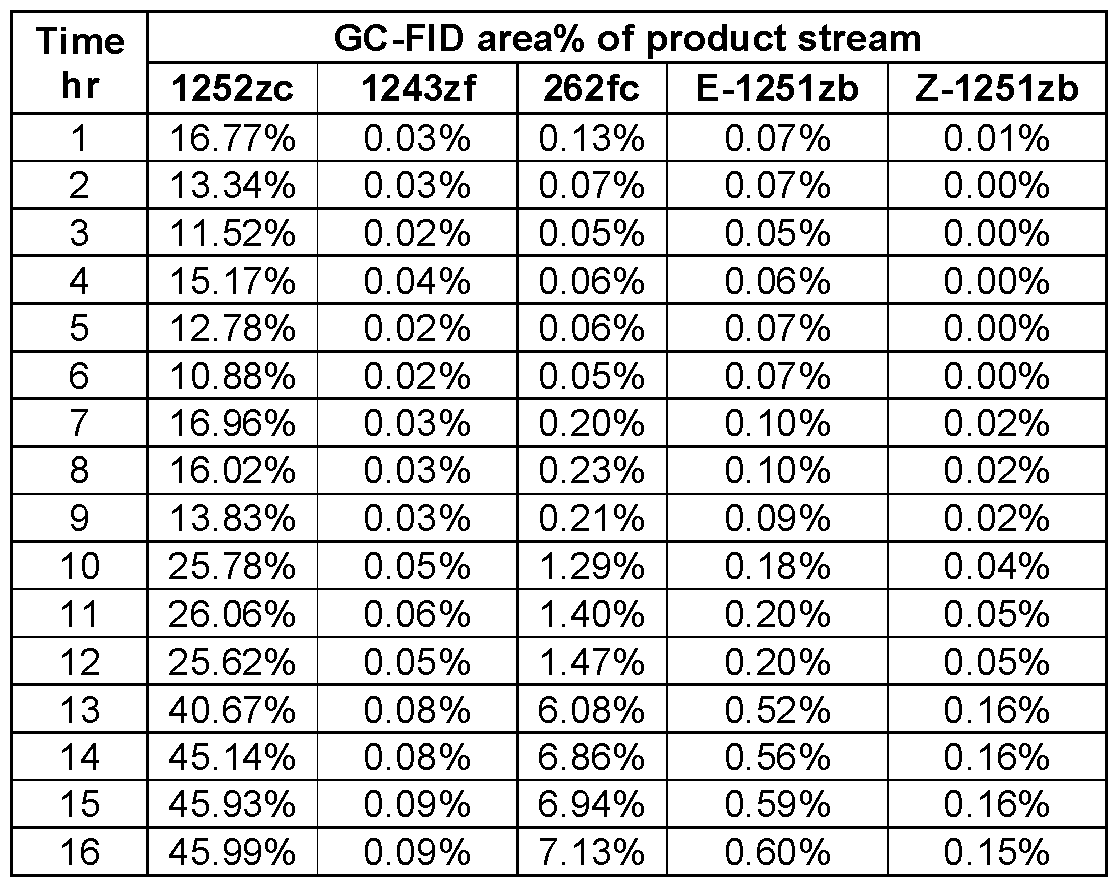
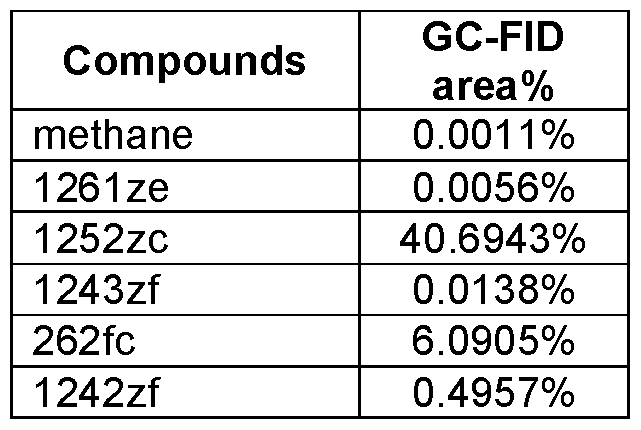
- the test conditions are provided in Table 6 and the product analysis is provided in Table 7.
- Hastelloy C packing (9.4g) was loaded into a 12 inches long Monel (0.5” OD and 0.43” ID) tube with 10 inches heating zone, which was used as a reactor.
- the HCO-1230xa-HF reaction was tested at conditions listed table 8 below, with a relatively higher HF/1230xa ratio as compared with Example 3.
- HCO-1230xa was fed by a pump and passed through a vaporizer at 200°C with N2 and was then mixed with HF, and the mixture flowed through the reactor with the catalyst bed.
- the reactor effluent was analyzed by a GC-MS-FID. The analysis shows that HCFO- 1233xf and HCFO-1232xf were co-produced at high concentrations at various conditions. All of the tests were done at atmospheric pressure.
- the test conditions are provided in Table 8 and the product analysis is provided in Table 9.
- chromia catalyst is loaded into a 12 inches long Inconel (0.5-inch OD) tube reactor.
- the catalyst is activated by HF starting from 150°C to 450°C.
- HCFO-1233xf is fed by a pump at a 0.5ml/hr rate through a vaporizer at 100°C with 9 seem N2 and then is mixed with 15 seem HCI passed through the reactor catalyst bed at 250°C.
- the reactor effluent is analyzed by a GC-MS-FID and shows 40% HCFO-1232xf present in the organic product stream.
- Example 6 Hydrogenation of HCFO-1232xf to HCFC-252dc with 0.5% Pd/C and a solvent
- Example 7 Hydrogenation of HCFO-1232xf to HCFC-252dc with 0.5% Pd/C and w/o solvent
- Example 8 Hydrogenation of HCFO-1232xf to HCFC-252dc with 1% Pd/C
- Example 9 Hydrogenation of HCFO-1232xf to HCFC-252dc by 0.02% Pd/AI 2 O 3 catalyst
- Example 10 Hydrogenation of HCFO-1232xf to HCFC-252dc by 0.1% Pd/AI,O 3 catalyst
- Example 11 Hydrogenation of HCFC-252dc to HFO-1252zc with 8% Cu/C
- Example 15 Hydrodechlorination of HCFC-252dc to HFO-1252zc with 4% Au/C
- Table 23 GC analysis of Vapor phase of reactor
- Table 24 GC analysis of liquid phase of reactor
- Embodiment A compositions comprising, consisting essentially of, or consisting of HCFC-252dc and
- Embodiment B compositions comprising, consisting essentially of, or consisting of HFO-1252zc and
- compositions of Embodiment A wherein the main components comprise at least two of HCFO-1232xf and HCFC-252dc.
- compositions of Embodiment B wherein the main components comprise at least two of HFO-1252zc and HFO-1261ze which is one of E-HFO- 1261ze, Z-HFO-1261ze or mixtures of E-HFO-1261ze and Z-HFO-1261ze.
- compositions of Embodiment B wherein the main components comprise at least two of HFO-1252zc and HFO-1243zf.
- Process Embodiment C wherein the HCFO-1232xf conversion to HCFC- 252dc reaction temperature is in the range of about 20°C to about 200°C, and more preferably in the range about 40°C to about 160°C.
- Process Embodiment D wherein the temperature for conversion of the HCFC-252dc to HFO-1252zc in the liquid phase by reaction with a metal is in the range of about 80°C to about 160°, and more preferably in the range of about 90° to about 140°C.
- Process Embodiment E wherein the temperature for conversion of the HCFC-252dc to HFO-1252zc by a vapor phase hydrogenation reaction is in the range of about 160°C to about 300°C, and more preferably about 200°C to about 260°C, preferably about 200°C to about 240°C.
- Process Embodiment F wherein the conversion of HCFO-1232xf to HCFC- 252dc is conducted in the presence of a metal catalyst supported on one of carbon and AI2O3.
- Metal catalyst is selected from Cu, Ni, Pd and Pt.
- the catalyst is preferably Pd.
- the catalyst is Pd/C or Pd/AI 2 O 3 .
- the catalyst is selected from 0.5% Pd/C to 5% Pd/C, 0.02% Pd/AI 2 O 3 to 0.1% Pd/AI 2 O 3 .
- Process Embodiment G wherein the conversion of HCFC-252dc to HFO- 1252zc by reaction with a metal, such as zinc, is conducted in the presence of a catalyst which is selected from zinc salt or a phase transfer catalyst, such as TBAB.
- a catalyst which is selected from zinc salt or a phase transfer catalyst, such as TBAB.
- Embodiment 2 The process of Embodiment 1 , wherein the catalyst is selected from a supported or unsupported partially fluorinated metal oxide, a nickel- based alloy and a nickel-chromium-based alloy, preferably selected from fluorinated AI2O3, Hastelloy® packing and InconelTM packing.
- Embodiment 3 The process of Embodiment 1 or Embodiment 2, wherein HCFO-1232xf and HCFO-1233xf are co-produced at a HCFO-1232xf:HCFO-1233xf ratio of greater than 1 :1.
- Embodiment 4 The process of Embodiment 1 , wherein the catalyst comprises a supported or unsupported partially fluorinated metal oxide, preferably wherein the catalyst is selected from Cr2O3, CrCI3/C, Cr2O3/AI2O3, Cr2O3/AIF3, Cr2O3/carbon, CoCI2/Cr2O3/AI2O3, NiCI2/Cr2O3/AI2O3, CoCI2/AIF3, Zn/AI2O3, or NiCI2/AIF3.
- the catalyst is selected from Cr2O3, CrCI3/C, Cr2O3/AI2O3, Cr2O3/AIF3, Cr2O3/carbon, CoCI2/Cr2O3/AI2O3, NiCI2/Cr2O3/AI2O3, CoCI2/AIF3, Zn/AI2O3, or NiCI2/AIF3.
- Embodiment s The process of Embodiment 4, wherein HCFO-1232xf and HCFO-1233xf are co-produced at a HCFO-1232xf:HCFO-1233xf ratio of less than or equal to 1 :1.
- Embodiment 8 The process of any of Embodiments 1 to 7, wherein a molar ratio of HF to HCO-1230xa is from about 10:1 to about 60:1 , preferably from about 15:1 to about 50:1.
- Embodiment 9 A process of making 2,3-dichloro-3,3-difluoropropene (HCFO-1232xf) comprising: contacting 2-chloro-3,3,3-trifluoropropene (HCFO- 1233xf) and HCI in the presence of a catalyst.
- Embodiment 10 The process of Embodiment 9, wherein the process is in the vapor phase.
- Embodiment 11 The process of any of Embodiments 9 to 10, wherein a molar ratio of HCI to HCFO-1233xf is from about 10:1 to about 40:1 , preferably from about 15:1 to about 35: 1 .
- Embodiment 12 The process of any of Embodiments 9 to 11 , wherein the contacting is at a temperature of from about 180°C to about 350°C, preferably from about 200°C to about 320°C.
- Embodiment 13 The process of any of Embodiments 9 to 12, wherein the catalyst is selected from a fluorinated transition metal oxide or a transition metal halide catalyst.
- Embodiment 14 A process comprising contacting (1) 2,3-dichloro-3,3- difluoropropene (HCFO-1232xf) or (2) a mixture of co-produced HCFO-1232xf and 2-chloro-3,3,3-trifluoropropene (HCFO-1233xf) with hydrogen in the presence of a catalyst to produce a reaction mixture comprising 1,2-dichloro-1 ,1-difluoropropane (HCFC-252dc).
- HCFO-1232xf 2,3-dichloro-3,3- difluoropropene
- HCFO-1233xf 2-chloro-3,3,3-trifluoropropene
- Embodiment 15 The process of Embodiment 14, wherein the reaction mixture further comprises 2-chloro-1 ,1,1 -trifluoropropane (HCFC-253db).
- Embodiment 16 The process of any of Embodiments 14 or 15, wherein the process is in the vapor phase.
- Embodiment 17 The process of Embodiment 16, wherein a molar ratio of H2 to HCFO-1232xf is from about 1 :1 to about 15:1, preferably from about 1.5:1 to about 10:1.
- Embodiment 18 The process of any of Embodiments 16 to 17, wherein the contacting is at a temperature of between about 20°C and about 200°C, preferably between about 20°C and about 150°C.
- Embodiment 19 The process of any of Embodiments 16 to 18, wherein the catalyst comprises a transition metal preferably on a support, preferably wherein the catalyst is selected from the group consisting of Cu, Ni, Pd, Pd and combinations thereof, preferably on a support.
- Embodiment 20 The process of Embodiment 19, wherein the catalyst loading is in the range of 0.005 wt.% to 3 wt.%.
- Embodiment 21 The process of Embodiment 19, wherein the catalyst is Pd/C, preferably 0.5% Pd/C to 5% Pd/C.
- Embodiment 22 The process of Embodiment 19, wherein the catalyst is Pd/AI2O3, preferably 0.02% Pd/AI2O3 to 0.1% Pd/AI2O3.
- Embodiment 23 The process of any of Embodiments 14 or 15, wherein the process is in the liquid phase.
- Embodiment 24 The process of Embodiment 23, wherein a molar ratio of H2 to HCFO-1232xf is from about 1 :1 to about 5:1 , preferably from about 1.2:1 to about 3:1.
- Embodiment 25 The process of any of Embodiments 23 to 24, wherein the contacting is at a temperature of between about 20°C and about 150°C, preferably between about 40°C and about 120°C.
- Embodiment 26 The process of any of Embodiments 23 to 25, wherein the catalyst comprises a transition metal preferably on a support, preferably wherein the catalyst is selected from the group consisting of Cu, Ni, Pd, Pd and combinations thereof, preferably on a support.
- Embodiment 27 The process of Embodiment 26, wherein the catalyst loading is in the range of 0.005 wt.% to 3 wt.%.
- Embodiment 28 The process of any of Embodiments 23 to 27, wherein the process is conducted in the presence of a solvent.
- Embodiment 29 The process of Embodiment 28, wherein the solvent is a protic or aprotic organic solvent.
- Embodiment 30 The process of Embodiment 29, wherein the solvent is selected from the group consisting of selected from an alcohol, dimethyl sulfoxide (DMSO), dimethyl acetamide (DMAC), dimethyl formamide (DMF), tetra hydrofuran (THF) and dioxan.
- the solvent is selected from the group consisting of selected from an alcohol, dimethyl sulfoxide (DMSO), dimethyl acetamide (DMAC), dimethyl formamide (DMF), tetra hydrofuran (THF) and dioxan.
- Embodiment 31 A process of making 1,2-dichloro-1 ,1-difluoropropane (HCFC-252dc) comprising: contacting 2-chloro-3,3,3-trifluoropropene (HCFO-1233xf) and hydrogen chloride in the presence of a catalyst to form 2,3-dichloro-3,3-difluoropropene (HCFO-1232xf), and contacting the HCFO-1232xf and hydrogen in the presence of another catalyst to make HCFC-252dc.
- Embodiment 32 A process of making 1,1 -difluoropropene (HFO-1252zc) comprising contacting 1,2-dichloro-1 ,1 -difluoropropane (HCFC-252dc) with hydrogen in the vapor phase in the presence of a catalyst.
- Embodiment 33 The process of Embodiment 32, wherein the catalyst comprises a metal selected from the group consisting of Cu, Au, and combinations thereof, the metal catalyst preferably being supported on one of carbon, silicon carbide and AI2O3.
- Embodiment 34 The process of Embodiment 33, wherein the catalyst loading ranges from about 0.1% to about 10%.
- Embodiment 35 The process of any of Embodiments 33 to 34, wherein the reaction temperature is in the range of about 160°C to about 500°C, preferably about 250°C to about 450°C.
- Embodiment 36 The process of any of Embodiments 32 to 35, wherein the process is conducted at a pressure of between > 0 to ⁇ 250psig.
- Embodiment 37 The process of any of Embodiments 32 to 36, wherein the process is conducted in the presence of a diluent.
- Embodiment 38 A process of making 1,1 -difluoropropene (HFO-1252zc) comprising contacting 1,2-dichloro-1 ,1 -difluoropropane (HCFC-252dc) with a metal, in the liquid phase in the presence of a catalyst.
- Embodiment 39 The process of Embodiment 38, wherein the metal is a reactive metal.
- Embodiment 40 The process of any of Embodiments 38 to 39, wherein the metal is selected from the group consisting of Zn, Mg, Cu, Fe and combinations thereof.
- Embodiment 41 The process of any of Embodiments 38 to 40, wherein the reaction is conducted in the presence of a protic or aprotic solvent, acetic acid or acetic anhydride.
- Embodiment 42 The process of Embodiment 41 , wherein the solvent is selected from the group consisting of an alcohol, or one of dimethyl sulfoxide (DMSO), dimethyl acetamide (DMAC), dimethyl formamide (DMF), tetra hydrofuran (THF), pyridine and dioxane.
- DMSO dimethyl sulfoxide
- DMAC dimethyl acetamide
- DMF dimethyl formamide
- THF tetra hydrofuran
- pyridine dioxane
- Embodiment 43 The process of Embodiment 42, wherein the alcohol is selected from the group consisting of methanol, ethanol, isopropanol.
- Embodiment 44 The process of any of Embodiments 38 to 43, wherein the liquid phase reaction is conducted under autogenous pressure.
- Embodiment 45 The process of any of Embodiments 38 to 44, wherein the liquid phase reaction is conducted at temperatures between about 50°C to about 160°, preferably in the range of about 90° to about 140°C.
- Embodiment 46 The process of any of Embodiments 38 to 45, wherein the catalyst is selected from the group consisting of a metal halide, a zinc salt, a phase transfer catalyst and combinations thereof.
- Embodiment 47 The process of Embodiment 46, wherein the catalyst is selected from the group consisting of zinc chloride, zinc acetate, ammonium salt, phosphonium salts, quaternary ammonium salts such as tetrabutylammonium salt or Aliquat 336.
- Embodiment 48 A process of making 1 , 1 -difluoropropene (HFO-1252zc) comprising: contacting 1 ,1 , 2, 3-tetrachloro-1 -propene (HCO-1230xa) and HF in the presence of a first catalyst to form 2,3-dichloro-3,3-difluoropropene (HCFO- 1232xf); contacting the HCFO-1232xf and hydrogen in the presence of a second catalyst to make 1 ,2-dichloro-1 ,1-difluoropropane (HCFC-252dc); and contacting the HCFC-252dc with hydrogen in the presence of a third catalyst to make HFO-1252zc, or contacting the HCFC-252dc and a metal in the presence of a fourth catalyst to make HFO-1252zc.
- Embodiment 49 A process of making 1 , 1 -difluoropropene (HFO-1252zc) comprising: providing a 2-chloro-3,3,3-trifluoropropene (HCFO-1233xf) feed, contacting the HCFO-1233xf feed and HCI in the presence of a first catalyst to make 2,3-dichloro-3,3-difluoropropene (HCFO-1232xf), contacting the HCFO-1232xf and hydrogen in the presence of a second catalyst to make 1 ,2-dichloro-1 ,1-difluoropropane (HCFC-252dc), and contacting the HCFC-252dc with hydrogen in the presence of third catalyst to make HFO-1252zc, or contacting HCFC-252dc and a metal in the presence of a fourth catalyst to make HFO-1252zc.
- Embodiment 50 The process of Embodiment 49, further comprising contacting 1 ,1 , 2, 3-tetrachloro-1 -propene (HCO-1230xa) and HF in the presence of a catalyst to form a reaction mixture comprising the HCFO-1233xf feed.
- HCO-1230xa 3-tetrachloro-1 -propene
- Embodiment 51 A composition comprising: (i) one or more compounds selected from the group consisting of of HFO-1252zc, HCFC-252dc and HCFC- 262fc, and (ii) one or more additional compounds selected from the group consisting of HFO-1252zc, HCFC-252dc, HFO- HFC-263fb, HFC-253db, HCFO-1233xf, HFC- 272fb, H FC- 152a and HFO-1242xc.
- Embodiment 52 The composition of Embodiment 51 , the composition comprising HFO-1252zc, HCFC-252dc and one or more additional compounds selected from the group consisting of HFC-263fb, HFC-253db, 1233xf, HFC-272fb, HCFC-262fc, HFC-152a and HFO-1242xc.
- Embodiment 53 A composition comprising HCFC-252dc and one or more additional compounds selected from the group consisting of HCFO-1233xf, HCFO- 1232xf, HFO-1243zf, HCFO-1242zf, HCFO-1242xc, HCFO-1242xf, HCFO-1241xb, HFO-1252zc, HCFO-1251zb (Z and E isomers), HCFO-1251xe, HCFO-1223xd, HCFC-262fc, HFC-263fb, HCFC-253 isomer, HCFC-253fb, HCFC-252dc, HCFC- 253db, HCFC-262db, HFC-272fb, HCFC-243 isomer, propane and isopropanol.
- HCFO-1233xf HCFO- 1232xf, HFO-1243zf, HCFO-1242zf, HCFO-1242xc, HCFO-1242xf,
- Embodiment 54 A composition comprising HFO-1252zc and one or more additional compounds selected from the group consisting of E-HFO-1261ze, Z-HFO- 1261ze, HCFO-1233xf, HCFO-1232xf, HFO-1243zf, HCFO-1242zf, HCFO-1242xc, HCFO-1242xf, HCFO-1241xb , HFO-1252zc, E-HCFO-1251zb, Z-HCFO-1251zb, HCFO-1251xe, HCFO-1223xd, HCFC-262fc, HFC-263fb, HCFC-253 isomer, HCFC- 253fb, HCFC-252dc, HCFC-253db, HCFC-262db, HFC-272fb, HCFC-243 isomer, HFC-281, propane, propylene, acetone, methanol, isopropanol and methyl acetate.
- Embodiment 55 A composition comprising HCFC-252dc and one or more additional compounds selected from the group consisting of HCFO-1233xf, HCFO- 1232xf, HFO-1243zf, HCFO-1242zf, HCFO-1242xc, HCFO-1242xf, HCFO-1241xb, HFO-1252zc, HCFO-1251zb (Z and E isomers), HCFO-1223xd, HCFC-262fc, HFC- 263fb, HCFC-253 isomer, HCFC-253db, HFC-272fb, HCFC-243 isomer, propane and isopropanol.
- Embodiment 56 A composition comprising HCFC-252dc and one or more additional compounds selected from the group consisting of HCFO-1233xf, HCFO- 1232xf, HCFO-1242xc and isopropanol.
- Embodiment 57 A composition comprising HCFC-252dc and one or more additional compounds selected from the group consisting of HCFO-1233xf, HCFO- 1232xf, HFO-1252zc, HFC-272fb, HCFC-253db, HCFO-1242xc, HFC-263fb, HCFC- 262fc, HCFC-243 isomer and HCFO-1223xd.
- Embodiment 58 A composition comprising HCFC-252dc and one or more additional compounds selected from the group consisting of propane, HFO-1243zf, HFO-1252zc, HFC-263fb, HCFO-1233xf, HCFO-1242zf, HCFO-1251zb (Z and E isomers), HCFC-253db, HCFO-1232xf and HCFO-1241xb.
- Embodiment 59 A composition comprising HCFC-252dc and one or more additional compounds selected from the group consisting of propane, HFO-1243zf, HFO-1252zc, HFC-272fb, HCFC-253 isomer, HCFO-1233xf, HCFO-1242zf, HCFO- 1242xf, HCFO-1251zb (Z and E isomers), HCFC-253db, HCFO-1232xf and HCFO- 1241xb.
- Embodiment 60 A composition comprising HFO-1252zc and one or more additional compounds selected from the group consisting of E-HFO-1261ze, Z-HFO- 1261ze, HCFO-1233xf, HCFO-1232xf, HFO-1243zf, HCFO-1242zf, HCFO-1242xc, HCFO-1242xf, HCFO-1241xb, HCFO-1250xd, E-HCFO-1251zb, Z-HCFO-1251zb, HCFO-1251xe, HCFO-1251zd, HCFC-262fc, HCFC-253 isomer, HCFC-253fb, HCFC-252dc, HCFC-253db, HCFC-262db, HFC-272fb, HFC-281 , HCO-1260, methanol, ethane, butene, methane, pentane, propane, propylene, acetone, methanol, 1 ,1 ,1
- Embodiment 61 A composition comprising HFO-1252zc and one or more additional compounds selected from the group consisting of HFO-1243zf, HCFC- 262fc, E-HCFO-1251zb, Z-HCFO-1251zb, HFC-272fb, HCFC-252dc, HCFO-1241xb, HCFC-262db, E-HFO-1261ze, Z-HFO-1261ze, methane, HCFO-1242zf, HCFO- 1242xf, HCFC-253db and HCFO-1232xf.
- Embodiment 62 A composition comprising HFO-1252zc and one or more additional compounds selected from the group consisting of E-HFO-1261ze, Z-HFO- 1261ze, HCO-1260, HCFO-1251zd, HCFC-252dc, HCFO-1241xb and HCFO- 1250xd.
- Embodiment 63 A composition comprising HFO-1252zc and one or more additional compounds selected from the group consisting of propane, propylene, HCO-1260, HCFO-1250xd, E-HCFO-1251zb, Z-HCFO-1251zb, HCFO-1251xe, HCFO-1251zd, E-HFO-1261ze, Z-HFO-1261ze, HFO-1243zf, HCFO-1242zf, HCFC- 253 isomer, HCFC-253fb, HCFC-252dc and HCFO-1241xb.
- Embodiment 64 A composition comprising HFO-1252zc and one or more additional compounds selected from the group consisting of propylene, methanol, propane, acetone, methyl acetate, 1 ,1 -dimethoxyethane, HCFC-262fc, HCFC-252dc, E-HFO-1261ze, HCFC-253db and HCFO-1232xf.
- Embodiment 65 A composition comprising HFO-1252zc and one or more additional compounds selected from the group consisting of ethane, butene, propene, propane, methanol, methyl propionate, HFO-1243zf, E-HFO-1261ze, Z- HFO-1261ze, HFC-281 (C3H7F), HCFO-1233xf, HCFC-253db, HCFO-1242xc, HCFC-262fc, E-HCFO-1251zb, Z-HCFO-1251zb and HCFO-1251xe.
- additional compounds selected from the group consisting of ethane, butene, propene, propane, methanol, methyl propionate, HFO-1243zf, E-HFO-1261ze, Z- HFO-1261ze, HFC-281 (C3H7F), HCFO-1233xf, HCFC-253db, HCFO-1242xc, HCFC-262fc, E-HCFO-1251z
- Embodiment 66 A composition comprising HFO-1252zc and one or more additional compounds selected from the group consisting of propylene, propane, methanol, acetone, methyl acetate, pentane, 1 ,1 -dimethoxyethane, HFO-1243zf, E- HFO-1261ze, Z-HFO-1261ze, HCFO-1242xc, HCFC-262fc, Z-HCFO-1251zb, HCFO-1251xe and HCFO-1233xf.
- propylene propane, methanol, acetone, methyl acetate, pentane, 1 ,1 -dimethoxyethane, HFO-1243zf, E- HFO-1261ze, Z-HFO-1261ze, HCFO-1242xc, HCFC-262fc, Z-HCFO-1251zb, HCFO-1251xe and HCFO-1233xf.
Landscapes
- Chemical & Material Sciences (AREA)
- Organic Chemistry (AREA)
- Chemical Kinetics & Catalysis (AREA)
- Organic Low-Molecular-Weight Compounds And Preparation Thereof (AREA)
- Nitrogen And Oxygen Or Sulfur-Condensed Heterocyclic Ring Systems (AREA)
Abstract
Description





Claims
Priority Applications (4)
| Application Number | Priority Date | Filing Date | Title |
|---|---|---|---|
| CN202480046154.6A CN121487912A (en) | 2023-07-17 | 2024-07-09 | Method for producing 1252ZC and its compositions from 1230XA or 252DC |
| KR1020267004089A KR20260041824A (en) | 2023-07-17 | 2024-07-09 | Method for producing 1252ZC from 1230XA or 252DC and composition thereof |
| AU2024293882A AU2024293882A1 (en) | 2023-07-17 | 2024-07-09 | A process to produce 1252zc from 1230xa or 252dc and compositions thereof |
| MX2026000342A MX2026000342A (en) | 2023-07-17 | 2026-01-09 | A process to produce 1252zc from 1230xa or 252dc and compositions thereof |
Applications Claiming Priority (2)
| Application Number | Priority Date | Filing Date | Title |
|---|---|---|---|
| US202363527144P | 2023-07-17 | 2023-07-17 | |
| US63/527,144 | 2023-07-17 |
Publications (2)
| Publication Number | Publication Date |
|---|---|
| WO2025019191A2 true WO2025019191A2 (en) | 2025-01-23 |
| WO2025019191A3 WO2025019191A3 (en) | 2025-03-27 |
Family
ID=92043070
Family Applications (1)
| Application Number | Title | Priority Date | Filing Date |
|---|---|---|---|
| PCT/US2024/037130 Pending WO2025019191A2 (en) | 2023-07-17 | 2024-07-09 | A process to produce 1252zc from 1230xa or 252dc and compositions thereof |
Country Status (6)
| Country | Link |
|---|---|
| KR (1) | KR20260041824A (en) |
| CN (1) | CN121487912A (en) |
| AU (1) | AU2024293882A1 (en) |
| MX (1) | MX2026000342A (en) |
| TW (1) | TW202504877A (en) |
| WO (1) | WO2025019191A2 (en) |
Citations (2)
| Publication number | Priority date | Publication date | Assignee | Title |
|---|---|---|---|---|
| US20140309462A1 (en) | 2011-11-10 | 2014-10-16 | Mario Joseph Nappa | Catalytic fluorination process of making hydrohaloalkane |
| US20210317055A1 (en) | 2018-07-18 | 2021-10-14 | The Chemours Company Fc, Llc | Production of haloolefins in an adiabatic reaction zone |
Family Cites Families (3)
| Publication number | Priority date | Publication date | Assignee | Title |
|---|---|---|---|---|
| US20090182179A1 (en) * | 2008-01-15 | 2009-07-16 | Honeywell International Inc. | Hydrofluorination of 2-chloro-3,3,3-trifluoropropene to 2-chloro-1,1,1,2-tetrafluoropropane with catalysts of sbcl3, sbcl5, sbf5, ticl4, sncl4, cr2o3 and fluorinated cr2o3 |
| KR20140104947A (en) * | 2011-10-14 | 2014-08-29 | 셀마 벡터세빅 | Process for producing 2,3,3,3-tetrafluoropropene |
| US9029617B2 (en) * | 2013-08-08 | 2015-05-12 | Honeywell International Inc. | Process for 1-chloro-3,3,3-trifluoropropene from trifluoropropene |
-
2024
- 2024-07-09 CN CN202480046154.6A patent/CN121487912A/en active Pending
- 2024-07-09 KR KR1020267004089A patent/KR20260041824A/en active Pending
- 2024-07-09 AU AU2024293882A patent/AU2024293882A1/en active Pending
- 2024-07-09 TW TW113125552A patent/TW202504877A/en unknown
- 2024-07-09 WO PCT/US2024/037130 patent/WO2025019191A2/en active Pending
-
2026
- 2026-01-09 MX MX2026000342A patent/MX2026000342A/en unknown
Patent Citations (2)
| Publication number | Priority date | Publication date | Assignee | Title |
|---|---|---|---|---|
| US20140309462A1 (en) | 2011-11-10 | 2014-10-16 | Mario Joseph Nappa | Catalytic fluorination process of making hydrohaloalkane |
| US20210317055A1 (en) | 2018-07-18 | 2021-10-14 | The Chemours Company Fc, Llc | Production of haloolefins in an adiabatic reaction zone |
Also Published As
| Publication number | Publication date |
|---|---|
| CN121487912A (en) | 2026-02-06 |
| AU2024293882A1 (en) | 2026-01-22 |
| KR20260041824A (en) | 2026-03-27 |
| WO2025019191A3 (en) | 2025-03-27 |
| TW202504877A (en) | 2025-02-01 |
| MX2026000342A (en) | 2026-02-03 |
Similar Documents
| Publication | Publication Date | Title |
|---|---|---|
| US10059647B2 (en) | Method for producing fluorinated organic compounds | |
| CA2981675C (en) | Method for producing fluorinated organic compounds | |
| US7880040B2 (en) | Method for producing fluorinated organic compounds | |
| JP5715177B2 (en) | Method for producing fluorinated organic compound | |
| WO2008030444A2 (en) | Process for producing 1,2,3,3,3-pentafluoropropene and related azeotropic compositions | |
| JP2024144738A (en) | Compositions and methods for the synthesis of 2,3-dichloro-1,1,1,2-tetrafluoropropane and 2,3,3,3-tetrafluoropropene | |
| RU2067971C1 (en) | Method for hydrogenolysis of halocarbons | |
| AU2024293882A1 (en) | A process to produce 1252zc from 1230xa or 252dc and compositions thereof | |
| US5516947A (en) | Process for converting chlorodifluoromethane and/or dichlorodifluoromethane | |
| WO2025019193A1 (en) | Processes to produce hfo-1252zc from hcfo-1233xf and hbfo-1233xfb | |
| WO2025019185A1 (en) | A process to produce hfo-1252zc through dehydrohalogenation reaction of hfc-263fb and hcfc-262fc and compositions thereof | |
| JP7151259B2 (en) | Method for producing 1-chloro-2,3,3-trifluoropropene | |
| WO2025019192A2 (en) | Processes to produce 1,1-difluoropropene (hfo-1252zc), compositions and intermediates thereof | |
| AU2024434285A1 (en) | Process of producing fluoroolefin compositions by catalytic hydrodechlorination of hydrochlorofluorocarbons and compositions thereof | |
| WO2025193252A1 (en) | Process to make fluoroolefins by catalytic hydrofluorination of hydrochlorocarbons or hydrochloroolefins | |
| WO2026015158A2 (en) | Non-catalytic vapor phase hydrofluorination process for making hcfo-1233xf and hcfo-1232xf from hco-1230xa |
Legal Events
| Date | Code | Title | Description |
|---|---|---|---|
| WWE | Wipo information: entry into national phase |
Ref document number: AU2024293882 Country of ref document: AU Ref document number: 202617001468 Country of ref document: IN |
|
| WWE | Wipo information: entry into national phase |
Ref document number: MX/A/2026/000342 Country of ref document: MX |
|
| WWE | Wipo information: entry into national phase |
Ref document number: 2601000191 Country of ref document: TH |
|
| WWE | Wipo information: entry into national phase |
Ref document number: P2026-00146 Country of ref document: AE |
|
| REG | Reference to national code |
Ref country code: BR Ref legal event code: B01A Ref document number: 112026000355 Country of ref document: BR |
|
| ENP | Entry into the national phase |
Ref document number: 2024293882 Country of ref document: AU Date of ref document: 20240709 Kind code of ref document: A |
|
| WWP | Wipo information: published in national office |
Ref document number: 202617001468 Country of ref document: IN |
|
| WWP | Wipo information: published in national office |
Ref document number: MX/A/2026/000342 Country of ref document: MX |
|
| ENP | Entry into the national phase |
Ref document number: 1020267004089 Country of ref document: KR Free format text: ST27 STATUS EVENT CODE: A-0-1-A10-A15-NAP-PA0105 (AS PROVIDED BY THE NATIONAL OFFICE) |
|
| WWE | Wipo information: entry into national phase |
Ref document number: 1020267004089 Country of ref document: KR |
|
| WWE | Wipo information: entry into national phase |
Ref document number: 2024748207 Country of ref document: EP |
|
| NENP | Non-entry into the national phase |
Ref country code: DE |
|
| 121 | Ep: the epo has been informed by wipo that ep was designated in this application |
Ref document number: 24748207 Country of ref document: EP Kind code of ref document: A2 |
|
| WWE | Wipo information: entry into national phase |
Ref document number: 11202600132Q Country of ref document: SG |
|
| WWP | Wipo information: published in national office |
Ref document number: 11202600132Q Country of ref document: SG |
|
| WWP | Wipo information: published in national office |
Ref document number: 1020267004089 Country of ref document: KR |