WO2025018077A1 - 表示装置および電子機器 - Google Patents
表示装置および電子機器 Download PDFInfo
- Publication number
- WO2025018077A1 WO2025018077A1 PCT/JP2024/022051 JP2024022051W WO2025018077A1 WO 2025018077 A1 WO2025018077 A1 WO 2025018077A1 JP 2024022051 W JP2024022051 W JP 2024022051W WO 2025018077 A1 WO2025018077 A1 WO 2025018077A1
- Authority
- WO
- WIPO (PCT)
- Prior art keywords
- light
- layer
- region
- display device
- electrode
- Prior art date
- Legal status (The legal status is an assumption and is not a legal conclusion. Google has not performed a legal analysis and makes no representation as to the accuracy of the status listed.)
- Pending
Links
Images

















Classifications
-
- G—PHYSICS
- G02—OPTICS
- G02B—OPTICAL ELEMENTS, SYSTEMS OR APPARATUS
- G02B3/00—Simple or compound lenses
-
- G—PHYSICS
- G09—EDUCATION; CRYPTOGRAPHY; DISPLAY; ADVERTISING; SEALS
- G09F—DISPLAYING; ADVERTISING; SIGNS; LABELS OR NAME-PLATES; SEALS
- G09F9/00—Indicating arrangements for variable information in which the information is built-up on a support by selection or combination of individual elements
- G09F9/30—Indicating arrangements for variable information in which the information is built-up on a support by selection or combination of individual elements in which the desired character or characters are formed by combining individual elements
-
- H—ELECTRICITY
- H05—ELECTRIC TECHNIQUES NOT OTHERWISE PROVIDED FOR
- H05B—ELECTRIC HEATING; ELECTRIC LIGHT SOURCES NOT OTHERWISE PROVIDED FOR; CIRCUIT ARRANGEMENTS FOR ELECTRIC LIGHT SOURCES, IN GENERAL
- H05B33/00—Electroluminescent light sources
- H05B33/12—Light sources with substantially two-dimensional [2D] radiating surfaces
- H05B33/14—Light sources with substantially two-dimensional [2D] radiating surfaces characterised by the chemical or physical composition or the arrangement of the electroluminescent material, or by the simultaneous addition of the electroluminescent material in or onto the light source
-
- H—ELECTRICITY
- H10—SEMICONDUCTOR DEVICES; ELECTRIC SOLID-STATE DEVICES NOT OTHERWISE PROVIDED FOR
- H10K—ORGANIC ELECTRIC SOLID-STATE DEVICES
- H10K50/00—Organic light-emitting devices
- H10K50/80—Constructional details
-
- H—ELECTRICITY
- H10—SEMICONDUCTOR DEVICES; ELECTRIC SOLID-STATE DEVICES NOT OTHERWISE PROVIDED FOR
- H10K—ORGANIC ELECTRIC SOLID-STATE DEVICES
- H10K50/00—Organic light-emitting devices
- H10K50/80—Constructional details
- H10K50/85—Arrangements for extracting light from the devices
- H10K50/858—Arrangements for extracting light from the devices comprising refractive means, e.g. lenses
-
- H—ELECTRICITY
- H10—SEMICONDUCTOR DEVICES; ELECTRIC SOLID-STATE DEVICES NOT OTHERWISE PROVIDED FOR
- H10K—ORGANIC ELECTRIC SOLID-STATE DEVICES
- H10K59/00—Integrated devices, or assemblies of multiple devices, comprising at least one organic light-emitting element covered by group H10K50/00
- H10K59/10—OLED displays
-
- H—ELECTRICITY
- H10—SEMICONDUCTOR DEVICES; ELECTRIC SOLID-STATE DEVICES NOT OTHERWISE PROVIDED FOR
- H10K—ORGANIC ELECTRIC SOLID-STATE DEVICES
- H10K59/00—Integrated devices, or assemblies of multiple devices, comprising at least one organic light-emitting element covered by group H10K50/00
- H10K59/30—Devices specially adapted for multicolour light emission
- H10K59/35—Devices specially adapted for multicolour light emission comprising red-green-blue [RGB] subpixels
-
- H—ELECTRICITY
- H10—SEMICONDUCTOR DEVICES; ELECTRIC SOLID-STATE DEVICES NOT OTHERWISE PROVIDED FOR
- H10K—ORGANIC ELECTRIC SOLID-STATE DEVICES
- H10K59/00—Integrated devices, or assemblies of multiple devices, comprising at least one organic light-emitting element covered by group H10K50/00
- H10K59/30—Devices specially adapted for multicolour light emission
- H10K59/38—Devices specially adapted for multicolour light emission comprising colour filters or colour changing media [CCM]
-
- H—ELECTRICITY
- H10—SEMICONDUCTOR DEVICES; ELECTRIC SOLID-STATE DEVICES NOT OTHERWISE PROVIDED FOR
- H10K—ORGANIC ELECTRIC SOLID-STATE DEVICES
- H10K59/00—Integrated devices, or assemblies of multiple devices, comprising at least one organic light-emitting element covered by group H10K50/00
- H10K59/80—Constructional details
Definitions
- This disclosure relates to a display device and an electronic device equipped with the same.
- the focusing element is shifted based on the center of the light-emitting area of the light-emitting element, the brightness viewing angle characteristics will decrease.
- the objective of this disclosure is to provide a display device and electronic device equipped with the same that can suppress the deterioration of the luminance viewing angle characteristics even when the light-collecting element is shifted with respect to the center of the light-emitting area of the light-emitting element.
- the display device comprises: A plurality of light emitting elements arranged in a display area; A plurality of light collecting elements for collecting light emitted from each of the plurality of light emitting elements; a light transmitting layer adjacent to the focusing surfaces of the plurality of light focusing elements;
- the display area includes a first area and a second area located outside the first area, the center of the light-collecting element included in the second region is shifted toward the outer periphery of the display region with respect to the center of the light-emitting region of the light-emitting element in a plan view;
- the refractive index of the light transmitting layer in the second region is higher than the refractive index of the light transmitting layer in the first region.
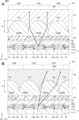
- FIG. 1A is a cross-sectional view of a display device according to Comparative Example 1.
- FIG. 1B is a cross-sectional view of a display device according to Comparative Example 2.
- 2A and 2B are graphs showing luminance-viewing angle characteristics in a central region and a peripheral region of a display device according to Comparative Example 2, respectively.
- FIG. 3 is a plan view of the display device according to the embodiment.
- FIG. 4 is a schematic diagram illustrating a CRA of a display device according to an embodiment.
- 5A and 5B are cross-sectional views of a central region and a peripheral region of a display device according to an embodiment, respectively.
- FIG. 6A and 6B are cross-sectional views of an OLED layer with a single light-emitting unit and two light-emitting units, respectively.
- FIG. 7 is a cross-sectional view of the light transmitting layer.
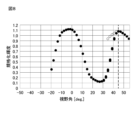
- FIG. 8 is a graph showing an example of the luminance viewing angle characteristics in the peripheral region of a display device according to an embodiment.
- 9A and 9B are cross-sectional views of a light transmitting layer according to a modified example.
- 10A and 10B are cross-sectional views of a light transmitting layer according to a modified example.
- 11A and 11B are cross-sectional views of a light transmitting layer according to a modified example.
- FIG. 12 is a plan view of a display device according to a modified example.
- FIG. 13 is a plan view of a display device according to a modified example.
- FIG. 14 is a plan view of a display device according to a modified example.
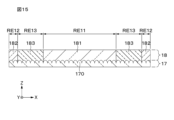
- FIG. 15 is a cross-sectional view of the light transmitting layer of the display device shown in FIG.
- FIG. 16 is a plan view of a display device according to a modified example.
- 17A and 17B are cross-sectional views of a central region and a peripheral region of a display device according to a modified example.
- FIG. 18 is a cross-sectional view of a display device according to Comparative Example 3.
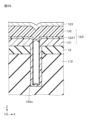
- FIG. 19 is a cross-sectional view of a first example of a leak suppression structure.
- FIG. 20 is a cross-sectional view of a second example of the leak suppression structure.
- FIG. 19 is a cross-sectional view of a first example of a leak suppression structure.
- FIG. 21 is a cross-sectional view of a third example of the leak suppression structure.
- FIG. 22 is a cross-sectional view of a fourth example of the leak suppression structure.
- FIG. 23 is a cross-sectional view of a fifth example of the leak suppression structure.
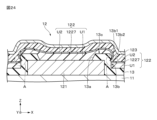
- FIG. 24 is a cross-sectional view of a sixth example of the leak suppression structure.
- FIG. 25 is a cross-sectional view of a seventh example of the leak suppression structure.
- 26 is an enlarged cross-sectional view of the groove shown in FIG.
- FIG. 27 is a cross-sectional view of an eighth example of the leakage suppression structure.
- FIG. 28 is a cross-sectional view of a ninth example of the leakage suppression structure.
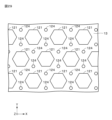
- FIG. 29 is a plan view for explaining the arrangement of the first electrodes and the third electrodes.
- Fig. 30A is a schematic cross-sectional view for explaining a first example of a resonator structure
- Fig. 30B is a schematic cross-sectional view for explaining a second example of a resonator structure.
- Fig. 31A is a schematic cross-sectional view for explaining a third example of the resonator structure
- Fig. 31B is a schematic cross-sectional view for explaining a fourth example of the resonator structure.
- 32A and 32B are schematic cross-sectional views for explaining a fifth example of the resonator structure and a sixth example of the resonator structure, respectively.
- FIG. 30A is a schematic cross-sectional view for explaining a first example of a resonator structure
- Fig. 30B is a schematic cross-sectional view for explaining a second example of a resonator structure.
- Fig. 31A is
- FIG. 33 is a schematic cross-sectional view for explaining a seventh example of the resonator structure.
- 34A and 34B are front and rear views of the digital still camera.
- FIG. 35 is a perspective view of a head mounted display.
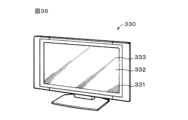
- FIG. 36 is a perspective view of a television device.
- FIG. 37 is a perspective view of a see-through head mounted display.
- FIG. 38 is a perspective view of a smartphone.
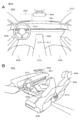
- Fig. 39A is a diagram showing the interior of the vehicle from the rear to the front
- Fig. 39B is a diagram showing the interior of the vehicle from the diagonally rear to the diagonally front.
- the first region and the second region may be adjacent to each other, or the first region and the second region may be spaced apart.
- the first region is, for example, a central region located in the center of the display region.
- the second region is, for example, a peripheral region located on the periphery of the display region.
- the outer periphery of the first region and the inner periphery of the second region may have an approximately circular, approximately polygonal, or oval shape in a planar view.
- An approximately polygonal shape is not limited to a polygonal shape in the strict geometric sense, but includes shapes that are visually recognized as being close to a polygonal shape.
- an approximately polygonal shape includes a polygonal shape with rounded corners and a polygonal shape with notched corners.
- An approximately polygonal shape may be approximately rectangular.
- an approximately rectangular shape also includes an approximately square shape.
- An oval shape includes shapes such as an oval, an ellipse, and an egg shape.
- the display region may further include at least one third region between the first region and the second region.
- the center of the light-collecting element included in the third region is preferably shifted toward the outer periphery of the display region with respect to the center of the light-emitting region of the light-emitting element in a planar view.
- the amount of deviation between the center of the light-collecting element in the third region and the center of the light-emitting region of the light-emitting element is preferably smaller than the amount of deviation between the center of the light-collecting element in the second region and the center of the light-emitting region of the light-emitting element.
- the refractive index of the light-transmitting layer in the third region is preferably higher than the refractive index of the light-transmitting layer in the first region and lower than the refractive index of the light-transmitting layer in the second region.
- the refractive index of the light transmitting layer in the first region and the refractive index of the light transmitting layer in the second region may change continuously in the in-plane direction of the display device at the boundary between the two regions, or may change discontinuously in the in-plane direction.
- the refractive index of the light transmitting layer in the first region and the refractive index of the light transmitting layer in the third region may change continuously in the in-plane direction of the display device at the boundary between the two regions, or may change discontinuously in the in-plane direction.
- the refractive index of the light transmitting layer in the second region and the refractive index of the light transmitting layer in the third region may change continuously in the in-plane direction of the display device at the boundary between the two regions, or may change discontinuously in the in-plane direction.
- a light-transmitting layer may be provided on the multiple focusing elements, covering the focusing surfaces of the multiple focusing elements.
- the focusing surfaces of the focusing elements may have a convex shape on the side opposite to the light-emitting element side.
- a light-transmitting layer may be provided below the multiple focusing elements, and the focusing surfaces of the multiple focusing elements may be buried in the light-transmitting layer. In this case, the focusing surfaces of the focusing elements may have a convex shape on the light-emitting element side.
- the light-transmitting layer may be a protective layer such as a hard coat layer that protects the surface of the display device, or may be a filled resin layer provided between the substrate and multiple lenses.
- the display device may further include a color filter provided above the multiple light-emitting elements.
- the color filter and multiple light-collecting elements may be provided in this order from the light-emitting element side toward the display surface, or the multiple light-collecting elements and color filter may be provided in this order from the light-emitting element side toward the display surface.
- on object A in expressions such as “object B is provided on object A” indicates the relative positional relationship between object A and object B, and includes not only a state in which object B is located directly on object A without any other object in between, but also a state in which object B is located on object A with at least one other object in between.
- the display device according to the present disclosure may be provided in an electronic device.
- the display device according to the present disclosure may be provided in an eyewear device such as a VR (Virtual Reality) device, an MR (Mixed Reality) device, or an AR (Augmented Reality) device, or may be provided in an electronic viewfinder (EVF) or a small projector, etc.
- an eyewear device such as a VR (Virtual Reality) device, an MR (Mixed Reality) device, or an AR (Augmented Reality) device
- EMF electronic viewfinder
- the center of the lens 170 is shifted in this way, the angle of incidence of light from the light-emitting element 12 with respect to the light-collecting surface (convex curved surface) of the lens 170 increases, so that the total reflection component increases at the interface between the lens 170 and the light-transmitting layer 18, and the luminance viewing angle characteristic decreases.
- Figure 2A shows the luminance viewing angle characteristics of the central region of display device 101A (the region where the center of lens 170 is not shifted with reference to the center of the light-emitting region of light-emitting element 12).
- Figure 2B shows the luminance viewing angle characteristics of the peripheral region of display device 101A (the region where the center of lens 170 is shifted with reference to the center of the light-emitting region of light-emitting element 12).
- the luminance on the vertical axis in Figures 2A and 2B is normalized by the luminance at 0° in the center of the display region.
- Figure 2B shows that the luminance viewing angle deteriorates on the side opposite to the direction in which CRA is tilted (towards the center of display region RE1).
- the present inventors conducted extensive research to suppress the deterioration of the luminance viewing angle characteristics caused by the total reflection component, and as a result, discovered a configuration in which the refractive index n22 of the light transmitting layer 18 covering the lenses included in the peripheral region of the display region is set higher than the refractive index n21 of the light transmitting layer covering the lenses included in the central region of the display region.
- FIG. 3 is a plan view of a display device 101 according to an embodiment.
- the display device 101 has a display region RE1 and a peripheral region RE2 provided around the display region RE1.
- the display region RE1 of the display device 101 has a central region (first region) RE11 and a peripheral region (second region) RE12.
- the central region RE11 is provided in the center of the display region RE1.
- the central region RE11 has, for example, a substantially circular shape.
- the peripheral region RE12 is provided outside the central region RE11, specifically, on the periphery of the display region RE1. In one embodiment, the peripheral region RE12 is adjacent to the central region RE11.
- the display device 101 is an OLED (Organic Light Emitting Diode) display device.
- a first direction and a second direction perpendicular to the display surface of the display device 101 are referred to as the X-axis direction and the Y-axis direction, respectively, and a third direction perpendicular to the display surface of the display device 101 is referred to as the Z-axis direction.
- the X-axis direction is the horizontal direction of the display surface and the Y-axis direction is the vertical direction of the display surface.
- FIG. 4 is a schematic diagram showing the CRA of the display device 101.
- the CRA of the central region RE11 is set to 0°
- the CRA of the peripheral region RE12 is set to a predetermined angle ⁇ .
- FIG. 5A is a cross-sectional view of a central region RE11 of the display device 101.
- FIG. 5B is a cross-sectional view of a peripheral region RE12 of the display device 101.
- a plurality of sub-pixels 10R, a plurality of sub-pixels 10G, and a plurality of sub-pixels 10B are provided in the display region RE1.
- the sub-pixels 10R, 10G, and 10B may be simply referred to as sub-pixels 10.
- the plurality of sub-pixels 10 are two-dimensionally arranged in a prescribed arrangement pattern.
- Examples of the prescribed arrangement pattern include, but are not limited to, a delta arrangement, a square arrangement, and a stripe arrangement.
- a pad section 113 and a driver (not shown) for displaying images are provided in the peripheral region RE2.
- a flexible printed circuit (Flexible Printed Circuit: FPC) 114 as a connection member may be connected to the pad section 113.
- the sub-pixels 10R, 10G, and 10B can emit light of different colors.
- the sub-pixel 10R can emit red light.
- the sub-pixel 10G can emit green light.
- the sub-pixel 10B can emit blue light.
- One pixel may be composed of three adjacent sub-pixels 10R, 10G, and 10B. However, the configuration of one pixel is not limited to this example.
- the display device 101 includes a driving substrate 11, a plurality of light-emitting elements 12, an insulating layer 13, a protective layer 14, a planarization layer 15, a color filter 16, a lens array 17, and a light-transmitting layer 18.
- a planar view refers to a planar view when an object is viewed from a direction perpendicular to the first surface.
- the peripheral portion of the first surface refers to an area having a predetermined width extending inward from the periphery of the first surface.
- the driving substrate 11 is a so-called backplane, and is capable of driving a plurality of light-emitting elements 12.
- the driving substrate 11 includes, for example, a substrate 111 and an insulating layer 112 in this order.
- the substrate 111 may be, for example, a semiconductor substrate on which transistors and the like can be easily formed, or a glass substrate or resin substrate with low moisture and oxygen permeability.
- the semiconductor substrate includes, for example, amorphous silicon, polycrystalline silicon, or single crystal silicon.
- the glass substrate includes, for example, high strain point glass, soda glass, borosilicate glass, forsterite, lead glass, or quartz glass.
- the resin substrate includes, for example, at least one selected from the group consisting of polymethyl methacrylate, polyvinyl alcohol, polyvinyl phenol, polyether sulfone, polyimide, polycarbonate, polyethylene terephthalate, and polyethylene naphthalate.
- the insulating layer 112 is provided on the first surface of the substrate 111, and covers the multiple drive circuits and multiple wirings.
- the multiple wirings may be connected to the pad portion 113.
- the insulating layer 112 includes multiple contact portions (not shown) therein.
- the multiple contact portions electrically connect the light-emitting element 12 to the drive circuits or wirings.
- the contact portions include at least one metal selected from the group consisting of, for example, copper (Cu) and titanium (Ti).
- the insulating layer 112 may be an organic insulating layer, an inorganic insulating layer, or a laminate of these.
- the organic insulating layer includes at least one selected from the group consisting of polyimide resin, acrylic resin, novolac resin, etc.
- the inorganic insulating layer includes at least one selected from the group consisting of silicon oxide (SiO x ), silicon nitride (SiN x ), silicon oxynitride (SiO x N y ), etc.
- the light-emitting element 12 can emit white light based on the control of a drive circuit etc.
- the light-emitting element 12 is an organic light-emitting diode element (OLED element).
- OLED element organic light-emitting diode element
- the light-emitting element 12 is included in each of the sub-pixels 10R, 10G, 10B of each color.
- the multiple light-emitting elements 12 are two-dimensionally arranged in a specified arrangement pattern on the first surface of the drive substrate 11.
- the specified arrangement pattern is as described above as the specified arrangement pattern of the multiple sub-pixels 10.
- the light-emitting element 12 has a first electrode 121, an OLED layer 122, and a second electrode 123, which are arranged in that order on the first surface of the drive substrate 11.
- the first electrode 121 is provided on the second surface side of the OLED layer 122.
- the first electrode 121 is an individual electrode provided individually for each of the plurality of light-emitting elements 12. That is, the first electrode 121 is divided between adjacent light-emitting elements 12 in the in-plane direction of the first surface of the drive substrate 11.
- the first electrode 121 is an anode. When a voltage is applied between the first electrode 121 and the second electrode 123, holes are injected from the first electrode 121 to the OLED layer 122.
- the first electrode 121 may be composed of, for example, a metal layer, or may be composed of a metal layer and a transparent conductive oxide layer.
- the transparent conductive oxide layer is provided on the OLED layer 122 side, from the viewpoint of having a layer having a high work function adjacent to the OLED layer 122.
- the metal layer may function as a reflective layer that reflects light emitted by the OLED layer 122.
- the metal layer contains at least one metal element selected from the group consisting of, for example, chromium (Cr), gold (Au), platinum (Pt), nickel (Ni), copper (Cu), molybdenum (Mo), titanium (Ti), tantalum (Ta), aluminum (Al), magnesium (Mg), iron (Fe), tungsten (W) and silver (Ag).
- the metal layer may contain at least one metal element as a constituent element of an alloy. Specific examples of the alloy include an aluminum alloy or a silver alloy. Specific examples of the aluminum alloy include, for example, AlNd or AlCu.
- a base layer may be provided adjacent to the second surface side of the metal layer.
- the base layer may be capable of improving the crystal orientation of the metal layer when the metal layer is formed.
- the base layer may contain at least one metal element selected from the group consisting of titanium (Ti) and tantalum (Ta), for example.
- the base layer may contain the at least one metal element as a constituent element of an alloy.
- the transparent conductive oxide layer includes a transparent conductive oxide.
- the transparent conductive oxide includes at least one type selected from the group consisting of transparent conductive oxides containing indium (hereinafter referred to as "indium-based transparent conductive oxides"), transparent conductive oxides containing tin (hereinafter referred to as “tin-based transparent conductive oxides”), and transparent conductive oxides containing zinc (hereinafter referred to as “zinc-based transparent conductive oxides").
- Indium-based transparent conductive oxides include, for example, indium tin oxide (ITO), indium zinc oxide (IZO), indium gallium oxide (IGO), indium gallium zinc oxide (IGZO) or fluorine-doped indium oxide (IFO).
- ITO indium tin oxide
- ITO indium tin oxide
- Tin-based transparent conductive oxides include, for example, tin oxide, antimony-doped tin oxide (ATO) or fluorine-doped tin oxide (FTO).
- Zinc-based transparent conductive oxides include, for example, zinc oxide, aluminum-doped zinc oxide (AZO), boron-doped zinc oxide or gallium-doped zinc oxide (GZO).
- the OLED layer 122 can emit white light.
- the OLED layer 122 is provided between a plurality of first electrodes 121 and one second electrode 123.
- the OLED layer 122 is a first electrode of the driving substrate 11.
- the light emitting elements 12 adjacent to each other in the in-plane direction of one surface are connected to each other, and are a layer common to a plurality of light emitting elements 12 .
- OLED layer 122 may be composed of a laminate including an organic light-emitting layer, in which case some layers of the laminate (e.g., electron injection layer) may be inorganic layers.
- OLED layer 122 may be an OLED layer having a single layer of light-emitting unit U as shown in FIG. 6A, or may be an OLED layer having two layers of light-emitting units U1 and U2 (tandem structure) as shown in FIG. 6B, or may be an OLED layer having a structure other than these.
- OLED layer 122 having a single layer of light-emitting unit U has a configuration in which, for example, from first electrode 121 to second electrode 123, hole injection layer 1221, hole transport layer 1222, red light-emitting layer 1220R, light-emitting separation layer 1223, blue light-emitting layer 1220B, green light-emitting layer 1220G, electron transport layer 1224, and electron injection layer 1225 are laminated in this order.
- the OLED layer having two light-emitting units U1 and U2 has a structure in which, for example, from the first electrode 121 toward the second electrode 123, a hole injection layer 1221, a hole transport layer 1222, a blue light-emitting layer 1220B, an electron transport layer 1226, a charge generation layer 1227, a hole transport layer 1228, a yellow light-emitting layer 1220Y, an electron transport layer 1224, and an electron injection layer 1225 are laminated in this order.
- the hole injection layer 1221 can increase the efficiency of hole injection into the light-emitting layers 1220R, 1220G, and 1220B and suppress leakage.
- the hole transport layers 1222 and 1228 can increase the efficiency of hole transport into the light-emitting layers 1220R, 1220B, and 1220Y.
- the electron injection layer 1225 can increase the efficiency of electron injection into the light-emitting layers 1220G and 1220Y.
- the electron transport layers 1224 and 1226 can increase the efficiency of electron transport into the light-emitting layers 1220G, 1220B, and 1220Y.
- the light-emitting separation layer 1223 is a layer for adjusting the injection of carriers into the light-emitting layers 1220R, 1220G, and 1220B, and the light emission balance of each color is adjusted by injecting electrons and holes into the light-emitting layers 1220R, 1220G, and 1220B through the light-emitting separation layer 1223.
- the charge generation layer 1227 can supply electrons and holes to the two light-emitting layers 1220B and 1220Y that are arranged to sandwich the charge generation layer 1227.
- the red light-emitting layer 1220R, the green light-emitting layer 1220G, the blue light-emitting layer 1220B, and the yellow light-emitting layer 1220Y When an electric field is applied to the red light-emitting layer 1220R, the green light-emitting layer 1220G, the blue light-emitting layer 1220B, and the yellow light-emitting layer 1220Y, recombination occurs between the holes injected from the first electrode 121 or the charge generation layer 1227 and the electrons injected from the second electrode 123 or the charge generation layer 1227, and the red light-emitting layer 1220R, the green light-emitting layer 1220G, the blue light-emitting layer 1220B, and the yellow light-emitting layer 1220Y can emit red light, green light, blue light, and yellow light, respectively.
- the second electrode 123 is provided on the first surface side of the OLED layer 122.
- the second electrode 123 is connected between adjacent light emitting elements 12 in the in-plane direction of the first surface of the drive substrate 11, and is an electrode common to the multiple light emitting elements 12.
- the second electrode 123 is a cathode. When a voltage is applied between the first electrode 121 and the second electrode 123, electrons are injected from the second electrode 123 into the OLED layer 122.
- the second electrode 123 is translucent to the white light emitted from the OLED layer 122.
- the second electrode 123 is preferably a transparent electrode that is transparent to visible light. In this specification, visible light refers to light in a wavelength range of 360 nm or more and 780 nm or less.
- the second electrode 123 is preferably made of a material with as high a light transmittance as possible and a small work function in order to increase the light emission efficiency.
- the second electrode 123 is made of, for example, at least one layer of a metal layer and a transparent conductive oxide layer. More specifically, the second electrode 123 is made of a single layer film of a metal layer or a transparent conductive oxide layer, or a laminated film of a metal layer and a transparent conductive oxide layer.
- the metal layer may be provided on the OLED layer 122 side, or the transparent conductive oxide layer may be provided on the OLED layer 122 side. However, from the viewpoint of having a layer with a low work function adjacent to the OLED layer 122, it is preferable that the metal layer is provided on the OLED layer 122 side.
- the metal layer contains at least one metal element selected from the group consisting of magnesium (Mg), aluminum (Al), silver (Ag), calcium (Ca) and sodium (Na).
- the metal layer may contain at least one metal element as a constituent element of an alloy. Specific examples of the alloy include an MgAg alloy, an MgAl alloy, and an AlLi alloy.
- the transparent conductive oxide layer contains a transparent conductive oxide. Examples of the transparent conductive oxide include materials similar to the transparent conductive oxide of the first electrode 121 described above.
- the insulating layer 13 is provided in a portion between the first electrodes 121 that are separated from each other on the first surface of the driving substrate 11.
- the insulating layer 13 is an insulating layer for element separation, and can insulate the first electrodes 121 adjacent to each other in the in-plane direction of the first surface of the driving substrate 11.
- the insulating layer 13 has a plurality of openings 13a.
- the plurality of openings 13a are provided corresponding to each light-emitting element 12.
- the plurality of openings 13a may be provided on the first surface (the surface on the OLED layer 122 side) of each first electrode 121. That is, the periphery of the first surface of each first electrode 121 may be covered by the insulating layer 13.
- the first electrode 121 and the OLED layer 122 are in contact with each other through the openings 13a.
- the shape of the opening 120 in a plan view is not particularly limited, and may be, for example, a substantially rectangular shape, a substantially circular shape, or a substantially elliptical shape.
- the insulating layer 13 may be an organic insulating layer, an inorganic insulating layer, or a laminate thereof.
- the organic insulating layer includes at least one selected from the group consisting of polyimide resin, acrylic resin, novolac resin, etc.
- the inorganic insulating layer includes at least one selected from the group consisting of silicon oxide (SiO x ), silicon nitride (SiN x ), silicon oxynitride (SiO x N y ), etc.
- the protective layer 14 is provided on a first surface of the second electrode 123 and covers the plurality of light-emitting elements 12.
- the protective layer 14 is translucent to white light emitted from the light-emitting elements 12.
- the protective layer 14 can protect the plurality of light-emitting elements 12 and the like.
- the protective layer 14 can suppress the intrusion of moisture from the external environment into the plurality of light-emitting elements 12 and the like.
- the protective layer 14 may have a function of suppressing oxidation of this metal layer.
- the protective layer 14 includes, for example, at least one of an inorganic material and an organic material having low hygroscopicity.
- the protective layer 14 may have a single-layer structure or a multi-layer structure. When the thickness of the protective layer 14 is increased, it is preferable to use a multi-layer structure. This is to relieve internal stress in the protective layer 14.
- the inorganic material includes, for example, at least one selected from the group consisting of silicon oxide (SiO x ), silicon nitride (SiN x ), silicon oxynitride (SiO x N y ), titanium oxide (TiO x ), and aluminum oxide (AlO x ).
- the organic material includes, for example, a cured product of at least one resin selected from the group consisting of a thermosetting resin and a photosensitive resin.
- the photosensitive resin includes, for example, an ultraviolet-curable resin.
- the organic material includes, for example, at least one selected from the group consisting of an acrylic resin, a polyimide resin, a novolac resin, an epoxy resin, a norbornene resin, and a parylene resin.
- the protective layer 14 preferably includes a deposition layer in which an atomic layer is deposited.
- the deposition layer may be an ALD (Atomic Layer Deposition) layer.
- ALD Advanced Layer Deposition
- the deposition layer includes, for example, a metal oxide or a metal nitride.
- the metal oxide includes, for example, aluminum oxide (AlO x ) or titanium oxide (TiO x ).
- the metal nitride includes, for example, titanium nitride (TiN x ).
- the planarization layer 15 is provided on the first surface of the protective layer 14.
- the planarization layer 15 fills in the irregularities on the first surface of the protective layer 14, and can form a flat first surface on the upper side of the protective layer 14.
- the planarization layer 15 is translucent to the white light emitted from the light-emitting element 12.
- the planarization layer 15 includes, for example, at least one of an organic material and an inorganic material.
- the organic material includes, for example, a cured product of a photosensitive resin composition.
- the photosensitive resin composition may include either a positive-type photosensitive resin composition or a negative-type photosensitive resin composition.
- the photosensitive resin composition includes, for example, at least one selected from the group consisting of polyimide, polyimide precursor, polybenzoxazole, polybenzoxazole precursor, acrylic resin, phenolic resin, and siloxane resin.
- the inorganic material include the same materials as the inorganic material of the protective layer 14.
- the color filter 16 is a so-called on-chip color filter (OCCF).
- the color filter 16 is provided above the plurality of light-emitting elements 12. More specifically, the color filter 16 is provided on a first surface of the planarization layer 15.
- the color filter 16 includes, for example, a plurality of colored layers 160R, a plurality of colored layers 160G, and a plurality of colored layers 160B.
- the colored layers 160R, 160G, and 160B may be simply referred to as the colored layers 160.
- the multiple colored layers 160 are two-dimensionally arranged on the first surface of the planarization layer 15 in a specified arrangement pattern.
- the specified arrangement pattern is as described above as the specified arrangement pattern of the multiple sub-pixels 10.
- Each colored layer 160 is provided above the light-emitting element 12.
- the sub-pixel 10R is composed of the light-emitting element 12 and a colored layer 160R provided above the light-emitting element 12.
- the sub-pixel 10G is composed of the light-emitting element 12 and a colored layer 160G provided above the light-emitting element 12.
- the sub-pixel 10B is composed of the light-emitting element 12 and a colored layer 160B provided above the light-emitting element 12.
- the coloring layer 160R has a red color.
- the coloring layer 160R transmits the red light component of the white light emitted from the light-emitting element 12, but can absorb visible light components other than red light.
- the coloring layer 160G has a green color.
- the coloring layer 160G transmits the green light component of the white light emitted from the light-emitting element 12, but can absorb visible light components other than green light.
- the coloring layer 160B has a blue color.
- the coloring layer 160B transmits the blue light component of the white light emitted from the light-emitting element 12, but can absorb visible light components other than blue light.
- the center of the colored layer 160 is approximately aligned with the center of the light-emitting region of the light-emitting element 12 in a planar view.
- the center of the colored layer 160 is shifted toward the outer periphery of the display region RE1 with respect to the center of the light-emitting region of the light-emitting element 12 in a planar view.
- the CRA of the central region RE11 is set to 0°
- the CRA of the peripheral region RE12 is set to a predetermined angle ⁇ .
- Colored layer 160R includes, for example, a red color resist.
- Colored layer 160G includes, for example, a green color resist.
- Colored layer 160B includes, for example, a blue color resist.
- the lens array 17 is provided on the first surface of the color filter 16.
- the lens array 17 includes a plurality of lenses 170.
- the lens 170 is an example of a light-collecting element.
- the lens 170 is a convex lens having a convex light-collecting surface on the side opposite to the light-emitting element 12 side.
- the plurality of lenses 170 are so-called on-chip microlenses (OCL), and are two-dimensionally arranged on the first surface of the color filter 16 in a specified arrangement pattern.
- OCL on-chip microlenses
- the specified arrangement pattern is as described as the specified arrangement pattern of the plurality of sub-pixels 10.
- the lens 170 included in the central region RE11 can focus the light emitted upward from the light-emitting element 12 and incident through the colored layer 160 in a forward direction.
- the lens 170 included in the peripheral region RE12 can focus the light emitted diagonally upward from the light-emitting element 12 and incident through the colored layer 160 in a direction at a predetermined angle ⁇ .
- the center of the lens 170 is approximately aligned with the center of the light-emitting region of the light-emitting element 12 in a planar view.
- the center of the lens 170 is shifted toward the outer periphery of the display region RE1 with respect to the center of the light-emitting region of the light-emitting element 12 in a planar view.
- the CRA of the central region RE11 is set to 0°
- the CRA of the peripheral region RE12 is set to a predetermined angle ⁇ .
- the amount of deviation D between the center of the light-emitting region of the light-emitting element 12 in the peripheral region RE12 and the center of the lens 170 is greater than 1/2 the pitch of the light-emitting element 12.
- the amount of shift of the center of the lens 170 from the center of the light-emitting region of the light-emitting element 12 is greater than the amount of shift of the center of the colored layer 160 from the center of the light-emitting region of the light-emitting element 12. This makes it possible to reduce the loss of light extraction due to light absorption (vignetting) by the colored layer 160.
- the focusing surface of lens 170 preferably has a convex curved surface shape.
- convex curved surfaces include, but are not limited to, an approximately parabolic or approximately hemispherical shape.
- an approximately parabolic or approximately hemispherical shape is not limited to a parabolic or hemispherical shape in the strict sense, but includes shapes that are visually recognized as being close to a parabolic or hemispherical shape.
- it includes a parabolic or hemispherical shape that is distorted or deformed within the range of tolerance, error, etc.
- the refractive index n1 of the lens 170 is higher than the refractive index n2 of the light transmitting layer 18. Since the refractive index n1 of the lens 170 is higher than the refractive index n2 of the light transmitting layer 18, the light can be refracted and condensed at the interface between the lens 170 and the light transmitting layer 18. Therefore, the light extraction function can be improved.
- the refractive index n1 of the lens 170 is, for example, 1.55 or more and 1.80 or less.
- the refractive indices n1 and n2 represent average refractive indices in the wavelength range from 380 nm to 780 nm.
- the height H2 of the lenses 170 included in the peripheral region RE12 is lower than the height H1 of the lenses 170 included in the central region RE11.
- the lenses 170 included in the peripheral region RE12 are less likely to bend the light beam incident from the light emitting element 12, so that it becomes easier to tilt the CRA further outward from the display region RE1.
- the lens 170 includes, for example, an organic material or an inorganic material that is transparent to visible light.
- the organic material includes, for example, a photosensitive resin such as an ultraviolet curing resin.
- the inorganic material includes, for example, at least one selected from the group consisting of silicon nitride (SiN x ) and silicon oxynitride (SiO x N y ).
- the lens 170 may include a filler.
- the refractive index of the lens 170 can be adjusted by adjusting the content of the filler included in the lens 170.
- the filler may be a hollow filler.
- the filler may be an inorganic filler.
- the inorganic filler includes, for example, at least one selected from the group consisting of aluminum oxide (AlO x ), titanium oxide (TiO x ), zirconium oxide (ZrO x ), and the like.
- Light transmitting layer 18 7 is a cross-sectional view of the light transmitting layer 18.
- the light transmitting layer 18 is provided on the light collecting surfaces of the plurality of lenses 170 and covers the light collecting surfaces of the plurality of lenses 170.
- the light transmitting layer 18 is translucent to the light of each color emitted from the color filter 16.
- the light transmitting layer 18 includes a first layer (central layer) 181 that covers the lens 170 included in the central region RE11, and a second layer (peripheral layer) 182 that covers the lens 170 included in the peripheral region RE12.
- the thickness of the first layer 181 and the thickness of the second layer 182 are approximately the same, and the first surface of the first layer 181 and the first surface of the second layer 182 may be connected to be approximately flush.
- the first layer 181 has, for example, a circular shape in a plan view.
- the second layer 182 surrounds the first layer 181 in a plan view.
- the second layer 182 has a hole in the center in a plan view. This hole penetrates the second layer 182 in the thickness direction, and has the same circular shape as the first layer 181 in a plan view.
- the first layer 181 is provided within the hole of the second layer 182.
- the refractive index n21 of the first layer 181 and the refractive index n22 of the second layer 182 are lower than the refractive index n1 of the lens 170 ( n21, n22 ⁇ n1 ).
- the refractive index n22 of the second layer 182 is higher than the refractive index n21 of the first layer 181 ( n21 ⁇ n22 ). Since the refractive index n22 of the second layer 182 is higher than the refractive index n21 of the first layer 181, the critical angle at the interface between the lens 170 and the second layer 182 can be made larger than the critical angle at the interface between the lens 170 and the first layer 181. This can reduce the total reflection component at the light collecting surface of the lens 170 in the peripheral region RE12, and suppress the deterioration of the luminance viewing angle characteristics.
- the refractive index n21 of the first layer 181 is, for example, 1.20 or more and 1.60 or less.
- the refractive index n22 of the second layer 182 is, for example, 1.40 or more and 1.75 or less.
- the refractive indexes n21 and n22 represent average refractive indices in the wavelength range from 380 nm to 780 nm.
- the first layer 181 and the second layer 182 include an organic material or an inorganic material that is transparent to visible light.
- the organic material includes, for example, at least one of a thermosetting resin and an ultraviolet curing resin.
- the inorganic material includes, for example, at least one selected from the group consisting of silicon oxide (SiO x ) and silicon oxynitride (SiO x N y ).
- the first layer 181 and the second layer 182 may include a filler.
- the refractive index n 21 of the first layer 181 and the refractive index n 22 of the second layer 182 can be adjusted by adjusting the content of the filler included in the first layer 181 and the second layer 182.
- the filler may be a hollow filler.
- the filler may be an inorganic filler.
- the inorganic filler includes, for example, at least one selected from the group consisting of silicon oxide (SiO x ), aluminum oxide (AlO x ), titanium oxide (TiO x ), and zirconium oxide (ZrO x ).
- Step of forming the first electrode 121) First, a metal layer and a metal oxide layer are successively formed on the first surface of the drive substrate 11 by, for example, a sputtering method, and then the metal layer and the metal oxide layer are patterned by, for example, a photolithography technique. As a result, a plurality of first electrodes 121 are formed on the first surface of the drive substrate 11.
- Step of forming insulating layer 13 Next, for example, by a chemical vapor deposition (CVD) method, an insulating layer 13 is formed on the first surface of the drive substrate 11 so as to cover the plurality of first electrodes 121. Next, for example, by processing the insulating layer 13 by a photolithography technique, an opening 13a is formed on the first surface of each of the first electrodes 121.
- CVD chemical vapor deposition
- OLED layer 122 (Formation process of OLED layer 122) Next, for example, by vapor deposition, a hole injection layer 1221, a hole transport layer 1222, a red light emitting layer 1220R, a light emitting separation layer 1223, a blue light emitting layer 1220B, a green light emitting layer 1220G, an electron transport layer 1224, and an electron injection layer 1225 are laminated in this order on the first surfaces of the plurality of first electrodes 121 and on the first surface of the insulating layer 13.
- the OLED layer 122 is not limited to an OLED layer having a single layer of light emitting unit U, and may be an OLED layer having two layers of light emitting units U1 and U2, or may be an OLED layer having another structure.
- Step of forming second electrode 123) the second electrode 123 is formed on the first surface of the OLED layer 122 by, for example, evaporation or sputtering. As a result, a plurality of light-emitting elements 12 are formed on the first surface of the driving substrate 11.
- the protective layer 14 is formed on the first surface of the second electrode 123 by, for example, CVD or evaporation.
- Step of forming the planarizing layer 15 Next, a resin composition is applied onto the first surface of the protective layer 14 and then cured by, for example, light irradiation or heating, to form the planarizing layer 15 .
- a green color resist is applied to the first surface of the planarization layer 15, and is pattern-exposed by irradiating ultraviolet light through a photomask, and then developed to form a green colored layer 160G.
- a red color resist is applied to the first surface of the planarization layer 15, and is pattern-exposed by irradiating ultraviolet light through a photomask, and then developed to form a red colored layer 160R.
- a blue color resist is applied to the first surface of the planarization layer 15, and is pattern-exposed by irradiating ultraviolet light through a photomask, and then developed to form a blue colored layer 160B. This forms a color filter 16 on the first surface of the planarization layer 15.
- a photosensitive resin serving as a lens material is applied onto the first surface of the color filter 16 by, for example, spin coating, and cured by light irradiation to form a photosensitive resin layer serving as a lens material layer.
- the photosensitive resin layer is patterned by, for example, photolithography technology, to form a plurality of pillars on the first surface of the color filter 16.
- the plurality of pillars are processed into a convex curved surface shape by, for example, reflow processing (heating processing) or etch-back. This forms a plurality of lenses 170.
- a resin composition for forming the first layer is applied and cured so as to cover the lens 170 included in the central region RE11 and the peripheral region RE12, thereby forming a low refractive index layer having a refractive index n21 lower than the refractive index n1 of the lens 170.
- the low refractive index layer is patterned to form a first layer 181 having a refractive index n21 in the central region RE11.
- a resin composition for forming the second layer is applied and cured so as to cover the lens 170 included in the peripheral region RE12, thereby forming a medium refractive index layer having a refractive index n22 lower than the refractive index n1 of the lens 170 and higher than the refractive index n21 of the first layer 181.
- the medium refractive index layer is patterned to form a second layer 182 having a refractive index n22 in the peripheral region RE12.
- the display region RE1 has a central region RE11 and a peripheral region RE12 located outside the central region RE11, and the center of the lens 170 included in the peripheral region RE12 is shifted toward the outer periphery of the display region RE1 with respect to the center of the light-emitting region of the lens 170 in a plan view.
- the refractive index n 22 of the second layer 182 covering the lens 170 included in the peripheral region RE12 is higher than the refractive index n 21 of the first layer 181 covering the lens 170 included in the central region RE11.
- the luminance viewing angle on the opposite side (the center side of the display region RE1) to the direction in which the CRA is inclined is improved.
- plot of the white circle in FIG. 8 represents an example of the luminance viewing angle characteristic of the display device 101 according to one embodiment.
- the plot of the black circle in FIG. 8 represents an example of the luminance viewing angle characteristic (see FIG. 2B) of the display device 101A according to the above-mentioned comparative example 2.
- the light transmitting layer 18 is composed of only the first layer 181. Therefore, the lens 170 has high light collecting ability in the peripheral region RE12, and the extraction efficiency (brightness) of the peripheral region RE12 is high. Therefore, if the display device 101A of Comparative Example 2 is used in a high brightness (high current) region and a decrease in brightness due to IR drop occurs in the central region RE11, there is a risk that the brightness uniformity between the central region RE11 and the peripheral region RE12 will deteriorate.
- the refractive index n22 of the second layer 182 in the peripheral region RE12 is higher than the refractive index n21 of the first layer 181 in the central region RE11. This reduces the light collecting ability of the lens 170 in the peripheral region RE12, and can reduce the extraction efficiency (brightness) of the peripheral region RE12. Therefore, even when the display device 101 according to an embodiment is used in a high brightness (high current) region and a brightness drop occurs in the central region RE11 due to an IR drop, the brightness uniformity between the central region RE11 and the peripheral region RE12 is improved.
- Modification 1 In the embodiment, an example has been described in which the thickness of the first layer 181 and the thickness of the second layer 182 are substantially the same, and the first surface of the first layer 181 and the first surface of the second layer 182 are connected to be substantially flush with each other (see FIG. 7 ).
- the configuration of the light transmitting layer 18 is not limited to this example, and for example, the light transmitting layer 18 may have the following configuration.
- the second layer 182 may cover the lenses 170 included in the peripheral region RE12 and may also cover the first surface of the first layer 181, as shown in Figures 9A and 9B.
- the first surface of the second layer 182 (the surface opposite the light-emitting element 12) may be a flat surface as shown in Figure 9A, or a convex curved surface as shown in Figure 9B.
- a first layer 181 having a refractive index n21 is formed in the central region RE11 in the same manner as in the first embodiment.
- a resin composition for forming a second layer is applied and cured so as to cover the first surface of the first layer 181 formed in the central region RE11 and the lens 170 included in the peripheral region RE12, thereby forming a second layer 182 having a refractive index n22 that is lower than the refractive index n1 of the lens 170 and higher than the refractive index n21 of the first layer 181.
- the first layer 181 may cover the lens 170 included in the central region RE11 and may also cover the first surface of the second layer 182, as shown in Figures 10A and 10B.
- the first surface of the first layer 181 (the surface opposite the light-emitting element 12) may be a flat surface as shown in Figure 10A, or may be a concave curved surface as shown in Figure 10B.
- the light transmitting layer 18 shown in Figures 10A and 10B is formed, for example, as follows. First, a resin composition for forming the second layer is applied and cured so as to cover the lens 170 included in the central region RE11 and the peripheral region RE12, thereby forming a medium refractive index layer having a refractive index n22 lower than the refractive index n1 of the lens 170. Next, the medium refractive index layer is patterned using, for example, photolithography technology to form a second layer 182 having a refractive index n22 in the peripheral region RE12.
- a resin composition for forming the first layer is applied and cured so as to cover the first surface of the second layer 182 formed in the peripheral region RE12 and the lens 170 included in the central region RE11, thereby forming a first layer 181 having a refractive index n21 lower than the refractive index n1 of the lens 170 and lower than the refractive index n22 of the second layer 182.
- the interface formed by the outer peripheral surface of the first layer 181 and the inner peripheral surface of the second layer 182 is perpendicular to the first surface of the drive substrate 11 (see FIG. 4).
- the interface formed by the outer peripheral surface of the first layer 181 and the inner peripheral surface of the second layer 182 is not limited to this example.
- the interface formed by the outer peripheral surface of the first layer 181 and the inner peripheral surface of the second layer 182 may be inclined toward the center of the display region RE as shown in FIG. 11A, or may be inclined toward the outside of the display region RE as shown in FIG. 11B.
- the second layer 182 may cover the lens 170 included in the peripheral region RE12 and may cover the first surface of the first layer 181.
- the first layer 181 may cover the lens 170 included in the central region RE11 and may cover the first surface of the second layer 182.
- the outer periphery of the central region RE11 and the inner periphery of the peripheral region RE12 have a substantially circular shape in a plan view (see FIG. 3).
- the shapes of the outer periphery of the central region RE11 and the inner periphery of the peripheral region RE12 are not limited to this example.
- the outer periphery of the central region RE11 and the inner periphery of the peripheral region RE12 may have a substantially rectangular shape in a plan view, as shown in FIG. 12.
- the outer periphery of the central region RE11 and the inner periphery of the peripheral region RE12 may have an uneven pattern in a plan view, as shown in FIG. 13.
- the outer periphery of the first layer 181 and the inner periphery of the second layer 182 have an uneven pattern, so that the boundary between the outer periphery of the central region RE11 and the inner periphery of the peripheral region RE12 can be suppressed from being seen.
- the display region RE1 has a central region RE11 and a peripheral region RE12
- the light transmitting layer 18 includes a first layer 181 provided in the central region RE11 and a second layer 182 provided in the peripheral region RE12 (see FIG. 3 and FIG. 7).
- the configuration of the display region RE1 and the light transmitting layer 18 is not limited to this example.
- the display region RE1 may further include an intermediate region (third region) RE13 between the central region RE11 and the peripheral region RE12, and the light transmitting layer 18 may further include a third layer 183 provided in the intermediate region RE13.
- the third layer 183 covers the lens 170 included in the intermediate region RE13.
- the refractive index n23 of the third layer 183 is higher than the refractive index n21 of the first layer 181 and is lower than the refractive index n22 of the second layer 182 ( n21 ⁇ n23 ⁇ n22 ).
- FIG. 14 shows an example in which the third layer 183 has a circular ring shape in a plan view, but the shape of the third layer 183 is not limited to this example.
- the third layer 183 may have a substantially square ring shape in a plan view as shown in FIG. 16, or may have a substantially polygonal ring shape other than a substantially square ring shape.
- the lens 170 is a convex lens having a convex light-collecting surface on the side opposite to the light-emitting element 12 side (see FIGS. 5A and 5B).
- the shape of the lens 170 is not limited to this example.
- the lens 170 may be a convex lens having a convex light-collecting surface on the light-emitting element 12 side.
- a light-transmitting layer 18 may be provided between the color filter 16 and the lens array 17.
- a glass substrate (not shown) may be provided on the first surface of the lens array 17.
- the center of the lens 170 is approximately aligned with the center of the light-emitting region of the light-emitting element 12 in a planar view.
- the center of the lens 170 is shifted toward the outer periphery of the display region RE1 with respect to the center of the light-emitting region of the light-emitting element 12 in a planar view.
- the refractive index n1 of the lens 170 is higher than the refractive index n2 of the light transmitting layer 18. Since the refractive index n1 of the lens 170 is higher than the refractive index n2 of the light transmitting layer 18, light can be refracted and focused at the interface between the refractive index n2 of the light transmitting layer 18 and the lens 170. Therefore, the light extraction function can be improved.
- the lens 170 included in the central region RE11 is embedded in the first layer 181.
- the lens 170 included in the peripheral region RE12 is embedded in the second layer 182.
- the relationship between the refractive index n 1 of the lens 170, the refractive index n 21 of the first layer 181, and the refractive index n 22 of the second layer 182 is the same as in the first embodiment.
- the light transmitting layer 18 is composed of only the first layer 181, and the refractive index n 22 of the light transmitting layer 18 in the central region RE11 is the same as the refractive index n 22 of the light transmitting layer 18 in the peripheral region RE12. For this reason, as shown in FIG. 18, if the center of the lens 170 is shifted in the peripheral region RE12 with respect to the center of the light emitting region of the light emitting element 12 in a plan view, a part of the light incident on the lens 170 from the light emitting element 12 may be directed toward the side of the display device 101A on the convex light collecting surface of the lens 170.
- the light transmitting layer 18 includes a first layer 181 in which the lenses 170 included in the central region RE11 are embedded, and a second layer 182 in which the lenses 170 included in the peripheral region RE12 are embedded, and the refractive index n22 of the second layer 182 is higher than the refractive index n21 of the first layer 181.
- This makes it easier to collect the light incident on the lenses 170 from the light emitting elements 12 in a predetermined oblique direction (a direction of a predetermined CRA), and makes it possible to suppress a decrease in the luminance viewing angle characteristics (see the arrows in FIG. 17B ).
- the display device 101 may further include a substrate.
- the substrate may be provided on a first surface of the light-transmitting layer 18.
- the light-transmitting layer 18 may function as an adhesive layer that bonds the lens array 17 and the substrate.
- the substrate seals the first surface of the drive substrate 11 on which the plurality of light-emitting elements 12 and the like are provided.
- the substrate is translucent to the light of each color emitted from the color filter 16.
- the substrate is, for example, a glass substrate.
- the light emitting element 12 may have a resonator structure.
- “and/or” means at least one of the following, for example, "X and/or Y” means X only, Y only, or both X and Y.
- the first electrode 121 is a reflective electrode that functions as a reflective layer
- the first electrode 121 and the second electrode 123 may form a resonator structure.
- the optical distance between the first electrode 121 and the second electrode 123 may be set by the thickness of the OLED layer 122, by selecting the material of the first electrode 121, or by a combination of these.
- the first electrode 121 is a transparent electrode
- a reflective layer may be provided below the transparent electrode, and a resonator structure may be formed by the reflective layer and the second electrode 123.
- the optical distance between the reflective layer and the second electrode 123 may be set by the thickness of the OLED layer 122, by selecting the material of the reflective layer, by the thickness of an insulating layer provided between the first electrode 121 (transparent electrode) and the reflective layer, or by a combination of two or more of these.
- the display device 101 includes a plurality of light-emitting elements 12 capable of emitting white light and a color filter 16, and a combination of these elements is used to display a color image, but the colorization method of the display device 101 is not limited to this.
- the display device 101 may include a plurality of light-emitting elements capable of emitting red light, a plurality of light-emitting elements capable of emitting green light, and a plurality of light-emitting elements capable of emitting blue light, instead of the plurality of light-emitting elements 12.
- a color filter may or may not be provided.
- the above-mentioned light-emitting element is, for example, (1) a light-emitting element including a light-emitting layer capable of emitting light of a predetermined color (red light, green light, or blue light), (2) a light-emitting element including a light-emitting layer capable of emitting white light, and capable of emphasizing light of a predetermined wavelength (red light, green light, or blue light) contained in the white light emitted by the light-emitting layer by resonating it through a resonator structure, or (3) a light-emitting element including a light-emitting layer capable of emitting light of a predetermined color (red light, green light, or blue light), and capable of emphasizing light of a predetermined wavelength contained in the light of a predetermined color emitted by the light-emitting layer by resonating it through a resonator structure.
- a quantum dot layer may be provided instead of the color filter 16, or a quantum dot layer may be provided together with the color filter 16.
- the quantum dot layer includes quantum dots (semiconductor particles) and can convert the color of the light emitted from the multiple light-emitting elements.
- the multiple light-emitting elements 12 may be configured to emit blue light.
- the light-emitting element 12 is an OLED element
- the light-emitting element is not limited to this example, and may be, for example, a self-luminous light-emitting element such as an LED (Light Emitting Diode) element, an inorganic electro-luminescence (IEL) element, a quantum dot light-emitting diode (QLED) element, or a semiconductor laser element.
- a self-luminous light-emitting element such as an LED (Light Emitting Diode) element, an inorganic electro-luminescence (IEL) element, a quantum dot light-emitting diode (QLED) element, or a semiconductor laser element.
- IEL inorganic electro-luminescence
- QLED quantum dot light-emitting diode
- Two or more types of light-emitting elements may be provided in the display device.
- the light transmitting layer 18 may be formed as follows. First, a resin composition for forming the second layer is applied and cured so as to cover the lens 170 included in the central region RE11 and the peripheral region RE12, thereby forming a medium refractive index layer having a refractive index n22 lower than the refractive index n1 of the lens 170. Next, the medium refractive index layer is patterned using, for example, a photolithography technique, thereby forming a second layer 182 having a refractive index n22 in the peripheral region RE12.
- a resin composition for forming the first layer is applied and cured so as to cover the lens 170 included in the central region RE11, thereby forming a low refractive index layer having a refractive index n21 lower than the refractive index n1 of the lens 170 and lower than the refractive index n22 of the second layer 182.
- the low refractive index layer is patterned using, for example, a photolithography technique, thereby forming a first layer 181 having a refractive index n21 in the central region RE11.
- the light transmitting layer 18 is formed on the first surface of the lens array 17 .
- configurations, methods, processes, shapes, materials, and values given in one embodiment are merely examples, and different configurations, methods, processes, shapes, materials, and values may be used as necessary.
- the present disclosure may also employ the following configuration.
- the light transmitting layer is a first layer adjacent to a light collecting surface of the light collecting element included in the first region; a second layer adjacent to the focusing surface of the light-focusing element included in the second region; The refractive index of the second layer is higher than the refractive index of the first layer.
- the light collecting surface of the light collecting element has a convex shape on the side opposite to the light emitting element.
- the display device according to any one of (1) to (6). (8) The light collecting surface of the light collecting element has a convex shape toward the light emitting element.
- the display device according to any one of (1) to (6). (9) The first layer has a substantially circular shape in a plan view.
- the second layer surrounds the first layer in a plan view.
- the height of the light-collecting elements included in the second region is lower than the height of the light-collecting elements included in the first region.
- a deviation amount D between the center of the light-emitting region and the center of the light-collecting element in the second region is greater than 1 ⁇ 2 of the pitch of the light-emitting element.
- the display device according to any one of (1) to (11). (13) Further comprising a color filter provided above the plurality of light emitting elements.
- the refractive index of the plurality of light-collecting elements is higher than the refractive index of the light-transmitting layer.
- An electronic device comprising the display device according to any one of (1) to (14).
- the OLED layer 122 of the display device 101 according to an embodiment or the like is connected between adjacent light-emitting elements 12 in the in-plane direction of the first surface of the drive substrate 11, and is a common layer for the plurality of light-emitting elements 12. For this reason, in the display device 101 according to an embodiment or the like, there is a risk of current leakage occurring between adjacent light-emitting elements 12.
- a leakage suppression structure for suppressing such current leakage between the light-emitting elements 12 will be described. Note that in the following first to seventh examples, an example will be described in which the OLED layer 122 has two light-emitting units U1 and U2.
- Fig. 19 is a cross-sectional view of a first example of the leakage suppression structure. Note that in Fig. 19, layers above the second electrode 123 are omitted. Similarly, in the cross-sectional views for explaining the leakage suppression structures of the second to ninth examples, layers above the second electrode 123 are omitted.
- the insulating layer 13 has an opening 13a on each first electrode 121, and covers the periphery of the first surface of the first electrode 121 to the side surface (end surface) of the first electrode 121.
- the insulating layer 13 has a side wall portion 13b and an extension portion 13c.
- the side wall portion 13b is erected perpendicular to the first surface of the drive substrate 11 and covers the side surface of the first electrode 121.
- the extension portion 13c extends from the upper end of the inner surface of the side wall portion 13b toward the center of the first surface of the first electrode 121, and covers the periphery of the first surface of the first electrode 121.
- the inner periphery of the opening 13a of the insulating layer 13 has a eaves-like protruding portion 132b that protrudes toward the center of the opening 13a.
- the protruding portion 132b is spaced apart from the first surface of the first electrode 121.
- the protruding portion 132b is preferably provided around the entire periphery of the opening 13a, but may be provided on a portion of the entire periphery of the opening 13a.
- the light-emitting unit U1 and the charge generating layer 1227 included in the OLED layer 122 are cut or made highly resistant by the overhanging portion 132b (area A shown in FIG. 19). This makes it possible to suppress current leakage between adjacent light-emitting elements 12.
- the high resistance means that the light-emitting unit U1 and the charge generating layer 1227 have a very thin film thickness at the overhanging portion 132b, which makes them highly resistant.
- the cut or high resistance of the light-emitting unit U1 and the charge generating layer 1227 caused by the overhanging portion 132b can occur due to the shadowing effect of the overhanging portion 132b when the OLED layer 122 is formed.
- a gap 132c may be formed between the overhanging portion 132b and the first electrode 121.
- the insulating layer 13 has a first insulating layer 131 and a second insulating layer 132, in that order, on the first surface of the drive substrate 11 and on the first surface of the first electrode 121.
- the first insulating layer 131 has a plurality of first openings 131a.
- the second insulating layer 132 has a plurality of second openings 132a.
- the opening 13a is composed of overlapping first openings 131a and second openings 132a.
- the inner periphery of the second opening 132a of the second insulating layer 132 protrudes further inwardly than the inner periphery of the first opening 131a of the first insulating layer 131 toward the inside of the opening 13a, forming a protruding portion 132b.
- (Leak suppression structure: second example) 20 is a cross-sectional view of a second example of the leakage suppression structure.
- the second example differs from the first example in that the insulating layer 13 has a third insulating layer 133 in addition to the first insulating layer 131 and the second insulating layer 132.
- the third insulating layer 133 is provided between the drive substrate 11 and the first insulating layer 131, and between the first electrode 121 and the first insulating layer 131.
- the third insulating layer 133 has a third opening 133a on the first surface of the first electrode 121.
- the opening 13a is composed of the overlapping first opening 131a, second opening 132a, and third opening 133a.
- the inner periphery of the third opening 133a protrudes further toward the inside of the opening 13a than the inner periphery of the first opening 131a.
- a gap 132c may be formed between the protruding portion 132b and the third insulating layer 133.
- Figure 21 is a cross-sectional view of a third example of a leak suppression structure.
- the third example differs from the second example in that the insulating layer 13 has a fourth insulating layer 134 and a fifth insulating layer 135, in that order, on the first surface of the second insulating layer 132, and the inner periphery of the opening 13a of the insulating layer 13 has two eaves-like protrusions 132b, 135b.
- the light-emitting unit U1 and the charge generating layer 1227 included in the OLED layer 122 are cut or made highly resistant by the overhanging portion 132b and the overhanging portion 135b.
- the overhanging portion 135b is provided at a higher position than the overhanging portion 132b with respect to the first surface of the first electrode 121 as a reference, and is separated from the first surface of the second insulating layer 132.
- the overhanging portion 135b is recessed in a direction away from the center of the opening 13a more than the overhanging portion 132b.
- the fourth insulating layer 134 has a fourth opening 134a.
- the fifth insulating layer 135 has a fifth opening 135a.
- the opening 13a is composed of a first opening 131a, a second opening 132a, a third opening 133a, a fourth opening 134a, and a fifth opening 135a, which are overlapped with each other.
- the inner periphery of the fourth opening 134a is set back in a direction away from the center of the opening 13a more than the inner periphery of the second opening 132a and the inner periphery of the fifth opening 135a.
- the inner periphery of the fifth opening 135a protrudes more toward the inside of the opening 13a than the fourth opening 134a, forming a protruding portion 135b.
- Figure 22 is a cross-sectional view of a fourth example of a leak suppression structure.
- the fourth example differs from the third example in that the insulating layer 13 has a sixth insulating layer 136 and a seventh insulating layer 137, in that order, on the first surface of the fifth insulating layer 135, and the inner periphery of the opening 13a of the insulating layer 13 has three eaves-like protrusions 132b, 135b, and 137b.
- the light-emitting unit U1 and the charge generating layer 1227 included in the OLED layer 122 are cut or made highly resistant by the overhanging portion 132b, the overhanging portion 135b, and the overhanging portion 137b.
- the overhanging portion 137b is provided at a higher position than the overhanging portion 135b with respect to the first surface of the first electrode 121 as a reference, and is separated from the first surface of the fifth insulating layer 135.
- the overhanging portion 137b is recessed in a direction away from the center of the opening 13a more than the overhanging portion 135b.
- the sixth insulating layer 136 has a sixth opening 136a.
- the seventh insulating layer 137 has a seventh opening 137a.
- the opening 13a is composed of the overlapping first opening 131a, second opening 132a, third opening 133a, fourth opening 134a, fifth opening 135a, sixth opening 136a, and seventh opening 137a.
- the inner periphery of the sixth opening 136a is set back in a direction away from the center of the opening 13a from the inner periphery of the fifth opening 135a and the inner periphery of the seventh opening 137a.
- the inner periphery of the seventh opening 137a protrudes toward the inside of the opening 13a from the sixth opening 136a, forming a protruding portion 137b.
- (Leak suppression structure: 5th example) 23 is a cross-sectional view of a fifth example of the leak suppression structure.
- the fifth example differs from the second example in that the insulating layer 13 has an eighth insulating layer 138 in addition to the first insulating layer 131, the second insulating layer 132, and the third insulating layer 133, and the inner periphery of the opening 13a of the insulating layer 13 has two eaves-like protrusions 132b and 133b.
- the light-emitting unit U1 and the charge generating layer 1227 included in the OLED layer 122 are cut or made highly resistant by the overhanging portion 132b and the overhanging portion 133b.
- the overhanging portion 133b overhangs toward the inside of the opening 13a further than the overhanging portion 132b.
- the overhanging portion 133b is provided at a lower position than the overhanging portion 132b with respect to the first surface of the first electrode 121.
- the overhanging portion 133b is spaced apart from the first surface of the first electrode 121.
- the eighth insulating layer 138 is provided between the drive substrate 11 and the third insulating layer 133, and between the first electrode 121 and the third insulating layer 133.
- the eighth insulating layer 138 has an eighth opening 138a.
- the opening 13a is composed of the overlapping first opening 131a, second opening 132a, third opening 133a, and eighth opening 138a.
- the inner periphery of the third opening 133a of the third insulating layer 133 protrudes further inward from the opening 13a than the inner periphery of the eighth opening 138a of the eighth insulating layer 138, forming a protruding portion 133b.
- Fig. 24 is a cross-sectional view of a sixth example of the leak suppression structure.
- the sixth example is different from the first example in that the insulating layer 13 has a protruding portion 13b1 on the outer periphery of the side wall portion 13b, instead of the protruding portion 132b on the inner periphery of the opening 13a.
- Fig. 24 shows an example in which the insulating layer 13 has a single layer structure, but the insulating layer 13 may have a laminated structure of two or more layers.
- the overhang 13b1 overhangs outward from the outer periphery of the side wall 13b.
- a recess 13b2 is provided at a position a predetermined distance below the upper end of the outer periphery of the side wall 13b.
- the overhang 13b1 is configured at the upper end of the outer periphery of the side wall 13b.
- the overhang 13b1 and recess 13b2 are preferably provided around the entire circumference of the outer periphery of the side wall 13b, but may be provided on a portion of the entire circumference of the outer periphery of the side wall 13b.
- the light-emitting unit U1 and the charge generating layer 1227 included in the OLED layer 122 are cut or made highly resistant by the protruding portion 132b (area A shown in FIG. 24). This makes it possible to suppress current leakage between adjacent light-emitting elements 12.
- the outer periphery of the side wall portion 13b has one protrusion 13b1 and one recess 13b2.
- the number of protrusions 13b1 and recesses 13b2 on the outer periphery of the side wall portion 13b is not limited to this example, and the outer periphery of the side wall portion 13b may have two or more protrusions 13b1 and two or more recesses 13b2.
- the two or more recesses 13b2 may be provided sequentially at a predetermined distance from the upper end to the lower end of the outer periphery of the side wall portion 13b.
- (Leak suppression structure: 7th example) 25 is a cross-sectional view of a seventh example of the leakage suppression structure.
- a groove 13Gv is provided between adjacent light emitting elements 12.
- the groove 13Gv may be provided between light emitting elements 12 adjacent in a predetermined direction (e.g., the Y-axis direction) or may be provided so as to surround the light emitting element 12.
- the groove 13Gv is formed across the insulating layer 13 and the insulating layer 112.
- the light-emitting unit U1 and the charge generation layer 1227 included in the OLED layer 122 are cut or made highly resistant by the groove 13Gv. This makes it possible to suppress current leakage between adjacent light-emitting elements 12.
- making them highly resistant means that the light-emitting unit U1 and the charge generation layer 1227 are made highly resistant by becoming extremely thin in thickness within the groove 13Gv, as shown in FIG. 26.
- the light-emitting unit U2 located above the charge generation layer 1227 straddles the groove 13Gv.
- FIG. 27 is a cross-sectional view of an eighth example of the leakage suppression structure.
- a plurality of wirings 112a, a plurality of contact plugs 112b, and a plurality of contact electrodes 112c are provided in the insulating layer 112.
- Each contact plug 112b electrically connects the first electrode 121 and the wirings 112a.
- a groove 13Gv is provided between adjacent light-emitting elements 12. The bottom surface of the groove 13Gv is formed by the first surface of the contact electrode 112c.
- An auxiliary electrode 112d is provided on the side surface of each groove 13Gv. The auxiliary electrode 112d is in contact with the first surface of the contact electrode 112c.
- the OLED layer 122 is cut by the groove 13Gv.
- FIG. 27 shows an example in which the second electrode 123 is also cut by the groove 13Gv, the second electrode 123 may not be cut by the groove 13Gv and may be connected between adjacent light-emitting elements 12.
- the second electrode 123 contacts the auxiliary electrode 112d on the side surface of the groove 13Gv.
- the second electrode 123 contacts the contact electrode 112c on the bottom surface of the groove 13Gv.
- the protective layer 14 may be provided on the first surface of the second electrode 123 so as to imitate the second electrode 123.
- the leakage current between adjacent light-emitting elements 12 can be drawn into the auxiliary electrode 112d and the contact electrode 112c. Therefore, current leakage between adjacent light-emitting elements 12 can be suppressed.
- the display device 101 includes a plurality of third electrodes 124.
- the plurality of third electrodes 124 are provided on the second surface side of the OLED layer 122, similar to the plurality of first electrodes 121.
- Each of the third electrodes 124 is disposed between adjacent first electrodes 121.
- FIG. 29 is a plan view for explaining the arrangement of the first electrodes 121 and the third electrodes 124.
- the multiple third electrodes 124 are an island-shaped group of electrodes having a smaller area compared to the first electrodes 121.
- the multiple third electrodes 124 are regularly arranged so as to be equally spaced from adjacent first electrodes 121 in a plan view. From another perspective, the multiple third electrodes 124 are arranged at a predetermined distance from each first electrode 121 and surrounding it in a plan view.
- a plurality of wirings 112a, a plurality of wirings 112e, a plurality of contact plugs 112b, and a plurality of contact plugs 112f are provided in the insulating layer 112.
- Each contact plug 112b electrically connects the first electrode 121 to the wiring 112a.
- Each contact plug 112f electrically connects the third electrode 124 to the wiring 112e.
- the third electrodes 124 are connected to the internal circuit of the display device 101 via contact plugs 112f and wiring 112e, etc., and are set to a common constant potential. Specifically, when a voltage is applied to the OLED layer 122, the potential of the third electrodes 124 is set to be smaller than the potential of the second electrode 123 plus the threshold voltage for the OLED layer 122. As a result, even if a voltage is applied to the OLED layer 122 by the first electrode 121 and the second electrode 123, causing a leak current to occur from the first electrode 121, the leak current will preferentially flow to the third electrode 124. This prevents the leak current from flowing from the first electrode 121 to the adjacent first electrode 121.
- the OLED layer 122 has two light-emitting units U1 and U2.
- the configuration of the OLED layer 122 is not limited to these examples, and the OLED layer 122 may have a single light-emitting unit U or three or more light-emitting units U.
- the light-emitting unit U1 and the charge generation layer 1227 included in the OLED layer 122 are cut or made highly resistant by the overhangs 132b, 133b, 135b, 137b, 13b1 and the grooves 13Gv (hereinafter referred to as "overhangs 132b and grooves 13Gv, etc.”).
- the layers that are cut or made highly resistant by the overhangs 132b and grooves 13Gv, etc. are not limited to this example.
- the hole injection layer 1221 or the hole transport layer 1222 included in the OLED layer 122 may be cut or made highly resistant by the overhangs 132b and grooves 13Gv, etc., or both the hole injection layer 1221 and the hole transport layer 1222 included in the OLED layer 122 may be cut or made highly resistant by the overhangs 132b and grooves 13Gv, etc.
- the OLED layer 122 has three or more light-emitting units U, two or more light-emitting units U and two or more charge generating layers 1227 included in the OLED layer 122 may be cut or made highly resistant by the protruding portion 132b and the groove 13Gv, etc.
- the sub-pixel 10 included in the display device 101 may be configured to have a resonator structure that resonates light generated by the light-emitting element 12.
- the resonator structure will be described below with reference to the drawings.
- the first surface of each layer may be referred to as the upper surface.
- FIG. 30A is a schematic cross-sectional view for explaining a first example of a resonator structure.
- light-emitting elements provided corresponding to the sub-pixels 10R, 10G, and 10B will be particularly distinguished.
- the light-emitting elements may be referred to as the light-emitting elements 12.
- the portions of the OLED layer 122 corresponding to the sub-pixels 10R , 10G , and 10B are referred to as the OLED layer 122R , the OLED layer 122G , and the OLED layer 122B, respectively. This is what happens.
- the first electrode 121 is formed with a common film thickness in each light-emitting element 12. The same is true for the second electrode 123.
- a reflector 71 is disposed under the first electrode 121 of the light-emitting element 12 with an optical adjustment layer 72 sandwiched therebetween.
- a resonator structure that resonates light generated by the OLED layer 122 is formed between the reflector 71 and the second electrode 123.
- the optical adjustment layers 72 provided corresponding to the sub-pixels 10R, 10G, and 10B, respectively, may be referred to as optical adjustment layers 72R , 72G , and 72B .
- the reflector 71 is formed to have a common thickness for each light-emitting element 12.
- the thickness of the optical adjustment layer 72 varies depending on the color to be displayed by the subpixel. By having the optical adjustment layers 72R , 72G , and 72B have different thicknesses, it is possible to set an optical distance that produces optimal resonance for the wavelength of light corresponding to the color to be displayed.
- the upper surfaces of the reflectors 71 in the light-emitting elements 12R , 12G , and 12B are arranged so as to be aligned.
- the film thickness of the optical adjustment layer 72 differs depending on the color to be displayed by the subpixel, and therefore the position of the upper surface of the second electrode 123 differs depending on the type of the light-emitting element 12R , 12G , and 12B .
- the reflector 71 can be formed using metals such as aluminum (Al), silver (Ag), copper (Cu), etc., or alloys containing these as main components.
- the optical adjustment layer 72 can be made of inorganic insulating materials such as silicon nitride (SiN x ), silicon oxide (SiO x ), silicon oxynitride (SiO x N y ), or organic resin materials such as acrylic resins and polyimide resins.
- the optical adjustment layer 72 may be a single layer or a laminated film of a plurality of these materials. The number of layers may vary depending on the type of the light emitting element 12.
- the first electrode 121 can be formed using a transparent conductive material such as indium tin oxide (ITO), indium zinc oxide (IZO), or zinc oxide (ZnO).
- ITO indium tin oxide
- IZO indium zinc oxide
- ZnO zinc oxide
- the second electrode 123 must function as a semi-transmissive reflective film.
- the second electrode 123 can be formed using magnesium (Mg) or silver (Ag), or a magnesium-silver alloy (MgAg) containing these as the main components, or an alloy containing an alkali metal or an alkaline earth metal.
- FIG. 30B is a schematic cross-sectional view for explaining the second example of the resonator structure.
- the first electrode 121 and the second electrode 123 are also formed with a common film thickness in each light-emitting element 12.
- a reflector 71 is also disposed under the first electrode 121 of the light-emitting element 12, with the optical adjustment layer 72 sandwiched between them.
- a resonator structure that resonates the light generated by the OLED layer 122 is formed between the reflector 71 and the second electrode 123.
- the reflector 71 is formed with a common thickness for each light-emitting element 12, and the thickness of the optical adjustment layer 72 differs depending on the color to be displayed by the subpixel.
- the upper surfaces of the reflectors 71 in the light-emitting elements 12R , 12G , and 12B are arranged so as to be aligned, and the position of the upper surface of the second electrode 123 differs depending on the type of the light-emitting element 12R , 12G , and 12B .
- the upper surfaces of the second electrodes 123 are arranged to be aligned for the light-emitting elements 12R , 12G , and 12B .
- the upper surfaces of the reflectors 71 for the light-emitting elements 12R , 12G , and 12B are arranged to be different depending on the type of the light-emitting element 12R , 12G , and 12B .
- the lower surface of the reflector 71 (in other words, the upper surface of the base layer (insulating layer) 73) has a stepped shape depending on the type of the light-emitting element 12.
- the materials constituting the reflector 71, the optical adjustment layer 72, the first electrode 121, and the second electrode 123 are the same as those described in the first example, so the description will be omitted.
- (Resonator structure: 3rd example) 31A is a schematic cross-sectional view for explaining a third example of the resonator structure.
- the reflectors 71 provided corresponding to the sub-pixels 10R, 10G, and 10B are These reflectors are sometimes referred to as 71R , 71G , and 71B .
- the first electrode 121 and the second electrode 123 are also formed with a common film thickness in each light-emitting element 12.
- a reflector 71 is disposed under the first electrode 121 of the light-emitting element 12 with an optical adjustment layer 72 sandwiched therebetween.
- a resonator structure that resonates the light generated by the OLED layer 122 is formed between the reflector 71 and the second electrode 123.
- the film thickness of the optical adjustment layer 72 varies depending on the color to be displayed by the subpixel.
- the upper surface of the second electrode 123 is disposed so as to be aligned with the light-emitting elements 12R , 12G , and 12B .
- the bottom surface of the reflector 71 has a stepped shape according to the type of light-emitting element 12 in order to align the top surface of the second electrode 123.
- the film thickness of the reflector 71 is set to be different depending on the types of the light-emitting elements 12R , 12G , and 12B . More specifically, the film thickness is set so that the bottom surfaces of the reflectors 71R , 71G , and 71B are aligned.
- the materials constituting the reflector 71, the optical adjustment layer 72, the first electrode 121, and the second electrode 123 are the same as those described in the first example, so a description thereof will be omitted.
- (Resonator structure: 4th example) 31B is a schematic cross-sectional view for explaining the fourth example of the resonator structure.
- the first electrodes 121 provided corresponding to the sub-pixels 10R, 10G, and 10B are , first electrodes 121R , 121G , and 121B .
- the first electrode 121 and the second electrode 123 of each light-emitting element 12 are formed to a common film thickness.
- a reflector 71 is disposed under the first electrode 121 of the light-emitting element 12 with an optical adjustment layer 72 sandwiched therebetween.
- the optical adjustment layer 72 is omitted, and the film thickness of the first electrode 121 is set to be different depending on the type of the light emitting elements 12R , 12G , and 12B .
- the reflector 71 is formed to have a common thickness for each light-emitting element 12.
- the thickness of the first electrode 121 varies depending on the color to be displayed by the subpixel. By having the first electrodes 121R , 121G , and 121B have different thicknesses, it is possible to set an optical distance that produces optimal resonance for the wavelength of light corresponding to the color to be displayed.
- the materials constituting the reflector 71, the optical adjustment layer 72, the first electrode 121, and the second electrode 123 are the same as those described in the first example, so the description will be omitted.
- FIG. 32A is a schematic cross-sectional view for explaining a fifth example of the resonator structure.
- the first electrode 121 and the second electrode 123 are formed to a common thickness in each light-emitting element 12.
- a reflector 71 is disposed under the first electrode 121 of the light-emitting element 12 with an optical adjustment layer 72 sandwiched therebetween.
- the optical adjustment layer 72 is omitted, and instead, an oxide film 74 is formed on the surface of the reflector 71.
- the thickness of the oxide film 74 is set to be different depending on the type of the light-emitting elements 12R , 12G, and 12B .
- the oxide films 74 provided corresponding to the sub-pixels 10R, 10G, and 10B, respectively, may be referred to as oxide films 74R , 74G , and 74B .
- the thickness of the oxide film 74 varies depending on the color to be displayed by the sub-pixel. By having the oxide films 74R , 74G , and 74B have different thicknesses, it is possible to set an optical distance that produces optimal resonance for the wavelength of light corresponding to the color to be displayed.
- the oxide film 74 is a film formed by oxidizing the surface of the reflector 71, and is made of, for example, aluminum oxide, tantalum oxide, titanium oxide, magnesium oxide, zirconium oxide, etc.
- the oxide film 74 functions as an insulating film for adjusting the optical path length (optical distance) between the reflector 71 and the second electrode 123.
- the oxide film 74 having a thickness that varies depending on the type of the light emitting elements 12 R , 12 G , and 12 B can be formed, for example, as follows.
- a positive voltage is applied to the reflector 71 with the electrode as a reference, and the reflector 71 is anodized.
- the thickness of the oxide film formed by anodization is proportional to the voltage value to the electrode. Therefore, anodization is performed while a voltage according to the type of light-emitting element 12 is applied to each of the reflectors 71R , 71G , and 71B . This allows oxide films 74 with different thicknesses to be formed all at once.
- the materials constituting the reflector 71, the first electrode 121, and the second electrode 123 are the same as those described in the first example, so a description thereof will be omitted.
- FIG. 32B is a schematic cross-sectional view for explaining the sixth example of the resonator structure.
- the light-emitting element 12 is configured by laminating a first electrode 121, an OLED layer 122, and a second electrode 123.
- the first electrode 121 is formed so as to function both as an electrode and a reflector.
- the first electrode (doubles as a reflector) 121 is formed of a material having an optical constant selected according to the type of the light-emitting elements 12R , 12G , and 12B . By varying the phase shift caused by the first electrode (doubles as a reflector) 121, it is possible to set an optical distance that generates an optimal resonance for the wavelength of light according to the color to be displayed.
- the first electrode (doubles as a reflector) 121 can be made of a single metal such as aluminum (Al), silver (Ag), gold (Au), copper (Cu), or an alloy mainly made of these metals.
- the first electrode (doubles as a reflector) 121R of the light-emitting element 12R can be made of copper (Cu)
- the first electrode (doubles as a reflector) 121G of the light-emitting element 12G and the first electrode (doubles as a reflector) 121B of the light-emitting element 12B can be made of aluminum.
- the materials constituting the second electrode 123 are the same as those described in the first example, so the description will be omitted.
- FIG. 33 is a schematic cross-sectional view for explaining a seventh example of the resonator structure.
- the seventh example is basically a configuration in which the sixth example is applied to the light emitting elements 12 R and 12 G , and the first example is applied to the light emitting element 12 B. Even in this configuration, it is possible to set an optical distance that produces optimal resonance for the wavelength of light corresponding to the color to be displayed.
- the first electrodes (which also serve as reflectors) 121R , 121G used in the light-emitting elements 12R , 12G can be made of a single metal such as aluminum (Al), silver (Ag), gold (Au), copper (Cu), or an alloy containing these as its main component.
- the materials constituting the reflector 71B , the optical adjustment layer 72B and the first electrode 121B used in the light emitting element 12B are similar to those described in the first example, and therefore description thereof will be omitted.
- the display device 101 according to the embodiment may be provided in various electronic devices.
- the display device 101 according to the embodiment is particularly suitable for eyewear devices such as head-mounted displays, or electronic viewfinders for video cameras or single-lens reflex cameras that require high resolution and are used in a magnified state near the eyes.
- 34A and 34B show an example of the external appearance of a digital still camera 310.
- This digital still camera 310 is a lens-interchangeable single-lens reflex type, and has an interchangeable photographing lens unit (interchangeable lens) 312 approximately in the center of the front of a camera main body (camera body) 311, and a grip part 313 for the photographer to hold on the left side of the front.
- interchangeable photographing lens unit interchangeable lens
- a monitor 314 is provided at a position shifted to the left from the center of the back of the camera body 311.
- An electronic viewfinder (eyepiece window) 315 is provided at the top of the monitor 314. By looking through the electronic viewfinder 315, the photographer can visually confirm the optical image of the subject guided by the photographing lens unit 312 and determine the composition.
- the electronic viewfinder 315 is equipped with any of the display devices 101 according to one embodiment, etc.
- the head mounted display 320 is an example of an eyewear device.
- the head mounted display 320 has, for example, ear hooks 322 for wearing on the user's head on both sides of a glasses-shaped display unit 321.
- the display unit 321 includes any one of the display devices 101 according to an embodiment or the like.
- the television device 330 has, for example, an image display screen unit 331 including a front panel 332 and a filter glass 333, and the image display screen unit 331 includes any one of the display devices 101 according to the embodiment and the like.
- the see-through head mounted display 340 is an example of an eyewear device.
- the see-through head mounted display 340 includes a main body 341, an arm 342, and a lens barrel 343.
- Main body 341 is connected to arm 342 and glasses 350. Specifically, the end of the long side of main body 341 is connected to arm 342, and one side of main body 341 is connected to glasses 350 via a connecting member. Note that main body 341 may also be worn directly on the head of the human body.
- Main body 341 incorporates a control board for controlling the operation of see-through head mounted display 340, and a display unit.
- Arm 342 connects main body 341 to barrel 343 and supports barrel 343. Specifically, arm 342 is coupled to an end of main body 341 and an end of barrel 343, respectively, and fixes barrel 343.
- Arm 342 also incorporates a signal line for communicating data related to images provided from main body 341 to barrel 343.
- the lens barrel 343 projects image light provided from the main body 341 via the arm 342 through the eyepiece 351 toward the eye of the user wearing the see-through head mounted display 340.
- the display unit of the main body 341 includes any one of the display devices 101 according to one embodiment.
- the smartphone 360 includes a display unit 361 that displays various information, an operation unit 362 that includes buttons that accept operation input by a user, and the like.
- the display unit 361 includes any one of the display devices 101 according to an embodiment.
- the display device 101 may be provided in various displays provided in a vehicle.
- FIGS. 39A and 39B are diagrams showing an example of the internal configuration of a vehicle 500 equipped with various displays. Specifically, FIG. 39A is a diagram showing an example of the interior of the vehicle 500 from the rear to the front, and FIG. 39B is a diagram showing an example of the interior of the vehicle 500 from diagonally rear to diagonally front.
- the vehicle 500 includes a center display 501, a console display 502, a head-up display 503, a digital rear mirror 504, a steering wheel display 505, and a rear entertainment display 506. At least one of these displays includes any of the display devices 101 according to an embodiment, etc. For example, all of these displays may include any of the display devices 101 according to an embodiment, etc.
- the center display 501 is disposed in a portion of the dashboard facing the driver's seat 508 and the passenger seat 509.
- Figs. 39A and 39B show an example of a horizontally elongated center display 501 extending from the driver's seat 508 side to the passenger seat 509 side
- the screen size and location of the center display 501 are arbitrary.
- the center display 501 can display information detected by various sensors.
- the center display 501 can display an image captured by an image sensor, an image of the distance to an obstacle in front of or to the side of the vehicle 500 measured by a ToF sensor, the body temperature of a passenger detected by an infrared sensor, and the like.
- the center display 501 can be used to display, for example, at least one of safety-related information, operation-related information, a life log, health-related information, authentication/identification-related information, and entertainment-related information.
- the safety-related information includes information such as detection of dozing, looking away, mischief by children in the vehicle, whether or not a seat belt is fastened, and detection of an occupant being left behind, and is information detected, for example, by a sensor arranged on the back side of the center display 501.
- the operation-related information is obtained by detecting gestures related to the operation of the occupant using a sensor.
- the detected gestures may include operations of various facilities in the vehicle 500. For example, operations of the air conditioning equipment, navigation device, AV device, lighting device, etc. are detected.
- the life log includes the life log of all occupants. For example, the life log includes a record of the actions of each occupant while on board.
- the health-related information is obtained by detecting the body temperature of the occupant using a sensor such as a temperature sensor, and inferring the health condition of the occupant based on the detected body temperature.
- a sensor such as a temperature sensor
- the face of the occupant may be captured using an image sensor, and the health condition of the occupant may be inferred from the facial expression captured in the image.
- the occupant may be spoken to by an automated voice and the occupant's health condition may be inferred based on the occupant's responses.
- Authentication/identification related information includes a keyless entry function that uses a sensor to perform face authentication, a function for automatically adjusting the seat height and position by face recognition, etc.
- Entertainment related information includes a function for detecting operation information of an AV device by an occupant using a sensor, a function for recognizing the occupant's face using a sensor and providing content suitable for the occupant via an AV device, etc.
- the console display 502 can be used, for example, to display life log information.
- the console display 502 is disposed near the shift lever 511 on the center console 510 between the driver's seat 508 and the passenger seat 509.
- the console display 502 can also display information detected by various sensors.
- the console display 502 may also display an image of the surroundings of the vehicle captured by an image sensor, or an image showing the distance to obstacles around the vehicle.
- the head-up display 503 is virtually displayed behind the windshield 512 in front of the driver's seat 508.
- the head-up display 503 can be used to display, for example, at least one of safety-related information, operation-related information, a life log, health-related information, authentication/identification-related information, and entertainment-related information. Since the head-up display 503 is often virtually positioned in front of the driver's seat 508, it is suitable for displaying information directly related to the operation of the vehicle 500, such as the speed of the vehicle 500 and the remaining fuel (battery) level.
- the digital rear-view mirror 504 can not only display the rear of the vehicle 500, but can also display the state of passengers in the back seats, so by placing a sensor on the back side of the digital rear-view mirror 504, it can be used to display life log information, for example.
- the steering wheel display 505 is disposed near the center of the steering wheel 513 of the vehicle 500.
- the steering wheel display 505 can be used to display, for example, at least one of safety-related information, operation-related information, life log, health-related information, authentication/identification-related information, and entertainment-related information.
- the steering wheel display 505 since the steering wheel display 505 is located near the driver's hands, it is suitable for displaying life log information such as the driver's body temperature, and for displaying information related to the operation of AV equipment, air conditioning equipment, etc.
- the rear entertainment display 506 is attached to the rear side of the driver's seat 508 and passenger seat 509, and is intended for viewing by rear seat passengers.
- the rear entertainment display 506 can be used to display at least one of safety-related information, operation-related information, life log, health-related information, authentication/identification-related information, and entertainment-related information, for example.
- information related to the rear seat passengers is displayed on the rear entertainment display 506.
- the rear entertainment display 506 may display information related to the operation of AV equipment or air conditioning equipment, or may display the results of measuring the body temperature of the rear seat passengers using a temperature sensor.
- a sensor may be arranged on the back side of the display device 101, etc., so that the distance to an object in the vicinity can be measured.
- Optical distance measurement methods are broadly divided into passive and active types. Passive types measure distance by receiving light from an object without projecting light from the sensor onto the object. Passive types include the lens focusing method, the stereo method, and the monocular vision method. Active types measure distance by projecting light onto an object and receiving reflected light from the object with a sensor. Active types include the optical radar method, the active stereo method, the photometric stereo method, the moire topography method, and the interference method.
- the display device 101 according to one embodiment can be applied to any of these distance measurement methods. By using a sensor arranged on the back side of the display device 101, the above-mentioned passive or active distance measurement can be performed.
Landscapes
- Physics & Mathematics (AREA)
- Optics & Photonics (AREA)
- General Physics & Mathematics (AREA)
- Engineering & Computer Science (AREA)
- Theoretical Computer Science (AREA)
- Electroluminescent Light Sources (AREA)
Priority Applications (2)
| Application Number | Priority Date | Filing Date | Title |
|---|---|---|---|
| JP2025533914A JPWO2025018077A1 (https=) | 2023-07-18 | 2024-06-18 | |
| CN202480046287.3A CN121533170A (zh) | 2023-07-18 | 2024-06-18 | 显示装置和电子设备 |
Applications Claiming Priority (2)
| Application Number | Priority Date | Filing Date | Title |
|---|---|---|---|
| JP2023116946 | 2023-07-18 | ||
| JP2023-116946 | 2023-07-18 |
Publications (1)
| Publication Number | Publication Date |
|---|---|
| WO2025018077A1 true WO2025018077A1 (ja) | 2025-01-23 |
Family
ID=94281402
Family Applications (1)
| Application Number | Title | Priority Date | Filing Date |
|---|---|---|---|
| PCT/JP2024/022051 Pending WO2025018077A1 (ja) | 2023-07-18 | 2024-06-18 | 表示装置および電子機器 |
Country Status (3)
| Country | Link |
|---|---|
| JP (1) | JPWO2025018077A1 (https=) |
| CN (1) | CN121533170A (https=) |
| WO (1) | WO2025018077A1 (https=) |
Citations (6)
| Publication number | Priority date | Publication date | Assignee | Title |
|---|---|---|---|---|
| JP2013114772A (ja) * | 2011-11-25 | 2013-06-10 | Canon Inc | 表示装置 |
| JP2019133816A (ja) * | 2018-01-31 | 2019-08-08 | ソニーセミコンダクタソリューションズ株式会社 | 発光素子及び表示装置 |
| JP2020184478A (ja) * | 2019-05-09 | 2020-11-12 | セイコーエプソン株式会社 | 表示装置、および電子機器 |
| CN112054131A (zh) * | 2020-09-14 | 2020-12-08 | 京东方科技集团股份有限公司 | 显示面板、显示装置及显示设备 |
| JP2021136207A (ja) * | 2020-02-28 | 2021-09-13 | キヤノン株式会社 | 有機発光装置、表示装置、電子機器、照明装置、移動体 |
| JP2022071516A (ja) * | 2020-10-28 | 2022-05-16 | キヤノン株式会社 | 発光装置、表示装置、撮像装置、及び、電子機器 |
-
2024
- 2024-06-18 JP JP2025533914A patent/JPWO2025018077A1/ja active Pending
- 2024-06-18 CN CN202480046287.3A patent/CN121533170A/zh active Pending
- 2024-06-18 WO PCT/JP2024/022051 patent/WO2025018077A1/ja active Pending
Patent Citations (6)
| Publication number | Priority date | Publication date | Assignee | Title |
|---|---|---|---|---|
| JP2013114772A (ja) * | 2011-11-25 | 2013-06-10 | Canon Inc | 表示装置 |
| JP2019133816A (ja) * | 2018-01-31 | 2019-08-08 | ソニーセミコンダクタソリューションズ株式会社 | 発光素子及び表示装置 |
| JP2020184478A (ja) * | 2019-05-09 | 2020-11-12 | セイコーエプソン株式会社 | 表示装置、および電子機器 |
| JP2021136207A (ja) * | 2020-02-28 | 2021-09-13 | キヤノン株式会社 | 有機発光装置、表示装置、電子機器、照明装置、移動体 |
| CN112054131A (zh) * | 2020-09-14 | 2020-12-08 | 京东方科技集团股份有限公司 | 显示面板、显示装置及显示设备 |
| JP2022071516A (ja) * | 2020-10-28 | 2022-05-16 | キヤノン株式会社 | 発光装置、表示装置、撮像装置、及び、電子機器 |
Also Published As
| Publication number | Publication date |
|---|---|
| CN121533170A (zh) | 2026-02-13 |
| JPWO2025018077A1 (https=) | 2025-01-23 |
Similar Documents
| Publication | Publication Date | Title |
|---|---|---|
| WO2025070503A1 (ja) | 表示装置および電子機器 | |
| WO2024117213A1 (ja) | 表示装置および電子機器 | |
| WO2024034502A1 (ja) | 発光装置および電子機器 | |
| CN118805453A (zh) | 显示装置及电子设备 | |
| US20250248287A1 (en) | Display device | |
| WO2024048559A1 (ja) | 発光装置および電子機器 | |
| KR20250034959A (ko) | 표시 장치 및 전자 기기 | |
| CN120092518A (zh) | 显示装置、用于显示装置的制造方法和电子设备 | |
| WO2025018077A1 (ja) | 表示装置および電子機器 | |
| KR20240040022A (ko) | 발광장치, 표시장치, 광전 변환장치, 및 전자기기 | |
| WO2025023242A1 (ja) | 表示装置および電子機器 | |
| WO2025094849A1 (ja) | 表示装置、光学系および電子機器 | |
| WO2025028395A1 (ja) | 発光装置および電子機器 | |
| WO2024204580A1 (ja) | 表示装置および電子機器 | |
| WO2025206155A1 (ja) | 表示装置および電子機器 | |
| WO2024237201A1 (ja) | 表示装置および電子機器 | |
| WO2024185733A1 (ja) | 表示装置および電子機器 | |
| WO2024247697A1 (ja) | 表示装置および電子機器 | |
| WO2024116879A1 (ja) | 発光装置およびその製造方法、ならびに電子機器 | |
| WO2024053611A1 (ja) | 発光装置および電子機器 | |
| WO2024252856A1 (ja) | 表示装置および電子機器 | |
| WO2025134639A1 (ja) | 表示装置およびその製造方法、ならびに電子機器 | |
| WO2024117219A1 (ja) | 発光装置および電子機器 | |
| US20260076080A1 (en) | Light emitting device and eyewear device | |
| WO2024080039A1 (ja) | 表示装置、電子機器及び表示装置の製造方法 |
Legal Events
| Date | Code | Title | Description |
|---|---|---|---|
| 121 | Ep: the epo has been informed by wipo that ep was designated in this application |
Ref document number: 24842873 Country of ref document: EP Kind code of ref document: A1 |
|
| ENP | Entry into the national phase |
Ref document number: 2025533914 Country of ref document: JP Kind code of ref document: A |
|
| NENP | Non-entry into the national phase |
Ref country code: DE |