WO2025010236A2 - Biocatalytic cyclization method for preparation of cyclic peptides - Google Patents
Biocatalytic cyclization method for preparation of cyclic peptides Download PDFInfo
- Publication number
- WO2025010236A2 WO2025010236A2 PCT/US2024/036467 US2024036467W WO2025010236A2 WO 2025010236 A2 WO2025010236 A2 WO 2025010236A2 US 2024036467 W US2024036467 W US 2024036467W WO 2025010236 A2 WO2025010236 A2 WO 2025010236A2
- Authority
- WO
- WIPO (PCT)
- Prior art keywords
- peptide
- fmoc
- ulml6
- synthesis
- dmso
- Prior art date
- Legal status (The legal status is an assumption and is not a legal conclusion. Google has not performed a legal analysis and makes no representation as to the accuracy of the status listed.)
- Ceased
Links
Classifications
-
- C—CHEMISTRY; METALLURGY
- C12—BIOCHEMISTRY; BEER; SPIRITS; WINE; VINEGAR; MICROBIOLOGY; ENZYMOLOGY; MUTATION OR GENETIC ENGINEERING
- C12P—FERMENTATION OR ENZYME-USING PROCESSES TO SYNTHESISE A DESIRED CHEMICAL COMPOUND OR COMPOSITION OR TO SEPARATE OPTICAL ISOMERS FROM A RACEMIC MIXTURE
- C12P21/00—Preparation of peptides or proteins
- C12P21/02—Preparation of peptides or proteins having a known sequence of two or more amino acids, e.g. glutathione
-
- C—CHEMISTRY; METALLURGY
- C07—ORGANIC CHEMISTRY
- C07K—PEPTIDES
- C07K5/00—Peptides containing up to four amino acids in a fully defined sequence; Derivatives thereof
- C07K5/04—Peptides containing up to four amino acids in a fully defined sequence; Derivatives thereof containing only normal peptide links
- C07K5/10—Tetrapeptides
- C07K5/1002—Tetrapeptides with the first amino acid being neutral
- C07K5/1005—Tetrapeptides with the first amino acid being neutral and aliphatic
- C07K5/101—Tetrapeptides with the first amino acid being neutral and aliphatic the side chain containing 2 to 4 carbon atoms, e.g. Val, Ile, Leu
-
- C—CHEMISTRY; METALLURGY
- C07—ORGANIC CHEMISTRY
- C07K—PEPTIDES
- C07K5/00—Peptides containing up to four amino acids in a fully defined sequence; Derivatives thereof
- C07K5/04—Peptides containing up to four amino acids in a fully defined sequence; Derivatives thereof containing only normal peptide links
- C07K5/12—Cyclic peptides with only normal peptide bonds in the ring
- C07K5/126—Tetrapeptides
-
- C—CHEMISTRY; METALLURGY
- C07—ORGANIC CHEMISTRY
- C07K—PEPTIDES
- C07K7/00—Peptides having 5 to 20 amino acids in a fully defined sequence; Derivatives thereof
- C07K7/64—Cyclic peptides containing only normal peptide links
-
- C—CHEMISTRY; METALLURGY
- C12—BIOCHEMISTRY; BEER; SPIRITS; WINE; VINEGAR; MICROBIOLOGY; ENZYMOLOGY; MUTATION OR GENETIC ENGINEERING
- C12N—MICROORGANISMS OR ENZYMES; COMPOSITIONS THEREOF; PROPAGATING, PRESERVING, OR MAINTAINING MICROORGANISMS; MUTATION OR GENETIC ENGINEERING; CULTURE MEDIA
- C12N9/00—Enzymes; Proenzymes; Compositions thereof; Processes for preparing, activating, inhibiting, separating or purifying enzymes
- C12N9/14—Hydrolases (3)
- C12N9/16—Hydrolases (3) acting on ester bonds (3.1)
-
- C—CHEMISTRY; METALLURGY
- C12—BIOCHEMISTRY; BEER; SPIRITS; WINE; VINEGAR; MICROBIOLOGY; ENZYMOLOGY; MUTATION OR GENETIC ENGINEERING
- C12Y—ENZYMES
- C12Y301/00—Hydrolases acting on ester bonds (3.1)
- C12Y301/02—Thioester hydrolases (3.1.2)
Definitions
- the present disclosure relates to a method of biocatalytic cyclization for the preparation of small cyclic peptides using penicillin-binding protein (PBP)-type thioesterases (PBP-TEs).
- PBP penicillin-binding protein
- PBP-TEs penicillin-binding protein-type thioesterases
- the disclosure relates to a method of biocataly tic cyclization for the preparation of small cyclic peptides using Ulml6, a PBP-TE.
- Peptides as therapeutic candidates are gaining interest due to their lack of immunogenicity as well as high potency, selectivity', and reasonable manufacturing costs.
- linear peptides often do not display these selectivities and drug-like properties without additional modifications (Tsomaia, N, Eur. J. Med. Chem. 2015, 94, 459-470).
- Macrocyclic peptides represent promising scaffolds for chemical tools and potential therapeutics. They often enable excellent membrane permeability' and have increased potency, specificity', and proteolytic stability'.
- NRPSs nonribosomal peptide synthetases
- a method of biocatalytic cyclization for the preparation of a cyclic peptide or its salt comprises reacting a substrate comprising a linear peptide or its salt with Ulml6, a penicillin-binding protein (PBP)-type class of thioesterase (PBP-TE).
- PBP penicillin-binding protein
- the method comprises:
- step (a) reacting a substrate comprising a linear peptide or its salt with Ulml6, a penicillin-binding protein (PBP)-type class of thioesterase (PBP-TE) to obtain a reaction mixture; (b) incubating the reaction mixture of step (a);
- PBP penicillin-binding protein
- the step (a) is carried out in the presence of an aqueous solvent comprising one or more buffers and optionally further comprising an organic solvent.
- the buffer used is Tris buffer.
- organic solvents include, but are not limited to, dimethyl sulfoxide (DMSO), acetonitrile, methanol, or dimethyl formamide (DMF).
- the concentration of Ulm 16 used is about 1 nM to about 250 nM.
- the substrate comprising a linear peptide is represented by the formula (I): wherein n is 3-10; each Ri is independently a natural or unnatural amino acid side chain: and
- R2 is Ci-Ce alkyl Ci-Ce alkanoate orN-Ci-Ce alkanoyl amino Ci-Ce alkyl.
- R.2 is Ci-Ce alkyl acetate or N-acetyl amino Ci-Ce alkyl.
- S-R2 in formula (I) is N-acetylcysteamine (-SNAC), methyl 3 -mercaptopropion ate (- SMMP), or butyl 3-mercaptopropionate (-SBMP). Desirably, S-R2 is butyl 3-mercaptopropionate (- SBMP).
- the cyclic peptide obtained by the biocatalytic reaction is represented by the formula (II): wherein n is 3-10; each Ri is independently a natural or unnatural amino acid side chain.
- n is 4-6.
- the cyclic peptides obtained are tetrapeptides, pentapeptides, or hexapeptides, or a mixture of two or more of the foregoing. Desirably, the cyclic peptides are tetrapeptides.
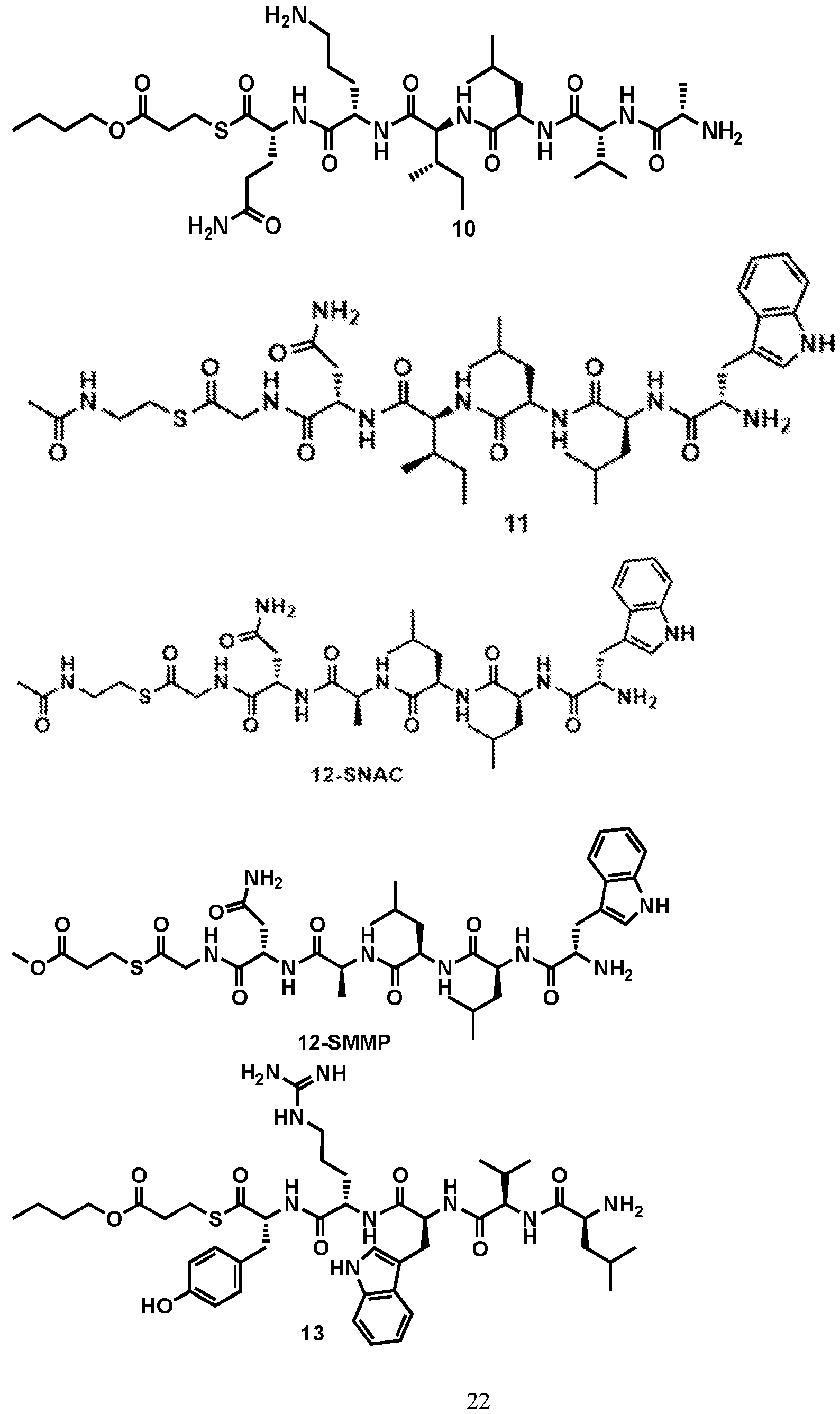
- the linear peptide of formula (I) is selected from:
- cyclic peptide of formula (II) is one or more of:
- Fig. 1A illustrates ultraviolet (UV) traces (214 nm) from ultra-performance liquid chromatography (UPLC) analysis of cyclization of hexapeptide (12) by Ulml6 (top. 70 nM.) or no enzyme control (bottom) after 4 hours of incubation. Ulml6 cyclized hexapeptides In the substrate scope comparison of Ulml6 and SurE.
- Fig. IB illustrates UV traces (214 nm) from UPLC analysis of cyclization of pentapeptide (13) by SurE (top, 240 nM), Ulml6 (middle, 17 nM), or no enzyme (bottom) control after 4 hours of incubation. Both SurE and Ulml6 can cyclize pentapeptide (13), but Ulml6 does so more efficiently and with significantly less enzyme.
- Fig. 1C illustrates UV traces (214 nm) from UPLC analysis of cyclization of tetrapeptide (16) by SurE (top, 240 nM), Ulml6 (middle. 17 nM), or no enzyme control (bottom, after 4 hours of incubation. Ulml6 completely cyclized tetrapeptide (16), while SurE showed barely detectable cyclization.
- Fig. ID illustrates total turnover numbers (TTNs) of thiopeptide substrates.
- the top axis shows the TTN and the bottom axis shows the ratio of cyclized to hydrolyzed product formed.
- V alues are averages of at least three replicates.
- Fig. IE illustrates a representation of the Ulml6 tetrapeptide substrate scope showcasing the tolerated amino acid substitutions (>5:1 Cyclic:Hydrolysis) tested at each position.
- Fig. 2 shows Michaelis-Menten plots of Ulml6 kinetics for three peptide thioesters, such as Ulm-SNAC, Ulm-SMMP, and Ulm-SBMP. The data is summarized in Table 2. The plots represent the mean of triplicate experiments, and the error bars indicate the standard error of the mean (S.E.M).
- Fig. 3 shows Michaelis-Menten plots of Ulml 6 kinetics for three alanine scans of the ‘Ulm’ peptide. The substrates used were dQldA(5). 13A(7), dL4dA (8), dV5dA (9), and W6A(10). and The data is summarized in Table 2. The plots represent the mean of triplicate experiments, and the error bars indicate the S.E.M.
- Fig. 4 shows Table 1, which displays details on Ulml6 tetrapeptide and pentapeptide Cyclization studies.
- Fig. 5 shows Table 3, which shows Ulml 6 mutant total turnover assay data.
- the present disclosure is predicated, at least in part, on the discovery that a new class of thioesterases, penicillin-binding protein (PBP)-type. which share a sequence homology to the penicillin-binding protein enzyme family of peptide cyclases, rather than the canonical thioesterases domains, and can act as biocatalysts for head-to-tail peptide macrocyclization.
- PBP-TEs penicillin-binding protein-thioesterases
- a method of biocatalytic cyclization for the preparation of a cyclic peptide or its salt comprises reacting a substrate comprising a linear peptide or its salt with Ulml6, a PBP-TE.
- the method comprises:
- step (b) incubating the reacting mixture of step (a);
- step (c) quenching and centrifuging the reaction mixture of step (b);
- the substrate comprising a linear peptide is represented by the formula
- n 3-10; each Ri is independently selected a natural or unnatural amino acid side chain; and R2is Ci-C 6 alkyl Ci-Ce alkanoate orN- Ci-Ce alkanoyl amino Ci-Ce alkyl.
- R2 is Ci-Ce alkyl acetate orN- acetyl amino Ci-Ce alkyl.
- R2 together with sulfur to which it is attached, forms a S-R2 group.
- S-R2 is N- acetylcysteamine (-SNAC), methyl 3 -mercaptopropionate (-SMMP), or butyl 3 -mercaptopropionate (-SBMP).
- the S-R2 is but l 3-mercaptopropionate (-SBMP).
- the substrate of formula (I) upon reaction with Ulml6. forms the cyclic peptide represented by the formula (II): wherein n is 3-10; and each Ri is independently a natural or unnatural amino acid side chain.
- a method of biocatalytic cyclization for the preparation of a cyclic peptide of formula (II) or its salt comprises reacting a substrate comprising a linear peptide represented by formula (I) or its salt with Ulml6, PBP-TE in the presence of an aqueous solvent.
- the linear peptides can comprise 4-10 amino acids when n is 4-10. Desirably, the linear peptides can comprise 4-6 amino acids when n is 4-6.
- the method involves head-to-tail cyclization of cyclic peptides using a biocatalyst, such as Ulml6.
- the cyclic peptides can be small cyclic peptides.
- the small cyclic peptides are tetrapeptides, pentapeptides, or hexapeptides or a mixture of two or more of the foregoing.
- the small cyclic peptides are tetrapeptides.
- Ulml6, a peptide cyclase enzyme belonging to the PBP-TEs that can carry out biocatalytic head-to-tail macrolactamization ofnonribosomal peptides.
- This enzyme obtained from Streptomyces sp. KCB13F003 can efficiently catalyze the production of linear peptide precursors using multimodular enzyme complexes known as nonribosomal peptide synthetases (NRPSs), which are frequently implicated in the production of cyclic peptides in vivo.
- NRPSs nonribosomal peptide synthetases
- Cyclic peptides of formula (II) can be prepared by biocatalytic cyclization of corresponding linear peptide precursors of formula (I) wherein cyclic peptide ring closure can be effected, preferably by the formation of an amide bond catalyzed by Ulml6.
- a method involves reacting Ulml6 enzyme with a substrate comprising a linear peptide, wherein an amino acid on the one terminal of the liner peptide has an activated thioester functional group, and the other terminal of the peptide has an amino acid with a free amine in the presence of an aqueous solvent to form the cyclic peptide.
- Ulml6 can effectively cyclize the liner peptides comprising 4-6 amino acids (see Table 2, Fig. 1). In some embodiments, Ulml 6 can cyclize various non-native peptides comprising 4-6 amino acids with catalytic efficiencies of up to 3 x 10 6 M ⁇ s’ 1 . In some embodiments, the cyclic peptides comprising 4-6 amino acids are tetrapeptides, pentapeptides, or hexapeptides. Fig.
- 1C illustares that Ulml6 cyclizes the tetrapeptide consisting of N-termmal L-valme and C-terminal D-serine (14) with very little hydrolysis observed (>20: 1 cyclic:hydrolyzed).
- Fig. IE illustrates the substrate scope of Ulml 6, indicating that it can accommodate a diverse range of amino acids at positions 1-3 of the tetrapeptide sequence.
- Ulml 6 can have broad specificity for substrate recognition and also can have selectivity for certain amino acid residues.
- the biocatalytic cyclization can be carried out in an aqueous medium that optionally includes one or more buffers or an organic solvent.
- a suitable organic solvent can be used.
- the organic solvent is dimethyl sulfoxide (DMSO), acetonitrile, methanol, or dimethyl formamide (DMF).
- DMSO dimethyl sulfoxide
- acetonitrile acetonitrile
- methanol methanol
- DMF dimethyl formamide
- the desirable organic solvent is DMSO.
- the amount of organic solvent used is about 0% to about 25%, such as about 0 % to 25%, or 0% to about 25% or 0% to 25%.
- the buffers used for the reaction can have a pH of about 6 to about 9, such as about 6 to 9, or 6 to about 9 or 6 to 9.
- the reaction mixture has a pH of about 8 (such as 8).
- a suitable buffer that can maintain pH of about 6 to about 9 can be used.
- the buffer is Tris buffer.
- the concentration of catalyst used depends upon the rate of catalysis for a particular substrate and the reaction volume.
- the concentration of Ulml 6 used is about 1 nM to about 250 nM for about 50 pM to about 500 pM of the substrate, such as about 1 nM to 250 nM, or 1 nM to about 250 nM, or 1 nM to 250 nM, for about 50 pM to 500 pM, or 50 pM to about 500 pM or 50 pM to 500 pM of the substrate.
- the concentration of Ulml 6 used is about 10 nM to about 100 nM, such as about 10 nM to 100 nM, or 10 nM to about 100 nM, or 10 nM to 100 nM for about 250 pM to about 400 pM of the substrate, such as about 250 pM to 400 pM, or 250 pM to about 400 pM or 250 pM to 400 pM of the substrate. More desirably, the concentration of Ulml 6 used is about 10 nM to about 70 nM for the about 280 pM to about 320 pM of the substrate (such as 10 nM to 70 nM for 280 pM to 320 pM).
- the cyclization can be performed at about 10 °C to about 40 °C, such as about 10 °C to 40 °C or 10 °C to about 40 °C or 10°C to 40 °C.
- the cyclization can be carried out at about room temperature, i.e., about 20 °C to about 25 °C, such as about 20 °C to 25 °C or 20° C to about 25 °C or 20 °C to 25 °C.
- the cyclization reaction can be completed in about 2 minutes to about 6 hours. Desirably, the cyclization reactions can be completed in about 4 hours (such as 4 hours).
- the linear peptide of formula (I) is selected from:
- the cyclic peptide of formula (II) is one or more of:
- cyclic peptides prepared by the method disclosed herein can have useful pharmaceutical applications that include but are not limited to use as antibiotics, antitumor agents, cholesterol-lowering drugs, and immune suppressants. Other applications and molecules with other biological activity profiles can also be suitable.
- substituted refers to a functional group in which one or more hydrogen atoms contained therein are replaced by one or more non-hydrogen atoms.
- functional group or “substituent” refers to a group that can be or is substituted onto a molecule.
- substituents or functional groups include, but are not limited to, a halogen (e.g., F, Cl, Br, and I); an oxygen atom in groups such as hydroxyl groups, alkoxy groups, aryloxy groups, aralkyloxy groups, oxo(carbonyl) groups, and carboxyl groups including carboxylic acids, carboxylates, and carboxylate esters; a sulfur atom in groups such as thiol groups, alkyl and aryl sulfide groups, sulfoxide groups, sulfone groups, sulfonyl groups, and sulfonamide groups; a nitrogen atom in groups such as amines, azides, hydroxylamines, cyano, nitro groups, N-oxides, hydrazides, and enamines; and other heteroatoms in various other groups.
- a halogen e.g., F, Cl, Br, and I
- an oxygen atom in groups such as hydroxyl groups
- alkyl refers to substituted or unsubstituted straight chain and branched alkyl groups and cycloalkyl groups having from 1 to about 20 carbon atoms (e.g., C1-C20), 1 to 12 carbons (e.g., C1-C12), 1 to 8 carbon atoms (e.g., Ci-Cs), or, in some embodiments, from 1 to 6 carbon atoms (e.g., Ci-Cg).
- straight chain alkyl groups include those with from 1 to 8 carbon atoms such as methyl, ethyl, n-propyl, n-butyl, n-pentyl, n-hexyl, n -heptyl, and n-octyl groups.
- branched alkyl groups include, but are not limited to, isopropyl, iso-butyl, sec-butyl, tert-butyl, neopentyl, isopentyl, and 2,2-dimethylpropyl groups.
- alkyl encompasses n-alkyl, isoalkyl, and anteisoalkyl groups as well as other branched chain forms of alkyl.
- Representative substituted alkyl groups can be substituted one or more times with any of the groups listed herein, for example, amino, hydroxy, cyano, carboxy, nitro, thio, alkoxy, and halogen groups.
- Alkanoyl groups have the indicated number of carbon atoms, with the carbon of the keto group being included in the numbered carbon atoms.
- Alkanoyl groups include, for example.
- C2-Csalkanoyl, C2- Cealkanoyl and C2-C4alkanoyl groups which have from 2 to 8, from 2 to 6 or from 2 to 4 carbon atoms, respectively.
- alkylalkanoate refers to an ester unit which is one comprising up to 20 carbon atoms as a backbone and wherein the carbonyloxy component can be located anywhere along the 20-carbon backbone.
- the main chain especially can be replaced by Ci-Ce alkyl or Ci-Ce alkoxy.
- alkenyl refers to substituted or unsubstituted straight chain and branched divalent alkenyl and cycloalkenyl groups having from 2 to 20 carbon atoms(C2-C20), 2 to 12 carbons (C2- C12), 2 to 8 carbon atoms (C2-C8) or, in some embodiments, from 2 to 4 carbon atoms (C2-C4) and at least one carbon-carbon double bond.
- alkynyl group is a substituent, which contains an open point of attachment on a carbon atom that would form if a hydrogen atom bonded to a triply bonded carbon is removed from the molecule of an alkyne.
- hydroxyalkyl refers to alkyl groups as defined herein and substituted with at least one hydroxyl (-OH) group.
- cycloalkyl refers to substituted or unsubstituted cyclic alkyl groups such as, but not limited to, cyclopropyl, cyclobutyl, cyclopentyl, cyclohexyl, cycloheptyl, and cyclooctyl groups.
- the cycloalkyl group can have 3 to about 8-12 ring members, whereas in other embodiments the number of ring carbon atoms range from 3 to 4, 5, 6, or 7.
- cycloalkyl groups can have 3 to 6 carbon atoms (C3-C6).
- Cycloalkyl groups further include polycyclic cycloalkyl groups such as, but not limited to, norbomyl, adamantyl, bomyl, camphenyl, isocamphenyl, and carenyl groups, and fused rings such as, but not limited to, decalinyl, and the like.
- acyl refers to a group containing a carbonyl moiety wherein the group is bonded via the carbonyl carbon atom.
- the carbonyl carbon atom is also bonded to another carbon atom, which can be part of a substituted or unsubstituted alkyl, aryl, aralkyl, cycloalkyl, cycloalkylalkyl, heterocyclyl, heterocyclylalkyl. heteroaryl, heteroarylalkyl group or the like.
- the group is a "formyl" group, an acyl group as the term is defined herein.
- An acyl group can include 0 to about 12-40, 6-10, 1-5 or 2-5 additional carbon atoms bonded to the carbonyl group.
- An acry loyl group is an example of an acyl group.
- An acyl group can also include heteroatoms within the meaning herein.
- a nicotinoyl group (pyridyl-3-carbonyl) is an example of an acyl group within the meaning herein.
- Other examples include acetyl, benzoyl, phenylacetyl, pyridylacetyl, cinnamoyl, and cryloyl groups and the like.
- the group containing the carbon atom that is bonded to the carbonyl carbon atom contains a halogen, the group is termed a "haloacyl" group.
- An example is a trifluoroacetyl group.
- aryl refers to substituted or unsubstituted cyclic aromatic hydrocarbons that do not contain heteroatoms in the ring.
- aryl groups include, but are not limited to, phenyl, azulenyl. heptalenyl, biphenyl, indacenyl, fluorenyl, phenanthrenyl, triphenylenyl, pyrenyl, naphthacenyl, chiysenyl, biphenylenyl, anthracenyl, and naphthyl groups.
- aryl groups contain about 6 to about 14 carbons (C6-C14) or from 6 to 10 carbon atoms (C6-C10) in the ring portions of the groups.
- Aryl groups can be unsubstituted or substituted, as defined herein.
- Representative substituted aryl groups can be mono-substituted or substituted more than once, such as, but not limited to, 2-, 3-, 4-, 5-, or 6- substituted phenyl or 2-8 substituted naphthyl groups, which can be substituted with carbon or non-carbon groups such as those listed herein.
- aralk l and arylalkyl refer to alkyl groups as defined herein in which a hydrogen or carbon bond of an alkyl group is replaced with a bond to an aryl group as defined herein.
- Representative aralkyl groups include benzyl and phenylethyl groups and fused (cycloalkylaryl)alkyl groups such as 4-ethyl-indanyl.
- Aralkenyl groups are alkenyl groups as defined herein in which a hydrogen or carbon bond of an alky l group is replaced with a bondto an aryl group as defined herein.
- heterocyclyl refers to substituted or unsubstituted aromatic and non-aromatic ring compounds containing three or more ring members, of which one or more is a heteroatom such as, but not limited to, B, N, O, and S.
- a heterocyclyl can be a cycloheteroalkyl, or a heteroaryl, or if polycyclic, any combination thereof.
- heterocyclyl groups include 3 to about 20 ring members, whereas other such groups have 3 to about 15 ring members.
- heterocyclyl groups can include 3 to 8 carbon atoms (CACT). 3 to 6 carbon atoms (Cs- Ce) or 6 to 8 carbon atoms (Ce-Cs).
- heteroaryl ring is an embodiment of a heterocyclyl group.
- heterocyclylgroup includes fused ring species including those that include fused aromatic and non- aromatic groups.
- Representative heterocyclyl groups include, but are not limited to, pyrrolidinyl, azetidinyl, piperidynyl, piperazinyl, morpholinyl, chromanyl, indolinonyl, isoindolinonyl, furanyl, pyrrolidinyl, pyridinyl, pyrazinyl. pyrimidinyl.
- heterocyclylalkyl refers to alkyl groups as defined herein in which a hydrogen or carbon bond of an alkyl group as defined herein is replaced with a bond to a heterocyclyl group as defined herein.
- Representative heterocyclylalky l groups include, but are not limited to, furan-2-yl methyl, furan-3-yl methyl, pyridine-3-yl methyl, tetrahydrofuran-2-yl methyl, and indol-2-ylpropyl.
- heteroarylalkyl refers to alkyl groups as defined herein in which a hydrogen or carbon bond of an alkyl group is replaced with a bond to a heteroaryl group as defined herein.
- alkoxy refers to an oxygen atom connected to an alkyl group, including a cycloalkyd group, as are defined herein.
- linear alkoxy groups include but are not limited to methoxy, ethoxy, propoxy, butoxy, pentyloxy, hexyloxy, and the like.
- branched alkoxy include but are not limited to isopropoxy, sec-butoxy, tert-butoxy, isopentyloxy, isohexyloxy, and the like.
- cyclic alkoxy include but are not limited to cyclopropyloxy, cyclobutyloxy, cyclopentyloxy, cyclohexyloxy, and the like.
- alkoxy group can further include double or triple bonds and can also include heteroatoms.
- an allyloxy group is an alkoxy group within the meaning herein.
- a methoxyethoxy group is also an alkoxy group within the meaning herein, as is a methylenedi oxy group in a context where two adjacent atoms of a structure are substituted therewith.
- amine refers to primary, secondary, and tertiary amines having, e g., the formula N(group)3 wherein each group can independently be H or non-H, such as alkyl, aryl, and the like.
- Amines include but are not limited to R-NH2, for example, alkylamines, arylamines, alkylarylamines; R2NH wherein each R is independently selected, such as dialkylamines, diarylamines, aralkylamines, heterocyclylamines and the like; and R3N wherein each R is independently selected, such as trialkylamines, dialkylarylamines, alkyldiarylamines, triarylamines, and the like.
- the tenn "amine” also includes ammonium ions as used herein.
- amino group refers to a substituent of the form -NH2, -NHR, -NR2, -NR3 +, wherein each R is independently selected, and protonated forms of each, except for -NR3 +, which cannot be protonated. Accordingly, any compound substituted with an amino group can be viewed as an amine.
- An “amino group” within the meaning herein can be a primary, secondary, tertiary, or quaternary amino group.
- alkylamino includes a monoalkylamino, dialkylamino, and trialkylamino group.
- aminoalkyl refers to both secondary and tertiary amines where the point of attachment is through the nitrogen-atom and the alkyl groups are optionally substituted.
- the alkyl groups can be the same or different.
- amino acid generally refers to an organic compound comprising both a carboxylic acid group and an amine group.
- amino acid includes both “natural” and “unnatural” or “non-natural” amino acids.
- amino acid includes O-alkylated or N-alkylated amino acids, as well as amino acids having nitrogen or oxygen-containing side chains (such as Lys, Om, or Ser) in which the nitrogen or oxygen atom has been acylated or alkylated.
- Amino acids may be pure L or D isomers or mixtures of L and D isomers, including racemic mixtures. In general, amino acids are represented by the residue of Formula V.
- natural amino acid and equivalent expressions refer to L-amino acids commonly found in naturally occurring proteins.
- natural amino acids include, without limitation, alanine (Ala), cystein (Cys), aspartic acid (Asp), glutamic acid (Glu), phenylalanine (Phe), glycine (Gly), histidine (His), isoleucine (He), lysine (Lys), leucine (Leu), methionine (Met), asparagine (Asp), proline (Pro), glutamine (Gin), arginine (Arg), serine (Ser), threonine (Thr), valine (Vai), tryptophan (Trp), tyrosine (Tyr), (I-alanine ((3-ALA), and y-aminobutyric acid (GABA).
- Al alanine
- cystein cystein
- Asp glutamic acid
- Glu glutamic acid
- Phe phenylalanine
- unnatural amino acid refers to any derivative of a natural amino acid including D forms, and a- and (3-amino acid derivatives.
- the terms “unnatural amino acid” and “non-natural amino acid” are used interchangeably herein and are meant to include the same moieties. It is noted that certain amino acids, e.g., hydroxy proline, that are classified as a non-natural amino acid herein, may be found in nature within a certain organism or a particular protein. Amino acids with many different protecting groups appropriate for immediate use in the solid phase synthesis of peptides are commercially available.
- Reagents of the purest grade available were purchased from commercial sources and used without further purification: DMF, CH2CI2, CH3CN (HPLC grade) from Fisher Scientific, N-Methyl- 2-pyrrolidone (NMP) from Alfa Aesar. All Amino acids were purchased from Chem-Impex or AAPTECC, and all other reagents used were purchased from Sigma- Aldrich unless stated otherwise.
- Ulml6 (Accession ATU31793.1), CppA (QQY97180.1), PenA (WP_158102277), SurE (BBZ90014. 1). MppK (AAU34204.1), Lonl8 (QUJ09165.1), WolJ (UNO41476.1), and DsaJ (AJW76712.1) were used as inputs for a MUSCLE sequence alignment. The alignment was performed in JalView using MUSCLE v3.8.31.
- Biosynthetic gene clusters for ulleungmycin (BGC0001814), desotamide (BGC0001196), surugamide (BGC0001792), and mannopeptimycin (BGC0000388) were downloaded from MiBIG (Terlouw et al., Nucleic Acids Res. 2023, 51, D603-D610).
- the biosynthetic gene clusters for wollamide, longicatenamide, and pentaminomycin were determined by searching for the PBP-TE gene on NCBI and then expanding 20,000 bp on either side, then extending until the NRPS was not at the end of the region. The alignments were then generated using Clinker.
- SPPS Solid-phase peptide synthesis
- the resulting activated N-acylsulfonamide resin was swollen in DMF for 15 minutes, filtered, and then treated with a 50:50 thiol (2.5 mmol) DMF solution containing catalytic sodium thiophenolate (0.025 mmol) for 24 hours.
- the resin was filtered and washed with DMF (3 x 1 mL).
- the combined filtrate and washes were collected in a 20 mL scintillation vial, and the solvent was removed by rotarv evaporation followed by lyophilization.
- the crude product was characterized by ultra-perfonnance liquid chromatography -mass spectrometry (UPLC-MS) or high-performance liquid chromatography (HPLC). If the puritv of the crude product was >90%, as determined by monitoring the absorbance at 214 nm, it was used in the cyclization assay without further purification.
- UPLC-MS ultra-perfonnance liquid chromatography -mass spectrometry
- HPLC high-performance liquid chromatography
- the resin was then filtered, washed with DMF (1 x 5 mL), and exposed to fresh 0.5 M i-Pr2EtN in DMF solution, repeating this process until the solution no longer turned yellow.
- the resin was then swollen in DMF for 15 minutes, filtered, and treated with a 50:50 solution of thiol (2.5 mmol) in DMF, and shaken for 24 hours.
- the resin was filtered and washed with DMF (3 x 1 mL).
- the combined filtrate and washes were collected in a 20 mL scintillation vial and subjected to rotary evaporation and ly ophilization.
- Peptide 1 was synthesized following the general protocol outlined above for the sulfonamide "safety - catch 7 ’ resin. The synthesis was initiated from 4-sulfamylbuyryl resin preloaded with Fmoc-D- Gln(Trt)-OH (SI) (0.05 mmol) using the following amino acids (Fmoc-L-Om(Boc)-OH, Fmoc-L- Ile-OH, Fmoc-D-Leu-OH, Fmoc-D-Val-OH, Boc-L-Trp(Boc)-OH) and N-Aceytl cysteamine as the cleaving thiol. The crude peptide was obtained as an off-white solid (30.3 mg, 55% yield) analyzed via RP-UPLC and was used in further enzyme assays without further purification (purity 96%, UPLC).
- Peptide 2 was synthesized follow ing the general protocol outlined above for the sulfonamide "safety - catch” resin.
- the synthesis was initiated from 4-sulfamylbuyryl resin preloaded with Fmoc-D- Gln(Trt)-OH (SI) (0.05 mmol) using the following amino acids (Fmoc-L-Om(Boc)-OH, Fmoc-L- Ile-OH, Fmoc-D-Leu-OH, Fmoc-D-Val-OH, Boc-L-Trp(Boc)-OH) and methyl 3- mercaptopropi onate as the cleaving thiol.
- the crude peptide was obtained as an off-white solid (27.2 mg, 49% yield) analyzed via RP-UPLC and used in further enzyme assays without further purification (purity 96%, UPLC).
- Peptide 3 was synthesized following the general protocol outlined above for the sulfonamide "safety - catch 7 ’ resin. The synthesis was initiated from 4-sulfamylbuyryl resin preloaded with Fmoc-D- Gln(Trt)-OH (SI) (0.05 mmol) using the following amino acids (Fmoc-L-Om(Boc)-OH, Fmoc-L- Ile-OH, Fmoc-D-Leu-OH, Fmoc-D-Val-OH, Boc-L-Trp(Boc)-OH) and butyl 3 -mercaptopropionate as the cleaving thiol. The crude peptide was obtained as an off-white solid (22.3 mg, 39% yield) analyzed via RP-UPLC and was used in further enzyme assays without further purification (purity 99%, UPLC).
- the crude peptide was purified via reverse-phase semipreparative HPLC using mobile phases of H2O+0. 1% formic acid (A) and acetonitrile+0. 1% formic acid (B). Samples were eluted using a gradient mode with mobile phase B ranging from 0% to 55% over 22 minutes at a flow' rate of 20 mL/min. The column was equilibrated with 0% mobile phase B for 1 minute before and 5 minutes after the gradient to yield an off-white solid (8. 1 mg, 16% yield, Purity 99%, HPLC) .
- Peptide 5 was synthesized using the sulfonamide "safety-catch" resin according to the general protocol described earlier. The synthesis was initiated from 4-sulfamylbutryl resin preloaded with Fmoc-D-Ala-OH (S3) (0.05 mmol) and utilized the following amino acids: Fmoc-L-Om(Boc)-OH, Fmoc-L-Ile-OH, Fmoc-D-Leu-OH, Fmoc-D-Val-OH, and Boc-L-Trp(Boc)-OH, with butyl 3- mercaptopropionate used as the cleaving thiol. The crude peptide was obtained as an off-white solid (15.5 mg, 29% yield) and was analyzed via RP-UPLC. It was used in further enzyme assays without undergoing further purification (purity 7 96%, UPLC).
- S3 4-sulfamylbutryl resin preloaded with Fmoc-D-A
- Peptide 6 was synthesized following the general protocol outlined above for theNDbz “safety-catch” resin. The synthesis was initiated from (S4) (0.15 mmol) using the following amino acids (Fmoc-L- Gln(Trt)-OH, Fmoc-L-Ile-OH, Fmoc-D-Leu-OH, Fmoc-D-Val-OH, Boc-L-Trp(Boc)-OH) and methyl 3 -mercaptopropionate as the cleaving thiol.
- the crude peptide was purified via reverse-phase semi -preparative HPLC using mobile phases of H2O+0.1% formic acid (A) and acetonitrile+0.1% formic acid (B). Samples were eluted using a gradient mode with mobile phase B ranging from 0% to 60% over 22 minutes at a flow rate of 20 mL/min. The column was equilibrated with 0% mobile phase B for 1 minute before and 5 minutes after the gradient to yield an off-white solid (82.5 mg, 53% yield, purity 96%, UPLC).
- Peptide 7 was synthesized following the general protocol outlined above for the sulfonamide "safetycatch’’ resin.
- the synthesis was initiated from (SI) (0.05 mmol) using the following amino acids (Boc-L-Trp(Boc)-OH, Fmoc-D-Val-OH, Fmoc-D-Leu-OH, Fmoc-L-Ala-OH, Fmoc-L-Om(Boc)- OH) and butyl 3-mercaptopropionate as the cleaving thiol.
- the crude peptide was obtained as an off- white solid (26.9 mg. 49% yield), analyzed via RP-UPLC, and used in further enzyme assays without further purification (purity 97%).
- Peptide 8 was synthesized using the sulfonamide "safety-catch" resin according to the general protocol described earlier. The synthesis was initiated from (SI) (0.05 mmol) and utilized the following amino acids: Fmoc-L-Om(Boc)-OH, Fmoc-L-Ile-OH, Fmoc-D-Ala-OH, Fmoc-D-Val- OH, and Boc-L-Trp(Boc)-OH, with butyl 3-mercaptopropionate used as the cleaving thiol. The crude peptide was obtained as an off-white solid (22.48 mg, 41% yield) and was analyzed via RP-UPLC. It was used in further enzyme assays without undergoing further purification (purity 97%).
- Peptide 9 was synthesized follow ing the general protocol outlined above for the sulfonamide "safetycatch” resin. The synthesis was initiated from (SI) (0.05 mmol) using the following amino acids (Fmoc-L-Om(Boc)-OH, Fmoc-L-Ile-OH, Fmoc-D-Leu-OH, Fmoc-D-Ala-OH, Boc-L-Trp(Boc)- OH) and butyl 3-mercaptopropionate as the cleaving thiol. The crude peptide was obtained as an off- white solid (21.4 mg. 41% yield), analyzed viaRP-UPLC, and used in further enzyme assays without further purification (purity 96%).
- Peptide 11 was synthesized following a previously described method (Matsuda, K. et al. Nature. Catalyst. 2020, 3, 507-515). Fmoc-Gly-OH (3 eq) and i-Pr2EtN (6 eq) were loaded onto 2- chlorotritylchloride (2-CTC) resin in DMF.
- the reaction mixture was filtered, and the filtrate was washed with DCM (10 mL), concentrated, redissolved in a mixture of acetonitrile-water, frozen, and lyophilized.
- the crude linear peptide was used in the next reaction without further purification.
- the crude peptide was dissolved in DCM/DMF, and N-Aceytl cysteamine (10 equiv.), 2,6 Lutidine (5 equiv.), and HCTU (5 quiv.) were added.
- the reaction was stirred overnight at room temperature, quenched with 40 mL EtOAc, and washed with saturated aqueous NH4CI (2x 15 mL), saturated aqueous NaHCO?
- the crude peptide was purified via reverse-phase semi-preparative HPLC using mobile phases of H2O+0.1% Formic acid (A) and acetonitrile+0.1 % Formic acid (B). Samples were eluted using a gradient mode with mobile phase B ranging from 10% to 50% over 22 minutes at a flow- rate of 20 mL/min. The column was equilibrated with 10% mobile phase B for 1 minute before and 5 minutes after the gradient to yield an off-white solid (3.7 mg, 9% yield, purity 99%).
- Peptide 12-SNAC was synthesized following an identical protocol followed for Peptide (11) however, Fmoc-L-Leu-OH was substituted with Fmoc-L-Ala-OH.
- the crude peptide w as purified via reverse-phase semi-preparative HPLC using mobile phases of H2O+0.1% formic acid (A) and acetonitrile+0. 1% formic acid (B). Samples were eluted using a gradient mode with mobile phase B ranging from 10% to 50% over 22 minutes at a flow rate of 20 mL/min. The column was equilibrated with 10% mobile phase B for 1 minute before and 5 minutes after the gradient to yield an off-white solid (2.1 mg, 5% yield, purity 91%).
- Peptide 12-SMMP was synthesized following the general protocol outlined above for the NDbz “safety-catch” resin. The synthesis was initiated from (S4) (0.10 mmol) using the following amino acids (Fmoc-Gly-OH. Fmoc-L-Asn(Trt)-OH, Fmoc-L-Ala-OH. Fmoc-D-Leu-OH. Fmoc-L-Leu- OH, and Boc-L-Trp(Boc)-OH) and butyl 3 -mercaptopropionate as the cleaving thiol.
- the crude peptide was purified via reverse-phase semi-preparative HPLC using mobile phases of H20+0.05% Trifluoroacetic acid (A) and acetonitrile+0.05% Trifluoroacetic acid (B). Samples were eluted using a gradient mode with mobile phase B ranging from 0% to 50% over 22 minutes at a flow rate of 20 mL/min. The column was equilibrated with 0% mobile phase B for 1 minute before and 5 minutes after the gradient to yield an off-white solid (24.8 mg, 28% yield, purity >99%).
- Peptide 13 was synthesized following the general protocol outlined above for the sulfonamide “safety-catch” resin. The synthesis was initiated from (S6) (0.05 mmol) using the following amino acids (Fmoc-L-Arg(Pbf)-OH, Fmoc-L-Trp(Boc)-OH, Fmoc-D-Val-OH, Boc-L-Leu-OH) and butyl 3-mercaptopropionate as the cleaving thiol. The crude peptide was obtained as an off-white solid (23.7 mg, 43% yield) analyzed viaRP-HPLC and was used in further enz me assays without further purification (purity >99%).
- the crude peptide was purified via reverse-phase semipreparative HPLC using mobile phases of H20+0.05% trifluoroacetic acid (A) and acetonitrile+0.05% trifluoroacetic acid (B). Samples were eluted using a gradient mode with mobile phase B ranging from 0% to 50% over 22 minutes at a flow' rate of 20 mL/min. The column was equilibrated with 0% mobile phase B for 1 minute before and 5 minutes after the gradient to yield an off-white solid (17.8 mg, 20% yield, purity 90.3%).
- Peptide 15 was synthesized following the general protocol outlined above for the sulfonamide “safety -catch” resin. The synthesis was initiated from (S7) (0.05 mmol) using the following amino acids (Fmoc-D-Om(Boc)-OH. Fmoc-L-Phe-OH, Boc-L-Val-OH) and butyl 3-mercaptopropionate as the cleaving thiol. The crude peptide was obtained as an off-white solid (30.4 mg, 70% yield) analyzed via RP-HPLC and was used in further enzyme assays without further purification (purity 96%, UPLC). 'H NMR (800 MHz.
- Peptide 16 was synthesized following the general protocol outlined above for the sulfonamide “safety -catch” resin. The synthesis was initiated from 4-sulfamylbutyryl resin preloaded with Fmoc- D-Tyr(tBu)-OH (S6) (0.05 mmol) using the following amino acids (Fmoc-D-Arg(Pbf)-OH, Fmoc- L-Phe-OH, Boc-L-Val-OH) and butyl 3-mercaptopropi onate as the cleaving thiol. The crude peptide was obtained as an off-white solid (29.6 mg, 61% yield) analyzed via RP-UPLC and was used in further enzyme assays without further purification (purity 96%, HPLC).
- Peptide 17 was synthesized following the general protocol outlined above for the sulfonamide "safety -catch" resin. The synthesis was initiated from (SI) (0.05 mmol) using the following amino acids (Fmoc-D-Arg(Pbf)-OH, Fmoc-L-Phe-OH, Boc-L-Val-OH) and butyl 3-mercaptopropionate as the cleaving thiol. The crude peptide was purified via reverse-phase semi-preparative HPLC using mobile phases of H20+0.05% Trifluoroacetic acid (A) and acetonitrile+0.05% Trifluoroacetic acid (B).
- Peptide 14 was synthesized following the general protocol outlined above for the NDbz "safely - catch 7 ’ resin. The synthesis was initiated from (S4) (0.15 mmol) using the following amino acids (Fmoc-D-Lys(Boc)-OH, Fmoc-D-Lys(Boc)-OH, Fmoc-L-Phe-OH, and Boc-L-Val-OH) and butyl 3 -mercaptopropionate as the cleaving thiol. The crude peptide was purified via reverse-phase semipreparative HPLC using mobile phases of H20+0.05% Trifluoroacetic acid (A) and acetonitrile+0.05% Trifluoroacetic acid (B).
- A Trifluoroacetic acid
- B Trifluoroacetic acid
- Peptide 19 was synthesized by initiating the synthesis from (S9) (0.05 mmol) and coupling the following amino acids in the order of Fmoc-D-Arg(Pbf)-OH, Fmoc-L-Phe-OH, and Boc-L-Val-OH. Butyl 3- mercaptopropi onate was used as the cleaving thiol. The crude peptide was obtained as an off-white solid with ayield of 36% (16.4 mg) and was analyzed via RP-HPLC. The peptide was used in further enzyme assays without additional purification (purity >99%).
- Peptide 21 was synthesized following the general protocol outlined above for the sulfonamide “safety -catch” resin. The synthesis was initiated from (SI) (0.05 mmol) using the following amino acids Fmoc-D-Om(Boc)-OH, Fmoc-L-Phe-OH, Boc-L-Gln(Trt)-OH, and butyl 3- mercaptopropionate as the cleaving thiol. The crude peptide was obtained as an off-white solid (28. 1 mg, 62% yield) analyzed via RP-HPLC and was used in further enzyme assays without further purification (purity 98%).
- Peptide 22 was synthesized using the NDbz "safety-catch" resin. The synthesis was initiated from Fmoc-MeDbz-OH loaded resin (S4) (0. 15 mmol) and involved the following amino acids: Fmoc-D- Tyr(tBu)-OH, Fmoc-D-Arg(Pbf)-OH, Fmoc-L-Phe-OH, Boc-L-Asp(OMe)-OH. Butyl 3- mercaptopropionate was used as the cleaving thiol. The crude peptide was purified via reverse-phase semi-preparative HPLC using mobile phases of acetonitrile+0.05% TFA (B) and H20+0.05% TFA (A).
- DMSO DMSO 5 200.53, 171.82, 171.53, 170.58, 170.01, 167.86, 157.27, 156.49, 137.57, 130.38. 129.58, 128.52, 127.08. 126.82, 115.48, 64.30, 61.45. 54.80, 52.41, 52.07, 49.04. 40.77, 38.20, 36.58, 35.81, 33.99, 30.51, 29.46, 25.16, 23.68, 18.97, 13.92.
- Peptide 23 was synthesized following the general protocol outlined above for the sulfonamide “safety -catch” resin. The synthesis was initiated from (SI) (0.05 mmol) using the following amino acids Fmoc-D-Gln(Trt)-OH. Fmoc-L-Phe-OH, Boc-L-Val-OH and butyl 3-mercaptopropionate as the cleaving thiol. The crude peptide was obtained as an off-white solid (18.5 mg, 48% yield) analyzed via RP-HPLC and was used in further enzyme assays without further purification (purity >99%).
- Peptide 24 was synthesized following the general protocol outlined above for the sulfonamide
- Peptide 25 was synthesized following the general protocol outlined above for the sulfonamide “safety -catch” resin. The synthesis was initiated from SI (0.05 mmol) using the following amino acids (Fmoc-D-Dab(Boc)-OH, Fmoc-L-Phe-OH, Boc-L-Val-OH) and butyl 3 -mercaptopropionate as the cleaving thiol. The crude peptide was obtained as an off-white solid (23.3 mg, 54% yield) analyzed via RP-HPLC and was used in further enzyme assays without further purification (purity 99%, UPLC).
- Peptide 26 was synthesized using the NDbz "safety-catch" resin. The synthesis was initiated from Fmoc-MeDbz-OH loaded resin (S4) (0.1 mmol) and involved the following amino acids: Fmoc-D- Gln(Trt)-OH, Fmoc-D-Dap(Boc)-OH, Fmoc-L-Phe-OH, and Boc-L-Val-OH. Butyl 3- mercaptopropionate was used as the cleaving thiol. The crude peptide was purified via reverse-phase semi-preparative HPLC using mobile phases of H2O+0.1% formic acid (A) and acetonitrile+0.
- S4 Fmoc-MeDbz-OH loaded resin
- Peptide 27 was initiated from SI (0.05 mmol) using the following amino acids in the order of Fmoc-D-His(Trt)-OH, Fmoc-L-Phe-OH, and Boc-L-Val-OH, with butyl 3- mercaptopropionate used as the cleaving thiol, following the general protocol outlined above for the sulfonamide 'safety-catch' resin
- the crude peptide was purified via reverse-phase semi-preparative HPLC using mobile phases of H2O+0.1% formic acid (A) and acetonitrile+0. 1% formic acid (B).
- Peptide 28 was synthesized following the general protocol outlined above for the sulfonamide ⁇ ‘safety-catch” resin. The synthesis was initiated from SI (0.05 mmol) using the following amino acids Fmoc-D-Om(Boc)-OH, Fmoc-L-Tyr(tBu)-OH, Boc-L-Val-OH and butyl 3- mercaptopropionate as the cleaving thiol. The crude peptide was purified via reverse-phase semipreparative HPLC using mobile phases of H20+0.05% TFA (A) and acetonitrile+0.05% TFA (B).
- Peptide 29 was synthesized using the NDbz "safety-catch" resin. The synthesis was initiated from Fmoc-MeDbz-OH loaded resin S4 (0.15 mmol) and involved the following amino acids: Fmoc-D- Tyr(tBu)-OH, Fmoc-D-Arg(Pbf)-OH, Fmoc-D-Phe-OH. Boc-L-Val-OH. Butyl 3- mercaptopropi onate was used as the cleaving thiol.
- the crude peptide was purified via reverse-phase semi -preparative HPLC using mobile phases of acetonitrile+0.05% trifluoroacetic Acid (B) and H20+0.05% trifluoroacetic Acid (A). Samples were eluted using a gradient mode with mobile phase B ranging from 0% to 50% over 22 minutes at a flow rate of 20 mL/min. The column was equilibrated with 0% mobile phase B for 5 minutes after and 1 minute before the gradient to yield an off-white solid (42.4 mg, 30% yield) (purity 98%, UPLC).
- Peptide 30 was synthesized using the NDbz "safety-catch" resin. The synthesis was initiated from Fmoc-MeDbz-OH loaded resin S4 (0.15 mmol) and involved the following amino acids: Fmoc-D- Tyr(tBu)-OH, Fmoc-L-Arg(Pbf)-OH, Fmoc-D-Phe-OH, Boc-L-Val-OH. Butyl 3- mercaptopropionate was used as the cleaving thiol. The crude peptide was purified via reverse-phase semi-preparative HPLC using mobile phases of acetonitrile+0.05% TFA (B) and H20+0.05% TFA (A).
- B acetonitrile+0.05% TFA
- A H20+0.05% TFA
- Peptide 31 was synthesized using the NDbz "safety-catch" resin. The synthesis was initiated from Fmoc-MeDbz-OH loaded resin S4 (0.15 mmol) and involved the following amino acids: Fmoc-D- Tyr(tBu)-OH, Fmoc-D-Arg(Pbf)-OH, Fmoc-L-Phe-OH, Boc-D-isoVal-OH. Butyl 3- mercaptopropi onate was used as the cleaving thiol. The crude peptide was purified via reverse-phase semi-preparative HPLC using mobile phases of acetonitrile+0.05% TFA (B) and H20+0.05% TFA (A).
- a 50 pL reaction mixture containing 20 mM Tris-HCl (pH 8.0), 5% DMSO, 50 nM Ulml6, and 280 pM substrate was incubated at 30°C for 4 hours.
- the reaction mixtures were quenched with 50 pL of acetonitrile and centrifuged at 21,000g for 10 minutes.
- Five microliters of the resulting solution were loaded onto a CORTECS T3 Column, 120 . 1.6 pm, 2. 1 mm X 50 mm (Waters) and separated by UPLC with monitoring at 214 nm.
- the mobile phases used were H2O+0.1% FA and acetonitrile+0.1% FA, and the samples were eluted by gradient mode: 0% to 40% for mobile phase B in 11 minutes with a flow rate of 0.5 ml min '. All reactions were carried out in triplicate.
- TTN was calculated by the formula below.
- Enzymatic reactions were conducted in 20 mM Tris at pH 8.0 with 5% DMSO for 4 hours at 30°C using various concentrations of peptides and Ulml6 as indicated by [Peptide] and [Ulml6], respectively (see Table 1).
- the areas of the enzymatic products and starting material were determined by analyzing the UPLC UV Trace at 214 nm. Total turnover numbers were calculated using the above formula. Numbers 19 and 31 indicate substrates that were neither cyclized nor hydrolyzed.
- Table 1 (Fig. 4) illustrates Ulml6 total turnover assays.
- D- Asparagine a beter substitute for D-threo-(3-hydroxy asparagine, was not used due to its propensity to rapid asparatamide formation at the C-terminus.
- SurE and PenA have previously been examined using peptide thioesters that contained N-Acetylcysteamine (SNAC), a mimic of the phosphopantetheine arm utilized by the PCP domain, recent studies utilizing excised thioesterase domains have shown that other thiols not related to the phosphopantetheine backbone can improve enzyme activity and turnover.
- SNAC N-Acetylcysteamine
- the modified Ulml6 peptide was synthesized with three different C-terminal thiols: N-acetylcysteamine (12-SNAC), methyl 3-mercaptopropionate (12- SMMP), and butyl 3-mercaptopropionate (12-SBMP), using safety catch resin to avoid issues with epimerization that necessitate and complicate purification.
- the SBMP-thioester was found to be three times more efficient in processing than the commonly used and expensive SNAC- thioester (see Table 2). For this reason, SBMP-thioesters were used for the rest of the substrate scope unless otherwise noted.
- An alanine scan was performed to determine sites where modification was tolerated (Table 1) Substitution of internal residues 5 (D-valine) and 3 (L -isoleucine) with D-alanine and L-alanine, respectively, were well tolerated, displaying approximately 80% of the activity as the initial substrate.
- TTN for (2) 22545
- Ulml6 tolerates substitution at the C-terminus ver 7 well, displaying approximately 60% of the activity observed when the C-tenninal D-glutamine is substituted with D-alanine. This contrasts with previously investigated SurE and PenA. which have drastically reduced abilities to cyclize peptides with C-terminal alterations of their native residues. Modification at the N-terminus was less well tolerated, with an L-alanine substitution displaying only 6% of the catalytic efficiency of the native L-tiyptophan.
- Fig. IE illustrates the substrate scope of Ulml6, indicating that it can accommodate a diverse range of amino acids at positions 1-3 of the tetrapeptide sequence. However, the N-terminal amino acid shows a pronounced preference for non-polar amino acids. Overall, this suggests that Ulml6 has broad specificity for substrate recognition but also exhibits selectivity for certain amino acid residues.
- Stereochemical preorganization into a cyclic conformation can have a significant impact on a peptide’s ability to undergo cyclization.
- the differing position of the lipocalin domain from SurE appears to play a role in organizing the substrate, with hydrophobic residues forming a binding pocket for the N-terminal residues of the peptides docked/tested, and R436 hydrogen bonding with backbone carbonyls of the peptide possibly aiding in the trans-cis conversion needed for cyclization.
- This provided insight into the structural basis of the unique ability of Ulml6 to efficiently cyclize small peptides, specifically tetrapeptides. Through crystal structure determination and covalent docking studies, it was observ ed how the absence of a loop region in Ulml 6 alters the peptide binding trajectory and enhances its ability to bind and catalyze cyclization with high efficiency.
- Table 3 shows Ulml 6 Mutant total turnover assays. Enzymatic reactions were conducted in 20 mM Tris at pH 8.0 with 5% DMSO for 4 hours at 30°C using various concentrations of peptides and mutated Ulml 6 as indicated by [Peptide] and [Ulml 6], respectively. The areas of the enzymatic products and starting material were determined by analyzing the UPLC UV Trace at 214 nm. Total turnover numbers were calculated using a formula outlined in the methods section. In some cases. Tris from the reaction buffer was conjugated to the peptide and is indicated by ‘Area Tris Peptide’.
- the term "about” can allow for a degree of variability in a value or range, for example, within 10%, within 5%, or within 1% of a stated value or of a stated limit of a range.
- the term "substantially” can allow for a degree of variability in a value or range, for example, within 90%, within 95%, or within 99% of a stated value or of a stated limit of a range.
Landscapes
- Chemical & Material Sciences (AREA)
- Organic Chemistry (AREA)
- Life Sciences & Earth Sciences (AREA)
- Health & Medical Sciences (AREA)
- Genetics & Genomics (AREA)
- General Health & Medical Sciences (AREA)
- Biochemistry (AREA)
- Wood Science & Technology (AREA)
- Molecular Biology (AREA)
- Engineering & Computer Science (AREA)
- Zoology (AREA)
- Medicinal Chemistry (AREA)
- Proteomics, Peptides & Aminoacids (AREA)
- Bioinformatics & Cheminformatics (AREA)
- General Engineering & Computer Science (AREA)
- Biophysics (AREA)
- Microbiology (AREA)
- Biotechnology (AREA)
- Biomedical Technology (AREA)
- Chemical Kinetics & Catalysis (AREA)
- General Chemical & Material Sciences (AREA)
- Peptides Or Proteins (AREA)
- Preparation Of Compounds By Using Micro-Organisms (AREA)
Abstract
A method of biocatalytic cyclization for the preparation of cyclic peptides or salts thereof using Ulm16, a penicillin-binding protein (PBP)-type class of thioesterase (PBP-TE) enzyme.
Description
BIOCATALYTIC CYCLIZATION METHOD FOR PREPARATION OF CYCLIC PEPTIDES
CROSS REFERENCE TO RELATED APPLICATION
[0001] This application claims priority to U.S. provisional patent application no. 63/524,777, which was filed July 3, 2023, and which is hereby incorporated by reference in its entirety.
STATEMENT OF GOVERNMENT SUPPORT
[0002] This invention was made with government support under GM138002, CA 275390. CA 23168 awarded by the National Institutes of Health and DGE-1842166 awarded by the National Science Foundation. The government has certain rights in the invention.
TECHNICAL FIELD
[0003] The present disclosure relates to a method of biocatalytic cyclization for the preparation of small cyclic peptides using penicillin-binding protein (PBP)-type thioesterases (PBP-TEs). In particular, the disclosure relates to a method of biocataly tic cyclization for the preparation of small cyclic peptides using Ulml6, a PBP-TE.
SEQUENCE LISTING
[0004] A computer-readable form (CRF) of the Sequence Listing is submitted with this application. The sequence listing is entitled 69959-02_SEQ_LISTING.xml, was generated on June 24, 2024, and is 4000 bytes in size. The entire content of the sequence listing is incorporated herein by reference in its entirety.
BACKGROUND
[0005] Peptides as therapeutic candidates are gaining interest due to their lack of immunogenicity as well as high potency, selectivity', and reasonable manufacturing costs. However, linear peptides often do not display these selectivities and drug-like properties without additional modifications (Tsomaia, N, Eur. J. Med. Chem. 2015, 94, 459-470). Macrocyclic peptides represent promising scaffolds for chemical tools and potential therapeutics. They often enable excellent membrane permeability' and have increased potency, specificity', and proteolytic stability'. However, their synthesis is very challenging since macrocyclization has often been hampered by epimerization of the C-terminal residue, oligomerization, and conformational rigidity, which precludes remote
residue coupling, leading to poor yields and scalability issues (White. C. J. et al., Nature Chemistry’, 2011, 3, 509-524).
[0006] These issues become more challenging as the ring size in peptides decreases, particularly for small cyclic peptides such as tetrapeptides, which have high levels of ring strain. The ground-state (E)-geometry of the peptide bond prevents them from attaining a conformation favorable towards cyclization, making the synthesis and derivatization of pharmaceutically and industrially relevant cyclic tetrapeptides impossible. While several strategies have been employed to circumvent this issue, they often require certain amino acids to be present in the peptide sequence.
[0007] The enzy matic cyclizations that are suitable for the scalable production of cyclic peptides have been sought to overcome the challenges associated with macrocyclization. Nature can efficiently catalyze the production of linear peptide precursors using multimodular enzyme complexes known as nonribosomal peptide synthetases (NRPSs), which are frequently implicated in cyclic tetrapeptides and pentapeptides. Offloading from the complex and cyclization are typically catalyzed by C-terminal thioesterase (TE) domains or condensation termination (CT) domains of NRPSs. While these domains can efficiently catalyze the cyclization of strained cyclic peptides in vivo and have been extensively studied as biocatalysts, they have failed to reach widespread use as biocatalysts, since they often display low substrate promiscuity’, an inability’ to predict cyclization modes (e.g., head-to-tail) accurately, and strictly require peptidyl carrier protein (PCP) tethered substrate in the case of CT domains.
[0008] Hence, there is an unmet need for a method of cyclizing small peptides that can be scaled for production and can efficiently use a biocatalyst. It is an object of the present disclosure to provide such a method. This and other objects and advantages, as well as inventive features, w ill be apparent from the detailed description.
SUMMARY
[0009] Provided is a method of biocatalytic cyclization for the preparation of a cyclic peptide or its salt, which method comprises reacting a substrate comprising a linear peptide or its salt with Ulml6, a penicillin-binding protein (PBP)-type class of thioesterase (PBP-TE).
[0010] The method comprises:
(a) reacting a substrate comprising a linear peptide or its salt with Ulml6, a penicillin-binding protein (PBP)-type class of thioesterase (PBP-TE) to obtain a reaction mixture;
(b) incubating the reaction mixture of step (a);
(c) quenching and centrifuging the reaction mixture; and
(d) isolating the cyclic peptide.
[0011] The step (a) is carried out in the presence of an aqueous solvent comprising one or more buffers and optionally further comprising an organic solvent. Desirably, the buffer used is Tris buffer. Examples of organic solvents include, but are not limited to, dimethyl sulfoxide (DMSO), acetonitrile, methanol, or dimethyl formamide (DMF).
[0012] In some embodiments, the concentration of Ulm 16 used is about 1 nM to about 250 nM.
[0013] The substrate comprising a linear peptide is represented by the formula (I):
 wherein n is 3-10; each Ri is independently a natural or unnatural amino acid side chain: and
R2is Ci-Ce alkyl Ci-Ce alkanoate orN-Ci-Ce alkanoyl amino Ci-Ce alkyl.
[0014] In some embodiments, R.2 is Ci-Ce alkyl acetate or N-acetyl amino Ci-Ce alkyl. In some embodiments, S-R2 in formula (I) is N-acetylcysteamine (-SNAC), methyl 3 -mercaptopropion ate (- SMMP), or butyl 3-mercaptopropionate (-SBMP). Desirably, S-R2 is butyl 3-mercaptopropionate (- SBMP).
[0015] The cyclic peptide obtained by the biocatalytic reaction is represented by the formula (II):
 wherein n is 3-10; each Ri is independently a natural or unnatural amino acid side chain.
[0016] In some embodiments, n is 4-6. The cyclic peptides obtained are tetrapeptides, pentapeptides, or hexapeptides, or a mixture of two or more of the foregoing. Desirably, the cyclic peptides are tetrapeptides.
[0017] In some embodiments, the linear peptide of formula (I) is selected from:


[0018] In some embodiments, cyclic peptide of formula (II) is one or more of:


BRIEF DESCRIPTION OF THE DRAWINGS
[0019] The disclosed embodiments and other features, advantages, and aspects contained herein, and the matter of attaining them, will become apparent in light of the following detailed description of various exemplary embodiments of the present disclosure. Such detailed description will be better understood when taken in conjunction with the accompanying drawings.
[0020] Fig. 1A illustrates ultraviolet (UV) traces (214 nm) from ultra-performance liquid chromatography (UPLC) analysis of cyclization of hexapeptide (12) by Ulml6 (top. 70 nM.) or no enzyme control (bottom) after 4 hours of incubation. Ulml6 cyclized hexapeptides In the substrate scope comparison of Ulml6 and SurE.
[0021] Fig. IB illustrates UV traces (214 nm) from UPLC analysis of cyclization of pentapeptide (13) by SurE (top, 240 nM), Ulml6 (middle, 17 nM), or no enzyme (bottom) control after 4 hours of incubation. Both SurE and Ulml6 can cyclize pentapeptide (13), but Ulml6 does so more efficiently and with significantly less enzyme.
[0022] Fig. 1C illustrates UV traces (214 nm) from UPLC analysis of cyclization of tetrapeptide (16) by SurE (top, 240 nM), Ulml6 (middle. 17 nM), or no enzyme control (bottom, after 4 hours of incubation. Ulml6 completely cyclized tetrapeptide (16), while SurE showed barely detectable cyclization.
[0023] Fig. ID illustrates total turnover numbers (TTNs) of thiopeptide substrates. The top axis shows the TTN and the bottom axis shows the ratio of cyclized to hydrolyzed product formed. V alues are averages of at least three replicates.
[0024] Fig. IE illustrates a representation of the Ulml6 tetrapeptide substrate scope showcasing the tolerated amino acid substitutions (>5:1 Cyclic:Hydrolysis) tested at each position.
[0025] Fig. 2 shows Michaelis-Menten plots of Ulml6 kinetics for three peptide thioesters, such as Ulm-SNAC, Ulm-SMMP, and Ulm-SBMP. The data is summarized in Table 2. The plots represent the mean of triplicate experiments, and the error bars indicate the standard error of the mean (S.E.M). [0026] Fig. 3 shows Michaelis-Menten plots of Ulml 6 kinetics for three alanine scans of the ‘Ulm’ peptide. The substrates used were dQldA(5). 13A(7), dL4dA (8), dV5dA (9), and W6A(10). and The data is summarized in Table 2. The plots represent the mean of triplicate experiments, and the error bars indicate the S.E.M.
[0027] Fig. 4 shows Table 1, which displays details on Ulml6 tetrapeptide and pentapeptide Cyclization studies.
[0028] Fig. 5 shows Table 3, which shows Ulml 6 mutant total turnover assay data.
DETAILED DESCRIPTION
[0029] For the purposes of promoting an understanding of the principles of the present disclosure, reference will now be made to the embodiments illustrated in the drawings, and specific language will be used to describe the same. It will nevertheless be understood that no limitation of the scope of the claimed invention is thereby intended.
[0030] The terms "macrocyclic peptides" and "cyclic peptides" are used interchangeably.
[0031] The present disclosure is predicated, at least in part, on the discovery that a new class of
thioesterases, penicillin-binding protein (PBP)-type. which share a sequence homology to the penicillin-binding protein enzyme family of peptide cyclases, rather than the canonical thioesterases domains, and can act as biocatalysts for head-to-tail peptide macrocyclization. Unlike traditional TE and CT domains, which act in cis to the nonribosomal peptide synthetases (NRPS), penicillin-binding protein-thioesterases (PBP-TEs) are physically discrete from the assembly line and act in trans.
[0032] Provided is a method of biocatalytic cyclization for the preparation of a cyclic peptide or its salt, which method comprises reacting a substrate comprising a linear peptide or its salt with Ulml6, a PBP-TE. The method comprises:
(a) reacting a substrate comprising a linear peptide or its salt with Ulml6, a PBP-TE to obtain a reaction mixture;
(b) incubating the reacting mixture of step (a);
(c) quenching and centrifuging the reaction mixture of step (b); and
(d) isolating the cyclic peptide.
[0033] In some embodiments, the substrate comprising a linear peptide is represented by the formula
(I):
 wherein n is 3-10; each Ri is independently selected a natural or unnatural amino acid side chain; and R2is Ci-C6 alkyl Ci-Ce alkanoate orN- Ci-Ce alkanoyl amino Ci-Ce alkyl.
[0034] In some embodiments, R2 is Ci-Ce alkyl acetate orN- acetyl amino Ci-Ce alkyl. R2, together with sulfur to which it is attached, forms a S-R2 group. In some embodiments. S-R2 is N- acetylcysteamine (-SNAC), methyl 3 -mercaptopropionate (-SMMP), or butyl 3 -mercaptopropionate (-SBMP). Desirably, the S-R2 is but l 3-mercaptopropionate (-SBMP).
[0035] In some embodiments, the substrate of formula (I), upon reaction with Ulml6. forms the cyclic peptide represented by the formula (II):
 wherein n is 3-10; and each Ri is independently a natural or unnatural amino acid side chain.
[0036] In some embodiments, provided is a method of biocatalytic cyclization for the preparation of a cyclic peptide of formula (II) or its salt, which method comprises reacting a substrate comprising a linear peptide represented by formula (I) or its salt with Ulml6, PBP-TE in the presence of an aqueous solvent.
[0037] In some embodiments, the linear peptides can comprise 4-10 amino acids when n is 4-10. Desirably, the linear peptides can comprise 4-6 amino acids when n is 4-6. The method involves head-to-tail cyclization of cyclic peptides using a biocatalyst, such as Ulml6. The cyclic peptides can be small cyclic peptides. In some embodiments, the small cyclic peptides are tetrapeptides, pentapeptides, or hexapeptides or a mixture of two or more of the foregoing. In some embodiments, the small cyclic peptides are tetrapeptides.
[0038] Ulml6, a peptide cyclase enzyme belonging to the PBP-TEs that can carry out biocatalytic head-to-tail macrolactamization ofnonribosomal peptides. This enzyme obtained from Streptomyces sp. KCB13F003 can efficiently catalyze the production of linear peptide precursors using multimodular enzyme complexes known as nonribosomal peptide synthetases (NRPSs), which are frequently implicated in the production of cyclic peptides in vivo.
[0039] Cyclic peptides of formula (II) can be prepared by biocatalytic cyclization of corresponding linear peptide precursors of formula (I) wherein cyclic peptide ring closure can be effected, preferably by the formation of an amide bond catalyzed by Ulml6. A method involves reacting Ulml6 enzyme with a substrate comprising a linear peptide, wherein an amino acid on the one terminal of the liner peptide has an activated thioester functional group, and the other terminal of the peptide has an amino acid with a free amine in the presence of an aqueous solvent to form the cyclic
peptide.
[0040] Ulml6 can effectively cyclize the liner peptides comprising 4-6 amino acids (see Table 2, Fig. 1). In some embodiments, Ulml 6 can cyclize various non-native peptides comprising 4-6 amino acids with catalytic efficiencies of up to 3 x 10⁶ M^s’1. In some embodiments, the cyclic peptides comprising 4-6 amino acids are tetrapeptides, pentapeptides, or hexapeptides. Fig. 1C illustares that Ulml6 cyclizes the tetrapeptide consisting of N-termmal L-valme and C-terminal D-serine (14) with very little hydrolysis observed (>20: 1 cyclic:hydrolyzed). Fig. IE illustrates the substrate scope of Ulml 6, indicating that it can accommodate a diverse range of amino acids at positions 1-3 of the tetrapeptide sequence. Thus, Ulml 6 can have broad specificity for substrate recognition and also can have selectivity for certain amino acid residues.
[0041] In some embodiments, the biocatalytic cyclization can be carried out in an aqueous medium that optionally includes one or more buffers or an organic solvent. A suitable organic solvent can be used. In some embodiments, the organic solvent is dimethyl sulfoxide (DMSO), acetonitrile, methanol, or dimethyl formamide (DMF). The desirable organic solvent is DMSO.
[0042] The amount of organic solvent used is about 0% to about 25%, such as about 0 % to 25%, or 0% to about 25% or 0% to 25%. The buffers used for the reaction can have a pH of about 6 to about 9, such as about 6 to 9, or 6 to about 9 or 6 to 9. Desirably, the reaction mixture has a pH of about 8 (such as 8). A suitable buffer that can maintain pH of about 6 to about 9 can be used. Desirably, the buffer is Tris buffer. The concentration of catalyst used depends upon the rate of catalysis for a particular substrate and the reaction volume. The concentration of Ulml 6 used is about 1 nM to about 250 nM for about 50 pM to about 500 pM of the substrate, such as about 1 nM to 250 nM, or 1 nM to about 250 nM, or 1 nM to 250 nM, for about 50 pM to 500 pM, or 50 pM to about 500 pM or 50 pM to 500 pM of the substrate. Desirably, the concentration of Ulml 6 used is about 10 nM to about 100 nM, such as about 10 nM to 100 nM, or 10 nM to about 100 nM, or 10 nM to 100 nM for about 250 pM to about 400 pM of the substrate, such as about 250 pM to 400 pM, or 250 pM to about 400 pM or 250 pM to 400 pM of the substrate. More desirably, the concentration of Ulml 6 used is about 10 nM to about 70 nM for the about 280 pM to about 320 pM of the substrate (such as 10 nM to 70 nM for 280 pM to 320 pM).
[0043] The cyclization can be performed at about 10 °C to about 40 °C, such as about 10 °C to 40 °C or 10 °C to about 40 °C or 10°C to 40 °C. Preferably, the cyclization can be carried out at about room temperature, i.e., about 20 °C to about 25 °C, such as about 20 °C to 25 °C or 20° C to about
25 °C or 20 °C to 25 °C. The cyclization reaction can be completed in about 2 minutes to about 6 hours. Desirably, the cyclization reactions can be completed in about 4 hours (such as 4 hours).
[0044] Further provided is a method for biocatalytic cyclization for the preparation of a tetrapeptide or its salt using Ulml6, in which the method comprises reacting a substrate that comprises a linear peptide comprising four amino acids with a Ulml6 in the presence of an aqueous solvent.
[0045] In some embodiments, the linear peptide of formula (I) is selected from:




[0046] In some embodiments, the cyclic peptide of formula (II) is one or more of:


[0047] In some embodiments, cyclic peptides prepared by the method disclosed herein can have useful pharmaceutical applications that include but are not limited to use as antibiotics, antitumor agents, cholesterol-lowering drugs, and immune suppressants. Other applications and molecules with other biological activity profiles can also be suitable.
[0048] Bioinformatic analysis, X-ray crystal structure, and docking studies were conducted to explain the structural basis behind substrate promiscuity and increased catalytic activity of Ulm 16. Multiple sequence alignments were conducted to identify the region of substrate selectivity of Ulm 16 and known PBP-TEs. such as SurE, PenA. and WolJ and other predicted PBP-TEs from known BGCs, such as destoamides (DsaJ), Wollamides (WolJ), mannopeptimycin (MppK), cyclofaulknamycin (FlkO), and logicatenamide (Lonl 8) .Ulml6 displayed three notable features that distinguished it from its homologues: First, it had a remarkably shorter loop region above the active site c left, which is 35 amino acids shorter than the longest (PenA) and 21 amino acids shorter than the shortest (MppK). Ulml6 also displays a 16 amino acid loop insertion and a shorter loop region in the lipocalin domain , both of which were unique among the known PBP-TEs. Further bioinformatics analyses of the top 500 proteins most similar to Ulml6 did not reveal any other predicted PBP-TEs missing the first loop. The absence of a loop region in Ulml6 alters the peptide's binding trajectory and enhances its ability to bind and catalyze cyclization with high efficiency. A missing loop region can cause the C-terminal residue of the peptides to bind to a hydrophobic pocket beneath the activity site serine, resulting in a different trajectory than the other catalyst. Due to the unique sequence, Ulml6 can efficiently catalyzes the production of cyclic hexa, penta, and tetrapeptides beyond what has been previously reported for any thioesterase in the literature.
[0049] The term "substituted"(e.g., as in "optionally substituted") refers to a functional group in which one or more hydrogen atoms contained therein are replaced by one or more non-hydrogen atoms. The term "functional group" or "substituent" refers to a group that can be or is substituted onto a molecule. Examples of substituents or functional groups include, but are not limited to, a halogen (e.g., F, Cl, Br, and I); an oxygen atom in groups such as hydroxyl groups, alkoxy groups, aryloxy groups, aralkyloxy groups, oxo(carbonyl) groups, and carboxyl groups including carboxylic acids, carboxylates, and carboxylate esters; a sulfur atom in groups such as thiol groups, alkyl and aryl sulfide groups, sulfoxide groups, sulfone groups, sulfonyl groups, and sulfonamide groups; a nitrogen atom in groups such as amines, azides, hydroxylamines, cyano, nitro groups, N-oxides, hydrazides, and enamines; and other heteroatoms in various other groups.
[0050] The term " alkyl" refers to substituted or unsubstituted straight chain and branched alkyl groups and cycloalkyl groups having from 1 to about 20 carbon atoms (e.g., C1-C20), 1 to 12 carbons (e.g., C1-C12), 1 to 8 carbon atoms (e.g., Ci-Cs), or, in some embodiments, from 1 to 6 carbon atoms (e.g., Ci-Cg). Examples of straight chain alkyl groups include those with from 1 to 8 carbon atoms such as methyl, ethyl, n-propyl, n-butyl, n-pentyl, n-hexyl, n -heptyl, and n-octyl groups. Examples of branched alkyl groups include, but are not limited to, isopropyl, iso-butyl, sec-butyl, tert-butyl, neopentyl, isopentyl, and 2,2-dimethylpropyl groups. The term "alkyl" encompasses n-alkyl, isoalkyl, and anteisoalkyl groups as well as other branched chain forms of alkyl. Representative substituted alkyl groups can be substituted one or more times with any of the groups listed herein, for example, amino, hydroxy, cyano, carboxy, nitro, thio, alkoxy, and halogen groups.
[0051] The term "alkanoyl" refers to an acyl group (e.g., -(C=O)-alkyl), in which carbon atoms are in a linear or branched alk l arrangement and where attachment is through the carbon of the keto group. Alkanoyl groups have the indicated number of carbon atoms, with the carbon of the keto group being included in the numbered carbon atoms. For example a C2-alkanoyl group is an acetyd group having the fonnula -(C=O)CH?. Alkanoyl groups include, for example. C2-Csalkanoyl, C2- Cealkanoyl and C2-C4alkanoyl groups, which have from 2 to 8, from 2 to 6 or from 2 to 4 carbon atoms, respectively. "Ci-alkanoyl" refers to -(C=O)H, which (along with C2-C8 alkanoyl) is encompassed by the term "Ci-Csalkanoyl.
[0052] The term "alkylalkanoate" refers to an ester unit which is one comprising up to 20 carbon atoms as a backbone and wherein the carbonyloxy component can be located anywhere along the 20-carbon backbone. The main chain especially can be replaced by Ci-Ce alkyl or Ci-Ce alkoxy.
[0053] The term "alkenyl" refers to substituted or unsubstituted straight chain and branched divalent alkenyl and cycloalkenyl groups having from 2 to 20 carbon atoms(C2-C20), 2 to 12 carbons (C2- C12), 2 to 8 carbon atoms (C2-C8) or, in some embodiments, from 2 to 4 carbon atoms (C2-C4) and at least one carbon-carbon double bond. Examples of straight chain alkenyl groups include those with from 2 to 8 carbon atoms such as -CH=CH-, -CH=CHCH2-, and the like. Examples of branched alkenyl groups include, but are not limited to, -CH=C(CH3)- and the like.
[0054] An alkynyl group is a substituent, which contains an open point of attachment on a carbon atom that would form if a hydrogen atom bonded to a triply bonded carbon is removed from the molecule of an alkyne. The term "hydroxyalkyl" refers to alkyl groups as defined herein and substituted with at least one hydroxyl (-OH) group.
[0055] The term "cycloalkyl" refers to substituted or unsubstituted cyclic alkyl groups such as, but not limited to, cyclopropyl, cyclobutyl, cyclopentyl, cyclohexyl, cycloheptyl, and cyclooctyl groups. In some embodiments, the cycloalkyl group can have 3 to about 8-12 ring members, whereas in other embodiments the number of ring carbon atoms range from 3 to 4, 5, 6, or 7. In some embodiments, cycloalkyl groups can have 3 to 6 carbon atoms (C3-C6). Cycloalkyl groups further include polycyclic cycloalkyl groups such as, but not limited to, norbomyl, adamantyl, bomyl, camphenyl, isocamphenyl, and carenyl groups, and fused rings such as, but not limited to, decalinyl, and the like.The term "acyl" refers to a group containing a carbonyl moiety wherein the group is bonded via the carbonyl carbon atom. The carbonyl carbon atom is also bonded to another carbon atom, which can be part of a substituted or unsubstituted alkyl, aryl, aralkyl, cycloalkyl, cycloalkylalkyl, heterocyclyl, heterocyclylalkyl. heteroaryl, heteroarylalkyl group or the like. In the special case wherein the carbonyl carbon atom is bonded to a hydrogen, the group is a "formyl" group, an acyl group as the term is defined herein. An acyl group can include 0 to about 12-40, 6-10, 1-5 or 2-5 additional carbon atoms bonded to the carbonyl group. An acry loyl group is an example of an acyl group. An acyl group can also include heteroatoms within the meaning herein. A nicotinoyl group (pyridyl-3-carbonyl) is an example of an acyl group within the meaning herein. Other examples include acetyl, benzoyl, phenylacetyl, pyridylacetyl, cinnamoyl, and cryloyl groups and the like. When the group containing the carbon atom that is bonded to the carbonyl carbon atom contains a halogen, the group is termed a "haloacyl" group. An example is a trifluoroacetyl group.
[0056] The term "aryl" refers to substituted or unsubstituted cyclic aromatic hydrocarbons that do not contain heteroatoms in the ring. Thus, aryl groups include, but are not limited to, phenyl,
azulenyl. heptalenyl, biphenyl, indacenyl, fluorenyl, phenanthrenyl, triphenylenyl, pyrenyl, naphthacenyl, chiysenyl, biphenylenyl, anthracenyl, and naphthyl groups. In some embodiments, aryl groups contain about 6 to about 14 carbons (C6-C14) or from 6 to 10 carbon atoms (C6-C10) in the ring portions of the groups. Aryl groups can be unsubstituted or substituted, as defined herein. Representative substituted aryl groups can be mono-substituted or substituted more than once, such as, but not limited to, 2-, 3-, 4-, 5-, or 6- substituted phenyl or 2-8 substituted naphthyl groups, which can be substituted with carbon or non-carbon groups such as those listed herein.
[0057] The terms "aralk l" and "arylalkyl" refer to alkyl groups as defined herein in which a hydrogen or carbon bond of an alkyl group is replaced with a bond to an aryl group as defined herein. Representative aralkyl groups include benzyl and phenylethyl groups and fused (cycloalkylaryl)alkyl groups such as 4-ethyl-indanyl. Aralkenyl groups are alkenyl groups as defined herein in which a hydrogen or carbon bond of an alky l group is replaced with a bondto an aryl group as defined herein.
[0058] The term "heterocyclyl" refers to substituted or unsubstituted aromatic and non-aromatic ring compounds containing three or more ring members, of which one or more is a heteroatom such as, but not limited to, B, N, O, and S. Thus, a heterocyclyl can be a cycloheteroalkyl, or a heteroaryl, or if polycyclic, any combination thereof. In some embodiments, heterocyclyl groups include 3 to about 20 ring members, whereas other such groups have 3 to about 15 ring members. In some embodiments, heterocyclyl groups can include 3 to 8 carbon atoms (CACT). 3 to 6 carbon atoms (Cs- Ce) or 6 to 8 carbon atoms (Ce-Cs).
[0059] A heteroaryl ring is an embodiment of a heterocyclyl group. The phrase "heterocyclylgroup" includes fused ring species including those that include fused aromatic and non- aromatic groups. Representative heterocyclyl groups include, but are not limited to, pyrrolidinyl, azetidinyl, piperidynyl, piperazinyl, morpholinyl, chromanyl, indolinonyl, isoindolinonyl, furanyl, pyrrolidinyl, pyridinyl, pyrazinyl. pyrimidinyl. triazinyl, thiophenyl, tetrahydrofuranyl, pyrrolyl, oxazolyl, oxadiazolyl, imidazolyl, triazyolyl, tetrazolyl, benzoxazolinyl, benzthiazolinyl, and benzimidazolinyl groups.
[0060] The term "heterocyclylalkyl" refers to alkyl groups as defined herein in which a hydrogen or carbon bond of an alkyl group as defined herein is replaced with a bond to a heterocyclyl group as defined herein. Representative heterocyclylalky l groups include, but are not limited to, furan-2-yl methyl, furan-3-yl methyl, pyridine-3-yl methyl, tetrahydrofuran-2-yl methyl, and indol-2-ylpropyl.
[0061] The term "heteroarylalkyl" refers to alkyl groups as defined herein in which a hydrogen or carbon bond of an alkyl group is replaced with a bond to a heteroaryl group as defined herein.
[0062] The tenn "alkoxy" refers to an oxygen atom connected to an alkyl group, including a cycloalkyd group, as are defined herein. Examples of linear alkoxy groups include but are not limited to methoxy, ethoxy, propoxy, butoxy, pentyloxy, hexyloxy, and the like. Examples of branched alkoxy include but are not limited to isopropoxy, sec-butoxy, tert-butoxy, isopentyloxy, isohexyloxy, and the like. Examples of cyclic alkoxy include but are not limited to cyclopropyloxy, cyclobutyloxy, cyclopentyloxy, cyclohexyloxy, and the like. An alkoxy group can further include double or triple bonds and can also include heteroatoms. For example, an allyloxy group is an alkoxy group within the meaning herein. A methoxyethoxy group is also an alkoxy group within the meaning herein, as is a methylenedi oxy group in a context where two adjacent atoms of a structure are substituted therewith.
[0063] The term "amine" refers to primary, secondary, and tertiary amines having, e g., the formula N(group)3 wherein each group can independently be H or non-H, such as alkyl, aryl, and the like. Amines include but are not limited to R-NH2, for example, alkylamines, arylamines, alkylarylamines; R2NH wherein each R is independently selected, such as dialkylamines, diarylamines, aralkylamines, heterocyclylamines and the like; and R3N wherein each R is independently selected, such as trialkylamines, dialkylarylamines, alkyldiarylamines, triarylamines, and the like. The tenn "amine" also includes ammonium ions as used herein.
[0064] The term "amino group" refers to a substituent of the form -NH2, -NHR, -NR2, -NR3 +, wherein each R is independently selected, and protonated forms of each, except for -NR3 +, which cannot be protonated. Accordingly, any compound substituted with an amino group can be viewed as an amine. An "amino group" within the meaning herein can be a primary, secondary, tertiary, or quaternary amino group. An "alkylamino" group includes a monoalkylamino, dialkylamino, and trialkylamino group.
[0065] The terms "optionally substituted" and "optional substituents" are used to describe groups, which are either unsubstituted or substituted with one or more of the substituents specified. When the groups in question are substituted with more than one substituent, the substituents can be the same or different. The terms "independently" "independently are" and "independently selected from" mean that the groups in question may be the same or different. Certain of the defined groups or
substituents can occur more than once in the structure, and upon such occurrence each group or substituent shall be defined independently of the other.
[0066] The term "aminoalkyl" as used herein refers to both secondary and tertiary amines where the point of attachment is through the nitrogen-atom and the alkyl groups are optionally substituted. The alkyl groups can be the same or different.
[0067] The term “amino acid” generally refers to an organic compound comprising both a carboxylic acid group and an amine group. The term “amino acid” includes both “natural” and “unnatural” or “non-natural” amino acids. Additionally, the term amino acid includes O-alkylated or N-alkylated amino acids, as well as amino acids having nitrogen or oxygen-containing side chains (such as Lys, Om, or Ser) in which the nitrogen or oxygen atom has been acylated or alkylated. Amino acids may be pure L or D isomers or mixtures of L and D isomers, including racemic mixtures. In general, amino acids are represented by the residue of Formula V.
[0068] The term “natural amino acid” and equivalent expressions refer to L-amino acids commonly found in naturally occurring proteins. Examples of natural amino acids include, without limitation, alanine (Ala), cystein (Cys), aspartic acid (Asp), glutamic acid (Glu), phenylalanine (Phe), glycine (Gly), histidine (His), isoleucine (He), lysine (Lys), leucine (Leu), methionine (Met), asparagine (Asp), proline (Pro), glutamine (Gin), arginine (Arg), serine (Ser), threonine (Thr), valine (Vai), tryptophan (Trp), tyrosine (Tyr), (I-alanine ((3-ALA), and y-aminobutyric acid (GABA).
[0069] The term “unnatural amino acid” refers to any derivative of a natural amino acid including D forms, and a- and (3-amino acid derivatives. The terms “unnatural amino acid” and “non-natural amino acid” are used interchangeably herein and are meant to include the same moieties. It is noted that certain amino acids, e.g., hydroxy proline, that are classified as a non-natural amino acid herein, may be found in nature within a certain organism or a particular protein. Amino acids with many different protecting groups appropriate for immediate use in the solid phase synthesis of peptides are commercially available.
EXAMPLES
[0070] The following examples serve to illustrate the present disclosure. The examples are not intended to limit the scope of the claimed invention in any way.
Materials and Methods
[0071] Instrumentation: ultra-performance liquid chromatography (UPLC) and/or analytical high- performance liquid chromatography (HPLC) were utilized to assess the purity of the peptide prior to assay or purification by monitoring absorbance at 214 nm. The analytical HPLC analysis was performed on a Luna Omega 5 pm Polar Cl 8 100 A 150x4.6 mm (Phenomenex) column, while the UPLC analysis was carried out on a CORTECS T3 Column, 120 A, 1.6 pm, 2.1 mm X 50 mm (Waters) column. For purification, semi-preparative HPLC was employed using a Luna Omega 5 pm Polar C18 100 A 150x21.2 mm (Phenomenex) column.
[0072] Reagents of the purest grade available were purchased from commercial sources and used without further purification: DMF, CH2CI2, CH3CN (HPLC grade) from Fisher Scientific, N-Methyl- 2-pyrrolidone (NMP) from Alfa Aesar. All Amino acids were purchased from Chem-Impex or AAPTECC, and all other reagents used were purchased from Sigma- Aldrich unless stated otherwise.
[0073] AlphaFoldl Modeling
Protein models were generated using AlphaFold2 multimer. Ulml6 (Accession ATU31793.1), CppA (QQY97180.1), PenA (WP 158102277), SurE (BBZ90014.1), MppK (AAU34204.1), Lonl8 (QUJ09165.1), FlkO (AGI87381.1), WolJ (UNO41476.1), and DsaJ (AJW76712.1) were used as inputs for the modeling and carried out utilizing the standard settings in ColabFold vl .5 (Mirdita M. et al.. Bioinformatics 2009, 25, 1189-1191).
[0074] Multiple Sequence Alignment
Ulml6 (Accession ATU31793.1), CppA (QQY97180.1), PenA (WP_158102277), SurE (BBZ90014. 1). MppK (AAU34204.1), Lonl8 (QUJ09165.1), WolJ (UNO41476.1), and DsaJ (AJW76712.1) were used as inputs for a MUSCLE sequence alignment. The alignment was performed in JalView using MUSCLE v3.8.31.
[0075] Biosynthetic Gene Cluster Alignments
[0076] Biosynthetic gene clusters for ulleungmycin (BGC0001814), desotamide (BGC0001196), surugamide (BGC0001792), and mannopeptimycin (BGC0000388) were downloaded from MiBIG (Terlouw et al., Nucleic Acids Res. 2023, 51, D603-D610). The biosynthetic gene clusters for wollamide, longicatenamide, and pentaminomycin were determined by searching for the PBP-TE gene on NCBI and then expanding 20,000 bp on either side, then extending until the NRPS was not at the end of the region. The alignments were then generated using Clinker.
[0077] Phylogeny Analysis
[0078] Ulml6 (Accession ATU31793.1). The top 500 sequences, along with CppA (QQY97180.1), PenA (WP_158102277), SurE (BBZ90014.1), MppK (AAU34204.1), Lonl8 (QUJ09165.1), WolJ (UNO41476.1), and DsaJ (AJW76712.1) and the outlier AmpC (betalactamase from E. coll). MEGA-X was then used to perform a MUSCLE alignment followed by tree generation using the Maximum Likelihood method (100 bootstraps). Images were generated using MEGA-X.
[0079] The gene sequence for Ulml6:
ATGCACGGGGACTATGCGGATCCAGCGGATTGCGGCGCCGGTGACGGCGCCCCCGTC GGCCTCGACCTGGACCGCCTCGCCCGTGACTGCGACGTCGTCGGCGGGCAGCTGGCCC TCCATCACCAAGGCACCCTGACCACCTGGGAGTTCGGCACCGAGGAGCACGCCGGCG GGCGTCCGGTACACGTCGGGTCGGCGTTCCCGTACGGGTCGGTGACCAAGGCGTTCAC CGCCACCGCCGTTCTGCAACTGGCCGGTGACGGGGACCTGGACCTCGACCGACCGGTA CGGGAACTGCTCCCCGAGGCCGAGGCCGAGGCCGAGATCGAGGTCGAGGCAGGGTCC GGGACCGGTGCGCGCGCGGACGGCGGCCACCCGGCCCTCGCCGCCACCCTCCGCCAA CTCCTCAGCCACACCGCCGGACTCCCGTCCGACCACGACGACGAGCGCGCCCCCTCGC TGCGCCGCTGGCTCACCGGCTTCCTGGCACTGCCGGTCGGCCCCTGGCCCGCACCCGG CTCCTTCTCCTACTCCAACGTCGGCTACGGCATCGCGGGCCGCGTCGTGGAGGCCGTC ACCGGACTGACCTGGTCCGAGGCGGTACGGGACTTCCTGCTGCACCCGCTGGGCACCG CCATCACCGTGCTGCCCACCGACCCCGGCTCGCTGCCCGCGGGCGGTCTCGCGGGCAG CGCCGCCGACCTGGTACGGCTGGGCCGGCTGCATCTGGACGAGCCCGGTGACCCGGA CCTGGCCCGCCTCGCCGACCCGGACGCCCTGCGGGAGATGGCCCGGCCCACCGCCGG CGCCGACCCCTTCGGGCTGGCGGACGGCTGGGGACCGGGCCTGGGCCGGTTCGGCCC CGCCGGCAACCGCTGGCTCGGCCACGACGGCACCCTGGACGGCGCCACCTGCCATCTG CGCATCCACCCCGGGCGCGGCACCGTCGTCGCGCTGACCACCAACTCCCCGACCGGGC AGGCCCTGTGGGACGCCGTGGTCGACGCACTGCGGGACGCGGACATCGACGTCGGCG TCCACCGCCCCGCGCCCCCGCCTGCCATCGCCGCGGCGGCCTTCGCGGACTGTACGGG TACCTACCGCAACGGCGACCTGGCGGTGACGGTCGGCATCGACGGCCCGTACCTCGTA CTTGAACTCCCCGGCGGCGCACGGGAGTTGGCGCAGCCACTGGCTCACCGGACGTTCT CCTCGCGGGGGGCCGGCTTCCTCGGGCGCTTTGTCACCGACGCGCGCTCCGACGCCGT CCACGCCCTCCAGTACAGCGGACGCACCCTCCTGCGGGAAGCGGGAGAGTCCCGCCG CGCACGGTCGCACTGA (SEQ ID NO: 1)
General procedure for the synthesis of linear peptide
[0080] Conventional peptide thioester synthesis at the sulfonamide “safety-catch” resin
(AA
 8h, -20 C
[0081] Attachment of the first amino acid: 0.4 g (0.37 mmol) of 4-sulfamylbutyryl AM resin (Novabiochem) and an Fmoc-protected amino acid (1.47 mmol) were used to initiate the reaction. The resin was placed in a 5 mL fritted polypropylene syringe (Torviq), washed with CHCL, and cooled to -20 °C. The resin was then swelled for 15 minutes. After that, the Fmoc-protected amino acid was dissolved in CHCL (3 mL), and i-Pr2EtN (1.84 mmol) was added to the resin. The mixture was allowed to mix for 10 minutes at -20 °C. Once cooled, PyOxim (1.47 mmol) was added to the reaction mixture, and the mixture was left to stand at -20 °C for 8 hours with occasional shaking. The resin was then washed with CH2CI2 (3 x 5 mL) and MeOH (3 x 5 mL) and dried under vacuum for 1 hour. To determine the resin loading, an aliquot (1-3 mg) of the dried resin was treated with piperidine-DMF (1:4). The UV absorbance of the piperidine-dibenzofulvene adduct was observed at 301 nm (s = 7800 M 1 cm’1).

[0082] Solid-phase peptide synthesis (SPPS): All manual SPPS and cleavage steps were carried out using 5 mL fritted polypropylene syringes (Torviq) as reaction vessels. Pre-loaded 4-sulfamylbutyryl AM resin (0.05 mmol) was swelled in DMF for 15 minutes, drained, and treated with piperidine- DMF (1:4, 3 mL, 1 x 15 minutes). The resin was then filtered and washed with DMF (2 x 3 mL) and CH2CI2 (2 x 3 mL). In a separate flask, DIC (0.25 mmol) was added to a solution of Fmoc-AA-OH (0.25 mmol) and Oxyma Pure (0.25 mmol) in DMF (1 mL). After a 5-minute preactivation period, the resulting solution was added to the resin, and the mixture was agitated for 1 hour. The resin was then filtered and washed with DMF (3 x 2 mL) and CH2O2 (3 x 2 mL). The Kaiser ninhydrin test was performed to determine reaction completion. Deprotection and coupling cycles were repeated
until the desired peptide sequence was complete. The last coupled amino acid was N-Boc-protected to block theN-terminus until final peptide cleavage. For amino acids following an arginine, PyOxim (0.25 mmol) and i-Pr2EtN (0.3 mmol) were used in place of oxyma/DIC.

[0083] Activation and thiolysis of acyl-sulfonamide bond: After the last amino acid was attached, the resin (0.05 mmol) was washed with NMP (4 x 5 rnL) and allowed to swell in NMP for 15 minutes. The resin was then filtered, and a solution of NMP, i-Pr2EtN (0.75 mmol), and iodoacetonitrile (1.5 mmol), previously filtered through an alumina basic plug, was added to the resin. The mixture was allowed to shake for 24 hours. The resin was then washed with NMP (4 x 5 mL) and DMF (5 x 3 mL). The resulting activated N-acylsulfonamide resin was swollen in DMF for 15 minutes, filtered, and then treated with a 50:50 thiol (2.5 mmol) DMF solution containing catalytic sodium thiophenolate (0.025 mmol) for 24 hours. The resin was filtered and washed with DMF (3 x 1 mL). The combined filtrate and washes were collected in a 20 mL scintillation vial, and the solvent was removed by rotarv evaporation followed by lyophilization.

[0084] Global deprotection of peptide thioesters: the crude peptide was subjected to global deprotection by treating it with a mixture of trifluoroacetic acid (TFA), water, and triisopropylsilane (TIPS) in aratio of 90:5:5 for 1.5 hours. The TFA solution was then removed by a stream of air, and the peptide was precipitated by adding diethyl ether at -20 °C. The resulting precipitate was collected by centrifugation, and the supernatant was discarded. The peptide was then lyophilized to obtain a dry powder. The crude product was characterized by ultra-perfonnance liquid chromatography -mass spectrometry (UPLC-MS) or high-performance liquid chromatography (HPLC). If the puritv of the crude product was >90%, as determined by monitoring the absorbance at 214 nm, it was used in the cyclization assay without further purification.
[0085] Conventional peptide thioester synthesis at the NDbz “safety-catch” resin

[0086] Attachment of Fmoc-MeDbz-OH: A 5 mL fritted polypropylene syringe containing 0.05 mmol of Fmoc-Gly Rink amide resin (Chem-Impex) was washed with DMF (3 x 5 mL) and allowed to swell for 15 minutes. A solution of Fmoc-MeDbz-OH (synthesized according to a known procedure (Blanco-Canosaet al., Journal of the American Chemical Society 137, 7197-7209 (2015)) (0.25 mmol), Oxyma (0.25 mmol), and DIC (0.25 mmol) in 3 mL of DMF were added to the resin and allowed to shake for 1 hour. The resin was filtered and washed with CH2CI2 (3 x 5 mL) and DMF (3 x 5 mL). Loading efficiency was assumed to be 100% based on a negative ninhydrin test, and the resin was subsequently used in solid-phase peptide synthesis.
[0087] Solid-phase peptide synthesis: Manual SPPS was carried out as previously described for the sulfonamide “safety-catch” resin.

[0088] Activation and thiolysis: The resin was washed with CH2CI2 (3 x 5 mL) and allowed to swell for 15 minutes. The resin was then treated with 1 mL of 0.5 M 4-nitrophenyl chloroformate (TCI America) in CH2O2 and shaken for 2 hours. The resin was subsequently washed with CH2CI2 (3 x 5 mL) and DMF (3 x 5 mL). A solution of 3 mL of 0.5 M i-Pr2EtN in DMF was added to the resin and allowed to react for 15 minutes. The resin was then filtered, washed with DMF (1 x 5 mL), and exposed to fresh 0.5 M i-Pr2EtN in DMF solution, repeating this process until the solution no longer
turned yellow. The resin was then swollen in DMF for 15 minutes, filtered, and treated with a 50:50 solution of thiol (2.5 mmol) in DMF, and shaken for 24 hours. The resin was filtered and washed with DMF (3 x 1 mL). The combined filtrate and washes were collected in a 20 mL scintillation vial and subjected to rotary evaporation and ly ophilization.

[0089] Global deprotection of peptide thioesters: deprotection and UPLC-MS or HPLC analysis was carried out as described above.
Synthesis of Peptide Thioesters
[0090] Synthesis of liner peptide 1

Peptide 1 was synthesized following the general protocol outlined above for the sulfonamide "safety - catch7’ resin. The synthesis was initiated from 4-sulfamylbuyryl resin preloaded with Fmoc-D- Gln(Trt)-OH (SI) (0.05 mmol) using the following amino acids (Fmoc-L-Om(Boc)-OH, Fmoc-L- Ile-OH, Fmoc-D-Leu-OH, Fmoc-D-Val-OH, Boc-L-Trp(Boc)-OH) and N-Aceytl cysteamine as the cleaving thiol. The crude peptide was obtained as an off-white solid (30.3 mg, 55% yield) analyzed via RP-UPLC and was used in further enzyme assays without further purification (purity 96%, UPLC).
'H NMR (800 MHz, DMSO) 5 11.03 (s, 1H), 8.64 (q, J = 6.8 Hz, 2H), 8.20 (dd, J = 8.2, 8.2 Hz, 2H), 8.07 (t, J = 6.1 Hz, 1H), 7.91 - 7.68 (m, 6H), 7.36 (d, J = 7.5 Hz, 1H), 7.27 (s, 1H), 7.23 (s, 1H), 7.09 (t, J= 7.5 Hz, 1H), 7.01 (t, J= 8.2 Hz, 1H). 6.81 (s, 1H), 4.40 (p, J= 5.4 Hz, 2H). 4.34 - 4.26 (m, 2H), 4.23 (t, J = 7.5 Hz, 1H). 4. 15 (t. J = 5.6 Hz. 1H), 3.31 (q. J = 8.2 Hz. 1H), 3.25 (dd. J = 6.8, 5.4 Hz, 1H), 3.11 (q, J = 7.0 Hz, 2H), 3.02 (q, J = 9.6 Hz, 1H), 2.87 - 2.73 (m, 4H), 2.17 - 2.05 (m, 2H), 1.97 (h, J= 6.1 Hz, 1H), 1.92 (h, J= 5.4 Hz, 1H), 1.82 - 1.65 (m, 7H), 1.62 - 1.49 (m, 4H), 1.46 (t, J= 4.9 Hz, 2H), 1.42 - 1.35 (m, 1H), 1.05 (hept, J = 6.1 Hz, 1H). 0.87 (d, J = 7.5 Hz,
3H), 0.83 (d. J= 6.8 Hz. 3H), 0.79 (d. J= 5.6 Hz, 3H). 0.78 - 0.71 (m, 9H). 13C NMR (201 MHz, DMSO) 5 200.6, 173.2, 171.7, 171.6, 170.8, 170.4, 169.3, 136.3, 127.1, 124.9, 121.1, 118.7, 1 18.3, 111.4, 107.2, 58.7, 57.6, 56.5, 52.8, 51.7, 51.2, 42.2, 41.1, 38.5, 38.1, 38.0, 37.3, 36.8, 30.9, 30.9, 29.1, 28.3, 27.6, 27.0, 24.2, 24.1, 23.5, 23.0, 22.6, 22.5, 21.5, 19.1, 17.8, 15.3, 10.9.Mass spec: expected neutral mass for C42H68N10O8S (Da): 872.4942, observed neutral mass (Da): 872.4967, mass error (ppm) 2.8.
[0091] Synthesis of liner peptide 2

Peptide 2 was synthesized follow ing the general protocol outlined above for the sulfonamide "safety - catch” resin. The synthesis was initiated from 4-sulfamylbuyryl resin preloaded with Fmoc-D- Gln(Trt)-OH (SI) (0.05 mmol) using the following amino acids (Fmoc-L-Om(Boc)-OH, Fmoc-L- Ile-OH, Fmoc-D-Leu-OH, Fmoc-D-Val-OH, Boc-L-Trp(Boc)-OH) and methyl 3- mercaptopropi onate as the cleaving thiol. The crude peptide was obtained as an off-white solid (27.2 mg, 49% yield) analyzed via RP-UPLC and used in further enzyme assays without further purification (purity 96%, UPLC).
'H NMR (800 MHz. DMSO) 5 11.03 (s. 1H), 8.64 (dd, J= 335.2. 4.7 Hz. 2H), 8.20 (dd, J= 9.1, 9.1 Hz, 2H), 7.83 (d, J= 9. 1 Hz, 2H), 7.74 (d, J= 9. 1 Hz, 6H), 7.34 (d, J= 7.5 Hz, 1H), 7.26 (d, J= 24.4 Hz, 2H), 7.09 (t, J= 7.5 Hz, 1H), 7.00 (t, J= 6.3 Hz, 1H), 6.81 (s, 1H), 4.40 (p, J= 7.9 Hz, 2H), 4.33 - 4.26 (m, 2H), 4.24 (t, J= 7.5 Hz, 1H), 4.14 (t, J= 9.1 Hz, 1H), 3.60 (s, 4H), 3.24 (dd, J= 6.3, 5.9 Hz. 1H), 3.04 - 2.92 (m, 4H), 2.79 (t, J= 9.4 Hz, 2H), 2.56 (q, J= 5.9 Hz, 2H), 2.11 (h, J= 5.9 Hz, 2H), 1.99 - 1.89 (m. 2H), 1.77 - 1.66 (m. 4H), 1.61 - 1.50 (m, 5H), 1.46 (t, J = 7.5 Hz, 3H). 1.42 - 1.35 (m, 1H), 1.05 (h, J= 4.7 Hz, 1H), 0.90 - 0.69 (m, 24H).13C NMR (201 MHz, DMSO) 5 200.6, 173.1, 171.7, 171.6, 171.6, 170.8, 170.4, 136.4, 127.1, 124.9, 121.1, 118.7, 118.3, 111.4, 107.3, 58.6, 57.6, 56.5, 52.8, 51.7, 51.6, 51.2, 41.1, 38.5, 36.8, 33.5, 30.9, 30.8, 29.1, 28.3. 26.9, 24.2, 24.1, 23.5, 23.2, 23.0, 21.5, 19.1, 17.8, 15.3. 10.9.Mass spec: expected neutral mass for C42H67N9O9S (Da): 873.4782, observed neutral mass (Da): 873.4809, mass error (ppm) 3.1.
[0092] Synthesis of liner peptide 3

Peptide 3 was synthesized following the general protocol outlined above for the sulfonamide "safety - catch7’ resin. The synthesis was initiated from 4-sulfamylbuyryl resin preloaded with Fmoc-D- Gln(Trt)-OH (SI) (0.05 mmol) using the following amino acids (Fmoc-L-Om(Boc)-OH, Fmoc-L- Ile-OH, Fmoc-D-Leu-OH, Fmoc-D-Val-OH, Boc-L-Trp(Boc)-OH) and butyl 3 -mercaptopropionate as the cleaving thiol. The crude peptide was obtained as an off-white solid (22.3 mg, 39% yield) analyzed via RP-UPLC and was used in further enzyme assays without further purification (purity 99%, UPLC).
'H NMR (800 MHz, DMSO) 5 10.87 (s, 1H), 8.66 (d, J = 8.4 Hz, 1H), 8.45 (s, 1H), 8.20 (dd, J = 6.2, 4.3 Hz, 3H), 7.98 (d, J = 7.3 Hz, 1H), 7.56 (d, J = 7.3 Hz, 1H), 7.38 (s, 1H), 7.33 (d, J = 7.3 Hz, 1H), 7.17 (s, 1H), 7.05 (t, J = 6.5 Hz. 1H), 6.97 (t, J = 6.2 Hz, 1H), 6.77 (s, 1H), 4.41 - 4.33 (m. 2H), 4.31 - 4.25 (m, 1H), 4.20 (t, J = 8.6 Hz, 1H), 4.14 (t, J = 6.5 Hz, 1H), 4.02 (t, J = 6.5 Hz, 2H), 3.60 (t, J = 5.4 Hz, 1H), 3.10 (dd, J = 6.5, 5.4 Hz, 1H), 3.00 - 2.90 (m, 2H), 2.74 - 2.65 (m, 3H), 2.54 (dd, J = 962.0, 6.2 Hz, 2H), 2.16 - 2.06 (m, 2H), 2.00 - 1.92 (m, 2H), 1.79 - 1.67 (m, 3H), 1.61 - 1.43 (m, 9H), 1.42 - 1.35 (m, 1H), 1.31 (dd, J = 181.8, 7.5 Hz. 2H), 1.07 (p, J = 8.4 Hz, 1H), 0.88 (t, J = 7.3 Hz, 7H), 0.83 (d, J = 7.3 Hz, 4H), 0.79 (q. J = 6.5 Hz. 8H), 0.77 (t. J = 2.2 Hz. 6H).13C NMR (201 MHz, DMSO) 5201.15, 174.93, 173.48, 172.19, 171.49, 171.38, 171.21, 166.30, 136.66, 127.70, 124.16, 121.25, 118.82, 118.57, 111.70, 111.01, 70.17, 64.29, 59.08, 58.02, 57.04, 55.46, 52.10, 51.66, 41.26, 39.00, 36.73, 34.02, 31.23, 30.91, 30.51, 29.59, 27.27, 24.62, 23.62, 23.37, 21.89, 19.61. 18.98, 18.41. 15.74, 13.94, 11.24.Mass spec: expected neutral mass for C45H73N9O9S (Da): 915.5250, observed neutral mass (Da): 915.5249, mass error (ppm) 0.3.
[0093] Synthesis of liner peptide 4
 Peptide 4 was synthesized using the sulfonamide "safety-catch" resin following the general protocol described earlier. The synthesis was started from 4-sulfamylbuyryl resin preloaded with Fmoc-L- Gln(Trt)-OH (S2) (0.05 mmol) and utilized the following amino acids: Fmoc-L-Om(Boc)-OH, Fmoc-L-Ile-OH, Fmoc-D-Leu-OH, Fmoc-D-Val-OH, and Boc-D-Trp-OH, with Butyl 3- mercaptopropionate as the cleaving thiol. The crude peptide was purified via reverse-phase semipreparative HPLC using mobile phases of H2O+0. 1% formic acid (A) and acetonitrile+0. 1% formic acid (B). Samples were eluted using a gradient mode with mobile phase B ranging from 0% to 55% over 22 minutes at a flow' rate of 20 mL/min. The column was equilibrated with 0% mobile phase B for 1 minute before and 5 minutes after the gradient to yield an off-white solid (8. 1 mg, 16% yield, Purity 99%, HPLC) .
'H NMR (800 MHz, DMSO) 5 10.91 (s, 1H), 8.72 (s, 1H), 8.45 (s, 2H), 8.34 - 7.97 (m, 6H), 7.56 (s, 1H), 7.33 (s, 3H), 7.19 (s, 2H), 7.06 (d, J = 8.0 Hz, 1H), 6.97 (d, J= 6.9 Hz, 2H), 6.78 (s, 1H), 6.16 (t, J = 56.3 Hz, 2H), 4.33 (d, J= 42.5 Hz, 5H), 4.20 (dd, J = 136.6, 17.8 Hz, 4H), 4.02 (d, J = 5.7 Hz. 3H), 3.60 - 3.43 (m, 2H), 3. 17 - 3.02 (m, 1H), 2.97 (d, J= 6.3 Hz, 3H), 2.74 (d, J= 6.9 Hz, 5H), 2.55 (d, J= 7.5 Hz, 3H), 2.13 (d, J= 7.7 Hz, 3H), 1.95 (s, 3H), 1.87 - 1.67 (m, 5H), 1.66 - 1.17 (m, 29H), 1.06 (s, 1H), 0.94 - 0.58 (m, 42H).13C NMR (201 MHz, DMSO) 5 200.8, 174.1, 173.2, 171.8, 171.7, 171.2, 171.0, 171.0, 166.0, 136.3, 118.2, 117.4, 116.2, 115.0, 111.3, 110.4, 63.9, 58.8,
57.2, 56.6, 55.1, 51.6, 51.4, 40.8, 38.2, 36.3, 33.6, 31.0, 30.8, 30.6, 30.1, 28.4. 27.1, 24.3, 24.2, 23.9,
23.2, 22.9, 21.5, 20.5, 20.4, 20.2, 19.2, 18.6. 17.9. 15.4. 13.5. 10.8.
Mass spec: expected neutral mass for C45H73N9O9S (Da): 915.5251, observed neutral mass (Da): 915.5215, mass error (ppm) 6.0.
[0094] Synthesis of liner peptide 5

Peptide 5 was synthesized using the sulfonamide "safety-catch" resin according to the general protocol described earlier. The synthesis was initiated from 4-sulfamylbutryl resin preloaded with Fmoc-D-Ala-OH (S3) (0.05 mmol) and utilized the following amino acids: Fmoc-L-Om(Boc)-OH, Fmoc-L-Ile-OH, Fmoc-D-Leu-OH, Fmoc-D-Val-OH, and Boc-L-Trp(Boc)-OH, with butyl 3-
mercaptopropionate used as the cleaving thiol. The crude peptide was obtained as an off-white solid (15.5 mg, 29% yield) and was analyzed via RP-UPLC. It was used in further enzyme assays without undergoing further purification (purity7 96%, UPLC).
'H NMR (800 MHz, DMSO) 6 11.04 (s, 1H), 8.68 (dd, J= 36.9, 8.6 Hz, 2H), 8.21 (dd, J= 24.9, 7.9 Hz. 2H), 8.06 (bs, 3H). 7.85 (bs, 3H), 7.82 (d, J= 8.5 Hz, 2H), 7.77 (d, J= 1.9 Hz, 1H), 7.37 (d, J = 7.9 Hz. 1H), 7.24 (s. 1H), 7.09 (t, J = 7.3 Hz, 1H). 7.01 (t. J= 7.2 Hz, 1H), 4.42 - 4.31 (m, 4H). 4.29 (d, J = 7.2 Hz, 1H), 4.25 (t, J = 7.6 Hz, 1H), 4.19 (s, 1H), 4.02 (t, J= 6.3 Hz, 2H), 3.35 (bs, 3H), 3.26 (dd, J= 14.3, 5.6 Hz, 1H), 3.05 (dd, J = 14.6, 8.9 Hz, 1H), 3.00 - 2.92 (m, 2H), 2.78 (s, 2H), 2.54 (t, J = 6.6 Hz, 2H), 2.50 (s, 2H), 1.93 (h, J= 6.9 Hz, 1H), 1.74 (s, 1H), 1.69 (s, 1H), 1.61 - 1.49 (m. 8H), 1.46 (t, J = 6.9 Hz. 2H), 1.38 (s. 1H), 1.32 (h, J = 7.3 Hz, 3H), 1.26 (d, J = 7.3 Hz. 4H), 1.05 (hept, J = 7.3 Hz, 1H), 0.88 (quint, J = 7.2, 4.3 Hz, 8H), 0.84 (d, J = 6.3 Hz, 4H), 0.81 - 0.71 (m, 16H). 13C NMR (201 MHz, DMSO) 5 201.2, 171.6, 171.3, 171.1, 170.8, 170.3, 168.7, 136.4, 127.0, 125.0, 121.1, 118.7, 118.3, 111.4, 106.9, 63.9, 57.6, 56.4, 54.7, 52.6, 51.7, 51.2, 41.0, 38.5,
36.9, 33.6, 31.0, 30.1, 29.0, 28.0, 24.2. 24.1, 23.5, 23.2, 23.0, 21.6, 19.1, 18.6. 17.8. 17.3, 15.3, 13.5,
10.9.Mass spec: expected neutral mass for C43H70N8O8S (Da): 858.5037, observed neutral mass (Da): 858.5063, mass error (ppm) 3.0.
[0095] Synthesis of liner peptide 6

Peptide 6 was synthesized following the general protocol outlined above for theNDbz “safety-catch” resin. The synthesis was initiated from (S4) (0.15 mmol) using the following amino acids (Fmoc-L- Gln(Trt)-OH, Fmoc-L-Ile-OH, Fmoc-D-Leu-OH, Fmoc-D-Val-OH, Boc-L-Trp(Boc)-OH) and methyl 3 -mercaptopropionate as the cleaving thiol. The crude peptide was purified via reverse-phase semi -preparative HPLC using mobile phases of H2O+0.1% formic acid (A) and acetonitrile+0.1% formic acid (B). Samples were eluted using a gradient mode with mobile phase B ranging from 0% to 60% over 22 minutes at a flow rate of 20 mL/min. The column was equilibrated with 0% mobile phase B for 1 minute before and 5 minutes after the gradient to yield an off-white solid (82.5 mg, 53% yield, purity 96%, UPLC).
XH NMR (800 MHz. DMSO) 5 11.04 (s. 1H), 8.68 (d, J= 8.4 Hz, 1H), 8.52 (d, J= 9.5 Hz, 1H). 8.20 (d, .7= 8.4 Hz, 1H), 8. 14 (d, J = 8.1 Hz, 1H), 8.07 (s, 3H), 7.81 (d, J= 8.4 Hz, 1H), 7.76 (d, J = 8.1 Hz, 1H), 7.36 (d, J= 8.1 Hz, 1H), 7.26 (t, J= 25.5 Hz, 3H), 7.09 (dd, J= 50.4, 7.0 Hz, 1H), 7.01 (t, J= 8.1 Hz, 1H), 6.79 (d, J= 6.7 Hz, 2H), 4.40 (q, J= 7.0 Hz, 1H), 4.35 - 4.27 (m, 3H), 4.26 - 4.18 (m, 2H), 3.59 (s, 3H), 3.26 (dd, J= 5.3, 5.3 Hz, 1H), 3.06 (q, J= 6.7 Hz. 1H), 3.01 - 2.92 (m, 2H), 2.55 (t. J= 6.7 Hz. 2H), 2.17 - 2.03 (m. 4H), 2.01 - 1.91 (m. 2H), 1.89 - 1.83 (m. 1H), 1.82 - 1.70 (m, 3H), 1.58 (h, = 8.1 Hz, 1H), 1.51 - 1.42 (m, 2H), 1.42 - 1.36 (m, 1H), 1.06 (h, J= 7.0 Hz, 1H), 0.87 (d, J= 8. 1 Hz, 3H), 0.82 (d, J= 7.0 Hz, 3H), 0.82 - 0.70 (m, 13H).13C MR (201 MHz, DMSO) 5 201.07, 174.08, 173.57, 172.03, 171.94, 171.15, 170.66, 169.10, 136.74, 127.43, 125.41, 121.53, 119.09. 118.71, 111.81, 107.29, 59.07. 58.04, 56.90. 52.96, 52.68. 51.94, 51.65. 41.36, 36.99. 33.85, 31.83, 31.35, 31.20, 28.53, 28.36, 27.28, 24.58 (d, J = 14.8 Hz), 23.60, 23.29, 22.03, 19.44, 18.11, 15.69, 11.23. Mass spec: expected neutral mass for C45H71N9O10S (Da): 887.4575, observed neutral mass (Da): 887.4599, mass error (ppm) 2.7.
[0096] Synthesis of liner peptide 7

Peptide 7 was synthesized following the general protocol outlined above for the sulfonamide "safetycatch’’ resin. The synthesis was initiated from (SI) (0.05 mmol) using the following amino acids (Boc-L-Trp(Boc)-OH, Fmoc-D-Val-OH, Fmoc-D-Leu-OH, Fmoc-L-Ala-OH, Fmoc-L-Om(Boc)- OH) and butyl 3-mercaptopropionate as the cleaving thiol. The crude peptide was obtained as an off- white solid (26.9 mg. 49% yield), analyzed via RP-UPLC, and used in further enzyme assays without further purification (purity 97%).
'H NMR (800 MHz, DMSO) 5 10.99 (s, 1H), 8.59 (d, J= 7.2 Hz, 1H), 8.49 (s, 1H), 8.16 (d, J= 8.6 Hz, 1H), 8.09 (d, J= 7.8 Hz, 1H), 7.94 (d, J= 7.8 Hz, 1H), 7.71 (d, J= 5.6 Hz, 1H), 7.35 (d, J= 8.8 Hz, 1H), 7.32 (d, J = 7.2 Hz, 1H), 7.25 (s, 1H), 7.21 (s, 1H). 7.08 (t. J= 5.6 Hz. 1H), 7.00 (t, 7.8
Hz. 1H), 6.80 (s, 1H), 4.38 - 4.27 (m, 4H), 4.23 (t, J= 5.4 Hz, 1H), 4.01 (t, J = 4.8 Hz, 3H), 3.20 (d, J= 10.2 Hz, 1H), 3.07 (s, 1H), 3.00 - 2.91 (m, 3H), 2.79 (t, J= 6.4 Hz, 2H), 2.55 (t, J= 6.2 Hz, 2H), 2.10 (hept, J = 7.2 Hz, 2H), 2.01 - 1.91 (m, 2H), 1.78 - 1.69 (m, 2H), 1.62 - 1.50 (m, 6H), 1.50 -
1.40 (m, 2H), 1.31 (h, .7 = 4,8 Hz. 2H), 1.18 (d, J = 6.2 Hz, 3H), 1.10 (s, 2H), 0.87 (t, J = 6.2 Hz, 6H), 0.84 (d, J= 7.0 Hz, 3H), 0.76 (dd, J= 8.6, 6.2 Hz, 6H).13C NMR (201 MHz, DMSO) 8 201.0,
173.6, 172.4, 172.0, 171.9, 171.5, 171.0, 136.7, 127.5, 125.0, 121.5, 119.0, 118.7, 111.8, 64.3, 59.1, 58.1, 53.7, 52.2, 51.6, 49.1, 48.4, 41.1, 38.9, 34.0, 31.2, 31.2, 30.5, 29.3, 29.3, 27.3, 27.2, 24.6, 23.9,
23.6, 23.4, 21.9, 19.5, 19.0, 18.8, 18.2. 13.9.Mass spec: expected neutral mass for C42H67N9O9S (Da): 873.4782, observed neutral mass (Da): 873.4791, mass error (ppm) 1.0.
[0097] Synthesis of liner peptide 8

Peptide 8 was synthesized using the sulfonamide "safety-catch" resin according to the general protocol described earlier. The synthesis was initiated from (SI) (0.05 mmol) and utilized the following amino acids: Fmoc-L-Om(Boc)-OH, Fmoc-L-Ile-OH, Fmoc-D-Ala-OH, Fmoc-D-Val- OH, and Boc-L-Trp(Boc)-OH, with butyl 3-mercaptopropionate used as the cleaving thiol. The crude peptide was obtained as an off-white solid (22.48 mg, 41% yield) and was analyzed via RP-UPLC. It was used in further enzyme assays without undergoing further purification (purity 97%).
XH NMR (800 MHz, DMSO) 8 11.00 (s, 1H), 8.64 (d,J= 5.1 Hz, 1H), 8.54 (d, J= 5.9 Hz, 1H), 8.29 (d, J= 5.1 Hz, 1H), 8.18 (d, J= 7.5 Hz, 1H), 7.80 (d, J= 8.6 Hz, 1H), 7.71 (d, J= 6.9 Hz, 1H), 7.48 (s, 3H). 7.35 (d, J= 6.9 Hz, 1H), 7.22 (d, J= 30.9 Hz, 2H), 7.08 (t, J= 6.4 Hz, 1H), 7.00 (t, J= 8.1 Hz. 1H), 6.80 (s, 1H), 4.41 (p. J = 4.5 Hz. 1H), 4.35 (p, J = 5. 1 Hz, 1H). 4.33 - 4.21 (m, 3H). 4.02 (t, J= 6.4 Hz, 3H), 3.22 (dd, J= 5.3, 3.5 Hz, 1H), 3.07 - 2.92 (m, 3H), 2.79 (t, J= 6.3 Hz, 2H), 2.57 - 2.52 (m, 2H), 2.23 - 2.07 (m, 2H), 1.97 (h, J = 5.1 Hz, 1H), 1.90 (h, J= 5.7 Hz, 1H), 1.78 - 1.64 (m, 3H), 1.60 - 1.46 (m, 5H), 1.41 - 1.35 (m, 1H), 1.32 (h, J= 7.5 Hz, 2H), 1.22 (d, J= 6.9 Hz, 3H), 1.05 (h, J= 7.5 Hz. 1H), 0.88 (t, J= 6.9 Hz, 3H), 0.82 - 0.72 (m. 13H).13C NMR (201 MHz, DMSO) 8 200.6, 173.1, 171.8, 171.6, 171.1, 170.8, 170.4, 136.3, 127.1, 124.7, 121.1, 118.6, 118.3, 111.4, 107.8, 63.9, 58.7, 57.5, 56.4, 53.2, 51.6, 48.3, 38.5, 37.1, 33.7, 30.8, 30.8, 30.1, 29.2, 28.7, 26.9, 24.1, 23.6, 23.2, 19.1, 18.6, 17.9, 15.3, 13.5, l l.O.Mass spec: expected neutral mass for C42H67N9O9S (Da): 873.4782, observed neutral mass (Da): 873.4759, mass error (ppm) 2.7.
[0098] Synthesis of liner peptide 9

Peptide 9 was synthesized follow ing the general protocol outlined above for the sulfonamide "safetycatch” resin. The synthesis was initiated from (SI) (0.05 mmol) using the following amino acids (Fmoc-L-Om(Boc)-OH, Fmoc-L-Ile-OH, Fmoc-D-Leu-OH, Fmoc-D-Ala-OH, Boc-L-Trp(Boc)- OH) and butyl 3-mercaptopropionate as the cleaving thiol. The crude peptide was obtained as an off- white solid (21.4 mg. 41% yield), analyzed viaRP-UPLC, and used in further enzyme assays without further purification (purity 96%).
1H NMR (800 MHz, DMSO) 8 10.98 (s, 1H), 8.61 (d, J= 6.8 Hz, 1H), 8.49 (d, .7= 6.8 Hz, 1H), 8.15 (dd, .7= 9.1, 7.9 Hz, 2H), 7.84 (d, .7= 6.8 Hz, 1H), 7.61 (d, .7= 8.4 Hz, 1H), 7.34 (d, J= 7.9 Hz, 1H), 7.25 (s, 2H), 7.19 (d, J= 1.8 Hz, 2H), 7.08 (t, J= 7.9 Hz, 2H), 6.99 (t, J= 6.2 Hz, 1H), 6.80 (s, 1H), 4.41 (q, J= 6.1 Hz, 1H). 4.36 - 4.26 (m. 3H), 4.23 (t, J = 6.7 Hz, 1H), 4.02 (t, J= 6.2 Hz, 2H). 3.87 (t, .7 = 6.2 Hz, 1 H), 3. 16 (dd, .7 = 6.2, 6.2 Hz, 1 H), 3.01 - 2.90 (m, 3H), 2.79 (t, J = 7.3 Hz, 2H), 2.58 - 2.52 (m, 2H), 2.11 (hept, J = 8.5 Hz, 2H), 1.96 (h, J = 4.6 Hz, 1H), 1.79 - 1.64 (m, 3H), 1.61 - 1.50 (m, 7H). 1.49 - 1.42 (m, 3H), 1.42 - 1.35 (m, 1H), 1.32 (h, J= 6.8 Hz, 3H), 1.11 (d, J= 4.6 Hz, 5H), 1.05 (p. J = 6.1 Hz, 1H), 0.88 (t, J = 7.3 Hz, 7H), 0.83 (d. J = 5.6 Hz, 4H). 0.81 - 0.73 (m, 8H).13C NMR (201 MHz, DMSO) 8 200.6, 173.1, 172.0, 171.8, 171.6, 171.1, 170.8, 136.2, 127.2, 124.5, 121.0, 118.5, 118.3, 111.4, 64.7, 63.9, 58.7, 56.5, 53.5, 51.7, 51.3, 48.7, 48.2, 40.8, 38.5, 36.8, 33.6, 30.8, 30.1, 29.1, 26.9, 26.8, 24.3, 24.1, 23.6, 23.2, 23.0, 21.5, 18.8, 18.3, 17.6, 17.5, 15.3, 13.5, 10.9.Mass spec: expected neutral mass for C43H69N9O9S (Da): 887.4939, observ ed neutral mass (Da): 887.4965, mass error (ppm) 2.9.
[0099] Synthesis of liner peptide 10
 Peptide 10 was synthesized following the general protocol outlined above for the sulfonamide “safety -catch” resin. The synthesis was initiated from (SI) (0.05 mmol) using the following amino acids (Fmoc-L-Om(Boc)-OH, Fmoc-L-Ile-OH, Fmoc-D-Leu-OH, Fmoc-D-Val-OH, Boc-L-Ala- OH) and butyl 3-mercaptopropionate as the cleaving thiol. The crude peptide was obtained as an off- white solid (10.6 mg, 21% yield) analyzed via RP-UPLC and was used in further enzyme assays without further purification (purity >99%).
'H NMR (800 MHz, DMSO) 8 8.64 (d, J = 7.3 Hz, 1H), 8.47 (d, J= 8.5 Hz, 1H), 8.21 (d, J = 6.7 Hz, 1H), 8.15 (d, J= 7.3 Hz, 1H), 7.96 (s, 5H), 7.84 (d, J= 8.6 Hz, 2H), 7.25 (s, 1H), 6.80 (s, 1H), 4.39 (p, J = 4.1 Hz, 2H), 4.33 (q, J= 7.0 Hz, 1H), 4.29 (q, J= 5.7 Hz, 1H), 4.24 (t, J= 7.6 Hz, 1H), 4.02 (t. J= 6.7 Hz. 2H), 3.94 (q, J= 5.7 Hz, 1H), 3.00 - 2.91 (m, 2H), 2.79 (t, J= 6.1 Hz, 2H). 2.58 - 2.51 (m, 2H), 2.11 (h, J = 8.2 Hz, 2H), 2.03 - 1.92 (m, 2H), 1.77 - 1.66 (m, 3H), 1.60 - 1.49 (m, 7H), 1.45 (t, J= 6.0 Hz, 3H), 1.37 (d, J= 7.0 Hz, 5H), 1.32 (h, J= 8.0 Hz, 3H), 1.04 (hept, J= 7.6 Hz, 1H), 0.90 - 0.73 (m, 27H).13C NMR (201 MHz, DMSO) 8 200.6. 173.1, 171.6, 171.1, 170.8, 170.4, 169.6. 63.9. 58.7. 57.4. 56.4, 51.6, 51.2, 48.2, 41.0, 38.5, 36.8, 33.6, 31.1, 30.8, 30.1, 29.2, 26.9, 24.2, 24.1, 23.5, 23.2, 23.0, 21.5, 19.2, 18.6, 17.8, 17.7, 15.3, 13.5, 10.9.Mass spec: expected neutral mass for C37H68N8O9S (Da): 800.4830, observed neutral mass (Da): 800.4830, mass error (ppm) 1.2.
[00100] Synthesis of liner peptide 11

Peptide 11 was synthesized following a previously described method (Matsuda, K. et al. Nature. Catalyst. 2020, 3, 507-515). Fmoc-Gly-OH (3 eq) and i-Pr2EtN (6 eq) were loaded onto 2- chlorotritylchloride (2-CTC) resin in DMF. After 2 hours, unreacted resin was capped with MeOH, and solid-phase peptide synthesis (SPPS) was initiated from (S5) (0.05 mmol) using Fmoc-L- Asn(Trt)-OH, Fmoc-L-Ile-OH, Fmoc-D-Leu-OH, Fmoc-L-Leu-OH, and Boc-L-Trp(Boc)-OH. To cleave the peptide from the 2-chlorotrityl resin, a solution of 25% hexafluoroisopropanol (HFIP) in DCM (3.0 mL) was added to the resin and shaken for 30 minutes at room temperature. The reaction mixture was filtered, and the filtrate was washed with DCM (10 mL), concentrated, redissolved in a
mixture of acetonitrile-water, frozen, and lyophilized. The crude linear peptide was used in the next reaction without further purification. For the next step, the crude peptide was dissolved in DCM/DMF, and N-Aceytl cysteamine (10 equiv.), 2,6 Lutidine (5 equiv.), and HCTU (5 quiv.) were added. The reaction was stirred overnight at room temperature, quenched with 40 mL EtOAc, and washed with saturated aqueous NH4CI (2x 15 mL), saturated aqueous NaHCO? (2x 10 mL), and brine (3x 20 mL). The product was dried over sodium sulfate, filtered, and concentrated. A cleaving cocktail of TFA/TIPS = 90: 10 (3 mL) was added to remove protecting groups, and the mixture was shaken for 90 minutes. The volatiles were removed by a stream of air, and the peptide crashed out with 25 mL -20°C Et2O. The product was centrifuged at 3200xg for 10 minutes at 4 °C, and the Et2O layer was removed by decantation. This procedure was repeated twice. The crude peptide was purified via reverse-phase semi-preparative HPLC using mobile phases of H2O+0.1% Formic acid (A) and acetonitrile+0.1 % Formic acid (B). Samples were eluted using a gradient mode with mobile phase B ranging from 10% to 50% over 22 minutes at a flow- rate of 20 mL/min. The column was equilibrated with 10% mobile phase B for 1 minute before and 5 minutes after the gradient to yield an off-white solid (3.7 mg, 9% yield, purity 99%). Mass spec: expected neutral mass for C39H61N9O8S (Da): 815.4364, observed neutral mass (Da): 815.4375, mass error (ppm) 1.3.
[00101] Synthesis of 12-SNAC

Peptide 12-SNAC was synthesized following an identical protocol followed for Peptide (11) however, Fmoc-L-Leu-OH was substituted with Fmoc-L-Ala-OH. The crude peptide w as purified via reverse-phase semi-preparative HPLC using mobile phases of H2O+0.1% formic acid (A) and acetonitrile+0. 1% formic acid (B). Samples were eluted using a gradient mode with mobile phase B ranging from 10% to 50% over 22 minutes at a flow rate of 20 mL/min. The column was equilibrated with 10% mobile phase B for 1 minute before and 5 minutes after the gradient to yield an off-white solid (2.1 mg, 5% yield, purity 91%). Mass spec: expected neutral mass for C36H55N9O8S (Da): 773.3894, observed neutral mass (Da): 773.3904, mass error (ppm) 1.2.
[00102] Synthesis of liner peptide 12-SMMP

Peptide 12-SMMP was synthesized following the general protocol outlined above for the NDbz “safety-catch” resin. The synthesis was initiated from (S4) (0.10 mmol) using the following amino acids (Fmoc-Gly-OH. Fmoc-L-Asn(Trt)-OH, Fmoc-L-Ala-OH. Fmoc-D-Leu-OH. Fmoc-L-Leu- OH, and Boc-L-Trp(Boc)-OH) and butyl 3 -mercaptopropionate as the cleaving thiol. The crude peptide was purified via reverse-phase semi-preparative HPLC using mobile phases of H20+0.05% Trifluoroacetic acid (A) and acetonitrile+0.05% Trifluoroacetic acid (B). Samples were eluted using a gradient mode with mobile phase B ranging from 0% to 50% over 22 minutes at a flow rate of 20 mL/min. The column was equilibrated with 0% mobile phase B for 1 minute before and 5 minutes after the gradient to yield an off-white solid (24.8 mg, 28% yield, purity >99%).
'H NMR (800 MHz, DMSO) 8 10.97 (s, 1H), 8.76 (d, J = 6.5 Hz, 1H), 8.42 - 8.32 (m, 2H), 8.21 (d, J = 8.5 Hz, 1H), 8.11 (d, J = 8.5 Hz, 1H), 8.02 (s, 3H), 7.73 (d, J = 7.4 Hz, 1H), 7.37 (t, J = 7.4 Hz, 2H), 7.19 (s, 1H), 7.10 (t, J = 7.4 Hz, 1H). 7.01 (t. J = 8.2 Hz. 1H), 6.90 (s, 1H), 4.62 (q, J = 6.2 Hz, 1H), 4.44 (q, J = 6.2 Hz, 1H), 4.39 - 4.34 (m, 1H), 4.30 (p, J = 6.2 Hz, 1H), 4.06 (s, 1H), 3.97 (dd, J = 7.4, 4.2 Hz, 1H), 3.89 (dd, J = 7.4, 5.3 Hz, 1H), 3.60 (s, 3H), 3.28 (dd, J = 5. 1, 4.2 Hz, 1H), 3.04 - 2.94 (m, 3H). 2.60 - 2.53 (m, 3H), 2.46 (q, J = 8.5 Hz, 1H), 1.63 (h, 1H), 1.58 (hept, J = 5.3 Hz, 1H), 1.54 - 1.42 (m. 4H), 1.21 (d. J = 6.2 Hz, 3H), 0.93 (d, J = 6.2 Hz, 3H), 0.88 (q, J = 7.4 Hz, 6H). 0.82 (d, J = 5.1 Hz, 3H).13C NMR (201 MHz, DMSO) 6 198.44, 172.11 (d, J = 24.3 Hz), 171.59, 168.82, 136.74, 127.41, 125.50, 121.54, 118.87 (d, J = 24.3 Hz), 111.91, 107.17, 52.88, 51.96, 51.43, 49.99,
49.33, 48.53, 41.54, 40.00, 39.89, 39.79, 37.17, 33.81, 27.75, 24.59 (d, J = 21.8 Hz), 23.48, 23.40,
23.33, 22.17, 21.72, 18.65. Mass spec: expected neutral mass for C36H54N8O9S (Da): 774.3734, observed neutral mass (Da): 774.3759, mass error (ppm) 3.2.
[00103] Synthesis of liner peptide 13

Peptide 13 was synthesized following the general protocol outlined above for the sulfonamide “safety-catch” resin. The synthesis was initiated from (S6) (0.05 mmol) using the following amino acids (Fmoc-L-Arg(Pbf)-OH, Fmoc-L-Trp(Boc)-OH, Fmoc-D-Val-OH, Boc-L-Leu-OH) and butyl 3-mercaptopropionate as the cleaving thiol. The crude peptide was obtained as an off-white solid (23.7 mg, 43% yield) analyzed viaRP-HPLC and was used in further enz me assays without further purification (purity >99%).
'H NMR (800 MHz, DMSO) 5 10.82 (s, 1H), 9.37 (d, J= 528.2 Hz, 1H), 8.70 (d, J= 7.9 Hz, 1H), 8.46 (d, J= 7.5 Hz, 1H), 8.29 (d, J= 8.6 Hz, 1H), 8.19 (d, J= 8.1 Hz, 1H), 7.92 (s, 1H), 7.66 (dd, J = 8.1, 7.5 Hz, 3H), 7.42 - 7.22 (m, 4H), 7.14 (s, 1H), 7.03 - 6.82 (m, 4H), 6.65 (d, J= 8.1 Hz, 2H), 4.66 (d, J= 10.3 Hz, 1H), 4.37 (ddt, J= 8.5, 5.7. 5. 1 Hz. 2H), 4.06 - 3.87 (m, 2H), 3.78 (s, 1H). 3.51 (s, 1H), 3.44 - 3.28 (m, 1H), 3.15 (d, J = 13.8 Hz, 1H), 3.07 - 2.91 (m, 5H), 2.87 (t, J = 13.2 Hz, 1H), 2.75 - 2.57 (m, 1H), 2.55 (t, J= 6.3 Hz, 1H), 1.71 - 1.58 (m, 2H), 1.56 - 1.37 (m, 8H), 1.37 - 1.03 (m, 5H), 0.85 (d, J= 5.7 Hz, 9H), 0.50 (d, J= 5.7 Hz, 2H), 0.42 (d, J= 6.9 Hz, 3H).13C NMR (201 MHz, DMSO) 5 200.6, 172.2, 172.0, 171.5. 170.6, 157.4, 156.5. 136.6, 130.5, 129.0, 128.1,
127.5, 127.3. 125.9, 124.5, 121.1. 1 18.3, 116.8, 116.6. 115.5, 111.5. 110.3, 70.1, 64.3, 61.4, 57.7,
53.5, 52.5, 51.5, 41.7, 40.6, 36.5, 33.9, 31.2, 30.5, 29.5, 28.5, 25.3, 24.1, 23.8, 23.1, 22.1, 19.3, 18.9,
17.6, 13.9.Mass spec: expected neutral mass for C44H65N9O8S (Da): 879.4677, observed neutral mass (Da): 879.4673, mass error (ppm) 0.4.
[00104] Synthesis of liner peptide 14
 Peptide 14 was synthesized following the general protocol outlined above for the NDbz “safetycatch” resin. The synthesis was initiated from (S4) (0.10 mmol) using the following amino acids (Fmoc-D-Ser(tBu)-OH, Fmoc-D-Arg(Pbf)-OH, Fmoc-L-Phe-OH, and Boc-L-Val-OH) and butyl 3- mercaptopropionate as the cleaving thiol. The crude peptide was purified via reverse-phase semipreparative HPLC using mobile phases of H20+0.05% trifluoroacetic acid (A) and acetonitrile+0.05% trifluoroacetic acid (B). Samples were eluted using a gradient mode with mobile phase B ranging from 0% to 50% over 22 minutes at a flow' rate of 20 mL/min. The column was equilibrated with 0% mobile phase B for 1 minute before and 5 minutes after the gradient to yield an off-white solid (17.8 mg, 20% yield, purity 90.3%).
'H NMR (800 MHz, DMSO) 5 8.66 (d. J = 7.0 Hz, 1H). 8.56 (d, J= 7.3 Hz, 1H), 8.33 (d, J = 7.3 Hz, 1H), 8.07 (s, 4H), 7.77 (s, 1H), 7.44 (s, 2H), 7.32 - 7.06 (m, 10H), 4.70 (p, J= 4.6 Hz, 1H), 4.41 (d, J= 38.4 Hz, 2H), 4.01 (dd, J= 220.7, 6.1 Hz, 3H), 3.72 (p, J= 8.2 Hz, 1H), 3.62 (s, 3H), 3.07 - 2.90 (m, 7H), 2.90 - 2.71 (m, 2H), 2.53 (t, J= 4.9 Hz, 2H), 2.08 (d, J= 4.9 Hz, 1H), 1.68 (d, J= 6.1 Hz. 1H), 1.53 (t, J = 7.0 Hz. 3H), 1.45 (p, J = 1.3 Hz, 1H), 1.31 (p, J= 8.2 Hz, 5H), 0.97 - 0.76 (m, 13H).13C NMR (201 MHz, DMSO) 5 199.9, 172.7, 171.6, 169.8, 169.7, 157.4, 138.7, 138.2, 129.7, 129.2, 128.6, 126.6, 70.2, 64.3, 62.8, 61.6, 60.7, 56.0, 55.4, 34.5, 34.1, 30.5, 24.7, 24.3, 23.6, 19.8, 19.0, 17.3, 17.0, 13.9. Mass spec: expected neutral mass for C30H49N7O7S (Da): 651.3414, observed neutral mass (Da): 651.3411, mass error (ppm) 0.5.
[00105] Synthesis of liner peptide 15

Peptide 15 was synthesized following the general protocol outlined above for the sulfonamide “safety -catch” resin. The synthesis was initiated from (S7) (0.05 mmol) using the following amino acids (Fmoc-D-Om(Boc)-OH. Fmoc-L-Phe-OH, Boc-L-Val-OH) and butyl 3-mercaptopropionate as the cleaving thiol. The crude peptide was obtained as an off-white solid (30.4 mg, 70% yield) analyzed via RP-HPLC and was used in further enzyme assays without further purification (purity 96%, UPLC).
'H NMR (800 MHz. DMSO) 8 8.63 (d, J= 8.3 Hz, 1H), 8.41 (dd. J= 9. 1, 9. 1 Hz, 2H), 7.96 (s. 6H), 7.34 - 7.23 (m, 4H), 7. 19 (t, J= 6.8 Hz, 1H), 5. 12 (s, 1H), 4.74 (q, J= 6.0 Hz, 1H), 4.54 (h, J= 6.8 Hz, 1H), 4.31 (dd, J= 3.1, 3.1 Hz, 1H), 4.22 (s, 1H), 4.02 (t, J = 6.0 Hz, 2H), 3.60 (d, J = 3.9 Hz, 1H), 3.02 - 2.92 (m, 3H), 2.85 (q, J= 8.3 Hz, 1H), 2.73 (h, J= 7.6 Hz, 2H), 2.55 (t, J = 6.0 Hz, 2H), 2.07 (h, J= 7.0 Hz, 1H), 1.81 - 1.74 (m, 1H), 1.56 - 1.42 (m, 5H), 1.32 (h, J= 6.8 Hz, 2H), 0.98 (d, J= 6.0 Hz. 3H), 0.91 - 0.86 (m, 6H). 0.84 (d, J= 6.0 Hz. 3H).13C NMR (201 MHz. DMSO) 6200.6, 172.6, 171.6, 171.0, 168.2, 137.8, 129.6, 128.5, 126.8, 66.4, 64.9, 64.3, 57.4, 54.3, 51.6, 38.7, 38.4, 34.0, 30.5, 30.3, 29.0, 23.8, 23.7, 20.5, 19.0, 18.7, 17.6, 13.9.Mass spec: expected neutral mass for C30H49N5O7S (Da): 623.3352, observed neutral mass (Da): 623.3350, mass error (ppm) 0.4.
[00106] Synthesis of liner peptide 16

Peptide 16 was synthesized following the general protocol outlined above for the sulfonamide “safety -catch” resin. The synthesis was initiated from 4-sulfamylbutyryl resin preloaded with Fmoc- D-Tyr(tBu)-OH (S6) (0.05 mmol) using the following amino acids (Fmoc-D-Arg(Pbf)-OH, Fmoc- L-Phe-OH, Boc-L-Val-OH) and butyl 3-mercaptopropi onate as the cleaving thiol. The crude peptide was obtained as an off-white solid (29.6 mg, 61% yield) analyzed via RP-UPLC and was used in further enzyme assays without further purification (purity 96%, HPLC).
1 H NMR (800 MHz, DMSO) 5 9.32 (s, 1H), 8.68 (s, 1H), 8.54 (d, J= 4.5 Hz, 1H), 8.27 (s, 1H), 7.98 (s, 2H), 7.83 (s, 1H), 7.44 (s, 2H), 7.26 (d, J= 2.6 Hz, 6H), 7.19 (s, 2H), 6.99 (d, J = 5.2 Hz, 3H), 6.64 (d, J= 5.9 Hz. 2H), 4.68 (d. J= 7.1 Hz, 1H), 4.42 (s, 1H), 4.29 (s, 1H). 3.97 (t. J= 7.0 Hz, 2H), 3.58 (t, ■/ = 4.0 Hz, 1H), 3.38 (s, 1H), 3.03 - 2.89 (m, 8H), 2.87 (t, J= 10.3 Hz, 1H), 2.81 (t, J= 10.3 Hz, 1H), 2.06 (d, J = 5.7 Hz, 1H), 1.64 (d, J = 1A Hz, 1H), 1.54 (t, J = 1A Hz, 3H), 1.43 (dd, J = 27.3, 6.4 Hz, 1H), 1.39 (s, 1H), 1.32 (q, J = 9.0 Hz, 3H), 1.23 (s, 3H), 0.92 - 0.82 (m, 12H).13C NMR (201 MHz, DMSO) 5 200.5, 171.7, 171.5. 170.7, 168.5, 157.3, 156.5, 137.5, 130.3, 129.6, 128.5, 128.1. 127.1. 126.8, 125.8. 115.5, 64.3, 61.4, 57.6, 54.6, 52.1, 40.7, 38.2, 36.5, 34.0, 30.5,
30.4, 29.3, 25.1, 23.7, 19.0, 17.7. 13.9.Mass spec: expected neutral mass for C36H53N7O7S (Da): 727.3727, observed neutral mass (Da): 727.3748, mass error (ppm) 2.9.
[00107] Synthesis of liner peptide 17

Peptide 17 was synthesized following the general protocol outlined above for the sulfonamide "safety -catch" resin. The synthesis was initiated from (SI) (0.05 mmol) using the following amino acids (Fmoc-D-Arg(Pbf)-OH, Fmoc-L-Phe-OH, Boc-L-Val-OH) and butyl 3-mercaptopropionate as the cleaving thiol. The crude peptide was purified via reverse-phase semi-preparative HPLC using mobile phases of H20+0.05% Trifluoroacetic acid (A) and acetonitrile+0.05% Trifluoroacetic acid (B). Samples were eluted using a gradient mode with mobile phase B ranging from 0% to 50% over 22 minutes at a flow rate of 20 ml/min. The column was equilibrated with 0% mobile phase B for 1 minute before and 5 minutes after the gradient to yield an off-white solid (7.8 mg, 17% yield, purity 98%, UPLC)).
'H NMR (800 MHz. DMSO) 5 9.31 (s, 1H), 8.67 (s, 1H), 8.53 (s, 1H), 8.26 (s, 1H). 7.97 (bs. 3H), 7.81 (s, 1H), 7.43 (bs, 2H), 7.24 (d, J = 54.6 Hz, 1 1H), 6.99 (s, 3H), 6.63 (s, 3H), 4.66 (s, 1H), 4.41 (s, 1H), 4.28 (s, 1H), 4.01 (s, 3H), 3.57 (s, 1H), 3.36 (s, 1H), 3.01 - 2.74 (m, 13H), 2.03 (s, 1H), 1.62 (s, 1H), 1.52 (s, 3H), 1.48 - 1.18 (m, 9H), 0.87 (s, 15H). 13C NMR (201 MHz, DMSO) 5 200.5, 171.7, 171.5, 170.7, 168.5, 157.3, 156.5. 137.5, 130.3, 129.6. 128.5, 128.1, 127.1, 126.8, 125.8, 1 18.2, 116.7, 1 15.5, 114.2, 70.2, 65.1, 64.3, 64.0, 61.4, 57.6, 54.6, 52.1, 39.6, 38.2, 36.5, 34.0, 30.4, 29.3, 25.1, 19.0, 17.7, 13.9.Mass spec: expected neutral mass for C32HC52N8O7S (Da): 692.3679, observed neutral mass (Da): 692.3686, mass error (ppm) 0.9.
[00108] Synthesis of liner peptide 18

Peptide 14 was synthesized following the general protocol outlined above for the NDbz "safely - catch7’ resin. The synthesis was initiated from (S4) (0.15 mmol) using the following amino acids (Fmoc-D-Lys(Boc)-OH, Fmoc-D-Lys(Boc)-OH, Fmoc-L-Phe-OH, and Boc-L-Val-OH) and butyl 3 -mercaptopropionate as the cleaving thiol. The crude peptide was purified via reverse-phase semipreparative HPLC using mobile phases of H20+0.05% Trifluoroacetic acid (A) and acetonitrile+0.05% Trifluoroacetic acid (B). Samples were eluted using a gradient mode with mobile phase B ranging from 0% to 50% over 22 minutes at a flow rate of 20 mL/min. The column was equilibrated with 0% mobile phase B for 1 minute before and 5 minutes after the gradient to yield an off-white solid (2.31 mg, 2% yield).
'H NMR (800 MHz, DMSO) 6 8.64 (d, J = 8.0 Hz, 1H), 8.29 (dd. J = 8.9, 8.3 Hz, 1H), 8.03 (s, 2H), 7.92 - 7.65 (m, 6H), 7.27 (d. J = 5.6 Hz. 3H), 7.21 (s. 2H), 4.68 (p. J = 7.5 Hz, 1H), 4.30 - 4. 19 (m, 1H), 4.13 (s, 1H), 4.02 (q, J = 6.2 Hz, 1H), 3.65 - 3.51 (m, 1H), 3.51 (d, J = 505.9 Hz, 1H), 2.99 - 2.89 (m, 2H), 2.87 (d, J = 253.5 Hz, 1H), 2.76 - 2.57 (m, 3H), 2.54 (d, J = 386.2 Hz, 1H), 2.04 (h, 1H), 1.65 - 1.60 (m, 1H), 1.60 - 1.55 (m, 1H), 1.55 - 1.47 (m, 4H), 1.43 (h, 3H), 1.37 - 1.12 (m, 6H), 1.09 - 0.94 (m, 2H). 0.92 - 0.75 (m, 9H).13C NMR (201 MHz, DMSO) 5 201.31, 158.55, 158.40, 137.52, 129.62, 128.52, 126.83, 118.40, 116.91, 70.17, 64.29, 59.40, 57.48, 54.47, 52.22, 39.07, 39.02, 38.85, 38.40, 34.02, 31.42, 30.76, 30.50, 30.33, 27.04, 26.83, 23.64, 22.50, 22.40, 18.97, 18.73, 17.79, 13.94. Mass spec: expected neutral mass for CssHseNeOeS (Da): 664.3982, observed neutral mass (Da): 664.3973, mass error (ppm) 1.3.
[00109] Synthesis of liner peptide 19

Using the general protocol described above for the sulfonamide "safety -catch" resin, Peptide 19 was synthesized by initiating the synthesis from (S9) (0.05 mmol) and coupling the following amino acids in the order of Fmoc-D-Arg(Pbf)-OH, Fmoc-L-Phe-OH, and Boc-L-Val-OH. Butyl 3- mercaptopropi onate was used as the cleaving thiol. The crude peptide was obtained as an off-white solid with ayield of 36% (16.4 mg) and was analyzed via RP-HPLC. The peptide was used in further enzyme assays without additional purification (purity >99%).
'H NMR (800 MHz, DMSO) 5 8.66 (d, J = 7.9 Hz, 1H), 8.60 (d, J= 6.1 Hz, 1H), 8.33 (d, J = 8.2 Hz, 1H), 7.80 (s, 1H), 7.26 (t, J= 6.1 Hz, 5H), 7.21 - 7.18 (m, 1H), 7.15 (s, 1H), 4.67 (q, J= 7.9 Hz, 1H), 4.36 - 4.30 (m, 1H), 4.30 - 4.23 (m, 1H), 4.02 (t, J= 6.8 Hz, 2H), 3.58 - 3.46 (m, 1H), 3.07 - 2.90 (m, 5H), 2.87 (q, J= 8.2 Hz, 1H). 2.54 (t, J= 7.1 Hz, 2H), 2.31 - 2.20 (m, 2H), 2.05 - 1.92 (m, 2H), 1.82 - 1.74 (m. 1H), 1.74 - 1.66 (m. 1H), 1.53 (p. J= 6.1 Hz, 2H). 1.47 - 1.35 (m, 2H). 1.32 (hept, .7 = 7.5 Hz, 2H), 1.25 (p, J = 6.8 Hz, 2H), 0.90 - 0.86 (m, 6H), 0.84 (d, .7 = 6.7 Hz, 3H).13C NMR (201 MHz, DMSO) 6 200.6, 173.9, 171.7, 171.1, 170.4, 168.6, 156.9, 137.1, 129.2, 128.1, 126.4, 63.9, 58.6, 57.5, 54.2, 51.7, 40.3, 37.9, 33.6, 30.1, 30.1, 29.9, 28.6, 26.4, 24.8, 23.3, 18.6, 18.5, 17.3. 13.5. Mass spec: expected neutral mass for C32H51N7O8S (Da): 693.3520, observed neutral mass (Da): 693.3529, mass error (ppm) 1,3.
[00110] Synthesis of liner peptide 20
 Peptide 20 was synthesized following the general protocol outlined above for the sulfonamide “safety-catch” resin. The synthesis was initiated from (SI) (0.05 mmol) using the following amino acids Fmoc-D-Om(Boc)-OH, Fmoc-L-Phe-OH, Boc-L-Trp(Boc)-OH and butyl 3- mercaptopropionate as the cleaving thiol. The crude peptide was purified via reverse-phase semipreparative HPLC using mobile phases of H20+0.05% Formic Acid (A) and acetonitrile+0.05% Formic Acid (B). Samples were eluted using a gradient mode with mobile phase B ranging from 0% to 50% over 22 minutes at a flow rate of 20 mL/min. The column was equilibrated with 0% mobile phase B for 1 minute before and 5 minutes after the gradient to yield an off-white solid (3.5 mg, 8% yield, purity 98%, UPLC).Mass spec: expected neutral mass for C37H51N7O7S (Da): 737.3571, observed neutral mass (Da): 737.3567, mass error (ppm) 0.5.
[00111] Synthesis of liner peptide 21

Peptide 21 was synthesized following the general protocol outlined above for the sulfonamide “safety -catch” resin. The synthesis was initiated from (SI) (0.05 mmol) using the following amino acids Fmoc-D-Om(Boc)-OH, Fmoc-L-Phe-OH, Boc-L-Gln(Trt)-OH, and butyl 3- mercaptopropionate as the cleaving thiol. The crude peptide was obtained as an off-white solid (28. 1 mg, 62% yield) analyzed via RP-HPLC and was used in further enzyme assays without further purification (purity 98%).
'H NMR (800 MHz, DMSO) 8 8.79 (d, J = 8.4 Hz, 1H), 8.65 (d, J= 7.6 Hz, 1H), 8.54 (d, J = 8.4 Hz. 1H), 7.99 (s, 5H), 7.43 (s, 1H), 7.36 - 7.07 (m, 6H), 7.00 (s, 1H), 6.81 (s, 1H), 4.65 (q, J = 3.7 Hz, 1H), 4.37 (dt, J = 37.4, 5.5 Hz, 2H), 4.02 (t, J = 6.8 Hz, 2H), 3.77 (d, J = 5.5 Hz, 1H), 3.09 - 2.86 (m, 3H), 2.82 (dd, J = 195.6, 14.4 Hz, 1H), 2.74 (s, 2H), 2.55 (t, J = 6.8 Hz, 2H), 2.33 - 2.18 (m, 2H), 2.15 (s, 2H), 2.00 - 1.81 (m, 3H), 1.78 (q, J = 4.7 Hz, 2H), 1.53 (p, J= 7.0 Hz, 5H), 1.31 (p, J = 7.8 Hz, 2H), 1.10 (s, 1H), 0.88 (t, J = 7.6 Hz, 3H).13C NMR (201 MHz, DMSO) 6 200.8, 173.9, 173.4, 171.7, 171.2, 170.9, 168.6, 137.5, 129.3, 128.2, 126.5, 69.8, 63.9, 58.9, 54.5, 51.7, 51.6, 38.5, 37.8, 33.7, 30.8, 30.5, 30.2, 28.8, 27.2, 27.0, 26.9, 23.5, 23.3, 18.6, 13.6.
Mass spec: expected neutral mass for C31H49N7O8S (Da): 679.3363, observed neutral mass (Da): 679.3366, mass error (ppm) 0.4.
[00112] Synthesis of liner peptide 22

Peptide 22 was synthesized using the NDbz "safety-catch" resin. The synthesis was initiated from Fmoc-MeDbz-OH loaded resin (S4) (0. 15 mmol) and involved the following amino acids: Fmoc-D- Tyr(tBu)-OH, Fmoc-D-Arg(Pbf)-OH, Fmoc-L-Phe-OH, Boc-L-Asp(OMe)-OH. Butyl 3- mercaptopropionate was used as the cleaving thiol. The crude peptide was purified via reverse-phase semi-preparative HPLC using mobile phases of acetonitrile+0.05% TFA (B) and H20+0.05% TFA (A). Samples were eluted using a gradient mode with mobile phase B ranging from 0% to 50% over 22 minutes at a flow rate of 20 mL/min. The column was equilibrated with 0% mobile phase B for 5 minutes after and 1 minute before the gradient to yield an off-white solid (65.2 mg, 44% yield, purity 96%).
'H NMR (800 MHz, DMSO) 5 9.32 (s, 1H), 8.73 (d, J= 8.7 Hz, 1H), 8.58 (d, J= 7.3 Hz, 1H), 8.30 (d, J= 8.8 Hz, 1H), 8.22 (s, 2H), 7.80 (t, J= 6.7 Hz, 1H), 7.44 (s, 1H), 7.28 - 7.24 (m, 4H), 7.21 - 7.18 (m, 1H), 7.00 (d, J= 8.1 Hz, 2H), 6.66 (d, J = 8.8 Hz, 2H), 4.65 (q, J= 8.1 Hz, 1H), 4.43 (q, J = 8.1 Hz. 1H), 4.32 (h, J = 5.1 Hz. 1H), 4.09 (dd, J = 4.5. 3.7 Hz. 1H), 4.02 (t, J = 6.7 Hz, 2H). 3.61 (s, 3H), 3.12 - 2.84 (m, 7H), 2.84 - 2.75 (m, 3H), 2.52 (t, J= 6.7 Hz, 2H), 1.73 - 1.64 (m, 1H), 1.58 (p, J= 7.3 Hz, 2H), 1.46 (h, J= 9.6 Hz, 1H), 1.36 - 1.21 (m, 4H), 0.88 (t, J= 6.7 Hz, 3H).13C NMR (201 MHz. DMSO) 5 200.53, 171.82, 171.53, 170.58, 170.01, 167.86, 157.27, 156.49, 137.57, 130.38. 129.58, 128.52, 127.08. 126.82, 115.48, 64.30, 61.45. 54.80, 52.41, 52.07, 49.04. 40.77, 38.20, 36.58, 35.81, 33.99, 30.51, 29.46, 25.16, 23.68, 18.97, 13.92.
Mass spec: expected neutral mass for C36H51N7O9S (Da): 757.3469, observed neutral mass (Da): 757.3480, mass error (ppm) 1.5.
[00113] Synthesis of liner peptide 23

Peptide 23 was synthesized following the general protocol outlined above for the sulfonamide “safety -catch” resin. The synthesis was initiated from (SI) (0.05 mmol) using the following amino acids Fmoc-D-Gln(Trt)-OH. Fmoc-L-Phe-OH, Boc-L-Val-OH and butyl 3-mercaptopropionate as the cleaving thiol. The crude peptide was obtained as an off-white solid (18.5 mg, 48% yield) analyzed via RP-HPLC and was used in further enzyme assays without further purification (purity >99%).
'H NMR (800 MHz, DMSO) 5 8.65 (d. J = 7.8 Hz, 1H). 8.53 (d, J= 5.6 Hz, 1H), 8.36 (d, J = 7.0 Hz, 1H), 7.94 (s, 2H), 7.27 (t, J= 1A Hz, 5H), 7.16 (d, J= 29.0 Hz, 2H), 6.75 (d, J= 43.0 Hz, 2H), 4.64 (dd, J = 490.4, 4.0 Hz, 1H), 4.29 (s, 2H), 4.01 (t, J = 6.2 Hz, 2H), 3.59 (s, 1H), 3.50 (s, 1H), 3.35 (s, 1H), 3.07 - 2.93 (m, 3H), 2.87 (q, J= 7.0 Hz, 1H), 2.54 (t, J= 5.4 Hz, 2H), 2.20 - 2.02 (m, 3H), 1.94 (t, J= 16.4 Hz, 4H). 1.80 (s, 1H). 1.67 (t. J= 7.0 Hz. 1H), 1.54 (q, J= 7.8 Hz, 2H). 1.31 (p, .7= 5.4 Hz, 2H), 0.99 - 0.64 (m, 10H).13C NMR (201 MHz, DMSO) 5200.8, 173.6, 173.4, 171.7, 171.2, 170.4, 168.2, 137.3, 129.3, 128.2, 126.5, 69.8, 63.9, 58.9, 57.2, 54.4, 52.0, 37.7, 33.7, 31.3, 31.0, 30.1, 30.0, 27.5, 27.1, 23.3, 18.6, 18.5, 17.3, 13.6, 13.6.Mass spec: expected neutral mass for CsiHtsNgOsS (Da): 664.3254, observed neutral mass (Da): 664.3247, mass error (ppm) 1.1.
[00114] Synthesis of liner peptide 24

Peptide 24 was synthesized following the general protocol outlined above for the sulfonamide
■’safety-catch" resin. The synthesis was initiated from (SI) (0.05 mmol) using the following amino
acids Fmoc-D-Glu(tBu)-OH, Fmoc-L-Phe-OH, Boc-L-Val-OH and butyl 3-mercaptopropionate as the cleaving thiol. The crude peptide was obtained as an off-white solid (1 1.2 mg, 28% yield) analyzed via RP-HPLC and was used in further enzyme assays without further purification (purity 99%).
'H NMR (800 MHz, DMSO) 5 8.64 (s, 1H), 8.51 (d. J= 48.7 Hz, 2H), 7.26 (d. J = 57.6 Hz, 6H), 6.82 (s, 1H). 4.61 (s, 1H), 4.30 (d. J= 19.3 Hz, 2H), 4.01 (d, J = 3.8 Hz. 2H), 3.55 (d. J = 31.7 Hz, 2H), 2.97 (d, J = 59.3 Hz, 4H), 2.54 (d, J= 3.6 Hz, 2H), 2.13 (s, 2H), 2.03 (s, 3H), 1.93 (s, 2H), 1.81 (s, 1H), 1.69 (s, 1H), 1.52 (t, J = 10.2 Hz, 4H), 1.31 (dd, J = 334.3, 5.3 Hz, 2H), 0.88 (d, J = 30.4 Hz, 9H).13C NMR (201 MHz, DMSO) 5 201.2, 174.4, 173.8, 171.9, 171.5, 170.7, 169.0, 137.6, 129.6, 128.5. 126.8, 70.2, 64.3, 59.3, 57.8, 54.8, 52.0, 38.0. 34.0. 31.4. 30.5. 30.4, 27.4, 27.2, 23.6, 19.0, 18.9, 17.6, 13.9. Mass spec: expected neutral mass for C31H47N5O9S (Da): 665.3094, observed neutral mass (Da): 665.3090, mass error (ppm) 0.7.
[00115] Synthesis of liner peptide 25

Peptide 25 was synthesized following the general protocol outlined above for the sulfonamide “safety -catch” resin. The synthesis was initiated from SI (0.05 mmol) using the following amino acids (Fmoc-D-Dab(Boc)-OH, Fmoc-L-Phe-OH, Boc-L-Val-OH) and butyl 3 -mercaptopropionate as the cleaving thiol. The crude peptide was obtained as an off-white solid (23.3 mg, 54% yield) analyzed via RP-HPLC and was used in further enzyme assays without further purification (purity 99%, UPLC).
' ll NMR (800 MHz, DMSO) 5 8.75 (t, J= 6.5 Hz, 1H), 8.56 (t, J= 9.4 Hz, 2H), 7.98 (s, 5H), 7.34 - 7.11 (m, 6H), 6.83 (s, 1H). 4.61 (p, J= 6.8 Hz, 1H). 4.39 (p, J= 4.6 Hz, 1H), 4.29 (p, J= 3.6 Hz, 1H), 4.02 (q, J= 5.6 Hz, 2H), 3.61 (t, J= 2.7 Hz, 1H), 2.97 (d, J= 3.9 Hz, 3H), 2.91 - 2.82 (m, 1H), 2.66 - 2.57 (m, 1H), 2.57 - 2.51 (m, 2H), 2.21 - 2.08 (m, 2H), 2.06 (h, J = 4.8 Hz, 1H), 2.02 - 1.88 (m, 2H), 1.87 - 1.78 (m, 1H), 1.78 - 1.68 (m, 1H), 1.56 - 1.41 (m, 3H), 1.31 (h, J = 6.5 Hz, 2H), 1.06 (d, J= 3.9 Hz, 1H), 0.91 (t, J= 5.8 Hz, 2H), 0.88 (t, J= 6.8 Hz, 6H).
13C NMR (201 MHz, DMSO) 5200.5. 173.4, 171.1. 170.9, 170.7. 168.3, 137.1. 129.2, 128.2. 126.6, 64.0, 59.1, 57.2, 54.5, 50.0, 48.7, 37.5, 36.0, 33.6, 31.0, 30.1, 30.0, 29.6, 27.1, 26.8, 23.2, 18.6, 18.4, 17.4, 13.6. Mass spec: expected neutral mass for C30H48N6O7S (Da): 636.3305, observed neutral mass (Da): 636.3310, mass error (ppm) 0.8.
[00116] Synthesis of liner peptide 26

Peptide 26 was synthesized using the NDbz "safety-catch" resin. The synthesis was initiated from Fmoc-MeDbz-OH loaded resin (S4) (0.1 mmol) and involved the following amino acids: Fmoc-D- Gln(Trt)-OH, Fmoc-D-Dap(Boc)-OH, Fmoc-L-Phe-OH, and Boc-L-Val-OH. Butyl 3- mercaptopropionate was used as the cleaving thiol. The crude peptide was purified via reverse-phase semi-preparative HPLC using mobile phases of H2O+0.1% formic acid (A) and acetonitrile+0. 1% formic acid (B). Samples were eluted using a gradient mode with mobile phase B ranging from 0% to 50% over 22 minutes at a flow rate of 20 mL/min. The column was equilibrated with 0% mobile phase B for 1 minute before and 5 minutes after the gradient to yield an off-white solid (16.3 mg, 19% yield, purity 96%).
'H NMR (800 MHz, DMSO) 5 8.87 (d, J= 6.6 Hz, 2H), 8.40 (d, J= 7.1 Hz, 1H), 8.08 (s, 6H), 7.34 - 7.25 (m, 4H), 7.22 (dd, J = 2056.0, 7.1 Hz, 1H), 6.89 (s, 1H), 4.63 (p, J = 6.1 Hz, 1H), 4.49 (h, J = 4.8 Hz, 1H), 4.32 - 4.21 (m, 1H), 4.02 (t, J = 6.6 Hz, 2H), 3.60 (s, 1H), 3.23 (dd, J = 5.2, 3.3 Hz, 2H), 3.01 - 2.90 (m, 2H), 2.90 - 2.75 (m, 2H), 2.60 - 2.52 (m, 1H), 2.24 - 1.81 (m, 5H), 1.53 (p, J = 8.7 Hz, 2H), 1.31 (h, J= 7.9 Hz, 2H), 0.95 - 0.68 (m, 9H).13C NMR (201 MHz, DMSO) 5 200.77, 174.16, 171.85, 171.60, 170.00, 169.25, 137.91, 129.55, 128.67, 126.95, 70.20, 64.39, 59.62, 57.47, 55.63, 50.52, 39.96, 36.69, 34.05, 31.40, 30.57, 30.47, 27.43, 23.67, 19.04, 18.86, 17.89, 13.99. Mass spec: expected neutral mass for C29H46N6O7S (Da): 622.3148, observed neutral mass (Da): 622.3152, mass error (ppm) 0.5.
[00117] Synthesis of liner peptide 27

The synthesis of Peptide 27 was initiated from SI (0.05 mmol) using the following amino acids in the order of Fmoc-D-His(Trt)-OH, Fmoc-L-Phe-OH, and Boc-L-Val-OH, with butyl 3- mercaptopropionate used as the cleaving thiol, following the general protocol outlined above for the sulfonamide 'safety-catch' resin The crude peptide was purified via reverse-phase semi-preparative HPLC using mobile phases of H2O+0.1% formic acid (A) and acetonitrile+0. 1% formic acid (B). Samples were eluted using a gradient mode with mobile phase B ranging from 0% to 50% over 22 minutes at a flow' rate of 20 mL/min. The column was equilibrated with 0% mobile phase B for 1 minute before and 5 minutes after the gradient to yield an off-white solid (12.1 mg, 27%) (purity 98%, UPLC).
'H NMR (800 MHz, DMSO) 5 8.96 (s, 1H), 8.65 (dd, J = 42.6, 6.3 Hz, 3H), 8.05 (s, 2H), 7.39 - 7.05 (m, 7H), 6.83 (s, 1H), 4.64 (dt, J= 66.4, 5.7 Hz, 2H), 4.30 (s, 1H), 4.01 (t, J= 6.2 Hz, 2H), 3.59 (s, 1H), 3.13 (d, J = 13.7 Hz, 1H), 2.95 (s, 2H), 2.84 (q, J = 7.4 Hz, 2H), 2.73 (t, J = 8.1 Hz, 1H), 2.54 (s. 4H), 2.23 - 2.00 (m. 3H), 2.00 - 1.94 (m, 1H), 1.91 - 1.73 (m, 1H). 1.49 (t. J = 7.4 Hz. 2H), 1.31 (q, J = 6.2 Hz, 2H), 0.90 (d, J = 5.7 Hz, 3H), 0.87 (s, 6H).
13C NMR (201 MHz, DMSO) 8 200.84, 173.72, 171.51, 171.00, 170.69, 168.50, 137.47, 134.18, 129.51 (d, J = 16.1 Hz). 128.47, 126.84, 117.26, 64.30, 59.44, 57.43, 54.69, 51.58, 40.81, 37.71, 33.95, 31.29. 30.49, 30.33. 27.40, 27.15, 23.60, 18.95, 18.76, 17.71, 13.90.
Mass spec: expected neutral mass for C32H47N7O7S (Da): 673.3257, observed neutral mass (Da): 673.3257, mass error (ppm) < 0.0.
[00118] Synthesis of liner peptide 28

Peptide 28 was synthesized following the general protocol outlined above for the sulfonamide ■‘safety-catch” resin. The synthesis was initiated from SI (0.05 mmol) using the following amino acids Fmoc-D-Om(Boc)-OH, Fmoc-L-Tyr(tBu)-OH, Boc-L-Val-OH and butyl 3- mercaptopropionate as the cleaving thiol. The crude peptide was purified via reverse-phase semipreparative HPLC using mobile phases of H20+0.05% TFA (A) and acetonitrile+0.05% TFA (B). Samples were eluted using a gradient mode with mobile phase B ranging from 0% to 50% over 22 minutes at a flow rate of 20 ml/min. The column was equilibrated with 0% mobile phase B for 1 minute before and 5 minutes after the gradient to yield an off-white solid (13.0 mg, 29% yield) (purity 97%, UPLC).
'H NMR (800 MHz. DMSO) 8 9.32 (s, 1H), 8.60 (d, J= 6.5 Hz, 1H). 8.52 (d, J= 4.7 Hz, 1H). 8.39 (d, J = 7.3 Hz, 1H), 8.04 (s, 3H), 7.83 (s, 3H), 7.26 (s, 1H), 7.08 (d, J = 7.1 Hz, 2H), 6.82 (s, 1H), 6.67 (d, J= 4.7 Hz, 2H), 4.58 (s, 1H), 4.31 (d, J= 42.2 Hz, 2H), 4.02 (s, 2H), 3.60 (s, 1H), 2.97 (s, 2H), 2.87 (d, J = 12.8 Hz, 1H), 2.54 (d, J = 33.4 Hz, 7H), 2.13 (d, J = 46.2 Hz, 3H), 1.94 (s, 1H), 1.80 (d, J = 39.9 Hz, 2H), 1.54 (s. 2H), 1.51 - 1.37 (m, 3H), 1.32 (d, J = 4.7 Hz, 2H), 1.01 - 0.60 (m, 9H). 13C NMR (201 MHz, DMSO) 6 201.09. 173.72, 171.95, 171.56. 171.10. 168.41, 156.37, 130.58, 127.67, 115.34, 64.29, 59.28, 57.44, 55.11, 51.74, 40.81, 38.86, 37.31, 34.01, 31.34, 30.50, 30.36, 27.49, 23.78, 23.60, 18.97, 18.79, 17.68, 13.93. Mass spec: expected neutral mass for CsiHsoNeOsS (Da): 666.4311, observed neutral mass (Da): 666.3410, mass error (ppm) 0.1.
[00119] Synthesis of liner peptide 29

Peptide 29 was synthesized using the NDbz "safety-catch" resin. The synthesis was initiated from Fmoc-MeDbz-OH loaded resin S4 (0.15 mmol) and involved the following amino acids: Fmoc-D- Tyr(tBu)-OH, Fmoc-D-Arg(Pbf)-OH, Fmoc-D-Phe-OH. Boc-L-Val-OH. Butyl 3- mercaptopropi onate was used as the cleaving thiol. The crude peptide was purified via reverse-phase semi -preparative HPLC using mobile phases of acetonitrile+0.05% trifluoroacetic Acid (B) and H20+0.05% trifluoroacetic Acid (A). Samples were eluted using a gradient mode with mobile phase B ranging from 0% to 50% over 22 minutes at a flow rate of 20 mL/min. The column was equilibrated with 0% mobile phase B for 5 minutes after and 1 minute before the gradient to yield an off-white solid (42.4 mg, 30% yield) (purity 98%, UPLC).
'H NMR (800 MHz, DMSO) 5 8.65 (q, J = 7.7 Hz, 2H), 8.49 (d, J= 7.7 Hz, 1H), 7.94 (d, J = 3.6 Hz, 3H), 7.90 (t, J= 5.4 Hz, 1H). 7.48 (s, 1H), 7.26 (d, J= 8.0 Hz, 2H), 7.23 (t, J= 8.0 Hz, 2H), 7. 15 (t, J= 8.0 Hz, 2H). 7.01 (d, J= 8.1 Hz, 2H). 6.65 (d, J= 8.4 Hz, 2H). 4.78 (td, J = 5.1, 3.9 Hz. 1H), 4.52 - 4.47 (m, 1H), 4.36 (q, J = 8.1 Hz, 1H), 4.02 (t, J = 6.5 Hz, 2H), 3.59 (t, J = 5.4 Hz, 1H), 3.17
- 3.08 (m, 2H), 3.06 (dd, J= 3.1, 2.7 Hz, 1H), 3.02 - 2.93 (m, 3H), 2.81 (q, J= 9.5 Hz, 1H), 2.66 (t, J= 11.9 Hz, 1H), 2.54 (td, J= 3.1, 2.7 Hz, 4H), 1.81 (h, J= 5.7 Hz, 1H), 1.78 - 1.70 (m, 1H), 1.60
- 1.44 (m, 5H), 1.31 (h, J = 6.9 Hz, 2H), 0.88 (t, J = 6.9 Hz, 3H), 0.65 (d, J = 6.9 Hz, 3H), 0.39 (d, J = 6.9 Hz. 3H). 13C NMR (201 MHz, DMSO) 5 200.53, 171.95, 171.53. 171.26. 167.90, 157.31, 156.46, 137.88, 130.36, 129.55, 128.37, 127.14, 126.69, 115.44, 64.30, 61.25, 57.54, 54.04, 52.58, 40.81, 38.62, 36.44, 33.99, 30.50, 30.01, 29.47, 25.58, 23.74, 18.96, 18.55, 16.72, 13.92. Mass spec: expected neutral mass for C36H53N7O7S (Da): 727.3727, observed neutral mass (Da): 727.3740, mass error (ppm) 1.8.
[00120] Synthesis of liner peptide 30

Peptide 30 was synthesized using the NDbz "safety-catch" resin. The synthesis was initiated from Fmoc-MeDbz-OH loaded resin S4 (0.15 mmol) and involved the following amino acids: Fmoc-D- Tyr(tBu)-OH, Fmoc-L-Arg(Pbf)-OH, Fmoc-D-Phe-OH, Boc-L-Val-OH. Butyl 3- mercaptopropionate was used as the cleaving thiol. The crude peptide was purified via reverse-phase semi-preparative HPLC using mobile phases of acetonitrile+0.05% TFA (B) and H20+0.05% TFA (A). Samples were eluted using a gradient mode with mobile phase B ranging from 0% to 50% over 22 minutes at a flow rate of 20 ml/min. The column was equilibrated with 0% mobile phase B for 5 minutes after and 1 minute before the gradient to yield an off-white solid (49.1 mg, 34% yield) (purity 99%, UPLC).
'H NMR (800 MHz, DMSO) 5 8.71 (t, J = 8.8 Hz, 2H), 8.45 (d, J = 8.4 Hz, 1H), 7.94 (d, J = 4.2 Hz, 3H), 7.73 (t, J= 6.0 Hz, 1H), 7.25 (d, J= 8. 1 Hz, 2H), 7.23 (dd, J= 39.7, 7.3 Hz, 2H), 7.16 (t, J = 7.7 Hz. 1H), 7.01 (d, J = 8.3 Hz, 2H). 6.66 (d, J = 8.4 Hz, 2H), 4.93 - 4.86 (m, 1H), 4.54 - 4.49 (m. 1H), 4.40 (h. J = 4.5 Hz. 1H), 4.03 (t. J = 6.3 Hz. 2H), 3.59 (t, J = 5.2 Hz, 1H), 3.04 - 2.91 (m, 6H), 2.70 (t, J = 10.5 Hz, 2H), 2.61 - 2.52 (m, 2H), 1.81 (h, J = 2.4 Hz, 1H), 1.55 (p, J = 6.9 Hz, 2H), 1.43 - 1.37 (m, 1H), 1.32 (h, J = 7.7 Hz, 2H), 1.29 - 1.23 (m, 1H), 1.18 (p, J = 6.6 Hz, 2H), 0.88 (t, J= 6.9 Hz, 3H), 0.67 (d, J = 7.7 Hz, 3H), 0.42 (d, J = 7.0 Hz. 3H). 13C NMR (201 MHz, DMSO) 5 200.35, 171.85, 171.59. 170.92, 167.92, 157.25, 156.52, 137.64. 130.54, 129.63, 128.36, 127.07, 126.73, 115.43, 64.35, 61.19, 57.56, 53.95, 51.88, 40.63, 39.29, 36.83, 33.94, 30.51, 30.13, 29.99, 24.96, 23.82, 18.98, 18.64, 16.82, 13.93. Mass spec: expected neutral mass for C36H53N7O7S (Da): 727.3727, observed neutral mass (Da): 727.3733, mass error (ppm) 0.9.
[00121] Synthesis of liner peptide 31

Peptide 31 was synthesized using the NDbz "safety-catch" resin. The synthesis was initiated from Fmoc-MeDbz-OH loaded resin S4 (0.15 mmol) and involved the following amino acids: Fmoc-D- Tyr(tBu)-OH, Fmoc-D-Arg(Pbf)-OH, Fmoc-L-Phe-OH, Boc-D-isoVal-OH. Butyl 3- mercaptopropi onate was used as the cleaving thiol. The crude peptide was purified via reverse-phase semi-preparative HPLC using mobile phases of acetonitrile+0.05% TFA (B) and H20+0.05% TFA (A). Samples were eluted using a gradient mode with mobile phase B ranging from 0% to 50% over 22 minutes at a flow rate of 20 ml/min. The column was equilibrated with 0% mobile phase B for 5 minutes after and 1 minute before the gradient to yield an off-white solid (65.7 mg, 46% yield) (purity 97%, UPLC).
'H NMR (800 MHz, DMSO) 5 9.35 (s, 1H), 8.76 (d, J= 7.2 Hz, 1H), 8.39 (dd, J= 9.7, 9.1 Hz, 2H), 7.98 - 7.88 (m, 4H), 7.47 (s. 1H), 7.32 (d. J = 7.2 Hz. 2H), 7.23 (t, J= 7.2 Hz, 3H), 7.16 (t, J = 1.9 Hz. 1H), 7.02 (d. J= 7.9 Hz. 2H), 6.65 (d, J = 9. 1 Hz, 2H), 4.80 (td, J= 3.9. 3.9 Hz. 1H), 4.49 - 4.42 (m, 2H), 4.03 (t, J= 6.5 Hz, 2H), 3.13 - 3.03 (m, 3H), 2.98 (t, J= 7.2 Hz, 2H), 2.92 (dd, J = 5.9, 5.2 Hz, 1H), 2.80 (h, J= 7.2 Hz, 2H), 2.53 (t, J= 6.5 Hz, 2H), 1.79 - 1.73 (m, 1H), 1.67 (h, J= 7.9 Hz, 1H), 1.52 (h, J= 6.5 Hz, 4H), 1.50 - 1.40 (m, 5H), 1.32 (h, J= 7.9 Hz, 2H), 0.88 (t, J= 7.9 Hz, 3H), 0.24 (t. J = 6.5 Hz, 3H). 13 C NMR (201 MHz, DMSO) 5 200.62, 171.94, 171.53. 171.19, 170.68, 157.33, 156.52, 138.22, 130.39, 129.59, 128.37, 127.08, 126.65, 115.51, 64.31, 61.46, 60.47, 54.73, 51.86, 40.78, 37.96, 36.57, 34.01, 30.51, 30.30, 29.93, 25.28, 23.70, 22.63, 18.97, 13.92, 7.45. Mass spec: expected neutral mass for C36H53N7O7S (Da): 727.3727, observed neutral mass (Da): 727.3774, mass error (ppm) 6.4.
[00122] Ulml6 Hexapeptide Cyclization
A 50 pL reaction mixture containing 20 mM Tris-HCl (pH 8.0), 5% DMSO, 50 nM Ulml6, and 280 pM substrate was incubated at 30°C for 4 hours. The reaction mixtures were quenched with 50 pL of acetonitrile and centrifuged at 21,000g for 10 minutes. Five microliters of the resulting solution
were loaded onto a CORTECS T3 Column, 120 . 1.6 pm, 2. 1 mm X 50 mm (Waters) and separated by UPLC with monitoring at 214 nm. The mobile phases used were H2O+0.1% FA and acetonitrile+0.1% FA, and the samples were eluted by gradient mode: 0% to 40% for mobile phase B in 11 minutes with a flow rate of 0.5 ml min '. All reactions were carried out in triplicate.
[00123] Ulml6 Tetrapeptide and Pentapeptide Cyclization
A 100 pL reaction mixture containing 20 mM Tris-HCl (pH 8.0), 5% DMSO, and a concentration of Ulml6 and substrate-dependent on the peptide (see Table 1 of Fig. 4 for concentrations) was incubated at 30 °C for 4 hours. The reaction mixtures were quenched with 100 pL of acetonitrile and centrifuged at 21,000 g for 10 minutes. Five microliters of the resulting solution were loaded onto a CORTECS T3 Column, 120 A, 1.6 pm, 2.1 mm x 50 mm (Waters) and separated by UPLC with monitoring at 214 nm. The mobile phases used were H2O + 0.1% FA and acetonitrile + 0.1% FA. Tetra- and pentapeptides were eluted by gradient mode: 0% to 40% mobile phase B in 11 minutes at a flow' rate of 0.5 mL min-1. Unless stated otherwise, all reactions were carried out in triplicate.
[00124] Total Turnover Number (TTN) Assays
TTN was calculated by the formula below.

Enzymatic reactions were conducted in 20 mM Tris at pH 8.0 with 5% DMSO for 4 hours at 30°C using various concentrations of peptides and Ulml6 as indicated by [Peptide] and [Ulml6], respectively (see Table 1). The areas of the enzymatic products and starting material were determined by analyzing the UPLC UV Trace at 214 nm. Total turnover numbers were calculated using the above formula. Numbers 19 and 31 indicate substrates that were neither cyclized nor hydrolyzed. Table 1 (Fig. 4) illustrates Ulml6 total turnover assays.
[00125] Examples of Cyclic peptides. Following cyclic peptides were synthesized and identified by MS.


To determine the kinetic parameters of Ulml6, a 50 pL reaction mixture containing 20 mM Tris- HC1 (pH 8.0) and 5% DMSO, 24 nM Ulml6, and 12-800 pM substrate was incubated for 2 minutes at 30 °C. For reaction mixtures containing dL3dA (7) and 1W11A (10). 40 nM enzyme was incubated with the substrate at 30°C for 2 and 3 minutes, respectively. The reaction mixture was quenched with 50 pL acetonitrile and centrifuged at 21,000g for 10 minutes. Then, 5 pL was loaded onto a CORTECS T3 Column, 120 , 1.6 pm, 2.1 mm x 50 mm (Waters) and samples were separated by UHPLC with monitoring at 214 nm. The mobile phases A and B were H2O+0. 1% formic acid (FA) and acetonitrile+0. 1% FA, respectively, and samples were eluted by gradient mode: 0% to 40% for mobile phase B in 1 1 minutes with a flow rate of 0.5 ml min-1. The peptide concentrations were estimated based on the extinction coefficient s (214nm) of a synthetic standard. The s (214nm) values for all SBMP variants were assumed to be equal except for W1A (10), PenA Substrate (13), and dTyrTP (16), for which their initial velocity was calculated assuming that e (214 nm) values are equal for SBMP substrate and corresponding enzymatic product. All reactions were carried out in triplicate. Kinetic parameters were estimated using the Michaelis-Menten equation and the curvefitting program PRISM 9.
[00127] Table 2 Kinetic parameters of Ulml6 against thioester substrates


[00128] Ulml6 hexapeptide cyclization. To investigate the substrate scope of Ulml6, a derivative of ulleungymcicin A was synthesized, in which the native but commercially inaccessible amino acids D-threo-0-hydroxy asparagine, L-allo-isoleucine, D-homoleucine, and 5-chloro-L-tryptophan were substituted for D-glutamine. L-isoleucine, D-Leucine, and L-tryptophan, respectively (designated
'Ulm'). D- Asparagine, a beter substitute for D-threo-(3-hydroxy asparagine, was not used due to its propensity to rapid asparatamide formation at the C-terminus. While SurE and PenA have previously been examined using peptide thioesters that contained N-Acetylcysteamine (SNAC), a mimic of the phosphopantetheine arm utilized by the PCP domain, recent studies utilizing excised thioesterase domains have shown that other thiols not related to the phosphopantetheine backbone can improve enzyme activity and turnover. As a result, the modified Ulml6 peptide was synthesized with three different C-terminal thiols: N-acetylcysteamine (12-SNAC), methyl 3-mercaptopropionate (12- SMMP), and butyl 3-mercaptopropionate (12-SBMP), using safety catch resin to avoid issues with epimerization that necessitate and complicate purification. Notably, the SBMP-thioester was found to be three times more efficient in processing than the commonly used and expensive SNAC- thioester (see Table 2). For this reason, SBMP-thioesters were used for the rest of the substrate scope unless otherwise noted.
[00129] Ulml6 was a highly efficient biosynthetic enzy me, exhibiting a catalytic efficiency that is over 100-fold higher than that reported for SurE kcat/KM = 1.7 X 10³ M-1s_1 for its SNAC substrate ((Matsuda, K. et al. Nature. Catalyst. 2020, 3, 507-515). An alanine scan was performed to determine sites where modification was tolerated (Table 1) Substitution of internal residues 5 (D-valine) and 3 (L -isoleucine) with D-alanine and L-alanine, respectively, were well tolerated, displaying approximately 80% of the activity as the initial substrate. D-alanine substitution at position 4 was not as well tolerated (-20% of the activity of the initial substrate). Unfortunately, alanine substitution at site two ornithine resulted in an insoluble peptide. To investigate modifications at site two, L- omithine was replaced with the uncharged L-glutamine. While both the SBMP and SMMP thioester for this molecule were too insoluble to obtain full kinetics, the SMMP thioester showed sufficient solubility to determine that the total turnover number (TTN) for (6) was 9055 with a greater than 20: 1 ratio for cyclized over hydrolyzed (Fig. ID) While the TTN was lower than that of the initial peptide (TTN for (2) = 22545), indicated that an uncharged residue at this site is well tolerated by the enzyme. Ulml6 tolerates substitution at the C-terminus ver 7 well, displaying approximately 60% of the activity observed when the C-tenninal D-glutamine is substituted with D-alanine. This contrasts with previously investigated SurE and PenA. which have drastically reduced abilities to cyclize peptides with C-terminal alterations of their native residues. Modification at the N-terminus was less well tolerated, with an L-alanine substitution displaying only 6% of the catalytic efficiency of the native L-tiyptophan. However, its efficiency is still approximately 20-fold better than that of SurE, and litle hydrolysis is observed. Similarly, to other PBP-TEs, Ulml6 cannot tolerate an L-
amino acid at the C-terminus. Switching the chirality at the C-terminus (4) resulted in a molecule that was not processed by the enzyme. Ulml6 was able to tolerate glycine at the C-terminus, a property that has only been previously validated with WolJ and SurE. Specifically, both (11) and (12) had good TTNs (Fig. ID) and showed selectivity for cyclized over hydrolyzed, while SurE showed no activity. Thus, a C-terminal D-chirality was not absolutely essential for Ulml6 activity.
[00130] Ulml6 cyclizes small rings
[00131] With the knowledge that Ulml6 can cyclize a wide range of hexapeptides, different ring sizes were explored. Ulml6 efficiently cyclized both pentapeptides and tetrapeptides (Table 1 and Fig. 1A). Specifically, it was able to cyclize a modified PenA substrate where the C-terminal D- phenylalanine was substituted for a D-tyrosine. displaying nearly 3-fold better catalytic efficiency compared to its modified native substrate. This modified peptide was also used to directly compare Ulml6 to SurE, since SurE had previously been shown to cyclize the PenA substrate ((Matsuda K. et al., Journal of Industrial Microbiology Biotechnology , 2021, 48). While SurE also had very good catalytic efficiency with this substrate (1.7 x 10⁵ M-1s-1), Uhnl6 remains the more efficient enzyme with approximately 10-fold better activity and approximately 15-fold greater total turnover.
[00132] Ulml6 to cyclize a tetrapeptide consisting ofN-terminal L-valine and C-terminal D-serine (14). The peptide was efficiently cyclized, with very' little hydrolysis observed (>20: 1 cyclic: hydrolyzed) (Fig. 1C). These results were particularly noteworthy, as no PBP-TEs studied to date have been shown to cyclize tetrapeptides. To confirm that the product was indeed the tetrapeptide, mass spectrometry analysis was conducted and compared it to a synthetic standard of the cyclic tetrapeptide. The substrate scope of the tetrapeptide by modifying each position and determining TTN for each substrate w as investigated. Ulml6 w as able to tolerate a wide range of substitutions at the C-terminal residue as long as the D-chirality was maintained (peptides 15-18, Fig. ID). The D- Serine substitution for D-Threonine (15) resulted in no significant change in Cyclized/Hydrolyzed ratio or TTN. However, substitution with a D-Tyrosine (16) produced a substrate with over 4-fold better catalytic efficiency than the native hexapeptide substrate (Table 1) and a TTN over 10-fold better than the initial tetrapeptide hit (Fig. ID). Additionally, this product was once again confirmed as the desired tetrapeptide by comparison with the tetrapeptide standard. Ulml6 also accepted other polar amino acids such as D-Gln (17) (with an increased observance in hydrolysis 6: 1) and a polar charge D-lysine (18) with low variability' in TTN. However, the substitution of D-serine with a negatively charged D-glutamate (19) resulted in a substrate that could not be processed by Ulml6. As seen with the hexapeptides, modifications of the N-terminal modifications were more varied.
Substituting the N-terminal L-valine with L-tryptophan (20) had little effect on TTN and displayed good selectivity for cyclized over hydrolyzed products. However, substituting with polar L- glutamine (21) significantly reduced activity’ (~4-fold reduced TTN compared to L-valine) and completely abolished selectivity' for cyclic versus hydrolyzed products. Anecdotally, a negative charge (L-asparate) at the N-terminus results in hydrolysis, consistent with the observation a polar amino acid increases hydrolysis. However, blocking the negative charge with a methyl group (22) resulted in a substrate that could be efficiently cyclized by Ulml6. Interestingly, position 2 showed a preference for polar residues with at least two methylenes between the a-carbon and the polar side chain atom. Substituting D-omi thine with D-glutamine (23), D-glutamic acid (24), or D-2,4-diamino butyric acid (25) resulted in predominantly cyclic products with good TTNs. However, substitution with D-2,3-diaminopropionic acid (26) or D-histidine (27) resulted in higher levels of linear products. Only one substitution was tested at the position, where L-phenylalanine was replaced with polar L-tyrosine (28). Although the turnover number (TTN) decreased by approximately 2-fold, the overall ratio of cyclic to hydrolysis remained unchanged (>20: 1). Other polar substitutions at this position were explored, as the linear peptide eluted out in the solvent front of the UPLC. Fig. IE illustrates the substrate scope of Ulml6, indicating that it can accommodate a diverse range of amino acids at positions 1-3 of the tetrapeptide sequence. However, the N-terminal amino acid shows a pronounced preference for non-polar amino acids. Overall, this suggests that Ulml6 has broad specificity for substrate recognition but also exhibits selectivity for certain amino acid residues. [00133] Stereochemical preorganization into a cyclic conformation can have a significant impact on a peptide’s ability to undergo cyclization. To explore the ability of Ulml6 to cyclize peptides with different stereochemistry, the stereochemistry of tetrapeptide (16) was modified, which exhibited the highest total turnover and catalytic efficiency in our study. Three new peptides (peptides 29-31) were synthesized, with D-D-D-L, D-L-D-L, and D-D-L-D stereochemistry', respectively. Peptide 31 was synthesized with D-isovaline to prevent epimerization during the final amino acid coupling. Surprisingly, we found that Ulml6 was able to efficiently cyclize the D-D-D- L peptide (peptide 29). with TTNs and good selectivity for cyclic over hydrolyzed peptide (~12: 1). However, the D-L-D-L stereochemistry (peptide 30) was more prone to hydrolysis, with a cyclization-to-hydrolysis ratio of -1 : 1.4. The D-D-L-D stereochemistry' (peptide 31) was not efficiently processed by Ulml6, and only hydrolyzed peptide was observed. These results are consistent with previous reports that PBP-TEs require a D C-terminal amino acid and L N-terminal amino acid for efficient cyclization activity.
[00134] To rationalize Ulml6's ability to cyclize peptides with high catalytic efficiency, we solved its crystal structure to a resolution of 2.06 A and performed covalent docking studies with multiple substrates that displayed varying degrees of cyclization efficiency and cyclization to hydrolysis ratios. Interestingly, the missing loop region seems to have caused the C-terminal residue of the peptides to bind to a hydrophobic pocket beneath the activity site serine, resulting in a different trajectory than what has been previously reported in docking studies with SurE (Matsuda, K. et al., Nature Catalyst. 2020, 3, 507-515). Additionally, the differing position of the lipocalin domain from SurE appears to play a role in organizing the substrate, with hydrophobic residues forming a binding pocket for the N-terminal residues of the peptides docked/tested, and R436 hydrogen bonding with backbone carbonyls of the peptide possibly aiding in the trans-cis conversion needed for cyclization. This provided insight into the structural basis of the unique ability of Ulml6 to efficiently cyclize small peptides, specifically tetrapeptides. Through crystal structure determination and covalent docking studies, it was observ ed how the absence of a loop region in Ulml 6 alters the peptide binding trajectory and enhances its ability to bind and catalyze cyclization with high efficiency.
[00135] Mutagenesis studies of Ulml6
[00136] Studied site-directed mutagenesis of specific residues within alpha-beta hydrolase domain and lipocalin domain of Ulml 6. These mutants were subsequently assessed using four tetrapeptides such as — (14) and (16), along with (29) and (30) tetrapeptides, all of which had varying TTNs and cyclized to hydrolyzed ratios. Additionally, a hexapeptide (12-MMP) was also tested as the covalent docking predicted it was predisposed to forming a cyclic conformation . Earlier investigations on PBP-TEs, along with the docking studies, suggest that the lipocalin domain is responsible for the ability of the enzyme to induce a cyclic conformation of the peptide. Initially, the lipocalin domain was removed completely and created the Ulml6 1-344 construct. In the absence of this domain, Ulml 6 produces very small amounts of cyclic peptide in most cases. However, the TTNs are orders of magnitude lower compared to the wild-type enzyme, suggesting that the domain is very' important, if not essential, for cyclization. To gain deeper insights into the effect of the lipocalin domain on cyclization, Ulml 6 mutants were expressed and purified targeting residues believed to aid substrate preorganization and effective cyclization. These positions (Arg431 , Tyr428, and Ser429) are highly conserved throughout PBP cyclases. Notably, docking analyses consistently positioned Arg431 within hydrogen bonding distance of carbonyl groups on the peptide backbone, suggesting a role in preorganizing the peptide into a cyclic conformation
[00137] The substitution of arginine with alanine (Arg431 with Ala) resulted in an enzyme with a greatly reduced cyclized to hydrolyzed ratio (>14-fold change), highlighting the importance of Arg431 in cyclization. The remaining two mutants (Tyr428Ala and Ser429Ala) yielded variable outcomes. While Ser429Ala exhibited little effect on cyclization — an unexpected result considering its largely conserved nature across other PBP-TEs — Tyr428Ala led to a minor increase in dimerized peptide formation when tested with the tetrapeptide substrates. Notably, the sole peptide greatly affected by this mutation was the hexapeptide 12-SMMP, as Ulml A1428 lost its ability' to efficiently cyclize it.
[00138] For the PBP domain residues, we hypothesized two residues could be playing a role in substrate selectivity: Leu300, which adds increased bulk around the active site, and Asp297. which could be inhibiting the ability of Ulml6 to cyclize peptides with acidic terminal residues. These residues were mutated to glycine and asparagine, respectively, to match MppK, a close homolog of Ulml6. These mutants were then tested with the same 5 peptides mentioned previously. The Asp297Asn mutant was also tested on peptide 19, a peptide containing a C-terminal glutamic acid. Ulml6L300G overall had lower turnover compared to the wild type protein. However, when tested with peptide 30, an approximately 3-fold increase in cyclized to hydrolyzed ratio was observed. This could result from the decreased bulk in the active site allowing for the peptide to orientate itself into a more favorable conformation. For Asp297Asn, Ulml 6 was still unable to perform any catalysis on the peptide containing a C-terminal acidic amino acid, suggesting a more complicated rationale for the substrate scope observed. While further experimental validation through cocrystallization is needed, these computational and mutational studies provide some rationale for the tetrapeptide substrate scope of Ulml 6 and its unique ability to constrain linear peptide substrates into preorganized cyclic conformations for catalysis.
[00139] Table 3 (Fig. 5) shows Ulml 6 Mutant total turnover assays. Enzymatic reactions were conducted in 20 mM Tris at pH 8.0 with 5% DMSO for 4 hours at 30°C using various concentrations of peptides and mutated Ulml 6 as indicated by [Peptide] and [Ulml 6], respectively. The areas of the enzymatic products and starting material were determined by analyzing the UPLC UV Trace at 214 nm. Total turnover numbers were calculated using a formula outlined in the methods section. In some cases. Tris from the reaction buffer was conjugated to the peptide and is indicated by ‘Area Tris Peptide’. For Ulml 6 R431A peptides (14) and (29) did not cyclize and the hydrolyzed peptide was used for TTN and are indicated with an asterisk.
[00140] As used herein, the following terms and phrases shall have the meanings set forth below. Unless defined otherwise, all technical and scientific terms used herein have the same meaning as commonly understood to one of ordinary skill in the art.
[00141] The term "about" can allow for a degree of variability in a value or range, for example, within 10%, within 5%, or within 1% of a stated value or of a stated limit of a range.
[00142] The term "substantially" can allow for a degree of variability in a value or range, for example, within 90%, within 95%, or within 99% of a stated value or of a stated limit of a range.
[00143] The terms "a," "an," or "the" are used to include one or more than one unless the context clearly dictates otherwise. The term "or" is used to refer to a nonexclusive "or" unless otherwise indicated. In addition, the phraseology or terminology employed herein, and not otherwise defined, is for the purpose of description only and not of limitation. Any use of section headings is intended to aid reading of the document and is not to be interpreted as limiting. Further, information that is relevant to a section heading may occur within or outside of that particular section, "lire terms "including" and "having" are defined as comprising (i.e., open language).
[00144] It will be appreciated by persons skilled in the art that the present disclosure is not limited by w hat has been particularly show n and described herein above. Rather the scope of the present disclosure includes both combinations and sub-combinations of the various features described hereinabove as well as variations and modifications which would occur to persons skilled in the art upon reading the specification and which are not in the prior art.
[00145] All patents, patent application publications, journal articles, textbooks, and other publications mentioned in the specification are indicative of the level of skill of those in the art to which the disclosure pertains. All such publications are incorporated herein by reference to the same extent as if each individual publication were specifically and individually indicated to be incorporated by reference.
Claims
1. A method of biocatalytic cyclization for the preparation of a cyclic peptide or its salt, which method comprises reacting a substrate comprising a linear peptide or its salt with Ulml 6, a penicillin- binding protein (PBP)-type class of thioesterase (PBP-TE).
2. The method of claim 1, which method comprises:
(a) reacting a substrate comprising a linear peptide or its salt with Ulml 6, a penicillin- binding protein (PBP)-type class of thioesterase (PBP-TE) to obtain a reaction mixture;
(b) incubating the reaction mixture of step a);
(c) quenching and centrifuging the reaction mixture; and
(d) isolating the cyclic peptide.
3. The method of claim 1 or 2, wherein the substrate comprising a linear peptide is represented by the formula (I):
 wherein n is 3-10; each Ri is independently a natural or unnatural amino acid side chain; and lUis Ci-C6 alkyl Ci-Cs alkanoate orN-Ci-Ce alkanoyl amino Ci-Ce alkyl.
4. The method of claim 3, wherein R2 is Ci-Ce alkyl acetate or N-acetyl amino Ci-Ce alkyl.
5. The method of claim 3 or 4, wherein S-R2 is N-acetylcysteamine (-SNAC), methyl 3- mercaptopropionate (-SMMP), or butyl 3 -mercaptopropionate (-SBMP).
6. The method of claim 5, wherein S-R2 group is buty l 3 -mercaptopropionate (-SBMP).
7. The method of claim 1 or 2, wherein the cyclic peptide is represented by the formula (II):
 wherein n is 3-10; each Ri is independently a natural or unnatural amino acid side chain.
8. The method of claim 3 or 7, wherein n is 4-6.
9. The method of claim 8. wherein the cyclic peptides are tetrapeptides, pentapeptides, or hexapeptides, or a mixture of two or more of the foregoing.
10. The method of claim 8 or 9, wherein the cyclic peptides are tetrapeptides.
11. The method of claim 3, wherein the linear peptide of formula (I) is selected from:


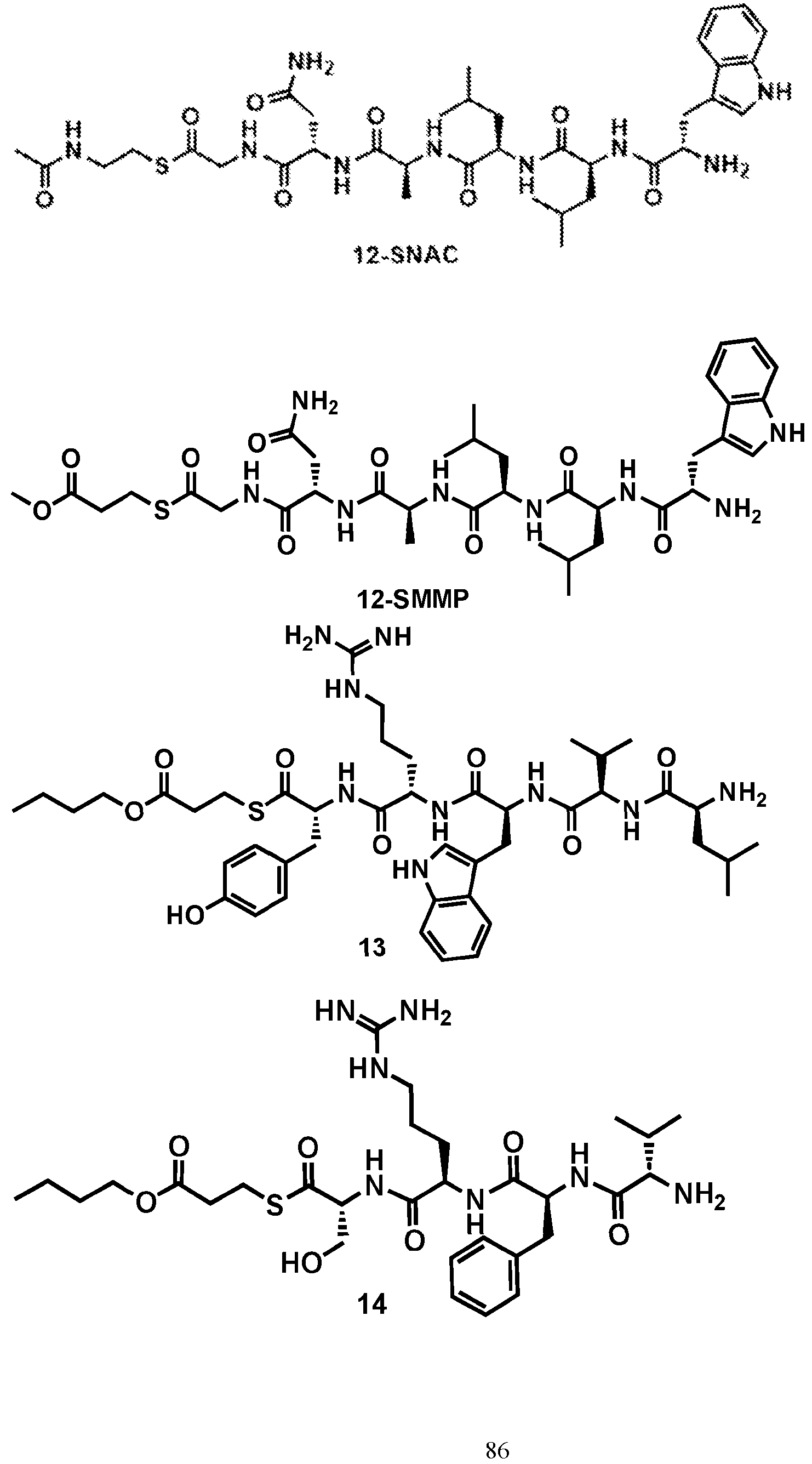


12. The method of claim 7, wherein the cyclic peptide of formula (II) is one or more of:


13. The method of claim 2, wherein step (a) is carried out in the presence of an aqueous solvent comprising one or more buffers and optionally further comprising an organic solvent.
14. The method of claim 13, wherein the buffer is Tris buffer.
15. The method of claim 13 or 14, wherein the organic solvent is dimethyl sulfoxide (DMSO), acetonitrile, methanol, or dimethyl formamide (DMF).
16. The method of claim 1 or 2, wherein the concentration of Ulm 16 is about 1 nM to about 250 nM for about 50 pM to about 500 pM of the substrate.
Applications Claiming Priority (2)
| Application Number | Priority Date | Filing Date | Title |
|---|---|---|---|
| US202363524777P | 2023-07-03 | 2023-07-03 | |
| US63/524,777 | 2023-07-03 |
Publications (2)
| Publication Number | Publication Date |
|---|---|
| WO2025010236A2 true WO2025010236A2 (en) | 2025-01-09 |
| WO2025010236A3 WO2025010236A3 (en) | 2025-05-08 |
Family
ID=91966773
Family Applications (1)
| Application Number | Title | Priority Date | Filing Date |
|---|---|---|---|
| PCT/US2024/036467 Ceased WO2025010236A2 (en) | 2023-07-03 | 2024-07-01 | Biocatalytic cyclization method for preparation of cyclic peptides |
Country Status (1)
| Country | Link |
|---|---|
| WO (1) | WO2025010236A2 (en) |
-
2024
- 2024-07-01 WO PCT/US2024/036467 patent/WO2025010236A2/en not_active Ceased
Non-Patent Citations (7)
| Title |
|---|
| BLANCO-CANOSA ET AL., JOURNAL OF THE AMERICAN CHEMICAL SOCIETY, vol. 137, 2015, pages 7197 - 7209 |
| MATSUDA, K ET AL., NATURE CATALYST., vol. 3, 2020, pages 507 - 515 |
| MATSUDA, K ET AL., NATURE. CATALYST, vol. 3, 2020, pages 507 - 515 |
| MIRDITA M. ET AL., BIOINFORMATICS, vol. 25, 2009, pages 1189 - 1191 |
| TERLOUW ET AL., NUCLEIC ACIDS RES., vol. 51, 2023, pages D603 - D610 |
| TSOMAIA, N, EUR. J. MED. CHEM., vol. 94, 2015, pages 459 - 470 |
| WHITE, C. J. ET AL., NATURE CHEMISTRY, vol. 3, 2011, pages 509 - 524 |
Also Published As
| Publication number | Publication date |
|---|---|
| WO2025010236A3 (en) | 2025-05-08 |
Similar Documents
| Publication | Publication Date | Title |
|---|---|---|
| Lam et al. | Total synthesis of daptomycin by cyclization via a chemoselective serine ligation | |
| Miao et al. | Daptomycin biosynthesis in Streptomyces roseosporus: cloning and analysis of the gene cluster and revision of peptide stereochemistry | |
| Kanazawa et al. | Contribution of each amino acid residue in polymyxin B3 to antimicrobial and lipopolysaccharide binding activity | |
| CN111819191B (en) | Chemoenzymatic synthesis of liraglutide, semaglutide and GLP-1 | |
| Yang et al. | Native chemical ubiquitination using a genetically incorporated azidonorleucine | |
| Rowe et al. | The role of chemical synthesis in developing RiPP antibiotics | |
| US9079966B2 (en) | Chemical preparation of polyubiquitin chains | |
| AU2013409200B2 (en) | Beta-Hairpin peptidomimetics as selective elastase inhibitors | |
| Morshed et al. | Chlorinated metabolites from Streptomyces sp. highlight the role of biosynthetic mosaics and superclusters in the evolution of chemical diversity | |
| Cowper et al. | Expanding the scope of N→ S acyl transfer in native peptide sequences | |
| Fukuzumi et al. | Chemoselective cyclization of unprotected linear peptides by α-ketoacid–hydroxylamine amide-ligation | |
| Wen et al. | Macrocyclization studies and total synthesis of cyclomarin C, an anti-inflammatory marine cyclopeptide | |
| Du et al. | Glycopeptide ligation via direct aminolysis of selenoester | |
| Shivashimpi et al. | Molecular design of histone deacetylase inhibitors by aromatic ring shifting in chlamydocin framework | |
| US20020192773A1 (en) | Methods for preparation of macrocyclic molecules and macrocyclic molecules prepared thereby | |
| Debéthune et al. | Towards nucleopeptides containing any trifunctional amino acid (II) | |
| Rosés et al. | Total solid-phase synthesis of dehydroxy fengycin derivatives | |
| Mulder et al. | Synthesis and evaluation of novel macrocyclic antifungal peptides | |
| US8981049B2 (en) | Aziridine mediated native chemical ligation | |
| EP2813513B1 (en) | Method for producing cereulide and derivative thereof, intermediate for production of cereulide, and cereulide derivative | |
| Fujie et al. | FR901469, a novel antifungal antibiotic from an unidentified fungus no. 11243 III. Structure determination | |
| CN110343732B (en) | Preparation method and application of thaumatin analogue | |
| Lloyd-Williams et al. | Synthetic studies on threonines. The preparation of protected derivatives of D-allo-and L-allo-threonine for peptide synthesis | |
| CA2112522A1 (en) | Tan-1511, its derivatives, production and use thereof | |
| Dimise et al. | Synthesis and structure confirmation of fuscachelins A and B, structurally unique natural product siderophores from Thermobifida fusca |
Legal Events
| Date | Code | Title | Description |
|---|---|---|---|
| NENP | Non-entry into the national phase |
Ref country code: DE |