WO2025009246A1 - 化合物解析システム - Google Patents
化合物解析システム Download PDFInfo
- Publication number
- WO2025009246A1 WO2025009246A1 PCT/JP2024/015135 JP2024015135W WO2025009246A1 WO 2025009246 A1 WO2025009246 A1 WO 2025009246A1 JP 2024015135 W JP2024015135 W JP 2024015135W WO 2025009246 A1 WO2025009246 A1 WO 2025009246A1
- Authority
- WO
- WIPO (PCT)
- Prior art keywords
- compound
- information
- backbone
- compounds
- substances
- Prior art date
- Legal status (The legal status is an assumption and is not a legal conclusion. Google has not performed a legal analysis and makes no representation as to the accuracy of the status listed.)
- Pending
Links
Images



Classifications
-
- G—PHYSICS
- G01—MEASURING; TESTING
- G01N—INVESTIGATING OR ANALYSING MATERIALS BY DETERMINING THEIR CHEMICAL OR PHYSICAL PROPERTIES
- G01N27/00—Investigating or analysing materials by the use of electric, electrochemical, or magnetic means
- G01N27/62—Investigating or analysing materials by the use of electric, electrochemical, or magnetic means by investigating the ionisation of gases, e.g. aerosols; by investigating electric discharges, e.g. emission of cathode
-
- G—PHYSICS
- G16—INFORMATION AND COMMUNICATION TECHNOLOGY [ICT] SPECIALLY ADAPTED FOR SPECIFIC APPLICATION FIELDS
- G16C—COMPUTATIONAL CHEMISTRY; CHEMOINFORMATICS; COMPUTATIONAL MATERIALS SCIENCE
- G16C20/00—Chemoinformatics, i.e. ICT specially adapted for the handling of physicochemical or structural data of chemical particles, elements, compounds or mixtures
- G16C20/40—Searching chemical structures or physicochemical data
Definitions
- the present invention relates to a compound analysis system.
- Mass spectrometry data such as mass spectra obtained by analyzing a sample with a mass spectrometer, indicates the masses of the compounds present in the sample.
- mass spectrometry data can be used to search for compounds in the sample that have the same mass as a specific compound, such as a dangerous drug.
- the search for metabolites is essential in metabolism testing, and high-resolution mass spectrometers are used to comprehensively search for metabolites or to infer and search for similar compounds based on the structure of the active pharmaceutical ingredient.
- Compounds such as dangerous drugs have a basic structure in which a substance such as CH3 , H, Cl, or O is bound to each bond of a backbone having one or more bonds.
- the present invention was made in consideration of the above problems, and aims to make it easy to create comprehensive information on a large number of compounds that share a common backbone.
- the compound analysis system is a compound analysis system for analyzing a compound having a basic structure in which a substance is bound to each of one or more bonds of a backbone having one or more bonds, and includes a compound database that holds information on the backbone of known compounds and information on candidate substances that bind to each of the one or more bonds of the backbone of each of the known compounds, a data extraction unit configured to identify a target backbone that is the backbone to be analyzed based on information input by a user and extract candidate substances that bind to each of the one or more bonds of the target backbone from the compound database, and an information creation unit configured to use the information extracted from the compound database by the data extraction unit to comprehensively create information on compounds generated by each combination of candidate substances that bind to each of the one or more bonds while comprehensively changing the combinations of candidate substances that bind to each of the one or more bonds of the target backbone, thereby creating comprehensive compound information on compounds having the target backbone.
- the target backbone to be analyzed is identified and information about candidate substances that can bind to each bond of the target backbone is extracted from a compound database, and the combinations of candidate substances that bind to each bond of the target backbone are comprehensively changed to comprehensively create information such as the composition formula of the compound formed by each combination of candidate substances that bind to each bond, thereby creating comprehensive information about compounds that have the target backbone, making it easy to create comprehensive information about a large number of compounds that have a common backbone (target backbone).
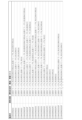
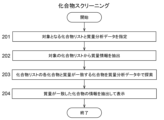
- FIG. 1 is a schematic configuration diagram showing an embodiment of a compound analyzing system. This is an example of the backbone of a compound. 1 is an example of a compound list. 13 is a flowchart showing an example of the compound information creation operation in the embodiment. 13 is a flow chart showing an example of screening in the same embodiment.
- the compound analysis system 1 includes an information processing device 2 and a display 4.
- the information processing device 2 is realized by installing a dedicated computer program in a computer device such as a PC (personal computer) equipped with a CPU (central processing unit), an information storage device, etc.
- the display 4 is electrically connected to the information processing device 2, and displays information transmitted from the information processing device 2.
- the compound database 6 holds information about the basic structures of known compounds.
- Known compounds here are compounds that have a backbone with bonds for binding substances at one or more locations, and have a basic structure in which a substance is bound to each bond of the backbone.
- Compounds with a common backbone have the same chemical effect even if the substance bound to the backbone changes. By changing the combination of substances bound to each bond, compounds with the same chemical effect but different composition formulas (masses) and structures (similar compounds) are obtained.
- the compound database 6 holds information such as the composition formulas and/or structures of the backbones of such known compounds, and the composition formulas of candidate substances that may be bound to each bond of the backbone.
- a benzodiazepine drug is formed of a backbone having four bonds R 1 to R 4 and substances bonded to each of the four bonds R 1 to R 4.
- Various substances can be bonded to each of the bonds R 1 to R 4.
- substances such as CH 3 and H can be bonded to the bond R 1
- substances such as O can be bonded to the bond R 2
- substances such as Cl, F, Br can be bonded to the bond R 3
- substances such as NO 2 , Cl, F, Br can be bonded to the bond R 4.
- the data extraction unit 8 is configured to identify a trunk to be analyzed (target trunk) from among the trunks held in the compound database 6 based on information input by the user, and to extract information on candidate substances that bind to each bond of the identified target trunk from the compound database 6.
- Information input by the user includes the compositional formula of a known compound, the compositional formula of a trunk of a known compound, etc.
- the data extraction unit 8 searches the compound database 6 for information on the compound having the input compositional formula, and extracts from the compound database 6 information on the trunk of that compound and candidate substances that bind to each bond of that trunk.
- FIG. 3 A part of the compound list created by the information creation unit 10 is shown in FIG. 3.
- the leftmost column of the compound list in FIG. 3 shows a list of composition formulas of compounds generated by changing the combination of binding substances to each bond of the target backbone.
- the column to the right of the composition formula column shows the number of compounds having each composition formula but different structures as the number of isomers, and the column to the right of that shows the structural formulas of each compound summarized in each composition formula.
- R1, R2, R3, R4, and R5 are identification information indicating each bond of the backbone
- the information presentation unit 12 is configured to present compound information, such as a compound list, created by the information creation unit 10 to the user by displaying it on the display 4.
- the screening unit 14 is a function that searches for compounds having the target backbone in a sample by applying the compound information created by the information creation unit 10 to mass analysis data obtained by analyzing a sample with a mass spectrometer.
- Mass spectra are an example of mass analysis data to which compound information can be applied.
- Information on the masses of all similar compounds can be extracted from the composition formula of each compound contained in the compound information created by the information creation unit 10.
- the user inputs information about the compound to be analyzed into the information processing device 2 (step 101).
- the data extraction unit 8 identifies the target backbone based on the information input by the user (step 102), and extracts information about the target backbone (position of the bond, what substances may bind to each bond) from the compound database 6 (step 103).
- the information creation unit 10 uses the information extracted by the data extraction unit 8 to select a substance to be bound to each bond of the target backbone from among candidates for substances that can be bound to each bond (step 104), and generates a compositional formula and a structural formula of a compound obtained by binding the selected candidate substances to each bond (step 105).
- the information creation unit 10 repeats the operations of steps 104 and 105 until all patterns of combinations of substances to be bound to each bond of the target backbone are covered (step 106), thereby creating a compound list that covers the compositional formulas and structural formulas of all compounds having the target backbone (step 107).
- the information presentation unit 12 displays the created compound list on the display 4 (step 108).
- the screening unit 14 extracts mass information for each compound from the compositional formula of the compounds listed in the target compound list (step 202), and applies the extracted mass information for each compound to the target mass analysis data to search for compounds whose mass matches that of each compound in the compound list in the mass analysis data (step 203). If the search results in the presence of a compound in the mass analysis data whose mass matches that of a compound in the compound list, the screening unit 14 extracts information from the compound list about the compound with the matching mass, such as the compositional formula and/or structural formula, and the information presentation unit 12 displays the information about the extracted compound on the display 4 (step 204).
- One embodiment of the compound analyzing system is a compound analyzing system for analyzing a compound having a basic structure in which a backbone has one or more binding sites and a substance is bound to each of the one or more binding sites, the compound analyzing system comprising: a compound database that holds information on the backbones of known compounds and information on candidate substances that bind to each of the one or more binding sites of the backbones of each of the known compounds; a data extraction unit configured to identify a target backbone that is a backbone to be analyzed based on information input by a user, and to extract candidates for substances that bind to each of the one or more binding sites of the target backbone from the compound database; and an information creation unit configured to use the information extracted from the compound database by the data extraction unit to comprehensively create information on compounds generated by each combination of candidate substances that bind to each of the one or more binding parts while comprehensively changing the combinations of candidate substances that bind to each of the one or more binding parts of the target backbone, thereby creating comprehensive compound information on compounds having the
- the compound information includes the composition formula of each compound having the target backbone.
- the compound information includes a structural formula indicating, for each compound having the target backbone, what substance is bound to each of the one or more bonds of the target backbone, and the information creation unit is configured to associate the composition formula and the structural formula of the same compound with each other.
- the structural formula can include identification information indicating each of the one or more bonds in the backbone, and information on the substance bonded to each of the one or more bonds.
- the information creation unit may be configured to create a compound list that shows, as the compound information, a list of the compositional formulas of each compound having the target backbone, with compounds associated with the same compositional formula aggregated into one compositional formula, and that shows the structural formulas of the compounds associated with each compositional formula.
- a screening unit is provided that is configured to search for compounds having the target backbone in the sample by applying the mass information of each compound determined from the composition formula to mass analysis data acquired by a mass analyzer for the sample.
Landscapes
- Chemical & Material Sciences (AREA)
- Crystallography & Structural Chemistry (AREA)
- Life Sciences & Earth Sciences (AREA)
- Engineering & Computer Science (AREA)
- Bioinformatics & Cheminformatics (AREA)
- Bioinformatics & Computational Biology (AREA)
- Computing Systems (AREA)
- Theoretical Computer Science (AREA)
- Chemical Kinetics & Catalysis (AREA)
- Electrochemistry (AREA)
- Physics & Mathematics (AREA)
- Health & Medical Sciences (AREA)
- Analytical Chemistry (AREA)
- Biochemistry (AREA)
- General Health & Medical Sciences (AREA)
- General Physics & Mathematics (AREA)
- Immunology (AREA)
- Pathology (AREA)
- Other Investigation Or Analysis Of Materials By Electrical Means (AREA)
Priority Applications (1)
| Application Number | Priority Date | Filing Date | Title |
|---|---|---|---|
| JP2025530985A JPWO2025009246A1 (https=) | 2023-07-04 | 2024-04-16 |
Applications Claiming Priority (2)
| Application Number | Priority Date | Filing Date | Title |
|---|---|---|---|
| JP2023109935 | 2023-07-04 | ||
| JP2023-109935 | 2023-07-04 |
Publications (1)
| Publication Number | Publication Date |
|---|---|
| WO2025009246A1 true WO2025009246A1 (ja) | 2025-01-09 |
Family
ID=94171684
Family Applications (1)
| Application Number | Title | Priority Date | Filing Date |
|---|---|---|---|
| PCT/JP2024/015135 Pending WO2025009246A1 (ja) | 2023-07-04 | 2024-04-16 | 化合物解析システム |
Country Status (2)
| Country | Link |
|---|---|
| JP (1) | JPWO2025009246A1 (https=) |
| WO (1) | WO2025009246A1 (https=) |
Citations (4)
| Publication number | Priority date | Publication date | Assignee | Title |
|---|---|---|---|---|
| JP2001058962A (ja) * | 1999-08-20 | 2001-03-06 | Mitsubishi Chemicals Corp | 分子構造開発支援システム及び分子構造開発支援方法、並びに、分子構造抽出装置,分子構造抽出方法及び分子構造抽出プログラムを格納したコンピュータ読取可能な記録媒体 |
| WO2012095948A1 (ja) * | 2011-01-11 | 2012-07-19 | 株式会社島津製作所 | 質量分析データ解析方法、質量分析データ解析装置、及び質量分析データ解析用プログラム |
| WO2013051148A1 (ja) * | 2011-10-07 | 2013-04-11 | 株式会社島津製作所 | 質量分析データ解析方法及び装置 |
| WO2022149395A1 (ja) * | 2021-01-07 | 2022-07-14 | 富士フイルム株式会社 | 情報処理装置、情報処理方法、及び情報処理プログラム |
-
2024
- 2024-04-16 JP JP2025530985A patent/JPWO2025009246A1/ja active Pending
- 2024-04-16 WO PCT/JP2024/015135 patent/WO2025009246A1/ja active Pending
Patent Citations (4)
| Publication number | Priority date | Publication date | Assignee | Title |
|---|---|---|---|---|
| JP2001058962A (ja) * | 1999-08-20 | 2001-03-06 | Mitsubishi Chemicals Corp | 分子構造開発支援システム及び分子構造開発支援方法、並びに、分子構造抽出装置,分子構造抽出方法及び分子構造抽出プログラムを格納したコンピュータ読取可能な記録媒体 |
| WO2012095948A1 (ja) * | 2011-01-11 | 2012-07-19 | 株式会社島津製作所 | 質量分析データ解析方法、質量分析データ解析装置、及び質量分析データ解析用プログラム |
| WO2013051148A1 (ja) * | 2011-10-07 | 2013-04-11 | 株式会社島津製作所 | 質量分析データ解析方法及び装置 |
| WO2022149395A1 (ja) * | 2021-01-07 | 2022-07-14 | 富士フイルム株式会社 | 情報処理装置、情報処理方法、及び情報処理プログラム |
Also Published As
| Publication number | Publication date |
|---|---|
| JPWO2025009246A1 (https=) | 2025-01-09 |
Similar Documents
| Publication | Publication Date | Title |
|---|---|---|
| Milman et al. | The chemical space for non-target analysis | |
| Cajka et al. | LC–MS-based lipidomics and automated identification of lipids using the LipidBlast in-silico MS/MS library | |
| Luedemann et al. | TagFinder: preprocessing software for the fingerprinting and the profiling of gas chromatography–mass spectrometry based metabolome analyses | |
| Pilon et al. | NuBBEDB: an updated database to uncover chemical and biological information from Brazilian biodiversity | |
| Clarke et al. | Peer reviewed: systematic LC/MS metabolite identification in drug discovery | |
| Ubukata et al. | Non-targeted analysis of electronics waste by comprehensive two-dimensional gas chromatography combined with high-resolution mass spectrometry: Using accurate mass information and mass defect analysis to explore the data | |
| Reichenbach et al. | Computer language for identifying chemicals with comprehensive two-dimensional gas chromatography and mass spectrometry | |
| Röst et al. | Automated SWATH data analysis using targeted extraction of ion chromatograms | |
| Oberacher et al. | Compound identification in forensic toxicological analysis with untargeted LC–MS-based techniques | |
| Getzinger et al. | Illuminating the exposome with high-resolution accurate-mass mass spectrometry and nontargeted analysis | |
| Alanazi | Recent advances in liquid chromatography–mass spectrometry (LC–MS) applications in biological and applied sciences | |
| JP2007287531A (ja) | 質量分析データ解析方法 | |
| Winkler | Processing metabolomics and proteomics data with open software: a practical guide | |
| Heinsvig et al. | Forensic drug screening by liquid chromatography hyphenated with high-resolution mass spectrometry (LC-HRMS) | |
| JP5664667B2 (ja) | 質量分析データ解析方法、質量分析データ解析装置、及び質量分析データ解析用プログラム | |
| WO2025009246A1 (ja) | 化合物解析システム | |
| Loss et al. | Using NMR Data on GLYCOSCIENCES. de | |
| CN115667912A (zh) | 复合测量整合阅览器及程序 | |
| Nanni et al. | PTM MarkerFinder, a software tool to detect and validate spectra from peptides carrying post‐translational modifications | |
| Rosnack et al. | Screening solution using the software platform UNIFI: an integrated workflow by waters | |
| JP6295910B2 (ja) | 質量分析データ処理装置 | |
| JP2018040655A (ja) | 質量分析用データ処理装置 | |
| Oppermann et al. | High precision measurement and fragmentation analysis for metabolite identification | |
| Lundgren et al. | Protein identification using TurboSEQUEST | |
| Helsens et al. | Sigpep: calculating unique peptide signature transition sets in a complete proteome background |
Legal Events
| Date | Code | Title | Description |
|---|---|---|---|
| 121 | Ep: the epo has been informed by wipo that ep was designated in this application |
Ref document number: 24835768 Country of ref document: EP Kind code of ref document: A1 |
|
| ENP | Entry into the national phase |
Ref document number: 2025530985 Country of ref document: JP Kind code of ref document: A |
|
| NENP | Non-entry into the national phase |
Ref country code: DE |