WO2025006982A1 - Potent and selective dopamine d3 receptor antagonists - Google Patents
Potent and selective dopamine d3 receptor antagonists Download PDFInfo
- Publication number
- WO2025006982A1 WO2025006982A1 PCT/US2024/036149 US2024036149W WO2025006982A1 WO 2025006982 A1 WO2025006982 A1 WO 2025006982A1 US 2024036149 W US2024036149 W US 2024036149W WO 2025006982 A1 WO2025006982 A1 WO 2025006982A1
- Authority
- WO
- WIPO (PCT)
- Prior art keywords
- compound
- combination
- racemate
- enantiomer
- salt
- Prior art date
- Legal status (The legal status is an assumption and is not a legal conclusion. Google has not performed a legal analysis and makes no representation as to the accuracy of the status listed.)
- Ceased
Links
Classifications
-
- C—CHEMISTRY; METALLURGY
- C07—ORGANIC CHEMISTRY
- C07D—HETEROCYCLIC COMPOUNDS
- C07D403/00—Heterocyclic compounds containing two or more hetero rings, having nitrogen atoms as the only ring hetero atoms, not provided for by group C07D401/00
- C07D403/02—Heterocyclic compounds containing two or more hetero rings, having nitrogen atoms as the only ring hetero atoms, not provided for by group C07D401/00 containing two hetero rings
- C07D403/12—Heterocyclic compounds containing two or more hetero rings, having nitrogen atoms as the only ring hetero atoms, not provided for by group C07D401/00 containing two hetero rings linked by a chain containing hetero atoms as chain links
-
- A—HUMAN NECESSITIES
- A61—MEDICAL OR VETERINARY SCIENCE; HYGIENE
- A61P—SPECIFIC THERAPEUTIC ACTIVITY OF CHEMICAL COMPOUNDS OR MEDICINAL PREPARATIONS
- A61P25/00—Drugs for disorders of the nervous system
- A61P25/14—Drugs for disorders of the nervous system for treating abnormal movements, e.g. chorea, dyskinesia
- A61P25/16—Anti-Parkinson drugs
-
- A—HUMAN NECESSITIES
- A61—MEDICAL OR VETERINARY SCIENCE; HYGIENE
- A61P—SPECIFIC THERAPEUTIC ACTIVITY OF CHEMICAL COMPOUNDS OR MEDICINAL PREPARATIONS
- A61P25/00—Drugs for disorders of the nervous system
- A61P25/18—Antipsychotics, i.e. neuroleptics; Drugs for mania or schizophrenia
-
- A—HUMAN NECESSITIES
- A61—MEDICAL OR VETERINARY SCIENCE; HYGIENE
- A61P—SPECIFIC THERAPEUTIC ACTIVITY OF CHEMICAL COMPOUNDS OR MEDICINAL PREPARATIONS
- A61P25/00—Drugs for disorders of the nervous system
- A61P25/30—Drugs for disorders of the nervous system for treating abuse or dependence
-
- A—HUMAN NECESSITIES
- A61—MEDICAL OR VETERINARY SCIENCE; HYGIENE
- A61P—SPECIFIC THERAPEUTIC ACTIVITY OF CHEMICAL COMPOUNDS OR MEDICINAL PREPARATIONS
- A61P25/00—Drugs for disorders of the nervous system
- A61P25/30—Drugs for disorders of the nervous system for treating abuse or dependence
- A61P25/36—Opioid-abuse
-
- C—CHEMISTRY; METALLURGY
- C07—ORGANIC CHEMISTRY
- C07D—HETEROCYCLIC COMPOUNDS
- C07D295/00—Heterocyclic compounds containing polymethylene-imine rings with at least five ring members, 3-azabicyclo [3.2.2] nonane, piperazine, morpholine or thiomorpholine rings, having only hydrogen atoms directly attached to the ring carbon atoms
- C07D295/04—Heterocyclic compounds containing polymethylene-imine rings with at least five ring members, 3-azabicyclo [3.2.2] nonane, piperazine, morpholine or thiomorpholine rings, having only hydrogen atoms directly attached to the ring carbon atoms with substituted hydrocarbon radicals attached to ring nitrogen atoms
- C07D295/12—Heterocyclic compounds containing polymethylene-imine rings with at least five ring members, 3-azabicyclo [3.2.2] nonane, piperazine, morpholine or thiomorpholine rings, having only hydrogen atoms directly attached to the ring carbon atoms with substituted hydrocarbon radicals attached to ring nitrogen atoms substituted by singly or doubly bound nitrogen atoms
- C07D295/125—Heterocyclic compounds containing polymethylene-imine rings with at least five ring members, 3-azabicyclo [3.2.2] nonane, piperazine, morpholine or thiomorpholine rings, having only hydrogen atoms directly attached to the ring carbon atoms with substituted hydrocarbon radicals attached to ring nitrogen atoms substituted by singly or doubly bound nitrogen atoms with the ring nitrogen atoms and the substituent nitrogen atoms attached to the same carbon chain, which is not interrupted by carbocyclic rings
- C07D295/13—Heterocyclic compounds containing polymethylene-imine rings with at least five ring members, 3-azabicyclo [3.2.2] nonane, piperazine, morpholine or thiomorpholine rings, having only hydrogen atoms directly attached to the ring carbon atoms with substituted hydrocarbon radicals attached to ring nitrogen atoms substituted by singly or doubly bound nitrogen atoms with the ring nitrogen atoms and the substituent nitrogen atoms attached to the same carbon chain, which is not interrupted by carbocyclic rings to an acyclic saturated chain
-
- C—CHEMISTRY; METALLURGY
- C07—ORGANIC CHEMISTRY
- C07D—HETEROCYCLIC COMPOUNDS
- C07D401/00—Heterocyclic compounds containing two or more hetero rings, having nitrogen atoms as the only ring hetero atoms, at least one ring being a six-membered ring with only one nitrogen atom
- C07D401/02—Heterocyclic compounds containing two or more hetero rings, having nitrogen atoms as the only ring hetero atoms, at least one ring being a six-membered ring with only one nitrogen atom containing two hetero rings
- C07D401/04—Heterocyclic compounds containing two or more hetero rings, having nitrogen atoms as the only ring hetero atoms, at least one ring being a six-membered ring with only one nitrogen atom containing two hetero rings directly linked by a ring-member-to-ring-member bond
-
- C—CHEMISTRY; METALLURGY
- C07—ORGANIC CHEMISTRY
- C07D—HETEROCYCLIC COMPOUNDS
- C07D401/00—Heterocyclic compounds containing two or more hetero rings, having nitrogen atoms as the only ring hetero atoms, at least one ring being a six-membered ring with only one nitrogen atom
- C07D401/02—Heterocyclic compounds containing two or more hetero rings, having nitrogen atoms as the only ring hetero atoms, at least one ring being a six-membered ring with only one nitrogen atom containing two hetero rings
- C07D401/12—Heterocyclic compounds containing two or more hetero rings, having nitrogen atoms as the only ring hetero atoms, at least one ring being a six-membered ring with only one nitrogen atom containing two hetero rings linked by a chain containing hetero atoms as chain links
-
- C—CHEMISTRY; METALLURGY
- C07—ORGANIC CHEMISTRY
- C07D—HETEROCYCLIC COMPOUNDS
- C07D401/00—Heterocyclic compounds containing two or more hetero rings, having nitrogen atoms as the only ring hetero atoms, at least one ring being a six-membered ring with only one nitrogen atom
- C07D401/14—Heterocyclic compounds containing two or more hetero rings, having nitrogen atoms as the only ring hetero atoms, at least one ring being a six-membered ring with only one nitrogen atom containing three or more hetero rings
-
- C—CHEMISTRY; METALLURGY
- C07—ORGANIC CHEMISTRY
- C07D—HETEROCYCLIC COMPOUNDS
- C07D471/00—Heterocyclic compounds containing nitrogen atoms as the only ring hetero atoms in the condensed system, at least one ring being a six-membered ring with one nitrogen atom, not provided for by groups C07D451/00 - C07D463/00
- C07D471/02—Heterocyclic compounds containing nitrogen atoms as the only ring hetero atoms in the condensed system, at least one ring being a six-membered ring with one nitrogen atom, not provided for by groups C07D451/00 - C07D463/00 in which the condensed system contains two hetero rings
- C07D471/04—Ortho-condensed systems
-
- C—CHEMISTRY; METALLURGY
- C07—ORGANIC CHEMISTRY
- C07D—HETEROCYCLIC COMPOUNDS
- C07D495/00—Heterocyclic compounds containing in the condensed system at least one hetero ring having sulfur atoms as the only ring hetero atoms
- C07D495/02—Heterocyclic compounds containing in the condensed system at least one hetero ring having sulfur atoms as the only ring hetero atoms in which the condensed system contains two hetero rings
- C07D495/04—Ortho-condensed systems
Definitions
- the present disclosure relates to potent and selective D3 receptor modulators, inclusive of antagonists and agonists, with alleviated hERG liability and desirable pharmacokinetic properties, as well as compositions comprising, kits comprising, methods of administering, and methods of synthesizing the same.
- D3R receptor subtype is of particular interest due to its relative focal localization within the ventral striatum of the cerebrum and its enhanced expression in brains exposed to narcotics. Targeting the relatively low D3R density in the dorsal striatum of cerebrum could avoid the undesirable motor coordination and extrapyramidal side effects often associated with non-selective D2-like antagonists.
- D3R selective antagonists Although several D3R selective antagonists have displayed this advantage in pre-clinical models, they have failed to reach the market either due to their poor physicochemical properties (highly lipophilic) or due to their off-target liabilities (for example, undesirable effects on human EAG-related gene (hERG) (hERG) and K+ channels), see, e.g., Micheli et al., J. Med. Chem., 53(1 ): 374-391 (2010). Design of dopamine selective modulators is complicated in that pharmacophore elements responsible for activity towards DsRs can also have activity towards hERG.
- Ether-a-go-go (EAG) proteins are potassium channel proteins expressed in muscles, the brain, endocrine cells, and the heart.
- the EAG-related gene (ERG) channel proteins belong to an EAG subfamily including three isoforms — Kv11.1 , Kv11 .2, and Kv11 .3.
- EAG-related gene (ERG) channel proteins belong to an EAG subfamily including three isoforms — Kv11.1 , Kv11 .2, and Kv11 .3.
- hERG human ether-a- go-go-related gene corresponding to the human isoform Kv11 .1 is associated with prolongation of the QT interval as long QT syndrome (LQTS).
- LQTS can cause ventricular arrhythmia torsades de pointes (TdP), which can result in ventricular fibrillation and sudden death.
- Dopamine receptors are G-protein-couple receptors (GPCRs) with characteristic seven helical membrane domains.
- Drug design of selective D3R ligands has led to the development of bitopic D3R compounds, characterized by two pharmacophores joined through a linker. While the basic amine in the primary pharmacophore is associated with binding to a conserved aspartic acid residue in the third transmembrane region (TM3), the occupancy of an allosteric pocket by the secondary pharmacophore can confer selectivity over homologous D2 receptors.
- TM3 transmembrane region
- the basic amine moiety associated with binding these biogenic amine GPCRs also presents a liability towards hERG channel activity.
- GSK598809 a selective D3R antagonist that progressed to Phase 2 clinical trials for nicotine dependence, suffered from cardiovascular liabilities at high doses.
- Other selective D3R antagonists that have progressed to clinical trials either suffer from low D3R occupancy or poor physicochemical properties, highlighting a difficult balance between lipophilicity and attempts to develop these CNS-penetrating compounds.
- Crossing the blood-brain barrier with efflux mediated by P-glycoprotein (PGP) multidrug transporters poses another challenge for obtaining successful CNS exposure.
- PGP P-glycoprotein
- D3R agonists for example, for use in Parkinson patients pose similar challenges. Accordingly, there is a need for efficacious D3R modulators that can cross the bloodbrain barrier with minimal side effects.
- a receptor modulator as used herein, unless defined otherwise, is a chemical compound that alters the activity of the receptor in a positive, negative or neutral direction, and may be categorized as activator, inhibitor, agonist, antagonist, partial agonist, partial antagonist, inverse agonist, inverse antagonist or any combination thereof.
- the modulator may be an allosteric or orthosteric binder, or any combination thereof.
- R 3 and R 4 can be, for example, independently H, methyl, hydroxyl, or halogen, or linked covalently at a methylene to form a three-carbon ring.
- R 51 and R 52 are independently H, methyl, ethyl, or halogen.
- the therapeutic compound of any preceding or following embodiment/feature/aspect, its enantiomer, a racemate thereof, a prodrug thereof, or salt thereof, or any combination thereof wherein the therapeutic compound comprises: [0052] The therapeutic compound of any preceding or following embodiment/feature/aspect, its enantiomer, a racemate thereof, a prodrug thereof, or salt thereof, or any combination thereof, wherein Formula (I) is represented by Formula (XVII): wherein T is C or N; and wherein R87 is H or halogen.
- J is a cyclic, heterocyclic, bicyclic, or heterobicyclic lactam ring bound to a n-butyl linker through the lactam nitrogen;
- X is a hydrogen, a hydroxyl, or a methyl group substituent of the n-butyl linker; and
- Z is a substituted aryl bound to the n-butyl linker through a piperazine group.
- a pharmaceutical composition comprising a therapeutically effective amount of the therapeutic compound of any preceding or following embodiment/feature/aspect, its enantiomer, a racemate thereof, a prodrug thereof, a salt thereof, or any combination thereof, together with a pharmaceutically acceptable carrier.
- composition of any preceding or following embodiment/feature/aspect, wherein the therapeutic compound is a selective dopamine D3 receptor antagonist, or a selective dopamine D3 receptor agonist, or both.
- composition of any preceding or following embodiment/feature/aspect wherein the therapeutic compound is a first therapeutic compound, and the pharmaceutical composition further comprises a second therapeutic compound.
- the second therapeutic compound comprises a selective dopamine Di receptor modulator, a selective dopamine D2 receptor modulator, a selective dopamine D4 receptor modulator, or a selective dopamine Ds receptor modulator, or any combination thereof.
- composition of any preceding or following embodiment/feature/aspect, wherein the first therapeutic compound comprises a selective dopamine D2 receptor agonist, and the second therapeutic compound comprises a selective dopamine D3 antagonist.
- a method of treating drug misuse or drug addiction comprising administering to a patient in need thereof a composition comprising a therapeutically effective amount of the therapeutic compound of any preceding or following embodiment/feature/aspect, its enantiomer, a racemate thereof, a prodrug thereof, a salt thereof, or any combination thereof optionally in combination with one or more additional active ingredients.
- a method of treating a substance use disorder comprising administering to a patient in need thereof a composition comprising a therapeutically effective amount of the therapeutic compound of any preceding or following embodiment/feature/aspect, its enantiomer, a racemate thereof, a prodrug thereof, a salt thereof, or any combination thereof optionally in combination with one or more additional active ingredients.
- a method of treating Parkinson Disease comprising administering to a patient in need thereof a composition comprising a therapeutically effective amount of the therapeutic compound of any preceding or following embodiment/feature/aspect, its enantiomer, a racemate thereof, a prodrug thereof, a salt thereof, or any combination thereof optionally in combination with one or more additional active ingredients.
- a method of treating of treating Parkinson Disease of any preceding or following embodiment/feature/aspect further comprising administering levodopa.
- the method of treating of treating Parkinson Disease of any preceding or following embodiment/feature/aspect wherein the therapeutic compound is a selective dopamine D3 receptor agonist.
- ADHD Attention Deficit/Hyperactivity Disorder
- a method of treating ADHD comprising administering to a patient in need thereof a composition comprising a therapeutically effective amount of the therapeutic compound of any preceding or following embodiment/feature/aspect, its enantiomer, a racemate thereof, a prodrug thereof, a salt thereof, or any combination thereof optionally in combination with one or more additional active ingredients.
- kits comprising the therapeutic compound of any preceding or following embodiment/feature/aspect and a second therapeutic compound.
- D3R selective brain penetrant modulators are disclosed that possess superior physicochemical properties while minimizing hERG liability.
- D3R selective modulators are provided that exhibit good aqueous kinetic solubility, permeability, and microsomal stabilities across different species. These compounds demonstrate a therapeutic window against hERG channel activity, which can be measured by a manual patch clamp assay.
- These compounds also have physicochemical properties that can provide higher free fractions in the brain that are 5 to15-fold above the binding concentrations for pharmacological action. The higher free fraction for these compounds as measured by the rat brain homogenate can lead to lower nonspecific binding in the human clinical studies and can lead to higher occupancy in the desired D3R regions of the brain for pharmacological action.
- D3R selectivity over highly homologous D2RS and minimized hERG liability can be achieved.
- These compounds can address opioid addiction and can be, in principle, administered with oxycodone (and other opioids) to address the development of addiction without ameliorating the anti-nociceptic properties of the opioids.
- the disclosed compounds provide tools to treat addiction and has proven efficacious in the preclinical animal models both in attenuating self-administration and in reducing drug seeking behavior leading to reinstatement.
- D3R antagonists have been shown to not diminish the antinociceptive actions of oxycodone when administered together with the opioid, these can provide a new therapeutic modality to treat addiction and pain.
- FIGS. 1A-16B show chemical formulas and structures in accordance with the present disclosure.
- FIGS. 17-81 show synthetic schemes in accordance with the present disclosure.
- FIGS. 82-95 show graphs of data in accordance with the present disclosure.
- the disclosure encompasses all variations, combinations, and permutations in which one or more limitations, elements, clauses, and descriptive terms from one or more of the listed claims are introduced into another claim.
- any claim that is dependent on another claim can be modified to include one or more limitations found in any other claim that is dependent on the same base claim.
- elements are presented as lists, for example, in Markush group format, each subgroup of the elements is also disclosed, and any element(s) can be removed from the group.
- All compounds are understood to include all possible isotopes of atoms occurring in the compounds.
- Isotopes include those atoms having the same atomic number but different mass numbers and encompass heavy isotopes and radioactive isotopes.
- isotopes of hydrogen include tritium and deuterium
- isotopes of carbon include 11 C, 13 C, and 14 C.
- the compounds disclosed herein can include heavy or radioactive isotopes in the structure of the compounds or as substituents attached thereto.
- Examples of useful heavy or radioactive isotopes include 18 F, 15 N, 18 0, 76 Br, 125 l, and 131 1.
- Formulas, subformulas thereof, and compounds thereof include all pharmaceutically acceptable salts of the same.
- substituted means that any one or more hydrogens on the designated atom or group is replaced with a selection from the indicated group, provided that the designated atom’s normal valence is not exceeded. Combinations of substituents and/or variables are permissible, for example, if such combinations result in stable compounds or useful synthetic intermediates.
- a stable compound or stable structure can be a compound that is sufficiently robust to survive isolation from a reaction mixture, and subsequent formulation into an effective therapeutic agent.
- a substituent or combination of substituents described with respect to one formula, subformula, or compound can also be used in any other formula, subformula, or compound where consistent with valence, polarity, size, structure, and other parameters, unless otherwise indicated. Any substituent or combination of substituents described herein with respect to a particular atom or atoms can also be excluded as an option for replacing one or more hydrogens at the particular atom, atoms, or subset thereof.
- a dash that is not between two letters or symbols is used to indicate a point of attachment for a substituent.
- Alkyl refers to a group derived from a straight or branched chain saturated aliphatic hydrocarbon having the specified number of carbon atoms and having a valence of one, optionally substituted with one or more substituents where indicated, provided that the valence of the alkyl group is not exceeded.
- Cycloalkyl refers to a group that comprises one or more saturated and/or partially saturated rings in which all ring members are carbon, the group having the specified number of carbon atoms. Cycloalkyl groups do not include an aromatic ring or a heterocyclic ring. “Heterocyclic” or “Heterocycloakyl” refers to a cycloalkyl group in which at least one carbon atom is replaced by N, O, P, S or an atom other than carbon.
- Aryl refers to a cyclic group in which all ring members are carbon and all rings are aromatic, the group having the specified number of carbon atoms, and having a valence of one, optionally substituted with one or more substituents where indicated, provided that the valence of the aryl group is not exceeded. More than one ring can be present, and any additional rings can be fused, pendant, spirocyclic, or a combination thereof.
- Heteroaryl means a monovalent carbocyclic ring group that includes one or more aromatic rings, in which at least one ring member (for example, one, two or three ring members) is a heteroatom selected from nitrogen (N), oxygen (0), sulfur (S), and phosphorus (P), the group having the specified number of carbon atoms.
- Halogen means fluoro, chloro, bromo, or iodo, and are defined herein to include all isotopes of the same, including heavy isotopes and radioactive isotopes. Examples of useful halo isotopes include 18 F, 76 Br, and 131 1. Additional isotopes will be readily appreciated by one of skill in the art.
- “Pharmaceutical composition” means a composition comprising at least one active agent, such as a compound or salt of Formula (I), and at least one other substance, such as a carrier.
- Pharmaceutical compositions can meet the U.S. FDA’s GMP (good manufacturing practice) standards for human or non-human drugs.
- Carrier means a diluent, excipient, or vehicle with which an active compound is administered.
- a “pharmaceutically acceptable carrier” means a substance, for example, excipient, diluent, or vehicle, that is useful in preparing a pharmaceutical composition that is generally safe, non-toxic and neither biologically nor otherwise undesirable, and can include a carrier that is acceptable for veterinary use as well as human pharmaceutical use.
- a “pharmaceutically acceptable carrier” includes both one and more than one such carrier.
- a “patient” means a human or non-human animal in need of medical treatment.
- Medical treatment can include treatment of an existing condition, such as a disease or disorder or diagnostic treatment.
- the patient can be a human patient.
- “Providing” means giving, administering, selling, distributing, transferring (for profit or not), manufacturing, compounding, or dispensing.
- “Treatment” or “treating” means providing an active compound to a patient in an amount sufficient to measurably reduce any disease symptom, slow disease progression or cause disease regression. Treatment of the disease can be commenced before the patient presents symptoms of the disease.
- a “therapeutically effective amount” of a pharmaceutical composition means an amount effective, when administered to a patient, to provide a therapeutic benefit such as an amelioration of symptoms, decrease disease progression, or cause disease regression.
- a “therapeutic compound” means a compound which can be used for diagnosis or treatment of a disease.
- the compounds can be small molecules, peptides, proteins, or other kinds of molecules.
- Compounds of formulas can contain one or more asymmetric elements such as stereogenic centers, stereogenic axes and the like, for example, asymmetric carbon atoms, so that the compounds can exist in different stereoisomeric forms.
- asymmetric elements such as stereogenic centers, stereogenic axes and the like, for example, asymmetric carbon atoms, so that the compounds can exist in different stereoisomeric forms.
- These compounds can be, for example, racemates or optically active forms.
- these compounds with two or more asymmetric elements these compounds can additionally be mixtures of diastereomers.
- all optical isomers in pure form and mixtures thereof are encompassed. In these situations, the single enantiomers, i.e., optically active forms can be obtained by asymmetric synthesis, synthesis from optically pure precursors, or by resolution of the racemates.
- Racemates can also be accomplished, for example, by conventional methods such as crystallization in the presence of a resolving agent, or chromatography, using, for example a chiral HPLC column. All forms are contemplated herein regardless of the methods used to obtain them.
- chiral refers to molecules, which have the property of non- superimposability of the mirror image partner.
- Stepoisomers are compounds, which have identical chemical constitution, but differ with regard to the arrangement of the atoms or groups in space.
- a “diastereomer” is a stereoisomer with two or more centers of chirality and whose molecules are not mirror images of one another. Diastereomers have different physical properties, for example, melting points, boiling points, spectral properties, and reactivities. Mixtures of diastereomers can separate under high resolution analytical procedures such as electrophoresis, crystallization in the presence of a resolving agent, or chromatography, using, for example a chiral HPLC column.
- “Enantiomers” refer to two stereoisomers of a compound, which are non- superimposable mirror images of one another.
- a 50:50 mixture of enantiomers is referred to as a racemic mixture or a racemate, which can occur where there has been no stereoselection or stereospecificity in a chemical reaction or process.
- Racemic mixture or a racemate which can occur where there has been no stereoselection or stereospecificity in a chemical reaction or process.
- Stereochemical definitions and conventions used herein generally follow S. P. Parker, Ed., McGraw-Hill Dictionary of Chemical Terms (1984) McGraw-Hill Book Company, New York; and Eliel, E. and Wilen, S., Stereochemistry of Organic Compounds (1994) John Wiley & Sons, Inc., New York. Many organic compounds exist in optically active forms, i.e. , they have the ability to rotate the plane of plane- polarized light.
- the prefixes D and L or R and S are used to denote the absolute configuration of the molecule about its chiral center(s).
- the prefixes d and I or (+) and (-) are employed to designate the sign of rotation of plane-polarized light by the compound, with (-) or I meaning that the compound is levorotatory.
- a compound prefixed with (+) or d is dextrorotatory.
- a “racemic mixture” or “racemate” is an equimolar (or 50:50) mixture of two enantiomeric species, devoid of optical activity.
- a racemic mixture can occur where there has been no stereoselection or stereospecificity in a chemical reaction or process.
- Combinations of two enantiomeric species other than 50:50 racemic mixtures are also provided by the present disclosure, for example, 1 : 10,000, 1 :1 ,000, 1 :100, 1 :10, 1 :9, 1 :7.5, 1 :5, 1 :3, 1 :2.5, 1 :2, or 1 :1.5, or any opposite ratio, or any intervening ratio.
- “Pharmaceutically acceptable salts” include derivatives of the disclosed compounds in which the parent compound is modified by making inorganic and organic, non-toxic, acid or base addition salts thereof.
- the salts of the present compounds can be synthesized from a parent compound that contains a basic or acidic moiety by conventional chemical methods. Generally, such salts can be prepared by reacting free acid forms of these compounds with a stoichiometric amount of the appropriate base (such as Na, Ca, Mg, or K hydroxide, carbonate, bicarbonate, or the like), or by reacting free base forms of these compounds with a stoichiometric amount of the appropriate acid. Such reactions can be carried out in water or in an organic solvent, or in a mixture of the two.
- a stoichiometric amount of the appropriate base such as Na, Ca, Mg, or K hydroxide, carbonate, bicarbonate, or the like
- salts of the present compounds further include solvates of the compounds and of the compound salts.
- Examples of pharmaceutically acceptable salts include, but are not limited to, mineral or organic acid salts of basic residues such as amines; alkali or organic salts of acidic residues such as carboxylic acids; and the like.
- the pharmaceutically acceptable salts include the conventional non-toxic salts and the quaternary ammonium salts of the parent compound formed, for example, from non-toxic inorganic or organic acids.
- conventional non-toxic acid salts include those derived from inorganic acids, for example, hydrochloric, hydrobromic, sulfuric, sulfamic, phosphoric, nitric and the like; and the salts prepared from organic acids, for example, acetic, propionic, succinic, glycolic, stearic, lactic, malic, tartaric, citric, ascorbic, pamoic, maleic, hydroxymaleic, phenylacetic, glutamic, benzoic, salicylic, mesylic, esylic, besylic, sulfanilic, 2-acetoxybenzoic, fumaric, toluenesulfonic, methanesulfonic, ethane disulfonic, oxalic, isethionic, HOOC-(CH2)n-COOH where n is 0-4, and the like. Any suitable pharmaceutical salt can be used.
- prodrug is intended to include any covalently bonded carriers which release the active parent drug, for example, as according to a formula described herein, or other formulas or compounds employed in the methods of the present disclosure in vivo when such prodrug is administered to a mammalian subject.
- prodrugs are known to enhance numerous desirable qualities of pharmaceuticals (for example, solubility, bioavailability, manufacturing, etc.) the compounds employed in the present methods can, if desired, be delivered in prodrug form.
- the present disclosure contemplates methods of delivering prodrugs.
- Prodrugs of the compounds employed in the present disclosure can be prepared by modifying functional groups present in the compound in such a way that the modifications are cleaved, either in routine manipulation or in vivo, to the parent compound.
- prodrugs include, for example, compounds described herein in which a hydroxy, amino, or carboxy group is bonded to any group that, when the prodrug is administered to a mammalian subject, cleaves to form a free hydroxyl, free amino, or carboxylic acid, respectively.
- Examples include, but are not limited to, acetate, formate and benzoate derivatives of alcohol and amine functional groups; and alkyl, carbocyclic, aryl, and alkylaryl esters such as methyl, ethyl, propyl, isopropyl, butyl, iso-butyl, sec-butyl, tert-butyl, cyclopropyl, phenyl, benzyl, and phenethyl esters, and the like.
- alkyl, carbocyclic, aryl, and alkylaryl esters such as methyl, ethyl, propyl, isopropyl, butyl, iso-butyl, sec-butyl, tert-butyl, cyclopropyl, phenyl, benzyl, and phenethyl esters, and the like.
- the term “beta-arrestin” is meant to encompass other notations commonly used in the art including “Beta-Arrestin”, “[3-arrestin”, “
- the pain to be treated by the methods is not particularly limiting and can include chronic pain, acute pain, breakthrough pain, post-operative pain, perioperative pain, mild pain, moderate pain, severe pain, bone and joint pain, soft tissue pain, nerve pain, pain due to a disease or disorder, pain due to trauma, and the like, and a combination thereof.
- ADHD Attention Deficit/Hyperactivity Disorder
- ADD Attention Deficit Disorder
- ODD Oppositional Defiant Disorder
- MBD Minimal Brain Dysfunction
- Hyperkinetic Disorder and the like.
- Q can be a first chemical moiety covalently bound through an amide bond to a n-butyl linker.
- X can be a hydrogen, a hydroxyl, or a methyl group substituent of the n-butyl linker.
- L can be a tertiary amine heterocyclic linker covalently bound to the n-butyl linker through the nitrogen of the tertiary amine.
- Z can be a second chemical moiety covalently bound to the tertiary amine heterocyclic linker.
- Q can exclude indole and Z can comprise a substituted aryl.
- L can comprise are independently H, methyl, hydroxyl, or halogen, or R 1a and R 1c are bonds forming a bridge comprising methylene, or R 1 b and R 1d are bonds forming a bridge comprising methylene.
- the therapeutic compound can be a selective dopamine D3 receptor modulator.
- the therapeutic compound can be a selective dopamine D3 receptor antagonist.
- the therapeutic compound can be a selective dopamine D3 receptor agonist.
- the second linker L2 can be, for example, selected from one of the following:
- R 2 and R 5 can be, for example, independently H, methyl, hydroxyl, or halogen.
- R 3 and R 4 can be, for example, independently H, methyl, hydroxyl, or halogen, or linked covalently at a methylene to form a three-carbon ring.
- Q can be a first pharmacophore of the therapeutic compound.
- Q can be, for example, selected from one of the following:
- R 11 , R 12 , R 13 , R 16 , R 17 , R 18 , R 29 , R 30 , R 31 , and R 32 can be, for example, independently H, methyl, ethyl, methoxy, ethoxy, or halogen.
- R 14 , R 15 , R 19 , R 20 , R 21 , R 22 , R 34 , R 35 , R 36 , and R 37 can be, for example, independently H, methyl, ethyl, methoxy, ethoxy, or halogen.
- R 26 and R 27 can be, for example, independently H, methyl, ethyl, methoxy, ethoxy, or halogen, or methylenes covalently linked to form a three-carbon ring.
- R 24 , R 25 , R 28 , R 33 , and R 38 can be, for example, independently H, methyl, or halogen.
- R 23 can be, for example, methyl or ethyl.
- Z can be a second pharmacophore of the therapeutic compound.
- Z can be, for example, selected from one of the following:
- R 41 , R 42 , R 46 , R 47 , and R 48 can be, for example, independently H, methyl, ethyl, or halogen.
- R 43 , R 44 , and R 45 can be, for example, independently H or halogen.
- Formula (I) can be, for example, represented by Formula (II): wherein R 1a , R 1 b , R 1c , and R 1d are independently H, methyl, hydroxyl, or halogen, or R 1a and R 1c are bonds forming a bridge comprising methylene, or R 1 b and R 1d are bonds forming a bridge comprising methylene.
- Formula (I) can be, for example, represented by Formula (III):
- Formula (I) can be, for example, represented by Formula (IVa): and.R 51 and R 52 can be, for example, independently H, methyl, ethyl, or halogen.
- the therapeutic compound can be, for example, one or more compounds set forth in
- the therapeutic compound can be any suitable therapeutic compound.
- the therapeutic compound can be any suitable therapeutic compound.
- Formula (I) can be, for example, represented by Formula (IVb): wherein R 51 and R 52 are independently H, methyl, ethyl, or halogen.
- the therapeutic compound can be, for example, one or more compounds set forth in FIG. 2B.
- the therapeutic compound can be any one or more compounds set forth in FIG. 2B.
- the therapeutic compound can be any one or more compounds set forth in FIG. 2B.
- the therapeutic compound can be any one or more compounds set forth in FIG. 2B.
- the therapeutic compound can be any one or more compounds set forth in FIG. 2B.
- the therapeutic compound can be any one or more compounds set forth in FIG. 2B.
- the therapeutic compound can be any one or more compounds set forth in FIG. 2B.
- Formula (I) can be, for example, represented by Formula (IVc): wherein R 53 and R 54 are independently H, methyl, ethyl, or halogen.
- the therapeutic compound can be, for example, one or more compounds set forth in FIG. 2C.
- the therapeutic compound can be any one or more compounds set forth in FIG. 2C.
- the therapeutic compound can be any one or more compounds set forth in FIG. 2C.
- the therapeutic compound can be any one or more compounds set forth in FIG. 2C.
- the therapeutic compound can be any one or more compounds set forth in FIG. 2C.
- the therapeutic compound can be any one or more compounds set forth in FIG. 2C.
- the therapeutic compound can be any one or more compounds set forth in FIG. 2C.
- Formula (I) can be, for example, represented by Formula (Va): wherein R 51 and R 55b are independently H, methyl, ethyl, or halogen.
- the therapeutic compound can be, for example, one or more compounds set forth in FIG. 3A.
- the therapeutic compound can be any one or more compounds set forth in FIG. 3A.
- the therapeutic compound can be any one or more compounds set forth in FIG. 3A.
- the therapeutic compound can be any one or more compounds set forth in FIG. 3A.
- the therapeutic compound can be any one or more compounds set forth in FIG. 3A.
- the therapeutic compound can be any one or more compounds set forth in FIG. 3A.
- the therapeutic compound can be any one or more compounds set forth in FIG. 3A.
- Formula (I) can be, for example, represented by Formula (Vb): wherein R 51 and R 55b are independently H, methyl, ethyl, or halogen.
- the therapeutic compound can be, for example, one or more compounds set forth in FIG. 3B.
- the therapeutic compound can be any one or more compounds set forth in FIG. 3B.
- the therapeutic compound can be any one or more compounds set forth in FIG. 3B.
- the therapeutic compound can be any one or more compounds set forth in FIG. 3B.
- the therapeutic compound can be any one or more compounds set forth in FIG. 3B.
- the therapeutic compound can be any one or more compounds set forth in FIG. 3B.
- the therapeutic compound can be any one or more compounds set forth in FIG. 3B.
- Formula (I) can be, for example, represented by Formula (Vc): wherein R 51 and R 55b are independently H, methyl, ethyl, or halogen.
- the therapeutic compound can be, for example, one or more compounds set forth in FIG. 3C.
- the therapeutic compound can be any one or more compounds set forth in FIG. 3C.
- the therapeutic compound can be any one or more compounds set forth in FIG. 3C.
- the therapeutic compound can be any one or more compounds set forth in FIG. 3C.
- the therapeutic compound can be any one or more compounds set forth in FIG. 3C.
- the therapeutic compound can be any one or more compounds set forth in FIG. 3C.
- the therapeutic compound can be any one or more compounds set forth in FIG. 3C.
- Formula (I) can be, for example, represented by Formula (VI):
- R 55 and R 56 are independently H, methyl, ethyl, or halogen.
- the therapeutic compound can be, for example, one or more compounds set forth in FIG. 4.
- Formula (I) can be, for example, represented by Formula (Vila):
- R 61 and R 62 can be, for example, independently H or methyl, or methylenes covalently linked to form a three-carbon ring.
- R 63 can be, for example, H, methyl, hydroxyl, or halogen.
- R 64 can be methyl, ethyl, or halogen.
- the therapeutic compound can be, for example, one or more compounds set forth in FIG. 5A.
- the therapeutic compound can be:
- Formula (I) can be, for example, represented by Formula (VI lb):
- R 61 and R 62 can be, for example, independently H or methyl, or methylenes covalently linked to form a three-carbon ring.
- R 63 can be, for example, H, methyl, hydroxyl, or halogen.
- R64 can be, for example, methyl, ethyl, or halogen.
- the therapeutic compound can be, for example, a compound set forth in FIG. 5B.
- Formula (I) can be, for example, represented by Formula (VIII):
- R 65 and R 66 can be, for example, independently H or methyl, or methylenes covalently linked to form a three-carbon ring to form a three-carbon ring.
- Linker can be selected from one of the following:
- R 2 , and R 5 can be, for example, independently H, methyl, hydroxyl, or halogen.
- R 67 can be methyl, ethyl, or halogen.
- R 3 and R 4 can be, for example, independently H, methyl, hydroxyl, or halogen, or methylenes covalently linked to form a three-carbon ring.
- the therapeutic compound can be, for example, one or more compounds set forth in FIG. 6.
- the therapeutic compound can be
- Formula (I) can be, for example, represented by Formula (IX):
- R 2 , R 3 , R 4 , and R 5 can be, for example, independently H, methyl, hydroxyl, or halogen.
- R 68 can be, for example, H or halogen.
- T can be C or N.
- the therapeutic compound can be, for example, one or more compounds set forth in FIG. 7.
- Formula (I) can be, for example, represented by Formula (X):
- R 69 and R 70 can be, for example, independently H or methyl, or methylene covalently linked to form a three-carbon ring.
- R 71 and R 72 can be, for example, independently H, methyl, halogen, or linked covalently at a methylene to form a three-carbon ring.
- R 73 can be, for example, H, methyl, or halogen.
- R 74 can be, for example, H or halogen.
- T can be, for example, C or N.
- the therapeutic compound can be, for example, one or more compounds set forth in FIG. 8.
- Formula (I) can be, for example, represented by Formula (XI):
- R 75 can be, for example, H or halogen.
- the therapeutic compound can be, for example, one or more compounds set forth in FIG. 9.
- the therapeutic compound can be: both.
- Formula (I) can be, for example, represented by Formula (XII):
- R 81 can be, for example, H, methyl, or halogen.
- the therapeutic compound can be, for example, one or more compounds set forth in FIG. 10.
- Formula (I) can be, for example, represented by Formula (XIII):
- T can be, for example, C or N.
- R 83 can be, for example, H or halogen.
- the therapeutic compound can be, for example, one or more compounds set forth in
- Formula (I) can be, for example, represented by Formula (XIV):
- the therapeutic compound can be, for example, one or more compounds set forth in FIG. 12.
- Formula (I) can be, for example, represented by Formula (XV):
- T can be, for example, C or N.
- the therapeutic compound can be, for example, one or more compounds set forth in FIG. 13.
- the therapeutic compound can be:
- Formula (I) can be, for example, represented by Formula (XVI):
- T can be, for example, C or N.
- R 85 can be, for example, H or halogen.
- the therapeutic compound can be, for example, one or more compounds set forth in FIG. 14A.
- the therapeutic compound can be:
- Formula (I) can be, for example, represented by Formula (XVII):
- T can be, for example, C or N.
- R 87 can be, for example, H or halogen.
- the therapeutic compound can be, for example, a compound set forth in FIG. 14B.
- Formula (I) can be, for example, represented by Formula (XVIII):
- T can be, for example, C or N.
- R 91 and R 92 can be, for example, independently H, methyl, halogen, or linked covalently at a methylene to form a three-carbon ring.
- R 93 can be, for example, H or halogen.
- G can be, for example, C or N.
- the therapeutic compound can be, for example, one or more compounds set forth in FIG. 15.
- the therapeutic compound can be:
- the therapeutic compound can be, for example, one or more compounds set forth in FIG. 16A, its enantiomer, a racemate thereof, a prodrug thereof, a salt thereof, or any combination thereof.
- a therapeutic compound having Formula (XIX), its enantiomer, a racemate thereof, a prodrug thereof, a salt thereof, or any combination thereof is provided: wherein J is a cyclic, heterocyclic, bicyclic, or heterobicyclic lactam ring bound to a n- butyl linker through the lactam nitrogen; X is a hydrogen, a hydroxyl, or a methyl group substituent of the n-butyl linker; and Z is a substituted aryl bound to the n-butyl linker through a piperazine group.
- Formula (XIX) can be, for example, represented by Formula (XX): wherein R 95 is H, methyl, ethyl, or halogen.
- Formula (XIX) can be, for example, represented by Formula (XXI): wherein R 95 and R 96 are independently H, methyl, ethyl, or halogen.
- the therapeutic compound can be, for example, one or more compounds set forth in FIG. 16B.
- the therapeutic compound can be any one or more compounds set forth in FIG. 16B.
- the therapeutic compound can be any one or more compounds set forth in FIG. 16B.
- the therapeutic compound can be any one or more compounds set forth in FIG. 16B.
- the therapeutic compound can be any one or more compounds set forth in FIG. 16B.
- a pharmaceutical composition can comprise a therapeutically effective amount of the therapeutic compound of any preceding claim, its enantiomer, a racemate thereof, a prodrug thereof, a salt thereof, or any combination thereof, together with a pharmaceutically acceptable carrier.
- the therapeutic compound is a selective dopamine D3 receptor antagonist, or a selective dopamine D3 receptor agonist, or both.
- the therapeutic compound can have greater than 5 times, greater than 10 times, greater than 25 times, greater than 100 times greater than 150 times, greater than 200 times, greater than 250 times, greater than 350 times, or greater than 500 times, or any range times therebetween, or any intervening value times D3 receptor selectivity relative to D2 receptor selectivity.
- the therapeutic compound can have at least a 2-fold, at least a 5-fold, at least a 10-fold, at least a 15-fold, at least a 20-fold, at least a 25-fold, at least a 50-fold, or at least a 100-fold, or any range-fold therebetween, or any intervening value-fold, therapeutic window as measured by the IC50 hERG toxicity relative to the minimally effective therapeutic dose.
- the therapeutic compound can be a first therapeutic compound, and the pharmaceutical composition can further comprise a second therapeutic compound.
- the pharmaceutical second therapeutic compound can comprise a selective dopamine Di receptor modulator, a selective dopamine D2 receptor modulator, a selective dopamine D4 receptor modulator, or a selective dopamine Ds receptor modulator, or any combination thereof.
- the second therapeutic compound can comprise, for example, a selective dopamine Di receptor modulator, a selective dopamine D2 receptor modulator, or both.
- the second therapeutic compound can comprise a selective dopamine Di receptor modulator, a selective dopamine D5 receptor modulator, or both.
- the second therapeutic compound can comprise a selective dopamine D2 receptor modulator, a selective dopamine D4 receptor modulator, or both.
- the first therapeutic compound can comprise a selective dopamine D2 receptor agonist, and the second therapeutic compound comprise a selective dopamine D3 antagonist.
- Dopamine receptors can be characterized as one of five subtypes — Di receptors, D2 receptors, D3 receptors, D4 receptors, and Ds receptors.
- Dopamine receptors and their modulators can be groups into two families — the Di receptor family (Di and Ds receptors) and the D2 receptor family (D2, D3, and D4 receptors).
- the therapeutic compound of the present disclosure and a second therapeutic compound can affect the same receptor subtype, or family, or both.
- the therapeutic compound of the present disclosure and a second therapeutic compound can affect different receptor subtypes, or different families, or both.
- the second therapeutic compound can comprise an antidepressant, or an antipsychotic, or both.
- the second therapeutic compound can be a Parkinson disease therapeutic compound.
- compositions are provided by the present disclosure.
- a pharmaceutical composition can comprise a therapeutically effective amount of one or more compounds disclosed herein, their enantiomers, racemates thereof, prodrugs thereof, salts thereof, or any combination thereof, together with a pharmaceutically acceptable carrier.
- the pharmaceutically acceptable carrier can be, for example, selected from the group consisting of binders, buffering agents, coloring agents, diluents, disintegrants, emulsifiers, flavorants, glidants, lubricants, preservatives, stabilizers, surfactants, tableting agents, and wetting agents, and combinations thereof.
- the compound of the pharmaceutical composition can be a first therapeutic compound and the pharmaceutical composition can further comprise a second therapeutic compound.
- the first and second therapeutic compounds can act additively or synergistically.
- the second therapeutic compound can comprise, for example, an antidepressant, or an antipsychotic, or both.
- Antidepressants can include one or more of a selective serotonin reuptake inhibitor (SSRI), serotonin-norepinephrine uptake inhibitor (SNRI), a 5-HT modulator, a unicyclic antidepressant, a tricyclic antidepressant (TCA), a tetracyclic antidepressant, a mixed norepinephrine/serotonin reuptake inhibitor or receptor blocker, a NMDA antagonist, a GABA modulator, a mixed-action drug, and a monoamine oxidase inhibitor.
- SSRI selective serotonin reuptake inhibitor
- SNRI serotonin-norepinephrine uptake inhibitor
- TCA tricyclic antidepressant
- NMDA antagonist a GABA modulator
- the antidepressant can include one or more of fluoxetine, sertraline, paroxetine, fluvoxamine, citalopram, escitalopram, amitriptyline, nortriptyline, protriptyline, imipramine, desipramine, doxepin, clomipramine, trimipramine, venlafaxine, desvenlafaxine, duloxetine, maprotiline, milnacipran, mirtazapine, vilazodone, bupropion, trazodone, nefazodone, vortioxetine, amoxapine, phenelzine, tranylcypromine, isocarboxid, selegiline, esketamine, and brexanolone.
- Antipsychotics can include, for example, a first-generation antipsychotic agent, or a second antipsychotic agent, or both.
- Antipsychotics can include, for example, one or more of a phenothiazine, a thioxanthene, a butyrophenone, a dibenzodiazepine, a benzisoxazole, a thienobenzodiazepine, a dibenzothiazepine, a dihydroindoIone, and a dihydrocarbostyril.
- the antipsychotic can include one or more chlorpromazine, thioridazine, perphenazine, loxapine, molindone, pimoizide, loxapine, haloperidol, fluphenazine, trifluoperazine, thiothixene, clozapine, risperidone, olanzapine, quetiapine, ziprasidone, aripiprazole, paliperidone, iloperidone, asenapine, and lurasidone.
- the second therapeutic compound can include an anxiolytic, for example, one or more of diazepam, flurazepam, triazolam, lorazepam, alprazolam, chlordiazepoxide, oxazepam, temazepam, clonazepam, and buspirone.
- the anxiolytic can be a benzodiazepine, or a non-bezodiazepine.
- the second therapeutic compound can include a mood stabilizer.
- the mood stabilizer can include, for example, one or more of lithium, valproic acid, carbamazepine, oxcarbazepine, and lamotrigine.
- a second or further therapeutic compound can be administered separately or in combination with the first therapeutic agent.
- compositions comprising a therapeutically effective amount of a compound or pharmaceutically acceptable salt of a compound, together with at least one pharmaceutically acceptable carrier.
- the pharmaceutical composition can contain a therapeutically effective amount of the compound or salt as the only active agent, and can contain at least one additional active agent.
- the pharmaceutical composition can be in a dosage form that contains from about 0.1 mg to about 2000 mg, from about 10 mg to about 1000 mg, from about 100 mg to about 800 mg, or from about 200 mg to about 600 mg of a compound, and optionally from about 0.1 mg to about 2000 mg, from about 10 mg to about 1000 mg, from about 100 mg to about 800 mg, or from about 200 mg to about 600 mg of an additional active agent in a unit dosage form.
- the pharmaceutical composition can be in a dosage form that contains about 0.1 , 0.2, 0.3, 0.4, 0.5, 0.6, 0.7, 0.8, 0.9, 1 , 2, 3, 4, 5, 6, 7, 8, 9, 10, 15, 20, 25, 30, 35, 40, 45, 50, 55, 60, 65, 70, 75, 80, 85, 90, 95, 100, 150, 200, 250, 300, 350, 400, 450, 500, 550, 600, 650, 700, 750, 800, 850, 900, 950, 1000, 1100, 1200, 1300, 1400, 1500, 1600, 1700, 1800, 1900, or 2000 mg of a compound, and optionally about 0.1 , 0.2, 0.3, 0.4, 0.5, 0.6, 0.7, 0.8, 0.9, 1 , 2, 3, 4, 5, 6, 7, 8, 9, 10, 15, 20, 25, 30, 35, 40, 45, 50, 55, 60, 65, 70, 75, 80, 85, 90, 95, 100, 150, 200, 250, 300, 350, 400, 450, 500, 550
- the pharmaceutical composition can also include a molar ratio of a compound and an additional active agent.
- the pharmaceutical composition can contain a molar ratio of about 0.5:1 , about 1 :1 , about 2:1 , about 3:1 or from about 1.5:1 to about 4:1 of an additional active agent to a compound.
- Compounds disclosed herein can be administered orally, topically, parenterally, by inhalation or spray, sublingually, transdermally, via buccal administration, rectally, as an ophthalmic solution, or by other means, in dosage unit formulations containing conventional pharmaceutically acceptable carriers.
- the pharmaceutical composition can be formulated as any pharmaceutically useful form, for example, as an aerosol, a cream, a gel, a pill, a capsule, a tablet, a syrup, a transdermal patch, or an ophthalmic solution.
- Some dosage forms, such as tablets and capsules are subdivided into suitably sized unit doses containing appropriate quantities of the active components, for example, a therapeutically effective amount to achieve the desired purpose.
- Carriers include excipients and diluents of sufficiently high purity and sufficiently low toxicity to render them suitable for administration to the patient being treated.
- the carrier can be inert or it can possess pharmaceutical benefits of its own.
- the amount of carrier employed in conjunction with the compound is sufficient to provide a practical quantity of material for administration per unit dose of the compound.
- Classes of carriers include, but are not limited to binders, buffering agents, coloring agents, diluents, disintegrants, emulsifiers, flavorants, glidants, lubricants, preservatives, stabilizers, surfactants, tableting agents, and wetting agents.
- Some carriers can be listed in more than one class, for example vegetable oil can be used as a lubricant in some formulations and a diluent in others.
- Exemplary pharmaceutically acceptable carriers include sugars, starches, celluloses, powdered tragacanth, malt, gelatin, talc, and vegetable oils.
- Optional active agents can be included in a pharmaceutical composition, which do not substantially interfere with the activity of the compound of the present disclosure.
- compositions/combinations can be formulated for oral administration. These compositions contain between 0.1 and 99 weight % (wt%) of a compound and usually at least about 5 wt% of a compound of Formula (I).
- Compositions can contain from about 25 wt% to about 50 wt% or from about 5 wt% to about 75 wt% of the compound.
- Compositions can contain about 0.1 , 0.2, 0.3, 0.4, 0.5, 0.6, 0.7, 0.8, 0.9, 1 , 2, 3, 4, 5, 6, 7, 8, 9, 10, 15, 20, 25, 30, 35, 40, 45, 50, 55, 60, 65, 70, 75, 80, 85, 90, or 95 wt% of the compound.
- the patient can be a mammal, and more specifically, a human, or non-human patients such as companion animals, for example, cats, dogs, and livestock animals.
- a method of treating drug misuse or drug addiction is provided.
- the method can comprise administering to a patient in need thereof a composition comprising a therapeutically effective amount of a therapeutic compound of the present disclosure, its enantiomer, a racemate thereof, a prodrug thereof, a salt thereof, or any combination thereof optionally in combination with one or more additional active ingredients.
- the patient can be or have been taking methadone, or buprenorphine, or both.
- the patient can have had a history of misusing a stimulant, a depressant, an opioid, a cannabinoid, lysergic acid diethylamide (LSD), mescaline, psilocybin, nicotine, ethanol, a benzodiazepine, phencyclidine, ketamine, cocaine, or an amphetamine, or any combination thereof.
- the patient can be being treated with one or more partial p-opioid agonists to reduce cravings and blunt the effect of withdrawal.
- a method of treating a substance use disorder can comprise administering to a patient in need thereof a composition comprising a therapeutically effective amount of a therapeutic compound of the present disclosure, its enantiomer, a racemate thereof, a prodrug thereof, a salt thereof, or any combination thereof optionally in combination with one or more additional active ingredients.
- the patient can have, for example, one or more affective disorders, schizophrenia, or both.
- the substance use disorder can comprise, for example, a psychostimulant use disorder.
- the patient can have had a history of misusing a stimulant comprising, for example, cocaine, an amphetamine, a methamphetamine, dextroamphetamine, levoamphetamine, methylenedioxymethamphetamine (MDMA), methylphenidate, modafinil, armodafinil, midodrine, oxymetazoline, dobutamine, ephedrine, pseudoephedrine, or phenylephrine, or any combination thereof.
- a stimulant comprising, for example, cocaine, an amphetamine, a methamphetamine, dextroamphetamine, levoamphetamine, methylenedioxymethamphetamine (MDMA), methylphenidate, modafinil, armodafinil, midodrine, oxymetazoline, dobutamine, ephedrine, pseudoephedrine, or phenylephrine, or any combination thereof.
- the method can comprise administering to a patient in need thereof a composition comprising a therapeutically effective amount of a therapeutic compound of the present disclosure, its enantiomer, a racemate thereof, a prodrug thereof, a salt thereof, or any combination thereof in combination with one or more additional active ingredients.
- Exemplary additional active ingredients that can be used in combination with the therapeutic compound of present disclosure include bremazocine, buprenorphine, butorphanol, carfentanyl, codeine, cyclazocine, dezocine, diamorphine, dihydrocodeine, dihydromorphine, dihydromorphinone (aka hydromorphone), enadoline, eseroline, ethylmorphine, etonitazine, etorphine, fentanyl, hydrocodone, levophenacylmorphan, levorphanol, meperidine/pethidine, methadone, morphine, nalbuphine, nicomorphine, oxycodone, oxymorphone, pentazocine, phenazocine, picenadol, tramadol, tapentadol, or a combination thereof.
- a method of treating pain can comprise administering to a patient in need thereof a composition comprising a therapeutically effective amount of a therapeutic compound of the present disclosure, its enantiomer, a racemate thereof, a prodrug thereof, a salt thereof, or any combination thereof optionally in combination with one or more additional active ingredients.
- the method can comprise administering to a patient in need thereof a composition comprising a therapeutically effective amount of a therapeutic compound of the present disclosure, its enantiomer, a racemate thereof, a prodrug thereof, a salt thereof, or any combination thereof in combination with one or more additional active ingredients.
- Exemplary additional active ingredients that can be used in combination with the therapeutic compound of present disclosure include bremazocine, buprenorphine, butorphanol, carfentanyl, codeine, cyclazocine, dezocine, diamorphine, dihydrocodeine, dihydromorphine, dihydromorphinone (aka hydromorphone), enadoline, eseroline, ethylmorphine, etonitazine, etorphine, fentanyl, hydrocodone, levophenacylmorphan, levorphanol, meperidine/pethidine, methadone, morphine, nalbuphine, nicomorphine, oxycodone, oxymorphone, pentazocine, phenazocine, picenadol, tramadol, tapentadol, or a combination thereof.
- a method of treating Parkinson Disease can comprise administering to a patient in need thereof a composition comprising a therapeutically effective amount of a therapeutic compound of the present disclosure, its enantiomer, a racemate thereof, a prodrug thereof, a salt thereof, or any combination thereof optionally in combination with one or more additional active ingredients.
- the therapeutic compound can be, for example, a selective dopamine D3 receptor agonist.
- the patient can have issues with locomotion, catalepsy, or hyperprolactinemia, or any combination thereof.
- the method can further comprise administering levodopa.
- Levodopa can be administered with carbidopa or other carboxylase inhibitor to reduce the amount levodopa converted to dopamine before the levodopa crosses the blood-brain barrier.
- the dopamine and levodopa can be administered together as an oral disintegrating dosage form, for example, PARCOPA, or as a controlled release formulation, for example, as RYTARY.
- Levodopa and/or other therapeutic compounds can be administered orally and/or locally, for example, in the small intestine.
- One or more therapeutic compounds of the present disclosure can be administered in combination with one or more additional Parkinson dopamine receptor modulators, for example, agonists.
- Additional agonists can comprise D2 receptor agonists, for example, PARLODEI (bromocriptine, PERMAX (pergolide), REQUIP (ropinirole), or any combination thereof.
- the dopamine receptor agonist can comprise an ergot derivative.
- Additional agonists can comprise D3 receptor agonists, for example, MIRAPEX (pramipexole).
- the second therapeutic compound can comprise a dopamine catabolic enzyme, for example, monoamine oxidase (MAO) inhibitor, or a catechol-O-methyl transferase (COMT) inhibitor, or both.
- MAO monoamine oxidase
- COMT catechol-O-methyl transferase
- the MAO inhibitor can comprise an inhibitor of a MAO A, or a MAO B, or both.
- the monoamine oxidase inhibitor can comprise, for example, SELEGILINE (deprenyl), AZILECT (rasagiline), or Xadago (safinamide), or any combination thereof.
- the COMT inhibitor can comprise, for example, TASMAR (tolcapone), COMTAN (entacapone), or ONGENTYS (opicapone), or any combination thereof.
- An acetylcholine-blocking agent can be used in combination with the therapeutic compositions of the present disclosure.
- Acetylcholine-blocking agents can comprise, for example, benztropine mesylate, biperiden, orphenadrine, procyclidine, or trihexyphenidyl, or any combination thereof.
- Other therapeutic compounds that can be used in combination with the therapeutic compounds of the present disclosure include, for example, apomorphine, amantadine, or istradefylline, or any combination thereof.
- Examples of therapeutic compounds for use in Parkinson disease can comprise compound 509, or compound 518, or both.
- Therapeutic compounds of the present disclosure can be administered in combination with performance of one or more additional therapies, for example, surgical procedures, neuroprotective therapy, or gene therapy, or any combination thereof.
- the methods of treatment disclosed herein include providing any suitable dosage amounts of a compound to a patient.
- Dosage levels of each compound of from about 0.1 mg to about 140 mg per kilogram of body weight per day are useful in the treatment of the above-indicated conditions (about 0.5 mg to about 7 g per patient per day).
- the amount of compound that can be combined with the carrier materials to produce a single dosage form will vary depending upon the patient treated and the particular mode of administration.
- Dosage unit forms can contain, for example, between from about 1 mg to about 500 mg of each active compound. For example, 25 mg to 500 mg, or 25 mg to 200 mg of a compound can be provided daily to a patient. Frequency of dosage can also vary.
- a dosage regimen of 4 times daily or less can be used, or a dosage regimen of 1 or 2 or 3 times daily can be used.
- the specific dose level for any particular patient can depend upon a variety of factors including the activity of the specific compound employed, the age, body weight, general health, sex, diet, time of administration, route of administration, and rate of excretion, drug combination, and the severity of the particular disease undergoing therapy.
- kits are provided in accordance with the present disclosure.
- the kit can comprise one or more therapeutic compounds of the present disclosure and, optionally, a second therapeutic compound.
- a method of synthesizing one or more therapeutic compounds of the present disclosure is provided.
- the method can comprise one or more synthetic schemes described herein and/or depicted in FIGS. 17-81. Intermediates as well as final products of such schemes are part of the present disclosure.
- NMR experiments were performed on a 400/100 MHz instrument. NMR spectra were processed with the MestReNova program. Chemical shifts are reported as ppm referenced to CDCI3 (7.26 ppm for 1 H, 77.0 ppm for 13 C), CD3OD (3.31 and 4.87 ppm for 1 H, 49.1 ppm for 13 C), CD2CI2 (5.32 ppm for 1 H, 54.0 for 13 C), and DMSO-cfe (2.50 ppm for 1 H, 39.5 ppm for 13 C).
- Sample was dissolved in between 200 pL and 600 pL of DMSO depending on the solubility of the sample. Sample is then diluted to approximately 0.1 mg/mL in MeOH for injection onto the LCMS.
- the LCMS parameters are as follows: mobile Phase A (10 mM ammonium bicarbonate in water), mobile Phase B (ACN or MeOH), a flow rate of 0.6 mL/min, injection volume 7.5 pL, run time 6.0 min.
- Gradient Operation as follows: Hold at 95:5 A:B for 0.5 min. Linear gradient to 5:95 A:B for 3 min. Hold at 5:95 A:B for 0.5 min. Linear gradient to 95:5 A:B for 0.5 min. Hold at 95:5 A:B for 1 .5 min.
- the mass detector ran a positive scan from 150 - 1000 Da.
- Method O A general procedure for preparation of urea (“Method O”) was utilized as follows. A/,/ ⁇ /-Diisopropylethylamine (DIPEA) and 4-Nitrophenylchloroformate were added to a solution of amine in anhydrous DCM (5 mL/1 mmol) at 0 °C. After stirring at room temperature for 2 hours, the solution was diluted with DCM (10 mL), washed with water (2 X 10 mL) and brine (10 mL), dried over Na2SO4, filtered, and concentrated to give the 4-nitrophenyl carbamate as yellow viscous oil, which was used for next step without further purification.
- DIPEA DIPEA
- 4-Nitrophenylchloroformate 4-Nitrophenylchloroformate
- Compound 501 was synthesized according to general method O, using compound 38 (80 mg, 0.30 mmol), 4-Nitrophenylchloroformate (61 mg, 0.30 mmol), N,N-Diisopropylethylamine (DIPEA) (53 pL, 0.30 mmol) to get 4-Nitrophenyl carbamate as yellow viscous oil, which was used without further purification.
- DIPEA N,N-Diisopropylethylamine
- Method D A general procedure for phthalyl deprotection (“Method D”) was utilized to synthesize intermediate compound 61 B.
- Anhydrous hydrazine (5 equiv) was added to a suspension of phthalyl protected amine (1 equiv) in anhydrous ethanol (10 mL/mmol), and the mixture was refluxed for 3 h under nitrogen atmosphere. Solvents were removed, and the resulting residue was partitioned between DCM and a 20% aqueous K 2 CO 3 solution. The layers were separated, and the organic layer was washed with water and brine. The organic layer was dried over Na2SO 4 , filtered, and the solvent removed in vacuo to give the amine, which was used for the next step without further purification.
- Compound 502 synthesis according to Scheme 3 is depicted in FIG. 19.
- Compound 502 was prepared in accordance with a general procedure for preparation of urea (“Method O”). /V,/V-Diisopropylethylamine (DIPEA) and 4- Nitrophenylchloroformate was added to a solution of amine in anhydrous DCM (5 mL/1 mmol) at 0 °C.
- DIPEA Diisopropylethylamine
- Nitrophenylchloroformate was added to a solution of amine in anhydrous DCM (5 mL/1 mmol) at 0 °C.
- Compound 502 was synthesized according to general method O, using compound 38 (80 mg, 0.30 mmol), 4-Nitrophenylchloroformate (61 mg, 0.30 mmol), N,N-diisopropylethylamine (DIPEA) (0.11 mL, 0.61 mmol) to get 4-Nitrophenyl carbamate as yellow viscous oil, which was used without further purification.
- DIPEA N,N-diisopropylethylamine
- Method S A general procedure for preparation of urea from 2°-amine carbamates (“Method S”) was utilized to produce compound 37-carbamate.
- a mixture of 2°- amine carbamate, hydroxy amine (1 equiv) and DIPEA (2-6 equiv) in anhydrous DMF was stirred at 100 °C for 16 hours.
- Water was added to reaction mixture and extracted with EtOAc (x 3).
- the combined organic layers were washed with saturated Na2CO3 solution (x 2), brine, dried over Na2SO4 and filtered.
- the solvent was removed under reduced pressure, and the resulting residue was purified by flash chromatography (silica gel, 0-10% MeOH in DCM) to give urea analog.
- Method 0 General procedure for preparation of urea (“Method 0”) is utilized.
- DIPEA Diisopropylethylamine
- 4weretrophenylchloroformate was added to a solution of amine in anhydrous DCM (5 mL/1 mmol) at 0 °C. After stirring at room temperature for 2 h, the solution was diluted with DCM (10 mL), washed with water (2 X 10 mL) and brine (10 mL), dried over Na2SO4, filtered, and concentrated to give the 4-nitrophenyl carbamate as yellow viscous oil, which was used for next step without further purification.
- DIPEA Diisopropylethylamine
- 4weretrophenylchloroformate was added to a solution of amine in anhydrous DCM (5 mL/1 mmol) at 0 °C. After stirring at room temperature for 2 h, the solution was diluted with DCM (10 mL), washed with water
- Compound 506 was synthesized according to general method O, using 38 (100 mg, 0.380 mmol), 4-Nitrophenylchloroformate (76.6 mg, 0.380 mmol), DIPEA (0.13 mL, 0.76 mmol) to get 4-Nitrophenyl carbamate as yellow viscous oil, which was used without further purification. Crude 4-Nitrophenyl carbamate was reacted with amine B (62.6 mg, 0.456 mmol) and DIPEA (0.13 mL, 0.76 mmol). The pure product, compound 506 (68 mg, 42%) was obtained as a yellow oil.
- Method D A general procedure for phthalyl deprotection (“Method D”) was utilized. Anhydrous hydrazine (5 equiv) was added to a suspension of phthalyl protected amine (1 equiv) in anhydrous ethanol (10 mL/mmol), and the mixture was refluxed for 3 h under nitrogen atmosphere. Solvents were removed, and the resulting residue was partitioned between DCM and a 20% aqueous K 2 CO 3 solution. The layers were separated, and the organic layer was washed with water and brine. The organic layer was dried over Na2SO 4 , filtered, and the solvent removed in vacuo to give the amine, which was used for the next step without further purification.
- Method R A general procedure for preparation of urea from 2°-amine carbamates (“Method R”) is utilized.
- a mixture of 2°-amine carbamate, hydroxy amine (1 equiv) and DIPEA or NMM (2-6 equiv) in anhydrous DMF was stirred at 100 °C for 16 hours.
- Water was added to reaction mixture and extracted with EtOAc (x 3).
- the combined organic layers were washed with saturated Na 2 CO 3 solution (x 2), brine, dried over Na 2 SO 4 and filtered.
- the solvent was removed under reduced pressure, and the resulting residue was purified by flash chromatography (silica gel, 0-10% MeOH in DCM) to give urea analog.
- Polymer bound DMAP 0.5 equiv
- Method R A general procedure for preparation of urea from 2°-amine carbamates (“Method R”) was utilized.
- a mixture of 2°-amine carbamate, hydroxy amine (1 equiv) and DIPEA or NMM (2-6 equiv) in anhydrous DMF was stirred at 100 °C for 16 hours.
- Water was added to reaction mixture and extracted with EtOAc (x 3).
- the combined organic layers were washed with saturated Na 2 CO 3 solution (x 2), brine, dried over Na 2 SO 4 and filtered.
- the solvent was removed under reduced pressure, and the resulting residue was purified by flash chromatography (silica gel, 0-10% MeOH in DCM) to give urea analog.
- Polymer bound DMAP 0.5 equiv
- Method D A general procedure for phthalyl deprotection (“Method D”) was utilized. Anhydrous hydrazine (5 equiv) was added to a suspension of phthalyl protected amine (1 equiv) in anhydrous ethanol (10 mL/mmol), and the mixture was refluxed for 3 hours under nitrogen atmosphere. Solvents were removed, and the resulting residue was partitioned between DCM and a 20% aqueous K 2 CO 3 solution. The layers were separated, and the organic layer was washed with water and brine. The organic layer was dried over Na2SO 4 , filtered, and the solvent removed in vacuo to give the amine, which was used for the next step without further purification.
- Method T A general procedure for preparation of 4-nitrophenyl carbamate (“Method T”) was utilized.
- DIPEA diisopropylethylamine
- TEA triethylamine
- NMM NMM
- bis(4-nitrophenyl) carbonate (1 .5 equiv) was added to a solution of TBS protected amine (1 equiv) in anhydrous DCM (5 mL/1 mmol) at 0 °C.
- the solvent was removed under reduced pressure to give the 4-Nitrophenyl carbamate as yellow viscous oil.
- the crude product was purified using flash column chromatography (0-50% acetone-hexane) to obtain pure carbamate.
- Method D General procedure for phthalyl deprotection (“Method D”) was utilized. Anhydrous hydrazine (5 equiv) was added to a suspension of phthalyl protected amine (1 equiv) in anhydrous ethanol (10 mL/mmol), and the mixture was refluxed for 3 hours under nitrogen atmosphere. Solvents were removed, and the resulting residue was partitioned between DCM and a 20% aqueous K 2 CO 3 solution. The layers were separated, and the organic layer was washed with water and brine. The organic layer was dried over Na2SO 4 , filtered, and the solvent removed in vacuo to give the amine, which was used for the next step without further purification.
- Method D A general procedure for phthalyl deprotection (“Method D”) was utilized. Anhydrous hydrazine (5 equiv) was added to a suspension of phthalyl protected amine (1 equiv) in anhydrous ethanol (10 mL/mmol), and the mixture was refluxed for 3 hours under nitrogen atmosphere. Solvents were removed, and the resulting residue was partitioned between DCM and a 20% aqueous K 2 CO 3 solution. The layers were separated, and the organic layer was washed with water and brine. The organic layer was dried over Na2SO 4 , filtered, and the solvent removed in vacuo to give the amine, which was used for the next step without further purification.
- reaction mixture was stirred overnight, diluted with water (5 mL), and extracted with EtOAc or DCM (3 x 10 mL). The combined organic layers were washed with brine (2 x 10 mL), dried over anhydrous Na2SO4, filtered and concentrated under reduced pressure to get crude residue. The residue was purified by flash column chromatography (silica gel, 0-40% MeOH in DCM) to get amide.
- Compound 520 was synthesized according to general method Q, using compound 127 (70 mg, 0.25 mmol), TEA (69 pL, 0.50 mmol), HATU (95 mg, 0.25 mmol) and 1 -Methyl-2-oxoindoline-5-carboxylic acid (48 mg, 0.25 mmol). The pure product, compound 520 (70 mg, 62%) was obtained as a white solid.
- Method D A general procedure for phthalyl deprotection (“Method D”) was utilized. Anhydrous hydrazine (5 equiv) was added to a suspension of phthalyl protected amine (1 equiv) in anhydrous ethanol (10 mL/mmol), and the mixture was refluxed for 3 hours under nitrogen atmosphere. Solvents were removed, and the resulting residue was partitioned between DCM and a 20% aqueous K 2 CO 3 solution. The layers were separated, and the organic layer was washed with water and brine. The organic layer was dried over Na2SO 4 , filtered, and the solvent removed in vacuo to give the amine, which was used for the next step without further purification.
- Method U Urea analog synthesis and TBS deprotection (“Method U”) was utilized.
- Hunig’s base 5-6 equiv
- carbamate 1 equiv
- TBAF 1 M solution in THF 6 equiv
- p-Nitrophenol 6 equiv
- the filtrate was concentrated under reduced pressure.
- the crude product was purified using flash column chromatography (0-50% DCM-MeOH and 5- 10% NH4OH) to obtain pure urea compound.
- Compound 300 was synthesized according to general method T, using TBS protected amine compound 299 (1.00 g, 2.39 mmol), TEA (0.98 mL, 7.18 mmol), and bis(4-nitrophenyl) carbonate (1.09 g, 3.59 mmol). Compound 300 (0.98 g, 70%) was obtained as a yellow oil. TBS-deprotection with 4N HCI in dioxane (“Method X”) was followed. To a stirring solution of TBS-protected urea compound (1 equiv) in 1 ,4- dioxane (0.05M) was added HCI (4 M in 1 ,4-dioxane; 3-6 equiv) at 0 °C.
- Compound 531 was synthesized according to general method Q, using compound 277 (58 mg, 0.21 mmol), TEA (57 pL, 0.42 mmol), HATU (79 mg, 0.21 mmol) and 1 ,3,3-trimethyl-2- oxoindoline-5-carboxylic acid (46 mg, 0.21 mmol). The pure product, compound 531 (80 mg, 80%) was obtained as a white solid.
- reaction mixture was stirred overnight, diluted with water (5 mL), and extracted with EtOAc or DCM (3 x 10 mL). The combined organic layers were washed with brine (2 x 10 mL), dried over anhydrous Na2SO4, filtered, and concentrated under reduced pressure to get crude residue. The residue was purified by flash column chromatography (silica gel, 0-40% MeOH in DCM) to get amide.
- Compound 536 was synthesized according to general method A, using 1-methyl-2-oxoindoline-5- carboxylic acid (57 mg, 0.30 mmol), triethylamine (60 mg, 0.60 mmol), HATU (110 mg, 0.30 mmol) and (2R)-4-amino-1-(3-(3-(trifluoromethyl)phenyl)pyrrolidin-1- yl)butan-2-ol (90 mg, 0.30 mmol) was added.
- Compound 537 was synthesized according to general method B, using A/-((3R)-3- ((fe/Y-butyldimethylsilyl)oxy)-4-(3-(3-(trifluoromethyl)phenyl)pyrrolidin-1 -yl)butyl)-2- methyl-2,6-dihydropyrrolo[3,4-c]pyrazole-5(4/-/)-carboxamide (163 mg, 288 pmol) and 4N HCI in 1 ,4-dioxane (10 mL).
- Method B A general procedure for phthalyl deprotection (“Method B”) was followed. Anhydrous hydrazine (5 equiv) was added to a suspension of phthalyl protected amine (1 equiv) in anhydrous ethanol (10 mL/mmol), and the mixture was refluxed overnight under nitrogen atmosphere. Solvent was removed, and the resulting residue was partitioned between DCM and a 20% aqueous K 2 CO 3 solution. The layers were separated, and the organic layer was washed with water and brine. The organic layer was dried over Na2SO 4 , filtered, and the solvent removed in vacuo to give the amine, which was used for the next step without further purification.
- the solution was degassed with N2 for 10 minutes and palladium ⁇ I) acetate (23.3 mg, 104 pmol) and di((3S,5S,7S)-adamantan-1 -yl)(butyl)phosphane (74.4 mg, 208 pmol)were added.
- the reaction was refluxed for 18 hours at 90 °C.
- the crude product was purified using flash column chromatography (0-100% ethyl acetatehexane) to obtain the target compound.
- Compound 541 was synthesized according to general method C, using compound 36 (80 mg, 0.25 mmol), TEA (70 pL, 0.51 mmol), HATU (97 mg, 0.25 mmol) and 1-methyl-2- oxoindoline-5-carboxylic acid (46 mg, 0.24 mmol). The pure product, compound 541 (91 mg, 73%) was obtained as a white solid.
- the solution was degassed with N2 for 10 mins and palladium ⁇ I) acetate (46.6 mg, 208 pmol) and di((3S,5S,7S)-adamantan-1 - yl)(butyl)phosphane (149 mg, 415 pmol) were added.
- the reaction was refluxed for 18 hours at 90 °C.
- the crude product was purified using flash column chromatography (0-100% ethyl acetate-hexane) to obtain the target compound 42 (538 mg, 79%) as a yellow oil.
- the insoluble reaction mixture was heated at 80 °C to get a clear solution and then stirred at the same temperature for 24 hours.
- the solvent was removed in vacuo, and the crude product was purified by flash column chromatography (silica gel, 0-100% acetone in hexanes or MeOH in DCM (0-10%) to give epoxide opened products.
- Method B A general procedure for phthalyl deprotection (“Method B”) was followed. Anhydrous hydrazine (5 equiv) was added to a suspension of phthalyl protected amine (1 equiv) in anhydrous ethanol (10 mL/mmol), and the mixture was refluxed for 3-12 hours under nitrogen atmosphere. Solvent was removed, and the resulting residue was partitioned between DCM and a 20% aqueous K 2 CO 3 solution. The layers were separated, and the organic layer was washed with water and brine. The organic layer was dried over Na2SO 4 , filtered, and the solvent removed in vacuo to give the amine, which was used for the next step without further purification.
- Compound 544 was synthesized according to general method C, using 2-methyl-4,5,6,7-tetrahydro- 2/-/-indazole-5-carboxylic acid (45 mg, 0.25 mmol), TEA (74 pL, 0.53 mmol), HATU (0.10 g, 0.26 mmol) and compound 277 (74 mg, 0.26 mmol).
- TBS-deprotection with 4 N HCI in dioxane (“Method G”) was followed.
- HCI 4 N in 1 ,4-dioxane; 3-6 equiv
- the resulting mixture was stirred at room temperature for 2-4 hours.
- the solvent was evaporated, then the crude was diluted with CH2CI2 and washed with saturated K2CO3 solution at 0 °C and stir for 15 minutes.
- Method C A general procedure for preparation amide with HATLI (“Method C”) was followed.
- a 25 mL round- bottomed flask or a screw capped vial equipped with a magnetic stir bar was dissolved the primary amine (1 equiv), acid (0.95 equiv) in DCM (8 mL/mmol).
- Triethylamine (TEA) (2 equiv) and HATLI (1 equiv) were added sequentially to the reaction mixture.
- the reaction mixture was stirred overnight, diluted with water (5 mL), and extracted with DCM (3 x 10 mL).
- the reaction was quenched with aqueous saturated ammonium chloride (15 mL) and the aqueous phase was extracted with ethyl acetate (2x50 mL). The combined organic phase was washed with water (3x50 mL) and brine solution, dried over Na2SO4, filtered, and evaporated. The crude product was purified using flash column chromatography (0-100% ethyl acetate-hexane) to obtain the target compound 14 (120 mg, 56%).
- Method C A general procedure for preparation amide with HATU (“Method C”) was followed.
- a 25 mL round-bottomed flask or a screw capped vial equipped with a magnetic stir bar was dissolved the primary amine (1 equiv), acid (0.95 equiv) in DCM (8 mL/mmol).
- Triethylamine (TEA) (2 equiv) and HATU (1 equiv) were added sequentially to the reaction mixture.
- the reaction mixture was stirred overnight, diluted with water (5 mL), and extracted with DCM (3 x 10 mL).
- Method B A general procedure for phthalyl deprotection (“Method B”) was followed. Anhydrous hydrazine (5 equiv) was added to a suspension of phthalyl protected amine (1 equiv) in anhydrous ethanol (10 mL/mmol), and the mixture was refluxed overnight under nitrogen atmosphere. Solvent was removed, and the resulting residue was partitioned between DCM and a 20% aqueous K 2 CO 3 solution. The layers were separated, and the organic layer was washed with water and brine.
- reaction mixture was purged with nitrogen gas for 15 minutes.
- [1, T-bis(diphenylphosphino)ferrocene]dichloropalladium(ll), complex with dichloromethane 100 mg, 0.12 mmol was added quickly under positive nitrogen atmosphere, the mixture was purged with nitrogen gas for another 10 minutes. Then the reaction mixture was stirred for 16 hours at 90 °C under nitrogen atmosphere.
- the reaction mixture was cooled to room temperature, filtered through celite pad, washed with ethyl acetate (100 mL), filtrate was washed with water (100 mL). The aqueous layer was extracted with ethyl acetate (50 mL).
- Method B A general procedure for phthalyl deprotection (“Method B”) was followed. Anhydrous hydrazine (5 equiv) was added to a suspension of phthalyl protected amine (1 equiv) in anhydrous ethanol (10 mL/mmol), and the mixture was refluxed for 3-12 hours under nitrogen atmosphere. Solvents were removed, and the resulting residue was partitioned between DCM and a 20% aqueous K 2 CO 3 solution. The layers were separated, and the organic layer was washed with water and brine. The organic layer was dried over Na2SO 4 , filtered, and the solvent removed in vacuo to give the amine, which was used for the next step without further purification.
- Method B A general procedure for phthalyl deprotection (“Method B”) was followed. Anhydrous hydrazine (5 equiv) was added to a suspension of phthalyl protected amine (1 equiv) in anhydrous ethanol (10 mL/mmol), and the mixture was refluxed for 3-12 hours under nitrogen atmosphere. Solvents were removed, and the resulting residue was partitioned between DCM and a 20% aqueous K 2 CO 3 solution. The layers were separated, and the organic layer was washed with water and brine. The organic layer was dried over Na2SO 4 , filtered, and the solvent removed in vacuo to give the amine, which was used for the next step without further purification.
- Method B A general procedure for phthalyl deprotection (“Method B”) was followed. Anhydrous hydrazine (5 equiv) was added to a suspension of phthalyl protected amine (1 equiv) in anhydrous ethanol (10 mL/mmol), and the mixture was refluxed for 3-12 hours under nitrogen atmosphere. Solvents were removed, and the resulting residue was partitioned between DCM and a 20% aqueous K 2 CO 3 solution. The layers were separated, and the organic layer was washed with water and brine. The organic layer was dried over Na2SO 4 , filtered, and the solvent removed in vacuo to give the amine, which was used for the next step without further purification.
- TBS-deprotection with TBAF (“Method I”) was followed: To a stirring solution of TBS-protected urea compound (1 equiv) in THF (0.05 M) was added TBAF (1 M in THF; 2-3 equiv) at 0 °C. The resulting mixture was stirred at room temperature for 2- 16 hours. The solvent was evaporated, and the crude product was purified using flash column chromatography (0-100% acetone-MeOH (2% aq. NH3 added) to obtain the final target compound.
- Method D A general procedure for phthalyl deprotection (“Method D”) was followed. Anhydrous hydrazine (5 equiv) was added to a suspension of phthalyl protected amine (1 equiv) in anhydrous ethanol (10 mL/mmol), and the mixture was refluxed for 3 h under nitrogen atmosphere. Solvents were removed, and the resulting residue was partitioned between DCM and a 20% aqueous K 2 CO 3 solution. The layers were separated, and the organic layer was washed with water and brine. The organic layer was dried over Na2SO 4 , filtered, and the solvent removed in vacuo to give the amine, which was used for the next step without further purification.
- the resulting solution was cooled to 0 °C and TBSOTf (0.32 mL, 1 .40 mmol) was added to the reaction mixture.
- the reaction mixture was stirred at room temperature for 16 hours till the disappearance of starting material.
- the organic layer was washed with saturated K2CO3 solution and dried over Na2SO4.
- reaction was heated to 100 °C while stirring for 24 hours under nitrogen atmosphere.
- the reaction mixture was cooled to room temperature, filtered through pad of Celite, and washed with ethyl acetate (3 X 20 mL). Water (30 ml) was added to filtrate and then organic layer was separated. The aqueous layer was extracted with ethyl acetate (2 X 20 mL). The combined organic fractions were washed with brine, dried over Na2SO4, filtered, and evaporated in vacuo.
- the D3R modulators disclosed demonstrate superior pharmacological properties.
- Compound 561 has good DMPK properties with optimal brain exposure, and is efficacious in a rat model of oxycodone addiction.
- These newly developed D3 selective chemotypes were able to display a better hERG liability window, which was seen as a challenge in the past by many researchers including the leading pharmaceutical companies.
- Medicinal chemical endpoints can include, for example, D3/D2 receptor binding selectivity (Ki >100 fold), D3/D2 receptor cell-based beta-arrestin activity (>25 fold), cAMP (>10 fold) mediated response, hERG liability window, solubility, passive permeability, high PAMPA-BBB permeability, high MDCK-MDR1 permeability, low P- glycoprotein (Pgp) efflux, higher unbound free fraction in (rat) brain homogenate, and free drug in the brain - 5 to 10-fold over D3 receptor Ki.
- Pharmacological endpoints can include, for example, measurement of dose dependent response in oxycodone self-administration model- fixed ratio (FR) and progressive ratio (PR) schedules, and measurement of dose dependent response in an oxycodone relapse model.
- Binding assays were performed and can be performed using the protocols set forth in Gogarnoiu et al., J. Med. Chem. 66:1809-1834 (2023). Beta-arrestin assays for antagonists and agonists were performed and can be performed as follows. F12K medium (30-2004) was purchased from ATCC (Gaithersburg, MD), Hyclone FBS (Cat #SH30071 .03) was purchased from GE Healthcare (Logan, UT).
- ThermoFisher (Waltham, MA): G418 sulfate (Cat #10131 ), Hygromycin (Cat #10687010), TrypLE Express (Cat #12605), Opti-MEM Reduce Serum Medium (Cat #31985088), and DPBS with calcium and magnesium (Cat #14040).
- Dopamine hydrochloride (Cat #3548) was purchased from Tocris Bioscience (Bristol, United Kingdom).
- Pathhunter bioassay detection kit (Cat #93-001 ) was purchased from Eurofins DiscoverX. 384-well, white, tissue culture treated microplate (Cat #781073) and 384-well polypropylene microplate (Cat #781201 ) were purchased from Greiner Bio-One.
- beta-arrestin recruitment assays for DRD3 and DRD2 The PathHunter beta- arrestin recruitment assay (DiscoverX) was performed as previously described (Furman et al, Eur Neuropsychopharmacol. 2015 Sep;25(9): 1448-61 ).
- DRD3 beta-arrestin -coupled antagonist assay CHO-K1 cells expressing the D3 dopamine receptor (CHOK1-DRD3) (Cat #93-0591 C2, DiscoverX) were cultured in growth media (F12, 10% FBS, 0.8 mg/mL G418, 0.3 mg/ml hygromycin, 1x Pen/Strep). Cells were harvested with TrypLE Express at 80-90% confluence and resuspended in assay media (Opti-MEM, 1 % FBS, 1x Pen/Strep) at a density of 400,000 cells/mL.
- growth media F12, 10% FBS, 0.8 mg/mL G418, 0.3 mg/ml hygromycin, 1x Pen/Strep.
- the assay plates were incubated for 90 minutes at room temperature before 12.5 uL/well of PathHunter Detection Kit (Cat #93-001 , DiscoverX). The assay plates were incubated for 60 minutes at room temperature, then luminescence signal was read on a PHERAstar FSX plate reader (BMG Labtech, Cary, NC). Data were normalized with 20 nM dopamine treated wells as 0% activity, and no dopamine treatment as -100% activity.
- DRD3 beta-arrestin-coupled agonist assay CHO-K1 cells expressing the D3 dopamine receptor (CHOK1-DRD3) (Cat #93-0591 C2, DiscoverX) were cultured in growth media (F12, 10% FBS, 0.8 mg/ml G418, 0.3 mg/mL hygromycin, 1x Pen/Strep). Cells were harvested with TrypLE Express at 80-90% confluence and resuspended in assay media (Opti-MEM, 1 % FBS, 1x Pen/Strep) at a density of 400,000 cells/mL.
- growth media F12, 10% FBS, 0.8 mg/ml G418, 0.3 mg/mL hygromycin, 1x Pen/Strep.
- the assay plates were incubated for 60 minutes at room temperature, then luminescence signal was read on a PHERAstar FSX plate reader (BMG Labtech, Cary, NC). Data were normalized with 1 uM dopamine treated wells as 100% activity, and no dopamine treatment as 0% activity.
- DRD2 beta-arrestin-coupled antagonist assay CHO-K1 cells expressing the D2 dopamine receptor long isoform (CHOK1-DRD2L) (Cat #93-0579C2, DiscoverX) were cultured in growth media (F12, 10% FBS, 0.8 mg/mL G418, 0.3 mg/mL hygromycin, 1x Pen/Strep). Cells were harvested with TrypLE Express at 80-90% confluence and resuspended in assay media (Opti-MEM, 1 % FBS, 1x Pen/Strep) at a density of 400,000 cells/mL.
- growth media F12, 10% FBS, 0.8 mg/mL G418, 0.3 mg/mL hygromycin, 1x Pen/Strep.
- the assay plates were incubated for 90 minutes at room temperature before 12.5 pL/well of PathHunter Detection Kit (Cat #93-001 , DiscoverX). The assay plates were incubated for 60 minutes at room temperature, then luminescence signal was read on a PHERAstar FSX plate reader (BMG Labtech, Cary, NC). Data were normalized with 400 nM dopamine treated wells as 0% activity, and no dopamine treatment as 100% activity.
- DRD2 beta-arrestin-coupled agonist assay CHO-K1 cells expressing the D2 dopamine receptor long isoform (CHOK1-DRD2L) (Cat #93-0579C2, DiscoverX) were cultured in growth media (F12, 10% FBS, 0.8 mg/mL G418, 0.3 mg/mL hygromycin, 1x Pen/Strep). Cells were harvested with TrypLE Express at 80-90% confluence and resuspended in assay media (Opti-MEM, 1 % FBS, 1x Pen/Strep) at a density of 400,000 cells/mL.
- growth media F12, 10% FBS, 0.8 mg/mL G418, 0.3 mg/mL hygromycin, 1x Pen/Strep.
- HLM- Human Liver Microsomal Stability RLM- Rat Liver Microsomal Stability; MLM- Mouse Liver microsomal Stability; PAMPA- Parallel Artificial Membrane Permeability Assay; BBB- Blood Brain Barrier; PPB- Plasma Protein Binding; Fu- Unbound Fraction; hERG-human Ether-a-go-go Related Gene
- FIGS. 84-95 Pharmacokinetic data were also obtained for various disclosed compounds as depicted in FIGS. 84-95: Compound 511 (FIGS. 84 and 85), Compound 504 (FIGS. 86 and 87), Compound 520 (FIGS. 88 and 89), Compound 536 (FIGS. 90 and 91 ), Compound 507 (FIGS. 92 and 93), Compound 566 (FIG. 94), and Compound 533 (FIG. 95).
- the present disclosure can include any combination of these various features or embodiments above and/or below as set forth in sentences and/or paragraphs. Any combination of disclosed features herein is considered part of the present disclosure. Further, when an amount, concentration, or other value or parameter is given as either a range, or a list of upper values and lower values, all ranges formed from any pair of any upper range limit or value and any lower range limit or value are also disclosed, regardless of whether ranges are separately disclosed. Where a range of numerical values is recited herein, unless otherwise stated, the range is intended to include the endpoints thereof, and all subranges, integers, and fractions within the range. The scope of the disclosure is not limited to the specific values recited in a range. All references cited in this specification are herein incorporated in their entireties by reference as though each reference was specifically and individually indicated to be incorporated by reference. Each of the elements described herein, or two or more together, are also within the scope of the present disclosure.
Landscapes
- Organic Chemistry (AREA)
- Chemical & Material Sciences (AREA)
- Health & Medical Sciences (AREA)
- Engineering & Computer Science (AREA)
- Bioinformatics & Cheminformatics (AREA)
- Biomedical Technology (AREA)
- Neurology (AREA)
- Neurosurgery (AREA)
- Medicinal Chemistry (AREA)
- Veterinary Medicine (AREA)
- Chemical Kinetics & Catalysis (AREA)
- Nuclear Medicine, Radiotherapy & Molecular Imaging (AREA)
- General Chemical & Material Sciences (AREA)
- Pharmacology & Pharmacy (AREA)
- Life Sciences & Earth Sciences (AREA)
- Animal Behavior & Ethology (AREA)
- General Health & Medical Sciences (AREA)
- Public Health (AREA)
- Psychiatry (AREA)
- Addiction (AREA)
- Psychology (AREA)
- Pharmaceuticals Containing Other Organic And Inorganic Compounds (AREA)
Abstract
The present disclosure relates to potent and selective D3 receptor modulators, inclusive of antagonists and agonists, with alleviated hERG liability and desirable pharmacokinetic properties, as well as compositions comprising, kits comprising, methods of administering, and methods of synthesizing the same.
Description
POTENT AND SELECTIVE DOPAMINE D3 RECEPTOR ANTAGONISTS
BACKGROUND
Field
[0001] The present disclosure relates to potent and selective D3 receptor modulators, inclusive of antagonists and agonists, with alleviated hERG liability and desirable pharmacokinetic properties, as well as compositions comprising, kits comprising, methods of administering, and methods of synthesizing the same.
Description of Related Art
[0002] There is an urgent need to find safe and efficacious modalities that can reverse addiction or in principle can be administered alongside opioids while avoiding development of addiction. Addictive drugs enhance dopamine signaling directly or indirectly in the mesolimbic areas of the brain, DA (dopamine) receptors are targets for developing drugs to combat opioid addiction. The D3R receptor subtype is of particular interest due to its relative focal localization within the ventral striatum of the cerebrum and its enhanced expression in brains exposed to narcotics. Targeting the relatively low D3R density in the dorsal striatum of cerebrum could avoid the undesirable motor coordination and extrapyramidal side effects often associated with non-selective D2-like antagonists. Although several D3R selective antagonists have displayed this advantage in pre-clinical models, they have failed to reach the market either due to their poor physicochemical properties (highly lipophilic) or due to their off-target liabilities (for example, undesirable effects on human EAG-related gene (hERG) (hERG) and K+ channels), see, e.g., Micheli et al., J. Med. Chem., 53(1 ): 374-391 (2010). Design of dopamine selective modulators is complicated in that pharmacophore elements responsible for activity towards DsRs can also have activity towards hERG.
[0003] Ether-a-go-go (EAG) proteins are potassium channel proteins expressed in muscles, the brain, endocrine cells, and the heart. The EAG-related gene (ERG) channel proteins belong to an EAG subfamily including three isoforms — Kv11.1 , Kv11 .2, and Kv11 .3. Four identical a-subunits each containing six transmembrane helices are encoded by the respective isoforms. Disfunction of the human ether-a- go-go-related gene (hERG) corresponding to the human isoform Kv11 .1 is
associated with prolongation of the QT interval as long QT syndrome (LQTS). LQTS can cause ventricular arrhythmia torsades de pointes (TdP), which can result in ventricular fibrillation and sudden death.
[0004] Dopamine receptors are G-protein-couple receptors (GPCRs) with characteristic seven helical membrane domains. Drug design of selective D3R ligands has led to the development of bitopic D3R compounds, characterized by two pharmacophores joined through a linker. While the basic amine in the primary pharmacophore is associated with binding to a conserved aspartic acid residue in the third transmembrane region (TM3), the occupancy of an allosteric pocket by the secondary pharmacophore can confer selectivity over homologous D2 receptors. Unfortunately, the basic amine moiety associated with binding these biogenic amine GPCRs also presents a liability towards hERG channel activity. GSK598809, a selective D3R antagonist that progressed to Phase 2 clinical trials for nicotine dependence, suffered from cardiovascular liabilities at high doses. Other selective D3R antagonists that have progressed to clinical trials either suffer from low D3R occupancy or poor physicochemical properties, highlighting a difficult balance between lipophilicity and attempts to develop these CNS-penetrating compounds. Crossing the blood-brain barrier with efflux mediated by P-glycoprotein (PGP) multidrug transporters poses another challenge for obtaining successful CNS exposure. D3R agonists, for example, for use in Parkinson patients pose similar challenges. Accordingly, there is a need for efficacious D3R modulators that can cross the bloodbrain barrier with minimal side effects.
BRIEF SUMMARY
[0005] The present disclosure includes the following aspects/embodiments/features in any order and/or in any combination:
[0006] Disclosed is a therapeutic compound having Formula (I), its enantiomer, a racemate thereof, a prodrug thereof, a salt thereof, or any combination thereof:
 wherein Q is a first chemical moiety covalently bound through an amide bond to a n- butyl linker; X is a hydrogen, a hydroxyl, or a methyl group substituent of the n-butyl linker; L is a tertiary amine heterocyclic linker covalently bound to the n-butyl linker through the nitrogen of the tertiary amine; and Z is a second chemical moiety covalently bound to the tertiary amine heterocyclic linker; wherein Q excludes indole, and wherein Z comprises a substituted aryl; wherein L comprises
 and R1a, R1 b, R1c, and R1d are independently H, methyl, hydroxyl, or halogen, or R1a and R1c are bonds forming a bridge comprising methylene, or R1 b and R1d are bonds forming a bridge comprising methylene; and wherein the therapeutic compound is a selective dopamine D3 receptor modulator. A receptor modulator as used herein, unless defined otherwise, is a chemical compound that alters the activity of the receptor in a positive, negative or neutral direction, and may be categorized as activator, inhibitor, agonist, antagonist, partial agonist, partial antagonist, inverse agonist, inverse antagonist or any combination thereof. The modulator may be an allosteric or orthosteric binder, or any combination thereof.
[0007] The therapeutic compound of any preceding or following embodiment/feature/aspect, its enantiomer, a racemate thereof, a prodrug thereof, or salt thereof, or any combination thereof, wherein the therapeutic compound is a selective dopamine D3 receptor antagonist.
[0008] The therapeutic compound of any preceding or following embodiment/feature/aspect, its enantiomer, a racemate thereof, a prodrug thereof, or salt thereof, or any combination thereof, wherein the therapeutic compound is a selective dopamine D3 receptor agonist.
[0009] The therapeutic compound of any preceding or following embodiment/feature/aspect, its enantiomer, a racemate thereof, a prodrug thereof, or salt thereof, or any combination thereof, wherein the second linker L2 is selected from one of the following:
 wherein R2 and R5 are independently H, methyl, hydroxyl, or halogen; and
[0010] wherein R3 and R4 can be, for example, independently H, methyl, hydroxyl, or halogen, or linked covalently at a methylene to form a three-carbon ring.
[0011] The therapeutic compound of any preceding or following embodiment/feature/aspect, its enantiomer, a racemate thereof, a prodrug thereof, or salt thereof, or any combination thereof, wherein Q is selected from one of the following:
 wherein R11 , R12, R13, R16, R17, R18, R29, R30, R31 , and R32 are independently H, methyl, ethyl, methoxy, ethoxy, or halogen;
wherein R14, R15, R19, R20, R21 , R22, R34, R35, R36, and R37 are independently H, methyl, ethyl, methoxy, ethoxy, or halogen; wherein R26 and R27 are independently H, methyl, ethyl, methoxy, ethoxy, or halogen, or methylenes covalently linked to form a three-carbon ring; wherein R24, R25, R28, R33, and R38 are independently H, methyl, or halogen; and wherein R23 is methyl or ethyl.
wherein R11 , R12, R13, R16, R17, R18, R29, R30, R31 , and R32 are independently H, methyl, ethyl, methoxy, ethoxy, or halogen;
wherein R14, R15, R19, R20, R21 , R22, R34, R35, R36, and R37 are independently H, methyl, ethyl, methoxy, ethoxy, or halogen; wherein R26 and R27 are independently H, methyl, ethyl, methoxy, ethoxy, or halogen, or methylenes covalently linked to form a three-carbon ring; wherein R24, R25, R28, R33, and R38 are independently H, methyl, or halogen; and wherein R23 is methyl or ethyl.
[0012] The therapeutic compound of any preceding or following embodiment/feature/aspect, its enantiomer, a racemate thereof, a prodrug thereof, or salt thereof, or any combination thereof, wherein Z is selected from one of the following:
 wherein R41 , R42, R46, R47, and R48 are independently H, methyl, ethyl, or halogen; and wherein R43, R44, and R45 are independently H or halogen.
[0013] The therapeutic compound of any preceding or following embodiment/feature/aspect, its enantiomer, a racemate thereof, a prodrug thereof, or salt thereof, or any combination thereof, wherein Formula (I) is represented by Formula (II):
 wherein R1a, R1 b, R1c, and R1d are independently H, methyl, hydroxyl, or halogen, or R1a and R1c are bonds forming a bridge comprising methylene, or R1 b and R1d are bonds forming a bridge comprising methylene.
[0014] The therapeutic compound of any preceding or following embodiment/feature/aspect, its enantiomer, a racemate thereof, a prodrug thereof, or
salt thereof, or any combination thereof, wherein Formula (I) is represented by Formula (III):

[0015] The therapeutic compound of any preceding or following embodiment/feature/aspect, its enantiomer, a racemate thereof, a prodrug thereof, or salt thereof, or any combination thereof, wherein Formula (I) is represented by Formula (IVa):

[0016] wherein R51 and R52 are independently H, methyl, ethyl, or halogen.
[0017] The therapeutic compound of any preceding or following embodiment/feature/aspect, its enantiomer, a racemate thereof, a prodrug thereof, or salt thereof, or any combination thereof, wherein the therapeutic compound comprises:

[0018] The therapeutic compound of any preceding or following embodiment/feature/aspect, its enantiomer, a racemate thereof, a prodrug thereof, or salt thereof, or any combination thereof, wherein Formula (I) is represented by Formula (IVb):
 wherein R51 and R52 are independently H, methyl, ethyl, or halogen.
[0019] The therapeutic compound of any preceding or following embodiment/feature/aspect, its enantiomer, a racemate thereof, a prodrug thereof, or salt thereof, or any combination thereof, wherein the therapeutic compound comprises:

[0020] The therapeutic compound of any preceding or following embodiment/feature/aspect, its enantiomer, a racemate thereof, a prodrug thereof, or salt thereof, or any combination thereof, wherein Formula (I) is represented by Formula (IVc):
 wherein R53 and R54 are independently H, methyl, ethyl, or halogen.
[0021] The therapeutic compound of any preceding or following embodiment/feature/aspect, its enantiomer, a racemate thereof, a prodrug thereof, or salt thereof, or any combination thereof, wherein the therapeutic compound comprises:

[0022] The therapeutic compound of any preceding or following embodiment/feature/aspect, its enantiomer, a racemate thereof, a prodrug thereof, or salt thereof, or any combination thereof, wherein Formula (I) is represented by Formula (Va):
 wherein R51 and R55b are independently H, methyl, ethyl, or halogen.
[0023] The therapeutic compound of any preceding or following embodiment/feature/aspect, its enantiomer, a racemate thereof, a prodrug thereof, or salt thereof, or any combination thereof, wherein the therapeutic compound comprises:

[0024] The therapeutic compound of any preceding or following embodiment/feature/aspect, its enantiomer, a racemate thereof, a prodrug thereof, or salt thereof, or any combination thereof, wherein Formula (I) is represented by Formula (Vb):
 wherein R51 and R55b are independently H, methyl, ethyl, or halogen.
[0025] The therapeutic compound of any preceding or following embodiment/feature/aspect, its enantiomer, a racemate thereof, a prodrug thereof, or salt thereof, or any combination thereof, wherein the therapeutic compound comprises:
wherein R51 and R55b are independently H, methyl, ethyl, or halogen.
[0025] The therapeutic compound of any preceding or following embodiment/feature/aspect, its enantiomer, a racemate thereof, a prodrug thereof, or salt thereof, or any combination thereof, wherein the therapeutic compound comprises:

[0026] The therapeutic compound of any preceding or following embodiment/feature/aspect, its enantiomer, a racemate thereof, a prodrug thereof, or salt thereof, or any combination thereof, wherein Formula (I) is represented by Formula (Vc):
 wherein R51 and R55b are independently H, methyl, ethyl, or halogen.
[0027] The therapeutic compound of any preceding or following embodiment/feature/aspect, its enantiomer, a racemate thereof, a prodrug thereof, or salt thereof, or any combination thereof, wherein the therapeutic compound comprises:

[0028] The therapeutic compound of any preceding or following embodiment/feature/aspect, its enantiomer, a racemate thereof, a prodrug thereof, or salt thereof, or any combination thereof, wherein Formula (I) is represented by Formula (VI):
 wherein R55 and R56 are independently H, methyl, ethyl, or halogen.
[0029] The therapeutic compound of any preceding or following embodiment/feature/aspect, its enantiomer, a racemate thereof, a prodrug thereof, or salt thereof, or any combination thereof, wherein Formula (I) is represented by Formula (Vila):
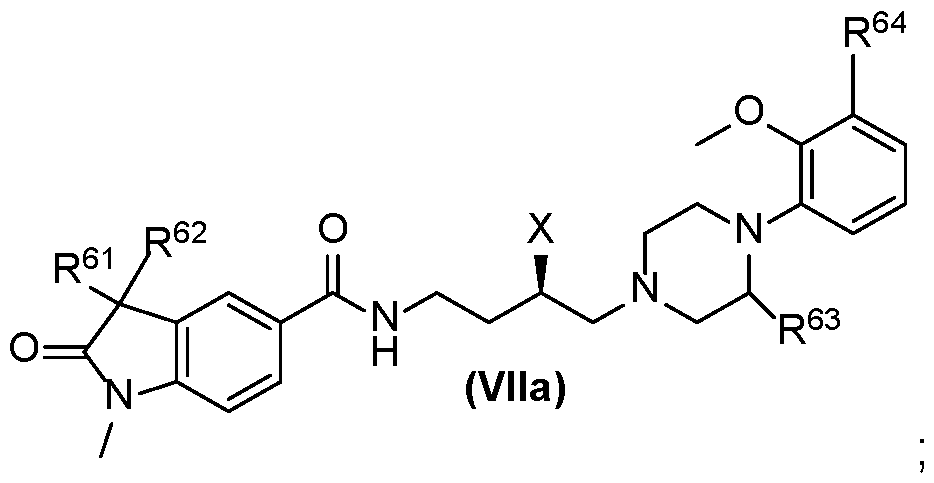 wherein R61 and R62 are independently H or methyl, or methylenes covalently linked to form a three-carbon ring; wherein R63 is H, methyl, hydroxyl, or halogen; and wherein R64 is methyl, ethyl, or halogen.
[0030] The therapeutic compound of any preceding or following embodiment/feature/aspect, its enantiomer, a racemate thereof, a prodrug thereof, or salt thereof, or any combination thereof, wherein the therapeutic compound comprises:

[0031] The therapeutic compound of any preceding or following embodiment/feature/aspect, its enantiomer, a racemate thereof, a prodrug thereof, or
salt thereof, or any combination thereof, wherein Formula (I) is represented by Formula (VI lb):
 wherein R61 and R62 are independently H or methyl, or methylenes covalently linked to form a three-carbon ring; wherein R63 is H, methyl, hydroxyl, or halogen; and wherein R64 is methyl, ethyl, or halogen.
[0032] The therapeutic compound of any preceding or following embodiment/feature/aspect, its enantiomer, a racemate thereof, a prodrug thereof, or salt thereof, or any combination thereof, wherein Formula (I) is represented by Formula (VIII):
 wherein R65 and R66 are independently H or methyl, or methylenes covalently linked to form a three-carbon ring;
 wherein R2, R3, R4, and R5 are independently H, methyl, hydroxyl, or halogen; and wherein R67 is methyl, ethyl, or halogen.
[0033] The therapeutic compound of any preceding or following embodiment/feature/aspect, its enantiomer, a racemate thereof, a prodrug thereof, or salt thereof, or any combination thereof, wherein the therapeutic compound comprises:

[0034] The therapeutic compound of any preceding or following embodiment/feature/aspect, its enantiomer, a racemate thereof, a prodrug thereof, or salt thereof, or any combination thereof, wherein the therapeutic compound comprises:

[0035] The therapeutic compound of any preceding or following embodiment/feature/aspect, its enantiomer, a racemate thereof, a prodrug thereof, or salt thereof, or any combination thereof, wherein Formula (I) is represented by Formula (IX):
 wherein
 is selected from one of the following:
 wherein R2, R3, R4, and R5 are independently H, methyl, hydroxyl, or halogen; wherein R68 is H or halogen; and wherein T is C or N.
[0036] The therapeutic compound of any preceding or following embodiment/feature/aspect, its enantiomer, a racemate thereof, a prodrug thereof, or salt thereof, or any combination thereof, wherein Formula (I) is represented by Formula (X):
 wherein R69 and R70 are independently H or methyl, or methylenes covalently linked to form a three-carbon ring; wherein R71 and R72 are independently H, methyl, halogen, or linked covalently at a methylene to form a three-carbon ring; wherein R73 is H, methyl, or halogen; wherein R74 is H or halogen; and wherein T is C or N.
[0037] The therapeutic compound of any preceding or following embodiment/feature/aspect, its enantiomer, a racemate thereof, a prodrug thereof, or salt thereof, or any combination thereof, wherein Formula (I) is represented by Formula (XI):
 wherein R75 is H or halogen.
[0038] The therapeutic compound of any preceding or following embodiment/feature/aspect, its enantiomer, a racemate thereof, a prodrug thereof, or salt thereof, or any combination thereof, wherein the therapeutic compound comprises:

[0039] The therapeutic compound of any preceding or following embodiment/feature/aspect, its enantiomer, a racemate thereof, a prodrug thereof, or salt thereof, or any combination thereof, wherein the therapeutic compound comprises:
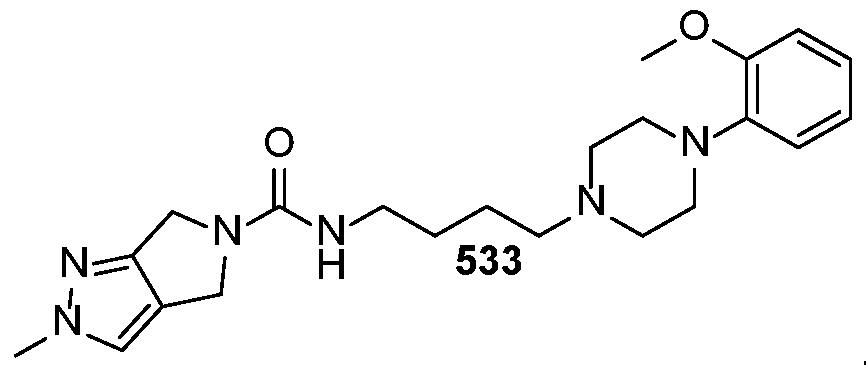
[0040] The therapeutic compound of any preceding or following embodiment/feature/aspect, its enantiomer, a racemate thereof, a prodrug thereof, or salt thereof, or any combination thereof, wherein Formula (I) is represented by Formula (XII):
 wherein R81 is H, methyl, or halogen.
[0041] The therapeutic compound of any preceding or following embodiment/feature/aspect, its enantiomer, a racemate thereof, a prodrug thereof, or salt thereof, or any combination thereof, wherein Formula (I) is represented by Formula (XIII):
wherein R81 is H, methyl, or halogen.
[0041] The therapeutic compound of any preceding or following embodiment/feature/aspect, its enantiomer, a racemate thereof, a prodrug thereof, or salt thereof, or any combination thereof, wherein Formula (I) is represented by Formula (XIII):
 wherein T is C or N; and wherein R83 is H or halogen.
[0042] The therapeutic compound of any preceding or following embodiment/feature/aspect, its enantiomer, a racemate thereof, a prodrug thereof, or salt thereof, or any combination thereof, wherein Formula (I) is represented by
Formula (XIV):

[0043] The therapeutic compound of any preceding or following embodiment/feature/aspect, its enantiomer, a racemate thereof, a prodrug thereof, or salt thereof, or any combination thereof, wherein Formula (I) is represented by Formula (XV):
 wherein T is C or N.
[0044] The therapeutic compound of any preceding or following embodiment/feature/aspect, its enantiomer, a racemate thereof, a prodrug thereof, or salt thereof, or any combination thereof, wherein the therapeutic compound comprises:

[0045] The therapeutic compound of any preceding or following embodiment/feature/aspect, its enantiomer, a racemate thereof, a prodrug thereof, or salt thereof, or any combination thereof, wherein the therapeutic compound comprises:
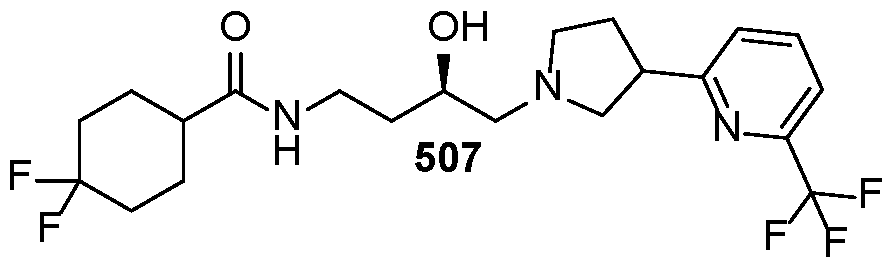
[0046] The therapeutic compound of any preceding or following embodiment/feature/aspect, its enantiomer, a racemate thereof, a prodrug thereof, or salt thereof, or any combination thereof, wherein the therapeutic compound comprises:

[0047] The therapeutic compound of any preceding or following embodiment/feature/aspect, its enantiomer, a racemate thereof, a prodrug thereof, or salt thereof, or any combination thereof, wherein the therapeutic compound comprises:

[0048] The therapeutic compound of any preceding or following embodiment/feature/aspect, its enantiomer, a racemate thereof, a prodrug thereof, or salt thereof, or any combination thereof, wherein Formula (I) is represented by Formula (XVI):
 wherein T is C or N; and wherein R85 is H or halogen.
[0049] The therapeutic compound of any preceding or following embodiment/feature/aspect, its enantiomer, a racemate thereof, a prodrug thereof, or salt thereof, or any combination thereof, wherein the therapeutic compound comprises:

[0050] The therapeutic compound of any preceding or following embodiment/feature/aspect, its enantiomer, a racemate thereof, a prodrug thereof, or salt thereof, or any combination thereof, wherein the therapeutic compound comprises:

[0051] The therapeutic compound of any preceding or following embodiment/feature/aspect, its enantiomer, a racemate thereof, a prodrug thereof, or salt thereof, or any combination thereof, wherein the therapeutic compound comprises:
 [0052] The therapeutic compound of any preceding or following embodiment/feature/aspect, its enantiomer, a racemate thereof, a prodrug thereof, or salt thereof, or any combination thereof, wherein Formula (I) is represented by Formula (XVII):
 wherein T is C or N; and wherein R87 is H or halogen.
[0053] The therapeutic compound of any preceding or following embodiment/feature/aspect, its enantiomer, a racemate thereof, a prodrug thereof, or salt thereof, or any combination thereof, wherein Formula (I) is represented by Formula (XVIII):
 wherein T is C or N; wherein R91 and R92 are independently H, methyl, halogen, or linked covalently at a methylene to form a three-carbon ring; wherein R93 is H or halogen; and wherein G is C or N.
[0054] The therapeutic compound of any preceding or following embodiment/feature/aspect, its enantiomer, a racemate thereof, a prodrug thereof, or salt thereof, or any combination thereof, wherein the therapeutic compound comprises:
 [0055] A therapeutic compound having Formula (XIX), its enantiomer, a racemate thereof, a prodrug thereof, a salt thereof, or any combination thereof:

[0056] wherein J is a cyclic, heterocyclic, bicyclic, or heterobicyclic lactam ring bound to a n-butyl linker through the lactam nitrogen; X is a hydrogen, a hydroxyl, or a methyl group substituent of the n-butyl linker; and Z is a substituted aryl bound to the n-butyl linker through a piperazine group.
[0057] The therapeutic compound of any preceding or following embodiment/feature/aspect, its enantiomer, a racemate thereof, a prodrug thereof, or salt thereof, or any combination thereof, wherein Formula (XIX) is represented by Formula (XX):
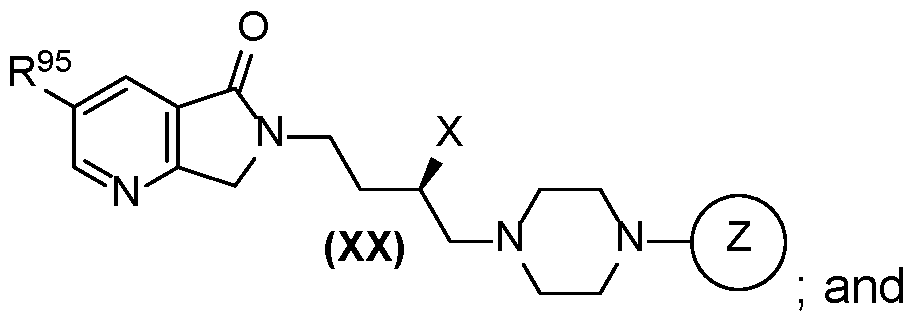 wherein R95 is H, methyl, ethyl, or halogen.
[0058] The therapeutic compound of any preceding or following embodiment/feature/aspect, its enantiomer, a racemate thereof, a prodrug thereof, or salt thereof, or any combination thereof, wherein Formula (XIX) is represented by Formula (XXI):
 wherein R95 and R96 are independently H, methyl, ethyl, or halogen.
[0059] The therapeutic compound of any preceding or following embodiment/feature/aspect, its enantiomer, a racemate thereof, a prodrug thereof, or salt thereof, or any combination thereof, wherein the therapeutic compound comprises:

[0060] A pharmaceutical composition comprising a therapeutically effective amount of the therapeutic compound of any preceding or following embodiment/feature/aspect, its enantiomer, a racemate thereof, a prodrug thereof, a salt thereof, or any combination thereof, together with a pharmaceutically acceptable carrier.
[0061] The pharmaceutical composition of any preceding or following embodiment/feature/aspect, wherein the therapeutic compound is a selective dopamine D3 receptor antagonist, or a selective dopamine D3 receptor agonist, or both.
[0062] The pharmaceutical composition of any preceding or following embodiment/feature/aspect, wherein the therapeutic compound has greater than 50 times D3 receptor selectivity relative to D2 receptor selectivity.
[0063] The pharmaceutical composition of any preceding or following embodiment/feature/aspect, wherein the therapeutic compound has greater than 100 times D3 receptor selectivity relative to D2 receptor selectivity.
[0064] The pharmaceutical composition of any preceding or following embodiment/feature/aspect, wherein the therapeutic compound has at least a 10-fold therapeutic window as measured by the IC50 hERG toxicity relative to the minimally effective therapeutic dose.
[0065] The pharmaceutical composition of any preceding or following embodiment/feature/aspect, wherein the therapeutic compound has at least a 30-fold therapeutic window as measured by the IC50 hERG toxicity dose relative to the minimally effective therapeutic dose.
[0066] The pharmaceutical composition of any preceding or following embodiment/feature/aspect, wherein the therapeutic compound is a first therapeutic compound, and the pharmaceutical composition further comprises a second therapeutic compound.
[0067] The pharmaceutical composition of any preceding or following embodiment/feature/aspect, wherein the second therapeutic compound comprises a selective dopamine Di receptor modulator, a selective dopamine D2 receptor modulator, a selective dopamine D4 receptor modulator, or a selective dopamine Ds receptor modulator, or any combination thereof.
[0068] The pharmaceutical composition of any preceding or following embodiment/feature/aspect, wherein the second therapeutic compound comprises a selective dopamine Di receptor modulator, a selective dopamine D2 receptor modulator, or both.
[0069] The pharmaceutical composition of any preceding or following embodiment/feature/aspect, wherein the second therapeutic compound comprises a selective dopamine Di receptor modulator, a selective dopamine Ds receptor modulator, or both.
[0070] The pharmaceutical composition of any preceding or following embodiment/feature/aspect, wherein the second therapeutic compound comprises a selective dopamine D2 receptor modulator, a selective dopamine D4 receptor modulator, or both.
[0071] The pharmaceutical composition of any preceding or following embodiment/feature/aspect, wherein the first therapeutic compound comprises a selective dopamine D2 receptor agonist, and the second therapeutic compound comprises a selective dopamine D3 antagonist.
[0072] The pharmaceutical composition of any preceding or following embodiment/feature/aspect, wherein the second therapeutic compound comprises an antidepressant, or an antipsychotic, or both.
[0073] The pharmaceutical composition of any preceding or following embodiment/feature/aspect, wherein the second therapeutic compound is a Parkinson disease therapeutic compound.
[0074] A method of treating drug misuse or drug addiction, comprising administering to a patient in need thereof a composition comprising a therapeutically effective amount of the therapeutic compound of any preceding or following embodiment/feature/aspect, its enantiomer, a racemate thereof, a prodrug thereof, a salt thereof, or any combination thereof optionally in combination with one or more additional active ingredients.
[0075] The method of any preceding or following embodiment/feature/aspect, wherein the patient has a history of misusing a stimulant, a depressant, an opioid, a cannabinoid, lysergic acid diethylamide (LSD), mescaline, psilocybin, nicotine, ethanol, a benzodiazepine, phencyclidine, ketamine, cocaine, or an amphetamine, or any combination thereof.
[0076] A method of treating a substance use disorder, comprising administering to a patient in need thereof a composition comprising a therapeutically effective amount of the therapeutic compound of any preceding or following embodiment/feature/aspect, its enantiomer, a racemate thereof, a prodrug thereof, a salt thereof, or any combination thereof optionally in combination with one or more additional active ingredients.
[0077] The method of any preceding or following embodiment/feature/aspect, wherein the patient has one or more affective disorders, schizophrenia, or both. [0078] The method of any preceding or following embodiment/feature/aspect, wherein the substance use disorder comprises a psychostimulant use disorder. [0079] The method of any preceding or following embodiment/feature/aspect, wherein the patient has a history of misusing a stimulant comprising cocaine, an amphetamine, a methamphetamine, dextroamphetamine, levoamphetamine, methylenedioxymethamphetamine (MDMA), methylphenidate, modafinil, armodafinil, midodrine, oxymetazoline, dobutamine, ephedrine, pseudoephedrine, or phenylephrine, or any combination thereof.
[0080] A method of treating Parkinson Disease, comprising administering to a patient in need thereof a composition comprising a therapeutically effective amount of the therapeutic compound of any preceding or following embodiment/feature/aspect, its enantiomer, a racemate thereof, a prodrug thereof, a salt thereof, or any combination thereof optionally in combination with one or more additional active ingredients.
[0081] The method of treating of treating Parkinson Disease of any preceding or following embodiment/feature/aspect, further comprising administering levodopa. [0082] The method of treating of treating Parkinson Disease of any preceding or following embodiment/feature/aspect, wherein the therapeutic compound is a selective dopamine D3 receptor agonist.
[0083] The method of treating Attention Deficit/Hyperactivity Disorder (“ADHD”) of any preceding or following embodiment/feature/aspect, wherein the therapeutic compound is a selective dopamine D3 receptor agonist.
[0084] A method of treating ADHD, comprising administering to a patient in need thereof a composition comprising a therapeutically effective amount of the therapeutic compound of any preceding or following embodiment/feature/aspect, its enantiomer, a racemate thereof, a prodrug thereof, a salt thereof, or any combination thereof optionally in combination with one or more additional active ingredients.
[0085] A kit comprising the therapeutic compound of any preceding or following embodiment/feature/aspect and a second therapeutic compound.
[0086] A method of synthesizing the therapeutic compound of any preceding or following embodiment/feature/aspect.
[0087] D3R selective brain penetrant modulators are disclosed that possess superior physicochemical properties while minimizing hERG liability. D3R selective modulators are provided that exhibit good aqueous kinetic solubility, permeability, and microsomal stabilities across different species. These compounds demonstrate a therapeutic window against hERG channel activity, which can be measured by a manual patch clamp assay. These compounds also have physicochemical properties that can provide higher free fractions in the brain that are 5 to15-fold above the binding concentrations for pharmacological action. The higher free fraction for these compounds as measured by the rat brain homogenate can lead to lower nonspecific binding in the human clinical studies and can lead to higher occupancy in the desired D3R regions of the brain for pharmacological action.
[0088] D3R selectivity over highly homologous D2RS and minimized hERG liability can be achieved. These compounds can address opioid addiction and can be, in principle, administered with oxycodone (and other opioids) to address the development of addiction without ameliorating the anti-nociceptic properties of the opioids. Use for substance use disorder (SUD), for example, with respect to methamphetamine and cocaine, is possible.
[0089] The disclosed compounds provide tools to treat addiction and has proven efficacious in the preclinical animal models both in attenuating self-administration and in reducing drug seeking behavior leading to reinstatement. As the D3R antagonists have been shown to not diminish the antinociceptive actions of
oxycodone when administered together with the opioid, these can provide a new therapeutic modality to treat addiction and pain.
BRIEF DESCRIPTION OF THE DRAWINGS
[0090] For a further understanding of the nature, objects, and advantages of the present disclosure, reference should be had to the following detailed description, read in conjunction with the following drawings, wherein like reference numerals denote like elements.
[0091] FIGS. 1A-16B show chemical formulas and structures in accordance with the present disclosure.
[0092] FIGS. 17-81 show synthetic schemes in accordance with the present disclosure.
[0093] FIGS. 82-95 show graphs of data in accordance with the present disclosure.
DETAILED DESCRIPTION
[0094] Compounds are described using standard nomenclature. Unless defined otherwise, all technical and scientific terms used herein have the same meaning as is commonly understood by one of skill in the art to which this disclosure belongs. [0095] The terms “a” and “an” do not denote a limitation of quantity, but rather denote the presence of at least one of the referenced items. The term “or” means “and/or”. The terms “comprising,” “having,” “including,” and “containing” are to be construed as open-ended terms (/.e., meaning “including, but not limited to”).
[0096] Recitation of ranges of values are merely intended to serve as a shorthand method of referring individually to each separate value falling within the range, unless otherwise indicated herein, and each separate value is incorporated into the specification as if it were individually recited herein. The endpoints of all ranges are included within the range and independently combinable.
[0097] All methods described herein can be performed in a suitable order unless otherwise indicated herein or otherwise clearly contradicted by context. The use of any and all examples, or exemplary language (for example, “such as”), is intended merely to better illustrate the disclosure and does not pose a limitation on the scope of the disclosure unless otherwise claimed. No language in the specification should be construed as indicating any non-claimed element as essential to the practice of
the disclosure as used herein. Unless defined otherwise, technical and scientific terms used herein have the same meaning as is commonly understood by one of skill in the art of this disclosure.
[0098] Furthermore, the disclosure encompasses all variations, combinations, and permutations in which one or more limitations, elements, clauses, and descriptive terms from one or more of the listed claims are introduced into another claim. For example, any claim that is dependent on another claim can be modified to include one or more limitations found in any other claim that is dependent on the same base claim. Where elements are presented as lists, for example, in Markush group format, each subgroup of the elements is also disclosed, and any element(s) can be removed from the group.
[0099] All compounds are understood to include all possible isotopes of atoms occurring in the compounds. Isotopes include those atoms having the same atomic number but different mass numbers and encompass heavy isotopes and radioactive isotopes. By way of general example, and without limitation, isotopes of hydrogen include tritium and deuterium, and isotopes of carbon include 11C, 13C, and 14C. Accordingly, the compounds disclosed herein can include heavy or radioactive isotopes in the structure of the compounds or as substituents attached thereto. Examples of useful heavy or radioactive isotopes include 18F, 15N, 180, 76Br, 125l, and 1311. Formulas, subformulas thereof, and compounds thereof include all pharmaceutically acceptable salts of the same.
[0100] The term “substituted” means that any one or more hydrogens on the designated atom or group is replaced with a selection from the indicated group, provided that the designated atom’s normal valence is not exceeded. Combinations of substituents and/or variables are permissible, for example, if such combinations result in stable compounds or useful synthetic intermediates. A stable compound or stable structure can be a compound that is sufficiently robust to survive isolation from a reaction mixture, and subsequent formulation into an effective therapeutic agent. A substituent or combination of substituents described with respect to one formula, subformula, or compound, can also be used in any other formula, subformula, or compound where consistent with valence, polarity, size, structure, and other parameters, unless otherwise indicated. Any substituent or combination of substituents described herein with respect to a particular atom or atoms can also be
excluded as an option for replacing one or more hydrogens at the particular atom, atoms, or subset thereof.
[0101] A dash
 that is not between two letters or symbols is used to indicate a point of attachment for a substituent.
[0102] “Alkyl” refers to a group derived from a straight or branched chain saturated aliphatic hydrocarbon having the specified number of carbon atoms and having a valence of one, optionally substituted with one or more substituents where indicated, provided that the valence of the alkyl group is not exceeded.
[0103] “Cycloalkyl” refers to a group that comprises one or more saturated and/or partially saturated rings in which all ring members are carbon, the group having the specified number of carbon atoms. Cycloalkyl groups do not include an aromatic ring or a heterocyclic ring. “Heterocyclic” or “Heterocycloakyl” refers to a cycloalkyl group in which at least one carbon atom is replaced by N, O, P, S or an atom other than carbon.
[0104] “Alkanoyl” refers to a group having formula “alkyl-C(=O)-“, wherein “alkyl” is the same as defined above.
[0105] “Cycloalkanoyl” refers to a group having formula “cycloalkyl-C(=O)-“, wherein “cycloalkyl” is the same as defined above.
[0106] “Aryl” refers to a cyclic group in which all ring members are carbon and all rings are aromatic, the group having the specified number of carbon atoms, and having a valence of one, optionally substituted with one or more substituents where indicated, provided that the valence of the aryl group is not exceeded. More than one ring can be present, and any additional rings can be fused, pendant, spirocyclic, or a combination thereof.
[0107] “Heteroaryl” means a monovalent carbocyclic ring group that includes one or more aromatic rings, in which at least one ring member (for example, one, two or three ring members) is a heteroatom selected from nitrogen (N), oxygen (0), sulfur (S), and phosphorus (P), the group having the specified number of carbon atoms. [0108] “Halogen” means fluoro, chloro, bromo, or iodo, and are defined herein to include all isotopes of the same, including heavy isotopes and radioactive isotopes. Examples of useful halo isotopes include 18F, 76Br, and 1311. Additional isotopes will be readily appreciated by one of skill in the art.
[0109] “Substituted” means that the compound or group is substituted with at least one (for example, 1 , 2, 3, or 4) substituent independently selected from a halogen (- F, -Cl, -Br, -I), a hydroxyl (-OH), a C1-C9 alkoxy, a C1-C9 haloalkoxy, an oxo (=0), a nitro (-NO2), a cyano (-CN), an amino (-NR2, wherein each R is independently hydrogen or C1-C10 alkyl), an azido (-N3), an amidino (-C(=NH)NH2), a hydrazino (- NHNH2), a hydrazono (-C(=NNH2)-), a carbonyl (-C(=O)-), a carbamoyl group (- C(O)NH2), a sulfonyl (-S(=O)2-), a thiol (-SH), a thiocyano (-SCN), a tosyl (CH3C6H4SO2-), a carboxylic acid (-C(=O)OH), a carboxylic Ci-Ce alkyl ester (- C(=O)OR wherein R is C1-C10 alkyl), a carboxylic acid salt (-C(=0)0M) wherein M is an organic or inorganic anion, a sulfonic acid (-SO3H2), a sulfonic mono- or dibasic salt (-SO3MH or -SO3M2 wherein M is an organic or inorganic anion), a phosphoric acid (-PO3H2), a phosphoric acid mono- or dibasic salt (-PO3MH or -PO3M2 wherein M is an organic or inorganic anion), a C1-C12 alkyl, a C3-C12 cycloalkyl, a C2-C12 alkenyl, a C5-C12 cycloalkenyl, a C2-C12 alkynyl, a C6-C12 aryl, a C7-C13 arylalkylene, a C4-C12 heterocycloalkyl, and a C3-C12 heteroaryl instead of hydrogen, provided that the substituted atom’s normal valence is not exceeded.
[0110] “Pharmaceutical composition” means a composition comprising at least one active agent, such as a compound or salt of Formula (I), and at least one other substance, such as a carrier. Pharmaceutical compositions can meet the U.S. FDA’s GMP (good manufacturing practice) standards for human or non-human drugs.
[0111] “Carrier” means a diluent, excipient, or vehicle with which an active compound is administered. A “pharmaceutically acceptable carrier” means a substance, for example, excipient, diluent, or vehicle, that is useful in preparing a pharmaceutical composition that is generally safe, non-toxic and neither biologically nor otherwise undesirable, and can include a carrier that is acceptable for veterinary use as well as human pharmaceutical use. A “pharmaceutically acceptable carrier” includes both one and more than one such carrier.
[0112] A “patient” means a human or non-human animal in need of medical treatment. Medical treatment can include treatment of an existing condition, such as a disease or disorder or diagnostic treatment. For example, the patient can be a human patient.
[0113] “Providing” means giving, administering, selling, distributing, transferring (for profit or not), manufacturing, compounding, or dispensing.
[0114] “Treatment” or “treating” means providing an active compound to a patient in an amount sufficient to measurably reduce any disease symptom, slow disease progression or cause disease regression. Treatment of the disease can be commenced before the patient presents symptoms of the disease.
[0115] A “therapeutically effective amount” of a pharmaceutical composition means an amount effective, when administered to a patient, to provide a therapeutic benefit such as an amelioration of symptoms, decrease disease progression, or cause disease regression.
[0116] A “therapeutic compound” means a compound which can be used for diagnosis or treatment of a disease. The compounds can be small molecules, peptides, proteins, or other kinds of molecules.
[0117] Compounds of formulas can contain one or more asymmetric elements such as stereogenic centers, stereogenic axes and the like, for example, asymmetric carbon atoms, so that the compounds can exist in different stereoisomeric forms. These compounds can be, for example, racemates or optically active forms. For compounds with two or more asymmetric elements, these compounds can additionally be mixtures of diastereomers. For compounds having asymmetric centers, all optical isomers in pure form and mixtures thereof are encompassed. In these situations, the single enantiomers, i.e., optically active forms can be obtained by asymmetric synthesis, synthesis from optically pure precursors, or by resolution of the racemates. Resolution of the racemates can also be accomplished, for example, by conventional methods such as crystallization in the presence of a resolving agent, or chromatography, using, for example a chiral HPLC column. All forms are contemplated herein regardless of the methods used to obtain them.
[0118] All forms (for example solvates, optical isomers, enantiomeric forms, polymorphs, free compound and salts) of an active agent can be employed either alone or in combination.
[0119] The term “chiral” refers to molecules, which have the property of non- superimposability of the mirror image partner.
[0120] “Stereoisomers” are compounds, which have identical chemical constitution, but differ with regard to the arrangement of the atoms or groups in space.
[0121] A “diastereomer” is a stereoisomer with two or more centers of chirality and whose molecules are not mirror images of one another. Diastereomers have different
physical properties, for example, melting points, boiling points, spectral properties, and reactivities. Mixtures of diastereomers can separate under high resolution analytical procedures such as electrophoresis, crystallization in the presence of a resolving agent, or chromatography, using, for example a chiral HPLC column. [0122] “Enantiomers” refer to two stereoisomers of a compound, which are non- superimposable mirror images of one another. A 50:50 mixture of enantiomers is referred to as a racemic mixture or a racemate, which can occur where there has been no stereoselection or stereospecificity in a chemical reaction or process. [0123] Stereochemical definitions and conventions used herein generally follow S. P. Parker, Ed., McGraw-Hill Dictionary of Chemical Terms (1984) McGraw-Hill Book Company, New York; and Eliel, E. and Wilen, S., Stereochemistry of Organic Compounds (1994) John Wiley & Sons, Inc., New York. Many organic compounds exist in optically active forms, i.e. , they have the ability to rotate the plane of plane- polarized light. In describing an optically active compound, the prefixes D and L or R and S are used to denote the absolute configuration of the molecule about its chiral center(s). The prefixes d and I or (+) and (-) are employed to designate the sign of rotation of plane-polarized light by the compound, with (-) or I meaning that the compound is levorotatory. A compound prefixed with (+) or d is dextrorotatory.
[0124] A “racemic mixture” or “racemate” is an equimolar (or 50:50) mixture of two enantiomeric species, devoid of optical activity. A racemic mixture can occur where there has been no stereoselection or stereospecificity in a chemical reaction or process. Combinations of two enantiomeric species other than 50:50 racemic mixtures are also provided by the present disclosure, for example, 1 : 10,000, 1 :1 ,000, 1 :100, 1 :10, 1 :9, 1 :7.5, 1 :5, 1 :3, 1 :2.5, 1 :2, or 1 :1.5, or any opposite ratio, or any intervening ratio.
[0125] “Pharmaceutically acceptable salts” include derivatives of the disclosed compounds in which the parent compound is modified by making inorganic and organic, non-toxic, acid or base addition salts thereof. The salts of the present compounds can be synthesized from a parent compound that contains a basic or acidic moiety by conventional chemical methods. Generally, such salts can be prepared by reacting free acid forms of these compounds with a stoichiometric amount of the appropriate base (such as Na, Ca, Mg, or K hydroxide, carbonate, bicarbonate, or the like), or by reacting free base forms of these compounds with a
stoichiometric amount of the appropriate acid. Such reactions can be carried out in water or in an organic solvent, or in a mixture of the two. Generally, non-aqueous media such as ether, ethyl acetate, ethanol, isopropanol, or acetonitrile are used, where practicable. Salts of the present compounds further include solvates of the compounds and of the compound salts.
[0126] Examples of pharmaceutically acceptable salts include, but are not limited to, mineral or organic acid salts of basic residues such as amines; alkali or organic salts of acidic residues such as carboxylic acids; and the like. The pharmaceutically acceptable salts include the conventional non-toxic salts and the quaternary ammonium salts of the parent compound formed, for example, from non-toxic inorganic or organic acids. For example, conventional non-toxic acid salts include those derived from inorganic acids, for example, hydrochloric, hydrobromic, sulfuric, sulfamic, phosphoric, nitric and the like; and the salts prepared from organic acids, for example, acetic, propionic, succinic, glycolic, stearic, lactic, malic, tartaric, citric, ascorbic, pamoic, maleic, hydroxymaleic, phenylacetic, glutamic, benzoic, salicylic, mesylic, esylic, besylic, sulfanilic, 2-acetoxybenzoic, fumaric, toluenesulfonic, methanesulfonic, ethane disulfonic, oxalic, isethionic, HOOC-(CH2)n-COOH where n is 0-4, and the like. Any suitable pharmaceutical salt can be used.
[0127] As used herein, “prodrug” is intended to include any covalently bonded carriers which release the active parent drug, for example, as according to a formula described herein, or other formulas or compounds employed in the methods of the present disclosure in vivo when such prodrug is administered to a mammalian subject. Because prodrugs are known to enhance numerous desirable qualities of pharmaceuticals (for example, solubility, bioavailability, manufacturing, etc.) the compounds employed in the present methods can, if desired, be delivered in prodrug form. Thus, the present disclosure contemplates methods of delivering prodrugs. Prodrugs of the compounds employed in the present disclosure can be prepared by modifying functional groups present in the compound in such a way that the modifications are cleaved, either in routine manipulation or in vivo, to the parent compound. Accordingly, prodrugs include, for example, compounds described herein in which a hydroxy, amino, or carboxy group is bonded to any group that, when the prodrug is administered to a mammalian subject, cleaves to form a free hydroxyl, free amino, or carboxylic acid, respectively. Examples include, but are not limited to,
acetate, formate and benzoate derivatives of alcohol and amine functional groups; and alkyl, carbocyclic, aryl, and alkylaryl esters such as methyl, ethyl, propyl, isopropyl, butyl, iso-butyl, sec-butyl, tert-butyl, cyclopropyl, phenyl, benzyl, and phenethyl esters, and the like.
[0128] As used herein the term “beta-arrestin” is meant to encompass other notations commonly used in the art including “Beta-Arrestin”, “[3-arrestin”, “|3- Arrestin”, “b-arrestin” and the like. As used herein the pain to be treated by the methods is not particularly limiting and can include chronic pain, acute pain, breakthrough pain, post-operative pain, perioperative pain, mild pain, moderate pain, severe pain, bone and joint pain, soft tissue pain, nerve pain, pain due to a disease or disorder, pain due to trauma, and the like, and a combination thereof.
[0129] As used herein, the term Attention Deficit/Hyperactivity Disorder (“ADHD”) also encompasses related disorders, including but not limited to Attention Deficit Disorder (“ADD”), Oppositional Defiant Disorder (“ODD”), Minimal Brain Dysfunction (“MBD”), Hyperkinetic Disorder, and the like.
[0130] Disclosed is a therapeutic compound having Formula (I), its enantiomer, a racemate thereof, a prodrug thereof, a salt thereof, or any combination thereof:

[0131] Q can be a first chemical moiety covalently bound through an amide bond to a n-butyl linker. X can be a hydrogen, a hydroxyl, or a methyl group substituent of the n-butyl linker. L can be a tertiary amine heterocyclic linker covalently bound to the n-butyl linker through the nitrogen of the tertiary amine. Z can be a second chemical moiety covalently bound to the tertiary amine heterocyclic linker. Q can
 exclude indole and Z can comprise a substituted aryl. L can comprise
 are independently H, methyl, hydroxyl, or halogen, or R1a and R1c are bonds forming a bridge comprising methylene, or R1 b and R1d are bonds forming a bridge comprising methylene. The therapeutic compound can be a selective dopamine D3 receptor modulator. The therapeutic compound can be a selective dopamine D3 receptor antagonist. The therapeutic compound can be a selective dopamine D3 receptor agonist.
[0132] The second linker L2 can be, for example, selected from one of the following:

[0133] R2 and R5 can be, for example, independently H, methyl, hydroxyl, or halogen. R3 and R4 can be, for example, independently H, methyl, hydroxyl, or halogen, or linked covalently at a methylene to form a three-carbon ring.
[0134] Q can be a first pharmacophore of the therapeutic compound. Q can be, for example, selected from one of the following:


R11, R12, R13, R16, R17, R18, R29, R30, R31 , and R32 can be, for example, independently H, methyl, ethyl, methoxy, ethoxy, or halogen. R14, R15, R19, R20, R21 , R22, R34, R35, R36, and R37 can be, for example, independently H, methyl, ethyl, methoxy, ethoxy, or halogen. R26 and R27 can be, for example, independently H, methyl, ethyl, methoxy, ethoxy, or halogen, or methylenes covalently linked to form a three-carbon ring. R24, R25, R28, R33, and R38 can be, for example, independently H, methyl, or halogen. R23 can be, for example, methyl or ethyl.
[0135] Z can be a second pharmacophore of the therapeutic compound. Z can be, for example, selected from one of the following:

R41 , R42, R46, R47, and R48 can be, for example, independently H, methyl, ethyl, or halogen. R43, R44, and R45 can be, for example, independently H or halogen.
[0136] Formula (I) can be, for example, represented by Formula (II):
 wherein R1a, R1 b, R1c, and R1d are independently H, methyl, hydroxyl, or halogen, or R1a and R1c are bonds forming a bridge comprising methylene, or R1 b and R1d are bonds forming a bridge comprising methylene.
[0137] Formula (I) can be, for example, represented by Formula (III):
wherein R1a, R1 b, R1c, and R1d are independently H, methyl, hydroxyl, or halogen, or R1a and R1c are bonds forming a bridge comprising methylene, or R1 b and R1d are bonds forming a bridge comprising methylene.
[0137] Formula (I) can be, for example, represented by Formula (III):

[0138] Formula (I) can be, for example, represented by Formula (IVa):
 and.R51 and R52 can be, for example, independently H, methyl, ethyl, or halogen.
The therapeutic compound can be, for example, one or more compounds set forth in
FIG. 2A. For example, the therapeutic compound can be

[0139] Formula (I) can be, for example, represented by Formula (IVb):
 wherein R51 and R52 are independently H, methyl, ethyl, or halogen.
[0140] The therapeutic compound can be, for example, one or more compounds set forth in FIG. 2B. For example, the therapeutic compound can be

[0141] Formula (I) can be, for example, represented by Formula (IVc):
 wherein R53 and R54 are independently H, methyl, ethyl, or halogen.
[0142] The therapeutic compound can be, for example, one or more compounds set forth in FIG. 2C. For example, the therapeutic compound can be

[0143] Formula (I) can be, for example, represented by Formula (Va):
 wherein R51 and R55b are independently H, methyl, ethyl, or halogen.
[0144] The therapeutic compound can be, for example, one or more compounds set forth in FIG. 3A. For example, the therapeutic compound can be

[0145] Formula (I) can be, for example, represented by Formula (Vb):
 wherein R51 and R55b are independently H, methyl, ethyl, or halogen.
[0146] The therapeutic compound can be, for example, one or more compounds set forth in FIG. 3B. For example, the therapeutic compound can be

[0147] Formula (I) can be, for example, represented by Formula (Vc):
 wherein R51 and R55b are independently H, methyl, ethyl, or halogen.
[0148] The therapeutic compound can be, for example, one or more compounds set forth in FIG. 3C. For example, the therapeutic compound can be

[0149] Formula (I) can be, for example, represented by Formula (VI):

R55 and R56 are independently H, methyl, ethyl, or halogen. The therapeutic compound can be, for example, one or more compounds set forth in FIG. 4. [0150] Formula (I) can be, for example, represented by Formula (Vila):

[0151] R61 and R62 can be, for example, independently H or methyl, or methylenes covalently linked to form a three-carbon ring. R63 can be, for example, H, methyl, hydroxyl, or halogen. R64 can be methyl, ethyl, or halogen. The therapeutic compound can be, for example, one or more compounds set forth in FIG. 5A. For example, the therapeutic compound can be:

[0152] Formula (I) can be, for example, represented by Formula (VI lb):
 [0153] R61 and R62 can be, for example, independently H or methyl, or methylenes covalently linked to form a three-carbon ring. R63 can be, for example, H, methyl, hydroxyl, or halogen. R64 can be, for example, methyl, ethyl, or halogen. The therapeutic compound can be, for example, a compound set forth in FIG. 5B.
[0154] Formula (I) can be, for example, represented by Formula (VIII):

[0155] R65 and R66 can be, for example, independently H or methyl, or methylenes covalently linked to form a three-carbon ring to form a three-carbon ring. Linker
 can be selected from one of the following:

[0156] R2, and R5 can be, for example, independently H, methyl, hydroxyl, or halogen. R67 can be methyl, ethyl, or halogen. R3 and R4 can be, for example, independently H, methyl, hydroxyl, or halogen, or methylenes covalently linked to form a three-carbon ring. The therapeutic compound can be, for example, one or more compounds set forth in FIG. 6. For example, the therapeutic compound can be

[0157] Formula (I) can be, for example, represented by Formula (IX):

[0158] R2, R3, R4, and R5 can be, for example, independently H, methyl, hydroxyl, or halogen. R68 can be, for example, H or halogen. T can be C or N. The therapeutic compound can be, for example, one or more compounds set forth in FIG. 7.
[0159] Formula (I) can be, for example, represented by Formula (X):

[0160] R69 and R70 can be, for example, independently H or methyl, or methylene covalently linked to form a three-carbon ring. R71 and R72 can be, for example, independently H, methyl, halogen, or linked covalently at a methylene to form a three-carbon ring. R73 can be, for example, H, methyl, or halogen. R74 can be, for example, H or halogen. T can be, for example, C or N. The therapeutic compound can be, for example, one or more compounds set forth in FIG. 8.
[0161] Formula (I) can be, for example, represented by Formula (XI):

[0162] R75 can be, for example, H or halogen. The therapeutic compound can be, for example, one or more compounds set forth in FIG. 9. For example, the therapeutic compound can be:
 both.
both.
[0163] Formula (I) can be, for example, represented by Formula (XII):

R81 can be, for example, H, methyl, or halogen. The therapeutic compound can be, for example, one or more compounds set forth in FIG. 10.
[0164] Formula (I) can be, for example, represented by Formula (XIII):

[0165] T can be, for example, C or N. R83 can be, for example, H or halogen. The therapeutic compound can be, for example, one or more compounds set forth in
FIG. 11.
[0166] Formula (I) can be, for example, represented by Formula (XIV):

[0167] The therapeutic compound can be, for example, one or more compounds set forth in FIG. 12.
[0168] Formula (I) can be, for example, represented by Formula (XV):

[0169] T can be, for example, C or N. The therapeutic compound can be, for example, one or more compounds set forth in FIG. 13. For example, the therapeutic compound can be:


[0170] Formula (I) can be, for example, represented by Formula (XVI):

T can be, for example, C or N. R85 can be, for example, H or halogen. The therapeutic compound can be, for example, one or more compounds set forth in FIG. 14A. For example, the therapeutic compound can be:

[0171] Formula (I) can be, for example, represented by Formula (XVII):

T can be, for example, C or N. R87 can be, for example, H or halogen. The therapeutic compound can be, for example, a compound set forth in FIG. 14B. [0172] Formula (I) can be, for example, represented by Formula (XVIII):

T can be, for example, C or N. R91 and R92 can be, for example, independently H, methyl, halogen, or linked covalently at a methylene to form a three-carbon ring. R93 can be, for example, H or halogen. G can be, for example, C or N. The therapeutic compound can be, for example, one or more compounds set forth in FIG. 15. For example, the therapeutic compound can be:

566
[0173] The therapeutic compound can be, for example, one or more compounds set forth in FIG. 16A, its enantiomer, a racemate thereof, a prodrug thereof, a salt thereof, or any combination thereof.
[0174] A therapeutic compound having Formula (XIX), its enantiomer, a racemate thereof, a prodrug thereof, a salt thereof, or any combination thereof is provided:
 wherein J is a cyclic, heterocyclic, bicyclic, or heterobicyclic lactam ring bound to a n- butyl linker through the lactam nitrogen; X is a hydrogen, a hydroxyl, or a methyl group substituent of the n-butyl linker; and Z is a substituted aryl bound to the n-butyl linker through a piperazine group.
[0175] Formula (XIX) can be, for example, represented by Formula (XX):
 wherein R95 is H, methyl, ethyl, or halogen.
[0176] Formula (XIX) can be, for example, represented by Formula (XXI):
 wherein R95 and R96 are independently H, methyl, ethyl, or halogen.
[0177] The therapeutic compound can be, for example, one or more compounds set forth in FIG. 16B. For example, the therapeutic compound can be

[0178] A pharmaceutical composition is provided that can comprise a therapeutically effective amount of the therapeutic compound of any preceding claim, its enantiomer, a racemate thereof, a prodrug thereof, a salt thereof, or any combination thereof, together with a pharmaceutically acceptable carrier. The therapeutic compound is a selective dopamine D3 receptor antagonist, or a selective dopamine D3 receptor agonist, or both. The therapeutic compound can have greater than 5 times, greater than 10 times, greater than 25 times, greater than 100 times greater than 150 times, greater than 200 times, greater than 250 times, greater than 350 times, or greater than 500 times, or any range times therebetween, or any intervening value times D3 receptor selectivity relative to D2 receptor selectivity. The
therapeutic compound can have at least a 2-fold, at least a 5-fold, at least a 10-fold, at least a 15-fold, at least a 20-fold, at least a 25-fold, at least a 50-fold, or at least a 100-fold, or any range-fold therebetween, or any intervening value-fold, therapeutic window as measured by the IC50 hERG toxicity relative to the minimally effective therapeutic dose.
[0179] The therapeutic compound can be a first therapeutic compound, and the pharmaceutical composition can further comprise a second therapeutic compound. The pharmaceutical second therapeutic compound can comprise a selective dopamine Di receptor modulator, a selective dopamine D2 receptor modulator, a selective dopamine D4 receptor modulator, or a selective dopamine Ds receptor modulator, or any combination thereof. The second therapeutic compound can comprise, for example, a selective dopamine Di receptor modulator, a selective dopamine D2 receptor modulator, or both. The second therapeutic compound can comprise a selective dopamine Di receptor modulator, a selective dopamine D5 receptor modulator, or both. The second therapeutic compound can comprise a selective dopamine D2 receptor modulator, a selective dopamine D4 receptor modulator, or both. The first therapeutic compound can comprise a selective dopamine D2 receptor agonist, and the second therapeutic compound comprise a selective dopamine D3 antagonist. Dopamine receptors can be characterized as one of five subtypes — Di receptors, D2 receptors, D3 receptors, D4 receptors, and Ds receptors. Dopamine receptors and their modulators can be groups into two families — the Di receptor family (Di and Ds receptors) and the D2 receptor family (D2, D3, and D4 receptors). The therapeutic compound of the present disclosure and a second therapeutic compound can affect the same receptor subtype, or family, or both. The therapeutic compound of the present disclosure and a second therapeutic compound can affect different receptor subtypes, or different families, or both. The second therapeutic compound can comprise an antidepressant, or an antipsychotic, or both. The second therapeutic compound can be a Parkinson disease therapeutic compound.
[0180] Pharmaceutical compositions are provided by the present disclosure. For example, a pharmaceutical composition is provided that can comprise a therapeutically effective amount of one or more compounds disclosed herein, their enantiomers, racemates thereof, prodrugs thereof, salts thereof, or any combination
thereof, together with a pharmaceutically acceptable carrier. The pharmaceutically acceptable carrier can be, for example, selected from the group consisting of binders, buffering agents, coloring agents, diluents, disintegrants, emulsifiers, flavorants, glidants, lubricants, preservatives, stabilizers, surfactants, tableting agents, and wetting agents, and combinations thereof. The compound of the pharmaceutical composition can be a first therapeutic compound and the pharmaceutical composition can further comprise a second therapeutic compound. The first and second therapeutic compounds can act additively or synergistically. [0181] The second therapeutic compound can comprise, for example, an antidepressant, or an antipsychotic, or both. Antidepressants can include one or more of a selective serotonin reuptake inhibitor (SSRI), serotonin-norepinephrine uptake inhibitor (SNRI), a 5-HT modulator, a unicyclic antidepressant, a tricyclic antidepressant (TCA), a tetracyclic antidepressant, a mixed norepinephrine/serotonin reuptake inhibitor or receptor blocker, a NMDA antagonist, a GABA modulator, a mixed-action drug, and a monoamine oxidase inhibitor. For example, the antidepressant can include one or more of fluoxetine, sertraline, paroxetine, fluvoxamine, citalopram, escitalopram, amitriptyline, nortriptyline, protriptyline, imipramine, desipramine, doxepin, clomipramine, trimipramine, venlafaxine, desvenlafaxine, duloxetine, maprotiline, milnacipran, mirtazapine, vilazodone, bupropion, trazodone, nefazodone, vortioxetine, amoxapine, phenelzine, tranylcypromine, isocarboxid, selegiline, esketamine, and brexanolone.
Antipsychotics can include, for example, a first-generation antipsychotic agent, or a second antipsychotic agent, or both. Antipsychotics can include, for example, one or more of a phenothiazine, a thioxanthene, a butyrophenone, a dibenzodiazepine, a benzisoxazole, a thienobenzodiazepine, a dibenzothiazepine, a dihydroindoIone, and a dihydrocarbostyril. For example, the antipsychotic can include one or more chlorpromazine, thioridazine, perphenazine, loxapine, molindone, pimoizide, loxapine, haloperidol, fluphenazine, trifluoperazine, thiothixene, clozapine, risperidone, olanzapine, quetiapine, ziprasidone, aripiprazole, paliperidone, iloperidone, asenapine, and lurasidone. The second therapeutic compound can include an anxiolytic, for example, one or more of diazepam, flurazepam, triazolam, lorazepam, alprazolam, chlordiazepoxide, oxazepam, temazepam, clonazepam, and buspirone. The anxiolytic can be a benzodiazepine, or a non-bezodiazepine. The
second therapeutic compound can include a mood stabilizer. The mood stabilizer can include, for example, one or more of lithium, valproic acid, carbamazepine, oxcarbazepine, and lamotrigine. For methods of treatment, a second or further therapeutic compound can be administered separately or in combination with the first therapeutic agent.
[0182] Compounds disclosed herein can be administered as the neat chemical, or can be administered as a pharmaceutical composition. Accordingly, the disclosure encompasses pharmaceutical compositions comprising a therapeutically effective amount of a compound or pharmaceutically acceptable salt of a compound, together with at least one pharmaceutically acceptable carrier. The pharmaceutical composition can contain a therapeutically effective amount of the compound or salt as the only active agent, and can contain at least one additional active agent. The pharmaceutical composition can be in a dosage form that contains from about 0.1 mg to about 2000 mg, from about 10 mg to about 1000 mg, from about 100 mg to about 800 mg, or from about 200 mg to about 600 mg of a compound, and optionally from about 0.1 mg to about 2000 mg, from about 10 mg to about 1000 mg, from about 100 mg to about 800 mg, or from about 200 mg to about 600 mg of an additional active agent in a unit dosage form. The pharmaceutical composition can be in a dosage form that contains about 0.1 , 0.2, 0.3, 0.4, 0.5, 0.6, 0.7, 0.8, 0.9, 1 , 2, 3, 4, 5, 6, 7, 8, 9, 10, 15, 20, 25, 30, 35, 40, 45, 50, 55, 60, 65, 70, 75, 80, 85, 90, 95, 100, 150, 200, 250, 300, 350, 400, 450, 500, 550, 600, 650, 700, 750, 800, 850, 900, 950, 1000, 1100, 1200, 1300, 1400, 1500, 1600, 1700, 1800, 1900, or 2000 mg of a compound, and optionally about 0.1 , 0.2, 0.3, 0.4, 0.5, 0.6, 0.7, 0.8, 0.9, 1 , 2, 3, 4, 5, 6, 7, 8, 9, 10, 15, 20, 25, 30, 35, 40, 45, 50, 55, 60, 65, 70, 75, 80, 85, 90, 95, 100, 150, 200, 250, 300, 350, 400, 450, 500, 550, 600, 650, 700, 750, 800, 850, 900, 950, 1000, 1100, 1200, 1300, 1400, 1500, 1600, 1700, 1800, 1900, or 2000 mg of an additional active agent in a unit dosage form. The pharmaceutical composition can also include a molar ratio of a compound and an additional active agent. For example, the pharmaceutical composition can contain a molar ratio of about 0.5:1 , about 1 :1 , about 2:1 , about 3:1 or from about 1.5:1 to about 4:1 of an additional active agent to a compound.
[0183] Compounds disclosed herein can be administered orally, topically, parenterally, by inhalation or spray, sublingually, transdermally, via buccal
administration, rectally, as an ophthalmic solution, or by other means, in dosage unit formulations containing conventional pharmaceutically acceptable carriers. The pharmaceutical composition can be formulated as any pharmaceutically useful form, for example, as an aerosol, a cream, a gel, a pill, a capsule, a tablet, a syrup, a transdermal patch, or an ophthalmic solution. Some dosage forms, such as tablets and capsules, are subdivided into suitably sized unit doses containing appropriate quantities of the active components, for example, a therapeutically effective amount to achieve the desired purpose.
[0184] Carriers include excipients and diluents of sufficiently high purity and sufficiently low toxicity to render them suitable for administration to the patient being treated. The carrier can be inert or it can possess pharmaceutical benefits of its own. The amount of carrier employed in conjunction with the compound is sufficient to provide a practical quantity of material for administration per unit dose of the compound.
[0185] Classes of carriers include, but are not limited to binders, buffering agents, coloring agents, diluents, disintegrants, emulsifiers, flavorants, glidants, lubricants, preservatives, stabilizers, surfactants, tableting agents, and wetting agents. Some carriers can be listed in more than one class, for example vegetable oil can be used as a lubricant in some formulations and a diluent in others. Exemplary pharmaceutically acceptable carriers include sugars, starches, celluloses, powdered tragacanth, malt, gelatin, talc, and vegetable oils. Optional active agents can be included in a pharmaceutical composition, which do not substantially interfere with the activity of the compound of the present disclosure.
[0186] The pharmaceutical compositions/combinations can be formulated for oral administration. These compositions contain between 0.1 and 99 weight % (wt%) of a compound and usually at least about 5 wt% of a compound of Formula (I).
Compositions can contain from about 25 wt% to about 50 wt% or from about 5 wt% to about 75 wt% of the compound. Compositions can contain about 0.1 , 0.2, 0.3, 0.4, 0.5, 0.6, 0.7, 0.8, 0.9, 1 , 2, 3, 4, 5, 6, 7, 8, 9, 10, 15, 20, 25, 30, 35, 40, 45, 50, 55, 60, 65, 70, 75, 80, 85, 90, or 95 wt% of the compound.
[0187] Methods of treatment are provided by the present disclosure that employ one or more compounds disclosed herein. The patient (subject) can be a mammal, and more specifically, a human, or non-human patients such as companion animals, for
example, cats, dogs, and livestock animals. A method of treating drug misuse or drug addiction is provided. The method can comprise administering to a patient in need thereof a composition comprising a therapeutically effective amount of a therapeutic compound of the present disclosure, its enantiomer, a racemate thereof, a prodrug thereof, a salt thereof, or any combination thereof optionally in combination with one or more additional active ingredients. The patient can be or have been taking methadone, or buprenorphine, or both. The patient can have had a history of misusing a stimulant, a depressant, an opioid, a cannabinoid, lysergic acid diethylamide (LSD), mescaline, psilocybin, nicotine, ethanol, a benzodiazepine, phencyclidine, ketamine, cocaine, or an amphetamine, or any combination thereof. For example, the patient can be being treated with one or more partial p-opioid agonists to reduce cravings and blunt the effect of withdrawal.
[0188] A method of treating a substance use disorder is provided. The method can comprise administering to a patient in need thereof a composition comprising a therapeutically effective amount of a therapeutic compound of the present disclosure, its enantiomer, a racemate thereof, a prodrug thereof, a salt thereof, or any combination thereof optionally in combination with one or more additional active ingredients. The patient can have, for example, one or more affective disorders, schizophrenia, or both. The substance use disorder can comprise, for example, a psychostimulant use disorder. The patient can have had a history of misusing a stimulant comprising, for example, cocaine, an amphetamine, a methamphetamine, dextroamphetamine, levoamphetamine, methylenedioxymethamphetamine (MDMA), methylphenidate, modafinil, armodafinil, midodrine, oxymetazoline, dobutamine, ephedrine, pseudoephedrine, or phenylephrine, or any combination thereof. The method can comprise administering to a patient in need thereof a composition comprising a therapeutically effective amount of a therapeutic compound of the present disclosure, its enantiomer, a racemate thereof, a prodrug thereof, a salt thereof, or any combination thereof in combination with one or more additional active ingredients. Exemplary additional active ingredients that can be used in combination with the therapeutic compound of present disclosure include bremazocine, buprenorphine, butorphanol, carfentanyl, codeine, cyclazocine, dezocine, diamorphine, dihydrocodeine, dihydromorphine, dihydromorphinone (aka hydromorphone), enadoline, eseroline, ethylmorphine, etonitazine, etorphine,
fentanyl, hydrocodone, levophenacylmorphan, levorphanol, meperidine/pethidine, methadone, morphine, nalbuphine, nicomorphine, oxycodone, oxymorphone, pentazocine, phenazocine, picenadol, tramadol, tapentadol, or a combination thereof.
[0189] A method of treating pain is provided. The method can comprise administering to a patient in need thereof a composition comprising a therapeutically effective amount of a therapeutic compound of the present disclosure, its enantiomer, a racemate thereof, a prodrug thereof, a salt thereof, or any combination thereof optionally in combination with one or more additional active ingredients. The method can comprise administering to a patient in need thereof a composition comprising a therapeutically effective amount of a therapeutic compound of the present disclosure, its enantiomer, a racemate thereof, a prodrug thereof, a salt thereof, or any combination thereof in combination with one or more additional active ingredients. Exemplary additional active ingredients that can be used in combination with the therapeutic compound of present disclosure include bremazocine, buprenorphine, butorphanol, carfentanyl, codeine, cyclazocine, dezocine, diamorphine, dihydrocodeine, dihydromorphine, dihydromorphinone (aka hydromorphone), enadoline, eseroline, ethylmorphine, etonitazine, etorphine, fentanyl, hydrocodone, levophenacylmorphan, levorphanol, meperidine/pethidine, methadone, morphine, nalbuphine, nicomorphine, oxycodone, oxymorphone, pentazocine, phenazocine, picenadol, tramadol, tapentadol, or a combination thereof.
[0190] A method of treating Parkinson Disease is provided. The method can comprise administering to a patient in need thereof a composition comprising a therapeutically effective amount of a therapeutic compound of the present disclosure, its enantiomer, a racemate thereof, a prodrug thereof, a salt thereof, or any combination thereof optionally in combination with one or more additional active ingredients. The therapeutic compound can be, for example, a selective dopamine D3 receptor agonist. The patient can have issues with locomotion, catalepsy, or hyperprolactinemia, or any combination thereof. The method can further comprise administering levodopa. Levodopa can be administered with carbidopa or other carboxylase inhibitor to reduce the amount levodopa converted to dopamine before the levodopa crosses the blood-brain barrier. The dopamine and levodopa can be
administered together as an oral disintegrating dosage form, for example, PARCOPA, or as a controlled release formulation, for example, as RYTARY. A combination of levodopa, carbidopa, and a catechol-O-methyl transferase (COMT) inhibitor, for example, STALEVO. Levodopa and/or other therapeutic compounds can be administered orally and/or locally, for example, in the small intestine. One or more therapeutic compounds of the present disclosure can be administered in combination with one or more additional Parkinson dopamine receptor modulators, for example, agonists. Additional agonists can comprise D2 receptor agonists, for example, PARLODEI (bromocriptine, PERMAX (pergolide), REQUIP (ropinirole), or any combination thereof. The dopamine receptor agonist can comprise an ergot derivative. Additional agonists can comprise D3 receptor agonists, for example, MIRAPEX (pramipexole). The second therapeutic compound can comprise a dopamine catabolic enzyme, for example, monoamine oxidase (MAO) inhibitor, or a catechol-O-methyl transferase (COMT) inhibitor, or both. The MAO inhibitor can comprise an inhibitor of a MAO A, or a MAO B, or both. The monoamine oxidase inhibitor can comprise, for example, SELEGILINE (deprenyl), AZILECT (rasagiline), or Xadago (safinamide), or any combination thereof. The COMT inhibitor can comprise, for example, TASMAR (tolcapone), COMTAN (entacapone), or ONGENTYS (opicapone), or any combination thereof. An acetylcholine-blocking agent can be used in combination with the therapeutic compositions of the present disclosure. Acetylcholine-blocking agents can comprise, for example, benztropine mesylate, biperiden, orphenadrine, procyclidine, or trihexyphenidyl, or any combination thereof. Other therapeutic compounds that can be used in combination with the therapeutic compounds of the present disclosure include, for example, apomorphine, amantadine, or istradefylline, or any combination thereof. Examples of therapeutic compounds for use in Parkinson disease can comprise compound 509, or compound 518, or both. Therapeutic compounds of the present disclosure can be administered in combination with performance of one or more additional therapies, for example, surgical procedures, neuroprotective therapy, or gene therapy, or any combination thereof.
[0191] The methods of treatment disclosed herein include providing any suitable dosage amounts of a compound to a patient. Dosage levels of each compound of from about 0.1 mg to about 140 mg per kilogram of body weight per day are useful in
the treatment of the above-indicated conditions (about 0.5 mg to about 7 g per patient per day). The amount of compound that can be combined with the carrier materials to produce a single dosage form will vary depending upon the patient treated and the particular mode of administration. Dosage unit forms can contain, for example, between from about 1 mg to about 500 mg of each active compound. For example, 25 mg to 500 mg, or 25 mg to 200 mg of a compound can be provided daily to a patient. Frequency of dosage can also vary. A dosage regimen of 4 times daily or less can be used, or a dosage regimen of 1 or 2 or 3 times daily can be used. The specific dose level for any particular patient can depend upon a variety of factors including the activity of the specific compound employed, the age, body weight, general health, sex, diet, time of administration, route of administration, and rate of excretion, drug combination, and the severity of the particular disease undergoing therapy.
[0192] A kit is provided in accordance with the present disclosure. The kit can comprise one or more therapeutic compounds of the present disclosure and, optionally, a second therapeutic compound.
[0193] A method of synthesizing one or more therapeutic compounds of the present disclosure is provided. The method can comprise one or more synthetic schemes described herein and/or depicted in FIGS. 17-81. Intermediates as well as final products of such schemes are part of the present disclosure.
CHEMISTRY
[0194] All chemicals and reagents were purchased from commercial sources and used directly without further purification. Anhydrous solvents (CH3CN, EtOH, 'PrOH) were purchased from Aldrich and were used without further purification. Dry solvents (DMF, THF, CH2CI2) were dispensed under nitrogen from a solvent purification system. All non-aqueous reactions were performed under an atmosphere of nitrogen in oven-dried glassware. Reaction progress was monitored by thin layer chromatography using silica gel plates (silica gel 60 F254) and eluted TLC plates were visualized with UV light (254 nm) or I2. The products were isolated and purified by flash column chromatography. Yields were un-optimized other than common intermediates. NMR experiments were performed on a 400/100 MHz instrument. NMR spectra were processed with the MestReNova program. Chemical shifts are
reported as ppm referenced to CDCI3 (7.26 ppm for 1 H, 77.0 ppm for 13C), CD3OD (3.31 and 4.87 ppm for 1 H, 49.1 ppm for 13C), CD2CI2 (5.32 ppm for 1H, 54.0 for 13C), and DMSO-cfe (2.50 ppm for 1H, 39.5 ppm for 13C). 1 H NMR coupling constants (J) are expressed in Hz, and multiplicity is described as follows: s = singlet; d = doublet; t = triplet; q = quartet; p = pentet; br = broad; m = multiplet. Compounds purity was analyzed with UPLC/MS. The LIPLC analyses and mass spectra (LC-MS) were obtained on Waters ACQUITY system (Waters, Milford, CT, USA) with a QDa Mass Detector with ESI inlet and UV PDA detector. The Waters UPLC BEH C18, 1.7 pm (2.1 x 50 mm), column was used at 40 °C temperature. Sample was dissolved in between 200 pL and 600 pL of DMSO depending on the solubility of the sample. Sample is then diluted to approximately 0.1 mg/mL in MeOH for injection onto the LCMS. The LCMS parameters are as follows: mobile Phase A (10 mM ammonium bicarbonate in water), mobile Phase B (ACN or MeOH), a flow rate of 0.6 mL/min, injection volume 7.5 pL, run time 6.0 min. Gradient Operation as follows: Hold at 95:5 A:B for 0.5 min. Linear gradient to 5:95 A:B for 3 min. Hold at 5:95 A:B for 0.5 min. Linear gradient to 95:5 A:B for 0.5 min. Hold at 95:5 A:B for 1 .5 min. The mass detector ran a positive scan from 150 - 1000 Da.


Synthesis of:
[0195] Compound 501 synthesis according to Scheme 1 is depicted in FIG. 17. A general procedure for /V-alkylation (“Method N”) was utilized as follows. To a solution /V-aryl piperazine (1 equiv) in CH3CN (5 mL/mmol) was added anhydrous K2CO3 (3 equiv) and stirred at room temperature for 10 min under nitrogen. Alkyl bromide (0.95 equiv) and KI (10 mol%) were added to the above mixture and heated at 80 °C for 16 hours. After cooling the reaction to room temperature, water was added to the reaction mixture and extracted with EtOAc (x 3). The combined organic layers were washed with brine, dried over Na2SO4 and filtered. The solvent was removed under reduced pressure, and the resulting residue was purified by flash chromatography
(silica gel, 0-60% acetone in hexanes or MeOH in DCM 0-10%) to give the alkylated product.
Synthesis of:

[0196] 2-(4-(4-(2-Methoxyphenyl)piperazin-1 -yl)butyl)isoindoline-1 ,3-dione (Compound 5): Compound 5 was synthesized according to general method N, using 17 (0.428 g, 2.23 mmol), 34 (0.600 g, 2.12 mmol), K2CO3 (0.880 g, 6.38 mmol) and KI (0.0353 g, 0.21 mmol). The pure product, Compound 5 (0.794 g, 95%) was obtained as a colorless oil. The spectral data of the title compound was in agreement with that found in the literature.1 1H NMR (400 MHz, CDCI3) 5 7.84 (dd, J = 5.5, 3.0 Hz, 2H), 7.71 (dd, J = 5.5, 3.1 Hz, 2H), 7.05 - 6.81 (m, 4H), 3.85 (s, 3H), 3.73 (t, J = 7.0 Hz, 2H), 3.10 (s, 4H), 2.67 (s, 4H), 2.47 (s, 2H), 1.74 (p, J = 7.1 Hz, 2H), 1.61 (m, 2H); 13C NMR (100 MHz, CDCI3) 168.4, 152.2, 141.1 , 133.9, 132.1 , 123.2, 122.9, 120.9, 118.2, 111.1 , 58.0, 55.3, 53.3, 50.4, 37.8, 26.6, 24.0.
Synthesis of:

[0197] 4-(4-(2-Methoxyphenyl)piperazin-1-yl)butan-1 -amine (38): Compound 38 was synthesized according to general method D, using Compound 5 (0.750 g, 1.91 mmol), and Anhydrous hydrazine (0.305 g, 9.53 mmol). The product, 38 (0.43 g, 86%) was obtained after solvent removal as a viscous oil, which was used for the preparation of urea and amide analogs without further purification. UPLC/MS C15H25N3O, MW 263.39, observed 264.17 [M+1]+.
[0198] A general procedure for preparation of urea (“Method O”) was utilized as follows. A/,/\/-Diisopropylethylamine (DIPEA) and 4-Nitrophenylchloroformate were added to a solution of amine in anhydrous DCM (5 mL/1 mmol) at 0 °C. After stirring at room temperature for 2 hours, the solution was diluted with DCM (10 mL), washed with water (2 X 10 mL) and brine (10 mL), dried over Na2SO4, filtered, and concentrated to give the 4-nitrophenyl carbamate as yellow viscous oil, which was
used for next step without further purification. A mixture of 4-nitrophenyl carbamate, amine (1 equiv) and DIPEA (2 equiv) in dry DMF or dioxane was stirred at 90 °C to 100 °C for 16 hours. The reaction mixture was diluted with saturated brine solution, diluted with water and extracted with EtOAc (x 4). The combined organic layers were washed with saturated Na2CO3 solution (x 2), brine, dried over Na2SO4 and filtered. The solvent was removed under reduced pressure, and the resulting residue was purified by flash chromatography (silica gel, 0 - 10% MeOH in DCM) to give urea compound.
[0199] /V-(4-(4-(2-Methoxyphenyl)piperazin-1 -yl)butyl)-7,8-dihydro-1 ,6- naphthyridine-6(5H)-carboxamide (Compound 501): Compound 501 was synthesized according to general method O, using compound 38 (80 mg, 0.30 mmol), 4-Nitrophenylchloroformate (61 mg, 0.30 mmol), N,N-Diisopropylethylamine (DIPEA) (53 pL, 0.30 mmol) to get 4-Nitrophenyl carbamate as yellow viscous oil, which was used without further purification. Crude 4-Nitrophenyl carbamate (128 mg) reacted with amine 37 (45 mg, 0.33 mmol) and DIPEA (106 pL, 0.60 mmol). The pure product, compound 501 (84 mg, 65%) was obtained as a yellow foam. 1H NMR (400 MHz, MeOD) 5 8.35 (dd, J = 4.9, 1 .6 Hz, 1 H), 7.63 (dd, J = 7.8, 1 .5 Hz, 1 H), 7.27 (dd, J = 7.8, 4.9 Hz, 1 H), 7.15 - 6.80 (m, 4H), 4.62 (s, 2H), 3.85 (s, 3H), 3.76 (t, J = 5.9 Hz, 2H), 3.29 - 3.22 (m, 2H), 3.07 (s, 4H), 2.99 (t, J = 6.0 Hz, 2H), 2.70 (s, 4H), 2.50 (t, J = 7.3 Hz, 2H), 1.62 - 1.56 (m, 4H); 13C NMR (100 MHz, MeOD) 5 160.1 , 155.9, 154.1 , 148.3, 142.2, 136.6, 131.5, 124.9, 123.4, 122.3, 119.6, 113.0, 59.5, 56.1 , 54.4, 51.5, 46.1 , 42.4, 41.7, 32.5, 29.4, 24.8. UPLC/MS purity >98% (CH3CN: 98.7%, fR= 1.93 min), (MeOH: 98.9%, fa= 2.71 min), C24H33N5O2 MW 423.56, observed [M+H]+ 424.33.
Synthesis of:

[0200] Compound 504 synthesis according to Scheme 2 is depicted in FIG. 18.
Compound 504 was prepared in accordance with a general procedure for epoxide (R)-3 and (S)-3 opening with pyrrolidines and piperazines and other 2°-amines
(“Method C”). To a solution of (R)-3 or (S)-3 (1 equiv) in 2-propanol (6 mL/mmol) was added pyrrolidines or piperazines (1 equiv). The insoluble reaction mixture was heated to 70 °C to 80 °C to get a clear solution and then stirred at room temperature for 24 to 48 hours. The solvent was removed in vacuo, and the crude product was purified by flash column chromatography (silica gel, 0-100% acetone in hexanes or MeOH in DCM (0-10%) to give epoxide opened products.
Synthesis of:

[0201] (/?)-2-(3-Hydroxy-4-(4-(2-methoxyphenyl)piperazin-1 - yl)butyl)isoindoline-1, 3-dione (Compound 61): Compound 61 was synthesized according to general method C, using (/?)-3 (1.00 g, 4.60 mmol), and compound 17 (885 mg, 4.60 mmol). The pure product, compound 61 (1.60 g, 85%) was obtained as a colorless viscous oil. 1H NMR (400 MHz, CDC ) 5 7.84 (dd, J = 5.4, 3.1 Hz, 2H), 7.76 - 7.69 (m, 2H), 7.15 - 6.74 (m, 4H), 5.16 (s, 1 H), 4.35 (s, 1 H), 3.93 - 3.72 (m, 7H), 3.71 - 3.10 (m, 8H), 2.00 - 1.77 (m, 2H). 13C NMR (100 MHz, CDCI3) 5 168.7, 152.3, 134.3, 132.0, 123.6, 121.5, 112.0, 77.3, 64.0, 63.5, 55.8, 48.0, 34.2, 33.9.
[0202] A general procedure for phthalyl deprotection (“Method D”) was utilized to synthesize intermediate compound 61 B. Anhydrous hydrazine (5 equiv) was added to a suspension of phthalyl protected amine (1 equiv) in anhydrous ethanol (10 mL/mmol), and the mixture was refluxed for 3 h under nitrogen atmosphere. Solvents were removed, and the resulting residue was partitioned between DCM and a 20% aqueous K2CO3 solution. The layers were separated, and the organic layer was washed with water and brine. The organic layer was dried over Na2SO4, filtered, and the solvent removed in vacuo to give the amine, which was used for the next step without further purification.

Synthesis of:
[0203] (/?)-4-amino-1 -(4-(2-methoxyphenyl)piperazin-1 -yl)butan-2-ol (Compound 61 B): Compound 61 was synthesized according to general method D, using compound 61 (1.50 g, 3.66 mmol), and anhydrous hydrazine (587 mg, 18.3 mmol). The product, compound 61 B (0.80 g, 78%) was obtained after solvent removal as a viscous oil, which was used for the preparation amide analog without further purification. A general procedure for preparation of amide using HATLI (“Method Q”) was used to produce Compound 504 from Compound 61 B. In a 25 mL round-bottomed flask or a screw capped vial equipped with a magnetic stir bar was dissolved acid (1 equiv) in DMF (5 mL) or DCM (5 mL). Diisopropylethylamine DIPEA or TEA (2 equiv) and HATU (1 equiv) were added sequentially to the reaction mixture and stirred for 10 minutes at room temperature, and then the primary amine was added at room temperature. The reaction mixture was stirred overnight, diluted with water (5 mL), and extracted with EtOAc or DCM (3 x 10 mL). The combined organic layers were washed with brine (2 x 10 mL), dried over anhydrous Na2SO4, filtered, and concentrated under reduced pressure to get crude residue. The residue was purified by flash column chromatography (silica gel, 0-40% MeOH in DCM) to get amide.
[0204] (/?)-4,4-Difluoro-/V-(3-hydroxy-4-(4-(2-methoxyphenyl)piperazin-1- yl)butyl)cyclohexane-1 -carboxamide (Compound 504: Compound 504 was synthesized according to general method Q, using compound 61 B (80 mg, 0.29 mmol), DIPEA (0.01 mL, 0.57 mmol), HATU (0.14 g, 0.37 mmol) and compound 53 ( 60 mg, 0.37 mmol). The pure product, compound 504 (120 mg, 81 %) was obtained as a white solid. 1 H NMR (400 MHz, CD2CI2) 5 6.97 (ddd, J = 7.9, 5.7, 3.3 Hz, 1 H), 6.91 - 6.81 (m, 3H), 6.43 (s, 1 H), 3.82 (s, 4H), 3.55 (dtd, J = 13.5, 6.7, 5.0 Hz, 1 H), 3.27 - 3.13 (m, 1 H), 3.07 (s, 4H), 2.83 (dt, J = 10.1 , 4.8 Hz, 2H), 2.60 (d, J = 9.4 Hz, 2H), 2.46 - 2.35 (m, 2H), 2.11 (tp, J = 12.7, 10.3, 4.5 Hz, 3H), 1 .90 (dt, J = 11 .8, 2.8 Hz, 2H), 1 .83 - 1 .60 (m, 5H), 1 .46 (dtd, J = 13.9, 8.5, 5.0 Hz, 1 H); 13C NMR (100 MHz, CD2CI2) 5 174.0, 152.8, 141.7, 123.1 , 121.3, 118.5, 111.8, 66.3, 64.2, 55.6, 50.8, 43.0, 37.8, 34.0, 33.4, 33.2, 33.2, 32.9, 26.3, 26.2; UPLC/MS purity >98%
(CH3CN: 98.2%, fR= 2.18 min), (MeOH: 99.9%, fa= 3.01 min), C22H33F2N3O3 MW
425.52, observed [M+1 ]+ 426.28.
Synthesis of:

[0205] Compound 502 synthesis according to Scheme 3 is depicted in FIG. 19. Compound 502 was prepared in accordance with a general procedure for preparation of urea (“Method O”). /V,/V-Diisopropylethylamine (DIPEA) and 4- Nitrophenylchloroformate was added to a solution of amine in anhydrous DCM (5 mL/1 mmol) at 0 °C. After stirring at room temperature for 2 hours, the solution was diluted with DCM (10 mL), washed with water (2 X 10 mL) and brine (10 mL), dried over Na2SO4, filtered, and concentrated to give the 4-nitrophenyl carbamate as yellow viscous oil, which was used for next step without further purification. A mixture of 4-nitrophenyl carbamate, amine (1 equiv) and DIPEA (2 equiv) in dry DMF or dioxane was stirred at 90 °C to 100 °C for 16 hours. The reaction mixture was diluted with saturated brine solution, diluted with water and extracted with EtOAc (x 4). The combined organic layers were washed with saturated Na2COs solution (x 2), brine, dried over Na2SO4 and filtered. The solvent was removed under reduced pressure, and the resulting residue was purified by flash chromatography (silica gel, 0 - 10% MeOH in DCM) to give urea compound.
[0206] /V-(4-(4-(2-Methoxyphenyl)piperazin-1-yl)butyl)-5,7-dihydro-6H- pyrrolo[3,4-b]pyridine-6-carboxamide (Compound 502): Compound 502 was synthesized according to general method O, using compound 38 (80 mg, 0.30 mmol), 4-Nitrophenylchloroformate (61 mg, 0.30 mmol), N,N-diisopropylethylamine (DIPEA) (0.11 mL, 0.61 mmol) to get 4-Nitrophenyl carbamate as yellow viscous oil, which was used without further purification. Crude 4-Nitrophenyl carbamate was reacted with 6,7-dihydro-5/-/-pyrrolo[3,4-b]pyridine (47 mg, 0.39 mmol) and DIPEA (0.11 mL, 0.76 mmol). The pure product, compound 502 (9 mg, 7%) was obtained as a yellow oil along with 33% (56 mg) of compound 510. 1 H NMR (400 MHz, CD2CI2) 5 8.46 (dd, J = 4.9, 1 .4 Hz, 1 H), 7.61 (dd, J = 7.7, 1 .5 Hz, 1 H), 7.20 (dd, J = 7.8, 4.9
Hz, 1 H), 7.02 - 6.73 (m, 4H), 4.79 - 4.57 (m, 5H), 3.83 (s, 3H), 3.31 (q, J = 6.3 Hz, 2H), 3.05 (s, 4H), 2.60 (s, 4H), 2.43 (q, J = 5.2, 3.3 Hz, 2H), 1 .59 (p, J = 3.5 Hz, 4H); 13C NMR (100 MHz, CD2CI2) 5 158.3, 156.9, 152.8, 149.3, 142.0, 131.1 , 131.1 , 122.9, 122.6, 121.2, 118.5, 111.8, 58.5, 55.6, 52.6, 50.9, 50.8, 40.9, 30.0, 28.7, 24.5; UPLC/MS purity >94% (CH3CN: 94.3%, fa = 1.85 min), MeOH: 97.3%, fa = 2.89 min)), C24H31N5O2 MW 409.53, [M+1]+ 410.31.
Synthesis of:

[0207] Compound 503 synthesis according to Scheme 4 is depicted in FIG. 20. 4- Nitrophenyl 7,8-dihydro-1 ,6-naphthy ridine-6(5H)-carboxylate (37-carbamate): 37-Carbamate was synthesized by reacting 5.6,7,8-tetrahydro-1 ,6-naphthyridine (150 mg, 1.12 mmol) with 4-nitrophenyl carbonochloridate (225 mg, 1.12 mmol) in the presence of DIPEA (0.40 mL, 2.24 mmol) in DCM (8 mL) for 2 hours at room temperature. The reaction was monitored by TLC (10% MeOH/DCM). Water was added and the organic layer was extracted with DCM (3 x 15 mL). The combined organic layers were dried on Na2SO4, filtered and concentrated under reduced pressure. The and the crude product was purified by flash column chromatography (silica gel, 0-10% MeOH in DCM) to give 37-Carbamate as a beige color solid (0.26 g, 78%). 1H NMR (400 MHz, CD2CI2) 5 8.44 (t, J = 4.1 Hz, 1 H), 8.24 (dd, J = 9.3, 2.6 Hz, 2H), 7.55 - 7.42 (m, 1 H), 7.42 - 7.27 (m, 2H), 7.23 - 7.09 (m, 1 H), 4.85 (s, 1 H), 4.72 (s, 1 H), 3.99 (t, J = 6.0 Hz, 1 H), 3.88 (t, J = 6.0 Hz, 1 H), 3.10 (dt, J = 12.5, 6.1 Hz, 2H).
[0208] A general procedure for preparation of urea from 2°-amine carbamates (“Method S”) was utilized to produce compound 37-carbamate. A mixture of 2°- amine carbamate, hydroxy amine (1 equiv) and DIPEA (2-6 equiv) in anhydrous DMF was stirred at 100 °C for 16 hours. Water was added to reaction mixture and extracted with EtOAc (x 3). The combined organic layers were washed with saturated Na2CO3 solution (x 2), brine, dried over Na2SO4 and filtered. The solvent was removed under reduced pressure, and the resulting residue was purified by flash chromatography (silica gel, 0-10% MeOH in DCM) to give urea analog.
[0209] (R)-/V-(3-Hydroxy-4-(4-(2-methoxyphenyl)piperazin-1 -yl)butyl)-7,8-dihydro- 1 ,6-naphthyridine-6(5/-/)-carboxamide (Compound 503): Compound 503 was synthesized according to general method S, using 37-carbamate (0.12 g, 0.39 mmol), compound 127 (84 mg, 0.30 mmol), N,N-diisopropylethylamine (DIPEA) (0.11 mL, 0.60 mmol). The pure product, compound 503 (40 mg, 30%) was obtained as a yellow oil.1 H NMR (400 MHz, CD2CI2) 5 8.48 - 8.32 (m, 1 H), 7.53 - 7.37 (m, 1 H), 7.12 (dd, J = 7.7, 4.8 Hz, 1 H), 6.98 (ddd, J = 7.8, 5.9, 3.3 Hz, 1 H), 6.93 - 6.84 (m, 3H), 5.66 (t, J = 4.9 Hz, 1 H), 4.55 (s, 2H), 3.83 (s, 5H), 3.67 (t, J = 6.0 Hz, 2H), 3.56 (dtd, J = 13.3, 6.7, 4.8 Hz, 1 H), 3.27 (dddd, J = 13.2, 8.3, 4.7, 3.6 Hz, 1 H), 3.15 - 2.95 (m, 6H), 2.85 - 2.75 (m, 2H), 2.63 - 2.52 (m, 2H), 2.45 - 2.30 (m, 2H), 1 .70 (dddd, J = 14.2, 7.2, 4.7, 2.7 Hz, 1 H), 1.57 - 1.42 (m, 1 H); 13C NMR (100 MHz, CD2CI2) 5 158.14, 156.17, 153.42, 149.24, 141.52, 135.30, 130.55, 123.59, 121.90, 121.45, 118.67, 112.70, 66.84, 63.70, 55.81 , 51.23, 45.40, 41.15, 38.65, 35.10, 33.11 ; UPLC/MS purity >93% ((CH3CN: 93.2%, fa = 1.85 min), (MeOH: 95.4%, fa = 2.83 min)), C24H33N5O3 MW 439.26, [M+1 ]+ 440.29.

[0210] Compound 505 synthesis according to Scheme 5 is depicted in FIG. 21.
General procedure for preparation of urea (“Method 0”) is utilized. /V,/V- Diisopropylethylamine (DIPEA) and 4weretrophenylchloroformate was added to a solution of amine in anhydrous DCM (5 mL/1 mmol) at 0 °C. After stirring at room temperature for 2 h, the solution was diluted with DCM (10 mL), washed with water (2 X 10 mL) and brine (10 mL), dried over Na2SO4, filtered, and concentrated to give the 4-nitrophenyl carbamate as yellow viscous oil, which was used for next step without further purification. A mixture of 4-nitrophenyl carbamate, amine (1 equiv) and DIPEA (2 equiv) in dry DMF or dioxane was stirred at 90 °C to 100 °C for 16 hours. The reaction mixture was diluted with saturated brine solution, diluted with water and extracted with EtOAc (x 4). The combined organic layers were washed
with saturated Na2COs solution (x 2), brine, dried over Na2SO4 and filtered. The solvent was removed under reduced pressure, and the resulting residue was purified by flash chromatography (silica gel, 0 - 10% MeOH in DCM) to give urea compound. [0211] /V-(4-(4-(2-Methoxyphenyl)piperazin-1-yl)butyl)-2-methyl-2,4,5,7-tetrahydro- 6/-/-pyrazolo[3,4-c]pyridine-6-carboxamide (Compound 505): Compound 505 was synthesized according to general method O, using compound 38 (100 mg, 0.380 mmol), 4-Nitrophenylchloroformate (76.6 mg, 0.380 mmol), triethylamine (TEA) (0.11 mL, 0.76 mmol) to get compound 204 as yellow viscous oil, which was used without further purification. Crude carbamate compound 204 (160 mg, 0.373 mmol) was reacted with amine C (84.2 mg, 0.485 mmol) and DIPEA (0.33 mL, 1.87 mmol). The pure product, TDB-D3-104 (103 mg, 65%) was obtained as a yellow oil. 1H NMR (400 MHz, CD2CI2) 5 7.09 (s, 1 H), 7.03 (ddd, J = 8.0, 6.8, 2.3 Hz, 1 H), 6.96 - 6.85 (m, 3H), 5.73 (s, 1 H), 4.48 (s, 2H), 3.82 (s, 3H), 3.77 (s, 3H), 3.63 (t, J = 5.8 Hz, 2H), 3.45 - 3.01 (m, 10H), 2.92 (t, J = 7.8 Hz, 2H), 2.59 (t, J = 5.8 Hz, 2H), 1 .89 (p, J = 7.0 Hz, 2H), 1 .60 (p, J = 6.7 Hz, 2H); 13C NMR (100 MHz, CD2CI2) 5 158.2, 152.6, 146.1 , 140.0, 127.3, 124.1 , 121.3, 119.0, 114.5, 111.8, 56.7, 55.6, 52.7, 48.2, 43.2, 42.7, 39.2, 38.9, 27.1 , 21.2; UPLC/MS purity >97% ((CH3CN: 97.1 %, fa = 1.96 min), (MeOH: 99.3%, fa = 2.78 min)), C23H34N6O2 MW 426.57, observed [M+1]+ 427.38.

506
Synthesis of:
[0212] Compound 506 synthesis according to Scheme 6 is depicted in FIG. 22.
[0213] /V-(4-(4-(2-Methoxyphenyl)piperazin-1-yl)butyl)-2-methyl-2,4,6,7-tetrahydro- 5/-/-pyrazolo[4,3-c]pyridine-5-carboxamide (Compound 506):
[0214] Compound 506 was synthesized according to general method O, using 38 (100 mg, 0.380 mmol), 4-Nitrophenylchloroformate (76.6 mg, 0.380 mmol), DIPEA (0.13 mL, 0.76 mmol) to get 4-Nitrophenyl carbamate as yellow viscous oil, which was used without further purification. Crude 4-Nitrophenyl carbamate was reacted with amine B (62.6 mg, 0.456 mmol) and DIPEA (0.13 mL, 0.76 mmol). The pure
product, compound 506 (68 mg, 42%) was obtained as a yellow oil. 1 H NMR (400 MHz, CD2CI2) 5 7.10 (s, 1 H), 6.95 (ddd, J = 7.8, 5.7, 3.4 Hz, 1 H), 6.90 - 6.80 (m, 3H), 4.95 (t, J = 5.5 Hz, 1 H), 4.38 (s, 2H), 3.81 (s, 3H), 3.78 (s, 3H), 3.62 (t, J = 5.8 Hz, 2H), 3.30 - 3.15 (m, 2H), 3.02 (s, 4H), 2.69 (t, J = 5.8 Hz, 2H), 2.55 (t, J = 5.1 Hz, 4H), 2.42 - 2.34 (m, 2H), 1 .53 (h, J = 3.4 Hz, 4H); 13C NMR (100 MHz, CD2CI2) 5 158.1 , 152.8, 146.9, 142.0, 125.9, 122.8, 121.2, 118.4, 113.4, 111.8, 58.5, 55.6, 50.9, 42.5, 41.2, 40.7, 38.9, 28.5, 24.7, 24.0; UPLC/MS purity >92% ((CH3CN: 92.7%, fa = 1.88 min), (MeOH: 96.4%, fa = 2.81 min)), C23H34N6O2 MW 426.57, observed [M+1 ]+ 427.34.

507
Synthesis of:
[0215] Compound 507 synthesis according to Scheme 7 is depicted in FIG. 23. A general procedure for epoxide (R)-3 and (S)-3 opening with pyrrolidines and piperazines and other 2°-amines (“Method C”) was utilized. To a solution of (/?)-3 or (S)-3 (1 equiv) in 2-propanol (6 mL/mmol) was added pyrrolidines or piperazines (1 equiv). The insoluble reaction mixture was heated to 70 °C to 80 °C to get a clear solution and then stirred at room temperature for 24 to 48 hours. The solvent was removed in vacuo, and the crude product was purified by flash column chromatography (silica gel, 0-100% acetone in hexanes or MeOH in DCM (0-10%) to give epoxide opened products.

Synthesis of:
[0216] 2-((3/?)-3-Hydroxy-4-(3-(6-(trifluoromethyl)pyridin-2-yl)pyrrolidin-1- yl)butyl)isoindoline-1, 3-dione (Compound 96): Compound 96 was synthesized following general method C from 12 (0.680 g, 1 equiv, 3.15 mmol) and (/?)-3 (683
mg, 1 equiv, 3.15 mmol) in 2-propanol (18.50 mL, 0.17 molar). The product was purified using flash column chromatography (0-70% acetone-hexane) to obtain compound 64 (898 mg, 66%) as pale yellow liquid: 1H NMR (400 MHz, CDCh) 5 7.87 - 7.80 (m, 2H), 7.76 (t, J = 7.9 Hz, 1 H), 7.73 - 7.67 (m, 2H), 7.49 (d, J = 7.8 Hz, 1 H), 7.42 (dd, J = 8.0, 4.6 Hz, 1 H), 3.96 - 3.79 (m, 2H), 3.78 - 3.68 (m, 1 H), 3.65 - 3.54 (m, 1 H), 3.16 (dd, J = 9.4, 7.8 Hz, 0.5H), 3.02 (dd, J = 9.4, 7.9 Hz, 0.5H), 2.93 (qd, J = 8.9, 6.3 Hz, 1.5H), 2.79 - 2.71 (m, 1.5H), 2.65 (ddd, J = 15.0, 12.1 , 9.9 Hz, 1 H), 2.48 (ddd, J = 12.1 , 6.6, 3.3 Hz, 1 H), 2.40 - 2.26 (m, 1 H), 2.07 (dddd, J = 15.3, 8.8,
7.5, 4.5 Hz, 1 H), 1.87 - 1.71 (m, 2H).; 13C NMR (100 MHz, CDCh) 5 168.7, 165.5, 165.3, 137.8, 134.0, 132.3, 124.8, 124.7, 123.4, 123.0, 118.1 , 118.07, 118.05, 66.5,
66.5, 61.6, 61.5, 60.6, 60.4, 54.5, 54.4, 53.6, 45.4, 45.3, 35.2, 35.16, 33.9, 33.9, 31.9, 31.8.
[0217] A general procedure for phthalyl deprotection (“Method D”) was utilized. Anhydrous hydrazine (5 equiv) was added to a suspension of phthalyl protected amine (1 equiv) in anhydrous ethanol (10 mL/mmol), and the mixture was refluxed for 3 h under nitrogen atmosphere. Solvents were removed, and the resulting residue was partitioned between DCM and a 20% aqueous K2CO3 solution. The layers were separated, and the organic layer was washed with water and brine. The organic layer was dried over Na2SO4, filtered, and the solvent removed in vacuo to give the amine, which was used for the next step without further purification.
Synthesis of:

[0218] (2/?)-4-Amino-1-(3-(6-(trifluoromethyl)pyridin-2-yl)pyrrolidin-1-yl)butan- 2-ol (Compound 98): Compound 98 was synthesized following the general method D from Compound 96 (809 mg, 1 equiv, 1.87 mmol) and using anhydrous hydrazine (0.29 mL, 5 equiv, 9.33 mmol) in ethanol (26.7 mL, 0.07 molar) The crude amine (509 mg, 90%) was carried further for the next reaction without any purification.

Synthesis of:
[0219] 4,4-Difluoro-/V-((3R)-3-hydroxy-4-(3-(6-(trifluoromethyl)pyndin-2-yl)pyrrolidin- 1 -yl)butyl)cyclohexane-1 -carboxamide (Compound 507): To a stirring solution of 4,4- difluorocyclohexane-1 -carboxylic acid (70 mg, 429 pmol) in DCM (4.71 mL, 0.07 M) were added Hunig’s base (0.12 mL, 660 pmol) and HATLI (163 mg, 429 pmol) and the resulting mixture was stirred for 30 minutes. To this solution was added amine compound 98 (100, 330 mmol) and the reaction mixture was stirred for room temperature for 18 hours. The crude product was purified using flash column chromatography (0-100% acetone-hexane) to obtain the target compound 507 in 67% yield as a mixture of diastereomers; 1H NMR (400 MHz, CDCh) 5 7.93 (t, J = 7.8 Hz, 1 H), 7.61 (dd, J = 7.8, 4.2 Hz, 2H), 3.78 (tt, J = 8.0, 4.1 Hz, 1 H), 3.70 - 3.60 (m, 1 H), 3.34 - 3.26 (m, 2H), 3.24 - 3.17 (m, 1 H), 3.01 - 2.90 (m, 1 H), 2.89 - 2.76 (m, 2H), 2.68 - 2.55 (m, 2H), 2.40 - 2.23 (m, 2H), 2.17 - 2.03 (m, 3H), 1.92 - 1.68 (m, 7H), 1.62 - 1.50 (m, 1 H).; 13C NMR (100 MHz, CDCh) 5 177.6, 177.53, 177.51 , 166.24, 166.19, 150.0, 148.64, 148.62, 148.3, 147.96, 139.59, 139.57, 127.2, 126.6, 126.3, 124.5, 123.93, 123.91 , 121.8, 121.5, 119.4, 119.32, 119.29, 119.26, 68.7, 68.6, 63.41 , 63.39, 61.8, 61.6, 56.0, 55.8, 46.2, 46.1 , 43.80, 43.78, 37.27, 37.25, 36.2, 34.1 , 34.0, 33.89, 33.87, 33.6, 32.5, 32.4, 27.2, 27.1 , 27.1 , 27.0.; UPLC/MS purity >97% (CH3CN: 97.7%, tR = 2.17 min), MeOH: 98.9%, tR = 3.00 min), C21 H28F5N3O2 MW 449.5, [M+H]+ 450.2
Synthesis of:

[0220] Compound 508 synthesis according to Scheme 8 is depicted in FIG. 24.

Synthesis of:
[0221] 4-Nitrophenyl 4, 4-difluoropiperidine-1 -carboxylate (Compound 137): A
25 mL round bottomed flask, equipped with a stirring bar, was charged with 4,4- difluoropiperidine hydrogen chloride (500 mg, 3.17 mmol) and DIPEA (1.10 mL, 6.35 mmol) in DCM (12 mL) and cooled it to 0 °C. Then 4-nitrophenyl carbonochloridate (640 mg, 3.17 mmol) was added to the reaction mixture. The reaction mixture was then stirred at room temperature for 16 hours. After completion of the reaction, the crude carbamate was purified by flash chromatography (silica gel, 0-30% EtOAc in hexanes) to get pure compound 137 (0.45 g, 50%) as a white solid. 1H NMR (400 MHz, CDCh) 5 8.52 - 8.08 (m, 2H), 7.33 - 7.27 (m, 2H), 3.77 (dt, J = 34.5, 5.8 Hz, 4H), 2.09 (q, J = 11.5 Hz, 4H).
[0222] A general procedure for preparation of urea from 2°-amine carbamates (“Method R”) is utilized. A mixture of 2°-amine carbamate, hydroxy amine (1 equiv) and DIPEA or NMM (2-6 equiv) in anhydrous DMF was stirred at 100 °C for 16 hours. Water was added to reaction mixture and extracted with EtOAc (x 3). The combined organic layers were washed with saturated Na2CO3 solution (x 2), brine, dried over Na2SO4 and filtered. The solvent was removed under reduced pressure, and the resulting residue was purified by flash chromatography (silica gel, 0-10% MeOH in DCM) to give urea analog. Note: Polymer bound DMAP (0.5 equiv) was added for some analogs.
Synthesis of:

[0223] (/?)-4,4-Difluoro-/V-(3-hydroxy-4-(4-(2-methoxyphenyl)piperazin-1 - yl)butyl)piperidine-1 -carboxamide (Compound 508): Compound 508 was synthesized according to general method R, using compound 137 (0.14 g, 0.48 mmol), compound 127 (90 mg, 0.32 mmol), N,N-diisopropylethylamine (DIPEA)
(0.17 mL, 0.97 mmol) and DMAP-polymer-bound, 3 mmol/g (53 mg, 0.16 mmol). The
pure product, compound 508 (25 mg, 18%) was obtained as a yellow oil. 1H NMR (400 MHz, CDCh) 5 7.14 - 6.99 (m, 1 H), 6.99 - 6.79 (m, 3H), 5.95 (d, J = 6.3 Hz, 1 H), 4.30 (s, 1 H), 3.87 (s, 3H), 3.53 (t, J = 5.9 Hz, 6H), 3.45 - 3.17 (m, 9H), 2.92 (s, 2H), 1.97 (tt, J = 13.3, 5.9 Hz, 4H), 1.75 (ddt, J = 12.6, 8.1 , 3.9 Hz, 1 H), 1.57 (dtd, J = 13.8, 6.4, 3.4 Hz, 1 H); 13C NMR (100 MHz, CDCh) 5 157.8, 152.2, 124.3, 121.3, 118.8, 111.4, 64.3, 63.6, 55.6, 53.5, 48.2, 41.3, 37.7, 35.0, 34.2, 34.0, 33.8;
UPLC/MS purity >95% (CH3CN: 95.0%, fa= 2.09 min), (MeOH: 96.5%, fa= 2.88 min), C21 H32F2N4O3 MW 426.51 , observed [M+1 ]+ 427.31 .
Synthesis of:

[0224] Compound 509 synthesis according to Scheme 9 is depicted in FIG. 25. A general procedure for epoxide (R)-3 and (S)-3 opening with pyrrolidines and piperazines and other 2°-amines (“Method C”) was utilized. To a solution of (/?)-3 or (S)-3 (1 equiv) in 2-propanol (6 mL/mmol) was added pyrrolidines or piperazines (1 equiv). The insoluble reaction mixture was heated to 70 °C to 80 °C to get a clear solution and then stirred at room temperature for 24 to 48 hours. The solvent was removed in vacuo, and the crude product was purified by flash column chromatography (silica gel, 0-100% acetone in hexanes or MeOH in DCM (0-10%) to give epoxide opened products.
Synthesis of:

[0225] (/?)-2-(4-(4-(2-Fluoro-3-methoxyphenyl)piperazin-1-yl)-3- hydroxybutyl)isoindoline-1, 3-dione (Compound 117): Compound 117 was synthesized according to general method C, using (/?)-3 (800 mg, 3.68 mmol), and 1 -(2-fluoro-3-methoxyphenyl)piperazine (774 mg, 3.68 mmol). The pure product, compound 117 (1.38 g, 88%) was obtained as a white solid. 1 H NMR (400 MHz,
CDCh) 6 7.84 (dd, J = 5.5, 3.1 Hz, 2H), 7.70 (dd, J = 5.4, 3.1 Hz, 2H), 6.95 (td, J = 8.3, 2.0 Hz, 1 H), 6.63 (ddd, J = 8.6, 7.6, 1 .4 Hz, 1 H), 6.55 (ddd, J = 8.6, 7.4, 1 .5 Hz, 1 H), 3.95 - 3.82 (m, 5H), 3.78 (dtd, J = 9.8, 7.1 , 6.2, 2.8 Hz, 1 H), 3.54 (s, 1 H), 3.09 (td, J = 6.2, 3.5 Hz, 4H), 2.89 - 2.73 (m, 2H), 2.64 - 2.52 (m, 2H), 2.49 - 2.30 (m, 2H), 1.78 (q, J = 6.7 Hz, 2H); 13C NMR (100 MHz, CDCh) 5 168.6, 148.7, 148.6, 146.9, 144.5, 141.0, 140.9, 134.0, 132.3, 123.6, 123.5, 123.3, 111.2, 111.1 , 107.2,
64.6, 63.9, 56.5, 53.4, 50.76, 50.73, 35.2, 33.7.
[0226] A general procedure for preparation of urea from 2°-amine carbamates (“Method R”) was utilized. A mixture of 2°-amine carbamate, hydroxy amine (1 equiv) and DIPEA or NMM (2-6 equiv) in anhydrous DMF was stirred at 100 °C for 16 hours. Water was added to reaction mixture and extracted with EtOAc (x 3). The combined organic layers were washed with saturated Na2CO3 solution (x 2), brine, dried over Na2SO4 and filtered. The solvent was removed under reduced pressure, and the resulting residue was purified by flash chromatography (silica gel, 0-10% MeOH in DCM) to give urea analog. Note: Polymer bound DMAP (0.5 equiv) was added for some analogs.
[0227] (R)-4,4-Difluoro-/V-(4-(4-(2-fluoro-3-methoxyphenyl)piperazin-1 -yl)-3- hydroxybutyl)piperidine-1 -carboxamide (Compound 509): Compound 509 was synthesized according to general method R, using compound 137 (0.13 g, 0.45 mmol), compound 118 (90 mg, 0.30 mmol), 4-Methylmorpholine (NMM) (67 pL, 0.61 mmol) and DMAP-polymer-bound, 3 mmol/g (50 mg, 0.15 mmol). The pure product, compound 509 (15 mg, 11 %) was obtained as a yellow oil. 1 H NMR (400 MHz, CD2CI2) 5 6.98 (td, J = 8.3, 2.0 Hz, 1 H), 6.66 (td, J = 8.0, 1 .5 Hz, 1 H), 6.58 (ddd, J =
8.6, 7.5, 1 .5 Hz, 1 H), 5.63 (s, 1 H), 3.81- 3.86 (m, 4H), 3.59 - 3.40 (m, 5H), 3.22 (dddd, J = 13.1 , 8.3, 4.5, 3.5 Hz, 1 H), 3.11 (td, J = 6.4, 3.3 Hz, 4H), 2.89 - 2.79 (m, 2H), 2.60 (dt, J = 10.7, 5.1 Hz, 2H), 2.45 - 2.33 (m, 2H), 1.94 (tt, J = 13.9, 5.8 Hz, 4H), 1 .67 (dddd, J = 14.1 , 7.1 , 4.6, 2.7 Hz, 1 H), 1 .49 (ddd, J = 14.0, 9.4, 4.9 Hz, 1 H); 13C NMR (100 MHz, CD2CI2) 5 157.5, 149.0, 123.9, 123.9, 111.4, 107.4, 66.7, 64.2,
56.6, 53.7, 51.0, 51.0, 41.46, 41.40, 39.6, 34.4, 34.3, 34.2; UPLC/MS purity >92% (CH3CN: 92.4%, fR= 2.16 min), (MeOH: 96.7%, fa= 2.88 min), C21 H31 F3N4O3 MW 444.50, observed [M+1 ]+ 445.26A

512
[0228] Compound 511 synthesis according to Scheme 10 is depicted in FIG. 26. Compound 512 synthesis according to Scheme 11 is depicted in FIG. 26. TBS protection of amine (“Method S”) was utilized. To a stirring solution of epoxide opened compound (1 equiv) dissolved in DCM (0.10M) was added 2,6-lutidine (3 equiv). The resulting solution was cooled to 0 °C and TBSOTf (1 .5 equiv) was added to the reaction mixture. The reaction mixture was stirred at room temperature for 2- 16 hours till the disappearance of starting material. The organic layer was washed with saturated K2CO3 solution and dried over Na2SO4. The crude product was purified using flash column chromatography (0-100% acetone-hexane) to obtain TBS protected compound.

[0229] (/?)-3-((fert-Butyldimethylsilyl)oxy)-4-(4-(2-methoxyphenyl)piperazin-1- yl)butan-1 -amine (Compound 232): Compound 232 was synthesized according to general method S, using compound 231 (3.50 g, 8.55 mmol), 2,6-lutidine (4.00 mL, 34.2 mmol), and TBSOTf (3.39 g, 12.8 mmol). The pure product, compound 232 (3.14 g, 70%) was obtained as a colorless oil. 1H NMR (400 MHz, CD2CI2) 5 7.82 (dd, J = 5.4, 3.1 Hz, 2H), 7.72 (td, J = 5.2, 3.4 Hz, 2H), 6.95 (ddd, J = 7.6, 5.4, 2.4
Hz, 2H), 6.92 - 6.79 (m, 2H), 3.94 (qd, J = 6.3, 4.3 Hz, 1 H), 3.89 - 3.66 (m, 5H), 3.13 - 2.90 (m, 4H), 2.61 (dq, J = 11 .4, 6.1 , 5.4 Hz, 4H), 2.46 - 2.29 (m, 2H), 2.07 - 1 .92 (m, 1 H), 1 .85 - 1 .71 (m, 1 H), 0.92 (d, J = 1 .2 Hz, 9H), 0.12 (s, 6H).
[0230] A general procedure for phthalyl deprotection (“Method D”) was utilized. Anhydrous hydrazine (5 equiv) was added to a suspension of phthalyl protected amine (1 equiv) in anhydrous ethanol (10 mL/mmol), and the mixture was refluxed for 3 hours under nitrogen atmosphere. Solvents were removed, and the resulting residue was partitioned between DCM and a 20% aqueous K2CO3 solution. The layers were separated, and the organic layer was washed with water and brine. The organic layer was dried over Na2SO4, filtered, and the solvent removed in vacuo to give the amine, which was used for the next step without further purification. A general procedure for preparation of 4-nitrophenyl carbamate (“Method T”) was utilized. A/,/\/-Diisopropylethylamine (DIPEA) or triethylamine (TEA) or NMM (3 equiv) and bis(4-nitrophenyl) carbonate (1 .5 equiv) was added to a solution of TBS protected amine (1 equiv) in anhydrous DCM (5 mL/1 mmol) at 0 °C. After stirring at room temperature for 16 hours, the solvent was removed under reduced pressure to give the 4-Nitrophenyl carbamate as yellow viscous oil. The crude product was purified using flash column chromatography (0-50% acetone-hexane) to obtain pure carbamate.

Synthesis of:
[0231] 4-Nitrophenyl(R)-(3-((fe/Y-butyldimethylsilyl)oxy)-4-(4-(2- methoxyphenyl)piperazin-1 -yl)butyl)carbamate (Compound 258):
[0232] Phthalyl was deprotected following the general method D, using compound 232 (3.00 g, 5.92 mmol) and using anhydrous hydrazine (948 mg, 29.6 mmol) in ethanol (50 mL). The crude amine was used for the next step without further purification. Compound 258 was synthesized according to general method T, using TBS protected amine (1.30 g, 3.30 mmol), TEA (1.40 mL, 9.91 mmol), and bis(4- nitrophenyl) carbonate (1.51 g, 4.95 mmol). The pure product, compound 258 (1.33 g, 72%) was obtained as a yellow oil. 1H NMR (400 MHz, CDCh) 5 8.27 - 7.98 (m,
2H), 7.00 (dt, J = 7.9, 4.6 Hz, 1 H), 6.92 - 6.88 (m, 2H), 6.88 - 6.82 (m, 3H), 3.93 (p, J = 5.9 Hz, 1 H), 3.84 (s, 3H), 3.41 - 3.17 (m, 2H), 3.12 - 2.95 (m, 4H), 2.74 - 2.57 (m, 4H), 2.42 (dd, J = 6.2, 3.2 Hz, 2H), 1.94 - 1.80 (m, 1 H), 1.74 (dd, J = 13.9, 6.3 Hz, 1 H), 0.89 (s, 9H), 0.08 (d, J = 7.5 Hz, 6H).
[0233] Urea analog synthesis and TBS deprotection (“Method U”) was utilized. To a stirring solution of amine or amine*HCI salt (1 .3-3 equiv) in 1 ,4-dioxane (0.10M) was added Hunig’s base (5-6 equiv) and the reaction was stirred for 30 minutes. To this was added carbamate (1 equiv) and the resulting mixture was stirred at 90 °C for 24 hours. Then TBAF 1 M solution in THF (6 equiv) was added to the reaction mixture and stirred for another 16 hours. p-Nitrophenol (6 equiv) was added to the reaction mixture to remove excess TBAF and formed yellow precipitate which was removed by filtration. The filtrate was concentrated under reduced pressure. The crude product was purified using flash column chromatography (0-50% DCM-MeOH and 5- 10% NH4OH) to obtain pure urea compound.
[0234] (R)-/V-(3-Hydroxy-4-(4-(2-methoxyphenyl)piperazin-1 -yl)butyl)-5,7-dihydro- 6/-/-pyrrolo[3,4-b]pyridine-6-carboxamide (Compound 511 ): Compound 511 was synthesized according to general method U, using compound 258 (600 mg, 1.07 mmol), A/,/\/-Diisopropylethylamine (DIPEA) (1.10 mL, 6.44 mmol), and 6,7-dihydro- 5/-/-pyrrolo[3,4-b]pyridine dihydrochloride (270 mg, 1.40 mmol), TBAF 1 M solution (6.44 mL, 6.44 mmol) and p-nitrophenol (896 mg, 6.44 mmol). The pure product, compound 511 (340 mg, 75%) was obtained as a brown oil. 1H NMR (400 MHz, CD2CI2) 5 8.46 (dd, J = 5.0, 1 .5 Hz, 1 H), 7.60 (dd, J = 7.7, 1 .4 Hz, 1 H), 7.20 (dd, J = 7.7, 4.9 Hz, 1 H), 6.97 (ddd, J = 7.7, 6.1 , 3.0 Hz, 1 H), 6.93 - 6.84 (m, 3H), 5.50 - 5.37 (m, 1 H), 4.76 - 4.60 (m, 4H), 3.88 (tdd, J = 8.5, 5.6, 2.7 Hz, 1 H), 3.82 (s, 3H), 3.61 (dtd, J = 13.5, 6.8, 4.8 Hz, 1 H), 3.32 (ddt, J = 11 .5, 8.4, 4.5 Hz, 1 H), 3.07 (s, 4H), 2.82 (dt, J = 10.4, 4.6 Hz, 2H), 2.59 (d, J = 10.6 Hz, 2H), 2.47 - 2.35 (m, 2H), 1.72 (dddd, J = 14.5, 7.4, 4.9, 2.7 Hz, 1 H), 1.53 (dddd, J = 14.0, 9.1 , 7.8, 4.8 Hz, 1 H); 13C NMR (100 MHz, CD2CI2) 5 158.4, 157.2, 152.8, 149.3, 141.9, 131.1 , 123.0, 122.5, 121.2, 118.5, 111.8, 66.4, 64.3, 55.6, 52.6, 51.0, 50.7, 39.1 , 34.8; UPLC/MS purity >93% (CH3CN: 93.1 %, fa= 1.84 min), (MeOH: 93.7%, fa= 2.69 min), C23H31 N5O3 MW 425.53, observed [M+1 ]+ 426.34.
[0235] (R)-/V-(3-Hydroxy-4-(4-(2-methoxyphenyl)piperazin-1 -yl)butyl)-2-methyl- 2,4,6,7-tetrahydro-5/-/-pyrazolo[4,3-c]pyridine-5-carboxamide (Compound 512):
Compound 512 was synthesized according to general method U, using compound 258 (600 mg, 1.07 mmol), /V,/V4Diisopropylethylamine (DIPEA) (1.10 mL, 6.44 mmol), and 2-methyl-4,5,6,7-tetrahydro-2/-/-pyrazolo[4,3-c]pyridine dihydrochloride (242 mg, 1.40 mmol), TBAF 1 M solution (6.44 mL, 6.44 mmol) and p-nitrophenol (896 mg, 6.44 mmol). The pure product, compound 512 (360 mg, 76%) was obtained as a brown oil. 1H NMR (400 MHz, CD2CI2) 5 7.12 (s, 1 H), 6.97 (ddd, J = 7.9, 5.8, 3.3 Hz, 1 H), 6.93 - 6.80 (m, 3H), 5.59 (dd, J = 6.4, 3.6 Hz, 1 H), 4.39 (s, 2H), 3.83 (s, 4H), 3.79 (s, 3H), 3.63 (dd, J = 6.8, 4.9 Hz, 2H), 3.53 (dtd, J = 13.4, 6.7, 4.7 Hz, 1 H), 3.24 (dddd, J = 13.2, 8.3, 4.8, 3.7 Hz, 1 H), 3.06 (s, 4H), 2.80 (dt, J = 10.1 , 4.1 Hz, 2H), 2.70 (t, J = 5.8 Hz, 2H), 2.56 (p, J = 5.1 , 4.7 Hz, 2H), 2.44 - 2.33 (m, 2H), 1 .68 (dddd, J = 14.3, 7.3, 4.8, 2.7 Hz, 1 H), 1 .48 (dddd, J = 14.0, 9.2, 7.9, 4.8 Hz, 1 H); 13C NMR (101 MHz, CDCI3) 5 164.6, 152.3, 146.7, 125.8, 123.3, 121.1 , 118.3, 113.6, 111.3, 61.8, 55.4, 54.2, 50.2, 45.6, 43.1 , 39.0, 38.8, 25.1 , 23.8; UPLC/MS purity >95% (CH3CN: 95.2%, fR= 1.79 min), (MeOH: 95.7%, fR= 2.62 min), C23H34N6O3
MW 442.56, observed [M+1 ]+ 443.31.

[0236] Compound 513 synthesis according to Scheme 12 is depicted in FIG. 27.


Synthesis of:
[0237] 3-Fluoro-6-(2-(oxiran-2-yl)ethyl)-6,7-dihydro-5H-pyrrolo[3,4-6]pyridin-5- one (Compound 207): 3-Fluoro-6,7-dihydro-5/-/-pyrrolo[3,4-b]pyridin-5-one (100 mg, 0.657 mmol) in DMF (1 mL) was added to fBuOK (103 mg, 0.920 mmol, 1 .4 equiv) in DMF (1 mL) in ice bath and the reaction mixture was stirred for 5 min at ambient temperature and 30 min at room temperature. Then, 2-(2-bromoethyl)oxirane (139
mg, 0.920 mmol, 1 .4 equiv) in DMF (1 mL) was added to the reaction mixture in ice bath and the reaction mixture was stirred at room temperature for 24 hours. The reaction was monitored by TLC with 10% MeOH/DCM. Water was added to the reaction mixture and the product was extracted with DCM (3 x 20 mL). The organic layer was dried with MgSCM and concentrated. The product was purified by chromatography with silica gel with
 10% gradient of MeOH/DCM. The product was obtained as a brown oil (98 mg, 67% yield): Rf 0.64 (10% MeOH/DCM); 1 H NMR (400 MHz, CD2CI2) 5 8.57 (dd, J = 2.8, 1 .7 Hz, 1 H), 7.78 (dd, J = 7.3, 2.8 Hz, 1 H), 4.46 (s, 2H), 3.80 (h, J = 7.1 Hz, 2H), 2.97 (dtd, J = 6.8, 4.0, 2.6 Hz, 1 H), 2.72 (dd, J = 5.0, 4.0 Hz, 1 H), 2.47 (dd, J = 5.0, 2.7 Hz, 1 H), 2.05 (dtd, J = 13.9, 6.9, 4.1 Hz, 1 H), 1.77 (dt, J = 14.3, 7.1 Hz, 1 H). 13C NMR (100 MHz, CD2CI2) 5 166.14, 161.53, 158.64 (d, J = 71 .6 Hz), 141 .69 (d, J = 26.5 Hz), 128.27 (d, J = 5.2 Hz), 118.42 (d, J = 20.3 Hz), 51.77, 50.54, 46.95, 40.35, 32.02.
[0238] 3-Fluoro-6-(3-hydroxy-4-(4-(2-methoxyphenyl)piperazin-1 -yl)butyl)-6,7- dihydro-5/-/-pyrrolo[3,4-b]pyridin-5-one (Compound 513) was synthesized by treating 3-Fluoro-6-(2-(oxiran-2-yl)ethyl)-6,7-dihydro-5/-/-pyrrolo[3,4-b]pyridin-5-one (98 mg, 0.44 mmol) with 1 -(2-methoxyphenyl)piperazine (85 mg, 0.44 mmol, 1.0 equiv) in 2- propanol (4 mL) at 80 °C for 24 hours. The reaction was monitored by TLC (10% MeOH/DCM). The solvent was removed under reduced pressure and the product was purified by column chromatography with silica gel using
 10% MeOH/DCM gradient. 107 mg of product was obtained as a yellow gel (59% yield); Rf 0.49 (10% MeOH/DCM); 1H NMR (400 MHz, CD2CI2) 5 8.55 (dd, J = 2.8, 1 .6 Hz, 1 H), 7.75 (dd, J = 7.4, 2.7 Hz, 1 H), 6.95 (ddd, J = 7.9, 5.3, 3.8 Hz, 1 H), 6.89 - 6.78 (m, 3H), 4.45 (d, J = 1 .4 Hz, 2H), 3.91 - 3.68 (m, 6H), 3.03 (d, J = 8.4 Hz, 4H), 2.76 (dt, J = 10.2, 4.6 Hz, 2H), 2.54 (dt, J = 10.5, 4.6 Hz, 2H), 2.47 - 2.29 (m, 2H), 1 .82 (dtd, J = 13.7, 7.7, 3.3 Hz, 1 H), 1.76 - 1.61 (m, 1 H); 13C NMR (100 MHz, CD2CI2) 5 166.18 (d, J = 2.9 Hz), 160.17 (d, J = 255.0 Hz), 158.35 (d, J = 3.2 Hz), 152.88, 142.00, 141 .49 (d, J = 26.5 Hz), 128.36 (d, J = 5.2 Hz), 123.11 , 121.38, 118.59, 118.32 (d, J = 20.3 Hz), 111 .96, 64.77, 64.60, 55.74, 54.09 (2C), 51 .97, 51 .12 (2C), 40.23, 33.95; UPLC/MS purity (CH3CN: 97.7%, fR = 1.995 min), MeOH: 99.7%, fR = 2.791 min)), C22H27FN4O3 MW 414.48, observed [M+H]+ 415.27.

[0239] Compound 514 synthesis according to Scheme 13 is depicted in FIG. 28. A general procedure for preparation of urea from 2°-amine carbamates (“Method R”) was utilized. A mixture of 2°-amine carbamate, hydroxy amine (1 equiv) and DIPEA or NMM (2-6 equiv) in anhydrous DMF was stirred at 100 °C for 16 hours. Water was added to reaction mixture and extracted with EtOAc (x 3). The combined organic layers were washed with saturated Na2CO3 solution (x 2), brine, dried over Na2SO4 and filtered. The solvent was removed under reduced pressure, and the resulting residue was purified by flash chromatography (silica gel, 0-10% MeOH in DCM) to give urea analog. Note: Polymer bound DMAP (0.5 equiv) was added for some analogs.
[0240] (R)-/V-(4-(4-(3-Fluoro-2-methoxyphenyl)piperazin-1 -yl)-3-hydroxybutyl)-5,7- dihydro-6H-pyrrolo[3,4-b]pyridine-6-carboxamide (Compound 514): Compound 514 was synthesized according to general method R, using compound 151 (0.14 g, 0.48 mmol), compound 71 (95 mg, 0.32 mmol), and N,N-diisopropylethylamine (DIPEA) (0.17 mL, 0.96 mmol). The pure product, compound 514 (20 mg, 14%) was obtained as a yellow oil. 1H NMR (400 MHz, CD2CI2) 5 8.50 (dd, J = 4.9, 1.5 Hz, 1 H), 7.64 (dd, J = 7.7, 1 .4 Hz, 1 H), 7.24 (dd, J = 7.7, 4.9 Hz, 1 H), 6.98 (td, J = 8.2, 6.0 Hz, 1 H), 6.82 - 6.67 (m, 2H), 4.83 - 4.61 (m, 4H), 3.91 (d, J = 0.8 Hz, 5H), 3.64 (dtd, J = 13.7, 7.0, 4.8 Hz, 1 H), 3.42 - 3.29 (m, 1 H), 3.26 - 3.09 (m, 5H), 2.87 (dt, J = 10.4, 4.6 Hz, 2H), 2.64 (dt, J = 10.7, 5.0 Hz, 2H), 2.47 (d, J = 6.8 Hz, 2H), 1 .76 (dddd, J = 14.6, 7.5, 4.9, 2.8 Hz, 1 H), 1.61 - 1.49 (m, 1 H); 13C NMR (100 MHz, CD2CI2) 5 158.4, 158.2, 157.2, 155.8, 149.4, 147.1 , 140.9, 140.8, 131.0, 124.0, 123.9, 122.6, 114.14, 114.12, 110.3, 110.1 , 66.4, 64.3, 60.27, 60.23, 54.2, 52.6, 50.8, 50.7, 39.0, 34.9; UPLC/MS purity >89% (CH3CN: 90.1 %, fa= 2.08 min), (MeOH: 89.7%, fa= 2.94 min), C23H30FN5O3 MW 443.52, observed [M+1 ]+ 444.28.

[0241] Compound 515 synthesis according to Scheme 14 is depicted in FIG. 29. TBS protection of amine (“Method S”) was utilized. To a stirring solution of epoxide opened compound (1 equiv) dissolved in DCM (0.10M) was added 2,6-lutidine (3 equiv). The resulting solution was cooled to 0 °C and TBSOTf (1 .5 equiv) was added to the reaction mixture. The reaction mixture was stirred at room temperature for 2- 16 hours till the disappearance of starting material. The organic layer was washed with saturated K2CO3 solution and dried over Na2SO4. The crude product was purified using flash column chromatography (0-100% acetone-hexane) to obtain TBS protected compound.

Synthesis of:
[0242] (R)-2-(3-((fe/t-Butyldimethylsilyl)oxy)-4-(4-(3-fluoro-2- methoxyphenyl)piperazin-1 -y l)buty l)isoindoline-1 ,3-dione (Compound 206): Compound 206 was synthesized according to general method S, using compound 203 (0.51 g, 1 .2 mmol), 2,6-lutidine (0.38 mL, 3.6 mmol), and TBSOTf (0.36 mL, 1.6 mmol). The pure product, compound 206 (0.47 g, 73%) was obtained as a colorless oil. 1H NMR (400 MHz, CDCh) 5 7.82 (dt, J = 5.3, 2.8 Hz, 2H), 7.69 (dt, J = 5.3, 2.4 Hz, 2H), 6.90 (tdd, J = 8.2, 6.0, 2.2 Hz, 1 H), 6.71 (ddt, J = 10.3, 8.3, 1.9 Hz, 1 H), 6.63 (dq, J = 8.2, 1 .6 Hz, 1 H), 3.98 - 3.68 (m, 6H), 3.17 - 2.97 (m, 4H), 2.63 (qd, J = 11.0, 10.3, 4.9 Hz, 4H), 2.52 - 2.36 (m, 2H), 2.08 - 1.94 (m, 1 H), 1.85 (ddt, J = 12.7, 9.6, 6.1 Hz, 1 H), 0.90 (d, J = 1.2 Hz, 9H), 0.13 - 0.05 (m, 6H); 13C NMR (100 MHz, CDCh) 5 168.4, 157.8, 155.4, 146.87, 146.83, 140.5, 140.4, 133.9, 132.3, 123.6,
123.5, 123.1 , 113.7, 113.6, 110.0, 109.8, 68.5, 64.5, 60.0, 59.9, 54.6, 50.4, 35.0,
34.5, 25.9, 18.2, -4.0, -4.6.
[0243] General procedure for phthalyl deprotection (“Method D”) was utilized. Anhydrous hydrazine (5 equiv) was added to a suspension of phthalyl protected amine (1 equiv) in anhydrous ethanol (10 mL/mmol), and the mixture was refluxed for 3 hours under nitrogen atmosphere. Solvents were removed, and the resulting residue was partitioned between DCM and a 20% aqueous K2CO3 solution. The layers were separated, and the organic layer was washed with water and brine. The organic layer was dried over Na2SO4, filtered, and the solvent removed in vacuo to give the amine, which was used for the next step without further purification.

209
Synthesis of:
[0244] (R)-3-((fert-Butyldimethylsilyl)oxy)-4-(4-(3-fluoro-2- methoxyphenyl)piperazin-1-yl)butan-1 -amine (Compound 209): Compound 209 as synthesized according to general method D, using compound 206 (0.47 g, 0.87 mmol), and anhydrous hydrazine (0.14 g, 4.3 mmol). The product, compound 209 (0.29 g, 81 %) was obtained after solvent removal as a viscous oil, which was used for the next step without further purification. A general procedure for preparation of 4- nitrophenyl carbamate (“Method T”) was utilized. A/,/\/-Diisopropylethylamine (DIPEA) or triethylamine (TEA) or NMM (3 equiv) and bis(4-nitrophenyl) carbonate (1.5 equiv) was added to a solution of TBS protected amine (1 equiv) in anhydrous DCM (5 mL/1 mmol) at 0 °C. After stirring at room temperature for 16 hours, the solvent was removed under reduced pressure to give the 4-Nitrophenyl carbamate as yellow viscous oil. The crude product was purified using flash column chromatography (0- 50% acetone-hexane) to obtain pure carbamate.
Synthesis of:

[0245] 4-Nitrophenyl (R)-(3-((fe/t-butyldimethylsilyl)oxy)-4-(4-(3-fluoro-2- methoxyphenyl)piperazin-1 -yl)butyl)carbamate (Compound 210): Compound 210 was synthesized according to general method T, using amine compound 209 (350 mg, 0.850 mmol), TEA (0.36 mL, 2.55 mmol), and bis(4-nitrophenyl) carbonate (388 mg, 1.27 mmol). The pure product, compound 210 (342 mg, 70%) was obtained as a yellow oil. 1 H NMR (400 MHz, CDCh) 5 8.29 - 8.20 (m, 2H), 7.34 - 7.27 (m, 2H), 7.25 (d, J = 4.9 Hz, 1 H), 6.93 (td, J = 8.2, 5.9 Hz, 1 H), 6.77 (ddd, J = 10.1 , 8.3, 1 .5 Hz, 1 H), 6.64 (dt, J = 8.2, 1 .5 Hz, 1 H), 4.04 (t, J = 5.5 Hz, 1 H), 3.93 (d, J = 0.9 Hz, 3H), 3.56 - 3.43 (m, 1 H), 3.35 (ddt, J = 12.9, 8.4, 4.3 Hz, 1 H), 3.19 (s, 4H), 2.78 - 2.66 (m, 4H), 2.52 (d, J = 6.1 Hz, 2H), 1 .94 (ddt, J = 11 .4, 6.9, 4.9 Hz, 2H), 0.94 (s, 9H), 0.14 (d, J = 4.0 Hz, 6H); 13C NMR (100 MHz, CDCh) 5 157.9, 156.3, 155.4, 153.0, 146.58, 146.54, 144.6, 140.67, 140.5, 125.2, 123.7, 123.6, 121.9, 113.65, 113.62, 110.5, 110.3, 69.4, 63.9, 60.2, 60.1 , 54.5, 50.2, 37.81 , 34.8, 25.9, 18.1 , -4.3, -4.6.
[0246] Urea analog synthesis and TBS deprotection (“Method U”) was utilized. To a stirring solution of amine or amine*HCI salt (1 .3-3 equiv) in 1 ,4-dioxane (0.10M) was added Hunig’s base (5-6 equiv) and the reaction was stirred for 30 minutes. To this was added carbamate (1 equiv) and the resulting mixture was stirred at 90 °C for 24 hours. Then TBAF 1 M solution in THF (6 equiv) was added to the reaction mixture and stirred for another 16 hours. p-Nitrophenol (6 equiv) was added to the reaction mixture to remove excess TBAF and formed yellow precipitate which was removed by filtration. The filtrate was concentrated under reduced pressure. The crude product was purified using flash column chromatography (0-50% DCM-MeOH and 5- 10% NH4OH) to obtain pure urea compound.
[0247] (R)-/V-(4-(4-(3-Fluoro-2-methoxyphenyl)piperazin-1 -yl)-3-hydroxybutyl)-2- methyl-2,4,5,7-tetrahydro-6/-/-pyrazolo[3,4-c]pyridine-6-carboxamide (Compound 515): Compound 515 was synthesized according to general method U, using compound 210 (150 mg, 0.260 mmol), /V,/V-Di isopropylethylamine (DIPEA) (0.27 mL, 1.56 mmol), and 2-methyl-4,5,6,7-tetrahydro-2/-/-pyrazolo[3,4-c]pyridine (46.4 mg,
0.338 mmol), TBAF 1 M solution (1.56 mL, 1.56 mmol) and p-nitrophenol (217 mg, 1.56 mmol). The pure product, compound 515 (74 mg, 62%) was obtained as a yellow viscous oil. 1 H NMR (400 MHz, CD2CI2) 5 7.13 (s, 1 H), 6.94 (td, J = 8.3, 6.1 Hz, 1 H), 6.83 - 6.63 (m, 2H), 5.61 - 5.43 (m, 1 H), 4.39 (s, 2H), 3.94 - 3.76 (m, 7H), 3.63 (t, J = 5.9 Hz, 2H), 3.53 (dtd, J = 13.4, 6.8, 4.7 Hz, 1 H), 3.32 - 3.04 (m, 5H), 2.83 (t, J = 9.0 Hz, 2H), 2.71 (t, J = 5.8 Hz, 2H), 2.59 (d, J = 11 .2 Hz, 2H), 2.41 (dd, J = 6.9, 3.0 Hz, 2H), 1 .68 (dtd, J = 14.5, 4.7, 2.4 Hz, 1 H), 1 .59 - 1 .38 (m, 1 H); 13C NMR (100 MHz, CD2CI2) 5 158.3, 155.8, 146.9, 140.8, 125.9, 124.0, 123.9, 114.14, 114.11 , 113.5, 110.3, 110.1 , 66.5, 64.3, 60.28, 60.24, 50.7, 42.5, 40.6, 39.3, 39.0, 34.7, 24.0; UPLC/MS purity >90% (CH3CN: 90.7%, fR= 2.05 min), (MeOH: 89.6%, fR= 2.87 min), C23H33FN6O3 MW 460.55, observed [M+1 ]+ 461 .32.

[0248] Compounds 516 and 517 synthesis according to Schemes 15 and 16 are depicted in FIG. 30. TBS protection of amine (“Method S”) was utilized. To a stirring solution of epoxide opened compound (1 equiv) dissolved in DCM (0.10M) was added 2,6-lutidine (3 equiv). The resulting solution was cooled to 0 °C and TBSOTf (1 .5 equiv) was added to the reaction mixture. The reaction mixture was stirred at room temperature for 2-16 hours till the disappearance of starting material. The organic layer was washed with saturated K2CO3 solution and dried over Na2SO4. The crude product was purified using flash column chromatography (0-100% acetone-hexane) to obtain TBS protected compound.
Synthesis of:

[0249] 2-((3R)-3-((te/t-Butyldimethylsilyl)oxy)-4-(3-(6-(trifluoromethyl)pyridin-2- yl)pyrrolidin-1-yl)butyl)isoindoline-1 ,3-dione (Compound 244): Compound 244 was synthesized following general method S from compound 242 (4 g, 9.00 mmol) and 2,6-lutidine (3 mL, 0.03 mol) and TBSOTf (3 mL, 0.01 mol) in anhydrous dichloromethane (0.09 L, 0.10 M). The crude product was purified using flash column chromatography (0-100% acetone-hexane) to obtain the Compound 244 as a mixture of diastereomers: 1H N MR (400 MHz, CDCh) 5 7.85 - 7.76 (m, 3H), 7.72 - 7.66 (m, 2H), 7.56 (t, J = 8.0 Hz, 1 H), 7.47 (dt, J = 7.6, 1 .3 Hz, 1 H), 3.94 - 3.69 (m, 3H), 3.54 (d, J = 7.2 Hz, 1 H), 3.03 - 2.72 (m, 2H), 2.62 (tt, J = 17.4, 9.2 Hz, 2H), 2.38 - 2.21 (m, 1 H), 2.12 - 1.69 (m, 4H), 1.18 (d, J = 21.6 Hz, 1 H), 0.89 (s, 9H), 0.07 (dd, J = 7.5, 3.0 Hz, 6H).
[0250] A general procedure for phthalyl deprotection (“Method D”) was utilized. Anhydrous hydrazine (5 equiv) was added to a suspension of phthalyl protected amine (1 equiv) in anhydrous ethanol (10 mL/mmol), and the mixture was refluxed for 3 hours under nitrogen atmosphere. Solvents were removed, and the resulting residue was partitioned between DCM and a 20% aqueous K2CO3 solution. The layers were separated, and the organic layer was washed with water and brine. The organic layer was dried over Na2SO4, filtered, and the solvent removed in vacuo to give the amine, which was used for the next step without further purification.

Synthesis of:
[0251] (3R)-3-((fe/Y-Butyldimethylsilyl)oxy)-4-(3-(6-(trifluoromethyl)pyridin-2- yl)pyrrolidin-1-yl)butan-1 -amine (Compound 249): Compound 249 was synthesized following the general method D from compound 243 (3.80 g, 1 equiv, 6.90 mmol) and using anhydrous hydrazine (1.10 mL, 5 equiv, 35 mmol) in ethanol (69 mL, 0.10
molar) The crude amine was carried further for the next reaction without any purification. CDI Carbamate formation was performed via “Method V” as follows. To a stirring solution of CDI (1 equiv) in DCM (0.10 M) was added TBS-protected amine (1 equiv) dropwise at 0 °C. The reaction mixture was warmed to room temperature and stirred for 1 hour. The crude product was purified using flash column chromatography (0-100% acetone-hexane) to obtain the target compound.

Synthesis of:
[0252] /V-((3R)-3-((te/t-Butyldimethylsilyl)oxy)-4-(3-(6-(trifluoromethyl)pyridin-2- yl)pyrrolidin-1 -yl)butyl)-1 /-/-im idazole-1 -carboxamide (Compound 259): Compound 259 was synthesized following the general method V from compound 249 (500 mg, 1.20 mmol) and CDI (252 mg, 1.56 mmol) in DCM (12 mL, 0.10 M). The crude product was purified using flash column chromatography (0-100% acetone-hexane) to obtain the target compound. 1H NMR (400 MHz, CDCh) 5 8.39 (s, 1 H), 8.09 (dt, J = 12.4, 1 .0 Hz, 1 H), 7.75 (t, J = 7.8 Hz, 1 H), 7.48 (d, J = 7.7 Hz, 1 H), 7.41 - 7.31 (m, 2H), 6.97 (dt, J = 5.9, 1.2 Hz, 1 H), 3.97 - 3.91 (m, 1 H), 3.56 (ddd, J = 17.9, 7.8, 3.4 Hz, 2H), 3.05 - 2.95 (m, 1 H), 2.90 (ddd, J = 9.7, 7.3, 5.1 Hz, 1 H), 2.80 - 2.58 (m, 3.5H), 2.47 (dd, J = 12.3, 4.5 Hz, 0.5H), 2.28 (ddt, J = 13.0, 9.6, 6.3 Hz, 1 H), 2.10 - 1 .83 (m, 3H), 0.84 (d, J = 0.9 Hz, 9H), 0.03 (dd, J = 2.7, 1 .8 Hz, 6H).
[0253] Urea analog synthesis was performed (“Method W”). To a stirring solution of amine or amine*HCI salt (1 .3-3 equiv) in 1 ,4-dioxane (0.10M) was added Hunig’s base (5-6 equiv) and the reaction was stirred for 30 minutes. To this was added carbamate (1 equiv) and the resulting mixture was stirred at 90 °C for 24 hours. The solvent was removed under reduced pressure and the crude product was purified using flash column chromatography (0-50% DCM-MeOH and 5-10% NH4OH) to obtain pure urea compound.
Synthesis of:

[0254] /V-((3R)-3-((te/t-Butyldimethylsilyl)oxy)-4-(3-(6-(trifluoromethyl)pyridin-2- yl)pyrrolidin-1 -yl)butyl)-5,7-dihydro-6/-/-pyrrolo[3,4-b]pyridine-6-carboxamide (Compound 261 ): Compound 261 was synthesized following the general method W from Compound 259 (365 mg, 713 pmol) and amine*HCI salt (275 mg, 2 equiv, 1 .43 mmol), Hunig’s base (0.50 mL, 2.85 mmol) in 1 ,4-dioxane (7.13 mL, 0.10M). The crude product was carried forward for further reaction without purification. TBS- deprotection with 4N HCI in dioxane (“Method X”) was utilized. To a stirring solution of TBS-protected urea compound (1 equiv) in 1 ,4-dioxane (0.05M) was added HCI (4 M in 1 ,4-dioxane; 3-6 equiv) at 0 °C. The resulting mixture was stirred at room temperature for 2-4 hours. The solvent was evaporated, and the crude product was purified using flash column chromatography (0-100% acetone-MeOH (2% aq. NH3 added) to obtain the final target compound.
[0255] A/-((3R)-3-Hydroxy-4-(3-(6-(trifluoromethyl)pyridin-2-yl)pyrrolidin-1 -yl)butyl)- 5,7-dihydro-6H-pyrrolo[3,4-b]pyridine-6-carboxamide (Compound 517): Compound 517 was synthesized following the general method X from compound 261 (211 mg, 374 pmol) in 1 ,4-dioxane (7.50 mL, 0.05M) and HCI in 1 ,4-dioxane (0.20 mL, 748 pmol). The solvent was evaporated, and the crude product was purified using flash column chromatography (0-100% acetone-MeOH (2% aq. NH3 added) to obtain the target compound 517 in 65% yield as a mixture of diastereomers; 1H NMR (400 MHz, MeOD) 5 8.42 (d, J = 5.0 Hz, 1 H), 7.93 (t, J = 7.8 Hz, 1 H), 7.78 (dd, J = 7.8, 1 .5 Hz, 1 H), 7.61 (dd, J = 7.8, 1 .9 Hz, 2H), 7.33 (dd, J = 7.8, 5.0 Hz, 1 H), 4.68 (dt, J = 23.2, 2.9 Hz, 4H), 3.92 (pd, J = 5.6, 4.8, 1 .9 Hz, 1 H), 3.78 - 3.63 (m, 1 H), 3.49 - 3.32 (m, 3H), 3.12 (dq, J = 9.7, 7.4 Hz, 1 H), 2.97 (dtd, J = 17.9, 8.9, 6.0 Hz, 2H), 2.86 - 2.69 (m, 2H), 2.38 (dddd, J = 19.3, 9.4, 6.4, 2.8 Hz, 1 H), 2.12 (ddt, J = 12.9,
8.2, 6.3 Hz, 1 H), 1.80 (dtd, J = 14.4, 7.4, 3.7 Hz, 1 H), 1.61 (ddt, J = 15.3, 8.9, 6.1 Hz, 1 H); 13C NMR (100 MHz, MeOD) 5 165.8, 159.5, 158.5, 149.5, 148.7, 148.3, 139.6,
133.2, 132.8, 126.7, 124.4, 124.1 , 121.7, 119.4, 119.4, 68.5, 68.5, 63.2, 61.6, 61.4, 56.0, 55.8, 53.0, 51.4, 46.01 , 45.96, 38.5, 37.2, 32.4, 32.3; UPLC/MS purity >95%
(CH3CN: 95.6%, tR = 1.90 min), MeOH: 96.3%, tR = 2.72 min), C22H26F3N5O2 MW 449.48, [M+H]+ 450.3
[0256] Urea analog synthesis was performed (“Method W’). To a stirring solution of amine or amine*HCI salt (1 .3-3 equiv) in 1 ,4-dioxane (0.10M) was added Hunig’s base (5-6 equiv) and the reaction was stirred for 30 minutes. To this was added carbamate (1 equiv) and the resulting mixture was stirred at 90 °C for 24 hours. The solvent was removed under reduced pressure and the crude product was purified using flash column chromatography (0-50% DCM-MeOH and 5-10% NH4OH) to obtain pure urea compound.
Synthesis of:

[0257] /V-((3R)-3-((te/t-Butyldimethylsilyl)oxy)-4-(3-(6-(trifluoromethyl)pyridin-2- yl)pyrrolidin-1 -yl)butyl)-2-methyl-2,4,6,7-tetrahydro-5/-/-pyrazolo[4,3-c]pyridine-5- carboxamide (Compound 284): Compound 284 was synthesized following the general method W from compound 259 (300 mg, 586 pmol) and amine*HCI salt (370 mg, 3 equiv, 1.76 mmol), Hunig’s base (0.61 mL, 3.52 mmol) in 1 ,4-dioxane (5.86 mL, 0.10M). The crude product was carried forward for further reaction without purification. TBS-deprotection with 4N HCI in dioxane (“Method X”) was utilized. To a stirring solution of TBS-protected urea compound (1 equiv) in 1 ,4-dioxane (0.05M) was added HCI (4 M in 1 ,4-dioxane; 3-6 equiv) at 0 °C. The resulting mixture was stirred at room temperature for 2-4 hours. The solvent was evaporated, and the crude product was purified using flash column chromatography (0-100% acetone- MeOH (2% aq. NH3 added) to obtain the final target compound.
[0258] A/-((3R)-3-Hydroxy-4-(3-(6-(trifluoromethyl)pyridin-2-yl)pyrrolidin-1 -yl)butyl)-2- methyl-2,4,6,7-tetrahydro-5/-/-pyrazolo[4,3-c]pyridine-5-carboxamide (Compound 516): Compound 516 was synthesized following the general method X from compound 284 (600 mg, 1 .03 mmol) in 1 ,4-dioxane (20.7 mL, 0.05M) and HCI in 1 ,4- dioxane (0.52 mL, 2.07 mmol). The solvent was evaporated, and the crude product
was purified using flash column chromatography (0-100% acetone-MeOH (2% aq. NH3 added) to obtain the target compound 516 in 60% yield (calculated from CDI intermediate) as a mixture of diastereomers; 1H NMR (400 MHz, MeOD) 5 8.01 (dtd, J = 7.9, 4.7, 2.3 Hz, 1 H), 7.75 - 7.62 (m, 3H), 4.50 - 4.43 (m, 2H), 4.09 - 3.97 (m, 3H), 3.97 - 3.91 (m, 4H), 3.84 (dddd, J = 17.8, 12.1 , 9.5, 4.0 Hz, 1 H), 3.77 - 3.63 (m, 2H), 3.61 - 3.31 (m, 4H), 3.28 - 3.19 (m, 1 H), 2.78 (q, J = 6.0 Hz, 2H), 2.68 - 2.48 (m, 1 H), 2.35 - 2.13 (m, 1 H), 1 .71 (ddq, J = 14.9, 7.6, 3.8 Hz, 1 H), 1 .59 (ddd, J = 14.0, 8.3, 6.0 Hz, 1 H); 13C NMR (100 MHz, MeOD) 5 162.1 , 161.9, 160.2, 148.5, 146.5, 140.6, 140.5, 140.4, 131.38, 131.36, 127.5, 124.3, 121.6, 120.5, 116.09, 116.06, 65.33, 65.30, 65.2, 65.1 , 61.7, 61.6, 60.5, 60.3, 58.3, 57.7, 57.1 , 56.4, 54.8, 54.0, 44.9, 44.9, 44.5, 44.4, 42.23, 42.19, 40.91 , 40.87, 38.57, 38.56, 37.8, 36.7, 32.4, 32.3, 31.7, 31.6, 23.1 ; UPLC/MS purity >94% (CH3CN: 94.6%, tR = 1.81 min), MeOH: 96.7%, tR = 2.58 min), C22H29F3N6O2 MW 466.5, [M+H]+ 467.3 Synthesis of:

[0259] Compound 518 synthesis according to Scheme 17 is depicted in FIG. 31. A general procedure for preparation amide with HATLI (“Method Q”) was utilized. In a 25 mL round-bottomed flask or a screw capped vial equipped with a magnetic stir bar was dissolved acid (1 equiv) in DMF (5 mL) or DCM (5 mL). Diisopropylethylamine DIPEA or TEA (2 equiv) and HATU (1 equiv) were added sequentially to the reaction mixture and stirred for 10 minutes at room temperature, and then the primary amine was added at room temperature. The reaction mixture was stirred overnight, diluted with water (5 mL), and extracted with EtOAc or DCM (3 x 10 mL). The combined organic layers were washed with brine (2 x 10 mL), dried over anhydrous Na2SO4, filtered and concentrated under reduced pressure to get crude residue. The residue was purified by flash column chromatography (silica gel, 0-40% MeOH in DCM) to get amide.

Synthesis of:
[0260] (R)-4,4-Difluoro-/V-(4-(4-(2-fluoro-3-methoxyphenyl)piperazin-1 -yl)-3- hydroxybutyl)cyclohexane-1 -carboxamide (Compound 518): Compound 518 was synthesized according to general method Q, using compound 118 (75 mg, 0.25 mmol), TEA (69 pL, 0.50 mmol), HATLI (96 mg, 0.25 mmol) and 4,4- difluorocyclohexane-1 -carboxylic acid ( 41 mg, 0.25 mmol). The pure product, compound 518 (84 mg, 75%) was obtained as a white solid. 1 H NMR (400 MHz, CD2CI2) 5 6.98 (td, J = 8.3, 2.0 Hz, 1 H), 6.70 - 6.63 (m, 1 H), 6.62 - 6.54 (m, 1 H), 6.44 (t, J = 5.3 Hz, 1 H), 3.84 (s, 4H), 3.56 (dtd, J = 13.6, 6.9, 5.0 Hz, 1 H), 3.30 - 3.03 (m, 6H), 2.92 - 2.80 (m, 2H), 2.62 (dt, J = 11 .1 , 5.2 Hz, 2H), 2.52 - 2.34 (m, 2H), 2.13 (qd, J = 10.4, 6.3 Hz, 3H), 1.99 - 1.60 (m, 7H), 1.46 (dtd, J = 13.9, 8.3, 5.0 Hz, 1 H); 13C NMR (100 MHz, CD2CI2) 5 174.0, 149.0, 148.9, 147.2, 144.7, 141.39, 141.32, 125.8, 123.9, 123.8, 123.4, 121.0, 111.4, 111.3, 107.3, 66.4, 64.1 , 56.6, 53.7, 51.1 , 51.0, 43.0, 37.8, 34.0, 33.4, 33.24, 33.22, 32.9, 26.3, 26.2; UPLC/MS purity >99% (CH3CN: 99.0%, fa= 2.23 min), (MeOH: 99.6%, fa= 2.90 min), C22H32F3N3O3 MW 443.51 , observed [M+1 ]+ 444.30.
Synthesis of:

[0261] Compound 519 synthesis according to Scheme 18 is depicted in FIG. 32.

[0262] 4-(3,3-Difluoroazetidin-1-yl)cyclohexane-1 -carboxylic acid (Compound
223): 3,3-Difluoroazetidine hydrochloride (164 mg, 1.76 mmol) in anhydrous DCM
(10 mL) was treated with TEA at room temperature and stirred for 10 min. Then 4- oxocyclohexane-1 -carboxylic acid (250 mg, 1.76 mmol) was added to the above mixture and stirred overnight, then then Na(OAc)3BH (1.12 g, 5.28 mmol) was added to the reaction mixture and stirred for another 16 hours. The reaction mixture was quenched with aqueous saturated NaHCOs solution, and the product was extracted with DCM. The DCM extract was dried (Na2SO4) and concentrated under reduced pressure to get crude compound 223 which was purified by flash column chromatography (silica gel, 0-100% acetone in hexanes) to get pure compound 223 in 26% yield. 1 H NMR (400 MHz, CD2CI2) 5 14.02 (s, 1 H), 3.76 (t, J = 12.0 Hz, 4H), 2.55 (t, J = 3.8 Hz, 1 H), 2.40 - 2.13 (m, 3H), 1 .64 (dt, J = 14.2, 3.8 Hz, 2H), 1 .53 - 1.09 (m, 4H).
[0263] A general procedure for preparation amide with HATLI (“Method Q”) was followed. In a 25 mL round-bottomed flask or a screw capped vial equipped with a magnetic stir bar was dissolved acid (1 equiv) in DMF (5 mL) or DCM (5 mL). Diisopropylethylamine DIPEA or TEA (2 equiv) and HATU (1 equiv) were added sequentially to the reaction mixture and stirred for 10 minutes at room temperature, and then the primary amine was added at room temperature. The reaction mixture was stirred overnight, diluted with water (5 mL), and extracted with EtOAc or DCM (3 x 10 mL). The combined organic layers were washed with brine (2 x 10 mL), dried over anhydrous Na2SO4, filtered, and concentrated under reduced pressure to get crude residue. The residue was purified by flash column chromatography (silica gel, 0-40% MeOH in DCM) to get amide.
[0264] (R)-4-(3,3-Difluoroazetidin-1 -yl)-/V-(3-hydroxy-4-(4-(2- methoxyphenyl)piperazin-1 -yl)butyl)cyclohexane-1 -carboxamide (Compound 519): Compound 519 was synthesized according to general method Q, using compound 127 (70 mg, 0.25 mmol), TEA (69 pL, 0.50 mmol), HATU (95 mg, 0.25 mmol) and compound 223 (55 mg, 0.25 mmol). The pure product, compound 519 (88 mg, 73%) was obtained as a white solid. 1H NMR (400 MHz, CD2CI2) 5 7.01 (ddd, J = 7.9, 6.0, 3.2 Hz, 1 H), 6.97 - 6.83 (m, 3H), 6.35 (s, 1 H), 3.87 (s, 4H), 3.65 - 3.46 (m, 5H), 3.35 - 3.20 (m, 1 H), 3.11 (s, 4H), 2.94 - 2.81 (m, 2H), 2.64 (d, J = 5.9 Hz, 2H), 2.49 - 2.41 (m, 2H), 2.39 (d, J = 7.3 Hz, 1 H), 2.13 (dt, J = 10.5, 3.7 Hz, 1 H (overlapped with acetone)), 1.91 - 1.76 (m, 3H), 1.74 - 1.36 (m, 8H); 13C NMR (100 MHz, CD2CI2) 5 175.5, 152.8, 141.8, 123.1 , 121.3, 118.5, 116.7, 111.8, 66.1 , 64.3, 63.2, 63.0, 62.8,
62.3, 55.6, 50.9, 44.5, 37.5, 34.3, 31.0, 27.7, 24.4, 24.4; UPLC/MS purity >98% (CH3CN: 98.9%, fR= 2.24 min), (MeOH: 99.2%, fa= 3.01 min), C25H38F2N4O3 MW 480.60, observed [M+1 ]+ 481.37.

Synthesis of:
[0265] Compound 520 synthesis according to Scheme 19 is depicted in FIG. 33. A general procedure for preparation amide with HATLI (“Method Q”) was performed. In a 25 mL round-bottomed flask or a screw capped vial equipped with a magnetic stir bar was dissolved acid (1 equiv) in DMF (5 mL) or DCM (5 mL).
Diisopropylethylamine DIPEA or TEA (2 equiv) and HATU (1 equiv) were added sequentially to the reaction mixture and stirred for 10 minutes at room temperature, and then the primary amine was added at room temperature. The reaction mixture was stirred overnight, diluted with water (5 mL), and extracted with EtOAc or DCM (3 x 10 mL). The combined organic layers were washed with brine (2 x 10 mL), dried over anhydrous Na2SO4, filtered and concentrated under reduced pressure to get crude residue. The residue was purified by flash column chromatography (silica gel, 0-40% MeOH in DCM) to get amide.
[0266] (/?)-/V-(3-Hydroxy-4-(4-(2-methoxyphenyl)piperazin-1 -yl)butyl)-1 -methyl- 2-oxoindoline-5-carboxamide (Compound 520): Compound 520 was synthesized according to general method Q, using compound 127 (70 mg, 0.25 mmol), TEA (69 pL, 0.50 mmol), HATU (95 mg, 0.25 mmol) and 1 -Methyl-2-oxoindoline-5-carboxylic acid (48 mg, 0.25 mmol). The pure product, compound 520 (70 mg, 62%) was obtained as a white solid. 1H NMR (400 MHz, CD2CI2) 5 7.75 (dd, J = 8.2, 1 .8 Hz, 1 H), 7.69 (d, J = 1 .8 Hz, 1 H), 7.23 (s, 1 H), 6.98 (ddd, J = 7.9, 5.8, 3.3 Hz, 1 H), 6.92 - 6.83 (m, 4H), 3.91 (tdd, J = 9.1 , 4.6, 2.7 Hz, 1 H), 3.83 (s, 4H), 3.52 (s, 2H), 3.41 (ddt, J = 13.1 , 8.5, 4.2 Hz, 1 H), 3.19 (s, 3H), 3.07 (s, 4H), 2.84 (dt, J = 10.4, 4.7 Hz, 2H), 2.67 - 2.54 (m, 2H), 2.49 - 2.36 (m, 2H), 1 .79 (dddd, J = 14.0, 7.0, 4.6, 2.6 Hz, 1 H), 1.64 - 1.49 (m, 1 H); 13C NMR (100 MHz, CD2CI2) 5 175.2, 166.8, 152.8, 148.4, 141.8, 129.2, 127.5, 125.1 , 123.4, 123.1 , 121.2, 118.5, 111.8, 107.8, 66.8, 64.2,
55.6, 50.9, 38.7, 35.8, 33.8, 26.5; UPLC/MS purity >96% (CH3CN: 96.1 %, fa= 1.91 min), (MeOH: 97.8%, fa= 2.70 min), C25H32N4O4 MW 452.56, observed [M+1 ]+ 453.32.
Synthesis of:

[0267] Compound 521 synthesis according to Scheme 20 is depicted in FIG.
34. Urea analog synthesis and TBS deprotection (“Method U”) was utilized. To a stirring solution of amine or amine*HCI salt (1 .3-3 equiv) in 1 ,4-dioxane (0.10M) was added Hunig’s base (5-6 equiv) and the reaction was stirred for 30 minutes. To this was added carbamate (1 equiv) and the resulting mixture was stirred at 90 °C for 24 hours. Then TBAF 1 M solution in THF (6 equiv) was added to the reaction mixture and stirred for another 16 hours. p-Nitrophenol (6 equiv) was added to the reaction mixture to remove excess TBAF and formed yellow precipitate which was removed by filtration. The filtrate was concentrated under reduced pressure. The crude product was purified using flash column chromatography (0-50% DCM-MeOH and 5- 10% NH4OH) to obtain pure urea compound.

233
Synthesis of:
[0268] (R)-/V-(3-Hydroxy-4-(4-(2-methoxyphenyl)piperazin-1 -yl)butyl)-2-methyl-2,6- dihydropyrrolo[3,4-c]pyrazole-5(4/-/)-carboxamide (Compound 521 ): Compound 521 was synthesized according to general method U, using compound 233 (90 mg, 0.16 mmol), A/,/\/-Diisopropylethylamine (DIPEA) (0.19 mL, 0.97 mmol), and 2-methyl- 2,4,5,6-tetrahydropyrrolo[3,4-c]pyrazole hydrochloride (33 mg, 0.21 mmol), TBAF 1 M solution (0.97 mL, 0.97 mmol) and p-nitrophenol (0.13 g, 0.97 mmol). The pure product, compound 521 (24 mg, 35%) was obtained as a brown oil. 1H NMR (400
MHz, CD2CI2) 5 7.13 (s, 1 H), 6.98 (ddd, J = 7.8, 6.1 , 2.9 Hz, 1 H), 6.94 - 6.82 (m, 3H), 5.19 (s, 1 H), 4.40 (s, 4H), 3.86 (s, 4H), 3.83 (s, 3H), 3.63 - 3.50 (m, 1 H), 3.29 (ddt, J = 12.4, 7.5, 4.5 Hz, 1 H), 3.09 (s, 4H), 2.85 (s, 2H), 2.63 (s, 2H), 2.45 (d, J = 6.9 Hz, 2H), 1 .70 (dddd, J = 12.3, 7.7, 4.9, 2.8 Hz, 1 H), 1.57 - 1 .45 (m, 1 H); 13C NMR (100 MHz, CD2CI2) 5 157.5, 154.2, 152.8, 123.7, 123.1 , 121.3, 119.1 , 118.5, 111.8, 66.1 , 64.3, 55.6, 50.8, 45.5, 45.3, 39.4, 38.8, 35.0; UPLC/MS purity >90% (CH3CN: 90.0%, fR= 1.78 min), (MeOH: 96.6%, fa= 2.59 min), C22H32N6O3 MW 428.54, observed [M+1 ]+ 429.28.
Synthesis of:

[0269] Compound 522 synthesis according to Scheme 21 is depicted in FIG. 35. General procedure for epoxide (R)-3 and (S)-3 opening with pyrrolidines and piperazines and other 2°-amines (“Method C”) was utilized. To a solution of (7?)-3 or (S)-3 (1 equiv) in 2-propanol (6 mL/mmol) was added pyrrolidines or piperazines (1 equiv). The insoluble reaction mixture was heated to 70 °C to 80 °C to get a clear solution and then stirred at room temperature for 24 to 48 hours. The solvent was removed /n vacuo, and the crude product was purified by flash column chromatography (silica gel, 0-100% acetone in hexanes or MeOH in DCM (0-10%) to give epoxide opened products.

Synthesis of: °
[0270] 2-((3R)-4-(3-Fluoro-3-(6-(trifluoromethyl)pyridin-2-yl)pyrrolidin-1-yl)-3- hydroxybutyl)isoindoline-1 ,3-dione (Compound 267): Compound 267 was synthesized according to general method C, using (R)-3 (148 mg, 0.683 mmol), and compound 266 (160 mg, 0.683 mmol). The pure product, compound 267 (230 mg, 75%) was obtained as a viscous oil. 1H NMR (400 MHz, CDCh) 5 7.88 (t, J = 7.9 Hz, 1 H), 7.82 (dt, J = 5.2, 2.3 Hz, 2H), 7.76 (d, J = 8.0 Hz, 1 H), 7.72 - 7.65 (m, 2H), 7.58
(d, J = 7.7 Hz, 1 H), 3.96 - 3.78 (m, 2H), 3.74 (pd, J = 8.3, 7.5, 4.0 Hz, 1 H), 3.60 (s, 1 H), 3.37 - 3.06 (m, 3H), 3.03 - 2.78 (m, 1 H), 2.74 - 2.48 (m, 3H), 2.43 - 2.22 (m, 1 H), 1.79 (q, J = 6.7 Hz, 2H); 13C NMR (100 MHz, CDC ) 5 168.6, 161.1 , 160.8, 147.8, 147.4, 138.1 , 134.0, 132.2, 123.3, 122.2, 122.1 , 119.35, 119.32, 105.1 , 104.9, 103.2, 103.1 , 66.6, 66.5, 66.3, 66.1 , 65.9, 65.7, 61.8, 61.6, 54.1 , 53.6, 39.2, 39.0, 35.08, 35.06, 33.7.
[0271] A general procedure for phthalyl deprotection (“Method D”) was utilized. Anhydrous hydrazine (5 equiv) was added to a suspension of phthalyl protected amine (1 equiv) in anhydrous ethanol (10 mL/mmol), and the mixture was refluxed for 3 hours under nitrogen atmosphere. Solvents were removed, and the resulting residue was partitioned between DCM and a 20% aqueous K2CO3 solution. The layers were separated, and the organic layer was washed with water and brine. The organic layer was dried over Na2SO4, filtered, and the solvent removed in vacuo to give the amine, which was used for the next step without further purification.
Synthesis of:

[0272] (2/?)-4-Amino-1 -(3-fluoro-3-(6-(trifluoromethyl)pyridin-2-yl)pyrrolidin-1 - yl)butan-2-ol (Compound 268): Compound 268 was synthesized according to general method D, using compound 267 (230 mg, 0.510 mmol), and anhydrous hydrazine (81.7 mg, 2.55 mmol). The product, compound S268 (138 mg, 84%) was obtained after solvent removal as a viscous oil, which was used for the preparation amide analog without further purification. A general procedure for preparation amide with HATLI (“Method Q”) was utilized. In a 25 mL round-bottomed flask or a screw capped vial equipped with a magnetic stir bar was dissolved acid (1 equiv) in DMF (5 mL) or DCM (5 mL). Diisopropylethylamine DIPEA or TEA (2 equiv) and HATU (1 equiv) were added sequentially to the reaction mixture and stirred for 10 minutes at room temperature, and then primary-amine was added at room temperature. The reaction mixture was stirred overnight, diluted with water (5 mL), and extracted with EtOAc or DCM (3 x 10 mL). The combined organic layers were washed with brine (2 x 10 mL), dried over anhydrous Na2SO4, filtered, and concentrated under reduced
pressure to get crude residue. The residue was purified by flash column chromatography (silica gel, 0-40% MeOH in DCM) to get amide.
[0273] 4,4-Difluoro-/V-((3R)-4-(3-fluoro-3-(6-(trifluoromethyl)pyndin-2-yl)pyrrolidin-1- yl)-3-hydroxybutyl)cyclohexane-1 -carboxamide (Compound 522): Compound 522 was synthesized according to general method Q, using compound 268 (60 mg, 0.19 mmol), TEA (51 pL, 0.37 mmol), HATU (71 mg, 0.19 mmol) and 4,4- difluorocyclohexane-1 -carboxylic acid ( 31 mg, 0.19 mmol). The pure product, compound 522 (75 mg, 86%) was obtained as a white solid. 1 H NMR (400 MHz, CD2CI2) 5 7.96 (t, J = 7.9 Hz, 1 H), 7.80 (d, J = 8.0 Hz, 1 H), 7.64 (dd, J = 7.8, 1 .0 Hz, 1 H), 6.47 (q, J = 5.5 Hz, 1 H), 3.80 - 3.67 (m, 1 H), 3.66 - 3.53 (m, 1 H), 3.37 - 2.94 (m, 5H), 2.87 - 2.48 (m, 4H), 2.48 - 2.27 (m, 1 H), 2.24 - 2.05 (m, 4H), 1.99 - 1 .63 (m, 5H (overlapped with acetone)), 1 .49 (dddt, J = 11 .6, 7.0, 4.4, 2.0 Hz, 1 H); 13C NMR (100 MHz, CD2CI2) 5 175.2, 175.1 , 175.0, 161.4, 161.1 , 147.8, 147.4, 138.8, 125.7, 123.3, 123.2, 122.7, 122.6, 121.0, 120.5, 119.8, 105.3, 105.2, 103.5, 103.4, 67.6, 67.4, 66.2, 66.0, 65.7, 61.65, 61.60, 43.0, 39.5, 39.3, 37.2, 37.1 , 34.5, 34.4, 33.4, 33.1 , 32.9, 31.0, 26.3, 26.29, 26.20; UPLC/MS purity >96% (CH3CN: 97.6%, fa= 2.41 min), (MeOH: 96.9%, fa= 3.08 min), C24H27F6N3O2 MW 467.46, observed [M]+1 + 468.26.
Synthesis of:

[0274] Compound 524 synthesis according to Scheme 22 is depicted in FIG. 36. Urea analog synthesis and TBS deprotection (“Method U”) were performed. To a stirring solution of amine or amine*HCI salt (1 .3-3 equiv) in 1 ,4-dioxane (0.10M) was added Hunig’s base (5-6 equiv) and the reaction was stirred for 30 minutes. To this was added carbamate (1 equiv) and the resulting mixture was stirred at 90 °C for 24 hours. Then TBAF 1 M solution in THF (6 equiv) was added to the reaction mixture and stirred for another 16 hours. p-Nitrophenol (6 equiv) was added to the reaction mixture to remove excess TBAF and formed yellow precipitate which was removed by filtration. The filtrate was concentrated under reduced pressure. The crude
product was purified using flash column chromatography (0-50% DCM-MeOH and 5- 10% NH4OH) to obtain pure urea compound.
[0275] (R)-/V-(3-Hydroxy-4-(4-(2-methoxyphenyl)piperazin-1 -yl)butyl)-1 ,3-dihydro- 2/-/-pyrrolo[3,4-c]pyridine-2-carboxamide (Compound 524): Compound 524 was synthesized according to general method U, using compound 233 (120 mg, 0.215 mmol), A/,/\/-Diisopropylethylamine (DIPEA) (77 pL, 0.430 mmol), and 2,3-dihydro- 1 /-/-pyrrolo[3,4-c]pyridine (33.6 mg, 0.280 mmol), TBAF 1 M solution (645 pL, 0.645 mmol) and p-nitrophenol (0.15 g, 1.08 mmol). The pure product, compound 524 (54 mg, 59%) was obtained as a brown viscous oil. 1 H NMR (400 MHz, CD2CI2) 5 8.52 (s, 1 H), 8.47 (d, J = 5.0 Hz, 1 H), 7.23 (d, J = 5.0 Hz, 1 H), 6.97 (ddd, J = 7.9, 6.0, 3.1 Hz, 1 H), 6.93 - 6.81 (m, 3H), 5.45 (dd, J = 6.8, 4.0 Hz, 1 H), 4.68 (q, J = 2.7 Hz, 4H), 3.92 (dq, J = 11.2, 4.1 , 2.9 Hz, 1 H), 3.81 (s, 3H), 3.58 (dtd, J = 13.6, 6.9, 4.7 Hz, 1 H), 3.37 - 3.24 (m, 1 H), 3.10 (s, 4H), 2.94 - 2.82 (m, 2H), 2.68 (d, J = 7.1 Hz, 2H), 2.52 - 2.42 (m, 2H), 1 .71 (dddd, J = 14.5, 7.5, 4.7, 2.9 Hz, 1 H), 1 .52 (dddd, J = 13.9, 9.1 , 7.7, 4.7 Hz, 1 H); 13C NMR (100 MHz, CD2CI2) 5 157.1 , 152.7, 148.6, 146.7, 144.9, 141.6, 133.9, 123.2, 121.3, 118.5, 118.3, 111.8, 66.2, 64.3, 55.6, 51.9, 50.6, 50.2, 39.0, 34.8; UPLC/MS purity >93% (CH3CN: 93.3%, fa= 1.78 min), (MeOH: 95.2%, fR= 2.64 min), C23H31 N5O3 MW 425.53, observed [M+1 ]+ 426.33
Synthesis of:

[0276] Compound 525 synthesis according to Scheme 23 is depicted in FIG. 37.
Urea analog synthesis and TBS deprotection (“Method U”) was utilized. To a stirring solution of amine or amine*HCI salt (1.3-3 equiv) in 1 ,4-dioxane (0.10M) was added Hunig’s base (5-6 equiv) and the reaction was stirred for 30 minutes. To this was added carbamate (1 equiv) and the resulting mixture was stirred at 90 °C for 24 hours. Then TBAF 1 M solution in THF (6 equiv) was added to the reaction mixture and stirred for another 16 hours. p-Nitrophenol (6 equiv) was added to the reaction mixture to remove excess TBAF and formed yellow precipitate which was removed by filtration. The filtrate was concentrated under reduced pressure. The crude
product was purified using flash column chromatography (0-50% DCM-MeOH and 5- 10% NH4OH) to obtain pure urea compound.
[0277] /V-((/?)-3-Hydroxy-4-(4-(2-methoxyphenyl)piperazin-1-yl)butyl)octahydro- 2H-isoindole-2-carboxamide (Compound 525): Compound 525 was synthesized according to general method U, using compound 233 (125 mg, 0.224 mmol), N,N- Diisopropylethylamine (DIPEA) (80 pL, 0.448 mmol), and octahydro-1 H-isoindole (36.4 mg, 0.291 mmol), TBAF 1 M solution (672 pL, 0.672 mmol) and p-nitrophenol (156 mg, 1.12 mmol). The pure product, compound 525 (62 mg, 64%) was obtained as a yellow viscous oil. 1 H NMR (400 MHz, CD2CI2) 5 6.97 (ddd, J = 7.9, 6.0, 3.1 Hz, 1 H), 6.92 - 6.83 (m, 3H), 4.94 (t, J = 5.8 Hz, 1 H), 3.83 (s, 4H), 3.57 - 3.42 (m, 1 H), 3.40 - 2.97 (m, 9H), 2.79 (dt, J = 10.3, 4.6 Hz, 2H), 2.63 - 2.49 (m, 2H), 2.39 (d, J = 6.7 Hz, 2H), 2.21 (p, J = 5.7 Hz, 2H), 1.72 - 1.30 (m, 10H); 13C NMR (100 MHz, CD2CI2) 5 157.9, 152.8, 141.9, 123.0, 121.2, 118.5, 111.8, 66.1 , 64.4, 51.0, 49.8, 38.6, 37.6, 35.4, 26.3, 23.3; UPLC/MS purity >98% (CH3CN: 99.4%, fR= 2.35 min), (MeOH: 98.9%, fa= 3.19 min), C24H38N4O3 MW 430.59, observed [M+1 ]+ 431.36.
Synthesis of:

[0278] Compound 526 synthesis according to Scheme 24 is depicted in FIG. 38.
[0279] A/-((3R)-3-Hydroxy-4-(3-(6-(trifluoromethyl)pyridin-2-yl)pyrrolidin-1 -y I )buty l)-1 - methyl-2-oxoindoline-5-carboxamide (Compound 526; Compound 269): To a stirring solution of 1 -methyl-2-oxoindoline-5-carboxylic acid (40 mg, 0.21 mmol) in DCM (3.30 mL, 0.07 M) were added triethylamine (96 pL, 0.69 mmol) and HATLI (79 mg, 0.21 mmol) and the resulting mixture was stirred for 30 minutes. To this solution was added amine compound 263 (70 mg, 0.23 mmol) and the reaction mixture was stirred at room temperature for 18 hours. The crude product was purified using flash column chromatography (0-100% acetone-hexane) to obtain the target compound 526 in 50% yield as a mixture of diastereomers; 1H NMR (400 MHz, CDCh) 5 7.77 (t, J = 7.9 Hz, 2H), 7.69 (t, J = 1 .6 Hz, 1 H), 7.55 - 7.43 (m, 2H), 7.38 (t, J = 7.3 Hz, 1 H), 6.81 (dd, J = 8.2, 1 .5 Hz, 1 H), 3.93 - 3.77 (m, 2H), 3.67 - 3.55 (m, 1 H), 3.52 (bs, 2H), 3.43 - 3.36 (m, 1 H), 3.21 (d, J = 1 .0 Hz, 3H), 3.09 - 2.59 (m, 6H), 2.55 - 2.41 (m, 1 H), 2.34 (qd, J = 8.0, 3.8 Hz, 1 H), 2.15 - 2.02 (m, 1 H), 1.82 (ddt, J = 13.8, 6.9,
3.4 Hz, 1 H), 1.61 (dtd, J = 18.1 , 9.0, 8.2, 3.8 Hz, 1 H).; 13C NMR (100 MHz, CDCh) 5 175.4, 167.1 , 147.9, 137.8, 129.0, 127.7, 124.6, 123.2, 107.7, 68.6, 61.3, 59.6, 54.3, 50.8, 44.9, 38.6, 35.6, 31.7, 26.5.; UPLC/MS purity >92% (CH3CN: 94.1 %, tR = 1.91 min), MeOH: 92.6%, tR = 2.66 min), C24H27F3N4O3 MW 476.5, [M+H]+ 477.3
Synthesis of:

[0280] Compound 527 synthesis according to Scheme 25 is depicted in FIG. 39. A general procedure for preparation amide with HATLI (“Method Q”) was utilized. In a 25 mL round-bottomed flask or a screw capped vial equipped with a magnetic stir bar was dissolved acid (1 equiv) in DMF (5 mL) or DCM (5 mL).
Diisopropylethylamine DIPEA or TEA (2 equiv) and HATU (1 equiv) were added sequentially to the reaction mixture and stirred for 10 minutes at room temperature, and then the primary amine was added at room temperature. The reaction mixture was stirred overnight, diluted with water (5 mL), and extracted with EtOAc or DCM (3 x 10 mL). The combined organic layers were washed with brine (2 x 10 mL), dried over anhydrous Na2SO4, filtered, and concentrated under reduced pressure to get crude residue. The residue was purified by flash column chromatography (silica gel, 0-40% MeOH in DCM) to get amide.
[0281] (R)-N-(4-(4-(3-Fluoro-2-methoxyphenyl)piperazin-1-yl)-3-hydroxybutyl)- 1 -methyl-2-oxoindoline-5-carboxamide (Compound 527): To a solution of (R)-4- amino-1-(4-(3-fluoro-2-methoxyphenyl)piperazin-1-yl)butan-2-ol (199 mg, 523 pmol), triethylamine (106mg, 1.05 mmol) and 1-methyl-2-oxoindoline-5-carboxylic acid (100 mg, 523 pmol) in DCM (40 mL) was added 2-(3H-[1 ,2,3]triazolo[4,5-b]pyridin-3-yl)- 1 ,1 ,3,3-tetramethylisouronium hexafluorophosphate ( 199 mg, 523 pmol). The reaction mass was stirred for 24 hours at room temperature. Then added saturated K2CO3 solution 25 mL and extracted twice with DCM. The combined DCM layer was washed with brine solution and dried over sodium sulfate (Method Q). The compound was isolated through column chromatography using DCM: MeOH,
afforded the final product (R)-N-(4-(4-(3-fluoro-2-methoxyphenyl)piperazin-1 -yl)-3- hydroxybutyl)-1 -methyl-2-oxoindoline-5-carboxamide (Compound 527) as yellow solid (181 mg, 73.5%) (mixture of diastereomers). 1 H NMR (400 MHz, DMSO-cfe) 5 8.25 (t, J = 5.4 Hz, 1 H), 7.76 (dd, J = 8.2, 1 .8 Hz, 1 H), 7.69 (d, J = 1 .7 Hz, 1 H), 6.99 - 6.87 (m, 2H), 6.78 - 6.73 (m, 1 H), 6.69 - 6.61 (m, 1 H), 4.40 (s, 1 H), 3.73 (s, 3H), 3.66 (s, 1 H), 3.52 (s, 2H), 3.40 - 3.29 (m, 1 H), 3.08 (s, 3H), 2.96 (s, 4H), 2.59 (s, 4H), 2.31 (d, J = 25.6 Hz, 2H), 1 .76 - 1 .64 (m, 1 H), 1.52 - 1 .39 (m, 1 H). 13C NMR (100 MHz, DMSO) 5 174.60, 165.90, 157.68, 157.10, 147.43, 139.68, 128.19, 127.27, 124.46, 123.05, 113.87, 107.53, 59.46, 53.68, 53.67, 49.87, 49.86, 48.56, 40.13, 39.92, 39.71 , 39.50, 39.29, 39.08, 38.87, 36.49, 36.49, 35.26, 34.94, 25.97; UPLC/MS purity >97% (CH3CN: 97.97%, tR= 2.13min), MeOH: 97.44%, tR= 2.95min)), C25H31 FN4O4 MW 470.5, observed [M+H]+ 471.3

Synthesis of:
[0282] Compound 528 synthesis according to Scheme 26 is depicted in FIG. 40. [0283] (R)-N-(4-(4-(3-Fluoro-2-methoxyphenyl)piperazin-1 -yl)-3-hydroxybutyl)-2- methyl-2,6-dihydropyrrolo[3,4-c]pyrazole-5(4H)-carboxamide: To the solution of (R)- N-(3-((tert-butyldimethylsilyl)oxy)-4-(4-(3-fluoro-2-methoxyphenyl)piperazin-1 - yl)butyl)-2-methyl-2,6-dihydropyrrolo[3,4-c]pyrazole-5(4H)-carboxamide (332 mg, 592 pmol), 1 ,4-dioxane (40 mL) was cooled to 0 °C. Then 4.0 M HCI in 1 ,4-dioxane (10 mL) was added at 0 °C and slowly temp raised to room temperature. (After adding HCI solution reaction mass turned to gummy lump). The reaction mass stirred vigorously for 4 hours at room temperature. Then solvent was removed completely under reduced pressure. Then saturated K2CO3 solution was added and extracted twice with DCM, washed with brine and dried over Na2SO4. The compound was isolated through column chromatography using DCM:MeOH (90:10%) afforded (R)- N-(4-(4-(3-fluoro-2-methoxyphenyl)piperazin-1 -yl)-3-hydroxybutyl)-2-methyl-2,6- dihydropyrrolo[3,4-c]pyrazole-5(4H)-carboxamide (Compound 528)as a white solid
(105 mg, 39.7%). 1H NMR (400 MHz, DMSO-de) 5 7.50 (s, 1 H), 7.03 - 6.97 (m, 1 H), 6.84 (ddd, J = 9.8, 8.4, 1 .4 Hz, 1 H), 6.75 - 6.72 (m, 1 H), 4.51 (d, J = 4.4 Hz, 1 H), 4.30 (s, 4H), 3.82 (s, 3H), 3.80 (s, 3H), 3.73 (s, 1 H), 3.27 - 3.14 (m, 2H), 3.04 (d, J = 5.9 Hz, 4H), 2.59 (s, 4H), 2.38 - 2.28 (m, 2H), 1 .78 - 1 .63 (m, 1 H), 1 .50 - 1 .36 (m, 1 H). 13C NMR (101 MHz, DMSO) 5 156.84, 154.69, 153.15, 146.46, 139.54, 124.14, 118.09, 113.94, 113.92, 109.53, 65.43, 64.52, 59.47, 59.44, 54.88, 53.71 , 49.89, 44.79, 44.67, 37.13, 36.17. (mixture of diastereomers).; UPLC/MS purity >99% (CH3CN: 99.3%, tR= 2.04 min), MeOH: 99.3%, tR = 2.89 min)), C22H31FN6O3 MW 446.2, observed [M+H]+ 447.3
[0284] Compound 529 synthesis according to Scheme 27 is depicted in FIG. 41 . A general procedure for preparation of 4-nitrophenyl carbamate (“Method T”) was followed. /V,/V-Diisopropylethylamine (DIPEA) or triethylamine (TEA) or NMM (3 equiv) and bis(4-nitrophenyl) carbonate (1.5 equiv) was added to a solution of TBS protected amine (1 equiv) in anhydrous DCM (5 mL/1 mmol) at 0 °C. After stirring at room temperature for 16 h, the solvent was removed under reduced pressure to give the 4-Nitrophenyl carbamate as yellow viscous oil. The crude product was purified using flash column chromatography (0-50% acetone-hexane) to obtain pure carbamate.

[0285] 4-Nitrophenyl ((3R)-3-((fe/t-butyldimethylsilyl)oxy)-4-(3-(6-
(trif luoromethy l)pyrid in-2-y l)pyrrolid in-1 -yl)butyl)carbamate (Compound 300):
Compound 300 was synthesized according to general method T, using TBS protected amine compound 299 (1.00 g, 2.39 mmol), TEA (0.98 mL, 7.18 mmol), and
bis(4-nitrophenyl) carbonate (1.09 g, 3.59 mmol). Compound 300 (0.98 g, 70%) was obtained as a yellow oil. TBS-deprotection with 4N HCI in dioxane (“Method X”) was followed. To a stirring solution of TBS-protected urea compound (1 equiv) in 1 ,4- dioxane (0.05M) was added HCI (4 M in 1 ,4-dioxane; 3-6 equiv) at 0 °C. The resulting mixture was stirred at room temperature for 2-4 hours. The solvent was evaporated, and the crude product was purified using flash column chromatography (0-100% acetone-MeOH (2% aq. NH3 added) to obtain the final target compound. [0286] /V-((3R)-3-Hydroxy-4-(3-(6-(trifluoromethyl)pyridin-2-yl)pyrrolidin-1- yl)butyl)octahydro-2/-/-isoindole-2-carboxamide (Compound 529): To a stirring solution of octahydro-1 H-isoindole (28 mg, 0.224 mmol) in 1 ,4-dioxane (8 mL) was added DIPEA (60 pL, 0.344) and the reaction was stirred for 30 minutes. To this compound 300 (100 mg, 0.172 mmol) was added and the resulting mixture was stirred at 80 °C for 24 hours. Dioxane was removed under reduced pressure. The crude product was purified using flash column chromatography (silica gel, 0-100% acetone-hexane) to obtain silyl protected urea. Compound 529 was synthesized according to general method X, using 4N HCI in dioxane and dioxane (1 :1 , 10 mL). The pure product Compound 529 was obtained as a viscous brown oil (41 mg, 53%). 1 H NMR (400 MHz, MeOD) 5 7.93 (t, J = 7.8 Hz, 1 H), 7.61 (dd, J = 7.9, 1 .9 Hz, 2H), 4.00 - 3.75 (m, 1 H), 3.64 (tt, J = 7.4, 2.5 Hz, 1 H), 3.47 - 3.11 (m, 9H), 3.04 - 2.88 (m, 1 H), 2.90 - 2.71 (m, 2H), 2.70 - 2.47 (m, 2H), 2.43 - 2.17 (m, 3H), 2.10 (ddd, J = 12.6, 6.4, 1.8 Hz, 1 H), 1.84 - 1.31 (m, 9H); 13C NMR (100 MHz, MeOD) 5 166.3, 166.2, 160.1 , 148.6, 139.55, 139.53, 126.6, 121.7, 119.26, 119.23, 68.98, 68.91 , 63.4, 61.8, 61.6, 56.0, 55.8, 46.2, 46.1 , 38.37, 38.34, 37.2, 32.4, 32.3, 26.94, 26.90, 23.9, 23.8; UPLC/MS purity >99% (CH3CN: 99.2%, fR= 2.40 min), (MeOH: 99.2%, fR= 3.18 min), C23H33F3N4O2 MW 454.54, observed [M+1]+ 455.30.
Synthesis of:

[0287] Compound 531 synthesis according to Scheme 28 is depicted in FIG. 42. A general procedure for preparation amide with HATLI (“Method Q”) was followed. In a
25 mL round-bottomed flask or a screw capped vial equipped with, a magnetic stir bar was dissolved acid (1 equiv) in DMF (5 mL) or DCM (5 mL).
Diisopropylethylamine DIPEA or TEA (2 equiv) and HATU (1 equiv) were added sequentially to the reaction mixture and stirred for 10 minutes at room temperature, and then the primary amine was added at room temperature. The reaction mixture was stirred overnight, diluted with water (5 mL), and extracted with EtOAc or DCM (3 x 10 mL). The combined organic layers were washed with brine (2 x 10 mL), dried over anhydrous Na2SO4, filtered, and concentrated under reduced pressure to get crude residue. The residue was purified by flash column chromatography (silica gel, 0-40% MeOH in DCM) to get amide.

Synthesis of:
[0288] /?)-/V-(3-Hydroxy-4-(4-(2-methoxyphenyl)piperazin-1 -yl)butyl)-1 ,3,3- trimethyl-2-oxoindoline-5-carboxamide (Compound 531): Compound 531 was synthesized according to general method Q, using compound 277 (58 mg, 0.21 mmol), TEA (57 pL, 0.42 mmol), HATU (79 mg, 0.21 mmol) and 1 ,3,3-trimethyl-2- oxoindoline-5-carboxylic acid (46 mg, 0.21 mmol). The pure product, compound 531 (80 mg, 80%) was obtained as a white solid. 1H NMR (400 MHz, CD2CI2) 5 7.70 (dq, J = 3.2, 1.8 Hz, 2H), 7.19 (t, J = 5.3 Hz, 1 H), 6.97 (ddd, J = 7.9, 5.9, 3.3 Hz, 1 H), 6.93 - 6.83 (m, 4H), 3.90 (tdd, J = 9.0, 4.7, 2.7 Hz, 1 H), 3.83 (s, 4H), 3.43 (ddt, J = 13.1 , 8.6, 4.4 Hz, 1 H), 3.20 (s, 3H), 3.07 (s, 4H), 2.84 (dd, J = 10.9, 5.2 Hz, 2H), 2.58 (h, J = 5.3, 3.8 Hz, 2H), 2.48 - 2.37 (m, 2H), 1 .79 (dddd, J = 14.1 , 7.1 , 4.8, 2.6 Hz, 1 H), 1.60 (ddd, J = 14.0, 9.5, 5.0 Hz, 1 H), 1.36 (s, 6H); 13C NMR (100 MHz, CD2CI2) 5 181.5, 167.0, 152.8, 145.9, 141.8, 136.3, 129.4, 127.1 , 123.1 , 121.7, 121.2, 118.5, 111.8, 107.8, 66.7, 64.2, 55.6, 51.0, 44.3, 38.6, 33.9, 26.5, 24.4; UPLC/MS purity >93% (CH3CN: 94.7%, fR= 2.1 - min), (MeOH: 93.0%, fa= 2.92 min), C27H36N4O4 MW 480.61 , observed [M+1 ]+ 481 .37
Synthesis of:

[0289] Compound 532 synthesis according to Scheme 29 is depicted in FIG. 43. [0290] A general procedure for preparation amide with HATLI (“Method Q”). In a 25 mL round-bottomed flask or a screw capped vial equipped with a magnetic stir bar was dissolved acid (1 equiv) in DMF (5 mL) or DCM (5 mL). Diisopropylethylamine DIPEA or TEA (2 equiv) and HATU (1 equiv) were added sequentially to the reaction mixture and stirred for 10 minutes at room temperature, and then the primary amine was added at room temperature. The reaction mixture was stirred overnight, diluted with water (5 mL), and extracted with EtOAc or DCM (3 x 10 mL). The combined organic layers were washed with brine (2 x 10 mL), dried over anhydrous Na2SO4, filtered, and concentrated under reduced pressure to get crude residue. The residue was purified by flash column chromatography (silica gel, 0-40% MeOH in DCM) to get amide.
[0291] (R)-N-(3-Hydroxy-4-(4-(2-methoxyphenyl)-3,6-dihydropyridin-1(2H)- yl)butyl)-1 -methyl-2-oxoindoline-5-carboxamide (Compound 532): To a solution of (R)-4-amino-1 -(4-(2-methoxyphenyl)-3,6-dihydropyridin-1 (2H)-yl)butan-2-ol (88 mg, 0.32 mmol), triethylamine (61 mg, 0.60 mmol) and 1-methyl-2-oxoindoline-5- carboxylic acid (57 mg, 0.30 mmol) in DCM (40 mL) was added 2-(3H-
[1 , 2 , 3]triazolo[4, 5-b]pyrid in-3-y l)-1 , 1 ,3,3-tetramethylisouronium hexafluorophosphate (110 mg, 0.30 mmol). The reaction mass was stirred for 24 hours at room temperature. Then added saturated K2CO3 solution 25 mL and extracted twice with DCM. The combined DCM layer was washed with brine solution and dried over sodium sulfate (Method Q). The compound was isolated through column chromatography using DCM: MeOH, afforded the final product (R)-N-(3-hydroxy-4- (4-(2-methoxyphenyl)-3,6-dihydropyridin-1 (2H)-yl)butyl)-1-methyl-2-oxoindoline-5- carboxamide (Compound 532) as yellow gummy compound (69 mg, 51 %) 1H NMR (400 MHz, DMSO-cfe) 5 8.35 (t, J = 5.4 Hz, 1 H), 7.83 (dd, J = 8.3, 1.8 Hz, 1 H), 7.76 (d, J = 1.6 Hz, 1 H), 7.25 - 7.21 (m, 1 H), 7.10 (dd, J = 7.5, 1.8 Hz, 1 H), 7.03 (d, J = 8.2 Hz, 1 H), 7.00 - 6.94 (m, 1 H), 6.91 - 6.87 (m, 1 H), 5.72 (s, 1 H), 4.54 (s, 1 H), 3.75
(s, 4H), 3.60 (s, 2H),3.46 - 3.38 (m, 2H), 3.15 (s, 3H), 3.12 (s, 2H), 2.65 (s, 2H), 2.43 (s, 4H), 1.83 - 1.75 (m, 1 H), 1.56 - 1.47 (m, 1 H). 13C NMR (101 MHz, DMSO) 5 174.63, 165.86, 156.44, 147.43, 139.53, 136.12, 134.53, 128.68, 128.18, 124.51 , 123.05, 120.37, 119.12, 111.26, 107.59, 75.94, 69.62, 55.24, 54.89, 48.57, 42.77, 36.51 , 31.30, 26.00. (mixture of diastereomers).; UPLC/MS purity >65% (CH3CN: 96.6%, fa= 2.11 min), MeOH: 96.6%, tR= 2.94min)), C26H31 N3O4, MW 449.5, observed [M+H]+ 450.3
Synthesis of:

[0292] Compound 533 synthesis according to Scheme 30 is depicted in FIG. 44.
[0293] /V-(4-(4-(2-Methoxyphenyl)piperazin-1-yl)butyl)-2-methyl-2,6- dihydropyrrolo[3,4-c]pyrazole-5(4H)-carboxamide (Compound 533): To a stirring solution of 2-methyl-2,4,5,6-tetrahydropyrrolo[3,4-c]pyrazole hydrochloride (100 mg, 629 pmol) in 1 ,4-dioxane (10 mL) was added DIPEA (325 mg, 2.52 mmol) and the reaction was stirred for 10 minutes at room temperature. Then A/-(4-(4-(2- methoxyphenyl)piperazin-1 -yl)butyl)-1 /-/-imidazole-1 -carboxamide (260 mg, 728 pmol) was added and slowly raised the temperature to 90 °C, stirred for 16 hours. The reaction mixture was diluted with saturated K2CO3 solution and extracted twice with DCM (2 x 30 mL), washed with brine and dried over Na2SO4 filtered, and the solvent was evaporated under reduced pressure to give crude product. The crude compound was purified through column chromatography using (0-50% DCM-MeOH & 2% aq. NH3 added) to afford compound 533 as brown solid (102 mg, 59%). 1H NMR (400 MHz, DMSO) 5 7.50 (s, 1 H), 7.00 - 6.85 (m, 4H), 6.29 (t, J = 5.6 Hz, 1 H), 4.30 (s, 4H), 3.82 (s, 3H), 3.77 (s, 3H), 3.10 (m, 3H), 2.99 (s, 4H), 2.59 (2, 3H), 2.42 (s, 2H), 1.61 - 1.38 (m, 4H); 13C NMR (100 MHz, DMSO) 5 156.6, 153.1 , 151.9, 141.0, 131.7, 124.1 , 122.4, 120.8, 118.1 , 117.8, 111.8, 102.1 , 77.6, 57.3, 55.2, 52.8, 49.6, 44.8, 44.6, 38.7, 27.8, 19.5. UPLC/MS purity >95% (CH3CN: 95.9%, fa = 1.88 min), (MeOH: 94.6%, fa = 2.78 min), C23H31 N5O2 MW 412.5, observed [M+H]+413.3.

[0294] Compound 534 synthesis according to Scheme 31 is depicted in FIG. 45.
[0295] /V-(4-(4-(2-Methoxyphenyl)piperazin-1-yl)butyl)-2-methyl-2,6- dihydropyrrolo[3,4-c]pyrazole-5(4H)-carboxamide (Compound 534): To a stirring solution of 2-methyl-2,4,5,6-tetrahydropyrrolo[3,4-c]pyrazole hydrochloride (250 mg, 999 pmol) in 1 ,4-dioxane (20 mL) was added DIPEA (325 mg, 2.52 mmol) and the reaction was stirred for 10 minutes at room temperature. Then A/-(4-(4-(3-Fluoro-2 methoxyphenyl) piperazin-1-yl)butyl)-1/-/-imidazole-1 -carboxamide (250 mg, 666 pmol) was added and slowly raised the temperature to 90 °C, stirred for 16 hours. The reaction mixture was diluted with saturated K2CO3 solution was added and extracted twice with DCM (2x30 mL), washed with brine and dried over Na2SO4 filtered, and the solvent was evaporated under reduced pressure to give crude product. The crude compound was purified through column chromatography using (0-50% DCM-MeOH & 2% aq. NH3 added) to afford compound 534 as brown solid (70 mg, 24%). 1H NMR (400 MHz, CDCI3) 5 7.11 (s, 1 H), 6.96 - 6.90 (m, 1 H), 6.80 - 6.75 (m, 1 H), 6.68 - 6.65 (dm, 1 H), 4.99 (s, 1 H), 4.47 (s, 3H), 4.40 (d, J = 13.3 Hz, 1 H), 3.90 - 3.87 (m, 6H), 3.38 - 3.32 (m, 6H), 2.98 (s, 4H), 2.82 - 2.74 (m, 2H), 1 .86 - 1.78 (m, 2H), 1.71 - 1.59 (m, 2H);13C NMR (100 MHz, CDCI3) 5 157.6, 157.1 , 155.2, 153.9, 152.6, 145.3, 140.4, 124.2, 123.7, 118.8, 113.9, 110.9, 77.2, 60.4, 57.3, 52.9, 48.8, 45.2, 44.1 , 39.2, 27.6, 22.3. UPLC/MS purity >95% (CH3CN: 95.2%, fa = 2.13 min), (MeOH: 97.0%, fa = 3.02 min), C22H31FN6O2 MW 430.5, observed [M+H]+431.3.
Synthesis of:

[0296] Compound 535 synthesis according to Scheme 32 is depicted in FIG. 46. A general procedure for preparation amide with HATLI (“Method C”). In a 25 mL round- bottomed flask or a screw capped vial equipped with a magnetic stir bar was dissolved 1 °-amine (1 equiv), acid (0.95 equiv) in DCM (8 mL/mmol). Triethylamine (TEA) (2 equiv) and HATLI (1 equiv) were added sequentially to the reaction mixture. The reaction mixture was stirred overnight, diluted with water (5 mL), and extracted with DCM (3 x 10 mL). The combined organic layers were washed with K2CO3 (10 mL), brine (2 x 10 mL), dried over anhydrous Na2SO4, filtered, and concentrated under reduced pressure to get crude residue. The residue was purified by flash column chromatography (silica gel, 0-40% MeOH in DCM or 0-100% acetone in hexanes) to get amide.

Synthesis of:
[0297] /V-(4-(4-(2-Methoxyphenyl)piperazin-1 -yl)butyl)-1 -methyl-2-oxoindoline- 5-carboxamide (Compound 535): Compound 535 was synthesized according to general method C, using 1-methyl-2-oxoindoline-5-carboxylic acid (58 mg, 0.30 mmol), TEA (85 pL, 0.61 mmol), HATLI (0.12 g, 0.30 mmol) and compound 6 (80 mg, 0.30 mmol). The pure product, compound 535 (97 mg, 73%) was obtained as a white solid. 1H NMR (400 MHz, CD2CI2) 5 7.71 (dd, J = 8.1 , 1.7 Hz, 1 H), 7.67 (d, J = 1.9 Hz, 1 H), 6.96 (td, J = 7.5, 1 .8 Hz, 1 H), 6.91 - 6.73 (m, 5H), 3.82 (s, 3H), 3.49 (s, 2H), 3.43 (q, J = 6.1 Hz, 2H), 3.18 (s, 3H), 3.01 (s, 4H), 2.59 (s, 4H), 2.45 (t, J = 6.6 Hz, 2H), 1.75 - 1.59 (m, 4H); 13C NMR (100 MHz, CD2CI2) 5 175.1 , 167.3, 152.8, 141.9, 129.6, 127.6, 125.1 , 123.5, 123.0, 121.2, 118.3, 111.8, 107.7, 58.3, 55.6, 50.7, 40.3, 35.8, 27.8, 26.5, 24.8. UPLC/MS purity >96% (CH3CN: 96%, fR= 2.00 min), (MeOH: 97%, fR= 2.80 min), C25H32N4O3 MW 436.56, observed [M+1]+ 437.33.

Synthesis of:
[0298] Compound 536 synthesis according to Scheme 33 is depicted in FIG. 47. A general procedure for preparation amide with HATLI (“Method A”) was followed. In a 25 mL round-bottomed flask or a screw capped vial equipped with a magnetic stir bar was dissolved 1 °-amine (1 equiv), acid (0.95 equiv) in DCM (8 mL/mmol). Triethylamine (TEA) (2 equiv) and HATLI (1 equiv) were added sequentially to the reaction mixture. The reaction mixture was stirred overnight, diluted with water (5 mL), and extracted with DCM (3 x 10 mL). The combined organic layers were washed with K2CO3 (10 mL), brine (2 x 10 mL), dried over anhydrous Na2SO4, filtered, and concentrated under reduced pressure to get crude residue. The residue was purified by flash column chromatography (silica gel, 0-40% MeOH in DCM or 0- 100% acetone in hexanes) to get amide.
[0299] /V-((3R)-3-Hydroxy-4-(3-(3-(trifluoromethyl)phenyl)pyrrolidin-1 -yl)butyl)-1 - methyl-2-oxoindoline-5-carboxamide (Compound 536): Compound 536 was synthesized according to general method A, using 1-methyl-2-oxoindoline-5- carboxylic acid (57 mg, 0.30 mmol), triethylamine (60 mg, 0.60 mmol), HATU (110 mg, 0.30 mmol) and (2R)-4-amino-1-(3-(3-(trifluoromethyl)phenyl)pyrrolidin-1- yl)butan-2-ol (90 mg, 0.30 mmol) was added. The crude compound was purified by flash column chromatography (silica gel, 10-30% MeOH in DCM) to obtain compound 536 as off white solid (95 mg, 67%). 1H NMR (400 MHz, DMSO) 5 8.30 - 8.22 (m, 1 H), 7.76 - 7.72 (m, 1 H), 7.69 - 7.67 (m, 1 H), 7.57 - 7.54 (m, 2H), 7.48 - 7.43 (m, 2H), 6.96 (dd, J = 8.2, 2.7 Hz, 1 H), 4.46 (s, 1 H), 3.60 (s, 1 H), 3.52 (s, 2H), 3.10 (d, J = 5.1 Hz, 1 H), 3.07 (s, 3H), 2.87 (t, J = 7.0 Hz, 1 H), 2.74 - 2.68 (m 1 H), 2.63 - 2.57 (m, 1 H), 2.54 - 2.46 (m, 1 H), 2.42 - 2.36 (m, 2H), 2.19 (m, 1 H), 2.02 (s, 2H), 1.77 - 1.61 (m, 2H), 1.52 - 1.39 (m, 1 H); 13C NMR (100 MHz, DMSO) 5 178.4, 174.6, 165.8, 147.4, 131.3, 129.3, 128.2, 127.2, 124.5, 123.6, 123.0, 122.7, 109.0, 107.5, 72.7, 66.8, 62.0, 54.4, 52.5, 42.2, 40.1 , 39.90, 39.69, 39.48, 39.28, 39.07, 38.8, 36.4, 35.1 , 34.9, 30.6, 25.9. UPLC/MS purity >95% (CH3CN: 95.2%, fa = 2.24
min), (MeOH: 95.3%, fa = 3.09 min), C25H28F3N3O3 MW 475.5, observed [M+H]+476.3.
Synthesis of:

[0300] Compound 537 synthesis according to Scheme 34 is depicted in FIG. 48. TBS-deprotection with 4N HCI in dioxane (“Method B”) was followed. To a stirring solution of TBS-protected urea compound (1 equiv) in 1 ,4-dioxane (0.05 M) was added HCI (4 M in 1 ,4-dioxane; 3-6 equiv) at 0 °C. The resulting mixture was stirred at room temperature for 2-16 hours. The solvent was evaporated and washed with saturated K2CO3 solution (x 2) and dried over Na2SO4, and the crude product was purified using flash column chromatography (0-100% acetone-MeOH (2% aq. NH3 added) to obtain the final target compound.
[0301] /V-((3R)-3-Hydroxy-4-(3-(3-(trifluoromethyl)phenyl)pyrrolidin-1 -yl)butyl)-2- methyl-2,6-dihydropyrrolo[3,4-c]pyrazole-5(4/-/)-carboxamide (Compound 537): Compound 537 was synthesized according to general method B, using A/-((3R)-3- ((fe/Y-butyldimethylsilyl)oxy)-4-(3-(3-(trifluoromethyl)phenyl)pyrrolidin-1 -yl)butyl)-2- methyl-2,6-dihydropyrrolo[3,4-c]pyrazole-5(4/-/)-carboxamide (163 mg, 288 pmol) and 4N HCI in 1 ,4-dioxane (10 mL). The crude compound was purified through column chromatography using (0-50% DCM-MeOH & 2% aq. NH3 added) to afford compound 537 as colorless gummy compound (75 mg, 58%).1 H NMR (400 MHz, DMSO) 5 7.62 (d, J = 3.9 Hz, 2H), 7.53 - 7.51 (m, 2H), 7.48 (s, 1 H), 6.27 (q, J = 5.5 Hz, 1 H), 4.58 - 4.50 (m, 1 H), 4.29 (d, J = 3.3 Hz, 4H), 3.82 (s, 3H), 3.81 - 3.76 (m, 1 H), 3.66 (s, 1 H), 3.45 - 3.35 (m, 2H), 2.93 (t, J = 8.5 Hz, 1 H), 2.80 - 2. 75 (m, 1 H), 2.70 - 2.64 (m, 1 H), 2.59 - 2.54 (m, 1 H), 2.49 - 2.38 (m, 2H), 2.34 (d, J = 1 .9 Hz, 1 H), 1.79 - 1.65 (m, 2H), 1.49 - 1.40 (m, 1 H); 13C NMR (100 MHz, DMSO) 5 171.5, 163.7, 156.8, 153.1 , 147.2, 131.2, 129.3, 124.0, 123.6, 118.0, 85.8, 79.1 , 73.2, 66.9, 62.0, 44.6, 42.2, 38.6, 37.1 , 36.0, 32.9, 25.4. UPLC/MS purity >95% (CH3CN: 98.6%, fa = 2.13 min), (MeOH: 98.9%, fa = 3.00 min), C22H28F3N5O2 MW 451 .4, observed [M+H]+452.3.
Synthesis of:

[0302] Compound 538 synthesis according to Scheme 35 is depicted in FIG. 49. A general procedure for preparation amide with HATLI (“Method A”) was followed. In a 25 mL round-bottomed flask or a screw capped vial equipped with a magnetic stir bar was dissolved the primary amine (1 equiv), acid (0.95 equiv) in DCM (8 mL/mmol). Triethylamine (TEA) (2 equiv) and HATLI (1 equiv) were added sequentially to the reaction mixture. The reaction mixture was stirred overnight, diluted with water (5 mL), and extracted with DCM (3 x 10 mL). The combined organic layers were washed with K2CO3 (10 mL), brine (2 x 10 mL), dried over anhydrous Na2SO4, filtered, and concentrated under reduced pressure to get crude residue. The residue was purified by flash column chromatography (silica gel, 0-40% MeOH in DCM or 0-100% acetone in hexanes) to get amide.
[0303] A/-((3R)-4-(3-Fluoro-3-(3-(trifluoromethyl)phenyl)pyrrolidin-1-yl)-3- hydroxybutyl)-1-methyl-2-oxoindoline-5-carboxamide (Compound 538): Compound 538 was synthesized according to general method A, using 1-methyl-2-oxoindoline- 5-carboxylic acid (54 mg, 0.28 mmol), triethylamine (57 mg, 0.56 mmol), HATU (110 mg, 0.28 mmol) and (2R)-4-amino-1-(3-fluoro-3-(3-(trifluoromethyl)phenyl)pyrrolidin- 1-yl)butan-2-ol (90 mg, 0.28 mmol). The residue was purified by flash column chromatography (silica gel, 10-30% MeOH in DCM) to obtain the final compound 538 as light brown solid (92 mg, 66%). 1H NMR (400 MHz, DMSO-de) 5 8.35 - 8.32 (m 1 H), 7.84 - 7.81 (m, 1 H), 7.78 - 7.70 (m, 4H), 7.68 - 7.63 (m, 1 H), 7.03 (dd, J = 8.2, 2.8 Hz, 1 H), 4.60 (s, 1 H), 3.70 - 3.65 (m, 1 H), 3.60 (s, 2H), 3.46 - 3.35 (m, 2H), 3.15 (s, 4H), 3.08 - 2.92 (m, 2H), 2.86 (s, 1 H), 2.59 - 2.54 (m, 2H), 2.42 - 2.31 (m, 1 H), 2.29 - 2.26 (m, 1 H), 1.85 - 1.74 (m, 1 H), 1.60 - 1.47 (m, 1 H). 13C NMR (100 MHz, DMSO) 5 174.6, 165.8, 147.4, 129.6, 128.9, 128.6, 128.6, 128.1 , 127.2, 125.4, 124.5, 123.0, 122.7, 120.62, 120.60, 107.5, 101.9, 66.9, 61.8, 53.5, 53.4, 36.4, 35.1 , 34.9, 25.9. UPLC/MS purity >95% (CH3CN: 98.8%, fa = 2.35 min), (MeOH: 96.8%, fa = 3.13 min), C25H27F4N3O3 MW 493.5, observed [M+H]+494.3.
Synthesis of:

[0304] Compound 539 synthesis according to Scheme 36 is depicted in FIG. 50. A general procedure for preparation amide with HATLI (“Method A”) was followed. In a 25 mL round-bottomed flask or a screw capped vial equipped with a magnetic stir bar was dissolved the primary amine (1 equiv), acid (0.95 equiv) in DCM (8 mL/mmol). Triethylamine (TEA) (2 equiv) and HATLI (1 equiv) were added sequentially to the reaction mixture. The reaction mixture was stirred overnight, diluted with water (5 mL), and extracted with DCM (3 x 10 mL). The combined organic layers were washed with K2CO3 (10 mL), brine (2 x 10 mL), dried over anhydrous Na2SO4, filtered, and concentrated under reduced pressure to get crude residue. The residue was purified by flash column chromatography (silica gel, 0-40% MeOH in DCM or 0-100% acetone in hexanes) to get amide.
[0305] (/?)-/V-(3-Hydroxy-4-(4-(2-methoxyphenyl)piperidin-1 -yl)butyl)-1 -methyl- 2-oxoindoline-5-carboxamide (Compound 539): Compound 539 was synthesized according to general method A, using 1-methyl-2-oxoindoline-5-carboxylic acid (69 mg, 359 pmol) in DMF (30 mL), triethylamine (73 mg, 718 pmol), HATU (137 mg, 359 pmol) and (R)-4-amino-1-(4-(2-methoxyphenyl)piperazin-1-yl)butan-2-ol (100 mg, 359 pmol). The crude compound was purified by flash column chromatography (silica gel, 10-30% MeOH in DCM) to obtain compound 539 (98 mg, 60%). 1H NMR (400 MHz, DMSO) 5 8.50 (s, 1 H), 7.87 (d, J = 8.4 Hz, 1 H), 7.79 (d, J = 1 .7 Hz, 1 H), 7.25 - 7.21 (m, 1 H), 7.14 (d, J = 7.4 Hz, 1 H), 7.05 (d, J = 8.2 Hz, 1 H), 7.03 - 6.91 (m, 2H), 4.04 (s, 1 H), 3.80 (s, 3H), 3.61 (s, 4H), 3.39 (d, J = 7.4 Hz, 2H), 3.32 (s, 2H), 3.16 (s, 7H), 2.18 - 1.80 (m, 4H), 1.78 - 1.51 (m, 2H); 13C NMR (100 MHz, DMSO) 5 180.8, 174.6, 170.3, 166.1 , 163.1 , 156.3, 153.2, 147.5, 127.3, 124.5, 123.1 , 120.6, 112.1 , 110.9, 107.6, 104.5, 98.8, 86.6, 69.0, 63.0, 58.8, 55.3, 34.9, 26.0. UPLC/MS purity >95% (CH3CN: 97.1 %, fa = 2.04 min), (MeOH: 98.5 %, fa = 2.84 min), C26H33N3O4 : MW 451.5, observed [M+H]+452.3.
Synthesis of:

[0306] Compound 540 synthesis according to Scheme 37 is depicted in FIG. 51 . A general procedure for epoxide (R)-3 and (S)-3 opening with pyrrolidines and piperazines and other secondary amines (“Method A”) was followed.
[0307] To a solution of (/?)-3 or (S)-3 (1 equiv) in 2-propanol (10 mL/mmol) was added pyrrolidines or piperazines (1 equiv). The reaction mixture was heated at 80 °C and stirred at the same temperature for 24 hours. The solvent was removed in vacuo, and the crude product was purified by flash column chromatography (silica gel, 0-100% acetone in hexanes or MeOH in DCM (0-10%) to give epoxide opened products.
Synthesis of:

[0308] (/?)-2-(3-Hydroxy-4-(4-(2-methoxy-3-methylphenyl)piperazin-1 - yl)butyl)isoindoline-1, 3-dione (Compound 1); Compound 1 was synthesized according to general method A, using (R)-2-(2-(oxiran-2-yl)ethyl)isoindoline-1 ,3- dione (998 mg, 4.59 mmol), and 1-(2-methoxy-3-methylphenyl)piperazine (948 mg, 4.59 mmol) in Isopropanol (10 mL, 0.46 molar). The crude product was purified using flash column chromatography (0-100% ethyl acetate-hexane) to obtain the target compound 1, 1.286 g in 66% as a white solid. 1H NMR (400 MHz, CDCh) 5 7.89 - 7.82 (m, 2H), 7.74 - 7.68 (m, 2H), 6.93 (t, J = 7.7 Hz, 1 H), 6.82 (d, J = 7.0 Hz, 1 H), 6.75 (d, J = 7.9 Hz, 1 H), 3.99 - 3.83 (m, 2H), 3.83 - 3.74 (m, 4H), 3.60 (d, J = 23.6 Hz, 1 H), 3.09 (s, 4H), 2.84 - 2.73 (m, 2H), 2.56 (d, J = 5.1 Hz, 2H), 2.46 - 2.34 (m, 2H), 2.24 (s, 3H), 1.79 (q, J = 6.7 Hz, 2H).; 13C NMR (100 MHz, CDCh) 5 168.6,
151.0, 145.0, 134.0, 132.3, 132.1 , 124.6, 124.0, 123.3, 116.4, 64.6, 64.0, 58.5, 50.5, 35.2, 33.7, 16.2.
[0309] A general procedure for phthalyl deprotection (“Method B”) was followed. Anhydrous hydrazine (5 equiv) was added to a suspension of phthalyl protected amine (1 equiv) in anhydrous ethanol (10 mL/mmol), and the mixture was refluxed overnight under nitrogen atmosphere. Solvent was removed, and the resulting residue was partitioned between DCM and a 20% aqueous K2CO3 solution. The layers were separated, and the organic layer was washed with water and brine. The organic layer was dried over Na2SO4, filtered, and the solvent removed in vacuo to give the amine, which was used for the next step without further purification.

Synthesis of:
[0310] (R)-4-Amino-1-(4-(2-methoxy-3-methylphenyl)piperazin-1-yl)butan-2-ol (Compound 2); Compound 2 was synthesized following the general method B from compound 1 (1.28 g, 3.03 mmol) and using anhydrous hydrazine (476 pL, 15.18 mmol) in ethanol (10.0 mL, 0.3 molar) The crude product was used for the next step without further purification. After this operation 891 .4 mg oil isolated. A general procedure for preparation amide with HATLI (“Method C”) was followed. In a 25 mL round-bottomed flask or a screw capped vial equipped with a magnetic stir bar was dissolved acid (0.95 equiv), in DCM (5 mL). TEA (2 equiv) and HATU (1 equiv) were added sequentially to the reaction mixture and stirred for 10 minutes at room temperature, and then the primary amine (1 equiv) was added at room temperature. The reaction mixture was stirred overnight, diluted with water (5 mL), and extracted with DCM (3 x 10 mL). The combined organic layers were washed with 20% aqueous K2CO3 solution (2 x 10 mL), dried over anhydrous Na2SO4, filtered, and concentrated under reduced pressure to get crude residue. The residue was purified by flash column chromatography (silica gel, 0-100% acetone in hexanes or 0-40% MeOH in DCM) to get amide.
[0311] (R)-N-(3-Hydroxy-4-(4-(2-methoxy-3-methylphenyl)piperazin-1 -yl)butyl)-1- methyl-2-oxoindoline-5-carboxamide (Compound 540): Compound 540 was synthesized following the general method C using 1 -methyl-2-oxoindoline-5- carboxylic acid (88 mg, 0.47 mmol), compound 2 (140 mg, 0.47 mmol), DIPEA (0.2 mL, 1.2 mmol) and HATU (270 mg, 0.7 mmol) in CH2Cl2 (10 mL, 0.46 molar). The crude product was purified using flash column chromatography (0-20% MeOH/DCM) to obtain the target compound 540, 123 mg in 49% as a colorless oil; 1 H NMR (400 MHz, CDCI3) 5 7.79 (dd, J = 8.1 , 1.8 Hz, 1 H), 7.71 (d, J = 1.7 Hz, 1 H), 7.37 (dd, J = 7.0, 3.5 Hz, 1 H), 6.94 (t, J = 7.7 Hz, 1 H), 6.83 (dd, J = 8.8, 2.4 Hz, 2H), 6.76 (dd, J = 8.0, 1 .7 Hz, 1 H), 3.98 - 3.82 (m, 1 H), 3.82 (s, 3H), 3.55 (s, 2H), 3.45 (ddt, J = 13.5, 9.5, 4.0 Hz, 1 H), 3.23 (s, 3H), 3.13 (s, 4H), 2.85 (q, J = 6.4 Hz, 2H), 2.60 (d, J = 10.3 Hz, 2H), 2.50 - 2.38 (m, 1 H), 2.25 (s, 3H), 2.17 (s, 1 H), 1.88 - 1.77 (m, 1 H), 1.61 (dtd, J = 13.7, 9.1 , 4.3 Hz, 1 H).; 13C NMR (100 MHz, CDCI3) 5 175.1 , 166.8, 150.9,
147.8, 144.7, 132.1 , 128.9, 127.5, 124.7, 124.5, 123.9, 123.1 , 116.2, 107.6, 66.7,
63.8, 58.4, 50.4, 38.6, 35.5, 33.2, 26.3, 16.1. UPLC/MS purity (CH3CN: 96%, fR = 2.28 min), MeOH: 95%, fR = 3.17 min), C26H34N4O4 MW 466.58, observed [M+H] + 467.33.

Synthesis of:
[0312] Compound 541 synthesis according to Scheme 38 is depicted in FIG. 52. fert-Butyl 1 -(3-(trifluoromethyl)phenyl)-3-azabicyclo[3.1.0]hexane-3- carboxylate: To a stirring solution of 1 -iodo-3-(trifluoromethyl)benzene (282 mg, 1.04 mmol) and tert-butyl 1 -(trifluoro-l4-boraneyl)-3-azabicyclo[3.1 ,0]hexane-3- carboxylate, potassium salt (300 mg, 1.04 mmol) in toluene (25.9 mL, 0.04 molar)and H2O (2.59 mL, 0.40 molar) was added cesium carbonate (1.01 g, 3.11 mmol). The solution was degassed with N2 for 10 minutes and palladium^ I) acetate (23.3 mg, 104 pmol) and di((3S,5S,7S)-adamantan-1 -yl)(butyl)phosphane (74.4 mg, 208 pmol)were added. The reaction was refluxed for 18 hours at 90 °C. The crude product was purified using flash column chromatography (0-100% ethyl acetatehexane) to obtain the target compound. 1 H NMR (400 MHz, CDCI3) 5 7.51 - 7.33 (m, 4H), 3.96 (dd, J = 40.4, 10.5 Hz, 1 H), 3.71 (dd, J = 37.8, 10.7 Hz, 1 H), 3.57 (dt, J =
15.3, 9.7 Hz, 2H), 1.86 (dt, J = 8.3, 4.2 Hz, 1 H), 1.47 (s, 9H), 1.12 (dd, J = 8.2, 5.1 Hz, 1 H), 0.92 (d, J = 4.5 Hz, 1 H).

Synthesis of:
[0313] 1-(3-(Trifluoromethyl)phenyl)-3-azabicyclo[3.1.0]hexane (Compound
134): To a stirring solution of te/Y-Butyl 1 -(3-(trifluoromethyl)phenyl)-3- azabicyclo[3.1 ,0]hexane-3-carboxylate (242 mg, 739 pmol) in methylene chloride (3.08 mL, 0.24 M), was added trifluoroacetic acid (0.33 mL, 334 pmol). The mixture was stirred for 16 hours at ambient temperature after which the solvent was evaporated. The crude product was directly taken forward for the next reaction without purification. A general procedure for epoxide (R)-3 and (S)-3 opening with pyrrolidines and piperazines and other secondary amines (“Method C”) was followed. To a solution of (/?)-3 or (S)-3 (1 equiv) in 2-propanol (6 mL/mmol) was added pyrrolidines or piperazines (1 equiv). The insoluble reaction mixture was heated to 70 °C to 80 °C to get a clear solution and then stirred at room temperature for 24 to 48 hours. The solvent was removed in vacuo, and the crude product was purified by flash column chromatography (silica gel, 0-100% acetone in hexanes or MeOH in DCM (0-10%) to give epoxide opened products.
[0314] ((3/?)-3-Hydroxy-4-(5-(3-(trifluoromethyl)phenyl)-2- azabicyclo[3.1.0]hexan-2-yl)butyl)isoindoline-1 ,3-dione was synthesized following general method C from compound 34 (200 mg, 1 equiv, 880 pmol) and (/?)- 3 (191 mg, 1 equiv, 880 pmol) in 2-propanol (5.18 mL, 0.17 molar). The product was carried forward for further reaction without purification. A general procedure for phthalyl deprotection (“Method D”) was followed. Anhydrous hydrazine (5 equiv) was added to a suspension of phthalyl protected amine (1 equiv) in anhydrous ethanol (10 mL/mmol), and the mixture was refluxed for 3 hours under nitrogen atmosphere. Solvents were removed, and the resulting residue was partitioned between DCM and a 20% aqueous K2CO3 solution. The layers were separated, and the organic layer was washed with water and brine. The organic layer was dried over Na2SO4, filtered,
and the solvent removed in vacuo to give the amine, which was used for the next step without further purification.
Synthesis of:

[0315] (2/?)-4-Amino-1-(5-(3-(trifluoromethyl)phenyl)-2-azabicyclo[3.1.0]hexan-
2-yl)butan-2-ol (Compound 36): Compound 36 was synthesized following the general method D from ((3R)-3-Hydroxy-4-(5-(3-(trifluoromethyl)phenyl)-2- azabicyclo[3.1 ,0]hexan-2-yl)butyl)isoindoline-1 ,3-dione (130 mg, 1 equiv, 407 pmol) and using anhydrous hydrazine (46 pL, 5 equiv, 1.46 mmol) in ethanol (4.18 mL, 0.07 molar) The crude amine was carried further for the next reaction without any purification. A general procedure for preparation amide with HATLI (“Method C”). In a 25 mL round-bottomed flask or a screw capped vial equipped with a magnetic stir bar was dissolved the primary amine (1 equiv), acid (0.95 equiv) in DCM (8 mL/mmol). Triethylamine (TEA) (2 equiv) and HATLI (1 equiv) were added sequentially to the reaction mixture. The reaction mixture was stirred overnight, diluted with water (5 mL), and extracted with DCM (3 x 10 mL). The combined organic layers were washed with K2CO3 (10 mL), brine (2 x 10 mL), dried over anhydrous Na2SO4, filtered, and concentrated under reduced pressure to get crude residue. The residue was purified by flash column chromatography (silica gel, 0-40% MeOH in DCM or 0-100% acetone in hexanes) to get amide.
[0316] /V-((3R)-3-Hydroxy-4-(1-(3-(trifluoromethyl)phenyl)-3-azabicyclo[3.1 .0]hexan-
3-yl)butyl)-1-methyl-2-oxoindoline-5-carboxamide (Compound 541 ): Compound 541 was synthesized according to general method C, using compound 36 (80 mg, 0.25 mmol), TEA (70 pL, 0.51 mmol), HATU (97 mg, 0.25 mmol) and 1-methyl-2- oxoindoline-5-carboxylic acid (46 mg, 0.24 mmol). The pure product, compound 541 (91 mg, 73%) was obtained as a white solid. 1H NMR (400 MHz, MeOD) 5 7.84 (dt, J = 8.2, 1 .8 Hz, 1 H), 7.76 (t, J = 1 .5 Hz, 1 H), 7.52 - 7.42 (m, 4H), 7.04 (d, J = 8.2 Hz,
1 H), 3.91 - 3.81 (m, 1 H), 3.62 - 3.45 (m, 3H), 3.32 - 3.28 (m, 3H (overlapped with MeOD)), 3.24 (d, J = 0.9 Hz, 3H), 2.99 - 2.66 (m, 4H), 2.01 - 1 .78 (m, 2H), 1 .76 - 1 .60 (m, 1 H), 1 .52 (t, J = 4.6 Hz, 1 H), 0.95 (dd, J = 8.7, 4.6 Hz, 1 H). UPLC/MS purity
>95% (CH3CN: 96%, fR= 2.53 min), (MeOH: 95%, fa= 3.27 min), C26H28F3N3O3 MW 487.52, observed [M+1 ]+ 488.30.
Synthesis of:
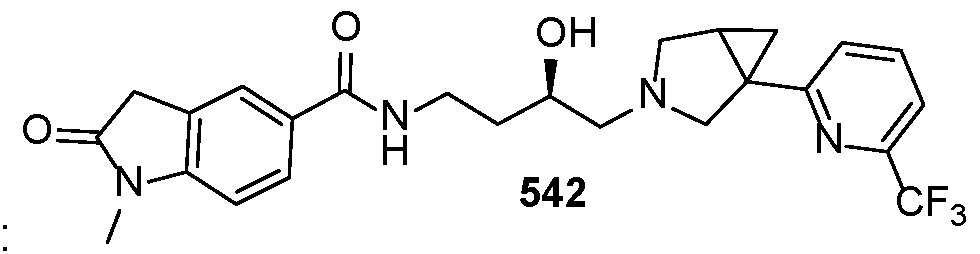
[0317] Compound 542 synthesis according to Scheme 39 is depicted in FIG. 53. [0318] fert-Butyl 1-(6-(trifluoromethyl)pyridin-2-yl)-3-azabicyclo[3.1.0]hexane-3- carboxylate (Compound 42): To a stirring solution of 2-iodo-6- (trifluoromethyl)pyridine (566 mg, 2.08 mmol) and tert-butyl 1-(trifluoro-l4-boraneyl)- 3-azabicyclo[3.1.0]hexane-3-carboxylate, potassium salt (600 mg, 2.08 mmol) in toluene (25.9 mL, 0.04 molar)and H2O (2.59 mL, 0.40 molar) was added cesium carbonate (2.03 g, 6.23 mmol). The solution was degassed with N2 for 10 mins and palladium^ I) acetate (46.6 mg, 208 pmol) and di((3S,5S,7S)-adamantan-1 - yl)(butyl)phosphane (149 mg, 415 pmol) were added. The reaction was refluxed for 18 hours at 90 °C. The crude product was purified using flash column chromatography (0-100% ethyl acetate-hexane) to obtain the target compound 42 (538 mg, 79%) as a yellow oil. 1 H NMR (400 MHz, CDCI3) 5 7.75 (t, J = 7.8 Hz, 1 H), 7.45 (d, J = 7.7 Hz, 1 H), 7.32 - 7.20 (m, 1 H), 4.07 - 3.82 (m, 2H), 3.70 (dd, J = 40.8, 10.8 Hz, 1 H), 3.50 (dd, J = 10.8, 4.0 Hz, 1 H), 2.19 (d, J = 17.1 Hz, 1 H), 1.48 (s, 10H), 1.02 (t, J = 4.8 Hz, 1 H).

[0319] 1-(6-(Trifluoromethyl)pyridin-2-yl)-3-azabicyclo[3.1.0]hexane
(Compound 45): To a stirring solution of compound 42 (538 mg, 1 .64 mmol) in methylene chloride (10 mL), was added trifluoroacetic acid (2 mL). The mixture was stirred for 16 hours at ambient temperature after which the solvent was evaporated. The crude product was directly taken forward for the next reaction without purification. A general procedure for epoxide (R)-3 opening with pyrrolidines and piperazines and other secondary amines (“Method A”) was followed. To a solution of
(/?)-3 (1 equiv) in 2-propanol (10 mL/mmol) was added pyrrolidines or piperazines (1 equiv). The insoluble reaction mixture was heated at 80 °C to get a clear solution and then stirred at the same temperature for 24 hours. The solvent was removed in vacuo, and the crude product was purified by flash column chromatography (silica gel, 0-100% acetone in hexanes or MeOH in DCM (0-10%) to give epoxide opened products.
Synthesis of:

[0320] 2-((3R)-3-Hydroxy-4-(1 -(6-(trifluoromethyl)pyridin-2-yl)-3- azabicyclo[3.1 ,0]hexan-3-yl)butyl)isoindoline-1 ,3-dione (Compound 46): Compound 46 was synthesized according to general method A, using (R)-2-(2-(oxiran-2- yl)ethyl)isoindoline-1 , 3-dione (381 mg, 1.75 mmol), and compound 45 (400 mg, 1.75 mmol). The pure product, compound 46 (600 mg, 77%) was obtained as a colorless oil. 1 H NMR (400 MHz, CDCh) 5 7.85 (dt, J = 5.5, 2.7 Hz, 2H), 7.71 (dtd, J = 7.3, 3.7, 1.7 Hz, 3H), 7.50 - 7.36 (m, 1 H), 7.18 (d, J = 8.0 Hz, 1 H), 4.10 - 3.03 (m, 7H), 2.95 - 2.41 (m, 3H), 2.06 (ddt, J = 10.3, 8.2, 4.2 Hz, 1 H), 1 .88 - 1 .66 (m, 2H), 1 .56 (s, 1 H), 1 .29 (dt, J = 9.2, 4.7 Hz, 1 H). A general procedure for phthalyl deprotection (“Method B”) was followed. Anhydrous hydrazine (5 equiv) was added to a suspension of phthalyl protected amine (1 equiv) in anhydrous ethanol (10 mL/mmol), and the mixture was refluxed for 3-12 hours under nitrogen atmosphere. Solvent was removed, and the resulting residue was partitioned between DCM and a 20% aqueous K2CO3 solution. The layers were separated, and the organic layer was washed with water and brine. The organic layer was dried over Na2SO4, filtered, and the solvent removed in vacuo to give the amine, which was used for the next step without further purification.
Synthesis of:

[0321] (2R)-4-Amino-1 -(1 -(6-(trifluoromethyl)pyridin-2-yl)-3-azabicyclo[3.1 .0]hexan- 3-yl)butan-2-ol (Compound 48): Compound 48 was synthesized according to general
method B, using Compound 46 (0.590 mg, 1.32 mmol), and anhydrous hydrazine (0.233 mL, 6.62 mmol). The product, Compound 48 was obtained after solvent removal as a viscous oil, which was used for the preparation amide analog without further purification. A general procedure for preparation amide with HATLI (“Method C”) was followed. In a 25 mL round-bottomed flask or a screw capped vial equipped with a magnetic stir bar was dissolved the primary amine (1 equiv), acid (0.95 equiv) in DCM (8 mL/mmol). Triethylamine (TEA) (2 equiv) and HATLI (1 equiv) were added sequentially to the reaction mixture. The reaction mixture was stirred overnight, diluted with water (5 mL), and extracted with DCM (3 x 10 mL). The combined organic layers were washed with K2CO3 (10 mL), brine (2 x 10 mL), dried over anhydrous Na2SO4, filtered, and concentrated under reduced pressure to get crude residue. The residue was purified by flash column chromatography (silica gel, 0-40% MeOH in DCM or 0-100% acetone in hexanes) to get amide.
[0322] A/-((3R)-3-Hydroxy-4-(1-(6-(trifluoromethyl)pyridin-2-yl)-3- azabicyclo[3.1 ,0]hexan-3-yl)butyl)-1-methyl-2-oxoindoline-5-carboxamide (Compound 542): Compound 542 was synthesized according to general method C, using compound 48 (80 mg, 0.25 mmol), TEA (69 pL, 0.51 mmol), HATU (96 mg, 0.25 mmol) and 1-methyl-2-oxoindoline-5-carboxylic acid (46 mg, 0.24 mmol). The pure product, compound 542 (95 mg, 77%) was obtained as a white solid.
[0323] 1 H NMR (400 MHz, MeOD) 5 7.92 (t, J = 7.9 Hz, 1 H), 7.85 (ddd, J = 8.2, 2.9, 1 .9 Hz, 1 H), 7.77 (dd, J = 3.1 , 1 .8 Hz, 1 H), 7.59 (d, J = 7.6 Hz, 1 H), 7.43 (t, J = 7.3 Hz, 1 H), 7.04 (dd, J = 8.2, 3.6 Hz, 1 H), 4.03 - 3.83 (m, 1 H), 3.73 (t, J = 9.8 Hz, 1 H), 3.63 - 3.40 (m, 4H), 3.33 (p, J = 1 .7 Hz, 2H), 3.24 (d, J = 2.8 Hz, 3H), 3.19 - 2.84 (m, 3H), 2.24 (d, J = 8.8 Hz, 1 H), 1.87 (dddd, J = 11 .5, 7.5, 3.7, 2.5 Hz, 1 H), 1 .77 - 1.55 (m, 2H), 1.46 (dd, J = 8.4, 5.0 Hz, 1 H); 13C NMR (100 MHz, MeOD) 5 177.6, 170.1 , 149.5, 148.5, 148.2, 139.3, 129.75, 129.74, 128.9, 126.2, 124.3, 124.3, 123.6, 123.58 118.6, 109.1 , 67.2, 62.0, 58.3, 57.4, 56.5, 54.8, 37.6, 36.0, 28.1 , 26.6. UPLC/MS purity >95% (CH3CN: 95%, fa= 2.30 min), (MeOH: 95%, fa= 3.09 min), C25H27F3N4O3488.51 , observed [M+1]+ 489.29.

[0324] Compound 543 synthesis according to Scheme 40 is depicted in FIG. 54. A general procedure for preparation amide with HATLI (“Method A”) was followed. In a 25 mL round-bottomed flask or a screw capped vial equipped with a magnetic stir bar was dissolved the primary amine (1 equiv), acid (0.95 equiv) in DCM (8 mL/mmol). Triethylamine (TEA) (2 equiv) and HATLI (1 equiv) were added sequentially to the reaction mixture. The reaction mixture was stirred overnight, diluted with water (5 mL), and extracted with DCM (3 x 10 mL). The combined organic layers were washed with K2CO3 (10 mL), brine (2 x 10 mL), dried over anhydrous Na2SO4, filtered, and concentrated under reduced pressure to get crude residue. The residue was purified by flash column chromatography (silica gel, 0-40% MeOH in DCM or 0-100% acetone in hexanes) to get amide.
[0325] A/-((3R)-4-(3-(2-Fluoro-4-(trifluoromethyl)phenyl)pyrrolidin-1-yl)-3- hydroxybutyl)-1-methyl-2-oxoindoline-5-carboxamide (Compound 543): Compound 543 was synthesized according to general method A, using 1-methyl-2-oxoindoline- 5-carboxylic acid (98 mg, 512 pmol), triethylamine (104 mg, 1.02 mmol), HATU (195 mg, 512 pmol) and (2R)-4-amino-1-(3-(2-fluoro-4-(trifluoromethyl)phenyl)pyrrolidin-1- yl)butan-2-ol (164 mg, 512 pmol). The crude compound was purified by flash column chromatography (silica gel, 10-30% MeOH in DCM) to obtain compound 543 as light brown solid (139 mg, 55%). 1H NMR (400 MHz, DMSO) 5 8.36 - 8.32 (m, 1 H), 7.84 - 7.76 (m, 1 H), 7.75 (t, J = 2.1 Hz, 1 H), 7.73 - 7.71 (m, 1 H), 7.62 - 7.46 (m, 2H), 7.03 (dd, J = 8.2, 3.5 Hz, 1 H), 4.55 (s, 1 H), 3.68 (s, 1 H), 3.62 - 3.51 (m, 3H), 3.45 - 3.36 (m, 2H), 3.15 (s, 3H), 2.95 - 2.84 (m, 1 H), 2.77 (t, J = 7.2 Hz, 1 H), 2.72 - 2.58 (m, 2H), 2.49 - 2.41 (m, 1 H), 2.32 - 2.16 (m, 1 H), 1.89 - 1.69 (m, 2H), 1.57 - 1.47 (m, 1 H); 13C NMR (100 MHz, DMSO) 5 174.6, 165.8, 160.8, 158.3, 147.4, 129.9, 128.1 , 127.2, 124.5, 123.0, 121.4, 112.5, 111.0, 107.5, 106.4, 72.5, 66.8, 61.9, 60.2, 54.2, 36.4, 35.1 , 34.9, 31.5, 25.9. UPLC/MS purity >95% (CH3CN: 95.5%, fa = 2.34 min), (MeOH: 95.3%, fa = 3.21 min), C25H27F4N3O3 MW 493.5, observed [M+H]+494.3.

Synthesis of:
[0326] Compound 544 synthesis according to Scheme 41 is depicted in FIG. 55. [0327] A general procedure for preparation amide with HATLI (“Method C”). In a 25 mL round-bottomed flask or a screw capped vial equipped with a magnetic stir bar was dissolved the primary amine (1 equiv), acid (0.95 equiv) in DCM (8 mL/mmol). Triethylamine (TEA) (2 equiv) and HATLI (1 equiv) were added sequentially to the reaction mixture. The reaction mixture was stirred overnight, diluted with water (5 mL), and extracted with DCM (3 x 10 mL). The combined organic layers were washed with K2CO3 (10 mL), brine (2 x 10 mL), dried over anhydrous Na2SO4, filtered, and concentrated under reduced pressure to get crude residue. The residue was purified by flash column chromatography (silica gel, 0-40% MeOH in DCM or 0- 100% acetone in hexanes) to get amide.
[0328] A/-((R)-3-Hydroxy-4-(4-(2-methoxyphenyl)piperazin-1 -yl)butyl)-2-methyl- 4,5,6,7-tetrahydro-2/-/-indazole-5-carboxamide (Compound 544): Compound 544 was synthesized according to general method C, using 2-methyl-4,5,6,7-tetrahydro- 2/-/-indazole-5-carboxylic acid (45 mg, 0.25 mmol), TEA (74 pL, 0.53 mmol), HATU (0.10 g, 0.26 mmol) and compound 277 (74 mg, 0.26 mmol). The pure product, compound 544 (87 mg, 74%) was obtained as a white solid. 1 H NMR (400 MHz, CD2CI2) 5 7.08 (s, 1 H), 7.02 - 6.83 (m, 4H), 6.42 (s, 1 H), 3.83 (s, 4H), 3.76 (s, 3H), 3.56 (dddt, J = 15.7, 6.8, 5.2, 2.7 Hz, 1 H), 3.32 - 3.19 (m, 1 H), 3.14 - 3.00 (m, 4H), 2.94 - 2.54 (m, 9H), 2.47 - 2.35 (m, 3H), 2.10 (dt, J = 13.7, 2.7 Hz, 1 H), 1.84 (dtdd, J = 13.5, 11.3, 5.6, 2.4 Hz, 1 H), 1.73 - 1.59 (m, 1 H), 1.55 - 1.40 (m, 1 H); 13C NMR (100 MHz, CD2CI2) 5 175.3, 152.8, 147.9, 141.7, 127.4, 123.1 , 121.3, 118.5, 114.7, 111.8, 66.0, 64.3, 55.6, 50.8, 42.9, 38.8, 37.6, 34.2, 27.6, 24.3, 24.2, 22.9. UPLC/MS purity >96% (CH3CN: 97%, fR= 1.84 min), (MeOH: 96%, fR= 2.69 min), C24H35N5O3 MW 441 .58, observed [M+1 ]+ 442.37.
Synthesis of:

[0329] Compound 555 synthesis according to Scheme 42 is depicted in FIG. 56. A general procedure for preparation amide with HATLI (“Method C”) was followed. In a 25 mL round-bottomed flask or a screw capped vial equipped with a magnetic stir bar was dissolved the primary amine (1 equiv), acid (0.95 equiv) in DCM (8 mL/mmol). Triethylamine (TEA) (2 equiv) and HATLI (1 equiv) were added sequentially to the reaction mixture. The reaction mixture was stirred overnight, diluted with water (5 mL), and extracted with DCM (3 x 10 mL). The combined organic layers were washed with K2CO3 (10 mL), brine (2 x 10 mL), dried over anhydrous Na2SO4, filtered, and concentrated under reduced pressure to get crude residue. The residue was purified by flash column chromatography (silica gel, 0-40% MeOH in DCM or 0-100% acetone in hexanes) to get amide.
[0330] (R)-/V-(3-Hydroxy-4-(4-(2-methoxyphenyl)piperazin-1 -yl)butyl)-1 -methyl-2- oxo-1 ,2,3, 4-tetrahydroquinoline-6-carboxamide (Compound 555): Compound 555 was synthesized according to general method C, using 1 -methyl-2-oxo-1 ,2,3,4- tetrahydroquinoline-6-carboxylic acid (42 mg, 0.20 mmol), TEA (60 pL, 0.43 mmol), HATU (82 mg, 0.21 mmol) and compound 277 (60 mg, 0.21 mmol). The pure product, compound 555 (60 mg, 60%) was obtained as a white solid. 1H NMR (400 MHz, CD2CI2) 5 7.72 - 7.59 (m, 2H), 7.20 (s, 1 H), 7.06 - 6.94 (m, 2H), 6.93 - 6.83 (m, 3H), 3.93 (s, 1 H), 3.83 (s, 3H), 3.77 (ddd, J = 13.4, 6.8, 4.8 Hz, 1 H), 3.42 (dq, J = 13.4, 4.2 Hz, 1 H), 3.33 (s, 3H), 3.10 (s, 4H), 2.97 - 2.80 (m, 4H), 2.62 (dd, J = 8.6, 6.2 Hz, 4H), 2.47 (d, J = 9.0 Hz, 2H), 1 .79 (td, J = 10.7, 8.9, 4.6 Hz, 1 H), 1 .59 (dtd, J = 13.7, 8.7, 4.7 Hz, 1 H). UPLC/MS purity >89% (CH3CN: 89%, fa= 1.97 min), (MeOH: 91 %, fa= 2.76 min), C26H34N4O4 MW 466.58, observed [M+1]+ 467.41.
Synthesis of:

[0331] Compound 556 synthesis according to Scheme 43 is depicted in FIG. 57. A general procedure for preparation amide with HATLI (“Method A”) was followed. In a 25 mL round-bottomed flask or a screw capped vial equipped with a magnetic stir bar was dissolved the primary amine (1 equiv), acid (0.95 equiv) in DCM (8 mL/mmol). Triethylamine (TEA) (2 equiv) and HATLI (1 equiv) were added sequentially to the reaction mixture. The reaction mixture was stirred overnight, diluted with water (5 mL), and extracted with DCM (3 x 10 mL). The combined organic layers were washed with K2CO3 (10 mL), brine (2 x 10 mL), dried over anhydrous Na2SO4, filtered, and concentrated under reduced pressure to get crude residue. The residue was purified by flash column chromatography (silica gel, 0-40% MeOH in DCM or 0-100% acetone in hexanes) to get amide.
[0332] (R)-/V-(3-Hydroxy-4-(4-(2-methoxyphenyl)-3,6-dihydropyridin-1 (2/-/)-yl)butyl)- 1 ,3,3-trimethyl-2-oxoindoline-5-carboxamide (Compound 556): Compound 556 was synthesized according to general method A, using 1 ,3,3-trimethyl-2-oxoindoline-5- carboxylic acid (56 mg, 0.25 mmol), triethylamine (51 mg, 0.51 mmol), HATU (96 mg, 0.25 mmol) and (R)-4-amino-1-(4-(2-methoxyphenyl)-3,6-dihydropyridin-1 (2/-/)- yl)butan-2-ol (70 mg, 0.25 mmol). The crude compound was purified by flash column chromatography (silica gel, 10-30% MeOH in DCM) to obtain compound 556 as off white solid (84 mg, 69%). 1H NMR (400 MHz, DMSO) 5 8.37 (s, 1 H), 7.87 - 7.79 (m, 2H), 7.25 (t, J = 7.5 Hz, 1 H), 7.15 - 7.05 (m, 2H), 6.99 (d, J = 8.2 Hz, 1 H), 6.91 (t, J = 7.4 Hz, 1 H), 5.74 (s, 1 H), 4.62 (s, 1 H), 3.81 (s, 1 H), 3.76 (s, 3H), 3.46 - 3.43 (m, 3H), 3.31 (s, 2H), 3.18 (s, 1 H), 3.17 (s, 3H), 2.09 (s, 4H), 1.79 (d, J = 11.3 Hz, 1 H), 1.55 (s, 1 H), 1.29 (s, 6H);13C NMR (100 MHz, CDCh) 5 181.6, 159.7, 156.6, 145.4,
143.6, 135.9, 129.2, 128.7, 127.1 , 121.7, 120.7, 113.3, 110.8, 107.5, 104.4, 92.1 , 88.0, 77.9, 77.2, 65.6, 60.2, 55.4, 52.2, 50.0, 44.2, 26.3. UPLC/MS purity >86% (CH3CN: 89.6%, fa = 2.31 min), (MeOH: 86.4%, fa = 3.13 min), C28H35N3O4 MW
477.6, observed [M+H]+478.3.
Synthesis of:

[0333] Compound 557 synthesis according to Scheme 44 is depicted in FIG. 58. TBS-deprotection with TBAF (“Method C”) was followed. To a stirring solution of TBS-protected urea compound (1 equiv) in THF (0.05 M) was added TBAF (1 M in THF; 2-3 equiv) at 0 °C. The resulting mixture was stirred at room temperature for 2- 16 hours. The solvent was evaporated, and the crude product was purified using flash column chromatography (0-100% acetone-MeOH (2% aq. NH3 added) to obtain the final target compound.
[0334] (R)-/V-(3-Hydroxy-4-(4-(2-methoxyphenyl)-3,6-dihydropyridin-1 (2/-/)-yl)butyl)- 1 ,3-dihydro-2/-/-pyrrolo[3,4-c]pyridine-2-carboxamide (Compound 557): Compound 557 was synthesized according to general method C, using (R)-/V-(3-((fe/Y- butyldimethylsilyl)oxy)-4-(4-(2-methoxyphenyl)-3,6-dihydropyridin-1 (2/-/)-yl)butyl)-1 ,3- dihydro-2/-/-pyrrolo[3,4-c]pyridine-2-carboxamide (322 mg, 600 pmol) and 1 M TBAF in THF solution (10 mL) at 0 °C. The crude compound was purified through column chromatography using (0-50% DCM-MeOH & 2% aq. NH3 added) to afford compound 557 as light brown gummy (120 mg, 47%). 1 H NMR (400 MHz, DMSO) 5 8.56 (s, 1 H), 8.47 (d, J = 5.1 Hz, 1 H), 7.38 (d, J = 5.0 Hz, 1 H), 7.23 (ddd, J = 8.7,
7.3, 1 .8 Hz, 1 H), 7.11 (dd, J = 7.5, 1 .8 Hz, 1 H), 6.97 (d, J = 8.2 Hz, 1 H), 6.89 (td, J =
7.4, 1 .0 Hz, 1 H), 6.44 (t, J = 5.5 Hz, 1 H), 5.75 - 5.69 (m, 1 H), 4.62 (dd, J = 6.6, 2.4 Hz, 4H), 4.57 (s, 1 H), 3.75 (s, 4H), 3.30 - 3.12 (m, 4H), 3.13 (s, 1 H), 2.66 (s, 2H), 2.43 (s, 4H), 1 .76 - 1 .68 (m, 1 H), 1 .57 (s, 1 H), 1 .49 -1 .41 (m, 1 H), 1.34 - 1 .27 (m, 1 H), 0.94 (t, J = 7.3 Hz, 1 H); 13C NMR (100 MHz, DMSO) 5 168.1 , 156.5, 156.4, 147.8, 146.3, 144.3, 134.5, 133.6, 128.6, 128.1 , 120.3, 118.2, 111.2, 55.2, 51.3, 50.5, 49.6, 45.9, 37.1 , 36.0, 33.6, 29.1 , 23.0, 13.4. UPLC/MS purity >95% (CH3CN: 95.0%, fa = 2.01 min), (MeOH: 96.6%, fa = 2.93 min), C24H30N4O3 MW 422.5, observed [M+H]+423.3.
Synthesis of:

[0335] Compound 560 synthesis according to Scheme 45 is depicted in FIG. 59. TBS-deprotection with 4N HCI in dioxane (“Method B”) was followed. To a stirring solution of TBS-protected urea compound (1 equiv) in 1 ,4-dioxane (0.05 M) was added HCI (4 M in 1 ,4-dioxane; 3-6 equiv) at 0 °C. The resulting mixture was stirred at room temperature for 2-16 hours. The solvent was evaporated and washed with saturated K2CO3 solution (x 2) and dried over Na2SO4, and the crude product was purified using flash column chromatography (0-100% acetone-MeOH (2% aq. NH3 added) to obtain the final target compound.
[0336] (R)-/V-(4-(4-(3-Fluoro-2-methoxyphenyl)piperazin-1 -yl)-3-hydroxybutyl)-1 ,3- dihydro-2/-/-pyrrolo[3,4-c]pyridine-2-carboxamide (Compound 560): Compound 560 was synthesized according to general method B, using (R)-/V-(3-((fe/Y- Butyldimethylsilyl)oxy)-4-(4-(3-fluoro-2-methoxyphenyl)piperazin-1 -yl)butyl)-1 ,3- dihydro-2/-/-pyrrolo[3,4-c]pyridine-2-carboxamide (255 mg, 457 pmol), and 4N HCI in 1 ,4-dioxane (10 mL). The crude compound was purified through column chromatography using (0-50% DCM-MeOH & 2% aq. NH3 added) to obtain compound 560 as light pink gummy liquid (68 mg, 39%). 1H NMR (400 MHz, DMSO- cfe) 5 8.58 (s, 1 H), 8.51 - 8.45 (m, 1 H), 7.41 (d, J = 5.0 Hz, 1 H), 7.05 - 6.99 (m, 1 H), 6.92 - 6.83 (m, 1 H), 6.76 (d, J = 8.2 Hz, 1 H), 6.53 (t, J = 5.6 Hz, 1 H), 5.16 (s, 0.5H), 4.64 (s, 2H), 4.62 (s, 2H), 4.24 (s, 0.5H), 3.89 (s, 1 H), 3.80 (s, 3H), 3.22 - 3.02 (m, 8H), 3.02 (s, 2H), 2.76 (s, 2H), 1 .70 - 1 .59 (m, 1 H), 1 .54 - 1 .45 (m, 1 H); 13C NMR (100 MHz, DMSO) 5 157.0, 156.7, 154.6, 147.8, 146.4, 144.2, 139.68, 139.56, 133.5, 124.10, 124.00, 118.3, 114.1 , 109.9, 59.8, 59.7, 51.3, 49.6, 48.5, 36.6, 35.7, 30.6. UPLC/MS purity >95% (CH3CN: 98.9%, fa = 2.01 min), (MeOH: 97.7%, fa = 2.94 min), C23H30FN5O3 MW 443.5, observed [M+H]+444.3.
Synthesis of:

[0337] Compound 561 synthesis according to Scheme 46 is depicted in FIG. 60. Urea analog synthesis (“Method F”) was followed. To a stirring solution of amine or amine*HCI salt (1 .2-3 equiv) in 1 ,4-dioxane (0.10 M) was added Hunig’s base (5-6 equiv) and the reaction was stirred for 30 minutes. To this was added carbamate or 4-Nitrophenylchloroformate (1 equiv) and the resulting mixture was stirred at 90 °C for 24 hours. The solvent was removed under reduced pressure to get the crude product, which was purified using flash column chromatography (0-50% DCM-MeOH and 5-10% NH4OH) to obtain pure urea compound.

[0338] (R)-/V-(3-((fe/t-Butyldimethylsilyl)oxy)-4-(4-(2-methoxyphenyl)piperazin-1 - yl)butyl)-6-methyl-1 ,3-dihydro-2H-pyrrolo[3,4-c]pyridine-2-carboxamide (Compound 12): Compound 12 was synthesized following the general method F from compound 233 (370 mg, 0.662 mmol), 6-methyl-2,3-dihydro-1 H-pyrrolo[3,4-c]pyridine hydrochloride (113 mg, 0.662 mmol) and using DIPEA (577 pL, 3.31 mmol) in 1 ,4- dioxane (6.0 mL, 0.1 molar), the crude urea compound was used for the next reaction without further purification. TBS-deprotection with 4 N HCI in dioxane (“Method G”) was followed. To a stirring solution of TBS-protected urea compound (1 equiv) in 1 ,4-dioxane (0.05 M) was added HCI (4 N in 1 ,4-dioxane; 3-6 equiv) at 0 °C. The resulting mixture was stirred at room temperature for 2-4 hours. The solvent was evaporated, then the crude was diluted with CH2CI2 and washed with saturated K2CO3 solution at 0 °C and stir for 15 minutes. The reaction was extracted with DCM, washed with brine, dried over Na2SO4, filtered, and concentrated to give the crude
product, which was purified using flash column chromatography (0-50% DCM-MeOH (2-5% aq. NH3 added) to obtain the final target compound.
Synthesis of:

[0339] (R)-/V-(3-Hydroxy-4-(4-(2-methoxyphenyl)piperazin-1 -yl)butyl)-6-methyl-1 ,3- dihydro-2H-pyrrolo[3,4-c]pyridine-2-carboxamide (Compound 561 ): Compound 561 was synthesized following the general method G using compound 12 (250 mg, 0.514 mmol), 4 /V HCI in dioxane (770 pL, 3.08 mmol), in dioxane (8.00 mL, 0.06 molar). The crude product was purified using flash column chromatography (0-20% DCM- MeOH and 5% NH4OH) to obtain the target compound 561 in 64% yield as a white foam. 1H N MR (400 MHz, CDCI3) 5 8.43 (s, 1 H), 7.09 (s, 1 H), 7.05 - 6.98 (m, 1 H), 6.97 - 6.90 (m, 2H), 6.87 (d, J = 7.7 Hz, 1 H), 5.56 (dd, J = 14.7, 11 .5 Hz, 1 H), 4.68 (s, 4H), 3.87 (s, J = 5.1 Hz, 3H), 3.70 (ddd, J = 13.1 , 10.9, 6.5 Hz, 1 H), 3.33 (ddd, J =
12.9, 7.9, 3.8 Hz, 1 H), 3.10 (s, 4H), 2.89 (dd, J = 10.6, 5.0 Hz, 2H), 2.63 (d, J = 5.9 Hz, 2H), 2.57 (s, 3H), 2.47 - 2.37 (m, 2H), 1.82 - 1.70 (m, 2H), 1.55 (dtd, J = 13.5,
8.9, 4.3 Hz, 1 H). 13C NMR (100 MHz, CDCI3) 5 157.3, 156.9, 152.4, 147.2, 143.7, 141.2, 130.6, 123.2, 121.1 , 118.3, 117.6, 111.3, 66.8, 63.9, 55.5, 53.5, 51.5, 50.9, 49.6, 39.4, 34.0, 24.4. UPLC/MS purity (CH3CN: 98%, fa = 1.88 min), MeOH: 97%, fa = 2.83 min), C24H33N5O3 MW 439.56, observed [M+H] + 440.33.

[0340] Compound 562 synthesis according to Scheme 47 is depicted in FIG. 61 .

Synthesis of:
[0341] 5-Methoxyoctahydro-1H-4,7-methanoindene-2-carboxylic acid (Compound 47): The aldehyde (200 mg, 1.03 mmol) was dissolved in DMF (0.1 M). Oxone (633 mg, 1.03 mmol) was added in one portion and stirred at room temperature for 3 hours. The reactions were monitored by TLC. 1 N HCI was used to dissolve the salts and EtOAc was added to extract the products. The organic extract was washed with 1 N HCI (3x) and brine, dried over Na2SO4, and the solvent was removed under reduced pressure to obtain the crude compound 47 (168 mg, 78%), which was used in the next step without further purification. A general procedure for preparation amide with HATLI (“Method C”) was followed. In a 25 mL round- bottomed flask or a screw capped vial equipped with a magnetic stir bar was dissolved the primary amine (1 equiv), acid (0.95 equiv) in DCM (8 mL/mmol). Triethylamine (TEA) (2 equiv) and HATLI (1 equiv) were added sequentially to the reaction mixture. The reaction mixture was stirred overnight, diluted with water (5 mL), and extracted with DCM (3 x 10 mL). The combined organic layers were washed with K2CO3 (10 mL), brine (2 x 10 mL), dried over anhydrous Na2SO4, filtered, and concentrated under reduced pressure to get crude residue. The residue was purified by flash column chromatography (silica gel, 0-40% MeOH in DCM or 0- 100% acetone in hexanes) to get amide.
[0342] /V-((R)-3-Hydroxy-4-(4-(2-methoxyphenyl)piperazin-1 -yl)butyl)-5- methoxyoctahydro-1 /-/-4,7-methanoindene-2 -carboxamide (Compound 562): Compound 562 was synthesized according to general method C, using compound 47 (64 mg, 0.31 mmol), TEA (91 pL, 0.64 mmol), HATU (0.12 g, 0.32 mmol) and compound 277 (90 mg, 0.32 mmol). The pure product, compound 562 (120 mg, 79%) was obtained as a white solid. 1 H NMR (400 MHz, CD2CI2) 5 7.06 - 6.94 (m, 1 H), 6.94 - 6.81 (m, 3H), 6.48 - 6.26 (m, 1 H), 4.79 (s, 1 H), 3.83 (s, 4H), 3.66 - 3.47 (m, 1 H), 3.32 - 2.49 (m, 15H), 2.25 - 1.16 (m, 14H), 1.12 - 0.93 (m, 1 H). UPLC/MS purity >98% (CH3CN: 98%, fR= 2.28 min, 2.32 min, 2.34 min), (MeOH: 99%, fa= 3.12 min, 3.19 min), C27H41 N3O4 MW 471.64, observed [M+1 ]+ 472.41.
Synthesis of:

[0343] Compound 563 synthesis according to Scheme 48 is depicted in FIG. 62. A general procedure for preparation amide with HATLI (“Method C”) was followed. In a 25 mL round-bottomed flask or a screw capped vial equipped with a magnetic stir bar was dissolved the primary amine (1 equiv), acid (0.95 equiv) in DCM (8 mL/mmol). Triethylamine (TEA) (2 equiv) and HATLI (1 equiv) were added sequentially to the reaction mixture. The reaction mixture was stirred overnight, diluted with water (5 mL), and extracted with DCM (3 x 10 mL). The combined organic layers were washed with K2CO3 (10 mL), brine (2 x 10 mL), dried over anhydrous Na2SO4, filtered, and concentrated under reduced pressure to get crude residue. The residue was purified by flash column chromatography (silica gel, 0-40% MeOH in DCM or 0-100% acetone in hexanes) to get amide.
[0344] (R)-/V-(3-Hydroxy-4-(4-(2-methoxyphenyl)piperazin-1 -yl)butyl)-6,7-dihydro- 4/-/-thieno[3,2-c]pyran-2-carboxamide (Compound 563): Compound 563 was synthesized according to general method C, using 6,7-dihydro-4/-/-thieno[3,2- c]pyran-2-carboxylic acid (53 mg, 0.29 mmol), TEA (86 pL, 0.61 mmol), HATU (0.12 g, 0.30 mmol) and compound 277 (85 mg, 0.30 mmol). The pure product, compound 563 (0.11 g, 81 %) was obtained as a white solid. 1 H NMR (400 MHz, CD2CI2) 5 7.11 (s, 1 H), 7.05 (d, J = 5.6 Hz, 1 H), 7.01 - 6.92 (m, 1 H), 6.92 - 6.80 (m, 3H), 4.62 (d, J = 1.7 Hz, 2H), 4.29 (s, 1 H), 3.97 - 3.85 (m, 3H), 3.82 (s, 3H), 3.73 (dtd, J = 13.8, 6.9, 4.7 Hz, 1 H), 3.42 - 3.30 (m, 1 H), 3.10 (s, 4H), 2.97 - 2.81 (m, 4H), 2.70 (d, J = 10.2 Hz, 2H), 2.58 - 2.42 (m, 2H), 1 .76 (dddd, J = 14.4, 7.3, 4.7, 2.7 Hz, 1 H), 1 .56 (tdd, J = 9.4, 8.0, 4.2 Hz, 1 H); 13C NMR (100 MHz, CD2CI2) 5 162.3, 152.8, 141.4, 138.0, 136.6, 135.1 , 124.8, 123.3, 121.3, 118.5, 111.9, 66.27, 66.25, 65.0, 63.9, 55.6, 50.5, 38.3, 33.9, 26.0. UPLC/MS purity >97% (CH3CN: 97%, fR= 2.08 min), (MeOH: 97%, fR= 2.89 min), C23H31 N3O4S MW 445.58, observed [M+1 ]+ 446.27.
Synthesis of:

[0345] Compound 564 synthesis according to Scheme 49 is depicted in FIG. 63. A general procedure for preparation amide with HATLI (“Method A”) was followed. In a 25 mL round-bottomed flask or a screw capped vial equipped with a magnetic stir bar was dissolved the primary amine (1 equiv), acid (0.95 equiv) in DCM (8 mL/mmol). Triethylamine (TEA) (2 equiv) and HATLI (1 equiv) were added sequentially to the reaction mixture. The reaction mixture was stirred overnight, diluted with water (5 mL), and extracted with DCM (3 x 10 mL). The combined organic layers were washed with K2CO3 (10 mL), brine (2 x 10 mL), dried over anhydrous Na2SO4, filtered, and concentrated under reduced pressure to get crude residue. The residue was purified by flash column chromatography (silica gel, 0-40% MeOH in DCM or 0-100% acetone in hexanes) to get amide.
[0346] /V-((/?)-3-Hydroxy-4-(4-(2-methoxyphenyl)piperazin-1-y/)butyl)-5, 6,7,8- tetrahydroquinoline-6-carboxamide (Compound 564): Compound 564 was synthesized according to general method A, using 5,6,7,8-tetrahydroquinoline-6- carboxylic acid (51 mg, 0.21 mmol), triethylamine (59 mg), HATU (110 mg, 0.29 mmol) and (R)-4-amino-1-(4-(2-methoxyphenyl)piperazin-1-yl)butan-2-ol (81 mg, 0.29 mmol). The crude compound was purified by flash column chromatography (silica gel, 10-30% MeOH in DCM) to obtain compound 564 as white solid, (80 mg, 63%).1 H NMR (400 MHz, DMSO) 5 8.29 (dd, J = 4.8, 1 .7 Hz, 1 H), 7.92 (t, J = 5.6 Hz, 1 H), 7.51 - 7.44 (m, 1 H), 7.12 (dd, J = 7.7, 4.7 Hz, 1 H), 6.99 - 6.90 (m, 2H), 6.90 - 6.82 (m, 2H), 4.43 (s, 1 H), 3.77 (s, 3H), 3.70 (s, 1 H), 3.31 - 3.09 (m, 3H), 2.95 (s, 4H), 2.92 - 2.77 (m, 4H), 2.69 - 2.52 (m, 4H), 2.34 (s, 2H), 2.01 (t, J = 8.4 Hz, 1 H), 1.88 - 1.73 (m, 1 H), 1.72 - 1.60 (m, 1 H), 1.46 - 1.39 (m, 1 H); 13C NMR (100 MHz, DMSO) 5 174.0, 155.7, 151.9, 146.5, 141.4, 136.5, 130.7, 130.6, 128.2, 122.3, 121.1 , 120.8, 117.8, 111.8, 82.8, 70.3, 55.2, 53.5, 50.0, 35.6, 35.3, 31.2, 30.97, 30.92, 26.2. UPLC/MS purity >95% (CH3CN: 99.1 %, fa = 1.94 min), (MeOH: 99.2%, fa = 2.81 min), C25H34N4O3 MW 438.5, observed [M+H]+439.3.

[0347] Compound 565 synthesis according to Scheme 50 is depicted in FIG. 64.
Synthesis of:

[0348] Methyl 2-methyl-3-oxo-2-azaspiro[4.5]decane-8-carboxylate (Compound 14):To a cooled solution of 3-Oxo-2-azaspiro[4.5]decane-8-carboxylic acid (200 mg, 1.0 mmol) in anhydrous /V,/V-Dimethylformamide (5.0 mL) was added sodium hydride (60% dispersion in mineral oil, 122 mg, 3.03 mmol) and the resulting mixture was stirred for 10 minutes after which iodomethane (0.19 mL, 3.03 mmol) was added. The cooling batch was removed, and the reaction mixture was stirred for 2 hours at room temperature. The reaction was quenched with aqueous saturated ammonium chloride (15 mL) and the aqueous phase was extracted with ethyl acetate (2x50 mL). The combined organic phase was washed with water (3x50 mL) and brine solution, dried over Na2SO4, filtered, and evaporated. The crude product was purified using flash column chromatography (0-100% ethyl acetate-hexane) to obtain the target compound 14 (120 mg, 56%). 1H NMR (400 MHz, CDCh) 5 3.68 (s, 3H), 3.10 (s, 2H), 2.83 (s, 3H), 2.34 - 2.22 (m, 3H), 1.88 (dt, J = 13.0, 3.9 Hz, 2H), 1.79 - 1.66 (m, 2H), 1 .65 - 1 .48 (m, 2H), 1 .39 (td, J = 12.9, 3.7 Hz, 2H).

[0349] 2-Methyl-3-oxo-2-azaspiro[4.5]decane-8-carboxylic acid (Compound 16):
To a solution of compound 14 (120 mg, 0.53 mmol) in a 2:2:1 THF/MeOH/H2O mixture (5 mL) was added lithium hydroxide monohydrate (38.3 mg, 1 .6 mmol) at 25 °C. The reaction mixture was stirred for 16 hours, The solvents were distilled under
reduced pressure and 10 mL water added, washed with n-Hexanes (15 mL). To the aq. Layer pH was adjusted between pH 4 and pH 6 by dropwise addition of a 0.5 /V HCI solution. The mixture was extracted with EtOAc (3 x 25 mL). The combined organic fractions were washed with brine, dried over Na2SO4, filtered, and evaporated in vacuo. The resulting residue was used for the preparation of the amide analog without further purification compound 16 (75 mg, 67%). 1H NMR (400 MHz, DMSO) 5 12.04 (s, 1 H), 3.06 (s, 2H), 2.69 (s, 3H), 2.20 (ddd, J = 14.4, 8.6, 3.5 Hz, 1 H), 2.10 (s, 2H), 1.75 (dt, J = 13.7, 3.9 Hz, 2H), 1.64 - 1.52 (m, 2H), 1.51 - 1.29 (m, 5H).
[0350] A general procedure for preparation amide with HATU (“Method C”) was followed. In a 25 mL round-bottomed flask or a screw capped vial equipped with a magnetic stir bar was dissolved the primary amine (1 equiv), acid (0.95 equiv) in DCM (8 mL/mmol). Triethylamine (TEA) (2 equiv) and HATU (1 equiv) were added sequentially to the reaction mixture. The reaction mixture was stirred overnight, diluted with water (5 mL), and extracted with DCM (3 x 10 mL). The combined organic layers were washed with K2CO3 (10 mL), brine (2 x 10 mL), dried over anhydrous Na2SO4, filtered, and concentrated under reduced pressure to get crude residue. The residue was purified by flash column chromatography (silica gel, 0-40% MeOH in DCM or 0-100% acetone in hexanes) to get amide.
[0351] (R)-/V-(3-Hydroxy-4-(4-(2-methoxyphenyl)piperazin-1-yl)butyl)-2-methyl-3- oxo-2-azaspiro[4.5]decane-8-carboxamide (Compound 565): Compound 565 was synthesized according to general method C, using compound 4 (100 mg, 0.36 mmol), TEA (150 pL, 1 .07 mmol), HATU (136 mg, 0.36 mmol) and compound 16 (75 mg, 0.36 mmol). The pure product, compound 565 (120 mg, 71 %) was obtained as a white solid. 1H NMR (400 MHz, CD2CI2) 5 6.97 (td, J = 6.7, 3.1 Hz, 1 H), 6.93 - 6.81 (m, 3H), 6.46 (s, 1 H), 3.82 (s, 4H), 3.52 (dt, J = 13.0, 6.4 Hz, 1 H), 3.22 (ddt, J = 13.1 , 8.8, 4.8 Hz, 1 H), 3.06 (s, 5H), 2.85 - 2.70 (m, 5H), 2.62 - 2.49 (m, 2H), 2.43 - 2.31 (m, 2H), 2.23 (s, 2H), 2.04 (tt, J = 11.8, 3.6 Hz, 1 H), 1.86 - 1.60 (m, 5H), 1.60 - 1.18 (m, 7H); 13C NMR (100 MHz, CD2CI2) 5 175.3, 173.6, 152.7, 141.8, 123.0, 121.2, 118.5, 111.8, 66.2, 64.3, 63.0, 55.6, 51.0, 44.9, 41.7, 37.6, 36.5, 35.8, 34.2, 29.5, 26.4; UPLC/MS purity >97% (CH3CN: 98.7%, fa= 1.88 min), (MeOH: 97.3%, fa= 2.73 min), C26H40N4O4 MW 472.63, observed [M+1]+ 473.32.
Synthesis of:

[0352] Compound 566 synthesis according to Scheme 51 is depicted in FIG. 65. A general procedure for epoxide (R)-3 and (S)-3 opening with pyrrolidines and piperazines and other secondary amines (“Method A”) was followed. To a solution of (/?)-3 or (S)-3 (1 equiv) in 2-propanol (10 mL/mmol) was added pyrrolidines or piperazines (1 equiv). The reaction mixture was heated at 80 °C and stirred at the same temperature for 24 hours. The solvent was removed in vacuo, and the crude product was purified by flash column chromatography (silica gel, 0-100% acetone in hexanes or MeOH in DCM (0-10%) to give epoxide opened products.
Synthesis of:

[0353] 2-((3R)-4-(3-(2-Fluoro-4-(trifluoromethyl)phenyl)pyrrolidin-1 -yl)-3- hydroxybutyl)isoindoline-1 ,3-dione (Compound 25): Compound 25 was synthesized according to general method A, using (R)-2-(2-(oxiran-2-yl)ethyl)isoindoline-1 ,3- dione (1.1 g, 5.1 mmol), and 3-(2-fluoro-4-(trifluoromethyl)phenyl)pyrrolidine (1.19 g, 5.1 mmol) in Isopropanol (10 mL, 0.51 molar). The crude product was purified using flash column chromatography (0-20% MeOH/DCM) to obtain the target compound 25, 1.62 g in 71 % as a white solid. 1H NMR (400 MHz, CDCh) 5 7.88 - 7.82 (m, 2H), 7.74 - 7.68 (m, 2H), 7.44 (td, J = 7.6, 3.9 Hz, 1 H), 7.35 (dd, J = 8.1 , 2.5 Hz, 1 H), 7.29 - 7.23 (m, 1 H), 3.95 - 3.80 (m, 2H), 3.79 - 3.60 (m, 2H), 3.45 (d, J = 28.0 Hz, 1 H), 3.12 - 2.85 (m, 2H), 2.81 - 2.60 (m, 3H), 2.52 - 2.43 (m, 1 H), 2.41 - 2.27 (m, 1 H), 1.94 - 1.73 (m, 3H).; 13C NMR (100 MHz, CDCh) 5 161 .5, 129.2, 129.1 , 124.8, 121.2, 112.9, 112.6, 68.8, 68.7, 62.34, 62.30, 60.58, 60.51 , 54.4, 40.0, 39.9, 37.5, 37.4, 36.1 , 31 .9. A general procedure for phthalyl deprotection (“Method B”) was followed. Anhydrous hydrazine (5 equiv) was added to a suspension of phthalyl protected amine (1 equiv) in anhydrous ethanol (10 mL/mmol), and the mixture was refluxed overnight under nitrogen atmosphere. Solvent was removed, and the resulting residue was partitioned between DCM and a 20% aqueous K2CO3 solution.
The layers were separated, and the organic layer was washed with water and brine.
The organic layer was dried over Na2SO4, filtered, and the solvent removed in vacuo to give the amine, which was used for the next step without further purification.
Synthesis of:

[0354] (2/?)-4-Amino-1 -(3-(2-fluoro-4-(trifluoromethyl)phenyl)pyrrolidin-1 - yl)butan-2-ol (Compound 26): Compound 26 was synthesized following the general method B from compound 25 (1.62 g, 3.60 mmol) and using anhydrous hydrazine (580 pL, 18.0 mmol) in ethanol (20.0 mL, 0.18 molar) The crude product was used for the next step without further purification. After this operation 1 .07 g oil isolated. [0355] A general procedure for preparation amide with HATLI (“Method C”) was followed. In a 25 mL round-bottomed flask or a screw capped vial equipped with a magnetic stir bar was dissolved acid (0.95 equiv), in DCM (5 mL). TEA (2 equiv) and HATU (1 equiv) were added sequentially to the reaction mixture and stirred for 10 minutes at room temperature, and then the primary amine (1 equiv) was added at room temperature. The reaction mixture was stirred overnight, diluted with water (5 mL), and extracted with DCM (3 x 10 mL). The combined organic layers were washed with 20% aqueous K2CO3 solution (2 x 10 mL), dried over anhydrous Na2SO4, filtered, and concentrated under reduced pressure to get crude residue. The residue was purified by flash column chromatography (silica gel, 0-100% acetone in hexanes or 0-40% MeOH in DCM) to get amide.
[0356] N-((3R)-4-(3-(2-Fluoro-4-(trifluoromethyl)phenyl)pyrrolidin-1 -yl)-3- hydroxybutyl)-2-methyl-4,5,6,7-tetrahydro-2H-indazole-5-carboxamide (Compound 566): Compound 566 was synthesized following the general method C using 2- methyl-4,5,6,7-tetrahydro-2H-indazole-5-carboxylic acid (142 mg, 0.788 mmol), Compound 26 (252 mg, 0.788 mmol), DIPEA (0.41 mL, 2.36 mmol) and HATU (300 mg, 0.788 mmol) in CH2Cl2 (10 mL, 0.79 molar). The crude product was purified using flash column chromatography (0-20% MeOH/DCM) to obtain the target compound 566, 157 mg in 66% as a white solid. 1 H NMR (400 MHz, CDCh) 5 7.42 (dd, J = 13.0, 7.3 Hz, 1 H), 7.32 (d, J = 8.1 Hz, 1 H), 7.22 (d, J = 10.2 Hz, 1 H), 7.00 (s, 1 H), 6.87 (d, J = 5.0 Hz, 1 H), 3.86 - 3.77 (m, 1 H), 3.74 (s, 3H), 3.67 (dd, J = 15.6,
7.7 Hz, 1 H), 3.61 - 3.49 (m, 1 H), 3.30 - 2.95 (m, 3H), 2.91 - 2.49 (m, 8H), 2.37 (dddd, J = 21 .2, 16.9, 11 .3, 5.6 Hz, 2H), 2.12 - 2.03 (m, 1 H), 1 .99 - 1 .77 (m, 2H), 1.75 - 1.62 (m, 1 H), 1.54 - 1.44 (m, 1 H).; 13C NMR (100 MHz, CDCh) 5 175.76, 175.73, 175.71 , 161.5, 159.0, 147.7, 135.0, 134.9, 130.6, 130.3, 130.2, 129.2, 129.1 ,
127.4, 124.6, 121.9, 121.28, 121.24, 121.21 , 114.4, 113.0, 112.9, 112.7, 67.1 , 67.1 ,
61.4, 59.8, 54.2, 54.1 , 53.6, 53.4, 42.4, 41.9, 38.6, 36.8, 36.2, 36.1 , 34.1 , 31.4, 27.19, 27.14, 24.0, 23.9, 22.5, 18.0, 12.1. UPLC/MS purity (CH3CN: 97%, fa = 2.29 min), MeOH: 97%, fa = 3.17 min), C24H30F4N4O2 MW 482.52, observed [M+H] + 483.30.

Synthesis of:
[0357] Compound 567 synthesis according to Scheme 52 is depicted in FIG. 66. A general procedure for preparation amide with HATLI (“Method A”) was followed. In a 25 mL round-bottomed flask or a screw capped vial equipped with a magnetic stir bar was dissolved the primary amine (1 equiv), acid (0.95 equiv) in DCM (8 mL/mmol). Triethylamine (TEA) (2 equiv) and HATLI (1 equiv) were added sequentially to the reaction mixture. The reaction mixture was stirred overnight, diluted with water (5 mL), and extracted with DCM (3 x 10 mL). The combined organic layers were washed with K2CO3 (10 mL), brine (2 x 10 mL), dried over anhydrous Na2SO4, filtered, and concentrated under reduced pressure to get crude residue. The residue was purified by flash column chromatography (silica gel, 0-40% MeOH in DCM or 0-100% acetone in hexanes) to get amide.
[0358] /V-((3R)-3-Hydroxy-4-(3-(3-(trifluoromethyl)phenyl)pyrrolidin-1-yl)butyl)-2- methyl-4,5,6,7-tetrahydro-2/-/-indazole-5-carboxamide (Compound 567): Compound 567 was synthesized according to general method A, using 2-methyl-4, 5,6,7- tetrahydro-2H-indazole-5-carboxylic acid (48 mg, 0.26 mmol), triethylamine (54 mg, 0.53 mmol), HATU (100 mg, 0.26 mmol) and (2R)-4-Amino-1-(3-(3- (trifluoromethyl)phenyl)pyrrolidin-1-yl)butan-2-ol (80 mg, 0.26 mmol). The crude
compound was purified by flash column chromatography (silica gel, 10-30% MeOH in DCM) to obtain compound 567 (82 mg, 67%).1H NMR (400 MHz, DMSO) 5 7.91 - 7.83 (m, 1 H), 7.68 - 7.60 (m, 2H), 7.55 (d, J = 7.5 Hz, 2H), 7.30 (t, J = 2.5 Hz, 1 H), 4.65 (s, 1 H), 3.71 (s, 3H), 3.66 (s, 1 H), 3.50 - 3.41 (m, 1 H), 3.26 - 3.09 (m, 3H),2.90 (s, 1 H), 2.79 (s, 1 H), 2.65 - 2.55 (m, 5H), 2.49 - 2.33 (m, 3H), 2.30 (d, J = 7.8 Hz, 1 H), 1 .95 - 1 .91 (m, 1 H), 1 .79 (s, 1 H), 1.71 - 1 .60 (m, 2H), 1 .48 - 1 .39 (m, 1 H); 13C NMR (100 MHz, DMSO) 5 174.5, 146.4, 137.7, 131.4, 129.4, 127.4, 123.71 122.9, 113.7, 101.3, 82.0, 66.0, 61.6, 54.8, 54.4, 42.0, 40.1 , 39.90, 39.70, 39.49, 39.28, 39.07, 38.8, 38.1 , 35.4, 35.1 , 27.0, 23.5, 22.1. UPLC/MS purity >95% (CH3CN: 95.4%, fa = 2.22 min), (MeOH: 95.4%, fa = 3.07 min), C24H31F3N4O2 MW 464.5, observed [M+H]+465.3.
Synthesis of:

[0359] Compound 570 synthesis according to Scheme 53 is depicted in FIG. 67. A general procedure for preparation amide with HATLI (“Method Q”) was followed. In a 25 mL round-bottomed flask or a screw capped vial equipped with a magnetic stir bar was dissolved acid (1 equiv) in DMF (5 mL) or DCM (5 mL).
Diisopropylethylamine DIPEA or TEA (2 equiv) and HATU (1 equiv) were added sequentially to the reaction mixture and stirred for 10 minutes at room temperature, and then the primary amine was added at room temperature. The reaction mixture was stirred overnight, diluted with water (5 mL), and extracted with EtOAc or DCM (3 x 10 mL). The combined organic layers were washed with brine (2 x 10 mL), dried over anhydrous Na2SO4, filtered, and concentrated under reduced pressure to get crude residue. The residue was purified by flash column chromatography (silica gel, 0-40% MeOH in DCM) to get amide.

Synthesis of:
[0360] (R)-/V-(4-(4-(2-Fluoro-3-methoxyphenyl)piperazin-1 -yl)-3-hydroxybutyl)-1 - methyl-2-oxoindoline-5-carboxamide (Compound 570): Compound 570 was synthesized according to general method Q, using compound 80 (83 mg, 0.28 mmol), TEA (76 pL, 0.56 mmol), HATU (0.11 g, 0.28 mmol) and 2-methyl-4, 5,6,7- tetrahydro-2/-/-indazole-5-carboxylic acid (51 mg, 0.27 mmol). The pure product, compound 570 (100 mg, 76%) was obtained as a white solid. 1H NMR (400 MHz, CD2CI2) 5 7.75 (dd, J = 8.2, 1 .8 Hz, 1 H), 7.68 (d, J = 1 .8 Hz, 1 H), 7.20 (d, J = 6.1 Hz, 1 H), 6.98 (td, J = 8.3, 1 .9 Hz, 1 H), 6.85 (d, J = 8.2 Hz, 1 H), 6.71 - 6.63 (m, 1 H), 6.59 (td, J = 8.7, 8.1 , 1 .5 Hz, 1 H), 3.91 (tdd, J = 9.1 , 4.5, 2.8 Hz, 1 H), 3.84 (s, 3H), 3.78 (dtd, J = 13.3, 6.6, 4.8 Hz, 1 H), 3.52 (s, 2H), 3.41 (ddt, J = 13.0, 8.5, 4.3 Hz, 1 H), 3.19 (s, 3H), 3.10 (tt, J = 11 .4, 5.7 Hz, 4H), 2.93 - 2.80 (m, 2H), 2.60 (dt, J = 10.6, 4.7 Hz, 2H), 2.50 - 2.34 (m, 2H), 1 .78 (dtd, J = 14.1 , 4.5, 2.3 Hz, 1 H), 1 .66 - 1 .49 (m, 1 H); 13C NMR (100 MHz, CD2CI2) 5 175.2, 166.8, 149.0, 148.9, 148.4, 144.7, 141.3, 141.2, 129.2, 127.5, 125.1 , 123.9, 123.8, 123.4, 111.4, 111.3, 107.8, 107.3, 66.7, 64.1 , 56.6, 51.0, 51.0, 38.6, 35.8, 33.8, 26.5. UPLC/MS purity >97% (CH3CN: 97%, fR= 2.02 min), (MeOH: 98%, fR= 2.77 min), C25H31 FN4O4 MW 470.55, observed [M+1 ]+ 471.33.
Synthesis of:

[0361] Compound 573 synthesis according to Scheme 54 is depicted in FIG. 68.
Synthesis of:
 .
.
[0362] fert-Butyl 3-(2-Fluoro-5-(trifluoromethyl)phenyl)-2,5-dihydro-1 H-pyrrole- 1 -carboxylate (Compound 18): To a stirred solution of 1 -fluoro-2-iodo-4- (trifluoromethyl)benzene (1.8 g, 6.2 mmol), te/Y-Butyl 3-(4,4,5,5-tetramethyl-1 ,3,2- dioxaborolan-2-yl)-2,5-dihydro-1/-/-pyrrole-1 -carboxylate (2.0 g, 6.8 mmol) and cesium carbonate (CS2CO3) (5.1 g, 16 mmol) was taken in 4:1 mixture of 1 ,4- dioxane/water (30 mL). The reaction mixture was purged with nitrogen gas for 15 minutes. [1, T-bis(diphenylphosphino)ferrocene]dichloropalladium(ll), complex with dichloromethane (100 mg, 0.12 mmol) was added quickly under positive nitrogen atmosphere, the mixture was purged with nitrogen gas for another 10 minutes. Then the reaction mixture was stirred for 16 hours at 90 °C under nitrogen atmosphere. The reaction mixture was cooled to room temperature, filtered through celite pad, washed with ethyl acetate (100 mL), filtrate was washed with water (100 mL). The aqueous layer was extracted with ethyl acetate (50 mL). The combined organic fractions were washed with brine, dried over Na2SO4, filtered, and evaporated in vacuo. The resulting residue was purified using flash column chromatography (silica gel, (0-20% hexane-ethyl acetate) to provide compound 18 as a half white solid (1.9 g, 92%). 1H N MR (400 MHz, CDCI3) 5 7.60 - 7.45 (m, 2H), 7.21 (dd, J = 11.0, 8.6 Hz, 1 H), 6.44 (d, J = 18.0 Hz, 1 H), 4.53 (dd, J = 26.2, 4.9 Hz, 2H), 4.35 (d, J = 18.8 Hz, 2H), 1.52 (d, J = 6.9 Hz, 9H).
Synthesis of:

[0363] fert-Butyl 3-(2-Fluoro-5-(trifluoromethyl)phenyl)pyrrolidine-1 - carboxylate (Compound 19): To a stirred solution of compound 18 (1 .5 g, 4.5 mmol), ammonium formate (1 .4 g, 23 mmol) and 10%Pd/C (120 mg) was taken in EtOH (30 mL). The reaction mixture was stirred for 2 hours at 70 °C (intensive gas evolution observed). The rection mixture was cooled to room temperature, filtered through celite and filtrated was evaporated under reduced pressure. Residue was
dissolved in ethyl acetate (100 mL), washed with water (50 mL), brine solution and the organic layer was dried over Na2SO4, filtered, and evaporated in vacuo. The resulting residue was purified using flash column chromatography (0-100% hexaneethyl acetate) to obtain the target compound 19 (1 .36 g, 90%) as viscous liquid: 1H NMR (400 MHz, CDCI3) 5 7.51 (t, J = 6.4 Hz, 2H), 7.15 (t, J = 9.2 Hz, 1 H), 3.84 (dt, J = 19.7, 9.5 Hz, 1 H), 3.71 - 3.50 (m, 2H), 3.36 (dt, J = 46.3, 10.7 Hz, 2H), 2.28 (s, 1 H), 2.10 - 1.99 (m, 1 H), 1.48 (s, 9H).
Synthesis of:

[0364] 3-(2-Fluoro-5-(trifluoromethyl)phenyl)pyrrolidine (Compound 23): Boc- protected Compound 19 (1.7 g, 5.1 mmol) was dissolved in dioxane (8 mL/mmol) and cooled to 0 °C. 4N HCI in dioxane (8 mL/mmol) was added and stirred for 1 hour at room temperature. The solvent was removed under vacuo and the resulted residue was dissolved in dichloromethane (50 mL) and washed with 20% aqueous K2CO3 solution (20 mL). The organic phase was dried over sodium sulfate, filtered, and the solvent was removed under reduced pressure to give amine compound 23 (1.1 g, 92%) as colorless oil, which was used for the next step without further purification. 1H NMR (400 MHz, CDCI3) 5 7.56 - 7.41 (m, 2H), 7.12 (t, J = 9.2 Hz, 1 H), 3.56 - 3.34 (m, 2H), 3.28 - 3.04 (m, 2H), 2.95 - 2.82 (m, 1 H), 2.33 - 2.14 (m, 2H), 1 .87 (dq, J = 12.6, 7.9 Hz, 1 H).
[0365] A general procedure for epoxide (R)-3 opening with pyrrolidines and piperazines and other secondary amines (“Method A”) was followed. To a solution of (/?)-3 (1 equiv) in 2-propanol (10 mL/mmol) was added pyrrolidines or piperazines (1 equiv). The insoluble reaction mixture was heated at 80 °C to get a clear solution and then stirred at the same temperature for 24 hours. The solvent was removed in vacuo, and the crude product was purified by flash column chromatography (silica gel, 0-100% acetone in hexanes or MeOH in DCM (0-10%) to give epoxide opened products.
Synthesis of:

[0366] 2-((3/?)-4-(3-(2-Fluoro-5-(trifluoromethyl)phenyl)pyrrolidin-1-y/)-3 hydroxybutyl)isoindoline-1, 3-dione (Compound 24): Compound 24 was synthesized according to general method A, using (R)-2-(2-(oxiran-2- y/)ethyl)isoindoline-1 , 3-dione (1.0 g, 4.7 mmol), and compound 23 (1.1 g, 4.7 mmol). The pure product, compound 24 (1 .6 g, 75%) was obtained as a colorless oil. 1H NMR (400 MHz, CDCh) 5 8.13 - 7.78 (m, 2H), 7.78 - 7.64 (m, 2H), 7.57 (dt, J = 6.2, 2.8 Hz, 1 H), 7.46 (dd, J = 9.3, 4.0 Hz, 1 H), 7.20 - 7.02 (m, 1 H), 4.00 - 3.81 (m, 2H), 3.82 - 3.57 (m, 2H), 3.44 (s, 1 H), 3.25 - 2.91 (m, 2H), 2.68 (dddd, J = 31.4, 19.7, 12.9, 8.2 Hz, 3H), 2.56 - 2.43 (m, 1 H), 2.40 - 2.27 (m, 1 H), 1.91 (tt, J = 13.9, 7.1 Hz, 1 H), 1.81 (td, J = 7.1 , 5.0 Hz, 2H).
[0367] A general procedure for phthalyl deprotection (“Method B”) was followed. Anhydrous hydrazine (5 equiv) was added to a suspension of phthalyl protected amine (1 equiv) in anhydrous ethanol (10 mL/mmol), and the mixture was refluxed for 3-12 hours under nitrogen atmosphere. Solvents were removed, and the resulting residue was partitioned between DCM and a 20% aqueous K2CO3 solution. The layers were separated, and the organic layer was washed with water and brine. The organic layer was dried over Na2SO4, filtered, and the solvent removed in vacuo to give the amine, which was used for the next step without further purification.
Synthesis of:
 .
.
[0368] (2/?)-4-Amino-1 -(3-(2-fluoro-5-(trifluoromethyl)phenyl)pyrrolidin-1 - y/)butan-2-ol (Compound 126): Compound 126 was synthesized according to general method B, using compound 24 (200 mg, 4.44 mmol), and anhydrous hydrazine (71.2 mg, 2.22 mmol). The product, compound 126 (100 mg, 70%) was obtained after solvent removal as a viscous oil, which was used for the preparation of amide analog without further purification. A general procedure for preparation
amide with HATLI (“Method C”) was followed. In a 25 mL round-bottomed flask or a screw capped vial equipped with a magnetic stir bar was dissolved the primary amine (1 equiv), acid (0.95 equiv) in DCM (8 mL/mmol). Triethylamine (TEA) (2 equiv) and HATLI (1 equiv) were added sequentially to the reaction mixture. The reaction mixture was stirred overnight, diluted with water (5 mL), and extracted with DCM (3 x 10 mL). The combined organic layers were washed with K2CO3 (10 mL), brine (2 x 10 mL), dried over anhydrous Na2SO4, filtered, and concentrated under reduced pressure to get crude residue. The residue was purified by flash column chromatography (silica gel, 0-40% MeOH in DCM or 0-100% acetone in hexanes) to get amide.
[0369] A/-((3R)-4-(3-(2-Fluoro-5-(trifluoromethyl)phenyl)pyrrolidin-1-yl)-3- hydroxybutyl)-2-methyl-4,5,6,7-tetrahydro-2H-indazole-5-carboxamide (Compound 573): Compound 573 was synthesized according to general method C, using compound 126 (100 mg, 0.312 mmol), TEA (130 pL, 0.936 mmol), HATU (119 mg, 0.312 mmol) and 1-methyl-2-oxoindoline-5-carboxylic acid (56 mg, 0.312 mmol). The pure product, compound 573 (67 mg, 67%) was obtained as a white solid. 1H NMR (400 MHz, CDCI3) 5 7.67 - 7.53 (m, 1 H), 7.49 (s, 1 H), 7.18 - 7.03 (m, 2H), 6.50 (s, 1 H), 3.82 (s, 4H), 3.74 - 3.63 (m, 2H), 3.34 - 2.99 (m, 3H), 2.92 - 2.60 (m, 7H), 2.62 - 2.32 (m, 3H), 2.16 (d, J = 12.6 Hz, 1 H), 2.05 - 1.86 (m, 2H), 1.84 - 1.67 (m, 1 H), 1.54 (t, J = 7.0 Hz, 1 H); 13C NMR (100 MHz, CDCI3) 5 175.6, 148.0, 127.5, 126.0, 116.3, 114.5, 77.3, 72.7, 67.8, 61.5, 60.0, 54.2, 54.1 , 42.7, 38.8, 36.4, 34.0, 31.5, 27.2, 24.0, 22.6; 19F NMR (376 MHz, CDCI3) 5 -61 .70, -61 .76, -61 .8, -111 .8;
UPLC/MS purity >95% (CH3CN: 95.0%, fa= 3.0 min), (MeOH: 97.4%, fa= 3.29 min), C24H30F4N4O2 MW 482.52, observed [M+1]+ 483.23.
Synthesis of:

[0370] Compound 568 synthesis according to Scheme 55 is depicted in FIG. 69. A general procedure for preparation amide with HATLI (“Method C”) was followed. In a 25 mL round-bottomed flask or a screw capped vial equipped with a magnetic stir bar was dissolved the primary amine (1 equiv), acid (0.95 equiv) in DCM (8
mL/mmol). Triethylamine (TEA) (2 equiv) and HATLI (1 equiv) were added sequentially to the reaction mixture. The reaction mixture was stirred overnight, diluted with water (5 mL), and extracted with DCM (3 x 10 mL). The combined organic layers were washed with K2CO3 (10 mL), brine (2 x 10 mL), dried over anhydrous Na2SO4, filtered, and concentrated under reduced pressure to get crude residue. The residue was purified by flash column chromatography (silica gel, 0-40% MeOH in DCM or 0-100% acetone in hexanes) to get amide.
[0371] A/-((3R)-4-(3-(2-Fluoro-5-(trifluoromethyl)phenyl)pyrrolidin-1-y/)-3- hydroxybutyl)-1-methyl-2-oxoindoline-5-carboxamide (Compound 568): Compound 568 was synthesized according to general method C, using compound 62 (150 mg, 0.468 mmol), TEA (196 pL, 1 .40 mmol), HATU (178 mg, 0.468 mmol) and 1 -methyl- 2-oxoindoline-5-carboxylic acid (90 mg, 0.468 mmol). The pure product, compound 568 (120 mg, 52%) was obtained as a white solid. 1H NMR (400 MHz, CD2CI2) 5 7.74 (dd, J = 8.2, 1 .8 Hz, 1 H), 7.69 - 7.61 (m, 2H), 7.48 (ddd, J = 7.7, 4.6, 2.3 Hz, 1 H), 7.25 (s, 1 H), 7.14 (t, J = 9.2 Hz, 1 H), 6.83 (d, J = 8.1 Hz, 1 H), 3.92 - 3.71 (m, 2H), 3.70 - 3.59 (m, 1 H), 3.50 (s, 2H), 3.46 - 3.35 (m, 1 H), 3.18 (s, 3H), 3.11 (dd, J = 9.4, 7.7 Hz, 1 H), 3.03 - 2.85 (m, 2H), 2.81 - 2.61 (m, 3H), 2.39 (dddt, J = 44.6, 17.5, 8.6, 4.2 Hz, 2H), 1.97 - 1.73 (m, 2H), 1.68 - 1.51 (m, 1 H); 13C NMR (100 MHz, CD2CI2) 5 175.2, 167.0, 148.4, 133.6, 133.5, 133.4, 133.3, 129.1 , 127.6, 125.1 , 123.4, 123.1 , 116.4, 116.2, 107.8, 68.5, 61.7, 60.4, 38.4, 36.5, 36.4, 35.8, 34.1 , 32.0, 26.4; 19F NMR (376 MHz, CD2CI2) 5 -61 .9, -112.5. UPLC/MS purity >95% (CH3CN: 98.6%, fR= 2.28 min), (MeOH: 95.6%, fa= 3.14 min), C25H27F4N3O3 MW 493.5, observed [M+1]+ 494.29.
Synthesis of:

[0372] Compound 575 synthesis according to Scheme 56 is depicted in FIG. 70. A general procedure for epoxide (R)-3 opening with pyrrolidines and piperazines and other secondary amines (“Method A”) was followed. To a solution of (R)-3 (1 equiv) in 2-propanol (10 mL/mmol) was added pyrrolidines or piperazines (1 equiv). The insoluble reaction mixture was heated at 80 °C to get a clear solution and then
stirred at the same temperature for 24 hours. The solvent was removed in vacuo, and the crude product was purified by flash column chromatography (silica gel, 0- 100% acetone in hexanes or MeOH in DCM (0-10%) to give epoxide opened products.
Synthesis of:

[0373] (R)-2-(3-Hydroxy-4-(4-(2-Methoxyphenyl)-3,6-dihydropyridin-1(2H)- yl)butyl)isoindoline-1, 3-dione (Compound 68): Compound 68 was synthesized according to general method A, using (R)-2-(2-(oxiran-2-y/)ethyl)isoindoline-1 ,3- dione (1.1 g, 5.3 mmol), and 4-(2-methoxyphenyl)-1 ,2,3,6-tetrahydropyridine (1.0 g, 5.3 mmol). The pure product, compound 68 (1.0 g, 47%) was obtained as a colorless oil. 1H NMR (400 MHz, CDC ) 5 7.85 (dd, J = 5.4, 3.1 Hz, 2H), 7.71 (dd, J = 5.5, 3.0 Hz, 2H), 7.22 (td, J = 7.8, 1 .8 Hz, 1 H), 7.14 (dd, J = 7.5, 1 .9 Hz, 1 H), 6.98 - 6.81 (m, 2H), 5.74 (tt, J = 3.4, 1 .6 Hz, 1 H), 3.90 (ddt, J = 30.4, 13.7, 6.9 Hz, 3H), 3.80 (s, 3H), 3.31 (dd, J = 16.8, 3.1 Hz, 1 H), 3.14 (dd, J = 16.7, 3.1 Hz, 1 H), 2.88 (dt, J = 11 .0, 5.4 Hz, 1 H), 2.64 (dt, J = 11 .0, 5.6 Hz, 1 H), 2.58 - 2.51 (m, 2H), 2.51 - 2.37 (m, 2H), 1.84 - 1.75 (m, 2H).
[0374] A general procedure for phthalyl deprotection (“Method B”) was followed. Anhydrous hydrazine (5 equiv) was added to a suspension of phthalyl protected amine (1 equiv) in anhydrous ethanol (10 mL/mmol), and the mixture was refluxed for 3-12 hours under nitrogen atmosphere. Solvents were removed, and the resulting residue was partitioned between DCM and a 20% aqueous K2CO3 solution. The layers were separated, and the organic layer was washed with water and brine. The organic layer was dried over Na2SO4, filtered, and the solvent removed in vacuo to give the amine, which was used for the next step without further purification.

Synthesis of:
[0375] (/?)-4-Amino-1 -(4-(2-methoxyphenyl)-3,6-dihydropyridin-1 (2H)-yl)butan- 2-ol (Compound 69): Compound 69 was synthesized according to general method B, using compound 68 (0.400 mg, 0.984 mmol), and anhydrous hydrazine (158 mg, 4.92 mmol). The product, compound 69 (260 mg, 95%) was obtained after solvent removal as a viscous oil, which was used for the preparation of amide analog without further purification. A general procedure for preparation amide with HATLI (“Method C”) was followed. In a 25 mL round-bottomed flask or a screw capped vial equipped with a magnetic stir bar was dissolved the primary amine (1 equiv), acid (0.95 equiv) in DCM (8 mL/mmol). Triethylamine (TEA) (2 equiv) and HATLI (1 equiv) were added sequentially to the reaction mixture. The reaction mixture was stirred overnight, diluted with water (5 mL), and extracted with DCM (3 x 10 mL). The combined organic layers were washed with K2CO3 (10 mL), brine (2 x 10 mL), dried over anhydrous Na2SO4, filtered, and concentrated under reduced pressure to get crude residue. The residue was purified by flash column chromatography (silica gel, 0-40% MeOH in DCM or 0-100% acetone in hexanes) to get amide.
[0376] A/-((R)-3-Hydroxy-4-(4-(2-methoxyphenyl)-3,6-dihydropyridin-1 (2/-/)-yl)butyl)- 2-methyl-4,5,6,7-tetrahydro-2H-indazole-5-carboxamide (Compound 575): Compound 575 was synthesized according to general method C, using Compound 69 (130 mg, 0.47 mmol), TEA (197 pL, 1.41 mmol), HATU (179 mg, 0.47 mmol) and 2-methyl-4,5,6,7-tetrahydro-2/-/-indazole-5-carboxylic acid (85 mg, 0.47 mmol). The pure product, compound 575 (120 mg, 58%) was obtained as a white solid. 1H NMR (400 MHz, CD2CI2) 5 7.22 (td, J = 7.8, 1 .8 Hz, 1 H), 7.14 (dd, J = 7.4, 1 .8 Hz, 1 H), 7.07 (s, 1 H), 6.96 - 6.83 (m, 2H), 6.46 (s, 1 H), 5.75 (p, J = 1 .8 Hz, 1 H), 3.87 - 3.81 (m, 1 H), 3.80 (s, 3H), 3.76 (s, 3H), 3.57 (dddd, J = 13.6, 6.8, 4.7, 1.9 Hz, 1 H), 3.36 - 3.21 (m, 2H), 3.16 - 3.05 (m, 1 H), 2.86 (dt, J = 10.9, 5.4 Hz, 1 H), 2.78 (d, J = 5.3 Hz, 1 H), 2.76 - 2.66 (m, 2H), 2.61 (dt, J = 11 .3, 5.3 Hz, 2H), 2.56 - 2.49 (m, 2H), 2.47 - 2.35 (m, 3H), 2.15 - 2.04 (m, 1 H), 1.93 - 1.79 (m, 1 H), 1.76 - 1.62 (m, 2H), 1.49 (dtd, J = 13.9, 8.2, 5.1 Hz, 1 H); 13C NMR (100 MHz, CD2CI2) 5 175.2, 157.2, 147.9, 136.1 , 132.1 , 129.5, 128.5, 127.4, 123.9, 120.9, 114.7, 111.2, 66.6, 66.5, 64.1 , 55.6,
53.6, 50.8, 42.9, 38.8, 37.7, 34.3, 34.2, 30.0, 27.68, 27.67, 24.32, 24.29, 22.9;
UPLC/MS purity >97% (CH3CN: 97.7%, fa= 2.05 min), (MeOH: 98.4%, fa= 2.96 min), C25H34N4O3 MW 438.57, observed [M+1 ]+ 439.37.
Synthesis of:

[0377] Compound 576 synthesis according to Scheme 57 is depicted in FIG. 71 . TBS protection of secondary Alcohols (“Method D”) was followed. To a stirring solution of epoxide opened compound (1 equiv) dissolved in DCM (0.10 M) was added 2,6-lutidine (3 equiv). The resulting solution was cooled to 0 °C and TBSOTf (1 .5 equiv) was added to the reaction mixture. The reaction mixture was stirred at room temperature for 2-16 hours till the disappearance of starting material. The organic layer was washed with saturated K2CO3 solution and dried over Na2SO4. The crude product was purified using flash column chromatography (0-100% acetone-hexane or EtOAc-hexanes) to obtain TBS protected compound.

[0378] (R)-2-(3-((te/t-Butyldimethylsilyl)oxy)-4-(4-(2-methoxyphenyl)-3,6- dihydropyridin-1 (2/-/)-yl)butyl)isoindoline-1 ,3-dione (Compound 70): was synthesized following general method D. Using compound 68 (600 mg, 1.48 mmol), 2,6-lutidine (513 pL, 4.43 mmol), and TBSOTf (563 pL, 2.95 mmol). The pure product, compound 70 (600 mg, 78%) was obtained as a viscous oil. 1 H NMR (400 MHz, CDCI3) 5 7.83 (dd, J = 5.4, 3.1 Hz, 2H), 7.69 (dd, J = 5.4, 3.0 Hz, 2H), 7.25 - 7.11 (m, 2H), 6.94 - 6.77 (m, 2H), 5.79 - 5.66 (m, 1 H), 3.97 (s, 1 H), 3.87 (ddd, J = 13.4, 9.9, 5.6 Hz, 1 H), 3.80 (s, 4H), 3.15 (s, 2H), 2.69 (d, J = 6.0 Hz, 2H), 2.51 (d, J = 5.8
Hz, 4H), 2.03 (ddd, J = 14.5, 9.3, 5.0 Hz, 1 H), 1.93 - 1.80 (m, 1 H), 0.91 (s, 9H), 0.10 (d, J = 2.2 Hz, 6H).
[0379] A general procedure for phthalyl deprotection (“Method B”) was followed. Anhydrous hydrazine (5 equiv) was added to a suspension of phthalyl protected amine (1 equiv) in anhydrous ethanol (10 mL/mmol), and the mixture was refluxed for 3-12 hours under nitrogen atmosphere. Solvents were removed, and the resulting residue was partitioned between DCM and a 20% aqueous K2CO3 solution. The layers were separated, and the organic layer was washed with water and brine. The organic layer was dried over Na2SO4, filtered, and the solvent removed in vacuo to give the amine, which was used for the next step without further purification.

Synthesis of:
[0380] (/?)-3-((fert-Butyldimethylsilyl)oxy)-4-(4-(2-methoxyphenyl)-3,6- dihydropyridin-1(2H)-yl)butan-1 -amine (Compound 73): Compound 73 was synthesized according to general method B, using compound 70 (600 mg, 1.15 mmol), and anhydrous hydrazine (185 mg, 5.76 mmol). The product, compound 73 (400 mg, 89%) was obtained after solvent removal as a viscous oil, which was used for the preparation of urea analog without further purification. CDI Carbamate formation (“Method E”) was followed. To a stirring solution of TBS-protected amine (1 equiv) in DCM (0.10 M) was added CDI (1 equiv) at 0 °C. The reaction mixture was warmed to room temperature and stirred for 2-6 hours. The solvent was removed in vacuo, and the crude product was purified by flash column chromatography (silica gel, 0-100% acetone-hexane) to obtain the target compound.
Synthesis of:

[0381] (R)-/V-(3-((fe/t-Butyldimethylsilyl)oxy)-4-(4-(2-methoxyphenyl)-3,6- dihydropyrid in-1 (2/-/)-y/)butyl)-1 /-/-imidazole-1 -carboxamide (Compound 74):
Compound 74 was synthesized following the general method E from compound 73 (450 mg, 1.15 mmol) and CDI (280 mg, 1.73 mmol) in DCM (15 mL). The crude product was purified using flash column chromatography (0-100% hexane-ethyl acetate) to obtain the target compound 74 (400 mg, 72%) as viscous liquid: 1H NMR (400 MHz, CDCh) 5 8.31 (s, 1 H), 8.08 (s, 1 H), 7.36 (dd, J = 9.8, 5.7 Hz, 1 H), 7.24 - 7.03 (m, 2H), 6.92 - 6.67 (m, 3H), 5.64 (td, J = 3.3, 1 .6 Hz, 1 H), 4.08 (s, 1 H), 3.69 (s, 3H), 3.55 - 3.30 (m, 2H), 3.15 (s, 2H), 2.80 (s, 2H), 2.57 (d, J = 27.5 Hz, 3H), 1 .99 - 1.78 (m, 3H), 0.80 (s, 9H), -0.00 (d, J = 0.9 Hz, 6H).
[0382] Urea analog synthesis (“Method F”) was followed. To a stirring solution of amine or amine*HCI salt (1 .3-3 equiv) in 1 ,4-dioxane (0.10M) was added TEA (3-6 equiv) and the reaction was stirred for 30 minutes. To this was added carbamate (1 equiv) and the resulting mixture was stirred at 90 °C for 24 hours. The solvent was removed under reduced pressure and the crude product was purified using flash column chromatography (0-50% DCM-MeOH and 5-10% NH4OH) to obtain pure urea compound.
Synthesis of:

[0383] (R)-/V-(3-((te/t-Butyldimethylsilyl)oxy)-4-(4-(2-methoxyphenyl)-3,6- dihydropyridin-1 (2H)-y/)butyl)-6-methyl-1 ,3-dihydro-2/-/-pyrrolo[3,4-c]pyridine-2- carboxamide (Compound 76): Compound 76 was synthesized following the general method F from compound 74 (200 mg, 413 pmol) and 6-methyl-2,3-dihydro-1/-/- pyrrolo[3,4-c]pyridine*HCI salt (129 mg, 619 pmol), Triethylamine (0.292 mL, 2.89 mmol) in 1 ,4-dioxane (10 mL). The crude product was purified using flash column chromatography (0-10% methanol-dichloromethane) to obtain the target compound 76 (130 mg, 57%) as viscous liquid: 1 H NMR (400 MHz, CDCh) 5 8.23 (s, 1 H), 7.28 - 7.21 (m, 1 H), 7.15 (dd, J = 7.5, 1.8 Hz, 1 H), 6.91 (td, J = 7.5, 1.1 Hz, 1 H), 6.87 - 6.79 (m, 2H), 6.01 (s, 1 H), 5.91 - 5.72 (m, 1 H), 4.64 (d, J = 9.2 Hz, 4H), 4.05 (s, 1 H), 3.69 (s, 3H), 3.52 - 3.33 (m, 2H), 3.19 (s, 2H), 2.76 (s, 2H), 2.64 - 2.50 (m, 4H), 2.46 (s, 3H), 1 .91 (d, J = 5.8 Hz, 2H), 0.90 (s, 9H), 0.09 (d, J = 1 .2 Hz, 6H).
[0384] TBS-deprotection with TBAF (“Method I”) was followed: To a stirring solution of TBS-protected urea compound (1 equiv) in THF (0.05 M) was added TBAF (1 M in THF; 2-3 equiv) at 0 °C. The resulting mixture was stirred at room temperature for 2- 16 hours. The solvent was evaporated, and the crude product was purified using flash column chromatography (0-100% acetone-MeOH (2% aq. NH3 added) to obtain the final target compound.
[0385] (R)-/V-(3-Hydroxy-4-(4-(2-methoxyphenyl)-3,6-dihydropyridin-1 (2/-/)-y/)butyl)- 6-methyl-1 ,3-dihydro-2/-/-pyrrolo[3,4-c]pyridine-2-carboxamide (Compound 576): Compound 576 was synthesized following the general method I from compound 76 (130 mg, 236 pmol) and 1 M TBAF in THF solution (472 pL, 472 pmol) in THF (5 mL). The crude product was purified using flash column chromatography (0-20% DCM- MeOH (2% aq. NH3 added) to obtain the final target compound 576 (78 mg, 76%) as half white solid. 1 H NMR (400 MHz, MeOD) 5 8.36 (s, 1 H), 7.26 (s, 1 H), 7.22 (ddd, J = 8.2, 7.4, 1 .8 Hz, 1 H), 7.12 (dd, J = 7.4, 1 .8 Hz, 1 H), 6.95 - 6.84 (m, 2H), 5.73 (dq, J = 3.5, 1 .7 Hz, 1 H), 4.69 (s, 4H), 3.97 (dt, J = 8.6, 2.9 Hz, 1 H), 3.77 (s, 3H), 3.48 - 3.33 (m, 2H), 3.30 - 3.16 (m, 2H), 2.87 (t, J = 5.7 Hz, 2H), 2.60 (dd, J = 11 .5, 4.5 Hz, 4H), 2.53 (s, 3H), 1.87 - 1.71 (m, 1 H), 1.67 - 1.57 (m, 1 H); 13C NMR (100 MHz, MeOD) 5 159.3, 158.2, 158.1 , 149.5, 143.9, 137.2, 132.6, 132.5, 130.0, 129.5, 123.6, 121.6, 119.2, 112.1 , 67.3, 65.1 , 55.7, 54.3, 52.5, 51.8, 50.7, 38.4, 37.2, 29.9, 24.7, 23.6, 13.9; UPLC/MS purity >98% (CH3CN: 98.0%, fa= 2.07 min), (MeOH: 98.0%, fR= 3.04 min), C25H32N4O3 MW 436.56, observed [M+1 ]+ 437.36.
Synthesis of:

[0386] Compound 530 synthesis according to Scheme 58 is depicted in FIG. 72.
Synthesis of:

[0387] fert-Butyl 3-hydroxy-3-(6-(trifluoromethyl)pyridin-2-yl)pyrrolidine-1 - carboxylate (Compound 35): 2-lodo-6-(trifluoromethyl)pyridine (1.50 mg, 5.49
mmol) was dissolved in dry THF (40 mL) and cooled to - 78 °C. n-BuLi (1 .6 M solution in hexanes, 3.43 mL, 5.49 mmol) was added drop wise to the above reaction mixture and stirred for 1 hour at - 78° C. Then te/Y-Butyl 3-oxopyrrolidine-1- carboxylate (1 .02 g, 5.49 mmol) was added to the reaction mixture at - 78 °C. It was then stirred at - 78° C. for 1 hour. The reaction mixture was quenched with aqueous saturated ammonium chloride solution, and the product was extracted with ethyl acetate. The ethyl acetate extract was dried over Na2SO4 and concentrated under reduced pressure to get crude compound 35 which was purified by flash column chromatography (silica gel, 0-70% EtOAc in hexanes) to get pure compound 35 (1.20 g, 66%). 1H N MR (400 MHz, CDCh) 5 7.93 (t, J = 7.9 Hz, 1 H), 7.71 (d, J = 8.0 Hz, 1 H), 7.63 (d, J = 7.7 Hz, 1 H), 4.34 (d, J = 3.4 Hz, 1 H), 3.83 - 3.58 (m, 4H), 2.39 (q, J = 10.7, 10.2 Hz, 1 H), 2.20 - 2.08 (m, 1 H), 1.47 (d, J = 11.2 Hz, 9H).

Synthesis of:
[0388] fert-Butyl 3-fluoro-3-(6-(trifluoromethyl)pyridin-2-yl)pyrrolidine-1 - carboxylate (Compound 237): To compound 35 (400 mg, 1 .20 mmol) was added anhydrous dichloromethane (15 mL) and the reaction mixture was cooled to -78 °C. Maintaining the same temperature, DAST (0.155 mL, 1.20 mmol) dissolved in anhydrous DCM (2 mL) was added dropwise, and the reaction was stirred at -78 °C for 1 hour. Thin layer chromatography was used to monitor the progress of the reaction. Once the reaction was completed, ice cold water was added to the reaction mixture and the product was extracted with ethyl acetate (EtOAc) and purified by flash column chromatography (silica gel, 0-20% EtOAc in hexanes) to get compound 237 as colorless viscous oil (310 mg, 77%) as a major product. 1H NMR (400 MHz, CDCh) 5 7.94 (t, J = 7.9 Hz, 1 H), 7.84 (d, J = 7.9 Hz, 1 H), 7.64 (d, J = 7.7 Hz, 1 H), 4.06 - 3.72 (m, 3H), 3.65 (td, J = 10.9, 6.6 Hz, 1 H), 2.83 - 2.57 (m, 1 H), 2.30 (dddt, J = 17.0, 13.9, 6.7, 1.6 Hz, 1 H), 1.48 (s, 9H); 19F NMR (376 MHz, CDCh) 5 -67.87, - 157.18.
Synthesis of:
 .
.
[0389] 2-(3-Fluoropyrrolidin-3-yl)-6-(trifluoromethyl)pyridine (Compound 40): To a stirred solution of compound 237 (300 mg, 0.897 mmol) in DCM (2 mL) was added TFA (8 mL) at °C and the reaction mixture was stirred at the same temperature for 2 hours. After completion of reaction solvent was removed and neutralized with saturated K2CO3 and the product was extracted with DCM. The DCM extract was dried over Na2SO4 and concentrated under reduced pressure to get crude compound 40 which was used for the next step without further purification.
1 H NMR (400 MHz, CD2CI2) 5 7.84 (t, J = 7.9 Hz, 1 H), 7.71 (d, J = 8.0 Hz, 1 H), 7.51 (dd, J = 7.8, 1.0 Hz, 1 H), 3.26 - 2.99 (m, 4H), 2.39 (dddd, J = 33.3, 14.2, 8.9, 7.4 Hz, 1 H), 2.23 - 2.04 (m, 2H); 19F NMR (376 MHz, CD2CI2) 5 -68.45, -151 .70.
[0390] A general procedure for epoxide (R)-3 and (S)-3 opening with pyrrolidines and piperazines and other secondary amines (“Method C”) was followed. To a solution of (/?)-3 or (S)-3 (1 equiv) in 2-propanol (6 mL/mmol) was added pyrrolidines or piperazines (1 equiv). The insoluble reaction mixture was heated to 70 °C to 80 °C to get a clear solution and then stirred at room temperature for 24 to 48 hours. The solvent was removed in vacuo, and the crude product was purified by flash column chromatography (silica gel, 0-100% acetone in hexanes or MeOH in DCM (0-10%) to give epoxide opened products.
Synthesis of:

[0391] 2-((3R)-4-(3-Fluoro-3-(6-(trifluoromethyl)pyridin-2-yl)pyrrolidin-1-yl)-3- hydroxybutyl)isoindoline-1 ,3-dione (Compound 41 ): Compound 41 was synthesized according to general method C, using (R)-3 (148 mg, 0.683 mmol), and compound 40 (160 mg, 0.683 mmol). The pure product, compound 41 (230 mg, 75%) was obtained as a viscous oil. 1 H NMR (400 MHz, CDCI3) 5 7.88 (t, J = 7.9 Hz, 1 H), 7.82 (dt, J = 5.2, 2.3 Hz, 2H), 7.76 (d, J = 8.0 Hz, 1 H), 7.72 - 7.65 (m, 2H), 7.58 (d, J = 7.7 Hz, 1 H), 3.96 - 3.78 (m, 2H), 3.74 (pd, J = 8.3, 7.5, 4.0 Hz, 1 H), 3.60 (s, 1 H),
3.37 - 3.06 (m, 3H), 3.03 - 2.78 (m, 1 H), 2.74 - 2.48 (m, 3H), 2.43 - 2.22 (m, 1 H), 1.79 (q, J = 6.7 Hz, 2H); 13C NMR (100 MHz, CDCh) 5 168.6, 161.1 , 160.8, 147.8, 147.4, 138.1 , 134.0, 132.2, 123.3, 122.2, 122.1 , 119.35, 119.32, 105.1 , 104.9, 103.2, 103.1 , 66.6, 66.5, 66.3, 66.1 , 65.9, 65.7, 61.8, 61.6, 54.1 , 53.6, 39.2, 39.0, 35.08, 35.06, 33.7.2
[0392] A general procedure for phthalyl deprotection (“Method D”) was followed. Anhydrous hydrazine (5 equiv) was added to a suspension of phthalyl protected amine (1 equiv) in anhydrous ethanol (10 mL/mmol), and the mixture was refluxed for 3 h under nitrogen atmosphere. Solvents were removed, and the resulting residue was partitioned between DCM and a 20% aqueous K2CO3 solution. The layers were separated, and the organic layer was washed with water and brine. The organic layer was dried over Na2SO4, filtered, and the solvent removed in vacuo to give the amine, which was used for the next step without further purification.

Synthesis of:
[0393] 2/?)-4-Amino-1 -(3-fluoro-3-(6-(trifluoromethyl)pyridin-2-yl)pyrrolidin-1 - yl)butan-2-ol (Compound 142): Compound 142 was synthesized according to general method D, using compound 41 (230 mg, 0.510 mmol), and anhydrous hydrazine (81.7 mg, 2.55 mmol). The product, compound 142 (138 mg, 84%) was obtained after solvent removal as a viscous oil, which was used for the preparation of an amide analog without further purification. A general procedure for preparation amide with HATLI (“Method Q”) was followed. In a 25 mL round-bottomed flask or a screw capped vial equipped with a magnetic stir bar was dissolved acid (0.95 equiv), in DCM (5 mL). TEA (2 equiv) and HATLI (1 equiv) were added sequentially to the reaction mixture and stirred for 10 minutes at room temperature, and then the primary amine (1 equiv) was added at room temperature. The reaction mixture was stirred overnight, diluted with water (5 mL), and extracted with DCM (3 x 10 mL). The combined organic layers were washed with 20% aqueous K2CO3 solution (2 x 10 mL), dried over anhydrous Na2SO4, filtered, and concentrated under reduced pressure to get crude residue. The residue was purified by flash column
chromatography (silica gel, 0-100% acetone in hexanes or 0-40% MeOH in DCM) to get amide.
[0394] 4,4-Difluoro-N-((3R)-3-hydroxy-4-(3-(6-(trifluoromethyl)pyridin-2-yl)pipendin- 1 -yl)butyl)cyclohexane-1 -carboxamide (Compound 530): Compound 530 was synthesized following the general method Q using 1 -methyl-2-oxoindoline-5- carboxylic acid (60 mg, 0.31 mmol), compound 142 (110 mg, 0.35 mmol), triethylamine (0.13 mL, 0.94 mmol) and HATLI (180 mg, 0.47 mmol) in CH2Cl2 (4.0 mL, 0.08 molar). The crude product was purified using flash column chromatography (0-100% Ethyl acetate-hexane) to obtain the target compound 530 (90 mg, 58%) yield as a mixture of diastereomers; 1H NMR (400 MHz, MeOD) 5 8.07 (t, J = 7.9 Hz, 1 H), 7.86 (d, J = 7.9 Hz, 1 H), 7.82 (dt, J = 8.2, 1 .8 Hz, 1 H), 7.74 (dd, J = 4.8, 2.9 Hz, 2H), 7.02 (dd, J = 8.2, 1 .6 Hz, 1 H), 3.86 (dq, J = 12.6, 4.2 Hz, 1 H), 3.62 - 3.45 (m, 2H), 3.37 (dd, J = 16.0, 7.2 Hz, 1 H), overlapped with CD3OD 3.34-3.27 (m, 2H), 3.29 - 3.24 (m, 1 H), 3.23 (s, 3H), 3.21 - 3.12 (m, 1 H), 2.89 (ddd, J = 23.6, 15.3, 8.5 Hz, 1 H), 2.76 - 2.52 (m, 3H), 2.44 - 2.28 (m, 1 H), 1.92 - 1 .82 (m, 1 H), 1 .69 (td, J = 14.2, 7.1 Hz, 1 H).; 13C NMR (100 MHz, MeOD) 5 177.7, 169.9, 162.3, 162.0, 149.4, 148.6, 148.3, 140.1 , 129.9, 128.9, 126.2, 124.3, 124.2, 123.7, 123.6, 121.5, 120.73, 120.70, 109.1 , 106.1 , 106.08, 104.3, 104.2, 69.0, 68.9, 67.48, 67.45, 67.24, 67.21 , 63.4, 55.4, 54.8, 40.0, 39.89, 39.82, 39.6, 38.0, 36.15, 36.11 , 26.6: UPLC/MS purity (CH3CN: 95%, fa = 4.40 min), MeOH: 97%, fa = 3.19 min), C24H26F4N4O3 MW 494.49, observed [M+H]+ 495.26.
Synthesis of:

[0395] Compound 523 synthesis according to Scheme 59 is depicted in FIG. 73. A general procedure for epoxide (R)-3 and (S)-3 opening with pyrrolidines and piperazines and other secondary amines (“Method A”). To a solution of (R)-3 or (S)-3 (1 equiv) in 2-propanol (10 mL/mmol) was added pyrrolidines or piperazines (1 equiv). The reaction mixture was heated at 80 °C and stirred at the same temperature for 24 hours. The solvent was removed in vacuo, and the crude product
was purified by flash column chromatography (silica gel, 0-100% acetone in hexanes or MeOH in DCM (0-10%) to give epoxide opened products.

[0396] 2-((3R)-3-Hydroxy-4-(3-(6-(trifluoromethyl)pyridin-2-yl)piperidin-1 - yl)butyl)isoindoline-1 , 3-dione (Compound 136): Compound 136 was synthesized according to general method A, using (R)-2-(2-(oxiran-2-yl)ethyl)isoindoline-1 ,3- dione (200 mg, 0.921 mmol), and 2-(piperidin-3-yl)-6-(trifluoromethyl)pyridine (221 mg, 0.921 mmol) in Isopropanol (8 mL, 0.1 molar). The crude product was purified using flash column chromatography (0-100% acetone-hexane) to obtain compound 136 (350 mg, 85%) as a yellow oil. General procedure for phthalyl deprotection (“Method B”) was followed. Anhydrous hydrazine (5 equiv) was added to a suspension of phthalyl protected amine (1 equiv) in anhydrous ethanol (10 mL/mmol), and the mixture was refluxed overnight under nitrogen atmosphere.
Solvents were removed, and the resulting residue was partitioned between DCM and a 20% aqueous K2CO3 solution. The layers were separated, and the organic layer was washed with water and brine. The organic layer was dried over Na2SO4, filtered, and the solvent removed in vacuo to give the amine, which was used for the next step without further purification.
Synthesis of:

[0397] (2/?)-4-Amino-1 -(3-(6-(trifluoromethyl)pyridin-2-yl)piperidin-1 -yl)butan-2- ol (Compound 138): Compound 138 was synthesized following the general method B from compound 136 (300 mg, 670 pmol) and using anhydrous hydrazine (105 pL, 3.35 mmol) in ethanol (8.0 mL, 0.08 molar). The product, compound 138 (180 mg, 85%) was obtained after solvent removal as a viscous oil, which was used for the preparation of amide analog without further purification. A general procedure for
preparation amide with HATLI (“Method C”) was followed. In a 25 mL round- bottomed flask or a screw capped vial equipped with a magnetic stir bar was dissolved acid (0.95 equiv), in DCM (5 mL). TEA (2 equiv) and HATLI (1 equiv) were added sequentially to the reaction mixture and stirred for 10 minutes at room temperature, and then 1 °-amine (1 equiv) was added at room temperature. The reaction mixture was stirred overnight, diluted with water (5 mL), and extracted with DCM (3 x 10 mL). The combined organic layers were washed with 20% aqueous K2CO3 solution (2 x 10 mL), dried over anhydrous Na2SO4, filtered, and concentrated under reduced pressure to get crude residue. The residue was purified by flash column chromatography (silica gel, 0-100% acetone in hexanes or 0-40% MeOH in DCM) to get amide.
[0398] 4,4-Difluoro-/V-((3R)-3-hydroxy-4-(3-(6-(trifluoromethyl)pyndin-2-yl)pipendin- 1-yl)butyl)cyclohexane-1 -carboxamide (Compound 523): Compound 523 was synthesized following the general method C using 4,4-difluorocyclohexane-1- carboxylic acid (52 mg, 0.32 mmol), compound 138 (110 mg, 0.35 mmol), triethylamine (0.13 mL, 0.95 mmol) and HATU (180 mg, 0.48 mmol) in CH2Cl2 (5.0 mL, 0.06 molar). The crude product was purified using flash column chromatography (0-100% Ethyl acetate-hexane) to obtain the target compound 523, 106 mg in 74% yield as a mixture of diastereomers; 1 H NMR (400 MHz, MeOD) 5 7.95 (t, J = 7.8 Hz, 1 H), 7.63 (d, J = 7.7 Hz, 1 H), 7.57 (d, J = 7.9 Hz, 1 H), 3.83 (dd, J = 8.3, 4.2 Hz, 1 H), 3.14 (dt, J = 19.1 , 11 .8 Hz, 2H), 3.03 (t, J = 12.6 Hz, 1 H), 2.54 - 2.22 (m, 5H), 2.21 - 1.95 (m, 4H), 1.92 - 1.62 (m, 11 H), 1.60 - 1.47 (m, 1 H).; 13C NMR (100 MHz, MeOD) 5 177.4, 165.6, 148.6, 148.3, 148.0, 139.53, 139.51 , 126.2, 124.4, 123.8, 121.7, 121.4, 119.3, 67.0, 66.8, 65.9, 60.7, 59.7, 55.8, 54.8, 45.2, 43.7, 37.2, 36.2, 36.1 , 34.0, 33.8, 33.6, 31 .17, 31 .11 , 27.1 , 27.0, 26.0; UPLC/MS purity (CH3CN: 96%, fR = 3.22 min), MeOH: 95%, fR = 3.61 min), C22H30F5N3O2 MW 463.49, observed [M+H]+ 464.36.
Synthesis of:
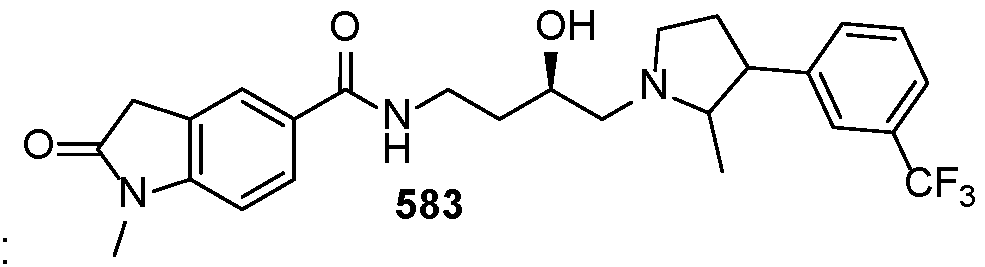
[0399] Compound 583 synthesis according to Scheme 60 is depicted in FIG. 74.
Synthesis of:

[0400] 2-((3/?)-3-Hydroxy-4-(2-methyl-3-(3-(trifluoromethyl)phenyl)pyrrolidin-1 - yl)butyl)isoindoline-1, 3-dione (Compound 95): To a solution of (R)-2-(2-(oxiran-2- yl)ethyl)isoindoline-1 , 3-dione (250 mg, 1.15 mmol) in 2-propanol (5 mL) was added 2-methyl-4-(3-(trifluoromethyl)phenyl)pyrrolidine (264 mg, 1.15 mmol). The reaction mixture was heated to 80 °C and stirred at the same temperature for 16 hours. The reaction mixture was cooled to room temperature and solvent was removed in vacuo, and the crude product was purified by flash column chromatography (silica gel, 50-70% EtOAc in hexanes to give 2-((3R)-3-hydroxy-4-(2-methyl-3-(3- (trifluoromethyl)phenyl)pyrrolidin-1 -y l)buty l)isoindol ine-1 ,3-dione (Compound 95) (335 mg, 65%); 1 H NMR (400 MHz, CDC ) 5 7.80 (ddd, J = 5.4, 3.0, 2.0 Hz, 2H), 7.66 (ddd, J = 5.4, 3.1 , 1 .9 Hz, 2H), 7.46 - 7.31 (m, 4H), 3.98 - 3.60 (m, 3H), 3.48 - 3.03 (m, 2H), 2.97 - 2.53 (m, 3H), 2.53 - 2.08 (m, 3H), 2.08 - 1 .64 (m, 3H), 0.98 (t, J = 5.9 Hz, 2H), 0.59 (t, J = 5.9 Hz, 1 H); 13C NMR (101 MHz, CDC ) 5 168.6, 168.5, 168.4, 168.4, 145.0, 144.5, 143.7, 133.9, 133.9, 133.8, 132.1 , 132.1 , 132.1 , 132.0,
131.3, 131.2, 130.8, 130.8, 130.5, 130.5, 130.3, 130.0, 128.9, 128.9, 128.4, 128.4,
125.6, 125.5, 125.3, 125.2, 124.4, 124.4, 124.4, 124.3, 123.3, 123.2, 123.2, 123.1 ,
123.1 , 122.9, 122.9, 122.8, 122.8, 68.5, 67.5, 67.4, 67.1 , 65.7, 63.2, 59.6, 59.5, 59.4,
54.9, 53.6, 53.0, 52.3, 52.3, 47.9, 35.1 , 35.0, 34.9, 34.5, 34.1 , 33.6, 31.9, 31.4, 29.6,
17.3, 17.0, 15.2.
Synthesis of:

[0401] (2/?)-4-Amino-1 -(2-methyl-3-(3-(trifluoromethyl)phenyl)pyrrolidin-1 - yl)butan-2-ol (Compound 97): Anhydrous hydrazine (0.11 mL, 3.0 mmol) was added to a suspension of 2-((3R)-3-hydroxy-4-(2-methyl-3-(3-
(trifluoromethyl)phenyl)pyrrolidin-1 -y l)buty l)isoindol ine-1 ,3-dione (Compound 95) (300 mg, 3.00 mmol) in anhydrous ethanol (5 mL), and the mixture was refluxed overnight under nitrogen atmosphere. Solvents were removed, and the resulting residue was partitioned between DCM and a 20% aqueous K2CO3 solution. The
layers were separated, and the organic layer was washed with water and brine. The organic layer was dried over Na2SO4, filtered, and the solvent removed in vacuo to give the crude (2R)-4-amino-1 -(2-methyl-3-(3-(trifluoromethyl)phenyl)pyrrolidin-1 - yl)butan-2-ol (Compound 97) (150 mg, 70%), which was used for the next step without further purification.
[0402] N-((3R)-3-Hydroxy-4-(2-methyl-3-(3-(trifluoromethyl)phenyl)pyrrolidin-1 - yl)butyl)-1 -methyl-2-oxoindoline-5-carboxamide (Compound 583): In a 25 mL round- bottomed flask or a screw capped vial equipped with a magnetic stir bar was dissolved 1 -methyl-2-oxoindoline-5-carboxylic acid (90.6 mg, 0.47 mmol), in DCM (3 mL). TEA (0.21 mL, 1 .4 mmol) and HATU (180 mg, 0.47 mmol) were added sequentially to the reaction mixture and stirred for 10 minutes at room temperature, and then (2R)-4-amino-1 -(2-methyl-3-(3-(trifluoromethyl)phenyl)pyrrolidin-1 -yl)butan-
2-ol (Compound 97) (150 mg, 0.47 mmol) was added at room temperature. The reaction mixture was stirred overnight, diluted with water (5 mL), and extracted with DCM (3 X 10 mL). The combined organic layers were washed with 20% aqueous K2CO3 solution (2 X 10 mL), dried over anhydrous Na2SO4, filtered, and concentrated under reduced pressure to get crude residue. The residue was purified by flash column chromatography (silica gel, 10-30% MeOH in DCM) to get N-((3R)-
3-hydroxy-4-(2-methyl-3-(3-(trifluoromethyl)phenyl)pyrrolidin-1 -yl)butyl)-1 -methyl-2- oxoindoline-5-carboxamide (Compound 583) (50 mg, 22%); 1 H NMR (400 MHz, MeOD) 5 7.93 - 7.73 (m, 2H), 7.54 (tdd, J = 16.8, 11 .1 , 7.9 Hz, 4H), 7.04 (dd, J = 8.2, 2.4 Hz, 1 H), 3.94 (dt, J = 8.4, 4.1 Hz, 1 H), 3.72 - 3.38 (m, 3H), 3.31 (p, J = 1.6 Hz, 2H), 3.23 (d, J = 1 .0 Hz, 3H), 3.16 - 2.87 (m, 3H), 2.88 - 2.20 (m, 3H), 2.20 -
1 .59 (m, 3H), 1.16 (dd, J = 17.6, 6.0 Hz, 2.1 H), 0.75 (d, J = 6.6 Hz, 0.9H); 13C NMR (101 MHz, MeOD) 5 177.6, 170.1 , 170.1 , 149.5, 149.5, 133.7, 132.7, 131.9, 130.7,
130.6, 129.9, 129.8, 129.8, 129.7, 129.0, 128.9, 127.0, 126.5, 126.3, 125.5, 125.0,
124.7, 124.4, 124.3, 109.1 , 70.2, 70.1 , 68.4, 66.6, 65.0, 61.0, 60.7, 55.7, 53.8, 52.8, 52.3, 37.8, 37.7, 36.6, 36.3, 36.2, 32.4, 31.9, 26.6, 16.1 ; UPLC/MS purity >95% (CH3CN: 97%, fR = 2.35 min, MeOH: 97%, fR = 3.16 min), C26H30F3N3O3 MW 489.22, [M+H]+ 490.23.
Synthesis of:

[0403] Compound 558 synthesis according to Scheme 61 is depicted in FIG. 75.
Synthesis of:

[0404] (/?)-4-Amino-1-(4-(3-fluoro-2-methoxyrefluxeddihydropyridin-1(2H)- yl)butan-2-ol (Compound 112): Anhydrous hydrazine (0.20 mL, 7.01 mmol) was added to a suspension of (R)-2-(4-(4-(3-fluoro-2-methoxyphenyl)-3,6-dihydropyridin- 1 (2/-/)-yl)-3-hydroxybutyl)isoindoline-1 , 3-dione (Compound 9) (600 mg, 1.41 mmol) in anhydrous ethanol (6 mL), and the mixture was refluxed overnight under nitrogen atmosphere. Solvents were removed, and the resulting residue was partitioned between DCM and a 20% aqueous K2CO3 solution. The layers were separated, and the organic layer was washed with water and brine. The organic layer was dried over Na2SO4, filtered, and the solvent removed in vacuo to give the crude (R)-4-amino-1- (4-(3-fluoro-2-methoxyphenyl)-3,6-dihydropyridin-1 (2/-/)-yl)butan-2-ol (Compound 112) (320 mg, 77%), which was used for the next step without further purification. [0405] (R)-/V-(4-(4-(3-Fluoro-2-methoxyphenyl)-3,6-dihydropyridin-1 (2/-/)-yl)-3- hydroxybutyl)-1-methyl-2-oxoindoline-5-carboxamide (Compound 558): In a 25 mL round-bottomed flask or a screw capped vial equipped with a magnetic stir bar was dissolved 1-methyl-2-oxoindoline-5-carboxylic acid (65 mg, 0.34 mmol), in DCM (3 mL). TEA (0.14 mL, 1 .02 mmol) and HATU (100 mg, 0.41 mmol) were added sequentially to the reaction mixture and stirred for 10 minutes at room temperature, and then (R)-4-amino-1 -(4-(3-fluoro-2-methoxyphenyl)-3,6-dihydropyridin-1 (2/-/)- yl)butan-2-ol (100 mg, 0.34 mmol) was added at room temperature. The reaction mixture was stirred overnight, diluted with water (5 mL), and extracted with DCM (3 X
10 mL). The combined organic layers were washed with 20% aqueous K2CO3 solution (2 X 10 mL), dried over anhydrous Na2SO4, filtered, and concentrated under reduced pressure to get crude residue. The residue was purified by flash column chromatography (silica gel, 10-30% MeOH in DCM) to get (R)-/V-(4-(4-(3-fluoro-2- methoxyphenyl)-3,6-dihydropyridin-1 (2/-/)-yl)-3-hydroxybutyl)-1 -methyl-2-oxoindoline- 5-carboxamide (Compound 558) (75 mg, 41 %); 1H NMR (400 MHz, CD2CI2) 5 7.80 - 7.71 (m, 1 H), 7.69 (q, J = 1 .3 Hz, 1 H), 7.25 (s, 1 H), 7.08 - 6.89 (m, 3H), 6.84 (d, J = 8.1 Hz, 1 H), 5.83 (dt, J = 3.4, 1 .8 Hz, 1 H), 4.00 - 3.88 (m, 1 H), 3.84 (d, J = 1 .4 Hz, 3H), 3.78 (ddd, J = 13.3, 6.7, 4.7 Hz, 1 H), 3.52 (s, 2H), 3.49 - 3.27 (m, 2H), 3.19 (s, 3H), 3.16 - 3.07 (m, 1 H), 2.91 (dt, J = 11.0, 5.5 Hz, 1 H), 2.65 (dt, J = 11.2, 5.6 Hz, 1 H), 2.58 - 2.44 (m, 4H), 1.84 - 1.76 (m, 1 H), 1.66 - 1.56 (m, 1 H); 13C NMR (101 MHz, CD2CI2) 5 175.2, 166.8, 156.2 (d, J = 246.4 Hz, CF), 148.4, 138.1 , 134.6, 129.2, 127.5, 125.1 , 124.7, 124.0, 123.9, 123.4, 115.8, 115.6, 107.8, 67.1 , 63.9, 61.5, 61.5, 50.7, 38.7, 35.8, 33.9, 30.1 , 26.5; UPLC/MS purity >86% (CH3CN: 87%, fa = 2.19 min, MeOH: 86%, fa = 3.03 min), C26H30FN3O4 MW 467.22, [M+H]+ 468.22.
Synthesis of:

[0406] Compound 559 synthesis according to Scheme 62 is depicted in FIG. 76.
Synthesis of:

[0407] (/?)-2-(4-(4-(3-Fluoro-2-methoxyphenyl)-3,6-dihydropyridin-1(2H)-yl)-3- hydroxybutyl)isoindoline-1, 3-dione (Compound 9): To a solution of (R)-2-(2- (oxiran-2-yl)ethyl)isoindoline-1 ,3-dione (1.00 g, 4.60 mmol) in 2-propanol (10 mL) was added 4-(3-fluoro-2-methoxyphenyl)-1 ,2,3,6-tetrahydropyridine (0.95 g, 4.60
mmol). The reaction mixture was heated to 80 °C and stirred at the same temperature for 16 hours. The reaction mixture was cooled room temperature and solvent was removed in vacuo, and the crude product was purified by flash column chromatography (silica gel, 50-70% EtOAc in hexanes to give (R)-2-(4-(4-(3-fluoro-2- methoxyphenyl)-3,6-dihydropyridin-1 (2/-/)-yl)-3-hydroxybutyl)isoindoline-1 ,3-dione (Compound 9) (1.37 g, 70%); 1H NMR (400 MHz, MeOD) 5 7.94 - 7.76 (m, 4H), 7.08 - 6.92 (m, 3H), 5.82 (dt, J = 3.5, 1 .8 Hz, 1 H), 3.96 - 3.75 (m, 6H), 3.23 (dq, J = 6.2, 2.9 Hz, 2H), 2.79 (dd, J = 5.7, 4.2 Hz, 2H), 2.61 - 2.50 (m, 4H), 1.97 - 1 .85 (m, 1 H), 1 .77 (dtd, J = 14.2, 8.1 , 6.3 Hz, 1 H).
Synthesis of:
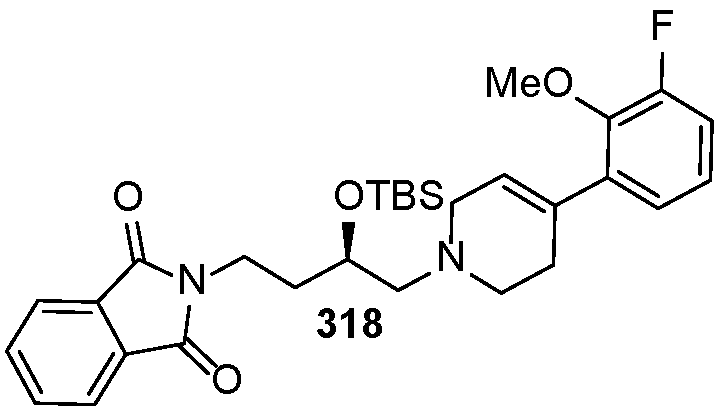
[0408] (R)-2-(3-((fe/t-Butyldimethylsilyl)oxy)-4-(4-(3-fluoro-2-methoxyphenyl)-3,6- dihydropyridin-1 (2/-/)-yl)butyl)isoindoline-1 ,3-dione (Compound 318): To a stirring solution of (R)-2-(4-(4-(3-fluoro-2-methoxyphenyl)-3,6-dihydropyridin-1 (2/-/)-y l)-3- hydroxybutyl)isoindoline-1 ,3-dione (Compound 9) (500 mg, 1.18 mmol) dissolved in DCM (5 mL) was added 2,6-lutidine (0.27 mL, 2.21 mmol). The resulting solution was cooled to 0 °C and TBSOTf (0.32 mL, 1 .40 mmol) was added to the reaction mixture. The reaction mixture was stirred at room temperature for 16 hours till the disappearance of starting material. The organic layer was washed with saturated K2CO3 solution and dried over Na2SO4. The crude product was purified using flash column chromatography (40-50% EtOAc-hexane) to obtain (R)-2-(3-((fe/t- butyldimethylsilyl)oxy)-4-(4-(3-fluoro-2-methoxyphenyl)-3,6-dihydropyridin-1 (2/-/)- yl)butyl)isoindoline-1 , 3-dione (Compound 318) (420 mg, 66%); 1 H NMR (400 MHz, CD2CI2) 5 7.82 (dd, J = 5.4, 3.1 Hz, 2H), 7.71 (dd, J = 5.5, 3.0 Hz, 2H), 7.03 - 6.90 (m, 3H), 5.80 (dq, J = 3.4, 1 .7 Hz, 1 H), 3.97 (qd, J = 6.2, 4.1 Hz, 1 H), 3.90 - 3.56 (m, 5H), 3.14 (dq, J = 5.8, 3.0 Hz, 2H), 2.70 (h, J = 5.5 Hz, 2H), 2.57 - 2.43 (m, J = 5.2, 4.6 Hz, 4H), 2.06 - 1 .94 (m, 1 H), 1 .89 - 1 .76 (m, 1 H), 0.92 (s, 9H), 0.11 (s, 6H).
Synthesis

[0409] (/?)-3-((fert-Butyldimethylsilyl)oxy)-4-(4-(3-fluoro-2-methoxyphenyl)-3,6- dihydropyridin-1(2H)-yl)butan-1 -amine (Compound 20): Anhydrous hydrazine (0.11 mL, 3.70 mmol) was added to a suspension of (R)-2-(3-((fe/Y- butyldimethylsilyl)oxy)-4-(4-(3-fluoro-2-methoxyphenyl)-3,6-dihydropyridin-1 (2/-/)- yl)butyl)isoindoline-1 , 3-dione (Compound 318) (400 mg, 0.74 mmol) in anhydrous ethanol (5 mL), and the mixture was refluxed overnight under nitrogen atmosphere. Solvents were removed, and the resulting residue was partitioned between DCM and a 20% aqueous K2CO3 solution. The layers were separated, and the organic layer was washed with water and brine. The organic layer was dried over Na2SO4, filtered, and the solvent removed in vacuo to give the crude (R)-3-((fe/Y- butyldimethylsilyl)oxy)-4-(4-(3-fluoro-2-methoxyphenyl)-3,6-dihydropyridin-1 (2/-/)- yl)butan-1 -amine (Compound 20) (250 mg, 82%), which was used for the next step without further purification.
Synthesis of:

[0410] (R)-/V-(3-((fe/t-Butyldimethylsilyl)oxy)-4-(4-(3-fluoro-2-methoxyphenyl)-3,6- dihydropyridin-1 (2/-/)-yl)butyl)-1 /-/-im idazole-1 -carboxamide (Compound 22): To a stirring solution of CDI (104 mg, 0.64 mmol) in DCM (5 mL) was added (R)-3-((fe/Y- butyldimethylsilyl)oxy)-4-(4-(3-fluoro-2-methoxyphenyl)-3,6-dihydropyridin-1 (2/-/)- yl)butan-1 -amine (Compound 20) (250 mg, 0.64 mmol) at 0 °C. The reaction mixture was warmed to room temperature and stirred for 16 hours. The crude product was purified using flash column chromatography (0-10% MeOH-DCM) to obtain (R)-/V-(3- ((fe/t-butyldimethylsilyl)oxy)-4-(4-(3-fluoro-2-methoxyphenyl)-3,6-dihydropyridin- 1 (2/-/)-yl)butyl)-1 H-im idazole-1 -carboxamide (Compound 22) (200 mg, 62%); 1H
NMR (400 MHz, CDCh) 5 9.15 (s, 1 H), 8.98 (s, 1 H), 8.02 (s, 1 H), 7.12 - 6.94 (m, 4H), 5.78 (s, 1 H), 4.63 (s, 1 H), 3.95 - 3.74 (m, 5H), 3.59 - 3.05 (m, 6H), 2.48 - 2.08 (m, 2H), 2.02 - 1.84 (m, 2H), 0.87 (s, 9H), 0.10 (d, J = 3.3 Hz, 6H).
Synthesis of:

[0411] (R)-/V-(3-((te/t-Butyldimethylsilyl)oxy)-4-(4-(3-fluoro-2-methoxyphenyl)-3,6- dihydropyridin-1 (2/-/)-yl)butyl)-5,7-dihydro-6/-/-pyrrolo[3,4-b]pyridine-6-carboxamide (Compound 123): To a stirring solution of 6,7-dihydro-5/-/-pyrrolo[3,4-b]pyridine*2HCI salt (55 mg, 0.46 mmol) in 1 ,4-dioxane (2 mL) was added DIPEA (0.21 mL, 1 .21 mmol) and the reaction was stirred for 30 minutes. To this was added (R)-/V-(3-((fe/t- butyldimethylsilyl)oxy)-4-(4-(3-fluoro-2-methoxyphenyl)-3,6-dihydropyridin-1 (2/-/)- yl)butyl)-1 /-/-imidazole-1 -carboxamide (Compound 22) (120 mg, 0.23 mmol) and the resulting mixture was stirred at 90 °C for 16 hours. The solvent was removed under reduced pressure to and the crude product was purified using flash column chromatography (0-50% DCM-MeOH) to obtain (R)-/V-(3-((fe/t- butyldimethylsilyl)oxy)-4-(4-(3-fluoro-2-methoxyphenyl)-3,6-dihydropyridin-1 (2/-/)- yl)butyl)-5,7-dihydro-6/-/-pyrrolo[3,4-b]pyridine-6-carboxamide (Compound 123) (110 mg, 83%); 1H NMR (400 MHz, CDCh) 5 8.47 (d, J = 5.0 Hz, 1 H), 7.64 (d, J = 7.3 Hz, 1 H), 7.20 (t, J = 6.4 Hz, 1 H), 7.10 - 6.90 (m, 2H), 6.58 (s, 1 H), 5.77 (s, 1 H), 4.84 (q, J = 14.8 Hz, 4H), 4.61 (s, 1 H), 4.19 (t, J = 13.8 Hz, 1 H), 3.90 (s, 3H), 3.82 - 3.69 (m, 2H), 3.45 - 3.13 (m, 3H), 2.85 - 2.68 (m, 1 H), 2.33 - 1.78 (m, 4H), 0.86 (s, 9H), 0.12 (d, J = 10.4 Hz, 6H).
[0412] (R)-/V-(4-(4-(3-Fluoro-2-methoxyphenyl)-3,6-dihydropyridin-1 (2/-/)-yl)-3- hydroxybutyl)-5,7-dihydro-6/-/-pyrrolo[3,4-b]pyridine-6-carboxamide (Compound 559): To a stirring solution of (R)-/V-(3-((fe/t-butyldimethylsilyl)oxy)-4-(4-(3-fluoro-2- methoxyphenyl)-3,6-dihydropyridin-1 (2/-/)-yl)butyl)-5,7-dihydro-6/-/-pyrrolo[3,4- b]pyridine-6-carboxamide (Compound 123) (100 mg, 0.18 mmol) in 1 ,4-dioxane (2 mL) was added 4M HCI in 1 ,4-dioxane (0.18 mL, 1 mL/1 mmol) at 0 °C. The resulting mixture was stirred at room temperature for 2 hours. The solvent was
evaporated, and the crude product was purified using flash column chromatography (0-50% DCM-MeOH & 2% aq. NH3 added) to afford (R)-/V-(4-(4-(3-fluoro-2- methoxyphenyl)-3,6-dihydropyridin-1 (2/-/)-yl)-3-hydroxybutyl)-5,7-dihydro-6/-/- pyrrolo[3,4-b]pyridine-6-carboxamide (Compound 559) (50 mg, 63%); 1 H NMR (400 MHz, CD2CI2) 5 8.46 (dd, J = 5.0, 1 .5 Hz, 1 H), 7.60 (dt, J = 7.6, 1 .2 Hz, 1 H), 7.20 (dd, J = 7.7, 4.9 Hz, 1 H), 7.05 - 6.95 (m, 3H), 5.86 - 5.79 (m, 1 H), 5.39 (s, 1 H), 4.73 - 4.62 (m, 4H), 4.06 - 3.87 (m, 1 H), 3.84 (d, J = 1 .4 Hz, 3H), 3.61 (dtd, J = 13.6, 6.9, 4.8 Hz, 1 H), 3.38 - 3.26 (m, 2H), 3.19 - 3.08 (m, 1 H), 2.89 (dt, J = 11 .1 , 5.5 Hz, 1 H), 2.66 (dt, J = 11 .3, 5.6 Hz, 1 H), 2.53 (q, J = 3.8 Hz, 2H), 2.50 - 2.43 (m, 2H), 1 .74 (dddd, J = 14.6, 7.5, 4.9, 2.8 Hz, 1 H), 1 .54 (dddd, J = 14.0, 9.1 , 7.7, 4.8 Hz, 1 H); 13C NMR (101 MHz, CD2CI2) 5 158.4, 157.2, 156.4 (d, J = 244.0 Hz, 1 CF), 149.3, 145.6, 138.1 , 134.6, 131.1 , 125.2, 124.8, 124.0, 123.9, 122.6, 115.8, 66.7, 64.1 , 61.5, 61.5, 54.3, 54.3, 54.1 , 53.8, 53.5, 53.3, 52.61 , 50.8, 39.1 , 34.9, 30.1 ; UPLC/MS purity >90% (CH3CN: 90%, fa = 2.13 min, MeOH: 93%, fa = 3.06 min), C24H29FN4O3 MW 440.22, [M+H]+ 441 .23.
Synthesis of:

[0413] Compound 569 synthesis according to Scheme 63 is depicted in FIG. 77.

[0414] (2/?)-4-Amino-1 -(3-fluoro-3-(3-(trifluoromethyl)phenyl)pyrrolidin-1 - yl)butan-2-ol (Compound 236): Anhydrous hydrazine (0.25 mL, 8.01 mmol) was added to a suspension of 2-((3R)-4-(3-fluoro-3-(3-(trifluoromethyl)phenyl)pyrrolidin-1 - yl)-3-hydroxybutyl)isoindoline-1 ,3-dione (Compound 31) (800 mg, 1.78 mmol) in anhydrous ethanol (10 mL), and the mixture was refluxed overnight under nitrogen
atmosphere. Solvents were removed, and the resulting residue was partitioned between DCM and a 20% aqueous K2CO3 solution. The layers were separated, and the organic layer was washed with water and brine. The organic layer was dried over Na2SO4, filtered, and the solvent removed in vacuo to give the crude (2R)-4-amino-1- (3-fluoro-3-(3-(trifluoromethyl)phenyl)pyrrolidin-1 -yl)butan-2-ol (Compound 236) (400 mg, 70%), which was used for the next step without further purification.
[0415] A/-((3R)-4-(3-Fluoro-3-(3-(trifluoromethyl)phenyl)pyrrolidin-1-yl)-3- hydroxybutyl)-1 ,3,3-trimethyl-2-oxoindoline-5-carboxamide (Compound 569): In a 25 mL round-bottomed flask or a screw capped vial equipped with a magnetic stir bar was dissolved 1 ,3,3-trimethyl-2-oxoindoline-5-carboxylic acid (100 mg, 0.45 mmol), in DCM (5 mL). TEA (0.19 mL, 1 .40 mmol) and HATU (200 mg, 0.52 mmol) were added sequentially to the reaction mixture and stirred for 10 minutes at room temperature, and then (2R)-4-amino-1-(3-fluoro-3-(3- (trifluoromethyl)phenyl)pyrrolidin-1-yl)butan-2-ol (Compound 236) (146 mg, 0.45 mmol) was added at room temperature. The reaction mixture was stirred overnight, diluted with water (10 mL), and extracted with DCM (3 X 15 mL). The combined organic layers were washed with 20% aqueous K2CO3 solution (2 X 15 mL), dried over anhydrous Na2SO4, filtered, and concentrated under reduced pressure to get crude residue. The residue was purified by flash column chromatography (silica gel, 10-30% MeOH in DCM) to get A/-((3R)-4-(3-fluoro-3-(3- (trifluoromethyl)phenyl)pyrrolidin-1-yl)-3-hydroxybutyl)-1 ,3,3-trimethyl-2-oxoindoline- 5-carboxamide (Compound 569) (45 mg, 18%); 1H NMR (400 MHz, CD2CI2) 5 7.76 -
7.49 (m, 6H), 7.04 (s, 1 H), 6.87 (d, J = 8.0 Hz, 1 H), 5.33 (s, 1 H), 3.93 - 3.74 (m, 2H),
3.49 - 3.31 (m, 2H), 3.20 (s, 3H), 3.19 - 3.09 (m, 2H), 2.98 (d, J = 9.0 Hz, 1 H), 2.82 - 2.63 (m, 2H), 2.54 - 2.31 (m, 2H), 1 .88 - 1 .78 (m, 1 H), 1 .62 (dddd, J = 14.1 , 9.4, 7.2, 4.6 Hz, 1 H), 1.35 (s, 6H); 13C NMR (101 MHz, CD2CI2) 5 181.5, 167.7, 167.7, 146.1 , 136.4, 130.8, 129.5, 128.6 (q, J = 73.7 Hz, CF3), 127.3, 125.1 , 123.1 , 121.7, 121.6, 121.5, 107.9, 103.0 (d, J = 181.8 Hz, CF), 67.9, 67.7, 61.9, 44.3, 40.6, 40.4, 38.0, 34.4, 26.5, 24.4; UPLC/MS purity >94% (CH3CN: 95%, fa = 2.71 min, MeOH: 94%, fa = 3.58 min), C27H31F4N3O3 MW 521.23, [M+H]+ 522.23.
Synthesis of:

[0416] Compound 571 synthesis according to Scheme 64 is depicted in FIG. 78.

Synthesis of:
[0417] (/?)-2-(4-(4-(3,5-Difluoro-2-methoxyphenyl)piperazin-1-yl)-3- hydroxybutyl)isoindoline-1, 3-dione (Compound 153): To a solution of (R)-2-(2- (oxiran-2-yl)ethyl)isoindoline-1 ,3-dione (200 mg, 0.921 mmol) in 2-propanol (5 mL) was added 1 -(3,5-difluoro-2-methoxyphenyl)piperazine (210 mg, 0.921 mmol). The reaction mixture was heated at 80 °C and stirred at the same temperature for 16 hours. The reaction mixture was cooled room temperature and solvent was removed in vacuo, and the crude product was purified by flash column chromatography (silica gel, 50-70% EtOAc in hexanes to give (R)-2-(4-(4-(3,5-difluoro-2- methoxyphenyl)piperazin-1 -yl)-3-hydroxybutyl)isoindoline-1 ,3-dione (Compound 153) (280 mg, 68%); 1H NMR (400 MHz, CDCh) 5 7.85 (dd, J = 5.5, 3.0 Hz, 2H), 7.72 (dd, J = 5.4, 3.0 Hz, 2H), 6.47 (ddd, J = 10.9, 8.3, 3.0 Hz, 1 H), 6.37 (ddd, J = 10.7, 3.0, 1.9 Hz, 1 H), 3.97 - 3.77 (m, 6H), 3.59 (d, J = 43.0 Hz, 1 H), 3.13 (s, 4H), 2.81 (s, 2H), 2.60 (s, 2H), 2.43 (d, J = 12.4 Hz, 2H), 1 .79 (q, J = 6.7 Hz, 2H).

Synthesis of:
[0418] (/?)-4-Amino-1-(4-(3,5-difluoro-2-methoxyphenyl)piperazin-1-yl)butan-2- ol (Compound 56): Anhydrous hydrazine (0.13 mL, 4.0 mmol) was added to a suspension of (R)-2-(4-(4-(3,5-difluoro-2-methoxyphenyl)piperazin-1 -y l)-3- hydroxybutyl)isoindoline-1 ,3-dione (Compound 153) (250 mg, 0.561 mmol) in anhydrous ethanol (3 mL), and the mixture was refluxed overnight under nitrogen atmosphere. Solvents were removed, and the resulting residue was partitioned between DCM and a 20% aqueous K2CO3 solution. The layers were separated, and the organic layer was washed with water and brine. The organic layer was dried over Na2SO4, filtered, and the solvent removed in vacuo to give the crude (R)-4-amino-1- (4-(3,5-difluoro-2-methoxyphenyl)piperazin-1-yl)butan-2-ol (Compound 56) (125 mg, 71 %), which was used for the next step without further purification.
[0419] (/?)-/V-(4-(4-(3,5-Difluoro-2-methoxyphenyl)piperazin-1-yl)-3- hydroxybutyl)-1-methyl-2-oxoindoline-5-carboxamide (Compound 571): In a 25 mL round-bottomed flask or a screw capped vial equipped with a magnetic stir bar was dissolved 1 -methyl-2-oxoindoline-5-carboxylic acid (61 mg, 0.317 mmol), in DCM (3 mL). TEA (0.13 mL, 0.954 mmol) and HATU (144 mg, 0.42 mmol) were added sequentially to the reaction mixture and stirred for 10 minutes at room temperature, and then (R)-4-amino-1-(4-(3,5-difluoro-2-methoxyphenyl)piperazin-1- yl)butan-2-ol (Compound 56) (100 mg, 0.317 mmol) was added at room temperature. The reaction mixture was stirred overnight, diluted with water (5 mL), and extracted with DCM (3 X 10 mL). The combined organic layers were washed with 20% aqueous K2CO3 solution (2 X 10 mL), dried over anhydrous Na2SO4, filtered, and concentrated under reduced pressure to get crude residue. The residue was purified by flash column chromatography (silica gel, 10-30% MeOH in DCM) to get (R)-/V-(4-(4-(3,5-difluoro-2-methoxyphenyl)piperazin-1 -yl)-3-hydroxybutyl)-1 - methyl-2-oxoindoline-5-carboxamide (Compound 571) (68 mg, 44%); 1H NMR (400 MHz, CD2CI2) 5 7.73 (dd, J = 8.2, 1.8 Hz, 1 H), 7.66 (d, J = 1.8 Hz, 1 H), 7.13 (s, 1 H), 6.84 (d, J = 8.2 Hz, 1 H), 6.56 - 6.46 (m, 1 H), 6.41 (dt, J = 10.8, 2.3 Hz, 1 H), 3.96 (td,
J = 9.6, 4.8 Hz, 1 H), 3.82 (s, 4H), 3.50 (s, 2H), 3.44 - 3.35 (m, 1 H), 3.24 - 3.18 (m, 7H), 2.99 (d, J = 5.0 Hz, 2H), 2.82 (s, 2H), 2.69 - 2.56 (m, 2H), 1 .81 (dddd, J = 14.8, 7.5, 4.7, 2.7 Hz, 1 H), 1.59 (dddd, J = 14.0, 9.3, 7.4, 4.6 Hz, 1 H). 13C NMR (101 MHz, CD2CI2) 5 175.2, 167.1 , 159.8, 157.9, 157.5, 157.4, 155.6, 148.5, 147.4, 137.2, 137.1 , 129.0, 127.6, 125.1 , 123.4, 107.8, 101.4, 101.2, 101.2, 98.0, 97.7, 97.5, 66.6, 64.0, 60.4, 60.4, 54.2, 50.4, 50.4, 48.0, 38.5, 35.8, 33.9, 26.5. UPLC/MS purity >95% (CH3CN: 99%, fR = 4.49 min, MeOH: 97%, fR = 3.27 min), C25H30F2N4O4 MW 488.22, [M+H]+ 489.23.
Synthesis of:

[0420] Compound 572 synthesis according to Scheme 65 is depicted in FIG. 79.

Synthesis of:
[0421] fert-Butyl 4-(3-fluoro-2-methoxyphenyl)-3-methylpiperazine-1- carboxylate (Compound 52): 1-bromo-3-fluoro-2-methoxybenzene (500 mg, 2.44 mmol) was weighed in a 50 mL two neck round-bottomed flask which was equipped with reflux condenser, stirring bar and a rubber septa. The flask was purged with nitrogen for five minutes, te/t-butyl 3-methylpiperazine-1 -carboxylate (489 mg, 2.44 mmol), tris(dibenzylideneacetone)dipalladium(0) (120 mg, 0.13 mmol), (±)-BINAP (227 mg, 0.36 mmol), sodium fe/t-butoxide (NaCFBu) (376 mg, 3.91 mmol) were added quickly through side neck under positive nitrogen. Anhydrous toluene (20 mL, degassed for 10 minutes) was added to the flask via syringe. The resulting reaction mixture was degassed and back filled with nitrogen. This cycle was repeated three times. Then the reaction was heated to 100 °C while stirring for 24 hours under nitrogen atmosphere. The reaction mixture was cooled to room temperature, filtered
through pad of Celite, and washed with ethyl acetate (3 X 20 mL). Water (30 ml) was added to filtrate and then organic layer was separated. The aqueous layer was extracted with ethyl acetate (2 X 20 mL). The combined organic fractions were washed with brine, dried over Na2SO4, filtered, and evaporated in vacuo. The resulting residue was purified using flash column chromatography (silica gel, hexanes/ethyl acetate, 100:00 to 90:10) to provide te/t-butyl 4-(3-fluoro-2- methoxyphenyl)-3-methylpiperazine-1 -carboxylate (Compound 52) (200 mg, 25%); 1H NMR (400 MHz, CDCI3) 5 1H NMR (400 MHz, CDCI3) 5 6.91 (td, J = 8.1 , 5.9 Hz, 1 H), 6.87 - 6.77 (m, 1 H), 6.68 (t, J = 8.0 Hz, 1 H), 3.91 (s, 3H), 3.64 - 3.13 (m, 6H), 2.81 (s, 1 H), 1 .49 (s, 9H),0.93 (d, J = 2.8 Hz, 3H).
Synthesis of:

[0422] 1-(3-Fluoro-2-methoxyphenyl)-2-methylpiperazine (Compound 60): tertbutyl 4-(3-fluoro-2-methoxyphenyl)-3-methylpiperazine-1 -carboxylate (Compound 52) (200 g, 0.61 mmol) was dissolved in DCM (3 mL) and cooled to 0 °C. TFA (0.61 mL, 1 mL/mmol) was added and stirred for 4 hours at room temperature. The solvent was removed in vacuo and the resulting residue was dissolved in water and washed with EtOAc (2 X 20 mL) to remove organic impurities. The aqueous layer was neutralized with aqueous K2CO3 (20%), and extracted with DCM (3 X 20 mL). The organic phase was dried over sodium sulfate, filtered and the solvent was removed under reduced pressure to get 1-(3-fluoro-2-methoxyphenyl)-2-methylpiperazine (Compound 60) (100 mg, 72%) which was used for the next step without further purification.
Synthesis of:

[0423] 2-((3/?)-4-(4-(3-Fluoro-2-methoxyphenyl)-3-methylpiperazin-1-yl)-3- hydroxybutyl)isoindoline-1, 3-dione (Compound 62): To a solution of (R)-2-(2- (oxiran-2-yl)ethyl)isoindoline-1 ,3-dione (97 mg, 0.44 mmol) in 2-propanol (2 mL) was added 1-(3-fluoro-2-methoxyphenyl)-2-methylpiperazine (Compound 60) (100 mg, 0.44 mmol). The reaction mixture was heated at 80 °C and stirred at the same temperature for 16 hours. The reaction mixture was cooled room temperature and solvent was removed in vacuo, and the crude product was purified by flash column chromatography (silica gel, 50-70% EtOAc in hexanes to give 2-((3R)-4-(4-(3-fluoro- 2-methoxyphenyl)-3-methylpiperazin-1-yl)-3-hydroxybutyl)isoindoline-1 ,3-dione (Compound 62) (145 mg, 73%); 1H NMR (400 MHz, CDCh) 5 7.85 (dd, J = 5.4, 3.1 Hz, 2H), 7.71 (dd, J = 5.5, 3.0 Hz, 2H), 6.92 (td, J = 8.2, 6.0 Hz, 1 H), 6.83 - 6.68 (m, 2H), 3.90 (s, 3H), 3.89 - 3.71 (m, 3H), 3.63 (s, 2H), 3.32 - 3.19 (m, 1 H), 2.94 - 2.63 (m, 3H), 2.57 - 2.48 (m, 1 H), 2.43 - 2.29 (m, 2H), 1 .79 (q, J = 6.7 Hz, 2H), 0.95 (d, J = 6.4 Hz, 3H).

Synthesis of:
[0424] (2/?)-4-Amino-1 -(4-(3-fluoro-2-methoxyphenyl)-3-methylpiperazin-1 - yl)butan-2-ol (Compound 164): Anhydrous hydrazine (0.04 mL, 1.33 mmol) was added to a suspension of 2-((3R)-4-(4-(3-fluoro-2-methoxyphenyl)-3- methylpiperazin-1-yl)-3-hydroxybutyl)isoindoline-1 ,3-dione (Compound 62) (140 mg, 0.31 mmol) in anhydrous ethanol (10 mL), and the mixture was refluxed overnight under nitrogen atmosphere. Solvents were removed, and the resulting residue was partitioned between DCM and a 20% aqueous K2CO3 solution. The layers were separated, and the organic layer was washed with water and brine. The organic
layer was dried over Na2SO4, filtered, and the solvent removed in vacuo to give the crude (2R)-4-amino-1 -(4-(3-fluoro-2-methoxyphenyl)-3-methylpiperazin-1 -yl)butan-2- ol (Compound 164) (84 mg, 85%), which was used for the next step without further purification.
[0425] /V-((3R)-4-(4-(3-Fluoro-2-methoxyphenyl)-3-methylpiperazin-1 -yl)-3- hydroxybutyl)-1 -methyl-2-oxoindoline-5-carboxamide (Compound 572): In a 10 mL round-bottomed flask or a screw capped vial equipped with a magnetic stir bar was dissolved 1 -methyl-2-oxoindoline-5-carboxylic acid (37 mg, 0.19 mmol), in DCM (2 mL). TEA (0.10 mL, 0.70 mmol) and HATU (100 mg, 0.263 mmol) were added sequentially to the reaction mixture and stirred for 10 minutes at room temperature, and then (2R)-4-amino-1 -(4-(3-fluoro-2-methoxyphenyl)-3-methylpiperazin-1 - yl)butan-2-ol (Compound 164) (60 mg, 0.19 mmol) was added at room temperature. The reaction mixture was stirred overnight, diluted with water (5 mL), and extracted with DCM (3 X 10 mL). The combined organic layers were washed with 20% aqueous K2CO3 solution (2 X 10 mL), dried over anhydrous Na2SO4, filtered, and concentrated under reduced pressure to get crude residue. The residue was purified by flash column chromatography (silica gel, 10-30% MeOH in DCM) to get A/-((3R)- 4-(4-(3-fluoro-2-methoxyphenyl)-3-methylpiperazin-1 -yl)-3-hydroxybutyl)-1-methyl-2- oxoindoline-5-carboxamide (Compound 572) (25 mg, 27%); 1 H NMR (400 MHz, CD2CI2) 5 7.74 (d, J = 8.2 Hz, 1 H), 7.67 (s, 1 H), 7.19 (s, 1 H), 6.95 (q, J = 7.6 Hz, 1 H), 6.89 - 6.68 (m, 3H), 3.93 (d, J = 8.4 Hz, 1 H), 3.88 (s, 3H), 3.82 - 3.57 (m, 2H), 3.49 (s, 2H), 3.46 - 3.36 (m, 1 H), 3.26 (d, J = 15.9 Hz, 1 H), 3.18 (s, 3H), 3.00 - 2.79 (m, 3H), 2.72 - 2.30 (m, 4H), 1.87 - 1 .73 (m, 1 H), 1 .59 (d, J = 8.4 Hz, 1 H), 0.97 (d, J = 6.3 Hz, 3H); 13C NMR (101 MHz, CD2CI2) 5 175.3, 167.4, 158.1 , 155.7, 148.5, 145.5, 128.9, 127.6, 125.1 , 123.6, 123.6, 123.4, 118.4, 111.7, 107.9, 66.4, 66.2, 64.0, 63.9, 60.8, 60.2, 52.1 , 52.0, 38.3, 35.8, 34.1 , 34.0, 31.0, 26.5; UPLC/MS purity >95% (CH3CN: 96%, fa = 2.30 min, MeOH: 95%, fa = 3.08 min), C26H33FN4O4 MW 484.24, [M+H]+ 485.25.
Synthesis of:

[0426] Compound 574 synthesis according to Scheme 66 is depicted in FIG. 80.
[0427] A/-((3R)-4-(3-Fluoro-3-(3-(trifluoromethyl)phenyl)pyrrolidin-1 -yl)-3- hydroxybutyl)-2-methyl-4,5,6,7-tetrahydro-2/-/-indazole-5-carboxamide (Compound 574): In a 25 mL round-bottomed flask or a screw capped vial equipped with a magnetic stir bar was dissolved 2-methyl-4,5,6,7-tetrahydro-2/-/-indazole-5-carboxylic acid (112 mg, 0.62 mmol), in DCM (5 mL). TEA (0.26 mL, 1 .89 mmol) and HATU (250 mg, 0.65 mmol) were added sequentially to the reaction mixture and stirred for 10 minutes at room temperature, and then (2R)-4-amino-1 -(3-fluoro-3-(3- (trifluoromethyl)phenyl)pyrrolidin-1 -yl)butan-2-ol (Compound 236) (200 mg, 0.62 mmol) was added at room temperature. The reaction mixture was stirred overnight, diluted with water (10 mL), and extracted with DCM (3 X 15 mL). The combined organic layers were washed with 20% aqueous K2CO3 solution (2 X 15 mL), dried over anhydrous Na2SO4, filtered, and concentrated under reduced pressure to get crude residue. The residue was purified by flash column chromatography (silica gel, 10-40% MeOH in DCM) to get A/-((3F?)-4-(3-fluoro-3-(3- (trifluoromethyl)phenyl)pyrrolidin-1 -yl)-3-hydroxybutyl)-2-methyl-4,5,6,7-tetrahydro- 2/-/-indazole-5-carboxamide (Compound 574) (60 mg, 20%); 1 H NMR (400 MHz, CD2CI2) 5 7.70 (s, 1 H), 7.66 - 7.49 (m, 3H), 7.07 (s, 1 H), 6.34 (s, 1 H), 3.76 (s, 3H), 3.75 - 3.66 (m, 1 H), 3.65 - 3.53 (m, 1 H), 3.33 - 2.91 (m, 5H), 2.89 - 2.25 (m, 10H), 2.16 - 2.03 (m, 1 H), 1.84 (ddt, J = 11.3, 5.6, 2.1 Hz, 1 H), 1.70 (dtd, J = 13.3, 5.2, 2.6 Hz, 1 H), 1.56 - 1.45 (m, 1 H); 13C NMR (101 MHz, CD2CI2) 5 175.6, 147.9, 143.8, 130.8 (q, J = 63.7 Hz, CF3), 129.4, 128.3, 127.4, 125.9, 124.9, 121.5, 114.6, 103.1 (d, J = 181.8 Hz, CF), 67.8, 67.7, 61.9, 42.9, 41.1 , 40.9, 38.8, 37.3, 34.5, 27.6, 24.2, 22.9; UPLC/MS purity >95% (CH3CN: 95%, fa = 2.54 min, MeOH: 97%, fa = 3.61 min), C24H30F4N4O2 MW 482.23, [M+H]+ 483.23.
Synthesis of:

[0428] Compound 577 synthesis according to Scheme 67 is depicted in FIG. 81 .

[0429] /V-((3/?)-3-Hydroxy-4-(4-(2-methoxyphenyl)-3-methylpiperazin-1-yl)butyl)- 1 -methyl-2-oxoindoline-5-carboxamide (Compound 577): In a 25 mL round- bottomed flask or a screw capped vial equipped with a magnetic stir bar was dissolved 1 -methyl-2-oxoindoline-5-carboxylic acid (72 mg, 0.37 mmol), in DCM (2 mL). TEA (0.15 mL, 1.12 mmol) and HATU (160 mg, 0.42 mmol) were added sequentially to the reaction mixture and stirred for 10 minutes at room temperature, and then (2R)-4-amino-1 -(4-(2-methoxyphenyl)-3-methylpiperazin-1 -yl)butan-2-ol (Compound 65) (110 mg, 0.37 mmol) was added at room temperature. The reaction mixture was stirred overnight, diluted with water (5 mL), and extracted with DCM (3 X 10 mL). The combined organic layers were washed with 20% aqueous K2CO3 solution (2 X 10 mL), dried over anhydrous Na2SO4, filtered, and concentrated under reduced pressure to get crude residue. The residue was purified by flash column chromatography (silica gel, 10-30% MeOH in DCM) to get A/-((3R)-3-hydroxy-4-(4-(2- methoxyphenyl)-3-methylpiperazin-1 -yl)butyl)-1 -methyl-2-oxoindoline-5-carboxamide (Compound 577) (65 mg, 37%); 1 H NMR (400 MHz, CD2CI2) 5 7.75 (dt, J = 8.2, 1.6 Hz, 1 H), 7.69 (t, J = 1 .5 Hz, 1 H), 7.25 (d, J = 6.5 Hz, 1 H), 7.09 - 6.94 (m, 2H), 6.94 - 6.80 (m, 3H), 3.96 - 3.84 (m, 1 H), 3.82 (s, 4H), 3.52 (s, 3H), 3.47 - 3.33 (m, 1 H), 3.19 (s, 4H), 2.98 - 2.55 (m, 4H), 2.54 - 2.19 (m, 4H), 1.78 (q, J = 6.8 Hz, 1 H), 1.59 (ddt, J = 13.8, 9.1 , 4.4 Hz, 1 H), 0.91 (dd, J = 6.3, 2.6 Hz, 3H); 13C NMR (101 MHz, CD2CI2) 5 175.2, 166.8, 154.8, 148.4, 140.1 , 129.3, 127.5, 125.1 , 124.4, 124.3, 123.4, 121.0, 112.2, 107.8, 66.9, 66.8, 64.2, 64.2, 60.1 , 55.7, 52.1 , 38.8, 35.8, 33.8, 33.8, 26.5. UPLC/MS purity >95% (CH3CN: 98%, fa = 2.06 min, MeOH: 95%, fa = 2.88 min), C26H34N4O4 MW 466.25, [M+H]+ 467.26.
EXAMPLES
[0430] The D3R modulators disclosed demonstrate superior pharmacological properties. For example, compound 561 has an hERG ICso> 30 pM, optimal 143-fold D3 relative to D2 receptor selectivity (D2/D3 receptor selectivity), and acceptable plasma and brain PK profile (36% bioavailability and AUCb/AUCp =0.6). Compound
561 has good DMPK properties with optimal brain exposure, and is efficacious in a rat model of oxycodone addiction. These newly developed D3 selective chemotypes were able to display a better hERG liability window, which was seen as a challenge in the past by many researchers including the leading pharmaceutical companies. [0431] Medicinal chemical endpoints can include, for example, D3/D2 receptor binding selectivity (Ki >100 fold), D3/D2 receptor cell-based beta-arrestin activity (>25 fold), cAMP (>10 fold) mediated response, hERG liability window, solubility, passive permeability, high PAMPA-BBB permeability, high MDCK-MDR1 permeability, low P- glycoprotein (Pgp) efflux, higher unbound free fraction in (rat) brain homogenate, and free drug in the brain - 5 to 10-fold over D3 receptor Ki. Pharmacological endpoints can include, for example, measurement of dose dependent response in oxycodone self-administration model- fixed ratio (FR) and progressive ratio (PR) schedules, and measurement of dose dependent response in an oxycodone relapse model.
[0432] Binding assays were performed and can be performed using the protocols set forth in Gogarnoiu et al., J. Med. Chem. 66:1809-1834 (2023). Beta-arrestin assays for antagonists and agonists were performed and can be performed as follows. F12K medium (30-2004) was purchased from ATCC (Gaithersburg, MD), Hyclone FBS (Cat #SH30071 .03) was purchased from GE Healthcare (Logan, UT). The following items were purchased from ThermoFisher (Waltham, MA): G418 sulfate (Cat #10131 ), Hygromycin (Cat #10687010), TrypLE Express (Cat #12605), Opti-MEM Reduce Serum Medium (Cat #31985088), and DPBS with calcium and magnesium (Cat #14040). Dopamine hydrochloride (Cat #3548) was purchased from Tocris Bioscience (Bristol, United Kingdom). Pathhunter bioassay detection kit (Cat #93-001 ) was purchased from Eurofins DiscoverX. 384-well, white, tissue culture treated microplate (Cat #781073) and 384-well polypropylene microplate (Cat #781201 ) were purchased from Greiner Bio-One.
[0433] beta-arrestin recruitment assays for DRD3 and DRD2: The PathHunter beta- arrestin recruitment assay (DiscoverX) was performed as previously described (Furman et al, Eur Neuropsychopharmacol. 2015 Sep;25(9): 1448-61 ).
[0434] DRD3 beta-arrestin -coupled antagonist assay: CHO-K1 cells expressing the D3 dopamine receptor (CHOK1-DRD3) (Cat #93-0591 C2, DiscoverX) were cultured in growth media (F12, 10% FBS, 0.8 mg/mL G418, 0.3 mg/ml hygromycin, 1x Pen/Strep). Cells were harvested with TrypLE Express at 80-90% confluence and
resuspended in assay media (Opti-MEM, 1 % FBS, 1x Pen/Strep) at a density of 400,000 cells/mL. Then, 20 pL of cells (8,000 cells/well) were dispensed into 384- well white, solid-bottom, tissue culture treated plates using a Multidrop Combi dispenser (ThermoFisher, Waltham, MA). The assay plates were incubated at 37°C and 5% CO2 overnight to allow cell attachment. Compounds were titrated in DMSO and dispensed via pin transfer at 46 nL/well with an Automated Pintool Workstation (Wako Automation, San Diego, CA). Then, 5 pL/well of DPBS with calcium and magnesium containing 100 nM of dopamine (20 nM final concentration) was dispensed with a Multidrop Combi dispenser. The assay plates were incubated for 90 minutes at room temperature before 12.5 uL/well of PathHunter Detection Kit (Cat #93-001 , DiscoverX). The assay plates were incubated for 60 minutes at room temperature, then luminescence signal was read on a PHERAstar FSX plate reader (BMG Labtech, Cary, NC). Data were normalized with 20 nM dopamine treated wells as 0% activity, and no dopamine treatment as -100% activity.
[0435] DRD3 beta-arrestin-coupled agonist assay: CHO-K1 cells expressing the D3 dopamine receptor (CHOK1-DRD3) (Cat #93-0591 C2, DiscoverX) were cultured in growth media (F12, 10% FBS, 0.8 mg/ml G418, 0.3 mg/mL hygromycin, 1x Pen/Strep). Cells were harvested with TrypLE Express at 80-90% confluence and resuspended in assay media (Opti-MEM, 1 % FBS, 1x Pen/Strep) at a density of 400,000 cells/mL. Then, 20 pL of cells (8,000 cells/well) were dispensed into 384- well white, solid-bottom, tissue culture treated plates using a Multidrop Combi dispenser (ThermoFisher, Waltham, MA). The assay plates were incubated at 37 °C and 5% CO2 overnight to allow cell attachment. Compounds were titrated in DMSO and dispensed via pin transfer at 46 nL/well with an Automated Pintool Workstation (Wako Automation, San Diego, CA). The assay plates were incubated for 90 minutes at room temperature before 12.5 pL/well of PathHunter Detection Kit (Cat #93-001 , DiscoverX). The assay plates were incubated for 60 minutes at room temperature, then luminescence signal was read on a PHERAstar FSX plate reader (BMG Labtech, Cary, NC). Data were normalized with 1 uM dopamine treated wells as 100% activity, and no dopamine treatment as 0% activity.
[0436] DRD2 beta-arrestin-coupled antagonist assay: CHO-K1 cells expressing the D2 dopamine receptor long isoform (CHOK1-DRD2L) (Cat #93-0579C2, DiscoverX) were cultured in growth media (F12, 10% FBS, 0.8 mg/mL G418, 0.3 mg/mL
hygromycin, 1x Pen/Strep). Cells were harvested with TrypLE Express at 80-90% confluence and resuspended in assay media (Opti-MEM, 1 % FBS, 1x Pen/Strep) at a density of 400,000 cells/mL. Then, 20 pL of cells (8,000 cells/well) were dispensed into 384-well white, solid-bottom, tissue culture treated plates using a Multidrop Combi dispenser (ThermoFisher, Waltham, MA). The assay plates were incubated at 37 °C and 5% CO2 overnight to allow cell attachment. Compounds were titrated in DMSO and dispensed via pin transfer at 46 nL/well with an Automated Pintool Workstation (Wako Automation, San Diego, CA). Then, 5 pL/well of DPBS with calcium and magnesium containing 2 pM of dopamine (400 nM final concentration) was dispensed with a Multidrop Combi dispenser. The assay plates were incubated for 90 minutes at room temperature before 12.5 pL/well of PathHunter Detection Kit (Cat #93-001 , DiscoverX). The assay plates were incubated for 60 minutes at room temperature, then luminescence signal was read on a PHERAstar FSX plate reader (BMG Labtech, Cary, NC). Data were normalized with 400 nM dopamine treated wells as 0% activity, and no dopamine treatment as 100% activity.
[0437] DRD2 beta-arrestin-coupled agonist assay: CHO-K1 cells expressing the D2 dopamine receptor long isoform (CHOK1-DRD2L) (Cat #93-0579C2, DiscoverX) were cultured in growth media (F12, 10% FBS, 0.8 mg/mL G418, 0.3 mg/mL hygromycin, 1x Pen/Strep). Cells were harvested with TrypLE Express at 80-90% confluence and resuspended in assay media (Opti-MEM, 1 % FBS, 1x Pen/Strep) at a density of 400,000 cells/mL. Then, 20 pL of cells (8,000 cells/well) were dispensed into 384-well white, solid-bottom, tissue culture treated plates using a Multidrop Combi dispenser (ThermoFisher, Waltham, MA). The assay plates were incubated at 37 °C and 5% CO2 overnight to allow cell attachment. Compounds were titrated in DMSO and dispensed via pin transfer at 46 nL/well with an Automated Pintool Workstation (Wako Automation, San Diego, CA). The assay plates were incubated for 90 minutes at room temperature before addition of 12.5 pL/well of PathHunter Detection Kit (Cat #93-001 , DiscoverX). The assay plates were incubated for 90 minutes at room temperature, then luminescence signal was read on a PHERAstar FSX plate reader (BMG Labtech, Cary, NC). Data were normalized with 1 pM dopamine treated wells as 100% activity, and no dopamine treatment as 0% activity.
EXAMPLE 1
[0438] Parameters were determined for various disclosed compounds as set forth in
Tables 1 -4.
TABLE 1

TABLE 2


TABLE 3:

HLM- Human Liver Microsomal Stability; RLM- Rat Liver Microsomal Stability; MLM- Mouse Liver microsomal Stability; PAMPA- Parallel Artificial Membrane Permeability Assay; BBB- Blood Brain Barrier; PPB- Plasma Protein Binding; Fu- Unbound Fraction; hERG-human Ether-a-go-go Related Gene
[0439] Pharmacokinetic data obtained for hERG toxicity, IC50 (pM), relative to plasma Cmax (pM) which were the therapeutic “fold” windows between the efficacious
concentration of a particular compound and the IC50 concentration. These results (Table 4) show very favorable therapeutic windows for several compounds — demonstrating that efficacious compounds with relatively low toxicity can be achieved with the compounds of the present disclosure.
TABLE 4

EXAMPLE 2
[0440] Additional data obtained are as follows.
TABLE 5 (Compound 561 )

TABLE 6 (Compound 561 )


[0441] Data for Compound 561 are also set forth in graphs depicted in FIGS. 82 and 83.
EXAMPLE 3
[0442] Pharmacokinetic data were also obtained for various disclosed compounds as depicted in FIGS. 84-95: Compound 511 (FIGS. 84 and 85), Compound 504 (FIGS. 86 and 87), Compound 520 (FIGS. 88 and 89), Compound 536 (FIGS. 90 and 91 ), Compound 507 (FIGS. 92 and 93), Compound 566 (FIG. 94), and Compound 533 (FIG. 95).
[0443] The present disclosure can include any combination of these various features or embodiments above and/or below as set forth in sentences and/or paragraphs. Any combination of disclosed features herein is considered part of the present disclosure. Further, when an amount, concentration, or other value or parameter is given as either a range, or a list of upper values and lower values, all ranges formed from any pair of any upper range limit or value and any lower range limit or value are also disclosed, regardless of whether ranges are separately disclosed. Where a range of numerical values is recited herein, unless otherwise stated, the range is intended to include the endpoints thereof, and all subranges, integers, and fractions within the range. The scope of the disclosure is not limited to the specific values recited in a range. All references cited in this specification are herein incorporated in their entireties by reference as though each reference was specifically and individually indicated to be incorporated by reference. Each of the elements described herein, or two or more together, are also within the scope of the present disclosure.
[0444] Additional data obtained are as follows
Table 7. In vitro pharmacology assays. In Column 1 , “+” represents IC50 >500nM, “++” represents 100nM < IC50 < 500nM, and “+++” represents IC50 < 100nM; In Column 2, “+” represents D2/D3 < 20, “++” represents 20 < D2/D3 < 40, and “+++” represents D2/D3 > 40; and In Column 3, “+” represents Ki < 50, “++” represents 50 < Ki < 100, and “+++” represents Ki > 100


Claims
1 . A compound having Formula (I), its enantiomer, a racemate thereof, a prodrug thereof, a salt thereof, or any combination thereof:
 wherein Q is a first chemical moiety covalently bound through an amide bond to a n-butyl linker; X is a hydrogen, a hydroxyl, or a methyl group substituent of the n-butyl linker; L is a tertiary amine heterocyclic linker covalently bound to the n-butyl linker through the nitrogen of the tertiary amine; and Z is a second chemical moiety covalently bound to the tertiary amine heterocyclic linker; wherein Q excludes indole, wherein Z comprises a substituted aryl; wherein L comprises
 are independently H, methyl, hydroxyl, or halogen, or R1a and R1c are bonds forming a bridge comprising methylene, or R1 b and R1d are bonds forming a bridge comprising methylene; and wherein the compound is a selective dopamine D3 receptor modulator.
2. The compound of any preceding claim, its enantiomer, a racemate thereof, a prodrug thereof, or salt thereof, or any combination thereof, wherein the compound is a selective dopamine D3 receptor antagonist.
3. The compound of any preceding claim, its enantiomer, a racemate thereof, a prodrug thereof, or salt thereof, or any combination thereof, wherein the compound is a selective dopamine D3 receptor agonist.
4. The compound of any preceding claim, its enantiomer, a racemate thereof, a prodrug thereof, or salt thereof, or any combination thereof, wherein the second linker L2 is selected from one of the following:
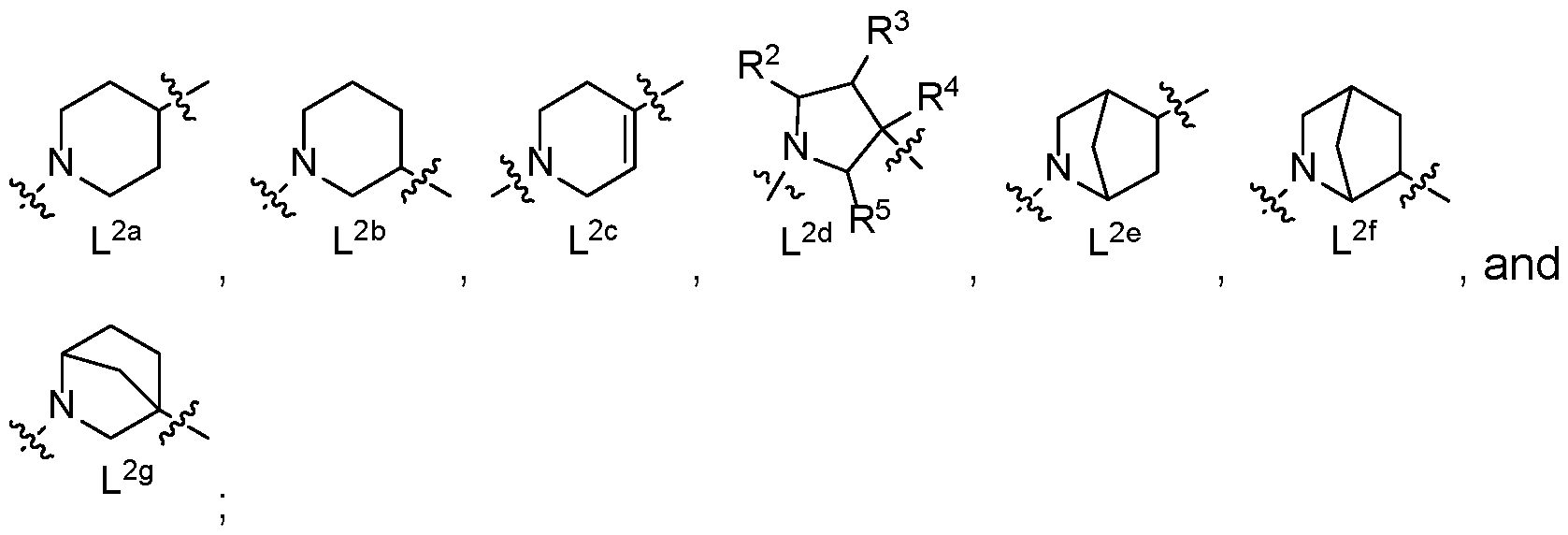 wherein R2 and R5 are independently H, methyl, hydroxyl, or halogen; and wherein R3 and R4 can be, for example, independently H, methyl, hydroxyl, or halogen, or linked covalently at a methylene to form a three-carbon ring.
5. The compound of any preceding claim, its enantiomer, a racemate thereof, a


H, methyl, ethyl, methoxy, ethoxy, or halogen; wherein R14, R15, R19, R20, R21 , R22, R34, R35, R36, and R37 are independently H, methyl, ethyl, methoxy, ethoxy, or halogen; wherein R26 and R27 are independently H, methyl, ethyl, methoxy, ethoxy, or halogen, or methylenes covalently linked to form a three-carbon ring; wherein R24, R25, R28, R33, and R38 are independently H, methyl, or halogen; and wherein R23 is methyl or ethyl.
6. The compound of any preceding claim, its enantiomer, a racemate thereof, a prodrug thereof, or salt thereof, or any combination thereof, wherein Z is selected from one of the following:
 wherein R41 , R42, R46, R47, and R48 are independently H, methyl, ethyl, or halogen; and wherein R43, R44, and R45 are independently H or halogen.
7. The compound of any preceding claim, its enantiomer, a racemate thereof, a prodrug thereof, or salt thereof, or any combination thereof, wherein Formula
(I) is represented by Formula (II):
 wherein R1a, R1 b, R1c, and R1d are independently H, methyl, hydroxyl, or halogen, or R1a and R1c are bonds forming a bridge comprising methylene, or R1 b and R1d are bonds forming a bridge comprising methylene.
8. The compound of any preceding claim, its enantiomer, a racemate thereof, a prodrug thereof, or salt thereof, or any combination thereof, wherein Formula
(I) is represented by Formula (III):

9. The compound of any preceding claim, its enantiomer, a racemate thereof, a prodrug thereof, or salt thereof, or any combination thereof, wherein Formula (I) is represented by Formula (IVa):
 wherein R51 and R52 are independently H, methyl, ethyl, or halogen.
10. The compound of any preceding claim, its enantiomer, a racemate thereof, a prodrug thereof, or salt thereof, or any combination thereof, wherein the compound comprises:

11 . The compound of any preceding claim, its enantiomer, a racemate thereof, a prodrug thereof, or salt thereof, or any combination thereof, wherein Formula (I) is represented by Formula (IVb):
 wherein R51 and R52 are independently H, methyl, ethyl, or halogen.
12. The compound of any preceding claim, its enantiomer, a racemate thereof, a prodrug thereof, or salt thereof, or any combination thereof, wherein the compound comprises:

13. The compound of any preceding claim, its enantiomer, a racemate thereof, a prodrug thereof, or salt thereof, or any combination thereof, wherein Formula (I) is represented by Formula (IVc):
 wherein R53 and R54 are independently H, methyl, ethyl, or halogen.
14. The compound of any preceding claim, its enantiomer, a racemate thereof, a prodrug thereof, or salt thereof, or any combination thereof, wherein the compound comprises:

15. The compound of any preceding claim, its enantiomer, a racemate thereof, a prodrug thereof, or salt thereof, or any combination thereof, wherein Formula (I) is represented by Formula (Va):
 wherein R51 and R55b are independently H, methyl, ethyl, or halogen.
16. The compound of any preceding claim, its enantiomer, a racemate thereof, a prodrug thereof, or salt thereof, or any combination thereof, wherein the compound comprises:

17. The compound of any preceding claim, its enantiomer, a racemate thereof, a prodrug thereof, or salt thereof, or any combination thereof, wherein Formula
(I) is represented by Formula (Vb):
 wherein R51 and R55b are independently H, methyl, ethyl, or halogen.
18. The compound of any preceding claim, its enantiomer, a racemate thereof, a prodrug thereof, or salt thereof, or any combination thereof, wherein the compound comprises:

19. The compound of any preceding claim, its enantiomer, a racemate thereof, a prodrug thereof, or salt thereof, or any combination thereof, wherein Formula
(I) is represented by Formula (Vc):
 wherein R51 and R55b are independently H, methyl, ethyl, or halogen.
20. The compound of any preceding claim, its enantiomer, a racemate thereof, a prodrug thereof, or salt thereof, or any combination thereof, wherein the compound comprises:

21 . The compound of any preceding claim, its enantiomer, a racemate thereof, a prodrug thereof, or salt thereof, or any combination thereof, wherein Formula (I) is represented by Formula (VI):
 wherein R55 and R56 are independently H, methyl, ethyl, or halogen.
22. The compound of any preceding claim, its enantiomer, a racemate thereof, a prodrug thereof, or salt thereof, or any combination thereof, wherein Formula (I) is represented by Formula (Vila):
 wherein R61 and R62 are independently H or methyl, or methylenes covalently linked to form a three-carbon ring; wherein R63 is H, methyl, hydroxyl, or halogen; and wherein R64 is methyl, ethyl, or halogen.
23. The compound of any preceding claim, its enantiomer, a racemate thereof, a prodrug thereof, or salt thereof, or any combination thereof, wherein the compound comprises:
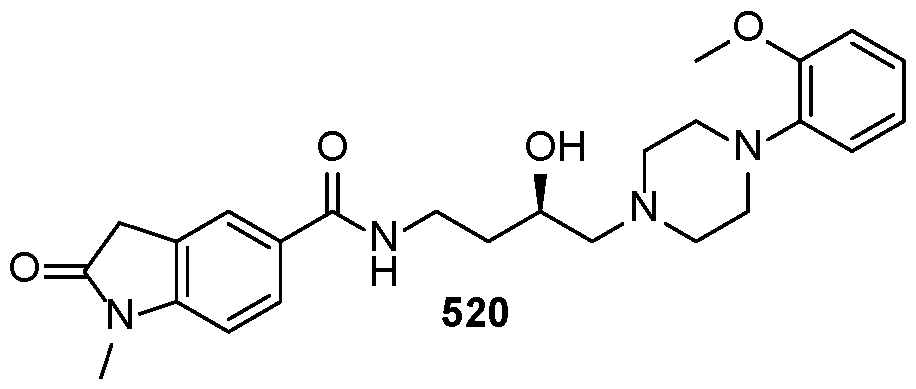
24. The compound of any preceding claim, its enantiomer, a racemate thereof, a prodrug thereof, or salt thereof, or any combination thereof, wherein Formula (I) is represented by Formula (Vllb):
 wherein R61 and R62 are independently H or methyl, or methylenes covalently linked to form a three-carbon ring; wherein R63 is H, methyl, hydroxyl, or halogen; and wherein R64 is methyl, ethyl, or halogen.
25. The compound of any preceding claim, its enantiomer, a racemate thereof, a prodrug thereof, or salt thereof, or any combination thereof, wherein Formula (I) is represented by Formula (VIII):
 wherein R65 and R66 are independently H or methyl, or methylenes covalently linked to form a three-carbon ring; wherein
 is selected from one of the following:
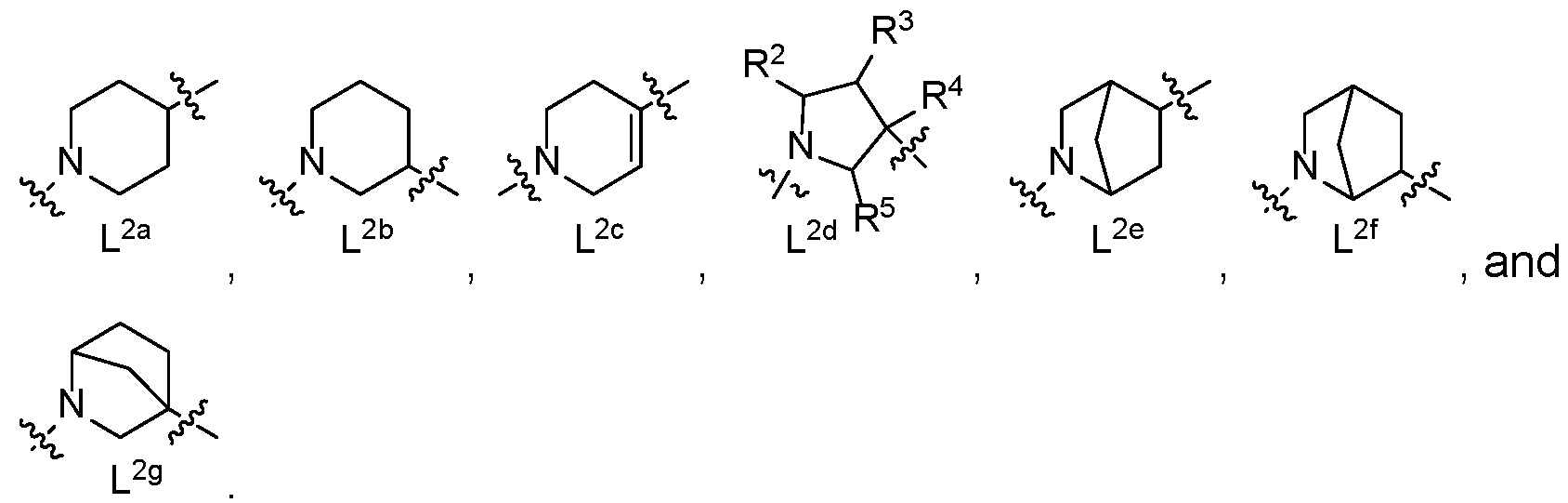 wherein R2, R3, R4, and R5 are independently H, methyl, hydroxyl, or halogen; and wherein R67 is methyl, ethyl, or halogen.
26. The compound of any preceding claim, its enantiomer, a racemate thereof, a prodrug thereof, or salt thereof, or any combination thereof, wherein the compound comprises:

27. The compound of any preceding claim, its enantiomer, a racemate thereof, a prodrug thereof, or salt thereof, or any combination thereof, wherein the compound comprises:

28. The compound of any preceding claim, its enantiomer, a racemate thereof, a prodrug thereof, or salt thereof, or any combination thereof, wherein Formula (I) is represented by Formula (IX):
 wherein R2, R3, R4, and R5 are independently H, methyl, hydroxyl, or halogen; wherein R68 is H or halogen; and wherein T is C or N.
29. The compound of any preceding claim, its enantiomer, a racemate thereof, a prodrug thereof, or salt thereof, or any combination thereof, wherein Formula (I) is represented by Formula (X):
 wherein R69 and R70 are independently H or methyl, or methylenes covalently linked to form a three-carbon ring;
wherein R71 and R72 are independently H, methyl, halogen, or linked covalently at a methylene to form a three-carbon ring; wherein R73 is H, methyl, or halogen; wherein R74 is H or halogen; and wherein T is C or N.
wherein R69 and R70 are independently H or methyl, or methylenes covalently linked to form a three-carbon ring;
wherein R71 and R72 are independently H, methyl, halogen, or linked covalently at a methylene to form a three-carbon ring; wherein R73 is H, methyl, or halogen; wherein R74 is H or halogen; and wherein T is C or N.
30. The compound of any preceding claim, its enantiomer, a racemate thereof, a prodrug thereof, or salt thereof, or any combination thereof, wherein Formula (I) is represented by Formula (XI):
 wherein R75 is H or halogen.
31 . The compound of any preceding claim, its enantiomer, a racemate thereof, a prodrug thereof, or salt thereof, or any combination thereof, wherein the compound comprises:

32. The compound of any preceding claim, its enantiomer, a racemate thereof, a prodrug thereof, or salt thereof, or any combination thereof, wherein the compound comprises:

33. The compound of any preceding claim, its enantiomer, a racemate thereof, a prodrug thereof, or salt thereof, or any combination thereof, wherein Formula (I) is represented by Formula (XII):
 wherein R81 is H, methyl, or halogen.
34. The compound of any preceding claim, its enantiomer, a racemate thereof, a prodrug thereof, or salt thereof, or any combination thereof, wherein Formula (I) is represented by Formula (XIII):
 wherein T is C or N; and wherein R83 is H or halogen.
35. The compound of any preceding claim, its enantiomer, a racemate thereof, a prodrug thereof, or salt thereof, or any combination thereof, wherein Formula (I) is represented by Formula (XIV):

36. The compound of any preceding claim, its enantiomer, a racemate thereof, a prodrug thereof, or salt thereof, or any combination thereof, wherein Formula (I) is represented by Formula (XV):
 wherein T is C or N.
37. The compound of any preceding claim, its enantiomer, a racemate thereof, a prodrug thereof, or salt thereof, or any combination thereof, wherein the compound comprises:
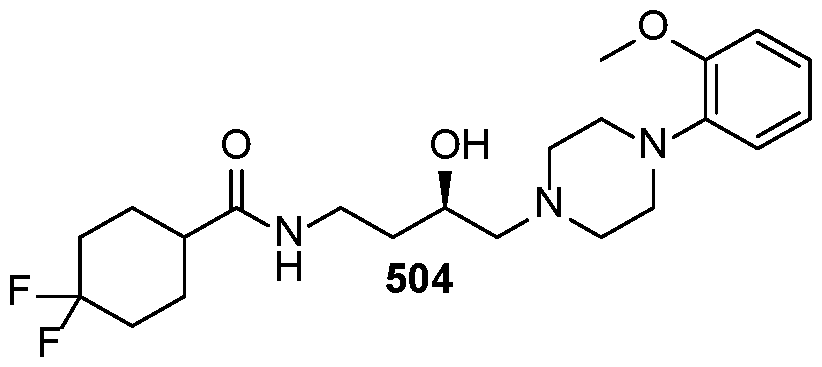
38. The compound of any preceding claim, its enantiomer, a racemate thereof, a prodrug thereof, or salt thereof, or any combination thereof, wherein the compound comprises:

39. The compound of any preceding claim, its enantiomer, a racemate thereof, a prodrug thereof, or salt thereof, or any combination thereof, wherein the compound comprises:

40. The compound of any preceding claim, its enantiomer, a racemate thereof, a prodrug thereof, or salt thereof, or any combination thereof, wherein the compound comprises:

41. The compound of any preceding claim, its enantiomer, a racemate thereof, a prodrug thereof, or salt thereof, or any combination thereof, wherein Formula (I) is represented by Formula (XVI):
 wherein T is C or N; and wherein R85 is H or halogen.
42. The compound of any preceding claim, its enantiomer, a racemate thereof, a prodrug thereof, or salt thereof, or any combination thereof, wherein the compound comprises;

43. The compound of any preceding claim, its enantiomer, a racemate thereof, a prodrug thereof, or salt thereof, or any combination thereof, wherein the compound comprises:
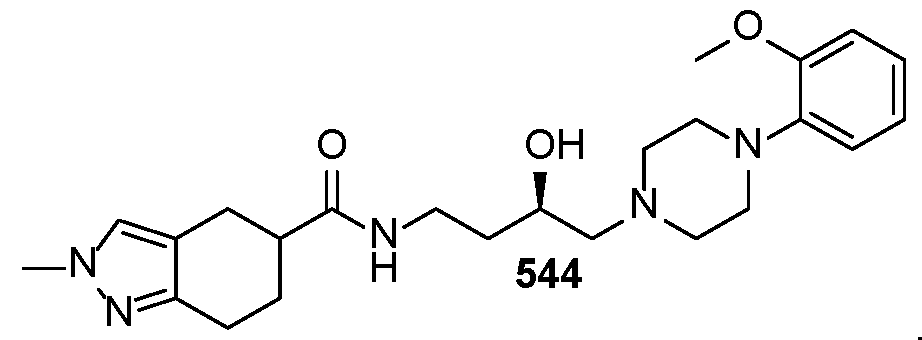
44. The compound of any preceding claim, its enantiomer, a racemate thereof, a prodrug thereof, or salt thereof, or any combination thereof, wherein the compound comprises:

45. The compound of any preceding claim, its enantiomer, a racemate thereof, a prodrug thereof, or salt thereof, or any combination thereof, wherein Formula (I) is represented by Formula (XVII):
 wherein T is C or N; and wherein R87 is H or halogen.
46. The compound of any preceding claim, its enantiomer, a racemate thereof, a prodrug thereof, or salt thereof, or any combination thereof, wherein Formula (I) is represented by Formula (XVIII):
 wherein T is C or N; wherein R91 and R92 are independently H, methyl, halogen, or linked covalently at a methylene to form a three-carbon ring; wherein R93 is H or halogen; and wherein G is C or N.
47. The compound of any preceding claim, its enantiomer, a racemate thereof, a prodrug thereof, or salt thereof, or any combination thereof, wherein the compound comprises:

48. A compound having Formula (XIX), its enantiomer, a racemate thereof, a prodrug thereof, a salt thereof, or any combination thereof:
 wherein J is a cyclic, heterocyclic, bicyclic, or heterobicyclic lactam ring bound to a n-butyl linker through the lactam nitrogen; X is a hydrogen, a hydroxyl, or a methyl group substituent of the n-butyl linker; and Z is a substituted aryl bound to the n-butyl linker through a piperazine group.
49. The therapeutic compound of any preceding claim, its enantiomer, a racemate thereof, a prodrug thereof, or salt thereof, or any combination thereof, wherein Formula (XIX) is represented by Formula (XX):
 wherein R95 and R96 are independently H, methyl, ethyl, or halogen.
50. The compound of any preceding claim, its enantiomer, a racemate thereof, a prodrug thereof, or salt thereof, or any combination thereof, wherein Formula (I) is represented by Formula (XXI):
 wherein R95 and R96 are independently H, methyl, ethyl, or halogen.
51 . The compound of any preceding claim, its enantiomer, a racemate thereof, a prodrug thereof, or salt thereof, or any combination thereof, wherein the compound comprises:

52. A pharmaceutical composition, comprising a therapeutically effective amount of the compound of any preceding claim, its enantiomer, a racemate thereof, a prodrug thereof, a salt thereof, or any combination thereof, together with a pharmaceutically acceptable carrier.
53. The pharmaceutical composition of any preceding claim, wherein the compound is a selective dopamine D3 receptor antagonist, or a selective dopamine D3 receptor agonist.
54. The pharmaceutical composition of any preceding claim, wherein the compound has greater than 50 times D3 receptor selectivity relative to D2 receptor selectivity.
55. The pharmaceutical composition of any preceding claim, wherein the compound has greater than 100 times D3 receptor selectivity relative to D2 receptor selectivity.
56. The pharmaceutical composition of any preceding claim, wherein the compound has at least a 10-fold therapeutic window as measured by the IC50 hERG toxicity relative to the minimally effective therapeutic dose.
57. The pharmaceutical composition of any preceding claim, wherein the compound has at least a 30-fold therapeutic window as measured by the IC50 hERG toxicity dose relative to the minimally effective therapeutic dose.
58. The pharmaceutical composition of any preceding claim, wherein the compound is a first therapeutic compound, and the pharmaceutical composition further comprises a second therapeutic compound.
59. The pharmaceutical composition of any preceding claim, wherein the second compound comprises a selective dopamine Di receptor modulator, a selective dopamine D2 receptor modulator, a selective dopamine D4 receptor modulator, or a selective dopamine Ds receptor modulator, or any combination thereof.
60. The pharmaceutical composition of any preceding claim, wherein the second compound comprises a selective dopamine Di receptor modulator, a selective dopamine Ds receptor modulator, or both.
61 . The pharmaceutical composition of any preceding claim, wherein the second compound comprises a selective dopamine D2 receptor modulator, a selective dopamine D4 receptor modulator, or both.
62. The pharmaceutical composition of any preceding claim, wherein the first compound comprises a selective dopamine D2 receptor agonist, and the second therapeutic compound comprises a selective dopamine D3 antagonist.
63. The pharmaceutical composition of any preceding claim, wherein the second compound comprises an antidepressant, or an antipsychotic, or both.
64. The pharmaceutical composition of any preceding claim, wherein the second compound is a Parkinson disease therapeutic compound.
65. A method of treating drug misuse or drug addiction, comprising administering to a patient in need thereof a composition comprising a therapeutically effective amount of the compound of any preceding claim, its enantiomer, a racemate thereof, a prodrug thereof, a salt thereof, or any combination thereof optionally in combination with one or more additional active ingredients.
66. The method of any preceding claim, wherein the patient has a history of misusing a stimulant, a depressant, an opioid, a cannabinoid, lysergic acid diethylamide (LSD), mescaline, psilocybin, nicotine, ethanol, a benzodiazepine, phencyclidine, ketamine, cocaine, or an amphetamine, or any combination thereof.
67. A method of treating a substance use disorder, comprising administering to a patient in need thereof a composition comprising a therapeutically effective amount of the compound of any preceding claim, its enantiomer, a racemate thereof, a prodrug thereof, a salt thereof, or any combination thereof optionally in combination with one or more additional active ingredients.
68. The method of any preceding claim, wherein the patient has one or more affective disorders, schizophrenia, or both.
69. The method of any preceding claim, wherein the substance use disorder comprises a psychostimulant use disorder.
70. The method of any preceding claim, wherein the patient has a history of misusing a stimulant comprising cocaine, an amphetamine, a methamphetamine, dextroamphetamine, levoamphetamine, methylenedioxymethamphetamine (MDMA), methylphenidate, modafinil, armodafinil, midodrine, oxymetazoline, dobutamine, ephedrine, pseudoephedrine, or phenylephrine, or any combination thereof.
71 . The method of any preceding claim, comprising administering to a patient in need thereof a composition comprising a therapeutically effective amount of the compound of any preceding claim, its enantiomer, a racemate thereof, a prodrug thereof, a salt thereof, or any combination thereof and one or more additional active ingredients selected from the group consisting of bremazocine, buprenorphine, butorphanol, carfentanyl, codeine, cyclazocine, dezocine, diamorphine, dihydrocodeine, dihydromorphine, dihydromorphinone (aka hydromorphone), enadoline, eseroline, ethylmorphine, etonitazine, etorphine, fentanyl, hydrocodone, levophenacylmorphan, levorphanol, meperidine/pethidine, methadone, morphine, nalbuphine, nicomorphine, oxycodone, oxymorphone, pentazocine, phenazocine, picenadol, tramadol, tapentadol, or a combination thereof.
72. The method of any preceding claim, wherein the additional active ingredient is selected from the group consisting of methadone, naltrexone and buprenorphine.
73. A method of treating Parkinson Disease, comprising administering to a patient in need thereof a composition comprising a therapeutically effective amount of the compound of any preceding claim, its enantiomer, a racemate thereof, a prodrug thereof, a salt thereof, or any combination thereof optionally in combination with one or more additional active ingredients.
74. The method of treating Parkinson Disease of any preceding claim, further comprising administering levodopa.
75. The method of treating Parkinson Disease of any preceding claim, wherein the compound is a selective dopamine D3 receptor agonist.
76. A method of treating Attention Deficit/ Hyperactivity Disorder (“ADHD”), comprising administering to a patient in need thereof a composition comprising a therapeutically effective amount of the compound of any preceding claim, its enantiomer, a racemate thereof, a prodrug thereof, a salt thereof, or any combination thereof optionally in combination with one or more additional active ingredients.
77. A kit comprising the compound of any preceding claim and a second therapeutic compound.
78. A method of synthesizing the compound of any preceding claim.
Applications Claiming Priority (2)
| Application Number | Priority Date | Filing Date | Title |
|---|---|---|---|
| US202363511452P | 2023-06-30 | 2023-06-30 | |
| US63/511,452 | 2023-06-30 |
Publications (1)
| Publication Number | Publication Date |
|---|---|
| WO2025006982A1 true WO2025006982A1 (en) | 2025-01-02 |
Family
ID=91969232
Family Applications (1)
| Application Number | Title | Priority Date | Filing Date |
|---|---|---|---|
| PCT/US2024/036149 Ceased WO2025006982A1 (en) | 2023-06-30 | 2024-06-28 | Potent and selective dopamine d3 receptor antagonists |
Country Status (1)
| Country | Link |
|---|---|
| WO (1) | WO2025006982A1 (en) |
Citations (5)
| Publication number | Priority date | Publication date | Assignee | Title |
|---|---|---|---|---|
| EP0445701A1 (en) * | 1990-03-05 | 1991-09-11 | SHIONOGI SEIYAKU KABUSHIKI KAISHA trading under the name of SHIONOGI & CO. LTD. | Novel tetrahydropyridine derivatives |
| WO2014059265A1 (en) * | 2012-10-11 | 2014-04-17 | Southern Research Institute | Urea and amide derivatives of aminoalkylpiperazines and use thereof |
| US8748608B2 (en) * | 2007-06-15 | 2014-06-10 | The United States Of America As Represented By The Secretary Of The Department Of Health And Human Services | 4-phenylpiperazine derivatives with functionalized linkers as dopamine D3 receptor selective ligands and methods of use |
| WO2017160552A1 (en) * | 2016-03-14 | 2017-09-21 | The United States Of America, As Represented By The Secretary, Department Of Health And Human Services | Dopamine d3 receptor selective antagonists/partial agonists; method of making; and use thereof |
| WO2020055725A1 (en) * | 2018-09-11 | 2020-03-19 | The United States Of America, As Represented By The Secretary, Department Of Health And Human Services | Dopamine d3 receptor selective antagonists/partial agonists and uses thereof |
-
2024
- 2024-06-28 WO PCT/US2024/036149 patent/WO2025006982A1/en not_active Ceased
Patent Citations (5)
| Publication number | Priority date | Publication date | Assignee | Title |
|---|---|---|---|---|
| EP0445701A1 (en) * | 1990-03-05 | 1991-09-11 | SHIONOGI SEIYAKU KABUSHIKI KAISHA trading under the name of SHIONOGI & CO. LTD. | Novel tetrahydropyridine derivatives |
| US8748608B2 (en) * | 2007-06-15 | 2014-06-10 | The United States Of America As Represented By The Secretary Of The Department Of Health And Human Services | 4-phenylpiperazine derivatives with functionalized linkers as dopamine D3 receptor selective ligands and methods of use |
| WO2014059265A1 (en) * | 2012-10-11 | 2014-04-17 | Southern Research Institute | Urea and amide derivatives of aminoalkylpiperazines and use thereof |
| WO2017160552A1 (en) * | 2016-03-14 | 2017-09-21 | The United States Of America, As Represented By The Secretary, Department Of Health And Human Services | Dopamine d3 receptor selective antagonists/partial agonists; method of making; and use thereof |
| WO2020055725A1 (en) * | 2018-09-11 | 2020-03-19 | The United States Of America, As Represented By The Secretary, Department Of Health And Human Services | Dopamine d3 receptor selective antagonists/partial agonists and uses thereof |
Non-Patent Citations (5)
| Title |
|---|
| "McGraw-Hill Dictionary of Chemical Terms", 1984, MCGRAW-HILL BOOK COMPANY |
| AWADALLAH ET AL: "Synthesis of novel lactam derivatives and their evaluation as ligands for the dopamine receptors, leading to a D"4-selective ligand", BIOORGANIC & MEDICINAL CHEMISTRY, ELSEVIER, AMSTERDAM, NL, vol. 15, no. 17, 19 July 2007 (2007-07-19), pages 5811 - 5818, XP022152370, ISSN: 0968-0896, DOI: 10.1016/J.BMC.2007.06.002 * |
| CAO YONGKAI ET AL: "Design, synthesis, and evaluation of bitopic arylpiperazine-phthalimides as selective dopamine D 3 receptor agonists", MEDCHEMCOMM, vol. 9, no. 9, 1 January 2018 (2018-01-01), United Kingdom, pages 1457 - 1465, XP093213675, ISSN: 2040-2503, DOI: 10.1039/C8MD00237A * |
| ELIEL, EWILEN, S: "Stereochemistry of Organic Compounds", 1994, JOHN WILEY & SONS, INC |
| MICHELI ET AL., J. MED. CHEM., vol. 53, no. 1, 2010, pages 374 - 391 |
Similar Documents
| Publication | Publication Date | Title |
|---|---|---|
| AU2023202086B2 (en) | Antagonists of the muscarinic acetylcholine receptor M4 | |
| Schneider et al. | Dopamine autoreceptor agonists: resolution and pharmacological activity of 2, 6-diaminotetrahydrobenzothiazole and an aminothiazole analog of apomorphine | |
| US10617690B2 (en) | JAK inhibitor | |
| JP5121716B2 (en) | Pyridine derivatives and their use in the treatment of mental disorders | |
| AU2008341352B2 (en) | Dipeptidyl peptidase-IV inhibiting compounds, methods of preparing the same, and pharmaceutical compositions containing the same as active agent | |
| JP2009507801A5 (en) | ||
| WO2011058109A1 (en) | Fused bicyclic pyrrole and imidazole derivatives as kinase inhibitors | |
| HUE028038T2 (en) | Pyrazoloquinoline compounds | |
| CA3156981C (en) | Aryl heterobicyclic compounds as kv1.3 potassium shaker channel blockers | |
| JP2019501932A (en) | 8-Amino-2-oxo-1,3-diaza-spiro- [4.5] -decane derivatives | |
| JP2008536927A (en) | N-alkyl-azacycloalkyl NMDA / NR2B antagonist | |
| CA3155864A1 (en) | MUSCARINIC ACETYLCHOLINE M4 RECEPTOR ANTAGONISTS | |
| WO2011050063A1 (en) | 2-substituted-ethynylthiazole derivatives and uses of same | |
| CA3225467A1 (en) | Phenol derivatives for use in the modulation of brm | |
| KR20240013134A (en) | Pyridine-sulfonamide derivatives as sigma ligands | |
| AU2007271136A1 (en) | Azaindole derivatives with a combination of partial nicotinic acetylcholine receptor agonism and dopamine reuptake inhibition | |
| JP2022526979A (en) | Degradation and use of AKT by binding of ATP-competitive AKT inhibitor GDC-0068 and E3 ligase ligand | |
| US20220112187A1 (en) | Pyrazolopyridine amine compounds for the treatment of autoimmune disease | |
| JP5524183B2 (en) | Spiro (piperidine-4,2'-pyrrolidine) -1- (3,5-trifluoromethylphenyl) methylcarboxamide as an NK1 tachykinin receptor antagonist | |
| AU2017388054A1 (en) | Substituted pyrazolopyrimidinone compounds as PDE2 inhibitors | |
| CA3158333A1 (en) | Compounds and compositions for the treatment of parasitic diseases | |
| WO2017046606A1 (en) | Antibacterial compounds | |
| WO2024072930A1 (en) | Dopamine d3/d2 receptor partial agonists for the treatment of neuropsychiatric disorders | |
| TW200819448A (en) | Azaindole derivatives with a combination of partial nicotinic acetylcholine receptor agonism and dopamine reuptake inhibition | |
| US20090124600A1 (en) | N-Alkyl-Azacycloalkyl NMDA/NR2B Antagonists |
Legal Events
| Date | Code | Title | Description |
|---|---|---|---|
| 121 | Ep: the epo has been informed by wipo that ep was designated in this application |
Ref document number: 24746860 Country of ref document: EP Kind code of ref document: A1 |
|
| NENP | Non-entry into the national phase |
Ref country code: DE |