WO2025006955A2 - Cd29 targeted oligonucleotides and uses thereof - Google Patents
Cd29 targeted oligonucleotides and uses thereof Download PDFInfo
- Publication number
- WO2025006955A2 WO2025006955A2 PCT/US2024/036118 US2024036118W WO2025006955A2 WO 2025006955 A2 WO2025006955 A2 WO 2025006955A2 US 2024036118 W US2024036118 W US 2024036118W WO 2025006955 A2 WO2025006955 A2 WO 2025006955A2
- Authority
- WO
- WIPO (PCT)
- Prior art keywords
- oligomeric
- modified
- certain embodiments
- agent
- modified oligonucleotide
- Prior art date
- Legal status (The legal status is an assumption and is not a legal conclusion. Google has not performed a legal analysis and makes no representation as to the accuracy of the status listed.)
- Ceased
Links
Classifications
-
- C—CHEMISTRY; METALLURGY
- C12—BIOCHEMISTRY; BEER; SPIRITS; WINE; VINEGAR; MICROBIOLOGY; ENZYMOLOGY; MUTATION OR GENETIC ENGINEERING
- C12N—MICROORGANISMS OR ENZYMES; COMPOSITIONS THEREOF; PROPAGATING, PRESERVING, OR MAINTAINING MICROORGANISMS; MUTATION OR GENETIC ENGINEERING; CULTURE MEDIA
- C12N15/00—Mutation or genetic engineering; DNA or RNA concerning genetic engineering, vectors, e.g. plasmids, or their isolation, preparation or purification; Use of hosts therefor
- C12N15/09—Recombinant DNA-technology
- C12N15/11—DNA or RNA fragments; Modified forms thereof; Non-coding nucleic acids having a biological activity
- C12N15/111—General methods applicable to biologically active non-coding nucleic acids
-
- C—CHEMISTRY; METALLURGY
- C12—BIOCHEMISTRY; BEER; SPIRITS; WINE; VINEGAR; MICROBIOLOGY; ENZYMOLOGY; MUTATION OR GENETIC ENGINEERING
- C12N—MICROORGANISMS OR ENZYMES; COMPOSITIONS THEREOF; PROPAGATING, PRESERVING, OR MAINTAINING MICROORGANISMS; MUTATION OR GENETIC ENGINEERING; CULTURE MEDIA
- C12N15/00—Mutation or genetic engineering; DNA or RNA concerning genetic engineering, vectors, e.g. plasmids, or their isolation, preparation or purification; Use of hosts therefor
- C12N15/09—Recombinant DNA-technology
- C12N15/11—DNA or RNA fragments; Modified forms thereof; Non-coding nucleic acids having a biological activity
- C12N15/113—Non-coding nucleic acids modulating the expression of genes, e.g. antisense oligonucleotides; Antisense DNA or RNA; Triplex- forming oligonucleotides; Catalytic nucleic acids, e.g. ribozymes; Nucleic acids used in co-suppression or gene silencing
-
- C—CHEMISTRY; METALLURGY
- C12—BIOCHEMISTRY; BEER; SPIRITS; WINE; VINEGAR; MICROBIOLOGY; ENZYMOLOGY; MUTATION OR GENETIC ENGINEERING
- C12N—MICROORGANISMS OR ENZYMES; COMPOSITIONS THEREOF; PROPAGATING, PRESERVING, OR MAINTAINING MICROORGANISMS; MUTATION OR GENETIC ENGINEERING; CULTURE MEDIA
- C12N15/00—Mutation or genetic engineering; DNA or RNA concerning genetic engineering, vectors, e.g. plasmids, or their isolation, preparation or purification; Use of hosts therefor
- C12N15/09—Recombinant DNA-technology
- C12N15/11—DNA or RNA fragments; Modified forms thereof; Non-coding nucleic acids having a biological activity
- C12N15/113—Non-coding nucleic acids modulating the expression of genes, e.g. antisense oligonucleotides; Antisense DNA or RNA; Triplex- forming oligonucleotides; Catalytic nucleic acids, e.g. ribozymes; Nucleic acids used in co-suppression or gene silencing
- C12N15/1137—Non-coding nucleic acids modulating the expression of genes, e.g. antisense oligonucleotides; Antisense DNA or RNA; Triplex- forming oligonucleotides; Catalytic nucleic acids, e.g. ribozymes; Nucleic acids used in co-suppression or gene silencing against enzymes
-
- C—CHEMISTRY; METALLURGY
- C12—BIOCHEMISTRY; BEER; SPIRITS; WINE; VINEGAR; MICROBIOLOGY; ENZYMOLOGY; MUTATION OR GENETIC ENGINEERING
- C12N—MICROORGANISMS OR ENZYMES; COMPOSITIONS THEREOF; PROPAGATING, PRESERVING, OR MAINTAINING MICROORGANISMS; MUTATION OR GENETIC ENGINEERING; CULTURE MEDIA
- C12N2310/00—Structure or type of the nucleic acid
- C12N2310/10—Type of nucleic acid
- C12N2310/11—Antisense
-
- C—CHEMISTRY; METALLURGY
- C12—BIOCHEMISTRY; BEER; SPIRITS; WINE; VINEGAR; MICROBIOLOGY; ENZYMOLOGY; MUTATION OR GENETIC ENGINEERING
- C12N—MICROORGANISMS OR ENZYMES; COMPOSITIONS THEREOF; PROPAGATING, PRESERVING, OR MAINTAINING MICROORGANISMS; MUTATION OR GENETIC ENGINEERING; CULTURE MEDIA
- C12N2310/00—Structure or type of the nucleic acid
- C12N2310/10—Type of nucleic acid
- C12N2310/11—Antisense
- C12N2310/113—Antisense targeting other non-coding nucleic acids, e.g. antagomirs
-
- C—CHEMISTRY; METALLURGY
- C12—BIOCHEMISTRY; BEER; SPIRITS; WINE; VINEGAR; MICROBIOLOGY; ENZYMOLOGY; MUTATION OR GENETIC ENGINEERING
- C12N—MICROORGANISMS OR ENZYMES; COMPOSITIONS THEREOF; PROPAGATING, PRESERVING, OR MAINTAINING MICROORGANISMS; MUTATION OR GENETIC ENGINEERING; CULTURE MEDIA
- C12N2310/00—Structure or type of the nucleic acid
- C12N2310/10—Type of nucleic acid
- C12N2310/14—Type of nucleic acid interfering nucleic acids [NA]
-
- C—CHEMISTRY; METALLURGY
- C12—BIOCHEMISTRY; BEER; SPIRITS; WINE; VINEGAR; MICROBIOLOGY; ENZYMOLOGY; MUTATION OR GENETIC ENGINEERING
- C12N—MICROORGANISMS OR ENZYMES; COMPOSITIONS THEREOF; PROPAGATING, PRESERVING, OR MAINTAINING MICROORGANISMS; MUTATION OR GENETIC ENGINEERING; CULTURE MEDIA
- C12N2310/00—Structure or type of the nucleic acid
- C12N2310/30—Chemical structure
- C12N2310/31—Chemical structure of the backbone
- C12N2310/314—Phosphoramidates
-
- C—CHEMISTRY; METALLURGY
- C12—BIOCHEMISTRY; BEER; SPIRITS; WINE; VINEGAR; MICROBIOLOGY; ENZYMOLOGY; MUTATION OR GENETIC ENGINEERING
- C12N—MICROORGANISMS OR ENZYMES; COMPOSITIONS THEREOF; PROPAGATING, PRESERVING, OR MAINTAINING MICROORGANISMS; MUTATION OR GENETIC ENGINEERING; CULTURE MEDIA
- C12N2310/00—Structure or type of the nucleic acid
- C12N2310/30—Chemical structure
- C12N2310/32—Chemical structure of the sugar
- C12N2310/323—Chemical structure of the sugar modified ring structure
- C12N2310/3231—Chemical structure of the sugar modified ring structure having an additional ring, e.g. LNA, ENA
-
- C—CHEMISTRY; METALLURGY
- C12—BIOCHEMISTRY; BEER; SPIRITS; WINE; VINEGAR; MICROBIOLOGY; ENZYMOLOGY; MUTATION OR GENETIC ENGINEERING
- C12N—MICROORGANISMS OR ENZYMES; COMPOSITIONS THEREOF; PROPAGATING, PRESERVING, OR MAINTAINING MICROORGANISMS; MUTATION OR GENETIC ENGINEERING; CULTURE MEDIA
- C12N2310/00—Structure or type of the nucleic acid
- C12N2310/30—Chemical structure
- C12N2310/34—Spatial arrangement of the modifications
- C12N2310/341—Gapmers, i.e. of the type ===---===
-
- C—CHEMISTRY; METALLURGY
- C12—BIOCHEMISTRY; BEER; SPIRITS; WINE; VINEGAR; MICROBIOLOGY; ENZYMOLOGY; MUTATION OR GENETIC ENGINEERING
- C12N—MICROORGANISMS OR ENZYMES; COMPOSITIONS THEREOF; PROPAGATING, PRESERVING, OR MAINTAINING MICROORGANISMS; MUTATION OR GENETIC ENGINEERING; CULTURE MEDIA
- C12N2310/00—Structure or type of the nucleic acid
- C12N2310/30—Chemical structure
- C12N2310/35—Nature of the modification
- C12N2310/351—Conjugate
- C12N2310/3513—Protein; Peptide
-
- C—CHEMISTRY; METALLURGY
- C12—BIOCHEMISTRY; BEER; SPIRITS; WINE; VINEGAR; MICROBIOLOGY; ENZYMOLOGY; MUTATION OR GENETIC ENGINEERING
- C12N—MICROORGANISMS OR ENZYMES; COMPOSITIONS THEREOF; PROPAGATING, PRESERVING, OR MAINTAINING MICROORGANISMS; MUTATION OR GENETIC ENGINEERING; CULTURE MEDIA
- C12N2320/00—Applications; Uses
- C12N2320/30—Special therapeutic applications
- C12N2320/32—Special delivery means, e.g. tissue-specific
Definitions
- CD29 TARGETED OLIGONUCLEOTIDES AND USES THEREOF Sequence Listing application is being filed along with a Sequence Listing in electronic format.
- the Sequence Listing is provided as a file entitled CORE0172WOSEQ.xml created on June 24, 2024, which is 33 KB in size.
- the information in the electronic format of the sequence listing is incorporated herein by reference in its entirety.
- Field The present embodiments provide oligomeric agents, such as oligomeric compounds or oligomeric duplexes, and methods for targeting cells of interest that express CD29.
- CD29 also known as integrin beta 1 (ITGB1), is a cell surface receptor that associates with at least 10 different integrin alpha subunits to form dimeric receptors. CD29 is expressed in a variety of tissues, including liver, lung, skeletal muscle, and the duodenum, and is highly expressed in smooth muscle and adipose tissue.
- an oligomeric agent comprises an oligonucleotide linked to a CD29-binding moiety.
- an oligomeric agent comprises an oligomeric duplex comprised of two complementary oligonucleotides, wherein one of the two oligonucleotides is linked to a CD29-binding moiety.
- an oligomeric agent comprises an oligonucleotide, a conjugate linker, and a CD29-binding moiety.
- contacting a CD29-expressing cell with an oligomeric agent provided herein modulates expression of a nucleic acid target in the cell.
- an oligomeric agent comprising a CD29-binding moiety selectively or preferentially targets a cell expressing CD29 compared to a cell not expressing CD29.
- a compound comprising a CD29- binding moiety selectively or preferentially targets a cell expressing CD29 compared to a compound not comprising a CD29-binding moiety.
- the CD29-binding conjugate moiety is an antibody or a fragment thereof.
- a 2’-deoxynucleoside is a 2’- ⁇ -D-deoxynucleoside and comprises a 2’- ⁇ -D-deoxyribosyl sugar moiety, which has the ⁇ -D ribosyl configuration as found in naturally occurring deoxyribonucleic acids (DNA).
- a 2’-deoxynucleoside may comprise a modified nucleobase or may comprise an RNA nucleobase (uracil).
- “2’-MOE” means a 2’-OCH 2 CH 2 OCH 3 group in place of the 2’-OH group of a furanosyl sugar moiety.
- a “2’-MOE sugar moiety” means a sugar moiety with a 2’-OCH 2 CH 2 OCH 3 group in place of the 2’-OH group of a furanosyl sugar moiety. Unless otherwise indicated, a 2’-MOE sugar moiety is in the ⁇ -D-ribosyl configuration. “MOE” means O-methoxyethyl.
- “2’-MOE nucleoside” means a nucleoside comprising a 2’-MOE sugar moiety.
- “2’-OMe” means a 2’-OCH 3 group in place of the 2’-OH group of a furanosyl sugar moiety.
- A“2’-O-methyl sugar moiety” or “2’-OMe sugar moiety” means a sugar moiety with a 2’-OCH 3 group in place of the 2’-OH group of a furanosyl sugar moiety. Unless otherwise indicated, a 2’-OMe sugar moiety is in the ⁇ -D-ribosyl configuration.
- “2’-OMe nucleoside” means a nucleoside comprising a 2’-OMe sugar moiety.
- “2’-F” means a 2’-F group in place of the 2’-OH group of a furanosyl sugar moiety.
- A“2’-fluoro sugar moiety” or “2’-F sugar moiety” means a sugar moiety with a 2’-F group in place of the 2’- OH group of a furanosyl sugar moiety. Unless otherwise indicated, a 2’-F sugar moiety is in the ⁇ -D-ribosyl configuration.
- “2’-F nucleoside” means a nucleoside comprising a 2’-F sugar moiety.
- NMA means O-(N-methyl)acetamide.
- 2’-NMA nucleoside means a nucleoside comprising a 2’-NMA sugar moiety.
- “2’-substituted nucleoside” means a nucleoside comprising a 2’-substituted sugar moiety.
- an “antigen-binding fragment” of an antibody refers to any fragment or portion of an antibody that contains at least one variable domain (VH) of a heavy chain and at least one variable domain (VL) of a light chain, or, in the case of a camelid antibody, a VHH domain, or in the case of a shark antibody, a VNAR domain.
- an antigen-binding fragment may be contained within an intact antibody, obtained through cleavage of an antibody, prepared through recombinant expression, or may be chemically synthesized.
- an antigen-binding fragment is any of a monovalent Fab (“Fab” or “Fab fragment”), monovalent Fab’(“Fab’” or “Fab’ fragment”) or Fab’, divalent F(ab’) 2 (“F(ab’) 2 ”), F(ab’) 3 fragments (“F(ab’) 3 ”), Fv fragment, single-chain variable fragment (scFv), bis-scFv, (scFv)2, diabody, minibody, nanobody, triabody, tetrabody, disulfide stabilized Fv protein (dsFv), or the like, or a chemically modified derivative thereof.
- an “antigen-binding protein” is an antibody or a fragment thereof that includes an antigen-binding fragment.
- Antisense activity means any detectable and/or measurable activity attributable to the hybridization of an antisense compound to its target nucleic acid. In certain embodiments, antisense activity is the modulation of the amount or expression of a target nucleic acid or protein encoded by such target nucleic acid compared to target nucleic acid levels or target protein levels in the absence of the antisense compound to the target. In certain embodiments, antisense activity is the modulation of splicing of a target pre-mRNA.
- Antisense oligonucleotide means an oligonucleotide having a nucleobase sequence that is complementary to a target nucleic acid or region or segment thereof. In certain embodiments, an antisense oligonucleotide is specifically hybridizable to a target nucleic acid or region or segment thereof. As used herein, “antisense RNase H oligonucleotide” means an oligonucleotide comprising a region that is complementary to a target sequence, and which includes at least one chemical modification suitable for RNase H-mediated nucleic acid reduction.
- RNAi oligonucleotide means an oligonucleotide comprising a region that is complementary to a target sequence, and which includes at least one chemical modification suitable for RNAi-mediated nucleic acid reduction.
- Bicyclic nucleoside or “BNA” means a nucleoside comprising a bicyclic sugar moiety.
- Bicyclic sugar or “bicyclic sugar moiety” means a modified sugar moiety comprising two rings, wherein the second ring is formed via a bridge connecting two of the atoms in the first ring thereby forming a bicyclic structure.
- the first ring of the bicyclic sugar moiety is a furanosyl moiety.
- the bicyclic sugar moiety does not comprise a furanosyl moiety.
- “Branching group” means a group of atoms having at least 3 positions that are capable of forming covalent linkages to at least 3 groups.
- a branching group provides a plurality of reactive sites for connecting tethered ligands to an oligonucleotide via a conjugate linker and/or a cleavable moiety.
- “cell-targeting moiety” means a conjugate moiety or portion of a conjugate moiety that is capable of binding to a particular cell type or particular cell types.
- a cell- targeting moiety is capable of binding a cell-surface receptor or a cell-surface moiety. In certain embodiments, a cell-targeting moiety is capable of being internalized when it interacts with or binds a cell- surface receptor or a cell-surface moiety. In certain embodiments, a cell-targeting moiety comprises a cyclic peptide, a bicyclic peptide, a linear peptide, an aptamer, an antibody, or a fragment thereof.
- the cell-targeting moiety is an antigen-binding fragment, such as a monovalent Fab (“Fab” or “Fab fragment”), monovalent Fab’(“Fab’” or “Fab’ fragment”), divalent F(ab’) 2 (“F(ab’) 2 ”), F(ab’) 3 fragments (“F(ab’) 3 "), Fv fragment, single-chain variable fragment (scFv), bis-scFv, (scFv) 2 , diabody, minibody, nanobody, triabody, tetrabody, disulfide stabilized Fv protein (dsFv), single-domain antibody (sdAb), shark IgNAR antibody or antigen-binding fragment thereof (VNAR), camelid antibody or antigen- binding fragment thereof (VHH), bispecific antibody or antigen-binding fragment thereof, or a chemically modified derivative thereof.
- Fab monovalent Fab
- Fab monovalent Fab’(“Fab’” or “Fab’ fragment”
- a “CD29-binding moiety” is a cell-targeting moiety that is capable of binding to CD29 on CD29-expressing cells, including, but not limited to, endothelial cells, fibroblasts, muscle cells, adipocytes, macrophages, mesenchymal cells, blood cells, immune cells, and CD29-epxressing cancer cells.
- cell-surface moiety means a moiety present on the surface of a cell that is available to interact with matter external to the cell. In certain embodiments, a portion of the cell-surface moiety is integral with the cell membrane of the cell.
- Non-limiting examples of cell-surface moieties are lipids, proteins, and carbohydrates.
- a cell-surface moiety is CD29.
- cEt or “constrained ethyl” means a bicyclic sugar moiety, wherein the first ring of the bicyclic sugar moiety is a ribosyl sugar moiety, the second ring of the bicyclic sugar is formed via a bridge connecting the 4’-carbon and the 2’-carbon, the bridge has the formula 4'-CH(CH 3 )-O-2', and the bridge is in the S configuration.
- a cEt bicyclic sugar moiety is in the ⁇ -D configuration.
- chirally enriched population means a plurality of molecules of identical molecular formula, wherein the number or percentage of molecules within the population that contain a particular stereochemical configuration at a particular chiral center is greater than the number or percentage of molecules expected to contain the same particular stereochemical configuration at the same particular chiral center within the population if the particular chiral center were stereorandom. Chirally enriched populations of molecules having multiple chiral centers within each molecule may contain one or more stereorandom chiral centers.
- the molecules are oligomeric compounds disclosed herein.
- the oligomeric compounds are antisense compounds.
- the molecules are modified oligonucleotides.
- the molecules are oligomeric compounds comprising modified oligonucleotides.
- cleavable moiety means a bond or group of atoms that is cleaved under physiological conditions, for example, inside a cell, or a subject.
- complementary nucleobases means nucleobases that form hydrogen bonds with one another when aligned on opposing strands of nucleic acids (including, but not limited to oligonucleotides).
- Complementary nucleobase pairs include adenine (A) and thymine (T), adenine (A) and uracil (U), cytosine (C) and guanine (G), and 5-methylcytosine ( m C) and guanine (G).
- A adenine
- A thymine
- U adenine
- C cytosine
- G guanine
- m C 5-methylcytosine
- guanine guanine
- Certain modified nucleobases that pair with unmodified nucleobases or with other modified nucleobases are known in the art. For example, hypoxanthine can pair with adenine, cystine, or uracil.
- complementary in reference to a first and a second strand of nucleotides means that the nucleobases of the first strand and the nucleobases of the second strand of nucleotides are complementary nucleobases when the nucleobase sequences of the first and second stands are aligned in opposing directions.
- the complementary first and second strand of nucleotides may be, for example, regions of a single nucleic acid molecule (duplex regions that are self-complementary regions) or regions of separate nucleic acids (oligomeric duplexes), and one or both of the first and second strand of nucleotides are for example, oligonucleotides or regions thereof or cellular target nucleic acids.
- complementary strands are 75%, 80%, 85%, 90%, 95%, or 100% complementary.
- an oligonucleotide consisting of 20 nucleosides is 80% complementary to a nucleic acid, then 16 of the nucleobase pairs are complementary nucleobases, and there are 4 mismatches. If an oligonucleotide consisting of 20 nucleosides is at least 80% complementary to a nucleic acid, then 16, 17, 18, 19, or 20 of the nucleobase pairs are complementary nucleobases, and there are 0-4 mismatches.
- “fully complementary” or “100 % complementary” means that the nucleobase sequence of the first and second strands of nucleotides have complementary nucleobases at each nucleoside of the shorter of the two oligonucleotides or nucleic acids, or at each nucleoside if the oligonucleotides are the same length.
- conjugate group means a group of atoms that is attached to an oligonucleotide.
- Conjugate groups include a conjugate moiety and a conjugate linker that attaches the conjugate moiety to the oligonucleotide.
- the conjugate linker is a single bond, and in this case, the conjugate group is the same as the conjugate moiety.
- conjugate linker means a single bond or a group of atoms comprising at least one bond that connects a conjugate moiety to an oligonucleotide.
- conjugate moiety means a group of atoms that is attached to an oligonucleotide via a conjugate linker.
- deoxy region means a region of 5-12 contiguous nucleotides, wherein at least 70% of the nucleosides comprise a 2’-deoxy sugar moiety.
- each nucleoside is selected from a 2’- ⁇ -D-deoxynucleoside, a bicyclic nucleoside, and a 2’-substituted nucleoside.
- a deoxy region supports RNase H activity.
- a deoxy region is the gap or internal region of a gapmer.
- Fab or “Fab fragment” means a heterodimeric protein corresponding to the region of a primate (human) or rodent antibody containing variable domains that can be derived from papain digestion of the whole antibody.
- a Fab may also be expressed recombinantly.
- a Fab contains one variable domain (VH) and one constant domain (CH1) of the heavy chain and one light chain, including one variable domain (VL) and one constant domain (CL). Each variable domain includes three complementarity- determining regions, or CDRs.
- F(ab’) 2 means a protein corresponding to the region of a primate (human) or rodent antibody that can be derived from pepsin digestion of the whole antibody.
- a F(ab’) 2 may also be expressed recombinantly.
- a F(ab’) 2 contains a disulfide-linked pair of Fabs.
- a recombinant F(ab’) 2 may be bispecific, with each Fab recognizing a different antigen. Reduction of F(ab’) 2 produces two monovalent Fab’ fragments. Fab’ fragments differ from Fab fragments by retaining a free sulfhydryl group on the C-terminal end of the CH1 domain.
- “F(ab’) 3 ” means a trimeric protein comprising three linked Fab fragments.
- a recombinant F(ab’) 3 may be bispecific, with each Fab recognizing one of two antigens, or trispecific, with each Fab recognizing a different antigen.
- Fv fragment means a monomeric protein corresponding to the VH region of the heavy chain and the VL region of the light chain, bound together by non-covalent interactions.
- scFv or single-chain variable fragment means a monomeric protein consisting of the variable domain of a light chain appended at the N-terminus or C-terminus of the variable domain of a heavy chain.
- Fc domain means a protein corresponding to a fragment of an antibody containing the CH2 and CH3 domains, and optionally an N-terminal extension.
- an Fc domain is derived from papain digestion of a human IGG1 antibody and contains the CH2 and CH3 domains as well as a portion of the hinge region.
- hybridization means the annealing of oligonucleotides and/or nucleic acids. While not limited to a particular mechanism, the most common mechanism of hybridization involves hydrogen bonding, which may be Watson-Crick, Hoogsteen or reversed Hoogsteen hydrogen bonding, between complementary nucleobases.
- complementary nucleic acid molecules include, but are not limited to, an antisense compound and a nucleic acid target. In certain embodiments, complementary nucleic acid molecules include, but are not limited to, an oligonucleotide and a nucleic acid target.
- identity or “percent identity”, with regard to an amino acid sequence, means the percentage of amino acids that are identical between two amino acid sequences when the amino acid sequences are aligned for maximal similarity. Percent identity can be determined by a program such as BLASTP (Altschul, et al., J. Mol.
- internucleoside linkage is the covalent linkage between adjacent nucleosides in an oligonucleotide.
- modified internucleoside linkage means any internucleoside linkage other than a phosphodiester internucleoside linkage.
- “Phosphorothioate internucleoside linkage” is a modified internucleoside linkage in which one of the non-bridging oxygen atoms of a phosphodiester internucleoside linkage is replaced with a sulfur atom.
- “mismatch” or “non-complementary” means a nucleobase of a first oligonucleotide that is not complementary with the corresponding nucleobase of a second oligonucleotide or target nucleic acid when the first and second oligonucleotide are aligned.
- motif means the pattern of unmodified and/or modified sugar moieties, nucleobases, and/or internucleoside linkages, in an oligonucleotide.
- naturally amino acid means Gly or the L -isomer of each of the following: Ala, Arg, Asn, Asp, Cys, Gln, Glu, His, Ile, Lys, Leu, Met, Phe, Pro, Ser, Thr, Trp, Tyr, Val.
- non-natural amino acid means any amino acid other than the standard twenty amino acids encoded by the human genetic code, including D -isomers of each of the following: Ala, Arg, Asn, Asp, Cys, Gln, Glu, His, Ile, Lys, Leu, Met, Phe, Pro, Ser, Thr, Trp, Tyr, Val.
- a non-natural amino acid may have a modified or functionalized side chain (e.g., through the attachment of a linker)
- non-natural amino acids include, but are not limited to, allo-isoleucine, 2-amino-3-ethyl-pentanoic acid, aminoisobutyric acid, aminobutyric acid, azetidine, 7-azatryptophan, 6-azidolysine, ⁇ -cyclobutylalanine, ⁇ - methyl isoleucine, 4, 4-biphenylalanine, cis-hydroxyproline, cyclobutyl glycine, cyclohexyl glycine, cyclopentyl alanine, cyclopentyl glycine, 2,6-dimethyl tyrosine, 3,3-diphenyl alanine, 4-trans-hydroxy-L- proline, 1-napthaylalanine, 2-napthylalanine, N-methyl alanine, 1-
- non-bicyclic modified sugar moiety means a modified sugar moiety that comprises a modification, such as a substituent, that does not form a bridge between two atoms of the sugar to form a second ring.
- nucleobase means an unmodified nucleobase or a modified nucleobase.
- a nucleobase is a heterocyclic moiety.
- an “unmodified nucleobase” is adenine (A), thymine (T), cytosine (C), uracil (U), or guanine (G).
- a “modified nucleobase” is a group of atoms other than unmodified A, T, C, U, or G capable of pairing with at least one other nucleobase.
- a “5-methylcytosine” is a modified nucleobase.
- a universal base is a modified nucleobase that can pair with any one of the five unmodified nucleobases.
- nucleobase sequence means the order of contiguous nucleobases in a nucleic acid or oligonucleotide independent of any sugar or internucleoside linkage modification.
- nucleobase sequence of or “the sequence of” a reference nucleobase SEQ ID NO, refers only to the nucleobase sequence provided in such SEQ ID NO and therefore, unless otherwise indicated, includes compounds wherein each sugar moiety and each internucleoside linkage, independently, may be modified or unmodified, irrespective of the presence or absence of modifications, indicated in the referenced SEQ ID NO.
- nucleoside means a compound or fragment of a compound comprising a nucleobase and a sugar moiety. The nucleobase and sugar moiety are each, independently, unmodified or modified.
- oligomeric agent means an oligomeric compound and optionally one or more additional features, such as a second oligomeric compound.
- An oligomeric agent may be a single-stranded oligomeric compound or may be an oligomeric duplex formed by two complementary oligomeric compounds.
- oligomeric compound means an oligonucleotide and optionally one or more additional features, such as a terminal group or linker.
- An oligomeric compound may be paired with a second oligomeric compound that is complementary to the first oligomeric compound or may be unpaired.
- a “singled-stranded oligomeric compound” is an unpaired oligomeric compound.
- oligomeric duplex means a duplex formed by two oligomeric compounds having complementary nucleobase sequences.
- oligonucleotide means a strand of linked nucleosides connected via internucleoside linkages, wherein each nucleoside and internucleoside linkage independently may be modified or unmodified. Unless otherwise indicated, oligonucleotides consist of 8-50 linked nucleosides.
- modified oligonucleotide means an oligonucleotide, wherein at least one nucleoside or internucleoside linkage is modified.
- unmodified oligonucleotide means an oligonucleotide that does not comprise any nucleoside modifications or internucleoside modifications.
- peptide means a compound or a fragment of a compound consisting of 3 or more amino acids linked together via amide bonds.
- polypeptide means a compound or fragment of a compound consisting of 60 or more amino acids linked together via amide bonds.
- a protein may comprise one or more peptides or polypeptides, or a combination thereof.
- peptide sequence or “polypeptide sequence” means the order of contiguous amino acids in a peptide or polypeptide main chain. In the case of cyclic peptides, the peptide sequence corresponds to the linear sequence of contiguous amide-bond linked amino acids, and does not describe how this linear sequence is cyclized.
- peptidomimetic means a compound or a fragment of a compound consisting of 3 or more amino acids or amino acid mimetics linked together, wherein at least two subunits are linked by a bond that is not an amide bond. Unless otherwise indicated, peptidomimetics consist of 3-50 amino acids or amino acid mimetics, or combinations of a total of 3-50 amino acids or amino acid mimetics.
- pharmaceutically acceptable carrier or diluent means any substance suitable for use in administering to a subject.
- compositions enable pharmaceutical compositions to be formulated as, for example, tablets, pills, dragees, capsules, liquids, gels, syrups, slurries, suspension, and lozenges for the oral ingestion by a subject.
- a pharmaceutically acceptable carrier or diluent is sterile water, distilled water for injection, sterile saline, sterile buffer solution or sterile artificial cerebrospinal fluid.
- pharmaceutically acceptable salt(s) means physiologically and pharmaceutically acceptable salt(s) of oligomeric compounds. Pharmaceutically acceptable salts retain the desired biological activity of the parent compound and do not impart undesired toxicological effects thereto.
- a pharmaceutical composition means a mixture of substances suitable for administering to a subject.
- a pharmaceutical composition may comprise an oligomeric agent and a sterile aqueous solution.
- a pharmaceutical composition shows activity in free uptake assay in certain cell lines.
- prodrug means a therapeutic agent in a first form outside the body that is converted to a second form within a subject or cells thereof. Typically, conversion of a prodrug within the subject is facilitated by the action of an enzyme (e.g., endogenous or viral enzyme) or chemicals present in cells or tissues and/or by physiologic conditions. In certain embodiments, the first form of the prodrug is less active than the second form.
- RNAi agent means an antisense agent that acts, at least in part, through RISC or Ago2 to modulate a target nucleic acid and/or protein encoded by a target nucleic acid.
- RNAi agents include, but are not limited to double-stranded siRNA, single-stranded RNA (ssRNAi), and microRNA, including microRNA mimics.
- RNAi agents may comprise conjugate groups and/or terminal groups.
- an RNAi agent modulates the amount, activity, and/or splicing of a target nucleic acid.
- the term RNAi agent excludes antisense agents that act principally through RNase H.
- RNase H agent means an antisense agent that acts through RNase H to modulate a target nucleic acid and/or protein encoded by a target nucleic acid.
- RNase H agents are single-stranded.
- RNase H agents are double-stranded.
- RNase H agents may comprise conjugate groups and/or terminal groups.
- an RNase H agent modulates the amount and/or activity of a target nucleic acid.
- the term RNase H agent excludes antisense agents that act principally through RISC/Ago2.
- side chain has its ordinary meaning in the art and means a sub-structure of an amino acid appended to, e.g., a glycine substructure of an amino acid in the main chain, and attaches to, e.g., the alpha or beta carbon of the amino acid.
- stabilized phosphate group refers to a 5’-chemical moiety that results in stabilization of a 5’-phosphate moiety of the 5’-terminal nucleoside of an oligonucleotide, relative to the stability of an unmodified 5’-phosphate of an unmodified nucleoside under biologic conditions.
- Such stabilization of a 5’-phophate group includes but is not limited to resistance to removal by phosphatases.
- Stabilized phosphate groups include, but are not limited to, 5’-vinyl phosphonates and 5’-cyclopropyl phosphonate.
- “stereorandom” or “stereorandom chiral center” in the context of a population of molecules of identical molecular formula means a chiral center that is not controlled during synthesis, or enriched following synthesis, for a particular absolute stereochemical configuration. The stereochemical configuration of a chiral center is random when it is the result of a synthetic method that is not designed to control the stereochemical configuration.
- the number of molecules having the (S) configuration of the stereorandom chiral center may be the same as the number of molecules having the (R) configuration of the stereorandom chiral center (“racemic”).
- the stereorandom chiral center is not racemic because one absolute configuration predominates following synthesis, e.g., due to the action of non-chiral reagents near the enriched stereochemistry of an adjacent sugar moiety.
- the stereorandom chiral center is at the phosphorous atom of a stereorandom phosphorothioate or mesyl phosphoramidate internucleoside linkage.
- subject refers to a human or non-human animal, including, but not limited to, mice, rats, rabbits, dogs, cats, pigs, and non-human primates, including, but not limited to, monkeys and chimpanzees.
- standard cell assay means assay(s) described in the Examples and reasonable variations thereof.
- standard in vivo experiment means the procedure(s) described in the Example(s) and reasonable variations thereof.
- sacgar moiety means an unmodified sugar moiety or a modified sugar moiety.
- unmodified sugar moiety means a 2’-OH(H) ribosyl moiety, as found in RNA (an “unmodified RNA sugar moiety”), or a 2’-H(H) deoxyribosyl sugar moiety, as found in DNA (an “unmodified DNA sugar moiety”).
- Unmodified sugar moieties have one hydrogen at each of the 1’, 3’, and 4’ positions, an oxygen at the 3’ position, and two hydrogens at the 5’ position.
- modified sugar moiety or “modified sugar” means a modified furanosyl sugar moiety or a sugar surrogate.
- sugar surrogate means a modified sugar moiety having other than a furanosyl moiety that can link a nucleobase to an internucleoside linkage. Modified nucleosides comprising sugar surrogates can be incorporated into one or more positions within an oligonucleotide and such oligonucleotides are capable of hybridizing to complementary oligomeric compounds or target nucleic acids.
- target nucleic acid and “target RNA” mean a nucleic acid that an oligomeric compound is designed to affect.
- Target RNA means an RNA transcript and includes pre-mRNA and mRNA unless otherwise specified.
- target region means a region of a target nucleic acid to which an oligomeric compound is designed to hybridize.
- Targeting region means a region of a nucleotide or modified oligonucleotide that is complementary to a target region.
- terminal group means a chemical group or group of atoms that is covalently linked to a terminus of an oligonucleotide.
- antisense activity means any detectable and/or measurable change attributable to the hybridization of an antisense compound to its target nucleic acid.
- antisense activity is a decrease in the amount or expression of a target nucleic acid or protein encoded by such target nucleic acid compared to target nucleic acid levels or target protein levels in the absence of the antisense compound.
- antisense activity is the modulation of splicing of a target pre-mRNA.
- antisense agent means an antisense compound and optionally one or more additional features, such as a sense compound.
- antisense compound means an antisense oligonucleotide and optionally one or more additional features, such as a terminal group or linker.
- sense compound means a sense oligonucleotide and optionally one or more additional features, such as a terminal group or linker.
- antisense oligonucleotide means an oligonucleotide, including the oligonucleotide portion of an antisense compound, that is capable of hybridizing to a target nucleic acid and is capable of at least one antisense activity.
- Antisense oligonucleotides include but are not limited to antisense RNAi oligonucleotides and antisense RNase H oligonucleotides.
- RNAi agent means an antisense agent that acts, at least in part, through RISC or Ago2 to modulate a target nucleic acid and/or protein encoded by a target nucleic acid.
- RNAi agents include, but are not limited to double-stranded siRNA, single-stranded RNAi (ssRNAi), and microRNA, including microRNA mimics. RNAi agents may comprise terminal groups and/or linkers.
- an RNAi agent modulates the amount and/or activity, of a target nucleic acid.
- the term RNAi agent excludes antisense agents that act principally through RNase H.
- RNase H agent means an antisense agent that acts through RNase H to modulate a target nucleic acid and/or protein encoded by a target nucleic acid.
- RNase H agents are single-stranded.
- RNase H agents are double-stranded.
- RNase H agents may comprise terminal groups and/or linkers.
- an RNase H agent modulates the amount and/or activity of a target nucleic acid.
- RNase H agent excludes antisense agents that act principally through RISC/Ago2.
- splice-modulating agent means an antisense agent that acts, at least in part, by modulating the splicing of a target nucleic acid.
- a “splice-modulating” agent comprises a “splice-modulating oligonucleotide”.
- steric-blocking agent means an antisense agent that acts, at least in part, due to directly binding to a target nucleic acid, thus blocking the interaction of the target nucleic acid with other nucleic acids or proteins.
- treating means improving a subject’s disease or condition by administering an oligomeric agent or oligomeric compound described herein.
- treating a subject improves a symptom relative to the same symptom in the absence of the treatment.
- treatment reduces the severity or frequency of a symptom, or delays the onset of a symptom, slows the progression of a symptom, or slows the increase in severity or frequency of a symptom.
- therapeutically effective amount means an amount of an oligomeric agent or pharmaceutical composition that provides a therapeutic benefit to a subject. For example, a therapeutically effective amount improves a symptom of a disease.
- Embodiment 1 An oligomeric agent, comprising at least a first modified oligonucleotide and a CD29- binding moiety, wherein the first modified oligonucleotide comprises at least one modification selected from a modified internucleoside linkage and a modified sugar moiety.
- Embodiment 3. The oligomeric agent of embodiment 1, wherein the first modified oligonucleotide is linked to the CD29-binding moiety via a conjugate linker.
- Embodiment 5. The oligomeric agent of embodiment 4, wherein the first modified oligonucleotide is linked to the CD29-binding moiety via a conjugate linker.
- Embodiment 7. The oligomeric agent of any of embodiments 1-6, wherein the CD29-binding moiety is an antigen-binding protein, a peptide, a small molecule, or an aptamer.
- Embodiment 8. The oligomeric agent of any of embodiments 3-7, wherein the conjugate linker is attached to the CD29-binding conjugate moiety via click chemistry, via a disulfide bridge, or via a maleimide linker.
- the conjugate linker comprises 2- (hydroxymethyl)-6-aminohexyl phosphoryl[triazoloBCN1]carbamate or 2-(hydroxymethyl)-6- aminohexyl phosphoryl amidoethyl-3-thio-N-maleimide.
- Embodiment 10 The oligomeric agent of any one of embodiments 3-7, wherein the conjugate linker is connected to the 5’ terminus of the first modified oligonucleotide or the 5’ terminus of the second modified oligonucleotide.
- Embodiment 12. The oligomeric agent of any one of embodiments 7-11, wherein the antigen-binding protein is an antibody.
- Embodiment 13. The oligomeric agent of any one of embodiments 7-11, wherein the antigen-binding protein is an antibody fragment.
- the oligomeric agent of embodiment 13, wherein the antibody fragment is a Fab, F(ab’) 2 , Fab’, F(ab’) 3, Fv fragment, scFv, bis-scFv, (scFv) 2 , diabody, minibody, nanobody, triabody, tetrabody, dsFv, single-domain antibody (sdAb), VNAR, or VHH.
- Embodiment 15 The oligomeric agent of embodiment 13, wherein the antibody fragment is selected from a Fab, Fab’, F(ab’) 2 , or scFv.
- Embodiment 16 The oligomeric agent of embodiment 13, wherein the antibody fragment is a Fab’.
- each modified oligonucleotide independently consists of 12 to 80 linked nucleosides.
- Embodiment 18. The oligomeric agent of any of embodiments 1-17, wherein each modified oligonucleotide independently consists of 12 to 30 linked nucleosides.
- Embodiment 19. The oligomeric agent of any of embodiments 1-18, wherein the first modified oligonucleotide consists of 21 to 26 linked nucleosides, and wherein the targeting region of the first modified oligonucleotide is at least 18 nucleosides.
- Embodiment 23 The oligomeric agent of any of embodiments 4-18, wherein the second modified oligonucleotide consists of 12 to 24 linked nucleosides.
- Embodiment 25 The oligomeric agent of any of embodiments 19-21 or 23, wherein the first modified oligonucleotide is 21 nucleotides in length and wherein the targeting region of the first modified oligonucleotide is 17-19 nucleotides.
- Embodiment 26 The oligomeric agent of any one of embodiments 1-25, wherein the first modified oligonucleotide comprises at least one modified internucleoside linkage.
- Embodiment 27 The oligomeric agent of embodiment 26, wherein at least one modified internucleoside linkage of the first modified oligonucleotide is a phosphorothioate internucleoside linkage.
- Embodiment 28 The oligomeric agent of embodiment 27, wherein each internucleoside linkage of the first modified oligonucleotide is a phosphorothioate internucleoside linkage.
- Embodiment 29 The oligomeric agent of any one of embodiments 1-25, wherein the first modified oligonucleotide comprises at least one modified internucleoside linkage.
- Embodiment 27 The oligomeric agent of embodiment 26, wherein at least one modified internucleoside linkage of the first modified oligonucleotide is a
- each internucleoside linkage of the first modified oligonucleotide is selected from a phosphorothioate internucleoside linkage, a phosphodiester internucleoside linkage, or a mesyl phosphoramidate internucleoside linkage.
- Embodiment 30. The oligomeric agent of any of embodiments 1-29, wherein the second modified oligonucleotide comprises at least one modified sugar moiety.
- Embodiment 31. The oligomeric agent of embodiment 30, wherein the modified sugar moiety is a bicyclic sugar moiety.
- Embodiment 34 The oligomeric agent of embodiment 33, wherein the non-bicyclic sugar moiety is selected from the group consisting of 2’-O-methoxyethyl, 2’-F, and 2’-OMe.
- Embodiment 35 Embodiment 35.
- the oligomeric agent of embodiment 37, wherein the modified nucleobase is a 5- methylcytosine.
- each nucleoside of the deoxy region comprises a 2’- ⁇ -D-deoxynucleoside.
- Embodiment 41 The oligomeric agent of embodiment 39 or 40, wherein the deoxy region is flanked on the 5’-side by a 5’-region consisting of 1-6 linked 5’-region nucleosides and on the 3’-side by a 3’-region consisting of 1-6 linked 3’-region nucleosides; wherein at least one nucleoside of the 5’- region comprises a modified sugar moiety; and at least one nucleoside of the 3’-region comprises a modified sugar moiety.
- Embodiment 42 Embodiment 42.
- each nucleoside of the 5’-region and each nucleoside of the 3’-region comprises a modified sugar moiety.
- Embodiment 43. The oligomeric agent of any one of embodiments 1-3 or 7-19 or 25-42, wherein the first modified oligonucleotide is single-stranded.
- Embodiment 44. The oligomeric agent of embodiment 43, consisting of the first modified oligonucleotide, a conjugate linker, and the CD29-binding moiety.
- Embodiment 45 The oligomeric agent of any of embodiments 1-42, wherein the oligomeric agent comprises an oligomeric duplex.
- the oligomeric agent of embodiment 45 consisting of the first modified oligonucleotide, the second modified oligonucleotide, a conjugate linker, and the CD29-binding moiety.
- Embodiment 47 The oligomeric agent of any one of embodiments 1-46, wherein the first modified oligonucleotide is an antisense RNAse H oligonucleotide.
- Embodiment 48. The oligomeric agent of any one of embodiments 1-38 or 43-46, wherein the first modified oligonucleotide is an antisense RNAi oligonucleotide.
- Embodiment 50 A composition comprising the oligomeric agent of any one of embodiments 1-49 and a pharmaceutically acceptable carrier or diluent.
- Embodiment 51 A composition consisting or consisting essentially of the oligomeric agent of any one of embodiments 1-50 and a pharmaceutically acceptable carrier or diluent.
- Embodiment 52 The composition of embodiment 50 or 51, wherein the pharmaceutically acceptable carrier or diluent is phosphate buffered saline (PBS).
- Embodiment 53 A composition comprising the oligomeric agent of any one of embodiments 1-49 and a pharmaceutically acceptable carrier or diluent.
- Embodiment 51 A composition consisting or consisting essentially of the oligomeric agent of any one of embodiments 1-50 and a pharmaceutically acceptable carrier or diluent.
- Embodiment 52 The composition of embodiment 50 or 51, wherein the pharmaceutically acceptable carrier or diluent is phosphate buffered saline (PBS).
- Embodiment 54 The oligomeric agent of embodiment 53, wherein the salt is a sodium salt.
- Embodiment 55 A method of modulating the expression of a nucleic acid target in a cell expressing CD29, comprising contacting the cell with the oligomeric agent or composition of any preceding embodiment, thereby modulating expression of the nucleic acid target in the cell.
- Embodiment 56 The method of embodiment 55, wherein the cell is located on or within a tissue selected from lung, liver, skeletal muscle, heart, adipose, or the small intestines.
- Embodiment 57 Embodiment 57.
- Embodiment 55-56 wherein the cell is a non-parenchymal liver cell.
- Embodiment 58 The method of embodiment 55-56, wherein the cell is a non-parenchymal liver cell selected from a liver sinusoidal endothelial cell, a Kupffer cell, and/or a hepatic stellate cell.
- Embodiment 59 The method of any of embodiments 55-58, comprising administering the oligomeric agent or composition to a subject.
- Embodiment 60 The method of embodiment 59, wherein the subject has a condition or disease of a tissue selected from lung, liver, skeletal muscle, heart, adipose, or the small intestines.
- Embodiment 61 Embodiment 61.
- Embodiment 59 wherein the subject is at risk of a condition or disease of a tissue selected from lung, liver, skeletal muscle, heart, adipose, or the small intestines.
- Embodiment 62 The method of any of embodiments 55-61, wherein the oligomeric agent modulates expression of the nucleic acid target.
- Embodiment 63 The method of any of embodiments 55-62, wherein the oligomeric agent reduces expression of the nucleic acid target.
- Embodiment 64 The method of any of embodiments 55-62, wherein the oligomeric agent increases expression of the nucleic acid target.
- Embodiment 65 The method of any of embodiments 55-62, wherein the oligomeric agent increases expression of the nucleic acid target.
- Embodiment 66. A composition for use in delivering an oligomeric agent comprising a modified oligonucleotide to at least one cell type selected from a liver sinusoidal endothelial cell, a Kupffer cell, and/or a hepatic stellate cell, comprising the oligomeric agent according to any of embodiments 1-49.
- a CD29-binding moiety for delivering an oligomeric agent comprising a modified oligonucleotide to at least one tissue selected from lung, liver, skeletal muscle, heart, adipose, or the small intestines.
- Embodiment 68. Use of a CD29-binding moiety for delivering an oligomeric agent comprising a modified oligonucleotide to at least one cell type selected from a liver sinusoidal endothelial cell, a Kupffer cell, and/or a hepatic stellate cell.
- Embodiment 69 Use of a CD29-binding moiety for delivering an oligomeric agent comprising a modified oligonucleotide to at least one cell type selected from a liver sinusoidal endothelial cell, a Kupffer cell, and/or a hepatic stellate cell.
- Embodiment 70. A CD29-binding moiety for use in delivering a modified oligonucleotide to at least one cell type selected from a liver sinusoidal endothelial cell, a Kupffer cell, and/or a hepatic stellate cell.
- Embodiment 71. The CD29-binding moiety of any of embodiments 63-68, wherein the CD29-binding moiety is an antibody or fragment thereof.
- Embodiment 73 The CD29-binding moiety of embodiment 69, wherein the antibody fragment is selected from a Fab, Fab’, F(ab’) 2 , or scFv.
- Embodiment 74 Embodiment 74.
- Embodiment 75. The CD29-binding moiety of any of embodiments 67-74, wherein the CD29-binding moiety is a means for binding CD29.
- Embodiment 76. The CD29-binding moiety of embodiment 75, wherein the CD29 is human CD29.
- Embodiment 77. The oligomeric agent of any of embodiments 1-49, wherien the CD29-binding moiety is a means for binding CD29.
- An oligomeric agent comprising at least a first modified oligonucleotide and a means for binding CD29, wherein the first modified oligonucleotide comprises at least one modification selected from a modified internucleoside linkage and a modified sugar moiety.
- Embodiment 79. The oligomeric agent of embodiment 77 or 78, wherein the CD29 is human CD29.
- Certain Oligomeric Agents Comprising a Conjugate Moiety
- oligomeric agents comprising an oligonucleotide and a conjugate moiety.
- the oligonucleotide is a modified oligonucleotide.
- the oligonucleotide is an unmodified oligonucleotide.
- oligomeric agents comprise an oligomeric compound, which comprises an oligonucleotide, a conjugate linker, and a CD29-binding moiety.
- oligomeric agents comprise an oligomeric compound, which consists of an oligonucleotide, a conjugate linker, and a CD29-binding moiety.
- the conjugate linker connects the CD29-binding moiety to the oligonucleotide.
- an oligomeric agent is single- stranded.
- Such a single-stranded oligomeric agent or antisense agent consists of an oligomeric compound.
- such an oligomeric compound comprises or consists of an oligonucleotide and CD29- binding moiety linked by a conjugate linker, and optionally a second conjugate group.
- the oligonucleotide is an antisense oligonucleotide.
- the oligonucleotide is a modified oligonucleotide.
- the oligonucleotide is 12-30 linked nucleosides in length.
- the oligonucleotide of a single-stranded antisense compound or oligomeric compound comprises a self-complementary nucleobase sequence.
- the CD29-binding moiety attaches at the 5’-terminus of the oligonucleotide. In certain embodiments, the CD29- binding moiety attaches at the 3’-terminus nucleoside of the oligonucleotide. In certain embodiments, the CD29-binding moiety attaches at an internal position of the oligonucleotide, for example, at a 2’-position or to an internucleoside linkage.
- oligomeric agents comprise an oligomeric duplex formed from two complementary oligomeric compounds, and at least one of the oligomeric compounds comprises or consists of an oligonucleotide, a conjugate linker, and a CD29-binding moiety. In certain embodiments, oligomeric agents comprise an oligomeric duplex formed from two complementary oligomeric compounds, and exactly one of the oligomeric compounds comprises or consists of an oligonucleotide, a conjugate linker, and a CD29-binding moiety.
- Such double-stranded oligomeric agents comprise a first oligomeric compound comprising a first modified oligonucleotide having a region complementary to a target nucleic acid (an antisense oligonucleotide) and a second oligomeric compound comprising second modified oligonucleotide having a region complementary to the first modified oligonucleotide (a sense oligonucleotide).
- the first oligomeric compound comprises or consists of a modified oligonucleotide and optionally, a conjugate linker and a conjugate moiety, for example, a CD29-binding moiety.
- the second oligomeric compound comprises or consists of a modified oligonucleotide, and optionally, a conjugate linker and a conjugate moiety, for example, a CD29-binding moiety.
- the first modified oligonucleotide is 12-30 linked nucleosides in length and the second modified oligonucleotide is 12-30 linked nucleosides in length.
- the CD29-binding moiety attaches at the 5’-terminus of the sense oligonucleotide. In certain embodiments, the CD29-binding moiety attaches at the 3’-terminus of the sense oligonucleotide.
- the CD29-binding moiety attaches at an internal nucleoside of the sense oligonucleotide, for example, at a 2’-sugar position or to a modified internucleoside linkage. In certain embodiments, the CD29-binding moiety attaches at the 5’- terminus of the antisense oligonucleotide. In certain embodiments, the CD29-binding moiety attaches at the 3’-terminus of the antisense oligonucleotide.
- the CD29-binding moiety attaches at an internal nucleoside of the antisense oligonucleotide, for example, at a 2’-sugar position or to a modified internucleoside linkage.
- the oligomeric agent may further comprise additional features or elements, such as a terminal group, that is attached to the oligonucleotide.
- a terminal group may be attached to a single-stranded oligonucleotide, or to the first modified oligonucleotide or second modified oligonucleotide of an oligomeric duplex.
- the terminal group is a 5’- stabilized phosphate moiety at the 5’-terminus of the oligonucleotide.
- the terminal group is (E)-vinyl phosphonate.
- the terminal group is (E)-vinyl phosphonate attached at the 5’-terminus of the first modified oligonucleotide of an oligomeric duplex.
- single-stranded and double-stranded oligomeric agents include but are not limited to oligonucleotides, RNase H agents, siRNA agents, microRNA targeting oligonucleotides, and single-stranded RNAi compounds, such as small hairpin RNAs (shRNAs), single-stranded siRNAs (ssRNAs), and microRNA mimics.
- shRNAs small hairpin RNAs
- ssRNAs single-stranded siRNAs
- microRNA mimics microRNA mimics.
- Certain Oligonucleotides In certain embodiments, provided herein are oligomeric agents comprising oligomeric compounds comprising oligonucleotides, which consist of linked nucleosides. Oligonucleotides may be unmodified oligonucleotides or may be modified oligonucleotides.
- Modified oligonucleotides comprise at least one modification relative to unmodified nucleic acids. That is, modified oligonucleotides comprise at least one modified nucleoside (comprising a modified sugar moiety and/or a modified nucleobase) and/or at least one modified internucleoside linkage. Certain Modified Nucleosides Modified nucleosides comprise a modified sugar moiety or a modified nucleobase or both a modifed sugar moiety and a modified nucleobase. Certain Sugar Moieties In certain embodiments, modified sugar moieties are non-bicyclic modified sugar moieties. In certain embodiments, modified sugar moieties are bicyclic or tricyclic sugar moieties.
- modified sugar moieties are sugar surrogates. Such sugar surrogates may comprise one or more substitutions corresponding to those of other types of modified sugar moieties.
- modified sugar moieties are non-bicyclic modified furanosyl sugar moieties comprising one or more acyclic substituent, including, but not limited to, substituents at the 2’, 3’, 4’, and/or 5’ positions.
- the furanosyl sugar moiety is a ribosyl sugar moiety.
- one or more acyclic substituent of non-bicyclic modified sugar moieties is branched.
- non-bicyclic modified sugar moieties comprise a substituent group at the 2’- position.
- substituent groups suitable for the 2’-position of modified sugar moieties include but are not limited to: -F, -OCH 3 (“OMe” or “O-methyl”), and -OCH 2 CH 2 OCH 3 (“MOE”).
- 2’-substituent groups are selected from among: halo, allyl, amino, azido, SH, CN, OCN, CF 3 , OCF 3 , O-C 1 -C 10 alkoxy, O-C 1 -C 10 substituted alkoxy, O-C 1 -C 10 alkyl, O-C 1 -C 10 substituted alkyl, S-alkyl, N(R m )-alkyl, O-alkenyl, S-alkenyl, N(R m )-alkenyl, O-alkynyl, S-alkynyl, N(R m )-alkynyl, O-alkylenyl-O- alkyl, alkynyl, alkaryl, aralkyl, O-alkaryl, O-aralkyl, O(CH 2 ) 2 SCH 3 , O(CH 2 ) 2 ON(R m )(R n ) or
- these 2’-substituent groups can be further substituted with one or more substituent groups independently selected from among: hydroxyl, amino, alkoxy, carboxy, benzyl, phenyl, nitro (NO 2 ), thiol, thioalkoxy, thioalkyl, halogen, alkyl, aryl, alkenyl and alkynyl.
- a non-bridging 2’-substituent group selected
- 2 substituent group selected from: F, OCF 3, OCH 3 , OCH 2 CH 2 OCH 3 , O(CH 2 ) 2 SCH 3 , O(CH 2 ) 2 ON(CH 3 ) 2 , O(CH 2 ) 2 O(CH 2 ) 2 N(CH 3 ) 2 , O(CH 2
- a 2’-substituted sugar moiety of a modified nucleoside comprises 2’- substituent group selected from: F, OCH 3 , and OCH 2 CH 2 OCH 3 .
- modified furanosyl sugar moieties and nucleosides incorporating such modified furanosyl sugar moieties are further defined by isomeric configuration.
- a 2’- deoxyfuranosyl sugar moiety may be in seven isomeric configurations other than the naturally occurring ⁇ -D- deoxyribosyl configuration.
- modified sugar moieties are described in, e.g., WO2020/072991.
- a 2’- modified sugar moiety has an additional stereocenter at the 2’-position relative to a 2’-deoxyfuranosyl sugar moiety; therefore, such sugar moieties have a total of sixteen possible isomeric configurations.
- Modified furanosyl sugar moieties described herein are in the ⁇ -D-ribosyl isomeric configuration unless otherwise specified.
- non-bicyclic modified sugar moieties comprise a substituent group at the 4’- position. Examples of substituent groups suitable for the 4’-position of modified sugar moieties include, but are not limited to, alkoxy (e.g., methoxy), alkyl, and those described in Manoharan et al., WO 2015/106128.
- non-bicyclic modified sugar moieties comprise more than one non-bridging sugar substituent, for example, 2’-F-5’-methyl sugar moieties, such as described in Migawa et al., US2010/0190837, or alternative 2’- and 5’-modified sugar moieties as described in Rajeev et al., US2013/0203836.
- sugars are linked to one another 3’ to 5’.
- oligonucleotides include one or more nucleoside or sugar moiety linked at an alternative position, for example at the 2’ position or inverted 5’ to 3’.
- the 2’-substituent groups may instead be at the 3’-position.
- Certain modified sugar moieties comprise a substituent that bridges two atoms of the furanosyl ring to form a second ring, resulting in a bicyclic sugar moiety.
- the bicyclic sugar moiety comprises a bridge between the 4’ and the 2’ furanose ring atoms.
- 4’ to 2’ bridging sugar substituents include, but are not limited to: 4’-CH 2 -2’, 4’-(CH 2 ) 2 -2’, 4’-(CH 2 ) 3 -2’, 4’-CH 2 -O-2’ (“LNA”), 4’- CH 2 -S-2’, 4’-(CH 2 ) 2 -O-2’ (“ENA”), 4’-CH(CH 3 )-O-2’ (referred to as “constrained ethyl” or “cEt” when in the S configuration), 4’-CH 2 -O-CH 2 -2’, 4’-CH 2 -N(R)-2’, 4’-CH(CH 2 OCH 3 )-O-2’ (“constrained MOE” or “cMOE”) and analogs thereof, 4’-C(CH 3 )(CH 3 )-O-2’ and analogs thereof, 4’-CH 2 -N(OCH 3 )-2’ and analogs thereof , 4’-CH 2 -CH 2
- bicyclic sugar moieties are known in the art, see, for example: Wan, et al., J. Medicinal Chemistry, 2016, 59, 9645-9667; Wengel et al., U.S.8,080,644; Ramasamy et al., U.S.6,525,191; Seth et al., U.S.7,547,684; and Seth et al., U.S.7,666,854.
- bicyclic sugar moieties and nucleosides incorporating such bicyclic sugar moieties are further defined by isomeric configuration.
- bicyclic nucleosides include both isomeric configurations.
- positions of specific bicyclic nucleosides e.g., LNA or cEt
- modified sugar moieties comprise one or more non-bridging sugar substituent and one or more bridging sugar substituent (e.g., 5’-substituted and 4’-2’ bridged sugars).
- modified sugar moieties are sugar surrogates.
- the oxygen atom of the sugar moiety is replaced, e.g., with a sulfur, carbon or nitrogen atom.
- such modified sugar moieties also comprise bridging and/or non-bridging substituents as described herein.
- certain sugar surrogates comprise a 4’-sulfur atom and a substitution at the 2'- position and/or the 5’ position.
- sugar surrogates comprise rings having other than 5 atoms.
- a sugar surrogate comprises a six-membered tetrahydropyran (“THP”). Such tetrahydropyrans may be further modified or substituted.
- Nucleosides comprising such modified tetrahydropyrans include, but are not limited to, hexitol nucleic acid (“HNA”), anitol nucleic acid (“ANA”), manitol nucleic acid (“MNA”), fluoro HNA: (“F-HNA”, see e.g., Elgi, et.
- HNA hexitol nucleic acid
- ANA anitol nucleic acid
- MNA manitol nucleic acid
- F-HNA fluoro HNA
- F-HNA can also be referred to as a F-THP or 3'-fluoro tetrahydropyran, and nucleosides comprising additional modified THP compounds having the formula: wherein, independently, for each of said modified THP nucleoside: Bx is a nucleobase moiety; T 3 and T 4 are each, independently, an internucleoside linking group linking the modified THP nucleoside to the remainder of an oligonucleotide or one of T 3 and T 4 is an internucleoside linking group linking the modified THP nucleoside to the remainder of an oligonucleotide and the other of T 3 and T 4 is H, a hydroxyl protecting group, a linker, or a 5' or 3'-terminal group;
- R 1 is F and R 2 is H
- R 1 is methoxy and R 2 is H
- R 1 is methoxyethoxy and R 2 is H
- sugar surrogates comprise rings having more than 5 atoms and more than one heteroatom.
- nucleosides comprising morpholino sugar moieties and their use in oligonucleotides have been reported.
- morpholino means a sugar surrogate having the following structure: O Bx .
- morpholinos may be modified, for example, by adding or altering various substituent groups from the above morpholino structure.
- sugar surrogates are referred to herein as “modified morpholinos.”
- sugar surrogates comprise acyclic moieties.
- nucleosides and oligonucleotides comprising such acyclic sugar surrogates include, but are not limited to: peptide nucleic acid (“PNA”), acyclic butyl nucleic acid ), and nucleosides and oligonucleotides described in Manoharan et al., U.S.10,913,767.
- Representative U.S. patents that teach the preparation of PNA compounds include, but are not limited to, U.S. Patent Nos.5,539,082; 5,714,331; and 5,719,262.
- sugar surrogates are the “unlocked” sugar structure of UNA (unlocked nucleic acid) nucleosides.
- UNA is a nucleoside wherein any of the bonds of the sugar moiety has been removed, forming an unlocked sugar surrogate.
- a representative U.S. publication that teaches the preparation of UNA includes, but is not limited to, US Patent Publication No 2011/0313020.
- sugar surrogates are the glycerol as found in GNA (glycol nucleic acid) nucleosides as depicted below: (S)-GNA any nucleobase. Many other bicyclic and tricyclic sugar and sugar surrogates are known in the art that can be used in modified nucleosides.
- modified oligonucleotides comprise one or more nucleoside comprising an unmodified nucleobase. In certain embodiments, modified oligonucleotides comprise one or more nucleoside comprising a modified nucleobase. In certain embodiments, modified oligonucleotides comprise one or more nucleoside that does not comprise a nucleobase, referred to as an abasic nucleoside. In certain embodiments, modified oligonucleotides comprise one or more inosine nucleosides (i.e., nucleosides comprising a hypoxanthine nucleobase).
- An “unmodified nucleobase” is adenine (A), thymine (T), cytosine (C), uracil (U), or guanine (G).
- a modified nucleobase is a group of atoms other than unmodified A, T, C, U, or G capable of pairing with at least one other nucleobase.
- a 5-methylcytosine is an example of a modified nucleobase.
- a universal base is a modified nucleobase that can pair with any one of the five unmodified nucleobases.
- modified adenine has structure (I): wherein: R is H, C 1 -C 6 alkyl, substituted C 1 -C 6 alkyl, C 1 -C 6 thioalkyl, or substituted C 1 -C 6 thioalkyl, C 1 -C 6 alkyloxy, or substituted C 1 -C 6 alkyloxy; R 6A is H, N(R a )(R b ), acetyl, formyl, or O-phenyl; Y 7A is N and R 7A is absent or is C 1 -C 6 alkyl; or Y 7A is C and R 7A is selected from H, C 1 -C 6 alkyl, or CN(R a )(R b ); Y 8A is N and R 8A is absent, or Y 8A is C and R 8A is selected from H, a halogen, OH, C 1 -C 6 alkyl, or substituted C 1 -
- modified guanine has structure (II): wherein: R 2G is N(R a )(R b ); R 6G is oxo and R 1G is H, or R 6G is selected from O-C 1 -C 6 alkyl or S-C 1 -C 6 alkyl and R 1G is absent; Y 7G is N and R 7G is absent or is C 1 -C 6 alkyl; or Y 7G is C and R 7G is selected from H, C 1 - C 6 alkyl, or CN(R a )(R b ); Y 8G is N and R 8G is absent, or Y 8G is C and R 8G is selected from H, a halogen, OH, C 1 - C 6 alkyl, or substituted C 1 -C 6 alkyl; R a and R b are independently selected from H, C 1 -C 6 alkyl, substituted C 1 - C 6 alkyl, C 1 -C
- modified thymine or modified uracil has structure (III): wherein: X is selected from O or S and R 5U is selected from H, OH, halogen, O-C 1 -C 12 alkyl, O-C 1 -C 12 substituted alkyl, C 1 -C 12 alkyl , substituted C 1 -C 12 alkyl, C 1 -C 12 alkenyl, substituted C 1 -C 12 alkenyl; wherein if each X is O, R 5U is not H or CH 3 (unmodified uracil and unmodified thymine, respectively).
- modified cytosine has structure (IV): from O or S, R 4C is N(R a )(R b ); R 5C is selected from H, OH, halogen, O-C 1 -C 12 alkyl, O-C 1 -C 12 substituted alkyl, C 1 -C 12 alkyl , substituted C 1 -C 12 alkyl, C 1 -C 12 alkenyl, substituted C 1 -C 12 alkenyl; R a and R b are independently selected from H, C 1 -C 6 alkyl, substituted C 1 -C 6 alkyl, C 1 -C 6 alkenyl, substituted C 1 -C 6 alkenyl, acetyl, formyl, or together form a 5-7-membered heterocycle; excluding where X is O, R 4C is NH 2 and R 5C is H (unmodified cytosine).
- modified nucleobases are selected from: 5-substituted pyrimidines, 6- azapyrimidines, alkyl or alkynyl substituted pyrimidines, alkyl substituted purines, and N-2, N-6 and O-6 substituted purines.
- modified nucleobases are selected from: 5-methylcytosine, 2- aminopropyladenine, 5-hydroxymethylcytosine, xanthine, hypoxanthine, 2-aminoadenine, 6-N- methylguanine, 6-N-methyladenine, 2-propyladenine, 2-thiouracil, 2-thiothymine and 2-thiocytosine, 5- propynyl (-C ⁇ C-CH 3 ) uracil, 5-propynylcytosine, 6-azouracil, 6-azocytosine, 6-azothymine, 5-ribosyluracil (pseudouracil), N1-methylpseudouracil, 4-thiouracil, 8-halo, 8-amino, 8-thiol, 8-thioalkyl, 8-hydroxyl, 8-aza and other 8-substituted purines, 5-halo (particularly 5-bromo), 5-trifluoromethyl, 5-halouracil, and
- modified nucleobases include tricyclic pyrimidines, such as 1,3-diazaphenoxazine-2-one, 1,3-diazaphenothiazine-2-one and 9-(2-aminoethoxy)-1,3-diazaphenoxazine-2-one (G-clamp).
- Modified nucleobases may also include those in which the purine or pyrimidine base is replaced with other heterocycles, for example 7-deaza- adenine, 7-deazaguanosine, 2-aminopyridine and 2-pyridone.
- nucleobases include those disclosed in Englisch et al., Angewandte Chemie, International Edition, 1991, 30, 613; Sanghvi, Y.S., Chapter 15, Antisense Research and Applications, Crooke, S.T. and Lebleu, B., Eds., CRC Press, 1993, 273-288; and those disclosed in Chapters 6 and 15, Antisense Drug Technology, Crooke S.T., Ed., CRC Press, 2008, 163- 166 and 442-443.
- Publications that teach the preparation of certain of the above noted modified nucleobases, as well as other modified nucleobases include without limitation, Rogers et al., U.S.5,134,066 ; Benner et al., U.S.
- nucleosides of modified oligonucleotides may be linked together using one or more modified internucleoside linkages.
- the two main classes of internucleoside linking groups are defined by the presence or absence of a phosphorus atom.
- Modified internucleoside linkages compared to naturally occurring phosphodiester internucleoside linkages, can be used to alter, typically increase, nuclease resistance of the oligonucleotide.
- internucleoside linkages having a chiral atom can be prepared as a racemic mixture, or as separate enantiomers. Methods of preparation of phosphorous-containing and non-phosphorous-containing internucleoside linkages are well known to those skilled in the art. In certain embodiments, a modified internucleoside linkage is any of those described in WO2021/030778, incorporated by reference herein.
- a modified internucleoside linkage comprises a mesyl phosphoramidate linking group having a formula:
- internucleoside linkage may comprise a chiral center.
- mesyl phosphoramidates comprise one or more of the following formulas, respectively, wherein “B” indicates a nucleobase: .
- chiral center include but are not limited to alkylphosphonates and phosphorothioates.
- Modified oligonucleotides comprising internucleoside linkages having a chiral center can be prepared as populations of modified oligonucleotides comprising stereorandom internucleoside linkages, or as populations of modified oligonucleotides comprising such internucleoside linkages in particular stereochemical configurations.
- populations of modified oligonucleotides comprise phosphorothioate internucleoside linkages wherein all of the phosphorothioate internucleoside linkages are stereorandom.
- populations of modified oligonucleotides comprise mesyl phosphoramidate internucleoside linkages wherein all of the mesyl phosphoramidate internucleoside linkages are stereorandom.
- modified oligonucleotides can be generated using synthetic methods that result in random selection of the stereochemical configuration of each internucleoside linkage having a chiral center. Nonetheless, each individual internucleoside linkage having a chiral center of each individual oligonucleotide molecule has a defined stereoconfiguration.
- populations of modified oligonucleotides are enriched for modified oligonucleotides comprising one or more particular phosphorothioate and/or mesyl phosphoramidate internucleoside linkages, each independently in a particular, independently selected stereochemical configuration.
- the particular configuration of the particular phosphorothioate and/or mesyl phosphoramidate linkage is present in at least 65% of the molecules in the population.
- the particular configuration of the particular phosphorothioate and/or mesyl phosphoramidate linkage is present in at least 70% of the molecules in the population.
- the particular configuration of the particular phosphorothioate and/or mesyl phosphoramidate linkage is present in at least 80% of the molecules in the population. In certain embodiments, the particular configuration of the particular phosphorothioate and/or mesyl phosphoramidate linkage is present in at least 90% of the molecules in the population. In certain embodiments, the particular configuration of the particular phosphorothioate and/or mesyl phosphoramidate linkage is present in at least 99% of the molecules in the population.
- Such chirally enriched populations of modified oligonucleotides can be generated using synthetic methods known in the art, e.g., methods described in Oka et al., JACS 125, 8307 (2003), Wan et al. Nuc. Acid. Res.42, 13456 (2014), and WO 2017/015555.
- a population of modified oligonucleotides is enriched for modified oligonucleotides having at least one indicated phosphorothioate and/or mesyl phosphoramidate in the (Sp) configuration.
- a population of modified oligonucleotides is enriched for modified oligonucleotides having at least one phosphorothioate and/or mesyl phosphoramidate in the (Rp) configuration.
- modified oligonucleotides comprising (Rp) and/or (Sp) phosphorothioates comprise one or more of the following formulas, respectively, wherein “B” indicates a nucleobase: chiral centers of modified oligonucleotides described herein can be stereorandom or in a particular stereochemical configuration.
- Further neutral internucleoside linkages include nonionic linkages comprising siloxane (dialkylsiloxane), carboxylate ester, carboxamide, sulfide, sulfonate ester and amides (See for example: Carbohydrate Modifications in Antisense Research; Y.S. Sanghvi and P.D. Cook, Eds., ACS Symposium Series 580; Chapters 3 and 4, 40-65). Further neutral internucleoside linkages include nonionic linkages comprising mixed N, O, S and CH 2 component parts.
- modified oligonucleotides comprise one or more inverted nucleoside, as shown below: , any nucleobase.
- an inverted nucleoside is terminal (i.e., the last nucleoside on one end of an oligonucleotide) and so only one internucleoside linkage depicted above will be present.
- additional features such as a linker
- Such terminal inverted nucleosides can be attached to either or both ends of an oligonucleotide.
- nucleic acids can be linked 2’ to 5’ rather than the standard 3’ to 5’ linkage. Such a linkage is illustrated below , any nucleobase.
- modified oligonucleotides comprise one or more modified nucleosides comprising a modified sugar moiety.
- modified oligonucleotides comprise one or more modified nucleosides comprising a modified nucleobase.
- modified oligonucleotides comprise one or more modified internucleoside linkage.
- the modified, unmodified, and differently modified sugar moieties, nucleobases, and/or internucleoside linkages of a modified oligonucleotide define a pattern or motif.
- the patterns of sugar moieties, nucleobases, and internucleoside linkages are each independent of one another.
- a modified oligonucleotide may be described by its sugar motif, nucleobase motif and/or internucleoside linkage motif (as used herein, nucleobase motif describes the modifications to the nucleobases independent of the sequence of nucleobases).
- nucleobase motif describes the modifications to the nucleobases independent of the sequence of nucleobases.
- Certain Sugar Motifs oligonucleotides comprise one or more type of modified sugar and/or unmodified sugar moiety arranged along the oligonucleotide or region thereof in a defined pattern or sugar motif. In certain instances, such sugar motifs include but are not limited to any of the sugar modifications discussed herein.
- each nucleoside of a modified oligonucleotide, or portion thereof comprises a 2’-substituted sugar moiety, a bicyclic sugar moiety, a sugar surrogate, or a 2’-deoxyribosyl sugar moiety.
- the 2’-substituted sugar moiety is selected from a 2’-MOE sugar moiety, a 2’-NMA sugar moiety, a 2’-OMe sugar moiety, and a 2’-F sugar moiety.
- the bicyclic sugar moiety is selected from a cEt sugar moiety and an LNA sugar moiety.
- the sugar surrogate is selected from morpholino, modified morpholino, PNA, THP, and F-HNA.
- modified oligonucleotides comprise at least 12, at least 13, at least 14, at least 15, at least 16, at least 17, at least 18, at least 19, or at least 20 nucleosides comprising a modified sugar moiety.
- the modified sugar moiety is selected independently from a 2’-substituted sugar moiety, a bicyclic sugar moiety, or a sugar surrogate.
- the 2’-substituted sugar moiety is selected from a 2’-MOE sugar moiety, a 2’-NMA sugar moiety, a 2’-OMe sugar moiety, and a 2’-F sugar moiety.
- the bicyclic sugar moiety is selected from a cEt sugar moiety and an LNA sugar moiety.
- the sugar surrogate is selected from morpholino, modified morpholino, THP, and F-HNA.
- modified oligonucleotides comprise a deoxy region.
- each nucleoside of the deoxy region comprises a 2’- ⁇ -D-deoxyribosyl sugar moiety.
- the deoxy region consists of 5-12 linked nucleosides.
- the deoxy region consists of 6, 7, 8, 9, 10, or 6-10 linked nucleosides.
- at least one nucleoside within the deoxy region comprises a modified sugar moiety.
- exactly one nucleoside within the deoxy region comprises a modified sugar moiety.
- two or three nucleosides within the deoxy region comprise a modified sugar moiety.
- nucleoside within the deoxy region comprises a modified sugar moiety, and the remainder of the nucleosides comprise 2’- ⁇ -D-deoxyribosyl sugar moieties.
- the modified sugar moiety is a 2’-OMe sugar moiety.
- the deoxy region is flanked on the 5’-side by a 5’-region consisting of linked 5’-region nucleosides and on the 3’-side by a 3’-region consisting of linked 3’-region nucleosides; wherein the 3’-most nucleoside of the 5’-region is a modified nucleoside and the 5’-most nucleoside of the 3’-region is a modified nucleoside. At least one nucleoside of the 5’-region comprises a modified sugar moiety; and at least one nucleoside of the 3’-region comprises a modified sugar moiety.
- the three regions form a contiguous sequence of nucleosides.
- such modified oligonucleotides are referred to as “gapmers”.
- the sugar moiety of the 3’- most nucleoside of the 5’-region and the sugar moiety of the 5’-most nucleoside of the 3’-region each differ from the sugar moiety of the respective adjacent nucleoside of the deoxy region, thus defining the boundary between the 5’-region, the deoxy region, and the 3’-region.
- each nucleoside of the 5’-region and each nucleoside of the 3’-region comprises a modified sugar moiety.
- the nucleosides within the 5’-region comprise the same sugar modification. In certain embodiments, the nucleosides within the 5’-region comprise two or more different sugar modifications. In certain embodiments, the nucleosides within the 3’-region comprise the same sugar modification. In certain embodiments, the nucleosides within the 3’-region comprise two or more different sugar modifications. In certain embodiments, the 5’-region and the 3’-region of a modified oligonucleotide each comprises 1-8 nucleosides. In certain embodiments, the 5’-region comprises 1-7 nucleosides. In certain embodiments, the 5’-region comprises 1-6 nucleosides.
- the 5’-region comprises 1, 2, 3, 4, 5, 6, 7, or 8 nucleosides. In certain embodiments, the 3’-region comprises 1-7 nucleosides. In certain embodiments, the 3’-region comprises 1-6 nucleosides. In certain embodiments, the 3’-region comprises 1, 2, 3, 4, 5, 6, 7, or 8 nucleosides. In certain embodiments, the 5’-region and the 3’-region each comprise a modified sugar moiety. In certain embodiments, the deoxy region is 10 nucleosides, with each nucleoside comprising a 2’- ⁇ -D- deoxyribosyl sugar moiety.
- the 5’-region and the 3’-region each comprise exactly three bicyclic nucleosides (A “3-10-3 BNA gapmer”).
- each BNA is a cEt (a “3-10-3 cEt gapmer”, or each BNA is an LNA (a “3-10-3 LNA gapmer”).
- the 5’-region and the 3’-region each comprise exactly five MOE nucleosides (A “5-10-5 MOE gapmer”).
- modified oligonucleotides comprise or consist of a region having a fully modified sugar motif.
- each nucleoside of the fully modified region of the modified oligonucleotide comprises a modified sugar moiety.
- each nucleoside of the entire modified oligonucleotide comprises a modified sugar moiety.
- modified oligonucleotides comprise or consist of a region having a fully modified sugar motif, wherein each nucleoside within the fully modified region comprises the same modified sugar moiety, referred to herein as a uniformly modified sugar motif.
- a fully modified oligonucleotide is a uniformly modified oligonucleotide.
- each nucleoside of a uniformly modified comprises the same 2’-modification.
- oligonucleotides comprise modified and/or unmodified nucleobases arranged along the oligonucleotide or region thereof in a defined pattern or motif.
- each nucleobase is modified.
- none of the nucleobases are modified.
- each purine or each pyrimidine is modified.
- each adenine is modified.
- each guanine is modified.
- each thymine is modified.
- each uracil is modified.
- each cytosine is modified.
- modified oligonucleotides comprise a block of modified nucleobases. In certain such embodiments, the block is at the 3’-end of the oligonucleotide. In certain embodiments the block is within 3 nucleosides of the 3’-end of the oligonucleotide.
- the block is at the 5’-end of the oligonucleotide. In certain embodiments the block is within 3 nucleosides of the 5’-end of the oligonucleotide.
- oligonucleotides having a gapmer motif comprise a nucleoside comprising a modified nucleobase. In certain such embodiments, one nucleoside comprising a modified nucleobase is in the central gap of an oligonucleotide having a gapmer motif.
- the sugar moiety of said nucleoside is a 2’-deoxyribosyl moiety.
- the modified nucleobase is selected from: a 2-thiopyrimidine and a 5-propynepyrimidine.
- Certain Internucleoside Linkage Motifs oligonucleotides comprise modified and/or unmodified internucleoside linkages arranged along the oligonucleotide or region thereof in a defined pattern or motif.
- each internucleoside linkage of a modified oligonucleotide is independently selected from a phosphorothioate internucleoside linkage and phosphodiester internucleoside linkage.
- each phosphorothioate internucleoside linkage is independently selected from a stereorandom phosphorothioate, a (Sp) phosphorothioate, and a (Rp) phosphorothioate.
- the sugar motif of a modified oligonucleotide is a gapmer and the internucleoside linkages within the gap are all modified.
- the internucleoside linkages in the wings are unmodified phosphodiester internucleoside linkages.
- the terminal internucleoside linkages are modified.
- the sugar motif of a modified oligonucleotide is a gapmer, and the internucleoside linkage motif comprises at least one phosphodiester internucleoside linkage in at least one wing, wherein the at least one phosphodiester linkage is not a terminal internucleoside linkage, and the remaining internucleoside linkages are phosphorothioate internucleoside linkages.
- all of the phosphorothioate linkages are stereorandom.
- all of the phosphorothioate linkages in the wings are (Sp) phosphorothioates, and the gap comprises at least one Sp, Sp, Rp motif.
- populations of modified oligonucleotides are enriched for modified oligonucleotides comprising such internucleoside linkage motifs.
- oligonucleotides 13-25 nucleobases in length were tested for their ability to induce cleavage of a target RNA in an oocyte injection model.
- Oligonucleotides 25 nucleobases in length with 8 or 11 mismatch bases near the ends of the oligonucleotides were able to direct specific cleavage of the target RNA, albeit to a lesser extent than the oligonucleotides that contained no mismatches.
- target specific cleavage was achieved using 13 nucleobase oligonucleotides, including those with 1 or 3 mismatches.
- oligonucleotides can have any of a variety of ranges of lengths.
- oligonucleotides consist of X to Y linked nucleosides, where X represents the fewest number of nucleosides in the range and Y represents the largest number nucleosides in the range.
- X and Y are each independently selected from 8, 9, 10, 11, 12, 13, 14, 15, 16, 17, 18, 19, 20, 21, 22, 23, 24, 25, 26, 27, 28, 29, 30, 31, 32, 33, 34, 35, 36, 37, 38, 39, 40, 41, 42, 43, 44, 45, 46, 47, 48, 49, and 50; provided that X ⁇ Y.
- oligonucleotides consist of 12 to 13, 12 to 14, 12 to 15, 12 to 16, 12 to 17, 12 to 18, 12 to 19, 12 to 20, 12 to 21, 12 to 22, 12 to 23, 12 to 24, 12 to 25, 12 to 26, 12 to 27, 12 to 28, 12 to 29, 12 to 30, 13 to 14, 13 to 15, 13 to 16, 13 to 17, 13 to 18, 13 to 19, 13 to 20, 13 to 21, 13 to 22, 13 to 23, 13 to 24, 13 to 25, 13 to 26, 13 to 27, 13 to 28, 13 to 29, 13 to 30, 14 to 15, 14 to 16, 14 to 17, 14 to 18, 14 to 19, 14 to 20, 14 to 21, 14 to 22, 14 to 23, 14 to 24, 14 to 25, 14 to 26, 14 to 27, 14 to 28, 14 to 29, 14 to 30, 15 to 16, 15 to 17, 15 to 18, 15 to 19, 15 to 20, 15 to 21, 15 to 22, 15 to 23, 15 to 24, 15 to 25, 15 to 26, 15 to 27, 15 to 28, 15 to 29, 15 to 30, 16 to 17, 16 to 18, 16 to 19, 16 to 20, 16 to 21, 16 to 22, 16 to 23, 16 to 24, 16 to 25, 16 to 26, 16 to 27, 15 to 28, 15 to 29, 15 to 30, 16 to 17, 16
- modified oligonucleotides are characterized by their modification motifs and overall lengths. In certain embodiments, such parameters are each independent of one another.
- each internucleoside linkage of an oligonucleotide having a gapmer sugar motif may be modified or unmodified and may or may not follow the gapmer modification pattern of the sugar modifications.
- the internucleoside linkages within the wing regions of a sugar gapmer may be the same or different from one another and may be the same or different from the internucleoside linkages of the gap region of the sugar motif.
- sugar gapmer oligonucleotides may comprise one or more modified nucleobase independent of the gapmer pattern of the sugar modifications.
- Modified Oligonucleotides Populations of modified oligonucleotides in which all of the modified oligonucleotides of the population have the same molecular formula can be stereorandom populations or chirally enriched populations. All of the chiral centers of all of the modified oligonucleotides are stereorandom in a stereorandom population. In a chirally enriched population, at least one particular chiral center is not stereorandom in the modified oligonucleotides of the population.
- the modified oligonucleotides of a chirally enriched population are enriched for ⁇ -D ribosyl sugar moieties, and all of the phosphorothioate internucleoside linkages are stereorandom.
- the modified oligonucleotides of a chirally enriched population are enriched for both ⁇ -D ribosyl sugar moieties and at least one, particular phosphorothioate internucleoside linkage in a particular stereochemical configuration.
- Nucleobase Sequence In certain embodiments, oligonucleotides (unmodified or modified oligonucleotides) are further described by their nucleobase sequence.
- oligonucleotides have a nucleobase sequence that is complementary to a second oligonucleotide or an identified reference nucleic acid, such as a target nucleic acid.
- a region of an oligonucleotide has a nucleobase sequence that is complementary to a second oligonucleotide or an identified reference nucleic acid, such as a target nucleic acid.
- the nucleobase sequence of a region or entire length of an oligonucleotide is at least 50%, at least 60%, at least 70%, at least 80%, at least 85%, at least 90%, at least 95%, or 100% complementary to the second oligonucleotide or nucleic acid, such as a target nucleic acid.
- Oligomeric Duplexes In certain embodiments, oligomeric agents described herein comprise an oligomeric compound comprising an oligonucleotide, having a nucleobase sequence complementary to that of a target nucleic acid. In certain embodiments, an oligomeric compound is paired with a second oligomeric compound to form an oligomeric duplex.
- Such oligomeric duplexes comprise a first oligomeric compound having a region complementary to a target nucleic acid and a second oligomeric compound having a region complementary to the first oligomeric compound.
- the first oligomeric compound of an oligomeric duplex comprises or consists essentially of a modified or unmodified oligonucleotide and a linker and/or a terminal group.
- the first oligomeric compound of an oligomeric duplex comprises or consists essentially of a modified or unmodified oligonucleotide.
- the second oligomeric compound of an oligomeric duplex comprises or consists essentially of a modified or unmodified oligonucleotide and a linker and/or a terminal group.
- Either or both oligomeric compounds of an oligomeric duplex may comprise a linker and/or a terminal group.
- the oligomeric compound is directly connected to the linker and the linker is directly connected to a cell-targeting moiety.
- the oligonucleotides of each oligomeric compound of an oligomeric duplex may include non-complementary overhanging nucleosides. In certain embodiments, an overhanging nucleoside may be complementary to the target nucleic acid.
- an overhanging nucleoside is not complementary to a target nucleic acid.
- the two oligonucleotides have at least one mismatch relative to one another.
- the oligomeric duplex is an antisense agent.
- the first modified oligonucleotide is an antisense oligonucleotide.
- the first modified oligonucleotide is an antisense RNAse H oligonucleotide.
- the first modified oligonucleotide comprises a deoxy region.
- the first modified oligonucleotide is an antisense RNAi oligonucleotide.
- the second modified oligonucleotide is a sense oligonucleotide. In certain embodiments, the second modified oligonucleotide is a sense RNAi oligonucleotide.
- the nucleobase sequence of the second modified oligonucleotide comprises a complementary region of at least 9, at least 10, at least 11, at least 12, at least 13, at least 14, at least 15, at least 16, at least 17, at least 18, at least 19, at least 20, or 21 nucleobases that is at least 90% complementary to the nucleobase sequence of an equal region of the first modified oligonucleotide.
- the nucleobase sequence of the second modified oligonucleotide comprises a complementary region of at least 8, at least 9, at least 10, at least 11, at least 12, at least 13, at least 14, at least 15, at least 16, at least 17, at least 18, at least 19, at least 20, or 21 nucleobases that is at least 95% complementary to the nucleobase sequence of an equal region of the first modified oligonucleotide.
- the nucleobase sequence of the second modified oligonucleotide comprises a complementary region of at least 8, at least 9, at least 10, at least 11, at least 12, at least 13, at least 14, at least 15, at least 16, at least 17, at least 18, at least 19, at least 20, or 21 nucleobases that is 100% complementary to the nucleobase sequence of an equal region of the first modified oligonucleotide.
- the oligomeric duplex is an antisense agent.
- the first modified oligonucleotide is an antisense RNAi oligonucleotide having a length of 21-23 oligonucleotides.
- the second modified oligonucleotide is a sense RNAi oligonucleotide having a length of 19-21 oligonucleotides.
- at least one nucleoside of the first modified oligonucleotide and/or the second modified oligonucleotide can comprise a modified sugar moiety.
- modified sugar moieties include, but are not limited to, a bicyclic sugar moiety, such as a 2’-4’ bridge selected from –O-CH 2 -; and –O-CH(CH 3 )-, and a non-bicyclic sugar moiety, such as a 2’-MOE sugar moiety, a 2’-F sugar moiety, a 2’-OMe sugar moiety, or a 2’-NMA sugar moiety.
- at least one nucleoside of the first modified oligonucleotide and/or the second modified oligonucleotide can comprise an unmodified 2’-deoxyribosyl sugar moiety.
- At least 80%, at least 90%, or 100% of the nucleosides of the first modified oligonucleotide and/or the second modified oligonucleotide comprises a modified sugar moiety selected from 2’-F and 2’-OMe.
- one or more 2’- F sugar moieties have a conformation other than 2’- ⁇ -D-ribosyl.
- one or more 2’-F sugar moieties is in the 2’- ⁇ -D-xylosyl conformation.
- At least one nucleoside of the first modified oligonucleotide and/or the second modified oligonucleotide can comprise a sugar surrogate.
- suitable sugar surrogates include, but are not limited to, morpholino, hexitol nucleic acid (HNA), fluoro- hexitol nucleic acid (F-HNA), the sugar surrogates of glycol nucleic acid (GNA) and unlocked nucleic acid (UNA).
- at least one nucleoside of the first modified oligonucleotide comprises a sugar surrogate, which can be a GNA.
- At least one internucleoside linkage of the first modified oligonucleotide and/or the second modified oligonucleotide can comprise a modified internucleoside linkage.
- the modified internucleoside linkage is a phosphorothioate internucleoside linkage.
- at least one of the first, second, or third internucleoside linkages from the 5’ end and/or the 3’ end of the first modified oligonucleotide comprises a phosphorothioate linkage.
- At least one of the first, second, or third internucleoside linkages from the 5’ end and/or the 3’ end of the second modified oligonucleotide comprises a phosphorothioate linkage.
- the modified internucleoside linkage is a mesyl phosphoramidate internucleoside linkage.
- at least one of the first or second internucleoside linkages from the 5’ end and/or the 3’ end of the first modified oligonucleotide comprises a mesyl phosphoramidate internucleoside linkage.
- At least one of the first or second internucleoside linkages from the 5’ end and/or the 3’ end of the second modified oligonucleotide comprises a mesyl phosphoramidate internucleoside linkage.
- at least one internucleoside linkage of the first modified oligonucleotide and/or the second modified oligonucleotide can comprise a phosphodiester internucleoside linkage.
- each internucleoside linkage of the first modified oligonucleotide and/or the second modified oligonucleotide can be independently selected from a phosphodiester, a phosphorothioate, or a mesyl phosphoramidate internucleoside linkage.
- each internucleoside linkage of the first modified oligonucleotide and/or the second modified oligonucleotide can be independently selected from a phosphodiester or a phosphorothioate internucleoside linkage.
- each internucleoside linkage of the first modified oligonucleotide and/or the second modified oligonucleotide can be independently selected from a phosphodiester or a mesyl phosphoramidate internucleoside linkage.
- the internucleoside linkage motif of the first modified oligonucleotide can be ssooooooooooooooss, wherein each “s” is a phosphorothioate internucleoside linkage and each “o” is a phosphodiester internucleoside linkage.
- the internucleoside linkage motif of the second modified oligonucleotide can be ssooooooooooooss, wherein each “s” is a phosphorothioate internucleoside linkage and each “o” is a phosphodiester internucleoside linkage.
- at least one nucleobase of the first modified oligonucleotide and/or the second modified oligonucleotide can be modified nucleobase.
- the modified nucleobase is 5-methylcytosine.
- the first oligomeric compound can comprise a stabilized phosphate group attached to the 5’ position of the 5’-most nucleoside.
- the stabilized phosphate group comprises a cyclopropyl phosphonate or an (E)-vinyl phosphonate.
- the oligomeric duplex has a motif as described in International Publication No. WO 2022/174053.
- the first oligomeric compound and/or the second oligomeric compound can comprise a linker connected to a cell-targeting moiety, conjugate moiety, antibody, antibody fragment, or other molecule.
- an oligomeric compound comprises exactly one linker. In certain embodiments, an oligomeric compound comprises exactly two linkers. In certain embodiments, an oligomeric compound comprises 1, 2, 3, or 4 linkers. In certain embodiments, an oligomeric compound comprises one linker to a cell-targeting moiety. In alternative embodiments, an oligomeric compound comprises two linkers attached at distinct parts of the modified oligonucleotide, wherein at least one linker connects to a cell-targeting moiety. In certain embodiments, a linker is attached to the first modified oligonucleotide at the 5’-end of the first modified oligonucleotide.
- a linker is attached to the first modified oligonucleotide at the 3’-end of the first modified oligonucleotide. In certain embodiments, a linker is attached to the first modified oligonucleotide at an internal position. In certain embodiments, a linker is attached to the first modified oligonucleotide through a 2’-modification of a furanosyl sugar moiety. In certain embodiments, a linker is attached to the first modified oligonucleotide through a modified internucleoside linkage. In certain embodiments, a linker is attached to the second modified oligonucleotide at the 5’-terminus of the modified oligonucleotide.
- a linker is attached to the second modified oligonucleotide at the 3’-terminus of the modified oligonucleotide. In certain embodiments, a linker is attached to the second modified oligonucleotide at an internal position. In certain embodiments, a linker is attached to the second modified oligonucleotide through a 2’-modification of a furanosyl sugar moiety. In certain embodiments, a linker is attached to the second modified oligonucleotide through a modified internucleoside linkage. In certain embodiments, the linker connects to a cell-targeting moiety. In certain embodiments, the cell-targeting moiety is a .
- the linker connects to an antibody or antibody fragment.
- the antibody or antibody fragment comprises a CD29-binding moiety.
- Antisense Activity In certain embodiments, oligomeric agents described herein comprise or consist of modified oligonucleotides. In certain embodiments, agents described herein are antisense agents. In certain embodiments, oligomeric agents comprise oligomeric compounds. In certain embodiments, oligomeric compounds or modified oligonucleotides described herein are capable of hybridizing to a target nucleic acid, resulting in at least one antisense activity; such oligomeric compounds and modified oligonucleotides are antisense agents.
- oligomeric agents described herein selectively affect one or more target nucleic acid.
- Such oligomeric agents comprise an oligonucleotide that comprises a nucleobase sequence that hybridizes to one or more target nucleic acid, resulting in one or more desired antisense activity and does not hybridize to one or more non-target nucleic acid or does not hybridize to one or more non-target nucleic acid in such a way that results in a significant undesired antisense activity.
- hybridization of an oligonucleotide described herein to a target nucleic acid results in recruitment of a protein that cleaves the target nucleic acid.
- oligonucleotides described herein result in RNase H mediated cleavage of the target nucleic acid.
- RNase H is a cellular endonuclease that cleaves the RNA strand of an RNA:DNA duplex.
- the DNA in such an RNA:DNA duplex need not be unmodified DNA.
- oligonucleotides described herein comprise a deoxy region that is sufficiently “DNA-like” to elicit RNase H activity. Further, in certain embodiments, one or more non-DNA-like nucleoside in the deoxy region is tolerated.
- RNA-induced silencing complex RISC
- certain compounds described herein result in cleavage of the target nucleic acid by Argonaute.
- Compounds that are loaded into RISC are RNAi compounds.
- RNAi compounds may be double-stranded (siRNA) or single-stranded (ssRNA).
- hybridization of compounds described herein to a target nucleic acid does not result in recruitment of a protein that cleaves that target nucleic acid.
- hybridization of the compound to the target nucleic acid results in alteration of splicing of the target nucleic acid. In certain embodiments, hybridization of the compound to a target nucleic acid results in inhibition of a binding interaction between the target nucleic acid and a protein or other nucleic acid. In certain such embodiments, hybridization of the compound to a target nucleic acid results in alteration of translation of the target nucleic acid. Antisense activities may be observed directly or indirectly.
- observation or detection of an antisense activity involves observation or detection of a change in an amount of a target nucleic acid or protein encoded by such target nucleic acid, a change in the ratio of splice variants of a nucleic acid or protein, and/or a phenotypic change in a cell or subject.
- antisense agents comprise oligomeric compounds, which comprise or consist of an oligonucleotide comprising a region that is complementary to a target nucleic acid.
- the target nucleic acid is an endogenous RNA molecule.
- the target nucleic acid encodes a protein.
- the target nucleic acid is selected from: a mature mRNA and a pre-mRNA, including intronic, exonic and untranslated regions.
- the target RNA is a mature mRNA.
- the target nucleic acid is a pre- mRNA.
- the target region is entirely within an intron.
- the target region spans an intron/exon junction.
- the target region is at least 50% within an intron.
- the target nucleic acid is the RNA transcriptional product of a retrogene.
- the target nucleic acid is a non-coding RNA.
- the target non-coding RNA is selected from: a long non-coding RNA, a short non-coding RNA, an intronic RNA molecule.
- Complementarity/Mismatches to the Target Nucleic Acid oligonucleotides are complementary to the target nucleic acid over the entire length of the oligonucleotide. In certain embodiments, oligonucleotides are 99%, 95%, 90%, 85%, or 80% complementary to the target nucleic acid.
- oligonucleotides comprise one or more mismatched nucleobases relative to the target nucleic acid.
- the mismatch is specifically positioned within an oligonucleotide having an internal deoxy region between two external regions. In certain embodiments, the mismatch is at position 1, 2, 3, 4, 5, 6, 7, or 8 from the 5’-end of the deoxy region. In certain embodiments, the mismatch is at position 9, 8, 7, 6, 5, 4, 3, 2, 1 from the 3’-end of the deoxy region. In certain embodiments, the mismatch is at position 1, 2, 3, or 4 from the 5’-end of the external region.
- the mismatch is at position 4, 3, 2, or 1 from the 3’-end of the external region.
- the oligomeric agents described herein comprise or consist of an oligonucleotide (modified or unmodified) and one or more conjugate groups and/or terminal groups.
- Conjugate groups consist of one or more conjugate moiety and a conjugate linker which links the conjugate moiety to the oligonucleotide.
- Conjugate groups may be attached to either or both ends of an oligonucleotide and/or at any internal position.
- conjugate groups are attached to the 2'-position of a nucleoside of a modified oligonucleotide.
- a conjugate moiety comprises a cell-targeting moiety.
- a cell-targeting moiety is a polypeptide, a peptide, an aptamer, or another non-peptide ligand.
- the polypeptide is an antibody or a fragment thereof.
- the antibody fragment is an antigen-binding fragment. In certain embodiments, the antibody fragment is not an antigen-binding fragment.
- the antibody or fragment thereof comprises a humanized antibody or antigen-binding fragment thereof, murine antibody or antigen-binding fragment thereof, chimeric antibody or fragment thereof, monoclonal antibody or fragment thereof, monovalent Fab (“Fab” or “Fab fragment”), monovalent Fab’(“Fab’” or “Fab’ fragment”), divalent F(ab’) 2 (“F(ab’) 2 ”), F(ab’) 3 fragments (“F(ab’) 3 "), Fv fragment, single-chain variable fragment (scFv), bis-scFv, (scFv) 2 , diabody, minibody, nanobody, triabody, tetrabody, disulfide stabilized Fv protein (dsFv), single-domain antibody (sdAb), shark IgNAR antibody or antigen-binding fragment thereof (VNAR), camelid antibody or antigen-binding fragment thereof (VHH), bispecific antibody or antigen-binding fragment thereof, or a chemically modified derivative thereof.
- Fab monovalent
- the cell-targeting moiety is a protein, a polypeptide, a peptide, an aptamer, a small molecule, or another non-peptide ligand that recognizes a cell surface protein.
- the cell-targeting moiety is an antibody or fragment thereof that recognizes a cell surface protein.
- the cell-targeting moiety is an antibody or fragment thereof that recognizes a cell surface protein on a cell in a tissue of interest.
- the antibody fragment is an antigen-binding fragment.
- the antibody fragment is not an antigen-binding fragment.
- an oligomeric agent comprises an oligonucleotide, conjugate linker, and a CD29-binding moiety.
- the conjugate linker links the CD29-binding moiety to the oligonucleotide.
- the oligonucleotide is a modified oligonucleotide.
- the CD29-binding moiety is a protein, a polypeptide, a peptide, an aptamer, a small molecule, or another non-peptide ligand that recognizes a cell surface protein.
- the cell-targeting moiety is an antibody or fragment thereof that recognizes a cell surface protein.
- the CD29-binding moiety is a means for binding a CD29.
- the CD29 is human CD29.
- Linear or Cyclic Peptides In certain embodiments, a CD29-binding moiety is a linear, cyclic, or bicyclic peptide. Linear and cyclic targeting peptides can be designed and selected using multiple rounds of in vitro mRNA display and in vitro selection. Techniques for the discovery of high-affinity cyclic targeting peptides utilizing in vitro translation and display have been previously described in detail – see, e.g., Tsiamantas, et al, Methods in Mol. Biol., vol.
- oligomeric agents disclosed herein comprise a peptide capable of binding CD29, also referred to herein as a CD29-binding peptide.
- the CD29-binding peptide comprises an RGD motif (Pang, et al., Signal Trans. And Targeted Ther., 8(1), 2023).
- the CD29-binding peptide has an amino acid sequence at least 80%, at least 85%, at least 90%, at least 95%, or at least 100% identical to CAKSMGDIVC (Staquincini, et al., Med., 2(3):321-342, 2021).
- Aptamers In certain embodiments, a CD29-binding moiety is an aptamer. Aptamers are short oligonucleotides that bind with high affinity and specificity to proteins, peptides, or small molecules. Aptamers typically have defined secondary and tertiary structure owing to their propensity to form complementary base pairs, and often fold into intricate three-dimensional molecular structures.
- Aptamers can be selected in vitro from very large libraries of randomized sequences by the process of systemic evolution of ligands by exponential enrichment (SELEX; described in Ellington and Szostak, Nature, 346: 818-822, 1990; Tuerk and Gold, Science, 249 : 505-510, 1990) or by developing SOMAmers (slow off – rate modified aptamers ) (Gold L et al . PLoS ONE 5(12): e15004, 2010).
- Applying the SELEX and the SOMAmer technology includes for instance adding functional groups that mimic amino acid side chains to expand the aptamer’s chemical diversity. As a result, high affinity aptamers for almost any protein target are enriched and identified.
- the aptamer has affinity for CD29 (see, e.g., Fetcher, et al., Mol. Ther. Nucleic Acids, 17:63-77, 2019).
- Small Protein Ligands Centyrins Centyrins
- a CD29-binding moiety is a centyrin, a polypeptide based on the fibronectin type III domains.
- the FN3 domains that specifically bind to a cell-surface receptor may be isolated by producing a FN3 library (e.g., those described in WO2021/076546) using cis display to ligate DNA fragments encoding the scaffold proteins to a DNA fragment encoding RepA to generate a pool of protein- DNA complexes formed after in vitro translation wherein each protein is stably associated with the DNA that encodes it (U.S. Pat. No.7,842,476; Odegrip et.al., Proc Natl Acad Sci,101, 2806-2810, 2004), and assaying the library for specific binding to the cell-surface receptor.
- a FN3 library e.g., those described in WO2021/076546
- cis display to ligate DNA fragments encoding the scaffold proteins to a DNA fragment encoding RepA to generate a pool of protein- DNA complexes formed after in vitro translation wherein each protein is stably associated with the DNA that encode
- FN3 domains that specifically bind to a cell-surface target are further characterized for their binding to the cell-surface target, modulation of target activity, internalization, stability, and other desired characteristics.
- the FN3 domains that specifically bind a cell-surface target may be generated using any FN3 domain as a template to generate a library and screening the library for molecules specifically binding a cell surface-target.
- a CD29-binding moiety is a nanofitin, a variant of a Sac7d family. Nanofitins having various binding partners and affinities may be selected via previously described methods (see e.g. WO2021/180823). In certain embodiments, a nanofitin has affinity for CD29. De Novo Protein Scaffolds In certain embodiments, a CD29-binding moiety can be engineered de novo, as described by Sahtoe, et al., Biophys. and Comp. Biol, 2021. This method uses computational modeling to design beta sheet polypeptides for interactions with similar beta sheet protein domains contained within native proteins.
- the beta sheet polypeptide has affinity for CD29.
- Cysteine-Dense Peptides In certain embodiments, a CD29-binding moiety is a “cysteine-dense peptide” (CDP), a polypeptide having ⁇ 50 amino acids.
- CDPs that target a specific receptor can be identified via a mammalian display system that has been previously described (Crook, et al., Nature Comm., 2017), in a similar fashion to selecting for FN3 domains described above. In certain embodiments, the CDP has affinity for CD29.
- affibodies adhirons
- adnectins also known as monobodies
- affilin also known as affimers
- alphabodies anticalin
- armadillo repeat proteins also known as tetranectin
- avimer also known as maxibody
- DARPin fyomers
- Kunitz domain proteins Obodies, pronectin, and repebodies.
- Such scaffolds can be engineered to bind at a site on CD29 via known methods (see, e.g., Skrlec, et al., Trends in Biotech, 2015; Shipunova and Deyev, Acta Naturae, 2022; Tomoyuki, et al., Chem. Lett., 2021; Bonadio and Shifman, Prot. Engineering, Design and Selection, 2021).
- the small protein ligand has affinity for CD29.
- a CD29-binding moiety is an antibody or fragment thereof.
- an antibody described herein comprises an IgG framework, an IgA framework, an IgE framework, or an IgM framework
- the antibody fragment is an antigen-binding fragment.
- Methods for generating antibodies and antigen-binding fragments that specifically bind to a cell- surface receptor are well-known in the art; see, e.g., Lu, et al., J. of Biomedical Science, 27:1, 2020; McCafferty, et al., Nature, 348:552-554, 1990. Any antibody or fragment thereof capable of binding to CD29 known in the art can be used, and numerous anti-CD29 antibodies are commercially available.
- the antibody OS2966 is currently in clinical trials for the treatment of glioblastoma (Liu, et al., Neuro-Oncology, 23:6 vi69, 2023).
- Certain anti-CD29 antibodies are described in Byron, et al., J. Cell Sci, 122(Pt.22):4009- 4011, including K20, 4B4, mAb13, P4C10, JB1A, 12G10, 8A2, TS2/16, 15/7, HUTS-5, 8E3, N29, MAR4 and 7EG7.
- a means for binding CD29 is an antibody or fragment thereof, including, but not limited to, OS2966(Liu, et al., Neuro-Oncology, 23:6 vi69, 2023), K20, 4B4, mAb13, P4C10, JB1A, 12G10, 8A2, TS2/16, 15/7, HUTS-5, 8E3, N29, MAR4 and 7EG7(Byron, et al., J. Cell Sci, 122(Pt.22):4009- 4011).
- a means for binding CD29 is antigen-binding fragment derived from any CD29 antibody, selected from a monovalent Fab (“Fab” or “Fab fragment”), monovalent Fab’(“Fab’” or “Fab’ fragment”) or Fab’, divalent F(ab’) 2 (“F(ab’) 2 ”), F(ab’) 3 fragments (“F(ab’) 3 ”), Fv fragment, single- chain variable fragment (scFv), bis-scFv, (scFv)2, diabody, minibody, nanobody, triabody, tetrabody, disulfide stabilized Fv protein (dsFv), or a chemically modified derivative thereof.
- the CD29 is human CD29.
- the CD-29 binding moiety is a Fab. In certain embodiments, the Fab is attached through the N-terminus or C-terminus of either its VL or VH chain to a conjugate linker. In certain embodiments, the CD-29 binding moiety is a VNAR. In certain embodiments, the VNAR is attached through its N-terminus or C-terminus to a conjugate linker. In certain embodiments, the CD-29 binding moiety is a VHH. In certain embodiments, the VHH is attached through its N-terminus or C-terminus to a conjugate linker. Antibodies can be modified in their constant regions to modulate effector functions.
- Modified Fc polypeptides can be numbered according to the EU numbering scheme for antibodies (Edelman, et al., PNAS, 1969), which is based on human IGG1 (SEQ ID NO: 10).
- the hinge region corresponds to amino acids 216-230
- the CH2 corresponds to amino acids 231-340
- the CH3 domain corresponds to amino acids 314-346. Mutations to Fc polypeptides to modify antibody effector function and other properties have been previously described in detail (see, e.g., Saunders, et al., Front. Immunol., Vol.10: Article 1296, 2019).
- Antibody effector function of an antibody or antibody fragment can be reduced to avoid unwanted immune- mediated side effects.
- the native Fc linked N-glycosylation site can be removed by mutation of N297, and interactions with Fc ⁇ RI are also influenced by P238, D265, A327, and P329 (Jefferis , R. and Lund, J. Immunol. Lett., (2002) 82 , 57-65. Position 235 has also been substituted with glutamic acid (Alegre, M.L. et al. J. Immunol., (1992), 148, 3461-3468).
- the triple mutation L234F/L235E/P331S (“TM”) causes a profound decrease in their binding to human CD64, CD32A, CD16 and C1q (Oganesyan, V., et al., Acta. Crystallogr. D Biol. Crystallogr., (2008), 64, 700 –704).
- mutations selected from P329G, P329A, L234A/L235A (“LALA”), N297D, and/or S228P/L235E (numbering relative to SEQ ID NO: 10), may be incorporated into the Fc polypeptide.
- Mutations to a native IgG1 Fc polypeptide that reduce effector functions and may be incorporated into Fc polypeptides as described herein include, but are not limited to, N297A, N297G, N297Q, L235E, L234A/L235A “LALA”, P331S/L234E/L235F, D265A, G237A, E318A, E233P, G236R/L238R, A330L, D270A, K322A, P329A, P331A, V264A, F241A (numbering relative to SEQ ID NO:10).
- Mutations to a native IgG2 Fc polypeptide that reduce effector functions and may be incorporated into Fc polypeptides as described herein include, but are not limited to, H268Q/V309L/A330S/P331S, V234A/G237A/P238S/H268A/V309L/A330S/P331S, based on EU numbering.
- Mutations to a native IgG4 Fc polypeptide that reduce effector functions and may be incorporated into Fc polypeptides as described herein include, but are not limited to, S228P/L235E and S228/F234A/L235E, based on EU numbering (see Wang, et al., Protein Cell, 9(1):63-73, 2018 and Chiu, et al., Antibodies 8:55, 2019).
- Mutations to a native IgG1 Fc polypeptide that modulate antibody pharmacokinetics include, but are not limited to M252Y/S254T/T256E “YTE”, M428L/N434S, T250Q, M252Y, I253A, S254T, T256E, P257I, T307A, D376V, E380A, M428L, N434S, N434A, N434H, N434F, H435A, H435R, T250Q/M428L, and T307A/E380A/N434A.
- the antibody or antigen- binding fragment may have one or more mutations or substitutions to create an attachment site for a linker or conjugate moiety (see, e.g., Agarwal and Bertozzi, Bioconjugate Chemistry, 2014; Tien, et al, PNAS, 2014; Zhou, et al., Biomedicines, 2017; Zhou, Molecules, 2023; Zheng, et al, Angewandte Chem.
- a mutation is the introduction of a surface Cys.
- a mutation is the introduction of an enzymatic recognition sequence within the sequence of the Fc polypeptide (see, e.g., Table 2 of Yamazaki, et al., Chemistry Select, 2022).
- the sequence is LLQG and the enzyme is MTGase (see Strop, et al., Chemistry and Biology, 2013).
- the LLQG sequence is included in the Fc polypeptide such that the glutamine (Q) is located at a position corresponding to any of positions 222-223, 251-254, 252-253, 222-223, 293-297, 294-297, 295, 297, or 385 of a hIGG1 (Reference SEQ ID NO: 10).
- a linker or conjugate moiety may be attached through a glycan after glycosyl remodeling to introduce an azide or other reactive group.
- the GlyCLICK Azide Activation kit (Genovis, catalog #L1-AZ1-125) uses a deglycosylating enzyme so that only the internal GalNAc remains, and then GalT enzyme is used to introduce an azido-GalNAc into the antibody (see Toftevall, et. al., “Antibody Conjugations via Glycosyl Remodeling” in Tumey (eds), Antibody Drug Conjugates, Methods in Molecular Biology, vol.2078, 2019).
- Certain Linkers In certain embodiments, a conjugate linker links a CD29-binding moiety to an oligonucleotide.
- a CD29-binding moiety is attached to an oligonucleotide through a single bond.
- the conjugate linker comprises a chain structure, such as a hydrocarbyl chain, or an oligomer of repeating units such as ethylene glycol.
- the linker comprises a cleavable moiety.
- the linker comprises a phosphodiester group.
- the linker comprises a triazole group.
- the linker comprises a tetrazole group.
- the linker comprises a disulfide group.
- a conjugate linker comprises one or more groups selected from alkyl, amino, oxo, amide, disulfide, polyethylene glycol, ether, thioether, and hydroxylamino. In certain such embodiments, the conjugate linker comprises groups selected from alkyl, amino, oxo, amide and ether groups. In certain embodiments, the conjugate linker comprises groups selected from alkyl and amide groups. In certain embodiments, the conjugate linker comprises groups selected from alkyl and ether groups. In certain embodiments, the conjugate linker comprises at least one phosphorus moiety. In certain embodiments, the conjugate linker comprises at least one phosphate group. In certain embodiments, the conjugate linker includes at least one neutral linking group.
- linkers are bifunctional linking moieties, e.g., those known in the art to be useful for attaching two larger molecules to each other.
- a bifunctional linking moiety comprises at least two functional groups. One of the functional groups is selected to react with a particular site on one of the two molecules and the other is selected to react with a particular site on the second molecule. Examples of functional groups used in a bifunctional linking moiety include but are not limited to electrophiles for reacting with nucleophilic groups and nucleophiles for reacting with electrophilic groups.
- bifunctional linking moieties comprise one or more groups selected from amino, hydroxyl, carboxylic acid, thiol, alkyl, alkenyl, and alkynyl.
- linkers comprise chemical groups that are formed upon a reaction between a first functional group and a second functional group.
- a modified oligonucleotide is attached to the first functional group during synthesis.
- a second functional group is present on a conjugate moiety to be attached to the modified oligonucleotide. Then, the two compounds containing the first functional group and the second functional group are mixed under specific conditions to yield the final complex.
- the second functional group is present on a polypeptide.
- the polypeptide comprises or consists of an antibody or an antibody fragment.
- a second functional group is introduced into the polypeptide via an enzymatic reaction.
- the second functional group is introduced into the polypeptide during chemical synthesis.
- Certain such reactions that are compatible with both oligonucleotide and peptide chemistry have been previously described and are often called “bioconjugation” reactions. These reactions include strain promoted azide-alkyne cycloaddition (SPAAC), copper-catalyzed azide-alkyne click reaction (CuAAC), active ester conjugation to an amino modified oligonucleotide, maleimide-thiol Michael addition, ketol/hydroxylamine ligation, the Staudinger ligation, reductive amination, thioether formation, disulfide formation, reductive alkylation, catalyst-free N-arylation, sulfur fluoride exchange click reaction (SuFEx), and inverse demand Diels-Alder reaction.
- SPAAC strain promoted azide-alkyne cycloaddition
- CuAAC copper-catalyzed azide-alkyne click reaction
- linkers include but are not limited to pyrrolidine, 8-amino-3,6-dioxaoctanoic acid (ADO), succinimidyl 4-(N-maleimidomethyl) cyclohexane-1-carboxylate (SMCC) and 6-aminohexanoic acid (AHEX or AHA).
- ADO 8-amino-3,6-dioxaoctanoic acid
- SMCC succinimidyl 4-(N-maleimidomethyl) cyclohexane-1-carboxylate
- AHEX or AHA 6-aminohexanoic acid
- linkers include but are not limited to substituted or unsubstituted C 1 -C 10 alkyl, substituted or unsubstituted C 2 -C 10 alkenyl or substituted or unsubstituted C 2 -C 10 alkynyl, wherein a nonlimiting list of preferred substituent groups includes hydroxyl, amino, alkoxy, carboxy, benzyl, phenyl, nitro, thiol, thioalkoxy, halogen, alkyl, aryl, alkenyl and alkynyl.
- the linker comprises a polyethylene glycol (PEG) moiety.
- the linker comprises a PEG of 1-1000 ethylene glycol units, wherein each unit is . In certain embodiments, the linker comprises 1-10 ethylene glycol units. may comprise a cleavable moiety. In certain embodiments, a cleavable moiety is selectively cleaved inside a cell or subcellular compartment, such as a lysosome. In certain embodiments, a cleavable moiety is selectively cleaved by endogenous enzymes, such as nucleases.
- a cleavable moiety is selected from among: an amide, an ester, an ether, a phosphodiester, a phosphate ester, a carbamate, or a disulfide.
- a cleavable bond is a phosphodiester.
- a cleavable moiety comprises a phosphate or phosphodiester.
- the cleavable moiety is a phosphodiester linkage between an oligonucleotide and another chemical moiety attached at the 3’ or 5’-end of the oligonucleotide.
- oligomeric agents described herein comprise an oligomeric compound comprising an oligonucleotide linked to a CD29-binding moiety by a linker, wherein the oligomeric compound is prepared using Click chemistry known in the art.
- Compounds have been prepared using Click chemistry wherein alkynyl phosphonate internucleoside linkages on an oligomeric compound attached to a solid support are converted into the 1,2,3-triazolylphosphonate internucleoside linkages and then cleaved from the solid support (Krishna et al., J. Am. Chem. Soc.2012, 134(28), 11618-11631), which is incorporated by reference herein in its entirety.
- the click reagent includes a bicyclo[6.1.0]nonyne (BCN) moiety having this structure: .
- BCN bicyclo[6.1.0]nonyne
- a Click reaction can be used to link a cell-targeting moiety and an with amine, including but not limited to the following compound: , wherein to yield: , which an azide to yield: , moiety, and wherein X represents the remainder of the cell-targeting moiety.
- the cell-targeting moiety comprises a polypeptide.
- the azido group is attached to an amino-acid side chain of the polypeptide. In certain embodiments, the azido group is attached to the N-terminus of the polypeptide. In certain embodiments, the azido group replaces the amino group of a lysine of the polypeptide. In certain embodiments, the azido group is introduced through a glutamine side chain using the enzyme microbial transglutaminase, as described in Strop, Bioconjugate Chemistry, (25):855-862, 2014, and the compound 11- Azido-3,6,9-trioxaundecan-1-amine, to yield a free azide as shown below: .
- an oligomeric compound comprises an oligonucleotide linked to a cell- targeting moiety by a linker, wherein the linker is prepared from the following compound: .
- compound comprises an oligonucleotide linked to a cell- a linker comprises: .
- an oligomeric compound comprises an oligonucleotide linked to a cell- targeting moiety by a linker, wherein the linker comprises: .
- the cell-targeting moiety comprises a polypeptide.
- the azido group is attached to an amino-acid side chain of the polypeptide.
- the azido group is attached to the N-terminus of the polypeptide.
- the azido group replaces the amino group of a lysine of the polypeptide.
- the azido group is introduced through a glutamine side chain using the enzyme microbial transglutaminase, as described in Strop, Bioconjugate Chemistry, (25):855-862, 2014, and the compound 11-Azido-3,6,9-trioxaundecan-1-amine, to yield a free azide as shown below: .
- an oligomeric compound comprises: ; wherein cell-targeting moiety; X represents the remainder of the cell- of the oligonucleotide.
- the cell-targeting moiety comprises a polypeptide.
- the azido group is attached to an amino-acid side chain of the polypeptide.
- the azido group is attached to the N- terminus of the polypeptide. In certain embodiments, the azido group replaces the amino group of a lysine of the polypeptide. In certain embodiments, the azido group is introduced through a glutamine side chain using the enzyme microbial transglutaminase, as described in Strop, Bioconjugate Chemistry, (25):855-862, 2014, and the compound 11-Azido-3,6,9-trioxaundecan-1-amine, to yield a free azide as shown below: . In certain embodiments, the azido group is et.
- an oligomeric compound comprises: ; cell-targeting moiety; X represents the remainder of the cell-targeting moiety; and Y represents the remainder of the oligonucleotide.
- the cell-targeting moiety comprises a polypeptide.
- the azido group is attached to an amino-acid side chain of the polypeptide. In certain embodiments, the azido group is attached to the N- terminus of the polypeptide.
- the azido group replaces the amino group of a lysine of the polypeptide.
- the azido group is introduced through a glutamine side chain using the enzyme microbial transglutaminase, as described in Strop, Bioconjugate Chemistry, (25):855-862, 2014, and the compound 11-Azido-3,6,9-trioxaundecan-1-amine, to yield a free azide as shown below: is introduced through a glycosylation site, as described in Toftevall, et. al., “Antibody Conjugations via Glycosyl Remodeling” in Tumey (eds), Antibody Drug Conjugates, Methods in Molecular Biology, vol. 2078, 2019.
- a Click reaction can be used to link a cell-targeting moiety and an oligonucleotide by reacting: with an limited to the following compound: , to yield: , which an azide to yield: , targeting moiety, and wherein X represents the remainder of the cell-targeting moiety.
- the cell-targeting moiety comprises a polypeptide.
- the azido group is attached to an amino-acid side chain of the polypeptide.
- the azido group is attached to the N-terminus of the polypeptide.
- the azido group replaces the amino group of a lysine of the polypeptide.
- an oligomeric agent comprises an oligonucleotide linked to a cell-targeting moiety by a linker, wherein the linker is prepared from the following compound: .
- an agent comprises an oligonucleotide linked to a cell-targeting moiety by a linker, wherein the linker comprises: .
- an oligomeric agent comprises an oligonucleotide linked to a cell-targeting moiety by a linker, wherein the linker comprises: . agent comprises an oligonucleotide linked to a cell-targeting moiety by a linker, wherein the compound comprises: ; an azido group of the cell-targeting moiety; X represents the remainder of the cell-targeting moiety; and Y represents a portion of the oligomeric compound comprising the oligonucleotide.
- the cell-targeting moiety comprises a polypeptide.
- the azido group is attached to an amino-acid side chain of the polypeptide.
- the azido group is attached to the N-terminus of the polypeptide. In certain embodiments, the azido group replaces the amino group of a lysine of the polypeptide. In certain embodiments, the azido group is introduced through a glutamine side chain using the enzyme microbial transglutaminase, as described in Strop, Bioconjugate Chemistry, (25):855-862, 2014, and the compound 11-Azido-3,6,9-trioxaundecan-1-amine, to yield a free azide as shown below: is Glycosyl Remodeling” in Tumey (eds), Antibody Drug Conjugates, Methods in Molecular Biology, vol. 2078, 2019.
- an oligomeric agent comprises an oligonucleotide linked to a cell-targeting moiety by a linker, wherein the oligomeric compound comprises: ; of the cell-targeting moiety; X represents the remainder of the cell- of the oligonucleotide.
- the cell-targeting moiety comprises a polypeptide.
- the azido group is attached to an amino-acid side chain of the polypeptide.
- the azido group is attached to the N- terminus of the polypeptide.
- the azido group replaces the amino group of a lysine of the polypeptide.
- the azido group is introduced through a glutamine side chain using the enzyme microbial transglutaminase, as described in Strop, Bioconjugate Chemistry, (25):855-862, 2014, and the compound 11-Azido-3,6,9-trioxaundecan-1-amine, to yield a free azide as shown below: .
- the azido group is et. al., “Antibody Conjugations via Glycosyl Remodeling” in Tumey (eds), Antibody Drug Conjugates, Methods in Molecular Biology, vol. 2078, 2019.
- an oligomeric agent comprises an oligonucleotide linked to a cell-targeting moiety by a linker, wherein the oligomeric compound comprises: ; of the cell-targeting moiety; X represents the remainder of the cell-targeting moiety; and Y represents the remainder of the oligonucleotide.
- the cell-targeting moiety comprises a polypeptide.
- the azido group is attached to an amino-acid side chain of the polypeptide.
- the azido group is attached to the N- terminus of the polypeptide.
- the azido group replaces the amino group of a lysine of the polypeptide.
- an oligomeric agent comprises an oligonucleotide linked to a cell-targeting moiety by a linker, wherein the oligomeric compound comprises: , targeting moiety; and Y comprises the oligonucleotide.
- an oligomeric agent comprises an oligonucleotide linked to a cell-targeting moiety by a linker, wherein the oligomeric compound comprises: , and Y comprises the cell-targeting moiety.
- the linker comprises: Y comprises the oligonucleotide, each Z is independently O, NH, N(C 1-4 alkyl), or S, and n is 1 to 10.
- an oligomeric agent comprises an oligonucleotide linked to a cell-targeting moiety by a linker, wherein the linker comprises: .
- an oligomeric agent comprises an oligonucleotide linked to a cell-targeting moiety by a linker, wherein the linker comprises: . agent comprises an oligonucleotide linked to a cell-targeting moiety by a linker, wherein the linker comprises: . an oligomeric agent comprises an oligonucleotide linked to a cell-targeting moiety by a linker, wherein the linker comprises: . an oligomeric agent comprises an oligonucleotide linked to a cell-targeting moiety by a linker, wherein the linker comprises: .
- compositions and Methods for Formulating Pharmaceutical Compositions Compounds described herein may be admixed with pharmaceutically acceptable active or inert substances for the preparation of pharmaceutical compositions or formulations. Compositions and methods for the formulation of pharmaceutical compositions are dependent upon a number of criteria, including, but not limited to, route of administration, extent of disease, or dose to be administered. Certain embodiments provide pharmaceutical compositions comprising one or more compounds or a salt thereof. In certain embodiments, a pharmaceutical composition comprises a compound described herein and a pharmaceutically acceptable diluent or carrier. In certain embodiments, a pharmaceutical composition comprises a sterile saline solution and one or more compound described herein.
- such pharmaceutical composition consists of a sterile saline solution and one or more compound.
- the sterile saline is pharmaceutical grade saline.
- a pharmaceutical composition comprises one or more compound described herein and sterile water.
- a pharmaceutical composition consists of one compound described herein and sterile water.
- the sterile water is pharmaceutical grade water.
- a pharmaceutical composition comprises one or more compound described herein and phosphate-buffered saline (PBS).
- PBS phosphate-buffered saline
- a pharmaceutical composition consists of one or more compound described herein and sterile PBS.
- the sterile PBS is pharmaceutical grade PBS.
- compositions comprising compounds described herein encompass any pharmaceutically acceptable salts, esters, or salts of such esters, or any other oligonucleotide which, upon administration to a subject, including a human, is capable of providing (directly or indirectly) the biologically active metabolite or residue thereof.
- Certain embodiments are drawn to pharmaceutically acceptable salts of compounds, prodrugs, pharmaceutically acceptable salts of such prodrugs, and other bioequivalents.
- Suitable pharmaceutically acceptable salts include, but are not limited to, sodium and potassium salts.
- an oligonucleotide comprising a nucleoside comprising a 2’-OH sugar moiety and a thymine base could be described as a DNA having a modified sugar (2’-OH in place of one 2’-H of DNA) or as an RNA having a modified base (thymine (5-methyl uracil) in place of an uracil of RNA); and certain nucleic acid compounds described herein comprise one or more nucleosides comprising modified sugar moieties having 2’- substituent(s) that are neither OH nor H.
- labeling such nucleic acid compounds “RNA” or “DNA” does not alter or limit the description of such nucleic acid compounds.
- nucleobase sequence of a SEQ ID NO. describes only the nucleobase sequence of such compounds, independent of any additional annotation present in the sequence listing. Accordingly, such description of compounds by reference to a nucleobase sequence of a SEQ ID NO. does not limit sugar or internucleoside linkage modifications; and further, includes modified unmodified and nucleobases as described herein. For example, “A” represents unmodified or modified adenine; “C” represents unmodified or modified cytosine, “T” represents unmodified or modified thymidine, “U” represents unmodified or modified uracil, and “G” represents unmodified or modified guanine.
- the description of compounds by chemical notation without reference to a specific Compound No. include each noted modification and may include additional modifications, unless otherwise indicated.
- the chemical notation of “A es T ko m C ez G ds C” indicates a compound wherein the first nucleoside comprises a 2’-MOE sugar moiety (indicated by the “e” subscript) and a modified or unmodified adenine nucleobase linked to the second nucleoside via a phosphorothioate linkage (indicated by the “s” subscript); the second nucleoside comprises a cEt sugar moiety (indicated by the “k” subscript) and a modified or unmodified thymine nucleobase linked to the third nucleoside via a phosphodiester linkage (indicated by the “o” subscript); the third nucleoside comprises a 2’-MOE sugar moiety and a
- “A es T ko m C ez G ds C d ” indicates a compound wherein the first nucleoside comprises a 2’-MOE sugar moiety (indicated by the “e” subscript) and an unmodified adenine nucleobase linked to the second nucleoside via a phosphorothioate linkage (indicated by the “s” subscript); the second nucleoside comprises a cEt sugar moiety (indicated by the “k” subscript) and an unmodified thymine nucleobase linked to the third nucleoside via a phosphodiester linkage (indicated by the “o” subscript); the third nucleoside comprises a 2’-MOE sugar moiety and a 5-methyl modified cytosine nucleobase (indicated by the “m” superscript) linked to the fourth nucleoside via a mesyl
- nucleotide or nucleobase sequence e.g., by superscript or subscript, as shown above
- text accompanying a sequence e.g., in separate text that appears within or above or below a table of compounds.
- certain specific compounds, including oligonucleotides are described by way of a drawn chemical structure.
- drawn compounds may exist in equilibrium between tautomeric forms and/or as salts in equilibrium with protonated or ionic forms.
- Drawn structures are intended to capture all such forms of such compounds.
- any compound, including oligomeric compounds, described herein includes a pharmaceutically acceptable salt thereof.
- Compounds described herein include variations in which one or more atoms are replaced with a non- radioactive isotope or radioactive isotope of the indicated element.
- compounds herein that comprise hydrogen atoms encompass all possible deuterium substitutions for each of the 1 H hydrogen atoms.
- Isotopic substitutions encompassed by the compounds herein include but are not limited to: 2 H or 3 H in place of 1 H, 13 C or 14 C in place of 12 C, 15 N in place of 14 N, 17 O or 18 O in place of 16 O, and 33 S, 34 S, 35 S, or 36 S in place of 32 S.
- Example 1 Design and synthesis of anti-CD29 mAb or anti-CD29 Fab’ conjugated siRNA targeted to HPRT1 nucleic acid
- Oligomeric agents comprising antisense RNAi oligonucleotides complementary to a human HPRT nucleic acid, and sense RNAi oligonucleotides complementary to the antisense RNAi oligonucleotides were designed and synthesized as follows.
- Design of Antisense Oligonucleotide Compound No.1586322 is 23 nucleosides in length, has a nucleobase sequence of (from 5’ to 3’): TUAAAAUCUACAGUCAUAGGAAU (SEQ ID NO: 8), and is complementary to human HPRT (GenBank Accession No. NM_000194.2 (SEQ ID NO: 1)) from nucleoside start site 444 to nucleoside 465 with a single mismatch at position 1 of the 5’ end of the antisense oligonucleotide.
- 1586322 is described in Table 1 below in the column labeled “Sugar Motif (5’ to 3’)”, wherein each ‘e’ represents a 2’-MOE sugar moiety, each ‘y’ represents a 2′-OMe sugar moiety, and each ‘f’ represents a 2’-F sugar moiety; and an internucleoside linkage motif as described in the column labeled “Internucleoside Linkages (5’ to 3’)”, wherein each ‘o’ represents a phosphodiester internucleoside linkage, and each ‘s’ represents a phosphorothioate internucleoside linkage.
- Compound No.1586322 further comprises a 5’-vinyl phosphonate.
- Design of Sense Oligonucleotides Compound No.1586323 is 21 nucleosides in length and is complementary to the first 21 nucleosides of the antisense oligonucleotide Compound No.1586322 (from 5’ to 3’) wherein the last two 3’-nucleosides of the antisense oligonucleotides are not paired with the sense oligonucleotide (are overhanging nucleosides).
- Compound No.1586323 has a sugar motif as described in Table 2 below in the column labeled “Sugar Motif (5’ to 3’)”, wherein each ‘y’ represents a 2’-OMe sugar moiety, and each ‘f’ represents a 2’-F sugar moiety; and an internucleoside linkage motif as described in the column labeled “Linkage (5’ to 3’)”, wherein each ‘o’ represents a phosphodiester internucleoside linkage, and each ‘s’ represents a phosphorothioate internucleoside linkage.
- Compound No.1757605 is conjugated to a THA-GalNAc conjugate linked via phosphodiester bond at the 5' end.
- THA-GalNAc is represented by the structure below, wherein the phosphoryl group is attached to the 5’ oxygen atom of the 5’ nucleoside:
- RNAi oligomeric compounds Compound 5’-terminal 3’-terminal Sequence Sugar Motif Linkages SEQ ID No. conjugate group (5’ to 3’) (5’ to 3’) (5’ to 3’) NO.
- Compound No.1590184 was formed by attaching a 2-(hydroxymethyl)-6-aminohexyl phosphoryl moiety to the 3’-OH of the sense RNAi oligonucleotide Compound No.1586323 (described in Table 2 above).
- Sense RNAi oligonucleotide Compound ID 1590184-BCN was synthesized from Compound No. 1590184 as shown in the scheme above.
- Compound ID 1590184-maleimide was synthesized from Compound No.1590184 as shown in the scheme above.
- Compound No.1590184 (100 mg, 14 ⁇ mol, 1 equiv.) was dissolved in 0.05 M sodium phosphate pH 7.3 (2 mL) and added to a solution of maleimido-propionic NHS ester (18.6 mg, 70 ⁇ mol, 5 equiv.) dissolved in DMSO (1 mL). The reaction mixture was stirred for 2 hours at room temperature and monitored by LC-MS.
- the crude reaction mixture was diluted with water, then purified by SAX LC using Source 30Q resin (Cytiva) packed in a Waters AP-2 glass column (20 x 100 mm), a flow rate of 6 mL/min, and a gradient of 100% mobile phase A (100 mM NH 4 OAc in 30% aq. MeCN) to 100% mobile phase B (100 mM NH 4 OAc, 1.5 mM NaBr in 30% aq. MeCN) followed by a hold at 100% mobile phase A.
- the purified compound was desalted by RP HPLC on a dedicated maleimide C18 column in water/MeCN and lyophilized to give Compound No.1590184-maleimide (88 mg, 86%).
- THA-GalNAc conjugate linked via phosphodiester bond at the 5' end.
- THA-GalNAc is represented by the structure below, wherein the phosphoryl group is attached to the 5’ oxygen atom of the 5’ nucleoside:
- RNAi Duplexes were prepared by pairing an antisense RNAi oligonucleotide with a sense RNAi oligonucleotide, and the resulting siRNA duplex Compound Nos. or identifiers are described in Table 3 below.
- Table 3 Oligomeric duplexes targeted to human HPRT1 Duplex ID Antisense Compound No.
- Sense Compound No./ID 1588821 1586322 1586323 Conjugation of an RNAi duplex to anti-CD29 mAb Anti-CD29 mAb (BioXCell catalog #BE0232, clone: KMI6) was activated with an azide group using the GlyCLICK Azide Activation kit (Genovis, catalog #L1-AZ1-125) and conjugated to Duplex ID BCN-1588821 using strain-promoted azide-alkyne click (SPAAC) conjugation as shown in the scheme below.
- GlyCLICK Azide Activation kit Genovis, catalog #L1-AZ1-125
- SPAAC strain-promoted azide-alkyne click
- GlycINATOR GalT enzyme enzyme UDP-GalNAz N O O N HN NH N O O N H H HN NH O 1588821 O N SPAAC #BE0232, clone: KMI6).
- the storage buffer was exchanged by centrifuging anti-CD29 mAb in PBS (5.33 mg/mL, 26 mL) through a 20 mL Pierce Protein Concentrator (PES, 50 kDa MWCO) and washing multiple times with Tris buffer saline (TBS) pH 7.4.
- TBS Tris buffer saline
- the anti-CD29 mAb was then dissolved in TBS pH 7.4 to a concentration of 18.54 mg/mL (7 mL), as quantified by Nanodrop at 280 nm.
- PES Pierce Protein Concentrator
- the reaction mixture was concentrated in 5 mL portions in a 20 mL Pierce Protein Concentrator (PES, 50 kDa MWCO) to approximately 3 mL.
- the reaction vessel and protein concentrator were further rinsed with 5 mL of 10 mM EDTA in TBS pH 7.4, followed by 5 mL of TBS pH 7.4.
- GalNAz anti-CD29 mAb extracts were pooled and concentrated in a Pierce Protein Concentrator (PES, 50 kDa MWCO) to a concentration of 28.41 mg/mL (4 mL), as determined by Nanodrop absorption at 280 nm.
- the reaction mixture was incubated at 20 °C for 2 hours and stored at 4 °C overnight.
- the crude mixture was split into two 50 mg injections and purified by size exclusion chromatography using a HiPrep 26/60 Sephacryl S-200 HR (Cytiva) column in PBS/water. Fractions containing the desired product were concentrated in a 20 mL Pierce Protein Concentrator (PES, 50 kDa MWCO) and quantified by Nanodrop absorption at 260 nm to yield Compound No. CD29-mAb-1588821 with a DAR1:DAR2 ratio of 1:1 in PBS (0.357 mM, 2 mL, overall yield: 55%).
- PES Pierce Protein Concentrator
- RNAi compound Conjugation of an RNAi compound to anti-CD29 Fab’ fragment
- Anti-CD29 mAb (BioXCell catalog #BE0232, clone: KMI6) was fragmented by hydrolysis with pepsin (Sigma, Cat # P7000-25G) to obtain anti-CD29 F(ab’) 2 , which was reduced with TCEP to obtain anti- CD29 Fab’ and immediately conjugated to RNAi Compound No. Maleimide-1588821 as shown in the scheme below.
- Anti-CD29 mAb was obtained from BioXCell (catalog #BE0232, clone: KMI6). The storage buffer was exchanged by centrifuging anti-CD29 mAb in PBS (4.33 mg/mL, 25.2 mL) through a 20 mL Pierce Protein Concentrator (PEO, 50 kDa MWCO) and washing multiple times with 100 mM acetate buffer pH 4.5. The anti-CD29 mAb was then resuspended in 100 mM acetate buffer pH 4.5 to a concentration of 31.86 mg/mL (1.2 mL), as quantified by Nanodrop absorption at 280 nm.
- PBS 4.33 mg/mL, 25.2 mL
- PEO Pierce Protein Concentrator
- Pepsin (5.62 mg, 1405 units, 1:20 pepsin:antibody w/w) was added to anti-CD29 mAb in 100 mM acetate buffer (4 mg/mL, 28 mL) and the mixture was incubated at 37 °C, with reaction monitoring by gel electrophoresis. After 42 hours, the reaction was quenched by adjusting the pH to 9.5 with 2 M Tris base (11 mL), then filtered and concentrated in a 20 mL Pierce Protein Concentrator (PES, 50 kDa MWCO) to a volume of 6 mL.
- PES Pierce Protein Concentrator
- the crude mixture was split into two 50 mg injections and purified by size exclusion chromatography using a HiPrep 26/60 Sephacryl S-200 HR (Cytiva) column in Dulbecco’s PBS (DPBS) at a flow rate of 1.3 ml/min.
- Gel electrophoresis was used to identify anti-CD29 F(ab)’ 2 fractions, which were collected and concentrated in a 0.5 mL Pierce Protein Concentrator (PES, 10 kDa MWCO).
- the concentration of anti-CD29 F(ab)’ 2 was quantified by Nanodrop at 280 nm and determined to be 31.88 mg/mL (1.2 mL).
- Anti-CD29 F(ab)’ 2 was reduced to anti-CD29 Fab’ fragments by adding a solution of TCEP in PBS (4 mM, 2.05 mL, 10 equiv.) to a solution of the F(ab)’ 2 in PBS (39.42 mg, 3.03 mg/mL 13 mL). The reaction mixture was incubated at room temperature for 1 hour. Compound No. Maleimide-1588821 (4 mM, 247 ⁇ L, 1.2 equiv.) was dissolved in PBS and added directly to the reaction mixture. The reaction mixture was stirred at room temperature and monitored by SAX HPLC. Additional portions of Compound No.
- CD29-Fab’-1588821 with a DAR1 in PBS (0.351 mM, 0.8 mL, overall yield: 41%).
- Table 4 Conjugated oligomeric duplexes targeted to human HPRT1 Duplex ID Antisense Compound No. Sense Compound No./ID CD29-mAb-1588821 1 586322 1590184-CD29-mAb (DAR1:DAR2 1:1)
- Example 2 Potency of siRNA targeting mouse HPRT1 in wild-type mice; intravenous administration Certain siRNA described herein above were tested in wild-type C57BL/6 mice to determine effects of the siRNA on mouse HPRT1. Wild-type C57BL/6 mice were divided into groups of 4 mice each.
- mice received intravenous injections of unconjugated siRNA or anti-CD29 mAb-conjugated siRNA on Day 1, Day 5, and Day 8 (a total of 3 treatments) at various doses as indicated in the table below. All dosing was performed based on the weight of the siRNA.
- One group of 4 mice received intravenous injections of saline. The saline-injected group served as the control group to which siRNA-injected groups were compared. 3 days post the final treatment (Day 11), mice were sacrificed and RNA was extracted from mouse heart, lung, liver, quadriceps (Quad), and white adipose tissue (WAT) for real-time RTPCR analysis of HPRT1 RNA expression.
- Mouse HPRT1 primer probe set Mm.PT.39a.22214828 was used to measure mouse HPRT1 RNA levels. HPRT1 RNA levels were normalized to mouse GAPDH. Mouse GAPDH was amplified using mouse primer probe set RTS108 (forward sequence GGCAAATTCAACGGCACAGT, designated herein as SEQ ID NO: 2; reverse sequence GGGTCTCGCTCCTGGAAGAT, designated herein as SEQ ID NO: 3; probe sequence AAGGCCGAGAATGGGAAGCTTGTCATC, designated herein as SEQ ID NO: 4). Results are presented as percent HPRT1 RNA, relative to the amount of HPRT1 RNA in saline treated animals (%control).
- ED 50 half maximal effective dose
- Table 5 Potency of siRNA targeted to HPRT1 in wild type mice HPRT1 RNA (% control) s iRNA ID Dose ( mg/kg) L ED50 Li ED 50 H t ED 50 d ED 50 WAT ED 50 g)
- Example 3 Potency of siRNA targeting mouse HPRT1 in wild-type mice; oropharyngeal administration
- Certain siRNA compounds described above were tested in wild-type C57BL/6 mice to determine effects of the RNAi compounds on mouse HPRT1. Wild-type C57BL/6 mice were divided into groups of 4 mice each.
- mice received oropharyngeal aspiration administrations of unconjugated siRNA or anti-CD29 mAb-conjugated siRNA on Day 1, Day 5, and Day 8 (a total of 3 treatments) at various doses as indicated in the table below. All dosing was performed based on the weight of the siRNA.
- One group of 4 mice received oropharyngeal aspiration administrations of saline. The saline-treated group served as the control group to which siRNA-treated groups were compared. 3 days post the final treatment (Day 11), mice were sacrificed and RNA was extracted from mouse lung for real-time RTPCR analysis of HPRT1 RNA expression.
- Mouse HPRT1 primer probe set Mm.PT.39a.22214828 (Integrated DNA Technologies) was used to measure mouse HPRT1 RNA levels. HPRT1 RNA levels were normalized to mouse GAPDH. Mouse GAPDH was amplified using mouse primer probe set RTS108 (described herein above). Results are presented as percent HPRT1 RNA, relative to the amount of HPRT1 RNA in Saline treated animals (%control). The half maximal effective dose (ED 50 ) of each siRNA was calculated using GraphPad Prism 9 software (GraphPad Software, San Diego, CA).
- Example 4 Activi yngeal administration Certain siRNA described above were tested in wild-type female C57BL/6 mice to determine activity of the siRNA on mouse HPRT1. Wild-type female C57BL/6 mice were divided into groups of 4 mice each. Each mouse received oropharyngeal aspiration administrations of unconjugated siRNA or anti-CD29 mAb-conjugated siRNA on Day 1, Day 5, and Day 8 (a total of 3 treatments) at a dose of 1 mg/kg, based on the weight of the siRNA.
- mice received oropharyngeal aspiration administrations of saline.
- the saline-treated group served as the control group to which RNAi compound-treated groups were compared.
- 3 days post the final treatment mice were sacrificed and RNA was extracted from mouse lung, and sorted cell types which included fibroblasts, immune cells, endothelial cells, airway epithelial cells, alveolar epithelial cells subtype AT1 (AT1), and alveolar epithelial cells subtype AT2 (AT2) for real-time RTPCR analysis of HPRT1 RNA expression.
- Mouse HPRT1 primer probe set Mm.PT.39a.22214828 Integrated DNA Technologies
- HPRT1 RNA levels were normalized to total RNA content, as measured by RIBOGREEN®. Results are presented as percent mouse HPRT1 RNA relative to the amount of HPRT1 RNA in saline treated control animals (% control). Table 7 Reduction of HPRT1 RNA by siRNA in wild type mice HPRT1 RNA (% control) 2 0 1 CD29-mAb-1588821 ( DAR1:DAR2 1:1) 65 58 87 63 60 22 47
- Example 5 Activity of siRNA targeting mouse HPRT1 in wild-type mice; intravenous administration Certain siRNA described above were tested in wild-type C57BL/6 mice activity of the siRNA on mouse HPRT1. Wild-type C57BL/6 mice were divided into groups of 4 mice each.
- mice received intravenous injections of unconjugated siRNA or anti-CD29 mAb-conjugated siRNA on Day 1, Day 5, and Day 8 (a total of 3 treatments) at a dose of 10 mg/kg, based on the weight of the siRNA.
- One group of 4 mice received intravenous injections of saline. The saline-injected group served as the control group to which siRNA- treated groups were compared. 3 days post the final treatment (Day 11), mice were sacrificed and RNA was extracted from mouse lung, heart, liver, white adipose tissue (WAT), quadriceps (Quad), and duodenum for real-time RTPCR analysis of HPRT1 RNA expression.
- Mouse HPRT1 primer probe set Mm.PT.39a.22214828 was used to measure mouse HPRT1 RNA levels.
- HPRT1 RNA levels were normalized to total RNA content, as measured by RIBOGREEN®. Results are presented as percent mouse HPRT1 RNA relative to the amount of HPRT1 RNA in saline treated control animals (% control).
- HPRT1 RNA levels were normalized to mouse ⁇ Actinin.
- Mouse ⁇ Actinin was amplified using mouse primer probe set RTS3817 (forward sequence GATCCGGCCTGGGAGAAG, designated herein as SEQ ID NO: 5; reverse sequence TCTGTGTCCCCGCTTTGC, designated herein as SEQ ID NO: 6; probe sequence ACGTTCACAGCCTGGTGCAACTCCC, designated herein as SEQ ID NO: 7). Results are presented as percent HPRT1 RNA, relative to the amount of HPRT1 in Saline treated animals (% control). Table 9 Reduction of HPRT1 RNA by siRNA in wild type mice C ompound No.
- HPRT1 RNA (% control) D uodenum
- Example 6 Potency of siRNA targeting mouse HPRT1 in wild-type mice; intravenous administration Certain siRNA described above were tested in wild-type C57BL/6 mice to determine effects of the siRNA on mouse HPRT1. Wild-type C57BL/6 mice were divided into groups of 4 mice each. Each mouse received intravenous injections of unconjugated siRNA or anti-CD29 Fab’-conjugated siRNA on Day 1, Day 4, and Day 8 (a total of 3 treatments) at various doses as indicated in the table below, based on the weight of the siRNA. One group of 4 mice received intravenous injections of saline. The saline-injected group served as the control group to which siRNA-injected groups were compared.
- mice were sacrificed and RNA was extracted from mouse heart, lung, liver, quadriceps (Quad), and white adipose tissue (WAT) for real-time RTPCR analysis of HPRT1 RNA expression.
- Mouse HPRT1 primer probe set Mm.PT.39a.22214828 (Integrated DNA Technologies) was used to measure mouse HPRT1 RNA levels.
- HPRT1 RNA levels were normalized to mouse GAPDH.
- Mouse GAPDH was amplified using mouse primer probe set RTS108 (described herein above). Results are presented as percent HPRT1 RNA, relative to the amount of HPRT1 RNA in Saline treated animals (%control).
- RNAi compound received intravenous injections of either RNAi compound, anti-CD29 mAb-conjugated RNAi compound, or GalNAc conjugated RNAi compound on Day 1, Day 4, and Day 8 or 9 (a total of 3 treatments) at a dose of 5 mg/kg, based on the weight of the siRNA.
- One group of 4-5 mice received intravenous injections of saline.
- the saline-injected group served as the control group to which RNAi compound-treated groups were compared.
- mice were sacrificed and RNA was extracted from mouse lung, and sorted cell types which included hepatocytes, non-parenchymal cells (NPCs), liver sinusoidal endothelial cells (LSECs), Kupffer Cells, and hepatic stellate cells (HSCs) for RTPCR analysis of HPRT1 RNA expression.
- Mouse HPRT1 primer probe set Mm.PT.39a.22214828 (Integrated DNA Technologies) was used to measure mouse HPRT1 RNA levels. HPRT1 RNA levels were normalized to mouse ⁇ Actinin. Mouse ⁇ Actinin was amplified using mouse primer probe set RTS3817 (described herein above).
- Results are presented as percent HPRT1 RNA, relative to the amount of HPRT1 in Saline treated animals (%control).
- Table 11 Reduction of HPRT1 RNA by RNAi compounds in wild type mice Compound HPRT1 RNA (% control) C onjugate Cs
- Example 8 Design and synthesis of anti-CD29 Fab’ conjugated modified oligonucleotide targeted to MALAT nucleic acid
- Modified oligonucleotides targeted to MALAT1 were designed and synthesized using standard techniques as follows. The 5’ end of the modified oligonucleotide was then attached to an anti-CD29 Fab’ fragment as described below.
- the modified oligonucleotides in the table below are complementary to mouse MALAT1 (the complement of GenBank Accession No.
- Compound No.1559284 is 16 nucleosides in length, has a nucleobase sequence (from 5’ to 3’) of GCATTCTAATAGCAGC (SEQ ID NO: 12), and is 100% complementary to mouse MALAT1.
- Compound No.1788168 is 19 nucleosides in length, has a nucleobase sequence (from 5’ to 3’) of TCAGCATTCTAATAGCAGC (SEQ ID NO: 13), and is complementary to mouse MALAT1 from nucleoside 4 to 19, excluding the underlined TCA linker.
- the modified oligonucleotides have the sugar motifs described in the table below in the column labeled “Sugar Motif (5’ to 3’)”, wherein each ‘k’ represents a cEt sugar moiety, each ‘d’ represents a 2′- ⁇ -D-deoxyribosyl sugar moiety; and the internucleoside linkage motifs as described in the column labeled “Internucleoside Linkages (5’ to 3’)”, wherein each ‘o’ represents a phosphodiester internucleoside linkage, each ‘s’ represents a phosphorothioate internucleoside linkage, and each ‘z’ represents a mesyl phosphoramidate internucleoside linkage.
- each cytosine residue is a 5-methylcytosine.
- Compound No.1788168 is conjugated at the 5’-end to a 6-aminohexyl linker via phosphodiester bond.
- Table 12 Design of modified oligonucleotides complementary to mouse MALAT1 Compound Sugar Motif Internucleoside SEQ ID Sequence (5’ to 3’) Synthesis of Compound No.
- CD29-Fab'-1559284 As shown in the scheme above, Compound No.1788168 (1 eq., 80 mg, 11.7 ⁇ mol) was reacted with maleimido-propionic NHS ester (5 eq., 15.6 mg, 58.5 ⁇ mol) and purified following the procedure described in Example 1 to yield Compound No.1802305 (56 mg, 8.0 ⁇ mol, 68.5% yield).
- Anti-CD29 (Fab’) 2 (1 eq, 2.92 ⁇ mol), was reduced with TCEP and conjugated with Compound No. 1802305 (1.2 eq., 2.92 ⁇ mol), following the same procedure described in Example 1 above, to yield Compound No.
- Example 9 Activity of modified oligonucleotide targeting mouse Malat1 in wild-type mice; oropharyngeal administration Certain modified oligonucleotides described above were tested in wild-type male C57BL/6 mice to determine activity of the modified oligonucleotides on mouse Malat1. Wild-type male C57BL/6 mice were divided into groups of 4 mice each. Each mouse received a single oropharyngeal aspiration administration of unconjugated modified oligonucleotide or anti-CD29 Fab'- conjugated modified oligonucleotide at a dose of 3 mg/kg.
- mice received a single oropharyngeal aspiration administration of saline.
- the saline-treated group served as the control group to which modified oligonucleotide-treated groups were compared.
- 7 days post the final treatment mice were sacrificed and RNA was extracted from mouse lung, and sorted cell types which included fibroblasts, immune cells, endothelial cells, total epithelial cells, airway epithelial cells, alveolar epithelial cells subtype AT1 (AT1), and alveolar epithelial cells subtype AT2 (AT2) for real-time RTPCR analysis of Malat1 RNA expression.
- AT1 alveolar epithelial cells subtype AT1
- AT2 alveolar epithelial cells subtype AT2
- Mouse Malat1 primer probe set mMALAT1#2 (forward sequence TGGGTTAGAGAAGGCGTGTACTG, designated herein as SEQ ID NO: 14; reverse sequence TCAGCGGCAACTGGGAAA, designated herein as SEQ ID NO: 15; probe sequence CGTTGGCACGACACCTTCAGGGACT, designated herein as SEQ ID NO: 16) was used to measure mouse Malat1 RNA levels. Malat1 RNA levels were normalized to mouse PPIA.
- Mouse PPIA was amplified using primer probe set m_cyclo24 (forward sequence TCGCCGCTTGCTGCA, designated herein as SEQ ID NO: 17; reverse sequence ATCGGCCGTGATGTCGA, designated herein as SEQ ID NO: 18; probe sequence CCATGGTCAACCCCACCGTGTTC, designated herein as SEQ ID NO: 19). Results are presented as percent mouse Malat1 RNA relative to the amount of Malat1 RNA in saline treated control animals (% control).
Landscapes
- Health & Medical Sciences (AREA)
- Engineering & Computer Science (AREA)
- Life Sciences & Earth Sciences (AREA)
- Genetics & Genomics (AREA)
- Biomedical Technology (AREA)
- Chemical & Material Sciences (AREA)
- Organic Chemistry (AREA)
- Molecular Biology (AREA)
- Biotechnology (AREA)
- General Engineering & Computer Science (AREA)
- Zoology (AREA)
- Bioinformatics & Cheminformatics (AREA)
- Wood Science & Technology (AREA)
- Microbiology (AREA)
- Plant Pathology (AREA)
- Biophysics (AREA)
- Biochemistry (AREA)
- General Health & Medical Sciences (AREA)
- Physics & Mathematics (AREA)
- Peptides Or Proteins (AREA)
- Medicinal Preparation (AREA)
- Pharmaceuticals Containing Other Organic And Inorganic Compounds (AREA)
Abstract
The present disclosure provides compounds and methods for targeting cells expressing CD29. In some instances, the compound includes an oligonucleotide and a CD29-binding moiety, and a conjugate linker.
Description
CD29 TARGETED OLIGONUCLEOTIDES AND USES THEREOF Sequence Listing application is being filed along with a Sequence Listing in electronic format. The Sequence Listing is provided as a file entitled CORE0172WOSEQ.xml created on June 24, 2024, which is 33 KB in size. The information in the electronic format of the sequence listing is incorporated herein by reference in its entirety. Field The present embodiments provide oligomeric agents, such as oligomeric compounds or oligomeric duplexes, and methods for targeting cells of interest that express CD29. Background agents, including oligomeric compounds and oligomeric duplexes, such as single- oligonucleotides (ASOs) and siRNA, have been shown to be useful for regulating gene expression and have proven to be therapeutically effective. However, robust delivery to certain tissues of interest remains an unmet need. CD29, also known as integrin beta 1 (ITGB1), is a cell surface receptor that associates with at least 10 different integrin alpha subunits to form dimeric receptors. CD29 is expressed in a variety of tissues, including liver, lung, skeletal muscle, and the duodenum, and is highly expressed in smooth muscle and adipose tissue. Summary provided herein are directed to oligomeric agents comprising a CD29-binding moiety and a modified oligonucleotide for modulating the expression of a nucleic acid target in cells expressing CD29. In certain embodiments, an oligomeric agent comprises an oligonucleotide linked to a CD29-binding moiety. In certain embodiments, an oligomeric agent comprises an oligomeric duplex comprised of two complementary oligonucleotides, wherein one of the two oligonucleotides is linked to a CD29-binding moiety. In certain embodiments, an oligomeric agent comprises an oligonucleotide, a conjugate linker, and a CD29-binding moiety. In certain embodiments, contacting a CD29-expressing cell with an oligomeric agent provided herein modulates expression of a nucleic acid target in the cell. In certain embodiments, an oligomeric agent comprising a CD29-binding moiety selectively or preferentially targets a cell expressing CD29 compared to a cell not expressing CD29. In certain embodiments, a compound comprising a CD29- binding moiety selectively or preferentially targets a cell expressing CD29 compared to a compound not comprising a CD29-binding moiety. In certain embodiments, the CD29-binding conjugate moiety is an antibody or a fragment thereof.
Detailed Description It is to be understood that both the foregoing general description and the following detailed description are exemplary and explanatory only and are not restrictive of the embodiments, as claimed. Herein, the use of the singular includes the plural unless specifically stated otherwise. As used herein, the use of “or” means “and/or” unless stated otherwise. Furthermore, the use of the term “including” as well as other forms, such as “includes” and “included”, is not limiting. The section headings used herein are for organizational purposes only and are not to be construed as limiting the subject matter described. All documents, or portions of documents, cited in this application, including, but not limited to, patents, patent applications, articles, books, treatises, and GenBank and NCBI reference sequence records are hereby expressly incorporated by reference for the portions of the document discussed herein, as well as in their entirety. It is understood that throughout the specification, the first letter in a peptide sequence is the first amino acid of the peptide at the N-terminus and the last letter in a peptide sequence is the last amino acid of the peptide at the C-terminus unless indicated otherwise. Similarly, the first nucleoside in a nucleotide sequence represents the 5’-end of the nucleotide, and the last letter in the nucleotide sequence represents the 3’-end, unless indicated otherwise. Unless specific definitions are provided, the nomenclature used in connection with, and the procedures and techniques of, analytical chemistry, synthetic organic chemistry, and medicinal and pharmaceutical chemistry described herein are those well-known and commonly used in the art. Where permitted, all patents, applications, published applications and other publications and other data referred to throughout in the disclosure are incorporated by reference herein in their entirety. Unless otherwise indicated, the following terms have the following meanings: As used herein, “2’-deoxynucleoside” means a nucleoside comprising a 2’-H(H) deoxyfuranosyl sugar moiety. In certain embodiments, a 2’-deoxynucleoside is a 2’-β-D-deoxynucleoside and comprises a 2’-β-D-deoxyribosyl sugar moiety, which has the β-D ribosyl configuration as found in naturally occurring deoxyribonucleic acids (DNA). In certain embodiments, a 2’-deoxynucleoside may comprise a modified nucleobase or may comprise an RNA nucleobase (uracil). As used herein, “2’-MOE” means a 2’-OCH2CH2OCH3 group in place of the 2’-OH group of a furanosyl sugar moiety. A “2’-MOE sugar moiety” means a sugar moiety with a 2’-OCH2CH2OCH3 group in place of the 2’-OH group of a furanosyl sugar moiety. Unless otherwise indicated, a 2’-MOE sugar moiety is in the β-D-ribosyl configuration. “MOE” means O-methoxyethyl. As used herein, “2’-MOE nucleoside” means a nucleoside comprising a 2’-MOE sugar moiety. As used herein, “2’-OMe” means a 2’-OCH3 group in place of the 2’-OH group of a furanosyl sugar moiety. A“2’-O-methyl sugar moiety” or “2’-OMe sugar moiety” means a sugar moiety with a 2’-OCH3 group in place of the 2’-OH group of a furanosyl sugar moiety. Unless otherwise indicated, a 2’-OMe sugar moiety is in the β-D-ribosyl configuration.
As used herein, “2’-OMe nucleoside” means a nucleoside comprising a 2’-OMe sugar moiety. As used herein, “2’-F” means a 2’-F group in place of the 2’-OH group of a furanosyl sugar moiety. A“2’-fluoro sugar moiety” or “2’-F sugar moiety” means a sugar moiety with a 2’-F group in place of the 2’- OH group of a furanosyl sugar moiety. Unless otherwise indicated, a 2’-F sugar moiety is in the β-D-ribosyl configuration. As used herein, “2’-F nucleoside” means a nucleoside comprising a 2’-F sugar moiety. As used herein, “2’-NMA” means a –O-CH2-C(=O)-NH-CH3 group in place of the 2’-OH group of a ribosyl sugar moiety. A “2’-NMA sugar moiety” is a sugar moiety with a 2’–O-CH2-C(=O)-NH-CH3 group in place of the 2’-OH group of a ribosyl sugar moiety. Unless otherwise indicated, a 2’-NMA sugar moiety is in the β-D configuration. “NMA” means O-(N-methyl)acetamide. As used herein, “2’-NMA nucleoside” means a nucleoside comprising a 2’-NMA sugar moiety. As used herein, “2’-substituted nucleoside” means a nucleoside comprising a 2’-substituted sugar moiety. As used herein, “2’-substituted” in reference to a sugar moiety means a sugar moiety comprising at least one 2'-substituent group other than H or OH. As used herein, “5-methylcytosine” means a cytosine modified with a methyl group attached to the 5 position. A 5-methylcytosine is a modified nucleobase. As used herein, an “antigen-binding fragment” of an antibody refers to any fragment or portion of an antibody that contains at least one variable domain (VH) of a heavy chain and at least one variable domain (VL) of a light chain, or, in the case of a camelid antibody, a VHH domain, or in the case of a shark antibody, a VNAR domain. The antigen-binding fragment may be contained within an intact antibody, obtained through cleavage of an antibody, prepared through recombinant expression, or may be chemically synthesized. In certain embodiments, an antigen-binding fragment is any of a monovalent Fab (“Fab” or “Fab fragment”), monovalent Fab’(“Fab’” or “Fab’ fragment”) or Fab’, divalent F(ab’)2 (“F(ab’)2”), F(ab’)3 fragments (“F(ab’)3”), Fv fragment, single-chain variable fragment (scFv), bis-scFv, (scFv)2, diabody, minibody, nanobody, triabody, tetrabody, disulfide stabilized Fv protein (dsFv), or the like, or a chemically modified derivative thereof. As used herein, an “antigen-binding protein” is an antibody or a fragment thereof that includes an antigen-binding fragment. “Antisense activity” means any detectable and/or measurable activity attributable to the hybridization of an antisense compound to its target nucleic acid. In certain embodiments, antisense activity is the modulation of the amount or expression of a target nucleic acid or protein encoded by such target nucleic acid compared to target nucleic acid levels or target protein levels in the absence of the antisense compound to the target. In certain embodiments, antisense activity is the modulation of splicing of a target pre-mRNA. “Antisense oligonucleotide” means an oligonucleotide having a nucleobase sequence that is complementary to a target nucleic acid or region or segment thereof. In certain embodiments, an antisense oligonucleotide is specifically hybridizable to a target nucleic acid or region or segment thereof.
As used herein, “antisense RNase H oligonucleotide” means an oligonucleotide comprising a region that is complementary to a target sequence, and which includes at least one chemical modification suitable for RNase H-mediated nucleic acid reduction. As used herein, “antisense RNAi oligonucleotide” means an oligonucleotide comprising a region that is complementary to a target sequence, and which includes at least one chemical modification suitable for RNAi-mediated nucleic acid reduction. “Bicyclic nucleoside” or “BNA” means a nucleoside comprising a bicyclic sugar moiety. “Bicyclic sugar” or “bicyclic sugar moiety” means a modified sugar moiety comprising two rings, wherein the second ring is formed via a bridge connecting two of the atoms in the first ring thereby forming a bicyclic structure. In certain embodiments, the first ring of the bicyclic sugar moiety is a furanosyl moiety. In certain embodiments, the bicyclic sugar moiety does not comprise a furanosyl moiety. “Branching group” means a group of atoms having at least 3 positions that are capable of forming covalent linkages to at least 3 groups. In certain embodiments, a branching group provides a plurality of reactive sites for connecting tethered ligands to an oligonucleotide via a conjugate linker and/or a cleavable moiety. As used herein, “cell-targeting moiety” means a conjugate moiety or portion of a conjugate moiety that is capable of binding to a particular cell type or particular cell types. In certain embodiments, a cell- targeting moiety is capable of binding a cell-surface receptor or a cell-surface moiety. In certain embodiments, a cell-targeting moiety is capable of being internalized when it interacts with or binds a cell- surface receptor or a cell-surface moiety. In certain embodiments, a cell-targeting moiety comprises a cyclic peptide, a bicyclic peptide, a linear peptide, an aptamer, an antibody, or a fragment thereof. In certain embodiments, the cell-targeting moiety is an antigen-binding fragment, such as a monovalent Fab (“Fab” or “Fab fragment”), monovalent Fab’(“Fab’” or “Fab’ fragment”), divalent F(ab’)2 (“F(ab’)2”), F(ab’)3 fragments (“F(ab’)3"), Fv fragment, single-chain variable fragment (scFv), bis-scFv, (scFv)2, diabody, minibody, nanobody, triabody, tetrabody, disulfide stabilized Fv protein (dsFv), single-domain antibody (sdAb), shark IgNAR antibody or antigen-binding fragment thereof (VNAR), camelid antibody or antigen- binding fragment thereof (VHH), bispecific antibody or antigen-binding fragment thereof, or a chemically modified derivative thereof. A “CD29-binding moiety” is a cell-targeting moiety that is capable of binding to CD29 on CD29-expressing cells, including, but not limited to, endothelial cells, fibroblasts, muscle cells, adipocytes, macrophages, mesenchymal cells, blood cells, immune cells, and CD29-epxressing cancer cells. As used herein, “cell-surface moiety” means a moiety present on the surface of a cell that is available to interact with matter external to the cell. In certain embodiments, a portion of the cell-surface moiety is integral with the cell membrane of the cell. Non-limiting examples of cell-surface moieties are lipids, proteins, and carbohydrates. In certain embodiments, a cell-surface moiety is CD29. As used herein, “cEt” or “constrained ethyl” means a bicyclic sugar moiety, wherein the first ring of the bicyclic sugar moiety is a ribosyl sugar moiety, the second ring of the bicyclic sugar is formed via a
bridge connecting the 4’-carbon and the 2’-carbon, the bridge has the formula 4'-CH(CH3)-O-2', and the bridge is in the S configuration. A cEt bicyclic sugar moiety is in the β-D configuration. As used herein, “chirally enriched population” means a plurality of molecules of identical molecular formula, wherein the number or percentage of molecules within the population that contain a particular stereochemical configuration at a particular chiral center is greater than the number or percentage of molecules expected to contain the same particular stereochemical configuration at the same particular chiral center within the population if the particular chiral center were stereorandom. Chirally enriched populations of molecules having multiple chiral centers within each molecule may contain one or more stereorandom chiral centers. In certain embodiments, the molecules are oligomeric compounds disclosed herein. In certain embodiments, the oligomeric compounds are antisense compounds. In certain embodiments, the molecules are modified oligonucleotides. In certain embodiments, the molecules are oligomeric compounds comprising modified oligonucleotides. As used herein, “cleavable moiety” means a bond or group of atoms that is cleaved under physiological conditions, for example, inside a cell, or a subject. As used herein, “complementary nucleobases” means nucleobases that form hydrogen bonds with one another when aligned on opposing strands of nucleic acids (including, but not limited to oligonucleotides). Complementary nucleobase pairs include adenine (A) and thymine (T), adenine (A) and uracil (U), cytosine (C) and guanine (G), and 5-methylcytosine (mC) and guanine (G). Certain modified nucleobases that pair with unmodified nucleobases or with other modified nucleobases are known in the art. For example, hypoxanthine can pair with adenine, cystine, or uracil. As used herein, “complementary” in reference to a first and a second strand of nucleotides means that the nucleobases of the first strand and the nucleobases of the second strand of nucleotides are complementary nucleobases when the nucleobase sequences of the first and second stands are aligned in opposing directions. The complementary first and second strand of nucleotides may be, for example, regions of a single nucleic acid molecule (duplex regions that are self-complementary regions) or regions of separate nucleic acids (oligomeric duplexes), and one or both of the first and second strand of nucleotides are for example, oligonucleotides or regions thereof or cellular target nucleic acids. Not every pair of nucleosides of a complementary pair of strands of nucleotides needs to be complementarity for the two strands to be “complementary.” Rather, some mismatches or abasic sites on one of the two strands are tolerated. Where complementarity is expressed as a percent, such percent represents the percent of nucleobases within the identified first strand that are complementary to the second strand. Unless otherwise specified, “complementary” is assumed to be at least 70%. In certain embodiments, complementary strands are 75%, 80%, 85%, 90%, 95%, or 100% complementary. For example, if an oligonucleotide consisting of 20 nucleosides is 80% complementary to a nucleic acid, then 16 of the nucleobase pairs are complementary nucleobases, and there are 4 mismatches. If an oligonucleotide consisting of 20 nucleosides is at least 80% complementary to a nucleic acid, then 16, 17, 18, 19, or 20 of the nucleobase pairs are complementary
nucleobases, and there are 0-4 mismatches As used herein, “fully complementary” or “100 % complementary” means that the nucleobase sequence of the first and second strands of nucleotides have complementary nucleobases at each nucleoside of the shorter of the two oligonucleotides or nucleic acids, or at each nucleoside if the oligonucleotides are the same length. As used herein, “conjugate group” means a group of atoms that is attached to an oligonucleotide. Conjugate groups include a conjugate moiety and a conjugate linker that attaches the conjugate moiety to the oligonucleotide. In certain embodiments, the conjugate linker is a single bond, and in this case, the conjugate group is the same as the conjugate moiety. As used herein, “conjugate linker” means a single bond or a group of atoms comprising at least one bond that connects a conjugate moiety to an oligonucleotide. As used herein, “conjugate moiety” means a group of atoms that is attached to an oligonucleotide via a conjugate linker. As used herein, “deoxy region” means a region of 5-12 contiguous nucleotides, wherein at least 70% of the nucleosides comprise a 2’-deoxy sugar moiety. In certain embodiments, each nucleoside is selected from a 2’-β-D-deoxynucleoside, a bicyclic nucleoside, and a 2’-substituted nucleoside. In certain embodiments, a deoxy region supports RNase H activity. In certain embodiments, a deoxy region is the gap or internal region of a gapmer. As used herein, “Fab” or “Fab fragment” means a heterodimeric protein corresponding to the region of a primate (human) or rodent antibody containing variable domains that can be derived from papain digestion of the whole antibody. A Fab may also be expressed recombinantly. A Fab contains one variable domain (VH) and one constant domain (CH1) of the heavy chain and one light chain, including one variable domain (VL) and one constant domain (CL). Each variable domain includes three complementarity- determining regions, or CDRs. As used herein, “F(ab’)2” means a protein corresponding to the region of a primate (human) or rodent antibody that can be derived from pepsin digestion of the whole antibody. A F(ab’)2 may also be expressed recombinantly. A F(ab’)2 contains a disulfide-linked pair of Fabs. In certain embodiments, a recombinant F(ab’)2 may be bispecific, with each Fab recognizing a different antigen. Reduction of F(ab’)2 produces two monovalent Fab’ fragments. Fab’ fragments differ from Fab fragments by retaining a free sulfhydryl group on the C-terminal end of the CH1 domain. As used herein, “F(ab’)3” means a trimeric protein comprising three linked Fab fragments. In certain embodiments, a recombinant F(ab’)3 may be bispecific, with each Fab recognizing one of two antigens, or trispecific, with each Fab recognizing a different antigen. As used herein, “Fv fragment” means a monomeric protein corresponding to the VH region of the heavy chain and the VL region of the light chain, bound together by non-covalent interactions.
As used herein, “scFv” or “single-chain variable fragment” means a monomeric protein consisting of the variable domain of a light chain appended at the N-terminus or C-terminus of the variable domain of a heavy chain. As used herein, “Fc domain” means a protein corresponding to a fragment of an antibody containing the CH2 and CH3 domains, and optionally an N-terminal extension. In certain embodiments, an Fc domain is derived from papain digestion of a human IGG1 antibody and contains the CH2 and CH3 domains as well as a portion of the hinge region. As used herein, “hybridization” means the annealing of oligonucleotides and/or nucleic acids. While not limited to a particular mechanism, the most common mechanism of hybridization involves hydrogen bonding, which may be Watson-Crick, Hoogsteen or reversed Hoogsteen hydrogen bonding, between complementary nucleobases. In certain embodiments, complementary nucleic acid molecules include, but are not limited to, an antisense compound and a nucleic acid target. In certain embodiments, complementary nucleic acid molecules include, but are not limited to, an oligonucleotide and a nucleic acid target. As used herein, “identity,” or “percent identity”, with regard to an amino acid sequence, means the percentage of amino acids that are identical between two amino acid sequences when the amino acid sequences are aligned for maximal similarity. Percent identity can be determined by a program such as BLASTP (Altschul, et al., J. Mol. Biol., 1990; Altschul, et al., Nucleic Acids Research, 1997) or Clustal Omega (Sievers, et al., Molecular Sys.Biol., 2011; Goujon et al., Nucleic Acids Research, 2010; McWilliam, et al., Nucleic Acids Research 2013). As used herein, the term “internucleoside linkage” is the covalent linkage between adjacent nucleosides in an oligonucleotide. As used herein “modified internucleoside linkage” means any internucleoside linkage other than a phosphodiester internucleoside linkage. “Phosphorothioate internucleoside linkage” is a modified internucleoside linkage in which one of the non-bridging oxygen atoms of a phosphodiester internucleoside linkage is replaced with a sulfur atom. As used herein, “mismatch” or “non-complementary” means a nucleobase of a first oligonucleotide that is not complementary with the corresponding nucleobase of a second oligonucleotide or target nucleic acid when the first and second oligonucleotide are aligned. As used herein, “motif” means the pattern of unmodified and/or modified sugar moieties, nucleobases, and/or internucleoside linkages, in an oligonucleotide. As used herein, “natural amino acid” means Gly or the L-isomer of each of the following: Ala, Arg, Asn, Asp, Cys, Gln, Glu, His, Ile, Lys, Leu, Met, Phe, Pro, Ser, Thr, Trp, Tyr, Val. As used herein, “non-natural amino acid” means any amino acid other than the standard twenty amino acids encoded by the human genetic code, including D-isomers of each of the following: Ala, Arg, Asn, Asp, Cys, Gln, Glu, His, Ile, Lys, Leu, Met, Phe, Pro, Ser, Thr, Trp, Tyr, Val. A non-natural amino acid may have a modified or functionalized side chain (e.g., through the attachment of a linker) Examples of non- natural amino acids include, but are not limited to, allo-isoleucine, 2-amino-3-ethyl-pentanoic acid,
aminoisobutyric acid, aminobutyric acid, azetidine, 7-azatryptophan, 6-azidolysine, β-cyclobutylalanine, β- methyl isoleucine, 4, 4-biphenylalanine, cis-hydroxyproline, cyclobutyl glycine, cyclohexyl glycine, cyclopentyl alanine, cyclopentyl glycine, 2,6-dimethyl tyrosine, 3,3-diphenyl alanine, 4-trans-hydroxy-L- proline, 1-napthaylalanine, 2-napthylalanine, N-methyl alanine, 1-methyl histidine, 3-methyl histidine, N- methyl-tryptophan, pipecolic acid,4-pyridylalanine, sarcosine, t-butyl alanine, or 3-t-butyl tyrosine. As used herein, “non-bicyclic modified sugar moiety” means a modified sugar moiety that comprises a modification, such as a substituent, that does not form a bridge between two atoms of the sugar to form a second ring. As used herein, “nucleobase” means an unmodified nucleobase or a modified nucleobase. A nucleobase is a heterocyclic moiety. As used herein an “unmodified nucleobase” is adenine (A), thymine (T), cytosine (C), uracil (U), or guanine (G). As used herein, a “modified nucleobase” is a group of atoms other than unmodified A, T, C, U, or G capable of pairing with at least one other nucleobase. A “5-methylcytosine” is a modified nucleobase. A universal base is a modified nucleobase that can pair with any one of the five unmodified nucleobases. As used herein, “nucleobase sequence” means the order of contiguous nucleobases in a nucleic acid or oligonucleotide independent of any sugar or internucleoside linkage modification. As used herein, “the nucleobase sequence of” or “the sequence of” a reference nucleobase SEQ ID NO, refers only to the nucleobase sequence provided in such SEQ ID NO and therefore, unless otherwise indicated, includes compounds wherein each sugar moiety and each internucleoside linkage, independently, may be modified or unmodified, irrespective of the presence or absence of modifications, indicated in the referenced SEQ ID NO. As used herein, “the peptide sequence of” or “the polypeptide sequence of” or “the sequence of” a reference peptide/polypeptide SEQ ID NO refers to the linear, amide-bond-linked amino acid sequence provided in such SEQ ID NO, even in cases where the given peptide or polypeptide contains one or more modified side chains that that link to another moiety. As used herein, “nucleoside” means a compound or fragment of a compound comprising a nucleobase and a sugar moiety. The nucleobase and sugar moiety are each, independently, unmodified or modified. As used herein, “oligomeric agent” means an oligomeric compound and optionally one or more additional features, such as a second oligomeric compound. An oligomeric agent may be a single-stranded oligomeric compound or may be an oligomeric duplex formed by two complementary oligomeric compounds. As used herein, “oligomeric compound” means an oligonucleotide and optionally one or more additional features, such as a terminal group or linker. An oligomeric compound may be paired with a second oligomeric compound that is complementary to the first oligomeric compound or may be unpaired. A “singled-stranded oligomeric compound” is an unpaired oligomeric compound.
The term “oligomeric duplex” means a duplex formed by two oligomeric compounds having complementary nucleobase sequences. As used herein, “oligonucleotide” means a strand of linked nucleosides connected via internucleoside linkages, wherein each nucleoside and internucleoside linkage independently may be modified or unmodified. Unless otherwise indicated, oligonucleotides consist of 8-50 linked nucleosides. As used herein, “modified oligonucleotide” means an oligonucleotide, wherein at least one nucleoside or internucleoside linkage is modified. As used herein, “unmodified oligonucleotide” means an oligonucleotide that does not comprise any nucleoside modifications or internucleoside modifications. As used herein, “peptide” means a compound or a fragment of a compound consisting of 3 or more amino acids linked together via amide bonds. As used herein, “polypeptide” means a compound or fragment of a compound consisting of 60 or more amino acids linked together via amide bonds. A protein may comprise one or more peptides or polypeptides, or a combination thereof. As used herein, “peptide sequence” or “polypeptide sequence” means the order of contiguous amino acids in a peptide or polypeptide main chain. In the case of cyclic peptides, the peptide sequence corresponds to the linear sequence of contiguous amide-bond linked amino acids, and does not describe how this linear sequence is cyclized. As used herein, “peptidomimetic” means a compound or a fragment of a compound consisting of 3 or more amino acids or amino acid mimetics linked together, wherein at least two subunits are linked by a bond that is not an amide bond. Unless otherwise indicated, peptidomimetics consist of 3-50 amino acids or amino acid mimetics, or combinations of a total of 3-50 amino acids or amino acid mimetics. As used herein, “pharmaceutically acceptable carrier or diluent” means any substance suitable for use in administering to a subject. Certain such carriers enable pharmaceutical compositions to be formulated as, for example, tablets, pills, dragees, capsules, liquids, gels, syrups, slurries, suspension, and lozenges for the oral ingestion by a subject. In certain embodiments, a pharmaceutically acceptable carrier or diluent is sterile water, distilled water for injection, sterile saline, sterile buffer solution or sterile artificial cerebrospinal fluid. As used herein “pharmaceutically acceptable salt(s)” means physiologically and pharmaceutically acceptable salt(s) of oligomeric compounds. Pharmaceutically acceptable salts retain the desired biological activity of the parent compound and do not impart undesired toxicological effects thereto. As used herein “pharmaceutical composition” means a mixture of substances suitable for administering to a subject. For example, a pharmaceutical composition may comprise an oligomeric agent and a sterile aqueous solution. In certain embodiments, a pharmaceutical composition shows activity in free uptake assay in certain cell lines. As used herein “prodrug” means a therapeutic agent in a first form outside the body that is converted to a second form within a subject or cells thereof. Typically, conversion of a prodrug within the subject is facilitated by the action of an enzyme (e.g., endogenous or viral enzyme) or chemicals present in cells or
tissues and/or by physiologic conditions. In certain embodiments, the first form of the prodrug is less active than the second form. As used herein, “RNAi agent” means an antisense agent that acts, at least in part, through RISC or Ago2 to modulate a target nucleic acid and/or protein encoded by a target nucleic acid. RNAi agents include, but are not limited to double-stranded siRNA, single-stranded RNA (ssRNAi), and microRNA, including microRNA mimics. RNAi agents may comprise conjugate groups and/or terminal groups. In certain embodiments, an RNAi agent modulates the amount, activity, and/or splicing of a target nucleic acid. The term RNAi agent excludes antisense agents that act principally through RNase H. As used herein, “RNase H agent” means an antisense agent that acts through RNase H to modulate a target nucleic acid and/or protein encoded by a target nucleic acid. In certain embodiments, RNase H agents are single-stranded. In certain embodiments, RNase H agents are double-stranded. RNase H agents may comprise conjugate groups and/or terminal groups. In certain embodiments, an RNase H agent modulates the amount and/or activity of a target nucleic acid. The term RNase H agent excludes antisense agents that act principally through RISC/Ago2. As used herein, “side chain” has its ordinary meaning in the art and means a sub-structure of an amino acid appended to, e.g., a glycine substructure of an amino acid in the main chain, and attaches to, e.g., the alpha or beta carbon of the amino acid. As used herein, “stabilized phosphate group” refers to a 5’-chemical moiety that results in stabilization of a 5’-phosphate moiety of the 5’-terminal nucleoside of an oligonucleotide, relative to the stability of an unmodified 5’-phosphate of an unmodified nucleoside under biologic conditions. Such stabilization of a 5’-phophate group includes but is not limited to resistance to removal by phosphatases. Stabilized phosphate groups include, but are not limited to, 5’-vinyl phosphonates and 5’-cyclopropyl phosphonate. As used herein, “stereorandom” or “stereorandom chiral center” in the context of a population of molecules of identical molecular formula means a chiral center that is not controlled during synthesis, or enriched following synthesis, for a particular absolute stereochemical configuration. The stereochemical configuration of a chiral center is random when it is the result of a synthetic method that is not designed to control the stereochemical configuration. For example, in a population of molecules comprising a stereorandom chiral center, the number of molecules having the (S) configuration of the stereorandom chiral center may be the same as the number of molecules having the (R) configuration of the stereorandom chiral center (“racemic”). In certain embodiments, the stereorandom chiral center is not racemic because one absolute configuration predominates following synthesis, e.g., due to the action of non-chiral reagents near the enriched stereochemistry of an adjacent sugar moiety. In certain embodiments, the stereorandom chiral center is at the phosphorous atom of a stereorandom phosphorothioate or mesyl phosphoramidate internucleoside linkage.
As used herein, “subject” refers to a human or non-human animal, including, but not limited to, mice, rats, rabbits, dogs, cats, pigs, and non-human primates, including, but not limited to, monkeys and chimpanzees. As used herein, “standard cell assay” means assay(s) described in the Examples and reasonable variations thereof. As used herein, “standard in vivo experiment” means the procedure(s) described in the Example(s) and reasonable variations thereof. As used herein, “sugar moiety” means an unmodified sugar moiety or a modified sugar moiety. As used herein, “unmodified sugar moiety” means a 2’-OH(H) ribosyl moiety, as found in RNA (an “unmodified RNA sugar moiety”), or a 2’-H(H) deoxyribosyl sugar moiety, as found in DNA (an “unmodified DNA sugar moiety”). Unmodified sugar moieties have one hydrogen at each of the 1’, 3’, and 4’ positions, an oxygen at the 3’ position, and two hydrogens at the 5’ position. As used herein, “modified sugar moiety” or “modified sugar” means a modified furanosyl sugar moiety or a sugar surrogate. As used herein, "sugar surrogate" means a modified sugar moiety having other than a furanosyl moiety that can link a nucleobase to an internucleoside linkage. Modified nucleosides comprising sugar surrogates can be incorporated into one or more positions within an oligonucleotide and such oligonucleotides are capable of hybridizing to complementary oligomeric compounds or target nucleic acids. As used herein, “target nucleic acid” and “target RNA” mean a nucleic acid that an oligomeric compound is designed to affect. Target RNA means an RNA transcript and includes pre-mRNA and mRNA unless otherwise specified. As used herein, “target region” means a region of a target nucleic acid to which an oligomeric compound is designed to hybridize. “Targeting region” means a region of a nucleotide or modified oligonucleotide that is complementary to a target region. As used herein, "terminal group" means a chemical group or group of atoms that is covalently linked to a terminus of an oligonucleotide. As used herein, “antisense activity” means any detectable and/or measurable change attributable to the hybridization of an antisense compound to its target nucleic acid. In certain embodiments, antisense activity is a decrease in the amount or expression of a target nucleic acid or protein encoded by such target nucleic acid compared to target nucleic acid levels or target protein levels in the absence of the antisense compound. In certain embodiments, antisense activity is the modulation of splicing of a target pre-mRNA. As used herein, “antisense agent” means an antisense compound and optionally one or more additional features, such as a sense compound. As used herein, “antisense compound” means an antisense oligonucleotide and optionally one or more additional features, such as a terminal group or linker. As used herein, “sense compound” means a sense oligonucleotide and optionally one or more additional features, such as a terminal group or linker.
As used herein, “antisense oligonucleotide” means an oligonucleotide, including the oligonucleotide portion of an antisense compound, that is capable of hybridizing to a target nucleic acid and is capable of at least one antisense activity. Antisense oligonucleotides include but are not limited to antisense RNAi oligonucleotides and antisense RNase H oligonucleotides. As used herein, “sense oligonucleotide” means an oligonucleotide, including the oligonucleotide portion of a sense compound, that is capable of hybridizing to an antisense oligonucleotide. As used herein, “RNAi agent” or “siRNA agent” means an antisense agent that acts, at least in part, through RISC or Ago2 to modulate a target nucleic acid and/or protein encoded by a target nucleic acid. RNAi agents include, but are not limited to double-stranded siRNA, single-stranded RNAi (ssRNAi), and microRNA, including microRNA mimics. RNAi agents may comprise terminal groups and/or linkers. In certain embodiments, an RNAi agent modulates the amount and/or activity, of a target nucleic acid. The term RNAi agent excludes antisense agents that act principally through RNase H. As used herein, “RNase H agent” means an antisense agent that acts through RNase H to modulate a target nucleic acid and/or protein encoded by a target nucleic acid. In certain embodiments, RNase H agents are single-stranded. In certain embodiments, RNase H agents are double-stranded. RNase H agents may comprise terminal groups and/or linkers. In certain embodiments, an RNase H agent modulates the amount and/or activity of a target nucleic acid. The term RNase H agent excludes antisense agents that act principally through RISC/Ago2. As used herein, “splice-modulating agent” means an antisense agent that acts, at least in part, by modulating the splicing of a target nucleic acid. A “splice-modulating” agent comprises a “splice-modulating oligonucleotide”. As used herein, “steric-blocking agent” means an antisense agent that acts, at least in part, due to directly binding to a target nucleic acid, thus blocking the interaction of the target nucleic acid with other nucleic acids or proteins. As used herein, “treating” means improving a subject’s disease or condition by administering an oligomeric agent or oligomeric compound described herein. In certain embodiments, treating a subject improves a symptom relative to the same symptom in the absence of the treatment. In certain embodiments, treatment reduces the severity or frequency of a symptom, or delays the onset of a symptom, slows the progression of a symptom, or slows the increase in severity or frequency of a symptom. As used herein, “therapeutically effective amount” means an amount of an oligomeric agent or pharmaceutical composition that provides a therapeutic benefit to a subject. For example, a therapeutically effective amount improves a symptom of a disease.
CERTAIN EMBODIMENTS The present disclosure provides the following non-limiting numbered embodiments: Embodiment 1. An oligomeric agent, comprising at least a first modified oligonucleotide and a CD29- binding moiety, wherein the first modified oligonucleotide comprises at least one modification selected from a modified internucleoside linkage and a modified sugar moiety. Embodiment 2. The oligomeric agent of embodiment 1, wherein the first modified oligonucleotide comprises a targeting region consisting of 12 to 50 linked nucleosides, wherein the nucleobase sequence of the targeting region is at least 80%, at least 85%, at least 90%, at least 95%, or 100% complementary to the nucleobase sequence of an equal length region of a target nucleic acid. Embodiment 3. The oligomeric agent of embodiment 1, wherein the first modified oligonucleotide is linked to the CD29-binding moiety via a conjugate linker. Embodiment 4. The oligomeric agent of embodiment 1, wherein the oligomeric agent additionally comprises a second modified oligonucleotide, wherein the second modified oligonucleotide comprises a duplexing region, wherein the nucleobase sequence of the duplexing region is at least 90%, at least 95%, or 100% complementary to the nucleobase sequence of an equal length portion of the first oligonucleotide. Embodiment 5. The oligomeric agent of embodiment 4, wherein the first modified oligonucleotide is linked to the CD29-binding moiety via a conjugate linker. Embodiment 6. The oligomeric agent of embodiment 4, wherein the second modified oligonucleotide is linked to the CD29-binding moiety via a conjugate linker. Embodiment 7. The oligomeric agent of any of embodiments 1-6, wherein the CD29-binding moiety is an antigen-binding protein, a peptide, a small molecule, or an aptamer. Embodiment 8. The oligomeric agent of any of embodiments 3-7, wherein the conjugate linker is attached to the CD29-binding conjugate moiety via click chemistry, via a disulfide bridge, or via a maleimide linker. Embodiment 9. The oligomeric agent of any of embodiments 3-6, wherein the conjugate linker comprises 2- (hydroxymethyl)-6-aminohexyl phosphoryl[triazoloBCN1]carbamate or 2-(hydroxymethyl)-6- aminohexyl phosphoryl amidoethyl-3-thio-N-maleimide. Embodiment 10. The oligomeric agent of any one of embodiments 3-7, wherein the conjugate linker is connected to the 5’ terminus of the first modified oligonucleotide or the 5’ terminus of the second modified oligonucleotide. Embodiment 11. The oligomeric agent of any one of embodiments 3-7, wherein the conjugate linker is connected to the 3’ terminus of the first modified oligonucleotide or the 3’ terminus of the second modified oligonucleotide.
Embodiment 12. The oligomeric agent of any one of embodiments 7-11, wherein the antigen-binding protein is an antibody. Embodiment 13. The oligomeric agent of any one of embodiments 7-11, wherein the antigen-binding protein is an antibody fragment. Embodiment 14. The oligomeric agent of embodiment 13, wherein the antibody fragment is a Fab, F(ab’)2, Fab’, F(ab’)3, Fv fragment, scFv, bis-scFv, (scFv)2, diabody, minibody, nanobody, triabody, tetrabody, dsFv, single-domain antibody (sdAb), VNAR, or VHH. Embodiment 15. The oligomeric agent of embodiment 13, wherein the antibody fragment is selected from a Fab, Fab’, F(ab’)2, or scFv. Embodiment 16. The oligomeric agent of embodiment 13, wherein the antibody fragment is a Fab’. Embodiment 17. The oligomeric agent of any of embodiments 1-16, wherein each modified oligonucleotide independently consists of 12 to 80 linked nucleosides. Embodiment 18. The oligomeric agent of any of embodiments 1-17, wherein each modified oligonucleotide independently consists of 12 to 30 linked nucleosides. Embodiment 19. The oligomeric agent of any of embodiments 1-18, wherein the first modified oligonucleotide consists of 21 to 26 linked nucleosides, and wherein the targeting region of the first modified oligonucleotide is at least 18 nucleosides. Embodiment 20. The oligomeric agent of any of embodiments 4-18, wherein the second modified oligonucleotide consists of 12 to 24 linked nucleosides. Embodiment 21. The oligomeric agent of embodiment 20, wherein the duplexing region of the second modified oligonucleotide consists of 12 to 21 linked nucleosides. Embodiment 22. The oligomeric agent of embodiment 21, wherein the second modified oligonucleotide consists of 24 linked nucleosides and has a duplexing region of 21 linked nucleosides. Embodiment 23. The oligomeric agent of embodiment 21, wherein the second modified oligonucleotide consists of 22 linked nucleosides and has a duplexing region of 19 linked nucleosides. Embodiment 24. The oligomeric agent of any of embodiments 19-22, wherein the first modified oligonucleotide is 23 nucleotides in length and wherein the targeting region of the first modified oligonucleotide is 19-21 nucleotides in length. Embodiment 25. The oligomeric agent of any of embodiments 19-21 or 23, wherein the first modified oligonucleotide is 21 nucleotides in length and wherein the targeting region of the first modified oligonucleotide is 17-19 nucleotides. Embodiment 26. The oligomeric agent of any one of embodiments 1-25, wherein the first modified oligonucleotide comprises at least one modified internucleoside linkage.
Embodiment 27. The oligomeric agent of embodiment 26, wherein at least one modified internucleoside linkage of the first modified oligonucleotide is a phosphorothioate internucleoside linkage. Embodiment 28. The oligomeric agent of embodiment 27, wherein each internucleoside linkage of the first modified oligonucleotide is a phosphorothioate internucleoside linkage. Embodiment 29. The oligomeric agent of embodiment 27, wherein each internucleoside linkage of the first modified oligonucleotide is selected from a phosphorothioate internucleoside linkage, a phosphodiester internucleoside linkage, or a mesyl phosphoramidate internucleoside linkage. Embodiment 30. The oligomeric agent of any of embodiments 1-29, wherein the second modified oligonucleotide comprises at least one modified sugar moiety. Embodiment 31. The oligomeric agent of embodiment 30, wherein the modified sugar moiety is a bicyclic sugar moiety. Embodiment 32. The oligomeric agent of embodiment 31, wherein the bicyclic sugar moiety is selected from the group consisting of: 4'-(CH2)-O-2' (LNA); 4'-(CH2)2-O-2' (ENA); and 4'-CH(CH3)- O-2' (cEt). Embodiment 33. The oligomeric agent of embodiment 30, wherein the modified sugar moiety is a non-bicyclic sugar moiety. Embodiment 34. The oligomeric agent of embodiment 33, wherein the non-bicyclic sugar moiety is selected from the group consisting of 2’-O-methoxyethyl, 2’-F, and 2’-OMe. Embodiment 35. The oligomeric agent of any of embodiments 1-34, wherein the first modified oligonucleotide comprises a terminal group. Embodiment 36. The oligomeric agent of embodiment 35, wherein the terminal group is a 5’-vinyl phosphonate. Embodiment 37. The oligomeric agent of any of embodiments 1-36, wherein the first modified oligonucleotide comprises at least one modified nucleobase. Embodiment 38. The oligomeric agent of embodiment 37, wherein the modified nucleobase is a 5- methylcytosine. Embodiment 39. The oligomeric agent of any of embodiments 1-38, wherein the first modified oligonucleotide comprises a deoxy region. Embodiment 40. The oligomeric agent of embodiment 39, wherein each nucleoside of the deoxy region comprises a 2’-β-D-deoxynucleoside. Embodiment 41. The oligomeric agent of embodiment 39 or 40, wherein the deoxy region is flanked on the 5’-side by a 5’-region consisting of 1-6 linked 5’-region nucleosides and on the 3’-side by a 3’-region consisting of 1-6 linked 3’-region nucleosides; wherein at least one nucleoside of the 5’- region comprises a modified sugar moiety; and at least one nucleoside of the 3’-region comprises a modified sugar moiety.
Embodiment 42. The oligomeric agent of embodiment 41, wherein each nucleoside of the 5’-region and each nucleoside of the 3’-region comprises a modified sugar moiety. Embodiment 43. The oligomeric agent of any one of embodiments 1-3 or 7-19 or 25-42, wherein the first modified oligonucleotide is single-stranded. Embodiment 44. The oligomeric agent of embodiment 43, consisting of the first modified oligonucleotide, a conjugate linker, and the CD29-binding moiety. Embodiment 45. The oligomeric agent of any of embodiments 1-42, wherein the oligomeric agent comprises an oligomeric duplex. Embodiment 46. The oligomeric agent of embodiment 45, consisting of the first modified oligonucleotide, the second modified oligonucleotide, a conjugate linker, and the CD29-binding moiety. Embodiment 47. The oligomeric agent of any one of embodiments 1-46, wherein the first modified oligonucleotide is an antisense RNAse H oligonucleotide. Embodiment 48. The oligomeric agent of any one of embodiments 1-38 or 43-46, wherein the first modified oligonucleotide is an antisense RNAi oligonucleotide. Embodiment 49. The oligomeric agent of embodiment 2, wherein the target nucleic acid is pre- mRNA, mRNA, non-coding RNA, or miRNA. Embodiment 50. A composition comprising the oligomeric agent of any one of embodiments 1-49 and a pharmaceutically acceptable carrier or diluent. Embodiment 51. A composition consisting or consisting essentially of the oligomeric agent of any one of embodiments 1-50 and a pharmaceutically acceptable carrier or diluent. Embodiment 52. The composition of embodiment 50 or 51, wherein the pharmaceutically acceptable carrier or diluent is phosphate buffered saline (PBS). Embodiment 53. The oligomeric agent of any one of embodiments 1-52, wherein the compound is in a form of a salt. Embodiment 54. The oligomeric agent of embodiment 53, wherein the salt is a sodium salt. Embodiment 55. A method of modulating the expression of a nucleic acid target in a cell expressing CD29, comprising contacting the cell with the oligomeric agent or composition of any preceding embodiment, thereby modulating expression of the nucleic acid target in the cell. Embodiment 56. The method of embodiment 55, wherein the cell is located on or within a tissue selected from lung, liver, skeletal muscle, heart, adipose, or the small intestines. Embodiment 57. The method of embodiment 55-56, wherein the cell is a non-parenchymal liver cell. Embodiment 58. The method of embodiment 55-56, wherein the cell is a non-parenchymal liver cell selected from a liver sinusoidal endothelial cell, a Kupffer cell, and/or a hepatic stellate cell. Embodiment 59. The method of any of embodiments 55-58, comprising administering the oligomeric agent or composition to a subject.
Embodiment 60. The method of embodiment 59, wherein the subject has a condition or disease of a tissue selected from lung, liver, skeletal muscle, heart, adipose, or the small intestines. Embodiment 61. The method of embodiment 59, wherein the subject is at risk of a condition or disease of a tissue selected from lung, liver, skeletal muscle, heart, adipose, or the small intestines. Embodiment 62. The method of any of embodiments 55-61, wherein the oligomeric agent modulates expression of the nucleic acid target. Embodiment 63. The method of any of embodiments 55-62, wherein the oligomeric agent reduces expression of the nucleic acid target. Embodiment 64. The method of any of embodiments 55-62, wherein the oligomeric agent increases expression of the nucleic acid target. Embodiment 65. A composition for use in delivering an oligomeric agent comprising a modified oligonucleotide to at least one tissue selected from lung, liver, skeletal muscle, heart, adipose, or the small intestines, comprising the oligomeric agent according to any of embodiments 1-49. Embodiment 66. A composition for use in delivering an oligomeric agent comprising a modified oligonucleotide to at least one cell type selected from a liver sinusoidal endothelial cell, a Kupffer cell, and/or a hepatic stellate cell, comprising the oligomeric agent according to any of embodiments 1-49. Embodiment 67. Use of a CD29-binding moiety for delivering an oligomeric agent comprising a modified oligonucleotide to at least one tissue selected from lung, liver, skeletal muscle, heart, adipose, or the small intestines. Embodiment 68. Use of a CD29-binding moiety for delivering an oligomeric agent comprising a modified oligonucleotide to at least one cell type selected from a liver sinusoidal endothelial cell, a Kupffer cell, and/or a hepatic stellate cell. Embodiment 69. A CD29-binding moiety for use in delivering a modified oligonucleotide to at least one tissue selected from lung, liver, skeletal muscle, heart, adipose, or the small intestines. Embodiment 70. A CD29-binding moiety for use in delivering a modified oligonucleotide to at least one cell type selected from a liver sinusoidal endothelial cell, a Kupffer cell, and/or a hepatic stellate cell. Embodiment 71. The CD29-binding moiety of any of embodiments 63-68, wherein the CD29-binding moiety is an antibody or fragment thereof. Embodiment 72. The CD29-binding moiety of any of embodiments 65-69, wherein the antibody fragment is a Fab, F(ab’)2, Fab’, F(ab’)3, Fv fragment, scFv, bis-scFv, (scFv)2, diabody, minibody, nanobody, triabody, tetrabody, dsFv, single-domain antibody (sdAb), VNAR, or VHH. Embodiment 73. The CD29-binding moiety of embodiment 69, wherein the antibody fragment is selected from a Fab, Fab’, F(ab’)2, or scFv.
Embodiment 74. The CD29-binding moiety of embodiment 69, wherein the antibody fragment is a Fab’. Embodiment 75. The CD29-binding moiety of any of embodiments 67-74, wherein the CD29-binding moiety is a means for binding CD29. Embodiment 76. The CD29-binding moiety of embodiment 75, wherein the CD29 is human CD29. Embodiment 77. The oligomeric agent of any of embodiments 1-49, wherien the CD29-binding moiety is a means for binding CD29. Embodiment 78. An oligomeric agent, comprising at least a first modified oligonucleotide and a means for binding CD29, wherein the first modified oligonucleotide comprises at least one modification selected from a modified internucleoside linkage and a modified sugar moiety. Embodiment 79. The oligomeric agent of embodiment 77 or 78, wherein the CD29 is human CD29. Certain Oligomeric Agents Comprising a Conjugate Moiety In certain embodiments, provided herein are oligomeric agents comprising an oligonucleotide and a conjugate moiety. In certain embodiments, the oligonucleotide is a modified oligonucleotide. In certain embodiments, the oligonucleotide is an unmodified oligonucleotide. In certain embodiments, oligomeric agents comprise an oligomeric compound, which comprises an oligonucleotide, a conjugate linker, and a CD29-binding moiety. In certain embodiments, oligomeric agents comprise an oligomeric compound, which consists of an oligonucleotide, a conjugate linker, and a CD29-binding moiety. The conjugate linker connects the CD29-binding moiety to the oligonucleotide. In certain embodiments, an oligomeric agent is single- stranded. Such a single-stranded oligomeric agent or antisense agent consists of an oligomeric compound. In certain embodiments, such an oligomeric compound comprises or consists of an oligonucleotide and CD29- binding moiety linked by a conjugate linker, and optionally a second conjugate group. In certain embodiments, the oligonucleotide is an antisense oligonucleotide. In certain embodiments, the oligonucleotide is a modified oligonucleotide. In certain embodiments, the oligonucleotide is 12-30 linked nucleosides in length. In certain embodiments, the oligonucleotide of a single-stranded antisense compound or oligomeric compound comprises a self-complementary nucleobase sequence. In certain embodiments, the CD29-binding moiety attaches at the 5’-terminus of the oligonucleotide. In certain embodiments, the CD29- binding moiety attaches at the 3’-terminus nucleoside of the oligonucleotide. In certain embodiments, the CD29-binding moiety attaches at an internal position of the oligonucleotide, for example, at a 2’-position or to an internucleoside linkage. In certain embodiments, oligomeric agents comprise an oligomeric duplex formed from two complementary oligomeric compounds, and at least one of the oligomeric compounds comprises or consists of an oligonucleotide, a conjugate linker, and a CD29-binding moiety. In certain embodiments, oligomeric agents comprise an oligomeric duplex formed from two complementary oligomeric compounds, and exactly one of the oligomeric compounds comprises or consists of an oligonucleotide, a conjugate linker, and a
CD29-binding moiety. Such double-stranded oligomeric agents comprise a first oligomeric compound comprising a first modified oligonucleotide having a region complementary to a target nucleic acid (an antisense oligonucleotide) and a second oligomeric compound comprising second modified oligonucleotide having a region complementary to the first modified oligonucleotide (a sense oligonucleotide). In certain embodiments, the first oligomeric compound comprises or consists of a modified oligonucleotide and optionally, a conjugate linker and a conjugate moiety, for example, a CD29-binding moiety. In certain embodiments, the second oligomeric compound comprises or consists of a modified oligonucleotide, and optionally, a conjugate linker and a conjugate moiety, for example, a CD29-binding moiety. In certain embodiments, the first modified oligonucleotide is 12-30 linked nucleosides in length and the second modified oligonucleotide is 12-30 linked nucleosides in length. In certain embodiments, the CD29-binding moiety attaches at the 5’-terminus of the sense oligonucleotide. In certain embodiments, the CD29-binding moiety attaches at the 3’-terminus of the sense oligonucleotide. In certain embodiments, the CD29-binding moiety attaches at an internal nucleoside of the sense oligonucleotide, for example, at a 2’-sugar position or to a modified internucleoside linkage. In certain embodiments, the CD29-binding moiety attaches at the 5’- terminus of the antisense oligonucleotide. In certain embodiments, the CD29-binding moiety attaches at the 3’-terminus of the antisense oligonucleotide. In certain embodiments, the CD29-binding moiety attaches at an internal nucleoside of the antisense oligonucleotide, for example, at a 2’-sugar position or to a modified internucleoside linkage. In certain embodiments, the oligomeric agent may further comprise additional features or elements, such as a terminal group, that is attached to the oligonucleotide. In certain embodiments, a terminal group may be attached to a single-stranded oligonucleotide, or to the first modified oligonucleotide or second modified oligonucleotide of an oligomeric duplex. In certain embodiments, the terminal group is a 5’- stabilized phosphate moiety at the 5’-terminus of the oligonucleotide. In certain embodiments, the terminal group is (E)-vinyl phosphonate. In a preferred embodiment, the terminal group is (E)-vinyl phosphonate attached at the 5’-terminus of the first modified oligonucleotide of an oligomeric duplex. Examples of single-stranded and double-stranded oligomeric agents include but are not limited to oligonucleotides, RNase H agents, siRNA agents, microRNA targeting oligonucleotides, and single-stranded RNAi compounds, such as small hairpin RNAs (shRNAs), single-stranded siRNAs (ssRNAs), and microRNA mimics. Certain Oligonucleotides In certain embodiments, provided herein are oligomeric agents comprising oligomeric compounds comprising oligonucleotides, which consist of linked nucleosides. Oligonucleotides may be unmodified oligonucleotides or may be modified oligonucleotides. Modified oligonucleotides comprise at least one modification relative to unmodified nucleic acids. That is, modified oligonucleotides comprise at least one
modified nucleoside (comprising a modified sugar moiety and/or a modified nucleobase) and/or at least one modified internucleoside linkage. Certain Modified Nucleosides Modified nucleosides comprise a modified sugar moiety or a modified nucleobase or both a modifed sugar moiety and a modified nucleobase. Certain Sugar Moieties In certain embodiments, modified sugar moieties are non-bicyclic modified sugar moieties. In certain embodiments, modified sugar moieties are bicyclic or tricyclic sugar moieties. In certain embodiments, modified sugar moieties are sugar surrogates. Such sugar surrogates may comprise one or more substitutions corresponding to those of other types of modified sugar moieties. In certain embodiments, modified sugar moieties are non-bicyclic modified furanosyl sugar moieties comprising one or more acyclic substituent, including, but not limited to, substituents at the 2’, 3’, 4’, and/or 5’ positions. In certain embodiments, the furanosyl sugar moiety is a ribosyl sugar moiety. In certain embodiments, one or more acyclic substituent of non-bicyclic modified sugar moieties is branched. In certain embodiments, non-bicyclic modified sugar moieties comprise a substituent group at the 2’- position. Examples of substituent groups suitable for the 2’-position of modified sugar moieties include but are not limited to: -F, -OCH3 (“OMe” or “O-methyl”), and -OCH2CH2OCH3 (“MOE”). In certain embodiments, 2’-substituent groups are selected from among: halo, allyl, amino, azido, SH, CN, OCN, CF3, OCF3, O-C1-C10 alkoxy, O-C1-C10 substituted alkoxy, O-C1-C10 alkyl, O-C1-C10 substituted alkyl, S-alkyl, N(Rm)-alkyl, O-alkenyl, S-alkenyl, N(Rm)-alkenyl, O-alkynyl, S-alkynyl, N(Rm)-alkynyl, O-alkylenyl-O- alkyl, alkynyl, alkaryl, aralkyl, O-alkaryl, O-aralkyl, O(CH2)2SCH3, O(CH2)2ON(Rm)(Rn) or OCH2C(=O)- N(Rm)(Rn), where each Rm and Rn is, independently, H, an amino protecting group, or substituted or unsubstituted C1-C10 alkyl, -O(CH2)2ON(CH3)2 (“DMAOE”), or 2’-O(CH2)2O(CH2)2N(CH3)2 (“DMAEOE”). And the 2’-substituent groups described in Cook et al., U.S.6,531,584; Cook et al., U.S.5,859,221; and Cook et al., U.S.6,005,087 Synthetic methods for some of these 2’-substituent groups can be found in, e.g., Cook et al., U.S. 6,531,584; and Cook et al., U.S.5,859,221. Certain embodiments of these 2’-substituent groups can be further substituted with one or more substituent groups independently selected from among: hydroxyl, amino, alkoxy, carboxy, benzyl, phenyl, nitro (NO2), thiol, thioalkoxy, thioalkyl, halogen, alkyl, aryl, alkenyl and alkynyl. In certain embodiments, a 2’-substituted non-bicyclic modified nucleoside comprises a sugar moiety comprising a non-bridging 2’-substituent group selected from: F, NH2, N3, OCF3, OCH3, O(CH2)3NH2, CH2CH=CH2, OCH2CH=CH2, OCH2CH2OCH3, O(CH2)2SCH3, O(CH2)2ON(Rm)(Rn),
O(CH2)2O(CH2)2N(CH3)2, and N-substituted acetamide (OCH2C(=O)-N(Rm)(Rn)), where each Rm and Rn is, independently, H, an amino protecting group, or substituted or unsubstituted C1-C10 alkyl. In certain embodiments, a 2’-substituted sugar moiety of a modified nucleoside comprises 2’- substituent group selected from: F, OCF3, OCH3, OCH2CH2OCH3, O(CH2)2SCH3, O(CH2)2ON(CH3)2, O(CH2)2O(CH2)2N(CH3)2, O(CH2)2ON(CH3)2 (“DMAOE”), O(CH2)2O(CH2)2N(CH3)2 (“DMAEOE”), and OCH2C(=O)-N(H)CH3 (“NMA”). In certain embodiments, a 2’-substituted non-bicyclic modified nucleoside comprises a sugar moiety comprising a non-bridging 2’-substituent group selected from: F, OCH3, OCH2CH2OCH3, O(CH2)2SCH3, O(CH2)2ON(CH3)2, O(CH2)2O(CH2)2N(CH3)2, and OCH2C(=O)-N(H)CH3 (“NMA”). In certain embodiments, a 2’-substituted sugar moiety of a modified nucleoside comprises 2’- substituent group selected from: F, OCH3, and OCH2CH2OCH3. In certain embodiments, modified furanosyl sugar moieties and nucleosides incorporating such modified furanosyl sugar moieties are further defined by isomeric configuration. For example, a 2’- deoxyfuranosyl sugar moiety may be in seven isomeric configurations other than the naturally occurring β-D- deoxyribosyl configuration. Such modified sugar moieties are described in, e.g., WO2020/072991. A 2’- modified sugar moiety has an additional stereocenter at the 2’-position relative to a 2’-deoxyfuranosyl sugar moiety; therefore, such sugar moieties have a total of sixteen possible isomeric configurations. Modified furanosyl sugar moieties described herein are in the β-D-ribosyl isomeric configuration unless otherwise specified. In certain embodiments, non-bicyclic modified sugar moieties comprise a substituent group at the 4’- position. Examples of substituent groups suitable for the 4’-position of modified sugar moieties include, but are not limited to, alkoxy (e.g., methoxy), alkyl, and those described in Manoharan et al., WO 2015/106128. In certain embodiments, non-bicyclic modified sugar moieties comprise a substituent group at the 3’- position. Examples of substituent groups suitable for the 3’-position of modified sugar moieties include, but are not limited to, alkoxy (e.g., methoxy), alkyl (e.g., methyl, ethyl). In certain embodiments, non-bicyclic modified sugar moieties comprise a substituent group at the 5’- position. Examples of substituent groups suitable for the 5’-position of modified sugar moieties include, but are not limited to, vinyl, alkoxy (e.g., methoxy), and alkyl (e.g., methyl (R or S), ethyl). In certain embodiments, non-bicyclic modified sugar moieties comprise more than one non-bridging sugar substituent, for example, 2’-F-5’-methyl sugar moieties, such as described in Migawa et al., US2010/0190837, or alternative 2’- and 5’-modified sugar moieties as described in Rajeev et al., US2013/0203836. In naturally occurring nucleic acids, sugars are linked to one another 3’ to 5’. In certain embodiments, oligonucleotides include one or more nucleoside or sugar moiety linked at an alternative position, for example at the 2’ position or inverted 5’ to 3’. For example, where the linkage is at the 2’ position, the 2’-substituent groups may instead be at the 3’-position.
Certain modified sugar moieties comprise a substituent that bridges two atoms of the furanosyl ring to form a second ring, resulting in a bicyclic sugar moiety. In certain embodiments, the bicyclic sugar moiety comprises a bridge between the 4’ and the 2’ furanose ring atoms. Examples of such 4’ to 2’ bridging sugar substituents include, but are not limited to: 4’-CH2-2’, 4’-(CH2)2-2’, 4’-(CH2)3-2’, 4’-CH2-O-2’ (“LNA”), 4’- CH2-S-2’, 4’-(CH2)2-O-2’ (“ENA”), 4’-CH(CH3)-O-2’ (referred to as “constrained ethyl” or “cEt” when in the S configuration), 4’-CH2-O-CH2-2’, 4’-CH2-N(R)-2’, 4’-CH(CH2OCH3)-O-2’ (“constrained MOE” or “cMOE”) and analogs thereof, 4’-C(CH3)(CH3)-O-2’ and analogs thereof, 4’-CH2-N(OCH3)-2’ and analogs thereof , 4’-CH2-O-N(CH3)-2’ , 4’-CH2-C(H)(CH3)-2’, 4’-CH2-C(=CH2)-2’ and analogs thereof ), 4’-C(RaRb)-N(R)-O-2’, 4’-C(RaRb)-O-N(R)-2’, 4’-CH2-O-N(R)-2’, and 4’-CH2-N(R)-O-2’, wherein each R, Ra, and Rb is, independently, H, a protecting group, or C1-C12 alkyl. Representative U.S. patents that teach the preparation of such bicyclic sugar moieties include, but are not limited to: Imanishi et al., U.S.7,427,672; Swayze et al., U.S.7,741,457, and Swayze et al., U.S.8,022,193; Seth et al., U.S.8,278,283; Prakash et al., U.S.8,278,425; Seth et al., U.S.8,278,426). In certain embodiments, such 4’ to 2’ bridges independently comprise from 1 to 4 linked groups independently selected from: -[C(Ra)(Rb)]n-, -[C(Ra)(Rb)]n-O-, -C(Ra)=C(Rb)-, -C(Ra)=N-, -C(=NRa)-, - C(=O)-, -C(=S)-, -O-, -Si(Ra)2-, -S(=O)x-, and -N(Ra)-; wherein: x is 0, 1, or 2; n is 1, 2, 3, or 4; each Ra and Rb is, independently, H, a protecting group, hydroxyl, C1-C12 alkyl, substituted C1-C12 alkyl, C2-C12 alkenyl, substituted C2-C12 alkenyl, C2-C12 alkynyl, substituted C2-C12 alkynyl, C5-C20 aryl, substituted C5-C20 aryl, heterocycle radical, substituted heterocycle radical, heteroaryl, substituted heteroaryl, C5-C7 alicyclic radical, substituted C5-C7 alicyclic radical, halogen, OJ1, NJ1J2, SJ1, N3, COOJ1, acyl (C(=O)- H), substituted acyl, CN, sulfonyl (S(=O)2-J1), or sulfoxyl (S(=O)-J1); and each J1 and J2 is, independently, H, C1-C12 alkyl, substituted C1-C12 alkyl, C2-C12 alkenyl, substituted C2-C12 alkenyl, C2-C12 alkynyl, substituted C2-C12 alkynyl, C5-C20 aryl, substituted C5-C20 aryl, acyl (C(=O)-H), substituted acyl, a heterocycle radical, a substituted heterocycle radical, C1-C12 aminoalkyl, substituted C1-C12 aminoalkyl, or a protecting group. Additional bicyclic sugar moieties are known in the art, see, for example: Wan, et al., J. Medicinal Chemistry, 2016, 59, 9645-9667; Wengel et al., U.S.8,080,644; Ramasamy et al., U.S.6,525,191; Seth et al., U.S.7,547,684; and Seth et al., U.S.7,666,854. In certain embodiments, bicyclic sugar moieties and nucleosides incorporating such bicyclic sugar moieties are further defined by isomeric configuration. For example, an LNA nucleoside (described herein) may be in the α-L configuration or in the β-D configuration.
α-L-methyleneoxy (4’-CH2-O-2’) or α-L-LNA bicyclic nucleosides have been incorporated into oligonucleotides that showed antisense activity (Frieden et al., Nucleic Acids Research, 2003, 21, 6365- 6372). The addition of locked nucleic acids to siRNAs has been shown to increase siRNA stability in serum, and to reduce off-target effects (Elmen, J. et al., (2005) Nucleic Acids Research 33(1):439-447; Mook, OR. et al., (2007) Mol Canc Ther 6(3):833-843; Grunweller, A. et al., (2003) Nucleic Acids Research 31(12):3185- 3193). Herein, general descriptions of bicyclic nucleosides include both isomeric configurations. When the positions of specific bicyclic nucleosides (e.g., LNA or cEt) are identified in exemplified embodiments herein, they are in the β-D configuration, unless otherwise specified. In certain embodiments, modified sugar moieties comprise one or more non-bridging sugar substituent and one or more bridging sugar substituent (e.g., 5’-substituted and 4’-2’ bridged sugars). In certain embodiments, modified sugar moieties are sugar surrogates. In certain such embodiments, the oxygen atom of the sugar moiety is replaced, e.g., with a sulfur, carbon or nitrogen atom. In certain such embodiments, such modified sugar moieties also comprise bridging and/or non-bridging substituents as described herein. For example, certain sugar surrogates comprise a 4’-sulfur atom and a substitution at the 2'- position and/or the 5’ position. In certain embodiments, sugar surrogates comprise rings having other than 5 atoms. For example, in certain embodiments, a sugar surrogate comprises a six-membered tetrahydropyran (“THP”). Such tetrahydropyrans may be further modified or substituted. Nucleosides comprising such modified tetrahydropyrans include, but are not limited to, hexitol nucleic acid (“HNA”), anitol nucleic acid (“ANA”), manitol nucleic acid (“MNA”), fluoro HNA:
 (“F-HNA”, see e.g., Elgi, et. al., J Am Chem (2011) 133(41):16642-16649, Swayze et al., U.S.8,088,904; and Swayze et al., U.S.8,440,803) F-HNA can also be referred to as a F-THP or 3'-fluoro tetrahydropyran, and nucleosides comprising additional modified THP compounds having the formula:
wherein, independently, for each of said modified THP nucleoside: Bx is a nucleobase moiety; T3 and T4 are each, independently, an internucleoside linking group linking the modified THP nucleoside to the remainder of an oligonucleotide or one of T3 and T4 is an internucleoside linking group linking the modified THP nucleoside to the remainder of an oligonucleotide and the other of T3 and T4 is H, a hydroxyl protecting group, a linker, or a 5' or 3'-terminal group; q1, q2, q3, q4, q5, q6 and q7 are each, independently, H, C1-C6 alkyl, substituted C1-C6 alkyl, C2-C6 alkenyl, substituted C2-C6 alkenyl, C2-C6 alkynyl, or substituted C2-C6 alkynyl; and each of R1 and R2 is independently selected from among: hydrogen, halogen, substituted or unsubstituted alkoxy, NJ1J2, SJ1, N3, OC(=X)J1, OC(=X)NJ1J2, NJ3C(=X)NJ1J2, and CN, wherein X is O, S or NJ1, and each J1, J2, and J3 is, independently, H or C1-C6 alkyl. In certain embodiments, modified THP nucleosides are provided wherein q1, q2, q3, q4, q5, q6 and q7 are each H. In certain embodiments, at least one of q1, q2, q3, q4, q5, q6 and q7 is other than H. In certain embodiments, at least one of q1, q2, q3, q4, q5, q6 and q7 is methyl. In certain embodiments, modified THP nucleosides are provided wherein one of R1 and R2 is F. In certain embodiments, R1 is F and R2 is H, in certain embodiments, R1 is methoxy and R2 is H, and in certain embodiments, R1 is methoxyethoxy and R2 is H. In certain embodiments, sugar surrogates comprise rings having more than 5 atoms and more than one heteroatom. For example, nucleosides comprising morpholino sugar moieties and their use in oligonucleotides have been reported. As used here, the term “morpholino” means a sugar surrogate having the following structure: O Bx .
(“F-HNA”, see e.g., Elgi, et. al., J Am Chem (2011) 133(41):16642-16649, Swayze et al., U.S.8,088,904; and Swayze et al., U.S.8,440,803) F-HNA can also be referred to as a F-THP or 3'-fluoro tetrahydropyran, and nucleosides comprising additional modified THP compounds having the formula:
wherein, independently, for each of said modified THP nucleoside: Bx is a nucleobase moiety; T3 and T4 are each, independently, an internucleoside linking group linking the modified THP nucleoside to the remainder of an oligonucleotide or one of T3 and T4 is an internucleoside linking group linking the modified THP nucleoside to the remainder of an oligonucleotide and the other of T3 and T4 is H, a hydroxyl protecting group, a linker, or a 5' or 3'-terminal group; q1, q2, q3, q4, q5, q6 and q7 are each, independently, H, C1-C6 alkyl, substituted C1-C6 alkyl, C2-C6 alkenyl, substituted C2-C6 alkenyl, C2-C6 alkynyl, or substituted C2-C6 alkynyl; and each of R1 and R2 is independently selected from among: hydrogen, halogen, substituted or unsubstituted alkoxy, NJ1J2, SJ1, N3, OC(=X)J1, OC(=X)NJ1J2, NJ3C(=X)NJ1J2, and CN, wherein X is O, S or NJ1, and each J1, J2, and J3 is, independently, H or C1-C6 alkyl. In certain embodiments, modified THP nucleosides are provided wherein q1, q2, q3, q4, q5, q6 and q7 are each H. In certain embodiments, at least one of q1, q2, q3, q4, q5, q6 and q7 is other than H. In certain embodiments, at least one of q1, q2, q3, q4, q5, q6 and q7 is methyl. In certain embodiments, modified THP nucleosides are provided wherein one of R1 and R2 is F. In certain embodiments, R1 is F and R2 is H, in certain embodiments, R1 is methoxy and R2 is H, and in certain embodiments, R1 is methoxyethoxy and R2 is H. In certain embodiments, sugar surrogates comprise rings having more than 5 atoms and more than one heteroatom. For example, nucleosides comprising morpholino sugar moieties and their use in oligonucleotides have been reported. As used here, the term “morpholino” means a sugar surrogate having the following structure: O Bx .
 morpholinos may be modified, for example, by adding or altering various substituent groups from the above morpholino structure. Such sugar surrogates are referred to herein as “modified morpholinos.” In certain embodiments, sugar surrogates comprise acyclic moieties. Examples of nucleosides and oligonucleotides comprising such acyclic sugar surrogates include, but are not limited to: peptide nucleic acid (“PNA”), acyclic butyl nucleic acid ), and nucleosides and oligonucleotides described in Manoharan et al.,
U.S.10,913,767. Representative U.S. patents that teach the preparation of PNA compounds include, but are not limited to, U.S. Patent Nos.5,539,082; 5,714,331; and 5,719,262. In certain embodiments, sugar surrogates are the “unlocked” sugar structure of UNA (unlocked nucleic acid) nucleosides. UNA is a nucleoside wherein any of the bonds of the sugar moiety has been removed, forming an unlocked sugar surrogate. A representative U.S. publication that teaches the preparation of UNA includes, but is not limited to, US Patent Publication No 2011/0313020. In certain embodiments, sugar surrogates are the glycerol as found in GNA (glycol nucleic acid) nucleosides as depicted below: (S)-GNA any nucleobase.
morpholinos may be modified, for example, by adding or altering various substituent groups from the above morpholino structure. Such sugar surrogates are referred to herein as “modified morpholinos.” In certain embodiments, sugar surrogates comprise acyclic moieties. Examples of nucleosides and oligonucleotides comprising such acyclic sugar surrogates include, but are not limited to: peptide nucleic acid (“PNA”), acyclic butyl nucleic acid ), and nucleosides and oligonucleotides described in Manoharan et al.,
U.S.10,913,767. Representative U.S. patents that teach the preparation of PNA compounds include, but are not limited to, U.S. Patent Nos.5,539,082; 5,714,331; and 5,719,262. In certain embodiments, sugar surrogates are the “unlocked” sugar structure of UNA (unlocked nucleic acid) nucleosides. UNA is a nucleoside wherein any of the bonds of the sugar moiety has been removed, forming an unlocked sugar surrogate. A representative U.S. publication that teaches the preparation of UNA includes, but is not limited to, US Patent Publication No 2011/0313020. In certain embodiments, sugar surrogates are the glycerol as found in GNA (glycol nucleic acid) nucleosides as depicted below: (S)-GNA any nucleobase.
 Many other bicyclic and tricyclic sugar and sugar surrogates are known in the art that can be used in modified nucleosides. Certain Modified Nucleobases In certain embodiments, modified oligonucleotides comprise one or more nucleoside comprising an unmodified nucleobase. In certain embodiments, modified oligonucleotides comprise one or more nucleoside comprising a modified nucleobase. In certain embodiments, modified oligonucleotides comprise one or more nucleoside that does not comprise a nucleobase, referred to as an abasic nucleoside. In certain embodiments, modified oligonucleotides comprise one or more inosine nucleosides (i.e., nucleosides comprising a hypoxanthine nucleobase). An “unmodified nucleobase” is adenine (A), thymine (T), cytosine (C), uracil (U), or guanine (G). A modified nucleobase is a group of atoms other than unmodified A, T, C, U, or G capable of pairing with at least one other nucleobase. A 5-methylcytosine is an example of a modified nucleobase. A universal base is a modified nucleobase that can pair with any one of the five unmodified nucleobases. In certain embodiments, modified adenine has structure (I):
wherein: R is H, C1-C6 alkyl, substituted C1-C6 alkyl, C1-C6 thioalkyl, or substituted C1-C6 thioalkyl, C1-C6 alkyloxy, or substituted C1-C6 alkyloxy; R6A is H, N(Ra)(Rb), acetyl, formyl, or O-phenyl; Y7A is N and R7A is absent or is C1-C6 alkyl; or Y7A is C and R7A is selected from H, C1-C6 alkyl, or CN(Ra)(Rb); Y8A is N and R8A is absent, or Y8A is C and R8A is selected from H, a halogen, OH, C1-C6 alkyl, or substituted C1-C6 alkyl; Ra and Rb are independently selected from H, C1-C6 alkyl, substituted C1-C6 alkyl, C1-C6 alkenyl, substituted C1-C6 alkenyl, acetyl, formyl, or together form a 5-7-membered heterocycle; excluding where Y7A is N; Y8A is C, R8A is H, R2A is H, and R6A is NH2 (unmodified adenine). In certain embodiments, modified guanine has structure (II):
Many other bicyclic and tricyclic sugar and sugar surrogates are known in the art that can be used in modified nucleosides. Certain Modified Nucleobases In certain embodiments, modified oligonucleotides comprise one or more nucleoside comprising an unmodified nucleobase. In certain embodiments, modified oligonucleotides comprise one or more nucleoside comprising a modified nucleobase. In certain embodiments, modified oligonucleotides comprise one or more nucleoside that does not comprise a nucleobase, referred to as an abasic nucleoside. In certain embodiments, modified oligonucleotides comprise one or more inosine nucleosides (i.e., nucleosides comprising a hypoxanthine nucleobase). An “unmodified nucleobase” is adenine (A), thymine (T), cytosine (C), uracil (U), or guanine (G). A modified nucleobase is a group of atoms other than unmodified A, T, C, U, or G capable of pairing with at least one other nucleobase. A 5-methylcytosine is an example of a modified nucleobase. A universal base is a modified nucleobase that can pair with any one of the five unmodified nucleobases. In certain embodiments, modified adenine has structure (I):
wherein: R is H, C1-C6 alkyl, substituted C1-C6 alkyl, C1-C6 thioalkyl, or substituted C1-C6 thioalkyl, C1-C6 alkyloxy, or substituted C1-C6 alkyloxy; R6A is H, N(Ra)(Rb), acetyl, formyl, or O-phenyl; Y7A is N and R7A is absent or is C1-C6 alkyl; or Y7A is C and R7A is selected from H, C1-C6 alkyl, or CN(Ra)(Rb); Y8A is N and R8A is absent, or Y8A is C and R8A is selected from H, a halogen, OH, C1-C6 alkyl, or substituted C1-C6 alkyl; Ra and Rb are independently selected from H, C1-C6 alkyl, substituted C1-C6 alkyl, C1-C6 alkenyl, substituted C1-C6 alkenyl, acetyl, formyl, or together form a 5-7-membered heterocycle; excluding where Y7A is N; Y8A is C, R8A is H, R2A is H, and R6A is NH2 (unmodified adenine). In certain embodiments, modified guanine has structure (II):
 wherein: R2G is N(Ra)(Rb); R6G is oxo and R1G is H, or R6G is selected from O-C1-C6 alkyl or S-C1-C6 alkyl and R1G is absent; Y7G is N and R7G is absent or is C1-C6 alkyl; or Y7G is C and R7G is selected from H, C1- C6 alkyl, or CN(Ra)(Rb); Y8G is N and R8G is absent, or Y8G is C and R8G is selected from H, a halogen, OH, C1- C6 alkyl, or substituted C1-C6 alkyl; Ra and Rb are independently selected from H, C1-C6 alkyl, substituted C1- C6 alkyl, C1-C6 alkenyl, substituted C1-C6 alkenyl, acetyl, formyl, or together form a 5-7-membered heterocycle; excluding where Y7G is N; Y8G is C, R8G is H, R2G is NH2, and R6G is =O (unmodified guanosine). In certain embodiments, modified thymine or modified uracil has structure (III):
 wherein: X is selected from O or S and R5U is selected from H, OH, halogen, O-C1-C12 alkyl, O-C1-C12 substituted alkyl, C1-C12 alkyl , substituted C1-C12 alkyl, C1-C12 alkenyl, substituted C1-C12 alkenyl; wherein if each X is O, R5U is not H or CH3 (unmodified uracil and unmodified thymine, respectively). In certain embodiments, modified cytosine has structure (IV):
 from O or S, R4C is N(Ra)(Rb); R5C is selected from H, OH, halogen, O-C1-C12 alkyl, O-C1-C12 substituted alkyl, C1-C12 alkyl , substituted C1-C12 alkyl, C1-C12 alkenyl, substituted C1-C12 alkenyl; Ra and Rb are independently selected from H, C1-C6 alkyl, substituted C1-C6 alkyl, C1-C6 alkenyl, substituted C1-C6 alkenyl, acetyl, formyl, or together form a 5-7-membered heterocycle; excluding where X is O, R4C is NH2 and R5C is H (unmodified cytosine). In certain embodiments, modified nucleobases are selected from: 5-substituted pyrimidines, 6- azapyrimidines, alkyl or alkynyl substituted pyrimidines, alkyl substituted purines, and N-2, N-6 and O-6 substituted purines. In certain embodiments, modified nucleobases are selected from: 5-methylcytosine, 2- aminopropyladenine, 5-hydroxymethylcytosine, xanthine, hypoxanthine, 2-aminoadenine, 6-N- methylguanine, 6-N-methyladenine, 2-propyladenine, 2-thiouracil, 2-thiothymine and 2-thiocytosine, 5- propynyl (-C ^C-CH3) uracil, 5-propynylcytosine, 6-azouracil, 6-azocytosine, 6-azothymine, 5-ribosyluracil (pseudouracil), N1-methylpseudouracil, 4-thiouracil, 8-halo, 8-amino, 8-thiol, 8-thioalkyl, 8-hydroxyl, 8-aza and other 8-substituted purines, 5-halo (particularly 5-bromo), 5-trifluoromethyl, 5-halouracil, and 5- halocytosine, 7-methylguanine, 7-methyladenine, 2-F-adenine, 2-aminoadenine, 7-deazaguanine, 7- deazaadenine, 3-deazaguanine, 3-deazaadenine, 6-N-benzoyladenine, 2-N-isobutyrylguanine, 4-N- benzoylcytosine, 4-N-benzoyluracil, 5-methyl 4-N-benzoylcytosine, 5-methyl 4-N-benzoyluracil, universal bases, hydrophobic bases, promiscuous bases, size-expanded bases, and fluorinated bases. Further modified nucleobases include tricyclic pyrimidines, such as 1,3-diazaphenoxazine-2-one, 1,3-diazaphenothiazine-2-one and 9-(2-aminoethoxy)-1,3-diazaphenoxazine-2-one (G-clamp). Modified nucleobases may also include those in which the purine or pyrimidine base is replaced with other heterocycles, for example 7-deaza- adenine, 7-deazaguanosine, 2-aminopyridine and 2-pyridone. Further nucleobases include those disclosed in Englisch et al., Angewandte Chemie, International Edition, 1991, 30, 613; Sanghvi, Y.S., Chapter 15, Antisense Research and Applications, Crooke, S.T. and Lebleu, B., Eds., CRC Press, 1993, 273-288; and those disclosed in Chapters 6 and 15, Antisense Drug Technology, Crooke S.T., Ed., CRC Press, 2008, 163- 166 and 442-443.
Publications that teach the preparation of certain of the above noted modified nucleobases, as well as other modified nucleobases include without limitation, Rogers et al., U.S.5,134,066 ; Benner et al., U.S. 5,432,272; Matteucci et al., U.S.5,502,177 ; Froehler et al., U.S.5,594,121 ; and Cook et al., U.S.5,681,941. Certain Modified Internucleoside Linkages The naturally occurring internucleoside linkage of RNA and DNA is a 3' to 5' phosphodiester linkage. In certain embodiments, nucleosides of modified oligonucleotides may be linked together using one or more modified internucleoside linkages. The two main classes of internucleoside linking groups are defined by the presence or absence of a phosphorus atom. Representative phosphorus-containing internucleoside linkages include, but are not limited to, phosphodiesters, which contain a phosphodiester bond (“P=O”) (also referred to as unmodified or naturally occurring linkages), phosphotriesters, methylphosphonates, phosphoramidates, phosphorothioates (“P=S”), and phosphorodithioates (“HS-P=S”). Representative non-phosphorus containing internucleoside linking groups include, but are not limited to, methylenemethylimino (-CH2-N(CH3)-O-CH2-), thiodiester, thionocarbamate (-O-C(=O)(NH)-S-); siloxane (- O-SiH2-O-); and N,N'-dimethylhydrazine (-CH2-N(CH3)-N(CH3)-). Modified internucleoside linkages, compared to naturally occurring phosphodiester internucleoside linkages, can be used to alter, typically increase, nuclease resistance of the oligonucleotide. In certain embodiments, internucleoside linkages having a chiral atom can be prepared as a racemic mixture, or as separate enantiomers. Methods of preparation of phosphorous-containing and non-phosphorous-containing internucleoside linkages are well known to those skilled in the art. In certain embodiments, a modified internucleoside linkage is any of those described in WO2021/030778, incorporated by reference herein. In certain embodiments, a modified internucleoside linkage comprises the formula: wherein
from O or S, R4C is N(Ra)(Rb); R5C is selected from H, OH, halogen, O-C1-C12 alkyl, O-C1-C12 substituted alkyl, C1-C12 alkyl , substituted C1-C12 alkyl, C1-C12 alkenyl, substituted C1-C12 alkenyl; Ra and Rb are independently selected from H, C1-C6 alkyl, substituted C1-C6 alkyl, C1-C6 alkenyl, substituted C1-C6 alkenyl, acetyl, formyl, or together form a 5-7-membered heterocycle; excluding where X is O, R4C is NH2 and R5C is H (unmodified cytosine). In certain embodiments, modified nucleobases are selected from: 5-substituted pyrimidines, 6- azapyrimidines, alkyl or alkynyl substituted pyrimidines, alkyl substituted purines, and N-2, N-6 and O-6 substituted purines. In certain embodiments, modified nucleobases are selected from: 5-methylcytosine, 2- aminopropyladenine, 5-hydroxymethylcytosine, xanthine, hypoxanthine, 2-aminoadenine, 6-N- methylguanine, 6-N-methyladenine, 2-propyladenine, 2-thiouracil, 2-thiothymine and 2-thiocytosine, 5- propynyl (-C ^C-CH3) uracil, 5-propynylcytosine, 6-azouracil, 6-azocytosine, 6-azothymine, 5-ribosyluracil (pseudouracil), N1-methylpseudouracil, 4-thiouracil, 8-halo, 8-amino, 8-thiol, 8-thioalkyl, 8-hydroxyl, 8-aza and other 8-substituted purines, 5-halo (particularly 5-bromo), 5-trifluoromethyl, 5-halouracil, and 5- halocytosine, 7-methylguanine, 7-methyladenine, 2-F-adenine, 2-aminoadenine, 7-deazaguanine, 7- deazaadenine, 3-deazaguanine, 3-deazaadenine, 6-N-benzoyladenine, 2-N-isobutyrylguanine, 4-N- benzoylcytosine, 4-N-benzoyluracil, 5-methyl 4-N-benzoylcytosine, 5-methyl 4-N-benzoyluracil, universal bases, hydrophobic bases, promiscuous bases, size-expanded bases, and fluorinated bases. Further modified nucleobases include tricyclic pyrimidines, such as 1,3-diazaphenoxazine-2-one, 1,3-diazaphenothiazine-2-one and 9-(2-aminoethoxy)-1,3-diazaphenoxazine-2-one (G-clamp). Modified nucleobases may also include those in which the purine or pyrimidine base is replaced with other heterocycles, for example 7-deaza- adenine, 7-deazaguanosine, 2-aminopyridine and 2-pyridone. Further nucleobases include those disclosed in Englisch et al., Angewandte Chemie, International Edition, 1991, 30, 613; Sanghvi, Y.S., Chapter 15, Antisense Research and Applications, Crooke, S.T. and Lebleu, B., Eds., CRC Press, 1993, 273-288; and those disclosed in Chapters 6 and 15, Antisense Drug Technology, Crooke S.T., Ed., CRC Press, 2008, 163- 166 and 442-443.
Publications that teach the preparation of certain of the above noted modified nucleobases, as well as other modified nucleobases include without limitation, Rogers et al., U.S.5,134,066 ; Benner et al., U.S. 5,432,272; Matteucci et al., U.S.5,502,177 ; Froehler et al., U.S.5,594,121 ; and Cook et al., U.S.5,681,941. Certain Modified Internucleoside Linkages The naturally occurring internucleoside linkage of RNA and DNA is a 3' to 5' phosphodiester linkage. In certain embodiments, nucleosides of modified oligonucleotides may be linked together using one or more modified internucleoside linkages. The two main classes of internucleoside linking groups are defined by the presence or absence of a phosphorus atom. Representative phosphorus-containing internucleoside linkages include, but are not limited to, phosphodiesters, which contain a phosphodiester bond (“P=O”) (also referred to as unmodified or naturally occurring linkages), phosphotriesters, methylphosphonates, phosphoramidates, phosphorothioates (“P=S”), and phosphorodithioates (“HS-P=S”). Representative non-phosphorus containing internucleoside linking groups include, but are not limited to, methylenemethylimino (-CH2-N(CH3)-O-CH2-), thiodiester, thionocarbamate (-O-C(=O)(NH)-S-); siloxane (- O-SiH2-O-); and N,N'-dimethylhydrazine (-CH2-N(CH3)-N(CH3)-). Modified internucleoside linkages, compared to naturally occurring phosphodiester internucleoside linkages, can be used to alter, typically increase, nuclease resistance of the oligonucleotide. In certain embodiments, internucleoside linkages having a chiral atom can be prepared as a racemic mixture, or as separate enantiomers. Methods of preparation of phosphorous-containing and non-phosphorous-containing internucleoside linkages are well known to those skilled in the art. In certain embodiments, a modified internucleoside linkage is any of those described in WO2021/030778, incorporated by reference herein. In certain embodiments, a modified internucleoside linkage comprises the formula: wherein
 such internucleoside linking group of a modified oligonucleotide: X is selected from O or S; R1 is selected from H, C1-C6 alkyl, and substituted C1-C6 alkyl; and T is selected from SO2R2, C(=O)R3, and P(=O)R4R5, wherein: R2 is selected from an aryl, a substituted aryl, a heterocycle, a substituted heterocycle, an aromatic heterocycle, a substituted aromatic heterocycle, a diazole, a substituted diazole, a C1-C6 alkoxy, C1-C6 alkyl, C1-C6 alkenyl, C1-C6 alkynyl, substituted C1-C6 alkyl, substituted C1-C6 alkenyl substituted C1-C6 alkynyl, and a linker;
R3 is selected from an aryl, a substituted aryl, CH3, N(CH3)2, OCH3 and a linker; R4 is selected from OCH3, OH, C1-C6 alkyl, substituted C1-C6 alkyl and a linker; and R5 is selected from OCH3, OH, C1-C6 alkyl, and substituted C1-C6 alkyl. In certain embodiments, a modified internucleoside linkage comprises a mesyl phosphoramidate linking group having a formula: In certain internucleoside linkage may comprise a chiral center. In
such internucleoside linking group of a modified oligonucleotide: X is selected from O or S; R1 is selected from H, C1-C6 alkyl, and substituted C1-C6 alkyl; and T is selected from SO2R2, C(=O)R3, and P(=O)R4R5, wherein: R2 is selected from an aryl, a substituted aryl, a heterocycle, a substituted heterocycle, an aromatic heterocycle, a substituted aromatic heterocycle, a diazole, a substituted diazole, a C1-C6 alkoxy, C1-C6 alkyl, C1-C6 alkenyl, C1-C6 alkynyl, substituted C1-C6 alkyl, substituted C1-C6 alkenyl substituted C1-C6 alkynyl, and a linker;
R3 is selected from an aryl, a substituted aryl, CH3, N(CH3)2, OCH3 and a linker; R4 is selected from OCH3, OH, C1-C6 alkyl, substituted C1-C6 alkyl and a linker; and R5 is selected from OCH3, OH, C1-C6 alkyl, and substituted C1-C6 alkyl. In certain embodiments, a modified internucleoside linkage comprises a mesyl phosphoramidate linking group having a formula: In certain internucleoside linkage may comprise a chiral center. In
 certain comprising (Rp) and/or (Sp) mesyl phosphoramidates comprise one or more of the following formulas, respectively, wherein “B” indicates a nucleobase: .
 chiral center include but are not limited to alkylphosphonates and phosphorothioates. Modified oligonucleotides comprising internucleoside linkages having a chiral center can be prepared as populations of modified oligonucleotides comprising stereorandom internucleoside linkages, or as populations of modified oligonucleotides comprising such internucleoside linkages in particular stereochemical configurations. In certain embodiments, populations of modified oligonucleotides comprise phosphorothioate internucleoside linkages wherein all of the phosphorothioate internucleoside linkages are stereorandom. In certain embodiments, populations of modified oligonucleotides comprise mesyl phosphoramidate internucleoside linkages wherein all of the mesyl phosphoramidate internucleoside linkages are stereorandom. Such modified oligonucleotides can be generated using synthetic methods that result in random selection of the stereochemical configuration of each internucleoside linkage having a chiral center. Nonetheless, each individual internucleoside linkage having a chiral center of each individual oligonucleotide molecule has a defined stereoconfiguration. In certain embodiments, populations of modified oligonucleotides are enriched for modified oligonucleotides comprising one or more particular phosphorothioate and/or mesyl phosphoramidate internucleoside linkages, each independently in a particular,
independently selected stereochemical configuration. In certain embodiments, the particular configuration of the particular phosphorothioate and/or mesyl phosphoramidate linkage is present in at least 65% of the molecules in the population. In certain embodiments, the particular configuration of the particular phosphorothioate and/or mesyl phosphoramidate linkage is present in at least 70% of the molecules in the population. In certain embodiments, the particular configuration of the particular phosphorothioate and/or mesyl phosphoramidate linkage is present in at least 80% of the molecules in the population. In certain embodiments, the particular configuration of the particular phosphorothioate and/or mesyl phosphoramidate linkage is present in at least 90% of the molecules in the population. In certain embodiments, the particular configuration of the particular phosphorothioate and/or mesyl phosphoramidate linkage is present in at least 99% of the molecules in the population. Such chirally enriched populations of modified oligonucleotides can be generated using synthetic methods known in the art, e.g., methods described in Oka et al., JACS 125, 8307 (2003), Wan et al. Nuc. Acid. Res.42, 13456 (2014), and WO 2017/015555. In certain embodiments, a population of modified oligonucleotides is enriched for modified oligonucleotides having at least one indicated phosphorothioate and/or mesyl phosphoramidate in the (Sp) configuration. In certain embodiments, a population of modified oligonucleotides is enriched for modified oligonucleotides having at least one phosphorothioate and/or mesyl phosphoramidate in the (Rp) configuration. In certain embodiments, modified oligonucleotides comprising (Rp) and/or (Sp) phosphorothioates comprise one or more of the following formulas, respectively, wherein “B” indicates a nucleobase:
chiral center include but are not limited to alkylphosphonates and phosphorothioates. Modified oligonucleotides comprising internucleoside linkages having a chiral center can be prepared as populations of modified oligonucleotides comprising stereorandom internucleoside linkages, or as populations of modified oligonucleotides comprising such internucleoside linkages in particular stereochemical configurations. In certain embodiments, populations of modified oligonucleotides comprise phosphorothioate internucleoside linkages wherein all of the phosphorothioate internucleoside linkages are stereorandom. In certain embodiments, populations of modified oligonucleotides comprise mesyl phosphoramidate internucleoside linkages wherein all of the mesyl phosphoramidate internucleoside linkages are stereorandom. Such modified oligonucleotides can be generated using synthetic methods that result in random selection of the stereochemical configuration of each internucleoside linkage having a chiral center. Nonetheless, each individual internucleoside linkage having a chiral center of each individual oligonucleotide molecule has a defined stereoconfiguration. In certain embodiments, populations of modified oligonucleotides are enriched for modified oligonucleotides comprising one or more particular phosphorothioate and/or mesyl phosphoramidate internucleoside linkages, each independently in a particular,
independently selected stereochemical configuration. In certain embodiments, the particular configuration of the particular phosphorothioate and/or mesyl phosphoramidate linkage is present in at least 65% of the molecules in the population. In certain embodiments, the particular configuration of the particular phosphorothioate and/or mesyl phosphoramidate linkage is present in at least 70% of the molecules in the population. In certain embodiments, the particular configuration of the particular phosphorothioate and/or mesyl phosphoramidate linkage is present in at least 80% of the molecules in the population. In certain embodiments, the particular configuration of the particular phosphorothioate and/or mesyl phosphoramidate linkage is present in at least 90% of the molecules in the population. In certain embodiments, the particular configuration of the particular phosphorothioate and/or mesyl phosphoramidate linkage is present in at least 99% of the molecules in the population. Such chirally enriched populations of modified oligonucleotides can be generated using synthetic methods known in the art, e.g., methods described in Oka et al., JACS 125, 8307 (2003), Wan et al. Nuc. Acid. Res.42, 13456 (2014), and WO 2017/015555. In certain embodiments, a population of modified oligonucleotides is enriched for modified oligonucleotides having at least one indicated phosphorothioate and/or mesyl phosphoramidate in the (Sp) configuration. In certain embodiments, a population of modified oligonucleotides is enriched for modified oligonucleotides having at least one phosphorothioate and/or mesyl phosphoramidate in the (Rp) configuration. In certain embodiments, modified oligonucleotides comprising (Rp) and/or (Sp) phosphorothioates comprise one or more of the following formulas, respectively, wherein “B” indicates a nucleobase:
 chiral centers of modified oligonucleotides described herein can be stereorandom or in a particular stereochemical configuration. Neutral internucleoside linkages include, without limitation, phosphotriesters, methylphosphonates, MMI (3'-CH2-N(CH3)-O-5'), amide-3 (3'-CH2-C(=O)-N(H)-5'), amide-4 (3'-CH2-N(H)-C(=O)-5'), formacetal (3'-O-CH2-O-5'), methoxypropyl (MOP), and thioformacetal (3'-S-CH2-O-5'). Further neutral internucleoside linkages include nonionic linkages comprising siloxane (dialkylsiloxane), carboxylate ester, carboxamide, sulfide, sulfonate ester and amides (See for example: Carbohydrate Modifications in Antisense Research; Y.S. Sanghvi and P.D. Cook, Eds., ACS Symposium Series 580; Chapters 3 and 4, 40-65). Further neutral internucleoside linkages include nonionic linkages comprising mixed N, O, S and CH2 component parts.
In certain embodiments, modified oligonucleotides comprise one or more inverted nucleoside, as shown below: ,
chiral centers of modified oligonucleotides described herein can be stereorandom or in a particular stereochemical configuration. Neutral internucleoside linkages include, without limitation, phosphotriesters, methylphosphonates, MMI (3'-CH2-N(CH3)-O-5'), amide-3 (3'-CH2-C(=O)-N(H)-5'), amide-4 (3'-CH2-N(H)-C(=O)-5'), formacetal (3'-O-CH2-O-5'), methoxypropyl (MOP), and thioformacetal (3'-S-CH2-O-5'). Further neutral internucleoside linkages include nonionic linkages comprising siloxane (dialkylsiloxane), carboxylate ester, carboxamide, sulfide, sulfonate ester and amides (See for example: Carbohydrate Modifications in Antisense Research; Y.S. Sanghvi and P.D. Cook, Eds., ACS Symposium Series 580; Chapters 3 and 4, 40-65). Further neutral internucleoside linkages include nonionic linkages comprising mixed N, O, S and CH2 component parts.
In certain embodiments, modified oligonucleotides comprise one or more inverted nucleoside, as shown below: ,
 any nucleobase. In certain embodiments, an inverted nucleoside is terminal (i.e., the last nucleoside on one end of an oligonucleotide) and so only one internucleoside linkage depicted above will be present. In certain such embodiments, additional features (such as a linker) may be attached to the inverted nucleoside. Such terminal inverted nucleosides can be attached to either or both ends of an oligonucleotide. In certain embodiments, nucleic acids can be linked 2’ to 5’ rather than the standard 3’ to 5’ linkage. Such a linkage is illustrated below ,
 any nucleobase.
Certain Motifs In certain embodiments, modified oligonucleotides comprise one or more modified nucleosides comprising a modified sugar moiety. In certain embodiments, modified oligonucleotides comprise one or more modified nucleosides comprising a modified nucleobase. In certain embodiments, modified oligonucleotides comprise one or more modified internucleoside linkage. In such embodiments, the modified, unmodified, and differently modified sugar moieties, nucleobases, and/or internucleoside linkages of a modified oligonucleotide define a pattern or motif. In certain embodiments, the patterns of sugar moieties, nucleobases, and internucleoside linkages are each independent of one another. Thus, a modified oligonucleotide may be described by its sugar motif, nucleobase motif and/or internucleoside linkage motif (as used herein, nucleobase motif describes the modifications to the nucleobases independent of the sequence of nucleobases). Certain Sugar Motifs In certain embodiments, oligonucleotides comprise one or more type of modified sugar and/or unmodified sugar moiety arranged along the oligonucleotide or region thereof in a defined pattern or sugar motif. In certain instances, such sugar motifs include but are not limited to any of the sugar modifications discussed herein. In certain embodiments, each nucleoside of a modified oligonucleotide, or portion thereof, comprises a 2’-substituted sugar moiety, a bicyclic sugar moiety, a sugar surrogate, or a 2’-deoxyribosyl sugar moiety. In certain embodiments, the 2’-substituted sugar moiety is selected from a 2’-MOE sugar moiety, a 2’-NMA sugar moiety, a 2’-OMe sugar moiety, and a 2’-F sugar moiety. In certain embodiments, the bicyclic sugar moiety is selected from a cEt sugar moiety and an LNA sugar moiety. In certain embodiments, the sugar surrogate is selected from morpholino, modified morpholino, PNA, THP, and F-HNA. In certain embodiments, modified oligonucleotides comprise at least 12, at least 13, at least 14, at least 15, at least 16, at least 17, at least 18, at least 19, or at least 20 nucleosides comprising a modified sugar moiety. In certain embodiments, the modified sugar moiety is selected independently from a 2’-substituted sugar moiety, a bicyclic sugar moiety, or a sugar surrogate. In certain embodiments, the 2’-substituted sugar moiety is selected from a 2’-MOE sugar moiety, a 2’-NMA sugar moiety, a 2’-OMe sugar moiety, and a 2’-F sugar moiety. In certain embodiments, the bicyclic sugar moiety is selected from a cEt sugar moiety and an LNA sugar moiety. In certain embodiments, the sugar surrogate is selected from morpholino, modified morpholino, THP, and F-HNA. RNAse H Agents In certain embodiments, modified oligonucleotides comprise a deoxy region. In certain embodiments, each nucleoside of the deoxy region comprises a 2’-β-D-deoxyribosyl sugar moiety. In certain embodiments, the deoxy region consists of 5-12 linked nucleosides. In certain embodiments, the deoxy region
consists of 6, 7, 8, 9, 10, or 6-10 linked nucleosides. In certain embodiments, at least one nucleoside within the deoxy region comprises a modified sugar moiety. In certain embodiments, exactly one nucleoside within the deoxy region comprises a modified sugar moiety. In certain embodiments, two or three nucleosides within the deoxy region comprise a modified sugar moiety. In certain embodiments, exactly one nucleoside within the deoxy region comprises a modified sugar moiety, and the remainder of the nucleosides comprise 2’-β-D-deoxyribosyl sugar moieties. In certain embodiments, the modified sugar moiety is a 2’-OMe sugar moiety. In certain embodiments, the deoxy region is flanked on the 5’-side by a 5’-region consisting of linked 5’-region nucleosides and on the 3’-side by a 3’-region consisting of linked 3’-region nucleosides; wherein the 3’-most nucleoside of the 5’-region is a modified nucleoside and the 5’-most nucleoside of the 3’-region is a modified nucleoside. At least one nucleoside of the 5’-region comprises a modified sugar moiety; and at least one nucleoside of the 3’-region comprises a modified sugar moiety. The three regions (the 5’-region, the deoxy region, and the 3’-region) form a contiguous sequence of nucleosides. In certain embodiments, such modified oligonucleotides are referred to as “gapmers”. In certain embodiments, the sugar moiety of the 3’- most nucleoside of the 5’-region and the sugar moiety of the 5’-most nucleoside of the 3’-region each differ from the sugar moiety of the respective adjacent nucleoside of the deoxy region, thus defining the boundary between the 5’-region, the deoxy region, and the 3’-region. In certain embodiments, each nucleoside of the 5’-region and each nucleoside of the 3’-region comprises a modified sugar moiety. In certain embodiments, the nucleosides within the 5’-region comprise the same sugar modification. In certain embodiments, the nucleosides within the 5’-region comprise two or more different sugar modifications. In certain embodiments, the nucleosides within the 3’-region comprise the same sugar modification. In certain embodiments, the nucleosides within the 3’-region comprise two or more different sugar modifications. In certain embodiments, the 5’-region and the 3’-region of a modified oligonucleotide each comprises 1-8 nucleosides. In certain embodiments, the 5’-region comprises 1-7 nucleosides. In certain embodiments, the 5’-region comprises 1-6 nucleosides. In certain embodiments, the 5’-region comprises 1, 2, 3, 4, 5, 6, 7, or 8 nucleosides. In certain embodiments, the 3’-region comprises 1-7 nucleosides. In certain embodiments, the 3’-region comprises 1-6 nucleosides. In certain embodiments, the 3’-region comprises 1, 2, 3, 4, 5, 6, 7, or 8 nucleosides. In certain embodiments, the 5’-region and the 3’-region each comprise a modified sugar moiety. In certain embodiments, the deoxy region is 10 nucleosides, with each nucleoside comprising a 2’-β-D- deoxyribosyl sugar moiety. In certain such embodiments, the 5’-region and the 3’-region each comprise exactly three bicyclic nucleosides (A “3-10-3 BNA gapmer”). In certain embodiments, each BNA is a cEt (a “3-10-3 cEt gapmer”, or each BNA is an LNA (a “3-10-3 LNA gapmer”). In certain alternative embodiments, the 5’-region and the 3’-region each comprise exactly five MOE nucleosides (A “5-10-5 MOE gapmer”). In certain embodiments, modified oligonucleotides comprise or consist of a region having a fully modified sugar motif. In such embodiments, each nucleoside of the fully modified region of the modified
oligonucleotide comprises a modified sugar moiety. In certain embodiments, each nucleoside of the entire modified oligonucleotide comprises a modified sugar moiety. In certain embodiments, modified oligonucleotides comprise or consist of a region having a fully modified sugar motif, wherein each nucleoside within the fully modified region comprises the same modified sugar moiety, referred to herein as a uniformly modified sugar motif. In certain embodiments, a fully modified oligonucleotide is a uniformly modified oligonucleotide. In certain embodiments, each nucleoside of a uniformly modified comprises the same 2’-modification. Certain Nucleobase Motifs In certain embodiments, oligonucleotides comprise modified and/or unmodified nucleobases arranged along the oligonucleotide or region thereof in a defined pattern or motif. In certain embodiments, each nucleobase is modified. In certain embodiments, none of the nucleobases are modified. In certain embodiments, each purine or each pyrimidine is modified. In certain embodiments, each adenine is modified. In certain embodiments, each guanine is modified. In certain embodiments, each thymine is modified. In certain embodiments, each uracil is modified. In certain embodiments, each cytosine is modified. In certain embodiments, some or all of the cytosine nucleobases in a modified oligonucleotide are 5-methylcytosines. In certain embodiments, all of the cytosine nucleobases are 5-methylcytosines and all of the other nucleobases of the modified oligonucleotide are unmodified nucleobases. In certain embodiments, modified oligonucleotides comprise a block of modified nucleobases. In certain such embodiments, the block is at the 3’-end of the oligonucleotide. In certain embodiments the block is within 3 nucleosides of the 3’-end of the oligonucleotide. In certain embodiments, the block is at the 5’-end of the oligonucleotide. In certain embodiments the block is within 3 nucleosides of the 5’-end of the oligonucleotide. In certain embodiments, oligonucleotides having a gapmer motif comprise a nucleoside comprising a modified nucleobase. In certain such embodiments, one nucleoside comprising a modified nucleobase is in the central gap of an oligonucleotide having a gapmer motif. In certain such embodiments, the sugar moiety of said nucleoside is a 2’-deoxyribosyl moiety. In certain embodiments, the modified nucleobase is selected from: a 2-thiopyrimidine and a 5-propynepyrimidine. Certain Internucleoside Linkage Motifs In certain embodiments, oligonucleotides comprise modified and/or unmodified internucleoside linkages arranged along the oligonucleotide or region thereof in a defined pattern or motif. In certain embodiments, each internucleoside linking group is a phosphodiester internucleoside linkage (P=O). In certain embodiments, each internucleoside linking group of a modified oligonucleotide is a phosphorothioate internucleoside linkage (P=S). In certain embodiments, each internucleoside linkage of a modified oligonucleotide is independently selected from a phosphorothioate internucleoside linkage and
phosphodiester internucleoside linkage. In certain embodiments, each phosphorothioate internucleoside linkage is independently selected from a stereorandom phosphorothioate, a (Sp) phosphorothioate, and a (Rp) phosphorothioate. In certain embodiments, the sugar motif of a modified oligonucleotide is a gapmer and the internucleoside linkages within the gap are all modified. In certain such embodiments, some or all of the internucleoside linkages in the wings are unmodified phosphodiester internucleoside linkages. In certain embodiments, the terminal internucleoside linkages are modified. In certain embodiments, the sugar motif of a modified oligonucleotide is a gapmer, and the internucleoside linkage motif comprises at least one phosphodiester internucleoside linkage in at least one wing, wherein the at least one phosphodiester linkage is not a terminal internucleoside linkage, and the remaining internucleoside linkages are phosphorothioate internucleoside linkages. In certain such embodiments, all of the phosphorothioate linkages are stereorandom. In certain embodiments, all of the phosphorothioate linkages in the wings are (Sp) phosphorothioates, and the gap comprises at least one Sp, Sp, Rp motif. In certain embodiments, populations of modified oligonucleotides are enriched for modified oligonucleotides comprising such internucleoside linkage motifs. Certain Lengths It is possible to increase or decrease the length of an oligonucleotide without eliminating activity. For example, in Woolf et al. (Proc. Natl. Acad. Sci. USA 89:7305-7309, 1992), a series of oligonucleotides 13-25 nucleobases in length were tested for their ability to induce cleavage of a target RNA in an oocyte injection model. Oligonucleotides 25 nucleobases in length with 8 or 11 mismatch bases near the ends of the oligonucleotides were able to direct specific cleavage of the target RNA, albeit to a lesser extent than the oligonucleotides that contained no mismatches. Similarly, target specific cleavage was achieved using 13 nucleobase oligonucleotides, including those with 1 or 3 mismatches. In certain embodiments, oligonucleotides (including modified oligonucleotides) can have any of a variety of ranges of lengths. In certain embodiments, oligonucleotides consist of X to Y linked nucleosides, where X represents the fewest number of nucleosides in the range and Y represents the largest number nucleosides in the range. In certain such embodiments, X and Y are each independently selected from 8, 9, 10, 11, 12, 13, 14, 15, 16, 17, 18, 19, 20, 21, 22, 23, 24, 25, 26, 27, 28, 29, 30, 31, 32, 33, 34, 35, 36, 37, 38, 39, 40, 41, 42, 43, 44, 45, 46, 47, 48, 49, and 50; provided that X≤Y. For example, in certain embodiments, oligonucleotides consist of 12 to 13, 12 to 14, 12 to 15, 12 to 16, 12 to 17, 12 to 18, 12 to 19, 12 to 20, 12 to 21, 12 to 22, 12 to 23, 12 to 24, 12 to 25, 12 to 26, 12 to 27, 12 to 28, 12 to 29, 12 to 30, 13 to 14, 13 to 15, 13 to 16, 13 to 17, 13 to 18, 13 to 19, 13 to 20, 13 to 21, 13 to 22, 13 to 23, 13 to 24, 13 to 25, 13 to 26, 13 to 27, 13 to 28, 13 to 29, 13 to 30, 14 to 15, 14 to 16, 14 to 17, 14 to 18, 14 to 19, 14 to 20, 14 to 21, 14 to 22, 14 to 23, 14 to 24, 14 to 25, 14 to 26, 14 to 27, 14 to 28, 14 to 29, 14 to 30, 15 to 16, 15 to 17, 15 to 18, 15 to 19, 15 to 20, 15 to 21, 15 to 22, 15 to 23, 15 to 24, 15 to 25, 15 to 26, 15 to 27, 15 to 28, 15 to 29, 15 to 30, 16 to 17, 16 to 18, 16 to 19, 16 to 20, 16 to 21, 16 to 22, 16 to 23, 16 to 24, 16 to 25, 16 to 26, 16 to 27, 16 to 28, 16 to 29, 16 to 30, 17 to 18, 17 to 19, 17 to 20, 17 to 21, 17 to 22, 17 to 23, 17 to 24, 17 to 25, 17 to 26,
17 to 27, 17 to 28, 17 to 29, 17 to 30, 18 to 19, 18 to 20, 18 to 21, 18 to 22, 18 to 23, 18 to 24, 18 to 25, 18 to 26, 18 to 27, 18 to 28, 18 to 29, 18 to 30, 19 to 20, 19 to 21, 19 to 22, 19 to 23, 19 to 24, 19 to 25, 19 to 26, 19 to 27, 19 to 28, 19 to 29, 19 to 30, 20 to 21, 20 to 22, 20 to 23, 20 to 24, 20 to 25, 20 to 26, 20 to 27, 20 to 28, 20 to 29, 20 to 30, 21 to 22, 21 to 23, 21 to 24, 21 to 25, 21 to 26, 21 to 27, 21 to 28, 21 to 29, 21 to 30, 22 to 23, 22 to 24, 22 to 25, 22 to 26, 22 to 27, 22 to 28, 22 to 29, 22 to 30, 23 to 24, 23 to 25, 23 to 26, 23 to 27, 23 to 28, 23 to 29, 23 to 30, 24 to 25, 24 to 26, 24 to 27, 24 to 28, 24 to 29, 24 to 30, 25 to 26, 25 to 27, 25 to 28, 25 to 29, 25 to 30, 26 to 27, 26 to 28, 26 to 29, 26 to 30, 27 to 28, 27 to 29, 27 to 30, 28 to 29, 28 to 30, or 29 to 30 linked nucleosides Certain Modified Oligonucleotides In certain embodiments, the above modifications (sugar, nucleobase, internucleoside linkage) are incorporated into a modified oligonucleotide. In certain embodiments, modified oligonucleotides are characterized by their modification motifs and overall lengths. In certain embodiments, such parameters are each independent of one another. Thus, unless otherwise indicated, each internucleoside linkage of an oligonucleotide having a gapmer sugar motif may be modified or unmodified and may or may not follow the gapmer modification pattern of the sugar modifications. For example, the internucleoside linkages within the wing regions of a sugar gapmer may be the same or different from one another and may be the same or different from the internucleoside linkages of the gap region of the sugar motif. Likewise, such sugar gapmer oligonucleotides may comprise one or more modified nucleobase independent of the gapmer pattern of the sugar modifications. Unless otherwise indicated, all modifications are independent of nucleobase sequence. Certain Populations of Modified Oligonucleotides Populations of modified oligonucleotides in which all of the modified oligonucleotides of the population have the same molecular formula can be stereorandom populations or chirally enriched populations. All of the chiral centers of all of the modified oligonucleotides are stereorandom in a stereorandom population. In a chirally enriched population, at least one particular chiral center is not stereorandom in the modified oligonucleotides of the population. In certain embodiments, the modified oligonucleotides of a chirally enriched population are enriched for β-D ribosyl sugar moieties, and all of the phosphorothioate internucleoside linkages are stereorandom. In certain embodiments, the modified oligonucleotides of a chirally enriched population are enriched for both β-D ribosyl sugar moieties and at least one, particular phosphorothioate internucleoside linkage in a particular stereochemical configuration. Nucleobase Sequence In certain embodiments, oligonucleotides (unmodified or modified oligonucleotides) are further described by their nucleobase sequence. In certain embodiments oligonucleotides have a nucleobase sequence that is complementary to a second oligonucleotide or an identified reference nucleic acid, such as a
target nucleic acid. In certain such embodiments, a region of an oligonucleotide has a nucleobase sequence that is complementary to a second oligonucleotide or an identified reference nucleic acid, such as a target nucleic acid. In certain embodiments, the nucleobase sequence of a region or entire length of an oligonucleotide is at least 50%, at least 60%, at least 70%, at least 80%, at least 85%, at least 90%, at least 95%, or 100% complementary to the second oligonucleotide or nucleic acid, such as a target nucleic acid. Oligomeric Duplexes In certain embodiments, oligomeric agents described herein comprise an oligomeric compound comprising an oligonucleotide, having a nucleobase sequence complementary to that of a target nucleic acid. In certain embodiments, an oligomeric compound is paired with a second oligomeric compound to form an oligomeric duplex. Such oligomeric duplexes comprise a first oligomeric compound having a region complementary to a target nucleic acid and a second oligomeric compound having a region complementary to the first oligomeric compound. In certain embodiments, the first oligomeric compound of an oligomeric duplex comprises or consists essentially of a modified or unmodified oligonucleotide and a linker and/or a terminal group. In certain embodiments, the first oligomeric compound of an oligomeric duplex comprises or consists essentially of a modified or unmodified oligonucleotide. In certain embodiments, the second oligomeric compound of an oligomeric duplex comprises or consists essentially of a modified or unmodified oligonucleotide and a linker and/or a terminal group. Either or both oligomeric compounds of an oligomeric duplex may comprise a linker and/or a terminal group. In certain embodiments, the oligomeric compound is directly connected to the linker and the linker is directly connected to a cell-targeting moiety. The oligonucleotides of each oligomeric compound of an oligomeric duplex may include non-complementary overhanging nucleosides. In certain embodiments, an overhanging nucleoside may be complementary to the target nucleic acid. In certain embodiments, an overhanging nucleoside is not complementary to a target nucleic acid. In certain embodiments, the two oligonucleotides have at least one mismatch relative to one another. In certain embodiments, the oligomeric duplex is an antisense agent. In certain embodiments, the first modified oligonucleotide is an antisense oligonucleotide. In certain embodiments, the first modified oligonucleotide is an antisense RNAse H oligonucleotide. In certain embodiments, the first modified oligonucleotide comprises a deoxy region. In certain embodiments, the first modified oligonucleotide is an antisense RNAi oligonucleotide. In certain embodiments, the second modified oligonucleotide is a sense oligonucleotide. In certain embodiments, the second modified oligonucleotide is a sense RNAi oligonucleotide. In certain embodiments, the nucleobase sequence of the second modified oligonucleotide comprises a complementary region of at least 9, at least 10, at least 11, at least 12, at least 13, at least 14, at least 15, at least 16, at least 17, at least 18, at least 19, at least 20, or 21 nucleobases that is at least 90% complementary to the nucleobase sequence of an equal region of the first modified oligonucleotide. In certain embodiments, the nucleobase sequence of the second modified oligonucleotide comprises a complementary region of at least 8, at least 9, at least 10, at least 11, at least 12, at least 13, at least 14, at
least 15, at least 16, at least 17, at least 18, at least 19, at least 20, or 21 nucleobases that is at least 95% complementary to the nucleobase sequence of an equal region of the first modified oligonucleotide. In certain embodiments, the nucleobase sequence of the second modified oligonucleotide comprises a complementary region of at least 8, at least 9, at least 10, at least 11, at least 12, at least 13, at least 14, at least 15, at least 16, at least 17, at least 18, at least 19, at least 20, or 21 nucleobases that is 100% complementary to the nucleobase sequence of an equal region of the first modified oligonucleotide. In certain embodiments, the oligomeric duplex is an antisense agent. In certain embodiments, the first modified oligonucleotide is an antisense RNAi oligonucleotide having a length of 21-23 oligonucleotides. In certain embodiments, the second modified oligonucleotide is a sense RNAi oligonucleotide having a length of 19-21 oligonucleotides. In any of the oligomeric duplexes described herein, at least one nucleoside of the first modified oligonucleotide and/or the second modified oligonucleotide can comprise a modified sugar moiety. Examples of suitable modified sugar moieties include, but are not limited to, a bicyclic sugar moiety, such as a 2’-4’ bridge selected from –O-CH2-; and –O-CH(CH3)-, and a non-bicyclic sugar moiety, such as a 2’-MOE sugar moiety, a 2’-F sugar moiety, a 2’-OMe sugar moiety, or a 2’-NMA sugar moiety. In certain embodiments, at least one nucleoside of the first modified oligonucleotide and/or the second modified oligonucleotide can comprise an unmodified 2’-deoxyribosyl sugar moiety. In certain embodiments, at least 80%, at least 90%, or 100% of the nucleosides of the first modified oligonucleotide and/or the second modified oligonucleotide comprises a modified sugar moiety selected from 2’-F and 2’-OMe. In certain embodiments, one or more 2’- F sugar moieties have a conformation other than 2’-β-D-ribosyl. In certain embodiments, one or more 2’-F sugar moieties is in the 2’-β-D-xylosyl conformation. In any of the oligomeric duplexes described herein, at least one nucleoside of the first modified oligonucleotide and/or the second modified oligonucleotide can comprise a sugar surrogate. Examples of suitable sugar surrogates include, but are not limited to, morpholino, hexitol nucleic acid (HNA), fluoro- hexitol nucleic acid (F-HNA), the sugar surrogates of glycol nucleic acid (GNA) and unlocked nucleic acid (UNA). In certain embodiments, at least one nucleoside of the first modified oligonucleotide comprises a sugar surrogate, which can be a GNA. In any of the oligomeric duplexes described herein, at least one internucleoside linkage of the first modified oligonucleotide and/or the second modified oligonucleotide can comprise a modified internucleoside linkage. In certain embodiments, the modified internucleoside linkage is a phosphorothioate internucleoside linkage. In certain embodiments, at least one of the first, second, or third internucleoside linkages from the 5’ end and/or the 3’ end of the first modified oligonucleotide comprises a phosphorothioate linkage. In certain embodiments, at least one of the first, second, or third internucleoside linkages from the 5’ end and/or the 3’ end of the second modified oligonucleotide comprises a phosphorothioate linkage. In certain embodiments, the modified internucleoside linkage is a mesyl phosphoramidate internucleoside linkage. In certain embodiments, at least one of the first or second internucleoside linkages from the 5’ end and/or the 3’ end of the first modified oligonucleotide comprises a mesyl phosphoramidate internucleoside
linkage. In certain embodiments, at least one of the first or second internucleoside linkages from the 5’ end and/or the 3’ end of the second modified oligonucleotide comprises a mesyl phosphoramidate internucleoside linkage. In any of the oligomeric duplexes described herein, at least one internucleoside linkage of the first modified oligonucleotide and/or the second modified oligonucleotide can comprise a phosphodiester internucleoside linkage. In any of the oligomeric duplexes described herein, each internucleoside linkage of the first modified oligonucleotide and/or the second modified oligonucleotide can be independently selected from a phosphodiester, a phosphorothioate, or a mesyl phosphoramidate internucleoside linkage. In any of the oligomeric duplexes described herein, each internucleoside linkage of the first modified oligonucleotide and/or the second modified oligonucleotide can be independently selected from a phosphodiester or a phosphorothioate internucleoside linkage. In any of the oligomeric duplexes described herein, each internucleoside linkage of the first modified oligonucleotide and/or the second modified oligonucleotide can be independently selected from a phosphodiester or a mesyl phosphoramidate internucleoside linkage. In any of the oligomeric duplexes described herein, the internucleoside linkage motif of the first modified oligonucleotide can be ssooooooooooooooooooss, wherein each “s” is a phosphorothioate internucleoside linkage and each “o” is a phosphodiester internucleoside linkage. In any of the oligomeric duplexes described herein, the internucleoside linkage motif of the second modified oligonucleotide can be ssooooooooooooooooss, wherein each “s” is a phosphorothioate internucleoside linkage and each “o” is a phosphodiester internucleoside linkage. In any of the oligomeric duplexes described herein, at least one nucleobase of the first modified oligonucleotide and/or the second modified oligonucleotide can be modified nucleobase. In certain embodiments, the modified nucleobase is 5-methylcytosine. In any of the oligomeric duplexes described herein, the first oligomeric compound can comprise a stabilized phosphate group attached to the 5’ position of the 5’-most nucleoside. In certain embodiments, the stabilized phosphate group comprises a cyclopropyl phosphonate or an (E)-vinyl phosphonate. In some embodiments, the oligomeric duplex has a motif as described in International Publication No. WO 2022/174053. In any of the oligomeric duplexes described herein, the first oligomeric compound and/or the second oligomeric compound can comprise a linker connected to a cell-targeting moiety, conjugate moiety, antibody, antibody fragment, or other molecule. In certain embodiments, an oligomeric compound comprises exactly one linker. In certain embodiments, an oligomeric compound comprises exactly two linkers. In certain embodiments, an oligomeric compound comprises 1, 2, 3, or 4 linkers. In certain embodiments, an oligomeric compound comprises one linker to a cell-targeting moiety. In alternative embodiments, an oligomeric compound comprises two linkers attached at distinct parts of the modified oligonucleotide,
wherein at least one linker connects to a cell-targeting moiety. In certain embodiments, a linker is attached to the first modified oligonucleotide at the 5’-end of the first modified oligonucleotide. In certain embodiments, a linker is attached to the first modified oligonucleotide at the 3’-end of the first modified oligonucleotide. In certain embodiments, a linker is attached to the first modified oligonucleotide at an internal position. In certain embodiments, a linker is attached to the first modified oligonucleotide through a 2’-modification of a furanosyl sugar moiety. In certain embodiments, a linker is attached to the first modified oligonucleotide through a modified internucleoside linkage. In certain embodiments, a linker is attached to the second modified oligonucleotide at the 5’-terminus of the modified oligonucleotide. In certain embodiments, a linker is attached to the second modified oligonucleotide at the 3’-terminus of the modified oligonucleotide. In certain embodiments, a linker is attached to the second modified oligonucleotide at an internal position. In certain embodiments, a linker is attached to the second modified oligonucleotide through a 2’-modification of a furanosyl sugar moiety. In certain embodiments, a linker is attached to the second modified oligonucleotide through a modified internucleoside linkage. In certain embodiments, the linker connects to a cell-targeting moiety. In certain embodiments, the cell-targeting moiety is a . In certain embodiments, the linker connects to an antibody or antibody fragment. In certain embodiments, the antibody or antibody fragment comprises a CD29-binding moiety. Antisense Activity In certain embodiments, oligomeric agents described herein comprise or consist of modified oligonucleotides. In certain embodiments, agents described herein are antisense agents. In certain embodiments, oligomeric agents comprise oligomeric compounds. In certain embodiments, oligomeric compounds or modified oligonucleotides described herein are capable of hybridizing to a target nucleic acid, resulting in at least one antisense activity; such oligomeric compounds and modified oligonucleotides are antisense agents. In certain embodiments, oligomeric agents described herein selectively affect one or more target nucleic acid. Such oligomeric agents comprise an oligonucleotide that comprises a nucleobase sequence that hybridizes to one or more target nucleic acid, resulting in one or more desired antisense activity and does not hybridize to one or more non-target nucleic acid or does not hybridize to one or more non-target nucleic acid in such a way that results in a significant undesired antisense activity. In certain antisense activities, hybridization of an oligonucleotide described herein to a target nucleic acid results in recruitment of a protein that cleaves the target nucleic acid. For example, certain oligonucleotides described herein result in RNase H mediated cleavage of the target nucleic acid. RNase H is a cellular endonuclease that cleaves the RNA strand of an RNA:DNA duplex. The DNA in such an RNA:DNA duplex need not be unmodified DNA. In certain embodiments, oligonucleotides described herein comprise a deoxy region that is sufficiently “DNA-like” to elicit RNase H activity. Further, in certain embodiments, one or more non-DNA-like nucleoside in the deoxy region is tolerated.
In certain antisense activities, compounds described herein or a portion of the compound is loaded into an RNA-induced silencing complex (RISC), ultimately resulting in cleavage of the target nucleic acid. For example, certain compounds described herein result in cleavage of the target nucleic acid by Argonaute. Compounds that are loaded into RISC are RNAi compounds. RNAi compounds may be double-stranded (siRNA) or single-stranded (ssRNA). In certain embodiments, hybridization of compounds described herein to a target nucleic acid does not result in recruitment of a protein that cleaves that target nucleic acid. In certain such embodiments, hybridization of the compound to the target nucleic acid results in alteration of splicing of the target nucleic acid. In certain embodiments, hybridization of the compound to a target nucleic acid results in inhibition of a binding interaction between the target nucleic acid and a protein or other nucleic acid. In certain such embodiments, hybridization of the compound to a target nucleic acid results in alteration of translation of the target nucleic acid. Antisense activities may be observed directly or indirectly. In certain embodiments, observation or detection of an antisense activity involves observation or detection of a change in an amount of a target nucleic acid or protein encoded by such target nucleic acid, a change in the ratio of splice variants of a nucleic acid or protein, and/or a phenotypic change in a cell or subject. Certain Target Nucleic Acids In certain embodiments, antisense agents comprise oligomeric compounds, which comprise or consist of an oligonucleotide comprising a region that is complementary to a target nucleic acid. In certain embodiments, the target nucleic acid is an endogenous RNA molecule. In certain embodiments, the target nucleic acid encodes a protein. In certain such embodiments, the target nucleic acid is selected from: a mature mRNA and a pre-mRNA, including intronic, exonic and untranslated regions. In certain embodiments, the target RNA is a mature mRNA. In certain embodiments, the target nucleic acid is a pre- mRNA. In certain such embodiments, the target region is entirely within an intron. In certain embodiments, the target region spans an intron/exon junction. In certain embodiments, the target region is at least 50% within an intron. In certain embodiments, the target nucleic acid is the RNA transcriptional product of a retrogene. In certain embodiments, the target nucleic acid is a non-coding RNA. In certain such embodiments, the target non-coding RNA is selected from: a long non-coding RNA, a short non-coding RNA, an intronic RNA molecule. Complementarity/Mismatches to the Target Nucleic Acid In certain embodiments, oligonucleotides are complementary to the target nucleic acid over the entire length of the oligonucleotide. In certain embodiments, oligonucleotides are 99%, 95%, 90%, 85%, or 80% complementary to the target nucleic acid. In certain embodiments, oligonucleotides are at least 80% complementary to the target nucleic acid over the entire length of the oligonucleotide and comprise a region
that is 100% or fully complementary to a target nucleic acid. In certain embodiments, the region of full complementarity is from 6 to 20, 10 to 18, or 18 to 20 nucleobases in length. It is possible to introduce mismatch bases without eliminating activity. For example, Gautschi et al (J. Natl. Cancer Inst. 93:463-471, March 2001) demonstrated the ability of an oligonucleotide having 100% complementarity to the bcl-2 mRNA and having 3 mismatches to the bcl-xL mRNA to reduce the expression of both bcl-2 and bcl-xL in vitro and in vivo. Furthermore, this oligonucleotide demonstrated potent anti- tumor activity in vivo. Maher and Dolnick (Nucleic Acids Res.16:3341-3358, 1988) tested a series of tandem 14 nucleobase oligonucleotides, and a 28 and 42 nucleobase oligonucleotides comprised of the sequence of two or three of the tandem oligonucleotides, respectively, for their ability to arrest translation of human DHFR in a rabbit reticulocyte assay. Each of the three 14 nucleobase oligonucleotides alone was able to inhibit translation, albeit at a more modest level than the 28 or 42 nucleobase oligonucleotides. In certain embodiments, oligonucleotides comprise one or more mismatched nucleobases relative to the target nucleic acid. In certain embodiments, antisense activity against the target is reduced by such mismatch, but activity against a non-target is reduced by a greater amount. Thus, in certain embodiments selectivity of the oligonucleotide is improved. In certain embodiments, the mismatch is specifically positioned within an oligonucleotide having an internal deoxy region between two external regions. In certain embodiments, the mismatch is at position 1, 2, 3, 4, 5, 6, 7, or 8 from the 5’-end of the deoxy region. In certain embodiments, the mismatch is at position 9, 8, 7, 6, 5, 4, 3, 2, 1 from the 3’-end of the deoxy region. In certain embodiments, the mismatch is at position 1, 2, 3, or 4 from the 5’-end of the external region. In certain embodiments, the mismatch is at position 4, 3, 2, or 1 from the 3’-end of the external region. Certain Conjugated Compounds In certain embodiments, the oligomeric agents described herein comprise or consist of an oligonucleotide (modified or unmodified) and one or more conjugate groups and/or terminal groups. Conjugate groups consist of one or more conjugate moiety and a conjugate linker which links the conjugate moiety to the oligonucleotide. Conjugate groups may be attached to either or both ends of an oligonucleotide and/or at any internal position. In certain embodiments, conjugate groups are attached to the 2'-position of a nucleoside of a modified oligonucleotide. In certain embodiments, conjugate groups that are attached to either or both ends of an oligonucleotide are terminal groups. In certain such embodiments, conjugate groups or terminal groups are attached at the 3’ and/or 5’-end of oligonucleotides. In certain such embodiments, conjugate groups (or terminal groups) are attached at the 3’-end of oligonucleotides. In certain embodiments, conjugate groups are attached near the 3’-end of oligonucleotides. In certain embodiments, conjugate groups (or terminal groups) are attached at the 5’-end of oligonucleotides. In certain embodiments, conjugate groups are attached near the 5’-end of oligonucleotides.
Examples of terminal groups include but are not limited to conjugate groups, capping groups, phosphate moieties, protecting groups, modified or unmodified nucleosides, and two or more nucleosides that are independently modified or unmodified. Certain Cell-Targeting Moieties In certain embodiments, a conjugate moiety comprises a cell-targeting moiety. In certain embodiments, a cell-targeting moiety is a polypeptide, a peptide, an aptamer, or another non-peptide ligand. In certain embodiments, the polypeptide is an antibody or a fragment thereof. In certain embodiments, the antibody fragment is an antigen-binding fragment. In certain embodiments, the antibody fragment is not an antigen-binding fragment. In certain instances, the antibody or fragment thereof comprises a humanized antibody or antigen-binding fragment thereof, murine antibody or antigen-binding fragment thereof, chimeric antibody or fragment thereof, monoclonal antibody or fragment thereof, monovalent Fab (“Fab” or “Fab fragment”), monovalent Fab’(“Fab’” or “Fab’ fragment”), divalent F(ab’)2 (“F(ab’)2”), F(ab’)3 fragments (“F(ab’)3"), Fv fragment, single-chain variable fragment (scFv), bis-scFv, (scFv)2, diabody, minibody, nanobody, triabody, tetrabody, disulfide stabilized Fv protein (dsFv), single-domain antibody (sdAb), shark IgNAR antibody or antigen-binding fragment thereof (VNAR), camelid antibody or antigen-binding fragment thereof (VHH), bispecific antibody or antigen-binding fragment thereof, or a chemically modified derivative thereof. In some embodiments, the cell-targeting moiety is a protein, a polypeptide, a peptide, an aptamer, a small molecule, or another non-peptide ligand that recognizes a cell surface protein. In certain embodiments, the cell-targeting moiety is an antibody or fragment thereof that recognizes a cell surface protein. In some instances, the cell-targeting moiety is an antibody or fragment thereof that recognizes a cell surface protein on a cell in a tissue of interest. In certain embodiments, the antibody fragment is an antigen-binding fragment. In certain embodiments, the antibody fragment is not an antigen-binding fragment. CD29-Binding Moieties In certain embodiments, a cell-targeting moiety is a CD29-binding moiety. CD29, also known as integrin β1 or ITGB1, is a ubiquitously expressed monomer of a number of heterodimeric integrin complexes that serve as cell surface receptors. CD29 can form heterodimers with any of integrins α1, α2, α3, α4, α5, α6, α7, α8, α9, α10, α11, and αV. For a detailed discussion of integrin biology, see Peng, et. al., “Targeting integrin pathways: mechanisms and advances in therapy”, Signal Transduction and Targeted Therapy, 2023. In certain embodiments, an oligomeric agent comprises an oligonucleotide and CD29-binding moiety. In certain embodiments, an oligomeric agent comprises an oligonucleotide, conjugate linker, and a CD29-binding moiety. In certain embodiments, the conjugate linker links the CD29-binding moiety to the oligonucleotide. In certain embodiments, the oligonucleotide is a modified oligonucleotide. In certain embodiments, the CD29-binding moiety is a protein, a polypeptide, a peptide, an aptamer, a small molecule,
or another non-peptide ligand that recognizes a cell surface protein. In certain embodiments, the cell-targeting moiety is an antibody or fragment thereof that recognizes a cell surface protein. In certain embodiments, the CD29-binding moiety is a means for binding a CD29. In certain embodiments, the CD29 is human CD29. Linear or Cyclic Peptides In certain embodiments, a CD29-binding moiety is a linear, cyclic, or bicyclic peptide. Linear and cyclic targeting peptides can be designed and selected using multiple rounds of in vitro mRNA display and in vitro selection. Techniques for the discovery of high-affinity cyclic targeting peptides utilizing in vitro translation and display have been previously described in detail – see, e.g., Tsiamantas, et al, Methods in Mol. Biol., vol. 2001, 2019; Li, et al., Molecular Biotech, 61:60-71, 2019; Blanco et al., Phys. Chem. Chem. Phys., 22(12):6492-6506; Linciano, et al., MedChemComm.¸10(9)1569-1580, 2019; Lee, et al., Nature Comm., 10:5097, 2019; Passioura, et al., Kashiwagi, et al., WO2011/049157; Suga, et al., WO2008/117833; Nemoto, et al., WO2006/141194; Szostak, et al., WO2000/047775; Suga, et al., WO2007/066627. Further techniques for the display and selection of bicyclic peptides have been previously described – see, e.g., Heinis et al. (2009), Nat. Chem. Biol.5(7), 502-7, 2009; WO 2009/098450; Heinis et al., Angewandte Chemie, International Edition 53(6) 1602-1606, 2014). In certain embodiments, oligomeric agents disclosed herein comprise a peptide capable of binding CD29, also referred to herein as a CD29-binding peptide. In certain embodiments, the CD29-binding peptide comprises an RGD motif (Pang, et al., Signal Trans. And Targeted Ther., 8(1), 2023). In certain embodiments, the CD29-binding peptide has an amino acid sequence at least 80%, at least 85%, at least 90%, at least 95%, or at least 100% identical to CAKSMGDIVC (Staquincini, et al., Med., 2(3):321-342, 2021). Aptamers In certain embodiments, a CD29-binding moiety is an aptamer. Aptamers are short oligonucleotides that bind with high affinity and specificity to proteins, peptides, or small molecules. Aptamers typically have defined secondary and tertiary structure owing to their propensity to form complementary base pairs, and often fold into intricate three-dimensional molecular structures. Aptamers can be selected in vitro from very large libraries of randomized sequences by the process of systemic evolution of ligands by exponential enrichment (SELEX; described in Ellington and Szostak, Nature, 346: 818-822, 1990; Tuerk and Gold, Science, 249 : 505-510, 1990) or by developing SOMAmers (slow off – rate modified aptamers ) (Gold L et al . PLoS ONE 5(12): e15004, 2010). Applying the SELEX and the SOMAmer technology includes for instance adding functional groups that mimic amino acid side chains to expand the aptamer’s chemical diversity. As a result, high affinity aptamers for almost any protein target are enriched and identified. In certain embodiments, the aptamer has affinity for CD29 (see, e.g., Fetcher, et al., Mol. Ther. Nucleic Acids, 17:63-77, 2019).
Small Protein Ligands Centyrins In certain embodiments, a CD29-binding moiety is a centyrin, a polypeptide based on the fibronectin type III domains. The FN3 domains that specifically bind to a cell-surface receptor may be isolated by producing a FN3 library (e.g., those described in WO2021/076546) using cis display to ligate DNA fragments encoding the scaffold proteins to a DNA fragment encoding RepA to generate a pool of protein- DNA complexes formed after in vitro translation wherein each protein is stably associated with the DNA that encodes it (U.S. Pat. No.7,842,476; Odegrip et.al., Proc Natl Acad Sci,101, 2806-2810, 2004), and assaying the library for specific binding to the cell-surface receptor. Exemplary well-known methods which can be used are ELISA, sandwich immunoassays, and competitive and non-competitive assays (see, e.g., Ausubel et al, eds, 1994, Current Protocols in Molecular Biology, Vol.1, John Wiley & Sons, Inc., New York). The identified FN3 domains that specifically bind to a cell-surface target are further characterized for their binding to the cell-surface target, modulation of target activity, internalization, stability, and other desired characteristics. The FN3 domains that specifically bind a cell-surface target may be generated using any FN3 domain as a template to generate a library and screening the library for molecules specifically binding a cell surface-target. In certain embodiments, the FN3 domain has affinity for CD29. Nanofitins In certain embodiments, a CD29-binding moiety is a nanofitin, a variant of a Sac7d family. Nanofitins having various binding partners and affinities may be selected via previously described methods (see e.g. WO2021/180823). In certain embodiments, a nanofitin has affinity for CD29. De Novo Protein Scaffolds In certain embodiments, a CD29-binding moiety can be engineered de novo, as described by Sahtoe, et al., Biophys. and Comp. Biol, 2021. This method uses computational modeling to design beta sheet polypeptides for interactions with similar beta sheet protein domains contained within native proteins. In certain embodiments, the beta sheet polypeptide has affinity for CD29. Cysteine-Dense Peptides In certain embodiments, a CD29-binding moiety is a “cysteine-dense peptide” (CDP), a polypeptide having ~50 amino acids. CDPs that target a specific receptor can be identified via a mammalian display system that has been previously described (Crook, et al., Nature Comm., 2017), in a similar fashion to selecting for FN3 domains described above. In certain embodiments, the CDP has affinity for CD29. Various other protein scaffolds for targeted evolution of small protein ligands have been previously described, including, but not limited to, affibodies, adhirons, adnectins (also known as monobodies), affilin,
affimers, alphabodies, anticalin, armadillo repeat proteins, atrimer (also known as tetranectin), avimer (also known as maxibody), DARPin, fyomers, Kunitz domain proteins, Obodies, pronectin, and repebodies. Such scaffolds can be engineered to bind at a site on CD29 via known methods (see, e.g., Skrlec, et al., Trends in Biotech, 2015; Shipunova and Deyev, Acta Naturae, 2022; Tomoyuki, et al., Chem. Lett., 2021; Bonadio and Shifman, Prot. Engineering, Design and Selection, 2021). In certain embodiments, the small protein ligand has affinity for CD29. Antibodies and Antibody Fragments In certain embodiments, a CD29-binding moiety is an antibody or fragment thereof. In certain embodiments, an antibody described herein comprises an IgG framework, an IgA framework, an IgE framework, or an IgM framework In certain embodiments, the antibody fragment is an antigen-binding fragment. Methods for generating antibodies and antigen-binding fragments that specifically bind to a cell- surface receptor are well-known in the art; see, e.g., Lu, et al., J. of Biomedical Science, 27:1, 2020; McCafferty, et al., Nature, 348:552-554, 1990. Any antibody or fragment thereof capable of binding to CD29 known in the art can be used, and numerous anti-CD29 antibodies are commercially available. The antibody OS2966 is currently in clinical trials for the treatment of glioblastoma (Liu, et al., Neuro-Oncology, 23:6 vi69, 2023). Certain anti-CD29 antibodies are described in Byron, et al., J. Cell Sci, 122(Pt.22):4009- 4011, including K20, 4B4, mAb13, P4C10, JB1A, 12G10, 8A2, TS2/16, 15/7, HUTS-5, 8E3, N29, MAR4 and 7EG7. In certain embodiments, a means for binding CD29 is an antibody or fragment thereof, including, but not limited to, OS2966(Liu, et al., Neuro-Oncology, 23:6 vi69, 2023), K20, 4B4, mAb13, P4C10, JB1A, 12G10, 8A2, TS2/16, 15/7, HUTS-5, 8E3, N29, MAR4 and 7EG7(Byron, et al., J. Cell Sci, 122(Pt.22):4009- 4011). In certain embodiments, a means for binding CD29 is antigen-binding fragment derived from any CD29 antibody, selected from a monovalent Fab (“Fab” or “Fab fragment”), monovalent Fab’(“Fab’” or “Fab’ fragment”) or Fab’, divalent F(ab’)2 (“F(ab’)2”), F(ab’)3 fragments (“F(ab’)3”), Fv fragment, single- chain variable fragment (scFv), bis-scFv, (scFv)2, diabody, minibody, nanobody, triabody, tetrabody, disulfide stabilized Fv protein (dsFv), or a chemically modified derivative thereof. In certain embodiments, the CD29 is human CD29. In certain embodiments, the CD-29 binding moiety is a Fab. In certain embodiments, the Fab is attached through the N-terminus or C-terminus of either its VL or VH chain to a conjugate linker. In certain embodiments, the CD-29 binding moiety is a VNAR. In certain embodiments, the VNAR is attached through its N-terminus or C-terminus to a conjugate linker. In certain embodiments, the CD-29 binding moiety is a VHH. In certain embodiments, the VHH is attached through its N-terminus or C-terminus to a conjugate linker. Antibodies can be modified in their constant regions to modulate effector functions. Modified Fc polypeptides can be numbered according to the EU numbering scheme for antibodies (Edelman, et al., PNAS,
1969), which is based on human IGG1 (SEQ ID NO: 10). In the EU numbering scheme for the heavy chain constant region, the hinge region corresponds to amino acids 216-230, the CH2 corresponds to amino acids 231-340, and the CH3 domain corresponds to amino acids 314-346. Mutations to Fc polypeptides to modify antibody effector function and other properties have been previously described in detail (see, e.g., Saunders, et al., Front. Immunol., Vol.10: Article 1296, 2019). Antibody effector function of an antibody or antibody fragment can be reduced to avoid unwanted immune- mediated side effects. This is addressed with certain mutations to naturally-occurring Fc polypeptides. Mutations described below are described relative to the EU numbering scheme (Reference SEQ ID NO: 10 (hIGG1); Edelman, et al., PNAS, 1969). The so-called ‘LALA’ double mutation (Leu234Ala together with Leu235Ala, based on EU numbering, or the numbering of SEQ ID NO: 10) was first described as a valuable isotype with diminished effector functions (Lund, J. et al., Mol. Immunol., 1992 (29), 53–59; Tamm , A. and Schmidt , R.E. Int. Rev. Immunol., 1997 (16) , 57 –85), and may be incorporated into any Fc polypeptide of the present invention. P329G reduces binding to C1q, and the combination of P329G and L234A/L235A (“LALA-PG”) eliminates binding to FcγRI, II, III and C1q (Schlothauer, et. al., Protein Engineering, Design and Selection, 29(10):457-466, 2016). Various other mutations have been tested in IgG1-based scaffolds, and have been shown to modulate antibody effector function, including FcγRI, II, III and C1q binding, and/or to modulate antibody pharmacokinetics. The native Fc linked N-glycosylation site can be removed by mutation of N297, and interactions with FcγRI are also influenced by P238, D265, A327, and P329 (Jefferis , R. and Lund, J. Immunol. Lett., (2002) 82 , 57-65. Position 235 has also been substituted with glutamic acid (Alegre, M.L. et al. J. Immunol., (1992), 148, 3461-3468). When introduced into the lower hinge and CH2 domain of human IgG1 molecules, the triple mutation L234F/L235E/P331S (“TM”) causes a profound decrease in their binding to human CD64, CD32A, CD16 and C1q (Oganesyan, V., et al., Acta. Crystallogr. D Biol. Crystallogr., (2008), 64, 700 –704). In certain embodiments, mutations selected from P329G, P329A, L234A/L235A (“LALA”), N297D, and/or S228P/L235E (numbering relative to SEQ ID NO: 10), may be incorporated into the Fc polypeptide. Mutations to a native IgG1 Fc polypeptide that reduce effector functions and may be incorporated into Fc polypeptides as described herein include, but are not limited to, N297A, N297G, N297Q, L235E, L234A/L235A “LALA”, P331S/L234E/L235F, D265A, G237A, E318A, E233P, G236R/L238R, A330L, D270A, K322A, P329A, P331A, V264A, F241A (numbering relative to SEQ ID NO:10). Mutations to a native IgG2 Fc polypeptide that reduce effector functions and may be incorporated into Fc polypeptides as described herein include, but are not limited to, H268Q/V309L/A330S/P331S, V234A/G237A/P238S/H268A/V309L/A330S/P331S, based on EU numbering. Mutations to a native IgG4 Fc polypeptide that reduce effector functions and may be incorporated into Fc polypeptides as described herein include, but are not limited to, S228P/L235E and S228/F234A/L235E, based on EU numbering (see Wang, et al., Protein Cell, 9(1):63-73, 2018 and Chiu, et al., Antibodies 8:55, 2019).
Mutations to a native IgG1 Fc polypeptide that modulate antibody pharmacokinetics include, but are not limited to M252Y/S254T/T256E “YTE”, M428L/N434S, T250Q, M252Y, I253A, S254T, T256E, P257I, T307A, D376V, E380A, M428L, N434S, N434A, N434H, N434F, H435A, H435R, T250Q/M428L, and T307A/E380A/N434A. S228P/L235E, S228/F234A/L235E (see Wang, et al., Protein Cell, 9(1):63-73, 2018 and Chiu, et al., Antibodies 8:55, 2019). In addition to modifications that modulate antibody pharmacokinetics, the antibody or antigen- binding fragment may have one or more mutations or substitutions to create an attachment site for a linker or conjugate moiety (see, e.g., Agarwal and Bertozzi, Bioconjugate Chemistry, 2014; Tien, et al, PNAS, 2014; Zhou, et al., Biomedicines, 2017; Zhou, Molecules, 2023; Zheng, et al, Angewandte Chem. Int. Ed, 2022). In certain embodiments, a mutation is the introduction of a surface Cys. In certain embodiments, a mutation is the introduction of an enzymatic recognition sequence within the sequence of the Fc polypeptide (see, e.g., Table 2 of Yamazaki, et al., Chemistry Select, 2022). In certain embodiments, the sequence is LLQG and the enzyme is MTGase (see Strop, et al., Chemistry and Biology, 2013). In certain embodiments, the LLQG sequence is included in the Fc polypeptide such that the glutamine (Q) is located at a position corresponding to any of positions 222-223, 251-254, 252-253, 222-223, 293-297, 294-297, 295, 297, or 385 of a hIGG1 (Reference SEQ ID NO: 10). As an alternative to attaching a linker directly to a side chain of an antibody, a linker or conjugate moiety may be attached through a glycan after glycosyl remodeling to introduce an azide or other reactive group. The GlyCLICK Azide Activation kit (Genovis, catalog #L1-AZ1-125) uses a deglycosylating enzyme so that only the internal GalNAc remains, and then GalT enzyme is used to introduce an azido-GalNAc into the antibody (see Toftevall, et. al., “Antibody Conjugations via Glycosyl Remodeling” in Tumey (eds), Antibody Drug Conjugates, Methods in Molecular Biology, vol.2078, 2019). Certain Linkers In certain embodiments, a conjugate linker links a CD29-binding moiety to an oligonucleotide. In certain embodiments, a CD29-binding moiety is attached to an oligonucleotide through a single bond. In certain embodiments, the conjugate linker comprises a chain structure, such as a hydrocarbyl chain, or an oligomer of repeating units such as ethylene glycol. In certain embodiments, the linker comprises a cleavable moiety. In certain embodiments, the linker comprises a phosphodiester group. In certain embodiments, the linker comprises a triazole group. In certain embodiments, the linker comprises a tetrazole group. In certain embodiments, the linker comprises a disulfide group. In certain embodiments, a conjugate linker comprises one or more groups selected from alkyl, amino, oxo, amide, disulfide, polyethylene glycol, ether, thioether, and hydroxylamino. In certain such embodiments, the conjugate linker comprises groups selected from alkyl, amino, oxo, amide and ether groups. In certain embodiments, the conjugate linker comprises groups selected from alkyl and amide groups. In certain embodiments, the conjugate linker comprises groups selected from alkyl and ether groups. In certain
embodiments, the conjugate linker comprises at least one phosphorus moiety. In certain embodiments, the conjugate linker comprises at least one phosphate group. In certain embodiments, the conjugate linker includes at least one neutral linking group. In certain embodiments, linkers are bifunctional linking moieties, e.g., those known in the art to be useful for attaching two larger molecules to each other. In general, a bifunctional linking moiety comprises at least two functional groups. One of the functional groups is selected to react with a particular site on one of the two molecules and the other is selected to react with a particular site on the second molecule. Examples of functional groups used in a bifunctional linking moiety include but are not limited to electrophiles for reacting with nucleophilic groups and nucleophiles for reacting with electrophilic groups. In certain embodiments, bifunctional linking moieties comprise one or more groups selected from amino, hydroxyl, carboxylic acid, thiol, alkyl, alkenyl, and alkynyl. In certain embodiments, linkers comprise chemical groups that are formed upon a reaction between a first functional group and a second functional group. In certain embodiments, a modified oligonucleotide is attached to the first functional group during synthesis. In certain embodiments, a second functional group is present on a conjugate moiety to be attached to the modified oligonucleotide. Then, the two compounds containing the first functional group and the second functional group are mixed under specific conditions to yield the final complex. In certain embodiments, the second functional group is present on a polypeptide. In certain embodiments, the polypeptide comprises or consists of an antibody or an antibody fragment. In certain embodiments, a second functional group is introduced into the polypeptide via an enzymatic reaction. In certain embodiments, the second functional group is introduced into the polypeptide during chemical synthesis. Certain such reactions that are compatible with both oligonucleotide and peptide chemistry have been previously described and are often called “bioconjugation” reactions. These reactions include strain promoted azide-alkyne cycloaddition (SPAAC), copper-catalyzed azide-alkyne click reaction (CuAAC), active ester conjugation to an amino modified oligonucleotide, maleimide-thiol Michael addition, ketol/hydroxylamine ligation, the Staudinger ligation, reductive amination, thioether formation, disulfide formation, reductive alkylation, catalyst-free N-arylation, sulfur fluoride exchange click reaction (SuFEx), and inverse demand Diels-Alder reaction. Certain such reactions are described in, e.g., Jbara, et al., “Oligonucleotide Bioconjugation with Bifunctional Palladium Reagents”, Angew. Chem. Int. Ed.2021, 60(21)12109-12115; Dong, et al., “Sulfur(VI) Fluoride Exchange (SuFEx): Another Good Reaction for Click Chemistry,” Agnew. Chem. Int. Ed.2014, 53(36):9430-9448.4; Zhang, et al., “Arylation Chemistry for Bioconjugation,” Agnew. Chem. Int. Ed. Engl.2019; 58(15): 4810–4839; Walsh, et al., “Site-selective modification strategies in antibody-drug conjugates” Chem. Soc. Rev., 2021, 50: 1305-1353; Tiefenbrunn, et al., “Chemoselective ligation techniques: modern applications of time-honored chemistry”, Biopolymers, 2010, 94(1):95-106; Drake, et al., Bioconjug. Chem.2014, 25(7):1331-1341; Bode, Acc. Chem. Res., 2017,
50, 9, 2104–2115; J. Magano, B. Bock, et al, Org. Proc. Res. Dev.2014, 18:142-151; Craig S. McKay and M.G. Finn, “Click Chemistry in Complex Mixtures: Bioorthogonal Bioconjugation”, Chemistry & Biology 2014; Mitchell P. Christy et al., Org. Lett.2020, 22: 2365; Ren et al., Angew. Chem. Int. Ed. Engl.2009, 48, 9658–9662; Rohrbacher, F. et al., Helv. Chim. Acta.2018, 101; Baalmaan, et al, “A Bioorthogonal Click Chemistry Toolbox for Targeted Synthesis of Branched and Well-Defined Protein–Protein Conjugates”, Angew. Chem. Int. Ed.2020 (59): 12885-12893; Lang, et al, “Biorthogonal Reactions for Labeling Proteins”, J. Am. Chem. Soc, 2014, 9(1):16-20; Nair, et al., “The Thiol-Michael Addition Click Reaction: A Powerful and Widely Used Tool in Materials Chemistry”, Chem. Mater.201326(1):724-744; Kalia and Raines, “Hydrolytic Stability of Hydrazones and Oximes”, Angew. Chem. Int. Ed., 2008, 47:7523-7526. Examples of linkers include but are not limited to pyrrolidine, 8-amino-3,6-dioxaoctanoic acid (ADO), succinimidyl 4-(N-maleimidomethyl) cyclohexane-1-carboxylate (SMCC) and 6-aminohexanoic acid (AHEX or AHA). Other linkers include but are not limited to substituted or unsubstituted C1-C10 alkyl, substituted or unsubstituted C2-C10 alkenyl or substituted or unsubstituted C2-C10 alkynyl, wherein a nonlimiting list of preferred substituent groups includes hydroxyl, amino, alkoxy, carboxy, benzyl, phenyl, nitro, thiol, thioalkoxy, halogen, alkyl, aryl, alkenyl and alkynyl. In certain embodiments, the linker comprises a polyethylene glycol (PEG) moiety. In certain embodiments, the linker comprises a PEG of 1-1000 ethylene glycol units, wherein each unit is . In certain embodiments, the linker comprises 1-10 ethylene glycol units.
any nucleobase.
Certain Motifs In certain embodiments, modified oligonucleotides comprise one or more modified nucleosides comprising a modified sugar moiety. In certain embodiments, modified oligonucleotides comprise one or more modified nucleosides comprising a modified nucleobase. In certain embodiments, modified oligonucleotides comprise one or more modified internucleoside linkage. In such embodiments, the modified, unmodified, and differently modified sugar moieties, nucleobases, and/or internucleoside linkages of a modified oligonucleotide define a pattern or motif. In certain embodiments, the patterns of sugar moieties, nucleobases, and internucleoside linkages are each independent of one another. Thus, a modified oligonucleotide may be described by its sugar motif, nucleobase motif and/or internucleoside linkage motif (as used herein, nucleobase motif describes the modifications to the nucleobases independent of the sequence of nucleobases). Certain Sugar Motifs In certain embodiments, oligonucleotides comprise one or more type of modified sugar and/or unmodified sugar moiety arranged along the oligonucleotide or region thereof in a defined pattern or sugar motif. In certain instances, such sugar motifs include but are not limited to any of the sugar modifications discussed herein. In certain embodiments, each nucleoside of a modified oligonucleotide, or portion thereof, comprises a 2’-substituted sugar moiety, a bicyclic sugar moiety, a sugar surrogate, or a 2’-deoxyribosyl sugar moiety. In certain embodiments, the 2’-substituted sugar moiety is selected from a 2’-MOE sugar moiety, a 2’-NMA sugar moiety, a 2’-OMe sugar moiety, and a 2’-F sugar moiety. In certain embodiments, the bicyclic sugar moiety is selected from a cEt sugar moiety and an LNA sugar moiety. In certain embodiments, the sugar surrogate is selected from morpholino, modified morpholino, PNA, THP, and F-HNA. In certain embodiments, modified oligonucleotides comprise at least 12, at least 13, at least 14, at least 15, at least 16, at least 17, at least 18, at least 19, or at least 20 nucleosides comprising a modified sugar moiety. In certain embodiments, the modified sugar moiety is selected independently from a 2’-substituted sugar moiety, a bicyclic sugar moiety, or a sugar surrogate. In certain embodiments, the 2’-substituted sugar moiety is selected from a 2’-MOE sugar moiety, a 2’-NMA sugar moiety, a 2’-OMe sugar moiety, and a 2’-F sugar moiety. In certain embodiments, the bicyclic sugar moiety is selected from a cEt sugar moiety and an LNA sugar moiety. In certain embodiments, the sugar surrogate is selected from morpholino, modified morpholino, THP, and F-HNA. RNAse H Agents In certain embodiments, modified oligonucleotides comprise a deoxy region. In certain embodiments, each nucleoside of the deoxy region comprises a 2’-β-D-deoxyribosyl sugar moiety. In certain embodiments, the deoxy region consists of 5-12 linked nucleosides. In certain embodiments, the deoxy region
consists of 6, 7, 8, 9, 10, or 6-10 linked nucleosides. In certain embodiments, at least one nucleoside within the deoxy region comprises a modified sugar moiety. In certain embodiments, exactly one nucleoside within the deoxy region comprises a modified sugar moiety. In certain embodiments, two or three nucleosides within the deoxy region comprise a modified sugar moiety. In certain embodiments, exactly one nucleoside within the deoxy region comprises a modified sugar moiety, and the remainder of the nucleosides comprise 2’-β-D-deoxyribosyl sugar moieties. In certain embodiments, the modified sugar moiety is a 2’-OMe sugar moiety. In certain embodiments, the deoxy region is flanked on the 5’-side by a 5’-region consisting of linked 5’-region nucleosides and on the 3’-side by a 3’-region consisting of linked 3’-region nucleosides; wherein the 3’-most nucleoside of the 5’-region is a modified nucleoside and the 5’-most nucleoside of the 3’-region is a modified nucleoside. At least one nucleoside of the 5’-region comprises a modified sugar moiety; and at least one nucleoside of the 3’-region comprises a modified sugar moiety. The three regions (the 5’-region, the deoxy region, and the 3’-region) form a contiguous sequence of nucleosides. In certain embodiments, such modified oligonucleotides are referred to as “gapmers”. In certain embodiments, the sugar moiety of the 3’- most nucleoside of the 5’-region and the sugar moiety of the 5’-most nucleoside of the 3’-region each differ from the sugar moiety of the respective adjacent nucleoside of the deoxy region, thus defining the boundary between the 5’-region, the deoxy region, and the 3’-region. In certain embodiments, each nucleoside of the 5’-region and each nucleoside of the 3’-region comprises a modified sugar moiety. In certain embodiments, the nucleosides within the 5’-region comprise the same sugar modification. In certain embodiments, the nucleosides within the 5’-region comprise two or more different sugar modifications. In certain embodiments, the nucleosides within the 3’-region comprise the same sugar modification. In certain embodiments, the nucleosides within the 3’-region comprise two or more different sugar modifications. In certain embodiments, the 5’-region and the 3’-region of a modified oligonucleotide each comprises 1-8 nucleosides. In certain embodiments, the 5’-region comprises 1-7 nucleosides. In certain embodiments, the 5’-region comprises 1-6 nucleosides. In certain embodiments, the 5’-region comprises 1, 2, 3, 4, 5, 6, 7, or 8 nucleosides. In certain embodiments, the 3’-region comprises 1-7 nucleosides. In certain embodiments, the 3’-region comprises 1-6 nucleosides. In certain embodiments, the 3’-region comprises 1, 2, 3, 4, 5, 6, 7, or 8 nucleosides. In certain embodiments, the 5’-region and the 3’-region each comprise a modified sugar moiety. In certain embodiments, the deoxy region is 10 nucleosides, with each nucleoside comprising a 2’-β-D- deoxyribosyl sugar moiety. In certain such embodiments, the 5’-region and the 3’-region each comprise exactly three bicyclic nucleosides (A “3-10-3 BNA gapmer”). In certain embodiments, each BNA is a cEt (a “3-10-3 cEt gapmer”, or each BNA is an LNA (a “3-10-3 LNA gapmer”). In certain alternative embodiments, the 5’-region and the 3’-region each comprise exactly five MOE nucleosides (A “5-10-5 MOE gapmer”). In certain embodiments, modified oligonucleotides comprise or consist of a region having a fully modified sugar motif. In such embodiments, each nucleoside of the fully modified region of the modified
oligonucleotide comprises a modified sugar moiety. In certain embodiments, each nucleoside of the entire modified oligonucleotide comprises a modified sugar moiety. In certain embodiments, modified oligonucleotides comprise or consist of a region having a fully modified sugar motif, wherein each nucleoside within the fully modified region comprises the same modified sugar moiety, referred to herein as a uniformly modified sugar motif. In certain embodiments, a fully modified oligonucleotide is a uniformly modified oligonucleotide. In certain embodiments, each nucleoside of a uniformly modified comprises the same 2’-modification. Certain Nucleobase Motifs In certain embodiments, oligonucleotides comprise modified and/or unmodified nucleobases arranged along the oligonucleotide or region thereof in a defined pattern or motif. In certain embodiments, each nucleobase is modified. In certain embodiments, none of the nucleobases are modified. In certain embodiments, each purine or each pyrimidine is modified. In certain embodiments, each adenine is modified. In certain embodiments, each guanine is modified. In certain embodiments, each thymine is modified. In certain embodiments, each uracil is modified. In certain embodiments, each cytosine is modified. In certain embodiments, some or all of the cytosine nucleobases in a modified oligonucleotide are 5-methylcytosines. In certain embodiments, all of the cytosine nucleobases are 5-methylcytosines and all of the other nucleobases of the modified oligonucleotide are unmodified nucleobases. In certain embodiments, modified oligonucleotides comprise a block of modified nucleobases. In certain such embodiments, the block is at the 3’-end of the oligonucleotide. In certain embodiments the block is within 3 nucleosides of the 3’-end of the oligonucleotide. In certain embodiments, the block is at the 5’-end of the oligonucleotide. In certain embodiments the block is within 3 nucleosides of the 5’-end of the oligonucleotide. In certain embodiments, oligonucleotides having a gapmer motif comprise a nucleoside comprising a modified nucleobase. In certain such embodiments, one nucleoside comprising a modified nucleobase is in the central gap of an oligonucleotide having a gapmer motif. In certain such embodiments, the sugar moiety of said nucleoside is a 2’-deoxyribosyl moiety. In certain embodiments, the modified nucleobase is selected from: a 2-thiopyrimidine and a 5-propynepyrimidine. Certain Internucleoside Linkage Motifs In certain embodiments, oligonucleotides comprise modified and/or unmodified internucleoside linkages arranged along the oligonucleotide or region thereof in a defined pattern or motif. In certain embodiments, each internucleoside linking group is a phosphodiester internucleoside linkage (P=O). In certain embodiments, each internucleoside linking group of a modified oligonucleotide is a phosphorothioate internucleoside linkage (P=S). In certain embodiments, each internucleoside linkage of a modified oligonucleotide is independently selected from a phosphorothioate internucleoside linkage and
phosphodiester internucleoside linkage. In certain embodiments, each phosphorothioate internucleoside linkage is independently selected from a stereorandom phosphorothioate, a (Sp) phosphorothioate, and a (Rp) phosphorothioate. In certain embodiments, the sugar motif of a modified oligonucleotide is a gapmer and the internucleoside linkages within the gap are all modified. In certain such embodiments, some or all of the internucleoside linkages in the wings are unmodified phosphodiester internucleoside linkages. In certain embodiments, the terminal internucleoside linkages are modified. In certain embodiments, the sugar motif of a modified oligonucleotide is a gapmer, and the internucleoside linkage motif comprises at least one phosphodiester internucleoside linkage in at least one wing, wherein the at least one phosphodiester linkage is not a terminal internucleoside linkage, and the remaining internucleoside linkages are phosphorothioate internucleoside linkages. In certain such embodiments, all of the phosphorothioate linkages are stereorandom. In certain embodiments, all of the phosphorothioate linkages in the wings are (Sp) phosphorothioates, and the gap comprises at least one Sp, Sp, Rp motif. In certain embodiments, populations of modified oligonucleotides are enriched for modified oligonucleotides comprising such internucleoside linkage motifs. Certain Lengths It is possible to increase or decrease the length of an oligonucleotide without eliminating activity. For example, in Woolf et al. (Proc. Natl. Acad. Sci. USA 89:7305-7309, 1992), a series of oligonucleotides 13-25 nucleobases in length were tested for their ability to induce cleavage of a target RNA in an oocyte injection model. Oligonucleotides 25 nucleobases in length with 8 or 11 mismatch bases near the ends of the oligonucleotides were able to direct specific cleavage of the target RNA, albeit to a lesser extent than the oligonucleotides that contained no mismatches. Similarly, target specific cleavage was achieved using 13 nucleobase oligonucleotides, including those with 1 or 3 mismatches. In certain embodiments, oligonucleotides (including modified oligonucleotides) can have any of a variety of ranges of lengths. In certain embodiments, oligonucleotides consist of X to Y linked nucleosides, where X represents the fewest number of nucleosides in the range and Y represents the largest number nucleosides in the range. In certain such embodiments, X and Y are each independently selected from 8, 9, 10, 11, 12, 13, 14, 15, 16, 17, 18, 19, 20, 21, 22, 23, 24, 25, 26, 27, 28, 29, 30, 31, 32, 33, 34, 35, 36, 37, 38, 39, 40, 41, 42, 43, 44, 45, 46, 47, 48, 49, and 50; provided that X≤Y. For example, in certain embodiments, oligonucleotides consist of 12 to 13, 12 to 14, 12 to 15, 12 to 16, 12 to 17, 12 to 18, 12 to 19, 12 to 20, 12 to 21, 12 to 22, 12 to 23, 12 to 24, 12 to 25, 12 to 26, 12 to 27, 12 to 28, 12 to 29, 12 to 30, 13 to 14, 13 to 15, 13 to 16, 13 to 17, 13 to 18, 13 to 19, 13 to 20, 13 to 21, 13 to 22, 13 to 23, 13 to 24, 13 to 25, 13 to 26, 13 to 27, 13 to 28, 13 to 29, 13 to 30, 14 to 15, 14 to 16, 14 to 17, 14 to 18, 14 to 19, 14 to 20, 14 to 21, 14 to 22, 14 to 23, 14 to 24, 14 to 25, 14 to 26, 14 to 27, 14 to 28, 14 to 29, 14 to 30, 15 to 16, 15 to 17, 15 to 18, 15 to 19, 15 to 20, 15 to 21, 15 to 22, 15 to 23, 15 to 24, 15 to 25, 15 to 26, 15 to 27, 15 to 28, 15 to 29, 15 to 30, 16 to 17, 16 to 18, 16 to 19, 16 to 20, 16 to 21, 16 to 22, 16 to 23, 16 to 24, 16 to 25, 16 to 26, 16 to 27, 16 to 28, 16 to 29, 16 to 30, 17 to 18, 17 to 19, 17 to 20, 17 to 21, 17 to 22, 17 to 23, 17 to 24, 17 to 25, 17 to 26,
17 to 27, 17 to 28, 17 to 29, 17 to 30, 18 to 19, 18 to 20, 18 to 21, 18 to 22, 18 to 23, 18 to 24, 18 to 25, 18 to 26, 18 to 27, 18 to 28, 18 to 29, 18 to 30, 19 to 20, 19 to 21, 19 to 22, 19 to 23, 19 to 24, 19 to 25, 19 to 26, 19 to 27, 19 to 28, 19 to 29, 19 to 30, 20 to 21, 20 to 22, 20 to 23, 20 to 24, 20 to 25, 20 to 26, 20 to 27, 20 to 28, 20 to 29, 20 to 30, 21 to 22, 21 to 23, 21 to 24, 21 to 25, 21 to 26, 21 to 27, 21 to 28, 21 to 29, 21 to 30, 22 to 23, 22 to 24, 22 to 25, 22 to 26, 22 to 27, 22 to 28, 22 to 29, 22 to 30, 23 to 24, 23 to 25, 23 to 26, 23 to 27, 23 to 28, 23 to 29, 23 to 30, 24 to 25, 24 to 26, 24 to 27, 24 to 28, 24 to 29, 24 to 30, 25 to 26, 25 to 27, 25 to 28, 25 to 29, 25 to 30, 26 to 27, 26 to 28, 26 to 29, 26 to 30, 27 to 28, 27 to 29, 27 to 30, 28 to 29, 28 to 30, or 29 to 30 linked nucleosides Certain Modified Oligonucleotides In certain embodiments, the above modifications (sugar, nucleobase, internucleoside linkage) are incorporated into a modified oligonucleotide. In certain embodiments, modified oligonucleotides are characterized by their modification motifs and overall lengths. In certain embodiments, such parameters are each independent of one another. Thus, unless otherwise indicated, each internucleoside linkage of an oligonucleotide having a gapmer sugar motif may be modified or unmodified and may or may not follow the gapmer modification pattern of the sugar modifications. For example, the internucleoside linkages within the wing regions of a sugar gapmer may be the same or different from one another and may be the same or different from the internucleoside linkages of the gap region of the sugar motif. Likewise, such sugar gapmer oligonucleotides may comprise one or more modified nucleobase independent of the gapmer pattern of the sugar modifications. Unless otherwise indicated, all modifications are independent of nucleobase sequence. Certain Populations of Modified Oligonucleotides Populations of modified oligonucleotides in which all of the modified oligonucleotides of the population have the same molecular formula can be stereorandom populations or chirally enriched populations. All of the chiral centers of all of the modified oligonucleotides are stereorandom in a stereorandom population. In a chirally enriched population, at least one particular chiral center is not stereorandom in the modified oligonucleotides of the population. In certain embodiments, the modified oligonucleotides of a chirally enriched population are enriched for β-D ribosyl sugar moieties, and all of the phosphorothioate internucleoside linkages are stereorandom. In certain embodiments, the modified oligonucleotides of a chirally enriched population are enriched for both β-D ribosyl sugar moieties and at least one, particular phosphorothioate internucleoside linkage in a particular stereochemical configuration. Nucleobase Sequence In certain embodiments, oligonucleotides (unmodified or modified oligonucleotides) are further described by their nucleobase sequence. In certain embodiments oligonucleotides have a nucleobase sequence that is complementary to a second oligonucleotide or an identified reference nucleic acid, such as a
target nucleic acid. In certain such embodiments, a region of an oligonucleotide has a nucleobase sequence that is complementary to a second oligonucleotide or an identified reference nucleic acid, such as a target nucleic acid. In certain embodiments, the nucleobase sequence of a region or entire length of an oligonucleotide is at least 50%, at least 60%, at least 70%, at least 80%, at least 85%, at least 90%, at least 95%, or 100% complementary to the second oligonucleotide or nucleic acid, such as a target nucleic acid. Oligomeric Duplexes In certain embodiments, oligomeric agents described herein comprise an oligomeric compound comprising an oligonucleotide, having a nucleobase sequence complementary to that of a target nucleic acid. In certain embodiments, an oligomeric compound is paired with a second oligomeric compound to form an oligomeric duplex. Such oligomeric duplexes comprise a first oligomeric compound having a region complementary to a target nucleic acid and a second oligomeric compound having a region complementary to the first oligomeric compound. In certain embodiments, the first oligomeric compound of an oligomeric duplex comprises or consists essentially of a modified or unmodified oligonucleotide and a linker and/or a terminal group. In certain embodiments, the first oligomeric compound of an oligomeric duplex comprises or consists essentially of a modified or unmodified oligonucleotide. In certain embodiments, the second oligomeric compound of an oligomeric duplex comprises or consists essentially of a modified or unmodified oligonucleotide and a linker and/or a terminal group. Either or both oligomeric compounds of an oligomeric duplex may comprise a linker and/or a terminal group. In certain embodiments, the oligomeric compound is directly connected to the linker and the linker is directly connected to a cell-targeting moiety. The oligonucleotides of each oligomeric compound of an oligomeric duplex may include non-complementary overhanging nucleosides. In certain embodiments, an overhanging nucleoside may be complementary to the target nucleic acid. In certain embodiments, an overhanging nucleoside is not complementary to a target nucleic acid. In certain embodiments, the two oligonucleotides have at least one mismatch relative to one another. In certain embodiments, the oligomeric duplex is an antisense agent. In certain embodiments, the first modified oligonucleotide is an antisense oligonucleotide. In certain embodiments, the first modified oligonucleotide is an antisense RNAse H oligonucleotide. In certain embodiments, the first modified oligonucleotide comprises a deoxy region. In certain embodiments, the first modified oligonucleotide is an antisense RNAi oligonucleotide. In certain embodiments, the second modified oligonucleotide is a sense oligonucleotide. In certain embodiments, the second modified oligonucleotide is a sense RNAi oligonucleotide. In certain embodiments, the nucleobase sequence of the second modified oligonucleotide comprises a complementary region of at least 9, at least 10, at least 11, at least 12, at least 13, at least 14, at least 15, at least 16, at least 17, at least 18, at least 19, at least 20, or 21 nucleobases that is at least 90% complementary to the nucleobase sequence of an equal region of the first modified oligonucleotide. In certain embodiments, the nucleobase sequence of the second modified oligonucleotide comprises a complementary region of at least 8, at least 9, at least 10, at least 11, at least 12, at least 13, at least 14, at
least 15, at least 16, at least 17, at least 18, at least 19, at least 20, or 21 nucleobases that is at least 95% complementary to the nucleobase sequence of an equal region of the first modified oligonucleotide. In certain embodiments, the nucleobase sequence of the second modified oligonucleotide comprises a complementary region of at least 8, at least 9, at least 10, at least 11, at least 12, at least 13, at least 14, at least 15, at least 16, at least 17, at least 18, at least 19, at least 20, or 21 nucleobases that is 100% complementary to the nucleobase sequence of an equal region of the first modified oligonucleotide. In certain embodiments, the oligomeric duplex is an antisense agent. In certain embodiments, the first modified oligonucleotide is an antisense RNAi oligonucleotide having a length of 21-23 oligonucleotides. In certain embodiments, the second modified oligonucleotide is a sense RNAi oligonucleotide having a length of 19-21 oligonucleotides. In any of the oligomeric duplexes described herein, at least one nucleoside of the first modified oligonucleotide and/or the second modified oligonucleotide can comprise a modified sugar moiety. Examples of suitable modified sugar moieties include, but are not limited to, a bicyclic sugar moiety, such as a 2’-4’ bridge selected from –O-CH2-; and –O-CH(CH3)-, and a non-bicyclic sugar moiety, such as a 2’-MOE sugar moiety, a 2’-F sugar moiety, a 2’-OMe sugar moiety, or a 2’-NMA sugar moiety. In certain embodiments, at least one nucleoside of the first modified oligonucleotide and/or the second modified oligonucleotide can comprise an unmodified 2’-deoxyribosyl sugar moiety. In certain embodiments, at least 80%, at least 90%, or 100% of the nucleosides of the first modified oligonucleotide and/or the second modified oligonucleotide comprises a modified sugar moiety selected from 2’-F and 2’-OMe. In certain embodiments, one or more 2’- F sugar moieties have a conformation other than 2’-β-D-ribosyl. In certain embodiments, one or more 2’-F sugar moieties is in the 2’-β-D-xylosyl conformation. In any of the oligomeric duplexes described herein, at least one nucleoside of the first modified oligonucleotide and/or the second modified oligonucleotide can comprise a sugar surrogate. Examples of suitable sugar surrogates include, but are not limited to, morpholino, hexitol nucleic acid (HNA), fluoro- hexitol nucleic acid (F-HNA), the sugar surrogates of glycol nucleic acid (GNA) and unlocked nucleic acid (UNA). In certain embodiments, at least one nucleoside of the first modified oligonucleotide comprises a sugar surrogate, which can be a GNA. In any of the oligomeric duplexes described herein, at least one internucleoside linkage of the first modified oligonucleotide and/or the second modified oligonucleotide can comprise a modified internucleoside linkage. In certain embodiments, the modified internucleoside linkage is a phosphorothioate internucleoside linkage. In certain embodiments, at least one of the first, second, or third internucleoside linkages from the 5’ end and/or the 3’ end of the first modified oligonucleotide comprises a phosphorothioate linkage. In certain embodiments, at least one of the first, second, or third internucleoside linkages from the 5’ end and/or the 3’ end of the second modified oligonucleotide comprises a phosphorothioate linkage. In certain embodiments, the modified internucleoside linkage is a mesyl phosphoramidate internucleoside linkage. In certain embodiments, at least one of the first or second internucleoside linkages from the 5’ end and/or the 3’ end of the first modified oligonucleotide comprises a mesyl phosphoramidate internucleoside
linkage. In certain embodiments, at least one of the first or second internucleoside linkages from the 5’ end and/or the 3’ end of the second modified oligonucleotide comprises a mesyl phosphoramidate internucleoside linkage. In any of the oligomeric duplexes described herein, at least one internucleoside linkage of the first modified oligonucleotide and/or the second modified oligonucleotide can comprise a phosphodiester internucleoside linkage. In any of the oligomeric duplexes described herein, each internucleoside linkage of the first modified oligonucleotide and/or the second modified oligonucleotide can be independently selected from a phosphodiester, a phosphorothioate, or a mesyl phosphoramidate internucleoside linkage. In any of the oligomeric duplexes described herein, each internucleoside linkage of the first modified oligonucleotide and/or the second modified oligonucleotide can be independently selected from a phosphodiester or a phosphorothioate internucleoside linkage. In any of the oligomeric duplexes described herein, each internucleoside linkage of the first modified oligonucleotide and/or the second modified oligonucleotide can be independently selected from a phosphodiester or a mesyl phosphoramidate internucleoside linkage. In any of the oligomeric duplexes described herein, the internucleoside linkage motif of the first modified oligonucleotide can be ssooooooooooooooooooss, wherein each “s” is a phosphorothioate internucleoside linkage and each “o” is a phosphodiester internucleoside linkage. In any of the oligomeric duplexes described herein, the internucleoside linkage motif of the second modified oligonucleotide can be ssooooooooooooooooss, wherein each “s” is a phosphorothioate internucleoside linkage and each “o” is a phosphodiester internucleoside linkage. In any of the oligomeric duplexes described herein, at least one nucleobase of the first modified oligonucleotide and/or the second modified oligonucleotide can be modified nucleobase. In certain embodiments, the modified nucleobase is 5-methylcytosine. In any of the oligomeric duplexes described herein, the first oligomeric compound can comprise a stabilized phosphate group attached to the 5’ position of the 5’-most nucleoside. In certain embodiments, the stabilized phosphate group comprises a cyclopropyl phosphonate or an (E)-vinyl phosphonate. In some embodiments, the oligomeric duplex has a motif as described in International Publication No. WO 2022/174053. In any of the oligomeric duplexes described herein, the first oligomeric compound and/or the second oligomeric compound can comprise a linker connected to a cell-targeting moiety, conjugate moiety, antibody, antibody fragment, or other molecule. In certain embodiments, an oligomeric compound comprises exactly one linker. In certain embodiments, an oligomeric compound comprises exactly two linkers. In certain embodiments, an oligomeric compound comprises 1, 2, 3, or 4 linkers. In certain embodiments, an oligomeric compound comprises one linker to a cell-targeting moiety. In alternative embodiments, an oligomeric compound comprises two linkers attached at distinct parts of the modified oligonucleotide,
wherein at least one linker connects to a cell-targeting moiety. In certain embodiments, a linker is attached to the first modified oligonucleotide at the 5’-end of the first modified oligonucleotide. In certain embodiments, a linker is attached to the first modified oligonucleotide at the 3’-end of the first modified oligonucleotide. In certain embodiments, a linker is attached to the first modified oligonucleotide at an internal position. In certain embodiments, a linker is attached to the first modified oligonucleotide through a 2’-modification of a furanosyl sugar moiety. In certain embodiments, a linker is attached to the first modified oligonucleotide through a modified internucleoside linkage. In certain embodiments, a linker is attached to the second modified oligonucleotide at the 5’-terminus of the modified oligonucleotide. In certain embodiments, a linker is attached to the second modified oligonucleotide at the 3’-terminus of the modified oligonucleotide. In certain embodiments, a linker is attached to the second modified oligonucleotide at an internal position. In certain embodiments, a linker is attached to the second modified oligonucleotide through a 2’-modification of a furanosyl sugar moiety. In certain embodiments, a linker is attached to the second modified oligonucleotide through a modified internucleoside linkage. In certain embodiments, the linker connects to a cell-targeting moiety. In certain embodiments, the cell-targeting moiety is a . In certain embodiments, the linker connects to an antibody or antibody fragment. In certain embodiments, the antibody or antibody fragment comprises a CD29-binding moiety. Antisense Activity In certain embodiments, oligomeric agents described herein comprise or consist of modified oligonucleotides. In certain embodiments, agents described herein are antisense agents. In certain embodiments, oligomeric agents comprise oligomeric compounds. In certain embodiments, oligomeric compounds or modified oligonucleotides described herein are capable of hybridizing to a target nucleic acid, resulting in at least one antisense activity; such oligomeric compounds and modified oligonucleotides are antisense agents. In certain embodiments, oligomeric agents described herein selectively affect one or more target nucleic acid. Such oligomeric agents comprise an oligonucleotide that comprises a nucleobase sequence that hybridizes to one or more target nucleic acid, resulting in one or more desired antisense activity and does not hybridize to one or more non-target nucleic acid or does not hybridize to one or more non-target nucleic acid in such a way that results in a significant undesired antisense activity. In certain antisense activities, hybridization of an oligonucleotide described herein to a target nucleic acid results in recruitment of a protein that cleaves the target nucleic acid. For example, certain oligonucleotides described herein result in RNase H mediated cleavage of the target nucleic acid. RNase H is a cellular endonuclease that cleaves the RNA strand of an RNA:DNA duplex. The DNA in such an RNA:DNA duplex need not be unmodified DNA. In certain embodiments, oligonucleotides described herein comprise a deoxy region that is sufficiently “DNA-like” to elicit RNase H activity. Further, in certain embodiments, one or more non-DNA-like nucleoside in the deoxy region is tolerated.
In certain antisense activities, compounds described herein or a portion of the compound is loaded into an RNA-induced silencing complex (RISC), ultimately resulting in cleavage of the target nucleic acid. For example, certain compounds described herein result in cleavage of the target nucleic acid by Argonaute. Compounds that are loaded into RISC are RNAi compounds. RNAi compounds may be double-stranded (siRNA) or single-stranded (ssRNA). In certain embodiments, hybridization of compounds described herein to a target nucleic acid does not result in recruitment of a protein that cleaves that target nucleic acid. In certain such embodiments, hybridization of the compound to the target nucleic acid results in alteration of splicing of the target nucleic acid. In certain embodiments, hybridization of the compound to a target nucleic acid results in inhibition of a binding interaction between the target nucleic acid and a protein or other nucleic acid. In certain such embodiments, hybridization of the compound to a target nucleic acid results in alteration of translation of the target nucleic acid. Antisense activities may be observed directly or indirectly. In certain embodiments, observation or detection of an antisense activity involves observation or detection of a change in an amount of a target nucleic acid or protein encoded by such target nucleic acid, a change in the ratio of splice variants of a nucleic acid or protein, and/or a phenotypic change in a cell or subject. Certain Target Nucleic Acids In certain embodiments, antisense agents comprise oligomeric compounds, which comprise or consist of an oligonucleotide comprising a region that is complementary to a target nucleic acid. In certain embodiments, the target nucleic acid is an endogenous RNA molecule. In certain embodiments, the target nucleic acid encodes a protein. In certain such embodiments, the target nucleic acid is selected from: a mature mRNA and a pre-mRNA, including intronic, exonic and untranslated regions. In certain embodiments, the target RNA is a mature mRNA. In certain embodiments, the target nucleic acid is a pre- mRNA. In certain such embodiments, the target region is entirely within an intron. In certain embodiments, the target region spans an intron/exon junction. In certain embodiments, the target region is at least 50% within an intron. In certain embodiments, the target nucleic acid is the RNA transcriptional product of a retrogene. In certain embodiments, the target nucleic acid is a non-coding RNA. In certain such embodiments, the target non-coding RNA is selected from: a long non-coding RNA, a short non-coding RNA, an intronic RNA molecule. Complementarity/Mismatches to the Target Nucleic Acid In certain embodiments, oligonucleotides are complementary to the target nucleic acid over the entire length of the oligonucleotide. In certain embodiments, oligonucleotides are 99%, 95%, 90%, 85%, or 80% complementary to the target nucleic acid. In certain embodiments, oligonucleotides are at least 80% complementary to the target nucleic acid over the entire length of the oligonucleotide and comprise a region
that is 100% or fully complementary to a target nucleic acid. In certain embodiments, the region of full complementarity is from 6 to 20, 10 to 18, or 18 to 20 nucleobases in length. It is possible to introduce mismatch bases without eliminating activity. For example, Gautschi et al (J. Natl. Cancer Inst. 93:463-471, March 2001) demonstrated the ability of an oligonucleotide having 100% complementarity to the bcl-2 mRNA and having 3 mismatches to the bcl-xL mRNA to reduce the expression of both bcl-2 and bcl-xL in vitro and in vivo. Furthermore, this oligonucleotide demonstrated potent anti- tumor activity in vivo. Maher and Dolnick (Nucleic Acids Res.16:3341-3358, 1988) tested a series of tandem 14 nucleobase oligonucleotides, and a 28 and 42 nucleobase oligonucleotides comprised of the sequence of two or three of the tandem oligonucleotides, respectively, for their ability to arrest translation of human DHFR in a rabbit reticulocyte assay. Each of the three 14 nucleobase oligonucleotides alone was able to inhibit translation, albeit at a more modest level than the 28 or 42 nucleobase oligonucleotides. In certain embodiments, oligonucleotides comprise one or more mismatched nucleobases relative to the target nucleic acid. In certain embodiments, antisense activity against the target is reduced by such mismatch, but activity against a non-target is reduced by a greater amount. Thus, in certain embodiments selectivity of the oligonucleotide is improved. In certain embodiments, the mismatch is specifically positioned within an oligonucleotide having an internal deoxy region between two external regions. In certain embodiments, the mismatch is at position 1, 2, 3, 4, 5, 6, 7, or 8 from the 5’-end of the deoxy region. In certain embodiments, the mismatch is at position 9, 8, 7, 6, 5, 4, 3, 2, 1 from the 3’-end of the deoxy region. In certain embodiments, the mismatch is at position 1, 2, 3, or 4 from the 5’-end of the external region. In certain embodiments, the mismatch is at position 4, 3, 2, or 1 from the 3’-end of the external region. Certain Conjugated Compounds In certain embodiments, the oligomeric agents described herein comprise or consist of an oligonucleotide (modified or unmodified) and one or more conjugate groups and/or terminal groups. Conjugate groups consist of one or more conjugate moiety and a conjugate linker which links the conjugate moiety to the oligonucleotide. Conjugate groups may be attached to either or both ends of an oligonucleotide and/or at any internal position. In certain embodiments, conjugate groups are attached to the 2'-position of a nucleoside of a modified oligonucleotide. In certain embodiments, conjugate groups that are attached to either or both ends of an oligonucleotide are terminal groups. In certain such embodiments, conjugate groups or terminal groups are attached at the 3’ and/or 5’-end of oligonucleotides. In certain such embodiments, conjugate groups (or terminal groups) are attached at the 3’-end of oligonucleotides. In certain embodiments, conjugate groups are attached near the 3’-end of oligonucleotides. In certain embodiments, conjugate groups (or terminal groups) are attached at the 5’-end of oligonucleotides. In certain embodiments, conjugate groups are attached near the 5’-end of oligonucleotides.
Examples of terminal groups include but are not limited to conjugate groups, capping groups, phosphate moieties, protecting groups, modified or unmodified nucleosides, and two or more nucleosides that are independently modified or unmodified. Certain Cell-Targeting Moieties In certain embodiments, a conjugate moiety comprises a cell-targeting moiety. In certain embodiments, a cell-targeting moiety is a polypeptide, a peptide, an aptamer, or another non-peptide ligand. In certain embodiments, the polypeptide is an antibody or a fragment thereof. In certain embodiments, the antibody fragment is an antigen-binding fragment. In certain embodiments, the antibody fragment is not an antigen-binding fragment. In certain instances, the antibody or fragment thereof comprises a humanized antibody or antigen-binding fragment thereof, murine antibody or antigen-binding fragment thereof, chimeric antibody or fragment thereof, monoclonal antibody or fragment thereof, monovalent Fab (“Fab” or “Fab fragment”), monovalent Fab’(“Fab’” or “Fab’ fragment”), divalent F(ab’)2 (“F(ab’)2”), F(ab’)3 fragments (“F(ab’)3"), Fv fragment, single-chain variable fragment (scFv), bis-scFv, (scFv)2, diabody, minibody, nanobody, triabody, tetrabody, disulfide stabilized Fv protein (dsFv), single-domain antibody (sdAb), shark IgNAR antibody or antigen-binding fragment thereof (VNAR), camelid antibody or antigen-binding fragment thereof (VHH), bispecific antibody or antigen-binding fragment thereof, or a chemically modified derivative thereof. In some embodiments, the cell-targeting moiety is a protein, a polypeptide, a peptide, an aptamer, a small molecule, or another non-peptide ligand that recognizes a cell surface protein. In certain embodiments, the cell-targeting moiety is an antibody or fragment thereof that recognizes a cell surface protein. In some instances, the cell-targeting moiety is an antibody or fragment thereof that recognizes a cell surface protein on a cell in a tissue of interest. In certain embodiments, the antibody fragment is an antigen-binding fragment. In certain embodiments, the antibody fragment is not an antigen-binding fragment. CD29-Binding Moieties In certain embodiments, a cell-targeting moiety is a CD29-binding moiety. CD29, also known as integrin β1 or ITGB1, is a ubiquitously expressed monomer of a number of heterodimeric integrin complexes that serve as cell surface receptors. CD29 can form heterodimers with any of integrins α1, α2, α3, α4, α5, α6, α7, α8, α9, α10, α11, and αV. For a detailed discussion of integrin biology, see Peng, et. al., “Targeting integrin pathways: mechanisms and advances in therapy”, Signal Transduction and Targeted Therapy, 2023. In certain embodiments, an oligomeric agent comprises an oligonucleotide and CD29-binding moiety. In certain embodiments, an oligomeric agent comprises an oligonucleotide, conjugate linker, and a CD29-binding moiety. In certain embodiments, the conjugate linker links the CD29-binding moiety to the oligonucleotide. In certain embodiments, the oligonucleotide is a modified oligonucleotide. In certain embodiments, the CD29-binding moiety is a protein, a polypeptide, a peptide, an aptamer, a small molecule,
or another non-peptide ligand that recognizes a cell surface protein. In certain embodiments, the cell-targeting moiety is an antibody or fragment thereof that recognizes a cell surface protein. In certain embodiments, the CD29-binding moiety is a means for binding a CD29. In certain embodiments, the CD29 is human CD29. Linear or Cyclic Peptides In certain embodiments, a CD29-binding moiety is a linear, cyclic, or bicyclic peptide. Linear and cyclic targeting peptides can be designed and selected using multiple rounds of in vitro mRNA display and in vitro selection. Techniques for the discovery of high-affinity cyclic targeting peptides utilizing in vitro translation and display have been previously described in detail – see, e.g., Tsiamantas, et al, Methods in Mol. Biol., vol. 2001, 2019; Li, et al., Molecular Biotech, 61:60-71, 2019; Blanco et al., Phys. Chem. Chem. Phys., 22(12):6492-6506; Linciano, et al., MedChemComm.¸10(9)1569-1580, 2019; Lee, et al., Nature Comm., 10:5097, 2019; Passioura, et al., Kashiwagi, et al., WO2011/049157; Suga, et al., WO2008/117833; Nemoto, et al., WO2006/141194; Szostak, et al., WO2000/047775; Suga, et al., WO2007/066627. Further techniques for the display and selection of bicyclic peptides have been previously described – see, e.g., Heinis et al. (2009), Nat. Chem. Biol.5(7), 502-7, 2009; WO 2009/098450; Heinis et al., Angewandte Chemie, International Edition 53(6) 1602-1606, 2014). In certain embodiments, oligomeric agents disclosed herein comprise a peptide capable of binding CD29, also referred to herein as a CD29-binding peptide. In certain embodiments, the CD29-binding peptide comprises an RGD motif (Pang, et al., Signal Trans. And Targeted Ther., 8(1), 2023). In certain embodiments, the CD29-binding peptide has an amino acid sequence at least 80%, at least 85%, at least 90%, at least 95%, or at least 100% identical to CAKSMGDIVC (Staquincini, et al., Med., 2(3):321-342, 2021). Aptamers In certain embodiments, a CD29-binding moiety is an aptamer. Aptamers are short oligonucleotides that bind with high affinity and specificity to proteins, peptides, or small molecules. Aptamers typically have defined secondary and tertiary structure owing to their propensity to form complementary base pairs, and often fold into intricate three-dimensional molecular structures. Aptamers can be selected in vitro from very large libraries of randomized sequences by the process of systemic evolution of ligands by exponential enrichment (SELEX; described in Ellington and Szostak, Nature, 346: 818-822, 1990; Tuerk and Gold, Science, 249 : 505-510, 1990) or by developing SOMAmers (slow off – rate modified aptamers ) (Gold L et al . PLoS ONE 5(12): e15004, 2010). Applying the SELEX and the SOMAmer technology includes for instance adding functional groups that mimic amino acid side chains to expand the aptamer’s chemical diversity. As a result, high affinity aptamers for almost any protein target are enriched and identified. In certain embodiments, the aptamer has affinity for CD29 (see, e.g., Fetcher, et al., Mol. Ther. Nucleic Acids, 17:63-77, 2019).
Small Protein Ligands Centyrins In certain embodiments, a CD29-binding moiety is a centyrin, a polypeptide based on the fibronectin type III domains. The FN3 domains that specifically bind to a cell-surface receptor may be isolated by producing a FN3 library (e.g., those described in WO2021/076546) using cis display to ligate DNA fragments encoding the scaffold proteins to a DNA fragment encoding RepA to generate a pool of protein- DNA complexes formed after in vitro translation wherein each protein is stably associated with the DNA that encodes it (U.S. Pat. No.7,842,476; Odegrip et.al., Proc Natl Acad Sci,101, 2806-2810, 2004), and assaying the library for specific binding to the cell-surface receptor. Exemplary well-known methods which can be used are ELISA, sandwich immunoassays, and competitive and non-competitive assays (see, e.g., Ausubel et al, eds, 1994, Current Protocols in Molecular Biology, Vol.1, John Wiley & Sons, Inc., New York). The identified FN3 domains that specifically bind to a cell-surface target are further characterized for their binding to the cell-surface target, modulation of target activity, internalization, stability, and other desired characteristics. The FN3 domains that specifically bind a cell-surface target may be generated using any FN3 domain as a template to generate a library and screening the library for molecules specifically binding a cell surface-target. In certain embodiments, the FN3 domain has affinity for CD29. Nanofitins In certain embodiments, a CD29-binding moiety is a nanofitin, a variant of a Sac7d family. Nanofitins having various binding partners and affinities may be selected via previously described methods (see e.g. WO2021/180823). In certain embodiments, a nanofitin has affinity for CD29. De Novo Protein Scaffolds In certain embodiments, a CD29-binding moiety can be engineered de novo, as described by Sahtoe, et al., Biophys. and Comp. Biol, 2021. This method uses computational modeling to design beta sheet polypeptides for interactions with similar beta sheet protein domains contained within native proteins. In certain embodiments, the beta sheet polypeptide has affinity for CD29. Cysteine-Dense Peptides In certain embodiments, a CD29-binding moiety is a “cysteine-dense peptide” (CDP), a polypeptide having ~50 amino acids. CDPs that target a specific receptor can be identified via a mammalian display system that has been previously described (Crook, et al., Nature Comm., 2017), in a similar fashion to selecting for FN3 domains described above. In certain embodiments, the CDP has affinity for CD29. Various other protein scaffolds for targeted evolution of small protein ligands have been previously described, including, but not limited to, affibodies, adhirons, adnectins (also known as monobodies), affilin,
affimers, alphabodies, anticalin, armadillo repeat proteins, atrimer (also known as tetranectin), avimer (also known as maxibody), DARPin, fyomers, Kunitz domain proteins, Obodies, pronectin, and repebodies. Such scaffolds can be engineered to bind at a site on CD29 via known methods (see, e.g., Skrlec, et al., Trends in Biotech, 2015; Shipunova and Deyev, Acta Naturae, 2022; Tomoyuki, et al., Chem. Lett., 2021; Bonadio and Shifman, Prot. Engineering, Design and Selection, 2021). In certain embodiments, the small protein ligand has affinity for CD29. Antibodies and Antibody Fragments In certain embodiments, a CD29-binding moiety is an antibody or fragment thereof. In certain embodiments, an antibody described herein comprises an IgG framework, an IgA framework, an IgE framework, or an IgM framework In certain embodiments, the antibody fragment is an antigen-binding fragment. Methods for generating antibodies and antigen-binding fragments that specifically bind to a cell- surface receptor are well-known in the art; see, e.g., Lu, et al., J. of Biomedical Science, 27:1, 2020; McCafferty, et al., Nature, 348:552-554, 1990. Any antibody or fragment thereof capable of binding to CD29 known in the art can be used, and numerous anti-CD29 antibodies are commercially available. The antibody OS2966 is currently in clinical trials for the treatment of glioblastoma (Liu, et al., Neuro-Oncology, 23:6 vi69, 2023). Certain anti-CD29 antibodies are described in Byron, et al., J. Cell Sci, 122(Pt.22):4009- 4011, including K20, 4B4, mAb13, P4C10, JB1A, 12G10, 8A2, TS2/16, 15/7, HUTS-5, 8E3, N29, MAR4 and 7EG7. In certain embodiments, a means for binding CD29 is an antibody or fragment thereof, including, but not limited to, OS2966(Liu, et al., Neuro-Oncology, 23:6 vi69, 2023), K20, 4B4, mAb13, P4C10, JB1A, 12G10, 8A2, TS2/16, 15/7, HUTS-5, 8E3, N29, MAR4 and 7EG7(Byron, et al., J. Cell Sci, 122(Pt.22):4009- 4011). In certain embodiments, a means for binding CD29 is antigen-binding fragment derived from any CD29 antibody, selected from a monovalent Fab (“Fab” or “Fab fragment”), monovalent Fab’(“Fab’” or “Fab’ fragment”) or Fab’, divalent F(ab’)2 (“F(ab’)2”), F(ab’)3 fragments (“F(ab’)3”), Fv fragment, single- chain variable fragment (scFv), bis-scFv, (scFv)2, diabody, minibody, nanobody, triabody, tetrabody, disulfide stabilized Fv protein (dsFv), or a chemically modified derivative thereof. In certain embodiments, the CD29 is human CD29. In certain embodiments, the CD-29 binding moiety is a Fab. In certain embodiments, the Fab is attached through the N-terminus or C-terminus of either its VL or VH chain to a conjugate linker. In certain embodiments, the CD-29 binding moiety is a VNAR. In certain embodiments, the VNAR is attached through its N-terminus or C-terminus to a conjugate linker. In certain embodiments, the CD-29 binding moiety is a VHH. In certain embodiments, the VHH is attached through its N-terminus or C-terminus to a conjugate linker. Antibodies can be modified in their constant regions to modulate effector functions. Modified Fc polypeptides can be numbered according to the EU numbering scheme for antibodies (Edelman, et al., PNAS,
1969), which is based on human IGG1 (SEQ ID NO: 10). In the EU numbering scheme for the heavy chain constant region, the hinge region corresponds to amino acids 216-230, the CH2 corresponds to amino acids 231-340, and the CH3 domain corresponds to amino acids 314-346. Mutations to Fc polypeptides to modify antibody effector function and other properties have been previously described in detail (see, e.g., Saunders, et al., Front. Immunol., Vol.10: Article 1296, 2019). Antibody effector function of an antibody or antibody fragment can be reduced to avoid unwanted immune- mediated side effects. This is addressed with certain mutations to naturally-occurring Fc polypeptides. Mutations described below are described relative to the EU numbering scheme (Reference SEQ ID NO: 10 (hIGG1); Edelman, et al., PNAS, 1969). The so-called ‘LALA’ double mutation (Leu234Ala together with Leu235Ala, based on EU numbering, or the numbering of SEQ ID NO: 10) was first described as a valuable isotype with diminished effector functions (Lund, J. et al., Mol. Immunol., 1992 (29), 53–59; Tamm , A. and Schmidt , R.E. Int. Rev. Immunol., 1997 (16) , 57 –85), and may be incorporated into any Fc polypeptide of the present invention. P329G reduces binding to C1q, and the combination of P329G and L234A/L235A (“LALA-PG”) eliminates binding to FcγRI, II, III and C1q (Schlothauer, et. al., Protein Engineering, Design and Selection, 29(10):457-466, 2016). Various other mutations have been tested in IgG1-based scaffolds, and have been shown to modulate antibody effector function, including FcγRI, II, III and C1q binding, and/or to modulate antibody pharmacokinetics. The native Fc linked N-glycosylation site can be removed by mutation of N297, and interactions with FcγRI are also influenced by P238, D265, A327, and P329 (Jefferis , R. and Lund, J. Immunol. Lett., (2002) 82 , 57-65. Position 235 has also been substituted with glutamic acid (Alegre, M.L. et al. J. Immunol., (1992), 148, 3461-3468). When introduced into the lower hinge and CH2 domain of human IgG1 molecules, the triple mutation L234F/L235E/P331S (“TM”) causes a profound decrease in their binding to human CD64, CD32A, CD16 and C1q (Oganesyan, V., et al., Acta. Crystallogr. D Biol. Crystallogr., (2008), 64, 700 –704). In certain embodiments, mutations selected from P329G, P329A, L234A/L235A (“LALA”), N297D, and/or S228P/L235E (numbering relative to SEQ ID NO: 10), may be incorporated into the Fc polypeptide. Mutations to a native IgG1 Fc polypeptide that reduce effector functions and may be incorporated into Fc polypeptides as described herein include, but are not limited to, N297A, N297G, N297Q, L235E, L234A/L235A “LALA”, P331S/L234E/L235F, D265A, G237A, E318A, E233P, G236R/L238R, A330L, D270A, K322A, P329A, P331A, V264A, F241A (numbering relative to SEQ ID NO:10). Mutations to a native IgG2 Fc polypeptide that reduce effector functions and may be incorporated into Fc polypeptides as described herein include, but are not limited to, H268Q/V309L/A330S/P331S, V234A/G237A/P238S/H268A/V309L/A330S/P331S, based on EU numbering. Mutations to a native IgG4 Fc polypeptide that reduce effector functions and may be incorporated into Fc polypeptides as described herein include, but are not limited to, S228P/L235E and S228/F234A/L235E, based on EU numbering (see Wang, et al., Protein Cell, 9(1):63-73, 2018 and Chiu, et al., Antibodies 8:55, 2019).
Mutations to a native IgG1 Fc polypeptide that modulate antibody pharmacokinetics include, but are not limited to M252Y/S254T/T256E “YTE”, M428L/N434S, T250Q, M252Y, I253A, S254T, T256E, P257I, T307A, D376V, E380A, M428L, N434S, N434A, N434H, N434F, H435A, H435R, T250Q/M428L, and T307A/E380A/N434A. S228P/L235E, S228/F234A/L235E (see Wang, et al., Protein Cell, 9(1):63-73, 2018 and Chiu, et al., Antibodies 8:55, 2019). In addition to modifications that modulate antibody pharmacokinetics, the antibody or antigen- binding fragment may have one or more mutations or substitutions to create an attachment site for a linker or conjugate moiety (see, e.g., Agarwal and Bertozzi, Bioconjugate Chemistry, 2014; Tien, et al, PNAS, 2014; Zhou, et al., Biomedicines, 2017; Zhou, Molecules, 2023; Zheng, et al, Angewandte Chem. Int. Ed, 2022). In certain embodiments, a mutation is the introduction of a surface Cys. In certain embodiments, a mutation is the introduction of an enzymatic recognition sequence within the sequence of the Fc polypeptide (see, e.g., Table 2 of Yamazaki, et al., Chemistry Select, 2022). In certain embodiments, the sequence is LLQG and the enzyme is MTGase (see Strop, et al., Chemistry and Biology, 2013). In certain embodiments, the LLQG sequence is included in the Fc polypeptide such that the glutamine (Q) is located at a position corresponding to any of positions 222-223, 251-254, 252-253, 222-223, 293-297, 294-297, 295, 297, or 385 of a hIGG1 (Reference SEQ ID NO: 10). As an alternative to attaching a linker directly to a side chain of an antibody, a linker or conjugate moiety may be attached through a glycan after glycosyl remodeling to introduce an azide or other reactive group. The GlyCLICK Azide Activation kit (Genovis, catalog #L1-AZ1-125) uses a deglycosylating enzyme so that only the internal GalNAc remains, and then GalT enzyme is used to introduce an azido-GalNAc into the antibody (see Toftevall, et. al., “Antibody Conjugations via Glycosyl Remodeling” in Tumey (eds), Antibody Drug Conjugates, Methods in Molecular Biology, vol.2078, 2019). Certain Linkers In certain embodiments, a conjugate linker links a CD29-binding moiety to an oligonucleotide. In certain embodiments, a CD29-binding moiety is attached to an oligonucleotide through a single bond. In certain embodiments, the conjugate linker comprises a chain structure, such as a hydrocarbyl chain, or an oligomer of repeating units such as ethylene glycol. In certain embodiments, the linker comprises a cleavable moiety. In certain embodiments, the linker comprises a phosphodiester group. In certain embodiments, the linker comprises a triazole group. In certain embodiments, the linker comprises a tetrazole group. In certain embodiments, the linker comprises a disulfide group. In certain embodiments, a conjugate linker comprises one or more groups selected from alkyl, amino, oxo, amide, disulfide, polyethylene glycol, ether, thioether, and hydroxylamino. In certain such embodiments, the conjugate linker comprises groups selected from alkyl, amino, oxo, amide and ether groups. In certain embodiments, the conjugate linker comprises groups selected from alkyl and amide groups. In certain embodiments, the conjugate linker comprises groups selected from alkyl and ether groups. In certain
embodiments, the conjugate linker comprises at least one phosphorus moiety. In certain embodiments, the conjugate linker comprises at least one phosphate group. In certain embodiments, the conjugate linker includes at least one neutral linking group. In certain embodiments, linkers are bifunctional linking moieties, e.g., those known in the art to be useful for attaching two larger molecules to each other. In general, a bifunctional linking moiety comprises at least two functional groups. One of the functional groups is selected to react with a particular site on one of the two molecules and the other is selected to react with a particular site on the second molecule. Examples of functional groups used in a bifunctional linking moiety include but are not limited to electrophiles for reacting with nucleophilic groups and nucleophiles for reacting with electrophilic groups. In certain embodiments, bifunctional linking moieties comprise one or more groups selected from amino, hydroxyl, carboxylic acid, thiol, alkyl, alkenyl, and alkynyl. In certain embodiments, linkers comprise chemical groups that are formed upon a reaction between a first functional group and a second functional group. In certain embodiments, a modified oligonucleotide is attached to the first functional group during synthesis. In certain embodiments, a second functional group is present on a conjugate moiety to be attached to the modified oligonucleotide. Then, the two compounds containing the first functional group and the second functional group are mixed under specific conditions to yield the final complex. In certain embodiments, the second functional group is present on a polypeptide. In certain embodiments, the polypeptide comprises or consists of an antibody or an antibody fragment. In certain embodiments, a second functional group is introduced into the polypeptide via an enzymatic reaction. In certain embodiments, the second functional group is introduced into the polypeptide during chemical synthesis. Certain such reactions that are compatible with both oligonucleotide and peptide chemistry have been previously described and are often called “bioconjugation” reactions. These reactions include strain promoted azide-alkyne cycloaddition (SPAAC), copper-catalyzed azide-alkyne click reaction (CuAAC), active ester conjugation to an amino modified oligonucleotide, maleimide-thiol Michael addition, ketol/hydroxylamine ligation, the Staudinger ligation, reductive amination, thioether formation, disulfide formation, reductive alkylation, catalyst-free N-arylation, sulfur fluoride exchange click reaction (SuFEx), and inverse demand Diels-Alder reaction. Certain such reactions are described in, e.g., Jbara, et al., “Oligonucleotide Bioconjugation with Bifunctional Palladium Reagents”, Angew. Chem. Int. Ed.2021, 60(21)12109-12115; Dong, et al., “Sulfur(VI) Fluoride Exchange (SuFEx): Another Good Reaction for Click Chemistry,” Agnew. Chem. Int. Ed.2014, 53(36):9430-9448.4; Zhang, et al., “Arylation Chemistry for Bioconjugation,” Agnew. Chem. Int. Ed. Engl.2019; 58(15): 4810–4839; Walsh, et al., “Site-selective modification strategies in antibody-drug conjugates” Chem. Soc. Rev., 2021, 50: 1305-1353; Tiefenbrunn, et al., “Chemoselective ligation techniques: modern applications of time-honored chemistry”, Biopolymers, 2010, 94(1):95-106; Drake, et al., Bioconjug. Chem.2014, 25(7):1331-1341; Bode, Acc. Chem. Res., 2017,
50, 9, 2104–2115; J. Magano, B. Bock, et al, Org. Proc. Res. Dev.2014, 18:142-151; Craig S. McKay and M.G. Finn, “Click Chemistry in Complex Mixtures: Bioorthogonal Bioconjugation”, Chemistry & Biology 2014; Mitchell P. Christy et al., Org. Lett.2020, 22: 2365; Ren et al., Angew. Chem. Int. Ed. Engl.2009, 48, 9658–9662; Rohrbacher, F. et al., Helv. Chim. Acta.2018, 101; Baalmaan, et al, “A Bioorthogonal Click Chemistry Toolbox for Targeted Synthesis of Branched and Well-Defined Protein–Protein Conjugates”, Angew. Chem. Int. Ed.2020 (59): 12885-12893; Lang, et al, “Biorthogonal Reactions for Labeling Proteins”, J. Am. Chem. Soc, 2014, 9(1):16-20; Nair, et al., “The Thiol-Michael Addition Click Reaction: A Powerful and Widely Used Tool in Materials Chemistry”, Chem. Mater.201326(1):724-744; Kalia and Raines, “Hydrolytic Stability of Hydrazones and Oximes”, Angew. Chem. Int. Ed., 2008, 47:7523-7526. Examples of linkers include but are not limited to pyrrolidine, 8-amino-3,6-dioxaoctanoic acid (ADO), succinimidyl 4-(N-maleimidomethyl) cyclohexane-1-carboxylate (SMCC) and 6-aminohexanoic acid (AHEX or AHA). Other linkers include but are not limited to substituted or unsubstituted C1-C10 alkyl, substituted or unsubstituted C2-C10 alkenyl or substituted or unsubstituted C2-C10 alkynyl, wherein a nonlimiting list of preferred substituent groups includes hydroxyl, amino, alkoxy, carboxy, benzyl, phenyl, nitro, thiol, thioalkoxy, halogen, alkyl, aryl, alkenyl and alkynyl. In certain embodiments, the linker comprises a polyethylene glycol (PEG) moiety. In certain embodiments, the linker comprises a PEG of 1-1000 ethylene glycol units, wherein each unit is . In certain embodiments, the linker comprises 1-10 ethylene glycol units.
 may comprise a cleavable moiety. In certain embodiments, a cleavable moiety is selectively cleaved inside a cell or subcellular compartment, such as a lysosome. In certain embodiments, a cleavable moiety is selectively cleaved by endogenous enzymes, such as nucleases. In certain embodiments, a cleavable moiety is selected from among: an amide, an ester, an ether, a phosphodiester, a phosphate ester, a carbamate, or a disulfide. In certain embodiments, a cleavable bond is a phosphodiester. In certain embodiments, a cleavable moiety comprises a phosphate or phosphodiester. In certain embodiments, the cleavable moiety is a phosphodiester linkage between an oligonucleotide and another chemical moiety attached at the 3’ or 5’-end of the oligonucleotide. In certain embodiments, oligomeric agents described herein comprise an oligomeric compound comprising an oligonucleotide linked to a CD29-binding moiety by a linker, wherein the oligomeric compound is prepared using Click chemistry known in the art. Compounds have been prepared using Click chemistry wherein alkynyl phosphonate internucleoside linkages on an oligomeric compound attached to a solid support are converted into the 1,2,3-triazolylphosphonate internucleoside linkages and then cleaved from the solid support (Krishna et al., J. Am. Chem. Soc.2012, 134(28), 11618-11631), which is incorporated by reference herein in its entirety. Additional linkers suitable for use in several embodiments can be prepared by Click chemistry described in “Click Chemistry for Biotechnology and Materials Science” Ed. Joerg Laham, Wiley 2009, which is incorporated by reference herein in its entirety. In certain embodiment, the
click reagent includes a bicyclo[6.1.0]nonyne (BCN) moiety having this structure: . a Click reaction can be used to link a cell-targeting moiety and an
may comprise a cleavable moiety. In certain embodiments, a cleavable moiety is selectively cleaved inside a cell or subcellular compartment, such as a lysosome. In certain embodiments, a cleavable moiety is selectively cleaved by endogenous enzymes, such as nucleases. In certain embodiments, a cleavable moiety is selected from among: an amide, an ester, an ether, a phosphodiester, a phosphate ester, a carbamate, or a disulfide. In certain embodiments, a cleavable bond is a phosphodiester. In certain embodiments, a cleavable moiety comprises a phosphate or phosphodiester. In certain embodiments, the cleavable moiety is a phosphodiester linkage between an oligonucleotide and another chemical moiety attached at the 3’ or 5’-end of the oligonucleotide. In certain embodiments, oligomeric agents described herein comprise an oligomeric compound comprising an oligonucleotide linked to a CD29-binding moiety by a linker, wherein the oligomeric compound is prepared using Click chemistry known in the art. Compounds have been prepared using Click chemistry wherein alkynyl phosphonate internucleoside linkages on an oligomeric compound attached to a solid support are converted into the 1,2,3-triazolylphosphonate internucleoside linkages and then cleaved from the solid support (Krishna et al., J. Am. Chem. Soc.2012, 134(28), 11618-11631), which is incorporated by reference herein in its entirety. Additional linkers suitable for use in several embodiments can be prepared by Click chemistry described in “Click Chemistry for Biotechnology and Materials Science” Ed. Joerg Laham, Wiley 2009, which is incorporated by reference herein in its entirety. In certain embodiment, the
click reagent includes a bicyclo[6.1.0]nonyne (BCN) moiety having this structure: . a Click reaction can be used to link a cell-targeting moiety and an
 with amine, including but not limited to the following compound:
 , wherein to yield:
 , which
 an azide to yield: ,
 moiety, and wherein X represents the remainder of the cell-targeting moiety. In certain embodiments, the cell-targeting moiety comprises a polypeptide. In certain embodiments, the azido group is attached to an amino-acid side chain of the polypeptide. In certain embodiments, the azido group is attached to the N-terminus of the polypeptide. In certain embodiments, the azido group replaces the amino group of a lysine of the polypeptide. In certain embodiments, the azido group is introduced through a glutamine side chain using the enzyme microbial transglutaminase, as described in Strop, Bioconjugate Chemistry, (25):855-862, 2014, and the compound 11- Azido-3,6,9-trioxaundecan-1-amine, to yield a free azide as shown below: .
 In certain embodiments, an oligomeric compound comprises an oligonucleotide linked to a cell- targeting moiety by a linker, wherein the linker is prepared from the following compound: . compound comprises an oligonucleotide linked to a cell-
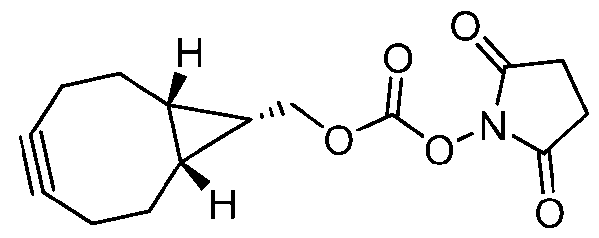 a linker comprises: . an oligomeric compound comprises an oligonucleotide linked to a cell-
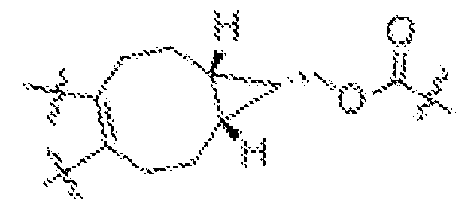 targeting moiety by a linker, wherein the linker comprises: .
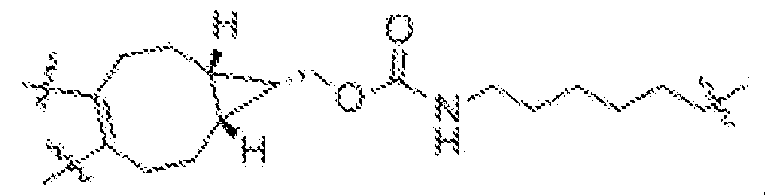 comprises an oligonucleotide linked to a cell- targeting moiety by a linker, wherein the complex comprises: ; wherein
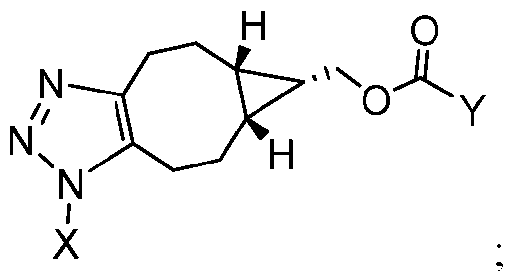 azido group of the cell-targeting moiety; X represents the remainder of the cell-targeting moiety; and Y represents a portion of the oligomeric compound comprising the oligonucleotide. In certain embodiments, the cell-targeting moiety comprises a polypeptide. In certain embodiments, the azido group is attached to an amino-acid side chain of the polypeptide. In certain embodiments, the azido group is attached to the N-terminus of the polypeptide. In certain embodiments, the azido group replaces the amino group of a lysine of the polypeptide. In certain embodiments, the azido group is introduced through a glutamine side chain using the enzyme microbial transglutaminase, as described in Strop, Bioconjugate Chemistry, (25):855-862, 2014, and the compound 11-Azido-3,6,9-trioxaundecan-1-amine, to yield a free azide as shown below: .
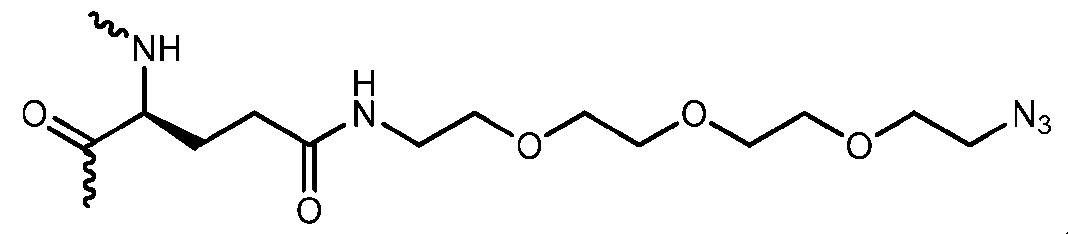 In certain embodiments, an oligomeric compound comprises: ; wherein cell-targeting moiety; X represents the remainder of the cell-
 of the oligonucleotide. In certain embodiments, the cell-targeting moiety comprises a polypeptide. In certain embodiments, the azido group is attached to an amino-acid side chain of the polypeptide. In certain embodiments, the azido group is attached to the N- terminus of the polypeptide. In certain embodiments, the azido group replaces the amino group of a lysine of the polypeptide. In certain embodiments, the azido group is introduced through a glutamine side chain using the enzyme microbial transglutaminase, as described in Strop, Bioconjugate Chemistry, (25):855-862, 2014, and the compound 11-Azido-3,6,9-trioxaundecan-1-amine, to yield a free azide as shown below: . In certain embodiments, the azido group is
 et. al., “Antibody Conjugations via Glycosyl Remodeling” in Tumey (eds), Antibody Drug Conjugates, Methods in Molecular Biology, vol. 2078, 2019. In certain embodiments, an oligomeric compound comprises: ;
 cell-targeting moiety; X represents the remainder of the cell-targeting moiety; and Y represents the remainder of the oligonucleotide. In certain embodiments, the cell-targeting moiety comprises a polypeptide. In certain embodiments, the azido group is attached to an amino-acid side chain of the polypeptide. In certain embodiments, the azido group is attached to the N- terminus of the polypeptide. In certain embodiments, the azido group replaces the amino group of a lysine of the polypeptide. In certain embodiments, the azido group is introduced through a glutamine side chain using the enzyme microbial transglutaminase, as described in Strop, Bioconjugate Chemistry, (25):855-862, 2014, and the compound 11-Azido-3,6,9-trioxaundecan-1-amine, to yield a free azide as shown below: is
 introduced through a glycosylation site, as described in Toftevall, et. al., “Antibody Conjugations via Glycosyl Remodeling” in Tumey (eds), Antibody Drug Conjugates, Methods in Molecular Biology, vol. 2078, 2019. In certain embodiments, a Click reaction can be used to link a cell-targeting moiety and an oligonucleotide by reacting: with an limited to the following compound:
 , to yield:
 , which
 an azide to yield: ,
 targeting moiety, and wherein X represents the remainder of the cell-targeting moiety. In certain embodiments, the cell-targeting moiety comprises a polypeptide. In certain embodiments, the azido group is attached to an amino-acid side chain of the polypeptide. In certain embodiments, the azido group is attached to the N-terminus of the polypeptide. In certain embodiments, the azido group replaces the amino group of a lysine of the polypeptide. In certain embodiments, the azido group is introduced through a glutamine side chain using the enzyme microbial transglutaminase, as described in Strop, Bioconjugate Chemistry, (25):855-862, 2014, and the compound 11- Azido-3,6,9-trioxaundecan-1-amine, to yield a free azide as shown below: .
 In certain embodiments, an oligomeric agent comprises an oligonucleotide linked to a cell-targeting moiety by a linker, wherein the linker is prepared from the following compound: .
 In an agent comprises an oligonucleotide linked to a cell-targeting moiety by a linker, wherein the linker comprises: . embodiments, an oligomeric agent comprises an oligonucleotide linked to a cell-targeting
 moiety by a linker, wherein the linker comprises: .
 agent comprises an oligonucleotide linked to a cell-targeting moiety by a linker, wherein the compound comprises: ; an azido group of the cell-targeting moiety; X represents the remainder of the
 cell-targeting moiety; and Y represents a portion of the oligomeric compound comprising the oligonucleotide. In certain embodiments, the cell-targeting moiety comprises a polypeptide. In certain embodiments, the azido group is attached to an amino-acid side chain of the polypeptide. In certain embodiments, the azido group is attached to the N-terminus of the polypeptide. In certain embodiments, the azido group replaces the amino group of a lysine of the polypeptide. In certain embodiments, the azido group is introduced through a glutamine side chain using the enzyme microbial transglutaminase, as described in Strop, Bioconjugate Chemistry, (25):855-862, 2014, and the compound 11-Azido-3,6,9-trioxaundecan-1-amine, to yield a free azide as shown below: is
 Glycosyl Remodeling” in Tumey (eds), Antibody Drug Conjugates, Methods in Molecular Biology, vol. 2078, 2019. In certain embodiments, an oligomeric agent comprises an oligonucleotide linked to a cell-targeting moiety by a linker, wherein the oligomeric compound comprises: ; of the cell-targeting moiety; X represents the remainder of the cell-
 of the oligonucleotide. In certain embodiments, the cell-targeting moiety comprises a polypeptide. In certain embodiments, the azido group is attached to an amino-acid side chain of the polypeptide. In certain embodiments, the azido group is attached to the N- terminus of the polypeptide. In certain embodiments, the azido group replaces the amino group of a lysine of the polypeptide. In certain embodiments, the azido group is introduced through a glutamine side chain using the enzyme microbial transglutaminase, as described in Strop, Bioconjugate Chemistry, (25):855-862, 2014, and the compound 11-Azido-3,6,9-trioxaundecan-1-amine, to yield a free azide as shown below: . In certain embodiments, the azido group is
 et. al., “Antibody Conjugations via Glycosyl Remodeling” in Tumey (eds), Antibody Drug Conjugates, Methods in Molecular Biology, vol. 2078, 2019. In certain embodiments, an oligomeric agent comprises an oligonucleotide linked to a cell-targeting moiety by a linker, wherein the oligomeric compound comprises: ;
 of the cell-targeting moiety; X represents the remainder of the cell-targeting moiety; and Y represents the remainder of the oligonucleotide. In certain embodiments, the cell-targeting moiety comprises a polypeptide. In certain embodiments, the azido group is attached to an amino-acid side chain of the polypeptide. In certain embodiments, the azido group is attached to the N- terminus of the polypeptide. In certain embodiments, the azido group replaces the amino group of a lysine of
the polypeptide. In certain embodiments, the azido group is introduced through a glutamine side chain using the enzyme microbial transglutaminase, as described in Strop, Bioconjugate Chemistry, (25):855-862, 2014, and the compound 11-Azido-3,6,9-trioxaundecan-1-amine, to yield a free azide as shown below: is
of the cell-targeting moiety; X represents the remainder of the cell-targeting moiety; and Y represents the remainder of the oligonucleotide. In certain embodiments, the cell-targeting moiety comprises a polypeptide. In certain embodiments, the azido group is attached to an amino-acid side chain of the polypeptide. In certain embodiments, the azido group is attached to the N- terminus of the polypeptide. In certain embodiments, the azido group replaces the amino group of a lysine of
the polypeptide. In certain embodiments, the azido group is introduced through a glutamine side chain using the enzyme microbial transglutaminase, as described in Strop, Bioconjugate Chemistry, (25):855-862, 2014, and the compound 11-Azido-3,6,9-trioxaundecan-1-amine, to yield a free azide as shown below: is
 , vol. 2078, 2019. In certain embodiments, an oligomeric agent comprises an oligonucleotide linked to a cell-targeting moiety by a linker, wherein the oligomeric compound comprises: ,
 targeting moiety; and Y comprises the oligonucleotide. In certain embodiments, an oligomeric agent comprises an oligonucleotide linked to a cell-targeting moiety by a linker, wherein the oligomeric compound comprises: ,
 and Y comprises the cell-targeting moiety. In certain embodiments, the linker comprises:
 Y comprises the oligonucleotide, each Z is independently O, NH, N(C1-4 alkyl), or S, and n is 1 to 10. In certain embodiments, an oligomeric agent comprises an oligonucleotide linked to a cell-targeting moiety by a linker, wherein the linker comprises:
. nts, an oligomeric agent comprises an oligonucleotide linked to a cell-targeting moiety by a linker, wherein the linker comprises: . agent comprises an oligonucleotide linked to a cell-targeting
Y comprises the oligonucleotide, each Z is independently O, NH, N(C1-4 alkyl), or S, and n is 1 to 10. In certain embodiments, an oligomeric agent comprises an oligonucleotide linked to a cell-targeting moiety by a linker, wherein the linker comprises:
. nts, an oligomeric agent comprises an oligonucleotide linked to a cell-targeting moiety by a linker, wherein the linker comprises: . agent comprises an oligonucleotide linked to a cell-targeting
 moiety by a linker, wherein the linker comprises: .
 an oligomeric agent comprises an oligonucleotide linked to a cell-targeting moiety by a linker, wherein the linker comprises: .
 an oligomeric agent comprises an oligonucleotide linked to a cell-targeting moiety by a linker, wherein the linker comprises: .
 preparation of the above starting materials and intermediates can be found in one or more of the following: Agard, et al., “A Strain-Promoted [3 + 2] Azide-Alkyne Cycloaddition for Covalent Modification of Biomolecules in Living Systems.” J. Am. Chem. Soc.2004, 126:15046– 15047; Lang, et al, “Biorthogonal Reactions for Labeling Proteins”, J. Am. Chem. Soc, 2014, 9(1):16-20; Nair, et al., “The Thiol-Michael Addition Click Reaction: A Powerful and Widely Used Tool in Materials Chemistry”, Chem. Mater.201326(1):724-744; WO2011/136645; Kömel and Kool, “Oximes and Hydrazones in Bioconjugation: Mechanism and Catalysis, Chem. Rev., 2017, 117:10358-10376; Wang, et al., “Polyfluorophenyl Ester-Terminated Homobifunctional CrossLinkers for Protein Conjugation”, Synlett, 2017, 28: 1934-1938; Kishimoto, et al, “Site-Specific Chemical Conjugation of Antibodies by Using Affinity Peptide for the Development of Therapeutic Antibody Format”, Bioconj. Chem., 2019, 30:698-702.
Compositions and Methods for Formulating Pharmaceutical Compositions Compounds described herein may be admixed with pharmaceutically acceptable active or inert substances for the preparation of pharmaceutical compositions or formulations. Compositions and methods for the formulation of pharmaceutical compositions are dependent upon a number of criteria, including, but not limited to, route of administration, extent of disease, or dose to be administered. Certain embodiments provide pharmaceutical compositions comprising one or more compounds or a salt thereof. In certain embodiments, a pharmaceutical composition comprises a compound described herein and a pharmaceutically acceptable diluent or carrier. In certain embodiments, a pharmaceutical composition comprises a sterile saline solution and one or more compound described herein. In certain embodiments, such pharmaceutical composition consists of a sterile saline solution and one or more compound. In certain embodiments, the sterile saline is pharmaceutical grade saline. In certain embodiments, a pharmaceutical composition comprises one or more compound described herein and sterile water. In certain embodiments, a pharmaceutical composition consists of one compound described herein and sterile water. In certain embodiments, the sterile water is pharmaceutical grade water. In certain embodiments, a pharmaceutical composition comprises one or more compound described herein and phosphate-buffered saline (PBS). In certain embodiments, a pharmaceutical composition consists of one or more compound described herein and sterile PBS. In certain embodiments, the sterile PBS is pharmaceutical grade PBS. Pharmaceutical compositions comprising compounds described herein encompass any pharmaceutically acceptable salts, esters, or salts of such esters, or any other oligonucleotide which, upon administration to a subject, including a human, is capable of providing (directly or indirectly) the biologically active metabolite or residue thereof. Certain embodiments are drawn to pharmaceutically acceptable salts of compounds, prodrugs, pharmaceutically acceptable salts of such prodrugs, and other bioequivalents. Suitable pharmaceutically acceptable salts include, but are not limited to, sodium and potassium salts. Non-limiting disclosure and incorporation by reference While certain compounds, compositions and methods described herein have been described with specificity in accordance with certain embodiments, the following examples serve only to illustrate the compounds described herein and are not intended to limit the same. Each reference recited herein, including but not limited to scientific literature, patent publications, GenBank accession numbers, and the like is incorporated by reference in its entirety. The sequence listing accompanying this filing identifies each nucleic acid sequence as either “RNA” or “DNA” as required; however, one of skill in the art will readily appreciate that designation of “RNA” or “DNA” to describe modified oligonucleotides is, in certain instances, arbitrary. For example, an oligonucleotide comprising a nucleoside comprising a 2’-OH sugar moiety and a thymine base could be
described as a DNA having a modified sugar (2’-OH in place of one 2’-H of DNA) or as an RNA having a modified base (thymine (5-methyl uracil) in place of an uracil of RNA); and certain nucleic acid compounds described herein comprise one or more nucleosides comprising modified sugar moieties having 2’- substituent(s) that are neither OH nor H. One of skill in the art will readily appreciate that labeling such nucleic acid compounds “RNA” or “DNA” does not alter or limit the description of such nucleic acid compounds. Herein, the description of compounds as having “the nucleobase sequence of” a SEQ ID NO. describes only the nucleobase sequence of such compounds, independent of any additional annotation present in the sequence listing. Accordingly, such description of compounds by reference to a nucleobase sequence of a SEQ ID NO. does not limit sugar or internucleoside linkage modifications; and further, includes modified unmodified and nucleobases as described herein. For example, “A” represents unmodified or modified adenine; “C” represents unmodified or modified cytosine, “T” represents unmodified or modified thymidine, “U” represents unmodified or modified uracil, and “G” represents unmodified or modified guanine. Herein, the description of compounds by chemical notation (subscripts and/or superscripts to indicate chemical modifications) without reference to a specific Compound No. include each noted modification and may include additional modifications, unless otherwise indicated. For example, the chemical notation of “AesTko mCezGdsC” indicates a compound wherein the first nucleoside comprises a 2’-MOE sugar moiety (indicated by the “e” subscript) and a modified or unmodified adenine nucleobase linked to the second nucleoside via a phosphorothioate linkage (indicated by the “s” subscript); the second nucleoside comprises a cEt sugar moiety (indicated by the “k” subscript) and a modified or unmodified thymine nucleobase linked to the third nucleoside via a phosphodiester linkage (indicated by the “o” subscript); the third nucleoside comprises a 2’-MOE sugar moiety and a 5-methyl modified cytosine nucleobase (indicated by the “m” superscript) linked to the fourth nucleoside via a mesylphosphoramidate linkage (indicated by the “z” subscript); the fourth nucleoside comprises a DNA sugar moiety (indicated by the “d” subscript) and a modified or unmodified guanine nucleobase linked to the fifth nucleoside with a phosphorothioate linkage; and the fifth nucleoside comprises a DNA sugar moiety and a modified or unmodified cytosine nucleobase; and the compound may include additional substituents, such as a conjugate group. Herein, where a specific compound (e.g., with reference to a Compound No.) is described (as in the examples) by chemical notation, each nucleobase, sugar, and internucleoside linkage of such specific compound is assumed to be unmodified, except where otherwise indicated. Accordingly, in the context of a description of a specific compound having a particular Compound No., “AesTko mCezGdsCd” indicates a compound wherein the first nucleoside comprises a 2’-MOE sugar moiety (indicated by the “e” subscript) and an unmodified adenine nucleobase linked to the second nucleoside via a phosphorothioate linkage (indicated by the “s” subscript); the second nucleoside comprises a cEt sugar moiety (indicated by the “k” subscript) and an unmodified thymine nucleobase linked to the third nucleoside via a phosphodiester linkage
(indicated by the “o” subscript); the third nucleoside comprises a 2’-MOE sugar moiety and a 5-methyl modified cytosine nucleobase (indicated by the “m” superscript) linked to the fourth nucleoside via a mesylphosphoramidate linkage (indicated by the “z” subscript); the fourth nucleoside comprises a DNA sugar moiety (indicated by the “d” subscript) and an unmodified guanine nucleobase linked to the fifth nucleoside with a phosphorothioate linkage; and the fifth nucleoside comprises a DNA sugar moiety and an unmodified cytosine nucleobase; and the compound does not include additional substituents. Herein, sugar, internucleoside linkage, and nucleobase modifications may be indicated within a nucleotide or nucleobase sequence (e.g., by superscript or subscript, as shown above) or may be indicated in text accompanying a sequence (e.g., in separate text that appears within or above or below a table of compounds). Herein, certain specific compounds, including oligonucleotides, are described by way of a drawn chemical structure. One of skill will appreciate that drawn compounds may exist in equilibrium between tautomeric forms and/or as salts in equilibrium with protonated or ionic forms. Drawn structures are intended to capture all such forms of such compounds. While effort has been made to accurately describe compounds in the accompanying sequence listing, should there be any discrepancies between a description in this specification and in the accompanying sequence listing, the description in the specification and not in the sequence listing is the accurate description. Unless otherwise indicated, any compound, including oligomeric compounds, described herein includes a pharmaceutically acceptable salt thereof. Compounds described herein include variations in which one or more atoms are replaced with a non- radioactive isotope or radioactive isotope of the indicated element. For example, compounds herein that comprise hydrogen atoms encompass all possible deuterium substitutions for each of the 1H hydrogen atoms. Isotopic substitutions encompassed by the compounds herein include but are not limited to: 2H or 3H in place of 1H, 13C or 14C in place of 12C, 15N in place of 14N, 17O or 18O in place of 16O, and 33S, 34S, 35S, or 36S in place of 32S. EXAMPLES Example 1: Design and synthesis of anti-CD29 mAb or anti-CD29 Fab’ conjugated siRNA targeted to HPRT1 nucleic acid Oligomeric agents comprising antisense RNAi oligonucleotides complementary to a human HPRT nucleic acid, and sense RNAi oligonucleotides complementary to the antisense RNAi oligonucleotides were designed and synthesized as follows. The 5’ end of the antisense oligonucleotide was then attached to an anti- CD29 mAb or anti-CD29 Fab’ fragment as described below.
Design of Antisense Oligonucleotide Compound No.1586322 is 23 nucleosides in length, has a nucleobase sequence of (from 5’ to 3’): TUAAAAUCUACAGUCAUAGGAAU (SEQ ID NO: 8), and is complementary to human HPRT (GenBank Accession No. NM_000194.2 (SEQ ID NO: 1)) from nucleoside start site 444 to nucleoside 465 with a single mismatch at position 1 of the 5’ end of the antisense oligonucleotide. The a sugar motif of Compound No. 1586322 is described in Table 1 below in the column labeled “Sugar Motif (5’ to 3’)”, wherein each ‘e’ represents a 2’-MOE sugar moiety, each ‘y’ represents a 2′-OMe sugar moiety, and each ‘f’ represents a 2’-F sugar moiety; and an internucleoside linkage motif as described in the column labeled “Internucleoside Linkages (5’ to 3’)”, wherein each ‘o’ represents a phosphodiester internucleoside linkage, and each ‘s’ represents a phosphorothioate internucleoside linkage. Compound No.1586322 further comprises a 5’-vinyl phosphonate. Table 1 Design of an antisense RNAi oligonucleotide complementary to human HPRT1 Compound Sugar Motif Internucleosid SEQ Sequence (5’ to e N 3’) (5’ t 3’) Link (5’ t 3’) ID NO.
preparation of the above starting materials and intermediates can be found in one or more of the following: Agard, et al., “A Strain-Promoted [3 + 2] Azide-Alkyne Cycloaddition for Covalent Modification of Biomolecules in Living Systems.” J. Am. Chem. Soc.2004, 126:15046– 15047; Lang, et al, “Biorthogonal Reactions for Labeling Proteins”, J. Am. Chem. Soc, 2014, 9(1):16-20; Nair, et al., “The Thiol-Michael Addition Click Reaction: A Powerful and Widely Used Tool in Materials Chemistry”, Chem. Mater.201326(1):724-744; WO2011/136645; Kömel and Kool, “Oximes and Hydrazones in Bioconjugation: Mechanism and Catalysis, Chem. Rev., 2017, 117:10358-10376; Wang, et al., “Polyfluorophenyl Ester-Terminated Homobifunctional CrossLinkers for Protein Conjugation”, Synlett, 2017, 28: 1934-1938; Kishimoto, et al, “Site-Specific Chemical Conjugation of Antibodies by Using Affinity Peptide for the Development of Therapeutic Antibody Format”, Bioconj. Chem., 2019, 30:698-702.
Compositions and Methods for Formulating Pharmaceutical Compositions Compounds described herein may be admixed with pharmaceutically acceptable active or inert substances for the preparation of pharmaceutical compositions or formulations. Compositions and methods for the formulation of pharmaceutical compositions are dependent upon a number of criteria, including, but not limited to, route of administration, extent of disease, or dose to be administered. Certain embodiments provide pharmaceutical compositions comprising one or more compounds or a salt thereof. In certain embodiments, a pharmaceutical composition comprises a compound described herein and a pharmaceutically acceptable diluent or carrier. In certain embodiments, a pharmaceutical composition comprises a sterile saline solution and one or more compound described herein. In certain embodiments, such pharmaceutical composition consists of a sterile saline solution and one or more compound. In certain embodiments, the sterile saline is pharmaceutical grade saline. In certain embodiments, a pharmaceutical composition comprises one or more compound described herein and sterile water. In certain embodiments, a pharmaceutical composition consists of one compound described herein and sterile water. In certain embodiments, the sterile water is pharmaceutical grade water. In certain embodiments, a pharmaceutical composition comprises one or more compound described herein and phosphate-buffered saline (PBS). In certain embodiments, a pharmaceutical composition consists of one or more compound described herein and sterile PBS. In certain embodiments, the sterile PBS is pharmaceutical grade PBS. Pharmaceutical compositions comprising compounds described herein encompass any pharmaceutically acceptable salts, esters, or salts of such esters, or any other oligonucleotide which, upon administration to a subject, including a human, is capable of providing (directly or indirectly) the biologically active metabolite or residue thereof. Certain embodiments are drawn to pharmaceutically acceptable salts of compounds, prodrugs, pharmaceutically acceptable salts of such prodrugs, and other bioequivalents. Suitable pharmaceutically acceptable salts include, but are not limited to, sodium and potassium salts. Non-limiting disclosure and incorporation by reference While certain compounds, compositions and methods described herein have been described with specificity in accordance with certain embodiments, the following examples serve only to illustrate the compounds described herein and are not intended to limit the same. Each reference recited herein, including but not limited to scientific literature, patent publications, GenBank accession numbers, and the like is incorporated by reference in its entirety. The sequence listing accompanying this filing identifies each nucleic acid sequence as either “RNA” or “DNA” as required; however, one of skill in the art will readily appreciate that designation of “RNA” or “DNA” to describe modified oligonucleotides is, in certain instances, arbitrary. For example, an oligonucleotide comprising a nucleoside comprising a 2’-OH sugar moiety and a thymine base could be
described as a DNA having a modified sugar (2’-OH in place of one 2’-H of DNA) or as an RNA having a modified base (thymine (5-methyl uracil) in place of an uracil of RNA); and certain nucleic acid compounds described herein comprise one or more nucleosides comprising modified sugar moieties having 2’- substituent(s) that are neither OH nor H. One of skill in the art will readily appreciate that labeling such nucleic acid compounds “RNA” or “DNA” does not alter or limit the description of such nucleic acid compounds. Herein, the description of compounds as having “the nucleobase sequence of” a SEQ ID NO. describes only the nucleobase sequence of such compounds, independent of any additional annotation present in the sequence listing. Accordingly, such description of compounds by reference to a nucleobase sequence of a SEQ ID NO. does not limit sugar or internucleoside linkage modifications; and further, includes modified unmodified and nucleobases as described herein. For example, “A” represents unmodified or modified adenine; “C” represents unmodified or modified cytosine, “T” represents unmodified or modified thymidine, “U” represents unmodified or modified uracil, and “G” represents unmodified or modified guanine. Herein, the description of compounds by chemical notation (subscripts and/or superscripts to indicate chemical modifications) without reference to a specific Compound No. include each noted modification and may include additional modifications, unless otherwise indicated. For example, the chemical notation of “AesTko mCezGdsC” indicates a compound wherein the first nucleoside comprises a 2’-MOE sugar moiety (indicated by the “e” subscript) and a modified or unmodified adenine nucleobase linked to the second nucleoside via a phosphorothioate linkage (indicated by the “s” subscript); the second nucleoside comprises a cEt sugar moiety (indicated by the “k” subscript) and a modified or unmodified thymine nucleobase linked to the third nucleoside via a phosphodiester linkage (indicated by the “o” subscript); the third nucleoside comprises a 2’-MOE sugar moiety and a 5-methyl modified cytosine nucleobase (indicated by the “m” superscript) linked to the fourth nucleoside via a mesylphosphoramidate linkage (indicated by the “z” subscript); the fourth nucleoside comprises a DNA sugar moiety (indicated by the “d” subscript) and a modified or unmodified guanine nucleobase linked to the fifth nucleoside with a phosphorothioate linkage; and the fifth nucleoside comprises a DNA sugar moiety and a modified or unmodified cytosine nucleobase; and the compound may include additional substituents, such as a conjugate group. Herein, where a specific compound (e.g., with reference to a Compound No.) is described (as in the examples) by chemical notation, each nucleobase, sugar, and internucleoside linkage of such specific compound is assumed to be unmodified, except where otherwise indicated. Accordingly, in the context of a description of a specific compound having a particular Compound No., “AesTko mCezGdsCd” indicates a compound wherein the first nucleoside comprises a 2’-MOE sugar moiety (indicated by the “e” subscript) and an unmodified adenine nucleobase linked to the second nucleoside via a phosphorothioate linkage (indicated by the “s” subscript); the second nucleoside comprises a cEt sugar moiety (indicated by the “k” subscript) and an unmodified thymine nucleobase linked to the third nucleoside via a phosphodiester linkage
(indicated by the “o” subscript); the third nucleoside comprises a 2’-MOE sugar moiety and a 5-methyl modified cytosine nucleobase (indicated by the “m” superscript) linked to the fourth nucleoside via a mesylphosphoramidate linkage (indicated by the “z” subscript); the fourth nucleoside comprises a DNA sugar moiety (indicated by the “d” subscript) and an unmodified guanine nucleobase linked to the fifth nucleoside with a phosphorothioate linkage; and the fifth nucleoside comprises a DNA sugar moiety and an unmodified cytosine nucleobase; and the compound does not include additional substituents. Herein, sugar, internucleoside linkage, and nucleobase modifications may be indicated within a nucleotide or nucleobase sequence (e.g., by superscript or subscript, as shown above) or may be indicated in text accompanying a sequence (e.g., in separate text that appears within or above or below a table of compounds). Herein, certain specific compounds, including oligonucleotides, are described by way of a drawn chemical structure. One of skill will appreciate that drawn compounds may exist in equilibrium between tautomeric forms and/or as salts in equilibrium with protonated or ionic forms. Drawn structures are intended to capture all such forms of such compounds. While effort has been made to accurately describe compounds in the accompanying sequence listing, should there be any discrepancies between a description in this specification and in the accompanying sequence listing, the description in the specification and not in the sequence listing is the accurate description. Unless otherwise indicated, any compound, including oligomeric compounds, described herein includes a pharmaceutically acceptable salt thereof. Compounds described herein include variations in which one or more atoms are replaced with a non- radioactive isotope or radioactive isotope of the indicated element. For example, compounds herein that comprise hydrogen atoms encompass all possible deuterium substitutions for each of the 1H hydrogen atoms. Isotopic substitutions encompassed by the compounds herein include but are not limited to: 2H or 3H in place of 1H, 13C or 14C in place of 12C, 15N in place of 14N, 17O or 18O in place of 16O, and 33S, 34S, 35S, or 36S in place of 32S. EXAMPLES Example 1: Design and synthesis of anti-CD29 mAb or anti-CD29 Fab’ conjugated siRNA targeted to HPRT1 nucleic acid Oligomeric agents comprising antisense RNAi oligonucleotides complementary to a human HPRT nucleic acid, and sense RNAi oligonucleotides complementary to the antisense RNAi oligonucleotides were designed and synthesized as follows. The 5’ end of the antisense oligonucleotide was then attached to an anti- CD29 mAb or anti-CD29 Fab’ fragment as described below.
Design of Antisense Oligonucleotide Compound No.1586322 is 23 nucleosides in length, has a nucleobase sequence of (from 5’ to 3’): TUAAAAUCUACAGUCAUAGGAAU (SEQ ID NO: 8), and is complementary to human HPRT (GenBank Accession No. NM_000194.2 (SEQ ID NO: 1)) from nucleoside start site 444 to nucleoside 465 with a single mismatch at position 1 of the 5’ end of the antisense oligonucleotide. The a sugar motif of Compound No. 1586322 is described in Table 1 below in the column labeled “Sugar Motif (5’ to 3’)”, wherein each ‘e’ represents a 2’-MOE sugar moiety, each ‘y’ represents a 2′-OMe sugar moiety, and each ‘f’ represents a 2’-F sugar moiety; and an internucleoside linkage motif as described in the column labeled “Internucleoside Linkages (5’ to 3’)”, wherein each ‘o’ represents a phosphodiester internucleoside linkage, and each ‘s’ represents a phosphorothioate internucleoside linkage. Compound No.1586322 further comprises a 5’-vinyl phosphonate. Table 1 Design of an antisense RNAi oligonucleotide complementary to human HPRT1 Compound Sugar Motif Internucleosid SEQ Sequence (5’ to e N 3’) (5’ t 3’) Link (5’ t 3’) ID NO.
 Design of Sense Oligonucleotides Compound No.1586323 is 21 nucleosides in length and is complementary to the first 21 nucleosides of the antisense oligonucleotide Compound No.1586322 (from 5’ to 3’) wherein the last two 3’-nucleosides of the antisense oligonucleotides are not paired with the sense oligonucleotide (are overhanging nucleosides). Compound No.1586323 has a sugar motif as described in Table 2 below in the column labeled “Sugar Motif (5’ to 3’)”, wherein each ‘y’ represents a 2’-OMe sugar moiety, and each ‘f’ represents a 2’-F sugar moiety; and an internucleoside linkage motif as described in the column labeled “Linkage (5’ to 3’)”, wherein each ‘o’ represents a phosphodiester internucleoside linkage, and each ‘s’ represents a phosphorothioate internucleoside linkage. Compound No.1757605 is conjugated to a THA-GalNAc conjugate linked via phosphodiester bond at the 5' end. THA-GalNAc is represented by the structure below, wherein the phosphoryl group is attached to the 5’ oxygen atom of the 5’ nucleoside:
Table 2 Design of sense RNAi oligomeric compounds Compound 5’-terminal 3’-terminal Sequence Sugar Motif Linkages SEQ ID No. conjugate group (5’ to 3’) (5’ to 3’) (5’ to 3’) NO.
 Compound No.1590184 was formed by attaching a 2-(hydroxymethyl)-6-aminohexyl phosphoryl moiety to the 3’-OH of the sense RNAi oligonucleotide Compound No.1586323 (described in Table 2 above).
 Sense RNAi oligonucleotide Compound ID 1590184-BCN was synthesized from Compound No. 1590184 as shown in the scheme above. A solution of Compound No.1590184 (90 mg, 12.6 µmol, 1 equiv.) dissolved in 0.1 M sodium borate pH 8.5 (2 mL) was added to a solution of BCN-NHS ester (18.3 mg, 63 µmol, 5 equiv.) dissolved in DMSO (2 mL). The reaction mixture was stirred for 2 hours at room temperature and monitored by LC-MS. After completion, the crude reaction mixture was diluted with water, then purified by strong anion exchange chromatography (SAX LC) using Source 30Q resin (Cytiva) packed in a Waters AP-2 glass column (20 x 100 mm), a flow rate of 6 mL/min, and a gradient of 100% mobile phase A (100 mM NH4OAc in 30% aq. MeCN) to 100% mobile phase B (100 mM NH4OAc, 1.5 mM NaBr in 30% aq. MeCN) followed by a hold at 100% mobile phase A. The purified compound was desalted by standard reverse-phase (RP) HPLC in water/ACN and lyophilized to give Compound No.1590184-BCN.
 Compound ID 1590184-maleimide was synthesized from Compound No.1590184 as shown in the scheme above. Compound No.1590184 (100 mg, 14 µmol, 1 equiv.) was dissolved in 0.05 M sodium phosphate pH 7.3 (2 mL) and added to a solution of maleimido-propionic NHS ester (18.6 mg, 70 µmol, 5 equiv.) dissolved in DMSO (1 mL). The reaction mixture was stirred for 2 hours at room temperature and monitored by LC-MS. After completion, the crude reaction mixture was diluted with water, then purified by SAX LC using Source 30Q resin (Cytiva) packed in a Waters AP-2 glass column (20 x 100 mm), a flow rate of 6 mL/min, and a gradient of 100% mobile phase A (100 mM NH4OAc in 30% aq. MeCN) to 100% mobile phase B (100 mM NH4OAc, 1.5 mM NaBr in 30% aq. MeCN) followed by a hold at 100% mobile phase A. The purified compound was desalted by RP HPLC on a dedicated maleimide C18 column in water/MeCN and lyophilized to give Compound No.1590184-maleimide (88 mg, 86%). Compound No.1757605 is conjugated to a THA-GalNAc conjugate linked via phosphodiester bond at the 5' end. THA-GalNAc is represented by the structure below, wherein the phosphoryl group is attached to the 5’ oxygen atom of the 5’ nucleoside:
Design of RNAi Duplexes In order to form siRNA, duplexes were prepared by pairing an antisense RNAi oligonucleotide with a sense RNAi oligonucleotide, and the resulting siRNA duplex Compound Nos. or identifiers are described in Table 3 below. Table 3 Oligomeric duplexes targeted to human HPRT1 Duplex ID Antisense Compound No. Sense Compound No./ID 1588821 1586322 1586323
 Conjugation of an RNAi duplex to anti-CD29 mAb Anti-CD29 mAb (BioXCell catalog #BE0232, clone: KMI6) was activated with an azide group using the GlyCLICK Azide Activation kit (Genovis, catalog #L1-AZ1-125) and conjugated to Duplex ID BCN-1588821 using strain-promoted azide-alkyne click (SPAAC) conjugation as shown in the scheme below.
GlycINATOR GalT enzyme enzyme UDP-GalNAz N O O N HN NH
 N O O N H H HN NH O 1588821 O N SPAAC
 #BE0232, clone: KMI6). The storage buffer was exchanged by centrifuging anti-CD29 mAb in PBS (5.33 mg/mL, 26 mL) through a 20 mL Pierce Protein Concentrator (PES, 50 kDa MWCO) and washing multiple times with Tris buffer saline (TBS) pH 7.4. The anti-CD29 mAb was then dissolved in TBS pH 7.4 to a concentration of 18.54 mg/mL (7 mL), as quantified by Nanodrop at 280 nm. Deglycosylation was performed using the GlycINATOR Maxispin column supplied in the GlyCLICK kit (Genovis, catalog #L1-AZ1-125). Prior to use, the column was equilibrated to room temperature, centrifuged at 1300 rpm for 1 min to remove storage solution, then washed three times with 7 mL of TBS pH 7.4 by centrifuging at 1300 rpm for 1 min and discarding the flow through. Anti-CD29 mAb in TBS pH 7.4 (129.8 mg in 7 mL) was added to the column and incubated at 37 °C for 3 hours with end- over-end mixing, ensuring the column resin was fully suspended. After incubation, deglycosylated anti-CD29 mAb was eluted from the column by centrifugation at 3000 rpm for 1 minute. The column resin was further extracted with 10 mL of TBS until no product was observed by Nanodrop in the flow through. Deglycosylated anti-CD29 mAb was pooled and concentrated in a Pierce Protein Concentrator (PES, 50 kDa MWCO) to concentration of 12.19 mg/mL (8.5 mL), as quantified by Nanodrop absorption at 280 nm (mass extinction coefficient = 1.37 mL ^mg-1). Deglycosylation was confirmed by LC-MS analysis, wherein the product eluted as a broad peak with a mass of 143853 Da. GalT enzyme (1 tube, 1.5 mL), UDP-GalNAz (8 tubes dissolved in 3 mL TBS), and buffer additive (1 tube, 135 µL, 1% reaction volume) supplied by the GlyCLICK kit were then added to the deglycosylated anti-CD29 mAb in TBS pH 7.4 (12.19 mg/mL, 8.5 mL). The reaction mixture was mixed and incubated for
24 hours at 30 °C, protected from light. The reaction mixture was concentrated in 5 mL portions in a 20 mL Pierce Protein Concentrator (PES, 50 kDa MWCO) to approximately 3 mL. The reaction vessel and protein concentrator were further rinsed with 5 mL of 10 mM EDTA in TBS pH 7.4, followed by 5 mL of TBS pH 7.4. GalNAz anti-CD29 mAb extracts were pooled and concentrated in a Pierce Protein Concentrator (PES, 50 kDa MWCO) to a concentration of 28.41 mg/mL (4 mL), as determined by Nanodrop absorption at 280 nm. The addition of two GalNAz groups on the mAb was confirmed by LC-MS analysis, wherein a product peak was observed with a mass of 144342 Da corresponding to the mass of deglycosylated anti-CD29 mAb + two GalNAz. Compound No. BCN-1588821 was then conjugated to the GalNAz anti-CD29 mAb via SPAAC conjugation. Compound No. BCN-1588821 (4 mM, 1.305 mL, 7.6 equiv.) was dissolved in TBS pH 7.4 and was added to a solution of GalNAz anti-CD29 mAb (103 mg, 1 equiv.) in TBS pH 7.4 (4 mL). The reaction mixture was incubated at 20 °C for 2 hours and stored at 4 °C overnight. The crude mixture was split into two 50 mg injections and purified by size exclusion chromatography using a HiPrep 26/60 Sephacryl S-200 HR (Cytiva) column in PBS/water. Fractions containing the desired product were concentrated in a 20 mL Pierce Protein Concentrator (PES, 50 kDa MWCO) and quantified by Nanodrop absorption at 260 nm to yield Compound No. CD29-mAb-1588821 with a DAR1:DAR2 ratio of 1:1 in PBS (0.357 mM, 2 mL, overall yield: 55%). Conjugation of an RNAi compound to anti-CD29 Fab’ fragment Anti-CD29 mAb (BioXCell catalog #BE0232, clone: KMI6) was fragmented by hydrolysis with pepsin (Sigma, Cat # P7000-25G) to obtain anti-CD29 F(ab’)2, which was reduced with TCEP to obtain anti- CD29 Fab’ and immediately conjugated to RNAi Compound No. Maleimide-1588821 as shown in the scheme below.
#BE0232, clone: KMI6). The storage buffer was exchanged by centrifuging anti-CD29 mAb in PBS (5.33 mg/mL, 26 mL) through a 20 mL Pierce Protein Concentrator (PES, 50 kDa MWCO) and washing multiple times with Tris buffer saline (TBS) pH 7.4. The anti-CD29 mAb was then dissolved in TBS pH 7.4 to a concentration of 18.54 mg/mL (7 mL), as quantified by Nanodrop at 280 nm. Deglycosylation was performed using the GlycINATOR Maxispin column supplied in the GlyCLICK kit (Genovis, catalog #L1-AZ1-125). Prior to use, the column was equilibrated to room temperature, centrifuged at 1300 rpm for 1 min to remove storage solution, then washed three times with 7 mL of TBS pH 7.4 by centrifuging at 1300 rpm for 1 min and discarding the flow through. Anti-CD29 mAb in TBS pH 7.4 (129.8 mg in 7 mL) was added to the column and incubated at 37 °C for 3 hours with end- over-end mixing, ensuring the column resin was fully suspended. After incubation, deglycosylated anti-CD29 mAb was eluted from the column by centrifugation at 3000 rpm for 1 minute. The column resin was further extracted with 10 mL of TBS until no product was observed by Nanodrop in the flow through. Deglycosylated anti-CD29 mAb was pooled and concentrated in a Pierce Protein Concentrator (PES, 50 kDa MWCO) to concentration of 12.19 mg/mL (8.5 mL), as quantified by Nanodrop absorption at 280 nm (mass extinction coefficient = 1.37 mL ^mg-1). Deglycosylation was confirmed by LC-MS analysis, wherein the product eluted as a broad peak with a mass of 143853 Da. GalT enzyme (1 tube, 1.5 mL), UDP-GalNAz (8 tubes dissolved in 3 mL TBS), and buffer additive (1 tube, 135 µL, 1% reaction volume) supplied by the GlyCLICK kit were then added to the deglycosylated anti-CD29 mAb in TBS pH 7.4 (12.19 mg/mL, 8.5 mL). The reaction mixture was mixed and incubated for
24 hours at 30 °C, protected from light. The reaction mixture was concentrated in 5 mL portions in a 20 mL Pierce Protein Concentrator (PES, 50 kDa MWCO) to approximately 3 mL. The reaction vessel and protein concentrator were further rinsed with 5 mL of 10 mM EDTA in TBS pH 7.4, followed by 5 mL of TBS pH 7.4. GalNAz anti-CD29 mAb extracts were pooled and concentrated in a Pierce Protein Concentrator (PES, 50 kDa MWCO) to a concentration of 28.41 mg/mL (4 mL), as determined by Nanodrop absorption at 280 nm. The addition of two GalNAz groups on the mAb was confirmed by LC-MS analysis, wherein a product peak was observed with a mass of 144342 Da corresponding to the mass of deglycosylated anti-CD29 mAb + two GalNAz. Compound No. BCN-1588821 was then conjugated to the GalNAz anti-CD29 mAb via SPAAC conjugation. Compound No. BCN-1588821 (4 mM, 1.305 mL, 7.6 equiv.) was dissolved in TBS pH 7.4 and was added to a solution of GalNAz anti-CD29 mAb (103 mg, 1 equiv.) in TBS pH 7.4 (4 mL). The reaction mixture was incubated at 20 °C for 2 hours and stored at 4 °C overnight. The crude mixture was split into two 50 mg injections and purified by size exclusion chromatography using a HiPrep 26/60 Sephacryl S-200 HR (Cytiva) column in PBS/water. Fractions containing the desired product were concentrated in a 20 mL Pierce Protein Concentrator (PES, 50 kDa MWCO) and quantified by Nanodrop absorption at 260 nm to yield Compound No. CD29-mAb-1588821 with a DAR1:DAR2 ratio of 1:1 in PBS (0.357 mM, 2 mL, overall yield: 55%). Conjugation of an RNAi compound to anti-CD29 Fab’ fragment Anti-CD29 mAb (BioXCell catalog #BE0232, clone: KMI6) was fragmented by hydrolysis with pepsin (Sigma, Cat # P7000-25G) to obtain anti-CD29 F(ab’)2, which was reduced with TCEP to obtain anti- CD29 Fab’ and immediately conjugated to RNAi Compound No. Maleimide-1588821 as shown in the scheme below.
Anti-CD29 mAb was obtained from BioXCell (catalog #BE0232, clone: KMI6). The storage buffer was exchanged by centrifuging anti-CD29 mAb in PBS (4.33 mg/mL, 25.2 mL) through a 20 mL Pierce Protein Concentrator (PEO, 50 kDa MWCO) and washing multiple times with 100 mM acetate buffer pH 4.5. The anti-CD29 mAb was then resuspended in 100 mM acetate buffer pH 4.5 to a concentration of 31.86 mg/mL (1.2 mL), as quantified by Nanodrop absorption at 280 nm. Pepsin (5.62 mg, 1405 units, 1:20 pepsin:antibody w/w) was added to anti-CD29 mAb in 100 mM acetate buffer (4 mg/mL, 28 mL) and the mixture was incubated at 37 °C, with reaction monitoring by gel electrophoresis. After 42 hours, the reaction was quenched by adjusting the pH to 9.5 with 2 M Tris base (11 mL), then filtered and concentrated in a 20 mL Pierce Protein Concentrator (PES, 50 kDa MWCO) to a volume of 6 mL. The crude mixture was split into two 50 mg injections and purified by size exclusion chromatography using a HiPrep 26/60 Sephacryl S-200 HR (Cytiva) column in Dulbecco’s PBS (DPBS) at a flow rate of 1.3 ml/min. Gel electrophoresis was used to identify anti-CD29 F(ab)’2 fractions, which were collected and concentrated in a 0.5 mL Pierce Protein Concentrator (PES, 10 kDa MWCO). The concentration of anti-CD29 F(ab)’2 was quantified by Nanodrop at 280 nm and determined to be 31.88 mg/mL (1.2 mL). Anti-CD29 F(ab)’2 was reduced to anti-CD29 Fab’ fragments by adding a solution of TCEP in PBS (4 mM, 2.05 mL, 10 equiv.) to a solution of the F(ab)’2 in PBS (39.42 mg, 3.03 mg/mL 13 mL). The reaction mixture was incubated at room temperature for 1 hour. Compound No. Maleimide-1588821 (4 mM, 247 µL, 1.2 equiv.) was dissolved in PBS and added directly to the reaction mixture. The reaction mixture was stirred at room temperature and monitored by SAX HPLC. Additional portions of Compound No. Maleimide- 1588821 (0.24 equiv.) in PBS were added after 1 hour and after 2 hours. After a total of 3 hours, a solution of
dehydroascorbic acid (DHAA, 100 mM, 2 mL) in PBS was added and the reaction mixture was stirred at room temperature for 3 hours, then stored at 4 °C overnight. The crude reaction mixture was filtered and purified by size exclusion chromatography using a HiPrep 26/60 Sephacryl S-200 HR (Cytiva) column in PBS/water. Fractions containing the desired product were concentrated in a 20 mL Pierce Protein Concentrator (PES, 50 kDa MWCO) and quantified by Nanodrop absorption at 260 nm to yield Compound No. CD29-Fab’-1588821 with a DAR1 in PBS (0.351 mM, 0.8 mL, overall yield: 41%). Table 4 Conjugated oligomeric duplexes targeted to human HPRT1 Duplex ID Antisense Compound No. Sense Compound No./ID CD29-mAb-1588821 1586322 1590184-CD29-mAb (DAR1:DAR2 1:1)
 Example 2: Potency of siRNA targeting mouse HPRT1 in wild-type mice; intravenous administration Certain siRNA described herein above were tested in wild-type C57BL/6 mice to determine effects of the siRNA on mouse HPRT1. Wild-type C57BL/6 mice were divided into groups of 4 mice each. Each mouse received intravenous injections of unconjugated siRNA or anti-CD29 mAb-conjugated siRNA on Day 1, Day 5, and Day 8 (a total of 3 treatments) at various doses as indicated in the table below. All dosing was performed based on the weight of the siRNA. One group of 4 mice received intravenous injections of saline. The saline-injected group served as the control group to which siRNA-injected groups were compared. 3 days post the final treatment (Day 11), mice were sacrificed and RNA was extracted from mouse heart, lung, liver, quadriceps (Quad), and white adipose tissue (WAT) for real-time RTPCR analysis of HPRT1 RNA expression. Mouse HPRT1 primer probe set Mm.PT.39a.22214828 (Integrated DNA Technologies) was used to measure mouse HPRT1 RNA levels. HPRT1 RNA levels were normalized to mouse GAPDH. Mouse GAPDH was amplified using mouse primer probe set RTS108 (forward sequence GGCAAATTCAACGGCACAGT, designated herein as SEQ ID NO: 2; reverse sequence GGGTCTCGCTCCTGGAAGAT, designated herein as SEQ ID NO: 3; probe sequence AAGGCCGAGAATGGGAAGCTTGTCATC, designated herein as SEQ ID NO: 4). Results are presented as percent HPRT1 RNA, relative to the amount of HPRT1 RNA in saline treated animals (%control). The half maximal effective dose (ED50) of each siRNA was calculated using GraphPad Prism 9 software (GraphPad Software, San Diego, CA). “N.D.” refers to values that were not determined.
Table 5 Potency of siRNA targeted to HPRT1 in wild type mice HPRT1 RNA (% control) siRNA ID Dose (mg/kg) L ED50 Li ED50 H t ED50 d ED50 WAT ED50 g)
Example 2: Potency of siRNA targeting mouse HPRT1 in wild-type mice; intravenous administration Certain siRNA described herein above were tested in wild-type C57BL/6 mice to determine effects of the siRNA on mouse HPRT1. Wild-type C57BL/6 mice were divided into groups of 4 mice each. Each mouse received intravenous injections of unconjugated siRNA or anti-CD29 mAb-conjugated siRNA on Day 1, Day 5, and Day 8 (a total of 3 treatments) at various doses as indicated in the table below. All dosing was performed based on the weight of the siRNA. One group of 4 mice received intravenous injections of saline. The saline-injected group served as the control group to which siRNA-injected groups were compared. 3 days post the final treatment (Day 11), mice were sacrificed and RNA was extracted from mouse heart, lung, liver, quadriceps (Quad), and white adipose tissue (WAT) for real-time RTPCR analysis of HPRT1 RNA expression. Mouse HPRT1 primer probe set Mm.PT.39a.22214828 (Integrated DNA Technologies) was used to measure mouse HPRT1 RNA levels. HPRT1 RNA levels were normalized to mouse GAPDH. Mouse GAPDH was amplified using mouse primer probe set RTS108 (forward sequence GGCAAATTCAACGGCACAGT, designated herein as SEQ ID NO: 2; reverse sequence GGGTCTCGCTCCTGGAAGAT, designated herein as SEQ ID NO: 3; probe sequence AAGGCCGAGAATGGGAAGCTTGTCATC, designated herein as SEQ ID NO: 4). Results are presented as percent HPRT1 RNA, relative to the amount of HPRT1 RNA in saline treated animals (%control). The half maximal effective dose (ED50) of each siRNA was calculated using GraphPad Prism 9 software (GraphPad Software, San Diego, CA). “N.D.” refers to values that were not determined.
Table 5 Potency of siRNA targeted to HPRT1 in wild type mice HPRT1 RNA (% control) siRNA ID Dose (mg/kg) L ED50 Li ED50 H t ED50 d ED50 WAT ED50 g)
 Example 3: Potency of siRNA targeting mouse HPRT1 in wild-type mice; oropharyngeal administration Certain siRNA compounds described above were tested in wild-type C57BL/6 mice to determine effects of the RNAi compounds on mouse HPRT1. Wild-type C57BL/6 mice were divided into groups of 4 mice each. Each mouse received oropharyngeal aspiration administrations of unconjugated siRNA or anti-CD29 mAb-conjugated siRNA on Day 1, Day 5, and Day 8 (a total of 3 treatments) at various doses as indicated in the table below. All dosing was performed based on the weight of the siRNA. One group of 4 mice received oropharyngeal aspiration administrations of saline. The saline-treated group served as the control group to which siRNA-treated groups were compared. 3 days post the final treatment (Day 11), mice were sacrificed and RNA was extracted from mouse lung for real-time RTPCR analysis of HPRT1 RNA expression. Mouse HPRT1 primer probe set Mm.PT.39a.22214828 (Integrated DNA Technologies) was used to measure mouse HPRT1 RNA levels. HPRT1 RNA levels were normalized to mouse GAPDH. Mouse GAPDH was amplified using mouse primer probe set RTS108 (described herein above). Results are presented as percent HPRT1 RNA, relative to the amount of HPRT1 RNA in Saline treated animals (%control). The half maximal effective dose (ED50) of each siRNA was calculated using GraphPad Prism 9 software (GraphPad Software, San Diego, CA).
Table 6 Potency of siRNA targeted to HPRT1 in wild type mice HPRT1 RNA (% control) Compound ID Dose (mg/kg) Lung ED50 (mg/kg) Example 4: Activi yngeal
Example 3: Potency of siRNA targeting mouse HPRT1 in wild-type mice; oropharyngeal administration Certain siRNA compounds described above were tested in wild-type C57BL/6 mice to determine effects of the RNAi compounds on mouse HPRT1. Wild-type C57BL/6 mice were divided into groups of 4 mice each. Each mouse received oropharyngeal aspiration administrations of unconjugated siRNA or anti-CD29 mAb-conjugated siRNA on Day 1, Day 5, and Day 8 (a total of 3 treatments) at various doses as indicated in the table below. All dosing was performed based on the weight of the siRNA. One group of 4 mice received oropharyngeal aspiration administrations of saline. The saline-treated group served as the control group to which siRNA-treated groups were compared. 3 days post the final treatment (Day 11), mice were sacrificed and RNA was extracted from mouse lung for real-time RTPCR analysis of HPRT1 RNA expression. Mouse HPRT1 primer probe set Mm.PT.39a.22214828 (Integrated DNA Technologies) was used to measure mouse HPRT1 RNA levels. HPRT1 RNA levels were normalized to mouse GAPDH. Mouse GAPDH was amplified using mouse primer probe set RTS108 (described herein above). Results are presented as percent HPRT1 RNA, relative to the amount of HPRT1 RNA in Saline treated animals (%control). The half maximal effective dose (ED50) of each siRNA was calculated using GraphPad Prism 9 software (GraphPad Software, San Diego, CA).
Table 6 Potency of siRNA targeted to HPRT1 in wild type mice HPRT1 RNA (% control) Compound ID Dose (mg/kg) Lung ED50 (mg/kg) Example 4: Activi yngeal
 administration Certain siRNA described above were tested in wild-type female C57BL/6 mice to determine activity of the siRNA on mouse HPRT1. Wild-type female C57BL/6 mice were divided into groups of 4 mice each. Each mouse received oropharyngeal aspiration administrations of unconjugated siRNA or anti-CD29 mAb-conjugated siRNA on Day 1, Day 5, and Day 8 (a total of 3 treatments) at a dose of 1 mg/kg, based on the weight of the siRNA. One group of 4 mice received oropharyngeal aspiration administrations of saline. The saline-treated group served as the control group to which RNAi compound-treated groups were compared. 3 days post the final treatment (Day 11), mice were sacrificed and RNA was extracted from mouse lung, and sorted cell types which included fibroblasts, immune cells, endothelial cells, airway epithelial cells, alveolar epithelial cells subtype AT1 (AT1), and alveolar epithelial cells subtype AT2 (AT2) for real-time RTPCR analysis of HPRT1 RNA expression. Mouse HPRT1 primer probe set Mm.PT.39a.22214828 (Integrated DNA Technologies) was used to measure mouse HPRT1 RNA levels. HPRT1 RNA levels were normalized to total RNA content, as measured by RIBOGREEN®. Results are presented as percent mouse HPRT1 RNA relative to the amount of HPRT1 RNA in saline treated control animals (% control). Table 7 Reduction of HPRT1 RNA by siRNA in wild type mice HPRT1 RNA (% control) 2 0 1
 CD29-mAb-1588821 (DAR1:DAR2 1:1) 65 58 87 63 60 22 47
 Example 5: Activity of siRNA targeting mouse HPRT1 in wild-type mice; intravenous administration Certain siRNA described above were tested in wild-type C57BL/6 mice activity of the siRNA on mouse HPRT1. Wild-type C57BL/6 mice were divided into groups of 4 mice each. Each mouse received intravenous injections of unconjugated siRNA or anti-CD29 mAb-conjugated siRNA on Day 1, Day 5, and Day 8 (a total of 3 treatments) at a dose of 10 mg/kg, based on the weight of the siRNA. One group of 4 mice received intravenous injections of saline. The saline-injected group served as the control group to which siRNA- treated groups were compared. 3 days post the final treatment (Day 11), mice were sacrificed and RNA was extracted from mouse lung, heart, liver, white adipose tissue (WAT), quadriceps (Quad), and duodenum for real-time RTPCR analysis of HPRT1 RNA expression. Mouse HPRT1 primer probe set Mm.PT.39a.22214828 (Integrated DNA Technologies) was used to measure mouse HPRT1 RNA levels. For tissues presented in Table 8 HPRT1 RNA levels were normalized to total RNA content, as measured by RIBOGREEN®. Results are presented as percent mouse HPRT1 RNA relative to the amount of HPRT1 RNA in saline treated control animals (% control). Table 8 Reduction of HPRT1 RNA by RNAi compounds in wild type mice HPRT1 RNA (% control) Compound No. y
 For tissues presented in Table 9, HPRT1 RNA levels were normalized to mouse αActinin. Mouse αActinin was amplified using mouse primer probe set RTS3817 (forward sequence GATCCGGCCTGGGAGAAG, designated herein as SEQ ID NO: 5; reverse sequence TCTGTGTCCCCGCTTTGC, designated herein as SEQ ID NO: 6; probe sequence ACGTTCACAGCCTGGTGCAACTCCC, designated herein as SEQ ID NO: 7). Results are presented as percent HPRT1 RNA, relative to the amount of HPRT1 in Saline treated animals (% control).
Table 9 Reduction of HPRT1 RNA by siRNA in wild type mice Compound No. HPRT1 RNA (% control) Duodenum
For tissues presented in Table 9, HPRT1 RNA levels were normalized to mouse αActinin. Mouse αActinin was amplified using mouse primer probe set RTS3817 (forward sequence GATCCGGCCTGGGAGAAG, designated herein as SEQ ID NO: 5; reverse sequence TCTGTGTCCCCGCTTTGC, designated herein as SEQ ID NO: 6; probe sequence ACGTTCACAGCCTGGTGCAACTCCC, designated herein as SEQ ID NO: 7). Results are presented as percent HPRT1 RNA, relative to the amount of HPRT1 in Saline treated animals (% control).
Table 9 Reduction of HPRT1 RNA by siRNA in wild type mice Compound No. HPRT1 RNA (% control) Duodenum
 Example 6: Potency of siRNA targeting mouse HPRT1 in wild-type mice; intravenous administration Certain siRNA described above were tested in wild-type C57BL/6 mice to determine effects of the siRNA on mouse HPRT1. Wild-type C57BL/6 mice were divided into groups of 4 mice each. Each mouse received intravenous injections of unconjugated siRNA or anti-CD29 Fab’-conjugated siRNA on Day 1, Day 4, and Day 8 (a total of 3 treatments) at various doses as indicated in the table below, based on the weight of the siRNA. One group of 4 mice received intravenous injections of saline. The saline-injected group served as the control group to which siRNA-injected groups were compared. 3 days post the final treatment (Day 11), mice were sacrificed and RNA was extracted from mouse heart, lung, liver, quadriceps (Quad), and white adipose tissue (WAT) for real-time RTPCR analysis of HPRT1 RNA expression. Mouse HPRT1 primer probe set Mm.PT.39a.22214828 (Integrated DNA Technologies) was used to measure mouse HPRT1 RNA levels. HPRT1 RNA levels were normalized to mouse GAPDH. Mouse GAPDH was amplified using mouse primer probe set RTS108 (described herein above). Results are presented as percent HPRT1 RNA, relative to the amount of HPRT1 RNA in Saline treated animals (%control). The half maximal effective dose (ED50) of each modified oligonucleotide was calculated using GraphPad Prism 9 software (GraphPad Software, San Diego, CA). Table 10 Potency of siRNA targeted to HPRT1 RNA in wild type mice Dose HPRT1 RNA (% control) g)
 CD29-Fab'- 1 79 69 80 84 80 1588821 3 77 39.2 40 2.1 72 6.7 70 10.7 63 8.4
 Example 7: Activity of siRNA targeting mouse HPRT1 in wild-type mice Certain siRNA described above were tested in wild-type C57BL/6 mice to determine activity of the RNAi compounds on mouse HPRT1. Wild-type C57BL/6 mice were divided into groups of 4-5 mice each. Each mouse received intravenous injections of either RNAi compound, anti-CD29 mAb-conjugated RNAi compound, or GalNAc conjugated RNAi compound on Day 1, Day 4, and Day 8 or 9 (a total of 3 treatments) at a dose of 5 mg/kg, based on the weight of the siRNA. One group of 4-5 mice received intravenous injections of saline. The saline-injected group served as the control group to which RNAi compound-treated groups were compared. 3 days post the final treatment (Day 11 or 12), mice were sacrificed and RNA was extracted from mouse lung, and sorted cell types which included hepatocytes, non-parenchymal cells (NPCs), liver sinusoidal endothelial cells (LSECs), Kupffer Cells, and hepatic stellate cells (HSCs) for RTPCR analysis of HPRT1 RNA expression. Mouse HPRT1 primer probe set Mm.PT.39a.22214828 (Integrated DNA Technologies) was used to measure mouse HPRT1 RNA levels. HPRT1 RNA levels were normalized to mouse αActinin. Mouse αActinin was amplified using mouse primer probe set RTS3817 (described herein above). Results are presented as percent HPRT1 RNA, relative to the amount of HPRT1 in Saline treated animals (%control). Table 11 Reduction of HPRT1 RNA by RNAi compounds in wild type mice Compound HPRT1 RNA (% control) Conjugate Cs
 Example 8: Design and synthesis of anti-CD29 Fab’ conjugated modified oligonucleotide targeted to MALAT nucleic acid Modified oligonucleotides targeted to MALAT1 were designed and synthesized using standard techniques as follows. The 5’ end of the modified oligonucleotide was then attached to an anti-CD29 Fab’ fragment as described below. The modified oligonucleotides in the table below are complementary to mouse MALAT1 (the complement of GenBank Accession No. NC_000085.6 truncated from nucleotides 5793001 to 5806000, SEQ ID NO: 11) from nucleotide start site 8360 to nucleoside 8375. Compound No.1559284 is 16 nucleosides in length, has a nucleobase sequence (from 5’ to 3’) of GCATTCTAATAGCAGC (SEQ ID NO: 12), and is 100% complementary to mouse MALAT1. Compound No.1788168 is 19 nucleosides in length, has a nucleobase sequence (from 5’ to 3’) of TCAGCATTCTAATAGCAGC (SEQ ID NO: 13), and is complementary to mouse MALAT1 from nucleoside 4 to 19, excluding the underlined TCA linker. The modified oligonucleotides have the sugar motifs described in the table below in the column labeled “Sugar Motif (5’ to 3’)”, wherein each ‘k’ represents a cEt sugar moiety, each ‘d’ represents a 2′-β-D-deoxyribosyl sugar moiety; and the internucleoside linkage motifs as described in the column labeled “Internucleoside Linkages (5’ to 3’)”, wherein each ‘o’ represents a phosphodiester internucleoside linkage, each ‘s’ represents a phosphorothioate internucleoside linkage, and each ‘z’ represents a mesyl phosphoramidate internucleoside linkage. In the table below, each cytosine residue is a 5-methylcytosine. Compound No.1788168 is conjugated at the 5’-end to a 6-aminohexyl linker via phosphodiester bond. Table 12 Design of modified oligonucleotides complementary to mouse MALAT1 Compound Sugar Motif Internucleoside SEQ ID Sequence (5’ to 3’)
 Synthesis of Compound No. CD29-Fab'-1559284
 As shown in the scheme above, Compound No.1788168 (1 eq., 80 mg, 11.7 µmol) was reacted with maleimido-propionic NHS ester (5 eq., 15.6 mg, 58.5 µmol) and purified following the procedure described in Example 1 to yield Compound No.1802305 (56 mg, 8.0 µmol, 68.5% yield). Anti-CD29 (Fab’)2 (1 eq, 2.92 µmol), was reduced with TCEP and conjugated with Compound No. 1802305 (1.2 eq., 2.92 µmol), following the same procedure described in Example 1 above, to yield Compound No. CD29-Fab'-1559284 (1.01 mM, 1.0 mL, 34.6% yield). Example 9: Activity of modified oligonucleotide targeting mouse Malat1 in wild-type mice; oropharyngeal administration Certain modified oligonucleotides described above were tested in wild-type male C57BL/6 mice to determine activity of the modified oligonucleotides on mouse Malat1. Wild-type male C57BL/6 mice were divided into groups of 4 mice each. Each mouse received a single oropharyngeal aspiration administration of unconjugated modified oligonucleotide or anti-CD29 Fab'- conjugated modified oligonucleotide at a dose of 3 mg/kg. One group of 4 mice received a single oropharyngeal aspiration administration of saline. The saline-treated group served as the control group to which modified oligonucleotide-treated groups were compared. 7 days post the final treatment, mice were sacrificed and RNA was extracted from mouse lung, and sorted cell types which included fibroblasts, immune cells, endothelial cells, total epithelial cells, airway epithelial cells, alveolar epithelial cells subtype AT1 (AT1), and alveolar epithelial cells subtype AT2 (AT2) for real-time RTPCR analysis of Malat1 RNA expression. Mouse Malat1 primer probe set mMALAT1#2 (forward sequence TGGGTTAGAGAAGGCGTGTACTG, designated herein as SEQ ID NO: 14; reverse sequence TCAGCGGCAACTGGGAAA, designated herein as SEQ ID NO: 15; probe sequence CGTTGGCACGACACCTTCAGGGACT, designated herein as SEQ ID NO: 16) was used to measure mouse Malat1 RNA levels. Malat1 RNA levels were normalized to mouse PPIA. Mouse PPIA was amplified using
primer probe set m_cyclo24 (forward sequence TCGCCGCTTGCTGCA, designated herein as SEQ ID NO: 17; reverse sequence ATCGGCCGTGATGTCGA, designated herein as SEQ ID NO: 18; probe sequence CCATGGTCAACCCCACCGTGTTC, designated herein as SEQ ID NO: 19). Results are presented as percent mouse Malat1 RNA relative to the amount of Malat1 RNA in saline treated control animals (% control). Table 13 Reduction of Malat1 RNA by modified oligonucleotides in wild type mice Malat1 RNA (% control) Compound No Immune Endothelial Airway Epithelial T2 0 1 0
As shown in the scheme above, Compound No.1788168 (1 eq., 80 mg, 11.7 µmol) was reacted with maleimido-propionic NHS ester (5 eq., 15.6 mg, 58.5 µmol) and purified following the procedure described in Example 1 to yield Compound No.1802305 (56 mg, 8.0 µmol, 68.5% yield). Anti-CD29 (Fab’)2 (1 eq, 2.92 µmol), was reduced with TCEP and conjugated with Compound No. 1802305 (1.2 eq., 2.92 µmol), following the same procedure described in Example 1 above, to yield Compound No. CD29-Fab'-1559284 (1.01 mM, 1.0 mL, 34.6% yield). Example 9: Activity of modified oligonucleotide targeting mouse Malat1 in wild-type mice; oropharyngeal administration Certain modified oligonucleotides described above were tested in wild-type male C57BL/6 mice to determine activity of the modified oligonucleotides on mouse Malat1. Wild-type male C57BL/6 mice were divided into groups of 4 mice each. Each mouse received a single oropharyngeal aspiration administration of unconjugated modified oligonucleotide or anti-CD29 Fab'- conjugated modified oligonucleotide at a dose of 3 mg/kg. One group of 4 mice received a single oropharyngeal aspiration administration of saline. The saline-treated group served as the control group to which modified oligonucleotide-treated groups were compared. 7 days post the final treatment, mice were sacrificed and RNA was extracted from mouse lung, and sorted cell types which included fibroblasts, immune cells, endothelial cells, total epithelial cells, airway epithelial cells, alveolar epithelial cells subtype AT1 (AT1), and alveolar epithelial cells subtype AT2 (AT2) for real-time RTPCR analysis of Malat1 RNA expression. Mouse Malat1 primer probe set mMALAT1#2 (forward sequence TGGGTTAGAGAAGGCGTGTACTG, designated herein as SEQ ID NO: 14; reverse sequence TCAGCGGCAACTGGGAAA, designated herein as SEQ ID NO: 15; probe sequence CGTTGGCACGACACCTTCAGGGACT, designated herein as SEQ ID NO: 16) was used to measure mouse Malat1 RNA levels. Malat1 RNA levels were normalized to mouse PPIA. Mouse PPIA was amplified using
primer probe set m_cyclo24 (forward sequence TCGCCGCTTGCTGCA, designated herein as SEQ ID NO: 17; reverse sequence ATCGGCCGTGATGTCGA, designated herein as SEQ ID NO: 18; probe sequence CCATGGTCAACCCCACCGTGTTC, designated herein as SEQ ID NO: 19). Results are presented as percent mouse Malat1 RNA relative to the amount of Malat1 RNA in saline treated control animals (% control). Table 13 Reduction of Malat1 RNA by modified oligonucleotides in wild type mice Malat1 RNA (% control) Compound No Immune Endothelial Airway Epithelial T2 0 1 0
 At the time of necropsy, tissue from lung was harvested and sorted by cell types which included fibroblasts, immune cells, endothelial cells, total epithelial cells, airway epithelial cells, alveolar epithelial cells subtype AT1 (AT1), and alveolar epithelial cells subtype AT2 (AT2) for pharmacokinetic analysis. Samples were directly counted and sorted into 1X RIPA buffer (ThermoFisher Scientific). Cell fractions were digested with proteinase K (MilliporeSigma, Darmstadt, Germany), and concentration of total oligonucleotide in each cell fraction was determined using a “Dual Probe” hybridization electrochemiluminescence (ECL) assay on the Meso Scale Diagnostics platform (Meso Scale Diagnostics, Rockville, MD). Concentration of compound levels in the various cell fractions were normalized to cell count and are presented in amol/cell in the table below. Table 14 Compound levels in lung cell types in wild type mice Cellular Compound Concentration (amol/cell) T2 2

Claims
WHAT IS CLAIMED: 1. An oligomeric agent, comprising at least a first modified oligonucleotide and a CD29-binding moiety, wherein the first modified oligonucleotide comprises at least one modification selected from a modified internucleoside linkage and a modified sugar moiety.
2. The oligomeric agent of claim 1, wherein the first modified oligonucleotide comprises a targeting region consisting of 12 to 50 linked nucleosides, wherein the nucleobase sequence of the targeting region is at least 80%, at least 85%, at least 90%, at least 95%, or 100% complementary to the nucleobase sequence of an equal length region of a target nucleic acid.
3. The oligomeric agent of claim 1, wherein the first modified oligonucleotide is linked to the CD29- binding moiety via a conjugate linker.
4. The oligomeric agent of claim 1, wherein the oligomeric agent additionally comprises a second modified oligonucleotide, wherein the second modified oligonucleotide comprises a duplexing region, wherein the nucleobase sequence of the duplexing region is at least 90%, at least 95%, or 100% complementary to the nucleobase sequence of an equal length portion of the first oligonucleotide.
5. The oligomeric agent of claim 4, wherein the first modified oligonucleotide is linked to the CD29- binding moiety via a conjugate linker.
6. The oligomeric agent of claim 4, wherein the second modified oligonucleotide is linked to the CD29- binding moiety via a conjugate linker.
7. The oligomeric agent of any of claims 1-6, wherein the CD29-binding moiety is an antigenbinding protein, a peptide, a small molecule, or an aptamer.
8. The oligomeric agent of any of claims 3-7, wherein the conjugate linker is attached to the CD29- binding conjugate moiety via click chemistry, via a disulfide bridge, or via a maleimide linker.
9. The oligomeric agent of any of claims 3-6, wherein the conjugate linker comprises 2- (hydroxymethyl)-6-aminohexyl phosphoryl[triazoloBCN1]carbamate or 2-(hydroxymethyl)-6- aminohexyl phosphoryl amidoethyl-3-thio-N-maleimide.
10. The oligomeric agent of any one of claims 3-7, wherein the conjugate linker is connected to the 5’ terminus of the first modified oligonucleotide or the 5’ terminus of the second modified oligonucleotide.
11. The oligomeric agent of any one of claims 3-7, wherein the conjugate linker is connected to the 3’ terminus of the first modified oligonucleotide or the 3’ terminus of the second modified oligonucleotide.
12. The oligomeric agent of any one of claims 7-11, wherein the antigen-binding protein is an antibody.
13. The oligomeric agent of any one of claims 7-11, wherein the antigen-binding protein is an antibody fragment.
14. The oligomeric agent of claim 13, wherein the antibody fragment is a Fab, F(ab’)2, Fab’, F(ab’)3, Fv fragment, scFv, bis-scFv, (scFv)2, diabody, minibody, nanobody, triabody, tetrabody, dsFv, single- domain antibody (sdAb), VNAR, or VHH.
15. The oligomeric agent of claim 13, wherein the antibody fragment is selected from a Fab, Fab’, F(ab’)2, or scFv.
16. The oligomeric agent of claim 13, wherein the antibody fragment is a Fab’.
17. The oligomeric agent of any of claims 1-16, wherein each modified oligonucleotide independently consists of 12 to 80 linked nucleosides.
18. The oligomeric agent of any of claims 1-17, wherein each modified oligonucleotide independently consists of 12 to 30 linked nucleosides.
19. The oligomeric agent of any of claims 1-18, wherein the first modified oligonucleotide consists of 21 to 26 linked nucleosides, and wherein the targeting region of the first modified oligonucleotide is at least 18 nucleosides.
20. The oligomeric agent of any of claims 4-18, wherein the second modified oligonucleotide consists of 12 to 24 linked nucleosides.
21. The oligomeric agent of claim 20, wherein the duplexing region of the second modified oligonucleotide consists of 12 to 21 linked nucleosides.
22. The oligomeric agent of claim 21, wherein the second modified oligonucleotide consists of 24 linked nucleosides and has a duplexing region of 21 linked nucleosides.
23. The oligomeric agent of claim 21, wherein the second modified oligonucleotide consists of 22 linked nucleosides and has a duplexing region of 19 linked nucleosides.
24. The oligomeric agent of any of claims 19-22, wherein the first modified oligonucleotide is 23 nucleotides in length and wherein the targeting region of the first modified oligonucleotide is 19-21 nucleotides in length.
25. The oligomeric agent of any of claims 19-21 or 23, wherein the first modified oligonucleotide is 21 nucleotides in length and wherein the targeting region of the first modified oligonucleotide is 17-19 nucleotides.
26. The oligomeric agent of any one of claims 1-25, wherein the first modified oligonucleotide comprises at least one modified internucleoside linkage.
27. The oligomeric agent of claim 26, wherein at least one modified internucleoside linkage of the first modified oligonucleotide is a phosphorothioate internucleoside linkage.
28. The oligomeric agent of claim 27, wherein each internucleoside linkage of the first modified oligonucleotide is a phosphorothioate internucleoside linkage.
29. The oligomeric agent of claim 27, wherein each internucleoside linkage of the first modified oligonucleotide is selected from a phosphorothioate internucleoside linkage, a phosphodiester internucleoside linkage, or a mesyl phosphoramidate internucleoside linkage.
30. The oligomeric agent of any of claims 1-29, wherein the second modified oligonucleotide comprises at least one modified sugar moiety.
31. The oligomeric agent of claim 30, wherein the modified sugar moiety is a bicyclic sugar moiety.
32. The oligomeric agent of claim 31, wherein the bicyclic sugar moiety is selected from the group consisting of: 4'-(CH2)-O-2' (LNA); 4'-(CH2)2-O-2' (ENA); and 4'-CH(CH3)-O-2' (cEt).
33. The oligomeric agent of claim 30, wherein the modified sugar moiety is a non-bicyclic sugar moiety.
34. The oligomeric agent of claim 33, wherein the non-bicyclic sugar moiety is selected from the group consisting of 2’-O-methoxyethyl, 2’-F, and 2’-OMe.
35. The oligomeric agent of any of claims 1-34, wherein the first modified oligonucleotide comprises a terminal group.
36. The oligomeric agent of claim 35, wherein the terminal group is a 5’-vinyl phosphonate.
37. The oligomeric agent of any of claims 1-36, wherein the first modified oligonucleotide comprises at least one modified nucleobase.
38. The oligomeric agent of claim 37, wherein the modified nucleobase is a 5-methylcytosine.
39. The oligomeric agent of any of claims 1-38, wherein the first modified oligonucleotide comprises a deoxy region.
40. The oligomeric agent of claim 39, wherein each nucleoside of the deoxy region comprises a 2’-β-D- deoxynucleoside.
41. The oligomeric agent of claim 39 or 40, wherein the deoxy region is flanked on the 5’-side by a 5’- region consisting of 1-6 linked 5’-region nucleosides and on the 3’-side by a 3’-region consisting of 1-6 linked 3’-region nucleosides; wherein at least one nucleoside of the 5’-region comprises a modified sugar moiety; and at least one nucleoside of the 3’-region comprises a modified sugar moiety.
42. The oligomeric agent of claim 41, wherein each nucleoside of the 5’-region and each nucleoside of the 3’-region comprises a modified sugar moiety.
43. The oligomeric agent of any one of claims 1-3 or 7-19 or 25-42, wherein the first modified oligonucleotide is single-stranded.
44. The oligomeric agent of claim 43, consisting of the first modified oligonucleotide, a conjugate linker, and the CD29-binding moiety.
45. The oligomeric agent of any of claims 1-42, wherein the oligomeric agent comprises an oligomeric duplex.
46. The oligomeric agent of claim 45, consisting of the first modified oligonucleotide, the second modified oligonucleotide, a conjugate linker, and the CD29-binding moiety.
47. The oligomeric agent of any one of claims 1-46, wherein the first modified oligonucleotide is an antisense RNAse H oligonucleotide.
48. The oligomeric agent of any one of claims 1-38 or 43-46, wherein the first modified oligonucleotide is an antisense RNAi oligonucleotide.
49. The oligomeric agent of claim 2, wherein the target nucleic acid is pre-mRNA, mRNA, non-coding RNA, or miRNA.
50. A composition comprising the oligomeric agent of any one of claims 1-49 and a pharmaceutically acceptable carrier or diluent.
51. A composition consisting or consisting essentially of the oligomeric agent of any one of claims 1-50 and a pharmaceutically acceptable carrier or diluent.
52. The composition of claim 50 or 51, wherein the pharmaceutically acceptable carrier or diluent is phosphate buffered saline (PBS).
53. The oligomeric agent of any one of claims 1-52, wherein the oligomeric agent is in a form of a salt.
54. The oligomeric agent of claim 53, wherein the salt is a sodium salt.
55. A method of modulating the expression of a nucleic acid target in a cell expressing CD29, comprising contacting the cell with the oligomeric agent or composition of any preceding claim, thereby modulating expression of the nucleic acid target in the cell.
56. The method of claim 55, wherein the cell is located on or within a tissue selected from lung, liver, skeletal muscle, heart, adipose, or the small intestines.
57. The method of claim 55-56, wherein the cell is a non-parenchymal liver cell.
58. The method of claim 55-56, wherein the cell is a non-parenchymal liver cell selected from a liver sinusoidal endothelial cell, a Kupffer cell, and/or a hepatic stellate cell.
59. The method of any of claims 55-58, comprising administering the oligomeric agent or composition to a subject.
60. The method of claim 59, wherein the subject has a condition or disease of a tissue selected from lung, liver, skeletal muscle, heart, adipose, or the small intestines.
61. The method of claim 59, wherein the subject is at risk of a condition or disease of a tissue selected from lung, liver, skeletal muscle, heart, adipose, or the small intestines.
62. The method of any of claims 55-61, wherein the oligomeric agent modulates expression of the nucleic acid target.
63. The method of any of claims 55-62, wherein the oligomeric agent reduces expression of the nucleic acid target.
64. The method of any of claims 55-62, wherein the oligomeric agent increases expression of the nucleic acid target.
65. A composition for use in delivering an oligomeric agent comprising a modified oligonucleotide to at least one tissue selected from lung, liver, skeletal muscle, heart, adipose, or the small intestines, comprising the oligomeric agent according to any of claims 1-49.
66. A composition for use in delivering an oligomeric agent comprising a modified oligonucleotide to at least one cell type selected from a liver sinusoidal endothelial cell, a Kupffer cell, and/or a hepatic stellate cell, comprising the oligomeric agent according to any of claims 1-49.
67. Use of a CD29-binding moiety for delivering an oligomeric agent comprising a modified oligonucleotide to at least one tissue selected from lung, liver, skeletal muscle, heart, adipose, or the small intestines.
68. Use of a CD29-binding moiety for delivering an oligomeric agent comprising a modified oligonucleotide to at least one cell type selected from a liver sinusoidal endothelial cell, a Kupffer cell, and/or a hepatic stellate cell.
69. A CD29-binding moiety for use in delivering a modified oligonucleotide to at least one tissue selected from lung, liver, skeletal muscle, heart, adipose, or the small intestines.
70. A CD29-binding moiety for use in delivering a modified oligonucleotide to at least one cell type selected from a liver sinusoidal endothelial cell, a Kupffer cell, and/or a hepatic stellate cell.
71. The CD29-binding moiety of any of claims 67-70, wherein the CD29-binding moiety is an antibody or fragment thereof.
72. The CD29-binding moiety of any of claims 67-71, wherein the antibody fragment is a Fab, F(ab’)2, Fab’, F(ab’)3, Fv fragment, scFv, bis-scFv, (scFv)2, diabody, minibody, nanobody, triabody, tetrabody, dsFv, single-domain antibody (sdAb), VNAR, or VHH.
73. The CD29-binding moiety of claim 72, wherein the antibody fragment is selected from a Fab, Fab’, F(ab’)2, or scFv.
74. The CD29-binding moiety of claim 72, wherein the antibody fragment is a Fab’.
75. The CD29-binding moiety of any of claims 67-74, wherein the CD29-binding moiety is a means for binding CD29.
76. The CD29-binding moiety of claim 75, wherein the CD29 is human CD29.
77. The oligomeric agent of any of claims 1-49, wherien the CD29-binding moiety is a means for binding CD29.
78. An oligomeric agent, comprising at least a first modified oligonucleotide and a means for binding CD29, wherein the first modified oligonucleotide comprises at least one modification selected from a modified internucleoside linkage and a modified sugar moiety.
79. The oligomeric agent of claim 77 or 78, wherein the CD29 is human CD29.
Applications Claiming Priority (2)
| Application Number | Priority Date | Filing Date | Title |
|---|---|---|---|
| US202363511615P | 2023-06-30 | 2023-06-30 | |
| US63/511,615 | 2023-06-30 |
Publications (2)
| Publication Number | Publication Date |
|---|---|
| WO2025006955A2 true WO2025006955A2 (en) | 2025-01-02 |
| WO2025006955A3 WO2025006955A3 (en) | 2025-05-08 |
Family
ID=93940222
Family Applications (1)
| Application Number | Title | Priority Date | Filing Date |
|---|---|---|---|
| PCT/US2024/036118 Ceased WO2025006955A2 (en) | 2023-06-30 | 2024-06-28 | Cd29 targeted oligonucleotides and uses thereof |
Country Status (1)
| Country | Link |
|---|---|
| WO (1) | WO2025006955A2 (en) |
Family Cites Families (7)
| Publication number | Priority date | Publication date | Assignee | Title |
|---|---|---|---|---|
| US20080311040A1 (en) * | 2007-03-06 | 2008-12-18 | Flagship Ventures | METHODS AND COMPOSITIONS FOR IMPROVED THERAPEUTIC EFFECTS WITH siRNA |
| CN117887804A (en) * | 2017-02-02 | 2024-04-16 | 纽约基因组研究中心公司 | Methods and compositions for identifying or quantifying targets in biological samples |
| EP3691657A4 (en) * | 2017-10-04 | 2021-07-21 | Avidity Biosciences, Inc. | NUCLEIC ACID-POLYPEPTIDE COMPOSITIONS AND USES THEREOF |
| US12006499B2 (en) * | 2019-06-06 | 2024-06-11 | Avidity Biosciences, Inc. | Una amidites and uses thereof |
| WO2021030763A1 (en) * | 2019-08-15 | 2021-02-18 | Ionis Pharmaceuticals, Inc. | Modified oligomeric compounds and uses thereof |
| JP2023535078A (en) * | 2020-07-23 | 2023-08-15 | ダイン セラピューティクス,インコーポレーテッド | Muscle-targeted complexes and their use for treating myotonic dystrophy |
| IL303149A (en) * | 2020-11-30 | 2023-07-01 | Fred Hutchinson Cancer Center | PD-L1 binding peptides and peptide complexes and methods of using them |
-
2024
- 2024-06-28 WO PCT/US2024/036118 patent/WO2025006955A2/en not_active Ceased
Also Published As
| Publication number | Publication date |
|---|---|
| WO2025006955A3 (en) | 2025-05-08 |
Similar Documents
| Publication | Publication Date | Title |
|---|---|---|
| JP7851294B2 (en) | Muscle targeting complexes and their use for treating facioscapulohumeral muscular dystrophy | |
| JP2026062645A (en) | Its use for the modulation of muscle target complexes and genes related to muscle health | |
| KR20220125802A (en) | Muscle targeting complexes and their use for treating dystrophinopathy | |
| EP4093773A1 (en) | Muscle-targeting complexes and uses thereof in treating muscle atrophy | |
| KR20230079068A (en) | Method for preparing protein-oligonucleotide complexes | |
| AU2021205492A1 (en) | Muscle targeting complexes and uses thereof for treating facioscapulohumeral muscular dystrophy | |
| WO2022020109A1 (en) | Muscle-targeting complexes and uses thereof in treating muscle atrophy | |
| WO2021142331A1 (en) | Muscle targeting complexes and uses thereof for modulation of genes associated with cardiac muscle disease | |
| CA3190868A1 (en) | Rnai constructs and methods for inhibiting marc1 expression | |
| JP2024546436A (en) | Muscle-targeting complexes and their uses for treating facioscapulohumeral muscular dystrophy - Patent Application 20070123333 | |
| JP7830340B2 (en) | RNAi drug for inhibiting PNPLA3 expression, pharmaceutical composition thereof, and method of use | |
| TWI906502B (en) | Fn3 domain-sirna conjugates and uses thereof | |
| JP2025522875A (en) | Muscle-targeting complexes and their uses for treating facioscapulohumeral muscular dystrophy - Patent Application 20070123333 | |
| US20240043844A1 (en) | FN3 Domain-siRNA Conjugates with Enzyme Replacement Therapy | |
| KR20240067118A (en) | Conjugated oligonucleotides and uses thereof | |
| WO2025006955A2 (en) | Cd29 targeted oligonucleotides and uses thereof | |
| JP2022522898A (en) | Intracellular targeting of molecules | |
| WO2026039438A2 (en) | Cell-targeting complexes and uses thereof | |
| WO2025111500A1 (en) | Modulation of gene expression | |
| WO2025076243A1 (en) | Cell-targeting complexes and uses thereof | |
| WO2025240884A1 (en) | Patterned modified oligonucleotides | |
| WO2026044046A1 (en) | Patterned modified oligonucleotides for extended duration of action | |
| CN121548641A (en) | RNAi reagents for inhibiting PCSK9 expression, their pharmaceutical compositions, and methods of use. | |
| WO2024123646A2 (en) | Modified oligonucleotides | |
| CN118510522A (en) | Conjugated oligonucleotides and uses thereof |
Legal Events
| Date | Code | Title | Description |
|---|---|---|---|
| NENP | Non-entry into the national phase |
Ref country code: DE |