WO2025006595A1 - Bait compositions - Google Patents
Bait compositions Download PDFInfo
- Publication number
- WO2025006595A1 WO2025006595A1 PCT/US2024/035604 US2024035604W WO2025006595A1 WO 2025006595 A1 WO2025006595 A1 WO 2025006595A1 US 2024035604 W US2024035604 W US 2024035604W WO 2025006595 A1 WO2025006595 A1 WO 2025006595A1
- Authority
- WO
- WIPO (PCT)
- Prior art keywords
- bait
- methyl
- bait composition
- combinations
- composition
- Prior art date
- Legal status (The legal status is an assumption and is not a legal conclusion. Google has not performed a legal analysis and makes no representation as to the accuracy of the status listed.)
- Ceased
Links
Classifications
-
- A—HUMAN NECESSITIES
- A01—AGRICULTURE; FORESTRY; ANIMAL HUSBANDRY; HUNTING; TRAPPING; FISHING
- A01N—PRESERVATION OF BODIES OF HUMANS OR ANIMALS OR PLANTS OR PARTS THEREOF; BIOCIDES, e.g. AS DISINFECTANTS, AS PESTICIDES OR AS HERBICIDES; PEST REPELLANTS OR ATTRACTANTS; PLANT GROWTH REGULATORS
- A01N25/00—Biocides, pest repellants or attractants, or plant growth regulators, characterised by their forms, or by their non-active ingredients or by their methods of application, e.g. seed treatment or sequential application; Substances for reducing the noxious effect of the active ingredients to organisms other than pests
- A01N25/002—Biocides, pest repellants or attractants, or plant growth regulators, characterised by their forms, or by their non-active ingredients or by their methods of application, e.g. seed treatment or sequential application; Substances for reducing the noxious effect of the active ingredients to organisms other than pests containing a foodstuff as carrier or diluent, i.e. baits
- A01N25/006—Biocides, pest repellants or attractants, or plant growth regulators, characterised by their forms, or by their non-active ingredients or by their methods of application, e.g. seed treatment or sequential application; Substances for reducing the noxious effect of the active ingredients to organisms other than pests containing a foodstuff as carrier or diluent, i.e. baits insecticidal
-
- A—HUMAN NECESSITIES
- A01—AGRICULTURE; FORESTRY; ANIMAL HUSBANDRY; HUNTING; TRAPPING; FISHING
- A01N—PRESERVATION OF BODIES OF HUMANS OR ANIMALS OR PLANTS OR PARTS THEREOF; BIOCIDES, e.g. AS DISINFECTANTS, AS PESTICIDES OR AS HERBICIDES; PEST REPELLANTS OR ATTRACTANTS; PLANT GROWTH REGULATORS
- A01N37/00—Biocides, pest repellants or attractants, or plant growth regulators containing organic compounds containing a carbon atom having three bonds to hetero atoms with at the most two bonds to halogen, e.g. carboxylic acids
- A01N37/02—Saturated carboxylic acids or thio analogues thereof; Derivatives thereof
-
- A—HUMAN NECESSITIES
- A01—AGRICULTURE; FORESTRY; ANIMAL HUSBANDRY; HUNTING; TRAPPING; FISHING
- A01N—PRESERVATION OF BODIES OF HUMANS OR ANIMALS OR PLANTS OR PARTS THEREOF; BIOCIDES, e.g. AS DISINFECTANTS, AS PESTICIDES OR AS HERBICIDES; PEST REPELLANTS OR ATTRACTANTS; PLANT GROWTH REGULATORS
- A01N43/00—Biocides, pest repellants or attractants, or plant growth regulators containing heterocyclic compounds
- A01N43/48—Biocides, pest repellants or attractants, or plant growth regulators containing heterocyclic compounds having rings with two nitrogen atoms as the only ring hetero atoms
- A01N43/56—1,2-Diazoles; Hydrogenated 1,2-diazoles
-
- A—HUMAN NECESSITIES
- A01—AGRICULTURE; FORESTRY; ANIMAL HUSBANDRY; HUNTING; TRAPPING; FISHING
- A01P—BIOCIDAL, PEST REPELLANT, PEST ATTRACTANT OR PLANT GROWTH REGULATORY ACTIVITY OF CHEMICAL COMPOUNDS OR PREPARATIONS
- A01P7/00—Arthropodicides
- A01P7/04—Insecticides
Definitions
- insects such as tephritid fruit flies become obstacles to agricultural diversification and trade when pests become established.
- Insecticides have been used as a primary method for pest control for the last 100 years and are still widely employed today. Yet despite large numbers of available agrochemical products, heavy pest populations are still present on crop fields. For example, Tephritid fruit flies spend their larval stages feeding and growing in over 400 host plants. Many pest control failures can be attributed to insecticide resistance. Therefore, there exists a need to provide further, improved compositions and methods to combat pests such as fruit flies. [0004] The present disclosure provides bait compositions useful for controlling pests such as fruit flies.
- a bait composition comprising: (i) at least one pesticidal active ingredient; (ii) at least one bait; (iii) at least one dispersant; and (iv) at least one thickener in an amount no more than about 0.80 wt%; wherein the bait composition comprises no more than about 6.0 wt% anionic dispersants.
- a method of preparing a bait composition comprising: (A) forming a mixture comprising: (i) at least one pesticidal active ingredient; (ii) at least one bait; (iii) at least one dispersant; and (iv) at least one thickener in an amount no more than about 0.80 wt%; wherein the bait composition comprises no more than about 6.0 wt% anionic dispersants; and (B) optionally diluting the mixture with water.
- a method for controlling a pest comprising contacting the pest or its environment with a biologically effective amount of a composition comprising: (i) at least one pesticidal active ingredient; (ii) at least one bait; (iii) at least one dispersant; and (iv) at least one thickener in an amount no more than about 0.80 wt%; wherein the bait composition comprises no more than about 6.0 wt% anionic dispersants.
- Figure 1A is a photograph of a citrus fruit after application of a composition according to the present disclosure.
- Figure 1B is a photograph of leaves after application of a composition according to the present disclosure.
- Figure 2A is a photograph of a citrus fruit after application of a comparative composition.
- Figure 2B is a photograph of leaves after application of a comparative composition.
- DETAILED DESCRIPTION OF THE DISCLOSURE [0012] This written description uses examples to illustrate the present disclosure, including the best mode, and also to enable any person skilled in the art to practice the disclosure, including making and using any compositions or systems and performing any incorporated methods.
- the patentable scope of the disclosure is defined by the claims, and may include other examples that occur to those skilled in the art. Such other examples are intended to be within the scope of the claims if they have elements that do not differ from the literal language of the claims, or if they include equivalent elements with insubstantial differences from the literal language of the claims.
- the terms “comprises,” “comprising,” “includes,” “including,” “has,” “having,” “contains”, “containing,” “characterized by” or any other variation thereof, are intended to cover a non-exclusive inclusion, subject to any limitation explicitly indicated.
- a composition, mixture, process or method that comprises a list of elements is not necessarily limited to only those elements but may include other elements not expressly listed or inherent to such composition, mixture, process or method.
- the transitional phrase “consisting of” excludes any element, step, or ingredient not specified. If in the claim, such would close the claim to the inclusion of materials other than those recited except for impurities ordinarily associated therewith.
- the indefinite articles “a” and “an” preceding an element or component of the invention are intended to be nonrestrictive regarding the number of instances (i.e. occurrences) of the element or component. Therefore “a” or “an” should be read to include one or at least one, and the singular word form of the element or component also includes the plural unless the number is obviously meant to be singular. [0019] As used herein, depending on the context in which it is used, the term “about” provides an estimate of a value associated with the claimed invention, where the estimated value is reasonable when taken in context with the description of the invention and in view of what is known from information available to the public, as such information would be understood or interpreted by a person of ordinary skill in the art.
- the term “about” as used herein means that the estimated value will fall within plus or minus 10% of the associated value.
- the term “about” may be further defined by context, and it is within the applicant’s rights as lexicographer to define how “about” should be interpreted within the specific context in which it is used in describing the invention.
- wt% refers to the weight percent of the recited component relative to the total weight of the recited composition.
- substantially free generally refers to no more than 2 wt%.
- invertebrate pest control means inhibition of invertebrate pest development (including mortality, feeding reduction, and/or mating disruption), and related expressions are defined analogously.
- invertebrate pest includes arthropods, gastropods, nematodes and helminths of economic importance as pests.
- arthropod includes insects, mites, spiders, scorpions, centipedes, millipedes, pill bugs and symphylans.
- gastropod includes snails, slugs and other Stylommatophora.
- nematode includes members of the phylum Nematoda, such as phytophagous nematodes and helminth nematodes parasitizing animals.
- helminth includes all of the parasitic worms, such as roundworms (phylum Nematoda), heartworms (phylum Nematoda, class Secernentea), flukes (phylum Platyhelminthes, class Tematoda), acanthocephalans (phylum Acanthocephala), and tapeworms (phylum Platyhelminthes, class Cestoda).
- agronomic refers to the production of field crops such as for food and fiber and includes the growth of maize or corn, soybeans and other legumes, rice, cereal (e.g., wheat, oats, barley, rye and rice), leafy vegetables (e.g., lettuce, cabbage, and other cole crops), fruiting vegetables (e.g., tomatoes, pepper, eggplant, crucifers and cucurbits), potatoes, sweet potatoes, grapes, cotton, tree fruits (e.g., pome, stone and citrus), small fruit (e.g., berries and cherries) and other specialty crops (e.g., canola, sunflower and olives).
- wheat e.g., wheat, oats, barley, rye and rice
- leafy vegetables e.g., lettuce, cabbage, and other cole crops
- fruiting vegetables e.g., tomatoes, pepper, eggplant, crucifers and cucurbits
- potatoes e.g., sweet potatoes, grapes, cotton, tree fruits (e
- an “increase in vigor” refers to an increase in growth or biomass accumulation in a crop plant relative to an untreated control crop plant.
- the term “crop yield” refers to the return on crop material, in terms of both quantity and quality, obtained after harvesting a crop plant.
- An “increase in crop yield” refers to an increase in crop yield relative to an untreated control crop plant.
- biologically effective amount refers to the amount of a biologically active compound sufficient to produce the desired biological effect when applied to (i.e.
- Nonagronomic applications include protecting an animal from an invertebrate parasitic pest by administering a parasiticidally effective (i.e. biologically effective) amount of a biologically active compound of the disclosure, typically in the form of a composition formulated for veterinary use, to the animal to be protected.
- a parasiticidally effective (i.e. biologically effective) amount of a biologically active compound of the disclosure typically in the form of a composition formulated for veterinary use, to the animal to be protected.
- parasitic and “parasiticidally” refers to observable effects on an invertebrate parasite pest to provide protection of an animal from the pest.
- Parasiticidal effects typically relate to diminishing the occurrence or activity of the target invertebrate parasitic pest. Such effects on the pest include necrosis, death, retarded growth, diminished mobility or lessened ability to remain on or in the host animal, reduced feeding and inhibition of reproduction. These effects on invertebrate parasite pests provide control (including prevention, reduction or elimination) of parasitic infestation or infection of the animal.
- bait compositions according to the present disclosure exhibit improved efficacy and do not leave a readily visible residue on a surface after application of the bait composition to the surface.
- the bait compositions are efficacious and applicable to a wide variety of crops and pests.
- the bait compositions may be premix formulations that do not require further mixing. As such, there is no requirement to mix a protein source with an AI formulation as conventionally required for a tank mix.
- the bait compositions include a protein, they can be directly applied without reformulation of the bait compositions because they do not require an animal protein. This is particularly advantageous in countries with regulations relating to Halal and/or Kosher laws.
- the bait compositions do not leave readily visible residue on fruit. As such, minimum processing is required to remove residue after harvesting.
- a bait composition comprising: (i) at least one pesticidal active ingredient; (ii) at least one bait; (iii) at least one dispersant; and (iv) at least one thickener in an amount no more than about 0.80 wt%; wherein the bait composition comprises no more than about 6.0 wt% anionic dispersants.
- the bait composition does not leave a readily visible residue on a surface after application of the bait composition to the surface.
- a “readily visible residue” refers to a residue that is observed with the human eye in the absence of instrumentation. Residues may be colored or colorless. Residues may also be opaque or transparent. [0033] Generally, the at least one thickener may be present in any suitable amount known in the art that facilitates the bait composition.
- the at least one thickener is present in an amount of at most about 0.10 wt%, at most about 0.15 wt%, at most about 0.20 wt%, 0.25 wt%, at most about 0.30 wt%, 0.35 wt%, at most about 0.40 wt%, at most about 0.45 wt%, at most about 0.50 wt%, at most about 0.55 wt%, at most about 0.60 wt%, at most about 0.65 wt%, at most about 0.70 wt%, at most about 0.75 wt%, at most about 0.80 wt%, at most about 0.85 wt%, at most about 0.90 wt%, at most about 0.95 wt%, or at most about 1.0 wt%.
- suitable commercially available thickeners include, for example, Van Gel B, Veegum K, Veegum HS, Veegum R, Veegum T, Veegum Pure, Acti-gel 208, Rhodopol 23, Kelzan S, Kelzan S plus, Aerosil, AEROSIL® R 202, AEROSIL® R 805, AEROSIL® R 812 S, AEROSIL® R 816, AEROSIL® R 972, AEROSIL® R 974, AEROSIL® 200, AEROSIL® 300, AEROSIL® 380, and Bentonite (e.g Vanatural).
- Van Gel B Veegum K, Veegum HS, Veegum R, Veegum T, Veegum Pure, Acti-gel 208, Rhodopol 23, Kelzan S, Kelzan S plus, Aerosil, AEROSIL® R 202, AEROSIL® R 805, AEROSIL® R 812 S, AEROSIL®
- suitable thickeners are sodium carboxymethylcellulose, hydroxyethyl cellulose, hydroxypropyl cellulose and hydroxypropylmethyl cellulose.
- the at least one thickener is selected from hydrated magnesium aluminosilicate, xantham gum, amorphous silica, sodium carboxymethylcellulose, hydroxyethyl cellulose, hydroxypropyl cellulose, hydroxypropylmethyl cellulose, gum arabic, and combinations thereof.
- the at least one dispersant may be present in any suitable amount known in the art that facilitates the bait composition.
- the at least one dispersant is present in an amount of at least about 0.05 wt%, at least about 0.10 wt%, at least about 0.15 wt%, at least about 0.20 wt%, 0.25 wt%, at least about 0.30 wt%, 0.35 wt%, at least about 0.40 wt%, at least about 0.45 wt%, at least about 0.50 wt%, at least about 0.55 wt%, at least about 0.60 wt%, at least about 0.65 wt%, at least about 0.70 wt%, at least about 0.75 wt%, at least about 0.80 wt%, at least about 0.85 wt%, at least about 0.90 wt%, at least about 0.95 wt%, at least about 1.0 wt%, at least about 1.05 wt%, at least about 1.1 wt%, at least about 1.15 wt%, at least about 1.2 wt%, at least about
- the at least one dispersant is present in an amount of at most about 0.10 wt%, at most about 0.15 wt%, at most about 0.20 wt%, 0.25 wt%, at most about 0.30 wt%, 0.35 wt%, at most about 0.40 wt%, at most about 0.45 wt%, at most about 0.50 wt%, at most about 0.55 wt%, at most about 0.60 wt%, at most about 0.65 wt%, at most about 0.70 wt%, at most about 0.75 wt%, at most about 0.80 wt%, at most about 0.85 wt%, at most about 0.90 wt%, at most about 0.95 wt%, at most about 1.0 wt%, at most about 1.05 wt%, at most about 1.1 wt%, at most about 1.15 wt%, at most about 1.2 wt%, at most about 1.25 wt%, at most about
- the at least one dispersant may include any suitable dispersant known in the art that facilitates the bait composition.
- the at least one dispersant comprises an ionic disperant, an anionic dispersant, a cationic dispersant, a zwitterionic dispersant, a non-ionic dispersant, or a combination thereof.
- the bait composition may include anionic dispersants in any suitable amount known in the art that facilitates the bait composition.
- the bait composition includes anionic dispersants in an amount of at least about 0 wt%, at least about 0.05 wt%, at least about 0.10 wt%, at least about 0.15 wt%, at least about 0.20 wt%, 0.25 wt%, at least about 0.30 wt%, 0.35 wt%, at least about 0.40 wt%, at least about 0.45 wt%, at least about 0.50 wt%, at least about 0.55 wt%, at least about 0.60 wt%, at least about 0.65 wt%, at least about 0.70 wt%, at least about 0.75 wt%, at least about 0.80 wt%, at least about 0.85 wt%, at least about 0.90 wt%, at least about 0.95 wt%, at least about 1.0 wt%, at least about 1.05 wt%, at least about 1.1 wt%, at least about 1.15 wt%, at least about
- the at least one dispersant is present in an amount of at most about 0.05 wt%, at most about 0.10 wt%, at most about 0.15 wt%, at most about 0.20 wt%, 0.25 wt%, at most about 0.30 wt%, 0.35 wt%, at most about 0.40 wt%, at most about 0.45 wt%, at most about 0.50 wt%, at most about 0.55 wt%, at most about 0.60 wt%, at most about 0.65 wt%, at most about 0.70 wt%, at most about 0.75 wt%, at most about 0.80 wt%, at most about 0.85 wt%, at most about 0.90 wt%, at most about 0.95 wt%, at most about 1.0 wt%, at most about 1.05 wt%, at most about 1.1 wt%, at most about 1.15 wt%, at most about 1.2 wt%, at most about
- Non-limiting examples of anionic dispersants include: alkylaryl sulfonic acids and their salts; carboxylated alcohols; diphenyl sulfonate derivatives; olefin sulfonates; phosphate esters such as phosphate esters of alcohol alkoxylates, phosphate esters of alkylphenol alkoxylates and phosphate esters of styryl phenol ethoxylates; protein-based surfactants; sarcosine derivatives; styryl phenol ether sulfate; sulfates and sulfonates of oils and fatty acids; sulfates and sulfonates of ethoxylated alkylphenols; sulfates of alcohols; salts of sulfates of alkoxylated alcohols; sulfonates of amines and amides such as N,N-alkyltaurates; sulfonates of
- Non- limiting examples of cationic counterions of the anionic dispersants in salt form may include, but are not limited to, alkali metal, alkaline-earth metal, ammonium, or (C1-6) alkyl ammonium cation.
- Non-limiting examples of anionic dispersants within the scope of the present disclosure include: ammonium lauryl sulfate; magnesium lauryl sulfate; sodium 2-ethyl-hexyl sulfate; sodium octyl sulfate; sodium oleyl sulfate; sodium tridecyl sulfate; triethanolamine lauryl sulfate; ammonium nonylphenol ether sulfate; ammonium monoxynol-4-sulfate sulfo succinamates; tetrasodium N-(1,2-dicarboxyethyl)-N-octadecylsulfo-succinamate; dia
- Non-limiting examples of cationic dispersants include: amides and ethoxylated amides; amines (such as N-alkyl propanediamines, tripropylenetriamines and dipropylenetetramines); ethoxylated amines, ethoxylated diamines and propoxylated amines (prepared from the amines and ethylene oxide, propylene oxide, butylene oxide or mixtures thereof); amine salts such as amine acetates and diamine salts; quaternary ammonium salts such as quaternary salts, ethoxylated quaternary salts and diquaternary salts; amine oxides such as alkyldimethylamine oxides and bis-(2-hydroxyethyl)-alkylamine oxides; and combinations thereof.
- amines such as N-alkyl propanediamines, tripropylenetriamines and dipropylenetetramines
- Non-limiting examples of zwitterionic (amphoteric) dispersants include betaines, N-alkyl glycines, N-alkyl propionic acids, N-alkylaminobutyric acids, N-alkyliminodipropionic acids, N-hydroxyethyl-N-alkylamidopropyl glycines, N-alkyl taurines, N-alkyl sarcosines, 2- alkylaminopropionic acids, alkylaminoacetic acids containing a C8-18 alkyl group, and combinations thereof.
- the at least one dispersant is selected from sulfosuccinates, sodium dioctyl sulfosuccinate (e.g., STEPWET DOS 70-PG), lignosulfonates (e.g., REAX 88B or POLYFON F, Borresperse NA), naphthalene sulfonate condensates (e.g., Morwet D425, Morwet D400, Supragil MNS88), alkyl ethoxyl phosphate esters (e.g., Dextrol OC180, Stepfac 1818K), alky sulfates (e.g., Sodium Lauryl sulfate, Sodium Dodecyl sulfate), and combinations thereof.
- sulfosuccinates sodium dioctyl sulfosuccinate
- lignosulfonates e.g., REAX 88B or POLYFON F,
- the bait composition comprises at least one non-ionic dispersant.
- nonionic surfactants include alkoxylates, fatty alcohol alkoxylates, siloxanes/silicones, alkylphenol alkoxylates, fatty acid alkoxylates, alkoxylated amines, alkoxylated fatty acid amides, terminally blocked alkoxylates, fatty acid esters of polyhydroxy compounds, fatty acid esters of glycerol, fatty acid esters of sorbitol, fatty acid esters of sucrose, alkylpolyglucosides, amine oxide, and combinations thereof.
- Non-limiting examples of nonionic dispersants also include: alcohol alkoxylates (such as alcohol alkoxylates based on natural and synthetic alcohols (which may be branched or linear) and prepared from the alcohols and ethylene oxide, propylene oxide, butylene oxide or mixtures thereof); amine ethoxylates, alkanolamides and ethoxylated alkanolamides; alkoxylated triglycerides (such as ethoxylated soybean, castor and rapeseed oils); alkylphenol alkoxylates (e.g., octyl- (such as the Triton ® X series), nonyl- (such as the Tergitol ® HP series), dinonyl-, or dodecyl-)); ethoxylated fatty acids; ethoxylated
- Non-limiting examples of nonionic dispersants also include sorbitan fatty acid esters, polyethoxylated sorbitan fatty acid esters, sorbitol ethoxylate esters and combinations thereof.
- Non-limiting examples of sorbitan fatty acid esters include sorbitan monolaurates (e.g., Span TM 20), sorbitan monopalmitates (e.g., Span TM 40), sorbitan monostearates (e.g., Span TM 60), sorbitan tristearates (e.g., Span TM 65), sorbitan monooleates (e.g., Span TM 80), sorbitan trioleates (e.g., Span TM 85), and combinations thereof.
- sorbitan fatty acid esters include sorbitan monolaurates (e.g., Span TM 20), sorbitan monopalmitates (e.g., Span TM 40), sorbitan
- Non-limiting examples of polyethoxylated sorbitan fatty acid esters include Tween ® 20, Tween ® 21, Tween ® 40, Tween ® 60, Tween ® 80, and Surfonic ® L24-4.
- Non-limiting examples of sorbitol ethoxylate esters that may be suitable for the biopesticides described herein include polyoxyethylene sorbitol oleates (e.g., Arlatone ® TV), polyoxyethylene sorbitol hexaoleates (e.g., Cirrasol ® G-1086), polyoxyethylene sorbitol hexaoleates (e.g., Cirrasol ® G-1096), polyoxyethylene oleate-laurates (e.g., Atlox 1045AR ® ), and combinations thereof.
- polyoxyethylene sorbitol oleates e.g., Arlatone ® TV
- Non-limiting examples of nonionic dispersants also include organosilicone dispersants.
- Non-limiting examples of organosilicone dispersants within the scope of the present disclosure include: polyether siloxanes (e.g., Break Thru ® OE441); polyether trisiloxanes (e.g., Break Thru ® S240, Break Thru ® S233); polyoxyethylene dimethylsiloxanes (e.g., Dyne-Amic ® (a mixture with methylated seed oil)); polyoxyethylene methylpolysiloxanes (e.g., KF-640 manufactured by Shin-Etsu Chemical Co., Ltd.); polyalkylene oxide-modified polymethylsiloxane (e.g., Kinetic manufactured by Helena Chemical); polyoxyethylene propylheptamethyltrisiloxanes (e.g., Masil ® SF19); polyether-modified polysiloxanes (e.g., Quark (a mixture with an alkyl phenol ethoxylate)); hydroxypropyl heptamethyl
- the organosilicone dispersant is a polyether trisiloxane such as, for instance, Break Thru ® S240 (a mixture of a polyether trisiloxane and an alcohol ethoxylate (CAS 9043-30-5)), Break Thru ® S321, Break Thru ® S200, Break Thru ® OE 441, Break Thru ® S278, Break Thru ® S243, Break Thru ® S233, Silwet ® L-77, Silwet ® 408, Silwet ® HS 429, Silwet ® HS 312, Silwet ® Y-12808, Silwet ® L-7607, Silwet ® L-7602, Silwet ® L-7210, Silwet ® L-7002, Silwet ® L-720, and Silwet ® L-7200, Sylgard ® 309, and Silibase ® 2848, and combinations thereof.
- a polyether trisiloxane such
- the nonionic dispersant may comprise at least one alcohol alkoxylate surfactant, at least one alkylphenol alkoxylate surfactant, at least seed oil alkoxylate surfactant (e.g., Ecosurf ® SA-4, Ecosurf ® SA-7, Ecosurf ® SA-9, and Ecosurf ® SA-15), at least one alkylamine alkoxylate surfactant, at least one tallow amine alkoxylate surfactant, at last one fatty acid alkoxylate surfactant, and combinations thereof.
- the alkoxylates may be end capped.
- Alcohol alkoxylates generally comprise a hydrophobic alkyl chain attached by an ether linkage to a hydrophilic alkoxy chain and have the general formula R-(OC 2-4 ) n -OH.
- R may be C 6-18 straight or branched chain alkyl.
- the alkoxy moiety (OC 2-4 ) may be ethoxy, n- propyl, i-propyl, n-butyl, i-butyl or tert-butyl.
- the alkoxy moiety may be a block co-polymer of a polymeric ethoxy and polymeric propoxy or polymeric butoxy, and n may suitably be an integer of from 2 to 100.
- Suitable alcohol alkoxylates include linear alcohol alkoxylates, branched alcohol alkoxylates, secondary alcohol alkoxylates, and mixtures thereof.
- Non-limiting examples of alcohol alkoxylates include: Plurafac ® SL-42 (C 6-10 -(PO) 3 (EO) 6 ); Plurafac ® SL-62 (C 6-10 -(PO) 3 (EO) 8 ); Lutensol ® XL series of the general structure Guerbet C 10 - (PO)a(EO)b including without limitation Lutensol ® XL-40, Lutensol ® XL-50, Lutensol ® XL-60, Lutensol ® XL-70, Lutensol ® XL-79, Lutensol ® XL-80, Lutensol ® XL-89, Lutensol ® XL-90, Lutensol ® XL-99, Lutensol ® XL-100, and Lutensol ®
- the nonionic dispersant may comprise at least one polymeric surfactant.
- Polymeric surfactants fall into several categories including, but not limited to, block copolymers, random copolymers, graft copolymer and star polymers.
- Non-limiting examples of polymer monomeric units include ethylene oxide, propylene oxide, acrylic, styrene, methacrylic, hydroxystearate, and ester (e.g., alkyd). Examples include, without limitation, EO/PO block copolymers, acrylic/styrene copolymers, methacrylic copolymers, poly hydroxystearate derivatives, alkyd PEG resin derivatives, and combinations thereof.
- Non- limiting examples of block copolymers include Atlas TM G-5000 and Atlas TM G-5002L (butyl block copolymers).
- a non-limiting example of a graft copolymer is Atlox ® 4913 (a methyl methacrylate graft copolymer backbone having PEG extending therefrom).
- the nonionic surfactant component comprises Atlox ® 4913.
- the nonionic surfactant component comprises Atlas TM G-5000.
- the nonionic surfactant component comprises Atlox ® 4913, Atlas TM G-5000 and Lutensol ® TDA 6.
- the bait composition comprises at least one non-ionic dispersant selected from graft polymers, acrylic graft copolymers (e.g., ATLOX 4913), polymethyl methacrylate-polyethylene glycol graft copolymers (e.g., STEP-FLOW 4000), alkyl polyglycosides, C9-11 alkyl polyglucosides (e.g., AGNIQUE PG 9116), C8-10 alkyl polyglucosides (e.g., AGNIQUE PG 8107), polyvinylpyrrolidones (e.g., PVP K-30, PVP 60, PVP 90), polyalkylene oxide block copolymers, polyalkylene glycol ethers (e.g., Atlas G5000), butyl polyalkylene oxide block copolymers (e.g., TOXIMUL 8330, Emulsogen EP4910), alkyl ethoxylates, tristyrylphenol e
- graft polymers
- the at least one pesticidal active ingredient may include any suitable pesticidal active ingredient known in the art that facilitates the bait composition.
- the bait composition includes one or more pest control agents selected from insecticides, herbicides, biopesticides, nematicides, bactericides, and fungicides.
- pest control agents i.e., insecticides, fungicides, nematicides, acaricides, herbicides and biological agents
- the pesticidal active ingredient is selected from insecticides, nematicides, biopesticides, and combinations thereof.
- the pesticidal active ingredient comprises an insecticide.
- the insecticide is a diamide selected from chlorantraniliprole, cyantraniliprole, tetrachlorantraniliprole, bromoantraniliprole, dichlorantraniliprole, tetraniliprole, cyclaniliprole, cyhalodiamide, flubendiamide, and combinations thereof.
- the insecticide is cyantraniliprole.
- the composition comprises a pesticidal active ingredient selected from abamectin, acephate, acequinocyl, acetamiprid, acrinathrin, acynonapyr, afidopyropen ([(3S,4R,4aR,6S,6aS,12R,12aS,12bS)-3-[(cyclopropylcarbonyl)oxy]- 1,3,4,4a,5,6,6a,12,12a,12b-decahydro-6,12-dihydroxy-4,6a,12b-trimethyl-11-oxo-9-(3- pyridinyl)-2H,11H-naphtho[2,1-b]pyrano[3,4-e]pyran-4-yl]methyl cyclopropanecarboxylate), amidoflumet, amitraz, avermect
- the composition comprises a pesticidal active ingredient selected from fungicides such as acibenzolar-S-methyl, aldimorph, ametoctradin, aminopyrifen, amisulbrom, anilazine, azaconazole, azoxystrobin, benalaxyl (including benalaxyl-M), benodanil, benomyl, benthiavalicarb (including benthiavalicarb-isopropyl), benzovindiflupyr, bethoxazin, binapacryl, biphenyl, bitertanol, bixafen, blasticidin-S, boscalid, bromuconazole, bupirimate, buthiobate, carboxin, carpropamid, captafol, captan, carbendazim, chloroneb, chlorothalonil, chlozolinate, copper hydroxide, copper oxychloride,
- fungicides such as
- the composition comprises a pesticidal active ingredient selected from herbicides including: cyclohexenone oxime ethers, such as alloxydim, clethodim, cloproxydim, cycloxydim, sethoxydim, tralkoxydim, butroxydim, clefoxydim or tepraloxydim; phenoxyphenoxypropionic esters, such as clodinafop-propargyl, cyhalofop-butyl, diclofop- methyl, fenoxaprop-ethyl, fenoxaprop-P-ethyl, fenthiapropethyl, fluazifop-butyl, fluazifop-P- butyl, haloxyfop-ethoxyethyl, haloxyfop-methyl, haloxyfop-P-methyl, isoxapyrifop,
- sulfonamides such as florasulam, flumetsulam or metosulam
- sulfonylureas such as amidosulfuron, azimsulfuron, bensulfuron-methyl, chlorimuron-ethyl, chlorsulfuron, cinosulfuron, cyclosulfamuron, ethametsulfuron-methyl, ethoxysulfuron, flazasulfuron, halosulfuron-methyl, imazosulfuron, metsulfuron-methyl, nicosulfuron, primisulfuron-methyl, prosulfuron, pyrazosulfuron-ethyl, rimsulfuron, sulfometuron-methyl, thifensulfuron-methyl, triasulfuron, tribenuron-methyl, triflusulfuron-methyl, tritosulfuron,
- esprocarb molinate, pebulate, prosulfocarb, thiobencarb (benthiocarb), tri-allate or vemolate; or benfuresate or perfluidone; mitosis inhibitors, such as asulam, carbetamid, chlorpropham, orbencarb, pronamid (propyzamid), propham or tiocarbazil; dinitroanilines, such as benefin, butralin, dinitramin, ethalfluralin, fluchloralin, oryzalin, pendimethalin, prodiamine or trifluralin; pyridines, such as dithiopyr or thiazopyr; butamifos, chlorthal-dimethyl (DCPA) maleic hydrazide; protoporphyrinogen IX oxidase inhibitors, such as acifluorfen, acifluorfen- sodium, aclonifen, bifenox
- the herbicide is selected from the group consisting of: beflubutamid, s-beflubutamid, rimisoxamid,bixlozone, isoflex, napropamide, aclonifen, and combinations thereof.
- the composition comprises a pesticidal active ingredient selected from nematocides including fluopyram, spirotetramat, thiodicarb, fosthiazate, abamectin, iprodione, fluensulfone, dimethyl disulfide, tioxazafen, 1,3-dichloropropene (1,3-D), metam (sodium and potassium), dazomet, chloropicrin, fenamiphos, ethoprophos, cadusaphos, terbufos, imicyafos, oxamyl, carbofuran, tioxazafen, Bacillus firmus, Pasteuria nishizawae, and combinations thereof.
- nematocides including fluopyram, spirotetramat, thiodicarb, fosthiazate, abamectin, iprodione, fluensulfone, dimethyl disulf
- a non-limiting example of a bactericide is streptomycin.
- additional acaricides include amitraz, chinomethionat, chlorobenzilate, cyhexatin, dicofol, dienochlor, etoxazole, fenazaquin, fenbutatin oxide, fenpropathrin, fenpyroximate, hexythiazox, propargite, pyridaben, tebufenpyrad, and combinations thereof.
- the at least one pesticidal active ingredient may be present in any suitable amount known in the art that facilitates the bait composition.
- the at least one pesticidal active ingredient is present in an amount of at least about 0.05 wt%, at least about 0.10 wt%, at least about 0.15 wt%, at least about 0.20 wt%, 0.25 wt%, at least about 0.30 wt%, 0.35 wt%, at least about 0.40 wt%, at least about 0.45 wt%, at least about 0.50 wt%, at least about 0.55 wt%, at least about 0.60 wt%, at least about 0.65 wt%, at least about 0.70 wt%, at least about 0.75 wt%, at least about 0.80 wt%, at least about 0.85 wt%, at least about 0.90 wt%, at least about 0.95 wt%, at least about 1.0 wt%, at least about 1.05 wt%, at least about 1.1 wt%, at least about 1.15 wt%, at least about 1.2 wt%,
- the at least one pesticidal active ingredient is present in an amount of at most about 0.10 wt%, at most about 0.15 wt%, at most about 0.20 wt%, 0.25 wt%, at most about 0.30 wt%, 0.35 wt%, at most about 0.40 wt%, at most about 0.45 wt%, at most about 0.50 wt%, at most about 0.55 wt%, at most about 0.60 wt%, at most about 0.65 wt%, at most about 0.70 wt%, at most about 0.75 wt%, at most about 0.80 wt%, at most about 0.85 wt%, at most about 0.90 wt%, at most about 0.95 wt%, at most about 1.0 wt%, at most about 1.05 wt%, at most about 1.1 wt%, at most about 1.15 wt%, at most about 1.2 wt%, at most about 1.25 wt%,
- the at least one pesticidal active ingredient is present in an amount in a range of from about 0.10 wt% to about 0.70 wt%.
- One or more additional additives may optionally be combined with aqueous spray mixtures produced according to the present disclosure.
- the bait composition comprises at least one auxillary selected from antifoams, antifreeze, biocides, and combinations thereof.
- the at least one bait comprises a component selected from feedants, attractants, sugary attractants, ammonia, ammonium salts, hydrolyzed proteins, vegetable proteins, hydrolyzed vegetable proteins, yeast proteins, hydrolyzed yeast proteins, animal proteins, hydrolyzed animal proteins, and combinations thereof. [0064] In some embodiments, the at least one bait does not comprise an animal protein or a hydrolyzed animal protein. In some embodiments, the at least one bait is substantially free of an animal protein or a hydrolyzed animal protein. [0065] In some embodiments, the at least one bait comprises a vegetable protein. Suitable vegetable proteins are those that have attractive and feeding stimulant properties. In some embodiments, the at least one bait comprises corn steep liquor.
- the at least one bait comprises corn protein in an amount in a range of from about 2 wt% to about 80 wt%.
- the at least one feedant may include any suitable feedant known in the art that facilitates the bait composition.
- the at least one feedant comprises corn steep liquor.
- the at least one feedant comprises hydrolyzed proteins.
- the at least one feedant comprises sugar.
- the at least one feedant may be present in any suitable amount known in the art that facilitates the bait composition.
- the at least one feedant is present in an amount of at least about 50 wt%, at least about 55 wt%, at least about ‘60 wt%, at least about 65 wt%, at least about 70 wt%, or at least about 75 wt%. In some embodiments, the at least one feedant is present in an amount of at most about 55 wt%, at most about ‘60 wt%, at most about 65 wt%, at most about 70 wt%, at most about 75 wt%, or at most about 80 wt%. [0068] In some embodiments, the at least one feedant is present in an amount in a range of from about 55 wt% to about 80 wt%.
- the at least one attractant may include any suitable attractant known in the art that facilitates the bait composition.
- the at least one attractant comprises corn syrup.
- the at least one attractant may be present in any suitable amount known in the art that facilitates the bait composition.
- the at least one attractant is present in an amount of at least about 0.10 wt%, at least about 0.15 wt%, at least about 0.20 wt%, at least about 0.25 wt%, at least about 0.30 wt%, at least about 0.35 wt%, at least about 0.40 wt%, at least about 0.45 wt%, at least about 0.50 wt%, at least about 0.55 wt%, at least about 0.60 wt%, at least about 0.65 wt%, at least about 0.70 wt%, at least about 0.75 wt%, at least about 0.80 wt%, at least about 0.85 wt%, at least about 0.90 wt%, at least about 0.95 wt%, at least about 1.0 wt%, at least about 1.1 wt%, at least about 1.2 wt%, at least about 1.3 wt%, at least about 1.4 wt%, at least about 1.5 wt%
- the at least one attractant is present in an amount of at most about 0.15 wt%, at most about 0.20 wt%, at most about 0.25 wt%, at most about 0.30 wt%, at most about 0.35 wt%, at most about 0.40 wt%, at most about 0.45 wt%, at most about 0.50 wt%, at most about 0.55 wt%, at most about 0.60 wt%, at most about 0.65 wt%, at most about 0.70 wt%, at most about 0.75 wt%, at most about 0.80 wt%, at most about 0.85 wt%, at most about 0.90 wt%, at most about 0.95 wt%, at most about 1.0 wt%, at most about 1.1 wt%, at most about 1.2 wt%, at most about 1.3 wt%, at most about 1.4 wt%, at most about 1.5 wt%, at most about 1.6 wt%
- the at least one attractant is present in an amount of at most about 0.55 wt%, at most about 0.60 wt%, at most about 0.65 wt%, at most about 0.70 wt%, at most about 0.75 wt%, at most about 0.80 wt%, at most about 0.85 wt%, or at most about 0.90 wt%.
- the at least one sugary attractant is present in an amount in a range of from about 0.50 wt% to about 0.90 wt%.
- the at least one ammonium salt may include any suitable ammonium salt known in the art that facilitates the bait composition.
- the at least one ammonium salt is selected from ammonium acetate, ammonium citrate, ammonium tartrate, ammonium lactate, water-soluble ammonium salts of fatty acids, and combinations thereof.
- the at least one ammonium salt may be present in any suitable amount known in the art that facilitates the bait composition.
- the at least one ammonium salt is present in an amount of at least about 0.10 wt%, at least about 0.15 wt%, at least about 0.20 wt%, at least about 0.25 wt%, at least about 0.30 wt%, at least about 0.35 wt%, at least about 0.40 wt%, at least about 0.45 wt%, at least about 0.50 wt%, at least about 0.55 wt%, at least about 0.60 wt%, at least about 0.65 wt%, at least about 0.70 wt%, at least about 0.75 wt%, at least about 0.80 wt%, at least about 0.85 wt%, at least about 0.90 wt%, at least about 0.95 wt%, at least about 1.0 wt%, at least about 1.1 wt%, at least about 1.2 wt%, at least about 1.3 wt%, at least about 1.4 wt%, at least
- the at least one ammonium salt is present in an amount of at most about 0.15 wt%, at most about 0.20 wt%, at most about 0.25 wt%, at most about 0.30 wt%, at most about 0.35 wt%, at most about 0.40 wt%, at most about 0.45 wt%, at most about 0.50 wt%, at most about 0.55 wt%, at most about 0.60 wt%, at most about 0.65 wt%, at most about 0.70 wt%, at most about 0.75 wt%, at most about 0.80 wt%, at most about 0.85 wt%, at most about 0.90 wt%, at most about 0.95 wt%, at most about 1.0 wt%, at most about 1.1 wt%, at most about 1.2 wt%, at most about 1.3 wt%, at most about 1.4 wt%, at most about 1.5 wt%, at most about 1.6 w
- the at least one ammonium salt is present in an amount of at least about 0.50 wt%, at least about 0.55 wt%, at least about 0.60 wt%, at least about 0.65 wt%, at least about 0.70 wt%, at least about 0.75 wt%, at least about 0.80 wt%, or at least about 0.85 wt%.
- the at least one ammonium salt is present in an amount of at most about 0.55 wt%, at most about 0.60 wt%, at most about 0.65 wt%, at most about 0.70 wt%, at most about 0.75 wt%, at most about 0.80 wt%, at most about 0.85 wt%, or at most about 0.90 wt%. [0077] In some embodiments, the at least one ammonium salt is present in an amount in a range of from about 0.50 wt% to about 0.90 wt%.
- ammonia is present in an amount of at least about 0.10 wt%, at least about 0.15 wt%, at least about 0.20 wt%, at least about 0.25 wt%, at least about 0.30 wt%, at least about 0.35 wt%, at least about 0.40 wt%, at least about 0.45 wt%, at least about 0.50 wt%, at least about 0.55 wt%, at least about 0.60 wt%, at least about 0.65 wt%, at least about 0.70 wt%, at least about 0.75 wt%, at least about 0.80 wt%, at least about 0.85 wt%, at least about 0.90 wt%, at least about 0.95 wt%, at least about 1.0 wt%, at least about 1.1 wt%, at least about 1.2 wt%, at least about 1.3 wt%, at least about 1.4 wt%, at least about 1.5 wt
- ammonia is present in an amount of at most about 0.15 wt%, at most about 0.20 wt%, at most about 0.25 wt%, at most about 0.30 wt%, at most about 0.35 wt%, at most about 0.40 wt%, at most about 0.45 wt%, at most about 0.50 wt%, at most about 0.55 wt%, at most about 0.60 wt%, at most about 0.65 wt%, at most about 0.70 wt%, at most about 0.75 wt%, at most about 0.80 wt%, at most about 0.85 wt%, at most about 0.90 wt%, at most about 0.95 wt%, at most about 1.0 wt%, at most about 1.1 wt%, at most about 1.2 wt%, at most about 1.3 wt%, at most about 1.4 wt%, at most about 1.5 wt%, at most about 1.6 wt%, at most
- the bait composition is an agrochemical composition. In some embodiments, the bait composition is in a form selected from a premix and a tank mix. In some embodiments, the bait composition is in a form of a premix. In some embodiments, the bait composition is a sprayable composition. [0080] In some embodiments, the bait composition is capable of controlling phytophagous insects. Phytophagous insects refers to invertebrate pests causing injury to plants by feeding upon them, such as by eating foliage, stem, leaf, fruit or seed tissue or by sucking the vascular juices of plants. Leaf feeders may be external (exophytic) or they may mine the tissues, sometimes even specializing on a particular cell type.
- agronomic or nonagronomic invertebrate pests include eggs, larvae and adults of the order Lepidoptera, such as armyworms, cutworms, loopers, and heliothines in the family Noctuidae (e.g., pink stem borer (Sesamia inferens Walker), corn stalk borer (Sesamia nonagrioides Lefebvre), southern armyworm (Spodoptera eridania Cramer), fall armyworm (Spodoptera frugiperda J.
- Noctuidae e.g., pink stem borer (Sesamia inferens Walker), corn stalk borer (Sesamia nonagrioides Lefebvre), southern armyworm (Spodoptera eridania Cramer), fall armyworm (Spodoptera frugiperda J.
- agronomic and nonagronomic pests include: eggs, adults and larvae of the order Dermaptera including earwigs from the family Forficulidae (e.g., European earwig (Forficula auricularia Linnaeus), black earwig (Chelisoches morio Fabricius)); eggs, immatures, adults and nymphs of the orders Hemiptera and Homoptera such as, plant bugs from the family Miridae, cicadas from the family Cicadidae, leafhoppers (e.g.
- Empoasca spp. from the family Cicadellidae, potato leafhoppers, bed bugs (e.g., Cimex lectularius Linnaeus) from the family Cimicidae, planthoppers from the families Fulgoroidae and Delphacidae, treehoppers from the family Membracidae, psyllids from the family Psyllidae, whiteflies from the family Aleyrodidae, aphids from the family Aphididae, phylloxera from the family Phylloxeridae, mealybugs from the family Pseudococcidae, scales from the families Coccidae, Diaspididae and Margarodidae, lace bugs from the family Tingidae, stink bugs from the family Pentatomidae, chinch bugs (e.g., hairy chinch bug (Blissus leucopterus hirtus Montandon) and southern chinch bug (Bl
- Agronomic and nonagronomic pests also include: eggs, larvae, nymphs and adults of the order Acari (mites) such as spider mites and red mites in the family Tetranychidae (e.g., European red mite (Panonychus ulmi Koch), two spotted spider mite (Tetranychus urticae Koch), McDaniel mite (Tetranychus mcdanieli McGregor)); flat mites in the family Tenuipalpidae (e.g., citrus flat mite (Brevipalpus lewisi McGregor)); rust and bud mites in the family Eriophyidae and other foliar feeding mites and mites important in human and animal health, i.e., dust mites in the family Epidermoptidae, follicle mites in the family Demodicidae, grain mites in the family Glycyphagida
- serpentine vegetable leafminer Liriomyza sativae Blanchard
- midges fruit flies
- frit flies e.g., Oscinella frit Linnaeus
- soil maggots e.g., house flies (e.g., Musca domestica Linnaeus), lesser house flies (e.g., Fannia canicularis Linnaeus, F.
- femoralis Stein stable flies (e.g., Stomoxys calcitrans Linnaeus), face flies, horn flies, blow flies (e.g., Chrysomya spp., Phormia spp.), and other muscoid fly pests, horse flies (e.g., Tabanus spp.), bot flies (e.g., Gastrophilus spp., Oestrus spp.), cattle grubs (e.g., Hypoderma spp.), deer flies (e.g., Chrysops spp.), keds (e.g., Melophagus ovinus Linnaeus) and other Brachycera, mosquitoes (e.g., Aedes spp., Anopheles spp., Culex spp.), black flies (e.g., Prosimulium spp., Simulium s
- Hymenoptera including bees (including carpenter bees), hornets, yellow jackets, wasps, and sawflies (Neodiprion spp.; Cephus spp.); insect pests of the order Isoptera including termites in the Termitidae (e.g., Macrotermes sp., Odontotermes obesus Rambur), Kalotermitidae (e.g., Cryptotermes sp.), and Rhinotermitidae (e.g., Reticulitermes sp., Coptotermes sp., Heterotermes tenuis Hagen) families, the eastern subterranean termite (Reticulitermes flavipes Kollar), western subterranean termite (Reticulitermes hesperus Banks), Formosan subterranean termite (Coptotermes formosanus Shiraki), West Indian drywood termite (Incisitermes immigrans
- insect pests of the order Thysanura such as silverfish (Lepisma saccharina Linnaeus) and firebrat (Thermobia domestica Packard); insect pests of the order Mallophaga and including the head louse (Pediculus humanus capitis De Geer), body louse (Pediculus humanus Linnaeus), chicken body louse (Menacanthus stramineus Nitszch), dog biting louse (Trichodectes canis De Geer), fluff louse (Goniocotes gallinae De Geer), sheep body louse (Bovicola ovis Schrank), short-nosed cattle louse (Haematopinus eurysternus Nitzsch), long- nosed cattle louse (Linognathus vituli Linnaeus) and other sucking and chewing parasitic lice that attack man and animals; insect pests of the order Siphonoptera including the oriental rat fle
- Additional arthropod pests covered include: spiders in the order Araneae such as the brown recluse spider (Loxosceles reclusa Gertsch & Mulaik) and the black widow spider (Latrodectus mactans Fabricius), and centipedes in the order Scutigeromorpha such as the house centipede (Scutigera coleoptrata Linnaeus).
- spiders in the order Araneae such as the brown recluse spider (Loxosceles reclusa Gertsch & Mulaik) and the black widow spider (Latrodectus mactans Fabricius)
- centipedes in the order Scutigeromorpha such as the house centipede (Scutigera coleoptrata Linnaeus).
- invertebrate pests of stored grain include larger grain borer (Prostephanus truncatus), lesser grain borer (Rhyzopertha dominica), rice weevil (Stiophilus oryzae), maize weevil (Stiophilus zeamais), cowpea weevil (Callosobruchus maculatus), red flour beetle (Tribolium castaneum), granary weevil (Stiophilus granarius), Indian meal moth (Plodia interpunctella), Mediterranean flour beetle (Ephestia kuhniella) and flat or rusty grain beetle (Cryptolestis ferrugineus).
- Compositions produced according to the present disclosure may have activity on members of the Classes Nematoda, Cestoda, Trematoda, and Acanthocephala including economically important members of the orders Strongylida, Ascaridida, Oxyurida, Rhabditida, Spirurida, and Enoplida such as but not limited to economically important agricultural pests (i.e., root knot nematodes in the genus Meloidogyne, lesion nematodes in the genus Pratylenchus, stubby root nematodes in the genus Trichodorus, etc.) and animal and human health pests (i.e., all economically important flukes, tapeworms, and roundworms, such as Strongylus vulgaris in horses, Toxocara canis in dogs, Haemonchus contortus in sheep, Dirofilaria immitis Leidy in dogs, Anoplocephala perfoliata in horses,
- compositions produced according to the disclosure may have activity against pests in the order Lepidoptera (e.g., Alabama argillacea Hübner (cotton leaf worm), Archips argyrospila Walker (fruit tree leaf roller), A.
- Lepidoptera e.g., Alabama argillacea Hübner (cotton leaf worm), Archips argyrospila Walker (fruit tree leaf roller), A.
- compositions produced according to the disclosure may have significant activity on members from the order Homoptera including: Acyrthosiphon pisum Harris (pea aphid), Aphis craccivora Koch (cowpea aphid), Aphis fabae Scopoli (black bean aphid), Aphis gossypii Glover (cotton aphid, melon aphid), Aphis pomi De Geer (apple aphid), Aphis spiraecola Patch (spirea aphid), Aulacorthum solani Kaltenbach (foxglove aphid), Chaetosiphon fragaefolii Cockerell (strawberry aphid), Diuraphis noxia Kurdjumov/Mordvilko (Russian wheat a
- Compositions produced according to this disclosure also may have activity on members from the order Hemiptera including: Acrosternum hilare Say (green stink bug), Anasa tristis De Geer (squash bug), Blissus leucopterus Say (chinch bug), Cimex lectularius Linnaeus (bed bug) Corythuca gossypii Fabricius (cotton lace bug), Cyrtopeltis modesta Distant (tomato bug), Dysdercus suturellus Herrich-Schäffer (cotton stainer), Euchistus servus Say (brown stink bug), Euchistus variolarius Palisot de Beauvois (one-spotted stink bug), Graptosthetus spp.
- Thysanoptera e.g., Frankliniella occidentalis Pergande (western flower thrips), Scirthothrips citri Moulton (citrus thrips), Sericothrips variabilis Beach (soybean thrips), and Thrips tabaci Lindeman (onion thrips); and the order Coleoptera (e.g., Leptinotarsa decemlineata Say (Colorado potato beetle), Epilachna varivestis Mulsant (Mexican bean beetle) and wireworms of the genera Agriotes, Athous or Limonius).
- Thysanoptera e.g., Frankliniella occidentalis Pergande (western flower thrips), Scirthothrips citri Moulton (citrus thrips), Sericothrips variabilis Beach (soybean thrips), and Thrips tabaci Lindeman (onion thrips); and
- compositions produced according to the disclosure are useful for controlling Western Flower Thrips (Frankliniella occidentalis). In some aspects, the compositions produced according to the disclosure are useful for controlling potato leafhopper (Empoasca fabae). In some aspects, the compositions produced according to the disclosure are useful for controlling cotton melon aphid (Aphis gossypii). In some aspects, the compositions produced according to the disclosure are useful for controlling diamond backmoth (Plutella xylostella L.). In some aspects, the compositions produced according to the disclosure are useful for controlling Silverleaf Whitefly (Bemisia argentifolii Bellows & Perring).
- compositions produced according to the disclosure are effective against Coleoptera, Chrysomelidae, Cerotoma trifurcata bean leaf beetle, Chaetocnema concinna beet flea beetle, Epilachna varivestis Mexican bean beetle, Epitrix cucumeris potato flea beetle, Leptinotarsa decemlineata Colorado potato beetle, Oulema melanopus cereal leaf beetle, Oulema oryzae rice leaf beetle, Phyllotreta cruciiferae cabbage flea beetle, Phyllotreta striolata striped flea beetle, Psylliodes spp.
- flea beetles Curculionidae, Anthonomus eugenii pepper weevil, Ceutorhynchus napi cabbage stem weevil, Ceutorhynchus quadridens cabbage seed-stalk curculio, Conotrachelus nenuphar plum curculio, Hypera bruneipennis Egyptian alfalfa weevil, Hypera postica alfalfa weevil, Lissorhoptrus oryzophilus rice water weevil, Nitidulidae, Meligethes aeneus pollen beetle, blossom beetle, Scarabaeidae, Cotinis nitida green June beetle, Phyllophaga spp.
- mango leafhopper Jacobiasca lybica cotton jassid, Nephotettix spp. rice green leafhopper complex, Typhlocyba rosae rose leafhopper, Typhlocyba pomaria white apple leafhopper, Coreidae Leptocorisa oratorius rice bug, rice ear bug, paddy bug, Delphacidae, Nilaparvata lugens rice brown planthopper, Diaspididae, Aonidiella aurantii citrus scale, Flatidae, Metcalfa pruinosa citrus flatid planthopper, Pentatomidae, Euschistus spp. brown stinkbugs, Edessa spp.
- compositions produced according to the disclosure are effective against Leptinotarsa decemlineata Colorado potato beetle, Oulema oryzae rice leaf beetle, Phyllotreta cruciiferae cabbage flea beetle, Phyllotreta striolata striped flea beetle, Psylliodes spp.
- mango leafhopper Nilaparvata lugens rice brown planthopper, Aonidiella aurantii citrus scale, Euschistus spp. brown stinkbugs, Diaphorina citri Asian citrus psyllid, Paratrioza cockerelli potato psyllid, tomato psyllid, Scirpophaga incertulas yellow (rice) stemborer, Anarsia lineatella peach twig borer, Tuta absoluta tomato leafminer, Leucoptera coffeella white coffee leafminer, Alabama argillacea cotton leafworn, Helicoverpa armigera American bollworm, cotton bollworm, Helicoverpa punctigera climbing cutworm, Heliothis virescens tobacco budworm, Helicoverpa zea corn earworm, Pseudoplusia includens soybean looper, Sesamia inferens pink (rice) stemborer, Spodoptera eridania southern armyworm, Spodoptera exigua beet armyworm,
- compositions produced according to the disclosure are effective against Conotrachelus nenuphar plum curculio, Liromyza huidobrensis pea leafminer, Liriomyza sativae serpentine/vegetable leafminer, Liromyza trifolii American serpentine leafminer, Bemisia tabaci sweet potato whitefly, cotton whitefly, Trialeurodes vaporariorum, greenhouse whitefly, Acyrthosiphon pisum pea aphid, Aphis craccivora cowpea aphid, Aphis gossypii cotton aphid, melon aphid, Brevicoryne brassicae cabbage aphid, Dysaphis plantaginea rosy apple aphid, Myzus persicae green peach aphid, peach potato aphid, Diaphorina citri Asian citrus psyllid
- compositions produced according to the disclosure are effective against: Coleoptera (Chrysomelida, Leptinotarsa decemlineata Colorado potato beetle, Curculionidae, Lissorhoptrus oryzophilus rice water weevil, Listronotus maculicollis annual bluegrass weevil, Oryzophagus oryzae rice water weevil, Sphenophorus spp.
- Coleoptera Chrysomelida, Leptinotarsa decemlineata Colorado potato beetle, Curculionidae, Lissorhoptrus oryzophilus rice water weevil, Listronotus maculicollis annual bluegrass weevil, Oryzophagus oryzae rice water weevil, Sphenophorus spp.
- Billbug Scarabaeidae Ataenius spretulus black turfgrass ataenius, Aphodius spp.
- scarab beetles Cotinis nitida green June beetle, Cyclocephala spp. masked chafers, Exomala orientalis oriental beetle grub, Maladera castanea Asiatic garden beetle, Phyllophaga spp. June beetles, Popillia japonica Japanese beetle, and Rhizotrogus majalis European chafer); Diptera (Agromyzidae, Chromatomyia horticola garden pea leafminer, and Liriomyza spp. Leafminers); Hemiptera (Aleyrodidae, Bemisia spp.
- peach fruit borer peach fruit moth
- Choristoneura rosaceana obliquebanded leafroller Cryptophlebia leucotreta false codling moth
- Cydia pomonella codling moth Ecdytolopha aurantiana citrus borer
- Endopiza vitana grape berry moth Epiphyas postvittana light brown apple moth
- Eupoecilia ambiguella European grape berry moth Grapholita molesta oriental fruit moth
- Lobesia botrana European grapevine moth Pandemis spp.
- compositions produced according to the disclosure are effective against: Leptinotarsa decemlineata Colorado potato beetle, Liriomyza spp. Leafminers, Bemisia spp. Whitefly, Trialeurodes abutiloneus bandedwinged whitefly, Heterotermes tenuis sugarcane termite, Microtermes obesi sugarcane termite, and Odontotermes obesus sugarcane termite), Ostrinia nubilalis European corn borer, Anarsia lineatella peach twig borer, Phthorimaea operculella potato tuberworm, Tuta absoluta S.
- Sesamia spp. ie: inferens, nonagrioides
- pink stem borer/corn stalk borer Carposina spp. (ie: niponensis, sasaki) peach fruit borer, peach fruit moth, Choristoneura rosaceana obliquebanded leafroller, Cydia pomonella codling moth, Eupoecilia ambiguella European grape berry moth, Grapholita molesta oriental fruit moth, and Lobesia botrana European grapevine moth.
- compositions produced according to the disclosure are effective against: Liriomyza spp. Leafminers, Bemisia spp. Whitefly, Trialeurodes abutiloneus bandedwinged whitefly, Heterotermes tenuis sugarcane termite, Microtermes obesi sugarcane termite, and Odontotermes obesus sugarcane termite), Ostrinia nubilalis European corn borer, Anarsia lineatella peach twig borer, Tuta absoluta S. American tomato pinworm, Anticarsia gemmatalis velvetbean caterpillar, Helicoverpa spp.
- sugarcane/rice stem borers ie: infuscatellus, polychrysus, suppressalis sugarcane/rice stem borers, Cnaphalocrocis medinalis rice leafroller, Diatraea saccharalis, Brazilian sugarcane borer, Scirpophaga spp. sugarcane/rice stem borer, Sesamia spp. (ie: inferens, nonagrioides) pink stem borer/corn stalk borer, Cydia pomonella codling moth, Grapholita molesta oriental fruit moth, and Lobesia botrana European grapevine moth.
- the pest is selected from, but not limited to, the group consisting of pests of the family Tephritidae, fruit flies, Anastrepha fraterculus South American fruit fly, Anastrepha ludens Mexican fruit fly, Anasterpha striata guava fruit fly, Bactrocera cucurbitae melon fly, Bactrocera dorsalis oriental fruit fly, Bactrocera oleae olive fly, Ceratitis capitata Mediterranean fruit fly, Chromatomyia horticola garden pea leafminer, Rhagoletis cerasi cherry fruit fly, Rhagoletis cingulata cherry fruit fly, Rhagoletis indifferens western cherry fruit fly, Rhagoletis pomonella apple maggot, and combinations thereof.
- compositions produced according to the present disclosure are useful for protecting agronomic field crops other non-agronomic horticultural crops and plants from phytophagous invertebrate pests.
- This utility includes protecting crops and other plants (i.e., both agronomic and nonagronomic) that contain genetic material introduced by genetic engineering (i.e., transgenic) or modified by mutagenesis to provide advantageous traits.
- traits include tolerance to herbicides, resistance to phytophagous pests (e.g., insects, mites, aphids, spiders, nematodes, snails, plant-pathogenic fungi, bacteria and viruses), improved plant growth, increased tolerance of adverse growing conditions such as high or low temperatures, low or high soil moisture, and high salinity, increased flowering or fruiting, greater harvest yields, more rapid maturation, higher quality and/or nutritional value of the harvested product, or improved storage or process properties of the harvested products.
- Transgenic plants can be modified to express multiple traits.
- plants containing traits provided by genetic engineering or mutagenesis include varieties of corn, cotton, soybean and potato expressing an insecticidal Bacillus thuringiensis toxin such as YIELD GARD ® , KNOCKOUT ® , STARLINK ® , BOLLGARD ® , NuCOTN ® and NEWLEAF ® , INVICTA RR2 PRO TM , and herbicide-tolerant varieties of corn, cotton, soybean and rapeseed such as ROUNDUP READY ® , LIBERTY LINK ® , IMI ® , STS ® and CLEARFIELD ® , as well as crops expressing N- acetyltransferase (GAT) to provide resistance to glyphosate herbicide, or crops containing the HRA gene providing resistance to herbicides inhibiting acetolactate synthase (ALS).
- an insecticidal Bacillus thuringiensis toxin such as YIELD GARD ® , KNO
- compositions produced according to the present disclosure may interact synergistically with traits introduced by genetic engineering or modified by mutagenesis, thus enhancing phenotypic expression or effectiveness of the traits or increasing the invertebrate pest control effectiveness of the present compounds and compositions.
- the compositions produced according to the present disclosure may interact synergistically with the phenotypic expression of proteins or other natural products toxic to invertebrate pests to provide greater-than-additive control of these pests, i.e., produce a combined effect greater than the sum of their separate effects.
- Plants within the scope of the present disclosure include crops, vegetables, fruits, trees other than fruit trees, lawn, and other uses (flowers, biofuel plants and ornamental foliage).
- Crops include: corn, rice, wheat, barley, rye, oat, sorghum, cotton, soybean, peanut, buckwheat, beet, rapeseed, sunflower, sugar cane, tobacco, and others known in the art.
- Vegetables include: solanaceous vegetables (for example, eggplant, tomato, pimento, pepper and potato); cucurbitaceous vegetables (for example, cucumber, pumpkin, zucchini, water melon, and melon); cruciferous vegetables (for example, Japanese radish, white turnip, horseradish, kohlrabi, Chinese cabbage, cabbage, leaf mustard, broccoli, and cauliflower); asteraceous vegetables (for example, burdock, crown daisy, artichoke and lettuce); liliaceous vegetables (for example, green onion, onion, garlic and asparagus); ammiaceous vegetables (for example, carrot, parsley, celery and parsnip); chenopodiaceous vegetables (for example, spinach and Swiss chard); and lamiaceous vegetables (for example, Perilla frutescens, mint and basil).
- solanaceous vegetables for example, eggplant, tomato, pimento, pepper and potato
- cucurbitaceous vegetables for example, cucumber, pumpkin, zucchini, water melon, and melon
- Fruits include: pomaceous fruits (for example, apple, pear, Japanese pear, Chinese quince and quince); stone fleshy fruits (for example, peach, plum, nectarine, Prunus mume, cherry fruit, apricot and prune); citrus fruits (for example, Citrus unshiu, orange, lemon, lime and grapefruit); nuts (for example, chestnut, walnuts, hazelnuts, almond, pistachio, cashew nuts and macadamia nuts); berry fruits (for example, blueberry, cranberry, blackberry, strawberry, and raspberry); grape; kaki; persimmon; olive; Japanese plum; banana; coffee; date palm; coconuts; and oil palm.
- pomaceous fruits for example, apple, pear, Japanese pear, Chinese quince and quince
- stone fleshy fruits for example, peach, plum, nectarine, Prunus mume, cherry fruit, apricot and prune
- citrus fruits for example, Citrus unshiu, orange, lemon, lime and
- Trees other than fruit trees include: tea; mulberry; and other trees (for example, ash, birch, dogwood, Eucalyptus, Ginkgo biloba, lilac, maple, Quercus, poplar, Judas tree, Liquidambar formosana, plane tree, zelkova, Japanese arborvitae, fir wood, hemlock, juniper, Pinus, Picea, Taxus cuspidate, elm and Japanese horse chestnut), Sweet viburnum, Podocarpus macrophyllus, Japanese cedar, Japanese cypress, croton, Japanese spindletree, and Photinia glabra).
- trees for example, ash, birch, dogwood, Eucalyptus, Ginkgo biloba, lilac, maple, Quercus, poplar, Judas tree, Liquidambar formosana, plane tree, zelkova, Japanese arborvitae, fir wood, hemlock, juniper,
- Lawn uses include: sods (for example, Zoysia japonica, Zoysia matrella); bermudagrasses; bent grasses; festucae; ryegrasses.
- Flower uses include: rose, carnation, chrysanthemum, Eustoma, gypsophila, gerbera, marigold, salvia, petunia, verbena, tulip, aster, gentian, lily, pansy, cyclamen, orchid, lily of the valley, lavender, stock, ornamental cabbage, primula, poinsettia, gladiolus, cattleya, daisy, cymbidium and begonia.
- Bio-fuel plants include: jatropha, safflower, Camelina, switch grass, Miscanthus giganteus, Phalaris arundinacea, Arundo donax, kenaf, cassava, and willow.
- All plants or any part of a plant can be treated in accordance with compositions produced according to the processes of the disclosure.
- the term “plants” as used herein is to be understood as all plants and plant populations such as, for example, desired and undesired wild plants or crop plants (including naturally occurring crop plants).
- Crop plants can be plants that can be obtained by conventional breeding and optimization methods or by biotechnological and genetic engineering methods or by combinations of these methods, including transgenic plants and including plant cultivars which can or cannot be protected by plant breeders' rights.
- Plant parts are to be understood as meaning all parts and organs of plants above and below the ground, such as shoot, leaf, flower and root, examples which may be mentioned being leaves, needles, stalks, stems, flowers, fruit bodies, fruits and seeds, as well as roots, tubers and rhizomes.
- the plant parts also include harvested material, and vegetative and generative propagation material, for example cuttings, tubers, rhizomes, offshoots and seeds.
- treatment as described herein can be by dipping, spraying, evaporating, atomizing, broadcasting, spreading-on, injecting and, in the case of propagation material -- particularly in the case of seeds -- by applying a layer of a coating comprising the composition, optionally with additional layers.
- the compositions produced according to the processes of the present disclosure are aerially delivered to plants.
- the compositions produced according to the present disclosure are delivered by an unmanned aerial vehicle (UAV).
- UAV unmanned aerial vehicle
- the compositions produced according to the present disclosure are delivered by a helicopter or fixed-wing airplane.
- Wild plant species and plant cultivars, or those obtained by conventional biological breeding methods, such as crossing or protoplast fusion, and parts thereof, may be treated.
- transgenic plants and plant cultivars obtained by genetic engineering methods if appropriate in combination with conventional methods (Genetically Modified Organisms), and parts thereof are treated.
- Plants of the plant cultivars that are in each case commercially available or in use are treated according to the disclosure.
- Plant cultivars are to be understood as meaning plants having novel properties ("traits") which have been obtained by conventional breeding, by mutagenesis or by recombinant DNA techniques. These can be cultivars, biotypes or genotypes.
- the transgenic plants or plant cultivars (obtained by genetic engineering) that may be treated according to the disclosure include all plants which, by the genetic modification, received genetic material which imparted particular advantageous, useful traits to these plants.
- Examples of such traits are better plant growth, increased tolerance to high or low temperatures, increased tolerance to drought or to water or soil salt content, increased flowering performance, easier harvesting, accelerated maturation, higher harvest yields, higher quality and/or a higher nutritional value of the harvested products, better storage stability and/or processability of the harvested products. Further and particularly emphasized examples of such traits are a better defense of the plants against animal and microbial pests, such as against insects, mites, phytopathogenic fungi, bacteria and/or viruses, and increased tolerance of the plants to certain herbicidally active compounds.
- transgenic plants include the important crop plants, such as cereals (wheat, rice), maize, soybeans, potatoes, sugar beet, tomatoes, peas and other vegetable varieties, cotton, tobacco, oilseed rape and fruit plants (with the fruits apples, pears, citrus fruits and grapes), and emphasis is given to maize, soybeans, potatoes, cotton, tobacco and oilseed rape.
- Traits include the increased defense of the plants against insects, arachnids, nematodes and slugs and snails by toxins formed in the plants, particularly those formed in the plants by the genetic material from Bacillus thuringiensis (for example by the genes CryIA(a), CryIA(b), CryIA(c), CryIIA, CryIIIA, CryIIIB2, Cry9c, Cry2Ab, Cry3Bb and CryIF and also combinations thereof) ("Bt plants”).
- Other traits are the increased defense of plants against fungi, bacteria and viruses by systemic acquired resistance (SAR), systemin, phytoalexins, elicitors and resistance genes and correspondingly expressed proteins and toxins.
- SAR systemic acquired resistance
- Traits also include the increased tolerance of the plants to certain herbicidally active compounds, for example imidazolinones, sulfonylureas, glyphosate or phosphinotricin (for example the "PAT" gene).
- the genes which impart the desired traits in question can also be present in combinations with one another in the transgenic plants.
- Examples of "Bt plants” include maize varieties, cotton varieties, soybean varieties and potato varieties which are sold under the trade names YIELD GARD ® (for example maize, cotton, soybeans), KnockOut ® (for example maize), StarLink ® (for example maize), Bollgard ® (cotton), Nucotn ® (cotton) and NewLeaf ® (potato).
- herbicide-tolerant plants are maize varieties, cotton varieties and soybean varieties that are sold under the trade names Roundup Ready ® (tolerance to glyphosate, for example maize, cotton, soybean). Liberty Link ® (tolerance to phosphinotricin, for example oilseed rape), IMI ® (tolerance to imidazolinones) and STS ® (tolerance to sulfonylureas, for example maize).
- Herbicide-resistant plants plants bred in a conventional manner for herbicide tolerance
- the agricultural crops are selected from the group consisting of cereals, fruit trees, citrus fruits, legumes, horticultural crops, cucurbits, oleaginous plants, tobacco, coffee, tea, cocoa, sugar beet, sugar cane, and cotton.
- the treatment according to the disclosure may also result in superadditive (“synergistic”) effects.
- Crops that can be protected with the compositions produced according to the processes of this disclosure comprise cereals (wheat, barley, rye, oats, rice, maize, sorghum, etc.), fruit trees (apples, pears, plums, peaches, almonds, cherries, bananas, grapes, strawberries, raspberries, blackberries, etc.), citrus trees (oranges, lemons, mandarins, grapefruit, etc.), legumes (beans, peas, lentils, soybean, etc.), vegetables (spinach, lettuce, asparagus, cabbage, carrots, onions, tomatoes, potatoes, eggplants, peppers, etc.), cucurbitaceae (pumpkins, zucchini, cucumbers, melons, watermelons, etc.), oleaginous plants (sunflower, rape, peanut, castor, coconut, etc.), tobacco, coffee, tea, cocoa, sugar beet, sugar cane, and cotton.
- cereals wheat, barley, rye, oats, rice, maize
- Non-agronomic uses refer to invertebrate pest control in the areas other than fields of crop plants.
- Nonagronomic uses of the compositions produced according to the present disclosure include control of invertebrate pests in stored grains, beans and other foodstuffs, and in textiles such as clothing and carpets.
- Nonagronomic uses of the compositions produced according to the present disclosure also include invertebrate pest control in ornamental plants, forests, in yards, along roadsides and railroad rights of way, and on turf such as lawns, golf courses and pastures.
- Nonagronomic uses of the compositions produced according to the present disclosure also include invertebrate pest control in houses and other buildings which may be occupied by humans and/or companion, farm, ranch, zoo or other animals.
- Nonagronomic uses of the compositions produced according to the present disclosure also include the control of pests such as termites that can damage wood or other structural materials used in buildings [0108]
- Nonagronomic uses of the compositions produced according to the present disclosure also include protecting human and animal health by controlling invertebrate pests that are parasitic or transmit infectious diseases.
- the controlling of animal parasites includes controlling external parasites that are parasitic to the surface of the body of the host animal (e.g., shoulders, armpits, abdomen, inner part of the thighs) and internal parasites that are parasitic to the inside of the body of the host animal (e.g., stomach, intestine, lung, veins, under the skin, lymphatic tissue).
- External parasitic or disease transmitting pests include, for example, chiggers, ticks, lice, mosquitoes, flies, mites and fleas.
- Internal parasites include heartworms, hookworms and helminths.
- Compositions produced according to the present disclosure are suitable for systemic and/or non-systemic control of infestation or infection by parasites on animals.
- compositions produced according to the present disclosure are particularly suitable for combating external parasitic or disease transmitting pests.
- Compositions produced according to the present disclosure are suitable for combating parasites that infest agricultural working animals, such as cattle, sheep, goats, horses, pigs, donkeys, camels, buffalos, rabbits, hens, turkeys, ducks, geese and bees; pet animals and domestic animals such as dogs, cats, pet birds and aquarium fish; as well as so-called experimental animals, such as hamsters, guinea pigs, rats and mice.
- composition embodiments of this disclosure may be combined with the method embodiments of this disclosure in any manner. Similarly, the method embodiments of this disclosure may be combined in any manner. The following embodiments are, therefore, to be construed as merely illustrative, and not limiting of the disclosure in any way whatsoever. [0110] Aspects of the present disclosure are provided by the subject matter of the following clauses: [0111] 1.
- a bait composition comprising: (i) at least one pesticidal active ingredient; (ii) at least one bait; (iii) at least one dispersant; and (iv) at least one thickener in an amount no more than about 0.80 wt%; wherein the bait composition comprises no more than about 6.0 wt% anionic dispersants.
- the at least one thickener is present in an amount in a range of from about 0.30 wt% to about 0.80 wt%.
- the bait composition of any preceding clause wherein the at least one thickener is selected from hydrated magnesium aluminosilicate, xantham gum, amorphous silica, sodium carboxymethylcellulose, hydroxyethyl cellulose, hydroxypropyl cellulose, hydroxypropylmethyl cellulose, gum arabic, and combinations thereof. [0114] 4. The bait composition of any preceding clause, wherein the at least one dispersant is present in an amount in a range of from about 0.10 wt% to about 2.0 wt%. [0115] 5.
- the at least one dispersant is selected from sulfosuccinates, sodium dioctyl sulfosuccinate (e.g., STEPWET DOS 70-PG), lignosulfonates (e.g., REAX 88B or POLYFON F, Borresperse NA), naphthalene sulfonate condensates (e.g., Morwet D425, Morwet D400, Supragil MNS88), alkyl ethoxyl phosphate esters (e.g., Dextrol OC180, Stepfac 1818K), alky sulfates (e.g., Sodium Lauryl sulfate, Sodium Dodecyl sulfate), and combinations thereof.
- sulfosuccinates sodium dioctyl sulfosuccinate
- lignosulfonates e.g., REAX 88B or POLYFON F,
- the bait composition comprises at least one non-ionic dispersant selected from graft polymers, acrylic graft copolymers (e.g., ATLOX 4913), polymethyl methacrylate-polyethylene glycol graft copolymers (e.g., STEP- FLOW 4000), alkyl polyglycosides, C 9-11 alkyl polyglucosides (e.g., AGNIQUE PG 9116), C 8-10 alkyl polyglucosides (e.g., AGNIQUE PG 8107), polyvinylpyrrolidones (e.g., PVP K-30, PVP 60, PVP 90), polyalkylene oxide block copolymers, polyalkylene glycol ethers (e.g., Atlas G5000), butyl polyalkylene oxide block copolymers (e.g., TOXIMUL 8330, Emulsogen EP4910), alkyl ethoxylates, tri
- composition comprises a pesticidal active ingredient selected from abamectin, acephate, acequinocyl, acetamiprid, acrinathrin, acynonapyr, afidopyropen ([(3S,4R,4aR,6S,6aS,12R,12aS,12bS)-3- [(cyclopropylcarbonyl)oxy]-1,3,4,4a,5,6,6a,12,12a,12b-decahydro-6,12-dihydroxy-4,6a,12b- trimethyl-11-oxo-9-(3-pyridinyl)-2H,11H-naphtho[2,1-b]pyrano[3,4-e]pyran-4-yl]methyl cyclopropanecarboxylate), amidoflumet, amitraz, avermectin, azadirachtin, azinphos methyl
- the bait composition of any preceding clause, wherein the at least one bait comprises a component selected from feedants, attractants, sugary attractants, ammonia, ammonium salts, hydrolyzed proteins, vegetable proteins, hydrolyzed vegetable proteins, yeast proteins, hydrolyzed yeast proteins, animal proteins, hydrolyzed animal proteins, and combinations thereof. [0124] 14. The bait composition of any preceding clause, wherein the at least one bait does not comprise an animal protein or a hydrolyzed animal protein. [0125] 15.
- the bait composition of any preceding clause wherein the at least one bait comprises about 55 wt% to about 80 wt% of at least one feedant, about 0.50 wt% to about 0.90 wt% of at least one sugary attractant, and/or about 0.50 wt% to about 0.90 wt% of at least one ammonium salt.
- the ammonium salts are selected from ammonium acetate, ammonium citrate, ammonium tartrate, ammonium lactate, water-soluble ammonium salts of fatty acids, and combinations thereof.
- the bait composition of any preceding clause further comprising at least one auxillary selected from antifoams, antifreeze, biocides, and combinations thereof. [0128] 18. The bait composition of any preceding clause, wherein the bait composition is a premix formulation. [0129] 19. The bait composition of any preceding clause, wherein the bait composition does not leave a readily visible residue on a surface after application of the bait composition to the surface. [0130] 20.
- a method of preparing a bait composition comprising A) forming a mixture comprising: (i) at least one pesticidal active ingredient; (ii) at least one bait; (iii) at least one dispersant; and (iv) at least one thickener in an amount no more than about 0.80 wt%; wherein the bait composition comprises no more than about 6.0 wt% anionic dispersants; and B) optionally diluting the mixture with water. [0131] 21.
- a method for controlling a pest comprising contacting the pest or its environment with a biologically effective amount of a composition comprising: (i) at least one pesticidal active ingredient; (ii) at least one bait; (iii) at least one dispersant; and (iv) at least one thickener in an amount no more than about 0.80 wt%; wherein the bait composition comprises no more than about 6.0 wt% anionic dispersants.
- the pest is selected from invertebrate pests, insects, arthropods, and combinations thereof.
- the environment is selected from agricultural fields, orchards, forests, and combinations thereof.
- Composition IE10 is a 75% diluted version of composition IE1. Diluted formulations like composition IE10 are particularly beneficial for manufacturing due to their lower viscosities compared to non-diluted formulations. [0138] None of the bait compositions of Tables 1-2 left a readily visible residue upon application to a surface. [0139] Table 1. Bait compositions. Amount (wt%) Ammonium Attractant 1.0 1.0 1.0 1.0 1.00 0.5 1.0 1.0 1.0 0.75 Acetate 0 [0140] Table 2. Bait compositions. Amount (wt%) 8 Xiameter Antifoam 0.15 0.15 0.15 0.15 0.15 0.15 0.15 0.15 AFE-0100 5 0 [0141] Example 2. Efficacy.
- Composition CE1 is a comparative commercial fruit fly bait composition including 0.02 wt% Spinosad and 99.8 wt% inert ingredients, to which 0.16 wt% cyantraniloprole was added.
- the inert ingredients include hydrolyzed protein, high-fructose corn syrup (also referred to as invertose sugar or invertose), vegetable oils, adjuvants, humectants, and attractants.
- Composition CE1 was applied at a rate of 12 ppm AI.
- Composition CE2 is a comparative commercial fruit fly bait composition including inert ingredients, to which 0.43 wt% cyantraniloprole was added.
- the inert ingredients include hydrolyzed protein.
- Composition CE2 was applied at a rate of 333 ppm AI.
- Composition CE3 consists of water.
- Table 3. Efficacy five days after exposure.
- the use of controlled amounts of anionic dispersant and thickener is also beneficial in reducing visible residue after application.
- Example 3 Phytotoxicity.
- Citrus crop responses and olive crop responses to the application of premix bait compositions according to the present disclosure were evaluated as follows. Plants of the crop of interest were grown in open field in farm condition. Plants were sprayed using a motorpump sprayer at different rates. After 7 and 14 days, phytotoxicity (%) was evaluated based on treated part of the canopy assessment considering area damaged and intensity.
- Figures 1A-1B and Figures 2A-2B Further results are shown in Figures 1A-1B and Figures 2A-2B.
- Figure 1A is a photograph of a citrus fruit after application of inventive composition IE10
- Figure 1B is a photograph of leaves after application of inventive composition IE10
- Figure 2A is a photograph of a citrus fruit after application of comparative composition CE4
- Figure 2B is a photograph of leaves after application of comparative composition CE4.
- inventive composition imparts no visible residue to citrus fruit or leaves, while comparative composition CE4 imparts a readily visible dark residue to citrus fruit and leaves.
- Example 5. Citrus Systemic Potency.
- bait compositions include a protein
- they can be directly applied without reformulation of the bait compositions because they do not include an animal protein.
- the bait compositions do not leave readily visible residue on fruit, minimum processing is required to remove residue after harvesting.
Landscapes
- Life Sciences & Earth Sciences (AREA)
- Pest Control & Pesticides (AREA)
- Health & Medical Sciences (AREA)
- Zoology (AREA)
- General Health & Medical Sciences (AREA)
- Engineering & Computer Science (AREA)
- Environmental Sciences (AREA)
- Plant Pathology (AREA)
- Wood Science & Technology (AREA)
- Agronomy & Crop Science (AREA)
- Dentistry (AREA)
- Insects & Arthropods (AREA)
- Chemical & Material Sciences (AREA)
- General Chemical & Material Sciences (AREA)
- Chemical Kinetics & Catalysis (AREA)
- Food Science & Technology (AREA)
- Toxicology (AREA)
- Agricultural Chemicals And Associated Chemicals (AREA)
- Catching Or Destruction (AREA)
Abstract
Description


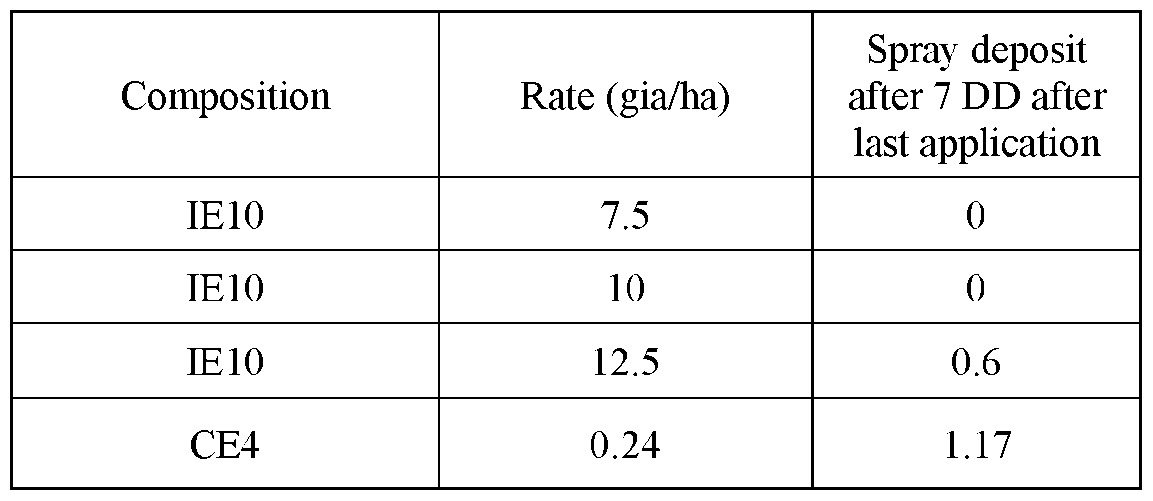


Claims
Priority Applications (7)
| Application Number | Priority Date | Filing Date | Title |
|---|---|---|---|
| AU2024307968A AU2024307968A1 (en) | 2023-06-27 | 2024-06-26 | Bait compositions |
| CN202480043169.7A CN121772844A (en) | 2023-06-27 | 2024-06-26 | Bait composition |
| EP24743592.8A EP4734762A1 (en) | 2023-06-27 | 2024-06-26 | Bait compositions |
| KR1020267002111A KR20260028789A (en) | 2023-06-27 | 2024-06-26 | Bait composition |
| MX2025015713A MX2025015713A (en) | 2023-06-27 | 2025-12-19 | Bait compositions |
| IL325593A IL325593A (en) | 2023-06-27 | 2025-12-24 | Bait compositions |
| CONC2026/0000320A CO2026000320A2 (en) | 2023-06-27 | 2026-01-14 | Bait compositions |
Applications Claiming Priority (2)
| Application Number | Priority Date | Filing Date | Title |
|---|---|---|---|
| US202363523509P | 2023-06-27 | 2023-06-27 | |
| US63/523,509 | 2023-06-27 |
Publications (1)
| Publication Number | Publication Date |
|---|---|
| WO2025006595A1 true WO2025006595A1 (en) | 2025-01-02 |
Family
ID=91953763
Family Applications (1)
| Application Number | Title | Priority Date | Filing Date |
|---|---|---|---|
| PCT/US2024/035604 Ceased WO2025006595A1 (en) | 2023-06-27 | 2024-06-26 | Bait compositions |
Country Status (9)
| Country | Link |
|---|---|
| EP (1) | EP4734762A1 (en) |
| KR (1) | KR20260028789A (en) |
| CN (1) | CN121772844A (en) |
| AR (1) | AR133070A1 (en) |
| AU (1) | AU2024307968A1 (en) |
| CO (1) | CO2026000320A2 (en) |
| IL (1) | IL325593A (en) |
| MX (1) | MX2025015713A (en) |
| WO (1) | WO2025006595A1 (en) |
Cited By (1)
| Publication number | Priority date | Publication date | Assignee | Title |
|---|---|---|---|---|
| CN121136881A (en) * | 2025-11-12 | 2025-12-16 | 湖南师范大学 | A Bacillus thuringiensis species and its application in attracting adult fruit flies |
Citations (2)
| Publication number | Priority date | Publication date | Assignee | Title |
|---|---|---|---|---|
| WO2010022917A2 (en) * | 2008-08-27 | 2010-03-04 | Bayer Cropscience Ag | Method of controlling soul insects |
| WO2021127126A1 (en) * | 2019-12-19 | 2021-06-24 | Fmc Corporation | Diamide suspension concentrate compositions |
-
2024
- 2024-06-26 AU AU2024307968A patent/AU2024307968A1/en active Pending
- 2024-06-26 EP EP24743592.8A patent/EP4734762A1/en active Pending
- 2024-06-26 WO PCT/US2024/035604 patent/WO2025006595A1/en not_active Ceased
- 2024-06-26 AR ARP240101635A patent/AR133070A1/en unknown
- 2024-06-26 CN CN202480043169.7A patent/CN121772844A/en active Pending
- 2024-06-26 KR KR1020267002111A patent/KR20260028789A/en active Pending
-
2025
- 2025-12-19 MX MX2025015713A patent/MX2025015713A/en unknown
- 2025-12-24 IL IL325593A patent/IL325593A/en unknown
-
2026
- 2026-01-14 CO CONC2026/0000320A patent/CO2026000320A2/en unknown
Patent Citations (2)
| Publication number | Priority date | Publication date | Assignee | Title |
|---|---|---|---|---|
| WO2010022917A2 (en) * | 2008-08-27 | 2010-03-04 | Bayer Cropscience Ag | Method of controlling soul insects |
| WO2021127126A1 (en) * | 2019-12-19 | 2021-06-24 | Fmc Corporation | Diamide suspension concentrate compositions |
Non-Patent Citations (6)
| Title |
|---|
| "The BioPesticide Manual", 2001, BRITISH CROP PROTECTION COUNCIL |
| "The Pesticide Manual", 2003, BRITISH CROP PROTECTION COUNCIL |
| ANONYMOUS EXIREL: "Exirel Cebo | FMC", 28 November 2022 (2022-11-28), pages 1 - 3, XP093210547, Retrieved from the Internet <URL:https://web.archive.org/web/20221128115009/https://fmcagro.es/producto/185/exirel-sup-sup-cebo> * |
| ANONYMOUS: "EXIREL CEBO - MSDS", FICHA DE DATOS DE SEGURIDAD, 27 November 2022 (2022-11-27), pages 1 - 35, XP093210353, Retrieved from the Internet <URL:https://fmcagro.es/img/Fichas%20de%20seguridad/Insecticidas/EXIREL%20CEBO-50000082_ES%20(ES).pdf> * |
| NOBLE RALPH ET AL: "Control of spotted wing drosophila (Drosophila suzukii) in sweet cherry and raspberry using bait sprays", JOURNAL OF PEST SCIENCE, vol. 96, no. 2, 1 March 2023 (2023-03-01), Berlin/Heidelberg, pages 623 - 633, XP093209076, ISSN: 1612-4758, Retrieved from the Internet <URL:https://link.springer.com/content/pdf/10.1007/s10340-022-01566-5.pdf> DOI: 10.1007/s10340-022-01566-5 * |
| NOBLE RALPH ET AL: "Minimizing insecticides for control of spotted wing drosophila ( Drosophila suzukii ) in soft fruit using bait sprays", JOURNAL OF APPLIED ENTOMOLOGY, vol. 145, no. 10, 6 June 2021 (2021-06-06), DE, pages 977 - 985, XP093209097, ISSN: 0931-2048, Retrieved from the Internet <URL:https://onlinelibrary.wiley.com/doi/full-xml/10.1111/jen.12917> DOI: 10.1111/jen.12917 * |
Cited By (1)
| Publication number | Priority date | Publication date | Assignee | Title |
|---|---|---|---|---|
| CN121136881A (en) * | 2025-11-12 | 2025-12-16 | 湖南师范大学 | A Bacillus thuringiensis species and its application in attracting adult fruit flies |
Also Published As
| Publication number | Publication date |
|---|---|
| AU2024307968A1 (en) | 2026-01-22 |
| AR133070A1 (en) | 2025-08-20 |
| CN121772844A (en) | 2026-03-31 |
| CO2026000320A2 (en) | 2026-02-02 |
| EP4734762A1 (en) | 2026-05-06 |
| IL325593A (en) | 2026-02-01 |
| MX2025015713A (en) | 2026-02-03 |
| KR20260028789A (en) | 2026-03-04 |
Similar Documents
| Publication | Publication Date | Title |
|---|---|---|
| TWI880999B (en) | Diamide suspension concentrate compositions | |
| IL291668B2 (en) | Diamide insecticide preparations | |
| US20250064053A1 (en) | Dispersant systems to prevent crystal growth in suspension concentrate compositions | |
| US20250204529A1 (en) | Processes for crystallization of amorphous pesticides and formulations thereof | |
| JP7731893B2 (en) | Method for preparing suspension concentrate formulations containing pesticide mixtures | |
| WO2025006595A1 (en) | Bait compositions | |
| AU2023353147A1 (en) | Dry formulation of an active ingredient | |
| AU2024373747A1 (en) | Liquid-fertilizer ready agrochemical formulations | |
| WO2025096485A1 (en) | Liquid-fertilizer ready agrochemical formulations | |
| OA22123A (en) | Dry formulation of an active ingredient. | |
| US20250057163A1 (en) | Solid diamide and bifenthrin formulation for controlling invertebrate pests |
Legal Events
| Date | Code | Title | Description |
|---|---|---|---|
| 121 | Ep: the epo has been informed by wipo that ep was designated in this application |
Ref document number: 24743592 Country of ref document: EP Kind code of ref document: A1 |
|
| WWE | Wipo information: entry into national phase |
Ref document number: MX/A/2025/015713 Country of ref document: MX |
|
| WWE | Wipo information: entry into national phase |
Ref document number: 2501008803 Country of ref document: TH |
|
| WWE | Wipo information: entry into national phase |
Ref document number: AU2024307968 Country of ref document: AU Ref document number: 325593 Country of ref document: IL Ref document number: 202517131398 Country of ref document: IN |
|
| REG | Reference to national code |
Ref country code: BR Ref legal event code: B01A Ref document number: 112025028945 Country of ref document: BR |
|
| WWP | Wipo information: published in national office |
Ref document number: 202517131398 Country of ref document: IN |
|
| ENP | Entry into the national phase |
Ref document number: 1020267002111 Country of ref document: KR Free format text: ST27 STATUS EVENT CODE: A-0-1-A10-A15-NAP-PA0105 (AS PROVIDED BY THE NATIONAL OFFICE) |
|
| WWE | Wipo information: entry into national phase |
Ref document number: 1020267002111 Country of ref document: KR |
|
| ENP | Entry into the national phase |
Ref document number: 2024307968 Country of ref document: AU Date of ref document: 20240626 Kind code of ref document: A |
|
| WWE | Wipo information: entry into national phase |
Ref document number: 2024743592 Country of ref document: EP |
|
| NENP | Non-entry into the national phase |
Ref country code: DE |
|
| WWP | Wipo information: published in national office |
Ref document number: 325593 Country of ref document: IL |
|
| WWP | Wipo information: published in national office |
Ref document number: MX/A/2025/015713 Country of ref document: MX |
|
| ENP | Entry into the national phase |
Ref document number: 2024743592 Country of ref document: EP Effective date: 20260127 |
|
| WWP | Wipo information: published in national office |
Ref document number: 1020267002111 Country of ref document: KR |