WO2025006545A2 - Nuclease effector bound type-vi crispr enzymes - Google Patents
Nuclease effector bound type-vi crispr enzymes Download PDFInfo
- Publication number
- WO2025006545A2 WO2025006545A2 PCT/US2024/035535 US2024035535W WO2025006545A2 WO 2025006545 A2 WO2025006545 A2 WO 2025006545A2 US 2024035535 W US2024035535 W US 2024035535W WO 2025006545 A2 WO2025006545 A2 WO 2025006545A2
- Authority
- WO
- WIPO (PCT)
- Prior art keywords
- polypeptide
- rna
- dcasl3
- protein
- sequence
- Prior art date
- Legal status (The legal status is an assumption and is not a legal conclusion. Google has not performed a legal analysis and makes no representation as to the accuracy of the status listed.)
- Ceased
Links
Classifications
-
- C—CHEMISTRY; METALLURGY
- C12—BIOCHEMISTRY; BEER; SPIRITS; WINE; VINEGAR; MICROBIOLOGY; ENZYMOLOGY; MUTATION OR GENETIC ENGINEERING
- C12N—MICROORGANISMS OR ENZYMES; COMPOSITIONS THEREOF; PROPAGATING, PRESERVING, OR MAINTAINING MICROORGANISMS; MUTATION OR GENETIC ENGINEERING; CULTURE MEDIA
- C12N9/00—Enzymes; Proenzymes; Compositions thereof; Processes for preparing, activating, inhibiting, separating or purifying enzymes
- C12N9/14—Hydrolases (3)
- C12N9/16—Hydrolases (3) acting on ester bonds (3.1)
- C12N9/22—Ribonucleases [RNase]; Deoxyribonucleases [DNase]
-
- C—CHEMISTRY; METALLURGY
- C12—BIOCHEMISTRY; BEER; SPIRITS; WINE; VINEGAR; MICROBIOLOGY; ENZYMOLOGY; MUTATION OR GENETIC ENGINEERING
- C12N—MICROORGANISMS OR ENZYMES; COMPOSITIONS THEREOF; PROPAGATING, PRESERVING, OR MAINTAINING MICROORGANISMS; MUTATION OR GENETIC ENGINEERING; CULTURE MEDIA
- C12N15/00—Mutation or genetic engineering; DNA or RNA concerning genetic engineering, vectors, e.g. plasmids, or their isolation, preparation or purification; Use of hosts therefor
- C12N15/09—Recombinant DNA-technology
- C12N15/11—DNA or RNA fragments; Modified forms thereof; Non-coding nucleic acids having a biological activity
- C12N15/113—Non-coding nucleic acids modulating the expression of genes, e.g. antisense oligonucleotides; Antisense DNA or RNA; Triplex- forming oligonucleotides; Catalytic nucleic acids, e.g. ribozymes; Nucleic acids used in co-suppression or gene silencing
-
- C—CHEMISTRY; METALLURGY
- C12—BIOCHEMISTRY; BEER; SPIRITS; WINE; VINEGAR; MICROBIOLOGY; ENZYMOLOGY; MUTATION OR GENETIC ENGINEERING
- C12N—MICROORGANISMS OR ENZYMES; COMPOSITIONS THEREOF; PROPAGATING, PRESERVING, OR MAINTAINING MICROORGANISMS; MUTATION OR GENETIC ENGINEERING; CULTURE MEDIA
- C12N15/00—Mutation or genetic engineering; DNA or RNA concerning genetic engineering, vectors, e.g. plasmids, or their isolation, preparation or purification; Use of hosts therefor
- C12N15/09—Recombinant DNA-technology
- C12N15/63—Introduction of foreign genetic material using vectors; Vectors; Use of hosts therefor; Regulation of expression
- C12N15/67—General methods for enhancing the expression
-
- C—CHEMISTRY; METALLURGY
- C07—ORGANIC CHEMISTRY
- C07K—PEPTIDES
- C07K2319/00—Fusion polypeptide
-
- C—CHEMISTRY; METALLURGY
- C07—ORGANIC CHEMISTRY
- C07K—PEPTIDES
- C07K2319/00—Fusion polypeptide
- C07K2319/01—Fusion polypeptide containing a localisation/targetting motif
- C07K2319/09—Fusion polypeptide containing a localisation/targetting motif containing a nuclear localisation signal
-
- C—CHEMISTRY; METALLURGY
- C12—BIOCHEMISTRY; BEER; SPIRITS; WINE; VINEGAR; MICROBIOLOGY; ENZYMOLOGY; MUTATION OR GENETIC ENGINEERING
- C12N—MICROORGANISMS OR ENZYMES; COMPOSITIONS THEREOF; PROPAGATING, PRESERVING, OR MAINTAINING MICROORGANISMS; MUTATION OR GENETIC ENGINEERING; CULTURE MEDIA
- C12N2310/00—Structure or type of the nucleic acid
- C12N2310/10—Type of nucleic acid
- C12N2310/20—Type of nucleic acid involving clustered regularly interspaced short palindromic repeats [CRISPR]
Definitions
- RNA interference (RNAi) techniques have been crucial for the characterization of gene function.
- Traditional RNAi methods are versatile and utilize structured RNA molecules to target and silence genes of interest [1,2].
- these methods are accompanied by high off-target activity and are often difficult to design for various targets [3,4],
- ASOs antisense oligonucleotides
- ASOs are being developed to treat diseases such as Spinal Muscular Atrophy [5], but the instability of RNA molecules present a significant downfall for these applications.
- ASREs artificial site-specific RNA endonucleases
- Applicant provides herein an engineered, non-natural polypeptide comprising, or consisting essentially of, or yet further consisting of a catalytically inactive Casl3 effector protein (dCasl3) or a fragment thereof and a PilT N-terminal (PIN) domain.
- dCasl3 catalytically inactive Casl3 effector protein
- PIN PilT N-terminal
- the dCasl3 / PIN polypeptides are able to target RNA for degradation with increased fidelity and less off- target nucleic acid cleavage compared to other Casl3 effectors.
- the PIN domain is N- terminal or C-terminal relative to dCasl3 or the fragment thereof.
- the engineered, non-naturally polypeptide further comprises, or consists essentially of, or consists of, a linker located between the Casdl3 protein and the PIT domain.
- a linker located between the Casdl3 protein and the PIT domain.
- Non-limiting examples of such include a linker from the group of XTEN linker22, a single repeat GS linker (GSxl), or a double repeat GS linker (GSx2).
- the linker is a flexible linker.
- the linker is selected from the group of XTEN linker22 (SEQ ID NO: 23), a single repeat GS linker (GSxl) (SEQ ID NO: 21), or a double repeat GS linker (GSx2) (SEQ ID NO: 22), or a variant of any one of these having at least 50%, 60%, 70%, 80%, 90%, or 95% sequence identity thereto.
- the dCasl3 protein comprises an amino acid sequence having at least 50%, 60%, 70%, 80%, 90%, 95%, 96%, 97%, 98%, 99%, or 100% identity to the any one of SEQ ID NOs: 1-15.
- the dCasl3 protein is selected from the dCasl3 polypeptides provided as SEQ ID NOs: 2, 4, 6, 8, 10, 11, 13 or 15.
- the PIN domain comprises an amino acid sequence having at least 50%, 60%, 70%, 80%, 90%, 95%, 96%, 97%, 98%, 99%, or 100% identity to the sequence set forth in SEQ ID NO: 16.
- the polypeptide comprises an amino acid sequence having at least 50%, 60%, 70%, 80%, 90%, 95%, 96%, 97%, 98%, 99%, or 100% identity to the sequence set forth in any one of SEQ ID NOs: 25-37.
- the polypeptide is capable of causing degradation of a target RNA.
- the polypeptide acts in conjunction with a gRNA to cause degradation of the target RNA.
- the gRNA comprises an RNA sequence that hybridizes to the target RNA.
- the gRNA comprises an RNA sequence that binds to or associates with the polypeptide.
- the gRNA does not comprise a protospacer adjacent motif (PAM).
- PAM protospacer adjacent motif
- Also provided is an engineered polypeptide adapted to be delivered to the nucleus of a cell.
- the polypeptide is adapted to be co-exported with a target RNA out of the nucleus of the cell.
- an engineered nucleoprotein complex comprising, or consisting essentially of, or consisting of an engineered polypeptide as disclosed herein and a recombinant or synthetic single guide RNA (sgRNA) which is engineered or designed to comprise: (1) on its 5’ end, an RNA sequence that recognizes by hybridization (that hybridizes to or binds to) a target RNA and (2) on its 3’ end: i) an RNA sequence capable of binding to or associating with the polypeptide, or (ii) a linker that binds or covalently or non-covalently links the 5’ RNA-hybri dizing or binding end of the sgRNA with the polypeptide, wherein optionally the nucleoprotein complex does not comprise a PAM oligonucleotide.
- sgRNA single guide RNA
- the polypeptide is covalently bound to the single guide RNA (sgRNA) by a linker.
- the complex can further comprise, or consist essentially of, or yet further consist of a detectable label.
- FIGS. 1A and IB shows construct design and enzymatic mechanism of RNA-targeting.
- FIG. 1A is a schematic representation of construct design for Casl3 and engineered CasPIN effectors. All construct expression is driven by a transcriptional promoter with a Ribosome Binding Site (RBS) downstream. CasPIN effectors are designed with two orientations of the PIN domain in relation to the dCas!3 enzyme: N-terminal or C-terminal. The PIN domain is linked to the dCasl3 enzyme using variable linkers.
- FIG. IB is a representation of effector mechanistic action. Dark lines represent the target RNA molecule, while gray lines represent non-target RNA molecules. Black arrows represent cleavage activity of the effector.
- FIGS. 2A and 2B Preliminary characterization of CasPIN constructs.
- FIG. 2A is a schematic representation of the TXTL system including both the GFP expressing plasmid and the RFP expressing plasmid, in addition to either Casl3, dCas!3 or CasPIN expressing plasmid and crRNA targeting GFP.
- FIG. 2B shows quantification of on- and off-target RNA-knockdown in the TXTL system. Dashed lines represent the range between the positive and negative controls. Error bars depict standard error of the mean (SEM). DETAILED DESCRIPTION
- AAV adeno-associated virus
- AAV adeno-associated virus
- cell may refer to either a prokaryotic or eukaryotic cell, optionally obtained from a subject or a commercially available source.
- CRISPR refers to Clustered Regularly Interspaced Short Palindromic Repeats (CRISPR).
- CRISPR may also refer to a gene editing system or technique relying on CRISPR-based, sequence-specific genetic or epigenetic manipulation.
- Epigenetic manipulation includes modifications to nucleotides or higher order chromatin structure that can alter expression patterns of genes in the absence of changes to the underlying DNA sequence.
- Epigenetic modifications can occur on multiple levels, such as 5-methyl-cytosine (5-meC) DNA methylation, post-translational modifications of histones bound by protein domains that serve as epigenetic writers, readers and erasers, and noncoding RNAs that assist in the recruitment of chromatin modifying proteins to DNA.
- a CRISPR-based gene editing system can be utilized in a sequence-specific manner to reduce levels of DNA methylation near the regulatory elements of a gene of interest to promote expression of the gene of interest.
- a CRISPR-based gene editing system can also be programmed to cleave a target polynucleotide using a CRISPR endonuclease and a guide RNA.
- a CRISPR system can be used to cause double stranded or single stranded breaks in a target polynucleotide.
- a CRISPR system can also be used to recruit proteins or label a target polynucleotide.
- CRISPR- mediated gene editing utilizes the pathways of nonhomologous end-joining (NHEJ) or homologous recombination to perform the edits.
- Cas9 refers to a CRISPR-associated, RNA-guided endonuclease such as streptococcus pyogenes Cas9 (spCas9) and orthologs and biological equivalents thereof.
- Biological equivalents of Cas9 include but are not limited to C2cl from Alicyclobacillus acideterrestris and Cpfl (which performs cutting functions analogous to Cas9) from various bacterial species including Acidaminococcus spp. and Francisella novicida U112.
- Cas9 may refer to an endonuclease that causes double stranded breaks in DNA, a nickase variant such as a RuvC or HNH mutant that causes a single stranded break in DNA, as well as other variations such as deadCas-9 or dCas9, which lack endonuclease activity.
- Cas9 may also refer to “split- Cas9” in which CAs9 is split into two halves - C-Cas9 and N-Cas9 - and fused with a two intein moieties. See, e.g., U.S. Pat. No. 9,074,199 Bl ; Zetsche et al. (2015) Nat Biotechnol.
- CRISPR associated endonucleoase referred to by this name (UniProtKB G3ECR1 (CAS9 STRTR)) as well as deadCas-9 or dCas9, which lacks endonuclease activity.
- CasRx intends a Ruminococcus flavefaciens Casl3d that in one aspect is fused to a nuclear localization sequences. See, e.g., Larochelle, Nature Methods, 15:312 (2016) http s : //doi . org/ 10.1038/ nmeth .4681.
- Casl3d refers to one of a family of novel type of RNA targeting enzymes.
- the diverse Casl3 family contains at least four known subtypes, including Casl3a (formerly C2c2), Casl3b, Casl3c, and Casl3d.
- Casl3s function similarly to Cas9, using a ⁇ 64-nt guide RNA to encode target specificity.
- the Casl3 protein complexes with the guide RNA via recognition of a short hairpin in the crRNA, and target specificity is encoded by a 28 - 0-nt spacer that is complementary to the target region.
- gRNA or “guide RNA” as used herein refers to the guide RNA sequences used to target specific genes for correction employing the CRISPR technique.
- Techniques of designing gRNAs and donor therapeutic polynucleotides for target specificity are well known in the art. See, e.g., Doench et al. (2014) Nature Biotechnol. 32(12): 1262-7 and Graham et al. (2015) Genome Biol. 16: 260, incorporated by reference herein.
- gRNA can refer to a dual or single gRNA.
- cell or “host cell” as used herein may refer to either a prokaryotic or eukaryotic cell, optionally obtained from a subject or a commercially available source.
- the host cell can be a mammalian cell, e.g., a canine, a feline, a porcine, a rat, a murine, an equine or a human cell.
- the term “comprising” is intended to mean that the compositions and methods include the recited elements, but do not exclude others.
- the transitional phrase “consisting essentially of’ (and grammatical variants) is to be interpreted as encompassing the recited materials or steps “and those that do not materially affect the basic and novel characteristic(s)” of the recited embodiment.
- the term “consisting essentially of’ as used herein should not be interpreted as equivalent to “comprising.”
- the gene editing systems described herein may consist essentially of the recited materials and additional materials that do not affect the ability of the at least one gRNA to hybridize to a nucleotide sequence complementary to a target sequence or to associate with the E gene or N gene.
- Consisting of’ shall mean excluding more than trace elements of other ingredients and substantial method steps for administering the compositions disclosed herein. Aspects defined by each of these transition terms are within the scope of the present disclosure.
- encode refers to a polynucleotide which is said to “encode” a polypeptide if, in its native state or when manipulated by methods well known to those skilled in the art, can be transcribed and/or translated to produce the mRNA for the polypeptide and/or a fragment thereof.
- the antisense strand is the complement of such a nucleic acid, and the encoding sequence can be deduced therefrom.
- equivalent or biological equivalent are used interchangeably when referring to a particular molecule, biological, or cellular material and intend those having minimal homology or sequence identity while still maintaining desired structure or functionality.
- an equivalent intends at least about 70% homology or identity, or at least 80 % homology or identity and alternatively, or at least about 85 %, or alternatively at least about 90 %, or alternatively at least about 95 %, or alternatively 98 % percent homology or identity and exhibits substantially equivalent biological activity to the reference protein, polypeptide or nucleic acid.
- an equivalent thereof is a polynucleotide that hybridizes under stringent conditions to the reference polynucleotide or its complement.
- polypeptide and/or polynucleotide sequences for use in gene and protein transfer and expression techniques described below. It should be understood, although not always explicitly stated that the sequences provided herein can be used to provide the expression product as well as substantially identical sequences that produce a protein that has the same biological properties. These “biologically equivalent” or “biologically active” polypeptides are encoded by equivalent polynucleotides as described herein.
- They may possess at least 60%, or alternatively, at least 65%, or alternatively, at least 70%, or alternatively, at least 75%, or alternatively, at least 80%, or alternatively at least 85%, or alternatively at least 90%, or alternatively at least 95% or alternatively at least 98%, identical primary amino acid sequence to the reference polypeptide when compared using sequence identity methods run under default conditions.
- Specific polypeptide sequences are provided as examples of particular embodiments. Modifications to the sequences to amino acids with alternate amino acids that have similar charge.
- an equivalent polynucleotide is one that hybridizes under stringent conditions to the reference polynucleotide or its complement or in reference to a polypeptide, a polypeptide encoded by a polynucleotide that hybridizes to the reference encoding polynucleotide under stringent conditions or its complementary strand.
- an equivalent polypeptide or protein is one that is expressed from an equivalent polynucleotide.
- Hybridization refers to a reaction in which one or more polynucleotides react to form a complex that is stabilized via hydrogen bonding between the bases of the nucleotide residues.
- the hydrogen bonding may occur by Watson-Crick base pairing, Hoogstein binding, or in any other sequence-specific manner.
- the complex may comprise two strands forming a duplex structure, three or more strands forming a multi -stranded complex, a single self-hybridizing strand, or any combination of these.
- a hybridization reaction may constitute a step in a more extensive process, such as the initiation of a PC reaction, or the enzymatic cleavage of a polynucleotide by a ribozyme.
- Examples of stringent hybridization conditions include: incubation temperatures of about 25°C to about 37°C; hybridization buffer concentrations of about 6x SSC to about lOx SSC; formamide concentrations of about 0% to about 25%; and wash solutions from about 4x SSC to about 8x SSC.
- Examples of moderate hybridization conditions include: incubation temperatures of about 40°C to about 50°C; buffer concentrations of about 9x SSC to about 2x SSC; formamide concentrations of about 30% to about 50%; and wash solutions of about 5x SSC to about 2x SSC.
- high stringency conditions include: incubation temperatures of about 55°C to about 68°C; buffer concentrations of about lx SSC to about O.lx SSC; formamide concentrations of about 55% to about 75%; and wash solutions of about lx SSC, O. lx SSC, or deionized water.
- hybridization incubation times are from 5 minutes to 24 hours, with 1, 2, or more washing steps, and wash incubation times are about 1, 2, or 15 minutes.
- SSC is 0.15 M NaCl and 15 mM citrate buffer. It is understood that equivalents of SSC using other buffer systems can be employed.
- Homology refers to sequence similarity between two peptides or between two nucleic acid molecules. Homology can be determined by comparing a position in each sequence which may be aligned for purposes of comparison. When a position in the compared sequence is occupied by the same base or amino acid, then the molecules are homologous at that position. A degree of homology between sequences is a function of the number of matching or homologous positions shared by the sequences. An “unrelated” or “non- homologous” sequence shares less than 40% identity, or alternatively less than 25% identity, with one of the sequences of the present invention.
- the term “expression” refers to the process by which polynucleotides are transcribed into mRNA and/or the process by which the transcribed mRNA is subsequently being translated into peptides, polypeptides, or proteins. If the polynucleotide is derived from genomic DNA, expression may include splicing of the mRNA in a eukaryotic cell. The expression level of a gene may be determined by measuring the amount of mRNA or protein in a cell or tissue sample; further, the expression level of multiple genes can be determined to establish an expression profile for a particular sample.
- the term “functional” may be used to modify any molecule, biological, or cellular material to intend that it accomplishes a particular, specified effect.
- isolated refers to molecules or biologicals or cellular materials being substantially free from other materials.
- nucleic acid sequence As used herein, the terms “nucleic acid sequence,” “nucleotide sequence,” and “polynucleotide” are used interchangeably to refer to a polymeric form of nucleotides of any length, either ribonucleotides or deoxyribonucleotides. Thus, this term includes, but is not limited to, single-, double-, or multi-stranded DNA or RNA, genomic DNA, cDNA, DNA-RNA hybrids, or a polymer comprising purine and pyrimidine bases or other natural, chemically or biochemically modified, non-natural, or derivatized nucleotide bases.
- organ a structure which is a specific portion of an individual organism, where a certain function or functions of the individual organism is locally performed and which is morphologically separate.
- organs include the skin, blood vessels, cornea, thymus, kidney, heart, liver, umbilical cord, intestine, nerve, lung, placenta, pancreas, thyroid and brain.
- ortholog is used in reference of another gene or protein and intends a homolog of said gene or protein that evolved from the same ancestral source. Orthologs may or may not retain the same function as the gene or protein to which they are orthologous.
- Cas9 orthologs include S. aureus Cas9 (“spCas9”), S. thermophiles Cas9, L. pneumophilia Cas9, N. lactamica Cas9, N. meningitides Cas9, B. longum Cas9, A. muciniphila Cas9, and O. laneus Cas9.
- promoter refers to any sequence that regulates the expression of a coding sequence, such as a gene. Promoters may be constitutive, inducible, repressible, or tissuespecific, for example.
- a “promoter” is a control sequence that is a region of a polynucleotide sequence at which initiation and rate of transcription are controlled. It may contain genetic elements at which regulatory proteins and molecules may bind such as RNA polymerase and other transcription factors.
- Non-limiting exemplary promoters include CMV promoter, a T7 promoter, U6 promoter, and EF-la promoter.
- Non-limiting exemplary promoter sequences are provided herein below:
- CATCCACGCTGTTTTGACCTCCATAGAAGACACCGGGACCGATCCAGCCTCCGGACT CTAGAGGATCGAACCCTT (SEQ ID NO: 46), or a biological equivalent thereof.
- effector elements can be used in these vectors; e.g., a tetracycline response element (e.g., tetO), a tet-regulatable activator, T2A, VP64, Rta, KRAB, and a miRNA sensor circuit.
- a tetracycline response element e.g., tetO
- a tet-regulatable activator e.g., T2A, VP64, Rta, KRAB
- miRNA sensor circuit e.g., a tetracycline response element (e.g., tetO), a tet-regulatable activator, T2A, VP64, Rta, KRAB, and a miRNA sensor circuit.
- T2A e.g., tetO
- a tet-regulatable activator e.g., T2A, VP64,
- AAV adeno-associated virus
- AAV adeno-associated virus
- AAV adeno-associated virus
- AAV adeno-associated virus
- Multiple serotypes of this virus are known to be suitable for gene delivery; all known serotypes can infect cells from various tissue types. At least 11, sequentially numbered, are known in the art.
- Non-limiting exemplary serotypes useful in the methods disclosed herein include any of the 11 serotypes, e.g., AAV2 and AAV8, or variant serotypes, e.g. AAV-DJ.
- lentivirus refers to a member of the class of viruses associated with this name and belonging to the genus lentivirus, family Retroviridae. While some lentiviruses are known to cause diseases, other lentivirus are known to be suitable for gene delivery. See, e.g., Tomas et al. (2013) Biochemistry, Genetics and Molecular Biology: “Gene Therapy - Tools and Potential Applications,” ISBN 978-953-51-1014-9, DOI: 10.5772/52534.
- the term “vector” intends a vector that can express an exogenous polynucleotide.
- the vector can be a plasmid, or can be derived from or based on a wild-type virus. Aspects of this disclosure relate to an adeno-associated virus, an adenovirus, or lentiviral vector.
- protein protein
- peptide and “polypeptide” are used interchangeably and in their broadest sense to refer to a compound of two or more subunits of amino acids, amino acid analogs or peptidomimetics.
- the subunits may be linked by peptide bonds.
- the subunit may be linked by other bonds, e.g., ester, ether, etc.
- a protein or peptide must contain at least two amino acids and no limitation is placed on the maximum number of amino acids which may comprise a protein’s or peptide’s sequence.
- amino acid refers to either natural and/or unnatural or synthetic amino acids, including glycine and both the D and L optical isomers, amino acid analogs and peptidomimetics.
- recombinant expression system refers to a genetic construct for the expression of certain genetic material formed by recombination.
- the term “subject” is intended to mean any animal.
- the subject may be a mammal; in further embodiments, the subject may be a bat, bovine, equine, feline, murine, porcine, canine, human, or rat. They may be adult, a juvenile or a fetal subject as appropriate.
- the term “effective amount” or “therapeutically effective amount” refers to the amount of an agent that is sufficient to effect beneficial or desired results.
- the therapeutically effective amount may vary depending upon one or more of: the subject and disease condition being treated, the weight and age of the subject, the severity of the disease condition, the manner of administration and the like, which can readily be determined by one of ordinary skill in the art.
- the specific dose may vary depending on one or more of: the particular agent chosen, the dosing regimen to be followed, whether it is administered in combination with other compounds, timing of administration, the route of administration, and the physical delivery system in which it is carried.
- tissue is used herein to refer to tissue of a living or deceased organism or any tissue derived from or designed to mimic a living or deceased organism.
- the tissue may be healthy, diseased, and/or have genetic mutations.
- the biological tissue may include any single tissue (e.g., a collection of cells that may be interconnected) or a group of tissues making up an organ or part or region of the body of an organism.
- the tissue may comprise a homogeneous cellular material or it may be a composite structure such as that found in regions of the body including the nasal passages, the throat, lung tissue, skeletal tissue, and/or muscle tissue.
- Exemplary tissues include, but are not limited to those derived from nose, sinus, oral cavity, lungs, heart, liver, lung, thyroid, skin, pancreas, blood vessels, bladder, kidneys, brain, biliary tree, duodenum, abdominal aorta, iliac vein, heart and intestines, including any combination thereof.
- treating or “treatment” of a disease in a subject refers to (1) preventing the symptoms or disease from occurring in a subject that is predisposed or does not yet display symptoms of the disease; (2) inhibiting the disease or arresting its development; or (3) ameliorating or causing regression of the disease or the symptoms of the disease.
- treatment is an approach for obtaining beneficial or desired results, including clinical results.
- beneficial or desired results can include one or more, but are not limited to, alleviation or amelioration of one or more symptoms, diminishment of extent of a condition (including a disease), stabilized (z.e., not worsening) state of a condition (including disease), delay or slowing of condition (including disease), progression, amelioration or palliation of the condition (including disease), states and remission (whether partial or total), whether detectable or undetectable.
- treatment excludes prevention or prophylaxis.
- gRNA refers to a guide RNA sequence, known in the art to be used with the CRISPR-Cas9 system to facilitate targeting of the gene.
- gRNAs typically comprises a promoter, gRNA scaffold, and a target specific sequence. Where more than one gRNA is present in a construct, spacers may be used to ensure gene targeting.
- Non-limiting exemplary scaffolds are disclosed herein.
- the target specific sequences may be experimentally determined or found on one of many publically available databases, such as Addgene (www.add ene.or ).
- the protospacer adjacent motif (or PAM for short.) is a short DNA sequence (usually 2-6 base pairs in length) that follows the DNA region targeted for cleavage by the CRISPR system, such as CRISPR-Cas9.
- the PAM is required for a Cas nuclease to cut and is generally found 3- 4 nucleotides downstream from the cut site.
- nucleic acid sequence and “polynucleotide” are used interchangeably to refer to a polymeric form of nucleotides of any length, either ribonucleotides or deoxyribonucleotides.
- this term includes, but is not limited to, single-, double-, or multi- stranded DNA or RNA, genomic DNA, cDNA, DNA-RNA hybrids, or a polymer comprising purine and pyrimidine bases or other natural, chemically or biochemically modified, non-natural, or derivatized nucleotide bases.
- protein protein
- peptide and “polypeptide” are used interchangeably and in their broadest sense to refer to a compound of two or more subunits of amino acids, amino acid analogs or peptidomimetics.
- the subunits may be linked by peptide bonds.
- the subunit may be linked by other bonds, e.g., ester, ether, etc.
- a protein or peptide must contain at least two amino acids and no limitation is placed on the maximum number of amino acids which may comprise a protein’s or peptide’s sequence.
- amino acid refers to either natural and/or unnatural or synthetic amino acids, including glycine and both the D and L optical isomers, amino acid analogs and peptidomimetics.
- library when used in context of a nucleic acid refers to a collection of nucleic acids used for a specified use.
- construct and “vector” are used interchangeably herein to refer to a recombinant vector that retains the ability to infect and transduce non-dividing and/or slowly-dividing cells and, optionally, integrate into the target cell’s genome.
- the vector may be derived from a virus, such as a lentivirus. Libraries generally consist of multiple vectors.
- Applicant provides herein an engineered, non-naturally occurring polypeptide comprising, or consisting essentially of, or yet further consisting of a catalytically inactive Cast 3 effector protein (dCasl3) or a fragment thereof and a PilT N-terminal (PIN) domain.
- the PIT domain is N- terminal or C-terminal relative to dCasl3 or the fragment thereof.
- the engineered, non-naturally polypeptide further comprises, or consists essentially of, or consists of, a linker located between the Casdl3 protein and the PIT domain.
- Non-limiting examples of such include a linker from the group of XTEN linker22, a single repeat GS linker (GSxl), or a double repeat GS linker (GSx2).
- the dCas!3 protein is selected from the dCas!3 polypeptides provided as SEQ ID NOs: 1-15 shown in the Sequence Table.
- the PIN domain is selected from the PIN polypeptide provided SEQ ID NO: 16 shown in the Sequence Table. Additional RNAase proteins compatible with the instant disclosure are shown in SEQ ID NOs: 17-20. It is contemplated that any of these (or a suitable derivative thereof, such as one having at least 50%, 60%, 70%, 80%, 90%, 95%, 96%, 97%, 98%, or 99% identity thereto and retaining the RNAase activity) could be substituted for the PIN domains explicitly exemplified herein.
- the polypeptides of this disclosure are provided as SEQ ID NOs: 25-37 shown in the Sequence Table.
- polynucleotide encoding the polypeptide, alone or in combination operably linked to a sequence to promote replication or expression.
- the polynucleotide can be contained within a vector, such as plasmid or viral vector.
- a host cell comprising the polypeptide, the polynucleotide and or the vector.
- the host cell can be a prokaryotic or a eukaryotic cell.
- an engineered polypeptide adapted to be delivered to the nucleus of a cell.
- the polypeptide is adapted to be co-exported with a target RNA out of the nucleus of the cell.
- an engineered nucleoprotein complex is provided, the complex comprising, or consisting essentially of, or consisting of an engineered polypeptide as disclosed herein and a recombinant or synthetic single guide RNA (sgRNA) which is engineered or designed to comprise: (1) on its 5’ end, an RNA sequence that recognizes by hybridization (that hybridizes to or binds to) a target RNA and (2) on its 3’ end: i) an RNA sequence capable of binding to or associating with the polypeptide, or (ii) a linker that binds or covalently or non-covalently links the 5’ RNA-hybridizing or binding end of the sgRNA with the polypeptide, wherein optionally the nucleo
- the polypeptide is covalently bound to the single guide RNA (sgRNA) by a linker.
- the complex can further comprise, or consist essentially of, or yet further consist of a detectable label.
- a polynucleotide or vector comprising a nucleic acid, or nucleic acids, optionally vector or vectors, encoding the polypeptide or the engineered nucleoprotein complex, wherein optionally the vector is, comprises or is derived from a plasmid, an adenovirus, an adeno- associated virus (AAV), a retrovirus, a herpes simplex virus, a human immunodeficiency virus (HIV), or a synthetic vector.
- the polynucleotide can be operatively linked to one or expression polynucleotides, optionally a promoter or enhancer.
- the cell can be a prokaryotic cell such as an E. coli cell or a eukaryotic cell, such as a mammalian or human cell.
- the polynucleotide or vector can further comprise a detectable label or a nucleic acid encoding a detectable label.
- polypeptides, polynucleotides, vectors or complexes are useful to detect an ssRNA target comprising, or consisting essentially of, or yet consisting of contacting the complex or system as described herein with a sample suspected of comprising the ssRNA.
- the ss target is a viral ssRNA target, e.g., the viral ssRNA target is selected from COVID ssRNA.
- kits comprising the polynucleotide or vector as described herein and instructions for use.
- a polypeptide of the instant disclosure comprises a catalytically inactive
- the polypeptide comprises a dCasl3 endonuclease, or a fragment thereof, and a PIN domain.
- the dCasl3 and the PIN domain are separated by a linker.
- the polypeptide is an engineered, non-natural polypeptide.
- the dCasl3 or fragment thereof and the PIN domains can be oriented in any desired orientation (i.e., the PIN domain can be oriented C-terminal to the dCas!3 endonuclease or fragment thereof or the PIN domain can be oriented N-terminal to the dCasl3 endonuclease or fragment thereof).
- the PIN domain is oriented C-terminal to the dCasl3 or fragment thereof.
- the PIN domain is oriented N-terminal to the dCasl3 or fragment thereof.
- a linker can be present between the PIN domain and the dCasl3 or fragment thereof.
- the dCas!3 / PIN polypeptide of the instant disclosure is capable of utilizing the ability of the dCasl3 protein or fragment thereof to bind to a gRNA hybridized to a target nucleic acid (e g., a target RNA) without having the dCasl3 protein cleave the target nucleic acid. Rather, the polypeptide relies on the nuclease activity of the active PIN domain to cleave the target nucleic acid.
- a target nucleic acid e g., a target RNA
- the resulting dCasl3 / PIN polypeptide is thereby capable of cleaving the target nucleic acid with less off-target activity than would be observed for a corresponding catalytically active Casl3 (i.e., a corresponding Casl3 protein which lacks the deactivating mutations of the dCasl3 or fragment thereof) or an untargeted PIN domain.
- off-target cleavage of nucleic acids is reduced by at least 10%, 20%, 30%, 40%, 50%, 60%, 70%, 80%, or 90%.
- off-target cleavage of nucleic acids is reduced by at least 2-fold, 3-fold, 4-fold, 5-fold, 10-fold, 20-fold, 30-fold, 50-fold, or 100-fold.
- Such off-target cleavage can be assessed using a suitable assay, preferably the TXTL fluorescence assay described elsewhere herein.
- the dCasl3 / PIN polypeptide of the instant disclosure exhibits comparable target nucleic acid cleavage ability compared to a corresponding catalytically active Cast 3 protein.
- the dCasl3 / PIN polypeptide exhibits a cleavage efficiency of a target nucleic acid which is at least 10%, 20%, 30%, 40%, 50%, 60%, 70%, 80%, or 90% that of the corresponding catalytically active Cast 3 protein.
- the ratio of target nucleic acid cleavage efficiency to off-target nucleic acid cleavage efficiency of the dCasl3 / PIN polypeptide to the corresponding catalytically active Casl3 protein is enhanced (i.e., the ratio is increased by at least 10%, 20%, 30%, 40%, 50%, 60%, 70%, 80%, 90%, 2-fold, 2.5 fold, 3-fold, 4-fold, 5-fold, or 10-fold).
- target nucleic acid cleavage efficiency can be assessed using a suitable assay, preferably the TXTL fluorescence assay described elsewhere herein.
- the dCasl3 / PIN polypeptide comprises an amino acid sequence having at least 50%, 60%, 70%, 80%, 90%, 95%, 96%, 97%, 98%, 99%, or 100% identity to the sequence set forth in any one of SEQ ID NOs: 25-37.
- each of the dCasl3 and the PIN domain of the polypeptide having at least 50%, 60%, 70%, 80%, 90%, 95%, 96%, 97%, 98%, 99%, or 100% identity to the sequence set forth in any one of SEQ ID NOs: 25-37 retains the functional activity of the dCasl3 and the PIN domain of dCasl3 / PIN polypeptide of the corresponding SEQ ID NO.
- the dCasl3 / PIN polypeptide is capable of causing degradation of a target nucleic acid. In embodiments, the dCasl3 / PIN polypeptide is capable of causing degradation of a target RNA. In embodiments, the dCasl3 / PIN polypeptide acts in conjugation with a gRNA to cause degradation of the target nucleic acid. In embodiments, the dCas!3 / PIN polypeptide acts in conjunction with a gRNA to cause degradation of the target RNA. In embodiments. In embodiments, the dCasl3 / PIN polypeptide requires a gRNA for specific degradation of a target nucleic acid (e.g., a target RNA).
- a target nucleic acid e.g., a target RNA
- the dCasl3 / PIN polypeptide is adapted to be delivered to the nucleus of a cell. In embodiments, the dCasl3 / PIN polypeptide is adapted to be co-exported with a target RNA out of the nucleus of the cell. dCasl3 Polypeptides
- the dCasl3 / PIN polypeptide described herien comprises a catalytically inactive dCasl3 polypeptide, or a fragment thereof.
- a catalytically inactive dCasl3 polypeptide or fragment thereof exhibits substantially reduced target nucleic acid cleavage ability as compared to a corresponding Cas 13 protein.
- a catalytically inactive dCasl3 polypeptide or fragment thereof exhibits substantially no target nucleic acid cleavage ability.
- the dCasl3 polypeptide or fragment thereof retains the ability to bind to the gRNA which hybridizes with the target nucleic acid.
- the dCasl3 protein comprises one or more mutations relative to the corresponding Cas 13 protein which neutralizes or abates the ability of the Cast 3 protein to cleave the target nucleic acid.
- the dCasl3 protein of a dCasl3 / PIN polypeptide described herein is a full-length or substantially full-length Cast 3 protein (e.g., having an amino acid sequence which encompasses amino acids corresponding to at least 90%, 95%, 96%, 97%, 98%, or 99% of the amino acids of the Casl3 protein).
- the dCasl3 protein of a dCasl3 / PIN polypeptide described herein is a fragment of the corresponding Casl 3 protein.
- the fragment of the dCasl3 protein comprises at most 95%, 90%, 80%, 70%, 60%, 50%, 40%, 30%, or 20% of the amino acids of the corresponding Casl 3 protein).
- the dCasl3 protein is a functional fragment of the corresponding Casl3 protein (e.g., it retains the ability of the Casl 3 protein to bind to the gRNA which hybridizes to the target nucleic acids).
- Exemplary dCasl3 polypeptides and corresponding active Casl 3 of the instant disclosure are provided in SEQ ID NOs: 1-15.
- SEQ ID NOs: 2, 4, 6, 8, 10, 11, 13, and 15 describe exemplary dCasl3 proteins and SEQ ID NOs: 1, 3, 5, 7, 9, 12, and 14 describe the corresponding active Casl3 proteins.
- dCasl3 protein comprises an amino acid sequence having at least 50%, 60%, 70%, 80%, 90%, 95%, 96%, 97%, 98%, 99%, or 100% identity to the any one of SEQ ID NOs: 1-15.
- dCasl3 protein comprises an amino acid sequence having at least 50%, 60%, 70%, 80%, 90%, 95%, 96%, 97%, 98%, 99%, or 100% identity to the any one of SEQ ID NOs: 2, 4, 6, 8, 10, 11, 13 or 15.
- the dCasl3 protein having the amino acid sequence having at least 50%, 60%, 70%, 80%, 90%, 95%, 96%, 97%, 98%, 99%, or 100% identity to the any one of SEQ ID NOs: 2, 4, 6, 8, 10, 11, 13 or 15 retains deactivating substitutions at the residues which are mutated in SEQ ID NO: 2, 4, 6, 8, 10, 11, 13 or 15 relative to the corresponding active Casl 3 protein.
- the dCasl3 protein having the amino acid sequence having at least 50%, 60%, 70%, 80%, 90%, 95%, 96%, 97%, 98%, 99%, or 100% identity to the any one of SEQ ID NOs: 2, 4, 6, 8, 10, 11, 13 or 15 retains the substitutions which are mutated in SEQ ID NO: 2, 4, 6, 8, 10, 11, 13 or 15 relative to the corresponding active Casl 3 protein.
- the dCas!3 protein retains the ability to bind to the gRNA which hybridizes to the target DNA of the dCasl3 protein of SEQ ID NO: 2, 4, 6, 8, 10, 11, 13 or 15.
- the dCasl3 protein is selected from the dCasl3 polypeptides provided as SEQ ID NOs: 2, 4, 6, 8, 10, 11, 13 or 15.
- each of the substitutions may be a conservative substitution.
- the dCas!3 protein comprises at most 1, 2, 3, 4, 5, 6, 7, 8, 9, or 10 conservative substitutions relative to the sequence of any one of SEQ ID NOs: 2, 4, 6, 8, 10, 11, 13 or 15.
- the dCasl3 / PIN polypeptide described herien comprises a PIN domain.
- the PIN domain retains its nuclease activity, thereby allowing the dCasl3 / PIN polypeptide to be able to cleave target nucleic acids.
- the PIN domain comprises an amino acid sequence having at least 50%, 60%, 70%, 80%, 90%, 95%, 96%, 97%, 98%, 99%, or 100% identity to the sequence set forth in SEQ ID NO: 16. In embodiments, the PIN domain comprises an amino acid sequence having at least 80% sequence identity to the sequence set forth in SEQ ID NO: 16. In embodiments, the PIN domain comprises an amino acid sequence having at least 90% sequence identity to the sequence set forth in SEQ ID NO: 16. In embodiments, the PIN domain comprises an amino acid sequence having at least 95% sequence identity to the sequence set forth in SEQ ID NO: 16. In embodiments, the PIN domain comprises the amino acid sequence set forth in SEQ ID NO: 16.
- each of the substitutions may be a conservative substitution.
- the PIN domain comprises at most 1, 2, 3, 4, 5, 6, 7, 8, 9, or 10 conservative substitutions relative to the sequence of SEQ ID NO: 16.
- the PIN domain retains its nuclease activity.
- the PIN domain e.g., a variant PIN domain
- the dCasl3 / PIN polypeptide comprises a linker located between the dCasl3 protein and the PIN domain.
- the linker is a peptide linker fused in frame to the dCasl3 protein and the PIN domain.
- the linker is a flexible linker (i.e., a linker without any defined secondary structure), thereby allowing the dCasl3 protein and the PIN domain to adopt the required conformations for their activity.
- the linker is a GS linker (i.e., a linker consisting of only the amino acids glycine and serine).
- GS linkers can be of any desired length and can comprise repeats of short sequences consisting of the amino acids G and S.
- the linker is a single repeated GS linker as described herein (SEQ ID NO: 21) or a double repeat GS linker (SEQ ID NO: 22) as described herein, though other similar linkers are contemplated as within the scope of the instant disclosure.
- the linker comprises a single repeat GS linker (GSxl) (SEQ ID NO: 21), or a double repeat GS linker (GSx2) (SEQ ID NO: 22), or a variant of any one of these having at least 50%, 60%, 70%, 80%, 90%, or 95% sequence identity thereto.
- the linker can also comprise proline residues in addition to glycine and serine in order to provide a kinked linker (e.g., as in SEQ ID NO: 24).
- the linker can also comprise additional repeats of any of the monomeric portions of the linkers provided in any one of SEQ ID NOs: 21, 22, or 24 (e.g., 2, 3, 4, 5, 6, 7, 8, 9, 10, or more repeats of a monomeric portion of any of the monomers provided in one of the sequences).
- the linker is an XTEN linker.
- the XTEN linker has the sequence set forth in SEQ ID NO: 23, or an amino acid sequence having at least 50%, 60%, 70%, 80%, 90%, or 95% sequence identity thereto.
- the linker is the XTEN linker of SEQ ID NO: 23.
- the linker is of a length sufficient to allow flexibility between the dCasl3 protein and the PIN domain. In embodiments, the linker is at least 5, 6, 7, 8, 9, 10, 11, 12, 13, 14,
- the linker is at most 100, 90, 80,
- the linker is 5, 6, 7, 8, 9, 10, 11, 12,
- gRNAs 13, 14, 16, 17, 18, 19, 20, 21, 22, 23, 24, 25, 26, 27, 28, 29, or 30 amino acids in length.
- the dCasl3 / PIN polypeptide of the instant disclosure acts in conjunction with a suitable guide RNA (gRNA).
- gRNA guide RNA
- the gRNA and the dCasl3 / PIN polypeptide act in conjunction to cause degradation of a target nucleic acid (e.g., a target RNA, such as an mRNA).
- a gRNA comprises a portion specific for a target nucleic acid.
- the portion specific for the target nucleic acid comprises a string of nucleotides complementary to the target nucleic acid.
- the string of nucleotides complementary to the target sequence is in the range of about 15-25 nucleotides long (e.g., 15- 25 nucleotides, 17-25 nucleotides, 15-23 nucleotides long, 17-23 nucleotides, 15-20 nucleotides, 17-20 nucleotides, etc.).
- the design of a complementary portion of the gRNA is well understood in the art and can be accomplished using any suitable structure compatible with Casl3 systems.
- the gRNA comprises a portion which binds to or associates with the dCasl3 protein. In embodiments, the gRNA comprises a tracrRNA sequence.
- the gRNA does not contain a protospacer adjacent motif (PAM). In other embodiments, the gRNA does contain the PAM.
- PAM protospacer adjacent motif
- the gRNA is split across two nucleotides (e.g., one RNA including the complementary portion to the target and a second RNA including the portion which binds to or associates with the dCasl3 protein).
- the gRNA is a single guide RNA (sgRNA), which contains both the complementary portion to the target and the portion which binds to or associates with the dCasl3 protein.
- the sgRNA comprises, on its 5’ ends, an RNA sequence that recognizes by hybridization (that hybridizes to or binds to) a target RNA; and on its 3’ end: (i) an RNA sequence capable of binding to or associating with the polypeptide, or (ii) a linker that binds or covalently or non-covalently links the 5’ RNA- hybridizing or binding end of the sgRNA with the polypeptide, wherein optionally the nucleoprotein complex does not comprise a PAM oligonucleotide.
- the RNA sequence on the 5’ end hybridizes to the target RNA and the 3’ end binds to or associates with the dCasl3 protein.
- the polypeptide is covalently bound to the single guide RNA (sgRNA) by a linker.
- the gRNA hybridizes with a target nucleic acid, thereby allowing the target nucleic acid to be degraded.
- the target nucleic acid is an RNA.
- the target nucleic acid is an mRNA.
- vectors which encode a dCasl3 / PIN polypeptide as described herein.
- the vector comprises a polynucleotide sequence encoding the polypeptide.
- the vector also encodes the desired gRNA (e.g., any of the gRNAs described herein).
- the gRNA is not operatively coupled to the encoded polypeptide (e.g., it is encoded on a different section of the vector from the dCasl3 / PIN polypeptide).
- the vector can encode multiple copies of the gRNA.
- the vector is or is derived from a plasmid, an adenovirus, an adeno- associated virus (AAV), a retrovirus, a herpes simplex virus, a human immunodeficiency virus (HIV), or a synthetic vector.
- the vector is a DNA vector.
- the vector is a plasmid, a viral vector, a cosmid, or an artificial chromosome.
- the vector is a plasmid.
- the vector is a viral vector.
- the viral vector is an adenovirus, an AAV, a retrovirus, a lentivirus, or a herpes simplex virus.
- the vector comprises other elements operably coupled with to the polynucleotide encoding the polypeptide, such as expression enhancers, promoters, and the like.
- the vector can be included in a kit with instructions for use of the vector.
- the kit can further comprise additional components, such as transfection reagents or other reagents known in the field of molecular biology which allow use of the vector in an appropriate manner.
- a host cell comprising a dCasl3 / PIN polypeptide as described herein, or a vector described herein encoding the same.
- a host cell which encodes a dCasl3 / PIN polypeptide provided herein (e.g., by transient transfection with a vector encoding the polypeptide, or a polynucleotide encoding the dCasl3 / PIN has been incorporated into the genome of the cell).
- the host cell is in cell culture (e.g., in an in vitro cell culture).
- the host cell is a eukaryotic cell.
- the host cell is a mammalian cell, a fungal cell, or an insect cell.
- the host cell is a yeast cell.
- the host cell is a mammalian cell.
- the host cell is a human cell.
- a method of inhibiting expression of a target protein which comprises contacting mRNA encoding the target protein with a dCas!3 / PIN polypeptide as described herein in the presence of a gRNA which hybridizes to the mRNA.
- the method can be performed in in vitro settings (e.g., in cell culture in in vitro transcription/translation systems) or can be performed in vivo (e.g., by introducing vectors encoding the relevant materials into desired hosts).
- a method of inhibiting protein expression of a target protein in a cell comprising introducing into the cell a vector (e.g., one as described herein) which encodes the dCasl3 / PIN polypeptide.
- a vector e.g., one as described herein
- Such methods can be performed in in vitro cell culture settings or can be applied to in vivo application (e.g., gene therapies and the like).
- Type- VI CRISPR-Cas (Casl3) ribonucleases are attractive constructs for an improved RNA-targeting platform.
- each Casl3 enzyme complexes with an enzyme- specific and programmable guide RNA (gRNA) that encodes a spacer sequence complementary to an ssRNA target [7-10]
- Casl3 enzymes are separated into four subtypes (Casl3a-Casl3d) and share conservation through encoding two higher eukaryotes and prokaryotes nucleotide- binding (HEPN) nuclease domains [11], The two conserved HEPN domains are responsible for RNA cleavage driven by target recognition through the binding of a gRNA spacer to its ssRNA complement.
- RNA-targeting CRISPR enzymes are currently investigating approaches to utilize RNA-targeting CRISPR enzymes while avoiding the collateral cleavage phenomenon of Casl3 effectors. Mutations within both nucleolytic HEPN domains of Casl3 enzymes result in catalytically inactive Casl3 (dCasl3) enzymes that retain RNA-binding and gRNA processing activity. Due to the programmable binding capacity, dCasl3 effectors have been used to direct RNA base editing, exon skipping, and translational inhibition [9,15,16], These studies have demonstrated the power of using dCasl3 enzymes for programmable RNA-targeting and present an efficient tool for engineering novel RNA-targeting systems.
- dCasl3 enzymes are ideal constructs for recruitment of ssRNA nucleases to target sites for sequence-specific degradation. Demonstrated in the development of ASREs, CIRTS, and RCas9 [6,18,19], nuclease domains, such as the PUT N- terminal (PIN) domain [20,21], serve well as fusion effectors for targeted RNA degradation.
- Applicant discloses herein a novel RNA-targeting system using a fusion effector generated through the combination of dCasl3 and a PIN domain.
- This system termed CasPIN, demonstrates the first Cas 13 -based platform capable of sequence specific RNA cleavage without collateral cleavage activity.
- Applicant demonstrated sequence-specific RNA-targeting using cell- free and biochemical in vitro methodologies and further demonstrate potential in vivo applications of this technology. Further provided is evidence of programmable targeting against synthetic, endogenous, and viral RNA in vivo. This development provides a novel and highly specific RNA- targeting platform with vast potential for downstream applications.
- FIG. 1A To develop a novel RNA-targeting system combining dCasl3 with an ssRNA nuclease domain, Applicant designed several constructs for experimental interrogation (FIG. 1A). More specifically, two constructs were designed that express catalytically active Cast 3 and a catalytically inactive Casl3 (dCasl3) to serve as positive and negative controls, respectively. Six constructs expressing different variations of Applicant’s CasPIN system were generated. These constructs were initially divided into two groups: N-terminal and C-terminal orientation of the PIN domain relative to dCasl3.
- the CasPIN constructs are designed to possess the programmable RNA-binding activity of dCasl3 effectors along with the RNA-cleavage activity of the PIN domain. Furthermore, like Cas 13 and dCasl3 systems, the CasPIN technology is directed to RNA targets using a programmable RNA molecule (guide RNA or gRNA) composed of a fixed repeat sequence and variable spacer sequence.
- guide RNA or gRNA programmable RNA molecule
- SEQ ID NOs: 1-15 of Sequence Table represents the active and inactive Casl3d portions of the fusion proteins. Applicant also provides two truncated dCaslS. SEQ ID NO: 16 of Sequence Table represents the PIN sequence and SEQ ID NOs: 17-20 provide representative nucleases.
- TXTL transcription and translation
- this disclosure provides a technology that is capable of targeting and degrading any ssRNA molecule of interest.
- biotechnologies that permit specific control of gene expression at the RNA level. Therefore, this technology can be used for RNA- knockdown to study and characterize gene function, enable gene-specific control that is both permanent or transient, and ultimately enable disease modeling both in vitro and in vivo.
- CasPIN is not limited to research applications and also serves as a powerful therapeutic in multiple settings. Due to the sequence-specific targeting and lack of collateral activity, CasPIN can be adapted as a potent antiviral by directly targeting the genomes of RNA viruses, or targeting the transcripts produced by dsRNA or DNA viruses. With the PIN domain responsible for cleavage, and a lack of collateral activity through the use of dCasl 3 instead of catalytically active Cast 3, CasPIN will provide an RNA-targeting technology with improved safety compared to currently available technologies, such as RNAi or Casl3.
- CasPIN is a small, protein-based RNA-targeting system directed by a gRNA and, therefore this system possesses enhanced stability compared to RNA-based therapeutics, such as ASOs, and can easily be encoded and packaged into viral vectors permitting effective delivery.
- Table listing exemplary amino acid (AA) sequences used to test the CasPIN designs including the AA sequences associated with each effector.
- Regular text represents the dCasl 3d sequences, the bolded text represents the linker AA sequences and underlined text represents the PIN AA sequences.
- Direct Repeat Sequence Table Table listing direct repeat (DR) nucleotide sequences used to test with CasPIN designs. Each DR is associated with a specific Casl3 effector and represents the RNA sequence.
Landscapes
- Health & Medical Sciences (AREA)
- Life Sciences & Earth Sciences (AREA)
- Genetics & Genomics (AREA)
- Engineering & Computer Science (AREA)
- Chemical & Material Sciences (AREA)
- Bioinformatics & Cheminformatics (AREA)
- Biomedical Technology (AREA)
- Organic Chemistry (AREA)
- Zoology (AREA)
- Wood Science & Technology (AREA)
- Molecular Biology (AREA)
- General Engineering & Computer Science (AREA)
- Biotechnology (AREA)
- Microbiology (AREA)
- Biochemistry (AREA)
- General Health & Medical Sciences (AREA)
- Plant Pathology (AREA)
- Biophysics (AREA)
- Physics & Mathematics (AREA)
- Medicinal Chemistry (AREA)
- Micro-Organisms Or Cultivation Processes Thereof (AREA)
- Enzymes And Modification Thereof (AREA)
Abstract
An engineered, non-naturally polypeptide comprising a catalytically inactive Cas13 effector protein (dCas13) or fragment thereof, and a PilT N-terminal (PIN) domain is provided by this disclosure.
Description
NUCLEASE EFFECTOR BOUND TYPE- VI CRISPR ENZYMES
CROSS REFERENCE
[0001] This application claims the benefit of U.S. Provisional Application No. 63/510,541 filed June 27, 2023, which application is incorporated herein by reference in its entirety.
SEQUENCE LISTING
[0002] The instant application contains a Sequence Listing which has been submitted electronically in XML format and is hereby incorporated by reference in its entirety. Said XML copy, created on June 25, 2024, is named 24978-0934_SL.xml and is 72,131 bytes in size.
BACKGROUND
[0003] RNA interference (RNAi) techniques have been crucial for the characterization of gene function. Traditional RNAi methods are versatile and utilize structured RNA molecules to target and silence genes of interest [1,2]. However, these methods are accompanied by high off-target activity and are often difficult to design for various targets [3,4], Although techniques to improve these technologies are being explored, novel approaches have emerged and demonstrate great potential. For example, antisense oligonucleotides (ASOs) are being developed to treat diseases such as Spinal Muscular Atrophy [5], but the instability of RNA molecules present a significant downfall for these applications. To avoid stability issues, researchers have turned to protein engineering to develop programmable RNA-targeting systems by fusing RNA-binding domains to functional nucleases, such as the case developing artificial site-specific RNA endonucleases (ASREs) [6], ASREs can be programmed to target and degrade any RNA molecule, however the engineering required to develop each enzyme is challenging and costly. Thus a need exists for novel RNA-targeting CRISPR systems to provide a unique and easily programmable alternative to classical and newly emerging RNAi methods.
[0004] Throughout this disclosure, technical literature is references by a first author name and year of publication to more fully describe the state of the art to which this technology pertains. The full bibliographic citations for these publications are found immediately preceding the claims. These publications as well as the technical and patent literature referenced within this disclosure are hereby incorporated by reference into this disclosure in their entireties unless otherwise noted.
SUMMARY OF THE DISCLOSURE
[0005] Applicant provides herein an engineered, non-natural polypeptide comprising, or consisting essentially of, or yet further consisting of a catalytically inactive Casl3 effector protein (dCasl3) or a fragment thereof and a PilT N-terminal (PIN) domain. In some instances, the dCasl3 / PIN polypeptides are able to target RNA for degradation with increased fidelity and less off- target nucleic acid cleavage compared to other Casl3 effectors. In one aspect, the PIN domain is N- terminal or C-terminal relative to dCasl3 or the fragment thereof. In a further aspect, the engineered, non-naturally polypeptide further comprises, or consists essentially of, or consists of, a linker located between the Casdl3 protein and the PIT domain. Non-limiting examples of such include a linker from the group of XTEN linker22, a single repeat GS linker (GSxl), or a double repeat GS linker (GSx2). In embodiments, the linker is a flexible linker. In embodiments, the linker is selected from the group of XTEN linker22 (SEQ ID NO: 23), a single repeat GS linker (GSxl) (SEQ ID NO: 21), or a double repeat GS linker (GSx2) (SEQ ID NO: 22), or a variant of any one of these having at least 50%, 60%, 70%, 80%, 90%, or 95% sequence identity thereto.
[0006] In embodiments, the dCasl3 protein comprises an amino acid sequence having at least 50%, 60%, 70%, 80%, 90%, 95%, 96%, 97%, 98%, 99%, or 100% identity to the any one of SEQ ID NOs: 1-15. In embodiments, the dCasl3 protein is selected from the dCasl3 polypeptides provided as SEQ ID NOs: 2, 4, 6, 8, 10, 11, 13 or 15.
[0007] In embodiments, the PIN domain comprises an amino acid sequence having at least 50%, 60%, 70%, 80%, 90%, 95%, 96%, 97%, 98%, 99%, or 100% identity to the sequence set forth in SEQ ID NO: 16.
[0008] In embodiments, the polypeptide comprises an amino acid sequence having at least 50%, 60%, 70%, 80%, 90%, 95%, 96%, 97%, 98%, 99%, or 100% identity to the sequence set forth in any one of SEQ ID NOs: 25-37.
[0009] In embodiments, the polypeptide is capable of causing degradation of a target RNA. In embodiments, the polypeptide acts in conjunction with a gRNA to cause degradation of the target RNA. In embodiments, the gRNA comprises an RNA sequence that hybridizes to the target RNA. In embodiments, the gRNA comprises an RNA sequence that binds to or associates with the polypeptide. In embodiments, the gRNA does not comprise a protospacer adjacent motif (PAM).
[0010] Also provided is an engineered polypeptide adapted to be delivered to the nucleus of a cell. In a further aspect, the polypeptide is adapted to be co-exported with a target RNA out of the nucleus of the cell.
[0011] In a specific embodiment, an engineered nucleoprotein complex is provided, the complex comprising, or consisting essentially of, or consisting of an engineered polypeptide as disclosed herein and a recombinant or synthetic single guide RNA (sgRNA) which is engineered or designed to comprise: (1) on its 5’ end, an RNA sequence that recognizes by hybridization (that hybridizes to or binds to) a target RNA and (2) on its 3’ end: i) an RNA sequence capable of binding to or associating with the polypeptide, or (ii) a linker that binds or covalently or non-covalently links the 5’ RNA-hybri dizing or binding end of the sgRNA with the polypeptide, wherein optionally the nucleoprotein complex does not comprise a PAM oligonucleotide.
[0012] In one embodiment, the polypeptide is covalently bound to the single guide RNA (sgRNA) by a linker. The complex can further comprise, or consist essentially of, or yet further consist of a detectable label.
BRIEF DESCRIPTION OF THE FIGURES
[0013] FIGS. 1A and IB shows construct design and enzymatic mechanism of RNA-targeting. FIG. 1A is a schematic representation of construct design for Casl3 and engineered CasPIN effectors. All construct expression is driven by a transcriptional promoter with a Ribosome Binding Site (RBS) downstream. CasPIN effectors are designed with two orientations of the PIN domain in relation to the dCas!3 enzyme: N-terminal or C-terminal. The PIN domain is linked to the dCasl3 enzyme using variable linkers. FIG. IB is a representation of effector mechanistic action. Dark lines represent the target RNA molecule, while gray lines represent non-target RNA molecules. Black arrows represent cleavage activity of the effector.
[0014] FIGS. 2A and 2B Preliminary characterization of CasPIN constructs. FIG. 2A is a schematic representation of the TXTL system including both the GFP expressing plasmid and the RFP expressing plasmid, in addition to either Casl3, dCas!3 or CasPIN expressing plasmid and crRNA targeting GFP. FIG. 2B shows quantification of on- and off-target RNA-knockdown in the TXTL system. Dashed lines represent the range between the positive and negative controls. Error bars depict standard error of the mean (SEM).
DETAILED DESCRIPTION
[0015] Embodiments according to the present disclosure will be described more fully hereinafter. Aspects of the disclosure may, however, be embodied in different forms and should not be construed as limited to the embodiments set forth herein. Rather, these embodiments are provided so that this disclosure will be thorough and complete, and will fully convey the scope of the invention to those skilled in the art. The terminology used in the description herein is for the purpose of describing particular embodiments only and is not intended to be limiting.
[0016] Unless otherwise defined, all terms (including technical and scientific terms) used herein have the same meaning as commonly understood by one of ordinary skill in the art to which this invention belongs. It will be further understood that terms, such as those defined in commonly used dictionaries, should be interpreted as having a meaning that is consistent with their meaning in the context of the present application and relevant art and should not be interpreted in an idealized or overly formal sense unless expressly so defined herein. While not explicitly defined below, such terms should be interpreted according to their common meaning.
[0017] The terminology used in the description herein is for the purpose of describing particular embodiments only and is not intended to be limiting of the invention. All publications, patent applications, patents and other references mentioned herein are incorporated by reference in their entirety. The practice of the present technology will employ, unless otherwise indicated, conventional techniques of tissue culture, immunology, molecular biology, microbiology, cell biology, and recombinant DNA, which are within the skill of the art.
[0018] Unless the context indicates otherwise, it is specifically intended that the various features of the invention described herein can be used in any combination. Moreover, the disclosure also contemplates that in some embodiments, any feature or combination of features set forth herein can be excluded or omitted. To illustrate, if the specification states that a complex comprises components A, B and C, it is specifically intended that any of A, B or C, or a combination thereof, can be omitted and disclaimed singularly or in any combination.
[0019] Unless explicitly indicated otherwise, all specified embodiments, features, and terms intend to include both the recited embodiment, feature, or term and biological equivalents thereof.
[0020] All numerical designations, e.g., pH, temperature, time, concentration, and molecular
weight, including ranges, are approximations which are varied ( + ) or ( - ) by increments of 1.0, 0.7, 0.5, 0.3, 0.1, or 0.01, as appropriate, or alternatively by a variation of +/- 15 %, or alternatively 10%, or alternatively 5%, or alternatively 2%. It is to be understood, although not always explicitly stated, that all numerical designations are preceded by the term “about” and the appropriate range is included within the use of the term. The term “about,” as used herein when referring to a measurable value such as an amount or concentration and the like, is meant to encompass variations of 20%, 15%, 10%, 7%, 5%, 3%, 1 %, 0.5%, 0.1% or even 0.01 % of the specified amount. It also is to be understood, although not always explicitly stated, that the reagents described herein are merely exemplary and that equivalents of such are known in the art.
Definitions
[0021] As used in the description of the invention and the appended claims, the singular forms “a,” “an” and “the” are intended to include the plural forms as well, unless the context clearly indicates otherwise.
[0022] The terms or “acceptable,” “effective,” or “sufficient” when used to describe the selection of any components, ranges, dose forms, etc. disclosed herein intend that said component, range, dose form, etc. is suitable for the disclosed purpose.
[0023] The term “adeno-associated virus” or “AAV” as used herein refers to a member of the class of viruses associated with this name and belonging to the genus dependoparvovirus, family Parvoviridae. Multiple serotypes of this virus are known to be suitable for gene delivery; all known serotypes can infect cells from various tissue types. At least 11, sequentially numbered, are disclosed in the prior art. Non-limiting exemplary serotypes useful in the methods disclosed herein include any of the 11 serotypes, e.g., AAV2, AAV5, AAV8 and AAV9.
[0024] Also as used herein, “and/or” refers to and encompasses any and all possible combinations of one or more of the associated listed items, as well as the lack of combinations when interpreted in the alternative (“or”).
[0025] The term “cell” as used herein may refer to either a prokaryotic or eukaryotic cell, optionally obtained from a subject or a commercially available source.
[0026] As used herein, the term “CRISPR” refers to Clustered Regularly Interspaced Short Palindromic Repeats (CRISPR). CRISPR may also refer to a gene editing system or technique
relying on CRISPR-based, sequence-specific genetic or epigenetic manipulation. Epigenetic manipulation includes modifications to nucleotides or higher order chromatin structure that can alter expression patterns of genes in the absence of changes to the underlying DNA sequence. Epigenetic modifications can occur on multiple levels, such as 5-methyl-cytosine (5-meC) DNA methylation, post-translational modifications of histones bound by protein domains that serve as epigenetic writers, readers and erasers, and noncoding RNAs that assist in the recruitment of chromatin modifying proteins to DNA. For example, a CRISPR-based gene editing system can be utilized in a sequence-specific manner to reduce levels of DNA methylation near the regulatory elements of a gene of interest to promote expression of the gene of interest.
[0027] A CRISPR-based gene editing system can also be programmed to cleave a target polynucleotide using a CRISPR endonuclease and a guide RNA. A CRISPR system can be used to cause double stranded or single stranded breaks in a target polynucleotide. A CRISPR system can also be used to recruit proteins or label a target polynucleotide. In some aspects, CRISPR- mediated gene editing utilizes the pathways of nonhomologous end-joining (NHEJ) or homologous recombination to perform the edits. These applications of CRISPR technology are known and widely practiced in the art. See, e.g., U.S. Pat. No. 8,697,359; Int’l. Publ. Nos. WO 2017/091630 Al, WO 2017/180915 A2, WO 2018/035503 Al, and WO 2018/170015 Al; Hsu et al. (2014) Cell 156(6): 1262-78; and Urbano et al. (2019) Cancers 1 l(10):E1515.
[0028] The term “Cas9” refers to a CRISPR-associated, RNA-guided endonuclease such as streptococcus pyogenes Cas9 (spCas9) and orthologs and biological equivalents thereof. Biological equivalents of Cas9 include but are not limited to C2cl from Alicyclobacillus acideterrestris and Cpfl (which performs cutting functions analogous to Cas9) from various bacterial species including Acidaminococcus spp. and Francisella novicida U112. Cas9 may refer to an endonuclease that causes double stranded breaks in DNA, a nickase variant such as a RuvC or HNH mutant that causes a single stranded break in DNA, as well as other variations such as deadCas-9 or dCas9, which lack endonuclease activity. Cas9 may also refer to “split- Cas9” in which CAs9 is split into two halves - C-Cas9 and N-Cas9 - and fused with a two intein moieties. See, e.g., U.S. Pat. No. 9,074,199 Bl ; Zetsche et al. (2015) Nat Biotechnol. 33(2): 139- 42; Wright et al. (2015) PNAS 112(10) 2984-89. An additional example includes CRISPR associated endonucleoase referred to by this name (UniProtKB G3ECR1 (CAS9 STRTR)) as well as
deadCas-9 or dCas9, which lacks endonuclease activity.
[0029] The term “CasRx” intends a Ruminococcus flavefaciens Casl3d that in one aspect is fused to a nuclear localization sequences. See, e.g., Larochelle, Nature Methods, 15:312 (2018) http s : //doi . org/ 10.1038/ nmeth .4681.
[0030] The term “Casl3d” refers to one of a family of novel type of RNA targeting enzymes. The diverse Casl3 family contains at least four known subtypes, including Casl3a (formerly C2c2), Casl3b, Casl3c, and Casl3d. Casl3s function similarly to Cas9, using a ~64-nt guide RNA to encode target specificity. The Casl3 protein complexes with the guide RNA via recognition of a short hairpin in the crRNA, and target specificity is encoded by a 28 - 0-nt spacer that is complementary to the target region. In addition to programmable RNase activity, all Cast 3s exhibit collateral activity after recognition and cleavage of a target transcript, leading to nonspecific degradation of any nearby transcripts regardless of complementarity to the spacer. Wessels, H.-H. et al. Nature Biotechnol. https://doi.org/10.1038/s41587-020-0456-9 (Published March 16, 2020). In one aspect, the term also includes optimized versions of Casl3d and Casl3d orthologs.
[0031] The term “gRNA” or “guide RNA” as used herein refers to the guide RNA sequences used to target specific genes for correction employing the CRISPR technique. Techniques of designing gRNAs and donor therapeutic polynucleotides for target specificity are well known in the art. See, e.g., Doench et al. (2014) Nature Biotechnol. 32(12): 1262-7 and Graham et al. (2015) Genome Biol. 16: 260, incorporated by reference herein. When used herein, gRNA can refer to a dual or single gRNA. The term “cell” or “host cell” as used herein may refer to either a prokaryotic or eukaryotic cell, optionally obtained from a subject or a commercially available source. The host cell can be a mammalian cell, e.g., a canine, a feline, a porcine, a rat, a murine, an equine or a human cell.
[0032] As used herein, the term “comprising” is intended to mean that the compositions and methods include the recited elements, but do not exclude others. As used herein, the transitional phrase “consisting essentially of’ (and grammatical variants) is to be interpreted as encompassing the recited materials or steps “and those that do not materially affect the basic and novel characteristic(s)” of the recited embodiment. Thus, the term “consisting essentially of’ as used herein should not be interpreted as equivalent to “comprising.” For example, the gene editing
systems described herein may consist essentially of the recited materials and additional materials that do not affect the ability of the at least one gRNA to hybridize to a nucleotide sequence complementary to a target sequence or to associate with the E gene or N gene. “Consisting of’ shall mean excluding more than trace elements of other ingredients and substantial method steps for administering the compositions disclosed herein. Aspects defined by each of these transition terms are within the scope of the present disclosure.
[0033] The term “encode” as it is applied to nucleic acid sequences refers to a polynucleotide which is said to “encode” a polypeptide if, in its native state or when manipulated by methods well known to those skilled in the art, can be transcribed and/or translated to produce the mRNA for the polypeptide and/or a fragment thereof. The antisense strand is the complement of such a nucleic acid, and the encoding sequence can be deduced therefrom. The terms “equivalent” or “biological equivalent” are used interchangeably when referring to a particular molecule, biological, or cellular material and intend those having minimal homology or sequence identity while still maintaining desired structure or functionality.
[0034] It is to be inferred without explicit recitation and unless otherwise intended, that when the present disclosure relates to a polypeptide, protein, polynucleotide or antibody, an equivalent or a biologically equivalent of such is intended within the scope of this disclosure. As used herein, the term “biological equivalent thereof’ is intended to be synonymous with “equivalent thereof’ when referring to a reference protein, antibody, polypeptide or nucleic acid, intends those having minimal homology while still maintaining desired structure or functionality. Unless specifically recited herein, it is contemplated that any polynucleotide, polypeptide or protein mentioned herein also includes equivalents thereof. For example, an equivalent intends at least about 70% homology or identity, or at least 80 % homology or identity and alternatively, or at least about 85 %, or alternatively at least about 90 %, or alternatively at least about 95 %, or alternatively 98 % percent homology or identity and exhibits substantially equivalent biological activity to the reference protein, polypeptide or nucleic acid. Alternatively, when referring to polynucleotides, an equivalent thereof is a polynucleotide that hybridizes under stringent conditions to the reference polynucleotide or its complement.
[0035] Applicant has provided herein the polypeptide and/or polynucleotide sequences for use in gene and protein transfer and expression techniques described below. It should be understood,
although not always explicitly stated that the sequences provided herein can be used to provide the expression product as well as substantially identical sequences that produce a protein that has the same biological properties. These “biologically equivalent” or “biologically active” polypeptides are encoded by equivalent polynucleotides as described herein. They may possess at least 60%, or alternatively, at least 65%, or alternatively, at least 70%, or alternatively, at least 75%, or alternatively, at least 80%, or alternatively at least 85%, or alternatively at least 90%, or alternatively at least 95% or alternatively at least 98%, identical primary amino acid sequence to the reference polypeptide when compared using sequence identity methods run under default conditions. Specific polypeptide sequences are provided as examples of particular embodiments. Modifications to the sequences to amino acids with alternate amino acids that have similar charge. Additionally, an equivalent polynucleotide is one that hybridizes under stringent conditions to the reference polynucleotide or its complement or in reference to a polypeptide, a polypeptide encoded by a polynucleotide that hybridizes to the reference encoding polynucleotide under stringent conditions or its complementary strand. Alternatively, an equivalent polypeptide or protein is one that is expressed from an equivalent polynucleotide.
[0036] “Hybridization” refers to a reaction in which one or more polynucleotides react to form a complex that is stabilized via hydrogen bonding between the bases of the nucleotide residues. The hydrogen bonding may occur by Watson-Crick base pairing, Hoogstein binding, or in any other sequence-specific manner. The complex may comprise two strands forming a duplex structure, three or more strands forming a multi -stranded complex, a single self-hybridizing strand, or any combination of these. A hybridization reaction may constitute a step in a more extensive process, such as the initiation of a PC reaction, or the enzymatic cleavage of a polynucleotide by a ribozyme.
[0037] Examples of stringent hybridization conditions include: incubation temperatures of about 25°C to about 37°C; hybridization buffer concentrations of about 6x SSC to about lOx SSC; formamide concentrations of about 0% to about 25%; and wash solutions from about 4x SSC to about 8x SSC. Examples of moderate hybridization conditions include: incubation temperatures of about 40°C to about 50°C; buffer concentrations of about 9x SSC to about 2x SSC; formamide concentrations of about 30% to about 50%; and wash solutions of about 5x SSC to about 2x SSC. Examples of high stringency conditions include: incubation temperatures of about 55°C to about
68°C; buffer concentrations of about lx SSC to about O.lx SSC; formamide concentrations of about 55% to about 75%; and wash solutions of about lx SSC, O. lx SSC, or deionized water. In general, hybridization incubation times are from 5 minutes to 24 hours, with 1, 2, or more washing steps, and wash incubation times are about 1, 2, or 15 minutes. SSC is 0.15 M NaCl and 15 mM citrate buffer. It is understood that equivalents of SSC using other buffer systems can be employed.
[0038] “Homology” or “identity” or “similarity” refers to sequence similarity between two peptides or between two nucleic acid molecules. Homology can be determined by comparing a position in each sequence which may be aligned for purposes of comparison. When a position in the compared sequence is occupied by the same base or amino acid, then the molecules are homologous at that position. A degree of homology between sequences is a function of the number of matching or homologous positions shared by the sequences. An “unrelated” or “non- homologous” sequence shares less than 40% identity, or alternatively less than 25% identity, with one of the sequences of the present invention.
[0039] As used herein, the term “expression” refers to the process by which polynucleotides are transcribed into mRNA and/or the process by which the transcribed mRNA is subsequently being translated into peptides, polypeptides, or proteins. If the polynucleotide is derived from genomic DNA, expression may include splicing of the mRNA in a eukaryotic cell. The expression level of a gene may be determined by measuring the amount of mRNA or protein in a cell or tissue sample; further, the expression level of multiple genes can be determined to establish an expression profile for a particular sample.
[0040] As used herein, the term “functional” may be used to modify any molecule, biological, or cellular material to intend that it accomplishes a particular, specified effect. The term “isolated” as used herein refers to molecules or biologicals or cellular materials being substantially free from other materials.
[0041] As used herein, the terms “nucleic acid sequence,” “nucleotide sequence,” and “polynucleotide” are used interchangeably to refer to a polymeric form of nucleotides of any length, either ribonucleotides or deoxyribonucleotides. Thus, this term includes, but is not limited to, single-, double-, or multi-stranded DNA or RNA, genomic DNA, cDNA, DNA-RNA hybrids, or a polymer comprising purine and pyrimidine bases or other natural, chemically or biochemically modified, non-natural, or derivatized nucleotide bases.
[0042] As used herein, the term “organ” a structure which is a specific portion of an individual organism, where a certain function or functions of the individual organism is locally performed and which is morphologically separate. Non-limiting examples of organs include the skin, blood vessels, cornea, thymus, kidney, heart, liver, umbilical cord, intestine, nerve, lung, placenta, pancreas, thyroid and brain.
[0043] The term “ortholog” is used in reference of another gene or protein and intends a homolog of said gene or protein that evolved from the same ancestral source. Orthologs may or may not retain the same function as the gene or protein to which they are orthologous. Non-limiting examples of Cas9 orthologs include S. aureus Cas9 (“spCas9”), S. thermophiles Cas9, L. pneumophilia Cas9, N. lactamica Cas9, N. meningitides Cas9, B. longum Cas9, A. muciniphila Cas9, and O. laneus Cas9.
[0044] The term “promoter” as used herein refers to any sequence that regulates the expression of a coding sequence, such as a gene. Promoters may be constitutive, inducible, repressible, or tissuespecific, for example. A “promoter” is a control sequence that is a region of a polynucleotide sequence at which initiation and rate of transcription are controlled. It may contain genetic elements at which regulatory proteins and molecules may bind such as RNA polymerase and other transcription factors. Non-limiting exemplary promoters include CMV promoter, a T7 promoter, U6 promoter, and EF-la promoter. Non-limiting exemplary promoter sequences are provided herein below:
CMV promoter
ATACGCGTTGACATTGATTATTGACTAGTTATTAATAGTAATCAATTACGGGGTCAT TAGTTCATAGCCCATATATGGAGTTCCGCGTTACATAACTTACGGTAAATGGCCCGC CTGGCTGACCGCCCAACGACCCCCGCCCATTGACGTCAATAATGACGTATGTTCCCA TAGTAACGCCAATAGGGACTTTCCATTGACGTCAATGGGTGGAGTATTTACGGTAAA CTGCCCACTTGGCAGTACATCAAGTGTATCATATGCCAAGTACGCCCCCTATTGACG TCAATGACGGTAAATGGCCCGCCTGGCATTATGCCCAGTACATGACCTTATGGGACT TTCCTACTTGGCAGTACATCTACGTATTAGTCATCGCTATTACCATGGTGATGCGGTT TTGGCAGTACATCAATGGGCGTGGATAGCGGTTTGACTCACGGGGATTTCCAAGTCT CCACCCCATTGACGTCAATGGGAGTTTGTTTTGGCACCAAAATCAACGGGACTTTCC AAAATGTCGTAACAACTCCGCCCCATTGACGCAAATGGGCGGTAGGCGTGTACGGT
GGGAGGTCTATATAAGCAGAGCTCGTTTAGTGAACCGTCAGATCGCCTGGAGACGC
CATCCACGCTGTTTTGACCTCCATAGAAGACACCGGGACCGATCCAGCCTCCGGACT CTAGAGGATCGAACCCTT (SEQ ID NO: 46), or a biological equivalent thereof.
U6promoter
GAGGGCCTATTTCCCATGATTCCTTCATATTTGCATATACGATACAAGGCTGTTAGA
GAGATAATTAGAATTAATTTGACTGTAAACACAAAGATATTAGTACAAAATACGTG
ACGTAGAAAGTAATAATTTCTTGGGTAGTTTGCAGTTTTAAAATTATGTTTTAAAAT
GGACTATCATATGCTTACCGTAACTTGAAAGTATTTCGATTTCTTGGCTTTATATATC TTGTGGAAAGGACGAAACACC (SEQ ID NO: 47), or a biological equivalent thereof.
EFla promoter
CGTGAGGCTCCGGTGCCCGTCAGTGGGCAGAGCGCACATCGCCCACAGTCCCCGAG
AAGTTGGGGGGAGGGGTCGGCAATTGAACCGGTGCCTAGAGAAGGTGGCGCGGGG
TAAACTGGGAAAGTGATGTCGTGTACTGGCTCCGCCTTTTTCCCGAGGGTGGGGGAG
AACCGTATATAAGTGCAGTAGTCGCCGTGAACGTTCTTTTTCGCAACGGGTTTGCCG
CCAGAACACAGGTAAGTGCCGTGTGTGGTTCCCGCGGGCCTGGCCTCTTTACGGGTT
ATGGCCCTTGCGTGCCTTGAATTACTTCCACGCCCCTGGCTGCAGTACGTGATTCTTG
ATCCCGAGCTTCGGGTTGGAAGTGGGTGGGAGAGTTCGAGGCCTTGCGCTTAAGGA
GCCCCTTCGCCTCGTGCTTGAGTTGAGGCCTGGCCTGGGCGCTGGGGCCGCCGCGTG
CGAATCTGGTGGCACCTTCGCGCCTGTCTCGCTGCTTTCGATAAGTCTCTAGCCATTT
AAAATTTTTGATGACCTGCTGCGACGCTTTTTTTCTGGCAAGATAGTCTTGTAAATGC
GGGCCAAGATCTGCACACTGGTATTTCGGTTTTTGGGGCCGCGGGCGGCGACGGGG
CCCGTGCGTCCCAGCGCACATGTTCGGCGAGGCGGGGCCTGCGAGCGCGGCCACCG
AGAATCGGACGGGGGTAGTCTCAAGCTGGCCGGCCTGCTCTGGTGCCTGGCCTCGC
GCCGCCGTGTATCGCCCCGCCCTGGGCGGCAAGGCTGGCCCGGTCGGCACCAGTTG
CGTGAGCGGAAAGATGGCCGCTTCCCGGCCCTGCTGCAGGGAGCTCAAAATGGAGG
ACGCGGCGCTCGGGAGAGCGGGCGGGTGAGTCACCCACACAAAGGAAAAGGGCCT
TTCCGTCCTCAGCCGTCGCTTCATGTGACTCCACGGAGTACCGGGCGCCGTCCAGGC
ACCTCGATTAGTTCTCGAGCTTTTGGAGTACGTCGTCTTTAGGTTGGGGGGAGGGGT
TTTATGCGATGGAGTTTCCCCACACTGAGTGGGTGGAGACTGAAGTTAGGCCAGCTT
GGCACTTGATGTAATTCTCCTTGGAATTTGCCCTTTTTGAGTTTGGATCTTGGTTCAT
TCTCAAGCCTCAGACAGTGGTTCAAAGTTTTTTTCTTCCATTTCAGGTGTCGTGAG
(SEQ ID NO: 48), or a biological equivalent thereof.
[0045] A number of effector elements can be used in these vectors; e.g., a tetracycline response element (e.g., tetO), a tet-regulatable activator, T2A, VP64, Rta, KRAB, and a miRNA sensor circuit. The nature and function of these effector elements are commonly understood in the art and a number of these effector elements are commercially available. In one aspect, the systems further comprise an effector element.
[0046] The term “adeno-associated virus” or “AAV” as used herein refers to a member of the class of viruses associated with this name and belonging to the genus dependoparvovirus, family Parvoviridae. Multiple serotypes of this virus are known to be suitable for gene delivery; all known serotypes can infect cells from various tissue types. At least 11, sequentially numbered, are known in the art. Non-limiting exemplary serotypes useful in the methods disclosed herein include any of the 11 serotypes, e.g., AAV2 and AAV8, or variant serotypes, e.g. AAV-DJ.
[0047] The term “lentivirus” as used herein refers to a member of the class of viruses associated with this name and belonging to the genus lentivirus, family Retroviridae. While some lentiviruses are known to cause diseases, other lentivirus are known to be suitable for gene delivery. See, e.g., Tomas et al. (2013) Biochemistry, Genetics and Molecular Biology: “Gene Therapy - Tools and Potential Applications,” ISBN 978-953-51-1014-9, DOI: 10.5772/52534.
[0048] As used herein, the term “vector” intends a vector that can express an exogenous polynucleotide. The vector can be a plasmid, or can be derived from or based on a wild-type virus. Aspects of this disclosure relate to an adeno-associated virus, an adenovirus, or lentiviral vector.
[0049] The terms “protein”, “peptide” and “polypeptide” are used interchangeably and in their broadest sense to refer to a compound of two or more subunits of amino acids, amino acid analogs or peptidomimetics. The subunits may be linked by peptide bonds. In another aspect, the subunit may be linked by other bonds, e.g., ester, ether, etc. A protein or peptide must contain at least two amino acids and no limitation is placed on the maximum number of amino acids which may comprise a protein’s or peptide’s sequence. As used herein the term “amino acid” refers to either natural and/or unnatural or synthetic amino acids, including glycine and both the D and L optical isomers, amino acid analogs and peptidomimetics. As used herein, the term “recombinant expression system” refers to a genetic construct for the expression of certain genetic material
formed by recombination.
[0050] As used herein, the term “subject” is intended to mean any animal. In some embodiments, the subject may be a mammal; in further embodiments, the subject may be a bat, bovine, equine, feline, murine, porcine, canine, human, or rat. They may be adult, a juvenile or a fetal subject as appropriate.
[0051] The term “effective amount” or “therapeutically effective amount” refers to the amount of an agent that is sufficient to effect beneficial or desired results. The therapeutically effective amount may vary depending upon one or more of: the subject and disease condition being treated, the weight and age of the subject, the severity of the disease condition, the manner of administration and the like, which can readily be determined by one of ordinary skill in the art. The specific dose may vary depending on one or more of: the particular agent chosen, the dosing regimen to be followed, whether it is administered in combination with other compounds, timing of administration, the route of administration, and the physical delivery system in which it is carried.
[0052] The term “tissue” is used herein to refer to tissue of a living or deceased organism or any tissue derived from or designed to mimic a living or deceased organism. The tissue may be healthy, diseased, and/or have genetic mutations. The biological tissue may include any single tissue (e.g., a collection of cells that may be interconnected) or a group of tissues making up an organ or part or region of the body of an organism. The tissue may comprise a homogeneous cellular material or it may be a composite structure such as that found in regions of the body including the nasal passages, the throat, lung tissue, skeletal tissue, and/or muscle tissue. Exemplary tissues include, but are not limited to those derived from nose, sinus, oral cavity, lungs, heart, liver, lung, thyroid, skin, pancreas, blood vessels, bladder, kidneys, brain, biliary tree, duodenum, abdominal aorta, iliac vein, heart and intestines, including any combination thereof.
[0053] As used herein, “treating” or “treatment” of a disease in a subject refers to (1) preventing the symptoms or disease from occurring in a subject that is predisposed or does not yet display symptoms of the disease; (2) inhibiting the disease or arresting its development; or (3) ameliorating or causing regression of the disease or the symptoms of the disease. As understood in the art, “treatment” is an approach for obtaining beneficial or desired results, including clinical
results. For the purposes of the present technology, beneficial or desired results can include one or more, but are not limited to, alleviation or amelioration of one or more symptoms, diminishment of extent of a condition (including a disease), stabilized (z.e., not worsening) state of a condition (including disease), delay or slowing of condition (including disease), progression, amelioration or palliation of the condition (including disease), states and remission (whether partial or total), whether detectable or undetectable. In one aspect, the term “treatment” excludes prevention or prophylaxis. As used herein, the term “gRNA” refers to a guide RNA sequence, known in the art to be used with the CRISPR-Cas9 system to facilitate targeting of the gene. gRNAs typically comprises a promoter, gRNA scaffold, and a target specific sequence. Where more than one gRNA is present in a construct, spacers may be used to ensure gene targeting. Non-limiting exemplary scaffolds are disclosed herein. The target specific sequences may be experimentally determined or found on one of many publically available databases, such as Addgene (www.add ene.or ).
[0054] The protospacer adjacent motif (or PAM for short.) is a short DNA sequence (usually 2-6 base pairs in length) that follows the DNA region targeted for cleavage by the CRISPR system, such as CRISPR-Cas9. The PAM is required for a Cas nuclease to cut and is generally found 3- 4 nucleotides downstream from the cut site. As used herein, the terms “nucleic acid sequence” and “polynucleotide” are used interchangeably to refer to a polymeric form of nucleotides of any length, either ribonucleotides or deoxyribonucleotides. Thus, this term includes, but is not limited to, single-, double-, or multi- stranded DNA or RNA, genomic DNA, cDNA, DNA-RNA hybrids, or a polymer comprising purine and pyrimidine bases or other natural, chemically or biochemically modified, non-natural, or derivatized nucleotide bases.
[0055] The term “protein”, “peptide” and “polypeptide” are used interchangeably and in their broadest sense to refer to a compound of two or more subunits of amino acids, amino acid analogs or peptidomimetics. The subunits may be linked by peptide bonds. In another aspect, the subunit may be linked by other bonds, e.g., ester, ether, etc. A protein or peptide must contain at least two amino acids and no limitation is placed on the maximum number of amino acids which may comprise a protein’s or peptide’s sequence. As used herein the term “amino acid” refers to either natural and/or unnatural or synthetic amino acids, including glycine and both the D and L optical isomers, amino acid analogs and peptidomimetics.
[0056] As used herein, the term “library” when used in context of a nucleic acid refers to a collection of nucleic acids used for a specified use. Generally, the term “construct” and “vector” are used interchangeably herein to refer to a recombinant vector that retains the ability to infect and transduce non-dividing and/or slowly-dividing cells and, optionally, integrate into the target cell’s genome. The vector may be derived from a virus, such as a lentivirus. Libraries generally consist of multiple vectors.
Modes for Carrying Out the Disclosure
[0057] Applicant provides herein an engineered, non-naturally occurring polypeptide comprising, or consisting essentially of, or yet further consisting of a catalytically inactive Cast 3 effector protein (dCasl3) or a fragment thereof and a PilT N-terminal (PIN) domain. In one aspect, the PIT domain is N- terminal or C-terminal relative to dCasl3 or the fragment thereof. In a further aspect, the engineered, non-naturally polypeptide further comprises, or consists essentially of, or consists of, a linker located between the Casdl3 protein and the PIT domain. Non-limiting examples of such include a linker from the group of XTEN linker22, a single repeat GS linker (GSxl), or a double repeat GS linker (GSx2).
[0058] In one aspect, the dCas!3 protein is selected from the dCas!3 polypeptides provided as SEQ ID NOs: 1-15 shown in the Sequence Table. In a further aspect, the PIN domain is selected from the PIN polypeptide provided SEQ ID NO: 16 shown in the Sequence Table. Additional RNAase proteins compatible with the instant disclosure are shown in SEQ ID NOs: 17-20. It is contemplated that any of these (or a suitable derivative thereof, such as one having at least 50%, 60%, 70%, 80%, 90%, 95%, 96%, 97%, 98%, or 99% identity thereto and retaining the RNAase activity) could be substituted for the PIN domains explicitly exemplified herein. In a yet further aspect, the polypeptides of this disclosure are provided as SEQ ID NOs: 25-37 shown in the Sequence Table.
[0059] Also provided is a polynucleotide encoding the polypeptide, alone or in combination operably linked to a sequence to promote replication or expression. The polynucleotide can be contained within a vector, such as plasmid or viral vector. Also provided is a host cell comprising the polypeptide, the polynucleotide and or the vector. The host cell can be a prokaryotic or a eukaryotic cell.
[0060] Also provided is an engineered polypeptide adapted to be delivered to the nucleus of a
cell. In a further aspect, the polypeptide is adapted to be co-exported with a target RNA out of the nucleus of the cell. In a specific embodiment, an engineered nucleoprotein complex is provided, the complex comprising, or consisting essentially of, or consisting of an engineered polypeptide as disclosed herein and a recombinant or synthetic single guide RNA (sgRNA) which is engineered or designed to comprise: (1) on its 5’ end, an RNA sequence that recognizes by hybridization (that hybridizes to or binds to) a target RNA and (2) on its 3’ end: i) an RNA sequence capable of binding to or associating with the polypeptide, or (ii) a linker that binds or covalently or non-covalently links the 5’ RNA-hybridizing or binding end of the sgRNA with the polypeptide, wherein optionally the nucleoprotein complex does not comprise a PAM oligonucleotide.
[0061] In one embodiment, the polypeptide is covalently bound to the single guide RNA (sgRNA) by a linker. The complex can further comprise, or consist essentially of, or yet further consist of a detectable label.
[0062] Also provided is a polynucleotide or vector comprising a nucleic acid, or nucleic acids, optionally vector or vectors, encoding the polypeptide or the engineered nucleoprotein complex, wherein optionally the vector is, comprises or is derived from a plasmid, an adenovirus, an adeno- associated virus (AAV), a retrovirus, a herpes simplex virus, a human immunodeficiency virus (HIV), or a synthetic vector. The polynucleotide can be operatively linked to one or expression polynucleotides, optionally a promoter or enhancer. The cell can be a prokaryotic cell such as an E. coli cell or a eukaryotic cell, such as a mammalian or human cell. The polynucleotide or vector can further comprise a detectable label or a nucleic acid encoding a detectable label.
[0063] The polypeptides, polynucleotides, vectors or complexes are useful to detect an ssRNA target comprising, or consisting essentially of, or yet consisting of contacting the complex or system as described herein with a sample suspected of comprising the ssRNA. In one aspect, the ss target is a viral ssRNA target, e.g., the viral ssRNA target is selected from COVID ssRNA.
[0064] Further provided is a kit comprising the polynucleotide or vector as described herein and instructions for use.
Casl3 / PIN Polypeptides of the Disclosure
[0065] In embodiments, a polypeptide of the instant disclosure comprises a catalytically inactive
Cas endonuclease (“dCas”) (preferably, a Casl3 endonuclease (“dCas!3”)), or a fragment
thereof, and a PilT N-terminal (PIN) domain, or a fragment thereof. In embodiments, the polypeptide comprises a dCasl3 endonuclease, or a fragment thereof, and a PIN domain. In embodiments, the dCasl3 and the PIN domain are separated by a linker. In embodiments, the polypeptide is an engineered, non-natural polypeptide.
[0066] The dCasl3 or fragment thereof and the PIN domains can be oriented in any desired orientation (i.e., the PIN domain can be oriented C-terminal to the dCas!3 endonuclease or fragment thereof or the PIN domain can be oriented N-terminal to the dCasl3 endonuclease or fragment thereof). In embodiments, the PIN domain is oriented C-terminal to the dCasl3 or fragment thereof. In embodiments, the PIN domain is oriented N-terminal to the dCasl3 or fragment thereof. In any orientation, a linker can be present between the PIN domain and the dCasl3 or fragment thereof.
[0067] The dCas!3 / PIN polypeptide of the instant disclosure is capable of utilizing the ability of the dCasl3 protein or fragment thereof to bind to a gRNA hybridized to a target nucleic acid (e g., a target RNA) without having the dCasl3 protein cleave the target nucleic acid. Rather, the polypeptide relies on the nuclease activity of the active PIN domain to cleave the target nucleic acid. In embodiments, the resulting dCasl3 / PIN polypeptide is thereby capable of cleaving the target nucleic acid with less off-target activity than would be observed for a corresponding catalytically active Casl3 (i.e., a corresponding Casl3 protein which lacks the deactivating mutations of the dCasl3 or fragment thereof) or an untargeted PIN domain. In embodiments, off- target cleavage of nucleic acids is reduced by at least 10%, 20%, 30%, 40%, 50%, 60%, 70%, 80%, or 90%. In embodiments, off-target cleavage of nucleic acids is reduced by at least 2-fold, 3-fold, 4-fold, 5-fold, 10-fold, 20-fold, 30-fold, 50-fold, or 100-fold. Such off-target cleavage can be assessed using a suitable assay, preferably the TXTL fluorescence assay described elsewhere herein.
[0068] In embodiments, the dCasl3 / PIN polypeptide of the instant disclosure exhibits comparable target nucleic acid cleavage ability compared to a corresponding catalytically active Cast 3 protein. In embodiments, the dCasl3 / PIN polypeptide exhibits a cleavage efficiency of a target nucleic acid which is at least 10%, 20%, 30%, 40%, 50%, 60%, 70%, 80%, or 90% that of the corresponding catalytically active Cast 3 protein. In embodiments, the ratio of target nucleic acid cleavage efficiency to off-target nucleic acid cleavage efficiency of the dCasl3 / PIN
polypeptide to the corresponding catalytically active Casl3 protein is enhanced (i.e., the ratio is increased by at least 10%, 20%, 30%, 40%, 50%, 60%, 70%, 80%, 90%, 2-fold, 2.5 fold, 3-fold, 4-fold, 5-fold, or 10-fold). Such target nucleic acid cleavage efficiency can be assessed using a suitable assay, preferably the TXTL fluorescence assay described elsewhere herein.
[0069] In embodiments, the dCasl3 / PIN polypeptide comprises an amino acid sequence having at least 50%, 60%, 70%, 80%, 90%, 95%, 96%, 97%, 98%, 99%, or 100% identity to the sequence set forth in any one of SEQ ID NOs: 25-37. In embodiments, each of the dCasl3 and the PIN domain of the polypeptide having at least 50%, 60%, 70%, 80%, 90%, 95%, 96%, 97%, 98%, 99%, or 100% identity to the sequence set forth in any one of SEQ ID NOs: 25-37 retains the functional activity of the dCasl3 and the PIN domain of dCasl3 / PIN polypeptide of the corresponding SEQ ID NO.
[0070] In embodiments, the dCasl3 / PIN polypeptide is capable of causing degradation of a target nucleic acid. In embodiments, the dCasl3 / PIN polypeptide is capable of causing degradation of a target RNA. In embodiments, the dCasl3 / PIN polypeptide acts in conjugation with a gRNA to cause degradation of the target nucleic acid. In embodiments, the dCas!3 / PIN polypeptide acts in conjunction with a gRNA to cause degradation of the target RNA. In embodiments. In embodiments, the dCasl3 / PIN polypeptide requires a gRNA for specific degradation of a target nucleic acid (e.g., a target RNA).
[0071] In embodiments, the dCasl3 / PIN polypeptide is adapted to be delivered to the nucleus of a cell. In embodiments, the dCasl3 / PIN polypeptide is adapted to be co-exported with a target RNA out of the nucleus of the cell. dCasl3 Polypeptides
[0072] In embodiments, the dCasl3 / PIN polypeptide described herien comprises a catalytically inactive dCasl3 polypeptide, or a fragment thereof. A catalytically inactive dCasl3 polypeptide or fragment thereof exhibits substantially reduced target nucleic acid cleavage ability as compared to a corresponding Cas 13 protein. In embodiments, a catalytically inactive dCasl3 polypeptide or fragment thereof exhibits substantially no target nucleic acid cleavage ability. Preferably, the dCasl3 polypeptide or fragment thereof retains the ability to bind to the gRNA which hybridizes with the target nucleic acid. In embodiments, the dCasl3 protein comprises one or more mutations relative to the corresponding Cas 13 protein which neutralizes or abates the
ability of the Cast 3 protein to cleave the target nucleic acid.
[0073] In embodiments, the dCasl3 protein of a dCasl3 / PIN polypeptide described herein is a full-length or substantially full-length Cast 3 protein (e.g., having an amino acid sequence which encompasses amino acids corresponding to at least 90%, 95%, 96%, 97%, 98%, or 99% of the amino acids of the Casl3 protein). In embodiments, the dCasl3 protein of a dCasl3 / PIN polypeptide described herein is a fragment of the corresponding Casl 3 protein. In embodiments, the fragment of the dCasl3 protein comprises at most 95%, 90%, 80%, 70%, 60%, 50%, 40%, 30%, or 20% of the amino acids of the corresponding Casl 3 protein). In embodiments, the dCasl3 protein is a functional fragment of the corresponding Casl3 protein (e.g., it retains the ability of the Casl 3 protein to bind to the gRNA which hybridizes to the target nucleic acids).
[0074] Exemplary dCasl3 polypeptides and corresponding active Casl 3 of the instant disclosure are provided in SEQ ID NOs: 1-15. Specifically, SEQ ID NOs: 2, 4, 6, 8, 10, 11, 13, and 15 describe exemplary dCasl3 proteins and SEQ ID NOs: 1, 3, 5, 7, 9, 12, and 14 describe the corresponding active Casl3 proteins. In embodiments, dCasl3 protein comprises an amino acid sequence having at least 50%, 60%, 70%, 80%, 90%, 95%, 96%, 97%, 98%, 99%, or 100% identity to the any one of SEQ ID NOs: 1-15. In embodiments, dCasl3 protein comprises an amino acid sequence having at least 50%, 60%, 70%, 80%, 90%, 95%, 96%, 97%, 98%, 99%, or 100% identity to the any one of SEQ ID NOs: 2, 4, 6, 8, 10, 11, 13 or 15. In embodiments, the dCasl3 protein having the amino acid sequence having at least 50%, 60%, 70%, 80%, 90%, 95%, 96%, 97%, 98%, 99%, or 100% identity to the any one of SEQ ID NOs: 2, 4, 6, 8, 10, 11, 13 or 15 retains deactivating substitutions at the residues which are mutated in SEQ ID NO: 2, 4, 6, 8, 10, 11, 13 or 15 relative to the corresponding active Casl 3 protein. In embodiments, the dCasl3 protein having the amino acid sequence having at least 50%, 60%, 70%, 80%, 90%, 95%, 96%, 97%, 98%, 99%, or 100% identity to the any one of SEQ ID NOs: 2, 4, 6, 8, 10, 11, 13 or 15 retains the substitutions which are mutated in SEQ ID NO: 2, 4, 6, 8, 10, 11, 13 or 15 relative to the corresponding active Casl 3 protein. In embodiments, the dCas!3 protein retains the ability to bind to the gRNA which hybridizes to the target DNA of the dCasl3 protein of SEQ ID NO: 2, 4, 6, 8, 10, 11, 13 or 15. In embodiments, the dCasl3 protein is selected from the dCasl3 polypeptides provided as SEQ ID NOs: 2, 4, 6, 8, 10, 11, 13 or 15. In embodiments in which the dCasl3 protein contains substitutions relative the sequence set forth in SEQ ID NOs: 2, 4, 6, 8, 10, 11, 13 or 15, each of the substitutions may be a conservative substitution. In embodiments,
the dCas!3 protein comprises at most 1, 2, 3, 4, 5, 6, 7, 8, 9, or 10 conservative substitutions relative to the sequence of any one of SEQ ID NOs: 2, 4, 6, 8, 10, 11, 13 or 15.
PIN Domains
[0075] In embodiments, the dCasl3 / PIN polypeptide described herien comprises a PIN domain. The PIN domain retains its nuclease activity, thereby allowing the dCasl3 / PIN polypeptide to be able to cleave target nucleic acids.
[0076] In embodiments, the PIN domain comprises an amino acid sequence having at least 50%, 60%, 70%, 80%, 90%, 95%, 96%, 97%, 98%, 99%, or 100% identity to the sequence set forth in SEQ ID NO: 16. In embodiments, the PIN domain comprises an amino acid sequence having at least 80% sequence identity to the sequence set forth in SEQ ID NO: 16. In embodiments, the PIN domain comprises an amino acid sequence having at least 90% sequence identity to the sequence set forth in SEQ ID NO: 16. In embodiments, the PIN domain comprises an amino acid sequence having at least 95% sequence identity to the sequence set forth in SEQ ID NO: 16. In embodiments, the PIN domain comprises the amino acid sequence set forth in SEQ ID NO: 16. In embodiments in which the PIN contains substitutions relative the sequence set forth in SEQ ID NO: 16, each of the substitutions may be a conservative substitution. In embodiments, the PIN domain comprises at most 1, 2, 3, 4, 5, 6, 7, 8, 9, or 10 conservative substitutions relative to the sequence of SEQ ID NO: 16.
[0077] In embodiments, the PIN domain retains its nuclease activity. In embodiments, the PIN domain (e.g., a variant PIN domain) retains a nuclease activity which is at least 10%, 20%, 30%, 40%, 50%, 60%, 70%, 80%, or 90% efficient as the PIN domain set forth in SEQ ID NO: 16.
Linkers
[0078] In embodiments, the dCasl3 / PIN polypeptide comprises a linker located between the dCasl3 protein and the PIN domain. In embodiments, the linker is a peptide linker fused in frame to the dCasl3 protein and the PIN domain. In embodiments, the linker is a flexible linker (i.e., a linker without any defined secondary structure), thereby allowing the dCasl3 protein and the PIN domain to adopt the required conformations for their activity.
[0079] In embodiments, the linker is a GS linker (i.e., a linker consisting of only the amino acids glycine and serine). Such GS linkers can be of any desired length and can comprise repeats of short sequences consisting of the amino acids G and S. In embodiments, the linker is a single
repeated GS linker as described herein (SEQ ID NO: 21) or a double repeat GS linker (SEQ ID NO: 22) as described herein, though other similar linkers are contemplated as within the scope of the instant disclosure. In embodiments, the linker comprises a single repeat GS linker (GSxl) (SEQ ID NO: 21), or a double repeat GS linker (GSx2) (SEQ ID NO: 22), or a variant of any one of these having at least 50%, 60%, 70%, 80%, 90%, or 95% sequence identity thereto. In embodiments, the linker can also comprise proline residues in addition to glycine and serine in order to provide a kinked linker (e.g., as in SEQ ID NO: 24). In embodiments, the linker can also comprise additional repeats of any of the monomeric portions of the linkers provided in any one of SEQ ID NOs: 21, 22, or 24 (e.g., 2, 3, 4, 5, 6, 7, 8, 9, 10, or more repeats of a monomeric portion of any of the monomers provided in one of the sequences).
[0080] In embodiments, the linker is an XTEN linker. In embodiments, the XTEN linker has the sequence set forth in SEQ ID NO: 23, or an amino acid sequence having at least 50%, 60%, 70%, 80%, 90%, or 95% sequence identity thereto. In embodiments, the linker is the XTEN linker of SEQ ID NO: 23.
[0081] In embodiments, the linker is of a length sufficient to allow flexibility between the dCasl3 protein and the PIN domain. In embodiments, the linker is at least 5, 6, 7, 8, 9, 10, 11, 12, 13, 14,
15, 16, 17, 18, 19, or 20 amino acids in length. In embodiments, the linker is at most 100, 90, 80,
70, 60, 50, 40, or 30 amino acids in length. In embodiments, the linker is 5, 6, 7, 8, 9, 10, 11, 12,
13, 14, 16, 17, 18, 19, 20, 21, 22, 23, 24, 25, 26, 27, 28, 29, or 30 amino acids in length. gRNAs
[0082] In embodiments, the dCasl3 / PIN polypeptide of the instant disclosure acts in conjunction with a suitable guide RNA (gRNA). In embodiments, the gRNA and the dCasl3 / PIN polypeptide act in conjunction to cause degradation of a target nucleic acid (e.g., a target RNA, such as an mRNA).
[0083] In embodiments, a gRNA comprises a portion specific for a target nucleic acid. In embodiments, the portion specific for the target nucleic acid comprises a string of nucleotides complementary to the target nucleic acid. In embodiments, the string of nucleotides complementary to the target sequence is in the range of about 15-25 nucleotides long (e.g., 15- 25 nucleotides, 17-25 nucleotides, 15-23 nucleotides long, 17-23 nucleotides, 15-20 nucleotides, 17-20 nucleotides, etc.). The design of a complementary portion of the gRNA is well understood
in the art and can be accomplished using any suitable structure compatible with Casl3 systems.
[0084] In embodiments, the gRNA comprises a portion which binds to or associates with the dCasl3 protein. In embodiments, the gRNA comprises a tracrRNA sequence.
[0085] In embodiments, the gRNA does not contain a protospacer adjacent motif (PAM). In other embodiments, the gRNA does contain the PAM.
[0086] In embodiments, the gRNA is split across two nucleotides (e.g., one RNA including the complementary portion to the target and a second RNA including the portion which binds to or associates with the dCasl3 protein). In preferred embodiments, the gRNA is a single guide RNA (sgRNA), which contains both the complementary portion to the target and the portion which binds to or associates with the dCasl3 protein. In embodiments, the sgRNA comprises, on its 5’ ends, an RNA sequence that recognizes by hybridization (that hybridizes to or binds to) a target RNA; and on its 3’ end: (i) an RNA sequence capable of binding to or associating with the polypeptide, or (ii) a linker that binds or covalently or non-covalently links the 5’ RNA- hybridizing or binding end of the sgRNA with the polypeptide, wherein optionally the nucleoprotein complex does not comprise a PAM oligonucleotide. In preferred embodiments of the engineered nucleoprotein complex, the RNA sequence on the 5’ end hybridizes to the target RNA and the 3’ end binds to or associates with the dCasl3 protein. In other embodiments, the polypeptide is covalently bound to the single guide RNA (sgRNA) by a linker.
[0087] In embodiments, the gRNA hybridizes with a target nucleic acid, thereby allowing the target nucleic acid to be degraded. In embodiments, the target nucleic acid is an RNA. In embodiments, the target nucleic acid is an mRNA.
Vectors
[0088] Also provided herien are vectors which encode a dCasl3 / PIN polypeptide as described herein. In embodiments, the vector comprises a polynucleotide sequence encoding the polypeptide. In embodiments, the vector also encodes the desired gRNA (e.g., any of the gRNAs described herein). In embodiments, the gRNA is not operatively coupled to the encoded polypeptide (e.g., it is encoded on a different section of the vector from the dCasl3 / PIN polypeptide). In embodiments, the vector can encode multiple copies of the gRNA.
[0089] In embodiments, the vector is or is derived from a plasmid, an adenovirus, an adeno- associated virus (AAV), a retrovirus, a herpes simplex virus, a human immunodeficiency virus
(HIV), or a synthetic vector. In embodiment, the vector is a DNA vector. In embodiments, the vector is a plasmid, a viral vector, a cosmid, or an artificial chromosome. In embodiments, the vector is a plasmid. In embodiments, the vector is a viral vector. In embodiments, the viral vector is an adenovirus, an AAV, a retrovirus, a lentivirus, or a herpes simplex virus.
[0090] In embodiments, the vector comprises other elements operably coupled with to the polynucleotide encoding the polypeptide, such as expression enhancers, promoters, and the like.
[0091] In embodiments, the vector can be included in a kit with instructions for use of the vector. In embodiments, the kit can further comprise additional components, such as transfection reagents or other reagents known in the field of molecular biology which allow use of the vector in an appropriate manner.
Host Cells
[0092] In embodiments provided herein is a host cell comprising a dCasl3 / PIN polypeptide as described herein, or a vector described herein encoding the same. In further embodiments described herein is a host cell which encodes a dCasl3 / PIN polypeptide provided herein (e.g., by transient transfection with a vector encoding the polypeptide, or a polynucleotide encoding the dCasl3 / PIN has been incorporated into the genome of the cell). In embodiments, the host cell is in cell culture (e.g., in an in vitro cell culture).
[0093] In embodiments, the host cell is a eukaryotic cell. In embodiments, the host cell is a mammalian cell, a fungal cell, or an insect cell. In embodiments, the host cell is a yeast cell. In embodiments, the host cell is a mammalian cell. In embodiments, the host cell is a human cell.
Methods of Use
[0094] In one embodiment described herein is a method of inhibiting expression of a target protein which comprises contacting mRNA encoding the target protein with a dCas!3 / PIN polypeptide as described herein in the presence of a gRNA which hybridizes to the mRNA. In embodiments, the method can be performed in in vitro settings (e.g., in cell culture in in vitro transcription/translation systems) or can be performed in vivo (e.g., by introducing vectors encoding the relevant materials into desired hosts).
[0095] In another embodiment is a method of inhibiting protein expression of a target protein in a cell, comprising introducing into the cell a vector (e.g., one as described herein) which encodes the dCasl3 / PIN polypeptide. Such methods can be performed in in vitro cell culture settings or
can be applied to in vivo application (e.g., gene therapies and the like).
Experimental
[0096] Type- VI CRISPR-Cas (Casl3) ribonucleases are attractive constructs for an improved RNA-targeting platform. To direct RNA-targeting, each Casl3 enzyme complexes with an enzyme- specific and programmable guide RNA (gRNA) that encodes a spacer sequence complementary to an ssRNA target [7-10], Casl3 enzymes are separated into four subtypes (Casl3a-Casl3d) and share conservation through encoding two higher eukaryotes and prokaryotes nucleotide- binding (HEPN) nuclease domains [11], The two conserved HEPN domains are responsible for RNA cleavage driven by target recognition through the binding of a gRNA spacer to its ssRNA complement. However, the initial target cleavage activates a promiscuous RNase activity resulting in collateral cleavage of bystander RNAs. Casl3 collateral cleavage is found in all subtypes and has been harnessed to produce powerful diagnostic tools [12-14], However, this activity is a substantial drawback for the deployment of Casl3 in both research and therapeutic settings.
[0097] Researchers are currently investigating approaches to utilize RNA-targeting CRISPR enzymes while avoiding the collateral cleavage phenomenon of Casl3 effectors. Mutations within both nucleolytic HEPN domains of Casl3 enzymes result in catalytically inactive Casl3 (dCasl3) enzymes that retain RNA-binding and gRNA processing activity. Due to the programmable binding capacity, dCasl3 effectors have been used to direct RNA base editing, exon skipping, and translational inhibition [9,15,16], These studies have demonstrated the power of using dCasl3 enzymes for programmable RNA-targeting and present an efficient tool for engineering novel RNA-targeting systems. Aside from Casl3, recently researchers have discovered and engineered an alternative RNA-targeting CRISPR system (Cas7-11) that does not possess collateral cleavage activity [17], This discovery further demonstrates the importance of generating an easily programmable RNA-targeting system that is highly specific.
[0098] The discovery of Cas7-11 is disruptive to the current RNA-targeting field, however there is still much to be explored and proved regarding this enzyme class. Alternative Casl3 enzymes have been rigorously explored and characterized and dCasl3 enzymes permit great potential for improved application. For instance, dCasl3 enzymes are ideal constructs for recruitment of ssRNA nucleases to target sites for sequence-specific degradation. Demonstrated in the
development of ASREs, CIRTS, and RCas9 [6,18,19], nuclease domains, such as the PUT N- terminal (PIN) domain [20,21], serve well as fusion effectors for targeted RNA degradation.
[0099] Applicant discloses herein a novel RNA-targeting system using a fusion effector generated through the combination of dCasl3 and a PIN domain. This system, termed CasPIN, demonstrates the first Cas 13 -based platform capable of sequence specific RNA cleavage without collateral cleavage activity. Applicant demonstrated sequence-specific RNA-targeting using cell- free and biochemical in vitro methodologies and further demonstrate potential in vivo applications of this technology. Further provided is evidence of programmable targeting against synthetic, endogenous, and viral RNA in vivo. This development provides a novel and highly specific RNA- targeting platform with vast potential for downstream applications.
Materials and Methods
Effector construct design and mechanism
[0100] To develop a novel RNA-targeting system combining dCasl3 with an ssRNA nuclease domain, Applicant designed several constructs for experimental interrogation (FIG. 1A). More specifically, two constructs were designed that express catalytically active Cast 3 and a catalytically inactive Casl3 (dCasl3) to serve as positive and negative controls, respectively. Six constructs expressing different variations of Applicant’s CasPIN system were generated. These constructs were initially divided into two groups: N-terminal and C-terminal orientation of the PIN domain relative to dCasl3. Within each group, 3 permutations of the effectors were engineered by varying the linker fusing the PIN domain to the dCasl3 effector. The linkers tested were as follows: an XTEN linker22, a single repeat GS linker (GSxl), and a double repeat GS linker (GSx2). Linker sequences are provided as SEQ ID NOs: 21-24 in the Sequences Table. Numerous studies have previously demonstrated the Cas 13 effectors possess both on-target and target-dependent off-target activity (termed collateral cleavage), while dCas!3 effectors strictly demonstrate RNA-binding activity [7-10,15,23], The CasPIN constructs are designed to possess the programmable RNA-binding activity of dCasl3 effectors along with the RNA-cleavage activity of the PIN domain. Furthermore, like Cas 13 and dCasl3 systems, the CasPIN technology is directed to RNA targets using a programmable RNA molecule (guide RNA or gRNA) composed of a fixed repeat sequence and variable spacer sequence. This design enables programmable RNA-targeting of an engineered Cas 13 effector without target-dependent
collateral cleavage (FIG. IB). SEQ ID NOs: 1-15 of Sequence Table represents the active and inactive Casl3d portions of the fusion proteins. Applicant also provides two truncated dCaslS. SEQ ID NO: 16 of Sequence Table represents the PIN sequence and SEQ ID NOs: 17-20 provide representative nucleases.
Fluorescent detection assay (TXTL)
[0101] An in vitro cell-free transcription and translation (TXTL) fluorescence assay was employed for preliminary screening and selection of the CasPIN constructs as previously described [24, 25], The TXTL system permits the expression of the CasPIN effectors from added plasmids and through a fluorescence output, can quantitatively measure RNA-knockdown and gene repression — all without protein purification or live cells [26] (FIG. 2A). The TXTL system was utilized to efficiently characterize and validate CasPIN constructs and select the constructs exhibiting the most robust RNA- knockdown. CasPIN effectors were programmed to target GFP and quantified the GFP knockdown by measuring fluorescence in real time. For direct comparison to Casl3 effectors, RfxCasl3d (CasRx) served as our positive control, whereas the catalytically inactive version of CasRx (dCasRx) served as our negative control. Through this fluorescence- based gene expression screening six CasPIN constructs were identified that demonstrate RNA- knockdown capabilities and, notably, two of the six constructs demonstrate near-or-equal RNA- knockdown compared to the CasRx (FIG. 2B).
[0102] The well characterized target-dependent collateral cleavage activity of Cast 3 effectors ultimately limits their application in both research and therapeutic settings. To assess the off- target activity (or collateral activity) of the CasPIN constructs, Applicant established a dualfluorescence assay, where GFP is the target RNA and mCherry the off-target. Results this screening show most constructs exhibit significantly lower off-target activity compared to the CasRx (FIG. 2B).
Applications of CasPIN
[0103] With the ability to target RNA molecules in a sequence-specific manner, this disclosure provides a technology that is capable of targeting and degrading any ssRNA molecule of interest. There is currently a lack of highly effective and fine-tunable biotechnologies that permit specific control of gene expression at the RNA level. Therefore, this technology can be used for RNA- knockdown to study and characterize gene function, enable gene-specific control that is both
permanent or transient, and ultimately enable disease modeling both in vitro and in vivo.
[0104] CasPIN is not limited to research applications and also serves as a powerful therapeutic in multiple settings. Due to the sequence-specific targeting and lack of collateral activity, CasPIN can be adapted as a potent antiviral by directly targeting the genomes of RNA viruses, or targeting the transcripts produced by dsRNA or DNA viruses. With the PIN domain responsible for cleavage, and a lack of collateral activity through the use of dCasl 3 instead of catalytically active Cast 3, CasPIN will provide an RNA-targeting technology with improved safety compared to currently available technologies, such as RNAi or Casl3. This safety also permits the use of targeting pathogenic RNA such as those found in cancers [27], or inheritable diseases [28], Lastly, CasPIN is a small, protein-based RNA-targeting system directed by a gRNA and, therefore this system possesses enhanced stability compared to RNA-based therapeutics, such as ASOs, and can easily be encoded and packaged into viral vectors permitting effective delivery.
Amino Acid Sequence Table.
[0105] Table listing exemplary amino acid (AA) sequences used to test the CasPIN designs including the AA sequences associated with each effector. Regular text represents the dCasl 3d sequences, the bolded text represents the linker AA sequences and underlined text represents the PIN AA sequences.


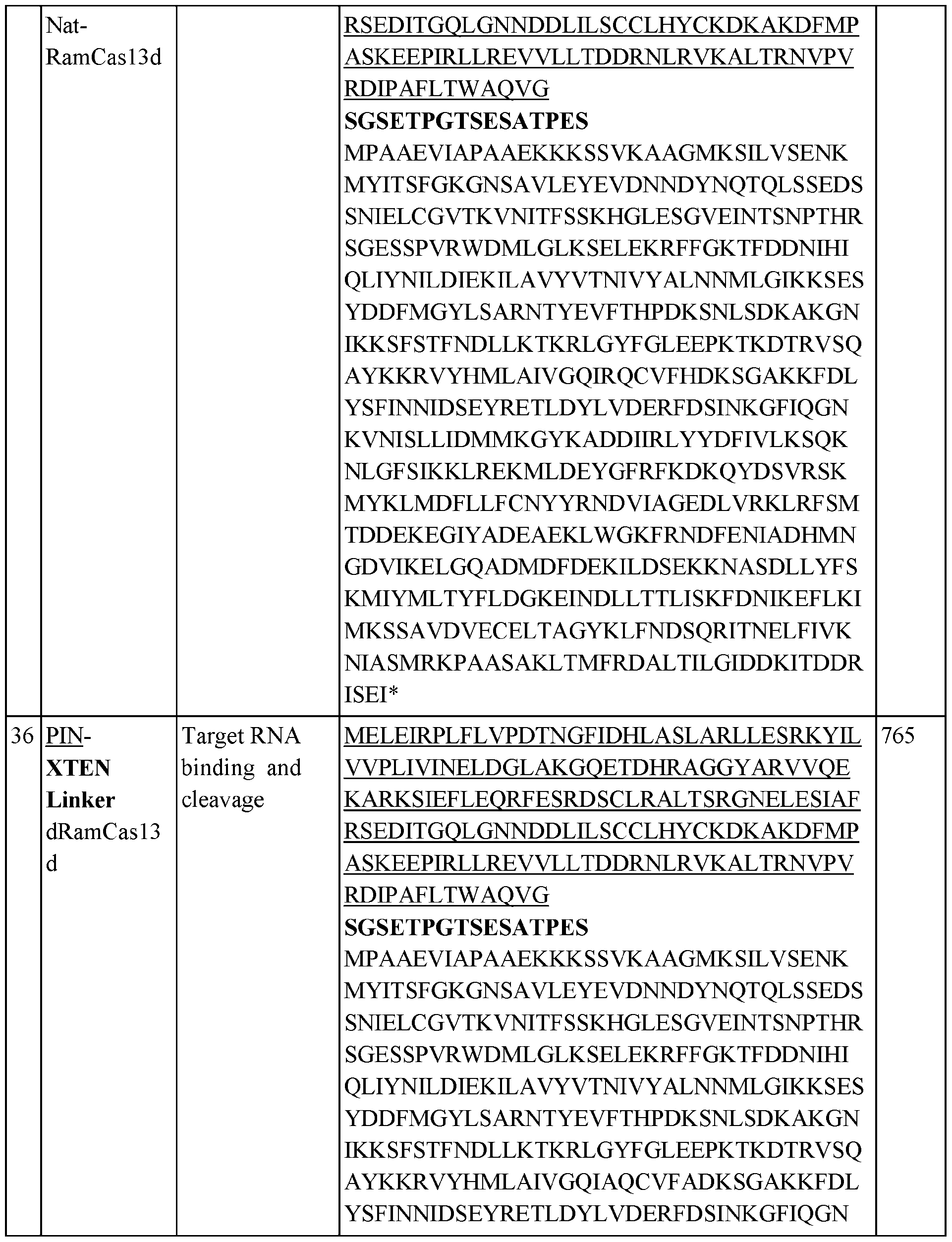


Direct Repeat Sequence Table. Table listing direct repeat (DR) nucleotide sequences used to test with CasPIN designs. Each DR is associated with a specific Casl3 effector and represents the RNA sequence.

Equivalents
[0106] Unless otherwise defined, all technical and scientific terms used herein have the same meaning as commonly understood by one of ordinary skill in the art to which this invention belongs.
[0107] The inventions illustratively described herein may suitably be practiced in the absence of any element or elements, limitation or limitations, not specifically disclosed herein. Thus, for example, the terms “comprising,” “including,” “containing,” etc. shall be read expansively and without limitation. Additionally, the terms and expressions employed herein have been used as terms of description and not of limitation, and there is no intention in the use of such terms and expressions of excluding any equivalents of the features shown and described or portions thereof, but it is recognized that various modifications are possible within the scope of the invention claimed.
[0108] Tirus, it should be understood that the materials, methods, and examples provided here are representative of preferred embodiments, are exemplary, and are not intended as limitations on the scope of the invention. The invention has been described broadly and generically herein. Each of the narrower species and sub-generic groupings falling within the generic disclosure also form part of the invention.
[0109] This includes the generic description of the invention with a proviso or negative limitation removing any subject matter from the genus, regardless of whether or not the excised material is specifically recited herein.
[0110] In addition, where features or aspects of the invention are described in tenns of Markush groups,
those skilled in the art will recognize that the invention is also thereby described in terms of any individual member or subgroup of members of the Markush group.
[OHl] All publications, patent applications, Appendices, patents, and other references mentioned herein or attached hereto are expressly incorporated by reference in their entirety, to the same extent as if each were incorporated by reference individually. In case of conflict, the present specification, including definitions, will control. Other embodiments are set forth within the following claims.
References
1. Perrimon, N., Ni, J.-Q. & Perkins, L. In vivo RNAi: today and tomorrow. Cold Spring Harb. Perspect. Biol. 2, a003640 (2010).
2. Sledz, C. A. & Williams, B. R. G. RNA interference in biology and disease. Blood 106, 787- 794 (2005).
3. Birmingham, A. et al. 3’ UTR seed matches, but not overall identity, are associated with RNAi off-targets. Nat. Methods 3, 199-204 (2006).
4. Jackson, A. L. et al. Expression profiling reveals off-target gene regulation by RNAi. Nat. Biotechnol. 21, 635-637 (2003).
5. Passini, M. A. et al. Antisense oligonucleotides delivered to the mouse CNS ameliorate symptoms of severe spinal muscular atrophy. Sci. Transl. Med. 3, 72ral8 (2011).
6. Choudhury, R., Tsai, Y. S., Dominguez, D., Wang, Y. & Wang, Z. Engineering RNA endonucleases with customized sequence specificities. Nat. Commun. 3, 1147 (2012).
7. East-Seletsky, A. et al. Two distinct RNase activities of CRISPR-C2c2 enable guide-RNA processing and RNA detection. Nature 538, 270-273 (2016).
8. Abudayyeh, O. O. et al. C2c2 is a single-component programmable RNA-guided RNA- targeting CRISPR effector. Science 353, aaf5573 (2016).
9. Konermann, S. et al. Transcriptome Engineering with RNA-Targeting Type VI-D CRISPR Effectors. Cell 173, 665-676.el4 (2018).
10. Smargon, A. A. et al. Cast 3b Is a Type VI-B CRISPR- Associated RNA-Guided RNase Differentially Regulated by Accessory Proteins Csx27 and Csx28. Molecular CellvoX. 65 618-630. e7 (2017).
11. O’Connell, M. R. Molecular Mechanisms of RNA Targeting by Cas 13 -containing Type VI CRISPR-Cas Systems. J. Mol. Biol. 431, 66-87 (2019).
12. Gootenberg, J. S. et al. Nucleic acid detection with CRISPR-Casl3a/C2c2. Science vol. 356 438-442 (2017).
13. Brogan, D. J. et al. Development of a Rapid and Sensitive CasRx-Based Diagnostic Assay for SARS-CoV-2. ACS Sens (2021) doi: 10.1021/acssensors. lc01088.
14. Gootenberg, J. S. et al. Multiplexed and portable nucleic acid detection platform with Casl3, Casl2a, and Csm6. Science 360, 439-444 (2018).
15. Cox, D. B. T. et al. RNA editing 358, 1019-1027 (2017).
 Charles, E. J. et al. Engineering improved Casl3 effectors for targeted post-transcriptional regulation of gene expression. bioRxiv 2021.05.26.445687 (2021) doi:10.1101/2021.05.26.445687. Ozcan, A. et al. Programmable RNA targeting with the single-protein CRISPR effector Cas7- 11. Nature 1-6 (2021 ) doi : 10.1038/s41586-021-03886-5. Rauch, S. et al. Programmable RNA-Guided RNA Effector Proteins Built from Human Parts. Ce// 178, 122-134.el2 (2019). Batra, R. et al. Elimination of Toxic Microsatellite Repeat Expansion RNA by RNA- Targeting Cas9. Cell 170, 899-912.el0 (2017). Huntzinger, E., Kashima, I., Fauser, M., Sauliere, J. & Izaurralde, E. SMG6 is the catalytic endonuclease that cleaves mRNAs containing nonsense codons in metazoan. RNA 14, 2609- 2617 (2008). Senissar, M., Manav, M. C. & Brodersen, D. E. Structural conservation of the PIN domain active site across all domains of life. Protein Sci. 26, 1474-1492 (2017). Schellenberger, V. et al. A recombinant polypeptide extends the in vivo half-life of peptides and proteins in a tunable manner. Nat. BiotechnoL 27, 1186-1190 (2009). Abudayyeh, O. O. et al. RNA targeting with CRISPR-Casl3. Nature 550, 280-284 (2017). Sun, Z. Z. et al. Protocols for implementing an Escherichia coli based TX-TL cell-free expression system for synthetic biology. J. Vis. Exp. e50762 (2013) doi: 10.3791/50762. Marshall, R. et al. Rapid and Scalable Characterization of CRISPR Technologies Using an E. coli Cell-Free Transcription-Translation System. Mol. Cell 69, 146-157. e3 (2018). Wandera, K. G. & Beisel, C. L. Rapidly Characterizing CRISPR-Casl3 Nucleases Using Cell-Free Transcription-Translation Systems in Post-Transcriptional Gene Regulation (ed. Dassi, E.) 135-153 (Springer US, 2022). doi: 10.1007/978-l-0716-1851-6_7. Chakravarthi, B. V. S. K., Nepal, S. & Varambally, S. Genomic and Epigenomic Alterations in Cancer. Am. J. Pathol. 186, 1724-1735 (2016). Sicot, G. & Gomes-Pereira, M. RNA toxicity in human disease and animal models: from the uncovering of a new mechanism to the development of promising therapies. Biochim. Biophys. Acta 1832, 1390-1409 (2013)
Claims
1. Ail engineered, non-natural polypeptide comprising a catalytically inactive Cas 13 effector protein (dCasl3) or a fragment thereof and a PilT N-terminal (PIN) domain.
2. The polypeptide of claim 1, wherein the PIT domain is N- terminal or C-tenninal relative to dCas 13 or the fragment thereof.
3. The polypeptide of claim 1 or 2, further comprising a linker located between the dCasl3 protein and the PIN domain.
4. The polypeptide of claim 3, wherein the linker is a flexible linker.
5. The polypeptide of claim 3 or 4. wherein the linker is selected from the group of XTEN linker22 (SEQ ID NO: 23). a single repeat GS linker (GSxl) (SEQ ID NO: 21), or a double repeat GS linker (GSx2) (SEQ ID NO: 22), or a variant of any one of these having at least 50%, 60%, 70%, 80%, 90%, or 95% sequence identity thereto.
6. Tire polypeptide of any one of claims 1-5, wherein the dCasl3 protein comprises an amino acid sequence having at least 50%, 60%, 70%, 80%, 90%, 95%, 96%, 97%, 98%, 99%, or 100% identity to the any one of SEQ ID NOs: 1-15.
7. The polypeptide of any one of claims 1-6. wherein the dCasl3 protein is selected from the dCasl3 polypeptides provided as SEQ ID NOs: 2, 4, 6, 8, 10, 11, 13 or 15.
8. The polypeptide of any one of claims 1-7, wherein the PIN domain comprises an amino acid sequence having at least 50%, 60%, 70%, 80%, 90%, 95%, 96%, 97%, 98%, 99%, or 100% identity to the sequence set forth in SEQ ID NO: 16.
9. The polypeptide of any one of claims 1-8, comprising an amino acid sequence having at least 50%, 60%, 70%, 80%, 90%, 95%. 96%. 97%. 98%. 99%. or 100% identity to the sequence set forth in any one of SEQ ID NOs: 25-37.
10. The polypeptide of any one of claims 1-9, wherein the polypeptide is adapted to be delivered to the nucleus of a cell.
11. Tire polypeptide of any one of claims 1-10, wherein the polypeptide is capable of causing degradation of a target RNA.
12. The polypeptide of claim 11, wherein the polypeptide acts in conjunction with a gRNA to cause degradation of the target RNA.
13. The polypeptide of claim 12, wherein the gRNA comprises an RNA sequence that hybridizes to the target RNA.
14. Tire polypeptide of claim 12 or 13, wherein tire gRNA comprises an RNA sequence that binds to or associates with the polypeptide.
15. The polypeptide of any one of claims 12-14, wherein the gRNA does not comprise a protospacer adjacent motif (PAM)
16. The polypeptide of any of claims 1-15, wherein the polypeptide is adapted to be co-exported with a target RNA out of the nucleus of the cell.
17. An engineered nucleoprotein complex comprising:
(a) a polypeptide any one of claims 1-16, and
(b) a recombinant or synthetic single guide RNA (sgRNA) which is engineered or designed to comprise:
(1) on its 5’ end, an RNA sequence that recognizes by hybridization (that hybridizes to or binds to) a target RNA and
(2) on its 3’ end: (i) an RNA sequence capable of binding to or associating with tire polypeptide, or (ii) a linker that binds or covalently or non-covalently links the 5 ’ RNA- hybridizing or binding end of the sgRNA with the polypeptide, wherein optionally the nucleoprotein complex does not comprise a PAM oligonucleotide.
18. The engineered nucleoprotein complex of claim 17, wherein the polypeptide is covalently bound to the single guide RNA (sgRNA) by a linker.
19. Tire polypeptide of any of claims 1-16 or the engineered nucleoprotein complex of claim 17 or 18, farther comprising a detectable label.
20. A vector comprising a polynucleotide sequence encoding the polypeptide of any one of claims 1- 16.
21 . The vector of claim 20, wherein the vector is or is derived from a plasmid, an adenovirus, an adeno-associated vims (AAV), a retrovirus, a herpes simplex vims, a human immunodeficiency vims (HIV), or a synthetic vector.
22. The vector of claim 20 or 21, wherein the vector also encodes a gRNA.
23. The vector of any one of claims 20-22, wherein the polynucleotide sequence encoding tire polypeptide is operatively linked to one or expression polynucleotides, optionally a promoter or enhancer.
24. A host cell comprising the polypeptide of any of claims 1-16, the nucleoprotein complex of any one of claims 17-19, or the vector of any one of claims 20-23.
25. Tire host cell of claim 24, wherein the host cell is a mammalian or human cell.
26. A method of inhibiting protein expression of a target protein, comprising contacting mRNA encoding the target protein with the polypeptide of any one of claims 1-16 and a gRNA which hybridizes to the mRNA.
27. A method of inhibiting protein expression of a target protein in a cell, comprising introducing into the cell a vector of any one of claim 20-23.
28. A kit comprising the vector of any one of claims 20-23, and instructions for use.
Applications Claiming Priority (2)
| Application Number | Priority Date | Filing Date | Title |
|---|---|---|---|
| US202363510541P | 2023-06-27 | 2023-06-27 | |
| US63/510,541 | 2023-06-27 |
Publications (2)
| Publication Number | Publication Date |
|---|---|
| WO2025006545A2 true WO2025006545A2 (en) | 2025-01-02 |
| WO2025006545A3 WO2025006545A3 (en) | 2025-02-20 |
Family
ID=93940168
Family Applications (1)
| Application Number | Title | Priority Date | Filing Date |
|---|---|---|---|
| PCT/US2024/035535 Ceased WO2025006545A2 (en) | 2023-06-27 | 2024-06-26 | Nuclease effector bound type-vi crispr enzymes |
Country Status (1)
| Country | Link |
|---|---|
| WO (1) | WO2025006545A2 (en) |
Family Cites Families (2)
| Publication number | Priority date | Publication date | Assignee | Title |
|---|---|---|---|---|
| US11788083B2 (en) * | 2016-06-17 | 2023-10-17 | The Broad Institute, Inc. | Type VI CRISPR orthologs and systems |
| WO2021016453A1 (en) * | 2019-07-23 | 2021-01-28 | University Of Rochester | Targeted rna cleavage with crispr-cas |
-
2024
- 2024-06-26 WO PCT/US2024/035535 patent/WO2025006545A2/en not_active Ceased
Also Published As
| Publication number | Publication date |
|---|---|
| WO2025006545A3 (en) | 2025-02-20 |
Similar Documents
| Publication | Publication Date | Title |
|---|---|---|
| CN116590257B (en) | VI-E type and VI-F type CRISPR-Cas system and application thereof | |
| US11608503B2 (en) | RNA targeting of mutations via suppressor tRNAs and deaminases | |
| KR102851101B1 (en) | Methods and compositions for editing RNA | |
| KR102666695B1 (en) | Methods and compositions for editing RNA | |
| JP7705382B2 (en) | Novel CRISPR DNA targeting enzymes and systems | |
| IL323589A (en) | Programmable dna base editing by nme2cas9-deaminase fusion proteins | |
| GB2617658A (en) | Class II, type V CRISPR systems | |
| CN113302291B (en) | Genome editing by targeted nonhomologous DNA insertion using retroviral integrase-Cas9 fusion protein | |
| WO2020180699A1 (en) | Novel crispr dna targeting enzymes and systems | |
| WO2023274226A1 (en) | Crispr/cas system and uses thereof | |
| JP2022540153A (en) | Novel CRISPR DNA targeting enzymes and systems | |
| WO2023030340A1 (en) | Novel design of guide rna and uses thereof | |
| Li et al. | Improvement of C‐to‐U RNA editing using an artificial MS2‐APOBEC system |
Legal Events
| Date | Code | Title | Description |
|---|---|---|---|
| NENP | Non-entry into the national phase |
Ref country code: DE |